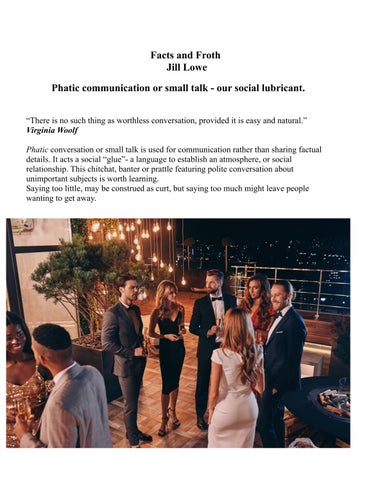
Facts and Froth Jill Lowe Phatic communication or small talk - our social lubricant. “There is no such thing as worthless conversation, provided it is easy and natural.” Virginia Woolf Phatic conversation or small talk is used for communication rather than sharing factual details. It acts a social “glue”- a language to establish an atmosphere, or social relationship. This chitchat, banter or prattle featuring polite conversation about unimportant subjects is worth learning. Saying too little, may be construed as curt, but saying too much might leave people wanting to get away.
The origin and definition of phatic communion (or communication) The word phatic comes from the ancient greek word phatos meaning “spoken.” Even though it sounds like emphatic, that is a coincidence, because that has a different Greek root “to show.” The anthropological linguist Bronisław Malinowski coined the term in his essay “The Problem of Meaning in Primitive Languages.” which appeared in 1923 in The Meaning of Meaning by C.K. Ogden and I.A. Richards. This small talk - in which ties of union are created by a mere exchange of words, usually trivial and obvious exchanges. It signals friendliness, is superficial or formulaic such as greetings, or inquiries about health and weather and is generally positive. Such talk may ease the transition into deeper more meaningful conversation. In our current era it is perhaps important to exclude any comments about politics and religion if the aim is to keep communication lines open.
How does phatic communion differ from gossip? The aim of phatic communion is to create harmony, trust and goodwill. Gossip may also do this, but as gossip involves talking about others who are not present, it might also be used to spread ill will. Too, gossip is often is aimed at evaluating the actions of those persons not present and it can function as a tool for social control in fostering solidarity among the gossipers.
Much of phatic commmunion is strictly rhetorical. When someone passes you in a corridor and inquires “How are you?” it would be a breach of manners to take the question as needing content and to actually tell them what a bad day you’ve had. On the other hand it is equally important to listen because if perhaps a hairdresser asks “ Where are you going on vacation?” and one answers “No-where”, it is definitely disconcerting for her to answer “Have you been there before?”
How to make small talk. It might be asked “Why would one even discuss this matter? “Isn’t it easy?” you say. Some people find small talk enjoyable and easy but others find it excruciatingly painful. It is worth knowing that even if a skill does not come easily, it can be learned and practised. In the book “The Six Disciplines of Strategic Thinking,” Michael D.Watkins describes the three aspects of learning new skills: endowment (or inherent ability) + experience + exercise. Whether on the golf course, in an elevator, at a wedding of strangers, a church coffee hour, a company reception, one usually needs to navigate social interaction. It is valuable to assess the situation and the time allotted. At a cocktail party, especially if one is the host then “working the room” is important. Hosts usually attempt to speak to or acknowledge guests. In so doing the ease to disengage from one conversation to greet another guest is a skill. As a guest speaking with other guests it is also wise not to spend the entire event with just one other guest. This small talk skill is so valued that some schools and indeed private clubs try to teach it to young people.
Prior to June 2007 with the advent of the first iphone, there may have been more family dinners at a table, providing a setting, where the taking turns, the give and take of conversation could be taught. This may be diminished to-day. Further, as social media has gained more and more impact, opinions can be voiced with the shield of the internet, providing some anonymity and thus often omitting polite and respectful tones. To-day at dining tables, in home or restaurants, with family, friends or colleagues, the ubiquitous phone is visible and EVEN if face down on a dining table, it is present, and a deterrent to easy social interaction.
Are there any guidelines for phatic communion? Indeed there are guidelines, but it will quickly be realised that many have not read such. Then if desired, all one can do then is to follow some guidelines oneself. Here are some steps that can be used:Show real interest with eye contact. Use active listening. Stay fully present and relaxed in the conversation. Remember key details that you can ask about later in the conversation. Use the 20-second rule for yourself. Be cognizant of the amount of time that you're speaking and the number of times you start a sentence with I. When you’ve been talking for approximately 20 seconds, try to finish your thoughts. Be cognizant of your nonverbal communication. Use nonverbal cues like body language, nodding, maintaining eye contact. Strategically plan your exit. When you've reached the end of your conversation, it can help to have a graceful and natural end to your small talk planned.
The elevator guideline for small talk.
Often used in executive coaching is the notion of the “elevator description” - the abiity to explain a concept or situation between floors of an elevator, OR perhaps more importantly not to embark on the attempt. This concept implores one to condense thoughts to the crucial, emphasizing brevity, clarity and friendliness.
Let F. Scott Fitzgerald and Leo Tolstoy have the last words on Phatic Communion. “They used words not for what they meant but for what they felt like” F. Scott Fitzgerald. “This side of Paradise”
“It was the kind of conversation, where nobody listens, but everybody is glad to have a chance to say something.” Leo Tolstoy. War and Peace