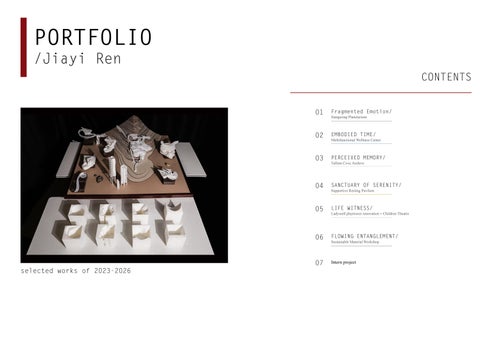
SANCTUARY OF SERENITY/ Supportive Resting Pavilion LIFE WITNESS/ Ladywell playtower renovation + Children Theatre
01 FRAGMENTED EMOTION
Stargazing Planetarium
“How can spatial experience guide people to confront uncertainty and feelings of emptiness in life, rather than escaping from them or passively indulging in them?”
SITE & CONCEPT
Based on Eva Illouz’s theory of emotional capitalism, this project explores how contemporary society commodifies emotions through markets and social media, weakening authentic emotional perception and producing superficial social relations. The proposal responds by creating a de-capitalized emotional space through the spatial experience of a planetarium, encouraging visitors to reconsider their feelings through the scale of the cosmos. The site is located on Qianniu Ridge near Hangzhou, a popular but undeveloped stargazing destination currently affected by traffic congestion and environmental damage. The project introduces an educational planetarium, observatory hall, and supporting facilities to foster a more reflective engagement with the night sky.
: 100-160μg/m³
: 60-100μg/m³
: 30-60μg/m³
: 0-10μg/m³ : site
SITE & CONCEPT
This project asks how individuals can regain agency over emotions and relationships within structures that commodify feeling. The planetarium is chosen for its immersive, interactive, and educational qualities, allowing visitors to reconnect with sensory perception and reflect on their place within a larger cosmic order.
The exhibition is organized through a multi-circulation curatorial strategy following the timeline of cosmic evolution. Three intertwined trajectories—science, humanity, and philosophy— remain independent yet interconnected, enabling visitors to shift perspectives at key points. By exploring the universe, human knowledge, and existential meaning, the exhibition encourages reflection on emotional capitalism and contemporary social relations.
EXPLODED DIAGRAM
The building adopts a deconstructivist approach to express the reconstruction and renewal of existing ideas. In an era dominated by emotional capitalism, simple rejection cannot lead to progress. Instead, it should be reinterpreted and transformed through new ways of thinking, with the focus placed on critique and reconstruction.
STRUCTURE - PROGRAM ANALYSIS
light well
planetarium
equipment room
viewing corridor
escalator
service room humanity gallery science gallery
stargazing gallery
bridge core core
weather rader station
stargazing platform
circulation slope circulation slope
phhilosophy gallery
temporary exhibition gallery garden
EXPLODED DIAGRAM
Decision Point: Visitors are required to make their own choices at this point, rather than being forced to follow a predetermined circulation route.
The atrium presents sixteen entrances within a single visual field, allowing visitors to choose freely. It symbolizes the chaotic emotional market, encouraging individuals to follow their inner judgment rather than drift with the crowd. Circulation varies by gallery theme. The central hall offers an immersive space for reflection and bodily awareness. An ascending passage gradually shifts from darkness to light and noise to silence, leading toward the universe. The planetarium becomes the final point of contemplation. Each sequence represents emotional transformation: manipulation, introspection, liberation, and balance. The atrium acts as a convergence of consciousness, while displacement, superimposition, drift, fragmentation, and ambiguity shape the deconstructive spatial strategy.
Phase 1:
Visitors choose one of three thematic galleries based on their interests.
Phase 2:
Within each gallery, visitors freely determine their own sequence of exploration, as each floor presents a complete thematic component.
Phase 3:
Visitors may switch between galleries through the atrium bridges during their visit.
Phase 4:
The exits of the three galleries converge into an interconnected double-spiral ramp system.
Phase 5:
One route returns to the ground-floor atrium, allowing visitors to revisit the initial decision point and explore alternative paths. The other leads to the central garden, where visitors may rest or continue toward the temporary exhibition hall.
Visitors arrive either by taxi, dropping off at the ground floor, or by private car, parking in the garage. From different levels, they enter the atrium and choose a gallery to begin their visit. After following multiple exhibition paths, they reach the rear stargazing level, with open and semi-open leisure areas offering food, washing, and rest, allowing recovery after intense information intake. Crossing a bridge between the two buildings by ramp or escalator, visitors enter the planetarium. The circular route then returns to the parking area, where they may leave or continue exploring.
The design dismantles structures shaped by power and ideology, exposing essential elements to the viewer. As contemporary society standardizes and structures emotions, the architecture breaks certainty to release suppressed irrational feelings. When social order invisibly directs human behavior, fixed paths are removed, compelling visitors to actively choose and reflect on their direction. Spatial jumps and discontinuities mirror superficial relationships and fragmented mental states. Within this field of multiple choices, visitors are ultimately encouraged to seek their own inner stability.
Through the tension between cosmic perspective and earthly reality
02 EMBODIED TIME
Multifunctional Wellness Center
Time is not counted, it is felt by the body.
CONCEPT & SITE ANALYSIS
The site of this project is located at Meihua Reef, Zhejiang Province, China. The area remains undeveloped and largely abandoned. Yet, due to its exceptional orientation toward the sea horizon, it has become a destination for sunset viewing, drawing people to travel long distances to this deserted coastal edge in order to witness the final glow of the day.
During my time on the site, I experienced the scale of time stretched out. Surrounded almost exclusively by natural sounds—the waves, the wind, and the rocks—the site forms an enclosed and contemplative field. My body felt immersed within this environment, while my gaze remained fixed on the setting sun, waiting for it to slowly and irreversibly disappear beyond the horizon. This spiritual encounter with the passage of time deeply affected me and prompted a reflection on human life itself: within such a limited duration, how might spatial experience enable us to approach a sense of wholeness in life, rather than allowing it to pass meaninglessly?
This layered understanding of time and life constitutes the spirit of Meihua Reef. Through architectural intervention, this project seeks to amplify and sustain this sensibility, allowing space itself to become a medium through which individuals confront the finitude of life to make time inhabitable.
How to Attain the Completeness of Life Through Space Within Limited Time ?
PROGRAMMATIC
Time expands beyond measurement; an hour feels endless as curiosity guides the body to explore, wander, and discover the world without awareness of duration or consequence.
Time erupts with intensity; physical strength seeks confrontation, testing limits against height, gravity, and uncertainty, challenging time itself through action, speed, and risk.
Time settles; experience deepens perception as knowledge and memory shape reflection, turning movement inward toward understanding, continuity, and self-formation.
Time lengthens into quiet clarity; urgency dissolves into stillness as the body slows, accepting finitude while resting peacefully within horizon, light, and the vastness of nature.
Each stage of life is defined not by age, but by how the body occupies, confronts, and perceives its surroundings.
PLAN
The project is organized as a spatial sequence of life stages: reception (childhood), climbing and bungee (youth), museum and meditation (middle age), and a nursing home (old age). Each zone is positioned along the terrain and oriented toward the sea. At the most dangerous rocky tip—currently a popular sunset destination— a protected viewing promenade is introduced, transforming risk into safety. Circulation cores and layered pathways interconnect the six main components, allowing independent operation while maintaining visual and physical continuity across the site.
canteen & cafe
viewing terrace
extreme sports : ramp
viewing terrace
gallery
hotel : reception
senior nursing home : greenery
lift : scenic promenade
Programmatic Typology Diagram
CIRCULATION
A fast ramp links the two primary cores. A 5-meter-wide ramp with a 1.55° incline (≈2.7% slope) resolves the height difference, supporting wheelchairs, mechanical transport, and large equipment movement.
A transitional space connects the nursing home and the museum, integrating both an accessible indoor route and an outdoor landscape path leading directly toward the coastline.
The building is structured around two primary cores that link all programmatic components. Three tempered-glass elevator shafts enhance vertical circulation with a high degree of transparency, enabling visitors to visually engage with the interior and clearly understand where they are headed.
The museum features both a panoramic elevator and a sculptural spiral staircase. The elevator provides smooth, accessible vertical circulation with continuous visual connection, while the spiral stair offers a dynamic, bodily ascent. Together, they create varied speeds, perspectives, and spatial experiences within the exhibition sequence.
The project culminates in an understanding of architecture not as a static form, but as a medium through which life is experienced and completed. By translating the stages of life into spatial conditions, the design allows time to be sensed through the body rather than measured abstractly. From protection to exposure, from depth to horizon, architecture frames the shifting relationship between human existence and the natural world, ultimately offering a place where life, in its finite duration, can unfold with clarity, intensity, and acceptance.
03 PERCEIVED MEMORY
A place where urban memory is preserved, explored, and experienced.
Tallinn Civic Archive
RAILWAY STATION
TOWN PARK
DOWNTOWN PORT of TALLINN RAILWAY STATION
This project explores architecture as a mediator between urban memory and human cognition. In rapidly evolving cities, spatial standardisation prioritises efficiency, yet human perception and emotion depend on memory, order, and perceptible hierarchies to foster belonging. Located between Tallinn Town Hall and the harbour, the area combines historic authority, tourism-driven commercialisation, and rapid urban transformation. The project proposes a civic archive, where spatial order, light, scale, and circulation enable city memory to be preserved, experienced, and reinterpreted, acting as a dynamic interface between urban memory and public cognition.
The spatial sequence of the building constructs a cognitive path from the city plaza through a public memory space to areas for reading and research, culminating in the archive core and extending to a rooftop city view. This progression organises experience from collective urban space to concentrated knowledge and back to an elevated perception of the city, framing a transition from city to memory, from memory to cognition, and ultimately returning to the city.
: circulation
: bookshop
: reception
: cloakroom
: cafe & restaurant
: lobby
: atrium
: library
: workshop
: gallery
: public research centre
: record copying centre
: office
: archives warehouse
: archives restoration room
The building’s architectural language combines simplicity and clarity, using restrained openings and clear proportions to create a composed form. Thick walls emphasise solidity and permanence, while lateral natural light gently animates interior spaces. Together, these elements produce a quiet, rational, and dignified atmosphere that respects the public nature of the building. The design balances functional clarity with aesthetic restraint, ensuring that the architecture conveys both order and calmness while supporting civic engagement and thoughtful interaction with the city, its memory, and its archives.
04 SANCTUARY OF SERENITY
Supportive Resting Pavilion At The Sacred Mount Kailash
A pavilion where devotion and sunlight sustain body, spirit, and culture
In response to the arduous journey undertaken by Tibetan Buddhist devotees who perform prostrations at the sacred Mount Kailash, we have initiated this project to create a supportive resting pavilion. Devotees endure extreme hardships in the snowy and high-altitude environment, motivated by their dedication to praying for the well-being of all. To alleviate some of their challenges, the region's abundant sunlight and high ultraviolet radiation are utilized to generate solar power.
Our project is inspired by traditional Tibetan elements such as prayer wheels, mani stone pile, and prayer flags. This resting pavilion will provide a place where pilgrims can rest, sleep, and warm themselves, offering a sanctuary from the harsh conditions. Additionally, this facility will be available to tourists visiting the area, ensuring comfort and sustainability for all and promote the culture.
05 LIFE WITNESS
Ladywell playtower renovation + Children Theatre
A theatre where the past is honoured, the present engaged, and the future envisioned.
CONTEXTUAL STRATEGY
—— population analysis
This population analysis that Lewisham's population is primarily concentrated around the shopping center, which serves as the current community hub. The area has a high proportion of families, with a significant presence of children and middle-aged residents. Additionally, Lewisham is highly diverse, home to many individuals who were not born in the UK.
Lewisham is a primarily residential area in southeast London, equipped with key amenities like a major shopping center and strong transport links. However, despite meeting essential living needs, it lacks cultural and artistic infrastructure — a gap increasingly recognized as the community seeks greater cohesion and creative engagement
According to Lewisham Council's Cultural Strategy 2023–2028, the government aims to foster community cohesion through the arts. However, there is a noticeable lack of performance venues in the immediate vicinity, highlighting a gap in cultural infrastructure. Therefore, I envision this project as a theatre, using BODY LANGUAGE as a universal medium to BREAK CULTURAL BARRIERS AND BRING PEOPLE TOGETHER.
Family Density Map of London POPULATION DENSITY MAP Age Distribution Chart
PLAN
PROGRAMMATIC STRATEGY
4.
A semi-transparent polycarbonate facade and a reflective aluminum roof hover above the original red-brick structure, creating a sense of lightness and levitation. Teal-colored steel frames reinforce the original building while adding a playful, vibrant contrast that evokes a sense of childlike wonder. Colorful aluminum window frames and stairs are scattered across the translucent surfaces, drawing children's attention and encouraging visual curiosity.
The narrative of history is metaphorically expressed through light: the more recent the era, the brighter the space becomes.
Polycarbonate panel is 100% recycle material. A part of the red bricks will be kept and another part will be replaced by new ones for structure safety.
H-section steel beam
aluminum roof
aluminum window frame red brick
concrete floor
polycarbonate panel
The main theatre welcomes children as the heart of the building, symbolizing birth and hope within its historical context. Serving as the entrance, lobby, and performance space, it encourages playful activities—performing, gaming, and creative exploration. Light is changeable, animating the space, while red brick, colourful fabrics, and modular, assembled seating create a lively, tactile environment. Abstract elements, like a bath and water, evoke cleanliness and health, while the central stage becomes a metaphorical nucleus for imagination and growth. This dynamic, interactive space fosters joy, learning, and communal engagement, celebrating childhood and the future potential of architecture through playful design.
polycarbonate panel end stop bar
aluminum pressure cap
aluminum structural support timber batten metal roof cladding breathable building wrap
acoustic insulation
thearmal insulation
purlins
rafters
bulk fibre insulation
timber batten
(above) polycarbonate wall and polycarbonate roof
(above) polycarbonate wall and aluminum roof
public entrance
children entrance
The main theatre welcomes children as the heart of the building, symbolizing birth and hope within its historical context. Serving as the entrance, lobby, and performance space, it encourages playful activities—performing, gaming, and creative exploration. Light is changeable, animating the space, while red brick, colourful fabrics, and modular, assembled seating create a lively, tactile environment. Abstract elements, like a bath and water, evoke cleanliness and health, while the central stage becomes a metaphorical nucleus for imagination and growth. This dynamic, interactive space fosters joy, learning, and communal engagement, celebrating childhood and the future potential of architecture through playful design.
Children Theatre Main Theatre
06 FLOWING ENTANGLEMENT
Sustainable Material Workshop
A space where material exploration and artistic creation cultivate a poetic dialogue between humans and nature
FRAGMENTS SECTION in context
This project in Stratford, London, situates itself on the southern side of the Queen Elizabeth Olympic Park. Positioned adjacent to the canal and allotment, it serves as a sustainable material workshop together with a series of talks and lessons where students delve into the connection between humans and nature. Through material experimentation and artistic creation, they explore how we can intricately respond to nature's call. At its core, this initiative strives to bridge the gap between humanity and nature, fostering a deeper emotional connection and empathy towards our natural surroundings.
I hope that as people stroll through this space, it feels like reading a poem, By picking up fragments of inspiration, they can compose their own inspiration. This space aspires to offer a verdant sanctuary for local residents to unwind. This is achieved through the creation of a winding pathway, meticulously designed to rekindle people's innate reverence for nature, inviting them to reconnect with its profound essence.
EXPERIMENTAL MODEL for IN-BETWEEN SPACE
This is an experiment of bamboo strips, The interacting force form the curve without gluing. In this model, I explored the patterns that can be created with wooden strips. Triangles facing different directions continuously form an arch, and sharp angles simulate the form of thorns, suggesting the sharp and self-protective aspect of the natural world.
In these four models, I pondered the concept of "in-between space." How should the outdoor and indoor spaces be connected? How can the unique features of this area be utilized to narrative?
The waffle roof structure allows light to enter softly, and the variation in depth creates changes in light intensity.
This building has four separate small rooms that share a continuous glazing roof. To allow the roof to support itself, I chose a waffle-like timber lattice structure, which connects each individual space to the entire roof.
This structure transmits the load of air pressure to the ground, functioning entirely as a load-bearing component. The shape of the lattice shades the sun and allows air to flow out, while also creating a form that is visually pleasing.
the difference in depth makes the intensity of light change
06 INTERN PROJECT
The Taizhou Youth Design Bay envisions a new cultural landmark for Huangyan, centred on the concept of a Recreational Business District (RBD). The project integrates design, science, technology, and culture, using space as a carrier and industrial agglomeration as its core. It aims to cultivate a design-driven ecosystem that attracts talent, fosters innovation, and drives industrial development. By leveraging technology and linking design, culture, and innovation, the scheme promotes smart, creative practices. Commercial and exhibition spaces are arranged around a central open area, while upper floors are dedicated to office spaces, creating a comfortable working environment. The interior features a through-height curved space that mirrors the exterior’s openness and enhances interaction between different office levels. Overall, the design balances functional efficiency with spatial experience, providing a platform for cultural exchange, industrial collaboration, and innovative practices, establishing a vibrant hub where creativity, technology, and business converge.