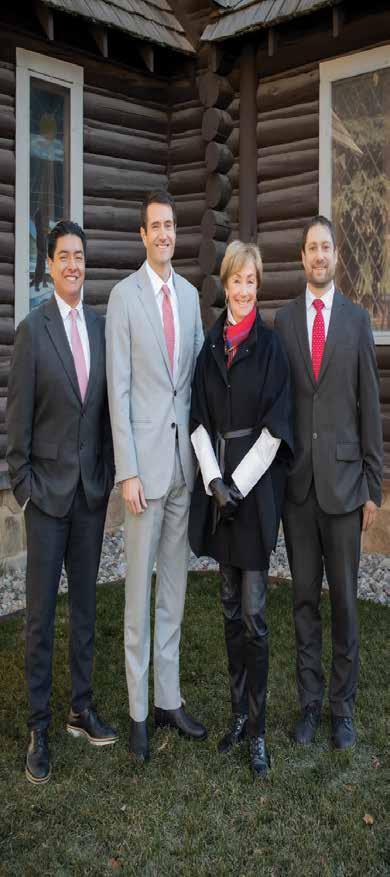
At Singleton Peery Financial, trust is more than just a buzzword – it's the foundation of our business. With a legacy spanning 32 years, we've built a reputation for delivering trustworthy and reliable financial advice. Let us earn your trust too.
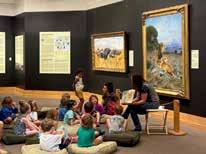
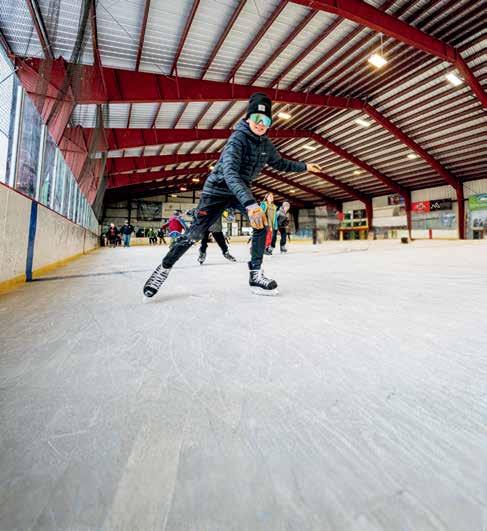
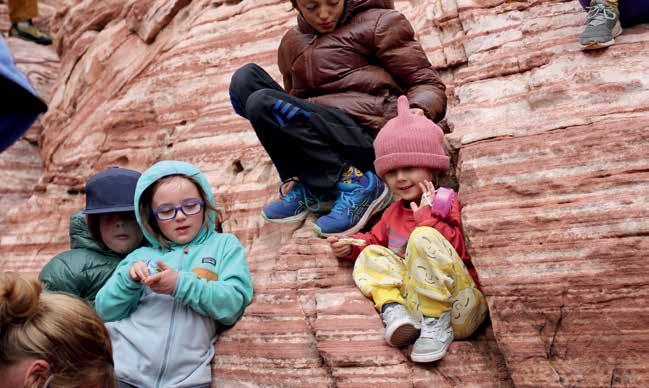
STYLE Rainy day play in Jackson Hole
The dating dictionary, from teen to parent
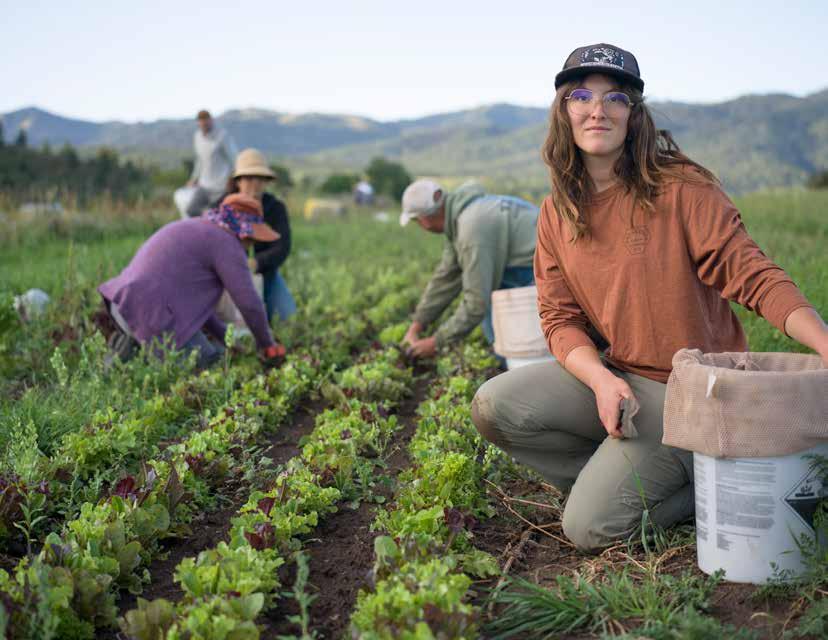
FARM Hear from the volunteer force of local CSAs
Biophilic
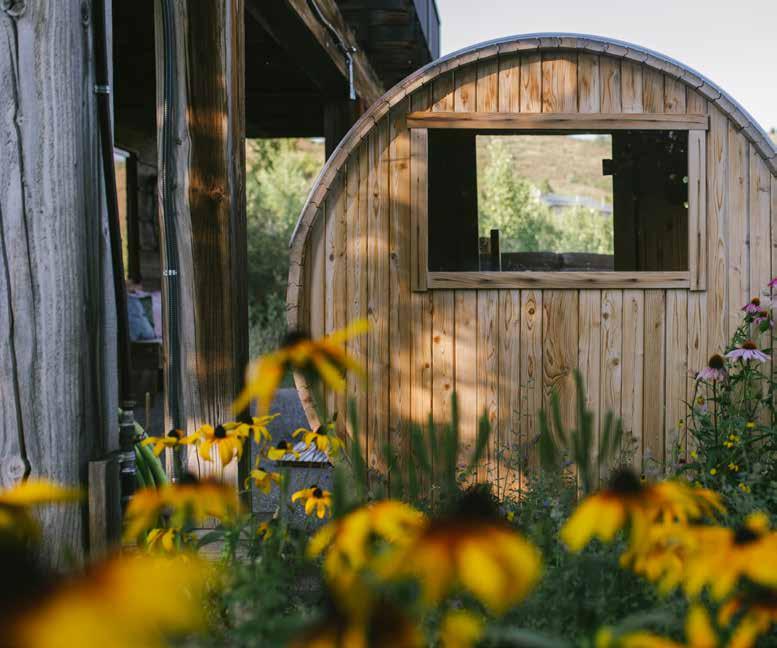
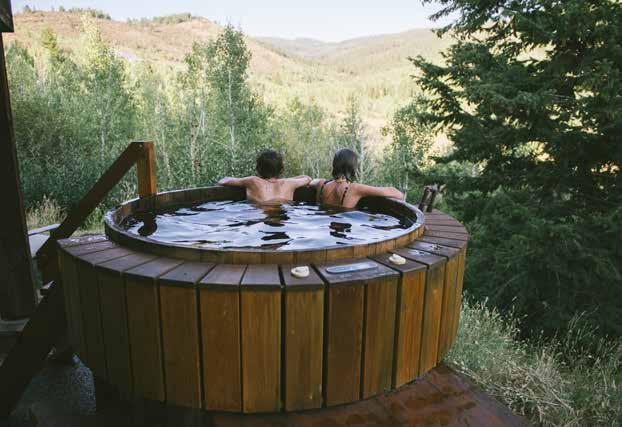
Contrast therapy — an ancient ritual turned modern health trend — is a great way to spend the Teton après. Learn the science and check out backyard setups. By Samantha Simma
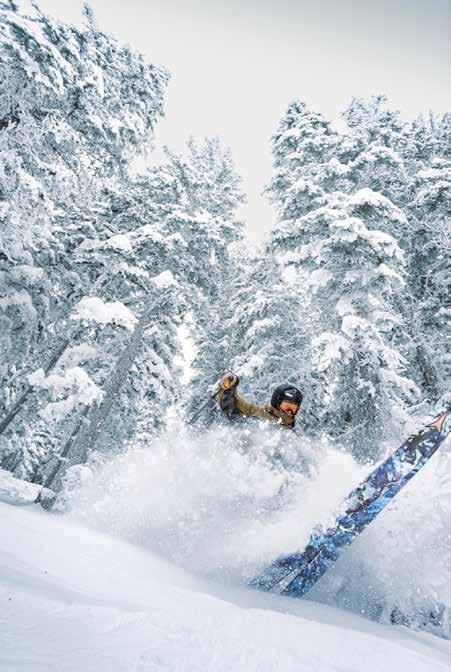
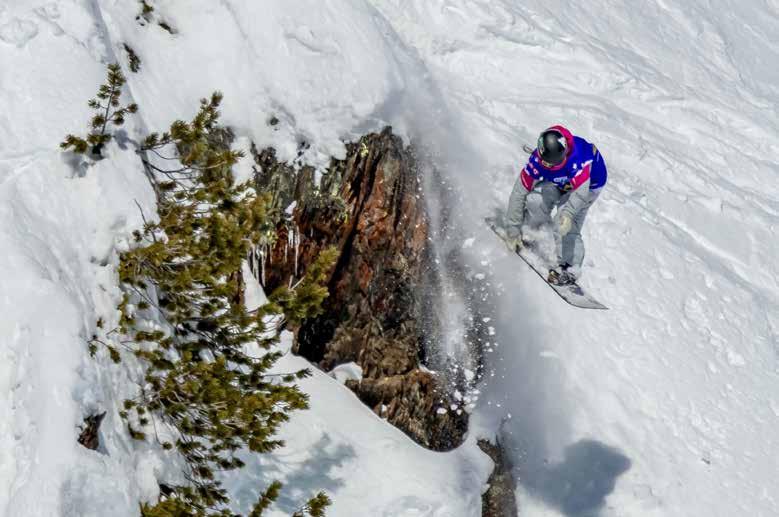
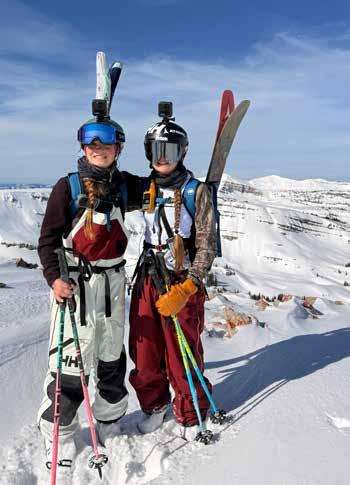
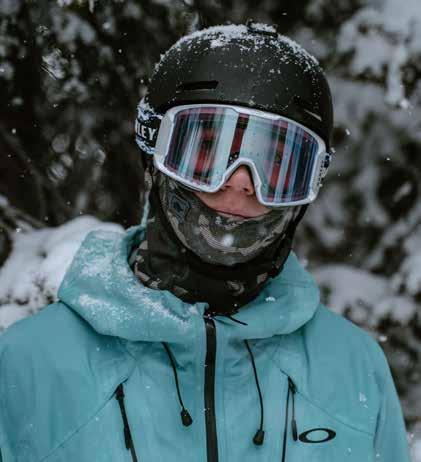
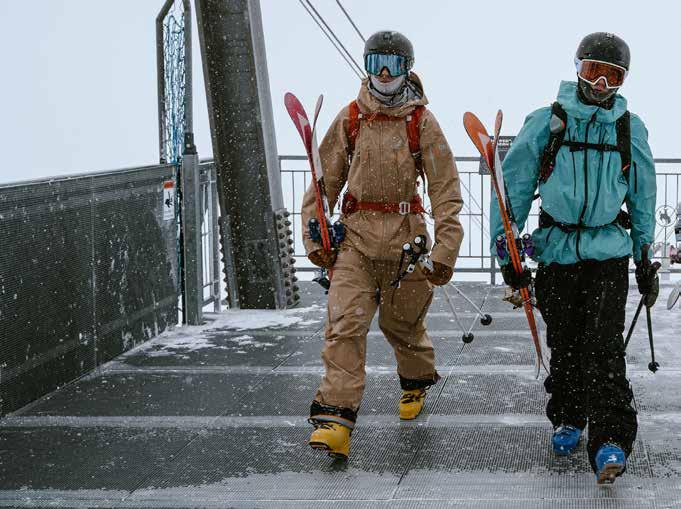
Local kids are pushing the limits in extreme winter sports, while their parents “lean in” and help them find balance. By Kate Hull
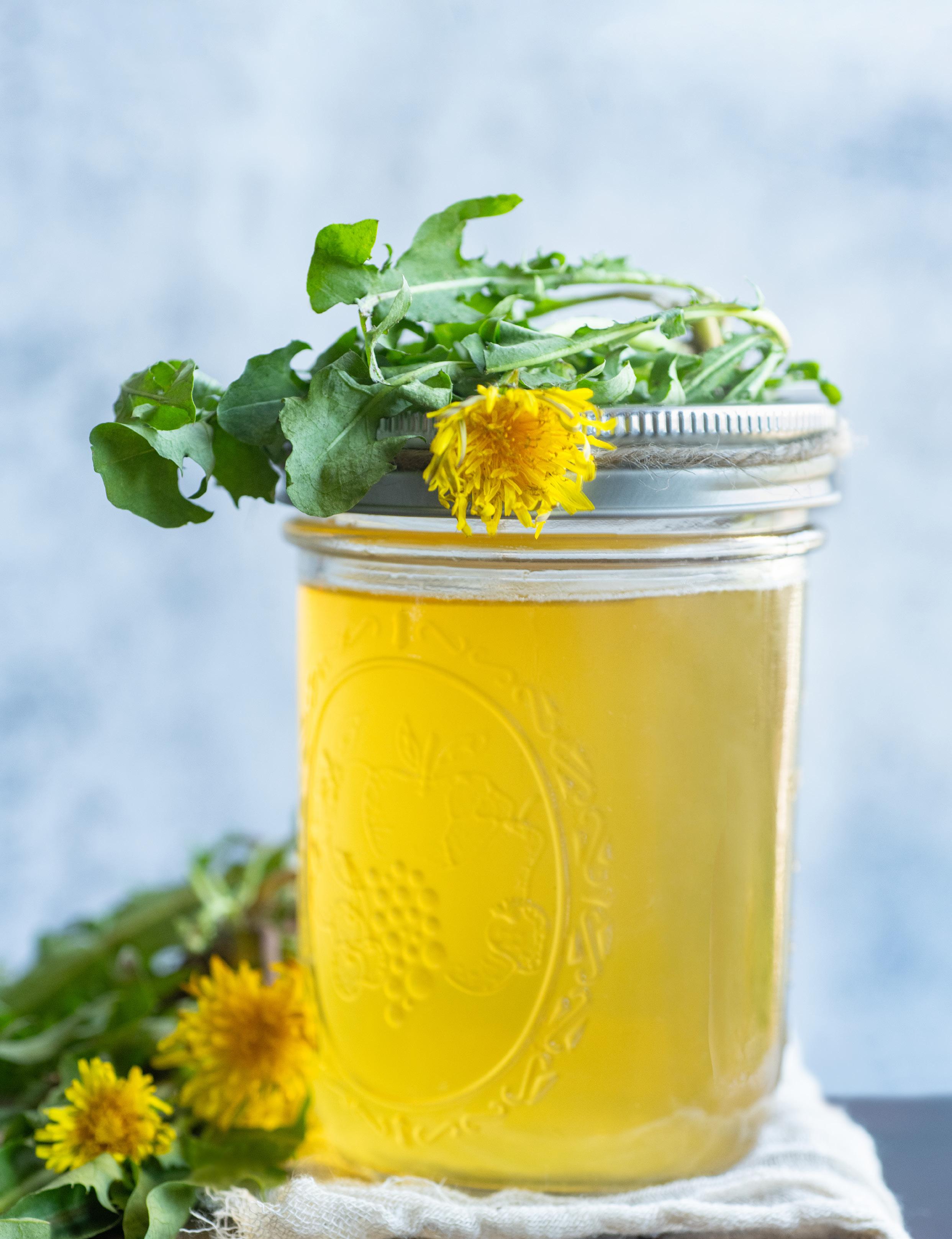
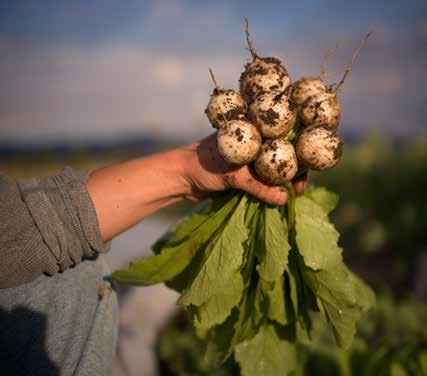
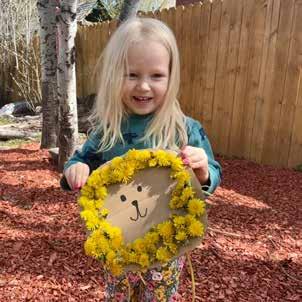
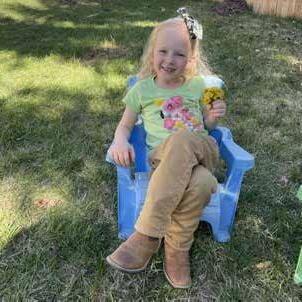
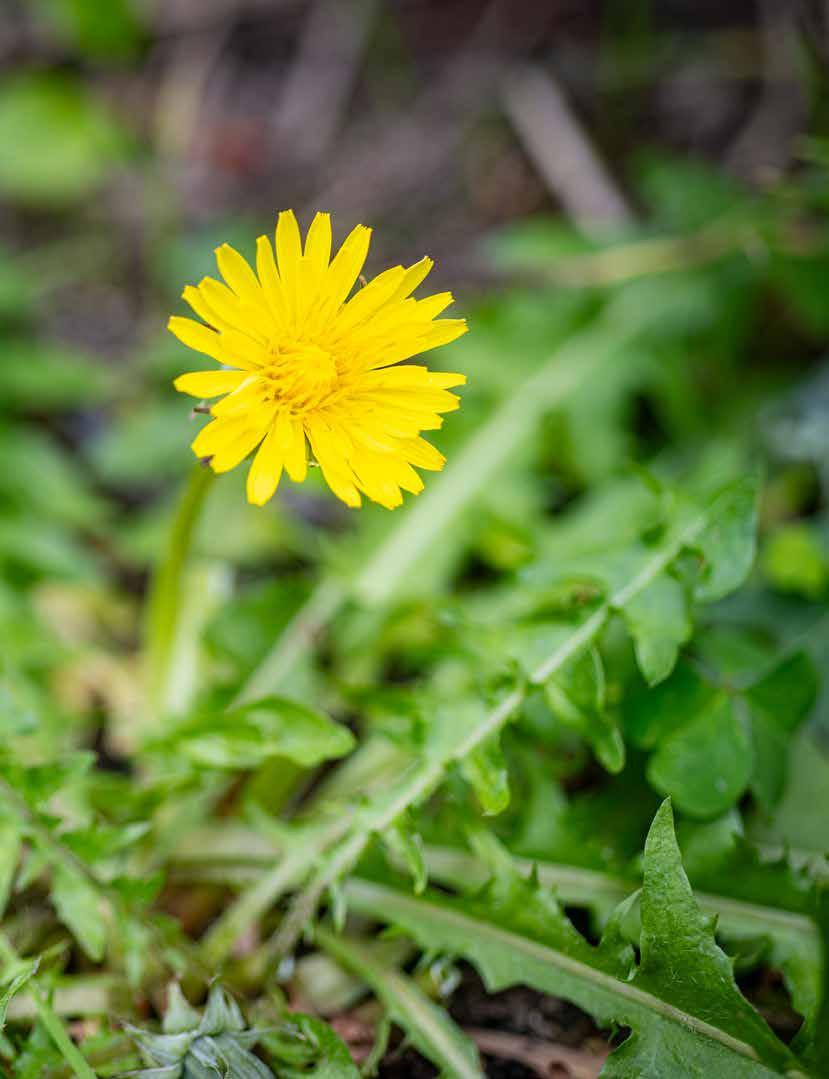
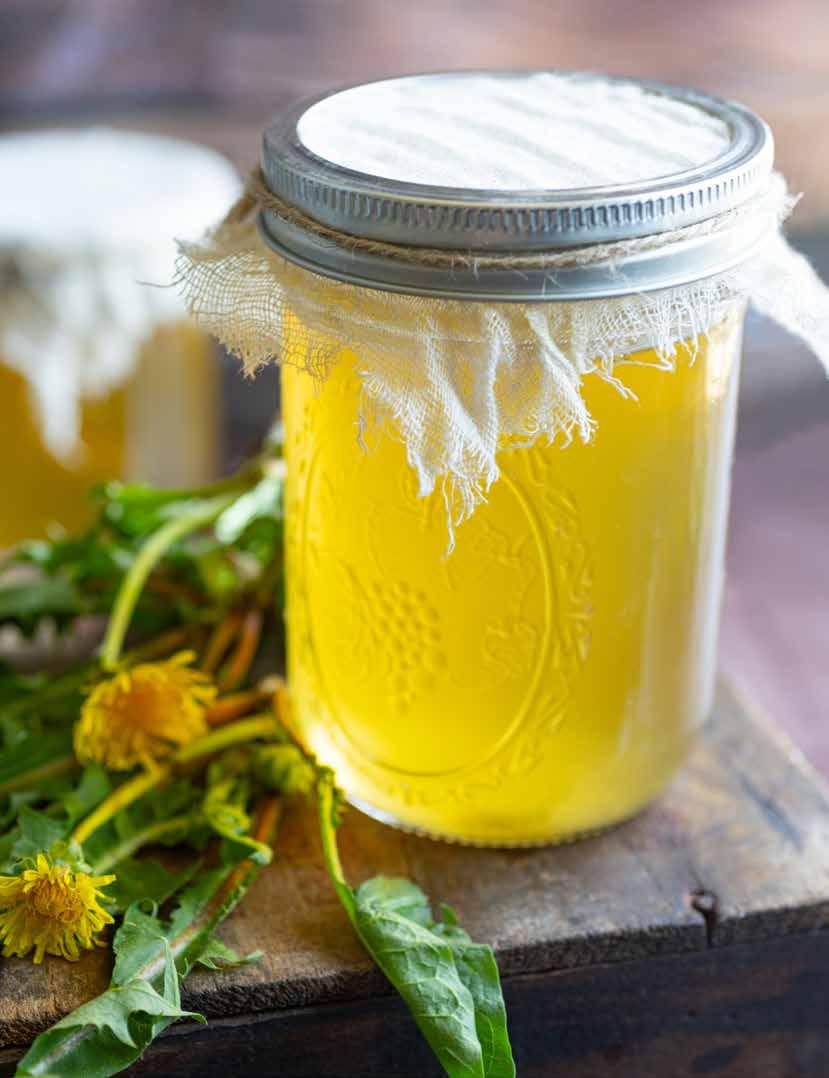
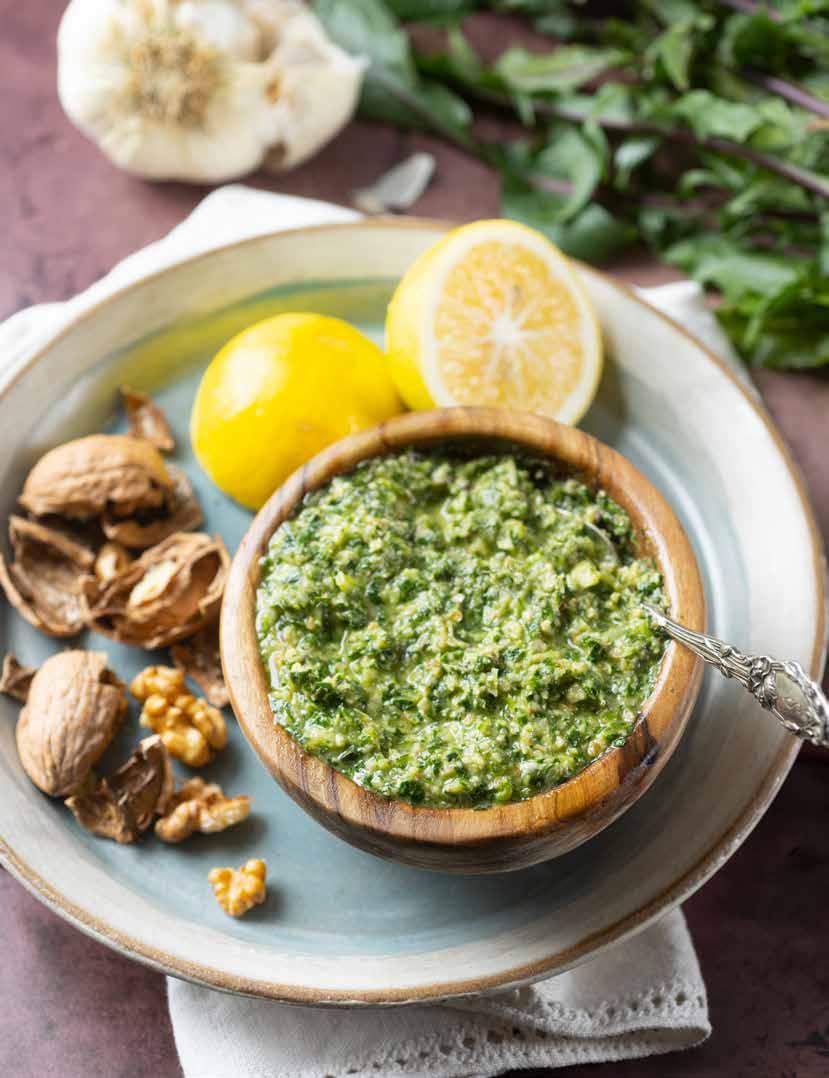
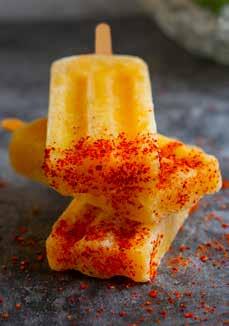
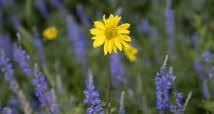
This backyard weed turned culinary delicacy is chock full of nutrients. Check out the blue-ribbon jelly recipe — “sunshine in a jar.” By Samantha Nock
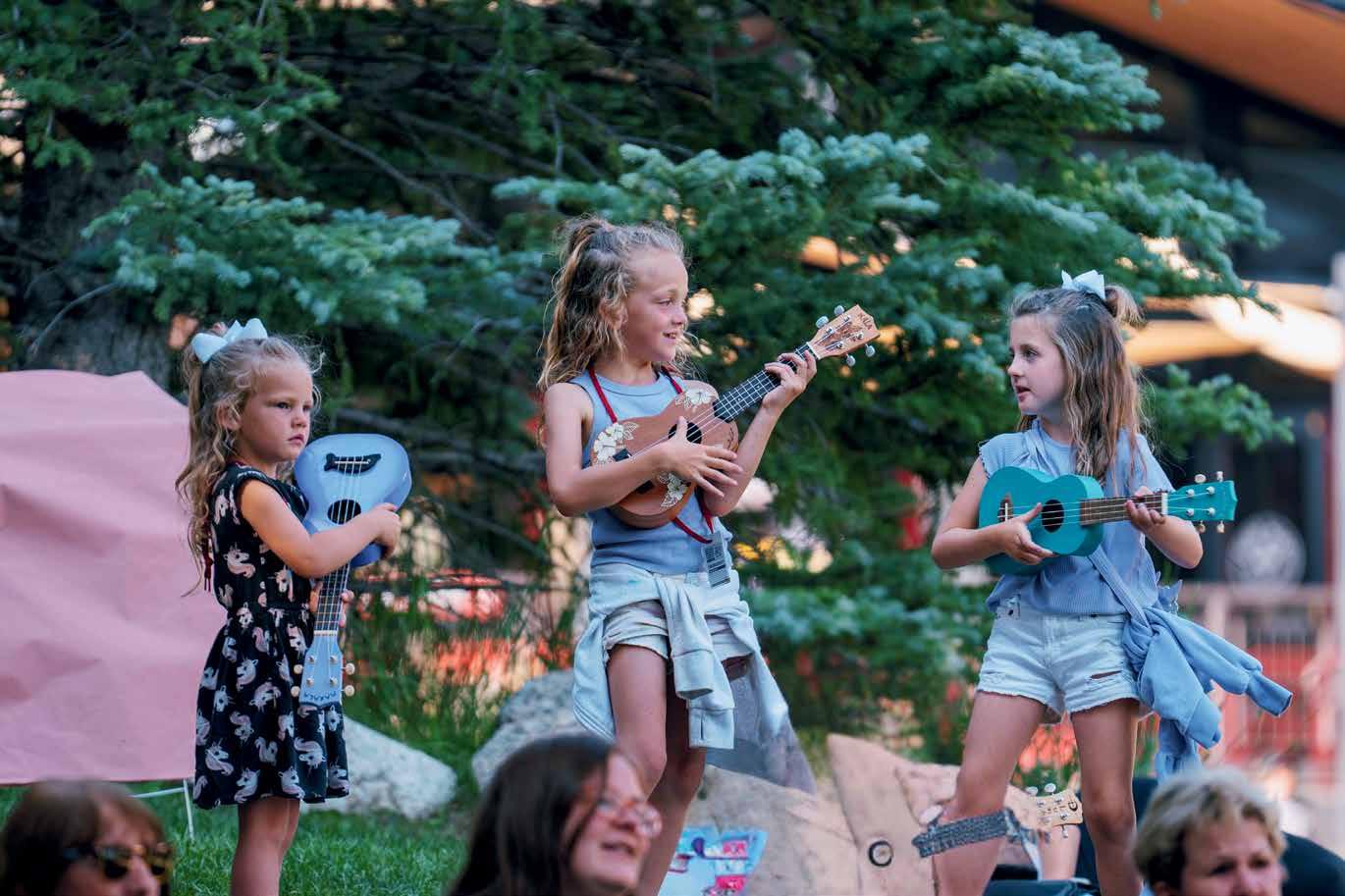
Join us for 80+ concerts & free family events! June 29 - August 15 | Jackson Hole, Wyoming & beyond
Free Family Jam
Friday, July 3 at 6 PM
Center for the Arts Lawn
Fairy
Tales,
Four
Seasons & A World Premiere
Thursday, July 30 at 7 PM
Jackson Hole High School
Sing, dance and celebrate the Teton summer with the Grand Teton Music Festival Orchestra! Bring a picnic and enjoy the music, hosted by Stoner Family Education Curator Meaghan Heinrich and conducted by Timothy Constable.
Free, registration required
Join Festival Musicians and narrator Meaghan Heinrich as they present a chamber music Hans Christian Andersen fairy tale for all ages. Violinist Maria Ioudenitch plays Vivaldi's The Four Seasons. Tickets $35, $5 children/students
Don’t miss the On the Road concert series featuring Festival Musicians performing in beautiful locations around the Tetons, Musical Adventures early childhood musical sessions, expanded programming on both sides of the Teton Pass, and more!
Scan the QR code or visit gtmf.org for the summer schedule.
When I was young, my extended ItalianAmerican family would gather around a table on my grandparents’ back porch in the summer. The table was topped with an 11-footwide pine board, a gift to my grandfather from his siblings. With everyone in attendance, my grandfather would heft large pots of simmering polenta from the stovetop and pour them straight onto the board. I watched with anticipation as my grandmother spread the mixture in an even layer, from end to end, letting it cool slightly before topping it with homemade marinara sauce and fresh Parmigiano, and then passing around the forks.
A note from the EDITOR
That fond memory of eating right off the board, shoulder to shoulder with my relatives (my first experience with unconventional traditions) popped into my head as I read “Dandelion Delights: Bright, Wild Recipes from Root to Flower.” Samantha, our magazine’s art director, walks us through the culinary uses of what some might consider a “taboo food.” For centuries, ancient cultures have eaten this “weed” due to its high nutrient content and medicinal properties. Modern civilization — and the cultivated lawns of suburbia — launched a chemical attack on dandelions that led to the adopted concept that weeds were bad. As Samantha recounts in her article on page 48, shifting from that perspective led to her “blue ribbon” jelly made from dandelion flowers.
Molly Absolon writes to support her outdoor habit. She’d rather be hiking, biking, or skiing in the mountains than doing just about anything else. A former outdoor educator and current mother of a college grad, Molly lives in Victor, Idaho, with her husband.
A Texas native, Kate Hull moved to Teton Valley in 2012. She is the co-publisher and editor-in-chief at Powder Mountain Press, publishers of Teton Valley Magazine (tetonvalleymagazine.com). Kate lives in Victor with her husband and two young children. She enjoys biking, baking, and exploring the Teton Mountains.
The concept of “expanding your mindset” again crept into my thoughts while I was reading Sue’s article on nightshades. (See page 16.) The idea that tomatoes were poisonous, a belief commonly held by 16th-century Italians, who ate them off lead-filled pewter plates, never even crossed my 20th-century relatives’ minds. I love the way this article celebrates nightshades; and the included recipes (like blistered shishitos) prove that if people stayed rooted in conventional thinking, these tasty dishes would never have taken shape. While this edition gets me excited for summer recipes, it also honors all the seasons in the Tetons. Reading about local teens making huge strides in extreme snowsports (on page 40) again shows that when you expand your mindset — as the supportive parents in the article do — you can embrace what growing up in the mountains is all about.
Eating polenta straight off a board might be a foreign concept to many, similar to munching on roadside weeds or hucking a 30-foot cliff on skis. Still, experiencing things “outside of the box” makes life more enjoyable. As you read this magazine, I invite you to look beyond the thinking parameters conventional culture aims to corral and try something new, like cold plunging or speaking your teen’s language (read on to learn more). Remember — a fulfilling life is about constant discovery, but it takes an open mind to let it in.
Contributing WRITERS
Amelia Mayer lives in Kelly with her husband and five children. She loves to get outside camping, biking, hiking, and skiing, and firmly believes that trail mix is a fraud if it doesn't include M&Ms. Follow her family’s (mis)adventures and check out her helpful gear reviews at talesofamountainmama.com.
Olivia McGuire is a Teton Valley native and a student at Boise State University. And while she’s thriving in her “mountain city,” she appreciates the comforts of home and looks forward to reconnecting with her high school squad in the summer to paddleboard the Teton River and dance at Music on Main.
Lacey McNeff has lived in Southeast Idaho most of her life; she was drawn to Teton Valley for its proximity to nature, conscious agriculture, and amazing community. You can find her wandering the trails, enjoying a good book, and harvesting summer’s bounty to make creative dishes and drinks.
Sue Muncaster is a freelance writer and communications consultant inspired by the mental, physical, and spiritual practices of a valuesdriven outdoor lifestyle. She lives in Teton Valley, where she serves on the Victor City Council. Follow her at suemuncaster.substack.com.
Samantha Nock traded the Adirondack Mountains for the Tetons and never looked back. She is the art director for Teton Family and Grand Wedding magazines, a SAHM to two young children, and actively working on her green thumb. This summer, you’ll find her hiking and biking with her two littles, husband, and dog.
Mel Paradis has spent 20 years as an educator on both sides of the Tetons. Founder of Paradis Educational Partners, she advocates for neurodiversityaffirming practices and strengths-based learning for kids with complex neurotypes. She is currently pursuing a doctorate and performs improv with The Laff Staff.
Samantha Simma migrated west to Wyoming from Wisconsin in the pursuit of grander outdoor adventures. She’s the digital marketing manager for Snowday, and her writing appears in Dishing magazine, Grand Wedding, and Jackson Hole Magazine Samantha unplugs by heading into the wilderness with her pup, Timber.
by
Editor photograph
Rebecca Vanderhorst
Molly Absolon
Kate Hull
Amelia Mayer
Lacey McNeff
Samantha Nock
Samantha Simma
Mel Paradis
Sue Muncaster
Olivia McGuire
Radical Minds Academy
Flexible Education for Middle & High School Students in Jackson
Radical Minds Academy is a student co-working and learning community in Jackson, Wyoming. We design individualized education plans that combine online school support, small-group classes, homeschooling, and one-onone learning. Our families choose RadAcad because they want something more flexible, more personal, and more forward-thinking than traditional school.
Christina Shepherd McGuire christina@tetonfamilymagazine.com
Art Director
Samantha Nock
Copy Editor
Deb Barracato
Contributing Photographers
Tucker Adams
Lara Agnew
Natalie Behring
Camrin Dengel
Daniel Harper
Paul Lavold
Julie Millard
Paulette Phlipot
Advertising Sales
Karen Brennan, Tom Hall, Chad Repinski, Tatum Mentzer, Tim Walker adsales@tetonmediaworks.com
Ad Production
Sarah Wilson, Lydia Redzich, Luis F. Ortiz, Chelsea Robinson
Circulation Manager
Jayann Carlisle, circulation@tetonmediaworks.com
Kevin B. Olson, CEO
tetonfamilymagazine.com
Photos by Cecil Holmes & David Akoubian
EDUCATION AS TIMELESS AS THE TETONS.
In a world that is constantly changing, give your child a foundation that never goes out of style. At Jackson Hole Classical Academy, we offer a thriving academic environment where students don’t just learn facts; they learn how to think, how to lead, and how to live with integrity.
Academic Excellence: A curriculum focused on the Great Books, mathematics, Latin, science, and common arts.
Small Class Sizes: Ensuring every student is known, challenged, and supported by expert faculty.
Character First: We foster a community of respect, grit, and stewardship.
K-12th Grade Continuity: A seamless educational journey from the first day of Kindergarten to high school graduation.
"The object of education is to teach us to love what is beautiful." – Plato
RAINY DAY PLAY IN JACKSON HOLE
By Amelia Mayer
R
ainy days in Jackson Hole may be few and far between, but they do happen, and it’s good to have a backup plan for not-so-bluebird days. Before I share my family’s favorite local indoor activities, however, I want to stress that you shouldn’t underestimate the power of simply dressing for the weather and going outside anyway. Those less-than-ideal weather days are the best-kept secret for some of our very favorite adventures. They result in fewer crowds and fun conditions.
VENTURING INTO THE STORM
R Park
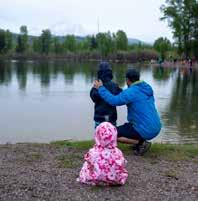
Grab your rain gear and head to R Park to walk the trails, do a little fishing, and say “hi” to Mama Mimi the troll, a Jackson Hole Public Art installation created by recycling artist and activist Thomas Dambo. Your kids will forget it’s even raining once they catch sight of her majestic beauty.
Hiking in Grand Teton National Park
Shh, don’t tell anyone — but hiking in the park is so fun when it’s wet out! We usually opt for Taggart or Bradley Lake and enjoy having the trails mostly to ourselves. Since the region’s weather shifts quickly, you may even luck out with some sun, too. I recommend full rain gear for the kids so they can climb, slide, and play to their hearts’ content.
Astoria Hot Springs
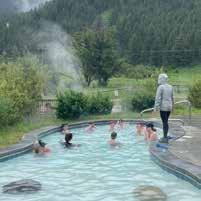
Soaking in the pools at Astoria on a rainy day is an unforgettable experience that no one will complain about because you’ll all be warm. Astoria offers pools of various sizes and temperatures, but plan ahead, as reservations are required to keep the number of guests per session low (a vital crowd-control measure).
LOCAL’S TIP:
Need last-minute gear so you can adventure outside?
Check out Skinny Skis, Teton Mountaineering, Hoback Sports, or REI to outfit your whole family.
IF YOU MUST HEAD INDOORS …
Teton County/Jackson Community Recreation Center
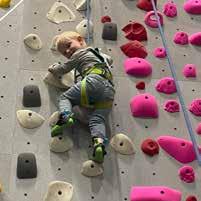
The Rec Center is your best bet for getting your kids’ ya-yas out at the most affordable rate. A day pass gives you access to a multi-story rock climbing wall and the lap pool, kiddie pool, slide, and multiple gyms. If you don’t have climbing gear, rentals are available. Hit this venue early, as afternoon and evening crowds can be fairly intense.
Jackson Hole Indoor
Jackson’s indoor sports training facility, located south of town, offers a Kidspark area that’s similar to a playground, but indoors. Ideal for kids ages 9 and younger, this play area is worth the entrance fee when your kids just need to get out of the house and burn off some energy. It features a mini climbing wall, a playground, a bounce house, arts and crafts, and plenty of room to run.
Older kids and families can drop in and use the fields to play ball sports or run around. Call ahead to check availability.
LOCAL’S TIP:
The Teton County Library offers one-day passes for some of the places above. It’s worth checking to save a little money.
Jackson Hole History Museum
Keep your kids occupied with hands-on touchable artifacts in the main gallery of the Jackson Hole History Museum. The museum also offers family activities, “Hands-on History in the Classroom” workshops for kids ages pre-K to second grade, and summer camps.
Jackson Hole Children’s Museum
We’ve been anxiously awaiting the reopening of the new and improved Jackson Hole Children’s Museum on Mercill Avenue. This action-packed indoor learning venue offers immersive, place-based experiences for kids in grades K through 5th. Check out the STEAM (Science, Technology, Engineering, Art, and Math) programs, complete with messy experiments. The museum’s summer camps are a favorite of local moms, offering art, science, and outdoor adventures, with a different theme each week. tf
the teen DATING DICTIONARY
By Olivia McGuire // Illustration by Julie Millard
om, stop! He’s not even my boyfriend. We are just in a situationship.”
Does this sound familiar, but like a completely different language at the same time?
Do terms like rizz, situationship, talking, soft launch , and hard launch circulate in your teen’s vocab?
It sounds simple, but does “Mom! We aren’t dating, we are just talking!” still confuse you?
Well, parents, you’re not alone.
Below you will find a long-winded explanation of what exactly your teen’s new lingo means
Let’s start with the most important word that pretty much encapsulates the others — Rizz I'm sure you’ve probably looked this term up on Urban Dictionary, and the definition sounds something like “being able to spit game” or simply being a “chick magnet.” Fortunately, this isn’t far from the truth, but it’s a little more nuanced. Terms like W rizz (short for “win” plus “charisma”) and L rizz (the “L” standing for “loss” or “lemon”) up the ante just a little. W rizz refers to someone who has excellent flirting skills and charm, whereas L rizz means quite the opposite, described as cringey or awkward attempts at making conversation. Still, most of us can agree that rizz typically means one's ability to attract or charm others.
Once teens get past the initial “rizz phase,” a relationship comes into play. But again, one term doesn’t fit all, as varying levels of relationships exist. There’s the situationship and the talking stage, two things that seem similar, but actually aren’t.
If your teen comes home saying they’re in a situationship , that typically means they are “leaving the door open.” They may like each other, but not enough to date each other or to stop seeing other people … just yet, that is. The talking stage goes one step further. If your teen refers to the relationship by saying, “we’re talking,” it means they are testing the water and considering dating this person. You can call it a “test drive” — dating without the label.
Parents — rehearse these terms, so you can actually sound hip when you use them …
rizz
One’s ability to naturally charm or attract someone romantically through personality or smooth conversation.
situationship
A romantic relationship that exists without a clear label, commitment, or defined expectations.
talking
The stage before dating, where two people are getting to know each other romantically.
soft launch
Subtly hinting that you are seeing someone (typically on social media), without officially announcing it.
hard launch
To publicly and clearly announce a relationship, leaving no room for guessing (usually on social media).
If your teen is committed enough to hang on through the situationship and the talking stage, next comes the soft and hard launch
Now, you might be asking yourself: What in the world are we launching? And why is there a soft and a hard version?
I know, it gets confusing.
Say your teen’s relationship turned from a situationship to talking, and now they’re ready to take the next step. Well, they can either soft launch or hard launch the relationship. This usually refers to some type of social media post or debut at an event.
For a soft launch, you would post a picture of you and your boyfriend holding hands, or a picture of him walking in front of you, without tagging him. Obvious, yet mysterious. This way, everyone knows you have a boyfriend, but they have no way of figuring out who.
A hard launch is an announcement given to everyone that you’re dating. This can include posting a picture of the two of you together or showing up to a social event arm in arm — without telling anyone ahead of time — loud, bold, and proud.
It really wasn't that complicated back in your day, was it? You were either together and dating, or you weren’t. No one had rizz, and you weren’t in a situationship on and off with one guy for years. And certainly, you were never hard launched.
But hey, at least we don ’t have to talk to our boyfriends on the family landline attached to the wall, while everyone’s in the same room
A HAND IN THE HARVEST
Inside regional CSA workshares
By Lacey McNeff // Photography by Natalie Behring
Summer’s first flavorful greens are always a welcome gift, a promise of all the deliciousness ahead. Our regional farms produce some of the best seasonal produce — from lovage, radishes, and herbs to carrots, turnips, and tomatoes. I wait patiently for these goodies to pop up at farmers markets and stands, grateful when they do, as each tender morsel is the culmination of many hands working with microbes-packed soil, precious water, and consciously stewarded land.
Even though the growing season in the Tetons is short, farmers are planning their crops year-round and tending to all aspects of their farm. To grow food for a community like ours takes dedication and hard work. So, farmers seek volunteer support for their CSAs (community-supported agriculture) to share the responsibility of producing high-quality nourishment.
There is a rich history across the United States of communities coming together to give farms foundational assistance. During the Civil Rights Movement in the 1960s and ’70s, Dr. Booker T. Whately pioneered a “pick and pay” system — a membership club that supported Black farmers using regenerative agriculture and organic farming practices. Members would pay at the start of the farming season and then come to the farm and pick what they needed throughout the summer. In a 1982 interview with Mother Earth News, Dr. Whatley said, “The clientele membership club is the lifeblood of the whole setup. It enables the farmer to plan production, anticipate demand, and, of course, have a guaranteed market.”
In 1986, Indian Line Farm in Massachusetts and Temple-Wilton Community Farm in New Hampshire developed their own CSA programs, which closely resemble those of today. Both farms remain in operation and have inspired farmers across the country, including those in the Tetons, to adopt the same methods of connection and farming.
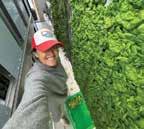
Zoe Sullivan harvests spring greens at Cosmic Apple Gardens.
Regionally, community-supported agriculture has been vital to the survival of many decades-long farming operations. Local CSA memberships operate similarly to the ones started on the East Coast in 1986: Community members sign up and pay in advance to receive a full share or half share of produce and/or flowers throughout the summer season, which is typically 16 weeks long.
Workshares — where community members volunteer their time on the farm in exchange for produce — provide a lifeline for farms throughout Teton Valley. Extra hands make the flow of production smoother, while volunteers learn from farmers how to steward the land according to their principles.
Erika Escholtz reflects on the impact of workshares on her Victor farm, Teton Full Circle Farm, which she runs with her husband, Ken Michael.
“We couldn’t farm here without workshares,” she says. “I don't know how we would financially pull it off. I feel like every spring, when we begin, people show up with their work gloves, excited and ready to farm. It’s such a relief to see people coming — it’s a beautiful sharing and exchange.”
There is a deep sense of gratitude from the volunteers who work the land, as well. Ashley Rogers, a workshare volunteer for over a decade at Teton Full Circle Farm, says, “When I work on the farm, I feel so connected to something meaningful. I think part of it is just slowing down and getting my hands on the dirt and being connected to the earth again. There’s no technology, no phones, no distractions. You’re [simply] having meaningful conversations with people.”
Volunteers come from all the region’s nooks and crannies, cultivating an abundantly diverse community, just like the plants grown on the farms. They gather to share ideas, recipes, life, and general knowledge, which supports their individual growth, as well.
Rafe Rivers of Canewater Farms explains, “Years ago, when one of our volunteers, John, who is a close friend now, started coming out, he had a desk job and worked for a company in Europe while living in Jackson. He started volunteering to ‘get his hands dirty,’ and now he helps me with business planning. I remember his mother visiting when he was volunteering, and she told me, ‘This is changing [John’s] life, you know.’”
Larger labor-intensive tasks can feel deeply rewarding for volunteers, especially when the task is shared, reflects Penny Murray, who started volunteering at Cosmic Apple Gardens in 2015, right after she and her husband relocated here.
“There is something about pulling weeds that feeds my soul,” she says. “But one of the most memorable
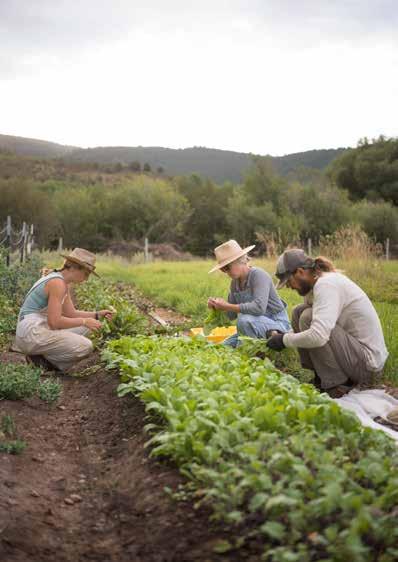
Volunteers Libby Gardner (left), and Madison Gilmore (center), and farm owner Ken Michael (right), pick radishes at Teton Full Circle Farm.
Where to Volunteer
Cosmic Apple Gardens
Commitment: One 5-hour shift per week for one month What You Get: A half-share of the veggies for the day cosmicapple.com
Teton Full Circle Farm
Commitment: One 4-hour shift per week, April 28 - October 15 What You Get: Vegetable shares from June through the end of the season, plus bonus early-season veggies and flowers, when available; a 15% discount at the farm stand tetonfullcirclefarm.org
Canewater Farm
Please reach out to Rafe Rivers at raferivers@gmail.com for volunteer opportunities. canewaterfarm.com
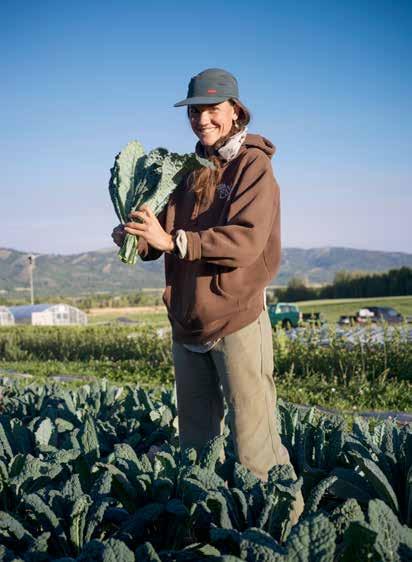
Sarah Burbank poses with a bouquet of kale at Canewater Farm.
moments is participating in the garlic harvest. This might be the 27th generation of garlic that [Cosmic Apple] has planted, and the harvests are extensive.”
Penny explains the many facets of garlic harvesting: First, the scapes pop up and need to be cut and harvested. Next come the garlic bulbs, which need to be harvested and dried; this involves turning and counting them often.
“We’re all so elated when we’re finally bringing the garlic in from the field,” she says. It’s inspiring to “watch something as lovely and intelligent as garlic go through its whole life cycle, and then into my mouth.”
As a volunteer, it’s important to take time to appreciate the land and the edible gifts, especially during challenging moments.
Jo Wildnauer started volunteering for Snowdrift Farm in 2015 and remembers that washing the produce was a tricky task because, at that time, the farm was 100 percent off-grid.
“You would have to go and manually turn on and off the water in the middle of the raspberry pack,” she says. “It was always [a fun task] because there were raspberries all around you, and you could eat a bunch while working.”
Volunteering on a farm helps you glean an incredible amount of knowledge from the farmers, fellow seasoned volunteers, and the plants and land itself.
Mandee Sarno, who has volunteered with Escholtz and Michael for over 20 years, says she has learned so much about farming, as well as saving and preserving food when the harvest is abundant.
“[Erika and Ken’s] enthusiasm for teaching instills the same joy in me for teaching others when the new workshares come to the farm,” she says. “I feel like I've gained a certain level of knowledge, and I’m just so eager and inspired to share that with other people.”
Whether you’re new to the area or are looking to deepen your community roots, Teton Slow Foods in Jackson is a great organization to get involved with. They offer many volunteer options, like helping with the Farm to Fork or the Canewater Farm Dinner events, or volunteering at the Jackson Hole People’s Market or the Slow Foods’ Farm Stand.
Ellen Wilkins, Community Partnership Director, started volunteering with Slow Foods after moving to Jackson and reflects on the incredible opportunities to learn and connect.
“I think we have amazing staff who are so welcoming and willing to teach a multitude of specialized skills,” she says.
For instance, the Farm to Fork Festival offers 12 educational workshops each year. Last year, Wilkins ran the “rise and brine” workshop and said her four volunteers developed in-depth knowledge of how to pickle, ferment, and make sauerkraut, just by helping.
“[Volunteering] is such a great opportunity to meet the instructors of those workshops and gain that knowledge,” she says. “For me, it initially made Jackson and the wider community quickly feel like a very small town.”
The effort of working the land side by side — dirt under nails — and braving all sorts of weather deeply connects people. Our food community’s workshare volunteers end their season with more than produce in hand, as the gifts of their harvest also include cherished knowledge, memories, and friendships that will last a lifetime. tf
THE NIGHTSHADE PRIMER
How to Grow Tomatoes, Peppers, and Potatoes in the Tetons
By Sue Muncaster // Photography by Lara Agnew
Ahhh, nightshades — a plant family with a bad reputation that also makes a very good soup. This botanical family (Solanaceae) contains more than 2,000 species, most of them inedible and highly poisonous, like deadly nightshade (belladonna) and jimsonweed (sacred datura). But several beloved garden staples — rich in nutrients and antioxidants — are also in the nightshade family and have been cultivated for centuries: tomatoes, peppers (sweet and hot), eggplant, tomatillos, and potatoes (aside from sweet potatoes).
Why the bad rap? A little tomato history explains the suspicion …
Tomatoes originated in the northern highlands of South America, where early wild varieties produced small, acidic fruit. Over centuries, indigenous farmers — especially the Aztecs of Central Mexico — selected and bred tomatoes for improved size and flavor, giving the plant its name, tomatl. Spanish explorers brought tomatoes to Europe in the 1500s, where Spain and Italy embraced them while much
of Northern Europe remained suspicious. Because tomatoes resemble toxic plants such as belladonna, they were long considered witchy and dangerous, a belief that followed English settlers to North America.
Tomatoes slowly gained acceptance in the United States during the early 1800s. Thomas Jefferson famously grew and ate them at his home, Monticello, and public fear faded as tomatoes became a common inclusion in home gardens. By the late nineteenth century, seed saving and regional breeding produced hundreds of locally adapted varieties.
Nightshades get their toxic reputation from natural compounds called alkaloids. One of them, solanine, acts as a plant defense against insects. In edible nightshades, levels are negligible and safe for humans — except in potatoes that must be cooked. Green or sprouting potatoes contain higher levels of solanine and should not be eaten. So, it's necessary to store them properly and discard any that have turned green.
GROWING NIGHTSHADES AT ALTITUDE
I’m a throw-it-in-the-ground, cross-my-fingers, and be-thankful-anything-grows type of gardener. So for this article, I leaned on Idaho Extension resources, talked to backyard hobbyists, and called the most passionate grower I know, Daisy Fair of Dig In Consulting in Hailey, Idaho. Daisy has built school gardens, CSAs, and farm projects across the Mountain West. Her philosophy is simple: Grow food in cooperation with the Earth, not in battle against it.
1. Timing Matters
Cold soil stalls nightshades. In this climate, except for potatoes, you essentially cannot directly sow tomatoes and peppers in an open garden. Instead, start seeds indoors six to eight weeks before the last frost, or better yet, purchase starts from reputable experts at local farms. Cosmic Apple Farms, Full Circle Farm, and Canewater Farms all sell seedlings in the spring.
Before moving seedlings from the comfort of your windowsill or greenhouse into the wild unpredictability of a Teton spring, they need to be “hardened off.” About 7 to 10 days before transplanting, place seedlings outside in a sheltered, shady spot for a few hours each day, bringing them back in at night. Slowly increase their exposure to direct sun and outdoor time each day. This process thickens cell walls, strengthens stems, and reduces transplant shock.
2. Soil First, Always …
Nightshades thrive in warm, compostrich, biologically active soil.
Daisy uses fish and kelp fertilizers on seedlings (especially tomatoes) to provide a gentle, nutrient-rich, and bioavailable boost that promotes healthy and stress-resistant growth without burning delicate roots. Follow the directions to dilute in water and feed the seeds when planted. Once the second set of “true leaves” arrives, Daisy recommends “up-potting” into a 4-inch pot and re-feeding, followed by a final feeding when transplanting into the garden or a one-gallon pot.
Knowing that the soil in backyard gardens is rarely balanced in micronutrients, especially “engineered soils” from the nursery, Daisy uses a mineral supplement like Live Earth Product’s Crop Thruster once per season, and again if she notices a failure to thrive. But go
continued on page 21 ...
What NOT to Do
• Don’t plant nightshades where other nightshades grew last year (disease persists in monocropped soil).
• Don’t overfeed nitrogen.
• Don’t isolate plants. Some say lone tomatoes are anxious tomatoes.
Local Favorites
Tomatoes
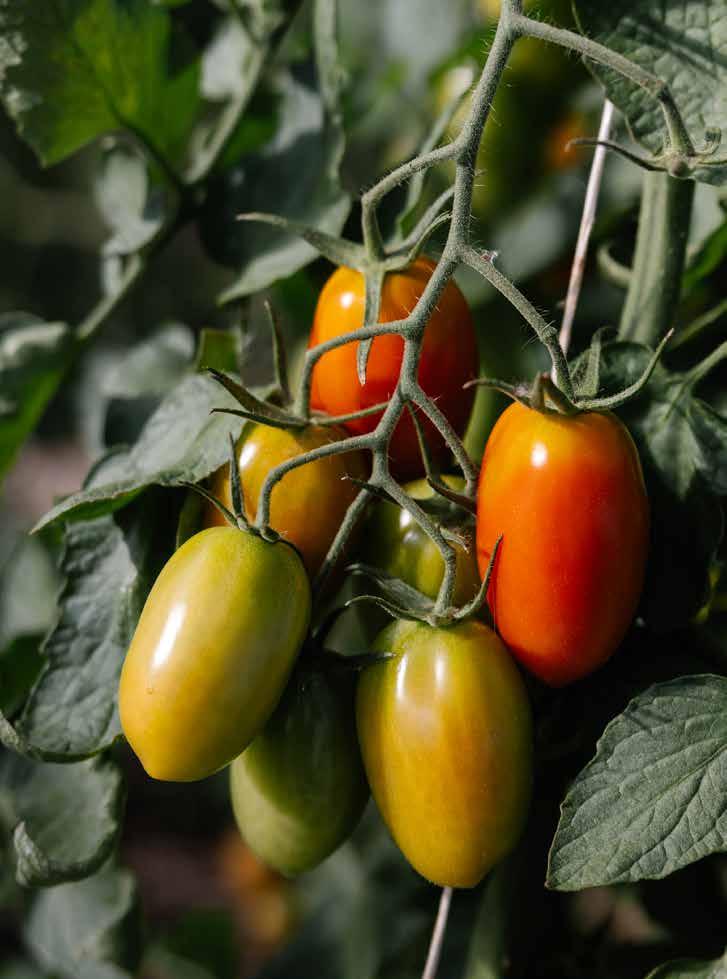
Sungold, Early Girl, Valencia, Secura, Black Cherry
Peppers
Jalapeño, Shishito, Lunch Box, Jimmy Nardello, Carmen
Potatoes
Yukon Gold, Adirondack Blue, Kennebec, German Butterball, Purple Viking
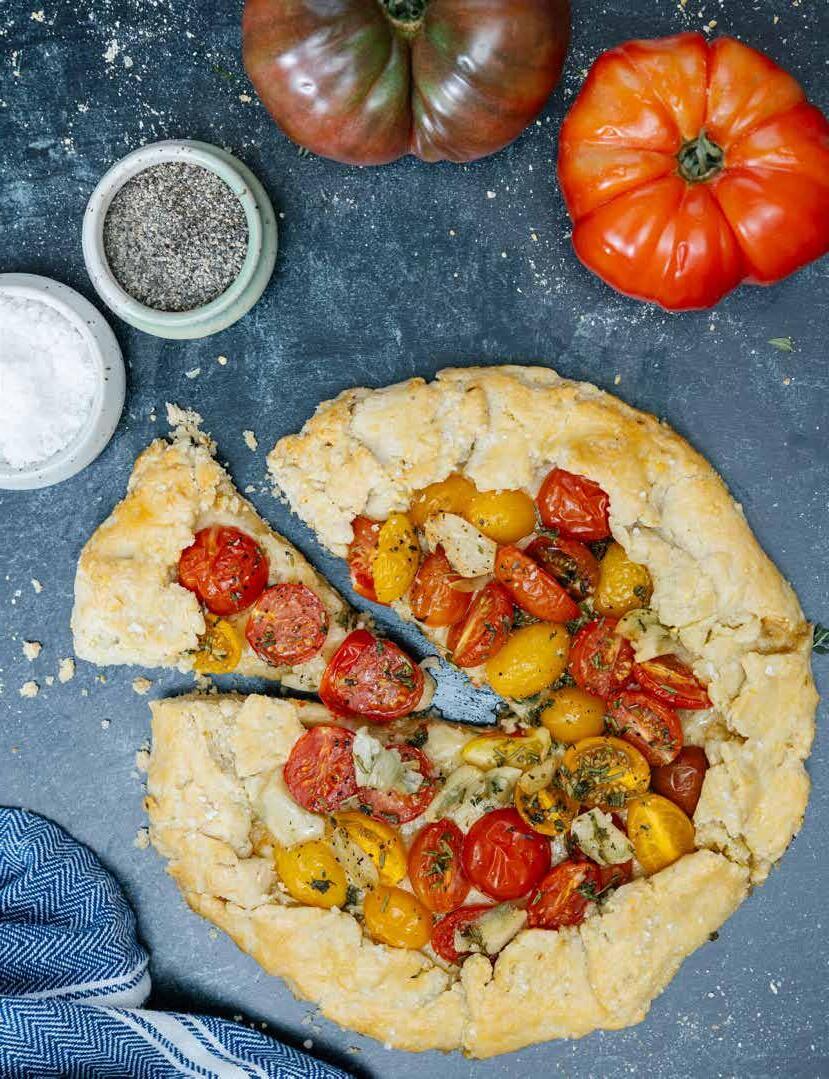
TOMATO CROSTATA WITH HONEY-SPICE GLAZE
Serves 4 to 6
When late-summer tomatoes are at their peak, this free-form tart is my go-to. It looks impressive but couldn’t be more forgiving. Mix and match herbs, swap cheeses, use whatever’s abundant.
FOR THE CRUST:
1 cup all-purpose flour, plus more for rolling
½ cup fine cornmeal
¼ teaspoon fine sea salt
10 tablespoons cold unsalted butter, cut into small cubes
½ cup grated extra-sharp cheddar cheese
6 tablespoons ice water
1. In a food processor or bowl with a pastry cutter, pulse flour, cornmeal, salt, butter, and cheese until the mixture resembles coarse crumbs with pea-size pieces.
2. Add ice water a tablespoon at a time until the dough comes together.
3. Remove the dough from the food processor, form it into a disk, wrap it, and refrigerate it for at least 30 minutes (or up to 2 hours).
2 tablespoons chopped fresh herb leaves (see herbs above)
2 tablespoons olive oil
3 cloves garlic, smashed and peeled
1 cup grated extra-sharp cheddar cheese
Ground black pepper, to taste
1 large egg
Flaky sea salt (such as Maldon), to taste
1. Prep the tomatoes.
Line a rimmed baking sheet with a double layer of paper towels. Arrange tomato slices in a single layer, sprinkle with kosher salt, and top with another layer of paper towels. Place a heavy plate on top, and let it sit for 20 to 30 minutes to draw out excess moisture.
2. Make the honey-spice glaze. In a small saucepan, simmer the vinegar, honey, and whole herb sprigs for about 2 minutes. Add the olive oil and garlic; cook gently for another 3 minutes until fragrant. Remove from heat and discard the herb sprigs.
CATTLE CREEK RANCH
3. Assemble the crostata.
Preheat the oven to 400°F. Roll the chilled dough on a floured surface into a 12-inch round. Transfer it to a parchment-lined baking sheet.
Sprinkle grated cheese over the dough, leaving a 2 ½-inch border. Arrange tomatoes decoratively on top. Drizzle with garlic-honey glaze and sprinkle with chopped herbs and black pepper.
Fold the edges of the dough up and over the filling, pleating as you go.
4. Finish and bake.
Whisk the egg with 1 teaspoon of water, then brush it over the crust. Sprinkle the crust and filling lightly with flaky sea salt.
Bake for about 35 minutes, until the crust is deeply golden and the tomatoes are soft and caramelized.
Serve warm or at room temperature.
*Adapted from Melissa Clark, New York Times Cooking
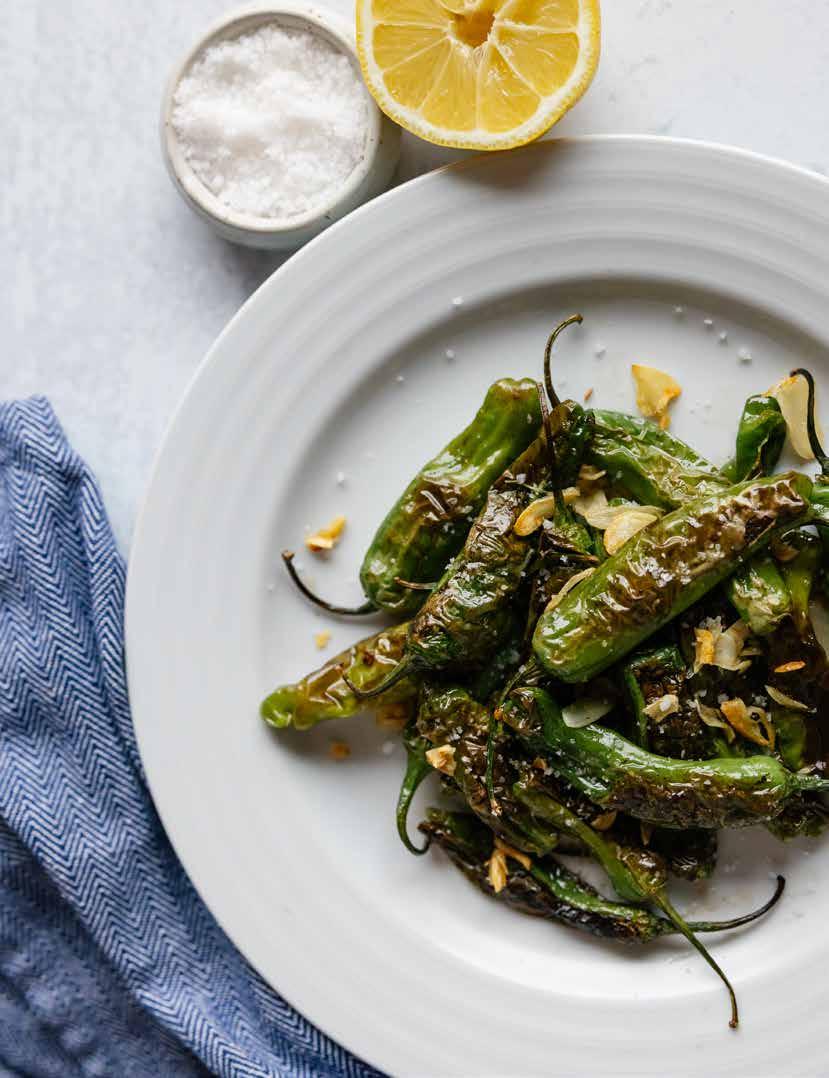
BLISTERED SHISHITOS WITH CRISPY
GARLIC
Serves 4 as a side dish
Local chef Arden Oksanen, a Jackson Hole native, likes to keep it simple with shishitos harvested from his unheated greenhouse at the base of the Aspen Trail in Driggs.
1 dozen shishito peppers
2 tablespoons butter
2 cloves fresh garlic, thinly sliced
1 half lemon, juiced Flaky sea salt, to taste
1. In a large saucepan over low to medium heat, melt the butter, then add the garlic and saute until golden brown.
2. Remove the garlic from the pan with a slotted spoon and set it on a paper towel.
3. Increase the heat to medium-high and add shishitos. Cook, stirring frequently, until they are blistered on all sides.
4. Squeeze lemon juice over the peppers, then remove them from the heat. Arrange the peppers on a plate, then break up the crispy garlic and sprinkle it over the top with flaky sea salt to serve.
*Note: Experiment with infused olive oils or avocado oil (which has a higher smoke point and is less likely to burn). A dash of soy sauce or sesame oil can be used in place of the lemon.
easy on nitrogen — too much produces big leaves, bland fruit, and weak plants.
3. Microclimate Is Everything
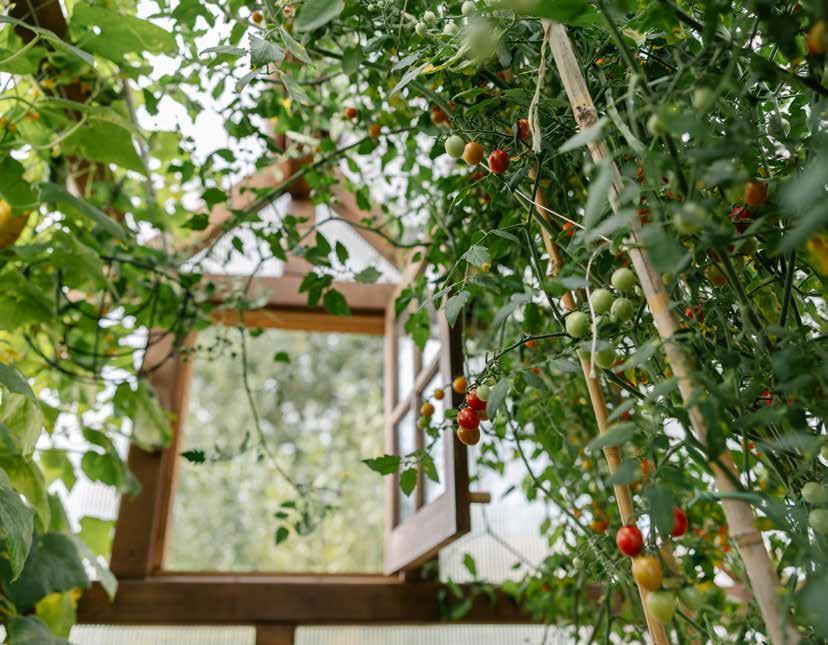
Many cold-tolerant nightshade varieties grow well in mountainous regions when protected with walls of water or in a greenhouse early in the season.
Gardening “tricks” often fail because they try to defeat the climate. The ones that work buffer Mother Nature, rather than override her.
If you’re planting outdoors, locate your tomatoes in south-facing beds near stone walls, fences, or buildings that retain heat. Ask yourself: Where does the sun linger in the evening? That’s your tomato spot.
Instead of monocropping, consider companion planting — it’s essential for co-regulating garden stressors. An Italianinfluenced example is planting tomatoes near basil, oregano, thyme, parsley, marigolds, or calendula, with onions or garlic nearby (but not too close). Different root depths mean less competition; aromatic herbs repel pests; flowers attract parasitic wasps and pollinators.
4. Greenhouse or Not?
Growing potatoes is pretty easy in the
Tetons, since they reside underground, but tomatoes and peppers need warm days, cool nights, and moving air.
A heated greenhouse with good ventilation and humidity control is the best option for extending the season; however, too much heat can cause pollen sterility, and too much humidity invites fungal disease. An unheated hoop house or high tunnel works well, too. It warms the soil early, buffers the wind, and is easy to vent. Roll the sides up during warm days and close them at night. A “cool house”— raised beds with removable covers — also provides a suitable environment for growing nightshades.
If you choose to grow outside, “wall of water” plant protectors are a must in the mountains, according to Daisy. Think of them as spring jackets — thermal batteries that absorb heat during the day and release it at night. She uses water walls for tomatoes, peppers, and basil. They are not frost-proof, however, so you must add a row cover when the forecast predicts frost.
Growing nightshades in the Tetons isn’t about forcing a Mediterranean climate. It’s about working with rhythm, soil, and season. Choose wisely, warm the roots, and let adaptation do the rest.
• Trail Creek Nursery: Mountain-hardy garden and landscaping needs, Victor; trailcreeknursery.com
• Westbank Garden Center: Garden and landscaping supplies, Wilson; westbankgardencenter.com
Extension Resources
• University of Wyoming Extension: wyoextension.org/garden/growing-foods
• University of Idaho Extension: uidaho.edu/extension/publications
in this relationship,” Daisy says. “Change things up and don’t give up until you find your thing. What works for you will depend on how much time and space you have and what you love to cook and eat.” tf
CRUSHING ADULTHOOD
Estate planning for mountain families
By Christina Shepherd McGuire
Ihave a hard time with death. I avoid funerals and instead prefer to celebrate those who have passed in my own way, which typically involves a moment of silence in nature. So when faced with my own mortality while setting up our family trust and making my will, I admittedly backburnered my required deliverables until the last possible minute.
I’m proud of the life my husband, Justin, and I have built with our two kids, two businesses, and a house in the mountains — one in which lifestyle has always been our pinnacle value. And I’m super clear on the type of medical support I’d like to receive, should I suffer a terminal injury or illness that requires life-sustaining intervention (ouch, that one’s a kicker). Still, even while holding up the self-proclaimed “eternal ski bum” tag as an excuse, I knew this adulting task should have been tackled a long time ago.
Luckily, our dear friend Sarah Lien, of Sarah Lien Law in Driggs, who provides full-service estate-planning services, walked us through it.
Will vs. Trust
“A will is what’s called a ‘testamentary instrument.’ It only comes into play when a person dies,” explains Sarah. She says the sole purpose of a will is to give loved ones direction on asset distribution and identify guardians for minor children after death.
A trust “does everything that a will does,” Sarah notes, in that it allows you to identify how you would like assets to be distributed, but it also empowers people you know, love, and trust to help manage your assets during your lifetime in the unfortunate event you become incapacitated prior to death.
“Trusts also avoid the probate process,” she says, which, by state law, settles a deceased person’s estate by paying creditors and retitling assets. “Probate is not a great process to go through while grieving, as it’s a court process, which positions someone who does not know you to make the decisions.”
If, like Justin and me, you’ve put off estate and death planning until you’re, say, 50, what’s the best way to go, a will or a trust?
Sarah says deciding between a will and a trust depends mostly on the beneficiaries. She notes that trusts are often better for families with minor children, as they provide a seamless transition of assets via controlled distribution by a trusted person who manages the finances (a trustee), should both parents be deceased.
But if you slack and choose not to do either, then, Sarah says, “The state has a plan for you.”
Making Hard Decisions
The decision-making process tripped me up. It’s hard to imagine myself dead and ceding control to others. And it’s not the material things that I’m most concerned about; it’s the kids. Will my daughter, Olivia, age 19, have to make decisions on her own? Will she be in charge of taking care of her brother, Shea, still a minor at 17, while trying to figure out her own journey? Or will someone step in, say, my parents or a good friend, to help transition these young people to adulthood? Will the kids be in charge of making critical healthcare decisions should Justin and I both become incapacitated? If not, who will? It all seems surreal.
Sarah concurs. “I live and breathe this subject, but it just hits differently when you’re in it,” she says, noting that her father, who is in ill health, has no estate plan. “It’s been fascinating for me as a personal-processing piece to see how this planning — that people don't want to do or that feels obtuse — affects things in real time.”
So we got to work unpacking the necessary tools, should something happen to Justin and me. First came the asset inventory and assigning a trustee responsible for asset distribution to Olivia and Shea. Next came deciding who would care for Shea until he became an adult. Of course, our parents were the obvious first choice, but they are aging and live far away, so we chose a close local friend instead (which sparked another hard conversation with her about whether or not she was even willing). Lastly came the question of what to do if Justin and I became debilitated and needed life-sustaining care. To be blunt, we had to decide whether or not to give loved ones the power to “pull the plug.” Somehow, for me, this decision was the easiest of the bunch. Still, I acknowledge this is not the norm for everyone, and admit it was hard to fathom.
The back-and-forth required between Justin, me, and Sarah involved reliving the past, acknowledging the present, and predicting the future. In the process, skeletons surfaced as we unpacked who we really trusted and what we liked, and mostly disliked, about how our own parents handled this process. Even as I’m writing this, I feel a knot in my chest — one that sometimes comes when facing realities and being truly honest with yourself and with each other. Does it really have to be this hard?
Sarah reassured us. “No family I work with is like the Cleavers,” she says. “Everybody has something, whether it’s emotional or family challenges … I’ve had clients have a hard time putting together their asset inventory; seeing it on paper is really hard for people. A lot of people have money dysmorphia … Literally everybody has something. It’s part of the human experience.”
Still, she reminded us that it’s her job to guide people, without judgment, towards a plan that sticks and works.
“You are the only one who can do the estate planning,” she reminds us, noting that the most important outcome is “giving your loved ones the peace of mind that you’ve set them up to deal with a circumstance that is both sad and hard.”
Mindful
Planning for Mountain Peeps
As we proceeded with our decision-making — and got out of our own way in the process — it was clear to me that we hired Sarah to not only draft a stack of legal papers but also to be our guiding light. She explains that 30 to 40 percent of her clients have already started this process with someone else but never finished it. She says it’s important to find an estate planner you trust and feel safe with, as well as someone who will take you all the way from start to finish.
“My job is to distill all of the info I get — some is explicit — so I can key into those things, ask questions, and understand the nuances of people and their relationships.”
Sarah advises families to step into the space with recognition that they are the only ones who can do this. She provides encouragement and puts a time stamp on the deliverables, so things don’t feel daunting. And she acknowledges that some people have complex family stuff going on, so she offers the opportunity to change things.
“If you wake up in the middle of the night and keep thinking about [a certain] decision, then it’s probably not the right one. Let’s get on a call and change it,” she advises.
Sarah tells people to think about what they would want in the short term, not forever, and then she revisits with clients every three years to learn what has changed. She says this “prevents people from spinning around hypotheticals that create decision
paralysis. Let’s just start with what you would want to happen now.”
Once we got through the decision-making part — figuring out what to do with the kids, assigning people to various roles, etc. — we were finally ready to sign and fund the trust. At this point, I felt like I was sowing the seeds for a ripe and fertile garden when the end of life comes.
But what I didn’t expect came after, and it is something that I’m sure not every estate planner offers. Sarah presented us with a list of questions she calls a “legacy interview.” These questions go well beyond the money in the bank account and the equity in the house, and force you to contemplate the true meaning of your existence. (I’m choking back tears as I write this.)
It includes questions like:
How did the two of you meet?
If you had to pick one word to describe each of [your kids], what would it be? Why?
What life lessons did you learn from your family?
If you could only choose 3 things for your family to remember about you when you’re gone, what would they be?
Soon, we will meet with Sarah again, and she will create an audio recording of our answers. It’s not going to be easy, but I’m actually looking forward to our legacy interview. It’s a way to keep our memories, our personalities, and our values intact, while recording and preserving Justin’s goofiness and my sentimentality.
Plus, I’m constantly telling my husband that I don’t want my ashes kept in a storage unit alongside items that need to go to the thrift store, and I tell my children that I want to be known as “the woman who always had fresh pesto in her fridge.”
Now’s my chance to make it official. tf
OPEN ENROLLMENT YEAR-ROUND
Estate and Death Planning Checklist/What do I need?
(according to Sarah)
Everybody over the age of 18:
□ Healthcare directive and a financial power of attorney
Early Childhood - 8th Grade | Jackson Hole, Wyoming & Victor, Idaho
Slow HOME
WHERE HOME MEETS HABITAT
By Molly Absolon // Photography by Paul Lavold
Midway up the stairs in architect Sarah Post-Holmberg’s home along Fox Creek in Teton Valley, Idaho, there’s a perch. From the cushioned bench, you can look out over the expanse of the living area to a wall of windows that frames the distant Big Hole Mountains. It’s a cozy spot for reading, listening to music, or watching the activity below.
Such a space is important to biophilic design, according to Post-Holmberg, who tries to incorporate its principles into her work. She says humans need a place of refuge, where they can restore themselves and feel safe. At the same time, we also crave prospect, which can be defined as a sense of space or an expansive outward view. The nest partway up Post-Holmberg’s staircase has elements of both refuge and prospect.
“There’s tension between the idea of refuge and prospect,” Post-Holmberg says. “Humans want both. Sitting on that perch during a snowstorm feels like you are in a snow globe — it’s wild and stormy — and yet at the same time you are warm, cozy, and safe.”
Biophilia, literally “the love of life,” became linked to architecture and interior design in 1984 with the publication of Harvard University naturalist E.O. Wilson’s book Biophilia, in which, according to a January 2021 article in Dwell magazine, he described “humans’ innate connection with nature and our tendency to suffer in hermetic, urban environments where it’s largely absent.”
Humans evolved close to nature, and for most of our history, the built environment reflected that connection. We relied on local materials and used vernacular styles appropriate for the climate. So, in tropical rainforests, people dwelt in houses on stilts with open sides to allow for ventilation and thick thatch roofs to keep out the rain. In the desert southwest, homes were built with thick adobe walls that absorbed heat and kept the interior spaces cool. In the Tetons, houses were constructed from locally harvested logs and clustered around fireplaces that brought warmth and a sense of coziness to the dwelling. But the Industrial Revolution disrupted this harmony.
A 2015 study from the University of Minnesota found the “dominant approach to modern building and landscape design largely treats nature as either an obstacle to overcome or a trivial and irrelevant consideration. The result has been an increasing disconnect between people and nature in the built environment, reflected in inadequate contact with natural light, ventilation, materials, vegetation, views, natural shapes and forms, and in general, beneficial contact with the natural world.”
The impact of this disconnect is becoming increasingly apparent. Modern industrial buildings — think sterile offices with rows of cubicles, fluorescent lights, air conditioning, and windows that don’t open — have been found to increase stress, which, according to The World Health Organization, is the epidemic of the 21st century. A study in the United Kingdom in 2015 attributed the loss of 11.7 million working days to stress, while the European Commission calculated that work-related stress in the European Union in 2002 cost 20 billion euros annually. It’s an expensive, pervasive problem, and it’s not just in our office buildings.
Most private homes in the United States have little connection to the natural world. Materials are synthetic and plastic and, in many cases, harbor toxins. Airflow is inadequate and contributes to illness and disease. Part of this is a matter of cost: Manufactured materials are often cheaper than natural ones. Part of it is also due to a lack of knowledge, as most people have never heard of biophilic design. But the principles of biophilia can go a long way in countering the negative effects of toxic
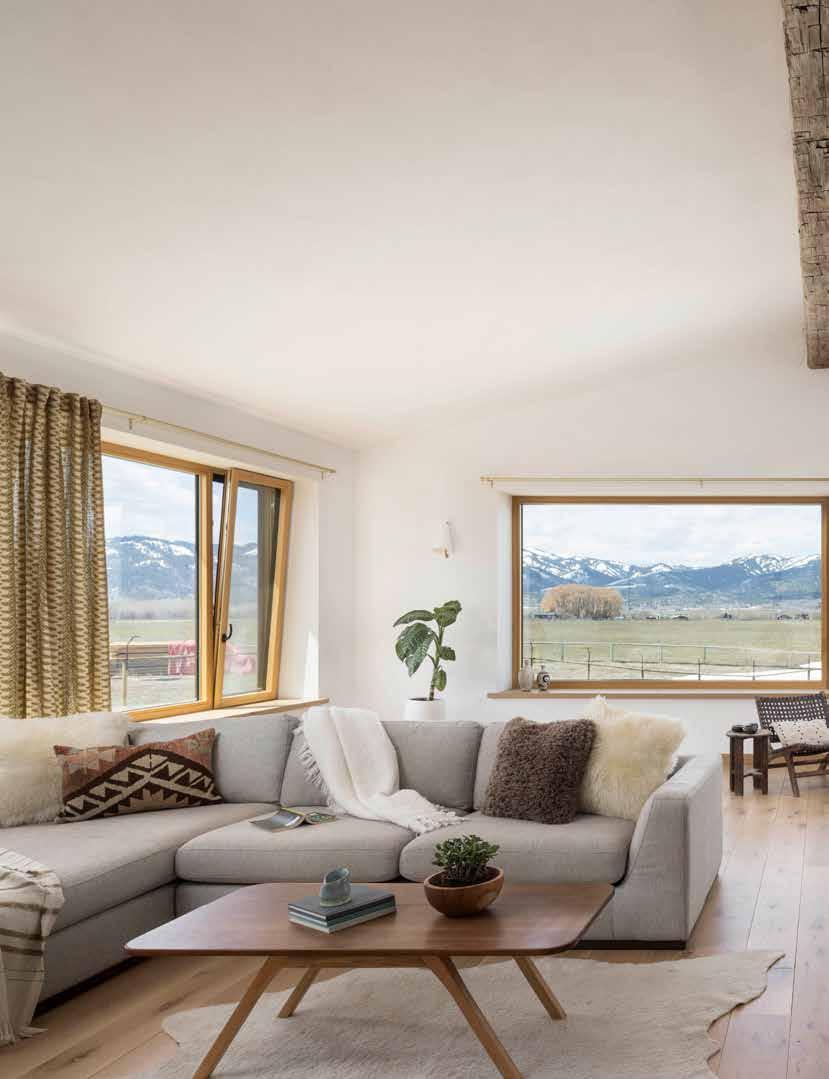
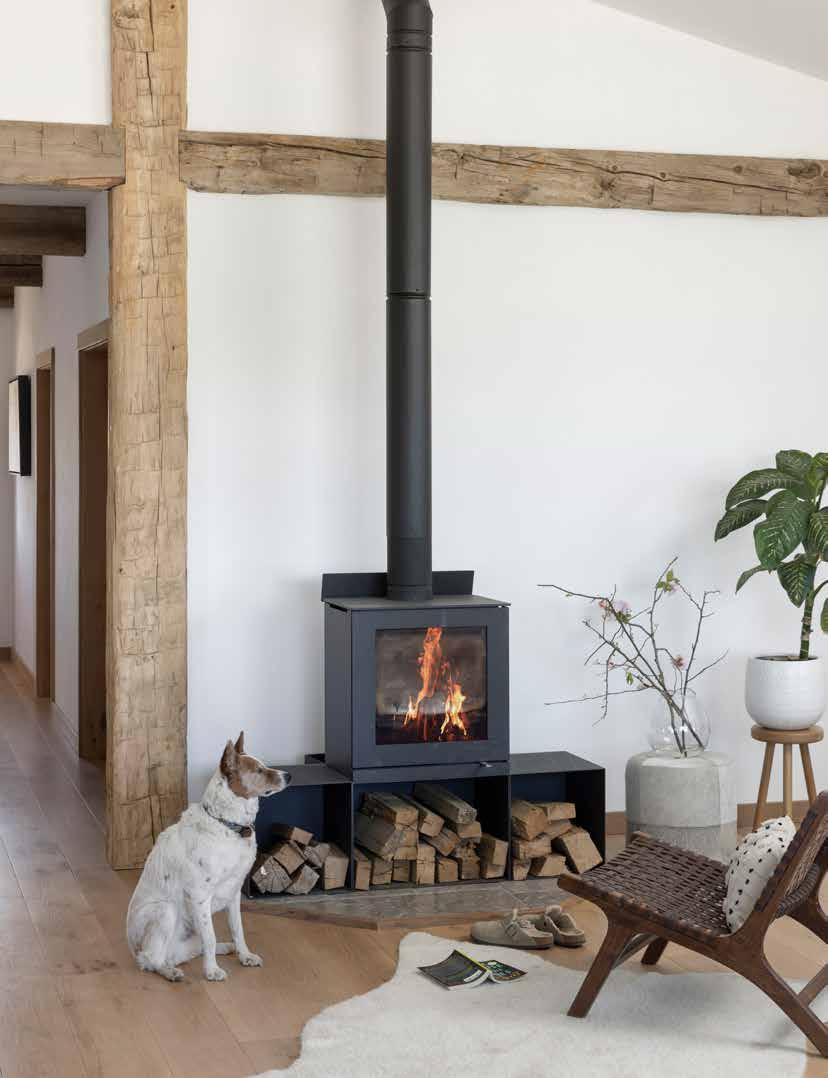
wood stoves provide warmth and coziness
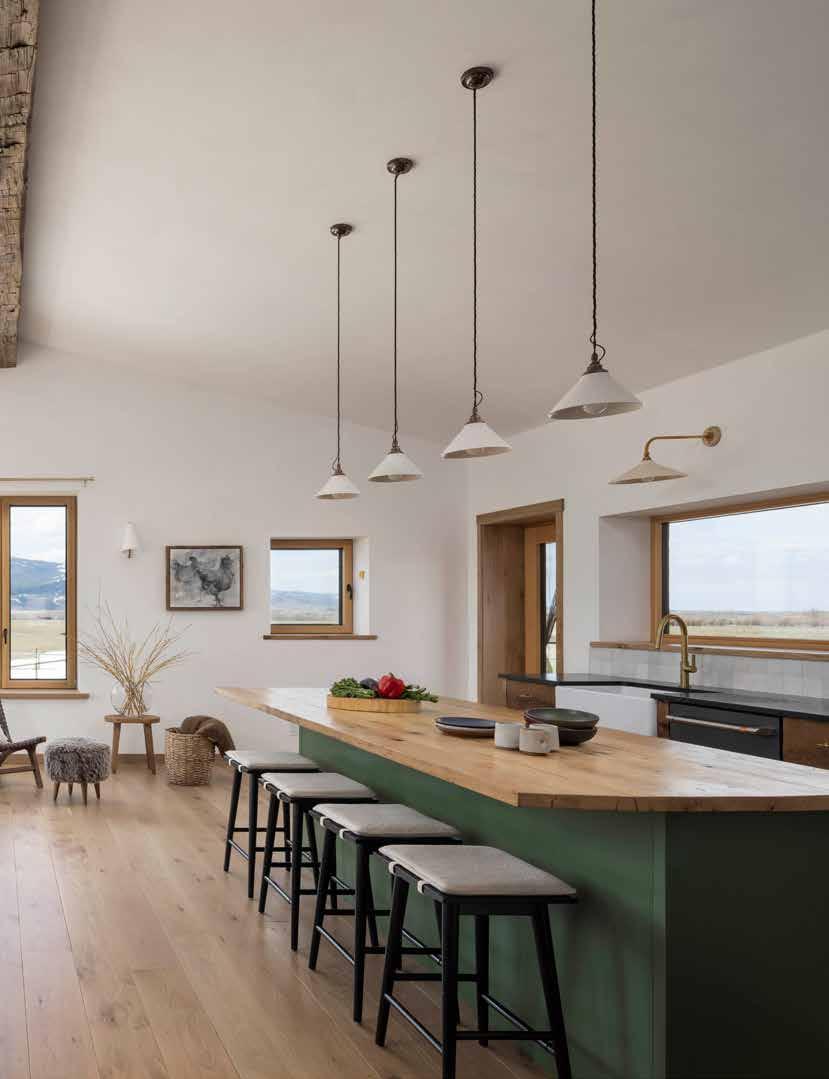
natural materials ground us
living plants clean the air
textures, shapes, and shadows add variety
walls of windows
connect us with nature
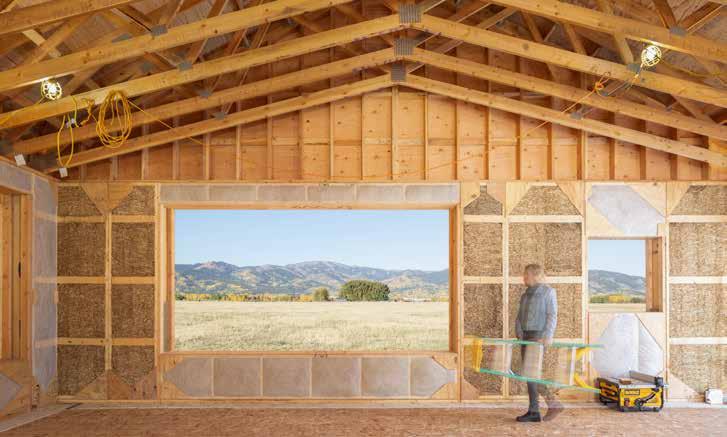
straw insulation stores carbon
indoor environments, and many architects and designers in the Tetons ascribe to its principles even if they don’t commonly use the word.
Research has found that working with natural materials, incorporating greenery, harnessing natural light and ventilation, and employing natural forms and colors can result in lower blood pressure, a decrease in stress and anxiety, increased attention span, and fewer illness symptoms. Exposure to nature improves healing and shortens hospital stays. These effects attest to the importance of incorporating biophilic principles into the built environment. They are not just for aesthetics and pleasure; they can also improve health and wellbeing.
“The magic of design in architecture is about connection,” says Lindsey Love of Regenerative Building Solutions in Driggs. “Biophilic design connects us back to our humanness and to nature.
“Architects are always thinking about incorporating a building into a site, and that is part of biophilia, but it goes deeper,” she continues. “It’s about responding to context. Conventional modern design with walls of windows allows us to connect with nature, and that’s one of the most important things we, as designers, can do, but I think we need to take it a step further.”
As Love explains, an environment that is bright and completely surrounded by glass and sterile white paint doesn’t make us feel human. We need variety; we need to interact with textures, shapes, and shadows. Natural materials invite us to touch them. Watching a shadow move across a wall over the course of the day reminds us where we came from.
Broadly speaking, biophilic design includes the use of elements, such as daylight, views, plants, water, natural materials, and natural ventilation. It incorporates natural shapes and forms that echo living systems and relies on natural patterns and processes, such as variation
in light and shadow, and textures that age and weather. Biophilic design captures daylight and views so occupants can feel both openness and safe enclosure, and it emphasizes relationships to local ecology, culture, materials, and history. Finally, biophilic design taps into our emotional and cognitive responses to place, to create spaces that feel engaging and meaningful, rather than merely functional.
“Biophilia is not a term we often hear from clients,” says Matt Thackery, a principal at Prospect Studio in Jackson. “But it’s definitely one I’m familiar with. We may not use the word, but biophilia is in everything we do.
“The big thing with biophilic design is making people aware of the sense of harmony in the spaces they occupy,” he continues, “Biophilia looks at things comprehensively. It includes unity, community, and sustainability. We can design all sorts of whizbang gadgets, but if we’re not adopting that lifestyle, it’s really not biophilia.
“We’re all [in the Tetons] to commune with nature,” Thackery says. “That’s why we came to this area. We want to be connected to the natural world. Biophilic design brings us back to the idea that there is a lot of unity and harmony in the world, and we should embrace that and include it in the things we build.”
Adam Riley, owner of Cloud 9 Building in Victor, says he sold his timberframe business a couple of years ago because he wanted to build structures he was proud of, rather than giant clubhouses on golf courses. He now builds two homes a year, and his passion is working with local materials that can be sculpted in beautiful ways.
“People have been using natural materials to build homes for thousands of years,” Riley says. “Today’s building codes are very new in terms of experience with the built environment. Even plywood has only been around since WWII, so it’s just 80 years old. I try to keep that in mind when I’m talking to building
inspectors who think what I’m doing with straw bale structures is some hippy-dippy new idea.
“Part of what I love about building with straw and clay is the quality of space it creates,” he explains. “My home is really quiet. I don’t hear anything unless the windows are open. I love the rounded corners of straw bale walls. People have a strong affinity to natural materials. That’s what makes a biophilic home feel different.”
Blair Costello, a principal at Vera Iconica Architecture in Jackson and its director of interiors and healthy living, says fundamentally her work is determined by her clients, who want beautiful homes that let them live their best lives.
“My job is to guide clients to create a timeless and lasting space,” Costello says. “But I believe everyone should be doing [biophilic design]. It’s a huge piece of the larger puzzle of longevity of a home and wellness.”
For Costello, that means using as many natural materials as possible. Her firm now offers guidance on everything from paint color to interior furnishings.
“We added furnishings to our work a couple of years ago,” she says, “after we realized just how toxic things like flame retardants are. Beds can be one of the most toxic things in a house. Here we were delivering a healthy home from an architectural point of view, and then you put all these poisonous things into it.
Costello says that the more synthesized the materials are, the better the experience of the space will be. “Nobody really understands this until they walk into a space and realize it really does feel different.” tf
Jessie Woolstenhulme & Brigette Brosz
Beyond the Label: RETHINKING NEURODIVERSITY
By Mel Paradis
During more than 20 years working in schools, I’ve heard the same story in countless conferences. Parents see a curious, creative, deeply feeling child struggling, and they want to know how to support them. The answer starts with embracing neurodiversity.
What Is Neurodiversity?
Neurodiversity is the biological reality that no two human nervous systems are alike. Our minds and bodies are inseparable, and like snowflakes, unique. There is no “ correct ” way for a nervous system to be organized. We all process information, respond to our environments, and navigate relationships differently. Neurodiversity includes everyone.
The term “neurodivergent” is often used as shorthand for autism, ADHD, dyslexia, or giftedness. But the word itself tells us something important. “Divergent” implies a point of comparison. A person is only divergent relative to what their culture deems “normal,” and that standard isn't neutral. It's defined by power structures and reinforced through the systems they create. Schools are one example, with expectations of quiet bodies, predictable responses, and performance on set timelines. These systems stay in place not because they must, but because changing them isn't prioritized.
When a child’s way of being doesn't fit those expectations, the child often gets labeled as the problem. But what if the problem is the environment? A child who needs movement to focus is “divergent” in a classroom that demands stillness. That same child in a more flexible environment might never be labeled at all. The divergence isn’t a defect in the child. It’s the friction that happens when a unique way of being meets a system built without flexibility.
What Friction Can Look Like
We all experience environments differently. When there is friction, the body responds in ways that help the nervous system find balance. This can look like avoidance: refusing certain foods, pulling away from unexpected touch, or avoiding loud spaces. Or it can look like seeking: needing background music, chewing or fidgeting, retreating into imagination when under-stimulated, or craving deep pressure from a weighted blanket. Avoidance and seeking behaviors are the nervous system trying to regulate itself. Responsiveness isn’t fixed. It shifts depending on the type of input, the context, and a person’s current state.
When the nervous system can’t find balance, it goes into protection mode. Some people fight or flee: lashing out, covering ears, or leaving the room. Others freeze or fawn: shutting down or masking distress to blend in. These responses are unconscious. A child who bolts from the classroom or shuts down completely isn't choosing defiance. Their body is responding before awareness kicks in. When we can understand this, everything changes. Instead of punishing behavior, we can ask, What does this person need right now to feel grounded and safe?
Unpacking Labels
In our schools, the number of neurodivergent students is rising. Many families seek psychological evaluations to gain access to special education services or accommodations protected under 504 plans. Part of the increase reflects a broadening of who gets seen. Diagnoses require meeting deficit-based criteria, and those criteria were historically developed from a narrow profile. Girls and people from different racial or cultural backgrounds were frequently
LIVE MUSIC
Thursdays at 5 pm
Jun
$5
missed, not because they weren’t struggling, but because the system wasn’t built to recognize them. Dr. Diane Hudson of ABC Pathways notes that neurodivergent girls can be “almost invisible to the outside observer.” Because their struggles are often internalized, they're harder to spot. The rise in labels also reflects environments that have become more demanding and less flexible. The problem is the system, not the children in it.
Do labels matter? It depends on which label and who you ask. Few parents hesitate to pursue a “gifted” designation, yet many resist others, fearing a label will negatively define their child. Throughout history, labels have been used against people, limiting participation in society and reducing complex human beings to a list of deficits. Some claim labels as a way to understand themselves or their children, find community, and advocate for change. In our current system, accessing insurance-covered therapies, medication, and legally protected accommodations often requires a clinical diagnosis. Yet pursuing one comes with tradeoffs, including giving up privacy and inviting ongoing scrutiny around the need for support.
Until our schools and communities are truly neurodiversity affirming, the goal is the same whether your child has a label or not: Understand how they experience the world and collaborate with the people in their lives to build environments in which they can thrive.
Teachers, I See You
You’re handed a roster with a growing list of individualized accommodations: extended time for this student, preferential seating for that one, movement breaks for another. Keeping track feels impossible, and the systems you’re working within weren’t designed with flexibility in mind. Instead of retrofitting accommodations for individual students, what if we designed learning environments flexible enough for everyone from the start?
Start with relationships. Seeking out students’ strengths and building genuine connections creates psychological safety. Students who feel seen are more comfortable being their authentic selves, and that can reduce friction. The next layer is Universal Design for Learning: designing environments that work for everyone from the start. Scheduling “mindful minutes” helps students reset after transitions. Captions on videos offer multiple ways to process information. Seating options allow students to choose what works best for their bodies. Movement breaks support learning, retention, and integration. Build in flexibility, and everyone benefits.
For the Caregivers
When typical parenting strategies fall flat, it’s easy to feel alone. “Parenting a child who experiences the world intensely is exciting, but also challenging,” says Jean Abrams, a licensed clinical social worker.
Glossary
neurotype
The pattern in which a person’s nervous system is organized. Neurotypes can be innate, like ADHD, autism, or dyslexia, or acquired through experiences, like trauma or brain injury.
neurodivergent
A person whose way of being diverges from cultural expectations. Neurodivergence isn’t inherent in the neurotype; it’s created by the mismatch between a person and their environment.
clinical diagnosis
A formal label given by a licensed professional. A clinical diagnosis is often required to access insurance-covered therapies, medication, or legal protections.
educational designation
A label given by a school to qualify a student for special education services or accommodations. This doesn't always require a clinical diagnosis.
“It requires lots of patience, self-care, and creativity.”
To combat isolation, she and the team at Teton Behavior Therapy created a free online support group to give caregivers space to learn tools and feel seen. (Email info@tetonbehaviortherapy.com for information.)
Remember that you are your child’s best advocate, and over time, you can help them become their own. What matters most is staying curious about how your child experiences the world, helping them understand the unique ways they take in and process information, and empowering them to build systems that work. When we design environments that support all kinds of minds and bodies, we embrace neurodiversity. And that benefits everyone. tf
OPENING SEPTEMBER 2026 NOW ACCEPTING PATIENTS
OPENING SEPTEMBER 2026 NOW ACCEPTING PATIENTS
OPENING SEPTEMBER 2026 NOW ACCEPTING PATIENTS
NEWBORN CARE
WELL CHECKS • SAME-DAY SICK VISITS
CHRONIC DISEASE MANAGEMENT
ADOLESCENT CARE • SPORTS PHYSICALS
Dr. Jessica Maddox
Transforming moments of crisis into pathways of possibility.
Dr. Jessica Maddox
Dr. Jessica Maddox
We are honored to
Dr. Jessica Maddox
We
We are honored to serve
We are honored to serve the children and families of Teton Valley with compassionate, evidence-based care. Your child's health. Our heart's work.
From Sauna to Snowbank:
CONTRAST THERAPY, TETON-STYLE
Eli and Zoe enjoy a soak in their cedar hot tub in Victor, a DIY project built by their father, Shawn Stitt.
By Samantha Simma // Photography by Camrin Dengel
O
On a winter morning in the Tetons, the idea of willingly stepping into cold water can feel absurd. Snow squeaks underfoot, breath hangs in the air, and most of us are already thinking about how fast we can get warm again. And yet, across Jackson Hole and Teton Valley, more people are seeking out cold plunges, pairing them with saunas or hot tubs, and repeating the cycle intentionally.
Contrast therapy — the intentional alternation between heat and cold — is no longer confined to elite athletes or Nordic folklore. It has become a mainstream wellness practice, woven into backyard routines, mobile sauna sessions, guided river plunges, and recovery studio methods. Advocates claim benefits ranging from faster muscle recovery and improved circulation to better sleep, sharper focus, and increased stress resilience. Skeptics wonder whether the discomfort is worth it.
To understand why contrast therapies have taken hold, and what the research actually supports, it helps to look at both the science and the stories behind the trend.
OLD TRADITIONS, NEW MOMENTUM
The practice of alternating hot and cold is far from new. Finnish saunas have been paired with icy lakes for centuries. Patrons of ancient Roman bathhouses soaked in warm, hot, and cold pools as part of their daily life. In Japan, ritual cold-water immersion ( misogi ) has long been used for purification and mental clarity.
What’s different now is how these practices are being adapted (and marketed) through a modern wellness lens. Research on thermoregulation, inflammation, and the nervous system helps explain why people feel so revitalized after enduring temperature extremes. Simultaneously, Wim Hof and other cultural figures have brought cold exposure into the spotlight, framing it as a tool for both physical health and mental toughness.
Tim Walther, founder of Grand Dynamics International, which offers guided cold plunge experiences in Jackson Hole, first approached cold immersion as a personal challenge rather than a business idea. After years of adventure pursuits and free diving, he traveled to Iceland to study cold immersion and breathing techniques under instructors closely connected to the Wim Hof Method. What struck him wasn’t just the intensity of the experience, but how structured it was. “There’s a very distinct process,” Walther explains, emphasizing that cold immersion isn’t about grit alone. Breath control, mindset, and gradual exposure all play critical roles in making the practice safe and effective.
WHAT HAPPENS IN THE BODY
At its simplest, contrast therapy relies on two opposing physiological responses. Heat exposure, whether from a traditional sauna, infrared sauna, or hot tub, causes blood vessels to dilate, a process known as vasodilation. Heart rate increases, circulation improves, and the body begins to sweat. Cold exposure triggers the opposite response, vasoconstriction, when blood vessels narrow and blood is shunted toward the core to protect vital organs.
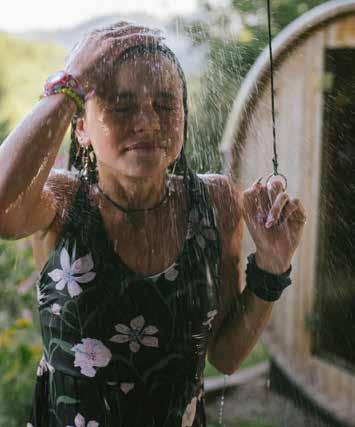
Zoe, age 12, cools off in the outdoor shower, part of the Stitts’s backyard mini-spa that mom Kate says is “as much about lifestyle as it is about wellness.”
Moving back and forth between these states creates what many practitioners describe as a “pumping” effect on the vascular system.
“It acts like a workout for your blood vessels,” says Tycen Birch, owner of Hygge Hut Sauna, a mobile sauna service operating throughout Jackson Hole. “Your heart rate goes up in the heat, slows in the cold, and that back-and-forth is really beneficial for circulation.”
Research supports this idea. Studies on sauna use have linked regular exposure to improved cardiovascular health and reduced risk of heartrelated events. Cold immersion has been shown to reduce inflammation, stimulate brown fat activity, and trigger the release of neurotransmitters like dopamine and norepinephrine, which can elevate mood and alertness.
Importantly, the benefits are not just physical. Both heat and cold challenge the nervous system, requiring the body — and mind — to regulate stress responses rather than react automatically.
THE MENTAL SIDE OF DISCOMFORT
One of the strongest through-lines in conversations with local practitioners is the psychological impact of contrast therapy. Cold exposure, in particular, forces immediate discomfort. The body wants to gasp, tense, or flee. Learning to slow the breath and stay present becomes the work.
“The first minute is the crux,” Walther explains. “If you can lead your response instead of reacting, everything changes.”
This idea is echoed in the Grand Dynamics mindset and breathing framework, which emphasizes responding thoughtfully to stress rather than reacting impulsively. The same skills used to stay calm in cold water, controlled breathing, focus, and acceptance, translate into everyday situations, from difficult conversations to high-pressure work environments.
For many people, that mental carryover is what keeps them coming back. The cold itself doesn’t get easier, but confidence in handling it grows.
“ — KATE STITT
I FEEL A LOT MORE REFRESHED AFTER I GET OUT [OF THE SAUNA] — LESS GROGGY. IT'S ALMOST LIKE A CUP OF COFFEE FOR ME.
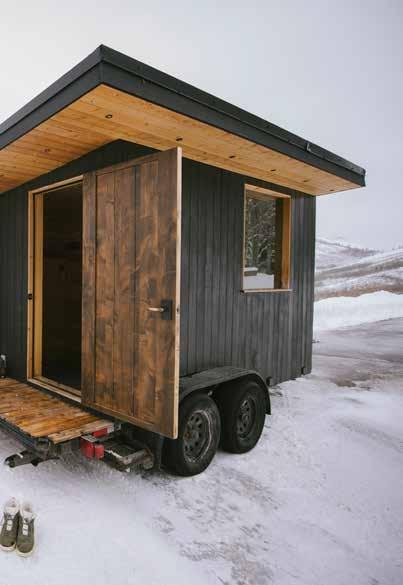
Hygge Huts mobile saunas are powered by wood and solar, allowing users to enjoy them in off-grid locations.
Safety First
Despite its benefits, contrast therapy isn’t for everyone. Heart conditions, Raynaud’s disease, pacemakers, and certain circulatory issues can make cold exposure risky. Hydration and nutrition are also essential; several practitioners emphasized that dizziness and discomfort often trace back to people skipping meals or fluids before a session.
Most importantly, guidance matters. Whether through a professional service or careful self-education, understanding how to enter, exit, and recover from heat and cold exposure is key to staying safe.
“It’s never comfortable,” Walther says. “But you feel better for hours afterward. Your sleep improves. Your awareness improves. And there’s a quiet confidence that comes from doing something hard.”
HOT FIRST OR COLD FIRST?
While contrast therapy often gets lumped into a single category, the order and intensity of hot and cold exposure matter — especially for beginners. At Bodywise Idaho, which offers whole-body cryotherapy, infrared sauna, and localized cold treatments, owner Amy Jennings emphasizes customization. Each client’s health history, hydration level, and goals shape how therapies are used.
“Cryotherapy isn’t just for athletes,” Jennings says. “We see people with chronic pain, inflammation, and autoimmune conditions coming in for maintenance.”
When combining sauna and cryotherapy, Jennings recommends heat first, cold last. The reason is physiological: cryotherapy initiates a cascade of responses that continue for hours after the session.
“You don’t want to jump into a hot shower or hot tub afterward,” she explains. “Your body is already doing a lot of work, and reheating too soon can interfere with that process.”
In contrast, traditional sauna users like Birch often advocate cycling heat and cold multiple times, especially when cold
exposure is brief and controlled, such as a plunge or cold shower rather than wholebody cryotherapy. Both approaches share a common theme: intention matters. More extreme temperatures or longer durations don’t automatically mean better results.
BACKYARD SETUPS AND COMMUNITY RITUALS
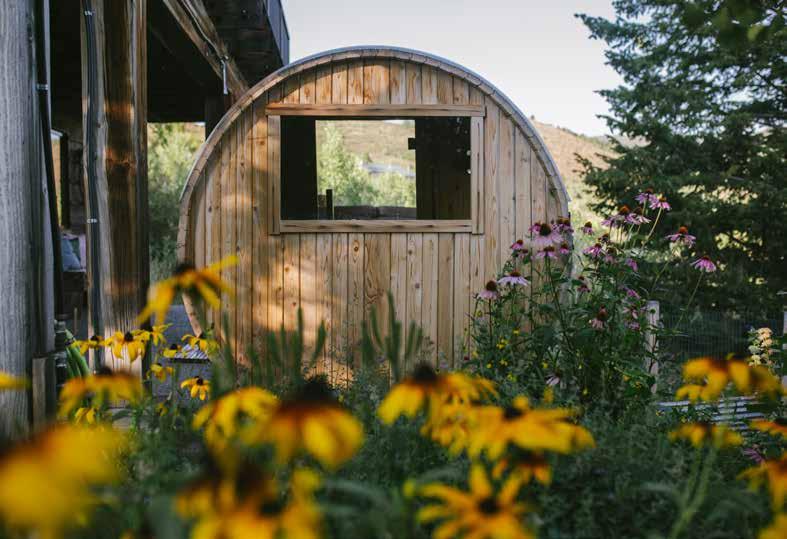
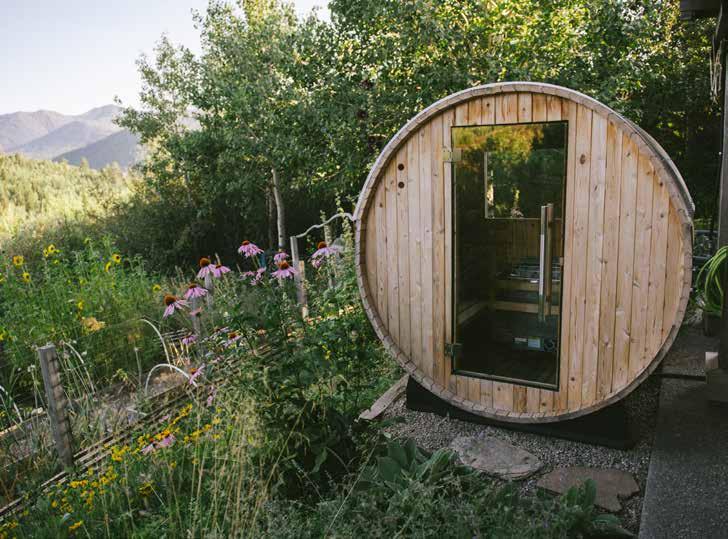
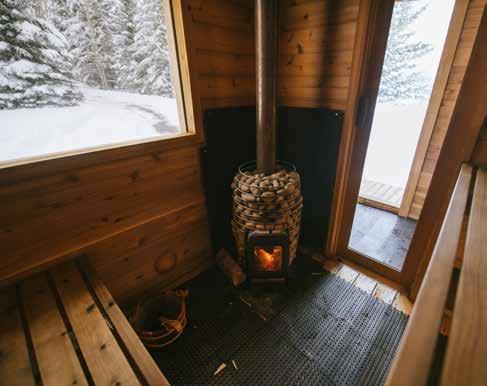
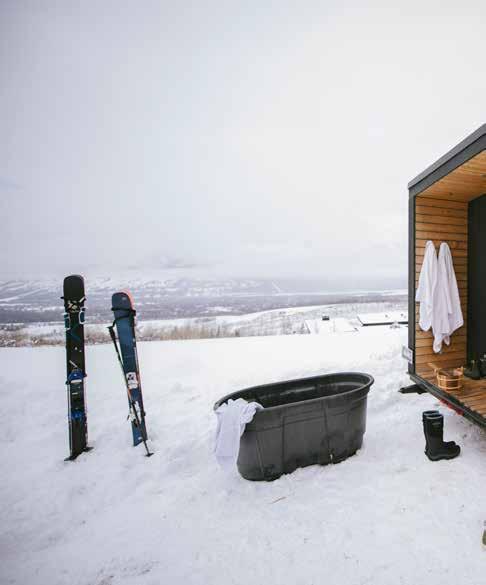
Part of the appeal of contrast therapy is its adaptability. Stock tanks, chest freezers converted into cold plunges, wood-fired saunas on trailers, and infrared sauna pods have all become part of the local landscape.
For Kate Stitt, the appeal is both practical and personal. “It’s just a nice way to wind down the day or start the day,” she says, describing the cedar sauna and hot tub she and her husband, Shawn, built on their property. What began as a DIY project evolved into a daily morning ritual for her husband and a post-ski recovery for her.
“I feel a lot more refreshed after I get out — less groggy,” Stitt says. “It’s almost like a cup of coffee for me. It just clears my head.”
That accessibility — being able to step outside and into a sauna without leaving home — is part of what’s fueling the trend locally. As Stitt puts it, creating a “mini spa right on our property” was as much about lifestyle as it was about wellness.
Behind many of these backyard builds
Ryan Talermo builds Finnish saunas that are site-specific, balancing function, aesthetics, and the environment.
are craftspeople like Ryan Talermo, who designs and constructs custom saunas throughout the valley. Talermo, who grew up building saunas with his Finnish father, sees the current boom as both cultural and inevitable.
“We’re going to see the proliferation of saunas in the next couple of decades, as we saw with yoga studios and other wellness spaces,” he says.
His approach is deeply site-specific, balancing function, aesthetics, and environment. “People think they want a bigger sauna than they do,” Talermo explains, noting that larger builds require more time and energy to heat. Instead, he works with clients to design spaces that align with how they’ll actually use them, while also considering views, privacy, and how the structure fits into the surrounding landscape. That intentionality reflects a broader shift: these aren’t just amenities, but spaces designed for recovery and connection.
Birch views the sauna not just as a wellness tool, but as a social one. “It’s kind of the antidote to digital stress,” he says. “There are no phones in there. You’re just sitting across from people and talking.” That communal aspect echoes the tradition of saunas as gathering spaces.
FINDING BALANCE IN EXTREMES
In a place defined by weather, elevation, and physical challenge, it makes sense that contrast therapy has found a home. It mirrors the rhythms of mountain life: effort and rest, exposure and shelter, intensity and calm. What sets today’s movement apart is its growing emphasis on balance. The goal isn’t to prove toughness or chase records, but to build resilience — physically and mentally — over time.
For many locals, stepping into cold water after the heat of a sauna is less about extremes and more about learning where that balance lives. tf
You
can protect the ecosystem
and your family’s health!
Clean and check your shoes, clothes, packs, gear, pets, vehicles, and yourself before and after exploring and stay on designated trails to prevent the spread of invasive species and tick bites.
Contact Teton Weed & Pest District to nd out how you can get started by visiting tcweed.org or scanning the QR code.
OPEN DISCUSSIONS tackling underage
learn how at wywetalk.org
The Red Bull Generation
Navigating the push and pull of kids in high-risk sports
By Kate Hull
After watching local skiers Breezy Johnson and Jaelin Kauf win medals at the 2026 Winter Olympics, it was nearly impossible not to feel inspired by the guts, glory, and incredible athletic feats of competitors from across the globe. As a parent of two young children, I couldn’t help but wonder if my mountain kiddos will find a passion in the adrenaline-filled world of these disciplines — and in the Tetons, they will no doubt have ample access (no matter what my nerves would prefer).
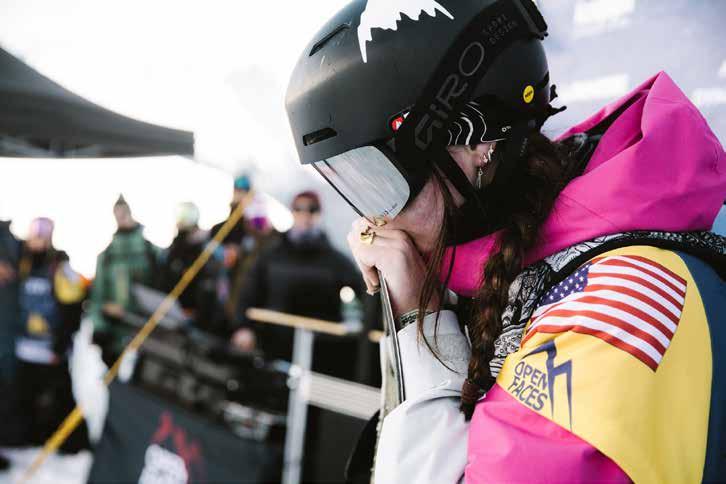
the FIS Freeride Junior World Championships in Austria.
The inspiring stories didn’t end when the Olympic flame burned out. The greater Jackson and Teton Valley area is ripe with young athletes making waves in many different extreme sports, like mountain biking and rodeo. Still, with our long winters and legendary snow, it's not surprising that snowsports dominate the local scene. Whether it's Kai Jones’ jaw-dropping cowboy-style line that earned him a third-place finish at the first-ever FIS Freeride World Championships in Andorra or Breezy Johnson’s Olympic World Champion victory — many of the athletes this area produces are truly next-level. As a fan of sports, I am enthralled. But as a parent, I have some questions.
A LESSON IN LEANING IN
While the odds of catapulting to a level akin to local athlete Kai Jones are slim, it doesn’t, and shouldn’t, stop valley youths from diving into their passions and pushing. When the risks feel high, however, the parenting roadmap gets a little muddled: How do parents find the balance of supporting their athletes, while helping them weigh the real risks of injury … without dampening all the joy?
Willow Newton contemplates her drop-in at
photo by Mia Maria Knoll
For parents of some of the region’s most impressive and dedicated young athletes, the answer to walking the tightrope is giving them the autonomy to make their own decisions, while knowing when to step in and pump the brakes.
For Jenn and Ty Watson, Teton Valley parents of three kids, Cooper Watson, age 18, and twins Rylee and Maddie, ages 15, all knee-deep in competitive freeride skiing, leaning into the expertise of coaches has been key.
“I have been skiing for as long as I can remember and really started loving it when I was around 10 years old,” Cooper says. “I started skiing with the Grand Targhee Ski and Snowboard Foundation (GTSSF) freeride team and competing in IFSA freeride competitions.”
“We never put pressure on him,” his dad, Ty, says. “We let him drive his own bus. We have done that with all our kids and try to keep it fun and give them the right resources to succeed.”
While Jenn and Ty both enjoy skiing, they quickly realized that their kids’ passion surpassed their own skill and comfort levels. They leaned on the expertise of coaches at GTSSF to guide the next steps, calling GTSSF’s executive director, Gary Mackenzie, and the rest of the coaching team, invaluable mentors for Cooper, Rylee, and Maddie.
“At some point, Jenn and I both had to come to grips with the skill level difference between ourselves and our children,” he says. “Hitting a cliff may seem like a big deal to us, but when I go [out] with the kids, it’s like their daily 9 to 5. It is no big deal to them.”
“Talking to coaches and relying on their feedback, in addition to talking with the kids about listening to their gut, has been huge,” Ty continues. “We make sure they feel like they have the confidence to do it.”
Jenn agrees. “I remember, in the early days, before a competition, [Cooper] would tell us he was going to try something I thought
Kai Jones gets upside down in the backcountry. photo by Tucker Adams
“ Watching these kids grow up at Jackson and Targhee with good teams and good coaches and good peers — it’s a game-changer! ”
— Todd Jones, Teton Gravity Research Co-Founder “
Cooper Watson slashes pow at Grand Targhee.
Willow Newton nails her line at the IFSA Challenger Competition. Kicking Horse, Canada, April 2026
was scary,” she says. “I would look at him and say, ‘Oh my gosh, are you sure?’ and that put doubt in him. It was scary for me, but not for Cooper and his coaches. They know him and his skills, and I trust that now.”
Cooper navigates the pressures of competing by focusing on why he loves the sport. “I have learned that trying to prove myself just makes me overthink and crash,” he says.
While working on a self-funded ski film in Europe, Cooper unfortunately injured his knee, which prematurely halted his 2026 ski season. The injury has renewed his focus, and he’s already looking forward to getting back out there, he says.
“Cooper is learning that he has to keep his body strong and take care of himself, and you take that for granted until something happens,” Jenn says. “I have seen a shift in Cooper wanting to take better care of his body.”
STRIKING A BALANCE
Jackson teen Nico Santelices feels the most at home in the mountains. Like so many valley kids, he’s been skiing since he could walk, and started mountain biking as soon as his legs could manage the pedals.
Sue Muncaster and Christian Santelices, Nico's parents, both say they were a bit relieved when Nico, now 17, opted to pursue skiing more seriously than mountain biking, thanks to the winter sport’s “softer landing.” Like the Watsons, Sue and Christian try to get out of the way of their kids’ passions, checking their egos at the door and instilling the importance of their kids trusting their guts.
Christian, who works as a guide with Exum Mountain Guides, and is an IFMGA/UIAGM Mountain Guide, spends most of his days in the mountains navigating big decision-making.
Rylee and Maddie Watson
“My job can be super dangerous, and our kids have seen my friends pass away,” he says. “It’s part of life, and we hold each other a little tighter, and we try to take advantage of it all now.”
They ensure Nico has all the appropriate gear, training, and avalanche knowledge, and they always communicate.
“We’ve insisted he get an Avy 1 certification, and we also insist on the right equipment and gear, which means we suck it up and get him the stuff to do it safely,” Sue says. “You instill early on that the safety equipment is non-negotiable.”
Willow Newton competed in the Junior Freeride World Tour in Austria this past winter in the women’s snowboard division. From Alta, Wyoming, 18-yearold Willow spent her winters in California with a host family while she trained at Palisades Tahoe.
“I started competing at 14 and just loved it,” Willow says. “I wanted to take it more seriously and moved to Palisades to get proper coaching in snowboarding.”
At the time, she didn’t have access to a higher level of snowboarding with other young women. This meant taking a huge leap of faith, not only for Willow, but also for her family. Her mom, Stacy Newton, says they are a family that follows their heart and intuition. So, at 17, Willow moved to dive headfirst into intensive training so she could compete on a more serious level.
Nico Santelices, photo by Daniel Harper
Jonathan Selkowitz
“I believe that no matter what she does with the sport itself, participating in sports teaches young teenagers life lessons you can’t learn from your parents,” Stacy says. “None of it was easy, and none of it made a lot of sense; it was hard and terrifying, but it felt like this was where she was meant to be. It was beyond [just] the sport.”
KNOWING THE WHY
For Oliver Dev, a Driggs-based licensed professional counselor with Rooted and Teton Behavioral Therapy, it’s all about knowing the “why” behind what you are doing. A client once shared a phrase that has stayed with him: “The mountains are either your gym, your church, or your theater.” And no matter which resonates the most, knowing the intention helps any athlete, regardless of their age, check in with themselves in an authentic way.
“For teenagers, their prefrontal cortex and the rational part of the brain aren’t fully developed, but I don’t think adults give these teens enough credit,” says Oliver. “We hear stories of teens doing dumb things, and parents start to become overprotective and don’t recognize that the teens have the skillset to understand risk tolerance, especially growing up here.”
“In a lot of ways, I do think teens know what they are doing,” he continues. “Adults can live in this fear-based world when it comes to their kids, which is valid, but it often doesn’t allow kids the freedom.”
Oliver, who specializes in counseling children and adults in topics ranging from anxiety and depression to identity development, notices that parents in the Jackson area are particularly tuned into having tough conversations with their kids about navigating risks.
An avid outdoorsman and member of Teton County, Wyoming,
Search and Rescue, he has helped patients navigate the added pressures of being a teen in today’s world, from working through internalized pressures to the increasing intensity of pressure from social media.
“Where things get complicated,” he says, “is in part because of social media. Teens are seeing people go for ‘line of the year’ or watching Red Bull athletes do these things that, if they are off by a fraction of an inch or a second, they could get seriously injured. The line gets blurred between recklessness and fearlessness.”
On the positive end, social media can be a pathway for motivation. “I use social media to push myself more than anything else,” Willow says. “I like to see people who are stronger and bigger than me, and it inspires me.”
Todd Jones, co-founder of Teton Gravity Research and dad to Kai, has the unique experience of parenting a world-renowned athlete and being a driving force in the ski and snowboard industry, thanks to his celebrated action sports media company. He’s watched the industry shift more toward safety and training, while also accelerating skill levels and tricks tenfold.
“We came from the school of hard knocks when we founded Teton Gravity Research (TGR), and we learned a lot on the way,” Jones says. “Now that I am older and wiser, when Kai started to get into this stuff, we put a lot of focus on safety, training, and decision making.”
Every December, TGR hosts a mandatory multi-day training camp and safety program called the International Pro Rider Workshop for everyone from athletes to crew.
“We come together with our whole team, and we practice avalanche safety, avalanche rescue, first aid, high-angle rescue —
Photo Credit: Kennan
CHECK YOURSELF
Backcountry recreation in any capacity, from mountain to river, poses choices that affect not only you, the individual, but also your partner(s), other recreationists, and Teton County Search and Rescue (TCSAR) volunteers, who stand at the ready in Wyoming to help when something goes wrong.
Backcountry Zero, the outreach and education program for the Teton County Search and Rescue Foundation — a nonprofit supporting boots-on-the-ground Teton County SAR volunteers — is dedicated to building awareness for backcountry safety through programming, avalanche safety resources, and the like. A simple phrase sums up the fundamental idea: “Check Yourself.
“We started using this messaging of ‘check yourself, check your friends’ during the pandemic to help skiers, whether teenagers or adults, make sure they are good to go before heading out with their gear, physical fitness, and overall preparedness but also encouraging them to check in with their friends,” explains Matt Hansen, the communications director for the TCSAR Foundation.
The core approach normalizes speaking up. Questions such as “Is your gear good to go?” and “Do you have your Avy 1?” are key. A social-emotional component may feel harder to assess, but it is just as important: “Are you feeling up for it today?”
“I remember as a teenager you can feel this pressure to not want to say the wrong thing and to show your peers that you know what is going on, but we know not communicating and not asking questions can lead to tragic consequences,” Hansen says. “Be the person who always asks questions.”
Adding “check yourself” to your backcountry prep list provides a reminder to ask and listen before you head out.
“I think we should all encourage every user group — especially teenagers or younger groups of backcountry users — to absolutely speak up and communicate with their partners,” Hansen says.
From an app that shares your location with first responders in an emergency to mountain bike gear checklists and State of the Snowpack reports, Backcountry Zero offers a wealth of vital information and resources for everyone recreating in the backcountry. Visit backcountryzero.com to learn more.
we train in all aspects,” Todd says. “What we try to teach the most is preventive measures like picking the right days and going at the right times.”
These lessons are an integral part of Kai’s training and success.
“Kai has grown up in this environment,” Jones says. “He has been participating in the [workshop] for seven years. We’ve talked a lot about making the right decision before anything can go wrong.”
Todd and Shelly (Kai’s mom) recognized his competitive drive and talent early on, shaped by a childhood immersed in TGR, calling him a quick bloomer. “By the time he was 11 and 12, Kai wanted to ski Mount Moran and Central Couloir.”
Todd echoes Oliver that social media has progressed the sport for all athletes — from teens to adults — at hyper speed.
“I would go beyond young athletes and say, in general, being able to see what [skiers] are doing on a worldwide basis in a semi-real-time scale has progressed things quite a bit,” Todd says. “When people see a young kid doing a backflip at 9 years old, other kids start doing it, and then [backflips] are the new standard.”
The gear, terrain parks, trails, teams, coaches, and general mountain access are evolving in tandem. The results? More and more kids are vying for a spot on the podium, whether it’s snow sports, bikes, skating, or beyond.
“Watching these kids growing up at Jackson and Targhee with good teams and good coaches and good peers — it’s a game changer,” Todd says. “They know where to go to try their first backflip … They are doing the tramp training at Teton Indoor Sports Academy and gearing it toward freeride. I think it’s just the natural evolution of things.”
And behind every epic backflip on the slopes, countless parents are navigating nerves, hoping they struck the right balance of letting their kids pursue their passions while mitigating what risks they can. tf
Nico Santelices (center) exits the tram dock with local athletes Odin Casey (left) and Maddi Adams (right).
photo by Daniel Harper
Todd Jones surveys the scene from behind the camera in Valdez, Alaska.
photo by Tucker Adams
Dandelion Delights
It’s a warm, sunny day in the Tetons. I step outside to soak up the sunshine and enjoy a relaxing moment in the yard with my tea while my children run around. I’m greeted by a sea of dandelions — bright yellow blooms scattered across the entire yard. Everywhere. For a second, I catch myself thinking, I really need to deal with these weeds
But then I see these flowers the way my children do.
To them, the yard isn’t overrun; it’s abundant. Through their eyes, the bright yellow blossoms are full of endless possibilities: bouquets for mama, crowns for imaginary kingdoms, and wishes waiting to be blown into the wind. What some call pesky is, in fact, wildly generous.
This shift in perspective is exactly why I’ve become excited about dandelions — not just for their beauty and imagination, but for what they offer nutritionally. These treasures are far more than just weeds or wildflowers. They’re a powerhouse of nourishment hiding in plain sight.
Bright, w ild recipes, from root to f lower
By Samantha Nock // Photography by Paulette Phlipot
flowers have a mild and sweet flavor, and are high in vitamin C
larger leaves can turn bitter as they get more sunlight
leaves can be eaten as greens or in salads
leaves are high in potassium, calcium, magnesium, iron, and vitamins A, B, C
For Best Results + Safety:
Pick flowers in areas that haven’t been exposed to fertilizers, herbicides, or car emissions.
Harvest fully open flowers at midday.
Use the flowers immediately to preserve the fresh aroma.
This recipe won a blue ribbon at the 2025 Teton County, Wyoming Fair
Every part of a dandelion is useful. The leaves — best eaten when young and tender — are rich in vitamins A, C, and K, as well as iron and calcium. The flowers, which taste surprisingly mild and slightly sweet, are high in vitamin C. According to a Pub Med Central study, New Perspectives on the Effect of Dandelion, Its Food Products and Other Preparations on the Cardiovascular System and Its Disease, even the roots have long been used to support digestion and liver health. The study also notes that dandelions are rich in antioxidants, too, such as beta-carotene and polyphenols, which help protect the body from everyday cellular damage and support long-term health. As I learned more, it became clear that dandelions aren’t just “good for you” in a vague sense; they’re incredibly dense in nutrients.
What really surprised me, though, is how functional they are to the body. Dandelions contain anti-inflammatory properties, thanks to compounds like sesquiterpene lactones found in the root. They’ve also been used for generations in traditional medicine to aid digestion. The root is a rich source of inulin, a type of prebiotic fiber that promotes the growth of beneficial gut bacteria, alleviates constipation, and keeps the digestive system running smoothly, according to healthline.com.
DANDELION JELLY
Makes 4 small jars
This jelly is like sunshine in a jar — luscious and yellow with a floral honey taste.
3 packed cups dandelion flower heads, washed
4 cups water
1 half lemon, juiced
1 package jam pectin (28.5 grams)
4 cups sugar
1. Pull the petals from the flower heads and discard the green parts.
2. Place the flower petals in a heatproof bowl and cover them with boiling water. Steep for at least 3 hours and up to 24 hours.
3. Strain the water into a large saucepan, add the lemon juice and jam pectin, and bring it to a boil. Add the sugar and continue to boil the mixture for a few minutes.
4. Use the “cold plate” test to check the consistency of your jelly. Place one teaspoonful of hot jelly on a frozen plate and lightly drag a finger through it; if the surface wrinkles and the trail left by your finger doesn't fill in, it’s ready for canning.
5. Pour the jelly into sterilized preserving jars, then seal the jars with lids and place them in a canning bath. Cover the jars with water and bring it to a boil for 15 minutes.
6. Carefully remove the jars from the bath and place them on a wooden chopping board to cool.
Recipe adapted from Lucy Mora, The Kitchen Garden
valleyofthetetonslibrary.org
For a less bitter taste:
Blanch the greens for 1 minute in boiling water, and then plunge them into an ice bath and pat them dry before blending.
DANDELION GREENS PESTO
Makes 1 batch
For this recipe, it’s best to use tender young leaves.
2 cups chopped young dandelion greens
1/2 cup walnuts or pine nuts
3 cloves garlic
1/2 lemon, juiced
1/2 cup olive oil
1/2 teaspoon salt
1/2 teaspoon freshly ground black pepper
1/2 cup grated Parmesan cheese
1. Place all ingredients, except the cheese, into a food processor or blender; process until combined, adding more olive oil bit by bit as needed to reach your desired consistency
2. Add the cheese and continue to blend.
3. Refrigerate, and eat within 3 days. You can also freeze the pesto in ice cube trays for later use.
Recipe adapted from Rosalee de la Forêt, Alchemy of Herbs
Everyone says it. Few deliver.
At St. John's Health, patient-centered care isn't just a phrase, it's a promise. And as a small, independent health system, it's one that guides every decision we make.
That's the power of community. The power of personal. The power of St. John's Health.
www.stjohns.health
And then there’s dandelion’s role in supporting the body’s natural detox systems. They act as a natural diuretic, helping the body flush excess fluids and toxins through the kidneys and liver. At the same time, the bitter compounds in the root can stimulate bile production, further supporting liver function and detoxification. It’s the kind of quiet, steady support that feels especially valuable in a world where we’re constantly exposed to more than our bodies are designed to handle.
Dandelions are incredibly versatile in the kitchen, too, and once you get past the idea that they are “just weeds,” a whole new category of food opens up. The leaves can be eaten raw in salads (young leaves are less bitter) or cooked like spinach in soups and stir-fries. The sweet flower can be added to salads, made into wine, syrup, or jellies, and even fried as fritters. And the roots? They can be dried, roasted, and ground to use as a caffeine-free coffee substitute or brewed into a nourishing tea.
Now, when I step outside and see my yard covered in dandelions, I don’t feel the same urge to get rid of them. Instead, I see a plant full of nourishment, resilience, and endless possibilities. I see a gift that asks for nothing and gives generously in return. And often, I see my kids with their hands full of yellow blooms, reminding me that sometimes the things we overlook are the very things worth getting excited about. tf
Jackson Hole’s Oldest Bookstore
DANDELION ROOT CAKE
Makes one bundt cake
This is a fun twist on a classic carrot cake, except you use wild foraged dandelion roots instead of carrots. The result is a rustic, woodland-style dessert — earthy, warmly spiced, and subtly sweet.
FOR THE CAKE:
1 3/4 cups all-purpose flour
2 teaspoons baking powder
1 teaspoon baking soda
2 teaspoons ground cinnamon
1/2 teaspoon ground nutmeg
1 pinch ground cloves
1/2 teaspoon salt
1/2 cup honey
3/4 cup vegetable oil or melted butter
1 large egg
1 tablespoon vanilla extract
2 cups peeled and grated dandelion roots Dried or edible flowers to decorate
1. Preheat the oven to 350°F.
2. Prepare the dandelion roots by washing them thoroughly, then peeling them to completely remove the outer layer. Grate the prepared roots with a coarse grater.
3. Mix the dry ingredients in a bowl and set it aside.
4. In another bowl, mix the wet ingredients (except the dandelion roots), and then add them to the dry ingredients. Stir to combine.
5. Add the peeled, grated dandelion roots, and stir to incorporate.
6. Grease a bundt pan and pour the batter into the prepared pan.
7. Bake the cake for 25 to 35 minutes, until it is fully cooked or until a toothpick inserted into the center comes out clean.
8. Remove cake from the oven and cool for about 10 minutes before turning it onto a cooling rack. Cool completely before pouring icing on top of the cake.
FOR THE LEMON GLAZE:
1 cup powdered sugar
2 to 3 tablespoons fresh lemon juice
1. In a medium bowl, combine the powdered sugar and 2 tablespoons of lemon juice. Whisk to combine, adding more lemon juice as needed to create a smooth, pourable glaze.
2. Drizzle glaze over cake.
3. Top with fresh or dried edible flowers.
Recipe adapted from America’s Test Kitchen’s honey carrot cake recipe
For Best Results:
Soak dandelion roots in the sink to get as much dirt off as possible before peeling and grating them.
Use a sharp peeler to remove the remaining dirt and the bitter outer layer.