
PRESENTED BY JGM GALLERY
![]()

PRESENTED BY JGM GALLERY
AS FEATURED IN ‘MIRROR CITY’, AN
EXHIBITION OF WORKS BY 9 CONTEMPORARY ARTISTS
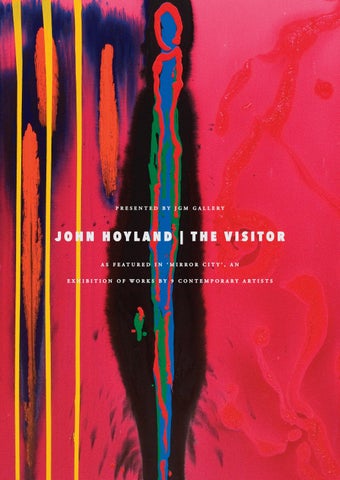
Image courtesy of nick@nicksmithphotography.com.

OHN HOYLAND (b. 1934, Sheffield; d. 2011, London) is considered one of his generation’s leading non-figurative painters. His one-man exhibition, Paintings 1960-67 , curated by Bryan Robertson in the Spring 1967 at Whitechapel Gallery is described as “a defining moment in British painting” (Mel Gooding, 2001). Hoyland was influenced by the American Abstract Expressionists, particularly colour field painting, and found exposure to their work through major exhibitions in London in the late 1950s during his studies at the Royal Academy Schools.
While Hoyland’s paintings from the 1960s in the aftermath of these exhibitions was received with great acclaim, works painted later in his career carry a freedom from the organisation and concreteness that earlier pieces possess. His paintings gradually became looser and more expressive, their emotiveness fuelled by marks in which gesture is not hidden, and vibrant colour and elusive ‘figures’ are made of acrylic impasto. The Visitor (2001) is typical of this development in Hoyland’s practice. Hoyland only began giving descriptive titles to his works in the early 1970s and this inevitably contributes to their interpretation. The Visitor is divided in two by a central inky cavity running vertically, perhaps a doorway, in which an elongated body is suggested by green and blue paint and a red outline. This figure situates the viewer, and we are immediately confronted by an encounter. Hoyland treats the two halves of the painting as spaces for different manners of expression. He paints vertical lines on the left in traffic-light yellow, producing a sharp, consistent beat, while contrasting these with automatic, calligraphic marks on the right, which are more lyrical. Behind the yellow fencing, smears and bleeds of orange and blue paint create a sinister effect, while also alluding to a composition of sustained notes. The right side creates a mystical atmosphere, stimulating an internal debate as to whether the apparition is dangerous or magical. The central figure oozes this duality.
Narrative is easily construed from Hoyland’s paintings, especially from those from the 1990s and early 2000s in which there is a corporeal presence. Hoyland’s personal view of his work, paraphrased by the curator of The John Hoyland Estate, Sam Cornish, was that “paintings are to be experienced, not to be understood. He liked colours to interact almost like characters in a novel, with each having their particular feeling” (Cornish, 2025). From this perspective, we can see how a painting like The Visitor encourages the viewer’s engagement through emotion and sensation.
Hoyland’s work is held by major museum collections including Tate, the Royal Academy of Arts, the Yale Centre for British Art (CT), and the Museum of Modern Art (NY).


