A N AG E N C Y O F T H E J E W I S H F E D E R AT I O N O F O M A H A
The Jewish Press WWW.O M A H A J E W I S H P R E SS .CO M
INSIDE
|
WWW. J E W I S H O M A H A .O R G
JANUARY 9, 2026 | 2 0 TE V E T | VO L. 1 06 | NO. 1 2 | CANDLELIGHTING | FRIDAY, JANUARY 9, 4:55 P.M.
Standing on Their Shoulders: Rediscovering Federation Presidents A lasting gift for generations to come: Join Life & Legacy Page 4
SPONSORED BY THE BENJAMIN AND ANNA E. WIESMAN FAMILY ENDOWMENT FUND
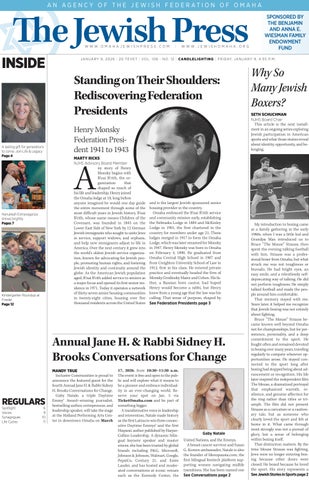
Henry Monsky Federation President 1941 to 1943 MARTY RICKS NJHS Advisory Board Member ny story of Henry Monsky begins with B'nai B'rith, the organization that shaped so much of his life and leadership. Henry joined the Omaha lodge at 18, long before anyone imagined he would one day guide the entire movement through some of the most difficult years in Jewish history. B'nai B'rith, whose name means Children of the Covenant, was founded in 1843 on the Lower East Side of New York by 12 German Jewish immigrants who sought to unite Jews in service, support widows, and orphans, and help new immigrants adjust to life in America. Over the next century it grew into the world’s oldest Jewish service organization, known for advocating for Jewish people, promoting human rights, and fostering Jewish identity and continuity around the globe. As the American Jewish population aged, B'nai B'rith added service to seniors as a major focus and opened its first senior residence in 1971. Today it operates a network of thirty-seven senior housing communities in twenty-eight cities, housing over five thousand residents across the United States
Why So Many Jewish Boxers? SETH SCHUCHMAN NJHS Board Chair This article is the next installment in an ongoing series exploring Jewish participation in American sports and what those stories reveal about identity, opportunity, and belonging.
A
Hanukkah Extravaganza shines brightly Pages 7
Kindergarten Roundup at Friedel Page 12
and is the largest Jewish-sponsored senior housing provider in the country. Omaha embraced the B’nai B’rith service and community mission early, establishing the Nebraska Lodge in 1884 and McKinley Lodge in 1901, the first chartered in the country for members under age 21. These lodges merged in 1917 to form the Omaha Lodge, which was later renamed for Monsky in 1947. Henry Monsky was born in Omaha on February 4, 1890. He graduated from Omaha Central High School in 1907 and from Creighton University School of Law in 1912, first in his class. He entered private practice and eventually headed the firm of Monsky Grodinsky Marer and Cohen. His father, a Russian born cantor, had hoped Henry would become a rabbi, but Henry knew from a young age that the law was his calling. That sense of purpose, shaped by See Federation Presidents page 3
Annual Jane H. & Rabbi Sidney H. Brooks Conversations for Change
REGULARS Spotlight Voices Synagogues Life Cycles
6 9 10 11
MANDY TRUE Inclusive Communities is proud to announce the featured guest for the fourth Annual Jane H. & Rabbi Sidney H. Brooks Conversations for Change. Gaby Natale, a triple Daytime Emmy® Award–winning journalist, bestselling author, entrepreneur, and leadership speaker, will take the stage at the Holland Performing Arts Center in downtown Omaha on March
17, 2026, from 10:30–11:30 a.m. The event is free and open to the public and will explore what it means to be a pioneer and embrace individuality in an ever-changing world. Reserve your spot on Jan. 5 via TicketOmaha.com and be part of something bigger. A transformative voice in leadership and reinvention, Natale made history as the first Latina to win three consecutive Daytime Emmys® and the first Hispanic author published by HarperCollins Leadership. A dynamic bilingual keynote speaker and master emcee, she has been trusted by global brands including P&G, Microsoft, Johnson & Johnson, Walmart, Google, PepsiCo, Century 21, and Estée Lauder, and has hosted and moderated conversations at iconic venues such as the Kennedy Center, the
Gaby Natale United Nations, and the Emmys. A breast cancer survivor and Susan G. Komen ambassador, Natale is also the founder of Menopausia.com, the first bilingual femtech platform supporting women navigating midlife transitions. She has been named one See Conversations page 2
My introduction to boxing came at a family gathering in the early 1980s, when I was a little kid and Grandpa Max introduced us to Bruce “The Mouse” Strauss, then spent the evening talking football with him. Strauss was a professional boxer from Omaha, but what struck me was not toughness or bravado. He had bright eyes, an easy smile, and a relentlessly selfdeprecating way of talking. He did not perform toughness. He simply talked football and made the people around him comfortable. That memory stayed with me. Years later, it helped me recognize that Jewish boxing was not entirely about fighting. Bruce “The Mouse” Strauss became known well beyond Omaha not for championships, but for persistence, personality, and a deep commitment to the sport. He fought often and remained devoted to boxing over many years, traveling regularly to compete wherever opportunities arose. He stayed connected to the sport long after boxing had stopped being about advancement or recognition. His life later inspired the independent film The Mouse, a dramatized portrayal that emphasized warmth, resilience, and genuine affection for the ring rather than titles or triumph. The film did not present Strauss as a caricature or a cautionary tale, but as someone who clearly loved the sport and felt at home in it. What came through most strongly was not a pursuit of glory, but a sense of belonging within boxing itself. That distinction matters. By the time Mouse Strauss was fighting, Jews were no longer entering boxing because other doors were closed. He boxed because he loved the sport. His story represents a See Jewish Stories in Sports page 2