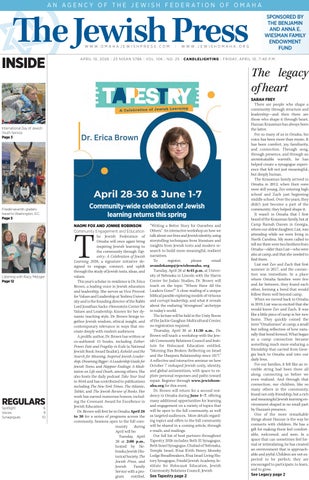
Community-wide celebration of Jewish learning returns this spring
FOX AND JONNIE ROBINSON
Community Engagement and Education
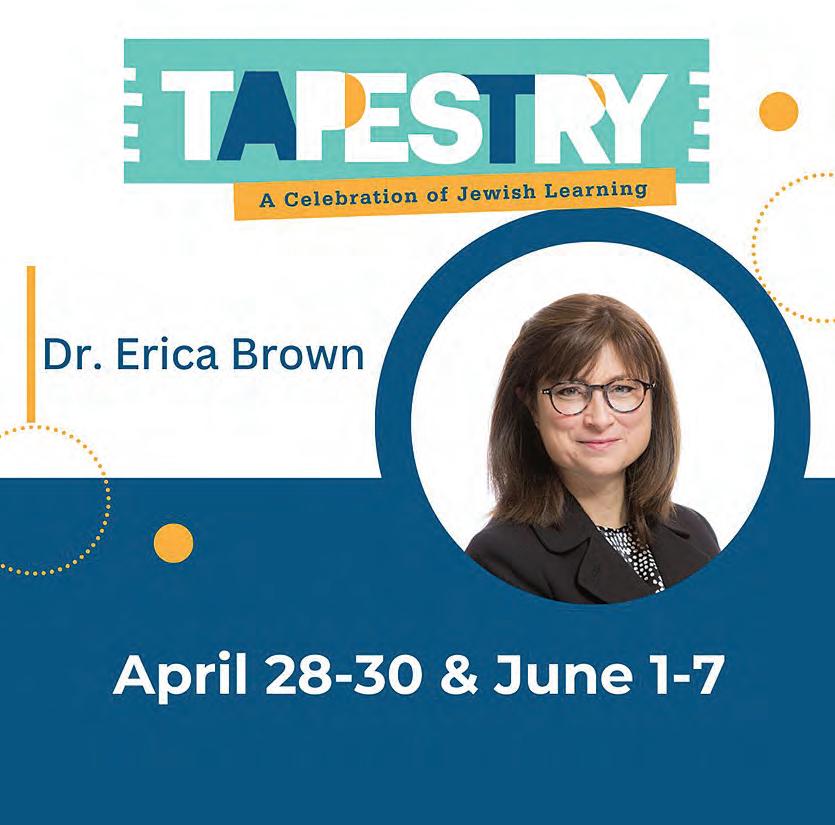
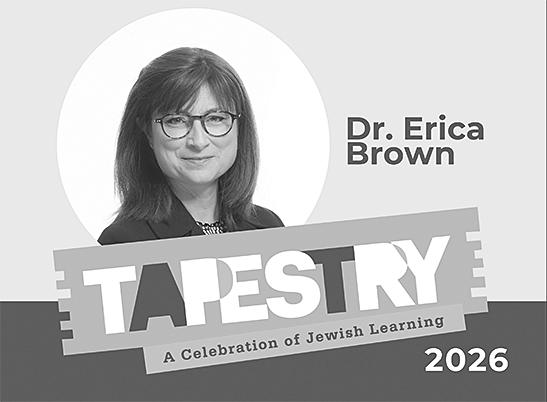
The Jewish Federation of Omaha will once again bring inspiring Jewish learning to the community through Tapestry: A Celebration of Jewish Learning 2026, a signature initiative designed to engage, connect, and uplift through the study of Jewish texts, ideas, and values.
This year’s scholar-in-residence is Dr. Erica Brown, a leading voice in Jewish education and leadership. She serves as Vice Provost for Values and Leadership at Yeshiva University and is the founding director of the Rabbi Lord Jonathan Sacks–Herenstein Center for Values and Leadership. Known for her dynamic teaching style, Dr. Brown brings together Jewish wisdom, ethical insight, and contemporary relevance in ways that resonate deeply with modern audiences.
A prolific author, Dr. Brown has written or co-authored 15 books, including Esther: Power, Fate and Fragility in Exile (a National Jewish Book Award finalist), Kohelet and the Search for Meaning, Inspired Jewish Leadership, Dreaming Bigger: A Leadership Guide for Jewish Teens, and Happier Endings: A Meditation on Life and Death, among others. She also hosts the daily podcast Take Your Soul to Work and has contributed to publications including The New York Times, The Atlantic, Tablet, and The Jewish Review of Books. Her work has earned numerous honors, including the Covenant Award for Excellence in Jewish Education.
Dr. Brown will first be in Omaha April 28 to 30 for a series of programs across the community. Sessions open to the full community during April will be: Tuesday, April 28 at 2:00 p.m., hosted by Nebraska Jewish Historical Society, The Jewish Press, and Jewish Family Service with a program entitled,
“Writing a Better Story for Ourselves and Others.” An interactive workshop on how we talk about our lives and Jewish identity, using storytelling techniques from literature and insights from Jewish texts and modern research to build more meaningful, resilient narratives.
To register, please email avandekamp@jewishomaha. org Tuesday, April 28 at 6:45 p.m. at University of Nebraska in Lincoln with the Harris Center for Judaic Studies, Dr. Brown will teach on the topic “Where Have All the Leaders Gone?” A close reading of a unique biblical parable exploring models of virtuous and corrupt leadership, and what it reveals about the enduring “strongman” archetype in today’s world.
The lecture will be held in the Unity Room of the Jackie Gaughan Multicultural Center, no registration required.
Thursday, April 30 at 11:30 a.m., Dr. Brown will teach a workshop with the Jewish Community Relations Council and Institute for Holocaust Education entitled, “Morning Has Broken: Reflecting on Israel and the Diaspora Relationship since 10/7.” A reflective and interactive seminar on how October 7 reshaped Jewish unity, identity, and global antisemitism, with space to explore personal responses and paths toward repair. Register through www.jewishomaha.org for this event.
Dr. Brown will return for a second residency in Omaha during June 1–7, offering many additional opportunities for learning and engagement on a variety of topics that will be open to the full community, as well as targeted audiences. More details regarding topics and offers to the full community will be shared in a coming article, through e-mails, and mailings.
Our full list of host partners throughout Tapestry 2026 includes: Beth El Synagogue, Beth Israel Synagogue, Chabad of Nebraska, Temple Israel, B’nai B’rith Henry Monsky Lodge Breadbreakers, B’nai Israel Living History Synagogue, Friedel Jewish Academy, Institute for Holocaust Education, Jewish Community Relations Council, Jewish See Tapestry page 2
The legacy of heart
SARAH FREY
There are people who shape a community through structure and leadership—and then there are those who shape it through heart. Hazzan Krausman has always been the latter.
For so many of us in Omaha, his voice has been more than music. It has been comfort, joy, familiarity, and connection. Through song, through presence, and through an unmistakable warmth, he has helped create a synagogue experience that felt not just meaningful, but deeply human.
The Krausman family arrived in Omaha in 2012, when their sons were still young, Zev entering high school and Zach just beginning middle school. Over the years, they didn’t just become a part of the community; they helped shape it. It wasn’t in Omaha that I first heard of the Krausman family, but at Camp Ramah Darom in Georgia, where our oldest daughter, Liat, was attending while we were living in North Carolina. My mom called to tell me there were two brothers from Omaha—older than Liat—who were also at camp, and that she needed to find them.
Liat met Zev and Zach that first summer in 2017, and the connection was immediate. In a place where Omaha families were few and far between, they found each other, forming a bond that would follow them well beyond camp.
When we moved back to Omaha in 2019, Liat was so excited that she would know Zev and Zach. It was like a little piece of camp in her new home. They quickly coined the term “Omahomies” at camp, a small but telling reflection of how naturally that bond formed. What began as a camp connection became something much more enduring: a friendship that carried from Georgia back to Omaha and into our daily lives.
For our families, it felt like an invisible string had been there all along, connecting us before we even realized. And through that connection, our children, like so many others in the community, found not only friendship, but a rich and meaningful Jewish learning environment shaped in no small part by Hazzan’s presence.
One of the more remarkable things about Hazzan is the way he connects with children. He has a gift for making them feel comfortable, welcomed, and seen. In a space that can sometimes feel formal or intimidating, he has created an environment that is approachable and joyful. Children are not expected to be perfect; they are encouraged to participate, to learn, and to grow.
See Legacy page 2
Listening with Raizy Metzger
NAOMI
OMAHA
WEST MAPLE | 3655 N. 129th St. | 402.933.0091
OLD MARKET | 1308 Jackson St. | 402.933.5168
MILLARD | 17664 Welch Pl. | 402.702.8800
LINCOLN
HAYMARKET LINCOLN | 601 R St. #100 | 402.261.9388
SOUTH LINCOLN | 5730 Hicote Dr. | 402.318.5188
SUSHI | JAPANESE | CHINESE www.Hiro88.com
EXPERIENCE ANTISEMITISM?
If you experience antisemitism, there are ways to report an incident or hate crime:
Continued from page 1 Family Service, Rose Blumkin Jewish Home, The Harris Center for Judaic Studies, The Jewish Community Center, The Jewish Press, and the Tri Faith Initiative.
We are extremely grateful to the following funds at the Jewish Federation of Omaha Foundation that financially support Tapestry: A Celebration of Jewish Learning 2026: Phillip & Terri Schrager Supporting Foundation, Herbert Goldsten Fund, Klutznick Custodial Fund, Shirley & Leonard Goldstein Supporting Foundation, Milton S. & Corinne N. Livingston Foundation Fund, The Chesed Fund, and the Dr. Bernard H.
Writing workshop
Bloom & Dr. Bruce S. Bloom Memorial Endowment Fund. Tapestry continues The Jewish Federation of Omaha’s proud tradition of bringing worldclass scholars to the community, creating meaningful spaces for connection, reflection, and growth.
To read more about Dr. Erica Brown, or more about Tapestry: A Celebration of Jewish Learning, please scan the QR code (right).
‘Write With Us,’ our small and intimate writing workshop (no need to be nervous) continues in the winter and early spring. Upcoming workshops are scheduled for the following Thursday, April 30 from 5-7 p.m. in the Noshery at the Staenberg Omaha JCC. Register by contacting Jessi at jtaylor@jewishomaha.org or Annette at avandekamp@jewishomaha.org. There is no cost to attend, although donations are always welcome.
CALL the JFO’s Safety and Security Team 402-334-6446
EMAIL JCRCreporting@jewishomaha.org
SCAN the QR code below to fill out the Incident Reporting Form
We work directly with law enforcement, Secure Communities Network, and the Anti-Defamation League.
If you see something, say something. IF THIS IS AN EMERGENCY, MOVE TO A SAFE AREA AND DIAL 9-1-1
SUMMER INTERN
THE JEWISH PRESS IS LOOKING FOR A SUMMER INTERN.
If you are currently a high schooler age 16 and up, or college student up to 24 years old, and want to become more involved in our community, this is your chance.
If you are interested, please send your resume and cover letter to avandekamp@jewishomaha.org.
WE CAN’T WAIT TO MEET YOU!
If you have wanted to write your family’s story, that great American novel, or you have always wanted to try your hand at poetry, join us! Maybe you are already an accomplished writer, but you would benefit from being in a room with other writers. Perhaps you have convinced yourself you can’t write at all, but would love to try. Everyone, from absolute beginner to professional, is welcome to attend. We will provide the kosher snacks and the writing prompts.
Legacy
Continued from page 1
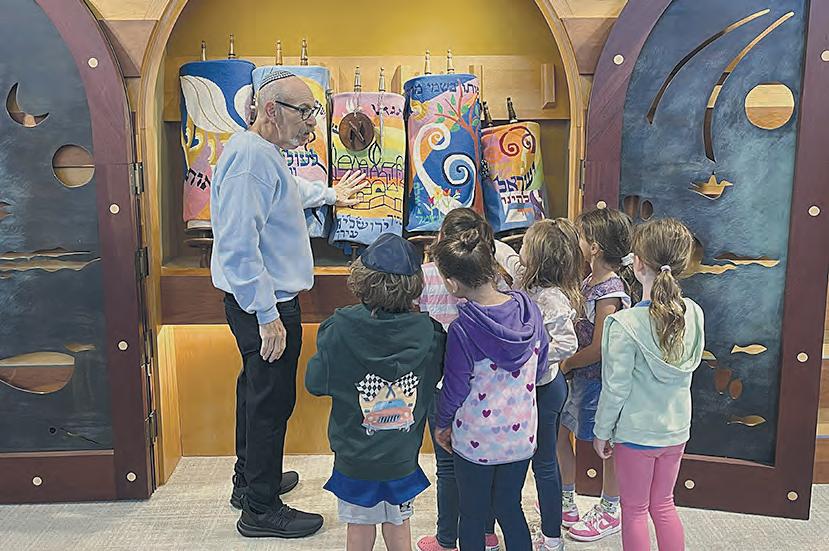
But Hazzan’s impact was never limited to children. He brought that same encouragement and openness to adults, inviting them to try new things, to learn, and to grow in ways that felt accessible and meaningful. Whether through the Beth El Singers, the adult b’nai mitzvah class, or Six String Shabbat, he created opportunities for people to step in, participate, and discover something new.
And always, in his own way, he offered encouragement—often in the form of a well-timed Crunch bar.
That spirit was especially felt during our daughters’ bat mitzvah journeys. With his guidance and Laurel’s incredible support, the experience became something truly special, infused with familiar melodies and camp tunes that brought a sense of joy and authenticity to the service. It was not just about tradition; it was about making that tradition feel alive.
showing up as you are and feeling like you belong.
Beyond the walls of our synagogue, Hazzan’s impact has extended through his work with the Institute for Holocaust Education. He has shared the powerful story of his father’s survival, helping ensure that memory, history, and lessons of resilience are carried forward across Nebraska and beyond.
His dedication to sacred music and Jewish learning has also been formally recognized. In 2018, he was honored with an honorary Doctor of Music degree from the Jewish Theological Seminary, a testament to not only his musical gifts, but to the profound spiritual impact of his work.
In a way that perfectly reflects his curiosity, love of learning, and perhaps his appreciation for a good whiskey, he even pursued and earned an SQA-approved certificate in Scotch Whisky from the Edinburgh Whisky Academy.
And yet, for all these accomplishments, what stands out most is not a title or recognition—it is the feeling he created.
Hazzan, together with Laurel and their family, helped to cultivate a synagogue environment defined by warmth. Over the years, they created a community that felt relaxed, welcoming, and genuinely inclusive. It is something I have heard echoed time and time again—not only from members of our congregation, but from visitors as well, both Jewish and non-Jewish alike.
There is a certain “lived-in” feeling to a community when it is built on kindness, openness, and connection. That is what the Krausman family brought to our shul and our community. It was never about perfection; it was about presence—about
As Hazzan steps into this next chapter, there is, of course, a deep sense of loss. Change is never easy, especially when it touches something so central to our communal and spiritual lives. But alongside that sadness is also gratitude—for the years, the music, the relationships, and the foundation that has been built.
We are fortunate that the Krausman family will remain in Omaha. Their presence will continue to be felt, even as their roles evolve.
As part of honoring Hazzan and his impact, our community will gather for a special cantors concert featuring the band Soulfarm on April 19 at 4 p.m., with proceeds benefiting the Seth Rich Memorial Camp Scholarship Fund. For more information, visit bethel-omaha.org or contact Stacie Metz at smetz@bethel-omaha.org
Some legacies are written in programs and milestones. Others are written in the way people feel when they walk into a room, hear a melody, or watch their children find their place. Hazzan’s legacy is the latter—and it will stay with our children throughout their lives.
ORGANIZATIONS
B’NAI B’RITH BREADBREAKERS
The award-winning B’NAI B’RITH BREADBREAKERS speaker program currently meets Wednesdays via Zoom from noon to 1 p.m. Please watch our email for specific information concerning its thought-provoking, informative list of speakers. To be placed on the email list, contact Breadbreakers chair at gary.javitch@gmail.com
International Day of Jewish Youth Service Tapestry: Writing a better story
JONNIE ROBINSON
JFO Assistant Director of Community Engagement and Education
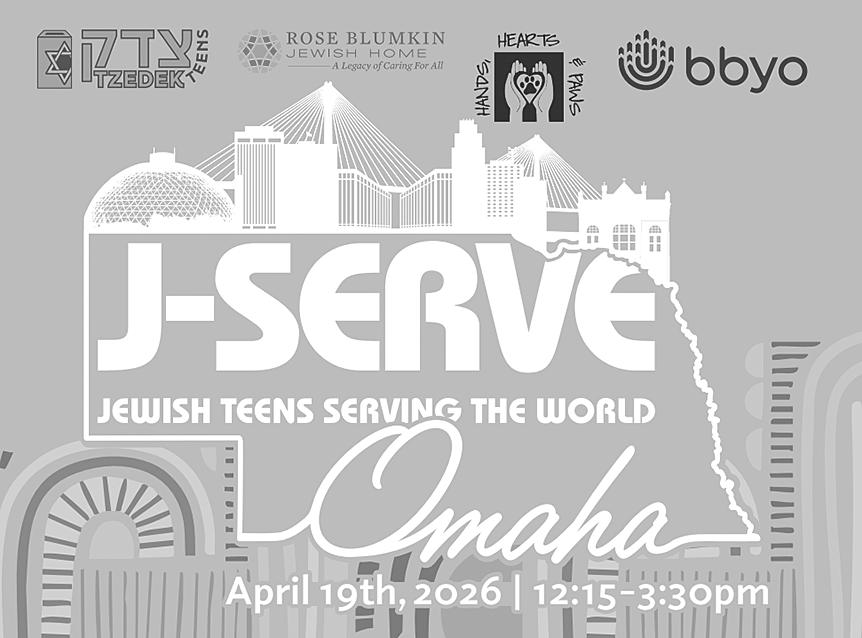
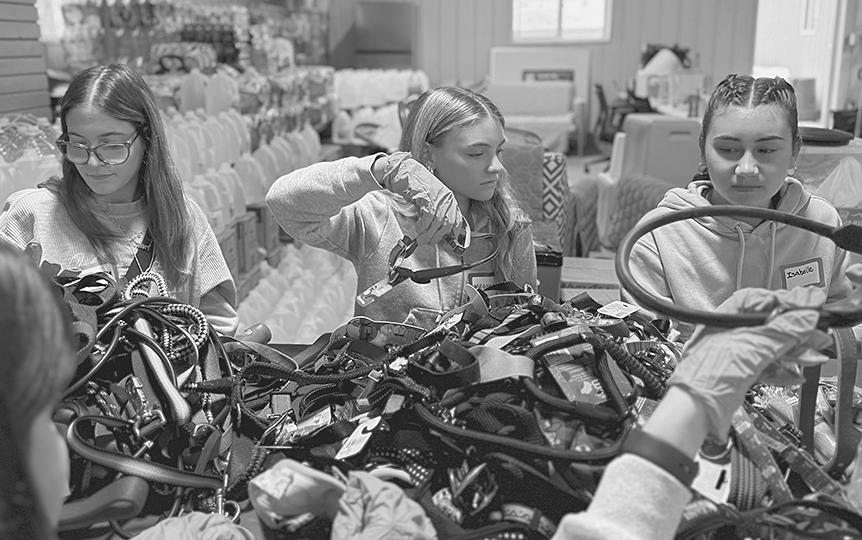
Jewish youth ages 11-18 in Omaha are preparing to take part in J-Serve: The International Day of Jewish Youth Service, a global initiative that brings together thousands of Jewish teens to volunteer and make a difference in their communities.
Youth Service is more than just helping out — it’s about displaying our values as Jews.”
Helping others is deeply connected to Jewish tradition through the idea of Tikkun Olam, meaning “repairing the world.”
“Even as teenagers, we are able to help those in need and repair the world,” Isabelle said. “No matter how small it may seem, we are still able to do our part in the community.”
J-Serve connects Jewish teens across the globe who all participate in service projects on the same day. For many participants, knowing they are part of a global movement makes the experience even more meaningful.
“It makes helping others even better when you know that thousands of Jewish teens your age are doing the same thing,” said Zac Kazor, another teen involved in the planning of JServe 2026. “It shows that no matter how young we are, we are able and willing to help make the world a better place.”
This year’s Omaha event will take place on April 19, 2026, from 12:15–3:30 p.m. at the Staenberg Kooper Fellman Campus of the Jewish Federation of Omaha. The project is organized in partnership with Tzedek Teens and BBYO.
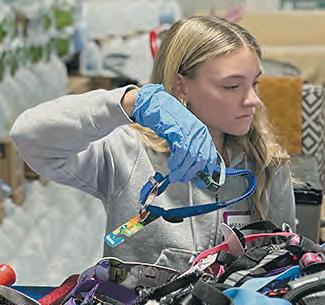
During the afternoon, participants will volunteer with residents at the Rose Blumkin Jewish Home, playing games and socializing with elders. Teens will also learn about Hands, Hearts and Paws, a local animal rescue organization, and help socialize some of their adoptable dogs while also making toys for the dogs in foster care.
For teens involved in the program, the day represents more than just a few hours of service.
“As teenagers in the Jewish community, it is extremely important for us to do our part,” said Isabelle Dominguez, a teen helping to plan this year’s project. “The International Day of Jewish
In addition to volunteering, this year’s event will include a donation drive to support Hands, Hearts and Paws, a local animal rescue organization that provides shelter, care and love for dogs while they wait for their forever homes.
Led by the teens, the organization is currently collecting supplies such as durable dog toys and balls (no rawhide), laundry detergent, paper towels, spray and carpet cleaners, dog beds or mats, fleece blankets, and collars in various sizes. Hands, Hearts and Paws also feed high-quality, four-star dog food and treats, so donations from specialty pet brands are encouraged. Grocery store brands, Milk-Bone treats, and jerky treats are not requested. Donations can be dropped off at the main entrance of the Jewish Federation of Omaha between April 5th and 18th.
Participants in the event will receive a specially designed JServe Omaha shirt and service-learning hours for participating. A kosher lunch will also be served.
Registration for Jewish youth ages 11-18 to participate in JServe 2026 is available through the event QR code or on the JFO website. With any questions, reach out to Naomi Fox
402.334.6424 or Idan Zaccai
402.334.6432.
ANNETTE VAN DE KAMP-WRIGHT
Jewish Press Editor
Tuesday April 28, at 2 p.m., Jewish Family Service, the Nebraska Jewish Historical Society and the Jewish Press invite the community to attend our collaborative Tapestry session with Dr. Erica Brown.
In this interactive workshop, we will discuss how we speak about ourselves and our Jewish lives, and learn how to tell a more compelling story. Dr. Brown will speak about using the same techniques that make fiction and non-fiction writing more powerful and engaging.
We will also look at some Jewish texts on the centrality of story-telling and contemporary research on the importance of family narratives in generating resilience for ourselves and those who come after us. In addition, we will address how we can let go of grudges by reframing our own story.
“Writing a better story” is a topic relevant to how we keep the history of Jewish Omaha, but also how we see ourselves. It’s a place where the mission of JFS, the NJHS and the Press all come together.
“Of course, there will be plenty of opportunity for questions,” NJHS executive director Jane Rips said, “and all of us can attest Dr. Brown is incredibly engaging. Plus, we will serve cheesecake, and we hope you’ll mark your calendar for this first event of this year’s Tapestry!” Registration for this event is required, and you can let us know you are coming by emailing avandekamp@jewish omaha.org by April 17. Seating is limited, so don’t wait! For more information about this year’s Tapestry speaker and events, please check the longer article on the front page of this issue, or email Naomi Fox at nfox@jewishomaha.org
Omaha’s first public Israel Independence Day Celebration
STEVEN J. RIEKES
On May 15th, 1948, the Jewish people had declared the creation of a new sovereign country which would bear the name Israel. Its territory would embrace a portion of the ancient land which, in biblical times, the Jews once occupied. Although forcibly expelled by the Romans, Jews prayed daily for over 2,000 years for the return to Zion, their biblical homeland. It was a momentous event unprecedented in human history. Wherever Jews lived, they welcomed and celebrated this occasion. The celebrations were usually held in synagogues, Jewish schools, and other non-public institutions.
In Omaha, the celebration of Israel’s Independence Day (Yom Ha’atzmaut) was tied in with the annual meeting of the Jewish Federation. The site of those meetings occurred at the Highland Country Club. It was not a place that would be particularly attractive to the majority of the community, especially its young people.
In the spring of 1969, the Federation underwent a fundamental restructuring. A young, dynamic leader, Calvin “Nick” Newman, called for a public meeting of the entire Community. He discovered that the official bylaws of the Federation required the board to be democratically elected. For many years the board had been a self-perpetuating body of older and economically successful men.
A public meeting was held on April 30, 1969, at the Jewish Community Center, even though, the official records of the Federation contained no information as to who attended and what happened. There was no reference to the fact it was packed with many young and enthusiastic new faces.
In addition to structural changes in the Federation’s governance, significant changes were developed in the cultural, educational and in many other aspects of Jewish life in Omaha. The first major change appeared in the planning and implementation of the celebration of Yom Ha’atzmaut.
Rabbi Isaac Nadoff spearheaded the planning for this special event. He developed a planning committee which included community leaders such as Jane “Mrs. Jack” Cohen and Alvin Ross in addition to many others. Some of these participants may have been active in their synagogues or other Jewish organizations, and some were newly involved. Also, many younger adults were recruited for the planning. Of special significance was the inclusion of college and high school students. The planning committee proposed that the celebration would begin with three simultaneous marches in the streets
converging at Memorial Park, then the center of the city’s Jewish demography. Each march would begin at a different synagogue and end at the park.
At the park, there would be a huge ceremony to which the public would be invited. There would be music, dancing, prayers, speeches, flag waving, and other appropriate activities. All of this would be conducted in a joyful expression of happiness.
However, the planning committee’s proposal was initially opposed by several persons, most of whom were members of Omaha’s “old guard” leadership. They were horrified at the idea. For them, Judaism was to be celebrated at home or in the synagogue and not in the streets or other public venues. They offered to move the annual meeting from the country club to the ballroom at Peony Park, a private location, at which “a very nice dinner” would be served. The planning committee rejected this counter offer and stuck to its original plan.
The planning committee, and especially the young members, argued that Jews should not be inhibited from a truly communal celebration. They pointed out that Omaha’s Italian community annually celebrated their Santa Lucia Festival and did it on the streets of Omaha’s “Little Italy.” Like the Italians and many other ethnic or religious communities, Jews should also be able to rejoice in their heritage. And this they did!
On May 15th, 1970 the Jews of Omaha celebrated a truly public Yom Ha’atzmaut. It was a tremendous success. Most significantly, it marked the beginning of a fundamental change in how American Jews regarded themselves and what being Jewish meant to them. Since then, many communal, cultural and institutional activities have been transformed.
So there is no misunderstanding, the responses of the older generation were not irrational. There was genuine fear in the community of being “singled out” by others.
Today, other major challenges regarding Jewish identity have emerged which need to be studied and understood. This exploration and continued pride in our Jewish heritage will help determine our future.
[The events referred to in this article have been more specifically detailed in an earlier article in the Omaha Jewish Press dated May 30, 2025. Hopefully subsequent articles will reveal how American Jews transformed themselves from being fearful to prideful of their heritage. The phrase that something is “too Jewish” has disappeared from our vocabulary.]
Our Story: Immigration, Part 2
Temple Israel
In February 2026, Temple Israel’s Rabbi Berezin took a small group of congregants on an immigration trip. Below is part two of her account of the experience.
Shalom Friends,
Day Two of our Tzedek America Immigration Justice Journey was challenging and thought provoking for many of us. Our day began with a meeting with Homeland Security Investigator Special Agent Jonathan Aben, who spoke with our group about his work on the border, and his passion for justice. He spoke about the challenges that he as a law enforcement officer faces, and reminded us that what we see and hear on the news isn't the full picture. He spoke about the systems of immigration and asylum, and shared a broader view of the historical roots of some of the issues that we face today. His perspectives challenged many of us and pushed us outside of our comfort zones in many ways. But part of what we came here to do is to sit with discomfort and find ways to practice radical empathy, maybe even especially when we hear things that challenge us.
From there, we went to the State Capitol, where we had the opportunity to meet with Representative Consuelo Hernandez, a Jewish Latina state representative who wears her many intersecting identities proudly as she tackles issues on behalf of the people she serves. She is one of the most successful Democrats in the House, skilled in forming relationships across the aisle to help foster bipartisan initiatives that accomplish her goals and move her work forward. She spoke candidly about the challenges she faces, and yet she remains hopeful that she can continue to do good work for the communities for which she cares deeply.
For lunch, we headed to an El Salvadorian Pupuseria where we had a delicious meal and had an opportunity to debrief some of what we've heard in the past 24 hours. The stories we've heard have been emotional, heart wrenching, and, at times, painful. Whether or not we agree or disagree, we find ourselves sitting with heavy emotions, and with more questions than answers. As we sit with the discomfort, we wonder
what to do with it. The one thing all of our speakers have agreed on is that the system of immigration is broken. And yet, nobody really knows how to fix it or where to start. As we continue on our journey, we know that we will not leave here with answers. And particularly in this place, hearing these stories, that feels even harder than many of us expected.
After lunch, we had the opportunity to meet and study with Rabbi Shmuly Yanklowitz, the founder of Jews for Justice and the President of Valley Beit Midrash. Rabbi Shmuly was an absolute joy to study with, and such a source of light and energy on a day that had been so challenging for us. We spoke about what it means to do the work of justice, reminding us that caring for the stranger in our midst is inherent to what it means to be Jewish. Yes, we absolutely must care for our community, but equally as important is caring for the vulnerable among us.
During the past two days, we've talked a great deal about why its important that we are here. And we've been reminded of the truth that Bryan Stevenson teaches -- to "get proximate to the people who are suffering. When you get proximate to the excluded and the disfavored, you learn things that you need to understand if we're going to change the world." This trip is our opportunity to get proximate, to see and to hear and to bear witness, firsthand, the human suffering that is at stake. We will not come home with answers, but we will come home with a greater understanding because we've been proximate to the suffering.
Tomorrow, we head to the border at Nogales. I look forward to sharing more of our journey. In the meantime, I'm wishing you a peaceful, and hopefully warm, Shabbat Shalom.
TO SUBMIT ANNOUNCEMENTS
Announcements may be e-mailed to the Press at jpress@jewishomaha.org; or mailed to 333 So. 132 St., Omaha, NE 68154. Readers can also submit announcements -- births, b’nai mitzvahs, engagements, marriages, commitment ceremonies or obituaries -- online at www.omahajew ishpress.com/site/forms/. Deadlines are normally nine days prior to publication, on Wednesdays, 9 a.m. Please check the Jewish Press, for notices of early deadlines.
RABBI DEANA BEREZIN
Friedel seventh graders travel to Washington, D.C.
SARA KOHEN Friedel Jewish Academy Director of Advancement
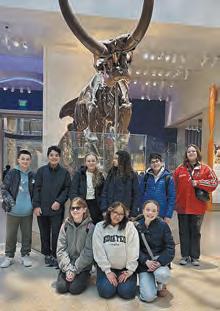
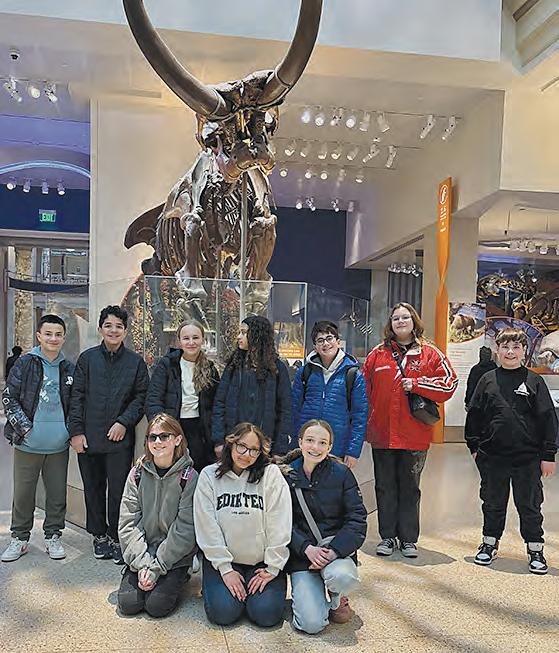
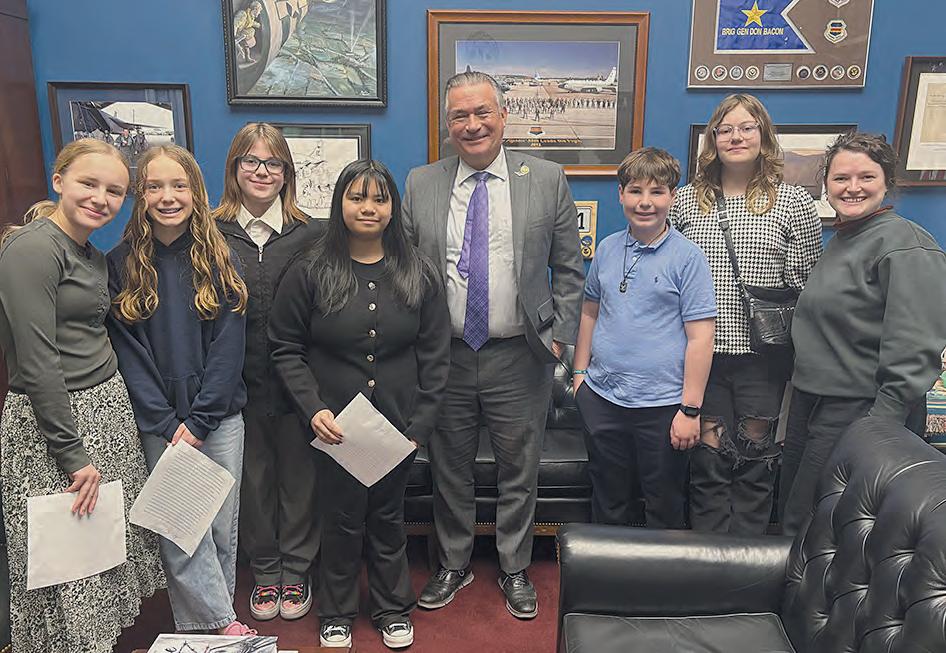
Friedel Jewish Academy’s seventh-grade students recently visited Washington, D.C. along with students from five other Jewish day schools located in small Jewish communities — like ours. The students had studied together virtually each week during the year and then connected in person on the trip.
Leading up to the trip, the students had learned about advocacy, both in a historical context (such as Jewish garment workers organizing in the early twentieth century) and about how to be an effective advocate. Their first stop in D.C. was the Jewish Federations of North America (“JFNA”), where they learned about how JFNA advocates for Jewish people in North America.
world, between Jewish teachings and secular topics, and between students from different parts of the country.
Students applied their advocacy skills by creating their own advocacy projects and presenting them to Congressman Don Bacon and his staff. They also attended the weekly Nebraska Breakfast, hosted by the Nebraska congressional delegation. In addition to this advocacy work, students explored impor-
The students learned a lot, but they also had time for fun with students from the other schools during evening team building activities.
The Alliance program, including this trip, provides unique and transformational opportunities for the students. They made connections: between classroom learning and the real
This trip was made possible thanks to the generous support of the Shirley & Leonard Goldstein Foundation, the Jewish Federation of Omaha Foundation Impact Grant, the Special Donor-Advised Fund of the Jewish Federation of Omaha Foundation, and other donors.
tant sites, including monuments, the U.S. Capitol Building, and museums. They visited the National Museum of African American History, the Air and Space Museum, and the Holocaust Memorial Museum.
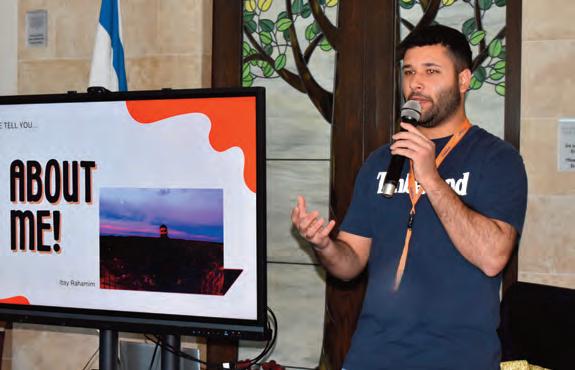
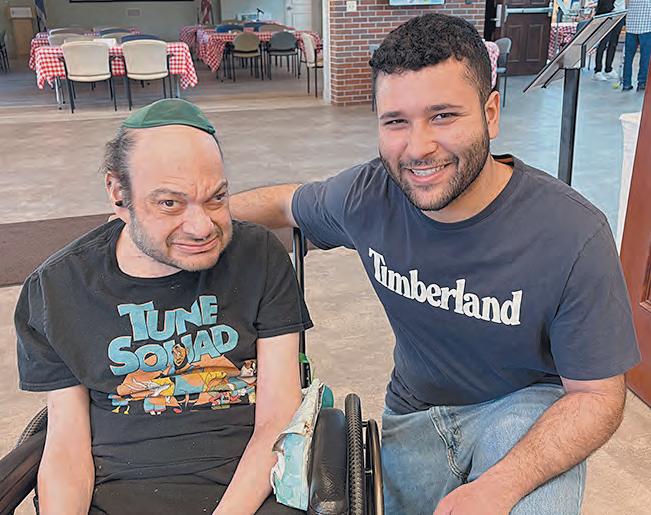
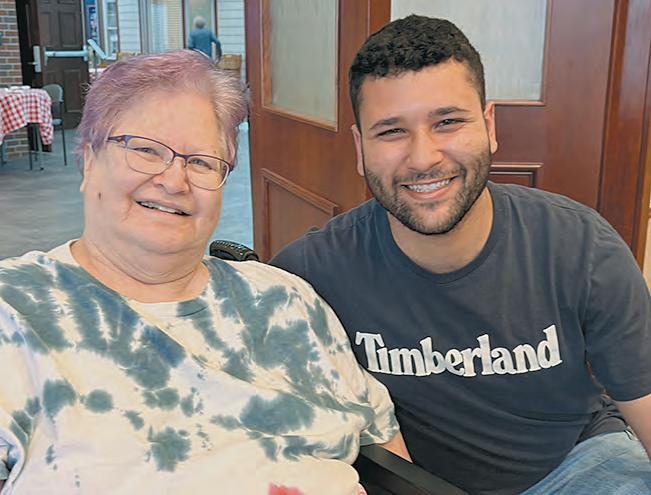
RBJH Residents had the unique opportunity to meet Itay, the Israeli Community Shaliach, who brought his story to life through vivid insights about his home in Israel.
FRIEDEL
SP O TLIGHT
PHOTOS FROM RECENT JEWISH COMMUNITY EVENTS
SUBMIT A PHOTO: Have a photo of a recent Jewish Community event you would like to submit? Email the image and a suggested caption to: avandekamp@jewishomaha.org
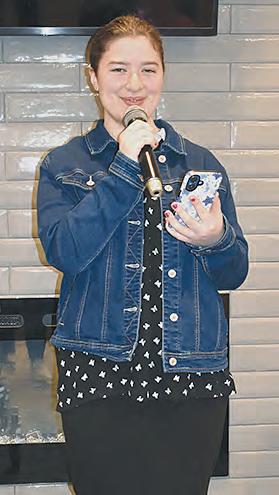
Residents at RBJH enjoyed a special treat as teen volunteer Natalie, daughter of Activities Coordinator Amy, shared her musical talents.
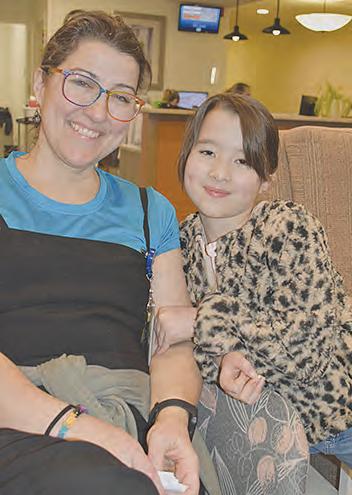
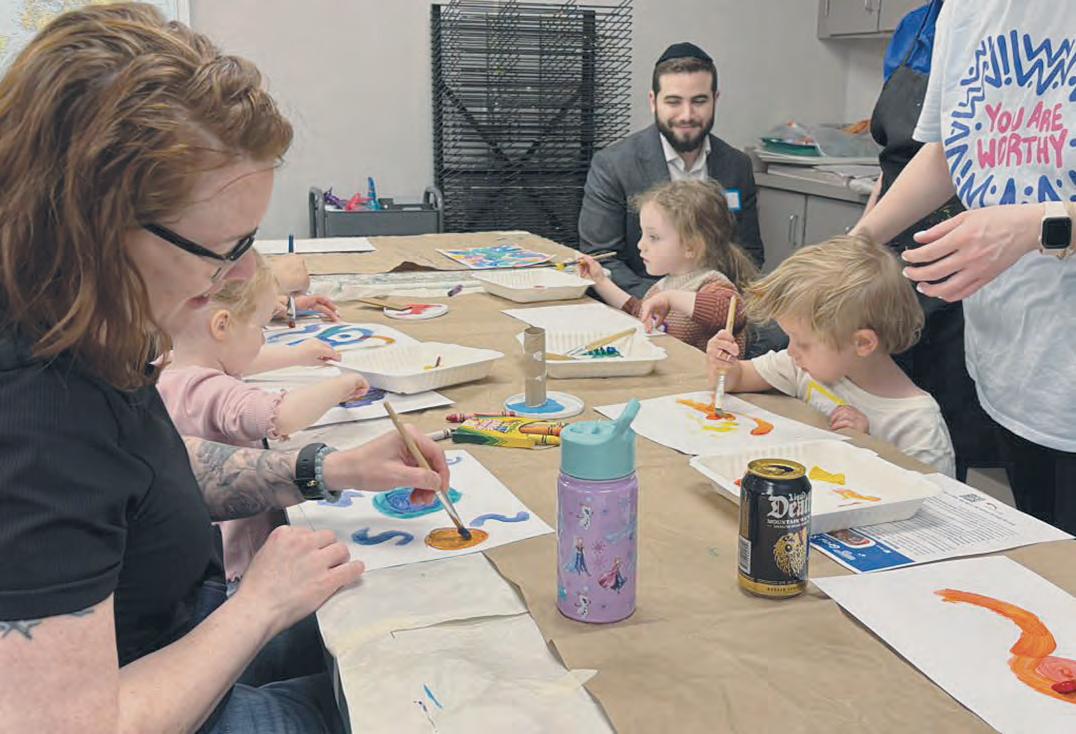
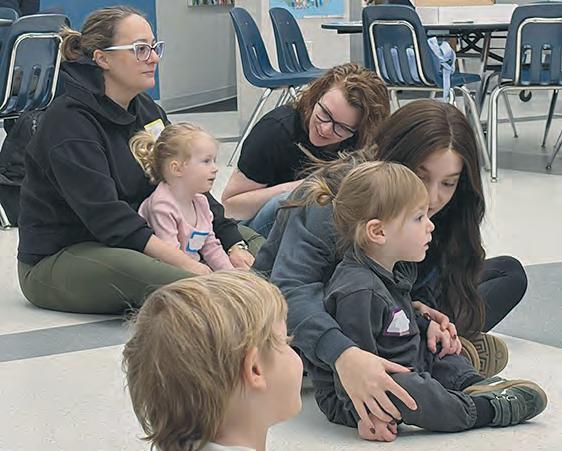
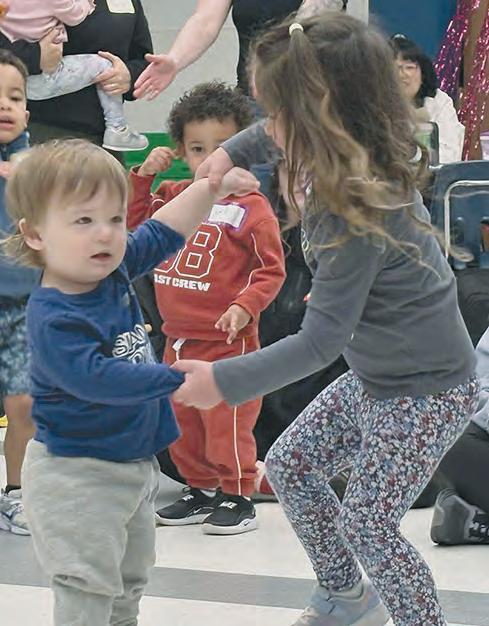
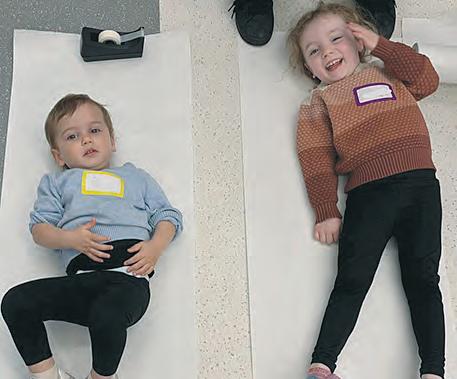
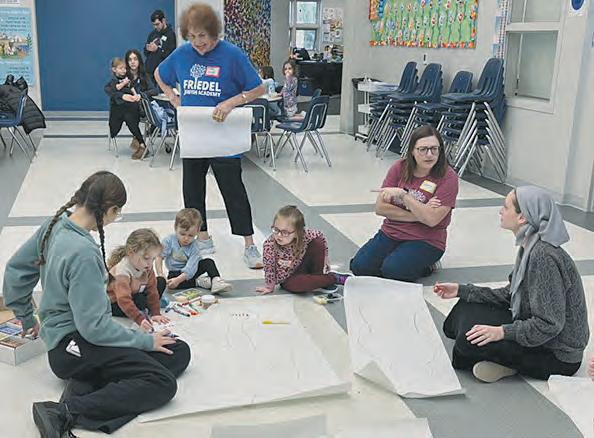
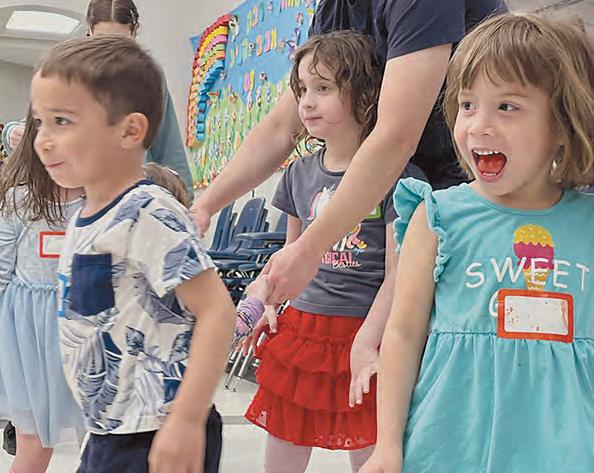
Friedel Jewish Academy and PJ Library welcomed families with kids younger than 5 to Friedel for Grow Strong!, a program focused on the many ways to be healthy.
Grow strong!
JONNIE ROBINSON
JFO
Assistant Director of Community Engagement and Education
We had such a joyful and energizing turnout at our Grow Strong event in partnership with Friedel Jewish Academy. It was truly special to see so many of our youngest community members and their grownups come together to move, learn, and connect.
Families stretched, danced, and got their wiggles out during our music and movement time, then explored hands-on activity stations led by Friedel teachers. Together, we learned about the Jewish value of caring for our bodies, inspired by the book Boker Tov. Children painted, played, enjoyed fresh and healthy snacks, and even learned Hebrew words for different parts of the body — ending with a joyful bubble dance party!
Looking ahead, we’re excited for our upcoming Family Day at the Zoo at the Omaha Henry Doorly Zoo and Aquarium on June 7, 2026. We hope you’ll join us for another opportunity to gather, explore, and enjoy time together as a community. Register now and watch for details! Family Day at the Zoo 2026
For any questions, please reach out to:
Save the Date for JFS
TERESA DRELICHARZ
JFS Executive Director
As Sara Kohen from Friedel shared:
“We loved having our youngest community members and their grownups in our building for Grow Strong! We had a lot of fun watching them get their wiggles out during a music and movement class and then explore hands-on activities with Friedel teachers. We really value being able to partner with PJ Library and the Omaha synagogues to create engaging programs for young families in our community.”
On a personal note, this was such a meaningful first event for me to meet so many of you. I’m so grateful to begin building these connections and to grow this wonderful community together.
Sara Kohen, Friedel Jewish Academy Director of Advancement | Email: skohen@ fjaomaha.com | Phone: (402) 301-1662 | www.FriedelJewishAcademy. com
Jonnie Robinson, JFO Assistant Director of Community Engagement and Education – Staenberg Kooper Fellman Campus Email: jonnie@jewishomaha.org | Office: 402.334.6475 | www.jewishomaha.org
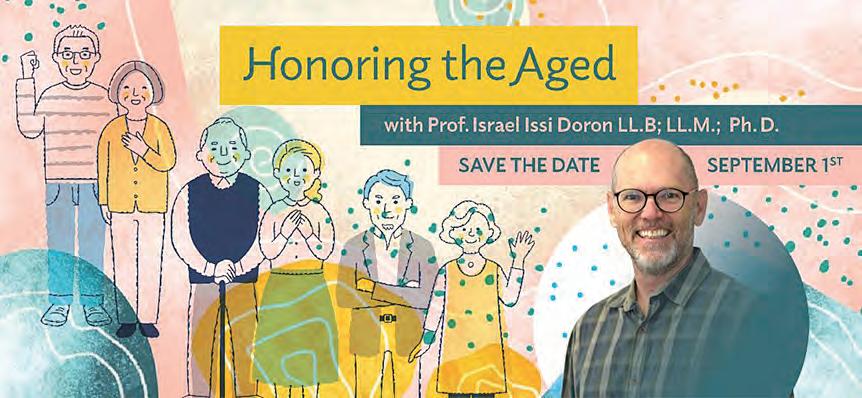
On Sept. 1, 5:30-6:30 p.m. at the Omaha Staenberg JCC, Jewish Family Service will present “Honoring the Aged” with Professor Israel (Issi) Doron. JFS is doing this in in partnership with the University of Nebraska's Gerontology program.
Professor Doron is a full professor of gerontology, the Past Dean of the Faculty of Social Welfare and Health Sciences at the University of Haifa, and the Past President of the Israeli Gerontological Society. He specializes in the fields of law and aging, social policy, human rights and ageism.
Professor Doron has written extensively on topics such as socio-legal construction of old age, human rights of older persons, and is the editor/co-editor of key books in the field. He is also the founder of an Israeli NGO, “The Law in the Service of the Elderly”, which has been involved in key strategic-litigation regarding rights of older persons in Israel and in the international movement to promote a new International Convention for the Rights of Older Persons.
More information will come at a later date.
If you do business with any of our advertisers, please tell them you saw their ad in the Jewish Press. It really helps us!
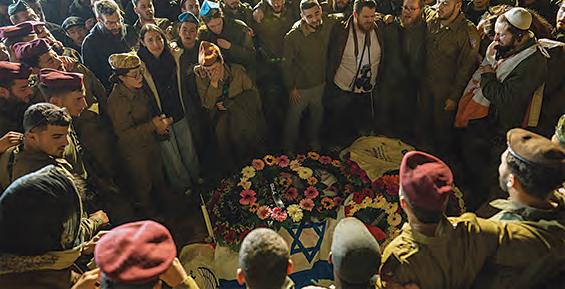
Moshe Katz laid to rest on Mt. Herzl
GRAC GILSON
JTA
Hundreds gathered at Israel’s military cemetery on Mt. Herzl for the funeral of Moshe
Yitzchak Hacohen Katz, an American-born Israeli soldier who was killed by a rocket strike March 28 in southern Lebanon. Katz, 22, from New Haven, Connecticut, is the fifth Israeli soldier killed in Lebanon since Hezbollah, an Iranian proxy in Lebanon, resumed attacks on Israel following a 2024 ceasefire, after Israeli and U.S. strikes on Iran last month.
during her eulogy. “Moshe’s body might be gone, but his legacy is not. He was a proud soldier and a proud Jew, and we are the proudest family.”
Israeli Prime Minister Benjamin Netanyahu offered condolences to Katz’s family in a post on X and wished a speedy recovery to three other soldiers moderately wounded in the attack.
JONNIE ROBINSON
JFO Assistant Director of Community Engagement and Education
Please Join us Thursday, April 16, from 10-11 a.m. at the Staenberg Omaha JCC for PJ Library’s “Babies and Bagels!”
“With unspeakable tragedy I regret to inform you that my 22-year-old son Moshe Yitzchak a sergeant in the IDF, fell in battle in Lebanon,” Katz’s father, Mendy, wrote in a post on Facebook on Saturday. “My oldest son with a zest for life and jokes. Burial is tomorrow in Israel. Maybe we only share good news. My heart is shattered and the wound is real.”
Mendy Katz had been in Israel when the war began and posted on March 7 about witnessing his son’s graduation from basic training with the Israel Defense Forces before returning to the United States via Egypt.
During the funeral on March 29, Katz, who was posthumously promoted from corporal to sergeant and was affiliated with Chabad, was eulogized by a host of fellow soldiers who referred to him as a “true friend” who “always used to make sure that anyone around him was always taken care of.”
“Moshe was a brave soldier, we have proof of that, but more than that, he was a loyal friend, he was a hard-working son and a loving, caring brother,” Adina, Katz’s sister, said between tears
“Moshe z”l immigrated to the land from the United States, enlisted in the Paratroopers Brigade, and fought bravely for the defense of our homeland,” Netanyahu wrote. “On behalf of all Israeli citizens, we embrace Moshe z”l’s family in this difficult hour and wish a swift and complete recovery to our fighters who were wounded in that incident.” Netanyahu announced that he had instructed the Israeli military to further expand its operations in Lebanon in order to “finally thwart the threat of invasion and to push the anti-tank missile fire away from our border.”
Menachem Geisinsky, a photographer and friend of Katz’s, also eulogized him in a post on Facebook, writing that he “forever will be my hero” for “his bravery in coming all the way from New Haven, Connecticut to fight for what he believed was right and also for being a man who wouldn’t tolerate a frown.”
“So be like Moshe. Be a hero. Make someone’s day. Make someone giggle or smile,” wrote Geisinsky. “Step up, and be the man Moshe was, and forever will be remembered as.” Katz is survived by his parents, Mendy and Devorah Katz; siblings Adina, Yehuda, Shua and Dubi; and grandparents.
We will share some post Passover treats, read a story together, and enjoy relaxed time connecting with one another. This event is designed for babies under 2 and their parents or caregivers, and is free of charge.
Please visit our website at jewishomaha.org to register. For more information, contact Jonnie Robinson at jonnie. robinson@jewishomaha.org
People gather for the funeral of Stg. Moshe Itzhak Hacohen Katz, 22, on March 29, 2026 in Jerusalem. Credit: Erik Marmor/Getty Images
Voices
The Jewish Press
(Founded in 1920)
David Finkelstein
President
Annette van de Kamp-Wright
Editor
Will Fischer
Creative Director
Claire Endelman
Sales Director
Lori Kooper-Schwarz
Assistant Editor
Sam Kricsfeld
Digital support
Mary Bachteler
Accounting
Jewish Press Advisory Board
David Finkelstein, President; Margie Gutnik, Ex-Officio; Joseph Abrahams, Helen Epstein, Andrea Erlich, Dana Gonzales, Mary Sue Grossman, Hailey Krueger, Chuck Lucoff, Sara Rips, Stewart Winograd and Bob Yaffe.
The mission of the Jewish Federation of Omaha is to build and sustain a strong and vibrant Omaha Jewish Community and to support Jews in Israel and around the world.
Agencies of the JFO are:: Institute for Holocaust Education (IHE), Jewish Community Relations Council (JCRC), Nebraska Jewish Historical Society (NJHS), Jewish Press, Rose Blumkin Jewish Home (RBJH), Jewish Family Service (JFS), Staenberg Omaha Jewish Community Center (JCC).
Guidelines and highlights of the Jewish Press, including front page stories and announcements, can be found online at: www.jewishomaha.org; click on Jewish Press.’
The Jewish Press is not responsible for the Kashrut of any product or establishment.
Editorial
E-mail editorial material and photos to: jpress@jewishomaha.org and avandekamp@jewishomaha.org ; send ads (in TIF or PDF format) to: wfischer@jewishomaha.org
Letters to the Editor Guidelines
The Jewish Press welcomes signed Letters to the Editor. They may be sent via regular mail to: The Jewish Press 333 So. 132 St., Omaha, NE 68154; via fax: 1.402.334.5422 or via e-mail to the Editor at: avandekamp@jewishoma ha.org.
Letters should be no longer than 250 words and must be single-spaced typed, not hand-written. Published letters should be confined to opinions and comments on articles or events. News items should not be submitted and printed as a “Letter to the Editor.”
The Editor may edit letters for content and space restrictions. Letters may be published without giving an opposing view. Information shall be verified before printing. All letters must be signed by the writer. The Jewish Press will not publish letters that appear to be part of an organized campaign, nor letters copied from the Internet. No letters should be published from candidates running for office, but others may write on their behalf. Letters of thanks should be confined to commending an institution for a program, project or event, rather than personally thanking paid staff, unless the writer chooses to turn the “Letter to the Editor” into a paid personal ad or a news article about the event, project or program which the professional staff supervised. For information, contact Annette van de Kamp-Wright, Jewish Press Editor, 402.334.6450.
Postal The Jewish Press (USPS 275620) is published weekly (except for the first week of January and July) on Friday for $50 per calendar year U.S.; $80 foreign, by the Jewish Federation of Omaha. Phone: 402.334.6448; FAX: 402.334.5422. Periodical postage paid at Omaha, NE. POSTMASTER: Send address changes to: The Jewish Press, 333 So. 132 St., Omaha, NE 68154-2198 or email to: jpress@jewishomaha.org
Editorials express the view of the writer and are not necessarily representative of the views of the Jewish Press Advisory Board, the Jewish Federation of Omaha Board of Directors, or the Omaha Jewish community as a whole.
Nothing new under the sun
ANNETTE VAN DE KAMP-WRIGHT
Jewish Press Editor
The media tell us there’s a new group on the scene in Europe, and members call themselves Harakat Ashab al-Yamin al-Islamiya, or HAYI for short.
“As of March 24,” Jackie Hajdenberg wrote for the JTA, “HAYI or those claiming to speak in its name has taken responsibility for attacks on the following: a synagogue in Rotterdam, Netherlands on March 13; a Jewish school in Amsterdam also on March 13; a series of fires on the Jewish ambulance service in London on March 22; a thwarted attack on a Chabad Hebrew school in Heemstede, Netherlands on March 30; and the March 30 car burning in Antwerp.” Not included in this list: the fire bombings of a Bank in Amsterdam-South, and at the synagogue in Liège, Belgium, plus am attack on the Israeli center in Nijkerk, Netherlands. That’s the one my mom shops at. So far, nobody has been hurt, which is a miracleand a warning. Unfortunately, there are always those who don’t take such warnings seriously, because the JTA article continued:
“In an interview with The Independent, HansJacob Schindler, senior director of the Counter Extremism Project, doubted HAYI was a new terror group.
“Whether the perpetrators are connected, or whether it’s a framework the IRGC is giving them, is up for discussion,” he said. “It’s much more powerful to say that a new terrorist group exists, but given they have claimed five attacks in four countries, it is unlikely that a new group would be able to set up that network within weeks. Posts like these create the im-
pression that there is massive terror against Europe. These actors will post everything they can to insinuate that Europe has become very, very unsafe.””
Who needs to insinuate anything? There used to be a time when I myself pooh-poohed the threat, and maybe I’ve just been away for too long, but I also read the European papers and speak to my family on a very regular basis, and Europe is definitely not a safe place. Are there certain areas where everything is fine? Sure. Am I worried about my family? Yeah, kind of. But that’s not because there might be a new terror group. I agree with Schindler there, because there is nothing new about any of this.
Here is the ugly truth: there are people living in Europe who hate Jews, there are those who are sympathetic, and then there is the vast majority who simply do not care. They think none of this affects them, it doesn’t keep them awake at night, they have better things to worry about and they will not speak out-because they wouldn’t know what to speak out about. If you ask them if they know what happened on Oct. 7, they give you a blank stare. If you tell them about increased antisemitism, they act surprised, because they haven’t noticed. It is simply not on their radar. When you try to explain, they make you feel like you are exaggerating. Surely, it cannot be that bad? And you hear yourself, and for a very short moment, you wonder the same thing. How bad is it, really?
But then I remember: even when I still lived there, in pretty picturesque Utrecht, or Amsterdam, with its canals and fun café’s and amazing restaurants and museums and art galleries, there were always certain parts of town I didn’t venture. There were places I
wasn’t safe, where I would not go even in broad daylight. There were times when elder family members would leave a store upset because someone said something bad, days when my mood was ruined because of some graffiti, where I wouldn’t wear any outward signs that would single me out. The “friend” in
college who told me “Being Jewish doesn’t make you special; it’s meaningless.” But I also remember being yelled at when I was simply walking home, by a group of teenage boys, screaming “All Jews must die.” And it was busy, lots of people around, and nobody looked up. I told myself it didn’t affect me. I was fine. Overall, life was good, I thought. Then I found out what Jewish life looked like in Omaha, Nebraska, and I learned there was no need to put up with hiding who I am. I am not telling you any of this for sympathy-I’m pointing out that the safety of Europe is questionable on the best of days. And these, I am sorry to say, are not the best of days.
As Columbia’s Hillel director, I know: ‘Is there antisemitism on campus?’ is the wrong question
BRIAN S. COHEN JTA
As the parent of a high-school junior and someone who has worked with Jewish college students almost my entire career, nearly all the conversations I have with other parents revolve around the college search process and — unfortunately — one question: “Is there antisemitism on campus?”
It’s the wrong question.
Not because antisemitism isn’t real or serious. It is. In our “new normal,” the unfortunate reality is that antisemitism is everywhere. According to a recent survey by the American Jewish Committee and Hillel International, 42% of Jewish college students nationally reported experiencing antisemitism.
No campus is immune.
The right question to ask is: “If there is antisemitism, what happens next?”
What actually shapes a Jewish student’s experience isn’t the absence of incidents, it’s the support in place if they occur. Is there a professional staff that knows administrators and community partners by name? Does the campus have a Hillel or other Jewish student organization with deep relationships across the university, faculty, deans, trustees, forged over years, not assembled in a crisis?
And while it may seem counterintuitive, a university that has demonstrated, when tested, that it will take action and stand up for Jewish students is probably preferable to one that has not.
However, just like being Jewish is not defined by antisemitism, neither should a Jewish student’s experience on campus.
Each young person will have different needs, and so the next important question to ask is: “what is there to help my son or daughter live Jewishly, however you — or they — define it?”
Some students may want kosher meals or a
prayer minyan three times a day, and others may be excited about a Jewish fraternity or sorority. The options within a school’s Jewish infrastructure matter most in how they match who your student is and what they’re looking for in a Jewish community.
At Columbia University, where I’ve served for the past 14 years, I have seen this play out in real time.
It’s not a surprise to anyone reading this (or has been reading the news the past two years), that Columbia has had real challenges. I’m not going to pretend otherwise.
But here is what I have seen and the headlines often miss: a university that has been forced to reckon publicly with antisemitism is a university that has been forced to build. For the university itself, it means that they have had to devise the processes and policies, hire the personnel, and take actions to begin to reset the campus culture.
Independence Day celebration in the middle of campus, and our Kraft Center for Jewish Life is filled to capacity nearly every week. This year alone, we sent students to Israel, Poland, Curacao, Greece, Brazil and Mexico. By keeping up our consistent drumbeat of programs in the tough times, it has made our Jewish community stronger.
For the Jewish communal professionals on campus, it means that we have deepened our work to be an advocate and partner with the university. In fact, I’d wager our team has developed closer working relationships with administrators, faculty, and trustees than at almost any other campus in the country. Those relationships weren’t handed to us. We earned them, in part, by being present through the hardest moments.
And through all of that, we have had to figure out how to sustain and build Jewish joy. We hosted more than 1300 students, faculty, and administrators for a massive Shabbat dinner on the university’s basketball court, we held an Israel
So for all those Jewish high school seniors who just got their acceptances and are trying to make that tough decision about where to study, the question is not where can I avoid antisemitism. The question is where can I go where there is someone in my corner to help and is actively building and nurturing the best defense against antisemitism: a vibrant, joyful Jewish life.
Brian S. Cohen is the Lavine Family executive director of The Kraft Center for Jewish Student Life, Columbia/Barnard Hillel.
The views and opinions expressed in this article are those of the author and do not necessarily reflect the views of JTA or its parent company, 70 Faces Media.
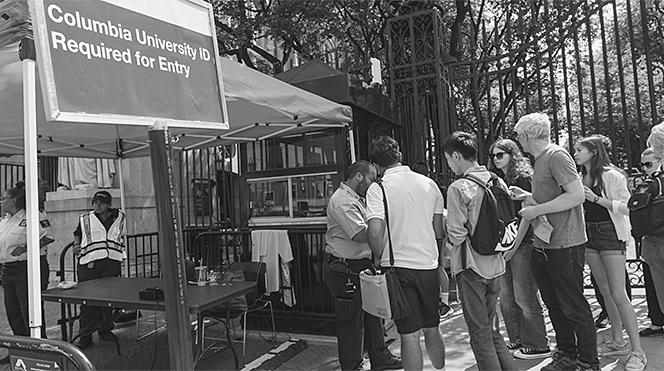
Students, faculty and others wait to enter Columbia University's campus after the school instituted new security rules before the start of the academic year, Aug. 15, 2024. Credit: JSpencer Platt/Getty Images
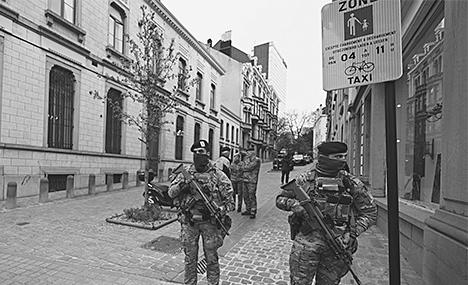
Belgium steps up security around the country as threats escalate against Jewish communities in Europe. Credit: Dursun Aydemir/Anadolu via Getty Images
Synagogues
B’NAI ISRAEL SYNAGOGUE
618 Mynster Street Council Bluffs, IA 51503-0766
712.322.4705 www.cblhs.org
BETH EL SYNAGOGUE
Member of United Synagogues of Conservative Judaism 14506 California Street Omaha, NE 68154-1980
402.492.8550 bethel-omaha.org
BETH ISRAEL
SYNAGOGUE
Member of Union of Orthodox Jewish Congregations of America 12604 Pacific Street Omaha, NE. 68154
402.556.6288 BethIsrael@OrthodoxOmaha.org
CHABAD HOUSE
An Affiliate of Chabad-Lubavitch 1866 South 120 Street Omaha, NE 68144-1646
402.330.1800 OChabad.com email: chabad@aol.com
LINCOLN JEWISH COMMUNITY:
B’NAI JESHURUN
South Street Temple
Union for Reform Judaism
2061 South 20th Street Lincoln, NE 68502-2797
402.435.8004 www.southstreettemple.org
OFFUTT AIR
FORCE BASE
Capehart Chapel 2500 Capehart Road Offutt AFB, NE 68123
402.294.6244 email: oafbjsll@icloud.com
TEMPLE ISRAEL
Union for Reform Judaism (URJ) 13111 Sterling Ridge Drive Omaha, NE 68144-1206
402.556.6536 templeisraelomaha.com
LINCOLN JEWISH COMMUNITY:
TIFERETH ISRAEL
Member of United Synagogue of Conservative Judaism 3219 Sheridan Boulevard Lincoln, NE 68502-5236 402.423.8569 tiferethisraellincoln.org
Monthly Speaker Series Service, Friday, Apr. 10, 7:30 p.m. with our guest speaker. Our service leader is Larry Blass. Everyone is always welcome at B’nai Israel!
For information about our historic synagogue, please visit our website at www.cblhs.org or contact any of our other board members: David Alloy, Renee Corcoran, Rick Katelman, Gail Kenkel, Janie Kulakofsky, Howard Kutler, Ann Moshman, Mary-Beth Muskin, Debbie Salomon and Sissy Silber. Handicap Accessible.
Services conducted by Rabbi Steven Abraham and Hazzan Michael Krausman.
IN-PERSON AND ZOOM MINYAN SCHEDULE:
Mornings on Sundays, 9:30 a.m.; Mondays and Thursdays, 7 a.m.; Evenings on Sunday-Thursday, 5:30 p.m.
FRIDAY: Tot Shabbat 6 p.m. with Dinner; Kabbalat Shabbat, 6 p.m. at Beth El and Live Stream.
SATURDAY: Shabbat Morning Service, 10 a.m at Beth El and Live Stream; Jr. Congregation (Grades K12), 10 a.m.; Havdalah, 8:35 p.m. at Beth El & Zoom.
SUNDAY: Bagels with Bubbe, 9 a.m.; Adult B'nai Mitzvah, 9:30 a.m. with Hazzan Krausman; BESTT (Grades K-7), 9:30 a.m.
MONDAY: The Bible With And Without Jesus 6 p.m. led by Rabbi Abraham & Pastor Johnson at St. Luke.
TUESDAY: Sefer HaMiddot 10:30 a.m. with Rabbi Abraham.
WEDNESDAY: BESTT (Grades 3-7), 4 p.m.; Yom HaShoah Teen Dinner, 5:45 p.m. at the JCC; Yom HaShoah Commemoration, 6:30 p.m. at the JCC.
THURSDAY: The Bible With And Without Jesus 10:30 a.m. led by Rabbi Abraham & Pastor Johnson at St. Luke; Mincha/Ma’ariv, 5:30 p.m. Zoom Only.
FRIDAY-Apr. 17: Six-String Shabbat 6 p.m. at Beth El and Live Stream; Our Shabbat Tables following services.
SATURDAY-Apr. 18: Shabbat Morning Service, 10 a.m at Beth El and Live Stream; Jr. Congregation (Grades K-12) 10 a.m.; Havdalah, 8:45 p.m. at Beth El & Zoom. Please visit bethel-omaha.org for additional information and service links.
Please visit orthodoxomaha.org for additional information and Zoom service links.
Join classes via Zoom. Go to ochabad.com/academy. For more information or to request help, please visit www.ochabad.com or call the office at 402.330.1800.
FRIDAY: Shacharit, 10 a.m.; Lechayim, 5:30 p.m., go to ochabad.com/lechayim to join; Candlelighting, 7:41 p.m.
SATURDAY: Shacharit 10 a.m. followed by Kiddush and Cholent; Shabbat Ends, 8:42 p.m.
SUNDAY: Sunday Morning Wraps, 9 a.m.
MONDAY: Shacharit 8 a.m.; Personal Parsha 9:30 a.m. with Shani; Intermediate Biblical Hebrew Grammar, 10:30 a.m. with David Cohen; Parsha Reading, 6 p.m. with David Cohen; Translating Words of Prayer, 7 p.m. with David Cohen.
TUESDAY: Shacharit 8 a.m.; Aramaic Grammar, 10 a.m. with David Cohen; Intermediate Biblical Hebrew Grammar, 6 p.m. with David Cohen; Introductory Biblical Hebrew Grammar, 7 p.m. with David Cohen.
WEDNESDAY: Shacharit, 8 a.m.; Introductory Biblical Hebrew Grammar, 10:30 a.m. with David Cohen; Parsha Reading, 11:30 a.m. with David Cohen.
THURSDAY: Shacharit, 8 a.m.; Introductory Biblical Hebrew Grammar, 10 a.m. with David Cohen; Advanced Biblical Hebrew Grammar, 11 a.m. with David Cohen; Talmud Study, noon; Introduction to Alphabet, Vowels & Reading Hebrew, 6 p.m. with David Cohen; Code of Jewish Law Class, 7 p.m.
FRIDAY-Apr. 17: Shacharit, 10 a.m.; Lechayim, 5:30 p.m., go to ochabad.com/lechayim to join; Candlelighting, 7:48 p.m.
SATURDAY-Apr. 18: Shacharit 10 a.m. followed by Kiddush and Cholent; Shabbat Ends, 8:51 p.m.
LINCOLN JEWISH COMMUNITY: B’NAI JESHURUN & TIFERETH ISRAEL
Services facilitated by Rabbi Alex Felch. All services offered in-person with live-stream or teleconferencing options.
FRIDAY: Kabbalat Shabbat Service, 6:30-7:30 p.m.
FBI confirms: Temple Israel attacker was
PHILISSA CRAMER
JTA
The man who attacked Temple Israel in suburban Detroit last month was inspired by Hezbollah, the FBI confirmed on March 30.
Ayman Ghazali sent a video to his sister in Lebanon shortly before driving a fireworks-laden truck into the West Bloomfield, Michigan, Reform synagogue on March 12, the FBI revealed during a press conference in Detroit.
“This is the largest gathering place for Israelis in the state of Michigan in the United States,” he said in the video. “I have booby-trapped the car. I will forcefully enter and start shooting them. God willing, I will kill as many of them as I possibly can.”
Ghazali was the only person to die in the attack, which injured a security guard and severely damaged the Temple Israel building. He died after shooting himself while trapped inside his truck as it burst into flames.
Israel previously said that Ghazali’s brother, who had been killed in Lebanon days before the attack, was a Hezbollah commander.
“Hezbollah commander Ibrahim Muhammad Ghazali was responsible for managing weapons op-
led by Rabbi Alex at SST followed by an Oneg; Shabbat Candlelighting, 7:43 p.m.
SATURDAY: Shabbat Morning Service, 9:30 a.m. led by Rabbi Alex at TI; Torah Study 12:30 p.m. on Shmini via Zoom; Havdalah, 8:44 p.m.
SUNDAY: LJCS, 10 a.m. at Wyuka for Yom HaShoah; Men’s Bike/Coffee Group, 10:30 a.m. at Rock 'N' Joe Coffee, 5025 Lindberg St, Lincoln. For more information or questions please email Al Weiss at albertw801@gmail.com
WEDNESDAY: Men’s Lunch Group, 12:15 p.m. at Horisun Hospice, 8055 O St #300, Lincoln. We meet in the conference room. Bring your own lunch and beverage. For more information, contact Albert Weiss at albertw801@gmail.com; LJCS Hebrew School, 4:30-6 p.m.
FRIDAY-Apr. 17: Kabbalat Shabbat Service, 6:307:30 p.m. led by Rabbi Alex at SST followed by an Oneg; Shabbat Candlelighting, 7:50 p.m.
SATURDAY-Apr. 18: Shabbat Morning Service, 9:30 a.m. led by Rabbi Alex at TI; Torah Study, 12:30 p.m. on Parashat Tazria-Metzora via Zoom; Family Potluck and Game Night, 6 p.m. at SST. Bring a dish to share for the potluck beginning at 6 p.m. Games are available to play, but feel free to bring one of your favorites! Games begin at 7 p.m.; Havdalah, 8:53 p.m.
FRIDAYS: Virtual Shabbat Service, 7:30 p.m. every first and third of the month at Capehart Chapel. Contact TSgt Jason Rife at OAFBJSLL@icloud.com for more information.
In-person and virtual services conducted by Rabbi Benjamin Sharff, Rabbi Deana Sussman Berezin, and Cantor Joanna Alexander.
Please visit templeisraelomaha.com for additional information and Zoom service links.
‘Hezbollah-inspired’
erations within a specialized branch of the Badr Unit. The unit is responsible for launching hundreds of rockets toward Israeli civilians throughout the war,” the IDF said in a statement, adding, “Ibrahim was eliminated in an IAF strike on a Hezbollah military structure.”
The IDF’s statement did not suggest that Ayman Ghazali was affiliated with Hezbollah. The New York Times reported that he attended a memorial service for those killed in the strike, who included Ibrahim’s young children, at a Dearborn Heights mosque on March 8 that was attended by hundreds of people, many from the Ghazalis’ town.
terrorism purposely targeting the Jewish community,” Jennifer Runyan, the FBI’s special agent in charge in Detroit, said at the FBI press conference.
Ghazali’s ties to Lebanon have prompted a sharp discourse about news coverage of the Michigan attack, with some alleging that focusing on his brother’s death runs the risk of suggesting that attacking a Jewish institution in the United States is an appropriate response to grief during wartime.
“Based on the evidence gathered to date, we assess this attack to be a Hezbollah-inspired act of
B’NAI ISRAEL
BETH EL
BETH ISRAEL
CHABAD HOUSE
She said Ghazali had begun searching for proHezbollah materials online early this year but began planning the specific attack only days before it took place, buying an automatic rifle as well as explosives before heading from his home in Dearborn Heights to West Bloomfield.
Law enforcement remain on site at the Temple Israel synagogue in West Bloomfield, Michigan. Credit: Jeff Kowalsky/AFP via Getty Images
A Lego on the seder plate
GRACE GILSON
JTA
At Temple Israel in suburban Detroit, where congregants are still reeling from last month’s attack in which a man drove a vehicle filled with explosives into the building, a new Passover tradition took shape.
“This Passover, we’re adding something new to our Seder plates: a single Lego block,” Temple Israel wrote in a post on Facebook.
The attack on Temple Israel, a Reform congregation and the country’s largest synagogue, took place as 104 preschoolers were inside the building. The assailant, Ayman Ghazali, was the only person to die in the ramming attack, which severely damaged the synagogue building and left one of its security guards injured.
While all the children were evacuated, their presence has shaped the synagogue’s call to add the children’s toy to seder plates as a symbol of both vulnerability and rebuilding.
“A Lego is a child’s toy — it represents the innocence that was threatened, and the lives that were protected. It represents our creativity, our strength, and the sacred work of putting the pieces back together again,” the post continued. “Place a Lego on your Seder plate this year. For our kids and our teachers. For our community. For the future we are building together.”
tacked. Pennsylvania Gov. Josh Shapiro was slated to host a seder with interfaith leaders to commemorate one year since an arsonist attacked his official residence hours after he and his family hosted a Passover seder there. The seder was held in the same room that was burned during the attack.
And in Minneapolis, Shir Tikvah, a Reform congregation, called on others to include a “steaming cup of tea in a travel mug” in the Passover seder to honor the community’s response to the Trump administration’s aggressive immigration enforcement policies in the area.
In the comments of the post, dozens of people pledged to include Legos in their Passover seders this year.
“I love this meaningful idea representing resilience and strength. I will put legos on our Seder plate in Santa Monica. Wishing all of the clergy and my Temple Israel family a Happy, Healthy and Peaceful Passover!” wrote one user.
Temple Israel was not the only victim of an antisemitic attack to be marking Passover for the first time since being at-
SUBMIT OBITUARIES TO THE JEWISH PRESS:
“After you open the door for Elijah and before you pour the fourth cup of wine, we invite you to pour tea for everyone at your table from your shared cup,” the congregation wrote in a post on Facebook. “As you enjoy your tea, take a moment to share how you hope to show up in your communities this year.”
Temple Israel’s symbolic addition to the holiday this year was also not the first time Jews have modified the seder plate’s traditional components to reflect the dangers that Jews increasingly face.
During the IsraelHamas war, some families included mirrors, yellow ribbons and pomegranates on their plates to honor the hostages still held at the time in Hamas captivity. This was the first Passover since the last living hostages were freed in October.
“There’s something comforting about what we know, but what if, alongside those familiar traditions, we also made room for something new and unexpected,” Rabbi Rick Jacobs, the president of the Union for Reform Judaism, said in a Facebook video posted Tuesday. “Rather than simply going through the motions, we might lean into the surge of Jewish pride we’re seeing all around us, even amid the current epidemic of antiJewish and anti-Israel hatred.”
Email the Press at jpress@jewishomaha.org; mail to 333 So. 132 St., Omaha, NE 68154; or online at online at www.omahajewishpress.com/site/forms/
ANNOUNCEMENT
ADVERTISE STATEWIDE for $225/25 word classified ad. Over 120 newspapers with circulation of more than 237,000. Contact the Jewish Press or call 1-800-369-2850.
HELLO NEBRASKA! Introducing www.nepublicnotices.com, a new public notice website presented as a public service by all Nebraska newspapers. Free access, fully searchable – because democracy depends upon open government and your right to know.
BANKRUPTCY RELIEF! Help stop Creditor Harassment, Collection Calls, Repossession and Legal Actions! Speak to a Professional Attorney and Get the Help You NEED! Call NOW 844-215-3629
AFFORDABLE PRESS Release service. Send your message to over 120 newspapers across Nebraska for one low price! Call 1800-369-2850 or www.nebpress.com for more details.
FOR SALE - INSURANCE
DENTAL INSURANCE from Physicians Mutual Insurance Company. Coverage for 350 plus procedures. Real dental insuranceNOT just a discount plan. Do not wait! Call now! Get your FREE Dental Information Kit with all the details! 1-855-490-4149 www.dental50plus.com/81 #6258
GUN SHOW
GUN SHOW: April 10-13 2026, High School Gym, Council Bluffs, IA Fri 4-9pm, Sat. 9am-5pm, Sun. 9am-3pm. $10 (under 12 FREE) . More info: 563-608-4401www.marvkrauspromotions.net
KEARNEY GUN & Coin Show, April 18th and 19th Sat. 9 a.m.-5 p.m., Sun. 9 a.m.-4 p.m. Expo Center, Fairgrounds, Kearney, NE.
HELP WANTED
DISMAL RIVER Club Now Hiring! Seasonal positions open in Housekeeping, Laundry, Kitchen Staff, Receptionist, Server/Bartender, Massage Therapist, Greens Keeper, Irrigation Technician. Housing Available! dismalriver.com/about/careers/ 308-5462900
HOME SERVICES
DOES YOUR basement or crawl space need some attention? Call Thrasher Foundation Repair! A permanent solution for waterproofing, failing foundations, sinking concrete and nasty crawl spaces. FREE Inspection & Same Day Estimate. $250 off ANY project with code GET250. Call 1-844-958-3431
PREPARE FOR power outages today with a Generac Home Standby Generator. Act now to receive a FREE 5-Year warranty with qualifying purchase. Call 1-402-899-2584 today to schedule a free quote. It’s not just a generator. It’s a power move.
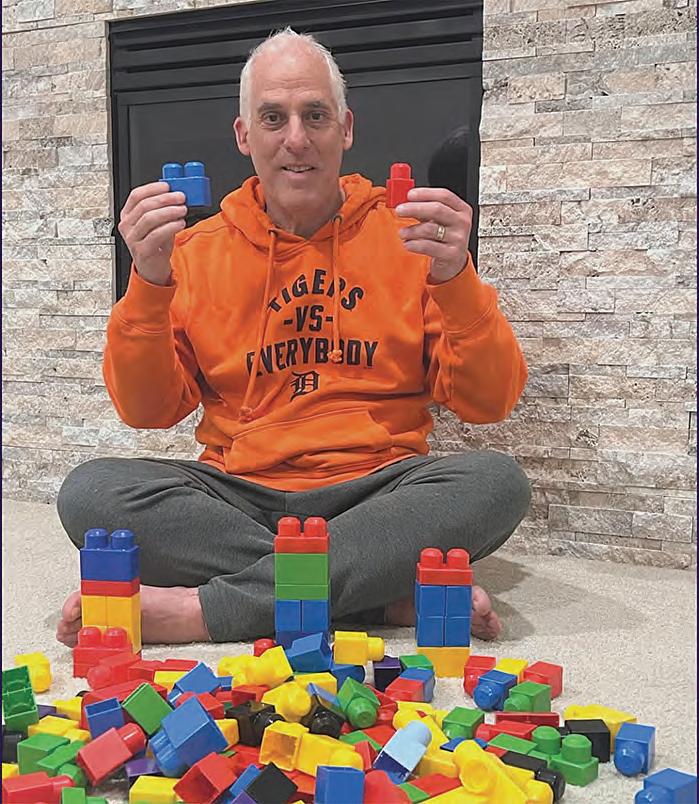
Rabbi Josh Bennett of Temple Israel in Detroit holds Lego blocks, urging families to add the children’s toy to their Seder plates in the wake of a recent attack on the synagogue. Credit: Facebook
Listening with Raizy Metzger News
with Chabad of Nebraska
The Lubavitcher Rebbe (Z”L) used to say that autistic individuals, particularly non-verbal, had a harder time connecting with other people because they were better at connecting with Hashem. He also said that the day you were born was the day Hashem believed the world could not keep turning without you. We were all put here with a purpose and given the tools to complete it; different purposes necessitate different tools.
But believing that is easier said than done. It’s natural to compare what we have to others, especially when it comes to skills everyone is expected to have, like speech. Raizy Metzger, Rebbetzin of Chabad Sutton in Manhattan, ran into this conflict when her son, Mendel, was diagnosed with non-verbal autism.
Metzger spent much of her son’s childhood looking for treatment, but in the process learned that there are other ways to communicate with a person. She calls this “listening with your heart,” and uses that phrase to teach others how to interact with kids and adults like Mendel.
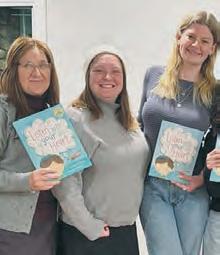
About a decade ago, for her personal circle, she wrote a short story about a Jewish boy named Ari who likes water parks, biking, and trampoline just like other kids. Ari is nonverbal, so he tries to ask another boy to join him on the seesaw by grabbing his arm. He’s not received well at first—but once he encounters a friend willing to “listen with his heart”
rather than relying on words, the two are able to enjoy time on the seesaw together.
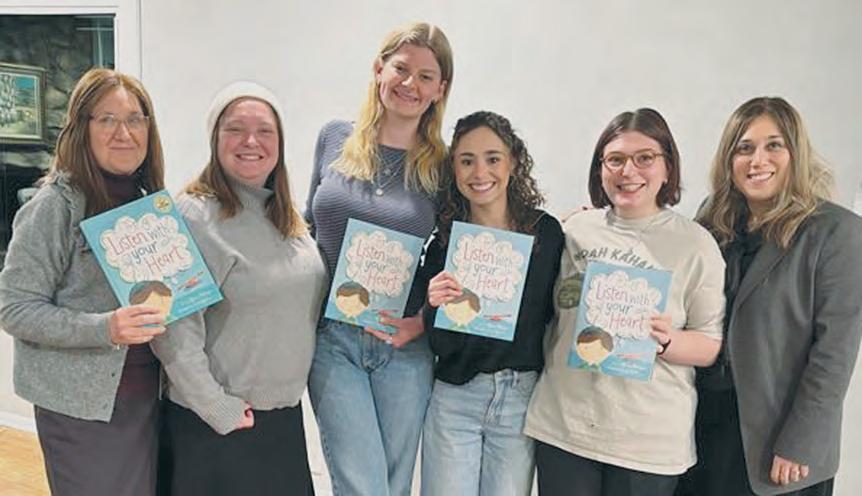
Metzger circulated this version of the story to friends and family, and was eventually convinced to turn it into an illustrated children’s book. Esty Raskin joined the project as illustrator, and the two selfpublished the book in 2022, later getting picked up by publisher Judaica Press.
On Monday, March 22, 2026, Chabad of Nebraska had the honor of hosting Metzger at a women’s luncheon to hear her story and discuss the book. Monday morning, Metzger met with students from Spirit and Grace Academy (SAGA) and helped Heart of the Heartland bake cookies with Chabad’s Kitchen of Kindness. In the evening, she met with a Jewish student group from Creighton University. Whether presenting to children, adults, neurotypical, or neurodivergent people, her message is the same: with patience, we can all work to be better listeners. People like Ari deserve peers who will put in the effort to understand them, and all of us can work to be those peers.
She shared with us some of her son’s words, written by pointing to letters on an alphabet printout. Mendel is skilled with language when given the time to write things out, and has used this skill for speeches and d’var Torah. In his piece Metzger read to us, he expressed the importance of not judging a book by its cover—that he was a book placed in the children’s section with contents that deserved
to be shelved with adventure books. Metzger also shared with us a piece of wisdom she received from another non-verbal adult. She asked if she should communicate with her son through typing like he does, or if she should continue to speak to him in a way he can’t reciprocate. She was advised “You were blessed with a voice; use it.”
We’re learning more about mental health every day, but there’s a lot we still don’t understand. Every individual is different—it’s one of Hashem’s greatest blessings—and it means things like communication can require a lot of patience and troubleshooting. Raizy Metzger came to our community with an open,
listening heart to teach us the importance of putting in that work. She helped us focus not on what others are doing, but on what we can do to best support our peers—because every person deserves to be understood. This program was made possible by the Shirley and Leonard Goldstein Supporting Foundation at the Jewish Federation of Omaha and the Jennifer Beth Kay Mental Health Fund. If you want to learn more about the Friendship Circle or get involved at Chabad, we welcome your presence and insights and look forward to hearing from you at either 402.330.1800 or office@ochabad.com