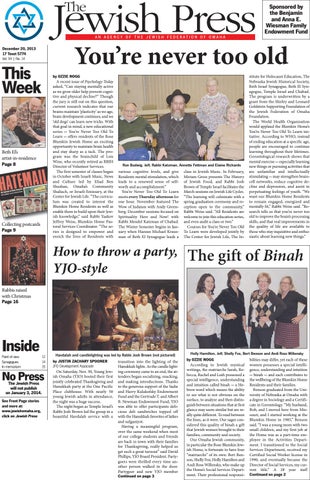
Sponsored by the Benjamin and Anna E. Wiesman Family Endowment Fund AN AGENCY OF THE JEWISH FEDERATION OF OMAHA
You’re never too old
December 20, 2013 17 Tevet 5774 Vol. 94 | No. 14
This Week
by OZZIE NOGG A recent issue of Psychology Today asked, “Can staying mentally active as we grow older help prevent cognitive and physical decline?” Though the jury is still out on this question, current research indicates that our brains maintain ‘plasticity’ as we age, brain development continues, and we ‘old dogs’ can learn new tricks. With that goal in mind, a new educational series -- You’re Never Too Old To Learn -- offers residents of the Rose Blumkin Jewish Home an exciting opportunity to maintain brain health and stay sharp as a tack. The program was the brainchild of Lois Wine, who recently retired as RBJH Director of Volunteer Services. The first semester of classes began in October with Israeli Music, News and Culture led by Eliad Ben Shushan, Omaha’s Community Shaliach, or Israeli Emissary, at the Center for Jewish Life. “The curriculum was created to interest the Blumkin Home Residents as well as enable them to build upon their Jewish knowledge,” said Rabbi Yaakov Jeffrey Weiss, Blumkin Home Pastoral Services Coordinator. “The series is designed to empower and enrich the lives of Residents with
Beth El’s artist-in-residence Page 8
Collecting postcards Page 9
Ron Budwig, left, Rabbi Katzman, Annette Fettman and Elaine Richards various cognitive levels, and give Residents mental stimulation, which leads to a renewed sense of selfworth and accomplishment.” You’re Never Too Old To Learn meets every Thursday afternoon for one hour. November featured The Wow of Judaism with Andy Greenberg. December sessions focused on Spirituality Here and Now! with Rabbi Mendel Katzman of Chabad. The Winter Semester begins in January when Hazzan Michael Krausman of Beth El Synagogue leads a
class in Jewish Music. In February, Miriam Gross presents The History of Jewish Food, and Rabbi Josh Brown of Temple Israel facilitates the March sessions on Jewish Life Cycles. “The learning will culminate with a spring graduation ceremony and reception open to the community,” Rabbi Weiss said. “All Residents are welcome to join this education series, and even audit a class or two.” Courses for You’re Never Too Old To Learn were developed jointly by The Center for Jewish Life, The In-
stitute for Holocaust Education, The Nebraska Jewish Historical Society, Beth Israel Synagogue, Beth El Synagogue, Temple Israel and Chabad. The program is underwritten by a grant from the Shirley and Leonard Goldstein Supporting Foundation of the Jewish Federation of Omaha Foundation. The World Health Organization would applaud the Blumkin Home’s You’re Never Too Old To Learn initiative. According to WHO, instead of ending education at a specific age, people are encouraged to continue learning throughout their lifetimes. Gerontological research shows that mental exercise -- especially learning new things or pursuing activities that are unfamiliar and intellectually stimulating -- may strengthen braincell networks, reduce cognitive decline and depression, and assist in perpetuating feelings of youth. “We want our Blumkin Home Residents to remain engaged, energized and mentally fit,” Rabbi Weiss said. “Research tells us that you’re never too old to improve the brain’s processing skills, and that real improvements in the quality of life are available to those who stay inquisitive and enthusiastic about learning new things.”
How to throw a party, The gift of Binah YJO-style Rabbis raised with Christmas Page 16
Inside Point of view Synagogues In memoriam
12 14 15
No Press The Jewish Press will not publish on January 3, 2014. See Front Page stories and more at: www.jewishomaha.org, click on Jewish Press
Havdalah and candlelighting was led by Rabbi Josh Brown (not pictured) by JUSTIN ZACHARY SPOONER transition into the lighting of the JFO Development Associate Hanukkah lights. As the candle lightOn Saturday, Nov. 30, Young Jew- ing ceremony came to an end, the atish Omaha (YJO) hosted their first tendees began socializing, snacking, jointly celebrated Thanksgiving and and making introductions. Thanks Hanukkah party at the One Pacific to the generous support of the Sadie Place clubhouse. With nearly 50 and Harry Kulakofsky Endowment young Jewish adults in attendance, Fund and the Gertrude T. and Albert the night was a huge success. B. Newman Endowment Fund, YJO The night began as Temple Israel’s was able to offer participants deliRabbi Josh Brown led the group in a cious deli sandwiches topped off beautiful Havdalah service with a with the Hanukkah favorites of latkes and sufganiyot. Having a meaningful program, over the same weekend when most of our college students and friends are back in town with their families for Thanksgiving, really helped us get such a great turnout” said David Phillips, YJO Board President. Partygoers were thrilled every time another person walked in the door. Partygoer and new YJO member Continued on page 3
Holly Hamilton, left, Shelly Fox, Bert Benson and Andi Ross Willensky by OZZIE NOGG According to Jewish mystical writings, the matriarchs Sarah, Rebecca, Rachel and Leah possessed a special intelligence, understanding and intuition called binah -- a Hebrew word which means the ability to see what is not obvious on the surface, to analyze and then distinguish between situations that at first glance may seem similar but are really quite different. To read between the lines, as it were. Our sages considered this quality of binah a gift that Jewish women brought to their families, community and society. Our Omaha Jewish community, in particular the Rose Blumkin Jewish Home, is fortunate to have four “matriarchs” of its own: Bert Benson, Shelly Fox, Holly Hamilton and Andi Ross Willensky, who make up the Home’s Social Services Department. Their professional responsi-
bilities may differ, yet each of these women possesses a special intelligence, understanding and intuition -- binah -- and each contributes to the wellbeing of the Blumkin Home Residents and their families. Benson graduated from the University of Nebraska at Omaha with a degree in Sociology and a Certificate in Gerontology. “My husband, Bob, and I moved here from Missouri, and I started working at the Blumkin Home in 1985,” Benson said. “I was a young mom with two small children, and my first job at the Home was as a part-time employee in the Activities Department. I transitioned to the Social Services Department, received my Certified Social Worker license in 1990, and eventually became the Director of Social Services, my current title.” A 28 year staff Continued on page 2
2 | The Jewish Press | December 20, 2013 Wishingeveryone had a Happy Hanukkahand Happy Holidays!
fun for all!
Carl Jennings President/CEO
402.391.6253 Celebrating 95 years For all your corporate picnics, concerts, reunions and special events. www.peonypark.com
Located 15 minutes from Omaha on the EAST side of Wahoo.
THINKING OF MOVING? Now is the time to meet with us for a free market analysis and staging consultation.
NOW AVAILABLE FOR SALE 8017 N. 146th St. 4855 Blondo St. 2601 S. 48 Ave. 16722 Marcy Cir. 1722 S. 107th St. 16627 Marcy St. 9511 Frederick Cir. 1415 N 132 Ave. Cir. 1110 N. 133rd St.
Alan Cohen
$129,950 $147,500 $169,950 $329,000 $355,000 $405,000 $410,000 $510,000 $817,500
Darling Starter Home Midtown All Brick True Ranch w/2 Car Garage 1 1/2 Story Cambridge Oaks District 66 All Brick 2 Story Cambridge Oaks 1 1/2 Story District 66 Linden Estates Villa Linden Estate True Ranch
Anne Cohen
Marty Cohen
402-677-2524 402-850-4161 402-690-1591
Are you TURNING 65 years old? Need HELP understanding your MEDICARE OPTIONS?
CALL ME to discuss your Medicare Rights, Options, and Entitlements TODAY!
What you don’t know could COST YOU! than d with more
Appointe Life Companies... & 50 Health costs + Benefits re a p Com TODAY!
For more information contact:
Let’s talk about the benefits that matter most to you.
Kim Shulters Senior Insurance Specialist 402-968-1500 kimshulters@gmail.com
The gift of Binah Continued from page 1 member of the Blumkin Home, Benson is considered the unofficial RBJH archivist. By now, Bert estimates she has met approximately 1,900 Residents. “I’m so privileged to have known generations of families in the Jewish community, and, in some cases, the fourth or fifth generation. I hope they think of me as a constant, trusted member of the facility -- someone they can call on for assistance at any time.” As Director of Social Services, Benson’s responsibilities include documentation, assessments, care planning and assisting Residents and families in making decisions about day-to-day life at the Home -- everything from what clothes to bring and what personal items to add to their room. “We discuss financial matters, roommate compatibility issues, referrals to medical and other professionals and end-of-life care. Each Resident has his or her own set of concerns that require attention.” Benson meets often with all staff and departments to discuss issues of the moment and to plan for upcoming events. “Working as a team is vital to providing great customer service,” Bert said. “Confidential email keeps everyone updated throughout the day.” In Benson’s words, “Each member of the social services team has a niche they fill. I work with all the Residents, but particularly long-term Residents who make the Blumkin Home their home. Shelly Fox works primarily with older members of the Jewish Community, and Andi handles the RBJH admissions process. Holly works with some long-term Residents, but mostly with members of the community who plan to return to their own homes after a rehabilitative stay here at the facility. Right now, I’m Holly’s immediate supervisor.” Which suits Hamilton just fine. “My responsibilities as a social worker are never-ending,” Holly said, “and Bert is a great mentor, helping me learn the ropes and become part of the larger team.” Hamilton graduated from UNO with a Bachelor of Social Work degree and is licensed through the State of Nebraska. “In this field, you learn to wear many hats,” Holly said. “Besides my role within the social work team, I interact with all the Blumkin Home staff -- from therapy, nursing, dietary and housekeeping. Each department has its own unique personality and individual leadership.” Hamilton’s career path has been diverse. She worked with a State agency that provided counseling and parenting to families separated by the court system; was lead teacher for two- and three-year olds at a preschool program, acted as site supervisor for an Omaha Public Schools after-school program, and then served for five years as Social Services Director at a private, for-profit facility. “I loved working with children,” Holly said, “but ultimately my passion was with the geriatric population because of the knowledge and wisdom they can pass on to us.” Hamilton has been with the Blumkin Home for 18 months. “My role as Social Worker gives me the opportunity and enjoyment of getting to know all the Residents and their families. I hope they would say my door is always open with a smile, that I’m there to help them when they need help, and that they were heard when they took the time to share personal feelings or concerns with me.” Holly considers the other three women in the Blumkin Home Social Work Department her role models. “We each bring our own piece of the puzzle to the Home that helps make it complete, and we all learn from one another. We’re each unique in the way we deal with families and Residents, but we all put the families and Residents first. We meet whenever needed, whatever time of day, for however long is necessary. We’re in communication daily and extend support to each and every Resident, not just the ones specifically in our charge.” Open communication is a mantra among the Blumkin Home social work foursome. “I have direct contact with RBJH Residents and their families every day,” said Shelly Fox, MSW, Director of Jewish Senior Outreach Services and Director of Admissions at the Blumkin Home. “My office is located right between two Resident neighborhoods, so I’m lucky to have many folks stop by to check in or just say hello. When a Resident or family member needs to discuss private matters - a referral for more care for Mom at home, a community member requesting Kosher meal delivery, or an individual in crisis who is reaching out for immediate help -- I shut my office door and try to provide the appropriate interventions and attention that ensure the safety and health of our community elders. I consider myself an advocate for older individuals and their families. The most important thing I can do is make sure I’m available and responsive. Every situation is so different. We can’t always fix everything, but we can always listen and give someone the time and attention they deserve.” Fox makes a point to visit Residents in their rooms and to attend Blumkin Home activities when her schedule permits. “It’s so important for us to be available, to provide a trusted ear, to make sure no one ever feels they’re a bother or that you don’t have time for them.” Shelly has been a member of the RBJH staff for ten years. She began her career at the facility as she was graduating from the School of Social Work at
UNO and went on to earn her Master’s degree while working at the Home. Shelly often finds herself meeting off-campus with older Jewish adults in the community. “In my Outreach work I spend time with clients in their own homes. It’s such a privilege to be invited into someone’s private space and have them share their story with me. In some cases, after several years, these clients become Residents of the Home. I’m hopeful that the familiarity we’ve established is helpful as I assist in their admissions process. I’m lucky enough to form close, trusted relationships with amazing elders and their family members. My work is challenging, rewarding and always a privilege. It’s not unusual for me to become actively involved with folks during a serious illness or at the end of their lives. My goal is to offer help or reassurance to families as they experience a loss -- to be there if needed and offer support. The work I do can sometimes be sad, but I also have fun and experience joy from meeting wonderful people and developing special relationships.” Echoing her social work cohorts, Fox also emphasizes the importance of teamwork. “We meet first thing each morning and many times throughout the day, if needed. Each one of my teammates brings a special talent to her professional role. We work collaboratively, performing different roles, and we’re always there to cover for one another and assist our elders and their families.” As Director of Admissions, Shelly assists Andi Willinsky in adjusting to her role as Admissions Coordinator. A relative “newbie” on the Blumkin Home social work team, Willensky comes to the position with impressive credentials: a B.S. in Speech Pathology from Syracuse University; an M.A. in Speech Pathology from California State University, Los Angeles; and an M.S. in Clinical Counseling from Bellevue University. “In my former career as a speech pathologist, I worked primarily with the geriatric population who had suffered stroke, progressive neurological disease and cognitive decline,” Andi explained. “My current job title, Blumkin Home Admissions Coordinator, perfectly explains my position, except for that intangible piece which includes being a knowledgeable and welcoming first contact to the Blumkin Home for potential Residents, their families and for community referral sources. The particular skill I want to bring to this job is the ability to listen to a person’s worries and fears. As Admissions Coordinator, I need to actively hear what people say so I can then make appropriate placements, help potential Residents feel comfortable with their choices, and give them a sense of security. When people are elderly and experience illness and physical or mental decline, it’s essential to treat them with dignity, honor and compassion.” Willensky is quick to say that although she now sits in Shane Kotok’s former office, she is not taking over for Kotok. “When I moved to Omaha twenty years ago, I immediately learned that the Rose Blumkin Jewish Home was known throughout the city for providing the finest skilled nursing care available. It was bersherit that Shane, then the Blumkin Home’s Admissions Director, was available to give me a tour of the facility. Shane was the first Jewish person I met in Omaha and she was a wealth of information and very inspiring. She still inspires me. Fast forward 20 years, and as Shane begins her well-deserved retirement, I’m privileged to take on the position of Admissions Coordinator, but in no way can I duplicate Shane’s contribution to the Home. Her special brand of appreciation and respect for each Resident and their families and her sensitivity to Jewish values are irreplaceable. Shane embodies binah. She continues to generously share her expertise and wisdom with me to make this transition successful. I’m indebted to her personally and professionally. The entire Omaha Jewish community benefited from Shane’s gentle ways and acts of loving kindness.” Bert Benson and Shelly Fox share Andi Willensky’s sentiments: “I have been so privileged to work with Shane for my entire career at the Blumkin Home,” Benson said. “Her dedication to the community, to Jewish custom and her ethical standards have been inspiring. I will miss her.” To which Fox added, “Shane has been an amazing role model to learn from and work side-by-side with. The care and attention she showed our community set the bar high for all who follow. I’m so lucky to have worked with her and to call her my friend.” A statement from the American Geriatrics Society and the American Association of Geriatric Psychiatry describes the role nursing home social workers play in addressing the needs of Residents by providing comfort and security, enjoyable relationships, meaningful activity, individuality, privacy, autonomy, dignity and spiritual wellbeing. In The Role Of The Social Worker In The Long-Term Care Facility (printed by the Missouri Long-Term Care Ombudsman Program 2008), editors Novella Perrin and Joanne Polowy write, “The role of the social worker in a long-term care facility is to enable each individual to function at the highest possible level of social and emotional wellness.” A tall order, but the RBJH social workers are determined to fill it. Continued on page 3
December 20, 2013 | The Jewish Press | 3
YJO Thanksgiving/Hanukkah party
Photos clockwise from top left: Emily Giller, left, Tom Marston, Michael Friedman, Rachel Javitch, Daniel Canfield, and Mark Javitch; Naomi Fox and Andrew Boehm; David
Phillips, left, Jacob Phillips and Ben Fabrikant; Sarah Linn, left, Jody Levine.
Continued from page 1 Matan Gill said, “I enjoyed catching up with old friends who I don’t get to see very often other than at YJO events -- I am very thankful to YJO for giving us these opportunities.” Overall, the Thanksgiving and Hanukkah party was such a huge success, and it gives us momentum heading into our end-of-the-year programing. What’s next for YJO? We’re teaming up with the Young Adult Committee (YAC) from Beth El, Temple Israel and Beth Israel to throw the annual YJO Matzah Ball Bash on Tuesday, Dec. 24 at 8:30 p.m. Start time and location will be
published on the YJO Facebook page. As YAC Chairwoman Caryn Scheer notes, “Join your fellow 20s and 30s crowd in Omaha for their 3rd Annual Matzah Ball Bash! (Really, what else is there to do in this town on Christmas Eve?) This year's theme is Chinese Food and a Movie. $5 admission includes Chinese munchies provided by Star Deli, and your first drink at the bar. Must be 21 to attend. Dress as your favorite movie character and earn a chance to be awarded an Oscar (ok, maybe not a real Oscar, but a fabulous prize).” To RSVP for the Matzah Ball contact Zach Spooner at zspponer@jewishomaha.org or call him at 402-334-6431.
The gift of Binah Continued from page 2 “The social work team is a dynamic force,” Holly Hamilton said, “and the most compassionate group of individuals I’ve ever met. The women on the team don’t look for shortcuts or ways to make our work easier. Our work is never about us. Our work is always about the Residents. The decision to place a loved one in a nursing home can be wrenching, so we do our best to put everyone at ease, to assure them that the Blumkin Home is a safe, secure environment that provides an unmatched level of medical and emotional care. A place where they’re comfortable sharing their feelings, their stories and memories. At the end of any given day, I want to know that I touched someone -- whether with a smile, a shoulder to cry on or a hug when there are no words to say. I want to know I tried my best to make their life easier for a moment.” Benson, Fox, Hamilton and Willensky give kudos to the Blumkin Home’s administrative staff and the Jewish Social Services Board, crediting them with providing “above and beyond” support. “Our mission,” Fox said, “is to fulfill the mitzvah of Mipnei Seivah Takem (you shall rise and show respect to the aged). This facility is blessed with management willing to find the resources and come up with creative solutions that help us continue providing the exceptional services and programs our Residents deserve.” “My co-workers in every department of the Blumkin Home are so supportive,” Hamilton said. “And the four amazing women on the social work team provide constant encouragement to one another. I’m ever so thankful for all of them. As for the Residents, they’re one-in-a-million. They have so many stories of survival and such pride. There’s no other facility in Omaha where you can share that kind of history. I’m proud to work here.”
JEWISH PRESS NOTICE The Jewish Press office is closed Tuesday and Wednesday, Dec. 24 and 25, and Wednesday, Jan. 1, 2014; There will be no Jewish Press on Jan. 3, 2014, due to staff vacations and a need to upgrade computer equipment. Questions? Call 402.334.6448.
Jewish Social Services JEWISH FAMILY SERVICE | JEWISH SENIOR OUTREACH
THE ROSE BLUMKIN JEWISH HOME Rose Blumkin Jewish Home • Rehab Services • Skilled Nursing Care • Respite Care • State-of-the-Art Services and Programs
Jewish Family Service • Counseling • Programs for Developmentally Disabled (YACHAD) • Financial Assistance • Love and Logic
Jewish Senior Outreach • Family Consultation • Community Programming • Kosher Meals-on-Wheels • Transportation • Star Catering
Meeting the Social Service needs of the Omaha Jewish Community
Jewish Family Service | 402-330-2024 | www.jfsomaha.com Rose Blumkin Jewish Home/Jewish Senior Outreach | 402-330-4272 | www.rbjh.com
4 | The Jewish Press | December 20, 2013
So they finally recognized the value of seniors by SYBIL KAPLAN According to an undated American Jewish Joint Distribution Committee web site report, the elderly of Israel are expected to number almost a million by 2015, or about 11% of the population. Those who care about Israel might then be interested to know how senior citizens are treated there. Julian Landau, 78 years old, who came to Israel from the U.S. in 1969 and now volunteers at the offices of the Association of Americans and Canadians in Israel, spoke candidly about this issue. “The Israeli government treats its citizens poorly,” he stated, “because the main thing it gives them [whether they are natives or immigrants] is a pension. But who can live on under 2,000 NIS a month?” Actually, U.S. citizens who meet the requirements of the U.S. Social Security administration can also receive U.S. Social Security. There is also an organization called Ken l’Zaken which has conferences for senior citizens and informs them of their rights, but the government per se really has little involvement with seniors. In or out of the work force, seniors are guaranteed health care and its services are mandatory including primary care and special care, general hospitalization, rehabilitative care and ongoing treatments. Four health funds provide health services and offer supplementary health insurance. If seniors worked in Israel, pension funds were deducted from their salary and are payable after retirement. For those who worked in Israel, left and then returned, today there is a new web site to find out if there is pension money waiting for them that was deducted in previous years. Actually, a few months ago, I received a letter stating when I lived in Israel before, one of my employers had taken out pension money from my salary. Now the insurance company found me and needed information so they could return it to me. After about a month of jumping through some hoops and filling out some forms, the money actually appeared in our bank account. One important issue, according to Landau, is the fact that “old age” is not what it used to be, because people up to the age of 80 and older are active and can contribute to the economy. An article entitled, Senior citizen employment vital to Israeli economy, in April 2012, reported on a survey taken by the Jerusalem Institute for Market Studies. It revealed that 30 per cent of Israeli senior citizens who are not working are able to work, and their net employment would be worth 6.4 billion shekels in income. “The study, Senior Citizens: A Great Unexploited Reservoir of Human Resources, took into account existing polls, which show that 70% of Israel’s 700,000-plus seniors want to work. It added other factors, including the health of the seniors, labor differentials for men and women and unemployment rates. It concluded that while 80,500 seniors are currently
employed, another 219,800 - or approximately 30% - are employable.” The article continued, “The figure of NIS 6.4 billion was reached by using the minimum wage to calculate a conservative estimate of the value of the senior citizens’ potential work.” “Certainly, even under different circumstances not all of these seniors would seek or find work, but keeping them out of the labor force is clearly a great economic loss to Israel and a personal loss for each of them,” said Zev Golan, coauthor of the study.
“Seniors made up 4.8% of the Israeli population in 1955, but will reach 13-14% by the years 2025-30, according to JIMS. Twelve percent of the 65+ population is currently employed, but 71% of men and 63.1% of the women aged 60-64 are in the labor force. “The agenda in Israel is focused on raising the employment rate in the haredi [ultra-religious]and Arab sector,” said Keren Harel-Harari, the study’s other author. “Senior citizens are ignored, though many of them want to work and many of them were working until they were forced or encouraged not to.” Sometime after we arrived in Israel, someone asked us if we had checked with the National Insurance offices to see if we qualified for Israeli social security. It skipped our minds until one very cold and rainy day when we were in their offices, and no one else was there, and we decided to speak with a clerk about Israeli social security. She took some information and said she thought we qualified, particularly since I had lived and worked in Israel previously for 10 years, I was a returning Israeli while my husband, Barry, was a new immigrant, and we were both of the right age to receive a benefit. A few weeks later, we received a letter approving us with Barry receiving one third and me receiving two thirds; every month, the money is promptly put into our bank account. The Association of Americans and Canadians in Israel has
a special senior division, RAPS (retired active persons) for those over 55 with branches in every major city, many smaller cities as well as kibbutzim and moshavim. Throughout the country, there are senior citizen residences such as nursing homes, partial-support homes and retirement buildings. In Jerusalem alone, approximately ten have a sizeable number of English-speaking residents. These Batei Avot (Seniors Residences) are visited by volunteer members of the AACI at least once a month, and every homebound member is visited on the eve of holidays and receives a small gift. For those wishing to rent or buy, apartment rental subsidies and mortgages are available to seniors. In addition to the benefits accruing from membership in AACI itself, the Seniors Division conducts activities and programs of special interest to seniors and their needs. Periodic “retreats” dealing with topics of interest to members are held by AACI branches and regions. Every AACI branch has a Welcome Committee which works in conjunction with the general AACI Klitah Committee to welcome the new Senior immigrants. Once every year a Seniors Congress is held where members and associates meet for three or four days to enjoy being together, touring the region where the Congress is held and discussing pertinent problems of the membership and seniors in general. Together with Histadrut Hagimlaim (the Israel Pensioners’ Organization), they participate in furthering legislation guarding and protecting seniors rights. New immigrant seniors receive an “absorption basket” of money upon arrival in the country and for a period of time over the next year or so. There are special ulpanim (language classes) for women over the age of 60 and men over the age of 65 which last for more months than for younger students, have less hours of classes, are geared to the older students and where teachers pay more attention to their needs. Senior citizens can purchase monthly discounted transportation cards, and the National Insurance Institute (as Julian mentioned above) pays a special old-age benefit to senior citizen immigrant residents of Israel. The Ministry of Senior Citizens’ Affairs issues a senior citizen certificate for discounts in a variety of areas, and the Ministry of Social Affairs and Social Services offers home help, meals, transportation and other forms of aid. Thus, one can see senior citizens and immigrant senior citizens have a variety of benefits available to them. Sybil Kaplan is a very active senior--working as a foreign correspondent for North American Jewish newspapers, lecturing at senior citizen residences and leading walks through Jerusalem’s Jewish produce market, Machaneh Yehudah. Her husband photographs for her stories, has a start-up tour company to bring tourists to Israel and works for a data input company from home. They live in Jerusalem where they are also very active in a Msorti Synagogue.
Russ Kaplan Investments, Inc.
Providing 31 years of investment experience in Nebraska
Call today at 402-614-1321
Visit us on Facebook
Personalized customer service, ensuring your financial plan meets YOUR lifestyle needs. Consultations free. www.russkaplaninvestments.com
December 20, 2013 | The Jewish Press | 5
JFO Partner visits Omaha by SHERRIE SAAG Communications, Jewish Federation of Omaha The Jewish Agency for Israel (JAFI) is an important overseas partner of the Jewish Federation of Omaha. Our donor dollars help to support its important work taking care of Jews around the world; wherever the need is greatest. Earlier this month, the Federation hosted Lisabeth Lobenthal, Director of Israel and Global Philanthropy for JAFI. While in Omaha, Lisabeth met with a number of Federation staff members and lay leaders to broaden the understanding and knowledge of JAFI’s mission to “secure the Jewish future for generations.” Federation allocations support JAFI’s work in the areas of social action, aliyah of choice and rescue, programs for at-risk Israeli youth and Israel experiences for the diaspora. JAFI is also the platform for the Partnership2GETHER program and the Community Shaliach program which brought Eliad Eliyahu Ben Shushan to Omaha last summer to serve as community Shaliach. “JAFI is the global Jewish platform connecting us to Israel and the diaspora in vital and important ways. Staff and volunteers learned a lot about the good work JAFI does in Israel and around the world, and we can all be proud of the support our Federation provides,” said Mike Silverman, CEO of the Jewish Federation of Omaha. “We need Israel as much as they need us,” Lobenthal stated as she met with Federation Campaign staff. In her current position she is Omaha’s point person and conduit for information and education on JAFI’s overseas and Israeli work. “It is all about identity. Thriving and prospering worldwide Jewish communities are a bonus for everyone.” Lobenthal told those present that JAFI operates in 53 countries and currently assists over 60,000 Jews identified as ‘at risk’ with 20,000 of those in Iran. Germany now
has the fastest growing Jewish population in the world. “While aliyah and rescue remain the number one area of interest across the United States, really it is our outreach in remote towns and villages that is a primary focus right now.” “Our job is to be a presence – on the ground, in these small communities – to ensure proper tools and programs are available for those who choose to stay. Our goal is a Jewish community that grows and thrives,” she stated. Growing comm u n i t y includes conducting S u n d a y School, prov i d i n g Jewish camp and Israel exp eriences and operating Masa Israel Journey, a postcollege gap year study abroad program that has almost tripled the number of young Jews who visit Israel each year. In 2012, approximately 6,700 Jewish children and youth from about 120 cities participated in the Jewish Agency’s summer camps. Camps were held in 27 locations throughout Eastern Europe. According to Lobenthal the need for outreach continues unabated. “40% of campers were first-timers in 2012 and 35% had never had any kind of prior camp experience. Twenty-three percent of those campers do not participate in any Jewish activity during the year and only 18% attend Sunday schools.” Lobenthal began her Jewish communal service with a NFTY trip to Israel during high school. That experience led her to earn a degree in Religious Studies from the University of Michigan and a Masters in Jewish Communal Service from Brandeis University. She has previously worked in the Jewish Federation system and as Executive Director for two synagogues. Her position with JAFI allows her to combine her love of Israel with her passion for Jewish continuity. For more information on the Jewish Agency for Israel, go to www.jewish agency.org.
Debbie Massarano earned her title by DAVID GOLBITZ in the areas of education/educational Temple Israel Staff Writer administration and Judaic studies, plus a Temple Israel is proud to announce that supervised educational internship. Debbie earned her degree in Child Director of Lifelong Learning Debbie Massarano has been granted the prestigious Development from California State University at Fullerton. In title of Reform Jewish addition to her teaching Educator by the Reform experience in public schools, Jewish Educator Title she has worked in several Granting Commission. Jewish Day Schools as a The much-coveted title of teacher and Judaic Studies Reform Jewish Educator is awarded only by the Reform Coordinator and in Temple Jewish Educator Title complementary schools. Her Granting Commission comteaching experiences include posed of representatives of a specialty in working with the constituent bodies of students with learning differReform Judaism. These ences. Her expertise lies in include the American providing meaningful, spiriDebbie Massarano Conference of Cantors, the tual experiences through Central Conference of American Rabbis, the prayer, study and community. Commission on Jewish Education, the She served as Regional Educator of the Hebrew Union College-Jewish Institute of Southwest and Midwest Councils of the Religion and its Schools of Education, the Union for Reform Judaism, consulting with National Association of Temple Educators, congregations on educational programming and the Union for Reform Judaism and its from early childhood through adult educaeducational Congregational Consulting tion. Debbie was a member of the inaugural Group. cohort of the Executive Master’s Program at The title is granted to those educators, Hebrew Union College and earned her rabbis and cantors who have fulfilled Master’s of Arts in Religious Education from extremely stringent academic requirements HUC.
How is this publication thinking about the future?
By becoming part of the past. This publication is available from ProQuest Information and Learning in one or more of the following ways: • Online, via the ProQuest® information service • Microform • CD-ROM • Via database licensing
Electronic Databases
Microform & Print
Chadwyck-Healey
Curriculum Products
For more information, call
1-800-521-0600, ext. 2888 (US) or 01-734-761-4700 (International) www.il.proquest.com From
chools Omaha Public High S Tomorrow rs e d a e L y, a d o T rs e Learn 2013 Open Houses Burke High Northwest High Magnet Central High Benson High Magnet South High Magnet Bryan High Career Center North High Magnet
Tuesday, January 7 6:00 - 8:00 p.m. Thursday, January 9 6:00 - 8:00 p.m. Saturday, January 11 2:00 - 4:00 p.m. Sunday, January 12 1:00 - 3:00 p.m. Thursday, January 16 6:00 - 8:00 p.m. Tuesday, January 21 6:00 - 8:00 p.m. Saturday, January 25 10:00 a.m. - Noon Sunday, January 26 1:00 - 3:00 p.m.
6 | The Jewish Press | December 20, 2013
A Tifereth Israel Hanukkah
Living in your home safely ensures your independence
FREE Room-by-Room Home Evaluation ($200 Value)
Grab Bars ● Bath Remodel Railings ● Door Widening Ramps ● Chair Glides
$25 OFF Safety Installation Project Valid for $100 project or more
by LORI FELDMAN The annual Tifereth Israel Hanukkah party was held Dec. 1. This year the social hall was packed with many generations of congregants. The afternoon was filled with famous T.I. latkes prepared by the men’s bicycle group and a spectacular talent show. This could not be done without the organizers, shoppers, chefs, clean up crew! If you haven’t experienced a T.I. Hanukkah, put it on your calendar for next year. Pictured top row: Sarah Kornbluh, Marina and Neva Kushner; middle row: Darry Krout; Lorena Wachendorf; bottm row: Oren Trainin; Zach and Avi Knecht.
Lighting ● Raised Toilets Home Maintenance Services
Call: 402-445-4663 Click: www.SafeAndSoundHM.com
Hanukkah at Remington Heights
402-392-1818
by DAVID GOLBITZ Many of the residents are simply unable to Temple Israel Staff Writer visit a synagogue, so the abbreviated service For each night of Hanukkah, volunteers is used to maintain a connection between the from Temple Israel visit the Remington residents and their Judaism and allows them Heights Retirement Community to cele- an opportunity to say Kaddish for loved ones. brate the holiday with its Jewish residents, Temple Israel’s Caring Committee also and for the past few years, Temple Israel’s high school students have picked a night to light the candles and say the blessings with their elders. “It’s a really nice program, I think,” said sophomore Abby Hack. “All of the residents seemed to have a good time.” The students led the residents in the blessings over the candles and sang Hanukkah Temple Israel high school students celebrated the 8th night songs. They played dreidel of Hanukkah with residents at Remington Heights and a version of bingo that Retirement Community. Abby designed, called Gelt, which had Hebrew letters and images asso- organizes weekly visits to the Blumkin ciated with the holiday rather than numbers. Home, where volunteers wish Temple mem“It was fun,” Abby said. “We had a great bers a good Shabbos. turnout of students and everyone got along “It’s an important thing that Temple does,” really well.” said Jerry Freeman, who often volunteers to In addition to the yearly Hanukkah festiv- visit the Home. “It doesn’t cost anything, it ities at Remington, Temple Israel clergy also doesn’t take that much time... it’s a wondervisit once a month to welcome the Sabbath ful thing for people to know that they with residents. haven’t been forgotten by their community.” “There’s a tendency to assume that once Freeman added that visiting the Blumkin people are in a nursing home or assisted liv- Home is not only nice for the residents, but ing, their spiritual needs are not important,” he gets a little something out of it, too. Rabbi Aryeh Azriel said. “And that’s wrong. “I feel a sense of accomplishment, that I’ve Simply because these residents have reached a contributed in some little way,” he said. “It’s stage in their lives where they’re not a regular not much effort on my part, but it’s a very at services, that does not mean we just forget valuable service, and I’m glad I’m part of it.” about them. They have spiritual needs as well For more information about the Temple as physical needs, and I think the work we do Israel Caring Committee, including informaat the Blumkin Home and at Remington tion about how you can volunteer, visit www. shows them that we still value them as Jews, templeisraelomaha.com/engage/caring or yes, but more importantly as people.” contact Program Director Wendy Goldberg.
Considering changing your Medicare plan? Please contact us before you make any changes. We are here to answer your questions. Jewish Social Services | 402-334-6532
December 20, 2013 | The Jewish Press | 7
My thoughts on aging
From the Crone’s Corner OZZIE NOGG So I’m in a check-out line, and even with my bad hearing I can make out the conversation a woman behind me is having on her cell phone. “This morning,” the woman says, “I go to the dentist and he tells me I need a tooth pulled and he’ll replace it with an implant.” Now comes a pause (I figure the person on the other end is putting in his or her two cents), and then the woman behind me barks into her phone, “Are you kidding? At my age, why would I want an implant? I mean, at my age how much use will I get out of the thing, anyway?” A question to ponder, surely. It’s not uncommon for people in my demographic to offer variations of actuarily-speaking-I-won’t-live-much-longerso-why-should-I-plant-a-pear-tree-or-book-a-slow-boatto-China-or-invest-in-soy-bean-futures? Fine. I get it. We all run out of time. This humongous truth can stop us dead in our tracks before (how else to say it) we’re actually dead in our tracks. Now, if sitting around waiting for the inevitable is almost sinful, then pretending we can avoid the inevitable is downright delusional. But what’s a girl to do? I know the lyrics to September Song. I also know the words to I’m Gonna Live Till I Die. Thing is, on any given day I could be humming either tune. Or both, in counterpoint. When I hear Walter Huston talk his way through, “Oh, it’s a long, long while from May to December, but the days grow short when you reach September” I whisper, “Amen.” Let’s wipe away a tear and raise our glasses to long-ago courtship and transient desire and memories and days dwindling down to a precious few and autumn weather and winter (we know what that represents). But even though my pragmatic self yammers, “Welcome to reality, Kiddo,” I’m nonetheless astonished that this hippie in white go-go boots is now this
white-haired broad with friends at the Blumkin Home. Then, while still awash in melancholy, I hear Sinatra belt out, “Before my number’s up I’m gonna fill my cup, I’m gonna live, live, live until I die,” and I shout, “Amen” to that sentiment, too. Let’s drink to repainting the living room purple if I wanna, and let’s toast bouquets of iris, dark chocolate caramels, eyeliner, fish and chips, vodka, pedicures and a new pair of skinny jeans because my teenage granddaughters politely and with straight faces have assured me, “You can still pull off that look, Bubbie,” and what the heck. Even without their hechsher I’m not dead yet, by golly. What I am is mighty perplexed. How can we elders (find me a better word and I’ll use it) slow down, pare down, but continue to live it up? How can we grab life by its wrinkled lapels when we need a grab-bar in the shower? How can we tiptoe (forget running) through the tulips while remaining uber-alert to the peril lurking in a crooked sidewalk? From me you shouldn’t expect answers. Back to the woman on the cell phone. On the one hand, her decision to have the dentist not pull a tooth apparently makes sense to her. Not enough Return on Investment, as they say in business. On the other hand, this woman may one day ask her family and her docs to pull the plug. It happens. A wise man wrote that on any leg of this trip we can choose to turn the page, write another book or simply close it. If you’d rather not go there, don’t. But why not call a spade a spade, especially when the cemetery is the logical next stop on our itinerary. Bette Davis was right when she quipped, “Old age ain’t no place for sissies.” But Ecclesiastes said it better. “To everything there is a season, and a time to every purpose under heaven.” Is this me throwing in the towel? Nah. I often play the Gloomy Gus, but my DNA is stubbornly Mary Poppins. Take, as an example, my adorable Uncle Harry the Duluth bagel baker who chose, at eighty-nine, to buy a new car. “But the car,” he insisted, “gots to have a ten-year warranty.” Yes, indeedy. Gather ye rosebuds while ye may, even in December.
Visit us on the web at www.jewishomaha.org
From Dutch Calvinist to Rabbinic student by JANET KOHLL for Beth Israel Synagogue If you are a spiritual seeker or are fascinated by other religions, you won’t want to miss hearing Sjimon den Hollander, the featured guest Saturday, Dec. 21 as Good Shabbos Nebraska continues at Beth Israel Synagogue. Born a Dutch Calvinist in the Netherlands, den Hollander studied and explored many different religions – at one point even starting his own religion based on the Torah. Now a practicing Modern Orthodox Jew, he is studying for the rabSjimon Den Hollander binate at Yeshiva University. Omaha’s own Rabbi Jonathan Gross -- host of Good Shabbos Nebraska -- has been a study partner of den Hollander’s, when both lived in New York and den Hollander was a part-time student at YU. Den Hollander’s other religious dabblings included Karaite and Samaritan. His movement of Noachides, as he dubbed it, was in Holland where he directed it for ten years. Currently a real estate agent in Manhattan by day, den Hollander speaks several languages, including Dutch, German, Hebrew, Arabic and French. He started a website (www.AslalYahud.org) – virtually written all in Arabic – explaining the shared values between Jews and Muslims. Quite an expert in Islam, den Hollander was even hired by the Islamic community in the Netherlands to teach Islamic studies to Islamic children. Today, den Hollander is an active member of Congregation Shearith Israel, the historic Spanish-Portugese Synagogue in Manhattan. He also is intensely involved with the African-Jewish communities of Uganda and Kenya. Good Shabbos Nebraska, which debuted earlier this year, is an innovative Shabbat morning program held Saturdays at 10 a.m. at Beth Israel. The entire community is welcome.
Coming in January
The
Women’s Issue
Publishing Date | 01.31.14 Space Reservation | 01.22.14 Camera Ready Deadline | 01.24.14 Contact your advertising representative to advertise in this very special edition. Jessie Wees | 402.334.6559 | jwees@jewishomaha.org
8 | The Jewish Press | December 20, 2013
The Miracle is YOU!
Beth El’s artist-in-residence
by ROCHI KATZMAN Chabad Center “Tumultuous, raging waters split as they form upright walls and allow throngs of people to pass through. A miracle. An elderly, barren woman, way beyond her childbearing years begets a precious child to the delight and joy of everyone who hears. A miracle. A human, thrown to the den of ferocious, famished lions is not devoured but welcomed with pussy cat affection. A miracle.”
by JILL BELMONT Beth El Publicity Famed artist Mordechai Rosenstein, Beth El’s recent artist-in-residence, delighted many in Omaha’s Jewish community during his five-day visit. In addition to speaking during Beth El’s Shabbat services and congregational meals, he spent time leading art activities with the synagogue’s Talmud Torah students and toddlers, preschoolers at the JCC’s Child Development Center, Friedel Academy students, and adults from every Jewish congregation in town, as well as the Blumkin Home. Rosenstein was also feted during a lovely wine and art reception at the home of Beth El congregants Patty and Steve Nogg. “Mordechai’s charm and enthusiasm equal his impressive talent, and we thank him for offering our Jewish community such a special and memorable visit,” said Beth El President Lloyd Roitstein.
Clockwise, from top: Rosenstein works with Beth El students while IHE Director Liz Feldstern looks on; the artists with students from Friedel Jewish Academy; Rosenstein shares an artistic moment with Ron Brodkey; Rosenstein visiting with Friedel Principal Pam Cohn; Beth El religious school Director Eadie Tsabari with her students; Rosenstein poses with Pennie Z. Davis Child Development Center Assistant Director Carole Greenberg. Photos: Jill Belmont
To order a gift subscription to the Press... Send a check for $40 for the rest of the year and all of 2014, made out to the Jewish Press, 333 So. 132 St., Omaha, NE 68154. For more information on how to connect your out-of-town relatives and friends, call 402.334.6448.
BRINGING THE HELP YOU NEED VNA COMPANION CARE With VNA Companion Care, you or a loved one can maintain an independent, comfortable and reassuring lifestyle while remaining at home. Backed by Visiting Nurse Association and supervised by our professional nursing staff, VNA Companion Care provides non-medical and personal care services ranging from meal preparation to light housekeeping, bathing, help with medications, and more. VNA Companion Care is a cost-effective, peace-of-mind alternative for those who want to remain at home. Call 402-342-5566 now to set up your free, no-obligation, in-home consultation.
Complete In-Home Care Companion Care Skilled Home Care IV Therapy Home Health Technology Hospice and Palliative Care
These were the opening words of the Menorah lighting ceremony at “The Miracle is YOU!”, Chabad’s Hanukkah Ladies’ Night Out. Led by Shani Katzman and the evening’s gracious hostesses Andee Scioli, Sophie Ambrose, Jaimie Nogg, and Kelly Nogg, it was both inspiring and meaningful. While Hanukkah calls for family gatherings, congregational dinners, and business parties perhaps, this gathering was different. As the temperatures dipped into single digits, the women arrived one by one or in groups. Jeanie Neff, an enthusiastic attendee said, “The flickering of the Hanukkah lights were symbolic of the warmth, the friendship and the love that embraced the entire evening!” Andee Scioli’s stately home and her impeccable hospitality provided the backdrop and ambiance for an evening of friendship and the opportunity for women of all ages to tap into the magic and miracles that are Hanukkah. Latkes and donuts added Hanukkah flavor as well. “What is the nature of a miracle?”, Mrs. Katzman asked. “Can we perform miracles?” She showed how indeed, we can! That we are the miracle. “It was a visual feast for the eyes, a beautiful sight to see all the candles. I liked the dancing after,” said Suzi Mogil “I think it was a wonderful way for women to get together and celebrate the holiday.” Chabad women’s events include holiday gatherings, Shabbat dinners, study groups, and a myriad of supportive and educational resources for the multifaceted women’s role especially in Jewish life. They are open to all women in our community.
Home Companion for Seniors in Central and West Omaha! Need day time non-medical care, full or part time? Female with nine years caring experience offers light housekeeping, meals, medical reminders, help with personal grooming. Escorts to appointment, shopping and so forth. Valid driver’s license. Superior of references. $12 an hour... why pay more?
402.391.1749
402.933.8520
Basic computer skills made easy! Whether it’s a one-time lesson or ongoing instruction and support, learn how to use the computer with Dr. David M. Cohen, Ph.D., an educator and innovator who specializes in teaching computer skills to persons with little or no experience.
Learn: How computers work • How to use programs like Word, Excel and PowerPoint How to e-mail friends and family • How to play games on the computer Shop, read newspapers & books and watch videos online How to use SKYPE for free video-conferencing with your children and grandchildren Call today to see how we can tailor our services to meet your needs.
Cohen’s Computer Club 402-637-3935 www.theVNAcares.org
www.CohensComputerClub.com
David M. Cohen, Ph.D.
December 20, 2013 | The Jewish Press | 9
Collecting postcards
Book review OLIVER B. POLLAK
Hatemail: Anti-Semitism on Picture Postcards, Salo Aizenberg, University of Nebraska Press and Jewish Publication Society, 2013, $31.95, 248 pages This postcard from my collection depicting a “Yiddishe goil” in probably Fremont, Nebraska, could have been mailed anywhere in the United States in the early 20th century for one cent. Compared to the postcards in Salo Aizenberg’s Hatemail, this is innocuous and inoffensive, a parody or a stereotype. No envelope masked its potential derogatory content. One hundred years ago this casual anti-Semitism was rife. Artist, printer, store owner, purchaser, sender and recipient collaborated in racial, ethnic and religious pornography that had no redeeming art or message. And, this card was American, not German. The golden age of the postcard, 1890 to 1920, relied on improved printing technology, inexpensive cards, and cheap postage. The messages on the cards were for the most part innocuous and unconnected to the illustration. The postcards range from low humor caricatures to hateful and vile images which portrayed Jews with protuberant noses, misshapen bodies, wealthy, avaricious, cheap and the enemies of Christian civilization, historic stereotypes. The contents of this book are disgusting, but they are also educational. The Jewish Publication Society in Philadelphia and the University of Nebraska Press have provided the forum and opportunity to reveal and visually remember the worst of historical trash. UNP has a history disclosing hate; they published Sam Walker’s Hate Speech in 1994. These postcards, like the watermelon caricatures of African Americans, are dehumanizing. Transmogrified images of the “other” in the New World date from very shortly after Europeans arrived in America. Artists who had never seen an Indian, made fantastical images of Native Americans –
naked heathen cannibals. To dehumanize is to validate violent conversion, enslavement, and extermination. Salo Aizenberg has turned his collection, built over the last fifteen years, to intellectual use. He published Postcards from the Holy Land: A Pictorial History of the Ottoman Era, 1880-1918, in 2010. His narrative of hatemail emphasizes how casually the loathsome cards were made, used, and unashamedly, unabashedly put into circula-
tion, a “chilling form of day-to-day hatred.” Hatred and insecurity created a market for this genre. The SELF-CULTURE SOCIETY, which published cards, stated “Our postcards enrich the mind and purse.” Prurient politics and the search for profits led to pandering to the darker side of human nature, and exploited the depths of ideology, racism, and fear of the different. These reprehensible postcard images no longer circulate. Worse has occurred since the postcard’s golden age ended -- the Holocaust. Today, hatred spews out in email, the internet and on websites which facilitate cheaper and wider clandestine dispersal of malicious sentiments. Fomenters to racial, ethnic and religious slurs, the hate mongers, never sleep -- “The devil that never dies.” While Germany has officially cleansed itself of state-sponsored anti-Semitism, there are undercover and ultra nationalist nativist ethnic cleansing movements. The former president of Iran, Mahmoud Ahmadinejad, denied the existence of the Holocaust and threatened the existence of the State of Israel. This collection of depravity, which starts with the Dreyfus affair in the 1890s France and concludes with very recent anti-Israel propaganda, is a superb if chilling education for Jew and non-Jew alike.
Organizations B’NAI B’RITH BREADBREAKERS There will not be a session on Wednesday, Dec. 25. For more information or to be placed on the email list call 402.334.6443 or bnaibrith@jewishoma ha.org.
LOMIR REDN YIDDISH The Lomir Redn Yiddush group will be on hiatus from Dec. 20 through April 2. For information, please call Anne Skolkin at 402.343.1638.
Jacksonville, FL, and Steve and Monica Rubin of Tampa, FL. Great-grandparents are the late Stuart and Phyllis Fried.
Are you ready to retire? by RUSS KAPLAN Russ Kaplan Investments, Inc. As we can see, Baby Boomers are starting to reach age 65, and more and more people are retiring. Unfortunately, many are not financially in the position to have the income needed to enjoy a good retirement. Many seniors who are still working are doing so because they need to work. One of the most useful ways to check if you are ready to retire is to calculate your savings. Whatever number you get, take 4% of it. Along with Social Security and other income you receive, this amount is what you need to live
Please let the Jewish Press know in advance when you are leaving and when you are returning. Sometimes several papers are sent to your “old” address before we are notified by the Post Office. Every time they return a paper to us, you miss the Jewish Press and we are charged! Please call us at 402.334.6448 or email us at jpress@jewishomaha.org.
Therapy can improve your quality of life.
on during the first year of retirement. Also, this figure needs to be updated each year with an adjustment for inflation. You may come up with a number that is less than satisfactory. If you have savings of $25,000 (1/2 have less than $25,000 in savings) this means you have $1,000 a year to live on plus Social Security. This is not conducive to a nice lifestyle. If you are still working and don’t have much saved at this time, you need to save at least 15% of your income. Otherwise you may be spending your retirement at work.
PAID ADVERTISEMENT
For 30 years, Omaha-based RehabVisions has been partnering with hospitals and nursing homes, like the Rose Blumkin Jewish Home, to provide Physical, Occupational and Speech Therapy services.
RehabVisions.com Excellence
Birth Lauren and Jason Rubin of Tampa, FL, announce the Dec. 6 birth of their fraternal twins, Nathan Phillip and Natalie Vanessa Grandparents are Ellen and Hank Kopp of
Snowbirds
Enthusiasm
Integrity
Respect
Compassion
Commitment
• Wheelchair Van Sale & Rental • Home Medical Equipment & Repair • Walkers & Canes • Scooters & Wheelchairs • Stair Glides • Electric Seat Lift Chairs • Bathroom Aids • Oxygen & Respiratory Equipment • Diabetes Supplies & Shoes • Nutritional Supplies • Mastectomy & Lymphedema Products • Vaccinations & Health Screenings Full-Time Professionals To Serve You: Retail & Compounding Pharmacists • Respiratory Therapists Certified Repair Technicians Certified Mastectomy Fitters • Certified Orthotic Fitters Nurses • Certified Compression Garment Fitters
Kohll’s Pharmacy & Homecare
7 Convenient Locations • (402) 408-1990 • Toll Free: (877) 408-1990
10 | The Jewish Press | December 20, 2013
Jewish artists pushing the technological frontier
MOOSTASH JOE TOURS
ALASKA 2014 26 DAYS…INCLUDING A CRUISE THROUGH THE “INSIDE PASSAGE”
$
ONLY
4,899 June 14 - July 9, 2014 $6,299 Per Person Dbl. Occ. from Norfolk, Omaha, Lincoln, Fremont.
Single Occ.
SENIOR DISCOUNT COUPON (55 & OVER) Coupon must be redeemed by May 19, 2014.
$
200
OFF TOUR PRICE OF 4,899… $ with $200 discount, you pay only $
ALASKA 2014 JUNE 14-JULY 9
4,699 Single Occ. $6,099
One $200 coupon can be applied for up to four (4) people
COUPON
COUPON
TOUR INCLUDES: •DELUXE MOTOR COACH TRANSPORTATION • 25 NIGHTS DELUXE ACCOMMODATIONS • 34 MEALS-22 EVENING & NOON DINNERS - 12 DELUXE BREAKFASTS • ALL ADMISSIONS TO NATIONAL PARKS, SIGHTSEEING TOURS, MUSEUMS & SHOWS
For complete brochure write to: Moostash Joe tours, P.O. Box 969 Fremont, NE 68026-069, call:1-800-806-7944 or www.mjtours.com
Being prepared for emergencies
is a reason to smile! Learn how to make emergency plans and kits at: BeReadyNebraska.com Emergency planning for families, businesses, schools, farmers, seniors, and others.
BeReadyNebraska.com
Propane bills too high? Stop feeding the pig and get Geo.
by TALIA LAVIN Marseilles Bible, an illuminated Bible written in 1260 in NEW YORK (JTA) -- Jazz music drifts from speakers Toledo, Spain. The Bible vanished from 1492 to 1894, when down to the cherry wood tables of the West Cafe in it was found in the Marseilles municipal library, and Rubin Brooklyn as the Israeli artist Nurit Bar-Shai prepares to and Gluck sought to create an “imagined history” of those show examples of her latest work. With deft, freckled hands, mysterious centuries. she opens a manila envelope and slides three petri dishes The exhibit centers on a specially designed tablet computacross the table. er that enables viewers to interact visually with the Bible. In the dishes are billions of Paenibaciullus vortex bacteria Using a specially designed pointer, users can touch images arranged in delicate whorls of blue. The series, which Bar- on the tablet, causing digitally altered images inspired by the Shai calls “Objectivity [tentative],” displays “chemical Bible’s wanderings to project onto a screen, accompanied by tweets” of bacterial commumusic meant to replicate the nication that expose viewers sound of communal recitato the science behind her tion. work while prompting them Since 2003, the exhibition to reflect on the nature of has been presented in human interaction. Florida, Connecticut, “When people see bacteRhode Island and at the ria working together to creJewish museum in Prague. ate these designs, they Rubin’s newest project, might wonder, how do I “Eden Waters,” includes digdepend on others in my ital images of microorganlife?” Bar-Shai told JTA. isms taken from a lake at “What do the social netEden Village Camp in works I am part of look upstate New York. Using a like?” mobile app called Aurasma, Bar-Shai is one of a numRubin digitally altered the ber of artists incorporating images and embedded them cutting-edge science into Cynthia Beth Rubin's "Layered Histories" is an interactive digi- in photos of the lake to cretheir works, anything from tal representation of the history of the Marseilles Bible. ate blown-up stills. When Credit: Cynthia Beth Rubin users hold up smartphones digital images of microorganisms to so-called visual synthesizers that combine visual to the photos, other hidden images appear. and audio elements into one “synesthetic” signal. “I wanted to show people what was hidden in the natural Tech-influenced artwork has been around for decades, but scenes they usually see,” Rubin told JTA. “My goal is to edurecent advances have expanded the potential for using tech- cate them about science and to show them new perspectives, nology in artistic creation. Artists working with such media ones you wouldn’t normally expect from a smartphone.” frequently offer critical perspectives on the role technology Hinkis and Lapidus also have utilized smartphone apps to plays in an increasingly digital world. jar audiences from their usual perspectives. The pair creat“It’s important to maintain a healthy balance between ed an app called iParade, which uses GPS location technoltechnophilia and critical distance about technology,” Tali ogy to create what they call “locative artworks.” Hinkis told JTA. Users download an app with a map that directs them to a Hinkis, who grew up in Tel Aviv, is one-half of an art duo particular place. Once there, a video filmed in that place known as LoVid. Her father was an Apple employee during becomes available to view on the phone. The videos are the company’s early years of operations in Israel. based around streets and buildings in New York and Along with partner Kyle Lapidus, Hinkis produces work Chicago. that joins digital sounds and images. In one piece inspired “Technology has become so easy that we’re obsessed with by tefillin, “Retzuot (ShinShinAgam),” a colorful video it, but we forget how much it affects us,” Hinkis said. “We screen connected to a handmade synthesizer is embedded in want to open people’s eyes to what else is possible and could an object fashioned from wire and fabric to look vaguely like be possible.” the wooden boxes worn by observant men during morning prayers. The contraption produces sounds and colors on the screen that change as the artists manipulate an electric current. Hinkis says it is part of an effort to “mute the consumerism” in today’s technology and bring computers back Samantha Misle Shrier has joined to their “hackable” roots. the Omaha law firm of Lewis, “Nowadays, hardware is hidden and discreet,” she told Pfanstiel & Reed, LLC, as an JTA. “As we progress there is less accessibility in mainstream Associate Attorney. Shrier is a 2012 technology. We celebrate technology, but we’re looking for graduate of Creighton University further possibilities. Not everything has to be boxed and School of Law. While attending sold.” Creighton, Shrier interned at a law Cynthia Beth Rubin, a faculty member at the Rhode firm specializing in Criminal Island School of Design, uses digital technology to give Defense. In addition, Shrier studied audiences new ways to engage with ancient texts. law in London, England. Shrier will Her exhibition, “Layered Histories,” created in collabora- work in the areas of Criminal Law, Family Law, Corporate tion with rabbi and composer Bob Gluck, uses leafs from the Law, and Bankruptcy.
In the news
Bosch geothermal heating and cooling systems can save you up to 70% on your home energy bills. With an additional 30% federal tax credit, these systems are now more affordable than ever!
Visit our site to find out how much you can save. BoschGeo.com/PropanePig
Safe and Sound at home
www.qualitystructures.com
Why is QSI the fastest growing Post Frame Business in Nebraska?
MORE LUMBER-ENGINEERED-A+ BBB RATING
2013 NFBA Building of the Year Award Winner!
30’ x 40’ x 10’Garage 10’ with bells and whistles Microfoil Insulation in roof & sides Two 9´× 8´ ins. garage doors 4´ Wainscoting Vented Ridge One 3´ 9-lite entry door Two 3´× 3´ insulated windows 12ý SofÞt & fascia 4ý concrete ßoor Delivery and installation
Delivery & Installation
$23,950.00 *Travel charge may apply
1-800-374-6988
by RICK FISCHER Older adults often live in older homes that may lack the functional design needed to accommodate them. Since most seniors wish to remain in their own home it is important to make life easier for the homeowner and for the caregivers who assist them. A few home modifications can reduce stress by installing a few tools or devices that create a safer living environment and make living independently easier. As people age, adaptations can be made to the home - from simple changes to advanced modifications. The point is to make the home a safe, barrier free environment that will accommodate the physical needs of the homeowners as they age. According to data from the National Safety Council, each week more than 30,000 people over the age of 65 are seriously injured in a fall; nearly 25 percent die from their injuries. Of those who do survive a fall, 20-30 percent suffer from debilitating injuries that affect them the rest of their lives. Simple home modifications can include: additional railings and improved lighting on stairs (for aging eyes); a tall toilet so it easier to get on and off; grab bars for stability when entering doors and bathtubs or showers; eliminate trip hazards like throw
rugs, clutter on stairs, electrical cords strewn about; and lastly, simply lowering the items seniors use most from the top of the shelves or cabinets to a place that is within reach, thus eliminating the need for step ladders or stools to access something. Some of the more advanced modifications include exchanging a tub or shower for a bathing unit that is more accessible, for example a walk-in or roll-in shower or a tub with a door. These may seem extreme at first glance, but it will insure the independence of seniors or individuals who have mobility issues. These bathing systems allow them to make it safe and easy to bathe. Able-bodied individuals may think this is a simple, daily occurrence, but to some, it’s a scary task. Other advanced modifications include stair glides, which allow individuals to use a motorized chair that safely moves them up and down stairs. Ramps allow people in wheelchairs to enter and leave the home. Home is the place where we all want to stay, make it a safe environment and eliminate the barriers and hazards. For more information on making your home a safe environment, contact Safe & Sound Home Modifications at 402.445.4663.
PAID ADVERTISEMENT
December 20, 2013 | The Jewish Press | 11
Friedel Jewish Academy fries up lots of latkes
December Gallery
by CLAUDIA SHERMAN they showcase their hard for Friedel Jewish Academy work in making latkes.” An estimated 1,000 plus All the students and teachlatkes were served for lunch ers played a part in getting to some 300 members of the ready for the lunch, explained Jewish community on Nov. 26 Principal Pam Cohn. Friedel parents participated, too, by in the Jewish Community cutting and grating the potaCenter auditorium. Friedel toes and onions, frying them Jewish Academy students had into latkes, preparing takespent the morning peeling out orders, and setting up and onions and potatoes, decorating take-out boxes and tableserving lunch. Parent volunclothes for the annual event, a teers included Karen Cohen, Friedel PTO fund raising Jeff and Renee Zacharia, effort. Gabby Blair, Ben Shapiro, Tuffy and Helen Epstein Jason Blair, left, with sons Ezra, Moe and Noah; Mom Gabby Danni Christensen, Susan attended the lunch. “We’re was serving latkes. Witkowski, Harry Berman, very happy to support Friedel,” Helen said. “It’s a fabulous Beth Cohen, David Finkelstein, Mona Aoki, Ruti Margalit, school. The latke lunch was fun, and it was nice to see the Aviva Segall, Brittania Shtoback, Les Kay, Michael Shrago, kids,” she added. and retired Friedel Principal Ron Giller. “It was very well attended,” mentioned Marilyn Tipp, who All latke ingredients and accompaniments were donated also attended the lunch. She enjoys going to it to support by Michael, Helene and Jack Shrago. Susan Witkowski Friedel, and “it’s fun to see the excitement of the children as donated miscellaneous items.
by LYNN BATTEN Publicity and Gallery Manager, Jewish Federation of Omaha Combine Series by Russ Nordman Since 2002, Russ Nordman has been an Associate Professor of Intermedia and Digital Art at the University of NebraskaOmaha. In his work he transforms observations of the ordinary and the everyday into contemplative and imaginary commentary on the human experience. His work has been exhibited across the globe, including the California Museum of Photography, the Des Moines Art Center, and the Bemis Center for Contemporary Arts. In 2005, he created Echotrope, a nomadic arts organization, with his artistic partner and wife Jody Boyer. Echotrope aims to expand the presence of experimental film, video and new media art in the Midwest. Sculptures by Annette Fettman A retrospective collection of sculptural pieces from local artist Annette Fettman, will also be on display during the month of December. From historical and educational exhibits to beautiful displays of local, national, and international art, the Jewish Community Center Gallery hosts a wide array of content. Located just next to the JCC Theater, the Gallery provides individuals an excellent opportunity to immerse themselves in culturally enriching exhibitions. Exhibits cycle through on a monthly basis, providing a constant stream of new material. The Jewish Community Center Gallery is open to the public. Gallery hours are Monday - Thursday: 8 a.m. - 9 p.m. and Friday: 8 a.m. - 5 p.m. Admission is free. For more information, contact Lynn Batten, Gallery Manager, at 402.334.6564.
Shabbat Shalom from the CDC
Family Shabbat at the Pennie Z. Davis Childhood Development Center. Pictured from left: Esther Katz with daughter Talia; Meira and Naama Weiss with Sophie Gurock; the candles are ready to be lit.
Coming in January
Food The
Guide
Publishing Date | 01.24.14 Space Reservation | 01.15.14 Camera Ready Deadline | 01.17.14 Contact your advertising representative to advertise in this very special edition. Jessie Wees | 402.334.6559 | jwees@jewishomaha.org
12 | The Jewish Press | December 20, 2013
Point of view
American Jewish Press Association Award Winner
Nebraska Press National Newspaper Association Association Award winner 2008
Taking out the trash
by ANNETTE VAN DE KAMP-WRIGHT Editor of the Jewish Press In early December, the Italian authorities expelled David Duke. Remember him? I bet you wish you didn’t. But like a stubborn mold infestation, people like Duke keep popping up from time to time. Born in Tulsa, Oklahoma in 1950, Duke’s career spans highlights such as former Grand Wizard of the Ku Klux Klan, U.S. Presidential wannabe (he ran as both a Democrat and a Republican), and Louisiana State Representative. He unsuccessfully ran for the Louisiana State Senate, the U.S. Senate, the U.S. House of Representatives and the Louisiana Governorship. He believes the Federal Reserve Bank is controlled by Jews, he believes the federal government is controlled by Jews, and he believes the media is controlled by…you get the picture. He is a Holocaust denier and a big fan of Hitler. He wants to abolish the IRS and bring segregation back. In short, Duke is the poster child for neo-Nazis everywhere. In 2011, he appeared in a mountain village in the northern province of Belluno, having entered Italy on a student visa. When it came time to renew his permit, officials caught on and took action. Duke wasn’t the only one; in November, Italian authorities already arrested several members of the Nazi group Stormfront, raided their homes and shut down their website. We can’t blame the Italians for not wanting any of this in their backyard. The problem is, that backyard has grown over the years, and physical location seems to matter less than online presence. David Duke is a good example, having seen the advantages of the Internet to movements such as his early on.
“An article featured prominently at his site,” the Anti Defamation League states, “outlines his high hopes that the Internet will “facilitate a world-wide revolution of white awareness.” In particular, Duke believes the Web will shatter the control of “his unrelenting enemy, the alien anti-White media.” Duke’s site reprints more articles about racial inequality, many of which are stored in his “Race
Information Library,” where he urges his readers to download, print, and distribute his work.” (adl.org) David Duke’s personal website, although his name recognition certainly drives traffic, is only the tip of the iceberg. There is Hammerskin Nation, there’s Don Black, there’s Tom Metzger, there’s Tony Perkins and there’s North East White Pride. There’s Metapedia, which mimics Wikipedia; with the difference that its pages contain a white supremacist version of the world we live in. Calling itself “pro-European,” the site
claims to be “fair and balanced” in its approach to historical facts. For instance: “Adolf Hitler remains one of the preeminent individuals in human history. In his personal life Hitler was a vegetarian, supported animal welfare, sympathized with the poor, was a fine artist and enjoyed classical music.” Granted, most of what white supremacists post online is easy to recognize and often easy to ridicule. Hitler cared about animal welfare? Give me a break. And yet, we should all be worried, and here’s why: with direct access to the Internet in so many homes, it is no longer necessary to don a white robe and go out after dark to meet Nazi friends. Anybody can both spread and consume an unlimited amount of hate from the –mostly anonymous-- comfort of one’s Lazy Boy recliner. We constantly tell ourselves everything we do online leaves a footprint, we remember to be careful about trolling and try not to take the bait, and we collectively scratch our heads when a politician tweets pictures of his underwear. But the truth is: it’s the Wild West out there. Hate speech has never flourished as much as it does today, is too often ignored, but shouldn’t be: it is an essential step in Gregory Stanton’s “Eight Stages of Genocide.” Hate speech does not live in a vacuum. When left unchecked, it will grow into something much more. Shutting down a website here and there may seem like bringing coals to Newcastle. And yet, what the Italian government did is good and essential. The ADL and SPLC’s efforts to identify and warn about hate groups are essential. And when we, as the public, notice it, we need to speak out. Because it is everybody’s responsibility to take out the trash before it starts to stink up the house.
Subsidizing Jewish preschool works
Focus on issues STEVEN B. NASATIR CHICAGO (JTA) -- In response to the recent pledge by Jewish Federations of North America Chairman Michael Siegal to raise $1 billion to support tuition-free Jewish preschool, some have dismissed the idea as just another pie-inthe-sky fix to the continuity problem. I disagree. First, attending preschools (as well as day camps and overnight camps) are all normative experiences for American children, no matter their religion. Sending their children to preschool is what American parents do; that’s why nearly 100 percent of Jewish children attend preschool. Of those children, about 30 percent attend Jewish preschool. Were Jewish preschool free or significantly subsidized, it seems reasonable to expect that attendance at Jewish preschool would rise as high as 70 percent or more, depending on the level of subsidy. Especially in light of the findings from the recent Pew Research Center survey of U.S. Jews, it seems imperative that we recognize the fact that American Jewish behaviors reflect normative American behaviors. In that vein, our challenge is not so much to change Jewish behavior -- a herculean task, if not impossible -- but to leverage that behavior by introducing significant Jewish content into normative practices like preschool. Second, given the consensus about the importance of preschool to starting youngsters and their families on their Jewish journeys, let’s be clear about what is and is not viable to propose. Advocates like me who wish to subsidize Jewish preschool are not proposing free tuition for every Jewish child for years. That simply would be unaffordable and unsustainable. Rather, we propose providing a substantial gift voucher to
(Founded in 1920) Andrew Ruback President Annette van de Kamp-Wright Editor Richard Busse Creative Director Jessie Wees Advertising Executive Lori Kooper-Schwarz Assistant Editor Barbara Kirkpatrick Bookkeeper
Jewish Press Board Eric Dunning, Caryn Scheer, Bobbi Leibowitz, Past President; Scott Farkas; Sandy Friedman; Noah Priluck; Paul Rabinowitz; Mark Senal; Nancy Wolf; David Kotok, Sarah Grossman-Lopez. The mission of the Jewish Federation of Omaha is to build and sustain a strong and vibrant Omaha Jewish Community and to support Jews in Israel and around the world. Agencies of the Federation are: Community Relations Committee, Jewish Community Center, Center for Jewish LIfe, Jewish Social Services, and the Jewish Press. Guidelines and highlights of the Jewish Press, including front page stories and announcements, can be found online at: www jewishoma
families to help offset the cost of participation -- something my federation colleagues in Chicago, Palm Beach County, Fla., and Western Massachusetts have been doing for a number of years through the Right Start program. The Right Start voucher -- a maximum of $2,000 with no means test -- applies to tuition for a family’s first child to attend any participating preschool. The amount of subsidy depends on how many days a week the child attends ($2,000 for five days a week; proportionately less for fewer days). In Chicago, Right Start helped increase the percentage of Jewish children attending Jewish preschools from 30 to 40 percent in just a few years. Imagine if the full cost were paid for the first child in the family. No doubt the number enrolled would rise dramatically. How can we make that happen throughout the United States? One strategy would be to establish a large national fund to match local community contributions. If the full cost of fiveday enrollment were, say, $7,000, the national fund would match the local community’s $3,500 gift to the parent. By requiring the local community to pay half the cost, we would ensure long-term financial sustainability. Third, some have expressed concern about program quality. In that regard, I advise caution. While the national federation system should have the capacity to offer a model and mechanism for subsidizing tuition for Jewish preschool, it should not attempt to meddle in local program curriculum, teaching standards or other operational areas. To do so would be a recipe for disaster for reasons beyond the scope of this Op-Ed. In Chicago’s experience, the Jewish preschool marketplace has responded admirably to parental needs and concerns regarding quality. The best evidence is that parents are returning the subsidized child to Jewish preschool after the first year, when the subsidy no longer applies. Further, 89
percent of parents report an excellent overall experience with their preschool choice. Were Jewish preschool enrollments to double or triple in the next decade, the competition among Jewish preschool providers should result in enhanced quality. In addition, unlike other Jewish activities that expand with expanding deficits, Jewish preschools generally operate without deficits and often show profit. Moreover, if our goal is to engage families in Jewish life, subsidized preschool is a smart investment. In Chicago, 85 percent of parents said that having a child attend a Jewish early childhood education program increased their connection to the Jewish community, their motivation to enhance their Jewish practice and their involvement with Jewish organizations. Two-thirds said sending their children to Jewish preschool has influenced their decision to celebrate Shabbat more often or in a different way. Following preschool, 87 percent of parents said they plan to send their children to Hebrew school or Jewish day school, and 43 percent said they would send them to Jewish camp. By floating the concept of universal Jewish preschool, Siegal and Jewish Federations of North America CEO Jerry Silverman reinforced an important concept in the national imagination -- that early Jewish engagement leads to more Jewish engagement. I’ll end where I began. Preschool is a normal activity in the United States. Bringing Jewish preschool costs below market costs of other preschools or making it just free for the first child in a family will spike enrollment. Let’s help parents make the right choice and give their children a Right Start by subsidizing or making free Jewish preschool available now. Steven B. Nasatir is president of the Jewish United Fund/ Jewish Federation of Metropolitan Chicago.
ha.org; click on ‘Jewish Press.’ Editorials express the view of the writer and are not necessarily representative of the views of the Jewish Press Board of Directors, the Jewish Federation of Omaha Board of Directors, or the Omaha Jewish community as a whole. The Jewish Press reserves the right to edit signed letters and articles for space and content. The Jewish Press is not responsible for the Kashrut of any product or establishment.
and space restrictions. Letters may be published without giving an opposing view. Information shall be verified before printing. All letters must be signed by the writer, but the name can be withheld at the writer’s request. The Jewish Press will not publish letters that appear to be part of an organized campaign, nor letters copied from the Internet. No letters should be published from candidates running for office, but others may write on their behalf. Letters of thanks should be confined to commending an institution for a program, project or event, rather than personally thanking paid staff, unless the writer chooses to turn the “Letter to the Editor” into a paid personal ad or a news article about the event, project or program which the
Editorial The Jewish Press is an agency of the Jewish Federation of Omaha. Deadline for copy, ads and photos is: Thursday, 9 a.m., eight days prior to publication. E-mail editorial
material and photos to: avandekamp @jewishomaha.org; send ads (in .TIF or .PDF format) to: rbusse@jew ishomaha.org. Letters to the Editor Guidelines The Jewish Press welcomes Letters to the Editor. They may be sent via regular mail to: The Jewish Press, 333 So. 132 St., Omaha, NE 68154; via fax: 1.402.334.5422 or via e-mail to the Editor at: avandekamp@jew ishomaha.org. Letters should be no longer than 250 words and must be single-spaced typed, not hand-written. Published letters should be confined to opinions and comments on articles or events. News items should not be submitted and printed as a “Letter to the Editor.” The Editor may edit letters for content
professional staff supervised. For information, contact Annette van de KampWright, Jewish Press Editor, 402.334.6450. Postal The Jewish Press (USPS 275620) is published weekly (except for the first week of January and July) on Friday for $40 per calendar year U.S.; $80 foreign, by the Jewish Federation of Omaha. Phone: 402.334.6448; FAX: 402.334.5422. Periodical postage paid at Omaha, NE. POSTMASTER: Send address changes to: The Jewish Press, 333 So. 132 St., Omaha, NE 68154-2198 or email to: jpress@jewishomaha.org.
December 20, 2013 | The Jewish Press | 13
How the United States fans the flames of Mideast conflict
Behind the headlines EDWIN BLACK WASHINGTON (JTA) -- As the current round of IsraeliPalestinian peace talks flounder and seek to regain momentum, many are wondering what America can do with its prodigious economic resources to encourage peace and reconciliation between the parties. For this reason, it may astound many that American taxpayers already are deploying significant dollars in Israel not to pay for peace but to fund terrorism. Each year, U.S. aid and financial programs fund terrorist salaries paid by the Palestinian Authority. For the past half decade or so, the level has reached hundreds of millions of dollars annually. The fact that the Palestinian Authority devotes much of its fiscal resources to rewarding terrorists with generous salaries is an astonishing financial dynamic known to most Israeli leaders, Jewish media editors and Western journalists in Israel. But it is still a shock to most in Congress, who are unaware that U.S. money going to the Palestinian Authority is regularly diverted to a program that systematically rewards terrorists with cash benefits. Equally astonished are the voters whose money is being used in this fashion. These transactions squarely violate American laws prohibiting U.S. funding from directly or indirectly benefiting terrorists. More than that, such monies grandly incentivize murder and terror against innocent civilians. Here’s how the system works: When a Palestinian is convicted of an act of terror against the Israeli government or innocent civilians, such as a bombing or a murder, the convicted terrorist automatically receives a generous salary from the Palestinian Authority. The salary is specified by the Palestinian Law of the Prisoner and administered by the P.A.’s Ministry of Prisoner Affairs. A Palestinian watchdog group, the Prisoners Club, ensures the P.A.’s compliance with the law and pushes for payments as a priority expenditure. This means that even during frequent budget shortfalls and financial crisis, the P.A. pays the terrorists’ salaries first and foremost -- before its other fiscal obligations. The Law of the Prisoner narrowly delineates just who is entitled to receive an official salary. In a recent interview,
Ministry of Prisoners spokesman Amr Nasser read aloud the definition: “A detainee is each and every person who is in an Occupation prison based on his or her participation in the resistance to Occupation.” This means crimes against Israel or Israelis. Nasser was careful to explain, “It does not include common-law thieves and burglars. They are not included and are not part of the mandate of the Ministry.” Under a sliding scale carefully articulated in the Law of the Prisoner, the more heinous the act of terrorism, the longer the prison sentence -- and, consequently, the higher the salary. Detention for up to three years fetches a salary of nearly $400 per month. Prisoners incarcerated from three to five years are paid about $560 monthly -- a compensation level already higher than that for many ordinary West Bank jobs. Even greater acts of terrorism, punished with sentences between 15 and 20 years, earn almost $2,000 per month. These are the best salaries in the Palestinian territories. The Arabic word ratib, meaning “salary,” is the official term for the compensation. The law ensures the greatest reward for the most egregious acts of terrorism. In the Palestinian community, the salaries are no secret -they are publicly hailed in public speeches and special TV reports. From time to time, the salaries are augmented with special additional financial perks. For example, in 2009, a $150-per-prisoner bonus was approved to mark the religious holiday of Eid al-Adha. P.A. President Mahmoud Abbas also directed that an extra $190 “be added to the stipends given to Palestinians affiliated with PLO factions in Israeli prisons this month.” Reporting on the additional emolument, the Palestinian news service Ma’an explained, “Each PLO-affiliated prisoner [already] receives [a special allocation of] $238 per month, plus an extra $71 if they are married, and an extra $12 for each child. The stipend is paid by the Palestine Liberation Organization (PLO) each month.” About 6 percent of the Palestinian budget is diverted to prisoner salaries. All the money comes from so-called “donor countries” such as the United States, Great Britain and Denmark. Palestinian officials react with defiance to any foreign governmental effort to end the salaries. Deputy Minister of Prisoners Affairs Ziyad Abu Ein declared: “If the financial assistance and support to the P.A. are stopped, the [payment of] salaries (Rawatib) and allowances (Mukhassasat) to Palestinian prisoners will not
be stopped, whatever the cost may be. The prisoners are our joy. We will sacrifice everything for them and continue to provide for their families.” Ironically, one Jewish media editor asked this question: If the United States is funding terrorist salaries with payments to the P.A., is not Israel doing the same when it supplies and transfers cash to the P.A.? The uncomfortable answer is yes. The only difference is Israel does so when it has no choice due to international pressures. That doesn’t change the piercing reality that in America we pay for terrorism abroad and Israel pays for it at home. Understandably, many argue that the United States and its allies are in a no-win situation. Unless the West continues to fund the Palestinian Authority, Israel has no “partner for peace,” and indeed Jerusalem itself has strongly advocated that the P.A. is its sole partner for peace. Indeed, without foreign funding, the P.A. would collapse. But by continuing to financially reward the scourge of terrorism, the West ensures a stalemate since terrorism is an institution in the P.A. -- judging by the popular prisoner salary law, its priority in P.A. spending, and the enthusiastic social mandate of the Palestinian people who support such terrorist acts and the salaries that arise from them. There is another view that could win. At the moment, Western aid is catering to and bolstering the basest instincts and impulses of the Palestinian people -- the burning rage to commit acts of terrorism against Israelis. However, nearly 100,000 Palestinians come into Israeli territory to work side by side with their Jewish colleagues at jobs across the country. They work under equal conditions, equal pay, enjoy equal company outings, and advance their Palestinian families through peaceful coexistence and normal employment. If the United States and other Western donor countries abruptly halted all funding of the P.A. -- like a slammed door -- until the prisoner salary program was eliminated, and conditioned all future funding on joint Arab-Israeli economic and development projects, then the world could give peace a chance. As it is now, peace does not pay and terrorism does. Edwin Black is the award-winning author of the international best-seller IBM and the Holocaust. This article is drawn from his just-released book, Financing the Flames: How Tax-Exempt and Public Money Fuel a Culture of Confrontation and Terrorism in Israel.
How Mandela won over the Jewish community
Behind the headlines ABRAHAM H. FOXMAN, National Director of ADL NEW YORK (JTA) -- Nelson Mandela will always be remembered as a symbol of courageous resistance to the racist policies of apartheid South Africa. He was a true hero of conscience. But he also will always have a special place in the memory of the Jewish community. I first met Mandela in Geneva in 1990 as part of a delegation of American Jewish leaders. My colleagues and I spent two and half memorable hours with the then newly free African National Congress leader. It was a warm session with good personal feelings on all sides. Mandela, who died last week at 95, understood far more than we anticipated about the Jewish experience and the meaning of Israel as a Jewish state. He expressed deep appreciation for the Jewish community of South Africa’s support for him during the long years of his imprisonment and expressed a desire to reciprocate that friendship and appreciation. Over the years, the Jewish community had not always seen eye to eye with Mandela. Many in the community were unhappy with his support for the Palestine Liberation Organization, and particularly his embrace of thenPalestinian leader Yasser Arafat. Another concern was that Mandela, in repeatedly referring to Israel as a “colonialist” regime, seemed to be questioning the fundamental legitimacy of the Jewish state. It was difficult for American Jewish leaders to consider joining in the welcome for this great freedom fighter without having a better understanding of his views toward Israel and the Jewish community. There were concerns as well about how Mandela would be received on his first visit to the United States. Clearly, he was a hero to the African-American community. But for the Jewish and Cuban communities it was a far different matter. The Cuban community was angry over his close ties to Castro, and the Jewish community had serious concerns because of his ties to Arafat.
The 1990 meeting was pivotal to clear the air and better understand the man. The encounter was magnificent in the sense that Mandela said to us, “Look, I appreciate what the Jewish community has done for me. On the other hand, if the test of my friendship with you is that I have to be an enemy of your enemy, then I cannot be your friend.” Referring to his personal struggle and years in imprisonment and isolation, he said, “I needed the support of anybody I could get. And Arafat gave me support. And Castro gave me support.” At the same time, Mandela understood that while Israel was being boycotted by most of the countries in the world, the white South African government was one of the few countries that was dealing with it. Mandela said he understood that relationship, too. “I’m not angry at you and Israel because Israel was dealing with the apartheid South African government,” he told us. “Therefore, don’t be angry at me because I was dealing with Castro and Arafat. If you can understand that, we can go forward.” This was quintessential Mandela. It was that kind of pragmatic approach to life and to relationships that really explain what he achieved with South Africa’s postapartheid Truth and Reconciliation Commission. It was not a matter of hatred, or of vengeance or getting even. It was a matter of addressing pragmatic, practical realities. At our meeting, Mandela spoke not only of his unequivocal support for Israel’s right to exist but also of his profound respect for its leaders, including David Ben-Gurion, Golda Meir and Menachem Begin. He also assured us that he supported Israel’s right to security and to protect itself from terrorism. We came away from that encounter with no doubt about his recognition of the legitimacy of the Zionist endeavor and the right of the Jewish people to a state in the Middle East. It was also during the meeting that I first suggested that Mandela should meet with a fellow prisoner of conscience of our generation, Natan Sharansky. To the AfricanAmerican community, Mandela was their prisoner of conscience. Sharansky was ours. I told Mandela that I believed it would be appropriate for them to meet and exchange their experiences and dialogue toward mutual understanding and common ground. He agreed, having avidly read Sharansky’s book, Fear No Evil, while in prison.
Through the assistance of Harry Belafonte, we ultimately arranged the meeting, which took place on June 29, 1990, at the Biltmore Hotel in Los Angeles. It was a very emotional meeting between the two prisoners of conscience and a poignant moment for the AfricanAmerican and Jewish communities. We embraced two of our modern-day heroes. When I look back on my life’s accomplishments, that moment was among the most deeply meaningful and personally significant. Nelson Mandela’s strength of character, commitment to justice and abiding passionate belief in the commonality that binds all humanity are the touchstones of every great leader. He will be long remembered in the Jewish community both for his legacy of ending apartheid and building a free and democratic South Africa, and for maintaining close ties of friendship to Israel and the Jewish community. Abraham H. Foxman is the national director of the AntiDefamation League.
No traces of Levinson by JTA NEWS STAFF (JTA) -- There are no traces in Iran of Robert Levinson, the retired American-Jewish FBI agent who vanished in the country six years ago, according to Iran’s foreign minister. Javad Zarif made the assertion Sunday on the CBS news show Face the Nation two days after the Washington Post reported that Levinson had been working for the CIA in a rogue operation. The U.S. government has said publicly that Levinson, who left the FBI in 1998, was in Iran on business as a private citizen. Emails and other documents that surfaced months after Levinson’s disappearance suggest he went to Iran at the direction of CIA analysts who had no authority to run operations overseas, the Washington Post reported. “What we know is that he is not incarcerated in Iran,” Zarif said. U.S. Secretary of State John Kerry told ABC’s This Week that the United States is working to locate Levinson and is “looking for proof of life,” Reuters reported. The White House continues to maintain that Levinson was not employed by the U.S. government at the time of his disappearance.
14 | The Jewish Press | December 20, 2013
Synagogues B’NAI ISRAEL SYNAGOGUE 618 Mynster Street | Council Bluffs, IA 51503-0766 | 402.322.4705 email: CBsynagogue@hotmail.com For information on our historic synagogue – dates and times for Friday night services, please call 712.323.8885. FRIDAY, Feb. 14: Services, 7:30 p.m. followed by an oneg with guest speaker, Richard Fellman, Retired Lawyer and Adjunct Professor at UNO on Jews in Cuba. The community is invited. Miles Remer will officiate at all of the Speaker Series Services.
BETH EL SYNAGOGUE Member of United Synagogues of Conservative Judaism 14506 California | Omaha, NE 68154-1980 | 402.492.8550 www.bethel-omaha.org Services conducted by Rabbi Steven Abraham and Hazzan Michael Krausman. FRIDAY: Kabbalat Shabbat, 6 p.m. SATURDAY: Morning services, 9:30 a.m.; Following services, Joan Marcus will sponsor a special Kiddush Lunch, in honor of the 40th anniversary of her son Howard’s Bar Mitzvah; Mini-Minyannaires, 10:45 a.m.; Mincha-Ma’ariv, 4:45 p.m. WEEKDAY SERVICES: Sundays, 9 a.m. & 5:30 p.m.; weekdays, 7 a.m. & 5:30 p.m. SUNDAY: Torah Study Group, 10 a.m. TUESDAY: Wrestling with the Rabbis of the Talmud, 10 a.m. weekly adult-education class led by Rabbi Abraham. No charge to attend; everyone is welcome; Annual Matzoh Ball/Chinese Food and Movie Night, 8 p.m., at the Phoenix Bar, 12015 Blondo St., co-sponsored by Beth El’s Young Adult Committee, Young Jewish Omaha, Temple Israel and Beth Israel. WEDNESDAY: No Choir Rehearsal this week or on Jan. 1; Switch Day: volunteer at the Blumkin Home so employees can enjoy Christmas with their loved ones. A variety of shifts will be available during the day. For more information and to sign up, visit www.bethel-omaha.org, or contact Margie in the synagogue office, or at programming@bethelomaha.org; Men’s Club Chinese Buffet Dinner, 6 p.m. Make reservations and pay online at www.bethel-omaha.org. Nebraska AIDS Project Lunch, Help prepare and serve lunch on Friday, Dec. 27, contact Joan Marcus for more information, hmarcom@juno.com. Beth El Brings Shabbat to the Blumkin Home, Friday, Dec. 27, 2:30 p.m., led by Rabbi Abraham. Shabbat Mimosas for the New Year, ring in the New Year with a mimosa toast during Kiddush following Shabbat morning services on Saturday, Dec. 28. USY on Sunday, Dec. 29, noon, USYers will go to the Durham Museum to view The Science of Fear. For more information or to RSVP, contact Betsy Goodman at youthdir@bethel-omaha.org, or 402.321.1806. Cook/Serve at the Stephen Center, Sunday, Dec. 29, 5:30 p.m. Beth El members will prepare and serve dinner at the Stephen Center at its temporary home, St. Mary’s Catholic Church, 5301 South 36th Street. Advance registration is required; sign up online at www.bethel-omaha.org, or contact M’Lee Hasslinger at mlee011@gmail.com. The Secrets of the Jews, monthly, adult-education class led by Andy Greenberg, Sunday, Jan. 5, 10 a.m. Cost is $36 for members, $45 for non-members. Register online at www.bethel-omaha.org. Tai Chi, Better Balance for everyone, Six-week class at the synagogue, beginning Monday, Jan. 6, 6 p.m. – 6:45 p.m.,
Bar Mitzvah Charles Parker Cohen, son of Marla and Robert Cohen, will become a Bar Mitzvah on Saturday, Dec. 21, at Temple Israel. Charlie is a seventh-grade student at Brownell Talbot. His interests include: playing soccer and basketball, math and video games. He is a huge Cornhusker fan. For his mitzvah project, Charlie served Sunday brunch, sorted hoodlies, and wrapped gifts at the Siena/Francis House homeless shelter. He also volunteered at the Willa Cather branch of the Omaha Public Library. His siblings: Joshua, 20, Zoe, 18 and Sara, 16, plan to join him on the bimah reading Torah from Sh’mot. Grandparents are Carol and Manny Goldberg of Boca Raton, FL, the late Elaine Goldberg, and the late Elberta and Harry B. Cohen.
Candlelighting Friday, December 20, 4:40 p.m.
led by certified Tai Chi instructor, Beth Staenberg. Nonimpact movement, perfect for men and women of all ages. Cost, $30. Register online at Beth El’s website. All classes and programs are open to everyone in the Jewish community.
BETH ISRAEL SYNAGOGUE Member of Union of Orthodox Jewish Congregations of America 12604 Pacific Street | Omaha, NE. 68154 | 402.556.6288 www.BethIsrael@OrthodoxOmaha.org Office hours: Monday-Friday, 9 a.m.-4:30 p.m. Services conducted by Rabbi Jonathan Gross. FRIDAY: Shacharit, 7 a.m.; Mincha-Ma’ariv, 4:40 p.m. SATURDAY: Shacharit (Barchu), 9 a.m.; Good Shabbos Nebraska: Sjimon Den Hollander, 10 a.m.; Mincha, 4:25 p.m.; Havdalah, 5:45 p.m. SUNDAY: Shacharit, 9 a.m. WEEKDAYS: Shacharit, 7 a.m. MONDAY: Daf Yomi: Week in Review with Rabbi Gross, 7:45 a.m. TUESDAY: Women’s Study Group, 6:30 p.m. at the home of Kathy Weiner. WEDNESDAY: Shacharit, 9 a.m. THURSDAY: Sacred Grounds, 9:30 a.m.
CHABAD HOUSE
Study, 10:30 a.m. on Parashat Shemot; Game Night/Potluck, 6 p.m. All ages welcome. SUNDAY: No LJCS Classes WEDNESDAY: No LJCS Classes; LTYG meet at Temple, 10 a.m. to deliver Meals on Wheels. Celebrate Si Kominsky’s 90th Birthday, Sunday, Dec. 29, 24 p.m. at Ferguson House, 700 S. 16th in Lincoln. Martin Luther King, Jr. Breakfast on Friday, Jan. 17, 2014, 7 a.m. at the Embassy Suites Hotel, 1040 P Street. Keynote speaker is Dr. Marilyn Johnson-Farr, professor at Doane College. For more information, call Nancy Knapp at 402.472.1663. To attend please RSVP to the Temple office.
OFFUTT AIR FORCE BASE Capehart Chapel 2500 Capehart Road | Offutt AFB, NE 68123 | 402.294.6244 FRIDAY: Services, 7:30 p.m. every first and third of the month.
ROSE BLUMKIN JEWISH HOME 323 South 132 Street | Omaha, NE 68154 SATURDAY: Shabbat Services, 9 a.m. led by Steve Riekes. Services will be held in the Chapel. Members of the community are invited to attend.
TEMPLE ISRAEL
An Affiliate of Chabad-Lubavitch 1866 South 120 Street | Omaha, NE 68144-1646 | 402.330.1800 www.OChabad.com | email: chabad@aol.com Services conducted by Rabbi Mendel Katzman. Office hours: Monday-Friday, 7 a.m.-4:30 p.m. FRIDAY: Minyan and Meditation, 7 a.m. SATURDAY: Minyan and Meditation, 9:30 a.m. followed by Kiddush lunch. SUNDAY: Minyan, 8:30 a.m.; Breakfast Bonanza, 9:30 a.m. WEEKDAYS: Minyan and Meditation, 7 a.m. TUESDAY: Dynamic Discovery with Shani Katzman, 10:15 a.m. A class for women based on traditional texts with practical insights and application. RSVP by calling the office. WEDNESDAY: Personal Parsha class, 10 a.m. with Rochi Katzman. RSVP by calling the office; The Development of the Oral Tradition, 7 p.m. with Rabbi Katzman. RSVP by calling the office. In memory of Forrest Krutter -- Efrayim Menachem Ben Avraham Yitzchak. THURSDAY: Women’s Study at UNMC with Shani Katzman, noon. RSVP by emailing Marlene Cohen at mzcohen@unmc.edu. All programs are open to the entire community.
CONGREGATION B’NAI JESHURUN South Street Temple | Union for Reform Judaism 2061 South 20th Street | Lincoln, NE 68502-2797 | 402.435.8004 www.southstreettemple.org Services conducted by Rabbi Craig Lewis. FRIDAY: FRIDAY NIGHT LIVE! Shabbat Evening Service, 7:45 p.m. with oneg following hosted by Laura French. SATURDAY: Shabbat Morning Service, 9:30 a.m.; Torah
Union for Reform Judaism (URJ) 13111 Sterling Ridge Drive | Omaha, NE 68144-1206 | 402.556.6536 http://templeisraelomaha.com FRIDAY: Shabbat Service, 6 p.m. led by Rabbi Azriel, Rabbi Josh Brown and Cantor Shermet. SATURDAY: Torah Study, 9:15 a.m.; Shabbat Morning Service, 10:30 a.m.; Charles Cohen, son of Marla and Robert Cohen, will celebrate his Bar Mitzvah. SUNDAY: No Religious School TUESDAY: No Adult B’nai Mitzvah Class THURSDAY: Hiddur Mitzvah: The Art of Beautifying Judaism, 10 a.m. with Rabbi Brown.
TIFERETH ISRAEL Member of United Synagogue of Conservative Judaism 3219 Sheridan Boulevard | Lincoln, NE 68502-5236 | 402.423.8569 www.tiferethisraellincoln.org Services conducted by lay leader Nancy Coren. Office hours: Monday-Friday, 9 a.m.-1 p.m. FRIDAY: Services, 6:30 p.m. SATURDAY: Morning service, 10 a.m. followed by a Lunch and Learn session. SUNDAY: No LJCS Classes WEDNESDAY: The office will be closed; No LJCS Classes; LTYG meet at Temple, 10 a.m. to deliver Meals on Wheels. Join Si Kominsky to celebrate his 90th Birthday, Sunday, Dec. 29, 2-4 p.m. at The Ferguson House, 700 S. 16th in Lincoln. Martin Luther King, Jr. Breakfast on Friday, Jan. 17, 2014, 7 a.m. at the Embassy Suites Hotel, 1040 P Street. Keynote speaker is Dr. Marilyn Johnson-Farr, professor at Doane College.
Thousands of Israeli households without power after snowstorm by JTA NEWS STAFF JERUSALEM (JTA) -- As of December 17, some 14,000 Israeli households remained without power in the wake of what is being called Israel’s worst snowstorm in decades. The Israel Electric Corp. reported that, 72 hours after the storm, 6,000 of the households still without power were in Jerusalem. At the height of the bad weather, some 60,000 households did not have electricity, many due to downed power lines from trees that fell in the storm. At least four people died as a result of the storm, according to reports. On Sunday, Israel began transferring fuel to the Gaza to run the strip’s sole power plant, and has committed to sending more fuel on Monday and Tuesday. Two days earlier, Israel allowed fuel transfers into Gaza gas for home heating. The Israeli army assisted in clearing roads in the Palestinian Authority areas of the West Bank. Schools in Jerusalem and its environs remained closed
on Sunday, as were schools in Safed, the Golan Heights and areas of the Galilee. The major Jerusalem-Tel Aviv highway on Sunday morning was open in both directions for public transportation, but was open to private vehicles only for leaving the city. The road was opened and closed several times Sunday due to dangerous ice patches. Trains left from Jerusalem for Haifa and Tel Aviv on Saturday after the ban on public transportation on the Sabbath was lifted for the emergency. “We were as prepared as a country should be for an event like this,” Israeli Prime Minister Benjamin Netanyahu said during a Saturday evening news conference amid calls for an investigation into responses to the emergency. It is estimated that repairing storm damage will cost Israel more than $34 million, according to reports. Temperatures throughout Israel on Sunday remained colder than expected for this time of year under sunny skies.
Visit us on the web at jewishomaha.org
Pulverente MONUMENT CO.
December 20, 2013 | The Jewish Press | 15
From Family to People
In memoriam DAVID LOUIS BYER
Sparks from the word RABBI MYER S. KRIPKE Parsha Shemot We have finished Genesis and unroll our Torah Scroll onward to Exodus. We are now introduced to Moses, Moses the Great Liberator, Moses the Lawgiver. The role of Moses in history is beyond description. He liberates the slaves. He teaches religion. He insists that freedom from slavery should not lead to license and submission to unbridled human instincts. Freedom is chaos, unless it is freedom under law. But there is another aspect of Moses’ work: Moses created a People. It is Moses who gives character and definition to the People. From the very beginning, Jewish civilization was a religious civilization. The People became a People by virtue of their religion, by discarding all paganism and putting their faith in the one God. Unlike Genesis, Exodus is no longer the story of a family. It is the epic of a People. Family lineage and genealogy are preserved, recorded. But is is the People who follow Moses, who complain, who accept the Law and break it, the People who traverse the wildernes and build a sanctuary. The People are called by the name of the last Patriarch of the family, Israel. They are, and we are, B’nai Yisrael, Children of Israel. But we are a People, one People, a religious and cultural unit, a single (although highly varied) entity.
Vigil for Newtown victims urges stricter gun laws by JTA NEWS STAFF WASHINGTON (JTA) -- Hundreds gathered at a Washington vigil on the one-year anniversary of the Sandy Hook Elementary School shootings to call for tighter gun registration laws. Victims, relatives and friends of those killed by guns, along with religious leaders and gun-control advocates, attended the vigil at the Washington National Cathedral. The event began with a three-minute tolling of the cathedral’s Bourdon Bell, representing the many thousands who have lost their lives to guns since 20 children and six adults were killed last year at the school in Newtown, Conn. “Today is a day of sorrow,” declared Rabbi Steve Gutow, president of the Jewish Council for Public Affairs. “Three hundred sixty five days and although there has been no appreciable legislative progress on the national level, there has been much honor with action seen all over the country. “The Bible commands us not to stand idly by when faced with the blood of a neighbor,” he said, and while Judaism asks us to remember, “We know that memory alone is never enough.” D.C. Delegate Eleanor Holmes Norton spoke of the need for persistence, reminding those gathered that it took 150 years for women to gain the right to vote. “I am not counseling patience, my friends, but I am counseling persistence.” “We shall never forget the names, the smiles, the promises, the touch, the laughter, the vacations, the presents, the hopes of our fallen loved ones,” said the Rev. Sam Saylor, pastor of a church in Hartford, Conn., and father of a 20-year-old son who was murdered. Rabbi Stephanie Aaron of Congregation Chaverim in Tucson, Ariz., mixed Hebrew and English, speaking and singing, as she called on people to listen to God’s small voice within and to have the courage to hear all the stories and stop the violence. The event was organized by the non-profit Newtown Foundation and the cathedral.
David Louis Byer passed away on Nov. 22 at age 97 in San Diego, CA. Private services were held. He is survived by his wife, Sylvia White Byer of San Diego, CA; sons, Richard Byer of Frankfurt, Germany, and Philip Byer of Toronto, CA; daughter, Judith Byer Brown of Bowie, MD; stepsons, Michael Chatzky and Stephen Chatzky both of San Diego, CA; six grandchildren; and two great-grandchildren. He was a Retired engineer with Goddard Space Flight Center (NASA). He was married to Sylvia White of Omaha and San Diego. Memorials may be made to the organization of your choice.
STUART RICHARD “DICK” ROCHMAN Stuart Richard "Dick" Rochman passed away on Dec. 7 at age 80. Services were held Dec. 10 and following a private burial at Beth El Cemetery, Rabbi Steven Abraham conducted a memorial service at the Rose Blumkin Jewish Home. He was preceded in death by his parents Harry Rochman and Jean Goldberg (Wohlner) Rochman; and brother, Judson Rochman. He is survived by his sons and daughters-in-law, Michael and Tammy Rochman of Sacramento, CA, and Daniel and Sayaka Rochman of Falls Church, VA; daughter and partner, Julie Rochman and Sandra Palmer of Tampa, FL; grandchildren: Andrew, Sara, Thomas, Natalie, and David; and partner, Rocky Stern. He was a graduate of Central High School; attended University of Oklahoma and graduated from Omaha University. He worked with his parents at their Benson Furniture Mart, and then embarked on a long career as a salesman. He was a volunteer leader of MainStreeters and the Nebraska Jewish Historical Society. Memorials may be made to the Nebraska Jewish Historical Society and the Rose Blumkin Jewish Home.
GERALDINE LAPIERRE Geraldine LaPierre passed away on Dec. 16. Services were held Dec. 17 at West Lawn Cemetery, 5701 Center Street. She was preceded in death by husband Frenchie LaPierre. She is survived by nieces and nephew Leslie Kully, Karen Meyer, and Bruce Forbes, Tim and Denese Kully and family, Cathy and James Benish and family. Gerry was a very devoted and loving aunt and will be greatly missed. She was like a second mother to her nieces and nephews. Memorials may be made to the organization of your choice.
Frank L. Ciciulla, Jr.
Mizel Jewish Community Day School seeks full-time director Position Available July 1, 2014
TULSA, OKLAHOMA DAY SCHOOL SEEKS DIRECTOR Additional information: www.mizelschool.org Resumes: mizelsearch@gmail.com
Buy or Sell a Classic Car on a Classic Car website! Just call this newspaper or 800-369-2850 today to place your classic car, truck or motorcycle for sale ad and 4 photos on the Midwest Classic Cars website for only $25.
Yes, for only $25 your ad runs until SOLD!!!
Call this newspaper or 1-800-369-2850 Your connection to classic car buyers throughout the Midwest.
LARRY MARVIN campaigned in North Central Nebraska over Thanksgiving week. LARRY strongly supports the good progress of implementing our inclusive Patient Protection Affordable Care Act (since 2010). Too many Nebraskans do not hear the good progress and tax savings, e.g. 1. Nebraska state employees premiums; 2. Dodge County 17% savings; 3. COBRA insurance Nebraska subsidy will be 20 million dollars tax savings; 4. Better coverage and no preexisting rejections, starting Jan. 1, 2014. Please reread your Declaration of Independence and US Constitution as these great documents are what unites us in harmony.
LARRY MARVIN FOR U.S. SENATE
Paid for by Larry Marvin, for U.S. Senate, Suite 202, 635 North Main St., Fremont, NE 68025
Flatbed Owner/Operators Wanted For Expanding Business. Flexible schedule with long and short hauls available. Excellent, Excellent Pay. Weekly Settlements. Direct Deposit.
100741
by JTA NEWS STAFF (JTA) -- Three British men were arrested for posting antiSemitic comments on Twitter following a soccer match in October. Police said two men, aged 22 and 24, were arrested Dec. 12 in London and in Wiltshire, Reuters reported last Friday. A third man, 48, man was arrested at his home in Canning Town in London last week on suspicion of inciting racial hatred. An investigation was triggered following a soccer match on Oct. 6 by complaints about tweets that referred to Hitler and the gas chambers in connection to a match between Tottenham Hotspur and West Ham United. Traditionally, the Tottenham squad has had a large Jewish following. Supporters of the club often chant “Yid Army” and “Yiddo” at matches, using a term deemed offensive by some in the Jewish community. Fan groups say the term is used as a badge of honor rather and is not a derogatory remark. However, the governing Football Association and police have warned that using the word “Yid” could lead to prosecution and a ban on attending matches.
Nebraska STATEWIDE CLASSIFIEDS ATTENTION ADVERTISERS! For $225/25 word classified you can advertise in over 170 Nebraska newspapers. For more information contact the Jewish Press at 402-3346449 or call 1-800-369-2850. BANKRUPTCY: FREE initial consultation. Fast relief from creditors. Low rates. Statewide filing. No office appointment necessary. Call Steffens Law Office, 308-8728327. steffensbankruptcylaw.com. We are a debt relief agency, which helps people file bankruptcy under the bankruptcy code. AFFORDABLE PRESS Release service. Send your message to 175 newspapers across Nebraska for one low price! Call 1-800-369-2850 or www.nebpress.com for more details. SELL YOUR classic car, truck or motorcycle online. Call this newspaper or call 1-800369-2850 to place your ad on the national Midwest Classic Cars web site for only $25.00. Your ad with photos runs until your vehicle is sold! WALK IN TUBS Lowest price guaranteed. 100’s sold in Nebraska. For more information, call 402-896-2966. www.showersplumbing.com. HEALTHCARE JOBS. Now hiring: RN’s, LPNs/LVNs, CNAs, Med Aides. $2,000 Bonus. Free Gas. Call AACO @ 1-800-656-4414, ext. 37. CORRECTIONS OFFICER, Tecumseh State Correctional Institution, $14.81/hr. + benefits! Apply at: www.corrections.nebraska.gov or call 402-335-5998. ADA Accommodations call 402-432-5182. Must complete online NE State application. EOE/Vet STATIONARY ENGINEER Senior #04661014, $14.45/hr. + benefits! Tecumseh, NE. Apply online at: www.corrections.nebraska.gov, or call 402-335-5998. ADA Accommodations call 402-432-5182. Must complete an application by December 20, 2013. EOE/Vet
Advertise in this amount of space for only $935*. Reach over 750,000 Nebraska readers! Contact your local newspaper for more information or call 1-800-369-2850.
DRIVERS WANTED now!!! Multiple locations in Nebraska. Haul Railroad Crews. 21+, Valid DL, Clean MVR, Drug & B/G checks. Apply online: http://www.railcrewxpress.com. OWNER OPERATORS: ITL Tanklines need owner operators to pull tank trailers throughout Nebraska & surrounding states. $200,000 average. Call Brian, Monday to Friday, 8-5, 800-728-2675.
*Statewide coverage for less than $5.70 per publication. Regional ads also available in Central, Northeast, Southeast or Western Nebraska.
www.nebpress.com
1439 So. 13th 402-341-2452
Call 402-844-5464 between 8 a.m.-5 p.m. Please ask for Kevin.
British police arrest three soccer fans over anti-Semitic tweets
Save Time & Money!
Nebraska 2x2 Display Ad Network
60 Years Experience With Jewish Lettering and Memorials
100550
“PARTNERS IN Excellence” OTR Drivers APU equipped Pre-Pass EZ-pass passenger policy. 2012 & newer equipment. 100% No touch. Butler Transport, 1-800-528-7825, www.butlertransport.com.
16 | The Jewish Press | December 20, 2013
Rabbis raised with Christmas by JULIE WIENER NEW YORK (JTA) -- When Eric Woodward started rabbinical school at the Conservative movement’s Jewish Theological Seminary, he assumed he would be be the only student who grew up celebrating Christmas along with Hanukkah. But midway through his training, when Woodward started a discussion group for students of interfaith families, more than 20 people showed up. Not all were children of intermarriage like Woodward, who was raised in Los Angeles by a secular Jewish mother and non-practicing Catholic father. Some were Jews by choice. Others had parents who converted or families with a mix of Jewish and non-Jewish members. “I don’t see a family being interfaith as a shame or a stigma,” said Woodward, 31, who was ordained in May and is now assistant rabbi at Congregation Tifereth Israel in Columbus, Ohio. “It didn’t preclude me from having a Jewish journey, and it won’t preclude someone else.” Fifty percent of Jewish millennials -- a generation roughly defined as those born in the 1980s and ‘90s -- grew up in intermarried homes, according to a new analysis of data from last month’s Pew Research Center study of American Jews. And while most of them don’t end up becoming rabbis, it is no longer uncommon to see such Jews in the nonOrthodox rabbinate. No precise statistics are available on the percentage of clergy or rabbinical students from interfaith families, but they are a noticeable minority at the Reform and Reconstructionist seminaries. Informal estimates put the proportion of children of intermarriage at the Reform movement’s Hebrew Union College-Jewish Institute of Religion anywhere from 20 to 50 percent. Marley Weiner, a second-year rabbinical student at the Reconstructionist Rabbinical College, reports
that six of 12 students in her class were, like her, raised by a Jewish father and non-Jewish mother. “I think it’s great,” said Rabbi Renni Altman, who directs the rabbinical program at HUC’s New York campus. “They bring a richness to the community, and a sensitivity and awareness that’s also wonderful.” Altman said such rabbis show the potential of a group many demographers write off -- a point echoed by the author of the new Pew analysis, Theodore Sasson, a senior researcher at Brandeis University’s Cohen Center for Modern Jewish Studies. “This is a population that feels itself a part of the Jewish world but typically knows little of it,” Sasson wrote this week in the online magazine Tablet. “How Jewish organizations address this challenge will determine -- more than any inexorable laws of demography -- the future character of American Jewry.” Rabbis raised in interfaith homes are a mixed lot. Some officiate at interfaith marriages, while others do not or have not yet made up their minds. Some were raised Jewish, while others embraced Judaism as teenagers or adults. Some felt welcomed by the Jewish community as children, others not so much. But they all say their families, Jewish and gentile alike, support their decision to become rabbis. All see their backgrounds as something that makes them sensitive to the needs of intermarried families and comfortable with the diversity of practices among American Jews. And all are testaments to the unpredictable ways in which younger people are forging their own paths to Jewish identity despite their upbringing. “People whose lives are messy can still find joy and a home in Judaism,” said Weiner, 26, whose parents, at her request, joined a synagogue and enrolled her in Hebrew school when she was 12. Rabbis with non-Jewish fathers -- like Joshua Caruso and Sara O’Donnell Adler, both 44 -- are used to questions about their names. O’Donnell Adler, a chaplain at the University of Michigan Hospitals in Ann Arbor, said she deliberately kept O’Donnell when she married -- not just because she is close to her Irish Catholic family, but because the name is a good icebreaker as she makes the hospital rounds. “Some people make the assumption that I’ve converted to Judaism, and that’s OK,” she said. “It builds bridges of conversation and allows people to talk about their families. If I meet interfaith families, it seems to foster a connection.” For Erik Uriarte, 35, a first-year rabbinical student at
Hebrew Union College, it’s not just the name but his Latino looks that raise eyebrows. He is constantly asked if he converted to Judaism to marry his wife -- even though it is his wife, whose mother is not Jewish, who converted when the two joined a Conservative synagogue. The rabbis whose mothers are not Jewish face different challenges, since without a conversion they are not considered Jewish under religious law. Weiner declined a formal conversion, even though several professors at the Jewish Theological Seminary offered to facilitate one while she was an undergraduate there. She knows conversion would mean she is recognized as Jewish beyond the non-Orthodox movements, but she wants to signal her acceptance of patrilineal descent. “It’s not my job to be all things to all people or convince everyone I’m right,” Weiner said. Rabbi Karen Perolman, 31, the assistant rabbi at Congregation B’nai Jeshurun in Short Hills, N.J., took a different approach, opting for a Conservative conversion after she was excluded from reading from the megillah at a community Purim celebration in college. But perhaps the biggest dilemma for these rabbis is whether to officiate at intermarriages. Weiner anticipates that she will, while Uriarte says he is leaning against -- a position he acknowledges is “slightly ironic” given his background. “I totally, 100 percent support people marrying people they love and are going to get along with,” Uriarte said. “Where my concern comes in is regarding the children and how they’re raised. There’s a certain level of confidence you can have in marrying two Jewish people, even if they’re pretty secular, or two people when one is on the road to converting to Judaism. That, to me at least, would perpetuate a sense of Jewish identity.” Many of the rabbis say their interfaith background has better prepared them to handle the challenges facing interfaith couples. Caruso believes he has credibility in explaining that his refusal to officiate at an intermarriage doesn’t imply rejection of the couple. Weiner says her background makes her more conscious of her obligation to care for both the Jewish and non-Jewish partners in a relationship. And Woodward says it makes him more conscious of the language he employs. “Welcoming interfaith families doesn’t just mean not being mean to them,” Woodward said, “but saying we want you here.”
Last Opportunity for Charitable IRA Rollover Unless Congress extends the law to 2014, this is your last chance to take advantage of the Charitable IRA Rollover. You must act by the end of 2013. To be eligible:
A. You must be over age 70 1/2 B. The transfer of funds must be direct from your IRA custodian to the charity. You may direct your transfer of funds to the B. Jewish Federation of Omaha to pay your 2013 or 2014 Annual Campaign Pledges or to any Internal Revenue Code Section B. 501 (c)(3) organization. C. The transfer must be made by midnight, December 31, 2013. However, IRA custodians will be extremely busy so it pays to C. give them transfer instructions as early as possible. D. The maximum amount is $100,000
The advantage of this provision:
IRA distributions are fully taxable to you and/or your beneficiaries. This is a way to avoid potentially high income tax and/or estate tax liability. We encourage you to contact your CPA or other tax advisor before authorizing a transfer from your IRA.
For any questions, call Marty Ricks, Chief Development Officer, at 402-334-6440. Jewish Federation of Omaha | 333 S. 132nd Street | Omaha NE 68154