Sponsored by the Benjamin and Anna E. Wiesman Family Endowment Fund AN AGENCY OF THE JEWISH FEDERATION OF OMAHA
Ultimate Israel Experience
February 3, 2012 10 Shevat 5772 Vol. 92 | No. 20
This Week
Beth El’s Tu B”Shevat celebration draws community members Page 8
CDC storytime at the Kripke Library Page 9
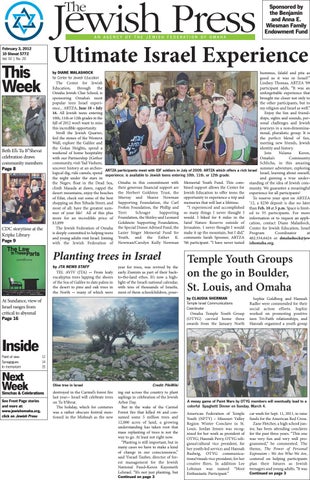
by DIANE MALASHOCK hummus, falafel and pita as for Center for Jewish Education good as it was in Israel!” The Center for Jewish Lindsey Thomas, ARTZA ‘09 Education, through the participant adds, “It was an Omaha Jewish Chai School, is unforgettable experience that sponsoring Omaha’s most brought me closer not only to popular teen Israel experithe other participants, but to ence... ARTZA, June 18 – July my religion and Israel as well.” 16. All Jewish teens entering Enjoy the fun and friend10th, 11th or 12th grades in the ships, sights and sounds, perfall of 2012 won’t want to miss sonal challenges and Jewish this incredible opportunity. journeys in a non-denominaStroll the Jewish Quarter, tional, pluralistic group. It is feel the stones of the Western the perfect blend of fun, Wall, explore the Galilee and meeting new friends, Jewish the Golan Heights, spend a identity and history. weekend of home hospitality Join Na’ama Keren, with our Partnership 2Gether Omaha’s Community community, visit Yad Vashem, Schlicha, in this amazing uncover history at an archeosummer adventure, exploring ARTZA participants meet with IDF soldiers in July of 2009. ARTZA which offers a rich Israel logical dig, ride camels, spend Israel, learning about oneself, experience, is available to Jewish teens entering 10th, 11th, or 12th grade. the night under the stars in and gaining a true underthe Negev, float in the Dead Sea, Omaha in this commitment with Memorial Youth Fund. This com- standing of the idea of Jewish comclimb Masada at dawn, rappel the their generous financial support are bined support allows the Center for munity. We guarantee a meaningful desert mountains, enjoy the beaches the Herbert Goldsten Trust, the Jewish Education to offer teens the experience for all participants! of Eilat, check out some of the best Murray and Sharee Newman opportunity to experience a trip and To reserve your spot on ARTZA shopping on Ben Yehuda Street, and Supporting Foundation, the Carl memories that will last a lifetime. ‘12, a $250 deposit is due no later “I experienced and accomplished than Feb. 10 at 5 p.m. Space is limitmost of all: have the greatest sum- Frohm Foundation, the Phillip and Schrager Supporting so many things I never thought I ed to 35 participants. For more mer of your life! All of this plus Terri more for an incredible price of Foundation, the Shirley and Leonard would. I biked for 8 miles in the information or to request an appliGoldstein Supporting Foundation, Sataf Nature Reserve outside of cation, contact Diane Malashock, $3,899 The Jewish Federation of Omaha the Special Donor Advised Fund, the Jerusalem. I never thought I would Center for Jewish Education, Israel is deeply committed to helping teens Lazier Singer Memorial Fund for make it up the mountain, but I did,” Program Coordinator at and young adults visit Israel. Joining Youth, and the Esther K. comments Sarah Spooner, ARTZA 402.334.6424 or dmalashock@jew with the Jewish Federation of Newman/Carolyn Kully Newman ‘06 participant. “I have never tasted ishomaha.org.
Planting trees in Israel by JTA NEWS STAFF TEL AVIV (JTA) -- From leafy eucalyptus trees lapping the shores of the Sea of Galilee to date palms in the desert to pine and oak trees in the North -- many of which were
year for trees, was revived by the early Zionists as part of their backto-the-land ethos. It’s now a highlight of the Israeli national calendar, with tens of thousands of Israelis, most of them schoolchildren, pour-
Temple Youth Groups on the go in Boulder, St. Louis, and Omaha by CLAUDIA SHERMAN Temple Israel Communications Coordinator Omaha Temple Youth Group (OTYG) carried home three awards from the January North
At Sundance, view of Israel ranges from critical to abysmal Page 16
Sophie Goldberg and Hannah Radler were commended for their social action efforts. Sophie worked on promoting positive teen Tri-Faith relationships, and Hannah organized a youth group
Inside Point of view Synagogues In memoriam
12 14 15
Next Week Simchas & Celebrations See Front Page stories and more at: www.jewishomaha.org, click on Jewish Press
Olive tree in Israel destroyed in the Carmel’s forest fire last year-- Israel will celebrate trees on Tu b’Shvat. The holiday, which for centuries was a rather obscure festival mentioned in the Mishnah as the new
Credit: PikiWiki ing out across the country to plant saplings in celebration of the Jewish Arbor Day. But in the wake of the Carmel Forest fire that killed 44 and consumed some 5 million trees and 12,000 acres of land, a growing understanding has taken root that mass replanting of trees is not the way to go. At least not right now. “Planting is still important, but in many cases we have to make a kind of change in our consciousness,” said Yisrael Tauber, director of forest management for the Jewish National Fund-Keren Kayemeth LeIsrael. “It’s not just planting, but Continued on page 3
A messy game of Paint Wars by OTYG members will eventually lead to a colorful Spaghetti Dinner on Sunday, March 4. American Federation of Temple Youth (NFTY) - Missouri Valley Region Winter Conclave in St. Louis. Jordan Jensen was recognized for her work as president of OTYG; Hannah Perry, OTYG religious/cultural vice president, for her youth-led service; and Hannah Budwig, OTYG communications/visuals vice president, for her creative fliers. In addition Lee Lohman was named “Most Enthusiastic Participant.”
car wash for Sept. 11, 2011, to raise funds for the American Red Cross. Zane Fletcher, a high school junior, has been attending conclaves for the past three years. “This one was very fun and very well programmed,” he commented. The theme, The Power of Personal Expression - We Are Who We Are, centered on helping participants plan their futures as Jewish teenagers and young adults. “It was Continued on page 3
2 | The Jewish Press | February 3, 2012
JOE KOPECKY Republicans and Democrats pitch to Florida’s Jews BUILDERS Custom Homes Remodeling Kitchens Bathrooms Basements
30 years of experience
402/676-9533 jokopecky@gmail.com
Alan, Anne and Marty Cohen Piedmont-Millard North 15417 Dewey Circle $159,950 Special true 4BR on a quiet cul-desac...it’s all redone! Features include LR & DR w/neutral decor, newer carpet, & soaring ceilings. Updated eat-in kitchen w/maple cabinetry, stainless appliances, gorgeous tile backsplash, solidsurface counters, planning desk, pantry, & vaulted ceilings. Fam. Rm. w/impressive stacked stone FP. Unique powder room w/copper-color vessel sink. Sharp main bath w/furniture-style vanity & slate floor. MBR w/double closets, & an updated 3/4 bath. Rare walkout bsmt!
Alan Cohen
Anne Cohen
Marty Cohen
402-677-2524 402-850-4161 402-690-1591
A Nebraska scientist discovers hope in the midst of a devastating HIV epidemic Premiering Friday, Feb.10, at 7:30 p.m. CT on NET1/HD Repeating on NET1/HD Sunday, Feb. 12, at 12:30 and 10 p.m. CT Monday, Feb. 13, at 8:30 p.m. CT And on NET2 World Sunday, Feb 12, at 8:30 a.m. CT A production of NET Television
“We love to visit our cousin Rita at Remington Heights.â€? - Alexander and Zachary, cousins of Rita N., a Remington Heights resident Our residents enjoy: UĂŠ/Â…Ă€iiĂŠĂ€iĂƒĂŒ>Ă•Ă€>Â˜ĂŒĂŠ style meals a day UĂŠĂ“{Â‡Â…ÂœĂ•Ă€ĂŠi“iĂ€}i˜VÞÊ response system UĂŠ7iÂ?Â?˜iĂƒĂƒĂŠ>˜`ĂŠ recreational programs UĂŠ ÂœĂ•ĂƒiÂŽiiÂŤÂˆÂ˜}ĂŠ services
Experience matters.
Call today for a personal tour.
(402) 493-5807
8 %PEHF 3PBE t 0NBIB /& www.remingtonheightsretirement.com
by RON KAMPEAS WASHINGTON (JTA) -- Barack Obama didn’t show up on the vote tallies in Florida’s Republican primary on Jan. 31, but the president’s supporters already are waging a fight for the Sunshine State. Democrats are rolling out a campaign to rival any of the GOP candidates, with a particular focus on the state’s substantial Jewish community. Democratic officials said that volunteers in Florida already had made nearly 600,000 calls to supporters and conducted thousands of training sessions, many of them focusing on the Jewish community, 10 months before the general election. The Obama campaign has opened nine offices in the state. “Florida is the most significant battleground state, and will be during the Mitt Romney speaking at the 2012general election,� said Conservative Political Action U.S. Rep. Debbie Conference in Orlando, Fla., Wasserman Schultz (D- Sept. 23, 2011. Romney is Fla.), the chairwoman of ahead of Newt Gingrich in the the Democratic National polls for the state’s key Committee. “We’re taking Republican primary. nothing for granted. We’re Credit: Gage Skidmore via in the process of using Creative Commons these primaries as an organizing tool.� Wasserman Schultz said Jewish surrogates were targeting communities across the state, defending Obama’s Israel record as well as emphasizing differences on health care and social issues, like abortion. The rollout was planned months ago, well before Newt Gingrich’s stunning upset win in the South Carolina GOP primary. Florida is a testing ground because it is the first large and diverse state, said Nancy Ratzan, a former president of the National Council of Jewish Women who is now active in the Democratic Party. “Florida is more reflective of what they’re going to find in other parts of the country,� she said. Romney and Gingrich head into Florida with few holds barred, each striving to identify the other as a member of the “elites� reviled by the Republican base. A Romney ad accused Gingrich of making money off the financial crisis by taking money from a government-backed mortgage company. It said that the former speaker of the U.S. House of Representatives and Georgia congressman was a Washington “insider.� Gingrich has depicted Romney as uncaring, drawing on his career as a venture capitalist. He also has seized on Romney’s tax returns, just released, which show investments in the same government-backed mortgage company that paid Gingrich for consulting fees. Noam Neusner, a former domestic policy adviser to President George W. Bush, said that Gingrich had upended the race with his South Carolina victory. Neusner, who has not endorsed a candidate, noted that Romney had won the “Jewish donors� primary, drawing the largest assemblage of Jewish supporters. But he noted that Gingrich was a known quantity among Jewish conservatives going back to his days as House speaker from 1995 to 1998. Gingrich’s positions are “very similar to Romney’s and certainly very acceptable to Republican voters,� he said. Tevi Troy, a deputy health secretary under President George W. Bush who now advises the Romney campaign, suggested -- very delicately -- that Gingrich’s mercurial personality would be an issue as the campaign rolls forward. “You have to choose wisely about who the right candidate is,� Troy said. “Here you have a guy with strong leadership experience and in business, and has a good chance of beating President Obama and running a strong, competent foreign policy.� Neusner acknowledged that “there’s a greater comfort level with a certain constancy of personality in Romney.� “Gingrich is admired� for his intellect, Neusner said, “but there’s greater enthusiasm that Romney could do better in the general� election. Both presidential hopefuls, as well as fellow candidate Rick Santorum, the former Pennsylvania senator, have made Obama’s relationship with Israel a key target of their foreign policy campaigning. “We’re very comfortable saying that so long as Barack Obama or Ron Paul are not the president, Israel will be a much safer place,� said Sid Dinerstein, chairman of the West Palm Beach Republican Party who has not endorsed a candidate.
Dinerstein said that Republican Jews were too small a constituency to expect to be courted intensely in the primary, which is open only to registered Republicans. But that will change ahead of the general election, he said, when he expects the eventual Republican candidate to draw Jewish independents and centrist Democrats because of Obama’s Israel record. “President Obama has no chance of getting 78 percent of the vote,� he said, a reference to the level of Jewish support Obama garnered in the 2008 elections, according to exit polling. The Republican National Committee has identified Florida as a swing state with a substantial Jewish population where Jewish votes could make the difference, according to an activist who saw an RNC memo Newt Gingrich addressing the late last year. The memo Conservative Political Action listed Jewish voters in the as numbering Conference in Orlando, Fla., state 450,000, which seems to Sept. 23 2011. Gingrich has comport with figures from fallen behind Mitt Romney. Jewish groups that estiCredit: Gage Skidmore via mate the state’s overall Creative Commons Jewish population at 640,000. Other such states listed in the memo were Pennsylvania, North Carolina and Nevada, according to the activist. The importance of Florida’s Jewish vote is one area where there is bipartisan agreement. Obama proxies in Florida include Wasserman Schultz and Robert Wexler, a former Florida congressman who now heads the Center for Middle East Peace in Washington. Democrats are emphasizing domestic issues in their approach to Jewish voters, as well as Obama’s Israel record. Wasserman Schultz said on the call that Republican plans to privatize parts of Medicare threatened a key safety net for the elderly. Romney is planning Jewish events, a campaign official said. The campaign official also said that John Bolton, the former ambassador to the United Nations who is a favorite of many hawkish Jewish conservatives, will campaign in the state for Romney ahead of the primary. Queries to Gingrich’s campaign went unanswered. Reports say he is going into Florida without funds or organization comparable to those at Romney’s disposal. Sheldon Adelson, the pro-Israel casino magnate who has long been close to the former House speaker, helped boost his prospects in South Carolina with a $5 million infusion to an independent pro-Gingrich group, Winning America’s Future. And it was reported that the billionaire’s wife, Miriam, was donating another $5 million to the group. Republicans emphasize the diplomatic disagreements that Obama has had with Israel over its settlement policies, and say the president has not done enough to isolate Iran. Democrats stress the close security relationship with Israel cultivated by Obama and say Iran is more isolated than it’s ever been because of his policies. Ratzan, who now speaks regularly to Jewish groups on behalf of Democrats, said she is encountering the effects of a Republican attacks on Obama’s Israel record. “I’m definitely getting questions,� she said, but the Obama campaign and the administration “are doing a good job of getting the message out.� A case in point, she said, was the 7-minute video that the Obama campaign released last week that culled from news footage a slew of testimonials to the president’s commitment to Israel from a slate of Israeli leaders, including Prime Minister Benjamin Netanyahu. Alan Solow, a key Obama fundraiser and the immediate past president of the Conference of Presidents of Major American Jewish Organizations, said it is critical to get out Obama’s pro-Israel message now. “We think it’s important that we don’t allow the Republicans to establish the narrative regarding what the president has done for Israel,� he said, adding that the timing was fortuitous. “We thought that this was a good time, generally, to do the video,� Solow said, noting that the election season had been launched in earnest. “It’s a happy coincidence for us that we’re doing it at a time when there was attention for Florida.� Note: The Florida primary election will take place Tuesday, January 31, while this paper goes to print. The latest polls show a 15 point lead of Mitt Romney over Newt Gingrich; Santorum, who went home to be with his daughter, who was ill, announced he will continue campaigning. Ron Paul has not campaigned in Florida.
February 3, 2012 | The Jewish Press | 3
Temple Youth Groups on the go in Boulder, St. Louis, and Omaha Jake thought the overall theme on acceptance was good and connected to the theme at the fall conclave which had focused on bullying. He also felt the social action theme about intervening when young people are considering suicide was “really, really good,” and pointed out, “It gets better if you’re being bullied or not being accepted.” And “Yes! I definitely would go again” to another conclave, said Jake. Others who attended included Dru Beach, Joe Hack, Ariel Kohll, Maddie Jensen, and Justin Norton. Zane, Sophie, Hannah Radler, and Hannah Perry are planning to run for Missouri Valley Regional Temple youth Lindsay Osborne (far left) and Jacob and Board positions in April for Spencer Arnold visited residents of Remington Heights. next year. It Gets Better was the social action theme Most of those who attended the winter during the conclave. The participants conclave also attended the fall conclave in watched videos that were filmed in response Boulder in addition to Jacob Arnold, Yaniv to “the astounding number of teen suicides,” Azriel, Sophia Miller, Morissa Miller, and explained Zane. “We made our own videos, Alex Pachman. too,” he said. “NFTY is a very accepting Shortly after returning to Omaha, “Temple place” that encourages teens to be accepting was hopping with youthful energy when outside the NFTY community as well. OTYG hosted paint wars,” said Amy Katz, “Of course!” Zane said regarding his OTYG advisor. The teens “had a good time intention to attend future NFTY conclaves. getting messy,” and designed a rainbow by Jake Vann, a freshman, was in St. Louis for rolling off the paint on paper which will add his second NFTY conclave. He also attended to the décor at their Spaghetti Dinner on the fall conclave in Boulder. Friends that he Sunday, March 4. Proceeds benefit Camp met there were also in St. Louis for the win- Rainbow for children who have serious illter conclave, and he enjoyed seeing them nesses such as cancer and blood disorders. again. “Winter was a lot of fun,” he said. While the high school kids splashed Four days allowed for more interaction themselves with paint that day, Club 56 which included Friday evening Shabbat members made blankets and, after a discusworship services, Shabbat dinner, a Shabbat sion about needs, donated the coverings to service on Saturday written by the youth, a Children’s Hospital. program relevant to Torah, two socials, and On Jan. 22, Club 56 filled Temple Israel a basketball game. with the scent of chocolate chip cookies. Continued from page 1 about acceptance,” said Zane. The teens made tee-shirts and wrote, “I Am” on them and then added a few words about themselves that no one else knew about them.
Advisor Naama Artzi facilitated a program on Exploring Our Differences and included a conversation about Holocaust survivors who were the recipients of the cookies and cards made by the fifth and sixth graders. Junior Youth Group (seventh and eighth graders) will be attending their own Conclave March 9 - 11 in Denver. Parents are invited to an informational meeting at noon on Sunday, Feb. 12 at Temple Israel. OTYG will lead the congregation at
Shabbat worship services on Friday, Feb. 24. Planned by Hannah Perry, the worship service will spotlight attention on those in our country who live in poverty. John Fry, a song leader from NFTY-Missouri Valley, will lead the teens in song during the service to which youth groups from Kansas City will be invited. A lock-in event at Temple Israel following the worship service is being chaired by Hannah Radler, Sophia Miller, and Morissa Miller.
Planting trees in Israel Continued from page 1 also natural regeneration of forests, and the managing of that natural regeneration that is key.” In the state’s early years there was a rush to plant pines, considered among the only trees that could survive and grow quickly on the bare, rocky ground that covers much of Israel, Tauber said. “But now we are in a second, new phase,” he noted. “We are now building sustainable forestry after these pioneering pines did a wonderful job for the first generation.” With a dry climate similar to that of California or Spain, Israel is a natural home for relatively short trees that need little water. Some, like acacias, can go for months without even a drop. The planting paradigm began to shift by the 1980s with a growing emphasis on forest diversification. Other native varieties began to be introduced, including carob, pistachio, and common oak, which is seen throughout the country’s forests. Now the goal is to have as many “mixed” forests as possible with a focus on sustainable management, JNF officials say.
In a land where even trees have become politicized as part of the Israeli-Palestinian conflict, the pine tree has become emblematic of a renewed Jewish presence here, while the olive tree has become a symbol of the Palestinians’ ties to the land. Of course, in biblical times the Jews were also known for tending olive trees. The olive tree’s deep historical roots date back some 10,000 years as this agricultural commodity took on important regional economic importance. Much of the tree-planting energy today in Israel goes to the northern Negev Desert, where trees are being planted not on the grand level of the forests in the North but in small orchards and green areas as sources of shade and recreation. Their growth is assisted with collected rainwater by planting the trees in small depressions where the water can pool. Osem says these Israeli rainwater collection techniques are being copied by countries suffering from desertification in parts of Africa and Asia. It’s one way the spirit of Tu b’Shvat is going global.
National Council of Jewish Women - Omaha Section presents
PROTECTING OUR KIDS ...from illness, the internet, the media and themselves! Featuring Dr. Susan Fellman Pediatrician Detective David Pecha Computer Crimes Task Force, Omaha Police Department Assistant Professor Dr. Adam Tyma UNO School of Communication Karen Gustafson, MS, NCC, LIMHP Director, Jewish Family Service
Thursday, February 9, 2012 7:00 p.m. Coffee and Dessert Sponsored by Patty and Steve Nogg in memory of Pete Lee
7:30 p.m. Panel / Q&A Jewish Community Center | 333 South 132nd Street Free and open to the public Parents and grandparents -- this one’s for YOU!
4 | The Jewish Press | February 3, 2012
Birthright: get on a bus, not a waiting list! by DIANE MALASHOCK Israel Program Coordinator CJE The Taglit-Birthright Israel program provides an once-ina-lifetime opportunity for young adults, ages 18-26, to experience a free ten-day trip to Israel. The immense popularity of the program in recent years has also added challenges, with applicants often finding themselves on the wait list and often being disappointed in having to wait for the next session or longer. In the summer of 2012, young adults from Omaha have a very strong chance of avoiding the dreaded wait list, compliments of the Jewish Federation of Omaha’s participation in the Partnership 2Gether (formerly Partnership with Israel) program. If applicants are from one of the 14 U.S. Central Consortium cities and meet the Taglit-Birthright eligibility requirements, they can travel on a special Partnership trip being run by IsraelExperts. The trip name is “Central Consortium”. (The Central Consortium cities include Akron, Canton, Toledo, Youngstown, and Dayton, Ohio; Louisville, Kentucky; Indianapolis, Northwest Indiana and South Bend, Indiana; Des Moines, Iowa; Omaha, Nebraska; Austin, Dallas, and San Antonio, Texas.) “This is an incredible chance for young adults from Omaha to go on a Birthright trip” states Mary Sue Grossman, Associate Executive Director of the Center for Jewish Education. “The Taglit program is an extraordinary
opportunity and to pair that with young adults from our Partnership communities adds a great deal to the experience.” The trip will let participants learn about, question, and explore the best of Israel. Highlights will include visits to Tel Aviv, where participants will explore its beaches, culture, and history. Time in Jerusalem will include visits to the Old City, Ben Yehuda St., and everything in between. Climb Masada and float in the Dead Sea, explore the beauty of the Golan Heights, and learn first hand about the complexities of the Israeli-Palestinian conflict with both Jewish and Arab Israelis. Birthright trips include a non-denominational and egalitarian approach to Shabbat programming. Partnership 2Gether is a program of the Jewish Agency and the Jewish Federations of North America, promoting people-to-people relationships. Omaha is part of the 14 community Central Consortium, partnering with the Western Galilee region through cultural, social, medical, educational and economic programs. Registration for past applicants begins Feb. 14 at noon ET. New applicants can register beginning Feb. 15 at 10 a.m. ET. To register, go to www.taglit.israelexperts.com/ summer2012 and check off Central Area Consortium as your community. If you have any questions or would like more information contact, please call 402.334.6445 or email mgrossman@ jewishomaha.org.
Inclusion month is every month in Omaha by JAN MCCARTHY Yachad Coordinator February is the month Yachad has typically celebrated NAIM or North American Inclusion Month. It is a month for groups with members who live with a physical, intellectual or emotional impairment to develop activities that promote greater community inclusion. For the past two years Yachad of Omaha has developed special activities for February. Last year we had a Shabbaton at RBJH which included residents of the Home, community members and Rabbis and their families who joined with us in activities. We also had a Job Fair which included several local Omaha and Jewish businesses. So this year as we contemplated what we could plan for February, we came to a wonderful realization: In our community we do not need a special month for inclusion. The warm spirit of this community has opened for us a world of opportunities, acceptance... inclusion. You have embraced and supported our art shows and acknowledged us as regular vendors at the Beth El Boutique. We love to attend Holiday and special programs that the synagogues offer. We have been invited to participate in the dance program at the JCC and activities with BBYO and
YJO. The Friedel Academy has invited us to work together on a community garden. We had so much fun competing in the Pesach Art program. This will be the second year we have been honored with an invitation from the Blumkin Home to light a Menorah candle for Hanukkah. We have been blessed with the financial generosity of our community which has enabled us to participate in our personal training program at the gym, a self defense course at a local Martial Arts Academy, and our yearly camping trip to Mahoney. These programs are crucial to the health, safety and esteem of our members. We feel secure in pursuing new and creative ideas and events because we have the support and encouragement of our community. So this February the NAIM program for Yachad of Omaha is to acknowledge how grateful we are for our community. To take the opportunity to express our sincere appreciation to the community for being a part of us or are we a part of you? Our wonderful realization was that we are truly one community. Please feel free to go to our website, www.jfsomaha.com, go to the Yachad page and click on the calendar to see when and where we will be each month. We’d love to see you.
Mainstreeters go to the Caribbean by OZZIE NOGG Want to take an island getaway this winter? Then cruise on over to the Mainstreeters luncheon on Monday, Feb. 20, and delight in the Sounds of the Caribbean with Joey Gulizia, popular jazz musician. The festivities begin at 12:30 p.m. in the Rose Blumkin Jewish Home Auditorium. Through his artistry, Joey Gulizia transports listeners to the beaches of Trinidad, Puerto Rico, Barbados, Cuba and Jamaica. Performing on steel pan, woodwind controller, soprano sax and assorted percussion instruments, Joey mixes Calypso, Afro-Cuban and Reggae with American jazz and gives a tropical feel to many familiar tunes. The music is so terrific, you won’t even miss the Rum and Coke. Luncheon-goers may choose from Chicken Pot Pie or Tuna Pot Pie entree, both served with spinach orange salad, challah rolls and a slice of apple Joey Gulizia, popular jazz musician, pie. Cost is $11.50 a brings Sounds of the Caribbean to the plate and reservaMainstreeters luncheon on Monday, tions are appreciatFeb. 20, at the RBJH Auditorium. ed by Monday, Feb. 13. Please make checks payable to Jewish Social Services and send to Mainstreeters c/o Maggie Conti, 323 So. 132 Street, Omaha, NE 68154. If you need transportation, call Maggie at 402.334.6521. Rocky Stern and Dick Rochman, Mainstreeters regulars (and dedicated dancers), have the Feb. 20 luncheon on their calendars. “Dick and I follow Joey to venues all over Omaha,” Rocky said. “Our favorite kind of music is jazz with a Latin beat and that’s exactly what Joey plays. His music is fun and everyone is going to love him.” Mainstreeters activities are geared to area residents age 60plus. Its programs give participants the chance to meet new people, exercise their brains, learn new skills and enjoy life to the fullest. Conti, Director of Activities and Outreach Programs at the Rose Blumkin Jewish Home, said, “Joey Gulizia is truly a class act. He tours the world, plays with Mannheim Steamroller, is in the Nebraska Music Hall of Fame and does lots of music education in the schools. Mainstreeters are happy to offer Sounds of the Caribbean, and we know many community members will want to join in the beat.”
February 3, 2012 | The Jewish Press | 5
A Tu B’Shvat Conundrum
Journal entry from Israel TEDDY WEINBERGER In extolling the fruits of the Land of Israel, Moses spoke of “a land of wheat and barley, of [grape] vines, figs and pomegranates, a land of olive trees and [date] honey” (Deut. 8.8). Surprisingly, this list, which is known as the “Seven Species of the Land of Israel,” does not include the almond tree. Yet the almond has been a pillar of agriculture in this part of the world: archaeological evidence shows that it was well known locally already in the third millennium BCE. Indeed, when Jacob sends Benjamin and the rest of his sons back down to Egypt, almonds are included in his gifts of “some of the choice products of the land” (Gen. 43.11). And note which fruit stars in the most popular song for Tu B’Shvat (Arbor Day, which this year falls on Wednesday, Feb. 8): “The almond tree is blooming / And a golden sun does shine / Birds from every rooftop / Announce the festive time / Tu B’shvat is here-the festival of trees!” Why then did the almond tree not make it into the Species of the Land of Israel? In an article for Makor Rishon (an impressive multi-sectioned weekly newspaper with a national religious perspective-we needed something to partially neutralize our subscription to left-wing Haaretz), Dr. Akiva London, a professor at Bar Ilan University and the agronomist for the Chief Rabbinate of Israel, offers several reasons for the almond tree’s exclusion. One reason is perhaps obvious: unlike the Seven Species, the almond was not a staple in the diet of the Land of Israel; it was prized primarily for its oil, which was used in perfumes and cosmetics. A second reason sees the almond tree’s hardiness as barring it from the Species list. The almond tree requires little
care, is able to withstand years of drought and grew wild in biblical times. Because of this, the almond might have represented the nomadic phase of the People of Israel, when they depended on wild fruits and on supernatural miracles. The Seven Species, which require cultivation and nearby permanent human settlement, represent the move to developed agriculture in the Promised Land, where the people need to rely more on their own hard work. An interesting feature of the almond tree is that while it is among the first trees to bloom (as indicated in the Tu B’Shvat song), its fruit is ripe only toward the end of the summer after a growth period of between 6-7 months (indeed so anxious is the almond to bloom that it, uniquely, flowers even before its leaves emerge). In comparison, the Seven Species (with the exception of the date) blossom between Passover and Pentecost and have a much shorter time period until harvest. Such agronomic trickery did not go unnoticed in the Land of Israel. A book of proverbs from the First Temple period contains the following: “My child do not make haste like the almond tree, whose blooms are first and whose fruit is eaten last, but be wise like the mulberry tree, which tarries to bloom last and whose fruit ripens first.” We can perhaps deduce from this that the almond tree was not “honest” enough to be included in the Species. And while we’re on almonds: for years I always felt that my Newyawka “am-mund” pronunciation was inferior to my wife Sarah’s beautiful Nebraskan “al-mund” pronunciation. But then one day, NPR was interviewing an almond grower who pronounced the word “my” way. To be on the safe side, I won’t say that Sarah is wrong; let’s just say that Sarah and I are both right, which I consider a small victory for me and New York. Happy Tu B’Shvat! Teddy Weinberger made aliyah in 1997 with his wife, former Omahan Sarah Ross, and their five children. Their oldest three, Nathan, Rebecca and Ruthie, are veterans of the Israel Defense Forces; Weinberger can be reached at weinross@netvision.net.il.
Going on a Vacation? Don’t leave your four legged friends in a kennel. Call to reserve your vacation times soon!
House Sitting/Pet Sitting References Available
402-422-0365 Cell: 402-517-6444
Beth El Hosts Mayor’s Clergy Advisory Board by JILL BELMONT Mission, and Marilyn Sims, of Catholic Charities. Each Beth El Publicity Coordinator presenter described the services her organization provides During the morning of Jan. 26, Beth El played host to the for families in need, and encouraged the clergy members to raise awareness among Mayor’s Clergy Advisory their congregants. Board – the first time this Following the speakers’ pregroup has met at a synasentations, Mayor Jim Suttle gogue. Around 40 clergy updated the group regarding members from a variety of a variety of current city denominations attended affairs, and then conducted a the get-together, which question and answer session included a tour of the synagogue. with attendees. Following Rabbi “The speakers provided eyeMordechai Levin’s welopening information about come, guest speakers the pervasive problem of updated attendees about hunger and lack of nutrition food-insecure households in our community, and offered valuable advice as to in the metro area, a serious how each one of us could concern for a growing address the problem,” said number of Omahans in Rabbi Levin welcomes Mayor Jim Suttle to Beth El for the Rabbi Levin. “We were every area of the city. Sue Mayor’s Clergy Advisory Board meeting. pleased to welcome Mayor Arment of Hunger Free Heartland served as the morning’s featured speaker; other Suttle and this advisory board, and were happy to share our presenters included Chelsea Saifou of the Heartland Hope Beth El home with fellow members of the local clergy.”
Abbas says exploratory peace talks have ended by JTA NEWS STAFF JERUSALEM (JTA) -- Talks between Israeli and Palestinian negotiators leading to full peace talks have ended with no progress, Palestinian Authority President Mahmoud Abbas said. Abbas, following a fifth meeting between the sides, met with Jordan’s King Abdullah before announcing that the exploratory talks were concluded. He said he would discuss Feb. 4 with the Arab League whether or not to hold addiMahmoud Abbas tional talks. The Palestinians had said that they would not meet past Jan. 26, the date of a deadline set months ago by the Mideast
Quartet of the United States, the European Union, Russia and the United Nations for the resumption of direct peace talks, without more concessions from Israel. Direct peace talks stopped in late 2010 after Israel refused to extend a 10-month freeze on building in the settlements. Abbas said that the Palestinians would be willing to return to negotiations if Israel agrees to demarcate the borders between Israel and a future Palestinian state. The Palestinians also are demanding an end to building in the settlements. The Palestinians say they have submitted their proposals on borders and security arrangements, but that Israel has not, according to The Associated Press. Meanwhile, the pan-Arabic Al-Quds al-Arabi newspaper based in London reported Wednesday that Abdullah is considering several kinds of diplomatic sanctions in order to prod the Israeli government to make “significant concessions” that would allow the Palestinian leadership to “justify” returning to negotiations, Ynet reported.
ARE YOU SOMETIMES FRUSTRATED AS A PARENT?
In cooperation with
Woodhaven Counseling Associates, Inc. presents:
“Becoming a Love and Logic Parent” This 4-session course will be taught by Licensed Mental Health Practitioners, Teresa Drelicharz and Amber Lawrence. • Registration is $60 per family. • A sliding fee is available. Call for information. • Child care for ages 1-12 is provided for $4 per child • per session. Classes are from 6-8 p.m. March 22, 29 and April 12, 19, 2012 at the Jewish Community Center.
333 South 132nd Street, Omaha, Nebraska For more information or to register:
Call Jewish Family Service 402-330-2024 on the web at www.jfsomaha.com.
Out
Dining
6 | The Jewish Press | February 3, 2012
Beth El’s Sunday Scholars Series offers exciting second semester
When you patronize these fine establishments, tell them you saw their ad in the Jewish Press.
HIRO WEST
HIRO 88
WEST OMAHA
OLD MARKET
3655 N 129th St.
1308 Jackson St.
402.933.0091
402.933.5168
M-Th 11:30a-2p | 5p-10p F-Sa 11:30a-2p | 5p-12a Su 12p-9p
M-Th 11a-12a F-Sa 11a-1a Su 11a-9p
S U S H I | J A PA N E S E | C H I N E S E
by JILL BELMONT Beth El Publicity Coordinator The second semester of Beth El’s Sunday Scholars Series is underway, offering thought-provoking discussions presented by a variety of special guest speakers from the Jewish community. On Feb. 12, 11 a.m., attorney David Herzog will engage attendees with an exploration of comparisons and contrasts between Jewish law and American law, including the ways each system resolves legal issues. “At present, our Torah reading dwells almost entirely on the instructions by Moses, as to how life is to be regulated and acted upon -- ethics, principles and directions dictated by Moses and God,” Herzog explained. “By contrast, our legal system in the United States is based on the Constitution and the three branches of governmental function, wherein we are a people guided by the people and governed by the people, with inspiration from our Hebrew origins and Torah and other sources.” On March 18, family therapist Glen Fineman, LICSW, LIMHP, will share advice about Work and Worth, the balancing act between work and family life. Among the questions he will examine include ‘What is your personal worth; what is your professional worth?’ and ‘How do we find balance in our lives with all the different facets, and how do we integrate them?’ Fineman noted that, “Over the years, in my professional work and through friends, I’ve seen many examples where people get so stressed out about life and about work. During my talk, I’ll present materials that will hopefully lead to some discussion about how to balance work and family life, within the context of Jewish values and the value of family. “So many of us base our worth on our work, and I want to help people realize how important life is with family and friends, and emphasize how valuable that is. I’d like people to leave the presentation re-thinking what their priorities are, ways to manage their stress level, and seeing the value and importance of what it is they’re really doing every day and what should be a priority.” Rabbi Yaakov Weiss, Pastoral Services Coordinator at the Rose Blumkin Jewish Home, will be welcomed as the April
22 guest speaker. Because the day of his presentation coincides with the national celebration of Earth Day – “man’s responsibility and connection to the land,” he said -- the rabbi will discuss ‘Ki Ha-Adam Eitz ha-Sadeh’ (for man is a tree of the field), from Deuteronomy 20:19. “There is much discussion in our Jewish commentaries as to how man is compared to the trees. Within these comparisons we can learn much about the way we interact and care for each other,” Rabbi Weiss explained. “The cycle of a tree and its seasons often mirror our own life cycle and those of our loved ones. In this class, we will look at sources and discuss the nature of relationships and how to be supportive to others as we all strive to become caring and strong individuals whose roots run deep.” The final Sunday Scholars Series speaker will be Beth El’s Rabbi Steven Abraham, who will offer an in-depth look at What in the World is Conservative Judaism? on May 13. Saying that many people aren’t sure who Conservative Jews are or what they stand for, Rabbi Abraham said he plans to look at the history of the Conservative Movement, its current place in denominational Judaism, and where he believes it is headed. “For a long time Conservative Judaism has been defined by what we are not -- i.e., we are not Orthodox and we are not Reform -- which causes us to not have a true identity of our own,” he said. “I believe strongly that Conservative Judaism is a valuable entity that has its own identity, one that is necessary in a Jewish world that is all too often monopolized by the extremes. “I hope people come away having learned about our history and the rationale for the movement’s founding,” he continued. “Yet more importantly, I want people to walk away knowing that the Conservative Movement holds modernity in one hand and tradition in the other and tries to live between these two worlds. It’s not easy…but the struggle is one that allows you to become closer to God.” All Sunday Scholars Series programs will be held at Beth El, 14506 California St.; everyone in the Jewish community is invited to attend, at no charge. For more information about the presentations, call the synagogue office, 402.492.8550.
Ethical Challenges: Dealing with the Dilemmas by MARK KIRCHHOFF Administrative Assistant, Center for Jewish Education “America has lost its moral values.” “Nothing is sacred anymore.” “Anything goes in this country.” “We no longer respect one another.” Do these comments sound familiar? Miriam Gross is ready to explore these statements and more when she presents a fourweek class entitled “Ethics and Judaism”, meeting Feb. 17, 24, March 2 and 9. The class will meet in the Kripke Jewish Federation Library from 12-1 p.m. and is presented by the Center for Jewish Education. The teachings and laws established by the rabbis over the years have provided a firm foundation upon which Miriam Gross people may stand – not only to learn how to tolerate each other and maintain societal order, but also to become shining stars in a world that is too often dark, murky, and uncertain. The rabbinic tradition of story telling, using riddles, and making use of colorful and sometimes humorous images have served their purpose of unveiling ethical guidelines, often in a subtle way, for stability, personal growth, and the ability to face moral dilemmas equipped with the wisdom of the ages. We have been blessed with freedom of choice. We have been gifted with the context in which to exercise it. “There always comes a time when our lifelong ideas of right and wrong come into question. We wonder about our
FEB. 10– MARCH 18, 2012
motives. We puzzle over whether what we learned as a child remains applicable in the world of adults. This class is designed to address that and other ethical questions we must answer in life,” Miriam related. She also explained that for Jews these questions have been constant throughout life’s many stages. Right and wrong has never been black or white. Is lying ever permitted? Is it permitted for the sake of peace? For the sake of self-preservation? How do we distinguish between borrowing and stealing – is it an act, or is it an intention? What issues exist between hate and love; when does standing up for the truth morph into creating disharmony? Why has it been vital for the rabbis to establish laws for the Jewish people? The questions are endless and present a lifelong challenge to answer in the context of our family, friends, country, homeland, and world. Perhaps that is why the rabbis told stories, for they are timeless and adaptable, holding the truth for those who wish to listen. “The unexamined life is not worth living,” Socrates said at his trial for the heresy of encouraging his students to challenge the accepted beliefs of the time and to think for themselves. Miriam reflected, “If finding a way to lead an ethical life in the manner prescribed by the Rabbis and question the ways of the world constitutes ‘heresy,’ then maybe we should all be ‘heretics.’” Join Miriam Feb. 17, 24, March 2 and 9 and help ensure that you are walking through life on ground that neither sinks nor leads you into darkness. Tuition for the class is $35, discounted to $27 for donors in good standing to the Annual Campaign of the Jewish Federation of Omaha. To register or for more information, please contact Mark Kirchhoff at 402.334.6463 or mkirchhoff@jewishomaha. org.
Book and Lyrics by Tom Jones Music by Harvey Schmidt
Births (402) 553-0800 | (888) 782-4338 WWW.OMAHAPLAYHOUSE.ORG sponsor:
Friend of the Playhosue
orchestra sponsor:
The Paul and Oscar Giger Foundation
media sponsor:
Jessica and Jamie Feinstein announce the Dec. 30 birth of their son, Ezra Joseph. He has a brother, Meyer. Grandparents are Angie and Stanley Krieger, Leslie Feinstein and the late Eric Feinstein. Elisa Strauss Ricks and Marc Ricks of New York City
announce the Jan. 25 birth of their daughter, Margot Leah. She has a sister, Sophie Pearl. Grandparents: Karen and Elton Strauss of Roslyn, NY, Sandi and Marc Scholnick of Portland, OR, and Iris and Marty Ricks. Great-grandparents are Shirley and Carl Strauss, Brooklyn, NY, and Pauline Lecker of Portland, OR.
February 3, 2012 | The Jewish Press | 7
Mysterious Judaic manuscripts in Afghanistan by BEN HARRIS NEW YORK (JTA) -- It was said to be a finding of groundbreaking scholarly and historic significance, comparable in importance to the 19th-century discovery of the Cairo Geniza and rivaling the Dead Sea Scrolls for sheer drama. That, at any rate, was the buzz in scholarly circles when reports began surfacing last month that an exceptionally rare collection of ancient Judaic manuscripts -- some of them dating back more than a millennia -- were discovered in a cave in Samangan province in northeastern Afghanistan. The manuscripts are of several varieties, both religious and secular, and are drafted in a number of languages, including Judeo-Persian and Judeo-Arabic. Among the documents recovered are fragments of the writings of the Saadia Gaon, a famed Jewish sage born in Egypt in the ninth century, and financial records that may shed light on the little-known medieval Jewish merchant class known as the Raddanites. But those who have seen the documents, and who are familiar with the shadowy trade in Middle Eastern antiquities, say the fantastic tales of an unsuspecting shepherd happening upon documents of incalculable historic value are not to be believed. “Generally, you have to be very careful of what a Middle Eastern antiquities dealer tells you,” said Lenny Wolfe, himself a Middle Eastern antiquities dealer based in Jerusalem. “You’re probably safer not believing it.” What no one disputes is that the documents are authentic and, if they can be made widely available to scholars, can potentially shed light on a period in Jewish history that remains shrouded in mystery. The documents, which number about 150 -- far fewer than the thousands in the Cairo Geniza -- are generally believed to be about 1,000 years old, though a few are probably older. They include early texts suggesting the community may have been Karaite, a Jewish sect that rejected rabbinic law and flourished in the 10th and 11th centuries. There are also financial documents that may have much to teach about the Jewish merchants who acted as middlemen along the trade routes between East Asia and Europe. The writings of Saadia Gaon include fragments of a biblical commentary and a rebuttal to the claims of a local heretic. Poems also were recovered. “I think that it’s a very important find,” said Shaul Shaked,
an emeritus professor at the Hebrew University of Jerusalem who saw some of the documents in London several months
A sample manuscript from a collection believed to be at least 1,000 years old was recently discovered in Afghanistan. ago. “This is the first time that we have a large quantity of handwritten documents from that area, from Afghanistan, where we knew vaguely there was some kind of Jewish settlement, a Jewish community, but we had very vague ideas about what their life was like.” Wolfe told JTA that he had the opportunity to purchase a small portion of the documents recently and is holding them in Jerusalem until a national institution can come up with the money to acquire them. He declined to say how much he paid for them, where he got them or how much it would cost to deliver them to a museum. In all probability, the manuscripts were illegally smuggled out of Afghanistan. The director of the Afghan National Archives told Reuters that the find was not Afghan, but a Culture Ministry adviser conceded that it’s not uncommon for local antiquities to be shipped abroad where they fetch much higher prices. As a result, efforts to determine who now holds the documents, where they are being stored or how they were acquired proved to be inconclusive. What is clear is that the collection is split between several private dealers, at least one of whom is based in London. Other lots are said to be in the hands of dealers in Dubai and Switzerland. Other than Wolfe’s acknowledgement of his
holdings, JTA could not confirm claims regarding who has ownership of the documents or how they were acquired. But that doesn’t mean there aren’t lots of colorful stories floating around. One story, which several of those involved had heard, involves a Russian-Jewish billionaire who supposedly had expressed interest in purchasing the manuscripts but had pulled out after his attorneys advised that he may run into legal difficulties. No one would divulge his name. It “adds an element of mystique,” Wolfe said. “I personally never spoke to any Russian oligarch. What I’ve heard is hearsay. I don’t trust hearsay.” Menashe Goldelman, a London-based expert in Middle Eastern antiquities who has authored a 23-page report on the documents, told JTA that they emerged on the London market several months ago. Goldelman said he had been enlisted by a dealer to sell the documents on his behalf. At present, Goldelman said he was trying to broker an agreement with the various dealers to bring the collection together. Goldelman estimates their total value at about $5 million. “They are not things that are stolen from an institution or found in a legal excavation,” Goldelman said. “At some point, everything that comes from the ground goes to the black market. The black market, this is the institution that helps to save this material. If something has, let’s say, commercial value, it gets saved. If you don’t have a commercial value for the manuscript, they go and put it in the fireplace.” Goldelman’s involvement may not reassure skittish buyers about their provenance. In 2010, two professors reportedly accused him of trafficking in stolen antiquities and protested his scheduled appearance at a conference in Israel. Goldelman’s lawyer denied the accusations and threatened to sue for libel. None of the experts who have spoken publicly on the matter of the Afghan documents appeared to be too troubled by unanswered questions about their origins, seeming to accept such things as the cost of doing business in ancient artifacts. “What is important for us is that these fragments and documents don’t get buried again in some safe of a collector,” said Haggai Ben-Shammai, a professor of Arabic at Hebrew University and the academic director of Israel’s National Library. Ben-Shammai said the library was searching for a donor who would acquire the manuscripts on its behalf. “We don’t have the means to acquire them on our own,” Ben-Shammai said. “We need some assistance in this.”
8 | The Jewish Press | February 3, 2012
Beth El’s Tu B’Shevat celebration draws community members to Lauritzen Gardens
Gush Katif Museum holds fundraiser by DINAH ABRAHAMSON Those who have never visited the Jewish towns and settlements of Gush Katif and northern Samaria can scarcely imagine the scale of the human tragedy and crying injustice of the expulsion of the almost 10,000 residents. Encouraged by Israeli government policies, over the course of more than thirty years, to settle on land that was typically empty, barren sand dunes, they courageously labored to make the desert bloom into dozens of beautiful communities with an enviably high quality of life. But then came the barrage of missiles from Gaza. Dozens of these courageous Jews were killed and wounded in these and other terrorist acts. At the time, a handful of compassionate Jews in Israel, with help from a few from abroad, toiled to avert the calamity. Unfortunately, their intensive efforts were unsuccessful. While the flames of the destroyed shuls and homes still burned, they resolved to perpetuate the memory of those once-flourishing towns to ensure that such a tragedy should never recur. It took three years before the Gush Katif Museum became a reality. Since then, over 100,000 people have visited. Most Israelis had no understanding of what had happened there; many thought just a few extremists living in tents and huts had been swept out of Arab-owned land. As Israelis from all segments of the political and religious spectrum started visiting the Museum, they realized how wrong they had been. The Museum conducts activities to assist the deportees materially and emotionally. Many are unemployed to this day, while still trying to pay off mortgages for their longdestroyed homes. So the Museum’s Kindness Center brings them food and assistance before Shabbat and Yom Tov. It holds special “entertainment days” at places like the Luna Park amusement park for deportees’ children and their parents to get a chance to forget their troubles for that day, at least. Recently, Rabbi Shalom Dov Wolpo, the Museum’s founder, was in New York in preparation for the Gush Katif Museum’s first dinner to be held in Brooklyn, N.Y on Feb. 22. The guest speaker will be the distinguished diplomat, John Bolton, the outspoken U.S. Ambassador to the U.N. under the George W. Bush administration. Other important speakers will include Nebraska Congressman Lee Terry and Glenn Beck, radio and TV commentator. Jackie Mason will speak live from London, where he will be performing at the time. There will also be a performance by the famous Jewish-Irish violin virtuoso, Daniel Ahaviel. The guest of honor will be the renowned philanthropist, Mr. Sholom Ber Drizin, and awards will be given to Shlomo Marcovich of Mexico City and Ephraim Julius of Israel. To participate in the Dinner ($250 per person) or to contribute, please call 718.989.2767 or pay by credit card at: www.sos-Israel.com, or send your check to “Friends of Gush Katif Museum”, 383 Kingston Avenue, suite 155, Brooklyn, NY 11213.
by JILL BELMONT Beth El Publicity Coordinator Tu B’Shevat, the NewYear for Trees, was celebrated in festive style at Lauritzen Gardens last Sunday, during the fifth annual community-wide holiday event, co-sponsored by Beth El. The afternoon featured children’s activities including seed planting, storytelling and cookie decorating; a “tour”of the four seasons in Israel, complete with noshes of fruits and nuts; a scavenger hunt in the floral display hall; and musical performances held throughout the afternoon. Clockwise from top left: Smart Cookies Nancy Rips and Nancy Skid help children frost and decorate leaf-shaped cookies; Jeff and Sherry Taxman take in the Wicked Plants exhibit; Cantor Beth Schlossberg and friends entertained garden guests throughout the afternoon with a variety of nature-themed songs; Beth El volunteers Jane Dreyfus, left, and Caryn Rifkin, head up the seed-planting activities; Shira Abraham, left, Allan and Janie Murow and Rabbi Steven Abraham, were among those enjoying the afternoon at the botanical center; and brothers Spencer and Preston Gordman enjoy the holiday art activities.
BLUE RIBBON Carpet & Upholstery Cleaning Over 25 Years Experience Steve Snail 402-558-8617
Dr. Margaret Block and the nationally recognized Nebraska Cancer Specialists are at the forefront of cancer diagnosis, treatment and research. Margaret Block, M.D. M. Salman Haroon, M.D. Ralph J. Hauke, M.D. Robert M. Langdon, Jr., M.D. Kirsten M. Leu, M.D.
John M. Longo, M.D. Patrick J. McKenna, M.D. Geetha Palaniappan, M.D. David A. Silverberg, M.D. Gamini S. Soori, M.D.
Yungpo Bernard Su, M.D. Stefano R. Tarantolo, M.D. Peter M. Townley, M.D.
Alegent Health Cancer Center - Bergan (402) 393-3110 Methodist Estabrook Cancer Center (402) 354-8124
Midwest Cancer Center Papillion (402) 593-3141 Midwest Cancer Center Legacy (402) 334-4773
West Dodge Medical Plaza (402) 445-8010 Plus, Fremont and West Point (402) 941-7030
nebraskacancer.com
February 3, 2012 | The Jewish Press | 9
by MICHAEL FELDSTEIN STAMFORD, Conn. (JTA) -- Before the Maccabeats created a sensation on YouTube with their Chanukah song, and before the scores of individuals recorded Jewish parodies on video, and before Jewish outreach organizations used popular music to connect with unaffiliated Jews, there was Lenny Solomon and Shlock Rock.
Australia, South Africa, England and Israel. Solomon says the group, which still tours three to four months each year, teaches Jewish education with its legal song parodies. (Solomon says the group pays licensing fees for every album on the advice of its lawyer, though some say it is not necessary.) “Fortunately, we have not had any difficulties with any of the original artists,” he
Still not Quite on Broadway and Kosher Cake are the two new albums by Shlock Rock markCredit: Shlock Rock ing the group’s 25th anniversary. For 25 years the Jewish rock band has been teaching Jewish ideas through music using song parodies, original music in English and Hebrew, and children’s songs. Last year, Shlock Rock celebrated its silver anniversary, and to mark the occasion the band is releasing two new CDs containing 25 songs. One is a Broadway compilation called Still Not Quite on Broadway that features songs from musicals such as Wicked, Hairspray, Rent and The Sound of Music. The other is a classic Shlock Rock parody album title Kosher Cake featuring songs from contemporary artists Taylor Swift, the Black Eyed Peas and Lady Gaga as well as classic rock bands such as Deep Purple, Bon Jovi and Pink Floyd. The CDs are due out on Jan. 31. “I really love all 25 of the new songs,” said Solomon, who praises the quality of the recordings. Solomon, who lives in Israel, says he recorded the music between last May and August with the help of song sponsors. “During the last three months, our fans have been receiving a new song every Monday and Thursday via email, which they could download,” he said. Shlock Rock has released 32 albums, staying true to its mission of encouraging Jewish pride, identity and awareness -- and helping promote Jewish continuity through music. The band has sold nearly 200,000 albums and performed more than 2,000 live shows in the United States, Canada, Mexico,
said. “In fact, I heard through the grapevine that The Drifters liked our version of Under the Boardwalk” [titled Under the Chupah]. But I don’t know if this is really true; I never met them personally.” Solomon lists his musical influences as the Beatles, Billy Joel and the Diaspora Yeshiva Band in the music field, and Weird Al Yankovic, Tom Lehrer and Allan Sherman in the parody field. Much has changed since Shlock Rock first started recording in the 1980s. “The actual recording is now immediately transferred to hard drive instead of tape,” Solomon explains. “This makes the recording a little easier, as everything is digital.” He says the real advantage is in the technology of getting the music to the public, noting the instant publicity from YouTube. “In the past there would be only two ways for people to get exposed to the music: Either we came to your city and performed, or you went into your local Jewish bookstore and picked up a CD,” Solomon said. “Now with the Internet, you can immediately get the album via download.” Although the industry may have changed, Solomon believes that his music carries the same power to reach unaffiliated Jews as it did 25 years ago. “I believe the parody songs are a critical tool in helping teach Jewish concepts and in making people feel good about Judaism,” he said. “It also inspires people to learn more about their heritage. It is as strong as ever.
CDC storytime at the Kripke Library
Passover
2012 Jewish Art+Artists
25 years later, Shlock Rock is still rockin’
Publishing Date | 02.10.12 Space Reservation | 01.30.12 Camera Ready Deadline | 02.01.12
Contact your advertising representative to advertise in this very special edition.
Allan Handleman 402.334.6451 | ahandleman@jewishomaha.org These days, you may find any Jewish Federation employee in the Kripke Library, reading to a group of CDC kids. “It’s a great way for everyone to get involved,” says Shirly Banner, library clerk. “And it only takes 15 minutes.” Above, Jewish Federation Communications Specialist, Sherrie Saag, reads to the two-year-olds.
Jessie Wees 402.334.6559 | jwees@jewishomaha.org
10 | The Jewish Press | February 3, 2012
FIRST CLASS ENTERTAIN
HONEYMAN RENT-ALL The Party Place WITH
FOR THE FINEST IN ENTERTAINING ACCESSORIES, HOW CAN YOU THROW A PARTY AND NOT INVITE US? • Tables • Chairs • Linens • Skirting • China • Glassware • Champaign Fountains • Chafing Dishes • Party Canopies • Wedding & Church Displays • Dance Floors • BBQ Grills • Coat Racks • Candelabras • Margarita Machines • Chocolate Fountains r t Ou Visi room w o h S
11226 Wright Circle
402-333-2882 (1 Block South of 114th & Center)
We Disp dding Sup lays & plies
Accepting Applications for Manager and Assistant Trainees
Runza® Restaurants is looking for the best of the best to become part of our management team! If you are looking for a rewarding career, apply today! Benefits Include: Medical/Dental/ Vision/Life/Disability/ 401(k)/PTO & Holidays/Operating Net Bonuses/ Ownership Opportunities
! "
#
$ %
!
&%
' ( '
)
Qualifications: positive team oriented attitude, must be willing to relocate and join our management training program. Send Resumes To: Runza® National, Human Resources, P.O. Box 6042, Lincoln, NE 68506
Problem gamblers usually lose a lot more than money.
Call 1-800-GAMBLER® Call 1-800-GAMBLER® (1-800-426-2537) Problem HelpLine Line Problem Gambling Gambling Help
Economic Development President
A privately funded economic development organization is seeking an energetic, positive individual to guide the economic development efforts in Custer County, Nebraska. Custer County, located in the heart of Central Nebraska, boasts friendly, hard-working people, progressive businesses and a tradition of community spirit. The President will be responsible to carry out a variety of activities focused on the retention and expansion of existing businesses, attracting new businesses and creating jobs while preserving the quality of life in Custer County, Nebraska.
Full-time salaried position Contact: Loren Taylor, CEDC Board Chairman P.O. Box 627, Broken Bow, NE 68822 loren@sargentirrigation.com.
To apply, submit your cover letter, resume, and at least three professional references to the above contact no later than 5 p.m. CDT, Friday, February 10, 2012. For full job description go to www.custercountyne.com
A longing for leadership by AMIR MIZROCH JERUSALEM (JTA) – David Ben-Gurion must be spinning in his grave. The handful of haredi Orthodox Jews to whom he gave indemnity from military service has become a million. Israeli presidents and Cabinet ministers have landed themselves in jail for rape, corruption and nepotism. The Knesset and the Supreme Court are locked in a battle to the death, and the Knesset is winning. We have lost Turkey. And hardly anyone has moved to the Negev. If he were not already dead, Ben-Gurion would resign. The more I read Ben-Gurion: A Political Life by Shimon Peres (Schocken, $25.95), the more I liked to play What Would the Old Man Do Now? One thing is for certain: If Israel’s first prime minister held the post today, he would cut an incongruous and confused figure amid all the bling and bang of Israel’s current politicians. Written “in conversation with” David Landau, a former editor-in-chief of Haaretz and former correspondent for JTA, the book is the 19th title in the Jewish Encounter series from Schocken and Nextbook Press. Let us dispense with the platitudes that Peres is usually showered with and cut straight to the chase. An insightful, exhaustive and dispassionate dissection of Israel’s founding father the book is not. In fact, Peres did not actually write it, Landau did. Peres’ memories inform much of the book, and he edited its final draft. What is unique is that the book is peppered with Peres’ commentary about Ben-Gurion and his milieu at the time of Israel’s creation. With books called The Unmaking of Israel making the rounds now, it is a timely text. In that sense also, you are getting two for the price of one: a subjective historical account of Israel’s founder and first prime minister written by none other than Israel’s current president, who happened to be at Ben-Gurion’s side during much of his career, and an erudite and personal critique about contemporary Israeli politics from the last remaining figure of the Jewish state’s founding generation. As a biography written collaboratively by two men with opposite goals, it’s a strange book. Peres seeks to frame Ben-Gurion as the very pinnacle of leadership and moral clarity, defending Ben-Gurion’s political pragmatism as the most necessary characteristic of the man whose sole purpose was to establish the Jewish state from the ashes of the Holocaust. Landau, on the other hand, comes from a purely journalistic perspective, and his task, which he pursues vigorously, is to highlight the complexities of Ben-Gurion’s political life -- to delve into the gray area, antagonizing the memory of Peres sufficiently to get a fuller account of the “Old Man.” It is in this tension between subjective biographer and critical journalist that the book finds its drama. Perhaps their two missions merge at that point in the text where both Landau and Peres portray the current crop of Israeli leaders as not cut from the same cloth as Ben-Gurion. To Peres’ credit, he does not edit out some of the tougher exchanges with Landau. In a good example, Landau harangues Peres about BenGurion’s single-minded focus on establishing a state instead of lobbying to save the Jews of Europe during the Holocaust. Peres is certainly uncomfortable with this line of questioning, as he should be. It takes Landau’s constant, obsessive probing to pry the painful truth from Peres: “We didn’t have that kind of clout,” the president finally admits. The exchange, between an acerbic and brutally honest journalist and a witness, imbues the book with real drama. Peres wholeheartedly believes that Ben-Gurion made the right decision by focusing on creating the state, but Landau has to get him to explain why. Peres has no real reason to whitewash Ben-Gurion or defend him against accusations of ignoring the plight of Hitler’s Jewish victims. History will judge Ben-Gurion for the decisions he took and the compromises he made. Peres, for his part, is convinced that it was the right decision, as was the difficult decision to accept the U.N. Partition Plan (“Better a state on part of the land than the whole land and no state.”) Peres was, and obviously still is, in awe of Ben-Gurion. Here is a good example: “Landau: Despite your enormous admiration of him, did you ever find yourself, in private, critical of Ben-Gurion’s policies?” “Peres: No!” “Landau: That’s almost impossible.” In his book, Peres tells us a few interesting personal tidbits about Ben-Gurion. The first woman he loved fell in love with another man, and Ben-Gurion kept up a correspondence with her for years after her marriage and his own marriage to his wife, Paula, even extolling the woman to leave her husband and children and come live with him. Detailing Ben-Gurion’s single-mindedness with establishing the state, Peres relates that Ben-Gurion left his pregnant wife to go off to war and fight for the British. Ben-Gurion was such a stickler for clean governance that as an official of the Yishuv, he refused to expedite or help in any way with his family’s immigration to Israel from Poland.
He refused even though his wife and child were waiting, and his father had supported Ben-Gurion financially during his legal studies in Turkey and during the first lean years in Palestine. That is how much he hated Israel’s culture of “protektsia” – who you know. Peres’ primary message in the book seems to be that they just don’t make them like Ben-Gurion anymore. He recalls an exchange between President Kennedy and Ben-Gurion. “Kennedy: I know that I owe my election to your people. How can I repay you for your support?” “Ben-Gurion: You can repay us by being a great president of the United States.” Peres has repeated this mantra to President Obama. “Israel, by virtue of her abiding strategic, political, and democratic quintessence, needs the president of the U.S. to be strong and successful,” Peres writes. “It’s poor politics and the most shortsighted strategy to suggest that Israel can somehow benefit from a confrontational or adversarial relationship with the president of the U.S.” -- a thinly In Shimon Peres’ book on Ben- veiled reference to the Gurion, a longing for leadership sometimes testy relaabsent in Israel today. tionship between Israeli Prime Minister Benjamin Netanyahu and Obama. With Israel facing challenges on so many fronts, much of them internally, I kept wondering: What would Ben-Gurion do today? What would he do about rising lawlessness in the West Bank, which according to the book he did not believe Israel should keep? What would he do with the increasing tensions between the secular and haredi Orthodox? Peres implies in the book that Ben-Gurion took pity on the haredim who had survived the Holocaust and made it to Israel by allowing them to establish yeshivas and not serve in the army. Back then their numbers were negligible. But by the end of the 1960s, certainly toward the end of his second stint as prime minister, didn’t Ben-Gurion notice that their numbers had swelled? Peres’ book ignores the issue, which recently has risen to the forefront of Israeli public discourse. In another reference to contemporary Israeli issues, Peres relates a remark Ben-Gurion made to him about why he preferred Lenin over Trotsky. “You know, Trotsky was no statesman ... because of his concept of no war, no peace. That’s not statesmanship. That’s some sort of Jewish invention,” Peres quotes Ben-Gurion as saying. “A statesman must decide, one way or the other: to go for peace and pay the price, or to make war, knowing what the risks and dangers are.” It’s almost as if Peres is telescoping Ben-Gurion’s ideas on the country’s biggest contemporary problem: the dangerous lack of decisive leadership. Careful readers will hear the criticism and urgency permeating almost every page of “Ben-Gurion: A political life.” As president, Peres has to navigate a careful path as a nonpartisan figurehead trying to keep a fractured nation together. But as a writer, Peres clearly longs to see Ben-Gurion types in the men and women of today’s Knesset. It’s clear that for the most part, they’re just not there. Amir Mizroch is the editor of the English newsletter edition of Israel Hayom.
Organizations B’NAI B’RITH BREADBREAKERS Mayor Jim Suttle will be updating us on what is happening in the City on Wednesday, Feb. 8, noon at the Blumkin Home. An optional buffet lunch costs $11; beverage service only is $3. For more information or to be placed on the email list call 402.334.6443 or bnaibrith@jewishomaha. org. LOMIR REDN YIDDISH To know Yiddish is to become an artist with words and a master at describing the foibles, the quirks, and the strengths of human character. Yiddish is the best way to understand the soul of the Jewish people. We meet every Thursday, from 1-3 p.m., at the Rose Blumkin Home Board Room. Come join us and enjoy meeting your soul mates. For information call Anne Skolkin at 402.343.1638.
February 3, 2012 | The Jewish Press | 11
Kirshenbaum Business Wall moved to main JCC corridor by OZZIE NOGG In October of 1997, during the Nebraska Jewish Historical Society’s annual meeting, the Kirshenbaum Business Wall was dedicated and installed in the hallway outside the main entrance to the Henry and Dorothy Riekes Museum at the Jewish Community Center. Today, the sculpted mural has a new, more prominent position on the main corridor of the JCC. “By giving this beautiful and unusual piece of art greater exposure, the entire community gains,” said Renee Corcoran, Director of the NJHS. “It is my hope that visitors to the JCC Campus will take time to read the names on the wall, pause and reflect, and remember how important the Jewish merchants were to the development of economic life in our community.” The wall was endowed in 1997 as an addition to the JCC building by the Kirshenbaum family -- ‘big’ Joe and his late wife Audrey, ‘little’ Joe and his wife Maxine, and Kevee and his late wife Myrna -- in honor and in memory of their parents Abraham and Yetta Kirshenbaum, Meyer and Dora Kirshenbaum, Joseph and Gladys Samuelson, Sam and Rebecca Wolf, and Sam and Gussie Zweiback. Milt Heinrich, the artist who created the sculpture, was on hand this past January 16th to supervise the move. “This wasn’t like taking a painting off one wall and putting it on another wall,” he said. “We literally had to deconstruct the sections so we could refasten them in the new location. During the process, the entire project became new again. I relived all the research we did more than fifteen years ago at the Nebraska Jewish Historical Society office. The time it took to gather and catalogue the names of over 1000 Jewish men and women who were merchants and owned businesses in Nebraska from the early 1870s onward -- grocery stores, tailor shops, garages and pharmacies, the livery men and automobile lots, the butchers, the mom-and-pop stores in North and South
Omaha, on 24th Street and other neighborhoods. We hoped to include everyone, but some names were inadvertently omitted. Still, we tried to tell the story. The Historical Society understands that it’s important for a community to have storytellers. To me, that’s what history is. Stories.”
Artist Milt Heinrich, left, creator of the sculpted mural, helps install the Kirshenbaum Business Wall in its new location. During the original design process, the NJHS tracked down matchbooks, pens, pencils, cups, keychains and other promotional materials that carried logos or company names, along with business stationery, brochures, invoices, advertisements, posters, shopping bags, boxes and other printed packaging. Heinrich incorporated images of the ephemera into the mural, but the family names were his focus. “I was influenced by the Vietnam Veterans Memorial in Washington,” he said. “When naming actually occurs it tran-
Israel under the radar by MARCY OSTER JERUSALEM (JTA) -- Here are some recent stories out of Israel that you may have missed: A Moshe by any other name The Knesset is going on the offensive against offensive baby names. A parliamentary committee has advanced a bill that would bar parents from sticking their children with insulting or damaging names. Under the measure, the interior minister could refuse to register a baby’s name and would appoint a Public Names Committee of experts, including an educator, a psychologist and a social worker, that the minister and the parents could consult on the name choice. The panel could reject a name it deemed might hurt the child. Under the current law, the interior minister can refuse to register a name that “could mislead or offend the public.” Sponsored by Zevulun Orlev of the Habayit Hayehudi Party and Miri Regev of the Likud Party, the bill now moves to committee before it reaches the full Knesset. Hey soldier, make mine maki Soldiers who lay down their arms can pick up knives -sushi knives, that is -- and be paid by the Israeli government. Recently discharged soldiers can learn to be sushi chefs on the government’s dime, with the courses costing about $1.2 million. A quarter of the funding will come from the Defense Ministry budget, Haaretz reported. They are eligible as well to receive grants given to ex-soldiers who work in jobs classified as “priority work.” The decision to train former soldiers as sushi chefs reportedly is part of an effort to reduce the number of foreign workers employed as cooks in Asian restaurants. Six courses will be given this year throughout the country, with a minimum of 25 students in each course. Soldiers who graduate from the course will be placed in jobs and also may
receive a large grant if they work in the job for which they trained during the first year. Tel Aviv is the world’s third-largest sushi market in per capita terms, behind Tokyo and New York. No argument, Israeli debaters rate Pick a side, any side: Israelis will have their say. Brothers Omer, 26, and Sella Nevo, 22, earlier this month won the World University Debating Championships for English as a second language -- the third consecutive year that an Israeli team has won first prize at the championships. The brothers are students at Tel Aviv University; both are studying mathematics and computer science. They outlasted teams from Malaysia, Berlin and the Netherlands in the final round. The final debate centered on the ethics of scientists studying climate change “We love to talk, discuss, argue and debate,” Yoni CohenIdov, the team’s coach and former ESL world champion, told Haaretz. “Israelis do it all the time regardless of competitions.” Record-setting year for couch potatoes Israelis spent nearly four hours a day watching television, more than any country except the United States and Britain, in 2011 -- and more than in any year since figures have been tallied. The annual report of the Israel Audience Research Board also found that Israelis watched seven more minutes of television in 2011 than the previous year and that reality shows were the most viewed progamming. The Israeli version of Big Brother led the way among Israeli viewers, followed by Music School, Master Chef and Ramzor, a comedy series. While some 80 percent of Israeli households subscribe to cable or satellite television, Israelis spent about 60 percent of their time watching broadcast channels rather than cable or satellite programming, which is atypical of other countries..
scends images. It becomes more personal. This is one of the most personal pieces I've done. While we were moving the wall, it became new for the people who passed by, too. They stopped and touched it and reconnected with it and started telling stories about their families. No other piece I've done has accomplished that.” The Kirshenbaum Business Wall is an amalgam of materials. The family names -- each the same size -- are impressed into clay that looks like old bricks. “Clay is an ancient, humble material with great symbolism,” Heinrich said. “Clay shards and artifacts are often the most important historical finds, containing remnants of important stories.” Layered on top of the names is a series of symbols, the most prominent of which is the spiral. “On one level, the spiral symbolizes the Shofar, calling the people together,” Heinrich explained. “But if you straighten out the spiral it becomes a timeline of the business life in the Omaha Jewish community.” The center of the spiral includes images of the oldest businesses in Omaha, photo-etched onto a magnesium plate which is attached to laminates. A vine that weaves through the wall symbolizes the branches on Aaron’s staff -- or the branches on a family tree. Sandblasted on a stainless steel “scroll” at the bottom of the sculpture are words from midrash, The person who works is truly blessed. Of his own work Heinrich says, “I’ve been fortunate to create site specific art for corporations, for the Omaha Community Playhouse, for Eppley Airport. But the Kirshenbaum Business Wall was my way of giving back to the Jewish community. My family could not have escaped Russia had it not been for the help of the Jewish community there. It’s a pretty typical story, but put in context it gives meaning to my life. This wall could not have happened without the Nebraska Jewish Historical Society. The NJHS is the repository of stories that give meaning to all our lives.”
Omaha Artists, Inc. Winter “Escape” Art Show by LYNN BATTEN JCC Publicity and Gallery Manager
Dorothy Tuma’s Fireflies uses appliqued fabric and beading in the JCC Gallery. You will view a wide variety of artistic media in the upcoming art show. Omaha Artists, Inc. is a 65 year old art club that was founded to promote the appreciation and development of fine art around the Omaha Metro area. There are over 120 members, all with varying styles and visions which make for an exciting way to spend a cold winter day - viewing all of the colorful, eye-catching art works that will be on display. The Opening Reception will be held On Sunday, Feb. 5, from 2-4 p.m., at the Jewish Community Center; the community is invited to attend.
12 | The Jewish Press | February 3, 2012
Point of view
American Jewish Press Association Award Winner
Nebraska Press National Newspaper Association Association Award winner 2008
Hold that thought
by ANNETTE VAN DE KAMP-WRIGHT Editor of the Jewish Press Editorials can be scary things. The rules are mostly unwritten; when it’s good, you know it in your gut, but you can’t always point out exactly why. If you could, you’d write stellar ones every week. Wouldn’t that be fabulous? Yes, it would. A good op-ed piece is supposed to be a little more opinionated than the rest of the news, but only slightly so. You have to know your audience; you can make certain people a little mad, but not too much, and never all of them at the same time. You can create controversy, but it has to be the right kind of controversy. And finally, it is not your personal opinion that’s relevant; it’s whether you can adequately make a point that readers can do something with. You try to make them think, look at the issue from a different angle, not make them so mad they cancel their subscriptions. In other words: leave room for discourse, and never, ever, shut the door completely. These are lessons Andrew Adler, publisher of the Atlanta Jewish Times, learned the hard way. Andrew Adler does not like President Barack Obama. That’s his good right; we all have differences of opinion. I, for instance, don’t like Newt. That means I would never write an editorial defending his positions, unless he suddenly changes his mind about 95% of what he stands for. However, I also wouldn’t write an editorial suggesting a foreign government take him out. That’s off the deep end, doesn’t add anything to the discussion, and you’d be right to write piles of angry letters if I did something like that. And there’s the difference between Adler and just about every other editorial writer in the world of publishing. In his Jan. 13 op-ed, Adler suggested Israeli Prime Minister Bibi Netanyahu “order a hit on a president in order to preserve Israel’s existence. If I have thought about this Tom Clancy-
type scenario, don’t you think that this almost unfathomable idea has been discussed in Israel’s most inner circles”? You read that right. He assumes that for the Israeli government, the option of assassinating a sitting US president is on the table. If I would write something that idiotic and hateful, it would never even hit the printer’s. My staff and proofreaders would sit me down and tell me to take the rest of the day off, and would I please have my head examined. I imagine that is true for most editors. In this day and age, when we entrust our words to paper, they have a tendency to stick around. No matter how small your audience, no matter how miniscule your reach, if you write something that bears this level of scrutiny, someone somewhere will pick it up and put it online. In this case, Gawker.com did the honors and got the ball rolling. Although there was nobody to save Adler from himself, he certainly heard about it after the fact. The outcry from both Israeli and American news sources was immediate. Adler’s words were condemned by the National Jewish Democratic Council, as well as the Anti-Defamation League. He was raked over the coals by every newspaper from Jerusalem to Washington; Rabbi Rick Jacobs, President of the Union for Reform Judaism, called the editorial “despicable,” “irresponsible,” and “hateful.” Perhaps the most damning reaction came from the Jewish Federation of Greater Atlanta: “While we acknowledge his public apology and remorse,
the damage done to the people of Israel, the global Jewish people, and especially the Jewish community of Atlanta is irreparable,” they said in a statement. Adler, of course, resigned; there is not much else you can do when this sort of thing happens. Righteous indignation aside (something editors everywhere are also good at), Adler has unintentionally opened the door for a larger discussion about our responsibility. 2012 is an election year, often a time when we are all a little over-excited. There is an enormous amount of hate speech coming from the unofficial channels, especially online. As editors, journalists, and publishers we should do our very best to distance ourselves from that anything-goes atmosphere. Only when we are respectful can we maintain an effective dialogue about Israel.
Unity is vital for harmony in Beit Shemesh and all of Israel
Focus on issues STEVEN A. RAKITT BEIT SHEMESH (JTA) -- It’s raining as I write -- a rare, cold, hard rain that is welcomed by Jerusalemites who know that it’s good for them and the country. Water, like patience, is a treasured commodity here in Israel: temporarily inconvenient, but better for you in the long run. Rain is a blessing. We pray for it. Patience is a blessing. We pray that we have enough of it for each other. It’s a good day to stay inside and reflect on my trip to Israel and to Beit Shemesh, a city about half-hour west of Jerusalem. Beit Shemesh and the Washington Jewish community have been partners for many years, and partners share responsibility for each other. In Beit Shemesh, the friction between some extremist haredim and others took a recent explosive turn. Add international media coverage of the separation of men and women on selected bus lines and the removal of images of women on certain billboards in Jerusalem, and we have a combustible mixture of concern by many Israelis and American Jews about the status of civil society, tolerance and women’s rights in Israel. While a majority of haredi men are not working or serving in the military, we are beginning to see -- and the Jewish Federation of Greater Washington is supporting through training programs -- a growing number of haredim entering both the workforce and military service. We will also be funding expanded programs to promote dialogue and tolerance in the Beit Shemesh community. We must all do more to encourage those who are adapt-
(Founded in 1920) Andrew Ruback President Annette van de Kamp-Wright Editor Richard Busse Creative Director Allan Handleman Advertising Manager Jessie Wees Advertising Executive Lori Kooper-Schwarz Assistant Editor Barbara Kirkpatrick Bookkeeper
Jewish Press Board Eric Dunning, Vice President; Jason Epstein, Treasurer; Bobbi Leibowitz, Past President; Marc Brodkey; Phyllis Brown; Daniel Christensen; Mel Epstein; Scott Farkas; Michael Kaufman; Paul Rabinowitz; Caryn Scheer; Mark Senal; Nancy Wolf. The role of the Jewish Federation of Omaha is to involve Jews in meeting Jewish communal needs locally, nationally and in Israel. Agencies of the Federation are: Community Relations, Jewish Community Center, Center for Jewish Education, Jewish Family Service/Jewish Senior Services, and the Jewish Press. Guidelines and highlights of the Jewish Press, including front page stories and announcements, can be found online at: www jewishoma-
ing to the changing environment while standing up to resistance within their own communities. We cannot afford to become two people. We have to learn to live together. We need the rain. We need the patience. Many in Beit Shemesh told me how proud they are of their community. They point to excellent schools, the beautiful countryside, good jobs and friendly mixed neighborhoods of haredi, secular and Modern Orthodox Jews. They urged me to help tell the story of the “other Beit Shemesh,” the part of the community that is not in the news. Nonharedi members of the community reminded me repeatedly that the extremists do not reflect the vast majority of haredim in the community who oppose the harassment and violence. They tell a more nuanced story. A haredi man with whom I spoke lamented the situation and is urging members of his community to pursue a dialogue with the non-haredim -- to create trust with the goal of living peacefully side by side with others. Everyone has an opinion -- this is Israel after all -- but most I’ve spoken with are worried about the willingness of everyone to find ways to live side by side. “All politics is local,” said Tip O’Neill, the late speaker of the U.S. House of Represenatives, and that’s true in Israel, with a twist: local is national and vice versa. Coalition governments make for strange bedfellows and even stranger deals. The net result is a mixture of national policies with significant local ramifications, such as a plan to build more housing units in Beit Shemesh and the struggle over who will live in those units. What is going on here and how can we help? These are the two questions we must face as American Jews. Israel is a vibrant democracy, with guaranteed civil rights
for all its citizens. We do not need to lecture Israelis about democracy, free speech and advocacy. This past summer’s protests, with up to 400,000 Israelis taking to the streets to demand affordable housing and education, is the latest and largest example. Israelis are actively and passionately addressing these issues. But I do worry about the image of Israel. No, this is not another article about hasbara. Rather it’s a call for the American Jewish community, though we come from different backgrounds and may not agree on multiple issues, to engage with like-minded Israelis to denounce acts of intimidation and violence, promote dialogue and create safe space for different communities in Israel to live beside each other in greater harmony. And when it comes to the public relations of the State of Israel, we are all on the front lines. This is not someone else’s story. It’s our story and our responsibility to paint a complete picture of Israel as an extraordinarily free and democratic country facing up to and dealing with its challenges. It’s a tale of two countries but also a tale of one people -our people. It’s a story that encompasses everything: the challenging and the beautiful, the reality and the promise, the present and the future, all built on a miraculous past. It’s a tale that must aspire to the happy end expressed by Isaiah: “And I shall submit you as the people’s covenant, as a light unto the nations.” Steven A. Rakitt is CEO of the Jewish Federation of Greater Washington, a Partnership 2Gether community for the past 15 years with South Africa and the Mateh Yehuda/Beit Shemesh region.
ha.org; click on ‘Jewish Press.’ Editorials express the view of the writer and are not necessarily representative of the views of the Jewish Press Board of Directors, the Jewish Federation of Omaha Board of Directors, or the Omaha Jewish community as a whole. The Jewish Press reserves the right to edit signed letters and articles for space and content. The Jewish Press is not responsible for the Kashrut of any product or establishment.
and space restrictions, but it should be printed as soon as possible to ensure timeliness. Letters may be published without giving an opposing view. Information shall be verified before printing. All letters must be signed by the writer, but the name can be withheld at the writer’s request. The Jewish Press will not publish letters that appear to be part of an organized campaign, nor letters copied from the Internet. No letters should be published from candidates running for office, but others may write on their behalf. Letters of thanks should be confined to commending an institution for a program, project or event, rather than personally thanking paid staff, unless the writer chooses to turn the “Letter to the Editor” into a paid personal ad or a
Editorial The Jewish Press is an agency of the Jewish Federation of Omaha. Deadline for copy, ads and photos is: Thursday, 9 a.m., eight days prior to publication. E-mail editorial
material and photos to: avandekamp @jewishomaha.org; send ads (in .TIF or .PDF format) to: rbusse@jew ishomaha.org. Letters to the Editor Guidelines The Jewish Press welcomes Letters to the Editor. They may be sent via regular mail to: The Jewish Press, 333 So. 132 St., Omaha, NE 68154; via fax: 1.402.334.5422 or via e-mail to the Editor at: avandekamp@jew ishomaha.org. Letters should be no longer than 250 words and must be single-spaced typed, not hand-written. Published letters should be confined to opinions and comments on articles or events. News items should not be submitted and printed as a “Letter to the Editor.” The Editor may edit letters for content
news article about the event, project or program which the professional staff supervised. For information, contact Annette van de Kamp-Wright, Jewish Press Editor, 402.334.6450. Postal The Jewish Press (USPS 275620) is published weekly (except for the first week of January and July) on Friday for $40 per calendar year U.S.; $80 foreign, by the Jewish Federation of Omaha. Phone: 402.334.6448; FAX: 402.334.5422. Periodical postage paid at Omaha, NE. POSTMASTER: Send address changes to: The Jewish Press, 333 So. 132 St., Omaha, NE 68154-2198 or email to: jpress@jewishomaha.org.
February 3, 2012 | The Jewish Press | 13
Coexistence Is Within Reach
Behind the headlines SUSAN A. BUFFETT, Chair, The Sherwood Foundation In the late ‘60s my dad was a member of the Omaha Club -- a club whose members were white, Gentile males. When his friend, Nick Newman, applied for membership his application was rejected. The reason? The Jews have their own club. So to protest that bogus logic, my dad applied for membership at said Jewish club -- Highland Country Club. He was eventually accepted as the first non-Jewish member. Nick joined the Omaha Club and barriers were broken. Meanwhile, my mother was spending several nights a week as a member of the Panel of American Women. The panel was made up of a WASP, a Catholic, a black and a Jew. These women spoke to various church groups, social groups, high school and college classes, etc., about their personal experiences with discrimination and stereotypes. As a child, I saw that the actions of the grown-ups around me mattered. They changed the way people viewed each other, the way people viewed the world, and they cared about making the world a better place. The bold actions of a few -- despite conflict, controversy and differing opinions - really can make a difference. Since 9/11, the Muslim population in the U.S. has grown while prejudice and stereotypes have grown exponentially. In many communities, both large and small across our country, there has been opposition against Muslims building their own houses of prayer. Omaha is not immune to its share of prejudice, fear and ignorance. Having said that, after 9/11, the rabbi of the reform congregation in Omaha, Aryeh Azriel, joined hands with the members of Omaha’s only mosque to protect it if necessary. Thankfully, there was no violence. From that gesture of support, relationships grew between members of Temple Israel and members of the Muslim community. These relationships, like all human relationships, were not perfect -- there was dialect, but there was also discord. Friendships formed. But there were -- and still are -- trust issues. Yet the relationships, like the dialogue, endure and grow stronger. There was already a longstanding Jewish/Christian dialogue
in the Omaha community. These interfaith relationships -one person at a time, one interaction at a time -- were the seed of what is today the Tri-Faith Initiative, what will be a religious campus with an Episcopalian church, a Jewish synagogue and a Muslim mosque. In addition to the three houses of worship, a tri-faith center will be built to serve as a community center for the three congregations to interact and welcome others open to understanding and respecting diverse religious beliefs. Why is this work important? Just like when I was a child and my parents stood up to the ignorance and prejudice of their day, real change still happens one person at a time, one conversation at a time, one friendship at a time. Change won’t happen overnight but nothing happens if we don’t do anything. By building their houses of worship together, the congregants of the tri-faith group are making a long-term commitment to being neighbors and interacting with each other regularly. For many, many years. Yes, they will continue to have difficult discussions -- but they will also have the opportunity to celebrate together and share each other’s traditions. The irony is not lost on me that the location of the TriFaith campus is none other than the site of Highland Country Club -- the same turf where my dad made his statement for religious diversity in the 1960s. At the press conference announcing that each faith group and the Tri-Faith Center had closed on the land -- taking the first of many steps to make the vision a reality -- the most moving moment was when three young people -- one Jew, one Christian and one Muslim -- each came to the podium to offer a blessing, one at a time, in their respective faiths. Listening to those young people, so respectful of each other, and so devout in their own faith, a feeling of hope for the future was palpable in the room. For years I have had a bumper sticker on my car that says “COEXIST.” The “C” is the Muslim crescent, the “X” is the star of David and the “T” is the Christian cross. Despite the hard work that inevitably lies ahead, the work of the TriFaith Initiative makes me believe that the sentiment expressed on my bumper sticker is within reach. If not my reach, then the reach of my children. This editorial was first published in The Huffington Post and was reprinted with permission.
The unhappy medium
Focus on issues ERIKA DREIFUS (Jewish Ideas Daily) -- Some days, I think back to my highschool French course, where I first encountered the concept of the *juste milieu*-- the happy medium -- and the difficulty of achieving it. Why is it so elusive? When I read about young Jewish immigrant authors from the former Soviet Union, I become conscious of my privileges as a native-born American. But when I read interviews with certain American-born Jewish writers my age, I become aware of my closeness to the immigrant experience. And when I hear these writers talk about how anti-Semitism is irrelevant to “our generation,” I am astonished. When I moved from Brooklyn at the age of nine to a non-Jewish suburb, I discovered country clubs, dancing lessons -- and the fact that they excluded me as a Jew. But these issues don’t get to the heart of the thinking that separates me most from my ostensible peers. That heart is Israel. In a 2009 Forward column titled How I’m Losing My Love for Israel, author Jay Michaelson reported, “It has become simply exhausting. . . . My love of Israel has turned into a series of equivocations,” like, “‘I do not support the expansion of settlements, but the Palestinians bear primary responsibility for the collapse of the peace process in 1999.’” Michaelson went on: “I admit that my exhaustion is exacerbated because, in my social circles, supporting Israel is like supporting segregation.” But, he explained, “I don’t think advocates of Israel understand exactly how bad the situation is . . . in liberal or leftist social-political circles.” I have more than a passing acquaintance with Michaelson’s “liberal or leftist social-political circles.” He is right. The situation there *is* bad. As open-minded as these “circles” claim to be, they are as quick as their analogues at the other end of the spectrum to judge and scorn. Like Jay Michaelson, I find it exhausting. But unlike Michaelson, when forced to choose sides, I choose Israel. Unfortunately, for me, choosing Israel often means the opposite of engaging. Because I cannot find a juste milieu, I bow out. I exit. In 2006 I resigned from the National Book Critics Circle, whose blog had become a mouthpiece for criticizing Israel. In 2009 I unsubscribed from a women’s poetry listserv because it had become a reliable source of condemnation for Operation Cast Lead. I made my choices after speaking
up—and receiving abuse online and off. Rarely, another writer defended me. Slightly more often, I received appreciative private emails. It wasn’t enough. It still isn’t. These days, my objections are even quieter -- for example, unfollowing writers whose Tweets and Facebook posts keep condemning Israel for enforcing the Gaza blockade (which even the UN deems legal). Recently I declined to join the writers, many Jewish, who signed an “Occupy Writers” manifesto supporting “the Occupy movement around the world” -- a movement that may include more episodes like “Occupy Boston Occupies the Israeli Consulate.” And too many Jewish writers go out of their way to broadcast their criticisms. There was a time this year when you could barely avoid pieces like Allison Benedikt’s “Life After Zionist Summer Camp” or Kiera Feldman’s “The Romance of Birthright Israel.” Gil Troy described these essays in the Jerusalem Post as resembling 17th-century “captivity narratives:” After being “force-fed diets of Zionist folk tunes” and “hunkalicious Israeli soldiers,” the writers “courageously flee their brainwashing . . . rejecting Israel while embracing Palestinians, about whom they claim they never were taught.” But most of my literary acquaintances haven’t read Gil Troy: They consider the Jerusalem Post more “biased” than, say, The Nation, where Feldman’s piece appeared. To suggest that the Jerusalem Post or Commentary merits attention is like recommending Fox News over MSNBC. (But it doesn’t help when Commentary’s chief literary blogger derides the Occupy Writers petition as a “useful list of useful idiots.”) I know Israel isn’t perfect. I will listen to criticisms arising from a sincere concern for Israel’s health and security. I pause whenever journalist Jeffrey Goldberg criticizes misguided Israeli policy; he writes about Israel with all his heart, soul, and might. I wish I could do the same. My responses might not remain so visceral. I wouldn’t have to resign and unsubscribe so often. Since I am too old for most programs that provide Israel advocacy training, I was delighted to hear that a version of Write On for Israel would be offered for older writers -- then disappointed to learn it would be delayed. But I’ll keep looking. There has to be a place between the diatribes on the National Book Critics Circle blog and the sometimes equally inflammatory responses from the other end of the spectrum. There has to be a juste milieu. This article was first published by Jewish Ideas Daily (www.jewishideasdaily.com) and is reprinted with permission.
Gender segregation
Focus on issues YEHUDAH MIRSKY (Jewish Ideas Daily) Suddenly, it seems, gender segregation is everywhere in Israel: buses, army bases, Jerusalem sidewalks, Beit Shemesh schoolyards and, above all, the front pages. What is going on here? Let’s start with the buses. In the late 1990s, at the request of some Haredim, the Transportation Ministry created bus lines, serving ultra-Orthodox neighborhoods and cities, on which women would enter from and sit in the back, on a “voluntary” basis. They were deemed legally permissible because Israeli law allows discrimination when it is necessary to provide access to public services. All the fundamental questions were left wide open. Beit Shemesh has attracted growing numbers of Israeli Haredim. They have joined the traditional but religiously moderate Mizrahim who arrived when it was a hardscrabble development town, and the American Modern Orthodox, who began arriving in the 1980s. In Beit Shemesh, the ultra-Orthodox urban space abuts dissenting populations, religious Zionists, as well as American Haredim who are changing Israeli ultra-Orthodoxy, both anathema to the zealots. Israel’s Haredim are increasing and are no longer an enclave. Haredi women have made extraordinary educational and occupational strides. The response by some has been to send them, literally, to the back of the bus—and push them out of view elsewhere. The Haredi-controlled Health Ministry has forbidden women to appear at ceremonies honoring these same women. There have been attempts to enforce separate hours for men and women in government offices. In conversation and on Haredi websites, many Haredim oppose forcible segregation and the accompanying violence. But they have almost no collective voice and no support from Haredi leadership. The recent furor over women’s singing in the Army come from a less obvious direction. Increasing numbers of IDF soldiers and officers are so-called “Hardali” (Haredi Dati Leumi). Unlike Haredim, they participate in the military and favor the idea of the Jewish state -- but reject its integration into Western culture. One element of their program is sexual modesty, or “tsniut” -- not only to prevent the public expression of sexuality, but also as a marker of national identity and a means of channeling romanticism in the direction of the sacred. Both Haredi and Hardali countercultures seek to maintain the crucial gender divide while dissolving society’s boundaries between public and private, religious and mundane. Haredim and Hardalim seeking an ideology and identity distinct from the surrounding society find in gender a powerful source of difference, and their excesses are a reaction to the freewheeling sexuality of secular Israel, whose socio-cultural norms are more European than American. Moreover, secular politicians and secular Israel at large have until recently been thunderingly indifferent. These battles have been waged, in court and elsewhere, by lonely groups of feminists, Reform Jews, and moderate religious Zionists. They have been met with incomprehension by journalists, politicians, and other secular elites who see the segregated bus lines simply as political spoils, the price of coalition politics, and do not understand that the constitution of Israeli public space and civil society is at stake. In Israel’s early decades, the Mapai Labor Zionist establishment constituted both the state’s ruling body and its civic-religious center. Mapai, with its flaws, offered a governing ethos and a plausible interpretation of Jewish history and identity. Its political eclipse beginning in the 1970s, then its fissile social and cultural collapse in the ensuing decades, left Israeli society increasingly fragmented. One casualty has been the idea of a public, civic space, open to and shared equally by all. Major political parties lay less claim than before to representing the entire public and avowedly sectoral parties are growing. In that respect, the public outcry galvanized by the broadcast of ultra-Orthodox thugs tormenting Naama Margolese is of a piece with last summer’s economic protests. In both cases, many people, particularly in Israeli middle-class society, who could choose to live elsewhere but who serve in the army, pay taxes, and still feel Zionism in their bones, have shown that they feel the common weal has been sold off in pieces—and that they want it back. Americans may be astonished that we need to debate whether women should sit in the back of the bus. But in Israel, this debate, unwelcome as it is, can still be a good thing. Proponents of Israeli civil society, religious and secular, must demonstrate that they can mount a principled defense of their core values and their conception of the public sphere. This article was first published by Jewish Ideas Daily and is reprinted with permission.)
14 | The Jewish Press | February 3, 2012
Synagogues B’NAI ISRAEL SYNAGOGUE 618 Mynster Street | Council Bluffs, IA 51503-0766 | 402.322.4705 email: CBsynagogue@hotmail.com For information on our historic synagogue – dates and times for Friday night services, please call 712.323.8885. FRIDAY, Feb. 11: Services followed by Oneg, 7:30 p.m. with guest speaker, Dr. Wayne Lainoff, Pediatrician on Pediatric Medicine since 1970 -- What has changed, What has not? The community is invited.
BETH EL SYNAGOGUE Member of United Synagogues of Conservative Judaism 14506 California | Omaha, NE 68154-1980 | 402.492.8550 www.bethel-omaha.org Services conducted by Rabbi Mordechai Levin, Rabbi Steven Abraham and Cantor Beth Schlossberg. FRIDAY: Kabbalat Shabbat Service, 6 p.m., Our Shabbat Tables: Beth El’s new initiative, which brings families and individuals together to celebrate Shabbat at congregants’ homes, will hold its kick-off dinner at 7 p.m., following services. For more information, call the office or email reception@bethel-omaha.org. SATURDAY: Sisterhood Shabbat service, 9:30 a.m.; Junior Congregation, 10 a.m.-noon, led by Eadie Tsabari and Beth El teens; Mincha/Ma’ariv, 5:30 p.m. WEEKDAY SERVICES: Sundays, 9 a.m. & 5:30 p.m.; weekdays, 7 a.m. & 5:30 p.m. SUNDAY: Worldwide Wrap, 9 a.m. Men’s Club will sponsor the Wrap, where the ritual of wrapping tefillin will be celebrated at Minyan and those wishing to learn how to wrap may come at 8:45 a.m., for assistance. Breakfast will be served afterward, with Rabbi Levin discussing the importance and symbolism of tefillin.; Torah Study Discussion Group, 10 a.m. MONDAY: Israeli Cooking Class, 7 p.m. THURSDAY: Women’s Book Club, 1 p.m. will discuss Shiksa Goddess, by Wendy Wasserstein. LET’S DO LUNCH: Join Rabbi Levin for lunch at the Blumkin Home’s Star Deli on Friday, Feb. 10, noon. RSVP to rabbilevin@bethel-omaha.org. LANCERS HOCKEY: Beth El’s Young Adult Committee invites those in their 20s and 30s to meet for a Lancers hockey game on Saturday, Feb. 11. Game time is 7:05 p.m.; Cost is $9 per person (no charge for children 3 and younger, if they sit on a parent’s lap.) Reservations are required by Feb. 3 by contacting the office. For more information, contact Erica Lucoff, at elucoff@yahoo.com. TOT SHABBAT/SAY SHALOM TO SHABBAT: Friday, Feb. 10, 6 p.m.; dinner, 6:30 p.m. Cost: Beth El members, $5; non-members, $7.50. No charge for children six and younger. RSVP to reception@bethel-omaha.org. SCOUT SHABBAT: Saturday, Feb. 11, 9:30 a.m. PARSHA & PIZZA: Sunday, Feb. 12, 12:30 p.m., led by Cantor Schlossberg, at Bagel Bin. WRESTLING WITH THE RABBIS OF THE TALMUD: New, monthly adult-education class led by Rabbi Abraham, beginning Monday, Feb. 6, 10 a.m. To register, contact the synagogue office, or email reception@bethelomaha.org. All classes and programs are open to everyone in the Jewish community.
BETH ISRAEL SYNAGOGUE Member of Union of Orthodox Jewish Congregations of America 12604 Pacific Street | Omaha, NE. 68154 | 402.556.6288 www.BethIsrael@OrthodoxOmaha.org Office Hours: Mon.-Thurs., 8:30 a.m.-4:30 p.m.; Fri., 8:30 a.m-2 p.m. Services conducted by Rabbi Jonathan Gross and Rabbi Yitzchak Mizrahi. FRIDAY: Kabbalat Shabbat, 5:26 p.m. SATURDAY: Shacharit, 9 a.m.; Free babysitting service begins at 9:30 a.m.; Children’s Classes begin with Torah
Candlelighting Friday, February 3, 5:26 p.m.
Parade, 9:45 a.m.; Kiddush is sponsored by Deborah Platt in honor of the birthday of her daughter, Kaffi MacNabb, and in the commemoration of the yahrzeits of Dan and Esther Gordman; The Laws of Shabbat, 3:15 p.m.; Advanced Parshah Study for Kids (ages 10 and up), 4:15 p.m.; Rabbi Gross’s Twitter Topic Class is cancelled this week while Rabbi Gross is presenting at an OU Shabbaton; Mincha, 5:15 p.m., followed by Seuda Shlishit; Havdalah, 6:28 p.m. SUNDAY: Gemara class, 8 a.m., learning tractate Kiddushin; Shacharit, 9 a.m. followed by breakfast; Children’s Tu B’Shevat activity with Dr. Patricia Newman, 10:15 a.m.; Super Bowl Sunday Night Dinner, snacks at 5:30 p.m. and Kick-off with dinner at 6 p.m. WEEKDAYS: Shacharit, 7 a.m. MONDAY: Weekly Teleconference Mishnah Class, 10:30 a.m. with Rabbi Gross. Contact the office for information on how to call-in to the conference call. TUESDAY: Rabbi Mizrahi’s Weekly Class, 7 p.m.; A Guided Tour of the Guide of the Perplexed, with Dr. Guy Matalon, 8 p.m. WEDNESDAY: Scholars Club for fourth-sixth graders, 3:30 p.m. with Rabbi Mizrahi; Board of Commissioners Meeting, 6:30 p.m.; Rabbi Weiss’s Weekly Class, 7:30 p.m. THURSDAY: Women of the Torah class, 9:30 a.m. with Rabbi Gross.
ates a financial hardship. Book Club, Sunday, Feb. 12, 11 a.m. at Sarah Friedman’s home, 1990 Ryons and will discuss The Ghost of Hannah Mendes by Naomi Ragan. RSVP to Sara at 402.477.6050. Joint Purim Celebration on March 7 at 6:30 p.m. Be part of the Musical Mellerdrama, The Megillah Goes Country! We Need Players of All Ages. For more information, contact Maria Cadwallader at 402.784.0321 or MariaCadwalla der@DirecTV.net.
OFFUTT AIR FORCE BASE SAC Memorial Chapel 301 Lincoln Highway | Offutt AFB, NE 68113 | 402.294.6244 FRIDAY: Services, 7:30 p.m.
NEIGHBORHOOD PRAYER GROUP 1317 North 57 Street | Omaha, NE 68132 | 402.551.6609 FRIDAY: Minyan, 5:17 p.m. SATURDAY: Services, 9 a.m.
ROSE BLUMKIN JEWISH HOME 323 South 132 Street | Omaha, NE 68154 SATURDAY: Services, 9 a.m. led by Alan Shulewitz. Services will be held in the Chapel. Members of the community are invited to attend.
CHABAD HOUSE TEMPLE ISRAEL
An Affiliate of Chabad-Lubavitch 1866 South 120 Street | Omaha, NE 68144-1646 | 402.330.1800 www.OChabad.com | email: chabad@aol.com Services conducted by Rabbi Mendel Katzman. Office hours: Monday-Friday, 7 a.m.-4:30 p.m. FRIDAY: Services, 7 a.m. SATURDAY: Shabbat Minyan, 10 a.m.; Youth Minyan, 10:30 a.m.; Kiddush luncheon will follow. Join Rabbi Katzman, noon-1 p.m. Special Farbrengen to mark festive and important dates in the month of Shvat; New feature: Parsha Patrol. SUNDAY: Service, 8:30 a.m. followed by breakfast at 9:30 a.m. WEEKDAYS: Services, 7 a.m. All programs are open to the entire community.
Union for Reform Judaism (URJ) 7023 Cass Street | Omaha, NE 68132-2651 | 402.556.6536 www.templeisrael-ne.org FRIDAY: Shabbat Shira Service, 6 p.m. led by Rabbi Azriel along with Missouri Valley NIFTY songleader Healy Slakman; Midrash Keit: Master Storyteller, Rita Paskowitz. SATURDAY: Torah Study, 9:15 a.m.; WRJ Overnight Retreat, 10 a.m. at the Sheraton Omaha. Registration was required; Shabbat Morning Service, 10:30 a.m. SUNDAY: Grades PreK-6, 10 a.m.; Grade 6 Rehearsal, 10 a.m.; Grade 4 at Remington Heights, 10:15 a.m.; Grade 1 & 2 Rehearsal, 11:30 a.m. WEDNESDAY: Grades 3-6, 4-6 p.m.; School Dinner, 6 p.m.; Family School, 6 p.m.; Grades 7-8, 6-8 p.m.; Survey of World Religions, 6:30 p.m. with UNO professor Gary Groff. THURSDAY: Jewish Responsa, 10-11:30 a.m. with Rabbi Azriel. He will use ancient Jewish text to provide answers to questions about modern Jewish living. WRJ/MRJ Hamentaschen Baking, Sunday, Feb. 12, 10 a.m.
CONGREGATION B’NAI JESHURUN South Street Temple | Union for Reform Judaism 2061 South 20th Street | Lincoln, NE 68502-2797 | 402.435.8004 www.southstreettemple.org Services conducted by Rabbi Craig Lewis. FRIDAY: Kiddush, 6 p.m.; Early Family Shabbat Service, 6:15 p.m. SATURDAY: Shabbat Morning Service, 9:30 a.m.; Torah Study, 10:30 a.m. on Parashat Beshallach. SUNDAY: LJCS Gan through Grade 7, 9:30 a.m.-noon at Tifereth Israel; Hallah High, 10 a.m.-noon at South Street Temple; Purim Spiel Rehearsal, 1-3 p.m. at Tifereth Israel. MONDAY: The Welfare of our Children: A Policy and Legislative Forum, 7 p.m. at South Street Temple. Refreshments will be served. Childcare will be provided. For more information please contact the Temple office at 402.435.8004. TUESDAY: Parent-Teacher Conferences, 7-8:30 p.m. at Tifereth Israel. WEDNESDAY: Hebrew classes (grades 3-7), 4-6 p.m. at Tifereth Israel. ADULT EDUCATION TUESDAY, 6:30 p.m. Intro to Judaism, Session #7 led by Rabbi Lewis. THURSDAYS, Beginning Hebrew, 6 p.m. and Intermediate Hebrew, 7 p.m. The cost is $50 to cover course materials. For more information call the Temple office at 402.435.8004 or email stemple@neb.rr.com. Note: Please contact Rabbi Lewis if the cost for a class cre-
TIFERETH ISRAEL Member of United Synagogue of Conservative Judaism 3219 Sheridan Boulevard | Lincoln, NE 68502-5236 | 402.423.8569 www.tiferethisraellincoln.org Services conducted by lay leader Nancy Coren. Office hours: Monday-Friday, 10 a.m.-3 p.m. FRIDAY: Shabbat Services, 6:30 p.m. SATURDAY: Morning service, 10 a.m. with an interactive learning session followed by Kiddush lunch. SUNDAY: LJCS Gan through Grade 7, 9:30 a.m.-noon at Tifereth Israel; Hallah High, 10 a.m.-noon at South Street Temple; Purim Spiel Rehearsal, 1-3 p.m. at Tifereth Israel. TUESDAY: Parent-Teacher Conferences, 7-8:30 p.m. at Tifereth Israel. WEDNESDAY: Hebrew classes (grades 3-7), 4-6 p.m. at Tifereth Israel. Book Club, Sunday, Feb. 12, 11 a.m. at Sarah Friedman’s home, 1990 Ryons (402.477.6050) and will discuss The Ghost of Hannah Mendes by Naomi Ragan. Joint Purim Celebration on March 7 at 6:30 p.m. Be part of the Musical Mellerdrama, The Megillah Goes Country! We Need Players of All Ages. For more information, contact Maria Cadwallader at 402.784.0321 or MariaCadwallader @DirecTV.net.
Panetta: It would take Iran one year to make nuclear bomb by JTA NEWS STAFF NEW YORK (JTA) -- U.S. Secretary of Defense Leon Panetta said it would take Iran approximately one year to build a nuclear bomb. “The consensus is that if they decided to do it, it would probably take them about a year to be able to produce a bomb and then possibly another one to two years in order to put it on a deliverable vehicle of some sort in order to deliver that weapon,” Panetta said in an interview that aired Sunday on the CBS show “60 Minutes.” Panetta said the U.S. would take “whatever steps are nec-
essary” to prevent Iran from developing a nuclear weapon, calling it a “red line” for both Israelis and the United States. Asked about the possibility of U.S. military action, Panetta responded that “there are no options that are off the table.” Meanwhile, Iran offered to extend a visit by nuclear inspectors. Ali Akbar Salehi was quoted by various media on Monday as saying that he was “optimistic” about the results of the visit this week by inspectors from the U.N.’s nuclear watchdog, the International Atomic Energy Agency, and that their three-day visit could be extended “if necessary.”
The inspectors arrived Sunday as tensions between Iran and the West are ratcheting up. U.S.-led sanctions have intensified in the wake of an IAEA report in November that cited what it said was strong evidence of a nuclear weapons program, which Iran denies. Iran has issued and then withdrawn threats to shut the Strait of Hormuz, through which much of the world’s oil must pass. The United States has increased its naval presence in the region, and the Washington Post reported last week that the Pentagon is considering deploying a floating base for commando raids.
Pulverent e
February 3, 2012 | The Jewish Press | 15
Forty Years
Sparks from the word RABBI MYER S. KRIPKE Parsha B’Shalach The Greek word for the second book of the Bible differs in meaning and connotation from the Hebrew word. The Hebrew word gives the names of the people who went into Egypt at Joseph’s invitation. The Greek word for the second book of the Bible is already noting that the Israelites did not stay in Egypt indefinitely. The name of our Sidrah is based on the frequent appeals to Pharaoh to let the Israelites depart from Egypt. Pharaoh had had a bellyful of requests to let the Israelites go, and finally, he did. If I am not mistaken, B’Shalach means not only that he let them go, but he obligated them to go. It has the connotation that he kicked them out. He could stand no longer the plagues that had come upon Egypt during the enslavement of the Israelites. Our Sidrah goes on to say that the KVH did not lead the Israelites by the short route along the eastern shore of the Mediterranean to Canaan, which was to be the Land of Israel. Instead, the Lord led the Israelites eastward into the wilderness. The wilderness is not a desert where each step your foot sinks into the sand. It is simply a wilderness. This word implies, as one wag would put it, a land where the hand of man has never set foot. Now begins that long period: “40 years of wandering” in the wilderness. All this is about the simple fact that it is one thing to get the Israelites out of slavery; it is quite another to get the mind-set of slavery out of the Israelites. It took the entire 40 years, a generation and more, to bring our ancient ancestors into the Promised Land as free men and women. With freedom of mind, freedom of body, and freedom of soul. We are to see, in the chapters that follow, very important incidents and learning opportunities which were offered to our ancestors as they came to Mount Sinai.
Suspect in N.J. synagogue attacks pleads not guilty by JTA NEWS STAFF (JTA) -- The 19-year-old man arrested in attacks on two northern New Jersey synagogues pleaded not guilty. Anthony Graziano of Lodi, N.J., made his plea in a Hackensack courtroom through his attorney. He is being held on $5 million bail after being arrested the previous day in connection with the Jan. 11 firebomb attack on a synagogue and residence in neighboring Rutherford and the Jan. 3 arson attack on a synagogue in Paramus. The Bergen County prosecutor said that Graziano hates Jews. “We have no doubt that the arson and the attempted murder in Rutherford were directly the result of Mr. Graziano’s hatred for people of the Jewish faith,” John Molinelli said at a news conference in Paramus. “We believe that he did this because they were synagogues and specifically to intimidate and cause alarm or concern to people of the Jewish community.” Graziano was charged with nine counts of first-degree attempted murder in the Rutherford attack, as well as one count each of bias intimidation and aggravated arson. Rabbi Nosson Schuman of Congregation Beth El, who lives with his family in the synagogue residence, was injured in the attack. In the Paramus attack on Congregation K’Hal Adath Jeshurun, Graziano was charged with aggravated arson and bias intimidation, as well as third-degree arson. Meanwhile, several synagogues in Bergen County, a suburb of New York with a large and active Jewish population, received anti-Semitic letters with a New York City return address. Several of the synagogues that received the letter have been targets in recent weeks of anti-Semitic graffiti.
In memoriam DR. PAUL GITTLIN Former Omahan, Dr. Paul Gittlin, passed away on Jan. 23 in Glencoe, IL. Services were held Jan. 25 in Palatine, Ill. He was preceded in death by his wife, Dorianne. He is survived by his son, Lewis Gittlin of Princeton, NJ; daughters, Ruth Gittlin of NYC, and Naomi Gittlin of Chicago; grandchildren; and cousin, Sid Schwartz. Paul attended Central High School and Creighton University. He received his PhD in social work at Western Reserve in Cleveland and was the head of the Social Service department at the University of Chicago.
Haredi men arrested in Beit Shemesh for assault by JTA NEWS STAFF JERUSALEM (JTA) -- Three haredi Orthodox men were arrested for assaulting a woman in Beit Shemesh. On Tuesday, the woman was hanging posters for Israel's national lottery when the men reportedly surrounded her car, slashed her tires and stole her car keys. A stone thrown at the car hit the woman in the head. Police helped the woman and arrested three suspects, Ynet reported. Other attackers reportedly fled the scene and are being sought by police. The woman filed a complaint with the police. Beit Shemesh has been the scene of tension between haredi Orthodox and city residents as well as visitors over the exclusion of women in the public sphere. The posters did not contain any photos of women.
The Fantasticks by KATIE WORTMANN Marketing Director, Omaha Community Playhouse The Omaha Community Playhouse (OCP) will present The Fantasticks from Feb. 10 through March 18. A legend in its own time, The Fantasticks is the longest running musical in history. However, you’ve never seen it quite like this before. Inspired by 1 9 t h Century industry and style, a steampunk theme will be employed into costumes, set and props to bring a new feel to this simple romantic comedy about a boy, a girl, their meddling fathers and the wall that divides them. The Fantasticks is crafted with charming simplicity, captivating music and whimsy. This timeless tale will ignite your imagination, delight your senses and leave you completely fulfilled. Whether you are revisiting this beloved musical or seeing it for the first time, it guarantees entertainment. Tickets are available at the OCP Box Office, by calling 402.553.0800 or online at www.OmahaPlayhouse.org or www.TicketOmaha.com. Single tickets are $40 for adults, and $24 for students. Group tickets are $29 for adults, and $18 for students.
Full-time Executive Director Beth Israel Synagogue, the Orthodox synagogue in Omaha, Nebraska, is seeking a full-time Executive Director. Summary of job description, list of qualifications and application procedures are available at www.OrthodoxOmaha.org.
PEOPLE WHO READ NEWSPAPERS ARE
STUDENTS WITH BETTER GRADES It all starts with Newspapers.
MONUMENT CO.
Frank L. Ciciulla Jr.
60 Years Experience With Jewish Lettering and Memorials
1439 So. 13th
402-341-2452
Math/Stats Tutor Marshall Berg (402) 512-0001 | marshallberg@creighton.edu
Jewish Handyman Painting • Home Repair
402-397-8028 | 402-659-6590
Nebraska STATEWIDE CLASSIFIEDS PREGNANT? CONSIDERING Adoption? Living expenses, housing, medical, continued support afterwards. Choose adoptive family of your choice. Call 24/7. Adopt Connect, 1-866-743-9212. (Void in Illinois, Indiana). ATTENTION ADVERTISERS! For $210/25 word classified you can advertise in over 170 Nebraska newspapers. For more information contact the Jewish Press at 402-3346449 or call 1-800-369-2850. BANKRUPTCY: FREE initial consultation. Fast relief from creditors. Low rates. Statewide filing. No office appointment necessary. Call Steffens Law Office, 308-8728327. steffensbankruptcylaw.com. We are a debt relief agency, which helps people file bankruptcy under the bankruptcy code. PELVIC/TRANSVAGINAL Mesh? Did you undergo transvaginal placement of mesh for pelvic organ prolapse or stress urinary incontinence between 2005 and present time? If the patch required removal due to complications, you may be entitled to compensation. Call Johnson Law and speak with female staff members, 1-800-535-5727. AFFORDABLE PRESS Release service. Send your message to 175 newspapers across Nebraska for one low price! Call 1-800-369-2850 or www.nebpress.com for more details. VENDORS WANTED: 8th Annual Flea Market & Antique Show. One of the Midwest’s largest. Feb. 25 & 26, Lancaster Event Center, Lincoln. Booth info 402-525-6234. RED GREEN Live. Experience this hilarious one-man show. Tues., May 15, 7 p.m., Lied Center, Lincoln. For tickets call 1-800-432-3231 or purchase online at www.liedcenter.org, www.redgreen.com. SELL YOUR classic car, truck or motorcycle online. Call this newspaper or call 1-800369-2850 to place your ad on the national Midwest Classic Cars web site for only $25.00. Your ad with photos runs until your vehicle is sold! SAWLE MILL Inc. New saw mill, Springview, 402-322-3600. Cedar Interior/Exterior paneling and flooring, many by-products, many items in stock, Pine, Walnut, Oak & more. TAKING SEALED bids for Onan 30.0 generator. $5,000 minimum. 402-841-9680. Bids to Village Clerk, Box 330, Verdigre, NE 68783 by 2/10/12. May reject any bid. THERE’S NOTHING more romantic than a beautiful Grand piano! Feb 1st-14th save big on more than 30 Grands. Free delivery too! 800-950-3774, piano4u.com. GREAT OPPORTUNITY for the right person looking for long-term employment on irrigated farm north of North Platte. 308-636-2930, 308-636-8130, 308-636-2989. COMPASSIONATE ABOUT helping others? Train to be a certified hypnotist by Lincoln Hypnosis Center and acquire business and technical hypnosis skills. Call 402-4650409, lincolnhypnosis.com. RADIOLOGY MANAGER for southeast Nebraska Critical Access Hospital, inpatient and outpatient. Qualifications: radiologic technologist, certifications in mammogram and CT scans. Ultrasonographer preferred. Supervisory experience preferred. Competitive salary, benefits. Send resume to Sandy Bauer, Jefferson Community Health Center, PO Box 277, Fairbury, NE 68352. AIRLINES ARE hiring. Train for hands on Aviation Career. FAA approved program. Financial aid if qualified. Job placement assistance. Call Aviation Institute of Maintenance, 888-896-8006. EXPERIENCED, RELIABLE earthmoving foreman/operator needed for farm and commercial work. CDL preferred, good pay, benefits, home nights, pickup provided. If qualified, call 402-395-2301. HITECH, INC. in Gibbon, NE, is accepting applications for an experienced hydraulic crane operator. Call 308-468-5580. HVAC TECHNICIAN/Installer with commercial refrigeration experience. Wages negotiable, based on experience. Benefits available. Send resume to Cozad Services, 217 E. 8th St., Cozad, NE 69130. J.D. TECHNICIANS, come join our team. Contact Steve at 402-759-1449 or 402-7593139. Experience preferred but will train the right individual. YOU GOT the drive, we have the direction. OTR Drivers, APU equipped pre-pass EZpass, pets/passenger policy. Newer equipment. 100% No Touch. 1-800-528-7825. OTR COMPANY Drivers: Up to $0.42/mile! 2012 Kenworths and Peterbilts. Home weekly if needed! Health insurance 50% company paid. Dental/Vision. Paid Vacation and Company matched 401K up to 4%. Safety/Performances Incentives! Call Monson and Sons @ 1-800-463-4097 ext. 110. EOE WANTED: OLD scrap iron, vehicles & machinery. Paying top dollar. Will pick up. Call 402-640-6335.
16 | The Jewish Press | February 3, 2012
At Sundance, view of Israel ranges from critical to abysmal by MATTHEW WEINSTEIN PARK CITY, Utah (JTA) – For Israel fans, it’s all pain and anguish this year at the Sundance Film Festival. Unlike in years past, when feature films exploring the nuances of Israeli life offset some hard-hitting documentaries – such as in 2007 when the award-winning Sweet Mud contrasted with Hothouse – 2012 has no such leavening agents. At the venues in this mountainous ski town showing the films this week, the views of Israel range from critical to abysmal. Two high-impact documentaries, Five Broken Cameras and The Law in These Parts, offer a searching examination of both the conception and execution of Israel’s presence in the West Bank. Five Broken Cameras is West Bank resident Emad Burnat’s chronicle of life in his Palestinian village of Bil’in from 2005 to 2010. Burnat, who serves as narrator, director and cinematographer, documents the town’s campaign of legal action and weekly demonstrations against the West Bank security fence and Jewish settlements being built on Bil’in’s land, as well as the impact of the protest movement on his wife and four young children. The film was co-directed by Israeli filmmaker Guy Davidi. How badly does Israel comes off in this one? Think Bull Connor’s cops in Birmingham, Ala., except that instead of attacking protesters with fire hoses and police dogs, the authorities use rubber-coated bullets, stun grenades and tear gas canisters. We see an Israeli soldier calmly aim and fire a rubber-coated bullet at close range into the leg of a protester who already has been arrested and handcuffed and is waiting to be loaded into a van. We see the Israel Defense Forces come in the middle of the night to wake up families and arrest their
Above left: Five Broken Cameras, a Palestinian/Israeli/French film that tells the story of West Bank resident Emad Burnat’s life in his Palestinian village of Bil’in. Credit: Burnat Films Above right: Movie poster for The Law in These Parts, a film that examines the military-run legal system of justice that Israel established in the West Bank and Gaza after the 1967 Six-Day War. Credit: ro*co films international terrorist attacks in the decade before there was a West Bank security fence, no mention of the soldier who lost an eye in 2005 when he was struck by a rock thrown by a Bil’in resident. Because Bil’in’s residents eschew guns and bombs and attract so many Jewish Israelis to their side, and because the IDF response appears on screen as disproportionate, the documentary is damning. It’s not just the documentary. Israel’s own Supreme Court ruled in 2007 that the security fence illegally impeded on Bil’in’s land and ordered about two miles of the fence rerouted. It took until 2011 for the IDF to comply, following additional years of protests and successful contempt-of-court
Secure them in your heart
The Fundraising Event Guests of Honor
Guest Speakers
“Ish Hachesed” Award The renowned philanthropist,
Congressman Lee Raymond Terry
Brooklyn, New York
Rabbi Yosef Yitzchak Jacobson
Jewish Congressman from Nebraska
On behalf of Rabbis of Crown Heights Synagogues "Ohev Yisroel" Award The esteemed contributor,
Mr. Shlomo Marcovich Mexico City "Lover of Land of Israel" Award The generous donor,
Mr. Ephraim Terrence Julius Beit Shemesh, Israel Chairman of the Evening
Mr. Dudi Farkash
Daniel Ahaviel Performance by Jewish-Irish violin virtuoso
the West Bank and Gaza Strip following the 1967 Six-Day War. Made by Ra’anan Alexandrowicz, the movie consists almost entirely of interviews with the Israelis, now quite old, who had established the system and run it over the years. Some of the revelations are shocking. One judge acknowledges that “of course” he knew about torture, contradicting the findings of various Israeli investigative commissions. Alexandrowicz takes us inside the meetings where they developed the legal justifications for controversial practices such as indefinite detentions and land confiscation for settlements. Where Five Broken Cameras has the rough urgency of its hand-held production, The
Law in These Parts is calm and methodical, its critical perspective unfolding in a slow, patient manner. The film, which won top documentary honors last July at the Jerusalem Film Festival, is evenhanded in that it gives Israel full credit for its painstaking efforts to create a consistent set of rules in the areas it conquered in the ‘67 war. But the film also suggests that Israel’s legal system, while it may have tempered some of the worst abuses of military occupation, legitimized many others. In addition to these two films, others at Sundance have Jewish themes or origins. This Must Be the Place is a bizarre film starring Sean Penn and Frances McDormand and directed by Italian auteur Paolo Sorrentino. Penn portrays a retired and now middle-aged former goth rock star, Cheyenne, who is modeled after The Cure’s Robert Smith. Mentally damaged and physically frail, he wanders around Dublin still in full fright-wig hair and white makeup. The Jewish element comes from left field when Cheyenne is called to New York to the funeral of his father, an Orthodox Holocaust survivor. In the film’s oddest turn, Penn meets with Judd Hirsch, who plays a Nazi hunter, and decides to pursue his father’s Nazi torturer, now a man of advanced age and living in the United States. Penn, McDormand and Hirsch put on good performances, but it’s hard to imagine this weird tale attracting a substantial audience, Jewish or otherwise. Gypsy Davy follows American-Israeli Rachel Leah Jones’ journey to understand her non-Jewish father, David Jones, exploring how “a white boy with Alabama roots became a flamenco guitarist in Andalusian boots” and the women and children he left behind along the way, including the filmmaker.
B"H
You are hereby invited to a prestigious evening beneÞtting the Gush-Katif Museum in Jerusalem
Rabbi Sholom Ber Drizin
lawsuits against the IDF over the delay. The Law in These Parts offers a much different look at essentially the same issue. The film is an interrogation of the military-run legal system of justice that Israel established in
Mr. John Robert Bolton Renowned Washington diplomat 25th United States Ambassador to the United Nations
Mr. Glenn Beck Popular Radio and TV Host and Commentator
Mr. Jackie Mason Celebrated Jewish Entertainer and Serious Commentator With a special live Skype message
"Memories Preserved in the Heart" Exhibition of displays by the residents of Gush Katif
"ID card"
A multimedia display about the lives of Gush Katif residents
Wednesday, the 29th of Shvat, Erev Rosh-Chodesh Adar, 5772 • !"#$ %&$'" '() *+,+#" • February 22, 2012 Razag Ballroom • 739 East New York Ave. Brooklyn, NY 11203 • www.Razag.com • Reception at 6:00 PM To RSVP ($250 per single), please contact us by phone at 718-989-2767 or mail your check to "Friends of Gush Katif Museum", 383 Kingston Ave. Brooklyn, NY 11213, suite 155. or e-mail your request to GushKatifMuseum@hotmail.co.il, or pay on-line with your credit card, at our website www.sos-israel.com. This and all other contributions are tax-deductible.
Jewish Community Center
Special Invitation
preteen sons who had been identified as participating in the protests. The film is one-sided and the impact is devastating. No mention is made of the more than 1,000 Israelis who died in Palestinian
New Year. New Guests. !"#$%&!'(")("
!"#$%&'()*+,$+%'-./' !0122'34 4' Mandy Patinkin’s career encompasses theater, film, television, recordings and the concert stage. Thane Rosenbaum is a novelist and law professor at Fordham University and the director of the Forum on Law, Culture and Society.
/*0+/*% (',1*--%
.,)5#$%&' $+9/':;./' !0122'34 4' George Mitchell, one of the most respected leaders of our times, joins Howard Gardner to discuss the lessons of his career. Howard Gardner, the John H. and Elisabeth A. Hobbs Professor of Cognition and Education at the Harvard Graduate School of Education, will interview.
*+(,%)!"#*-%.%!-!"%!-#!%
./,+5#$%&'$3+67'8./' !0122'34 4
Renowned scientist, Eric Kandel’s, recent writing discucces the ever evolving dialog between art and brain science. Alan Alda is an Emmy Award winner and former host of the PBS series Scientific American Frontiers.
*-(*%2(*3*-%
<)#")5#$%&' $%':-./' !0122'34 4' Nobel Laureate Elie Wiesel shares his insight on a most timeless and relevant biblical tale. Discover the deeper meaning of Abraham’s almost sacrifice of his son Isaac and the broader context of this story. Programs are partially funded by the Ruth Frisch & Oscar S. Belzer Endowment Fund and the Ann Woskoff Schulman Memorial Fund. Contact Esther Katz at ekatz@jccomaha.org for more info.