Twin trouble
It’s Hackney that needs Haifa, not the other way round Page 19
It’s Hackney that needs Haifa, not the other way round Page 19


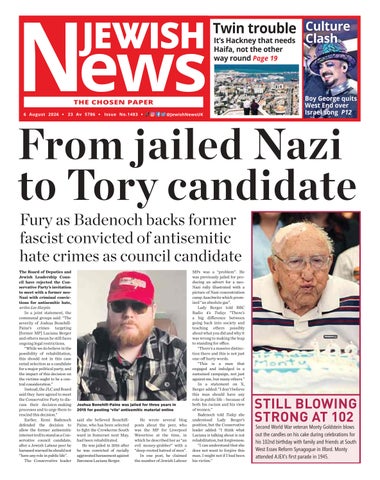
The Board of Deputies and Jewish Leadership Council have rejected the Conservative Party’s invitation to meet with a former neoNazi with criminal convictions for antisemitic hate, writesLeeHarpin.
In a joint statement, the communal groups said: “The severity of Joshua BonehillPaine’s crimes targeting [former MP] Luciana Berger and others mean he still faces ongoing legal restrictions.
“While we do believe in the possibility of rehabilitation, this should not in this case entail selection as a candidate for a major political party, and the impact of this decision on the victims ought to be a central consideration.”
Instead, the JLC and Board said they have agreed to meet the Conservative Party to discuss their decision-making processes and to urge them to rescind this decision.”
Earlier, Kemi Badenoch defended the decision to allow the former antisemitic internet troll to stand as a Conservative council candidate, after a Jewish Labour peer he harassed warned he should not “have any role in public life”.
The Conservative leader
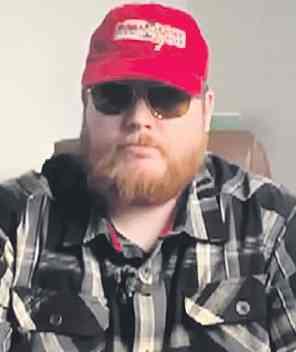
said she believed BonehillPaine, who has been selected to fight the Crewkerne South ward in Somerset next May, had been rehabilitated.
He was jailed in 2016 after he was convicted of racially aggravated harassment against Baroness Luciana Berger.
He wrote several blog posts about the peer, who was the MP for Liverpool Wavertree at the time, in which he described her as “an evil money-grabber” with a “deep-rooted hatred of men”.
In one post, he claimed the number of Jewish Labour
MPs was a “problem”. He was previously jailed for producing an advert for a neoNazi rally illustrated with a picture of Nazi concentration camp Auschwitz which promised “an absolute gas”.
Lady Berger told BBC Radio 4’s Today: “There’s a big di erence between going back into society and teaching others possibly about what you did and why it was wrong to making the leap to standing for o ce.
“There’s a massive distinction there and this is not just one-o hurty words.
“This is a man that engaged and indulged in a sustained campaign, not just against me, but many others.”
In a statement on X, Berger added: “I don’t believe this man should have any role in public life – because of both his racism and his view of women.”
Badenoch told Today she understood Lady Berger’s position, but the Conservative leader added: “I think what Luciana is talking about is not rehabilitation, but forgiveness.
“I can understand that she does not want to forgive this man. I might not if I had been his victim.”

Boy George quits West End over Israel song P12


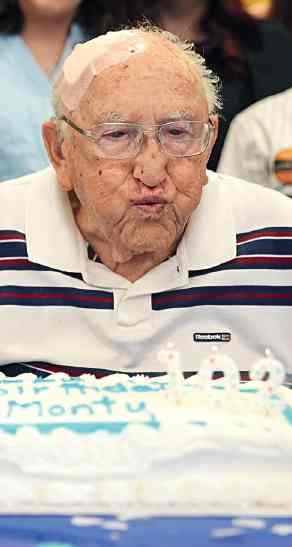
Second World War veteran Monty Goldstein blows out the candles on his cake during celebrations for his 102nd birthday with family and friends at South West Essex Reform Synagogue in Ilford. Monty attended AJEX’s first parade in 1945.
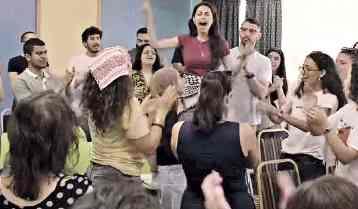
A youth group has posted footage on social media showing scenes from its summer school, where more than 100 young attendees were filmed chanting in Arabic: “We will crush Zionism” and “Young people, rise up, our revolution is an Arab revolution”, writes Lee Harpin.
The four-day event was held by the Palestinian Youth Movement (PYM) at the publicly-funded YHA Edale Activity Centre in the Peak District.
Instagram footage shows a woman leading a group of mainly young girls, along with several boys, in the inflammatory chants.
In a separate Instagram post, PYM Britain shared photos from an event in North Kensington, West London – a community football tournament for children, with participation from local schools and community groups.
A photograph from the tournament shows five children from behind, and notably, two are wearing shirts numbered 7 and 10 – a clear reference to the 7 October 2023.
Another photo from the event shows a male organiser presenting medals while wearing a shirt emblazoned with the number 40 and the slogan “The future is decolonial”.
Photos and videos from both the summer school and the recent football tournament in London have raised concerns that young people in Britain are being indoctrinated into hardline anti-Zionist positions.
There are also fears that youth are being encouraged to celebrate terrorist ideology under the guise of supporting the Palestinian cause.
PYM was initially founded in 2006 as the Palestinian Youth Network.
According to an academic history published in the Journal of Palestine Studies, it became the Palestinian Youth Movement at its second international general assembly in Istanbul in 2011. Since then, the group has expanded rapidly across the West, now maintaining more than 15 chapters in the US, Canada, and UK.
Its website states: “The Palestinian
Youth Movement is a transnational, independent, grassroots movement of young Palestinians in Palestine and in exile worldwide as a result of the ongoing Zionist colonisation and occupation of our homeland.”
The organisation is explicitly and fundamentally anti-Zionist, identi-
Celebrating 75 years of global support for Israel
fying itself as an anti-colonial movement opposing Zionism, which it defines as a settler-colonial ideology responsible for the displacement and subjugation of Palestinians.
Former Prime Minister Sir Keir Starmer and ex-Foreign Secretary David Lammy have both been directly
targeted by PYM members.
Communal organisations in the US and Israel have long accused the PYM of having an explicit goal to “eradicate Zionism”, which acts as a proxy for antisemitism.
Reports from groups like NGO Monitor and the Israeli Ministry for Diaspora Affairs highlight PYM’s alleged links to the Popular Front for the Liberation of Palestine (PFLP).
Additional images from the group’s official platform show a lecture at the summer school, with a projected image of Ghassan Kanafani – a former PFLP spokesman. Kanafani was killed in Beirut by a car bomb planted by Israel’s Mossad in 1972. The assassination was in response to the Lod Airport attack earlier, which left 26 dead and over 70 injured.
The venue, YHA Edale, is operated by YHA (England and Wales), which received £949,499 from Sport England.
It did not respond to a request for comment in time for publication.
Reform UK’s deputy leader, Richard Tice, is under investigation by the Parliamentary Commissioner for Standards over a possible failure to declare an interest.
Tice responded to the inquiry on social media, stating that the investigation stems from a complaint by what he described as an “anti-Israel lobby group”.
He said the complaint concerns whether he should have referenced his register of interests at the start of a debate on “UK democracy
and Israeli influence”.
Posting on X, Tice wrote: “I am being investigated for standing against antisemitism. ... The Standards Commissioner is considering a complaint by an antisemitic anti-Israel lobby group over whether I should have referenced my register of interests at the start of a debate.” Jewish News understands the investigation centres on an alleged failure by Tice to declare an interest linked to Israel during a Westminster Hall debate.
The leader of Hertsmere council has withdrawn from a local government summit organised by the Green mayor of Hackney, informing her that “you cannot convene unity at home while exporting division abroad”.
Following the Green-controlled Hackney council’s decision to cancel its twinning agreement with Haifa, Zoe Garbett wrote to the mayor of Haifa to inform him that “maintaining a civic connection in Israel is at odds with our anti-racist values”.
Jeremy Newmark, leader of Hertsmere council, wrote to Garbett, declining her invitation to an “emergency anti-austerity summit” in September. “On the substance, we agree,” he wrote.
But he said “you cannot convene unity at home while exporting division abroad. Your recent efforts to terminate Hackney’s historic twinning with Haifa sit entirely at odds with the non-partisan, coalition-building role you now seek to play”, adding: “Gesture politics in E8 will not help a single family in Gaza.”
Israel has expressed “serious security concerns” over the proposed Hamas disarmament deal, citing intelligence assessments that indicate Hamas remains committed to rebuilding its military capabilities.
Doron Spielman, spokesperson for Prime Minister Benjamin Netanyahu’s office, issued one of Israel’s first responses to the US’s claim last week that an agreement had been reached for Hamas to disarm and for Israel to withdraw its forces from Gaza.
He said: “Our assessment is that if we redeploy before Hamas is truly disarmed, it will quickly expand its presence throughout Gaza, rebuild its terrorist infrastructure, once again threaten Israeli communities.”
Hamas announced it would begin disarming as part of the US-brokered ceasefire signed nine months ago. This is part of the second phase of a US-brokered ceasefire plan.
A senior Israeli official said: “There will be no IDF withdrawal from the current Yellow Line without the genuine disarmament of Hamas.”
CST has recorded 1,926 incidents of Jew-hate for the first half of 2026, its second highest total since records began, and a 21 percent increase from the same period last year, writes Adam Decker.
The security charity, which today released its Antisemitic Incident Report for January-June 2026, recorded a sharp rise in hate aimed at the Jewish community in the immediate aftermath of the outbreak of the war with Iran.
The period saw a number of serious attacks on the Jewish community, including the Golders Green stabbing in late April and a series of arson attacks on Jewish organisations and Synagogues which were claimed by an Iranian-regime linked terror organisation.
That group, Harakat Ashab al-Yamin alIslamia (HAYI), has since been proscribed by the UK Government Of the almost-2000 incidents, 135 were cases of antisemitic assaults – an increase of 82% from the first half of 2025 and the highest ever six-month total in this category.
The majority of incidents in the first half of the year involved Abusive Behaviour, with 1,572 cases recorded, accounting for 82% of the total. The number of online antisemitic incidents was the highest JanuaryJune total ever recorded, at 679.
Other new half-year record highs included antisemitic incidents a ecting the school sector, which rose sharply, increasing by 59% from 112 incidents in the first half of 2025 to 178 in the first half of 2026. Similarly, incidents a ecting synagogues, their sta and congregants rose by 31%, reaching the highest level ever recorded for the first six months of

The scene in Golders Green following the knife attack earlier this year
any year. CST has been recording antisemitic incidents and their levels since 1984.
CST also noted a surge in antisemitic incidents in the weeks following the attempted arson attacks, describing how “as observed in previous years, high-profile assaults on the Jewish community can inspire more antisemitic acts from those who are emboldened and excited by seeing such hatred.”
In particular, the highest daily antisemitism totals came directly after the Golders Green stabbing attack, where two visibly Jewish men were targeted. CST described how it recorded 71 incidents in the three days following the stabbing, “16 of which directly referenced the attack. Some incidents cel-
Andy Burnham is facing mounting pressure to delay the announcement of a ban on trade with Israeli settlements, as diplomats warn the timing could inadvertently benefit Benjamin Netanyahu in the upcoming Knesset elections.
The new UK PM has been persuaded that unveiling a ban on imports from West Bank settlements in the first few weeks of Parliament’s return next month would signal that Labour under his leadership is prepared to take a tougher stance towards the Israeli government.
Burnham recently confirmed that his administration is “exploring taking firmer measures” and expects to make an o cial announcement soon after Parliament reconvenes from recess.
During a call with the King of Jordan last Saturday, a Downing Street readout stated that on the issue of settler violence in the West Bank, Burnham said he was considering “further measures to deter unacceptable violence”.
Yet there is a growing argument among Foreign O ce dip-
lomats that announcing a settlement trade ban in any form just weeks before the Israeli elections on 27 October could backfire as a foreign policy tool.
Netanyahu has a long history of leveraging international pressure or perceived foreign interference to unify right-wing and centrist voters against an “external threat”.
The Israeli PM frequently frames such actions as proof that Israel is under siege from hostile foreign powers, using this narrative to rally support and portray himself as the only leader capable of defending national interests.

In previous campaigns, he has seized on foreign criticism or sanctions to deflect attention from domestic controversies, presenting himself as a bulwark against international meddling and pressuring rivals to close ranks, consolidating his electoral base. Critics fear that a ban could reinforce this narrative.
ebrated the violence and called for further injuries to Jewish people, or used the incident to promote antisemitic conspiracy theories and anti-Jewish abuse.”
The majority of such incidents took place



in Greater London (994) and Greater Manchester (222), the two areas of the country with the largest Jewish populations. Other places with high numbers included Scotland (76), Hertfordshire (73) and West Yorkshire (64).
Mark Gardner, CST’s chief executive, said: “These attacks are directed against British Jews but they are also attacks on Britain and our society. These attacks should concern everyone who cares about Britain and the threats against it, whether state-directed from Iran, or internally driven by Islamist, far Right, far Left, or other ideological extremes.”
Chris Philp MP, Shadow Home Secretary, said: “Hatred has flourish unchecked on Britain’s streets, campuses and communities. Thousands of Jewish families living in fear in their own country, and it is completely unacceptable. Antisemitism has no place in Britain and real action needs to be taken to stamp it out.
The Government’s Independent Advisor on Antisemitism, Lord Mann, said: “It is especially concerning to see the nature of antisemitism in the UK becoming increasingly violent.”

by Lee Harpin lee@jewishnews.co.uk
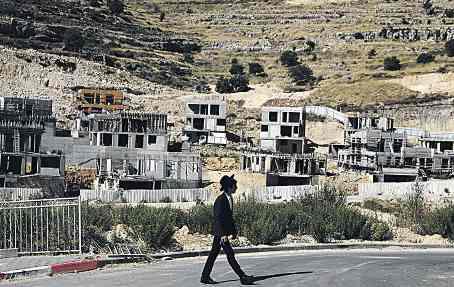
The Charity Commission has launched a statutory class inquiry after concerns emerged that multiple UK-based charities have donated money to illegal Israeli settlements in the West Bank.
Initially, the inquiry will focus on eight charities, among a larger group identified in recent concerns raised with the Commission.
The investigation aims to determine the extent to which charitable funds were used in illegal Israeli settlements, the purposes behind this spending, and whether these actions aligned with the charities’ stated objectives.
The Commission will also assess whether charity assets or beneficiaries are at risk and consider what regulatory action, if any, may be needed to address these issues.
Stephen Roake, assistant director for High Risk Compliance at the Charity Commission, stated: “All charities must be able to demonstrate they are delivering on their charitable purposes, wherever and however they operate.
The Commission intends to publish a report detailing the issues examined, its findings and any regulatory actions taken once the inquiry, or stages of it, have concluded. It will consider naming the charities when it releases its report.
In June, the watchdog stated it would work with the Foreign O ce to develop guidance for UK charities whose work may be seen to assist the development of illegal Israeli settlements.
“Serious allegations have been made about UK charities operating in illegal Israeli settlements in Palestine. Our first step is to establish the facts. Only then can we determine if regulatory action is required, based on the evidence we find.
“Our fact-finding will also help us develop regulatory guidance, ensuring continued public trust and confidence in the sector.”
The Commission has shared information about the inquiry’s scope with the police and HMRC. While the Commission cannot investigate crimes or breaches of the Geneva Convention, it has referred any potential criminal matters to the police. At this stage, the charities involved are not being publicly named.
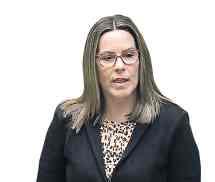
According to MP Melanie Ward, thirty-two charities in England and Wales have donated at least £28m to Israeli settlements illegal under international law. Ward made this claim after conducting a report in collaboration with Israeli human rights activists. Ward added that, if gift aid was claimed in the usual way, taxpayers could have subsidised illegal settlements by as much as £5.6m. Ward, formerly chief executive of Medical Aid for Palestinians, outlined the charities’ recent activities in a letter to the Commission, urging the regulator to investigate and consider removing them from the charity register.
32 UK charities possibly funding settlements in the West Bank, but said they were not being named for security reasons.
the international court of justice, and tional criminal court investigation on
She said the provision of funds to support illegal settlements in the West Bank was not a charitable activity and did not comply with UK or international law on settlement activity, a position “taken by the United Nations, successive UK governments, the international court of justice, and an issue that is subject to an international criminal court investigation on the grounds of war crimes”.
advocacy group Yachad, Ward revealed the Commission was investigations into the chari-
At a recent event organised by the advocacy group Yachad, Ward revealed the Commission was close to announcing possible investigations into the charities. She indicated she had been alerted to more than
She rejected claims of “double standards” regarding her focus on the Palestinian issue and not scrutinising charities linked to other occupied regions such as Western Sahara and Northern Cyprus. Ward highlighted the UK’s “particular historical relationship with Israel and Palestine,” adding, “We have a particular responsibility there.”
Ward added: “If we were able to make steps toward a peaceful resolution – a two-state solution – it would have an enormous impact, including on community relations in our own country.”
“particular historical relationship with Israel and Palestine,” adding, “We have a
She also argued that the situation di ers from the other regions, noting,
She also argued that the situation
Announcing the scope of their class inquiry the Commission said it would “establish the extent to which funds or other resources have been applied by charities within the defined class in relation to illegal Israeli settlements in Palestine, the purposes for which those funds were used, and the extent to which this meets the requirements of charity law”.
it’s been going on – almost 80
Israelis and Palestinians is a tional community.”
“Not least in the length of time that it’s been going on – almost 80 years – and there’s no doubt that the situation between Israelis and Palestinians is a running sore in the international community.”
‘Death to IDF’ activist has court appearance SPIKE IN
A pro-Palestinian activist has appeared in court accused of repeatedly driving past a Norwich synagogue while blasting music containing the “Death, death to the IDF” chant.
Mireille Abate, 54, is alleged to have passed Norwich Hebrew Congregation’s Earlham Road site six times in less than ten minutes while worshippers were inside attending a Shabbat service.
Norwich Magistrates’ Court heard she had been playing a pro-Palestinian playlist from her vehicle, including audio from Bob Vylan’s controversial Glastonbury performance, during which the punk-rap duo led
crowds in chants of “Death, death to the IDF (Israel Defence Forces)”. Abate, of Winter Road in Norwich, pleaded not guilty to religiously aggravated intentional harassment when she appeared in court.
According to Campaign Against Antisemitism, the alleged incident took place shortly after 10am on Saturday, 18 October, with CCTV said to show her vehicle passing the synagogue six times.
Abate was granted bail ahead of her next court appearance, scheduled for 25 August.
Her bail conditions prohibit her from attending or loitering outside Norwich Hebrew Congregation.
It added: “This will include examining what funds were applied within an illegal settlement and whether the application of those funds was in furtherance of the charities’ stated charitable purposes.
“The scope of the class inquiry may be expanded if necessary.”
Israelis are exiting the country in high numbers, a trend that could harm the state’s future security and economy, according to a new demography study published this week by Tel Aviv University.
It showed that 268,509 Israelis left the country for a period of at least three consecutive months from 2023 to 2025, part of a spike that began after 2020 during the Covid pandemic.
“Even in 2025, the number of Israelis who left the country for a significant period of time is very worrying”, particularly coming on top of the number from the two prior years, said Itai Ater, one of the authors.
He said there is a “growing concern” that “immigration from Israel will increase in
a way that will endanger security and the Israeli economy”.
In 2020, only 38,764 Israelis left for a three month period or more, the lowest such number since the start of the study in 2009, when 65,014 Israelis were absent for three consecutive months or more. The numbers spiked rapidly from 2020, rising to 53,559 in 2021, then up to 66,966 the next year.
The leap was more dramatic in 2023, when the October 7 attack on southern Israel took place, and the ensuing wars with Hamas in Gaza and Hezbollah in Lebanon.
The numbers spiked to 49,925 in 2023 and remained high, with 49,677 absent for at least a year in 2024.
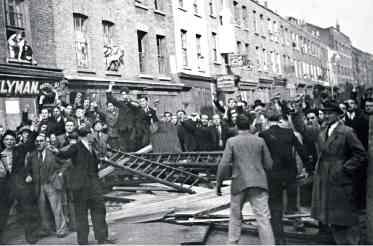
Ninety years after the Battle of Cable Street, a major London-wide festival of art, music and performance will commemorate one of Britain’s defining moments of collective resistance, writes Brigit Grant.
Cable Street 90, running from 1–11 October, brings together artists, musicians, writers and historians for events across the capital, with participants including TracyAnn Oberman, Howard Jacobson and acclaimed band Oi Va Voi.
Organised by the Board of Deputies, the programme spans


venues including Toynbee Hall, Wilton’s Music Hall, JW3 and Sandys Row Synagogue, exploring the Battle’s legacy through exhibitions, performances, films, talks and heritage events.
Among the highlights is Murmur Mural, a new large-scale movingimage installation by artist Inam Zimbalista, projected onto the exterior of Toynbee Hall. The work transforms archive footage of the Battle into a striking meditation on community and resistance using vast bird murmurations.
Tracy-Ann Oberman joins novelist Howard Jacobson for The Merchant of Cable Street, a discussion inspired by her acclaimed East End reimagining of The Merchant of Venice. Other events include walking tours, Jewish heritage taxi tours, family workshops, documentary screenings and an open day at Sandys Row Synagogue.
The festival marks the anniversary of 4 October 1936.
• Full programme details are available at bod.org.uk/cable-street-90
Police are investigating a 15-yearold after a gravestone was allegedly shot at with an airsoft pistol in a Jewish cemetery.
German o cers were called to the cemetery in Langenselbold, Hesse, around 7pm on Saturday after a witness reported seeing a group of youths firing at graves.
Several police patrols were sent
to the scene and found five young people nearby who matched the description given by the witness.
One fled on foot when o cers arrived but was found nearby, according to Southeast Hesse Police. Witness accounts led investigators to identify a 15-year-old as the suspected shooter.
An examination of the cemetery
found damage to one gravestone, estimated at around €500 (£429). Investigators are examining suspected property damage and disturbance of the peace of the dead.
A police spokesperson said that only one damaged gravestone had been identified, although further damage could be di cult to spot because airsoft pellets are small.
The force said there was currently no evidence pointing to a farright or other political motive. All five young people were allowed to leave following police enquiries.
The incident comes amid wider concern over antisemitism in Hesse. Hesse police recorded desecrations at 21 Jewish cemeteries between 2020 and 2025.


The Zionist dream for the creation of the State of Israel was finally fulfilled in 1948 - yet nearly eight decades on we continue to hold on dearly to the ‘Z’ word. Simon Sebag Montefiore and Anthony Julius have differing views on whether it’s time to move beyond a word which continues to evoke such passion and pride around the globe.

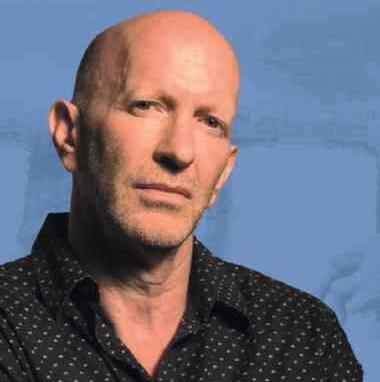

In this exclusive debate organised by Jewish News and a central London Synagogue, the pair will debate whether it is time to recognise that we’re living in a post-Zionist era or, at a time when the ‘Z’ word is both misunderstood and maligned globally, is it time to double down and hold the word closer than ever.
DATE: 5th October 2026
LOCATION: Central London venue
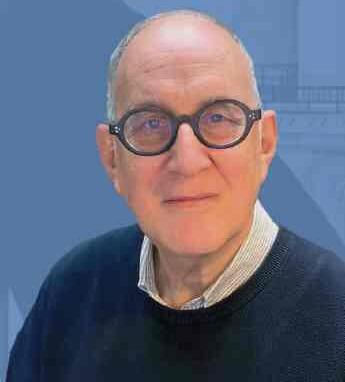

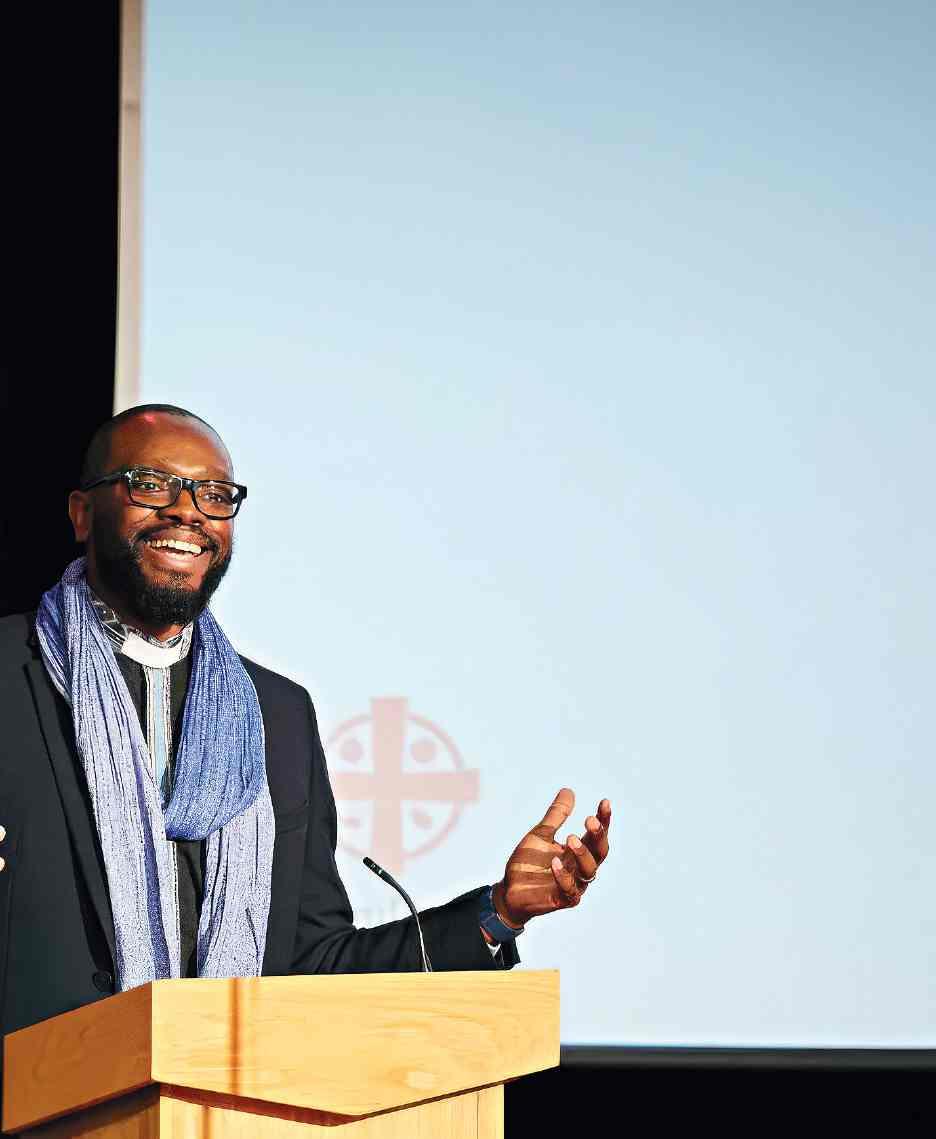
‘Our
has strong views on religious intolerance and he’s not afraid to share them, he tells
When 20,000 people gathered for the Standing Strong: Extinguish Antisemitism rally on Whitehall in May, they may not have been expecting to hear from a senior Church of England official. But Lusa Nsenga-Ngoy, lead bishop for interfaith engagement, gave a stirring and impassioned speech on the dangers of Jew-hate and where they can lead. “Antisemitism possesses a particular persistence and ubiquity that demands moral clarity, ” he said. “It mutates. It survives. It appears across the political spectrum and feeds on fear, grievance, and division ... it grows when public voices choose outrage over responsibility.”
“When public figures trade in conspiracy, humiliation and division, they do not merely inflame opinion; they corrode the moral foundations of a nation. Leadership that profits from division is not courage. It is recklessness.”
Two months later, the church held its annual Synod, at which a specific motion on the plight of Palestinian Christians was scheduled for a vote. It included a document known as Kairos II, which claims Zionism is a settlercolonial movement built on “Jewish supremacy” with genocidal intent, and urges Christians worldwide to refrain from dialogue with “Zionists”.
Despite warnings from British Jewish religious and lay leadership, the Synod voted overwhelmingly in favour, albeit with a decision to “hear” it rather than to “receive” it – a difference viewed by British Jews as mere semantics. Chief Rabbi Mirvis said the vote was “shameful” and “a sad day for Jewish-Christian relations”.
Bishop Lusa, who moved from the Democratic Republic of Congo to Belgium as a child, later entering the priesthood, was not at the Synod but was watching closely. He noted a Synod vote about Palestinians had been “delayed for a number of years” and felt the church had therefore been trying to do a multiplicity of things at once. He described the document as “problematic”: “The Church wanted to express solidarity with Palestinian Christians, but I think [Kairos II] lends itself to the fostering of particular tropes towards Israel or Jewish iden-
tity that in certain ways could enable antisemitic rhetoric or discourse.”
He wondered if the Synod motion fallout was “an opportunity for us to revisit our commitments in the past and to test our understanding of what we mean by antisemitism... recognising that particularly in... Western Christianity, the threads of antisemitism are never too far below the surface, and there’s something in our institutional muscle memory that needs to unlearn those patterns and constantly become alive to the seduction of those discourses and narratives, even when they are projected or advertised as a compulsion towards justice.”
He said: “I’m not suggesting the Palestinian question is not one that calls for justice deservedly, and I wouldn’t want to create a hierarchy of worth in assigning the need to attend to issues of justice, but perhaps we must be mindful, if we’re not attentive to our own history... we might easily be taken into places where... our actions may fail to carry the weight they’re intended to.”
Having served as bishop of Willesden since 2022, he recently attended Brondesbury Synagogue for a pidyon haben – Board of Deputies president Phil Rosenberg was redeeming his firstborn son, which Nsenga-Ngoy described as “a fascinating ceremony”. He also recently visited
Poland with the Council of Christians and Jews, but it was his presence at May’s rally when many Jews met him for the first time.
A particularly problematic recent issue, I suggest, is the attempt to effectively retrofit Jesus into being described as a Palestinian.
“First, I have to be honest and acknowledge that until fairly recently, I used that language myself: ‘Jesus was Palestinian’. It felt like solidarity”, the Bishop says.
“But I’ve come to think it’s a problem. Not just because it’s anachronistic: there were no ‘Palestinian’ people in that sense in the first century. It can make Jesus’s Jewishness incidental. And once you do that, you’re not just getting history wrong.
“A phrase meant to honour one people’s suffering ends up, unintentionally, dispossessing another people’s memory. That’s the thing I watch for now; language that sounds like compassion but carries antisemitism underneath it, unexamined.”
He points out, however, that when some Palestinians describe Jesus as Palestinian, or Black people describe Jesus as Black, they are continuing a longstanding theological tradition in which groups of Christians identified themselves with Jesus, whom they see as the embodiment of someone who suffered.
“I believe we should hold the claim that Jesus was a Jew; full stop, nonnegotiable; any language that loosens that anchor should worry us”, he says.
“In the same vein, we should be able to confidently acknowledge the fact that Jesus is claimed, rightly, by suffering Palestinian Christians today, in that same confessional key that’s let every oppressed people recognise itself in this story.
“That’s not a contradiction I need to resolve. It’s the same paradox the incarnation has always held for Christians; particular enough to be a Jewish man from Nazareth, universal enough to be found wherever people are still being oppressed.”
KNOWING HOW TO LOOK AFTER YOURSELF AND OTHERS GIVES YOU THE POWER TO PREVENT A CRISIS. Learn how to manage stress, understand wellbeing and mental health, and reach out to someone who’s struggling - because simple skills can change lives. Book
WHAT IS MENTAL HEALTH?: The essentials everyone should know
Wednesday 16 SEPT 1.00pm
Tuesday 6 OCT 8.00pm OR

UNDERSTANDING MENTAL HEALTH CONDITIONS: Identifying and responding to common mental health issues
Wednesday 14 OCT 1.00pm
Tuesday 20 OCT 8.00pm OR
SELF-CARE AND STRESS MANAGEMENT: Boost your wellbeing and reduce stress
Wednesday 12 AUG 8.00pm
PRACTICAL RELAXATION: Master powerful techniques in 50 wonderful minutes
Wednesday 19 AUG 8.00pm
REACHING OUT TO SOMEONE WHO’S STRUGGLING: How best to show concern and o er help
Wednesday 28 OCT 1.00pm
Tuesday 3 NOV 8.00pm OR OR
Tuesday 17 NOV 8.00pm OR OR OR
Wednesday 25 NOV 1.00pm
Wednesday 11 NOV 1.00pm Tuesday 1 SEPT 8.00pm
Tuesday 1 DEC 8.00pm OR

www.projectlily.org.uk
Jewish doctors are increasingly turning to the Jewish Medical Association (JMA) over concerns about colleagues rather than patients, the organisation’s new chair has revealed, as she described a growing demand for help following the 7 October attacks, writes Annabel Sinclair.
In her first interview with Jewish News since becoming chair earlier this year, Dr Fiona Sim said workplace issues now dominate many of the concerns reaching the organisation. She said: “The great majority of concern is about colleagues. It’s not so much about patients.”
Sim stressed that Jewish patients should not be deterred from seeking medical care, saying the majority of healthcare staff remain professional and patients should continue to use NHS services when they need them.
Sim succeeds Professor David Katz after 18 years as chair, taking over an organisation whose role has substantially changed.
Originally an organisation for doctors, the JMA now supports around 1,200 doctors, nurses, pharmacists, psychologists, physiotherapists, students and other healthcare professionals, with tackling antisemitism becoming an increasing part of its work.
Sim’s own involvement deepened during the 2021 Israel-Gaza conflict, when she began advising Jewish healthcare professionals experiencing antisemitism. That work escalated after 7 October.
“A huge amount of the effort of JMA has been in addressing antisemitism,” she said.
“People found out, ‘Contact Fiona’… regardless of whether you were a member of JMA or not. Somebody had to be out there for these guys.”
Much of that work remained confidential. “It was all behind the scenes,” she said. “Supporting people and making sure that their names didn’t come out in public if they didn’t want them to.”

Sim said she took on the chairmanship because “it was time to give something back”: “I thought this was something useful… to help build the organisation into the next era.”
Central to that ambition is making the JMA what she describes as a “professional home” for
Jewish healthcare professionals, rather than an organisation defined solely by antisemitism.
But concerns over the treatment of Jewish doctors now extend beyond individual workplaces to some of the institutions responsible for representing the profession.
It’s a hostile environment, very largely, for Jewish doctors, for Jewish members
Sim remains a member of the British Medical Association (BMA) and praised the “excellent advice” its trade union representatives can provide. Her assessment of the wider organisation, however, was stark.“It’s a hostile environment, very largely, for Jewish doctors, for Jewish members,” she said.
At the BMA’s Annual Representative Meeting in June, delegates backed a motion opposing the IHRA definition of ‘antisemitism’ and called for a pause in implementing recommendations from Lord Mann’s review.
Palestine Action’s co-founder can take her case to the Supreme Court after Court of Appeal judges ruled the group’s ban was lawful.
The update in the legal challenge came after police arrested 117 people at a protest outside Westminster Magistrates’ Court in central London.
In June, five Court of Appeal judges said the ban on the organisa-
tion as a terror group was a “justified and proportionate” interference on freedom of expression rights.
This overturned the judgment of three judges at the High Court, who ruled in February that former home secretary Yvette Cooper’s decision to ban Palestine Action was unlawful, after a legal challenge from the group’s co-founder Huda Ammori.
After the judgment, Ms Ammori said she intended to take the case to the Supreme Court, and the European Court of Human Rights if necessary.
She launched her bid to take the case to the UK’s highest court earlier this month, and in a decision published on Thursday, Lord Sales, Lord Leggatt and Lady Simler granted permission for her appeal.
The case is to be expedited, court records show, with a hearing expected between October and December.
Justices granted the green light to challenge the ban on the basis that Ms Cooper had incorrectly applied her own policy, but refused a bid to challenge the decision based on interference with freedom of speech and freedom of association rights.
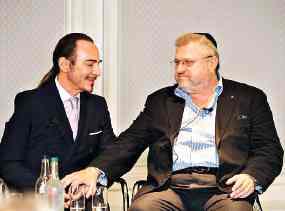
John Galliano is to be honoured at the 2027 Met Gala, 16 years after an antisemitism scandal in which he declared his love for Adolf Hitler and told Jewish women their families should have been “gassed”, writes Annabel Sinclair.
New York’s Metropolitan Museum of Art announced John Galliano: Horizons, a major exhibition devoted to the British designer, which will provide the inspiration for next year’s Met Gala.
The decision represents one of the most significant moments in Galliano’s return following the 2011 scandal, which led to his dismissal from Dior and a criminal conviction in France.
Opening on 9 May 2027, the exhibition will trace more than four decades of his career, beginning with his celebrated 1984 Central Saint Martins graduate collection and continuing through his work for major fashion houses including Maison Margiela.
It will make Galliano only the third living designer to receive a major Costume Institute exhibition, following Yves Saint Laurent in 1983 and Rei Kawakubo in 2017.
But the honour has renewed scrutiny of the antisemitic abuse that brought Galli-
ano’s career crashing down at its height.
Footage made public in 2011 showed the designer during an incident in a Paris café saying “I love Hitler” and telling a group of women: “People like you would be dead. Your mothers, your forefathers would all be f***ing gassed.”
However, some prominent Jewish figures have backed Galliano’s rehabilitation, arguing that his subsequent e orts to apologise and address his behaviour should also be recognised.
Jonathan Greenblatt, chief executive of the Anti-Defamation League, told The New York Times: “We believe John Galliano has genuinely worked through the issues that led to his antisemitic outburst years ago in Paris, and we have long since accepted his apology.
“His e orts to repair the damage his words caused and to learn from that incident should be applauded.”
Rabbi Rick Jacobs, president of the Union for Reform Judaism, was among Jewish leaders consulted as plans for the exhibition developed.
After meeting Galliano, Jacobs told The New York Times: “The word I come back to is ‘sincerity’. He was open. He looked right at us and spoke in a clear way, not as if he had memorised talking points.”
The 2011 scandal triggered widespread condemnation and brought Galliano’s highprofile career at Dior to an abrupt end.
Natalie Portman, the Israeli-born Jewish actress who was a Dior ambassador at the time, said she was “deeply shocked” by his comments and would not be associated with him “in any way”.
Amy Winehouse’s father must pay just under £1m to two of his daughter’s friends after a failed High Court claim over the auctioning of the late singer’s items.
Mitch Winehouse also racked up at least £950,000 in his own legal costs in the failed bid against Naomi Parry and Catriona Gourlay.
He claimed the women had profited from selling dozens of Ms Winehouse’s items at auctions in the US in 2021 and 2023, accusing them of having “deliberately concealed” their sale.
But Judge Sarah Clarke KC threw out the claim earlier this year, finding that he “knew all along“ about the intended sale and only afterwards began to pursue them for money.
She said: “The claimant chose to bring an inherently weak claim, pursue it aggressively and relentlessly to the end, and make serious and unfounded allegations against the defendants, which significantly damaged their reputations, career prospects, financial security and health.”
The judge said that, as of April, Ms Parry’s costs were estimated to be £715,361 while Ms Gourlay’s were £487,132. She ordered Mr Winehouse to pay interim payments to each of the women within the next two weeks.













































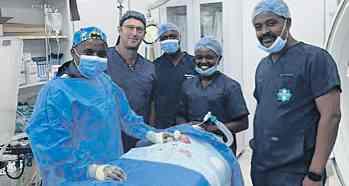
An Israeli heart specialist flew more than 2,500 miles to Rwanda to help save an 11-day-old baby before returning home the same day, writes Annabel Sinclair.
Dr Sagi Assa, a senior paediatric cardiologist at Wolfson Medical Centre, travelled to Kigali after being contacted by Dr Gerard Misago, the first Rwandan interventional paediatric cardiologist trained in Israel through Save a Child’s Heart.
The newborn, Angel, had been born with critical pulmonary valve stenosis, a rare heart defect that prevented blood from reaching his lungs.
His parents, who live in a remote part of Rwanda, had taken their son through four regional hospitals before reaching King Faisal Hospital in Kigali, where he arrived critically ill.
Misago, who recently returned home after completing a threeyear fellowship with the Israeli humanitarian organisation, con-
tacted Assa, his former mentor, because of the risks involved in treating such a small baby.
Assa left Tel Aviv at midnight, travelling via Addis Ababa, and arrived in Kigali at 10am.
“Because it’s a high-risk procedure with high mortality, we felt we should do it together in Rwanda for the first time,” Assa said.
“I took on the challenge and left at midnight from Tel Aviv through Addis Ababa to Kigali. We performed the procedure together – mainly led by Dr Gerard – and successfully dilated the baby’s pulmonary valve.”
a catheter to open the narrowed valve, rather than performing openheart surgery.
Angel weighed 2.6kg, making the procedure particularly delicate.
Misago led the intervention alongside Assa and paediatric cardiac anaesthesiologist Dr Christine Niyibogora, who was also trained in Israel through Save a Child’s Heart.
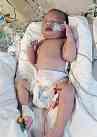
Within hours, Angel was stable, breathing without a ventilator, and back with his mother.
Assa then began his journey back to Israel, completing the mission in less than 30 hours.
He said the significance of the operation demonstrated that years spent training Rwandan specialists in Israel were now allowing complex treatment to be delivered locally.
The doctors carried out a balloon pulmonary valvuloplasty, using
“More than saving Angel’s life – which brings us immense joy –this mission represents a defining
moment of self-reliance,” Assa said. “This was the culmination of three years of training and partnership.
“Seeing Dr Gerard and his team perform so exceptionally under high pressure proves that Rwanda now has the local capability and confidence to treat complex heart conditions independently.”
He added: “A mentor’s job is to make you independent, not to keep you reliant.”
Save a Child’s Heart executive director Simon Fisher said the operation marked “a key milestone in the independent paediatric cardiology programme in Kigali”, helping children with congenital heart conditions receive specialist treatment without having to leave Rwanda.
Founded in Israel in 1995, Save a Child’s Heart says it has treated more than 8,500 children from 75 countries and trains medical professionals from overseas to develop paediatric cardiac services in their own countries.















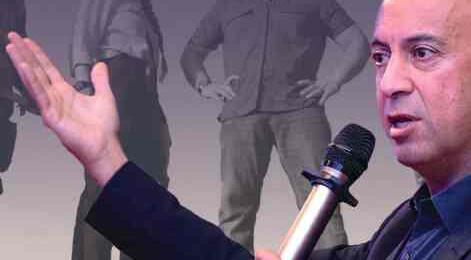



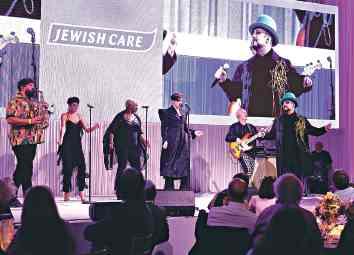
Boy George has withdrawn from Andrew Lloyd Webber’s Jesus Christ Superstar at the London Palladium just days before he was due to make his West End debut, following a backlash over a newly-released pro-Israel song, writes Joy Falk.
The 65-year-old singer had been scheduled to play King Herod from 3 to 15 August. However, his manager, Paul Kemsley, announced that he had decided to remove the singer from the production to avoid overshadowing the show.
Posting on Instagram, Kemsley said the decision had been made “with the utmost respect for the producers,
the creative team and the entire company”. He added: “I felt it was right to step aside, allowing the production to remain the focus, while ensuring everyone involved can move forward with mutual respect and goodwill.”
Kemsley said Boy George had “never been afraid to stand by his personal convictions”, but apologised to fans who had already bought tickets for performances.
The controversy follows the release of Boy George’s song We Will Dance Again, which defends Israel’s military campaign in Gaza and rejects claims that it amounts to genocide.
The opening lyrics state: “You
say genocide, I say war / When you’re attacked, that’s what the army’s for.”
The title references the slogan adopted in Israel after the 7 October 2023 Hamas attack on the Nova music festival, in which hundreds of people were killed and kidnapped by Hamas terrorists.
Elsewhere in the song, Boy George criticises activists and musicians who have condemned Israel, singing: “Musicians holding flags, mouthing like sheep / Propaganda fuelled by the internet feels so weak.”
The track prompted sharply divided reactions online. The singer had previously described himself
as “very connected to the Jewish people”, saying he had worn a Star of David since the beginning of his career and would never “turn my back on my Jewish friends”.
Professor David Miller has won the latest round of his fight with the University of Bristol, after an employment appeal tribunal upheld the original tribunal ruling in favour of the dismissed academic.

The three-person panel,


presided over by Lord Fairley, KC, heard the case in London last November and concluded that attempts by the university to challenge the original ruling on multiple grounds, including protected belief, causation and unfair dismissal, were not well
founded. The appeal panel, however, also rejected an attempt by Miller to counterappeal, including a decision regarding his “contributory fault” which led to a reduction in his compensation.
Nonetheless, Miller cel-
ebrated the appeal tribunal’s decision, posting on social media that “we have set a binding legal precedent! AntiZionism is now a protected philosophical belief under the Equality Act 2010.”
The academic, who since his university dismissal has worked as a producer for a weekly show on Press TV, the Iranian regime state broadcaster, claimed that the ruling was “a public humiliation for the genocidal Zionist regime”. • Editorial comment, p16





















Two Israeli parents whose sons became tragically linked by the 7 October attacks have shared an emotional public conversation about grief, faith and forgiveness, offering a powerful message of resilience and national unity, writes Annabel Sinclair.
Iris Haim, whose son Yotam survived more than two months in Hamas captivity before being mistakenly shot dead by Israeli troops after escaping, was joined by Rabbi Doron Perez, executive chairman of the World Mizrachi Movement, whose son, Capt. Daniel Perez, was killed while commanding a tank during Hamas’s 7 October 2023 attack. His body was taken into Gaza by Hamas before later being returned to Israel.
Speaking during an online event hosted by Lockdown University on Sunday evening, the pair revealed that the same Hamas terrorist who abducted Daniel was also responsible for holding Yotam
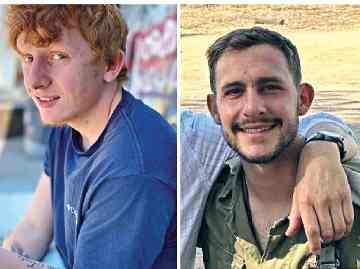
and the two hostages who escaped alongside him in Gaza.
Rather than only dwelling on their personal tragedies, the discussion focused on how faith,
resilience and compassion shaped their response to unimaginable loss.
Perez paid tribute to Haim’s decision not to blame the Israeli

soldiers who mistakenly killed her son, saying her response had inspired families across Israel.
“I was very impressed… you straightaway immediately took us to a place of healing and forgiveness,” he told her.
“You said they must go back to the army… everything was done in good faith.”
Haim said that after learning of Yotam’s death she realised she needed to find “a new story” that would allow her to live with her grief, choosing to focus on her son’s life and values rather than the circumstances in which he died.
The pair also reflected on what they believe Israel must learn from the trauma of 7 October, warning against allowing political disagreements to deepen divisions within society.
“Our enemies are Hamas, Hezbollah, the Houthis and Iran,” Perez said.
“No political opponent in Israel
who wants the good of the Jewish people… is our enemy.”
He urged Israelis to reject hatred towards one another, adding: “We have to understand that our enemies cannot be our political opponents.”
Haim agreed, saying every Israeli has a responsibility to help rebuild the country through their own actions rather than waiting for politicians to bridge the country’s divisions.
The discussion concluded with the pair reflecting on the contrast between Tisha B’Av, the Jewish day of mourning, and Tu B’Av, the festival celebrating love, saying Israel’s future depends on choosing connection over division.
“We need to believe that we are brothers,” Haim said.
Perez agreed, saying the country now needs “healing” and a renewed willingness to find common ground despite profound differences.
An immigrant from Gaza has been fined £250 after he was videoed performing a Nazi salute in front of Jews, with a court rejecting his claim that the intent of the gesture had been to wave on members of a pro-Palestinian march.
Mohammed Alamrein, who left Gaza a year prior to 7 October and subsequently managed to gain refugee status in the UK, took part in a “National March for Palestine” in June 2025, organised by groups including the Palestine Solidarity Campaign and Stop the War.

forming the hate sign in front of them.
As described by blogger and retired Met police officer Gill Levy,
“It took the victim’s own footage, passed to Stop the Hate, posted online, and from there circulated among officers who had somehow missed it in person, to turn a shrug into a case file. Only once the clip was public, and the Met’s handling of it was potentially public along with it, did the machinery leading to a Section 5 of the Public Order Act charge start moving.”
Counter-protestors from Stop the Hate were positioned by the police at one area passed by the march, and Alamrein was filmed per-
Levy also noted that the guideline fine for the offence in question – behaviour likely to cause harassment, alarm or distress – usually “starts well north of £800”.
UK advocacy network We Believe In Israel has appointed Ido Dimri, former chief of staff to Israel’s Minister for Diaspora Affairs and Combatting Antisemitism, as its new executive director.
Hailing “his experience building relationships with Jewish communities around the world and non-Jewish friends of Israel”, organisation chair Simon Tobelem said Dimri’s appointment “represents...the beginning of the next chapter”.

Ma’agalim) making this mission profoundly personal to me.”
He aims to make We Believe “a home for everyone who cares about Israel” with plans to “expand our grassroots, engage the next generation, strengthen Jewish community and friends of Israel partnerships, and ensure Israel’s voice is heard clearly, confidently and effectively.”
Dimri told Jewish News his appointment at “such an important time for both Israel and the Jewish community” is a “great honour”, adding that “the events of 7 October deeply affected the community where I was raised, (Moshav
Encouraging members of the community to get in touch, Dimri stressed that “My door is always open, and I warmly invite anyone who shares our commitment to Israel to bring forward ideas and initiatives.
We Believe in Israel merged with the National Jewish Assembly in January 2026.
A grief-stricken 30-year-old Israeli man has been found dead at the graveside of his best friend, who was murdered by Hamas at the Nova Festival on 7 October 2023, writes Michelle Rosenberg.
According to Israeli media reports, Bar Asraf shot himself on Sunday at the grave of Liron Barda.
Barda, who was working as the bar manager at the festival in Re’im, refused to flee the massacre despite being begged to do so by family and friends.
Instead she stayed to provide first aid to the wounded, until she was murdered herself.
According to reports, Bar, who was not at the festival, tried to drive toward Nova to save her, but was turned back before he could reach her. Sitting with her family, he waited for three days to learn of her murder.
Speaking to online news site Walla , his sister Lihi said: “We were at my brother’s wedding. He apparently started to feel lonely. You couldn’t tell. He was always happy and laughing. His best friend was murdered in Nova. He has a tattoo of her, she was a part

of his soul. At the groom’s celebration, there was dancing and a Shabbat reception with a singer; it was magical. We were at the peak of the family’s life.”
She added: “Yesterday he left, and I thought he went to be alone and think like he usually does.
“An hour passed, then two hours passed, and my older sister said, ‘Come on, we’re going to look for him.’ First in the most logical places, and then we went to check Liron’s grave. He loved talking there and being with her.”
Lihi said: “My sister had a feeling and told me, ‘You go.’ I walked over, and suddenly I saw him lying next to Liron’s grave.
“I said to him, ‘Bar, get up, what are you doing again…’ and then I realised he was covered in blood. I stepped on a gun beside him. I screamed. I couldn’t function. My father started CPR. I knew it was the end. He was cold.
“Magen David Adom tried everything. He died in the place he wanted to be most, with the woman he wanted to be with most.”
Ireland’s new €53m government jet was bought without an Israeli-made system that helps pilots land safely in fog and other poor weather.
The Dassault Falcon 6X, used to fly Taoiseach Micheál Martin and other ministers, was ordered without the FalconEye system made by Israeli defence company Elbit Systems.
According to The Journal, sources said the system was left out because buying it would have required the Irish government to
make a separate deal with Elbit. FalconEye uses cameras and sensors to help pilots see when visibility is poor, including during heavy fog.
Former Irish Air Corps pilot Kevin Phipps told The Journal: “The operational benefit of this system is the ability to land in fog when other aircraft would have to divert to another airport.”
Ireland’s Department of Defence said there are “no current limits” on what the aircraft can do.
Uganda has unveiled a statue commemorating Yoni Netanyahu, the Israeli commando and brother of Benjamin Netanyahu, who was killed during the Entebbe rescue operation.
In a speech given by the leader of Uganda’s armed forces, General Muhoozi Kainerugaba described Yoni Netanyahu’s “leadership and ultimate sacrifice” as “an enduring symbol of courage, duty and selfless service”.
The Entebbe Raid, also known as Operation Thunderbolt, was an

Israeli military operation launched following the hijacking of an Air France flight from Tel Aviv to Paris by Palestinian and German Communist terrorists. General Muhoozi Kainerugaba at the unveiling of the statue

contracted physicians and specialists
Full hospitalization, labs, etc. • No deductible or co-payment For more information, visit: egertcohen.co.il/tourist-health-insurance/ 02-622-7999 • www.egertcohen.co.il



Editorial comment and letters to the editor
A decision by an Employment Tribunal Appeal panel to uphold a previous ruling relating to the case of David Miller has, predictably, led to celebration from his supporters and deep frustration from his detractors.
Miller’s deeply repulsive statements are well-known within our community, and so the latest judgment is a deeply unwelcome one. It is also, however, not nearly as bad as Miller’s minions would like to make out.
As one might expect, the main claim from the former academic, amplified by every single pro-Iranian regime ‘news’ outlet and pressure group in the country, is that thanks to him, “antiZionism” is now a protected characteristic. As one might also expect, this is not, strictly speaking, true. What Miller did was show that an anti-Zionist can expect to win an employment tribunal case if they claim to hold a very specific set of sub-beliefs – not opposing or holding antipathy towards Jews or Judaism, and not supportive of nor ‘open to’ the use of violence as a means of opposing Zionism – and crucially, are not challenged on such claims at the tribunal by their former employer.
The University of Bristol’s decision not to do this was incredibly foolish, and meant that when they tried to introduce further evidence at the appeal stage to challenge Miller’s depiction of the nature of his anti-Zionism, they were prevented from doing so.
So if you are an anti-Zionist with a long list of public posts that may cause people to question the sincerity of the exact nature of your belief, and you believe the institution will conduct the same abysmally stupid legal strategy as Bristol did, then you may be in luck. If not, then this may not be the precedent you’re hoping it is.
There is also a silver lining to this ruling, which Miller was somehow reticent to highlight. If, under certain very specific circumstances, anti-Zionism can be cited as a protected characteristic, so too can Zionism itself. Before its autumn conference, the Green party might be wise to note the ramifications of that on its own policy.
THIS WEEKEND'S SHABBAT TIMES...

There are dates that carry such moral weight that they should never be used for political convenience – 7 October is one of them.
Whether Hackney Council ultimately decides to end its twinning arrangement with Haifa is a matter for debate.
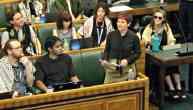
Reasonable people can disagree about that. But choosing 7 October as the deadline for the Israeli mayor’s response crosses a different line.
It is impossible to believe that nobody recognised its significance. It marks the worst massacre of Jews since the Holocaust. For Israelis, and for Jews across the world, it is not simply another day in the diary. It is a day of remembrance, trauma and grief.
At best, it reflects an astonishing indifference
DON’T
to Jewish suffering. At worst, it suggests a calculated attempt to provoke and humiliate people on the anniversary of their greatest modern tragedy.
Public bodies speak not only through their policies but through their judgement. Dates matter. Symbols matter. Sensitivity matters. Hackney Council apologised. That is welcome, but it does not answer the more uncomfortable question: how did such a decision get made in the first place?
At what point do we stop inventing charitable explanations for conduct that any other community would instantly recognise as callous and unacceptable?
Lily Sacklin, by email
I would like to correct Sarah Sackman [MP for Finchley and Golders Green] calling for the removal of Union Jack and St George’s flags in north London after describing complaints from locals. She alleged that their appearance was due to a right-wing organisation.
Several weeks ago a Jewish couple appeared on Sky News acknowledging that they had raised the flags to show how proud Jewish people are to be British.
Sackman is yet another Jewish left-winger probably prompting this outburst after a dinner party with her central London champagne-quaffing luvvies. Strange that she and her former colleague at Matrix Chambers Lord Hermer have never called for Palestinian flags to be pulled in north London. Llewellyn Gaba, Cardiff
So my local MP believes that the British flagis divisive, unsettling, intimidating and othering. How incredibly sad. My experience has always been the opposite.
In all my travels to often dangerous places, the British Flag on the door of my BA airplane always meant ‘safe now’.
Shimon Cohen, N2
Forgive me if I postpone the street party until Hamas has actually handed over so much as a single rifle.
The idea that a group founded on killing Jews, which has spent decades stockpiling rockets beneath schools, hospitals and homes, has suddenly experienced a Damascene conversion to pacifism belongs in the same section of the bookshop as fairy tales.

Of course, everyone wants a peaceful Gaza. Gazans deserve peace. Israelis deserve security. But wishing for those things is not the same as believing that an Islamist movement will voluntarily
Thank you for helping to make Jewish News the leading source of news and opinion for the UK Jewish community. Unlike other Jewish media, we do not charge for content. That won’t change. Because we are charity-owned and free, we rely on advertising to cover our costs. This vital lifeline, which has dropped in recent years, has fallen further due to coronavirus.
Today we’re asking for your invaluable help to continue putting our community first in everything we do. For as little as £5 a month you can help sustain the vital work we do in celebrating and standing up for Jewish life in Britain.
Jewish News holds our community together and keeps us connected. Like a synagogue, it’s where people turn to feel part of something bigger. It also proudly shows the rest of Britain the vibrancy and rich culture of modern Jewish life.
You can make a quick and easy one-off or monthly contribution of £5, £10, £20 or any other sum you’re comfortable with. 100% of your donation will help us continue celebrating our community, in all its dynamic diversity.
Support Jewish News by visiting our donor page at jewishnews.co.uk
surrender its only source of power. Donald Trump may describe the agreement as historic, but history will judge it by deeds rather than declarations. Hamas has made promises before. It has broken them before. It lies and lies and lies.
When Hamas has destroyed its arsenal, dismantled its military infrastructure and renounced violence in practice rather than in propaganda, then sceptics like me will happily admit we were wrong. Until then, the champagne is firmly on ice.
David York, by email


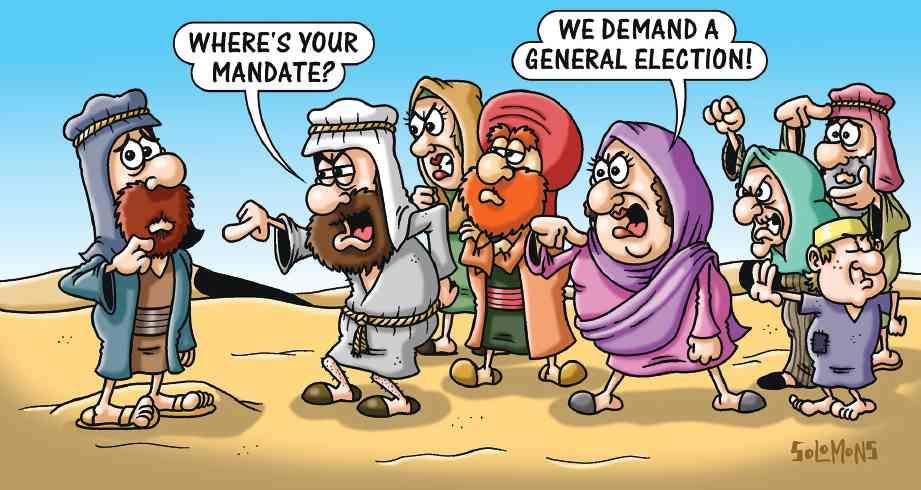





DANIEL CARMEL-BROWN CEO, JEWISH CARE
We were honoured to welcome the new prime minister to Jewish Care last week, to set out his vision for the future of adult social care. Alongside addressing an audience of stakeholders, he took time to meet residents and sta at our Otto Schi care home, gaining first-hand insight into the lives of those who rely upon and deliver care every day.
Few issues are more important to the wellbeing of our society than ensuring that older people and those who need care can live with dignity, security and support.
Yet for many years social care has remained one of the great unresolved challenges facing our country. Successive governments have recognised the need for reform and many have pledged to address it, but meaningful and lasting change has proved elusive.
That is why Wednesday’s announcement

Wwas significant. The prime minister’s willingness to place social care at the centre of the national conversation, and to seek support across political divides, is welcome.
What gives particular importance to today’s announcement is that this issue is clearly a deeply personal one for the prime minister. His reflections on his own family’s experience of care brought home the reality that social care is not an abstract policy challenge but something that touches millions of lives across the country.
Social care has su ered for too long from being everybody’s priority in principle, but nobody’s priority in practice.
The prime minister spoke about the contribution of care workers and the vital role they play in supporting some of the most vulnerable members of our society. Greater recognition of the social care workforce must be central to any successful programme of reform. Their skill, compassion and dedication are the foundation upon which the entire care system rests.
We also welcome the decision to accelerate Baroness Casey’s review and bring forward recommendations for reform. The challenges
facing social care are too urgent to remain unresolved for years to come, and a greater sense of pace will be welcomed across the sector.
Those of us who work in the sector every day see both the extraordinary impact of good care and the consequences of a system under strain. We see dedicated colleagues supporting older people, individuals living with complex needs, and families navigating some of the most challenging moments of their lives. We also see increasing demand, growing workforce pressures, financial challenges and the close relationship between social care and the wider health system.
The need for reform has never been clearer. Yet the sector has learned to approach announcements with cautious optimism. Over many years we have seen reports commissioned, reviews undertaken and commitments made, only for momentum to fade before meaningful change is delivered.
By some estimates there have been more than 20 attempts to reform the system over the past three decades, yet many of the fundamental challenges facing social care remain unresolved. It is therefore understandable that
providers, sta , unpaid carers and those who rely on care services will look beyond today’s words and seek evidence of practical action.
The reasons for that caution are understandable. Recent policy decisions have at times appeared inconsistent with the stated ambition to strengthen social care. The decision to include care charities and providers within the increases to employers’ National Insurance contributions left many organisations questioning whether the realities facing the sector were fully understood.
At a time when providers were already grappling with rising demand, workforce shortages and mounting cost pressures, it appeared to many that social care had once again not been a orded the consideration that its importance warrants.
Rebuilding confidence will require policies that consistently recognise the essential role that care providers play in supporting communities and reducing pressures elsewhere in the public sector.
At Jewish Care, we stand ready to play our part. The country does not need another conversation that ends in disappointment.
hile I enjoy drama on stage, I’ve never been that excited by it in my everyday life. I think the Jewish community has had more than its fair share, and many of us have a family history that includes unfortunate and complex moments that have led to wherever we are today.
Last year’s unexpected drama for me was the cancellation of my comedy show Ultimate Jewish Mother two weeks before the Edinburgh Festival Fringe by the venue that had hosted it for the previous few years.
The publicity around this sparked a wave of targeted antisemitism towards me that included death threats and vandalism. Thanks to the immense support of the Jewish, Scottish and comedy communities, CST, Police Scotland and two fabulous venues, the show went on.
I was struck by the way my intersectional communities had rallied together to carry me, and it made me think about my family’s responses to di cult times. If you have the backing of your tribe, you can move forward
on their shoulders.
It occurred to me my experiences last summer weren’t that unique. Jewish history is made up of these moments of darkness where we have had to reach for the light or be the one to shine it for someone else.
Growing up in Essex in the 1970s, racism was a surrounding culture that we all lived with, and it didn’t hit too hard because the Jewish community was big and proud and a huge hug that helped us to stay strong.
In hindsight, having hostile external experiences in my teens had the opposite of its desired effect as it just cemented my identity as part of this enormously diverse Jewish world.
My natural reaction to last year’s complicated fringe experience was to find the light, and my power to make it shine.
As a stand-up comedian, my superpower has to be communication through humour. For a long while I’d been thinking about creating a show that explored how someone as white-passing as me could be the focus of anti-Jewish hatred, and I’d often wondered how, or if, other people would connect to that idea.
For the past couple of months, I’ve been touring the UK with my new show Queen of the Jews! as a work in progress. The show is
a journey through moments of antisemitism from micro to macro aggressions, and how to find a way forward with strength and resilience through those experiences.
It uses jokes to make the material palatable, without minimising the nature and intent of each event, and opens up a conversation about what people assume and expect when it comes to someone like me, a British Jew whose grandparents came to the UK for safety.
I’ve found the different responses around the country fascinating, especially once you move away from big cities to areas without a known Jewish community. The advertising of the show might have received the expected hate-filled comments from bots and saddos on social
media, but the feedback from actual audience members and local human beings has been almost universally positive.
People are curious, interested, open and warm. They want to try and understand my identity and perspective. They want to filter what they see and hear online through the life of someone in the eye of that storm.
The Edinburgh fringe is an exciting and diverse space, full of unique voices and experiences and I’m excited to be going back. Its ethos is “to give anyone a stage and everyone a seat”. Audiences vote with their feet and their wallets, spending time and money where they choose, and I always feel it’s a privilege if anyone chooses an hour with me when they could be doing anything else.
I’m hoping that this summer’s Fringe will allow me to keep the drama on stage, and to allow other people a peek behind the curtain to see how strong we are, how we take what the world throws at us, place crowns on each other’s heads, and create art.
Rachel Creeger: Queen of the Jews! runs from 7 -31 August (not Saturdays) at 2.30pm at Hoots @ The Apex. Ultimate Jewish Mother is also running at same venue, same dates, at 11.20am. Tickets at edfringe.com

JOSHUA GARFIELD
FORMER HACKNEY
COUNCIL MEMBER
The newly-elected Green Party mayor of Hackney’s plan to cut the borough’s historic ties with Haifa is regrettable, but unsurprising.
Haifa is a mixed city in Israel, with municipal leadership drawn from all three Abrahamic faiths and home to a sizeable Druze community and the Bahá’í World Centre, the spiritual and admin headquarters of one of the world’s most persecuted minority faiths. In fact, one reason they are twinned is their multiculturalism.
Nearly three years after 7 October 2023, the deadliest pogrom against Jews since the Holocaust, Britain has watched in horror as war in the region devastated Gaza.
In Israel’s fighting against Hamas, Palestinian Islamic Jihad, Hezbollah and the industrial weapons of the Iranian Revolutionary Guard, thousands of civilians, including far too many children, have been killed. Much can be said about Israel’s
conduct in a defensive war on three fronts, but few would deny the horrendous rhetoric of Israeli ministers who have cheered on destruction in Gaza.
That is why they have been sanctioned by the UK government, why so many British Jews find themselves at odds with the Israeli government, and why opposition parties could beat Netanyahu’s coalition at this year’s elections.
The British Labour government called for a ceasefire in Gaza, recognised a Palestinian state and has sanctioned Israeli settlers in the West Bank. Where peaceful levers exist, Britain has pulled them. Hackney’s decision does nothing to bring about peace, it is a local gesture that weakens the very kind of relationship civic leaders should be protecting.
Hackney’s relationship with Haifa has nothing to do with UK-Israel relations. The London borough’s relationship with the Israeli port city was never an endorsement of any Israeli government, it was a local bond between two places shaped by migration, civic pluralism and the daily work of coexistence.
Hackney’s twinning with Haifa dates back to 1968, barely two decades after the founda-
tion of the Israeli state. Haifa’s Jewish and Arab communities su ered in the 1948 war but, remarkably, both went on making the city their home. Over the following decades they built something unusual: one of Israel’s mixed cities, a rarity in the entire Middle East.
I spent four years working for Hackney Council. This is a borough shaped by the Windrush generation, who arrived from the Caribbean making many of the same demands Moroccan Jews were making in Haifa in the 1950s: work, fair treatment, an end to being treated as outsiders.
By 1968, two places forged by immigration and that same fight for dignity found common ground and built a relationship that volunteers on both sides have kept going ever since, through wars, terror attacks and recently, the looming threat of having it severed.
It endures because a city and its government aren’t the same thing. Someone living in Haifa isn’t an extension of decisions made in Jerusalem any more than a Hackney resident is of Westminster. People are entitled to be judged on their own terms, not folded into their government’s actions.
City twinning is largely symbolic, but its positive e ects can stretch further. The relationship with Haifa is most tangible in the medical exchange between Homerton Hospital and Rambam, one of Israel’s leading teaching hospitals. Sta have travelled both ways to shadow counterparts, compare techniques, and learn from each other’s practice.
Much like having a pen pal in your youth, city twinning is more personal diplomacy than international relations.
You would not stop writing because your pen pal’s country was at war.
Hackney’s leaders could have used the borough’s relationship with Haifa to promote dialogue, perhaps by inviting Haifa councillors like Palestinian activist Sally Abed, to discuss peace building, or by connecting Druze and Baháí communities with Hackney’s own minority fath groups. This is the antithesis of municipal leadership.
But honestly, why would anybody in Haifa want anything to do with Hackney Council now? The mayor of Haifa will have better things to do than to reply to that disgrace of a letter.


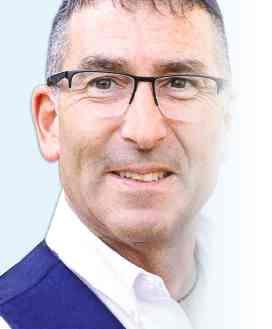


INTERNATIONAL
LITERARY SCOUT
It was 2.45am when I saw the tweet.
I was blearily making my way home from the public shelter after Iran’s latest barrage during the 12-day war when I read the words: “You spend years thinking you needed therapy but, as it turns out, what you really needed was to watch Tel Aviv burn.”
Not much shocks me anymore, but this was a tweet from Susan Abulhawa, writer of Mornings in Jenin , a mainstream author whose work a client of mine had just acquired for publication.
I am a literary scout, originally from London, based in Tel Aviv, and I advise clients in 15 countries of the most exciting forthcoming books to acquire for translation.
I immediately attached a screenshot and emailed it to the client with the subject line “Hate Speech”, expecting a horrified, response and assuming the contract would

be swiftly cancelled. This kind of behaviour is not tolerated in the genteel world of publishing.
Instead, I was told the tweet had either been deleted or must have been fake, that the client did not regret acquiring the book, and that while they were sorry for what I was experiencing in Israel, Netanyahu was to blame and it would be better for me to leave as soon as possible. This from a client of 20 years, once among my most Israel-friendly publishers, from a country my ancestors fled generations earlier.
A quick glance at the rest of Abulhawa’s X account confirms that her tweets would not look out of place in Mein Kampf. She calls Israel “a malignant cancer that has to be exorcised if humanity is to have any hope of a moral future”; she calls Israelis demons, vampires and ghouls, worse than Nazis, asserts that “the whole world is Zionist-occupied, apart from Palestine”.
Even anti-Zionist New York mayor Zohran Mamdani was forced to publicly condemn Abulhawa’s rhetoric when defending his wife for having illustrated her essay.
No, what horrifies me is how invisible her (and most other) racist anti-Zionism has become to the publishing industry. Abulhawa’s first two books have just been awarded a splashy reissue deal by Simon & Schuster in the States, and she boasts a long list of international publishers who have come on board at frequent intervals since 7 October.
Nothing about this is seen as controversial in an industry which has fully embraced “Gazology”, a term coined by Free Press journalist and author Matti Friedman, to describe “a literature of Jewish evil…whose origins lie not in journalism or academic enquiry but in the pseudosciences that have sprung up over the centuries to explain the problems of humanity with stories about the malevolence of this group of people”.
Working in the international publishing industry since 7 October, I have witnessed almost daily announcements of deals for books that are obscenely biased, poorly factchecked and inciteful against any Jew who values their connection to Israel.
I have watched groups like Fossil Free Books intimidate literary festivals into
divesting from any company or author with even the slightest investment in the Jewish state. This blatant bullying and cancellation is scarcely spoken about within publishing circles. There has been an intellectual capitulation: a willingness to celebrate and platform venomous demonisation while tokenising the most fringe Jewish voices.
What the current state of affairs has urgently highlighted is the need to push back: to call out anti-Jewish racism, insist on a multiplicity of viewpoints, and begin building the pipeline and infrastructure needed to ensure that Jewish and Israeli voices are not silenced.
What the wider Jewish community can do in this moment is demonstrate the demand for Jewish stories: pre-order and buy the Israeli and Jewish books that do secure publishing deals.
Request them online and in bookshops, ask literary supplements to review them, attend author events, buy the books as gifts, and make it known that we are a commercial force that will no longer tolerate the distortion of public discourse about our identity.
DR JONATHAN BOYD
EXECUTIVE DIRECTOR, INSTITUTE FOR JEWISH POLICY RESEARCH
Every summer, thousands of young Jews head o to camps, youth movement activities and Israel tours. To many parents, these weeks can look like friendship, fun and late nights; enjoyable opportunities for their children to spend time with Jewish peers before the serious work resumes when school starts again. To the wider community, they are often viewed as a nice add-on to Jewish life – valuable, but not requiring the same expertise, thought or financial investment as schools.
That may be a mistake. The recent JPR study, What Works?, examined the impact of di erent Jewish experiences on adult Jewish identity. Its findings are deliberately cautious. Jewish identity is complex, and no single programme guarantees a strong Jewish future. Yet among the experiences with measurable impact, informal educational structures – youth movements, camps, Israel programmes and university Jewish societies – clearly matter. Indeed, while the long-term impact of both Jewish schooling and youth
movements is limited, youth movement involvement appears more impactful than Jewish schooling in several respects.
That finding should give us pause. Over recent decades, British Jewish life has seen a major expansion of Jewish schooling while youth movement participation has declined. We may have quietly assumed one form of Jewish education can substitute for another.
It cannot. The first reason is an old educational idea, deeply embedded in Jewish thought: people learn by doing. John Dewey argued that education is not simply the transmission of knowledge but the reconstruction of experience. We learn through participation, reflection and meaning-making. Jean Lave and Etienne Wenger developed a similar insight, arguing that learning happens through participation in communities, and that identity itself is formed through belonging and engagement.
At their best, youth movements, camps and Israel tours embody exactly this approach. They turn Jewishness from a subject into an environment. A teenager does not merely learn that Shabbat can be meaningful; they experience it with friends. Young leaders do not simply study leadership; they lead groups, make mistakes, resolve conflicts and discover that Jewish responsibility is
something they can practise and own.
Identity is rarely formed through information alone. It is formed through relationships, habits and shared experiences. At their best, camps and youth movements function as miniature Jewish societies, with their own rituals, humour, role models and responsibilities. Young people are not only taught Jewish identity; they rehearse it. Jewishness is not simply inherited from parents or delivered by teachers, but lived with friends.
The second reason is choice. Most childhood Jewish experiences are not really choices. Parents choose schools, decide whether Friday night candles are lit and determine the opportunities available. But eventually every young person must decide what to do with what they have inherited.
This idea has deep roots in educational philosophy. Education is not simply about transmitting a tradition; it is about cultivating the capacity to choose it.
Erik Erikson argued that adolescence is the period when people move from inherited identities towards identities they actively commit to. The key question becomes not simply, ‘Who am I?’ but ‘What will I choose to become?’
Read through that lens, one of the most striking findings in the JPR report concerns membership of a university Jewish society
(JSoc); JSoc involvement is associated with seven of the eight dimensions of Jewish identity measured in the study. The report cautions that this does not necessarily mean JSoc causes stronger identities. Rather, it suggests that those who join may already be on a path towards Jewish engagement.
But that is precisely the point. By the time young adults arrive at university, much of the formative work has already been done. Camps, youth movements and Israel programmes help make later Jewish engagement feel familiar, meaningful and worth choosing.
None of this means informal education is a silver bullet. In fact, the JPR study finds the home environment matters most. Orthodox and Traditional upbringings are the strongest predictors of identity outcomes; practices such as lighting Friday night candles are associated with many of them. The home remains the primary site of Jewish formation.
If we want a confident next generation of British Jews, we should stop treating informal educational programmes as optional extras and invest in them fully. At their best, they are places where Jewishness becomes not only something young people are taught, but something they experience as real, meaningful and their own.
There are very few substitutes for that.











When I were a lad, my favourite TV advert was for Ready Brek. I never touched the stu . No way was I conceding Coco Pops for something even Oliver Twist wouldn’t want more of. I liked the pitch, not the porridge. It promised something magical. Eat this with hot milk and you’ll glow like the midday sun.
Even back then, to an eightyear-old who still half believed in lightsabres, it seemed like grade-A twaddle. The rattle of a stick in a swill bucket, as George Orwell called advertising. But what a bottomless bucket. And what seductive swill. Who, after all, wouldn’t want to live life cosily ensconced inside their own personal force field?
A TV advert for God would make the same claim. Swallow this to feel warm and protected.
The big Ready Brek bowl in the sky’s compelling brand proposition came into sharp focus for me back in 2023 when, in the same week, I reviewed David Baddiel’s novella The God Desire and saw the West End show The Book of Mormon
Both left this lifelong atheist with the same nagging thought that I’d spent the best part of 50 years getting faith completely wrong. Perhaps it isn’t a human flaw after all. Perhaps it’s a human function.
Evidence for God might be as convincing as a Theranos blood test, but nobody is swayed by a Supreme Being because of the cold, hard data.
Believers believe for much the same reason schoolchildren shovelled down Ready Brek back in the 1980s: because of how it made them feel. Because of an imagined sense of warmth.
Why have humans blindly clung to belief for thousands of years? Why, in an age of gene editing and AI, is God still topping the popularity charts? That’s the question at the heart of my satirical novel Error 404, published last week.
In it, science finally achieves
what generations of atheists could only dream of: proof, beyond doubt, that God is a human invention. Mic drop. Debate over. Atheists win.
why blind faith is our greatest gi
“For a moment, nothing happened. Then, after a second or so, nothing continued to happen.”
But arrange those atoms into intelligent apes and you have a creature uniquely ill-equipped to live with the knowledge of its own mortality. So uniquely illequipped, in fact, that it evolved a psychological sixth sense. Not for detecting predators and prey, but for detecting morality and meaning.
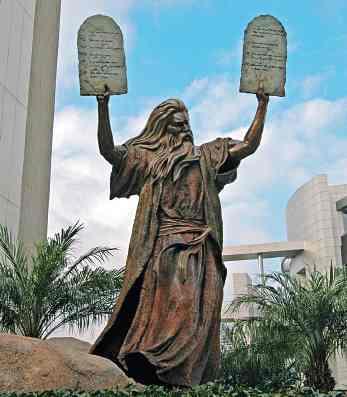
But rather than giving birth to a rational Eden, the baby is born screaming and the God-shaped hole is filled by something far more sinister. Science is forced to confront a question way beyond its remit: if you kill God, what on earth do you do with human nature? Which leads to a broader and even more fundamental question: is faith more important to us than facts?
The answer is an almighty yes. Atoms such as rocks and trees have no quarrel with time and space. They don’t lie awake in a cold sweat at 3am wondering what existence means. They are entirely content with Douglas Adams’s assessment of reality:
We experience our extra sense in the same way we experience sight and sound, even if it only exists because our brains insist it does.
This sixth sense has one job: to stop us losing our minds. To convince us that our existence matters more than whatever the average sea sponge got up to five hundred million years ago. To persuade us the universe is paying attention. That it gives a flying
asteroid that we exist. That there is a point. Someone behind the wheel. A reason we are here rather than somewhere else, or nowhere at all. That everything happens for a reason. That it’s meant to be. That it’s all God’s plan.
Militant atheists, my former tribe, blithely insist God is a glitch. Control+Alt+Delete, uninstall superstition, install reason and before you can say “observable reality” we’ll all be happily nodding along to a Christopher Hitchens audiobook over our morning Coco Pops.
But God is no glitch. God is our operating system embedded into our bones. We have to believe we are going somewhere.
We are the child in the back seat, forever asking, “How much longer ’til we get there?” No sensible parent replies, “Never! We’re rotting in this car for the next 80 years then ceasing to exist.”
Even if you’ve been stuck on the M25 for so long that you’re eyeing the empty water bottle in the glove compartment as a potential toilet, you soothingly say, “Almost there. Almost there.” Not because it’s true, but because it’s the only helpful answer. “Almost there” keeps the void at bay. “Almost there” is fiction with function. Psychoanalyst Heinz Kohut called it “psychological oxygen”.
Of course, facts matter. Facts matter most in every other aspect of human life. But facts doth butter no existential parsnips.
secondary school. I went to cheder and had a bar mitzvah. I’ve watched friends and family give their lives over to blind faith – obsessing over what they eat, what they wear and when they pray.
Jews have 613 rules and regulations covering every aspect of daily life. Writing G-d instead of God isn’t one of them, although I suspect some readers will be wincing at the heretical Os peppering this piece. S-rry.
I used to suspect – arrogantly, in hindsight – that the root of such obsession was self-delusion. I no longer think that’s good enough. Not by a long way.
I no longer see God as something to be proved or disproved, but as humanity’s greatest evolutionary gift. Our existential Swiss army knife. A handy psychological tool to fix our angst.
I’m still an atheist. You won’t find me on my knees unless I’m struggling with my 30 daily push ups. I’m not about to start living Leviticus loca. But writing Error 404 answered a question that’s nagged me since childhood.

Faith is a full-packed suitcase of broadly decent ideas, ready to be passed to the next generation. It gives us purpose, binds us together, encourages us to have children and convinces us our lives matter. It gives us something to live for. A reason to go on. If the woolly mammoth had a God to believe in – a mythical beast called Tuskadon or Fleeceus Maximus – it might still be roaming the African plains today. All of which leaves us atheists in a bit of a bind. After all, if we’re determined to tear down the churches and synagogues, we’d better be ready to build something taller in their place. Something as capable of answering the questions every human asks. Something that can provide genuine meaning and hope. Something to give people another reason to glow.
bay. “Almost there” is fiction with funcHeinz Kohut called of a bind. After all, if tear down the churches something taller in their capable of answering the questions every human
I went to a Jewish primary and


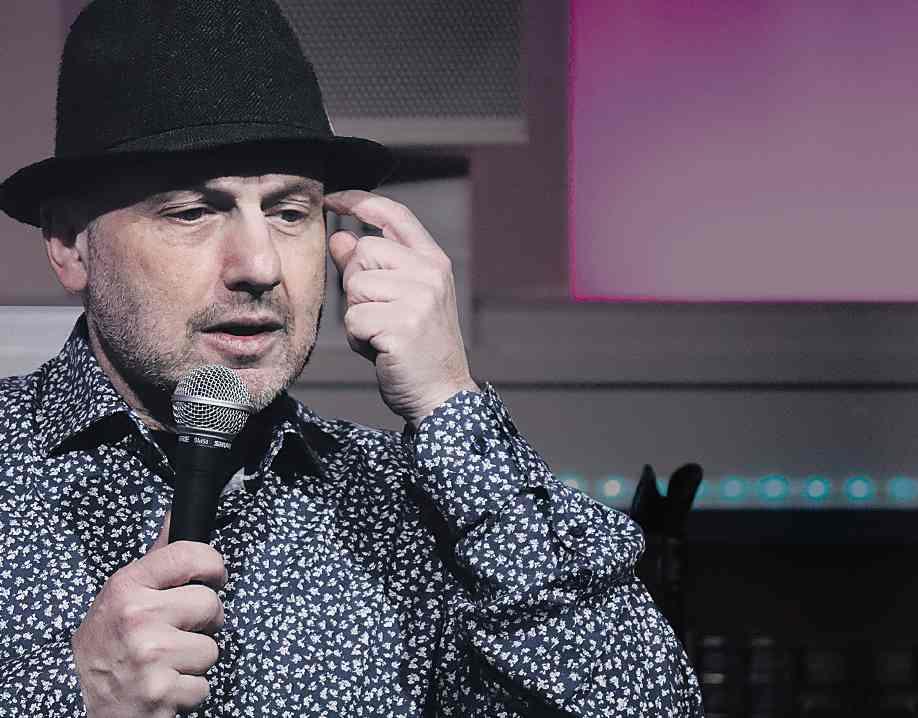
I’ll never do that again!” How often do we say that in a lifetime? After drinking too much? After eating cheese post midnight? After dating a best friend’s girlfriend behind their back. (To be fair, some of these are oddly specific.)
I said it after performing at the Edinburgh Festival for the eighth time last year. I would not be returning. Not ever! Not because it hadn’t gone well – quite the opposite.
I played to full houses, received excellent reviews and wasn’t cancelled, protested or chased down the Royal Mile by an angry antisemitic mob.
No, the reason was much simpler: I felt I was getting a bit old for it. I used to love it and those industry festival parties... but last year I felt like someone’s dad picking up their kid. So why, you may, ask am I going back this year? Because I am someone’s dad.
My son Xander is in Edinburgh – again. Last year he made his festival debut alongside fellow acting graduates in the comedy play Holly Street. It picked up four and five-star reviews across the board and I was incredibly proud… and also slightly jealous. At his age I celebrated if a joke got a laugh from someone who wasn’t related to me.
This year they are returning with a new
Bennett Arron did not plan to be at the Edinburgh Fringe, but depression and dementia are taking him back
play, Is This Your First Crime? and naturally I want to see it. Hopefully not six times, which was my tally last year, when I knew the lines so well, I was a step away from demanding my own dressing room.
The other reason I’m returning is because of the reaction to my own show. It’s about coping with dementia and depression. Yes, it really is a comedy – but Jewish people have been unearthing humour in tragedy for thousands of years. Frankly, if we waited for cheerful subjects there would be no Jewish comedians!
I’ve been touring this show for the past few months and never known a reaction like it. I’m naturally quite a modest person – probably one of my greatest attributes –but have to say that post-show comments have made me think that perhaps, after almost 30 years in comedy, I’m doing something right.
People have really related to the themes, with some telling me they’ve struggled with depression personally or cared for relatives or friends with dementia. I’ve done both – so to hear others describe the show as ‘uplifting’ – well, those are reviews I’d like framed. (I have framed them btw.)
So I’m returning to the Fringe to perform


I Regret This Already Hoots at the Apex. Rachel Creeger is at the same venue – and 50 other fantastic Jewish comedians will also be in Edinburgh. I don’t have the space to name them and to be honest, unlike some, I’m not a fan of making lists of Jews.
Lots of us are in a WhatsApp group where – along with our plans for world domination – we’ve also been discussing concerns about
Bennett Arron’s show was descrbed as “a Welsh Seinfeld”; Bennett’s son Xander is performing this year in Is This Your First Crime?
possible antisemitism during a festival that has always prided itself on being inclusive.
festival that has always prided itself
When alternative comedy emerged in the 1980s, it wasn’t just about moving beyond traditional set-up-and-punchline jokes.
emerged in the 1980s, it wasn’t just set-up-and-punchline jokes.
It was also a reaction against casual racism, homophobia and misogyny.
Sadly, some of those attitudes seem to have crept back in and certain forms of prejudice are apparently fashionable now.
certain forms of prejudice are appar-
That said, while some people in comedy have shown their true colours (responding to Jewish concerns with yawning emojis), many others have been incredibly supportive. And support is what we need right now, for whatever it is we’re going through.
concerns with yawning emojis), need right now, for whatever it is
So be supportive. Come and see us. Jewish humour has always been one of the things that helps us cope. Funny that!
• Bennett Arron: I Regret This Already is at Hoots at the Apex from 19 – 31 August at 3.45pm






Dale Carnegie famously wrote that if you need to criticise someone, begin with genuine praise. People are far more willing to hear difficult feedback when they first know they are valued.
He compares it to a dentist administering anaesthetic before drilling. The drilling may still hurt, but the patient can bear it because the pain has been cushioned. The Torah, it seems, follows the very same principle.
There are two striking questions in this week’s parsha, Re’eh.
First, the Gemara (Chullin 63b) explains that one of the non-kosher birds is called the ra’ah because it
possesses extraordinary eyesight –it can be flying in Babylonia and spot a dead carcass in Eretz Yisrael.
If it has such remarkable vision, why is it not kosher?
Secondly, when the Torah describes the kosher signs of animals, it first tells us the two signs of a kosher animal: chewing the cud and split hooves. It then lists the four exceptions – the camel, the hare, the hyrax and the pig – which possess only one of those two signs.
Why does the Torah begin with these animals’ kosher signs rather than the non-kosher signs, when the fundamental point is that they are ultimately rendered non-kosher?
Rav Yisrael Salanter explains that the Torah begins by highlighting what is right before identifying what is lacking. Even when an
animal is ultimately non-kosher, the Torah first acknowledges its positive quality. Why? Because we can never truly declare something – or someone – to be entirely deficient. The Torah is teaching us that before we notice a person’s shortcomings, we need to train ourselves to recognise their virtues.
Similarly, the ra’ah is not condemned because it has exceptional eyesight. On the contrary, its vision is extraordinary. Its failure lies in what it chooses to look at.
Of all the beauty, life and wonder in the world, it searches only for carcasses. Even more tragically, it does so while remaining in an impure place itself. True greatness is not measured by the talents we possess, but by how we direct them.
That is what it means to be

kosher. Not simply to have gifts, intelligence or insight, but to sanctify those gifts by choosing to see life before death, virtues before faults, and possibility before criticism.
The Torah begins by highlighting what is right before identifying what is lacking – even when an animal is ultimately non-kosher, the Torah first acknowledges its positive quality




RABBI LEV SAUL KINGSTON LIBERAL SYNAGOGUE
Celebrate the renaissance in Jewish theatre
During a session at the last Limmud, Israeli poet Yonatan Berg exclaimed: “You British Jews talk about the theatre a lot!” It’s true. We do.
From synagogue trips to the West End through to creative local Purim spiels, we have made the stage one of our most prominent sites of cultural expression.
That shouldn’t be surprising. Since we first got to these shores, Jews have been putting on plays and building Britain’s dramatic scene.
But even until recently, many theatre makers didn’t feel comfortable being ‘out’ as Jewish. Some changed their names or hid their ancestry to fit in.
There were those who made Jewish content, like Israel Zangwill’s Children of the Ghetto and Arnold Wesker’s Chicken Soup with Barley, but they knew they were
producing their plays for Jewish audiences. Now, however, something is shifting.
All across the British theatre scene, you can see Jews putting on plays that celebrate and grapple with their heritage.
We’ve discovered that our lives are interesting – not only to us, but to the wider British public.
This year, at the Edinburgh Festival Fringe, there will be 50 di erent Jewish productions. And always at this time of year, my brother, who lives in Edinburgh, discovers that he’s never been so popular!
If you’re lucky enough to be going to the festival, check out Emma Jude Harris’s Gira e and Halima Habil’s Baba. There’s endless entertainment in store.
Creatives are leaning into the deep local specificity of their experiences. In the past

few years, there have been works exploring Jewish life in Essex, Norfolk and Wales.
The arts are a fantastic way to connect with our roots. When Emma Brand brought The Stove to Jewish communities, she helped them create their own histories through food and storytelling. There is a huge variety of talent, too. I’ve seen explicitly Jewish drag kings, clowns, Burlesque performers, DJs, puppeteers, circus acts, stand-up comedians, storytellers,
A stimulating series where our progressive rabbis consider Judaism in the face of 21stcentury issues
slam poets and even, in one case, an artist who made a public performance of iron-welding.
I asked Nick Cassenbaum, writer of JW3’s pantomime for the fourth year running, what he thought about all these Jewish plays. He said: “There’s a renaissance of Diaspora Jewish work. When I started, there was next to no Jewish work. Now plays are like shuls: there are the ones you go to, and the ones you wouldn’t be seen dead at.”
He is heading up to Edinburgh with another run of his hit show Bubble Schmeisis. Too often, cynics downplay the British Jewish community’s accomplishments, or act as if we’re all cowering behind our sofas. In reality, our artists are putting out more work than ever and reaching a wider audience than ever. Jews have lived in security in Britain for more than 500 years but have never yet dared to call any era a “Golden Age”.
We may look back on this period and realise we have been living in one. We have a unique culture, populated by talented people, sharing exciting stories. We should celebrate it.

Suits from £79.50
Overcoats from £79.50
SUITS NOW FROM £69
SHORTS £20 EACH, 2 PAIRS FOR £30
10 Golders Green Road London NW11 8LL Opposite Cafe Nero
ROUSERS £20 EACH, 2 P T AIRS FOR £30, 28-48 INCH WAIST
SPORTS JACKETS AND BLAZERS FROM £39.50
CASUAL JACKETS FROM £29.50
KNITWEAR FROM £10 S
SHIRTS FROM £10
SHOES FROM £10
Open everyday & Sundays til 5:00pm
Raincoats from £49.50 We accept
POLO SHIRTS £15 EACH, 2 FOR £20











Top prices paid
Antique – Reproduction – Retro Furniture (any condition)
Epstein, Archie Shine, Hille, G Plan, etc.
Dining Suites, Lounges Suites, Bookcases, Desks, Cabinets, Mirrors, Lights, etc.
House clearances
Single items to complete homes
ANTIQUES - 8 CHURCH STREET NW8
07866 614 744 (ANYTIME) 0207 723 7415 (SHOP)


Furs, Jewellery, Old Costume Jewellery, Watches, Silver, Designer Bags, anything vintage. 01277 352560
Friendly Family Company established for 30 years
We clear houses, flats, sheds, garages etc. No job too big or too small! Rubbish cleared as part of a full clearance. We have a waste licence. We buy items including furniture bric a brac.
For a free quote please phone Dave on 07913405315 any time.


Confidential Bereavement Counselling for adults and children individually. Support Groups available. We offer in person, online and telephone counselling. Contact Jewish Bereavement Counselling Service in confidence. 0208 951 3881 enquiries@jbcs.org.uk | www.jbcs.org.uk