radical blind spot John Ware on the hate debate Britain does not
King’s Speech cracks
by Lee Harpin
O enders who carry out attacks on synagogues and other Jewish buildings on behalf of proxy organisations acting for foreign
states such as Iran face up to 14 years in prison under new legislation announced in yesterday’s King’s Speech.
The new Tackling State Threats Bill will also give the home secretary new powers to ban Iran’s Islamic Rev-
Iran’s hate proxies face
years
on synagogue attackers
olutionary Guards Corps – a move long demanded by communal leaders and first promised by the government before the general election.
A separate National Security Bill included in the King’s Speech acknowledged that the UK “faces
national security threats that are evolving and escalating” from “Islamist and extreme right-wing terrorism”, as well as from a range of “foreign powers deploying new hostile tactics”.
Continued on page 8 Aftermath
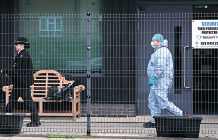
of Finchley shul attack
@lmharpin
Green Barnet councillor win stokes ‘vile’ division
by Lee Harpin lee@jewishnews.co.uk
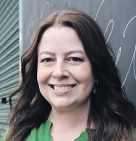
Barnet Council’s newly elected Green councillor branded Jewish News as “vile” after she was asked about her previous support for former Labour leader Jeremy Corbyn.
Charli Thompson became the one representative for Zack Polanski’s party in last week’s dramatic local election result, which ended up with both Barnet Tories and Labour finishing on 31 seats each.
The result left the previously Labour-run borough, where around one in seven residents are Jewish, under no overall control.
The new council will meet for the first time on Tuesday, 19 May, to determine key cabinet appointments and agree on the administration of the borough.
Jewish News understands Labour and Conservative Group leaders have no plan to form a coalition with the Greens, and also plan to work together on issues of the security and well-being of the community amidst a spate of antisemitic incidents.
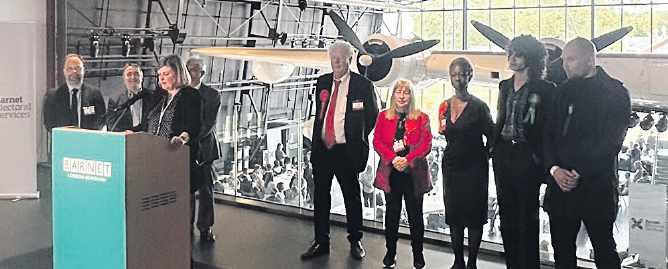
At a marathon election count, held at the RAF Museum in Colindale last Friday, Jewish News asked Thompson about claims she had previously been a strong supporter of Corbyn, and that she had joined Labour in 2019 to help back him.
She responded: “I don’t want to speak to you – you are vile.”
Thompson said she intended to avoid provoking division, and wanted to be a councillor representing all living in the Woodhouse ward, which had been heavily targeted by the Greens during the campaign.
Barnet Conservatives openly praised the “Kemi effect” as Jewish voters in parts of the borough turned out in significant numbers for the party’s candidates. Leader Kemi Badenoch previously named Barnet, alongside Wandsworth and Westminster, as a top Tory target. She visited the borough several times, including the day before the election, and was viewed as having mobilised Jewish voters, particularly due to her repeated statements on tackling rampant antisemitism.
One successful candidate, speaking anonymously, told Jewish News: “Without a doubt, Kemi has had a positive impact on the vote here in Barnet. There may have been local issues, but Kemi’s stance on antisemitism, along with her staunch support for Israel, clearly made a difference for many Jewish voters here.”
Analysis showed that many areas with high Jewish populations saw unusually large turnouts, with voters backing Tory candidates such as Group leader Peter Zinkin in Golders Green and others in wards such as Edgware, Edgwarebury, and Garden Suburb, including Benjamin Goldberg,
night in Barnet, with none of their candidates elected.
Martha Levy, and Shimon Ryde.
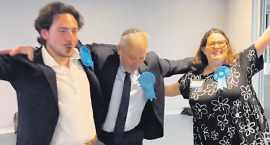
As the party secured its win in Mill Hill, the three victorious local Tories celebrated by dancing.
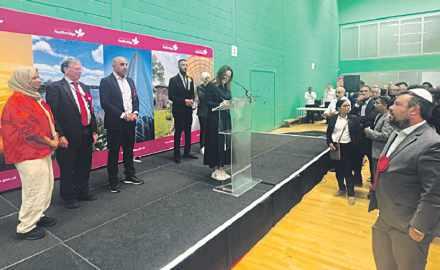
But while Labour slumped to dismal defeats across the country, the party’s vote held up enough in Barnet to stop the Tories retaking control of the council, which they lost in 2022. One senior Labour official said they had “punched above their weight” in the borough as results were declared.
Jewish Labour wins included Sara Conway, Alan Schneiderman, and Ezra Cohen, along with ex-Gogglebox star Josh Tapper.
However, there was an upset in Whetstone ward, where Jewish Labour Movement chair Ella RoseJacobs was narrowly defeated.
Reform UK had a disappointing
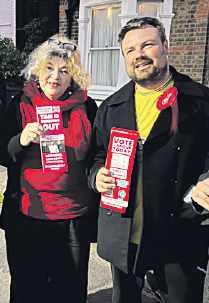
Elsewhere, Jewish councillors standing for re-election in the London Borough of Redbridge were at the centre of a remarkable fightback against the rise of sectarian politics. In local election results that bucked the trend on an otherwise difficult night for Keir Starmer, Redbridge councillors Lloyd Duddridge and Judith Garfield defied a poisonous campaign waged against them by pro-Gaza independents in the borough over a long period, to be reelected alongside Labour colleague Guy Adams in the Churchfields seat.
“We weren’t too proud to ask local people who did not want to see the continued rise of extremism in the borough to give us their vote,” Jewish Labour Movement member Duddridge told Jewish News. “We certainly learned a lot from the general election result. We knew we had to build up a broad coalition.”
Across London and the rest of the
country, there were both positive and disappointing outcomes for Jewish candidates in the local elections. There were troubling examples of candidates facing claims of engaging in antisemitism being elected, and of candidates supposedly suspended by the Green and Reform UK parties still taking an active role in events.
In Lambeth, Saiqa Ali, who was suspended by Zack Polanski’s party ahead of the local elections after a string of “openly antisemitic” social media posts, was elected to Lambeth Council in south London.
Ali was suspended by the party in April after a series of social media posts reported by The Spectator, including one in which she allegedly shared a picture which said Donald Trump “is owned by Jews”.
On 30 April, she was arrested under Section 19 of the Public Order Act and brought into custody
Jewish Labour divided on Starmer
Jewish Labour parliamentarians remain divided over support for embattled Prime Minister Keir Starmer, after more than 90 MPs called for his resignation in the wake of catastrophic local election results.
As doubts over Starmer’s future grew, Attorney General Lord Richard Hermer KC and Schools Minister Georgia Gould were among the Jewish MPs who rallied to his side during the crisis.
Hermer, one of Starmer’s most loyal allies, has been closely advising the Prime Minister as 93 of Labour’s 403 MPs - and counting - have now demanded he step down.
Hermer described Starmer as “a leader, a proven election winner and the right person to take us forward”.
He noted that there is a Labour Party process to trigger a leadership contest, but said it was up to others to decide whether to use it.
However, Hermer added: “They should stop the damage they’re causing the British economy and the Labour Party.”
In contrast, Jewish Labour veteran and peer Dame Margaret Hodge expressed doubt over Starmer’s ability to turn things around for Labour during an appearance on BBC Radio 4’s Today programme.
“It is incredibly depressing that after less than two years in office, we find ourselves in this position,” said Hodge, the Jewish Labour Movement’s former parliamentary chair.
After the “tsunami of losses” in last Thursday’s elections, Hodge added: “If you get this sort of response, you’ve lost the confidence of the people you’re there to represent.”
On Monday, after Starmer gave what had been billed as a makeor-break speech to Labour colleagues, David Pinto-Duschinsky, Labour MP for Hendon, said the Prime Minister was “rising to the occasion” with his pledge to
nationalise British steel and forge closer ties with the EU.
Pinto-Duschinsky said the speech had shown “the humility, passion and determination” of Starmer to “bring real change”.He said: “Our communities want us to deliver – we must not turn inwards.”
However, Leeds Central and Headingley MP Alex Sobel argued that the Prime Minister failed to “challenge the status quo” with his speech on Monday and should “announce a date for his departure so we can have an open contest and an orderly transition”, while urging against a “rushed” contest.
On the party’s right, Blue Labour, an internal pressure group founded by Jewish Labour peer Lord Maurice Glasman, has said “it’s time for Keir Starmer to set out a timetable for his departure”.
Sir Keir has dug in, telling his Cabinet: “As I said yesterday, I take responsibility for these election results and I take responsibility for delivering the change we promised.
“The Labour Party has a process for challenging a leader and that has not been triggered. The country expects us to get on with governing. That is what I am doing and what we must do as a Cabinet.”
ABOVE: Labour sees off Greens in Friern Barnet
RIGHT: Barnet Greens winner Charli Thompson
Whetstone awaiting announcement of results
Barnet Tory candidates celebrate Mill Hill win
for questioning following allegations of antisemitic posts.
Over in Hackney, the Greens dramatically took control of the council in one of Zack Polanski’s party’s most targeted boroughs.
The Greens secured 29 seats, gaining overall control of the borough, while Labour fell to just eight seats, losing 27. The Conservatives remain on five seats.
Three of those Tory seats were in the main strictly Orthodox ward of Springfield, where Simche Steinberger retained his seat with 1,971 votes, alongside Michael Levy with 1,932 and Shaul Krautwirt with 1,858.
Meanwhile, in Stamford Hill West, Hershey Lisser held his seat with 1,428 votes, as did Benzion Papier with 1,550.
There was further success for the Greens in Waltham Forest, where they took control amid a slump in the Labour vote. But Jewish Labour councillor Miriam Mirwitch held onto her seat.
There was further chaos for the Labour Group in Camden, but after a long night of vote counting, they managed to keep control with a much-reduced majority.
Despite the scare, Jewish Labour councillors Rebecca Filer and Izzy Lenga both got elected, while Lauren Keiles was also victorious, bringing the successful
Jewish caucus in Camden Labour to five overall.
In Brent, the results were not so good for long-serving Jewish Labour veteran Neil Nerva or for his Jewish colleague Marc Harris in the Queens Park ward. Many Jewish voters in Brent were unable to forgive the Labour Group for the Nablus twinning fiasco.
In Ealing, there was better news for council leader and former JLM chief Peter Mason, after Labour retained control of the council with a reduced majority.
In Westminster, the Conservatives celebrated regaining control of a council they had tar-
geted in the 2026 locals. But in a surprising result, Alan Mendoza, who defected from the Tories to Reform UK to advise Nigel Farage on global affairs, was defeated in the Abbey Road seat.
Abul Monsur, who was suspended by the Aspire Party ahead of the local elections after making social media posts denying the Holocaust, was elected to Tower Hamlets council.
A post shared by Monsur appeared to express approval for Hitler, as he wrote that “Adolf Hitler outlawed usury” alongside three bullseye emojis.
Up in Bury, Greater Manchester,
Reform UK was celebrating the election of Shadman Zaman in the Pilkington Park ward, with a sizable Jewish community.
Ahead of the election, Zaman expressed regret for past comments in which he said the Charedi Jewish population has created a “demonic social structure” and compared it with Al-Qaeda and Isis.
But in Bury’s Sedgley ward, there was joy for Jewish Labour’s Richard Gold, who topped the poll there.
In Gateshead’s Saltwell ward, a Reform UK candidate expelled by the party after Jewish News revealed his previous membership of the BNP was defeated in the poll.
Greens’ Polanski admits failure to pay council tax Green Party leader Zack Polanski has admitted he failed to pay the correct council tax while living on a London house boat.
Polanski faced questions over whether the houseboat, moored in east London, was his primary residence. A party spokesperson described the situation as an “unintentional mistake” and said he had “immediately taken steps” to pay any tax owed.
The Green Party previously told The Times Polanski rented a room at another address where council tax was included in the rent and only stayed on the boat “occasionally”.
Husband’s videos lead to Sawalha suspension
Loose Women panellist Nadia Sawalha has reportedly been taken off air amid growing controversy over online videos linked to her husband, suspended Green Party activist Mark Adderley.
According to Daily Mail reports, Sawalha has not appeared since the end of April and is not expected back next week, following complaints over material shared online. The row centres on videos uploaded to a channel run by Adderley, often featuring Sawalha, which reportedly promoted conspiracy theories.
ABOVE: Re-elected. Jewish Labour’s Lloyd Duddridge at local election LEFT: Judith Garfied and Lloyd Duddridge campaigning in Redbridge
10,000 Jews and allies rally
Chief Rabbi, Kemi Badenoch, Richard Tice and Pat McFadden
among those in Whitehall, write Lee Harpin and Justin Cohen
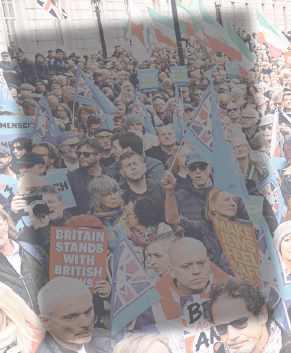
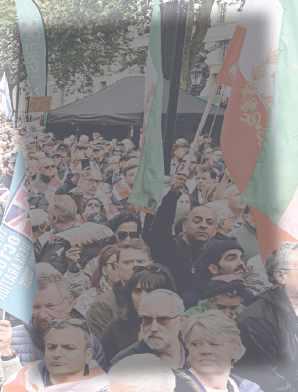
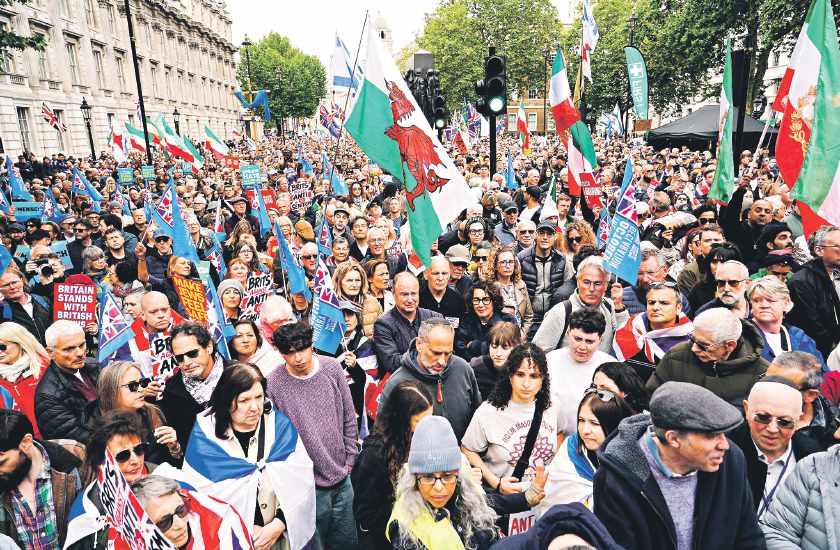
Up to 10,000 people gathered in Whitehall on Sunday to rally against antisemitism, following the recent surge in attacks on the community.
Strict security measures were in place as attendees were put through airport-style security at the Trafalgar Square entrance to Whitehall before joining the rally, backed by the Jewish Leadership Council, the Board of Deputies, and other leading communal and grassroots organisations.
Chief Rabbi Ephraim Mirvis and politicians from all the main political parties, along with Progressive Judaism co-leaders Rabbi Charley Baginsky and Rabbi Josh Levy, were among the long list of speakers addressing the crowd.
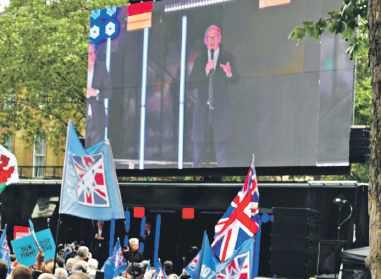
Despite requests from the stage made by JLC chief Keith Black for speakers to be treated with respect, Labour’s Work and Pensions minister Pat McFadden was drowned out by boos from some sections of the crowd as he attempted to speak.
Shouts of “shame”, “it’s your party’s fault”, “when will you act?” and “Jew harmer” were openly heard from some attendees, many of whom were linked to grassroots groups that have staged a succession of protests over the past few years.
Attempting to ignore the hecklers, McFadden said: “Friends, I hear you, I am with you, I am here to fight antisemitism.”
But the JLC’s Black repeatedly had to call for the crowd to show “respect” as the booing continued. McFadden added: “I come to speak for something, for the freedom, for the freedom that marks us out as a great country.”
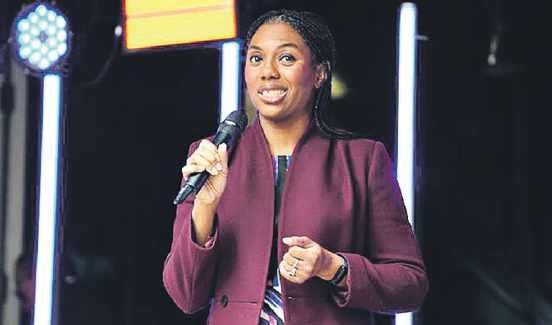
Conservative leader Kemi Badenoch was given a far more positive response as she said: “Many of you know that I was born in this country, but I grew up in Nigeria, and in 2014, I remember when 300 schoolgirls were stolen from their school by Islamic extremists, and only a few returned. I remember on 7 October, I saw that same terror, the murder and the massacre of young people at a music festival.
“There are many, many different pockets of antisemitism in this country, but I am most worried about the growth of extremism and
terror around the world and how it targets many groups in this country.
“Britain has been a sanctuary for Jewish people, and it must always be a sanctuary for Jewish people.”
Richard Tice, deputy leader of Reform UK, was also met with applause and praise as he addressed a rally against antisemitism in central London.
Jewish News understands that several communal organisations raised objections to his appearance ahead of Sunday’s demo.
But those who argued that many of those attending earlier antisemitism demos had been supportive of Reform UK won the debate, and he was allowed to speak.
Tice told the cheering crowd: “The scourge of antisemitism has been allowed to flourish in our beloved country, and we have to say we are sick and tired of warm words from waffly politicians.”
He added: “We need to take on the failure of leadership in our universities. Maybe we should say to the universities, if you allow this to carry on, forget any form of grants. Forget any form of student loans. Forget any form of research funding.”
we don’t unite, they will win.”
Sir Ed Davey, leader of the Liberal Democrats, went on to the stage to some jeers, believed to be connected to his repeated description of Gaza as a “genocide”, but the MC of the event told the audience he was there as a friend, and the boos subsided.
Sir Ed said: “Extremism is the enemy of the Jewish people. Extremism is the enemy of our country.
“I say to moderates, let us unite. Let us unite, because the extremists are on the march, and if
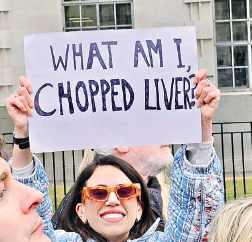
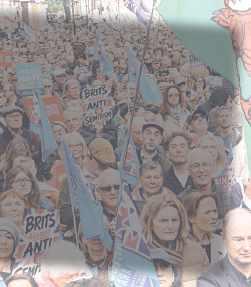
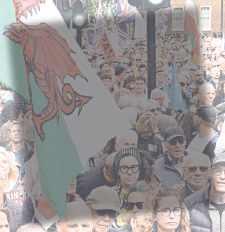
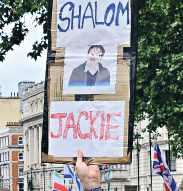
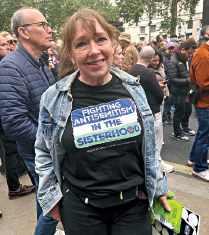
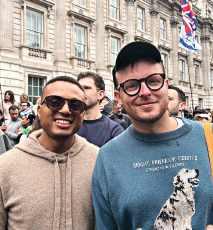
Protesters at the event were waving Israeli flags, the Union flag, Iranian protest flags and holding protest placards.
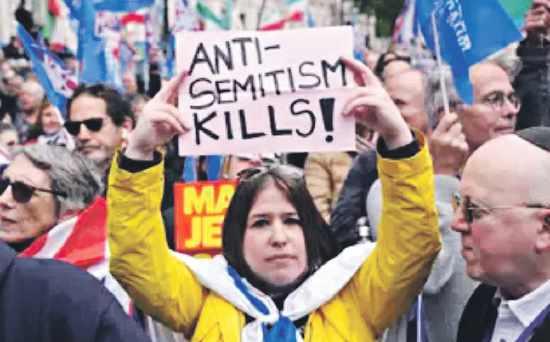
Some signs said: “British Jews deserve better”, “Where is Keir?” and “Brits against antisemitism”.
Earlier, Rabbi Mirvis had been applauded as he told the crowd: “It is unacceptable that poisonous antisemitism has become normalised in the UK. We see it within political circles, within the media, on university campuses, in our schools, we see it in the arts, in the NHS and on our streets. It is unacceptable that antisemitic
Demonstrators gather holding flags and placards as they attend a protest against antisemitism
Conservative leader Kemi Badenoch gives her speech at the rally
Pat McFadden MP addresses the crowd
rally against antisemitism
attacks are now starting to become normalised, and that will explain why an arson attack at the former Nelson Street synagogue last Tuesday went by with hardly any coverage.”
The JLC’s Black began the event, declaring: “We are fighting for the very soul of this nation. It is a fight for British values, for the right of every citizen to live free of fear, free of racism and free of discrimination. We will not shrink from this responsibility, nor cower in the shadows as history makes its call upon us, and with your support, we shall prevail.”
Adrian Cohen, acting president of the Board of Deputies, added: “Thank you so much for being here today in your thousands. I can see Jews, I can see non-Jews, friends of all faiths and none.
“It’s so great to see the Iranian flags here. It’s so great to see the Kurdish flags here. It’s so great to see so many of you here today to come and stand with our community and to say we support you.”
He continued: “This is no ‘perception’. This is real. It’s in our streets, and it’s online. We need every one of you right now because we’re in a fight against hatred, but we won’t succumb, because we are resilient. The threat – whether left or right or Islamist extremism – is a threat to the most basic British values. To tackle antisemitism is a national responsibility.”
Saul Taylor, President of the United Synagogue, told attendees how he had met the prime minister in Kenton Synagogue the week of the Kenton attack. He said: “I told him of the huge and rising costs that you [members] are all paying for security, costing the United Synagogue, the charity that I proudly lead, upwards of £1m a year. I told him of one synagogue alone that pays £20,000 a month for guarding. He gasped. This amounts to a tax on being Jewish in Britain. We appreciate the funds that have been provided by the government, but Jews shouldn’t
need 24/7 security in modern Britain.”
Campaign Against Antisemitism chief executive Gideon Falter also spoke, saying: “I’ve come back from Israel and that place is thriving.”
He claimed: “About this place – we have become a disgrace against the nations.”
There were small pockets of booing as the two Progressive Judaism rabbis spoke. Levy said: “We stand here heartbroken, angry and frightened, and that fear expresses itself in different ways. We also stand here determined to stand as Jews in this country.”
Baginsky added: “The opposite of antisemitism is belonging, and belonging is built with relationships.
“There must be serious and sustained action against antisemitism. This is a statement about
the country we believe in, and we all want our country to inherit.”
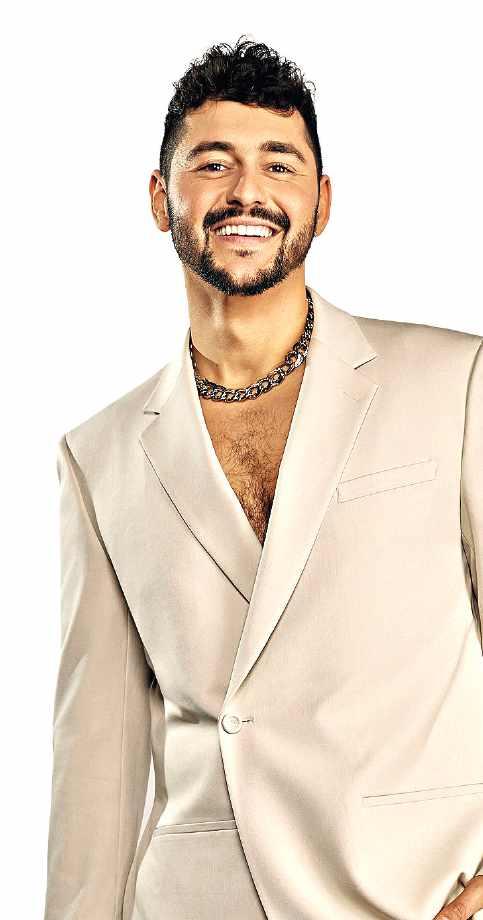
Pop star Boy George also sent a pre-recorded video message to support the rally. He previously said he had been left “in tears” following the stabbings of Shloime Rand, 34, and Moshe Ben Baila, 76, in Golders Green last month.
In the aftermath of the assaults, he said he had received abuse online over his messages of solidarity with the Jewish community.
In his message to the rally, the singer said he wished he could have attended the event, saying, “Not only for those amazing Jewish people, but also for people who support their Jewish friends”.
He said, “People like me keep being thanked for speaking up for Jewish people. I don’t want to be thanked for doing what is right.
“I have so many Jewish friends and know some would be there today, but even if I don’t know you, I send you my love, and I hope today we send a powerful message to the entire world. God bless you all and have the most amazing event.”
Others to speak at the event included Lord Walney, Fiyaz Mughal and the Rt Revd Lusa Nsenga-Ngoy, the Bishop of Willesden.
Mughal, founder of Faith Matters, said:”You are not alone.
“You are part of a Britain that I want to see. Where you are listened to , respected , where you don’t live behind walls.
“Some in my faith community are part of the problem . There are some who believe in Islamist extremism who are making all our lives difficult.
‘It is a collective fight for us all to take back the soul of Britain.”
Walney urged the government to make clear what it means by “doing all in its power” to tackle the rise in Jew-hate.
Meanwhile the Bishop of Willesden, the CoE’s interfaith representative, added:” We’ve rushed out of our church to be with you today.
“Something vital is at stake: the soul of our society itself.
“Antisemitism is evil and must be confronted wherever it arises. It isn’t another passing prejudice – it’s survived across centuries and across political movements. ”
He said it would be “perverse to see our Jewish brothers and sisters as bearing the sole responsibility for fighting antisemitism.
“The Jesus I follow was born Jewish and lived Jewish,” he added.
“For Christians this is matter of spiritual integrity and moral leadership.”
Also among those to attend the rally were Michael Gove, Sajid Javid, and Michael Ellis, along with shadow attorney general Lord Wolfson.
They came to stand with UK Jews
As we walked up to the airport-style security for the rally against antisemitism, my non-Jewish friend Jane Price wondered aloud, ‘Why do they have this and not for the pro-Palestine demos?’, writes Nicole Lampert.
I explained that this was to keep out the people who wanted to hurt us, and stringent security was always required when Jews met in big numbers. The penny dropped. Airports, after all, only started their checking for weapons after a string of dan-
gerous and deadly hijackings in the name of the Palestinian cause.
Jane was one of thousands of nonJewish allies who joined their friends and neighbours at the demonstration on Sunday. An Australian journalist, she reached out to me to ask if she could accompany me to the event.
‘I don’t know why anyone wouldn’t want to join,’ she says. ‘7 October opened my eyes to a lot of what was going on. The Bondi attacks hit home.
I wanted to show there were a lot of people who stand for decency.’
She was one of many. Marketeer Ewen Sturgeon attended with his Jewish girlfriend. ‘The UK should be a place where everyone feels safe to be,’ he said. ‘It’s what Britain stands for. The recent increase in antisemitism does not belong here.’
Next to him stood Tiffanie Darke, a journalist who added, ‘I’ve watched my Jewish friends feel increasingly threatened and frightened over the last year, and it’s incredibly upsetting. I’m standing up for them, for all Jewish people and for Britain.’
There was a huge contingent of
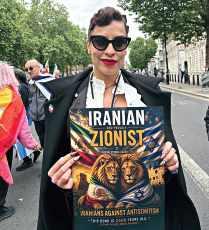
Iranians. Nadir Tahmesei waved a pre-revolution flag. ‘We’re happy to stand with Jewish people as they have stood with us,’ he said. People need to be aware of the extremism that is spreading all over the world. It needs to be addressed before it is too late.’
Heading the Iranian contingent was activist Lily Moo, who has been speaking up for the Jewish people since 7 October. ‘Iranians have always been allies of Israel,’ she said. ‘That has been in silence under the Islamic regime inside Iran, but loudly and openly in the diaspora. As we have witnessed over the past two and a half years, the lion and sun flag has flown next to the Star of David in countries across the world. Iranians will always be with our Jewish friends.’
Another staunch long-term ally is the Rev. Hayley Ace, who runs Christians Against Antisemitism and who took a day off church to be at the event. ‘There are many Christians who decided not to go to church today because they wanted to stand with the Jewish community,’ she says. ‘We feel just as strongly about this, that
our country is unrecognisable.’
And it wasn’t just the Christians. A group called Feminists Against Antisemitism, started last year, held a stunning banner. Susan McDonnell, one of the group’s founders, said, ‘If we didn’t stand with Jews, how could I live with myself? ‘I really do feel that “never again” is now. I am appalled at the silence on the left in particular about the violence against Jews. And I’ve been angry about feminists who haven’t spoken up. If you don’t stand
up now, when will you?’
TV commentators Benjamin Butterworth and Albie Mankona may be on opposite sides politically but are united in their belief that more needs to be done on antisemitism. ‘As a non-Jew, I’ve been shocked to see friends spout casual antisemitism,’ says Benjamin. ‘When so many people involve themselves in diminishing Jews in Israel, then without other people standing up for it, that becomes the norm.”
Warning sign: An attendee at Sunday’s rally in central London
A. Mankona and B. Butterworth Iranian activist Lily Moo
Susan McDonnell
Jewish News meets ... Samer Sinijlawi
Young Palestinians are rising up against Abbas
Reformer Samer Sinijlawi tells Lee Harpin a new generation of pragmatic Palestinians could finally convince Israelis there’s a real partner for peace
Samer Sinijlawi believes a growing movement of young, politically moderate and pragmatic Palestinians hold the key to convincing Israelis there’s a genuine partner for peace.
Speaking to Jewish News before local elections in Gaza, the influential political activist and outspoken campaigner for democratic reform within the Palestinian Authority (PA) highlighted what he called “a new political current”.
He noted in nine cities, the election featured candidate lists led by a younger generation – many from mainstream Fatah, as well as independents, professionals, business leaders, academics and civil society figures – openly challenging the authoritarianism of leaders like president Abbas.
“They are acting as a collective movement ... challenging the risks and obstacles supported by the older opposition, while the young opposition emerges as a force for change,” he said.
“Many young people had become hopeless, unable to participate in decisions that remain monopolised by the president.
“Now, they are trying to introduce a new path for Palestinian politics – liberal, democratic, moderate, practical and pragmatic.
In a revealing interview, Sinijlawi, a long-time Fatah representative who is deeply critical of president Mahmoud Abbas, described recent moves by the UK and other European states to recognise a Palestinian state as “political theatre”.
While he did not condemn the decision of Keir Starmer’s government to recognise a Palestinian state, he commented: “I am a Palestinian. I will be happy to see more states recognising the state, but this will not solve the problem, because it is only political theatre.
“They have announced this recognition, maybe upgraded the level of diplomatic representation of the PLO at the PA in London.
“For me as a Palestinian, I can understand that this is good news for the UK and for others who feel maybe it’s time to recognise the two sides, the two states. But for me as a Palestinian, I shouldn’t
depend on these political theatres.
“I should work harder to convince the only state that, if it recognises the state of Palestine, it will change the life of Palestinians. It will change the state of Israel. If 190 states recognise the state of Palestine and Israel is not among them, it is meaningless.”
As founding chairman of the Jerusalem Development Fund, Sinijlawi is a former Palestinian fighter who spent five years in an Israeli prison for acts committed during the First Intifada.
He has since become a peacemaker, spending the past 30 years building bridges.
Last week Sinijlawi appeared at a Jewish News supported event in north-west London.
His reflections on his prison time, beginning at age 15, are a remarkable example of someone able to forgive and determined to turn his life around.
He has said: “I started my political life throwing stones in the streets of my city because I wanted, at the age of 14 in 1987, to liberate Palestine from the river to the sea.”
He now recalls: “When I entered prison at the age of 15, it was a very hard experience, but I
can tell you that I maybe learned something that helped me a lot to develop my personality.”
“I learned to be independent. You need to take care of everything that’s related to you. Nobody is providing anything for you. I learned patience. You cannot defeat time. That is controlled by nature. You cannot change this.”
In prison, Sinijlawi also came to a different view of those he had hated. “I think I started discovering the Israelis,” he recalls.
“I started my journey of discovering the other side and spent a lot of hours talking with my guards. I got a lot from that experience.”
He added: “When you start knowing the other side, you start understanding that the best way is to defeat the hard feelings inside you and to open the doors.
“Hard feelings will defeat us both. Sometimes we need to defeat ourselves, not the other side.
“We need to defeat that part of the hard feelings that generates a temper that goes more into revenge.”
During the interview, he also expressed his belief that, even amid bleak events in the Middle East, a two-state solution is still possible.
Remarkably, he refused to put the blame of the failure to secure peace on Israel, and said the power to secure two states lay with the Palestinian people and the need to convince Israel they were a genuine partner for peace.
“What we need to do as Palestinians is to try to get the recognition of that particular state [Israel],” he argued.
“And it could be, if we are able to change the perceptions for 51 percent of the Israelis in the coming Israeli election, we are always one Israeli election away from peace as Palestinians.
“The only way to be able to get things moving ahead is to convince 51 percent of the Jewish voters to vote for an option that will open the diplomatic colleges and create a state of Palestine next to Israel.”
He continued: “If a political leadership rises from the Palestinian side, we have the power of convincing the Israelis that there is a partner on the Palestinian side, and that there is a change.”
With Benjamin Netanyahu’s coalition government considered to be one of the most extreme in Israel’s history, he also rejected suggestions that coexistence now
seemed further away than ever.
“Most Israelis supporting the current right-wing coalition, which I hope will change in coming elections, do so not out of ideology but out of confusion and fear,” he reasoned. “They don’t trust Palestinians. Somebody has manipulated their minds, brainwashed them to think the only way is just to fight hard and continue fighting – that war is the only option for Israel and its security.”
Sinijlawi reflected on the 7 October Hamas attacks on Israel, which he noted happened at a time when security on the border with Gaza was almost non-existent.
A Palestinian and Israeli state with borders would actually offer security, he argued.
“Two, three battalions of the Israeli army in Gaza will not provide security for Israelis,” he said.
“One battalion of the Israeli army on all the borders of Gaza will provide security for Israelis. We need to be outside Gaza to protect Israelis, not inside Gaza, because we have seen during the war that soldiers are killed inside Gaza.
“Israel has the strongest army in the region, despite the failure on the seventh of October. They can defend themselves.”
Controversially, he said he still held out hope that US president Donald Trump was the only leader with the authority and political will to settle conflicts in the region.
He also argued the downfall of the Iran regime would come only when the people there, with all the risks that came with it, wanted to see the downfall of their rulers.
But Sinijlawi optimistically refused to rule out the possibility of Jews and Palestinians living in peace together.
“There has been coexistence in this region for thousands of years. Jews have been here historically,” he said. “They have never been alone; there were always others— and others are us.
“Things went wrong only in the last 100 years, but the majority of the history in this land is coexistence between the same people.”
He added: “Since we have that history of coexistence, we are capable of finding a future of coexistence and common ground.”
Activist and reformer Samer Sinijlawi says a ‘new political current’ is forming in the Middle East
Pride reverses prejudice
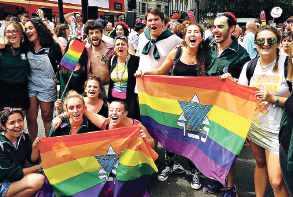
One of the largest LGBT+ pride events in Europe has reportedly reversed itself after originally telling a Belgian Jewish group that they could only join the event if their banners did not include a Star of David, or even the use of the word “Jewish”, writes Daniel Sugarman.
Brussels Pride, which is celebrating its 30th anniversary this year, is understand to have given Mazal Pride, an organisation representing LGBT+ Jews in Belgium, a condition to take part in the parade. In a post shared on the “BaLaGan! LGBT+ Jews in and around Brussels” Facebook group, one of the groups admin’s shared a post in which he told the hundreds of members of the group that “After several discussions with the organisers, our presence was finally accepted… but with conditions that deeply hurt us.
“Overall, they conveyed two positive messages: We do have a place at Pride and within the LGBTQ+ community in Brussels, and they accept us without conflating us with Israel. They are aware that Jews face risks in Belgium.
“However, because of the second point,
they fear that our participation could put us in danger. As a result, they would only potentially agree to our participation if we [do not use] our logo, the Magen David, or even using the word ‘Jewish’ on our banners!
“Hearing this at an event that is supposed to celebrate pride and the freedom to exist was extremely painful. The message we ultimately
receive is that our presence is acceptable only if it is not too visible. That we are welcome as long as we know how to hide… we refuse to accept erasing our identity as the solution. ”
However, it went on to say that “after many internal discussions, we decided that we would not give them the satisfaction of our absence. We will be there. Jewish, queer, allies, and prouder than ever – even if we respect their request to participate without overly distinctive symbols… Right now, we truly need to feel that we are not alone”.
While the official Mazal Instagram page did not provide details about the Brussels Pride decision, a message did tell those who were interested in attending the event with Mazal that the night before the 16 May event, “we will meet for a sign workshop…no other signs will be accepted other than those made at this workshop”. Part of the Facebook post, which was shared widely on social media, led to significant anger from Jews.
Jewish News has approached Brussels Pride and Mazal Pride for comment.
POLICE SEARCH FOR KERB-JUMPING DRIVER
Police are searching for the driver of a vehicle that reportedly mounted the curb and drove towards Jewish school pupils in north London.
According to the letter sent by Hasmonean High School for Boys’ headteacher James Fisher, on Monday 20 April, at 3:40pm, a group of the school’s pupils were involved in a “concerning incident” near the A1 carriageway by Holders Hill Road NW4, close to the pedestrian crossing near October Place.
Police report that “a black saloon-type vehicle” reportedly “drove towards the students whilst they were waiting to cross the road, mounting the curb and causing the students to move quickly out of the way” before the vehicle drove off towards Henlys Corner / the A406.
Aliyah: building dreams and saving tax
• Tax-efficient investing before and after Aliyah
• Tax-efficient income after 10-year tax-free period
• Receive your entire pension pot tax-free
• Specialist portfolio management for Olim
• No Inheritance Tax (for non-UK-situated assets)
We are seasoned experts in providing long-term financial planning advice for those making Aliyah. Scan the QR code to read more
With investing, your capital is at risk. Tax treatments are subject to individual circumstances and are subject to change.
Metropolitan Police are now appealing for eye witnesses and those with dashcam footage to contact them on 101 quoting reference number 01/7491684/26
KING’S SPEECH ACTION
Continued from page 1
The legislation would allow Home Secretary Shabana Mahmodd to designate Islamist groups such as the Iranian-linked Harakat Ashab al-Yamin al-Islamia, which claimed responsibility for antisemitic attacks, including the Golders Green Hatzolah ambulance incident and recent arson attacks on synagogues.
The Bill aims to “close gaps within our state threats legislation, aligning it more closely with terrorism legislation”.
During the State Opening of Parliament, King Charles told the House of Commons and House of Lords: “My government will take urgent action to tackle antisemitism and ensure all communities feel safe.” He warned the conflict in the Middle East shows how an “increasingly dangerous and volatile world threatens” the UK.
King Charles also said the government “will continue to promote long-term peace in the Middle East and the two-state solution in Israel and Palestine”.
‘How nice of them to create a new closet for Jews’
JN poll: one in three say Jews not protected
More than a third of British people believe the government and law enforcement are not doing enough to protect Jews amid an unprecedented wave of violent attacks, according to exclusive new research for Jewish News, writes Daniel Sugarman.
The weighted poll of more than 2,000 people, conducted by More in Common, also showed a clear majority – three in five – believe it is time that school pupils are be taught about Jew-hate as part of the national curriculum, with more than 60 per cent support from voters of all of the main political parties. Just 15 per cent expressed opposition.
Worryingly, however, a plurality of voters (40 per cent) say that Britain would be neither better nor worse o if Jews left the country because of antisemitism; 32 per cent say Britain would be much worse o , 4 per cent say Britain would be better o , and 24 per cent say they don’t know. The “much worse o ” view is strongest among Conservatives (47 per cent) and Reform voters (44 per cent), and among older Britons. It is weakest among 18-24s (22 per cent) and 25-34s (29 per cent) –the youngest cohort is significantly less likely to see Jewish departure as a national loss.
These findings are published a day after Downing Street convened leaders from across
society to develop a “whole society” approach to tackling antisemitism after a series of arson attacks against synagogues and other Jewish sites and the stabbing of two men in Golders Green.
A third of the British public (34 per cent) say the Government and police are not doing enough to protect the Jewish community in Britain, against 32 per cent who say they are doing the right amount and just 8 per cent who say they are doing too much.
While worry for Jewish friends and neighbours is markedly highest in London (29 per cent to 16 per cent) – perhaps an indication of the higher likelihood of Londoners to know Jewish people, as 65 percent of people nationwide said they don’t have any Jewish friends or neighbours at all.
However, the capital’s citizens are also least likely to say that the government and police are not doing enough (25 per cent to 34 per cent), instead being the most likely to say the response is “the right amount” (42 per cent to 32 per cent).
One in five of Londoners surveyed know Jewish people and have reached out to check on them following the recent attacks, compared with one in 10 nationwide.
Luke Tryl, director of More in Common,
said: “The attack in Golders Green has clearly registered with the public – a third of Britons think the Government and police aren’t doing enough to protect the Jewish community, and one in 10 say they’ve personally reached out to Jewish friends to check in, rising to one in five Londoners.
“And while it’s tempting to read the politics of antisemitism through the lens of any one party, the data tells a more complicated story: Conservative and Labour voters are equally likely to be worried for their Jewish neighbours, and majorities of every major party’s
voters – Reform included – back teaching about antisemitism in schools.”
Chris Philp, the Shadow Home Secretary, said: “This polling is deeply alarming. It shows that the many of the British public recognise the rampant antisemitism that is blighting Britain. And I am horrified that 40 per cent of the public are indi erent as to whether Jews leave the UK or not. If Jews feel forced to leave the UK our whole society would be so much worse o and it would be a damning indictment of the state of Britain. This simply cannot be allowed to happen.”
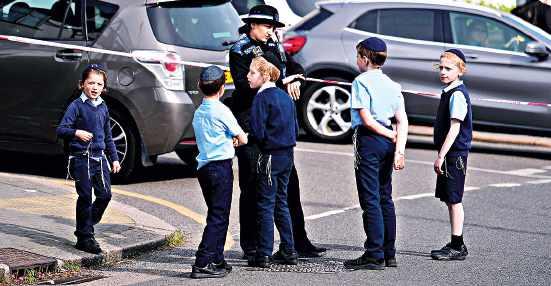
Police and stirctly-Orthodox children pictured in Stamford Hill
Mazzig: I do media for young Jews tuning in
by Annabel Sinclair annabel@jewishnews.com
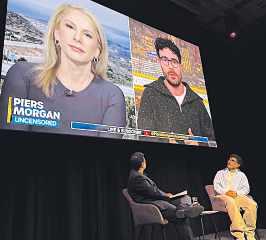
Israeli writer and activist Hen Mazzig has said he continues appearing on hostile television debates because he wants young Jews watching at home to see someone publicly defending the community without fear.
Speaking to Jewish News news editor Justin Cohen at a packed JW3 event hosted in partnership with the Jewish Leadership Council and Jewish News, Mazzig reflected on the personal toll of becoming one of the most recognisable pro-Israel voices online since 7 October.
Mazzig’s social media platforms reach millions; his interview series And They’re Jewish features conversations with prominent actors, creators and public figures.
Discussing appearances on Piers Morgan Uncensored, where he has clashed with antiIsrael voices, he said: “Who matters is the audience at home...I’m doing it for the 17-year-old Jewish kid in Manchester watching it. ‘Here’s a Jewish guy we can get behind.’”
According to Mazzig, many Jewish advocates try to “win arguments”, not persuade
wider audiences. “You want to win the room, not the argument,” he said, describing how research carried out through his Tel Aviv Institute found audiences responded more positively to nuanced and personal storytelling than aggressive debate.
“Facts don’t matter as much. Specifics matter much more,” he said.
“If you bring your family history, something you heard first-hand, that works much better.”
The Israeli influencer revealed he and his husband Mark had moved homes after facing abuse linked to his public profile, with some friendships collapsing after 7 October because of his activism and identity.
“It’s racist,” he said. “I refuse to change, and I refuse to give up on my identity.”
Mazzig also reflected on marrying in Greece last year while Israelis remained hostage.
“We had a conversation about how we are going to do it,” he said.
He recalled a rabbi telling him Jewish tradition teaches people to hold both joy and grief together simultaneously.
“Even in the brokenness, we are finding moments of joy,” he said.
The activist also spoke extensively about his Iraqi Jewish heritage and his grandmother, who fled Baghdad for Israel in 1951.
“To think that my grandmother couldn’t write or read and came to Israel as the only lifeline that would protect her and save her,” he said.
“And now to have her grandson sitting here in London with a platform, with a microphone, with people wanting to listen and engage.”
SIR SIMON SAYS BBC WAS ‘BRAVE’
Sir Simon Schama has described how winning the Bafta for The Road To Auschwitz will mean “a lot to the Jewish community” and has praised the BBC for being “brave enough” to commission it.
The historian, one of the UK’s most prominent Jewish intellectuals, won the Bafta award for best specialist factual at the ceremony in central London on Sunday.
The BBC documentary follows Sir Simon as he explores how the Holocaust was not just a Nazi obsession but a European-wide crime of complicity.
Speaking at a subsequent press conference, Sir Simon said: “The Jewish community in this country is going through a terrible time right now. I’m very grateful that there’s a lot of public attention and media attention to it.”
Two men have been charged with religiously aggravated harassment over allegations they travelled to a predominantly Jewish area to film antisemitic social media videos.
ADL ex-chief is mourned
Abraham Foxman, longtime leader of the Anti-Defamation League who for decades was the last word in post-Holocaust Jewish fury and forgiveness, has died at 86.
Foxman, a child survivor of the Holocaust, could be scathing and trenchant when he identified antisemitism infiltrating the public arena. But he was also an address for public figures who sought to divest themselves of a reputation of hostility toward Jews.
Under Foxman’s leadership, the ADL transformed from a division of the Jewish organization B’nai Brith into a muscular juggernaut running anti-bias educational and training programs, monitoring antisemitism in the United States and around the world and advocating for anti-discrimination legislation out of an array of regional offices. Foxman himself became a chief arbiter of what qualified as antisemitism — and the granter of absolution when he felt it was warranted. Some jokingly called him “the Jewish pope.”
He joined the ADL as an assistant director of legal affairs in 1965 and rose through a series of positions, including head of Middle Eastern affairs and head of international affairs, before becoming national director in 1987.
“We don’t have a slow season in our business,” he told the Jewish Telegraphic Agency at the time. “What we deal with is words. We’ve learned words have the power to kill, that words unchallenged, left in silence, words of bigotry, are part of our tradition.”
Foxman was born in Poland in 1940 and was hidden by his nanny as a Christian to escape the Nazis. Post-war, the young child was only restored to his family after a lenghty court battle.
His successor at ADL, chief executive Jonathan Greenblatt, lamented in a statement the passing of “a moral voice, a passionate advocate for the Jewish people and the state of Israel, and a remarkable leader.”
Foxman is survived by his wife Golda; his daughter Michelle and his son Ariel; and four grandchildren.
Police said officers were called to reports of a hate crime involving a group of men allegedly harassing Jews on Clapton Common in north London last Thursday at around 9pm. with five men subsequently arrested.
The CPS said Adam Bedoui, 20, and
Abdelkader Amir Bousloub, 21, appeared at Thames Magistrates’ Court on Saturday over allegations they approached, harassed and filmed Jewish people in Stamford Hill.
The pair, both of West Drayton, Hillingdon, west London, are charged with religiously aggravated intentional harassment, contrary to the Crime and Disorder Act 1998, and intentional harassment, contrary to the Public Order Act 1986.
Hen Mazzig on stage with Justin Cohen
Bousloub and Bedoui
Simon Schama
Abraham Foxman
Thousands of us, standing with the Jewish community and against antisemitism
38 Degrees is a community made up of hundreds of thousands of people, living in every corner of the countr y. We all come from different walks of life but when anyone is under attack we stand together.
We’ve seen our Jewish friends and neighbours face a horrific surge in antisemitic violence, and we knew it was up to all of us to speak out. Below is a selection of messages of suppor t and solidarity from 38 Degrees suppor ters to our Jewish friends, neighbours and communities:
I regret that there is a minority in the UK who feel they have a right to persecute others, good people who really do not deserve it However, there are far more of us who stand with you and suppor t you, completely and unreservedly - Linn
Rydyn ni'n sefyll gyda chi, ysgwydd wr th ysgwydd. We stand with you, shoulder to shoulder - Mar tin
Sending my love to my Jewish neighbourswe are all family - Caroline
Everyone in this country should feel able to live without fear - Ann
Britain is a democracy which means it stands for all people living in Britain, whoever you are, whatever your origins, whatever your race or your religion - Lesley
This isn't something which should be tolerated by anyone, any faith or religion. - Sue
United against hate in love and our humanity - Fauziah
You are not alone You are respected - Claire
Everyone in the UK should be able to live without fear or hatred towards them, any hatred towards minority groups needs to be called out for what it is Love not hate - K
Hate against any one of us based on who we are, is an attack on all of us. We stand against hate. With love and solidarity to you all. - Marie
38Degrees.org.uk
I wish for everyone in this country to live in peace together It is terrible when ordinary people’s lives are torn apar t because of extremists of any kind - Stephanie
Although our beliefs are different we should all have each other' s backs You're not alone - Liam
I stand in solidarity with the Jewish community in Britain and deplore any act of violence against any community or individual - Joan
Sending love and suppor t to everyone We are here for you - Stephen
I am thinking of you all at this hard time Antisemitism should have no place at all in the world Standing with you at this time - Matthew
Hate crimes against any members of any community must not be tolerated - Ann
Love and suppor t to all those affected by these hateful crimes - Steve
Thinking of you with kindness - Colette
I stand with the Jewish community here in London and wholehear tedly condemn the antisemitic attacks that have been taking place We are all one - Nicoletta
I am so angry about the hatred that is being expressed towards you I send my deepest sympathy to you all - Catherine
I stand with those who spread love not hate, with the quiet majority to drown out the vocal minority, and in solidarity with the Jewish community - Heather
All of us are one human race, and we must suppor t one another. In solidarity. - Louise
There is no place for antisemitism in the UK I wish nothing but peace and love to all British Jews - Peter
Solidarity Racism is poison - Chriso
You are welcome in our community, welcome to be yourself and welcome to practice your religion in peace amongst us - Janet
There is too much hate in the world, it doesn’t solve anything. - Marianne
Sending my love to my Jewish neighbours We are all family - Caroline
We must not let hate tear us apar t - Susan
Let us ensure that future history books record that we the people of the 21st century did not remain silent in the face of hatred - Gordon
I wish we lived in a world where my message of love for you could drown out all the hate out that you are experiencing and could give you some comfor t - Pala
Matt Lucas speaks out on Tube confrontation
by Jenni Frazer @Jennifrazer
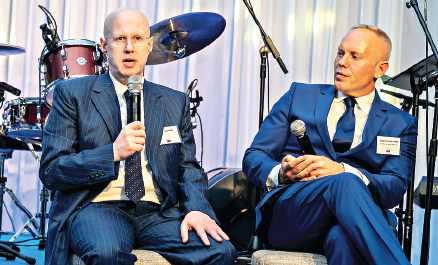
Two of Britain’s best-known public Jewish faces, presenter and barrister Rob Rinder and writer and comedian Matt Lucas, took to the stage at a jam-packed and raucous 45 Aid Society reunion, celebrating the charity’s 81st anniversary.
The pair contrasted their di erent experiences of being confronted by those assailing them for their Jewishness. Lucas was captured on video as a man unknown to him ranted at him in a tube station; Rinder, meanwhile, was walking in Carnaby Street when a young cyclist recognised him and shouted “Heil Hitler” at him days after the Golders Green stabbings.
Lucas said he had always refused to comment publicly on his incident, in which the man tried to goad him into making a response about the Palestinians. But he said: “I still believe innately in the goodness of people
in Britain”, and added: “Prejudice comes through a lack of education; we have a duty to educate people.”
Both men have a survivor history. Rinder is the grandson of Morris Malenicky; his mother, Angela Cohen, is chair of the 45 Aid Society; while Matt Lucas’s grandmother was a Berlin-born survivor. Each has taken part in the high-profile Who Do You Think You Are? television research programme; Lucas said during his episode he discovered one of his grandmother’s cousins had lodged with the family of Anne Frank before the Franks went into hiding.
The evening began with a now traditional lighting of memorial candles by survivors from the group known as The Boys – men and women who came to Britain after the war and made new lives for themselves.
This year – joined by family members – the candle-lighters were Arek Hersh, Mala Tribich, Jackie Young, Rachel Levy and Jan Goldberger,
together with American citizens Judi Roth, daughter of Michael Novice, and Mark Frydenberg, son of Bernie Frydenberg, both of The Boys.
The emphasis of the evening was education, with Natalie Meltzer, granddaughter of Harry Balsam, another of The Boys, announcing
Cohen steps in to lead Board for two months
Adrian Cohen has been appointed acting president of the Board of Deputies for a twomonth period, stepping in while Phil Rosenberg takes paternity leave from his role as president of the communal organisation.
Cohen, who serves as senior vice-president at the Board, assumes leadership at a pivotal moment for the community.
A recent spate of antisemitic attacks on synagogues and Jewish institutions has required the Board to maintain daily contact with both government o cials and senior police authorities.
Cohen, also an honorary vice-president with the Jewish Leadership Council and founder of the London Jewish Forum (JLF), has worked closely alongside Rosenberg.
Cohen, 62, first
became involved with the Board in 1985 while serving as national chair of the Union of Jewish Students.
He previously served as deputy for South Hampstead Synagogue before representing Highgate Synagogue on the Board.
Growing up in Ilford, East London, Cohen attended Habonim and Bnei Akiva youth organisations and has remained deeply involved in communal life.
Despite his a nity with the Labour Party, Cohen is respected for his non-partisan approach to communal a airs, attracting support from senior Jewish Conservative figures for his campaigns for Board roles.
He was co-chair of the LJF until June 2024.
NEW CHARGES FOR BONDI SUSPECT
A man accused of killing 15 people in a terror attack on a Chanukah event at Australia’s Bondi Beach is expected to face fresh charges, according to court documents.
Naveed Akram, 24, and his father, Sajid, allegedly opened fire on the Jewish holiday gathering at Archer Park in Sydney on 14 December. His father was shot dead at the scene.
Court records indicate Akram is set to face 19 new charges, including 10 counts of shooting with intent to murder and multiple counts of causing wounding with
intent to murder and discharging a firearm with intent to resist arrest.
The 24-year-old was previously charged with 59 o ences, including 15 counts of murder and one count of committing a terrorist act.
Among the victims was London-born Rabbi Eli Schlanger, 41, a father of five and assistant rabbi at Chabad of Bondi. Two o cers and dozens of people were also injured during the incident.
Akram, who is being held in a maximum security prison on remand, has yet to enter a plea.
the launch of the charity’s new interactive website, 45Aid.org – a 21st century way of retelling stories of Holocaust survivors after they are no longer there in person.
And admiration was expressed over a photographic exhibition on display, curated by Julia Burton,
showing previously unknown pictures of The Boys and their families.
The society’s annual Lorraine Kingsley award went to Professor Nicola Wetherall, MBE, Associate Professor at the UCL Centre for Holocaust Education. It was announced by Jonathan Kingsley, grandson of Monty Graham, another of The Boys. Through Professor Wetherall’s outreach work, more than 400 schools have learned the stories of The Boys, before, during and after the War.
In her moving address, Angela Cohen reminded an audience who needed little reminding that with the current rise of antisemitism, the work of the 45s was more vital than ever. “Who we are, and what we stand for, still matters deeply.” Antisemitism was “shocking and painful”, and “not abstract but deeply personal”.
She added: “We know where hatred can lead, we have seen it before – and we can never allow it to be become normalised.”
Matt Lucas (left) and Rob Rinder (right) at 45 Aid Society reunion dinner
Photo by Gary Perlmutter Photography
required the Board to maintain daily con-
Adrian Cohen
Former hostages make joint live appearance
Former Hamas hostages Eli Sharabi and Alon Ohel made their first live public appearance together in the UK at the inaugural fundraising dinner for Strands of Hope, raising £300,000 to support vulnerable young people in Israel, writes Rosa Doherty.
More than 400 attended the event, which raised funds for Hut HaMeshulash, an Israeli charity working with at-risk youth facing serious social and emotional challenges.
Sharabi was kidnapped from Kibbutz Be’eri and held in Gaza for 491 days. His wife, Lianne, and daughters Noiya, 16, and Yahel, 13, were murdered on 7 October. He learned of their deaths after his release.
You could hear a pin drop as he retold the moment he discovered they had not survived.
“In captivity, the terrorists told me, ‘I saw your wife and children, they are fine.’ It was the only time I ever cried in captivity. For 16 months, there wasn’t one hour I
wasn’t thinking about them.”
He said he always knew it was possible Hamas had lied. When he was told the truth after his release, it “was like a hammer to my head”.
“I am a practical person. I know I can’t bring them back. If I thought that depression and misery would bring them back, I would choose that but I choose life.”
This attitude, he said, was key to his survival. Speaking to Eylon Levy about his ordeal, he added: “Talking to the media, speaking to people around the world, is part of the therapeutic process for me.”
His brother Yossi was also kidnapped and later murdered after 100 days in captivity. “It was the same with my brother. I had to fight to bring his body home.”
Sharabi sat alongside Ohel, 25, a musician kidnapped from the Nova festival and held hostage for 738 days. He endured a further 247 days in captivity alone after Sharabi’s release.
The men formed a close bond in captivity. Speaking to Levy, they reflected on how that friendship helped them survive.
Sharabi said that caring for Ohel gave him purpose. “Every day I woke up thinking I had to survive not just for me, but for him,” he said.
Ohel said Sharabi’s strength and guidance had stayed with him, adding: “When he was taken from me, he was always in my thoughts. I tried to think good, optimistic thoughts.”
The event marked a deeply emotional reunion for the two survivors, who had never before appeared together live in front of an audience.
Three weeks after Sharabi’s release, a Hamas guard o ered to bring Ohel another hostage for company. “I knew I would not get fed if there was another person...I needed food to survive,” he said. “I told him to give me a book.”
Weeks later, the guard brought
your legacy
him a copy of Harry Potter and the Half-Blood Prince, which he read repeatedly — though he avoided the ending. “I read that part only once. I told myself, this is not my ending.”
Breaking the tension, Sharabi joked: “They should have given him my book.”
Hut HaMeshulash supports around 1,400 at-risk youth in Jerusalem through emergency shelters, long-term residential homes, tran-
sitional housing, vocational training and an open-access drop-in centre.
Speaking about the importance of supporting vulnerable young people, Sharabi said he understood “the moment when somebody gives you direction” and said such support could “save lives”. He added: “Every donation makes a di erence. Every pound can help change their future.”
The evening raised £300, 000 for the charity.
APPEAL FOR WITNESSES IN CAR TARGETING OF BOYS
Barnet on Monday, 20 April. While enquiries are ongoing to establish the circumstances, this is currently being treated as a religiously aggravated assault.
An incident last month where the driver of a vehicle reportedly mounted the curb and drove towards Jewish school pupils in north London is being treated by the police as religiously aggravated assault, with e orts being made to find the individual responsible.
According to the letter sent by Hasmonean High School for Boy’s headteacher James Fisher, on Monday 20 April, at approximately 3:40pm, a group of pupils were involved in a “concerning incident” near the A1 carriageway by Holders Hill Road NW4, close to the pedestrian crossing near October Place.
A Met police spokesperson said: “We are investigating reports a car drove towards three 14-year-old boys on Holders Hill Road,
“It was reported a [black saloon] car had mounted the kerb near where the boys were standing, they moved out of the way and there were no reported injuries,
“We remain in close contact with the nearby school. At this stage, no arrests have been made and enquiries are ongoing.
“Anyone with information is asked to contact police, providing the reference 2017/24APR.”
The car is believed to have then driven o towards Henly’s Corner/A406.
ANTISEMITISM EXHIBITION SEARCHES FOR UK VENUE
An exhibition examining the history and repetition of antisemitism has struggled to find a public venue in Britain, despite being hosted by major institutions across Europe.
The Vicious Circle, devised by the National Holocaust Museum, explores recurring antiJewish hatred through a series of historical case studies spanning from Nazi Germany to the 7 October attacks in Israel.
The exhibition was briefly displayed in a privately rented Soho gallery in London in January 2025. Since then, it has appeared at institutions including the European Parliament, the Berlin House of Representatives
and Austria’s interior ministry.
As reported by The Times, the exhibition was o ered to institutions, including St. Paul’s Cathedral and the UK Foreign O ce, as organisers sought a public British venue.
In a letter to The Times, Michael Hilsenrath, chair of the Anglo-Jewish Association, said: “antisemitism is culturally tolerated and yet persistently minimised” in the UK.
Comparing the situation with elsewhere in Europe, he said: “E orts to host the exhibition in public venues across the UK have so far been unsuccessful. This contrast speaks for itself.”
Eli Sharabi and Alon Ohel made their first live public appearance together in the UK. Photo: Julian Coleman
Gaza school founder: pupils taught we are better as one
by Annabel Sinclair annabel@jewishnews.co.uk
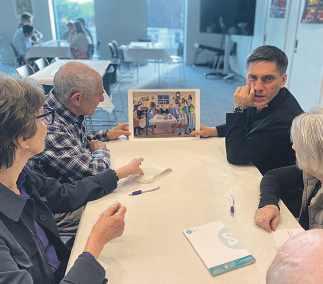
A Palestinian-American neurosurgeon who has built a fast-growing network of schools for Gaza’s orphaned and displaced children says Israeli and Jewish donors are helping drive an education project centred on trust, trauma recovery and what he calls a philosophy of being “better together”.
Dr David Hasan, founder of the Academies of Hope network in Gaza, told Jewish News his work emerged from a deeply personal shift following the 7 October attacks and his own experience travelling between Gaza and Israel during the war.
Hasan, a professor and neurosurgeon based in America, entered Gaza in December 2023 as part of a World Health Organisation medical mission, operating in hospitals under what he described as “horrible conditions.”
Born in Kuwait to Palestinian parents from the West Bank, Hasan said he grew up with a single narrative about Jews before moving to the United States, where exposure to Jewish culture, Christianity and religious studies reshaped his worldview.
“My parents are from the West Bank, born and raised there,” he said. “That was the nar-
As an independent health insurance expert, I’m here to find the right policy for you, and help recommend the providers who offer the best cover at the most competitive premiums. Our FREE advice service covers individual, family and company policies. Whether you have an existing policy or not, let’s have a chat.
rative that we grew up with.”
After studying religion during university alongside his medical training, Hasan said he began to see conflict through multiple perspectives, but the aftermath of 7 October marked a turning point. While he tried reaching out to Israeli and Jewish friends to express sympathy following the Hamas attacks, he said many relationships fractured almost overnight. “I knew at that time this conflict was much bigger than what was there in the region,” he said.
He entered Gaza in late 2023 after a global appeal for doctors. “Only 18 people responded to that call,” Hasan said.
Working inside hospitals, he documented conditions on the ground through written updates to his wife, who later shared them publicly after his return.
The visibility brought invitations to speak internationally, but Hasan said he deliberately avoided taking overt political positions.
“I refused,” he said. “I stayed in the middle. I never used the words ‘genocide’ or ‘war crimes’. I just described facts.”
The idea for the schools came later, after Hasan said he witnessed the scale of trauma.
He described trying unsuccessfully to establish orphanages before turning instead
toward education. The first school opened in July 2025 in southern Gaza, initially designed for around 200 children. “We thought it would be 200, but about 500 came,” he said.
Many children arrived hungry, he added, prompting him to contact chef José Andrés and the charity World Central Kitchen for support.
“Some of the kids hadn’t had food, hadn’t had sleep for four or five days,” Hasan said.
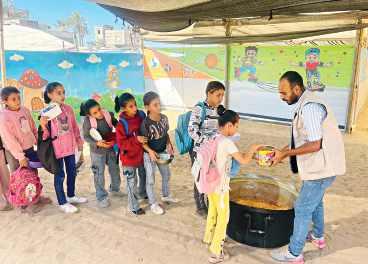
The schools, in improvised classrooms, now o er daily meals, healthcare, psychological support and structured education.
Hasan said the initiative has since expanded to nearly 19,000 children across multiple sites.
At the centre of the project is a curriculum, he says, that removes material promoting violence while preserving Palestinian identity.
Hasan rejected the language of “coexistence,” describing it as a "bad term", implying tolerance without genuine connection. Instead, students are taught a di erent principle. “We are better together,” he said. “Because if you’re better together, you care about the other person.”
Hasan said the curriculum combines standard Palestinian Authority material with lessons on empathy, religion, critical thinking and conflict resolution.
He described what he calls a “passive curriculum” – a revised version of existing educational material – alongside an “active curriculum” focused on values. “We created a course where we actually teach the kids about love, peace, tolerance, critical thinking,” he said. Students also learn about world religions, including Judaism. Hasan said artwork created by students often reflects hopes for peace. “For the first time, you walk in, and you see kids have drawn Palestinian and Israeli flags together,” he said.
The initiative has attracted hostility from Hamas and Palestinian Authority-linked ocials, with Hasan describing "a lot of posturing, intimidation, smearing campaigns against us.”
Teachers have also faced fear and pressure, prompting the organisation to vet sta carefully.
“We were very selective,” Hasan said. “We didn’t work with already existing NGOs. We picked them one by one.”
Hasan said transparency around Jewish and Israeli donors was essential to building trust.
“You have to be honest with everybody,” he said. “If people in Gaza found out later, they would say, ‘You’re up to no good.’”
He said local community leaders accepted outside funding so long as the schools did not seek to erase Palestinian identity.
“They said, ‘As long as you don’t brainwash our kids,’” Hasan recalled.
His long-term ambition is to reach 250,000 children.
“We are outrageously ambitious,” he said.
He believes the model could eventually extend beyond Gaza.
“If change is possible in Gaza – one of the most di cult places in the region – imagine what impact that could have elsewhere,” he said.
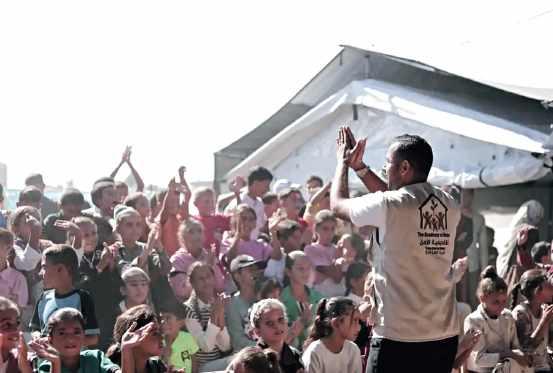
Children at the Academies of Hope campus in Gaza
WHAT YOU KNOW MAKES A DIFFERENCE
Apology for ‘Golders Hate’ quiz team name MUSLIM GROUP VOICES SUPPORT
A Yorkshire pub has apologised after hosting a quiz where the winning team was allowed to call itself “Golders Green should be Golders Greed”, just days after a stabbing in the neighbourhood, which contains one of the UK’s largest Jewish communities.
As reported by The Telegraph, sta at The Crown at Boston Spa, a gastropub in West Yorkshire, did not object when the name was submitted to the quiz moderator by the team in question, which went on to win.
The event was held on 4 May – five days beforehand, an individual stabbed to visibly Jewish men in Golders Green before being pacified by the police.
added, as reported by The Telegraph. “The name should not have been accepted.
“At the time, it appears the significance and implications of the wording were not properly recognised by those running the quiz.
“We want all customers to feel welcome and safe in the pub regardless of background or religion, and we appreciate you raising this with us.”
They wrote: “Above all, we commit ourselves to championing, within and across all of our communities, the dialogue and contact we need to live well together as neighbours in our shared country.
The Telegraph reported that the individual who complained, who was not Jewish, said they were “ashamed to call The Crown my local… This was absolutely outrageous, and is both insensitive and racist towards innocent British Jews”.
The letter writer noted that the pub had previously warned quizzers regarding another o ensive team name.
Reportedly, no one present took any public issue with the name, with the incident only coming to light after an individual who had been at the quiz told a member of their family, who complained.
“The Crown is clearly not an inclusive establishment”, they said. “What Jew could ever feel welcome or safe there. Shameful!”
The pub’s manager said it was “reviewing the incident with the quiz team and staff to ensure greater care is taken over team names and language used during future events”.
“We are very sorry that this team name caused o ence and distress,” he
Golders Green in North West London is home to a longstanding Jewish community. Associating Jews with money and greed is a longstanding antisemitic trope, dating back almost two millennia.
A spokesperson for Campaign Against Antisemitism said: “This is plainly racist. It shows just how normalised racism against Jews has become in Britain.”
The Crown has been contacted for comment.
A group of prominent British Muslim voices has issued an open letter expressing solidarity with the Jewish community following recent antisemitic attacks in the UK, saying British Jews should know “we are right here beside you”.
The letter, coordinated by British Future and shared with Jewish News, brings together more than 30 Muslim leaders, imams, academics, youth workers and community figures from across Britain.
In the letter, the signatories expressed “sadness, solidarity and empathy” with British Jews and pledged to help combat antisemitism.
“As Muslims, we understand how rising prejudice, hostility and hate crimes feel.” Avaes Mohammad, who coordinated the letter, said many Muslims wanted to publicly show support for Britain’s Jewish community. Other signatories include representatives from Faiths Forum for London, the Muslim Cultural Heritage Centre, the British Fatwa Council and New Horizons in British Islam.
Rabbi Dovid Lewis (left) and Imam Nasser Kurdy
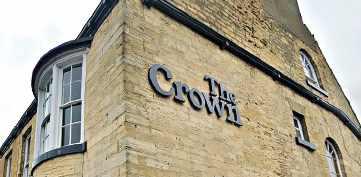
The Crown pub in West Yorkshire has apologised
A
PHASE LAUNCH
Join us for show home tours and refreshments at the grand unveiling of The Pankhurst Apartments at Newland Park – A sanctuary of modern luxury apartments and houses set within 200 acres of mature parkland in Chalfont St Giles, Buckinghamshire and in easy reach of Central London.
PRICES FROM £649,000 (APARTMENTS) / £1,099,000 (HOUSES)
SATURDAY 16th & SUNDAY 17th MAY 2026 10:00am – 5:00pm
Editorial comment and letters to the editor
LETTERS TO THE EDITOR
VOICE OF THE JEWISH NEWS
State finally stirs against Jew-hate
On Sunday, thousands of Jews and allies gathered outside Downing Street to stand against the tidal wave of Jew-hate which has threatened to swamp this country.
Some speakers were cheered; others heckled; the government’s representative in particular. The mood from many was one of deep anger and frustration at the current situation.
On Wednesday, crowds filled the streets at Whitehall again, this time ahead of the King’s Speech, where His Majesty set out the government’s intended legislation for the coming period.
It is important, amid the understandable fear and aggravation, to not lose sight of the fact that His Majesty, in the heart of the Mother of Parliaments, read out to the nation that “my government will take urgent action to tackle antisemitism”. And action is being taken – perhaps far more slowly than many of us would have liked, but action, nonetheless.
This government is not pretending the Jewish community is only ‘perceiving’ antisemitism rather than experiencing it every day. The intended legislation announced on Wednesday included new powers to crack down on terror carried out against the Jewish community, as well as to proscribe the IRGC.
Whether the prime minister continues in his current position for much longer, it is difficult to see any future leader backtracking on such announcements.
It is important that our community does not succumb to despair. This is not 1930s Germany, where the state itself was the one leading the hate against the country’s Jews. We live in a country where those in power are willing to call out hatred and move to confront it.
We may take issue with the speed with which they have done so, and feel that only repeated acts of violence and attempted destruction have prompted such movement, but we must remember that this government is not our enemy, but an ally against those who wish to do us harm.
THIS WEEKEND'S SHABBAT TIMES...
Shabbat comes in
8.32pm Shabbat goes out
9.46pm Sedra: Bemidbar
Stop spreading propaganda
Your columnist David Aaronovitch should qualify his claim that “the behaviour of the Israeli state and government towards others has now become intolerable” by adding... for “those who want Israel to fail”. Further, were he to base his comments, not on mode du jour hearsay, but on legal knowledge and history, he would know that Judea and Samaria, aka the “West Bank”, cannot be “annexed” because the 1920 binding international treaty of San Remo, upheld by Article 80 of the UN Charter, confers Israeli sovereignty.
violence” and “illegal settlements”, were he to visit the area he would see rampant illegal Palestinian settlements in Area C, reserved for Israelis under the Oslo Accords.
The propaganda campaign of the corrupt PA conceals the huge imbalance of daily Palestinian violence perpetrated against Jews, incentivised by its “pay to slay” policy.
Rather than bleating about anti-Jewish violence on the front page, Jewish News should stop publishing propaganda masquerading as fact, which incentivises hate crimes against us.
As to the ongoing blood libel of “settler
Stephen Green, NW6
THE PSYCHOLOGY BEHIND POLANSKI?
Recent remarks by Zack Polanski invite comparison with Theodor Lessing’s account of minority figures who, when denied full acceptance, resolve the tension by distancing themselves from their own community.
One need not go so far as to adopt Lessing’s conclusion. Yet when Jewish fears are reduced to “perception”, antisemitism is met with unusual scepticism, and even the response to attacks on
THE DREAM OF SAFETY FOR ALL
I went to church last Shabbat. I had been invited to a fund raising concert with coffee and cakes, and noticed several other kindred spirits from our community there.
As I ambled through the gardens, the church doors were wide open as people slowly drifted in, which really put into sharp perspective our own highly guarded synagogues with security guards, a police presence and multiple gates.
It is a very sad indictment of British society that we have have to hide ourselves behind ever higher walls.
Kay Bagon, Radlett
Support your Jewish community. Support your Jewish News
Thank you for helping to make Jewish News the leading source of news and opinion for the UK Jewish community. Unlike other Jewish media, we do not charge for content. That won’t change. Because we are charity-owned and free, we rely on advertising to cover our costs. This vital lifeline, which has dropped in recent years, has fallen further due to coronavirus.
Today we’re asking for your invaluable help to continue putting our community first in everything we do. For as little as £5 a month you can help sustain the vital work we do in celebrating and standing up for Jewish life in Britain.
Jewish News holds our community together and keeps us connected. Like a synagogue, it’s where people turn to feel part of something bigger. It also proudly shows the rest of Britain the vibrancy and rich culture of modern Jewish life.
You can make a quick and easy one-off or monthly contribution of £5, £10, £20 or any other sum you’re comfortable with. 100% of your donation will help us continue celebrating our community, in all its dynamic diversity.
Support Jewish News by visiting our donor page at jewishnews.co.uk
Jews is questioned, the parallels are hard to ignore.
A related dynamic, often likened to Stockholm syndrome, was described by Anna Freud as “identification with the aggressor”.
The Green Party might wish to review its vetting processes, starting not with councillors but its own leadership.
Eli Cohen, NW11
STAND WITH JEWS TIME FOR US TO GO?
I am a non-Jew but I would like to state my total abhorrence of the recent attacks on Jewry on British streets. It is dreadful that we should witness such appalling behaviour in what should be so welcoming (eventually) a country.
David Sherwell, M30
Many in my community are thinking seriously about making aliyah, while others who have lived in England all their lives have begun to question whether it’s safe to remain. Is this a repeat of my grandparents’ situation in the East End of London when Mosley’s gangs walked the streets? My relatives in Israel have been phoning me to see if I’m OK. Heaton Park and Golders Green are our wake-up calls. Norma Neville, Hendon
I
deleted a young Jew’s identity from the internet
RICHARD FERRER EDITOR, JEWISH NEWS
For the past few years, JewishNews has received a chilling trickle of emails. Modest emails. Apologetic emails. One, maybe two a month, from people asking if we might possibly help them stop existing online as a Jew.
The requests are never dramatic and always polite. The sender would simply like their name removed from an old story on the Jewish News website. It could be a 2018 report about a talent show. A 2021 article about a charity supper. A 2022 feature about synagogue panel debate. Or a 2024 opinion piece about Passover.
None of the emailers are public figures. They are ordinary British Jews who, until a few years ago, were proud to appear in the Jewish News but now scan their Google search results with a knot in their stomach, fearful a future employer might see they are Jewish and, therefore, consider them unemployable.
The latest landed in my inbox on Sunday. It was from a young woman who, back in 2021, aged 16, had been mentioned in passing in a
fun article about a prize-giving event. She’s happy for me to share some of what she wrote.
“As I begin my professional career, I am taking steps to manage my online presence, and this article currently appears prominently in search results for my name. I would therefore be very grateful if you could remove the article from your website; or anonymise my name by replacing it with initials.”
What strikes you is her polite embarrassment. Her painfully courteous tone. She hates to cause any fuss. She would just prefer, all things considered, to no longer be publicly identifiable as a Jew.
She went on to praise the value of online archives and editorial integrity, before, again, with excruciating courtesy, asking if she could simply and surreptitiously vanish from our pages.
I did what she asked, hovering over the delete button for a few heartbreaking seconds, ashamed of what I was doing and why I was doing it, but mostly ashamed of Britain – which had made a young woman think this a sensible career move. Every time I delete one of these articles I feel the same shame. Followed by boiling anger.
Something has shifted psychologically, socially and professionally for Jewish
SHE HATES TO CAUSE A FUSS. SHE WOULD JUST PREFER NOT TO BE IDENTIFIABLE ONLINE AS JEWISH
people in this country. Everybody knows it, even those who make a career out of pretending otherwise.
First came pupils at Jewish schools being advised to remove their uniforms when travelling to and from school. Then Jewish university students took off their Star of David necklaces, removed kippahs and began avoiding Jewish social events. Jewish healthcare workers have spoken to Jewish News about concealing their identity, while patients with obviously Jewish names have expressed fear at being identified in waiting rooms and wards.
In 2024, when Jewish News was looking to build a new website, the company we
chose decided it “wasn’t comfortable” working with a Jewish newspaper. The boss told me that while he could insist his staff do the project, “their hearts wouldn’t be in it and the outcome would not be the best it could be for Jewish News ”.
The company is signed up to a movement called B Corp, whose stated aim is to promote “high standards of social accountability and address society’s most critical challenges”.
I got stick for not naming the company that refused to work with Jewish News at the time, but this relentless drip of Jews wanting to disappear from public view has pushed me past the point of caring. The business that didn’t feel comfortable working with a Jewish company is Studio Republic.
The Jewish instinct to keep your head down, to not look or sound too Jewish, is woven deep into European Jewish memory. Hearing British Jews express these fears louder than at any time in the last 80 years –here in the UK in 2026 – chills the blood.
When young Jews sense professional danger in appearing in an online article about a community prize-giving, we have reached a very dark place as a society.
One from which history suggests there may be no return.
Former hypnotherapist, Zack Polanski, stars in a Party Political Broadcast for the Green Party
Internet is teaching children intolerance
SIR HAMID PATEL & SIR TREVOR PEARS
The horrifying attack in Golders Green and arson attacks that preceded it, were yet more warning flares in a broader crisis: antisemitism is growing everywhere.
In the days that followed, the Prime Minister was right to describe rising antisemitism as a “crisis for all of us”.
It is a crisis for the Jewish community, but it is also a crisis for Britain, and for every community that depends on truth, trust and the ability to live together.
Antisemitism, and wider hatred between communities, is being accelerated, amplified and normalised by online misinformation, disinformation and conspiracy theories.
This was why we came together in 2024 to establish, and jointly lead, the Commission into Countering Online Conspiracies in Schools. We did so because we were hearing the same message from classrooms and communities across the country: online conspiracy belief was no longer confined to the margins. It was marching openly through the school gates, with teachers on the frontline.
Teachers told us they felt overwhelmed.
TThey were facing a growing stream of false, hateful and conspiratorial content, yet had little practical support on how to respond.
Parents, too, were worried and confused by what their children were seeing online – but schools were often unsure how to advise them. Young people themselves admitted they were struggling to distinguish fact from fiction in a digital world designed to blur the line between the two.
For Pears Foundation, this work was shaped by a long history of supporting organisations across the youth sector, education, communities and social cohesion. That experience has given us a deep understanding of how the ties that bind us are being tested to breaking point – but also of what it takes to strengthen them.
For Star Academies, it was informed by supporting and running thirty-six schools in some of Britain’s most ethnically diverse communities.
Together, those experiences make one thing clear: this is both a particular problem and a universal one. It a ects all young people, all schools and every community.
The Commission is clear that the response cannot be fragmented or siloed. It must be collaborative, practical and rooted in the places where young people learn how
to live alongside one another. That is why schools matter so much. They are not just places where children learn to pass exams; they are where young people learn how to analyse information, how to question, how to socialise and how to grapple with complexity. They prepare children for modern Britain.
In an age shaped by algorithms, deepfakes and viral falsehoods, that preparation must include the skills, confidence and judgement to navigate the online world.
The Commission’s work aims to support all schools and all communities, including schools serving the Jewish community and the Star academies that serve Muslim communities. And the need is growing.
Our evidence suggests we cannot a ord complacency. The crisis of truth is no longer an abstract concern.
It is a ecting classrooms, family conversations and the way young people understand the world around them.
The Commission’s 2026 research, conducted by Public First, o ers a stark warning. Parental reports of their child raising a conspiracy belief have risen by a third since 2025. Young people identified fake news as their second biggest concern online, behind only cyberbullying and online harassment. 81 per cent of school sta said a pupil had raised
a conspiracy theory with them in school.
In focus groups, primary and secondary teachers described the range of material pupils now bring into classrooms: longstanding conspiracies about 9/11 or vaccines, alongside claims linked to current a airs and global conflicts. These are not harmless curiosities. They shape trust, belonging and the way young people see one another.
The confidence gap is now striking: 71 percent of young people, 78 percent of parents and 85 percent of school staff either agreed or strongly agreed that it is harder to tell what is real and fake online. AI has made this challenge even more urgent. False content can now be created quickly, convincingly and at scale. When children, parents and teachers all feel the ground shifting beneath them, schools need more than warm words. They need tools.
Our Commission has worked to make the case in Whitehall and Westminster that online conspiracy belief, misinformation and disinformation are universal challenges requiring a universal response. We owe that to our children and to every community a ected by hatred and division.
• Sir Trevor and Sir Hamid are co-chairs of the Commission into Countering Online Conspiracy in Schools
Inside the secret police operation protecting us
launched hate crime patrols, Essa Suleiman would rampage through these same streets trying to murder Jewish locals.
he Sun is setting on Erev Shabbat. Staring out the window, I see women pushing baby strollers along the uneven pavement and men wearing furry shtreimels, dashing to shul
Dotted between the worshippers are Jewish and non-Jewish men and women, roaming the high street, wearing high-viz jackets emblazoned with the Community Security Trust logo.
Young children, who are carefully crossing the road, wave excitedly at the counter terror policing van I am sitting in. I wave back. There are likely dozens of uniformed and plain clothes security o cials operating in this modest strip of north west London, home to a significant percentage of Britain’s 300,000 Jewish residents.
It may seem excessive. But six days after my ride-along with one of the police’s newly
This attack did not come out of nowhere. It followed the firebombing of four hatzola ambulances and a spate of further attempted arson attacks on synagogues and Jewish charities. A previously unknown group – Harakat Ashab al-Yamin al-Islamia – claimed responsibility for many of these and British police are now investigating the group’s links to the IRGC.
Against this backdrop, police launched Operation Compertum on 18 April, a multipronged campaign to keep Jews safe and catch the would-be arsonists and terrorists.
To understand the full extent of the Met’s latest policing operation, I joined o cers on part of their 13 hour shift in north west London. Sitting with the two o cers, I was surprised by their tireless dedication to their mission statement: protect British Jews.
For hours they meandered through the streets of Hendon, Barnet and Golders Green, watching over the Jewish community like silent guardian angels.
When we were called to a possible incidence of “hostile reconnaissance” outside a Jewish primary school, early on in the day, we drove to the scene at breakneck speed while sirens whirred and blue lights flashed.
Outside the school, a non Jewish security guard and two non-Jewish police o cers worked together to better safeguard the site.
From my time on the patrol it became clear that a huge number of policing resources are being dedicated to protect the Jewish community from this Iran-sponsored intifada every single day.
“Our response will always match the threat and will be based on the tactics we feel at that time are most appropriate to both reassure but also mitigate and disrupt the threat,” Commander James Conway, who is leading Operation Compertum, tells me.
His comments come as police announce a new dedicated team of 100 additional o cers who will be deployed throughout north west London to keep British Jews safe from attack.
It is news that fills me with an enormous amount of reassurance. Everywhere I look I see politicians, journalists and policemen
talking about and standing up to antisemitism. But for many in my community, this has still not cut through.
Questions that have lingered for years – Is Britain safe? Why don’t the police do more?
Has the Government abandoned us? – are now being asked with an intensified ferocity. It is deeply saddening.
So too were the videos of Jewish onlookers booing and heckling politicians in Golders Green. It is wretched that British Jews have been made to feel so alone. In our palpable fear, it is easy to scapegoat the Government and angrily blame them for this situation. But it would be wrong to suggest police do not care. Britain has a tradition of being good to its Jews and I believe this will continue.
Evil actors are trying to harm us and scare us out of our homes, but this hatred is not coming from our Government, our police or our people. It does us no good to turn on those who are genuinely trying to help us.
My time with the police on their hate crime patrol tells a complicated story.
The threat against British Jews is real. But so is the policing response.
Division is a luxury we can no longer a ord
LOUISE JACOBS VICE-CHAIR, JEWISH LEADERSHIP COUNCIL
As I stood in Whitehall in front of the black iron gates at the entrance to Downing Street on Sunday, watching the crowds dissipate, I felt a mixture of relief and pride. Relief that the rally against antisemitism and extremism, which I had been asked to co-chair barely a week earlier, had been a success. And pride that so many of our community and some non-Jewish friends had come together to show solidarity and to reflect the strength of feeling against the current challenges to our Jewish way of life in the UK. There has been no greater threat to our community, certainly not in my lifetime, and we wanted the rally to bring home the fact that what we are seeing is against British values. We wanted to make clear to the rest of Britain that what is happening to our small and increasingly vulnerable community is unacceptable and not what we as
a country should be about.
The very British location of the rally was deliberate. The understated buildings which house the machinery of government heard our cry. Jews do count.
We are a diverse community rich in our views, but the issue of antisemitism is important to us all. It threatens the rich and diverse life that we as British Jews have been privileged to live.
Our enemies do not di erentiate between us; they have firebombed both reform and orthodox synagogues, vandalised both our businesses and charities and attacked both outwardly looking and secular Jews. The only way we can hope to tackle this stain on British values is by coming together and working as a community. We cannot let our di erences divide us, and we cannot let our enemies divide us; too much is at stake.
On Sunday, the Jewish Leadership Council, Board of Deputies and Campaign Against Antisemitism came together. The Movement for Progressive Judaism, the United Synagogue and the Chief Rabbi stood together. All alongside leaders from other
faiths and politicians of di erent hues. The Jewish News and Jewish Chronicle even published a joint editorial in support of the rally.
There were a multitude of di erent voices and opinions expressed, some of which I am sure did not sit comfortably with everyone that attended. But that’s okay. What mattered was that those who came along were prepared to listen not just to the views of those with whom they agreed but also to those on di erent parts of the political and religious spectrum.
What matters is that we came together as a community, and we were joined by friends and allies from the non-Jewish world, who for those 90 minutes stood with us; we are very grateful to them for their support.
By inviting such a broad range of speakers, we were not asking anyone to set aside their own political, religious or ethical convictions; we were asking for something harder. We were asking our community to be open-minded and to recognise that antisemitism exists in many di erent parts of British society.
It is not just an issue on the right or on the left. It is not just about Islamist extremism but also something that has infected main-
HADASSAH UK EMERGENCY APPEAL
Critical Care at Critical Moments
Hadassah Hospital in Jerusalem is preparing for any surge in tensions.
stream discourse. Tolerance and understanding have to start in our own community if we are to ask the same of others.
I make no apologies for bringing us together. I make no apologies for inviting politicians from across the spectrum. We cannot thrive as a community unless we listen to those who are in power and to those who may one day be in power.
I stand by my belief that this is not a time for division and personal convictions. Too much is at stake, and if we don’t come together now, then I fear that in the not-toodistant future we will not have a community that can stand together.
Most importantly, I want to thank our fellow participants for seeing that together we are stronger, for putting aside their own personal values, and for understanding that something much bigger is at stake.
I also urge members of our community not to return to their separate corners, but to build on something we have started as a real community.
As a community that is resilient and unified, we will be much harder to defeat.
To save lives, Hadassah is expanding its emergency capacity:
u 40 protected emergency beds
u 6 life-saving operating theatres
u Emergency reserves for treatment under fire
The space is ready.
The clinical teams are prepared. But the equipment is missing.
PLEASE DONATE TODAY
Your gift will protect patients, enable emergency surgery, and strengthen Israel’s frontline medical response. DONATE ON OUR SECURE WEBSITE OR SCAN THE QR CODE W: www.hadassahuk.org T: 020 8202
The hate debate Britain does not want to have
JOHN WARE DOCUMENTARY MAKER
As the carcasses of four burnedout Hatzolah ambulances smouldered in the background, last month, Health Secretary Wes Streeting said: “We have to deal with this hatred at its source. We have to confront and beat the evil ideas that are permeating our society.”
Ministers took a similar line after Wednesday’s alleged attempt by a 45-year-old Somali man to stab two Jews in Golders Green. “We need to stamp out this growing tolerance of violence and antisemitism in our country,” said Chris Ward, the Cabinet O ce Parliamentary Secretary. It was “an absolute poison that we need to root out”.
Inching his cautious way towards identifying the source of that poison, the Metropolitan Police Commissioner Sir Mark Rowley named “….the Iranian state terrorist groups, extreme right and extreme left racists”.
It was left to the plainer-speaking Independent Reviewer of Terrorism Legislation Jonathan Hall KC, to identify the one “interesting omission” by Rowley.
To rip this poison from its ideological roots, said Hall, would require “parts of the Muslim community” to be “addressed. It is something of huge concern”.
This is the one source of the exponential rise in antisemitism about which ministers have had little to say about since 7 October.
Nor mainstream broadcasters, I observe, partly to avoid the world of pain for programme makers that highlighting Muslim-sourced antisemitism inevitably provokes; and partly because the principal focus of broadcast media has been on the proximate cause of the rise – and understandably so: the reported 72,000 Gazan deaths and bomb damage so extensive normal life has collapsed.
The root cause of the revival of antisemitism here in the UK is the permissive environment in which the febrile politics of the Middle East have become embedded in activism and pro-Palestinian institutions here, several of them Hamas aligned, these past three decades.
As Hall also says, confronting this in all its forms means “politicians will need to step in and start basically risking a degree of unpopularity through what they say.” And how!
It is an article of faith to many street protesters – a fair number of whom appear to have been Muslim – that Zionism is fundamentally evil. “Zionism is a disease! Zionism is evil!” said Faris Amer in Whitehall. Amer is a spokesman for the Palestinian Forum in Britain, one of the six main protest march organisers typifying much of the inflammatory sloganeering.
So – it’s not just Zionism’s ultra-nationalist extreme right-wing version that’s a “disease and evil” as currently represented in the Israeli cabinet whose West Bank
The ‘absolute poison that we need to root out’ needs cross-community conversation
supporters have killed Palestinians and trashed their property with near impunity –but all versions of Zionism.
The trouble is “there are about 100 di erent versions”, as Jon Lansman, who headed Jeremy Corbyn’s 2015 Labour leadership campaign bid, once joked to me.
Lansman soon cooled on Corbyn as his deficiencies became apparent, particularly his ine ectual approach to Labour’s antisemitism crisis, but his point was well made.
Included in Zionism’s many manifestations are the left wing two-stater kibbutzniks whose generosity to assisting their Palestinian neighbours was repaid by being massacred, sexually abused, paraded as human trophies through the streets of Gaza City and imprisoned in Hamas’s tunnels and Palestinian households. Were these Zionists also evil and diseased?
How else should the average British Jew interpret the likes of Faris Amer’s cesspool language? Presumably that his version of Zionism covers every Jew even those whose Zionism extends no further than a basic belief in the principle of Jewish nationhood without even being a citizen of that nation?
And how else to read the menacing chants by fellow street protesters these past two and a half years: “Zionist scum off our streets!…Zionists go back home…. Zionism is terrorism!….Zionism is a crime!….We hate Zionists! ….Fascist scum off our streets!…Zionists are not welcome here.All Zionists are racists… We don’t want no Zionists here….”
Or the placards: “Zionism is a parasite… The Zionist stranglehold on the media ensures only lies are published….Zionist puppet masters… Dogs of the Zionists…end the power of the Zionist lobby.”
And so on.
John Rees, co-founder of another of the main protest organisations, the hard left Stop the War Coalition, says Jewish expressions of fear that the marches have
THE ROOT CAUSE OF THE ANTISEMITISM REVIVAL IS THE EMBEDDING OF FEBRILE MIDDLE EAST POLITICS IN PALESTINE ACTIVISM
incubated antisemitism are a “generated sensation among that community.” He blames “very large parts of the media” for generating their “entirely misplaced” fears.
Rees claimed yesterday that he and his fellow protest organisers hadn’t held a demonstration since last January. So why, as I write, am I looking at their posters for demos on 7, 17, 25, 31 March, 18 April, 7 May and 16 May?
Even the anti-Zionist Jewish Voice for Liberation (formerly Jewish Voice for Labour) seem to struggle to understand why many fellow Jews, albeit more mainstream, see themselves as “victims of an irrational prejudice that is rife among supporters of the Palestinian cause”.
The answer, of course, is that the majority of British Jews take it personally when they’re told that Zionists are diseased, that they’re evil, that they’re scum, that they’re fascists and told to get “o our streets” – even though many of them have walked those streets for many more years than some of their more recently arrived accusers.
Unlike the JVL, most British Jews identify as Zionists in as much as they believe in the principle of Jewish nationhood in
their ancestral home, while 80 percent disapprove (65 percent of them strongly) of the way Benjamin Netanyahu and the extremists in his cabinet are changing the world’s only Jewish state into an increasingly flawed democracy. Over half also think Netanyahu could have done more to provide humanitarian aid to Gazans.
Yet anti-Zionists – like ex-Labour MP Chris Williamson, who now broadcasts on Iranian state TV from London – see nothing “nuanced” about Zionism which they say “is a Jewish supremacist ideology”: “It must be confronted and defeated.”
Williamson simply demonstrates what polls have shown: that there is considerable misunderstanding among the general public about what Zionism is.
For British ministers to deal with the “source” of antisemitism on our streets and in parts of the NHS, universities, trade unions, and the arts and entertainment industry, they will need to be prepared to go on the offensive and argue that much of the language of today’s evolving antiZionism – particularly since 7 October –does indeed masquerade as antisemitism. However, as Hall rightly says, politically this would be extremely unpopular.
The notion that all manifestations of Zionism are intrinsically evil is deeply embedded not just in sections of the left, but even more so among British Muslims. “The thing is, the Zionists control everything,” opined Birmingham lawyer Akhmed Yakoob recently as he campaigned to unseat Labour in last week’s local elections. Imbecilic though this comment is, since Jews make up only 0.4 per cent of the UK population, sadly it resonates with many Muslims.
In 2019, Labour won around 80 per cent of the Muslim vote. In 2024, it fell to around 60 per cent. Since then, Labour has further haemorrhaged Muslim support to the Green Party, whose local election candidates have been making increasingly inflammatory comments about Zionism.
Indeed, two Lambeth council candidates in their 50s, Saiqa Ali and Sabine Mairey, have been arrested for alleged posting antisemitic comments on social media.
The scale of the challenge in persuading anti-Zionists to adopt less demonic language in criticising Israel is highlighted by a review of the transcripts of sermons in 80 mosques and Islamic centres across the country in the immediate aftermath of 7 October.
As Justin Cohen of this parish reported hours after the Golders Green attack, there are encouraging signs from some of our most senior Muslim clerics. Their condemnation statements were powerful and heartfelt.
Likewise, Home Secretary Shabana Mahmood, who in the past was very critical of Israel, is now “ready to say something that might be quite uncomfortable to members” of her party, she told Nick Robinson on the Today programme. “I do recognise the need for more voices,” she said.
Still, the real test has yet to come.
1
ECO GARDEN GRANT
Potters Bar & Brookmans Park United Synagogue have been awarded a grant by the National Garden Scheme for their eco garden, one among 118 community garden projects funded across England, Wales and Northern Ireland. The grant will provide hardy plants for pollinators in the long flower bed, additional pots and pollinator-friendly plants, wildlife-friendly herbs and containers, the creation of an English bluebell wood, clearing the pond and adding items to help birds, hedgehogs and insects, and a nature camera and garden maintenance equipment.
2 ARMY UNIT RECOGNISED ON GALLIPOLI DAY
Major Grant Peakall, a Jewish former officer of The Royal Regiment of Fusiliers, laid a wreath in memory of the officers and men of the Zion Mule Corps at the Regiment’s annual Gallipoli Day Parade and Service in Bury, Greater Manchester, the traditional home of the Lancashire Fusiliers. The parade commemorates the bravery of the Lancashire Fusiliers who landed at W Beach on 25 April 1915, winning six Victoria Crosses “before breakfast”. Landing alongside them were the men of the Zion Mule Corps.
3 WOMEN HAVE THE VOTE!
Dinah, who lives at Jewish Care’s Otto Schiff care home, proudly went to her local polling station in Golders Green for last week’s local elections. Daniel CarmelBrown, chief executive of Jewish Care, said: “It was a privilege for our team to support Dinah to go to the polling station to vote. The people we care for are a vibrant and important part of the community and we are proud to support any of our care home residents and tenants who can, and want to, have their say in the democratic process by voting.”
4 ROB HAMMERSON HOUSE
TV personality and criminal defence barrister Rob Rinder addressed a packed hall of delighted residents at Hammerson House, Wohl Campus, on 23 April. He said: “If anyone asks me how we treat people in our community, I will say, come here. I have only been here seven minutes, yet being here feels like a gift. This is the most extraordinary place, I have ever walked into, the warmth, the joy, it’s overwhelming. It represents the true essence of Jewish ideology, giving people dignity and independence at this last stage of life.”
5 YOUNG JEWISH WINNER CLEANS UP CIVIC AWARDS
Yakira Sagal, 10, received an award for Outstanding Service to the community as a young citizen of Barnet at the recent 2026 Barnet Civic Awards. Shocked at the litter around Hendon, she started a social action project to help clear up the area, putting up posters, picking litter, telling people about the project, and sharing her endeavours on social media.
6 WORLDS REMEMBERED, WORLDS LOST
On 26 April, The Together Plan hosted a two-part event about the vibrancy of prewar Jewish life. The evening began with an immersive workshop exploring the world of the prewar shtetl through the art of Mayer Kirshenblatt. Having left Opatów, Poland, at 17 in 1934, Kirshenblatt only began painting at 73. Entirely self-taught, he dedicated his later years to reconstructing the everyday life of the Jewish communities he knew in his youth. Special guest Lewis James Phillips, a landscape and documentary photographer and volunteer with The Together Plan, shared his personal journey into Holocaust memory in Eastern Europe.
Inside A look
The Wrong Guy story; Graduate career-building
Dance again at EUROVISION
Israel’s Noam Bettam hopes to get Europe on its feet with his song in Saturday’s final. By Charlotte Henry
urovision is, at its core, a competition that brings people from around the world together.
years, Israeli musicians
For the past two years, Israeli musicians have found themselves at the centre of a storm, boycotted and harassed whenever and wherever they try to perform.
And nowhere has this been more stark than at Eurovision. There have been protests against the Israeli artists, with Ireland, Spain, the Netherlands and Slovenia saying they will not take part this year if Israel competes, citing both the war in Gaza and allegations of unfair voting.
Me’al HaMayim (Above the Water). Bettan told Jewish News that he is inspired by music from around the world. “I really like French music, I like music in English, I like music in Hebrew, I can listen to Portuguese music. I can listen to everything that sounds good to me and makes me feel good,” he says.
He came through a competition called Next Star to earn the opportunity to represent his country. “I’m proud of myself and I should say it more to myself,” he confides, adding that he also feels “very, very honoured to represent Israel”.
Bettan’s Eurovision song is Michelle, which he describes as “a love song”.
The track “talks about choosing yourself”, adds the singer. “The main message conveyed in Michelle is to learn to choose yourself.”
people wanted something that’s… gonna make you dance and gonna make you happy… you have to move and to dance,” he says.
Michelle is certainly more upbeat than the tracks from the past couple of years, but it’s not a straight up pop banger or a novelty entry – it’s a bit more sophisticated.
Bettan moves seamlessly between singing in Hebrew, French and English, backed up by a catchy chorus and a classic late key change. It is theoretically the type of song that should get a good result at Eurovision, but the reality is likely to be more complicated than that.
Everyone would just like to focus on the party, not the politics. Bettan insists “I’m not here to talk about anything other than music”.
Kan, the country’s public broadcaster, is responsible for choosing Israel’s entry. It was not a foregone conclusion that country would be able to put perform this year.
Undeterred, Noam Bettan took the stage for Israel earlier this week. The first semi-final was on 12 May and Bettan went through to perform in the final on Saturday.
Bettan is a French Israeli who has built an impressive music career writing, composing and performing for the past eight years.
He first gained national recognition when he enjoyed a breakout hit with the song . It went viral and topped Israeli radio and streaming charts.
Israel competes, week. The first semi-final who a breakout hit with the song Buba (Doll) and topped Israeli radio and
On the back of that, in 2023, he released his debut album
In December, Kan’s chief executive Golan Ychpaz and representative Ayala Mizrachi headed to Genva for the European Broadcasting Union (EBU) assembly. EBU runs Eurovision. There, it was decided that Israel would be allowed to take part, despite the protestations of others.
In 2024, Israel’s Eden Golan came fifth at Eurovision with Hurricane (the name had to be changed from October Rain to meet Eurovision rules around political entries).
This was followed up last year with a second place finish for Israel’s Yuval Raphael with New Day Will Rise.
However, a di erent approach was taken this time around, and Bettan is happy with the choice. “I think after a lot of ballads, the
To drown out the noise, he centres on the process of rehearsals and preparation. “I’m surrounded by amazing people,” he says. “You have Kan, you have the Next Star crew, and you have my own crew from back home, who are walking this path with me for like eight years now and know me from head to toe.”
It’s clear he is determined not to let anyone down on the night.
Bettan is well aware of the complexities of representing Israel at Eurovision, but he wants to move things in a positive direction.
“I think we had some challenging times in Israel. We all know that,” he says. “We just want to be happy, to smile, to enjoy. I have a chance to spread love and light people and give hope to people and give an amazing moment to make them feel like they’re not alone.”
There is still a cloud of conflict in the Middle East. Israeli artists may still have to perform amidst a backlash. But for Noam Bettan and Israel, it is time to dance again at Eurovision.
A frazzled producer, a confused job hunter and possibly the greatest cockup on live television. Elliott Gotkine’s new book tells all. By Louisa Walters
What’s a bad day at the o ce for you? Co ee spilled over your laptop? Documents not saved and having to be retyped?
For Elliott Gotkine, a day that started just like any other in his role as a BBC television producer involved him putting someone who had turned up for a job interview live on air to be questioned on a subject about which he knew nothing and ended in…. well, losing his own job.
Gotkine has enjoyed an illustrious career in broadcasting, both as a producer and as a journalist. The former Habs boy went to Nottingham University, took a year out, went travelling and then got his first job as a runner on London Tonight
A fluent Spanish speaker, he also worked for Euro Money Publications and as the BBC’s South America correspondent, based in Buenos Aires. He came back to London in 2005, doing on-air shifts and production shifts for the BBC’s Business and Economics Unit. On 8 May 2006, everything changed.
“Everyone thinks they know this story,” says Gotkine, “but there are only two people in this world who know what really happened that day –Guy and me.”
And now you too, if you read Gotkine’s just-published book The Wrong Guy.
On 8 May 2006, Guy Goma arrived up at the BBC for a job interview as a data support cleanser. Technology expert Guy Kewney also turned up at the BBC to be interviewed on air about a dispute between Apple Inc and Apple Corps. Crucially, they checked in to different reception areas.
Ten minutes before Guy Kewney was due on air, Gotkine phoned down to reception to ask if he was there. The receptionist said yes.
“I hang up the phone, run out of the newsroom, burst into the lobby, but I can’t see any sign of my guest Guy Kewney. I’d looked him up a few moments earlier and I’d seen a picture of a white guy with a red beard.
“I couldn’t see anyone fitting that description, so I said to the receptionist, which one is Guy Kewney and she points to a Black guy. It’s now five minutes before we are on air, and I have to have my guest.”
Elliott took (the wrong) Guy upstairs to the newsroom, handed him over to the makeup artist, then he went into the studio. Elliott went into the news gallery.
“The interview begins, the lights go up. The penny drops when he sees his face on the monitor and he does the most indescribably dexterous and joyous and memorable facial expression I think has ever been seen on the small screen.”
This was the moment Guy Goma realised he was on TV. And down in the other reception area, on the TV screens, the other Guy, the right Guy, is horrified seeing someone that isn’t him being asked all these questions.
In trying to make sense of it all, Gotkine hit on a fun and very important fact. Guy Goma is from the Congo and his mother tongue is French. In French, Guy is pronounced ‘Gee’, which is how he would have introduced himself to the receptionist when he checked in. ‘Gee’ also rhymes with ‘Kewney’ which was, of course, the surname of the person who was supposed to be on air.
He now lives in Temple Fortune and has two kids aged 13 and 15. In 2013, while working for Bloomberg Television, he was posted to Tel Aviv to be the Middle East editor. The family lived in Israel for 10 years, but Gotkine eventually brought them back here because he felt the education opportunities were better.
To mark 20 years since that fateful day, Gotkine decided to write a book. “You’re supposed to drift o into the sunset after your 15 minutes of fame, but Guy’s story has somehow endured for two decades.
“Another journalist managed to track him down and we met up.”
Gotkine told Guy he wanted to write a book and that they would split the royalties. They’ve spent a lot of time together since, and Gotkine has “met his whole family to try and get to know the real Guy – aka the wrong guy. We come from very different backgrounds but somehow our lives came together. Our outlooks are surprisingly similar in terms of our sense that things happen for a reason”.
So when Gotkine asked the receptionist if Guy Kewney was there she heard the ‘ee’ and thought he said ‘Guy’ (pronounced Gee) and said yes.
He describes it as “a concatenation of cockups – each one individually was a million-to-one shot of happening, and they all conspired together to create this marvellous moment of joy, but also this incredibly embarrassing moment of epic fail”.
Gotkine was told he wouldn’t be allowed back on air for the foreseeable future.
Could it still happen today? “In live television, whether it’s the BBC or another news organisation, these aren’t machines. To err is human,” says Gotkine. “I think today the story would have gone viral. But at the same time, because there is so much out there, it’s very easy for things to get lost.
is human,” says Gotkine. “I think today the story because there is so much for things to get lost. to say that hundreds of millions of people around
“I’m not exaggerating to say that hundreds of millions of people around the world must have seen this.
“I didn’t expect there to be wars raging or an energy crisis when my book came out but in these dark scary times if this story can be an antidote for people I’m happy for that.
“Although at the time it was very chastening for me and had negative repercussions in the short term on my career, there are very few people who can say that they’ve made millions of people around the world laugh.”
The Wrong Guy by Elliott Gotkine with Guy Goma is available on Amazon, £12.99
Guy Goma (le ), with Elliott Gotkine, is the world’s most famous accidental interviewee
Gotkine’s book details the day
TICKETS TO SEE MAUREEN LIPMAN IN ALLEGRA
National treasure Dame Maureen Lipman stars in the title role of Allegra, a heart-warming new comedy from Olivier and Tony Award-nominated playwright Peter Quilter (End of the Rainbow; Glorious!), directed and choreographed by three-time Olivier Awardwinning musical theatre director Stephen Mear (Sunset Boulevard; Mary Poppins; Hello, Dolly!). Allegra is full of life, joy and an irresistible urge to sing. She bursts into song at home, in the street and even in the
local shops and cafés. Sometimes the orchestra plays only in her imagination; sometimes it spills gloriously into the real world, much to the delight, confusion and occasional horror of everyone around her.
Her devoted brother Ronen (John Middleton of Emmerdale) and her carer Anna (Elizabeth Bower of Midsomer Murders) do their best to keep life steady, but how do you protect someone you love without dimming the light that makes them who they are?
Star of stage and screen Dame Maureen Lipman takes centre stage as Allegra, beloved by millions for her role in Coronation Street and celebrated for her extraordinary career, in her eagerly anticipated first UK tour for 20 years.
Packed full of heart, humour and full of iconic musical numbers performed by an extraordinary cast, including “Singin’ in the Rain”, “Ain’t No Sunshine”, “Dream a Little Dream of Me” and “Happy Days Are Here Again”, Allegra is a tender, hilarious and life-a irming story about family, love, and holding on to joy for as long as possible.
• Allegra is showing at Richmond Theatre 8-13 June and we have a pair of tickets to give away. To enter, visit jewishnews.co.uk/allegra
TERMS AND CONDITIONS: One winner will receive two tickets to see Allegra at Richmond Theatre, valid for all performances. No cash alternative. All elements of the prize are subject to availability. Travel and accommodation not included. Only one entry per household.
Photos by Marc Brenner
FEWER ROLES PUSH GRADS TO NEW WORK ROUTES
Work Avenue experts tell Candice Krieger they are seeing graduates building skills, networks and experience in new ways to launch their careers
he path to a first job is no longer a straight line but it isn’t disappearing, either. As artificial intelligence, economic uncertainty and shifting hiring practices reshape entry-level roles, employment experts say success is no longer defined by a degree alone.
TGraduates who focus on adaptability –from building networks and gaining practical experience to developing both technical and human skills – are finding new ways to break into the workforce.
Speaking to Jewish News, advisers at Work Avenue, the Jewish community’s leading employment and business support organisation, say the way young people enter the workforce is evolving.
Melanie Pearl, Work Avenue’s head of employment, says: “Alternative routes into work are becoming increasingly common, including apprenticeships, freelance or portfolio-based careers,
and skills-focused training programmes.”
Richard Linden, employment adviser at Work Avenue, adds that gaining experience outside of formal graduate roles is becoming increasingly valuable, highlighting the importance of volunteering and work experience.
Their comments come as graduates face one of the most challenging hiring environments in history, with employers becoming more cautious and competition for roles
intensifying. “We often hear from young people who graduated last summer and are still finding it di cult to land their first professional role,” notes Pearl. “Many have applied for a large number of jobs, sometimes hundreds, with little response, which understandably a ects their confidence and motivation.”
Part of the challenge is structural, she says. “A lot of entry-level vacancies now ask for one to three years’ experience, adding another hurdle at the start of a career.”
organisations with fewer than 200 employees.
“Many tasks that would once have been given to junior sta and graduates are now automated or heavily assisted by AI and digital tools,” says Pearl. “That means there are fewer traditional ways for people to get on the career ladder.”
The broader economic and geopolitical backdrop is also weighing in. Recent forecasts from the EY Item Club suggests unemployment could hit 5.8 percent by the middle of 2027, up from the current fiveyear high of 5.2 percent, with almost 250,000 more people losing their jobs because of the crisis in the Middle East. If accurate, this would increase the number of jobseekers from the current 1.87 million to more than 2.1 million.
The shift is also being driven by advances in artificial intelligence. Anthropic chief executive Dario Amodei has warned that AI could eliminate up to half of entry-level white-collar roles within the next five years, particularly a ecting junior positions, graduates and interns, highlighting the growing pressure on traditional entry points into the workforce.
But while the market may be tighter, it is also evolving in ways that are changing what employers value. Recent data from LinkedIn suggests this shift is already reshaping the types of roles available to early-career professionals. Its 2026 Grad’s Guide highlights a range of fast-growing job titles for those starting out, including positions such as community engagement assistants, strength and conditioning coaches, and roles across finance and legal services, many of which combine technical expertise with strong interpersonal skills.
The data also points to a broader change in what employers are looking for. As AI takes on more routine tasks, human skills such as communication, collaboration and the ability to work in uncertain environments are becoming increasingly important.
Rather than following a single, welldefined career path, many graduates are now building portfolios of experience, keeping their options open and developing skills that can transfer across roles and industries.
However, alternative entry routes are gaining traction. LinkedIn notes a rise in apprenticeships, with entry-level hiring of candidates with apprenticeship backgrounds increasing by around 6 per cent year on year, alongside growing demand for internships and hands-on experience. Smaller firms are also playing a bigger role, with a rising proportion of graduates beginning their careers in
Linden adds that some large employers are already reducing graduate intakes or pausing hiring altogether in anticipation of productivity gains from AI.
The technology is also reshaping how candidates apply. “With most people using AI, CVs, cover letters and applications are becoming more and more ‘perfect’. It’s therefore harder for candidates to get interviews.”
Extracurricular activities and real-world experience are becoming increasingly important in helping candidates di erentiate themselves. “Automated screening systems mean some applications may never be reviewed by a human recruiter at all,” he adds.
The same forces are also reshaping what it takes to stand out in the early-career job market. “Networking is becoming more important than ever,” says Linden, who spends much of his time helping candidates build a professional identity online, develop an elevator pitch, and the confidence to engage with employers directly.
Developing practical experience, whether through internships, volunteering or personal projects, is also key to standing out in an increasingly competitive field.
But advisers stress that graduates should not be overly fixated on securing a traditional graduate role as a first step. “We often recommend looking at roles just to get a foot in the door as a stepping stone to a graduate-calibre role later,” says Pearl. “We also encourage clients to consider jobs that are likely to still be around for many years to come such as tech and AI, engineering, healthcare and social care, education, digital marketing and UX design.
“The good news is that there are strong opportunities available,” she adds. “But graduates need to take a proactive approach, whether that’s networking, gaining experience or developing practical skills.”
With Candice Krieger candicekrieger@googlemail.com
Alternative routes into employment are increasing
MAKING SENSE OF THE SEDRA
In
BY RABBI BRENDAN STERN HENDON UNITED SYNAGOGUE
Reuven Rivlin, who served as president of the State of Israel from 2014 to 2021, became known for his unusual openness and accessibility.
Unlike many leaders, Rivlin regularly invited ordinary citizens – Jews and Arabs, both religious and secular – into the President’s Residence in Jerusalem for conversations, not just ceremonies.
During periods of tension, especially following attacks or internal unrest, he would meet directly with community leaders and even groups who strongly disagreed with each other. In one instance, after violent incidents between Jewish and Arab citizens, Rivlin hosted dialogue sessions where participants could speak honestly in front of him. He didn’t dominate the discussion – rather he listened, asked questions, and encouraged people to
address each other directly. Many participants later said it was the first time they felt that a national leader truly heard them.
Rivlin’s approach showed that leadership isn’t just about representing people – it’s about creating an environment where people feel comfortable speaking to you and being heard. “The children of Israel shall encamp each man by his division with the flagsta s of their fathers’ house” (Bamidbar 2:2).
The Baal HaTurim notes when Yaakov blessed his sons before passing away, he alluded to who would be the “head” tribe in each of the four directions of the Jewish People’s encampment in the desert.
The four sons he spoke to directly in the second person tense would become the respective heads. For example, “Reuven, you are my firstborn” (Bereishit 49:3), “Yehuda,
your brothers will acknowledge you” (Ibid v8).
What is the connection between Yaakov speaking directly in the second person tense to these four sons and their eventual ascension to become the heads of their respective divisions?
We can suggest that the Torah is teaching us that a prerequisite to becoming a successful leader is the ability to be a person who can deal with others and communicate with them directly.
If you are so aloof that others feel that they can’t speak to you directly, whether perceived or real, you can’t be a successful leader. It is only one who has the relatability that others feel comfortable speaking to them who will then be able to deal with and lead others in a pleasant manner.
Leadership is not solely a function of having the requisite knowledge and innate skillsets. While obviously important and necessary, if one’s constituents don’t feel
comfortable approaching and speaking with the leader then their chances of having a successful impact are diminished. When in a position of authority, you need to know not only how to speak to the people and relate to their circumstances and life experiences but how to also cultivate a feeling in the hearts and minds of the people so that they too can feel comfortable speaking to you.
Reuven Rivlin, former Israeli president
Progressive Judaism
LEAP OF FAITH
BY RABBI JORDAN HELFMAN OAKS LANE REFORM SYNAGOGUE
The right to stability
There is an old joke about a stranger who approaches a rabbi in tears. “Rabbi, there is a family in our community who really needs help,” the visitor explains. “The father has died. The mother has to look after the children, and with an unexpected bill, the family is now short £400 on their rent. If they don’t pay, they will be out on the streets.”
“That is terrible,” shouts the rabbi. “How do you know them?”
Wiping his face with a handkerchief, the stranger sobs: “I’m the landlord.”
The Renters’ Rights Act, which came into e ect on 1 May 2026, is a good step in bringing legislation
in line with Jewish values. Among other things, it abolishes ‘no-fault’ evictions, bans fixed-term contracts in favour of rolling tenancies, caps rent increases to once per year and outlaws bidding wars.
The earliest rabbinic texts, which form the Mishna, forbid evictions in the rainy season.
The rabbis of the Talmud fight over rent increases. While one of the rabbis sees no issue with unregulated rises, another compares rent increases to being grabbed by the testicles. The argument ends close to the current legislation, with a general agreement that market rate increases are allowed.
This week I met with a member who was hit with an unexpected £12,000 bill to repair her property between tenants.
She was struggling to look after her family’s daily expenses and do
right by the next renters in her property. I have other members who have spoken to me about feeling trapped in their rental properties, unable to buy or to build capital. They are afraid that, if forced to move, they will be unable to remain near their friends and support network.
In the balancing of the needs of both renters and landlords, we know that human dignity is paramount. When I speak to former key workers who were able to purchase homes, they speak of the pride and dignity they gained with the help of government schemes.
While homeownership may not be available or be the right choice for all, the more people who are able to gain the opportunity, the more stability is possible for their families.
In the rabbinic discussions, what shines through is the basic humanity of both owner and renter.
A stimulating series where our progressive rabbis consider Judaism in the face of 21stcentury issues
Homeownership can offer more stability for people and their families
Both are seen as human beings made in the image of God. Both have rights and both are spoken about with dignity and respect. It is easy to use our words to paint
each other with unkindness, and I pray that as we continue this delicate balance of property and rental, the humans behind the transactions remain front of mind.
CLOSING DOWN SALE
EVERYTHING MUST GO
10 Golders Green Road London NW11 8LL Opposite Cafe Nero
Dining Suites, Lounges Suites, Bookcases, Desks, Cabinets, Mirrors, Lights, etc.
House clearances
Single items to complete homes
MARYLEBONE ANTIQUES - 8 CHURCH STREET NW8 8ED 07866 614 744 (ANYTIME) 0207 723 7415 (SHOP)
closed Sunday & Monday
STUART SHUSTER - e-mail - info@maryleboneantiques.co.uk
MAKE SURE YOU CONTACT US BEFORE SELLING
big or too small! Rubbish cleared as part of a full clearance. We have a waste licence. We buy items including furniture bric a brac.
For a free quote please phone Dave on 07913405315 any time.
Confidential Bereavement Counselling for adults and children individually. Support Groups available. We offer in person, online and telephone counselling. Contact Jewish Bereavement Counselling Service in confidence. 0208 951 3881 enquiries@jbcs.org.uk | www.jbcs.org.uk