1467 - 16 April 2026

Page 1


Heroines of Nuremberg

Compelling new book on women who took down the Nazis Page 29

Fired up!

How Lawrence’s Apprentice run has fuelled his ambition P30

Inside the toxic Green election campaign

Special report, pages 6 & 7

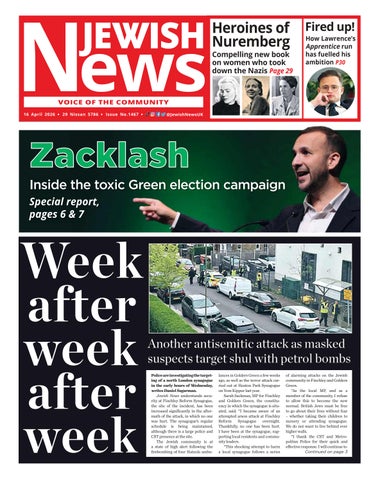
Week after week after week

Another antisemitic attack as masked suspects target shul with petrol bombs

Police are investigating the targeting of a north London synagogue in the early hours of Wednesday, writesDanielSugarman.

Jewish News understands security at Finchley Reform Synagogue, the site of the incident, has been increased significantly in the aftermath of the attack, in which no one was hurt. The synagogue’s regular schedule is being maintained, although there is a large police and CST presence at the site.

The Jewish community is at a state of high alert following the firebombing of four Hatzola ambu-

lances in Golders Green a few weeks ago, as well as the terror attack carried out at Heaton Park Synagogue on Yom Kippur last year.

Sarah Sackman, MP for Finchley and Golders Green, the constituency in which the synagogue is situated, said: “I became aware of an attempted arson attack at Finchley Reform Synagogue overnight. Thankfully, no one has been hurt. I have been at the synagogue, supporting local residents and community leaders.

“As the local MP, and as a member of the community, I refuse to allow this to become the new normal. British Jews must be free to go about their lives without fear – whether taking their children to nursery or attending synagogue. We do not want to live behind ever higher walls.

“I thank the CST and Metropolitan Police for their quick and e ective response. I will continue to Continued on page 3

“This shocking attempt to harm a local synagogue follows a series of alarming attacks on the Jewish community in Finchley and Golders Green.

Trump: War nearly over as Hezbollah steps up attacks

Donald Trump has suggested USIran ceasefire talks could restart in Pakistan within days, after he claimed the war with Tehran is “very close to over”, writes Lee Harpin.

Speaking on Wednesday, the US president claimed Tehran wants a deal badly and Iran’s new leadership was reasonable, even as the US maintains a naval blockade on Iranian ports in the Strait of Hormuz, halting their sea trade.

In response, Iran warned it would block trade on the Red Sea if the US naval blockade continued.

In Lebanon, Israel continued to strike Hezbollah in the south of the country, while the Iranian-backed group confirmed it targeted several areas in northern Israel including Metula, Kfar Giladi and Kiryat Shmona with rocket barrages.

lsrael issued a fresh evacuation order for residents of south Lebanon as the IDF pressed on with its offensive against Hezbollah.

An IDF spokesperson warned

“airstrikes are ongoing” and that the Israeli army “operates with significant force in the area”.

“Remaining south of the Zahrani River may endanger your lives and the lives of your families,” the spokesperson wrote on X.

Israeli strikes hit vehicles south of the capital, Beirut, and the IDF also launched several other strikes across southern Lebanon.

The fresh round of exchanges came just hours after Washington hosted the first direct talks between the Lebanese and Israeli ambassadors to the US.

US secretary of state Marco Rubio said the Israel-Lebanon talks – the first direct conversations in 30 years – were a “historic opportunity”.

“There is a mutual Israel and Lebanese interest to dismantle Hezbollah and forge a real peace between Lebanon and Israel,” the Israeli official told The Times of Israel

“That is what we will be concentrating on.”

After the meeting, ambassador to Washington Yechiel Leiter said the talks focused on crafting a “longterm vision where there will be a clearly delineated border between our countries, and where the only reason we’ll need to cross each oth-

er’s territory will be in business suits to conduct business or in bathing suits to go on vacation.”

Nineteen foreign ministers, including the UK’s, also issued a joint statement for Lebanon to be part of “regional de-escalation efforts”.

The ministers welcomed direct talks between Lebanon and Israel, and condemned “in the strongest terms” attacks by both Hezbollah and Israel.

“Direct negotiations can pave the way to bring lasting security for Lebanon and Israel as well as the region. We stand ready to support them.

“We therefore call upon all parties to urgently de-escalate and seize the opportunity offered by the ceasefire between the United States and Iran,” the statement said.

Lebanon’s president expressed hope that Tuesday’s direct talks in Washington with Israel would lead to an end to his country’s suffering.

“I hope that the meeting in Washington ... will mark the beginning of the end of the suffering of the Lebanese people in general, and those in the south in particular,” president Joseph Aoun said in a statement

But he added that “stability will not return to the south if Israel continues to occupy its lands”.

Double diplomatic hit

Israel suffered two diplomatic setbacks this week after Italy and Germany expressed concerns over policy.

First, Italian news agencies reported Italy’s prime minister Giorgia Meloni saying she would suspend the automatic renewal of a defence agreement with Israel, citing the ongoing conflicts in the Middle East.

The deal dates from a 2003 memorandum of understanding under Italian PM Silvio Berlusconi, and sets the stage for cooperation in defence and scientific research.

The MoU was ratified by Italy in 2005 and normally renewed every five years.

Elsewhere, German chancellor Friedrich Merz voiced “grave concern” over the situation in the Palestinian territories, saying a “de facto partial annexation of the West Bank” must be prevented.

Speaking by phone with Benjamin Netanyahu, the chancellor expressed his deep concern about the developments surrounding the latest skirmishes.

“There must be no de facto partial annexation of the West Bank,” government spokesman Stefan Kornelius said in a statement.

Netanyahu and Meloni
The bombed remains of a car targted outside Beirut

Cruelty for clicks

Police are investigating a series of online videos showing Jews being targeted in the street in Stamford Hill, as concerns grow over antisemitic prank content gaining traction online, writes Annabel Sinclair.

The sick videos have been linked online to content creator Harry Marsh, known as “Penofein”, whose clips have attracted millions of views across the YouTube, Instagram, and TikTok platforms.

The footage shows members of the strictlyOrthodox community being approached, filmed and subjected to behaviour critics say draws on longstanding antisemitic tropes.

In one clip, coins are thrown on to the pavement and described as a “Jew trap”, with passers-by filmed to see if they pick them up.

In another, a visibly Jewish man is approached and asked: “Excuse me sir, would you like a pound or should I double it and give it to the next person?” – before the filmer walks away muttering: “Well, well, well.”

Other videos include clips titled Rizzing up Jewish women, in which a woman is approached for her phone number and continues to be filmed after declining, as well as footage of individuals being followed, while the person filming calls out “Here boy” while holding money.

A spokesperson for the Met said: “We have launched an investigation after receiving reports of antisemitic social media videos filmed in Stamford Hill. Anyone with information is asked to contact police on 101, quoting reference 01/7425291/26. Hate crime of any kind has no place in our communities, and we take all reports incredibly seriously.”

The Campaign Against Antisemitism (CAA), which has reviewed the material, said the videos are part of a wider pattern of harassment designed to generate views.

A spokesperson said: “This user has built a

following by subjecting Jewish people to antisemitic pranks. To our knowledge, he doesn’t live locally, so he literally travels to Jewish areas in order to racially abuse them and excite his deranged followers.

“It says a lot about our youth that this sort of behaviour engages them. The police have prevented him from filming in commercial establishments, but they have brushed off complaints about his racist harassment of Jews.

“Even he has mocked the authorities by pointing out that street antics – aimed at Jews –is his main focus now anyway. Why is YouTube, Instagram and TikTok continuing to host him, and why have Sussex Police done nothing to address his conduct toward Jewish people?”

The CAA noted TikTok had removed the offending account after being told, adding: “We are grateful for such swift action.”

However, similar content remains available elsewhere online, prompting renewed calls for

FAILED BID TO FIREBOMB

Continued from page 1 raise the issues of antisemitism and security at the highest levels in Government to protect our community.”

A police spokesperson said: “Two suspects, who were wearing dark clothing and balaclavas, approached the synagogue in Fallow Court Avenue, Finchley shortly after midnight on Wednesday, 15 April and threw two bottles, suspected to contain petrol, and a brick at the building. Neither bottle ignited and no damage was reported. There were no injuries.”

Cantor Zöe Jacobs, on behalf of the senior clergy of Finchley Reform Synagogue, said: “This is clearly an attempt to intimidate the British Jewish community, but we will not be deterred by these cowardly acts. Instead, we will continue to prioritise

SHUL

building bridges across the wider Barnet community.

“At this time, and as always, our community is being incredibly well supported by the police, the government, CST and all key partners.”

Rabbi Charley Baginsky and Rabbi Josh Levy, co-leads of The Movement for Progressive Judaism, of which FRS is a member, added: “This incident is part of a wider rise in antisemitism affecting Jewish communities across the country. We will continue to work with police and CST to prioritise the safety of our communities.”

A CST spokesperson said: “We are aware of an incident overnight ... [and] We are supporting the affected location and are working closely with the police as they investigate and seek to identify those responsible.”

platforms to act.

In another example of social media influencers filming content featuring antisemitic stereotypes and insults towards Jewish people, a content creator due known as “Dan and Ish” began releasing videos last week of Jews being accosted in Golders Green.

In some of the videos, Jews are approached and told they have dropped some money on the ground. If they accept the money, the video is captioned “well well well”. One of the Jewish people targeted in this fashion was an individual with Downs Syndrome.

In other videos, Jews are approached and asked if they have seen the questioner’s “blind date”, with the names given for said “date” including “Gas boy 221” and “Stingy Jew”.

The videos garnered tens of thousands of likes across different social media platforms. Most if not all of the videos have been filmed via Ray-Ban Meta glasses – spectacles with a

Beware Hezbollah, Cooper is warned

Communal leaders have urged Foreign Secretary Yvette Cooper not to lose sight of the threat posed by the terror group Hezbollah to families of British Jews who live in Israel.

Meeting with the Board of Deputies and Jewish Leadership Council, Cooper outlined the UK’s position on the conflict in Lebanon, including for Hezbollah to disarm and for air strikes on Lebanon to end.

encouragement to the US-led Israel and Lebanon talks.”

The JLC and Board said: “[We] called on the foreign secretary to engage constructively on the conflict in Lebanon and not lose sight of the considerable threat Hezbollah continues to pose to our friends and family in Israel.

“We were pleased the foreign secretary has been giving

The meeting, attended by Board president Phil Rosenberg and JLC chief executive Keith Black, among others, also saw discussion of the recent decision to alter the UK’s position on the controversial Item 7 at the UN.

The meeting also saw continued calls for the government to proscribe the IRGCorps followed by discussion on the UK’s recognition of a Palestinian state.

built-in camera – meaning those filmed were very likely unaware their reactions were being caught on camera.

Finchley and Golders Green MP Sarah Sackman said: “The videos of antisemitic abuse on Golders Green High Street sicken me, and the perpetrators must be held accountable. It is beyond belief that these individuals could not only carry out this abuse, but proudly post about it online. I will be writing to Meta and YouTube to demand that the videos are removed.

“British Jews must be able to go about their daily lives without fear of harassment and racism. I have been in touch with the Police and CST to support their investigation.”

The videos from the “Dan & Ish” channel, run by Daniel Javanmard and Ismael Puga, have since been removed from both Instagram and YouTube. TikTok closed the pair’s account, but they have since set up another one, along with the message: “Go follow the new TikTok. Old one has been banned. I wonder why”, accompanied with an eyes-sideways emoji.

The pair, who also act as fitness ‘influencers’, had a paid partnership with workout clothes manufacturer Gymshark. However, the company confirmed it had ended the deal, saying: “We do not condone racism, discrimination or antisemitism in any form.”

A CAA spokesperson said: “This disturbing viral trend of targeting Jews is not ‘content’. It is Jew-baiting and intimidation. Harassing Jewish people for online clicks is pathetic regardless of when it is being done, but when looked at against the backdrop of multiple recent deadly antisemitic terror attacks and sky-high levels of Jew-hatred, it becomes all the more sickening.”

A spokesperson for the CST said: “These videos are promoting actual incidents of antiJewish hate and harassment as if it is funny. It is a disgrace.”

Police are investigating content posted by Dan and Ish, left, and Harry Marsh

£5m more to combat hate crime after latest attacks

lee@jewishnews.co.uk

Police in London and Manchester are to be given an extra £5m to pay for more patrols around synagogues and other places of worship, the Home Office has said.

It follows an arson attack in Golders Green, where four Jewish community ambulances were set alight last month, and a terror attack on the Heaton Park synagogue in Manchester last October.

Security minister Dan Jarvis said the money would help “keep people safe in the places where they live, work and worship”.

As part of its effort to crack down on antisemitism after the Golders Green blaze, the Met is also meeting community leaders to share intelligence and act on their concerns.

The new funding will go towards Project Servator deployments, involving specialist officers trained to spot suspects who might be preparing to commit serious crimes.

More than 20 people have already

School

been arrested on suspicion of antisemitic activity as part of a separate effort to combat hate crimes after the incident in Golders Green.

Jarvis said: “At a time of heightened concern for some communities, it is vital we step up our support.

“Project Servator has a proven track record of stopping criminals and terrorists through highly visible, unpredictable deployments that

trust dismisses staffer over 7 Oct posts

A school trust that previously postponed a visit by a Jewish MP has dismissed a senior diversity staff member after she described Hamas as “heroes” in social media posts following the 7 October attacks.

Cabot Learning Federation, which oversees Bristol Brunel Academy, confirmed it had taken action after an investigation into comments made by its inclusion and diversity co-ordinator, Saima Akhtar.

The dismissal follows scrutiny first reported by The Times, which highlighted a series of posts written by Akhtar in the immediate aftermath of Hamas’s massacre in Israel.

One such post read: “This is an oppressed people standing up and fighting back… Heroes fighting for justice and their right to exist. Palestinians are no different. #FreePalestine.”

The controversy has renewed attention on the trust after Damien Egan MP had a planned visit to the academy postponed last year. The decision followed threats of protest from pro-Palestinian activists and union members, who cited “safeguarding concerns” and pointed to

his role as vice-chair of Labour Friends of Israel.

The issue came to light when Steve Reed, Secretary of State for Communities and Local Government, told an audience at the Jewish Labour Movement’s conference that “I have a colleague who is Jewish, who has been ...refused permission to visit a school in his own constituency”

Akhtar, who also sat on the school’s academy council, had publicly described her professional approach as “intersectional” and “traumainformed”, emphasising inclusion across race, faith, gender identity and background.

In a statement, Cabot Learning Federation said it would not comment on individual cases but stressed that staff are expected to uphold its values at all times. “The promotion of inclusion and rejection of discrimination are enshrined in the CLF’s core values,” a spokesperson said. “All of our staff are expected to embody these values in their behaviour – both inside and outside of school.”

The case comes amid wider concern within the Jewish community about the impact of online rhetoric by individuals in educational roles

vary in time and location, deterring those planning harm and reassuring the public.

“This new funding will back the police with the resources they need to step up patrols, protect communities, and keep people safe.”

The Home Office says previous Project Servator deployments have involved both visible uniformed and plain-clothes officers.

They have led to arrests, drug seizures and weapons seizures while the new effort, which builds on £73.4m already committed for protective security at Jewish, Muslim and other faith sites for 2026-27, will focus initially on policing in communities, particularly faith communities, across London and Manchester.

Greater Manchester Police inspector Chris Hadfield said: “This

additional funding strengthens our commitment to Project Servator and will allow us the opportunity to expand the work we do in disrupting criminal activity.

“Our specially trained officers spot the tell-tale signs that someone is planning to commit an act of crime, while maintaining a strong and reassuring presence within the local communities.”

STARMER: ISRAEL WRONG ON LEBANON

Keir Starmer has insisted Israel is “wrong” to continue attacking Lebanon, and it is his “strong view” the military onslaught should stop.

The PM told Robert Peston on ITV’s Talking Politics podcast he would argue that Lebanon “should be included in the ceasefire” and IDF air strikes on Beirut “should not be happening”.

The PM was also asked about remarks by Donald Trump on Iran, including the threat that an entire

civilisation would die if Iran did not capitulate.

He replied: “Let me be really clear about this – they are not words I would ever use, because I come at this with our British values and principles. We will be guided by them in everything that we do.

“That’s why …. I’ve been saying we are not going to be dragged into this war because there must be a lawful basis ... if you’re going to commit our service personnel to risk their lives.”

Palestine activists face civil hearing

German insurance giant Allianz has launched a landmark civil case against six activists accused of targeting its UK offices over links to Israel’s defence sector.

The firm is seeking nearly £300,000 in damages following two protests claimed by the Palestine Action group. It is thought to be the first time alleged participants in the

group’s direct action tactics have faced civil proceedings of this kind.

The demonstrations, which took place in October 2024 and March 2025, focused on Allianz’s reported provision of insurance services to the UK arm of Elbit Systems, Israel’s largest private arms manufacturer.

During the protests, red paint was sprayed across Allianz sites in Guild-

ford and London. Allianz later confirmed it ended its relationship with Elbit Systems UK last year.

All six defendants are already facing criminal charges and have entered not guilty pleas. They are now asking the civil court to pause Allianz’s claim until after the criminal trials conclude – a request they say the company has rejected.

LEWIS PRAISES BOARD MODERNISATION

Board of Deputies veteran Jerry Lewis praised colleagues after he said he “singlehandedly dragged the Board from the 1900s into the 2000 era” during his time as senior vice-president.

Lewis was given the opportunity to deliver a 10-minute address at the Board’s latest plenary meeting in honour of his 50 years of membership of the communal organisation.

The Hampstead Synagogue Deputy recalled the modernisation as one of the highlights from his five decades of loyal service, for which he has now has been afforded the title “Father of the Board” in recognition. He said: “I’m proud of my time at the Board, but it is akin to being married. Years of strife, arguments, happy times ... and building some very deep, long-lasting friendships.”

Starmer in the Middle East
Jerry Lewis
Scenes of terror: Left, arson attack on Jewish ambulances in Golders Green; right, after the Heaton Park synagogue attack in Manchester
Saima Akhta

Call for DJ to be banned from UK after Australia hate speech

A senior Tory MP has called for an American DJ at the centre of an antisemitism row in Australia to be barred from entering the UK, as pressure mounts ahead of her scheduled performances, writes Annabel Sinclair.

Shadow home secretary Chris Philp said the government should stop Zubeyda Muzeyyen – who performs as DJ Haram – appearing at venues in London and Birmingham.

Muzeyyen is due to play at Phonox in London and the Supersonic Festival in Birmingham, weeks after a speech at the Sydney Biennale prompted a police investigation in Australia.

Philp told Jewish News: “The last thing this country needs is a visit from yet another international musician embroiled in allegations of

antisemitism and promoting terrorism. As the government continues to struggle to get a grip on the relentless wave of anti-Jewish racism and Islamist extremism in the UK, it is patently not conducive to the public good for Zubeyda Muzeyyen (DJ Haram) to perform here.

“The home secretary needs to ban her.”

His intervention follows the government’s refusing entry to Kanye West, citing the same “not conducive to the public good” threshold –a comparison now likely to intensify scrutiny of Muzeyyen’s planned visit.

The artist is under investigation by New South Wales police over a speech at the opening of the Sydney Biennale on 13 March, in which she referenced “resistance” and “martyrs” and

criticised what she described as “art washing the genocide”. The comments prompted a complaint from the New South Wales Jewish Board of Deputies, which warned such language can echo narratives linked to proscribed terrorist organisations and risk fuelling hostility towards Jewish communities.

The Jewish Leadership Council said: “Zubeyda Muzeyyen has repeatedly engaged in rhetoric that appears to support acts of terror carried out against Israelis, alongside the repetition of some of the oldest and most dangerous antisemitic tropes and conspiracy theories. This goes far beyond legitimate political criticism.

“The Jewish community in Britain knows all too well where such language can lead. There

are serious questions for the venues hosting her. It is also open to the home secretary to consider whether her entry into the UK would be conducive to the public good.”

500 ARRESTS AT PALESTINE ACTION DEMO

Police arrested more than 500 people at a mass protest in London against the ban on Palestine Action.

The Met confirmed all the arrests during the Trafalgar Square demo were for showing support for a proscribed organisation.

Among those arrested was Massive Attack musician

Robert Del Naja, who sat with an I Support Palestine Action sign. Many of the mostly elderly demonstrators sat on camping chairs and on the ground with their placards.

Other banners read Jurors

deserve to hear the whole truth and Israel starves kids.

Del Naja told the Press Association he wanted to attend the protest despite the consequences a potential arrest could have on his music career.

He added: “Being a musi-

cian, obviously, there was a lot of trepidation around how we might not be able to travel and get visas.

“But I thought ‘this is ridiculous’ and then the police making that U-turn to arrest people again, I thought that is even more ridiculous.

“So I’m going to hold a sign today.”

Police paused the arrest of demonstrators in February after the High Court ruled the government’s ban unlawful, but then decided to resume as an appeal against the ruling is likely to take several months.

For over 120 years JNF UK has worked tirelessly to develop the Land of Israel.

Much of our work has only been possible thanks to the generosity of our legacy donors like Sheila and John, who had a deep commitment to how the country had shaped their lives.

Leaving a gift in your Will, no matter how small or large, is one of the most valuable ways you can forge an everlasting bond with Israel.

Our expert and caring Legacy Team offer a range of professional services and first-rate pastoral care.

To find out more, please visit

Zubeyda Muzeyyen
Robert Del Naja at the protest

Green shoots of hate

A pattern of antisemitism among party candidates exposes failures in vetting ahead of local elections, writes Lee Harpin

There is growing evidence that open Jew-hatred among Green Party candidates has been grossly underestimated amid a failure by the party to conduct proper due diligence ahead of next month’s local elections.

A Jewish News investigation has discovered multiple examples of Green candidates sharing conspiracy theories about Jews, including some originating on far-right neoNazi websites, along with clear evidence of Holocaust distortion.

Some observers now even fear the antisemitism crisis within Zack Polanski’s party, which is fielding thousands of candidates at the local elections on 7 May, is comparable to, or even worse than, the problem that caused havoc to Labour under Jeremy Corbyn’s leadership.

Challenged at the launch of the Greens’ election campaign over fears of an inadequate vetting process by party chiefs ahead of next month’s poll, Polanski himself admitted: “I recognise we’re dealing with an immense amount of people very quickly, and so I won’t be surprised if we have the odd candidate where we have to distance from them.”

He claimed: “We’re doing everything we can to make sure we’re doing due diligence … We’re not being complacent about it for a second and recognise the scale of the task that’s in front of us.”

The widely-predicted Green success in the local elections could impact significantly on Jewish voters, especially within certain areas of London.

While Polanski’s party is unlikely to make dramatic inroads in Barnet, home to the largest Jewish electorate in the capital, the predicted Green surge in boroughs like Camden, Brent, Hackney, Haringey, Lewisham and Islington is now a major concern for communal leaders.

New evidence unearthed by Jewish News includes a Green Party candidate standing for election in Camden, north London, who

shared antisemitic claims that the Old Testament commands Jews to kill children, that Zionists carried out the 9/11 terror attacks and “false flag” lies about the Golders Green Hatzola arson attack.

Jewish News has approached the Green Party for comment after being shown a series of deeply troubling social media posts shared or written by Aziz Hakimi, who is standing in Camden’s Haverstock ward.

One post shared by Hakimi in August 2025 shows him sharing a graphic of the twin towers after the 9/11 terror attack, blaming it on “Zionists”. Another shared last month appears to be a far-right-originating video sharing antisemitic claims that Jews are commanded by the Old Testament to kill children.

Hakimi also shared an article widely circulated after last month’s Golders Green arson attack that stated: “The London Ambulance Attack – Of Course It Was A False Flag.”

Another post shared by Hakimi appeared originally on the Islamist 5 Pillars website and shows footage of Charedi Jews being abused and told to “go back home” after arriving at Krakow airport in Poland on a flight from Israel.

Jewish News has also been sent evidence showing how the Green Party has willingly accepted candidates who faced antisemitism allegations in the Labour Party. Karen Sudan, now standing for the Greens in West Sussex, resigned from Labour amid such claims.

In August 2018, she accused the media of being “too busy making up and/or exaggerating stories about antisemitism in the

Labour Party to raise an outcry over other forms of racism.”

Support for, or justification of, the 7 October Hamas attacks is also not hard to find among Green candidates.

Another Green candidate, Mark Adderley, standing for Croydon Council, has been found to have shared conspiratorial claims that “Benjamin Netanyahu is doing Jeffrey Epstein’s work as we speak”, adding that the dead paedophile’s “blackmail, honey trap operation is being run right now” by the Israeli prime minister.

Adderley, husband of TV presenter Nadia Sawalha, was also videoed discussing the Golders Green arson attack, saying: “Benjamin Netanyahu is single-handedly responsible for endangering the lives of Jewish people throughout the world … and just for the record … if a Muslim community had their own ambulance service we would have never heard the end of it.”

Jewish News has also been shown posts made by sitting Green councillor Alexi Dimond on Sheffield City Council, who in a social media post openly compared Gaza to the Nazi Holocaust and claimed: “Genocide has long been the colonialist policy of the West’s political and economic elites.”

Councillor Dimond’s “Nazis were never the exception” post also received the approval of Green deputy leader Mothin Ali, who is shown to have “liked” it on social media.

Only last week, the Greens announced they had dropped Bernard Mani, their choice as a candidate in Forest Hill, Lewisham, after it

emerged he had pulled down hostage balloons at a November 2023 show of solidarity by the Jewish community in Hove, Sussex. Mani also backed lies that Israel was actually responsible for the 7 October Hamas atrocity.

This came days after another Green candidate was forced to step down after sharing a conspiracy theory about the Golders Green ambulance attack. Tope Olawoyin, previously photographed alongside Polanski at a party event, wrote: “I can say with almost absolute certainty that the men arrested are white, probably even Jewish, because we all know for a fact that if they weren’t their names and pictures would be everywhere.”

A Green candidate in Thurrock, Alfie Jay Rees, who is standing in Tilbury St Chad’s ward, was shown to have posted a message in an online chat calling for “Death to Israel”, “Death to America”, and “Death to England”.

It is understood party chiefs decided not to take action, deeming the post to have been of a satirical nature and taken out of context by those who called for him to be deselected.

A report published by The Independent showed Chandni Chopra, a Green candidate in Newcastle, had argued the Hamas massacre – which saw at least 828 civilians, including 36 children, murdered – was justified.

Chopra posted on Instagram shortly after the 2023 attacks: “In the face of the biased mainstream media, it is apparent that the Palestinians’ legal right to resist is being portrayed as barbarism and unwarranted.”

Asked about allegations around candidate antisemitism, a Greens spokesperson said:

Zack Polanski, centre, at the launch of his local election campaign. The party has put the Palestinian cause at the heart of its identity
Dropped: Bernard Mani

“The deadline for candidate nominations has just closed and we will be investigating anything brought to our attention that doesn’t fit with Green Party values and views.”

The Green Party’s antisemitism problem has been building for years, but has intensified sharply as the party has grown in electoral significance under Polanski’s leadership.

Another recent episode involved leaked WhatsApp messages from Greens for Palestine, a grassroots faction within the party. The messages, first reported by The Telegraph, showed activists describing Jewish people as “an abomination to this planet” and claiming Jews “murder, bomb and starve” children.

At the party’s 2026 spring conference, Motion A105 aimed to define Zionism formally as racism, position the Green Party as explicitly anti-Zionist and call for a single Palestinian state replacing Israel.

In the end, efforts by hardline pro-Palestine activists in the party to force a vote on the motion were halted, due mainly to technical issues with online voting – though the motion may yet return at a future conference.

The Jewish Greens group had warned the motion would “uniquely expose” Jewish members to accusations and would “send a message to Jewish members that they need to choose between their party membership and being a member of their Jewish community”.

It also recently emerged Tony Greenstein, long associated with claims around antisemitism before he left the Labour Party, had been allowed to join the Greens.

To understand why the antisemitism problem has been allowed to fester, it is neces-

sary to understand the Green Party’s remarkable electoral rise – and the role the war in Gaza has played in it.

Having won four seats at the 2024 general election – its best result to date – the party has surged further in the polls since Polanski took over as leader last September. Under his “eco-populist” leadership, the Greens have expanded beyond environmental concerns to make opposition to Israel a defining issue, a strategy paying dramatic electoral dividends.

At last week’s campaign launch, Polanski began his speech not by focusing on local issues but with further condemnation of

Israel over attacks in Lebanon and the nowfamiliar claim the government is “complicit in genocide” in Gaza.

Gaza has placed Labour in an often impossible position, bleeding votes in both directions. Starmer has lost far more votes to those who regard him as too soft on Israel. Polanski has gone as far as to accuse him of being “complicit in genocide” in Gaza – a charge that has resonated with many on the left.

But many British Jews felt let down when the government unilaterally recognised a Palestinian state last year. For Jewish voters who had returned to Labour after the Corbyn

era, the move felt like a betrayal. The political consequences are likely to be felt in areas with large Jewish populations.

Barnet, however, could buck the wider London trend.

The borough looks far less fertile territory for the Greens, with both the Conservatives and an increasingly vocal Reform UK seeking to gain control of a council that turned Labour only in 2022. Unlike the rest of the capital, the Greens look set to place fourth – at best.

While there were accusations in the wake of the Green Party’s by-election victory in Gorton and Denton it had gained from “sectarian” voting, the truth is the party has also built substantial support among white, middle-class liberal voters – the kind who might once have backed the Liberal Democrats or Labour – for whom Gaza is one concern among many, alongside climate change, housing and public services.

Polanski’s “eco-populist” pitch, delivered with considerable skill on social media, has tapped into a broad sense of disillusionment with mainstream politics that extends well beyond the question of Israel.

To a lesser extent, there are also signs of Green support growing among working-class voters who are fed up with both major parties but unwilling to follow others in blaming the country’s problems on immigration.

For this group, the Greens offer an outlet for anti-establishment anger that doesn’t come with the nativist baggage of Reform UK.

The fact it increasingly appears to come with other baggage – blaming “Zionists” –appears to worry them far less.

Zack Polanski, right, with Green deputy leaders Mothin Ali and Rachel Millward

Top Dublin venue cancels Magen David Adom event

A row has erupted in Ireland after Dublin’s National Concert Hall cancelled a fundraising event for the Israeli emergency medical charity Magen David Adom (MDA) Ireland.

The 11 May event had initially been accepted, then revoked, reinstated and ultimately cancelled, according to organiser and former Irish justice minister Alan Shatter.

The venue, known as “the home of music in Ireland”, is publicly funded under Ireland’s Department of Culture. It said the decision was based on maintaining “political neutrality”.

Shatter said the cancellation “can be properly described as an act of antisemitic censorship”.

“The National Concert Hall disgracefully and indefensibly cancelling a Magen David Adom Ireland private fund-raising event … is truly disgraceful and shocking,” he added.

The fundraiser was due to include a staged account by survivors of the 7 October attacks and emergency responders “in their own words”.

Shatter said he met representatives from the venue with discussions focusing heavily on security concerns but the

final decision referenced “new circumstances”, including local media coverage days earlier.

The event centred on a theatrical production based on interviews conducted in Israel by Irish filmmakers Ann McElhinney and Phelim McAleer, which has previously drawn protests during performances in the United States.

MDA global president and former Israeli ambassador to the UN Gilad Erdan described the venue’s decision as showing “its integrity and morality are compromised at best, and perhaps abandoned entirely”.

BBC UNDER FIRE OVER CARLSON

The BBC is facing growing criticism from Jewish communal figures after American commentator Tucker Carlson used an interview on the Victoria Derbyshire politics programme to make controversial claims about Israel and political influence.

Antisemitic incidents in the UK rose again in 2025, as a major international study revealed more Jews were killed in attacks worldwide than in any year for more than three decades.

The report by Tel Aviv University says 20 people were murdered in four antisemitic attacks across three continents, with researchers saying the figures reflect a wider shift, warning antisemitism has become a “normalised reality” in many societies.

In the UK, 3,700 antisemitic incidents were recorded in 2025, up from 3,556 the previous year and still far above pre-7 October levels.

Of the most serious cases, four incidents of extreme violence were recorded in Britain, including a terror attack on a Manchester synagogue on Yom Kippur that killed two people.

While the report notes overall totals in some countries have stabilised or dipped slightly compared to 2024, figures show physical assaults and high-impact attacks are increasing, pointing to a more dangerous environment for Jewish communities.

He alleged Israel exerts significant control over Western governments and was responsible for the UK’s decision to proscribe activist group Palestine Action while suggesting there was a hidden “mechanism of control” allowing Israel to shape US policy.

The Board of Deputies

Aliyah: building dreams and

saving tax

• Tax-efficient investing before and after Aliyah

• Tax-efficient income after 10-year tax-free period

• Receive your entire pension pot tax-free

• Specialist portfolio management for Olim

• No Inheritance Tax (for non-UK-situated assets)

We are seasoned experts in providing long-term financial planning advice for those making Aliyah. Scan the QR code to read more

With investing, your capital is at risk. Tax treatments are subject to individual circumstances and are subject to change.

said: “We are very concerned the BBC chose to give a platform to Tucker Carlson, who routinely repeats antisemitic tropes, including of excessive political power or control.”

Heaton Synagogue attack aftermath
Dublin’s National Concert Hall
Tucker Carlson

‘Nazism does not pay’ warning at UK YomHaShoah ceremony

Speakers at the UK’s national Yom HaShoah commemoration have warned antisemitism must be confronted in the present after recent attacks and growing hostility towards Jews , writes Annabel Sinclair

Thousands gathered in Victoria Tower Gardens for the annual ceremony, attended by Holocaust survivors, politicians, communal leaders and more than 100 Jewish schoolchildren, with a strong focus on passing memory to the next generation.

Board of Deputies president Phil Rosenberg used his address to connect Holocaust remembrance directly to current events.

“Remembering the Shoah is not passive. It is a call to vigilance, moral clarity and action,” he said.

Recent incidents in Britain, including

the deadly attack on a synagogue in Manchester last year and the arson attack on Hatzola ambulances in London showed antisemitism is not confined to history.

He added: “There are those in our own time, well-known figures including Kanye West, who openly describe themselves as Nazis and seek to glorify Nazi ideology –not only offensive [but] a direct affront to the memory of the millions who perished. Nazism does not pay. It will not pay, and it will never be allowed to pay.”

Communities secretary Steve Reed told the crowd safeguarding Holocaust memory requires ongoing commitment.

“Memory doesn’t survive by accident,” he said. “It needs people who are willing to hold it, to share it and to safeguard it,

and that responsibility belongs to all of us. Your safety, your security and your freedom to live openly and freely as Jews in the UK matter and we are committed to stamping out antisemitism wherever it manifests.”

Reed also reaffirmed support for the planned Holocaust memorial and learning centre next to Parliament.

Among those lighting candles were survivors who had endured ghettos, camps and hiding during the war, joined by family members and community representatives, underlining the role of second and third generations in continuing remembrance

Yom HaShoah UK chair Neil Martin said the evening highlighted the role of younger generations in carrying forward the memory of the Holocaust.

‘DESTROY ISRAEL’ NHS CONSULTANT SUSPENDED

An NHS consultant filmed calling for Israel to be “wiped off the face of the map” has reportedly been suspended and is under investigation following a speech at a London protest.

King’s College Hospital NHS Foundation Trust confirmed it is reviewing concerns about vascular surgeon Ranjeet Brar after footage

emerged of remarks he made outside the US Embassy on 4 April.

UK Lawyers for Israel (UKLFI) said Brar has been suspended for at least two weeks. The trust has not publicly confirmed the suspension but said it is taking the matter seriously.

Chief executive Prof Clive Kay said the trust

Residential care vacancies available now

For adults with learning disabilities in your community

We offer five residential and nine supported living homes across Borehamwood, Edgware, Hendon, Kenton, Redbridge and Barnet.

Our homes support autistic adults and those with learning disabilities at the heart of their communities. By embedding Jewish values, we offer opportunities for adults to live independently, feeling connected and valued.

knew of the footage in question, and “we are reviewing the concerns raised … for reasons of confidentiality, fairness and due process, it would not be appropriate for us to comment on individual cases or any potential actions.”

He added any issues meeting the required threshold would be addressed through formal

procedures, stressing the trust’s duty to challenge “discrimination in all its forms” and ensure hospitals remain “welcoming and safe places for everyone”.

The UKLFI statement Israel said: “We welcome the trust’s investigation and urge that appropriate action is taken.”

Looking for personalised care in a warm home environment for your loved one with learning disabilities? Get in touch.

W: norwood.org.uk/adultservices

E: referrals@norwood.org.uk

T: 020 8809 8809

Crowds gather at Victoria Tower Gardens for the Yom HaShoah commemoration ceremony

Immanuel College to close this summer after 35 years

Immanuel College is set to shut its doors permanently this summer after sustained financial challenges forced what the school described as an “incredibly painful” moment, writes Michelle Rosenberg.

The decision, after 35 years as the community’s only private secondary, follows the combined impact of rising costs, the government’s introduction of VAT on independent school fees, and increased National Insurance.

“Changing dynamics within the Jewish education landscape, including the increased popularity of state schools, have contributed to reduced enrolment,” the said school said in a statement.

Chair of governors Daniel Levy said: “This is an incredibly difficult and painful moment.

“Immanuel College has been a cornerstone of education and community life for 35 years, and we know how deeply this news will be felt by all those connected to it.

“The focus now is on supporting our pupils, families and staff through this transition with compassion, clarity and integrity.

“We are committed to ensuring that every

pupil is guided to the right next step.”

The Bushey-based school’s “proposed closure” comes after governors had “rigorously explored all available options”, the statement said, including implementing cost savings and closing the preparatory school last year.

“Despite these efforts, it has become clear that the level of funding required to ensure the College’s future is unattainable. The most recent viability study indicated that a minimum of 50 full fee-paying students would need to enrol each year for the school to break even.

“The current year 7 cohort has 35 students, but with fee remissions only generating the revenue of 18 full fee-paying places. We only have 12 full fee paying places for September. The board of governors has therefore concluded, with regret, that there is likely to be no viable alternative but to consider closure.”

With the announcement coming ahead of crucial exams for students currently in Years 10 and 12, Immanuel intends to remain open for an additional academic year for these specific cohorts, “subject to sufficient demand”.

Leaders have also begun conversations

with other Jewish schools and local private schools “to help identify appropriate onward placements for every pupil”.

“In addition, enhanced pastoral and wellbeing support, including access to counselling services, will be made available to all pupils. Support will also be provided to staff through a formal consultation process, alongside assistance with future employment opportunities.”

Additional pastoral, emotional and wellbeing support, including counselling services, will be available to all pupils with online meetings (14th and 15th April before in person a week later) for parents. Immanuel plans to launch an online portal with up-to-date information, key contacts and answers to frequently asked questions.

Founded by Lord Immanuel Jakobovitz in 1990, supported by the Kalms and Ronson families, Immanuel College marked its 35th anniversary in September 2025. It was ranked as the country’s best-performing Jewish school by The Sunday Times Parent Power Guide in 2025 and 116th nationally.

Levy said: “We are immensely proud of what the College has achieved, of the generations of students who have thrived here, and of the dedicated staff who have shaped their lives with such care and professionalism.”

The governors expressed their “profound gratitude to staff, past and present, whose dedication has underpinned the College’s success, and to the wider community for its longstanding support”.

BBC doc shows praise for 7/10 on campuses

A BBC documentary has captured student activists on US campuses praising the 7 October Hamas attacks, chanting support for “resistance”, and repeatedly comparing Zionists to Nazis, amid escalating tensions over free speech and the IsraelGaza war.

The second episode of Speechless, broadcast as part of BBC Storyville, examines how the conflict reverberated across American universities, focusing on protests, encampments and clashes between pro-Israel and proPalestinian students.

The film shows that within a day of the 7 October

attacks, a joint statement by Harvard student groups said:

“We… hold the Israeli regime entirely responsible for all unfolding violence”, adding: “The apartheid regime is the only one to blame.”

In footage from campus demonstrations that followed, activists are heard chanting: “Glory to the martyrs. Glory to the resistance. We will liberate the land. By any means necessary.”

One protester referenced Hamas’ breach of the Gaza border fence using Nazi imagery, asking: “Do you guys remember the photos of the bulldozer breaking through the Nazi border?” before

describing 7 October as producing “joyful and powerful images”.

The film argues that while antisemitism on campus is a genuine concern, it has become intertwined with wider ideological and political battles over free speech, protest and academic freedom.

It also suggests that universities’ responses to controversial speech – including testimony before US Congress in which leaders said calls for genocide could depend on “context” –have fuelled accusations of double standards.

u Speechless: Part 2 is available on BBC iPlayer

The school has been part of the community for 35 years but has seen falling enrolment

JOIN TECHNION UK FOR A GALA SHOW TO CELEBRATE ISRAEL’S 78TH ANNIVERSARY

ISRAEL’S 78TH ANNIVERSARY

WEDNESDAY 22ND APRIL, 7.30PM LOCATION EUSTON O

With

and

since

Restoring my family’s erased

As I walked out of Auschwitz-Birkenau, the only sounds were the wind through the trees, my footsteps crunching on the gravel, the eerie creak of abandoned barrack doors, and the occasional sweet bird song – the latter jarringly out of place.

Three hours earlier, I had stood at the entrance to the notorious Nazi German concentration camp in Oświęcim, Poland, staring up at the gatehouse guard towers that have become a hideously iconic symbol of the human factory that murdered 1.1 million Jews from across Europe, delivered for death via freight trains.

My 17-year-old nephew had visited earlier in the year with school; he’d messaged me that morning, our normal sarcastic banter replaced with: “Hey. Just wanted to say that what ur gonna see is di cult, so if u want to call me about it I’m here.”

Standing outside, overwhelmed, I called my brother, the only person I would have wanted by my side: “I don’t think I can go in.”

“You have to,” he replied. “You have to bear witness.”

At the invitation of March of the Living UK, I was here as part of a 200-strong delegation to do just that, to mark its 38th year with a five-day educational journey and to march from Aus-

chwitz to Birkenau, the largest WWII concentration camp complex, as part of a global group of 7,000, including 40 survivors.

Since its inception in 1998, March of the Living International has become the largest global Shoah remembrance event held on Holocaust Remembrance Day (Yom HaShoah).

Seeing it – directly in my line of sight rather than an image in a book, or social media post –the enormity of the camp, the size, the scale, the mechanics were all unfathomable.

Mass murder, pure evil and the attempted obliteration of an entire people on an industrial scale, the mind, certainly mine, could not process any of it; the rail tracks, the barracks, the ruins of a crematorium, the lone cattle car symbolising the thousands that transported more than 1.3 million people to Auschwitz-Birkenau.

The question our group later grappled with: what of the train drivers who delivered them to their deaths? How could they?

Beside those train tracks, Holocaust survivor Jacques Weisser, sitting in his wheelchair, alongside fellow survivor Milly Horowitz, recited Kaddish, breaking down in tears. Both lost a parent at Auschwitz.

That final walk towards the exit gates seemed interminable, the exhale of breath as I left one of relief, the last step representing the transition from black and white into colour.

A short drive to the Auschwitz Museum, a

Wiener library gets renovation go-ahead

The Wiener Holocaust Library has received planning permission for a building extension from Camden Council.

The project to expand the library’s Russell Square home will create spaces for exhibitions, while revitalising the Grade II listed Georgian building that has been its base since 2011.

The building will feature a learning area and a first-floor gallery looking out roof garden, creating a permanent space for an exhibitions.

The work will be undertaken by architects and exhibition designers Nissen Richards Studio.

Library co-director Dr Barbara Warnock said: “This project will be transformational for the library, enabling us to significantly expand our o ering to visitors. The beautiful new building will provide us with new opportunities to share our history and our extraor-

dinary collections in the new exhibition space and learning space. It will strengthen our ability to bring the evidence of Nazi crimes, collected by our predecessors from the time of the Nazi rise to power, to the audiences of the future.”

FORMER MAYOR QUITS UNI

The former mayor of Bath, Dr Bharat Pankhania, has left the University of Exeter following controversy over social media posts claiming a Jewish ambulance arson attack was an “Israeli false flag”.

In a statement to Jewish News, a university spokesperson confirmed: “Dr Pankhania has left the university.” The spokesperson added: “Any communication of the nature retweeted by Dr Pankhania is not aligned with our values, and matters of this nature are taken extremely seriously.”

Pankhania, who joined Exeter Medical School in 2017, was a senior clinical lecturer and course lead in health protection and had been widely involved in public health teaching and infectious disease control, with a career spanning pandemic planning, outbreak response and medical education.

His departure follows mounting backlash after he shared posts on X alleging that the torching of four ambulances belonging to Jewish emergency service Hatzola in north London was staged.

Camden Council approved the plans

Main: Michelle attended the March of the Living UK marked its 38th year with a fiveday educational journey, marching from Auschwitz to Birkenau, with a global group of 7,000, including 40 survivors; above: the Book of Names

erased past at Auschwitz FINKELSTEINS SHARE HOLOCAUST LEGACY

packed car park, an ATM cash machine and tourist shop, both utterly incongruous but highlighting the uncomfortable balance to be had between honouring memory and the commercialisation of horror.

Rooms containing hair shorn from heads, plaits and braids and the textiles they were made into, the thousands of pairs of shoes; 3,800 pieces of luggage, 2,100 of which retain the names of their owners; more than 12,000 kitchen utensils and 470 prostheses and orthoses, accompanied by the realisation that any arriving deportees needing them would mostly certainly be directed to the left in the brutal selection process, to immediate death in the gas chambers.

Faced with entering that dark claustrophobic chamber disguised as a shower room where Zyklon B gas was released to deadly e ect, the physical instinct to recoil, to avoid it, was so overpowering I asked to hold the hand of MOTL participant, Holocaust educator and member of the second generation Louisa Clein, before doing so. Her eyes were red as we exited. “I always cry,” she said.

The museum’s Book of Names features

your legacy

4,800,000 Holocaust victims currently documented and included at Yad Vashem. The room holding this vast physical alphabetised archive of oversized lists was full of people searching for their family members.

Heading to the beginning section, for the letter ‘A’, I found my family. ‘Ansher, Aizik, Place of death unknown; Ansher, Ayzer, Orlya, (shtetl, eastern Poland) murdered in Zheludok (ghetto in Belarus); Ansher, Shoshana. Place of death, unknown; Ansher, Shoshka, Orlya, Poland, murdered in Zheludok; Ansher, Yudl, Orlya, murdered in Zheludok.

‘Shoshana’ is my youngest daughter’s Hebrew name, given to her without our knowing its precious history. These were the names my nephew had found in January – for us both I said Kaddish.

Later that evening, the UK group joined delegations from around the world for a ceremony to mark the evening before Yom Hashoah, where a delegation of 130 uniformed law enforcement o cials, intelligence agencies and police o cers from across the world, received a standing ovation.

Every MOTL is symbolic, but Tuesday 14 April 2026 comes against a particularly stark backdrop of global antisemitism, which has surged to unprecedented levels since October 7, echoing the scale seen in the years preceding the Holocaust.

Participants this year included former hostages Agam Berger and Omri Miran, survivors from the 2025 Chanukkah massacre at Bondi Beach in Sydney and the Yom Kippur terror attack at Manchester’s Heaton Park synagogue, and Sylvan Adams, son of Holocaust survivors and the president of the World Jewish Congress.

The March was led by 50 Holocaust survivors from around the world, including Mala Tribich, Jacques Weisser, Barbara Frankiss and Martin Stern, joined by a limited delegation of 10 survivors from Israel, aged 90-100, brought to Poland at the last minute following a ceasefire in the war against the Iranian regime.

The only photograph I took of myself in Poland was directly under the Arbeit macht frei (“Work sets you free”) sign at the entrance of Auschwitz. Unsmiling, staring defiantly at the camera, I vow to keep it as a reminder of survival.

Taken on the day of my eldest daughter’s 20th birthday, a daughter named after her paternal great-grandmother, a daughter who is only here today because, against all rhyme and reason, my Ansher ancestors were the particular Anshers to survive Poland.

There is no telling why that particular branch of the family tree managed to secure passage to London’s East End whilst other o shoots were ripped apart, amputated, and stunted before they had a chance to grow.

Three of Britain’s most senior Jewish public figures have come together for a rare joint appearance to mark Yom HaShoah, sharing a deeply personal account of their family’s survival and its lasting impact.

Professor Sir Anthony Finkelstein, Lord Daniel Finkelstein and Dame Tamara Finkelstein appear together in a special episode of The Impact Equation podcast, recorded before a live audience at JW3.

Released on 13 April, the episode is believed to be the first time the three siblings have taken part in a public conversation together.

At its centre is the story of their parents, Mirjam and Ludwik Finkelstein. Their mother survived Bergen-Belsen concentration camp as a child, while their father endured imprisonment in the Soviet Gulag system.

Dame Tamara said: “They left Belsen in January 1945… very rare, except prisoner exchange, which they were on because my grandfather had managed to get them some false passports, Paraguayan passports.”

That escape was made possible by their grandfather, Alfred Wiener, whose archive remains one of the world’s most important centres for Holocaust documentation.

The episode explores how that legacy shaped lives of public service. Between them, the siblings have held senior roles across national security, the civil service and Parliament.

Sir Anthony said: “My son was working at the Foreign O ce, Tamara was at Defra, and I was at National Security. We had these extraordinary conversations about what the country ought to do.”

Dame Tamara added: “We shouldn’t be

leaving it to the most vulnerable person in the system to join us up… we have a duty to join ourselves up.”

The discussion also reflect on how Holocaust memory is changing as the survivor generation fades. Sir Anthony recalled his mother’s reaction to becoming part of the national curriculum. “She said, ‘Here I am. I’m part of the history syllabus. That seems very strange to me’.”

Despite her work in Holocaust education, Mirjam Finkelstein resisted being defined solely by her past. As Dame Tamara said: “My mum wrote: ‘I’m a person, wife and mother first and a survivor last.’ She was a Holocaust educator, but she lived her life in an incredibly positive way.”

The episode concludes with a focus on the next generation, including Dame Tamara’s son, who now shares survivor testimony through education programmes – continuing a family story that began with escape and endures through remembrance.

The special episode of The Impact Equation is available from 13 April on major podcast platforms.

The siblings in conversation at the event

There comes a moment when managing your house starts to feel like more e ort than ease. At Birchgrove, you rent your own apartment and live entirely on your terms, with support on hand if you want it. No exit fees, no pressure to buy, no hidden charges. Just a calm, flexible way to move forward – where life feels lighter, and you feel more like yourself again.

Ayrton House

Retirement apartments to rent in Mill Hill

The conversation you keep not having

You visit. You put the kettle on. And somewhere between hanging up your coat and sitting down, you notice something. The post stacked a little higher. The garden looking a tad more tired. A careful way of moving around the kitchen you hadn’t seen before.

Nothing you could point to. Just a feeling.

This is one of the most common experiences for adult children of parents in later life, and one of the least talked about. The slow accumulation of small signs. Worry with no obvious outlet. The sense something needs to change, but that raising it might feel like a betrayal of everything your parent has built and fiercely protected.

What makes it harder is the person you are worried about often knows it too. They are aware of the stairs, the loneliness, the effort everyday things now take. But they are proud. They have managed perfectly well for a long time. The last thing they want is

to be seen as struggling. Or worse, as a burden.

Most families arrive at this conversation eventually. The ones who navi-

gate it most gently come to it with options rather than conclusions. Not ‘we think you should move’ but “’we found some places it might be worth having a look at.’ A door left open, not a decision already made.

Birchgrove was built for exactly this moment. Most definitely not a care home. A collection of self-contained apartments for people who want to continue to live independently, with the quiet reassurance of support nearby should they want it. You rent your own home. No exit fees, no pressure to buy, two months’ notice if things ever need to change. Utilities, housekeeping, broadband, 24/7 staff presence all included. All those everyday niggling complications, quietly removed.

What families tell us, again and again, is they wish they had visited

sooner. Not because the move was urgent. But because seeing how life actually could be changes the conversation entirely. Somehow it overrides what they imagined and smooths away objections. It stops being about the loss of something and starts being about gaining something nobody quite expected. That feeling of relief… not just for Mum or Dad who moves…. but for everyone who loves them. And that, more than anything, is worth a conversation.

Freedom... without Ayrton House

There comes a moment when starts to feel like more e ort you rent your own apartment terms, with support on hand fees, no pressure to buy, no hidden a calm, flexible way to move forward feels lighter, and you feel more

For more information about Birchgrove visit www.birchgrove.life or speak to our lovely team on 020 3929 5599.

Retirement apartments

Schama warns Jews face ‘loss of basic civil rights’

Britain’s Jewish community is experiencing a “fearful loss… of basic civil rights,” a leading historian has warned, describing parts of central London as “no-go” areas for visibly Jewish people amid rising antisemitism, writes Annabel Sinclair.

In an interview with The Times of Israel, Simon Schama said Jewish children in the UK are now growing up in the most difficult environment since the end of the Second World War, with some feeling unable to wear school uniforms or religious symbols openly.

“It’s really painful that little kids… have to hide their uniforms,” he said. “The sense of a fearful loss not just of self-esteem, but basic civil rights.”

He pointed to areas of the West End where wearing a kippa or Star of David can lead to abuse, warning that such hostility has become increasingly normalised.

“The really worrying thing is… how these extreme, murderous, grotesque things have become absolutely… part of Generation Z’s repartee,” he added. His comments come amid heightened

concern within the UK Jewish community, including the recent arson attack on Hatzola ambulances in Golders Green and other antisemitic incidents targeting Jewish institutions.

Reflecting on his own upbringing in postwar Britain, Schama said Jewish life once felt secure and integrated. “My father thought, after the Holocaust, there was nothing to fear in Britain,” he recalled.

While rejecting comparisons with 1930s Europe, he criticised what he described as a gap between political rhetoric and action.

“We stand alongside, maybe 100 yards off,” he said, referring to repeated pledges by politicians to support the Jewish community.

He also expressed frustration at responses to controversial anti-Israel displays, arguing authorities often fail to recognise when rhetoric crosses into antisemitism.

At the same time, he highlighted “moments of fantastic hope,” including King Charles III’s decision to become patron of

the Community Security Trust, which protects Jewish communities across the UK.

“It was an incredible thing… exactly what was needed,” he said, describing the King as “a very good friend of the Jews.”

He was also sharply critical of both the far left and far right, condemning what he described as pressure on Jews in progressive spaces to denounce Israel as a condition of acceptance.

“The obligation is that you undergo a kind of formal denunciation… of Israel’s right to exist,” he said. “This is absolutely appalling.”

Reflecting on reactions to the 7 October attacks in Israel, Schama said he was “horrified” by attempts in some academic circles to describe the violence as legitimate resistance.

“It was shocking and wicked to euphemise this sadistic slaughter,” he said.

While acknowledging the current climate is “painful,” he added that Jewish history should not be viewed solely through tragedy, stressing the importance of retaining “moments of beauty and hope.”

Warning: Simon Schama

Editorial comment and letters to the editor

LETTERS TO THE EDITOR

VOICE OF THE JEWISH NEWS

Haringey to blame for Ye?

No one who has seen the Green Party’s sharp further leftward turn will be shocked at the revelations detailed in this week’s newspaper about the behaviour of certain council candidates. They may, however, be surprised at the party’s internal response.

As reported by The Telegraph, Mothin Ali, the party’s deputy leader, had the following to say in the “Greens for Palestine” group, after it was announced a “support group” was being set up “for any candidate experiencing smears from the press”: “Anyone currently being attacked in the media should know that the only reason for the smears are that you are making the right type of noise, you put fear into the heart of the establishment. And more than anything, know that you are not alone.”

That’s an interesting way to refer to those sharing social media posts that include the claim “Zionists” were responsible for 9/11, justifications for 7 October, or that Benjamin Netanyahu is running “Jeffrey Epstein’s blackmail honey-trap operation”. When it comes to that sort of response from leadership, not even Corbyn’s Labour stooped so low.

The Greens will likely do well in next month’s local elections. It took four years before the hideous behaviour within Labour under Corbyn cut through to the British public. With a general election in 2029, a battered and bruised Jewish mainstream will now have to demonstrate the same thing in just three years – and in the aftermath of catastrophic destruction in a Gaza war triggered by 7 October.

Time will tell if this is a challenge too far.

Green menace Immanuel legacy

In a community with hundreds of years of history, Immanuel College has established itself as a key asset in just 35 years. In fact, it’s hard to imagine a report on the community’s annual GCSE and A Level results without its pupils featuring. But that will sadly soon be the case after the Bushey-based school announced its “proposed closure”, ending years of efforts to battle against mounting financial challenges. Immanuel may have had only 12 pupils signed up to pay full fees next year, highlighting why it had become unsustainable, but the tributes from pupils, former students and parents that met this week’s sad news highlighted its immense contribution and just how much it will be missed.

THIS WEEKEND'S SHABBAT TIMES...

I was horrified to learn that Kanye West, a man willing to monetise antisemitism through his hate speech, was being given a platform in my community of Finsbury Park.

This was a serious threat to all of us, but of course mostly to members of our Jewish community.

As well as the promoters, it is important for readers to understand that the leadership of Haringey Council shares a significant amount of

PLATITUDES WILL NOT HELP JEWS

I refer to the article, “Why British Muslims must stand with British Jews” by Dr Zubir Ahmed MP, published in last week’s edition (Jewish News, 9 April).

Referencing his attendance at an Eid reception at Downing Street later in the day when Hatzola ambulances were attacked (23 March), a reception attended by the mayor of London, home secretary and prime minister, Dr Ahmed states: “The consensus in the room was that none of us is safe until British Jews are safe.”

I have no doubt that this was well-meaning and sincere. Nevertheless, I can’t help thinking that the politicians in that room were just issuing a platitude that sounds right but in reality, is totally untrue. I only wish their actions backed up that statement.

In my view, many British Muslims won’t stand with British Jews, as they are either scared of the extremist, Islamist ideology that is driving virulent antisemitism and is against all other religions and ways of life, or, worse, agree with those promoting such tenets.

J D Milaric , By email

responsibility for this.

Members give over a significant amount of the park, defend the promoters, grant all the licences and stoutly defend anything that happens.

They recently gave the promoters an extra five-year extension to operate (given them a total of seven years).

I wonder if this may have given the promoters the feeling they can do whatever they like.

TRYING TO MAKE SENSE OF THE WORLD

Your online story of 9 April focused on the DJ Howard Kaye receiving abuse for wearing his Star of David, while Ye’s swastika-branded t-shirt attracted adulation, and asked the question: In what world does this make sense?

Sanhedrin 109b reveals the reasons for the destruction of Sodom in the time of Abraham. Sodom had its own internal legal system based on a strange logic. If you were assaulted, you had to pay your attacker compensation for drawing your blood. If you chose to wade across the river, you would pay a fine twice as much as the fare for crossing by ferry. If you stayed at the home of a resident of Sodom and did not fit the bed, your host was entitled to cut off your feet or stretch you to solve the problem!

This perverse view of the world made perfect sense to the residents of Sodom but did not fit with God’s design for humanity. We must have faith that an objective rule of law based on decency, common sense and justice will prevail and that all humankind will come to recognise it and follow it in good time.

Judith Konzon, Ilford

WHY DID THE BBC HOST TUCKER CARLSON?

The BBC has once again demonstrated a troubling lapse in judgment by offering a platform to Tucker Carlson, a figure repeatedly associated with rhetoric that edges dangerously close to antisemitic tropes. The BBC may defend such

Support your Jewish community. Support your Jewish News

Thank you for helping to make Jewish News the leading source of news and opinion for the UK Jewish community. Unlike other Jewish media, we do not charge for content. That won’t change. Because we are charity-owned and free, we rely on advertising to cover our costs. This vital lifeline, which has dropped in recent years, has fallen further due to coronavirus.

Today we’re asking for your invaluable help to continue putting our community first in everything we do. For as little as £5 a month you can help sustain the vital work we do in celebrating and standing up for Jewish life in Britain.

Jewish News holds our community together and keeps us connected. Like a synagogue, it’s where people turn to feel part of something bigger. It also proudly shows the rest of Britain the vibrancy and rich culture of modern Jewish life.

You can make a quick and easy one-off or monthly contribution of £5, £10, £20 or any other sum you’re comfortable with. 100% of your donation will help us continue celebrating our community, in all its dynamic diversity. Support Jewish News by visiting our donor page at jewishnews.co.uk

appearances under the banner of “balance,” but there is a difference between scrutiny and amplification. Broadcasting Carlson lends legitimacy to ideas that should not be normalised.

Mr M. Stampler, By email

‘As project manager, the failure of this task rests with you. You’re fired!’

Learn how to ace an Assessment Centre

20 APRIL 26

6.30-8.30PM

Did you know that 78% of FTSE 100 companies use assessment centres in their hiring process? Join Resource, in partnership with UJS, on Monday 20 April, 6.30 - 8.30pm for a FREE online mock assessment centre for students & graduates. Realistic practice Impress recruiters Insider tips

Have a son, daughter or grandchild starting their career? This could really help. Limited places – encourage them to email Resource at hello@resource-centre.org today.

Britain ignores Muslim Brotherhood at its peril

Last week, the Henry Jackson Society launched a fresh and laudable campaign to ban the Muslim Brotherhood in the UK. The campaign for proscription has picked up steam steadily in recent years, with senior figures in the Conservative party and Reform, including Nigel Farage, now supporting a ban.

The trend is the same with allies abroad.

President Trump recently proscribed some foreign chapters of the group in the US as terrorist organisations, while France published its largest internal review of the organisation’s influence to date in May last year. A ban in the UK is long overdue, but so too is a fresh inquiry to establish the scope and size of the Muslim Brotherhood in Britain.

The UK conducted its last o cial review of the Muslim Brotherhood in 2014 at the behest of David Cameron. The report revealed a number of worrying details on

Brotherhood activity in the UK, including a ‘complex network of charities’, some of which have been “linked to Hamas”. In March last year, the Charity Commission began investigating London-based charity Save One Life UK for alleged material support for Hamas, the Muslim Brotherhood’s chapter in Gaza, via its fundraising. The 2014 review also described substantial historical Brotherhood involvement in organisations like the Muslim Council of Britain and the Muslim Association of Britain, which have, according to the review’s findings, “consistently opposed programmes by successive governments to prevent terrorism”.

A decade of inaction has hinged upon the idea of the Brotherhood as an extreme, but not necessarily violent entity.

This is a fundamental misunderstanding of the organisation’s relationship with violence. The 2014 review identified the Brotherhood’s strategic use of violence, happily adopted in cases where gradualism stalls or ‘proves ine ective’.

As HJS points out in its new campaign literature, there is no requirement in the

Terrorism Act 2000 for a proscribed organisation to have actively carried out violence in the UK. Support for violence and the potential for violence is more than enough to consider proscription.

How much worse has the problem become, then, after a decade of inaction?

The 2025 internal report by the French government identified the UK as a particular example of bad practice when dealing with the subversive nature of the Brotherhood.

It found the UK’s lack of strategy in recent decades has allowed the Brotherhood to grow to a level di cult to address; this is further complicated by the UK’s strong protections for charities and freedom of association.

Naturally, the UK government has so far not responded to France’s findings in the way other countries mentioned, such as Sweden, have.

The relatively limited information we already have on the Brotherhood in itself surely justifies a ban, but any sound legislation rooting out the group’s influence will necessarily be preceded by a thorough investigation into the true extent of the Brother-

hood network in the UK. This must extend beyond the charity and NGO sectors into education and politics, where Brotherhood influence is increasingly apparent.

The decision of the UAE in January to remove scholarships for its students to attend UK universities over radicalisation fears is instructive. Emiratis know what is at stake. It is the height of arrogance to assume we know Islamists better than our allies in the Middle East, who deal with their subversive violence on a much more regular basis.

As consensus builds on the right to ban the Brotherhood, parliament must ensure no a liates in any sectors escape new scrutiny. For too long parliament has been reluctant to investigate the organisation’s activities in the UK, lest it finds something it can no longer ignore. Proscription is the right move, and long overdue, but it must be accompanied with sunlight’s disinfectant.

The Muslim Brotherhood has taken advantage of our free society long enough. Its subversive influence must be unmasked and dismantled.

MIRIAM

Is your rabbi’s sermon written using artifi cial intelligence?

It was a Shabbat morning sermon like any other. The rabbi began. An interesting talk. Perhaps not up to his usual quality, perhaps more flowery than his usual style, but nothing striking. Then he stopped, looked up, and told the congregation that everything said so far had been written by AI. A ripple of surprise and a chuckle spread around the shul. The second half of the sermon was spent analysing the quality of the first, concluding that it was surprisingly good.

Most rabbis won’t be as open. I’ve seen the fingerprints of AI all over sermons and written parasha pieces of late. The telltale signs of ChatGPT are em dashes (elongated dashes), a rhetorical, lyrical style, overuse of hyperbolic words like “powerful” and “inspiring” and certain phrases like “not just X but also Y”.

Here’s an AI gem I just found in a social media Torah post (em dash and all): ”Redemp-

tion doesn’t happen all at once—it unfolds in rhythms over time.” Ask ChatGPT to write you a rabbi’s sermon on this week’s parasha and you’ll see for yourself.

I’ve dabbled in AI with my own sermons, but only once have I asked it to write for me. It was erev Yom Kippur, and with four talks to give in 25 hours, I fed ChatGPT some bullet points for a Neila drasha. The ideas were my own, and the writing came out like a poem. It seemed brilliant at first.

The Chatbot even spooked me with: “I’ll be here until the gates actually close if you need anything else from me.”

But at a closer look, there were inaccuracies, repetition, and beneath the lyricism there was a kind of banality that left me feeling flat. From now on I’ll be writing my own material.

It’s not just rabbis. One of my batmitzvah students shared that her cousin isn’t having any batmitzvah lessons. “Oh, she is giving a Dvar Torah”, she said, “but she’s planning on getting ChatGPT to write it”. And indeed, some of the Bnei Mitzvah talks I’ve heard recently have borne the same marks of AI. Not of my own students, Heaven forfend.

Why? Because for both children approaching bar- or batmitzvah, and for us rabbis, the process matters. For children, the learning journey is far more important than what gets read out on the day.

My students will spend hours learning about their parasha, identifying and interrogating what most interests them, then will craft a talk which is truly personal to them and reflective of their process. The presentation on the day is secondary to the parasha becoming “theirs”. No AI can replace that.

For rabbis, the community wants to know that this is a sermon which has come from the heart – the human heart. They want a sermon which brings together learning from the Torah and a message for this moment, through the rabbi’s own unique lens.

I know well that rabbis’ time is short and writing a sermon with AI would save hours of work (one rabbi I know spends an hour preparing every minute of sermon produced!) You could argue this time is better spent with congregants. But sermon writing is one part of the job which keeps us scholars beyond Rabbinical school.

Most rabbis I know try to maintain some non-instrumental Torah study, but it’s the sermon which forces us to learn and research each week.

Remove Torah, and you remove the source of nourishment which feeds everything else. There’s a di erence between using AI for research and using it actually to write. Cutting out AI for the research stage feels anachronistic today – as laughable as suggesting we cut out Google, or the internet. But that crucial lightbulb moment when the rabbi or bnei mitzvah child finds “the” idea and takes it forward – in his or her own words – without that, both they and their audience miss out.

I for one cringe almost daily, reading and hearing words that have clearly come from a Large Language Model; words whose poetry and elegance belie their lack of humanity.

I mourn the loss of learning for so many children approaching bar- and batmitzvah.

And I worry for both rabbis and congregations with such a shiny time-saving product freely available.

Give me the crude and clumsy but real words of a human being any day.

Grotesque spectacle of the Ben Gvir show

On the morning after the controversial death penalty law passed, millions of Israelis received a phone call from an unfamiliar number.

The caller was Itamar Ben Gvir, minister of national security and leader of the far-right Otzma Yehudit (“Jewish Power”) party. In a recorded message, he triumphantly proclaimed his party had “kept its promise” to pass the law.

Ben Gvir said Otzma Yehudit was “proud to make the State of Israel safer, more moral and more just today”, adding that “most importantly, it is more deterrent to terrorists”, as many of those receiving the message were on their way in or out of shelters, on yet another morning when the air buzzed with missiles and drones from Iran and Hezbollah.

He ended the message by urging listeners to “press 1 and join Otzma Yehudit”. It is o cial: the 2026 Israeli election campaign has begun.

Many things can be said about Ben Gvir, but no one can ignore his ability to command constant attention. Every frame and detail is

calculated: he and his team wear a pin resembling the yellow ribbon associated with the campaign for the release of Israeli hostages – a cause he proudly sabotaged – except this pin is noose-shaped. In defiance of basic standards of conduct, he attempted to open champagne in the Knesset chamber after the vote on the law, was rebuked by the Knesset Speaker and later moved his small party outside the hall, where he filmed the celebration for his popular TikTok account, second only to Benjamin Netanyahu’s among Israeli politicians.

Ben Gvir’s social media presence is designed to project the image of an unapologetically militaristic thug. He is often filmed flanked by a pack of burly security guards, marching from place to place with an aura of urgency and entitlement (ideally in locations where he can confront Arab Israelis, or in prisons where he can taunt Palestinian terrorists and detainees). His champagne video, in which he declared Otzma Yehudit had “made history” and promised that “one by one, all those who massacred, burned and murdered” would be “executed”, serves this carefully cultivated image well.

But this death penalty law, like his TikTok videos and noose pins, is yet another PR

stunt aimed at the domestic crowd, skilfully disguising his epic failure as minister of national security. He could not care less about international criticism, or that this hollow law is unlikely even to scratch a terrorist; i24NEWS reported Israel’s foreign minister conveyed a message to European leaders that the law’s current wording leaves significant discretion to judges (part of a largely liberal-leaning judiciary) and may not survive review by Israel’s Supreme Court. It seems Ben Gvir deliberately drafted a vague law not aligned with Israel’s constitutional framework and unlikely to survive Supreme Court scrutiny. The death penalty law was born dead.

But all is fair in love and war, particularly when the war is over voters. To promote the law, Ben Gvir published graphic footage of victims of the 7 October massacre, causing fury and renewed trauma among their families who were not even asked to consent to this political PR. Despite his gleeful announcements, the law will not apply to the hundreds of arrested Nukhba Hamas terrorists who indeed raped, burned and murdered the young Nova festivalgoers shown in the footage, because it cannot apply retroactively. But hey, at least no one is

talking now about his stinkingly poor record as minister of national security.

When the Supreme Court shreds the death penalty law, it will become an asset in Ben Gvir’s campaign against the “leftist” judiciary. It will also serve Netanyahu, who notably came to the Knesset to vote for the law even though it could have passed without him, by helping him argue that his coalition’s attempts to pursue judicial reform in 2023 – which led to an unprecedented public rift and mass protests against the overhaul – were not in vain.

But there is another cherry on top of Ben Gvir’s electoral campaign. Later this month, Israel’s High Court of Justice will hear petitions seeking his removal from o ce, on the grounds he went beyond legitimate ministerial policymaking and systematically politicised police work, undermining police independence through improper involvement in policing decisions, senior appointments and sensitive investigations. Whatever the ruling, both Netanyahu and Ben Gvir stand to benefit politically, just ahead of the elections. Ben Gvir will once again be able to portray himself as a fearless underdog hounded by “the elitist establishment”, rather than as a minister accountable for his record.

Raiding state co ers in an attempt to stay in power

Israel’s finance minister, Bezalel Smotrich, has shown rank ineptitude when it comes to his nation’s finances. Predictably, he described this month’s budget as a “responsible’ wartime budget, a “budget of necessity” driven by the costs of war.

However, as presented, this latest financial plan for the country is anything but. What was clearly necessary was rejected for what is wholly unnecessary but politically expedient. It’s a “Smash and grab”, bordering on the criminal. Netanyahu’s gang of thieves is ratcheting up the pressure on ordinary Israelis, even as it raids state co ers and grabs money for itself to ensure the coalition’s survival for an extra few months, the country be damned.

Those carrying the weight of the war are now expected to bear the additional financial burden imposed upon them by a government that treats the country and its citizens with nothing but contempt.

It’s the largest budget in Israel’s history. The government talks about a spending framework of NIS 699bn, although actual

authorised spending is closer to NIS 850bn. The defence budget has ballooned to more than NIS 142bn as the longest war in Israel’s history continues to drain resources at a rate estimated at around NIS 3.7bn –circa $1.6bn – every week.

The current situation, with over two and a half years of war, ongoing threats and alarming numbers, surely demands financial discipline, restraint and clarity of purpose. Budget cuts are to be expected. The war has to be paid for somehow, but in a strategic and intelligent manner, with laser focus on securing the best interests of the country and the people.

Apparently not, as far as Netanyahu and his coalition partners are concerned.

There is a three percent cut across key ministries, reducing funding for health, education, welfare, infrastructure and others, all already under severe strain. Israel has tens of thousands of war wounded to be treated, in addition to the normal day-to-day healthcare needs of ten million citizens. Children are experiencing extended interruptions in learning for the third school year in a row. Parents are at the end of their tether. The level of collective trauma in the country has created a mental health crisis, without the resources to address it.

Extended periods of reserve duty are taking their toll. Families are struggling to cope.

Businesses are missing key workers. Business owners are losing their businesses. There is a cost of living crisis, driving more and more families into debt and financial hardship. According to Israel’s National Insurance Institute, around 28 percent of Israeli children are living below the poverty line.

Rather than seeking to address these core issues, this government has delivered a budget that pretty much ignores them all, while serving the narrow interests of this most fragile of coalitions. While the country struggles, the powers that be have seen fit to allocate what they call “coalition funding” to the tune of NIS 6bn.

For those unfamiliar, “coalition funding” is a corrupt mechanism in plain sight, a polite term for bribe money to keep coalition partners from jumping ship. In the current crisis, a “responsible” budget would have cancelled all such funding and reallocated the funds where they are most needed.

Smotrich’s “responsible” argument collapses as soon as you understand these coalition funds comprise an additional NIS 2.2bn for the Charedi (strictly-Orthodox) sector, rather than any broader economic or social imperative. Treasury o cials and financial analysts were adamant reducing or removing these allocations would materially reduce financial pressure used to justify cuts

elsewhere. In other words, many cuts to key services would not have been necessary.

The war has pushed the deficit beyond five percent of GDP. The government can legitimately argue there is little choice. What they cannot do is ignore fiscal discipline and allow allocation of scarce resources to be directed by self-serving political priorities.

Strip away language, briefings and justifications – with this budget, Netanyahu and his allies have hurt those most in need, cut funding to core services already stretched to the limit, and paid o coalition partners.

It’s a slap in the face to those sacrificing so much to keep the country going. It’s a betrayal of those who serve and those who have fallen, as well as their families. It is an insult to those who have lost their homes, who languish in limbo. Northern border towns and communities, again su ering extensive missile attacks, were promised significant funds to help rebuild and re-energise the area. But these funds will not materialise. Nor will money promised to reservists, to victims and their families, or residents on the Gaza border. It is a middle finger to fiscal discipline and responsibility, an abandonment of business and the self-employed.

This budget isn’t managing the country’s finances in its best interests. It’s a carefully planned and ruthlessly executed heist.

1

‘APPOINTMENT WITH DEATH’ WAS NOT TO BE MISSED!

Directed by Meir Vardi and produced by Francine Mitchell, Menorah Synagogue’s (Cheshire Reform congregation) Arts and Drama club production had five sell-out performances of Agatha Christie’s play Appointment with Death last week. Mitchell said: “The scale of the undertaking was impressive. Participants came from six synagogues ... creating not only a successful show but also new bonds and friendships.” The growing Progressive Jewish community in Sharston, South Manchester has more than 800 members.

2 WATFORD FOOTBALL CLUB HONOURS JEWISH HORNET

A founding member of Watford FC Jewish supporters’ group was honoured at a gala dinner held by the club’s community, sports and education trust. Ze’ev Portner was presented with a Trust Champion Award as well as the Equality Champion Award by Professor Anthony Woodman, vice-chancellor of the University of Hertfordshire, sponsors of this year’s honour. He said: “I have been a Watford supporter since the age of nine, so it was incredibly special and moving to be honoured by the Trust.”

3TEENS ORGANISE ‘KICK FOR KIT’ CHARITY MATCH

Teenagers Ronnie Cooper and Frank Mordechai have organised Kick for Kit, a charity football match taking place on 8 May at Borehamwood FC’s stadium to help their friend Kit Chester-Canavan, who was diagnosed with leukaemia last November. The event seeks to bring together players, supporters and local businesses, raising funds to support Kit through his treatment journey as well as for the Teenage Cancer Trust. “This isn’t just about football – it’s about showing up for Kit, supporting him through this fight,” they said.

4JLGB CHIEF RECEIVES CBE FROM THE KING

The chief executive of the Jewish Lads’ and Girls’ Brigade (JLGB) charity has received a CBE from the King, describing it as “a deeply humbling moment”. Neil Martin was presented with the honour in a ceremony at Windsor Castle. As chief executive of JLGB, Martin has led the transformation of one of Britain’s oldest youth movements. He said: “Everything this honour represents has been built by generations of young people, volunteers, partners and families who show up every day with commitment, resilience and belief.”

5PESACH FOR PINNER LADIES WHO LUNCH

Forty ladies enjoyed a pre-Pesach lunch and learn session led by Pinner Rabbi Jason Kleiman, held at the synagogue, which also celebrated a successful conclusion to the first term of the brand-new Pinner Ladies’ Shiur, the brainchild of member Mel Lawson. Summing up the event, fellow Pinner shul member Doreen Samuels, praised the “great atmosphere”, adding: “We look forward to arranging many more such events in our group in the future.”

My Apprentice journey; Win tickets to The Boy who Harnessed the Wind Inside A look

WHO TOOK DOWN THE NAZIS

In her compelling new book, Natalie Livingstone spotlights the female contribution to the Nuremberg trials. By

Jenni Frazer

There are a few words that – once spoken or read – bring with them emotional baggage about the Holocaust and almost need no further explanation. Think of Auschwitz, Kristallnacht, and of course, Nuremberg.

The latter carries with it a special resonance: first as the cradle of Hitler’s propaganda rallies and the home of the antisemitic Nuremberg laws. And then the city became the site of the post-war Nuremberg trials, brought against a slew of Nazi leaders at the insistence of the Americans.

Author Natalie Livingstone has created an unusual niche of bringing back into the public eye the otherwise forgotten: the women who were the untold stories in great national and international narratives.

She began with The Mistresses of Cliveden, her curiosity aroused by the pictures in its grand house, after her husband Ian bought the estate in 2012 for £30m to run as a hotel. In 2022 she published The Women of Rothschild, an in-depth look at the dista side of the banking dynasty.

Four years ago she visited the Imperial War Museum and viewed the artist Dame Laura Knight’s depiction of Courtroom 600 in Nuremberg, the place in the city’s Palace of Justice where the first, and best-known, of the trials of Nazi war criminals took place, between November 1945 and October 1946.

Among the key defendants were Hermann Göring, the highest-ranking Nazi o cial, Luftwa e commander; Joachim von Ribbentrop, Foreign Minister; Rudolf Hess, Hitler’s deputy; Hans Frank, governor-general of occupied Poland; Julius Streicher, publisher of antisemitic propaganda; and Albert Speer, Minister of Armaments and War Production.

Knight’s is a sweeping six-foot oil painting,

which not only shows the courtroom, its prisoners in the dock, the lawyers and the military guards, but also knocks out the far wall of the courtroom so that the viewer is inexorably drawn into the war that sent the defendants to face judgment. There is a pile of naked corpses on view.

see beyond a glaring absence.

It is a striking picture. But she says: “The more familiar I became with the image, the more I found it impossible to see beyond a glaring absence. There is not a single woman in the picture.”

Thus began Livingstone’s deep dive into the past, all the more poignant as the grandchild of Holocaust survivors, as she looked at the picture which was “just a sea of men. All the defendants were male, the judges, all the military personnel – we were looking at an entirely male cast of characters”.

We meet the German one-time “wild child” Erika Mann, daughter of the Nobel Prize-winning author Thomas Mann, who transformed herself from a cabaret star to a tenacious reporter, writing for London’s Evening Standard – and along the way entering into a “lavender marriage” with the poet W H Auden.

articulated work, which had taken hours and hours to do.” Some footnote.

After Zetterberg and Erika Mann, Livingstone discovered the “fascinating” Hungarian countess Ingeborg Kalnoky, nominated by the Americans to run a “guest house” for witnesses to the trial – not just people who had su ered at the hands of the Nazis, but those giving testimony on behalf of the defendants.

The countess, says Livingstone, had no choice but to accede to the Americans’ request if she wanted survival for herself and her three children – the youngest a baby only hours old when the o er was made. “So there was this surreal situation with Holocaust survivors and Nazis sitting in the same room – a sort of shadow trial, which unfolded on the outskirts of Nuremberg while the main trial was being played out.”

The future literary giant Rebecca West was also at Nuremberg, prophetically judging it “a man’s world”. She caught the eye of one of the American judges, Francis Biddle, who wrote her love letters from the bench and smuggled her into his luxurious (by the standards of the day) temporary home, where the pair conducted a heated, although brief, a air. West, reporting for the New Yorker, was 53 at the time and trapped in a loveless marriage back in England.

She was convinced that women must have played a significant part at Nuremberg, but where were they? Livingstone started to unearth “remarkable stories”, which she eventually whittled down to eight women, reading and researching voraciously.

Her heroines – who almost certainly did not regard themselves as such – range from the well-known, such as artist Laura Knight and writer Rebecca West, to background figures like Russian interpreter Tatiana Stupnikova, whose terror at the thought of getting a word wrong in translation during the court proceedings rises almost palpably from the pages. One word out of place and she could have ended up in a Soviet labour camp, a threat unknown to her colleagues from the Western Allied delegations.

Livingstone decided that she wanted to tell the story of Nuremberg from the beginning of the trial to the end, using each of her women to illustrate vital moments in the story.

Her initial pick is the lawyer Harriet Zetterberg, a brilliant woman whom the writer discovered as “a footnote” in the memoir of Telford Taylor, assistant to US prosecutor Robert Jackson in the opening trial. Taylor was appointed chief counsel for the Americans in subsequent Nuremberg proceedings.

It turned out, Livingstone found, Zetterberg played “a pivotal role” in assembling evidence against Hans Frank, the Butcher of Poland. “She assembled the dossier that actually convicted him, and the irony was that when it came to presenting the evidence in court, because she was a woman, she was unable to do so.

“In order to stand up in court in 1946, Harriet would have had to have been provided with a waiver of disability – and that disability was being a woman. So she had to stand by and watch while a man read out her carefully

in January 1946. She was a former Resistance fighter and Auschwitz judges and lawyers, defendants and the

The “heart and soul” of the book, for Livingstone, was the shattering testimony of Marie-Claude VaillantCouturier, the first female witness in January 1946. She was a former Resistance fighter and Auschwitz survivor “who would transport the judges and lawyers, defendants and journalists to the gates of a hell which she and so few others had survived”. Vaillant-Couturier was 33 when she took the stand, beginning her story after being arrested in January 1942 by Petain’s French police. Handed over to the German authorities, she was told that if she did not sign a statement prepared by them, she would be sent to a concentration camp. She refused to sign and so began a journey in the depths of winter, with 229 other women, to Auschwitz, where she spent three terrible years.

Vaillant-Couturier’s harrowing account of “the causes of death” galvanised the court. She said: “I speak for all those who are no longer here.”

For Livingstone, the French woman’s testimony did not simply electrify all those who heard her, but she believes that she “changed the atmosphere of the Nuremberg trial, and changed the course of history”.

Livingstone’s last Nuremberg woman is an unusual choice – a German reporter, Ursula von Kardor , one of only 15 German journalists covering the trial. Unlike Erika Mann, she had chosen to stay in Germany and work as a journalist throughout the Third Reich: “For her, Nuremberg was a place not of bitter victory, as it was for journalists from Allied countries, but of shameful and sometimes outraged defeat.”

In von Kardor ’s diary, Livingstone found the admission: “Nowhere is it so painful to be German as it is in Nuremberg.”

Livingstone admits that she “fell in love” with nearly all of her Nuremberg women, but reserves a special place for Vaillant-Couturier, “the first woman to tell the world about the Holocaust”. For that reason, if no other, the plain-speaking, undramatic French witness is closest to Natalie Livingstone’s heart.

l The Nuremberg Women by Natalie Livingstone is published on 23 April 2026 by John Murray Press at £25

lawyer Harriet Zetterberg, a
Laura Knight’s Courtroom 600
The untold stories of the women of Nuremberg, from left: Ingeborg Countess Kalnoky, Marie-Claude Vaillant-Couturier, Erika Mann, Harriet Zetterberg, Ursula von Kardoff
Natalie Livingstone
Entrepreneur Lawrence Rosenberg has left the BBC show, but feels grateful as doors open for him.
By Candice Krieger

Former Yavneh College

pupil Lawrence Rosenberg has spoken of his pride at reaching the penultimate stage of BBC’s The Apprentice and is really grateful to the community for its support throughout the process.

The 27-year-old public relations specialist from Watford was eliminated following the programme’s notoriously demanding interview stage, having made it to the last five candidates – the first Jewish candidate in a decade to reach the final stages.

Speaking exclusively to Jewish News, Rosenberg said: “I absolutely loved it. It’s a once-in-alifetime experience and I threw myself into everything. I tried to enjoy the moments that were there to enjoy and stay light-hearted about the more serious ones. I feel like I got the full experience.”

Jewish organisations and schools.

Rosenberg said he was proud of how far he progressed in the process, having set himself the goal of reaching the final five.

He also spoke about the support he received during the series, saying he had been “so appreciative” of the number of people from the Jewish community who had reached out to him.

Reaching the interview stage is widely regarded as the toughest phase of the process, where candidates are grilled by leading business figures including Claude Littner, Claudine Collins, Mike Soutar and Linda Plant.

Rosenberg said the experience was even more intense than it appears on screen. “It’s not what you see on TV,” he said. “What looked like my five-minute interview with Linda Plant was actually about 40 minutes.

He also recalled a light-hearted moment during a task in Egypt that did not make it to air, when greetings became briefly confused in the boardroom. During the corporate task, Rosenberg had greeted clients with as-salamu alaykum, but later, when Lord Sugar referenced it in the boardroom, responded with Shabbat shalom, mistakenly thinking it was Shabbat.

In last Thursday’s episode, Lord Sugar’s advisers were seen giving each of the final five candidates a tough grilling on their business plans. Quizzing Rosenberg, they complained about the length of his 75-page business plans and suggested he was looking for £5.5m, rather than the £250,000 investment up for grabs in the process.

Rosenberg runs his own PR agency, Rosenberg Media, offering media training, keynote speaking and communications support, and said he is now focused on building the business following his time on the show.

He added that he is also keen to use the platform to give back, including supporting charities and community initiatives, and said he would be happy to work with

“They are really tough and they are there to pull you apart, but at the same time it’s such a cool experience to have people of that stature looking at your business plan.”

Among the show’s standout moments, Rosenberg cited “selling on the market in an egg costume doing a cockney accent and getting praised by Lord Sugar”.

“That was amazing,” he said. “When you get the chance to just be yourself and enjoy it, those are the best moments.”

Rosenberg’s Jewish roots came up a few times during the process, although the former JLGB youth leader said he did not actively bring it into the boardroom himself.

He wore a Magen David necklace every day – a gift from his wife, which he kisses each morning.

“Lord Sugar replied: ‘You’ve missed it by a day – it’s Sunday’. I’d completely lost track of the days in there,” he said.

He added that fellow candidates were curious to learn more about his background. “A lot of them hadn’t really interacted with Jewish people before, so it was great answering their questions,” he said. “I always try to see questions as curiosity rather than ignorance.”

Rosenberg said the show has already led to a wave of new opportunities and he is now focused on building his business. “The Apprentice is a platform and what you choose to do with it is your decision.”

Rosenberg has a long-standing involvement with the Jewish community. A former president of the University of Manchester’s

Jewish Society, he also acted as a campus representative for Aish UK.

Outside of work, he is a founding member and captain of Beitar Bushey Football Club, which competes in the Maccabi GB Southern Football League.

A Spurs fan, he has balanced his professional ambitions with strong community involvement from a young age, combining business, leadership and sport.

His journey on the show saw him emerge as one of the more resilient candidates, surviving tough boardroom moments to reach the final five.

Rosenberg said he would “absolutely encourage” others to apply for the show but stressed the

importance of resilience and having a clear purpose. “It’s far more of a psychological process than a business one,” he said. “You have to be resilient and go in with a clear idea of what you want to get out of it.”

He added: “I enjoyed it and I think that’s potentially why I got as far as I did. Don’t go in thinking that you’re going to win but have no other plans if you don’t. You’ve got to try and make the most of it.”

Reflecting on his exit, he added: “The doors that open from getting to the final five are almost as important as getting to the final. It’s already opened doors for me in terms of starting my business, the people I’ve been able to speak to, and opportunities in TV and radio.”

Rosenberg runs his own PR firm
Rosenberg (left) was eliminated during the difficult interview stage
On his wedding day with Lydia

TICKETS TO SEE THE BOY WHO HARNESSED THE WIND

Based on the international best-selling book, this bold and uplifting new musical tells the extraordinary true story of William Kamkwamba.

In drought-stricken Malawi, a 13-year-old boy dreams of saving his village. Nobody believes he can – not his father, his friends, nor his community. As crops fail and hope runs dry, William finds inspiration in scraps of old machinery and a handful of library books. What he lacks in resources, he makes up for in determination, grit and imagination, and a windmill

begins to take shape. Can William defy expectations and harness the power of the wind to bring energy, life, and hope to his people?

Chiwetel Ejiofor, who wrote, directed and starred in the 2019 film, joins the West End production as executive producer.

Adapted from William Kamkwamba’s memoir and Ejiofor’s film, this West End premiere transfers directly from Stratfordupon-Avon, directed by Lynette Linton (Shifters, Sweat, Intimate Apparel, Blues for an Alabama Sky), formerly artistic director of the Bush Theatre, with book and lyrics by Richy Hughes (Superhero) and music and lyrics by Tim Sutton (Restless Natives, RSC’s The Merry Wives of Windsor).

A celebration of human ingenuity and the courage to dream in the face of impossible odds, The Boy who Harnessed the Wind is a powerful story where imagination brings hope for tomorrow.

The Boy Who Harnessed the Wind is playing @sohoplace for a limited run from 29 April until 18 July and we have four tickets to give away to one lucky reader. To enter, visit: jewishnews.co.uk/sohoplace

TERMS AND CONDITIONS: One winner will receive four tickets to see The Boy Who Harnessed the Wind @sohoplace London, valid for Monday to Friday performances until 19 June 2026. No cash alternative. All elements of the prize are subject to availability. Travel and accommodation not included.

MAUREEN LIPMAN

MAKING SENSE OF THE SEDRA

In our thought-provoking series, rabbis, rebbetzins and educators relate the week’s parsha to the way we live today

In a surprise announcement last week, US First Lady Melania Trump denied connections to Jeffrey Epstein, telling reporters at the White House that any claims linking the two “need to end today”.

She also denied online rumours that Epstein introduced her to her husband, Donald Trump, calling them “mean-spirited attempts to defame my reputation”.

It is unclear what prompted the announcement, but regardless of politics, her point resonates deeply: rumours are not abstract.

They have the potential to reshape reputations, relationships

and realities. A sentence spoken casually can become a story repeated widely, and a story repeated widely often becomes accepted as truth.

This is an uncomfortable reality that we confront in Tazria Metzora: words create consequences. The Torah describes tzara’at – a spiritual a iction that appears on a person’s skin, clothing and even home.

The sages famously link this phenomenon to lashon hara –harmful speech.

But the Torah’s message is not merely about etiquette or refinement. It is about the realworld damage words inflict on human  lives.

The metzora – a person displaying signs of having tzara’at – is not punished in the conventional sense. Rather, they are removed from the camp – isolated, distanced, sepa-

rated. The consequence mirrors the crime. Just as the speaker of lashon hara divides people, creating suspicion and fracture, they themselves experiences division.

Words that create distance ultimately lead to distance.

We sometimes treat lashon hara as a lofty spiritual ideal – important, yes, but theoretical. Something admirable, yet unrealistic.

The Torah insists otherwise. Speech has social consequences. Communities fracture. Friendships dissolve. Trust erodes. A careless comment can linger for years, long after the speaker has forgotten it.

No one embodied this awareness more than the Chofetz Chaim (Rabbi Yisroel Meir Kagan, 18391933), who did not view lashon hara as one mitzvah among many – he dedicated his life to it.

He wrote books, travelled, spoke and pleaded with communities to take speech seriously.

Why such focus? Because he understood that most interpersonal

pain is not caused by actions but by words – whispered, repeated, exaggerated, and believed.

The Chofetz Chaim famously noted that people carefully examine what they eat, ensuring food is kosher, yet speak freely without examining whether their words are permitted. If we are cautious about what goes in our mouths, why would we be unguarded about what leaves our lips?

Perhaps this is why the Torah describes tzara’at beginning with a small mark. Lashon hara rarely begins dramatically. It starts with a hint, a raised eyebrow, a “you didn’t hear it from me”.

But those small marks spread. They grow. And before long, the damage is visible to everyone.

Here the Torah calls on us to recognise that speech is not just communication – it is creation.

We can build reputations or dismantle them. We can heal relationships or fracture them. We can give dignity or take it away.

As it says in Proverbs: “Death and life are in the power of the tongue.”

US First Lady Melania Trump

Progressive Judaism

LEAP OF FAITH

New

film The Drama has everybody talking after raising a number of issues around redemption that are core to both our shared humanity and our Progressive Jewish tradition.

In the movie, a bride-to-be (played by Zendaya) reveals, a week before her wedding, something huge that changes the way her groom (Robert Pattinson) – and everyone else – sees her, possibly forever.

Their relationship is thrown into jeopardy. Is that our worst nightmare – to share a shameful secret and then not find redemption for it?

It also raises the question of what, when and who we can forgive. The response feels quite obvious.

If regret is truly there, then one is obligated to consider it? If it isn’t, well… no one can expect redemption if they haven’t owned, truly owned, the harm they have wreaked.

Apologies have to be real and thoughtful, motivated by regret.

Progressive Judaism will always use tradition as a foundation and then respond with contemporary relevance, details and ethics.

Maimonides’ advice from his Hilchot Teshuva has stood the test of time.

1. To name and own the harm done

2. To change and transform from what has been done

3. To o er restitution for the consequences of one’s actions

4. To demonstrate a readiness for di erent choices

People make mistakes, but without owning them and commit-

ting to be better, the regret is flimsy and insubstantial.

When the regret is real and all four steps have been followed with

genuine remorse, it’s on us to accept – to acknowledge that change can happen.

Everyone deserves a second chance. Everyone.

It is forbidden for a person to be cruel and not appeased, so when someone feels terrible, makes amends and wants to put things right, it’s incumbent on us to give them a second chance.

The broken tablets that Moses threw at his disobedient people were deposited in the Ark, taught Rabbi Yosef, alongside the new ones, as a reminder of human frailty (BT Bava Batra 14b).

Believing in each other’s power to change and grow is a belief in our fellow human, and this belief is at the heart of Progressive Judaism. I hope The Drama, which I plan to see soon, won’t change my mind on this.

Robert Pattinson and Zendaya play an engaged couple in The Drama

Top prices paid

Antique – Reproduction – Retro Furniture (any condition)

Epstein, Archie Shine, Hille, G Plan, etc.

Dining Suites, Lounges Suites, Bookcases, Desks, Cabinets, Mirrors, Lights, etc. House clearances

Single items to complete homes

MARYLEBONE ANTIQUES - 8 CHURCH STREET NW8 8ED 07866 614 744 (ANYTIME) 0207 723 7415 (SHOP)

Sunday & Monday STUART SHUSTER - e-mail - info@maryleboneantiques.co.uk MAKE SURE YOU CONTACT US BEFORE SELLING

951 3881 enquiries@jbcs.org.uk | www.jbcs.org.uk

Turn static files into dynamic content formats.

Create a flipbook