1466 - 9 April 2026

Page 1


Wireless Trump’s truce

Renoir revival

The iconic artist’s Jewish painting P25

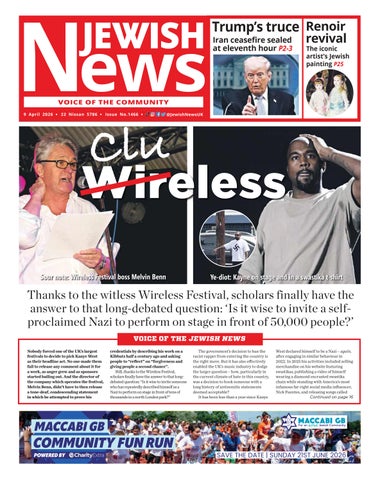
Sour note: Wireless Festival boss Melvin Benn

Kayne on stage and in a swastika t-shirt

Thanks to the witless Wireless Festival, scholars finally have the answer to that long-debated question: ‘Is it wise to invite a selfproclaimed Nazi to perform on stage in front of 50,000 people?’

Nobody forced one of the UK’s largest festivals to decide to pick Kanye West as their headline act. No one made them fail to release any comment about it for a week, as anger grew and as sponsors started bailing out. And the director of the company which operates the festival, Melvin Benn, didn’t have to then release a tone-deaf, condescending statement in which he attempted to prove his

credentials by describing his work on a Kibbutz half a century ago and asking people to “reflect” on “forgiveness and giving people a second chance”.

Still, thanks to the Wireless Festival, scholars finally have the answer to that longdebated question: “Is it wise to invite someone who has repeatedly described himself as a Nazi to perform on stage in front of tens of thousands in a north London park?”

The government’s decision to ban the racist rapper from entering the country is the right move. But it has also e ectively enabled the UK’s music industry to dodge the larger question – how, particularly in the current climate of hate in this country, was a decision to book someone with a long history of antisemitic statements deemed acceptable?

It has been less than a year since Kanye

West declared himself to be a Nazi – again, after engaging in similar behaviour in 2022. In 2025 his activities included selling merchandise on his website featuring swastikas, publishing a video of himself wearing a diamond encrusted swastika chain while standing with America’s most infamous far-right social media influencer, Nick Fuentes, and releasing songs called

Continued on page 16

Israel ‘not at the table’

Israeli opposition leader Yair Lapid has sharply criticised Benjamin Netanyahu over the Iran ceasefire, insisting: “There has never been such a diplomatic disaster in all our history.”

After confirmation on Tuesday the US and Tehran had agreed to a two-week truce, Lapid said: “Israel wasn’t even at the table when decisions were made concerning the core of our national security.”

Defending the role played by Israel’s military in the war that began in February – which had “carried out everything it was asked to do” – Lapid said while citizens in the Jewish state had “shown remarkable resilience”, Netanyahu had “failed diplomatically, failed strategically and did not meet any of the goals he himself set”.

Before the ceasefire decision, Donald Trump warned on his Truth Social platform “a whole civilisation will die” if safe passage through the region’s waterways was not restored.

Israel’s position on the fragile

ceasefire was initially unclear, with some officials immediately raising concerns about the deal.

Netanyahu later issued a statement saying he supported the US decision to suspend attacks against Iran for two weeks, but insisted the ceasefire did not include fighting against Hezbollah forces in Lebanon.

Netanyahu’s confirmation he had agreed to the ceasefire immediately sparked criticism at home.

Many pointed to the fact Iran’s uranium stockpile had not been diminished and the prospect of the regime producing nuclear weapons remained unaddressed, but supporters of the Israeli PM pointed to clear wins for him.

MEP held in terror probe Bondi suspect loses appeal

A man accused of killing 15 people in a terror attack at Australia’s Bondi Beach has lost an appeal to have the identities of his family members suppressed.

Naveed Akram, 24, is accused of 15 counts of murder and one count of committing a terrorist act over the attack, in which dozens of people were also injured, at Sydney’s Archer Park in December

His father, Sajid, 50, was shot dead by police at the scene.

Akram appeared via video link during a hearing in Sydney after applying for a non-publication order relating to the details of his immediate family members.

The New South Wales (NSW) courts service reported Judge Hugh Donnelly dismissed the application and an interim suppression order that had temporarily blocked the publication of the names and addresses of Akram’s mother, brother and sister.

NSW Police allege Akram and his father carried out Australia’s worst mass shooting since 1996, targeting the Jewish festival of lights. Among the victims was London-born Rabbi Eli Schlanger, 41, a father of five and assistant rabbi at Chabad of Bondi.

According to police, the father

and son parked their vehicle near a footbridge overlooking Archer Park at Bondi at about 6.50pm on 14 December.

It is alleged a “tennis ball bomb” and three pipe bombs were thrown into the crowd before the pair opened fire.

None of the bombs detonated, but all were found to be viable, the police said.

In December, court documents made public police allegations that Sajid and Naveed Akram visited the area for “reconnaissance and planning” in the days before the attack.

Police also accused the pair of conducting firearms training in the Australian countryside.

Police have detained Rima Hassan, a member of the European Parliament from France, on suspicion of “advocating for terrorism” after she quoted one of the perpetrators of a 1972 terror attack on an Israeli airport in a social media post. Hassan, 33, was held for several hours by French authorities over a 26 March post in which she quoted an individual convicted of participating in the 1972 terror attack on Ben Gurion airport in Tel Aviv, which killed 26 people

The post, later deleted, included Japanese and Palestinian flags as well as a quote from Kozo Okamoto, a member of the terror group, which read, “I dedicated

my youth to the Palestinian cause. As long as there is oppression, resistance will not only be a right, but a duty.”

The Paris prosecutor’s office said it had released Hassan and given her a court date of 7 July “to be tried on charges of advocating terrorism committed online”.

Hassan, who was elected to the European Parliament in 2024 for the French far-left party France Unbowed, has previously said “Hamas’s actions are legitimate from an international perspective” and argued Franco-Palestinians “must be able to join the Palestinian armed resistance”.

She also participated in a Gaza flotilla last June.

NHS DR: ‘WIPE ISRAEL OFF MAP’

An NHS consultant has called for Israel to be “wiped off the face of the map” during a speech outside the US Embassy in London.

Footage circulating online shows Ranjeet Brar addressing a crowd praising Iran and its regional allies while urging action against Western governments.

In the speech, Brar says Iran is “rewriting the map of the Middle East” and “ejecting US imperialists from the whole region”, adding he supports the continued Iranian strikes against Israel.

He describes Israel as a “genocidal, settler colonial entity” which “has no right to existence” and says it “needs to be wiped off the face of the map”.

Brar also expresses support for groups in Lebanon and Yemen, saying he wants

to see their “resistance triumph” and “thrive”, calls for the removal of all US troops from the UK and for the Israeli and US embassies in London to be shut. He also urges the creation of a “resistance movement” in Britain and removal of the current government.

A spokesperson for King’s College Hospital said: “We are aware of the footage in question and are investigating.”

Brar was arrested in 2024 on suspicion of inciting racial hatred after distributing a pamphlet containing antisemitic conspiracy theories.

Brar is associated with the Communist Party of Great Britain (Marxist-Leninist), a group that has organised activity at protests since 7 October.

Rima Hassan
Ranjeet Brar
Naveed Akram
People check damage to a coffeeshop at the site of an Israeli strike in the southern port city of Sidon, Lebanon
Anti-war protester in Tel Aviv

on Iran truce

They noted Iran’s military industrial complex is degraded, regional influence diminished and Ayatollah Khamenei and other leaders killed.

Israel also renewed an evacuation order for an area more than 40 km inside Lebanon, saying “the battle in Lebanon is ongoing”.

Minutes after Trump announced the suspension of attacks and declared readiness for a ceasefire, Israel’s military warned Iran had fired missiles toward it, with some breaching air defences over Tel Aviv.

Pakistan prime minister Shehbaz Sharif said the ceasefire extended to Lebanon after his country played a leading role in negotiations.

Iran released two di erent versions of the 10-point plan intended to be the basis for negotiations, and which Trump said was a “workable basis on which to negotiate”.

A version in Farsi, included the phrase “acceptance of enrichment” for Tehran’s nuclear programme but that phrase was missing in English versions shared by Iranian diplomats.

Iran’s opening position for negotiations – which Trump had previ-

ously called “workable” – included retaining control of the Strait of Hormuz and complete withdrawal of all US military forces from the region.

Trump, who faced mounting criticism at home, including from key supporters, over the decision to enter the war, claimed the provisional ceasefire with Iran was a “total and complete victory” and said the issue of uranium would be “perfectly taken care of”.

Earlier reports on the talks suggested China had encouraged Tehran to agree to a ceasefire.

The announcement came soon after Russia and China vetoed a UN Security Council resolution aimed at reopening the Strait of Hormuz — blocking the body from authorising the use of force to reopen the crucial waterway through which one-fifth of the world’s oil passes.

Markets reacted positively to the announcement of the ceasefire with the FTSE 100 rising sharply in the UK on Wednesday as airline, housing and mining shares showed gains while energy shares fell.

In the aftermath of the ceasefire announcement, Downing Street

confirmed Keir Starmer was visiting the region to hold talks on “practical e orts” to restore freedom of navigation in the Strait of Hormuz.

The prime minister said he welcomed the ceasefire agreed between the two combatants, saying it would “bring a moment of relief to the region and the world”.

He added: “Together with our partners we must do all we can to support and sustain this ceasefire, turn it into a lasting agreement and re-open the Strait of Hormuz.”

France’s president Macron also welcomed the signing, calling the agreement a “very good thing”, but said the halt in hostilities should include the war in Lebanon as well.

ELBIT ACTIVIST CHARGED

A pro-Palestine activist linked to direct action against Israeli defence sites has been charged following a counterterrorism investigation after being arrested at her home.

Qesser Zuhrah, 21, of Swiss Avenue, Watford, was charged with three counts of intentionally encouraging or assisting criminal damage.

Police said: “The charges are in connection with posts made on social media.”

Zuhrah appeared at Westminster Magistrates’ Court on Tuesday 31 March and has since been released on bail.

VOICE OF THE JEWISH NEWS

THE WAR IS ISRAEL’S. THE FALLOUT IS OURS

When Israel went to war with Iran in February, British Jews did what they almost always do: they stood together.

Even those who loathe Netanyahu’s government, fret over Gaza and ache for a Palestinian resolution still backed Israel’s right to strike back against a regime sworn to wipe it from the map.

As Sir Mick Davis wrote in these pages last month: “Whatever disagreements one may have with the Israeli government, this is a time to stand together with the Israeli people.”

He put it bluntly: “Saying this is not my fight because I disagree with the government is not my Zionism and not my Torah.”

Now the truce is here – brokered, fragile, contested – and many British Jews are no longer asking that question quietly.

The war has not dismantled Iran’s uranium enrichment programme or delivered regime change. The regime is bloodied but standing, its nuclear exper-

stood to relate to three posts on her social media history allegedly calling for “direct action”.

Zuhrah is part of a group of activists known as the “Filton 24”, who are accused of targeting a UK facility linked to Israeli defence firm Elbit Systems in August 2024.

tise largely intact, its vile ideology untouched. In Britain, antisemitism surges. Energy prices rise. The cost-of-living crisis grinds on. The war that felt necessary does not make Jewish life safer.

Let us be clear. Israel does not cause antisemitism. Antisemites cause antisemitism. Hatred of Jews is hatred of Jews – but that does not mean we cannot ask harder questions about political choices made in our name.

Israel’s current leadership has treated diaspora support as an entitlement, not a relationship, expecting unconditional backing regardless of how its coalition partners inflame opinion across the world. Real solidarity must include the freedom to say when Israel’s leaders are making life harder for Jews everywhere.

The truce is a pause, not a pardon. If Israel’s leaders want the diaspora’s solidarity, they must earn it – and that means being willing to hear the criticism, not just the applause.

She was initially arrested on suspicion of “intentionally encouraging or assisting the commission of an o ence, namely criminal damage” and “encouragement of terrorism, contrary to Section 1 of the Terrorism Act 2006”.

According to campaigners supporting her, she was arrested “because of an Instagram story she posted, which allegedly encouraged people to take ‘direct action’”.

The charges are under-

Zuhrah had been released on bail last month after 15 months on remand.

‘DARKNESS INTO LIGHT’ FOR DEE DAUGHTER

Three years after a terror attack that killed her mother and two sisters, Tali Dee has announced her engagement, in a moment her family described as “transforming darkness into light” The 20-year-old became engaged to Ariel Rosenfeld, from Jerusalem, over Pesach, with the announcement shared on the third anniversary of the April 2023 attack in the Jordan Valley.

To find out more about Future Giving or our free Will-writing service visit jewishcare.org/futuregiving

Burning Israeli flags in Tehran

The Medical Practitioner Tribunal Service (MPTS) has let off an NHS doctor accused of posting objectively antisemitic and grossly offensive comments on social media on 7 October 2023, saying it “did not find that … [her] conduct constituted misconduct which was serious”, writes Daniel Sugarman.

On that day, Dr Menatalla Elwan shared video footage of people fleeing the Nova festival. Alongside the footage, she wrote: “If it was ur home, u would stay and fight. U wouldn’t just run away,” alongside a blushing smiling emoji.

In a second post a few hours later, Dr Elwan said: “Israel was never a country. They illegally occupied Palestine. Would u support Russia invading Ukraine? Israel kill Palestinians everyday, didn’t see anyone caring. Also there are no civilians in Israel.”

In the judgment, an MPTS panel said it considered, “whilst Dr Elwan’s posts had been found to be inappropriate, insensitive in their timing and in shockingly bad taste, they were nonetheless permitted as political free speech within the boundaries of Dr Elwan’s Article 10 rights, as they were not found to be grossly offensive or antisemitic”.

It went on to state: “The tribunal was of the view that, in the circumstances, the behaviour of Dr Elwan would not be considered deplorable by fellow professionals, morally culpable or disgraceful… the conduct did not fall short of clear expected standards at the time of events, nor did the conduct reach the threshold of seriousness for misconduct, given the heightened

protection afforded to political free speech.”

The tribunal accepted a number of claims from Dr Elwan, including that she had watched the video without sound before sharing it (the audio included gunshots). The tribunal also said it believed “Dr Elwan knew that the incident was more serious than a regularly occurring fight between military forces.

“Further, the wording of the tweet, referring to ‘stay and fight’ suggests that she was aware that it was more than the day-to-day occurrences of a longstanding conflict, although it is accepted that she did not know the scale or extent of what was later known to have occurred on that day.”

Following Dr Elwan’s comments, the Home Office attempted to remove her temporary right to remain in the UK, but Dr Elwan, an Egyptian who has lived in the country legally since 2016, challenged the decision and was backed by an immigration tribunal judge.

In his ruling, Judge Stephen Davies saidof Dr Elwan’s first tweet that “the combination of the re-posting of the video, the barely-concealed sneer of cowardice against unarmed civilians seeking to flee the attack, and the

‘Iran-link’ studio may shut Tribunal lets off NHS doc over 7/10 tweets

The studio responsible for broadcasting hardline anti-Zionist Chris Williamson’s Palestine Declassified programme is facing legal action from the Home Office and possible closure over alleged links to Iran, writes Lee Harpin.

Ex-MP Williamson, who presents the show alongside academic David Miller — a prominent critic of Zionism — confirmed the studio had received a letter from the government signalling potential legal action under the National Security Act.

He wrote on X: “I’ve been presenting a weekly programme alongside David Miller for

the last four years, but the Home Secretary Shabana Mahmood is now trying to shut us down.” Williamson said he would be finding a new studio and changing the show format.

“This, unfortunately, will come with associated production issues and costs, so we will be launching an appeal soon to help ensure that Palestine Declassified continues every week.”

The Home Office confirmed to Jewish News the recently introduced Foreign Influence Registration Scheme was one means used to “tackle threats from the Iranian regime”.

Palestine Declassified is a weekly pro-

gramme aired on the Iran-backed Press TV channel, which discusses “the worldwide struggle to liberate Palestine”.

Williamson has now accused the government of “state intimidation” and insisted the programme has no relationship to Press TV or Iran as it was “independently produced”.

But broadcasts are marked with a Press TV watermark, and shows are made available on the official Press TV website.

A Home Office spokesman confirmed: “We have a robust package of measures to tackle threats from the Iranian regime.”

smiling face emoji clearly expressing Dr Elwan’s satisfaction at what had happened, convey the clear message that the attack by Hamas on unarmed Israeli citizens within Israel was a matter for celebration and, thus, amounted to expressions of support and justification for, and indeed glorification of, Hamas terrorist violence.”

Regarding all three social media posts – the third being a response to then-prime minister Rishi Sunak, which said “Just take all the Israelis to UK away from terrorist Palestine… a win for everyone, no?” – the judge said they were in part “protected expressions of political opinion”, but they all “supported, justified and even glorified terrorist violence by Hamas”.

The tribunal, which only considered Dr Elwan’s first and second tweets, concluded that since it had found there was no misconduct, “it would be unnecessary and inappropriate to consider whether a warning should be issued.”

Calling the MPTS finding “unfathomably abhorrent”, a spokesperson for Campaign Against Antisemitism said: “This is yet another inexplicable decision by the MPTS, which is now plainly no longer fit for purpose.”

This was kept under constant review and included the Foreign Influence Registration Scheme, “which strengthens our national security whilst maintaining the UK as an international hub for business”.

LGBTQ+ SESSION DISRUPTED 7 HELD AT AIRBASE PROTEST

A London theatre event featuring a play about LGBTQ+ Palestinians seeking refuge in Israel was disrupted by activists during a post-show discussion, prompting some audience members to leave early, writes Annabel Sinclair.

The rehearsed reading of Sharif, written by Israeli journalist and playwright Tomer Aldubi, was at King’s Head Theatre following an earlier performance at JW3.

The production draws on real-life testimonies and years of research but what had been intended as a facilitated Q&A with the creative team became increasingly hostile, according to an attendee who spoke to Jewish News

The attendee said the evening started as a “civilised, convivial event” before several individuals appeared to take over the discussion.

One person read out a pre-written statement attacking Tomer and the state of Israel. as others joined in, turning the discussion into “an outpouring of hateful rhetoric”.

“What was meant to be an informed discussion degenerated into a vile onslaught of loathing and hatred towards Israel,” the attendee said.

During the exchange, one audience member was heard shouting accusations at Israelis, while others joined in with criticism of the country and its people.

Some Jewish attendees attempted to respond while others chose to leave.

“I had to leave. It was just too upsetting,” one theatregoer said. “It’s so awful, and you are never going to change their views or their hatred. It’s pointless trying to answer back.”

In a statement to Jewish News, the theatre confirmed it was aware the Q&A had become “heated” and that there had been disruption during the discussion.

Staff intervened as tensions escalated, with a duty manager entering the auditorium and ending the session early.

Seven people have been arrested at an RAF base on suspicion of supporting banned group Palestine Action during peace protests against the Iran war, writes Joy Falk.

The five men and two women were arrested at Lakenheath, Suffolk, airbase and followed reports a US fighter jet shot down in Iran on Friday had taken off from there.

Lakenheath Alliance For Peace said the arrests were made after retired colonel Chris Romberg made a speech to protesters.

Suffolk Police said: “Police have arrested seven people, five men and two women, in Lakenheath on suspicion of supporting a proscribed organisation.

“They have been taken to Bury St Edmunds Police Investigation Centre for questioning.

“Suffolk Police has a duty to enforce the law without fear or favour and as it currently stands, not as it might be in the future.”

The High Court ruled in February the proscription of Palestine Action was unlawful but also granted the Home Office leave to appeal, leaving the proscription in place until the appeal is decided.

The airbase demo was part of a six-day peace camp involving a round-the-clock vigil.

Suffolk Police also confirmed two people had been charged over a blockade at the base.

They are Michelle Macdonagh of Springhill, Stroud, Gloucestershire, and Yvan Cormier-Scott from Elphinstone Road, Southsea, Hampshire, who have both been charged with wilful obstruction of a highway.

Cormier-Scott has been bailed to appear at Ipswich Magistrates’ Court on May 22. Macdonagh was also charged with obstructing a police officer and has been bailed to appear before the same court on April 27.

The police added: “As such, where offences are believed to have occurred, appropriate action will be taken.”

Palestine Declassified screenshot
Dr Menatalla Elwan

Three held over Hatzola arson as fourth arrested

Two young men and a boy have been remanded in custody after appearing in court accused of setting fire to four Jewish community ambulances in north-west London, writes Adam Decker.

The ambulances from Hatzola, a volunteer-led ambulance service operating in the Golders Green area of north-west London, were set on fire in the early hours of 23 March.

The alleged arson caused gas canisters stored in the vehicles to explode, resulting in £1m worth of damage, Westminster Magistrates Court heard.

British subjects Hamza Iqbal, 20, and Rehan Khan, 19, from Leyton, east London; and a 17-yearold boy, of dual British-Pakistani nationality, from Walthamstow; are each charged with one count of arson being reckless as to whether life would be endangered.

The accused, who were arrested as part of a Counter Terrorism Policing (CTP) investigation, did not enter pleas and were remanded in custody during the hearing, which lasted around 45 minutes last Saturday afternoon.

Another suspect was arrested by the Metropolitan Police in connection with the alleged arson at court on Saturday morning.

Police said the 19-year-old man had been attending the hearing of the three other suspects when he

was arrested on suspicion of arson with intent to endanger life.

He has been remanded in custody, the force said.

Before the hearing, watchers saw a prison van arriving at Westminster Magistrates’ Court with the three defendants charged with the attack on board.

Describing the ambulance incident, prosecutor Emma Harraway told the court: “There is significant evidence that this was a premeditated and targeted attack against the Jewish community.”

However, prosecutors do not yet know the motivation for the alleged attack, which “specifically targeted” the ambulances, the court heard.

Magistrates were told the case is not being treated as terrorism

However, a Counter Terrorism Policing spokesman said due to “the circumstances of the incident” the investigation was being led by

its own detectives.

The defendants spoke only to confirm their personal details during the preliminary hearing, which took place before a full public gallery of relatives.

As Iqbal, who wore a grey prisonissue tracksuit in the dock, was taken to the cells, a member of the public gallery said: “Take care son, yeah.”

The court heard Khan, who also wore a grey prison-issue tracksuit, is a college student.

Both were remanded into custody, with the 17-year-old, who cannot be named for legal reasons, remanded into youth detention accommodation.

The three defendants are set to appear at the Old Bailey on Friday 24 April.

Two other men aged 45 and 47 who were arrested last week, and are also British, were released on bail until late April.

Court sketch of Iqbal, left, and Khan, right

Festival cancelled after Kanye banned from UK

The 2026 Wireless Festival was cancelled this week after the government announced it would block Kanye West from the UK, with the home secretary judging his presence in the country would not be conducive to the public good, writes Daniel Sugarman.

Amid major backlash following the festival’s announcement on Monday 30 March that the rapper would be headlining the event, the Home O ce confirmed West had made an application to travel to the UK yesterday via an Electronic Travel Authorisation (ETA).

Following a review, Shabana Mahmood refused permission.

Festival organisers subsequently announced cancellation of the entire three-day event, saying refunds would be issued to all ticket-holders.

The decision was confirmed shortly after Downing Street had said “all options remain on the table” as the Home O ce reviewed West’s permission to enter the UK.

It emerged West, whose latest stage name is Ye, was initially granted an ETA – a mandatory digital permission for non-visa nationals visiting the UK for up

to six months – because Wireless is on the permit-free festival list, allowing performers to travel to the UK as visitors. The decision was reviewed by the Home O ce on Tuesday.

Jewish News revealed a strong consensus among ministers to block West from entering the UK to perform at the event in July.

It is understood a previous decision taken by London mayor

Sadiq Khan’s o ce to block a request from West to perform at the London Stadium this summer was taken into consideration.

Keir Starmer joined Union of Jewish Students (UJS) representatives and leaders for a mock seder where he shared his experience of Pesach with family before discussing the alarming rise in campus antisemitism.

The seder, which was filmed for the prime minister’s Passover video for social media, took place in Birmingham with six Jewish student leaders leading di erent steps of the ceremonial meal and speaking of their own family traditions.

The event was followed by a private roundtable with UJS to discuss the Time for Change report and Jewish students’ life on campus.

The prime minister spoke of the disturbing statistics in the UJS report and was keen to hear directly from students, some of whom spoke about antisemitism they had faced in student spaces while others highlighted wider fears of rising extremism.

UJS president Louis Danker said: “There are two stories of Jewish life on campus: one of Jewish pride, joy and resilience and one of significant challenges.

“At UJS, we felt it important to share both stories with the prime minister. We need the full weight of government to implement in full the recommendations in our Time for Change report, and we were grateful to put this case

The mayor’s o ce was said to have reached the decision because of community concerns and reputational risk to London. The Community Security Trust (CST) said: “Preventing Ye from performing is a sensible outcome to what has been yet another bruising episode for British Jews.

“Anti-Jewish hatred should have no place in society and cultural leaders have a role in ensuring that is the case. People who show genuine and meaningful remorse for previous anti-

semitic behaviour will receive a sympathetic hearing from the Jewish community, but that process must come before this kind of public rehabilitation.”

The Jewish Leadership Council said: “The government’s blocking of Kanye West’s entry into the UK recognises the deep disgust our country feels towards expressions of support for Nazi ideology. It is now incumbent on Wireless to recognise their massive error in judgement that has led us to this point.

“West did not merely share controversial opinions, he repeatedly commercialised his vile antisemitism. He should not be given a public platform in this country.”

The Campaign Against Antisemitism said: “The government has clearly made the right decision here. For once, when it said that antisemitism has no place in the UK, it backed up its words with action. Someone who has boasted of making millions of dollars from selling swastika t-shirts and who released a song called Heil Hitler just months ago clearly would not be conducive to the public good in the UK.”

• Editorial opinion, page 16

to the prime minister this week. We will continue to campaign against hatred and showcase proud, thriving Jewish life on campus.”

Birmingham JSoc president Miriam Krygier said: “I told the prime minister how aware I have become of ‘looking Jewish’ around campus, even thinking twice before sharing that I’m Jewish.

“He agreed that students should never have to be hesitant to be outwardly proud of their identity at university. It is reassuring to know that my voice as a Jewish student is being listened to. Jewish students will continue to defend our right to live proud Jewish lives on campus and to create meaningful opportunities to share our traditions and values.”

TOO LATE FOR WORDS, KANYE

Kanye West has spoken. In response to the backlash around his now cancelled Wireless Festival booking, he o ered the following: a desire to “present a show of change”. A call for “unity”. An openness to meet members of the Jewish community. An acknowledgment that “words aren’t enough”.

On the surface it reads well, but then come the questions. Why now? Why wait until this moment, only after the headlines, the outrage, after the sponsors have begun to walk away and he and has enablers are being hit where it truly hurts, in their pockets?

Why was this not the position before standing in front of 170,000 people in Los Angeles? Why was there no o er then to meet the Jewish community there, to listen, to learn, to understand? Why only when the cost of silence began to rise?

Let me suggest a di erent course, one that might actually result in something meaningful. Recognise the damage you have caused. Not in broad terms, but specifically, directly, without qualification. Actually make reference to releasing a song called Heil Hitler, selling merch adorned with a swastika, threatening the lives of Jews and spreading age-old antisemitic tropes. Then come to London – to listen, not perform. Meet the Jewish community, not for optics, photos, validation, just to listen, learn and to understand the impact of what you have said, repeatedly, publicly, and without restraint. Then take time, to reflect, to demonstrate change not through statements but sustained action. Then and only then, if that work is real, if that change is evident, come back next year and make every penny that your talent deserves.

Police crackdown pledge

Britain’s most senior Jewish police o cer has pledged increased visibility, patrols and enforcement as the Metropolitan Police responds to a surge in antisemitic threats and incidents a ecting the Jewish community.

Writing in the Jewish Chronicle, deputy assistant commissioner Ben Russell said the months since 7 October had been the most di cult he had experienced in policing,

with rising tensions, online extremism and hostile activity contributing to heightened fear among Jewish Londoners.

The force had significantly stepped up its presence in Jewish areas following the arson attack on Hatzola ambulances in Golders Green and had deployed hundreds of

additional o cers in recent days, including patrols around synagogues, schools and community centres, as well as specialist firearms units at key locations as a precaution.

“Since last Monday alone, the Met has deployed an additional 264 o cers on the ground,” he noted.

HMD ceremony wins TV award

The UK National Holocaust Memorial Day ceremony 2025, broadcast by the BBC and watched by more than two million viewers, has won the live event category at the Royal Television Society programme awards, alongside being nominated for the BAFTA Television Awards in May.

A powerful tribute to the six million Jewish men, women and children murdered during the Shoah and

the millions more slaughtered under the Nazi regime, last year’s national ceremony on 27 January, organised by the Holocaust Memorial Day Trust, marked the 80th anniversary of the liberation of AuschwitzBirkenau.

Held at The Guildhall in the City of London, it was attended by Their Royal Highnesses The Prince and Princess of Wales, Prime Minister Keir Starmer MP, other mem-

bers of the Cabinet, faith and civic leaders, celebrities and survivors.

Olivia Marks-Woldman, HMDT chief executive, said: “This recognition reflects the dedication of all involved. At a time of rising antisemitism and growing prejudice in our communities, it is more important than ever to bring people together – whether in person or through the power of broadcast into UK homes.”

Racist rapper Kanye West gives a Nazi salute
Ben Russell
Starmer at the mock seder in Birmingham

ROBBIE.

I like to live a Jewish life.

I was born right before Pesach, so it’s my festival. I like Seder Night, with the ten plagues and Ma Nishtana. I’ll be drinking four cups of grape juice, eating charoset and some horseradish – as long as it isn’t too hot. But most of all, I’ll be enjoying my independence in my kosher home, thanks to Norwood.

To support more adults with learning disabilities to live their best Jewish lives, please donate at: norwood.org.uk/pesach

Increase in schools taking part in HMD

New figures have confirmed a significant increase in the number of secondary schools marking this year’s Holocaust Memorial Day, writes Lee Harpin.

The Holocaust Memorial Day Trust (HMDT) says more than 1,000 secondary schools participated in events, representing 17 percent of the total number of secondary schools nationwide, a rise from just nine percent in 2025.

Despite this increase, the figures still confirm a sizable dip in the number of schools acknowledging Holocaust Memorial Day compared to 2023.

Ahead of HMD 2026, a report in The Times based on Holocaust Memorial Day Trust data revealed more than 2,000 secondary schools around the UK had signed up to events commemorating the Shoah in 2023.

Until that year, participation had increased annually since 2019. But since the terrorist attacks by Hamas the number of participating schools fell to fewer than 1,200 in 2024 and 854 in 2025 – a drop of nearly 60 percent.

In an interview with Jewish News, new HMDT chair Sir Sajid Javid

admitted: “Sadly, the numbers [of schools marking Holocaust Memorial Day] have gone down in the last couple of years. First, I want to have an ambition to get it back up to where it used to be. But then, even go beyond that … It’s ambitious, but that’s what we’re about.”

In figures announced this week, HMDT’s Light the Darkness campaign also saw 230 buildings and landmarks illuminated in purple at 8pm as part of a nationwide act of remembrance – an increase from 200 in 2025.

The theme for Holocaust Memorial Day 2027 will be No Place for Prejudice, aimed at encouraging a dual approach: viewing prejudice through a historical lens to examine how it shaped and enabled the Holocaust, and applying those lessons to the present day.

It calls on society to recognise where prejudice still exists — including in everyday life and trusted institutions — and the danger of how it can become normalised, urging every individual to take responsibility for challenging it.

MARCH LEADERS FOUND GUILTY

Palestine Solidarity Campaign director Ben Jamal and Stop the War Coalition vice-chairman Chris Nineham have been found guilty of breaching protest conditions in London a year ago.

The pro-Palestine campaigners were both accused of failing to comply with a condition that required attendees of a protest on 18 January last year to stay on Whitehall in central London in a static rally.

The court heard Metropolitan Police commanders imposed conditions the effect of which was to block the pro-Palestine march from gathering near a central London synagogue.

This was justified amid concerns such a gathering would “risk the safety of the Jewish community”.

Jamal, 62, and Nineham, 63, were found guilty after a trial at Westminster Magistrates’ Court.

Jamal was also convicted of two counts of inciting other protesters to breach police conditions under the Public Order Act.

District Judge Daniel Sternberg ruled the conditions

imposed by the police on the march were “lawful”.

He added a speech made by Jamal after the march “constituted incitement” of the crowd, saying it was “a suggestion, persuasion and inducement encouraging breach of the condition”.

During the trial, the prosecution said the conditions were breached knowingly when the protesters marched outside the designated area and turned towards the headquarters of the BBC in Portland Place.

In his judgment, Sternberg said “the court emphasised that protest rights, while fundamental, are not absolute and do not permit breaching lawfully imposed restrictions”.

He added: “The (police) commander acted under valid statutory powers and applied the correct test.

“The commander’s belief in serious disruption was reasonable, based on evidence about crowd size, serious disruption to worshippers at nearby synagogues and PSC’s own estimate of 100,000 participants.”

UJS Awards celebrate achievement of Liverpool in the face of hostility

Liverpool Jewish Society was named JSoc of the Year at the annual Union of Jewish Students awards ball, writes Michelle Rosenberg.

More than 150 students celebrated the work of Jewish societies and students across the UK and Ireland.

JSocs, individuals and events were nominated and then shortlisted for the awards, with winners announced on the night.

Big winner, Liverpool Jewish Society, was recognised for running events from bagels-and-board-games to large-scale mock bnei mitzvah celebrations, building links with the wider Liverpool community and welcoming students from all denominations.

Co-presidents Kezzy Miller and Eva Myers, said: “We are beyond proud of winning JSoc of the year at the UJS awards.

This is such a testament to the tireless hard work that we have put in this year, making our JSoc bigger, louder and more inclusive than ever. Jewish students in Liverpool are thriving right now and despite everything going on in the world, we have such a high spirit and sense of community.”

Other winners included Alfie Joseph from York JSoc for the Maurice Helfgott award for leadership, University College Dublin JSoc for new JSoc of the year, and Levona Zarum from Aberdeen JSoc for the Alan Senitt award for outstanding contribution to campus life.

UJS also presented the Sir Victor Blank award to Sir Mark Gardner in recognition of the outstanding work he and CST do to protect the Jewish community, including Jewish students.

Louis Danker, UJS president, said: “It was brilliant to celebrate the achievements of our students this year. Amid such challenges, their resilience and pride should strengthen our confidence in the future of British Jewry. Thank you to all the UJS team for their work in delivering a phenomenal year of Jewish student life.”

COMEDIAN LOSES HIS APPEAL OVER THEATRE ‘LIBEL’

Comedian Paul Currie has lost an appeal related to his libel claim against the Soho Theatre, writes Adam Decker.

He launched the legal action following publication of a press release from the theatre on 13 February 2024 that said Jewish audience members were abused during one of his shows.

It read: “On Saturday evening, following the end of Paul Currie’s show Shtoom, Jewish

members of the audience were subjected to verbal abuse and the performer aggressively demanding they leave the theatre.

“Such appalling actions are unacceptable and have no place on our stages, now or ever. We will not be inviting Paul Currie back.”

It also said the theatre was continuing its own investigation and consulting with police.

After the show, Campaign Against Anti-

semitism said Jewish audience members were “hounded out” and that Mr Currie demanded to know why one person did not applaud when he brought out Ukrainian and Palestinian flags.

The Belfast comedian allegedly shouted “get out” and “free Palestine”. He was subsequently banned from performing at Soho theatre.

At a preliminary hearing last year, Mr Justice Nicklin was asked to consider the “natural

and ordinary meaning” of the press release. He found that a typical reader would understand the press release to mean: “Following the end of the claimant’s show, the claimant had verbally abused Jewish members of the audience and aggressively demanded that they leave the theatre and there were grounds to investigate whether by so doing the claimant had committed a criminal o ence.”

Much

Leaving a

in

Will, no matter how small or large, is one of the most valuable ways you can forge an everlasting bond with Israel.

Our expert and caring Legacy Team offer a range of professional services and first-rate pastoral care.

UJS Sabbatical Team onstage at the UJS Awards Ball

MAUREEN LIPMAN

Hope, hype and hollow promises at Zack’s love in

@lmharpin

“Many of you will know I’m Jewish... I’m from the Jewish community,” announces Green Party leader Zack Polanski from the stage of Hackney’s fashionably tatty EartH (correct spelling) venue.

It’s a Monday evening in late March, but no less than 700 fans, Green Party activists and journalists like myself, have filled the former home of the Savoy Cinema to capacity.

It’s no exaggeration to say that the vast majority who have paid money to attend the filming of the latest episode of Polanski’s Bolder Politics podcast o er him the sort of welcome normally reserved for a pop star rather than a political leader.

How do I feel, sitting in my front row press seat as the 90-minute session, featuring Polanski, Hackney Greens mayoral candidate hopeful Zoe Garbett, her 19-year-old local election running partner Dylan Law, and comic Corby Dahler begins? Intimidated? No. Angry? Not really.

Bemused by Polanski’s genuine popularity with the predominantly young — 25-40 yearold audience, which is overwhelmingly white and seemingly middle-class? Yes.

Asked by a guy in the queue to get in, why I decided to attend, I had told him I was a journalist. “What publication?,” he asked. “Jewish News,” I replied. “Sick (as in cool),” he responded.

As a prelude to the show, Ross Hanson-Lowe appears on stage. He is the exec producer of the Bolder Politics podcast, who couldn’t be kinder about Polanski. He explains how he messaged the Greens leader on social media one night with the idea for the now extremely successful podcast. Both he and Polanski have gone on to benefit from the podcast’s success, we are told, with many listeners going on to join the Greens.

Polanski o ers “hope” where no other political leaders currently do, we are told. He is, according to Hanson-Lowe, the only person who can defeat Nigel Farage at the next general election.

Hanson-Lowe also cured his fear of public speaking as a result of advice given to him by Polanski.

As the show eventually gets going, Polanski announces he has only a couple of speeches to make before proceeding to the main interviews section, conducted upstage on two chairs set up

to look like somebody’s living room.

Greeted by ecstatic cheers as he walks on stage for the first time, Polanski actually begins his “I’m Jewish” speech by referencing the conflict with Iran. “I’m sure we speak with one voice in saying this war is not in our name.” Loud applause erupts from all areas of the seats.

Polanski then references his link to the Jewish community, before adding: “Today I spoke about the antisemitic attack that happened in Golders Green.”

But just as you, perhaps foolishly, expect the Greens leader to say something substantive and reflective of the community he comes from, he diverts his message.

“The BBC reported my quotes, and just underneath they reported a quote from Nigel Farage, who immediately was using it as a moment to divide, to create more pain and more conflict,” he continues. “Once again, we know that antisemitism and Islamophobia are two sides of the same coin, and our communities are best when we stand united, and we will not be divided.” So there we have it. On the same day as the despicable Golders Green arson attacks took place, Polanski’s message to the crowd was “antisemitism and Islamophobia are two sides of the same coin.”

And boy did they lap it up. More loud cheers, more standing ovations. Oh, and before the podcast recording starts, there is just time for one more message from the boy wonder.

“You know we still have a government who are selling arms to Israel despite the genocide that is happening in Palestine,” he opines. “We must stop selling those arms. It is time to end

the genocide.” Huge cheers erupt. And so on to the podcast filming itself. It would be wrong to suggest that Israel-Palestine dominated the interviews that followed. Only briefly did the Middle East even crop up again. Mayoral wannabe Garbett, I think, suggested she would pursue pension divestment aims if

elected in May. Apart from the warranted put downs of Trump by the comic later on, foreign policy rarely featured again. Polanski was gushing as he interviewed his London Assembly political colleague, Garbett. She had written the Greens’ drug policy that Keir Starmer had dismissed as stupid and foolish during the Gorton and Denton by-election. Polanski asked Garbett to run through the policy in more detail. Some of it — cocaine on prescription for users — did indeed sound foolish.

Garbett is clearly desperate to finally win the mayoral race in May, having run unsuccessfully before. If she does win, she plans to make Dylan Law, who turned 20 last month, deputy mayor. Final thoughts? Polanski is a big draw in Hackney, and the Greens are clearly connected locally to a very particular sector of the local community. And it’s a phenomenal achievement getting 700 youngish people to attend a political event on a Monday night.

It’s also all a million miles away from the days of Polanski’s time as a struggling Liberal Democrat and bit part player in the Greens, still very much connected to Jewish communal life. Am I left bemused by it all as I board a London Overground train home? Yes.

Zack Polanski introduced on stage in Hackney by Ross Hanson-Lowe
Zack Polanski interviews Zoe Garbett

First Lira Winston cohort celebrate graduation day

The first cohort of teachers on the Lira Winston Fellowships has graduated, with participants describing the programme as a “transformative” step into leadership at a time of pressure on Jewish schools, writes Annabel Sinclair.

Launched by PaJeS in memory of Lady Lira Winston, who dedicated almost three decades to Jewish education and later served as assistant director of the organisation before her death in 2021, the initiative was created to develop the next generation of Jewish school leaders through

a two-year programme of training, mentoring, coaching and peer collaboration.

Fourteen educators from a wide range of Jewish schools and backgrounds across the UK were selected for the inaugural cohort, including Aviva Collins, now deputy head at Shalom Noam Primary School, who said the fellowship had been pivotal in her progression.

“Through the fellowship, it really propelled me to senior leadership from middle leadership,” she said. “I would say that was really quite formative for me.”

Collins, who was previously at Kerem School, said the programme stood out for giving participants the space to think beyond the day-today demands of teaching and engage with the broader reali Reflecting on the legacy of Lady Lira Winston, Collins described her as “a real giver”, and it was “amazing that this was set up in her name”.

Lady Winston’s son Ben Winston said: “It’s a true reflection of something my dear mum believed in so strongly – the power of education to shape lives and communities.”

BRIGHTON MEMORIAL CRACKDOWN FEARS

Council leaders in Brighton & Hove have been accused of singling out the only Jewish vigil in the city while debating strict policy changes on memorials including floral tributes.

While not explicitly named, the

council’s presentation featured images of the 7/10 memorial at Palmeira Square set up after the Hamas attacks on 7 October 2023.

JEWISH MP BID TO SAVE BILL

Jewish Labour MP and NHS doctor Peter Prinsley has emerged as a key figure in the fight to save the assisted dying bill, after coordinating a cross-party letter signed by more than 150 MPs urging Keir Starmer to prevent the legislation running out of parliamentary time.

The letter notes: “A small number of peers have been using procedural tactics to block the bill in the House of Lords and it now appears very likely that they will prevent it returning to the Commons before the end of this session.

“While we fully respect the government’s neutrality on the principle of assisted dying, we are confident that you would agree with us that we cannot be neutral on the fundamental democratic principle that it is for the elected House of Commons to decide on this matter.”

The bill has divided Jewish MPs and peers, reflecting long-standing tensions between pikuach nefesh, the duty to preserve life, and the imperative to relieve su ering.

The memorial operated as a well-known hub for nightly services for the Jewish community but was targeted by violence and vandalised more than 50 times.

Only one person, Fiona Monro, has been convicted for targeting it.

Palmeira Memorial Group coorganiser Heidi Bachramc said: “This new policy feels aimed directly at the Jewish community ... at a time this small minority is under huge pressure targeting our memorial is deeply irresponsible.

Independence starts at home

“I’ve got no sight at all and JBD offers me the safety and security I need.”

Miriam, JBD Tenant

Jewish Blind & Disabled offers housing and support for adults who have physical disabilities or vision impairments.

To make a donation or to find out more about our housing and support, please visit jbd.org or call 020 8371 6611

“The hate this tiny memorial su ered exposes just how big a problem this city has.”

Campaigners for assisted dying
Lady Lira Winston with Rabbi Lord Sacks collecting her Lifetime Achievement Award

Survivor, 106, shaken by Hatzola attack

A 106-year-old Holocaust refugee said she felt “personally attacked” by the firebombing of four Hatzola ambulances in Golders Green, writes Michelle Rosenberg.

Berlin-born Ann Callender, who came to Britain on her own just after her 19th birthday in January 1939, has twice called on Hatzola’s emergency care, including in the past two months.

“I really feel that I was personally attacked by this,” she said from her

home in Stanmore. When she called on the charity most recently, she had Covidand flu-like symptoms. “The neighbour said ‘I think you really ought to get an ambulance.’ I rang them and within five minutes they were there.

the law – they have real jobs and do it all voluntarily. I thought they were absolutely fantastic.”

Of the attack, Callender adds:

HEAD TEACHER STEPS DOWN

The headteacher of Essex’s only Jewish secondary school, King Solomon High, is stepping down after three years in post.

A letter sent to parents and carers by the Redbridge institution’s chair of governors, said Michele Phillips had made the decision “that now is the right time to move onto new opportunities within education” and her last day at King Solomon High School will be Friday 15 May.

“They examined me from top to toe – everything. One [of the paramedics] was a very nice young man, something in

“At the moment, I feel more Jewish than I ever did. Because I feel as if they attacked me, by attacking those ambulances.”

She was born to Jewish parents but was unaware of her ethnicity until Hitler came to power. On

her 15th birthday, all her friends made excuses for not attending her party, and she was thrown out of school for being Jewish.

Her father was imprisoned for six months in Dachau, while Callender came to the UK on a

“domestic service” visa. Her parents managed to follow her to Britain just before the outbreak of war.

A great-grandmother of four, she is the oldest member of the Association of Jewish Refugees, having joined at the age of 103.

ATTACKER KILLED IN ISTANBUL GUNFIGHT

One attacker was killed and two others injured in a gunfight with police outside the Israeli consulate in Istanbul on Tuesday morning.

The consulate has been largely closed since 2023, when the 7 October attack on Israel and the subsequent war in Gaza escalated diplomatic tensions between Turkey and Israel.

Turkish authorities said they had identified the three attackers in the incident, in which two police o cers were also lightly injured. The man who was killed, whom they identified as Yunus ES, had “connections with a terrorist organisation that exploits religion,” the Ministry of the Interior announced. It did not iden-

tify the organisation.

Turkish authorities also did not immediately tie the incident to the consulate, noting that a major bank and other businesses were located closer to the firefight. They said the attackers had driven to Istanbul from Izmit and had brought both long-barreled guns and pistols.

HADASSAH UK EMERGENCY APPEAL

Critical Care at Critical Moments

Hadassah Hospital in Jerusalem is treating victims of ongoing rocket attacks.

Phillips joined King Solomon in September 2023 and oversaw improvements to the school environment and infrastructure, including the creation of a new library.

The governing board said under her leadership, the school had “continued to build on its academic performance, particularly within the Sixth Form, where outcomes significantly improved” and thanked Phillips “for the energy, dedication, hard work, and expertise she has brought to the role”.

In her own statement, Phillips said: “Now is the right time to step away from my role as head teacher at King Solomon High School. The school community is wonderful and I would like to thank the sta , senior leadership team, governors and parents for their support as we worked together to demonstrably improve the school.

“The pupils, both former and present, are what make the school and I have no doubt they will build on the platform created by our collective e orts to further improve the school.”

To save lives, Hadassah is expanding its emergency capacity:

u 40 protected emergency beds

u 6 life-saving operating theatres

u Emergency reserves for treatment under fire

The space is ready.

The clinical teams are prepared.

But the equipment is missing.

PLEASE DONATE TODAY

Your

Ann Callender
Scene of the attack. Three people have been charged

Frozen in time: haunting images of shul after attack

Four days after an attacker drove a car packed with explosives into Temple Israel in Michigan last month, Rabbi Jen Lader made a deliberate choice about how the story of the destruction would be told, writes Joy Falk.

She called a photographer Emily Iris Elconin, a Jewish photojournalist who grew up in the same community. Her images, released a week after the attack, would become the first o cial record of the aftermath: ash coating corridors, shrapnel scattered across floors, children’s classrooms abandoned mid-moment.

“It was very hard to stomach being there, taking the images,” Elconin said. “And all I could hope was that it would come through in the images themselves.”

Elconin is no stranger to national audiences. A freelancer whose work has appeared in major outlets, she also has deep roots in West Bloomfield’s Jewish life, having grown up attending a nearby synagogue and now serving on the Detroit Jewish federation’s young-adult board. That proximity shaped both the assignment and the way she approached it. The result is not simply documentation, but something closer to a frozen narrative of disruption.

“I’m a photojournalist. [Rabbi Lader] wanted me to bring that storytelling approach to capturing these images in a way that captured time standing still, but also just in a way that people can better understand and connect to the imagery.”

Inside, the damage was far more extensive than early reports conveyed. Even for someone who had followed the incident closely, the scale only became clear upon entering the building.

“It smelled like a burning building – we were wearing N-95s the whole time,” Elconin said. “When you’re standing inside there, you get the full understanding of what happened: where the car drove through, where the car stopped, where the car exploded, seeing the bullet holes on the windows.”

What stood out most were the traces of ordinary life interrupted.

“There were these moments just frozen in time,” she said. “There’s all the food from the kids, like a yogurt with a straw in it still. When you see all the toys and everything, and all the shoes flipped over, you kind of are transported

back to the scene when this was happening.”

The vehicle tore through an area adjacent to preschool classrooms, intensifying the sense of vulnerability. “Where the car came through, on the right side is directly where the preschool classrooms are,” she said.

Physical destruction was visible in layers: fragments of the attacker’s vehicle, charred interiors, shattered windows. But the impact extended well beyond the initial blast site.

“There were pieces of the car; he was driving a Ford F-150, and a piece of one of the side mirrors was on the ground. There’s ash everywhere,” Elconin said. “One of the first o ces on the left that the car went by – it’s a metal car, and it’s just burned all the way through, down to the bottom.”

Emergency systems had compounded the damage. “The whole temple had damage because the water system was activated,” she said. “So you walk on the floor and you hear the little squishy noise because the floors are sopping wet. So while the most immediate damage is in that first hallway, there is damage pretty much everywhere.”

Elconin’s task was not only to record but to translate the experience visually.

“I was trying to approach this how I would approach anything else, and trying to capture moments in time that could elicit some of the same emotions and feelings that I was feeling in that moment,” she said.

She focused on small, human details left behind. “I just really wanted to convey to people what it felt like for these people, these kids, teachers, to be in there in those moments: the food left untouched, art projects left unfinished, the chairs flipped over,” she said.

“There’s Ritz crackers on the floor. Oreos.”

One image in particular captured a stark contrast between message and reality.

“There were papers all over the ground, and there were some really powerful words written on one of the papers: ‘Overflow with love.’ I captured that – it’s covered in ash.” Notably, there are no people in the photographs.

The synagogue released the images as an act of reclaiming narrative control after unofficial footage had circulated online.

“We share these images because our community deserves to see our building through eyes of love, not through the lens of spectacle,” the temple said in a statement. “This is our sacred space, and we will be the ones to tell its story.”

Bringing Jewish Communities Together Outdoors

Inclusive outdoor activities and on-site accommodation, tailored for Jewish faith groups of all ages and abilities.

•On-site private sole occupancy accommodations

•Inclusive programmes tailored to your group’s needs

•Safe, supportive environments with experienced staff

•Builds connection, wellbeing and shared community

Scan to plan your group visit

Extensive damage inside the charred hallway
Children's lunches at Temple Israel after an attacker drove through the entrance
Classroom artwork next to shattered glass

Editorial comment and letters to the editor

LETTERS TO THE EDITOR

VOICE OF THE JEWISH NEWS

In what world does this make sense?

Continued from page 1

Heil Hitler and Gas Chamber. Yet in a statement after the government’s visa ban decision in which Wireless announced that the festival in its entirety was now cancelled, the organisers claimed that “multiple stakeholders were consulted in advance of booking Ye and no concerns were highlighted at the time”. This incredibly revealing claim implies that no one involved in the decision-making process saw fit to ask any Jewish person whether this was a good idea.

Mr Benn’s behaviour is not entirely surprising. Speaking in the wake of one of Ireland’s largest music festivals last year, also organised by his company, he described how seeing Kneecap perform was “a very special moment”, with the band personally thanking him on stage for allowing them to comment politically.

“You know, it’s different in the UK ... there I’ve had to spend time in their dressing room reading them the riot act about what they can and can’t say. But of course, those restrictions are not here in Ireland and it’s wonderful,” Benn told a music magazine. This at the time that the Belfast band were under investigation by UK counterterror police for alleged support for Hezbollah.

Benn was a director of Glastonbury Festival for more than a decade and currently sits as a representative on the Concert Promoters Association (CPA). He is a central part of the UK’s music establishment – and it is not unreasonable to assume his deeply troubling mindset is therefore widely shared.

This week, we are also running a piece on page 20 from Jewish DJ Howard Kaye, talking about the abuse he receives in the UK for wearing a Star of David. “I get targeted for wearing a necklace. He gets a three-night headline slot”, Kaye writes. “I have to file police reports just to do my job. He gets celebrated in front of 150,000 people. I am not saying this because I want those things. I am saying it because in what world does that make any sense?”

Kaye is right – it makes no sense. And unless the UK music industry is made to answer some hard questions, there is no indication that this deeply disturbing situation will improve.

THIS WEEKEND'S SHABBAT TIMES... Shabbat comes in

8.40pm Sedra: Shemini

The Hatzola response

Jonathan Liew, in his now infamous Guardian article of 19 March, wrote: “Palestinian activism has arguably never been less capable of exerting a meaningful influence on global events, and so is increasing defined by small acts of petty symbolism.” I certainly don’t consider the burning of four Hatzola ambulances, which are used to save

Driving in Golders Green was reminiscent of a film set – cars crawling along, ambulances and fire engines parked near the scene - not something that we expect to see in this busy but peaceful shopping area (just before Pesach shopping that in itself is time-consuming). The volunteers from Hatzola provided wonderful support those few years ago when my husband was unwell and I was surrounded by at least five medics within minutes whisking me to hospital when I had a medical problem. I am sure Hatzola, together with the caring CST, will receive the donations they deserve.

Norma Neville, By email

‘VIOLENCE IN DEFENCE’?

I refer to your recent article describing a letter written to the president of Israel condemning “settler violence”.

Have any of the people who signed this letter ever bothered to check the truth behind any of these allegations? Most of the violence is only in defence and is a tiny minority. I live in Israel and together with all the population in Israel have spent the last month dodging Iranian and Hizballa missiles. This is not the time or place to criticise your fellow Jews who are fighting a war of survival. Lest you forget, Israel is also protecting the Jewish Diaspora.

This article was totally tactless and untimely. I invite all the people who endorsed this letter to come and visit us right now and be our guest in an air raid shelter anywhere in Israel.

Rachelle Shemoon, By email

Support your Jewish community. Support your Jewish News

Thank you for helping to make Jewish News the leading source of news and opinion for the UK Jewish community. Unlike other Jewish media, we do not charge for content. That won’t change. Because we are charity-owned and free, we rely on advertising to cover our costs. This vital lifeline, which has dropped in recent years, has fallen further due to coronavirus.

Today we’re asking for your invaluable help to continue putting our community first in everything we do. For as little as £5 a month you can help sustain the vital work we do in celebrating and standing up for Jewish life in Britain.

Jewish News holds our community together and keeps us connected. Like a synagogue, it’s where people turn to feel part of something bigger. It also proudly shows the rest of Britain the vibrancy and rich culture of modern Jewish life.

You can make a quick and easy one-off or monthly contribution of £5, £10, £20 or any other sum you’re comfortable with. 100% of your donation will help us continue celebrating our community, in all its dynamic diversity.

Support Jewish News by visiting our donor page at jewishnews.co.uk

the lives of both Jewish and non-Jewish people, as an act of petty symbolism. In any event, perhaps he should consider that the reason why such activism is not influencing world events is because of its very nature: these are acts of terrorism evincing a total disregard for human lives.

By email

The Jewish officialdom rushed to Downing Street after the ambulance inferno, despite the fact that their host, Keir Starmer, championed a policy that works against its interests. He continues to refrain from proscribing the Iranian regime’s IRGC and recognised a Palestinian state. They should boycott such a meeting that helps him to launder the hostility of his government towards anything Jewish. I have an admiration for the CST, but to host the Met Chief at its annual dinner despite his refusal to ban the hate marches? To host the Home Secretary despite her murky past in calling people to boycott Israeli products? Enough pandering to the authorities. A regime change is required at the top of our community.

Dr Saul Zadka, N2

AGNEW: A LIGHT UNTO THE NATIONWIDE

Jonathan Agnew, whose death has just been reported at the age of 84, was known in the City of London as chairman of the Nationwide Building Society and chief executive of the bankers, Kleinwort Benson, and for updating the London Stock Exchange.

Jonathan was a member of the family-owned London art gallery, Thomas Agnew and Sons, who were well known as art advisors to the Rothschild and Wertheimer families. It is perhaps, therefore, not surprising that Jonathan was, in fact, halachically Jewish.

His mother, the Hon. Doreen Maud Agnew, nee Jessel, was a granddaughter of Sir George Jessel, the first Jewish Master of the Rolls and first Jewish Queen’s Counsellor, through her father, Herbert. Through her mother, Maud Goldsmid, she was a granddaughter of Sir Julian Goldsmid, Member of Parliament for Honiton and Rochester.

Both families originated from Frankfurt and played leading parts in Jewish English history.

Doreen Berger

The Jewish Genealogical Society of Great Britain

“I had to walk around my husband at our wedding. His behind was hard to miss too!”

Ben Gvir’s noose will not bring Israel security

Israel’s parliament has made a momentous and terrible decision to pass a bill introducing the death penalty for convicted terrorists. There are many arguments to be made against this measure, whose impact on the Jewish state will be immense.

But little attention has been focused on the central justification advanced by its proponents, the far-right Otzma Yehudit party led by security minister Itamar Ben Gvir: that it will act as a deterrent. The evidence suggests this is completely wrong. If anything, to conduct the first executions in Israel since Adolf Eichmann was hanged in 1962 will increase terrorist violence.

Together with my colleague Professor Ron Dudai of Ben Gurion University, I set this out in an expert opinion written for the Supreme Court challenge to the bill’s constitutionality.

We begin by noting that Israel taking this step will fly in the face of a powerful global trend: while in 1988 there were only 52 countries that had abolished the death penalty, by the end of 2025 the total had risen to 124. Of those that retain the death penalty in law, only 33 have continued to impose death sentences and carry out executions over the past decade. Recent abolitionists include Zimbabwe, a state not generally regarded as a beacon of human rights.

Aside from China, where execution numbers are kept secret, the busiest executioners are Iran, Iraq, Yemen, Somalia and Saudi Arabia. This is the company Ben Gvir - now often seen sporting a noose lapel pin – wants Israel to keep.

Rationally, if the death penalty acted as a deterrent, states that abolished it would see murder rates rise. There is no evidence for this. On the contrary, following abolition in the Czech Republic, Hungary, Moldova, Romania and Poland during the 1990s, homicide rates across all five countries declined by 61% between 2000 and 2008. In Israel itself, where the death penalty for murder was

abolished in 1954, homicide rates declined significantly afterwards.

Comparing abolitionist and retentionist jurisdictions with similar characteristics also fails to show deterrent impact. A key study compared murder rates between Singapore (which retains the death penalty) and Hong Kong (which does not). Over 30 years, homicide rates in both followed a similar decline. Similarly, murder rates in Canada have gone up and down in virtual lockstep with US for decades, though Canada has had no executions since 1962.

Otzma Yehudit claim that in terms of deterrence, terrorism is di erent from general homicide. And it is - just not the way they think. Evidence suggests the death penalty is even less of a deterrent for terrorists.

Those who carry out terrorist acts are usually ready to die for their beliefs. It is also more likely that executions, rather than having a general deterrent e ect, will instead encourage further violence and terrorist recruitment. Successive British governments recognised that executing members of the Provisional IRA would be a “colossal blunder”, only strength-

ening its cause.

Israel’s security agencies have repeatedly briefed that the working premise of perpetrators is that they probably will not survive. One eminent psychologist who specialises in profiling terrorists told Professor Dudai the bill “will only cause more antagonism and more mobilization for action and… make them greater shahids [martrys]”.

The point here is utilitarian, not moral. Israel’s former justice minister, Haim Zadok, wrote in 1993: “I am not among those who oppose death penalty from principled-moral reasons. My test is ‘will death penalty help or harm the fight against terrorism?’ My answer is clear: it will not be helpful, and may bring damage.”

Then there is the inevitable, dismal downside of the bill: the deepening of divisions within Israel and with diaspora Jews; the damage to Israel’s international standing; the encouragement of the fanatical strain of antiZionism which has made it increasingly acceptable to state that Israel has no right to exist.

Maybe, just maybe, if executing terrorists really did deter them, all that would be worth it. Unfortunately, it does not.

Why British Muslims must stand with British Jews

DR ZUBIR AHMED MP LABOUR, GLASGOW SOUTH WEST

Ihave often spoken about how growing up in a gritty part of Glasgow to a working class Pakistani family while attending one of Scotland’s foremost educational establishments on a scholarship shaped my political thinking and outlook. Part of that shaping was because at that school there were alongside me the largest number of Jewish pupils of any non-denominational school in Scotland.

My first foray into a religious institution other than a mosque was the beautiful Queen’s Park Synagogue in Govanhill. I remember, as the only Muslim in my class at the time, marvelling at the ability of Jewish friends being able to attend Jewish assembly and using religious terminology comfortingly similar to my own. I also found solace in not being alone in needing to exercise “due diligence” at the school canteen, occasionally needing days o school for religious observance and sharing stories of baby

brothers going through similar “rites of passage”. I also remember the light bulb moment when my Quran teacher told me I was allowed to eat kosher food. Being Jewish, being Muslim felt easily symbiotic in those days.

As we grew up together, I learned and drew inspiration from the Jewish story of migration (albeit at the time ignorant of the full horror of its necessity), realising it was about two generations ahead of my family’s own. I was entranced by what could be achieved via a few generations of e ort and hard work. Unlike my extended family, who were shopkeepers and taxi drivers, my Jewish friends’ parents were doctors, lawyers and, dare I say it, even politicians. I also looked with envy at what was a Jewish community light years ahead of my own in feeling comfortably Scottish, British, confident enough to advocate for and then provide culturally and religiously sensitive health, social and pastoral care. I have always viewed services like Hatzola as the perfect blend of that tradition; of public service, integration and community.

That is primarily why when I heard the news of the vile antisemitic attack on the ambulances in Golders Green, it was with a unique sense of

revulsion. The attack was an attempt to instil fear, to intimidate and to erase parts of our country’s proud Jewish story.

To do it to ambulances and healthcare workers touched a particular nerve for me. As a surgeon, I have taken many medical handovers from Hatzola paramedics when they safely and skilfully delivered sick patients to my care at the Royal Free Hospital.

At an Eid reception later that same day at Downing Street, the consensus in the room, from the prime minister, mayor of London and home secretary down, was that none of us is safe until British Jews are safe.

British Jews deeply understand how much inter-generational damage is done when the oldest hatred takes hold. That is why to me it was unsurprising yet still heartening to see members of that community, individually, collectively and in this paper, defend the right of Muslims to be just Muslim in Trafalgar square.

In my view, religious practice is uniquely interwoven into British society. We are a Christian country, but we have developed a singular comfort in our ability to wear religious belief openly so long as it does not infringe the rights

of others. Over time this has become accepted as a core British value. That evolution is in no small part due to the footprints of consecutive Jewish and Muslim communities.

When some British Jews tell me they question their future in Britain, I feel their pain. The same dinner conversations are occurring in Muslim households, including in my own family, where I worry if my children (with very Old Testament-sounding Arabic names) will feel as free as I have felt to practice their faith.

Allyship of course should not be simply about sympathy and avoiding di cult conversations; quite the opposite. It should be an opportunity to deepen conversation, embrace debate and feel safe and comfortable engaging in it in each others’ spaces.

The Glasgow schoolboy in me who felt so enriched by Jewish friendship thinks this begins by rediscovering the ingredients of our symbiosis, intrinsic to being Jewish and Muslim in modern day Britain. What better way to start than for this Scottish British Muslim MP to say loudly to his constituents that whenever British Jews are under attack I will stand up and show up, and they should too.

Recognising disability is not just a niche issue

The Board of Deputies’ new Commission on Disability Inclusion in the Jewish Community, launched last month, is an important step forward and a recognition inclusion cannot be left to chance. It must be deliberate, informed and shaped by those who live with disability every day.

Disability is not a niche issue. Most of us will encounter it at some point in our lives: as parents, carers, or through our own experiences. When a child has complex needs, the impact is rarely confined to the individual. The ripples spread through families, friendships, schools and synagogues. Communities are tested not only by how they respond in moments of crisis, but by whether they build environments in which everyone can participate fully and with dignity.

For that reason, parents of disabled children will be central to the commission’s work. Their lived experience is not simply

valuable, it is essential. Too often, policies and programmes are designed without fully understanding the realities of daily life: navigating education systems, accessing services, managing the emotional and financial pressures that can accompany disability.

If we are serious about inclusion, we must start by listening.

My own understanding of disability began many years ago through involvement with Norwood. It became deeply personal when my wife Naomi and I welcomed our third child, and only son, who has very severe special needs. Though physically strong and healthy, he is non-verbal and his mental state makes it impossible for him even to get on a bicycle, let alone to ride one. I saw how carers tried to help him, displaying almost infinite patience. Like my wife , they make up for nature’s parsimony by their own boundless care. Over time, we have seen both the extraordinary commitment of carers and the genuine kindness shown by many within our community. There has been real progress in recent decades.

Awareness has grown, and in many settings, inclusion is now instinctive rather

DISABILITY IS NOT A SIDE ISSUE – MOST OF US ENCOUNTER IT AT SOME POINT

than exceptional. But progress should not breed complacency. For many families, the challenges remain acute. Stress, isolation and uncertainty are still part of everyday life. The commission will seek to understand where provision works well, where gaps persist and how di erent parts of the community experience disability in di erent ways.

In our own synagogue, we have experienced nothing but kindness. Similarly, most public organisations like the police, the AA and museums have all treated us wonderfully well. Our experience is very di erent from that of couples older than ourselves, whose contemporaries were far less understanding.

The commission’s work will be iterative. We want to work collaboratively, drawing on the insights of families, practitioners, educators, academics, rabbis and communal leaders. Expert voices will guide us along the way, helping to ensure that whatever we propose is both appropriate and practical.

Nor are we seeking to tell organisations how to do their jobs. Specialist charities already bring deep expertise and commitment. Our focus is on supporting the many synagogues, schools and communal bodies for whom disability is not their primary focus, but who nevertheless want to do the right thing.

Inclusion should not depend on whether an institution happens to have prior experience; it should be embedded across communal life.

There is a wealth of experience at the Board; we will look to tap this as well as to learn from the community, which contains some of the greatest authorities on this subject in the UK and many with lived experience of the issues at hand. This promises to be an exciting journey, and I welcome anyone who wishes to join us on it.

He sung Heil Hitler, I wear a star. Guess who’s attacked?

Let me be clear about something before I say anything else. This is not about Israel. This is not about politics. This is not about the war. This is about a man who wrote a song called HeilHitler, sold T- shirts with swastikas on them and publicly declared himself a Nazi. And it is about the fact that man was handed the biggest stage in London.

I am a Jewish DJ. I perform regularly across the UK. I wear a Star of David around my neck, as I always have done, because I am proud of who I am.

I have been sworn at mid-set by people who spotted it, have had people attempt to force me to say things on camera while I was working. I have filed multiple hate crime reports with the police. Multiple times. For wearing a necklace. That is the world I’m living in. That is the world thousands of Jewish people across this country are living in right now. Antisemitism in the UK is rising at a terrifying rate and it is not abstract. It is on the street, in the comments sections, in the everyday moments where you make a quiet calcula-

tion about how visible to be.

And into that world, the now cancelled Wireless Festival drops this booking

I was a teenager when I first fell for Kanye’s music. His first album, The College Dropout , inspired me to become a musician and a DJ and his influence is all over the artist I became. I remember standing outside BBC Radio 1 with my friend Ariel, starstruck Jewish kids, somehow getting a video of him saying “Big up Howard and Ariel”. It meant everything to us; that is who he was to me.

Over the next decade I built a career in music I am proud of. I played Reading Festival, Bestival, Isle of Wight. I became a resident at House of Vans. I did the Childish Gambino album launch. I shared stages and rooms with Anderson Paak, Schoolboy Q –artists I had grown up listening to.

Music gave me everything. And I showed up to every single one of those nights wearing my Star of David.

Which is exactly why what Kanye became felt like a specific kind of devastation. Not just as a fan. As a Jewish person working in the same industry. Outside of music I work as marketing manager for BNJC, Brighton’s Jewish hub. I have sat with Holocaust survivors through that

work. I have worked with families who lost people on 7 October. These are my people. My community. And watching someone I once admired use his platform to spread the kind of hatred that has defined their suffering made me deeply and personally pained and betrayed.

But here is what I keep coming back to. I get targeted for wearing a necklace. He gets a three-night headline slot. I have to file police reports just to do my job. He gets celebrated in front of 150,000 people.

I am not saying this because I want those things. I am saying it because it makes you ask in what world does that make any sense.

That is not a coincidence. That is not an accident. That is a reflection of exactly how Jewish su ering is treated in this country. As negotiable. As a secondary concern.

As something that can be weighed up against ticket sales and cultural cachet and quietly set aside.

I loved his music. I still feel that loss. But what he did was unforgivable. And what this festival did in response tells you everything you need to know about where Jewish people stand in this country right now.

I am glad the festival organisers made their decision – but go and look at the comments section under the Wireless announcement.

Read what people are saying. Jewish people are being blamed for the cancellation. The anger that should be directed at an artist who wrote a song called Heil Hitler is instead being directed at us.

For speaking up.

For existing.

That is the bit that never gets talked about. Every time our community pushes back, every time we draw a line, we pay a price for it. The antisemitism does not go away, it just finds a new target.

A theatre cancellation is not the point. This artist should never have been booked, and the fact all concerned had to fight this hard to make the cancellation happen tells you everything.

I am glad Kanye West has been banned from the UK and therefore from this concert appearance, but I am not naive enough to think this decision makes us any safer.

If anything, it probably means things are more dangerous than they were yesterday. I wear my Star of David every single day. I will not stop.

But what does this unhappy saga say to every young Jewish kid in this country who just wants to go to a festival, pick up a guitar or get behind the decks?

Looking for best value for Private Health Insurance? Ask The Barnet Expert!

To get the best value from your private medical insurance, you should speak to an expert who is qualified to advise you on the right policy for you, and recommend the providers who offer the most competitive premiums.

This advice covers individual, family and company policies, and is always FREE.

As an independent health insurance expert, I work with the healthcare insurers to provide you with the appropriate and most affordable level of cover. So whether you have an existing policy or not, let’s have a chat.

1

PRESS UPS FOR PARKINSONS

Leeds United Hebrew congregation senior Rabbi Albert “Alby” Chait raised more than £16,000 for Parkinson’s UK by completing 40 push-ups a day for 40 days to mark his 40th birthday. The challenge was a heartfelt tribute to his father, Rev. Henry Mark Chait, who lived with the complex brain condition for more than 30 years before dying in 2021 at age 72. Alby said: “Dad was my best friend. He was an incredible person. Every push-up is a reminder of his strength and the love he gave to our family and community.”

2 REMEMBERING JAKE MARLOWE

Volunteers gathered at Chabad Golders Green to pack and distribute handmade shmura (supervised) matzah ahead of Pesach in memory of 27-year-old Jake Marlowe, murdered by Hamas on 7 October 2023 as he protected partygoers at the Nova Music Festival. The initiative was supported by Jake’s parents, Lisa and Michael Marlowe and sister, Natasha. The special matzah packages reached individuals and families who might otherwise have gone without, helping them take part in the Seder and feel connected.

3 ROYAL HONOUR FOR HERITAGE LEADER

The Prince of Wales awarded Foundation for Jewish Heritage chief executive Michael Mail his Member of the Order of the British Empire last week, in recognition of services to heritage and charity. Mail told Jewish News: “It was a very special experience for me and my family. In our conversation, Prince William asked me to explain more about our Foundation’s work. I made sure to mention our project preserving and repurposing the historic Merthyr Tydfil synagogue in Wales, which we are planning to transform into the Welsh Jewish Cultural Centre.”

4 CELEBRATION OF ART

Ahead of Pesach, Chabad Camden held an art exhibition focusing on Jewish identity, heritage, and stories. ID Entity Art featured Sephardic artist Bettina Caro, British photographer Nico Froehlich, California-born and London-based photographer and tattooist Nick Rose and British artist Ezra Luria. Rose featured his discovery of the last surviving shtetl in a remote corner of Azerbaijan while Caro shared her biblical depictions of Noah’s Ark and prayers at the Western Wall in Jerusalem.

5 GLASGOW INTERFAITH WALK

Around 60 people from across Glasgow’s diverse communities – ranging from children to older adults – came together on Saturday 28 March for The Glasgow Interfaith Sponsored Walk, raising funds to support ongoing work tackling prejudice and building connections between people of all faiths and none. The five-mile walk included stops Kelvingrove Park for a pagan reflection, the Hindu Mandir, Glasgow Buddhist Centre, St Aloysius RC Church, Garnethill Synagogue, Glasgow Central Mosque, and Glasgow Sikh Gurdwara. A Jewish participant said: “It was a lovely experience, such a variety of places that we visited; we learnt loads, met lovely people.”

Office for Rent

Exclusive two roomed office suite to rent on the LSJS campus in NW4. Join a vibrant community of charities and educators, and all utilities covered in a fixed 2-year rent agreement*.

Features include:

• Two connected offices

• Air Conditioning

• Servicing

• Onsite Parking

• All Inclusive Rent

There is security provision: Monday to Thursday | 06:00 - 22:00 Friday | 06:30 - 13:00 (winter) | 06:30 - 15:00 (summer)

For more information or to book a viewing please contact Sorana Howard E: sorana.howard@lsjs.ac.uk T: 020 8203 6427

*this agreement is free of VAT.

• Free Meeting Rooms However terrifying the chaos, our dogs lovingly guide their partners to safety. Please

The Renoir girls

A new book brings to life the story of three Jewish girls painted by the famous artist.

As a relative of Parisians rounded up and deported to Auschwitz for no reason beyond being Jewish, the story of the Cahen d’Anvers sisters resonated with me. But while my great-uncle was the patriarch of an ordinary working-class family, the Renoir girls were members of the “haute Juiverie” –the spoiled, wealthy scions of a gilded age lavish almost beyond imagination.

Dressed in clouds of silk and lace, floating from belle époque townhouse to chateau with parents whose life was a non-stop round of balls, hunting weekends, trips to the opera and summer spa retreats, little Alice, Elisabeth and Irene Cahen d’Anvers were immortalised in paint by the famous chocolate box Impressionist Pierre-Auguste Renoir. Alice, then only four, was the “pink” in Pink and Blue of 1881, the blue-sashed Elisabeth six, while their elder sister had been captured on her own in the eponymous Little Irene a year earlier.

In two of the world’s most beloved pictures, they remain forever young, adored for their depiction of innocence by an art-loving public. Yet neither their wealth, connections nor even marrying out could protect every one of them after the Nazis took Paris – and it is this heartbreaking contrast between their idyllic childhood and a totally unforeseen battle for survival in old age which compelled Catherine Ostler to write a book to tell their story.

“I really wanted to conjure up this beautiful Proustian world and what it was like to live in – the rustle of silk across marble floor, the privilege and luxury, the sense of fragile security and wanting to be part of France,” she explains. “It was a manic helter-skelter – you were at the races, the salons, the balls, then you went to Deauville and came back and held another ball in the country – a constant round of social activity above the deep divisiveness beneath.”

In this companion piece to Edmund de Waal’s The Hare With Amber Eyes, which details the ostentatious high life of his own Parisian banking family, the brightest star of The Renoir Girls is their mother, Louise Cahen d’Anvers, memorialised by de Waal as the beautiful mistress of his art-collecting ancestor Charles Ephrussi. Ostler acknowledges his role in drawing her into their story –“there’s one line about the painting in his book saying ‘one of these girls died in Auschwitz’, which horrified me” – and that of a pre-

Dreyfus Paris where antisemitism was rife, yet no bar to socialising with aristocracy.

Ostler, a former Tatler editor, brings to her own record of fin de siecle Paris is an exhaustive description of fabulous outfits which will thrill every reader with even a soupçon of interest in clothes. The book makes slow reading if you savour every detail of who wore what where.

“In the early days of couture, these outfits are museum pieces, works of art,” she says of Louise’s ensembles, sensational enough to make the papers, like her black satin robe accentuated with a white feather boa and topped with a sky-blue velvet turban embellished with jet worn to a theatre premiere.

No wonder Renoir got commissioned to paint her daughters’ portraits: “He was for a while a fashion illustrator. His mother was a seamstress and his father a tailor and he could catch the light on fabric and the richness and texture better than anyone because he had grown up with it,” says Ostler.

Even during the 12 years of the Dreyfus affair the Cahen d’Anvers, like the Ephrussis, made good from humble origins before arriving in Paris to thrive on Napoleonic emancipation and build the great mansions which survived them, kept calm and carried on despite the open denigration of Jews in many French publications. But while Alice, wife of an English military hero, was safe in England by the time the Nazis occupied France, Elisa-

beth, the former countess, was reduced to the same tactics as my great-aunt and her surviving daughters – forced into hiding in an ultimately futile bid for survival, while Irene assured her own future with steps which led virtually her whole family to condemn her as a collaborator and shun her for the rest of her life.

The Renoir Girls is also a mystery tale, exploring the century-long rumour that Alice, despite being the favourite daughter of Louis Cahen d’Anvers, was actually the child of Louise’s long-time lover, Charles Ephrussi. Ostler landed a coup by managing to explore the theory with Alice’s surviving granddaughter, Lady Marina Bayliss, who in her 90s offered to finally shine a light on the truth in the age of DNA testing.

Marina owes her life to Alice, who in an incredibly brave move risked her own by travelling through France in June 1940 as a known Jew to evacuate her two grandchildren to England at the age of 64. Her reward was the happy ending denied Elisabeth, denounced by the antisemitic mayor of the village where she was living in 1944 and one of the last French Jews to be deported in the run-up to her 70th birthday; she died in Auschwitz.

As Ostler so painfully recounts: “Elisabeth Cahen d’Anvers, raised in the salons and splendour of Paris, in the chateaux, the Opera House, painted at six in all the light and privilege of her childhood by the greatest portraitist of the Impressionists, her life a round of ponies, couturiers and cotillions, had – after the slow-burning suspicions and loathing of the Dreyfus affair... been rounded up and murdered at the hands of the Third Reich.” Alice poignantly paid tribute to her at the Tate, which exhibited Pink and Blue in

1954: “Marina said she liked to stand next to it to tell strangers it was herself and her sister in the portrait,” says Ostler.

And only Alice was forgiving enough to reconcile with Irene – ironically the only daughter to wed in a synagogue in the first of two ill-fated marriages – who escaped Nazi persecution by denying her Jewish antecedents to the disgust of other family members, and lived to 91.

The conundrum of what it meant to be a wealthy, well-connected Jew in pre-war France – gilded and safe until it wasn’t – is summed up by Ostler’s description of the White Ball of 1922 attended by both Irene and the aristocratic, virulently antisemitic Marquis de Juigne who denounced her sister 20 years later, just as their mother had rubbed shoulders on the dance floor with antisemites of her own generation.

“For four generations they had spun under the same crystal chandeliers. What intergenerational resentment, historic jealousy or hatred would prompt the mayor to betray Elisabeth?” she asks.

Perhaps the final irony was the grand Paris townhouse of the Cahen d’Anvers being harnessed by the Nazis to hold Jewish prisoners in the run-up to their deportation, considered ideal because of a hidden top floor where they could interrogate their doomed captives in secret. It’s part of the dark underbelly of the City of Light.

• The Renoir Girls: A Hidden History of Art, War and Betrayal by Catherine Ostler is published by Simon & Schuster, £30

• Catherine is in conversation about The Renoir Girls with Simon Sebag Montefiore at the V&A on 13 April, tickets: vam.ac.uk/ whatson; and with James McAuley at Hatchards Bookshop, London on 14 April. Tickets: hatchards. co.uk/events.

Alice and Elizabeth in Pink and Blue, 1981
ABOVE: La Petite Irène, a portrait of Irène Cahen d’Anvers, 1880
ABOVE RIGHT: Louise Cahen d’Anvers with daughter Elisabeth
The Cahen d’Anvers sisters at Château Champ-sur-Marne

PLAYING THE PRICE

Arthur Miller’s work is enjoying a run of revivals and one of his plays opens in Marylebone this month.
Jenni Frazer spoke to the director

You might be forgiven for thinking that 2026 is Arthur Miller’s year. His play All My Sons has just closed after a sell-out run at Wyndham’s Theatre; the National Theatre has announced a new production of Miller’s seminal work Death of a Salesman, and sandwiched between is the Young Vic’s Broken Glass, which closes on 18 April. But lest deprived Miller fans should feel deprived, The Price opens on 17 April at the Marylebone Theatre.

When we met, Jonathan Munby, The Price’s director, was very excited to begin rehearsals. For, as he explained, he believes the role of Gregory Solomon, the 89-year-old antiques dealer in this four-character play, could have been written for its star, Henry Goodman. “It fits him completely – he is the most perfect actor for the role,” Munby enthused. (Previous actors in the part have included Danny de Vito and David Suchet.)

The play, written in 1968, is a drama, sometimes darkly comic and sometimes just plain dark, about estranged brothers Victor and Walter Franz. They meet, after 16 years apart, in the attic of their childhood home,

where they have come together to sell family furniture.

On hand to conduct the sale is Gregory Solomon, by turns jibing at the brothers and offering philosophical advice on the choices that they have made in life. Victor, a police sergeant, gave up the possibility of further education in order to support their father, while Walter became a successful and wealthy surgeon. Plenty of guilt to tangle with there, not least the different memories the two brothers have of how each made their personal decisions.

When it turns out that her late father-inlaw was not as destitute as Victor believed, meaning he need not have sacrificed his education opportunities, his deeply dissatisfied wife Esther is not a happy woman.

Jonathan Munby, an award-winning director, has been familiar with The Price for many years since seeing it in the West End. “I think plays about fathers and sons tend to stay with you – particularly if you’ve had a complicated relationship with your own father. But it’s also a play which requires an extraordinary actor at the centre of it, and I think the play lies in wait for that actor.

“I had been doing some work with Henry on another play at the Marylebone and I realised that the role of Gregory Solomon could have been written for him. So the play, which had been in my consciousness for a while, and then meeting and working with Henry, collided at the same time as the Marylebone offered me a slot to do a production there”.

The Price is not only about fathers and sons, says Munby. “It’s also about social

responsibility, about the past and the cost of the past, about the cost of choices we made in the past and how they relate to our present.” Though Miller wrote the play in 1968 and intended it to relate to the Vietnam War, Munby thinks of The Price as a metaphor for our own lives post-Covid and post-lockdown: “It’s a clash between self-interest and sacrifice.”

Munby recalls that Elia Kazan, the Hollywood director and one-time close collaborator with Miller, had observed that Miller’s plays “are not written, they are built”. Munby “completely agrees” with that view. “Once you start to work on one of his plays, you feel his presence so strongly. The sense of the drama being so well-crafted, it’s extraordinary to work inside it.”

The Price is “absolutely a Jewish-centred story,” believes Munby. “Gregory Solomon is a Jewish immigrant finding his way through life and surviving.

“He’s an extraordinary man, who’s had many lives in one. He’s 89 by the time we meet him in the play. He’s been in the British Navy. He was an acrobat. He finds his way to New York and ends up as a furniture salesman and dealer.

“His identity, his heritage, and his struggle to survive are very much part of who he is. And that balances with the Franzes, whom I believe are Jewish, and who I sense are very much a reflection of Miller’s own family story.”

Munby has a fascinating plan to engage playgoers who may never have seen The Price. “We are going to stage this production in the auditorium, to envelop the audi-

ence, and bring them inside it.”

He’s keen for the play to be held up as a mirror to the audience’s own concerns, noting that the “freshness” which speaks to him means that The Price, with its conundrums and questions of conscience, “means that it could have been written yesterday. And the other funny thing is that in today’s post-truth age, it’s also a play about truth. Miller makes a very strong case for the power of truth, and I find that incredibly important.”

In some ways, Munby says, the play is Miller’s response to war. “That is to say he writes about the morality around choices that we make, the burden of moral decisions, how people justify the lives that they live and the choices that they make. We are now in a state of war, and I think an audience will see an interesting reflection there.

“In terms of the rise in antisemitism, which is so appalling to me, I’m hoping that this production will not show these characters in a negative light. One has to be really careful about the portrayal of Jewish characters, and we’re going to be very sensitive to any sense of cliché or stereotype and present the truth of who these human beings are in the context of their lives.”

Munby reminds me that Arthur Miller himself directed the first production of The Price, after the original director left. “He wrote a note for future directors that it was very important that the audience should feel sympathy for both brothers. And that’s very important to me, and to my work. I like to present characters with all of their facets on show.”

All of the four people we see “are fallible and have all made questionable choices in their lives” – as have we, in the audience, in the dark.

• The Price is at the Marylebone Theatre from 17 April to 7 June

Henry Goodman as Gregory Solomon
Jonathan Munby
Faye Castelow and Henry Goodman
‘THIS BOOK WAS ONE I DIDN'T WANT TO PUT DOWN.’

NETGALLEY REVIEW

WHEN A BODY IS DISCOVERED IN A SYNAGOGUE, DCI JACK MADISON IS DRAWN INTO A WEB OF JEALOUSY, AMBITION, AND INTRIGUE. AS HE UNRAVELS THE MYSTERY, HIS GROWING ATTRACTION TO A SUSPECT THREATENS HIS PROFESSIONALISM, HIS CASE AND, WORSE, HIS PURSUIT OF THE TRUTH...

ARSENAL TO AI: THE STARTUP RETHINKING FOOTBALL

Dean Bracha turned his love for football into Marquee, a fast-growing sports tech company already working with top clubs in Europe, the US and beyond

hen Israeli entrepreneur Dean Bracha visited the UK and attended his first Arsenal game aged nine, little did he know the club would one day form the basis of his career.

The trip to Arsenal Stadium sparked an early obsession with the Premier League team. Back in Israel, Bracha played Fifa and later Championship Manager as Arsenal, following every transfer and analysing every performance. Years later, that same obsession would evolve into Marquee, a fast-growing sports analytics startup already gaining traction with major clubs across Europe and beyond.

Bracha and his co-founders met through an Israeli Arsenal supporters’ community he founded, which today has more than 7,000 members. There, Bracha wrote match reviews, analysed players and discussed transfers, posting his articles online.

“I’ve always loved writing about players and analysing the game from a fan perspective,” he

tells Jewish News. “It started as something fun. Then I began getting messages from scouts at clubs, both in Israel and internationally, asking how I had this information.

“If something quite simple I built was creating that much interest, I started wondering how clubs actually work today.”

Bracha began reaching out to teams in Israel, Europe and the US and quickly identified a gap: not a lack of data, but an overload of it with a lack of usable insight.

“Clubs today have moved from data scarcity to data overload,” Bracha explains. “In a single game, you can have thousands of data points. It’s impossible for humans to analyse everything.”

Most clubs, he says, use just four to 15 percent of the data available to them. Marquee’s goal

THE PINSKER CENTRE

CELEBRATES TEN YEARS THE PINSKER CENTRE

is to unlock the remaining 85 percent, with the platform acting as an AI-powered decision intelligence layer, bringing together data from multiple providers and internal club systems into one place. From there, it generates clear, contextual recommendations tailored to each club’s playing style, constraints and objectives.

With a single click, clubs can generate a full player profile, covering tactical, physical and technical attributes alongside salary expectations, injury history and career trajectory –often including video analysis.

“We act as a multiplier,” Bracha says. “Our technology can do the work of 10 analysts. Clubs don’t need more data – they need the ability to draw insights from the data they already have.”

By automating much of the recruitment process, the platform can reduce weeks of analysis to minutes, allowing scouts and analysts to focus on higher-level decision-making.

pre-seed round was led by AnD Ventures, with participation from with participation from Wix founders Avishai Abrahami and Omer Shai; Ami Serkis, founder and CEO of 365Scores; and venture capitalist Eyal Segal, the former owner of Maccabi Netanya Football Club.

Marquee has raised more than $2.5m to date, including a recent investment from top-tier sports tech VC Apex Capital. The company is already working with professional clubs across Israel, Europe and the US, and has supported real recruitment decisions during recent transfer windows.

It is also in discussions with teams across the Premier League, MLS in the US and other major teams, although many partnerships remain under wraps for now.

The plan, says Bracha, is to become “the standard operating system for recruitment teams in sport”.

Three of Marquee’s four founders are Arsenal fans – a detail that, for Bracha, is far from trivial. “If you want to stay motivated and move fast, you have to be passionate about what you do. When you care about something, you think about it when you go to sleep and when you wake up. That’s what creates the drive for perfection.”

Marquee’s rapid rise has not come without challenges. The company has been built amid the war with Iran, a reality that has directly impacted the team. “Our CTO’s house was hit by a missile,” Bracha reveals. “Thankfully everyone is okay – but it shows the situation.”

Founded less than a year ago, Marquee has already attracted backing from some of Israel’s most prominent tech and sports figures. Its recent

Despite this, the company has moved at speed, developing its product in just nine months and launching publicly two months ago. “We have elephant skin,” he says. “We keep moving. There’s no time to stop.”

For Bracha, the resilience is also driven by something deeper – a longstanding connection to the game. There is one goal that stands above the rest, even if he doesn’t say it outright. “There are certain clubs we really want to work with,” he says, smiling. It’s a prospect that would bring everything full circle – and one that now feels closer than ever. themarquee.ai

With Candice Krieger candicekrieger@googlemail.com
Dean Bracha, seated left, and his Marquee co-founders

MAKING SENSE OF THE SEDRA

In our thought-provoking series, rabbis, rebbetzins and educators relate the week’s parsha to the way we live today

FELDMAN

When silence must give way to voice

As Yom HaShoah approaches each year, the Jewish world confronts a sobering reality: we are gradually leaving the era of living memory. The generation of survivors who carried the story of the Holocaust in their own voices is passing from the scene. With each loss, an irreplaceable witness disappears.

Recently our community mourned the passing of Harry Olmer MBE, one of the ‘Windermere Children’, the group of young survivors brought to Britain after the war who rebuilt their shattered lives here. Only last August

on Tishah B’Av he shared his testimony in our synagogue in Bushey, not as distant history, but as lived memory. His story, like those of so many survivors, was a reminder that remembrance is not simply about facts; it is about voices. As those voices fade, the responsibility to speak passes to us.

It is striking that Parshat Shemini, often read in the days leading up to Yom HaShoah, contains one of the Torah’s most profound reflections on grief and response. At the centre of the parsha is the sudden death of Nadav and Avihu, the sons of Aaron, who bring an esh zarah, a strange fire, before God. The Torah records Aaron’s reaction in two stark words: “Vayidom Aharon” (and Aaron was silent) (Leviticus 10:3).

Commentators have long reflected on that silence. Rashi

notes that Aaron was rewarded for it, seeing in his restraint an act of extraordinary spiritual discipline. The commentator Sforno similarly understands Aaron’s silence as dignified acceptance in the face of unbearable loss.

There are tragedies before which silence is the only honest response. Some su ering resists explanation, and any attempt to impose easy meaning risks diminishing its gravity. Yet the Torah does not leave Aaron in silence.

Within a single chapter Aaron embodies two responses to tragedy: silence, and then speech. Both have their place. There are moments when silence reflects humility before su ering that cannot yet be processed. But there are also moments when silence must give way to voice.

Yom HaShoah represents

JEWISH STUDIES TEACHER AND INFORMAL JEWISH LIFE EDUCATOR SYDNEY, AUSTRALIA

Emanuel School, a pluralist Jewish School in Sydney, Australia is looking for a Jewish Studies and Informal Jewish Life Educator to create engaging learning experiences that bring Jewish ideas, culture and community to life for our students.

ABOUT YOU

You’ll be a positive mentor and role model, helping inspire curiosity, connection and leadership both in and out of the classroom.

We welcome teachers from all Jewish backgrounds who feel comfortable supporting and exploring our diverse, pluralist community.

WHAT YOU NEED TO KNOW

This full‑time temporary role begins in June 2026 for approximately a year, with the possibility of staying on longer.

We are open to applicants from overseas who may need sponsorship.

precisely that transition.

For decades survivors themselves carried the burden of testimony, travelling tirelessly to schools and communities to tell their stories. But as that generation fades, the responsibility for remembrance increasingly rests with the generations who follow.

This sense of responsibility has taken on, for me, a very tangible form in recent months.

Together with my wife, Rebbetzin Jacqueline Feldman, and other representatives of the United Synagogue, we have joined the Holo-

caust Educational Trust’s Lessons from Auschwitz project as Rabbinic Educators. Through this initiative we have committed to accompany sixth-form students from state schools across the country, the majority of whom are not Jewish, on day visits to Auschwitz-Birkenau, helping them encounter the reality of the Shoah and reflect on its enduring lessons for humanity. Parshat Shemini reminds us that grief may begin in silence. But it cannot remain there forever. Aaron knew when to be silent. And he knew when it was time to speak.

North West London Jewish Day School is a warm, happy, high-achieving, Modern Orthodox and Zionist Primary School. We always aim for excellence whilst supporting everyone to reach their potential.

We are seeking to recruit an enthusiastic, dynamic and hard-working

NURSERY TEACHER September 2026

Full and par t time will be considered

We are seeking an exceptional classroom practitioner to become part of our dedicated team. The ideal candidate will take on the exciting responsibility of leading a class, inspiring pupils, and fostering a positive learning environment.

If you’re passionate about teaching and making a difference, we’d love to hear from you!

“Pupilshaveverypositiveattitudestolearning.” “Pupils’behaviourisastrengthoftheschool.” “Leadershavehighambitionsforallpupils.” “Staffappreciatedleaders’careandunderstandingoftheir workload.”

Ofsted, November 2022

If you work well with others and want to join our team, To apply, please complete an application form which can be found on

website

Deadline for applications: Noon on Friday 17th April 2026

Sixth form students of multiple faiths made a visit to Auschwitz-Birkenau

Progressive Judaism

LEAP OF FAITH

Will spring bring renewed hope in a dark time?

Pesach this year took place in what felt like a very dark time with the war in Iran, antisemitic attacks at home, and the death penalty in Israel passed by the Knesset the day before the festival began.

Will spring bring renewed hope with the longer days? Well… yes and no.

The cycle of the Jewish year is one of renewal and as such essentially optimistic. The seven weeks between Pesach and Shavuot – the time we spend counting the Omer – is a period of personal spiritual renewal and of hope and anticipation as the days grow longer.

But the Torah that we receive on Shavuot does not automatically bring renewed hope. What it does do is provide a framework of laws that - if we follow them - will ensure a brighter future and a more just and peaceful world. But only if we do indeed follow them.

So for example – we need to love our neighbour as ourself; to look after the stranger; to remember that we are all made in the image of God; to refrain from taking revenge or bearing a grudge. These are rules that are not always easy to follow.

If we don’t follow them, then as late spring turns to midsummer and Shavuot gives way to the months of

A stimulating series where our progressive rabbis consider Judaism in the face of 21stcentury issues

Springtime brings hope - but also the reminder that our actions matter

Tammuz and Av, we are reminded that there are always consequences to our actions; that the Promised Land is given to us on condition that we keep these laws – and that if we

don’t we can lose it.

Judaism is rooted in the rhythm of the natural year – we celebrate freedom from slavery in spring and we harvest our spiritual lives in the

autumn – but there is nothing inevitable about our growth through the seasons. Jewish life is not just a circle – it is a spiral. Linear time in which one year follows the other, also intersecting with the cycle of the year.

Hope will come if we use the power of the seasons to take action to repair our broken world. Hope will come if we use our freedom and this Torah we are given to make our world a better place.

I very much hope that the longer days will bring renewed hope but that will only happen if we use the growing light to protest against injustice and support those who are working for a better world.

To paraphrase the philosopher Michael Walzer, wherever we are it is probably Egypt. We know that there is a better place - a promised land. And the only way to get there is through the wilderness.

CLOSING DOWN SALE

EVERYTHING MUST GO

10 Golders Green Road London NW11 8LL Opposite Cafe Nero

ANTIQUES

Top prices paid

Antique – Reproduction – Retro Furniture (any condition)

Epstein, Archie Shine, Hille, G Plan, etc.

Dining Suites, Lounges Suites, Bookcases, Desks, Cabinets, Mirrors, Lights, etc.

House clearances

Single items to complete homes

MARYLEBONE ANTIQUES - 8 CHURCH STREET NW8 8ED 07866 614 744 (ANYTIME) 0207 723 7415 (SHOP)

closed Sunday & Monday

STUART SHUSTER - e-mail - info@maryleboneantiques.co.uk

MAKE SURE YOU CONTACT US BEFORE SELLING

big or too small! Rubbish cleared as part of a full clearance. We have a waste licence. We buy items including furniture bric a brac.

For a free quote please phone Dave on 07913405315 any time.

Confidential Bereavement Counselling for adults and children individually. Support Groups available. We offer in person, online and telephone counselling. Contact Jewish Bereavement Counselling Service in confidence. 0208 951 3881 enquiries@jbcs.org.uk | www.jbcs.org.uk

our Legacy Team on 020

Turn static files into dynamic content formats.

Create a flipbook