




Gracefully yours


DEBRA MESSING ON BEING VISIBLE, VOCAL AND JEWISH

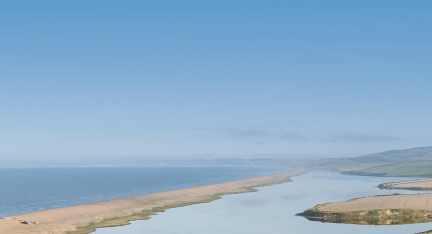


By the sea, in the forest, through the countryside, made for family adventures.








Gracefully yours
DEBRA MESSING ON BEING VISIBLE, VOCAL AND JEWISH
By the sea, in the forest, through the countryside, made for family adventures.



imAge foR illusTRATioN puRposes
Tel Aviv’s New s de d ov Rivie RA
AT The eNd of The dAy, we ARe All seARchiNg foR A plAce ThAT feels RighT
AshiRA is A luxuRy ResideNTiAl complex desigNed To RedefiNe modeRN isRAeli liviNg, wiTh uNcompRomisiNg coNsTRucTioN sTANdARds, Timeless ARchiTecTuRe, ANd A seTTiNg beTweeN The cAlm of The mediTeRRANeAN ANd The vibRANT eNeRgy of The ciTy.




New to The Bishops Avenue DISCOVER
With world-class wellbeing expertise, the energy of a private members’ club and refined hospitality, Riverstone offers bespoke luxury living for over 65s where independence is assured, always.
Properties from £1,575,000
Final south-facing residences available























16 34 60 99 110
While putting this LIFE together I thought about the way identity travels with us across borders, careers and shocking headlines. This was sparked by a conversation with pop star Noa Kirel and her goalkeeper husband Daniel Peretz, who appear to value their Israeli identity above fame and success. It was so moving to hear and that that feeling of belonging continued with cover star Debra Messing. Relentlessly trolled, she is one of the few celebrities who has spoken up continuously for Israel and the community, so it was interesting to hear her say: “Sometimes I wish I could get rid of the term ‘Zionism’”... “Zionism,” she explained, was about the journey and the aim is accomplished, “and with the word twisted into a slur… it’s unbearable”. For Debra, as for many, the fury is about the debate over the legitimacy of Israel “in a way that would be unthinkable for other countries”. It was a pleasure to meet her in New York, where I once lived. I was uneasy about visiting because of the noise around new mayor Zohran Mamdani. How different would it be? This is revealed on page 106, but, unlike London, where one feels overwhelmed by protests, ke yehs and vandalised bakeries, New York has more bagel shops than ever and stills wears its Jewish heritage with pride. Cities change, but belonging and the determination to hold on to that endures. Something to think about this Passover along with everything else. Chag Sameach.
Brigit Grant

Editor Brigit Grant
brigit@jewishnews.co.uk
Art director Diane Spender
Jewish News co-publishers
Richard Ferrer & Justin Cohen
Features editor
Louisa Walters
Sub-editor Alex Galbinski
Creative consultant
Dermot Rushe
Contributors Jenni Frazer, Etan Smallman, Charlotte Henry, Candice Krieger, Michelle Rosenberg, Hannah Litman
Advertising sales
Beverley Sanford 020 8148 9709
sales@jewishnews.co.uk
Gabbie Greenberg
Brandon Cowan
Cover photography
& make up: Gita Bass

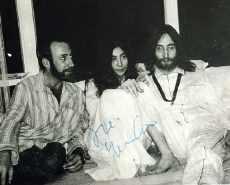
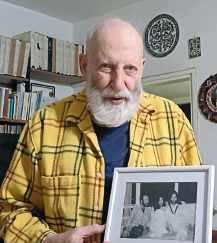
In March 1969, in a hotel room in Amsterdam, John Lennon sang in Hebrew for the first and only time. He and Yoko Ono were staging their anti-Vietnam War Bed-In for Peace at the Amsterdam Hilton, and journalists queued to speak to the couple beneath the sheets. Among them was Akiva Noth, an Israeli graduate student studying in Holland and freelancing for Kol Yisrael – the Voice of Israel.





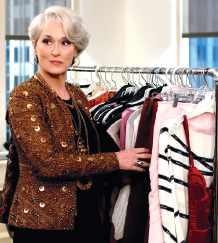
When The Devil Wears Prada 2 film airs in May, the spotlight will fall on the returning cast and the clothes. But while Jewish author Lauren Weisberger is not involved in the sequel, we can’t forget that the entire phenomenon began with her bestselling 2003 novel. Inspired by her time working as an assistant at Vogue, Lauren’s sharp insider tale became a publishing sensation and gave us the malevolent Miranda Preistley (played by Meryl Streep, pictured below).
“I waited until the last reporter left, then knocked,” recalls Akiva, now 90. “A man opened the door and said, ‘Yesss…?’ I shouted, ‘I’m from the Voice of Israel!’ From inside, Lennon called out: ‘Let the Voice of Israel come in.’” Akiva had brought his song, An Oath to Jerusalem, written for the Choir of the IDF Chief Rabbinate. He wanted Lennon to sing it, so transliterated the lyrics into English. “Minutes before John sang into my tape recorder, he also sang part of a
When Emily in Paris came to Israel, its star Lily Collins, who has Jewish heritage, was nowhere to be seen. But there was no hiding her on-off beau, chef Gabriel.
Invited to model for Renoir Fashion, French actor Lucas Bravo was paired with Israeli model Yael Shelbia and the mood was unmistakably playful. The campaign for the popular fashion brand shot over one day later had Lucas openly complimenting Yael, whom he described as “beautiful and smart”. For a moment, it felt like the kind of on-set spark that fuels headlines, as Yael is single, and Lucas rarely confirms relationships publicly.
song that wasn’t yet released.” The song I Want You (She’s So Heavy) later appeared on the Abbey Road album. “So I was afraid someone would come in, realise he’d sung the new song, take my tape and throw me out,” says Akiva, “So I only gave him two lines.”
Yerushalayim nishbanu kulam Lo nafkirech od mi’kan ad olam (Jerusalem, we all swore an oath / We won’t abandon you, forevermore.)
Yoko joined in and her husband introduced it with: “This is the voice of Lennon for the Voice of Israel.”
The recording survived and Akiva became a lawyer and songwriter. And his music moment with Lennon would have been forgotten were it not for his first cousin’s granddaughter, Rabbi Yael Buechler, who shared it with Life.


the idea of being any kind of expert. “I’m an introvert. I have zero moves. Every person I ever had a relationship with – we had to bump into each other at work or in life.”
Asked for dating tips, he laughed at
Watch this gorgeous space.
political badges. She complied,

If you think Lara Croft is fearless, meet the woman who gave her a voice. It’s 30 years since Tomb Raider launched, and Shelley Blond still has the kind of nerve that defined gaming’s most famous adventurer. She proved that at the 2024 BAFTA Game awards, when guests were told not to wear political badges. She complied, but another guest wore a ke yeh. “Production staff asked for it to be removed, but the person refused,” she says. “Embarrassed, they said I could wear the yellow ribbon – which I didn’t have. But I did have a bag.” Emblazoned with the
words ‘Bring Them Home Now’ she had intended to keep it out of sight but could now show it. For Shelley, whose husband Yaniv is Israeli, sharing the message was personal. “I was determined to make a statement and did so without being defiant.”
“Embarrassed, they said I could didn’t have. But I did have a it could whose husband Yaniv is Israeli, stage. “My parents said: ‘Get

Conti, an audition for legendary and after,Shelley by presenting casting call that changed
Determined from the moment she knew she wanted to be on stage. “My parents said: ‘Get your exams first then we’ll help you follow whatever dream you’ve got,” the dream became Italia Conti, an audition for legendary producer Bill Kenwright and a role in Only the Lonely in the West End. Soon after,Shelley was signed by a voiceover agent, which led to presenting work and recording for Disney. Then in 1996 came the casting call that changed everything: Shelley became the
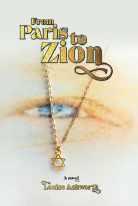
Paris is seen as a must-visit in spring, but for Jews in the Second World War, it was anything but. Romance and danger intertwine in Louise Ashworth’s gripping debut novel From Paris to Zion, a psychological thriller that tells the true story of a young man fleeing the city for England during the Holocaust. A chance encounter leads him grappling with his emotions and the turbulent relationships around him, and he must summon the courage to confront his deepest fears and unravel the dark secrets that threaten to tear his world apart. Amazon, £12
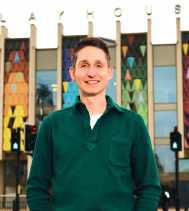

Barely out of the news since their first number one in 1963, The Beatles’ story continues at pace with Jewish director Sam Mendes’s forthcoming four films. Paul Mescal is Paul, Barry Keoghan is Ringo and James Norton is Jewish manager Brian Epstein. Currently, the way to see the Liverpool Four on film is in Midas Man (Amazon Prime). In the biopic, Jacob Fortune-Lloyd is mesmerising as Brian, portraying his meteoric rise and private unravelling, although at the Kiln Theatre, from April, yet another Brian will appear in Please Please Me. This is the work of Jewish playwright Tom Wright, who recently swapped his job as the Kiln’s artistic director for Leeds Playhouse. Proof of his pedigree is that the first week has already sold out. kilntheatre.com

voice of Lara Croft – “and I loved it”, she says in Croft tones. The twist is that Yaniv played Tomb Raider in Jerusalem long before they met. “He enjoyed hearing Lara protest ‘No, no!’ in the game,” says Shelley who is still a voiceover queen . “And now he hears the same words at home!”
Spring is the perfect time to give your home a refresh, and choosing a new floor can be simple, straightforward and even enjoyable if you do it with True Flooring in Hale Lane, Mill Hill. This friendly, independent Iranian flooring specialist helps homes look their best from the ground up, with elegant engineered wood, classic parquet, practical laminate or modern vinyl. The team will remove your old flooring and supply and fit your stylish new choice, making the whole process smooth and stress-free, with reliable service, quality workmanship and competitive prices.
trueflooringltd.com

Saving a theatre was the only thing to do, Steve Furst tells Brigit Grant
When Steve Furst talks about the Circle & Star Theatre in Hampstead, it’s clear it’s not a vanity project.
For one thing, he cycled through pouring rain to talk about it – then immediately starts checking the electrics before taking a pew in the bijou and surprisingly versatile space he’s created from what was The Pentameters, one of London’s first modern pub theatres.
Running a theatre was never in Steve’s plans – “not until my friend saw an eviction notice in the window.” Steve, a lifelong champion of live performance, felt London had already lost too many small stages to let another disappear.
Fortunately, The Horseshoe pub is owned by another friend. “He said, ‘Put a proposal together’, which I did, then I had to raise about £40,000 as the theatre was not in a good state.”
That is something of an understatement. Twelve tonnes of rubbish were removed – including two cat skeletons – before relentless improvements began in September, culminating in a December opening.
And who might fill the snazzy little room decked with melancholic Charming Baker artwork? Not a problem for Steve Furst. Working
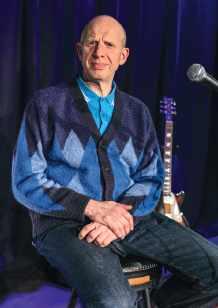
across television, film and theatre for more than 30 years delivers mates, and he starred alongside them in Little Britain, Friday Night Dinner, Doc Martin, Matilda The Musical, Oliver! and on it goes.
together in a space that’s full of history and creativity,” he adds.

“Hampstead has always been a home for artists and performers, and this is our way of celebrating that spirit for a new generation.”
Circle & Star is available as a dry hire or on a percentage split –though securing a date may be the real challenge, with so much already lined up. Songwriter Sessions with Grammy award-winning composer David Arnold are on offer, alongside monthly comedy nights, upcoming literary readings and radio-style rehearsed performances.
“In Glasgow they do ‘a play and a pint’, which lets people cut their teeth doing new work and the audience pays £20 to see it at lunchtime with a pint. I want to try that.”
Steve was an excellent Fagin, but it’s Lenny Beige –his cabaret alter ego in a Willy Hunt suit who has the following. Lenny’s Talk of the Town-style parodies are nostalgia with bite, so the Beige does Bowie night at Circle & Star sold out before many had heard about it.
Picture Lenny channelling the Thin White Duke and you know what you missed.
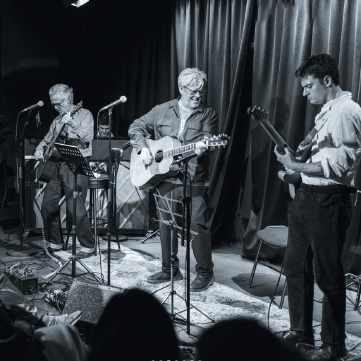
Keep checking the website or become a member if you want to Beige – or Hampstead local, composer and producer Guy Chambers (of Robbie Williams fame), who is hosting regular intimate acoustic evenings showcasing emerging musicians. Damian Lewis was one them.
It’s a small stage so where do they wait?
“Behind there,” says Steve, pointing somewhere. “It works. Guy plays with them and it's amazing. We haven't got a drum kit at the moment, but there’s no issue with just acoustic stuff. “It is about bringing people
Thinking big in a small space isn’t new for Steve, who is anything but ‘beige’ ironically.
“But the room’s intimacy is its strength,” he says. “A deaf woman who has come five times was so emotional after the Guy Chambers night. She told me ‘this theatre has changed my life.’ And that’s because she lipreads and as venues have got bigger, she can't see performers’ mouths. Here, it's so close, she can see and we always give her the same seat. That’s brilliant.”
Keen to improve access, he acknowledges that a Victorian building has its limitations, so Circle & Star can only be reached by stairs. “But we did carry up a wheelchair,” chips in Steve. “It wasn’t easy, but we did it.”
Steve’s versatility has kept him ‘wanted’ – next up is the HBO series War – and, if he wants to headline, he now has a space.
“It’s an important space,” he says. “No one's going to get rich from doing this. But we can build up something that is memorable and wonderful.”
circleandstar.com
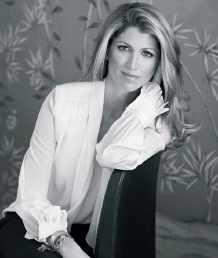
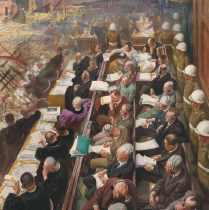
Historian and bestselling author Natalie Livingstone has built a reputation for taking well-known chapters of history and revealing the women who helped shape them in her books The Mistresses of Cliveden. and The Women of Rothschild Her latest, The Nuremberg Women (published by John Murray Press on 23 April), turns to the aftermath of the Second World War and the landmark trials. But Natalie focuses on the extraordinary women who were present – journalists, interpreters, lawyers, artists and witnesses – and whose work helped the world to understand what was unfolding.
Among them are the anti-Nazi writer Erika Mann, Soviet interpreter Tatiana Stupnikova, British artist Dame Laura Knight – whose courtroom painting became a defining image of the trial – and Auschwitz survivor Marie-Claude Vaillant-Couturier, whose testimony exposed the horrors of the camps.
As Natalie puts it, the book is about “a search for truth among misinformation, love among ruins and light in overwhelming darkness”.
This is not just a candle, this is a beautiful hand-crafted soy candle with intricate attention to detail and it’s what you should be taking your seder host this year. Pair it with a design-oriented stylish box or jar of matches and you’ve got an original gift that really makes a change from the usual. Jackson B (@jackson_b_interiors) is a new gift shop in Mill Hill filled with large variety of gifts, home decor/ accents, pop art, lifestyle and

wellness products. Every item has been carefully sourced from independent UK companies, focused on uniqueness and affordable luxury. jacksonb.co.uk

For more than 30 years, Ono International School in Israel has combined academic leadership with career-oriented education, an integrated English-Hebrew curriculum, and comprehensive academic and personal support. Students are challenged intellectually, supported personally, and prepared professionally. English-taught and hybrid English-Hebrew programmes allow them to begin their studies in English while gradually acquiring Hebrew skills and integrating into Israeli academic life and culture. ono.ac.il

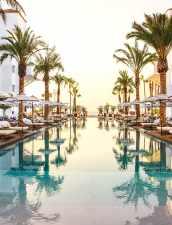
In what is becoming known as Tel Aviv’s new riviera, Ashira is a striking development in the Eshkol neighbourhood of the New Sde Dov Quarter. Designed by architect Avner Yashar, with interiors by Dana Oberson, the project combines residential buildings, commercial areas, parks, a promenade and a marina, all connected by new public transport links. A range of twoto five-bedroom apartments are on offer. ashirabyavisror.com
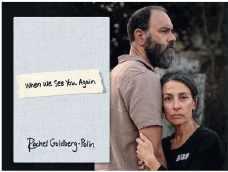
After the unimaginable loss of her son Hersh Goldberg-Polin in the aftermath of the October 7 Hamas attacks, Rachel Goldberg-Polin has turned grief into testimony. Her new book is a deeply personal account of love, resilience and the global campaign she and her husband Jon led to bring home their son. Written with honesty and moral clarity, it captures a mother’s voice, which the world has come to know, and the enduring legacy of a family that refused to be silent. When We See You Again (Random House) is available on 21 April.










Meet the former journalist who gave a tired mother a plot twist and created a bestseller. By
Brie Bailey
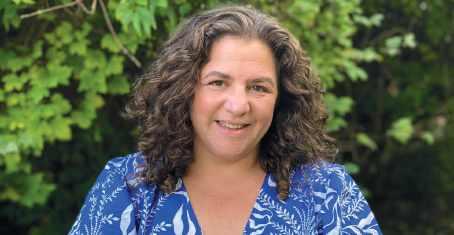
Life has changed for Ellie Levenson since her first novel was published. And yet, in many ways, it hasn’t changed at all.
She is still picking up her three children from school, shopping and making dinner. The difference now is that while cooking egg and chips she Zooms with Sarah Jessica Parker.
SJP is publishing the American imprint of Ellie’s debut novel Room 708.
It’s in Room 708 where the drama unfolds for protagonist Kate, a mother who makes a decision she shouldn’t have and finds herself trapped in a hotel. I can’t say more as there should be no spoilers for this deeply suspenseful exploration of marriage, guilt and complicated choices. It’s like a film, in fact, which this book will inevitably become as it’s so dramatic. Ellie is entirely the opposite. Warm, funny and unassuming, she’s a nice Jewish girl from East London who is thrilled her book has found readers.
“People keep asking if it’s me,” she says. “And I’m like, ‘no, it’s fiction. The affair isn’t me, and the meeting in hotel rooms isn’t me –but being a tired mum? That’s me.’”
It was Ellie’s exhaustion when her children were little that sparked the idea for the novel. “All I wanted to do was go to a hotel and sleep. People would be like, ‘What, with a lover?’ And I was like, ‘No, God, no. No thank you. I want to go and sleep.’”
From this, Ellie got her complicated heroine, Kate. “She was always clear in my mind from the moment I put pen to paper in


2018 and I wanted her to be every woman. To be completely relatable.”
That universality explains Ellie’s unusual decision to not describe Kate’s appearance.
“We have no idea what she looks like,” Ellie says. “We don’t know her skin colour, hair colour, if she is she fat or thin. I did that deliberately.”
Ellie came to fiction after years as a freelance journalist and lecturer at Goldsmiths. But the desire to write a novel never left her.
“I’m an English graduate. Don’t all literature graduates want to write a novel at some point? And it got to the stage where I thought, ‘I’m in my 40s – I have to do it now and stop talking about it.’”
The book took years to shape and is different to when she first submitted it.
“My agent said, ‘You need to put it into threads,’” Ellie recalls. “So I separated everything – the past, how she met her husband, her lover, and the present – then wove them back together. I always think of it as a bit like plaiting a loaf of challah.”
are complex and fallible and if things go wrong, it’s sad, but not the end of the world.”
For all the international attention the book is receiving, Ellie remains grounded. “It was my mother who wondered if the book deal meant a move to a bigger house.”
“It hasn’t changed my life materially in that way,” says Ellie, who lives in Loughton, near to her childhood home. “But the novel has sold in multiple territories, so it’s financially bought me the equivalent of a salary for a few years to see if I can write another one.”
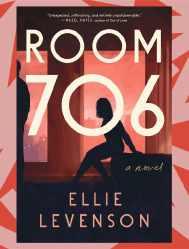
It has changed how she introduces herself.
“I can say I'm a novelist, when asked what I do, and I really am a real one. So that’s quite nice.”
There are bookshop introductions and promotional appearances, but life for Ellie is still reassuringly familiar.
Ellie’s Jewishness – lightly worn but unmistakable – runs through her storytelling.

“So I'm writing at my kitchen table, picking up the kids from school. And...” Yes, sometimes between frying egg and chips, Sarah Jessica Parker calls.

“I think everything a Jewish writer writes is Jewish,” she says. “Because it reflects your ways of looking at the world. We understand people

Room 706 is published by Headline. Ellie Levenson will be at Edgware Library on 15 April as part of Barnet Libraries Literary Festival. For tickets: barnet-libraries.played.co

JOIN TECHNION UK FOR A GALA SHOW TO CELEBRATE ISRAEL’S 78TH ANNIVERSARY

WEDNESDAY 22ND APRIL, 7.30PM LOCATION EUSTON O –


Hosted by ROB RINDER
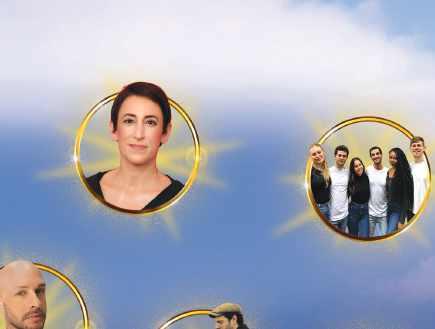

ISRAEL ERNEST Singer
MARK MAIER
With a special video message from THE PRESIDENT OF ISRAEL
ROI EREZ Pianist and guitarist
Join us for a special evening marking 78 years since the founding of the State of Israel. This show tells the story of The Technion – Israel’s first University and its leading institute of Technology, born from a visionary Zionist dream in 1923 and grew into one of the world’s top scientific institutions.




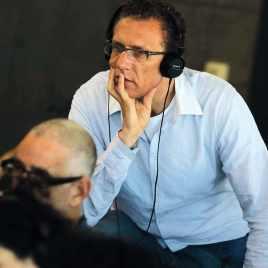
IZZY founder Nati Dinnar tells Jenni Frazer he wants Israeli content reaching audiences, whatever the view
As befits a former basketball player, Nati Dinnar is folded, rather than simply sitting, in the chair opposite me, his long limbs stretching well beyond its frame. We meet in Tel Aviv to talk not about sport – although basketball has shaped much of his life – but about IZZY, the streaming platform he founded to bring Israeli storytelling directly to global audiences. If viewers discovered Israeli drama through series such as Shtisel or Fauda , IZZY offers a deeper library of shows that never travelled beyond Israel’s borders.
Nati, 57, calls himself “a child of television” He started in Israeli commercial TV before moving into production. A documentary thriller he made about the 1972 Sabena hijacking drew acclaim but failed to land a major international platform. “The only way people [outside Israel] could see these films was at Jewish film festivals,” he says. When the festival ended, so did access. In 2020, spotting new tech opportunities, he and a partner launched IZZY as a direct-to-consumer platform for Israeli content. Debuting in September 2020 with a modest
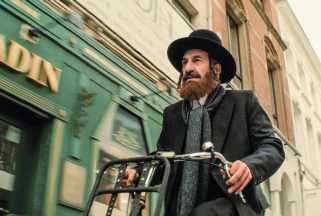
catalogue, it benefited from Covid lockdowns. “We began to get subscribers, and every week provided new content.” Much of it had succeeded in Israel but had never been properly distributed to diaspora audiences.
The guiding principle was “good storytelling”. Israeli drama, he argues, thrives on originality and emotional depth rather than budget. Some series travelled; many more did not. IZZY became, in his words, “a bridge to connect the world with Israel”. He knew overseas Israelis were already accessing content through piracy. “But they watch in Hebrew. And piracy doesn’t offer subtitles.” From the outset, IZZY prioritised subtitling as part of his “mission to enhance the world’s relationship with Israel”.
Early growth was steady. Then October 7 happened. “Something internally changed in me,” Nati says. “I didn’t just want to build IZZY as a streaming platform. It became my duty, my obligation, my calling – because Israel needs to be independent in the way it communicates with the world.”
He distrusts reliance on global conglomerates. “We don’t know when executives and decision-makers will say, ‘This is not a good time to deal with Israel.’ Projects are already being kept on the shelf.” In 2024, when foreign airlines paused flights, he said to his wife: “Imagine if we didn’t have El Al, an airline that we control, so soldiers could get back to Israel and fight for our country.”
“This is IZZY,” he continues. “The Netflixes, the HBOs – they license content from Israel and want to air it but executives say there’s a price to pay for showing Israeli content. We have to build a platform big enough to not rely on them.”
Still, he believes drama cuts through politics. “There is an appetite for good stories beyond the Jewish world. If you shut down all Italian restaurants in New

York, people will still want Italian food – they just won’t have a place to get it.” IZZY, he argues, keeps a table open.
The platform is not yet financing largescale originals, but holds exclusive rights to Kugel, the Shtisel prequel, and hints that 2027 will bring its first internationally-designed drama. Its slate now includes documentaries, podcasts and cooking and, soon, a news update programme.
Born in Boston while his father studied at Harvard, Nati grew up in Haifa with periods in the US. Basketball and TV defined his youth: four years as an IDF combat soldier, rising to lieutenant; two years playing professionally for Maccabi Haifa; then a move into commercial TV marketing in the ’90s, film production and, finally, his “last stop” – IZZY He repeatedly describes it as “a way of giving Israel soft power,” arguing that cultural exports shape perception more effectively than press briefings. “If audiences connect to Israeli characters – their humour, tensions, moral dilemmas – they may start to see the country in fuller dimension."
For Nati, IZZY is about a long game built on the belief that “good storytelling” can travel further, and endure longer, than politics alone.
Michelle Rosenberg discovers Chagall hidden in a Kent church – then follows the art trail beyond it
The small but beautiful All Saints’ Church, Tudeley, accessed via a ‘blink and you’ll miss it’ side road in Kent, is the most unlikely of settings for a sacred piece of art history.
Nevertheless, it is the only church in the world to have all of its 12 breathtaking stained-glass windows created by Belarusian painter and sculptor Marc Chagall.
Near Tonbridge in south-east England, the church dates to the 13th and 14th centuries and was largely rebuilt between 1745 and 1770. The unassuming building betrays nothing of the heritage or the emotional and spiritual weight it holds. Yet those of any faith or none cannot help but be drawn into stillness and quiet contemplation by the sheer beauty, the vibrancy of the blue, yellow and white stained-glass windows with Chagall’s scrawled signature in the corners.
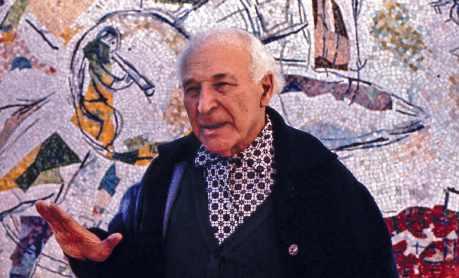
Known for his dreamlike depictions of flying goats, roosters and cows, fiddlers on roofs, floating lovers and angels, Chagall created an oeuvre comprising 10,000 artworks, including lithographs, etchings, sculptures, ceramics, mosaics and tapestries. He once said: “Perhaps I could have painted another Jewish prophet, but after 2,000 years mankind has become attached to the figure of Jesus.”
During his career, Chagall accepted many non-Jewish commissions: stained glass for the cathedrals of Reims and Metz, a memorial at the United Nations, the ceiling mural in the Paris Opera and another in New York’s Metropolitan Opera House.
Incorporating Christian motifs into his work, Chagall described Jesus Christ as “the radiant young man in whom young people delight”.
Back in Kent, the East Window of All Saints’ Church was
commissioned in 1965 by the then owners of Somerhill House. Not as a grand gesture or show of extravagance, but as an act with profound intention.
The owners – Sir Henry, who was Jewish, and his Christian wife, Lady D’Avigdor-Goldsmid – turned to the revered artist to create the window in memory of their daughter Sarah, who drowned in a sailing accident off Rye in 1963. She was just 21.
Two years earlier, Sarah and her mother had visited Chagall’s exhibition at the Louvre, where the centrepiece was his luminous cycle of windows for the synagogue at the Hadassah Medical Centre, depicting the Twelve Tribes of Israel. Sarah was captivated by them.
It was that remembered love that led her parents to ask Chagall, who, while initially reluctant, agreed. But when he visited the church for the dedication of the East Window in 1967, he was so moved by its beauty that he declared: “This is magnificent. I’ll do them all.”
Collaborating with glassworker Charles Marq of Reims, over the next 15 years Chagall designed the remaining 11 windows. The chancel windows were finally installed in 1985, which was also the year of Chagall’s death at the age of 98.
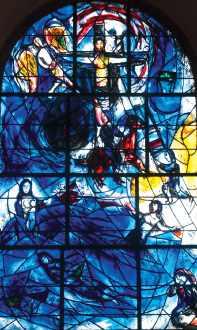
Sarah’s younger sister, Chloe Teacher, now 81, is chairman of the Chagall Window Preservation Trust and she met the artist at the first installation.
“He was completely wonderful and very flirtatious,” she reveals.
“He loved the church because it was completely empty of anything, and his window looked magnificent. And he said, ‘I’ll do the lot’, of which was a marvellous proposition.
“What’s absolutely stunning about the church,” she adds, “is that, because it was conceived as a whole, you view it as a whole, and each window gives a tremendous amount to its
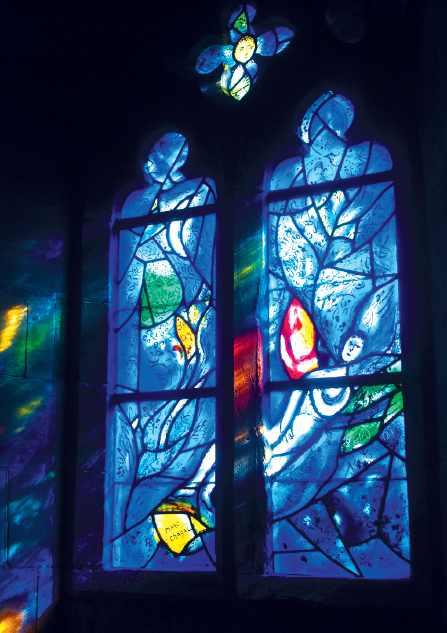





‘The windows never let you down.
The church is a place of spirituality as well as of beauty’
neighbour. It’s never a disappointment. They never let you down, and it’s a place of spirituality as well as of beauty. Perhaps the two go together, and I don’t have a favourite. Chloe is always delighted to see lots of visitors.
“My weekend guests are often thrilled to come to the church, not seeking for the service, but for the windows, and it’s a real draw.” With light pouring through Chagall’s windows – and Sarah’s in particular – be sure not to miss that Tudeley lane; what waits inside will lift you.
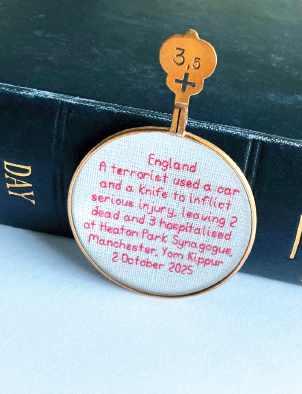
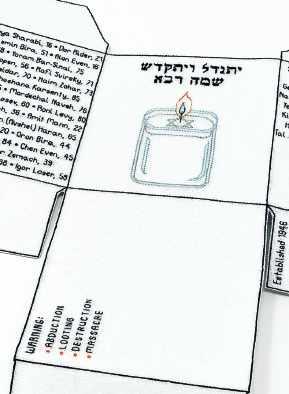
Caren Garfen is a London-based textile artist known for her meticulous hand stitching and deeply researched work. Using fabric as both material and message, she tackles urgent social issues, gender stereotyping, dieting, eating disorders and body image.
Since 2019, her focus has turned to the Holocaust and the rise of global antisemitism. An awardwinning artist, Caren has exhibited across the UK, Europe, Australia, Japan and the US, with works held in both public and private collections.
Invited to exhibit in the III International Biennial of Contemporary Fiber Art at the Museum of Embroidery and Textiles in Valtopina, Italy (4 September to 8 December),she is also creating a new piece centred on Jewish people abandoned by close friends since 7 October.
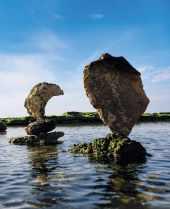
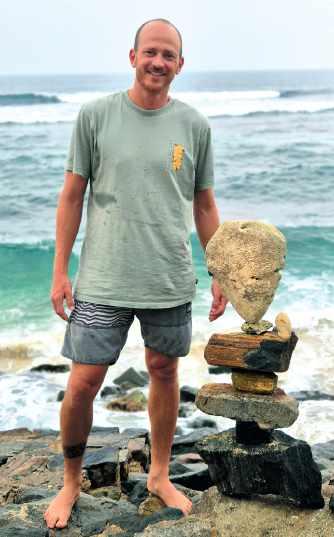
Shai Kedar, a 39-year-old artist from Herzliya, went to the beach “just to get some quiet”, he says.
“It was the middle of the week; it was empty. I went with a jacket, a coat, long pants and a hoodie. It was cold. I had no plans or expectations.” At the
time, the Hamas-Israel war was ongoing and 90 hostages were still in Gaza.
He began “doing my stone balancing, which I find is my therapy”. Stepping into the water, he stacked one stone, then two, then five, then 10 in a small lagoon.
As people stopped to watch, he told them: “I wonder what 90 stones look like for the 90 hostages, because it’s unimaginable.”
One by one, he built them. “And every few minutes, I heard a splash and one had fallen down. It wasn’t easy. I got there at sunrise, and it was closer to sunset by the time I finished.”
When all 90 were finally standing, he went to record the achievement. “And then I got my camera out and took pictures until the last light, until the sun had built behind the sea. And I was so thrilled and excited, looking for myself through the stones, the imbalance of the hostage situation, and the stones which can fall down into the water in a minute and disappear. They can stay there, or they can be home [in the water]. No one knew.
“And after 24 or 48 hours, the stones had all gone; fallen into the sea. It was back to normal.”
For Shai, that felt symbolic. “It was a nice closure,” he says. “And people kept reaching out to me after a week saying that they saw it, they went by, they felt the energy.”
He is drawn to stone balancing because of its fragility. “Sometimes it holds for a day. Sometimes it holds for a minute. You’re working on one or two or three or four stones; you’re trying to find balance in the most unnatural way, and then someone can see it, and after a minute, it’s gone. And when it falls down people ask me, ‘Are you not upset?’”
“I know it’s temporary. And that’s part of the thing, being in the moment, as some kind of meditation.”

• Affordable Art Fair, Hampstead (6–10 May): Contemporary art in London. affordableartfair.com
• Wimbledon Art Fair (14 –17 May), Features more than 180 artist studios. wimbledonartfair.com
• Photo London (13-17 May), The National Hall, Olympia. photolondon.org
• London Design Festival (12-20 September), South Kensington. londondesignfestival.com
• Frieze (14-18 October), Regent’s Park. frieze.com









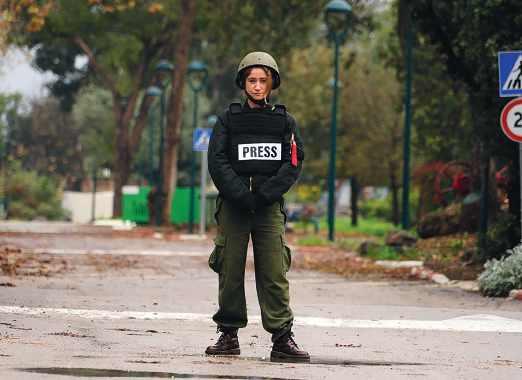
Eve Barlow remembers exactly where she was when she realised things had changed. “I was standing to the side of the Pyramid Stage at Glastonbury,” the writer tells Life . She was there to see Katy Perry, but Labour leader Jeremy Corbyn came out first. “I could see, from Corbyn’s perspective, the galvanised worship culture around him,” she recalls.
Back in the press area after Perry’s performance, “all everyone was talking about with stars in their eyes was Jeremy Corbyn”. There and then, Eve “had a crisis of conscience”.
Many of us have had such moments of horror over the past decade, and especially since October 7. They usually took place in less notable spots, though – and few of us have taken up the fight in the way Eve has, and continues to. Whether that is through social media, giving talks, or on her Substack newsletter, Blacklisted , Eve is not afraid to loudly and proudly battle antisemitism and advocate for Israel.
Indeed, while most return from Glastonbury needing to sleep and nurse a hangover, Eve reacted by doing what she knows best – writing. She wound up penning an open letter warning people about the risks of voting for Corbyn’s Labour party. Nobody would publish it. Undeterred, she put it out online herself. “I was like, ‘I have to say something’, and I vomited it out,” she explains.
Prior to this, Eve had gone from being the deputy editor at NME , an institution she revered
as a reader and for which she adored writing, to being a hugely successful freelancer in LA. She spoke to some of the planet’s biggest stars for some of the planet’s biggest publications. She had always thought she should stay in the world of music, film and pop culture journalism, but she found it impossible to look the other way when she noticed certain things.
At one point, a famous LA synagogue was vandalised during a Black Lives Matter protest. She tweeted her fury. “I basically said, ‘I support your rage. I support your right to protest. But you cannot fight one form of hate with another form of hate.’ And vandalising a synagogue is not the same as vandalising an Urban Outfitters or a Nike store.
Vandalising a synagogue is not taking on capitalism “unless… uhuh, you think you are because you think that the Jews control the world,” she points out. “That tweet got me completely and utterly cancelled.”
The freelance work dried up. “I immediately received [a message] from an editor at a huge content publication in America to say that I had made an egregious error on my Twitter and that this was a major problem. I never worked for them again,” she reveals.
Certain social media followers disappeared and relationships ended. “I noticed people were distancing themselves from me, pretending like we were never connected.” It was painful, given the sense of admiration and love she had had previously had from the music community.

‘It’s been six years since I was cancelled, and I have not relented at all.’
This hurtful incident propelled Eve into the next part of her life and career. She was no longer Eve Barlow, music, film and pop culture writer. “My fight or flight went into overdrive. It’s been six years since I was cancelled, and I have not relented at all.” That’s putting it mildly. Day in, day out, Eve has her say.
She does not see her work as political. “Having safety and security as a member of your society and having that threatened as a result of your ethno-religion or your sexuality or your race, that is not political,” she insists. She also argues that “identity politics has broken the discourse, and it has been utilised by bad faith actors”.
It is hard not to feel that her work is, in fact, political. Her sense that it isn’t actually underlines the collection of contradictions that make Eve such as fascinating figure to follow, read and talk to. She is the music journalist who had to leave the pop world behind. The apolitical activist taking on the hottest of topics.
Eve is also a proud lesbian who has pushed back against the pro-Palestinian tide in the lesbian, gay, bisexual and transgender (LGBT) community. Here, she is not the contradiction but the person pointing out that the Queers for Palestine crowds would not last very long in Gaza but would find themselves safe and celebrated in Israel.
Eve’s analysis is that, for decades, the LGBT
community has positioned itself as “the people who don’t fit in”, adding: “So, the branding of Palestinianism as being part of this makes a lot of sense.” If the Palestinians are oppressed, the members of another oppressed group must stand with them and take on the supposed oppressor. Never mind the Palestinians’ total rejection of gay rights, nor that, for all its flaws, Israel is the “friendliest, most accepting society for [the LGBT] community in the Middle East”, Writing in the Jewish journal Sapir, Eve argued that “it should mean something to the LGBTQ community that they’re defending their own would-be murderers; at the very least, they should know their proper place in Hamas’s worldview. (Hint: no place.) That this means nothing to them says a lot”.
Doesn’t it just.
Eve Barlow is one of those people with whom you can talk for ages. She is engaged and engaging, even when holding a transatlantic conversation over video, instead of in the pub. Her eyes gain an intensity whenever you hit on a passion point.
It is, though, hard to pick out the real person under the rhetorical armour developed after years of charging towards enemy lines. Eve is proud of her fight and her own resilience, while also clearly missing the life she once had. Perhaps, in the end, she has ended up exactly where she was always meant to be.









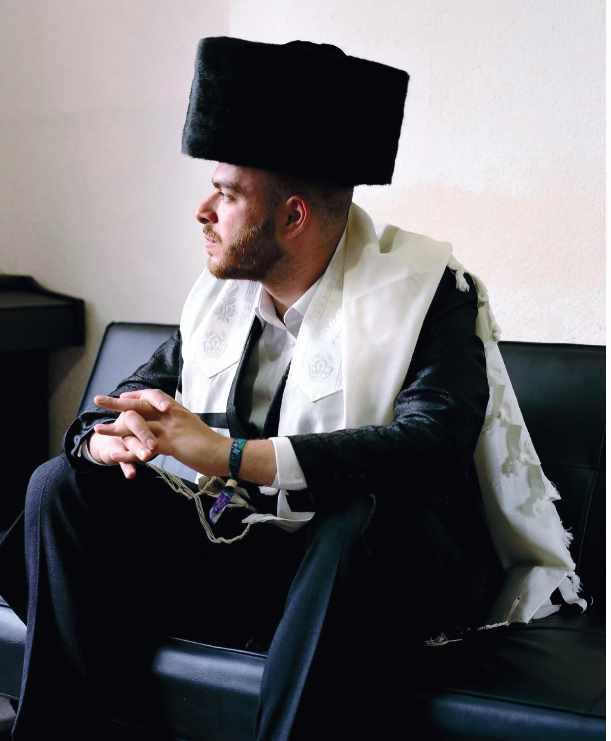
Ahipster coffee shop come co-working space in Old Street is probably not exactly where Pini Brown thought he would end up. It is certainly not what was meant to happen. But that is where I meet with the chazan and singer. He is an intense figure, fidgeting in his leather jacket and fielding phone calls from a synagogue, while telling his rollercoaster of a life story – from yeshiva rebel to musician. “I was a bit of an outsider,” he says.
Just days before we meet, Pini was in the crowd watching fellow Israeli singer Noga Erez perform in London. Such shows have become something of a “safe space” for Jews and Israelis in the city, as they come together to find some peace and escapism through music.
Pini comes from a strictly-Orthodox background in Jerusalem but was later sent to London. “I remember my first time coming here – it was incredible,” he recalls. “I was in a big van from Luton Airport to Stanford Hill.” He was soon set up with a woman to whom he became engaged on the day they met.
The expectation, of course, was that they would remain married forever. However, the marriage did not last long, and it does not appear to be something Pini is keen to talk about. It “wasn’t my thing… I think it just was a bit too much,” is all he will say on the subject.
Unlike many in the community in which he grew up, music is foundational to Pini. “I think, if you’re a musician,
Charlotte Henry hears the story of a chazan who has travelled from tradition to a modern sound
you’re f****d up, you just wake up in the morning thinking about it, go to sleep thinking about it, then dream about it. It’s just part of your life,” he says. The cantor David “Dudu” Fisher is one of Pini's key inspirations. “[I] grew up listening to his music,” he says.
Pini reveals that originally, he was shy about singing, “but then I got to like 17 or something, I was like, f***k it, I’m just going to do it. I want to study music.”
At that time, being a chazan was the only real way to balance music and religion. Again, that made Pini an outsider. “It definitely wasn’t a cool thing to do.”
In yeshiva, he got himself a small melodica, although the boys were not really allowed musical instruments. When in the UK, he would sneak out to Dalston in a hoodie and go into jam sessions.
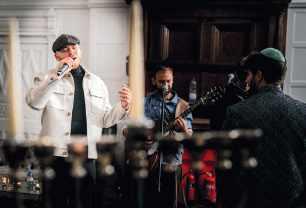
Indeed, Pini still loves being a chazan in synagogues, but he also brings together the past and the future in his other music. He is working to combine Aramaic, Yiddish, Hebrew and English with electronic backing and increasingly wants to focus on original work.
From weddings to barmitzvahs, and even in times of tragedy, music has always brought Jews together. We saw that only recently, as videos emerged of Israelis dancing in bomb shelters during Purim as the latest war with Iran escalated in the skies above them. For Pini Brown, it has brought him into the heart of communities here in the UK. He is no longer the outsider.
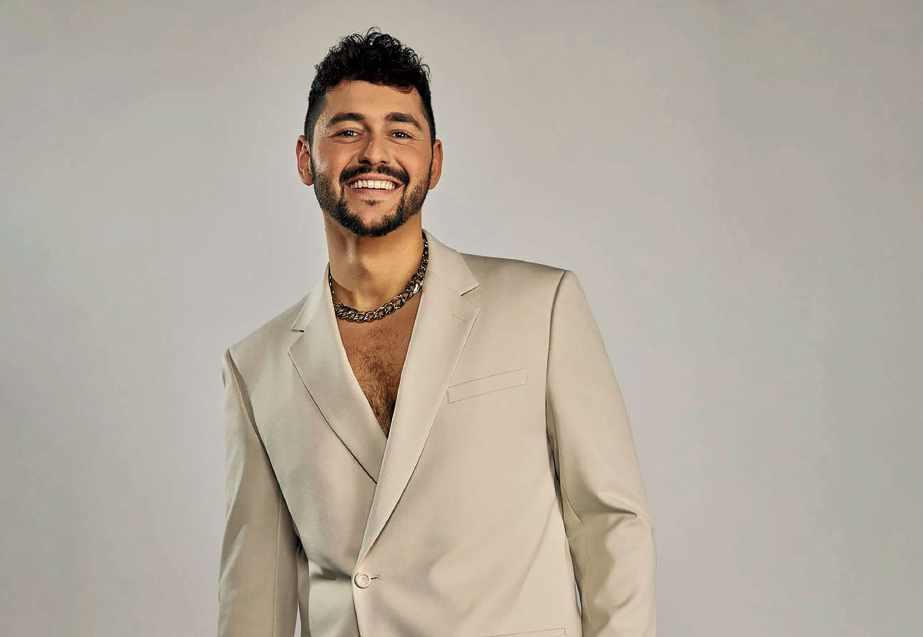
Eurovision Chai
Israel is once again entering the Eurovision Song Contest. This year, Noam Bettan will raise the flag with the song Michelle, performed in English, Hebrew and French.
The track was written by Nadav Aharoni, Tslil Klifi and, notably, Yuval Raphael, who represented Israel at Eurovision 2025 with New Day Will Rise That song – written by Keren Peles and performed in the same three languages – became closely associated with Yuval’s own story as a survivor of the Nova festival massacre and is an anthem of resilience.
Alluding to October 7 in lyrics caused problems for Eden Golan in 2024, when the title of her song, October Rain, had to be changed to Hurricane. Doing so did not satisfy the other contestants, who bullied Eden and, outside the stadium in the
Swedish host city of Malmö, the protest was led by Greta Thunberg.
Michelle, released on March 5, moves away from those ballad-style entries, but its popularity in Israel grows by the day.
Bettan secured his place after winning the talent show HaKochav HaBa (The Rising Star). Born into a French family, he grew up in Ra’anana and has already enjoyed success with several radio and streaming hits. He released his debut album in 2023.
Israel has done well in recent contests, finishing fifth in 2024 and second in 2025 – both times performing far better in the public vote than with the juries. The question now is whether Noam can once again galvanise viewers across the continent.
Eurovision 2026 is being held in Vienna. The semi-finals are on 12 and 14 May, with the grand final on 16 May.

‘ Michelle moves away from those ballad-style entries, but its popularity grows by the day’
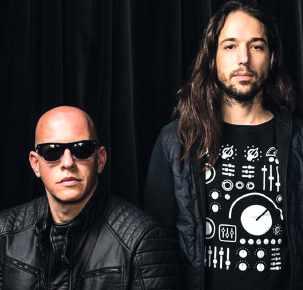

• INFECTED MUSHROOM – 3 APRIL, MINISTRY OF SOUND (LONDON)
The genre-defying electronic music DJ/producer duo will be celebrating 30 years of being together at London’s iconic Ministry of Sound. Not for the faint-hearted, it’s their only confirmed date in the UK this year.
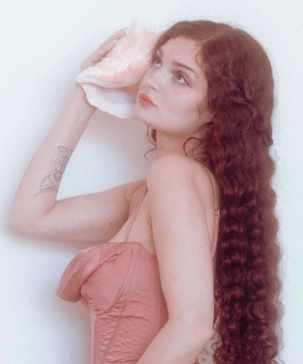
• BANSHEE – 3 APRIL, DOWNSTAIRS AT THE DOME (LONDON)
Rachel Knight, better known as Banshee, is a Jewish singer/rapper from LA, who has been clear in her support for Israel, leading for calls to boycott her. She’s taking her intense mix of metal-inspired heavy pop on tour, including to London.
• NOGA EREZ – 11 APRIL COACHELLA (CALIFORNIA), 18–19 LOLLAPALOOZA (BERLIN)
Noga Erez's fans travel the globe to hear her alternative pop , hip hop and electronic sound and copy her kooky style. So California won’t be a problem and Germany is so near.
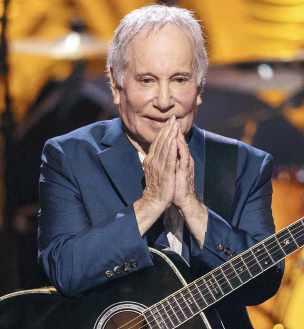
• PAUL SIMON – 13/14 MAY, ROYAL ALBERT HALL (LONDON)
He might have a long and complex relationship with Israel, but Paul Simon remains one of the greatest (Jewish) songwriters of all time. His A Quiet Celebration tour will be arriving at one of London’s most famous venues for what should be two very special nights.
• HAIM – 27 JUNE
DREAMLAND SUMMER SERIES, MARGATE
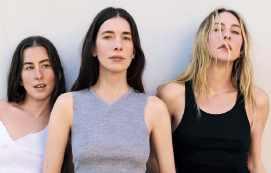
The Los-Angeles pop-rock trio made up of sisters Este, Danielle and Alana Haim will be back and forth to the UK this year with their blend of 1970s-style classic rock, indie pop and R'n'B.
• FATHER JOHN MISTY – 12 JUNE, LONDON’S LIDO FESTIVAL
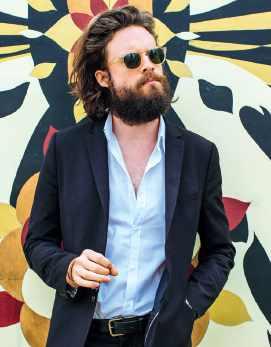
The American indie artist born Joshua Tillman to a Jewish mother is touring in support of his album Mahashmashana
• ITAMAR ZORMAN – 12 APRIL, WIGMORE HALL, LONDON
Itamar Zorman, an Israeli-born violinist and winner of the 2011 International Tchaikovsky Competition, is performing violin works including Ravel sonatas with pianist Adam Golka. A notable presence on the London chamber music circuit.
JEWISH CULTURE MONTH – 16 MAY TO 16 JUNE
A cultural coming together with more than 100 events across the country spanning food, comedy, art, architecture, fashion and music from the likes of Flame duo Erwin and Gaynor Keiles. From our poets and picklers to our star performers and deepest thinkers, prepare for the best of Jewish culture in the UK, past and present. jewishculturemonth.org.uk


have already risen significantly.

Many of the neighbourhoods in which people most want to live across Israel today once looked very different. They began as open land or early construction sites, where shrewd buyers recognised the opportunity long before the wider market.
Within Anglo communities, reflections are often heard.
“We almost bought there 10 years ago.”
“We looked at it when it was still affordable.”
“If only we had taken that opportunity back then.”
Israel’s property market has repeatedly shown how less established areas turn into thriving communities. Places once considered uncertain have become vibrant neighbourhoods.
Across Israel’s property market the pattern repeats itself. Developers lead the way.
Construction companies spend years studying where cities will expand. Long before a neighbourhood becomes widely recognised, plans are already in place for infrastructure.
As residents move in and communities quickly form, the demand grows, and what once seemed like an emerging location becomes a highly sought-after address.
For overseas buyers, recognising these opportunities from afar can be difficult. Many naturally look towards established neighbourhoods, where friends or family already live.
Yet by the time an area becomes widely recognised, prices
Understanding where developers are building offers a clearer perspective. Buying at the earliest stage of a development allows buyers to secure property at today’s price, before the growing demand pushes values significantly higher. For many overseas buyers, the challenge has simply been access.




Next Nest serves as the international sales team for Israel’s leading property developers, connecting overseas buyers directly with new residential developments across the country.
Because buyers purchase directly from the developer, no brokerage commissions or agent fees are involved. With representatives in both Israel and London, the team guides buyers through the process, including payment structure, currency rate solutions and legal advice.
New developments allow buyers to secure a property with only 20 percent deposit at the pre-sale stage, with the remaining payments structured across the construction period. This creates a practical way to enter the Israeli property market, even for buyers who may not plan to live there immediately but wish to secure an asset for the future or for their children.
Several locations across Israel already illustrate where this next wave of growth is taking place.
In South Netanya, areas
surrounding the well-established Ir Yamim neighbourhood are drawing increasing attention from developers. New projects neighbouring the community are already known as the ‘Young’ Ir Yamim, allowing buyers to enter the same sought-after coastal area at a signifi cantly lower price.
Carmei Gat North is the next phase of the already-established Carmei Gat neighbourhood. The original community is now built and home to Israel’s fastest- growing Anglo populations.
In central Jerusalem, limited space drives high prices, while new neighbourhoods are expanding just beyond the city centre. Even in long-established Anglo hubs such as Ra’anana, a brand new neighbourhood is being built.
With an English-speaking team and a representative based in London, these opportunities can now be explored with guidance close to home. Purchasing off-plan allows buyers to secure property in Israel today, before prices rise further, while building a long-term foothold for the future.
To learn more about current projects or to book a consultation: WhatsApp +972 50 876 9333 Cassie@next-nest.co.il

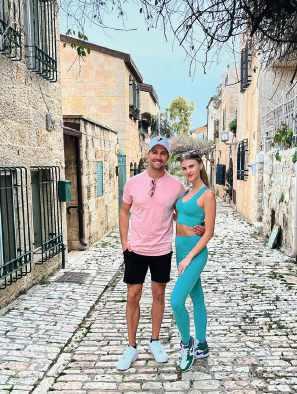
Noa Kirel and Daniel Peretz went viral with their wedding, but beyond their success they carry more than their careers abroad – they carry their country. By Brigit Grant
The Eurovision Song Contest in 2023 was staged under different skies. Liverpool hosted on behalf of Ukraine, still fighting for its survival – and the UK’s entry, Jewish singer Mae Muller, got a disappointing 24 points for her rendition of I Wrote a Song
But many of us were also waiting for the other Jewish performer, Noa Kirel. And when she performed Israel’s Unicorn , all bets were off. Even Graham Norton remarked on her beauty and formidable dance skills – and Israel duly finished third.
Daniel Peretz was watching too. Then goalkeeper for Maccabi Tel Aviv, he had a fan base of his own — “but not like Noa, she’s the most famous singer,” he clarifies and, coincidentally, they shared the same commercial agent.
T hey also had mutual friends and were both ambassadors for Puma, which brought them together at an event and “that was the first time we met,” says Noa.
It was after that that Daniel said something that now feels like football folklore: “I’m gonna marry that girl.”
T he declaration has sporting precedent. In 1996, David Beckham saw Victoria Adams in the Spice Girls’ Say You’ll Be There video and told a teammate, “That’s the girl I’m going to marry.” Britain got Posh and Becks. Israel, it seems, has its own version. Except we’re talking in Southampton.
Daniel is on loan from Bayern Munich for the remainder of the season and is already being hailed for his saves.

“It’s quite nice – we’re just on the coast, right?” he says of their new location.
“Yes, it’s really nice because we are used to living by the coast in Tel Aviv,” Noa adds, before smiling, “Not the same beach.”
With a combined social media following of more than two million, the Peretz-Kirel wedding photographs last November briefly eclipsed everything else online.
But before the spectacle came a first date –“which wasn’t really a date”, she insists.
“She came to a game, and after that, we sat with a lot of friends,” Daniel corrects.
Casual though it was, by the next morning Israeli media had decided otherwise.
“It was all about new couple, Noa and Daniel – and we were like, what?” she says. “It wasn’t even the first date.”
Speculation overruled privacy instantly,

so Noa did something direct and fast-tracked the romance.
“I invited him to my house with my parents… This is my house. These are my people – straight away, no games.”
Daniel arrived, she adds, “with flowers, like old school”.
Four weeks later, Daniel was sold to Bayern Munich. Noa’s reaction? “I said:“It’s impossible.’ To which Daniel replied: ‘You’re coming with me.’”
They didn’t know how it would work, but both felt something undeniable – and it shows. They interrupt, tease and finish each other’s sentences in a way that belies how recently they became a couple.
Israeli media was less romantic. “They were so mean to me,” says Noa. “Writing things like, ‘T hey’ve only been dating four weeks, why is she going with him?’ And I felt really confused.”
Both come from close-knit families. Raised in Ra’anana, Noa’s parents adjusted early to life with a child star when, at 14, she had her first hit, Medabrim (Talking), in 2015. Daniel, Tel Aviv-born, was devoted to football from the age of five, supported by a family who travelled the country for matches.
Four weeks into a relationship, they packed for Germany, with Daniel stepping into one of Europe’s most demanding clubs and Noa flying back to Israel for work. “I’m so happy we did it,” she says.
T hey were still adjusting to Munich and to each other when October 7 happened.
“We had disconnected from all the press and stayed away from social media,” Noa says. “And then the first time, I went to my phone… I said ‘Daniel, something crazy is happening in Israel.’”
Far from family, they watched the horror in fragments. “It felt like a movie,” says Daniel, who soon learned that his second cousin had been murdered. Noa, unable to stop crying, just wanted to go home.
A s one of Israel’s most recognisable couples, they are used to appearance requests – but after October 7 they were different. Asked to visit teenage Nova festival survivors and families evacuated from the south, they had no idea what to say to people who had seen what no one should see.
“Nobody prepared me, and I started to cry,” says Noa. “On the one hand, I’m coming to make them happy, but they’re telling me their stories, and I couldn’t believe what I heard.”
Daniel nods. “We cried together.”
I n a world that felt increasingly hostile, Munich surprised them.
“I think we were lucky,” Daniel says. “Munich was the best city for a Jew or an Israeli to live in after the war. The club offered me anything we needed and, in the city centre, a giant Israeli flag still hangs.”
S outhampton publicly welcomed him on arrival and, although he is aware of incidents elsewhere, he believes “what is beautiful about sport, about football, is I don’t feel it matters where you come from if you are professional and work really hard”.
Daniel may be insulated from politics in football but, for Noa, it has been different.
“After Eurovision , I thought a lot of doors would open for me but October 7 happened, and, you know, everything shut down for Israelis around the world. To perform globally is one of my biggest dreams…. and now it feels a little bit impossible.”
I mpossible, and yet she threw herself into work, filming a major Argentinian series, Noa , that required her to learn Spanish almost overnight. “I started to work on it in March and we filmed in April.” Evenings in Munich were spent with scripts spread out between them. “It was insane. Daniel would run lines with me.”
Daniel picked up some Spanish too, and although he arrived at Bayern Munich at the same time as Harry Kane, he has the stronger grasp of German – even if he is too polite to say so.
S oon after we met, Noa went back to Israel to start work as a mentor on The Voice. The couple speak constantly and live by a shared digital grid. “I’ll show you,” she laughs, pulling out her phone to reveal a 10-day stretch of Daniel’s home and away fixtures and her own movements between Southampton, Miami, Moldova and Israel.

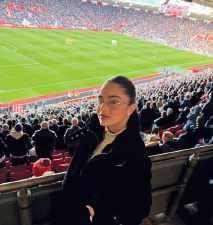
‘Wherever I go in the world, being Israeli is always part of me’
A nd yet, when she is in England, attending matches at the St Mary’s stadium, something shifts. “I’m just the goalkeeper’s wife, which I love. I’m used to being the centre of attention, but I love that it is about him and to see him play.”
Both are conscious of what they carry. “Wherever I go in the world… it’s always part of me,” Noa says of being Israeli. Daniel agrees. “Wherever you go, it’s the way you act, the way you behave, your values.”
A nd on that shared understanding Noa has more to say: “For Daniel to be here and to play abroad… it's showing the different and the beautiful side of Israel.”














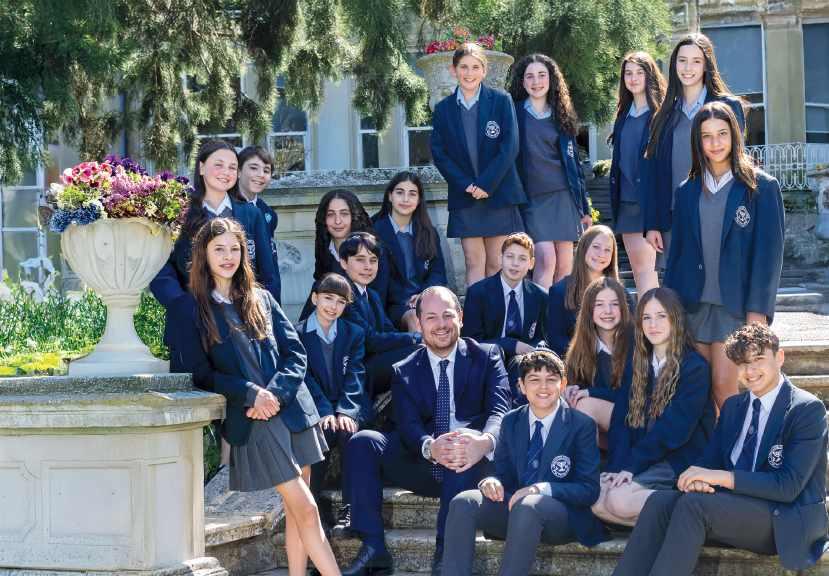
At Immanuel College, it’s personal. And that’s what makes the difference.
Join us at our Open Evening to explore starting in Year 7, or at other year points, and discover why families choose Immanuel College.
We believe in the power of small class sizes and a nurturing community where every child is seen, heard and encouraged to thrive. We offer the opportunity to excel academically and be inspired by their Jewish education with the support of expert pastoral care.
Find your place and your people.
Register for our Open Evening and start your child’s journey with the Immanuel family
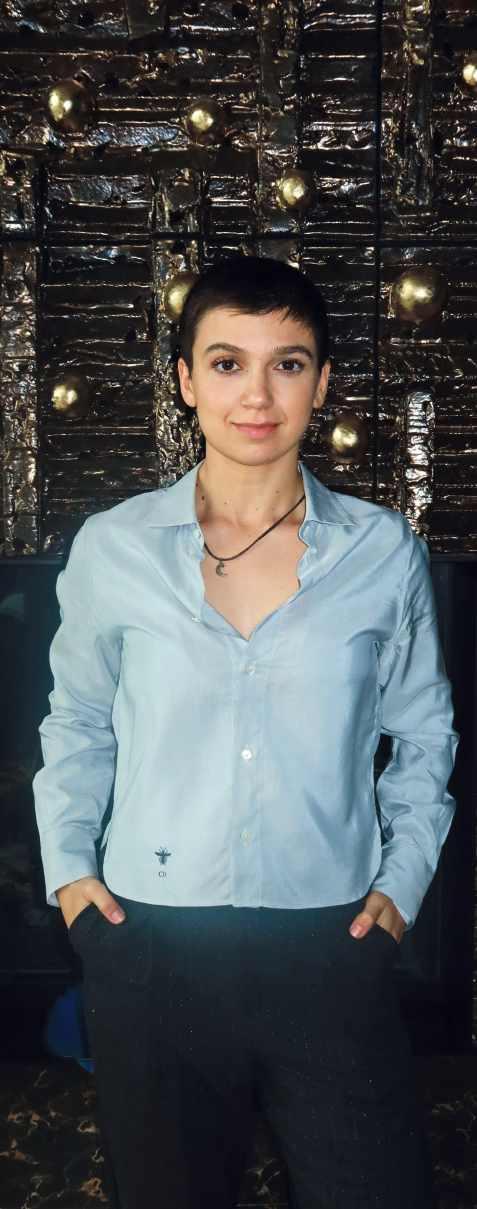
She first made headlines breaking away from her strictly-Orthodox upbringing on TV. Now Miriam Haart is rewriting the rules of AI.
By Candice Krieger
Miriam Haart may be known to many as one of the standout faces of My Unorthodox Life – the headline-grabbing Netflix series that followed her family’s dramatic break from the strictly-Orthodox world.
W hen it premiered in 2021, the show quickly became a cultural lightning rod. At its centre was mum Julia, separated from her husband and former life, now installed as CEO of Elite World Group, embracing designer wardrobes, a penthouse apartment and boardroom power. Alongside Miriam were her siblings Batsheva and Shlomo, who joined the family’s very public reinvention – while younger brother Aron chose to remain with his father within the strictly-Orthodox community.
But while audiences watched the Haarts navigate fashion, fame and fallout on screen, Miriam’s next chapter was unfolding behind a very different kind of screen – in the fast-moving world of artificial intelligence (AI). At 26, the computer scientist is the co-founder and CEO of ActionAI, an ambitious start-up she describes as driving “the next frontier of artificial intelligence”.
Most people know AI through novelty chatbots such as ChatGPT. ActionAI, however, is building something more consequential – AI that can “act” reliably enough to take on mission-critical work in industries in which mistakes are not an option.
Co-founded with Shai Dekel, the former head of AI at website builder Wix, the firm is targeting areas such as auditing, compliance and judicial systems.
“If everyone’s now talking about agentic AI,” says Miriam, “the next big one is ‘Action AI’ – AI you can depend on to act on your behalf.”
The leap from reality television to high-stakes AI may seem surprising. But for Miriam, tech came first.
“I grew up ultra-Orthodox and I was very bored,” she says. “For women, usually there are no extracurricular activities.”
At 13, she began playing around on a computer her brother was given. “I spent my afternoons creating things and learning new skills via YouTube,” she recalls. “And then one day I decided how cool it would be if I could build an app.”
Within months, she had created just that for fellow students and remembers the thrill when it was accepted into the App Store.
Her path accelerated quickly. At 16, she moved to San Francisco, graduated high school two years early, worked as an engineer in Silicon Valley and went on to study computer science at Stanford. At 19, she became the youngest lecturer in Stanford’s Computer Science Department.
A round the same time, her family’s story reached a global audience on Netflix and introduced viewers to Miriam, who was open about her personal life, partners and being bisexual.
“I got the privilege to share my story on TV with my family and highlight female empowerment,” says Miriam, who is not currently in a relationship. “I wanted to prove that no matter where you come from, you can achieve anything.”
The show gave Miriam a platform far beyond the tech world. Today, she has more than 400,000 followers across her social channels, hosts the popular podcast Faking It, and has emerged as a sought-after speaker, including on the TED stage, where her talk The SITT Test: Are You Really Thinking Freely? explores free thought and fundamentalism through the lens of her own upbringing. Such interest was no surprise to Miriam. After My Unorthodox Life aired, the response was immediate.
“I got thousands of DMs, particularly from women who could relate to my experiences around religion, identity and being underestimated in male-dominated spaces.”
W hile Miriam has become a public figure, she still sees herself as “a builder… a creator”.
ActionAI is her second start-up. “People are used to seeing me more as a public persona and less as a founder,” she admits. “It will take some time for the world to see this side of me.”
Miriam credits much of her leadership style to her mother, Julia, the former CEO and founder of Body by Julia. “I’m lucky that my mother is not only my

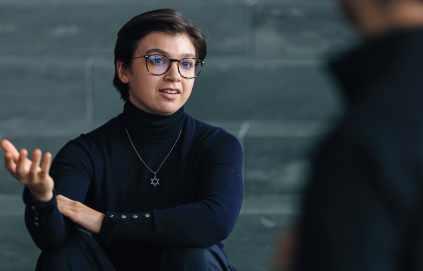
mum but also my business mentor. When it comes to work, she is able to both get her point across and make sure people are well fed!” she jokes. “She’s also taught me about helping people find meaning in their work” – a philosophy Miriam brings into ActionAI. “And we always have cake when it’s someone’s birthday,” she smiles.
As a young woman leading an AI firm, Miriam acknowledges the barriers that still exist. “We need to continue to fight for these positions of power. I hope to show other women they can do it too.”
Miriam splits her time between the US and Israel, where ActionAI is based. W hile the company’s ambitions are global, some of its earliest momentum has come from the Gulf. One of ActionAI’s private investors is based in the Emirates.
With the Abraham Accords reshaping ties between Israel and parts of the Arab world, Miriam believes tech is becoming one of the most powerful new bridges. “The opportunity in the Gulf is profound. There is such a hunger for AI and we have an advantage having our R&D in Israel – we’re next door to each other. There’s so much opportunity here,” she says, adding that “economic prosperity is a mechanism for peace at the end of the day… and it gives meaning behind my work”.
A majority of ActionAI’s customers are based in the UAE, but Miriam says Europe, and eventually the UK, is firmly in her sights as she looks to define “the next big thing in AI”.
She says proudly: “We’re coining that term: reliable ‘action AI’.” A nd while many first came to know her through television, Miriam believes some skills transcend both worlds.
“On TV you’re in the spotlight and as a CEO you are too… you have to be public-facing – those are skills I’ve acquired.”
She also points to the importance of teamwork, whether building a company or navigating life in front of the cameras.
For now, ActionAI is her priority. But she hasn’t ruled out returning to the screen one day.
“Right now, I’m super technology-focused,” she says. “But… if there’s another season – stay tuned.”
actionai.co

Etan Smallman examines the story of a once-formidable Black–Jewish alliance and new efforts to bring it back to life
Harriette Watford Lowenthal reminisces about a time when Black and Jewish Americans stood shoulder to shoulder in a common fight against oppression and discrimination.
The 70-year-old executive coach from Cleveland, Ohio, is sad to see “we’ve lost that connection”, saying: “It was so powerful. I see a lot of division, and it breaks my heart because it’s very hard for me to divide myself in half.”
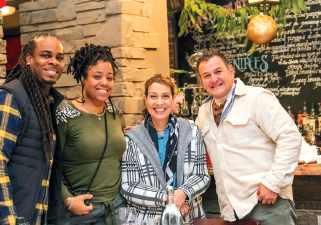
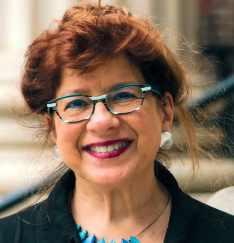
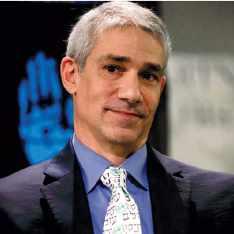
Watford Lowenthal – “a Jew of colour” – is among a growing number of people working to rebuild the fractured coalition. A fellow of Rekindle, she is part of a programme that has graduated 12 cohorts of Black and Jewish leaders in Cleveland since 2021 and is now expanding across the States. Its name sums up its mission: to reignite a union that once burnt brightly.
In the early 20th century, newspapers for each minority carefully covered
violence against the other. The African American New York Age compared the “Russian authorities hunting down Jews with bloodhounds” in 1910 with “the days of American slave hunts”. The New York Yiddish paper Forverts would report on lynchings in America as “pogroms”.
In 1967, Martin Luther King Jr said “Israel’s right to exist as a state in security is incontestable”, while the Black Americans to Support Israel Committee was formed in 1975.
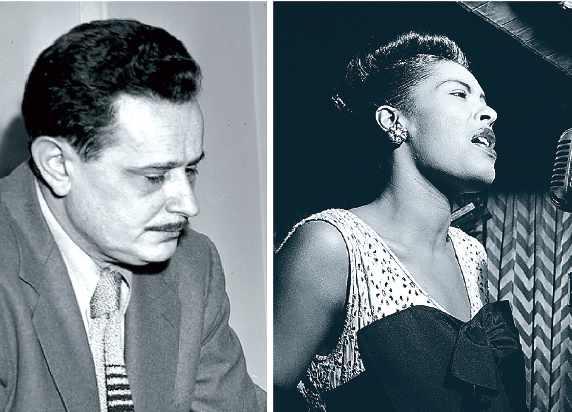
Both were targets of the Ku Klux Klan (KKK) and Jews helped co-found the National Association for the Advancement of Colored People, the oldest civil rights group in America. Both were central in transforming popular culture – seen no more potently than in the anti-lynching protest song Strange Fruit, recorded by an African American (Billie Holiday) and written by a Jew (Abel Meeropol).
With these past successes in mind,
Rekindle brings together emerging leaders for challenging interchange across five sessions – with an optional sixth discussing Israel/Palestine.
Co-founders Matt Fieldman (a white Jew) and Charmaine Rice (a Black Christian) noticed that the two communities now live in different neighbourhoods and “work in parallel rather than in partnership”.
“It could not be an effort by the Jewish community for the Black community”, says Fieldman, on a video call with several of his graduates. “We have a lot of work to do to fix this broken country and we’re going to do it together.”
He’s most proud of what follows the fellowship: internships at businesses, shared volunteering projects and book clubs that keep the conversation going.
At the very first meetings, Rice was struck by “how so often folks conflate Jewishness and whiteness”. The group discussed a 1998 essay by Paul Kivel titled I’m Not White, I’m Jewish. Another text is James Baldwin’s Negroes Are Anti-Semitic Because They’re Anti-White from 1967 because, says Fieldman, “it puts the tension right there on the table” and invites participants to broach the fault lines of today.
Rekindle is not alone. Challah & Soul began in California as a one-off lunch linking Black and Jewish mothers and is now “celebrating our values and histories” through food and storytelling.
Exodus Over Dinner is harnessing “the transformative power of breaking bread”, with 300 meals planned this year. It was launched by CNN host Van Jones, who has said: “I think the most powerful alliance for good in the history of Western civilisation is Blacks and Jews together.” Meanwhile, Michigan-based Spill the Honey advances the cause through music, film production and school curriculum design. The complex history is also the subject of a fascinating four-part PBS documentary in the US that aired in February (a UK date is to be announced).
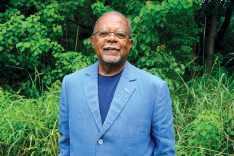
The idea came from its presenter, Dr Henry Louis Gates Jr, the Harvard professor who has hosted the celebrity genealogy series Finding Your Roots since 2012. In 2017, he was watching the Unite the Right rally in Charlottesville, Virginia, at which Confederate and swastika-waving protesters harked back to the KKK with lit torches, while
chanting: “Jews will not replace us!”
“He recognised that this was a threat not just to African Americans, but Jewish Americans,” says New York-based co-director Phil Bertelsen. The result is Black and Jewish America: An Interwoven History. In the eight and a half years since that march, Bertelsen says the four hours of programmes have “inevitably” become “timelier than ever”.
In the first episode, a group of Blacks, Jews and Black Jews (or “the chocolate chosen” as culinary historian Michael Twitty puts it) gather for a discussion about racial liberation over a Passover seder. Dr Gates explains that he begins one of his own Harvard courses “by saying that under the floorboards of Western culture run two streams, continuously. One is antisemitism and one is anti-Black racism.”
The series spans more than 500 years of intertwined history. In 1492, the expulsion of Jews from Spain was followed just three days later by Columbus sailing to the Americas –setting in motion the transatlantic slave trade. It shows, too, how Black Americans have drawn strength from the Jewish story. Abolitionist Harriet Tubman was nicknamed Moses. “For a lot of African Americans, they found their language and posited their identity through the Hebrew bible,” says Dr Gates.
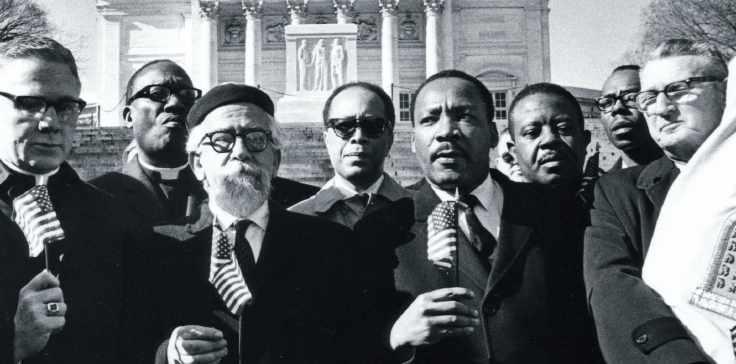
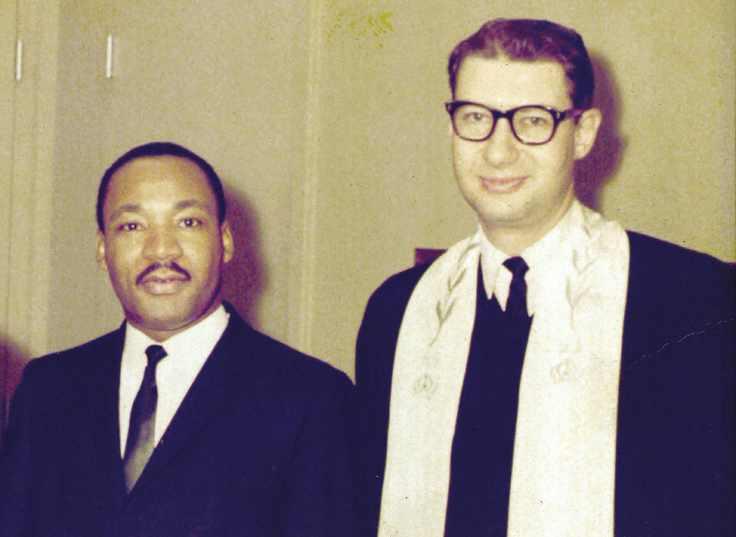
Yet it is the civil rights struggles of the Sixties that stir the deepest nostalgia. In 1965, rabbi and theologian Abraham Joshua Heschel (pictured overleaf with Luther King Jr) marched from Selma to Montgomery beside his friend Luther King Jr (whose copy of The Prophets was worn from rereading).
Sixty years later, civil rights leaders still tell his daughter, Jewish studies
professor Susannah Heschel: “I’m so grateful for your father.” The seeds of this kinship were sown in his childhood. He described the intense poverty in Harlem, near their family home, to his daughter “and said that he understood it from growing up in Warsaw”. His own experience of Nazi persecution in Berlin – and the “indifference of so many other people” – had a similar effect, she tells me.
Aged 12 when Selma happened, Susannah had fresh in her memory news footage from Alabama of black protesters being fired with water hoses so powerful they “tore out people’s hair”. Those images informed a “very nervous Shabbat” before her father’s
departure for Selma. “He bent down and kissed me. And I thought to myself, ‘I have to hold on to this kiss because it might be the last kiss I receive from him.’”
Avi Dresner’s father, Rabbi Israel Dresner, was there too. On “Turnaround Tuesday”, hundreds of clergy gathered, but the Reform rabbi was one of only two invited by Dr King to deliver the opening prayer (King later preached twice at Dresner’s New Jersey synagogue).
Dubbed the “most arrested rabbi in America”, he was jailed four times for civil rights activism. In the programme, Avi recalls his father and Dr King speaking about how Jews had been
‘I see division and it breaks my heart. It’s very hard for me to divide myself in half ’
enslaved – in the camps of Europe –just 17 years earlier. Relations were never so simple that “everyone had their arms around each other and was singing Kumbaya”, Avi says, but after the 1965 Voting Rights Act – when Jews were disproportionately represented among non-Black campaigners – “the relationship had nowhere to go but down anyway”. One low point came in 1984, when Louis Farrakhan of the Nation of Islam declared: “Hitler was a very great man”.
“Both groups can really make a claim to being abandoned by the other,” Avi, 56, tells me from his Massachusetts home. “Jews, for the most part, fled the inner cities and left the Blacks behind. By the same token, when you look at October 7, I think there’s a prevailing attitude among many Jews – ‘we stood up for them, and they have abandoned us.’”
Samuel Dickerson, managing director of programmes and partnerships at Rekindle Cleveland, admits he was “oblivious” to the Hamas attacks when he accompanied 12 Jewish women to see the documentary October 8 . “They couldn’t understand my reaction. I was devastated by it because I had no idea.”
When asked which period proved hardest to tackle in his new series, Bertelsen’s reply is unexpected. “I see the current moment as the most fraught,” he says.
He and co-director Sara Wolitzky each drew on their own backgrounds. “Well, I’m Black, she’s Jewish, so there’s that,” Bertelsen reflects. “But I’m also a byproduct of that grand alliance, right? As someone who grew up in a primarily Jewish town, going to more barmitzvahs than barbecues, I did find myself asking ‘what happened?’ and ‘where do we go from here?’”
Wolitzky traces her perspective back to childhood, recalling how, from the age of four – “to my mother’s horror” – she was told of her grandmother surviving a Russian pogrom. “To be quite graphic, having her father murdered on top of her, and she had scars on her neck from the bayonet wounds.”
Since then, she says, she has looked at the marginalisation of the Black community thinking “there but for the grace of God go I” and feeling a need “to identify with them, because it could be us”, she says. “It has been us.”
For his part, Dr Gates showed
solidarity in the other direction, penning a 1992 New York Times op-ed to rebut “the total rubbish” – promoted by Farrakhan and others – that Jews were responsible for the slave trade.
Avi Dresner is developing both a documentary and a feature fi lm about the man known as “King’s rabbi” and has launched a nationwide lecture tour titled Rebuilding The Bridge. He believes revisiting that shared history is one of the surest ways to repair the rift.
Turning the cliché about the ignorant being doomed to repeat the mistakes of the past on its head, he says: “Those who do know history can repeat the good parts. And the Black-Jewish alliance is one of the parts worth repeating. My hope is that that then catalyses conversations, which then catalyse relationships.”
At each date, he appears with a local African American co-presenter and the audience departs via a lobby fi lled with groups running programmes “to further the work”.
He adds that for too long American communities have experienced “a form of self-segregation, where the laws don’t say that we can’t go to the same schools, but the ZIP code does. We need to get to know each other again.”
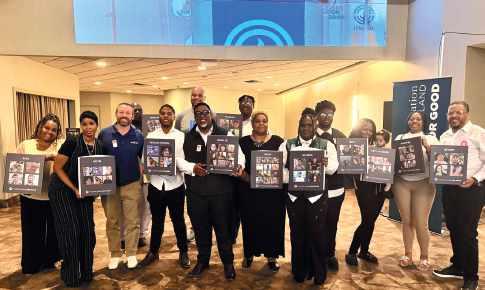
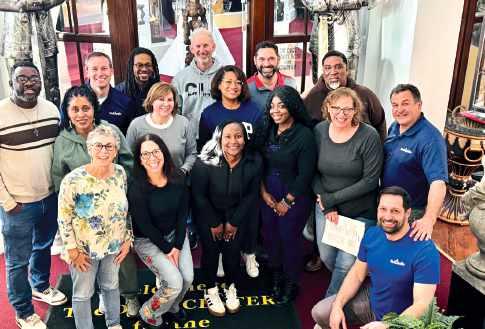
ABOVE: New Door Church members – led by Pastor Jereme Sykes (centre, in glasses) attend the Cleveland Jewish community’s 2025 October 7 commemoration BELOW: Dr Henry Louis Gates Jr, Rekindle's Board of Directors Retreat in 2025





































































Is God sending simple sons like me a message by making this year’s first seder night fall on April Fools’ Day? It’s hard to ignore the timing. If anything could tempt a Jewish atheist to glance up at the heavens and stroke his chin, it’s a cosmic coincidence like this.
T he Simple Son has always been my favourite seder sibling. The moniker does him no favours. “Simple” does not mean stupid. A mind devoid of thought. That misses what matters most about him. The Haggadah’s unfairly maligned halfwit is a misunderstood character who sees the rituals around the table and asks the most important question of all: “What is this?” His problem isn’t a lack of intelligence, it’s a lack of acceptance. He simply cannot understand what he’s being told and why it should matter. He stubbornly refuses to lean. And learn. A more fitting name for such a pensive young man would be the Sceptical Son.
He’s the secular yin to the seder’s yang. Without him, the meal would be like any other. He’s the secret sauce that gives the evening its edge. That makes it different from all other nights. To boil his role down like chicken soup, the Simple Son is the star of the show.
He does not nod along like the dog in the Churchill insurance adverts. Instead, he cocks his head to one side,
like a dog who can’t comprehend the words but recognises their importance to everyone else in the room. He’s searching the seder for something solid, something to grasp – observing the adults around him lean and dip and sing and wondering what to make of it all.
I’m a Simple Son. I know, as sure as I know burnt eggs are burnt eggs, that little, if anything, read around the seder table is factually true. What I’ve been trying to figure out for the past 55 Pesachs is why it is culturally true. Morally true. Psychologically true. What is it about the Exodus that’s been a bonding (or should that be bondage?) agent for five millennia? To ask that crucial question, never mind answer it, you cannot afford to be simple.
Simple Sons see that blind faith makes perfect sense. They see it’s a fully-packed suitcase, handed down through time, heavy with grand stories, good habits and gallant heroes. Weighty enough to stop the Jewish people drifting away on the choppy waters of tragedy and time. Useful survival gear. Simple Sons see that even if God is a human invention, belief in him is, clearly, rational. That life without anything God-related is bad. The proof is right there in the matzah pudding.
T he Simple Son believes in belief as much as his three siblings. He simply
With the first night of Pesach falling on April Fools’ Day, Richard Ferrer reflects on blind faith and traditions he’d be foolish to forsake
knows that belief is all there is. And all there ever will be. He may roll his eyes at the frogs, brush off the boils and look past the locust, but he still sees what the story is trying to teach. He knows it’s doing some heavy lifting. And he gets the punchline: we’re still here, Pharaoh is not.
I play with this paradox – God as functional fiction – in my sci-fi comedy novel Error 404 (in all good bookstores this summer). In it, a future AI empirically proves God is a human invention, society promptly eats itself and atheists are forced to confront a basic truth of human nature – faith can be more important than facts.
My atheism is real. My Judaism no less so. It reveals itself most clearly in the dogged idealism of showing up year after year to celebrate an exodus I did not witness, yet somehow remember.
Simple Sons like me sit at the seder because stepping out of that fivethousand-year chain would feel less like liberation than amputation. Simple Sons like me wear a Star of David around our necks because its familiar weight anchors us. And this April Fools’ Day, Simple Sons like me will listen to a story we do not believe yet cannot live without and ask the question expected of us – as if our lives depended on it.
“What is this?’
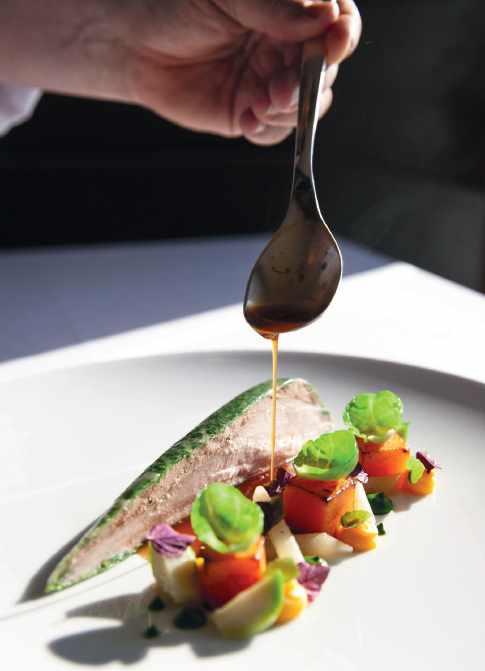
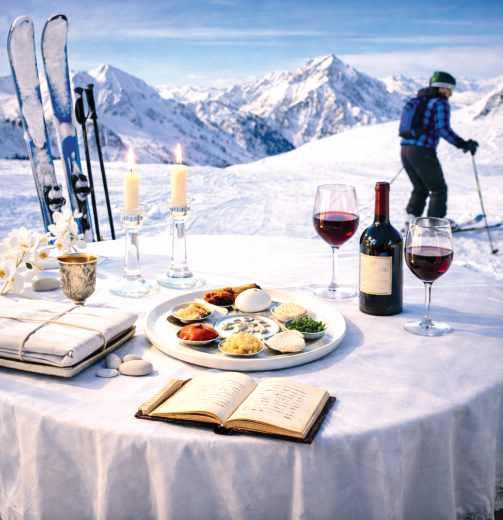
Jenni Frazer explores the booming world of luxury Pesach — where the only real question is not why, but where
When the world is your… not oyster, of course, but perhaps your kosher caviar, then the only limit is your imagination. Pesach, long seen as a labour-intensive albatross round the necks of hard-working Jewish women, has spread its wings. For this is the era of luxury Pesach, where creative travel agents can cater — almost literally — to every whim.
Usually there are Four Questions for Pesach. But at the luxury end of the market, there is only one – where to go to celebrate the festival?
This year you could spend Pesach in every location you can think of – and perhaps those you hadn’t even considered possible. You could, for example, have a seder night in Kenya, and go on safari over Chol Hamoed.
Or maybe Colorado, to stay in the world-famous mountain resort of Vail. When seder night is over, you can go skiing. That’s right – there is a unique Chol Hamoed barbecue at 10,000 feet.
Maybe your tastes run to the once traditional, in which case you should head for Lithuania, where this year there is a new programme based in the capital, Vilnius. Piquant to return to the city once known as the Jerusalem of Lithuania.
Or also on offer is the exotic – learning about Japanese culture in the heart of Tokyo, or possibly Mexico, where after seder night (or nights) you can stay on the Mayan Riviera (no, me neither) and enjoy freshwater lagoons, coral reefs, private beach, spa, a golf course, a fitness centre and more.
The only thing you have to consider is the cost of
all these adventures. Many can run between £6,500 and more than £11,000 per person, so spare a thought for one man who said in his enthusiastic online testimonial that he had taken his entire family of 11 on a Passover holiday last year and was already planning this year’s destination.
If you want something even more luxe and you don’t care about built-in programming, then you might like to think about Sharon Jungreis Beck of KPC, which stands for Kosher Private Chef. Her company offers “custom-tailored” possibilities, aimed at “people who don’t want to wait in line for their food”.
She flies in hot chefs from Israel to wherever her clients have chosen to spend Pesach – which can be in a villa or even aboard a yacht, which her company will source for them. She deals with customers all over the United States, but notes that “we also ship gourmet meals worldwide – bringing the KPC experience to wherever you are”. And some of her packages can cost $25,000 (£18,000). But the Haggadah does speak of “an outstretched hand”…
Two acknowledged experts in the field of high-end Pesach are Manchester’s own Raphi Bloom, who began Totally Jewish Travel in 1999, and Philadelphia-based rabbi/travel agent/ scientist/psychologist and IT specialist Gil Hami. What these two can’t tell you about luxury Pesach isn’t worth knowing.
I had wrongly assumed that the Pesach world travellers were less observant, more secular adventure-seekers. But both Gil and Raphi say that’s wrong: there are those who want an all-inclusive
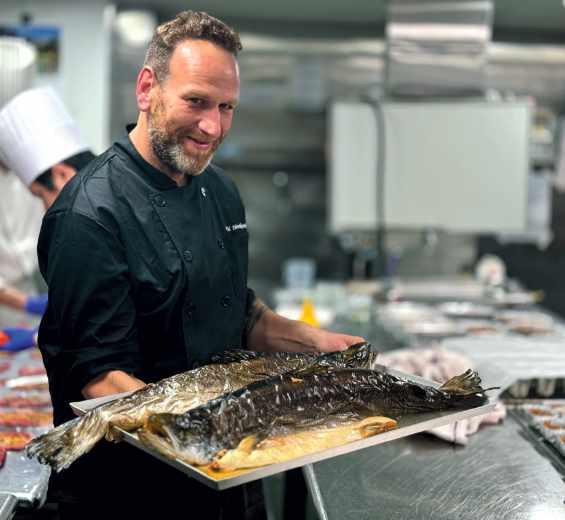
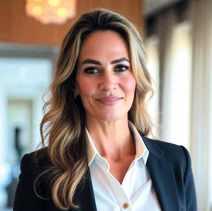
ABOVE: Sharon Jungreis Beck, founder of KPC LEFT: Executive Chef Tal Hershkoviz in the kitchen of the Hilton Tokyo Shinjuku
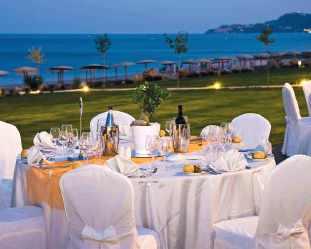
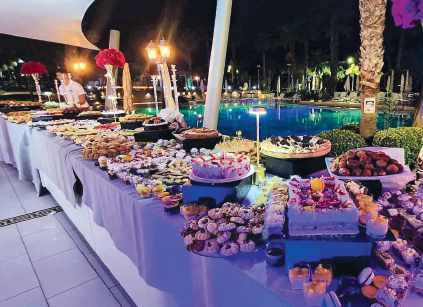
‘Every day, you’ll go out of the resort and explore so you’re maximising your time there’
resort package, with food and drink and, crucially, entertainment, almost literally on tap around the clock; and there are those, says Raphi, “where you will have a multi-generational family group and there is perhaps one grandchild who has become very religious and may not want to eat in the grandparents’ home”. The solution is an all-inclusive Pesach programme – at the luxe end if possible.
Gil, however, says those who go for Pesach in luxury are neatly split between those who want to loll about in a resort hotel and take advantage of the packed range of entertainment and food on offer, and a whole new group of Pesach explorers who want to have an adventure in a different part of the world. “You’ll go to a place where you are based at a hotel programme but, every day [except for Shabbat and chagim], you’ll go out and explore, so you are maximising your time there.”
His Japan programme, he says, gives people “a once-in a lifetime opportunity to experience another heritage and culture.” And it’s all kosher l’Pesach.
It turns out that you can spend (and that’s the appropriate word) Pesach practically anywhere you can think of: Argentina, Albania, Azerbaijan, Thailand, Japan, all over Europe, Africa, America, Asia – and even a dedicated tartan-style programme in Aberdeen.
The focus of many of the all-inclusive programmes is what’s on offer after the seder, whether one night or two. The resorts are supercompetitive, offering comedians, singers, speakers and “how-to” classes. Indeed, during Chol Hamoed, many speakers will travel from resort to resort, so that if you miss this year’s in-demand rabbi, he may well be at a neighbouring resort the next night.
Among those on this year’s programmes are former Israeli government spokesman Eylon Levy, former Israel Defense Forces spokesman Jonathan Conricus, and Brits Natasha Hausdorff and Rabbi Yitzchak Schochet. Think grand cruise
entertainment – but on dry land.
Some of the speakers are unique to the US, such as Adina Shoshana, born Adriana Fernandez, who achieved fame on social media as the “Non-Jewish Nanny” and, after spending time nannying for observant Jewish families converted to Orthodox Judaism. She is billed as “the Now-Jewish Nanny” – and we hope she isn’t speaking at resorts that charge extra for babysitting.
One package this year even offers the chance to challenge a chess grandmaster – Roberto Mogranzini, at the Verdura resort in Italy. Or you may want to hear the hottest Italian DJ, Gabry Imbimbo, who is a specialist in electronic dance music – not exactly in the Pesach spirit, but popular with an audience eager for a different experience.
Those anxious about missing a meal on safari should be reassured. One of the companies tells potential clients that on hand will be “mobile kitchens, chefs and kitchen staff, accompanied by a kosher supervisor, who will travel with clients to the safari reserves and will be accompanied by fresh and cooked meals throughout the stay on the safari lodges”. That’s if the lions don’t get there first.
In Colorado, meanwhile, those enjoying “Pesach on the Mountain” can take advantage of an open-air ice rink and outdoor fire pits and ski in Vail.
Heaven forbid that people might spend one minute idle. Each of the resorts pledges “a plethora of activities to keep your whole family entertained…”, including in ways that you never thought of, either at Pesach or the whole year round, from white-water-rafting and snowmobiling, to matchmakers and Pilates coaches.
As you lounge at your seder table next week, pick a place you’d like to go next year, shorn of all the hard work Pesach can be – and perhaps start saving now. You’re worth it.
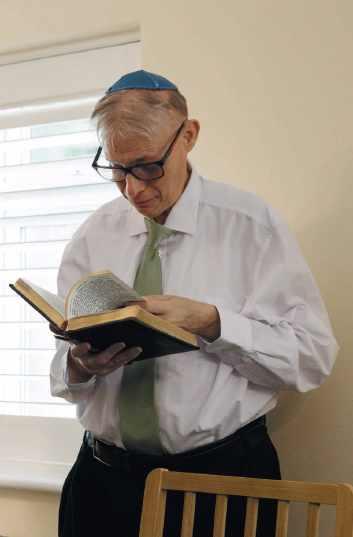


I was born right before Pesach, so it’s my festival. I like Seder Night, with the ten plagues and Ma Nishtana. I’ll be drinking four cups of grape juice, eating charoset and some horseradish – as long as it isn’t too hot. But most of all, I’ll be enjoying my independence in my kosher home, thanks to Norwood. To support more adults with learning disabilities to live their best Jewish lives, please donate at: norwood.org.uk/pesach

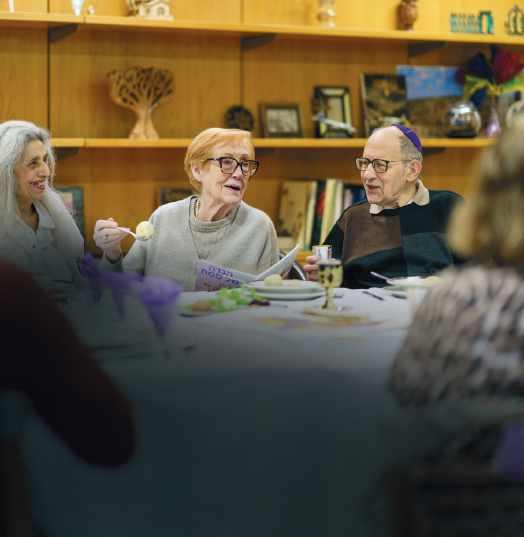



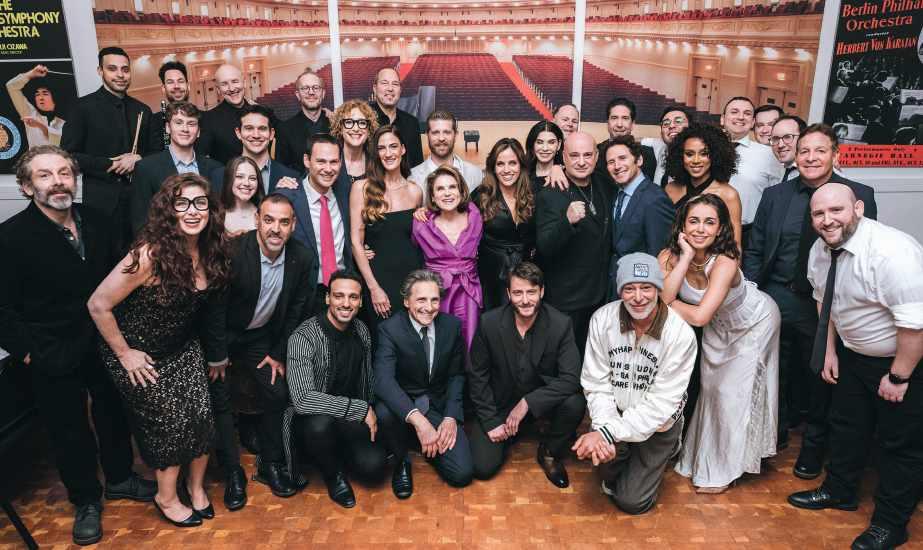
A blizzard delayed the curtain, but nothing could stop communal pride headlining at Carnegie Hall. By Brigit Grant
The snow nearly stopped New York.
On the Friday morning, Sarah Sultman and her co-producer Michal Noé stood on the stage of Carnegie Hall, ready to greet the cast flying in for the sold-out (2,804 seats) show on the Monday night.
By the Saturday evening, an unscheduled blizzard had escalated to a state of emergency and flights were cancelled. By 10am on the Sunday, Carnegie Hall confirmed Letters, Light and Love could not go ahead.
“Then, unbelievably,Carnegie said we could have Tuesday – they were amazing,” said Sarah. “So, we
were like, ‘Okay, we can do this.’”
Commitments meant five cast members couldn’t shuffle — among them Jason Isaacs – but three stepped in – cantor Azi Schwartz, comedian Judy Gold and Shtisel ’s Michael Aloni, who was in NYC and had done the show in London.
The show survived the weather, and survival is the integral theme of this show which premiered at the Theatre Royal Haymarket. Sponsored by the UJIA (and UJA-Federation in NYC), all proceeds go towards rebuilding Kibbutz Be’eri, which was destroyed by Hamas on October 7.
At the London show in July 2024, the audience was
raw. They knew the names of the brutally murdered and were praying for hostages still held in Gaza.
“New York felt different,” said Sarah. “It was more about people coming together to own their history and feel proud of where they come from.”
For Sarah and Michal, it also felt like a necessary moment of shelter – a theatrical blue blanket under which the audience could briefly hide from intensified antisemitism and hostility towards Zionists.
The idea for Letters, Light and Love began in the weeks after October 7, when Sarah went to Israel on an early solidarity mission, visiting the Gaza envelope and devastated kibbutzim. What stayed with her was not only the scale of the trauma, but the speed with which the narrative




time, and from that came the lightbulb moment that sparked the show.
“I thought, ‘We as a people, have 3,000 years’ worth of letters. What if we were to research them and do our own version of letters live?’”
Months of research followed. Working alongside Shantelle Stein, Sarah began tracing correspondence about Israel across centuries. Lachish Letters, letters by Maimonides, Julius Caesar, Golda Meir and Albert Einstein. And there were letters of the deeply personal kind – written by lesser-known Jews whose lives were touched by Israel.
With help from the National Library of Israel, hundreds of documents were gathered. They covered Sarah’s dining room table.

abroad had shifted. me.”
“I kept thinking, ‘How is there a way that we can address this?’
The accusation that we’re white colonisers who should go back to Poland. The idea that Israel only began in 1948. This post-truth world we live in – it really bothered me.”

A long-time attendee of ‘Letters Live’ events, Sarah loves the power of words written in their
“We added and took away and added back again,” said Sarah, who also felt it was important to consider the historical context of the language used in many letters. “During the early 20th century, Zionist letters referred to ‘settlers’, and Israel was known as ‘Palestine’. Given the current politically-charged climate, it is crucial to heed these lexical choices for what they were.”
Sarah had no intention of altering them. “There is enough historical revisionism in the world right now.”


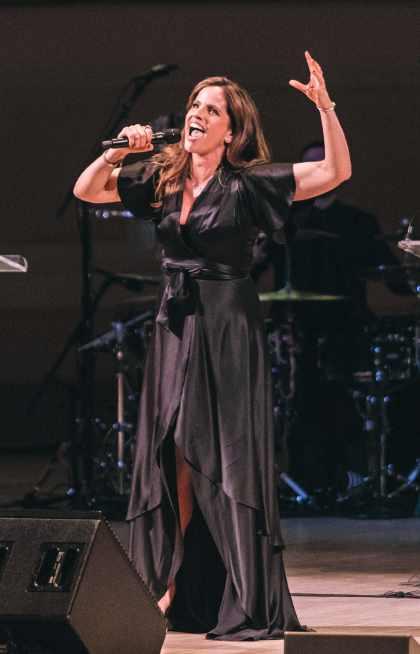
Great as they were, Sarah also realised a recital of letters would not hold an audience. They needed a narrative arc – exile, longing, diplomacy, survival, return.
“What we wanted to do,” she adds, “was take the audience on a journey and tell a story.”
At that point, Michal Noé joined as producer and, together, they went in search of venues and a cast and structured the evening with music, even securing Malcolm Green to design exquisite programmes voluntarily. Everything felt right.
In London, among the many who sang was Ethiopian Israeli Ester Rada, who sang again at Carnegie Hall and joined David Draiman, frontman of Disturbed, for a duet of Leonard Cohen’s Hallelujah.


European Jewish immigrants. It’s about our survival and we’re going to sing it at Carnegie Hall.’”
‘ Take the audience
journey and tell a story ’
In New York, another musical moment after the Exodus letter was Noa Tishby singing Somewhere Over the Rainbow
“After Mandy Patinkin performed the song at Zohran Mamdani’s inauguration, I questioned whether it still belonged in the script,” said Sarah, “Then I thought, ‘We have to own this. It’s written by Harold Arlen and Yip Harburg, sons of Eastern
At the NYC show, pro-Israel Iranian-born lawyer Elica Le Bon read a 1919 letter from Emir Feisal, the former king of Iraq, expressing support for Jewish national aspirations.
‘....We will do our best, in so far as we are concerned, to help them through. We will wish the Jews a most hearty welcome home.’
Sincerely Emir
With her history of speaking up for persecuted Iranians, Elicia’s presence at Letters, Light and Love is even more poignant now.
Realising that some of the letters read in London would not translate across the pond, Sarah and Michal replaced some with a letter from Chaim
Weizmann to Harry S. Truman, another by John Adams and a moving note from Leonard Bernstein. Winston Churchill, however, was transatlanticworthy and his correspondence with Moses Gaster was read in New York by Elliot Levey, who was about to star in the play Giant on Broadway. Churchill felt entirely apt in America. A leader recognised on both shores, whose position on Zionism endures.
‘And the establishment of a strong, free Jewish state astride of the bridge between Europe and Africa, flanking the land roads to the East, would be not only an advantage to the British Empire, but a notable step towards the harmonious disposition of the world among its people.’ Yours faithfully, Winston Churchill
Tovah Feldshuh, Entourage’s Emmanuelle Chriqui, musician Matisyahu, Fauda ’s Rona-Lee Shimon and producer Lawrence Bender.
Big names in the Big Apple is what the audience expects, but there was one name that brought the audience to their feet twice.
Inside Carnegie Hall, Churchill’s words were read with reverence. A few days later in Westminster, his statue would be defaced with red paint by Gaza supporters.
The New York cast included actors Debra Messing, Amy Schumer, Mark Feuerstein, David Schwimmer, Jonah Platt, Julianna Margulies,
Eli Sharabi, former resident of Kibbutz Be’eri who survived 491 days in captivity, was there to represent his home and his murdered wife, Lianne and two daughters, Noiya and Yahel.
To be led into the Hatikvah by a man who survived October 7 will be remembered by everyone who was at Carnegie Hall on Tuesday 25 February 2026. It should have been a Monday, but the audience stayed standing to sing One Day, which felt like a communal act of healing. A blizzard tried to stop the night. It did not. And where next is the question. LA or Sydney?

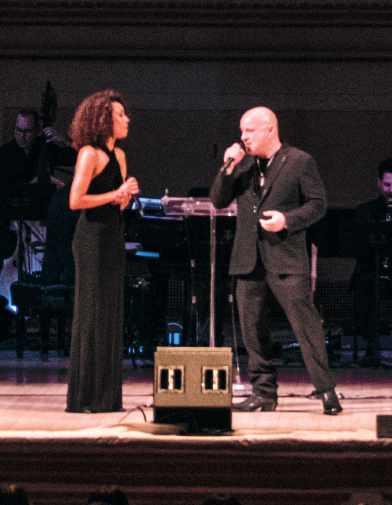
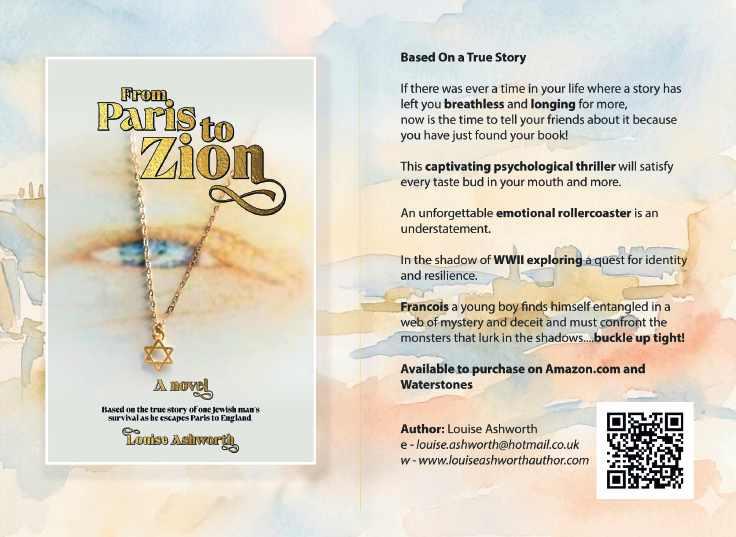








Debra Messing talks to Brigit Grant about identity, Israel and the cost of speaking out
BASS
PHOTOGRAPHY
There’s something delicious about walking into a restaurant with someone famous. The maître d’ circles, cutlery rests, conversation softens. No one wants to stare, but everyone wants to look.
The Mark hotel in Manhattan is far too discreet for rubbernecking. Its Upper East Side clientele are fluent in fame, but then she appears.
Wrapped in a white coat on a freezing New York afternoon, heads turn. Is that...? The red hair gives her away. It always has.
For an entire generation, Debra Messing is Grace Adler – the witty, romantic, neurotic, stylish interior designer who lived with Will.
Will & Grace dominated American television from 1998 to 2006 before being resurrected in 2017 for a further three seasons. In that time, it shook up culture by normalising gay identity through Will, played by Eric McCormack and, crucially, thanks to Debra, placing a secular Jewish woman at the centre of primetime.
instantly but for her to never be reduced to a stereotype for wider audiences. So there was cultural shorthand and the larger-than-life presence of Grace’s very Jewish mother, Bobbi Adler, played by the late Debbie Reynolds.
“The only thing we never did that I asked for was to have Jack hiding under the Passover table trying to get the afikomen.”
She laughs, still faintly disappointed – although in the early 2000s when Will & Grace was at its height, Debra could not have predicted that she would one day become one of the most outspoken activists for her faith.



“When the pilot is written, they have no idea where the characters are gonna go. So then …” she says, warming to the memory, “I said, ‘Adler, can I assume she’s Jewish?’ And they were like, ‘Sure.’ And I was like, ‘Okay, I want her to be really Jewish. I want her to go to Camp Ramah. I want all the references.’”
The “Ramah” reference was lost on me, although I’ve since learned it is the network of Conservative Jewish summer camps that are still part of the American Jewish childhood experience. What Debra wanted was for Jewish viewers to recognise Grace
Moving between film and television – Woody Allen’s Hollywood Ending, Along Came Polly with Ben Stiller and Steven Spielberg’s Smash, the theatre lovers’ obsession – the Rhode Island-raised actress was defined by wit and red-carpet glamour.
Not by the fact that, as the granddaughter of Eastern European Jews, she was one of three Jewish children in her school.
“I learned that difference could draw attention. Once, when my grandfather was visiting, a swastika was carved into his car. I didn’t even know what it meant. And my mother was like, ‘Get in the house.’ And I’m like, ‘What’s happening?’ And then the car disappeared, and nothing was said about it.”
As a teenager, she straightened her naturally curly red hair and told classmates she was “sick” when she stayed home for Yom Kippur. “I learned it’s safer to be quiet.”
Sitting among the restaurant’s polished diners, it was almost impossible not to want to shout:

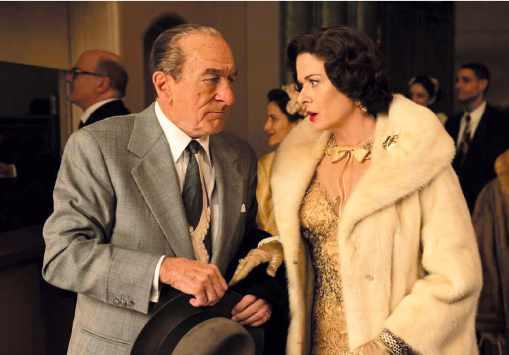
“Are you hearing this?”
That Debra is so much more than Will’s Grace has become undeniable since October 7.
“I woke up that morning and, like everyone else, started seeing the images,” she says. “And I recognised very quickly it was an actual massacre.” She had assumed the response would be universal condemnation. “I was convinced the entire world would voice their horror at the actions of Hamas. Instead, the next day – the very next day – they were celebrating on the streets. In New York. By the Sydney Opera House. I mean, all over the world. It stopped me in my tracks. It made me nauseous. And it made me realise in that moment, ‘Oh, they hate us.’”
For someone raised in the post-Holocaust promise of “never again” it was destabilising.
“I don’t think that people in my generation understood that we were living in the golden era as Jews. We had assimilated. We were succeeding. We knew there was prejudice against us, but it felt like it was fringe. And that whole thing blew up in my face on October 8.”
Watching events on the news around the clock, she told herself that once the hostages began to return, something would shift. “I remember thinking, ‘It’s going to get better.’ Obviously, it didn’t. It got worse.”
For a woman whose own red hair has been her signature, the images of the red-headed Bibas children Ariel and Kfir and their mother Shiri felt painfully intimate. When their coffins emerged from Gaza, she was devastated.
‘People in my generation did not understand we were living in the golden age as Jews’
What followed was what she calls “a second horror.”
“I felt abandoned, misunderstood and maligned. What cut deepest was the silence. People I thought were my friends did not reach out and say, ‘Are you okay?’ From that my immediate instinct was to defend us.”
There are tears in her blue eyes. In that moment, she was speaking not as an actress but as a mother. Her son, Roman, now 21, is growing up in what she describes as an unstable world.
“Our children have had the most damaging childhood,” she says, listing the years of school shootings, Covid and now antisemitism on campuses. “If you’re Jewish… being threatened and isolated. As a mother, I’m so profoundly pained. Thank God my son has been at his school and things have been okay.”
Debra has worked on every Democratic presidential campaign since 2004 and was one of Hillary Clinton’s most visible celebrity supporters in 2016. Now, she says, “I feel like I am party-less.”
She still believes in democracy and liberal values, but something has fractured.
“For the first time, we are seeing people say, ‘I will not work with that person because of their beliefs as a citizen’ versus ‘I’m not going to work with that


person because of behaviour on a set.’”
The industry – her industry – feels precarious. “I honestly don’t understand what the future is for our industry. We had the actors’ strike, the writers’ strike… and, essentially, once that happened, people started not working.”
Six weeks after October 7, Debra travelled to Israel. “I thought I understood what the feeling of safety was, prior,” she says. “But when I went there and I saw my people, and I saw the diversity… I was like, ‘Oh…’ and, for the first time, I finally felt safe.”
She beams as she describes Tel Aviv’s energy, the desert in the south and speaking to a Bedouin man about his family. The visit had a profound impact and she is exploring dual citizenship.
Raised secular, she has also been exploring her faith since October 7.
“I realised I don’t know that much about my history and so I started to study. I started to do Shabbat and light candles.” And she has continued to speak out.
“I was fortifying a new boldness, a new acceptance of who I am. And for the first time in my entire life, being openly proud and protective.”
That boldness has seen her publicly challenge voices she once stood alongside, including Susan Sarandon over remarks that she felt minimised antisemitism. The exchange went viral and with it came abuse.
“I have a little bit of experience with the invisible hatred that can happen online,” she says, recalling the hostility she faced during the 2016 US election. “But this is on a whole other planet of hate.”
She describes waking up to it, going to bed with it. Being called a “Zio baby killer”. Is she afraid? She considers the question. Fear,
she suggests, is not the right word. What shocks her most is how quickly mainstream positions have been recast as extreme.
And yet she continues to show up. Recently, she appeared at the Light, Letters and Love evening at Carnegie Hall – a gathering of Jewish artists reading letters from the 3,000 about Israel.
Debra is not retreating; on the contrary, her career keeps moving, most recently to starring opposite Robert De Niro as his wife in Barry Levinson’s The Alto Knights.
She has also been working on a series set in a temple. Will it be made? She is realistic.
“It has to be greenlit. The studios have to see it and say, ‘Yes, we want to tell these stories’. I’m waiting to hear if that will happen.
“We need more Jewish stories that are not about dead Jews. We need to see dancing and singing and joy and Shabbat tables.”
As she stands to leave, there are looks. Some still see Grace. But today, it’s not the red hair that defines her. It is the refusal to lower her voice.


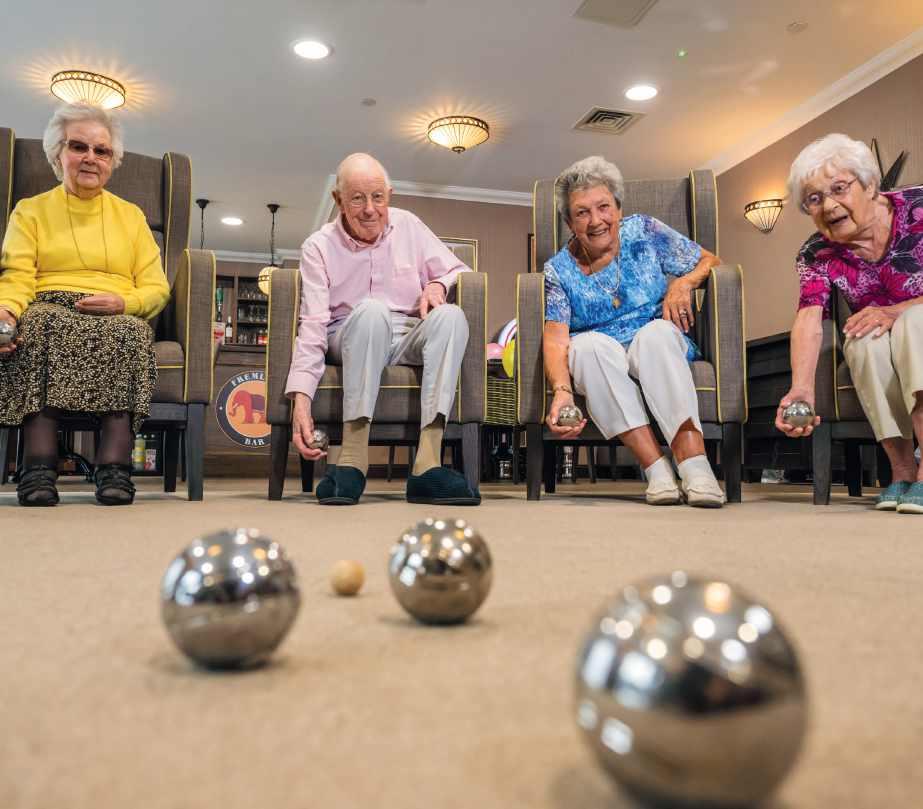



Shivat Zion is offering a free, fully supported Aliyah programme for families making Aliyah from the UK and Western Europe.



Pre-Aliyah One-to-One Assistance
Support After Landing
Long-Term Support
Housing
Semi-furnished 3-bedroom apartment
Approx. £1,200/month (+ building / maintenance fees)
Minimum 12-month lease
Additional apartment sizes available at different price points.
Option to invest or buy









Warm, welcoming Anglo-Israeli community Schools, shops, and playgrounds
Central location – 15 minutes from the beach
Easy commute to Tel Aviv and Jerusalem


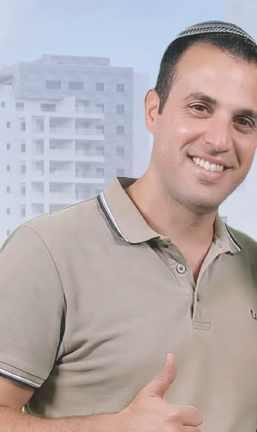












In Crossing Delancey, a single woman searching for love fails to see what is right in front of her. The man who will eventually win her heart is not ridiculously handsome or flashy, nor a tortured poet. He sells pickles. Isabelle (Amy Irving) can’t see it, but her bubbe (Reizl Bozyk) can. She understands that Sam Posner (Peter Riegert) – warm, grounded and traditional – is a keeper. So what if he has to rub his hands in vanilla to lose the smell of vinegar?! In 1988, Joan Micklin Silver’s film Crossing Delancey made a compelling case for pickles as a love language and, for many of us, it still does.
Decades later, the pickle is having a moment. No longer confined to jars, it has gone rogue: dusted over crisps, spun into sweets, and even stamped unashamedly across chocolate bars by M&S. For added spice, the pickle now turns up in shots, in ice cream and – for the truly committed – in snack packets in place of peanuts.
My late mother would have loved this cucumis (Latin) renaissance. She never liked sweets as a child, so trips to the cinema on Clapton Common meant my grandmother bringing new green instead. And, once pickled, the cucumber is unmistakably Jewish. Not that we invented pickling – it stretches back to ancient preservation methods in the Middle East – but we refined it in Eastern Europe, fermenting it with garlic and dill so it would last through long winters and many journeys. They may have tasted sour – but so was life.


For years, Britain’s relationship with the pickle was mediated by Mrs Elswood, a woman who only existed in the minds of the company that brought her gherkins from the Netherlands by biplane in 1947. Perhaps they
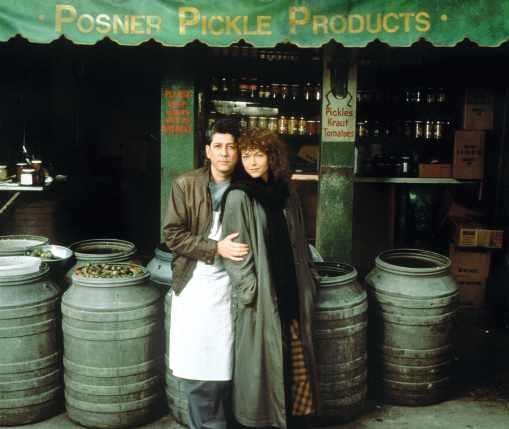
thought a female figure in an apron felt dependable at a time when the country was still using ration books, and Mrs E became the friendly face of a flavour developed in immigrant kitchens – and for that, we owe her.
But now the jar has burst open. Pickling has gone loud, proud and artisanal in the brine-soaked hands of picklers such as James Cooper and Natalie Preston. Around a decade ago, the couple began making kimchi for friends. A jar here, a tub there. Requests followed. Then repeat requests. With lockdown, that following grew again with the introduction of the “make-away” – a meal delivered half-done to finish at home.
“It was Shabbat-inspired,” says Natalie, “but not a traditional menu. It was designed to land at the end










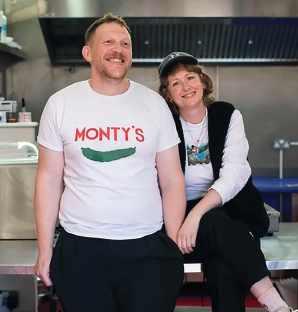
of the working week and make life easier.”


‘We had no idea how wide the pickle conversation could be’
moved into a care home and we delivered her food, seeing the Shedletsky name printed on the bag touched her deeply.”
Walthamstow’s Lloyd Park Market is where their business properly took shape, selling kimchi, pickles (radishes and turnips too) and hot sauces under the name Shedletskys – in honour of James’s greatgrandfather Sam, a kosher butcher in London’s East End in the 1920s. “The name was a real conversation starter,” says Natalie. “We suddenly met Jewish people living locally, wanting to connect. We had no idea how wide the pickle conversation could be.”
Family threads run through everything they do. Natalie’s parents had an allotment, and the shallots grown there, once steeped in malt vinegar, were devoured by Natalie. James’s parents ran a hotel in the West Country, where menus were handwritten and, even after it stopped being a hotel, the extended family (cousins) continued living there together.
Is James’s grandmother, now 102, living proof, of the power of pickles? Natalie laughs. “When she
Natalie balances pickling with her work as an art designer in film, including projects with Mike Leigh. While overseeing props, the odd jar of Shedletskys has quietly made its way into a set fridge. Now living in Leighton with cats Millie and Leonard Cohen, the couple moved production from their kitchen to an arch up the road “because the smell got overwhelming”.
Those jars are now stocked in 30 to 40 shops, including Panzer’s in St John’s Wood, where Shedletskys held the launch of their book, Tickle Your Pickle – a collection of 65 pickling recipes.

And in a neat closing of the circle, Shedletskys pickles were recently served at a special screening of Crossing Delancey at the Garden Cinema in Covent Garden. Just as Isabelle’s bubbe always knew: being a pickle seller is enough.
Buy tickets for a Pickle Shabbat with Shedletskys & Friends on 29 May and 5 June as part of Jewish Culture Month. shedletskysdeli.com








After building world-changing companies and exiting for eyewatering sums, many founders could be forgiven for taking their foot off the pedal. But, for a growing number, the next chapter isn’t about slowing down or the next big thing – it’s about coming full circle to guide those coming up behind them. And, as they tell Candice Krieger, shaping the next generation of founders may be their most meaningful venture yet

URI LEVINE CO-FOUNDER OF WAZE
As co-founder of Waze, the crowd-sourced navigation app founded in 2006 and sold to Google in 2013 for a reported $1.1 billion, Uri Levine helped create one of Israel’s most iconic tech success stories. But the exit wasn’t the end. Alongside building and backing companies, teaching has become central to his life. He spends about 20 percent of his time working with MBA students and founders worldwide, teaching at IE Business School in Madrid, Tel Aviv University, the ChaiTech Accelerator in Toronto and, later this year, Santa Clara University in California, with more to follow. Uri runs an MBA elective, Building Unicorns. “I see myself as a mix between an entrepreneur and a teacher,” he says, “so I feel equally rewarded

whether I am building stuff myself, or guiding someone else to build it.”
Uri began teaching nearly a decade ago after leading an MBA workshop in Brazil. The framework he created became his bestselling book, Fall in Love with the Problem, Not the Solution.
“After it was published, I decided that I wanted to teach more. When I see a student or an entrepreneur taking some insights and already figuring out how it is going to help them, this is the most rewarding event of teaching – the ability to influence and increase their likelihood of someone being successful.”
He remains a prolific entrepreneur and investor: co-founding Moovit, sold to Intel in 2020 for around $900 million, backing dozens of early-stage ventures, and launching Double Down, a fund supporting companies he has founded or is closely involved in.
“I obviously believe in give back and pay it forward, but you need to have the passion for it. If you have the passion then I would love you to come and teach and think about making a bigger impact.”
As a serial Israeli tech founder, Dr Kira Radinsky has returned to academia as a mentor and research supervisor, to help shape the next generation of innovators.
Now based in the US, the Ukrainian-born entrepreneur travels regularly to Israel and has been affiliated with the Technion – Israel Institute of Technology since 2016. There, she serves as a research associate professor, supervising MSc and PhD students and mentoring researchers. “I’ve always believed that the highest-leverage way to build the next generation is to help talented people develop strong judgement,” she says. “How to choose meaningful problems, how to be rigorous, and turn ideas into real impact.”
Kira is the chief technology officer of Diagnostic Robotics, which uses artificial intelligence (AI) to improve healthcare, make it cheaper and make it more widely available. She previously co-founded SalesPredict, an AI-driven predictive analytics start-up that was acquired by eBay in 2016, and went on to serve as eBay’s director of data science and Israel chief scientist.
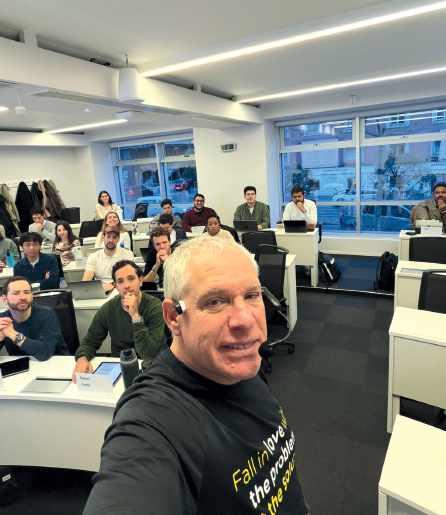
guidance at the Technion. “Mentorship, supervision, guest sessions or structured advising can be incredibly valuable to students,” she says. “Founders can offer a practical lens on decision-making under uncertainty, translating ideas into products, and building with real constraints – perspectives students don’t always get from textbooks.”
Kira credits mentors including Eric Horvitz, chief scientific officer at Microsoft, and Shaul Markovitch, professor of computer science at the Technion who, she says, combined “rigour with a belief that ambitious ideas can be made real”, adding: “That mindset stayed with me and it’s something I try to pass on to my students.”
She first gained international recognition at Microsoft Research, developing predictive algorithms that flagged early warning signs of major global events, from political unrest to disease outbreaks. Her achievements earned her places on MIT Technology Review’s Innovators Under 35, Forbes 30 Under 30 in enterprise technology, and Globes’ Woman of the Year.
Alongside her work at Diagnostic Robotics, she sets aside time each week to advise and research

Her Technion work spans four areas: building cleaner, less biased AI datasets; applying AI to chemistry and drug discovery; grounding AI models in scientific and medical reality; and improving collaboration between people and AI, particularly in healthcare decision-making. Balancing academia with industry, she says, “requires structure, but it’s manageable”. She explains: “In many ways it complements my day job – mentoring keeps me close to first principles and often surfaces new ideas and talent.”
She believes more founders who have exited or built major companies should contribute, even informally.
“If there’s one takeaway, it’s that supporting the next generation isn’t only about teaching content. It’s about helping students pursue ambitious problems and stay rigorous as they execute.”

RAN KORBER CO-FOUNDER BREEZOMETER
After selling his air quality intelligence platform BreezoMeter to Google in 2022, Ran Korber returned to the Technion in Haifa, where he had studied. “After more than a decade in the start-up world, and following significant entrepreneurial success, I felt a strong desire to give back,” he says. “I benefited from exceptional mentors, reinforcing my belief that entrepreneurship is a real profession that should be taught properly.”
Ran now teaches at t:hub, the Technion’s centre for innovation and entrepreneurship and has just revealed that he is also part of the new pre-accelerator programme at t:hub, which began this month.
“The Technion shaped the way I think,” he reflects. “Just as I was fortunate to learn from experienced and successful entrepreneurs along my journey, this is my chance to support the next generation of founders – those who will hopefully help improve the world and strengthen their communities.”
Ran teaches two undergraduate courses within the entrepreneurship leadership programme. One, which he created – Entrepreneurship and Hi-Tech in Israel – offers “a structured and realistic view of how high-tech start-ups are built.” The other, Entrepreneurship in Organisations, examines how innovation works inside established companies, from internal processes to culture and structure. Ran regularly invites senior founders and executives to
speak, giving students direct exposure to those leading Israel’s tech sector. He also emphasises areas he believes academia often overlooks. “I spend a lot of time on mental resilience, decisionmaking under uncertainty and building healthy organisational culture,” he says. “These are skills that matter not only in start-ups, but in life more broadly.”
He believes more founders who have exited should follow suit – and many do. “Whenever I invite founders or senior leaders to speak, they are almost always happy to do so. People even reach out proactively and volunteer to guest lecture, entirely unpaid.
“There is a strong and almost instinctive tradition of helping the next generation. That is one of the real strengths of the Start-Up Nation.”

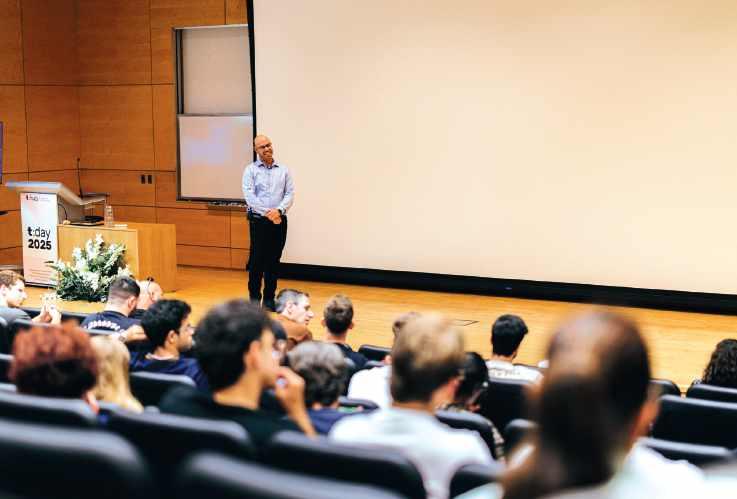
‘There is a strong and almost instinctive tradition of helping the next generation’









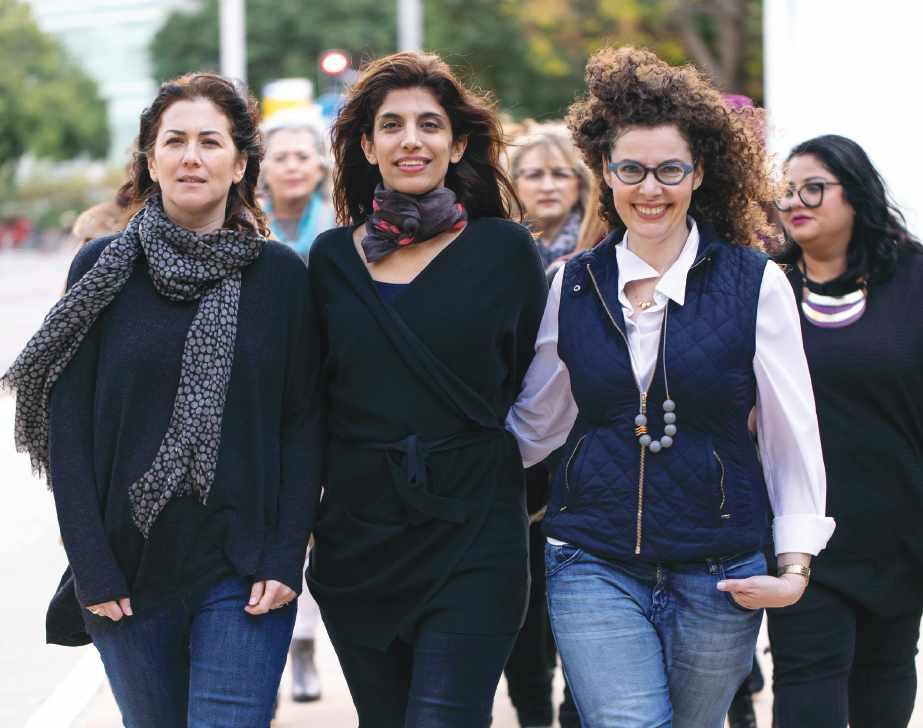
Since October 7, and now amid conflict with Iran, the damage in Israel has been relentless. Through it all, WIZO has witnessed the quieter reality –women carrying the invisible burden, holding families steady while the nation struggles to heal.
By Maureen Fisher
The damage from October 7 has been documented continuously: the loss, the destruction, the displacement. What has been less visible is the second layer of impact – the one carried quietly inside homes, schools and communities.
In times of national trauma, women absorb the emotional aftershocks. They steady children woken by sirens. They support partners navigating the trauma of combat or reserve duty. They manage displacement, disrupted schooling, financial uncertainty and grief, often while maintaining their own employment.
Even in stable societies, the mental load borne by women is enormous. It is unpaid, often unacknowledged and yet foundational to family stability. Since October 7, that invisible burden has intensified. WIZO has seen mothers become first responders inside their own homes, regulating fear, translating trauma into reassurance and holding together family routines when the external world still feels fractured. Many have stepped further into the workforce while simultaneously becoming the emotional anchor for children and partners processing shock and loss.
When women are unsafe, unheard or unsupported, families fracture. And when families fracture, societies fragment. Stability starts with her.
Sexual and domestic violence in Israel has increased since October 7. In 2024, 36 women were murdered by men in incidents of gender-based violence, according to leading experts in the field. These are not isolated tragedies. They are signals of strain within the social fabric.
WIZO’s domestic violence shelters provide immediate physical safety to women fleeing abuse. Its trauma services address the psychological toll. And protection is only the beginning.
WIZO’s Violent Men’s Hotline – the only helpline of its kind in Israel – assists violent men to take responsibility and access treatment. WIZO firmly believes domestic violence can be reduced by addressing the perpetrator. Since October 7, the hotline has expanded to respond to the complex
‘Supporting women is not an act of charity. It is a strategy for national recovery’




Growing up, Tova attended mainstream school, where learning and socialising wasn’t always easy.
The welcoming environment at Kisharon Langdon’s College helped Tova finally feel accepted for who she truly is. This Pesach, you can help young people like Tova continue their journey.
Scan to donate kisharonlangdon.org.uk/donate

















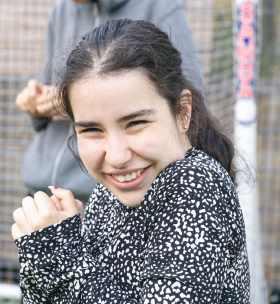




020 3209 1160 • info@kisharonlangdon.org.uk kisharonlangdon.org.uk Kisharon Langdon Registered Charity No. 271519

















reintegration challenges facing men returning to civilian life as parents, partners and professionals. Prevention matters just as much as crisis response.
The story of Or Shmailov is a poignant one. Raised by a single mother and subjected to neglect and abuse, she ran away when she was 14. Her turning point came when she found the Adi Centre programme for girls at risk, part of WIZO’s Be’er Sheva Centre. For the first time, she felt heard and supported. Today, Or is thriving. She lives independently and dreams of studying law. She says the knowledge that there are those who want to help people like her is “the greatest feeling in the world”.
The Adi Centre, which WIZO UK is proud to support, is a uniquely diverse community, including Bedouins, immigrants from Ethiopia and Russia and Ukrainian refugees. Many arrive burdened by trauma and instability. Through structured support, professional mentorship and long-term care, they find not only shelter but stability.
WIZO also invests in women’s leadership through programmes that provide training, mentoring and networks, enabling women to step into positions of
influence in business, community and civic life. Because when women lead, priorities shift and communities strengthen.
Legislation is equally critical. In 2021, a groundbreaking law initiated and advanced by WIZO known as the WIZO Rule required judges to mandate behavioural and psychological treatment for men subject to restraining orders. It was a recognition that systemic change requires legal tools, not just good intentions.
WIZO’s emergency response since October 7 has focused on one principle: restore stability at the centre of the home and you restore strength to the nation. Trauma-informed care, legal advocacy, safe beds, qualified therapists and community centres that remain open long after headlines move on –this is what resilience looks like in practice.
Supporting women is not an act of charity. It is a strategy for national recovery. Supporting women stabilises families. Families stabilise society. And society, at its best, protects the most vulnerable first.
Maureen Fisher is CEO of WIZO UK
Jewish Blind & Disabled provides housing and support for adults with physical disabilities or vision impairments. Our services help individuals live independently, whether in one of our developments or in the community. With increasing demand, your support is vital to ensure we can help everyone who needs our support.

Donate now at jbd.org/donate or by calling on 020 8371 6611


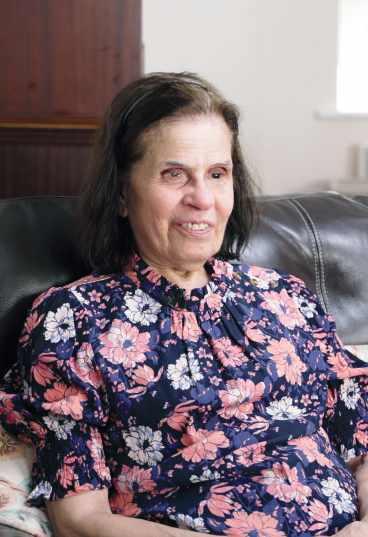


Not too
for


for






At 27, Zoe never imagined she would be facing ovarian cancer. Over the past ten years, the number of young people supported by Chai has risen by more than 200% - individuals and young families who should be planning their futures, but instead find themselves navigating a cancer diagnosis. With Chai’s support, Zoe found the strength to move forward. For more information about Chai’s specialised services across the UK, please call our Freephone helpline on 0808 808 4567 or visit www.chaicancercare.org




I co uldn’t haв beн mo re pr oud to haв run the Lon do n Marat ho n with Chai’s name on my
The new year has been the start of a fresh approach for many of the community charities. By Louisa Walters
Across the community, this year charities are responding to rising need with ambition, compassion and innovation. From care for our ageing population and expanded mental health support for young people, to inclusive employment services, disability provision and crisis response, organisations are not only meeting today’s challenges but planning for the future. New buildings are opening, services are growing and fresh approaches are being shaped by lived experience – all with a shared commitment to dignity, connection and ensuring that no one in our community faces life’s toughest moments alone.
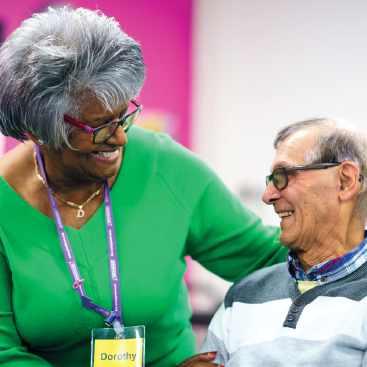
■ Having just launched a new five-year strategy, Altogether Stronger, Jewish Care will be putting its goals into action over the coming year and beyond. The Jewish community is living longer, and many older people are also living with illness, dementia, loneliness and isolation – so the pressure on carers is growing. To enable people to live independently in their own homes for as long as they choose, Jewish Care is expanding its community services and will continue to provide compassionate care to those who need it at the very end of their lives, too.
■ Nightingale Hammerson is dedicated to providing outstanding care for older members of our community and continuously seeks opportunities to enhance residents’ quality of life by creating inspiring spaces that foster social interaction, intellectual engagement and relaxation. Nightingale House in Clapham is undergoing a major redevelopment of the historic building that has served the Jewish community for more than 185 years. The stunning new Activity Hub is a welcome and cosy area, where residents can enjoy a plethora of activities, including cookery in the accessible kitchen, art therapy and talks with guest speakers.
The renovated café is a light, airy, modern space, where residents and the local community can enjoy a cup of coffee and a tasty snack while overlooking the beautiful gardens.

The increasing demand for mental health support within the community, especially among the younger generation, means that Jami will continue to respond to people’s needs with understanding and expertise. It will be able to reach more young people from the age of 11 through the Talking Therapies service. The community generously supported this during a fundraising campaign in February, meaning those who need it will be able to access this service, which provides a non-judgemental, safe space to talk about our challenges with expert therapists who can help us to find clarity and move forward with confidence.
Other services will be expanded or delivered in new ways, including those for people living with dementia. And many other vital services, such as the Holocaust Survivors’ Centre, residential care homes, retirement living schemes, community centres, Helpline and social work, will remain core to Jewish Care’s work.
This summer, The Sugar & Ronson Campus will open, which is the newest landmark hub and will transform the way Jewish Care supports our community across north-east London and Essex.
By bringing all Jewish Care and Jami’s services in this area under one roof, the organisation will be able to offer a truly inclusive space, welcoming people of all ages to find connection, support and community.
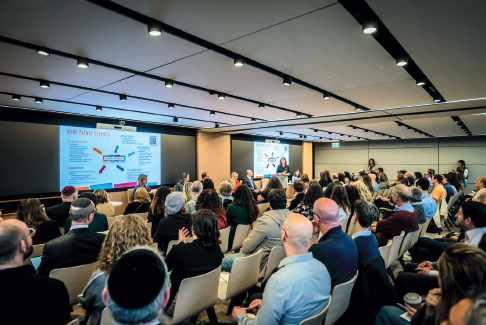
■ A key focus at Work Avenue, the community’s leading employment and business support organisation, is helping more people into work than ever before, so it is expanding its employment recruitment services. There was record attendance at the New Year New Career event in January. CEO Debbie Lebrett says: “Work Avenue’s approach is always client-led. We meet individuals where
they are, help them define their career goals, identify opportunities, guide them through every step of the job search, and continue to support them once in work. This year, as we expand our services, we aim to place even more clients into meaningful and fulfilling roles – giving them the financial stability, the confidence and the dignity that comes with a job they love.”
■ Demand for Jewish Blind & Disabled (JBD)’s services continues to increase, and the charity’s goal for 2026 is to keep expanding support. More than 140 households are currently waiting for safe, accessible homes – all vulnerable Jewish people living with physical disabilities or vision impairments who rely on JBD’s combination of housing and life-changing support. Works will start this year on the redevelopment and expansion of Fairacres, JBD’s oldest building in East Finchley, which will take some pressure off the waiting list. Demand is also rising for community services, which provide emotional and practical help to ensure people feel seen, supported and connected. JBD will continue to develop programmes such as the Independent Living Advisory Service and Sight Loss Support Groups and launch programmes to expand its community-based services.

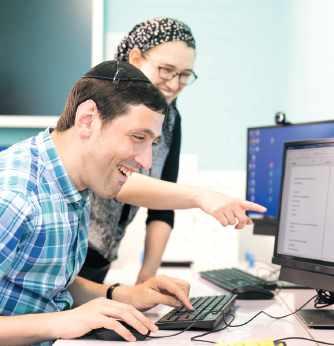
■ From fundraising events to national training roles, people supported by Kisharon Langdon are equal contributors. Co-creation sits at the heart of the charity’s approach, defining how it works and ensuring that people it supports are active partners in shaping everything it does. Their voices help to guide programmes, services and priorities, because meaningful support is always built with people, not for them. This approach is central to the community programme, where monthly town-hall-style meetings allow people to design and refine a wide range of daily activities reflecting their interests, talents and aspirations. Individuals also have the chance to volunteer, supporting other Jewish charities and strengthening community connections. The Enterprise Team exemplifies co-creation in action, delivering commissioned projects, volunteering for community initiatives and producing work that is valued and relied upon. Members also influence change beyond our community as certified co-trainers for the NHS Oliver McGowan programme, shaping better care through lived experience. In the year ahead, Kisharon Langdon remains committed to co-creation, shared ownership and amplifying every voice.
































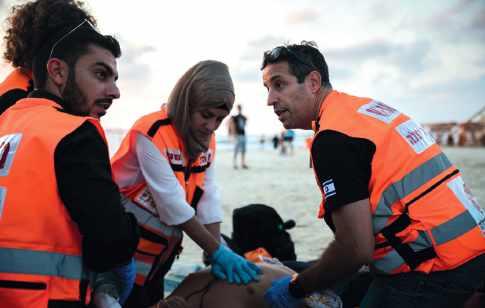
■ United Hatzalah of Israel has a world-leading response time of just three minutes, a speed that can literally mean the difference between life and death. The organisation is now working to achieve its ambitious goal of a 90-second response time. Meeting this goal means recruiting and training more volunteer medics, from every walk of life and in every location. Young and old, male and female, Jewish and non-Jewish, every demographic is represented within this generation of medics and those to come. United Hatzalah has provided free emergency medical first-response across the country for 20 years. In that time, it has grown to 8,000 community-based, trained and certified volunteer medics who respond to medical emergencies in their immediate vicinity, providing initial lifesaving care until an ambulance arrives.
■ For the past 35 years, Chai Cancer Care has been inspired by a simple but powerful mission statement, expressed by one of its earliest clients: “You [Chai] cannot rest until you are the first port of call and not the last resort.” That principle shapes everything Chai does. Chai’s key goal for the year is to ensure that anyone in the community affected by a cancer diagnosis is aware of it and contacts it at any stage, from diagnosis onwards, to find out how they can be supported. As more people are living longer with cancer, many need specialised support for extended periods and more are being diagnosed and reaching out.
■ This year Paperweight will extend its reach and deepen its impact at a time when more people are struggling to navigate lives that have unravelled. More volunteer caseworkers are being recruited to meet the increasing demand for services in London, Manchester, Leeds and Gateshead, while building capacity through other regional hubs. The charity will also launch initiatives shaped by real need: a new regional office, practical digital support, programmes for young adults and students, plus outreach work within schools and their parent bodies.

■ Jewish Bereavement Counselling Service (JBCS) has a simple aim: no one should have to face bereavement without accessible, high-quality support. NHS services continue to face significant pressure, demand for counselling is rising quickly, and too many people are left waiting at a time when care is essential. To meet this growing need, JBCS is expanding the team and recruiting additional counsellors so it can offer more one-to-one sessions and reduce waiting times. The network of support groups is widening to provide safe, understanding spaces, where people can share their experiences and feel less alone. These groups are a vital source of comfort, helping individuals to navigate grief alongside others who truly understand.
Many people have a deeply personal connection to Shaare Zedek Hospital in Israel. For some, it is where a child or grandchild was born. For others, it is where they themselves received unexpected, life-saving care while visiting Israel. These personal experiences have quietly shaped decades of support. This year Shaare Zedek UK is inviting supporters to share what the hospital means to them and their families, why they choose to give, and how their connection to the hospital has been passed from one generation to the next. Sharing real voices and lived experiences will strengthen a sense of purpose and help ensure that support for Jerusalem’s hospital with a heart continues for generations to come.
■ This year, British Emunah is focused, as ever, on rebuilding lives and restoring stability for Israel’s most vulnerable children and families after a period of profound challenge and uncertainty. Across its homes, schools and therapeutic centres, the charity is strengthening the care, education and emotional support children urgently need to heal and move forward. The priority is to ensure that every child in its care feels safe, supported and able to learn, grow and hope again. In 2026, British Emunah is focusing on trauma therapy, educational recovery and essential welfare, including the provision of hundreds of thousands of hot meals for children whose families are struggling to cope. Rebuilding routine, trust and confidence can help break cycles of distress and create lasting change in Israel. In the UK, the charity is looking to recruit volunteers to help bring new events to life, raise awareness of its work and strengthen the community that supports Emunah’s children.
■ At a time of rising antisemitism and growing misunderstanding of Jewish history and service, AJEX’s vital work in welfare, education and remembrance is more important than ever. Alongside the charity’s commemorative activities, AJEX will deliver a wide programme of events to bring together generations, share stories and strengthen community connections, ensuring that remembrance is a living, shared experience – not a distant memory. Combatting antisemitism through
education and awareness will be key, as well as supporting the welfare of Jewish veterans, their families and those currently serving. As the Second World War and National Service veteran generation sadly continues to get smaller, AJEX is committed to keeping their voices, values and experiences at the heart of communal life. It does this while encouraging broader engagement across the community so their legacy continues to be understood, respected and carried forward by the next generations.


■ With a 20 percent increase in referrals last year, Camp Simcha will continue to work towards its mission that no family with a seriously ill child has to cope without practical, therapeutic and emotional support. In 2026, the charity will continue to grow its parent and sibling peer-support networks, alongside condition-specific Communities of Support – currently running for parents who have premature babies or a child with type 1 diabetes, Crohn’s or colitis, epilepsy, eating disorders or serious allergies. These communities ensure families can access expert advice – and learn from others who truly understand their journey. Camp Simcha is also very proud to have recently taken responsibility for managing the Shabbat Room at Great Ormond Street Hospital, working alongside the hospital chaplaincy. The room is open 24/7 and includes dry food cupboards, a fridge-freezer stocked with food, a dining table, a hot cupboard for Shabbat and many essential items that allow families to feel supported and cared for at an incredibly difficult time.












“Thanks to JDA, I can take part in shul services, access the support I need… and have a good chat with friends!”
By donating to JDA this Pesach, you’ll be helping people experiencing hearing loss — at all stages of life — live the best life possible.
From supporting families with deaf babies, children in schools, to people losing their hearing at any age, to older people in care homes, JDA is there for everyone.
Now we need your support to help Jewish community organisations become more inclusive. With you beside us, we can ensure everyone with hearing loss is part of community life and able to access the support they need — from cancer therapies to mental health services.
We can’t do any of this without the help of generous supporters like you
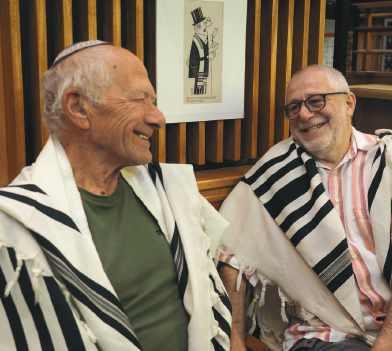

Please show you care by making a donation.
Scan the QR code, visit jdeaf.org.uk or call 020 8446 0502. Thank you.

















Beit Halochem’s four centres deliver life-changing rehabilitation for Israel’s 70,000 disabled veterans and victims of terror — from physiotherapy, hydrotherapy and PTSD care to specialised sports, social support, education and creative programmes.
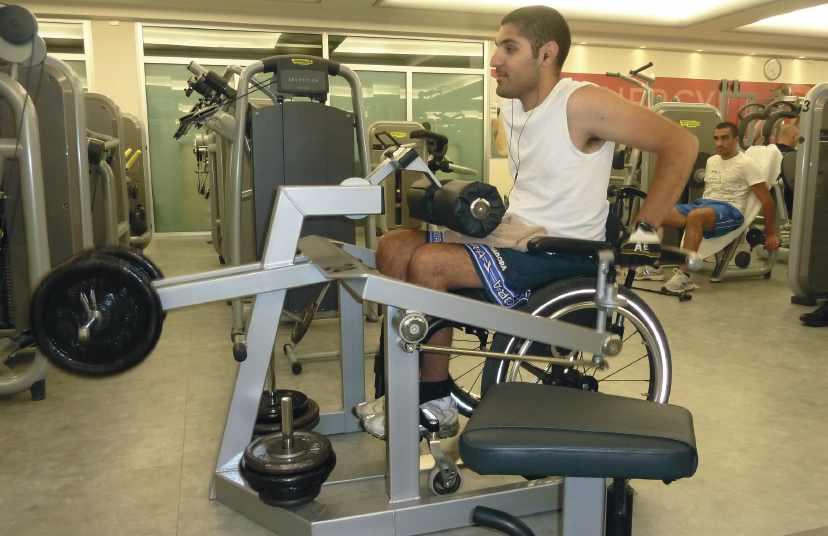


By Lara Benjamin @lara.thestylist
Time to bring out the seder plates and, this year, I found myself looking at them differently. Not just as ritual objects, heavy with symbolism – but as something closer to a mood board. An unlikely blueprint for spring dressing. The seder plates by The Basic Balaboosta (thebasicbalaboosta. com) are ideal for this, as they are anything but shy. Saturated cobalt contrasting with pinks and greens. Punchy coral accents glazed to a high shine.
A splash of green against crisp white porcelain. Decorative, but never chaotic – that’s restraint, a golden rule for fashion.
What stands out most with these plates is the confidence in contrasting colours – baby blues against hot pinks, burnt orange beside cool whites and, here’s the twist, they sit squarely within the official Pantone palette for Spring/Summer ’26. Which means that somewhere between the charoset and the karpas, there’s a fully-formed wardrobe waiting to happen.





















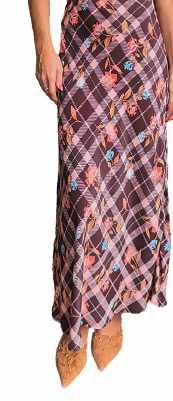



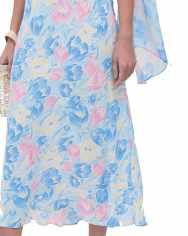





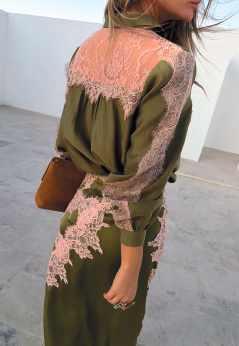



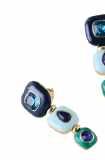







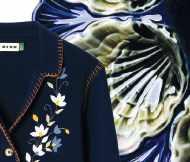



















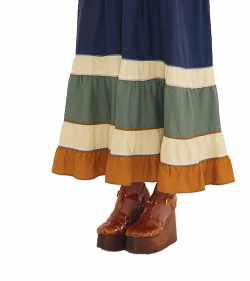






In the crowded world of aesthetics and new treatments, Esther Fieldgrass, founder of EF Medispa, remains a steady guide. A long-time advocate of wellbeing, she believes the obsession with longevity often misses the point.
“Longevity is a word that is everywhere right now, but the term is often misunderstood,” she says. “People talk about it and immediately jump to ‘biohacking’. I’ve never liked that word. It suggests meddling with the body without the scientific understanding to justify it. Longevity, to me, is about knowledge, precision and respecting the biology we’re born with.”
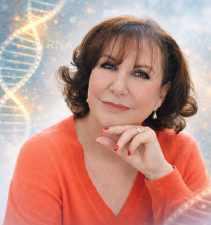
It’s an approach she has championed for decades. “For more than 30 years, I’ve said that beauty starts internally, and people are finally beginning to understand that their health and their aesthetic regime are connected.”
Treatments, she says, are increasingly focused on helping the body repair itself. “Micro-needling to encourage collagen, exosomes for cellular repair, skin boosters for hydration and technologies like ultrasound and radiofrequency that lift and tighten without surgery – those are the areas where we’re seeing real progress.”
New weight-loss drugs have created new aesthetic concerns. “We’re seeing people lose lots of weight, which is wonderful. But they may lose fat pads in the face or develop looser skin. Double chins disappear, but the jawline still needs tightening and structure restoring. That’s where ultrasound and radiofrequency technologies really come into their own.”
Yet for Esther, the starting point is always internal health. “Radiant skin begins with the gut. Our colon hydrotherapist Victoria always says a colonic is the best facial you can have – and I tend to agree.”
Colon hydrotherapy has been part of Medispa clinics for more than 15 years, but the development that excites her most sits firmly in preventative medicine. From April, the clinic will introduce Cellimmune, a blood test analysing RNA –the molecule carrying instructions from DNA to the body’s cells.

“If DNA is the blueprint you’re born with, RNA shows what your body is doing right now,” she explains. “It allows us to see how the immune system is functioning today, whether there are early patterns of inflammation and how the body is responding to stress.”
For Esther, that insight captures the real meaning of longevity. “It’s not about trends or extreme interventions. It’s about understanding the body early and supporting it properly.”
Clientcare@efmedispa.com


Before she pitched Alan Sugar in the boardroom, Amy Anzel was on the stage. New York-born Amy worked in musical theatre before appearing on The Apprentice, arriving like all of Lord Sugar’s would-be business partners with a brand of her own – Hollywood Browzer – and a growing following.
Her original product, the Hollywood Browzer tool, is a simple but effective at-home device designed to shape brows, remove peach fuzz and gently exfoliate the skin.
The partnership with Sugar didn’t happen – she exited in episode six –but the business certainly did. Since then, Hollywood Browzer has expanded into dermaplaning devices, grooming tools and beauty accessories, selling millions worldwide and becoming one of the best-known names in the athome dermaplaning market. hollywoodbrowzer.com

If there is a Jewish woman the rest of us wouldn’t mind resembling, it is Gwyneth Paltrow. Few people do effortless casual quite like her, and fewer still have the frame to pull it off. For most of us, pursuit of longevity is extra broccoli and a tablespoon of collagen powder (as it can’t be absorbed by skin as a cream). Gwyneth would probably say it can, as her Goop stable produces Youth Boost Peptide Cream ($150), which contains nicotinamide mononucleotide, but it can’t be shipped to the UK.



The origins of Medik8 go back to 2009, when founder Elliot Isaacs returned from four years backpacking across Asia with a vision for a skincare company grounded in science and ethics. Inspired by Body Shop’s Anita Roddick, and armed with degrees in physiology and pharmacology, he began experimenting with vitamin A – widely regarded as the gold standard ingredient in age-defying skincare.
Working from a modest space known simply as “The Shed” outside London, Elliot created Medik8’s first product, Retinol 3TR, and developed the brand’s guiding principle: the CSA philosophy – vitamin C and sunscreen by day, vitamin A by night.
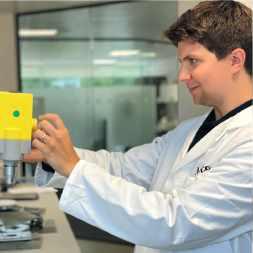
We haven’t tried Lancôme Rénergie HPN Cream (on special offer now at £69), which combines peptides, vitamin C and hyaluronic acid to target ageing, but we can confirm L'Oréal Paris Revitalift Anti-Wrinkle + Firming Night Cream (£15) is really lush and feels like it’s working – and that shows in the morning.
As the company grew, brother Daniel Isaacs, a chemist, joined as the brand’s chief product officer and developed the formulations that built Medik8’s scientific reputation.
“The drive was to create something that truly combined efficacy, luxury and science,” he says. “Many brands focus on one element, but we saw a gap where skincare could deliver proven results while still feeling indulgent.”
One product reflecting that philosophy is Crystal Retinal, a vitamin A serum using retinal – a powerful form of vitamin A – designed to improve brightness, firmness and skin texture and it also works for sensitive skin.
“It delivers visible age-defying results without the irritation many retinoids cause,” Daniel explains. “The formula uses a patented stability system and a progressive ladder of strengths so users can gradually increase potency as their skin adapts.”
Looking ahead, Daniel says the industry is shifting towards more longevity-based skincare. “Strengthening the skin barrier rather than chasing quick fi xes. Instead of focusing on single solutions, address multiple skincare goals at once, and one such product is Liquid Peptides Advanced MP, which nourishes the skin while tackling visible signs of ageing.






If perfumes this spring smell good enough to eat, it’s because fruit notes are leading the fragrance trend for 2026.


If the women in Iceland look more fresh-faced than us, it could be because they’ve been rolling on thin ice – or using Blue Lagoon SkinScience
Straight from Iceland’s geothermal spa waters are masks that use the bioactive ingredients.
The Algae mask is a creamy glowbooster that supports collagen for a smoother, brighter look.


Silica is the deep-cleansing white clay mask that strengthens the skin barrier and minimise pores.
Lava Scrub? A fine volcanic exfoliator and the mineral mask is a lightweight gel-cream that floods skin with hydration thanks to electrolyte rich geothermal seawater.
Masks are £38 (30ml) or £80 (75ml) from uk.skincare.bluelagoon.com




Remember when your hair bounced like the girl in the Harmony hairspray advert? If you can recall it, you’ve reached the age when your blow-dry that once took an hour now takes 10 minutes. Not because you’re more efficient, but because there’s less hair to work with. In spring, you want your hair to spring back too, and here are products to do the heavy lifting.
Fudge Professional Xpander Foam (£14.99) is a cult volumising mousse that expands hair fibres to create instant body without the dreaded crunch.
OSMO Extreme Volumising (from £9) builds without stiffness and works for fine hair that tends to collapse.
Yves Saint Laurent Libre Berry Crush adds juicy raspberry and coconut to its classic Libre fl oral base.



The 7 Virtues’ Strawberry Jam is a playful but polished take on ripe berries.



Le Labo has joined in with Bergamote 22 , which is the brand’s subtler fruit blend of bergamot and grapefruit with musk.
following for its
The most talked-about fragrance in Israel is Zielinski & Rozen Founded in Tel Aviv by perfumer Erez Zielinski-Rozen, the brand has developed a cult following for its unisex fragrances built from layered natural ingredients – woods, resins and spices –designed to evolve on the skin. A trend for 2026.


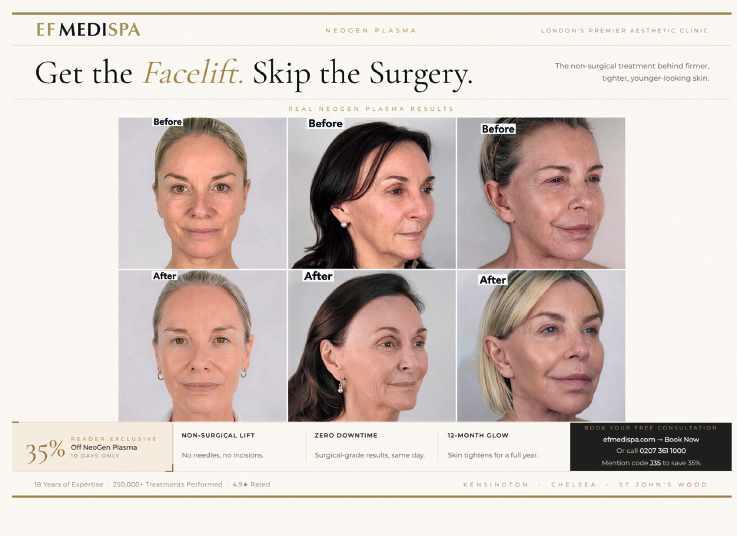






Alison Roman shares some simple recipes that pack a punch from her new cookbook
Once a food columnist at The New York Times, Alison Roman is now host of the Home Movies series on YouTube, author of four recipe books and an Instagram chef with nearly 800k followers. She recently opened her own pantry store in Upstate New York called First Bloom. Something
from Nothing is Alison’s latest book, featuring over 100 simple, stylish recipes that make the most of what you probably already have in your cupboard. Flavourful and unfussy, they help you to put food on the table faster – which we think makes them perfect for Passover.
SERVES 6 TO 8
INGREDIENTS
• 1 x 2.25 kg (4-5lb) bone-in (or 1.35-1.8kg/3-4lb boneless) shoulder of lamb, untied
• Kosher salt and freshly-ground black pepper
• 900g (2lb) waxy potatoes, such as King Edward, peeled or unpeeled, left whole or halved
• 2 garlic heads, unpeeled, halved widthways
• 2 lemons, halved widthways
• 1 bunch fresh oregano, marjoram or thyme, plus more as needed
• 1 x 750ml (25fl oz) dry white wine
• Olive oil, for drizzling
• 1-2 handfuls of tender herbs, such as parsley, dill, chives and/or mint, for serving (optional)
METHOD
1. Season the lamb with salt and pepper. Leave in the fridge for 12-24 hours if you’re able.
2. Preheat the oven to 140°C/120°C fan/275°F. Place the lamb in a large heavy-bottomed casserole with a lid. Scatter the potatoes, garlic, lemons and oregano around the lamb and pour the wine over everything. Give it a good glug of olive oil so that a nice thick layer of it is floating on top. Cover the pot with the lid (or wrap very tightly with foil if you don’t have a lid).
3. Place in the oven and do not look or peek at it. Do not touch, poke or prod it for at least 10 hours, closer to 12 if your lamb is on the larger side, closer to 8 if boneless. If it goes a little longer, that’s okay. This lamb is resilient. You’ll know the lamb is done when it’s golden brown and shreds easily.
4. Remove from the oven and let cool slightly. To serve, transfer the lamb to a large platter (or leave it in the pot) and pull it apart into largish chunks. Spoon all the sauce, potatoes and bits of garlic over the lamb. Top with fresh herbs (if using) and another good pour of olive oil.
Note: Boneless lamb is easier to find, but I promise the bone-in cut is worth seeking out. The bone holds the meat together and seasons the cooking liquid even more deeply – plus, the drama! This lamb can be made 3-4 days ahead, covered and refrigerated. Reheat in a 140°C/120°C fan/275°F oven until the lamb and potatoes are warmed through, 35-40 minutes.
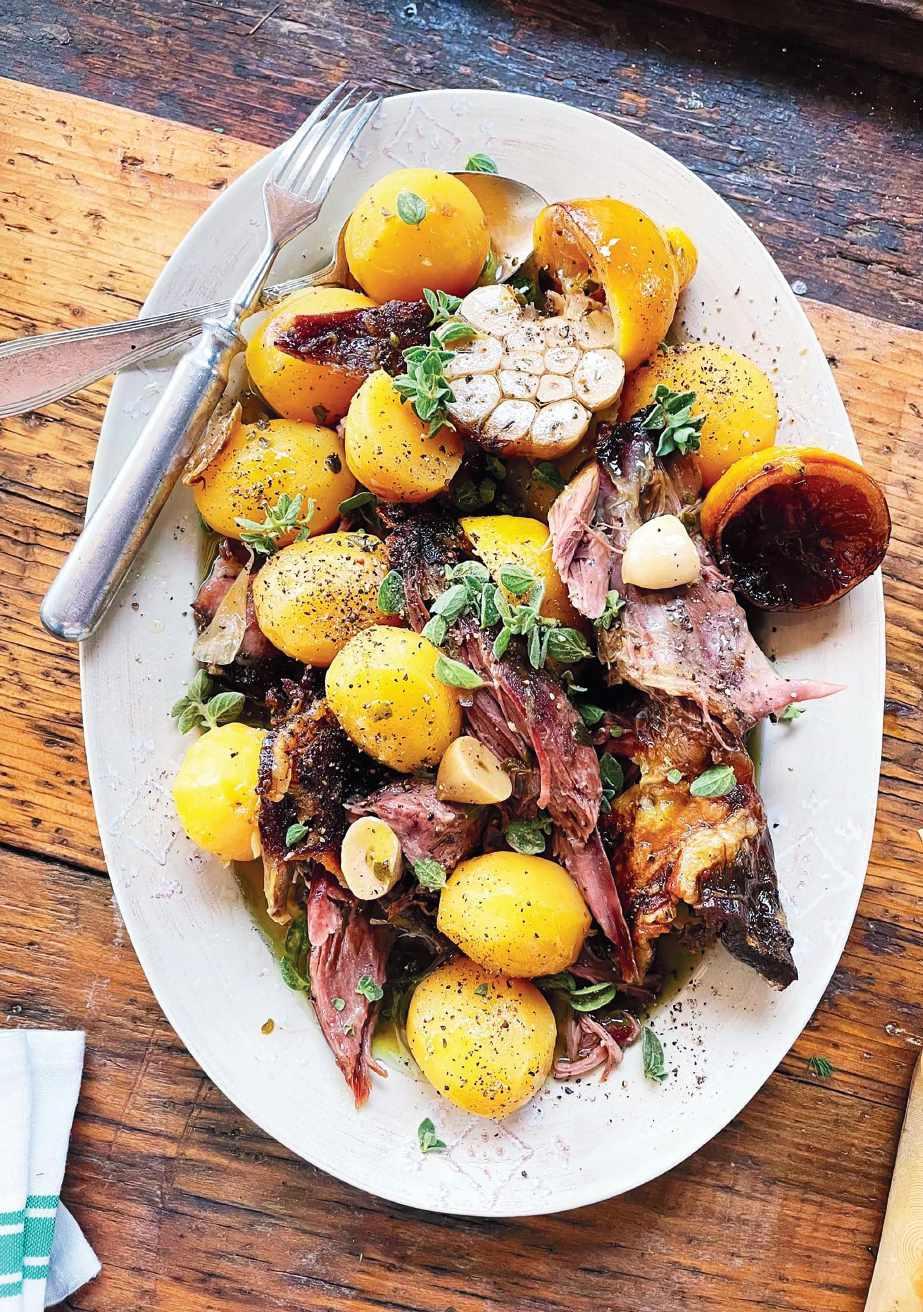
SERVES 4
INGREDIENTS
• 2 bunches small carrots (about 450g/1lb), unpeeled, tops trimmed
• 75g (2½ oz/¾ cup) walnuts, coarsely chopped
• 2 tablespoons olive oil
• Kosher salt and freshly-ground black pepper
• ¼ teaspoon ground cinnamon
• ¼ teaspoon ground coriander
• ½ teaspoon chilli flakes
• 1 tablespoon fennel seeds
• 1 garlic clove, finely chopped or grated
1. Preheat the oven to 220°C/200°C fan/425°F.
2. For fun and if you feel like it, thinly slice some of the carrots into coins.
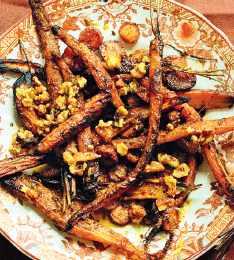
Halve the remaining ones lengthways, quartering them if they’re especially large or thick (don’t overthink this!) – it’s just nice to have different shapes that lead to different textures once roasted.
3. Toss the carrots, walnuts and olive oil together on a baking tray and season with salt and pepper. Add the cinnamon, coriander, chilli flakes and fennel seeds and toss to coat. Drizzle with more olive oil. Roast, tossing every 15 minutes or so, until the carrots are deeply browned, well past the point of tender and starting to frizzle at the edges, 30-35 minutes.
4. Remove from the oven and toss with the raw garlic (the warmth of the carrots will soften the raw bite). Serve warm or at room temperature.
SERVES 4
INGREDIENTS
• 60ml (2fl oz/¼ cup) olive oil, plus more for drizzling
• 4 garlic cloves, thinly sliced
• 1 small shallot, thinly sliced into rings
• 1 teaspoon chilli flakes
• 450g (1lb) small, sweet tomatoes, halved (or one 400g/14oz tin whole, peeled tomatoes, drained, then crushed by hand)
• Kosher salt and freshly-ground black pepper
• 1 teaspoon fish sauce
• 575g (1¼lb) skinless cod or other white fish, cut into four equal pieces
• 1 handful of coriander, tender leaves and stems
• Limes or lemons, halved, for serving (optional)

1. Heat the olive oil in a large frying pan over a medium-high heat. Add the garlic and shallot and cook, swirling the pan constantly, until they start to toast and turn light golden brown, 2 mins or so. Add the chilli flakes and swirl to toast for a few seconds. Remove from the heat and transfer the crispy garlic and shallots and all but 1 tablespoon of the oil to a small bowl (the garlic and shallots can sit in the oil – that’s fine).
2. Add the tomatoes to the pan (if using tinned tomatoes, add them) and season with salt and pepper. Cook, tossing occasionally, until they burst and start to become saucy and jammy, 5-8 mins. (Give tinned tomatoes closer to 10-12 minutes to take the tinned edge off.) Add the fish sauce and 360ml (12fl oz/1½ cups) water, swirling to release any of the bits stuck on the bottom of the pan.
3. Cook until the sauce is slightly thickened but still nice and brothy, 3-5 minutes. Season with salt and pepper.
4. Season the fish with salt and pepper and gently lay the pieces in the

brothy tomatoes. Cover the pan (if your pan has a lid, use that – if not, use a baking tray) and cook until the fish is opaque and just cooked through, 4-6 mins (slightly longer for a thicker piece of fish, like halibut).
5. To serve, transfer the fish and brothy tomatoes to a large shallow bowl or divide among four bowls. Drizzle with more olive oil and the crispy shallots and garlic. Top with coriander and serve with limes for squeezing.
Something From Nothing by Alison Roman is published by Quadrille, £27




New openings and a restaurant in the park are reasons to eat out this spring, says Louisa Walters
No.14 is a Pan-Asian restaurant in an elegant double-fronted townhouse on a very pretty high street just 40 minutes’ drive from north London (and less if you are in Herts). With a magnificent interior and the kind of buzz that says “it’s Saturday night” even on a Tuesday, this is the new location you should be heading to. Geometric plasterwork, extensive use of marble, beautifully upholstered (very comfortable) chairs and attractive contemporary chandeliers make you think you’re in Mayfair – luxe, glamour and warmth abound. The only issue is narrowing down what dishes to choose from the extensive menu. We went for sushi rolls with some interesting combinations, tuna tataki, hoisin duck bao buns, truffle potato cakes with Pecorino and black cod with teriyaki. There were exotic cocktails, a Japanese white wine on the side and no way of saying no to dessert when among the options are matcha tiramisu and a toffee almond chocolate tart. Every dish is stunning to look at, delicious to taste and, best of all, they don’t come out too fast. The stylish décor extends to the toilets (and also to the top floor, which turns into a club until 2am). Chic, elegant and all the trappings of a high-end central London venue without the price tag.
LOGAN'S
There’s never anywhere decent to go for coffee or brunch in Temple Fortune, I hear you cry. Well now there is. Just in time for brighter days and warmer weather, Logan’s (kosher), from the team behind One Ashbourne, has opened in Princes Park on Oakfield Road, bringing great food, beautifully designed interiors and a cool brunch-to-dinner vibe to the area. It’s an intimate space ideal for breakfast with your laptop, lunch with friends, coffee and a pastry on a dog walk or watching the kids play in the park. There’s outdoor seating and ice cream too. Logan’s is reviving the cult-favourite Crepe-Shakes – freshly-made crêpes stuffed with sweet and savoury fillings – alongside ice-blended drinks,

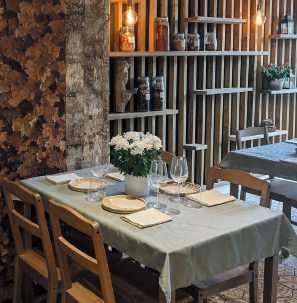
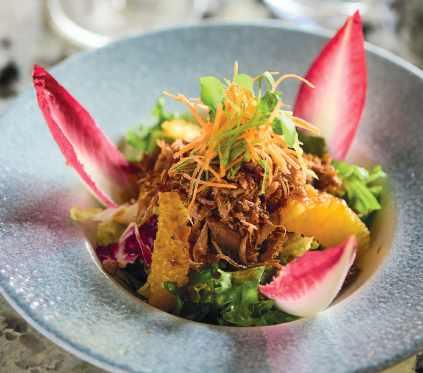

artisan pizzas, vibrant salads, hand-crafted sandwiches, flaky pastries and brunch plates. This pretty unit is also available for private hire.
One Ashbourne (kosher) in Temple Fortune has become a go-to destination for fine dining, blending vibrant Middle Eastern spices and British cuisine with refined French techniques. If you’re the type who likes to try a little of everything, the five-course tasting menu is an indulgent treat. Among the best dishes are truffle arancini, salt beef croquettes and sticky lamb ribs. From there, choose between fresh fish, pan-seared duck breast and premium cuts of lamb or go all-out with the legendary Tomahawk, cooked tableside, flamed and finished in a sizzling pan. Classic desserts such as Bramley apple crumble and Eton mess are waiting at the end.
“Book your chair, not your table,” is the mantra at Moss & Maple (kosher) in Belsize Park, which defines the sharing concept of the innovative French-Mediterranean Sunday family lunch offering. There’s a salmon carpaccio starter and Tuscan beef tataki, but our favourite was beef tartare with tarragon oil, cured egg yolk and a side of perfectly crisp potato with a sweet marinade. For main course there is a butterflied whole chicken with a savoury chocolate sauce or a 48-day aged Tomahawk steak cured in goose fat and lemongrass, served alongside bone marrow with a miso sauce and baby potatoes. Portions are generous and the dishes are made with quality ingredients. Israeli chef Orly trained in Michelin-starred kitchens –
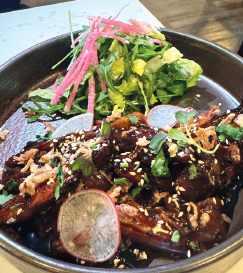
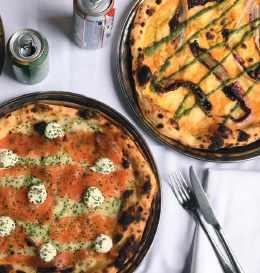
including Dinner by Heston and Gordon Ramsay’s Savoy Grill – and his attention to detail is notable. Even the plates are specially designed in Portugal. Dessert on my visit was a (thankfully light!) chocolate, orange and hazelnut mousse. Alex Davis
At Cacao Bean Cafe in Borehamwood kosher meat is now being used in many of the dishes. So if you’re a regular who has always been chalishing to try the crispy duck salad you can now tuck in and enjoy. There is also a wonderful new salmon sashimi salad with a hint-of-wasabi dressing, melt-in-the-mouth lamb croquettes made with slow-braised shoulder and creamy (but not!) potatoes, an intensely rich teriyaki chicken and crispy chilli beef in Korean barbecue sauce to rival any I’ve ever had anywhere. This cosy and welcoming little restaurant wraps you in a hug as soon as you walk in.

• Edgware has a new kosher all-you-can eat meat restaurant. Rodo is a Brazilian steakhouse serving up skewers full of flavour with fresh sides and a great vibe.
• Mazeltov to Mazal in Camden, which won Best Kosher Shawarma Restaurant, and to Melissa in Canons Park, which won Best Kebab Restaurant in north-west London at the British Kebab Awards 2025.
• It’s a whole year since Panzer’s in St John’s Wood launched Circus Pizza, available to indulge in on the terrace all day or to have delivered within a three-mile radius.
• More fine dining kosher paella pop-ups are on the cards for Arros QD in Fitzrovia. Email joannanissim@hotmail. com to be notified when dates get released.








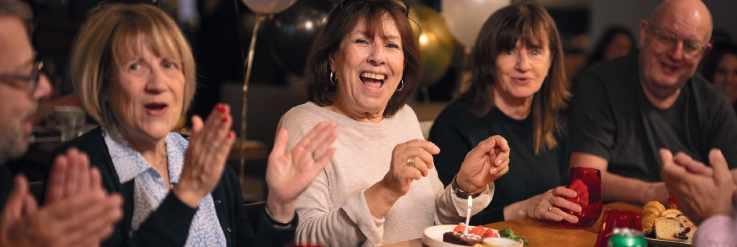

The new voices of Jewish food showcase their dishes across social media. These are the influencers you need to follow. By
Hannah Litman
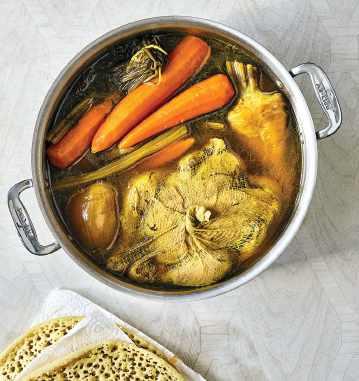


Food has always been more than sustenance in Jewish life. It’s our memory keeper, our cultural touchstone, and often the way we first connect with one another. Across platforms and continents, a new wave of Jewish food voices is carrying those traditions forwards — sometimes with a modern twist, sometimes with unapologetic nostalgia, always with heart. These bright young things are not only cooking but also telling Jewish stories with every recipe they share. Around every Shabbat table, during every holiday and on every digital feed, the story of Jewish food continues in the modern world.
(@benrebuck)
The unapologetic Brit making kosher go viral
London-born Ben Rebuck (pictured above and overleaf ) shows how Jewish food doesn’t need to be intimidating. His kosher for Pesach chocolate torte went viral and has become a staple for his nearly 400,000 Instagram followers. Formerly known as Ben’s Vegan Kitchen, he still leans heavily plantbased — but it’s his candid voice on Jewish identity that sets him apart. After October 7, Ben lost tens of thousands of followers when he declared himself proudly Zionist. He leaned in, using the same feed that shares easy meals to speak out against antisemitism.
Q: What do you want people to feel when they cook Jewish food?
A: Connection to millennia of tradition.
Favourite recipe: Kosher for Pesach chocolate torte
Cookbook(s): None yet – his recipes live on socials and provecho.co.

(@shailylipa)
Israel’s queen of no-fuss, Mediterranean home cooking
Born in Tel Aviv to a Greek-Turkish family, Shaily Lipa (pictured above and overleaf ) is one of Israel’s bestselling cookbook authors – with 11 Hebrew titles that have sold more than a million copies – and host of three popular TV cooking shows. Her debut English-language cookbook, Yassou (Running Press/ Hachette), introduces international readers to the flavours of her childhood: tzatziki, spanakopita, her grandmother’s white bean salad. For the High Holy Days, her leek patties are legendary: her mother fried them by the hundreds, and the family ate most straight from the pan before they ever reached the table.
Q: What role did food play in your family?
A: It was the language of love and celebration.
Favourite recipe: Leek patties (Prassokeftedes)
Cookbook(s): 11 Hebrew cookbooks; debut English-language title Yassou.
(@adeenasussman)
Market-driven recipes from Tel Aviv to the New York Times
Few voices have shaped the conversation around modern Jewish and Israeli food like Adeena Sussman. From her kitchen steps away from Tel Aviv’s Carmel Market, she draws inspiration daily from spice stalls and produce vendors. Her books Sababa and Shabbat are both New York Times bestsellers; Shabbat was named one of the best cookbooks of 2023 by NYT Cooking and Bon Appétit. Beyond her own work, she has co-authored more than 15 other cookbooks, including Chrissy Teigen’s Cravings series. Her recipes carry memory as much as flavour – like her mother Steffi’s overnight chicken soup, simmered for 12 hours, with an optional Yemenite spice blend that transforms the broth.
Q: What does Shabbat mean to you?
A: It’s both a meal and a meaning.
Favourite recipe: Overnight chicken soup (with a Yemenite option)
Cookbook(s): Sababa, Shabbat
(@whatjewwannaeat)
Playful twists on tradition with modern tribe style
Amy Kritzer Becker launched What Jew Wanna Eat in 2010, making it one of the first fun, irreverent Jewish food blogs. Her voice is equal parts humour and heritage, with recipes such as fried pickle latkes and pink black-and-white cookies. She also co-owns ModernTribe, a designforward Judaica shop that has gone viral for products like her pickle menorah. Her book, Sweet Noshings, reimagines Jewish desserts –Nutella babka, pumpkin rugelach – for a new generation.
Q: How do you balance tradition and innovation?
A: Tradition should be celebrated, not stuck in the past.
Favourite recipe: Black and white cookies turned pink
Cookbook(s): Sweet Noshings

(@therealmelindastrauss)
TikTok’s biggest Jewish food voice
With 1.5m+ TikTok followers and 250k+ on Instagram, Melinda Strauss is the most-followed Jewish food creator online today. She began with a blog, but it’s her short-form storytelling that propelled her into the mainstream. Melinda uses her platform to share both recipes and reflections on Jewish identity, heritage, and family life. Her debut cookbook, Eat Jewish (Quarto), pairs 100+ recipes with approachable cultural explainers designed for Jewish and non-Jewish readers alike.
Q: What do recipes mean to you?
A: They’re stories – they tell who we are.
Favourite recipe: From Eat Jewish – Sweet raisin
noodle kugel
Cookbook(s): Eat Jewish

(@noshwithmicah)
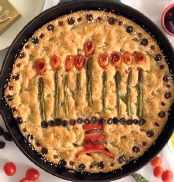
Plant-forward recipes reimagining Jewish tradition
A trained chef and registered dietitian, Micah Siva is reframing Jewish food for a generation that wants vegetables at the centre of the table. Her debut, Nosh: Plant-Forward Recipes Celebrating Modern Jewish Cuisine, was a 2025 International Association of Culinary Professionals Award finalist and has been praised for balancing health with flavour. Raised in Canada, she recalls her grandmother’s kitchen filled with challah and bubbling soups; today she translates those memories into vibrant, plant-based recipes accompanied by her own food photography.
Q: What did Jewish food mean in your home growing up?
A: It was never just nourishment – it was connection.
Favourite recipe: Herbed
horseradish salad
Cookbook(s): Nosh: Plant-Forward
Recipes Celebrating Modern Jewish Cuisine




MARTIN SEGAL’S lifelong dedication to charitable work and IDF service has inspired Israel Guide Dog Centre (IGDC) UK’s new competition.


“What he did made him a hero,” says new chief executive Karen Brogus. “So, we are celebrating the heroism of guide dogs by inviting primary school children to design either a superhero dog or a human superhero who works alongside a dog.”
Entries can be submitted as a poster or short newspaper-style article and must include a brief explanation of who their superhero helps and how they make a difference. The completed form must be submitted by 29 May –either via participating schools or directly to the charity.
The judges– Rebecca Segal, Brigit Grant (LIFE editor) and Daniel Winston, author of Dennis and Friends – will be looking for kindness, teamwork, creativity and an understanding of how guide dogs transform lives.
IGDC UK is offering school assemblies and youth group talks, introducing children to guide dogs and how they support people. israelguidedog.org.uk
This is a space for pets of all kinds, regardless of their level of observance. So send stories and pics to pets@jewishnews.co.uk
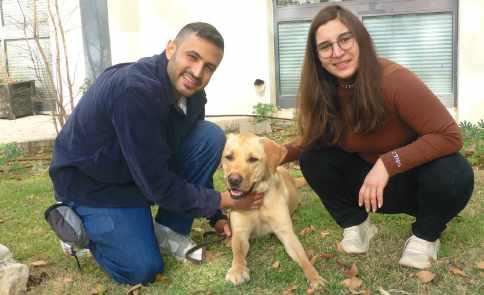
We’ve watched Teddy grow from an eager pup into a dog with purpose. Named in memory of Martin Segal, former UK chief executive of the Israel Guide Dog Centre (IGDC), his journey has always carried extra meaning. Now it has taken an unexpected – but fitting – turn.
For the past two months, Teddy had been training on campus in the PTSD (post-traumatic stress disorder) Service Dog track, with hopes he would support an Israel Defense Forces veteran living with trauma. But, after careful assessment, health and behavioural challenges meant it wasn’t the right path. And so he went home. Home to Adi and Yotam in Rehovot, who raised him from his first minutes, always knowing he might one day serve someone else.
In a twist of timing, Adi went into labour the very day Teddy returned to campus. Weeks later, they came back to collect him. “Teddy is our first-born son,” says Yotam. “Now that he’s back, we are finally a complete family.”
There is sadness that his expected ‘career’ won’t happen, they admit – but overwhelming gratitude too. Raising
him, says Adi, was “a project of heart and resilience”. Advocating for access while out with a trainee service dog also opened her eyes to the daily barriers faced by people with disabilities.
But Teddy’s story doesn’t end here. He will be an ambassador dog, helping the Centre explain its work, teaching the public how to interact correctly with service animals. “I’m so proud of this cheeky little chappie, named after my darling Martin Edward (Teddy),” says his widow Rebecca, “that he finished his training and is now with his forever family and gives them so much support and comfort in the future. And that he will stay connected to IGDC.”

Despite finishing 26th out of 26 teams, Israel’s bobsled crew still had reason to celebrate, as qualifying for the Winter Olympics was a first.
Nicknamed “Shul Runnings” – a nod to the film Cool Runnings – the team also had four-legged support in the form of Lulu, a Shiba Inu and loyal companion of team captain AJ Edelman, a US-born Orthodox Jew based in Netanya who spent a decade willing Israeli winter sport into existence. After competing in skeleton in 2018, he went to bobsled, facing funding collapse, sceptical investors and endless cold-weather training.
At one point in South Korea, backing
fell through and AJ found himself living in freezing conditions outside Pyeongchang. No heating, no mattress, just a cold floor with Lulu.
“Lulu and I were cooped up that entire winter,” says the captain, who even drove for Uber to keep alive his dream.
By the time the Winter Olympics arrived in Milano Cortina, the team had endured army call-ups after October 7 and even a break-in at their training base. There was booing at the opening as they marched out with the Israeli flag, but the team knew that history was made – and a dog was part it.
Rusty from @meetmypaws isn’t just famous for his Sunday roast reviews – where he gives paws-up to pubs with gravy boats and roast carrots; he’s also a proper socialite. This past Chinese New Year, he dined with chopsticks and pals Skye, Biggles, Luna, Romeo and Pushkin and their mum, kid-friendly cookbooks author Annabel Karmel. Rusty also keeps up transatlantic chats with pups across the pond, then waits to meet new barky Brits here on the Meet My Paws dog walks.

Are you sitting comfortably, cats (and dogs)?


Then time for some seder stories ...


























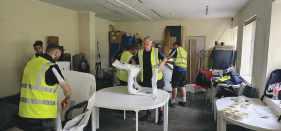








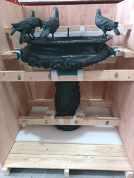


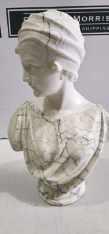



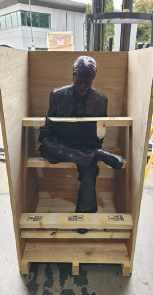











































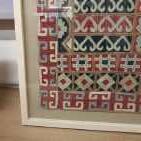
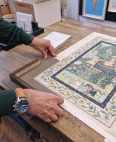
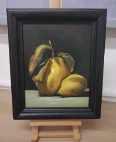


Come



























It’s up
There’s only one way to find out if it’s still the same – Brigit Grant went there
When it comes to travel, there are headlines that make us uneasy to leave home. Destinations that were once a must have become a maybe – but New York? Never. That was until the pulse-raising mayoral election.
With the arrival of Mayor Zohran Mamdani, anxious commentary has followed the redefining of antisemitism, his wife's widely-criticised response to October 7 and viral clips of calls to prayer through Times Square. For many Jews watching from afar, there’s a burning question – is the city with the largest Jewish population outside Israel changing beyond recognition?
Too often, social media takes you further than you want to go without a ticket. So I bought one to find out if NYC is unredeemable. On arrival, the signs were good. Presenters still sprinkle Yiddish on NBC’s Today show in Rockefeller Plaza and in Times Square you can still buy a Broadway sign menorah. Unlike in London’s Leicester Square. Bagels with a schmear are still unapologetically oversized – but there are more places to buy them. Like PopUp Bagels in Midtown, where the original concept ditches singular bagels for batches served hot with dipping pots of flavoured cream cheeses. At new cult favourite Apollo Bagels, it’s all about texture as they are crispier and more blistered than the traditional New York bagel.
Obviously I tried them, but the pretence for visiting the Big Apple was about more than big bagels and big change. As script writer of the film Midas Man – a biopic about Beatles manager Brian Epstein – I was there for its opening at the New Plaza cinema on West 67th
Brian loved New York and often stayed at the Waldorf Astoria, from where I uncovered a note he wrote on the hotel’s headed paper. As a man with excellent taste – in music and hotels – Brian would

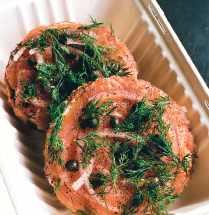
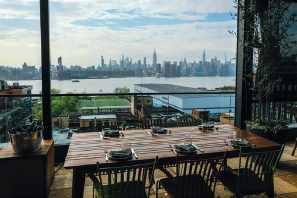
have appreciated the very rock ’n’ roll vibes of The Moxy hotels by Marriott.
Created for those hipper than me, I still got to stay at three as I moved about the city. They all have a similar formula: stylish, clever design, buzzy public spaces and affordable rates, but each has an individual personality reflecting the neighbourhood. So the Moxy NYC Times Square, being so close to the Theatre District, has some of the most handsome out-of-work actors serving bar and grill classics at the Legasea restaurant. Talk about hot!
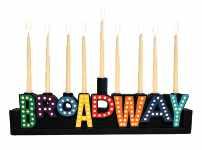

Rooms are compact but cleverly designed by renowned Canadian architects Yabu Pushelberg, with flexible furniture, hooks instead of wardrobes and oversized walk-in showers. The lobby hums with constant check-ins – theatre kids, finance types and tourists (me) who head for the rooftop – Magic Hour – the largest all-season hotel rooftop bar and the most popular, judging from the ‘lines’(don’t say queues) on the street and demand for a Some Like It Hot (tequila and spicy mango) and a bird’s eye view of the Broadway lights.
Yes, Broadway – with its Jewish heritage cement-
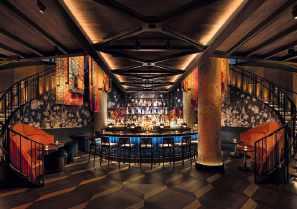
ed in the foundations of the buildings between 41st and 54th streets and 6th to 9th Avenues. The Museum of Broadway should give gift passes to Mr and Mrs Mamdani as a reminder of the Jewish talent that built the district.
A must for musical theatre fans, a film at the museum tells you about the Nederlander and Shubert organisations, which still have theatres where musicals and plays bear the stamp of Jewish creators. So much of that work is celebrated in the series of rooms – Jerome Kern and Oscar Hammerstein’s Showboat, Leonard Bernstein’s West Side Story and Stephen Sondheim’s Company. There’s a corner devoted to Fiddler on the Roof and a case of Avenue Q puppets and the show written by Robert Lopez and Jeff Marx is now at London’s Shaftesbury Theatre. In a room of mirrors, Chorus Line devotees can spin like Cassie to Marvin Hamlisch’s score and cry if, like me, you’re


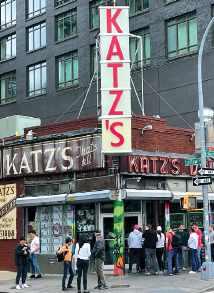


town cool and the hotel, with its five drinking and dining establishments, is its own nightlife scene under one roof. There’s the Japanese restaurant Sake No Hana, piano lounge Silver Lining, subterranean nightclub Loosie’s and rooftop bar The Highlight Room.
thinking of your late sensational mother.
Sleeping at Moxy Times Square feels like staying inside a chapter of that musical story, but it was time to move to across the river, to the Moxy Williamsburg in Brooklyn, which has a different energy. Warmer tones, softer lighting, wallpaper dotted with frogs drinking vodka – this is a special residence, as proved by a Russian Jewish wedding held there on Sunday.
Mesiba, the on-site Levantine-inspired restaurant was opened by Israeli chef Eli Buliskeria, but the menu is now Middle Eastern/Mediterranean-themed. The Moxy staff at all branches are very personable and I love to chat, but as Williamsburg remains resolutely Jewish, there were kosher bakeries beckoning and Frumah Sarah’s husband to visit. Yes, for a view of Manhattan, Israeli grill plates and lots of noise, Laser Wolf (as in the butcher) is the place to go for Sunday brunch. I would be a regular if I lived at the Moxy, as you can walk there – and anywhere in Williamsburg. Living there would also make the hotel’s LilliStar bar on the 11th floor my local. A girl can dream… But back to Manhattan to see more shows –Two Strangers (Carry a Cake Across New York) was as sublime as it was in London (and I was seated beside Brooke Shields and Patti Lupone), a snappy revival of Little Shop of Horrors and the disappointing Death Becomes Her. It doesn’t.
Ending the trip at Moxy NYC Lower East Side felt so right, because the area carries Jewish immigration in its bones. The hotel’s moodier colour palette suits the neighbourhood’s layered past, but the Lower East Side is also the epitome of down-
You gotta love a rooftop bar in NYC – and I did, in a coat and blanket (it was minus 10°C), but outside at street level, something Jewish was calling. Katz’s Delicatessen. They are still slicing pastrami thick enough for sandwiches to be doorstops, but the place feels like it’s nursing a broken heart.
Knowing that director Rob Reiner, who was murdered with his wife, Michele, last December, will never again stand by the When Harry met Sally table is felt by everyone who works at Katz’s and met him. Reiner visited a lot, said Katz’s owner Jake Dell (his grandfather and uncle purchased the deli in 1988 from the Katz family).“He forever changed Katz’s history with that simple line: ‘I’ll have what she’s having!’” And that wasn’t lost on those dining the same day and scanning the hundreds of photos on the walls to spot Rob Reiner’s smiling face.
Back in the lobby of Moxy Lower East Side, new Big Apple adventure seekers were arriving. I was jealous of the multitude of experiences ahead of them in a city where nothing felt diminished. Times Square, Williamsburg, the memory-soaked Lower East Side were still the same to me. Better possibly, because on Union Square, young boys were offering to put on tefillin and on Times Square, a memorial for October 7 victims rolls continuously on a giant screen.
For now, and for me, New York is still what it has always been: big, ambitious, theatrical and gloriously Jewish. Pray that it stays that way.
Book at moxytimessquare.com (from $139 per night), moxywilliamsburg.com, moxylowereastside.com (from $179 per night), marriott.com. The Broadway menorah (£42) can be bought via www.broadwayupclose.com


With spring finally here and summer on the horizon, it’s time to book a holiday.
By Louisa Walters


The on-off availability of flights to Israel means it may be off the cards for a trip this spring, but many of us still have it firmly in our sights for later this year. The good news is that there is still availability and there are ever more places to choose from. Marbella is also always a good idea, or you could consider a kosher cruise. For those with the funds to buy abroad, Cyprus is becoming a very real option for a holiday home.
Since 2023, roughly 50 new hotels have opened or are scheduled to open across Israel, an expansion that speaks to long-term confidence in tourism in spite of war.
Much of that change is in Tel Aviv, where the traditional beachfront tower is gradually being joined by a new generation of design-led boutique hotels, such as the recently-opened Poli Urban Tel Aviv, an adults-only property with rooftop pool, cocktail bar and an atmosphere that feels closer to a private club than a hotel. Life has previously reported the opening of Gymnasia Hotel, opened by Isrotel on Rothschild Boulevard, which offers the kind of sleek, urban interiors you’d expect to find in New York or Berlin.
One of the most talked-about openings of the past year is Fattal’s Bazaar Hotel in Jaffa, with design-led interiors, small-scale luxury and close connection to local restaurants, galleries and cultural venues. Keeping with the city vibe, the Nucha Hotel in Jerusalem, which opened in September 2025, is designed to cater to visitors seeking an intimate and design-oriented accommodation experience, with curated interiors and personalised service. Also in the historic city, the Prima Vera Hotel, while not new, had a major refurb two years ago. It is a comfortable mid-scale hotel in a great location.
The Jacob hotel is the first to open in Modi’in since the city between Tel Aviv and Jerusalem was established in the 1990s. With 85 rooms and suites, it is located within the Azrieli Modi’in complex and, with event areas, a restaurant-bar and planned spa services, it is a new hospitality hub.
Perhaps most exciting of all is the Gordonia Resort, a luxury hotel development coming to Zichron Ya’akov in the wine country. This large-scale complex with 140 designer rooms and suites, several with private pools, as well as a large, heated infinity pool, spa complex and fine-dining facilities. Every room has a sea view, as does the dining room and the lobby. Combining luxury accommodation with coastal scenery, this gets our vote for the ultimate dream vacation.
Weddings abroad are becoming more and more de rigueur, but not everyone wants to spend an entire weekend hanging out with the wedding party and, thankfully, if the wedding is in Marbs you don’t need to because there are so many places to stay. One of the newest – and arguably the coolest – is the METT, positioned on the beach between Marbella and Estepona, with a lovely long boardwalk for an early morning or late afternoon stroll.
It’s a large complex with 250 rooms with garden, sea or pool views built around a highly attractive pool area that runs the
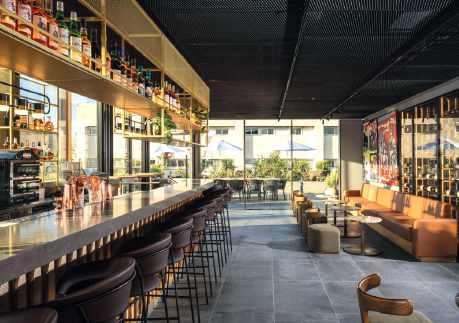






length of the property. The sunbeds have thickly padded cushions, the towels are plush, the striped umbrellas go up and down with a click of the fingers (as in the staff come running) and it’s a people-watching paradise. Groups of friends, couples, girly groups – all were in evidence during my stay and it’s very much a pool to get dressed up for.
The owner hails from the world of restaurants, so food is front and central with an Italian called Isola (which also doubles up as the breakfast buffet), a beachside sushi spot called Azure, a super-stylish Greek restaurant on the beachfront called Ammos and El Bar De Lola for tapas dishes and drinks. We tried them all and each was exceptional in its own right –Ammos in particular, transporting us from the sands of Spain to a Greek island.
The rooms are modern and minimalist but super-luxury, with lots of bleached wood, crisp white linens and touches of blue in the soft furnishings. Ours had its own garden with plunge pool and hammock to swing away the day with a Kindle and a cocktail. There is plenty of wardrobe space and the huge bathroom has superb lighting, which is key when attending no fewer than three wedding events and, every time we got back to the room after partying, it had all been cleaned and tidied for us. Now that’s what I call service.
If breathtaking destinations, exceptional Glatt kosher cuisine, inspiring Jewish experiences and the camaraderie of fellow travelers are on your holiday checklist, then Kosher River Cruises & KRC Expeditions (kosherrivercruise.com) should be

too. Guests sail aboard elegant small ships carrying no more than 140 passengers, creating a warm, intimate atmosphere and a true travelling community. Whether cruising the rivers of Europe, discovering the coastlines of Asia, or embarking on once-in-a-lifetime expeditions to remote destinations, every detail is thoughtfully arranged. Onboard lectures, guided tours, open bars and memorable Shabbat celebrations create a meaningful travel experience and every voyage blends adventure, culture and tradition. Upcoming destinations include Japan and South Korea, the waterways of Holland and Belgium, and expeditions to Antarctica.
If hotels aren’t your thing and you’re not considering making aliyah, Cyprus offers a viable alternative for a holiday home. As well as being openly supportive of Israel and the Jewish community, it feels reassuringly similar to the UK – they drive on the left, use the same electrical plugs and sockets, English is widely spoken, and a large British community lives there. Paphos has an active synagogue and a growing Jewish community. It offers long summers, seafront promenades, outdoor cafés and a relaxed rhythm of life. In 2025, Cyprus was ranked by CompareTheMarket.com as the world’s best country for buying a holiday home. Vichy Holidays (vichyholidayscyprus.com), a Jewish-run local property management company in Cyprus, works directly with developers, law firms and accounting professionals. Its team assists with sourcing, negotiation, legal processes, banking support, property management and transparent monthly reporting.










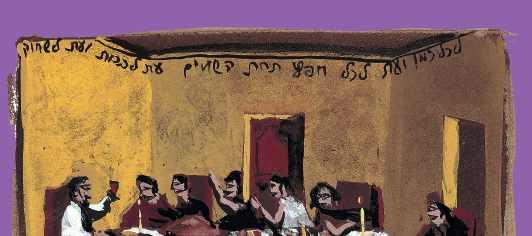
By Leo Pearlman, Co-CEO of Fulwell Entertainment
Pesach may be the most remarkable piece of educational theatre ever created. Across the world, on the same night, Jewish families gather around a table and perform the same ritual Jews have performed for centuries. We eat matzah, dip bitter herbs, lean as free people and drink too much wine. We read words that have travelled with our people through exile, persecution and survival. But the most important moment of the evening is not the rituals. It is the questions and, specifically, those asked by our children.
Ma Nishtana W hy is this night different? The seder is built on a radical idea: that the survival of the Jewish people depends not on institutions or politics, but on a conversation between generations. Children ask, parents answer, elders explain. A story passed forward like an unextinguished flame. The Torah does not simply command us to remember the Exodus, it commands us to teach it. “And you shall tell your child on that day…”
For thousands of years, that instruction has been the engine of Jewish continuity. Empires rose and fell, Jews were expelled, persecuted, massacred and scattered. Yet the story endured because each generation sat down with the next and said: this is who we are. Pesach is not simply the story of liberation from Egypt, but a blueprint for Jewish survival – one more relevant than ever.
Since October 7, Jews across the world have been forced to confront something deeply unsettling. Not only the horror of that day itself, but the reaction that followed, the speed with which Jewish suffering was minimised, ancient hatreds resurfaced and the willingness to celebrate Jewish pain. It revealed something many of us had been reluctant to accept.
For decades, we have spent enormous energy explaining ourselves to the outside
world – explaining Zionism, Israel, Jewish history and why Jewish safety matters. But October 7 and its aftermath exposed the limits of that strategy. No amount of messaging can persuade those determined not to hear. The future of Jewish life, particularly in the diaspora, will not be secured by convincing everyone else. It will be secured by inspiring our children.
Someone understood this thousands of years ago and embedded it into Pesach itself. The seder does not instruct us to defend our story to strangers; it instructs us to sit with our children and make sure they understand it. The Haggadah describes four children: wise, questioning, simple and the one too young to ask. Each child asks a question; each deserves an answer.
Within that framework lies one of Judaism’s most profound truths: we do not fear the questions of the next generation. We welcome and answer them honestly. Because unanswered questions do not remain unanswered for long – someone else will fill the silence.
Today, our children encounter these questions everywhere – in classrooms, on campuses, online and among their peers. They hear distorted Jewish history, see Zionism misrepresented and witness a world that too often treats Jewish identity as suspect rather than something to celebrate.
So the responsibility falls to us. Not simply to defend Judaism, but to teach it, to inspire pride. We must speak to our children about Israel not apologetically but confidently, as the modern expression of a 3,000-year connection between a people and their homeland – the belief that the Jewish people deserve the same right to safety and self-determination as every other nation. We must show them that Jewish strength and Jewish humanity are not contradictions – they are inseparable.
Pesach reminds us the Exodus did not begin with power, but with belief – and that belief is what we must pass forward now. Our children are watching closely: whether we stand tall or shrink back, whether we wear our Jewish identity proudly or cautiously, whether we speak about Israel with clarity or hesitation. From those signals, they will decide how they themselves should stand in the world.
Pesach offers the perfect moment to reset that conversation: a table surrounded by generations, questions asked with curiosity, answers given with pride. Not just a once-a-year exercise, but something bigger – an ongoing dialogue between parents and children about identity, history and responsibility.
Our ancestors whispered this story when they had no choice. They passed it down in ghettos, camps, battlefields and exile. We have the responsibility of saying it out loud.
So, this Pesach, when our children ask their questions, we must answer them with clarity and pride. We must explain who we are, where we come from and why the story of the Jewish people continues.
We must give them something stronger than fear: belief in their identity, their history, in the enduring justice of Jewish self-determination. Because the most important audience for the Jewish story was never the world outside; it has always been the child sitting across the table. At the end of the seder, we say the same words Jews have said for centuries: Next year in Jerusalem. For much of our history those words were a dream. Today, they are also a reminder that Jewish history moves forwards when Jews believe in their future.
W hen our children ask why this night is different, we must answer with pride, because the future of the Jewish people depends on the courage of that answer.