1463 - 19 March 2026

Page 1


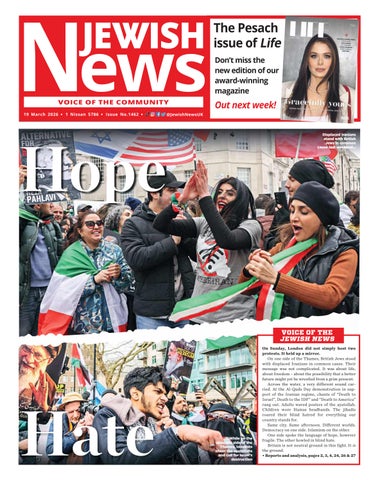
Hope Hate

VOICE OF THE JEWISH NEWS

On Sunday, London did not simply host two protests. It held up a mirror.

On one side of the Thames, British Jews stood with displaced Iranians in common cause. Their message was not complicated. It was about life, about freedom – about the possibility that a better future might yet be wrestled from a grim present.

Across the water, a very different sound carried. At the Al-Quds Day demonstration in support of the Iranian regime, chants of “Death to Israel”, Death to the IDF” and “Death to America” rang out. Adults waved posters of the ayatollah. Children wore Hamas headbands. The jihadis roared their blind hatred for everything our country stands for.

Same city. Same afternoon. Different worlds. Democracy on one side. Islamism on the other. One side spoke the language of hope, however fragile. The other howled in blind hate.

Britain is not neutral ground in this fight. It is the ground.

• Reports and analysis, pages 2, 3, 4, 24, 26 & 27

...While on the opposite side of the Thames, Islamists cheer the ayatollahs and call for Israel’s destruction
Displaced Iranians stand with British Jews in common cause last weekend...

Commons debate erupts after Iran strike kills two

A heated Commons debate over the Middle East conflict unfolded as Iranian missile strikes killed an elderly couple in central Israel, intensifying fears of a wider regional war, writes Annabel Sinclair.

MPs from across the political spectrum used an emergency statement from foreign secretary Yvette Cooper to criticise Israel’s actions, with some accusing Benjamin Netanyahu’s government of risking further civilian harm in Lebanon and beyond.

Cooper told the Commons Iran had launched more than 900 missiles and over 3,000 drones across 13 countries since the escalation began, describing the attacks as a serious threat to regional stability and global economic security.

While she stressed the UK would not be drawn into a wider war, Cooper warned Lebanon was “on the precipice of a widening conflict that risks disastrous humanitarian consequences” and confirmed an additional £10 million in UK humanitarian support.

However, much of the debate focused on criticism of Israel.

Labour MP Yasmin Qureshi condemned

what she said was “illegal bombing” in Iran and Lebanon, while Debbie Abrahams suggested international inaction had contributed to the current escalation.

lighting Hezbollah’s role in escalating tensions. “Hezbollah has fired hundreds of rockets into northern Israel,” she said, adding the Iranbacked group was drawing Lebanon into a conflict “its people do not want”.

The debate came as the impact of the conflict was felt directly in Israel, where an Iranian missile strike overnight killed a man and woman in their 70s in the city of Ramat Gan.

The couple were found near the entrance to a reinforced safe room in their apartment building after a missile carrying cluster munitions struck , causing severe structural damage.

Emergency responders said the pair had been only moments from reaching shelter.

Kim Johnson labelled the conflict an “illegal war”, and Melanie Ward warned Israel must not export what she called “criminal” tactics from Gaza into Lebanon.

Former Conservative minister Kit Malthouse also raised concerns about the potential for a ground offensive, warning Lebanon could become “a new Gaza” and questioning how many civilian deaths would be tolerated.

Cooper pushed back against some of the claims, emphasising the “ongoing threats and challenges from the Iranian regime” and high-

Israeli officials said at least two missiles were launched, with one intercepted. The second struck the Tel Aviv area, dispersing smaller explosive fragments across multiple locations.

Colonel Olivier Rafowicz of the Israel Defence Forces said the attack was aimed at civilian areas, telling reporters: “The goal was to hit civilian centres.”

Several people were treated for light injuries, with damage across nearby cities, including Bnei Brak and Petah Tikva, and close to Tel Aviv’s Savidor Central railway station.

The strike followed Israel’s elimination of Ali Larijani, secretary of Iran’s Supreme National Security Council.

Donald Trump has admitted he is “not happy” with the UK over its refusal to send military reinforcements immediately to the Strait of Hormuz, after Keir Starmer insisted this country would not be dragged into a “wider war” in the Middle East.

The US president said that “some [countries] are very enthusiastic about it, and some aren’t,” as he spoke at the White House about proposals for the strait.

Meanwhile, at Downing Street press conference, the PM said the UK, which is considering sending ships and mine-hunting drones to the Middle East, was working with allies on a “viable plan” to reopen shipping lanes.

“While taking the necessary action to defend ourselves and our allies, we will not be drawn into the wider war,” he said. “We will keep working towards a swift resolution that brings security and stability back to the region and stops the Iranian threat to its neighbours.”

“Some are countries that we’ve helped for many, many years,” he added. “We’ve protected them from horrible outside sources, and they weren’t that enthusiastic. And the level of enthusiasm matters to me.”

A German commissioner for antisemitism has quit the country’s Left Party, warning antisemitism within it has become intolerable.

Andreas Büttner, a member since 2015, said he was resigning ahead of internal expulsion proceedings aimed at removing him and relentless personal attacks.

He added the party’s rejection of the International Holocaust Remembrance Alliance (IHRA) definition made it impossible to stay.

The last straw, according to newspaper Juedische-Allgemeine (Jewish General) was a resolution passed at the Left Party’s state conven-

tion the previous weekend in Lower Saxony, a federal state in northwestern Germany, where the newspaper reported 104 of the 157 delegates voted in favour of a motion called “Rejection of Zionism” and passed resolutions branding Israel a “genocidal state” and an “apartheid state.”

Buttner’s letter to his party leadership begins and ends with the words “It’s over.”

Greens facing divide over ‘Zionism is racism’ motion

The Green Party says it is “not clear” whether a controversial motion equating Zionism with racism will be discussed at its spring conference later this month, amid claims senior ocials want to avoid a potentially damaging “antisemitism row” erupting just weeks before local elections, writes Lee Harpin.

Jewish News first revealed hardline anti-Israel Greens for Palestine activists had submitted a motion for debate that attempted to move the party into an explicitly anti-Zionist position, which left members who refused to support it facing claims they themselves were racists.

But with the conference set to take place on 28 March, it is understood a final decision on whether Motion 105 is debated has not yet been made.

If it is selected, several amendments have been tabled –including one hailing peaceful initiatives between Israelis and Palestinians – which are likely to mean any final motion passed would di er significantly from the original.

The Jewish Greens group – co-founded by party leader Zack Polanski prior to him undertaking a dramatic shift in his own view on Israel – have been among party members to issue a statement condemning the Zionism Is Racism motion, and outlining its consequences if passed for Jews in the party.

One party source also confirmed: “There is real concern among some at the top about the damage that arguments around Zionism and Israel and Palestine can do to the party ahead of the local elections in May.

“Yes, the Greens have established themselves as a party far more critical of Israel and supportive of the Palestinians than the other mainstream parties.

“But becoming outwardly anti-Zionist is another leap alto-

gether. It would obviously lose us support within the Jewish community. But it could damage us further afield in the same way the antisemitism row damaged Corbyn’s Labour.”

However, Green Party sources rejected claims made in one report that the “Zionism Is Racism” motion was unlikely to be debated at the conference.

A Green Party spokesperson also told Jewish News: “As a democratic party, our policies are determined by members who submit motions to conference.

“Each motion goes into a prioritisation ballot to decide the order in which motions will be debated and voted on at conference.

“That process has now been completed, but it is not clear, based on where

100,000 Brits rescued

The number of British nationals who have flown back from the Middle East since the start of the Iran war has reached 100,000.

Foreign secretary Yvette Cooper said UK citizens in the Gulf were left “stuck” in the region after fighting broke out at the end of February.

She said Iran had fired hundreds of missiles and

Three men have been arrested and charged over the assault of two Israeli American men in California, but prosecutors have not filed hate crime charges at this stage.

The suspects – named as Bruneil Henry Chamaki, 32, Roma Akoyans, 20, and Ramon Akoyans, 18 – surrendered to police just over a

launched thousands of drones since the US and Israel’s attack began.

Making a statement about the Middle East in the Commons, Cooper told MPs: “More than 300,000 British citizens were in the region – and when the airstrikes started and airspace closed, many were stuck.

“We’ve been working

week after the daylight attack in San Jose’s Santana Row.

The district attorney’s o ce confirmed the men face a mix of felony and misdemeanour charges in connection with the assault, which left both victims hospitalised.

Prosecutors said the charges did not currently suggest a hate crime but the

relentlessly since then to help them get home. This has been a complex task.”

Cooper said earlier Iran had fired more than 900 missiles and over 3,000 drones across 13 countries in the region, across countries which are partners with the UK and where hundreds of thousands of British citizens visited, worked or lived.

matter remained an active investigation.

US reports indicate Chamaki previously worked as an attorney in Sacramento and founded Assyrian Advisors, a community group.

A LinkedIn profile for Roma Akoyans lists him as an intern with the same organisation.

this motion stands in that prioritisation process, whether the motion will be discussed or not.

“What is known, however, is that if it does get debated, there are several amendments proposed, so the final motion, if passed, could di er from the original motion.

“The Green Party is clear: we stand firmly against all forms of bigotry and racism, including Islamophobia and antisemitism.”

Jewish News revealed last week senior Hackney Green Party o cials have held a series of meetings with representatives of the Strictly Orthodox community in the borough, for discussions dominated by policy on planning rules ahead of the local elections in May.

In a statement, Hackney Greens told Jewish News they were “honoured to be invited” to speak with members of the Charedi Jewish community for “conversations on a broad number of topics” that the party said were “helping to inform our manifesto for the local election campaign”.

Other sources claim the community is being openly courted by London Assembly member Zoe Garbett, who is in the running to become Hackney mayor if the Greens perform to some expectations in May.

The 30,000-strong Charedi community in the borough is known to have become increasingly frustrated with the current Labour-run council, whch has stalled repeatedly over adopting planning rules that allow overcrowded families to build extensions upwards in their homes, which particularly suits the needs of those with larger families.

Green Party leader Zack Polanski with Gorton and Denton MP Hannah Spencer

Police chief taking advice from CPS after ‘death to IDF’ chant

The head of the Metropolitan Police said the force is taking advice from the Crown Prosecution Service after “death, death to the IDF (Israel Defence Forces)” chants led by Bobby Vylan at the Al Quds Day demonstration, writes Adam Decker.

The rapper, real name Pascal RobinsonFoster, a member of punk duo Bob Vylan, repeated his controversial Glastonbury chant at the protest on Sunday.

The Met said: “We are aware of chanting made by a speaker at the Al Quds protest and will be investigating. We recognise the concern footage and chanting like this causes, particularly with London’s Jewish communities.

“When this language had been used previously we sought advice from the CPS who determined that there would be insufficient evidence to take a case forward.”

There were three arrests at the protest and counter-protest as demonstrators chanted “From the river to the sea” and held pictures of the late leader of Iran.

Scotland Yard had braced for what they called a “difficult public order” environment, with at least 1,000 officers drafted in to manage the crowd.

The Met said on X one arrest was for showing support for a proscribed organisa -

tion, one for dangerous driving and one for threatening and abusive behaviour.

Home Secretary Shabana Mahmood granted a police request for a month-long ban on the annual march organised by the Islamic Human Rights Commission (IHRC), making it the first time such a restriction has been put on a protest since 2012.

However, people were told they could still legally assemble and take part in

CHARITIES WARNED OVER LINKS TO IRANIAN REGIME

A report from the government’s former independent adviser on political violence and disruption has highlighted multiple UK charities which it says have significant links to the Iranian regime, writes Lee Harpin.

The report warns the current “compliance-based regulatory framework” of the Charity Commission limits the UK’s ability “to respond proportionately to hostile, state-aligned ideological influences operating through civil society channels”.

Undue Influence, published by Lord Walney, details how several different groups with charitable status in the UK have had senior figures associated with them who “have held senior positions within Iranian regimelinked clerical and policymaking institutions”.

In one case, the Islamic Centre of England was said to have contained “a formal constitutional provision previously requiring that one trustee must be appointed by the Supreme Leader at all

times”, before being required by the Charity Commission to alter that provision.

Eight of the 10 charities identified are under active Charity Commission investigation, although the public has reportedly been made aware of only four.

Of the 10, four are also recognised for Gift Aid, enabling them to claim an additional 25p from the government for every £1 they receive.

Alleged links between the Iranian regime and the charities in question include connections to regime institutions, organising events with senior members of Iran’s Islamic Revolutionary Guard

Corps (IRGC), and either trustees or some of the charities praising the actions of Iranian regime officials.

The report lists recommendations to strengthen the Charity Commission’s ability to combat what Lord Walney describes as “forms of abuse in the charity sector”.

They include expanding its disqualification powers “to include individuals subject to immigration orders and those identified as hostile state agents” and setting up a vetting mechanism “to exclude charities with unresolved extremism concerns from receiving Gift Aid and UK Aid Match”.

Lord Walney said in the Sun on Sunday: “Iran’s cheerleaders have become deeply embedded in the British charity sector. They build networks, spread regime narratives and embed sympathetic organisations inside British civil society.

“This soft power push is not separate from the violent threat. It systematically excuses and normalises it.”

a “static protest” and hundreds began arriving from 1pm, many carrying Palestine banners reading “Free Palestine” and “No to Israeli occupation”.

Pictures of Iran’s late leader Ayatollah Ali Khamenei were also held up, some accompanied by the message “Choose the right side of history”. Chants of “From the river to the sea” and “Israel is a terror state” could be heard.

Cooper show of solidarity for UK allies

Foreign Secretary Yvette Cooper has travelled to Saudi Arabia in a show of solidarity with Britain’s allies in the Gulf.

She also held talks with counterparts in the United Arab Emirates, Qatar and Bahrain about joint efforts to protect UK citizens and safeguard regional responsibility.

The discussions followed an earlier “extensive” telephone conversation with Israel foreign minister Gideon Sa’ar and with US officials.

Cooper said: “The UK stands with our allies against Iran’s reckless attacks on its neighbours” while also noting: “We’re working around the clock to return British citizens and protect UK interests in the region.”

Her arrival in Riyadh – the first to the region by a UK minister since the outbreak of war –came hours after Saudi Arabia said it shot down one drone targeting the capital’s diplomatic quarter and another heading for an oil field in the east of the country.

Cooper met Saudi Arabia’s foreign minister and interior minister during her visit to Riyadh.

After an hour-long meeting at the foreign ministry with Prince Faisal bin Farhan to discuss the conflict with Iran, she travelled to the interior ministry to speak to Prince Abdulaziz bin Saud, who opened the meeting by saying it was a “tough time” for the region but it was important to “deal with reality as it is”.

Cooper has already visited staff at the British embassy in Riyadh to thank them for their work.

Chief Rabbi Sir Ephrain Mirvis said after the Bondi Beach terror attack “From the river to the sea” and similar slogans “incite hatred” against Jews.

The annual Al Quds demonstration had drawn criticism for its perceived apparent backing for the Iranian regime after its organisers expressed support for the country’s late leader.

The gathering drew a crowd of counterprotesters seen on the opposite side of the Thames during a demonstration organised by Stop The Hate.

They waved Israeli flags while one sign read “Hamas is terrorist”.

Numerous police vans were parked along the road and on nearby Lambeth Bridge while two police boats were seen patrolling the river.

It is thought to be the first time Scotland Yard has used the river as a physical barrier to keep demonstrators at large-scale protests and counter-protests apart.

All protests and counter-protests had to take place between Vauxhall and Lambeth bridges, and were permitted between 1pm and 3pm, the Met said.

Al Quds Day is named after the Arabic name for Jerusalem and is usually observed on the last Friday of Ramadan.

BELGIAN ARMY CALLED IN TO PROTECT JEWS

The Belgian army will join police officers to protect the country’s Jewish community following antisemitic attacks in the country.

Interior minister Bernard Quintin and defence minister Theo Francken said heightened security measures will be implemented at synagogues and Jewish schools as quickly as possible.

Francken added: “The safety of every citizen must be guaranteed” and “antisemitism and hatred against Jews will never be tolerated.”

The number of soldiers from the Belgian Armed Forces (BAF) has yet to be confirmed.

The news comes amid fears of co-ordinated terror attacks by a group calling itself  the Islamic Movement of the Companions of the Right (IMCR) on European synagogues as war with the Iranian regime continues. These include an explosion on Monday 9 March near a synagogue in Liège, an attempted terror attack on Thursday 12 March at Det Mosaiske Trossamfunn synagogue in Trondheim, Norway, an arson attack at a synagogue in Rotterdam on Friday 13th March and an explosion that damaged a Jewish school in Amsterdam on 14 March.

The European Jewish Congress welcomed the move, saying the measure “comes in response to a series of alarming incidents” and “reflects the very real security concerns faced by Jews in Belgium and across Europe”.

Above: Pascal Robinson-Foster. Right: Pro-Iran activists at the Al Quds Day demonstration
Flag of Iran regime

Kemi’s kosher kingdom

Tory leader stands with community on visit to Golders Green, writes Lee Harpin

Conservative Party leader Kemi Badenoch described how she stands “100 percent behind the Jewish community” during a visit to Golders Green this week, during which she visited local kosher shops and spoke to residents of one of the largest Jewish neighbourhoods in the UK.

Badenoch was joined on Golders Green high street on Monday by around 35 activists, along with highprofile communal party supporters, including Conservative Friends of Israel president Lord Polak, the group’s vice-chair Adam Cannon and local councillors such as Dean Cohen, who organised the visit as chair of the Conservative Jewish Alliance.

Unsurprisingly, she firmly rejected suggestions that the local Tory Group faced a challenge from Reform to secure Jewish votes at May’s local council elections.

“Reform is only a spoiler in these elections,” Badenoch told Jewish News. Asked about the possibility that a split in the vote between Reform and Conservatives could allow the Labour Group back into power again in Barnet, she said: “We certainly don’t want Labour coming back.”

She continued: “People can see that I’ve been consistent. Even before I was an MP, as a London Assembly member, I was calling for the banning of groups like Hezbollah, flags that they were carrying back in 2015, for a very long time.

the Union of Jewish Students, laying bare the extent of antisemitism on university campuses.

The UJS study showed one-infour students had witnessed harassment of Jewish students, and one-infive said they would not want a Jewish housemate.

The Tory leader, who visited Kosher Kingdom supermarket and Coco bakery during her visit, said the findings alarmed her deeply.

“I’m very worried about this,” she said. “This was not what things were like 20-25 years ago when I was at university. It would have been unconscionable for people to even express these views.

“I think this goes beyond some of the things which we’ve traditionally done – banning things here and there, and proscribing groups.

“This is a culture that is seeping

“People know where I stand – 100 percent behind the Jewish community. I do think we need to do more in government. We’re mostly focused on terrorism and Islamist extremism. I think that more now needs to be done on draining the swamp.”

As she spoke to us during her visit to Golders Green, Badenoch also responded with anger to a survey by

into the general population, and that actually means government talking about the sorts of things that it hasn’t traditionally talked about.

“I gave a speech a couple of weeks ago on this issue, talking about rising separatism. We cannot a ord for communities to be withdrawing into separate groups. I think there are certain ideas that have come from cultures where these attitudes are typical, which have taken hold, and have found fertile soil in a very old, sort of almost forgotten antisemitic way.”

Badenoch also reacted to a Guardian column published on the weekend that suggested the presence of a Jewish-founded Gail’s bakery close to a Palestinian cafe was “heavyhanded high street aggression”.

“I think it was an utterly ridiculous column… appalling, actually,” Badenoch said.

“What it was insinuating, in

antisemitism. We are a mattered where you’ve

this openness and tolerance of

my view, was based on antisemitism. We are a country where it hasn’t mattered where you’ve come from… we have always been open and tolerant. I think this openness and tolerance of our society is being exploited, and is targeting Jewish people.

“You can have your free speech, but be very, very ready for the counter.”

and Israel for a lot of our security briefings and intelligence. “So if they ask for help in using air bases, we should give them that help.

“That’s di erent from having o ensive strikes at the outset, and eventually Keir Starmer did have to allow them to use those bases.

“It’s extraordinary that Gail’s

“It’s extraordinary that Gail’s bakeries are being attacked now, supposedly because they are Israeliowned. This is just a cover; it’s antisemitism. It is disgusting. We need to stamp out this culture. We need more enforcement, more punishment for people who carry out these violent acts… they are trying to intimidate people.”

On Monday, the Guardian responded to widespread anger by telling Jewish News: “Complaints about Guardian journalism are considered by the internally independent readers’ editor under the Guardian’s editorial code and guidance.”

Badenoch linked rising antisemitism on campus with the impact of columns like the one in the Guardian, saying: “I believe in free speech. When those columns do come out, you need to be very forceful in condemning those, so that those sorts of students who are saying those things can hear that these views are actually not acceptable in the country.

Badenoch said this was why she had set up a new commission on culture and integration. “I was very vocal about how Jews, in particular, are most impacted by this increasing intolerance that is exposed in our own society,” she explained.

“One of the strands is about Islamic extremism, but also what’s happening in schools – not just the curriculum, but a lot of the things that happen in the periphery of schools.

“One of the things that I am actually doing is I’m thinking now about what I will do in government three years from the election. The commission is making sure the work is going to be done, so we’re ready on the date. That’s what Keir Starmer did not do.”

Asked about the Prime Minister’s claim that her initial response to the conflict in Iran had shown Badenoch to be a “follower and not a leader” she was quick to hit back.

“I know what I stand for, I know what I believe in,” Badenoch insisted.

“I have my conviction, and I’ve been very clear that, well, we may not have agreed with these strikes, but if there is ever a conflict between the US and Israel versus Iran, we are not on the side of Iran.

“And actually, we rely on the US

“But when Iran started striking at British bases, I think we should have taken the missile launch capability out. I don’t think we should just sit there and try to catch the arrows. We should stop the archer. Keir Starmer is the one who’s following because he’s looking at the polls.”

While acknowledging that “this war is not popular. I’m not surprised. It’s not popular,” she said that “we need to be explaining to the public how much we rely on certain countries, how Iran has tried to carry out terrorist activities on our soil, that it would blow us out of existence if it got nuclear weapons.

“This issue is going to have an impact on our oil supplies and shipping. It’s not just about Labour backbenchers not liking this sort of stu . These are big issues. And I think that he is starting from the wrong place; even if there is more public support for a particular position that he’s taken, you can’t rely on the position he’s taken, because he hasn’t started from conviction.”

u Guardian rationalises attack, p11

On a roll: Conservative leader Kemi Badenoch shopping in Coco’s bakery this week
Kemi Badenoch with Lord Polak
At the till in Kosher Kingdom
calling for the banning of groups

News / Campus hate

UJS urges action as report shows campus antisemitism rocketing

The Union of Jewish Students is demanding government and regulators act to address antisemitism in higher education after its latest report detailed pervasive Jew hatred across university campuses, writes Michelle Rosenberg.

UJS’s landmark Time for Change poll reveals one in five students (20 percent) are not open to house sharing with a Jewish student; 49 percent have seen Hamas and Hezbollah glorified on campus and 47 per cent witnessed justifications for the 7 October 2023 massacre.

The report, co-supported by Baroness Luciana Berger and Lord Daniel Finkelstein, polled 1,000 students from 26 January - 4 February.

It contains testimonies from Jewish students at universities including Exeter, Bristol, Birmingham, Leeds, Glasgow, Edinburgh, UCL, Oxford and Queen Mary in London, reporting strained friendships, social ostracisation, harassment, intimidation and even physical assault.

UJS is calling for “immediate, coordinated action” to restore Jewish students’ confidence and ensure they can participate fully in education, living outward, proud Jewish lives on campus.

The government said: “The education secretary has asked Sir David Bell to lead a review into antisemitism at schools and colleges, to ensure they are better able to prevent, identify and respond e ectively to antisemitism and all other forms of hatred and prejudice.”

But Jewish News understands this review covers only secondary education, not universities.

The spokesperson continued: “There is no place for antisemitism on university campuses, and it is essential that Jewish students feel safe, along with everyone regardless of race or religion.”

He noted the government has strengthened how the O ce for Students monitors universities’ Prevent duties, updated guidance on managing external speakers and

was working with students to codesign a Campus Cohesion Charter setting clearer expectations on conduct and shared values.

Time for Change sets out six recommendations, including accountability for universities’ handling of hate crimes, better governance of students’ unions, investigation into extremist student groups and a step up in coordination between gov-

ernment, universities and police.

The proposals are designed not to restrict lawful protest, but to ensure harassment, intimidation and glorification of terrorism are met with firm consequences.

UJS president Louis Danker said: “This report demonstrates that antisemitism on campus is not isolated, but normalised. No Jewish student should have to face social

ostracisation, abusive language or physical violence – there is a right to protest, but not to harass.

“If we are serious about combatting extremism in Britain, we have to start on campus ... we need urgent action to restore campuses as places of learning, not hostility.”

UJS supports more than 10,000 Jewish students across 80 Jewish Societies (JSocs) with national advocacy, educational programming and welfare support.

Board of Deputies vice-president Karen Newman said the report “makes for truly sickening reading.

“This is a walk-up call that the situation has to change ... universities [must] ensure they are welcome and tolerant places for all.”

The Jewish Leadership Council said: “For almost two-and-a-half years, too many Jewish students have faced relentless antisemitic abuse on campus.

“This crucial report shows precisely how widespread and normalised this hatred has become.”

has criticised senior MPs for supporting a parliamentary Bill that would introduce compulsory labelling for kosher and halal meat.

The Bill, introduced by Esther McVey, the Conservative MP for Tatton, under the Ten

Minute Rule on Tuesday, calls for mandamethods.

enable people to make informed choices based on animal welfare concerns.

“Individuals concerned about animal welfare would want to know if an animal had been stunned prior to slaughter,” McVey told MPs.

The war in Ukraine still rages.

Her proposal was backed by other Conservatives, including Alicia Kearns, former chair of the Foreign A airs Select Committee. Kearns posted on X: “You have the right to know where your food comes from and how

tory labelling to inform consumers if meat has been produced using non-stun slaughter McVey argued that such labels would it was produced. I’m calling for clearer label-

Four years of war. Only four days without attack in 2025. World Jewish Relief is still there for the people of Ukraine — delivering food, repairing homes, providing care and trauma support.

This Pesach, will you show the Jewish community in Ukraine they are not forgotten?

Former Conservative minister Michael Gove
Graffitti on Hillel House Leeds University

British 7/10 survivor: Hatred is running riot

The only known UK-based British–Israeli dual national to survive the 7 October attack said she believes antisemitism is “running riot”, as she described feeling “abandoned” after the massacre, writes Joy Falk.

Anat Ron-Kendall, whose father Shlomo Ron was killed, described a scene of “dystopia” and “chaos” as she spoke for the first time about her ordeal.

Her testimony has been given as part of an updated report on the attack commissioned by the All-Party Parliamentary Group (APPG) on Israel and led by historian and Conservative peer Lord Andrew Roberts.

Ms Ron-Kendall, then aged 55, had been with her son Jordan visiting her parents in the kibbutz of Nahal Oz, where she grew up, when Hamas militants attacked.

Having fled to a safe room at their house, she heard gunfire and shouting intensify and called her husband to ask him to tell their

children she loved them, believing she would be killed.

When she was eventually evacuated to safety more than 12 hours later, she recalled a “scene of dystopia, it was a scene of chaos”.

She said: “There were bodies which I didn’t want to look at. It was just like something that you imagine in the movies.”

Speaking more than two years

on from the attack, she described feeling unsafe in the UK, where she said antisemitism has become normalised. She said: “I was abandoned by the British government at a time of total vulnerability.

“The British government is allowing what’s going on ever since, in demonstrations and in antisemitism running riot, students in universities suffering – Jewish stu-

dents, communities affected every day since – and that’s been allowed to happen.

“To me, I still live under threat. I cannot feel safe in a country that normalises this kind of behaviour.

“I had no recognition. I came back to the UK, expected to be grateful that I survived and put that event behind me and just function in my everyday life.”

The first edition of the report was published just over a year ago, naming for the first time all 18 British nationals killed in Hamas’s attack on Israel.

The second edition was publoished on Wednesday.

Ron-Kendall’s family history includes a grandfather who fought in the Second World War for the British Army’s Jewish Brigade and was captured by the Nazis and held as a prisoner of war for four years.

She said she believes it is now important for people to read the report and know that the 7 October attack “really did happen”.

JEW-HATE LESS LIKELY TO REACH COURTS

Antisemitic hate crimes in England and Wales are significantly less likely to result in a charge than offences targeting Muslims, according to newly released Home Office data, writes Annabel Sinclair.

Figures for the 12 months to March 2025 show just 3.8 percent of recorded antisemitic offences led to a charge or summons – roughly one in 26 cases.

By contrast, 6.7 percent of anti-Muslim hate crimes resulted in prosecution, equivalent to around one in 15.

The data was obtained via Freedom of Information requests.

SECOND MAN IN IRAN SPY CASE RELEASED

A second man has been released without charge after four men were arrested on suspicion of spying for Iran on locations and individuals linked to the UK Jewish community.

Police said the 52-year-old, who was arrested in Watford, had been released without charge on Sunday. Of the remaining three, a 55-year-old man who was arrested in Barnet has also been released without charge while two other suspects, aged 22 and 40, remain in custody.

The men were arrested during a National Security Act investigation into alleged surveillance of people and places linked to the Jewish community in the London area.

Mental illness doesn’t define who Debbie is.

When life felt overwhelming, Jami was there with calm, person-centred support - offering Debbie reassurance, stability and someone beside her every step of the way. This Pesach, your donation can help someone move from mental distress and uncertainty towards confidence and hope.

Jami’s mental health services receive no government funding and rely entirely on voluntary donations.

Please give today and ensure no one faces mental illness alone.

Every pound raised through this appeal will be restricted to fund Jami services.

Warning: Anat Ron-Kendall

HADASSAH UK EMERGENCY APPEAL

Critical Care at Critical Moments

Hadassah Hospital in Jerusalem is treating victims of ongoing rocket attacks.

To save lives, Hadassah is expanding its emergency capacity:

u 40 protected emergency beds

u 6 life-saving operating theatres

u Emergency reserves for treatment under fire

The space is ready.

The clinical teams are prepared.

But the equipment is missing.

PLEASE DONATE TODAY

Your gift will protect patients, enable emergency surgery, and strengthen Israel’s frontline medical response.

DONATE ON OUR SECURE WEBSITE OR SCAN THE QR CODE W: www.hadassahuk.org T: 020 8202 2860 E: uk.office@hadassah.org.uk

LET’S START TAKING HEARING LOSS SERIOUSLY

“Thanks to JDA, I can take part in shul services, access the support I need… and have a good chat with friends!”

By donating to JDA this Pesach, you’ll be helping people experiencing hearing loss — at all stages of life — live the best life possible.

From supporting families with deaf babies, children in schools, to people losing their hearing at any age, to older people in care homes, JDA is there for everyone.

Now we need your support to help Jewish community organisations become more inclusive. With you beside us, we can ensure everyone with hearing loss is part of community life and able to access the support they need — from cancer therapies to mental health services.

We can’t do any of this without the help of generous supporters like you

Guardian rationalises violent bakery attacks

A Guardian journalist has said he feels “extremely uncomfortable” working for the newspaper after it published a column suggesting the presence of a branch of Gail’s bakery near a Palestinian café “feels like an act of heavyhanded high-street aggression”, writes Adam Decker.

The piece, A corner of north London where food has become a battleground in the Israel-Gaza war by Jonathan Liew, appears to rationalise attacks on the Archway branch of the Jewish-founded Gail's chain in recent weeks.

Liew wrote: “Even though Gail’s describes itself as 'a British business with no specific connections to any country or government outside the UK', its very presence 20 metres away from a small independent Palestinian cafe

feels quietly symbolic, an act of heavy-handed highstreet aggression.”

The Archway branch has been repeatedly vandalised, with its windows smashed and paint daubed on the walls. Police have increased patrols in the area and are investigating the incidents as criminal damage. No arrests have been made.

PUTIN DOC BAGS AN OSCAR FOR LUCIE

British TV producer Lucie Kon had a night to remember at the Oscars after her documentary Mr Nobody Against Putin scooped the award for best documentary. Directed by David Borenstein and Russian teacher-turned-filmmaker Pavel Talankin, it follows Talankin’s opposition to Kremlin propaganda in the wake of the Ukraine invasion.

In his piece, Liew also writes: “Palestinian activism has arguably never been less capable of exerting a meaningful influence on global events, and so is increasingly defined by small acts of petty symbolism. A smashed window. A sticker … You can’t lay a glove on the US-Israeli military-industrial complex …

Starmer anger at Kneecap appeal result

Keir Starmer has said what Irish language rap trio Kneecap stand for and say is “completely intolerable” and the Crown Prosecution Service (CPS) will be looking "very carefully" at a judgment a member of the group will not face a terror trial.

Kneecap rapper Liam Og O hAnnaidh, who performs under the stage name Mo Chara, had been accused of displaying a flag in support of proscribed terror organisation Hezbollah at a gig in north London on 21 November 2024.

The case was thrown out last September with chief magistrate Paul Goldspring ruling the proceedings were “instituted unlawfully”.

The CPS appealed against the decision but in a judgment on Wednesday, two judges upheld the decision and dismissed the appeal.

The judge agreed with O hAnnaidh’s lawyers prosecutors needed to seek the attorney general’s permission to charge the rapper before telling him on 21 May he would be charged with a terror o ence.

This permission was sought and given the following day, which the court heard meant the charge fell outside the six-month time frame in which criminal charges can be brought.

so some people direct their ire at the bakery.”

One Guardian journalist told Jewish News : “This column is encouraging violence. I cannot understand why it is being allowed to stay online. I feel absolutely sickened.”

The journalist emphasised he was not the only one at the Guardian to feel deeply uncomfortable at the decision to publish Liew’s column.

The Guardian amended Liew's piece three days after publication, to "clarify" its meaning and "avoid misunderstanding".

VOICE OF THE JEWISH NEWS

GUARDIAN

VERSUS SOME SOURDOUGH

Once again, TheGuardian has exposed the mould in its editorial loaf.

Columnist Jonathan Liew wrote on Saturday about a Palestinian café in north London and a branch of bakery chain Gail’s a scone’s throw away.

According to Liew, the mere existence of this bakery “feels quietly symbolic, an act of heavyhanded high-street aggression”.

A bakery. Selling sourdough. That has had its windows repeatedly smashed in and walls daubed with hate slogans. Existing. That existence, in the mind of a Guardian columnist and the editors who green-lit it, constitutes “aggression”.

The Guardian looked at a grotesque spectacle of naked, violent racism and concluded the problem is not the violent racists.

It’s the colonial rosemary focaccia.

In The Guardian’s hall-of-mirrors morality, smashing up a shop because it was founded by Jews is just a touching little political tantrum. Adorable, really.

The violence is contextualised. Explained. Until the shards of broken glass strewn across Archway high street start to look like an inevitable outcome rather than the crimes of rampaging cretins. The croissants are the criminals.

This is the same Guardian that in 2024 quietly removed a reference to an Israeli whisky after complaints, before sheepishly restoring it when readers noticed. Whisky one day. Bagels the next.

The problem is not simply Jonathan Liew. He’s just the kind of (l)oaf The Guardian bakes.

DO YOU TAKE YOUR HOLIDAY FOR GRANTED? HUNDREDS OF JEWISH CHILDREN DEPEND ON US.

We are the Jewish Children’s Holidays Fund. For more than a hundred years, we have been helping Jewish children, disadvantaged for financial, social or health reasons, have the holiday that they need and deserve.

Children’s

You know how much you and your children enjoy a week or two away. Please give us the resources to ensure that those children who are dogged by ill-health, family or financial difficulties continue to get a fair break.

Members of Kneecap
Gail's in Archway has been repeatedly vandalised

There comes a moment when managing your house starts to feel like more e ort than ease. At Birchgrove, you rent your own apartment and live entirely on your terms, with support on hand if you want it. No exit fees, no pressure to buy, no hidden charges. Just a calm, flexible way to move forward – where life feels lighter, and you feel more like yourself again.

Ayrton House

Retirement apartments to rent in Mill Hill

out what all the fuss is about. Book a tour:

Freedom without the fuss

There comes a moment in later life when the effort of managing a home begins to outweigh the comfort it once provided. For many people, that realisation doesn’t arrive with drama or urgency. It arrives quietly … a winter that feels a little longer, a staircase that feels a little steeper, a garden that becomes more obligation than joy. Days that used to feel full now feel a bit more solitary. Even the simplest tasks begin to take more energy than they once did. As one resident told us, “I found it really lonely being on my own, even though I had family nearby.” People tell themselves they are managing … just. But the effort of managing becomes its own kind of fuss.

Families notice it too. Adult children spot the small signs … unopened post, more cautious steps, the reluctance to go out when the weather turns.

They worry, quietly at first, then more openly. Conversations begin. Options are explored. The question shifts from “Should I move?” to “When is the right time?” It’s a time of conflicted feelings … knowing something isn’t right, yet not feeling ready to move. The decision feels overwhelming – not just because of the logistics, but because of all the unknowns it carries. Yet still that quiet weighing up of things, held alongside the hope that life might feel easier again. And beneath that sits something deeper; a realisation that this decision is rarely about property at all. It’s about identity, independence, and the quiet fear of losing control.

Many people feel overwhelmed … not just by the practicalities of moving, but by what the move seems to represent. There’s pride in coping, even when it’s hard. There’s worry about becoming a burden, even when help is offered freely. There’s a longing for life to feel easier …

but not to feel pushed. And often, there’s the small hope that someone might gently take the lead and sort everything out for us. These are complex, conflicting emotions, and they deserve to be met with calm, not complication. That’s why Birchgrove’s approach is built around reassurance, not pressure. Freedom, not fuss. A way forward that feels dignified, supported and entirely on your terms. Whatever decision you make has to be weighed up and the right one for you.

The shift into the Planning stage often happens gradually. A moment of clarity. A conversation that lands differently. A sense that something needs to change … not dramatically, but gently. People begin to imagine what life could feel like if the weight of the everyday were lifted. If the stairs, the garden, the bills, the loneliness, the uncertainty were no longer theirs to manage alone. They begin to picture a life that is lighter, warmer, more connected. Tom, one of our residents described that moment simply as “thinking, thinking, thinking … done.”

This is where Birchgrove might become the natural next step. Our rental model is designed to make life feel easier from the very first day. You have your own apartment … your own front door … your independence. You live entirely on your terms, with support on hand if you ever want it. Utilities, broadband, housekeeping, facilities, activities and 24/7 staff presence are all included, so the everyday worries simply fall away. There are no exit fees, no hidden charges, no pressure to buy. Just two months’ notice if you ever need to leave. Genuine flexibility, built around your needs.

Our residents often tell us the same thing. “There was nothing to worry about.” “It all fell into place.” “I wish I’d

done it sooner.” These aren’t marketing lines … they’re lived experiences. As one resident put it: “My life is so much more enjoyable.” Another told us: “I didn’t lose my independence. I got more of it back.” These stories matter because they speak to the emotional truth of the decision. They show that the fear of moving is often far greater than the reality.

What people find at Birchgrove is not just a new home, but a gentler rhythm to life. Days unfold at their own pace … quieter when they want them, more connected when they don’t. There are neighbours to chat to, shared spaces and activities to enjoy and a team who know them by name. There is company without obligation, support without intrusion, independence without isolation. As Meryl explains: “Meeting everybody … we have company, whereas when you’re home on your own …” Life feels lighter … not because anything dramatic has changed, but because the weight of managing everything alone has been lifted. For families, the relief is equally profound. They see their parent safe, supported and still very much themselves. They see confidence return. They see energy return and a sparkle back in the eyes. They see the person they love living well again. The guilt eases. The worry softens. The decision feels right.

Freedom without the fuss. A move that feels right, at a time that feels right. A place where life becomes easier … and where people rediscover the joy of living well, in a home that truly feels like theirs.

There comes a moment when starts to feel like more e ort you rent your own apartment terms, with support on hand fees, no pressure to buy, no hidden a calm, flexible way to move forward feels lighter, and you feel more

apartments

Freedom... without Ayrton House Retirement

www.birchgrove.life 020 3929 5599

News / Board campaign / Easing dementia

Board’s new commission to tackle disability inclusion

The Board of Deputies has launched a Commission on Disability Inclusion in the Jewish Community, with the aim of examining barriers faced by disabled Jews across the UK and providing evidence-based recommendations for change, writes Joy Falk.

It will be chaired by former Board president and longstanding disability inclusion activist Vivian Wiseman and its work “shaped by those with lived experience of disability; parents and carers; academic experts; and relevant Jewish organisations”.

The Board described how over the coming weeks, the commission would “convene the Jewish community’s leading disability organisations to agree the terms of reference and launch a community-wide call for evidence”.

The process, it added, “is being designed in collaboration with disability experts from across the community to ensure it is accessible, inclusive and open to all who wish to contribute”.

Jewish News understands the di erent religious denominations of the UK’s Jewish community will also be working with the commission.

Wineman, who led the Board from 20092015, said: “This commission brings together two issues that have been profoundly important to me throughout my life.

“The first is supporting children with special needs. I have been involved in this work since long

before my son Yair’s challenges became apparent. Special-needs children, their parents and carers must have our support.

“It is entirely right that the community’s representative body should engage seriously with an issue of great importance to Jews across the country.

“This commission is an opportunity for us to listen, learn and act.

“I hope it will galvanise our community to ensure that every Jewish person with a disability

– and every family supporting them – can fully participate in our communal life with dignity.”

Current Board president Phil Rosenberg said: “Our community thrives when every one of us can participate with dignity and confidence. When I stood to be president, I made a manifesto pledge to launch this commission as part of a wider commitment to championing inclusion as a core mission.

“I am very grateful to Vivian for agreeing to chair this vital project, and I look forward to seeing the community come together to build a more accessible and inclusive future.”

In his former role as the Board’s director of public a airs, Rosenberg was closely involved in the its Commission on Racial Inclusivity in the Jewish Community during the presidency of Marie van der Zyl. It investigated the experiences of Black British Jews, Jews of Colour and Sephardi, Mizrahi and Yemenite Jews within the wider UK Jewish community, and provided a series of recommendations.

The Board’s workplace & inclusion o cer Noah Katz and deputy & community engagement manager Sara Radivan will provide the secretariat.

The Board is assembling a panel of academic specialists in disability, inclusion, social policy and related fields and asked that those interested in contributing should email with a brief overview of relevant experience.

Jewish Care’s award-winning dementia music group, the Sam Beckman Choir, has released a new single, A New Beginning, composed and recorded by members and now on streaming platforms. From a studio-recorded single to the NAPA national award and a community choir competition judged by Gareth Malone, Jewish Care’s community dementia services set out to highlight how creativity and connection can transform support for people with the condition.

Members of Jewish Care’s Sam Beckman Centre for people living with dementia won the Most Promising Act Award at the Care Sectors Got Talent Awards in 2024.

Around 950,000 people in the UK are currently living with dementia, with research increasingly showing music had the ability to stimulate memory, communication and emotional wellbeing for those with the condition.

The Nuremberg Women

Marking

Activist ‘loses job’ in backlash

A pro-Palestine activist who filmed himself confronting comedian Matt Lucas on the London Underground has claimed he lost his job following a backlash to the incident, writes Adam Decker.

Thomas Abdullah Bourne posted a video online showing himself approaching the Little Britain star and repeatedly shouting political slogans at him. Bourne followed Lucas up an escalator filming the interaction and urging him to respond to questions about Palestine.

In the footage, Bourne repeatedly calls out to the actor: “Free Palestine. Free Palestine, Matt Lucas.” Lucas initially tried to defuse the situation and replied: “Hi, how are you.” Bourne then said: “You don’t like what I’m wearing.” Lucas responded calmly: “No, I have no comment about it either way.”

The activist continued following the

comedian, asking: “You have a problem with Palestinians?” Lucas replied simply: “No.”

When the comedian attempted to push the phone from his face, Bourne objected, saying: “You can’t do that, you can’t touch my stu .”

As Lucas walked away from the encounter, Bourne muttered: “Zionist.”

The video was posted to Bourne’s socialmedia account, where he wrote: “You ever meet someone you grew up watching … and wish you hadn’t? Appalled doesn’t cover it.”

However, the clip quickly triggered a backlash online and was deleted along with the account that had shared it.

Jewish groups condemned the incident as harassment. A Campaign Against Antisemitism spokesman said: “If you’re Jewish in Britain, there’s a good chance you may be harassed by pro-Palestine fanatics as they attempt to force you to denounce Israel .

“This type of racist intimidation makes no exceptions, as Matt Lucas found out. Intimidating Jewish celebrities is not some righteous form of progressive activism. It is the behaviour of dangerous obsessives and needs to be called out as such.”

‘Are you Jewish?’ then hit, court told

A man asked a barrister: “Are you Jewish?” before punching him in the jaw, a court has heard.

Tony Steer is accused of attacking Nathaniel Bor on 13 December last year after the alleged victim left a birthday party at Finchley Cricket Club, Willesden magistrates heard.

The 35-year-old denies assault

and racially or religiously aggravated assault by beating.

Bor told the court he and a friend saw Steer giving them “two middle fingers” as they waited for an Uber. “I did not know him at all. My response to my friend was: ‘He’s obviously had a big night.’”

The barrister said Steer then approached the pair and after further conversation said to him “Are you Jewish?”

HAMAS ‘FIGHTS FOR FREEDOM’

A woman who told a crowd that Hamas is “fighting for freedom” and “fighting for the people” has been found not guilty of expressing support for Hamas.

Kwabena Devonish, 27, of Pentrebane, Cardi , denied a charge of expressing an opinion or belief that is supportive of a proscribed organisation, namely Hamas, contrary to the Terrorism Act 2000. Bristol Crown Court heard she attended a march in Cardi in November 2023 and addressed a crowd gathered at Ty William Morgan in Central Square, telling them she was “sick of being told to condemn Hamas”.

A jury unanimously acquitted Devonish, who was arrested in January 2024 after a video of her speech was posted on social media, of the single charge against her following a two-day trial at the court. Supporters of the defendant, who were sitting in the public gallery, cheered and clapped the jury after the verdict was delivered on Tuesday afternoon.

Judge Martin Picton thanked the jury for their service during the case.

Bor said he responded: “What on earth has that got to do with anything? The defendant then smiled and then out of nowhere pulled back his fist and punched me very hard in the jaw.”

The defendant, of Greenwich, London, spoke in court only to confirm his identity. The trial continues.

During the trial, a video was played of Devonish speaking at the march, which took place on 11 November and was attended by about 500 people. She told the crowd: “I would never condemn the resistance of Palestinians because their resistance is due to the occupation. She denied supporting Hamas and said she had been referring to them as “the most well-known representation of Palestinian resistance”.

I AM

ROBBIE.

I like to live a Jewish life.

I was born right before Pesach, so it’s my festival. I like Seder Night, with the ten plagues and Ma Nishtana. I’ll be drinking four cups of grape juice, eating charoset and some horseradish – as long as it isn’t too hot. But most of all, I’ll be enjoying my independence in my kosher home, thanks to Norwood. To support more adults with learning disabilities to live their best Jewish lives, please donate at: norwood.org.uk/pesach

Bourne, right, with Jeremy Corbyn
Finchley Cricket Club

Gantz: Britain should do more

Israel’s former defence minister Benny Gantz has suggested a programme of options for countries such as the UK to support Israel and America in the campaign against Iran, writes Jenni Frazer.

Speaking to members of the Jerusalem Press Club, Gantz, who in 2022 became leader of Israel’s National Unity party, said: “They should support the campaign and they have to put some resources towards it, whether it’s energy or helping in the [Straits of] Hormuz area. Of course, the campaign is military, but there is also the diplomatic side, the judicial side, the economical side… there are things which can be accomplished in order to support the United States and Israel, which are carrying the burden of the situation.”

The former IDF chief of sta urged European nations “to do more, not just say something”. Asked to elaborate, he told the listening journalists that if a country had “oil reserves — use them to bring down the price. If you have weapons that you can send, please do so. If you can support with ships, or with logistic sup-

port — those governments definitely know what they can do.”

In a wide-ranging session, Gantz said though the desired outcome of the campaign was regime change in Iran, he was not sure this would happen. “It can happen, but I don’t know if it will”, he said, adding that he predicted the current conflict would continue for several more weeks at least.

Asked about what was happening in Lebanon, Gantz said any future agreement would be contingent “on the Lebanese government dealing with Hezbollah. I think that the current government is more willing to do so. I’m in favour of it, but we [Israel] must continue to fight against Hezbollah.

“From our perspective, dismantling Hezbollah is not just the will, it’s the [necessary] outcome. Hezbollah is risking Lebanon for Iranian interests, nothing but that.”

Brothers held over ‘antisemitic plot’

French anti-terror prosecutors have launched an investigation into two brothers suspected of planning what o cials described as a “lethal and antisemitic” attack in France.

The suspects, aged 20 and 22 and described as Moroccan-Italian nationals, were detained in a car last week.

Prosecutors say o cers discovered a loaded semi-automatic firearm, a bottle of hydrochloric acid and an Islamic State (ISIS) flag inside the vehicle.

France’s national anti-terror o ce said investigators believe the brothers had begun preparing a violent attack and were motivated by jihadist ideology.

After determining they could not wage jihad abroad, the pair had recently developed

a “terrorist plan in France, for which they aspired to martyrdom”.

The brothers reportedly arrived in France with their parents in 2017. Investigations by security forces are continuing.

The arrests come amid heightened security concerns for Jewish communities internationally as tensions in the Middle East escalate with incidents reported in the Netherlands, where an explosion struck a Jewish school in Amsterdam shortly after a suspected arson attack on a synagogue in Rotterdam, and in Belgium, where a synagogue in Liège was damaged by an explosion.

In the US, a man drove a pickup truck carrying fireworks and petrol into a synagogue in Michigan before killing himself.

Eight-year-old Noa Latzer from Ramat Hasharon gave her parents Keren and Itay this invitation to her magic show during a brief lull between rocket sirens this week. A TOUCH OF MAGIC AMID THE ROCKETS

Israel’s former defence minister Benny Gantz

“For those concerned about this growing problem - and everyone should beOctober 8 is mandatory viewing.”

The Hollywood Reporter

“...the film forcefully rebuts the outrageous accusation that Israel, because of its own actions, was entirely responsible for the Hamas attack.”

The Washington Post

“2025’s Most Important Documentary.”
Hollywood in Toto

• Comprehensive health policy, backed by Harel, Israel’s premier health insurer

• Serviced by our friendly, experienced, English-speaking staff

• Private, contracted physicians and specialists • Full hospitalization, labs, etc.

• No deductible or co-payment For more information, visit: egertcohen.co.il/tourist-health-insurance/ 02-622-7999 • www.egertcohen.co.il • info@egertcohen.co.il

Jones bias claim ruled ‘opinion’

Allegations of bias made against the BBC’s regional Middle East online news editor in an article by journalist Owen Jones were a statement of opinion, a High Court judge has ruled, writes Jenni Frazer.

In an article published in December 2024, Jones claimed BBC staff had told him Raffi Berg “plays a key role in a wider BBC culture of ‘systematic Israeli propaganda’” and “repeatedly seeks to foreground the Israeli military perspective while stripping away Palestinian humanity”.

Berg, who joined the BBC in 2001 and has been Middle East regional editor for its news website for 12 years,

denies the claims in the article The BBC’s Civil War Over Gaza.

He is suing Jones for libel and is seeking damages, an injunction preventing Jones from republishing the article and an order requiring websites to take down the piece.

Jones is defending the claim and has previously said he will “vigorously” defend his reporting.

At a hearing earlier this month, barristers asked a judge to rule on several preliminary issues in the case, including whether the article was a statement of fact or an expression of opinion.

In an early-stage decision last week, Mrs Justice Steyn ruled the

“central allegation” that Berg’s work on the Israel-Palestine conflict is biased and does not meet editorial standards “would strike the reasonable reader as a statement of opinion”.

In the written ruling, the judge said parts of the article “convey the general impression to the reader that the claimant’s alleged lack of objectivity may be subconscious”.

Mrs Justice Steyn later said the ordinary reader would understand the relevant parts of the article as an opinion that Berg had “consistently failed to meet the BBC’s editorial standards of impartiality and fairness by shaping coverage of the Israel-Palestine conflict so as to favour Israel”.

She also found this was “clearly” able to be defamatory, which was not disputed.

Mrs Justice Steyn said as well as a general allegation of bias, there were “prominent” examples in the article.

She added: “While the reasonable reader would understand that the claimant is accused of taking a central, active role in editing the BBC’s output regarding the IsraelPalestine conflict in a way that is biased and imbalanced, the overall impression would not be that he is accused of distorting the coverage in a way that he knows is biased, imbalanced and in breach of the BBC’s editorial standards.”

Mark Lewis, representing Berg, said after the decision: “The judgment is an interim finding rather than a final determination. Instead of posting on social media, we will continue to proceed through the courts.”

SCOTTISH-BACKED ANTISEMITISM INITIATIVE LAUNCHED

Scotland’s main Jewish community body and the Scottish government have formed a new initiative to combat antisemitism.

The Jewish Council of Scotland (JCoS, formerly known as SCoJeC) has launched a Joint Working Group on Combatting Antisemitism and Enhancing Jewish Life, with support from the First Minister, John

Swinney. The new group will be cochaired by Timothy Lovat, chair of JCoS, as well as a Scottish government official.

Swinney said: “I welcome the close partnership between the Scottish government and the Jewish Council of Scotland in establishing this new working group, which will bring together expertise from across

Open Evening Monday 29 June

public bodies and the Jewish community to identify practical steps to tackle the evil of antisemitism and to strengthen and enhance Jewish life nationally. Scotland is stronger for its diversity and we are firmly committed to ensuring people from all faith and belief communities feel safe, supported and respected.”

Timothy Lovat described how

“this new initiative demonstrates our commitment to ensuring all Jews in Scotland are protected and recognised. “We look forward to engaging across government, with public officials and community leaders to uphold the highest possible standards and accountability and for Jewish life to continue without fear of intimidation or any further threat.

“Our focus and clear intention is to ensure the future of Scottish Jewry is secure and we will take every necessary step required to achieve this.”

According to the most recent census data, there are 5,800 Jews in Scotland, with most based around Glasgow and Edinburgh. Annual data published by CST has shown a steady rise in antisemitic incidents there.

Are you seeking the right school fit?

At Immanuel College, it’s personal. And that’s what makes the difference.

Join us at our Open Evening to explore starting in Year 7, or at other year points, and discover why families choose Immanuel College.

We believe in the power of small class sizes and a nurturing community where every child is seen, heard and encouraged to thrive. We offer the opportunity to excel academically and be inspired by their Jewish education with the support of expert pastoral care.

Find your place and your people.

Owen Jones (right) outside court

Jewish leaders and MPs unite for record UK Refugee Shabbat

More than 50 MPs, peers, rabbis and communal figures gathered to launch the UK’s Refugee Shabbat, with a record number of organisations taking part.

The event, hosted by HIAS+JCORE, marked the start of the 2026 global initiative bringing Jewish communities together with refugees and asylum seekers.

Founded by HIAS in 2018 and coordinated in the UK by HIAS+JCORE for the past five years, the programme has grown rapidly. This year, 66 organisations across England and Scotland are participating – more than double the number in 2025.

Opening the event, Chief Rabbi Sir Ephraim Mirvis, stressed the historical Jewish connection to displacement, saying: “When it comes to the plight of refugees, we readily empathise with them because we, as Jewish people, have known what

it is like to be a refugee. We have the imperative to reach out and to do whatever we can for them.”

Progressive Judaism co-chief executive Rabbi Charley Baginsky said the responsibility of Jewish communities went beyond their security to the wider society they help shape – “one where the rule of law protects the vulnerable, where refugees are not reduced to political symbols, where faith communities work together to build something better.”

On the current political climate surrounding migration and asylum, the bishop of Chelmsford, Dr Guli Francis-Dehqani, said she was “inspired” by the concept of Refugee Shabbat, adding “the combination of recent government policies, together with the unhelpful rhetoric of the farright”, posed significant challenges.

Also highlighted were practical projects supporting refugees, including HIAS+JCORE’s befriending programme JUMP which pairs volunteers with young refugees

seekers

in the UK alone. Ben, a volunteer befriender, described how the relationship provides stability and trust for the young person he supports.

Student engagement was also highlighted by Union of Jewish Students social action and Holocaust education sabbatical officer

Samantha Lewkowicz, who spoke about the Student Refugee Ambassador Programme run jointly with HIAS+JCORE where “passionate and engaged students” were helping lead action on refugee support.

Rachel Blake MP, whose constituency hosted the event, reflected on the importance of welcoming refu-

gees to the capital, saying: “Understanding the powerful role that … welcoming refugees has made to London, but also that friendship can make to both public policy making and to individual lives is something I will be taking away from this evening.”

A series of Refugee Shabbat activities are now taking place across the UK, with HIAS+JCORE community engagement director Yael Peleg noting the scale of participation reflected growing momentum across the Jewish community.

HIAS+JCORE executive director

Rabbi David Mason said the initiative sends an important message at a time of rising anti-migrant rhetoric.

“The rise of the populist and farright and anti-migrant sentiment is incredibly worrying. But this Refugee Shabbat is a message of hope and a loud statement from the Jewish community that we are with refugees.

“Together, our values of compassion and solidarity are so much stronger than hate and division.”

and asylum
arriving
Rabbi David Mason at the Refugee Shabbat launch
Photo by
BJennie van den Boogaard for HIAS

Iran war may bring even darker days for UK Jews

Within the last two weeks, we have seen attacks on synagogues in the United States, Canada, Norway, Netherlands and Belgium. In the UK, Jewish schoolchildren had Nazi-grade abuse thrown at them while playing a football match, while a Jewish music producer was pushed in front of an oncoming car by a man shouting “Heil Hitler” and that “you should all die”.

And I fear things could be about to get a lot worse, if the US and Israel do not strike a knockout blow to the Iranian regime this month. To understand why, it’s worth briefly discussing the knock-on e ect of the current war in the Middle East, which has now been raging for almost three weeks.

A significant percentage of the world’s oil supply travels out from the Persian Gulf via the Straits of Hormuz – on Iran’s doorstep. If the regime continues to e ectively block shipping through the straits – via naval, aerial or missile attack – no oil will travel through, drastically limiting international supply, and sending prices soaring.

This will not merely a ect how much people pay for petrol – it will a ect all products, because if transportation and supply costs soar, companies will in turn raise prices, passing on at least some of that additional expense to consumers.

In an age where the economy is globalised, a major regional war halfway around the world can impact how much you can a ord to put in your supermarket trolley. Four years ago, prices rose across the board after Russia invaded Ukraine. They have not greatly fallen since, stretching the budget of some of the less well o in our society to breaking point and beyond.

The di erence between these two wars, however, will be clearest in its knock-on e ects. Despite the continued savagery of the Russian invasion of Ukraine, there are not regular demonstrations on the streets of London (or even outside the Russian embassy) in support of Ukraine.

The initial goldfish-like celebrity fascination with Ukraine has largely faded. Nor are there regular attacks on Russian businesses or Russian orthodox churches in this country – or any country in the West.

The same cannot be said of Israel. Western support for Israel is at its lowest ebb for many decades. In America, the far right and the far left have synchronised their “anti-Zionist” conspiracy theories – the only di erence is that the right are slightly more eager to specifically use the word “Jew”. Attacks

on Jews worldwide have skyrocketed since 7 October 2023.

Now throw in the distinct possibility that the Iran war goes beyond, say, the next three weeks. At that point, the likelihood of significant price rises on a wide range of goods across the Western world becomes almost certain. This is a war launched by both America and Israel, with America as the senior partner – but a look at social media shows that it is not just conspiracy theorists but average men and women who are now openly expressing the view that in reality, this war is all Israel – that Donald Trump is somehow subservient to the whims and wishes of Benjamin Netanyahu. If the war fails to achieve its (somewhat unclear) objectives rapidly, the Western world may blame Trump as a leader, but it will not blame America as a country. The same will not be true of Israel.

There is a long history of Jews being used as a scapegoat when countries experience economic downturns. The most obvious example, of course, is Germany, where the Nazis came to power less than four years after the Great Depression. The inference here, however, will be easier than ever to reach for. “Israel did this”, the politicians will howl, before their inevitable expressions of horror and condemnation when people translate that as “the Jews did this”, and act accordingly.

As with every war Israel has ever fought dating back to 1948, there is a strong argument that it was not of its own choosing. The Iranian regime has spent decades, untold energy and countless billions to achieve one of its core aims –Israel’s destruction. Hamas, Hezbollah, the Houthis – all were trained, armed and financed by the Ayatollah’s regime. Such is the cartoon-villain nature of the Iranian regime’s hatred that

Support your Jewish community. Support your Jewish News

Thank you for helping to make Jewish News the leading source of news and opinion for the UK Jewish community. Unlike other Jewish media, we do not charge for content. That won’t change. Because we are charity-owned and free, we rely on advertising to cover our costs. This vital lifeline, which has dropped in recent years, has fallen further due to coronavirus.

Today we’re asking for your invaluable help to continue putting our community first in everything we do. For as little as £5 a month you can help sustain the vital work we do in celebrating and standing up for Jewish life in Britain.

Jewish News holds our community together and keeps us connected. Like a synagogue, it’s where people turn to feel part of something bigger. It also proudly shows the rest of Britain the vibrancy and rich culture of modern Jewish life.

You can make a quick and easy one-off or monthly contribution of £5, £10, £20 or any other sum you’re comfortable with. 100% of your donation will help us continue celebrating our community, in all its dynamic diversity.

Support Jewish News by visiting our donor page at jewishnews.co.uk

they quite literally erected a giant clock in a Tehran square supposedly counting down the days until Israel’s destruction. To ignore that is to ignore reality. We talk about this war beginning late last month – it really commenced 47 years ago, when the ayatollahs took power.

It would be wrong to call it a Cold War, because it has rarely been cold. Almost every armed conflict Israel has fought since 1979 can ultimately be traced back to Iran’s theocracy.

If the Iranian regime did not know about the 7 October attacks prior to them taking place, they laid all the groundwork for them to happen and their ultimate vision is for Israel in its entirety to experience such massacres. Days after 7 October, the regime’s foreign minister, Hossein AmirAbdollahian, visited Qatar to embrace Hamas leader Ismail Haniyeh and congratulate him in person for the “Al Aqsa Flood” operation. Both men are now dead, as are most of Hamas and, indeed, most of the Iranian high command.

According to this reading of the conflict, after decades of sustaining rocket fire from north and south, after e orts to maintain an uneasy peace, 7 October flicked a switch in the Israeli psyche. The Iranian regime forced Israel’s hand, finally pushing it too far. Historians may yet look back upon that day as the beginning, not of Israel’s destruction, but that of the palsied, diseased theocratic grip of the Ayatollahs. But the above explanation of Israel’s actions will not help Diaspora Jews. The people throwing abuse, punches or firebombs will not be interested in such explanations. And neither, increasingly, will those hit in their wallets – people struggling even more to pay their bills or a ord basic amenities. And you would not believe how easy it will be to sell people on the notion that Israel is the cause of all their misfortune. After all, a phalanx of some of the most dishonest and disingenuous people on the planet – from podcasters to presenters to politicians – have been doing it non-stop for the last few years.

Does a rise in general antisemitic violence elsewhere in the world compare to the situation Israelis currently find themselves in – one of a life lived in shelters and the fear of cluster bombs? No – indeed, many of us have family members in those shelters. But the situation for diaspora Jews should not be ignored, even within Israel, because the political climate in Western countries – particularly in America – is also shifting. There is a distinct possibility that Donald Trump will be the last US president that Israel will be able to view as a friend.

At the time of writing, the attacks on synagogues we have seen this month have not led to casualties, thank God. But unless Iran’s regime is defeated in the next few weeks, I fear this is just the beginning.

Anti-Israel protesters at an Al-Quds Day protest

The real scandal isn’t the march. It’s who marches

BEN KENTISH

Amid all the debate over whether the government and Metropolitan Police were right to cancel the Al Quds march on Sunday, a more fundamental, pressing question was missed. Regardless of whether they should be allowed to, why do so many people in this country want to turn out to express their support for the vile Iranian regime in the first place?

Many in the political and media world seem to want to ignore this issue, preoccupying themselves instead with less troubling questions about the limits of the right to protest, or where we draw the line on free speech. But the far bigger problem is the sheer number of people who seem to deplore our values and instead stand in support, sympathy or solitary with our enemies, even as those very enemies are, like Iran and its proxies, engaged in attacks on our armed forces. It is too easy just to point the nger at radical Islam, as many do. Like all religions, Islam has its extremists – including here in Britain. is is part of the problem. e organisers of the Al

Quds march, the Islamic Human Rights Commission, had described Ali Khomeini – a man who brutalised his own people for decades, oversaw the murder of thousands upon thousands of critics and exported terrorism across the globe – as a “rare role model” who “stood on the right side of history”. Religious extremism is part of the problem, as it long has been.

But this problem goes well beyond any one minority group. It is being driven by the sheer number of Iran’s useful idiots on the ideological extreme le in this country, motivated primarily by a burning hatred of the US and Israel. ey see them as forces for Western imperialism and bastions of global capitalism – two things they despise more than anything else. In their minds, any state or group that confronts US or Israeli power becomes a natural ally, an ideological bedfellow they must stand in solidarity with. No matter their heroes arrest women for the sin of showing their hair, gun down thousands of protesters just for marching through the streets and execute LGBT people. No matter they sponsor terrorist attacks like 7 October. ese British zealots, who no doubt think of themselves as liberally-minded progressives, are all too happy to overlook that, so desperate are

they to see the US and its allies taught a lesson. ey are only too happy for other people, in other countries, in other parts of the world, to su er terribly at the hands of what they seem to see as the plucky underdog taking on the big bad bullies. And while cheering all this on from afar, of course, they enjoy the comforts that come with living in a country with values as di erent as it is possible to be from those of the Iranian regime they seem to venerate.

Any solution to this has to start with recognising the scale of the problem. ere has been much debate about the values of people who migrate to this country, and on how to help immigrants to integrate. Not enough is said about the number of people who have always lived here and yet seem to despise so much of what Britain and its allies stand for.

ese people are dangerous, not just in their tacit support for global terrorism like that promoted by Iran but because of the fractures they cause in this country. How can there be any cohesion in society, or integration between di erent groups, when we can’t even agree on something as basic as what values we share?

Whatever our politics, faith, ethnicity or nationality, should we not be able to coalesce

around a few basic principles: democracy, freedom, tolerance, decency, secularism? If we agree on nothing else, at least agree on those?

Most people in Britain do, whether born here or moved here from abroad. But we have seen in the past fortnight far too many do not, allying themselves with regimes and groups that believe in none of those principles – quite the opposite.

Perhaps the easiest solution is for those people to move to a country more in line to their values. If ghting Western imperialism is more important to you than freedom, maybe a new life in Iran would be more to your liking.

Of course, most of these middle-class communists wouldn’t last a day in Tehran, but perhaps a short time there might make them more appreciative of the bene ts of Western democracy. For now, though, they will go on decrying “the West” while being all too happy to live in and bene t from it, and happily letting other people su er at the hands of the murderous, terrorist regime they march in support of.

Rather than arguing about how and where people might express their backing for the likes of the IRGC and similar, we must wake up the much bigger problem: the fact so many people in Britain want to.

Act now to ban this evil regime’s activities in UK

launches attacks on British servicemen and women and our regional allies in Israel and the Gulf, simply compounds the o ence.

But it should also force us to examine the very real threat the Iranian regime poses to the UK.

Last weekend’s al Quds Day protest, the anti-Israel ‘hatefest’ established by Ayatollah Khomeini more than 40 years ago, was predictably grim.

While the home secretary’s commendable decision to ban protesters from marching through the heart of our democracy was welcome, the scenes which occurred in Vauxhall, the chants of “death to the IDF”, “from London to Tehran” and placards emblazoned with images of Khamenei and the words “choose the right side of history”, were, as in previous years, a disgrace.

To demand the world’s only Jewish state be “wiped o the map” is an outrageous act of antisemitism at any time, but is truly appalling when the UK is facing an ongoing antisemitism crisis.

For this event to be staged barely two months a er the Iranian regime slaughtered up to 36,000 protesters, and while Tehran indiscriminately

Two weeks ago, the police arrested four men on suspicion of spying on the Jewish community for the regime. ese allegations aren’t isolated incidents; in November, the director-general of MI5 warned the security agencies have tracked “more than 20 potentially lethal Iran-backed plots” in the previous year.

At the heart of Iran’s terror-related activities, drive to propagate antisemitism and e orts to nurture homegrown Islamist extremism in Britain, is the Islamic Revolutionary Guard Corps.

As Iran International former director of security Roger Macmillan argued in a paper for LFI this month, the government should immediately proscribe the IRGC’s Quds Force, the external terror wing of the IRGC, under existing terrorism legislation, and accelerate urgently implementation of the recommendations of the Hall review. Once these new proscription-like powers to tackle state-based threats are on the statute books, the IRGC can be banned in its entirety.

But the case for proscription isn’t just about the anger many of us feel seeing butchers like Khamenei celebrated in our democracy. e current sanctions regime alone cannot, and has not, curtailed the IRGC’s nefarious activities in the UK. By banning it, we’ll ensure its members cannot be active in any respect here, including attending or speaking at meetings, and that it will be a criminal o ence for anyone in Britain to support, associate with or share propaganda created by the IRGC.

Beyond the IRGC, there are a range of other measures the government can and should take. It should establish a cross-departmental task force to tackle the Iranian domestic threat. So in uence networks that advance the regime’s objectives under the cover of cultural, academic, charitable or media activity should be identi ed and dismantled. Regime mouthpieces such as Press TV, Tasnim News, Fars News and other platforms should be sanctioned. A review of links between Iran and charities and NGOs, like previous reviews carried out with regards to China, should be instituted.

We should also follow Australia’s lead in introducing a new legal framework to allow organisa-

tions to be designated “prohibited hate groups” with a range of accompanying o ences.

e government has announced welcome measures to make it harder for extremists and hate preachers to enter the UK. Now let’s increase the punishments for religious, spiritual or other leaders in Britain who advocate or threaten violence by creating a new aggravated o ence, just as Australia has done.

Sanctions against Iran should be escalated and enforced. We also need to work more closely with our allies in Europe and the US so we “mirror and match” sanctions. It is also essential to stop the regime exploiting loopholes including the use of cryptocurrency networks, the “shadow eet” and its commercial facilitators to evade sanctions.

Regime oligarchs, elites and proxies here in the UK should be ruthlessly identi ed and sanctioned in the manner in which Putin’s rich cronies and enablers were targeted a er the invasion of Ukraine, and their ill-gotten assets used to support the countless brave Iranians who two months ago demanded an end to the odious regime under which they have su ered for far too long.

Opinion

Despite all its flaws, we need the BBC to survive

Earlier this month, in front of a packed Jewish Book Week audience, the future of the BBC was debated under the banner, ‘Can we still trust Auntie?’. Barrister Natasha Hausdor of UK Lawyers for Israel poured invective on the corporation, while journalist Robin Lustig defended and educator Anthony Seldon gave a cultural perspective.

In a febrile atmosphere, the names of bogeymen Jeremy Bowen and Gary Lineker drew visceral reactions from the crowd. I understand why many in the Jewish community feel bitter about BBC coverage of Israel. I share many of their concerns. But while Hausdor makes some good points, her fluid delivery shouldn’t blind us to the real agenda.

When she says about the licence fee – ‘Today it has become an absolute disgrace that this is still a cost imposed on the taxpayer’ – she seems to be gunning for the corporation’s very existence. That would be hideously short-sighted.

WFor over 20 years I was a BBC series and executive producer on output including Holocaust Memorial Day, a programme I doubt any other broadcaster would touch. I’ve always had to field a lot of ‘How can a nice Jewish girl like you work for the BBC?’ comments, which I find bewildering. The BBC is one of our great cultural institutions and the envy of the world. I was proud to be a small cog in the machine.

Even if we agree that the news division of the Corproation is problematic, it consumes just over one tenth of the £3 billion content budget. The vast majority of the money goes on world-class documentaries, history, live events – Traitors, Blue Planet, Peaky Blinders, Strictly, Trooping of the Colour, Happy Valley, sport, symphony orchestras, 50 radio stations. Let’s not forget the quality Jewish history and culture programming from Howard Jacobson to Simon Schama – even, dare I say it, my own husband’s documentary, Canvey - The Promised Island, about the Charedi community moving to Essex. Comparing favourably with any other national broadcaster, it is truly one of Britain’s crowning glories.

Nor should we underplay the sheer complexity of delivering news about the Middle

East. I wonder what the balance of the debate would have been if it had included a representative of the Muslim community. They are just as critical of BBC News as many Jews, in the opposite direction. The lack of this perspective made the discussion regrettably one-sided. I recently spoke with an ex-colleague who spelt out the problem: complaints in roughly equal numbers from pro-Israel and pro-Palestine viewers tends to engender a sense of being somewhere in the middle, which makes news executives feel they must be getting it roughly

right. Whether that is misguided is for clearer minds than mine to adjudicate.

I could see why Seldon spent much of the debate with his head in his hands. It’s too easy to criticise news gatherers from the comfort of our sofas. The reality of life amid the chaos of the frontline is more complex than we can imagine, with a barrage of editorial choices being forced on the correspondent moment by moment in the unremitting 24 hour news cycle. I am in awe that they do the job at all.

Ms Hausdor makes it all sound very easy. But her worrying degree of certainty strikes me as the unfortunate byproduct of a private school and Oxbridge education. Balance and due impartiality are di cult things to achieve. Our criticism of Auntie should be a multifaceted discussion, not a hand grenade.

As my relatives are sitting in bomb shelters in Tel Aviv, I absolutely know why it is di cult for us to be dispassionate about this issue. But let’s not tar the entire corporation with the sins of BBC News. Though Auntie is imperfect, once gone she can never be brought back, which would be a national tragedy. The rest of the world would think we had lost our heads. We need to look after her.

The hypnotist who cannot hypnotise the naked truth

hat you don’t see with your eyes, don’t invent with your mouth — or so the saying goes, which, incidentally, according to Google, is a Yiddish proverb.

Far be it from me to act as though I have any rabbinic authority (although I have dropped the Chief Rabbi a line just to check), but I was pleasantly surprised to discover this, as it has always been a firm favourite of mine.

I can only imagine Zack Polanski missed out on this message during his years spent at King David Jewish Primary School.

For those who don’t know, before entering politics the Green Party leader worked as a hypnotherapist. ‘A what now?’ I hear you say. I know — just imagine: while all the other bubbies at shul were regaling in tales about ‘my grandson the doctor/ lawyer/dentist’, poor Nanna Polanski was sat in the corner cradling the rose quartz and sage he had bought her the previous Sunday.

“My Zacky told me if I rub this stone three times when Mercury is in retrograde my arthritis might stop playing up.”

I’ve long held the belief that there are

only two types of people drawn to politics or public life: the egotistically insane and the selfless. In today’s world, however, we see far fewer of the latter and a conveyor belt of the former.

The latest headlines provide further evidence that Zack Polanski is firmly in the first category.

In case you didn’t know — or missed it, which is entirely possible, given there is rather a lot going on in the world right now that eclipses Zack Polanski and his attempts to outmanoeuvre Harley Streets finest

surgeons — he once claimed that he could increase a woman’s breast size through hypnosis, later insisting he had immediately apologised for making such claims.

It turns out that was a load of fakakta (rubbish). I googled that one too, don’t let it be said that I am anything but honest. According to a newly unearthed interview, courtesy of the BBC, nothing of the sort happened. In fact, quite the contrary.

Polanski claimed he had been misrepresented and that he never believed it was possible to make your boobs bigger with

your mind, even suggesting he had been tricked into saying so. He also said he had spoken to the BBC the day after the article appeared in order to apologise.

Only BBC News says it can find no evidence of such an interview. Surprise surprise. What they have found is that six days after the article was published, he spoke to BBC Radio Humberside and stood by the theory, saying “the evidence is growing”.

One could say he ‘double d downed’ on the claims.

Poor Zack. The once Liberal Democrat who, as it was revealed this week, previously said that a vote for him and his colleagues would be a vote for “more police on the beat, for Israel and for Judaism” – but who now cannot even bring himself to say his family are not racist for supporting Israel – is having a bit of a mare.

And all this while his party is expected to vote on a motion that Zionism should be “treated as any other form of racism…” and proposes a ban on members who identify as Zionists. I don’t need to consult the mediums of TikTok to tell me when and where in history we might have heard that before.

Perhaps it is Zack who is in need of some alternative therapy to see him through this next period.

ROSA DOHERTY
Zack Polanski with new MP Hannah Spencer during the Gorton and Denton by-election
Jewish community protest outside the BBC

One particular strategy we’ve implemented for clients really stands out. It’s designed to mitigate Inheritance Tax on all kinds of assets, including property and pensions funds for example, a SSAS.

Suitable if:

✅ You or your spouse are in good health ✅ You're aged 88 or under ✅ You have a lump sum available

To receive a short article explaining how this unique, expertly crafted strategy works, simply email article@arnoldaaron.co.uk or WhatsApp 07957 440724;

78 York Street

London W1H 1DP

Tel: 020 7692 0884

Specialist Inheritance Tax Planning & Investments

e: advice@arnoldaaron.co.uk

Stay informed…signup to our newsletter; newsletter@arnoldaaron.co.uk or WhatsApp the number above

HM Revenue and Customs practice and the law relating to taxation are complex and subject to individual circumstances and changes which cannot be foreseen. The value of investments and any income from them can go down as well as up and you may not get back the original amount invested. Arnold Aaron is a trade name of Arnold Joseph Aaron, who is an appointed representative of The Openwork Partnership, a trading style of Openwork Limited which is authorised and regulated by the Financial Conduct Authority. Approved by Arnold Aaron February 2026 . CONSULTANCY SERVICE ALSO AVAILABLE FOR ACCOUNTANCY AND LAW FIRMS

1

NER YISRAEL TRIP EXPLORES MOROCCO’S JEWISH HERITAGE

Some 35 members and friends of the Modern Orthodox Ner Yisrael community in Hendon travelled to Morocco for a three-day heritage trip led by Dayan Eliezer Zobin and Rebbetzin Aviva Zobin. The experience took the group from the historic Jewish quarter and synagogue of Rabbi Shalom Zaoui in Rabat to the old Talmud Torah school in Meknes, on to the Middle Atlas Mountains, including Ifrane, the oldest Jewish community in the country, and finally to Fez, long regarded as one of the great centres of Jewish learning, now home to only twenty Jewish residents.

2

LEEDS DELEGATION OF 200 VISITS AUSCHWITZ-BIRKENAU

A group of 200 people from Leeds and the surrounding community, including Jewish participants, guests and educators from other faiths, travelled to Poland last week for a Holocaust remembrance visit organised by UHC Synagogue Leeds and led by Rabbi Alby Chait. The group went to Krakow’s historic Jewish quarter, the former Krakow Ghetto and the Auschwitz-Birkenau Memorial and Museum. After a guided tour of Auschwitz I followed by Birkenau, participants gathered for a solemn “Unity Is Strength” memorial ceremony near the remains of one of the crematoria as the sun set. Rabbi Chait led prayers of remembrance, sounded the shofar and reminded the group that “never again is happening right now.”

3LORD SUGAR VISITS JEWISH CARE

Longstanding supporters of Jewish Care, the Sugar family, paid a visit to see the progress of the proposed Sugar Family Care Home, the new 66-bed, state-of-the-art facility in Redbridge, set to open in the summer. It will provide nursing, residential, dementia and end-of-life care with options for respite and short-term stays. The build and finish stage are complete and final touches being made to the The Ronson Community Centre and The Dennis Centre for people living with dementia. Charity chief executive Daniel Carmel-Brown said: “ In the coming months, the whole building will really begin to feel homely as we start to take delivery of the furniture and decorative pieces. We are looking forward to welcoming the community as we open our new first-class campus this summer. This will be an incredible milestone moment for the community.”

4BRITISH-INDIAN JEWISH ASSOCIATION BREAKS BREAD

Figures from the Jewish and Indian communities last week attended a special enterprise and community event, with keynote speakers Keith Black, chief executive of Regatta and chair of the Jewish Leadership Council, and Lord Jitesh Gadhia, financier and chair of the British Asian Trust. Lord Stuart Polak and Lord Krish Raval were each presented with BIJA Community Awards. Keith Black said: “ We are both minority communities with similar values: commitment to family, hard work, entrepreneurship, and much more.”

5INTERFAITH INTERNATIONAL WOMEN’S DAY

Women from five different faith communities celebrated International Women’s Day with the minister for faith, communities and devolution, Miatta Fahnbulleh last week. The event demonstrated the contribution of women to issues including building more inclusive community spaces, encouraging young people back into education, championing the environment and tackling male isolation, polarisation and hate crime. The 11 Jewish, Muslim, Sikh, Christian and Hindu women shared their expertise with the minister the day after the Government launched its new Cohesion Strategy.

look

Klez is more Inside A

Frank London has spent the past two years battling cancer – but still managed to produce five albums and perform in Krakow. Now he’s coming to the UK. By Anthea Gerrie

Preparing for Pesach Invest with expertise

He’s considered the greatest jazz klezmer trumpeter of all time – playing with greats from Mel Torme to Itzhak Perlman, selling out wherever he plays with his own band The Klezmatics in their native USA, and a headline attraction at the Jewish Culture Festival in Krakow. He was even featured in Sex and the City. Now Frank London is playing the British capital again after a long absence, although it so nearly didn’t come to be.

Two years ago the jazzman was on his deathbed, not expecting to recover from a critical stage in the battle with blood cancer which pulled him o the stage for nine months in 2024 at the peak of his career. “I feel like Lazarus here – people are looking at me and thinking ‘You’re not dead yet!’ jokes the 67-year-old New Yorker in Krakow’s Cheder Cafe, where we chat during his comeback, which drew thousands to last year’s festival. “It’s true – I was very close. But I’m not – not yet.”

You would never know it from the vigour and vitality with which he plays, but London su ers from myelofibrosis, a rare blood cancer for which there is no cure: “Sometimes the treatments work and sometimes they don’t,” he shrugs. “I’m doing great now but have to go back to hospital in a month and a half. And as Woody Allen said: ‘I don’t want to achieve immortality through my work, but by not dying’.”

Fearing no return from the OR where he

underwent spleen removal and a bone marrow transplant ahead of chemotherapy in the year he needed urgent treatment, he laid down five albums including some of his own new compositions before going into hospital. His return to the stage to play them live last year was a spiritual, if not a physical, cure for the musician, who thrives on collaboration. In Krakow he played not with the Klezmatics but with legendary musicians from all over the world, who learned his latest compositions on the hoof and were conducted by London, who managed to play trumpet at the same time.

“Being back out there has given me so much energy and positivity,” he says. “Krakow came with its own challenges when all the Israeli artists had to cancel within a week or two of the festival starting. All of us who could came together and made things work.”

London only found out by accident five years ago that he had a life-threatening disease. “I was asymptomatic, which is common with this cancer, and had a typical middle-aged condition – a kidney stone or gallstone – which was annoying. So you go to hospital, they take blood and they call you back and say, ‘We see something strange’.”

The near-death experience has had a profound impact on London, who composed nigunim – spiritual songs traditionally sung in the run-up to Simchat Torah – for his album In the City of God

“If you’re religious you might think

Jerusalem is the city of God, or if you’re more diasporic it might be Krakow, where I performed it for the first time since we recorded it. That was on 23 May 2024; we were done by 1am and the next day I was in hospital for three months.”

He first played London in the 1980s at the ICA with David Byrne of Talking Heads, where he met the British world musician-producer Ben Mandelson, who he describes as a kindred spirit. “We had never met but I had his albums and he had heard of mine. He made my entire career in Jewish music happen.”

He was not raised in the genre: “Like every good American boy I grew up with rock ’n’ roll and soul music. But in around 1977 when I went to college in Boston I discovered all the other music in the world. I was playing in salsa bands, Haitian bands, Serbian orchestras, doing classical music, jazz and a lot of avant-garde improvisation.” His first exposure to klezmer while studying for a degree in AfroAmerican music came when a teacher invited him and other students to perform some Jewish repertoire. “He made us into what was called the Klezmer Conservatory Band – it’s still around – and five years later I moved to New York and founded The Klezmatics.

“We’ve played in England at the Womad Festival and di erent clubs and I was the artistic director of Klezfest London for a few years.” In April he will play the Rich Mix arts centre in Shoreditch and Klezmargate in Cliftonville.

Among London’s recent work is Spirit Stronger Than Blood, honouring artist friends who have died from their own blood cancer and named one of 2024’s top 10 jazz albums by the New York Times, and a score for a King

Lear production that played at Yale University as well as on the New York stage. “I did it with Karin Coonrod, the director of a collaboration which changed my life a few years ago. We did the Merchant of Venice outdoors in the Venice Ghetto, where we had Shylock coming out of the bank building where Shakespeare placed him. It was so powerful; it’s one of the strongest indictments of antisemitism ever written.”

One thing is sure – when London makes his British comeback it won’t be as a stranger, despite his long absence. “The Yiddish music world is a small but very loving community of people with respect for each other and the music and culture. We’re an international community who speak the same language, whether literally or musically. Not all the musicians are Jewish and you don’t have to be – we’ve all done the work and have the same passion.”

Always exuberant, this Reform Jew does not deny the very audible topcoat of joy and celebration he has brought to his work since getting back on the road. “I always bring that but it’s more obvious, more pointed now. Thank God I’ve had a good grounding in di erent life philosophies that prepare me to deal with this – whether that’s Greek Stoicism or Marcus Aurelius and those cats, or spiritual Jewish writings.

“When do we confront our mortality? We all know we’re going to die, and my expiration date may be a little earlier than I might have hoped, but all I can do is play it by ear.”

u Frank London plays London on 21 April (richmix.org.uk) and Margate on 22 April (arkcliftonville.com)

London playing in Krakow
Cooking, eating, debating and explaining to the kids – it must be Pesach! By Louisa Walters

Whether you are hosting seder yourself or just shopping, cooking and getting your home ready, there is a lot to think about as Pesach approaches. We have some ideas to take the pressure o and put the fun back into the festival.

You’re likely going to default to your tried and tested recipes, but if you’re brave enough to try something new, Pesach Secrets from Batya’s Kitchen has more than 150 recipes. Batya Kahan is a New York-based chef who has transformed the way families prepare for Shabbat and festivals with her home deliveries and now she has collated her most popular Pesach recipes into a book. Pesach Secrets From Batya’s Kitchen is a complete Pesach companion – a trusted guide that walks you through every stage of preparation, from planning and shopping to plating, serving, freezing and reheating. Every dish is reliable and achievable. Amazon.com, £30 (US site but it delivers to the UK).

Get one step ahead of the inevitable family discussions at the seder table with Gary Odon’s debut book Why I’m Right And You’re Wrong. For many families, the IsraelPalestine conflict has been divisive. This layman’s guide deals with conflict resolution with quizzes, cartoons and case studies. “The book can’t guarantee readers will win every argument,” Gary explains, “but it does provide the tools to equip you to state your case, clearly, succinctly and effectively.” Amazon, £20

Dear Rebbetzin: My 82-year-old mother-in-law insists on making the charoset for seder every year. However, she always adds too much cinnamon – which I hate. Is this an acceptable reason for divorce? – Sasha

Books explaining how children and grandchildren can participate in the rituals can awaken their Jewish curiosity to make the festival relevant to them. PJ Library sends out free books for all ages.

My Passover Seder by Claire A. B. Freeland and Aviel Basil is a gentle introduction to the seder rituals for under-twos, with bright illustrations to convey sights and sounds of Passover. The message for parents is subtle but important: Jewish identity is built through exposure and warmth, long before comprehension.

Matzah Day! by Charlotte Offsay is a story for children aged three to four that captures a child’s excitement of Passover, while telling parents that tradition doesn’t have to be formal.

The Passover Lamb by Linda Elovitz Marshall explores preparation, responsibility and reflection through the perspective of a five/six-year-old.

When children help set the table or decorate their own wine glass, they become engaged with the stories, symbols and traditions. A decorated ‘four cups of wine’ seder glass becomes a symbol of their place at the seder table and their connection to the story of Passover. All you need is a wine glass, self-adhesive craft gems and plastic frog stickers or Passover-themed stickers. Make sure the glass is completely dry before sticking on the gems and stickers, pressing them firmly o they lie flat. If needed, secure the decorations with a small dot of glass-safe craft glue.

Dear Sasha: Cinnamon is an important ingredient of charoset but should only be used in moderation. However, overuse is not sufficient reason for divorce. If she ever adds nutmeg, please contact me.

Dear Rebbetzin: This question is in two parts. 1) As they only have one seder in Israel, do we still need to have two?, and 2) If we video first night seder and watch the recording on the second night, does that count? – David

Dear David: 1) Yes; 2) No

A Sweet Meeting on Mimouna Night by Allison Ofanansky is aimed at seven to eight-year-olds. At Mimouna, the Moroccan Jewish festival that marks the end of Passover, Miriam wants to help her mother make the moufletot they always eat at their party, but following Passover, they don’t have any flour in the house. Miriam’s mother takes her to visit neighbours happy to share.

Lucky enough to be invited to a seder? Gifting is made easy with personalised matzah boxes from @nameyourgifts, which also does cute Magen David napkin holders. There’s also a great new gift shop in Mill Hill – Jackson B @jackson_b_interiors) sells unique, affordable candles, pop art, giant matches, lifestyle and wellness products.

Take off some of the load by eating out during Pesach. Sami’s in Edgware, Tony Page in Marylebone, Kasa in Hampstead Garden Suburb, Yofi at the BNJC in Brighton and Celia’s Kitchen in Manchester are all open – check with each establishment for details.

Dear Rebbetzin: Each year, halfway through the seder, my family thinks it’s funny to take me away from the table and hide me somewhere. I’ve had enough of it. Please help. – Avi Komen

Dear Avi: I understand your concern. However, as it is written, it is better to have the family hide you than to hide things from you. If you need further help, I’m happy to put you in contact with my friend Oliver Sholom.

Dear Rebbetzin: I’m invited to my son’s for the seder. I make the charoset with extra cinnamon. I know my daughter-in-law hates it, yet she still won’t divorce my son. Can you help? – Ruth

Dear Ruth: May I suggest adding nutmeg.

(The Rebbetzin was assisted by comedian Bennett Arron)

WINNING IS OFTEN ABOUT LOSING WELL

Smart investors can handle being wrong, says Lee Freeman-Shor

ccording to Lee FreemanShor, a fund manager turned author, the real difference between winning and losing lies somewhere else entirely: how investors react when those investments go wrong.

AFreeman-Shor came to that conclusion after years studying the behaviour of some of the world’s top fund managers while running a range of investment funds.

“The secret to success wasn’t their ability to pick stocks and make a lot of money,” Freeman-Shor tells Jewish News. “It was how they reacted when they found themselves winning or losing.”

That insight sits at the heart of Freeman-Shor’s new book, Stock Market Maestros, co-authored with Clare Flynn Levy. The book is a follow-up to his international bestseller The Art of Execution, which examined how professional investors behaved when their trades started to succeed – or fail.

At the time, Freeman-Shor oversaw a range of funds and allocated capital to leading stockpickers, e ectively watching in real time how some of the industry’s most experienced investors handled their highest-conviction ideas.

What surprised him most was how often even elite investors were wrong. “In reality, it was almost like a toss of a coin whether an idea would make money,” he says. “What mattered far more was what the investor did next.”

In The Art of Execution, FreemanShor grouped investor behaviour into a set of “tribes”. When investors are losing money, he found, they typically fall into one of three categories. The first are “rabbits” – investors who do nothing when a trade goes against them.

Freeman-Shor

Like rabbits digging deeper into a burrow, they hope the problem will resolve itself. Often, it does not.

More successful investors tend to fall into two other tribes: “assassins”, who cut their losses early, accepting that an idea was wrong and moving on; and “hunters”, a

rarer breed, who respond to falling prices by increasing their investment, but only when they believe the original thesis remains intact.

When investments are winning, the pattern shifts again. Some investors become “connoisseurs”, allowing successful investments to run for years and potentially deliver outsized gains.

hunter and assassin. “If a stock falls around 25 percent but nothing fundamental has changed, I become a hunter and materially add to the position. But if it continues to move against me, I flip to being an assassin and I cut the loss and move on. You have to respect the market. It is telling me my idea was bad, or my timing was bad, or both.”

That disciplined approach can be particularly important in volatile markets, where geopolitical events or economic uncertainty can drive sharp swings in sentiment. Markets frequently lurch on geopolitical headlines, with oil prices reacting sharply to tensions in the Middle East.

Yet many of the top investors featured in Stock Market Maestros are less focused on macro headlines than on the underlying fundamentals of the companies they own. “They’re very focused on the story and the milestones of the business,” Freeman-Shor says. “If nothing has changed in the company, sometimes market volatility is just noise.”

His new book expands on these ideas by examining how some of the world’s leading investors actually behave in practice. Each chapter profiles a top-tier investor, from hedge fund managers in the US to global equity specialists and European stockpickers, and explores real investment decisions they made when faced with gains or losses.

“I wanted to show readers the thought processes behind those decisions and the signals that prompt investors to stay in a trade, add to it or exit. The aim is to help people see what resonates with them and how they might become better investors.”

Among the concepts introduced in the new book is a fresh tribe: the “lumberjacks”. Named after the seasoned US investor John Barr, who came from a family of lumberjacks, this tribe’s approach appears at first glance to resemble the behaviour of a rabbit, sitting through steep losses. But the crucial di erence lies in position sizing.

“Barr invests primarily in US small-cap stocks and typically begins with extremely small positions. Because the initial stake is tiny, even a sharp decline in the share price has little impact on the overall portfolio,” explains FreemanShor. “Only once the investment begins to prove itself does he increase the position.

Ranked among the world’s top fund managers in Citywire 1000 , Freeman-Shor has managed more than $2bn across a range of equity and multi-asset funds. He has served as co-head of equity research at Old Mutual Global Investors and has more than 16 years’ experience in the investment industry. Born in the UK, Freeman-Shor holds the Investment Management Certificate and a law degree From Nottingham Trent University. He now lives in Israel with his wife, Michal Freeman-Shor, head of Primary Markets Israel at the London Stock Exchange, and their son.

“That means if something goes against him early on, the damage is very small. But if it works, he can gradually build it into something meaningful.”

For individual investors, the lesson is less about copying a particular style and more about thinking ahead. Before committing money to any investment, Freeman-Shor says investors should decide how they will respond if things do not go according to plan.

“You should go into any investment with the mindset that you might be wrong and have a clear plan of action before you put capital into a name.”

Freeman-Shor sees himself as a hybrid of

Freeman-Shor says living in the country has shaped his perspective on risk. Compared with the UK, he believes Israeli investors tend to be far more comfortable taking bold bets.

“There’s a real willingness here to embrace risk and focus on growth and the future.”

here to embrace risk and focus on future.” and zliya, which he describes as “like

That mindset, he suggests, reflects the entrepreneurial culture around Tel Aviv and Herzliya, which he describes as “like Silicon Valley on steroids”.

So where should investors be putting their money today?

“I don’t really believe in giving stock tips,” he says, noting that even top investors are wrong surprisingly often.

“It’s not about the idea. Whether it’s gold, defence stocks or whatever happens to be fashionable right now, the key question is what you’re going to do if it goes wrong.

“So, if an idea grabs you, just ask yourself two things: what will I do if it starts falling, and if it is winning, when will I know it’s time to take profits?”

• Stock Market Maestros: The winning habits, strategies, and mindsets of the world’s best investors, written by Lee Freeman-Shor and Clare Flynn Levy, is published by Harriman House

With Candice Krieger candicekrieger@googlemail.com

THE PINSKER CENTRE CELEBRATES TEN YEARS THE PINSKER CENTRE CELEBRATES TEN YEARS

This year, The Pinsker Centre celebrates a decade of empowering young people, shaping the debate on campus, and strengthening democratic conversation.

Thank you to our supporters, partners, and community for being part of the journey.

TROUSERS

MAKING SENSE OF THE SEDRA

In our thought-provoking series, rabbis, rebbetzins and educators relate the week’s parsha to the way we live today

Vayikra: the word that defines Jewish character

We’ve all had that experience: you meet someone, and in a split second, a look in their eye, a way they hold the door, a subtle tone of voice, you feel you’ve seen their entire soul. While people are infinitely complex, these small micro-moments often reveal the truth of who they are.

This phenomenon is exactly how the Torah works. Sometimes, a single, seemingly redundant word opens a doorway into an entire philosophy of life.

In the opening of the book of Vayikra, the text says: “And he [God]

called to Moses, and God spoke to  him…”

To a modern reader, this looks like a mistake. Why say God called him and then spoke to him? If I’m calling you on the phone, I don’t need to announce that I’m calling before I start talking. The “calling” seems like a waste of ink.

However, the Midrash uncovers a life-changing lesson in that extra word. It explains that even though Moses was the greatest leader in history, the man who took the Jews out of Egypt and split the sea, he didn’t just barge into the Tabernacle. He waited to be invited.

The sages use this moment to make a jarring, almost radical claim: “Any scholar who lacks da’at (refinement/social sensitivity) is less than a carcass of an animal.”

That sounds harsh, but the message is profound. In Jewish thought, derech eretz – literally the way of the land but meaning basic decency, manners, and respect –must precede the Torah.

The great Rabbi Aharon Kotler explained that without basic character, a person’s intellect and spirituality aren’t just incomplete, they are e ectively void. Why? Because when a person is brilliant but lacks humility and sensitivity, their ego hijacks their intelligence. They use their knowledge as a weapon to look down on others or to serve their own pride.

Moses knew he had ‘permission’ to enter the Tabernacle. He had the ‘clearance’. But his humility dictated that he wait for a personal call. He understood that being right or qualified doesn’t give one the

‘If I’m calling you on the phone, I don’t need to announce before I talk’

right to be intrusive or arrogant.

This is the message of Vayikra: knowledge is the palace, but character is the foundation. If you build a palace on quicksand, it doesn’t matter how beautiful the gold leaf is, the whole structure will eventually swallow you whole.

Our history and our daily news are littered with ‘brilliant’ people who lack this basic da’at. We see leaders, experts and influencers

who are geniuses in their fields but carcasses in their character, leaving a trail of hurt and ego in their wake.

The Torah begins this new chapter by reminding us that before we try to be holy or learned we must first be a mensch. We must learn the art of the pause, the sensitivity to wait for the call and the humility to remember that no matter how much we know, we are here to serve, not to be served.

Lieber’s Potato Starch
Shefa Sunflower Oil
Ground Almonds
Yehuda Regular Matzos
Tuscanini Tomato Sauce
Ocean’s Tuna in Brine
Taam Tuv Honey
Gold Blend Coffee
Hearts of Palm Cut
Alprose Baking Chocolate
Haddar Chocolate Chips Carmit Marshmallows
Osem Cake Variety
Crown Cake Variety
Carmit Chocolate Bars
Wissotzky Tea Variety
Medjoul Natural Dates

Progressive Judaism

LEAP OF FAITH

While the egg almost certainly refers to the festival sacrifices at the ancient Temple in Jerusalem, the Chatam Sofer is sometimes quoted as saying that the more the Jewish people are boiled, the harder we become.

As we each prepare for our seder, there is one thing they will likely all have in common: bowls smeared yellow with the discarded egg yolks that the children refuse to even try.

I am honoured each year to attend a seder at our local Jewish community school, Clore Tikva Primary School, where the pupils are always quizzed about the meaning of this soon-to-be bifurcated egg. They answer with certainty that the egg symbolises the rebirth of spring. They are right, but – typically Jewish – there are many other answers, too.

Curiosity is at the heart of Judaism, even to the degree that the rabbis of the Talmud would do silly things until they could awaken the questioning in their children and organically draw out the classic: “Why is this night di erent from all other nights?”

This is a tempting explanation to adopt today, when we feel pressures from the outside and sometimes think the only answer is to develop a thick shell and a hard inner resolve.

There are many who react to hardship by closing down and toughening up. More and more, those who claim a ‘true Judaism’ are acting defensively and trying to solidify the legitimacy of one type of Jewish practice. They forget the value of intermingling with neighbours and invest only in high walls and gates.

The Iftars (post-Ramadan meals) at Progressive synagogues across the UK – including London, Hertfordshire, Birmingham and Newcastle – are helping bonds of friendship of the strength which only exists when we invite others into our homes and our synagogues.

Judaism has never been a religion of hard-

ened hearts – that description applies only to Pharaohs.

Indeed, according to the modern Jewish novelist Dara Horn, “the opposite of hatred isn’t love or empathy. It’s curiosity”.

Judaism, under immense pressure, has

A stimulating series where our progressive rabbis consider Judaism in the face of 21stcentury challenges

never set. This is the secret to our survival.

As we gather around our seder tables –whether with family, friends or our communities – without a doubt, there will be at least three opinions as to the best way of serving the eggs (salted or not, in warm water, or just by themselves).

I’m sure there will be a similar number of disagreements around whether the current governments here and abroad are “good for the Jews” and our country.

Fixed opinions are the yellow yolk we should be leaving at the side of the bowl. After all, we are the ever-questioning people, as four questions double (increase?) exponentially and the conversations spark to life in our synagogue halls and homes.

So, this year, as we gather for Pesach, I hope that we are able to find friends who will join us in the questioning of how things are and how they got here. I pray that the age-old mantra of: “They tried to kill us. We survived. Let’s eat,” is translated into the present tense: “We survive. Let’s talk about it. And of course, let’s eat.”

and financial leadership, ensuring strong impact, sustainability and governance. This pivotal role requires vision, integrity and the ability to inspire staff, volunteers, partners and funders. Key Responsibilities

Strategic Leadership

• Deliver JFC’s long-term strategy with the Board

• Drive growth, innovation and partnerships

Operational Management

• Lead the senior team and oversee high-quality service delivery

• Foster a positive, inclusive culture Financial Stewardship

• Ensure strong financial governance and long-term sustainability

Lead budgeting, forecasting, and strategic resource planning

Governance & External Relations

Work closely with the Board and ensure compliance Act as JFC’s public representative and build key partnerships

Applicants must be fully cognisant of, and respectful towards, Jewish religious values and community life.

About You:

• Proven senior leadership experience

Strong strategic and financial skills

• Successful track record in fundraising

Excellent stakeholder engagement skills

• Experience reporting to a Board

How to Apply

Send your CV and supporting statement to: info@jewishfamilycentre.org.uk

Closing date: 30 April 2026

Interview dates: TBA JFC is committed to safeguarding and equal opportunities. Appointment subject to enhanced DBS check.

The egg symbolises the rebirth of spring

Top prices paid

Antique – Reproduction – Retro Furniture (any condition)

Epstein, Archie Shine, Hille, G Plan, etc.

Dining Suites, Lounges Suites, Bookcases, Desks, Cabinets, Mirrors, Lights, etc.

House clearances

Single items to complete homes

MARYLEBONE ANTIQUES - 8 CHURCH STREET NW8 8ED 07866 614 744 (ANYTIME) 0207 723 7415 (SHOP)

Sunday & Monday

STUART SHUSTER - e-mail - info@maryleboneantiques.co.uk MAKE SURE YOU CONTACT US BEFORE SELLING

ARTICLES WANTED

Furs, Jewellery, Old Costume Jewellery, Watches, Silver, Designer Bags, anything vintage. 01277 352560

Dave & Eve House Clearance

Friendly Family Company established for 30 years

We clear houses, flats, sheds, garages etc. No job too big or too small! Rubbish cleared as part of a full clearance. We have a waste licence. We buy items including furniture bric a brac. For a free quote please phone Dave on 07913405315 any time.

Confidential Bereavement Counselling for adults and children individually. Support Groups available. We offer in person, online and telephone counselling. Contact Jewish Bereavement Counselling Service in confidence. 0208 951 3881 enquiries@jbcs.org.uk | www.jbcs.org.uk

our Legacy Team on 020 8922

What is an LPA?

It is one of the most important legal documents you will ever make, yet most people put it off until it's too late.

◆ Property & Financial Affairs LPA

Covers property, bank accounts, bills, benefits, investments and pensions, whether you have capacity or not.

Why Act Now?

Once it's too late, it's too late

Mental capacity can change without warning. An LPA must be made before that happens.

◆ Health & Welfare LPA

Covers medical, care and life-sustaining treatment decisions, when you lose capacity.

Without an LPA, your family may struggle

Even your spouse cannot manage your money or make medical decisions for you.

3 We Register It We handle the full registration with the OPG on your behalf.

Turn static files into dynamic content formats.

Create a flipbook