family’s journey into their Jewish roots Page 5
Tribute podcast to fallen hero P12


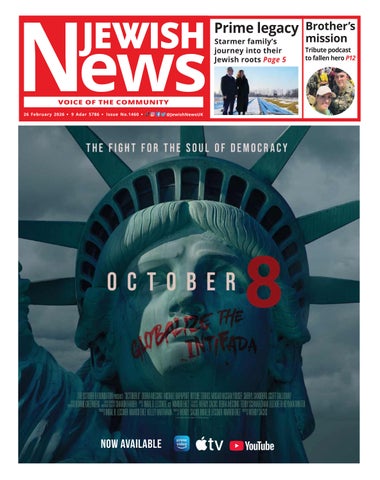
family’s journey into their Jewish roots Page 5
Tribute podcast to fallen hero P12
Starmer family’s journey into their Jewish roots Page 5
Tribute podcast to fallen hero P12
by Candice Krieger candicekrieger@googlemail.com
@candice@jewishnews.co.uk
A young father is appealing to the community for support as he prepares to travel abroad this weekend for a life-saving liver transplant.
James Conradi, 38 from Radlett, Hertfordshire, was living with a rare auto-immune disease called PSC (Primary Sclerosing Cholangitis), which causes liver cirrhosis, for more than a decade. Recent scans
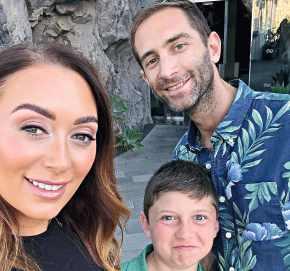
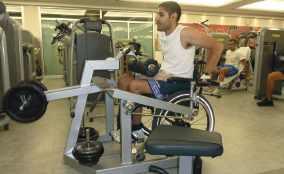
also showed a particular type of liver cancer in two small early-stage tumours and he now urgently needs a transplant.
Conradi is blood group O and can receive a liver only from another O donor. This limits compatibility significantly and the family are appealing for more healthy blood group volunteers to be assessed.
The family have also launched a crowdfunder to help cover the cost of treatment and medical and travel expenses, likely to exceed £200,000.
Conradi, who has a nine-year-old son, told Jewish News: “A transplant was always something we knew I would be needing eventually, but what’s changed is the time frame.
“We now have about a two-to-four-week window to try and get me transplanted.”
He is not eligible for treatment in the UK due to NHS transplant criteria because one of his two tumours measures slightly over the 2cm maximum threshold by 0.4mm.
His medical team at the Royal Free Hospital in north London is planning an appeal but with timing critical, Conradi and his wife, make-up specialist Laura Kay, have made the decision to pursue treatment abroad.
Conradi added: “We are grateful to the NHS and the care I’ve received from the Royal Free and St Mary’s, but we don’t have time to await the results
Continued on page 4
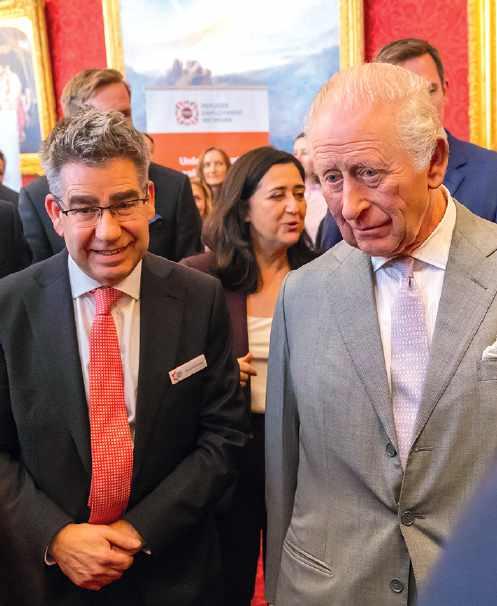
The King attended a refugee jobs fair at St James’s Palace on Monday, as 500 highly-qualified refugees met employers at a event supported by World Jewish Relief. The King is pictured with WJR’s Paul Anticoni.
Beit Halochem’s four centres deliver life-changing rehabilitation for Israel’s 70,000 disabled veterans and victims of terror — from physiotherapy, hydrotherapy and PTSD care to specialised sports, social support, education and creative programmes.
Local political pressure played a part in the decision to ban Maccabi Tel Aviv football fans from attending a match against Aston Villa, a committee of MPs has concluded, writes Adam Decker.
Birmingham councillors had a “disproportionate opportunity to exert influence”, undermining trust that decision-making was based on evidence and safety, the Home Affairs Committee said.
Maccabi Tel Aviv fans were barred from travelling to the game by the local safety advisory group (SAG), citing concerns based on advice from West Midlands Police (WMP).
A review found an “AI hallucination” produced by Microsoft Copilot helped police to justify the move by referencing a non-existent game between Tel Aviv and West Ham.
WP chief constable Craig Guildford stepped down following mounting pressure for him to quit over the controversy. The Home Affairs Committee said it could not rule out political pressure had played a part in the decision.
The report said WMP’s concerns about disorder “combined with local political pressure and community tensions related to the interna-
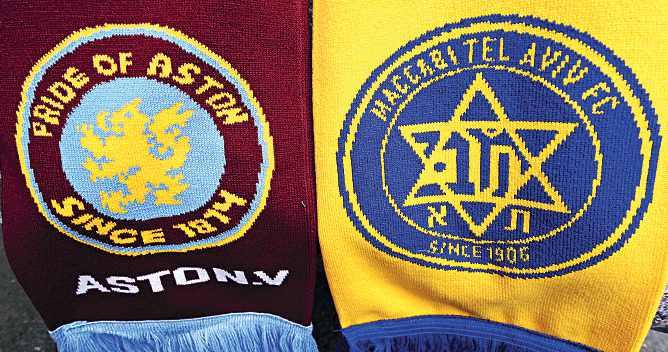
tional situation” led to the move.
The report continued: “While we cannot conclude that the Safety Advisory Group’s decision was made because of political pressure, on the basis of the evidence we have seen we also cannot conclude with any confidence that the decision was not politically influenced. It is clear
that on this occasion councillors, with a stated political aim, had a disproportionate opportunity to influence the Safety Advisory Group.”
The report went on: “While the presence of elected politicians on Safety Advisory Groups has potential benefits in terms of local representation, it also risks decision-
should ban local councillors from sitting on SAGs, the group of MPs said.
Committee chair Dame Karen Bradley added: “It is an extraordinary measure to decide to ban fans, particularly in the cultural and political climate that this occurred in.
“It is vital that trust is rebuilt. West Midlands Police must repair the damage ... by working hard to reach out to local communities, particularly Jewish communities.
“They must also ensure that there is a cultural shift around decision making where assumptions are tested and evidence fully checked.”
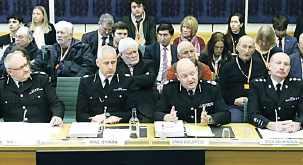
making becoming politically motivated, undermining trust in the process.”
In view of this, the Cabinet Office
An additional £10m in funding has been confirmed to protect UK synagogues through the government’s security scheme for faith communities, writes Lee Harpin.
The Community Security Trust (CST) welcomed the statement, which comes in the wake of the terror attack at Heaton Park synagogue in Manchester and amid rising antisemitism.
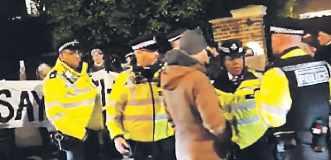
Home secretary Shabana Mahmood said: “Nobody should be forced to live a smaller life in this country because of their faith.
“The funding we have announced today will protect places of worship, faith-based schools and community centres across the country. This government will never tolerate religious hatred or intimidation.”
Chancellor Rachel Reeves added: “We are ensuring record funding to protect faith communities all across the UK.”
She added: “This goes further than cameras and alarms – it’s about restoring peace of mind and sending the message:
religious persecution and intolerance have no place in Britain.”
The Home Office confirmed up to £73.4m will be available in 2026-2027 through the government’s protective security schemes for Jewish, Muslim and other faith sites.
This funding will cover on-site security staff and equipment such as CCTV, fencing, intruder alarms and floodlights. Up to £28.4m will go to the CST-managed Jewish Community Protective Security Grant, for synagogues, Jewish schools and community centres.
minister Sir
announced last October the Jewish and Muslim protective security schemes would receive an additional £10m uplift in 20252026 to address an increase in threats.
The latest announcement confirms these record funding levels will continue through next year.
A CST spokesperson awelcomed the additional funding, describing it as “a vital boost at a crucial time for the Jewish community”.
He added: “[It] is sadly much needed following the appalling Islamist terrorist attack in Manchester and at a time of heightened antisemitism.
The CST statement said the organisation would “continue to work closely with government and community partners to ensure that this additional funding is used as effectively as possible to protect our community, while seeking longer-term ways to tackle the sources of this hatred and extremism”.
Elsewhere, the committee also criticised ministers, including the prime minister and home secretary, for heightening tensions by criticising the banning move too late. By intervening after the decision to ban away fans had already been publicly announced, the government escalated the situation and was “ineffectual” in enabling the Israeli fans to attend, it said.
Donald Trump has said he could never allow Iran to have a nuclear weapon, as he insisted his administration would continue imposing tariffs on other countries despite a Supreme Court ruling overturning his import tax policy.

corporations want to keep the deal that they already made,” the president said.
Calling Iran the “world’s number one sponsor of terror”, Trump said during this week’s State of the Union address: “We are in negotiations with them ... but we haven’t heard those secret words, ‘we will never have a nuclear weapon’. My preference is to solve this problem through diplomacy.”
On trade, Trump said he would continue imposing tariffs on other countries despite a Supreme Court ruling overturning the policy.
“Almost all countries and
“Knowing that the legal power that I, as president, have to make a new deal could be far worse for them, therefore, they’ll continue to work alongside the same successful path that we had negotiated before the court’s unfortunate involvement.”
Trump was heckled by Democrats during his speech after saying they should be “ashamed” for not supporting his statement a government’s duty was “to protect American citizens, not illegal aliens”.
The president asked the Democrats present repeatedly asked why they did not stand, called them “crazy”, and said: “Democrats are destroying our country” over young people transitioning gender.
A senior Sunday Times journalist has said his Jewishness was “grotesquely subverted” in a secretive report that has sparked “revulsion” after it was commissioned to look into the writers of an article on a Labour-linked group, writes Lee Harpin.
Gabriel Pogrund, currently the title’s Whitehall editor and Political Journalist of the Year at the 2025 Press Awards, was named in a report compiled by US lobbying group Apco.
The £36,000 report, paid for by the think-tank Labour Together, included Pogrund and other investigative journalists in its probe into the “backgrounds and motivations” of those who worked on a 2023 article revealing Labour Together’s failure to declare £730,000 in donations between 2017 and 2020.
The group was later fined more than £14,000 by the Electoral Commission for 20 breaches of campaign finance law.
Pogrund said: “I think the detail which has probably ended up causing a lot of heat and a fair amount of revulsion too is the fact that the report used my Jewishness, which is a source of great pride for me.”
He added the report had “grotesquely subverted” his identity “and said that I must have
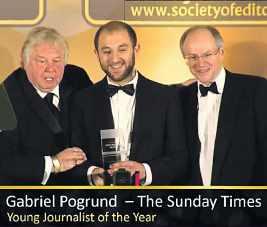
an odd relationship with my ethno-religious background because of the views that it falsely purported that I hold”.
On The State of It podcast, alongside Sunday Times columnist Patrick Maguire, Pogrund further addressed the report’s slurs: “A rabbi characterises gossip as being akin to taking a knife and ripping it through pillows stu ed with goose feathers and then asking somebody after you’ve shaken the pillow to collect every feather.”
Friends of the journalist said he has been
A Reform UK branch chairman has defended posting photographs of himself on social media dressed in a Nazi Wa en-SS uniform, saying it was part of his involvement with military reenactment groups, writes Lee Harpin.
Tim Nott, chair of Reform UK’s Bath branch, came under scrutiny after eight images surfaced, highlighted by the @BoneAshBath account on X, showing him in German and Wa en-SS military clothing.
The photos, posted under his social media alias Lee-
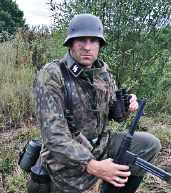
mans Hecker, depict Nott participating in reenactments wearing SS insignia and the
“totenkopf” skull emblem. Nott, a British Army veteran, said he was involved in acting with military reenactment groups and had also recently been portraying an American captain.
Following local media attention, Nott supplied a photograph of himself in an American World War II uniform to demonstrate that he portrays a variety of military roles.
He said: “After my 10-year career in the British Army ... I got into acting. I’ve done much more than just German units.”
A University of Oxford student accused of chanting “put the Zios in the ground” at a proGaza protest will stand trial in January 2028, a court has heard.
Samuel Williams, 21, has pleaded not guilty to stirring up racial hatred, following an incident at a Palestine Coalition demonstration in central London on 11 October last year.
Williams appeared at Southwark Crown Court on Tuesday, where he spoke only to confirm his name and enter his plea. He was granted conditional bail ahead of a trial scheduled for 17 January 2028.
The charge was brought after footage circulated online showing a man addressing a crowd in Whitehall. In the clip, the speaker tells protesters: “A steadfast and noble resistance in Palestine and in Gaza to look to... to be inspired by... and – I don’t want to yap for too long –but a chant that we’ve been workshopping in Oxford that maybe you guys want to join in.”
He then leads the chant: “Gaza, Gaza make us proud/ put the Zios in the ground.”
The prosecution alleges Williams used threatening, abusive or insulting words or behaviour during the demonstration.
left “angry and devastated” by the false smears contained in the report.
Pogrund said: “There will be people who have believed what was said about me. And who believed there had to be something wrong, sinister, conspiratorial about the provenance and the execution of the Labour Together piece.”
The 58-page Apco report was commissioned by Cabinet O ce minister Josh Simons, who is himself Jewish, and written by Apco senior director Tom Harper, a former Sunday Times employee.
It also included baseless claims that the emails underpinning the story were likely to have come from a suspected Kremlin hack of the Electoral Commission.
“The likeliest culprit is the Russian state, or proxies of the Russian state,” Harper reportedly wrote.
Simons, who led Labour Together at the time, said in a statement: “I was surprised and shocked to read the report extended beyond the contract by including unnecessary information on Gabriel Pogrund.”
He added the information relating to Pogrund was “immediately removed” before the report was passed on to intelligence o cials.
Jeremy Corbyn has been accused of spreading a “wild blood libel” after sharing claims made by the director of the Al Shifa hospital in Gaza about the harvesting of organs by the IDF from dead Palestinian women.
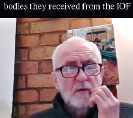
Corbyn posted a video message on the We Are The Peace Instagram account that he received a message from the hospital chief “last Thursday or Friday” about the delivery of 60-70 boxes from the IDF “which contained the skulls of Palestinians and the bodies of dead women with removed organs”.
IDF international spokesperson Lieutenant Colonel Nadav Shoshani said: “What happened to fact-checking before spreading a wild blood libel? IDF soldiers haven’t been anywhere near the Shifa hospital in months! Jeremy Corbyn’s claims are completely false.
“The IDF operates in accordance with international law and strict internal directives that prohibit such conduct,” he added.
“The return of bodies to Gaza is carried out through international coordination and with the assistance of the Red Cross.”
Inclusive outdoor activities and on-site accommodation, tailored for Jewish faith groups of all ages and abilities.
•On-site private sole occupancy accommodations
•Inclusive programmes tailored to your group’s needs
•Safe, supportive environments with experienced staff
•Builds connection, wellbeing and shared community



Scan to plan your group visit
by Daniel Sugarman
daniel@jewishnews.co.uk
@Daniel_Sugarman
The Green Party’s leader, deputy leader and candidate for Gorton engaged in an interview with a publication which has repeatedly platformed some of the UK’s most notorious neo-Nazis and white supremacists for rants about Jews and LGBT people, with the interview subsequently shared on the Green’s Twitter account.
Zack Polanski, Mothin Ali and Hannah Spencer appeared in a video interview by 5 Pillars, a notorious Islamist outlet which has used its Blood Brothers podcast to host individuals such as former BNP leader Nick Gri n, Patriotic Alternative leader Mark Collett and former Britain First deputy leader Jayda Fransen.
The interview was then shared on the Greens’ Twitter account, but removed some 12 hours after Jewish News approached the party for comment.
In the 5 Pillars video, the Greens’ Gorton and Denton byelection candidate Hannah Barnes told the interviewer: “I’m really keen to show that we’re not divided … I’m the only candidate that is challenging Reform UK.
“I’ve sat at the hustings and challenged (Reform candidate) Matt Goodwin about the things he’s said about our communities … in the face of such hatred and divi-

sion, we need someone who’s going to stand up to the bully.”
5 Pillars was a publication under the imprint of the Impress media regulator, but left after it was disciplined for breaching the discrimination clause of its standard code.
In its final ruling, Impress found a Blood Brothers interview between 5 Pillars deputy editor Dilly Hussain and Fransen allowed Fransen to espouse unchallenged antisemitic theories without pushback, encouraging hatred or abuse towards a specific group – Jews.
The interview was deemed inflammatory enough to be
removed from YouTube, but is still available via the 5 Pillars website.
In a previous ruling on Hussain’s interview with Collett, Impress also ruled 5 Pillars breached Clause 4.3 of its code “by encouraging hatred or abuse against groups based on gender identity, religion, and sexual orientation”.
This followed inflammatory remarks by Collett in the interview, including stating: “When you talk about Jewish influence, you have to take into account things like the porn industry, feminism, cultural Marxists, the whole LGBT
industry, the anti-racist industry, the holocaust industry.
“All of these things, all of these endeavours, are controlled or disproportionately controlled by people of Jewish descent, and they are wielded in such a way that they have a negative impact on the white population.”
5 Pillars has also interviewed Nick Gri n, perhaps the UK’s most notorious neo-Nazi, on two separate occasions.
Greens’ leader Polanski, who is Jewish and gay, was also featured in the 5 Pillars interview, which was shared by the party on its social media channels.
“Reform UK is an extreme danger,” he told the media outlet.
“And I don’t mean that to scare people, but I would say I’m scared. I know that a lot of communities are scared ... because what we’re facing is a really extreme party.”
5 Pillars was also censured by Impress after broadcasting a 2021 video in which its deputy editor described homosexuality as “a crime against Allah”.
In further comments, Greens’ candidate Spencer, who, as Jewish News has previously noted, never mentioned Israel or Palestine on Twitter until April 2024, told 5 Pillars: “It’s a chance really to say that we have a proud history of standing with Palestinians in Gaza ... it’s human decency to stand up and say something when we think something is wrong.”
Zack Polanski has indicated he may support a “Zionism is racism” motion set to be debated at the Green Party’s Spring Conference next month, writes Lee Harpin.
Pressed on his stance regarding the controversial motion – which, if passed, would end the party’s support for Israel – the Green Party leader said “if the definition of Zionism is what is happening right now by the Israeli government then yes, absolutely, that’s racist, and I’ll vote for it.”
It would be almost unthinkable for party members backing the move to declare support for a Jewish state as racist not to also voice total opposition to the policies of Benjamin Netanyahu’s government using the same term.
When asked directly whether he would vote for the motion, he told Times Radio: “I’ll wait to hear the debate, but absolutely, if the definition of Zionism is what is happening right now by the Israeli government, then yes, absolutely, that’s racist, and I’ll vote for it.”
He added, “I can give you some di erent definitions of Zionism, and we can talk about whether they’re racist or not. If we’re talking about the definition that this Israeli government is clearly perpetrating through a genocide in Gaza, then yes, absolutely. That’s racist.”
Prior to becoming Greens leader he had previously said he was a supporter of Israel and of Zionism when he spoke at events, including at the JW3 community centre in north London.
Audio from a London Assembly hustings event when Polanski was a Liberal Democrat candidate has him saying a vote for him is a vote for the Jewish community and for Israel. Jewish News revealed that Polanski has faced mounting pressure to support the motion from a new group of hardline anti-Israel activists within the party. Supporting the motion would e ectively mean declaring his own mother and other members of his Jewish family – staunch supporters of Israel who have criticised proPalestine marches – as racists.
‘Jew hunters’ face action in data law clampdown
Reform UK suspended an activist helping GB News presenter Matt Goodwin’s Gorton and Denton by-election campaign after communal leaders raised concerns about antisemitic and misogynistic social media posts, Jewish News understands.
Reform interim campaign manager in Tameside Adam Mitula was identified as a key figure in Goodwin’s campaign.
Manchester news outlet
The Mill, however, revealed Polish-born entrepreneur Mitula took part in an online discussion in July 2024 about Holocaust death tolls, saying six million Poles, including “some Jews,” were murdered.
Responding to a post by exUltimate Fighting Champion-

ship (UFC) star Jake Shields – who has a history of antisemitic statements – which claimed the Holocaust death toll was “made up”, Mitula added: “They always use Poles to make up the number. And on top of it they claim Poles were killing. Just sick.”
In another post, Mitula wrote that he would “never touch a Jewish woman.”
In other posts, he is also alleged to have used a racial slur and claimed “60-70 percent” of transgender people are paedophiles.
Jewish News understands the Board of Deputies was among several organisations to complain to Reform UK about Mitula’s remarks.
Board acting vice-president Judith Prinsley said: “Reform UK was right to suspend this campaign worker following the serious allegations of his misogyny and antisemitism.
‘We will continue to demand that parties across the political spectrum take firm action to root out this hatred.”
Today’s by-election follows the resignation of Labour MP Andrew Gwynne.
Anti-Israel activists accused of going “Jew hunting” in She eld are facing mounting scrutiny after Britain’s data watchdog warned collecting residents’ political views without a clear legal basis may breach UK law, writes Annabel Sinclair.
The development follows widelyshared footage showing campaigners linked to She eld Apartheid Free Zone (SAFZ) knocking on doors in the Woodseats area and urging residents to boycott Israeli goods.
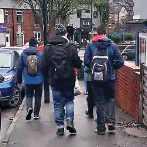
Guidance to Jewish News from the Information Commissioner’s O ce (ICO) makes clear organisations collecting personal information must comply with data protection regulations, with personal data revealing political opinions classified as its own special category that carries enhanced legal protections and can be processed only when strict conditions are met.
One activist confirms group members record the doors they knock on and categorise responses, including whether households are supportive, not interested or give no answer.
South Yorkshire Police confirmed it is investigating an altercation linked to the incidents amid reports a group were doorknocking and handing out leaflets when they were approached by two individuals.
The guidance also places a strong emphasis on transparency, requiring individuals to understand how their information is being collected, recorded and then used –including during door-to-door campaigning.
The activity is not confined to Sheffield. Similar door-to-door Israel-boycott campaigns have been filmed or reported in Brighton, Bristol, Hackney, Cardi , Belfast and Glasgow, with activists operating systematically through residential streets using clipboards and prepared materials.
by Lee Harpin lee@jewishnews.co.uk
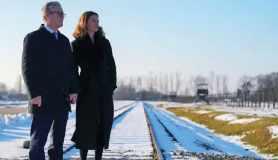
Sir Keir Starmer has travelled with his wife, Victoria, and their two children to Poland to find the house where her grandparents once lived before fleeing to England after the First World War.
Jewish News understands the prime minister was determined to travel with his children to the small village just outside Warsaw to help them fully appreciate the roots of their mother’s Jewish heritage.
None of Lady Victoria’s extended
family who remained in Poland survived the Nazis, making the visit particularly poignant and emotional.
At a recent event at Downing Street with the Holocaust Educational Trust, Victoria became visibly moved as she recalled a visit to Auschwitz, where she viewed archival footage of life in Poland before Adolf Hitler’s rise to power.
The Starmers are believed to have made the trip last weekend, as the prime minister took a long weekend break with his family.
Although not Jewish himself, the PM has fully supported his wife’s
e orts to ensure their two children, aged 18 and 16, maintain a strong connection to their Jewish heritage.
In his autobiography of the PM, writer Tom Baldwin detailed how her father Bernard was born in England from a family whose roots were found in the Polish village of Kolo.
The book revealed Victoria once travelled by herself to the village –where nearly half of all the residents were Jews until the Shoah – to meet and speak with people who had memories of her father’s family.
In January 2025, the Starmers
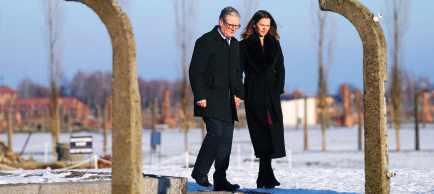
also made an emotional visit to the Auschwitz death camp. Sir Keir said that while it was his first time at Auschwitz, it was his wife’s second visit. He said it was “no less harrowing than the first time she stepped through that gate and witnessed the depravity of what happened here”.
The prime minister recalled feeling “a sickness” and “an air of desolation” as he tried to compre-
hend “the enormity of this barbarous, planned, industrialised murder” of six million Jews and others by the Nazis and their collaborators during World War Two. That visit, Sir Keir said, made clear “more than ever before” that the Holocaust “took a collective endeavour by thousands of ordinary people who each played their part in constructing this whole industry of death”.
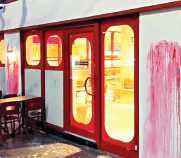
A newly-opened Gail’s Bakery in north London has been vandalised twice in the space of a week by activists claiming the chain has links to Israel, which the company has repeatedly denied.
The branch, near Archway
station, was daubed with red paint and political slogans, including “Free Gaza” following a demonstration outside the premises last week, and again on Tuesday.
The Metropolitan Police said o cers were called to
reports of criminal damage. A spokesperson said: “O cers arrived on the scene within six minutes and found that the outside of the building had been vandalised with paint. The suspects fled the scene before police arrived.”
Police said o cers conducted a search of the area and worked with the council to review CCTV, adding: “They are continuing to review other footage to identify any lines of enquiry that might help to identify the suspects.”
Footage from the protest showed a confrontation between demonstrators and a Jewish bystander, who later said she felt “intimidated” by the protest, which she described as “intimidating and harassing Jewish customers”.
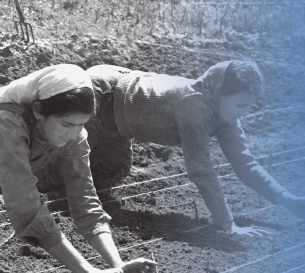

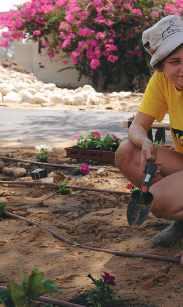

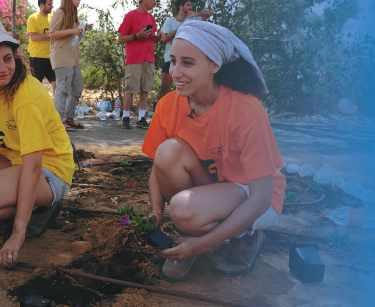
For over 120 years JNF UK has worked tirelessly to develop the Land of Israel.
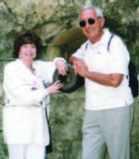
Much of our work has only been possible thanks to the generosity of our legacy donors like Sheila and John, who had a deep commitment to how the country had shaped their lives.

Leaving a gift in your Will, no matter how small or large, is one of the most valuable ways you can forge an everlasting bond with Israel.

Our expert and caring Legacy Team offer a range of professional services and first-rate pastoral care.
To find out more, please visit

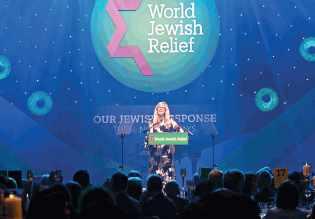
Leading figures from across Britain’s Jewish community gathered in London on Monday to raise vital funds for World Jewish Relief, as the charity warned of unprecedented global need driven by war, displacement and rising antisemitism, writes Annabel Sinclair.
The annual fundraising dinner, held at the Roundhouse on the eve of the four-year anniversary of Russia’s invasion of Ukraine, brought together more than 600 guests to support the charity’s humanitarian work in 19 countries.
The evening was hosted by broadcaster and journalist Emma Barnett, who spoke movingly about her personal connection to World Jewish Relief, revealing how her grandmother escaped Nazi-occupied Austria in 1939 with the charity’s help.
“A week later, and she may not have made it to safety. So, when I say I am in a great part here this evening because of World Jewish Relief, I mean it,” Barnett told the assembled guests.
She added that discovering her grandmother’s records in the charity’s archives brought home the organisation’s historic and ongoing role in saving lives: “Her experience is proof that this organisation responded to the needs of the Jewish community in the darkest of times.”
WJR chair Maurice Helfgott warned antisemitism was once again shaping Jewish life in Britain and beyond, insisting the response must be rooted in Jewish values and outward-facing action.
“Here at home – and around the world – antisemitism is resurgent – in all its nasty forms, old and new,” he said.
“So, our response is to turn up the volume on the ‘J’ in World Jewish Relief – to reach even more vulnerable Jews around the world and, publicly and proudly, to help more people beyond the Jewish community.”
Helfgott also paid tribute to the charity’s royal patron, King Charles, highlighting his recent attendance at a refugee employment fair hosted by the organisation at St James’s Palace.
WJR chief executive Paul Anticoni told the dinner global humanitarian pressures were now at their most severe in decades.
This was particularly true in Ukraine, where the charity has supported more than 384,000 people across hundreds of towns and cities.
“I can say sadly – but with certainty – that the situation in the world right now is one of the most perilous I have seen in my 20 years at World Jewish Relief,” he said. “I find it intolerable – unbreakable –that right now I can only repair a fraction of Jewish homes destroyed by missiles in Ukraine.”
Anticoni also highlighted the charity’s work supporting refugees in the UK through its awardwinning Specialist Training and Employment Programme (STEP), which has helped more than 14,000 Ukrainian refugees to learn English and find work.
A Jewish producer who commissioned a documentary that won a BAFTA this week said she is “flabbergasted, proud and so excited” at the honour.
Lucie Kon, a commissioning editor and executive producer for BBC Storyville, spoke to Jewish News after landing the coveted award for Mr Nobody Against Putin
The 89 minute film features footage kept secretly by co-director Pavel Talankin, who collaborated with Denmarkbased US filmmaker David Borenstein to record Russia’s invasion of Ukraine.
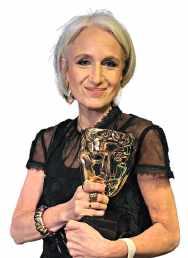
Described as
the story of “a quiet schoolteacher in a small industrial town” who picks up his camera and “becomes an unlikely dissident”, the documentary uses the footage Talankin captured over two years after “patriotic lessons and military drills begin replacing regular classes” to create “a chilling portrait of how propaganda seeps into everyday life and how even children are drawn into the machinery of war”. Kon said:
thought it would have the impact that it has. Working with the team to shape and share this vital story, and now winning a BAFTA for work that I have loved and been so lucky to do is just incredible.”
Continued from page 1 of an appeal and my consultant advised us to look at options in other countries.”
The couple, who married in 2015, are going to a world-leading clinic in Istanbul which specialises in living donor liver transplantation.
They are due to travel on Sunday for urgent assessments and will be joined by a small number of volunteers to be tested as potential donors.
If suitable matches are identified, the case will be reviewed by an independent ethics committee before transplant surgery can proceed.
“We have been incredibly moved by the support from people but the more donors we have, the better chance I have of finding a match,” Conradi said. “The generosity people have shown already has been overwhelming.”
The Conradis expect to remain in Turkey for several weeks while their son Harrison stays in the UK.
Conradi, who has worked since he was 15 and is now an HR director of a private equity firm, stopped work this week ahead of the trip.
The most di cult part, he said, has been explaining the situation to his son. “We have spoken to him about me needing a new liver and why I need to go abroad for a transplant. That in itself is not an easy conversation. But trying to explain the impact of what it means if I don’t have it…”
Conradi was first diagnosed with PSC in 2013 after routine blood tests showed abnormalities. He was advised to stop drinking alcohol, maintain a healthy lifestyle and have regular mon-
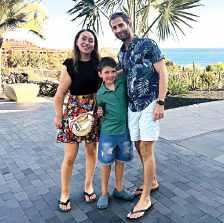
itoring. “For years it was something that was managed,” he said. “I worked fulltime, progressed in my career, kept fit and carried on with family life.”
Over the past year, however, blood tests began to show rising bilirubin levels and deteriorating liver function, alongside further imaging detecting changes to his liver.
An MRI in January revealed a small shadow, and a subsequent CT scan confirmed the cancer.
The family have been told without the transplant Conradi may have only months left. With it, he could gain 20 more years of life.
TO APPLY AS A POTENTIAL O BLOOD TYPE DONOR, CONTACT 07725 086645
Link to crowdfunder at: www.gofundme.com/f/helpsave-jamess-life-urgent-livertransplant-needed
A bitter row has broken out in the Green Party after a Jewish News expose revealed its leader used to go by a di erent name.
It’s not the first award for Kon, who also won an Emmy for Best Current A airs Documentary for We Will Dance Again, the harrowing story of the 7 October 2023 Nova Music Festival massacre carried out by Hamas.

“From the moment I was pitched the story, I knew I had to be involved, that it had to be on the BBC, but I would never in a million years have
who collaborated replacing create portrait propaganda everyday machinery of war”. the the but a have
In April 2023, she was also nominated for a National Television Award for a moving documentary about the late Dame Deborah James, who died in June 2022 aged 40. The two women met while both battling cancer.
Mr Nobody Against Putin has been nominated for the 2026 Academy Award for Best Documentary Feature.
Based on conversations with members of the Manchester Jewish community, including renowned local leader Esther McGiller, Jewish News can reveal Zack Polanski grew up with the name ‘David Theodor Herzl Paulden’.
Founder of Young Greens at Eton, Asa Uwesfull-Idyotte, said: “For years, we’ve been told Zack Polanski changed his name from David Paulden in order to reclaim his Jewish heritage – which makes perfect sense, as everyone knows the name ‘David’ is basically unheard of in Judaism. But this new information about his former middle names is hard to take. Our party needs to be above suspicion – which is why
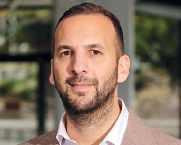
I’ve tabled an amendment to the ‘Zionism is Racism’ motion due to be debated at conference. My change would make it mandatory for all Zionists to wear an identifying badge if we win power.”
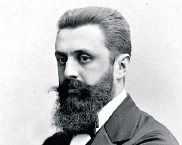
Moishe Pipick, a longstanding Green Party member of several months as well as co-founder of Jewish Voice for Tokens, said: “At first, I thought it was deeply concerning, but then I remembered that the average anti-Zionist doesn’t know which river and sea are being referred to with regards to the chant ‘from the river to the sea’, so the chances they would have heard of Herzl are extremely slim.”
One Jewish political commentator even suggested the revelation could help Polanski “Herzl’s most famous maxim was, ‘If you will it, it is no dream’”, they told Jewish News. “Polanski could cite this line when questioned on his party’s ludicrous economic policies.” The Greens were not contacted for comment.
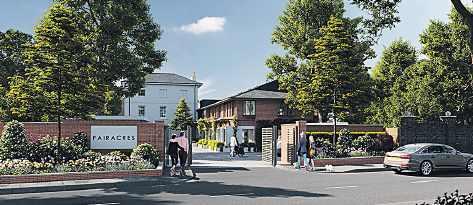
Jewish Blind and Disabled (JBD) has secured planning permission for a £15m redevelopment of one of its key sites in north London, to provide upgraded spaces and increased facilities at its East Finchley complex, writes Michelle Rosenberg.
Work on the charity’s Fairacres development, opened almost 40 years ago, will begin next month, with the site’s current 29 one-bedroom apartments upgraded to ensure they are accessible to wheelchair users. In addition, 11 new apartments will be added, including four two-bedroom flats for families.
The redevelopment has been funded in part by a grant of £7m from the Greater London Authority, with other money raised via donations and interest-free loans from individuals, families, trusts and foundations.
The GLA grant has been offered through a collaboration with the Joel Emanuel Trust (JET) which is part of Jewish Care.
Jewish Care chair Marcus Sperber said: “Our commitment to partnership is exactly why we stepped forward to
support JBD on the Fairacres redevelopment, a project of real significance for the community’s long-term wellbeing.
“Through the Joel Emanuel Trust, we were able to unlock essential GLA funding that JBD could not have accessed alone, and together, we are helping to secure modern, accessible homes that will transform lives for decades to come. We are proud to play a role in making that possible.”
JBD chair Marc Gordon added; “We are a small community with limited resources. Having just completed
an £11m new development in Mill Hill East, we knew that securing the funding required to undertake the much-needed Fairacres project from the community alone was going to be a huge challenge.
Deputy mayor for housing and residential development Tom Copley said: “We are proud to be providing more than £7m funding to support the redevelopment. This is an exciting and significant affordable housing project.”
Work on the site, which originally opened in 1987, is expected to be completed in late 2027.
Former Conservative minister Michael Gove has criticised senior MPs for supporting a parliamentary Bill that would introduce compulsory labelling for kosher and halal meat.
The Bill, introduced by Esther McVey, the Conservative MP for Tatton, under the Ten Minute Rule on Tuesday, calls for mandatory labelling to inform consumers if meat has been produced using non-stun slaughter methods.
McVey argued that such labels would enable people to make informed choices based on animal welfare concerns.
“Individuals concerned about animal welfare would want to know if an animal had been stunned prior to slaughter,” McVey told MPs. Her proposal was backed by other Conservatives, including Alicia Kearns, former chair of the Foreign Affairs Select Committee. Kearns posted on X: “You have the right to know where your food comes from and how it was produced. I’m calling for clearer labelling in supermarkets..” However, Gove, now editor of The Spectator, warned that the push for labelling could prove “divisive.”
Camden eatery Mazal triumphed at the 14th British Kebab Awards on Tuesday at the Park Plaza Westminster, winning the Best Kosher Shawarma’ accolade for the second year running. It was celebration time for Neta Nel Segev and Aviv Baum, chefs and co-founders of the three-year-old Israeli street food spot which offers shawarma, falafel and other Israeli dishes. The kosher award was intro-
duced in 2022 by Jewish News, in collaboration with entrepreneur Ibrahim Dogus.
Nel Segev said: “We are really delighted and happy to win this exciting title. We have the privilege of doing what we love doing on a daily basis and are grateful for everyone spreading the love, by coming and voting.”
Other finalists included Balady (Holborn) and Bricky’s (Borehamwood).
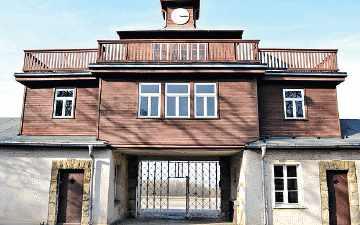
Anti-Israel groups have announced they will hold a protest outside the site of Buchenwald concentration camp on the anniversary of its liberation in April, in protest against a court decision last year upholding the site’s decision to prevent an activist wearing the Palestinian nationalist symbol from taking part in the event.
A newly formed organisation called “Keffiyehs in Buchenwald”, made up of a number of anti-Zionist groups, has announced that it intends to protest outside the Nazi camp while wearing the scarves in question on 11 April, 81 years since the US Army entered and freed the inmates.
In August last year, a German state court upheld the memorial’s right to prevent the activist woman’s entry to the site while wearing the garment, describing how the memorial’s “interest in upholding the purpose of the institution” outweighed her right to freedom of expression.
The court expressly noted that the woman’s declared aim was of “sending a political message against what she saw as
the [memorial’s] one-sided support for the policies of the Israeli government””, and described how “It is unquestion-
able that this [her presence] would endanger the sense of security of many Jews, especially at this site.”
Hundreds of thousands of Nazi prisoners passed through Buchenwald during its eight years of operation, including Jews, Roma, Communists, Poles, Soviet prisoners of war and both mentally and physically disabled people.
The population also included ordinary criminals and individuals perceived by the Nazi regime as sexual deviants.
The total number of inmates was estimated at 280,000 , of whom more than 50,000 died, of starvation, disease or direct Nazi executions. Among those held were Elie Wiesel, Bruno Apitz and Rudolf Brazda.
Dr Felix Klein, Germany’s commissioner for combating antisemitism, described the intended protest as “a new low in the reversal of roles between victim and perpetrator.”
Last year, an internal document from staff at the memorial was leaked which described the keffiyeh as “closely associated with efforts to destroy the state of Israel”.
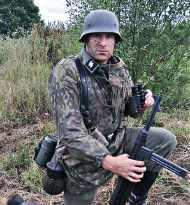
A Reform UK branch chairman has defended posting photographs of himself on social media dressed in a Nazi Waffen-SS uniform, saying it was part of his involvement with military reenactment groups.
Tim Nott, chair of Reform UK’s Bath branch, came under scrutiny after eight images surfaced, highlighted by the @BoneAshBath account on X, showing him in German and
Waffen-SS military clothing. The photos, posted under social media alias Leemans Hecker, depict Nott participating in reenactments in SS insignia and the “totenkopf” skull emblem.
Nott, a British Army veteran, said he was involved in acting with military reenactment groups and had also been portraying an American officer.
Following local media attention, Nott supplied a photograph of himself
in an American World War II uniform to demonstrate that he portrays a variety of military roles.
He explained: “After my 10-year career in the British Army, I found myself working every weekend. Being then unable to join the territorial army/reserve army, I got into acting.
“I’ve done much more than just German units. However, as far as films/documentaries are concerned,
there is certainly a lot more work in it. One reenactment group I’m part of did filming for Fury and Saving Private Ryan. I’ve known many actors in the past, some that worked on the Nuremberg film starring Russell Crowe. Even at that level, it’s a shame to see people’s reaction to acting.
“I’m currently in progress on a documentary which sees myself as an American captain in Allied uniform.”

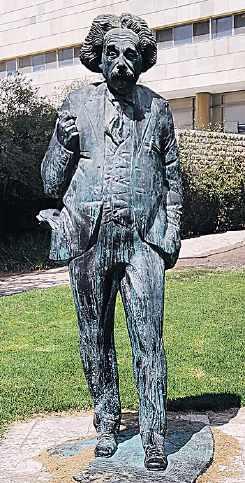
by Annabel Sinclair annabel@jewishnews.com
Albert Einstein passed away a few days after the university he had helped to imagine reached its 30th anniversary. The institution reached its centennial milestone in 2025; albeit in an atmosphere of war, disruption and uncertainty – of which the 20th century’s most famous mind knew plenty about.
Yet as the British Friends of the Hebrew University (BFHU) marks its own centenary in 2026, Einstein’s association with it feels less like history and more like a question: What, now, is a university for?
BFHU was founded in 1926, a year after the Hebrew University itself, binding British Jews to the idea at the forefront of the Jewish experience for almost 2,000 years.
This was that continuity would be sustained not only through refuge or politics, but through scholarship. The university was conceived before a state existed – as an intellectual project first, infrastructure second.
Einstein was central to that
vision. In February 1923, two years before the university formally opened, he travelled to Mount Scopus and delivered what is widely regarded as the institution’s first scientific lecture.
Speaking in French, he apologised briefly in Hebrew for not speaking “the language of his forefathers” before explaining the general theory of relativity to his audience. It is not known whether his listeners had more problems deciphering the language or the mathematics. That, Einstein believed, did not matter. The act itself did.
Physicist, former president of the Hebrew University and longtime custodian of the Albert Einstein Archives Prof Hanoch Gutfreund says: “When he died, he could have left his entire archive to any university in the world. He left it to the Hebrew University.”
Those archives – tens of thousands of documents, including handwritten equations that reshaped modern physics – are now housed in Jerusalem. But Einstein’s legacy was never meant to be preserved in storage alone. It was
• Tax-efficient investing before and after Aliyah
• Tax-efficient income after 10-year tax-free period
• Receive your entire pension pot tax-free
• Specialist portfolio management for Olim
• No Inheritance Tax (for non-UK-situated assets)
We are seasoned experts in providing long-term financial planning advice for those making Aliyah. Scan the QR code to read more
With investing, your capital is at risk. Tax treatments are subject to individual circumstances and are subject to change.
meant to be tested. Today, that test has a name: Artificial Intelligence. Einstein warned repeatedly scientific progress could outpace moral responsibility – a warning which became terrifyingly real in his lifetime, with the atomic bomb.
A century later, however, a new quandary, in the form of AI, has turned that concern into a daily reality for universities: how to pursue discovery when machines increasingly mediate knowledge itself, and when answers are probabilistic rather than certain.
Nowhere does that tension surface more sharply than in medicine. At the Hebrew University’s Faculty of Medicine, change is no longer theoretical. It is structural, ethical and immediate.
Dean of the faculty Prof Eli Pikarsky describes a moment of acceleration without precedent:
“We all understand that medicine is undergoing a huge transformation,” he says. “The pace of change has never been the way it is today.”
AI, he explains, is altering how disease is detected, how doctors are trained and how decisions are
made – raising questions not just of capacity, but of judgment.
“Medicine is no longer just about knowledge”, Pikarsky says. “It’s about knowing how to interpret, question and responsibly use what technology gives you.”
Under the Hebrew University’s new president, Prof Tamir Sheafer, closing the gap between theory and practical use has become a strategic priority.
While reaffirming research excellence as the university’s core mission, Sheafer places AI at the centre of its future – not as an end in itself, but a tool that must remain subordinate to human judgement.
“AI is all over,” he says. “We need to know how to utilise it to improve everything we do.”
Einstein once described his vision for the university as “a pluralistic institution, where science and knowledge are developed for the benefit of humankind, in an atmosphere free of discrimination and prejudice”. A century on, that vision remains unfinished – not because it failed, but because it still demands answering.
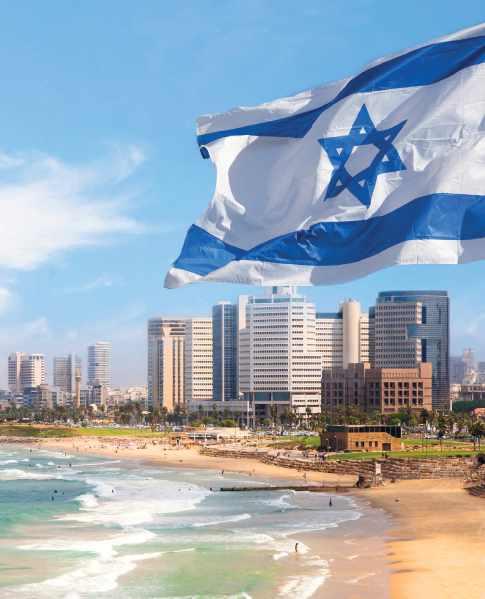

For Jewish families considering a holiday home that is both a lifestyle upgrade and a strategic investment, Cyprus is one of the most compelling destinations in Europe.
The reasons are practical, emotional and financial — and increasingly urgent.
Geographically, Cyprus is perfect. Just over four hours from the UK, the proximity makes ownership easily accessible. A weekend, a school holiday escape, or an extended summer stay becomes entirely manageable.
But it is not only about distance. Cyprus has shown itself to be openly supportive of Israel and the Jewish community. Arriving at Larnaca airport after October 7, Jewish visitors saw the airport road lined with hostage posters - a visible expression of solidarity. In December, “Happy Chanukah” signs have become a fixture. For many Jewish buyers, that atmosphere of public support and warmth matters deeply, and with Israel just a 40-minute flight away, it remains a popular choice for Israelis.
Familiar yet Mediterranean lifestyle
For British buyers in particular, Cyprus feels reassuringly similar to home. It is an island nation, drives on the left, and uses the same threepin electrical plugs and sockets as the UK. English is widely spoken, and a large British community already lives there.
At the same time, Cyprus offers everything one expects from the Mediterranean: long summers, seafront promenades, outdoor cafés and a relaxed rhythm of life.
EU Residency: a post-Brexit advantage
One of the strongest drivers behind the current surge in interest is residency. Purchasing a new property above €300,000 entitles buyers to apply for permanent EU residency status.
In a post-Brexit landscape, that is an opportunity.that provides families with mobility, flexibility and a European foothold that may prove invaluable for future generations. Importantly, buyers are supported throughout the legal process, making the pathway to residency structured and manageable.
Strong returns, Rising values
Financially, Cyprus is experiencing significant momentum with development happening at an unprecedented scale. Many industry insiders believe this may be the last opportunity to secure brand-new seafront property, as coastal land is becoming increasingly scarce. Returns mirror those seen in the UK, but short-stay rentals can deliver a stronger performance.

Managed properly, yields can climb into double-digit percentages. So owners can enjoy unrestricted personal use of their property while generating income through short-term lets. In 2025, Cyprus was also ranked by CompareTheMarket. com as the world’s best country for buying a holiday home Properties can start from approximately €165,000, rising into the millions depending on size, specification and proximity to the sea. Options range from city-centre apartments to luxury beachfront villas.

For observant and community-oriented buyers, Paphos has an active synagogue and a growing Jewish community. Kosher services are available, including catered kosher meals, Shabbat hot plates and even fully kosher accommodation options for visitors.
Three factors consistently shape purchasing decisions.
First, freedom of use. A privately owned holiday home removes booking restrictions and offers flexibility.
Second, EU permanent residency eligibility when purchasing qualifying new properties above €300,000.
Third, accessibility —easy connections to the UK.
VICHY Holidays, a Jewish-run local property management company in Cyprus, works directly with developers, law firms and accounting professionals. They assist with
sourcing, negotiation, legal processes, banking support, property management and transparent monthly reporting. For investors, having experienced representatives on the ground provides reassurance at every stage.
In a world where stability, connection and opportunity are prized, Cyprus offers something both rare and unmissable.
Come and meet the experts and exclusive, event-only property opportunities at: THE CYPRUS PROPERTY INVESTMENT EVENT 22 March 2026
10am-3pm NW3 London Free to attend


Nathanel Young was killed defending Kibbutz Zikkim on 7 October. His brother turned grief into a powerful podcast, writes Michelle Rosenberg
Shemah Yisrael, Adonai Eloheinu, Adonai Echad – Hear, O’Israel, the Lord is Our God, the Lord is One.
The most beloved prayer in Judaism is famously said at life’s inception – in Israel, religious children gather at the house of a newborn boy to recite the prayer to the child – as well as at its ending. And so when Eliot Young decided to create a podcast in memory of his brother, Nathanel, the former JFS student killed in action on 7 October, he made the title a play on words based on the Shema prayer. A podcast, focused on everyday heroes in the Jewish state, would be titled “Hero, Israel”.
Eliot, 36 years old, is the middle of five children – his brother Nathanel was thirteen years younger; just 20 when he was killled. All but one of the siblings chose to live in Israel, while parents Chantal and Nicky Young, who had lived in the tight-knit community of Cockfosters and Southgate for more than 40 years, made aliyah one month after Nathanel fell in battle against Hamas.
Nathanel met two of Eliot’s children and was “the fun uncle” who liked to play hide and seek.
“Whenever he had time off, he would spend it with with us. In fact, the last time I saw him was a week before Sukkot, He was in Jerusalem, but I was somewhere else”, Eliot says.
“And he came and joined me where I was for that Shabbat, even though he just had a few days off from the army. Usually soldiers, they want to eat and sleep and not do much else, but he spent one day with me and my kids, and one day with my sister and her kids.”
After losing his brother, Eliot has poured his energies into the podcast. Launched in January 2025, to date it has produced 15 45-minute episodes, running every fortnight, sharing the stories of those “unassuming individuals who have played a huge role in
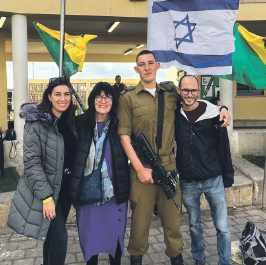
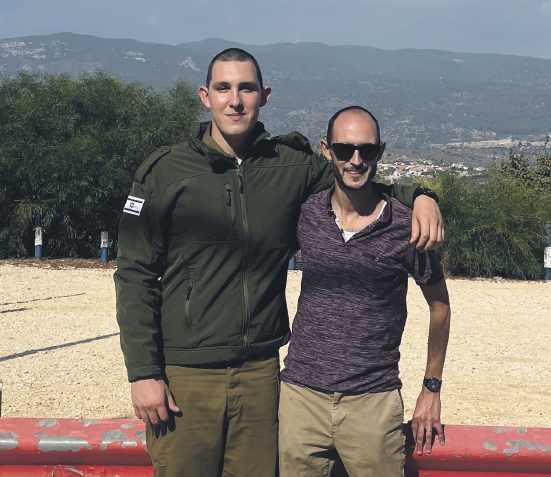
keeping our country going without even realising it”, who have made sacrifices to support Israel during the ongoing war with Hamas.
Nathanel’s spirit is at the heart of the podcast; Eliot honours his younger brother at the beginning of every episode and the backing track is one the fallen soldier previously created.
“It’s very appropriate. He would love that I’m doing that. Its a very personal tribute to him”, says Eliot.
“People ask me how I’ve been influenced by Nathanel’s story. He is someone who, when there was something that was important to him, would go right to the end.
“The army wasn’t easy to get in, but he went right in, right ’til the end. He made sure he knocked on every door until he got into the army, got into the unit he wanted [the elite Golani brigade]. And when I was starting this podcast, I was recording an episode and I left it. Then I went back to it.
“I said: ‘No, in memory of Nathanel, I’m going to see this through’. So, in that way, it’s also a personal tribute to him. If I’ve got my sights on something, he would want me to see it through.”
Eliot has spoken with everyday heroes including Dr. David Leitner; seriously wounded on active army duty in 2001, he has since dedicated his life to supporting and
inspiring other soldiers, including re-joining the IDF himself; Eddie Hammerman, cofounder of the Borehamwood and Elstree October 7 Vigils; Jen Airley, mother of Binyamin Airley, a soldier killed in action on 18 November, 2023. Jen and her husband opened a house in Sfat as a retreat centre for those affected by the war; Tasha Cohen, who started Chayal’s Angels shortly after the war began to provide physical and emotional therapy to soldiers; Gary Yantin, who regularly hosts BBQs for soldiers across the country, reminding them people are always thinking of them, and Shirley Burdick, a Christian supporter of Israel who has focused on community mobilisation and standing publicly with Israel during times of crisis.
Poignantly, there is also a special episode where Eliot interviews his own mother, Chantal Young, and sister Gaby Shalev, about Nathanel and their journey from 7 October to today.
Eliot sees Nathanel in everyone he interviews. “I call them ‘everyday’ heroes, not ‘unsung’ heroes – people who often you haven’t heard about,” he says.
“They’re just doing their daily thing. They don’t want awards, they don’t want to go viral on social media. They’re just doing their thing because they believe it’s important.
“That’s the reason this is such an impor-
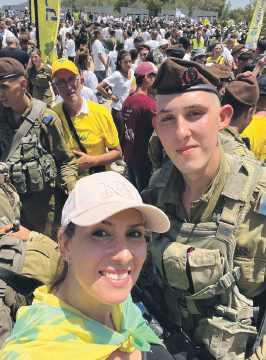
tant tribute to Nathanel, because since he was ten or eleven, he was always saying: ‘I’m going to move to Israel, I’m going to make aliyah.’ He didn’t say ‘this is an amazing thing I’m doing’. It was like. ‘This is just what I have to do. And this is how I’m going to give to the Jewish people, give to the country’. And on the day that he was sadly killed, that’s exactly what happened. He just got up and said, ‘This is what I have to deal with’.”
Eliot pauses. “Think about it. The people who gave their lives that day, if they actually would have taken a second to think it would have been – you know – you might make a different decision, But they didn’t. They just knew inherently ‘this is the right thing to do’. And that is true of so many of the different projects that I can speak about in the podcast.”
Additionally, Eliot and his family try and keep the memory of Nathanel alive in their house, in everyday ways.
“My kids were young when he was killed. So there are pictures of him. We have a big Golani flag on our balcony,” Eliot says.
“And I have moments where I’m working through something myself, and I’m wondering, if I was speaking to him now, you know, what would he say? Israel lost so many people, and we can always bring them into our daily lives. Do things in their memory.
“This might sound silly, but I needed new trainers. And Nathanel was very into trainers, especially Jordans. So I bought a pair. That wouldn’t be my choice, but I knew that he’d approve. And we bought for my kids as well. That’s the way that we know that he’s with us, and we keep him with us all the time.”


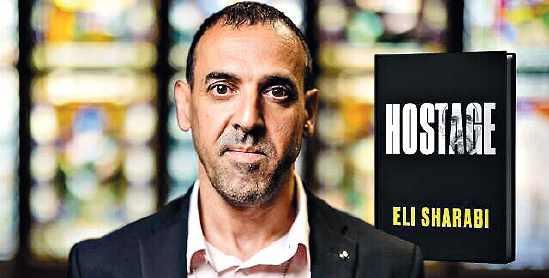
Eli Sharabi’s memoir Hostage, recounting his experience in Hamas captivity after the 7 October 2023 attack, has been named Book of the Year by the National Jewish Book Awards, writes Joy Falk.
The awards, presented by the Jewish Book Council and considered among the most prestigious honours in Jewish literature, recognise outstanding English-language books of Jewish interest across dozens of categories.
Sharabi’s memoir, which details his abduction from Kibbutz Be’eri and the following 491 days he spent in captivity, became a bestseller in Israel and was later released in English in the US and the UK. “This recognition means so much to me, not only personally, but for the memory of my family and all those we lost,” Sharabi said in a statement. “Hostage is my testimony, a story of my survival, written so others could bear witness. I hope it helps ensure that what happened is never forgotten.”
Other major winners spanned scholarship, fiction, memoir and children’s literature.
In American Jewish studies, Pamela S. Nadell won for Antisemitism, an American Tradition, a look at the forms antisemitism took in the country from the early Dutch settlers to the present. while the Russian-born journalist Julia
Ioffe took the autobiography and memoir prize for Motherland: A Feminist History of Modern Russia, from Revolution to Autocracy, a book that blends memoir, journalism and history to examine modern Russia through the lens of women’s experiences.
Jack Fairweather’s The Prosecutor: One Man’s Battle to Bring Nazis to Justice, the story of a Jewish judge and Holocaust survivor from
The US ambassador to Belgium is demanding the country end an investigation into mohels who may have been using unsafe practices while circumcising Jewish babies.
Bill White made the demand, an unusual intervention into another country’s domestic affairs, in a post on X directed toward Belgium’s minister of health.
It read: “To the (very rude) Belgian Minister of Health FRANK VANENBROUCKE; You must make a legal provision to allow Jewish religious mohels to perform their duties here in Belgium. It’s done in all civilized counties as legal procedure. BELGIUM is a civilised
country. Stop this unacceptable harassment of the Jewish community here in Antwerp and in Belgium. It’s 2026, you need to get into the 21st century and allow our brethren Jewish families in Belgium to legally execute their religious freedoms!”
White, a longtime advocate for veterans, became a Republican after Donald Trump was first elected president. He was confirmed as ambassador to Belgium last autumn despite criticism he had amplified social media posts by Dries Van Langenhove, a far-right Belgian activist sentenced to prison after being convicted of racism and Holocaust denial.
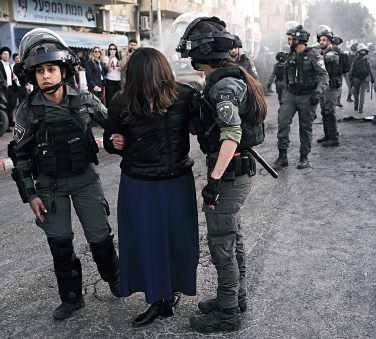
A strictly-Orthodox woman is arrested during a protest in Jerusalem against the army draft. After expiration of a long-term special arrangement, the Israeli government is moving towards legislation which would require Charedi young men – long exempt from the army – to perform similar military service to secular and religious Zionist counterparts. Charedi authorities strongly oppose the attempted move.
The British Museum has removed references to “Palestine” from parts of its ancient Middle East galleries, accepting the term no longer carries historic neutrality.
The decision follows complaints about maps and information labels that described the eastern Mediterranean coastline as Palestine and ancient peoples as being of “Palestinian descent”, despite dating back thousands of years before the term existed.
Some displays relating to ancient Egypt and the Phoenicians have already been amended, with further changes planned as part of the museum’s long-term redisplay programme.
Concerns were raised by UK Lawyers for Israel, which argued that using the modern, politicised term retroactively distorted history and obscured key periods of Jewish civilisation.
The museum acknowledged that while Palestine became a broadly neutral geographic term in the 19th century, it now carries a specific and highly politicised meaning.
who pursued Nazi perpetrators in post-war Germany, won the biography award. Fiction honours went to Allison Epstein for Fagin the Thief, a retelling of Oliver Twist from the perspective of its Jewish antihero, and Zeeva Bukai received the debut fiction prize for The Anatomy of Exile, about the multigenerational echoes of a secret love affair between an Israeli Jewish woman and a Palestinian poet.

Flights are returning to normal, visitors are back in ever increasing numbers and confidence is slowly rebuilding, finds Annabel Sinclair
Israel does not feel frozen in time. Nor does it feel back to full speed. A visit now sits somewhere in between: daily life continuing, visitors present, businesses operating, but at a different pace to before.
That reality was reflected at the International Mediterranean Tourism Market (IMTM) 2026 in Tel Aviv, where tourism officials spoke openly about disruption and recovery. Opening the international tourism fair, Tourism Minister Haim Katz said: “Uncertainty and travel warnings have impacted tourism activity. However, with improvements in flight availability expected in 2026, there is a reason for optimism.” He added that demand from audiences with existing ties to Israel, including Jewish communities abroad, had remained strong.
Away from the fair, that recovery is visible in small, practical ways.
Tel Aviv remains busy. Main roads are active, cafés and restaurants are open, and people move around as normal. Some areas are quieter than in peak years; others feel unchanged. The city does not feel empty, just less compressed. It still feels young, full of interesting people moving through shared spaces. The city’s energy has not disappeared, even as visitors fluctuate.
That atmosphere extends to accommodation. Hotels are open, staffed and functioning without fuss. Near the seafront, the Melody Hotel reflected that everyday rhythm, with guests coming and going throughout the day and shared spaces in regular use. It worked as a base rather than a destination.
One evening was spent in Tel Aviv’s American Colony, an area shaped by late 19th-century American and German Templer settlement. The neighbourhood’s buildings and layout still reflect that history. The gathering took place inside The Drisco Hotel,
a restored 19th-century building that once accommodated travellers arriving through the nearby port. A range of food was served, from salads and meat dishes to potatoes, risotto and dessert, as people talked informally over the course of the evening.
Restaurants across the country continue to operate steadily. Kitchens are open, menus familiar, evenings unhurried. In Jerusalem, that included a visit to Chakra, a long-established, non-kosher restaurant near Independence Park. The dining room was busy without feeling crowded, with a mix of locals and visitors. The food leaned Mediterranean and Israeli, and the atmosphere felt settled rather than scene-driven.
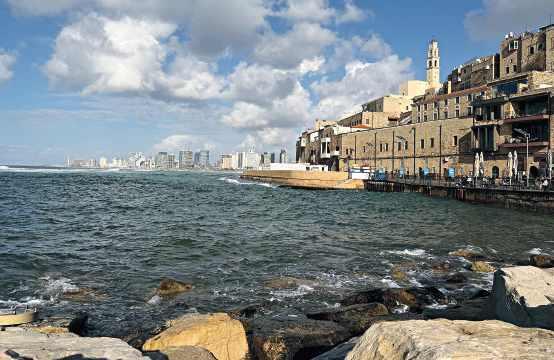
In Jaffa, history is woven into daily life. An ancient port city, it has long served as a
gateway for trade, pilgrimage and migration. Its name became internationally known through the Jaffa orange, exported widely in the late 19th and early 20th centuries. That commercial past still shapes the area.
Today, the port and surrounding streets are active. Traders in the flea market sell ceramics, textiles and household goods. Small falafel and hummus shops line the streets, doing steady business throughout the day. Hebrew and Arabic appear side by side on shop signs and menus.
Above the old city stands St Peter’s Church, built on Crusader-era ruins. Funded by the Spanish royal house, the Franciscan church marks the site traditionally associated with St Peter’s vision described in Christian scripture. Napoleon is said to have stayed at the complex in 1799. It remains in regular use by pilgrims and local congregations.
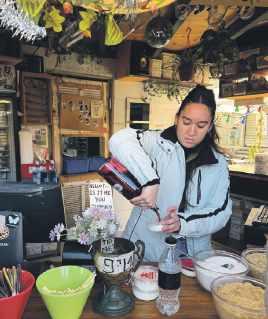
Food provides continuity. At a small stall, malabi – a chilled milk-based pudding common across the region, usually topped with syrup and nuts – is prepared simply and sold steadily. Some days there is a queue, other days not.
Jerusalem feels denser. The Old City is active, with pilgrims, locals and visitors moving through its narrow streets. What stands out is proximity: ultra-Orthodox Jewish families, secular Israelis, Arab shopkeepers, Christian clergy and tourists pass through the same spaces. Dress, language and rhythm shift from street to street. Frum neighbourhoods sit close to Arab areas; religious life and daily trade run side by side.
Accommodation reflects that geography. The Brown JLM Mamilla Hotel sits between several Jerusalems at once: overlooking
Independence Garden and the new Museum of Tolerance on one side, with the pedestrian streets of Nahalat Shiva nearby, and Mamilla Mall and the Old City walls a short walk in the other direction. It offers a local yet outwardlooking base, close to both historic and contemporary Jerusalem.
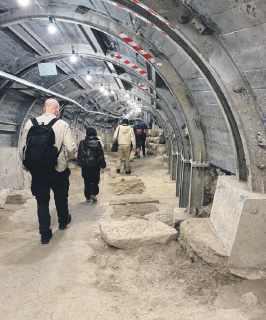
Walking along the Pilgrimage Road offers one of the clearest links between Jerusalem’s past and present. The street, dating to the Second Temple, once formed the city’s main thoroughfare, leading from the Pool of Siloam up towards the Temple Mount. In September 2025, the route was opened in its entirety for the first time in around 2,000 years following extensive archaeological work.
Archaeologists uncovered coins, weights and a stone measuring table along the route, pointing to a busy commercial street lined with shops and stalls – a central artery through which pilgrims once passed on their way to the Temple. Beneath the paving stones, an ancient drainage channel was also revealed, later used as a hiding place during the First Judean Revolt, containing oil lamps, cooking vessels, coins and a Roman sword.
At the Western Wall, the atmosphere shifts again. Prayer continues throughout the day, largely uninterrupted by the steady flow of visitors. People, alone or in small groups, stay briefly or remain for long periods. Notes are placed between the stones, prayers murmured, heads bowed. The space functions first and foremost as a place of worship, with tourism present but secondary.
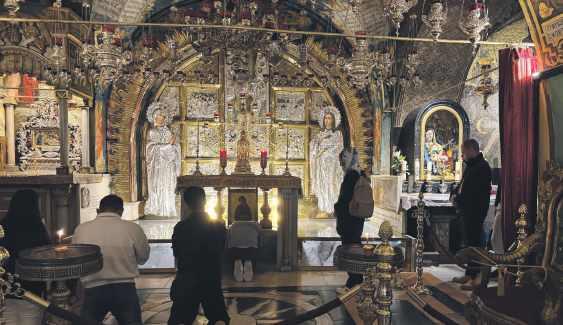
Jerusalem’s Christian presence remains just as visible. Inside the Old City, the Church of the Holy Sepulchre operates as it has for centuries, marking the site traditionally recognised by Christians as the place of Jesus’ crucifixion, burial and resurrection. Controlled jointly by several Christian denominations, the church functions through a carefully maintained status quo. Visitors move through steadily, candles burn, clergy pass between chapels, and services overlap quietly. It is not staged for tourism; it is a working religious space, layered and continuously in use.
The Tower of David Jerusalem Museum now functions as a point of orientation before entering the Old City. Following a three-year, £36.7 million ($50 million) conservation and renewal programme, the museum reopened in 2023 as the capital’s official museum, housed within the ancient citadel at Jaffa Gate. A new sunken entrance pavilion guides visitors through galleries before they step back into the streets.
Inside, ten thematic galleries trace Jerusalem’s 4,000-year history and its centrality to Judaism, Christianity, and Islam. Archaeological material is combined with multimedia
elements that provide context rather than spectacle. As evening falls, the citadel’s sound-and-light show projects scenes from Jerusalem’s past onto the ancient walls.
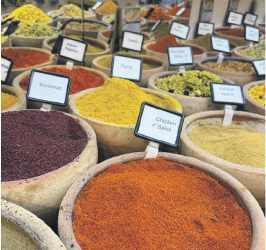
Markets remain central to Jerusalem’s movement. In and around the Old City, stalls sell spices, bread and everyday goods, trading steadily. In the evening, Mahane Yehuda Market shifts towards food and drink, with restaurants and bars filling gradually. Street food ranges from fresh pita stu ed with falafel or shawarma to bourekas, sabich, grilled vegetables and trays of pastries, eaten standing up or carried through the market.
In the Muslim Quarter, daily trade continues much as it always has. Bakeries, spice
As 2026 progresses, the UK jobs market remains among the most challenging we’ve seen in recent years. With unemployment at the highest level since early 2021 and competition for roles intense, it is devastating that many capable and motivated people are struggling to secure work. Long-term unemployment is also rising, with over one million people out of work for six months or more, leaving them increasingly vulnerable to financial hardship and social isolation. Some groups are feeling the pressure more acutely. Older jobseekers, people returning after a career break, those changing industries, and students or recent graduates are among those finding it hardest to gain a foothold. Having the right skills and being motivated often isn’t enough.
In circumstances like these, guidance and practical support is essential. A strong CV opens the door to an interview, and the interview is the pathway to employment. At Resource we see how helping clients communicate their experience effectively, expand professional networks, and approach
interviews with confidence can transform outcomes. Networking is particularly critical: research shows that up to 70% of jobs are filled through the hidden job market, often before roles are publicly advertised.
Staying competitive also means embracing new tools. Social media awareness and familiarity with AI tools are no longer optional they are essential skills for today’s jobseeker. AI is playing a growing role in recruitment, from CV screening to interview preparation. Resource offers free expert guidance delivered with care, patience and sensitivity, helping individuals regain confidence, resilience and a sense of purpose. To book a free appointment, visit resourcecentre.org or call 020 8346 4000.

Victoria Sterman, CEO Resource
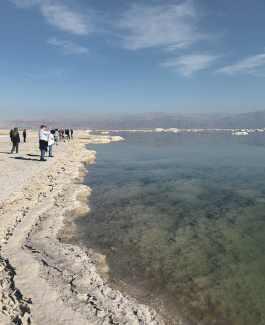
shops and juice stalls remain open, serving locals and visitors alike. At one juice stand, an Arab seller spoke candidly about how the drop in tourism has a ected business. When fewer visitors come, he said, it is felt immediately – not just by hotels or tour operators, but by small family-run stalls like this. Boycotts abroad, he added, do not distinguish between communities on the ground. When tourism slows, Arab businesses in Jerusalem are a ected alongside Jewish ones. Further south, the road drops sharply towards the Dead Sea, the lowest point on earth, more than 400 metres below sea level. Salt formations line the shore, and across the water, the mountains of Jordan are clearly
visible. The area feels stark but not inactive. Beaches, hotels and visitor facilities remain open, and people come for short stays, day trips or specific events.
The Dead Sea continues to function as a place shaped by what it already is. Visitors float in mineral-rich water, cover their skin in mud, or spend time in a landscape unlike anywhere else. Tourism here is grounded in familiarity rather than reinvention.
Nearby, Masada remains one of Israel’s most recognisable historic sites. The desert fortress, perched high above the Dead Sea, dates back to the late Second Temple period and holds a central place in the country’s historical landscape. Visitors reach the plateau either by cable car or on foot via the winding Snake Path, both of which remain in regular use. From the top, the scale of the surrounding desert and the Dead Sea below is striking, giving a clear sense of why the site has endured as both an archaeological landmark and a point of reflection. The experience feels calm rather than crowded, reinforcing Masada’s place as part of the wider Dead Sea region rather than a standalone attraction.
The Dead Sea Land Marathon is one example. Runners descend to the lowest point on earth, crossing exposed seabed and salt dikes normally closed to the public. This year’s race drew thousands of participants, including runners from the UK.
What a visit shows now is not a full return of the past, but continuity. Now, as before, tourism continues to support Jewish, Muslim and Christian livelihoods.



The Gorton & Denton by-election, now over, offers a useful, albeit grim, guide to what a general election may look like.
The Greens, under the leadership of professional bosom hypnotist turned born-again anti-Zionist Zack Polanski, put their opposition to what they describe as “Israel’s genocide” at the centre of their campaign. Expect that to spiral further in the coming period, as the party inevitably votes to support a ‘Zionism is racism’ motion, straight out of the Soviet Union’s playbook. As Jewish News showed last week, the Green’s pitch to voters in the constituency included interviews with a notorious Islamist outfit, which has welcomed a range of the UK’s most notorious Neo-Nazis to discuss Jews, Zionism and LGBT issues. So much for ‘anti-racism’.
Labour, meanwhile, attempted to focus on its deeply-misguided recognition last year of a Palestinian state as a vote winner, with Foreign Office Minister Hamish Falconer marking the start of Ramadan last week with a cosy sit-down video with the Palestinian Authority’s representative here. Those who believe this is a coincidental decision with no involvement from Labour might be encouraged to consider whether that video would have been released had this week’s constituency by-election been in Hendon instead.
For its part, Reform UK suspended a key activist in the seat after Jewish communal leaders raised concerns about antisemitic and misogynistic social media posts. The fact that he was suspended is positive – that he was in such a position in the first place, much less so. Last year, the party announced a new “common sense” vetting policy, reportedly placing an emphasis on “individual freedom of expression” and encouraging those previously rejected to reapply. What could possibly go wrong?
And the Conservatives and Lib Dems were all but invisible – even among those interested in politics, few would even be able to name those parties’ candidates in the seat.
There are, of course, vehement Jewish supporters of all these parties. But an increasing number of Jewish voters may enter the polling booth feeling they have no positive choices, but rather the option of choosing the one they believe is the least negative.
THIS WEEKEND'S SHABBAT TIMES...

This morning, as I do many mornings, I texted my son and daughter-in-law who live outside London. This time it was not about when I’m coming to visit them or to find out what’s new in their lives but to warn them that this weekend there is a planned advertised rally to gather people together to knock on doors and ask people if they support buying Israeli goods.
And they are making lists.
So I texted my son to give him the heads up. To my horror I found they had already had the knock. My hugely intelligent and strong daughter-in-law gave them short shrift. Good for her.
Except I am now absolutely terrified. Now it’s not just usual dining table chatter of the older
I’d like to add a further tribute to David Wolff, who sadly passed away earlier this month. Certainly, he gave honourable service to the Maccabi League in various administrative capacities. But David was more than an administrator. He was, literally, a “grass roots” man. Every Sunday, come rain or shine, he was on the pitches wherever Maccabi football was being played, smiling and chatting with the players and officials, all of whom he seemed to know personally. And it was this personal connection which inspired all those around him to give of their best in a true sporting manner. David was a true gentleman and a man of the people. Barry Borman, By email
I was amused to hear Lord Polak announce calmly in a debate in the House of Lords that he needed to leave early to get to shul for davening. I’ve tried that line myself on many a Friday afternoon during “debates” in my house but, somehow, it doesn’t seem to have quite the same effect.
Eli Cohen, NW11
Thank you for helping to make Jewish News the leading source of news and opinion for the UK Jewish community. Unlike other Jewish media, we do not charge for content. That won’t change. Because we are charity-owned and free, we rely on advertising to cover our costs. This vital lifeline, which has dropped in recent years, has fallen further due to coronavirus.
Today we’re asking for your invaluable help to continue putting our community first in everything we do. For as little as £5 a month you can help sustain the vital work we do in celebrating and standing up for Jewish life in Britain.
Jewish News holds our community together and keeps us connected. Like a synagogue, it’s where people turn to feel part of something bigger. It also proudly shows the rest of Britain the vibrancy and rich culture of modern Jewish life.
You can make a quick and easy one-off or monthly contribution of £5, £10, £20 or any other sum you’re comfortable with. 100% of your donation will help us continue celebrating our community, in all its dynamic diversity.
Support Jewish News by visiting our donor page at jewishnews.co.uk
middle classes about where are we in relation to the 1930s, and should we go, and where and how do we leave everybody behind.
Now it’s visceral. Heart-wrenching. Now it’s family. Now it’s real. And I finally understand friends whose parents went through this in the 30s in Germany, Austria and across Europe.
And in England we are living it again. Everything over the past couple of years, I now see, was one step removed, but now this is personal. This is my family. And I’ve come to realise I will stop anyone and everyone who intends to cause harm to them, my friends and community. Tooth and nail. I’m ready. And I’m not afraid.
Louise Pearlman, NW4
I read with concern the statement by Limmud chair of trustees Benjamin Ellis saying Limmud’s major role is tackling “the greatest challenge facing Jewish communities – how to come together in the context of deep communal divisions”. To describe such differences as the greatest challenge facing British Jewry is, frankly, a serious misjudgment. We are living through an unprecedented surge in antisemitism. The CST has recorded its highest level of incidents. Hostility towards Jews has become normalised in ways that should alarm every responsible communal leader. That is the crisis demanding urgent, united attention. Limmud is a respected and influential educational institution. At this critical time, it should be aiming its intellectual and organisational energy at strengthening Jewish resilience and combating antisemitism, not elevating internal disagreement to the status of primary communal threat.
David Collins, Tel Aviv
While Clive Lewis is usually a persuasive writer, his latest piece, ‘We may not like it but the Palestine Action decision was a win for the Rule of Law’, left me unpersuaded. When an activist assaults a policewoman with a sledgehammer, when an organisation glorifies violent struggle and political violence embraced as method and creed, we are entitled, if not obliged, to say clearly those who act like terrorists, speak like terrorists and march in lockstep with terrorist methods belong, in substance and style, to a terrorist organisation.
David Frencel, Hackey


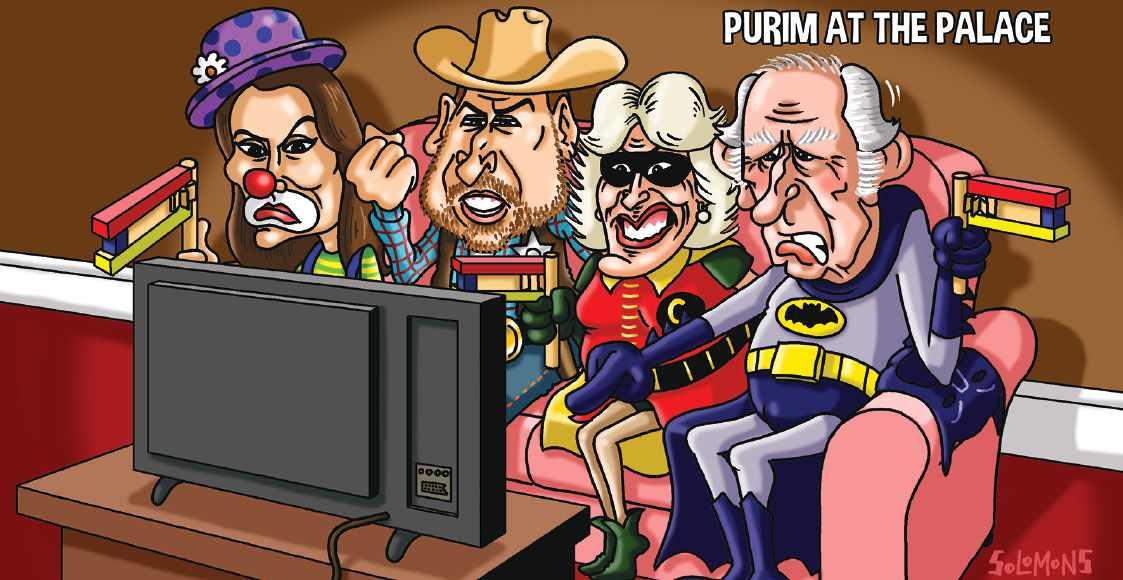
“Right,
To get the best value from your private medical insurance, you should speak to an expert who is qualified to advise you on the right policy for you, and recommend the providers who offer the most competitive premiums.
This advice covers individual, family and company policies, and is always FREE.
As an independent health insurance expert, I work with the healthcare insurers to provide you with the appropriate and most affordable level of cover. So whether you have an existing policy or not, let’s have a chat.
You can contact me at 020 3146 3444 or 07956 244350
trevor.gee@patienthealth.co.uk

VIVIAN WINEMAN FORMER PRESIDENT, BOARD OF DEPUTIES
Outside the Jewish community, the world is changing. A woman has been appointed Archbishop of Canterbury, the most senior position in the Church of England. Weddings of same-sex partners have been blessed in Anglican churches since 2023. Even the Roman Catholic Church now permits such weddings – to be blessed in non-liturgical, non-theological settings. Orthodox Judaism, however, is sticking to its traditional principles. Orthodox synagogal bodies have yet to agree women may be called rabbis at all, let alone actually lead the movement. Similarly, there has been no move in Orthodox organisations to bless unions between same-sex partners, male or female. Even so, some progress has been made. Deuteronomy 17:16 provides that, if the people of Israel so decide, then they should appoint a king. From this, the rabbis learnt
that a king excludes a queen. For many centuries, this was provided as a reason why women should not be considered eligible for high o ce of any kind.
At the turn of the millennium, the London Beth Din ruled women could stand for election as vice chairs of their synagogues – but not chairs. At the time, some United Synagogues, exercising Talmudic logic of their own, elected women as vice-chairs and then declined to elect a chair, thereby leaving the female vice-chair as the e ective lay leader of the congregation.
Now, a quarter of a century later, there is no issue at all in women becoming United Synagogue chairs in their own right. Orthodox institutions – from the London School of Jewish Studies to the United Synagogue itself – have had female chief execs. Last year there was even a female candidate for president of the United Synagogue. Gay relationships have proved more dicult, but even here progress, though slow, is being made.
Hampstead Garden Suburb Synagogue (HGSS), an impeccably Orthodox synagogue
with an impeccably orthodox rabbi, has announced an event for members to reach out to family and friends in the LGBTQ community.
In 2017, a prominent Orthodox rabbi made some sympathetic remarks about people who were attracted to members of their own sex, leading to an angry chorus from some leaders of the strictly-Orthodox community.
Many people brought up as I was in a conservative religious background can vividly recall their first encounter with an openly gay person. Mine took place at university. When I was a student at Cambridge, there were eight male undergraduates for every female.
My first gay acquaintance was a very attractive, highly intelligent woman. In such an environment, men flocked around her.
Coming from a deeply conservative Christian background, it was hard for her to accept she was not attracted to any of her numerous admirers. Arriving at the conclusion that she was queer led to an enormous amount of unhappiness and emotional turmoil, but accepting that fact was a step in her becoming a mature, well-grounded adult.
It is hard to avoid the seemingly unequivocal utterances around homosexuality in the Torah. Historians have posited that statements about homosexuality as an “abomination” in Leviticus, for example, may have been a reaction to homoerotic religious practices common in Canaanite culture.
In 1972, five years after gay sex was decriminalised between consenting adults, the Chief Rabbi of the time, Lord Jakobovitz, wrote an entry for the Encyclopaedia Judaica making the rather extraordinary assertion that homosexuality was virtually nonexistent among Jewish communities.
Evidence, however, indicates that being LGBT is no more or less common among Jews than among non-Jews. This means that in the UK alone there are likely hundreds if not thousands of children in Charedi schools having to cope with an emerging sexuality that is not discussed at all.
Perhaps the Bible, which another former Chief Rabbi, Joseph Hertz, described as the supreme book of love and friendship, is saying that love will triumph over all such obstacles. Perhaps it will, in time, even in Orthodoxy.




I’ve just spent just four days in Israel and the West Bank – my first visit there. It was a harrowing privilege to spend time in the Kfar Aza Kibbutz, where dozens of defenceless Israelis had been slaughtered in their homes, and then to meet Rafaela Triestman, a survivor of the Nova festival massacre, whose boyfriend was murdered just yards ahead of her in a shelter that o ered no shelter against murderous terrorists.
Our time was spent meeting Israeli politicians from government and opposition, Arab Israelis, left-leaning academics, journalists of varying degrees of scepticism towards the government, officials overseeing aid to Gaza and others. It left me with a deep sense of an Israel that remains traumatised by the pogrom of 7 October.
Hopes for a two-state solution seem extremely distant. Even the most liberal of politicians has no appetite for extolling the virtues of a separate Palestinian state at a time
when fear, grief, anger and a determination to ensure security at all costs hold sway.
I also found a deep sense of betrayal from many that Western liberal democracies had been so quick to condemn Israel and so reluctant to understand.
I visited Auschwitz in 2009. I knew about the Holocaust before then, but that visit filled me with a sense of fury of the wickedness done by human beings to human beings.
It also clarified my understanding of why a homeland for the Jewish people is not only justified, but essential.
I had those views powerfully confirmed as we visited the Holocaust memorial museum at Yad Vashem last week.
I
Our visit to the West Bank also made me angry. The Palestinian people deserve a homeland too. They also deserve far better leaders than the murderous bigots in charge of Gaza, and the largely corrupt regime in charge of the West Bank.
Nevertheless, it was a privilege to meet Issa Kassis, the mayor of Ramallah – a man who seems decent, committed to serving his community and angry at the impoverishment delivered on his people by an Israeli government that seems to be wilfully strangling the economy of the West Bank, and foolishly playing into the hands of the extremists. We met also Palestinian voices from business and civil society whose anger at the treatment of their people by the Israeli government was visceral and justified
I got the chance to challenge senior government politicians on the everincreasing number of Israeli settlements in the West Bank – a movement that can only be seen as a deliberate attempt to prevent the realisation of the two-state solution.
Among the many Palestinian voices we heard was one man who was standing in the
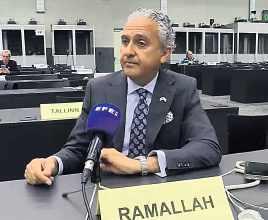
coming municipal elections in the West Bank in April. A brave and inspirational character. He said: “The Israelis need security and we need freedom and dignity … The Jews have always been in this land, they belong here… but they have never been alone in this land. We have always been here too. We need to shift the relationship from conflict to partnership.”
This was our last meeting before we headed home, and it was the conversation that filled me with the greatest hope.





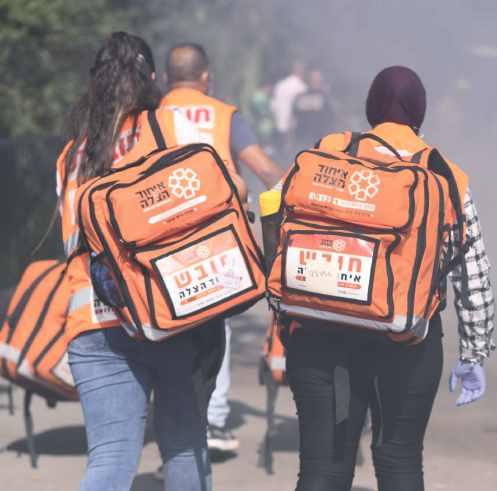

PAUL KOHLER, MP
HOME AFFAIRS
SELECT COMMITTEE
It’s become fashionable for commentators chronicling the rise of populism on the left and right in UK politics to quote WB Yeats: “Things fall apart; the centre cannot hold.” However, the poem’s most consequential lines are the couplet shortly afterwards – “the best lack all conviction, while the worst are full of passionate intensity” – something which as a member of the Home A airs Select Committee which produced this week’s report into the Maccabi Tel Aviv fan ban I have witnessed from first hearing to final publication.
Our report is a pretty damning indictment of West Midlands Police (WMP), who essentially “reverse-engineered” a security threat using false data to reach a predetermined conclusion. The central failure lay in a collapse of rigorous policing, replaced by confirmation bias, based on an un-minuted phone conversation with Dutch police concerning a previous

match between Ajax and Maccabi Tel Aviv, much of which was later disputed, and an unverified AI-generated fiction concerning another match that never took place.
It was on that basis that WMP justified a blanket ban on visiting supporters.
In summary, they relied on false information from Microsoft Copilot, which hallucinated a non-existent match against West Ham to “prove” a pattern of violence, and hugely overstated Dutch reports, claiming 5,000 o cers were needed in Amsterdam (when the true figure was 1,200) , as well as the extent to which Maccabi fans were the instigators rather than the victims of what violence did occur.
This wasn’t just a technical glitch or administrative oversight: it was a profound failure to interrogate professionally the evidence available. This was all too clear when I questioned the now ex-chief constable, both in December and again in January, where it was plain to everyone that in the absence of vigorous research, the WMP leadership had relied on intuition and lazy assumptions.
By the time No. 10 intervened, the damage to community trust was already done. As our report makes clear, the Home O ce failed to
coordinate or escalate the matter until it was too late to be e ective.
We were also deeply troubled by the role of the Birmingham Safety Advisory Group (SAG), whch actually made the formal decision to ban away fans. While we found no evidence to conclude that the SAG’s decision was made because of political pressure, we discovered nothing that would enable us to conclude otherwise. What was clear was that councillors with a stated political aim had a disproportionate opportunity to influence SAG decisionmaking on a deeply divisive political issue.
That is why our report recommends elected politicians should no longer sit on SAGs to ensure operational safety decisions are free from political pressure.
While Yeats was not seeking to defend such dereliction, he reserved his greatest ire for those “full of passionate intensity” who have no doubts about the righteousness of their cause. In this context, I have seen that from the outset of our enquiry, with emails and social media attacks suggesting I am a paid apologist for Israel and complicit in a Jewish conspiracy.
I’ve heard it before, and to be honest I
fully expected it again this time. What I was not expecting was the equally “passionate intensity” of the Campaign Against Antisemitism castigating our committee for “pull[ing] its punches”, for failing to call out what they seem to be suggesting was an Islamistinspired conspiracy in which the WMP was actively complicit. This is a deeply disappointing verdict, which I utterly reject.
So let me repeat: we found no evidence of antisemitism in the decision-making process and nothing to suggest there was “intentional appeasement” or that “senior police lied to parliament to cover it up”.
In short, to attack the report for failing to reach such a conclusion is as misguided as those who seek to argue the report is nothing more than the work of the Israeli lobby.
As a member of the committee, I will continue to fight for a culture of transparency where evidence is tested, not manufactured or assumed, and where people’s rights are never sacrificed for administrative convenience or political expediency.
We need a return to evidence-based decision-making and to be wary of seeing conspiracies round every corner.
GARY COHEN WRITER & FILMMAKER
Imagine that from today, it was decided that the Holocaust would be referred to as “the tragic event of WW2”. The Inquisition will be described as “a case of over-zealous reversal of DEI”. The pogroms will be cited as nothing more than “a series of unfortunate events”.
“Seriously?” I hear you say. “That’s obscene!” And you would be right.
So why is the Israeli prime minister’s o ce intent on changing the o cial name of the 7 October commemoration bill to “Memory and Commemoration of the events of Simchat Torah”, in the process deliberately removing the term “massacre” from the title?
This alteration in language has triggered furious backlash from bereaved families and local leaders, who see it as yet one more slap in the face, one more betrayal – an attempt to sanitise the narrative and rewrite history for political reasons. Language matters. Words have power.
Nothing has changed. The facts remain the same – 7 October was a massacre, the largest slaughter of Jews since the Holocaust. This proposal is o ensive in the extreme and a gross betrayal of the victims, their families,
the evacuees, the hostages and the country. The original o cial framing referred directly to the “massacre” of 7 October.
Removing the word “massacre” entirely is not a minor adjustment or a technical issue, but rather a deliberate shift in how the most catastrophic day in Israel’s history is to be formally recorded and remembered.
For more than two years, 7 October has been accurately described as a massacre. Netanyahu himself has described it as such on multiple occasions, both in the immediate aftermath and since, speaking of its horrors and warning that Hamas intends to repeat them. Ministers, ocials, journalists and the general public did the same. There is no other word that captures the scale and brutality of that day. It was not simply an event. It was not just another terror attack.
A massacre demands answers. How did this happen? How did the border collapse? Why was it left so poorly defended? Why did it take so long to respond, leaving entire communities standing alone for hours? Why were warnings ignored?
What about the assumptions, the payments of millions in cash to Hamas, the intelligence failures, the years-long policy of ‘managing’ the conflict – how was such a flawed concept allowed to continue for so long?
How did it all converge into a single catastrophic morning that left more than
1,200 people dead, thousands injured, 251 kidnapped, families shattered, communities destroyed and a country permanently scarred?
On the other hand, an ‘event’ may or may not carry weight. Events describe something matter of fact, something that happens, rather than an apocalyptic failure. Once that shift is made, in law and in o cial commemoration, it shapes how 7 October will be understood over time. That’s how history is written.
Young and old who lived through 7 October will always see it as a massacre and the calamitous failure it was. Their children will hear about it first-hand as a massacre. Their children’s children, however, will have to read about it and will be commemorating the “events” of 7 October 2023, not the massacre.
The change in language is deliberate and cruel in the extreme. It comes from a government that, for more than two years now, has simply refused to confront 7 October, the failures, the consequences, its role and responsibility for the greatest disaster in the country’s history.
In essence, Netanyahu’s recently-released, 55-page response to the state comptroller’s investigation into 7 October was a blatant case of denial and deflection. Not exactly what you expect from a true leader, especially ‘Mr. Security’.
The removal of the word “massacre” in
o cial documentation is simply more of the same. An attempt to protect Netanyahu’s legacy or, even worse, an attempt to diminish the scale and horror of the greatest slaughter of Jews since the Holocaust, under his watch. Both are contemptible.
The victims’ families are stunned this could even be discussed. They demand accountability, and a reckoning. They will not settle for anything less than a full state inquiry – which Netanyahu continues to reject outright. The removal of the word “massacre” is just one more episode in his campaign of denial.
My friends lost their children. My children lost their friends. Their brutal murder was not part of some event. It was an unprecedented act of unspeakable evil, carried out deliberately, with genocidal intent, in full view of the world.
Let Netanyahu go to the parents of those murdered and explain that their tragic loss was simply part of an “event”, and see how well that goes down.
This proposal should be withdrawn immediately and failing that rejected outright, and 7 October should be commemorated and remembered as the terrible massacre it was, and for the massive failure of the state to protect its citizens.
May the memories of those who died be a blessing and may the memory of the massacre be forever preserved.


Suits from £79.50
Overcoats from £79.50
Trouser Bargains £25
SPORTS JACKETS AND BLAZERS FROM £39.50
CASUAL JACKETS FROM £29.50 KNITWEAR FROM £10
SHIRTS FROM £10
SHOES FROM £10
Open everyday & Sundays til 5:00pm
We accept Large Sizes a speciality


Need Cash Fast?
Receive the best prices for your unwanted gold today! Call Jonathan 020 8446 8538
We
10 Golders Green Road
London NW11 8LL
Opposite Cafe Nero






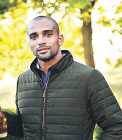




Come and see us in our North London showroom for the best engagement ring selection. We can create the design of your dreams ...and at a wholesale price! lab-created We wish to purchase any Diamond and Gold Jewellery
We can supply any certificated GIA, IGI, HRD natural or diamonds of your choice.



and Confidential
Peter Mehlman’s new novel started life as a film script. This is perhaps unsurprising given he is a Seinfeld writer who worked on the iconic show for almost its entire run and invented immortal Seinlanguage like “shrinkage”, “double dipping”, and “yadda yadda”. Setting aside creators Larry David and Jerry Seinfeld, perhaps no writer in the show’s history understood quite what it should be as much as Mehlman did. Plenty of his episodes tend to place near the top of any rankings of the sitcom’s best.
The book, Deep Down Iola, is “a serious departure and very fantastical”, he says. It is about a girl in Alabama with “an extraordinary talent for talking kids o this ledge at a boarding school”.
The story concerns how she obtained this ability in a previous life and feels a far cry from the Seinfeld focus on the minutiae of everyday life. The screenplay was optioned and David O. Russell was very interested but “things, as they do in Hollywood, fell apart”. Mehlman turned it into a novel since his career started in journalism, explaining: “I really do prefer to write full sentences.”
The transition to television was serendipitous. He had a share in a summer house in the Hamptons and met Larry David briefly in the late 1980s. The pair got along, and 18 months later, when they ran into each other in Los Angeles, David said: “You know I’m doing this little TV show with Jerry Seinfeld, maybe you could write a script.”
Mehlman had never written a script and so submitted a New York Times Magazine essay about walking the streets of Manhattan attempting to spot a celebrity in the immediate aftermath of a breakup. Seinfeld was so impressed with the bittersweet piece that Mehlman was handed the task of writing the show’s first
freelance episode, and the story became legendary among journalists keen to make a similar move into TV.
The writer misses the ability to shape the culture that came with working on arguably the definitive piece of 1990s culture and feels there is no space for a similar behemoth given the fragmentation brought about by streaming. He laments the state of the country in a broader sense and misses the heady days of lockdown when he “wasn’t invited to weddings and barmitzvahs”.
He says: “I can’t think of one good thing that’s going on. All of the worst instincts of humanity have been brought to the surface by Trump and the internet. I think we all assumed
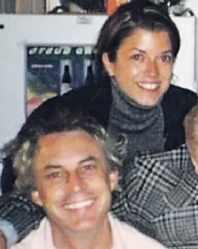
this country was full of racism and hatred but now it’s right out in the open. Things are really, really, really bad.”
As if things weren’t bleak enough, last year saw his mother pass away at the age of 101 and the South California wildfires wreak havoc in his neighbourhood. With regards the latter, Mehlman was fortunate and feels a sense of survivor guilt: “I got unbelievably lucky. The two houses within 15 feet of where I’m sitting now burned down to the ground. My house survived it… That day somebody sent me a picture of my house in the foreground and the fires leaping
out of the house next door so I spent six hours pretty sure my house was going to burn... Then I got a video of somebody driving on the street and my house was still there.”
Despite all this, he hasn’t lost his sense of humour, concluding the story with a punchline: “Those were the worst six hours of my life since the last time I attended the Emmys.”
Which unexpectedly brings us back to television. He recently bumped into his old boss at a restaurant and had an idea he felt would be just right for Curb Your Enthusiasm, were it still on the air. “There was this woman who had been putting signs up all over the neighbourhood for her lost dog. Four weeks later the signs were still up and I ran into her and thought of Larry because he would say something to her.”
David laughed hard at the impersonation that followed, in his signature flat New York tone: “You know, maybe it’s time to take them down. The dog’s gone.”
There is no longer the outlet but the Curb star confessed he “would have done that idea in a second”.
At least plenty of Mehlman’s ideas were used for David’s first masterpiece during that “wonderful detour” in his career that lasted close to a decade. He seems genuinely incredulous at the show’s staying power and received the ultimate compliment recently when he was approached by a veteran in his local co ee shop who had experienced incomprehensible horrors. He told Mehlman: “I had major PTSD and Seinfeld really helped me out.” Such is the power of one particular old sitcom and in the writer’s words: “That’s as good as it gets. It’s even better than the money… I’m just kidding.”
Kidding is what he does and so it is not a shock that he has turned his hand to stand-up in recent years. At one show, he told a joke that is nothing more than a play on words: “Isn’t it
better that the Palestinians are occupied rather than just sitting around doing nothing?” An audience member misunderstood and started shouting that Mehlman was “in favour of genocide” before being removed from the venue. There was, however, a happy ending: “This was one of the rare moments where you get your faith back in humanity. Two guys from the audience o ered to walk me to my car… They figured he could be waiting outside and I wouldn’t even know what he looked like.”
He was blown away by the gesture, and predictably, conveyed his gratitude with a joke.
It might be in a novel, a television script or plain old conversation but it seems Mehlman, like Jerry in one of the great Seinfeld episodes he penned, just can’t help being funny.


Derek Shulman is not your typical music mogul. Born in Glasgow and largely brought up Portsmouth as part of a relatively poor Jewish family, he knew he wanted to follow in the footsteps of his father, a successful local jazz musician.
someone out of a cult is almost impossible.” It’s the only moment in our 30-minute conversation where I sense anything even resembling anger from the mildmannered and chatty man on the other end of the phone.
In Portsmouth, the Shulmans, who are not particularly religious, were part of a tiny Jewish community. Derek says he “encountered a kind of shrouded antisemitism, because I was one of two Jews in a school of 2,000 kids”. (The other was his cousin.)
Now based in New York, Jewish culture clearly still matters to him. Shulman has not encountered much antisemitism during his career. However, having been aware of it from such a young age, he has zero tolerance for antiJewish hate.

he “encountered a still school age at the miss out on his importance of
Tragically for him and his siblings, their father Lewis, who they saw “drinking his poison of choice for decades” as well as “smoking up to 60 cigarettes a day”, died of a heart attack at home. Derek was still school age at the time, and his mum wouldn’t let him miss out on his studies, even as the family sat shiva. The importance of this moment in Shulman’s life is made clear by the fact he starts his new autobiography, Giant Steps, by describing that terrible morning.
“I was asked to do a debate with Roger Waters. And I declined it, because this guy is not just antiIsrael, he is a complete antisemite,” he reveals to Jewish News. “To talk
“It was very important to give the book some of existential feeling” and not have it be “just about me being a musician and having fun in the music business”. “It had something to with being a family and understanding what these traumas do to people,” he explains. Indeed, Shulman emphasises
he was, quite understandably, “completely traumatised” by his father’s untimely passing. Yet reading his book and speaking to him, you get the sense he was galvanised by it. Seeing how short life can be drove him on to practise more, write more, gig more.
At one point relatively early in their career, Shulman and his bandmates were involved in a serious road accident on their way to a recording session in London. They dusted themselves o and made it to the studio on time.
The commitment paid o . Shulman went on to have popular records with bands Simon Dupree and the Big Sound, notably with hit single “Kites” in 1967. This was followed up by the more proggy band Gentle Giant. In both instances, he was performing alongside his brothers Phil and Ray.
Sister Eve was musically talented too, but not encouraged in the same way as her male siblings. She did, however, team up and do some songwriting for her brothers.
It wasn’t all hard work, though. During one pause in recording at Abbey Road Studios, Shulman and a bandmate couldn’t resist jumping on a bed left by John Lennon and Yoko Ono. Unfortunately, John and Yoko walked in and were none too impressed.
Having performed for years, Shulman went on to oversee the careers others. The first band he signed when he crossed into the corporate ranks was a band from New Jersey called Bon Jovi.
“Who is it and what is it you want to be?” Shulman asked singer Jon at one meeting.
“He just had a new single that was out and I was basically his mentor in certain respects as well as signing him,” Shulman says.
“And he looked at me square in the eye without any blinking and said, he wanted to be as big or bigger than Elvis.”
Whether the rocker ever quite reached those heights is a debate for another time, but Shulman’s guidance certainly set him on the path to global superstardom.
Shulman has also worked with other hugely successful bands such as
metal bands Pantera and Slipknot as an executive. Of Pantera, he says: “I became a fan after three songs.” It’s not just hits like “Livin’ on a Prayer” or “Wanted Dead or Alive” that Shulman was looking for. There is a certain something that drove him to support the bands he did. “All the bands that I worked with were authentic,” he explains. “They weren’t followers. They were leaders in their field, whatever genre you were in, whether it was Bon Jovi or Pantera or Slipknot or [progressive metallers] Dream Theater – whoever they were, they were leaders.”
Shulman went on to lead the renowned rock and metal label Roadrunner, so we can add Killswitch Engage and Nickleback to the list of bands he has collaborated with as well.
As an executive, Shulman also helped mastermind AC/DC’s legendary show in Moscow and massive Bon Jovi records. Yet those moments are not his personal career highlights. “On a scale of one to 10, they’re nine,” he says, reflecting. “But I remember a show that Gentle Giant did in LA in 1976. That was a 10, where we were on fire as a band and we played two encores, and the audience wouldn’t let us o the stage.”

audience wouldn’t let us
He may have taken giant steps in his life, but deep down Derek Shulman is still the kid from a close Jewish family who wants to pick up his guitar and play in front of as many people as he can, just like his dad.
It’s a scary thought, isn’t it? Putting your life in the hands of a teenager. But, you know what’s more scary? You, a family member or someone in the community, having a cardiac arrest and no-one knowing what to do.
Which is why, at Hatzola Northwest, we’re launching our Hatzola Heart Starters initiative. We want to give Year 8 students the practical ability to save someone in cardiac arrest. They will, literally, get hands-on training in effectively giving CPR and using a defibrillator, delivered by our team of experienced paramedics and Hatzola Responders.
Why are we doing this? Because we know that ‘bystander CPR’ doubles the chances of survival of someone in cardiac arrest. And every minute without CPR and defibrillation reduces those chances by up to 10%.
So, if you’re a parent or teacher (or both) please let your school know about Hatzola Heart Starters. And, if you’re in business, we’d welcome your sponsorship to help us fund this free initiative.
Just scan the QR code below to find out more.

www.hatzolanw.org info@hatzolanw.org



































From a £500,000 funding shortfall to rising fixed costs, Bobby Lane explains how growing firms can stay flexible to scale in a tougher economy
Chartered accountant Bobby Lane has spent three decades helping Britain’s entrepreneurs build companies while watching too many of them struggle to scale.
For small and medium-sized businesses are the backbone of the UK economy, accounting for 99.9 per cent of all companies, yet according to Lane, they remain one of the country’s most overlooked and under-supported groups.
a multidisciplinary outsourcing business designed to make life simpler and more e cient for growing companies. Instead of building expensive in-house back-o ce teams, founders can access finance, HR, IT, marketing and recruitment in one place, scaling support up or down as their business evolves.
“No one goes in and sets up a company to be really good at the HR, IT or accounting,” he says. “They go into business to sell a product or service they’re passionate about, and then they get caught in the weeds.”
“SMEs are often forgotten,” Lane, the founder of Factotum, tells News. “They are underfunded, under-supported and expected to scale without the systems, capital or advice they actually need.”
“SMEs are often forgotten,” Lane, Jewish advice they actually need.”
That belief – shaped over three decades in accountancy, outsourcing and advisory work – is what led Lane to create Factotum,
The demand, he says, has proved stronger than even he expected, as SMEs grapple with rising costs, tighter margins, supply-chain disruption and the growing complexity of running a business.

The demand, he says, has proved plexity of running a business.
Today, Factotum serves more than 200 clients, employs close to 70 people in the UK and has recently expanded into the US. But the ideas behind


Exclusive two roomed office suite to rent on the LSJS campus in NW4. Join a vibrant community of charities and educators, and all utilities covered in a fixed 2-year rent agreement*.
Monthly rent from just £2,100 pcm
Features include:
• Two connected offices
• Air Conditioning
• Servicing
• Onsite Parking
• All Inclusive Rent
• Free Meeting Rooms
There is security provision: Monday to Thursday | 06:00 - 22:00 Friday | 06:30 - 13:00 (winter) | 06:30 - 15:00 (summer)
For more information or to book a viewing please contact Sorana Howard
E: sorana.howard@lsjs.ac.uk
T: 020 8203 6427
*this agreement is free of VAT.


one goes in and sets
Factotum had been forming for decades. Lane’s professional journey began in accountancy, after following advice from his father that he now passes on himself, including to his son, a qualified accountant.
“The accounting professional qualification is still probably the best qualification you can get,” says Lane. “By the time you’re 24 or 25, you’re fully qualified. It sets you up for business; you understand balance sheets, numbers and cash flow. It gives you a very solid grounding in anything.”
After starting his career at BDO in the 1990s, Lane was headhunted into the Saatchi & Saatchi group, where he began questioning the logic of large in-house back-office teams. “I wanted to be flexible so that if we got really busy, I could scale up, and if we got quiet, I wasn’t stuck.”
By 2003, that thinking had evolved into a new model. “I thought; wouldn’t it be great if you could o er businesses an outsourced finance department?
“They could pay me a monthly fee and I’d be there in-house.” He became, as he puts it, “a fractional CFO before people knew what fractional CFOs were”, handling everything from paying bills to raising funding. He later went on to build the first multi award-winning SME outsourcing team at Shelley Stock Hutter, which was bought by Blick Rothenberg in 2017.
When Factotum launched in February 2020, Lane had no idea the world was about to shut down. Three weeks later, the UK went into lockdown. “It was really badly timed,” he laughs. “I spent a year wandering around the garden thinking, what have I done?”
Yet the enforced pause meant Lane “had no choice but to think carefully about what the business should really look like before the market truly met it.”
He built the first years at Factotum “with the handbrake on. We wanted to prove the model and be absolutely sure we could deliver”. It also reinforced his view of entrepreneurship as an exercise in controlled risk.
“Building a start-up is like jumping o a cli
and building a plane on the way down,” he says – a metaphor that feels particularly apt for a man who is also a qualified pilot, flying regularly from Elstree Aerodrome.
That said, Lane admits he built the first five years at Factotum “with the handbrake on. We wanted to prove the model and be absolutely sure we could deliver.”
Two early projects became turning points: Future Dreams House in King’s Cross, the flagship support centre for people a ected by breast cancer and part of the Future Dreams charity, and Sassoon, which began as a payroll brief and expanded into wider finance support. Last year, the handbrake came off and Factotum will soon have completed five acquisitions in six months.
Lane’s frustration with the way the UK treats SMEs has only deepened. Growing companies face an estimated £15bn annual funding gap, with the biggest shortfall sitting between £100,000 and £500,000 – the stage where businesses most need capital to hire, invest and build systems. “This amount of lending is almost impossible to get,” says Lane. “Unless you’ve got assets to put up as security, you just can’t access it. I’ve seen incredible businesses run by really smart people never achieve what they could have, because they were undercapitalised and lacked support.”
Factotum was recently named among the UBS High Growth 100, ranked the fastest growing professional services practice in London and second in the UK, while Lane himself was named UK Outsourcing CEO of the Year.
His proudest achievements, though, are his children. His son is a qualified accountant; his daughter is a professional singer who runs a dance school and sang at the opening ceremony of the Maccabiah Games.
Looking ahead, his ambition for Factotum remains simple: “We want business owners to focus on what they do best, and let us do the bits they’re not trained to do.”
• factotum.com
In our thought-provoking series, rabbis, rebbetzins and educators relate the week’s parsha to the way we live today
BY RABBI ARIEL ABEL RABBI, ARMY CHAPLAIN AND PRACTISING
May the light give us clarity
“They shall take for you pure olive oil, crushed for lighting, to make the continuous flame rise” (Parasha); “Your children are like olive shoots around your table” (Psalms 128)
Oil appears at the opening of this week’s parasha – not as a commodity of power, but as a source of light.
In our world, oil has often symbolised wealth, leverage and geopolitical influence. Nations have risen and fallen around it. Yet the Torah’s oil is di erent. It is not “black gold” extracted for mundane profit; it is olive oil – pressed, refined, and destined to illuminate the Menorah,
and the world, with lessons of moral clarity. Its purpose is not economic power, but moral illumination.
Today, as we read these verses, our thoughts turn to the people of Iran – heirs to ancient Persia, the setting of the Purim story itself.
The modern Iranian economy has su ered gravely. Years of political isolation, sanctions and internal repression on religious grounds have brought soaring inflation, shrinking opportunity, fear and profound hardship. It is not leaders who bear the brunt of economic collapse, but ordinary families – parents, children, workers – whose lives are constricted by instability and fear.
Purim reminds us that behind imperial decrees and ideological hatred stand real human beings.
The Jews of Shushan and the
SOLICITOR
Empire of Ahasuerus were vulnerable not because of economics, but because of an ideology of annihilation. Haman, descendant of Amalek, personified that hatred. The Iranian revolutionary regime has promoted that for over five decades.
This week we read Zachor – the command to remember Amalek. Amalek is not merely an ancient tribe; it is the recurring force in history that seeks the erasure of Israel. Pharaoh embodied it. Haman embodied it. In later generations, Hitler embodied it. In our own time, the Iranian regime, terrorist movements they sponsor and those who openly call for Israel’s destruction embody it again.
Amalek is not defined by geography. Amalek is defined by hatred –by the targeting of the weak, by the denial of Jewish legitimacy, by the
“I’ve
got no sight at all and JBD offers me the safety and security I need.”
Miriam, JBD Tenant
Jewish Blind & Disabled offers housing and support for adults who have physical disabilities or vision impairments.

To make a donation or to find out more about our housing and support, please visit jbd.org or call 020 8371 6611
dream of erasing the Jewish people from history. Wherever such hatred arises, there Amalek stands. And yet Purim teaches something more profound: Amalek does not have the final word.
As we approach Purim this year, we pray that economic su ering in Iran should cease; that its people should no longer bear the weight of policies and hostilities that impoverish them. We pray that destructive ideologies should fall away, that the resources of nations be used to build rather than to threaten, and that the region move to dignity.
Zachor also reminds us that vigilance is not optional. Judaism survives through Jews who are able to stand, defend themselves, and carry forward their mission. One third of our people were extermi-
Olives provide the oil of the Torah nated in the 1940s. Hamas sought to rekindle the illusion that Israel can be erased. The lesson of Purim is that such dreams must be confronted firmly and without illusion.
The Menorah’s flame is continuous. Jewish existence must also be continuous: spiritually vibrant, physically secure, morally clear. May this Purim see the downfall of hatred wherever it manifests. May those who personify Amalek be frustrated in their designs. May su ering peoples find relief. And may the light of the olive –pressed but luminous –continue to rise.



BY RABBI GERSHON SILINS SENIOR RABBI, THE LIBERAL SYNAGOGUE ELSTREE
way the regime has, for almost five decades, shaped Middle-Eastern politics through proxies, propaganda, and protests.
One of the great humanitarian crises of our era is taking place in Iran, with the loss of upwards of 30,000 lives and countless injured and imprisoned.
Without minimising other crises – of which we can name Ukraine, Sudan, Gaza and others – our reaction to what is happening in Iran will test our willingness to stand up in support of a people that has been struggling for freedom for nearly 50 years.
And as we support the Iranian people, we would also be addressing some of the worst abuses in the international community. The Islamic Republic’s development of nuclear weapons is certainly concerning and, as Michael Oren points out in a recent podcast, its stockpiling of ballistic missiles is even more worrying.
But the primary international concern with Iran is not these issues, but rather the
Iranian proxies pose a general threat not just to Israel and its other neighbours, but also to world peace. They have, paradoxically, reinforced Israeli Prime Minister Benjamin Netanyahu’s governing right-wing coalition.
Netanyahu seeks support from Israelis in response to the persistent menace of groups such as Hezbollah, Hamas and the Houthis to sustain his political standing – all of them proxies of the Islamic Regime in Iran.
The hopes of those who want a less radical government in Israel, and success at peace talks between Palestinians and Israelis, may depend on what happens now in Iran.
Jews have come to rallies in support of the uprising in significant numbers. Israeli flags flew alongside, and were welcomed by, those carrying flags of pre-revolutionary Iran.
If anyone has seen a comment, statement or response from any of the pro-Palestinian groups or celebrities in support of the Iranian people’s
A stimulating series where our progressive rabbis consider Judaism in the face of 21stcentury challenges
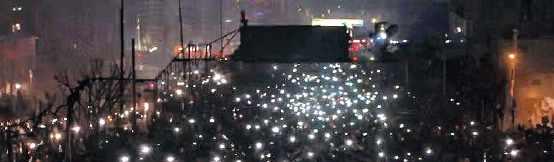
struggle for freedom – or against the regime’s massacring of thousands of its own people – I would like to know about it. I have not seen any.
For me, this exposes the moral bankruptcy of the anti-Israel movement, which now appears to be less about humanitarian concerns and more about choosing an enemy – Israel – and supporting the Iranian regime against it, no matter how brutal it is to its own people.
It also demonstrates where the principal threats to Israel and to peace in the region have originated in the last 47 years: the theocratic
tyranny that rules Iran and relies on hate of Israel and the West to stay in power. The Iranian people don’t hate Israel: the regime does.
Direct assistance on the ground is limited against the well-armed IRGC, yet solidarity matters. International acknowledgment can lift the spirits of those resisting oppression and remind them they are not alone.
Amplifying their voices, pressuring governments to condemn the violence, insisting that the British government identifies the IRGC as a terror group are steps we can, and must, take now.





ANTIQUES
Antique – Reproduction – Retro Furniture (any condition)
Epstein, Archie Shine, Hille, G Plan, etc.
Dining Suites, Lounges Suites, Bookcases, Desks, Cabinets, Mirrors, Lights, etc.
House clearances
Single items to complete homes
MARYLEBONE ANTIQUES - 8 CHURCH STREET NW8 8ED 07866 614 744 (ANYTIME) 0207 723 7415 (SHOP)
closed Sunday & Monday
STUART SHUSTER - e-mail - info@maryleboneantiques.co.uk
MAKE SURE YOU CONTACT US BEFORE SELLING



big or too small! Rubbish cleared as part of a full clearance. We have a waste licence. We buy items including furniture bric a brac. For a free quote please phone Dave on 07913405315 any time.


Confidential Bereavement Counselling for adults and children individually. Support Groups available. We offer in
online and telephone counselling. Contact Jewish Bereavement Counselling Service in confidence. 0208 951 3881 enquiries@jbcs.org.uk | www.jbcs.org.uk
•
• No
•
•
our Legacy Team on 020 8922













Prime central location with easy access to Jerusalem, Tel Aviv & Be’er Sheva
Kiryat Malachi’s fast-growing Anglo community
200+ new apartments already sold or rented to Anglo families & Olim





Join 900+ established families in a warm, dynamic neighborhood
Excellent schools & vibrant community life

Four new high-spec apartment buildings now available

Boulevard























































“For those concerned about this growing problem - and everyone should beOctober 8 is mandatory viewing.”
The Hollywood Reporter
“...the film forcefully rebuts the outrageous accusation that Israel, because of its own actions, was entirely responsible for the Hamas attack.”
The Washington Post
“2025’s Most Important Documentary.”
Hollywood in Toto