![]()
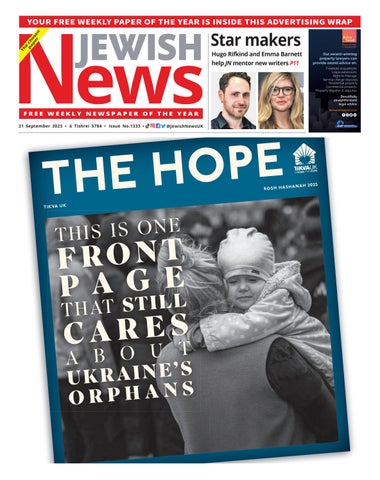
After 18 months of conflict, the war in Ukraine continues to devastate the lives of those who had to stay behind.
As the air strikes continue, the city of Odessa – home to Tikva’s orphanages, schools, university and more – has su ered some of the most significant losses since the war with Russia began. Tikva’s teams continue to evacuate as many people as possible, as swiftly as possible, to safety in Romania; but the requests from those within and well beyond our network continue to pour in daily.
Today we find ourselves supporting two communities in two countries: Those still in Odessa, Ukraine and those who we took to safety in Bucharest, Romania. Over the last year and a half, Tikva has evolved and adapted. However, at our core, we remain true to our founding principle; caring for those most at risk. Today this support is more widespread and crucial than ever.
This is only possible thanks to the continued generosity you, our loyal donors, have displayed. This Rosh Hashanah, please ensure we have the funds we need to continue to keep our communities safe, wherever they are. Thank you.
Hugo Rifkind and Emma Barnett
help JN mentor new writers P11
The mother of murdered Scottish teenager Yoni Jesner and father of the late two-year-old Sadie Salt teamed up this week to urge the community to talk about organ donation during Yom Kippur.
The Jewish Organ Donation Association (JODA UK) brought together Adam Salt, father of two-year-old Sadie, who died after a choking on a piece of sausage at nursery in 2020, and Marsha Gladstone, mother of 19-year-old Yoni Jesner, who was killed in a suicide bombing in Tel Aviv in 2002.
Both families agreed to the donation of their loved ones’ organs to save lives. Sadie’s kidneys were given to a man in his 30s, while Yoni’s organs saved the lives of two Jewish men and a Palestinian girl called Yasmin, who Marsha later met.
This week they launched an emotive campaign encouraging Jewish people to speak to their families about their organ donation wishes, record their decision and ultimately increase the
number of people whose lives can be saved or transformed by a transplant. In an emotional meeting, Marsha and Adam shared their experiences of losing loved ones in tragic circumstances, their organ donation decision making and the importance of families having conversations about their wishes.
Continued on page 3
London Zoo will host a succah for the first time to celebrate the festival of Succot, thanks to its new chief executive Matthew Gould (pictured with a colleague), who was formerly the UK’s ambassador to Israel. Full story, page 16
President Isaac Herzog welcomed Simon Walters, the new British ambassador to Israel, on Tuesday, writes Jenni Frazer.
“My family’s story has deep ties to the UK. Michal and I were honoured to represent Israel at the royal funeral and coronation. Israel and the UK have excellent relations; we will continue to work to strengthen them,” Herzog said.
Born in Northern Ireland, Walters was named successor to Neil Wigan in January.
Continued from page 1
They also discussed Sadie and Yoni’s legacies, and the comfort of knowing that their precious organs helped save others. In a tearful exchange, Adam presented Marsha with a gold organ donation badge. All families who agree to donation in England and Wales receive a heart-shaped badge with the word ‘Yes’, to acknowledge their decision and thank them for honouring their loved one’s wishes.
Adam Salt, from St Albans, said: “Connecting with Marsha about Yoni and Sadie’s lives and legacies was incredibly moving and we were able to share our emotions and experiences.
“Yoni was just getting on a bus while Sadie was only going to nursery. It’s impossible to comprehend. But organ donation has given meaning and comfort to our families and we are proud that Sadie could save the lives of others.”
Marsha Gladstone said: “Meeting Adam was a very meaningful and special experience for me. We were able to share unique perspectives on mourning and celebrating the lives of our children. It’s interesting that Adam had already had the organ donation conversation with his family and expressed his wishes so clearly whereas we were faced with the question in the most painful of moments. I wish we had spoken about organ donation as a family sooner”.
She added that since Yoni’s death, she had “been struck by the lack of knowledge and misunderstanding prevalent across the Jewish world. There are still many people who mistakenly believe that organ donation is always prohibited in Jewish law. In fact, not only is it often permitted to donate our organs, but it is something to be encouraged because of the supreme value we as Jews place on life itself.”
JODA UK research reveals just over half (51 percent) of Jews have had a discussion with their next of kin about their wishes regarding organ donation, although 22 percent said they had not got around to it or even thought about it. It seems that the pandemic prompted people to think about life and death issues, with 59 percent of respondents saying they have thought about mortality more since Covid.
Since the organ donation law came into e ect in May 2020, people in England are considered as willing to donate, unless they have opted out, are in one of the excluded groups, or have told their family they don’t want to donate.
Prior to the law change, around 80 percent of people in England said that they supported organ donation in principle, but only 38 percent had actually recorded their decision to donate. This compares to 45 percent of Jews who say they are registered as organ donors.
The Chief Rabbi this week launched a groundbreaking guide for those who have su ered baby loss, infertility or childlessness.
The new guide aims to ensure that communal leaders are more mindful of those who have su ered or are su ering in silence.
The O ce of the Chief Rabbi says it recognises that the family is at the heart of Jewish practice and the di culties inherent for a person or family who has been a ected by baby loss, infertility or childlessness to play a full part in communal life when, references to children are around every corner.
It states: “This is one of those issues that
even the most talented and empathetic leaders can overlook if they have no experience of it themselves.”
The Chief Rabbi writes in the foreword to the guide: “Despite our best e orts to ensure that our kehillot (communities) are warm and welcoming places, within which no one is left feeling excluded or alienated, sometimes we can inadvertently leave a person or group of people feeling distinctly uncomfortable and unwelcome. While so much of our communal activity focuses on the joys and blessings of family life… many face silent struggles, grappling with grief and trauma that can be di cult to articulate.”
The new ambassador served in Israel as consul in Jerusalem between 2008 and 2011 and has spoken affectionately of his time there, during which his younger son was born in Hadassah Ein Kerem hospital.
Walters has previously praised the strategic relationship between Britain and Israel and the importance of the trade relationship between the
two countries, which he said he hoped to build upon in Tel Aviv.
A Middle East specialist who has most recently served as the Foreign O ce’s director of national security for the region, Walters said Britain and Israel had worked closely together on counterterrorism issues.
Ken Livingstone and a former Labour councillor have withdrawn their judicial review claim into parts of the EHRC watchdog’s damning 2020 report into antisemitism under Jeremy Corbyn, writes Lee Harpin.
The document singled out Livingstone, who it was revealed this week has Alzheimer’s disease, and Pam Bromley, for having “contributed” to “unlawful harassment related to Jewish race and religion” within Labour.
The duo brought a legal challenge against the EHRC, aimed at discrediting the report. Disgraced MP Chris Williamson was also the frontman of a “left legal fighting fund” set up by discredited academic David Miller for supporters to contribute to the cost of the pair’s case.
Accused: Ken Livingstone
The challenge to the report revolved around a technical legal argument in which the pair argued the equalities watchdog had not set out properly the way it had reached its findings against Bromley and Livingstone. It was
suggested also that free speech rights had been infringed.
But in a move both Williamson and the Morning Star have attempted to portray as being a sign of victory, the pair have now withdrawn their claim.
An EHRC spokesperson said: “We firmly stand by our robust and fair investigation, the findings of which were accepted in full by the Labour Party.
“We welcome the decision to withdraw this judicial review claim, with disappointment at the valuable time and resources that we have had to expend on defending it.”
Meanwhile, Livingstone and Bromley insisted: “We believe that, deep down, the EHRC understands its investigation was flawed and it acted unlawfully.
That’s probably why they were willing to settle the case without recovering a penny of their exorbitant costs.”
In a tweet last week, Williamson claimed: “EHRC settles with Ken Livingstone and Pam Bromley who were seeking a judicial review against the EHRC following the publication of its discredited report into antisemitism in @UKLabour after complaints by two extremist Zionist groups.”
However, the EHRC has not been made to change or amend its original report, nor apologise to the claimants or pay anything.
It is understood the EHRC and the Labour Party have been left with costs of over £200,000 of public funds while Livingstone and Bromley used their £35,000 “fighting fund” in legal costs.
Suspended Labour MP Diane Abbott claims she no longer has faith she will get a “fair hearing” over an investigation into the inflammatory letter she wrote to a newspaper claiming Jewish, Irish and Traveller people only experienced “prejudice” not racism.
In a message posted on social media, the Hackney North MP, who lost the Labour whip over the letter in April, said the party leadership wished to install its own candidate to stand in the seat at the next election. She claimed the internal investigation into the her decision to send the letter to the Observer was “fraudulent” and was now being run out of Labour HQ “which reports to Keir Starmer”.
Abbott claimed she was told by the Labour chief whip to “actively engage” with the investigation, “but the Labour whips are no long involved – it is now run out of the Labour Party HQ, which reports to Keir Starmer”. She claimed moves had now been taken to “replace me as the candidate prior to the next election”.
A future Labour government under the leadership of Keir Starmer would “lead diplomatic e orts” to bring about a lasting peace for both Israelis and Palestinians as “a matter of priority”, a new policy document published by the party has suggested, writes Lee Harpin.
And in a move away from the Jeremy Corbyn era, in which Labour promised “immediate” recognition of a Palestinian state if elected to government, the justpublished National Policy Forum document now states: “The Labour Party will work alongside international partners to
recognise the state of Palestine alongside the state of Israel, as part of e orts to contribute to securing a negotiated two state solution. ”
The dropping of the “immediate” recognition pledge, as previously predicted by Jewish News, will please many in the
community who were concerned previous Labour policy only served to o er encouragement to the ruling Islamist Hamas government in Gaza.
Under Starmer, Labour now appears to be planning, if it wins the next election, to take a more active diplomatic role.
As interest rates have risen sharply, you may now be seeing your mortgage payments shoot up and wonder how you will be able to a ord them.
The Government has agreed a Mortgage Charter with most lenders, and this gives you a number of options. These include extending the mortgage term, thereby reducing monthly repayments, or having a period of paying interest- only. Both of these can be done without a ordability checks or a ecting your credit score.
The important thing is to actively address your situation, not let it linger or go into arrears which reduces your options considerably. At Paperweight, our Money Advice Team can take you through your various choices (we are accredited by the Financial Conduct Authority, which means we are authorised to give debt and financial advice).
To access our free services call 0330 174 4300 or visit paperweight.org.uk
A question and answer session between Keir Starmer and a school class at a Jewish primary school is the focal point of the Labour Party’s video marking the Jewish new year writes Lee Harpin.
In the film, released on the Labour Party’s social media platforms, Starmer is asked by a female pupil from a Year 6 class at the Independent Jewish Primary School Academy in Hendon, north London : “What is your favourite way to celebrate Rosh Hashanah?”
Starmer, whose wife Victoria has a Jewish background, says his favourite location to see in the new year is “at home”.
He is next asked by another pupil: “What is your favourite thing about Rosh Hashanah?”
He replies: “I quite like the fact that it’s a period where you look back as well as forward… have a good reflection.”
Cameras then pan to show
the Hebrew alphabet on display on a classroom wall, along with some of the school’s key values, including the words “Respect” and “Ready”.
Assistant headteacher Deborah Kestenbaum is shown asking the class: “Can anyone here say they’ve done anything wrong in the last year that they’d like to think about over Rosh Hashanah? If you have, can you put your hand up?”
One pupil admits to “arguing
with siblings”, while another 10-year-old speaks of the need to “listen to my parents more”. Another speaks of her wish to “be kinder” next year.
Kestenbaum then brings the discussion to post-Rosh Hashanah e orts to “help other people more and be kinder”.
The film ends with Starmer reiterating his attempts since becoming leader to mend his party’s relationship with the Jewish community.
Rishi Sunak used his Jewish new year message to say he will “always stand with” the community and “champion the ban on boycotts, divestments and sanctions, and fight antisemitism in any form.”
will continue to support you in this valuable work.”
He referenced the government’s longpromised antiIsrael boycott legislation which is currently at committee stage having passed its second reading in the Commons.
“We have changed the Labour Party to make sure it’s inclusive and represents all communities,” he says.
Releasing the video, Starmer tweeted: “Last week I met Year 6 pupils to hear all about how they’re marking Rosh Hashanah this year.
“As is custom in our family, we’ll mark it by having a festive meal together.
“Shana tova, from me and my family, to you and yours.”
In a statement ahead of Rosh Hashanah, the prime minister said: “To Jewish families in the UK and around the world, I want to wish you a very happy new year.
“British Jews play an integral part in the success of this nation, and I am delighted the vibrant and diverse Jewish faith continues to thrive across the country.
“I have personally seen how Jewish organisations operate to the highest standards in caring for those who may be vulnerable and in need. Over the coming year, I
“I will always stand with you,” Sunak wrote. “You can count on me to keep you safe, to champion the ban on boycotts, divestments and sanctions, and fight antisemitism in any form.
“So as you come together to celebrate Rosh Hashanah, may this coming year be filled with peace and prosperity. L’Shanah Tovah U’Metuka.”
Lib Dem leader Ed Davey also issued a Rosh Hashanah message, wishing “our Jewish friends around the country” “a sweet, happy and healthy new year at this special time”.
We can help you make your dream of celebrating ' next year in Jerusalem ' Israel, a reality!
We are experienced experts, with professional contacts, and passion to make your Aliyah journey a success. We will support you every step of the way, from finding a place to live to getting a job. We will help you navigate the red tape and make sure you have everything you need to make your Aliyah easy.
Don't wait! Contact us to start your Aliyah journey today!
WHAT SCORE WOULD YOU WANT FOR YOUR NEXT PROPERTY INVESTMENT?
EXCEPTIONAL ROI PRIME LOCATION
HIGH QUALITY NEW BUILD DESIGNER APARTMENTS
VARIOUS TAILORED INCENTIVES ON OFFER
6. 7. 8. 9.
FUTURE GROWTH
HASSLE-FREE TURNKEY INVESTMENT
TRUSTED DEVELOPER WITH PROVEN TRACK RECORD
IN THE TOP 10 LARGEST URBAN LOCAL AUTHORITIES IN ENGLAND
HIGH AIRBNB DEMAND
Antisemitism campaigners have welcomed improvements to government legislation seeking to make social media companies take responsibility for harmful and illegal content and make it safer for users, writes Lee Harpin.
The Online Safety Bill has returned to the Commons for final debates on Lords’ amendments and should become law by December.
One change welcomed was over so-called “small high-harm platforms” who it was feared would use loopholes to escape the legislation .
Antisemitism Policy Trust chief executive Danny Stone told Jewish News: “I’m delighted to see this important change.
“We have been making the case for action on these platforms since before the bill was introduced to parliament several years ago.
“Our work has regularly been cited in this regard. The change makes the bill a better and more e ective piece of legislation. I am grateful to Baroness Morgan and all those across parliament and outside it who helped to deliver it.”
Shadow tech minister Alex Davies-Jones also praised Stone’s organisation, the Community Security Trust and Hope Not Hate for their work campaigning to ensure the bill included small, high harm platforms such as Bitchute.
The MP said in the Commons: “While we
have been having this debate the CST has exposed BitChute... for geoblocking some of the hate to comply with legislation but then advertising loopholes and ways to get around that on the platform.”
The bill places a duty of care on all firms to protect adult users from illegal content .
A Conservative councillor suspended over social media posts, including one condemning “Zionist murderers” has been allowed back into the party after apologising and saying, “I want to make amends”, writes Lee Harpin.
Shakeel Hussain has been allowed to join the Tory group on Stockton Council following an investigation into a succession of inflammatory Facebook posts.
His social media activity came to light ahead of local elections in May. Hussain, who won a seat in Ropner ward, sat as an independent councillor while the investigation progressed.
The posts were written when Hussain was a Labour member, but the party blocked his attempt to stand for them as candidate in May.
One post said: “The world is slowly waking
up and seeing through all the smugness of these Zionist murderers.” Council Conservative leaders appeared to overlook Hussain’s record, declaring him a candidate before he was suspended.
Hussain, who claimed not to recognise other inflammatory posts on Facebook as his, said: “It is with deep regret between July 2014 and March 2015, whilst a member of the Labour Party, I engaged in discussion on social media regarding the Palestinian and Israeli conflict.
“The main purpose was to highlight the unnecessary death and su ering on all sides of the conflict. However, it has now been determined that I transgressed into the area of antisemitism on four occasions ... I would like to apologise unreservedly for any o ence.”
Finchley Reform Synagogue (FRS) senior rabbi Miriam Berger is stepping down to create an organisation championing complementary therapies and the ritual of the mikveh, writes Michelle Rosenberg.
She leaves next July after 18 years in post to launch Wellspring. Described as somewhere for people to find “ways to heal and rejuvenate mind, body and soul”, it plans to o er “a preventative and therapeutic approach to good mental health, promoting resilience, building and incorporating Jewish rituals such as immersion into active
wellbeing.” FRS said Rabbi Berger brought “inspirational leadership, compassion and commitment”, adding: “She will remain part of our community and continue to be present.”
Rabbi Berger said: “I may no longer be a member of FRS’s professional team but for me, Jonni and Ben, FRS will continue to be the synagogue to which we belong and where we come to pray.”
FRS’s council said it would begin the process of seeking a new rabbi, with “our exceptional clergy team” playing a key role in the consultation process.
the process of seeking a new rabbi, “our process.
Jewish News is delighted to offer all readers the opportunity to join our Theatre group.
We have amazing prices on shows like Guys & Dolls, Abba Voyage, Mrs Doubtfire, Matilda, Harry Potter, Jersey Boys, The King and I, Moulin Rouge and many more. Go
magazine’s
An array of household names are set to inspire the next generation of Jewish writers as part of Jewish News and Jewish Renaissance (JR) magazine’s Emerging Journalists Programme.
Featuring masterclasses, expert panels, mentoring and publication opportunities, plus a writing competition with cash prizes, the scheme –launching today in conjunction with the UJS and sponsored by Dangoor Education – o ers a solid base from which to launch a career in the media.
Jewish News’ Justin Cohen said: “A programme o ering contact with and expertise from journalists at the very top of their game in print, broadcast and podcasting is a rarity. We are proud to be working with JR and Dangoor Education to bring this opportunity to young and
not so young members of the community and hope to discover some of the stars of our industry in the process.”
industry in the process.” executive ists with the skills to investigate
Jewish Renaissance’s director Dr Aviva Dautch said: “In the current climate, strong clear voices reporting on what’s happening in the world are more necessary than ever. We want to develop a cohort of journalists with the skills to investigate and articulate Jewish stories.” She added: “We’re looking for students trying to break into the field or those wanting a career change and willing to learn. Our programme is online and will be as accessible as possible.”
the Middle East. Such a programme would have been invaluable when I was starting out in journalism. How inspiring to have access to so many experienced, impressive seasoned journalists. That’s something very special indeed.”
when I was starting out inspiring to have Danielle Goldstein,
that anyone, of any age and from any background, can participate.”
Alongside masterclasses there will be a public programme of panel discussions with journalists at the BBC, The Guardian, Haaretz, The Jerusalem Post, The Times and more.
Emma Brand, programme producer, said: “The public talks series features a breadth of voices from some of the UK and Israel’s foremost publications and broadcasters. We hope to inspire our emerging journalists and o er them vital networking opportunities.”
career change and willing journalism, it’s more crucial than
Editor Rebecca Taylor added: “In this age of fake truth and citizen
journalism, it’s more crucial than ever that our media has journalists skilled in researching, sourcing and articulating stories that need to be told – in particular tackling issues around identity, antisemitism and
Danielle Goldstein, Jewish Renaissance’s deputy editor, added: “With the experts we have teaching, it’ll be like having a cheat sheet into journalism. This is an invaluable programme for a journalist entering the field for the first time. And a course like this would usually have a hefty fee, but ours is free, so we can ensure
having a cheat sheet into jour-
The online programme is free of charge and open to emerging journalists around the world, but all events will be scheduled in UK time (GMT).
Apply at jewishnews.co.uk
Deadline: 18 October
When Leon was diagnosed with dementia, Michael went from being a full-time son to a full-time carer. He moved in with his dad and quickly turned to the Jewish Care Direct helpline.
Michael was referred to our Family Carers Team who provide him with ongoing guidance, whilst Leon attends our dementia day centre, giving his son the respite he needs.
Leon had always been a caring father and now the roles are reversed. As they say, the apple never falls far from the tree.
Jewish Care is supporting Leon, Michael and the hundreds of families in our community who are living with dementia. Please show your support this Rosh Hashanah.
To make a donation, please call 020 8922 2600 , visit jewishcare.org/roshhashanah or scan here
Thank you.
One of the world’s most respected historians and authors has accused the Netanyahu government of “trying to create a new Judaism” shaped by “depraved ideas of Jewish supremacy”
In a hard-hitting Jewish News interview, Yuval Noah Harari went so far as to suggest Judaism was experiencing its biggest “spiritual crisis for generations ” as a consequence of the Netanyahu government’s abandonment of the ideas of “democratic equality for all”.
The 47-year-old Hebrew University of Jerusalem professor also urged those “sitting on the fence” both in Israel and in the diaspora, over whether to speak out about the judicial overhaul to recognise the “moment of crisis” is now.
Harari said: “The key thing is that this is the moment of crisis. The issue will be decided in the next few weeks.
“If people wait, if they sit on the fence and think that while it’s worrying and dangerous there is still time, the time is over.
But Harari, who when not travelling the world for work lives in a suburb of Tel Aviv with his husband Itzik Yahav, added: “I want to emphasise again, as I said in my recent speech in London, what is at stake is not just the state of Israel. What is at stake is the very meaning of what it means to be a Jew. The future of Judaism.” He adds: “I can’t predict the future. I think there is a possibility of victory, of saving Israeli democracy. It’s not just some kind of internal Israeli issue that as a non-Israeli you feel you can’t comment on.”
With regards to fears over causing splits with the community, Harari argues that the Netanyahu government is Judaism.”
The outspoken vegan activist, whose book Sapiens: A Brief History of Humankind became a global bestseller, reasons that if the Israeli government “establishes racist dictatorship based on the ideas of primacy” then this will also be what Judaism will come to be.
“So it’s not just Israel,” he continues. “It is also your identity which is at stake.”splits with splits with the community, Harari argues that the Netanyahu government is already responsible for doing just that.
“We are already there,” he says. “Israeli society is splitting, Jewish societies all over the world are splitting because of what the government is doing.”
Harari suggests the yearning a for a united Jewish community is based out of the desire to preserve power so that when a crisis does come around there is the ability and strength to resist.
“The crisis is now,” he suggests. “This is the biggest spiritual crisis Judaism has faced for “Judaism is used to dealing with physical disruption, now it’s a di erent threat. The threat is spiritual destruction. This is the moment of truth we have been preparing for. If we don’t use whatever power we have right now, them in a few months or years, it will be too late.”
Harari does not though rule out certain areas in which compromise is possible in Israel’s political crisis, but “the key principle on which we cannot is that Israel must remain a democracy for all the people in it. For Arabs, for women, for men … there is no compromising.
“People for many years have told themselves the occupation is temporary, only for security reasons. Now what the government is doing and declaring openly is that this is no longer tempo-
rary. Their plan is to annex the occupied territories without giving citizenship.
“You know, if a tiger comes to eat, you can’t compromise, ‘OK eat only half my body!’
“If they are trying to destroy democracy or to establish a racist dictatorship there is no compromise with that. But with other
demands, other positions, absolutely.”
The protests in Israel, and across the globe against the march of the Netanyahu government have managed to unite people from across the political spectrum.
Netanyahu, also on trial on corruption charges, has defended the overhaul plan, saying
“If we don’t stop them in the next few weeks then they’re probably going to win. And Israel, for generations, and Judaism for generations will be shaped by their depraved ideas of Jewish supremacy.”
Harari, who grew up in the Kiryat Ata Haifa district, had delivered a similarly defiant message earlier last Sunday after delivering an impassioned speech at the latest Defend Israeli Democracy UK demo in Trafalgar Square.
He admitted he was surprised by the size of the turn-out for the latest protest in the country, with had brought Israeli expats and an ever-increasing number of UK born Jews to demonstrate at the iconic location. And he was a orded the reception of a hero by many of the younger activists at the vibrant London demo.
He is among the scores of academics,
business leaders, and military figures, both active and retired, who have decided to speak out against the judicial overhaul.
But Harari also seemed aware that many in the UK diaspora community, including some of its most influential leaders, had been relatively muted or indeed silent in their criticism of the Netanyahu government’s ideological stance.
“There are two considerations that cause such leaders still to sit on the fence,” he reasoned. “The first is the feeling of a kind of inferiority complex – ‘I’m living here in the diaspora, how can I criticise Jews and the people in Israel?’ And the second is that it will cause a split within their own community. “You know: ‘After all the Jews have been through for centuries, there is this value we must stick together in order to confront all sorts of external threats’.”
it is needed to rein in the powers of an interventionist judiciary.
But critics say it will push the country toward authoritarianism by weakening an independent court system and concentrating power in the hands of Netanyahu and his allies.
But asked if it is understandable that some in the community, both here and in Israel may feel uneasy about issues like continued military rule over the Palestinians in the West Bank being raised on banners and self-made posters at the demos, Harari accepts that the security of the Israeli state certainly “needs to be protected.”
But he argues: “It doesn’t demand the kind of extreme brutality and taking away all the rights of the Palestinians.
“It’s not the same thing. People for many years have told themselves the occupation is temporary and only for security reasons.
“Now what the government is doing and declaring openly is that this is no longer temporary. Their plan is to annex the occupied territories without giving citizenship.
“This government is saying, God gave us the right to control the entire land and oppress people because Jews are superior to Palestin-
ians. If they are leading us in that direction this will lead to the spiritual destruction of Judaism.”
Harari concedes that Israel was established on “an ideal vision of equality for all”, but he says that, “as often happens with big visions it was never realised in full.
“For many years, I think we tried and failed, but tried to reach this vision. We make some progress, and now the government is just destroying this vision entirely.
This government is saying, God gave us the right to control the entire land and oppress people because Jews are superior to the Palestinians.
“This admits Israel doesn’t want any kind of democratic equality for all. I would tell Palestinians, whether Israeli citizens or certainly Palestinians in the occupied territories, they never enjoyed equality and freedom to choose.
“This is absolutely true, and a shameful thing for Israel, but a large part of the Israeli population thought this was wrong.
“Now this government is saying this is not a problem. This is what we want, a racist country which in the name of Jewish supremacy treats people of di erent religions and ethnic back-
grounds di erently.”
But ultimately, with Israel’s Supreme Court now poised to rule on the legality of the overhaul that would limit its powers, can the protest movement, actually achieve victory?
“I can’t predict the future,” he says. “I think
there is a possibility of victory, of saving Israeli democracy. But whether that possibility is realised depends on the people of Israel, but also people in the UK and the other countries.”
• Editorial comment, page 26
London Zoo is inviting the Jewish community to celebrate Succot in its very own succah, writes Michelle Rosenberg.
The succah will be available for families from Monday 2 to Friday 6 October for picnics and prayers in between spending the day exploring the historic conservation zoo and learning about its 14,000 animals.
The zoo will also add a strictlykosher pizza station and snacks to its catering during the festival.
The project was initiated by ZSL’s
(Zoological Society of London) new CEO Matthew Gould, the first Jewish British ambassador to Israel, who put a succah in the garden of the ambassadorial residence in Ramat Gan for the first time.
The London Zoo succah is a joint project between the zoo and South Hampstead synagogue and will be decorated by children from the shul to help to bring the celebration to life.
The zoo has been advised by rabbi Shlomo Levin to ensure the project is halachically compliant.
Gould said: “London Zoo is the perfect place for Succot. Our animals and beautiful gardens offer a powerful connection to nature, and our conservation work is a wonderful example of tikkun olam
“I’m profoundly grateful to Rabbi Shlomo and everyone at South Hampstead for their support in creating the first London Zoo succah. We are looking forward to welcoming Jewish families from every part of the community – just make sure you book in advance.”
Rabbi Levin said: “We are thrilled to partner with London Zoo for this imaginative project that will greatly enhance the experience of Jewish
families visiting the zoo during Chol Hamo’ed. We look forward to the wholehearted support of the entire Jewish community for this initiative.”
Pupils from Rosh Pinah Primary School Edgware were among children hosted by Rishi Sunak’s wife to a writing workshop at Downing Street.
Five children from Year 6 were selected to take part in “Lessons at 10” alongside groups from two other schools.
The initiative, launched earlier this year, was set up by Akshata Murty to provide chil-
dren with the unique opportunity to experience what goes on behind the scenes of the
famous black door of the prime minister’s residence.
Each weekly session is open to schools from across the country, and involves special guests, industry experts and charitable organisations.
The special guests on this occasion included Nick Goldsmith and Ed Swift from creative writing charity The Bank of Dreams & Nightmares.
A charity set up in memory of a five-year-old who died from a complex congenital heart defect has raised more than £50,000 in its third annual sponsored walk.
Shine for Shani was set up in memory of Shani Berman from Elstree, who died in 2017. For this year’s event, some 140 participants, mainly friends and family, walked
through the streets of London and Hertfordshire, raising funds toward two important
projects at Great Ormond Street Hospital (GOSH).
Shine for Shani fundraises to help to improve the life chances of children with heart problems.
The funds go towards new treatment and training equipment used to deal with such conditions. Shani had a number of these procedures during her short life.
Yavneh College has been awarded the prestigious Gold Standard quality mark in social, moral, spiritual and cultural education (SMSC) by the National Citizenship Foundation, writes Michelle Rosenberg.
The organisation recognised that the Yavneh motto ‘A world built on kindness’ is central to everything that goes on at the school
including interactions between pupils and sta .
In particular, inspectors noted students speak with “warmth and enthusiasm” about the vast range of opportunities o ered and the school is “creating a generation of young people who are proud of their faith, culture and heritage”.
The foundation acknowledged the way additional opportunities
such as informal Jewish education, its enrichment programme and key visits to Israel and Poland help support Yavneh students in becoming “independent, thoughtful and compassionate” citizens.
Executive headteacher Spencer Lewis said: “I’m so proud. This award confirms what a special school Yavneh College is, not only academically but socially, mor-
ally and communally. It reflects the strong modern rthodox Jewish ethos of the school in a huge number of ways.”
Sacks Morasha Jewish Primary school in north Finchley is celebrating a ‘Good’ rating from Ofsted.
Inspectors also ranked it ‘Outstanding’ for personal development, reflecting its commitment to providing high academic excellence and support for its students.
An inspection in July highlighted dedication to an “extensive programme of personal development”, adding the “approach to developing pupils’ character is exemplary”.
Other areas highlighted included the depth of teachers’ subject knowledge, the development of a broad and ambitious curriculum
and the high aspirations that teachers have for their pupils. Ofsted also commended the pupils’ shared values, friendships and good behaviour.
Leading communal organisations held a group discussion on suicide prevention at the Head Room café in Golders Green
The roundtable included The Jewish Leadership Council (JLC), Jami and chair of the suicide and self-harm All Party Parliamentary Group (APPG) Liz Twist MP, bringing together voluntary, charity and social enterprise suicide-prevention groups that seek to connect with policy makers in Westminster.
Jami, as a JLC member and Jewish communal organisation, said any suicide within the Jewish community can have a significant ‘ripple e ect’ with other people’s mental health being
impacted by the loss and people with existing thoughts of suicide being triggered by the news.
Other attendees included representatives of Mind, Samaritans, Youth Mental Health Partnership, public health experts, MPs Charlotte Nichols and Dean Russell and former MP, current JLC vice-president and veteran mental health campaigner Luciana Berger.
Twist said the day was about “sharing knowledge, experience, learning from each other” and “improving things for people and reducing suicides as well”, adding: “Jami are doing a magnificent job in reaching out to the community and providing a whole range of services.”
Researchers have discovered a wealth of information on the history of the Jewish Welsh community in an old suitcase at a city synagogue.
The finds included annual reports, documents and photographs relating to the cemetery and minute books from synagogue committees.
They are now available to view at the Glamorgan Archives in Cardiff and searchable through its online catalogue. A selection of the material is also being available to view digitally on the People’s Collection Wales website.
The work was carried out as part of an ambitious year-long project to preserve and make publicly available the records of Cardiff United Synagogue – the last remaining orthodox synagogue in south Wales – and make them available to the wider audience. The shul
building has now been converted into offices.
The Cardiff United Synagogue documents date back to the 19th century. They survived floods in Cardiff in 1979 when most of the records, held then in the basement of the former Cathedral Road Synagogue, were lost. Since 2003, the records were stored at Car-
diff United Synagogue.
Rhian Diggins, senior archivist at the Glamorgan Archives, said: “This contributes significantly towards our aims as a service of engaging with new audiences and developing our collection so that it reflects the whole of the community that the archive serves.”
A Sefer Torah confiscated by the Nazis and stored in a Prague warehouse is to be restored thanks to donors.
London’s Wiener Holocaust Library launched an urgent £2,000 crowdfunding campaign in August to restore the historic scroll which survived the Holocaust.
Weeks later, 20 donors raised £1,104, a figure matched by the Benson and Lionel Black Trust.
Speaking to Jewish News, Wiener Holocaust Library head of collections Dr Stefanie Rauch said: “We’re delighted to have received so many generous donations towards our crowdfunding campaign to undertake this
vital conservation work. Our archive is a unique collection of objects and documents, some of which date from the 18th century and are incredibly fragile.
“Without preservation work, which can be highly specialist and often very expensive, these objects
simply won’t be there for the next generation.
“Our team of archivists works hard to ensure our collection endures so it can be put at the service of research, education and outreach, and we’re so pleased so many members of the public have supported this mission with their donations.”
The scroll will be restored by specialist conservators and then remain on display in the library’s reading room.
Following Hitler’s annexation of Czechoslovakia, Jews had precious objects from their synagogues confiscated by the Nazi authorities and placed in warehouses.
A solicitor has been accused of labelling journalist Hugo Rifkind a “Zionist pig” after posting a number of antisemitic tweets.
Appearing at a solicitors’ disciplinary tribunal hearing, Farrukh Najeeb Husain denied charges that he breached professional rules with his comments on Twitter in 2021.
A report in the Law Society Gazette, published by the professional body for solicitors in England and Wales, revealed how lawyers acting for regulators told the tribunal that Husain posted abusive messages about Rifkind, who is Jewish, after he interviewed the historian and travel writer William Dalrymple on Times Radio.
Husain, an immigration and employment
law specialist, is accused of desiring Rifkind as a “typical Zionist” and “Zionist pig”.
Louise Culleton, for the prosecution, said Husain had posted “a significant number of inappropriate and offensive tweets over the nine months, some of them being antisemitic as well as inappropriate and/or offensive. Some are just plainly extremely offensive to the individual they were directed to as well as in general, amounting to conduct unbefitting a solicitor”.
She asked the tribunal to consider the tweets in light of the International Holocaust Remembrance Alliance’s definition of antisemitism.
Culleton said that “Zionist” was invoked “in many instances” as a synonym for Jew.
The hearing continues.
Please
As war rages on, thousands of older people in Ukraine have no one to turn to and nowhere to go. Will you support them this Rosh Hashanah?
To find out more, please contact Richard Budden www.worldjewishrelief.org
T: 020 8736 1250
E: info@worldjewishrelief.org
W: www.worldjewishrelief.org
We invite your synagogue to join the nationwide festival, by putting your name down for any shabbat service between mid-January and mid-April 2024. We look forward to hearing your community’s particular preferences in the music of Jewish prayer.
Whether your community is tiny or large, mainstream or alternative, led by professionals or members, please share what ‘boots you up’ for Shabbat, in this inclusive festival.
Presented by the European Cantors Association and partners.
Book a date: festival@cantors.eu
Details: www.cantors.eu
Call: 07971 818262
American President Joe Biden said that he would discuss “upholding democratic values” with Israeli Prime Minister Benjamin Netanyahu as the two leaders met on the sidelines of the UN General Assembly on Wednesday, writes Jotam Confino
“We will discuss upholding the democratic values of our two countries including checks and balances in our systems,” Biden said, in an apparent reference to the Netanyahu government’s controversial judicial reforms.
Netanyahu responded, saying: “During these rapidly changing times, I want to rea rm here one thing is certain, one thing that will never change is Israel’s commitment to democracy. We will continue to uphold the values our democracies cherish.”
The meeting was the longest wait for an Israeli prime minister to meet a US president since 1964 when Levi Eshkol met with Lyndon Johnson.
Biden is the latest in a series of world leaders who have made a point
of stressing the need to uphold democratic values in their meetings with Netanyahu, including UK Prime Minister Sunak, French President Macron, and German Chancellor Scholz. Biden has previously urged Netanyahu to “walk away” from his government’s judicial reforms, calling on him to reach a broad consensus.
Netanyahu and Biden are also expected to discuss Washington’s attempt to mediate a normalisation deal between Israel and Saudi Arabia.
“Under your leadership, we can achieve historic peace with Saudi Arabia, which will advance the resolution of the IsraeliArab conflict, promote reconciliation between the Islamic world and the Jewish state, and advance Israeli-Palestinian peace,”
Netanyahu said at the press conference. Biden repeated his promise not to allow Iran obtain nuclear weapons. Hundreds of protesters demonstrated against Netanyahu outside the hotel in New York where the meeting took place.
A Saudi Arabian newspaper wished Jews around the world a happy new year during Rosh Hashanah by temporarily changing its profile picture on X (formerly Twitter) with the text Shana Tova in Hebrew.
Arab News, an English-language daily newspaper published
in Saudi Arabia, published an illustration with the traditional new year greeting garlanded with apples and honey.
The newspaper, which is closely associated with Saudi Arabia’s ruling royal family, was founded in 1975 as the first English-language daily in the
kingdom. The new year greeting comes amid an American push to mediate a normalisation deal between Saudi Arabia and Israel, something Israeli prime minister Benjamin Netanyahu has declared a top priority for his government.
Benjamin Netanyahu held an hour long conversation with Elon Musk this week, discussing the emergence of artificial intelligence, the challenges of antisemitism and his government’s judicial overhaul, writes Jotam Confino.
Netanyahu toured the Tesla Motors plant in California telling Tesla CEO Musk he is aware of his “opposition to antisemitism”. He added: “You’ve spoken about it, tweeted about it. All I can say is, I hope you will find — within the confines of the First Amendment — the ability to stop not only antisemitism or roll it back as best you can but the hatred of people antisemitism represents.”
Netanyahu added: “I know you’re committed to that. I hope to help you succeed. It’s not an easy task, but I agree with you to find a balance. It’s a tough one.”
Musk has been accused of allowing antisemitism to spread on X (formerly Twitter) since he acquired the platform.
He has also threatened to sue the Anti-Defamation League (ADL), claiming its accusations of an increase in hate speech on X have caused a 60 percent drop in advertising revenue.
Thirty years after the disastrous Oslo Accords, Israel’s chief negotiator, Yossi Beilin, gives Jewish News fresh and exclusive insight into the deal’s many flaws and decades-long implications.
By JOTAM CONFINO
The Oslo Accords, signed by then Prime Minister Yitzhak Rabin and Palestinian leader Yasser Arafat on 13 September 1993, assured mutual recognition by the two parties for the first time, along with the establishment of the Palestinian Authority and separation of the West Bank into three areas; A, B and C, with the Palestinian partially controlling the first two and Israeli controlling the latter.
“People in the government were not euphoric. We were all sceptical, including
signed
myself. They knew it was a consequential moment. Someone asked me if I’m sleeping at night and I replied ‘No way’,” reflects Yossi Beilin about the long days that followed the deal.
Last week, Israel finally declassified the so-
called “Oslo Protocols”, revealing details of a government meeting just two weeks before the accords were signed. In the meeting, where the accords were approved by the Israeli government, Rabin said it was “a difficult deal” and some of the wording was “unpleasant.”
Rabin also said the settlement movement “complicated matters” and offered no “security benefit for Israel”. Beilin clearly remembers the meeting which, despite the many concerns voiced by both Rabin, Foreign Minister Shimon Peres and IDF chief of staff Ehud Barak, he was “proud of” at the time.
“I asked Ehud Barak how he would vote had he been a minister and not chief of staff. He said he would support it, without question,” Beilin recalls.
When asked about flaws of the deal, looking back at it today, Beilin’s answer is clear: “The biggest mistake was we didn’t insist on freezing settlements. Rabin didn’t
want to include this in the agreement so he wouldn’t be seen as succumbing to Palestinian demands to stop settlement construction. The Palestinians understood and accepted it. We are still paying the price today.”
Jewish News also spoke to Yasser Arafat’s nephew, Nasser Al Qudwa, who was Palestinian ambassador to UN at the time of the accords and became Palestinian foreign affairs minister back in 2005.
Like the Israelis had reservations about the deal, so did the Palestinians, Al Qudwa said: “Arafat was was worried about entering the Oslo Accords but he was also enthusiastic.”
Al Qudwa agrees with Beilin that failing to freeze the settlement construction was a vital mistake. “It’s the antithesis of reaching peace. That was one of the mistakes. The second was not defining the end result.
“Where are we heading? Both sides had their own assumptions. The logical end result
for us was a state. But it wasn’t in the text.” Al Qudwa also said that the entire text was “bad and unclear,” and there were also “too many enemies of the agreement”.
“Baruch Goldstein (the Jewish terrorist who killed 29 Palestinians in Hebron in 1994), then Yigal Amir who killed Rabin, then the campaign of Palestinian suicide bombings and finally the reversal of Oslo by right-wing governments in Israel,” Al Qudwa said.
Beilin said he expected backlash over the Oslo Accords, but that he was surprised how severe it was. “That an Israeli doctor in a military uniform, Baruch Goldstein, would kill 29 Palestinian worshippers in Hebron? My imagination was much more modest.”
As for the suicide attacks, launched by Hamas and Islamic Jihad during the Oslo years, Al Qudwa insisted that Arafat confronted them but gave up after reaching the conclusion that the results of Oslo “wouldn’t be pleasant.”
“It was after Rabin was assassinated. It was very decisive. I went to see Arafat after it happened and we sat together in a room for an hour without him uttering a word. He was really, really upset and sad. I told him I didn’t
understand why he was so sad. After all, the guy who takes over now is Shimon Peres, he is more committed to peace,” he said.
“He looked at me with a face that said everything. I interpreted it as him saying: “Don’t be stupid.”
He understood this was a serious turning point. Peres might have had good intentions but he wouldn’t be able to deliver and that would probably lead to Netanyahu rising to power,” Al Qudwa added.
For Beilin, the Oslo Accords should’ve expired in 1999 and been replaced with a permanent agreement, as was stipulated in the agreement.
“There is too much left of the Oslo accords today, it’s over. It shouldn’t exist. The fact that the right-wing in Israel is using it as a permanent agreement without admitting it is a shame. They are keeping it alive artificially.
“The Palestinian Authority should collapse. We are using, artificially, a structure that was supposed to last five years. It is abnormal,” he said.
“If that doesn’t happen, Israel should once again be responsible for the Palestinians, such
as their education, health and whatever they need. We are the occupiers and they are the occupied. And we need to take responsibility for it. Why is the world paying the annual budget for the Palestinians? We should pay for it, like we did until 1995,” Beilin adds.
Al Qudwa is likewise pessimistic about what remains of Oslo: “In reality, what we have now has nothing to do with Oslo. The Israeli army is everywhere, the crossing points are handled in a negative way.”
Neither Beilin nor Al Qudwa believe the current status-quo between the Israelis and Palestinians is sustainable.
Beilin said: “There is a threat of apartheid. A minority of Jews dominating a minority of non Jews, eventually, to keep it as a Jewish state, it will be something like apartheid by not giving rights to the majority. It is crazy.
“It is an anti-Zionist attitude. It was not the vision of Theodor Herzl, David Ben Gurion or Vladimir Jabotinsky. None of them, in their worst nightmares, could envision Israel becoming like that.”
Al Qudwa still believes that there is “only one” solution to the conflict, “which was already
decided at the beginning of the 20th century. Divide the land and respect the right to self determination for both people. Two states.”
“Many Israelis reached the same conclusion a long time ago. Some accept it and some refuse and insist on taking it all, as we see now with the most extreme government. But I’m not that pessimistic.
“I think we need a serious change of leadership on both sides. The Israeli government will fall, because of Israeli and Jewish considerations, and there is a need for the Palestinian leadership to go. It’s too old, corrupt, and irrelevant,” he said.
For Beilin, the answer is slightly different: “Today, the biggest hurdle would be to evacuate settlements. Even if we change the borders with land swaps, and we keep most settlers in Israel. there will be more than 100,000 settlers east of our border.
“There should be a confederation, with a structure like the EU to keep the full sovereignty of each state.
“We must find a solution to allow settlers who wish to remain in the territories, as Israeli citizens with full rights, and vice versa.”
WEDNESDAY 1 NOVEMBER – WEDNESDAY 6 DECEMBER
INCLUDING: HEPHZIBAH ANDERSON (FICTION EDITOR, MAIL ON SUNDAY; ALSO PROSPECT MAGAZINE, BBC) SONYA BARBER (FREELANCE WRITER & EDITOR; FORMERLY TIME OUT, CONDÉ NAST TRAVELLER) EMMA BARNETT (CHIEF PRESENTER OF BBC RADIO 4 WOMAN’S HOUR) RAFAEL BEHR (COLUMNIST & LEADER WRITER, THE GUARDIAN) JUSTIN COHEN (NEWS EDITOR, JEWISH NEWS)
JANE EISNER (DIRECTOR, COLUMBIA SCHOOL OF JOURNALISM; FORMERLY EDITOR-IN-CHIEF, THE FORWARD) RICHARD FERRER (EDITOR, JEWISH NEWS)
JONATHAN FREEDLAND (COLUMNIST, THE GUARDIAN; PRESENTER OF THE LONG VIEW, POLITICS WEEKLY AMERICA, UNHOLY) JOSH GLANCY (EDITOR, SUNDAY TIMES NEWS REVIEW) TOVAH LAZAROFF (DEPUTY MANAGING EDITOR, THE JERUSALEM POST) JUDITH MORITZ (NORTHERN ENGLAND CORRESPONDENT, BBC) ANDREW PULVER (FILM EDITOR, THE GUARDIAN) ANSHEL PFEFFER (SENIOR CORRESPONDENT, HAARETZ; ISRAEL CORRESPONDENT, THE ECONOMIST) HUGO RIFKIND (COLUMNIST & LEADER WRITER, THE TIMES)
ESTHER SOLOMON (EDITOR-IN-CHIEF, HAARETZ ENGLISH)
This series is linked with the JR Emerging Journalists Programme, open to writers aged 18+. Apply by Wednesday 18 October: jewishrenaissance.org.uk/emerging-journalists
Israel Defence Forces chief Herzl Halevi has warned Israel must be more prepared than ever for a multi-arena and extensive military conflict, writes Jotam Confino.
Halevi was addressing the IDF’s main assembly to mark 50 years since the Yom Kippur War and honour the memory of the 2,689 soldiers who fell, as well as the 7,251 wounded and 294 who were held captive.
“Memory has many faces, from a parent’s painful memory of their son who never returned to the memory of signing a historic peace agreement with a bitter enemy,” Halevi said.
“On my way out of the National Military Museum in Cairo, I reflected on how our story focuses on looking at the di culties, investigating the ability to get out of hard situations and seeing how they can be avoided.
“To the Egyptian general who accompanied me, I said ‘Your casualties were signifi-
cantly higher than ours and yet, in our story, very di erently from yours, there is selfcriticism.’ It’s not terrible, I added, that we tell a di erent story about the war, as long as we know how to tell a common story about the future,” Halevi went on.
The IDF chief said the Yom Kippur War served as “a living lesson” for Israel regarding the “danger of arrogance, the upheaval of strategic surprise and the heavy national price of a perceptual, political and military crisis.” Hinting at recent threats
by Hezbollah leader Hassan Nasrallah to send Israel back to the Stone Age in a future war, Halevi said the IDF “must regard every declaration of our enemies, in words or actions; not to underestimate them, and not to glorify ourselves. We must be
more prepared than ever for a multi-arena and extensive military conflict, which will include manoeuvring in close contact and high friction with the enemy, which will involve losses and casualties and where the home front will be on the front line.”
Security experts have long warned that Hamas, Islamic Jihad, Hezbollah and Iran are trying to ignite a multi-front conflict with Israel because such a scenario would make it much harder for the IDF to defend against several threats at the same time.
“Our enemies may be tempted to see an advantage in the multi-arena threat to us. It is better for them to know that when Israel is threatened, it knows how to mobilise all its resources, put the di erences aside – and strike,” Halevi said.
“It was like that in the Yom Kippur War, and it will be like that today, if need be.”
The Orthodox Union in the United States has granted kosher certification to a type of lab-grown meat in a decision that could signal an expansion of the options available under Judaism’s dietary laws. The OU, which is the most prominent kosher certifier in the US, recognised poultry products from Israeli startup SuperMeat, the company has announced. The startup is part of a growing industry that aims to provide an alternative to traditional meat by creating the food in a laboratory.
Porto’s Jewish community has unveiled a memorial to 842 victims aged between 10 and 110 of the Portuguese Inquisition killed or expelled between 1536 and 1821 The memorial, dedicated during a special event called the European Day of Jewish Culture, is 13ft wide by 6.5ft high and is on an exterior wall of Porto’s Jewish Museum. Most of the victims were accused by neighbours of practising Judaism, but historians believe many were assimilated Catholics who did not keep Jewish traditions.
Yuval Noah Harari’s interview with Jewish News delivers a powerful and pressing message: the imperative to safeguard not just the Jewish state but the essence of Judaism itself.
The Israeli polymath – perhaps the world’s most celebrated nonfiction author – pulls no punches in his condemnation of the Netanyahu government, accusing it of attempting to reshape Judaism into a vehicle for “depraved ideas of Jewish supremacy”. That such a wise figure has arrived at such a strongly critical assessment of the state of Israeli politics underscores the gravity of the situation.
Harari warns these are crucial moments not only for the Jewish state but Judaism’s spiritual identity. The Netanyahu government’s disregard of established principles and pursuit of authoritarianism, he claims, threatens not only Israel but the values that underpin Judaism. As such, this is not simply an internal Israeli matter. It affects Jews worldwide. Silence or indifference is not an option.
Tellingly, Harari identifies the continued reluctance of many Jewish diaspora leaders to speak out. He acknowledges the complex feelings of living outside Israel and the fear of causing division within the community. However, he rightly emphasises that this is no ordinary crisis. It transcends geographical boundaries. If the Israeli government continues down this perilous path, it risks pushing Jewish communities worldwide toward fragmentation.
The unity of the Jewish diaspora must be built on defending the principles of democracy, equality and justice, not in turning a blind eye to actions that undermine these values.
020 8148 9697 diane@jewishnews.co.uk
Production Designer Sarah Rothberg sarah@jewishnews.co.uk
Production Designer John Nicholls john@jewishnews.co.uk
Benny Shahar 020 8148 9694 benny@jewishnews.co.uk
I read with interest your report on the recent visit to the UK of Israel’s diaspora mininster Mr Amichai Chikli and the extent to which the great and the good of the community distanced themselves from him (7 September). You highlighted disparaging remarks he had made about the LGBT and Reform communities and hence the justification in boycotting or protesting his visit. It strikes me as somewhat hypocritical how Mr Chikli is to be boycotted based on his remarks whilse the Board of Deputies, its president and others, cosied up
Thanks for publicising comments by diaspora minister Amichai Chikli, “In his own words”. He hits the nail on the head with each one.
On The Palestinian Authority: “A neo-Nazi entity.” It incentivises the killing of Jews in its “pay to slay” policies and calls for Israel’s destruction using Nazi terminology and images.
On American left-wing Jewish groups: “Harming the interests of the State of Israel.”
Just as when J Street lobbied Barak Obama not to give funding for the Iron Dome defensive missile system protecting Israel citizens.
On Tel Aviv’s Gay Pride parade. “A disgraceful vulgarity”. Many gay Israelis dislike it for that reason.
On George Soros. “One of this generation’s biggest Israel haters”. He has a history of funding groups that advocate Israel boycotts and call for Israel’s destruction.
On accusing the US of fanning the flames at anti-judicial reform protests: “There’s co-ordination between Biden, Lapid and Ehud Barak.” Biden’s own comments confirm that.
To the US ambassador to Israel: “Mind your own business”. Responding to the ambassador’s instruction for Israel to “slow down” judicial reform, insulting Israel’s sovereignty by treating her as a vassal state.
D Rosenthhal, NW4Thank you for helping to make Jewish News the leading source of news and opinion for the UK Jewish community. Unlike other Jewish media, we do not charge for content. That won’t change. Because we are charity-owned and free, we rely on advertising to cover our costs. This vital lifeline, which has dropped in recent years, has fallen further due to coronavirus.
Today we’re asking for your invaluable help to continue putting our community first in everything we do. For as little as £5 a month you can help sustain the vital work we do in celebrating and standing up for Jewish life in Britain.
Jewish News holds our community together and keeps us connected. Like a synagogue, it’s where people turn to feel part of something bigger. It also proudly shows the rest of Britain the vibrancy and rich culture of modern Jewish life.
You can make a quick and easy one-off or monthly contribution of £5, £10, £20 or any other sum you’re comfortable with. 100% of your donation will help us continue celebrating our community, in all its dynamic diversity.
Support Jewish News by visiting our donor page at jewishnews.co.uk
to Mr Lieberman, Mr Lapid and members of the previous administration who led a campaign of vitriol against the Charedi and religious population, denigrating and even enacting laws that specifically targeted this segment of society. Where was the outcry then? Where was the army of do-gooders protesting and chastising this actual discrimination? This double standard has unfortunately become commonplace in our community. It seems your newspaper is happy to lead the charge.
Saul Meyer, Pall MallIt is strange Mike Tapp was not informed during his LFI trip that there is no such entity as “Palestine” (‘Israel and Palestine both deserve new leadership’, 7 September). Moreover, he credits the previous government with “progress” in the arena of the Abraham Accords and blames the current one for slowing things down. Punkt farkert – ex-
I’m confused by Unilever’s double standards over the Ben & Jerry’s ice cream saga.
Apparently it wants to stop selling Ben & Jerry’s ice cream in what it calls ‘Occupied Palestinian Territories’ .
This while at the same time happily selling products to (and effectively supporting) the genocidal regime of
actly the opposite is true: The Accords were the brain-child of Benjamin Netanyahu, who brought them to fruition. The Gulf countries were appalled by the inclusion in the Bennet-Lapid government of members of the Muslim Brotherhood, their staunch enemy; any slowdown in the relationship was due to this fact.
Colin Rossiter, by email
Vladimir Putin, responsible for deaths, rapes and kidnapping of civilians in what really is an occupied territory, ie Ukraine.
One thing I’m certain about though – thanks to Unliever’s deeply troubling policies, you will not find me buying my beloved Marmite from the company any time soon.
David Frencel, HackneyJewish News is owned by The Jacob Foundation, a registered UK charity promoting cohesion and common ground across the UK Jewish community and between British Jews and wider society. Jewish News promotes these aims by delivering dependable and balanced news reporting and analysis and celebrating the achievements of its vibrant and varied readership. Through the Jacob Foundation, Jewish News acts as a reliable and independent advocate for British Jews and a crucial communication vehicle for other communal charities.
Happy new year
Wishing you and your family a happy and peaceful new year
We are committed to helping you prosper
The UHY Hacker Young Group is a Top 20 UK network of chartered accountants with 23 offices spanning England, Wales and Northern Ireland. Our teams at UHY are all driven by our purpose of helping you prosper, and this applies across all that we do for our clients, our people and our wider communities.
Marc Waterman Partner e: m.waterman@uhy-uk.com
uhy-uk.com
As 531 people create a Guinness World Record breaking human Magen David, we look back at the very first holder of the record... Adam
During Rosh Hashanah, Jewish and Zionist organisations would likely have reflected on all they have achieved over the past year. Successes are rightly celebrated, with key lessons being identified so we can apply them to our work over the next year.
While communal organisations should rightly be proud of themselves, the same cannot be said for the Foreign, Commonwealth & Development O ce (FCDO), which is responsible for blocking e orts to proscribe Iran’s Islamic Revolutionary Guard Corps (IRGC), and is now trying to suppress publication of documents which would establish if UK aid is helping fund the Palestinian Authority’s notorious “Pay for slay” scheme.
The FCDO has never been known for its friendliness to Israel, now or in its various historic incarnations. Recent experiences seemingly validate that position.
The IRGC’s primary roles are to protect
Iran’s Khomeinist revolutionary ideological nature while exporting and projecting its influence abroad, both through Tehran’s proxies such as Hamas, Palestinian Islamic Jihad and Hezbollah, and directly targeting its enemies. The IRGC raised and trained Hezbollah in Lebanon, propped up the Assad regime during the early days of the Syrian civil war, and brutally suppressed domestic dissent through its Basij militia.
Particularly alarmingly, the IRGC has attacked diaspora Jews and Israelis abroad, bombing the AMIA Jewish community centre in Argentina in 1994 and a bus carrying Israeli tourists in Bulgaria in 2012. These attacks alone claimed almost 100 lives. Scores of other attacks around the world have been prevented by local security services.
The IRGC also targets anti-regime dissidents abroad, with threats against the Iran International TV channel’s London office leading to armed police protection in November 2022.
Given this threat, it is hugely disappointing and indeed weak for the FCDO to settle merely for increased sanctions on
senior figures linked to the IRGC rather than full proscription. The FCDO is believed to be arguing proscription would result in the closure of the UK’s embassy in Tehran, curtailing its ability to pursue diplomatic avenues with Iran.
Given Tehran’s confirmed attempts to conduct acts of terror on UK soil, this desire for diplomacy is naïve and misplaced. Proscription would significantly hamper the IRGC’s ability to operate in the UK, yet this seems no concern of the FCDO.
Closer to home, the FCDO is also studiously attempting to avoid scrutiny over its aid to the PA. Motivated by Lucy, Maia and Rina Dee’s murders over Passover, ‘We Believe in Israel’, with B’nai B’rith UK, submitted a Freedom of Information request asking the FCDO for audit reports on aid to the PA, plus copies of the auditors’ terms of reference.
This was with a view to establishing whether taxpayers’ money was funding the “pay for slay” scheme which disburses generous payments to convicted terrorists or their families, incentivising terrorism.
Disappointingly, the FCDO refused our
request at both first ask and review stage, so we have now been referred to the ICO (Information Commissioner’s Office).
This refusal was unexpected because the ICO in 2019 ordered the now defunct Department for International Development (DFID) to release very similar documents to UK Lawyers for Israel.
This extremely strong regulatory precedent should certainly apply in our case as the wording we used with the FCDO was identical to UKLFI’s with DFID.
The FCDO’s behaviour indicates a strong aversion to scrutiny, particularly over its relationship with the PA and whether any aid is audited to make sure it doesn’t directly or indirectly fund incitement to terrorism.
It is imperative we hold the government accountable for its actions. At We Believe in Israel we will continue to campaign for the IRGC’s full proscription, as well as transparency around aid provision to the PA and urge you to join our campaigns to do so.
For more information or to sign our petitions, visit webelieveinisrael.org.uk
The only time I visited the Wailing Wall was back in 2001. It was the summer after my GCSEs and, like countless teenagers before and since, we were “on tour”, a misleadingly grandiose term that evokes the hedonism of the Rolling Stones rather than the reality of travelling round Israel consuming nothing but dire chicken schnitzel and lectures on Zionism.
At the wall, various members of FZY Tour 3 (“How fit are we?” in the words of our unironic chant) approached this holiest of sites and returned to the group overwhelmed with emotion.
My experience was somewhat less profound as I made my way over, felt the limestone and then thought of the 1970s West Bromwich Albion player who, in a documentary about the team’s trip to East Asia, stood outside the Great Wall of China and observed, “You’ve seen one wall, you’ve seen ’em all.”
There is a practice of leaving prayer notes inside the wall’s crevices but I was 16 and my only real concern was Manchester United winning the league, something I felt Sir Alex Ferguson had covered without outside assistance.
I thought of that moment at the Kotel in late August as I stood outside the apartment building in Lodz where my grandfather, Zigi Shipper, lived in the early 1930s right up to the point history had other ideas.
Once again, this was something I felt I had to do but, as I stood with my mother and took photographs of the dilapidated exterior in a part of town the incredulous taxi driver had openly baulked at the idea of driving to, I wasn’t sure quite what to feel.
The second and final stop on our whistlestop tour of 1930s Poland was the Lodz ghetto, where Zigi lived in the period between the apartment years and Auschwitz. On the outskirts of the city sits the kind of identikit memorial seen at Jewish heritage sites all over Europe that your mum insists you must visit while you’re in town.
There’s a Star of David, a monument
evoking the camps, a burning flame, pertinent dates and Hebrew writing. We made our way up the deserted road in silence towards the reconstruction of Radegast train station, the location from which Jews were transported from the ghetto to the extermination camps during Operation Reinhard. At this point we had no idea we were about to see a ghost.
Next to the station there is a sort of miniature outdoor museum exhibit with a few blocks of text and accompanying photographs explaining what occurred in the ghetto during the years when 210,000 Jews passed through its walls.
One of those Jews was Zigi and he occupied our thoughts as we made our way over to inspect the first picture, a shot of the ghetto swarming with activity. Dozens of people, yellow stars on their backs, are barely contained within the frame.
And then it happened. We both clocked it at the same time. My mum, Zigi’s daughter, said: “Is that...?” I replied that it was before she could finish the sentence.
There, in the foreground, one of a handful of figures actually facing the camera, was the
unmistakable figure of Zigi. He is wearing a hat and anxiously touching his face, the latter a habit I have inherited.
Hundreds of thousands of people lived in the ghetto and about five can be made out in the one picture on display. The focal point is very clearly my grandfather, staring down the lens and into the future. Since there was nothing left to say, my mother wept.
Anyone who met Zigi, however briefly, knows how much he loved being the centre of attention and so it seemed somehow fitting that he should dominate the crowded frame.
The other thing most people he encountered realised is that there was something almost magical about the man born of a lifetime defying the odds and surviving.
There were 223,000 Jews living in Lodz before the invasion of Poland and just 10,000 survived. That should have been miraculous enough but Zigi had one last moment of magic for us.
I went to Poland not sure what to expect but hoping I would feel something. My grandfather, decades before I was born and months after his death, ensured I did.
In our rapidly evolving media-saturated age, the demand for authentic representation in film, television, and theatre has intensified. Debates surrounding “JewFace” – a term highlighting the issue of casting non-Jewish actors in quintessential Jewish roles –have grown particularly heated.
Amid these discussions, it’s crucial to understand why authenticity is pivotal in representation. Authenticity isn’t a mere box-ticking exercise; it’s about capturing the essence, emotions, and lived experiences of a community.
To delve into this nuanced topic, I spoke with Israeli actor Yuval Shwartsman, who masterfully portrays Leo Frank on stage in the renowned musical Parade. The story of a man unjustly accused of a young girl’s murder in 1913 Georgia, it is a stark reflection of the deep-seated antisemitic sentiments prevalent in the American South. It’s not just a tale of one man’s ordeal; it reflects a societal attitude steeped in prejudice.
Shwartsman’s depiction transcends mere characterisation, adding layers of authenticity. He taps into the rich fabric of Jewish history and culture, giving Leo’s role a depth that deeply resonates with audiences. The story, saturated with sensationalism, mirrors many of today’s societal issues. The subse––quent rise of the Ku Klux Klan and birth of the Anti-Defamation League are potent reminders of the impact of such events.
How, then, does Shwartsman, with his deep-rooted Jewish heritage, relate to the tangible antisemitism Frank experienced?
“Being raised Jewish, especially in Israel, grants a unique viewpoint,” he said. “Our shared history, intertwined with my family’s tales from Moldova up until the 1970s and my personal experiences, o ers me a rich understanding.”
The Guildford School of Acting (GSA) has become a magnet for Israeli actors keen to hone their skills. Shachar Shamai, the visionary behind The JEWish Cabaret group, brilliantly fuses humour and music to explore and uplift Jewish identity, highlighting its diverse facets.
Similarly, Michael Einav’s Audition series on YouTube humorously critiques deeprooted casting stereotypes, exposing the entertainment industry’s inherent biases.
Another astute GSA alumna, who I’ll
refer to as ‘Rae’, drew attention to Falsetto, a West End production criticised for seemingly marginalising authentic Jewish voices. “Authentic representation isn’t just important; it’s essential,” she said.
“While character portrayal is an art, truly understanding and internalising their essence demands depth. It’s not that all Jewish characters must be played by Jewish actors, but a production requires Jewish insight within its team.”
The challenges extend to Hollywood. Recent debates around Bradley Cooper’s decision to use a prosthetic nose in the Bernstein biopic Maestro, Helen Mirren’s celebrated yet scrutinised role in Golda and the criticisms from some Jewish fans regarding Marvel’s portrayal of the Jewish identities of superheroes Moon Knight and Wanda Maximo underscore the industry’s broader representation struggles.
Such choices, while artistically noteworthy, spark deep reflection on balancing artistic freedom with cultural genuineness.
From my perspective, Shwartsman’s poignant portrayal took me back to a Hollywood set I once toured. The overt inaccuracies in a Shabbat dinner scene underscored the industry’s occasional oversight of genuine cultural subtleties.
Once we replaced a Jesuit prayer book
with a Jewish one, removed inappropriate food items and instructed renowned actors on the Kiddish, the scene became flawless. Clearly, consensus in representation remains a challenge.
I’ve witnessed both Jewish and nonJewish actors bring the character of Tevye from Fiddler on the Roof to life compellingly, proving that talent is boundaryless. Authentic representation isn’t just about casting; it emphasises grasping and honouring cultural nuances, avoiding the dangers of cultural appropriation.
The backlash against “JewFace” and similar representational missteps is not just about political correctness. It’s a call for respect, understanding and acknowledgment of a community’s history, pain and joy.
Representation matters because stories are powerful. They shape perceptions, influence beliefs, and have the potential to perpetuate stereotypes or challenge and dismantle them.
Therefore, the onus lies with filmmakers, producers, casting directors, and actors to approach roles with the diligence, respect, and depth they demand.
By weaving authenticity into the heart of narratives, we not only enhance the quality of art but also amplify its impact, ensuring it resonates on a universally human level.
Laurent Vaughan, a Senior Associate in Bishop & Sewell’s Landlord & Tenant team, considers service charges and the need for leasehold reform.
According to the Association of Residential Managing Agents, the average service charge in London should be in the region of £2,000 a year for a two-bedroom flat. However, with rising inflation, millions of leaseholders across the country have seen their service charges rise and, unfortunately, there is currently no legislation in place which would cap the annual level of increase.
Neither the Law Commission nor the Government have made any pledges to address the widespread problems concerning service charges. In the meantime, leaseholders face an uphill battle against managing agents and freeholders in respect of the excessive cost that are included in their service charge bills.
An application can be made to the First Tier Tribunal for a determination as to amount of service charges that is properly payable. The First Tier Tribunal will assess the reasonableness of the service charge cost by reviewing the market rates of the cost of services and particular items.
A well-reported victory was secured by leaseholders of a block of flats in Canary Wharf in December last year after the Tribunal determined that they were overcharged by £1.6 million – comprising an overpayment of £1.5 million to a managing agent for insurance-related services and £121,000 in linked taxes. It is also widely reported that managing agents are selecting insurance policies that maximise their own profits, rather than policies that offers the best value for leaseholders.
Whilst there is scope under the legislation for leaseholders to write to freeholders and obtain a copy of the insurance policy (which freeholders must oblige within 21 days), the Canary Wharf case demonstrates the complete lack of transparency with leaseholders concerning these commission payments. It is often difficult for leaseholders to prove that the commission payment had been the driving factor behind the decision to select a particular policy.
Although the victory was significant for the leaseholders in that case, millions of other leaseholders may not be armed with the same level of capital and time in litigating against unscrupulous managing agents.
Leaseholders may be better off preserving their energy and capital by bringing a claim to take over the management of the building through a ‘Right To Manage company’ (RTM). In other words, take control of the management of their building without having to demonstrate any mismanagement on part of the managing agent or freeholder. In doing so, the RTM company will be able to procure cost-effective services, including insurance contracts over which they will be able to gain control.
With the Government facing negative press coverage following a series of leasehold scandals, and a general election scheduled to take place no later than January 2025, it is widely anticipated that the King's Speech in November this year will set out its fresh legislative agenda in order to tackle the many ‘abuses’ arising out of the leasehold sector. Although Michael Gove no longer remains committed to dismantle the ‘old and feudal’ leasehold system, we wait with bated breath the extent of any reforms, particularly if the country turns red following the election.
Bishop & Sewell’s Landlord and Tenant team are industry experts on Leasehold Reform legislation, including Enfranchisement, Lease Extensions and Right to Manage.
If you would like to discuss any of the points raised in this article, please do not hesitate to contact the Landlord & Tenant Team on 0207 079 4193 or leasehold@bishopandsewell.co.uk.
Simon Walters, Britain’s new ambassador to Israel, presented his credentials to President Herzog this week. If ever there were a hot-potato posting, this is it.
I have every confidence the new ambassador will be as successful in his role as his predecessor, Neil Wigan. But just the same, His Incoming Excellency has arrived in an Israel very di erent from that which welcomed Mr Wigan.
Any western diplomat has a tricky road to negotiate when serving in Israel. Too critical of Israeli government policies and he or she risks being frozen out of essential information to relay to the Foreign O ce back home. Too sympathetic and there’s a di erent skewed version of events.
Ambassador Walters has an unusual background for a member of the Foreign Service. His government biography reveals that before joining the FCO, he worked as a fulltime volunteer at a hostel for homeless men
in Liverpool. And two weeks before flying to Israel, he told an audience at Finchley synagogue that he believed being brought up in Northern Ireland during the Troubles had given him a keen awareness of the dangers of sectarianism.
This is not his first rodeo in the region: he has served in Egypt, Saudi Arabia, Iraq and Yemen and, most significantly, was the British consul in Jerusalem between 2008 and 2011, so understands more than many of his new ambassador peers of the issues of the Palestinians.
And yet Mr Walters has arrived in an Israel which is a cauldron of protest, with a festering series of Palestinian terrorist attacks and some hateful behaviour by settlers. All this would be bad enough were it not for the frankly lying statements made by members of Israel’s present government.
The latest such example comes — not unusually — from prime minister Netanyahu himself, on his way to America as Rosh Hashanah ended. He has a meeting at the UN, and separately with the Twitter/X owner Elon Musk, whose platform has hosted
some vicious antisemitism in recent weeks. One such poster — whom you might have thought would be a prime candidate for being banned — uses the hashtag “Gas The Jews”. Charming, huh, Bibi? Are you going to challenge Musk about this?
Instead, the prime minister’s valedictory message as he flew o was a petulant — and untrue — attack on the anti-judicial reform protesters. He declared: “Whoever organises the protests does it with a lot of money and financially-backed demonstrations… We are seeing people that are joining forces with
the PLO, with Iran, and with others. Nothing surprises me any more.”
Such was the backlash against this comment the prime minister’s o ce was forced to clarify, stating when he used the word “joining”, he “meant the fact that when the prime minister of Israel is representing the state of Israel at the UN, Israeli citizens will be demonstrating at the same time as supporters of the PLO and BDS which has never happened before”.
Candidly, I think the explanation only makes things worse. The extremist creatures in Bibi’s coalition immediately leapt on the remarks, so now the pro-government narrative claims those protesting against judicial reform have publicly aligned themselves with the PLO and Iran.
If it weren’t so serious, one might laugh at the stupidity of such a claim.
All of this is by way of wishing Mr Walters, a cool cookie on his showing at Finchley synagogue, the very best of luck in his new posting. If recent events are anything to go by, he is going to need it as he walks the diplomatic tightrope.
Ticket Price: £125 per person
for 2 – 4 – 6 – 8 available 23rd October 2023 at 7:30PM
If you would like to attend, please book your tickets following the link - www.yadsarah.org.uk/charity-event/, or get in contact with Michael Marks on 020 3397 3363 or email michael@yadsarah.org.uk
GOOD LUCK TO MR WALTERS, WHO IS A COOL COOKIE BY ALL ACCOUNTS. RECENT EVENTS SUGGEST HE IS GOING TO NEED IT
dropped. But Musk claimed X was innocent and blamed the Anti-Defamation League, an organisation that combats antisemitism. He accused them of “strangling” and nearly “killing” X.
British Jews on the left understand more than most about the cost of speaking out. But sometimes things just need to be said – for the sake of the Jewish community and wider society.
Jeremy Corbyn’s Labour Party dug its own hole by allowing racism to run rampant and then accused Jewish people and organisations when they complained of plotting to undermine the party. Although this is no longer acceptable in the Labour Party, a similar template is being adopted elsewhere.
Since Elon Musk took charge of X (formerly Twitter), racism against Jews and others has increased, as research from the Network Contagion Research Institute (NCRI) and the Centre for Countering Digital Hate (CCDH) shows.
A coalition of non-profit organisations complained too little was being done by X to combat hate. Advertisers agreed and X’s revenue
Jews were once accused of killing the Christian deity, which is called deicide. Jeremy Corbyn supporters frequently referenced it, simply swapping JCs. In the age of technology, the iteration constructed by Elon Musk is what I call technocide: The Jews killed X.
There are more than 60 groups in the #StopToxicTwitter pressure campaign, and ADL is far from the biggest group in the coalition. Elon Musk is responsible for X’s business problems and failure to control racism, not a Jewish organisation complaining about it –no matter what you think of it. Even many of ADL’s biggest critics recognise this.
Elon Musk is the world’s richest man and has the largest following on X with more than 155 million followers. And yet he claims to be the victim of a powerful plot by an American Jewish organisation, just as Jeremy Corbyn’s supporters did with British Jewish organisations.
He has denied he is antisemitic, like the infamous “not an antisemitic bone in his
body” excuse British Jews became so accustomed to hearing. Doing nothing to reduce concerns, Musk has boosted the neo-Nazi campaign #BanTheADL. Obviously there is only one reason neo-Nazis want to ban Jewish rights organisations.
The free speech absolutist tried to silence ADL’s criticism by threatening legal action. But this story isn’t ADL vs X. This is a conspiracy fantasy by an exceedingly rich and powerful man, who either wants to blame someone else for his own failures or boost the profile of his platform. Either way, it is at the expense of Jews.
And like antisemitism in Jeremy Corbyn’s Labour Party, this is a no-win scenario for the Jewish community. It is once again left to choose from two options in a rigged game where the outcome is fixed, like a two-headed coin:
1) Keep quiet and allow the antisemitic claims and campaigns to go unchallenged.
2) Speak out and be accused of having Jewish power and causing antisemitism.
Elon Musk has been compared to Henry Ford. Some similarities are striking. Wealthy, influential men who pioneered the transport tech of their day. They also both recognised
the value of owning communication platforms. Ford bought a local newspaper (which became the second most read paper in the USA) to control printed information; Musk bought Twitter to control online information.
Ford’s paper pumped out stories about Jews controlling di erent walks of life; Musk’s platform is accused of allowing racist fantasies to run riot. But social media is infinitely more powerful than a newspaper because it is immediate and global. Antisemitic trends like #BanTheADL can spread across the world like wildfire in an instant. The potential to damage the fabric of society is immense.
Elon Musk switched o his Starlink satellites to obstruct the Ukrainian army and Putin called him “outstanding”. Adolf Hitler cited Ford approvingly in Mein Kampf and the Nazis awarded him their top honour after they took power. At the Nuremberg trials, former Hitler Youth leader Baldur von Schirach described how Ford’s publications helped radicalise them.
Today’s situation is clearly not the same, but hindsight warns us keeping quiet is not an option. We need to fight insidious fantasies about Jews because they have grave consequences.
Sacks Morasha enjoyed Rosh Hashanah celebrations as they ate their apple and honey supplied and handed out by parents on their chagim committee; whilst the week before the New Year, Seed ran Rosh Hashana ‘Sunday fun-days’ in Manchester and Barnet – the latter a collaboration between Seed and local shuls (Barnet, Woodside Park, Southgate and Hadley Wood). As well as posting out over 6,000 copies of the famous Seed pocket diary, the charity handed out 4,000 Rosh Hashana packs to families in Jewish primary schools around the country.
Baby bank and children’s charity Sebby’s Corner has officially opened its doors at the Queen’s Road commercial estate in High Barnet. Established in 2021, the charity has seen an increased demand for support as more families fall below the poverty line: over the past six months, referrals have increased by 130 percent. The baby bank, which believes “no child should go without basic essentials”, offers a range of services for families referred to them. Now with its own premises, four part-time staff, more than 150 volunteers and reaching thousands of children every year, the charity is growing from strength to strength.
Congratulations to mum-of-three Emma Bord from Bushey. The personal trainer not only completed the 50-kilometre Thames Paths Ultra Challenge but came first among all female competitors. For her 40th birthday challenge next year, Emma hopes to double the distance and run 100 kilometres.
Jewish heritage charity The Together Plan (TTP) raised £9,500at a hugely successful family football tournament at Wingate and Finchley football club. With 34 players across five teams playing as countries, ‘Argentina’ won the cup, beating ‘Cyprus’, 4-2. Participants enjoyed children’s activities, giant inflatable football darts, a sheriff’s patrol car, popcorn, slushies and face painting.
Volunteers as young as three helped pack Rosh Hashanah boxes delivered by Camp Simcha to families with seriously ill children. The group of volunteers from philanthropic project The Tides Foundation and Little Tides, which was established to encourage children to volunteer, packed more than 150 boxes full of arts and crafts, themed goodies, and toiletries. The boxes are designed to bring an emotional boost to families Camp Simcha supports, at what can often be a difficult time of year.
Five brave individuals plunged 262ft from the UK’s highest freefall abseil at Olympic Park’s ArcelorMittal Orbit, raising more than £5,000 for mental health charity Jami. Among the abseilers was Jami ambassador Joey Kolirin, who said: “We are experiencing a mental health pandemic and the services Jami offers are beyond crucial in supporting and helping those affected. I am only doing a small part, but Jami is changing thousands of lives.”
Ilike big bats and I cannot lie.
Of course I’m talking bat mitzvahs. There’s a bursting of pride as you watch your darling daughter read out her D’var Torah or sing her way through that week’s parsha, both of which have probably involved many months of agonising to perfect for her special day.
And then there’s the excitement and build-up to the party afterwards. What will be the theme? Where is the venue? What will everyone wear? And just how are you going to make your bat mitzvah di erent from the conveyor belt of simchas that seemingly book out your daughter (and in many cases you) every weekend for the next year?
Perhaps most pressingly of all, just how exactly will you pay for it?
There was a time when a bat mitzvah was considered a more modest a air compared to a bar mitzvah, but equality caught up on all aspects of life, including how your newly-teen daughter marks her biggest moment in life to date.
It’s hard not to brush away a desire to keep up with the Cohens, a feeling made acute by Hollywood celebrities and mega-millionaires openly
splashing the shekels and taking over Insta, TikTok and all the other social media platforms with streamed videos of their big day.
What they put on is nothing less than a Sweet 16 on speed – and mostly unachievable for mere mortals and mensches.
As a case in point, twins Xachary and Gregory Peltz –brothers of Brooklyn Beckham’s wife Nicola – enjoyed an eye-wateringly sumptuous $2million a air funded by their billionaire dad Nelson, which included stilt walkers, a hockey rink, basketball hoops and video games.
Meanwhile Drake, who had already celebrated his big day as a youngster, decided to mark his 31st birthday (31 being the opposite of 13) as his “Re-Bar Mitzvah”, which included inviting pals Leonardo DiCaprio, Jamie Foxx, Tobey Maguire and Kelly Rowland. One can only wonder who did the bensching.
More recently, Adam Sandler celebrated his daughter Sunny’s bat mitzvah at a lavish party in Los
Angeles attended by Jennifer Aniston, Taylor Lautner, Leslie Mann and Peyton List, among others. Aside from the rainbow disco lights and balloons, projected giant gummy bears, photo booth and mechanical bull, Sandler forwent the local DJ and enlisted Charlie Puth and Halsey to provide the simcha music.
That Sandler and his actress wife Jackie went from throwing an opulent Hollywood bat mitzvah to making a film about a youngster (played by Sunny) who can only dream of having such an epic coming-of-age party is an irony not lost on viewers of his latest Netflix hit, You Are So Not Invited To My Bat Mitzvah
But the flick is such a heartfelt homage to the bat mitzvah girl – and arguably Sandler’s most Jewish film to date – that you can’t help but forgive and believe that for all the greenbacks the A-lister threw at his own simcha in real life, on screen he blasts a message loud and clear that bat mitzvahs are so much more than
mojito bars, entrance videos and oversized hoodies.
Like Sandler, I too have the benefit of hindsight, having gone through the tunnel and emerged the other side after recently celebrating our daughter’s bat mitzvah.
Full disclosure – while we didn’t have anywhere near the Sandler’s real-life budget, we did actually get the mojito bar. But I suspect even that would not have placated main character Stacy Friedman, who spends the first half of the film lamenting the fact she won’t be arriving to her simcha on a private yacht against a glittering backdrop of fireworks.
Likewise, she won’t be entertained by Olivia Rodrigo or Taylor Swift. And she certainly won’t be able to pay for it with her college fund.
The ludicrousness of such a suggestion is not lost on Stacy’s parents Bree and Danny (superbly played by Idina Menzel and Sandler), or for that matter her know-all older sister Ronnie (portrayed by Sandler’s other daughter Sadie), who prefers watching horror films over dancing the hora.
Danny, like many a simcha parent before and yet to come, lovingly tells his daughter: “All you need to worry
about right now is your mitzvah project and practising your Haftorah”.
But nothing will shake Stacy from the misbelief that the only thing that matters is the party. That, and sharing her big day with her lifelong best friend Lydia (Samantha Lorraine), while also bagging the most popular boy in school, Andy Goldfarb (Dylan Ho man).
But in the vein of the best teen angst movies, everything blows up and Stacy is in danger of having absolutely nothing – no best friend, no boyfriend and certainly no epic bat mitzvah party.
Both Danny and the wondrously eccentric Rabbi Rebecca (Sarah Sherman) attempt again to bring her back down to earth.
“I had my bar mitzvah in my grandma’s basement,” Sandler’s character expounds. “We had fun. You know what the theme was? Being Jewish!”
In that one killer line, Sandler sweetly brings home what a bat mitzvah is and actually should be all about: putting on the best simcha you can, celebrating but not losing sight of what will make it meaningful.
Yes, the mojito bar was incredible and we loved the photo booth, the caricaturist, the glitter tattoos and even the jelly bean bu et!
But what really made our event a night to remember was the people we shared it with. That and the realisation that after months of nagging, crying and cajoling, my pre-teen actually seemed to get why we were doing this in the first place and how this rite of passage isn’t just an excuse to party but to connect to generations of Jewish women before her.
As the night wrapped up, I noticed even our DJ couldn’t help but shed a tear. “There was a lot of love in this room tonight,” he declared.
As Adam Sadler brings the bat mitzvah to Netflix, Francine Wolfisz focuses on the real-life versionDrake with his re-barmitzvah cake Adam Sandler with his daughter and (right) his entire family in the hit comedy You Are So Not Invited To By Batmitzvah Francine and her daughter
Marking the third yahrzeit of Rabbi Sacks zt”l Dayan Ivan Binstock
in conversation with Rabbi Dr Raphael Zarum
Weds 1 Nov | 8-9:15pm
FREE, booking essential
Online/in person (at St John’s Wood Synagogue with pre-event reception)
Study the whole of Tanach in one year
Back by popular demand!
Learn with expert teachers including Rabbi Dr Raphael Zarum
Oct–Jul | 8–9:30pm | £320
Free introductory session on Mon 16 Oct
Online/in person
TOURS
Tour of the recently reopened National Portrait Gallery with Simon Goulden
Weds 1 Nov 10am–1pm | £22
In person, limited spaces
with Rabbi Jeremy Wieder
Explore the roots of environmental issues within the framework of Halacha
Sun 19 Nov | 8–9:15pm | £12
Online/in person
Daniel Taub
in conversation with Raquel Ukeles, Head of Collections, NLI
Discover Israel’s boldest natural cultural project of modern times
Tues 28 Nov | 7:30–8:45pm
FREE, booking essential
Online
Making sense of suffering with Rabbanit Leah Herzog
Explore prophetic messages of social justice and religious integrity in this less well-known biblical book
Starting Tues 17 Oct | 1–2:30pm or 7:30–9pm | £66 for 6 weeks
Online
Chanukah tour of the British Museum with Michelle Sint
Sun 3/Mon 4 Dec 10am–12:45pm | £22
In person, limited spaces
For further details and to view all LSJS courses, events, tours and Ulpan classes, visit www.lsjs.ac.uk or call 020 8203 6427
Five key figures that transformed the Jewish world with Rabbi Michael Pollak Learn about Sara Schenirer, Henrietta Szold, Rabbi Aharon Kotler, Rabbi Joseph B. Soloveitchik and the Lubavitcher Rebbe
Starting Weds 18 Oct | 8–9:15pm
£55 for 5 weeks
Online
New virtual tour of Jewish perspectives in the Raphael Rooms with Rabbi Dr Raphael Zarum
Tues 19 Dec | 8–9:30pm | £18
Online
This coming Yom Kippur, the Jewish world will commemorate the 50th anniversary of the Yom Kippur War, when a joint Egyptian and Syrian attack on the Sinai Peninsula in the south and the Golan Heights in the north took the Jewish state by humiliating surprise.
It was the start of half a century of national soul-searching about an event that has been described as “a combination of Pearl Harbour and Watergate”, and dubbed ‘The Avoidable War’.
One man who has been considering questions about the lead-up to the conflict more than most is Amos Eiran. He was an adviser to the then Israeli ambassador, Yitzchak Rabin, in Washington for seven years, until the early 1970s.
The next year, Rabin was briefed about top-secret meetings taking place between US President Richard Nixon’s national security adviser, Henry Kissinger, and his Egyptian counterpart, Mohammed Hafez Ismail – in New York in February 1973, and in Paris in May.
“Mr Kissinger handed Rabin the summary of the discussions in New York,” recalls Eiran, now in his 80s, from his home in Herzliya. “He basically said that they will not do anything behind Israel’s back and they want full cooperation with Israel – and to transfer the messages to
Mrs Meir and get a reply to the initiative.”
When Rabin asked Prime Minister Golda Meir about potential negotiations with Egypt via the US, says Eiran, she explained it would have to wait until after the Knesset elections scheduled for 30 October.
“When Hafez Ismail came back to Cairo and met with [Egyptian President Anwar] Sadat, after the Paris meeting in May, Sadat said: ‘I don’t understand the Israelis. Why don’t they take the major issue – war or peace is the major issue of the election – why are they postponing everything?’ And that drove about the [desire to go to] war. The political process came to a deadlock, as far as the Egyptians were concerned, and they went the other way, to a military option – a limited war that would initiate a political process to get back Sinai.”
It is hard not to look at the meetings as a catastrophic missed opportunity. Egypt said it wanted a state of peace that would bring about the end of belligerence, if Meir withdrew from the territories acquired in the 1967 Six-Day War. As the Centre For Israeli Education puts it: “Egypt wanted to negotiate with Israel prior to the 1973 war using the very method that was adopted after the war, namely movement in steps or phases.”
Apart from the deficient Israeli intel-
ligence, which insisted that Egypt did not have the capability or intention to attack – right up to the day war broke out – Eiran believes another major mistake was the failure to appreciate the Egyptian position. “There was not enough understanding of the internal pressures of Egypt,” he explains. “After their defeat in 1967, national pride was destroyed. They looked for a way to restore it, by liberating Sinai. With the economic situation deteriorating rapidly, there were demonstrations against Sadat. He was under tremendous pressure to go one way or another.”
Eiran has vivid memories of the war’s perilous early days. At its outbreak, as Israelis gathered in synagogue, David Elazar, Chief of Sta of the Israel Defence Forces (IDF), wanted to order a full call-up of reserves that morning. Moshe Dayan, Minister of Defence and hero of the Six-Day War, advocated a more limited response. “Then Mrs Meir approved the total mobilisation,” says Eiran. “That gradually changed the whole situation. But at the beginning, it was almost a disaster. In the first five days of the war, 1,000 Israeli soldiers were killed – about 200 a day. In 19 days, 2,800 Israeli soldiers were killed, 103 Israeli aircraft were shot down and 800 tanks were destroyed with their crews.”
After almost three weeks, a United Nations ceasefire brought fighting to an end. “Israeli troops were 100km from Cairo and 40km from Damascus. That is why the Egyptians accepted a ceasefire, having previously rejected it.”
The repercussions of the war were defining. In 1974, Israel and Syria signed a disengagement agreement. Following the 1978 Camp David Accords, Israel agreed to withdraw completely from the Sinai
Peninsula and Egypt became the first Arab country to sign a peace treaty with Israel. A full-scale review of the intelligence apparatus resulted in a new unit to challenge military strategies and evaluate the process of decision-making.
I ask Eiran – who would go on to become director general of the Prime Minister’s O ce under Rabin, chairman of Israel’s largest pension fund and president of the University of Haifa – if he minds still fielding questions about this period. “Not at all,” he says. “We are reaching 75 years of the state, but this was the toughest war. Many say the War of Independence was tougher because we fought with nothing. It was a very heavy price – 6,000 young Israelis were killed in that war, but it took place over more than a year. The October War was 19 days.”
On what lessons modern Israel should learn, Eiran is clear. “We should learn to take the other side very seriously. The situation today is worse.
“The traditional Egyptian army, the Syrian army, the Jordanian army – for the time being, this is not a threat to Israel. The threat is that they will collapse internally. Egypt is facing a major economic crisis. When we signed the peace agreement, there were 47 million Egyptians. Today there are 107 million. They are growing by about two million people a year. The country cannot provide food [or] jobs. Today we have peace agreements with Egypt and Jordan. My concern is their ability to keep stable society and government and to stop an extreme element from taking over.
“Another concern is Iran – that’s a very serious threat. It was a major mistake for the US and European countries to withdraw from the agreement with Iran. But a bad agreement is better than none.”
Fifty years after Egypt went to war against Israel, the questions about why it happened remain. Etan Smallman talks to Amos Eiran, former adviser to Yitzhak RabinRabin and his adviser, Amos Eiran A battlefield scene from the Yom Kippur War Golda Meir and Henry Kissinger
When Ivor Perl BEM thinks back on what could have been and the losses he has endured, the first image that comes to mind is not of his father, his eldest brother David or his sister Raizel. Neither is it of his brother Mordechai, his sisters Blume and Malka, his little brother Moishe or the youngest of his eight siblings, his golden-haired sister Faigale, all of whom perished in the Holocaust.
“When I think back on my life, I see a picture of my mother. Not that I don’t think about my father, because of course I do, but my mother is always in my mind.”
That Perl, who was born into an Orthodox family as Yitzchak Perlmutter in Mako, Hungary in 1932, still feels the gaping absence of his mother’s love is unsurprising given that he was just a boy of 12 when his otherwise happy childhood was upended by the Nazis.
Indeed, the title of his poignant recently-published autobiography, Chicken Soup Under The Tree, is a nod to a loving, albeit unfulfilled gesture made by his mother to care for her children – and one of the last memories he has of her.
Having been separated from his father and his brother Mordechai, who were taken by the Nazis to become forced labourers, Perl and his family were moved into tents within a ghetto before being told they would be sent east on a transport to work on farms.
Perl’s mother cooked up a huge batch of chicken soup for the journey ahead that the youngster recalls desperately wanting to taste, but she would not allow it. She left it under a tree close to their tent to keep cool, but a few days later, in the chaos of being moved onto the deportation trains, the precious soup was left behind.
It might seem like an inconsequential detail, but decades on the memory still evokes a lingering sense of sadness for Perl, because in many ways it marked the beginning of the end for the life he had once known.
After enduring a nightmare train journey packed into cattle trucks, the family arrived in late April 1944 at their destination: the notorious Nazi death camp of Auschwitz. It was here that the young boy would be known as number 112021 for his duration at “literally hell on earth”.
Perl, a resident at Jewish Care’s Selig
Court retirement living apartments in Golders Green, recalls: “When we arrived at Auschwitz, women and children were ordered to go to one side, men and boys to the other. As we started marching, I ran over to my mother and she said, ‘What are you doing? Go back to your brothers.’
“I said to her, ‘Let me come with you, Mummy.’ But of course, she said, ‘No, you must go back to your brothers.’ And that was the last time I saw her.”
Perl, now 91, recalls seeing his mother holding the hands of Faigale and Moshe, flanked by his other three sisters, walking away and disappearing through a door.
In that moment, Perl acknowledges, his mother undoubtedly saved his life, though the thin line between survival and death would go on to be tested repeatedly.
Just minutes after saying farewell to his mother, he was approached by a white-gloved SS o cer and asked his age. Perl had been forewarned by other prisoners to say he was older than he was and responded that he was 16. It was only years later that he discovered the SS o cer who indicated to Perl to go to the right was none other than the infamous Dr Josef Mengele. His life would hang in the balance once more when he fell dangerously ill with typhus and again when he ended up hiding in the children’s barrack after an air raid siren. In that instance, Perl was petrified to leave and return to the correct barrack, because he was afraid of getting caught by the camp guards. But his brother Alec found him and persuaded him to return. The next morning, they discovered the children’s barrack now lay empty, for all the youngsters had been taken in the early hours to the gas chambers.
children, I would not have been able to bear
it. But I was young and wanted to carry on. I wanted to live.”
His determination to do that was sharply brought to the fore when in the aftermath of liberation, the survivors gathered in a warehouse at the camp for the Yizkor prayer on Yom Kippur. For many it was the first time they had been able to acknowledge their losses and say the memorial prayer for loved ones.
Perl writes that as the prayer began, “tears poured out of me” before he ran from the service. “That moment sticks in my memory,” he says. “Can you imagine, hundreds of people in there, all of whom had lost someone, the pain and the crying? Whenever I said a memorial prayer afterwards, this was the picture that came to my mind.”
Eight decades on, Perl is still coming to terms with the loss of his family and reveals that not a day passes by when he is not reminded of them. “Sometimes [when I see a religious family] the first thing that comes to my mind is that could have been my sister, my brother, my mother.”
It’s hard to fathom just what Perl has endured, but he was at least able to share some of that pain with his late brother Alec, who he describes as not only his best friend but also “the man who saved me from certain death many times.”
wire at Auschwitz “praying to God to get
Towards the end of the war, Perl and Alec – now the sole survivors of their family – were forced to endure a 500-mile death march to Kaufering and Dachau concentration camps, with liberation finally arriving in May 1945. Perl was still just a child, a noworphaned boy who, as he writes in his book, spent the day of what should have been his bar mitzvah looking out through the barbed wire at Auschwitz “praying to God to get me out of this hell.”
I ask if he feels his survival was down to luck, his determination to live – or something else.
down to luck, his determination to “I once listened to a talk by two they came to the conclusion luck,” he explains. “And I think to myself that is so, so
“I once listened to a talk by two professors discussing how people survived the Holocaust and they came to the conclusion that nobody survived without luck,” he explains. “And I think to myself that is so, so true – but not everybody who had luck survived.
After the war, Perl and Alec arrived in England with ‘The Boys’, a group of nearly 800 orphaned child survivors of the Holocaust who were granted asylum by the British government. It was here that Perl began to build a new life for himself. At the age of 18 he met his late wife Rhoda; they were married in 1953. The couple settled in north-east London and had four children.
Perl, now a grandfather of six and with five great-grandchildren, says that for decades he tried to “keep the past as much as possible out of the way” and to instead “taste life and live life.”
He adds: “I was too young to think otherwise.”
“For me, I don’t think luck young actually helped me. If
“For me, I don’t think luck is the right word but being so young actually helped me. If I had been my parents’ age, seeing what was happening to my family and my
Fifty years would pass before Perl felt able to open up and tell his story. The first time he did so, having been asked to speak at a remembrance service hosted by his synagogue, Perl realised the impact his words could have on future generations. Since then, he has given more than 100 talks to schools, football clubs and large organisations about his experience and in 2016 was awarded a BEM for Holocaust education.
In recent years, Perl has returned both to Auschwitz and to his childhood home in
mix of memories of a life that once was, of inhumanity but ultimately of survival.
Having witnessed and experienced all he has, what for Perl has been the biggest lesson he can take from life?
“That love and kindness will get you further than hatred,” he says. “But only if humanity learns from that.”
Chicken Soup Under The Tree: A Journey To Hell and Back by Ivor Perl is published by Lemon Soul, priced £8. Ivor Perl and Lemon Soul will donate £1 from every book purchased to Jewish Care
Bachelor’s and Master’s degrees in many fields: social sciences, health sciences, computer science
TAKA Pre-Academic Program
A unique program designed for students Olim in preparation for integration in academia in Israel!
50 years of experience
Magnificent campus and dormitories
London’s deputy mayor for business Rajesh Agrawal sees room for a deeper collaboration between the UK and Israel in the areas of food tech, climate tech, fintech and AI.
And while he has so far seen the start-up nation only from afar, Agrawal has set his sights on viewing it closer up before too long.
Speaking exclusively to Jewish News, Agrawal said: “I would love to take a (trade) delegation to Israel. Covid put things on hold for travel but as soon as I get the opportunity I will – I am very keen.”
In post since Sadiq Khan became mayor of London in 2016, Indian-born Agrawal, 46, said: “I have spoken to many visiting entrepreneurs from Israel and I see huge areas for collaboration between Israel and London.
I would love to see more in the areas of food and climate tech as we look to more sustainable ways of living, and there are also big opportunities of collaboration in fintech and AI.
“Many in the Jewish community in London and the UK have strong ties with Israel – they are the living bridge and play a very important role in bringing the two countries together. We must use them to do so.”
Born in Indore, Agrawal comes from humble beginnings – but “I had a good education”. His first full-time job after school was selling website design. It paid around £50 a month and he lived in the Mumbai slums.
In 2001, aged 24, Agrawal had the opportunity to move to London to work in a foreign exchange company. He sold his motorbike to
£50,000 (DEPENDING ON EXPERIENCE)
An exceptional career opportunity has arisen to join the Rabbinic Team at Bushey United Synagogue.
Bushey United Synagogue, comprising almost 1500 families, is one of the most dynamic flourishing Shuts within the United Synagogue. Located in Hertsmere, it is at the centre of a continually growing local Jewish population based on the recent census. Lead by the Rabbinic Team, Rabbi and Rebbetzin Feldman and Rabbi and Rebbetzin Lister and supported by 400 volunteers, it offers varied and extensive Community engagement.
We are seeking a Director of Programming and Communication to join our Rabbinic team to develop, enhance and deliver first class community engagement activities. The ideal candidate will be self-motivated, enthusiastic, well organised, and friendly, with excellent communication skills, have the flair and imagination to enthuse, create and add vibrancy to our activities. The candidate should have a proven record in communal teamwork.
This is a full-time role and offers an exciting challenge for a high calibre candidate, with an excellent opportunity for personal and professional growth and for making a unique and lasting contribution to a flagship community.
Closing date for applications: 27th September 2023
To view the job description and apply please visit: WWW.THEUS.ORG.UK/.1OB5
buy a one-way ticket. “It was my first time out of India and my first time on a plane. I didn’t know anyone in the UK but I saw it as a great opportunity and despite it being my first time in the UK, I didn’t feel like a stranger. London welcomed me with open arms.”
After three years, Agrawal branched out with his friend Paresh Davdra. “I used to send money home and realised small businesses and individuals sending money abroad were being ripped off. I thought if we could create a technology that made it cheaper and easier to send money abroad there was a big market.”
He asked the bank for a £10,000 start-up loan, but was rejected. “I went back and said, ‘I’ve been thinking about it, and you are right, it was a stupid idea. I’ve decided to buy a car instead.’” The bank handed over £20,000, which the duo used to launch RationalFX in 2005 (Agrawal didn’t buy the car). RationalFX became one of the top foreign exchange and international payments companies, handling more than $12 billion in international payments in over 50 currencies.
Passionate about business, affable and ambitious, Agrawal also had political aspirations. “I was always more interested in changing the world and making it a better place through social change... but I realised if I wanted to bring change on a big scale, I needed to get involved in politics and policy.”
He left RationalFX in 2016 and worked with Khan on the mayoral campaign. Co-chair of the Labour Friends of India, he recalls the Conservative candidate’s campaign as “a very divisive and difficult campaign. He (Sadiq Khan) won and that is testimony to London’s openness as a city. It was a hope-over-hate kind of win.”
He has been at Khan’s side ever since, championing London’s business community. He co-chairs the Jobs & Skills Business Partnership, advising the mayor on how to improve and better align skills provision and is deputy to the mayor on the London Economic Action Partnership (LEAP), the local enterprise partnership for London.
Father of two daughters, Agrawal believes London’s openness to immigration and the contribution of immigrants is the “greatest strength London has and should be cele-
brated. London is a city built on immigration. Nearly 40 percent of the population was born outside the UK. It is this talent that is making London thrive – it is the fastest growing economy in the UK.”
In March he led a trade mission to India, now the largest overseas investor in London, up from fourth largest when he became deputy mayor, as an early supporter of the Asian Jewish Business Network he identifies many similarities between the two communities and their entrepreneurial nature.
“First of all, due to their background in immigration in this country and by nature, immigrants are people who have left their comfort zone to start a new life somewhere else, which shows they are risk takers.
“Second, both communities have a strong focus on education. I am a big believer that education plays a very important role. I wouldn’t be where I am if I didn’t have a good education.
“And thirdly, the strong sense of family – having this makes you more resilient and responsible, such as looking after siblings or other family members.”
Agrawal is optimistic about London’s economic prospects, despite a challenging backdrop. But then he’s no stranger to overcoming challenges. During his tenure he has seen Brexit, the pandemic, inflation rises due to the war in Ukraine and a fast-moving carousel of prime ministers (five).
“I am very proud that despite huge challenges we have kept the flag flying and helped businesses grow, plus brought record investment,” he says. “Hospitality and tourism are thriving again. Record numbers of people went to concerts and the cinema this summer. London is back with a big bang.”
When Agrawal might take a delegation to Israel will depend on what happens in the mayoral elections in May. Will he continue in his role if Khan wins? “That’s up to Sadiq. I love it so far. We often debate who has the best job in the world. I think I do.
“Who knows what the future holds? I know the country needs a big change in gears. We are at a crossroads. Emerging technologies present huge opportunities but also huge challenges, and we have to tackle it head-on.”
Rajesh Agrawal has had a key role in London’s administration for seven years. Now he wants to expand the capital’s business reach, he tells Candice Krieger
JEWISH FUTURES
The Jewish people are poised to enter the Promised Land and Moshe delivers his final message as a song that fuses past, present and future. He reminds the people of where they are coming from and o ers sage advice for the challenges that they will face as an independent nation in their own land. He describes the misfortunes that they will face and the damage God will wreak on their oppressors.
When we read through this week’s sedra, Ha’azinu, the penultimate one in the Torah, we are treated to a history lesson like no other. As a student, it upset me to see
how history bored some of my classmates to tears. Facts, figures, names and battles were to be memorised and regurgitated without much thought or analysis.
I have had the privilege to redress this by enabling thousands of young Jews to visit Poland to engage with their history first hand in a personal and meaningful way. One of the most powerful quotes they encounter, attributed to George Santayanam, is written at the entrance to Auschwitz block 4: “Those who do not remember the past are condemned to repeat it.” The Torah uses the word zikaron (memory) to teach us that history is our story, an ongoing narrative that is part of our lives.
Parshat Haazinu is a history lesson set to a song – in fact the Hebrew word for song is shir, which
can also mean a chain (Mishna Shabbat 5:1). This evokes powerful images of seder night, where our epic story is set to song.
When a family sings passionately about their identity this infuses history with life and safeguards thereby protecting our heritage for future generations like shiryon, a suit of armour (which in ancient times was made of chainmail).
It is no coincidence that this week’s parsha falls between Rosh Hashana and Yom Kippur, when we also express our hopes, dreams and aspirations for ourselves, the Jewish people and the world at large through singing our prayers.
May we all have an uplifting Yom Kippur, one where we unite as a people who sing of a better world and turn that dream into reality.
Platinum 950 per gram - £20.98
Silver 925 per gram - £0.42
Half Sovereigns - £175.85
Full Sovereigns - £351.70
Krugerrands - £1,492.65
We also purchase sterling silver candlesticks and any other
A free valuation from our in house gemmologist and gold experts on anything you may wish to sell. If you are thinking of selling, the price of diamonds has never been higher! In any shape, size, clarity or colour. WE PAY MORE than all our competitors. Try us, and you will not be disappointed!
In our thought-provoking series, rabbis and educators relate the week’s parsha to the way we live today
DIRECTOR,
At 6pm Indian time on Wednesday 23 August, the Chandrayaan-3 spacecraft’s Vikram lander landed near the Moon’s south pole. According to the Indian government, this success will usher in a new era of investment in India as a country now proven capable of providing private space launches and encouraging satellite-based businesses. At watch parties throughout India, a good proportion of its population of 1.5 billion (20 percent of the people on Earth) celebrated.
Just a week before, while Charayaan-3 was orbiting the earth, Bindeshwar Pathak died, aged 80. Pathak represented the other side of India. Throughout his life,
he campaigned for hygienic toilets to be installed throughout the country to replace using the open fields and gutters.
By 2020, just over 110 million toilets in his water-e cient design had been installed across India. Through his e orts, close to 200,000 women have been liberated from the drudgery and social shunning resulting from dealing with other people’s waste.
Should a country that is dealing with such basic inequalities and where grinding poverty is endemic be involved with high-tech grandstanding such as sending rockets into space?
Our Torah is very sanguine about the problem. Deuteronomy sets out a vision of a decent society which is to be in the Promised Land. It talks about building cities, houses, and farms. It sets out the promise of prosperity. But it also recognises something that it sees as inevitable: “There will never cease to be poor people in your land.” (Deuteronomy 15:11) Immediately we are
given the remedy: “Therefore I command you, open wide your hand to your brother, to the needy and to the poor, in your land.”
A Jewish society plans for and encourages prosperity. When Isaiah prophesies the return of the Israelites to their land after the exile in Babylonia he says: “I will bring you lasting prosperity; the wealth of the nations will flow to you like a river that never goes dry.” (Isaiah 66:12)
However, he also prophesied that what God needs of us is to “share your food with the hungry and to provide the poor with shelter – when you see the naked, to clothe them, and not to turn away from your own flesh and blood.” (Isaiah 58:7)
There are many problems in Indian society, not least the discrimination and violence that many Muslims have been experiencing.
But aiming for prosperity and a technologically-driven future is a perfectly valid thing to do, as long as the same energy is put into justice for the poor and needy.
Overcoatsfrom £79.50
TROUSERS ARE DOWN
TrouserBargains £25
SUMMER CHINOS IN ALL COLOURS £20 EACH 2 FOR £30
Raincoatsfrom £49.50
BIG SIZE TROUSERS UP TO 56 WAIST AVAILABLE
SHORT SLEEVE POLO SHIRTS £15 EACH 2 FOR £20
India’s Chandrayaan spacecraft lifts off
SUITS AND SPORTS JACKETS ALL HALF PRICE
Large Sizesa speciality
SHIRT BARGAINS £15 EACH 2 FOR £25
MORNING SUITS AND DINNER SUITS STOCKED
A stimulating series where our progressive rabbis consider how Biblical figures might act when faced with 21st-century issues
When it comes to #CareerGoals we are all different. Your dream job isn’t going to be the same as your sister’s or your best friend’s.
Resource understands this and we’ll give you the perfect employment advice, CV support and skills training that’s just right for you.
Whether you are just starting out in the job market, looking for a change or have concerns about the future, landing your perfect job
well that’s our job.
Visit resource-centre.org or call 020 8346 4000
IT STARTED WITH A CALL TO RESOURCE
PRIVATE HEALTHCARE SPECIALIST
TREVOR GEE
Qualifications:
• Managing director, consultant specialists in affordable family health insurance
• Advising on maximising cover, lower premiums, pre-existing conditions
• Excellent knowledge of health insurers, cover levels and hospital lists
• LLB solicitors finals
• Member of Chartered Insurance Institute
PATIENT HEALTH
020 3146 3444/5/6 www.patienthealth.co.uk trevor.gee@patienthealth.co.uk
DONNA OBSTFELD
Qualifications:
• FCIPD Chartered HR Professional
• 25 years in HR and business management.
• Mediator, business coach, trainer, author and speaker
• Supporting businesses and charities with the hiring, managing, inspiring and firing of their staff
DOHR LTD 020 8088 8958 www.dohr.co.uk donna@dohr.co.uk
JACOB BERNSTEIN
Qualifications:
• A member of the APCC, specialising in financial services compliance for:
• Mortgage, protection and general insurance intermediaries;
• Lenders, credit brokers, debt counsellors and debt managers;
• Alternative Investment Fund managers;
• E-Money, payment services, PISP, AISP and grant-making charities.
RICHDALE CONSULTANTS LTD 020 7781 8019 www.richdale.co.uk
MENOPAUSE CHAMPION LABALANCE
ANGELA DAY-MOORE
Qualifications:
• Founder & CEO Sassy La Femme Women’s Wellness
• Passionate about women’s wellbeing
• Home to LaBalance
• Recommended by fellow women for period, perimenopause & menopause
MENOPAUSE CHAMPION LABALANCE 0333 188 6580 www.sassylafemme.com hello@sassylafemme.com
DR MONICA QUADIR
Qualifications:
• Consultant child and adolescent psychiatrist with more than 12 years of experience in treating young people and their families, both in the NHS and privately
• Expertise in assessing neurodevelopmental conditions, such as ADHD and autism, and supporting families to manage these conditions
• Medical director at Psymplicity Healthcare, a private mental health clinic based in London, with a national online presence
PSYMPLICITY HEALTHCARE 020 3733 5277
www.psymplicity.com
ADAM SHELLEY
Qualifications:
• FCCA chartered certified accountant
• Accounting, taxation and business advisory services
• Entrepreneurial business specialist including start-up businesses
• Specialises in charities; personal tax returns
• Maurice Wohl Charitable Foundation Volunteer of the Year JVN award
SOBELL RHODES LLP 020 8429 8800 www.sobellrhodes.co.uk a.shelley@sobellrhodes.co.uk
JONATHAN WILLIAMS
Qualifications:
• Jewellery manufacturer since 1980s
• Expert in the manufacture and supply of diamond jewellery, wedding rings and general jewellery
• Specialist in supply of diamonds to the public at trade prices
JEWELLERY CAVE LTD 020 8446 8538 www.jewellerycave.co.uk jonathan@jewellerycave.co.uk
JOE OZER
Qualifications:
• Executive director for the United Kingdom at DCI (Intl) Ltd
• Worked in finance for more than 20 years
• Specialists in distribution and promotion of Israel Bonds
DEVELOPMENT COMPANY FOR ISRAEL 020 3936 2712
www.israelbondsintl.com
joe.ozer@israelbondsintl.com
DR BEN LEVY
Qualifications:
• Doctor of psychology with 15 years’ experience in education and corporate sectors
• Uses robust, evidence-based methods to help you achieve your goals, whatever they may be
• Works with clients individually to maximise success
MAKE IT HAPPEN 07779 619 597 www.makeit-happen.co.uk ben@makeit-happen.co.uk
LISA WIMBORNE
Qualifications:
Able to draw on the charity’s 50 years of experience in enabling people with physical disabilities or impaired vision to live independently, including:
• The provision of specialist accommodation with 24/7 on-site support
• Knowledge of the innovations that empower people and the benefits available
• Understanding of the impact of a disability diagnosis
JEWISH BLIND & DISABLED 020 8371 6611 www.jbd.org Lisa@jbd.org
CAROLYN ADDLEMAN
Qualifications:
• Lawyer with over 20 years’ experience in will drafting and trust and estate administration. Last 14 years at KKL Executor and Trustee Company
• In close contact with clients to ensure all legal and pastoral needs are cared for
• Member of the Society of Trust and Estate Practitioners
KKL EXECUTOR AND TRUSTEE COMPANY 020 8732 6101 www.kkl.org.uk enquiries@kkl.org.uk
STEPHEN MORRIS
LESLEY TRENNER
Qualifications:
• Provides free professional one-to-one advice at Resource to help unemployed into work
• Offers mock interviews and workshops to maximise job prospects
• Expert in corporate management holding director level marketing, commercial and general management roles
RESOURCE
020 8346 4000
www.resource-centre.org
office@resource-centre.org
Qualifications:
MANAGING DIRECTOR
• Managing director of Stephen Morris Shipping Ltd
• 45 years’ experience in shipping household and personal effects
• Chosen mover for four royal families and three UK prime ministers
• Offering proven quality specialist advice for moving anyone across the world or round the corner
STEPHEN MORRIS SHIPPING LTD 020 8832 2222 www.shipsms.co.uk stephen@shipsms.co.uk
SUE CIPIN OBE
Qualifications:
• 24 years+ hands-on experience, leading JDA in significant growth and development.
• Understanding of the impact of deafness on people, including children, at all stages
• Extensive services for people affected by hearing loss/tinnitus
• Technology room with expert advice on and facilities to try out the latest equipment.
• Hearing aid advice, support and maintenance
JEWISH DEAF ASSOCIATION 020 8446 0502 www.jdeaf.org.uk mail@jdeaf.org.uk
LOUISE LEACH
Qualifications:
• Professional choreographer qualified in dance, drama and Zumba (ZIN, ISTD & LAMDA), gaining an honours degree at Birmingham University
• Former contestant on ITV’s Popstars, reaching bootcamp with Myleene Klass, Suzanne Shaw and Kym Marsh
• Set up Dancing with Louise 19 years ago
DANCING WITH LOUISE 075 0621 7833
www.dancingwithlouise.co.uk
Info@dancingwithlouise.com
“Our family would be
way
JDA. In a world that doesn’t speak the language of the Deaf community, nor understand the challenges that it creates, JDA literally saves people’s lives.”
and Ross’s daughter
ANTIQUES
Top prices paid
Antique – Reproduction – Retro Furniture (any condition)
Epstein, Archie Shine, Hille, G Plan, etc. Dining Suites, Lounges Suites, Bookcases, Desks, Cabinets, Mirrors, Lights, etc.
House clearances
Single items to complete homes
MARYLEBONE ANTIQUES - 8 CHURCH STREET NW8 8ED 07866 614 744 (ANYTIME) 0207 723 7415 (SHOP) closed Sunday & Monday
STUART SHUSTER - e-mail - info@maryleboneantiques.co.uk
MAKE SURE YOU CONTACT US BEFORE SELLING
Mink, fox, coats, and jackets
Designer bags and clothes
Costume jewellery and watches etc 01277 352560
COMPUTER
4 Bed House for sale, Hendon, NW4 £1,100,000 Contact Clive 07970510656
Private sale
LAW MENTOR
Former “Magic Circle” solicitor offers help with:
• CVs and personal statements
• interviews and assessment days
• coping with stress and workload
• promotion and new opportunities
WEB DESIGN
for sale: holly park gardens, n3 spacious 1,938 sq. ft
Unique, purpose-built, ground/ first floor duplex within the eruv. Three double bedrooms, two bathrooms. Reception 21’9”x18’3”. Fully fitted kitchen 14’10”x11’0. Utility room 15’x10’11”. Private, secluded garden 34’x28’, mainly lawn. Two integral garages, one with direct access into utility room. Ground floor ideally suited for conversion into independent granny flat. Off-street parking. £850,000 freehold. contact: alan on 07504 952 815
LAW MENTOR
LAW MENTOR
Former “Magic Circle” solicitor offers help with:
• CVs and personal statements
• interviews and assessment days
• coping with stress and workload
• promotion and new opportunities
For more information contact Tom lawmentor@btinternet.com / 07590 057097
11 Admonition (7)
12 Model-aeroplane wood (5)
13 Salad ingredient (4-6,3)
16 Birthday-cake topping (5)
18 Solar patch (7)
20 Get the ___, be dismissed (5-2)
21 Country also called Myanmar (5)
22 Popular books in the shops (11)
DOWN
2 Virginia ___, climbing plant (7)
3 Beat (5)
4 Small portable cooking device (8,5)
5 Worth commenting on (7)
6 Communicate over the net (5)
7 Powerful lamp (11)
8 Comedian’s sidekick (8,3)
14 Most sizeable (7)
15 Roman ruler, such as Nero (7)
17 Totally silly (5)
19 Dynamite’s inventor (5)
The listed items related to Elvis Presley can all be found in the grid. Words may run either forwards or backwards, in a horizontal, vertical or diagonal direction, but always in a straight, unbroken line.
In this finished crossword, every letter of the alphabet appears as a code number. All you have to do is crack the code and fill in the grid. Replacing the decoded numbers with their letters in the grid will help you to guess the identity of other letters.
Fill the grid with the numbers 1 to 9 so that each row, column and 3x3 block contains the numbers 1 to 9.
Each cell in an outlined block must contain a digit: a two-cell block contains the digits 1 and 2, a three-cell block contains the digits 1, 2 and 3; and so on. The same digit must not appear in neighbouring cells, not even diagonally.
UF TA HL RB O
BS IN GE RI AG N
BLUE
See next issue for puzzle solutions.
All puzzles © Puzzler Media Ltd - www.puzzler.com