













This week, the United States of America celebrates 250 years since its founding.
When we study American history in high school, the years seem to be blur. We move quickly through the decades, remembering presidents and consequential events, many of which are forgotten after the test or final. But there are core principles that the country was founded on, and many of those have remained the same.
The Founding Fathers looked toward the Bible for much of their vision of a new nation. They recalled G-d, Who has given people certain rights, “among these life, liberty, and the pursuit of happiness.” America has been called the Medinah shel chessed, a country of kindness. And we, as Jews, have been the recipients of much of that largesse.
All of us, living here, descendants of immigrants to a new land, a land that became a refuge to us when we needed it most, should have a great deal of hakaras hatov to this country. It has allowed us to grow and prosper. It has allowed us to build outstanding yeshivos and robust communities. It has allowed us to be able to walk the streets with our yarmulkes on our heads, light our Shabbos candles freely, gather in shuls for our prayers each day.
At the same time, at the very same time when America celebrates 250 years since its birth, we bow our heads in mourning over the destruction of the Beis Hamikdash and all it represents. We enter the Three Weeks, a period of sadness when we lament
the closeness we once felt with our Creator and how it manifested itself in This World.
Nowadays, we are feeling the pinch of galus, even while living in the country where we were welcomed years ago. The foul rhetoric espoused in the media and the streets, the vindictive politicians gaining power, the loud belligerence on college campuses, the hostility simmering just below the surface and sometimes escaping with a scalding slap are all reminders that we should be yearning for a different time.
The Three Weeks is a time set aside specifically as a reminder of the void that we feel each day. It’s a reminder that although we are living in a land of prosperity and freedom, we are not truly home. Our ultimate home is not measured by borders or buildings. It is measured by our connection to Hashem and our ability to live with the awareness of His presence.
We hope, soon, that Hashem’s presence will manifest itself so that the whole world will be aware of their Creator and His guiding hand.
May we continue to appreciate the blessings of the country that has sheltered so many of our people, while keeping our eyes and hearts turned toward the ultimate redemption, the day when the darkness of galus will give way to the light of geulah.
Wishing you a wonderful week, Shoshana

Yitzy Halpern, PUBLISHER publisher@fivetownsjewishhome.com
Yosef Feinerman, MANAGING EDITOR ads@fivetownsjewishhome.com
Shoshana Soroka, EDITOR editor@fivetownsjewishhome.com
Nate Davis
Editorial Assistant
Nechama Wein Copy Editor
Rachel Bergida
Shana Brecher
Lani White Design & Production
Gabe Solomon Distribution & Logistics
P.O. BOX 266
Lawrence, NY 11559
Phone | 516-734-0858
Fax | 516-734-0857
Classified Deadline: Monday 5:00PM classifieds@fivetownsjewishhome.com text 443-929-4003
PAYMENT VIA CREDIT CARD MUST BE SUBMITTED ALONG WITH CLASSIFIED ADS
The Jewish Home is an independent weekly magazine. Opinions expressed by writers are not necessarily the opinions of the publisher or editor. The Jewish Home is not responsible for typographical errors, or for the kashrus of any product or business advertised within. The Jewish Home contains words of Torah. Please treat accordingly.






Dear Editor,
In response to the letter published in the June 11 edition, while I agreed with the author’s comments regarding the rising cost of weddings, I was deeply offended by the remarks made about Far Rockaway and the families who live here.
As a long-term resident of Far Rockaway, I take great exception to the suggestion that Lawrence families who can no longer afford housing in their own community are somehow being forced to “play Russian roulette” with their children’s safety by moving here. Statements describing Far Rockaway as being on the border of “some of the roughest parts of Queens” and implying that raising a family here is inherently unsafe are not only inaccurate but also disrespectful to the thousands of hardworking families who proudly call this community home.
Perhaps the author should take a moment to check their privilege before making such derogatory assumptions about an entire city. Far Rockaway is a vibrant, diverse, and resilient community filled with families who care for one another, support local businesses, volunteer in schools, daven together, and take pride in their neighborhoods.
Like every community, Far Rockaway faces challenges. But so do Lawrence, Cedarhurst, Woodmere, and every other town on Long Island. Reducing an entire community to outdated stereotypes ignores the reality experienced by the people who live here every day. It also perpetuates the harmful notion that a person’s worth, safety, or quality of life is determined by their ZIP code or income level.
Many of us choose to live in Far Rockaway not because we have no other op -
tions, but because we value the strong sense of community, diversity, and character that this neighborhood offers. Our children play together, attend school together, and grow up surrounded by neighbors who look out for one another.
Constructive discussion about housing affordability is important. Looking down on an entire community is not. Far Rockaway deserves better than to be used as a punchline or portrayed as a place to be feared by those fortunate enough to have had different opportunities.
Rachel Shapiro
Dear Editor,
To the young woman who is concerned about her date’s erratic driving, here’s one way to find out if he is a danger to society. Ask him if he ever got a ticket or if he ever lost his license. And then ask his friends if he has a volatile, angry personality. Both questions will solve any hesitations you may have.
Laura Hertz
Dear Editor,
The United States of America is a nation of immigrants. Jews in this country have benefited from the immigration system as today’s refugees seek to do. This land proved a safe haven for the Jewish people through a Spanish Inquisition that lasted until 1834. The Russian pogroms of the late 19th and early 20th centuries brought many Jews here as well. As World War II ravaged Europe, the United States welcomed some of our people but closed its borders to many more. We cannot let that repeat itself again. A rising tide raises all Jews: when we achieve legal victories it’s a win for all. Why not
Continued on page 14


allow others to afford themselves of the benefits of this great country?
The United States’ legal system for immigration is one that many people seek to avail themselves of. Let’s make that system work for hardworking people with no criminal background or history who just want to live freely. It is harmful and wrong to use terms such as “illegal aliens.” People are seeking asylum, going through the legal process and waiting for their day in court. There are no guarantees their relief will be granted. But while they are in immigration proceedings, they are paying taxes, have ties to the community and are feeling safe with family. As President Ronald Regan said, “[A]nyone, from any corner of the Earth, can come to live in America and become an American.” Indeed, America is not uniform: we can retain our religious identity but still be proud Americans.
As America celebrates its 250th birthday this July 4, let us show hakaras hatov for the opportunity it has afforded us to live as Torah Jews. We can also appreciate the need for other peoples and groups who seek the safe haven of these shores. So long as they have no criminal background or history, others should be able to avail themselves of our immigration system and laws as well. At the same time, we should not be too comfortable here. The ultimate protection comes from Hashem. So long as we keep His Torah we merit to live here safely and anywhere else in exile. (And yes, until Moshiach comes, Jews in Israel are also in galus.)
Noted Jewish poet Emma Lazarus’ timeless words are etched on the Statue of Liberty: “Give me your tired, your poor, Your huddled masses yearning to breathe free.” Lazarus was a descendant of Sephardic Jews fleeing persecution in Portugal. She went from referring to Jews as “they” to “we.” It’s easy to “other” people until we face similar circumstances. Emma herself faced antisemitism. “Kol Yisroel chaveirim; we’re all in the same boat,” as Rabbi Shmuel Kunda sang. “If one of us drills a little hole then none of us can float.”
My own Rabbi Shimshon Sherer gave the invocation before the U.S. Senate on June 29, 1999 blessing their work and citing to Dovid HaMelech’s words: “Those who sow with tears shall reap with song.” (Tehillim 126:5). We have enjoyed the benefits of the United States but yearn for our permanent home, Eretz Yisroel. Yes,
we celebrate America’s independence but know that for us it is not permanence. By doing for others may we merit to dance with Moshiach soon.
Chaim Yehuda Meyer Immigration and family law attorney
Dear Editor,
As I process the heartbreaking and difficult reality that 10 years whizzed right by since my dear grandmother’s passing, I reflect upon the most important lesson I’ve learned from visiting her the last few years or so that she was alive: She wasn’t visited often even when she was younger and lived closer to us. I didn’t even get to really know or bond with her.
Once she moved into an assisted living, followed by the nursing home, even as a fifth grader, I knew there was a reason to feel more than sorry for her.
Others blamed their busy lives from preventing them from visiting. One family member shamefully took a vacation instead of spending even one day to see her.
To add fuel to the fire, one cruel family member made it her business to ensure that my grandmother died alone.
I, on the other hand, made it my business as a responsible grandson, even on my busiest weeks, to go down and see my grandmother each and every single week without fail, up until the very moment that she died. My grandmother passed away just hours after seeing me for the very last time.
To my credit, I made it work: when the long drives were tiring me, I took the train there and back, followed by Ubers and Lyfts (relatively new at that time), to make the trip more bearable, so that I could sleep on the train.
Family is worth far more than any career, vacation, or commute. A family should be as supportive and helpful as possible. I have sadly witnessed the complete opposite within numerous circles. If you’re planning a vacation, set aside one less day at the resort to see family that’s a day trip away. Spend holiday weekends visiting family, even if it’s once or twice a year. Take mass transit if you don’t want to drive, like I did. Meet them at the midpoint somewhere. Figure out ways to make it work, even if it’s not ideal. You’ll be thankful that you did so. Sincerely,
Sole family member who frequently visited



Two powerful earthquakes hit Venezuela last Wednesday, killing over 1,700 people, injuring more than 5,000 others, and displacing nearly 16,000 people.
According to the United Nations, up to 68,000 people are missing in the aftermath of the 7.2- and 7.5-magnitude quakes, which wreaked havoc in the state of La Guaira, forcing the government to declare the area a disaster zone and exert military control.
Search and rescue operations, aided by countries such as the United States, Mexico, and France, were still active on Tuesday, with teams searching for survivors stuck beneath the rubble. The U.S. has sent aircraft, ships, and helicopters to assist rescue teams. Meanwhile, the Development Bank of Latin America and the Caribbean (CAF) has unveiled a massive reconstruction fund for Venezuela.
According to acting President Delcy Rodríguez, over 14,000 soldiers and police officers are patrolling the restricted disaster zone.
Three Americans are confirmed to be among those killed in the earthquakes, a senior official of the Trump administration said. Of the roughly 5,000 Americans believed to be in Venezuela, 12 are missing and more than 300 have reached out to the U.S. State Department requesting assistance, according to a second senior administration official.
As of Tuesday, Venezuela’s disaster zone is still experiencing aftershocks, including a 4.6 magnitude earthquake that hit La Guaira.
In La Guaira, 90% of electricity has been restored, as officials, having set up 15 temporary displacement camps, inspect potentially dangerous damaged buildings, according to Jorge Rodriguez,
the leader of the Venezuelan
sembly and brother of the interim president.
The first 48 to 72 hours after a natural disaster are crucial to rescue efforts, though survival can be extended if people have access to food and water, according to international aid agencies.
In a televised address on Sunday, interim President Delcy Rodríguez said that search and rescue operations would continue after 33 people had been found over the weekend.
“We recovered people alive today,” she said. “Therefore, the rescue operations will not be suspended.”
Among the rescues, teams from the United States, France and Venezuela pulled a man and his son from the ruins on Sunday morning after they had spent four days trapped beneath the rubble. They were given fluids for hydration before being sent to the hospital.
The State Department separately posted a video on X showing helmeted rescuers lifting a crying baby, wrapped in a blanket, from the rubble.
A Colombian rescue team also saved an 11-year-old boy who had been trapped about 10 feet beneath the debris after locating him with a scanner. He was carried away on a stretcher with a broken arm. His mother and sister were killed in the disaster.

A suspected assassination attempt targeting a wealthy Ukrainian businessman has triggered a major manhunt across Monaco and neighboring France after a parcel bomb exploded inside a residential building, injuring three people.
The blast occurred on Monday night in the normally quiet Mediterranean city-state, where violent crime is extremely rare. Monaco prosecutors said the attack appeared to be a deliberate attempt to kill a specific target and ruled out terrorism as a motive.
Authorities have not officially named the intended victim, but French media


reported that the target was Ukrainianborn businessman Vadym Yermolaiev, a former Ukrainian citizen who gave up his citizenship in 2019.
Monaco Prosecutor General Stéphane Thibault said an unknown suspect placed an explosive package inside the building shortly before 9 p.m. The device detonated moments later when three residents — two adults and a child — arrived home.
All three victims, described by Ukrainian officials as members of a Ukrainian-origin family, were taken to a hospital in Nice, France. One adult victim is no longer in critical condition, while the other two remained in serious condition, according to authorities. Two additional people were injured by flying glass outside the building.
“This is an attempted assassination,” Thibault said during a Tuesday news conference.
Police launched a wide-ranging search after surveillance footage showed a suspect fleeing toward Beausoleil, a French town bordering Monaco. The suspect was reportedly seen wearing dark clothing and a bucket hat.
Dozens of officers from both Monaco and France joined the investigation. Authorities said about 84 police officers, 50 firefighters, and additional French
security personnel were involved in the operation.
Yermolaiev, 58, built his fortune in Ukraine’s Dnipro region during the turbulent years following the collapse of the Soviet Union. He became known as a major real estate businessman and was once considered among Ukraine’s wealthiest individuals.
He later became a citizen of Cyprus. Ukrainian media reported that he gave up Ukrainian citizenship in search of “international protection,” citing concerns about the country’s legal and tax systems.
The motive behind the attack remains unknown. Yermolaiev has no known ties to the war in Ukraine, though Kyiv sanctioned him in 2023 over allegations involving business activity in Russian-occupied Crimea — claims he denied.
Authorities are also examining possible connections involving his family. His son, Artur Yermolayev, was convicted in Estonia earlier this year over a phone scam operation that allegedly stole millions through fake investment schemes.
Monaco’s Prince Albert II said the government was working closely with French authorities to find those responsible.
“We trust them to establish the circumstances of this tragedy as swiftly as possible,” he said.

According to Swiss bank UBS, global personal wealth surged in 2025, with a record number of new millionaires.
Last year saw nearly one million people worldwide become U.S. dollar millionaires – the equivalent of 2,600 people a day, according to the bank’s estimates.
The United States accounted for almost half of new millionaires in 2025, adding more than 440,000 individuals, followed by China, Japan, Germany, Britain and France, which each count more than two million millionaires in total.
“The real story is one of continued expansion: more people moving up the
wealth ladder,” UBS’s report said. “The gains... point to a world that kept building wealth, deepening its affluent population and extending a long-running upward trend.”
UBS noted that in 2025, global personal wealth rose by 10.8 percent in dollar terms, significantly outpacing growth seen in 2024 (4.6 percent) and 2023 (4.2 percent).
Wealth growth was strongest in Europe, the Middle East and Africa, at 17.5 percent – helped by a weaker dollar –followed by the Americas at 8.5 percent. AsiaPacific recorded growth of 5.9 percent.
Over half of global personal wealth remains concentrated in the United States and mainland China combined.
Since 2020, South Korea has led growth in real average wealth per adult across the 56 analyzed markets, with gains above 50 percent. There have been increases above 25 percent in Croatia, Norway, Latvia, Taiwan and Bulgaria.
In terms of real average wealth per adult, Switzerland leads the way on $910,382, followed by the United States ($696,277), Luxembourg ($654,732), Hong Kong ($648,267) and Australia ($616,306).
Forty-two percent of the world population had assets worth less than

$10,000; and 41 percent have assets worth $10,000 to $100,000. At the top end, 15.3 percent have net assets worth $100,000 to $1,000,000, and in the top bracket, 1.5 percent have more than a million dollars.
Don’t think that all these people have millions in their wallets. For most people, owner-occupied property represented the single biggest asset for most people up to millionaire level.
As for billionaires, in 47 markets covered, UBS counted 3,302 in April, an increase of 383, or 13.1 percent on the last report. More than 1,000 live in the United States, with 562 in China and 211 in India.
“We count 18 individuals with wealth situated between $50 and $100 billion and a further 19 with assets above $100 billion, 15 of which are based in the United States,” said UBS.
After three failed presidential campaigns, years of legal troubles and over a decade as a polarizing opposition leader, Keiko Fujimori has finally won the nation’s highest office by becoming Peru’s first woman elected president.
Her victory brings the political movement founded by her late father back to power a quarter of a century after the collapse of his authoritarian government.
According to a final vote count published by the electoral authorities on Monday, Fujimori, 51, defeated her leftist opponent, Roberto Sánchez, by 49,641 votes, ending the third-closest election in the country’s history. The result is expected to be formally certified by the nation’s top electoral court on Friday.

“We are getting closer and closer to starting a path of order and hope for all Peruvians,” Fujimori wrote on social media.
When Fujimori takes office on July 28, she will join a growing bloc of conservative Latin American leaders, reinforcing a rightward shift across the region and potentially bolstering President Donald Trump’s efforts to expand U.S.

influence in the hemisphere.
Sánchez said last week he would refuse to concede, claiming without evidence that Fujimori owed her victory to a conspiracy to tamper with votes cast abroad, where she enjoys strong support. The electoral authorities and international observers have rejected the claim.
Fujimori will inherit a country battered by years of political instability, rising violent crime and deep distrust of the political class. She has promised to restore order with the same uncompromising approach that supporters credit her father, Alberto Fujimori, with using to defeat the Maoist insurgency known as the Shining Path in the 1990s.
For supporters, Fujimori represents a return to strong leadership after years of revolving-door governments. Critics see her as the heir to an authoritarian political movement that weakened democratic institutions and whose own record as an opposition leader suggests she could further erode Peru’s feeble democracy and the rule of law.
Fujimori is the first Peruvian president elected despite receiving fewer votes inside Peru than her opponent.
Her victory was driven by strong support from Peruvians living abroad, many of whom emigrated to the United States and Europe during the economic crises and political violence of the 1980s and 1990s.
“Within Peru, she didn’t win,” said Patricia Zárate, a Peruvian political analyst. “That’s going to be hard to accept for an important part of the population.’’ (©
The New York Times)

Australia and Vanuatu on Monday signed a long-anticipated development and security agreement, ending months of delay sparked by concerns in Port Vila that the pact could limit outside investment and deepen geopolitical sensitivities in the Pacific.
The deal, known as the Nakamal Agreement, positions Australia as Vanuatu’s preferred partner for security
and policing cooperation, while also requiring Canberra to be consulted on third-party investment in the country’s critical infrastructure. The arrangement is part of Australia’s broader effort to maintain its influence in the region as China expands its footprint across the Pacific.
Vanuatu is a South Pacific island nation made up of roughly 80 islands, known for its volcanic landscapes, rich Melanesian culture, and high vulnerability to rising sea levels.
Australian Prime Minister Anthony Albanese said the agreement reflects Vanuatu’s sovereign choices and its commitment to keeping military influence out of its territory.
“It encapsulates Vanuatu’s sovereign decision not to permit its territory to be used for any foreign military base or infrastructure and that Vanuatu’s critical infrastructure remains free from militarization,” Albanese said during a joint news conference with Vanuatu Prime Minister Jotham Napat.
Australia has pledged A$500 million (about $344 million) over the next decade to support the agreement, which is expected to boost development cooperation while strengthening security ties.
The pact was originally expected to be signed in September but was delayed after concerns were raised within Vanuatu’s coalition government that it might constrain the country’s ability to secure funding from multiple international partners. Those worries highlight the delicate balancing act facing Pacific island nations as they navigate competing offers from major powers.
China looms large in that equation. It is Vanuatu’s largest external creditor, having financed major infrastructure projects through Chinese lending and contractors, including the presidential complex, parliament building, and road networks. The growing Chinese presence has fueled heightened diplomatic competition in the region, particularly as Australia seeks to reinforce its traditional role as a key partner.
Vanuatu leaders say they remain open to working with multiple countries. Prime Minister Napat noted that an economic arrangement with China is also in progress and awaiting approval from Beijing. “We will share the agreement; there is nothing to hide,” he said when asked about whether it would include security-related provisions.
The agreement with Australia underscores how Pacific nations are increasingly central to a wider strategic contest, one in which infrastructure funding,


Spain is moving forward with what officials say will be the largest migrant regularization program in European history, after more than 1.3 million undocumented migrants applied for legal residency and work permits.
The number of applications far exceeded the center-left government’s original estimate of 500,000. The deadline for submissions was Tuesday, after which officials will begin processing the requests and deciding who qualifies for legal status.
Prime Minister Pedro Sánchez defended the program as both a moral ob -
ligation and an economic necessity. He said granting legal status to migrants would help fuel Spain’s economic growth, address labor shortages, and strengthen the country’s pension system by bringing more workers into the formal economy.
The program, which began in April, was open to migrants who entered Spain before Jan. 1, had lived in the country for at least five consecutive months, and had no criminal record.
By mid-June, about 360,000 of the roughly 900,000 applications already reviewed had received temporary residency permits while their cases continued through the system.
Many applicants lined up at government offices to collect documents proving they met the requirements. Those who are approved will receive a one-year residence permit along with permission to work.
Mauricio Valiente, head of the Spanish Commission for Refugees, predicted the final number of people granted legal status would likely reach around 900,000. He noted that some applications may be duplicates but said the approval rate is expected to remain high because the requirements are “simple and clear.”
The move puts Spain at odds with

much of Europe, where governments have increasingly pushed for stricter immigration enforcement and faster deportations.
The amnesty surpasses Spain’s previous large-scale programs, including the 2005 initiative that legalized around 500,000 people. It also exceeds Italy’s 2002 amnesty, which granted legal status to more than 600,000 undocumented workers.
However, it remains smaller than the 1986 U.S. amnesty signed by President Ronald Reagan, which provided legal residency to approximately 2.7 million undocumented immigrants.
European officials warned that Spain’s residency permits would apply only within Spain and would not automatically extend across the European Union. Italian Prime Minister Giorgia Meloni criticized the move, arguing that it could affect Europe’s passport-free travel zone.
Spain’s conservative opposition parties have also attacked the plan, claiming it could encourage more illegal immigration.
Despite the political battle, Spain’s economy has continued to outperform many European neighbors. The government says migrants have played an important role in industries including hospitality, caregiving, and other sectors facing worker shortages.
Sánchez argues that bringing these workers into the legal system will not only support businesses but will help protect Spain’s financial future.
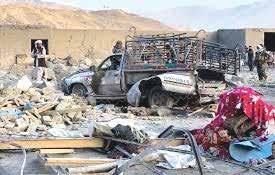
On Sunday, Pakistan launched a ground operation and a series of strikes overnight, killing at least 36 civilians and injuring at least 160 more in Afghanistan, Afghan officials said.
According to Pakistan, the strikes and ground operation were in response to militant attacks and wound up killing 29 terrorists and destroying weapons and ammunition stockpiles.
The U.N. Assistance Mission in Afghanistan estimated that the strikes
killed 28 or more civilians and injured 49 more, noting that the numbers could rise.
The Taliban’s deputy spokesperson, Hamdullah Fitrat, claimed that homes and villages were struck.
Following Pakistan’s attacks, the two countries summoned each other’s top diplomats.
The Afghan Foreign Ministry’s deputy spokesperson, Zia Ahmad Takal, claimed that Pakistan keeps accusing Afghanistan of involvement in terror attacks despite lacking “credible evidence,” criticizing Islamabad for behaving in a way that “seriously harms the atmosphere of trust between the two countries, good neighborly relations and the security and stability of the region.”
Meanwhile, the Foreign Affairs Ministry in Pakistan summoned Afghanistan’s top diplomats, criticizing the country for Afghan nationals’ involvement in recent militant attacks carried out by the Pakistani Taliban and allied terror groups.
The strikes and ground operation came after a terror attack killed three soldiers at the regional headquarters of the paramilitary Rangers in Karachi. Three attackers were killed, and another terrorist, a wounded Afghan national, was detained.
Less than three weeks before these strikes, Pakistan claimed to have struck militant hideouts in Afghanistan.

Amid growing tensions, China unveiled new export controls on Monday targeting 40 Japanese entities allegedly aiding Japan’s “remilitarization.”
The controls come as Japan expands its military at an accelerated pace, adding offensive capabilities while drawing the ire of China. Ties between the two countries have also deteriorated since last year, when Japanese Prime Minister Sanae Takaichi suggested that Japan might intervene if China attacks Taiwan. Twenty Japanese entities, including
several divisions of Mitsubishi Corporation, were placed on a control list by China’s Commerce Ministry, banning Chinese and foreign exporters from selling them Chinese-made dual-use items, which are items that can be used for civilian and military purposes. Another 20 Japanese entities, including Mitsui E&S and divisions of Fujitsu and Komatsu corporations, were placed on a watch list for dual-use items.
The Chinese Commerce Ministry has framed the controls as “entirely justified, reasonable and lawful,” noting that they are supposed to firmly deter “Japan’s reckless pursuit of ‘new militarism.’”
In response, a top Japanese spokesperson criticized the controls as “unacceptable and extremely regrettable,” urging China to rescind the curbs. Minoru Kihara, Japan’s chief cabinet secretary, said countermeasures are being considered.
The controls will not impact “normal Sino-Japanese economic and trade exchanges,” the Commerce Ministry said.
China considers Taiwan its own territory and has threatened the democratic island with military action. Last week, the United Kingdom, Germany, and France issued a joint statement, criticizing China’s recent activities in waters
near Taiwan and calling for the status quo to be maintained.

María Corina Machado, Venezuela’s exiled opposition leader, claims her home country’s government has blocked her from returning from Panama to assist with relief efforts as Venezuela reels from two devastating earthquakes. On Monday, she accused the government of closing “our country’s airspace to try to stop me.”
She left Virginia in a private plane last Friday, intending to fly to Curaçao, an autonomous Dutch island 40 miles away from Venezuela. Though the flight was reportedly authorized by the United
States, U.S. officials asked her to turn her plane around soon after takeoff.
On Sunday, she flew to Panama City on a commercial flight. However, Copa Airlines stopped her from boarding a flight to Caracas, Venezuela, explaining that her trip could jeopardize the airline’s ability to continue operating in Venezuela.
Since the U.S. arrested Venezuelan President Nicolás Maduro in an elaborate operation in January, the country has been run by vice president and interim president Delcy Rodríguez, of whom the Trump administration currently approves. The current Venezuelan government has thus far cooperated with the U.S. on economic and political matters, though the country’s next election has yet to be scheduled. Venezuela has opened its oil reserves to foreign investors and has been cooperating with the U.S.’s immigration and security agendas.
Machado, a staunch advocate for democracy in Venezuela, won the Nobel Peace Prize in 2025. U.S. President Donald Trump has dissuaded Machado from returning to Venezuela, as he and other administration officials currently prefer Rodriguez to lead the country.
claims that the prime minister accepted improper gifts and exchanged political favors for favorable media coverage. Netanyahu has denied all wrongdoing, calling the accusations a politically motivated campaign against him.
The judges’ comments immediately energized members of Netanyahu’s coalition, who argued that the trial has gone on too long and should be brought to an end.
Justice Minister Yariv Levin said the bribery allegation was the central claim against Netanyahu and accused prosecutors of pursuing a case built on a “trumped up” charge.
“The least that can be done now is to prevent this miscarriage of law and justice to continue,” Levin said, arguing that Netanyahu should not be forced into years of additional legal proceedings over what he described as “marginal and unprecedented charges.”
Levin said the judges’ recommendation gave prosecutors an opportunity to “salvage” the justice system’s credibility and again called for either a pardon or the dismissal of the cases.
Netanyahu requested a pardon late last year, but President Isaac Herzog pushed back, suggesting instead that the sides negotiate a possible plea agreement. Netanyahu’s legal team has not yet responded to that proposal.
Other coalition figures also renewed their calls for an end to the proceedings.

Calls from Prime Minister Benjamin Netanyahu’s allies to end his corruption trial intensified on Monday after judges suggested prosecutors consider dropping the bribery charge against him.
The recommendation came after Netanyahu completed his lengthy testimony in the three cases against him. It echoed a similar suggestion made by the court three years ago.
Even if prosecutors remove the bribery charge, Netanyahu would still face allegations of fraud and breach of trust in three separate cases. The cases involve
Defense Minister Israel Katz wrote on social media that “the trial must be canceled,” while accusing those responsible for the indictment of creating a false case. Likud MK Moshe Saada called the proceedings a “witch hunt,” and MK Amit Halevi described the trial as an attack on Netanyahu’s elected government.
“This putsch needs to end,” Halevi said, pointing ahead to Israel’s next elections, expected by late October.
The trial, which made Netanyahu the first sitting Israeli prime minister to face criminal proceedings, continues as the country remains focused on security challenges and political uncertainty.
A new report from Israel’s State Comptroller has revealed major failures in the emergency response during the October 7, 2023, Hamas attack, including breakdowns in communication that

may have prevented wounded civilians from receiving timely medical care.
The report by State Comptroller Matanyahu Englman found that the military and emergency medical services failed to coordinate effectively as terrorists infiltrated communities, towns and the Nova music festival area in southern Israel.

According to the report, responsibility for evacuating wounded civilians in active combat zones belonged to the IDF’s Southern Command and Gaza Division. However, the military relied heavily on ambulance services, including Magen David Adom, which were not equipped to operate in areas where terrorists were still present.
MDA ambulances lacked sufficient protective equipment, and the organization had instructed drivers not to enter communities under attack. The report
said the IDF was unaware of that decision, leaving many civilians without organized evacuation.
During the attack, many wounded people were forced to make their own way to hospitals, some traveling in private vehicles through areas still under fire.
The report found that out of 1,640 emergency incidents recorded that day, only 525 wounded individuals were evacuated by medical vehicles. Just 84 were transported in armored ambulances and 21 by helicopter.
The comptroller noted that warnings about the shortage of armored ambulances had existed since 2016, but funding had never been provided. On October 7, Israel had only 24 armored ambulances nationwide, compared to the 50 considered necessary.
Communication problems also contributed to the crisis. MDA had a digital system that provided real-time information on emergency calls and wounded civilians, but key military officials said they were unaware it existed.
“The information about the wounded that was in MDA’s possession…did not reach the military forces in the combat zone,” the report stated.
The report also criticized the Health
Ministry’s handling of the mass casualty event, saying hospitals were poorly coordinated. Soroka Medical Center in Beersheba and Barzilai Medical Center in Ashkelon became overwhelmed while other hospitals had available capacity.
A committee responsible for balancing hospital loads was not convened until hours after the attack began. As a result, more than 40% of wounded patients at the overloaded hospitals waited over five hours before being transferred elsewhere.
The audit also examined rehabilitation efforts after the war began, finding severe shortages in medical staff and a lack of long-term planning for treating thousands of wounded soldiers and civilians.
Despite the failures, the report noted an enormous wave of civilian support: millions of Israelis volunteered and donated in the months after October 7, contributing billions of shekels in aid.
The findings renew calls for a broader investigation into the failures surrounding the attack and the country’s emergency response.

A clause was included in last week’s Israel-Lebanon framework agreement, ensuring that Israel remains in Lebanon until Hezbollah disarms.
“Pending successful completion of an agreed-upon and verifiable disarmament and dismantlement process, Israel commits to a phased, conditions-based, progressive reduction and eventual redeployment of its forces from Lebanese territory, planned and sequenced through the [Military Coordination Group for Lebanon], to coincide with LAF deployment,” the text’s annex read.
As per the deal, which was secured in Washington, D.C., the IDF will not have to automatically withdraw from Lebanese territories. However, Israel is


concerned that Iranian pressure might sabotage the agreement. This particular annex has reportedly been kept classified at the behest of the Lebanese government.
The initial withdrawals, which will happen after Lebanese training and vetting, will see Lebanese forces replace the IDF in two designated areas.
If everything goes according to plan, the framework agreement could lead to a peace deal between Israel and Lebanon. The agreement was hailed by IDF Chief of Staff Lt. Gen. Eyal Zamir as “historic and significant,” adding that “the conditions for it” were a result of military achievements.
“We will honor the agreement and work to ensure its success. The test now is one of action by both sides, and the coming period will determine the future,” Zamir said.
Zamir visited the Northern Command, where he approved future operations in Lebanon.
Hezbollah has condemned the deal, forcefully rejecting disarmament and warning of “internal conflict” if the agreement’s terms are enacted.

Defense Minister Israel Katz said on Monday that Israel has “no territorial ambitions in Lebanon” but warned that the IDF will not pull back from its positions until Hezbollah is disarmed.
The comments came as Israel and Lebanon moved forward with a U.S.backed framework agreement aimed at ending the conflict between the two countries. The deal calls for Lebanon to restore control over its territory by disarming non-state armed groups, including Hezbollah, allowing for a gradual Israeli withdrawal.
Speaking to reporters, Katz said Israel’s withdrawal would depend entirely on Hezbollah being dismantled.

“People should not hold their breath wondering where the next place will be from which Israel will withdraw in Lebanon,” he said. “It will not happen until Hezbollah is disarmed.”
Katz insisted that Israel is not seeking to hold Lebanese territory permanently but said the IDF would remain in southern Lebanon as a security measure.
He added that Israel does not expect the Lebanese army to suddenly take aggressive action against Hezbollah, saying that the IDF presence in the area would likely continue “long term.”
The defense minister also said that Israel had recently urged the Lebanese army to enter the Ali Taher Ridge area, where Hezbollah maintains a significant tunnel network, but that Lebanese forces refused.
The IDF carried out additional strikes against Hezbollah targets in southern Lebanon overnight, saying the attacks were in response to continued fire directed at Israeli forces operating in the security zone.
The military said it struck Hezbollah command centers in the Nabatieh and Mayfadoun areas and destroyed a rocket launcher. An IDF reservist was also seriously wounded on Monday after an explosion during operations near the village of Arnoun.
Meanwhile, U.S. Central Command chief Adm. Brad Cooper met with Lebanese officials, including President Joseph Aoun and military chief Gen. Rodolphe Haykal, to discuss implementation of the agreement.
Aoun said Lebanon was committed to extending state control through its armed forces all the way to the border with Israel and promised to work toward removing Hezbollah’s influence.
However, Hezbollah rejected the agreement, accusing Israel of violating the ceasefire and insisting it retained the right to defend itself. Hezbollah ally Nabih Berri, Lebanon’s parliament speaker, also criticized the deal, calling it an agreement of “dictates” rather than one that protects Lebanon’s interests.
Katz also warned that Israel remains prepared for a possible escalation with Iran, saying the IDF has targets ready if Tehran responds militarily.
“We have targets to strike in Iran,” he said, adding that Israel would remain alert while allowing the United States to pursue diplomatic efforts.

Freed hostage Rom Braslavski thanked the IDF for “killing the man who did him the most harm,” after the military confirmed to him that they killed the Palestinian Islamic Jihad terrorist who held him captive in Gaza.
Braslavski posted the news on Instagram, sharing the abuse he endured by the killed terrorist and writing, “Now I can say 100% that I won.”
The IDF confirmed that Talal Jaber Mohammad Abd al-Aal was killed on Sunday in a precision strike in Gaza.
The military also said that Abd al-Aal commanded a terrorist cell that infiltrated Israeli territory and took part in the October 7 massacre, while he also held several Israeli hostages during the war.
“This is the man who, on his orders and with his own hands, abused me and almost killed me several times. This is him. Remember when you told me to deliver a message to the Shin Bet? That you gave them a third finger and that you weren’t afraid of them? The message was delivered. Enjoy your time in [ gehenom]…,” Braslavski wrote.
In the video shared by Braslavski, which was taken the moment he received the call from the IDF to confirm the terrorist’s death, he is seen getting emotional, crying, and having to stop his car in order to thank the official who broke the news to him.
Later on Tuesday, the military said that it had killed Ali Qaid Mohammed Stitan, a Nukhba platoon commander in the PIJ, during a strike on Monday. Ali Qaid infiltrated Israel during the October 7 attacks and also attempted terror attacks against IDF troops stationed in Gaza in recent days.
“Ali Qaid posed a threat to IDF troops operating in the Gaza Strip and was eliminated in a precise aerial strike,” the military added.
Rom Braslavski was taken hostage while he was working as a security guard at the Nova music festival on October 7. He was an active-duty soldier on leave

30 from the Logistics Corps. Braslavski assisted with rescue efforts during the Nova music festival massacre until he was abducted to the Gaza Strip by Palestinian Islamic Jihad. After 737 days of being held hostage, Braslavski was released on October 13, 2025. During his time in captivity, his abductors tried to convince to convert to Islam. When Braslavski refused, he was beaten and tortured.

On Thursday, exactly 20 years after Hamas terrorists crossed the Gaza border and abducted Israeli soldier Gilad Shalit on June 25, 2006, the Israeli Defense Ministry published previously unreleased military logs from the day of the attack.
On the day of the assault, which was first reported at 5:13 a.m., Hamas terrorists entered Israel through a cross-border tunnel, attacking a nearby IDF tank and killing Lt. Hanan Barak and Staff Sergeant Pavel Slutsker, while injuring and dragging Gilad Shalit, a corporal, to Gaza.
Shalit remained in captivity in Gaza for almost 2,000 days until Israel exchanged 1,027 convicted Palestinian terrorists, including the future Hamas leader who was the architect behind the October 7 massacre, Yahya Sinwar, for his release.
At the time of the attack, several explosions, thought to be rocket impacts, were heard in the area of the Kerem Shalom border community. A minute later, the logs read, “There are casualties.” At 6:40 a.m., a report read, “Soldier missing from tank.” And then, four minutes later, “Hannibal,” a codename referring to a protocol that allows troops to do anything necessary to prevent another soldier from getting kidnapped, was referenced. The protocol was repealed by the military in 2016.
According to the log, a helmet and a bloodstained flak jacket were found near the border fence at 7:12 a.m., and at 8 a.m., the military officially identified

Shalit as the kidnapped soldier.
In an effort to rescue Shalit, Israel deployed troops into the Strip for the first time since the Jewish state’s Gaza disengagement in 2005. However, the operation ended in November with Shalit remaining in captivity. Israelis urged the government to bring him home, wearing a symbol — a yellow ribbon — in solidarity with Shalit’s family.
The prisoner exchange that led to his release was heavily criticized, but Benjamin Netanyahu, who was prime minister at the time, insisted that it was the best agreement they could secure.
In April 2012, Shalit was discharged from the army with the rank of sergeant major. In 2021, he married Nitzan Shabbat. Today, Shalit is 39 and works as a sports journalist, living a private life. After the October 7 massacre, he reportedly met with several hostage families to express his support.
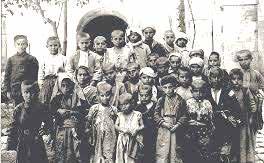
On Sunday, Israel’s cabinet unanimously passed a bill to recognize the Armenian genocide, an atrocity carried out by the Ottoman Empire during World War I. Turkey, whose relationship with Israel has turned frosty and will inevitably deteriorate further given the vote, has fiercely denied charges of the alleged genocide.
“Israel joins 32 countries that have fulfilled a moral duty by recognizing the historical truth and rejecting attempts to deny it,” wrote Foreign Minister Gideon Sa’ar on X, noting that “it’s never too late to do the right thing.”
“This horrifying genocide, which took place over 100 years ago and whose facts are not really up for debate, included the murder of 1.5 million people and the destruction of an ancient and historic cultural heritage,” Sa’ar declared in a video statement. “In my view, it’s our moral imperative as Jews — and certainly as the state of the Jewish nation — to make the decision that we made today.”
Turkey, the progenitor of the Otto -
man Empire, admits that its predecessor killed many Armenians in clashes during World War I. However, it rejects the genocide label, arguing that Ottoman forces did not systematically target Armenians.
Israel’s relationship with Turkey deteriorated significantly after the October 7 massacre, during which Hamas-led terrorists murdered more than 1,200 people and took 251 hostages. Ankara has falsely accused Israel of genocide, with pro-Hamas President Recep Tayyip Erdogan likening the Jewish state to Nazi Germany.
In August 2025, Prime Minister Benjamin Netanyahu first recognized the Armenian genocide. In response, Turkey criticized Netanyahu, claiming that he’s trying “to exploit past tragedies for political motives.”
On Saturday night, Netanyahu expressed support for the recognition bill at a press conference.

For the first time in 18 months, the Judicial Selection Committee appointed a wave of new judges, following legal pressure on Justice Minister Yariv Levin from petitions to the High Court of Justice. There were 51 vacancies on several magistrate and district courts.
The magistrate courts in the northern and Haifa districts now have seventeen newly appointed judges; the traffic courts have 12; the youth courts six; and the family courts 12. Six magistrate court presidents were also promoted to district court judges, and 15 temporary judges were appointed to district courts.
On the Judicial Selection Committee, Yesh Atid’s MK Karine Elharrar abstained from promoting the magistrate court presidents, in protest of Levin for not appointing judges to magistrate courts in the Central, Tel Aviv, and Jerusalem districts, which are facing judge shortages. Meanwhile, the three Supreme Court justices on the committee and the three coalition representatives voted to approve the appointments.

For a year and a half, Levin refused to convene the Judicial Selection Committee, insisting that all appointments require unanimous approval rather than a five-vote majority. Netanyahu’s government does not have a majority on the panel, though the coalition has tried enacting legislation that would allow politicians to veto judicial appointments. The High Court is expected to reject that legislation.
The committee is only allowed to hold hearings on judicial nominees 45 days following the publication of their candidacies in the state gazette, a period that ends on July 20, which is likely close to the final date for the Knesset’s dissolution. Levin was ordered by the High Court in May to publish the names of his appointments by June 8. Instead, on June 5, Israel Courts Administration Director Judge Tzachi Ouziel published the names of Haifa and Beersheba district court appointments.

The Supreme Court ruled on Tuesday that states may prohibit people who say they are women but were not born female from competing on female sports teams, delivering a major decision in the ongoing national debate over this issue.
The ruling, issued as the court wrapped up its term before the summer recess, upheld laws in West Virginia and Idaho that limit participation on girls’ and women’s teams based on biological gender. The justices determined that the bans do not violate constitutional protections or federal laws prohibiting gender discrimination in education.
The decision affects a growing number of states. Twenty-seven states have enacted similar restrictions, arguing that the rules are necessary to protect competitive fairness and address safety concerns for female athletes.
The laws define gender based on the gender assigned at birth and do not make exceptions based on hormone therapy or if a person changes his body to resemble a female body. Athletes who challenged the restrictions argued that medical treatments, including testosterone suppression and estrogen therapy, can eliminate any physical advantage they may have had over female-born athletes.
The cases before the court involved athletes in West Virginia and Idaho. One challenger, Boise State University student Lindsay Hecox, said his reduced testosterone levels and changes in muscle mass made him comparable to other female athletes.
The ruling marks another shift in the Supreme Court’s recent approach to these types of issues.
The case involving West Virginia centered on Becky Pepper-Jackson, a high school athlete who competes in shot put and discus. West Virginia argued that he retained physical advantages from male puberty, while Pepper-Jackson said his success came from training and dedication.
The Trump administration supports the state bans and has agreed that female sports should just be for those who were born female.
Public opinion polls have generally shown support for requiring athletes to compete according to gender assigned at birth.
During arguments, Justice Brett Kavanaugh noted the difficult balance involved, saying that when one athlete earns a spot on a team, another athlete may lose that opportunity.
The ruling is expected to continue fueling debate over the role of government, schools, and athletic organizations in determining eligibility rules for sports.

Rinsch to 30 months behind bars on Monday, followed by three years of supervised release. He was also ordered to forfeit $11 million and pay additional penalties.
The sentence comes after a jury convicted Rinsch last year on multiple charges, including wire fraud, money laundering, and financial transactions involving illegally obtained funds.
According to prosecutors, Netflix paid Rinsch $44 million between 2018 and 2019 to produce a sci-fi series originally titled “White Horse.” When production ran into financial difficulties, Rinsch requested additional funding, and Netflix provided another $11 million in 2020.
Prosecutors said that instead of using the money to complete the show, Rinsch made a series of risky investments, including speculative stock options and cryptocurrency trades. He reportedly lost more than half of the additional funds within weeks.
The remaining money was allegedly spent on personal expenses and luxury purchases, including millions of dollars in credit card payments, high-end furniture, antiques, watches, and several luxury vehicles, including Rolls-Royces and a Ferrari.
“Carl Erik Rinsch orchestrated a scheme to steal millions by seeking $11 million from a subscription streaming service, falsely claiming that money would be used to finance a television show that he was creating,” U.S. Attorney Jay Clayton said.
The series was never completed, and Rinsch was arrested in 2025.
Before sentencing, an actor submitted a letter asking the court for compassion. He had worked with Rinsch on “47 Ronin” and said he had known the director for about 15 years and viewed him as a talented artist.
“I do not know the details of this case,” the actor wrote, adding that he hoped Rinsch’s sentence would include “leniency and mercy as well as justice.”
The actor added that he had seen early work from “White Horse” and described it as “a superb and visionary work of art, although unfinished.”
The actor also said he had previously participated in efforts to encourage Rinsch to seek mental health support, while making clear that his letter was not meant to excuse the crimes.

Alaska voters may soon find themselves facing a most unusual choice: two candidates named Dan Sullivan fighting for one Senate seat.
The Alaska Supreme Court ruled on Monday that a Republican candidate named Daniel J. Sullivan can remain on the ballot for the state’s August Senate primary, rejecting an effort by election officials to remove him over concerns that he could confuse voters.
The court upheld a lower court ruling that said Daniel J. Sullivan, a retired teacher and former U.S. Forest Service employee from Petersburg, Alaska, met the legal requirements to run. However, the judges directed the state Division of Elections to determine how his name should appear on the ballot under Alaska’s election rules.
The case has become a major subplot in one of the country’s most closely watched Senate races. Incumbent Republican Sen. Dan Sullivan is seeking a third term, while former Democratic Rep. Mary Peltola is hoping to challenge him in November. The race could be competitive in a state that has not sent a Democrat to the Senate in nearly two decades.
Alaska’s unusual election system uses open primaries, with the top four candidates advancing to a ranked-choice general election.
The senator has accused his samename opponent of being a “sham candidate” whose goal is to confuse voters and help Democrats win the seat. Daniel J. Sullivan has rejected that claim, saying he is a legitimate candidate who is qualified and serious about the race.
A New York federal judge sentenced
Prosecutors said the sentence should serve as a warning that financial fraud will face consequences.
“Today’s sentence sends a deterrent message: fraud will not be tolerated,” Clayton said.
The dispute began when Alaska’s Division of Elections ruled earlier this month that Daniel J. Sullivan should not appear on the ballot, arguing that his filing was not a “good-faith candidacy” but rather an attempt to mislead voters.
Officials pointed to several factors, including his initial request to appear as “Dan Sullivan,” his decision to run as a Republican despite lacking previous party affiliation, and similarities between


his campaign website and the senator’s site.
A judge later overturned the decision, ruling that election officials did not have the authority to investigate a candidate’s motives if the legal requirements were met.
“The court does not minimize the Division’s concern that voters should not be misled,” Judge Thomas Matthews wrote, while noting that Alaska law provides other ways to prevent confusion.
Daniel J. Sullivan’s attorney Jeffrey
Robinson said his team was “grateful” for the Supreme Court’s decision, while Senator Dan Sullivan’s campaign expressed disappointment and continued to accuse the challenger of trying to manipulate the election.
Now the Division of Elections must decide how to distinguish between the two Sullivans on the ballot, because Alaska voters may need a little more than just a last name to know who they are for.
Earth’s surface. That far up, there were hardly any air molecules for Swift to run into, but slowly, over time, its orbit descended lower and lower.
It is now at an altitude of about 210 miles, where the air is denser, dragging on the telescope. Within a few months, the friction will pull Swift into the thicker part of the atmosphere and rip it apart.
That is, unless a robotic spacecraft can pull off a daring, never-before-tried rescue: catching Swift and then nudging it back to a higher orbit.
“I am cautiously optimistic,” said Brad Cenko, the principal investigator for the Swift mission.

The rescue attempt is scheduled to commence on Tuesday, with the launch of a refrigerator-sized spacecraft from Kwajalein Atoll, one of the Marshall Islands in the middle of the Pacific Ocean. Launch is scheduled for no earlier than 6:17 a.m. Eastern time. (On Kwajalein, it will be 10:17 p.m.)
A small startup company, Katalyst Space Technologies of Flagstaff, Arizona, developed and built the spacecraft, called Link, in about nine months, a breakneck pace compared to typical space missions, which take years to get off the ground.
Ghonhee Lee, the CEO of Katalyst, said NASA only laid two basic requirements: boost the spacecraft and do not run into it or otherwise damage it.
“That gave us a ton of flexibility in how we designed the program and how we designed the spacecraft,” Lee said.
A replacement for Swift, if NASA decided to build one, would most likely take years and cost hundreds of millions of dollars. Giving a $30 million contract to Katalyst to boost Swift was a smart bet, NASA officials said.
A one-of-a-kind NASA space telescope is about to fall out of the sky.
For more than two decades, the Neil Gehrels Swift Observatory telescope has gazed at the fading afterglows of some of the universe’s most violent explosions.
After launching in 2004, Swift initially circled about 370 miles above the
“The risk of us losing Swift — if we hadn’t done this — the odds were 100%,” said Shawn Domagal-Goldman, director of NASA’s astrophysics division.
Successfully rescuing Swift could add years of precise gamma-ray burst observations.
NASA originally counted on Swift lasting just two years and did not include any contingency plans for boosting the orbit a couple of decades later. (© The New York Times)


A Chinese billionaire who reinvented himself as a U.S.-based critic of Beijing after fleeing China has been sentenced to 30 years in prison for a massive fraud scheme that prosecutors said cost victims around the world hundreds of millions of dollars.
Guo Wengui, once considered among China’s wealthiest businessmen, received the sentence on Monday in a Manhattan federal courtroom. Judge Analisa Torres said Guo exploited supporters who believed they were helping promote democracy in China, using their money to fund an extravagant lifestyle.
“Mr. Guo preyed on those seeking to bring Democracy to China,” Torres said, according to the sentencing proceedings.
The judge also ordered Guo to forfeit hundreds of millions of dollars and pay $889 million in restitution.
During sentencing, victims described losing their savings and suffering emotional and financial devastation. One victim, Wei Chen, told the court that Guo’s actions “destroyed my life” and harmed her family.
Guo, who has been jailed since his 2023 arrest, disputed the government’s portrayal of him and complained about his treatment in custody. He said he had been taken to a hospital earlier Monday and denied claims that he was exaggerating his condition.
“When I came here, I said: ‘I have a tummy ache, I need to go to the bathroom, I don’t feel well,’” Guo said through an interpreter.
He briefly addressed the case itself, insisting his motives were political. Referring to China’s Communist Party, he said: “The reason I came to the U.S. was to destroy the CCP.”
Prosecutors said Guo ran an “astonishing” fraud operation between 2018 and 2023, convincing thousands of people to invest in businesses and projects he controlled. They alleged the money financed a life of luxury, including mansions, yachts, expensive cars and design-
er goods.
Before his arrest, Guo was a prominent figure among Chinese dissidents in America. He became close with conservative strategist Steve Bannon, and the two announced an initiative aimed at challenging China’s ruling Communist Party. Guo also maintained ties to political circles and was a member of former President Donald Trump’s Mar-a-Lago club.
Guo’s attorneys argued that he was targeted by the Chinese government and that his prosecution supported Beijing’s efforts to silence critics. They claimed a lengthy prison sentence would further a campaign against Chinese dissidents.
But prosecutors said Guo showed no remorse and refused to accept responsibility. Judge Torres agreed, saying he “takes no responsibility for his actions” and continued to claim that no one was harmed.
In a 7-1 vote, New York City’s Rent Guidelines Board approved Mayor Zohran Mamdani’s rent freeze initiative,
pausing recent increases on some one million one- and two-year-leases starting October 1.
Thursday’s vote is a major victory for Mamdani, who pledged to freeze rents if elected. He praised the vote, claiming that it would bring “relief” to “working people across our city.”

Before the vote, one board member stepped down, noting that the rent freeze was inevitable due to Mamdani’s six appointments to the board in February.
The New York Apartment Association condemned the vote, noting that it would force landlords to raise prices on market-rate apartments to make up for losses on rent-stabilized units.
“Our message is clear: This freeze will destroy the living conditions for hundreds of thousands of New Yorkers,” said CEO Kenny Burgos of the New York Apartment Association, which represents building owners and has called

on lawmakers to stop the freeze.
Objections to the freeze will likely make their way to the courts.
According to a 2026 analysis by the city’s Independent Budget Office, the typical rent-stabilized apartment in New York City rents for $1,603 per month. However, rents differ significantly based on factors such as neighborhood and building age. The report found that the lowest 25 percent of rent-stabilized apartments rent for about $1,190 or less, while the highest 25 percent begin at roughly $2,186 per month. By comparison, median rents for market-rate apartments in the city’s most sought-after neighborhoods currently exceed $4,000 per month.
The vote was held at Manhattan’s El Museo del Barrio, a Latin-American museum. Tenant advocates packed the meeting and responded enthusiastically to the vote, applauding, cheering, and sounding whistles as board members cast their ballots. Many attendees also displayed signs bearing the message, “Freeze the Rent!”
Ahead of Thursday’s vote, Mamdani’s administration introduced measures supposedly intended to address concerns from property owners. In May, he announced that qualifying landlords would
be permitted to apply a one-time rent increase to certain vacant apartments, regardless of whether a rent freeze is later approved. Earlier, in April, the city rolled out a municipal insurance initiative designed to lower building owners’ insurance expenses by an estimated 20% to 30%. Additionally, officials established a $5 million loan fund to assist landlords in recovering unpaid rent from tenants and reducing the likelihood of eviction proceedings.

Lone-star ticks are making their way north and west, reaching areas as far as Martha’s Vineyard and Suffolk County, New York. If bitten by a lone-star tick, an individual may contract alpha-gal syndrome, a unique condition that could

cause a red meat allergy.
Up to 450,000 Americans have alpha-gal syndrome, according to the Centers for Disease Control and Prevention.
The tick, named after the white starlike dot on its back, came from the Southeast and south-central United States. When it bites, alpha-gal, a sugar molecule, enters the bitten individual’s bloodstream, triggering an autoimmune reaction to red meats such as beef, pork, lamb, and venison, and similar foods, including gelatin and medications made with mammalian cells. Allergic reactions vary in terms of severity, ranging from hives and gastrointestinal issues to shortness of breath and anaphylactic shock. Cross-contaminated and flavored foods could also trigger allergic reactions.
Many doctors don’t know much about alpha-gal syndrome, while many more don’t yet have the confidence to properly diagnose it, according to a 2023 CDC report. As such, misdiagnosis is common, with some doctors incorrectly labeling the condition irritable bowel syndrome.
Those bitten do not develop allergies to non-mammal meats, like poultry or fish.
Roughly one-third of those with alpha-gal syndrome lose the allergy within three to five years, according to Dr. Scott Commins, an associate professor of medicine and pediatrics at the University of North Carolina at Chapel Hill. Some people develop antibodies to alpha-gal but don’t develop a red meat allergy. According to studies, only 2% of those bitten develop the allergy.

Inmates overpowered correctional staff and took over parts of a jail in eastern North Carolina early Monday, but the siege ended hours later when law enforcement officers entered the facility and seized control.
Three guards and 88 inmates were inside the Bertie-Martin Regional Detention Center in Windsor when the takeover began at about 5 a.m., prompting an immediate response from local, state and federal authorities.
By early afternoon, the Bureau of Investigation and the FBI had “cleared the facility.”
The facility will remain secured while the damage is assessed, and inmates have been transferred to other facilities, the Bureau of Investigation said.
Inmates took two guards captive. The third guard managed to escape. Negotiations led to the release of the two guards along with 80 inmates, leaving only eight inmates inside, Bertie County Sheriff Tyrone Ruffin said.
Authorities have not addressed why there were only three guards overseeing the jail at the time of the takeover.
“Right now, we have a lot going on that we’re trying to get under control,” Ruffin said. “I will release that information to the public as soon as I can.”

Authorities in Lagos de Moreno, Mexico, are searching for a mysterious nighttime vigilante who appears to have taken on a very specific mission: hunting down motorcycle thieves. Apparently, someone decided that if the thieves weren’t being found, they’d just skip the middleman and find them themselves.
Over the past several weeks, five men have been discovered duct-taped to utility poles with the word “ratero” (“thief”) written across their foreheads. Handwritten pink signs accused the men of stealing motorcycles, while some received bonus artwork in the form of drawn-on whiskers and mustaches.
The vigilante’s style has raised plenty of questions. Is this a crime-fighting crusader? A frustrated neighbor? Someone who watched too many superhero movies but didn’t have the budget for a cape?
Police say the bound men are being treated as victims, though the discovery of stolen motorcycles nearby has made the investigation slightly more complicated. Authorities described the connection as “separate,” which is one way of

saying, “We’re still figuring out how all these pieces of tape fit together.”
Emergency crews have freed the men, while detectives collected evidence including the tape, the signs, and what investigators jokingly noted was an unusually consistent “brand identity.” The mystery figure has already earned the online nickname “Mexican Batman,” although this version seems to have traded the Batmobile for something a little more practical: a vehicle with enough room for duct tape, markers, and possibly snacks.
Officials are warning residents not to copy the vigilante’s methods. The police commissioner reminded the public that alleged criminals must go through the justice system — a process involving arrests, paperwork, and, eventually, even more paperwork. And a process that doesn’t seem to be working.
The commissioner also pushed back against claims that the mystery vigilante has recovered more stolen motorcycles than authorities. “Those are different measurements,” he insisted. “We count investigations. He counts motorcycles.”
Meanwhile, the city waits to discover the identity of the masked crime fighter. One thing is clear: whoever he is, he’s certainly keeping the suspects wrapped up in the case.

A Chinese tech company has decided the future of home assistance might follow you into the bathroom.
At an exhibition in Shanghai focused on elderly care and assistive technology, firm Yueban unveiled “Xiaoban,” a self-driving smart toilet that quite literally comes when you call it. Yes, your toilet now has better response time than your children when asked to set the table for dinner.
Designed for people with limited mobility, Xiaoban is meant to reduce the need to travel to the bathroom by doing the traveling itself. Instead of the classic “excuse me, I need to find a restroom,” users can summon the unit, which then rolls over autonomously like a very committed robot butler with one extremely

specialized job description.
Under the hood, it uses lidar and ultrasonic sensors—similar to high-end robot vacuums—to navigate homes and care facilities. It avoids obstacles, steers clear of stairs, and responds to voice commands or remote control. It’s like a Roomba but with far more personal ambitions.
Hygiene features go well beyond the standard flush-and-pray system. Xiaoban includes a built-in bidet and warm-air drying, plus a self-cleaning waste chamber that seals everything away. Ultraviolet sterilization helps kill bacteria and reduce odors, making it less “bathroom stop” and more “mobile sanitation station.”
Once it’s done its business, it has options. If docked to plumbing, it returns to its charging station to recharge, refill, and dispose of waste after macerating it to avoid blockages. If not, it takes a field trip back to a regular bathroom, where a robotic arm transfers the contents into a standard toilet.
The traveling toilet is not for everyone. For one, the price – 28,999 yuan (about $4,200) – is a bit more than a standard toilet, making every encounter a royal flush.

A rare early print of the Declaration of Independence has finally stepped out of the shadows in New York after what can only be described as a very long period of historical “undercover work.”
The document, one of the few surviving early printings of the nation’s founding declaration, had essentially been hiding in plain sight for years, tucked away
in a collection where it attracted far less attention than it deserved.
The Holt Broadside printing of the Declaration sat in Westchester County’s archives for decades, but it will soon be viewable at the Neuberger Museum of Art at SUNY Purchase thanks to a robust preservation effort.
“The past 30 years, it’s kind of just been hiding here in the archives, and no one’s really even known about it,” said Courtney Fallon, Westchester County’s archive manager.
Now, it’s finally on public view in New York, where it is getting what historians might call its long-overdue glow-up.
Experts say prints like this were created during the Revolutionary era to quickly circulate news of independence throughout the colonies. That means this document wasn’t just a piece of parchment; it was, in a sense, the original breaking news bulletin.
Only five Holt Broadside copies are known to exist, including the county’s copy, which was printed on July 9, 1776, and read to a crowd at the White Plains courthouse two days later.
What makes this particular copy special is its rarity and survival. Many such prints were lost, damaged, or simply worn out by the very act of being used as urgent political messaging. This one, however, managed to avoid the historical equivalent of “lost in the mail” and instead quietly endured, waiting for its moment back in the spotlight.
Curators describe the find as significant not just for its age, but for what it represents: a tangible snapshot of the moment the United States declared itself a nation. It’s the kind of artifact that reminds visitors that history wasn’t just written. It was printed, distributed, and, occasionally, misplaced in storage for a few hundred years.
Now on display, the document is drawing attention from visitors who are used to seeing history as something distant and abstract, not something that once functioned like a mass-produced flyer announcing a brand-new country
Did you know?
In 1903, the Wright brothers flipped a coin to decide who would get the first chance to pilot their aircraft. Wilbur won the coin toss, but crashed the plane, allowing Orville to make history with the first successful flight.



In between school and camp JCCRP hosted a free family fun day with bouncy houses and slides, face painting, cotton candy, balloons, arts and
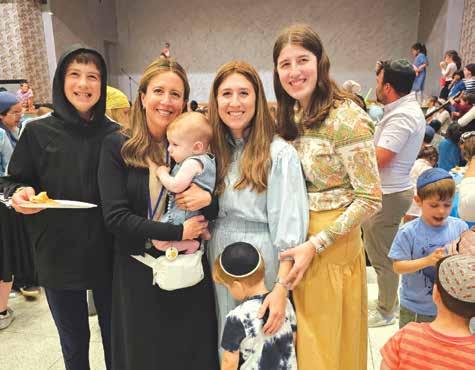
crafts, and a magic show. Thank you to the 800 people that showed up to have fun! The rain did not stop us – thank you to TAG elementary accommodating the
event and allowing us to use your space last minute due to the inclement weather. Thank you to the supporters of JCCRP that made this event possible, including

and
of

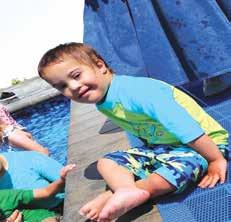


The Special Children’s Center is open during pre-camp week, when schools and most camps are still closed, ensuring there is never a gap in providing respite and support for families.

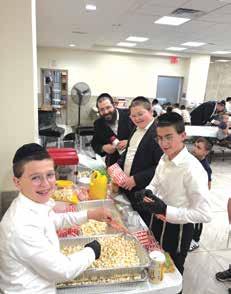
While Cheder at Siach Yitzchok is fully operational with its regular rabbeim and morning learning schedule, the afternoon program in the place of secular studies is fully operational as well with various fun-filled activities.
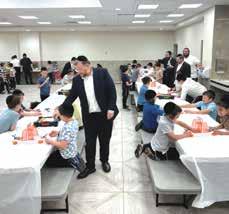
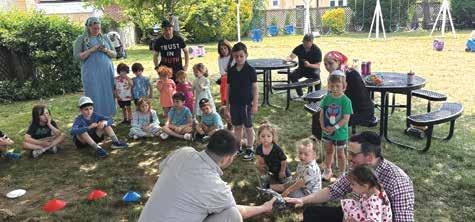
On Sunday, the BACH Jewish Center’s Youth Department hosted a special Sunday FunDay Reptile Show

Ateres Miriam High School opened four years ago with a bold group of girls, excited to be part of something new. At their graduation on June 21, 14 girls walked down to the strains of Bilvavi, as they became the first graduates of Ateres Miriam High School.
When these girls made the choice to attend Bais Yaakov Ateres Miriam high school, this day seemed very far away. With their Menaheles, Mrs. Sokoloff, as their guide, they navigated unchartered waters, leading to the momentous day of graduation.
Now, four years later, they have been the seniors, encouraging the younger students who make up the growing student
body of 74 girls, showing them how to be a high school student at Ateres Miriam High School. Our wonderful graduates (accepted to the finest seminaries of their choice in Israel and the U.S.) completed a full Regents program, with many earning Advanced Regents diplomas and graduating with a full year of college credits as well.
Next year, Iy”H the student body will continue to grow as we welcome 80 girls in September to thrive in Ateres Miriam High School’s trademark warmth. Our current graduates have paved the way by helping to create an environment where middos tovos combined with academic success are key and incoming students always feel welcome.


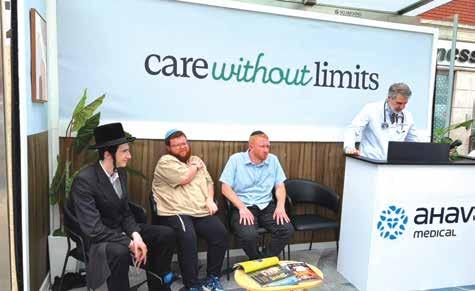
Over the last few years, an ongoing challenge has become apparent within the STa”M industry. Many completely well-intentioned buyers, who assume they are purchasing 100% kosher scrolls, are finding themselves uncertain about how to verify what is actually coming into their homes. This challenge is not a matter of klaf simply degrading over time, but rather a structural vulnerability in how STa”M is produced and distributed globally. Rabbi Moshe Elefant, COO of OU Kosher, recently shared an encounter that illustrates this exact issue. A professional sofer checking mezuzos in Lakewood, New Jersey, visited a large residence where the homeowner had spared no expense. Shockingly, every single one of
the mezuzos in the home was found to be completely pasul, and they had been pasul from the moment they were written. The homeowners had acted with complete sincerity and spent significant sums, but they didn’t get the kosher mezuzos they had purchased.
Writing a kosher mezuzah is an intricate, labor-intensive process governed by complex halachos. As Rabbi Ezra Sarna, Director of Halacha Initiatives at the Orthodox Union, explains, the margin for error is tremendous. “Each mezuzah contains over 700 letters, along with multiple other components. In many cases, if even one is off, the entire mezuzah can be pasul.” Furthermore, even if the klaf appears perfectly written, it could still be disqualified due to a sofer’s lack of

knowledge or improper kavanah during the writing process – factors that are impossible to verify simply by looking at the finished product.
Without a centralized quality assurance process, the market is continually flooded with varying qualities of mezuzos that have sadly not been written or checked k’halacha. Buyers are left in the dark, wondering who they can rely on, asking themselves if the bodek is truly reliable, or if the inspection was performed independently of the sofer who wrote the klaf.
Recognizing this growing communal need, the lay leadership of the Orthodox Union stepped in a few years ago. They turned to the OU’s Kashrus department, the community’s trusted experts in systematic certification, to develop a proactive, long-term solution. The result is the OU STa”M Pikuach Initiative which works with multiple partners and vendors to bring confidence to your doorpost.
The core vision is straightforward: the OU is doing for STa”M exactly what it has historically done for kosher food. For decades, the frum community has trusted the OU symbol to ensure the highest standards of kashrus in our kitchens. Now, that same level of trust and rigorous oversight is available to protect the doorposts of our homes and shuls.
What does an OU-endorsed mezuzah entail? It replaces uncertainty with a verifiable system of checks and balances. The OU provides direct oversight, ensur-
ing every mezuzah is written by a vetted, certified sofer who maintains active certification. The klaf and dyo (ink) are verified and approved as 100% kosher for mezuzah use. The thorough inspection system requires that a completed mezuzah is checked by a chain of two separate magiim (Mashgichim for STa”M). It is then inspected by rabbonim, examined once again by both magiim, and scanned by a cutting-edge, AI-powered computer program designed to detect even the slightest inaccuracies. Any issues raised during the checks are paskened on by rabbonim.
Once a mezuzah passes this rigorous process and is deemed strictly kosher l’chatchila, it is packaged in a tamper-proof plastic sleeve bearing the “Endorsed by OU” logo. This provides consumers with unprecedented transparency. The packaging includes a certificate of authenticity detailing exactly who the sofer was, who the magiim were, what materials were used, and when the mezuzah requires its next checking.
The OU STa”M Pikuach Initiative is committed to educating the frum community on the issues related to acquiring mezuzos confidently. There will be opportunities in communities across the US to learn more through shiurim and public lectures. OU-endorsed mezuzos are currently available for purchase through various trusted vendors. To learn more about this vital initiative and to find an authorized vendor near you, please visit ou.org/mezuzah.
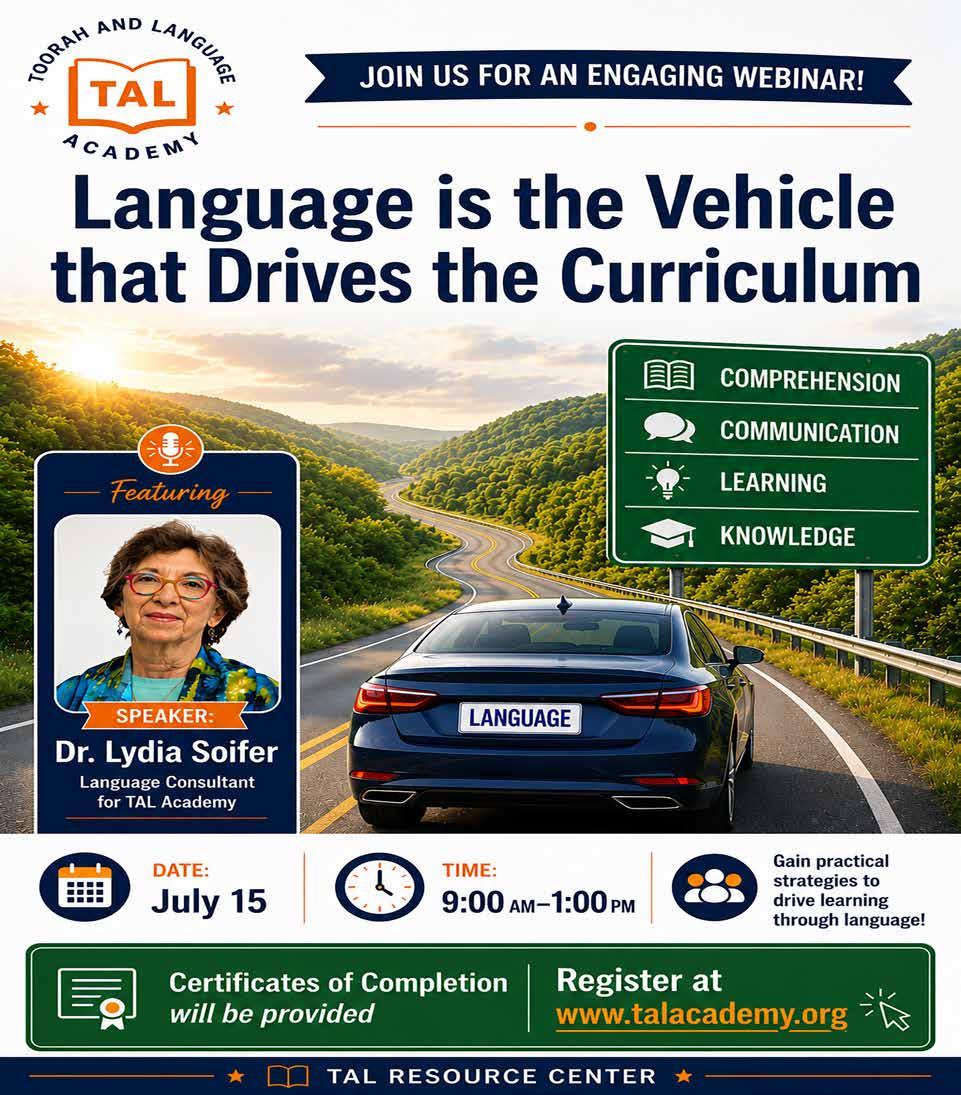
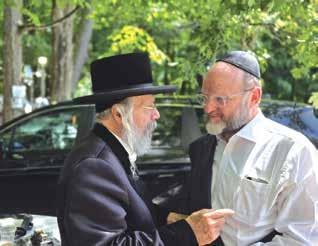
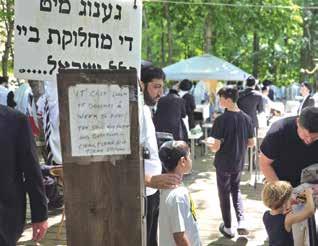

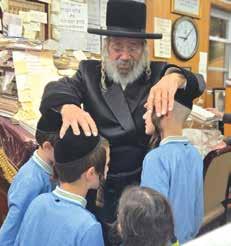
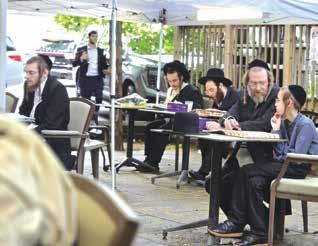
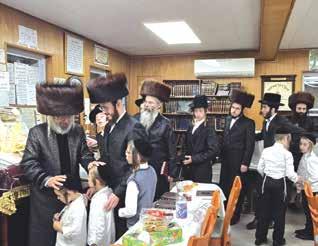
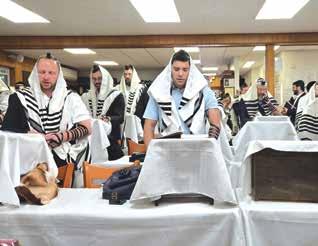

By Shani Gerlitz
There are moments when people are met with a flash of inspiration which can be ignored and wasted or if pursued can ignite an entire movement. Upon meeting Yehudis, the creator and driving force behind Malka’s Healing Hearts, it is obvious which category she belongs to. Yehudis has always had a passion for chessed but was unsure where to focus her efforts. Her epiphany came when eating out one evening.
While seated at her table, she was approached by two women at the next table and asked to snap a photo for them. The friendly women divulged that one of them was divorced and the other made sure to take her out each year for her birthday. At that very moment, Yehudis decided that she would do her utmost to create a community for single mothers. She founded Malka’s Healing Hearts, dedicated to the memory of her maternal grandmother, Mrs Margot Pollak, Malka bas Reb Yechiel Hakohen, who had excelled in the attribute of gratitude.
Once Yehudis decided to launch this program, she enlisted the mentorship of her dear friend, Yael Bertram, a popular life coach, who at the time was going through the divorce process herself. Yehudis was determined that her efforts and actions be thoughtful and sensitive to the population she sought to uplift. Determined, Yehudis taught herself how to use Canva and created an invitation for a local event for single mothers, a funpacked paint night, which was soon followed by a Tzipisa L’Yeshua Tambourine Workshop. Although she agonized over whether anyone would actually show up, the feedback from the divorced community was electric. Ever the visionary, she realized there was more to be done. She considered other avenues for mobilizing involvement.
Yehudis reasoned that since so many women bake challah weekly and end up overstocking their freezers, it was logical to begin with challah distribution. The results have been outstanding.
Although many women could easily purchase or bake challah on their own, it’s so much more impactful for them to be on the receiving end of love and acknowledgement. Shabbasim and Yomim Tovim are especially challenging times for single mothers when they may be left
alone with their thoughts to fester and brood. One woman just could not handle the pain associated with Shabbos and, tragically, stopped keeping it altogether. Eventually, she participated in a Shabbos seudah with another divorced friend who served challahs from Malka’s Healing Hearts. This woman was then so overwhelmed with feelings of love and recognition that she ultimately began to keep Shabbos again. Another woman mindfully saves challah for the rest of the week and eats a slice each day to infuse her with a daily dose of much needed love. Having this special challah to enjoy when eating alone helps to fill the void and the emptiness.
Yehudis initiated Malka’s Healing Hearts in her hometown, in the Five Towns, and began branching out after a serendipitous conversation with Gitti Nussbaum. Gitty creates groups of forty women for hafrashas challah in Monsey and offered to pair up her bakers with potential challah recipients in her neighborhood. Yehudis immediately created a flyer which was posted on Gitti’s WhatsApp profile. A woman in Boro Park viewed it, as well as a friend from Tom’s River, leading to the establishment of new branches in additional communities. As word traveled, more satellites opened. Malka’s Healing Hearts has now expanded operations across the globe to 26 locations, to date, including LA, Boca, Denver, Antwerp, Vienna, Chicago, Cleveland, Jackson, Queens and many more. With little overhead and tremendous positive feedback, it’s not surprising that more cities continue to open branches to provide support and encouragement for single mothers.
The bakery in Yehudis’s home opens at 11 a.m. on Erev Shabbos, and Yehudis is there to personally welcome the women who come to pick up their favorite challahs, all packaged tastefully and beautifully. Although crumb toppings and sourdough loaves are the most popular, she does her best to accommodate special requests as she strives to meet everyone’s expectations. A large part of the bakery experience in her dining room is the genuine interest Yehudis takes in each of these lovely, special women. For Yehudis, erev Shabbos is sacrosanct. She prepares all her Shabbos food Thursday evening and cooks it fresh early Friday morning so that she can be fully present for each of her visitors during the day. To

further enhance the Oneg Shabbos for these women, operations have expanded to include homemade baked goods and flowers that have been repurposed from local simchas. By now, there is a team of women who are thrilled to be part of this initiative. There are those who bake regularly, those who collect the flowers from simchas and others who package the baked goods, etc. The woman who coordinates the baked goods does it l’ilui nishmas Elisheva Rivka bas Yaakov, her grandmother who showed her love through her baked goods. The woman who coordinates the flowers does it l’ilui nishmas R’ Yechezkel ben R’ Yisrael Shalom, her father who would give his mother flowers each week after her husband died because he wanted his mother to have fresh flowers for Shabbos even though her husband couldn’t buy it for her. This has become a most admirable community project.
Invariably, not everyone can pick up their challahs each week. This allows some of the recipients the opportunity to be on the giving end and deliver challah to those who don’t drive or those who are unable to pick up themselves. There are also local teenagers who volunteer to help deliver when necessary. Yehudis has even availed herself of Uber courier services. Once, she Ubered challahs to a woman in a different neighborhood, and they were dropped off at the wrong address. That did not faze her in the least. She promptly Ubered a replacement. On another occasion, challahs had been delivered to a woman who discovered that the squirrels had made an early Shabbos meal of her precious package. Of course, Yehudis gladly had a replacement challah driven over.
Malka’s Healing Hearts hosts live, monthly events that are engaging, mean-
ingful and most enjoyable. Yael Bertram is Yehudis’s sounding board, reviewing content and media to ensure that the sensitivities of all the participants are acknowledged. Since the very first event, the women have enjoyed classes in self-defense, yoga, Zumba sessions, flower arranging and sing-alongs. Yael herself has hosted several of the events on Zoom, which proves popular with those who cannot easily leave home in the evening. As a seasoned life coach, Yael provides the women with tools to bolster their emunah and bitachon as well as useful strategies for navigating emotional triggers such as Yomim Tovim and school breaks. These programs provide a refreshing outlet and are the perfect venues in which to build connections. Several women who met at one of these events now frequently enjoy Shabbos together. There is also an active WhatsApp group where the participants share practical advice and tips. The women have become a sisterhood of sorts, sharing relevant information. Is there an accountant you would recommend? An attorney? Car dealer? Local handyman? Insurance broker? Math tutor? Ultimately, each individual satellite will be hosting their own monthly gatherings as well as their own WhatsApp group, fostering valuable camaraderie and support.
Yehudis’s magnetic energy and easygoing disposition attract many women. Yehudis stresses that Malka’s Healing Hearts is certainly not just about challah! Yehudis is unfazed when challenging friends and acquaintances to contribute whatever possible. A popular wig manufacturer recently donated two dozen top quality wigs, and even women with the trickiest hair color and styles have found pieces that made them feel absolutely radiant. One woman, accustomed to wear-
ing hig- end wigs, noted that she hadn’t scored as many compliments, nor felt as attractive as she did with this particular wig. It was simply because when wearing this wig, she radiated the happiness and gratitude that money cannot buy. These women are also occasionally treated to manicures, nights off with take-out dinner for their families, and yom tov extras, such as cheesecake for Shavuos.
Yehudis is emphatic, making sure that we take note of all community members. Each is valued and precious. Divorced women often deal with the stigma that they are at fault and their situation is self-inflicted. They raise their families on their own, often with significant financial strain as many do not receive adequate alimony or child support to cover their expenses. The somewhat dismal dating prospects and often acrimonious tensions with their ex-spouses leave the women
with little energy to buoy them. Not only are they shouldering childcare on their own, but they are often entering the workforce for the first time with minimal job skills or training. One woman even asked Yehudis to please write her a birthday card as it had been years since anyone had written her a card and commended her on what a great job she was doing. Through her work with Malka’s Healing Hearts, Yehudis hopes to educate and sensitize our greater community to the needs of these brave and courageous women.
It does not take much to make someone feel special, notes Yehudis. Working to bridge the gap in the community, she impresses upon these single mothers that most people genuinely care about them and are happy to give and be of help, they just don’t know how to begin. They are fearful of saying or doing the wrong
thing, but the moment the opportunity presents itself, they are thrilled to contribute. For example, Yehudis will pair up donations of household goods or merchandise in excellent condition with the single women in her community. Yehudis also passionately urges all to proactively consider the children who may be the casualties of divorce. Perhaps when making purchases for your own child, if possible, buy a duplicate for a community child as well. Or if you’re having your wig washed and set, offer to cover one for a single mom who would be so appreciative. It doesn’t have to be money! If you can tutor, drive, anything at all, the smallest gesture can go very far. The world of chessed is immense, and there are opportunities for each individual to contribute in her own unique way.
Living in an age of complex societal challenges, it’s easy to feel overwhelmed.
The excitement was contagious as campers poured through the gates on the first day of Hillel Day Camp, greeted by smiling staff, colorful balloons, and the promise of an unforgettable summer. From the moment they arrived, the energy was electric as new campers were warmly welcomed and returning campers eagerly reunited with friends. Before the day was even underway, familiar smiles, warm hugs, and re -

kindled friendships reminded everyone that Hillel isn’t just a camp—it’s a community where children feel they belong.
Week One was filled with opportunities for campers to connect, explore, and jump right into the fun. Campers showed off their patriotic spirit during Red, White & Blue Day, celebrated with an exciting Dave & Buster’s adventure, and enjoyed a festive July 4th Scavenger Hunt. Back on campus, the action never
Camp Kaylie Boys Month is off once again to an incredible start. The first week and a half has been filled with excitement, energy, and meaningful experiences that have set the tone for an unforgettable summer.
The campers start their day learning Torah, with the theme this summer focusing on the mitzvah of tzitzit. The chinuch staff are also focusing their curriculum on the importance of developing refined middos and encourage each camper to think about how the choices he makes every day reflect on the person
he strives to be.
The ruach this summer reached new heights with an unforgettable Joey Newcomb concert, where campers and staff sang, danced, and celebrated together in true Kaylie spirit.
Another highlight thus far was Israel Day, when campers enjoyed a day dedicated to their love for Eretz Yisrael, highlighted by a special video featuring both staff and campers sharing what Israel means to them. Especially poignant was celebrating the campers and staff members whose families will be making ali-
Speaking with Yehudis, the prospects of hope and meaningful change appear much more attainable. The women who have been impacted by her inclusive and compassionate efforts are part of a greater movement to relieve stigmas and create a dignified role for each of these extraordinary women in their respective communities. Yehudis could never have imagined that in the short span of two years, her modest but immensely revolutionary project would span the globe! This project is enormously transformative for both those on the giving end as well as those receiving. It’s clear that there are many hearts seeking healing. Who knows if that heart may even be your own!
For further info or to initiate a branch of Malka’s Healing Hearts in your own community, please send a note to Malkashealinghearts@gmail.com.

stopped as campers built impressive creations during team-building challenges, competed in friendly games of kickball and gaga, and experienced our brandnew Game Room, where laughter and friendly competition quickly became the highlight of the day. Throughout the week, every activity was thoughtfully designed to encourage teamwork, confidence, and plenty of smiles.
While the adventures were exciting,

yah this summer, honoring this exciting milestone and the deep connection the camp community has with the Land of Israel.
From spirited activities and meaningful learning to new friendships and

it was the everyday moments that truly captured the spirit of Hillel Day Camp: older campers helping younger friends, counselors cheering on every accomplishment, and children heading home each afternoon with stories they couldn’t wait to share. If Week One is any indication, summer 2026 is already off to an incredible start, and we can’t wait to see what the weeks ahead have in store.

countless smiles, the first week and a half has already demonstrated what makes Camp Kaylie so special, a place where every day is filled with Torah, growth, joy, and unforgettable memories, in a setting that respects children of all abilities.

Becoming too comfortable and not being humbled can be dangerous for our spiritual and physical existence. About ten or twenty years before the Holocaust, Rav Meir Simchah of Dvinsk (Meshech Chochmah, Vayikra 26:44) wrote about the cycle of the history of the Jews, which has been recurring through the centuries.
First, a Jew comes to a new country and feels like an immigrant. Then, slowly, he acclimates and becomes secure and comfortable until he forgets where he came from. And he thinks of himself as a very comfortable citizen, and he starts to forget his religion.
Speaking about the German Jews in his day, who were extremely cultured, Rav Meir Simchah declared, “He thinks Berlin is Yerushalayim.”
When that happens, he predicted: az yavo ruach soah vasa’ar, yaakor oso mi’gizo — A gusty wind and a storm will come, uprooting him from his trunk.
As we know, history repeats itself. And this is the story of galus. As was once said, Those who cannot remember the past are condemned to repeat it.
It’s been this way throughout the generations. Whenever we forget that we are strangers, that we are sojourners, the non-Jews come along and remind us of that fact.
Of course, we live in a democratic country, and we want to have rights, but we have to understand that deep down, this is not where we belong. As long as we have that understanding, then, until the coming of Mashiach, we can go back to a quiet, serene galus — like Yitzchak Avinu’s galus. But once we start feeling,
Hey, this is mine, we are in trouble.
If we don’t want the non-Jews to remind us of our status, we must remember it on our own.
Because the purpose of galus is to make us humble.
Klal Yisrael spent only 210 years in Egypt, not the 400 Hashem told Avraham he would have the Jewish People exiled.
One way to explain how Hashem kept his promise of 400 years is that Hashem didn’t say we’d be in Egypt for 400 years; rather, it would be a process, starting with Yitzchak Avinu’s life in exile, and continue as a process that would last 400 years.
However, we are still left with a question. If Yitzchak’s life counted as galus, why couldn’t we have spent all 400 years in Eretz Yisrael like Yitzchak Avinu did, in relative calm?
Rav Yaakov Kamenetsky (Emes L’Yaakov, Shemos 1:1) gives an impactful answer. Galus, he states, is in the eye of the beholder. If the purpose of galus is for us to humble ourselves, then it’s up to us to become humbled by the situation.
Yitzchak Avinu was humbled just by being in Eretz Yisrael. He was a lone man. There was no, so to say, Jewish nation. He was a stranger, and he felt it. And that was enough. Yitzchak fulfilled the words, ki ger yi’hiyeh zaracha— Your children shall be aliens, right there in Eretz Yisrael.
Then, as time went on, he gave birth to Yaakov, and Yaakov Avinu’s family grew. The setup of the family, with Yaakov surrounded by his twelve tribes,

could be compared to the arrangement of the Mishkan in the Desert. There was a certain sense of belonging. They no longer felt like strangers. And so, they had to go down to Mitzrayim. They had to be b’eretz lo lahem, in a land not their own, in order to feel the galus, in order to be humbled. Initially, that was enough for them. Goshen, where they lived, was like a ghetto.
Then, as time went on, that, too, was no longer sufficient. They became too comfortable. The Jews began feeling like this is where they really belonged. They were born there; their parents and grandparents had been born there. And that was when the hard work started, to fulfill the words: va’avadum, and they will serve them. At that point in time, they were sent to labor camps, where they had to work hard building pyramids.
When that was not enough to keep them humble, v’inu osam, and they will oppress them. The Egyptians tortured and tormented the Jews to humble them.
Galus is shaped not only by where we live, but by how we see ourselves: when we embrace the humility of a ger and

remember that our true home is with Hashem in the rebuilt Beis HaMikdash in Eretz Yisrael, our galus can more closely reflect Yitzchak Avinu’s peaceful exile.
Reprinted from Beis Halevi on Anavah by Rabbi David Sutton, with permission from the copyright holder, ArtScroll Mesorah Publications.
On the evening of June 17, more than 600 alumni, parents, friends, and supporters of Sh’or Yoshuv came together for an unforgettable celebration at our 59th Annual Dinner. It was a remarkable evening that reflected the enduring strength of our Yeshiva family and the profound impact Sh’or Yoshuv continues to have across generations.
The extraordinary turnout was a testament to the deep bonds forged within the walls of the Yeshiva. Alumni spanning decades gathered alongside rabbeim, families, and devoted friends, creating an atmosphere filled with warmth, gratitude, and shared purpose, reflective of a growing community whose connection remains as strong as ever.
This year’s dinner paid tribute to two extraordinary individuals whose decades of dedication have helped shape countless lives: our Legacy & Leadership Ambassadors, Rabbi Yehoshua Kurland & Rabbi Chaim Majerovic, who have devoted their lives to the sacred mission of
chinuch, serving as role models, mentors, and teachers whose influence extends far beyond the classroom. Through their unwavering commitment to Torah, their personal example, and their genuine care for every talmid, they have inspired generations of students to grow in learning, middos, and dedication to Klal Yisrael.
The gathering served as a powerful reminder that although each alumnus has followed a unique path, all remain connected through the foundation established at Sh’or Yoshuv.
We extend our heartfelt appreciation to everyone who attended, supported, volunteered, and helped make this year’s dinner such a resounding success. Together, we honor our past, celebrate our present, and look forward with optimism to the continued growth and success of Sh’or Yoshuv.
May we continue to strengthen our bonds with one another, support the sacred mission of Torah education, and build upon the remarkable legacy that has inspired generations.
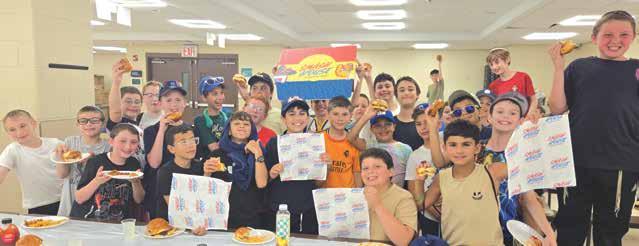

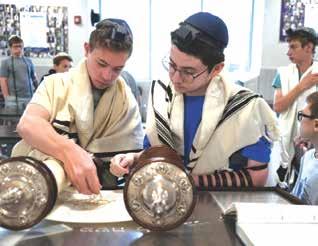


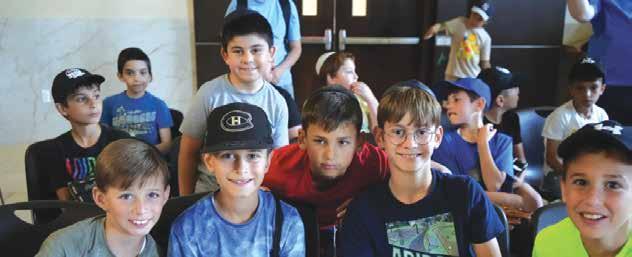



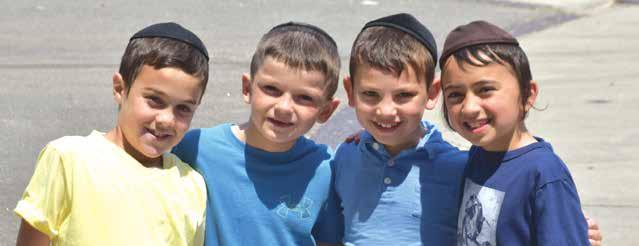
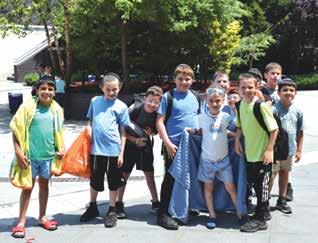
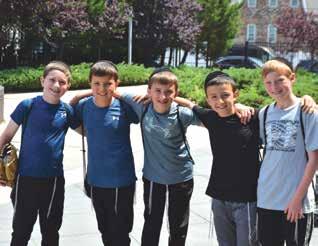

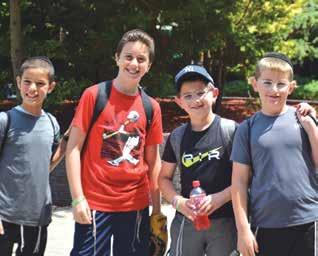
“Shabbos gives us the opportunity to step back, reflect, and reset, and this past Shabbaton did exactly that. From the meaningful speakers to the genuine connections formed over 25 hours, it was exactly what we needed,” shared Elyana and David Pinkhasov, after Emet Outreach’s recent couples Shabbaton in the Five Towns. That sentiment was felt by ten couples who came together for an uplifting Shabbos of Torah, friendship, and lasting connection. Hosted by Emet Couples Director Shay Yonaiev and his wife, Sonya, the Shabbaton gave participants the opportunity to strengthen their marriages and enjoy being part of Emet’s couples community.
Shabbos began with Friday night davening at Congregation Shaare Emunah in Cedarhurst, followed by an elegant dinner catered by Simcha Palace. The couples were joined by Rabbi David Rubinoff, who offered words of chizuk that really resonated with the crowd. One of the evening’s most meaningful moments came when several participants shared heartfelt reflections on what Emet has contributed to their lives. Their words of gratitude and personal growth set the tone for everyone.
On Shabbos day, after davening at Shaare Emunah, the couples enjoyed lunch with neighborhood families, while forming new friendships and strengthening existing ones. Following lunch, everyone gathered at the Yonaiev home for a relaxing Oneg Shabbos and interactive couples’ games. The group then headed to Kehilas Tiferes Mordechai in Cedarhurst
“More than a memorable weekend away, this Shabbaton represented the heart of Emet’s Couples Division,” explained Shay. “Our mission is to help young couples continue growing long after college. Through inspiring Torah, meaningful relationships, and a genuine sense of belonging, we’re guiding them to build strong Jewish homes and lifelong connections.”

where they heard an inspiring shiur by Rabbi Daniel Glatstein on the beauty and significance of Shabbos. After that it was back to Shaare Emunah where Rabbi Yonatan Saban gave a shiur to the men and Rebbetzin Saban held a session for the women. As Shabbat drew to a close, everyone reunited at the Yonaiev home for a beautiful musical Havdalah led by Emet’s Shlomo Mash.
Couples were left with a sense of gratitude and belonging.
“Shabbatons are usually outside of my comfort zone, but after attending our first one with Emet, my wife and I immediately felt welcomed. We had an amaz-
ing experience learning and meeting new friends. We’re looking forward to many more Emet Couples Shabbatons,” said Jonathan and Adelia Mavashev.
Elyana and David added, “It was especially beautiful to see couples from different backgrounds and at different stages of marriage united through Emet. The warmth, sense of community, and inspiration of the weekend left a lasting impact and reminded us why we joined Emet in the first place. Emet has a unique way of bringing people together while strengthening our connection to Hashem, and we’re so grateful to be part of this community.”
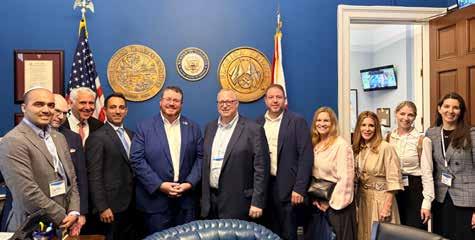



For generations of families, summers at Camp Avnet have sparked memories for a lifetime. From the early days in Long Beach, to the years in Dix Hills, and now at the Woodmere campuses, what unites these experiences are the traditions that make Camp Avnet unforgettable. Some traditions are easy to recognize, like learning to swim in the pool, winning a “Best Camper” trophy, or competing in Crazy Hat Day. Other traditions happen behind the scenes, like the months of intricate planning by the leadership team or even the 80,000 pounds of dirt that were spread across the infields to get them ready for baseball action. Summer ‘26 officially got underway as a community of more than 1,300 campers and staff arrived for opening day.
There were smiles and laughter as friends reunited, campers met their counselors, and the pools, fields, courts, and specialty rooms quickly came to life. Throughout the day, every camper and counselor took part in another beloved tradition when they posed for their annual photo magnets. These keepsakes have become staples on refrigerator doors and family bulletin boards, capturing another snapshot of summer at Camp Avnet.
Yet the tradition Camp Avnet values most cannot be displayed on a refrigerator. It’s the tradition of caring for every child. That philosophy was the focus of

staff orientation, where counselors were reminded that every interaction has the potential to shape a camper’s experience.
“Traditions are what bring families back year after year,” said Camp Director Daniel Stroock. “But what gives those traditions meaning is our staff’s commitment to our campers. Every interaction matters because today’s small moments become tomorrow’s lifelong memories.”
That commitment is reflected in one of Camp Avnet’s newer staff traditions.
Each morning junior staff members turn in their cell phones so their full attention remains where it belongs: on the campers. “It’s a simple practice that reinforces one of our core values. Children deserve counselors who are fully present, engaged, and invested in every moment,” Daniel explained.
Stay tuned for more Avnet snapshots as the summer unfolds!


The Woodmere Community Kollel Summer Softball Classic was held last Sunday at N. Woodmere Park.

It was led by Rosh Kollel Rav Chaim Zakutinsky; the game was organized by kollel member David Kaye

Mercaz Academy’s sixth grade graduation on June 18 was more than a commencement ceremony – it was the celebration of a class that grew alongside the school itself. Many of the graduates began their journey when the school was still part of the HANC system and experienced its transition to Plainview’s Mercaz Academy in 2022. Over the years, these students grew into leaders, role models, and a beloved part of the school community.
The school lunchroom was transformed into an elegant ceremony space for the event, complete with draped curtains, warm lighting, and student artwork. Led by fifth graders carrying the American and Israeli flags, the graduates processed proudly to the stage before leading songs and tefillot and sharing reflections and heartfelt speeches.
“As we move on to middle school, we are excited for what comes next, but we don’t want to leave,” expressed graduate
Liora. “We will always be grateful for the people who made our years here so meaningful and exciting.”
Her classmate Meira reflected that Mercaz taught the graduates far more than academics. “It has taught us Torah, kindness, community, and what it means to make everyone feel they truly belong.”
In a d’var Torah on leadership, graduates Rami and Jason compared their role as the school’s oldest students to the example of Moshe, expressing confidence that the lessons they learned would guide them in the future.
Following the presentation of diplomas by Principal Rabbi Kalman Fogel, families celebrated with enthusiastic applause and a PTA-sponsored oneg.
“We couldn’t be more proud of our sixth graders,” Rabbi Fogel said. “Watching them grow academically, personally, and in Torah has been an incredible zechut. They have left a lasting mark on Mercaz Academy.”




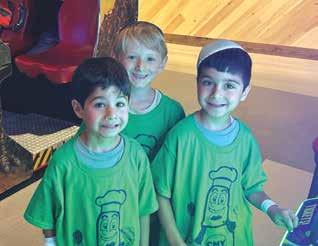

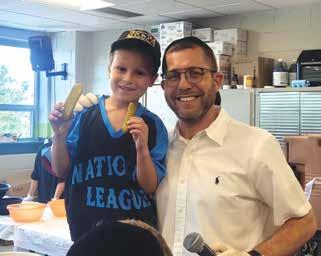
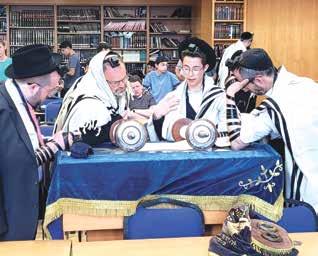

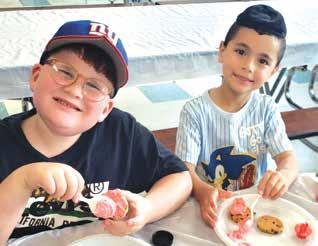


ArtScroll’s extensive library of books on halachah began with R’ Simcha Bunim Cohen’s first sefer, the “Radiance of Shabbos,” which was published in 1986. Since then, R’ Simcha Bunim has written more than a dozen works that deal with practical halachah, with a host of them dealing with the intricate laws of Shabbos.
In addition to his learning and research, R’ Simcha Bunim had the great blessing of having had a personal relationship with the gaon and posek hador, R’ Moshe Feinstein zt”l, and was able to discuss halachic issues with him.
We take very seriously our responsibility to assure the accuracy of all our publications, but this responsibility is especially acute with regard to works of halachah. The qualifications of an author or his co-author are of prime importance, as is their ability to express themselves accurately and clearly. Otherwise, a reader may misunderstand or wrongly
infer that something is permitted or forbidden. Once accepted, a halachic work would go through layers of reading and editing, with constant interplay among authors, editors, proofreaders and, whenever still necessary, consultation with senior poskim, to ensure that it was communicated accurately and clearly.
The results of this meticulous system ended up producing a long list of halachic works that have won the approval of leading authorities and the confidence of Klal Yisrael as a whole – a topic which will be discussed in the next issue of 50 Years of ArtScroll.
A fascinating sidenote: One of the most frequently requested halachah sefarim is, understandably, Mishnah Berurah. After all, it is likely the most widely studied work of practical halachah, so wouldn’t it make sense to give it a comprehensive ArtScroll elucidation? So why haven’t we done it?
The answer goes to the heart of the

principles that guide us: We follow the guidance of our gedolim. On more than one occasion, R’ Dovid Feinstein zt”l made it clear that we should not be producing a Mishnah Berurah. As in all areas, his word was the final decision.
There is a poignant postscript to this story. As a teena ger, Meir Zlotowitz carefully guarded a sheaf of papers on which he spent countless hours in his spare time — an English translation of the Mishnah Berurah that he had begun on his own.
The Mishnah Berurah remained a lifelong dream that he had both the ability and the opportunity to bring to fruition. It would have fulfilled a personal aspiration that began in childhood while answering one of the most frequent requests ArtScroll receives. Yet for R’ Meir, as for ArtScroll itself, personal dreams and popular demand could never outweigh daas Torah. R’ Dovid Feinstein ruled that ArtScroll should not produce
Title page and the start of Siman 58 of the Mishnah Berurah R’ Meir translated as a teenager
a Mishnah Berurah. The guidance of the gedolim was, and remains, the principle that stands above all else. End of story.
UP NEXT: The Books that Shaped our Halachah Series



You complain that Paul Revere should’ve just started a group text.
You ask if powdered wigs are machine washable or “dry clean only.”
You wonder why nobody has invented weekends yet.
You ask if the Continental Congress has a Zoom option.
You tell Betsy Ross, “Can you make the flag in dark mode?”
You ask if the Liberty Bell can be rung on silent mode.
You complain that the Constitution could’ve been much shorter if they’d just used bullet points.
You ask where to scan the QR code to join the Revolution.
You ask if Benjamin Franklin has a podcast.
Me This
You wonder why your horse doesn’t come with Apple CarPlay.
You ask if the Founding Fathers can just create a shared Google Doc instead of meeting all day.
You ask if someone can “just email” King George your complaints.
You wonder why there is no indoor plumbing and promise to give the home a one-star rating on Airbnb.
While at the local inn, you ask if there is complimentary breakfast, high-speed Wi-Fi, and late checkout.
You ask if the Revolutionary War can be watched on demand because you don’t like live events.
You complain that riding a horse is fine, but you’d really prefer one with cruise control.
You ask if there’s a faster route because your GPS says crossing Delaware will add 17 minutes.
I have cities, but no houses. I have mountains, but no trees. I have water, but no fish. What am I?

Answer: A map

1. Approximately how many people lived in the United States when the Declaration of Independence was adopted in 1776?
a. 1.2 million
b. 2.5 million
c. 10 million
d. 75 million
2. Which was the first state admitted to the U.S. after the original 13 colonies?
a. Vermont
b. Kentucky
c. Tennessee
d. Ohio
3. Around the time of the American Revolution, what was the average life expectancy at birth in the United States?
a. About 23-25 years
b. About 38-40 years
c. About 55-57 years
d. About 70 years
4. How many U.S. presidents have been assassinated while in office?
a. 2
b. 3
c. 4
d. 5
5. Approximately how many Union soldiers were killed in the Civil
War, which ended slavery?
a. 40,000
b. 90,000
c. 120,000
d. 360,000
6. Which city served as the first U.S. capital, from 1785 to 1790?
a. New York City
b. Boston
c. Philadelphia
d. Charleston
7. How much did the United States pay Russia for Alaska in 1867?
a. $700,000
b. $7.2 million
c. $72 million
d. $720 million
8. Which U.S. land acquisition added the largest amount of territory to the United States?
a. The Louisiana Purchase (1803)
b. The Alaska Purchase (1867)
c. The Mexican Cession (1848)
d. The Gadsden Purchase (1854)
9. In around 1800, approximately what percentage of Americans lived on farms?
a. 40%
b. 60%
c. 80%
d. About 95%

10. Of the more than 11,000 proposed constitutional amendments, how many of them have been ratified and became part of the Constitution?
a. 490
b. 265
c. 133
d. 27
Answers: 1-B 2-A 3-B 4-C 5-D 6-A 7-B 8-A 9-D 10-D
Wisdom key:
8-10 correct: You are so on it that you probably know that America’s 250th birthday is called the semiquincentennial.

4-7 correct: You didn’t exactly fight in the Revolutionary War, but you’ve been here for a while.
0-3 correct: Were you born in Uganda or something like that?
Afurther count of the Jewish people is recorded for us in this week’s parsha. Though the numbers match almost exactly to the count that was reported at the beginning of the book of Bamidbar, the Torah nevertheless goes through it again with precision. All of the commentators to the Torah have struggled to find meaning in this counting of Israel once again. Equally troubling is the fact that over the decades of Israel’s sojourn in the desert, no material change in the amount occurred. It seems that the Torah, early on, wished to inform us of the few in number that would characterize the Jewish people throughout its millennia long history.
The Jewish people have yet to make up the numbers it lost during the Holocaust. The count in this week’s parsha illustrates the struggle of the Jewish people to survive demographically. G-d promised us that we would be the smallest in numbers of all peoples, and at the same time, He ordained us to build families and guaran-

By Rabbi Berel Wein z”l

tee our existence demographically from one generation to the next.
The low birth rate and the high number of intermarriages among many sections of Jewish society are harmful to our continued existence. Yet the high birth rate and demographic growth with-
The Torah counts people. Except for the necessary public accounting of the wealth collected and spent on the Mishkan construction and its artifacts, and the priestly vestments, we do not find another detailed count of money or wealth in the Torah. People are the most important
What number can truly encompass the value and quality of an individual person?
in the religiously observant Jewish communities in Israel and worldwide offer us a window of hope and optimism. The simple truth is that Judaism cannot survive without there being Jews. Our task is to provide those necessary individual Jews to the Jewish nation as a whole.
items in Jewish life. And even people are never counted directly – only indirectly through coins, sheep, etc. – for what number can truly encompass the value and quality of an individual person. There is a tendency in the world to count wealth, to see wealth as the most
important commodity in national or personal lives. I recall that as a rabbi in Miami Beach decades ago I witnessed hundreds of retired people queuing up in front of the local banks four times a year to have their interest dividend recorded in their savings account passbook. As is usual, there were people who pushed and shoved and attempted to force their way to the head of the line. People were expendable to these pushers and shovers – the physical count of money, which their savings passbook represented to them, prevailed over simple basic human consideration for other people.
Not so in the view of the Torah. For us, people count the most. From the Torah’s repetitive in counting of the Jewish people, we become aware that people, for us, are truly the most precious commodity. With this in mind, we certainly should strive to act accordingly, based upon the values that the Torah has implanted within the Jewish people over the ages.
Shabbat shalom.
This Shabbos, we began reading the first of the three haftorahs from Yirmiyahu, describing the imminent destruction of the Beis Hamikdash customarily read before Tisha B’Av. Hashem warns the Jewish people, “For, behold I am calling all the families of the kingdoms of the north…and they will come and place, each one his throne, at the entrance of the gates of Yerushalayim” (Yirmiyahu 1:15). This is a warning that if the Jewish people don’t change their ways, Hashem will call the Babylonian leaders to begin the destruction of the Beis Hamikdash with the placement of their chairs in the gates of Jerusalem, a symbolic act of conquest. Indeed, as Rashi points out, the outcome of this prophecy is recording later in the Navi: “And in the eleventh year of the reign of Tzidkiyahu, on the ninth day of

By Rav Moshe Weinberger
Adapted for publication by Binyomin Wolf

the fourth month, the walls of the city were breached. And all the officers of the king of Babylon entered and sat in the middle of the gate” (Yirmiyahu 39:2-3).
We need to understand what the Navi means when he says, “Behold I am calling” the leaders of Babylonia. What does he mean the Hashem called these leaders? Can it be that the leaders of Babylonia were sitting around and suddenly Hashem appeared to them in a vision? Did they hear some sort of Heavenly proclamation from Hashem? The Jewish people today do not receive direct messages or imperatives from Hashem, so how could it be that these Babylonians merited such a thing? We have to understand what this calling really is.
The Radak shares a powerful idea with us. He explains that Hashem is saying that “it is as if I am calling them
to come. In other words, I will place in in their hearts that they should come.” There was no audible announcement from the Heavens summoning the leaders to attack Yerushalayim. Hashem did not actually say anything. And they did not actually hear anything. Rather, Hashem placed this idea in their hearts. The Babylonian leaders felt as if they were following their own desires. They thought that they were acting based on their own inspiration. But really, their plans stemmed from the Divine inspiration implanted in their hearts by Hashem. Hashem placed these ideas in their hearts in order to carry out His plans. So, what is the calling of Hashem? It is not a booming voice descending from Heaven. The calling of Hashem is a quiet voice heard only in the inner depths of our hearts.
Chazal describe the conversation between Moshe Rabbeinu and Pinchas before Pinchas arose and killed Zimri (Sanhedrin 82a). Pinchas, after witnessing the terrible act of Zimri’s relations with the Midianite woman, came to Moshe with the halacha of kanaaim pogim bo, meaning, if someone witnesses two people engaged in such an act, a zealot should get up and execute the violators. Pinchas was bothered by the fact that nobody was getting up to take action, as the halacha seems to mandate. What was Moshe’s response? “Let the one who reads the letter be the agent to fulfill its contents.” Moshe was telling Pinchas that if he was the one who recalled such a halacha, then he should be the one to act on it.
The Ran points out a difficulty in the response of Moshe Rabbeinu. While it is
true that the halacha is kanaaim pogim bo, there is a second halacha that tells us that we do not actually teach this law when asked. We conceal that this is, in fact, the halacha. We will not find this halacha in the Shulchan Aruch. The rebbe is not supposed to teach his talmid this halacha. This halacha is concealed because a zealous act like this can only come about through a spontaneous response. If one only acts after seeing the halacha formally codified, that is not the zealotry permitted by the Torah. And yet, the Ran points out, Moshe Rabbeinu does seem teach the halacha that a zealot may kill those engaging publicly in this type of immorality to Pinchas. When Pinchas asks if this halacha is, in fact, correct, Moshe’s response of “let the one who reads the letter be the agent to fulfill its contents” seems to be an approval by Moshe Rabbeinu. He seems to be telling Pinchas to get up and take action. How could Moshe approve of this if we do not actually teach this halacha? How did Moshe seemingly permit Pinchas to carry out this zealous act?
The Ran answers that Moshe did not actually tell Pinchas to act. Rather, all he did was point out to Pinchas that he received a letter. “Let the one who reads the letter be the agent to fulfill its contents.” What was this letter that Pinchas received? This was the burning desire that Pinchas felt within him to get up and act, a desire that was placed in the heart of Pinchas from Hashem. All Moshe said was that if you received a letter from Hashem, then you should read it, listen to it, and do what it says. If you feel something deeply in your heart, then you should know that it is a letter from Hashem. Just like Hashem called to the Babylonian leaders in the inner recesses of their hearts, so too, Hashem called to Pinchas in the inner recesses of his heart. This is the calling – or letter – of Hashem.
We also find the calling of Hashem by the construction of the Mishkan. “See, I have called out by name of Betzalel, the son of Uri, the son of Chur, of the tribe of Yehuda. I have endowed him with a Divine spirit of skill, ability, and knowledge in every kind of craft” (Shemos 31:2-3). What does it mean that Hashem called out to Betzalel? Did a voice come down from heaven? Did Betzalel receive a prophecy which commanded him to be the chief architect and builder of the Mishkan? Rav Moshe Feinstein, zt”l, explains (Drash Moshe, Ki Tisa) that, like the leaders of Babylon and like Pinchas, there was no actual
calling. If a person sees that he has certain skills, talents, and abilities, then this is his or her calling from Hashem. Betzalel was a skilled architect and artisan. He had special talents. Hashem gave him these talents for a specific reason. Betzalel listened. He saw these talents, and he understood what Hashem
that we are not simple young boys and girls. Hashem has called out to us as well through our inclinations, talents, abilities, and opportunities.
Rav Yeruchum of Mir, zt”l , once lamented, “How many talents were wasted, and how many gedolim have fallen, and how much Torah has been
The calling of Hashem is a quiet voice heard only in the inner depths of our hearts.
was telling him. Like Pinchas, Hashem sent Betzalel a personalized letter.
We have entered the period of the Three Weeks where we mourn the destruction of the Beis Hamikdash. Chazal tell us that “the humility of Rabbi Zecharia ben Avkolas destroyed the Temple and exiled us from our land” (Gitten 56a). Without getting into the details of the story, we see that sometimes humility is a bad thing. Sometimes, we are so humble that we do not hear the calling of Hashem. We fail to read His personalized letter. Perhaps we do not make an effort to listen to the letter, or, maybe even worse, we do not believe that Hashem would even send us a letter at all. This is improper humility. If Hashem gave us talents, we must use them for avodas Hashem. If we feel inspiration deep down in our hearts, we must act on it. We must realize that is the calling of Hashem.
In the haftorah, Hashem tells Yirmiyahu, “Before I created you in the womb, I knew you” (1:5). Hashem was telling Yirmiyahu that he had given him certain talents and abilities which would enable him to lead the nation. Those talents were destined to be given to him even before Yirmiyahu was born. And yet, Yirmiyahu responds, “Hashem, I don’t know how to speak. For I am still a young boy” (1:6). Yirmiyahu did not believe in himself. He was afraid to read his letter. He did not want to listen to the calling. But Hashem told him, “Do not say that I am still a young boy… Do not fear, for I am with you to protect you” (1:7-8). Hashem was telling him, “I have given you tremendous talents and abilities. I am calling upon you. You will succeed.” We, too, have to realize
lost, simply because we did not hear the cry of Hashem, ‘Do not say that I am still a young boy.’“ Many of us grow up thinking that we are only young boys or girls. Many of us even live out our adult lives thinking that we are lightweights, nobodies. We must listen to the calling of Hashem from within. We see the talents with which Hashem has bless -
ed us. We cannot make the mistake of not using these talents, or the mistake, chas v’shalom, of using these talents inappropriately.
For some of us, our letter tells us to do beautiful acts of chessed. These Jews are blessed with a heart to be concerned for the needs of others. For some of us, our letter tells us to study and reveal novel Torah thoughts . These Jews are blessed with a mind to understand the depths of the Torah . For others, our letter tells us to compose beautiful niggunim for the Shabbos table. These Jews are blessed beautiful voices and the ability to understand music. And for some of us, our letter tells us to be leaders of Jewish communities. These Jews are blessed with organizational and leadership skills.
Hashem wrote each and every one of us a personalized letter. Let’s make sure to read it.
Rav Moshe Weinberger, shlita, is the founding Morah d’Asrah of Congreagation Aish Kodesh in Woodmere, NY, and serves as leader of the new mechina Emek HaMelech.

By Rabbi Avrohom Sebrow

For the vast majority of kosher consumers, the process of bringing chicken from the farm to the table seems straightforward. We know about shechita and melicha.
But hidden within the lower leg of every chicken lies an anatomical feature that represents one of the most volatile arenas in the entire world of modern kosher poultry supervision: the Tzomes HaGidim (the Junction of the Tendons). A single torn tendon in this minuscule junction renders an otherwise healthy bird a treifah.
The foundational framework for Tzomes HaGidim is found in Maseches Chullin (57a). The Mishnah enumerates the structural defects that constitute a treifah. While a broken leg can possibly be a treifah depending on the location and severity, the Gemara relates a fascinating incident. A certain basket of birds with broken legs came before Rava. Rava inspected each bird at the convergence of sinews (Tzomes HaGidim), and when he found that all their sinews were intact, he deemed them kosher.
It is critical to note that Rava only inspected the Tzomes HaGidim because there was a distinct reason to suspect an issue; the birds already had visibly broken legs. While the broken legs themselves didn’t automatically render the birds treif, Rava
suspected that the trauma might have compromised the nearby Tzomes HaGidim.
In a bird, this junction consists of tendons running along the back of the lower leg. These tendons act like heavy-duty steel cables, extending down from the leg muscles and anchoring into the claw to control movement.
In classical halacha, we rely on a core principle known as rov, the reliance on the statistical majority. Historically, the overwhelming majority of chickens raised on small, traditional farms had perfectly healthy, intact legs. Tendon damage was an anomaly caused by isolated physical trauma, such as a bird getting its leg caught in a wire fence or handled roughly by a farmer.
Because healthy legs were the statistical rule, halacha did not require mashgichim to slice open and inspect the legs of every single chicken. The community relied on the rov, assuming that unless a bird displayed an obvious external injury or a pronounced limp, its internal tendons were perfectly intact.
For centuries, this halachic equilibrium held firm.
In
kosher slaughterhouses in North America and Israel began noticing a terrifying trend. During random spot checks, mashgichim found that hundreds of birds possessed ruptured, hemorrhaged, or entirely dissolved leg tendons upon internal inspection.
The culprit was not physical trauma but a biological adversary: Avian Reovirus (ARV).
Avian Reovirus had existed in poultry barns for decades as a manageable nuisance, controlled through standard maternal vaccination. However, it mutated into highly aggressive, vaccine-resistant variants. The virus directly targets the synovial membranes and tendon sheaths in the legs of young chickens, causing severe tenosynovitis (inflammation of the tendon).
As modern broiler chickens rapidly gain muscle mass and weight over their 6-to-8week growth cycle, their inflamed, structurally weakened tendons are placed under intense mechanical stress. The results are catastrophic for kosher production.
At the height of the viral outbreaks, certain poultry flocks arriving at kosher plants showed tendon rupture rates climbing past 15% or even 20%.
In the laws of kashrus, once a defect passes a threshold known as Mi’at HaMatzui (a frequent, measurable minority, usually halachically defined as crossing
10%), the reliance on the statistical majority is legally suspended. Kashrus organizations can no longer close their eyes and assume the bird is fine. The presence of the systemic disease turns the Tzomes HaGidim into a mandatory inspection zone.
Kosher vs. Secular Processing: An Economic Divide
The emergence of the Avian Reovirus highlights a massive operational and economic divergence between kosher facilities and secular food giants such as Tyson or Perdue.
For a secular processor, a chicken with a torn leg tendon is a minor quality-control issue. The meat itself remains entirely safe and wholesome to eat. If the drumstick meat shows bruising, the factory simply diverts the leg to be processed into pet food or chicken nuggets, while selling the valuable breast meat and wings at full price. The monetary loss is negligible.
For a kosher facility, a ruptured Tzomes HaGidim means the entire bird is a treifah. It is forbidden to consume any part of an animal that possesses a fatal halachic defect. You cannot discard the leg and eat the breast; the entire chicken must be discarded into the non-kosher barrel.
ture, veterinary scientists had to collaborate on unprecedented operational and biological interventions. Because agricultural regulations and setups vary by region, two distinct pathways emerged.
To stop the crisis at the root, producers had to fix the chickens’ immune systems.
In Israel, where the density of farms made the virus spread even faster, scientists deployed Controlled Live Exposure. They deliberately exposed older breeder hens to a controlled, live strain of the variant virus. Because the hens’ tendons were already mature, the live virus didn’t rupture them, but it triggered a massive immune surge. The chicks born to these hens carried an impenetrable maternal shield. This method proved highly successful in Israel, cutting down the occurrence of treifos due to the avian reovirus by over 90%.
However, the introduction of live viruses in this manner is not legally permitted in the United States poultry industry. Instead, American veterinarians must rely on autogenous vaccines, custom-made, killed vaccines created by harvesting the specific virus mutating inside a particular farm’s barn, inactivating it, and injecting it into the breeders.
Because the live virus method is banned in America, ARV remains a very real, ongoing problem for domestic kosher production. I spoke to a veteran mashgiach who told me that in his fifteen years in the field of hashgacha, he has not noticed any statistical decrease in the percentage of birds arriving with this issue. On one par-
Some hashgachos have implemented a testing system that relies on creating a temporary day-of chazakah (presumed status). At the start of the morning shift, the first 200 or 300 chickens processed are meticulously opened and checked for ligament issues. If the occurrence of torn tendons in this sample size falls below a specific small percentage, the flock for that day is
In the early 2000s, and reaching a critical breaking point around 2011, kosher slaughterhouses in North America and Israel began noticing a terrifying trend.
ticularly bad day he witnessed, over 500 of the 3,600 chickens processed in that shift had to be declared treif on the line due to ruptured tendons.
This persistent reality has created a significant split in how different hashgachos manage the assembly line:

declared free of the Mi’at Hamatzui threshold. Based on that sample, the remaining thousands of birds for the rest of the day are processed without being individually sliced and checked.
Many processors and stricter hashgachos entirely reject this statistical sam-
pling, demanding that every single bird be checked regardless of morning test results. Peleh Poultry is one such processor where every single chicken running down the line undergoes individual surgical incision and manual inspection at the Tzomes HaGidim.
Two mashgichim privately told this author off the record that they do not understand the lenient chazakah system employed by other plants. Experience on the floor has shown that while a morning batch might produce very few infected chickens, the afternoon batch can be a totally different story. In their private view, a clean morning sample guarantees absolutely nothing about the later birds.
Because of these shifting realities on the processing floor, a growing segment of kosher consumers who demand the highest standards of kashrus will only purchase chickens from processors where every single bird is individually inspected.
Rabbi Avrohom Sebrow is a rebbe at Yeshiva Ateres Shimon in Far Rockaway. In addition, Rabbi Sebrow leads a daf yomi chaburah at Eitz Chayim of Dogwood Park in West Hempstead, NY. He can be contacted at ASebrow@gmail.com.
We have entered the Three Weeks and are about to enter the month of Av and then Elul. One of the basic tenets of Torah Judaism is that Hashem rewards good and punishes evil. This is not just in the performance of mitzvos, but also in developing good character traits, middos. So, yes, middos do matter!
The Gemara is filled with such assessments of people in Tanach – both good and evil.
Hakaras hatov in loving the land of Eretz Yisroel that Hashem has given us matters. And so does giving honor to Torah; demonstrating tzinius, speaking in a refined manner, showing zerizus for mitzvos, doing chessed, showing kavod to others, and genuinely having joy in another’s success. Each of these is rewarded in a middah k’neged middah manner. These deeds are often small and unwitnessed, yet Chazal insist that nothing good is ever lost. Chazal teach us that the measure of a person’s middos becomes, in time, the measure of a person’s reward.
Love and Honor of Eretz Yisrael
A person’s devotion to the Land of
by Rabbi Yair Hoffman

Israel, in deed or even in speech, is repaid with honor and dominion. This was even true of Omri, a king of the Northern Kingdom of Israel. He was largely wicked and led the people in sin and yet was credited with one lasting merit.
The Gemara in Sanhedrin 102b teaches that Omri merited kingship because he added one city to the Land of Israel. Sancheriv, too, the wicked Assyrian emperor who besieged Yerushalayim in the days of Chizkiyahu and blasphemed against Hashem, was rewarded for a single refined act: the Gemara in Sanhedrin 94a relates that he merited that his officers were called by his name because he did not speak disgracefully of Eretz Yisrael, comparing it favorably to their own land.
Honor for the Torah and Its Scholars
Reverence for the Torah and a willingness to sacrifice for those who carry it draw down reward in kind. Achav was one of the most wicked kings of Israel, who together with Izevel promoted idol worship, yet he retained a measure of respect for the Torah. How so?
The Gemara in Sanhedrin 102b teaches that he merited twenty-two years of kingship because he honored the Torah, which was given with twenty-two letters — a year of reign for each letter.
Ovadiah, by contrast, was a righteous prophet, a convert from Edom, who served in the court of Achav while secretly remaining faithful to Hashem. The Gemara in Sanhedrin 39b teaches that he merited prophecy because he hid a hundred prophets in a cave, endangering himself to preserve the word of Hashem.
The Courage to Rebuke Yeravam was a gifted but ultimately wicked king who founded the Northern Kingdom and led Klal Yisroel into idolatry, though he began with genuine merit. The Gemara in Sanhedrin 101a teaches that he merited kingship because he had the courage to rebuke Shlomo, the most powerful king of his age. A later king of the same kingdom, Yeravam ben Yoash, was likewise counted among the wicked yet possessed one notable virtue. The Gemara in Pesachim 87b teaches that he merited to be count-
ed together with the kings of Yehuda because he refused to accept the slander spoken against the prophet Amos.
The quiet virtues of modesty and self-effacement, hidden from the public eye, produce some of the most enduring rewards in all of Tanach. Rachel Imeinu, the beloved wife of Yaakov Avinu and one of the Imaho of Klal Yisroel, was renowned for her selflessness toward her sister Leah.
The Gemara in Megillah 13b teaches that as reward for her modesty she merited that Shaul HaMelech descended from her. Shaul himself, the first king of Klal Yisroel, was a righteous and humble man whose modesty defined his reign. The same Gemara teaches that as reward for his modesty he merited that Esther descended from him. So, too, was Avraham Avinu, the righteous pillar of chesed who recognized his Creator and brought knowledge of Hashem as the sole and one true deity to the world. The Gemara in Sotah 17a teaches that as reward for his humble declaration that he is “but dust and ashes,” his children
merited two mitzvos: the ashes of the Red Heifer and the dust of the Sotah.
Even the daughters of Lot, who believed the world destroyed and acted to perpetuate humanity, are viewed favorably for their intentions and rewarded according to their refinement of speech. The Gemara in Nazir 23b and Horayos 10b–11a teaches that Hashem withholds reward from no one. The younger daughter, who named her son discreetly, merited that Klal Yisroel was forbidden even to provoke her descendants, while the elder, who brazenly named her son Moav, merited only that war against Moav was forbidden.
Even an act performed by a wicked man, when done with eagerness, is not forgotten before Heaven. Balak was the wicked king of Moav who hired Bilaam to curse Klal Yisroel, yet his offerings to Heaven were not forgotten. The Gemara in Nazir 23b — and likewise in Sotah 47a, Sanhedrin 105b, and Horayos 10b — teaches that as reward for the forty-two sacrifices he offered, he merited that Ruth, and through her the Davidic dynasty, descended from him.
In a similar vein, the Gemara in Sotah 11a teaches that as reward for the faithful reckoning of the years until the redemption that lay treasured among them, Klal Yisroel merited the spoils of Egypt, “the wings of a dove sheathed in silver.”
Hospitality and Acts of Kindness
Chessed shown to guests is repaid to one’s descendants in precise, parallel measure. Avraham Avinu, the very model of hospitality, who ran to serve travelers even in his weakness, is the great example. The Gemara in Bava Metzia 86b teaches that as reward for offering his guests “a little water,” his descendants merited the Well of Miriam, and as reward for standing over them to serve, they merited the protective pillar of cloud.
Yisro, the Midianite priest who abandoned idolatry, recognized Hashem and became the father-in-law of Moshe Rabbeinu, was rewarded in like manner. The Gemara in Sanhedrin 104a teaches that as reward for urging that Moshe be called in to eat bread, his descendants merited to sit in the Lishkas HaGazis, the Chamber of Hewn Stone among the Sanhedrin.
Reverence and Awe Before the Divine
Moshe Rabbeinu, the greatest of all prophets and the humblest of men, was rewarded measure for measure for his reverence at the Burning Bush. The Gemara in Berachos 7a teaches that in reward for three acts of reverence, he
hands in Birkas Kohanim without first reciting the blessing.
Rabbi Preida, famed for his patience, who once taught a single lesson four hundred times, attributed his long life to never being preceded to the study hall, never reciting a blessing over food ahead of a Kohen, and never eating from
while a grievance against him still stood, and being generous with his money.
Rabbi Nechunia the Great, as Rabbi Akiva relates, attributed his longevity to never accepting gifts, never rigidly insisting upon his own due even when it was rightfully his, and being generous with his money.
When the great Sages were asked the secret of their long lives, each answered not with a single deed but with the consistent character traits he had cultivated over a lifetime.
Rabbi Yehoshua ben Korcha, who carefully distanced himself from wickedness, attributed his many years to never gazing upon the face of a wicked man. And Rabbi Zeira, the gentle and humble Amora, attributed his long life to never being harsh within his household, never stepping ahead of one greater than himself, never rejoicing at his fellow’s downfall, and never calling his fellow by a derogatory nickname, among other refined practices.
merited three things: for hiding his face, he merited a radiant countenance; for being afraid to gaze, he merited that the people feared to approach him; and for declining to look upon the Divine, he merited that he would behold “the image of Hashem.”
Aharon HaKohen, the first Kohen Gadol and brother of Moshe, was a righteous lover and pursuer of peace. The Gemara in Shabbos 139a teaches that in reward for genuinely rejoicing in his heart at Moshe’s appointment rather than envying him, he merited the Choshen, the breastplate of judgment worn upon his heart.
When the great Sages were asked the secret of their long lives, each answered not with a single deed but with the consistent character traits he had cultivated over a lifetime. Rabbi Zakai, renowned for his reverence in tefillah and his devotion to mitzvos, attributed his long life, as recorded in the Gemara in Megillah 27b–28a, to never acting unseemly within four amos of where he had prayed, never giving a derogatory nickname to his fellow, and never neglecting the sanctification of the day.
Rabbi Elazar ben Shamua, one of the great disciples of Rabbi Akiva, attributed his to never making the shul into a shortcut, never striding over the heads of the holy people, and never raising his
an animal whose priestly gifts had not been separated.
Rabbi Nechunia ben Hakanah, celebrated for his forgiveness and generosity of spirit, attributed his long life to never seeking his own honor through his fellow man’s disgrace, never lying down to sleep
May these illustrations inspire us to seek greater growth in all of our middos and help bring the Geulah bimheirah beyameinu.
This article should be viewed as a halachic discussion and not practical advice. The author can be reached at yairhoffman2@gmail.com.

By Nataly Magendzo
There are moments in history that last only seconds but echo for eternity.
One of those moments occurred in Egypt.
After 22 years of separation, suffering, and silence, Yosef finally revealed himself to his brothers. The pasuk states: “And Yosef said to his brothers, ‘I am Yosef. Is my father still alive?’” (Bereishis 45:3)
The Torah immediately continues: “His brothers could not answer him because they were overwhelmed before him.”
The Midrash cries out: “Woe to us from the Day of Judgment. Woe to us from the Day of Rebuke.”
If the brothers of Yosef could not withstand the rebuke of their own brother, how much more so will humanity stand before the ultimate truth.
What was Yosef’s rebuke?
He offered no speech.
He made no accusations.
He simply said: “Ani Yosef.”
Two words. Yet those two words changed everything. Suddenly, the dreams made sense. The pit made sense. The sale made sense. The years of suffering made sense.
The ruler of Egypt was not a stranger. He had been Yosef all along.
The brothers were not speechless merely because Yosef was alive. They were speechless because, for the first time, they saw Yosef’s life through Yosef’s eyes. For 22 years, another human being had lived with the consequences of their actions. Perhaps they believed they were correct. Perhaps they acted l’shem Shamayim. Perhaps they had reasons. But at that moment, their arguments became secondary. Yosef had lived their decision.
One of the hardest lessons in life is that we do not always own the truth. We rarely know every fact, every motive, or every perspective. People experience events differently. People remember pain differently. People carry wounds differently.
But even if we do not own the truth, we always own our actions. And we are responsible for how another person experienced them.
The brothers could continue debating whether they had been right. They could no longer debate Yosef’s pain. Yosef rose above his suffering. He remained righteous. He rebuilt his life. He became the ruler of Egypt. Yet Yosef’s greatness did not remove the brothers’ responsibility.
Sometimes we comfort ourselves:
“They moved on.”
“They became successful.”
“They seem fine.”
“They became stronger because of it.”
And truth is some of that is true. Yosef indeed rose above. But the brothers still had to stand before him. Teshuva is not merely admitting that we made a mistake. It is developing the sensitivity to ask:
How did another person live my actions?
What burden did they carry because of me?
What pain did my words create?
We cannot always change the past. We cannot erase every wound. But we can acknowledge. We can apologize. We can repair. We can help heal what another person experienced. Years may pass, yet healing can begin with just one conversation.
Yet the story of Yosef contains another declaration that changed history. When Yaakov hesitated to send Binyamin to Egypt, Yehuda stepped forward and said:

“I will be responsible for him.”
Binyamin was not his son. The problem was not his fault. He could have said:
“It is not my responsibility.”
“Someone else should handle it.”
“I have already done enough.”
Instead, Yehuda accepted achrayus. This may be one of Torah’s greatest definitions of greatness. True responsibility is not only accepting blame for our mistakes. It is accepting responsibility for another person’s struggle.
The greatest people in Jewish history repeatedly carried burdens that were not technically theirs.
Much of life asks: “Whose fault is this?”
Torah asks a different question: “Whose responsibility will this become?”
Many people suffer because everyone is correct. The struggling child falls between schools. The lonely person falls between friends. The hurting family falls between organizations. The broken Jew falls between communities.
Yehuda teaches us that redemption begins when someone says: “It may not be my responsibility, but I will make it mine.”
Perhaps this is why Yehuda becomes the father of kings. Moshiach emerges not from the brother who was right. Moshiach emerges from the brother who accepted responsibility.
We are living through tumultuous times, and we are constantly waiting for another moment to come. A moment that can also be summarized with two words: Ani Moshiach.
Imagine standing before Moshiach. The world will not merely discover who Moshiach is. The world will discover where he was. Perhaps he was waiting. Waiting for one more act of kindness. One more
apology. One more relationship repaired. One more struggling Jew noticed. One more burden accepted.
The Gemara teaches that Moshiach sits among the poor, the broken, and the suffering.
Redemption itself sits quietly beside the people who need us. The lonely widow. The struggling student. The child who needs someone to believe in him. The family carrying impossible burdens. The friend whose pain we helped create. The person everyone assumes someone else will help.
We often imagine that redemption arrives through dramatic events. Yet Torah repeatedly teaches otherwise. Avraham interrupted prophecy to welcome guests. Moshe stopped to investigate a burning bush. Boaz noticed one lonely woman. Yehuda accepted responsibility for one brother. History changes when someone pauses.
Perhaps Moshiach delays not because Heaven waits for great people to perform great deeds. Perhaps Heaven waits for ordinary people to help, to heal, and to accept achrayus.
One visit. One phone call. One apology. Before the world hears “Ani Moshiach,” Heaven may ask each of us: Who did you help?
Who did you notice?
Who did you heal?
The journey from Yosef to Moshiach passes through one remarkable declaration: “I will be responsible.”
The brothers heard “Ani Yosef ” and discovered the pain they had caused. Yehuda taught us how to respond by saying, “I will take responsibility.”
And one day we will merit to hear: “Ani Moshiach.”

By Raphael Poch
At 17, Michael Mirskiy already had a resume most aspiring broadcasters would envy. Hundreds of thousands of TikTok followers. Press credentials at the NFL Draft. A seat as a spotter in the Baltimore Ravens broadcast booth. A childhood dream he had been building toward since he was nine years old.
Then he spent a week in Jerusalem, and everything changed.
Mirskiy grew up in Baltimore in a home he describes as “appreciating Judaism but not doing the full Orthodox practices.” His family lit Shabbos candles but didn’t keep Shabbos. They skipped bread on Passover and fasted on Yom Kippur. Beyond that, Judaism was more of a backdrop than a practice.
“I always kind of thought, why would anybody want to be religious? Why would anybody want to restrict themselves?”
The trip that upended those assumptions wasn’t even supposed to be about spirituality. For Michael, it was about family. The Olami Launch program offered a week in Israel for $400, with visits to yeshivas built into the itinerary.
“I had zero interest in yeshivas,” Michael recounted, “but I hadn’t seen my Israeli relatives since before October 7, and I wanted to visit the Nova festival site. So I told myself it was better than being at home doing nothing.”
So he went, half-expecting to spend some time that week politely enduring something that had nothing to do with him.
He arrived at Aish on Shabbos, and something shifted.
“I had this idea in my mind that yeshiva meant you had to speak Hebrew, you had to wear a black hat. I didn’t know you could speak English at a yeshiva.” He laughs at the memory now. “Clearly I was missing something.”
What followed was a year of study in the efg@Aish program, an immersive gap-year experience that sits at the intersection of rigorous Jewish learning and genuine intellectual inquiry. Mirskiy threw himself into it fully, attending every class he could, going to the Kotel for Mincha and Maariv each day, absorbing something he hadn’t expected to find.
“I realized that Orthodox practice is


not a restriction at all. It’s the opposite. We’re actually doing what everybody else is restricting themselves from. Not reaching their full potential, in terms of their relationship with G-d, with mental clarity, with happiness.”
His teachers left a particular impression. Rabbi Daniel Rowe, Rabbi Yitzchak Berkovits, Rabbi Dov Ber Cohen, and his morning teacher Rabbi Yehuda Werblowsky all showed Michael that one can live Jewish and discuss Judaism openly, honestly, and with a strong connection to the world.
“They discussed having a healthy mentality, having a strong philosophical look at things, so they put in the Torah into logical context and taught us about how the Torah works with space, and the Big Bang, and how that all makes sense. One of the biggest lessons I learned is that everything that is scientifically true aligns with the Torah and comes from G-d. I’ve never heard anybody like Rabbi Rowe. I try to go to every one of his classes. And Rabbi Wereblowsky is just one of the best people I think I’ve ever met.”
The broadcaster in him noticed something. The preparation rabbis invest before each shiur mirrors, in a way, the preparation he’s always put into a broadcast.
“In sports, you do hours of preparation for every two or three-hour broadcast, and you’re only supposed to use about ten percent of your notes,” Michael explains. “But you’re supposed to know 100 percent. The work the rabbis put into their classes is similar: So is the Torah. It is meant for every situation. If you know the halachot, you know how to handle every new situation. Be prepared. Know what to say, when to say it, and how to say it.”
Michael admitted that there was a fair bit of culture shock when he first arrived.

Most of his classmates came from Modern Orthodox homes, with Shabbos and kashrus as givens. Mirskiy had never really been around that world. For the first time in his school life, college football was not a shared reference point. But the year had a way of bridging those gaps.
“You go through the year together, study together, grow together, visit Poland together, you share the same experiences, you’re on the same floor with your roommates. As the year goes on, you just become closer.”
Michael headed back home to Baltimore in mid-June, with no plans for a traditional college path. His focus on his broadcasting work continues. So does his Jewish journey, though he says he’s still figuring out how those two paths might eventually intersect.
“I’ve been inspired to use my voice and abilities more for the benefit of Judaism,” he shares. “I don’t know how I’m going to do that yet. But I want to.”
For young people from backgrounds like his, he has a simple message.
“Keep your mind open. There is no reason to be negative, ever. If you take everything as coming from G-d, even the hard things, even the struggles, you start to see why you’re where you are. Also, come to Aish. At least for a visit, it will open your eyes.”
Michael’s final message that he is taking with him from his time at Aish and back to his career in broadcasting is “always put your trust in G-d, be positive, make the people around you happy.”
Asurprising aspect of Israeli culture is that Israelis – speeding cars and honking horns – wait for the light to turn green when crossing streets. Even when there are zero cars in sight, you can find men, women, and children (old and young) waiting patiently and quietly to cross any street. As a diehard, impatient jaywalker and yellow light speeder, I am in awe.
When an Israeli spots me weaving back and forth around traffic, I get a stare down; it makes no sense given how things work around here.
I am learning that there are many things about life in Israel that don’t make sense – they just are and you have no choice but to roll with it. The news coming from the White House, out of J.D. Vance’s mouth or having an anti-Israel mayor of New York is confusing, aggravating and scary. I refuse to listen or read the news.
We will have to leave it to time to help us understand; our community must let Hashem run the world as we continue to wait.
I think I found a guy who understands how to cut my seemingly easy hair; Sam is a 70-year-old New Zealander, calls people “man,” and plays the Rolling Stones on his iPad. Sam told me that many leave New Zealand because their only platform is “Palestine.” The

By Barbara Deutsch

sad joke going around is that when New Zealanders migrated to Australia, the IQ in both countries went up.
Sam complimented my Rodney New York haircut, a first from any on the growing long list of rejected Israeli stylists. He tried to follow Rodney’s lines and came pretty close.
I took a cab to Sam’s salon which is in an obscure apartment building with no sign or distinguishing marks. The driver could not find it; 58 shekel later, I got to the salon on time. I decided to take a bus home.
After the haircut, I asked Sam what bus number I should take to get the right one that stops at the Wolfson Towers, a landmark building near my home. He suggested the 15. Sam told me where to find the stop; he even followed me downstairs to show me where to walk and what turns to make.
With no car in Israel, I rely on friends, buses, the light rail, and most often, cabs. It can get costly. For bus trips, I rely on friends like Dora or Helen who understand the Moovit app. When I travel with them, I leave it to their expertise to get me where I want to go.
The thing with Jerusalem buses is that because of the modernization of the city (not so sure how good an idea this is), Jerusalem has become a construction zone. As a result, bus routes are on a continuum of change to accom-
modate. Buses across the city have been rerouted, making it almost impossible to figure out the best bus to take. Plus, somewhere under all of the safety walls blocking entrances and covering buildings is the place you want to go.
Bus protocol: the second you get on a bus, find a seat. A perk of living in Israel with white hair is that everyone except people with walkers will offer you a seat. It’s a very big deal to be seated as the bus driver will often accelerate and lurch without worrying about the safety of his passengers. Interesting side note, I think I have only ever seen one female bus driver.
I recently heard a story about a passenger who now brings her own safety belt (there are none on the bus seats) when riding a bus. When she first made aliyah, this woman was thrown out of her seat and into the windshield by a careless bus driver. She survived with numerous broken bones to tell her tale. There are too many similar stories.
Though I taught history and geography for over 30 years, no one who I attempted to teach how to read a map learned to do so from me. I apologize. I have no leftright orientation and therefore east, south, north and west mean nothing to my jumbled, directionless brain.
Taking the plunge to go on a bus by myself is a big step in figuring out my life here.
In the weeks since my return from the States, I have returned to the stimulation of learning with really smart and educated women who are interested in growing their Torah knowledge at Matan. I love it. I’m impressed with the teachers but more so with the students. Though I am yeshiva educated and worked in yeshivot as a teacher and a school leader, I somehow find myself coming up short in accumulated information or proficiency. I have pledged to make the time to fill my Torah knowledge gaps.
I have been exploring Chassidus with Breslov and soon Tanya. I find myself more interested in the people behind the movements than in the actual philosophy or practice.
I also am taking advantage of alternative Eastern Medical practice and have tried Tweena, deep tissue massage for my compromised knees, acupuncture (works for head and body aches), and cranial manipulation with a licensed practitioner. Old bodies need maintenance.
Hebrew language update: my speaking continues to be clumsy, but my comprehension is getting better. I know what the place between the elbow and the wrist is called Ama. When I showed off for my Papercutting buddies, they did not know the word until it clicked for them that it was used as a biblical measurement.
We did a Q & A conversation during my weekly conversation class. The prompt was: what’s the first thing you do to get ready for Shabbat? The sampling of responses included “shop,” “bake challah,” “ make cholent,” etc. Mine was: “figure out where I am going for my meals and what hostess gift to get.”
Lately, as a result of the good graces of my dear “friend who is family” Danielle’s (of Peas Love and Carrots fame) delicious spice blends, I bring that gift of choice.
In an effort to make the most of my time before the Three Weeks, I have been to the theater four times: the Mikado. I am not a fan of Gilbert and Sullivan but this production with an infusion of Hebrew expressions and events, made me laugh hard. Copenhagen produced in a magnificent venue that looks like an underground cave. The theme:Nuclear War. The actors and the timeline made for an incredible evening. The ABBA concert. Yes!
Vivaldi By Candlelight was well hyped and pretty good. I prefer performances where I can see the faces of the performers.
I am beginning to think more about
becoming a restaurant reviewer. In Israel, there is no shortage of places to eat good food. I am limited by food issues that keep me from enjoying the delicious cheeses and dairy options, and I am not a beef eater; there are still loads of options ,and a good meal for me it is about the company and not the food.
When the store got crowded and busy, I would help customers pick out their gifts. Eitan offered to hire me after we made Aliyah. When we went to the store two years ago, it was closed because of renovations in the whole area. Today, we cried together. Eitan reminded me that his job offer was still
Taking the plunge to go on a bus by myself is a big step in figuring out my life here.
I finally mustered the courage to go to the Cardo, next to the Kotel, to greet my friend Eitan. He is the proprietor of Mira, one of my favorite Israeli gift shops in Jerusalem. Bob and I always purchased our special life cycle gifts in Israel from his family store. Oftentimes, we would just hang around his store to avoid the Jerusalem cold near the Kotel.

open and that I should consider spending a day or two a week helping him out in exchange for gifts or whatever catches my fancy.
Maybe.
Another school year cycle has ended. I still maintain the school calendar in my head and heart though two years have passed since my last day teaching
and leading. I do not miss the aggravation and the frustration of being a school leader. I do miss the intellectual stimulation, the growth mindset, my colleagues, and especially the kids.
I will always cherish the time I spent in school.
Slowly, I am beginning to let go of attachments to my former home. It’s been rocky, but I have no regrets. I’m figuring out public transportation, enjoying the plethora of cultural experiences, appreciating the wonderful, new and longtime friends who help me when I stumble and eating my way around the city.
The haircut seems good. My papercuts have cleaner edges. I can engage in most Hebrew conversations. I know my Israeli ID number (teudat zehut) without looking it up, and I remember the codes to most buildings I frequent – all major achievements.
I still jaywalk.
Barbara Deutsch is the former associate principal at HANC, middle school principal at Kushner, and Dean of Students at Yeshiva of Flatbush. A not-retired educator, she is still trying to figure out life in Israel.


By Eliyahu RosEnBERg
f all the places to learn about the Golders Green stabbing, Auschwitz would probably be the most poignant.
On April 29, 2026, an Islamist terrorist stabbed two Jewish men in a targeted antisemitic attack in a Jewish neighborhood in London, injuring the victims and further shattering the U.K. Jewish community’s sense of security in a country facing fast-rising antisemitism.
“When the news broke, I was in Auschwitz,” recalls Rabbi Doron Birnbaum, a local British educator who speaks out against Jew-hatred. “I was in a group with
about 90 teenagers from a Jewish school, and we were on this trip. And just — the contrast between being in Auschwitz and hearing the news — we’re in one of the barracks there, and we hear the news that a stabbing has happened in Golders Green. There is no contrast. There’s no difference. Antisemitism is antisemitism.”
The next morning, Rabbi Birnbaum was back home and heard Nick Ferrari, a radio show host, discuss the stabbing. He hadn’t even had his coffee yet (“I don’t do anything pre-coffee!” he half-jokes), but he grabbed his phone and called in to the show and, for five minutes, spoke from his
Whatever level of Judaism you’re on, be proud. Be a light. shine that light in whatever way you can. Do not hide. We have a job, and we have a mission to bring light into this world. a nd we need to do that, especially when the world is very, very dark
Don’t hide. Do not hide. We cannot live in a world where we have to hide the fact that we’re Jewish.
one of the best ways of communicating with our children is modeling behavior. Modeling behavior is an excellent way of communicating values. a nd i think with antisemitism, i would advise parents: We need to be conscious of the behavior we model.
heart about the attack and the terrifying, antisemitic winds of change blowing in the British air.
Then, he headed to shul. As he passed by local media stations, he briefly considered saying something. But then he questioned his qualifications. “Who do I think I am?” he asked himself. “Why should I give interviews and speak on behalf of the Jewish people?” And so, he kept walking until he reached his little shteibel in Golders Green.
“And then, in the middle of davening, a reporter from Swiss National News walks in with a camera and says, ‘Will someone give an interview?’” Rabbi Birnbaum recalls. “Everyone there is in tallis and tefillin — I hadn’t put on my tefillin yet — so I looked around, again, and thought, ‘Who’s going to do it?’”
So, he stepped up, walked out of the shul, and spoke to the press. And that’s when he realized that he has something to say — that he has a responsibility to speak up. From then on, he spoke to several other news outlets and became a spokesperson of sorts for Jews who fear antisemitism, starting a podcast called Bridging the Gap and a consultancy firm with the same name, where he advises parents and educators dealing with teenagers who, along with other struggles, are bearing the brunt of modern day Jew-hatred.
“We recently had the Children’s Commissioner, an official who deals with all the schools in the U.K., at our school. One of the questions that our head teacher asked the boys sitting there — about 60 boys — was: ‘Raise your hand if you’re thinking about moving away from the U.K. as you grow up and go out into the real world,’” Rabbi Birnbaum recounts. “Every single boy raised his hand.”
One Shabbos, Rabbi Birnbaum had a
Jewish journalist over for a Friday night meal, having been interviewed by her that afternoon. After the meal, he walked her home, passing by Golders Green Road, where the stabbing had occurred. Suddenly, he heard shouting in the distance. Looking straight ahead, they saw a tall, erratic-looking man approaching. He was screaming at them.
The rabbi and journalist crossed the street, hoping to avoid confrontation.
But then, the man turned to them and pointed his finger at Rabbi Birnbaum.
“You!” he shouted. “I’m going to knock you out!”
As they scurried away, trying desperately to ignore him, the man shouted one more thing: “I’m going to knock you out… because you’re Jewish!”
Rabbi Birnbaum glanced at the man and saw him barreling aggressively towards a group of Jewish teenagers. Then, the rabbi stopped walking. This was clearly pikuach nefesh. This was a threat; a dangerous man who, unless stopped, could very well kill or attempt to copy the Golders Green stabbing. “Antisemitism causes antisemitism,” Rabbi Birnbaum notes. “Once somebody crosses a line with antisemitic attacks, it causes more copycat attacks.”
Rabbi Birnbaum asked the journalist to call the police. “I’m going to follow him,” he told her.
For 20 minutes, the rabbi, along with two others, pursued the man, following him until police came to the rescue.
“This is something real that we are facing as a Jewish community in the U.K. right now,” Rabbi Birnbaum shares. “Antisemitism in U.K. schools is also very visible. My kids in primary school had a school trip to Legoland, a theme park, about a week after the
attack happened. We got the message from officials that ‘the kids mustn’t look visibly Jewish on the school trip because we can’t keep them safe.’ That means they couldn’t wear their school uniform because it had a menorah on it, and they couldn’t wear their kippahs.
“And that’s heartbreaking — not just as an educator, but as a parent — to have children in 2026 and be told, ‘They can’t look Jewish on their school trip today,’” he continues.
As Rabbi Birnbaum notes, imagine if another community was told, “You can’t come to an amusement park today visibly identifying with your community, because we can’t keep you safe.” Imagine the uproar. Nobody – not Muslims, Hindus, or any racial minorities — would tolerate that. But for Jews, it’s a part of life. Many of us wear a baseball cap when we go on the train, hiding our yarmulke. Many of us tuck away our tzitzis and Magen Davids when we go out. Many stay quiet for fear of revealing themselves to an antisemitic world. But Rabbi Birnbaum says that’s the wrong move.
“Don’t hide. Do not hide. We cannot live in a world where we have to hide the fact that we’re Jewish. I go everywhere with this,” he declares, pointing to his kippah (he gives the disclaimer that he isn’t involved in security intelligence and that guidance from security officials should be followed). “I will not take it off. It’s not happening. If I can’t go through mainland Europe and look Jewish with my kippah and tzitzis, where are we, not just as a country or in Europe, but in the world?
“Do not hide. Wear the Magen David proud. Wear whatever it is that symbolizes your Jewishness to you,” Rabbi Birnbaum advises. “Because, you know what? There was a time when we did hide. I don’t think it worked — it doesn’t work. They’ll find us.”
* * *
According to Rabbi Birnbaum, it isn’t too late for the U.K. to reverse its antisemitism. But Britain is far

from the only country where violence against Jews is on the rise. So, it begs the question: Why do so many people hate us? Forget the far-right Neo-Nazis and the far-left pro-Hamas activists. Why are normal, average, run-of-the-mill people — particularly teenagers — turning against us?
Rabbi Birnbaum blames social media.
“I don’t know if they hate us. I just think people are incredibly misguided,” he notes. “Think about the contact time — ‘touch points of education,’ we call it — that your child has. Think about the number of hours they spend listening to a teacher. Think about the amount of time they spend with their parents. And then, think about the amount of time that they spend online, and the contact point that they have. You’ll find invariably, with teenagers who tell the truth, that the online contact point wins.”
When Rabbi Birnbaum teaches, some of his students doze off at their desks from sheer exhaustion. Some teenagers have told Rabbi Birnbaum that they spend six hours on TikTok every day after school, staying up all night only to head back to class after little, if any, sleep the following morning. “I give a Gemara shiur, and somebody’s sleeping because the companies won,” Rabbi Birnbaum continues. “So, people spend a huge amount of time on social media, and the algorithms of antisemitism will always win. They’ll always, always win. There’s just too much content out there.”
A few months ago, Rabbi Birnbaum spoke to a Jewish mother whose frum teenage daughter recently began espousing antisemitic ideas. One Shabbos, she started talking about the war in Gaza.
“Enough is enough!” she exclaimed. “It’s a genocide. Israel is killing innocent Palestinians. It’s enough.”
“Is she a bad person for having that point of view?” Rabbi Birnbaum asks. “I don’t think so. I think she just spent a huge amount of time online. And that’s not just non-Jewish teenagers; these are regular, run-of-the-mill, religious teens who spend a huge amount of time on social media. And you know the fa-
mous phrase: ‘If you stay in the barber shop long enough, you’re going to get a haircut.’ If you stay on social media long enough, you’re going to get information that starts to go in.
“It’s really important for parents to be aware of that. So, don’t get upset when you try and tell your teenager something, and the kickback you get is some foreign language that you’ve never understood before, like, ‘How dare they challenge my core principles!’ Appreciate that the companies that are vying for your teenagers’ attention are very good at what they do,” Rabbi Birnbaum warns. “Every morning, your kid wakes up, and they will engage with their phone. Whilst they’re doing that, there are plenty of adults with degrees and all sorts of qualifications sitting in boardrooms, vying for the most valuable commodity today, which is your child’s attention. So, the fact that your kid’s been consumed by this is not their fault. Have a little bit of compassion for your teenager.”
Rabbi Birnbaum cautions parents against confusing moods with values. While moods fluctuate, it’s essential to express your values in a calm, stable, compassionate manner. He urges parents to approach their children with patience and awareness.
“Have a conversation about these things. Have a conversation about antisemitism,” he advises. “And make sure your door is open.”
Moreover, he advises parents to model behavior. Rather than explicitly spelling out what your values are, teach by example. Children and teens notice everything.
“If you stick your Magen David necklace in when you leave your house, if you put on a cap and tuck in your tzitzis when you go out somewhere, whatever it is, they will pick up on that,” he explains. “Number one, kids are really perceptive. Number two, they’re very sensitive to hypocrisy. Teenagers and children are really forgiving of many things, but hypocrisy is not one of them. So, model that we are proud to be Jewish, it’s a gift to be Jewish, and we have a mission in this world to spread light.”
* * *
Rabbi Doron Birnbaum concludes with two lessons. First, as his rebbi, Rabbi YY Jacobson, teaches: Know that whatever you’re going through, Hashem is holding your hand and that He wants you to be successful in every single way.
He learned the second lesson from Rabbi Raphy Garson, an educator who guided Rabbi Birnbaum and a group of Jewish teens during their trip to Auschwitz.
“During World War II, Germany used to conduct Blitz bombings; German planes would fly over and bomb London,” Rabbi Garson told the crowd.
So, as German planes soared over Britain in pitch darkness, the U.K. enforced absolute blackouts, meaning no lights were allowed. That way, German planes would fly blindly, unable to differentiate their targets from the countryside.
But one night, a British man desperately needed a cigarette. Unable to resist, he lit a tiny match and smoked, quieting his intense nicotine cravings. Unfortunately for him, the police found out, and the next day, the court handed him an exorbitant fine.
“I don’t understand,” the man argued. “Look, I admit it. I lit a cigarette. But it was a tiny, little, barely visible light. You’re seriously going to give me this ridiculous fine for the tiniest little nothing?”
The judge shook his head.
“You don’t understand. When it’s dark, when it’s pitch black, the smallest light could make the biggest difference,” the man was told. “Not just in your street or your town; the entire city could be lit up by one tiny light.”
“And I think that’s the message that I really want people to hear,” Rabbi Birnbaum concludes. “Whatever level of Judaism you’re on, be proud. Be a light. Shine that light in whatever way you can. Do not hide. We have a job, and we have a mission to bring light into this world. And we need to do that…
“Especially when the world is very, very dark.”
Moderated by Jennifer Mann, LCSW of The Navidaters

We’re writing about our son’s shidduchim because it seems like we are at a standstill.
He is a very nice boy and is going to make a great husband and father, but with dating he is a very calculated and cerebral person. After every date, he needs a long time to ponder whether he wants to go out again. He could wait an entire day between a date and getting back to the shadchan. I am finding that this is turning off the girls, their mothers, and shadchanim.
Is this normal that he needs so much time to think about whether to have another date? How can we navigate this in a way that we aren’t turning anyone off, which it seems we already have.... The last thing we’d want is for him to develop a bad reputation.
I’d love to hear the panel’s thoughts.
Thank you, Concerned parents*
Dear Readers,
We want to offer YOU an opportunity to be part of the discussion! Please email us at MichelleMondShadchan@gmail.com, subject line “reader’s response,” if you would like to participate in the new “A Reader’s Response” columnist spot. We will send you a question and publish your answer in an upcoming Navidaters edition.
If you have a question you would like the Navidaters to answer, please reach out to this email as well.
Looking forward!
Michelle, the “Shadchan”
Michelle Mond
Iactually think there are two separate issues here. The first is your son’s personality, which affects his decision-making style. Some people know after a date immediately whether they’d like to go out again. Others genuinely need to sit with it, talk it out with a rebbi, etc. There is nothing wrong with being thoughtful, and we certainly don’t want people making life decisions impulsively. However, it is important to note and to communicate with your son that going on another date is not a major life decision. In order for him to get to know her better, he will have to go out and see her in other situations. Sometimes, instead of thinking too much, it’s good to actually experience another date.
The second issue is that there is another person waiting. If a girl enjoyed the date, chances are she’s waiting anxiously to see what he thought. Every hour that goes by can feel like an eternity. When a whole day passes without an answer, she has no idea whether he’s unsure or simply hasn’t gotten back to the shadchan yet. How can one not take that personally? Over time, if this happens after every date, people may start drawing conclusions that aren’t true. Instead of saying, “He’s just a deep thinker,” they may begin to wonder if he’s insensitive to how the other person feels. That’s not a reputation anyone wants, especially when it comes from a misunderstanding rather than reality.
In many yeshivish circles, (which I as-
sume we are talking about), when someone waits before giving an answer, people often assume they’re speaking to their rav or rebbi. If that’s something your son does, he should plan for it. Before going on the date, he should let his rebbi know he’ll likely be calling afterward so he can be available. That way, your son still gets the guidance he wants while getting back to the shadchan in a normal timeframe. Personally, I think if a date is one evening, the answer should usually be back to the shadchan by the next day around lunchtime at the latest. That’s enough time to think without leaving someone else waiting and wondering.
If your son truly can’t make a decision that quickly, then I’d handle it differently. I would have the shadchan tell the girl’s side before the first date, “Just so you know, he processes things very carefully. He almost always takes about a day before giving an answer, regardless of how the date went.” Then, instead of sitting by the phone assuming the worst, she understands that this is simply how he makes decisions.
Your son should do whatever he can to make sure his thoughtfulness includes the feelings of the person on the other side.
Dr.
Jeffrey Galler
The centipede committed a capital offense and was sentenced to death by the king. The centipede pleaded for mercy. The king granted his request
and proclaimed that the centipede could leave the court, unharmed, if he would be able to announce which of his 100 legs he would move first. Unable to analyze how it should move, the hapless creature remained frozen in place, unable to walk out safely.
The moral of the story, of course, is that overthinking an issue can cause a paralyzing inability to make decisions.
As parents, you are right to be concerned about your son’s “analysis paralysis.” But the more significant problem is that his delays come across as inconsiderate to the girl, her family, and the shadchan.
As a general rule, a shadchan expects to hear back from both parties within 12 hours. Accordingly, if the date ends at 9:00 pm, reporting back by 9:00 am is a reasonable expectation.
However, given the high levels of
The purpose of first dates is not to decide whether you’ve found your wife.
stress experienced by singles, calling back within a few hours is certainly a more considerate and chivalrous mode of behavior. It is cruel to keep your date waiting.
Even more so, after a very first date, unless someone experiences an obvious incompatibility, agreeing to go on a second date is generally the norm.
Of course, every once in a while, after a few dates, something may come up

that he really needs to talk through with a rebbi or mentor. That’s totally fine. He can just let the shadchan know, “I’d like to think this through with someone. Can I get back to you in a few more hours?”
So, yes, making folks wait that long for an answer is very off-putting to the shadchanim, the girls, and probably their mothers as well. And yes, he is probably developing a bad reputation not only with other potential singles, but also with shadchanim, as being difficult to work with.
Is there a solution?
Admittedly, it is difficult to change, or even strongly modify, a young adult’s personality or predilections. But you can certainly try. May I respectfully suggest that you have a meaningful discussion with your son?
From what you’re describing, it sounds like he’s making the early dates much heavier than they need to be. My guess is that after every date he’s asking himself, “Can I see myself marrying this person?” That’s the wrong question after the first few dates.
You need to try and convince him that early in the dating process the only questions he should be asking are: “Did I enjoy myself?” “Would I like to get to know her a little better?” Nothing more!
The problem is only partially that he suffers from what Humphrey’s Law calls “analysis paralysis.” Because he is anxious and overthinks, he doesn’t appreciate how his delays affect other people.
Please help him understand that the purpose of first dates is not to decide whether you’ve found your wife; it’s sim-
The Navidaters
Dating and Relationship Coaches and Therapists
Dear Concerned Parents,
First, I want to reassure you that nothing in your letter suggests that your son won’t make a wonderful husband and father. In fact, many of the qualities that likely make him thoughtful, responsible, and deliberate are the very qualities that can make dating feel particularly challenging. Some people are simply wired to process experiences more internally and more slowly than others.
Before answering this question, I actually reached out to our own shadchan extraordinaire, Michelle, because while I can speak to the psychology of dating and decision-making, I wanted to understand what is considered typical and considerate within the shidduch world itself.
What I learned was helpful. Michelle shared that while everyone appreciates a
ply to decide whether you’d enjoy seeing her again. If you keep asking the marriage question too early, then every decision becomes overwhelming.
Michael and Aliza Rollhaus
Waiting one day to decide whether to continue dating someone is not a long time. There are times when a person recognizes immediately that a shidduch is clearly not shayach. But other times, it is perfectly reasonable to take a day to thoughtfully consider whether there is enough potential to warrant another date. Thoughtfulness shouldn’t be viewed as a flaw, but rather as a sign of maturity and emotional intelligence.
The concern for your son’s reputation can be mitigated with proper communi-
Occasionally, what looks like careful discernment is actually anxiety in disguise.
cation. The shadchan could let the other side know that your son likes to think things through and will respond the following day. This helps the young woman and her parents manage their expectations and avoids unnecessary assumptions about his level of interest.
I would be much more concerned if someone were making these significant decisions impulsively than if they were taking one day to think them over.
thoughtful person, waiting an entire day after each date to decide whether to continue is generally not the norm. The reason isn’t that your son is doing something wrong or insensitive. It’s that there is another person on the other side of that decision who is often sitting and waiting for an answer. The shadchan, too, is left waiting.
Michelle made another point that I found interesting. In secular dating culture, if a man enjoys a date, he often asks the woman out again at the end of the date itself or sends a text later that evening. He isn’t necessarily certain that she’s “the one.” He simply knows that he enjoyed the interaction enough to want to continue getting to know her.
And I wonder if this distinction might
be important for your son. Sometimes, particularly for highly intelligent, analytical, and conscientious people, dating can begin to feel like a series of evaluations rather than a process of discovery. The question after a date becomes, “Can I see myself marrying this person?” rather than, “Did I enjoy her company enough to spend a few more hours getting to know her?”
There’s also another possibility worth considering. Occasionally, what looks like careful discernment is actually anxiety in disguise. The mind tells us that if we think hard enough, long enough, and analyze enough data, we can arrive at certainty. But dating simply doesn’t work that way. Connection, attraction, and compatibility unfold over time. They are felt as much as they are thought.
This doesn’t mean your son should ignore his instincts or rush into relationships. It does mean that he may benefit from reframing what a second or third date actually represents. It’s not a com-
mitment. It’s not a promise. It’s simply permission to gather more information.
Practically speaking, if your son generally enjoys a first date, finds the young woman kind, interesting, and someone he would be comfortable spending more time with, I would encourage him to lean toward saying yes and allowing himself to discover rather than decide.
I also want to address your concern about reputation. I don’t think your son is developing a “bad reputation.” Rather, people may be perceiving him as hesitant or overly cautious. Fortunately, this is something that can be adjusted relatively easily once it is brought into awareness. Your son sounds like someone who takes dating seriously, and that’s admirable. The goal is not for him to become less thoughtful. It’s to help him trust that he doesn’t need complete certainty in order to take the next step.
Sincerely, Jennifer

Functional foods are everyday foods that provide benefits beyond basic nutrition. All foods give the body energy and essential nutrients like carbohydrates, protein, fat, vitamins, and minerals. Functional foods go one step further because they also contain natural substances that can positively influence body functions and long-term health. These additional substances are called bioactive components. They are not “magic ingredients” or medications. Instead, they are naturally found in foods and work gradually in the body over time. When eaten consistently as part of a balanced diet, they may help reduce inflammation, support heart health, improve digestion, regulate hormones, and lower the risk of chronic diseases such as heart disease, diabetes, and certain cancers.
It is important to understand that functional foods are supported by nutrition science, but they do not act like

By Aliza Beer MS, RD, CDN

drugs. Their benefits are usually small, cumulative, and depend on long-term dietary patterns rather than single foods. This is why experts emphasize overall eating patterns (like plant-rich or Mediterranean-style diets) instead of focusing on one “superfood.”
Functional foods include both nutrients (like fiber, omega-3s, probiotics, and vitamins) and plant bioactive compounds (like polyphenols and lycopene) that work together to support health.
Functional foods can be understood in two major groups. The first group is nutrient-based functional components, which include fiber, omega-3 fatty acids, probiotics, and vitamins. These are essential or beneficial nutrients that directly support body systems such as digestion, metabolism, brain function, and immunity.
The second group is plant bioactive compounds (phytochemicals), which include substances like polyphenols, flavonoids, isoflavones, lignans, lycopene, thiols, plant sterols, and capsaicin. These are naturally occurring plant chemicals that help protect cells and regulate processes like inflammation, cholesterol metabolism, and oxidative stress. Together, these two groups form the foundation of functional foods.
Fiber is a type of carbohydrate that the body cannot fully digest. Although it does not provide calories in the same way as other nutrients, it plays a major role in health. Fiber helps regulate digestion, prevents constipation, supports gut bacteria, helps control blood sugar levels, and can lower LDL cholester -
ol. Fiber is found in fruits, vegetables, whole grains, beans, lentils, nuts, and seeds. High fiber intake is strongly associated with lower risk of heart disease, type 2 diabetes, and certain digestive disorders.
Omega-3 fatty acids are healthy fats that the body cannot produce in sufficient amounts, so they must come from food. They are important for reducing inflammation, supporting heart health, and contributing to brain and eye function. Omega-3s are found in fatty fish such as salmon, sardines, and mackerel, as well as plant sources like flaxseeds, chia seeds, and walnuts. Regular intake is linked to reduced risk of cardiovascular disease and improved brain health.
Probiotics are live beneficial bacteria
that support the gut microbiome, which is the collection of microorganisms in the digestive system. A healthy gut microbiome is essential for digestion, immune function, and overall health. Probiotics are found in fermented foods such as yogurt, kefir, kimchi, sauerkraut, miso, and other cultured foods. They help maintain a healthy balance of gut bacteria and may improve digestion and immune response when consumed regularly.
Vitamins are essential nutrients needed in small amounts for normal body function. While all vitamins are essential, some also play a functional role in long-term health and disease prevention. For example, vitamin C acts as an antioxidant that helps protect cells from damage, vitamin D supports bone and immune health, and B vitamins are important for energy metabolism and nervous system function. Vitamins are found in fruits, vegetables, dairy, grains, and animal products, and are also added to fortified foods.
Polyphenols
Polyphenols are plant compounds that act mainly as antioxidants. They help protect cells from damage caused by oxidative stress and inflammation, which is why they are strongly linked to reduced risk of cardiovascular disease. They are found in cocoa, tea, coffee, berries, grapes, apples, and colorful fruits and vegetables.
Flavonoids are a subgroup of polyphenols that support blood vessel health and reduce inflammation. They are associated with improved heart health and overall antioxidant protection. They are found in citrus fruits, onions, berries, tea, and many plant foods.
Isoflavones
Isoflavones are plant compounds found mainly in soy foods. They are classified as phytoestrogens, meaning they have weak estrogen-like effects in the body. Because of this, they may help support hormone balance and may be associated with reduced risk of certain cancers. They are found in soybeans, tofu, soy milk, and edamame.
Lignans are plant compounds that are also phytoestrogens. They are converted by gut bacteria into active com-
pounds that may help support hormone balance and protect against certain cancers. They are found in flaxseeds (the richest source), wheat bran, oats, barley, and other whole grains.
Lycopene is a red pigment and antioxidant that helps protect cells from oxidative damage. It is strongly linked to reduced risk of certain cancers, as well as improved heart health. It is found in tomatoes and tomato products (especially cooked forms like sauce and paste), watermelon, and pink grapefruit.
Thiols are sulfur-containing compounds that support the body’s detoxification and antioxidant systems. They may help reduce cancer risk by supporting enzyme systems that protect cells from damage. They are found in cruciferous vegetables such as broccoli, cauliflower, cabbage, kale, as well as garlic and onions.
Plant sterols and stanols are compounds that are structurally similar to cholesterol. Because of this, they reduce cholesterol absorption in the gut, which helps lower LDL cholesterol levels and supports heart health. They are found in small amounts in plant foods but are also added to fortified foods like margarine spreads, orange juice, and some yogurts and beverages.
Capsaicin is the compound responsible for the heat in chili peppers. It may help reduce inflammation, support pain relief, and slightly increase metabolism and energy expenditure. It is found in chili peppers, jalapeños, cayenne pepper, and other spicy peppers.
Functional foods are not about one nutrient or one food – they are about patterns. Each component plays a different role in the body. Some support heart health (fiber, omega-3s, plant sterols, polyphenols), some support gut health (fiber and probiotics), some support hormone balance (isoflavones and lignans), and others support cellular protection (lycopene, polyphenols, thiols). When eaten together through a varied diet, these compounds work synergistically, meaning their combined effect is stronger than any single food alone.
The easiest way to benefit from functional foods is not to track nutrients, but to build consistent eating habits that include a wide variety of plant and whole foods.
A practical approach is to build meals around diversity and color. For example, adding tomatoes, onions, and leafy greens to meals increases lycopene, thiols, and polyphenols at the same time. Adding flaxseeds to oatmeal or smoothies increases lignans. Including soy foods like tofu or edamame adds isoflavones. Choosing oats, barley, and other whole grains increases fiber and supports gut health. Eating fermented foods like yogurt or kefir adds probiotics. Including fatty fish like salmon adds omega-3s.
Spices are also important. Garlic, onions, and chili peppers naturally add functional compounds like thiols and capsaicin without extra effort.
Over time, the most effective strategy is not perfection but consistency. A diet that regularly includes fruits, vegetables, whole grains, legumes, healthy fats, and fermented foods naturally provides a wide range of functional compounds. Even small changes, such as replacing refined grains with whole grains or add-
ing one extra vegetable per meal, can significantly improve long-term health outcomes.
Functional foods are everyday foods that contain natural compounds and nutrients that support health beyond basic nutrition. These include fiber, omega-3 fatty acids, probiotics, vitamins, and a wide range of plant bioactive compounds such as polyphenols, flavonoids, isoflavones, lignans, lycopene, thiols, plant sterols, and capsaicin.
Each of these components supports the body in different ways, from reducing inflammation and improving cholesterol levels to supporting gut health and hormone balance. While no single food is responsible for health on its own, a varied and balanced diet rich in functional foods can support long-term disease prevention and overall wellness.
Aliza Beer is a registered dietitian with a master’s degree in nutrition. She has a private practice in Cedarhurst, NY. Patients’ success has been featured on the Dr. Oz show. Aliza can be reached at alizabeer@gmail.com, and you can follow her on Instagram at @alizabeer

By Hylton I. Lightman, MD, DCH (SA), FAAP

Ichose to be an American. I earned my American citizenship. This gives me a unique vantage point to reflect on this extraordinary country on the cusp of her 250th birthday.
First is my career. I was blessed that I did not have to completely retrain when I came from South Africa. I completed a fellowship and then “hung out” the proverbial shingle, so to speak. I love my patients and experience the greatest joy in watching them grow into healthy adults who marry, begin their own families and start yet another generation in this practice.
Little did I know when hanging out that shingle that health care would become an industry and that insurance companies would turn it upside down and inside out. “Managed care” is such a misnomer because the reality is that “you manage and only you care, Doctor, while we insurance companies, well – let you care about the patients.”
Knowing what I know now, would I still hang out that shingle? Yes. Despite the obstacles, I am gratified to know that I help people and have made a positive difference in their lives.
This country should be proud of its plethora of programs to meet people’s health care needs.
• Women Infants and Children’s program (WIC) helps pregnant and nursing
women and their children up to five years of age with nutritional and other needs.
• Through early diagnosis and treatment, Early Intervention (EI) helps change the trajectory of development for babies, toddlers and young children.
• The Supplemental Nutrition Assistance Program (SNAP) provides healthy and affordable nutrition options to many Americans.
40 years ago. My friends and I struggled through medical school, internship, residency and the army to keep Shabbos then because the country lacked an awareness of it. With Hashem’s help, we prevailed. During the compulsory army service, it was not uncommon to encounter antisemitism from the commanding officers once they saw the yarmulke under your government-issued beret. There
America has also given me the opportunity to be an Orthodox Jew and be supported in it.
• Vaccines for Children (VFC) provides vaccines to patients on Medicaid, Managed Medicaid and Child HealthPlus as well as to those who are underinsured or have no insurance.
These four programs are but the tip of the iceberg. We are a country that has cared about its citizens.
America has also given me the opportunity to be an Orthodox Jew and be supported in it. People here (at least in major cities with significant Jewish populations) are aware of the concept of Shomer Shabbos. This was unheard of in South Africa
was no person or office to complain to. You had to make do and daven for Siyata Dishmaya. Because of the Commanding Officer’s antisemitism, I even spent three weeks on the Angolan front lines – not a place for a Jewish boy, especially one who was a lousy shooter. This special unit of well trained “vilde chayas” were hunting terrorists. They were appalled that I had been sent there and helped me get back to a safe place.
In America until recently, we walked the streets in a state of unquestioned freedom. Thankfully, we are not a po -
lice state where you have to be worried whether someone will turn you into the government authorities.
I’m not so sure that my American-born peers and even my American-born children appreciate freedom of speech and living in a democracy. Our children’s schools are supplied with textbooks and many school districts offer busing. Rabbonim, askanim and others have built an infrastructure so we can live as Jews as we go about our lives. It is no small thing. We should never take it for granted, even for a moment.
As important, we need be involved in our communities and country. We should vote in every election and never be complacent, even for one moment.
As July 4, 2026, is just hours away, let’s say G-d Bless America. And may it continue for many millennia.
As always, daven
Dr. Hylton Lightman MD DCH(SA) FAAP is a board-certified pediatrician and the Medical Director of Suffolk Health Five Towns. He adores his patients and tolerates their parents. His life’s mission is to deliver quality health care to babies, children, teenagers and young adults so they bring their children and grandchildren (and great-grandchildren) to him. He loves what he does.

By Shira Richman, MA, BCBA, LBA, Author

Does your child:
• Blurt out honest observations in social settings without realizing how they might be perceived by others?
• Speak very directly or factually, even when the comment may come across as hurtful or unexpected?
• • Have difficulty pausing, filtering, or rewording thoughts before speaking, especially during conversations or moments of frustration?
Jenna was a very social and talkative girl who sought out conversation at every opportunity. She spoke with family members, teachers, community helpers, and peers. Her favorite topics included bats, penguins, and movies, and she loved sharing facts about them. She was interested in joining conversations and was a very social girl.
But Jenna shared everything she thought—immediately and without a filter.
One day, she walked into a party and announced that she had thrown up that morning. Another time, when she felt corrected, she told a peer that he was “wrong and stupid.” Elevator rides became uncomfortable as she would often comment on other people’s appearance.
Jenna’s parents felt stuck. They didn’t want to correct her at the moment and risk embarrassing her or escalating the situation. But they also didn’t want to miss opportunities to teach important social skills that would help her build relationships.
If this sounds familiar, you are not alone.
This pattern of communication can be typical of many young and/or neu-
rodivergent children. It often reflects honesty, strong observation skills, and a genuine desire to connect—but may also require support in learning how to filter and shape words for different social situations.
Many children, especially those still developing social awareness or self-regulation skills, may have difficulty knowing which thoughts are appropriate to share out loud and which are better kept private. They may also struggle with pausing, filtering, and rewording their thoughts before speaking.
The good news is that this is a skill, and like most skills, it can be taught and practiced.
“Things I Can Think” vs. “Things I Can Say”
One helpful way to teach this con -
cept is by clearly separating thoughts from spoken words.
Start by dividing a page into two columns. Label one column “Things I Can Think” and the other “Things I Can Say.”
Keep this as an ongoing, collaborative list.
When your child says something that may come across as hurtful or inappropriate, wait for a calm moment before addressing it. Then revisit the situation together.
Write the original phrase in the “Things I Can Think” column. Then work together to come up with a more appropriate way to express the idea and write that version in the “Things I Can Say” column.
For example:
• “He is so fat” “I like your shirt”
• “That’s wrong and stupid” “I learned differently”
This strategy helps children understand that having a thought is not the problem. How we express it is what matters.
An important part of this strategy is helping children understand that the “Things I Can Say” column does not have to mean “only nice or passive language.”
Children—and adults—sometimes need to express strong feelings, disagreement, or frustration. Learning to communicate assertively is an important life skill.
For example, instead of saying something hurtful, a child might learn to say:
• “I don’t like that.”
• “That’s not fair.”
• “I need a break.”
• “Please stop.”
These are still strong statements, but they are clear, respectful, and appropriate to say out loud.
The goal is not to silence children or make them overly agreeable. The goal is to help them express themselves in ways that allow them to be heard, understood, and respected by others.
Like many skills, this strategy works best when it is introduced before it is needed in a challenging moment.
Choose a calm, neutral time to create your “Think vs. Say” chart together. Involve your child in the process by brainstorming examples, writing them down, and even decorating the page.
You might use:
• colors or markers
• stickers
• drawings
• favorite characters or themes
The more the chart reflects your child’s interests, the more meaningful and engaging it will feel.
During this calm time, practice thinking of different examples together. You can even turn it into a game by asking, “Is that something we think or something we say?”
By building understanding ahead of time, your child will be more prepared to use the strategy when real-life situations arise.
Trying to introduce or teach the concept in the middle of a heightened emotional moment is often less effec -
tive. Children may feel overwhelmed, defensive, or unable to process new information.
Instead, practice first and then gently refer back to the strategy when needed.
This skill develops over time and requires repeated exposure to different situations.
Keep the chart visible and refer back to it regularly. When your child successfully uses a phrase that fits in the “ Things I Can Say ” column, acknowledge it right away.
Simple, specific praise can go a long way:
• “That was a really thoughtful way to say that.”
• “I like how you used your words.”
• “You said that in a respectful way.”
Positive reinforcement helps children recognize what they did well and increases the likelihood that they will use those skills again.
Understanding what to keep private and what to say out loud is not something children learn in a single conversation. It develops through many experiences, guided practice, and supportive feedback.
By teaching this concept directly, parents can help children navigate social situations more successfully while still honoring their thoughts, feelings, and individuality.
Sometimes, learning how to express a thought in a more thoughtful way can make a meaningful difference in a child’s ability to build relationships and feel confident in their communication.

Shira Richman, MA, BCBA, LBA is the proud owner of 5 Minute ABA and developer of 5MinuteABA/MadgeBadge Parenting App.
She has spent over 20 years consulting with Directors of Special Education across New York, providing support and training to teachers, psychologists and principals regarding Behavior Plan and IEP Goal development, establishing aide-fading protocols, and increasing mainstreaming and inclusion opportunities. She conducts district-wide and individualized staff and parent trainings, and is the author of Raising a Child with Autism: A Guide to Applied Behavior Analysis for Parents and Encouraging Appropriate Behavior for Children on the Autism Spectrum: Frequently Asked Questions. For more parenting strategies and neurodiversity tips, download mobile iOS App: 5MinuteABA/ MadgeBadge Parenting App

By Sara Rayvych, MSEd
Perhaps this article should have been written last week, as parents prepped and packed their kids for camp. Along with the nosh, fifty pairs of underwear (that will mostly return unopened) and goggles (that won’t return at all), parents are making time to teach children about personal safety. While it’s a topic that is relevant every day of the year, parents usually make a point to focus on it as children leave the cocoon of their homes for the summer months.
I would certainly like to do a future article dedicated to personal safety in children, but this week I want to focus on the general topic of discussions with kids. These conversations come up throughout the year, and often with little notice. Yes, we know about the big discussions we’re expected to have at specific times – such as coming of age and pre-camp personal safety – but we can be taken by surprise when other important, yet seemingly mundane conversations come up. Being somewhat prepared for the unexpected helps us to feel less lost and be more capable of meeting our child’s needs.
There are many opportunities to use these “big conversation” skills. Children are inexperienced in the world, and they often encounter situations in their daily lives they are unable to handle or understand. Unfortunately, our community has also experienced difficult times, both locally and abroad. Children are far from immune to these tragedies. Children will have questions as they learn some things and want to learn more. Even though parents often treat coming of age and other discussions as a one-time, get-it-all-out-now talk, it’s really best to speak to children over the course of many smaller conversations. Even when parents choose to have one big talk, there will still be necessary follow-up conversations that can come up at the most inconvenient times.
We want to create an environment that encourages our children to be comfortable speaking with us and an atmosphere that welcomes questions and difficult discussions. Our attitude when they come to us
hints to them how trustworthy we can be in the future. Being as prepared as we can be for the unexpected allows us to support our children through all their questions –big and small.
Parents know these conversations will come up, and adults can still feel very uncomfortable or unsure what to do. That’s normal. Many of these conversations are difficult, confusing or outright squirm-worthy. It’s unrealistic to expect we will be ready and willing for anything a kid can throw at us. Our discomfort is to be expected, but ultimately, it shouldn’t get in the way of being there for our child.
Often, kids will surprise us both with the timing and content of their questions. If the timing is terrible, such as when you’re running out the door for carpool, it’s very reasonable to address it at a later time. “Your question is very important, and I want to give it the proper attention. Let’s speak later tonight after dinner when we can have some quiet.” The important part is to follow through and make sure we actually have that conversation.
Children are very curious and may not understand the full implications of their questions. They may feel more vulnerable than we realize, and it can take a lot of emotional strength to come forward when they don’t understand something. As teachers often remind students, “There is no such thing as a foolish question.” We should validate their concerns and feelings. When appropriate, we can acknowledge the strength it takes to reach out for answers. We should never shame, mock or otherwise criticize them or their questions.
We should listen without judging them or their concerns. Our children can only open up to us when they realize we are a safe space – and we are the ones that create that space. Yes, as Torah Jews, we know there is objective right and wrong, but even if something they ask about could be objectively “wrong,” their question itself isn’t. When answering them, we can sensitively add in a Torah perspective.

Being afraid of “not knowing the answer” can be scary for parents. We don’t need to know the answer to everything. We’re human and have limitations. It’s OK to look up something or ask someone more knowledgeable for the answer. This may mean we need to provide the answer at a later point. “You asked an excellent question, and I want you to have the best answer. Let me look it up and get back to you.” The main thing is to get back to them and make sure we provide accurate information.
It may feel convenient or easier to give less than truthful answers. We may not even realize we’re doing it. It’s important that all information we provide is accurate and truthful. Euphemisms are meaningless to children, and sarcasm may be taken at face value. Keeping it simple, clear and truthful is the best way to convey the information.
Beginning the Conversation
The first step to answering a question is understanding what the child actually asked. It’s my experience that at times children may ask one thing but mean something very different. Perhaps they phrased their question poorly, or they themselves don’t understand what they are really looking for. Before responding, it can be helpful to ask any necessary clarifying questions and ensure we are answering the correct issue.
It’s OK to gently ask questions and clarify any details. Sometimes it can be helpful to find out what the child already knows, as well as what prompted the query.
Kids can ask questions that are above their maturity level. It’s important to try to keep answers within their understanding. Use age-appropriate language and keep it simple, when necessary. It can be
helpful to use examples from their everyday life or that are familiar to them; both can make it easier for kids to understand our explanations.
We want our kids to ultimately feel safe in the world around them. Yes, they need to understand some of the less pleasant parts of reality, but we don’t want to terrify them. When answering, we should be mindful of how our explanation will affect them emotionally.
There are times when we know a discussion needs to happen, even if the child hasn’t brought it up. Perhaps there was something upsetting in the news or something that happened at school. We don’t need to wait for the child to reach out before we start the discussion.
Many topics, such as coming-of-age talks, are often introduced as one major discussion with little or no follow-up. Big discussions can overwhelm young minds, and many conversations are best discussed in smaller bite-sized chunks. We should expect follow-up questions and anticipate future discussions on the topic.
Answering questions and providing information is part of a child’s chinuch. Being available when our children have questions creates an environment where even older children can know they have an adult they can count on. May we always be there for our children and guide them on the correct path.
Sara Rayvych, MSEd, holds a master’s degree in general and special education. She has been homeschooling for over 15 years. Sara provides personalized parent mentoring services, addressing a variety of general and specific parenting concerns. She can be contacted at Sara.Rayvych@gmail.com with comments, questions or for private consultations.

When I was looking forward to the summer, I totally forgot about mosquitoes.
Mosquitoes are crazy, because there’s no other creature that can bite you and you won’t realize it until afterward. (“Oh man, I got all these dog bites. I shouldn’t have fallen asleep at the park.”)
They’re also the deadliest creatures on earth. There are more incidents of mosquito bites every year than there are of shark bites, bear bites, and snake bites combined , but most of them go unreported.
They also spread disease. Like, if you get bitten by a crocodile, you just have to worry about the blood loss. You don’t have to wonder, “Do I have West Nile virus now?”
So I’ve looked up some facts about mosquitoes. I figure maybe if we know more about them, we can figure out how to avoid them. Or at least get where they’re coming from. Understanding is the key to tolerance.

By Mordechai Schmutter

1. Not all mosquitoes bite.
It’s only the females that bite. The females need blood to produce eggs, so they can have blood spots or whatever. So you know who to blame when you get bitten. That’s right: the females.
The females are angry too, like “I have to go out and do all the biting, and I come back home at night, and did the men feed the kids? No. They don’t even know where half the kids are.”
So if you see a mosquito, always try to determine if it’s male or female. How? I don’t know.
So I looked it up, and “The easiest way to differentiate between male and female mosquitoes is by examining their antennae.” I don’t even want to know what the harder ways are. If I’m close enough to see your antennae, it’s too late.
2. They mostly feed around dusk. If you’re hanging out outside around suppertime, that’s when they feed.
It’s suppertime. When did you think this would happen?
Maybe this is why it’s the women who bite you. All the men are at Mincha-Maariv.
They also feed around dawn. That way, they get the morning people and the night people.
That said, try to arrange all of your outings for either midnight or high noon. If you must go out at dawn or dusk, move like you’re dodging snipers.
3. When they’re not looking for blood, they just eat plant nectar.
So don’t wear a deodorant that smells like flowers. Instead, go for one that smells like something manly, such as Wolfthorn or Bearglove or Timber or Wilderness or Thunder or Harbor, which I’ve never smelled but I assume smells like low tide.
In fact,
4. They mostly track you by your breath.
No offense.
They’re actually attracted to the car-
bon dioxide you’re breathing out. That said, one way to throw them off is to wear a COVID mask. If you ever see people wearing COVID masks outdoors, this is why. You’re dealing with mosquitoes, and these people are laughing at you, but you can’t see that because of the masks. The only ones who can smell their breath is them.
That said,
5. Standing still doesn’t really help.
With bees, the people around you say, “If you keep perfectly still, they won’t bite you” even though you notice that none of those people are standing still. They’re slowly backing away from you. So maybe it’s just something they say, like how they say you don’t have to be faster than the bear, just faster than the person you’re with
But with mosquitoes, if you stand still, they will just sting you multiple times. Standing still doesn’t mask what you are. You have to stop breathing.
6. Mosquitos fly about 1.5 miles per hour.
So if you’re out during mosquito rush hour, keep moving. As long as you move faster than 1.5 miles per hour, the mosquito is not going to chase you down the block. The average person walks at about 3 miles per hour, so even if you’re heavily breathing as you run, you should be safe.
7. Mosquitoes definitely favor some people over others.
Every time you’re sitting outside as a group, at some point, one person says, “Let’s go inside; I’m getting bitten up,” and everyone else is surprised that this is happening.
In fact, a lot of people say that mosquitoes love them, and that’s their mistake. They should not be telling you this. Make sure to hang out with them, so the mosquitoes will go after them. Also, it’s relative. A person who gets bitten up when he hangs out with you might not get bitten up if he hangs out with someone the mosquitoes love more. So maybe if this other person catches on to what you’re doing, the two of you can go hang out with a third person.
Of course, you run the risk that these people are just saying that they always get bitten so that you’ll hang out with them, and then you’ll get bitten. So it might help to figure out what mosquitoes actually like, so you’ll know if that person is you.
So what do mosquitoes like?
- They like type O blood the best. Though my guess is they have to taste everyone to know what they are.
- They tend to go after overweight people. They’re also more attracted toward people who have recently exercised, and I don’t know what recently means, so I’m very makpid. But yeah, overweight people or people who exercise. So that’s everyone.
- They also like people who are expecting, perhaps because it’s two-for-one.
- They like people who have recently had alcohol. Which makes sense. Alcohol magnifies how much you can smell a person’s carbon dioxide, if you get their drift. So if you’re expecting, don’t have alcohol. That’s why they say that.
8. They also favor animals over people.
So instead of hanging out with these people who are just going to complain about mosquitoes the whole time, hang out with birds or cows or something. The only downside that I can think of is that these animals attract flies as well. And the flies go straight for your nose. Maybe
they’re also looking for carbon dioxide. People are always like, “Why didn’t Noach kill the two mosquitoes in the teivah?” Or at least the girl one, I guess. But I doubt they bothered him. He literally had every kind of animal; the mosquitoes didn’t even know he was there. That said, there was no way he was going to
13. Before a mosquito sucks your blood, it actually numbs the area with its saliva.
It takes about five minutes for them to complete their seudah, and they can’t very well have you noticing them after one. You don’t usually notice them until the anesthetic wears off.
Maybe this is why it’s the women who bite you. All the men are at Mincha-Maariv.
hunt down one mosquito amongst all the animals in the gloom in a rocking boat.
9. Mosquitoes know they’re putting themselves at risk by biting you.
And therefore, a mosquito will try not to bite people more than necessary. So that’s a relief. It only seems often because there’s a lot of them.
They also take every measure they can so as not to get caught. For example,
10. They specifically bite a place that’s hard for you to swat, the downside being that it’s also hard to scratch.
Like if you have a hard time bending down, they’re going to sense that, from your breathing, and go for your ankles.
11. The point of mosquito repellent is to make you smell like stuff they don’t want to eat.
But even if you put on repellent, there will always be spots you miss –the ones you can’t reach – and they will have no choice but to bite those spots. You’d be much better off not spraying at all, so you can play the odds that they might bite a spot you can reach.
Or you can spray the mosquitoes with the stuff. Then you can smell them coming, at least.
12. Coffee grounds don’t work.
Some people say that burning coffee grounds keeps them away, but it really doesn’t. Your best shot is to pour the coffee grounds into the standing water. Make it standing coffee. It will interfere with their scent receptors, and the only downside is that the mosquitoes will be up way past dusk.
They’re like, “Don’t worry; this won’t hurt! I’m pumping in anesthetic!”
Yeah, we’re allergic to the anesthetic. That’s why we itch.
Do you think they know this?
That said, if you see a mosquito on you and you immediately chase it away, it’ll only come back, and you’ll end up with multiple bites. Or multiple people will end up with bites from the same mosquito.
So if you see a mosquito on you, the
wisest course of action is to just sit there awkwardly for the five minutes and stare at it while it finishes its meal, and that way you just end up with one bite. You already have that bite anyway. Or do what you do at the doctor’s office and look away until the needle is out.
The only real danger here is that she might recommend you to other mosquitoes, because maybe these girls talk.
That said, how come when the doctor sends you for a blood test, it takes the techs multiple stabs to find blood, but the mosquito is able to do it without you noticing? Wouldn’t it be nice if you’re talking to the doctor and the blood tech happens be hanging around in the background, and then suddenly you turn around and – “Oh, you’re putting on the band-aid already!”
“Yeah, I used my saliva! Oh, great, now the band-aid’s not sticking.”
And then you’re just itchy the rest of the day!
Mordechai Schmutter is a freelance writer and a humor columnist for Hamodia and other magazines. He has also published eight books and does stand-up comedy. He can be contacted at mschmutter@gmail.com.



By Nati Burnside
The kosher dining scene continues to expand in exciting ways, and Montpellier is one of the more ambitious recent additions. Located at 800 Chestnut Ridge Road in the former Dolcetto space, the restaurant brings an upscale French steakhouse concept to Rockland County with a polished aesthetic to match.
Gone is the equestrian décor of the previous restaurant. In its place is a refined French-inspired setting, complete with charming paintings of French towns and design touches that make the space feel more like an elegant bistro in southern France than a suburban kosher restaurant. Montpellier also added a beautiful outdoor seating area, which feels especially appealing on warm summer evenings. Combined with an extensive bar program featuring cocktails, mocktails and a serious wine list, the restaurant succeeds in creating a true destination experience.
Its location is another major advantage. Sitting just about a mile north of the Bergen County border, Montpellier is an easy drive for many North Jersey diners. It also makes for an excellent stop for those traveling to or from the Catskills during the busy summer season.
The menu leans heavily into French technique while still embracing the bold, indulgent flavors that kosher diners love.
When I was invited to Montpellier, I discovered that I would have to go against my usual habits when writing this column. I don’t often highlight salads at meat restaurants, but Montpellier’s Warm Duck Salad made that impossible. Built around seared duck breast over mixed greens with roasted golden beets, cucumber ribbons, radish and walnuts, the dish balances richness and freshness beautifully. The cherries were the standout component, adding bright bursts of
sweetness and acidity that cut through the richness of the perfectly cooked duck and tied everything together.
The best appetizer of the night, however, was unquestionably the Stuffed Dates. Sweet dates are filled with ground beef, then wrapped in both pastrami and smoked turkey—an extra flourish that gives the dish significantly more depth than the typical sweet-savory pairing. A white wine Dijon cream adds richness, while garlic confit, pine nuts, pomegranate and pickled mustard bring layers of texture and flavor that you can add by scooping some up at your discretion. Every bite offered something different, making this one of the most memorable starters I’ve had in some time.
The Bourguignon-Style Braised Beef Sliders were another standout. Featuring Burgundy-braised pulled beef, beech mushrooms, caramelized onion, crispy pastrami and scallion Dijon aioli on a black sesame brioche bun, these sliders ate more like miniature luxury steakhouse burgers than a typical slider appetizer. They’re admittedly a bit messy for such an elegant setting, but once you take the first bite, manners become less important than finishing every last bite.
For mains, the Ribeye Café de Paris delivers exactly what you want from a French steakhouse entrée. The ribeye itself is excellent, cooked properly and deeply flavorful, but the rich herbed “butter” sauce elevates it even further. The accompanying hand-cut petite potatoes deserve special mention. Crisp and curled, they almost resemble handmade curly fries, offering fantastic texture and flavor. I actually preferred them to the restaurant’s standard pommes frites (a true compliment).
As good as the ribeye was, the meal’s best entrée was the Pistachio Crusted Lamb Chops. The baby lamb chops are



coated in a beautifully executed herbed pistachio crust that delivers exceptional crunch without overwhelming the meat. That textural contrast is what makes the dish so special—crisp and nutty on the outside, tender and juicy within. Served with celery purée and haricot verts almondine and finished with impressive tableside smoke, the dish feels every bit as special as its presentation suggests.
For dessert, I suggest you finish with the Pistachio Paris Brest, a classic French pastry executed beautifully. The choux pastry is filled with pistachio mousseline


cream and topped with pistachio sugar, toasted almonds and whipped cream. Light yet indulgent, it delivers the ideal ending to a distinctly French meal. You’ll be able to savor the pistachio flavoring in the cream, and the pastry brings great taste while still being light enough to not be too much after a big meal.
Montpellier succeeds because it offers more than just another upscale kosher steakhouse. It brings a clear culinary identity, strong execution and a polished atmosphere that feels genuinely transportive. Whether you’re planning a date night, celebrating a special occasion or simply looking for an excellent dinner stop on the way to the Catskills, Montpellier is well worth the visit.
Meat - French Steakhouse - Waiter Service 800 Chestnut Ridge Road, Chestnut Ridge, NY 10977 (845)-379-0080 DineMontpellier.com
Dairy / Yields 8 servings

By Naomi Nachman
You are going to love this twist on eggplant parmesan, which subs flounder for the eggplant. I can almost guarantee your picky fish eaters will try it.

• 8 (6-ounce) flounder fillets
• 1 cup flour
• 2 eggs, beaten
• 1 Tablespoon honey mustard
• 1 cup flavored panko breadcrumbs
• ¾ cup Parmesan cheese, grated, divided
• Canola oil, for frying
• 1 (26-ounce) jar marinara sauce
• 1 (8-ounce) package shredded mozzarella cheese
1. Preheat oven to 350°F. Line a baking sheet with parchment paper.
2. Combine eggs with honey mustard. Mix panko crumbs with ½ cup grated Parmesan cheese. Create a breading station with 3 bowls: 1 of flour, 1 of egg mixture, and 1 of panko mixture.
3. Coat fish portions, first in the flour, then in egg, and finally in panko mixture.
4. Heat a skillet for a few minutes over medium; then add oil.
5. When oil is hot, add fish; cook for 3 minutes on each side, making sure center is cooked through and the crust is amber brown.
6. Remove from heat; drain on paper towels.
7. Place fried fish on prepared baking sheet. Cover the fish with marinara sauce, leaving a border at top and bottom of fish. Sprinkle with mozzarella cheese; top with remaining ¼ cup grated Parmesan.
8. Bake for 15 minutes or until cheese has melted.
Cook’s Tip: You may substitute salmon for the flounder.
magazines as well as other media covering topics related to cuisine preparation and personal chefs. To obtain additional recipes, join The Aussie Gourmet on Facebook or visit Naomi’s blog. Naomi can be reached through her website, www.theaussiegourmet.com or at (516) 295-9669.

We’ve got people waving the Palestinian flag outside, hollering at us in Spanish. By the way, the [I] can’t understand what you’re protesting about if you don’t speak the language of everybody else here.
- Vice President J.D. Vance upon being heckled in Spanish
The goals that Messi scored are backed by the Jews because Messi is protected by the Jewish lobby that runs the world.
- An Algerian sports analyst on Algerian TV
Now I can say 100% that I won.
- Instagram post by freed hostage Rom Braslavski after the IDF killed the Hamas terrorist who tortured him
This is the man who, on his orders and with his own hands, abused me and almost killed me several times. This is him. Remember when you told me to deliver a message to the Shin Bet? That you gave them a third finger and that you weren’t afraid of them? The message was delivered. Enjoy your time in [gehenom]…
- ibid.
When I hear people say, “Is it possible America and Israel will split apart and no longer enjoy this extraordinary partnership?” I say, “No, you’ve got to understand, we are not that stupid. I hope we’re never going to be that stupid.”
- U.S. Ambassador to Israel Mike Huckabee at the Israeli-American Council (IAC) America 250 celebration
Several months ago…I was given the diagnosis of depression. Now, when people hear the word depression, many people think it simply means feeling sad, but depression is so much more than that. It is physical, it is emotional, and as soon as you experience it yourself, it is difficult to fully understand how powerful this illness can be. The doctors recommended that I remain in the hospital to address my illness.
- Republican New Jersey Rep. Tom Kean Jr. (R-NJ) in a speech in the House of Representatives explaining his months-long absence from Congress


Brad Lander — he’s a disgrace. He’s antiAmerican, he is antisemitic, even though he’s Jewish. This guy would be a camp guard in a concentration camp if he could. He’s a disaster. He’s terrible.
- Nassau County Executive Bruce Blakeman, after self-hating Jew and Mamdani lover Brad Lander won the Democrat primary for NY’s 10th District congressional seat



As the second-largest emitter of greenhouse gas emissions in the world, you bear a significant amount of responsibility for global warming and the consequences we, in France, are experiencing.
- Paris Deputy Mayor Audrey Pulvar blaming the U.S. for Europe’s heat wave
At a recent Democrat gala, Joe Biden seemed lost and didn’t know where to go. Even more embarrassing, when he left, he went into the wrong hearse.
- Greg Gutfeld
So if the original objections were to destroy, degrade, if you will, Iran’s nuclear capability, their ability to do a ballistic missile, and their conventional warfare capability, and we’re supposed to be out of there in four to five weeks, with maybe a little bit of a sprinkling of regime change — that’s how it came across. The regime change is off the table. That doesn’t seem as if that’s going to happen. But it does seem as if, the way they laid it out, the other three objectives can be reached. And with those other three objectives, now we have to trust and verify. But as they laid it out, they have a plausible plan by which to achieve those, and that’s what I was interested in.
- Sen. Bill Cassidy (R-LA), who originally voted to prevent Pres. Trump from unilaterally acting on Iran, explaining to CBS’s Margaret Brennan why he changed his mind after a briefing from the Trump administration

If you look at the Middle East, there is an ongoing genocide against Jews and Christians in all the nations in the Middle East. In 1948, there was a million Jews in the Middle East in the Arab countries. Today, there’s about 15,000 left. Twenty percent of the population was Christian; now it’s 5%. In Israel, in contrast, there were 150,000 Palestinians in 1948. Today, there’s almost two million; 20% of the population.
- Health and Human Services Secretary Robert F. Kennedy Jr. on Fox News
If Israel wanted to commit a genocide against Palestinians, they could do it in a minute. It’s doing the opposite. Palestinian population is growing enormously around Israel. There are no Jews in Jordan. There are no Jews in Gaza. The number of Christians in Gaza has dropped by about 80% over the past 10 years. If you want to see where a real genocide is happening, it’s not in Israel. It’s happening in all the nations around it. – ibid.
To the haters and the cartel members who threaten me, come get some.
- Border Czar Tom Homan in a recent speech
Conservative wakes up in the morning with a sense of existential comfort. It may not be a perfect society, but we have freedom, we have liberties, we have all sorts of foundational values that are worth conserving, and it’s conservative. On the other hand the progressive wakes up with existential angst—we live in a transphobic, Islamophobic, misogynistic, racist, bigoted [society].
- Behavioral scientist Dr. Gad Saad on the Sean Hannity podcast explaining why conservatives are generally happier than liberals
This is one of the most important decisions in the history of the Court, and in my judgment, the Court has made a serious mistake. The Court’s interpretation is not only contrary to the original meaning of the Fourteenth Amendment – it produces grotesque results.
- Justice Samuel Alito, in a blistering dissent, after the Supreme Court ruled 5-4 this week to strike down President Trump’s birthright citizenship executive order



The following was excerpted and adapted from a commencement speech given at Bard College on May 23.
Let me start by giving you a trigger warning. I’ve noticed in this commencement season, some graduation speeches have provoked a few boos from students. So, I should probably warn you that I am about to utter the two most provocative letters in the English language today: AI. Artificial intelligence.
But in fact, I don’t really want to talk to you about AI. I want to talk about HI: Human Intelligence.
Every generation has confronted transformative technologies that seemed destined to overwhelm humanity: the printing press, the steam engine, electricity, the internet. Each inspired wonder and panic in equal measure. And now comes the mother of them all: AI – able to write essays, compose music, diagnose diseases, do high-level math, generate videos, pass professional exams and converse with alarming fluency.
People naturally ask: “What will be left for human beings to do?” But perhaps that is the wrong question.
The better question is: “What does AI tell us about all the things that we humans already do, and do distinctively and irreplaceably?” The answer, I think, is profoundly hopeful.
Consider first the sheer miracle of the human brain.
A human brain weighs about three pounds. It runs on roughly 20 watts of power – about the energy needed to dimly light a refrigerator bulb. Training some of the most advanced AI systems in the world requires data centers consuming hundreds of millions of watts of electric -
By Fareed Zakaria

ity – enough to power entire cities.
These facilities stretch across hundreds of acres, filled with giant servers, massive cooling systems and miles of cables. Meanwhile, your three-pound brain is sitting quietly inside your skull, using less energy than a laptop charger. And yet it can do things that still baffle machines.
A toddler can recognize a face instantly in poor lighting, understand tone and emotion, navigate a crowded room, learn language socially, infer intentions and grasp context – all effortlessly. Human beings can understand irony, ambiguity, affection, embarrassment, love, shame, humor and longing. We can read a room. We can sense tension in silence. We can detect insincerity in a smile.
Machines are astonishingly good at analysis. But humans do more. We live in a complex world inhabited by other humans.
The computer scientist Yann LeCun has pointed out that human intelligence is not merely computation. It is embod-
ied experience, social understanding and emotional cognition layered over thousands of years. And so perhaps we should stop imagining human beings as inferior computers.
We sometimes reduce intelligence to narrow forms of analytical reasoning –the kinds of things that machines can optimize. But as the author Michael Pollan reminds us, human consciousness is richer and more mysterious than that.
A machine can write a sad poem, but it cannot weep at a funeral. It can generate a love letter, but it cannot fall in love. It can describe fear, but it cannot lie awake at 3 a.m. worrying about whether it has wasted its life. And this matters because the most important dimensions of being human are the experiences that we live.
The more powerful AI becomes, the more we may rediscover how much we value the distinctly human.
Already, AI-generated novels, essays, paintings, songs and videos are proliferating online by the millions. Technically, some are impressive. But
most people do not care very much about them. Why? Because art is just as much about the human being behind it – if not more – than about the final product. We relate to art because it comes from another human being.
When we read a novel by Charles Dickens or Toni Morrison or Gabriel García Márquez, we don’t just consume words arranged elegantly on a page. We enter their consciousness. We care that another human being struggled, suffered, imagined, doubted, hoped and somehow transformed all of that into language. These writings are moving because they are, in some sense, imperfect.
The greatest poet in the English language, John Keats, spoke of “negative capability,” meaning the ability to live with uncertainty, doubt and mystery –without the “irritable reaching after fact and reason.”
In Japan, the central concept of Wabi-Sabi celebrates imperfection, incompleteness, asymmetry, transience, roughness and irregularity. Handmade ceramics are treasured precisely because they bear the mark of the human being – with asymmetries, uneven glazes and distortions that reveal individuality and craftsmanship. Broken pottery is sometimes repaired with veins of gold, a practice called Kintsugi. The crack shines instead of being hidden. The resulting surface is rough, but what moves us is the visible evidence of frailty and repair.
For decades, society encouraged us to think of human beings primarily as analytic machines. But perhaps AI is forcing us to rethink that entire framework. Because if machines become vastly better than us at pure analysis, calculation, memorization and pattern recognition, then what remains uniquely
human becomes more visible – not less. In fact, the danger of the AI age is not that machines will become too human. It is that humans will start trying to become too machinelike.
We already see this happening. People increasingly speak about “optimizing” every dimension of life – sleep, productivity, networking, branding, performance. Students feel pressure to turn themselves into perfectly curated résumés. Workers fear being measured against algorithms that never tire and never sleep. But human flourishing is not – and has never been – about optimization. Human beings are imperfect, gloriously imperfect.
A truly meaningful life is often messy, nonlinear, contradictory, emotional and inefficient. And the people who shape our lives most profoundly are rarely the most optimized. They are the most human, like the teacher who inspired you because she cared deeply. The friend who sat with you for hours during your heartbreak. The parent who sacrificed for decades for her child. The activist who refused to surrender on pain of death. The scientist whose cu-
riosity overcame failure. Human greatness emerges from struggle. A machine may someday write a technically flawless symphony. But it will never know the anguish of Beethoven, who composed his ninth symphony – one of the greatest pieces of music ever written – when he was almost totally deaf. When we listen to the Ninth, what moves us is not simply the
because it is embedded in lived experience. Machines may help us solve problems. But human intelligence still decides what is worth valuing, protecting, building or sacrificing for. Your generation will live through extraordinary technological change. AI will transform medicine, science, education, transportation, communication and perhaps every profession
Throughout all of this disruption, humans will still hunger for what only humans can provide.
arrangement of notes. It is the sorrow, perseverance and triumph of a composer determined to create transcendent sounds that he would never hear. That is why HI – human intelligence – matters. Not because it is faster than AI. Not because it is more efficient. But
represented here today. Some types of jobs might change, and entire industries will evolve. But throughout all of this disruption, humans will still hunger for what only humans can provide. People will still want humans to teach their children; they will want
humans to help them overcome illness and pain. Humans to console them in moments of grief. Humans to lead them in times of crisis. Humans to make art that is about our own human condition.
And perhaps most importantly, people will still want to matter to one another. At its core, human life is relational. We engage with other humans, for better and for worse. We seek recognition, dignity, affection and love from other human beings. We cannot get any of that from computers or AI, no matter how powerful they are.
Sometimes we think we can. But the data is now overwhelming and clear; too much engagement with computers and phones makes us lonely and sad. As the scholar Sherry Turkle notes in her book “Alone Together,” we have embraced technology and received the illusion of companionship without the demands or rewards of friendship.
My hope for you is that instead of competing with AI on its terms, AI prompts you to become more fully human.
© 2026, Washington Post Writers Group


It has become a constant refrain from Democrats: President Donald Trump’s decision to go to war in Iran backfired, leaving Tehran stronger than it was before. “How has this in any way made things better?” asks House Minority Leader Hakeem Jeffries (D-New York). “Iran is stronger now, not weaker, and the American people are less safe.”
Trump went to war to stop Iran from acquiring a game-changing nuclear weapon, the regime’s project for imposing its will on the region and making the American people “less safe.” So is Iran stronger now than it was on Jan. 1?
I put the question to physicist and nuclear weapons expert David Albright, founder of the Institute for Science and International Security. Albright is one of the world’s leading experts on the Iranian nuclear program.
“You’d have to be delirious to think that’s the case,” he told me in a podcast interview, adding later, “When we look at it strictly technically, this war was –whatever you feel about the war – was very successful in seriously setting back Iran’s ability to make a nuclear weapon.”
Albright offered a stark assessment of the damage done to Iran’s nuclear program: The regime’s “gas centrifuge program, the enrichment program, the secret program to turn weapon-grade uranium into a nuclear weapon … is severely damaged,” he said. “The centrifuge program as it was no longer exists. And what we’re essentially discussing are remnants.” Those remnants, he said, “are dangerous, but nonetheless this is an enrichment program – it’s not enriching, it’s not making centrifuges, and it’s going to have a very hard time reconstituting anything close to what it had for years and years.”
Not only did the United States and Israel strike Iran’s known nuclear sites
By Marc A. Thiessen

at Fordow, Isfahan and Natanz, he said, “Israel revealed sites that it struck that were not known publicly that they said were related to making the nuclear weapon itself.” In all, Albright said, you have “roughly 10 nuclear-weapons-related sites destroyed” – including Iran’s storage, conversion, and research and development facilities – and “many scientists and engineers killed.”
One surprise was that there were no strikes on the nuclear site at Pickaxe Mountain, an underground complex near Natanz. “We wondered why was that never attacked,” he said. When his team queried the U.S. intelligence community, “the response we got back was: ‘Not enough has happened there to warrant hitting it.’”
The site, he said, “is under construction, it’s a dangerous site, it needs to be dealt with in the negotiations at least.”
But here’s the bottom line: Albright said that before Trump launched Operation Midnight Hammer in June 2025, Iran had “a program that had 22,000 cen-
trifuges, many of which were operating, enriching all the way up to 60 percent. Now they’re not enriching at all and most of those centrifuges are destroyed.”
What does that mean for the future of Iran’s pursuit of a weapon? In June 2025, he said, the world faced an “imminent threat” that Iran could build a nuclear weapon within months and several weapons within six months to a year – and do so with 100 percent certainty. Now, he said, “It would take them at least a year, and given the damage, there would be much more uncertainty it would work.”
This makes it far less likely an Iranian supreme leader will make the decision to build a bomb because not only would it take a year or more but the effort “is by no means certain to succeed.” The risk of trying to secretly build a bomb – which could at any point be detected, resulting in military action by Israel and the U.S. – without any guarantee of success is a serious deterrent.
I asked him about the claim from se -
nior Trump administration officials that Iran’s nuclear material is now buried so deep that Iran has indicated it can’t reach it to hand over; the U.S. will have to come dig it up itself. “We think these bunker-busters going down through the ventilation shafts really destroyed [Fordow],” he said. “If the blast wave hit the cylinders, and we think [it] did, and crushed them or opened them in some ways,” then the facility has been “entombed” and likely reduced to a “nuclear waste site.”
“But if you go to Natanz, you go to Isfahan, that’s not the case,” he said. At Isfahan, “some damage was done probably deep into the complex, but it may not have been sufficient damage to break open these canisters” holding enriched uranium that remain buried inside the tunnel complex, while at Natanz, he says, “it’s anyone’s guess what was destroyed.” Operation Epic Fury “ended too quickly,” he said.
Now, as the Trump administration pursues a nuclear deal, the fundamental test is whether Iran will admit it had a nuclear weapons program. “Does [Iran] say, ‘Okay, yeah, we did have a nuclear weapons program. Here’s what it was about. Here’s where it took place.’ And all these lies that they’ve been perpetuating for years over this question should be settled.” Unless Iran is willing to do so, then it is not serious. It needs to “come clean,” he said.
Right now, Albright worries that “Iran is setting up a process to stall … and they’ll figure that it’s too late for Trump to go back to war.” But regardless of what happens at the negotiating table, he said, “what was accomplished [by military action] was pretty significant on the nuclear front.”
The idea that Iran is stronger today is bunk.
By Rafael Medoff
Vice President J.D. Vance wants the Jews to keep quiet.
At his June 18 press conference, Vance was asked whether Israeli Prime Minister Benjamin Netanyahu has criticized the Trump administration’s agreement with Iran.
The vice president could have simply said “No.” Instead, he seized the opportunity to blast several Israeli cabinet ministers who have expressed concern about America’s surprising concessions to Iran.
“Anybody in Israel” who doubts President Trump’s support for the Jewish state “needs to wake up,” the vice president said. He warned the cabinet ministers that they “should not be attacking” the Iran deal, since the U.S. is “the only powerful ally” that Israel has “anywhere left in the entire world.”
Vance is not the first political leader to lose his temper because somebody, somewhere, criticized a policy of his. And it’s not the first time the vice president has tried to bully an American ally through the tactic of public shaming.
Recall how he tried to humiliate Ukrainian president Volodymyr Zelensky last year by haranguing him in front of the news media, falsely accusing the Ukrainians of “not being grateful” for the assistance America has given them.
Israeli leaders have been the targets of such diplomatic ambushes on more than one occasion. In 1975, Secretary of State Henry Kissinger tried to pressure Israeli Prime Minister Yitzhak Rabin to make risky concessions to Egypt, by telling reporters (as “a senior American official”) that Rabin was being “intransigent” and therefore the U.S. had no choice but to “reassess” its relationship with Israel. That included suspending American arms shipments to Israel for several months.
In 1990, Secretary of State James Baker—acting on a suggestion made by New

York Times columnist Thomas Friedman—sarcastically recited the White House telephone number in front of the news media and declared that Israeli Prime Minister Yitzhak Shamir should call “when he is serious about peace.”
In 2010, President Barack Obama abruptly left a meeting with Prime Minister Netanyahu and kept him waiting for hours while he went to dine with the First Lady and their children. Obama’s aides then leaked the snub to reporters
Israeli cabinet ministers and American friends of Israel alike understand that speaking their minds is part and parcel of a democratic society.
In 1991, President George H.W. Bush tried to intimidate American Jews who were seeking U.S. loan guarantees for Israel. He complained to reporters that he was “one lonely little guy” who was surrounded by “something like a thousand lobbyists.”
to show how the president had put the Israeli leader in his place.
Seven years ago, I wrote a book called The Jews Should Keep Quiet (published by the Jewish Publication Society and University of Nebraska Press). The title was a close paraphrase of something that
President Franklin D. Roosevelt said to the era’s foremost American Jewish leader, Rabbi Stephen S. Wise, on multiple occasions when he wanted to prevent the Jewish community from criticizing his policies regarding Jewish refugees or Zionism.
In one instance, President Roosevelt spoke to Wise about “the necessity of Jews lying low.” On another occasion, FDR warned Wise that if Jewish leaders were too vocal, it would “enable Americans to say that the fellows who wrote The Protocols of the Elders of Zion had some justification.”
Roosevelt’s strategy of intimidation was successful. Rabbi Wise refrained from publicly challenging the administration’s abandonment of European Jewry and even declined to support several pro-Jewish and pro-Zionist congressional resolutions because FDR opposed them.
It sounds as if Vice President Vance is hoping for a similar outcome today. If so, he’s likely to be disappointed. Today’s American Jewish community is not the same as that of the 1930s and 1940s. The U.S. Jewish protest movements for Israel and Soviet Jewry demonstrated that this is a generation committed to not repeating the mistakes of earlier times.
Israeli cabinet ministers and American friends of Israel alike understand that speaking their minds is part and parcel of a democratic society. Given the dire threats facing Israel and world Jewry today, keeping quiet is not an option.
Dr. Medoff is the founding director of The David S. Wyman Institute for Holocaust Studies and author of more than 20 books about Jewish history and the Holocaust. His book, The Road to October 7: Hamas, the Holocaust, and the Eternal War Against the Jews, will be published on October 1, 2025, by The Jewish Publication Society / University of Nebraska Press.
By Avi Heiligman
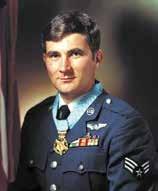
Warfare since 1900 has shifted dramatically toward a highly technological approach, starting with the invention of the airplane and tank and evolving into advanced combat systems and sophisticated ways of waging war. Jewish Americans have been involved with the American military every step of the way, serving in every major conflict. They have contributed in many positions including as frontline heroes, medical professionals saving countless lives, groundbreaking cryptanalysts, spies, engineers, scientists, and chaplains – filling vital roles that have fundamentally changed how war is fought.
For the first three years of World War I (1914-1918), the United States was officially neutral. The United States only entered the conflict in 1917 after Germany resumed unrestricted submarine warfare and the interception of the Zimmermann Telegram in which Germany offered to help Mexico to claim American territory.
Approximately 250,000 Jewish Americans served in the armed forces during the war, which represented 4.5 percent of the entire military. Tragically, 3,500 Jewish service members were killed during World War I and 12,000 were wounded.
Many were awarded medals and citations for bravery in action including four recipients of the Medal of Honor. One of the highest ranking Jewish officers was Colonel Abel Davis, who was awarded the Distinguished Service Cross while commanding the 132 nd Infantry Regiment, 33rd Division. His citation reads: “Disregarding the heavy shell and machine-gun fire, Colonel Davis personally assumed command and by his fearless leadership and courage the enemy was driven back.” After the war, he attained the rank of brigadier general.
While the years immediately following World War I saw a reduction of troops, America’s military attitude changed in the 1930s with the rise of Nazi Germany. Many Jews fleeing Europe came to the United States to build new lives, only to see global conflict ignite when World War II broke out in 1939. The United States didn’t officially join the war until the attack on Pearl Harbor in December 1941; however, many Americans, including Jewish residents, had already begun joining the armed forces in large numbers. By the time the war ended, approximately 550,000 American Jews had served in the U.S. military, contributing to the
1.5 million Jews worldwide who served in the Allied armies. This accounted for 4.23 percent of all Americans in uniform. Roughly 52,000 Jews received awards and citations for their actions in combat and dedication to service, while 11,000 tragically made the ultimate sacrifice.
The mobilization cut across professional lines, as 60 percent of Jewish physicians under the age of 45 joined the military, with many others serving as combat medics and corpsmen in the Navy and Marines. Leadership ranks also reflected this commitment, featuring 18 Jewish generals and four Jewish admirals during the war. Major General Maurice Rose, commanding officer of the 3rd Armored Division, was the highest-ranking Jewish officer in U.S. history and the highest-ranking American general killed in action in Europe. There were also three Jewish Medal of Honor recipients during World War II. Staff Sergeant Isadore S. Jachman of the 513th Parachute Infantry Regiment, 17th Airborne Division, took out two enemy tanks with a bazooka. Captain Ben Salomon was an Army dentist who singlehandedly defended his aid station. Second Lieutenant Raymond Zussman of
the 756 th Tank Battalion led a tank assault on foot while capturing and killing over 100 enemy soldiers.
More than 150,000 Jewish Americans served during the Korean War (1950–1953), with two earning the Medal of Honor. Private First Class Leonard Kravitz, a machine gunner with the 24th Infantry Division, was posthumously awarded the medal after staying at his post to protect the other members of his unit. Holocaust survivor Tibor Rubin, who had joined the 1st Cavalry Division, singlehandedly defended a hill for 24 hours. Later captured, he helped 40 of his fellow POWs survive by risking his own life to forage for food. After decades of delay, he was finally awarded the medal in 2005.
During the Vietnam War (1965-1973), approximately 30,000 Jewish service members served in the American military. Two were awarded the Medal of Honor, while others were noted for their actions in combat. Despite severe wounds, Colonel (then First Lieutenant) Jack Jacobs took command of his unit while under heavy Viet Cong fire, organizing a defense and withdrawal. He repeatedly went into exposed areas to res-
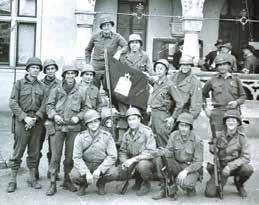
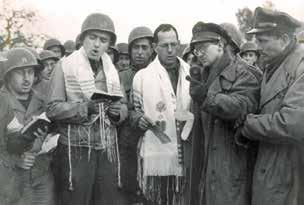
Max Fuchs and Rabbi Chaplain Sidney Lefkowitz singing at a Jewish service in Aachen, Germany, on Oct. 29, 1944. The service was broadcast on NBC radio
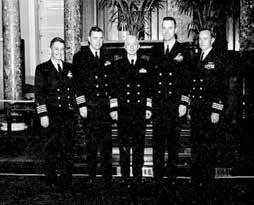
cue his men and singlehandedly fought off enemy squads that approached the wounded. Air Force Special Operator John Levitow received the other Medal of Honor for saving the entire crew of his aircraft after it was struck by a missile. Colonel Jeffrey Feinstein attained the title of flying ace when, as the weapons systems officer on an F-4 Phantom II, he shot down five enemy aircraft.
Thousands of Jewish servicemen and women served honorably during the Persian Gulf War (1990-1991) and the subsequent wars in Afghanistan and Iraq. They
served in elite units like the Navy SEALs and the Green Berets operating in all types of terrain. In the past few decades, several organizations have helped Jewish soldiers with their religious needs. These include providing kosher MREs (Meals Ready to Eat), supporting traveling chaplains and combating antisemitism.
Throughout the 20th century, several prominent Jewish figures played vital roles in supporting the war effort and shaping the modern American military. William F. Friedman was an Army cryptographer who, among many achieve -

ments, cracked the Japanese military’s most secure diplomatic cipher, Purple. Admiral Ben Moreell organized Navy engineers into the Seabees, the famed Construction Battalions. Meanwhile, Admiral Hyman Rickover became known as the “Father of the Nuclear Navy,” introducing nuclear power plants on ships that fundamentally altered the strategic balance of the Cold War.
As the United States prepares to celebrate its 250th anniversary, the legacy of the Jews who served in the military stands as a reminder of their dedication
and sacrifice. From the trenches of France to the World War II foxholes to the deserts of Iraq, Jewish Americans have answered the call to fight for freedom. Many of these Forgotten Heroes are now being remembered as their legacy is etched into American and Jewish history.
Avi Heiligman is a weekly contributor to The Jewish Home. He welcomes your comments and suggestions for future columns and can be reached at aviheiligman@gmail.com.

MASSAGE THERAPY HEALING.
Relief from muscle discomfort and pain. An escape to relax. It’s a wonderful present for yourself, friend, and family. Contact Yossi at (347) 722-0068
DU N DURT
Power & Soft Washing
We clean siding, stucco, decks, driveways, concrete, pool patios, pavers & sidewalks. Say goodbye to grime, mold & allergens!
Call/WhatsApp: 718-688-2964
Email: dundurtny01@gmail.com
THE LEATHER SHOPPE
The spot for all your custom leather Judaica. Tallis/tefillin bags, lulav and esrog bags, havdallah sets, challah covers, shtenders, pesach sets, matzah/afikomen bags. WhatsApp: (732) 523-0007 or email: theleathershoppe732@gmail.com for a full catalog. We ship.
PEACEFUL PRESENCE STUDIO
Men’s private yoga, Licensed Massage & Holistic Health Guidance 436 Central Ave, Cedarhurst Info. & free video training www.peacefulpresence.com 516-371-3715
HAIR COURSE: Learn how to wash & style hair & wigs. Hair and wig cutting, wedding styling Private lessons or in a group Call Chaya 718-715-9009
GERBER MOVING
Full Service Moving Packing Moving Supplies Local Long Distance. Licensed Insured 1000’S Of Happy Customers Call Shalom 347-276-7422
HANDYMAN AVAILABLE
For big or small jobs, Sheetrock, carpentry, painting, electrical, plumbing, install & repair appliances Call Ephraim at 347-593-4691
MANAGEMENT STAFF WILL ASSIST
you with: * Obtaining Medicaid and Pooled Income Trust
* In-home Assessments, Individual and Family Counseling
* Securing reliable home care assistance
* Case and Care Management services
Dr. S. Sasson, DSW, LCSW (718) 544- 0870 or (646) 284-6242




ZEVIZZ WOODTURNING JUDAICA Challah knifes, batei mezuzah, besamim holder, kiddish cups, havdalah candle holders, yad for sefer torah, pens, stenders, bowls and more 952-356-2228
MY MOTTO IS DON’T WAIT TO buy real estate
Buy real estate and wait Your realtor for life 516-784-0856 Alexandra at Realty Connect USA
REAL ESTATE MANAGEMENT
Services – Do Not Manage Your Properties Alone!
Contact Aliyah Suites for all your real estate management needs and affordable office space near you! (516) 366-1049
Management@aliyahsuites.com
Marc Jeret (MJ) Team Leader & Licensed Real Estate Agent



classifieds@fivetownsjewishhome.com • text 443-929-4003
CEDARHURST
Prime Restaurant Location For Lease.
For more information: Call/Text/WhatsApp Owner: (516) 206-1100
5 TOWNS - SHOWROOM/ Warehouse For Lease 4000 + 1000 SF
Can divide - Parking included Next to LIRR - No broker fee Call/text/Whatsapp: 516-206-1100
UPSCALE EVENING &
Ready-to-Wear Boutique opening on Central Ave seeks fashion-forward, friendly sales associates with retail experience. Full-time & Part-time. Text/WhatsApp 718-310-8550.
DEVELOPMENT ASSISTANT
A multi-tasker needed for general office work. The ideal candidate is someone who is detail-oriented, responsible, and can take ownership. Looking for someone who is eager to learn, and expand his/her skill set while possessing the ability to work independently and as part of a team. Experience with Excel required. Five Towns location. In-office position only, not remote. Please send resume to 5tpart.timecareer@gmail.com
BOOKKEEPER
A Five Towns Real Estate Company is seeking a full-time Bookkeeper. The right candidate must be proficient with QuickBooks and Excel. They must also be self-motivated, organized, detail oriented, reliable, and able to work independently or as a team player. Warm, frum office environment with excellent salary & benefits. Please email resume to HR@capsprop.com
CAMP STAFF FOR Early Childhood Center
The Marion & Aaron Gural JCC Early Childhood Center is hiring summer camp counselors and lifeguards. Applicants must be over 16-years-old for Summer, 2026. Please send resumes to Camp@guraljcc.org or call (516) 239-1354
REGENTS EXPERT
Tutoring regents in Algebra and Geometry A Darchei Torah instructor. Guaranteed results Text 347-491-8045 WhatsApp 347-767-1755
SEEKING ELEMENTARY TEACHERS
For current school year, starting from end of January: Seeking assistant teacher for General Studies. Candidate should have skills to take over for teachers if needed. Far Rockaway area boys’ school, M-Th, PM hours, strong support. Excellent salary. Possibility to continue for next year. Send resume to teachersearch11@gmail.com
Remote (requires in-person home visits in NY)
Support families facing serious medical or emotional challenges. Provide guidance, advocacy, and resource coordination from home or on-site. Training provided. BA or 2 years Care Management required Apply online: www. chailifeline.org/careers or email hr@chailifeline.org
Or have a passion to be?
Come join our great referral group and get access to a vast new clientele through Medicaid. JUST CALL 347-668-7886




















YESHIVA OF GREAT NECK
Boys Yeshiva High School. seeking qualified Algebra instructor to provide small group tutoring for two separate student groups. Position involves two afternoon periods daily, in a structured environment. Exceptional Compensation. E-mail recruitment@yeshivaofgreatneck.org
JOIN THE ZAREINU TEAM!
Our small, special education classes are in yeshivas and Bais Yaakov’s in Far Rockaway and the Five Towns. For the 2026-2027 school year, Zareinu is seeking:
P/T Special Education Morah (AM and PM positions) for middle school girls classes
PM Special Education Secular Studies
Teachers for middle school boys class and middle school girls class
AM Rebbe Assistants for boys classes
P/T or F/T Assistants for both boys classes and girls classes
Highly competitive salary and caring, supportive administration. Send resume to info@zareinu.org /or call Rabbi Lepolstat at 516-993-2142 for further information.
YESHIVA OF GREAT NECK
Boys Yeshiva High School. seeking qualified high school science teacher to instruct three periods of core sciences, in supportive and structured environment. Hours begin after 3:00 pm. Strong content knowledge and teacher experience required. Competitive Compensation.
E-mail recruitment@ yeshivaofgreatneck.org
5 Towns area Nursing Home management office seeking a Regional/Corporate level MDS Nurse to work in our office.
Must be an RN. Regional experience preferred. 2-3 years MDS experience with good computer skills required. Position is Full Time but Part Time can be considered. Great Shomer Shabbos environment with some remote options as well. Email: officejob2019@gmail.com
HALASHON
Text 516-303-3868 with a time slot of your choice to be careful on lashon hara. Be a part of the 1,000 people for klal yisroel!
BEIS HAMEDRASH CONG. Chasdei Uvois Oshpitzin
Talmidei chachomim are willing to learn mishnayos, say kaddish and be the shliach tzibbur to daven for the umid on the yartzeit yom hashanah of your parents or close relatives or loved ones To arrange please call Rabbi Miller 917-445-6220























By Rivki D. Rosenwald Esq., LMFT, CLC, SDS

Have I written about this before? You bet.
People do it all the time. So why not discuss it more than once?
I’m talking about making weddings.
We know it’s certainly wedding season. So, there’s plenty to talk about.
First, let’s start with the choice of venue!
Would you rather be served better food or have less traffic getting there?
Definitely, a dilemma. And one I bet that the host gives some thought to. But maybe…not enough!
Food is a highlight of getting to a wedding early. It’s the reward.
Yet, if we think that way, traffic is the punishment for going altogether. Because sitting in traffic just blunts the experience a bit.
That’s why if you live in the neighborhood where the wedding is taking place, you get almost as excited about it as when you heard that the couple got engaged.
That may seem a bit extreme. But actually, it isn’t! That’s how much people dislike traffic.
Now, here’s when things really get
dramatic: if you drove a long time and then get there to find out you’ve missed the smorgasbord, that’s a major downer. Or worse: if you arrive in time for the food to your relief but then taste it and regret you did.
Let’s get to the part that really matters. This is where two very hopeful and loving people bring G-d into the mix. This is the moment the union is addressed and blessed.
We all should make sure to be present for it: together wishing them well and great mazal.
Except, at times, we do get a bit distracted. Because who can help checking out all the outfits, watching everyone who walks down, and bopping to the jingles played as the sweet, little toddlers hobble and wobble their way to the front of the aisle.
But once the bride and groom stand there together under the canopy, doing the all-important shuckling, then that’s when things really get serious. All the women break out in Tehillim and really enhance the holiness of the moment.
Though, I honestly have no idea what
the men are doing at this point. Unless they are at the edge of their seats listening for their names, wondering if they will get called to recite one of the seven all-important brachos that consummate the union.
Then finally, once the glass is smashed, and the unison of mazal tov is shouted through the air, we usually experience –believe it or not – another traffic jam.
Attempting to leave the chuppah room is not easy. Attempting to approach where the bride and groom are still standing is even tougher.
Actually, your best bet is to stand backward, start dancing down the aisle that way, and join the group dancing the bride and groom out.
You should definitely make it out of there within the hour. And proceed to the dinner.
Meanwhile, the bride and group have a special moment together, followed by what seems like three hours of picture taking.
You are eating, talking, and … WAITING.
By the time they enter the wedding hall, you are ready to dance off all the calories you consumed waiting for them.
Then you do that dancing ritual one or two more times throughout the night. And when seated, you’re usually YELLING at the top of your lungs to be heard by the person literally seated next to you.
After that, or during that, in some cases, you walk out for a minute just to check if there’s a dessert cart in the lobby. That way, you can eat something sweet, without waiting for dessert, before heading home.
This, of course, is so important because you want to assure the beautiful new couple a sweet life – and simultaneously give respect to your neglected sweet tooth.
May all your wedding drives go quickly. May your palates be pleased. And may the blessings of simcha and bonding spread to everyone!
Rivki Rosenwald is a Licensed Marriage & Family Therapist working with both couples and individuals and is a certifie d relationship counselor. Rivki is a co-founder and creator of an effective Parent Management of Adolescent Years Program. She can be contacted at 917-705-2004 or at rivkirosenwald@gmail.com.