

Dear Readers,
There are moments when it feels like we are being squeezed from every direction.
We open the news and see a world that seems increasingly hostile to Israel and to Jews everywhere. We watch as our brothers and sisters in Eretz Yisrael continue to pay a heavy price, with soldiers risking their lives on the northern border in the ongoing battle against Hezbollah. We see Jewish communities around the world struggling with rising antisemitism, with voices that once seemed supportive growing silent — or worse, turning against us.
And then there is the pain from within.
We watch disagreements among Jews spill out into the streets. We see anger, division, and hostility between people who all carry the same heritage, the same history, and the same destiny. The sight of Jews fighting Jews is perhaps one of the most heartbreaking images of all.
It is easy to look at all these events and say they are unrelated. A political shift here. A diplomatic decision there. A conflict in another place. Separate headlines on separate days.
But there is a deeper connection.
The problem is not only what is happening around us, but what is happening among us.
When Jews are divided, when we hurt each other, when we speak about one another with contempt instead of compassion, when brothers throw punches in the streets, the cracks in our unity become visible. And when those cracks appear, the world around us seems to follow.
This is not about pointing fingers. It is tempting to look at another group, another community, another person, and say: “They are the reason for this.” It is tempting to decide that
the problem belongs to someone else.
But if the solution is shalom, then the responsibility belongs to each one of us.
Maybe it begins with something small.
Maybe it means looking at someone who doesn’t think exactly like us, dress exactly like us, or live exactly like us, and choosing connection instead of distance.
Maybe it means being dan l’chaf zechus, even when it’s difficult.
Maybe it means letting go of a grudge, forgiving someone who hurt us, or reaching out first.
We often think that the fate of the Jewish people is decided by leaders, governments, and world events. But the Torah teaches us that every individual action has power. Every act of kindness adds another thread to the fabric that holds our nation together.
And when we daven, we can focus on that as well.
When we say Sim Shalom in Shemoneh Esrei, we are not just reciting another blessing, a closing to the Amidah. We are asking for the ultimate gift: peace among Hashem’s children. Not a peace that comes only after tragedy, not a unity created by fear or pain, but a genuine connection built through love and understanding.
The greatest protection we can give ourselves is the one we have always had: each other.
May we merit to see the day when Jews everywhere recognize the strength we have when we stand together, and may that unity bring bracha, safety, and true shalom to Klal Yisrael. Wishing you a wonderful week, Shoshana

Yitzy Halpern, PUBLISHER publisher@fivetownsjewishhome.com
Yosef Feinerman, MANAGING EDITOR ads@fivetownsjewishhome.com
Shoshana Soroka, EDITOR editor@fivetownsjewishhome.com
Nate Davis Editorial Assistant
Nechama Wein Copy Editor
Rachel Bergida Shana Brecher
Lani White Design & Production
Gabe Solomon Distribution & Logistics
P.O. BOX 266
Lawrence, NY 11559
Phone | 516-734-0858
Fax | 516-734-0857
Classified Deadline: Monday 5:00PM classifieds@fivetownsjewishhome.com text 443-929-4003
PAYMENT VIA CREDIT CARD MUST BE SUBMITTED ALONG WITH CLASSIFIED ADS
The Jewish Home is an independent weekly magazine. Opinions expressed by writers are not necessarily the opinions of the publisher or editor. The Jewish Home is not responsible for typographical errors, or for the kashrus of any product or business advertised within. The Jewish Home contains words of Torah. Please treat accordingly.



Cloudy Rain



Starmer Steps Down

On Monday, U.K. Prime Minister Keir Starmer announced his resignation as the Labour Party’s leader, giving up his position as prime minister. He will leave office once his successor is chosen.
Public support for Starmer fell drastically amid rising calls from within his party for his resignation. He came under fire for his appointment of Peter Mandelson as ambassador to the United States. His party suffered setbacks in recent parliamentary elections, leading to a wave of resignations in his cabinet.
With the rise of Andy Burnham, a popular Labour politician and former Greater Manchester mayor who was recently elected to represent Makerfield in the parliament, calls for Starmer’s resignation reached a fever pitch.
Until his resignation announcement this week, Starmer claimed he would fight to remain in his post, competing with anyone else vying for Labour’s leadership position. But mounting calls for him to step down and a shortage of supporters within his party ultimately forced him to resign.
According to Starmer, his potential successors will have from July 9 to July 16 to gain enough support to compete in the party election.
Burnham, who has already declared his candidacy, is expected to easily win leadership of the party and, with it, automatically become the United Kingdom’s next prime minister as early as mid-July. In the U.K., the ruling party’s leader is automatically the country’s prime minister.
Born in 1962, Starmer grew up in a working-class family and became a lawyer, specializing in human rights cases before serving as the United Kingdom’s Director of Public Prosecutions from
2008 to 2013. He entered Parliament in 2015 as the MP for Holborn and St Pancras and rose to lead Labour in 2020, promising to move the party toward the political center after the Jeremy Corbyn era. In 2024, Starmer guided Labour to a historic landslide election victory, ending 14 years of Conservative rule and becoming prime minister. During his tenure, he tried to focus on restoring Labour’s credibility, improving economic stability, strengthening ties with allies, and presenting himself as a pragmatic alternative after years of political turmoil. However, his government soon faced criticism over economic challenges, policy reversals, internal party tensions, and declining public support.
Mayors Want to Rein In Data Center Boom

As artificial intelligence continues to expand, so does the race to build the massive data centers that power it. Now, a group of mayors from around the world is warning that the digital revolution cannot come at the expense of local communities.
Forty mayors have signed onto a new pact announced on Tuesday aimed at creating more sustainable standards for urban data center development. The initiative, launched by C40 Cities during London Climate Action Week, seeks to ensure that new facilities do not drain cities’ energy supplies, strain water resources, or undermine climate goals.
While many data centers have recently moved to rural areas where land is cheaper, city leaders say metropolitan areas are still facing enormous pressure. C40 estimates that nearly 1,700 data centers already operate within its member cities, with development expected to increase by more than 40% in dozens of those cities.
The effort began after the mayors of Phoenix, Arizona, and Melbourne, Australia, raised concerns about the impact of the rapidly growing industry. They pointed to rising electricity demand, water consumption, and competition with
housing developers for limited land.
“We found out that the challenges in every region around the world were very similar,” said Cassie Sutherland, a managing director at C40. “Our approach was to say, how do we now use a global mayoral voice to come together with the conditions under which they will accept data centers?”
Data centers are increasingly built near cities because artificial intelligence systems require fast connections and companies want facilities close to their operations. But the growth has sparked backlash in some communities worried about blackouts, higher utility bills, and the enormous amount of water needed to keep servers cool.
The pact calls for data centers to be built on underused land, powered by renewable energy and battery storage, and designed to reduce pollution, emissions, and water use. It also asks companies to capture waste heat, create local jobs, support nearby businesses, and pay for infrastructure improvements.
Phoenix Mayor Kate Gallego said data centers bring opportunities but must be managed carefully.
“We understand the importance of this innovation. It’s creating great jobs in our community,” she said. “We just want
to make sure that we get it right for our local residents and for the health of our planet.”
Melbourne Mayor Nicholas Reece warned against cities competing by lowering standards to attract investment.
“We don’t want to see a race to the bottom between cities where governments, desperate for investment, are chasing data centers on any terms possible,” he said. “We want to see a better framework in place so that the investment rush in data centers can be a win-win.”
The mayors now hope the agreement will translate into local policies that balance technological growth with the needs of the communities hosting the next generation of digital infrastructure.
Fatal Fire in India Kills 15
At least 15 people died in a fire that broke out in a building in the northern Indian city of Lucknow on Monday. The building housed a pet shop and an animation center. Witnesses described people jumping from windows and climbing down cables to escape, while rescue teams broke through a wall to save lives.

The cause of the fire is yet to be ascertained. Authorities said the building lacked emergency exits, and people got trapped inside as smoke spread.
The tragedy has renewed concerns about fire safety in India’s densely occupied commercial buildings, with several deadly blazes in recent months exposing violations of fire safety rules.

The victims included trainees and employees who were inside the building when the fire broke out, according to officials and relatives.
The pet shop was on the ground floor, while the two floors above were occupied by the animation and 3D gaming center, officials said.
Flames and smoke engulfed the building’s only staircase, cutting off the sole exit. Firefighters reached the terrace via a neighboring building and breached a side wall to begin rescue efforts.
One witness said that local residents rushed to help after seeing smoke coming from the building.
“We rescued five or six people,” he said, adding that one man jumped from the building and was seriously injured.
Relatives of some victims said a biometric entry system controlled access to parts of the premises, making it harder for people to escape when the fire broke out.
Police have filed charges over acts causing or endangering life and arrested four people in connection with the fire, officials said. Four public officials have also been suspended.
The Lucknow fire comes less than a month after a blaze at a bed-and-breakfast in India’s capital Delhi killed several people.
Toxic Caterpillars in Germany
Germany’s parks are facing an unexpected threat this summer, not from wild animals or extreme weather but from tiny caterpillars carrying a powerful toxin.
Authorities across the country are battling a major outbreak of oak proces-
sionary moth caterpillars, pests covered in microscopic, barbed hairs that can cause painful skin reactions, eye irritation and breathing problems. The hairs break off easily and can travel through the air, making the insects dangerous even without direct contact.
The caterpillars build white, silky nests on oak trees, where thousands of toxic hairs can remain long after the insects leave.
Berlin has been among the hardest-hit areas, with several districts reporting severe infestations. Some of the city’s most popular parks now resemble restricted zones, with warning tape blocking off affected areas.

In the Spandau district, officials have advised residents to stay away from the 39-acre Wilhelm-von-Siemens-Park and nearby schools, daycare centers and streets.
Special teams wearing full protective gear have been brought in to remove the nests. Workers in cherry pickers use powerful vacuum equipment normally used for asbestos removal to carefully collect the nests and prevent the dangerous hairs from spreading.
Each caterpillar can carry hundreds of thousands of toxic micro-hairs.
At Berlin’s Jungfernheide park, one of the city’s largest green spaces, workers found thousands of infested trees. A city official said the goal is not to completely eliminate the insects — which is considered impossible — but to reduce risks by treating trees near paths and busy areas.
Some crews can clear around 20 trees a day, but heavily infested trees can take much longer. One team reportedly spent an entire day removing nests from a single tree containing hundreds of them.
Residents have been advised to wash clothing after visiting affected parks and keep windows closed when possible.
The outbreak has also been reported in Hamburg and North Rhine-Westphalia. Britta Wunderwald, who created an online map tracking infestations, said she started the project after a friend’s child experienced symptoms from exposure.
“I was wondering if I can go outside and where a safe area to have a picnic was,” she said.

Experts say the increase in caterpillar populations is connected to warmer, drier conditions, which have allowed the species to spread farther north.
Urban nature expert Derk Ehlert warned residents not to touch the caterpillars or their nests.
Shooting in Montreal

A shooting in a heavily Jewish neighborhood of Montreal on Monday left three people dead, including an Israeli citizen who was remembered as a beloved member of the local Jewish community.
The victims included Michael Moshe Mizrahi, a 50-year-old Israeli citizen and active member of Montreal’s Jewish community; Montreal police officer Con-
stable Mohamed Lamine Benredouan, 34; and the gunman.
Authorities said the shooting did not appear to have targeted the Jewish community, despite taking place in Côte-desNeiges, an area home to Jewish schools, shuls, kosher restaurants and community institutions. Police said the investigation into the motive remains ongoing.
The Centre for Israel and Jewish Affairs (CIJA) identified Mizrahi as “a beloved member of Montreal’s Jewish community.” The Israeli Consulate in Montreal confirmed his death and offered condolences to his family and to the Jewish community.
According to Chabad representatives, Mizrahi regularly attended the MADA community center.
“He loves to celebrate together with everyone,” fellow community member David Kakon said. “Someone who is always smiling, always has a kind word for someone else. Loves his family, loves Israel, and loves being a Jew.”
Montreal Police Chief Fady Dagher described the incident as devastating.
“It’s a tragedy, a nightmare,” he said.
Police confirmed that Constable Benredouan was killed while responding to the incident. He had served with the Montreal Police Service since 2021.
Jewish community members in the area said the shooting caused fear and confusion but did not appear to be directed at Jews.
The Côte-des-Neiges neighborhood has a long Jewish history, becoming home to many Jewish families after World War II. The area has experienced previous antisemitic incidents, including gunfire directed at Orthodox schools in recent years, but authorities have not linked Monday’s shooting to antisemitism.
A Decade After Brexit

Ten years after Britain shocked the world by voting to leave the European Union, the political earthquake triggered by Brexit continues to reshape the country.
On June 23, 2016, British voters chose to exit the EU by a narrow 52%48% margin after more than four decades of membership. Then-Prime Minister David Cameron, who had called the referendum but supported remaining in the bloc, resigned the following day.
Since then, Britain has gone through a revolving door of leadership. Keir Starmer, the latest prime minister to confront the fallout, announced on Monday that he would step down after two years marked by economic struggles, political divisions and public frustration.
Although Brexit is no longer dominating daily headlines, experts say its impact still runs through British politics.
“The subterranean trace of Brexit still runs through Britain’s increasingly unruly politics,” noted Chris Grey, an academic who has studied the consequences of the split.
The campaign to leave the EU centered on the slogan “take back control” — promising Britain greater independence over laws, immigration and trade. Supporters argued that leaving would allow the country to chart its own course, while opponents warned of economic consequences.
Historian Margaret MacMillan said Brexit was driven by several factors, in-


20
cluding anger over immigration, frustration with EU regulations, and a sense of nostalgia for Britain’s past.
“There was this mix of nostalgia — ‘We fought alone in the Second World War,’” she said, adding that many expectations about Brexit were never clearly defined.
The process of leaving proved far more complicated than many supporters had predicted. Years of negotiations followed, with Theresa May unable to secure a deal acceptable to Parliament. Boris Johnson eventually completed Britain’s exit, but his government later collapsed amid scandals. His successor, Liz Truss, lasted only 49 days, while Rishi Sunak worked to improve relations with Europe without reversing Brexit.
Starmer promised a “reset” with the EU but avoided reopening the debate over membership.
Brexit has also transformed Britain’s political landscape. Both major parties have struggled with internal divisions, while newer movements on the left and right have gained support. Nigel Farage, a longtime Brexit campaigner, has emerged as one of its biggest political beneficiaries.
The economic impact remains a major point of debate. Britain has faced slow
growth and trade challenges, though experts note that other global events, including the pandemic and international conflicts, also contributed.
Public opinion has shifted as well. Recent polling has shown increased support for rejoining the EU, though many voters say they simply want the country to move forward.
Grey said Britain’s unresolved Brexit debate has created a lingering crisis.
“It’s a chronic thing, in this case perhaps not incurable,” he said. “But it’s just that they don’t fancy going to the doctor because they know it’s not going to be very nice.”
Ebola Outbreak in Congo

Congo’s Ebola outbreak has the largest number of confirmed cases in the first

month of any Ebola outbreak in Africa, a senior World Health Organization official announced on Tuesday.
The Bundibugyo outbreak in the Democratic Republic of Congo that has infected over 1,000 people and killed 267 was detected late. Experts say the virus had already been circulating for months before it was officially declared on May 15.
“The response needs to expand to keep pace with the expanding outbreak –this is beginning to happen,” WHO’s Abdirahman Mahamud told a press briefing in Geneva after returning from the outbreak’s epicenter Bunia last week.
The two biggest Ebola outbreaks before this one were in West Africa in Guinea, Sierra Leone and Liberia which killed 11,000 people between 2014 and 2016, and a less fatal outbreak in Congo in 2018.
Ebola cases have now been reported in at least three of eastern Congo’s crowded displacement camps. The International Organization for Migration’s Abdoulaye Wone said that at least 25 cases had been confirmed at the camps, including 14 deaths.
There have been over 20 outbreaks in sub-Saharan Africa, according to the U.S. Centers for Disease Control and Prevention (CDC).
Burial for Ex. Pres. of Zambia?

More than a year after the death of Zambia’s former President Edgar Lungu, his family has won their appeal to have his body buried in South Africa where he died. The appeal overturned a previous high court ruling that allowed the Zambian government to repatriate the corpse.
It is not clear whether Tuesday’s ruling at the Supreme Court of Appeal in Bloemfontein puts to rest a legal battle over what should happen to his remains following a long-standing feud between Lungu and his successor, President Hakainde Hichilema.
It has long maintained that, as a former head of state, Lungu should be honored in the country. The Zambian government wished to see him laid to rest
alongside his predecessors in the special presidential burial ground in the capital, Lusaka. But Lungu’s family wanted a private burial after negotiations with the government over the funeral arrangements broke down.
Last August, the South African high court in Pretoria ruled that Zambia’s government could repatriate the body and give him a state funeral, a ruling that left Lungu’s relatives visibly distraught in the courtroom.
The family appealed against the decision but, in a surprise announcement in April, Zambia’s government said Lungu’s remains had been “formally transferred” to the state by the South African court. Just a few hours later, the same South African court ordered the Zambian government to return the body until the matter went to court again.
The former president died on June 5, 2025 of an undisclosed illness aged 68 at a clinic in Pretoria, South Africa.
Lungu, who led Zambia from 2015 until 2021, had numerous rows with Hichilema, who was the opposition leader for many years before finally unseating his bitter rival. After Lungu’s death, his family said the ex-president did not want Hichilema to be at his funeral or “anywhere near” his body.
Colombia Elects Conservative Pres.

Colombia appears headed for a major political shift after outsider candidate Abelardo De La Espriella narrowly won the country’s presidential election, returning conservatives to power after four years of left-wing leadership.
De La Espriella, a 47-year-old criminal defense lawyer with no prior political experience, received 49.7% of the vote with more than 99% of ballots counted, according to preliminary results. Leftist senator and human rights advocate Iván Cepeda finished close behind with 48.7%.
The victory would mark a sharp turn from the administration of outgoing President Gustavo Petro, Colombia’s first leftist president. It also strengthens a broader rightward movement taking

place across parts of Latin America.
Celebrations erupted in cities across the country as supporters took to the streets with flags, fireworks and car horns. In Barranquilla, De La Espriella appeared before cheering crowds and declared, “Colombia, here’s your president!”
Cepeda told supporters that he would await the final review of the results but acknowledged the strength of his movement.
“We stand before the Colombian people to tell you that we are an undeniable force,” he said.
U.S. President Donald Trump, who endorsed De La Espriella during the campaign, celebrated the results online, writing, “He Won, BIG!” Secretary of State Marco Rubio also congratulated the candidate.
De La Espriella ran a campaign built around security, nationalism and promises to reverse what he described as years of decline under the left. He pledged to crack down on crime, fight corruption and restore economic growth.
His supporters were drawn to his tough message in a country still struggling with violence from armed groups, drug trafficking and widespread extortion.
“The left asked for an opportunity,” said Karlos Morales, a Barranquilla resident who voted for De La Espriella. “We haven’t seen very good results.”
Critics, however, warned that his aggressive rhetoric could threaten Colombia’s democratic institutions. De La Espriella has spoken about “crushing” the left and promised harsh punishments for opponents, leading some to compare his style to other strongman leaders in the region.
The candidate also embraced modern political tactics, using social media, artificial intelligence videos and a carefully crafted personal image. Once known for luxury suits, opera singing and celebrity clients, he reinvented himself as a populist figure wearing a soccer jersey and straw hat.
While he presented himself as an outsider, his choice of respected former commerce minister José Manuel Restrepo as vice president helped reassure some voters.
If he takes office, De La Espriella will face major challenges, including economic pressures, security threats and a deeply divided nation.
“I want to try something new,” said one supporter. “The left didn’t work.”
Explosion at Qatar’s Nat’l Gas Terminal

An explosion tore through Qatar’s key natural gas export terminal on Sunday night as workers tried to resume operations there after Iran bombed it during the war. The ensuing fire killed at least 13 people and injured at least 54 others.
The blast at the Ras Laffan industrial area could cause further chaos in global energy markets, particularly as Qatar remains one of the world’s top natural gas producers.
Qatar shut down its production after Iran’s chokehold on the Strait of Hormuz meant it couldn’t get shipments out to its clients. With Iran loosening its grip on the strait as negotiations continue over a permanent end to the war, Qatar began work to try to restart its export terminal.
On Sunday night, that work sparked an explosion and fire at the Barzan gas supply facility.
The Barzan plant had a capacity of almost 1.4 billion standard cubic feet of sales gas per day, which Qatar used primarily for local electricity generation and to power its crucial water desalination plants in the desert reaches of the Arabian Peninsula.
Qatar owns nearly all of the plant, with a small share also held by ExxonMobil.
Qatar shares its massive offshore natural gas field in the Persian Gulf with Iran. That natural gas production has made the Qatari nation wealthy. It has used that money to raise its profile worldwide through hosting the 2022 FIFA World Cup, creating the Al Jazeera news network, and funding its work as an international mediator, including the talks in Switzerland between Iran and the United States.
World Cup Tickets Snafus
Many World Cup fans have taken to social media to voice frustration over



ONE STOP SHOP
ticketing problems, including issues about tickets that were never delivered, purchases that were unexpectedly canceled shortly before matches, and failures to resolve issues involving FIFA’s ticketing platform and third-party resale marketplaces.
Most of the criticism has been directed at StubHub, a dominant player in the resale industry, although customers of other services, including SeatGeek and
Vivid Seats, have reported similar experiences.
According to interviews with fans and ticketing experts, some of these problems appear to be linked to technical failures during ticket transfers, while others may involve sellers listing tickets they did not actually possess. StubHub, however, maintains that such listings are not permitted on its marketplace.
FIFA has encouraged those seeking
source of many of the ticket transfer issues reported by customers. The company argued that FIFA’s technology systems are inadequate, criticized organizers for introducing transfer restrictions close to the start of the tournament, and noted that the governing body’s new ticketing app was released only weeks before the competition began. StubHub also accused event organizers of adopting practices that restrict competition by limiting the platforms fans can use to buy and resell tickets.

When questioned about the reported technical difficulties, FIFA reaffirmed last Wednesday that tickets purchased through its official marketplace are fully guaranteed to be delivered and transferred successfully.
Experts in the ticketing industry believe there is no single explanation for the issues fans have encountered. In some cases, the problems may be the result of technical errors during the ticket transfer process, which StubHub describes as extremely uncommon and says it is actively working to address. In other instances, observers suggest the difficulties may be linked to a familiar problem in the resale market: speculative sellers who offer tickets they do not yet possess.


resale tickets to use its official exchange platform, which collects a combined 30% fee on each transaction by charging both buyers and sellers 15%. Despite that recommendation, many fans have continued to use independent resale marketplaces, often because they are more familiar with those services, find them easier to use, or can purchase tickets at lower prices.
StubHub has pointed to FIFA as the
Most Israelis Don’t Trust Trump’s Deal
According to a Channel 12 poll, Israeli support for U.S. President Donald Trump has fallen since the unveiling of the agreement with Iran to end the war. The decline in Israeli support comes as Trump and U.S. Vice President JD Vance criticize the Jewish state’s leaders for being apprehensive about the deal, into which Israel had no input.
According to the poll, 71% of Israelis do not trust Trump to look after their interests in the deal, 13% do, and 16% don’t know. Meanwhile, 43% of Israelis believe



that Israel lost the 2026 Iran war, 41% say it ended without a clear winner, and 11% claim Israel emerged victorious in the war.

Additionally, 52% said that Prime Minister Benjamin Netanyahu’s behavior harmed Israel in the U.S.-Iran agreement, 24% said the premier’s conduct helped, and 24% were undecided.
The survey also revealed that Zionist opposition parties are leading Netanyahu’s coalition in the polls but still do not have enough support to achieve the required 61-seat majority in the Knesset.
Asked if he would endorse Netanyahu in the upcoming elections, Trump said he “most likely” would but needs to see who else is running before committing to an endorsement.
While Trump has insisted that he “likes” Netanyahu and that their friendship is strong, the U.S. president has, in recent weeks, made headlines after berating the Israeli premier for the IDF’s retaliatory strikes against Hezbollah. Using expletives, Trump has said Netanyahu is “crazy” and has “no … judgement.”
“He’s doing a very good job, but he’s got to be a little bit more rational,” Trump told the Kan public broadcaster in an interview last Thursday.
Trump then declared, “If it wasn’t for Donald Trump, Israel wouldn’t exist right now. They would have been blown off the planet,” before dismissing concerns about Iran’s uranium stockpile as “very unimportant, frankly.”
4 Soldiers Killed by Hezbollah

A Hezbollah attack in Kfar Tebnit, a village in southern Lebanon, killed four IDF soldiers overnight, the Israeli army
announced on Friday. Hours later, another attack from the Iranian terror proxy wounded five more soldiers.
One of the victims was Lt. Col. Dor Gedalia Ben Simhon, the commander of the 401st Armored Brigade’s 52nd Battalion, whose tank was likely struck by a drone or anti-tank missile, killing all four crew members. Ben Simhon was 32 years old and hailed from Kibbutz Beit HaShita in northern Israel. He leaves behind a wife and two daughters. Previously, he served in other roles in the 401st Brigade. In 2024, amid fighting with Hezbollah, he was the chief of staff for the head of the Northern Command.
The three other soldiers killed were named as Staff Sgt. Nave Habshoosh, Staff Sgt. Yoav Klein and Staff Sgt. Liav Kababia.
The tank crew had been involved in an operation to seize a fortified Hezbollah compound in the Ali Taher Ridge area. Troops now have operational control of the compound, described as one of Hezbollah’s main centers of gravity in southern Lebanon. A senior military official said dozens of terrorists were trapped inside the compound, from which Hezbollah directs fighting in the area.
After the attack, another explosive drone wounded five soldiers, including a reservist who sustained serious injuries. In response, Israel struck over 80 targets in southern and eastern Lebanon, killing dozens of Hezbollah terrorists since Thursday night.
Fighting between Israel and Hezbollah continues despite a U.S.-brokered ceasefire that came following the U.S.Iran memorandum of understanding, which, among its many stipulations, ends the war and bans Israel from operating in Lebanon, even though the Jewish state is not party to the agreement.
U.S. President Donald Trump has expressed frustration at Israel for continuing its attacks on Hezbollah. Meanwhile, U.S. Vice President JD Vance has blasted Israeli officials for their reluctance to embrace the deal, with the vice president claiming that Trump is “the only head of state in the entire world who is sympathetic to the nation of Israel at this moment in time.”
“If I was in the cabinet of the Israeli government, I might not be attacking the only powerful ally that I have anywhere left in the entire world,” Vance added. “The other thing that I would say is that over the last three months, two thirds of the defensive weapons that have protected your homeland have been built by American hands and paid for by American tax dollars.”

Framing Israel’s response as a “freakout,” Vance said in a criticism addressed to Israeli cabinet members, “What is your exact proposal? You’re a country of nine million people. You can’t just kill your way out of solving every single national security problem that you have.”
IDF Finds Hezbollah Drone Factory
The IDF recently discovered and seized an underground Hezbollah drone factory and launch site hidden beneath a mountain in southern Lebanon, showing members of the press the facility in a guided tour last week.
The tunnel, which is located beneath the mountainous village of Majdal Zoun, extends several hundred meters under the mountain and is also underneath a mosque. Hezbollah used the tunnel to assemble Iranian-made drones using smuggled parts, the Israeli military said. Around 50 UAVs with warheads were discovered in the tunnel.
The drones resembled models previously used in attacks against Israel, including the October 2024 strike on the Golani Brigade training facility that resulted in multiple fatalities. According to Israeli military officials, these unmanned aircraft generally have a range of 200 to 500 kilometers (125 to 310 miles), placing all of Israel within reach. Military analyst Fabian Hinz said the UAVs are an Iranian design known as the Qasef, which is operated by the Iran-backed Houthis in Yemen.

This is the first time that the IDF has access to fully intact Iranian drones. Israeli soldiers also discovered around eight tons of explosive material in one of the complex’s rooms.
The IDF stated that the Israeli Air Force targeted the site during the 2024 conflict with Hezbollah, striking it in an
effort to block access and render it inoperable. Military officials said that despite the attack, the militant group later worked to return the facility to service.
The Israeli army will destroy the site once scans of the tunnels are complete.
Slain “Journalists” Were Terrorists

Israel came under fire after a drone attack in central Gaza on July 10, 2025, killed Ahmed Abu Eisha, an alleged journalist for Palestine Today.
However, on June 1, nearly a year later, the truth came out. Abu Eisha wasn’t the “polite, calm, and kind,” conflict-avoiding bystander that the Committee to Protect Journalists (CPJ), of
which he was a member, portrayed him to be. At the time of his death, he was, according to the military wing of the terrorist group Palestinian Islamic Jihad, a unit commander and “Central Information Unit” operative in the Central Brigade.
The Times of Israel reviewed the hundreds of names of slain terrorists recently released by PIJ and Hamas and found that a number of them were falsely identified as journalists or civilians, with the international community slamming Israel for their killings.
Israel killed Mohammed Nasser Abu Huwaidi on December 23, 2023. He was identified as a journalist, and the Jewish state was condemned by UNESCO for his death. But, on March 19, 2026, the PIJ confirmed that he was, in fact, an operative. His name and Abu Eisha’s were promptly removed from the CPJ’s list of journalists killed during the Gaza war, but the UNESCO statement has yet to be rescinded.
Yaqoub Anan al-Bursh was another alleged journalist who was killed in November 2023. On May 10, Hamas recognized him as a member of the Abdul Raouf Nabhan Battalion of its Northern


Brigade and “one of the military media commentators.” CPJ has since removed his name, but al-Bursh is still in the International Federation of Journalists’ databases.
Likewise, CPJ removed Maysara Salah from its list after Hamas-affiliated media, on May 22, recognized him as a fighter in the Fawzi Abu al-Qara Battalion of the Northern Brigade who was a part of Hamas’s “military media” apparatus.
Similarly, Ahmed Samir Muhammad Washah, an Al Jazeera journalist who was killed by the IDF, is also a terrorist, according to the Israeli military.
“Alongside his work as an Al Jazeera photojournalist in recent years, Washah was an operative in Hamas’s military wing. In recent months, he advanced sniper attack plans and additional terrorist activities against IDF troops operating in the Gaza Strip,” the IDF said after targeting him last Saturday.
According to the Times of Israel, other eliminated terrorists have been misidentified as civilians, including Palestinian soccer player Ahmed Abu al-Atta, whom the PIJ recently identified as deputy commander of the Gaza City Brigade’s rocket unit, and Ahmed Khamis Abu Younis, a 66-year-old who served in
the Martyr Muhammad Abu Safl Battalion in the Rafah Brigade.
“Milk and Honey” Ice Cream

A new ice cream flavor from Ben & Jerry’s Israel is aiming to be more than just dessert.
Called “Milk and Honey,” the flavor is being marketed as the company’s “most Israeli flavor ever,” featuring ingredients sourced from communities in southern Israel that were among the hardest hit during the Oct. 7 attack and the war that followed.
The name comes from the Torah’s description of the Land of Israel, and the ingredients were chosen to highlight local recovery efforts. The milk and cream come from the dairy at Kibbutz Alumim,

a Gaza-border community that was attacked by Hamas terrorists on Oct. 7, 2023. The honey comes from beehives at Kibbutz Yad Mordechai, while chocolate fudge pieces shaped like Stars of David are handmade at a social enterprise in Beersheba that employs people with disabilities.
Even the pint’s artwork has a southern Israeli connection. The packaging features “Fields of Light,” a painting by southern Israeli artist Rivi Doron-Gerloy, who died in a car accident in Miami last year.
Ben & Jerry’s Israel said proceeds from sales will support rehabilitation and educational programs in the south.
The launch comes years after a bitter dispute between Ben & Jerry’s American parent company and its Israeli operation. In 2021, the Vermont-based company announced it would stop selling its products in Israeli communities in Judea and Samaria, saying such sales conflicted with its values.
The decision sparked anger in Israel and led to a legal battle. In 2022, Unilever sold the Israeli business to Avi Zinger, the longtime Israeli licensee, separating the local operation from the American company. Under the agreement, Ben & Jerry’s products continued to be sold in Israel under local ownership, while the Vermont-based company said it would no longer profit from those sales.
the legacy of Obama’s presidency while also functioning as a center for community engagement, cultural programming, and public life along the shores of Lake Michigan. The center occupies 19.3 acres of Jackson Park.
At the grand opening, the Obamas touted their museum as a symbol of democracy and liberal values.
“A lasting legacy isn’t in a war, or a name on a building or the number of zeros in a bank account. It’s about the difference we make in one another’s lives,” the former first lady said, indirectly criticizing President Donald Trump and noting her husband’s Nobel Peace Prize.
“With grace and class and cool, you made the hardest job in the world look like a walk in this beautiful park,” she added, touting her husband’s “stubborn optimism.”
The former president, who was moved to tears by Michelle Obama’s speech, spoke soon after.
“I hope this center will serve as an affirmation of just how special, how precious, our democracy truly is and remind us what we can achieve when we embrace our shared responsibilities as citizens,” he said.
Obama Presidential Center

The Obama Presidential Center, a museum and civic center in Chicago focused on Barack Obama’s two terms as president, held its grand opening last Thursday, with the former president and former first lady Michelle Obama unveiling the $850 million museum complex.
The facility, which includes a concert hall, library, gardens, and an NBA-sized basketball court, was created to preserve
Malia and Sasha, the president’s two daughters, were also in attendance, as were former presidents Bill Clinton, George W. Bush, and Joe Biden, and their wives, former Secretary of State Hillary Clinton, Laura Bush, and Jill Biden. Former Vice President Kamala Harris and her husband, Doug Emhoff, and former U.S. House Speaker Nancy Pelosi also attended the celebration, which lasted for three hours. Former German Chancellor Angela Merkel and former Canadian Prime Minister Justin Trudeau were among the foreign dignitaries who attended.
Some 750,000 to 1 million people are expected to visit the Obama Center each year. The center was funded privately through the nonprofit Obama Foundation.
A Ban on HorseDrawn Carriages?
When Romanch Mahajan, an 18-yearold tourist from India, died last week after jumping from a driverless horse carriage that lost control in New York City’s Central Park, city leaders called for a ban on horse-drawn carriage rides.
Over 150 years ago, horse-drawn carriage rides were introduced to Central Park. While Mahajan is the first person


to die in an incident related to horse carriage rides in New York City, seven other related incidents have occurred in the past 13 months.
“The record is undeniable: crashes, runaways, horse deaths, injuries, and now a devastating loss of human life,” said Edita Birnkrant, who leads New Yorkers for Clean, Livable, and Safe Streets, an animal welfare group.
Some have called for bans due to how
the horses are treated, but the fatal incident on Thursday has raised concerns about the risks the industry poses to humans.
“We’re absolutely gutted and stunned by this tragedy,” said Alexander Kemp, a vice president with the Transport Workers Union Local 100, which represents carriage drivers and owners. “We have shuttered the stables and ceased operations today while we have extensive in-
school, jumped out of the carriage to save his mother, who had fallen out, according to Mahajan’s father. While his father, mother, and younger brother sustained minor injuries, Mahajan struck his head on the ground before the carriage hit a second horse-drawn vehicle and ultimately overturned.

Next month, the city council will consider a bill to ban horse carriages and assist drivers in finding new jobs, according to the legislative body’s speaker, Julie Menin.
Zohran Mamdani, the mayor of New York City, also expressed support for the ban.
Alan Greenspan Dies at 100

Alan Greenspan, who served as the Fed chair for over 18 years, passed away from complications from Parkinson’s disease on June 22 at age 100. He leaves behind his wife, Andrea Mitchell.
Greenspan served as the chair of the Federal Reserve under four presidents, starting in 1987, wielding unprecedented power. In his prime, the financial world revered him as a Washington celebrity and genius economist, analyzing his every word and action.
ternal discussions of safety protocols and how they can be improved.”
The driver in the incident was suspended indefinitely, and the horse will be retired, the union said. According to the union, the driver got off the carriage, against protocol, to take a picture of the passengers.
Mahajan, an Indian citizen who was visiting New York with his family on a trip celebrating his graduation from high
His libertarian, anti-regulation stance and expertise in navigating the U.S. economy helped the United States avoid several financial crises. However, his decision against regulating mortgage lending practices wound up contributing to the 2008 financial crisis, which erupted in his wake.
Born in New York on March 6, 1926, Greenspan developed a love for numbers and data early in life. He first entered politics in 1967, serving as an economics advisor during Richard Nixon’s 1968

presidential campaign. From there, he served in President Gerald Ford’s administration, and then under President Ronald Reagan, salvaging the finances of the U.S.’s struggling public pension program.
On August 3, 1987, he was confirmed as chair of the Federal Reserve, initially serving under Reagan.
“History tells us regulators cannot identify the timing of a crisis or anticipate exactly where it will be located or how large the losses and spillovers will be,” Greenspan said in 2010 while testifying before the Financial Crisis Inquiry Commission.
“When you’ve been in government for 20 years, as I have been, the issue of retrospective and figuring out what you should have done differently is a really futile activity,” he continued. “My experience has been, in the business I was in, I was right 70 percent of the time, but I was wrong 30 percent of the time, and there are an awful lot of mistakes in 21 years.”
In an apparent bid to avoid rocking the markets or not showing the Fed’s hand until it was time, Greenspan would cloak his utterances in language that left the sharpest minds — including those of contentious members of Congress — scratching their heads.
“His long, convoluted sentences seem to take away at the end what they have given at the beginning as they flow to new levels of incomprehensibility,” The Washington Post’s Bob Woodward said in his 2000 biography “Maestro: Greenspan’s Fed and the American Boom.”
After his retirement from the Fed, Greenspan explained his strategy for using perplexing language, dubbed by others “Fedspeak.”
“It’s a language of purposeful obfuscation to avoid certain questions coming up, which you know you can’t answer, and saying ‘I will not answer’ or basically ‘no comment’ is, in fact, an answer,” he said in a 2007 interview on CNBC. “So, you end up with when, say, a congressman asks you a question, and [you] don’t want to say, ‘no comment,’ or ‘I won’t answer,’ or something like that. So, I proceed with four or five sentences which get increasingly obscure. The congressman thinks I answered the question and goes on to the next one.”
Alan, who was Jewish, was born in New York’s Washington Heights. His father was a stockbroker and financial analyst.

Exercise for a Young Brain

Want to keep your brain feeling young? A new study suggests the answer may be as simple as moving more.
Researchers studying inactive adults found that regular aerobic exercise during midlife can make the brain appear biologically younger. After one year of exercise, participants’ brain scans showed improvements that suggested their brains had aged more slowly, while those who did not exercise showed signs of normal aging.
The study followed 130 men and women, mostly in their 40s, who rarely exercised before joining the research. Half began a supervised fitness program that included activities such as brisk walking, jogging and cycling. Participants worked out enough to reach about 150 minutes of exercise per week.
After 12 months, the exercising group’s brains appeared, on average, about seven months younger than they had been at the beginning of the study.
“The brain is modifiable, and exercise is a great way to modify it,” said Kirk Erickson, a neuroscientist and senior author of the study.
Researchers say midlife — roughly between ages 35 and 55 — may be a particularly important time to focus on brain health. Exercise during these years could potentially change the long-term path of brain aging.
The findings build on years of research showing that physical activity benefits the brain. Earlier studies found that aerobic exercise can encourage the growth of new brain cells, improve blood flow and strengthen connections between brain regions.
In one landmark study led by Erickson, older adults who walked regularly for a year actually increased the size of their hippocampus, the part of the brain responsible for memory that often shrinks with age.
Scientists measure “brain age” by looking at factors such as gray and white matter, blood vessels and other structural details visible on MRI scans. A young-
er biological brain age has been linked with stronger cognitive health and a lower risk of dementia.
Still, researchers say there are unanswered questions. The study did not prove exactly why exercise changes brain age or whether the improvements directly translate into sharper memory or lower dementia risk.
Jennifer Heisz, a neuroscience researcher at McMaster University, said the research was important but noted that brain age alone does not reveal which specific areas changed.
Future studies will examine what types of exercise work best and whether similar benefits can be seen in older adults.
For now, researchers say the message is clear: regular movement remains one of the strongest tools available for protecting brain health.
“Outside of pharmaceutical approaches,” Erickson said, exercise appears to be “the most robust” way to help keep the brain youthful and resilient.
Coast Guard Crash

A Coast Guard helicopter crashed during a routine training flight in southeast Alaska on Monday, injuring four crew members on board, according to officials.
The MH-60 Jayhawk helicopter crashed outside Sitka, Alaska, in a sparsely populated area near Harbor Mountain.
Rescue crews from Sitka Fire and Rescue responded to the scene at around 11 a.m. and transported all four injured crew members to Mt. Edgecumbe Medical Center for treatment. Thankfully, there were no fatalities.
“We are incredibly relieved our crew members survived with only minor injuries,” Rear Adm. Bob Little, commander of the Coast Guard’s Arctic District, said in a statement.
It is unclear what caused the crash. The incident remains under investigation.
The Coast Guard crash comes after multiple other aircraft collisions this month.

A business jet crashed on a highway in Laredo, Texas, last Tuesday night, killing one person. A B-52 crashed on June 15 during a test flight at Edwards Air Force Base in California, killing all eight people aboard. The day before, 12 people were killed when a plane on a skydiving outing in Missouri crashed.
Ohio: Social Media Needs Parent’s Consent

Ohio can implement a law requiring social media companies, including Meta Platforms’ Instagram, to obtain parental consent before allowing children under 16 to use their platforms, a U.S. appeals court ruled last week.
A 2-1 panel of the Cincinnati-based 6th U.S. Circuit Court of Appeals over -
turned a lower-court ruling that had put the law on hold at the request of the tech industry trade group NetChoice. The panel found the law did not violate free speech protections under the First Amendment of the U.S. Constitution.
NetChoice said in a statement that the court’s decision threatens the online privacy and constitutional rights of Ohio residents, but the group “remains fully confident that this unconstitutional law will ultimately be struck down permanently.”
Ohio Attorney General Andy Wilson in a statement said the decision “gives parents the tools to be involved and provide oversight.”
The ruling comes as governments around the world, including in Australia, move to restrict children’s access to social media, reflecting growing concern among lawmakers about the platforms’ effect on young people’s health and safety.
The Ohio law, known as the Social Media Parental Notification Act, was passed by the state’s legislature in 2023 and took effect in January 2024, only to be quickly blocked from being enforced by U.S. District Judge Algenon Marbley.
The law requires operators of websites that can be reasonably anticipated to be accessed by children under 16 to verify their age. It provides an 11-factor

list to determine whether a website falls within that definition, along with certain exceptions.
NetChoice, whose members include TikTok, Alphabet’s YouTube, and Facebook and Instagram-owner Meta, had argued that the law was unconstitutionally vague and improperly restricted children’s access to content protected by the First Amendment.
But U.S. Circuit Judge Eric Clay, writing the lead opinion, said that while the law does place some burden on protected speech and limits how social media companies prefer to distribute their content, it was narrowly written to address Ohio’s compelling interest in protecting children.
“At bottom, the Act imposes a parental consent requirement,” he wrote. “That requirement constitutes a marginal burden that precisely targets the multi-faceted problem that Ohio has identified: Children’s unsupervised assent to terms and conditions for use of platforms that take advantage of and harm them.”
Reflecting Pool Woes

National Guard members and U.S. Park Police were seen patrolling the perimeter of the Lincoln Memorial Reflecting Pool on Monday, as questions continue to swirl around a troubled renovation project that has drawn national attention ahead of America’s 250th anniversary celebrations.
The increased security presence comes as the Trump administration faces a self-imposed deadline to repair damage to the pool’s newly installed liner, part of a more than $14 million refurbishment project. Officials say the work was intended to restore and enhance the iconic site on D.C.’s National Mall, long affected by recurring algae problems.
President Donald Trump said over the weekend that authorities had made “multiple arrests” in connection with what he described as deliberate damage to the installation. He said that individuals had poured fertilizer into the water and used a box cutter to cut the lining.
At a Monday event, Trump said the
situation was the result of vandalism rather than maintenance issues.
“I can’t help it if somebody goes in with a knife and starts hacking it up,” he said, adding that five people had been arrested and others were under investigation.
Contractors have reportedly been using chemical treatments and ozone nanobubbles in an effort to control a persistent algae bloom that returned shortly after the renovation was completed.
The Reflecting Pool, known for its long history of algae growth due to shallow water and environmental conditions, briefly turned a vivid green in recent weeks, with sections of the new liner appearing to peel away. On Monday, additional fragments were seen floating in the water.
The White House says repair efforts will continue immediately, though no firm timeline has been given as the investigation and cleanup efforts proceed.
A Lost Art

French drug police thought they were walking into a routine narcotics investigation. Instead, they uncovered a very different kind of “high”: a priceless Picasso.
During a raid on a home in Ormessonsur-Marne, a suburb southeast of Paris, officers from France’s narcotics brigade discovered a stolen Picasso painting believed to be worth between €12 million and €15 million.
The artwork, which had never been publicly reported stolen, was found during a search connected to a suspected drug case. Police said the painting is an authentic Picasso, and reports indicate it may be one of the artist’s 1937 portraits of Marie-Thérèse Walter.
The investigation took an even more surprising turn when police arrested a 37-year-old man who worked as a security guard at a company that stores valuable artwork. The guard allegedly admitted to stealing the painting from the depot, claiming he wanted to expose

weaknesses in the company’s security system.
Well, he certainly proved his point.
The raid also uncovered 17 kilograms of cannabis, about €200,000 worth of designer clothing, and €7,000 in cash. Authorities charged the man with theft and alleged involvement in drug trafficking. Three others were also arrested as the investigation continues.
The Picasso had been stored privately for a Singaporean collector who owned the piece.
For now, the masterpiece is back in the hands of authorities. As for the security guard? Well, he definitely painted himself into a corner with this heist.
Slow and Steady

In a world obsessed with speed, one island resident has spent nearly two centuries proving that taking it slow has its advantages.
Jonathan, a Seychelles giant tortoise believed to be 194 years old, has been honored with Guinness World Records’ prestigious ICON award.
Talk about a long-term achievement. Jonathan has been winning the race against time one tiny step at a time.
Born around 1832, Jonathan is the oldest known living land animal — and the oldest turtle ever recorded. The legendary reptile has called Saint Helena, a remote island in the South Atlantic
Ocean, home since arriving at the Governor’s residence in 1882.
Back then, Jonathan was only a young 50-year-old tortoise. He was brought from the Seychelles as a gift for the incoming governor and has since witnessed 31 governors come and go. While politicians have had their ups and downs, Jonathan has remained steady as a rock — or perhaps a very old shell.
Saint Helena Governor Nigel Phillips said the island’s residents have long viewed Jonathan as part of their identity.
“Generations” of islanders have grown up knowing Jonathan, he said, adding that the tortoise is “truly special” to the community.
The honor comes after Phillips officially recognized Jonathan’s birthday as December 4, 1832, in 2022. Despite losing his eyesight and sense of smell, Jonathan remains remarkably healthy. Scientists are even studying his DNA, hoping his genetic secrets may reveal clues about longevity.
After nearly 200 years, Jonathan isn’t just old. He’s a living piece of history who has mastered the art of taking life at his own pace.
Age Hoax

In a case that has left authorities doing double takes — and recalculating ages — Brazilian police have arrested a 38-year-old woman accused of success-

SHEKTER DESIGNS
fully passing herself off as a 12-year-old girl for more than a year.
Amanda Maria Souza de Oliveira is charged with fraud and false identity offenses in the southern state of Santa Catarina after allegedly orchestrating what investigators are calling an unusually “youthful” deception.
For nearly 16 months, Oliveira lived with a couple in Joinville who believed they had taken in a vulnerable child. Her reported lifestyle was, fittingly, child’s play: a bedroom filled with toys, childsized furnishings, and even a birthday party celebrating her supposed 12th year.
Authorities say the arrangement was no modest con. Public prosecutor Viviane Soares described it as an “elaborate fraud scheme involving the creation of a fictitious identity and emotional manipulation.”
According to reports, Oliveira first met the couple at an evangelical church, introducing herself as “Gabrielle,” initially claiming to be 18 and in need of help. The story then reportedly shifted — she later said she was 11, had been abused, and was forced into hormone treatments by her father. She allegedly convinced the couple not to formalize any adoption or enroll her in school, warning it could expose her to danger.
It all began to unravel when a visiting relative grew suspicious. A quick online search revealed prior allegations involving similar schemes, suggesting this was not Oliveira’s first time playing a role far younger than her ID suggested.
Police say earlier cases date back years, including one in which she allegedly went to a police station claiming to be a 12-year-old victim of abuse while already in adulthood. Investigators are now examining whether a pattern of impersonation spans multiple Brazilian states.
man has taken things to a whole new volume.
Joseph McGrail-Bateup, a professional air conditioner cleaner from Canberra and honorary town crier, has officially been named the world’s loudest person after unleashing a record-breaking shout that registered a staggering 122.4 decibels. His winning word? A simple, unambiguous “NOW.”

A short word, but apparently powerful enough to compete with chainsaws, jet engines, and the sound of a very enthusiastic ambulance.
The previous record — a still ear-splitting 121.7 decibels — was held since 1994 by a Northern Ireland teacher who shouted, ironically, the word “quiet.”
McGrail-Bateup, 58, admitted the attempt was anything but silent preparation.
“There’s no way to practice it,” he said, noting that it took seven attempts on the day just to land the perfect blast. “My voice was shot… it was husky. It was terrible,” he added.
Still, he’s keeping things modest, preferring to be called the “world’s loudest man” rather than loudest person. In a rare diplomatic twist, the previous record-holder retains her title as loudest woman. Everyone gets to keep their volume setting.

Videos reportedly linked to past victims show her acting childlike, sometimes using baby bottles and pacifiers, a performance, authorities say, that blurred the line between deception and disturbing theatrics.
Her lawyer has requested a psychiatric evaluation, and a judge has suspended proceedings until her fitness to stand trial is assessed. Oliveira remains in custody.
Surely this is a story that doesn’t age well.

World’s Loudest Voice
In a world where everyone is trying to get a word in edgewise, one Australian
McGrail-Bateup’s journey into booming vocal history began when he became Canberra’s official town crier in 2017 — a role that sounds like it should come with a trumpet and cape, and, in his case, kind of does. Known ceremonially as “Lord Joseph,” he now regularly bellows announcements at fetes, school fairs, and car shows.
He previously proved his vocal chops with a 98-decibel “Oyez, Oyez, Oyez,” earning guild honors before leveling up to world-record territory. Preparation for the attempt took place in a Canberra studio, under the watchful ear of an acoustic engineer.
McGrail-Bateup understands that he may not always be the loudest person in the room.
“Records are meant to be broken,” he noted. Preferably, though, not NOW.


Around the Community
Yeshiva Ketana of Long Island Eighth Grade Graduation












Repairing the World, One Family at a Time
Graduating Touro Social Work Student Honored with Tikkun Olam Award for Leadership, Compassion, and Community Impact
When Touro College Graduate School of Social Work honors its graduates each year, the Tikkun Olam Award stands apart. Rooted in the Jewish value of “repairing the world,” the award recognizes a student whose work not only reflects academic excellence, but also a deep commitment to strengthening families and communities during times of vulnerability and change.
This year’s recipient—Shira Greenberger, a social work student graduating with a 4.0 GPA and induction into the Phi Alpha honor society—has embodied that mission in both her professional and personal journeys.
“She’s a leader. A strong, grounded person,” said Elhanan Marvit, professor and director of program operations. “People gravitate to her. We want to nurture leaders who can step up when families face shocks or disruptions and help them reorient so they don’t fall apart. That’s exactly what she does.”
Unconventional Path
Greenberger’s path to social work was not conventional. With a B.A. in English literature from Touro in 2003 and nearly two decades as a high school teacher, she initially found her calling in the classroom. At SKA High School, she taught English, coached academic teams, and advised the literary magazine, often taking on leadership roles that extended well
beyond teaching—including coordinating the school’s successful Middle States accreditation.
“I fell into teaching by accident,” she said. “But I stayed because I loved working with teens and building something meaningful.”
Over time, she began to feel pulled toward a different kind of service—one that addressed the complex and often hidden struggles within the community. That calling intensified through her involvement with Amudim, a nonprofit organization addressing abuse, addiction, and mental health challenges in the global Jewish community. As a writer and advisory board member, she helped translate sensitive casework into narratives that could raise awareness while protecting confidentiality.
“I’ve always been drawn to the difficult spaces—the places where people don’t always want to look,” she said. “What mattered to me was approaching those situations without judgment and with genuine empathy.”
That perspective led her to another organization supporting observant Jewish families navigating complex issues. As director of operations, she serves as the first point of contact for families in crisis—often answering calls late at night from individuals grappling with fear, confusion, or isolation.
“People reach out when they’re at a
very vulnerable moment,” she said. “Our goal is not to tell them what’s right or wrong. It’s to help them stay connected— as parents, as families—while respecting their values and realities.”
“She’s doing clinical work in the community with observant families, helping them navigate incredibly sensitive situations,” Marvit noted. “That requires resilience, emotional intelligence, and leadership—all qualities that define the Tikkun Olam Award.”
Life Experiences Shape Approach
Greenberg’s life experiences helped shape her approach. She married young, raised three children, and navigated a decade as a single mother before remarrying and blending families.
“Being a single mom taught me resilience and responsibility,” she said. “It also gave me a deeper understanding of how complex family life can be—and how important it is to approach people with compassion rather than judgment.”
That philosophy guided her decision to pursue her MSW, while continuing to work full-time. “I knew I wanted to be in a healing profession. The work I was doing called for clinical skills, and I wanted the training to support families in the most effective way possible,” she said.
At Touro, she found both academic rigor and a supportive environment. She also became a UJA fellow and completed Mental Health First Aid USA certifica-

tion, further strengthening her ability to respond to individuals in crisis. Throughout, she successfully balanced coursework, leadership responsibilities, and family life.
That balance is part of what makes Greenberg exceptional, said Marvit.
“Leadership isn’t just about titles. It’s about showing up consistently, with integrity and compassion, even when the work is hard.”
For Greenberger, that commitment is rooted in a simple principle: “It’s about being the best version of yourself—for your family, for your work, for the people you’re trying to help,” she said. “If I can help people find empathy—for themselves and for each other—that has a ripple effect. It goes from one person to a family, to a community, to the next generation,” she said.
The Pre-1A Chumash Mesiba at Siach Yitzchok
Caps, Gowns and ...
Graduations are celebrations.
They celebrate accomplishments, mark milestones, and commemorate the culmination of years of hard work. They are bridges from one stage of life to another, moments of pride for students, parents, and teachers alike.
But for those sitting in the audience, watching the graduates march down the aisle in matching caps and gowns, there is sometimes a lingering question:
Have these young women truly absorbed the lessons they were taught?
Have years of classes, conversations, and experiences translated into something lasting? Into kindness? Into sensitivity? Into humility, compassion, and genuine concern for others?
Or is graduation simply the pageantry we have all come to expect, a beautiful ceremony marking the passage of time?
What if there were a way to know?
What if, at the graduation itself, the graduates could demonstrate beyond any doubt that they had internalized every message their school had sought to impart?
What if they embodied empathy over ego, friendship over popularity, dignity over selfinterest?
What if they instinctively chose kindness, protected another's feelings, and placed someone else's comfort ahead of their own moment in the spotlight?
Then you would have witnessed the graduating class of 2026 at Torah Academy for Girls, Machon Sara High School.
But to understand what happened at graduation, one must go back a year.
Last year, the girls made a decision. Instead of dividing themselves into groups and cliques, they would become one group. One class.
They designed matching knapsacks. Suddenly, no girl's bag stood out from another's. Walking through the halls, they looked alike, but more importantly, they felt alike. The shared symbol fostered a
remarkable sense of camaraderie. The boundaries that often separate teenagers softened. The grade became a family.
That spirit carried them throughout their senior year.
Then, shortly before graduation, the girls learned that one of their classmates, who had been unwell, would be able to attend the ceremony after all.
There was only one complication. She would have to wear a mask.
For most people, that might seem like a minor inconvenience. But for a young woman attending her graduation, after fourteen years of anticipation, it felt different. Everyone else would be radiant and smiling, their faces visible in photographs that would be cherished for decades.
She would stand apart.
And then something remarkable happened. The night before graduation, messages quietly made their way from girl to girl.
No faculty member suggested it.
No administrator organized it.
There was no committee.
Just a simple idea, passed among friends who understood instinctively what mattered.
And when the graduates marched down the aisle the next day, dressed in their caps and gowns, hair curled, crimped, and coiffed, every single one of the 109 graduates was wearing an identical mask.
Suddenly, nobody looked different.
Nobody stood out.
Nobody stood alone.
The one girl who needed a mask was no longer the girl wearing a mask. She was simply one among her classmates.
There is a
famous moment in the Torah when Rachel Imeinu gives over the signs to Leah Imeinu so that her sister would not be embarrassed.
These young women modeled her behavior. Rachel Imeinu gave up her veil for another.
These girls put one on.
They willingly concealed their own smiles, their own faces, on one of the most photographed and anticipated days of their lives, all so that a friend would never feel self-conscious for even a moment.
It was a small gesture.
It was an enormous gesture.
And in that moment, every question about whether these girls had learned the lessons their school sought to teach was answered.
Yes, they had learned about caring.
Yes, they had learned about friendship.
Yes, they had learned about sensitivity, generosity of spirit, and putting another person's feelings before their own.
Not because they could recite those values.
Because they lived them.
As I sat at the Machon Sara graduation, I watched 109 young women march proudly into the future.
Caps. Gowns. And masks.
And I could not have been prouder of them.

- A Proud TAG Parent


Mazal tov to the YCQ classes of 2034, 2035, and 2036 on their graduations from 3K, 4K, and Kindergarten respectively
Spectacular YCQ Class of 2026 Commencement
On Monday evening, June 15, Yeshiva of Central Queens hosted its annual commencement for the Class of 2026 at the Queensborough Performing Arts Center.
Nearly 100 students, dressed in caps and gowns, kicked off the evening with a procession down the aisles, as proud family members looked on. Rabbi Ophie Nat led the packed auditorium in renditions of the Star-Spangled Banner and HaTikvah, with musical accompaniment by Morah Tali Brody.
Over the course of the evening, Principal Rabbi Mark Landsman and Mrs. Melissa Cohen, Associate Principal of General Studies K-8, addressed the graduates. They offered words of Torah, encouragement, and praise for the students as they take their next steps.
The student awardees each took on meaningful roles as well. Ayala Kenigsberg and David Inoyatov, the two Salutatorians, recited the Tefilah L’Shlom
MTA
Graduation
Every graduation marks an ending and a beginning. At MTA, the graduation of the Class of 2026 was also something more: a celebration of Torah growth, student leadership, and the lasting legacy of a yeshiva education.
The evening opened with the MTA Chorus performing “The Star-Spangled Banner” and “Hatikvah,” setting a tone of gratitude and purpose. Rabbi Shimon Schenker, Menahel, welcomed graduates, families, rebbeim, faculty, and friends to a night that reflected the heart of the MTA experience.
One of the most powerful themes of the evening was the deep connection between generations of MTA talmidim. Rabbi Dr. Ari Berman ’87, President of Yeshiva University, welcomed the crowd and shared words of inspiration with the graduates. Rabbi Daniel Konigsberg ’05, principal, delivered a message to the
HaMedinah and the Mi Sheberach for the IDF. Orrin Amsalem and Shalom
Peled, Valedictorians, delivered powerful speeches reflecting on their school experience and the path ahead. Samuel Abramov, recipient of the Keter Shem Tov award, led a tefillah for the United States and Maytal Samouha, also a Keter Shem Tov honoree, recited Tehillim.
Mrs. Esther Lowinger, Junior High School (JHS) General Studies Assistant Principal, recognized the students who achieved High Honors, and JHS Principal Rabbi Stephen Knapp introduced the respective performances by the boys and girls. This year’s student presentation focused on the value of Hakarat Hatov.
Led by Morah Mashie Kapelowitz, Director of K-8 Judaic Studies, the talmidot detailed the various brachot in their personal and communal lives to be thankful for, including attending YCQ and the establishment of Medinat Yisrael. As the United States celebrates its 250th birth-
of Class of 2026
graduates, encouraging them to carry the lessons, values, and relationships of MTA with them into the next stage of life.
The program also gave the graduates themselves a central voice. Valedictorian Naftali Frank and salutatorian Ethan Frankel reflected on their years at MTA, sharing memories, lessons, and appreciation for the friendships and growth that shaped their high school experience. A video presentation gave families and guests the opportunity to look back at the moments, milestones, and energy that defined the Class of 2026.
A highlight that set the evening apart was the siyum, introduced by Rabbi Michael Taubes ’76, Rosh Yeshiva. The siyum on Maseches Kesuvos, completed by Natan Rosman, brought the focus of the evening back to the heart of MTA: serious Torah learning, personal commitment, and the pride of reaching mean-

day, they also expressed gratitude for the opportunities the country has afforded its Jewish citizens.
The presentation was interspersed with meaningful and relevant songs, including “Tov Lehdot,” that were beautifully sung by the talmidim. To conclude, the lights went out and black lights turned on, girls wore white lights and signed “Oseh Shalom,” a message for peace in the future.
Diplomas were then awarded. During
the presentation, a spectacular slideshow created by Mrs. Jen Jaffe showcased photos of the students from nursery school to the present day, alongside heartfelt messages of gratitude from every student about their YCQ experience. A collation back at YCQ concluded the memorable night. Graduation was an exclamation point to concluding a wonderful year and to recognize all of the amazing talmidim and talmidot of the Yeshiva of Central Queens. Mazal tov!

ingful goals in the Beis Midrash.
The evening honored a class that grew in Torah, developed as leaders, built lifelong relationships with rebbeim and teachers, and became part of a larger mesorah that continues well beyond their four years in high school.
As the Class of 2026 moves forward to yeshiva, college, and beyond, they car -
ry with them more than diplomas. They carry the values, friendships, learning, and sense of purpose that shaped their years at MTA.
Mazal tov to the graduates and their families. MTA looks forward to seeing the many ways the Class of 2026 will continue to lead, grow, and make an impact.



Smiles and Friendships – Opening Day at Camp Machaneh Yisrael











The kindergarten Alef Bais Siyum at Siach Yitzchok

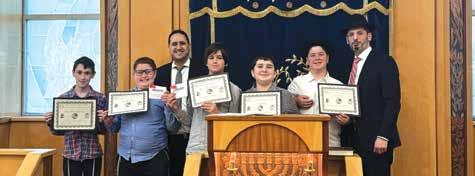
YOSS Mechina Awards Achievements


YOSS Mechina celebrated the end of the school year with shiur-wide siyumim and special awards assemblies recognizing Students of the Year, Book Club participants, Robotics
team members, and Invention Convention honorees, highlighting a year of academic achievement, creativity, and growth.

The Question Every Father Thinks He’s Answered (But Hasn’t)
By Monet Binder, Esq.
There are two kinds of dads. The first shows up. He never misses a game, helps with school projects and homework, loves his family fiercely, and works very hard to provide for them. The second kind does all of that and he also has a plan. He understands that protecting his children means securing
their future, even if he isn’t there to do it himself.
The Answer in Your Head Doesn’t Count If, chas v’shalom, something happened tonight, who would raise your children? Most parents have an answer in their head, maybe even a verbal agreement with a sibling or some other trusted person. Here’s the harsh truth:

the law doesn’t recognize conversations. Without legally documented guardian instructions, a judge who has never met you, your spouse or your children will decide your children’s future and who raises them. If your wishes aren’t written down properly, your family isn’t protected.
The First 72 Hours
Nobody Plans For Most parents focus on what happens if they pass away. But what happens if you’re simply unavailable? If you were hospitalized today, who has the legal right to pick your children up from school? Who can consent to medical treatment? Who can care for them? Standard wills don’t help here; they take weeks to process. A properly designed Estate Plan addresses both the long-term and the immediate emergencies that families often overlook.
The Financial Blind Spot
Many parents assume that leaving everything to their children in a simple will is enough. It’s not. Leaving assets to minor children through a basic will means the court controls the money until they turn 18. On their 18th birthday, they get everything outright. Most parents wouldn’t hand a teenager unrestricted
access to their life’s savings. Another issue: life insurance, retirement accounts and many other financial accounts bypass your will entirely. If your legal documents and financial accounts aren’t coordinated, your plan will fail.
The Bottom Line
Being a great dad is about showing up today and protecting tomorrow. A comprehensive Estate Plan ensures your children are cared for, your assets are protected and your family is never left making difficult decisions at the worst moments of their lives.
Call today 718.514.7575 | 732.333.1854.
Monet Binder, Esq., has a practice in Lakewood, Queens, and Brooklyn areas, dedicated to protecting families, their legacies and values. All halachic documents are approved by the Bais Havaad Halacha Center in Lakewood, under the direction of Rabbi Dovid Grossman and the guidance of Harav Shmuel Kaminetsky, shlita, as well as other leading halachic authorities.

HANC High School Graduation Honorees
The Hebrew Academy of Nassau County is proud to announce the Class of 2026 Valedictorian and Salutatorian.
Principal Rabbi Eli Slomnicki proudly remarked, “Our Valedictorian, Eyal Traeger has distinguished himself both in General Studies and Limudei Kodesh, creatively synthesizing passion for the humanities, science and Torah scholarship exemplifying an ideal HANC student. Salutatorian Abigail Saldin is a uniquely inquisitive Scholar, whose exploration of all areas of knowledge sets a tone of aspiration for her peers”
Eyal Traeger is a model student, dedicated leader, and passionate community volunteer. Eyal has challenged himself with the most rigorous course load in both Limudei Kodesh and General Studies, earning outstanding grades, induction into the National Honor Society, the Bausch and Lomb Honorary Science Award, College Board National Recognition, and AP Scholar distinction.
Eyal has accumulated over 750 hours of community service and has been recognized with numerous honors, including
the Rabbi Moshe Z”L Gottesman Award, and the Diamond Certificate for Olam Chesed Yibaneh Community Service Award, and the Gold Level President’s Volunteer Service Award. Most recently, Eyal was named the recipient of the Good Deed Award for Long Island Teenagers and the Congressional Medal Award.
Through Mission Military, Eyal has donated hundreds of cards and coupons and over 1,500 books to service members and their families. He also honors veterans through his Boy Scout troop by engaging them in chess matches and Veterans Day programs.
A respected leader within and beyond HANC, Eyal is an Eagle Scout, served as Co-Volunteer Coordinator for Student Life, was a three-year member of Student Senate, organized chess tournaments and contributed as an editor and writer for both Midreshei HANC and the HANC Herald. This fall, Eyal will attend Binghamton University’s Scholars Program, where he will study Mechanical Engineering.
Salutatorian Abigail Saldin is a remarkable student whose intellect, de-


termination, and curiosity have distinguished her throughout her time at HANC. A lifelong animal lover with aspirations of becoming a veterinarian, Abigail has volunteered for years with LendA-Paw Animal Rescue, worked at a horse ranch, and founded and led HANC’s Zoology Club.
Her leadership and interests extend well beyond the sciences. Abigail serves as Editor-in-Chief of the STEM Journal, participated in Model UN, served three years as a Student Senator, captained the JV and Varsity College Bowl teams, and recently delighted audiences as Smee in Peter and the Starcatcher.
Cheder Menachem Graduation & Awards Ceremony
Cheder Menachem of Long Island celebrated its eighth grade Graduation and Awards Ceremony, a beautiful Chag HaSiyum event that honored the graduates’ accomplishments and growth throughout their years.
The program opened with welcoming remarks by the principal, Rabbi S.Z. Berkowitz. The ceremony began by saying the Rebbe’s Kapital and Kapitel Chof by graduates Y.Y. Polansky and Menachem Fishbein.
Yitzchok Herz and Levi Angyalfi presented the Rebbe’s letter in Yiddish
and English. Rabbi Moshe Halperin, Co-Principal, and Rabbi Mendy Backman, eighth grade rebbi, shared words of inspiration and encouragement as the graduates prepared to embark on the next stage of their journey.
A dvar Torah was delivered by Zevi Cohen, followed by a class speech from Zavil Edelkopf. Rabbi Adam Fishbein represented the parents, sharing words of gratitude and bracha on behalf of the parents.
Before the graduates received their diplomas, they joined together in sing-

Academically, Abigail has consistently embraced the most rigorous challenges, completing ten AP courses by graduation while earning top honors in both Limudei Kodesh and General Studies. Her achievements include National Honor Society, AP Scholar with Distinction, the Rensselaer Medal, and the Nechama Leibowitz Passion for Education Award.
This fall, Abigail will attend the University of Maryland to study Animal Science on the pre-professional track toward her dream of becoming a veterinarian.
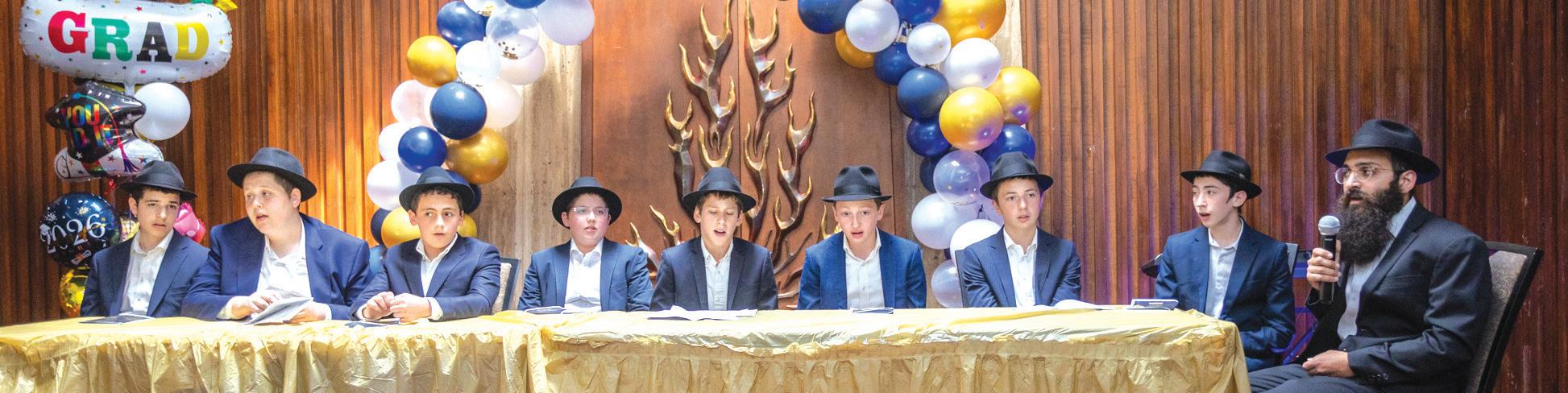
ing niggunim, creating a moving atmosphere.
Following the graduation, everyone enjoyed an uplifting musical presentation by the Cheder Choir, with performances by talmidim in grades 1-6. The program also included recognition of
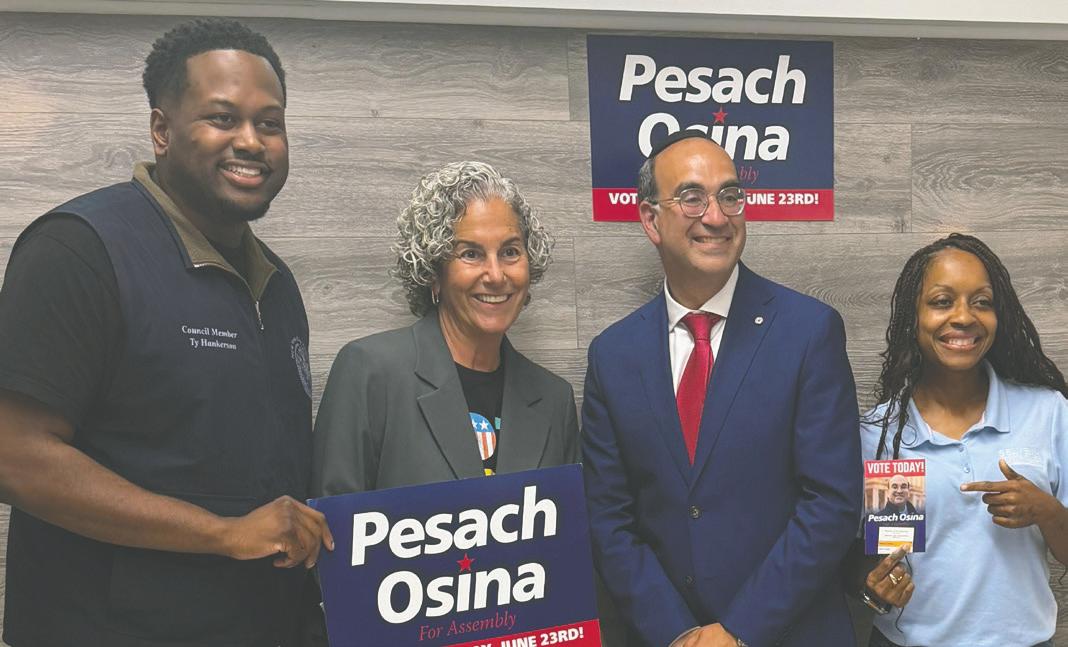
the dedicated parents, PTA members, and staff – Rabbi Moshe Koncepolski, Administrator, and Mrs. Mushky Pinson, Administrative Assistant – whose commitment and support contribute so greatly to the success of the Cheder. Special hakaras hatov was extended to Principal Rabbi S.Z. Berkowitz, whose devotion to the Cheder is evident in all that he does. Special appreciation was also expressed to Rabbi Moshe Halperin for his dedication to the Cheder and commitment to the students and their growth. The devoted and hardworking rabbeim were also recognized for their dedication to chinuch al taharas hakodesh and for enriching the talmidim’s learning experience throughout the year. The event concluded with the presentation of Mishnayos Baal Peh Awards and class prizes, celebrating the students’ achievements throughout the year.
Salutatorian Abigail Saldin
Valedictorian Eyal Traeger

Episcopal Health Services Shares Expert Camp Safety Tips to Keep Children Healthy This Summer
As schools let out and children head to summer camps, Episcopal Health Services (EHS) is encouraging parents and caregivers to take proactive steps to protect children from common summer health and safety risks, including dehydration, sunburn, drowning, insect-borne illnesses, and heat-related illness.
According to the Centers for Disease Control and Prevention (CDC), drowning remains one of the leading causes of death for children ages 1-14, while excessive sun exposure during childhood can significantly increase the risk of skin cancer later in life. The American Academy of Pediatrics (AAP) also warns that children are particularly vulnerable to heat-related illness because their bodies do not regulate temperature as efficiently as adults.
“Summer camp is a wonderful opportunity for children to stay active, build confidence, and make lasting memories, but safety should always come first,” said Lesly Michel, MD, pediatric endocrinologist and primary care physician at Episcopal Health Services. “Parents can help prepare their children by ensuring they are up to date on vaccinations, stay hydrated, wear sunscreen, and understand basic safety rules. It’s also important for parents to honestly assess their child’s swimming abilities and make sure children always follow water-safety guidelines. A little preparation can go a long
way toward ensuring a fun, healthy, and safe summer camp experience.”
Camp Safety Tips:
● Stay Hydrated: Drink water or preferably a drink with electrolytes regularly throughout the day. Pack a reusable water bottle and refill it frequently.
● Protect Against Sun Exposure: Apply broad-spectrum sunscreen with an SPF of 30 or higher and reapply every two hours. Wear hats, sunglasses, and protective clothing. Seek shade during peak sun hours.
● Practice Water Safety: Ensure your child is comfortable in the water and has swimming skills appropriate for the activities offered at camp. Encourage a buddy system in the water; never swim alone and wear properly fitted life jackets
● Avoid Tick and Insect Bites: Use EPA-approved insect repellents, wear long sleeves and pants in wooded areas, and perform daily tick checks after outdoor activities.
● Promote Good Hygiene: Wash hands frequently and cover coughs and sneezes. Avoid sharing water bottles and personal items.
To learn more about Pediatric services available through Episcopal Health Services or to schedule an appointment, call (347) 619 5950 or visit ehs.org/pediatrics.




The Special Children’s Center was honored to host Supervisor John Ferretti and Lawrence Mayor Sam Nahmias and give them a tour of the amazing things happening here
Epsicopal Health Services Celebrates Graduating Residency Class of 2026

Episcopal Health Services honored and celebrated the Graduating Residency Class of 2026 last week, recognizing 48 graduating residents across seven specialties, including Obstetrics & Gynecology; Family Medicine; Psychiatry; Dermatology; General Surgery; Internal Medicine; and Podiatry & Wound Care. Notably, 20 residents
completed the Internal Medicine program, one of the largest graduating classes in the institution’s history.
The graduation ceremony brought together EHS Executive Leadership, Department Chairs and Chiefs, and Residency Program Directors to celebrate the dedication and achievements of these graduating physicians.
Around the Community
50 Years of ArtScroll
Part 15: Literature for Children and Young People
This is another instance of ArtScroll/Mesorah responding to a need. In our early years, there was not the foggiest notion to produce literature for children, but reality intervened. Parents and educators were rightly bemoaning the lack of contemporary books for young children and teens that reflected traditional Jewish values. Just the opposite. Objectionable material infested the public libraries and was found even in many works that were being used — for lack of alternatives — in yeshivos and day schools. ArtScroll responded to the need by publishing books for very young children and also for older children and teens.
The first, published in 1982, was a charming book, perfect for beginning readers and especially for mothers reading to their very little ones. Mitzvos We Can Do, as the title implies, speaks of mitzvos that children can perform. The text isin rhyme, the vocabulary is perfect for the target age, and the color illustrations are beautiful. But that was only the first of many.
Remember how little children always wanted Mommy and older siblings to read favorite stories over and over? ArtScroll has a long list of such books, in rhyme and in prose. Of particular note was our Middos Series, a long list of books for elementary-age children, which featured stories
that were interesting in themselves, but with an underlying message of middos tovos.
As mechanchim know, the most effective lessons in hashkafah and yiras Shamayim are not “preachy.” The messages are there, but they are presented “quietly,” by example, and not in LOUD, BOLD type.
As the years went by, our books for youngsters included a long list of story books for youngsters by Shmuel Blitz, and children’s versions of some of the wonderful stories by best-selling adult authors like Rabbis Paysach Krohn, Yechiel Spero, David Sutton and David Ashear, as well as books on Jewish history and reviews of the background of the year’s Yamim Tovim by Yaffa Ganz — an award-winning author of children’s literature.
Another very important area is the many youth biographies of major gedolei Yisrael. The lives of our great leaders are packed with important lessons for young and old alike. A future column will deal in detail with the subject of biographies.
To produce young children’s literature of the quality that our people demand and deserve is not easy. Many writers find it hard to find the right vocabulary for those they are trying to reach. Books should stimulate readers – and even the very young who are listeners, not readers – to learn new words and ideas, but the presentation must be age appropriate. Dia-



logue is another area that requires skilled writing. Many writers need help in writing conversation that sounds “normal.” People don’t speak “literature,” they speak “conversation.” Our editors are attuned to such issues and help talented writers avoid such pitfalls. The results speak for themselves.
Starting in 1984, we began publishing novels, short stories, and series for teens. The inescapable fact is that many young people are on the lookout for engrossing and exciting fiction. If there are no such books with a proper Torah hashkafah,
many young people will be going elsewhere and will be finding things that are harmful.
Our children’s and youth volumes are not only responding to a need, but they are also performing a valuable service. The proof is that so many of them are in yeshivah and girls’ school libraries, selected by educators who are keenly aware of how careful we must be in selecting reading material for our children.
UP NEXT: The Beginning of ArtScroll’s Halachah Series

The Koidenover Rebbe speaking in learning with Rabbi Feiner
Around the Community Living Legacies
By C.B. Weinfeld
Rebbetzin Bruria David
Rebbetzin Bruria David, the only child of her illustrious father, R’ Yitzchok Hutner, wasn’t just a master mechaneches who dedicated her life to chinuch habanos, impacting thousands of talmidos and their subsequent talmidos for generations. She was unequivocally the standard bearer of chinuch in our generation, the role model for principals and mechanchos across the Torah world.
As Mrs. Tzivia Yanofsky, the beloved menaheles of Manhattan High School, who shared a close kesher with the Rebbetzin, expressed, “The Rebbetzin was the metaphorical clock, the ultimate gold standard by which everyone set their own watches, creating the tone for the world of chinuch habanos. Throughout her over sixty years in chinuch, she imparted these timeless values.
“It was an honor to be part of her seminary, to be chosen to attend BJJ. The students who were fortunate to be invited to attend considered it a privilege to be part of this unique atmosphere, which I will call a grandeur of spirit. She set the standard of scholarship, the chashivus haTorah and chashivus atzmi. There was a deep-rooted respect for talmidei chachamim, a kavod haTorah, and a sense of achrayus. In fact, students who attended BJJ were imbued with a sense of achrayus to teach the next generation.
“We, her talmidos, would constantly strive to live by the Rebbetzin’s example, to create a similar atmosphere in our schools and seminaries by constantly asking ourselves, ‘What would the Rebbetzin have done in such and such a situation?’ That was our goal, to live up to the Rebbetzin’s standards.
“We felt a surge of pride when the Rebbetzin expressed admiration for an idea or an accomplishment. She created an aura of impressive scholarship and nobility of spirit to an extraordinary degree.
This was really her life; her quintessence. In fact, I don’t think there was another woman in our generation who set the bar so high. I am saddened that the Rebbetzin’s passing signifies a bygone era.”
Mrs. Leah Honigswachs, a brilliant talmidah, recalled, “The Rebbetzin was very influential in our lives. My children grew up hearing about the Rebbetzin and her impact on our lives. We would constantly think to ourselves, even many years later, ‘What would Rebbetzin David have said?’ She was a brilliant lady who respected our minds, who shared whatever she taught with us — which was a chiddush in that era. We went to her home after hours for shiurim in Pachad Yitzchok It was a tremendous privilege, and she conveyed that notion, making us feel that it was both a privilege and an obligation.
“In so many respects, she resembled her saintly father, R’ Hutner. There was a mantle of dignity about her, not like today when so many teachers try to be your friend. Although in reality she was only about five or six years older than her initial students, there was that aura of respect, of distance mixed with admiration.
“The Rebbetzin had a famously prodigious memory. She could meet a talmidah after many years and instantly recall where the student sat and what questions she asked. In fact, it went a generation further. You could be sitting in her class and asking a question, and the Rebbetzin would say, ‘Your aunt, who was here in this classroom fourteen years ago, sat in that corner and asked a very similar question.’ Thousands of talmidos may have passed through her seminary over the years, but she knew each of them well and could locate them in her mind upon a moment’s notice.
“What really influenced us the most was the way she imparted the famous Rambam at the end of Hilchos Maaser (it is well known that in order to become a BJJ talmidah, one needed to understand and repeat a Rambam). The Rambam teaches us that anyone can become part
of Shevet Levi — if you make a firm decision to dedicate yourself to avodas Hashem. That was a revelation to us, young and idealistic talmidos being raised in the postwar era. We came to understand that by expressing a desire to build a home of Torah, we can become a part of what the Kohanim and Levi’im represent.
“You must understand — when I went to seminary, back in the sixties, the concept of marrying learning boys wasn’t so accepted. By the time the Rebbetzin finished with us, we were each determined to marry klei kodesh. And many of us did. Fast forward a generation or two: Today my children all are in klei kodesh, sons and sons-in-law, and that is part of our legacy. Had the Rebbetzin not planted that concept in our minds during the post-Holocaust generation, who knows what would have been? Today it’s quite the opposite, as the tables have turned completely. Today it’s hard for a young man to find a shidduch if he isn’t committed to being a long-term learner.
“I feel that in many ways, the Rebbetzin embodied the legacy of Sarah Schenirer, whom the Machon BJJ (Sarah Schenirer Beth Jacob Jerusalem) is aptly named after. Though the Rebbetzin didn’t merit any biological children, many of us consider ourselves her children — as she considered us, and our generations, her offspring.
“In fact, I remember that when I was a young mother of a few children, I was on the phone with the Rebbetzin (I was grateful to keep up a close connection for years), and my children were making noise in the background. I felt uncomfortable subjecting the Rebbetzin to that and tried to shush the children. ‘No, I want to hear the children,’ the Rebbetzin firmly said. And I understood — in her mind they weren’t the children she sadly didn’t merit, but the continuation, the nitzchiyus of Klal Yisrael. It was never about herself and her own reality.”

to handle something, I know exactly what the Rebbetzin would say.
“I can sense how she would react under specific circumstances. Those circumstances are not so different, whether in an environment of fifty years ago or today. The challenges may be wearing different dresses, but their essence is still the same. True, the outside world may be closer now — but if you have the proper worldview, it’s not so threatening.
“She gave us Torah bifocals, helping us view the world through the lens of Torah.
“She didn’t only leave a temporary message for the moment. She instilled a lifelong thought process regarding the priority of Torah in your life and how it affects every aspect of your existence. She encouraged us to reject superficiality and mindlessness, to attach ourselves to ki heim chayeinu, and not only in the kiyum hamitzvos. As the Rebbetzin taught us, ‘There is no aspect in your life devoid of the process of Torah.’
“She was a tremendous bar daas. There was a hisromemus haruach in her presence. I don’t know if there is any mechaneches of that caliber today.”
Did you know?
The average person spends about two weeks of their entire life just waiting at red lights.
Rebbetzin Ruthy Assaf, the distinguished menaheles of Seminar V’at Alis and a mechaneches for over half a century, recalled that the Rebbetzin’s worldview was “the antithesis of the distraction of mindlessness.”
“She worked on us, she demanded of us to become people of depth. Even after fifty years in chinuch habanos, I can still hear her voice so clearly. Every time that I’ve been in a situation as a principal or mechaneches where I have to decide how
As Rebbetzin Assaf stressed, “In essence, her level of teaching was the planting of seeds. Some of those seeds sprouted in six weeks, some in six months, and some in sixty years. She put that desire into our hearts, and that carried us. That carried us.”
Reprinted from Living Legacies by C.B. Weinfeld, with permission from the copyright holder, ArtScroll Mesorah Publications.



TJH Centerfold
Everything Summer Trivia
1. What is the most visited U.S. national park during the summer months?
a. Great Smoky Mountains
b. Yellowstone
c. Grand Canyon
d. Yosemite
2. How long can the sun remain continuously visible in parts of northern Alaska during the summer?
a. 24 hours
b. One week
c. About one month
d. About two months
3. Which U.S. state is commonly known for having one of the longest average public school summer vacations, with many districts enjoying a break of around 12 weeks?
a. Texas
b. New York
c. California
d. Florida
4. What is the average temperature in New York City during the summer months (June through August)?
a. 65°F
b. 70°F
c. 75°F
d. 85°F
5. What is the scientific name for the pleasant earthy smell that often follows a summer rainstorm?
a. Petrichor
b. Geoscent
c. Pluvia
d. Aerosol
plan to take at least one trip between June and September 2026?
a. 14%
b. 26%
c. 48%
d. 72%

Wisdom Key:
5-6 correct: You definitely have Petrichor cologne/perfume.
3-4 correct: You are like New York’s weather in the summer –- not too hot, not too cold.
6. According to a Generali Travel Insurance survey, approximately what percentage of Americans
You Gotta Be Kidding Me!
I booked a trip to visit the Cherokee in Oklahoma this summer, but having second thoughts...
I’m having a reservation reservation reservation.
0-2 correct: Too much smoke inhalation in the Great Smoky Mountains?

Things Parents Can Finally Do Now That School is Out

Take a leisurely walk without stopping every three minutes to answer, “What’s 7 × 8 again?”
Open WhatsApp chat without discovering another frantic message that begins, “ANYONE KNOW WHAT CHAPTER TOMORROW’S QUIZ IS ON?”
Eat breakfast without signing a permission slip, a reading log, and a test.
Retire from your second job as your child’s unpaid homework consultant.
Stop trying to remember which day is pizza day, gym day, or “wear white for no apparent reason” day.
Sleep peacefully knowing that you won’t have to wake your kids six times in the morning to get on the bus.
Smile when your child says, “I’m bored,” because at least they’re not saying, “My teacher gives so much homework!”
Look at the printer and think, “Maybe today I won’t need you.”
Delete the words “due tomorrow?” from your daily vocabulary.
Enjoy dinner without asking, “So…any tests this week that you forgot to mention?”
Spend an evening reading your own book instead of proofreading a five-paragraph essay on the life cycle of a frog.
Drive somewhere without hearing, “Wait! I left my homework on the kitchen table!”
Take a phone call without simultaneously searching the house for a missing math worksheet.
Walk past the backpack without feeling obligated to inspect it for growing fungi.
Finally admit that you never really understood the “new math” anyway.
Riddle Me This
Avi, Ben, Chaim, and Dovid each brought one item to camp: sunscreen, a flashlight, a water bottle, and a baseball glove.
• Avi did not bring sunscreen.
• Ben brought something used after dark.
Question: Who brought the sunscreen?

• Chaim did not bring the water bottle.
• Dovid brought something used for a sport.

Answer: Chaim. Why: Ben = flashlight. Dovid = baseball glove. Chaim did not bring a water bottle, so he must have brought sunscreen. Avi brought the water bottle.


Moshe is finally done in by the requests of the Jewish people in the desert – this time again for their water supply. In his exasperation about their constant litany of complaints and grumblings, he transgresses over G-d’s commandment to speak to the rock and instead he strikes the rock with his staff. His punishment for this act is swift and dramatic. He will not step into the Land of Israel but only be able to glimpse it from afar.
There are many questions and difficulties raised regarding the narrative of this incident in the Torah. Firstly, complaints about the lack of water are certainly legitimate complaints. Human beings cannot survive without water, and now that the miraculous Well of Miriam disappeared with her passing, the pressing need for a replacement water supply was obvious. So, why does Moshe become so angry with them and describe them as a rebellious mob? And another perhaps greater and more difficult question is why this sin is the one that seals Moshe’s fate? Does the punishment really seem to be
Torah Thought
Parshas Chukas

By Rabbi Berel Wein z”l

commensurate with the crime?
All of the commentators to Torah over the ages have dealt with these two questions and have advanced a wide variety of insights and explanations regarding the issues raised. It is apparent that the Torah somehow wished these issues to
week’s parsha as the concluding part of a continuing and cumulative pattern of behavior, both on the part of the people of Israel in the desert and of Moshe as well. Moshe realizes, as do the people, that they require water to sustain them. But this request and the manner that
It is apparent that the Torah somehow wished these issues to be further explored and studied.
be further explored and studied, and therefore it left its own description of the matter somewhat vague and mysterious – hiding in the narrative more than it was willing to reveal.
Maimonides and other scholars throughout the ages see the events of this
it is presented to Moshe is part of their long- running, nagging behavior pattern in the desert.
For the Jewish people, there is still a vestige of resentment against G-d for redeeming them from Egypt. There they had water in abundance, and it was nat-
ural, not miraculous water. Miraculous water binds them to a commitment to G-d and His Torah – a commitment that a portion of the people is always attempting to wriggle out from.
With their seemingly reasonable request for water, Moshe senses all of this background music. They really want to opt out of the entire mission of Sinai, which results in Moshe’s extreme display of displeasure. Moshe’s anger again undoes him. There is an entire literature of rabbinic study about the moments and causes of Moshe’s anger that appear throughout the Torah.
For Moshe, the greatest of all human beings, it is agreed that this is his one failing. And, therefore, Moshe unwittingly becomes the model and example of the dangers involved in falling into the pit of emotional anger. The incidents of his anger – past and present – were now cumulatively judged by Heaven and the punishment is not for this one incident alone. Anger is a character trait to be avoided at almost all cost.
Shabbat shalom.
From the Fire
Parshas Chukas
The Language of the Generation

By Rav Moshe Weinberger
Adapted for publication by
Binyomin Wolf

Regarding the nature of Moshe Rabbeinu’s sin in striking the rock to bring forth water for the Jewish people, Rav Shmuel Dovid Luzzatto, zt”l, the great-grandson of the Ramchal, wrote that “while Moshe Rabbeinu only committed on sin, the commentaries heaped thirteen or more sins upon him because each one attributed some novel sin based on his own understanding...” The Torah tells us very little about the reason for the drastic consequences of Moshe’s sin. We must therefore understand the commentaries’ explanations rather than inventing any new sins to add to the already-long list. There is a well-known dispute between the Rambam (Shmonah Perakim, Ch. 4) and Rashi (on Bamidbar 20:12) regarding the nature of Moshe’s sin. According to the Rambam, his sin was excessive anger when he said, (Bamid-
bar 20:10) “Listen, you rebels.” According to Rashi, however, his sin was disobeying G-d by hitting the rock when he was commanded to speak to the rock. While the Ramban takes issue with both of these explanations, the Maharal in Gur Aryeh and Rav Levi Yitzchak of Berditchev in Kedushas Levi explain that, on a deeper level, the Rambam and Rashi’s explanations are not mutually exclusive. Each refer to a different stage in one process. The process began with Moshe becoming angry and that anger caused him to disobey Hashem’s command to speak to the rock.
Hashem speaks to us in every generation through the Torah as if it is being given today. We must therefore understand what we must learn from the nature of Moshe’s sin in order to know what is right in our own generation. The first step in that process is un-
derstanding the difference between the events in Parshas Chukas and the events in Parshas B’shalach when Moshe first drew water from a rock (Shemos 17:17). There, the people lacked water and came to complain to Moshe, Moshe told Hashem that he was afraid they would kill him, Hashem told him to hit a rock, he did so, and water began flowing from the rock to fulfill the Jewish people’s need for water. What is the difference between these two events? Why was it a mitzvah for Moshe to hit the rock shortly after the Jewish people left Egypt but a grave sin to do so in their last year in the desert before entering Eretz Yisroel?
The difference was the generation. Moshe was commanded to hit the rock for the generation who left Egypt. This older generation grew up as slaves in Egypt. They were familiar with the language of force and harshness. For them,
when Moshe hit the rock, using force to extract the water, he was speaking the language of the old style of education understood by that generation. However, the generation in Parshas Chukas lived forty years later. They grew up in the desert protected by Hashem who provided for all of their needs. They were a softer, weaker generation. This new generation, on the brink of entering Eretz Yisroel, understood a different language. Hashem expected Moshe to speak to the new generation in a language it understood, the language of conversation, speech, and dialogue. That is why He commanded Moshe only to speak to the rock and not to strike it.
In our times, too, we see this distinction between the “old generation” and the “new generation.” Our parents and grandparents who lived through the war grew up for the most part under the
control of totalitarian regimes or dictatorships and were accustomed to the harsh language of force. That generation also educated its children using the language of strict discipline and force. That approach does not work in the current generation. The old generation was not broken by the old approach to education. But if anyone tries to use the old way of discipline on the new generation, he will only shatter the lives of his students. Such an approach to education no longer works. It is simply outdated. What happened to Moshe Rabbeinu in Parshas Chukas? When he lifted up his staff to hit the rock just as he had done forty years earlier for the previous generation, he revealed that, on his level, he did not appreciate the difference between the generations. As great as he was, he could not speak the language of the new generation. He was still educating people the way it was done in the “old country.” He did not understand how to communicate with the generation in its way, which was through speech, conversation, and dialogue. The new way is one of (Devarim 6:7) “and you shall teach your children and speak to them.” The way of the new generation is speaking with one’s children rather than using force to elicit their compliance. It was not so much that Moshe was punished by not being allowed to bring the Jewish people into Eretz Yisroel. Rather, it was a natural consequence of the fact that he was no longer able to understand the true nature of the new generation. He could not be the person who would lead them into the land. But Yehoshua, his successor, did lead them into the land. It is known that Rashi (on Bamidbar 11:28) teaches us that Eldad and Medad had prophesized that “Moshe will die and Yehoshua will bring the Jewish people into the land of Israel.” What was Yehoshua’s approach to education? The pasuk at the end of the book of Yehoshua (24:27) tells us that at the end of his life, Yehoshua established a large stone as a monument and said that “it has heard all of the words of Hashem which He has spoken to us.” Yehoshua understood that one can also speak to a stone, and it will hear. He understood that the nature of the new generation is one of conversation rather than coercion.
These two approaches to education also manifest themselves in a remarkable teaching by the Gemara (Sanhedrin 24a), which says:
Rav Oshea says, “What is meant by the pasuk (Zecharia 11:7), which says,
‘And I will take two staffs. I will call one pleasantness, and I will call the other violence.’ The one called ‘pleasantness’ refers to the sages of Eretz Yisroel, who discuss halacha sweetly with one another. ‘Violence’ refers to the sages of Bavel, who do violence against one another in their discussion of halacha.”
We therefore see from this Gemara
grade son one year. This son gave my friend a lot of aggravation at home, so he expected to hear a similar report from his son’s rebbe. But the rebbe’s report was glowing. After confirming that he and the rebbe were indeed referring to the same boy, my friend told the rebbe that he did not understand why his son acted so differently in yeshiva than
Each generation has its own unique character.
that the way of education for the old generation, the generation of exile, Bavel, is violence, force, and coercion. But the way of education in Eretz Yisroel, the way of the new generation, the way of redemption and Moshiach, is one of pleasantness.
For reasons only truly known to Him, Hashem conducts the world in this way. Each generation has its own unique character. Some people may want to rail against this, asking, “Why does it have to be that way?”, “If it worked then, it should work now!” or “That’s our mesorah in education!” They can ask these questions but if they attempt to educate this generation the way the previous generations educated their children, it simply will not work.
Rabbi Shimon Bar Yochai (Zohar 128a) even said in his time that while in previous generations the main point was strictness and fear of punishment, “For us, the matter is dependent on love.” In our generation, too, we see that fear was the modus operandi for prior generations who lived in monarchies and dictatorships. To a large extent, this worked. But we now live in democracies, countries in which everyone has a right to his opinion. Now, we communicate with one another by talking things over, with the staff of pleasantness. It goes without saying that we do not turn our houses into democracies, giving our children a vote on all household decisions. There must be authority, limitations, and boundaries. It is difficult to find the correct balance between dialogue with parental authority, but we may not ignore the nature of the generation.
A friend of mine attended parent-teacher conferences for his sixth
he did at home. This rebbe was a baal teshuva from the Midwest with a very sweet, simple approach, and he asked my friend, “Do you every talk with your son?” After thinking for a few moments, he answered that he really hadn’t. He asked his son to do things. He learned with him, He disciplined him. He even told him he was doing a good job once in a while. But he never actually had a
conversation with him. The rebbe then suggested that he should talk with his son because he has some very deep thoughts about things. We must educate our children in the context of dialogue, of actually communicating with them. Persuasion through conversation is the way to bring redemption in this generation. In fact, the Hebrew word Moshiach shares the same root as the word sichah, conversation. The prophet Yeshaya (11:4) says about Moshiach that “he will smite the land with the rod of his mouth and will put the wicked to death with the breath of his lips.” Using only his mouth, words of dialogue, teaching, conversation, and persuasion, he will turn the wicked around and bring about the ultimate redemption.
May we merit to recognize the nature of our generation and educate our generation according to its unique path and thereby see the revelation of Moshiach soon in our days.
Rav Moshe Weinberger, shlita, is the founding Morah d’Asrah of Congreagation Aish Kodesh in Woodmere, NY, and serves as leader of the new mechina Emek HaMelech.

Think. Feel.Grow.
Deepening Our Perception of Challenges

By Rabbi Shmuel Reichman

In our last article, we discussed how the purpose of a challenge is to push us to actualize our latent potential, and as the Ramban explains, to transform our koach (potential) into po’al (actual). Hashem already knows exactly who we are and what we can become; the purpose of an ordeal is to enable us to realize who we can become so that we can then actualize that potential. This week, we’re going to explore a fascinating expression of this idea found in the following Midrash (quoted by Rashi on Taanis 30b):
After the Chet Ha’Meraglim, the Jews were forced to travel through the desert for forty years, where the 600,000 men between the ages of 20 and 60 died before entering Eretz Yisrael. The original Chet Ha’Meraglim occurred on Tisha B’Av, and each year on this day, all the men between 20 and 60 would dig their own grave and sleep in
it. Every year, 15,000 of the men did not wake up the next morning. (40 x 15,000 = 600,000)
This pattern continued for 39 years, until something miraculous happened: In the 40th year, the last 15,000 men dug their graves, but the next morning, they all woke up. Assuming that they miscalculated the date of Tisha B’Av, they did the same thing the next night. It wasn’t until the 15th of Av, when the full moon confirmed that Tisha B’Av had passed, that they realized Hashem had spared them. (See Ta’anis 30b. This is one of the reasons we celebrate Tu B’Av.)
The obvious question is, why were these 15,000 men spared? What made them different? Essentially, what changed?
The answer is profound. Hashem did not change His mind. The people themselves changed. The only way to change a gezeirah (decree) is through teshuva
and tefillah. These are forms of avodas ha’ratzon – exercises in changing one’s inner will – and therefore result in changing one’s very self. Tefillah does not change Hashem’s mind – it changes who we are; once we have changed who we are, embracing our higher selves, we are no longer subject to the negative decree. (The “address” of the decree no longer applies. It was delivered to the person we used to be, but since we have existentially changed, we have a “new address.” In a deeper sense, teshuva is not about becoming someone different, it is about becoming who we really are , returning to our true selves.) Teshuva as well is a method of reengineering our will, rewiring our “wants.” It’s about the decision to be better, to be great, to become our best and truest self. As the Ramchal explains in Mesilas Yesharim, if we can change what we want (akiras ha’ratzon), we can change who we are
When we make new decisions, we create a new reality for ourselves.
For the previous 39 years, as all the men would dig their graves, each would think to himself: “It won’t be me, it can’t be me. I’ll wake up. This year it will be someone else.” And every year, 15,000 people died. No one achieved genuine change, as no one believed that it would be them who would not wake up the next morning.
The last year, there were only 15,000 people left. No longer could they look around and say, “It won’t be me.” They knew, with absolute certainty, that unless they changed, unless they did teshuva gemurah (complete repentance), they were going to die. And that is exactly what they did. They were pushed to their limits, beyond their comfort zone, and the impossible occurred. The tefillah they said that night was different from any other tefillah they had ever
said before. They knew that unless they reached into the very depths of their souls, davened with all their heart, and changed their will completely, they would not wake up the next morning.
This story relates to a famous rule of battle: never close your enemy off; always leave them room to escape. If you entrap them completely, they will fight with complete abandon, with more ferocity and passion than even before, for you have pushed them to their limits, and they know that they are literally fighting for their lives. This same idea is encapsulated in the quote: “If you want to take the island, burn the boats.” If you are going to war and you thirst for victory, leave no possibility for retreat. Burn your ships, burn you way out, and your only option is to fight with everything that you have.
Proactive vs. Reactive
The ideal, of course, is not to wait for Hashem to challenge us, but to initiate the growth ourselves.
Avraham Avinu is the exemplar of this model of growth, pushing himself to grow. After Avraham overcame all ten of his challenges from Hashem, he said,
“Anochi afar v’efer ” (Bereishis 18:27.), which, literally translated, means “I am but dust and ashes.” As we previously explained, ashes represent an elemental breakdown, the most basic particles of an object. Dirt is the starting point of growth, the place where seeds are planted and given life. In a deeper sense, Avraham was saying that every
fortable, or because he was used to it. Avraham challenged himself daily, constantly pushing himself to become the very best he could be. Once Avraham learned the value of a challenge firsthand, he proactively pushed himself to achieve his fullest potential.
In our next article, we will dive even deeper into this topic and try to
When we make new decisions, we create a new reality for ourselves.
day he would “ash” himself, breaking his very “self” down into its elemental, root form, and he would then plant himself anew. In other words, Avraham recreated himself every single day. Each and every day, he looked deep within himself, examined and broke down every character trait and value, and then recreated himself for the better, taking the next step in his spiritual growth. Avraham never continued living the same way simply because it was com -
understand the purpose of challenges on an ever more profound level. Until then, always remember: challenges are opportunities in disguise. Don’t waste your time, don’t waste your life, but most importantly, don’t add any wealth to the graveyard.
the CEO of SMA, and a TED Talk Speaker. His online content reaches millions of people every month, and he lectures internationally on topics of Torah thought, psychology, leadership, and business – uniquely blending many areas of Torah and wisdom together. His bestselling book, The Journey to Your Ultimate Self, serves as an inspiring gateway into deeper Torah thought. After receiving his BA from Yeshiva University and Semicha from Yeshiva University’s RIETS, Rabbi Reichman received a Masters degree in Philosophy and Religion from the University of Chicago. As part of his Masters Degree at the University of Chicago, Rabbi Reichman received an Ivy Plus Scholarship to Harvard where he spent a year studying Religious Philosophy and Literature as an Ivy Scholar. Additionally, he received a Masters degree in Educational Psychology from Azrieli Graduate School and a Masters degree in Jewish Thought from Yeshiva University’s Bernard Revel Graduate School. As a business and leadership coach, Rabbi Reichman provides a unique 1-on-1 coaching program where he helps high-achievers, coaches, and business owners achieve their financial and personal goals. To learn more or to get in contact with Rabbi Reichman, visit his website: ShmuelReichman.com

Rabbi Shmuel Reichman is an international speaker, bestselling author, business coach,
Headlines Halacha
How They Steal Your Car and How to Stop It
by Rabbi Yair Hoffman

Rav Chaim Kanievsky, zt”l, (Lasuach baSadeh p. 897) quoted Rav Shteinman, zt”l, that one who brings merit to the masses is greater than a malach. Thus, spreading this column could possibly raise the reader to a level higher than a malach, an angel.
The Gemara in Bava Basra (89a) provides numerous instructions as to how not to rip off clients in weighing items for sale. On the next Amud, Rabban Yochanan ben Zakkai said with regard to all these halachos: Woe to me if I say them, and woe unto me if I do not say them. If I say them, perhaps swindlers will learn new methods of cheating of which they were previously unaware. If I do not say them, perhaps swindlers will say: Torah scholars are not well versed in our handiwork.
A dilemma was raised before the Sages: Did Rabban Yohanan ben Zakkai decide to say these halachos in public or did he not say them? Rav Shmuel bar Rav Yitzchak says: He said them, and
he said them on the basis of this pasuk: “For the ways of Hashem are right, and the just walk in them; but transgressors stumble over them” (Hoshea 14:10).
In keeping with the example of Rabban Yochanan Ben Zakkai, what follows is the lamdus of how thieves steal cars.
It is further followed by how it can be prevented. Hopefully, this will create a zikui ha’rabbim, a bringing merit to the masses, which can possibly catapult us to beyond the level of a malach.
In New York City, cars are stolen every 18 minutes, it seems. How do they do it? Aren’t our modern cars equipped with the highest technology of coding that there is? Does it not take several hours to create a new fob when one has recently lost their key fob?
Apparently, your car is constantly emitting a quiet signal a few times every second. It does so every so faintly – somewhat akin to a whisper.
It is asking: “Is my key fob nearby?” Your key fob is designed to “shout”
back a secret password when it hears that whisper. The car whispers softly on purpose — it only wants to unlock if the key is right next to it. The key fob, however, shouts loudly on purpose, so you can be able to either lock or unlock from a distance.
Thieves exploit this with a two-person, two-device setup made from the parts of a baby-monitor
One thief stands near the house holding the part of the baby monitor that is next to the baby. It is usually a round circular device, like a loose hula hoop. This device acts like a microphone. It captures the car’s faint whisper.
The second thief stands by the car holding a device that acts like a speaker. The first device transmits the car’s whisper through the air to the second, which blasts it loudly toward the house.
Your key fob — sitting on a table inside — hears that familiar whisper, thinks the car is right there, and shouts back the secret password. The car is fooled. It then unlocks and starts itself
up. The whole thing takes as little as ten to fifteen seconds — no alarm, no broken glass. The expensive criminal versions of these devices can cost thousands, though the underlying parts are surprisingly cheap.
How to Prevent It
The defense is simple: Put your key fob in a cookie tin. This will stop your key fob from ever hearing the car’s silent cry and responding to it.
Other Tips
Firstly, never leave your keys by the front door. Distance alone makes the attack much harder.
Secondly, block the signal entirely by storing your keys inside metal. A simple cookie tin works. So does wrapping the key in a single layer of aluminum foil with no gaps.
This creates what is called a Faraday cage. Metal conducts the signal around the outside and prevents it from reaching the key, so the key never hears the
whisper and never shouts back. You can also buy signal-blocking pouches for around ten dollars. Some, however, do not work.
Halacha is filled with illustrations of great Torah leaders who were concerned about the rising costs that Klal Yisroel faced.
The Origin of Plain Tachrichim
The Gemara in Moed Katan 27b tells us that when Jews were burying their dead in the finest clothing, Rabban Gamliel HaZakain arose and declared that enough was enough. The rising pressures, the “keeping up with the Joneses” in how to dress the deceased was causing enormous economic pressure on the living.
“It must stop,” declared the rabbi, and the tachrichim , burial shrouds, we now use became the norm.
Boycotting Fish
The great Tzemach Tzedek (of 17th century Poland), cited by the Magen Avrohom in the beginning of hilchos Shabbos, once ruled (Responsa #28) that when local fishermen collude and
raise the price of fish excessively, a prohibition can be levied upon the consumption of fish on Shabbos. It may take a week or two or even three, but eventually the collective buying power of ordinary people would force the price back down.
Obligation Upon Everyone
We will see, however, that it is not just great Torah leaders who have saved
nate from the rock at Mei Merivah. Also, Rashi (Rosh Hashanah 27a) points out that the Kohen first removes the vessels from the house before declaring a house impure. So we see examples of the Torah being concerned with the financial wellbeing of the Jewish nation.
The difference between the two cases is that the former is for the entire nation, while the latter demonstrates that the Torah is concerned even for the in-
The whole thing takes as little as ten to fifteen seconds — no alarm, no broken glass.
and are concerned for the financial wellbeing of their fellow Jews. It seems that this is what is expected by the Torah of everyone.
The Gemara (Menachos 76a) tells us that Hashem commanded Moshe to also feed the nation’s livestock from the water that He had caused to ema-

dividual’s finances.
The Chasam Sofer on Bava Basra (54b) states that, generally speaking, one can make the assumption that fellow Jews are concerned with the monetary wellbeing of their fellow man, and that this assumption has legal ramifications. So we see that it is the normal
behavior expected of all Jews.
Rabbi Yaakov ben Asher, author of the Tur, discusses (in the Choshen Mishpat section of Shulchan Aruch, chapter 35) a person who does not care about Jewish money, and he writes that such a person will, in the future, surely answer for it. The Minchas Chinuch writes that one who is concerned about the preservation of his fellow Jew’s money fulfills the biblical commandment of v’ahavta l’rei’acha kamocha, love thy neighbor as yourself (see his commentary on that mitzvah).
The clear indication from all these sources is that demonstrating concern for the financial wellbeing of others is not just a mitzvah. It is an expected social norm with reward for those who do it and punishment for those who do not.
Spreading this article is an easy way to fulfill this mitzvah.
This article should be viewed as a halachic discussion and not practical advice. The author can be reached at yairhoffman2@gmail.com.

Delving into the Daf
Birds of a Feather The Great Chicken Controversies
By Rabbi Avrohom Sebrow
In 2004, the global kosher market experienced a sudden jolt over the ubiquitous Leghorn chicken. For decades, the white Leghorn had been the commercial gold standard for egg production in the United States and Israel. However, a debate erupted when researchers noted anatomical differences between modern commercial Leghorns and traditional heirloom breeds. Specifically, questions arose regarding a potential lack of mesorah for highly crossbred strains, and concerns were raised about whether modern breeding techniques had compromised the bird’s status as a “standard” chicken. Though major kashrus agencies ultimately maintained its kosher status, the scare highlighted just how vulnerable our reliance on modern poultry can be.
In 2017, the Jewish world was rocked by another poultry dispute, this time regarding the Braekel chicken. The Braekel, an ancient heirloom breed originating from Belgium, was thought to be a genetically pure, un-hybridized bird. However, top poskim quickly split on the matter. Rav Moshe Shternbach ruled that the Braekel was too anatomically and behaviorally distinct from the standard chickens we eat, and since it hailed from a region of Belgium historically devoid of Jewish communities, it completely lacked an independent mesorah. Conversely, the students and followers of Rav Shmuel Wosner, zt”l, adamantly argued the exact opposite: because the Braekel is a pure, unadulterated heirloom breed, it is actually vastly preferable to the genetically modified mixed breeds dominating today’s market.
While many contemporary learners are well aware of these more recent shailos, they might be unfamiliar with a strikingly similar chicken controversy that divided the halachic world back in 1934-1935.
Enter the Faverolles
The Faverolles is a beautiful French
breed of chicken, allegedly developed in north-central France in the vicinity of the villages of Houdan and Faverolles. Although primarily kept today as an ornamental and exhibition breed, it remains an excellent layer and a fine meat chicken. The most common variety is the Salmon Faverolles; the females sport mainly brown and creamy-white plumage, while the darker males show off black, brown, and straw-colored feathers.
Because of their remarkably gentle disposition, Faverolles have become highly popular pets, especially for children. They enjoy widespread popularity among backyard flock hobbyists who favor dual-purpose breeds capable of providing both steady egg production (a well-cared-for hen will lay approximately four eggs per week) and high-quality meat.
Why would such a docile, picturesque chicken become a source of fierce rabbinic debate?
The Rules of the Runway
To understand the controversy, we must look at how the Torah defines kosher birds. Unlike animals and fish, where the Torah provides clear physiological identifying markers (such as split hooves or scales), it provides no such rules for fowl. Instead, the Torah simply lists twenty-four specific species of birds that are forbidden. By default, every other bird in the world is kosher. If we could perfectly identify those twenty-four non-kosher species, we could theoretically eat any other bird on earth. The problem, as the Gemara and Rishonim note, is that our geographical displacement has left us unfamiliar with the exact identities of these twenty-four species. To protect us from error, the Rema codifies a strict safeguard (Yoreh Deah 82:3): “One should only eat a bird with an accepted tradition (mesorah) that it is kosher, and we are accustomed to this, and it should not be changed.”
Practically speaking, the paradigm flipped. While at Mount Sinai all birds were permitted until proven non-kosher, nowadays, all birds are treated as forbidden until proven kosher via an unbroken chain of tradition.
We certainly have a clear mesorah that a “chicken” is a kosher bird. But given that there are hundreds of chicken breeds, do we need an independent mesorah for every single variant?
The Chasam Sofer provided the foundational ruling on this matter: any new or variant breed of chicken is perfectly kosher, provided it is substantially similar in anatomy and behavior to the standard chicken that possesses a mesorah.
The Fatal Fifth Toe
This brings us back to the 1934 dispute. The French Faverolles chicken possesses a highly unusual genetic trait: it has five toes instead of the standard four.
Does a fifth toe constitute a “substantial difference” from a run-of-the-mill chicken? If it does, the Chasam Sofer’s leniency drops away, and the Faverolles would require its own independent mesorah, which it did not have, since it was bred in a region of France with no historical Jewish presence.
The Minchas Elazar (Rav Chaim Elazar Spira of Munkatch) was absolutely adamant that the Faverolles chicken was strictly forbidden. He pointed out that the differences weren’t just limited to the extra toe; the bird’s head and neck structure deviated from standard poultry, and even its vocalizations, the distinct cluck of the Faverolles, sounded visibly deeper and different than its peers. He argued that this was a totally different creature requiring its own mesorah. Many prominent European rabbonim sided with him, culminating in the publication of a halachic compendium against the chicken entitled Derech Nesher.
However, the Shut Sheires Yisrael strongly disagreed. He wrote that the Eu-


ropean rabbis forbidding the bird were simply unaware of the broader global reality. This exact five-toed breed, he argued, had been widely accepted and eaten by the ancient Sephardic communities in Syria, and many had even been imported into Eretz Yisrael. Evidently, these communities either possessed a localized mesorah on the bird, or they viewed an extra toe as a mere minor anomaly rather than the creation of a brand-new, un-kosher species (a concept explored in Tosafos, Chullin 47).
A Lasting Debate
As we sit down to our Friday night chicken soup, it is fascinating to realize that some of same arguments used in the 1930s over a French fifth toe are the ones echoed more recently today by gedolim over the Belgian Braekel.
Does a shift in a bird’s origin, look, or sound break its lineage, or does the overarching identity of “chicken” cover it? The classic halachic question remains as lively today as it was a century ago: If it walks like a chicken and talks like a chicken, is it truly a kosher chicken?
Rabbi Avrohom Sebrow is a rebbe at Yeshiva Ateres Shimon in Far Rockaway. In addition, Rabbi Sebrow leads a daf yomi chaburah at Eitz Chayim of Dogwood Park in West Hempstead, NY. He can be contacted at ASebrow@gmail.com.
Braekel chicken
The Faverolles rooster
My Israel Home When a Parking Garage Becomes a Neighborhood
By Gedaliah Borvick

Iwas parking in an underground garage before a meeting recently when I realized this wasn’t just a parking lot. It was a neighborhood. There were apartments, small shops, and even a shul.
People weren’t simply passing through on their way to their cars; they were going about their daily lives. Some were returning home while others were stopping at neighborhood businesses. It felt less like the bowels of a building and more like a Jerusalem street that happened to be underground. I found it fascinating.
The garage itself wasn’t really the story. As a real estate agent, I spend a great deal of time thinking about neighborhoods and the relationship between supply and demand. This experience was the most vivid example I had ever seen of what happens when demand overwhelms supply.
Jerusalem has always been a city that people are reluctant to leave. Families want to remain close to parents, children, schools, shuls, and friends. When the supply of housing in a neighborhood becomes limited, many people look for ways to stay before considering a move elsewhere.
Sometimes, the response is straightforward. New apartment buildings are constructed, older buildings undergo urban renewal, and communal infrastructure expands.
Sometimes, the solutions require more creativity. Apartments are divided, basements are converted, and storage rooms become offices. In this case, a parking garage evolved into a neighborhood where people live, work, shop, and build community.
What struck me most was that no one seemed to find it unusual. Life had simply adapted to the space, and the neighborhood had grown organically in ways the original planners never imagined.
To me, that’s one of the remarkable things about Jerusalem. People don’t simply live in the city’s neighborhoods; they become attached to them. Many would rather live in a smaller apartment, or even an unconventional one, than leave the neighborhood that has become home.
Of course, there is a downside.
Parking garages were never intended to become neighborhoods. Makeshift housing and commercial space can cre -
ate challenges not only for quality of life, but also for safety, infrastructure, and accessibility. Even the most resourceful communities eventually reach the limits of what can be improvised.
The experience also helped me appreciate that the best neighborhoods don’t simply provide housing; they anticipate how people will actually live. They include schools, parks, shopping, community centers, medical clinics, and shuls. They are planned around families and future growth rather than forcing residents to adapt as the neighborhood evolves.
Thankfully, that philosophy has become increasingly evident in Jerusalem’s newest neighborhoods.
Take Givat Hamatos, for example. The vision has never been simply to build thousands of apartments. From the outset, the plans have included a large central park, educational facilities, retail areas, community centers, and space for numerous shuls. The goal is to create a complete neighborhood rather than simply a collection of residential buildings.
The planning also reflects the people who are expected to live there. With many
young families purchasing homes, schools and preschools have been incorporated into the neighborhood from the beginning. Similarly, with a significant number of Anglo families choosing Givat Hamatos, Rabbi Kalman Topp will be making aliyah and establishing a new community to serve this growing population.
I suspect I’ll never look at that parking garage the same way again. More than merely a lesson in supply and demand, that experience reminded me that when housing becomes scarce, communities will always search for creative ways to remain together. It also impressed upon me that good urban planning anticipates residents’ future needs so neighborhoods never have to turn parking garages into an extension of the community.
Gedaliah Borvick is the founder of My Israel Home (www.myisraelhome.com), a boutique agency that guides overseas buyers through the complexities of purchasing and selling homes in Israel. To receive his monthly market updates, contact him at gborvick@gmail.com.
After a 53-year difficult wait, the Knicks are champions. Unless you are living under a rock or in Israel, the news is everywhere. I have been obsessed with learning as much as I can about the players, their backgrounds, journey and story; especially no. 11 point guard and MVP Jalen Brunson.
The game 5 win was certainly historic and cannot be minimized. Winning in San Antonio when any past or present New Yorker wanted there to be a game 6 at home is pretty awesome. Yet, having those additional games to build tension, excitement, momentum and revenue is not a bad thing; to clinch a championship in the Majestic Garden would have been epic.
Knick fans took the win and moved on with glee.
“Life is not perfect, but there are perfect moments,” a commentator described the crushing hug between father and son, assistant coach and former Knick dad Rick and the MVP son, Jalen.
I attribute some of my success as a teacher/principal to my sports trivia knowledge. In the Deutsch family, there was always some kind of game being watched, talked about, analyzed
School of Thought

Knicks
By Barbara Deutsch

or played. Deutsches are Giants, Knicks, Mets – and if pressed because no one played hockey until Canadian son in law, Jon Levy (and now grandson Daniel Levy, Ayelet’s husband, and no relation) joined the family – Rangers and Montreal Habs fans.
As a young boy, Bob played stoop ball, handball, basketball (team captain for the Yeshiva of Eastern Parkway), stickball, and tennis. He proudly sported a crooked nose and chipped tooth which was a byproduct of colliding with a fence in an attempt to catch a potential homerun ball; of course, he did.
As a camper and a grown-up, Bob played softball; he was known as “the pitcher.” Grown men would approach him at weddings and events to shake his hand. Together, they would gleefully recount games in which they had watched and played during times long gone.
No one who witnessed the traditional Camp Seneca Lake baseball game will ever forget Bob’s epic fall as he rounded first base, snapping his wrist in multiple places that required major surgery, and ruined his summer and ball-playing career.
On the way to the hospital, we learned that he had hit a homerun.
When approached about the long, winding wrist scar he wore as a badge of honor, Bob would smile proudly. He didn’t even mind it when airport metal detectors stopped him because of the rod in his wrist. For him, playing, watching and even getting hurt in pursuit of a good sports experience ranked right up there with his love for family, Torah, books and a good American hot dog with sauerkraut and mustard.
Bob loved the Knicks! Loved!
In our family, there was no better way to spend a Sunday afternoon/evening watching a game with our kids/ grandkids. Oftentimes, but not a lot, Bob would go with our son, later grandsons, to live games. In a pinch, I would accompany him.
As educators, season tickets were never in our budget.
When our grandsons got old enough to participate in team sports, there were countless little leagues, tournaments and high school games, no matter how far or how inconvenient, to attend. We made so many wonderful friends sitting in the bleachers with other proud grandparents. We proudly cheered on our talented athletes.
In Toronto, we would freeze in nu -
merous hockey rinks watching our Levy boys on the ice.
Had Bob been around to watch the Knicks journey with me, I would have been well versed on who is who and the team members’ backstory. Living in Israel limits my understanding and knowledge of the American sports culture I left behind.
In Israel and probably the rest of the world, it’s soccer, a game that looks elegant and is probably very engaging to watch.
Growing up, the 1973 Knick sports greats were Bill Bradley (a New York senator), Willis Reed, Dave DeBusschere, Earl Monroe and Phil Jackson and more; Red Holtzman, a proud Cedarhurst Jew who has a Clock Tower named after him in the village, was their coach. According to my good buddy Steve, they all went on to very successful post-playing careers in broadcasting academia and business.
Bob told me all about them. Sadly, I am unfamiliar with the 2026 Knick champs; me and the rest of the world now know a lot about Jalen Brunson. Even though I am NOT a Knicks or any sports expert, what I have been told or read about him I like.
The Knicks team’s story intertwined with his personal journey are what mov-
ies are based on. Jalen Brunson grew up in an athlete’s home. His father played basketball (Knicks), and his mom was a champion volleyball player. His parents are tall. He is short by basketball standards and talented. Had Jalen allowed his height to limit him, it could have been considered a shortfall for what became a very successful basketball career.
The family mantra: “The magic is in the work.”
Brunson, like his mentor father, worked hard.
His determination and grit propelled him to championships at Villanova where he bonded with two teammates, Josh Hart and Mikel Bridges. In an incredible act of selflessness, Brunson took an enormous pay cut which allowed the Knicks to afford better players and build a strong team.
To any pedestrian, me, the paycheck numbers are outrageous. Brunson’s ability to see the big team building picture over padding his own pockets (I’m not convinced anyone needs that kind of money) helped to build a championship.
The particulars of the games, especially game 4, have been dissected and discussed. No team has ever come back
from a 29-point gap to win a game the way that the Knicks did.
As an educator, I have been involved in numerous conversations about kids needing role models. Ask any school age kid who they look up to, and time and time again, they will pick a sports figure.
In the yeshiva setting, many frustrated teachers, morahs and rebbes tried to en-
Wish” was to get a call from him; Brunson facetimed him. He shared this story before taking any questions or accolades.
After the big win, an Israeli woman in my Matan class could not understand the hoopla. “It’s just a game,” she shrugged.
IYKYK. We are Knicks fans here, there and everywhere. The Knicks Championship made all New Yorkers and those
He proudly sported a crooked nose and chipped tooth which was a byproduct of colliding with a fence in an attempt to catch a potential homerun ball.
courage kids to substitute or at the very least include Torah leaders to their lists.
Sadly, all too many sports heroes fail as role models. Brunson seems to be cut from a different cloth; his work ethic and diligence pushed the naysayers onto his side.
At the news conference after the game, he talked about a child whose “Make a

who still live there in their hearts a team.
On Thursday, there was a ticker-tape parade down the Canyon of Heroes. Despite petitions and requests, the New York State Regents took place as scheduled.
In my Breslov Chassidus class, Reb Moshe, my teacher Rebecca’s husband, told me a “story” that is making the
rounds. It seems that the late Lubavitcher Rebbe was a Knicks fan; he would always inquire about their win record and speculated that before Moshiach comes, the Knicks would win. It’s a great story but not authenticated.
The championship winning game was on 6/13, every player on the Knick team got a 770,000 dollar bonus, and Thursday’s, packed with so many fans, victory parade took place on gimmel Tammuz, the Rebbe’s yahrtzeit
I listened to Sivan Rehav Meir explain the reason for Jewish survival. We call ourselves “Am.” Hard work, selflessness, and common goals creates a team, Am Yisroel chai!
During Brunson’s junior year of college, his mother asked him if there was one word that he would use to encompass everything he’s about. He said, “Belief.”
As we continue to believe in Moshiach, we wait!
Barbara Deutsch is the former associate principal at HANC, middle school principal at Kushner, and Dean of Students at Yeshiva of Flatbush. A not-retired educator, she is still trying to figure out life in Israel.

Political Crossfire The Moneyball Foreign Policy How Israel can respond to Trump’s betrayal and the end of the U.S.-Israel special relationship
By Tzvi Lev

Before there was President Donald Trump, there was Charles de Gaulle.
For the first two decades of Israel’s existence, no country was more important to its success than France.
The ties between the two countries were deep and spanned defense, intelligence, and the economy. France built Israel’s nuclear reactor in Dimona and was its main weapons supplier, with French military hardware accounting for almost 70% of Jerusalem’s arms purchases.
Israeli pilots soared over Arab skies in French warplanes, first in the Dassault Ouragan and later the more advanced Mystère series, as French engineers at Dassault manufactured strategic MD-620 missiles specifically for the IDF.
The special defense relationship continued to blossom; the two countries fought side by side in the 1956 Suez Crisis. French Prime Minister Guy Mollet affirmed that France “owed” Israel for the pivotal role it played in safeguarding France’s strategic interests.
The Franco-Israeli intelligence relationship was even more intimate. When France’s Arab colonies rose in rebellion, the intelligence Mossad gathered from nervous
Tunisian and Algerian Jews was invaluable and at one point comprised almost the entirety of the DGSE’s HUMINT sources.
In parallel, Israeli companies co-bid with larger and more established French firms on European reconstruction contracts. At a time when food was rationed and where Israel’s exports featured mainly Jaffa Oranges and false teeth, this was a lifeline that provided economic oxygen to the fledgling Jewish state.
Yet things were changing. France had humiliatingly withdrawn from Algeria in 1962, cutting off its only energy supply from the Algerian Sahara oilfields. Concurrently, Arab oil countries were undergoing rapid economic modernization fueled by the massive oil wealth pouring through the Middle East.
But while American and English companies pulled down eye-popping contracts in Saudi Arabia, Iraq, Kuwait and the UAE, French corporations were shut out by Arab autocrats angry at the hundreds of thousands of Algerians the Forces Armées Françaises had massacred less than a decade earlier.
While the trauma of decolonization deeply hurt France’s image, nothing poi-
soned France’s relationship with the Arab world more than its support of Israel. If France ever wanted a shot at getting a piece of the lucrative Middle Eastern contracts, Israel would have to go.
The subsequent betrayal was swift, painful and unexpected. As Arab militaries massed on Israel’s borders in May 1967, President Charles de Gaulle slapped an unprecedented arms embargo on Israel. While ostensibly an attempt to radiate neutrality, de Gaulle was, in fact, leaving Israel helpless at its most vulnerable time since its founding as Israel was the only party to the conflict that purchased French weaponry.
France would then refuse to return the tens of millions of dollars that Israel had already given it for the warplanes. De Gaulle continued by impounding 20 missile boats Israel had purchased, resulting in an audacious Mossad operation to steal them back from the Port of Cherbourg.
During all of this ugliness, Israel’s foreign affairs and defense establishment refused to believe that this was the end of the special relationship. This was tied only to de Gaulle and his temporary insanity, they said; at some point in the future, he’ll be out and things will return to normal.
When I worked at the Ministry of Foreign Affairs, I remember how one of the old retirees explained that the deep cultural ties between the two countries rendered Israel’s leadership in a state of denial, unable and unwilling to believe that the Franco-Israeli relationship was a thing of the past. Whatever de Gaulle was saying, decisionmakers loved and admired France. They spoke French, danced the Cancan, and summered in the Grotte de Glace with their families.
El Al’s global headquarters was in Paris, as were rep offices for many Israeli companies; IDF officers would take courses at École Spéciale Militaire. No one wanted to believe that all of this was over.
It took years for Israel’s senior leadership to internalize that France had changed its spots. The faint hope that the “lost love” would return was only extinguished when France began to openly arm Israel’s enemies and build a nuclear reactor for Saddam Hussein.
Mark Twain famously said that “history never repeats itself, but it does often rhyme.”
We’re currently in a similar situation with the United States, as President Donald Trump throws Israel under the bus and junks 50 years of policy to adopt an openly pro-Iran stance.
It’s important to hammer home the true state of things. Trump’s betrayal isn’t simply a matter of leaving Israel to fight on its own but clearly siding with its worst adversary.
He’s not merely backed out of the U.S.-Israeli joint venture to topple the Iranian regime but flooded Tehran with tens of billions of dollars in cash, constrained Israel from responding to Hezbollah attacks in Lebanon, and dispatched his minions to raucously demonize Israel.
Like de Gaulle half a century ago, this is not a one-off, a mercurial and flighty president changing his mind, but the unraveling of the entire U.S.-Israel special relationship. Trump’s treachery aside, he will remain far more pro-Israel than whatever comes next from both the Republican and Democratic parties.
What makes the current moment particularly alarming is that it cannot be dismissed as a temporary tactical disagreement or a short-term electoral maneuver. Even if the assumptions are proven correct that Trump’s calculations are driven primarily by domestic political considerations, be it whether reducing energy prices ahead of congressional elections or avoiding another Middle Eastern confrontation, the political forces that have been unleashed inside the Republican Party will not simply disappear once the immediate crisis passes.
A faction that increasingly views Israel not as a strategic ally but as a liability has found its voice, and its rhetoric has moved from the fringes toward the center of conservative politics.
For decades, support for Israel functioned as one of the few truly bipartisan pillars of American foreign policy. That consensus is now a thing of the past.
The significance of Trump’s turn is therefore not merely what it means for current policy, but what it reveals about the future trajectory of American politics. Once a political coalition begins questioning the assumptions that underpinned an alliance for half a century, restoring the old consensus becomes extraordinarily difficult.
Furthermore, with JD Vance expected to run for president in 2028 and face a bitter primary with Marco Rubio, his hatred of Israel (and possibly Jews) is the only real card he can run on. Even in the event that he loses, the damage JD Vance’s incitement will cause to Israel’s standing in the GOP cannot be repaired.
If anything, the most likely scenario is that both Rubio and Vance will turn Israel into a wedge issue in a bitter primary battle that will split the party. Israel comes out the victim either way.
The mere act of transforming Israel into a wedge issue inside the Republican Party would represent a historic break with the party’s recent past. By the end of such a contest, Israel could find itself weakened regardless of which faction claims victory.
Nor is there much reason for Jerusalem to expect relief from the Democratic Party. Opposition to Israel has become increas-
the entire product line is tailored towards satisfying the aviation behemoth. Your legal and compliance department has unique expertise in satisfying demands Boeing makes of suppliers, and the CEO was previously a senior manager at the company.
But then out of the blue, Boeing informs you that it is moving its aircraft upholstery operations to China. Your only client is gone, and you and your company are on the brink of financial catastrophe.
What do you do? The most obvious business strategy would be to view the conundrum you find yourself as an oppor-
Like de Gaulle half a century ago, this is not a one-off, a mercurial and flighty president changing his mind, but the unraveling of the entire U.S.-Israel special relationship.
ingly entrenched within major segments of the Democratic coalition that saw 80% of the Democratic Party’s Senate Caucus voting to ban all weapons sales to Israel only a few months back.
Israel is losing its anchor in both American coalitions at once, for different reasons, on the same timeline. There is no reality where whatever comes after Trump is better than now. Everything goes downhill from here.
Similar to the rupture of the special relationship Israel enjoyed with France, it will take time for Israeli decisionmakers to internalize what actually transpired. It will be extremely difficult for generals, spymasters, business leaders, and investors to admit that the country they so admired has now turned its back on the Jewish State.
The reaction will then follow the five stages of grief: denial, anger, bargaining, depression, and acceptance. Then will come the attempt to identify an alternative Big Brother, one who can step into the shoes of the United States in 2026 just as the United States swapped out France in 1968.
But what if we didn’t have to?
Iwould compare the situation to a small business who manufactures airline seat upholstery. They have one big client –Boeing – that dictates everything the company does.
Company offices are located a short distance from Boeing’s headquarters, and
rent level of national security – and, just as importantly, keep its economy red-hot and preserve its status as one of the world’s highest GDP-per-capita nations.
It’s important to highlight that ending the special relationship doesn’t mean that the United States becomes an adversary to the State of Israel, just like how Israel and France still enjoy a thriving trade relationship and often collaborate diplomatically. A significant cooling of what is a unique diplomatic framework doesn’t mean that the U.S. is going anywhere.
There’s a name for this kind of strategy: Moneyball foreign policy.
In the famous book on baseball and economics, Oakland A’s general manager Billy Beane lost his two star sluggers, Jason Giambi and Johnny Damon, to free agency and had no way to replace either one. Oakland’s payroll couldn’t compete for a single player who could replicate that production.
tunity to diversify away from your one big client who, albeit lucrative, has you over a barrel.
You will not find another client that can replace everything that Boeing has done for you. But what you can do is diversify your offerings to serve a collection of clients around the world. Goodbye Boeing, hello Virgin Atlantic and Qantas.
This, obviously, would necessitate implementing painful changes. The CEO would need to be replaced by someone who hasn’t worked with Boeing his entire career, the product development team would need to be transformed, and the company HQ would need to move elsewhere.
Israel is in the same boat. We will not be able to find a country that can replace everything that the United States provides us – weapons, intelligence, military collaboration, foreign direct investment, diplomatic support and a lucrative market for Israeli products. Whoever thinks of China in that role is living in a fantasy.
But what we can do is build a coalition of small- and medium-sized countries that can together compensate for what America used to give us. Japan and South Korea for joint weapons development, India as a market, the United Arab Emirates as a global economic hub, China for foreign direct investment, and the rapidly developing Africa as a destination for Israeli cybersecurity and Agritech.
No single country will ever replace the United States. But in the aggregate, this coalition can let Israel maintain its cur -
His genius young deputy, Paul DePodesta, reframed the problem entirely. Instead of chasing one expensive star to replace Giambi’s output, DePodesta proposed they “re-create him in the aggregate,” or combine the on-base percentages of several undervalued, budget-friendly players until their combined production matched what Oakland had lost.
No single player would ever be Jason Giambi again. But three or four cheaper players, each contributing a slice of his value, could functionally replace him as a unit.
Israel faces the same math today, only with countries instead of ballplayers. No single nation, be it China, India, or the UAE, can replace what America provided as a whole. But Israel doesn’t need one perfect substitute; it needs the aggregate.
Japan and South Korea can supply the joint weapons development America once provided. India can be the massive market America once was. The UAE can serve as the financial and logistical hub America once anchored. China can offer the foreign direct investment the U.S. is pulling back. And Africa, rapidly modernizing, can become the export destination for Israeli cybersecurity and agritech that the American market used to absorb.
Add up the on-base percentages, and the total may not look like the United States. But it can function like the U.S. — and that, in the end, is the only kind of replacement available.
Tzvi Lev is a former diplomat with extensive experience operating discreetly with the Gulf Arab states.


Elianna Oken Leading a Deliberate, Committed Life
By Eliyahu RosEnBERg
There’s a picture of Elianna Oken as a little girl standing in front of the Shabbos candles, her hands covering her eyes.
In Her Words…
It was an ordinary part of her upbringing: Shabbos meals, shul, holidays, and the like. Growing up in North Woodmere, Elianna was your typical
Thanking hashem is my favorite thing. Just make sure every day to say a bunch of thank yous to hashem. i’m sure you could find a list of things that you can thank him for, even if it’s just that you were able to get up this morning and take a walk. There’s something in everyone’s life that they can thank hashem for.
if you’re going through something and you’re insecure, just know that hashem gave it to you. Whatever it is, use it as your superpower.
if a Jew needs something, there’s another Jew ready to solve it. i think that’s amazing. if you have a need, just reach out to your extended family, a m yisrael, and someone is ready to help you out in a moment of struggle. We only have each other.
Conservative Jew: proud but distant. She wasn’t observant, at least not in the Orthodox sense. For example, after driving home from shul and having a Shabbos meal, Elianna’s family would sit around and watch television together. But at the end of the day, she always felt Jewish.
In fact, her Jewishness was one of the things she never doubted… Until the day it came into question.
One day, Elianna got a text from her sister.
It read, “Hey…are we really Jewish?”
“I’m from the Five Towns, born and raised. I’m one of three sisters. My father is Ashkenazi Jewish, and my mother is a Dominican convert. My mother came here when she was 18 years old, barely knew any English. And my dad, he was born to Holocaust-surviving parents in Boro Park, Brooklyn. His family wasn’t religious. But we were very proud Jews,” Elianna shares.
So, what’s the problem?
Well, after spending two years in the geirus process, Elianna’s mother, who was already married to her father and expecting twins, was told by the Beis Din, as many are, to “come back in six months.”
“My parents are going to shul with my older sisters at this point. The rabbi of the Conservative shul hears the story, and at this point, my mom is reading and writing Hebrew, she’s been learning for two years, and has dedicated herself to a Jewish lifestyle. And the Conservative rabbi
says, ‘I’m going to solve your problem. I’ll convert you,’” Elianna recounts. “Easy enough. I knew this story my whole life, but I didn’t know the difference between a Conservative conversion and an Orthodox conversion. I told it to everyone, and it was nothing to be ashamed about. I felt 100% Jewish. I went to Brandeis Hebrew Day School. I read and write Hebrew. We had a fantastic Jewish education. So, there was no reason for me to question my Jewish identity.”
But when her sister began considering aliyah, things got a little complicated. One person told her, “You’re not even Jewish!” Another girl, more considerately, pulled Elianna’s sister aside and broke the news gently.
“In Israel, Conservative Jewry kind of doesn’t exist. So I’m not sure where that leaves you. But it probably leaves you with questions,” the girl explained. “If your mother did a Conservative conversion, it likely won’t be recognized by everyone. So maybe you should consider an Orthodox conversion?”
When Elianna first heard the news, she dismissed it as nonsense. She thought back on her younger years, her summers at NCSY and YU’s programs. How spiritual she felt when she learned about tzinius and Shabbos, and how she desperately wanted to hold on to that inspiration. She thought about her years in Hebrew Day School. How could she not be Jewish? So, she dismissed her sister’s concerns and forgot about it for a while.
But when Elianna started dating her now-husband, and marriage appeared on the horizon, she remembered the issue again and set out to get to the bottom of it. A quick Google search and phone call later, Elianna found herself talking to a self-described Orthodox rabbi, explaining how she was raised Jewish but wanted an Orthodox conversion to affirm her identity and remove her questionable status. And he told her exactly what she wanted to hear: “Just go to the mikvah, and you’re all good; there’ll be no questions after that.” Thrilled, Elianna took the dip and emerged from the waters, ecstatic and relieved that she could finally move on.
“I meet the rabbi, and I tell him, ‘Thank you so much, this is fantastic.’ He says, ‘Commit yourself to some learning, keep Shabbos, keep kosher, and my wife and I would love to have you for Shabbos.’ Everything’s great. But then…he gives me a hug,” Elianna recalls, chuckling. “The Orthodox rabbi gave me a hug. And at that moment, I knew that I was back to square one.
“I’m not attacking this Orthodox rabbi. I’m sure he was Orthodox. It’s just, this wasn’t the level that I was looking for. I wanted the ‘kosherest’ of the ‘kosherest’ Orthodox conversions. I wanted there to be no question of my status,” she continues. “So, I’m not feeling so good anymore. And I knew that I had to, for real, look into doing an Orthodox conversion.”
From there, she reached out to Ohr Torah of North Woodmere, which led her to a Beis Din. She recalls her first conversation with the Beis Din’s rabbi. “Yes, there is a question of your status,” he confirmed. “It could be that your conversion with this Orthodox rabbi was good, could be it’s kosher. Or

could be it’s not. It could be that your mom’s conversion was good, or it could be it’s not.”
“There were a lot of variables, and I wanted to just get rid of the variables. No questions asked,” Elianna relates. “I wanted to have a Jewish family. It has always been a value of mine to have a big, beautiful Jewish family. But how could I have a Jewish family if I’m unsure of my status? Do I need to put my kids through this same doubt?”
She wanted her kids to live a Torah life. She wanted her family to be loud and proud of their Jewishness, especially after the horrific October 7 massacre and the surge of antisemitism that erupted in its wake. She wanted to live the frum lifestyle that she found meaningful and to raise the next generation of shomer Shabbos Jews.
“So, thinking about them and thinking about myself, I decided to embark on my journey of going through an Orthodox conversion.” * * *
Like most converts and baal teshuvos, Elianna’s journey to orthodoxy came with a learning curve. Her Conservative education, while helpful, barely scratched the surface. “I didn’t realize how many holidays we had to keep!” she recalls.
Of course, becoming shomer Shabbos and kashrus came with its challenges, as did her wardrobe’s tzinius transition, but her North Woodmere community supported her through everything. Each week, a different frum neighbor would host her for a Shabbos meal.
“In the beginning, I was really kind of insecure about the whole thing. I didn’t tell a lot of people. You don’t know how nerve-wracking it is to sit in front
of the Beis Din. You will question everything,” Elianna says with a chuckle. “Leaving the Beis Din, it’s like, ‘Did I answer that right?’ and you’re running through all the scenarios. I was waiting to hear my fate. Are you going to tell me that I’m Jewish, or that I just can’t be Jewish? Because at this point, I’m so emotionally invested, and I was sure that I wanted it.
“But I still have a hard time saying that I was waiting to hear whether I’m Jewish or not, because I feel Jewish, I was raised Jewish. As sure as I am that this finger is on my hand, I was sure that I was Jewish. And to have it questioned — the identity crisis you go through…”
In December 2025, she crossed the finish line, completing her Orthodox conversion and eliminating all doubt. According to Elianna, her mom is very proud of her (she routinely reminds her daughter to say Tehillim!). Meanwhile, one of Elianna’s sisters is currently undergoing the conversion process in Eretz Yisrael.
At the same time as she pursued Orthodox geirus, her then-fiancé, who was raised in a non-religious home, slowly became more and more frum.
“Bless his soul, this was a shidduch made in Heaven. And I know that, because I was introduced to this life — thrown in, in a sense — and he took it and ran with it. I used to feel a little bit guilty that he had to come on this journey with me. But then, I would think about it a little bit more, and I would ask, ‘What am I feeling guilty about? He’s keeping mitzvot! He’s going to shul! He’s wearing tzitzis. Like, wow, thank you, Hashem!’” Elianna declares.
“At first, I was the only one keeping Shabbos, and he would come visit me in his car on Shabbos. And then, it turned
into, okay, he’s walking to visit me on Shabbos. And then he’s not using his phone on Shabbos. And then he’s going to shul every week. And then he’s keeping kosher. He took it and ran with it.
“Thank G-d, it was the right decision for us both, and we’re still growing and learning, all the time.”
On the one hand, Elianna’s upbringing was typical for Conservative Jews. But on the other hand, she was always different, even as far as her appearance went. Sometimes she wished she could exchange her curly head of hair for the straight hair that her classmates had. When she was older, she’d often ask, “Why me?” Why did she, of all people, have to grapple with a questionable status? But today, Elianna knows that the things that set her apart from others aren’t setbacks; they’re superpowers. If not for her mother’s questionable conversion, would Elianna have mustered the courage to become frum? Would she have inspired her now-husband to embrace Yiddishkeit? Would she have ensured that she raises the next generation of shomer Shabbos Jews? Her uniqueness doesn’t make her odd; it makes her special.
“Once you know that Hashem has a plan for you, you can’t be insecure. Hashem gave me this situation. I was always meant to overcome it. I was always meant to go through the journey that I went through, and to learn more, and to bring my fiancé along with me,” Elianna declares. “And if you’re going through something and you’re insecure, just know that Hashem gave it to you.
“Whatever it is, use it as your superpower.”
Dating Dialogue What Would You Do If…
Moderated by Jennifer Mann, LCSW of The Navidaters
Dear Navidaters,

I have been dating someone for a few weeks now, and I’m feeling very conflicted. We’ve gone out four times, and on paper, he seems like exactly the type of guy I was hoping to meet. He is thoughtful, respectful, ambitious, easy to talk to, and seems to have grounded values. I genuinely enjoy spending time with him and would like to see where this goes.
There is just one thing that has been bothering me.
I’ve noticed that he is a very aggressive driver. He doesn’t always yield when he should, gets frustrated with other drivers, will sometimes cut people off, and seems to take every little driving inconvenience personally. I don’t mean that he is reckless or putting us in danger, but his attitude behind the wheel feels very different from the calm, refined person I see in every other situation.
It has made me wonder if this is a small personality quirk or if it’s actually a glimpse into something deeper. Does the way someone treats strangers — even strangers on the road — say a lot about them?
At the same time, I don’t want to be overly judgmental. Everyone has their flaws, and maybe I’m focusing too much on one area when the rest of his middos seem so good. I also know that dating means getting to know the full picture of someone, not looking for perfection.
Should I continue dating him and see if this is something that comes up in other areas? Should I bring it up directly? Or is aggressive driving a red flag that I shouldn’t ignore?
I’d really appreciate your perspective.
Chanie*
Disclaimer: This column is not intended to diagnose or otherwise conclude resolutions to any questions. Our intention is not to offer any definitive conclusions to any particular question, rather offer areas of exploration for the author and reader. Due to the nature of the column receiving only a short snapshot of an issue, without the benefit of an actual discussion, the panel’s role is to offer a range of possibilities. We hope to open up meaningful dialogue and individual exploration.
The Panel
Dear Readers,
We want to offer YOU an opportunity to be part of the discussion! Please email us at MichelleMondShadchan@gmail.com, subject line “reader’s response,” if you would like to participate in the new “A Reader’s Response” columnist spot. We will send you a question and publish your answer in an upcoming Navidaters edition.
If you have a question you would like the Navidaters to answer, please reach out to this email as well.
Looking forward!
Michelle, the “Shadchan”
The Rebbetzin
Rebbetzin Faigie Horowitz, M.S.
Chanie, you sound very reasonable and are giving both sides of the coin a lot of thought. That is fair and smart. I would suggest going out some more and seeing if this aspect of his personality comes out in other ways. As you get to know him, you can ask him about his feelings about competitiveness, sports roles, and group activities he is involved with. Sometimes, this can be a sign of a competitive nature. Sometimes, this is connected with a role in sports. Talk about his attitude towards achievement in yeshiva/school/work. Some people are very driven, and it shows in many ways large and small in that they will do everything to get ahead.
In short, I would suggest getting deeper into the relationship. It’s worth exploring, and you will be able to suss out what the aggressive driving means with more context and insight.
The Shadchan
Michelle Mond
Dear Chanie,
Your concerns are absolutely valid. I will admit, however, that I am a bit confused. In your letter, you describe a few circumstances that actually sound pretty dangerous. But later in your letter, you say, and I quote, “I don’t mean that he is reckless or putting us in danger.” I would like to ask you: Which one is it?
Are you exaggerating the details for this letter, and he is merely a man who
gets frustrated by horrible drivers? There are many circumstances that would understandably frustrate people, especially certain personalities, on the road. Or is he actually driving in the careless and unsafe way you describe, which does, in fact, put you and others in danger?
First, you need to clarify within your own mind which camp he is in. This reality check might make it easier for you to see the situation clearly.
If a person doesn’t yield properly, he puts the entire car full of people at risk. If a person speeds and cuts people off, that’s an accident waiting to happen. He can be an amazing guy on a date, but if these are his reflexes, what does that say about his sense of responsibility?
I also want to clarify something. There is a difference between what you’ve described in your examples and a guy who gets visibly frustrated when an elderly driver is going 45 in a 50 mph zone and therefore tries to safely maneuver around them. There is also a difference between what you’ve described and getting frustrated with those completely insensitive drivers who sit in the right lane at a red light with a whole row of cars behind them waiting to turn right on red.
These types of things are very frustrating, and if it’s merely these types of scenarios, I would say it’s safe to assume that he’s just comfortable showing his frustration around you. However, the way you described it makes it seem much more aggressive and irresponsible.
I would bring it up in conversation with him and see where he’s coming from. At the end of the day, though, you have to trust your gut.
It could be that this reflects a deeper part of his personality that is more aggressive, irresponsible, and self-centered. It’s
easy to put on a show during a date, but it’s during frustrating situations like these that a person’s true personality often shows through.
The Zaidy
Dr. Jeffrey Galler
Your letter does not mention what your boyfriend is planning on doing for a living. Medicine? Dentistry? Law? Accounting? Has he considered a career in racing cars?
Did you know that in 2025, the average race car driver in the United States earned between $50,000 and $400,000? Yes, it’s true that they pay much higher fees for automobile insurance, but top Formula One race car drivers earn over one million dollars annually.
(I read the above two paragraphs to my wife, who besides being my best friend,
is also my harshest critic. She was not pleased. “Jeffrey, Jeffrey, Jeffrey,” she admonished, “here you go again. This girl has to make an important decision that can affect the rest of her life, and you’re giving her a glib and flippant answer.” I agreed that I AUTO be more serious.)
Chanie, you are doing exactly what you should be doing on your first dates. Observing how the young man handles himself and reacts in different situations gives you a lot of valuable information.
I have two suggestions.
Suggestion #1
You need to observe if this behavior is limited to his driving or extends to other areas. Does this impatience, or aggressiveness, manifest itself in other areas of his life?
Please carefully observe how he reacts when life is not going exactly according to plan. Anyone can be charming when the restaurant reservation is ready, and everything is going smoothly. But how does

he react when he is frustrated or inconvenienced by waiters, cashiers, family members, and people who disagree with him?
If the impatience is showing up in multiple settings, then you may indeed have discovered a very negative aspect of his personality.
Suggestion #2
This behavior is exactly the kind of subject you should be able to discuss on a date. You may wish to gently remark, “You seem so different when you’re driving. When you’re behind the wheel, you become much more aggressive and competitive than you are in other situations.”
You learn a great deal about a person not necessarily by discovering that they have weaknesses, but by discovering what they do when those weaknesses are pointed out to them.
If he responds by saying something like, “You’re right. It’s something I need to work on,”
then you’ll probably be okay.
On the other hand, he may react angrily and say something like, “You’re not kidding! Do you see how many crazy and irresponsible drivers are out there?”
If so, you might think to yourself, “Actually, there may be one additional overly aggressive driver on the road that you haven’t taken into account” and look elsewhere for your future soul mate.
The behavior that you are describing may not be a red flag, but it is certainly a yellow flag. Yellow does not mean “stop immediately.” But it does mean, “Slow down, look carefully, and proceed with caution.”
Readers’ Response
Shalva and Yehuda Schoemann
Hi Chanie,
There is a line that I think I
Pulling It All Together
The Navidaters
Dating and Relationship Coaches and Therapists
Dear Chanie, I think you’re asking exactly the right question.
When we’re dating, it’s easy to focus on the obvious things: shared values, chemistry, goals, attraction, family background, hashkafah. But sometimes it’s the seemingly small moments that make us pause and wonder, “What am I actually seeing here?”
The truth is that driving can be surprisingly revealing.
Why? Because it often brings out a person’s response to frustration, inconvenience, lack of control, and perceived disrespect. When someone is running late, stuck in traffic, cut off by another driver, or dealing with an unpredictable situation, we get a glimpse of how they manage
stress when life isn’t cooperating.
That doesn’t mean every impatient driver is secretly a bad person.
Some wonderful people have terrible driving habits. Some people learned aggressive driving from their parents and have never really thought about it. Others become more reactive behind the wheel than they are anywhere else because driving makes them anxious or hypervigilant.
The question isn’t whether he occasionally gets frustrated in traffic. Most of us do.
The question is whether what you’re seeing is part of a larger pattern.
Does he generally believe other people are inconsiderate? Does he take things personally? Does he become easily irritat-
learned in hashkafah class in high school that says you can learn a man’s character from “kiso, ka’aso, and koso,” which translates to his “pocket, anger, and cup.” A person’s personality can often be seen by how they act in regards to their money, how they act when they are angry, and how they act when they are drunk.
How someone acts when driving can be an indicator to their overall personality. If his reactions are overly aggressive all the time, that might be a red flag, but you mentioned that he is usually calm and refined. It is important to pay attention to behavior on dates to make sure that we are compatible with the other person, but we cannot nitpick or expect perfection in every area, especially areas that may just be differences in what you are used to. (Of course, if someone is flawed in areas that can be dangerous or have anger issues all the time and not just when driving, that is a different story.)
I don’t think you need to bring this up directly after only four dates. Keep an eye on this to discover whether he reacts this way in other situations. Is he rude to
The things that catch our attention during dating often deserve curiosity rather than immediate judgment.
other people on a constant basis? Does he get easily annoyed or angry in other small situations? As long as his driving is safe, getting annoyed if someone cuts him off is not a major red flag. And if his driving ever bothers you from a safety perspective down the road (pun intended), you can discuss it respectfully.
If he is the calm and respectful man that you say he is, he will surely want to make sure you feel comfortable and safe. Good luck!
ed when things don’t go his way? Is there a sense of entitlement underneath the behavior? Or is this one isolated area where he seems less regulated than usual?
Four dates is still very early. I don’t think you’ve seen enough to conclude that this is a red flag, but I also don’t think you should dismiss your discomfort. The things that catch our attention during dating often deserve curiosity rather than immediate judgment.
So pay attention.
Watch how he treats waitstaff, customer service representatives, family members, and people who have nothing to offer him. Notice how he handles disappointment, inconvenience, disagreement, and stress. The road may not tell you everything, but it may be inviting you to look more closely.
And yes, if the relationship continues, I think it’s perfectly reasonable to bring it up. Not as an accusation, but as an observation.
You might say something like, “I’ve
noticed you seem to get pretty frustrated when you’re driving. Is that something you’ve always been aware of?”
His response may tell you far more than the driving itself.
A person doesn’t need to be perfect. We’re all works in progress. What matters is whether someone can look honestly at themselves, take feedback, and grow.
Dating isn’t about finding someone without flaws. It’s about figuring out which flaws are simply human and which ones point to something deeper.
Right now, I wouldn’t end things over aggressive driving alone. I would stay curious, keep your eyes open, and continue gathering information.
You may discover it’s a minor quirk.
Or you may discover that the person behind the wheel is showing you something important.
Sincerely, Jennifer
Jennifer Mann, LCSW, is a therapist and certified life coach in private practice in Cedarhurst, NY
worker at Bnos Malka Academy. Her work


Shmooze & Muse Shalom Bayis –In Your Front Yard!
By Mordechai Schmutter

Everyone has their garage sale phase, until the awkwardness gets to them.
There’s definitely an appeal. It’s like shopping, but outside. Like at the farmer’s market! But nothing’s fresh. And you’re never sure what you’re going to see there. With most stores, you have some idea of what you might find, but at a garage sale, you can find literally anything. And everything’s on sale.
Because that’s the garage sale life –one person’s trash is another person’s… Well, still trash, but at least it was a deal.
You always buy something that doesn’t fit in your car.
Everyone knows somebody who has furnished their entire home through garage sales. And it’s all nice stuff. They show you a breakfront, and they say, “Guess how much we got this for?! $30!”
Why is someone who can afford to replace such nice furniture working out-
side on a Sunday for $30?
My parents find a lot of great things at garage sales. Like I see this seforim shrank in their house, with a cabinet that opens for liquor, just in case, and they say, “You like it? Some non-Jew was getting rid of it. They were like, “Why do we have a seforim shrank? What even are seforim?””
These people inspire you, and then you go around on your own looking at garage sales, and you find nothing. You go to garage sales and you’re like, “How much for this photo album that smells like your house? And are you going to take all your photos out of it, or what?”
And then you come home with purchases that you have to then explain to your spouse.
These days, I don’t buy anything I can’t hose down. For example, my most recent purchase was a portable fence for my chickens, so I can fool them into staying in the backyard for as long as
they forget that they can fly over it. Which is most days.
Maybe I’m going to the wrong neighborhoods. Most of the neighborhoods where I live are frum Yidden and non-Jews of foreign descent. If either of these two groups is done with something, it’s probably already lived a long and fruitful life.
Though often, in the Jewish world, people don’t actually do a garage sale these days. You just take pictures of whatever you need to get rid of and post it on a chat: “Does anyone want this?”
And then it gets forwarded to several other chats, and you get a message, “I’ll take it.”
“Where are you located?”
“Baltimore. Do you do shipping?”
“For a bunk bed? I don’t even know how.”
And then you see them post, “Anyone driving to Baltimore with room for a bunk bed?”
It’s always awkward to be at a garage sale. Firstly, you want to get out of there before you’re seen by anyone you know, likely while they themselvaes are driving by the garage sale slowly to see if there’s anything worth parking for.
You show up at the sale, and depending on how busy it is, someone comes over to you and goes, “Can I help you?”
“This is the garage sale, right? I didn’t just show up in middle of a shalom bayis thing?”
You’re just browsing. It’s not like you came with a shopping list. What, do they expect you to say, “Yes. Do you have a ping pong table?”
“We have what’s out here.”
“Maybe in the back?”
“In the back is our house.”
Sometimes, you are looking for something specific, getting out of the car every time you see a garage sale for several years, trying to be back in the car before your spouse, who has not
stopped rolling, gets to the end of the property. It’s like there’s one item that your kids want that you looked up the price and said, “Nope! Maybe if we can get one used.” Like if your kid who every time you see him needs bigger shoes wants his own roller blades.
“These are your roller blades? Do you have something else in the back? Like the same model, but maybe one size up?”
“No! This is our size!”
And then when you do find something worth buying, they want way too much for it. So you have to haggle. You have to pretend you don’t actually want the item, even though you came to their home and you started the conversation, after first asking four other customers if they worked there, and your car is almost at the end of the block. And it’s weird to haggle, because for example, I don’t know offhand what cash I have on me. Like they say, “$20,” and I haggle them down to fifteen, and then I say, “Great! Can you break a twenty?”
And whether you can even haggle often depends on which spouse you’re talking to. I think the impetus for most garage sales is a shalom bayis compromise, where one spouse wants to throw all this stuff out, and the other one wants to keep it, so the first one finally says, “What if we can get money for it?” and the other one finally says, “Uch, okay.” And this has to be after so much stuff that it’s either that or the marriage.
And both of them are out there, with opposite motivations. Every single garage sale, you have one spouse who wants to see everything go and one spouse who wants to keep everything. One spouse who wants to charge you the absolute maximum price they can get away with and one spouse who says, “Take this for ten dollars, and I’ll tell my husband I charged you fifteen.” And you’re like, “That’s okay. I’m going to tell my spouse I got it for five.” And now you share this lifelong secret with a total stranger.
Meanwhile, if you get the other spouse, he’s going to start grilling you to make sure his thing is going to a good home. Like he took care of it – this item that he forgot he owned until last Thursday – and you’re about to strap it to your roof with jumper cables and drive off with one hand holding the corner. He already doesn’t like you.
He’s like, “What do you intend to use this dog gate for?” And you say, “Chickens.” And he says, “But it’s a dog gate.” And you say, “The chickens don’t care.
They already drink from a dog dish.”
And he says, “I don’t know.”
I don’t get this kind of baloney when I go to Target.
The thing with garage sales is that no one ever says, “We have a couple of items to get rid of; let’s host a garage sale.” Every garage sale is the result of years and years of putting things away
Also, there are certain items that are legally required to be present at every garage sale:
-A floor lamp with zero light bulbs.
-A bunch of baby supplies that are no longer legally considered safe.
-Exercise equipment that is basically new, at least in the sense that it’s only been used twice. Though those two
“Take this for ten dollars, and I’ll tell my husband I charged you fifteen.”
for a someday sale until they have 500 items they want to throw out, and then they bring it outside, and it all fits on one folding table. And everyone asks them, “How much for the folding table?”
No one’s ever selling the folding table.
At best, they’re like, “We’re selling it last. Come back at the end of the day.” Or they give you the table and then spread everything else on their lawn so that later customers have to come and crouch on a blanket.
“How much for the blanket?”
“Are you serious?”
“It’s a big blanket!”
It’s not always clear what they’re selling. You’re like, “How much for this bird bath?”
I cannot tell you how long it took to find my kids a basketball hoop. Every time, I would ask, “How about that basketball hoop?”
“What basketball hoop? Oh. What makes you think we’re selling it?”
“It’s literally surrounded by things you’re selling. How much for those trash cans?”
A lot of what they’re selling is already trash, just to fill up the driveway so their sale doesn’t look too nebach.
And they always feign ignorance about it. Like, “Does this board game have all the pieces?” “No idea. We’re definitely missing the instructions.”
They’re also selling a whole bin of single socks. Is someone rooting through the bin and saying, “Hey, I have a single sock that matches this one! Do we go to the same laundromat?”
And then they say, “Why can’t we sell this puzzle that’s missing one piece? That’s still most of the fun of putting together a puzzle! 999 pieces!”
times were decades ago.
-Various chairs that you might consider using for Tisha B’Av.
-Scarves, but not the type that keep you warm.
-A shower chair.
-A book of sheet music.
-A really old box fan that is bigger than any of your windows and makes noise like a lawn mower.
-An outdated travel book to places that no longer exist and certainly not at those prices.
-A mystery electronics pile.
-At least one item that no one who lives there has ever seen before. It might have come with the garage.
-One item that “just needs rewiring.” They asked around and got a quote.
-A weird number of toasters.
-Non-kosher kitchen items. NonJews definitely have this, but even for Jews, this is how they get rid of their non-kosher stuff that they can’t toivel.
“No, don’t throw out that treifeh mug; we can sell it at a garage sale! Maybe a non-Jew will buy it!”
That’s definitely a shalom bayis item.
We use ours to store pencils.
Mordechai Schmutter is a freelance writer and a humor columnist for Hamodia and other magazines. He has also published eight books and does stand-up comedy. He can be contacted at mschmutter@gmail.com.

Parenting Pearls Learning to Wait: 5 Simple Strategies Helping your Child Build Self-Control
By Shira Richman, MA, BCBA, LBA

Does your child:
• Grab items that don’t belong to them or that someone else is using?
• Escalate if they hear the word “no”?
• Tantrum when they can’t get what they want right away?
Hannah reached for anything that caught her attention; snacks, toys, and even items that other children were using.
At school, if she saw another child holding a block, she would walk right over and take it. At home, if her sibling was playing with a doll, she would grab it without hesitation. If a snack was being prepared, she often reached for it before it was even ready. If she saw something she wanted, she went for it – quickly grabbing it, even if someone
else was using it. If she was told to wait, she had a big reaction. And if the answer was “no,” her reaction could quickly escalate into a tantrum.
Her parents found themselves constantly trying to stay one step ahead. They handed her items quickly to avoid a meltdown, hid preferred items, and even avoided situations where waiting might be required. But over time, this became harder to manage.
Think: Why was Hannah struggling so much with waiting and why was she reacting so strongly when she couldn’t get what she wanted right away?
Waiting as a Necessary Skill
Several skills come into play in situations like this:
• Impulse control – the ability to pause before acting
• Understanding “not now” vs. “no”
• Managing fluctuating access to preferred items
• Regulating emotions when expectations aren’t met
For many children, especially those with neurodivergent profiles such as ADHD or autism, these skills take more time and practice to develop.
Furthermore, in today’s world, waiting can feel even harder. Many experiences are immediate – shows, games, and devices respond instantly. As a result, opportunities to naturally practice waiting are fewer.
Waiting is a foundational life skill. Learning to wait helps children:
• Participate successfully with peers
• Share and take turns
• Access group activities and classroom routines
• Handle everyday situations where immediate access isn’t possible
Waiting as a Prerequisite to Accepting “No”
If a child cannot tolerate “not yet,” it becomes much harder to tolerate “not at all,” and as children grow, the ability to accept “no” becomes essential in:
• friendships
• school expectations
• community settings
• independence and self-regulation
Rather than jumping straight to “no,” we can first build the skill of waiting. By practicing small, manageable moments of waiting, children begin to understand: “I can handle not getting something right away.” This makes it easier, over time, to handle bigger disappointments.
5 Proactive, Easy Strategies to Teach Waiting
You can begin building this skill with simple, everyday language:
1. “Yes, but first…”
This phrase introduces waiting in a way that also gives your child a clear path to what they want.
For example:
• “Yes, you can go to the park, but first put your shoes on.”
• “Yes, you can have your tablet, but first we clean up.”
2. “Sit here while I…”
This phrase helps your child stay calm and focused while waiting.
For example:
• “Sit here with your ice cream while I go get a spoon.”
• “Sit here on the coach while I find the remote.”
3. “After we ___, then we will ___”
This phrase gets your child accustomed to postponing gratification by
creating a predictable sequence of events.
For example:
“After we eat dinner, then we will have dessert.”
“After homework, then we can watch TV.”
4. Set a Timer
The timer acts as a visual, making waiting more concrete.
Examples of how to use the timer:
“Look at the timer: The show will start in 3 minutes.”
“Listen for the sound: We will leave when the timer goes off.”
5. “Let’s count to 10 and then…”
When even very small pauses are extremely difficult for your child, you can incorporate counting together as a short, structured activity that at the same time distracts from and highlights the waiting process.
For example:
“Let’s count to 10 together while we wait for the pizza to cool.”
“Count to 10, then it’s your turn.”
Remember that even with these

strategies in place, learning how to wait patiently will still take time and practice. For best results:
• Start with very short waiting times
• Use clear, simple language
• Stay consistent
• Support your child through the wait
• Reinforce success
At first, your child may still struggle, and that’s okay.
Waiting is a skill that develops over time with practice.
Why this Matters and What to Expect Over Time
As your child becomes more comfortable waiting, you may notice:
• Less grabbing
• Fewer immediate reactions
• More tolerance for delay
• Increased flexibility
Once waiting improves, accepting “no” often becomes easier as well.
Teaching a child to wait is not just about preventing frustration – it’s about opening doors.
Children who can wait are better able to:
• engage with peers
• participate in group settings
• handle real-life expectations
• build independence
Learning to wait, even for a few seconds, is the first step toward handling bigger, inevitable disappointments.
Shira Richman, MA, BCBA, LBA is the proud owner of 5 Minute ABA. She has spent over 20 years consulting with Directors of Special Education across New York, providing support and training to teachers, psychologists and principals regarding Behavior Plan and IEP Goal development, establishing aide-fading protocols, and increasing mainstreaming and inclusion opportunities. She conducts district-wide and individualized staff and parent trainings and is the author of Raising a Child with Autism: A Guide to Applied Behavior Analysis for Parents, JKP 2001 and Encouraging Appropriate Behavior for Children on the Autism Spectrum: Frequently Asked Questions, 2008.

Parenting Pearls Swimming Safety
By Sara Rayvych, MSEd
“Where is my bathing suit?” “I can’t find my goggles.” “I only have one pool shoe.”
I was so focused on the end of another school year that I nearly missed the (un) official beginning of pool season. Well, the water is open, and the kids are ready!
As the proud mother of three lifeguards, I consider water safety to be an important topic for parents. There are so many benefits to the water that come along with the fun, but safety is crucial to keeping it that way.
Before my kids started lifeguarding, I assumed lifeguards had to be always ready but rarely required to act. I quickly learned just how wrong my assumptions were. I was shocked at the number of “saves” that needed to be done and just how many kids needed to be pulled out of the water.
The first days of the season are spent busily jumping in and safely removing struggling or drowning swimmers. After expressing shock at the number of “saves,” my teen explained that swimmers are unaware how much their skills weaken after the long winter break. Kids overestimate their abilities, causing risks to themselves and others. This makes water safety even more crucial at this time.
Careful Oversight
Children should never be left unattended near pools and other water activities. It takes very little time to go from having fun to being at-risk. “I’ll be right back” sounds nice but is often inaccurate. Our attention gets diverted, and we become distracted or completely forget we were supposed to be carefully observing. Similar to bathtime, ignore everything else and don’t leave your child alone when they are in the pool area.
Parents and other non-trained pro -
fessionals do not replace lifeguards. On many occasions, my teens have needed to save a child who was drowning right in front of the parent. Either the parent was distracted by their phone, or they failed to recognize the signs of drowning. It must have been quite a shock to these parents when they saw the lifeguard leap in to save their child.
Young children should not be allowed to roam the pool area unaccompanied. They should always have an adult holding their hand – especially near the deep end. Little ones are quick, and more than one youngster has had to be pulled from the deep water. Careful supervision could have prevented the need for most of these saves.
Water wings, floaties and similar toys are really just toys, and they don’t replace proper adult supervision. Many of these items are even banned from pools because they pose an increased risk. For activities that require a life vest, please only use those that are properly certified.
Lifeguards can only supervise swimmers when they can see them. Children should never block the lifeguard’s view nor needlessly distract their attention. It sounds silly to have to write this, but there are children who will dance in front of the lifeguard obscuring their view or think it’s a game to distract the very individual trying to keep them safe.
It’s particularly unsafe to swim at a beach without a lifeguard. The ocean’s water is more dangerous and unpredictable. For this reason, these lifeguards require extra certification. It may seem like fun to swim in the ocean, but it’s exceptionally dangerous.
Baruch Hashem, the stories I heard had happy endings, but even the most phenomenal save does not guarantee a child will not experience trauma or de -

velop a fear of the water from the experience. Preventing a risk is always better than having to save someone afterwards.
Follow the Rules
“Don’t run!” “No diving in the shallow end!” Yes, there are plenty of rules, and the kids hate following them. After hearing children complain, you’d think lifeguards have nothing to do but sit in their shack and make up meaningless regulations to control and torture swimmers. After asking about some of the weirder and more illogical rules, I was surprised by the logical explanations I received. Each rule was there to mitigate a specific and real risk. Holding breath contests and other games come with dangers children are unaware of, and diving in shallow water risks head injuries. Even when swimmers don’t understand the rules, they still need to heed them.
Rules may be posted or given over in advance, but lifeguards often still need to shout them as reminders. Children should consider their teenage lifeguard an authority at the pool, similar to their teacher in the classroom. Swimmers need to stop something when they’re told to and get out of the pool immediately after being asked to. The more time a lifeguard spends redisciplining a child, the greater the time their attention is diverted from the other swimmers.
The deep end may be “cool” and confer chashivus on a child, but only qualified swimmers are allowed. Kids will go to the nth degree to get permission to go in the deep water – even trying to secretly purchase a deep water bracelet – but the risk is still there no matter how much they want to swim in the bigger kid area.
Tips & Tricks
Things get a bit blurry under the wa-
ter. It can be surprisingly difficult to see a person who is fully submerged. Purchasing brightly colored (not blue) bathing suits makes your child more visible to the lifeguards.
Label your child’s clothing and gear. At the end of the season, there is always a cornucopia of neglected items. Some of these are rather expensive and could have easily been returned.
Pool water is for swimming, not drinking, and it doesn’t replace proper hydration. Ensure your child is drinking and staying hydrated, even when they are fully surrounded by (undrinkable) water. Rash guards are a simple way to prevent sunburn. Use sunscreen and reapply as needed to other exposed areas. Many children have been badly burned when poolside.
Teaching a child to swim is a crucial life skill. Please ensure your child is a proficient swimmer. Swim lessons are a worthwhile investment in any child’s safety, and many pools can arrange lessons upon request.
Wet floors are slippery surfaces. Take the appropriate precautions. And no running!
Ultimately, all of our safety is in the hands of The One Above, and davening is no less crucial a part of our hishtadlus. Enjoy the water, and have a great time with your children building beautiful memories!
Sara Rayvych, MSEd, holds a master’s degree in general and special education. She has been homeschooling for over 15 years. Sara provides personalized parent mentoring services, addressing a variety of general and specific parenting concerns. She can be contacted at Sara.Rayvych@gmail.com with comments, questions or for private consultations.

Summer is finally here! As the season begins, I think it is important to talk about pool and water safety, whether your child is attending camp or swimming at a friend’s pool. According to the CDC, drowning is the leading cause of accidental death for children ages 1-4 and the second leading cause of unintentional death for children ages 5-14.
I have been a lifeguard in the Far Rockaway/Five Towns community for seven years, and for six of those years I have also worked as a Water Safety Instructor, teaching children how to be safe around water. While I am not a parent myself, I have spent many hours watching children around water, teaching swimming and safety skills, responding to emergencies, and learning how quickly a fun day can turn dangerous. Before I continue, I want to apologize if some of this sounds harsh. My goal is not to scare anyone, but to make sure parents and children understand the realities of water safety. What I’m about to tell you is not only extremely important, but necessary to comprehend in order to ensure the safety of all swimmers whether they be adults or children.
Lifeguards Matter
I know that lifeguards sometimes look

Voice N tes Pool Safety A Lifeguard’s Perspective
By Aharon Rayvych

like teenagers who enjoy blowing whistles and telling people what to do. However, they are one of the most important parts of drowning prevention. Lifeguards receive extensive training in water rescue, CPR, first aid, and emergency response. I personally know several of the well-known lifeguard instructors in our community, and I can tell you that they do not certify someone unless they are confident that person can handle the responsibility.
Many people think that a lifeguard’s job is simply to rescue someone when something goes wrong. In reality, one of the most important parts of a lifeguard’s job is preventing accidents and drownings from happening in the first place. The goal is always to stop an accident before it happens.
Many parents believe they know how to watch their own children around water, and most do. The problem is that many people do not know what a real drowning looks like. Movies often show drowning victims splashing wildly and screaming for help, but real drownings are often quiet. There may be little or no splashing, and the person may be unable to call out for help. Lifeguards are specifically trained to recognize these signs.
I know of cases where parents were
only a few feet away from their child and did not realize something was wrong. In one incident, a lifeguard I know was watching a pool when a child began struggling in the water. The child’s father was standing less than five feet away, watching from the pool deck, but did not recognize that his child was drowning. The lifeguard immediately entered the water and rescued the child. Only afterward did the father realize what had happened.
I am not sharing this story to blame the parents. I am sharing it to show that even attentive parents may not recognize the signs of drowning.
I would also like to share another experience from camp. About three years ago, our head lifeguard noticed a parent sitting directly in front of a backboard, also known as a spinal board. This is a lifesaving device used to remove injured swimmers from the water. The head lifeguard politely asked the parent to move so the equipment would remain accessible. The parent replied that if the lifeguards needed it, they could simply ask him to move.
The problem is that in an emergency, every second matters. The few seconds needed to locate someone and ask them to move could be the difference between life and death. Even after this was explained,
the parent still refused to move. Situations like this are why it is so important to respect lifeguards, safety equipment, and pool rules.
Why Pool Rules Exist
I know that pool rules can sometimes feel annoying. Children want to have fun, and rules can seem like obstacles. However, nearly every rule exists because someone was injured—or worse—when that rule was not followed.
One of the most common rules is No Running . You would think this would be obvious, but lifeguards remind people about it constantly. Pool decks are extremely slippery. A person who runs can easily fall and hit their head, neck, or back. These injuries can result in concussions, spinal damage, permanent disability, or even death.
Another common rule is No Jumping or Diving. The reason for this rule is simple: when a person jumps or dives into water that is not deep enough, they can hit the bottom of the pool. This can result in serious injuries, including damage to the brain, neck, or spinal cord. The American Red Cross recommends that head-first dives only take place in water that is at least 9 feet deep.
Many people think, “I’ve done it before and nothing happened,” but it only takes one mistake for a life-changing injury to occur. A few seconds of fun are not worth risking a permanent injury.
Another rule that lifeguards constantly enforce is No Pushing. At first glance, pushing someone into a pool may seem harmless, especially if the person says they are okay with it. However, accidents can happen very quickly.
I remember an incident from a pool where I worked. One child pushed his friend into the deep end. As the child fell into the water, he turned and struck his chin against the side of the pool. He ended up needing more than thirty stitches. Fortunately, he recovered, but the situation could have been much worse.
This is not an isolated incident. Similar accidents happen every year, and they can be prevented if children understand the risks. During my years as a lifeguard, I have often had to ask parents
most lifeguards are more than willing to do the same. Understanding the reasons behind the rules can help everyone work together to make the pool a safer place for all swimmers.
Water Safety
There are some very important things to remember when going out to swim. First, life jackets can help, but they do not take the place of a trained professional. Second, they have to be put on properly. The number of times I have seen life jackets and floaties put on incorrectly is astonishing. Life jackets and floatation devices should only be used if they are certified by the U.S. Coast Guard (USCG).
Another thing to keep in mind is the deep-water test. Many of the drowning incidents that I have seen involved children who attempted the deep-water test before they were truly ready. A lot of times they are encouraged by their friends to take it. Make sure your children understand
Real drownings are often quiet.
not to throw their children into the pool. Many times, parents respond by saying they know what they are doing and that there is no danger. While I understand their intentions, there are real risks involved. A child can hit the side of the pool, enter the water awkwardly, become disoriented, or suffer an injury that no one expected. When it comes to water safety, it is always better to prevent an accident than to find out what might happen afterward.
The last rule that I am going to discuss is No Horseplay. This rule may seem simple, but it exists for a very important reason. When children push or shove one another around the pool, someone can easily lose their balance, hit their head on the side of the pool, or be forced underwater unexpectedly. If a child is pushed underwater and cannot get back to the surface, it can quickly turn into a drowning emergency.
There are many other pool rules that I did not discuss in this article, and every one of them exists for a reason. If you are ever curious about why a particular rule was made, do not be afraid to ask a lifeguard. Over the years, many people have asked me why certain rules exist, and I am always happy to explain. In my experience,

that they should only take the deep-water test if they are comfortable and capable of swimming in deep water, not because their friends think they should.
Another important factor is bathing suit color. If a child is wearing a blue bathing suit, they can be very difficult to see in the water, making it harder for lifeguards to watch them properly. Bright colors such as red, orange, and light green are much easier to spot and can help improve visibility in the water.
Finally, it is important for children to receive swimming lessons. Teaching a child how to swim is one of the most effective ways to help keep them safe around water. There are many lifeguards who also teach swimming lessons, so if you are looking for an instructor, ask a lifeguard, and they can most likely help point you in the right direction.
I hope this article gives everyone a better understanding of why water safety is so important. Lifeguards, parents, and swimmers all play a role in keeping pools safe. Making sure that children and adults listen to lifeguards, follow the rules, and understand the risks around water is one of the best things we can do to prevent accidents.
I hope everyone has a fun, amazing, and most importantly, safe summer!

Health & F tness Why Does a Simple Text Message Feel So Personal?
By Rivka Kramer, PMHNP-BC

Apatient once sat in my office and told me about a text message that had completely ruined her day.
Actually, it wasn’t the text message itself that ruined her day. It was the absence of one.
She had reached out to a friend that morning and by lunchtime had not heard back. By midafternoon, she found herself replaying recent conversations, wondering if she had said something wrong. By evening she had convinced herself that her friend was upset with her, that the friendship was changing, and that she had somehow missed a social cue that everyone else would have picked up on immediately.
The next morning, her friend responded.
“Sorry! Crazy day yesterday.”
That was it. No conflict. No rejection. No hidden meaning.
And yet the emotional pain she experienced during those twenty-four hours was very real.
As she told me the story, she laughed a little. She knew her reaction did not fully match the situation. She understood that her friend was probably busy. What she could not understand was why her mind seemed to go to the worst possible explanation so quickly.
Over the years, I have heard countless versions of this story from people with ADHD. The details change, but the pattern often remains the same. A teacher offers feedback on an assignment. A supervisor suggests revisions to a project. A spouse seems distracted during dinner. A friend cancels plans. Someone forgets to return a phone call.
The event itself is often relatively small. The emotional reaction can feel enormous.
When the Mind Fills in the Blanks
This experience is often described as Rejection Sensitive Dysphoria, or RSD, a term that has become increasingly
popular within ADHD communities. Although it is not an official psychiatric diagnosis, many individuals immediately recognize themselves when they hear it described. For the first time, they have language for an experience they have struggled to explain for years.
The more I work with individuals who have ADHD, the more I find myself wondering whether rejection is even the right word for what many of them experience. Rejection suggests that something concrete has happened. Yet some of the most painful stories I hear involve situations where very little objective evidence exists that anything is wrong at all. A delayed response, a brief comment, a change in tone, or a moment of uncertainty can quickly become the starting point for a much larger narrative about inadequacy, failure, disappointment, or disconnection.
What fascinates me is not that these thoughts occur. All human beings try to make sense of incomplete information. We are natural storytellers. When
there are gaps in our understanding, our brains instinctively try to fill them in. What seems different for many people with ADHD is the speed and intensity with which those conclusions can emerge, particularly when relationships or self-worth are involved.
As a psychiatric provider, I am less interested in labeling that experience and more interested in understanding it. I want to know what it feels like to live inside it. I want to understand how it affects a person’s marriage, friendships, career, parenting, confidence, and overall relationship with themselves. Because while the term RSD may be relatively new, the experience behind it is something many people have been carrying for most of their lives.
The Invisible Report Card
One pattern I have noticed repeatedly is that many people with ADHD seem to walk through life carrying an invisible report card. By the time they reach
adulthood, they have often accumulated years of feedback about being distracted, forgetful, disorganized, impulsive, too emotional, too sensitive, or somehow not living up to their potential. Most of these comments were not intended to be harmful. Teachers were trying to help. Parents were trying to guide. Coaches were trying to motivate. Yet even well-intentioned feedback leaves an imprint when it is repeated often enough.
A child who repeatedly hears that they need to try harder may eventually conclude that they are not trying hard enough. A teenager who constantly forgets assignments may begin to see themselves as irresponsible. An adult who struggles to keep up with emails or deadlines may quietly wonder whether everyone else has received some instruction manual for life that they somehow missed.
These experiences accumulate. They become part of the lens through which future interactions are interpreted. This is why I think conversations about RSD are often incomplete when they focus only on emotional sensitivity. What we are really talking about is a lifetime of experiences that shape how someone interprets the world around them. When a supervisor requests a meeting, the reaction is not necessarily about the meeting itself. When a spouse expresses frustration, the reaction is not necessarily about that moment. Often, these experiences touch something much older. They activate longstanding fears about disappointing others, making mistakes, being misunderstood, or somehow not measuring up.
From the outside, these reactions can appear disproportionate. From the inside, however, they often make perfect sense.
Looking Beyond the Diagnosis
One of the reasons I love psychiatry is that no two people ever present the same way. I can meet with two individuals who both have ADHD and discover that their lives look completely different. One may be thriving professionally while struggling in relationships. Another may have a wonderful marriage but feel overwhelmed at work. A third may be succeeding academically while privately battling relentless self-criticism. This is why I often talk about what I call the bubbles of life.
There is the work bubble, the relationship bubble, the parenting bubble, the friendship bubble, the health bubble,
the sleep bubble, the hobbies bubble, the spirituality bubble, and the community bubble. Every person has their own collection of bubbles, and each one influences the others in ways that are often more significant than we realize.
When someone comes into my office, I am not just interested in symptoms. Symptoms matter, of course, but they rarely tell the whole story. I want to know how someone is functioning within the various parts of their life. Are they sleeping well? Do they feel connected to people they care about? Are they experiencing chronic stress at work? Have they stopped engaging in activities that once
The Goal is Not Thicker Skin
This perspective becomes particularly important when supporting someone who struggles with rejection sensitivity.
One of the most common mistakes people make is assuming that the solution is to become less sensitive. I hear versions of this all the time.
“You need thicker skin.”
“You care too much what people think.”
“You need to stop taking things personally.”
While these comments are usually well intentioned, they often miss the point entirely.
Every person has their own collection of bubbles, and each one influences the others in ways that are often more significant than we realize.
brought them joy? Are they constantly comparing themselves to others? Do they have meaningful relationships that make them feel valued and understood?
These questions matter because human beings do not live inside diagnoses. They live inside lives.
And those lives are shaped by far more than brain chemistry alone.
The Integrative Perspective
For example, I have worked with individuals whose emotional sensitivity improved significantly when their sleep improved. Others noticed a difference when they established healthier boundaries in relationships. Some experienced profound changes after finding a workplace that better matched their strengths. Others benefited from therapy, medication, exercise, mindfulness practices, or simply understanding that there was a reason they experienced the world differently.
An integrative approach to mental health is not about finding a single solution. It is about becoming curious about the whole person. It is about recognizing that our emotional experiences are influenced by countless factors, many of which extend far beyond a diagnostic label.
The same person who feels rejection deeply may also love deeply.
The goal is not to eliminate sensitivity. The goal is to develop greater flexibility in how we respond to it.
That flexibility allows us to hear feedback without automatically interpreting it as failure. It allows us to tolerate uncertainty without immediately assuming the worst. It allows us to recognize painful emotions without becoming consumed by them.
Most importantly, it allows us to approach ourselves with the same compassion we so readily extend to others.
Curiosity Over Judgment
The longer I work in psychiatry, the more convinced I become that curiosity is one of the most powerful tools we have. Curiosity softens shame. Curiosity creates understanding. Curiosity helps us move away from asking, “What is wrong with me?” and toward asking, “What might be contributing to this experience?”
For many people with ADHD, that shift can be transformative.
Most people who struggle with rejection sensitivity are already painfully aware of it. They have often spent years criticizing themselves for caring too much, feeling too much, or overthinking too much. Additional criticism rarely solves the problem.
What tends to help far more is curiosity.
Instead of asking, “Why are you reacting this way?” we might ask, “What does this situation mean to you?”
Instead of dismissing the feeling, we might become interested in the story attached to it.
Instead of focusing solely on the reaction, we might explore what experiences shaped it.
This approach creates space for understanding rather than judgment.
It also helps us recognize something important: sensitivity is not inherently a weakness.
Many of the individuals I work with who struggle most with rejection sensitivity are also deeply empathetic, creative, intuitive, and compassionate. They notice details that others miss. They care deeply about relationships. They often possess remarkable insight into the emotions of the people around them.
The same nervous system that experiences criticism intensely may also experience connection intensely.
When we stop viewing ourselves as broken and start viewing ourselves as complex human beings shaped by biology, experiences, relationships, environments, and life circumstances, new possibilities emerge. The unanswered text message becomes less threatening. The constructive feedback becomes more manageable. The difficult conversation becomes something we can tolerate rather than something we must avoid.
Life does not suddenly become perfect.
We still feel hurt. We still feel disappointed. We still experience rejection from time to time because that is part of being human.
But we become less likely to define ourselves by those moments.
And perhaps that is the real goal.
Not becoming less human.
Not becoming less sensitive.
But learning to understand ourselves well enough that we can move through life’s inevitable challenges with greater resilience, self-compassion, and curiosity.
Rivka Kramer is a Board Certified Psychiatric Nurse Practitioner. She has a psychiatric private practice based in Cedarhurst, NY. She serves as a member of the board of JANPPA, the Jewish American Nurse Practitioner Psychiatric Association. She can be reached at 917-905-3995.
When your kid is unraveling, it is sure tough to keep your cool – and even more so when that child is nervous and overrun with anxiety. What does a parent need to know about kids and anxiety?
Here are six ways in which you can help your child.
Role Modeling
If you, the parent, struggle with anxiety, get evidenced-based cognitive behavioral therapy (CBT) treatment with an adult anxiety specialist. Monitoring and caring for your own anxiety will limit how your child copies these behaviors. Your problems and challenges don’t have to become their problems and challenges.
Know thyself, Parent.
Intervene early and effectively
If your child shows signs of anxiety that is causing distress and/or interfering with functioning, seek CBT treatment with a child anxiety specialist. Untreated anxiety can lead to problems like possible school refusal, lack of friends and opportunities to develop social skills, limited development of independence, healthy sleep patterns, lack of connection with activities outside the home, substance abuse and depression as one’s life contracts from loneliness, low self-esteem (i.e., I’m not smart) and lack of building mastery.
It is not uncommon for anxious children not to get the help they need. And often, when they finally get the help, they have suffered for years. Other problems have developed, nor do they get the most effective, evidence-based behavioral therapy.
Parents should be involved in the CBT treatment. Parenting strategies need to be adapted. Parents learn how to coach kids through challenging moments and not to avoid them. It also helps parents to acquire the skills to advocate for their children with grandparents and other family members and schools.
Health & F tness
Anxiety and Kids
By Hylton I. Lightman, MD, DCH (SA), FAAP

Ask open-ended questions, not leading ones
Encourage your children to talk about their feelings. But try not to ask leading questions, i.e., “Are you anxious about the math test?” “Are you worried about your Navi report?”
then to understand your child and support him more effectively.
Do NOT permit avoidance
We are parents, and it can be hard for us to see our child in pain. Meaning well, we help them to avoid anxiety-in-
The goal is to help your child to learn to tolerate their anxiety and function as best they can even when they’re anxious.
To avoid feeding the cycle of anxiety, ask open-ended questions, i.e., “How are your feeling about next week’s science test?”
Acceptance and empathy
If your child is wired to be more anxious, learn to accept it. Rather than invalidating them, be empathic. Try to accept their feelings, no matter bizarre it may seem to you. You may be able
ducing situations. As a parent, it’s important that we help our children to tolerate this anguish. We need to remain calm. Permitting escape and evasion serves only to fortify anxiety. It will reinforce your child’s belief that the world is a scary place and that are incapable of coping effectively. This is a common “dance” that parents and their anxious children dance. It is critical to change this pattern.
The goal is to help your child to learn to tolerate their anxiety and function as best they can even when they’re anxious. A byproduct is anxiety will decrease over time.
Reward brave behavior
Stop paying attention to anxious behavior and start rewarding the use of anxiety management tools. This includes recognizing when anxious, which situations trigger anxiety, what happens in your body, what are your thoughts, calming your body, challenging calamitous thinking with checking the facts to develop more realistic thinking. This should happen together with nurturing coping and calming thoughts, learning to approach fear-triggering situations in a slow and steady step-by-step manner. You are reading this correctly: We are asking our anxious children to do what terrifies them so we can provide them with understanding, support, skills and coaching so they can embark on the journey of conquering their anxiety by facing their fears. With persistence and consistency and loads of support, they will learn that they can do this and nothing terrible will happen.
Facing fears is known as exposure. Coupling this with rewarding use of skills is challenging and has been proven to be one of the most effective methods in treating anxiety.
Parents: Learn how to empower your child – and to advocate for them so they learn to advocate for themselves.
As always, daven.
Dr. Hylton Lightman MD DCH(SA) FAAP is a board-certified pediatrician and the Medical Director of Suffolk Health Five Towns. He adores his patients and tolerates their parents. His life’s mission is to deliver quality health care to babies, children, teenagers and young adults so they bring their children and grandchildren (and great-grandchildren) to him. He loves what he does.

AI, Going Up? Consider This an Extension
By Dov Pavel
Anthropic released a Chrome browser extension called Claude in Chrome, and it deserves a moment of your attention. If you’ve tried the ChatGPT extension, you know it as a convenient shortcut: a way to prompt ChatGPT directly from your browser. Microsoft Copilot’s browser extension offers similar convenience. Claude in Chrome, however, is something very different from both. It doesn’t just read what’s on your screen – it acts on it.
The extension has been available for a few months now, but I still find that many are surprised by what it can do.
The extension lives in a side panel in Chrome. When you open it, Claude can see the page you’re on, not just a description of it. It can click through links, fill forms, navigate from one page to the next, and complete multi-step requests across the open web while you watch or walk away.
The setup takes a few minutes. You install the extension from the Chrome Web Store, sign in with your Claude account, and it’s there. The extension is currently in beta, available on any paid Claude plan starting at $20 a month. Anthropic flags it as a beta feature with inherent risks, which is worth knowing before you hand it the keys to your browser.
Two Example Use Cases
Here’s an example of use that might resonate with homeowners. I opened the state’s public property tax records site, which has an interface to search every property sale recorded in the state. I then asked Claude to fill out the form that met specific criteria: Town is Teaneck, minimum square footage, a price range, and single-family homes sold only in 2026. Now this is cool but not necessarily easier than typing the data into the form yourself. Then I pushed further and asked it to create a Google Doc of the properties but only include properties within a mile of my address. It cross-referenced the addresses and flagged the ones that qualified. What would normally require opening dozens of individual records, copying

details into a spreadsheet by hand, and then sorting through them manually took a few minutes. Homeowners in other states have equivalent public databases, and the same approach should work on any of them.
Job seekers will find this equally useful. If you are tracking openings at a
runs it automatically from that point on. Take the property sales example above. Set it to run monthly and ask Claude to find all sales from the previous month and append the results to the Google Sheet. Because Claude operates inside your live browser session, it can open that browser-based sheet and write
It doesn’t just read what’s on your screen – it acts on it.
specific company, you can point Claude at that company’s careers page and ask it to pull every listing that matches your criteria: role type, location, seniority level. It reads the page, filters for what fits, and returns a clean list.
Automating Your Browser
What makes the Claude Chrome extension a killer app is the ability to convert your prompt into a scheduled Task. Once you’ve run a workflow that works, you save it directly from the conversation menu. From there you assign it a schedule, daily, weekly, monthly, and Claude
to it without any technical setup on your part. Each month, a new tab appears, date-stamped and ready to review, sitting in your Google Drive exactly where you’d expect to find it.
The same logic applies to the job search example, or any recurring research task. Think about a site you visit often to get the latest data and see whether you can hand that task off to Claude.
Features Worth
Being Mindful About
Giving an AI the ability to act in your browser deserves a word of cau -
tion. When something can click buttons and fill forms on your behalf, it has real authority in your digital life. Anthropic has been deliberate about building in safeguards, including pausing when it encounters a login page or anything that requires your direct confirmation. It won’t proceed through sensitive steps without you in the loop. With that said, it’s reasonable to pay attention to which sites you’re using it on, what information you’re sharing within those sessions, and what actions you’re authorizing. This is a powerful capability, and a little awareness is appropriate.
Another feature worth understanding is tab groups. When a task spans multiple websites, you don’t have to feed Claude one page at a time. You drag your open tabs into Claude’s designated tab group, and it can see and work across all of them at once. When you automate Tasks, Claude will create tab groups that can quickly accumulate. Claude claims to have a cleanup feature coming to address this but for now you may find yourself deleting tab groups on your own.
What’s Next?
Claude in Chrome is one piece of a broader picture that includes AI Extension tools for Excel, Word, PowerPoint, and desktop file management. It also leads into the broad topic of AI Agents. Each of these deserves its own installment at a minimum, and they’re coming. The elevator keeps going up.
See you in two weeks.
Have a topic you’d like me to cover? I would genuinely love to hear from you.
Dov is a partner at Bond-Bridge Consultants, a firm dedicated to helping small businesses navigate and implement AI solutions. He writes about AI with a focus on practical application for everyday users and organizations. He can be reached at Dov@ Bond-Bridge.com. Previous columns are available at GoingUpWithAI.Substack.com.
Maybe you’ve finally hit your limit with a kitchen that hasn’t been touched since 1987. Maybe your family has outgrown the space, or you’re staring down a bathroom so aggressively dated it feels like a personal affront — sponge-pink tile, mirrored everything, a toilet color that should never have been manufactured. Maybe you just want the home you’ve always pictured and you’re finally ready to build it.
Whatever the reason, the impulse to renovate tends to arrive with a mix of excitement and dread in roughly equal measure.
The excitement is obvious. The dread usually comes from not knowing where to start — or what you’re getting into.
The good news is that renovation, for all its complexity, follows a consistent process. It’s not a mystery. There’s a logical sequence to how projects move from idea to finished space, and understanding that
Home Sweet Home I Want to Renovate. Where Do I Start?

By Neil Schwartz, RA CPHD LEED AP

sequence before you start making calls or commitments can save you real time, real money, and a significant amount of stress.
This series walks through that process in eight steps — from clarifying your goals before you’ve spoken to anyone, all the way through construction and movein. Each article goes deep on one phase: what happens, who’s involved, what decisions you’ll need to make, and what to watch out for.
This first piece gives you the map. The ones that follow give you the terrain.
Here’s how a renovation actually works.
Step 1: Clarify Your Goals
Before you call any building professionals, spend some time getting honest about why you want to renovate and what you’re trying to solve. That sounds obvious, but it’s surprisingly easy to skip — especially when you’re eager to get moving.
It’s also okay if you’re not entirely sure yet.
Try to identify one or two driving factors and go from there. Renovation goals range from deeply practical to deeply personal, and often both at once. A renovation optimized for resale looks quite different from one optimized for how your family actually lives. Knowing which you’re doing — and being honest about it — is the foundation everything else is built on.
It also helps to start sorting musthaves from nice-to-haves early. You don’t need a fully formed vision at this stage. You just need enough clarity to start the right conversation.
Step 2: Assemble the Right Team
Renovation involves a cast of professionals — architects, contractors, interior designers, engineers, and specialty trades — and understanding who does what, and when to bring them in, is one of the most
important things you can do early.
For any project involving structural changes, new mechanical systems, or permit-required work, an architect should typically be your first call — before a contractor. If the scope is more limited, a contractor or interior designer may be the right entry point.
Each professional approaches a project differently, and those perspectives are genuinely useful at the planning stage. It’s worth speaking with a few before committing to anyone.
Getting the right people involved before major decisions are made means the people who know what things actually cost are in the room when it counts.
Step 3: Feasibility and Preliminary Budgeting
This is where ideas meet reality, and it’s one of the most valuable phases in the entire process.
Before significant design work begins, your team will assess what’s actually possible given your site, your building, and your budget and develop a rough sense of what the project will cost.
The numbers at this stage are directional, not final, but they matter enormously. A building’s age, structure, and systems affect what’s possible and what it costs in ways that aren’t always obvious from the outside.
If the vision and the budget aren’t aligned, this is the moment to find out. Adjustments made here are cheap. Adjustments made during construction are not.
Step 4: Design Development and Decision-Making
With feasibility confirmed, the project moves into making it specific. Layouts get finalized, materials get selected, systems get coordinated.
This phase requires real engagement — not just occasional sign-offs, but active participation in a genuinely iterative process. You will review options, give feedback, and refine the plan over multiple rounds. That’s not a flaw in the process; it’s how good design works.
If you’d rather delegate most decisions to your designer, that’s a legitimate choice, but it should be intentional, not gradual disengagement.
The best outcomes come from clients who stay engaged, make decisions on time, and trust their team to push back when something isn’t working.
Step 5: Construction Documents and Permits
Once design is locked, it gets translated into detailed drawings and specifications that tell a contractor exactly what to build.
These documents are also used for permits and regulatory approvals. In many cases, permits can be filed while final drawings are still being completed, helping compress the schedule.
The more complete and coordinated the set, the smoother construction tends to go. Gaps in drawings become field questions. Field questions become change orders.
Step 6: Contractor Pricing and Selection
With complete documents in hand, the project goes out for pricing.
A full drawing set allows contractors to give accurate estimates — what’s included, what’s excluded, and what is a real cost versus a placeholder allowance.
Understanding those distinctions matters as much as comparing totals. A good contractor is a partner, not just a vendor, and choosing one is worth time and care.
The lowest number on the page is rarely the whole story.
Step 7: Construction
This is where everything becomes real. Even well-prepared projects encounter surprises. Open the walls of a prewar apartment or century-old house and you’ll find things no one anticipated — abandoned pipes, non-standard framing, the ghost of a renovation from 1963.
What separates smooth projects from difficult ones isn’t the absence of surprises. It’s having a team and process equipped to handle them without everything unraveling.
Step 8: Completion, Punch List, and Move-In
The final phase is about finishing properly — not just finishing.
That means a thorough punch list, final inspections, sign-offs, warranties, and documentation.
It’s tempting to rush this stage when the end is in sight. Resist that temptation. A renovation that’s 95% complete is not complete, and punch-list items have a way of becoming permanent if left unchecked.
Renovation is not a single decision. It’s a sequence of decisions made over time, each building on the last.
Understanding the process doesn’t eliminate uncertainty — but it means you’re navigating it with a map instead of without one.
The best renovations tend to share a few traits: clear goals, the right team assembled in the right order, and enough planning upfront that construction can actually do its job.
None of that requires knowing everything before you start. It just requires knowing what questions to ask, and when.

Neil Schwartz founded TNB Architecture + Interiors, which specializes in custom residential and hospitality work. Passive House certified and LEED AP, with more than two decades in the field and licenses across multiple states, he believes that craft, livability, and client vision have to work together from the very first conversation — and that a well-built home should be beautiful, comfortable, and built to last. Find TNB on Instagram @tnbarchitecture or get in touch at neil@tnbarchitecture.com.


Book Marked
The Handwriting on the Bell
By Raffi Crouse
Reviewing: Proclaim Liberty Throughout the Land:
The Hebrew Bible in the United States: A Sourcebook
edited by Meir Y. Soloveichik, Matthew Holbreich, Jonathan Silver, and Stuart W. Halpern
The Toby Press, an imprint of Koren Publishers Jerusalem
Next week, America turns 250 years old. Somewhere in the speeches will be words we have been saying for 3,000 years – the promised land, the city on a hill, let my people go – and no one saying them will quite know where they came from.
Proclaim Liberty Throughout the Land: The Hebrew Bible in the United States, edited by Meir Y. Soloveichik, Matthew Holbreich, Jonathan Silver, and Stuart W. Halpern and published by The Toby Press, an imprint of Koren Publishers Jerusalem (korenpub.com), is a sourcebook built around that fact. It collects the founding documents of American public life and prints beside each one the verse it drew on, in Hebrew and in the King James’ English the founders read. Open it expecting American history, and you keep finding yourself. The line cast around the Liberty Bell is Leviticus 25:10, the jubilee year, when the slaves walk free. The Puritans named their towns Salem and Zion and Canaan, taught Hebrew at Harvard, and read their own voyage across the Atlantic as a second Exodus. In September 1774, with a rumor running through Philadelphia that the British had cannonaded Boston, the First Continental Congress could not agree on whose minister should lead them in prayer. They brought in an Episcopal clergyman, who opened to the psalm appointed for that day. It was Tehillim 35, David crying out against those who fight him without
cause. John Adams wrote to Abigail that he had never seen a greater effect upon an audience. It seemed, he wrote, as if Heaven had ordained that psalm to be read on that morning.
On July 4, 1776, the same day Congress voted for independence, it appointed Benjamin Franklin, Thomas Jefferson, and John Adams to design a national seal. Franklin and Jefferson both went to Exodus. Franklin proposed Moses parting the Red Sea. Jefferson proposed the Israelites being led through the wilderness by a pillar of fire. That these images loomed so large, the editors write, “even in the minds of the men who were the most secular of the American founders,” tells you how far down the grammar ran. Thomas Paine, who had little patience for religion, had already argued the colonies out of monarchy in “Common Sense” by way of the book of Samuel, where Israel demands a king and G-d hears a rejection. When the founders wanted to move people, they reached for our book, because they knew it was the one book that would move them.
In September 1787, while the framers were still at work in Philadelphia, a Jew named Jonas Phillips sent them a letter. He had fought in the Revolution and davened at Mikveh Israel. He was American enough to have once mailed a business partner in the Netherlands a letter in Yiddish, enclosing a copy of the Declaration of Independence. The

British intercepted it and assumed it was a cipher. Now he asked the framers for one thing. Pennsylvania required its officeholders to swear belief in the New Testament, and he asked them to strike the words, so that, as he put it, “all Religious societys are on an Equal footing.” Then he signed the letter twice. “24th Ellul 5547 or Sepr 7th 1787.” He was living what we still live, by two calendars at once.
Three years later, he got something like an answer, though not addressed to him. George Washington wrote to the small Jewish congregation at Newport. The new government, he told them, “gives to bigotry no sanction, to persecution no assistance.” Then, to bless a Jewish community, the first president reached for a Jewish prophet. The children of the stock of Abraham, he wrote, would sit each under his own vine and fig tree, with none to make him afraid. Every word of warmth in the most famous letter an American president has ever sent us is a line lifted from Micah.
The book does not pretend this is the whole story, and that honesty is what makes it worth your time. America fell for the text and was never quite as sure about the people who carried it. It wanted the Psalms and was wary of the synagogue. It hung Moses on courthouse walls and set quotas at the colleges.
When the country tore itself in half over slavery, both sides went to Scripture for permission. David Walker built
his furious 1829 appeal to the conscience of America out of Exodus. Morris Raphall, a New York rabbi, climbed his pulpit in 1861 and called slavery the “Bible view,” tracing it through the patriarchs. The editors print him in full, in the same section as the abolitionists who read the same verses and heard the opposite G-d. Abraham Lincoln eventually found the only sentence equal to all of it. “Both read the same Bible and pray to the same G-d,” he said in his Second Inaugural, “and each invokes His aid against the other.”
The argument did not end at the Civil War. The book closes with a postscript on the Civil Rights movement, and the last image it leaves you with is Martin Luther King Jr. on the night before he was killed. He had been receiving death threats, and he stood before a crowd in Memphis and told them he had been to the mountaintop. He had looked over. He had seen the Promised Land. He might not get there with them. He was 39 years old and he knew what was coming, and the only language he had for the moment was Moses on Pisgah, shown the land he would not live to enter. We heard that story 3,000 years ago. America has been retelling it ever since.
So next week, when America turns 250, remember whose words are in the speeches. We did not borrow them from this country. This country borrowed them from us.

In The K tchen
Sushi Rolls

By Naomi Nachman
When I first started teaching cooking classes nearly 25 years ago, sushi was the most requested class.
As you are reading this, I am in Japan teaching cooking classes on a kosher cruise for the company Kosher River Cruises. I wanted to do a hands-on class so everyone can feel comfortable when they come home to start making their own sushi.

Ingredients for Sticky Rice
• 2 cups raw rice (short or med grain)
• 2 cups + 2 tbsp water
• 4 tbsp rice vinegar
• 2 tbsp + 1 tsp sugar
• 1 tsp salt
• Vegetables, fish, to taste
Preparation
Wash the rice several times until the water is clear. Transfer the rice to a heavy pot and add the measured water. Make sure there is a tight-fitting lid and bring to a boil. Simmer over low heat allowing the rice to steam for 15 minutes more with the cover on at all times.
Meanwhile, mix the rice vinegar, sugar and salt together in a small saucepan. While stirring, heat the mixture until the sugar dissolves. Set aside the mixture to cool to room temperature. After the rice has steamed properly, take a wooden spatula or spoon and cut and fold the rice. Do not use beating or stirring motions, as you want to avoid
smashing the grains.
Cook sushi rice.
Put a nori sheet on top of a bamboo mat (makisu).
Spread the sushi rice on top of the nori sheet.
Basic Steps to Make Sushi Rolls:
1. Place the ingredients lengthwise on the rice.
2. Roll up the bamboo mat, pressing forward to shape the sushi into a cylinder.
3. Press the bamboo mat firmly and remove it from the sushi.
4. Cut the rolled sushi into bite-sized pieces. You can cut the sushi better if you wipe the knife with a wet cloth before you slice it.
Naomi Nachman, the owner of The Aussie Gourmet, caters weekly and Shabbat/ Yom Tov meals for families and individuals within The Five Towns and neighboring communities, with a specialty in Pesach catering. Naomi is a contributing editor to this paper and also produces and hosts her own weekly radio show on the Nachum Segal Network stream called “A Table for Two with Naomi Nachman.” Naomi gives cooking presentations for organizations and private groups throughout the New York/New Jersey Metropolitan area. In addition, Naomi has been a guest host on the QVC TV network and has been featured in cookbooks, magazines as well as other media covering topics related to cuisine preparation and personal chefs. To obtain additional recipes, join The Aussie Gourmet on Facebook or visit Naomi’s blog. Naomi can be reached through her website, www.theaussiegourmet.com or at (516) 295-9669.

Notable Quotes
“Say What?!”



I said to Trump, “I hope we don’t die in a terrorist attack. He goes, “We got to go somehow.”
- Joe Rogan, who was at the UFC event at the White House last week, recalling a conversation that he had with the President at the event
When Barack Obama or Elizabeth Warren say that Iran is better off than they’ve ever been, that’s unhinged. They suffered probably a half a trillion dollars to their nuclear military industrial complex that took them 50 years to build.
– Commentator Victor Davis Hanson on Fox News
They keep saying, “Well, the strait was open before, and now it was closed, and now we had to negotiate to get it open.” It was only open because they chose not to cause trouble. They chose to not cause trouble because the last seven presidents said, “We don’t dare touch you. We’re not [going to] interfere with your nuclear programs.” They think time is on Iran’s side. Time is not on Iran’s side.
- ibid.
They are terrified that if he wins the midterms and the price of gas goes down, he’s got a free hand, and he already has a free hand now. They are afraid that Donald Trump is [going to] drag it out because if he drags it out after the midterm, after the 250th anniversary, he’s [going to] have a lot more options than he does now when he’s worried about gas and the midterm. So the dynamic is all upside down. They are the ones that have the time clock.
– ibid.
I’m going to say something positive about Trump — so hold on. Trump’s 20-point plan for Gaza is actually a pathway to security for Israel, reconstruction for Gaza, and the possibility of self-determination — however defined — for the Palestinians. There are a lot of people who reject it because Trump did it, but it’s the only game in town. There’s nothing else.
- Hillary Clinton in a recent interview

I don’t need your vote, I don’t need to quote to you, right, about what happened here, because if you’re real Knicks fans, you know it already.
- Knicks owner James Dolan taking a swipe at Mamdani following a nearly 10-minute speech from Mamdani where he recapped the team’s highlights
I’m very bullish on Israel economically. Think of it as Silicon Valley as a country with an incredible density of talent, IP, and raw IQ packed into a tiny place. You now have a generation of 24- to 28-year-olds who’ve come through a brutal war and developed real grit, plus a military that’s deeply sophisticated technologically. Every top venture firm has opened an office there.
- Billionaire investor Bill Ackman in a recent interview
I think you’ll see a trillion-dollar company come out of Israel before long, probably AI or cybersecurity, and that value gets amortized over a relatively small economy, which makes it one of the best in the world. - ibid.
You’re probably looking at an economy that’s growing close to four percent right now through the second quarter… It was remarkable, and now gasoline prices coming on down. We’ll see probably a tremendous boom this summer. We’re coming right into the election.
- FOX Business host Larry Kudlow





Ilhan Omar attacked Jerry Seinfeld for saying Palestine doesn’t exist. Seinfeld responded, “What’s the deal with marrying your brother?”
- Tom Shillue, Fox
At this moment, it is so important that we not only have hope, but that we understand that that should be a verb.
- Kamala Harris in a recent speech
Me.
- Former first lady Michelle Obama on ABC’s “Good Morning America” when asked to sum up the next chapter of her life in one word



I just can’t believe this is going on, because there’s so much violence in America right now, and it’s hard to watch the news, because every time you turn on the news, there’s all this carnage going on. So I just, you know, after the first assassination attempt on Trump, I think I posted on X that violence is not the way to go, and that’s still what I believe.
- John Hinckley Jr., who attempted to assassinate Pres. Reagan in 1981 and has recently been released from prison, on a recent podcast
Today, before I got here, I did something very important. I checked the president’s social media accounts to make sure this was not my last speech in Israel. I’m happy to report that so far, so good.
– U.S. Ambassador to Israel Mike Huckabee
I know that there has been an enormous level of anxiety about the relationship between America and Israel… The one thing that I’ve always heard [Trump] say, always, and I’ve always seen him do, is that America has an unbreakable bond with the State of Israel, and I trust that he means what he says
– ibid.
On Friday, the Obama library opened to the public. And, what a crowd—people had to wait three hours to get out.
- Greg Gutfeld
In a recent interview, Kamala Harris said we each have a light inside us. True, hers is called “bud.”
- ibid.
Sunday was Father’s Day, which led Ilhan Omar to ask her husband, “What should we get dad?”
- Ibid.
I hate to say it, but loving our country is starting to sound like an abused spouse saying they love their abuser. I can’t love a country that’s led by a racist, misogynist, xenophobic tyrant.
- Actor Robert De Niro, who has severe TDS, at a Hollywood event
Wake up and smell the coffee. The corrupt Ottoman Empire is gone. Forever. Jerusalem DC (David’s capital) shall remain the eternal capital of Israel. Forever. -

Political Crossfire
Trump Achieved a Historic Victory in Iran His Deal Risks Squandering
It

By Marc A. Thiessen

Former president Barack Obama has predicted that President Donald Trump’s deal with Iran would not be “significantly different or a significant improvement from the deal that we had in the first place.”
I can think of more than 13,000 differences: That’s the number of U.S. military strikes that Trump launched during Operations Epic Fury and Midnight Hammer. Unlike Obama, Trump buried Iran’s nuclear material so deep that, senior officials tell me, Iran has indicated the United States will have to dig it up because it can’t reach it to hand over. He also took out over 85 percent of Iran’s defense industrial base; sank its navy; grounded its air force; damaged its centrifuges; and decimated its ballistic missile capabilities, conventional military forces and infrastructure of repres -
sion. An Iranian journalist relayed to me that her mother was taken into a police station for questioning because of the journalist’s reporting on the war. Days later, she said, the station lay in rubble.
Before the war, Trump warned he would kill Ayatollah Ali Khamenei if he did not bend to U.S. demands. Trump delivered on that promise. The U.S.-Israeli combined force not only eliminated Iran’s supreme leader, it also took out dozens of other senior Iranian officials. That is in addition to Islamic Revolutionary Guard Corps’ Quds Force commander Qasem Soleimani, Iran’s terrorist mastermind, whom Trump killed in his first term. Today, thanks to Trump, Iran’s top leadership has been annihilated, the regime can no longer project power in the Middle East, and it possesses only a “nuisance” capability,
according to Adm. Brad Cooper, head of U.S. Central Command. No president in 47 years has done more damage to the Iranian regime than Trump has. He deserves enormous credit for this.
Because of these strikes, Trump’s memorandum of understanding with Iran – which sets in motion negotiations over how to fulfill Iran’s pledge to end its nuclear ambitions – is backed by the credible threat of U.S. military force. As Trump put it this week, “If [a final deal] doesn’t get done … we go back to bombing.” Obama, by contrast, failed to act after Syria repeatedly violated his red line against using chemical weapons on its people, responded to the Russian invasion of Ukraine by giving Ukraine blankets and meals ready to eat, and pioneered the concept of “leading from behind” during the U.S. war with Libya.
So, no, this is not the Obama nuclear deal redux. As former secretary of state Condoleezza Rice recently explained, “Iran is far weaker today than it was in February. No amount of Iranian propaganda can mask this reality.”
Here’s the problem: We need to keep Iran in that weakened state. The deal Trump signed this week does the opposite; it helps Iran get up off the mat. After weeks of bombing, Iran is debilitated, but it is not chastened. The regime is determined to rebuild what Trump destroyed. It knows that Trump is only president for another 2½ years, so it simply needs to survive long enough for Americans to elect another weak president like Obama or Joe Biden.
This MOU not only allows the regime to survive, it gives it the means to recover and rebuild – without having to
do virtually anything in return.
In paragraph four, the U.S. agrees to “fully end the naval blockade within 30 days” while in paragraph 10 it agrees to “immediately … issue waivers for the export of Iranian crude oil, petroleum products and derivatives, and all associated services, including banking transactions, insurances, transportation.” In other words, the damage done by the blockade will be immediately erased, as the regime will gain access to tens of billions in oil revenue just for signing the MOU.
Moreover, in paragraph 11 the U.S. promises to immediately “make fully available for use the frozen or restricted funds and assets of the Islamic Republic of Iran upon the implementation of this MOU.” Full implementation isn’t defined, but count on the Iranians to interpret it to mean they’re entitled to immediate access to all frozen assets – a $24 billion windfall – and are justified in closing the Strait of Hormuz again if they don’t receive it.
Finally, paragraph five implicitly authorizes Iran to impose tolls on ships transiting the strait by obliging Tehran to allow toll-free passage “for 60 days only.”
None of the money that Iran will receive can ever be reclaimed. The damage will be permanent and irreparable. Moreover, by giving Iran this immediate cash infusion and relief from the U.S. sanctions that have been in place for decades, Trump virtually guarantees that he will be unable to win meaningful concessions in the follow-on negotiations. By giving away his economic leverage now, he will have nothing left to offer Iran as he negotiates the dismantling of its nuclear program.
The longer-term damage is even worse. The MOU pledges that, as part of a final agreement, “the United States of America undertakes with regional partners to develop a definitive, mutually agreed plan with at least USD $300 billion for the reconstruction and economic development of the Islamic Republic of Iran” and that the U.S. will facilitate the delivery of this reconstruction assistance by granting “all required licenses, waivers and permissions used for the relevant financial transactions.” This is like launching the Marshall Plan to rebuild Germany while the Nazis were still in power – except the Marshall Plan was worth only about $130 billion in today’s dollars.
Trump insists that, unlike with the Marshall Plan, the U.S. is not obligated to contribute a dime. It doesn’t matter. The money is part of an agreement
signed by the president of the United States and possesses his imprimatur.
Yes, Iran gets nothing if it does not reach a final deal with the U.S. But there is no concession Iran could make – even if it allowed the U.S. to come in and take all of its enriched uranium and centrifuges and fly them to Oak Ridge, Tennessee –that is worth giving $300 billion to the unrepentant Islamic terrorists who rule Iran. Moreover, Trump never delivered
force” against Iran.
That is the bad news. Here is the good news: I don’t believe that Trump will let Iran get away with stonewalling him in the final negotiations. Vice President JD Vance said in a recent interview that “if they don’t comply with the deal, the straits are still open, we’ve still done incredible damage to their nuclear program, and we can get on with our lives as a country.” High-level sources in the
This is like launching the Marshall Plan to rebuild Germany while the Nazis were still in power.
on his threats to destroy Iran’s energy and civilian infrastructure, focusing instead on military targets. So, what exactly does Iran need $300 billion to reconstruct?
Further, in paragraph seven, the U.S. agrees that as part of a final deal it will “terminate all types of sanctions against the Islamic Republic of Iran, including the United Nations Security Council resolutions, i.e., IAEA Board of Governors resolutions, and all unilateral U.S. sanctions, primary and secondary.”
This includes sanctions related not just to Iran’s nuclear program but also its support for terror, ballistic missiles and human rights violations – none of which Iran will have agreed to give up. Trump will not be able to do most of this unilaterally. U.N. sanctions can only be lifted by action of the U.N. Security Council, and many U.S. sanctions – especially primary sanctions that limit trade with and investment in Iran by Americans –can be removed only by Congress.
The U.S. pledges in paragraph two to “refrain from interfering in [Iran’s] internal affairs,” which effectively gives Iran carte blanche to commit whatever heinous acts it wants against protesters. Trump promised the Iranian people that “help is on its way.” Instead, this deal puts a U.S. seal of approval on their continued repression.
Trump says if Iran does not agree to a final deal, he will bomb again. This threat is itself a violation of paragraph one, which obligates him “not to initiate any war or any military operation … and to refrain from the threat or use of
resume military operations. Iran believes that the U.S. midterm elections give it leverage. But once the midterms are over, that leverage disappears. Trump will be free to resume military action.
White House have assured me that this is not Trump’s position. His position is: They’ll comply or they will get blown up. Trump will insist that Iran either hand over or permit the supervised destruction of all its fissile materials – not just its highly enriched uranium – or he will
I have been clear about my view from the start: Trump would be better off ending the war without a deal, with a final 10-to-14-day bombing campaign that completes the destruction of Iran’s military capabilities – and then declaring victory, ending combat operations and launching a covert effort to arm the Iranian people and help them overthrow the regime in time. Because so long as the regime remains in power, the incredible military gains he has made will be temporary and reversible. Right now, the deal Trump signed not only allows the regime to survive, it helps Iran get back on its feet. He had a historic opportunity to reshape the Middle East for a generation. This deal risks squandering all the gains he made on the battlefield. It’s a mistake. But fortunately, it’s not the end of the story.
© 2026, Washington Post Writers Group


Political Crossfire
The JD Vance Foreign-Policy Test Ride is a Disaster

By Jonathan S. Tobin

After months of cooling his heels as U.S. Secretary of State Marco Rubio took the lead on a number of foreign-policy initiatives, including the war on Iran, U.S. Vice President JD Vance has now emerged from the shadows. Having opposed the war from the start, Vance’s stock rose within Trumpworld as the president grew frustrated with Iran’s refusal to surrender.
As a Memorandum of Understanding was agreed to between the United States and Iran, with Israel cut out of the process, it was Vance taking questions about the issue on the White House podium. He was then dispatched to Switzerland to negotiate a conclusion to the war that would presumably ensure freedom of navigation in the Strait of Hormuz, lower gas prices and somehow also accomplish the key initial goal of the war: ending the threat of an Iranian nuclear program.
Persuading Trump to sideline the highly competent Rubio—and being allowed to both shelve and insult America’s Israeli allies—was no small triumph for the vice president. Putting Vance at the helm of American foreign policy represented a victory for the neo-isolationist and anti-Israel wing of the administration and the Republican Party. It also further solidified, at least for the moment, the vice president’s status as the frontrunner to succeed Trump in 2028.
Be Careful What You Wish For …
Nevertheless, the veep should have been more careful about what he had wished for.
It was one thing to argue that the war on Iran wasn’t worth the price the president was paying for it in terms of public disapproval of the conflict and higher gas
prices, both of which seemed sure to hurt the GOP in the fall midterm elections. It’s quite another to be tasked with coming up with an agreement to conclude a war without being saddled with responsibility for a pact with Iran that is almost certain to be construed by America’s enemies and allies, not to mention the electorate, as a humiliating defeat.
Trump may have been joking when he said, “If it works out, I’m going to take the credit. If it doesn’t work out, I’m blaming JD.” But having been put behind the wheel for a test ride to see if his approach to world affairs is better than Rubio’s, the vice president is going to be hard-pressed to avoid driving the country and the administration into a ditch from which it will not easily be extricated.
Vance put himself in the situation because Trump was frustrated with the war. The joint U.S.-Israeli military
strikes had succeeded in inflicting enormous damage on Iran’s military as well as its nuclear and missile programs and eliminated most of its senior leaders. But whether or not, as critics of Israel have asserted, Israeli Prime Minister Benjamin Netanyahu oversold the president with claims that the Islamist terror regime would soon collapse in the face of these devastating blows, Tehran wasn’t surrendering.
It countered these attacks by menacing shipping in the Strait of Hormuz, thus raising fuel prices worldwide and putting economic pressure on Trump to stop the war. In return, the United States placed a blockade on Iranian ports that threatened Tehran with economic collapse. But the impulsive Trump lacked the patience to wait out the Islamists and agreed to first a ceasefire in April and then the MoU that, at least temporarily, ended the war.
Iran Appeasement 2.0
As it stands now, that document sets up Iran to have won the conflict. Washington is already unfreezing assets that will result in the regime getting billions in funds that it can use to solidify its tyrannical hold on power, as well as reinforce its beleaguered Hamas and Hezbollah terror auxiliaries. Even worse, Trump appears to be willing to allow Iran to keep its missiles and to include the current conflict in Lebanon in the deal, thus enabling the Hezbollah terrorists to survive and to continue threatening northern Israel with continued attacks.
In exchange for this, the Islamists look to being let off the hook with recycled promises about not building nuclear weapons that—short of restarting a war that he is apparently tired of— Trump lacks the leverage to enforce.
If he doesn’t reverse course, then there will be no avoiding comparisons of this attempt at appeasement to former President Barack Obama’s 2015 Iran nuclear deal that Trump had rightly criticized as disastrously weak.
And the man he has sent to Lake Lucerne to wrap up a deal along these lines and to somehow do it in a way that won’t look like an abject defeat is Vance.
It’s true that, at least until he was sent to Switzerland to accomplish this impossible feat, Vance at least got the opportunity to do something he and his fellow neo-isolationists had been itching to do for many months: to insult and treat Israel like a vassal state.
At a White House presser on June 18, Vance had mischaracterized the MoU with Iran to make it not sound as if it were an American defeat. Contrary to his assertions, the economic benefits to Tehran for simply agreeing not to threaten traffic in the Strait of Hormuz will not await proof of its good behavior. In addition to lifting the blockade on Iranian ports, allowing them to resume the sale of oil, the release of billions in frozen funds immediately gives the Islamist regime a lifeline that will enable it both to survive and continue funding its terrorist proxies.
It’s also clear now that the United States has no intention of forcing the Islamic regime to give up the ballistic missiles it has built to threaten Israel and its Arab neighbors.
Among other things, Vance also told an obvious lie when he claimed that the release of funds to Iran was somehow not as bad as Obama’s similar gesture. Contrary to his assertion, Obama did
not send U.S. taxpayer dollars to Iran but, like Trump, also unfroze Iranian assets.
Insulting Israel
But savoring his moment at the same podium from which Rubio had informed the press about America’s efforts to decisively defeat Iran, Vance turned his ire on the Jewish state. He scolded Israelis, including members of the government, for having the temerity to criticize the United States for abandoning the war,
aid Jerusalem’s cause, Ben-Gvir wasn’t wrong when he said the United States ought to have dealt with “the Nazis of the 21st century”—Iran—“just as the United States dealt with the Nazis of the 20th century.”
Israel is no vassal state. The United States gets enormous benefits from its alliance with this democratic Middle East partner in terms of weapon development and intelligence. As Vance himself stated in 2024, it’s the ideal MAGA ally since, unlike Europe, Israel fights alongside America.
The vice president is going to be hard-pressed to avoid driving the country and the administration into a ditch from which it will not easily be extricated.
strengthening an enemy nation and betraying the persecuted people of Iran by ensuring that their tyrants will stay in power.
He warned them that they had no recourse but to accept whatever Trump did because “Donald J. Trump is the only head of state in the entire world who is sympathetic to the nation of Israel at this moment in time, and he happens to be the head of state of the world’s superpower.”
What’s more, he added, “If I was in the cabinet of the Israeli government, I might not be attacking the only powerful ally that I have anywhere left in the entire world.”
The not-so-subtle message to Jerusalem was that it was a vassal state that had better shut up about being betrayed in this manner. And while Democrats who appeased Tehran knew that they had to put up with being criticized for their feckless behavior, Trump and Vance made it clear that they won’t tolerate Israelis doing the same to them.
That was a pointed reference to Israeli Finance Minister Bezalel Smotrich and National Security Minister Itamar Ben-Gvir, who, unlike Netanyahu, didn’t hold back when it came to expressing their feelings about what the Americans did. And while the two often say and do outrageous things that do not
Had America been similarly attacked, we know very well that Trump and Vance would have exacted a far greater revenge on the assailants than the targeted strikes that Israel executed on Iranian targets.
Being able to vent his contempt and lack of sympathy for an ally that fought side by side with American forces and who were essential to the success America achieved may have given Vance some satisfaction. But it won’t get him out of the fix in which he now finds himself.
A Weak Negotiator
Simply put, the Iranians know that Vance’s position in the talks is weak. That’s why they are treating him with the same contempt that they once treated Obama’s envoys, as they continually take back any concessions he says he’s wrung out of them, making it clear that if he wants an agreement, then it will have to be on their terms.
Still, Vance’s willingness to characterize Iran’s possession of weapons to threaten other nations as morally equivalent to Israel’s military was troubling. “You can’t tell a country, whether Israel or Iran, they’re not allowed to have any self-defense,” he said.
And yet, Vance revealed his own bias against Israel when, perhaps channeling the blood libels spread by leftist antisemites like his podcaster friend Tucker Carlson, he warned the Israelis that those who decried an American decision to surrender were simply being bloodthirsty.
“I guess my response to them would be: What is your exact proposal? You’re a country of 9 million people. You can’t just kill your way out of solving every single national security problem that you have,” said Vance.
That accusation was as reckless as it was unfair. Israel isn’t trying to kill its way out of anything. It was viciously attacked on Oct. 7, 2023, by Iranian minions who carried out the worst mass slaughter of Jews since the Holocaust. It was the target of direct missile barrages launched on April 14 and Oct. 1, 2024. And it was attacked by missiles, rockets and drones throughout the war that started on Feb. 28, leading to casualties, damage and sending much of the country into bomb shelters day after day.
We don’t know yet how the negotiations will end. Perhaps Trump’s natural aversion to bad deals and his unwillingness to be a party to a pact that will rightly be characterized as an abject surrender that will not achieve any of America’s war goals will cause him to recall Vance and return to war. He ought to know that as unpopular as the war may be, ending it in defeat will be even more unpopular. Having invested so much political capital in the conflict already, he won’t win it back by mimicking Obama’s appeasement.
Or perhaps he is so sick of the conflict and too panicked by gas prices, plummeting polls and the prospect of a Democratic sweep of the midterms to reverse course again.
Either way, he has set up Vance to fail. Trash-talking Israel may earn him cheers from the antisemitic groyper wing of the GOP, but neither they nor his fellow Israel-bashers at mainstream media outlets like The New York Times will win him the 2028 GOP presidential nomination. And if the vice president is the architect of an end to the war that will be the moral equivalent of President Joe Biden’s retreat from Afghanistan, then it may earn him a place in history, but not one that will be a stepping stone to the Oval Office.
Jonathan S. Tobin is editor-in-chief of JNS (Jewish News Syndicate).
Imagine what would happen if a known antisemite like New York Mayor Zohran Mamdani, Maine Senate candidate Graham Platner, Louis Farrakhan, or David Duke mocked Israel’s right to self defense when attacked.
There would undoubtedly be a legitimate uproar.
Imagine if the vicious criticism vilifying the Jewish state was uttered with a smirk during a war of defense that began with the most Jews murdered in one day since the Holocaust.
There would certainly be a well-deserved public outcry.
And imagine that the nasty condemnation of America’s most dependable ally was said to a media outlet known for besmirching Israel exuberantly.
It would, of course, have ruffled some feathers.
But that uproar, that outcry, and that feather ruffling have been conspicuously absent since one of the most antisemitic and outrageous comments ever made were uttered on Thursday.
Perhaps because they happened to have been said by the man who is unfortunately the vice president of the United States, JD Vance?
I understand why Jewish organizations would be reluctant to challenge such a powerful man, who could become our commander-in-chief in a heartbeat if our 80-year-old president does what a lot of 80-year-olds do every day.
But listen to what Vance told The New York Times when asked how he would respond to Israeli cabinet ministers who oppose the Memorandum of Understanding he reached with Iran.
“I guess my response to them would be: What is your exact proposal?” Vance said. “You’re a country of nine million people. You can’t just kill your way out of solving every single national security problem that you have.”
Excuse me? That is pure antisemi-
Political Crossfire
When JD stood for Jews’ Demonizer
By Martin Oliner

tism. We are not killers.
The world’s greatest experts on urban warfare have concluded that Israel has done more to avoid civilian deaths among its enemies than any army in the history of mankind on this earth.
We want peace more than everyone. But to achieve it, we are not willing to lay
that our enemies have pledged to repeat again and again with the support of their sponsors who you met at a summit in a Swiss castle.
This was not the only outrageous statement Vance said ahead of the summit.
“If I was in the cabinet of the Israeli
I understand why Jewish organizations would be reluctant to challenge such a powerful man, who could become our commander-in-chief in a heartbeat.
down our arms, surrender, drop dead, and disappear without a fight.
Our low numbers are not a coincidence, and they should never be ridiculed. We have endured pogroms, plagues, a Holocaust, and an October 7 massacre
government, I might not be attacking the only powerful ally that I have anywhere left in the entire world,” he said during a White House news briefing.
That is not true. Israel maintains many alliances with many countries, es-
pecially the many countries threatened by the prospects of a nuclear Iran.
“The other thing that I would say is that over the last three months, twothirds of the defensive weapons that have protected your homeland have been built by American hands and paid for by American tax dollars,” he said, forgetting the strong cooperation between the Israeli and American allies in Iran during Operation Epic Fury.
So where is the ADL? Where is the National Jewish Democratic Council? Too busy celebrating Juneteenth and repeating their mistakes that led to American Jews not being ready for the aftermath of October 7.
The only one who responded to Vance’s vicious attack was one of the Israeli cabinet ministers who had called him out.
“This is the proposal, @JDVance,” National Security Minister Itamar BenGvir wrote to him on X. “To deal with the Nazis of the 21st century, just as the United States dealt with the Nazis of the 20th century.”
The Culture for Peace Institute that I head seeks nothing more than a just peace. But the vice president’s memo does not and will not promote or advance peace.
What Vance said should still be slammed by every Jewish organization, or he will believe he could get away with his antisemitism.
After October 7, Vance’s initials became Jews’ Demonizer.
The writer is chairman of the Religious Zionists of America and president of the Culture for Peace Institute. He was appointed by U.S. President Donald Trump and serves as a member of the United States Holocaust Memorial Council. He is the former mayor of the Village of Lawrence. The views expressed are his own.

Political Crossfire The Women Running Businesses Under Taliban Rules
By Elian Peltier

MAZAR-E-SHARIF, Afghanistan
— The Taliban have imposed some of the world’s toughest restrictions on women and girls, but to ward off economic collapse and isolation, they have let women start businesses in Afghanistan, as long as they comply with a cascade of debilitating rules.
More than 10,000 Afghan women have business licenses — a tenfold increase in the past five years, according to the Afghanistan Chamber of Commerce and Industry. With an additional estimated 120,000 working without licenses, small businesses are the largest employers of Afghan women, according to the World Bank.
But that apparent boom does little to hide the shrinking horizons for women’s lives.
Those who dreamed of becoming lawyers, engineers or university professors have turned to carpet weaving, cosmetics or vocational training because they cannot work in government administration or for many nonprofits.
They also cannot run beauty salons, study midwifery or nursing, or speak with male clients, suppliers or banking officials.
The vast majority of Afghan women do not work at all — less than 7% of Afghan women were employed as of 2024, according to the U.N. Development Program.
Those who do work have faced growing hurdles. The harassment and arrests of dozens of women by the morality police in June led to a rare public protest.
Still, as the Taliban approach the fiveyear anniversary of their return to power, Afghan women have turned to entrepreneurship as one of the last ways they can support their households and find a semblance of social life.
“The only remaining hope for women in Afghanistan is business,” said Behnaz Saljughi, a representative for female business owners in the province of Herat.
The 19-Year-Old Boss
On a recent morning in a warehouse in Mazar-e-Sharif, in northern Afghanistan, some 60 women knotted, trimmed and wove rugs under the watch of their boss, Nasira Azizi, 19.
Azizi was 14 when the Taliban swept back to power in 2021 and barred millions of girls like her from studying beyond sixth
grade. “I fell into depression,” Azizi said about the ban on education. “At home, you see the same faces all the time.”
The rug workshop opened up her world.
“Here, there are at least more topics to discuss, more motivation to get the job done,” she said.
Azizi launched her business with financial support from the U.N. Development Program, including a grant to create jobs for Afghan women who have been expelled from neighboring Iran and Pakistan in recent years.
“Even before the Taliban came, I wanted to be an entrepreneur,” Azizi said.
She now has about 450 workers in two workshops and at home.
Her two brothers handle the rugs’ design and the marketing. Her father runs one of the workshops, where male employees clean the rugs before they are sold.
The rest — management, human resources, finances — falls to Azizi. “The business license is under my name,” she said.
“We Need Bigger Pots”
Roqia Rezaei, 21, said she had
dreamed of becoming a mining engineer before the Taliban took over Afghanistan. Unable to pursue that field, she taught English, but the Taliban government cracked down on private tutoring, and her students dwindled.
In 2022, she founded Magnolia, a soap business in Herat, one of Afghanistan’s largest cities. It now sustains her family of seven, she said.
The smell of turmeric wafted over Rezaei’s workshop on a recent afternoon as her mother stirred the simmering, gluey matter that would soon become soap. Rows of saffron-infused soap bars and dropper bottles filled with black seed oil sat in an adjacent room.
The setup remains rustic — two large stockpots, no automation — but Rezaei has her eye on Iran and Tajikistan as the next frontiers for her business, which she wants to turn into an international brand by 2030. An avid reader of psychology and management books, she spoke as two dozen certificates and online diplomas pinned to a wall towered over her.
“We need bigger pots and some machines,” Rezaei said.
Nasira Azizi, 19, in the carpet weaving workshop she runs
A Bee Queen Defies the Rules
The stories of female entrepreneurs in Afghanistan come with countless caveats.
Rezaei cannot travel alone to Kabul, the capital, to sell her soap. She needs a male companion. Azizi cannot advertise the care and finesse put into the rug-making process to male clients.
They often have to rely on their husbands, fathers or brothers to do business. Or they defy Taliban restrictions.
In Herat, Ghoncha Karimi, 39, a beekeeper, said she sometimes dresses as a man when she travels to the outskirts of the city to tend to her bees.
With her husband struggling to find jobs as a day laborer, the honey Karimi produces from her 50 beehives makes up a significant portion of the family’s income. She is now known locally as the Bee Queen of Afghanistan.
But sales slumped in 2023 when the Taliban ordered her to stop receiving male clients in her shop, she said.
Twice in recent years, she lost her bees: once after the Taliban takeover when many women stayed at home out of fear, and again in 2023, when she was imprisoned for 20 days after a brawl with a Talib official over limitations on women.
“The government is active in support-
ing women’s businesses,” Karimi said. “And yet, we face more restrictions by the day.”
“I’m the Controller”
Afghan authorities say they encourage women to pursue vocational training programs, and they are also encouraging businesses to hire more of them, as long as the women respect the “principles of the
better and more peaceful,” said Fariba Noori, the acting head of Afghanistan’s Women’s Chamber of Commerce and Industry. “Our future did not become better or more peaceful. Now we tell our own children the same thing, but I don’t think that will happen.”
Families and conservative values are ever-present obstacles.
Less than 7% of Afghan women were employed as of 2024.
country,” according to Samiullah Ibrahimi, the spokesman for the Afghan Ministry of Work and Social Affairs.
But critics say these measures are nowhere near enough.
When asked about key programs for women, Ibrahimi referred to a “committee for economic empowerment” that he said had provided work for 26 women this year — in a country of nearly 45 million people.
“Our mothers used to tell us that they worked hard so our future would be

Waheeda Noorzai, 41, said she faced years of domestic abuse from her husband because of her professional ambitions. She has a master’s degree, but her husband, she said, does not know how to read or write.
“But after fighting, you become the queen of the family,” she said. “Now, all the girls in my family are at school, and my brothers say, ‘My daughter should be like you.’”
Noorzai now manages two dozen female employees with hearing impairments
at the Norwegian Afghanistan Committee, a nonprofit promoting access to healthcare and economic inclusion.
And her husband follows her guidance on their two daughters’ educations, she said.
Rezaei started Magnolia soap when her family was in deep financial trouble. Her father, Cheraghali Rezaei, had driven several businesses to bankruptcy in the past, he said.
Yet in a lengthy interview at the family home, Cheraghali Rezaei claimed credit for the brand’s success.
“I’m in charge of the marketing, and that is what matters the most. If she’s a television, I’m the controller that can make her into the channel I want,” he said of his daughter.
As restrictions pile up, some female entrepreneurs say the risks of doing business are simply getting too high.
Karimi, the beekeeper, was imprisoned when her daughter was only 7. When she returned, her daughter told her, “Mommy, are you really released, or am I dreaming?”
After that episode, Karimi said, “I told myself, ‘Even if the Taliban hits me on the head, I will not raise my head again.’”
© The New York Times

SForgotten Her es America at 250 Jewish Military Contributions in the 18th
and 19th Centuries
By Avi Heiligman


ince the Colonial era, Jews have served with distinction in the American armed forces. They arrived in America in the 1600s to escape religious persecution in Europe and abroad. Even in America, Jews had to combat antisemitism to win equal rights, as demonstrated by Asser Levy, recognized as the first American Jew to bear arms, after successfully petitioning to serve in the militia instead of paying a military exemption tax. More than a million Jews have served in the military throughout the 250-year history of the United States. Their dedication and bravery to preserve American freedom are best told by the numbers, stories and facts of their service.
While their population was relatively small during the Revolutionary War –with only about 2,500 Jews living in the colonies at the outbreak of the conflict –over 100 Jews served in the Continental Army, including at least fifteen in the officer ranks. In 1776, Charleston, South Carolina, had one of the largest Jewish communities in America, and dozens of its members served in a militia unit dubbed the “Jew Company.” In addition
to soldiers, Haym Salomon, a financier from Philadelphia, financially supported Washington’s army and the broader war effort.
In the years following the Revolutionary War, the American military remained small, relying on militias as its primary defense force. Many Jews joined these militias, including Solomon Bush, a decorated veteran of the Revolutionary War. The U.S. Navy was also limited in size, with only a few Jewish sailors serving during the Barbary Wars. Midshipman Joseph Israel lost his life aboard the USS Intrepid during an explosion in Tripoli Harbor in 1804.
The number of Jews who served during the War of 1812 was small, with historians estimating that between 80 and 100 served in both the regular military and state militias. Dozens of Jews served in Baltimore’s home guard during the British attack, with at least eight Jews stationed inside Fort McHenry during the battle. Uriah Phillips Levy saw his first action during the War of 1812 and went on to become the first Jewish commodore in the U.S. Navy. The two achievements he is most fa -
mous for are helping ban flogging in the Navy and purchasing Thomas Jefferson’s home, Monticello.
The Jewish population in Texas during the Texas Revolution of 18351836 is estimated at about 100, but at least ten of them fought against the Mexican forces under General Santa Anna. Anthony Wolf was a defender killed at the Alamo, though his religious roots are disputed, with some historians maintaining he was Jewish.
Dr. Albert Moses Levy served as chief surgeon to the Texas military forces and was wounded during the Siege of Béxar. During the Battle of San Jacinto, he tended to the wounded and later joined the Texas Navy, where he was captured aboard his schooner. After escaping enemy custody, he returned home on foot.
About 50,000 Jews lived in America during the Mexican-American War (1846-1848), with at least 50 serving in the regular military and hundreds more in state volunteer units.
European immigration had greatly increased the Jewish American population by the outbreak of the Civil War (1861-1865). Approximately 10,000 of
the 150,000 Jews living in the U.S. at the start of the war served on both sides of the conflict. Casualties were high, with over 600 Jewish soldiers killed and around 2,000 wounded, captured or missing.
Seven Union soldiers were awarded the nation’s highest honor for bravery on the battlefield – the Medal of Honor – during the first conflict in which it was awarded. In another first, the Civil War saw the appointment of the first Jewish chaplains officially commissioned into the U.S. Army. At the beginning of the war, federal law stipulated that chaplains had to be “regularly ordained ministers of some Christian denomination.” After an appeal from Jewish leadership, President Abraham Lincoln requested a change to the law, which Congress passed in July 1862. There were at least seven Jewish Union generals, though the exact number is debated by historians due to poor record-keeping and the temporary nature of brevet ranks. There were no Jewish Confederate generals; however, former congressman Judah P. Benjamin served the Confederacy successively as Attorney General, Secretary of War and Secretary of State.
Uriah Phillips Levy, a commodore in the U.S. Navy
A statue of Haym Salomon in Chicago
After most wars in American history, the military greatly reduced the number of service members in its ranks once the fighting was officially over. Following the Civil War, only a handful of Jews remained in the active military due to this downsizing, but they were often noted for their distinguished service. Jewish doctors and line officers were frequently sent to western posts during the Indian Wars. Dr. Philip Newcomb was a contract surgeon who accompanied the U.S. Army during the Apache
Campaigns and was noted for managing logistics in the vast areas of the American West. Private Simon Suhler was a Jewish infantryman born in Germany who was awarded the Medal of Honor for “gallantry in scouts and actions against Indians.”
The next conflict requiring a largescale mobilization of troops was the Spanish-American War in 1898. Fifteen Jewish sailors were killed aboard the USS Maine when it exploded in Havana Harbor. Approximately 4,000 to 5,000
Jews joined the ranks of the American military during the war. At least fifteen Jewish soldiers volunteered to fight with Theodore Roosevelt’s Rough Riders during the charge up San Juan Hill. The first Rough Rider to die in battle was Trooper Jacob Wilbusky, a Jewish cowboy from Texas. Trooper Samuel Greenwald was another Jewish Rough Rider who was cited for gallantry under heavy enemy fire during the battle. This first part highlights just a few of the many examples of Jewish military
contributions to the U.S. military during the 18th and 19th centuries. In the next article, we will delve into the pivotal roles Jewish service members played throughout the 20th century and beyond.
Avi Heiligman is a weekly contributor to The Jewish Home. He welcomes your comments and suggestions for future columns and can be reached at aviheiligman@gmail.com.

Judah P Benjamin, the Jewish Confederate
Theodore Roosevelt with some of his Rough Riders
Dr. Albert Moses Levy
Classifieds
SERVICES SERVICES REAL ESTATE
MASSAGE THERAPY HEALING.
Relief from muscle discomfort and pain. An escape to relax. It’s a wonderful present for yourself, friend, and family. Contact Yossi at (347) 722-0068
DU N DURT
Power & Soft Washing
We clean siding, stucco, decks, driveways, concrete, pool patios, pavers & sidewalks. Say goodbye to grime, mold & allergens!
Call/WhatsApp: 718-688-2964
Email: dundurtny01@gmail.com
THE LEATHER SHOPPE
The spot for all your custom leather Judaica. Tallis/tefillin bags, lulav and esrog bags, havdallah sets, challah covers, shtenders, pesach sets, matzah/afikomen bags. WhatsApp: (732) 523-0007 or email: theleathershoppe732@gmail.com for a full catalog. We ship.
PEACEFUL PRESENCE STUDIO
Men’s private yoga, Licensed Massage & Holistic Health Guidance 436 Central Ave, Cedarhurst Info. & free video training www.peacefulpresence.com 516-371-3715
HAIR COURSE: Learn how to wash & style hair & wigs. Hair and wig cutting, wedding styling Private lessons or in a group Call Chaya 718-715-9009
GERBER MOVING
Full Service Moving Packing Moving Supplies Local Long Distance. Licensed Insured 1000’S Of Happy Customers Call Shalom 347-276-7422
HANDYMAN AVAILABLE
For big or small jobs, Sheetrock, carpentry, painting, electrical, plumbing, install & repair appliances Call Ephraim at 347-593-4691
MANAGEMENT STAFF WILL ASSIST you with: * Obtaining Medicaid and Pooled Income Trust
* In-home Assessments, Individual and Family Counseling
* Securing reliable home care assistance
* Case and Care Management services Dr. S. Sasson, DSW, LCSW (718) 544- 0870 or (646) 284-6242




ZEVIZZ WOODTURNING JUDAICA Challah knifes, batei mezuzah, besamim holder, kiddish cups, havdalah candle holders, yad for sefer torah, pens, stenders, bowls and more 952-356-2228
MY MOTTO IS DON’T WAIT TO buy real estate
Buy real estate and wait Your realtor for life 516-784-0856 Alexandra at Realty Connect USA
HOUSES FOR SALE
Don’t Get Stuck With a Two Story House Ya Know, It’s One Story Before You Buy It But a Second Story After You Own It!
Call Dov Herman For An Accurate Unbiased Home Inspection InfraredTermite Inspection
Full Report All Included NYC 718-INSPECT
Long Island 516-INSPECT www.nyinspect.com


HOUSES FOR SALE
REAL ESTATE MANAGEMENT Services – Do Not Manage Your Properties Alone! Contact Aliyah Suites for all your real estate management needs and affordable office space near you! (516) 366-1049
Management@aliyahsuites.com
Marc Jeret (MJ) Team Leader & Licensed Real Estate Agent
NORTH WOODMERE
Big renovated,spacious 4br, 2fbh, W&D, Driveway, garage, deck,huge backyard, SD#14, tons of starages, huge master, jacuzzi, shower, available immediately, What’s up only owner, 347-517-3552
RARE OPPORTUNITY
To own legal 2 in North Lawrence 240 Pearl Street 5 bdrs, 4 full bath, 68x168, low taxes
Original owner, above ground pool, beautiful brick legal 2, for private showing call Alexandra at Exp 516-784-0856

Classifieds
classifieds@fivetownsjewishhome.com • text 443-929-4003
COMMERCIAL REAL ESATATE
CEDARHURST
Prime Restaurant Location For Lease. For more information: Call/Text/WhatsApp Owner: (516) 206-1100
APT. FOR RENT
6 MONTH RENTAL
Rooms for rent in basement, heart of far Rockaway Please call (718) 327-8007
HELP WANTED
UPSCALE EVENING &
Ready-to-Wear Boutique opening on Central Ave seeks fashion-forward, friendly sales associates with retail experience. Full-time & Part-time. Text/WhatsApp 718-310-8550.
HELP WANTED HELP WANTED HELP WANTED
DEVELOPMENT ASSISTANT
A multi-tasker needed for general office work. The ideal candidate is someone who is detail-oriented, responsible, and can take ownership. Looking for someone who is eager to learn, and expand his/her skill set while possessing the ability to work independently and as part of a team. Experience with Excel required. Five Towns location. In-office position only, not remote. Please send resume to 5tpart.timecareer@gmail.com
BOOKKEEPER
A Five Towns Real Estate Company is seeking a full-time Bookkeeper. The right candidate must be proficient with QuickBooks and Excel. They must also be self-motivated, organized, detail oriented, reliable, and able to work independently or as a team player. Warm, frum office environment with excellent salary & benefits. Please email resume to HR@capsprop.com
REGENTS EXPERT
Tutoring regents in Algebra and Geometry A Darchei Torah instructor. Guaranteed results Text 347-491-8045 WhatsApp 347-767-1755
SEEKING ELEMENTARY TEACHERS
For current school year, starting from end of January: Seeking assistant teacher for General Studies. Candidate should have skills to take over for teachers if needed. Far Rockaway area boys’ school, M-Th, PM hours, strong support. Excellent salary. Possibility to continue for next year. Send resume to teachersearch11@gmail.com
CARE MANAGER
Remote (requires in-person home visits in NY)
Support families facing serious medical or emotional challenges. Provide guidance, advocacy, and resource coordination from home or on-site. Training provided. BA or 2 years Care Management required Apply online: www. chailifeline.org/careers or email hr@chailifeline.org
ARE YOU A DOULA? Or have a passion to be? Come join our great referral group and get access to a vast new clientele through Medicaid. JUST CALL 347-668-7886
ARE YOU PASSIONATE About literature, writing, and inspiring young minds? Are you someone who can create engaging learning experiences? Someone who can help students develop strong communication and critical-thinking skills? Then this is an opportunity for you! Shevach High School seeks an enthusiastic and experienced ELA teacher. Please send your resume to mribowsky@shevachhs.org






















Classifieds
classifieds@fivetownsjewishhome.com • text 443-929-4003
HELP WANTED HELP WANTED
JOIN THE ZAREINU TEAM!
Our small, special education classes are in yeshivas and Bais Yaakov’s in Far Rockaway and the Five Towns.
For the 2026-2027 school year, Zareinu is seeking:
P/T Special Education Morah (AM and PM positions) for middle school girls classes
PM Special Education Secular Studies
Teachers for middle school boys class and middle school girls class
AM Rebbe Assistants for boys classes
P/T or F/T Assistants for both boys classes and girls classes
Highly competitive salary and caring, supportive administration.
Send resume to info@zareinu.org /or call Rabbi Lepolstat at 516-993-2142 for further information.
STAFF FOR EARLY CHILDHOOD
Center
The Marion & Aaron Gural JCC Early Childhood Center is hiring Assistant Teachers and Substitute Teachers for the 2026-2027 school year.
Please send resumes to JCC.Nursery@guraljcc.org or call (516) 239-1354
MDS REGIONAL NURSE
5 Towns area Nursing Home management office seeking a Regional/Corporate level MDS Nurse to work in our office.
Must be an RN. Regional experience preferred. 2-3 years MDS experience with good computer skills required. Position is Full Time but Part Time can be considered. Great Shomer Shabbos environment with some remote options as well. Email: officejob2019@gmail.com
SHMIRAS HALASHON
Text 516-303-3868 with a time slot of your choice to be careful on lashon hara. Be a part of the 1,000 people for klal yisroel!
BEIS HAMEDRASH CONG. Chasdei Uvois Oshpitzin
Talmidei chachomim are willing to learn mishnayos, say kaddish and be the shliach tzibbur to daven for the umid on the yartzeit yom hashanah of your parents or close relatives or loved ones To arrange please call Rabbi Miller 917-445-6220























Are you the parent or grandparent of a boy, a girl or both? Why do I ask?
Just trying to give you some empathy.
This is a hectic and intense time. It’s that season. The one where all those after school programs start having their recitals and playoffs.
If you thought life was busy before this – with kids, homework, and carpools – welcome to cheering your kid on, and worse…saving seats.
It’s a war zone. Nachas comes at a cost. And it ain’t always pretty.
The competitive spirit that we try to keep in check ordinarily has a hard time staying cool, calm, and collected when it comes to our children.
We get into the recital hall, and there’s a mad rush to save seats. The sweaters, pocketbooks, and overstuffed bags come out, get spread, and the seats are gone in seconds.
And as good as your seats are if you’re not in the front row, you’re always behind that one extremely tall guy that no one can see over.
And how is it that that one guy seems to be sitting everywhere in the audience?
Then the recital begins and the hooting and shouting and calling out some name starts – as if no one else has a kid in the show?
Life C ach Sunday Fun Day
By Rivki D. Rosenwald Esq., LMFT, CLC, SDS

The little angels prance out on stage and then suddenly their innocence seems to vanish a bit. Hip hop is a whole different type of dancing than shafta-mayim of yesteryear. But it’s cute and beautiful, and they make you proud.
What’s wild though is that the first graders are getting flower bunches handed to them at the conclusion of their performances. The bouquet is actually bigger than they are. Are we sure we want to be
Again, they’re pretty young, but the crowds are not taking this lightly. After all, it’s the finals!
In point of fact, someone walking past may not see the Mets or Yankees or Giants out there, but the relatives do.
This is no light moment.
Each one of these mini men is someone’s Tom Brady or Jalen Brunson. This is the big leagues when it comes to family.
Some kid who practically had his cir-
The competitive spirit that we try to keep in check ordinarily has a hard time staying cool, calm, and collected when it comes to our children.
doing this? What are we giving them to look forward to? Will their chassan have to give them an entire garden one day to impress them?!
Then it’s pictures, posing and…off to the ball field for the sports playoffs. Dads, moms, siblings, and grandparents are all out there rooting them on.
cumcision just yesterday is out there representing the family crest.
Hopefully, they are having fun. But this is no laughing matter. They are out there to go for the gold.
Win, lose, or draw – it’s no walk in the park. All energy is directed toward the game.
These little athletes are playing their hearts out.
We hope family is there because we love them and enjoy being there for them. But not to put more pressure on them. Let’s just make sure they know it’s great to give it their all and that is what makes us most proud.
Mess ups, miss hits, and overthrows are all part of the game. And we are expecting it. In fact, we did it too, at their age!
Whatever it is, your bundle of joy is filling up your June Sundays with, just remember: you’ve been here before. And they’ll be here one day.
Everyone should walk away upbeat and proud. And ready for the next very important activity of the day if you still have the energy left for it. Of course, going out to celebrate with some delicious ice cream!
Rivki Rosenwald is a Licensed Marriage & Family Therapist working with both couples and individuals and is a certified relationship counselor. Rivki is a co-founder and creator of an effective Parent Management of Adolescent Years Program. She can be contacted at 917-705-2004 or at rivkirosenwald@gmail.com.