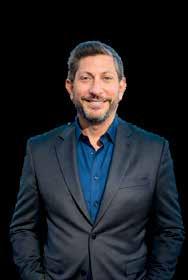







HaRav Galai and HaRav Ausband Uplift the






There are moments when the world around us seems to catch up to conversations we’ve been having around the Shabbos table for years.
Recently, the United Kingdom announced a ban restricting children under the age of 16 from accessing social media platforms. Whether or not other countries follow suit and whether governments can successfully enforce such policies remains to be seen. But the very fact that this discussion is happening on a global level is significant.
It’s significant because for many parents, educators, and communities, this is not a new concern.
We have been talking about the impact of social media on our children for years. We have worried about the constant comparison, the pressure to perform, the bullying, the exposure to content that is not age-appropriate, and the way a device that fits in a child’s pocket can sometimes take up far too much space in a child’s mind.
We do not need the rest of the world to tell us what our values are. Our mesorah has always emphasized the importance of protecting our children, creating boundaries, and focusing on what builds a healthy, connected life. But there is something reassuring about seeing broader society acknowledge what many parents have instinctively understood: childhood is precious. It deserves protection. And we, as parents, need to provide safeguards to ensure its protection.
Perhaps the timing of this conversation is especially fitting as we enter the summer months.
Summer is a season built around the opposite of scrolling. It is about running outside un-
til the sun goes down. It is about camp friendships, family trips, cousins laughing together, bike rides, swimming, long walks, and conversations that don’t come with a “like” button.
The best childhood memories rarely involve a screen. They involve people.
They involve the friend who sat next to you on the bus. The neighbor who came knocking at your door. The sibling who turned an ordinary afternoon into an adventure. The spontaneous moments that could never be planned, filtered, or posed.
Of course, technology is part of our world. Our children will grow up in a digital age, and we cannot pretend otherwise. But there is a difference between teaching children how to navigate technology and allowing technology to navigate them.
The goal is not simply to remove something harmful. The goal is to replace it with something better.
More family time. More creativity. More boredom — yes, even boredom — because boredom is often where imagination begins. More opportunities for our children to discover who they are without an audience watching.
We are fortunate to live in a community that has long valued these ideas. We understand that raising children means making thoughtful choices, even when those choices are difficult or different from the culture around us.
Sometimes, the world catches up. And when it does, it is a reminder that the values we work so hard to preserve are not outdated.
They are timeless.
Wishing you a wonderful week, Shoshana

Yitzy Halpern, PUBLISHER publisher@fivetownsjewishhome.com
Yosef Feinerman, MANAGING EDITOR ads@fivetownsjewishhome.com
Shoshana Soroka, EDITOR editor@fivetownsjewishhome.com
Nate Davis Editorial Assistant
Nechama Wein Copy Editor
Rachel Bergida Shana Brecher
Lani White Design & Production
Gabe Solomon Distribution & Logistics
P.O. BOX 266
Lawrence, NY 11559
Phone | 516-734-0858 Fax | 516-734-0857
Classified Deadline: Monday 5:00PM classifieds@fivetownsjewishhome.com text 443-929-4003
PAYMENT VIA CREDIT CARD MUST BE SUBMITTED ALONG WITH CLASSIFIED ADS
The Jewish Home is an independent weekly magazine. Opinions expressed by writers are not necessarily the opinions of the publisher or editor. The Jewish Home is not responsible for typographical errors, or for the kashrus of any product or business advertised within. The Jewish Home contains words of Torah. Please treat accordingly.






Dear Editor,
This past week saw the New York Knicks basketball team winning the NBA Championship for the first time since 1973. The Knicks didn’t get this far based on diversity, equity and inclusion; rather, each player brought their own unique talent and skills to the game. One player might be good defensively while another is good at making those three-point shots. The “point” is: we aren’t all the same; and that’s a good thing.
I heard the following from Yehuda Geberer on his Jewish History Soundbites podcast. Rav Yeruchum Levovitz, zt”l, (whose 90th yahrtzeit was observed recently) predicted communism’s disastrous results. The communists believed they were so liberal: no private ownership of property! Everyone is equal, right? Wrong, predicted the Mashgiach. “If there’s no ownership, the strong will steal from the weak.” Rav Yeruchum then went on to cite examples of Jewish ownership in the Torah such as kinyan, which can’t be negated.
In this week’s Parsha, Korach has a complaint against Moshe: all Jews are equal; why are you the leader? Korach wasn’t concerned with equality. He was consumed with jealousy. Blinded by hate, Korach could not see that we all have attributes, talents and skills to bring to the table. Additionally, we can all learn from each other.
The left would have you believe that money in politics is bad, but their true intention is to squeeze the right out of power and inject their own wealth into the system. Leadership isn’t bad. We need the right leader like Moshe Rabbeinu who served Hashem at the highest level. This
is why the Torah calls him an “eved Hashem.” Moshe was a leader, yes, but he lived to serve the people.
Hashem is the Conductor who leads the orchestra. We all have our roles in life. One person might be good at sports; another person might be a good doctor; yet another one might be excellent at math. Being that this is graduation season, it is important to also note that “chanoch l’naar al pi darko.” We all learn in our own way. One school, many students. One team, many players.
Bearing in mind that we all have something to teach and something to learn from others, we can approach this week’s parsha with a view toward appreciating others. We can also appreciate the need to help others. Absent this, it’s just a power grab. All the truth is in the Torah despite what the flavor of the day is. Moshe emes v’Toraso emes.
Chaim Yehuda Meyer
Dear Editor, Summer is here.
This Shabbos afternoon, I walked by the Lawrence train station. There were Jewish children waiting by the tracks for trains. When they heard the bells, and saw the train, they all dared each other to cross over the tracks, each trying to be the “last one” to do so. I know kids are kids, and parents allow their kids to scooter all over town. I’m not blaming anyone. However, this needs to be publicized, so that parents could be asking their kids about this.
Which reminds me of my teenage daughter who wanted to find a “private beach” to go swimming in Rockaway. When I heard she was on the beaches
on page 12

without lifeguards with her friends, I had to tell her about the danger of Rockaway Beach and the rip currents that have swept people away. She didn’t know.
This time of year, our kids have a lot of time on their hands. Especially on Shabbos. Let’s ask the right questions and keep them safe.
A Reader
Dear Editor,
Thank you, Rabbi Hoffman, for your important and outstanding article published in this week’s Jewish Home “how to make your child go off the derech.”
And thank you to The Jewish Home for publishing it.
Halavay it should be read widely, open up the eyes and hearts of many, and give all our children the love and respect they deserve.
Kol hakavod.
Respectfully,
M. Horowitz
Dear Editor,
I read with surprise and genuine disappointment the article “How to Make Your Child Go Off the Derech,” published in the June 11, 2026, edition of The Jewish Home. Your publication has long
distinguished itself by its sensitivity and careful editorial judgment, which is precisely what makes this piece so puzzling to find in your pages.
I write with three concerns.
The first is one of simple compassion. The article’s framing, cataloguing the parental failures that send a child off the derech, cannot be read by a parent living with that reality as anything other than an inventory of their own alleged failings. Whatever the author’s intent, the effect is to visit additional pain upon families already carrying an enormous burden. Your readership almost certainly includes such parents, and they deserved better from this publication.
The second concern follows directly: the article implicitly assigns blame. Its cause-and-effect architecture, do these things as a parent and your child will leave Orthodoxy, carries an inescapable corollary: if your child has gone off the derech, you did these things. That is a weighty and, I would argue, unfair conclusion to leave with your readers.
To his credit, Rabbi Hoffman does acknowledge in his closing paragraph that he did not intend to assign blame to parents, and that acknowledgment is welcome. But by the time a reader reaches it,

they have already traveled through the full weight of the article’s framing. For a parent carrying this particular pain, a closing caveat does not undo what came before. A more considered approach would have built that sensitivity into the structure of the piece from the outset, rather than appending it as an afterthought. The disclaimer mitigates the sting; it does not redeem the article’s fundamental flaw in approach.
The third concern is with the thesis itself, which is, I am sorry to say, incomplete at best. Much of the parenting advice in the article is genuinely good, including warmth in the home, joy in religious life, and an engaged and respectful relationship with one’s children. But the leap from “this is good parenting” to “the absence of it explains why children leave Orthodoxy” simply does not hold. Many deeply devoted parents have watched children walk away from Torah observance, and many of those children have done so for reasons entirely unrelated to their upbringing, among them philosophical questioning, the genuine challenge of accepting matters of faith that resist empirical proof, and the encounter with the broader world. These are real and serious reasons, and they are not parenting failures. Rabbi Hoffman could have offered his wisdom straightforwardly as parenting guidance, full stop. The connection he drew to children going off the derech was not only unnecessary; it was misleading. Every parent is imperfect, and our community is full of dedicated, loving parents who have nonetheless watched children walk away from observance, just as it includes parents whose children remained committed to Torah despite
a far-from-perfect home. The idea that a child’s observance is owed to a parent having done everything right, or that a child’s departure is owed to a parent having done things wrong, is an oversimplification that does not reflect the complexity of the human soul or the realities of our community.
I remain a loyal reader of The Jewish Home, and I trust this feedback will be received in the constructive spirit in which it is offered.
Respectfully,
Dear Editor,
Regarding Mayor Mamdani not attending the recent Israel Day Parade, it is worthwhile to share the following story that I heard from someone who witnessed it.
Askanim brought a politician to the Satmar Rebbe, Reb Yoel. This politician spoke against Israel and promised that if elected to Congress he wouldn’t support Israel. The Rebbe refused to look at the politician, refused to talk to him and refused to bless him. The Rebbe explained that the “shitah” he has about the State of Israel is between himself and his chassidim. When this guy spoke against Israel, it was because he is an antisemite. It is also worthwhile to know that Hitler was very influenced by the antisemitic speeches of the mayor of Vienna. The anti-Israel position of Mayor Mamdani is a product of antisemitism and is consequential.
Sincerely,
Rabbi Eli Reit Lakewood, NJ



On Monday, U.K. Prime Minister Keir Starmer announced a sweeping social media ban for teenagers under the age of 16, noting that the restrictions could be in effect next spring.
The ban, which Starmer says will “give kids their childhood back,” includes restrictions on Snapchat, TikTok, Instagram, YouTube, Facebook, X, and other social media, gaming, and live-streaming platforms. The ban will not impact YouTube Kids, Lego Play, Google Classroom, and other services designed for children, nor will it include messaging platforms, including WhatsApp and Signal.
“It is clear to me a full ban is the right choice,” Starmer said. “It will make a huge difference, it will make our children safer, it will make our children happier, it will give them more time, more security, more freedom to grow up, more opportunity.”
The U.K. is following in the footsteps of Australia, which recently became the first country to ban social media for children. However, Britain may go beyond Australia’s model, as the government also weighs online curfews to prevent infinite scrolling for those under 18.
“‘World-leading blocks’ on livestreaming and strangers contacting children would also be imposed,” Starmer said. “Is there a situation in the offline world where you would just let your child pair up with a stranger, an adult that you don’t know anything about?”
Some experts have questioned whether the ban would make a difference. Big Tech companies have criticized the move.
YouTube noted its investment in “expert-led, age-appropriate experiences and default protections for teens for over a decade,” adding that its service is “a vi-
tal resource for young people, educators and parents.” Snapchat and Meta warned that the bans might have negative effects, including isolating teens from their friends and leading children to unregulated alternatives.
While children may find ways to circumvent the ban, Starmer says that the restrictions could usher in a new culture surrounding social media.

Canada was on track to open the Gordie Howe International Bridge, which would connect Detroit with Windsor, Ontario, by June 21, according to the Windsor-Detroit Bridge Authority. However, on Thursday, Prime Minister Mark Carney announced that Canada agreed to a U.S. request to delay the bridge’s opening, citing technical issues.
Carney said that the ongoing trade dispute between Canada and the United States wasn’t necessarily the reason the bridge’s debut was delayed.
In February, U.S. President Donald Trump insisted that the U.S. have a 50% or higher ownership stake in the bridge and full compensation “for everything we have given” to Canada. Last week, the White House reaffirmed the president’s commitment to securing the best possible deal for the U.S.
U.S. Trade Representative Jamieson Greer said last week that negotiations with Canada have hit an impasse, citing retaliatory trade actions taken against American goods. While Greer and his office have not specified which measures are causing concern, officials in the Trump administration have repeatedly objected to restrictions imposed by most Canadian provinces on the sale of U.S. wine and liquor through government-controlled retail outlets. Those restrictions were introduced last year in response to tariffs that Trump placed on Canadian imports. In the 2010s, Canada agreed to pay for the bridge’s construction, which will be co-owned by Michigan. The bridge was expected to economically benefit both Canada and Michigan, potentially saving

billions of dollars.
“Michigan secured a great deal on the financing of this bridge: we haven’t paid a dime, yet we will reap significant economic benefits for decades,” a spokeswoman for Michigan Gov. Gretchen Whitmer said.

Last Friday night, U.S. President Donald Trump announced on Truth Social that the United States and Venezuela teamed up to eliminate drug lord Héctor Rusthenford Guerrero Flores, or “Niño Guerrero,” in a joint mission.
Guerrero Flores — a founding member and leader of the infamous Tren de Aragua crime group, a U.S.-designated terrorist organization — was killed in a “swift and lethal” attack, Trump noted,
warning that the U.S. would continue to “find these vicious murderers and drug lords anytime, anyplace.”
Delcy Rodriguez, the acting president of Venezuela, said the joint operation was conducted “in the southeast of Bolivar state,” noting that the countries’ collaboration included an intelligence and specialized technical support exchange.
Guerrero Flores was a fugitive for years before his death, having escaped from a gang-controlled prison. In 2016, he was convicted of intentional homicide, escape from custody, concealment of a weapon of war, drug trafficking, and criminal association, among other crimes, and sentenced to 17 years and two months in jail. Before that, he was arrested in 2005. In September 2012, he escaped from prison and was recaptured the following year.
Under his leadership, Tren de Aragua expanded regionally and became more powerful.
During the Biden administration, the U.S. designated the group as a major transnational criminal organization. Soon thereafter, the Trump administration recognized the organization as a foreign terror group.


On Thursday morning, James Boyard, the Haitian Defense Ministry’s cabinet director and inspector general, was kidnapped with his wife and 6-yearold daughter. The three were abducted while Boyard and his wife were bringing their sick daughter to a doctor in Port-auPrince.
The abduction shocked the country, which has been grappling with a kidnapping crisis. Recently, a senior Foreign Affairs Ministry staffer was released after over a month in captivity, following a major ransom payment. On March 28, a woman was kidnapped and remains in captivity. On May 1, gunmen invaded a cargo vessel, kidnapping a Russian and a Turkish citizen, who both remain captive.
Many released victims do not report the kidnappings, as they do not believe the police will do anything. Additionally, many gunmen have dressed as police officers and used police vehicles during the kidnapping, stoking suspicion that police officers are impostors.
Antonio Guterres, the secretary-general of the United Nations, was expected to meet with Haitian Prime Minister Alix Didier Fils-Aimé on Tuesday.
Efforts by Haiti’s government to improve security have gained momentum in recent months, including a campaign to grow the nation’s armed forces and a series of police-led operations around the capital. Yet these measures have done little to curb the broader crisis. Armed groups continue to battle for control in several key areas, including Cité Soleil and Croix-des-Bouquets, while factions linked to the Viv Ansanm alliance have maintained pressure on communities in the Artibonite region through persistent attacks and intimidation.
The ongoing violence has worsened an already dire humanitarian situation, contributing to a rise in murders, assaults, and kidnappings carried out for ransom.
According to the United Nations, Haiti’s security crisis forced nearly 95,000 additional people from their homes between December 2025 and May 2026. The capital region was especially hard hit,
with major surges in displacement following outbreaks of gang-related fighting in Cité Soleil during both March and May.

At least eleven people were killed after Russia fired hundreds of drones and dozens of missiles at Ukraine, hitting Kyiv and Kharkiv, and damaging the historic religious landmark Kyiv-Pechersk Lavra’s Dormition Cathedral, Ukrainian President Volodymyr Zelensky announced on Monday.
The attacks came after U.S. President Donald Trump spoke to Zelensky and Russian President Vladimir Putin individually on the phone on Sunday.
“This is how Russia shows the world its intention to continue the war,” Zelensky wrote on X. “It is very important that there be a response from the G7 countries … and that this response be decisive and substantive: more pressure on the aggressor and more support for Ukraine’s air defense, especially anti-ballistic capabilities.”
Five people were killed in Kyiv, the capital of Ukraine, according to Mayor Vitali Klitschko.
Tymur Tkachenko, the head of the capital’s Military Administration, said that 30 or more people were wounded in the strikes, including a 5- and 6-year-old.
Russian strikes hit a 25-story apartment building and other civilian structures in Kyiv’s Shevchenkivskyi district and caused a market and grocery store to catch fire. A nine-story residential building was struck in the Obolonskyi district. Russia claims to have targeted military and industrial sites.
Four emergency service workers and a Kharkiv City Council emergency department employee were killed in the strikes, and another six rescuers and three civilians sustained injuries, according to local officials.
The strikes damaged the Kyiv-Pechersk Lavra, which is also referred to as the Monastery of the Caves, an 11th-century monastic complex and a religious landmark. Metropolitan Epiphanius, the


20 leader of the Orthodox Church of Europe, slammed Russia for committing another crime “against humanity, against history, against Christianity.” Zelensky, who reportedly visited the damaged site, characterized the attack as Russia’s “biggest crime yet against Christian culture.”
Of the 70 missiles and 611 drones fired by Russia, 50 missiles and 582 drones were intercepted or electronically suppressed by Ukrainian air defenses. Forty-two sites were hit by 20 ballistic missiles and 27 drones.

A memorandum of understanding was signed digitally by the United States and Iran on Sunday, ending the countries’ war and setting up future nuclear talks, according to U.S. Vice President JD Vance. An in-person signing ceremony
was scheduled for Friday in Switzerland.
Though the agreement’s text has yet to be publicized, officials say the MOU ends the U.S. blockade on Iran, reopens the Strait of Hormuz, and sets up the “structure” for 60 days of talks for a new nuclear deal. It is unclear when the exact terms of the deal will be revealed, though U.S. President Donald Trump said the text would probably be released “some time after Friday.”
The Strait of Hormuz will be reopened immediately, and its traffic is expected to resume as usual in the coming weeks.
Israel was not involved in talks leading up to the deal. At a press conference held after the MOU’s digital signing, Israeli Prime Minister Benjamin Netanyahu said that Israel does not yet know what the deal entails.
At the press conference, Netanyahu insisted that Israel emerged victorious in the conflict, eliminating the threat of Iran’s nuclear program “for years to come.” He declared that “we saved the State of Israel from annihilation.”
“We targeted the nuclear scientists; we eliminated the leaders of the terror regime; we crushed the nuclear facilities; we destroyed missiles and the vast majority of the factories that produce missiles,” Netanyahu said. “We struck countless
military industries and infrastructures. We destroyed their navy, their air force. We eliminated base commanders who massacred the Iranian people. We caused enormous damage — [some] estimate it in the hundreds of billions of dollars, some estimate it at even close to a trillion dollars — to Iran’s economy.”
Netanyahu also dismissed the notion that Trump forced Israel to stop fighting.
“In the U.S., they say that President Trump does everything I ask, and in Israel, they say the opposite, that I do everything he asks,” he said. “Neither is true.”
“We have a relationship of partners who know each other,” he added. “Many times, we agree; sometimes, we don’t agree. That happens in the best families.”
Netanyahu’s speech was met with criticism from opposition leaders, who accused Netanyahu of failing to fulfill his war objectives.
Naftali Bennett, a former prime minister and leading opposition leader, suggested that regime change in Iran will only be possible once Israel’s ruling coalition is replaced.
Gadi Eisenkot, the leader of the Yashar party and a potential candidate in the upcoming election, said that Netanyahu would be better off “to say, ‘I erred, I set false goals that I wasn’t able to achieve.’
This would have given Netanyahu much more credit and respect from the people, if he had admitted he made empty declarations.”

In a Financial Times opinion piece, Argentina’s President Javier Milei proposed a radical plan: to recognize the legality of “non-human corporations,” or, in other words, to treat businesses completely run by artificial intelligence systems as ordinary, human-run companies.
As Yuval Noah Harari, an historian and author, writes in his response to Milei’s proposal, AI businesses could “own assets, hire employees, participate in international trade, sue you in court and even donate to political campaigns ... all without a single human’s input or liability.”


While companies until this point have exclusively been run by humans, Milei’s plans, which he framed as an “invitation” to tech companies, could unleash an AI business free-for-all in Argentina.
“As much as the industrial revolution freed us from the constraints of the human muscle, AI will free us from the constraints of the human brain, pushing productivity beyond our wildest dreams,” Milei wrote in his opinion piece, emphasizing the importance of taking risks. “Let Buenos Aires become for AI what Amsterdam was for the age of sail – the place where the legal imagination caught up with the technological moment, and the world was changed.”
In response, Harari raised concerns that AI companies, undeterred by the threat of prison, may cheat in business and exploit their superior intellect to find “legal loopholes and regulatory arbitrage.” Milei praised Harari for participating in “this fascinating and transcendental debate,” pledging to address the historian’s concerns.
Some have noted that the plan — an unregulated AI economy — could cause a great deal of chaos, though Big Tech companies have by and large praised the move.

British authorities have released new details about a series of arson attacks targeting properties connected to U.K. Prime Minister Keir Starmer, alleging that the suspects were recruited and directed by a Russian-speaking handler as part of a wider foreign sabotage campaign.
According to police and court reports, the attacks took place in London in May 2025 and involved a vehicle and two properties connected to Starmer. Investigators said the suspects were promised payment in exchange for carrying out the operations.
Two men were convicted in connection with the plot: Ukrainian national Roman Lavrynovych, 22, and Romanian national Stanislav Carpiuc, 27. A third defendant, Petro Pochynok, 35, was ac-

quitted.
Authorities said Lavrynovych was recruited through Telegram by a contact saved as “El Money,” who allegedly assigned him increasingly serious tasks while offering money and other incentives. Investigators said the handler allegedly promised Lavrynovych payment and even Russian citizenship if he completed the attacks.
A report by the Kyiv Post said the handler is believed to have links to Russian information warfare operations and may have been trained by Russian propagandists and intelligence figures. The outlet also reported that Russian operatives allegedly used social media platforms to operate through fake online communities designed to create division inside Britain.
The Russian Embassy has denied involvement, rejecting what it described as attempts to connect Russia or its foreign ministry to illegal activity.
The alleged campaign unfolded over five days.
On May 8, 2025, a Toyota vehicle previously owned by Starmer was set on fire. Three days later, a fire was started at the entrance of a residential property managed by a company where Starmer had previously been a director and shareholder. The following day, another blaze was reported at a house owned by the prime minister.
“The actions of the two men involved in these arson attacks were incredibly reckless, and it was sheer luck that nobody was killed or injured,” Commander Helen Flanagan, head of Counter Terrorism Policing London, said.
Police said Lavrynovych was arrested on May 13 after CCTV footage and phone records linked him to the attacks, including evidence that he had conducted reconnaissance before the fires. Carpiuc was arrested days later at London’s Luton Airport while preparing to board a flight to Romania.
The case comes amid growing concerns in Europe over alleged foreign-backed sabotage operations carried out through online recruitment and covert networks.
On Monday, the National Liberation Army (ELN), one of Colombia’s biggest surviving rebel groups, said it would unilaterally stop attacking the Colombian military from June 20 to June 23, ceasing hostilities just before the Sunday, June 21, presidential election.
The rebel group expressed its respect for citizens’ “right to vote freely,” noting that it didn’t want to “threaten any of the candidates or stop people from voting.”
“We cannot accept any involvement by leaders of other countries in political decisions that should only concern Colombians,” the group added.
In the upcoming election, Sen. Iván Cepeda, an ally of outgoing leftist President Gustavo Petro, will face conservative lawyer Abelardo de la Espriella, whom U.S. President Donald Trump endorsed recently. Espriella has pledged to cancel Petro’s peace talks with rebel groups and crack down on them.

Petro’s government abandoned negotiations with the ELN in 2025 after the guerrilla group launched a wave of assaults in northeastern Colombia, triggering a humanitarian crisis that displaced over 56,000 residents. The peace initiative had begun two years earlier as part of Petro’s broader effort to negotiate an end to decades of armed conflict.
Despite the collapse of talks with the ELN, the administration has continued engaging with several other armed organizations. Among them is the Gulf Clan, a powerful criminal network whose activities include drug smuggling and illegal mining operations, both major sources of revenue for the group.
De la Espriella’s campaign has called on Colombia’s attorney general to examine allegations that armed groups may have influenced voting in 109 isolated municipalities during the first round of the presidential election. The request came after rival candidate Cepeda secured more than 70% of the vote in those areas on May 31. Campaign officials have suggested that rebel organizations could have pressured residents to support Cepeda. Cepeda has insisted that his campaign was not involved in any voter coercion.
On Sunday, Switzerland held a national referendum, allowing voters to decide whether to cap the country’s population

at 10 million. According to initial results, the referendum failed to gain popular support, with nearly 55% of voters voting against and just 45% voting for it.
Switzerland’s referendum was similar to the United Kingdom’s Brexit referendum in 2016, which led the country to leave the European Union.

As per the referendum’s terms, if Switzerland’s population exceeded 10 million before 2050, Switzerland would stop freedom of movement with the E.U. The country’s population today is 9.1 million, 28% of whom are foreigners, and is expected to reach 10 million by the 2040s. The referendum was promoted by the Swiss People’s Party, a right-wing political party. Meanwhile, the government called on voters to reject the proposal, which some have branded xenophobic. Around 59% of voters voted. The results were less close than anticipated.
According to Swiss People’s Party president Marcel Dettling, rural voters overwhelmingly supported the proposal, but urban voters rejected it.
“Not a single problem has been solved,” he said. “We will continue to push for sensible immigration.”

The British government acted lawfully when it banned the protest group Palestine Action as a terrorist organization, the Court of Appeal in London ruled on Monday.
Chief Justice Sue Carr said the group’s claim that it was merely a civil disobedience movement was not supported by the

evidence. The court found that Palestine Action operated through covert cells that carried out planned attacks on defense companies and military facilities.
“In our judgment, that premise was seriously flawed,” Carr said, adding that it was not reasonable to describe Palestine Action as a nonviolent organization.
The ruling overturned a February decision by three senior High Court judges who had ruled that although the group promoted its political agenda through criminal acts, the government had not shown that its activities justified a terrorism ban. The ban remained in place while the government appealed.
Palestine Action co-founder Huda Ammori said the group would continue fighting the decision, promising to appeal to the Supreme Court and the European Court of Human Rights. She called the ban “one of the most extreme attacks on free speech and the right to protest in modern British history.”
The British government outlawed Palestine Action after activists broke into a Royal Air Force base in June 2025 while protesting British military support for Israel’s campaign against Hamas in Gaza. The incident followed a series of vandalism attacks targeting defense-related sites.
The designation placed Palestine Action alongside organizations such as Al-Qaeda and Hamas under Britain’s terrorism laws. Membership in or support for a banned group can carry a prison sentence of up to 14 years.
Since the ban was introduced, more than 3,300 people have reportedly been arrested at protests for displaying signs stating, “I oppose genocide. I support Palestine Action.” More than 700 people have been charged under the UK Terrorism Act, though no convictions have yet been recorded.
Civil liberties organizations criticized the government’s move, arguing that it risks criminalizing peaceful protest. The group Defend Our Juries said the ruling would lead to further arrests and called it an attack on democratic freedoms.
Supporters of the ban, however, said Palestine Action’s activities went beyond protest. The group, founded in 2020, has carried out direct-action campaigns against military and industrial sites, including facilities connected to Israeli defense company Elbit Systems. Officials said the attacks caused millions of pounds in damage and created security concerns.
The legal battle comes after four members of the group were sentenced last week for breaking into an Elbit facility in Bristol in 2024 and destroying equipment. A judge ruled that their ac-
tions amounted to terrorist offenses.
More than 100 Palestine Action supporters were arrested outside the London court during the sentencing proceedings.

The number of foreign travelers visiting Cuba has plummeted since the beginning of the year amid tightened U.S. sanctions, according to figures released by Cuba’s national statistics agency.
Less than 360,000 people visited the Communist-run island in the first five months of 2026, a decrease of 58.4% compared to the same period last year, according to Onei.
Many foreign airlines and hotel operators have stopped operating in Cuba.
Earlier this month, Air Canada announced it was suspending its flights to Cuba indefinitely, citing the “ongoing political and economic uncertainty” as its reason. The carrier had already stopped flying to the island in February because of a shortage of aviation fuel on the Caribbean island.
The move comes as a particular blow as Onei figures suggest visitors from Canada constituted by far the largest contingent of foreign tourists to Cuba this year.
Spanish hotel chains Meliá and Iberostar also halted their operations at a significant number of hotels ahead of a June 5 deadline set by the U.S. government for companies to cease doing business with Cuban conglomerate Gaesa.
U.S. Secretary of State Marco Rubio has accused Gaesa, which is controlled by Cuba’s armed forces, of acting as a “state within a state.”
Rubio said Gaesa “hoards the profits from its businesses for the benefit of a small elite” as well as “repressing anyone who dares to complain.”
U.S. sanctions and an effective oil blockade have exacerbated already existing shortages of fuel, medicines and food in Cuba.
The lack of fuel has paralyzed large sectors of the economy, including garbage collection, leading to piles of trash piling up in city streets.


Frequent, lengthy and wide-spread power cuts have triggered rare protests on the island, where public dissent is often punished with long prison sentences.
Thailand’s Princess Bajrakitiyabha Narendira Debyavati, the eldest daughter of King Maha Vajiralongkorn, has died at age 47 following nearly four years of seri-
ous health complications, the Thai royal palace announced.
The princess, widely known as Princess Pa, died Thursday evening after her condition deteriorated due to a combination of medical issues, including an infection, low blood pressure, irregular heart rhythms, and blood clotting complications, according to a palace statement.
Bajrakitiyabha was hospitalized in December 2022 after suddenly losing consciousness from a heart-related condition
earning both a master’s degree and doctorate before working as an attorney with Thailand’s Office of the Attorney-General.
From 2012 to 2014, she served as Thailand’s ambassador to Austria, Slovenia, and Slovakia, later returning to legal work in Bangkok.
A major focus of her public service was improving conditions for female prisoners. She founded a charity dedicated to supporting incarcerated women, including pregnant inmates, and advocating for their rights.

In 2017, the princess was named a goodwill ambassador for the rule of law in Southeast Asia by the United Nations Commission on Crime Prevention and Criminal Justice. She later joined Thailand’s military in 2021, receiving the rank of general and serving as chief of staff in the Royal Security Command.
Princess Bajrakitiyabha was one of three children of King Vajiralongkorn with formal royal titles and eligibility under Thailand’s constitution to inherit the throne.
The palace announced that royal funeral ceremonies will be held, and the Thai government is expected to declare a period of national mourning. Her death comes after the passing of Thailand’s Queen Mother last year at age 93.
while visiting Thailand’s northeastern Nakhon Ratchasima province. She was airlifted to Bangkok for treatment, where she remained under medical care.
Born on December 7, 1978, Princess Pa was the daughter of then-Crown Prince Vajiralongkorn and his first wife, Princess Soamsawali. She became one of Thailand’s most visible royals and was known for her work in law, diplomacy, and humanitarian causes.
She studied law at Cornell University,

Starbucks locations across South Korea will close for several hours next week so employees can attend a history and social awareness training session following public anger over a promotional campaign that was criticized for evoking memories of a deadly pro-democracy crackdown.


The controversy began when Starbucks Korea launched a “Tank Day” promotion for reusable drink tumblers. The campaign was released on the anniversary of the 1980 Gwangju Uprising, when South Korean military forces killed at least 165 civilians during a crackdown on pro-democracy protesters. Many historians believe the actual death toll was significantly higher.
The backlash was immediate, with protests held outside stores and calls for a boycott. Shinsegae Group, which operates Starbucks Korea under a licensing agreement, fired the company’s chief executive on the day the controversy erupted.
Starbucks Korea announced that all stores nationwide will close on Wednesday at 3 p.m. local time for three hours to allow employees to participate in training. The shops will remain closed until the following day.
The company also said that all employees will take part in lessons on historical awareness and social sensitivity, including video presentations about South Korea’s modern history. The closure will mark the first nationwide early shutdown since Starbucks entered the South Korean market in 1999.
The promotion involved the “Tank Series” of tumblers, which Starbucks described as having a large capacity. The company said the campaign was part of a broader product launch running through May 26.
Starbucks Korea apologized, saying it regretted “causing inconvenience and concern to our customers.”
South Korean President Lee Jae Myung criticized the campaign, calling it “inhumane and disgraceful” in a social media post during the controversy.
The Gwangju Uprising remains one of the most painful chapters in South Korea’s modern history. The 1980 military crackdown included reports of killings, torture, and assaults. The uprising later became a symbol of the country’s democratic movement, which eventually led to the end of military rule in 1988.
Some critics also argued that the campaign’s slogan, “tak on the table,” had additional historical associations. The company said the phrase was suggested through an AI tool and that no connection to historical events was intended.
The incident has renewed debate in South Korea about corporate responsibility, historical awareness, and the risks of using automated tools in marketing.

The Israeli government plans to provide hundreds of young people living in hilltop communities in Judea and Samaria with daily financial assistance for food and clothing, as part of a program officials say is designed to reduce violence against Palestinians, according to a report this week by Ynet.
The plan, led by the Ministry of Settlement and National Missions headed by Orit Strock, would provide each recipient with NIS 50 ($17) per day. The funds would be transferred to regional councils, which would distribute the money to the teenagers.
According to a ministry document cited by Ynet, 657 young people living in hilltops and agricultural outposts across the area have been identified as eligible. The recipients include 225 people in the Binyamin region, 129 in Samaria, 120 in the Jordan Valley, 99 near Hebron, and 84 in Gush Etzion.
The payments are expected to continue for about seven months, through the end of the year, at a total cost of approximately NIS 5.5 million ($1.9 million). The assistance will also be provided through food vouchers intended to cover basic necessities.
The stipend program is part of a broader NIS 120 million ($41.3 million) initiative aimed at addressing what officials describe as settler violence through educational and social programs. The broader effort includes funding for social workers, mediators who will work between hilltop youth and local authorities, workforce integration programs, and initiatives encouraging military enlistment.
Opposition MK Vladimir Beliak has asked Attorney General Gali Baharav-Miara to review the plan, questioning whether the funding meets standards of equality, transparency, and whether it is justified in supporting this specific group

than other at-risk youth.
Government officials said that the program is intended to supplement—not replace—law enforcement efforts.
“The goal is an envelope of welfare and education for them, in order to protect this enterprise and prevent its slipping into violence,” government sources said, adding that youths involved in serious violence should face criminal prosecution.
The officials also expressed support for outposts in Judea and Samaria in general, saying the government views hilltops and farms as important for security and preventing Palestinian territorial expansion.
In recent years, some people living there have been accused of carrying out frequent attacks against Palestinians, including assaults, arson, and property damage. Critics have pointed to low arrest and conviction rates in such cases, as well as allegations that security forces have sometimes failed to intervene.
The issue has drawn international scrutiny, with rights groups and foreign governments criticizing the violence and calling for stronger enforcement measures.

Finance Minister Bezalel Smotrich
announced this week that Israel had removed parts of the 1997 Hebron Agreement that gave the Palestinian municipal council of Hebron authority over planning, zoning, and construction in the H2 area of the city.
The move affects the section of Hebron where the Jewish community is located, as well as Mearas Hamachpeila, one of the most important religious sites in the region.
Speaking at a ceremony marking the establishment of a new community in Judea and Samaria, Smotrich declared, “Yesterday, we annulled the Hebron Accords,” saying the previous arrangement had allowed Palestinian authorities influ-

ence over Jewish areas and holy sites.
“For many years, one of the most absurd clauses of the Oslo accords remained in place,” Smotrich said. “Yesterday, we put an end to that.”
The Palestinian Authority strongly rejected the announcement, saying the move violated agreements signed with Israel and international law. Officials called on the United States and the international community to intervene.
However, Israel’s Foreign Ministry pushed back on Smotrich’s wording, saying the Hebron Agreement itself had not been canceled.
“Contrary to the Finance Minister’s statement, the Hebron Agreement has not been canceled,” the ministry said. It explained that a Security Cabinet decision approved changes relating specifically to planning and construction involving the Jewish community in Hebron and Jewish heritage sites, while “no other changes” had been made.
Under the original Hebron Agreement, signed during Prime Minister Benjamin Netanyahu’s first term along with PLO chairman Yasser Arafat, the city was divided into two zones. Israel withdrew from H1, which covers most of Hebron, while retaining security control over H2, which includes the Jewish community and Mearas Hamachpeila.
Civil responsibilities in H2, including building and zoning decisions, had remained under Palestinian authority.
Smotrich said the new arrangement would place those responsibilities under the control of “the State of Israel.” His office did not provide details about which government body would oversee the authority, though it indicated that the Civil Administration’s planning body had begun implementing the change.
The announcement is part of Smotrich’s broader efforts to strengthen Israeli control in Judea and Samaria and expand Jewish building and activity in the area. Palestinian leaders say the measures undermine prospects for a future Palestinian state.
Hebron remains one of the most complex and contested cities in the region, with several hundred Jewish residents living among a Palestinian population of roughly 200,000. Mearas Hamachpeila, revered by both Jews and Muslims, has long been a flashpoint.

Hamas launched its October 7, 2023, attack on Israel partly in an effort to derail potential normalization between Israel and Saudi Arabia, according to internal documents seized from the terror group.
The materials were published by the Meir Amit Intelligence and Terrorism Information Center and later reported by the Kan. The documents describe Hamas discussions in which leaders expressed concern that Saudi Arabia was moving closer to establishing diplomatic ties with Israel.
In the years before the attack, reports indicated that Riyadh was considering a normalization agreement similar to the U.S.-brokered Abraham Accords signed between Israel and several Arab countries.
According to the documents, Hamas established a special office in 2022 tasked with countering efforts toward normalization between Israel and Arab states.
Minutes from a February 2022 Hamas leadership meeting in Gaza reportedly stated that the group wanted to escalate tensions in Gaza, the West Bank, and East Jerusalem “in order to thwart the Saudi kingdom’s process of normalization.”
The documents cited the Second Intifada, the wave of Palestinian terror attacks in the early 2000s, as an example of how violence had previously disrupted diplomatic efforts. Hamas described the campaign of suicide bombings and attacks as having contributed to the collapse of the Arab Peace Initiative process. By 2023, Hamas leaders concluded that their efforts to create regional instability had not achieved their desired impact. In late September, a leadership meeting chaired by Gaza chief Yahya Sinwar focused on the Saudi-Israel normalization talks.
According to the report, Sinwar presented a document titled “Dealing with the normalization process between Saudi Arabia and Israel,” arguing that Hamas could disrupt the process by demonstrating that Israel was not secure.

“Hamas is not a negligible party; our resistance can thwart the plans,” Sinwar reportedly said, according to the documents.
On October 2, 2023, Hamas leadership decided to move forward with what Sinwar described as an “exceptional action” involving Hamas and its allies in Iran’s regional network, according to the report.
Five days later, thousands of Hamasled terrorists crossed into southern Israel during the Simchas Torah holiday under heavy rocket fire. The assault killed approximately 1,200 people, mostly civilians, and resulted in the abduction of 251 hostages.
The attack triggered a wider regional conflict involving Hezbollah, the Houthis, and other Iran-backed groups.
Since the attack and subsequent war, Saudi-Israel normalization has not moved forward, with Israeli and Saudi officials indicating that such an agreement is not currently imminent.

El Al Airlines has signed an agreement with Elon Musk’s satellite internet company Starlink to provide high-speed internet access across its fleet, the airline announced this week.
The service, operated through SpaceX, is expected to begin being installed on El Al aircraft in 2027 and will be offered to passengers free of charge. The airline said the technology will allow hundreds of travelers to connect at the same time, including on long-haul flights.
The agreement marks a major upgrade for El Al passengers, who will be able to stream videos, work, communicate, and stay connected throughout their flights.
“The integration of Starlink technolo-

gy into El Al aircraft is a significant step forward,” said El Al CEO Levy Halevy, adding that passengers will be able to “stay connected in the air” and use the internet without interruptions.
Unlike many older airline Wi-Fi systems that rely on traditional satellites, Starlink uses a network of low-Earth-orbit satellites designed to provide faster speeds and lower delays. The technology has been expanding rapidly in the aviation industry as airlines look for better connectivity options for travelers.
El Al’s partnership with Starlink comes as the airline continues expanding its fleet and routes. The company operates Boeing 787 Dreamliner aircraft for long-distance travel and has also ordered Boeing 737 MAX planes for European routes.
Starlink has been signing deals with airlines around the world as it competes for a larger share of the in-flight internet market. Several carriers have turned to satellite-based systems as passenger demand for reliable Wi-Fi continues to grow.
Since the outbreak of the war in October 2023, El Al benefited from reduced competition as many international airlines suspended flights to Israel. However, competition is expected to increase as major carriers announce plans to resume service to Tel Aviv.
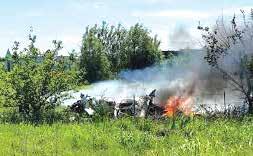
On Sunday, a single-engine skydiving plane crashed in Butler, Missouri, killing all 12 people on board. It was the deadliest skydiving plane crash since a 2019 crash in Mokuleia, Hawaii, that killed 11 people.
A preliminary report by the National Transportation Safety Board is expected within a month of the crash, while a final report may require as long as two years.
Now, experts are raising concerns about the skydiving industry’s regulatory practices.
“Paying passengers should be able to count on an airworthy plane, an adequately trained pilot, a safe operator and adequate federal oversight of those operations,” Jennifer Homendy, an NTSB board member, said.
To fly a skydiving plane, pilots require minimal training. According to a former pilot with the Oahu Parachute Center, which wasn’t properly licensed by the state, “The company’s only direction for training was to teach new pilots how to start the engines, taxi the airplane, take off, fly the jump run, and land the airplane, after which the new pilots would be ‘good to go.’”
“They go up, they go down. They go up, they go down. They get as many jumps as the weather and daylight permit.”
Dennis Jacobs, acting airport manager and director of the Bates County Emergency Management Agency, said that he suspects the fallen aircraft may have experienced power issues.
“It had just taken off and made a left turn,” Jacobs said. “In my opinion, I think it was losing power, and he was trying to make it over to the highway and land, and he stalled and went down nose first and caught fire.”
The Federal Aviation Administration Part 91 regulation, which mostly concerns non-commercial flights, applies to skydiving flights. While the NTSB has urged the FAA to implement stricter regulations for skydiving flights, the FAA has rejected the board’s requests.
“It’s a balancing act for the FAA,” said Jeff Guzzetti, a former NTSB investigator and former FAA accident investigation division director. “The NTSB is all about safety, but the FAA has to consider the proliferation of aviation operations and their right to have a business and to operate, and rulemaking requires justification, and sometimes it’s very difficult for the FAA to justify to lawmakers why they need to impart regulation.”
Sunday’s crash marked the first time since 2019 that a skydiving flight crash’s death toll reached the double digits. The FAA has pointed out that crashes are extremely rare, arguing that stricter regulations are unnecessary.
Fox Corp. is making a major move into the streaming world with a $22 billion deal to acquire Roku, combining one of America’s largest television companies with one of its biggest streaming platforms.

34 Under the agreement announced on Monday, Fox will purchase Roku for $160 per share in a cash-and-stock transaction. The combined company would become the third-largest player in U.S. television based on viewing share, according to Fox.
The deal brings together Fox’s extensive lineup of live programming — including Fox News, NFL broadcasts, MLB games, and FIFA World Cup coverage — with Roku’s streaming technology, which reaches roughly 100 million households.
Roku, based in San Jose, California, has grown into a major force in the streaming industry through its smart TV operating system and advertising business. The acquisition reflects a broader shakeup in entertainment as traditional media companies race to adapt to viewers moving away from cable television and toward streaming.
Fox already has experience in the streaming space, acquiring Tubi in 2020. Analysts said adding Roku would significantly expand Fox’s digital advertising reach.
“Buying Roku is a continuation of Fox’s strategy to expand digital ad revenues through acquisition,” said Emarketer senior analyst Ross Benes. He noted that Roku’s technology and advertising capabilities have made it a major player in the connected TV market.
The agreement comes as the entertainment industry sees a wave of consolidation. Paramount Global and Warner Bros. Discovery have also been involved in major merger activity, while The Walt Disney Company has continued combining its streaming operations.
Some industry experts have raised concerns that fewer major players could lead to reduced competition, potentially affecting consumer prices and workers across the entertainment industry.

The Fox-Roku transaction is expected to close in the first half of 2027. Once completed, Fox shareholders will own about 73% of the combined company, while Roku shareholders will hold approximately 27%.
Benes said the challenge will be integrating Roku’s digital-first technology with Fox’s traditional media operations.
“It remains to be seen how well the
combination of a digitally innovating streaming company will mesh with a media conglomerate rooted in legacy assets,” he said, adding that the deal reflects the continuing consolidation reshaping the future of television.

Elon Musk has become one of the most influential business figures in modern history, with his companies and personal brand reshaping industries from automobiles to space travel and artificial intelligence.
The entrepreneur is now on track to become the world’s first trillionaire following the public offering of SpaceX, the rocket, satellite, and AI company that has become the centerpiece of his business empire. The company raised a record $75 billion in its initial public offering, reflecting strong investor confidence in Musk’s long-term vision.
Before the stock sale, Forbes estimated Musk’s wealth at roughly $780 billion, far ahead of other billionaires. His stake in SpaceX alone is valued at hundreds of billions of dollars, and combined with Tesla and his other ventures, his net worth is expected to cross the $1 trillion mark.
“Musk’s rise is unlike anything we’ve seen before,” said Matt Durot, deputy editor at Forbes Wealth. He noted that the gap between Musk and other wealthy individuals has grown dramatically, with few others ever approaching similar levels of wealth.
Musk first became a household name through Tesla and SpaceX. Tesla helped accelerate the global shift toward electric vehicles, while SpaceX transformed the space industry through reusable rockets and ambitious satellite projects.
“He renewed the world’s respect for American ingenuity in automotive engineering,” said Bob Lutz, a former General Motors vice chairman.
But Musk’s influence extends far beyond business. His 2022 purchase of
Twitter, now known as X, gave him a powerful platform to comment on politics, technology, and culture. His outspoken style has earned him millions of supporters, while critics have accused him of accumulating too much power.
His involvement in politics, including his role advising President Donald Trump’s administration through the Department of Government Efficiency initiative, has also drawn controversy.
Supporters argue that Musk’s willingness to challenge conventional thinking is exactly what drives his success. Critics warn that the growing concentration of wealth and influence around one individual creates risks for investors and society.
Analysts have even coined the term “Elon premium” to describe the extra value investors place on Musk’s leadership and ability to turn ambitious ideas into successful companies.
“Much like Tesla, SpaceX is a bet on Elon Musk,” said Matt Kennedy, senior strategist at Renaissance Capital.
Beyond Tesla and SpaceX, Musk has founded or helped create companies including The Boring Company and Neuralink.
As Musk’s fortune continues to climb, his supporters see him as a visionary shaping the future, while his critics question what happens when so much economic and cultural influence rests with a single entrepreneur.

Eight crew members died on Monday after a U.S. Air Force B-52 bomber they were on crashed shortly after takeoff at Edwards Air Force Base in California, the Air Force chief of staff said.
Emergency crews immediately responded to the crash, which occurred at 11:20 a.m. local time.
“It is with profound sadness that we mourn the loss of eight teammates today at Edwards AFB,” said Gen. Ken Wilsbach in a social-media post on Tuesday. “My thoughts are with the bomber and test communities during this difficult time. I am keeping the families, friends,
and loved ones affected in my prayers.”
A towering plume of smoke was seen in the skies over the base after the crash.
“An Air Force B-52 Stratofortress carrying eight people on a routine test mission crashed today shortly after takeoff at 11:20 a.m. (PDT),” according to a statement from the base posted on social media. “Initial indications are that the crash was not survivable.”
The crash of the Boeing-made plane is under investigation, according to the statement. Two of the eight crew members were Boeing employees.
The B-52, which came into service in 1952, has been a staple in the Air Force since the Cold War. Originally designed for long-range nuclear strikes, the plane has been a workhorse used to strike targets with non-nuclear weapons during the decades-long military campaigns in Iraq and Afghanistan, and more recently against Iran. The B-52H, which is still flown today, was delivered in the early 1960s.
The Air Force uses four of its 76 B-52s for testing. A U.S. official said it was one of the test aircraft that crashed on Monday.
The eight-engine bomber has been used in recent years as a “mothership” aircraft for hypersonic weapons.
The Air Force is planning to replace the 1960s-era engines on the B-52 with modern engines that are more fuel-efficient. The new engines along with other upgrades, including new radars, are supposed to keep the plane flying until the aircraft marks a century in service.
Edwards is home to some of the Air Force’s most secretive research. It houses the Air Force Test Center, Air Force Test Pilot School, and the National Aeronautics and Space Administration’s Armstrong Flight Research Center.
SpaceX is making a major push into artificial intelligence with a blockbuster agreement to acquire Anysphere, the parent company of AI coding platform Cursor, for $60 billion.
Under the deal, Cursor will receive $60 billion worth of SpaceX stock, according to a filing released on Tuesday. The acquisition comes shortly after SpaceX’s historic public debut, which sent the company’s valuation soaring toward $3 trillion.
SpaceX shares jumped 19% on the

36 first day of trading, climbed another 20% on Monday, and continued rising Tuesday morning. The surge pushed SpaceX’s market value past Amazon, making it one of the most valuable publicly traded companies in the United States.

Cursor, launched in 2023 by four MIT graduates, began as an encrypted messaging startup before pivoting into the fast-growing world of AI-powered software development. The company’s flagship tool allows programmers to use artificial intelligence to write code, fix bugs, and automate technical tasks.
The platform lets developers switch between leading AI models, including those from OpenAI, Anthropic, Google, and xAI. Cursor competes with other AI coding assistants such as Claude Code and Codex.
The acquisition could help SpaceX strengthen its position in the AI race and
attract more enterprise customers. The company’s own AI chatbot, Grok, has struggled to gain the same adoption as rival systems. Elon Musk has promoted Grok as a different type of chatbot focused on truth-seeking, though it has remained behind some competitors.
SpaceX said earlier this year that it had already been working closely with Cursor. The company said the combination of Cursor’s software expertise and SpaceX’s massive AI computing infrastructure could help create “the world’s most useful models.”
The company’s AI ambitions are tied to AI’s Colossus supercomputer facility in Tennessee, which provides enormous computing power for training advanced models. SpaceX has also explored using its rockets and satellite technology to expand AI infrastructure beyond Earth, including proposals for orbital data centers.
The deal is expected to close in the third quarter of 2026, marking another major move in the race among tech giants to dominate the future of artificial intelligence.


A new investigation into ride-hailing prices is raising questions about how much passengers are really paying for the same trip.
A study by Consumer Reports found that Uber and Lyft sometimes offered dramatically different fares for identical routes requested at nearly the same time. The consumer group found price differences of as much as 163%, beyond what would typically be expected from normal “dynamic pricing,” where costs change based on demand, driver availability, traffic, and other conditions.
Consumer Reports tested 30 routes across 17 states by having volunteers enter the same pickup and drop-off locations into the apps without actually booking rides. Researchers found that every route tested produced at least two different pricing groups. The median gap between the highest and lowest prices was 50%.
One example involved an UberX trip between two towns near Florida’s Gulf Coast. A volunteer was quoted $94.96, while another person checking the same route within the same minute received a fare of $65.95.
In New York City, researchers tested a roughly eight-mile, 30-minute ride from Chinatown to Queens. Some users were shown prices below $40, while others were quoted closer to $47.
“The magnitude of the high/low price differentials is astonishing,” said Len Sherman, an executive-in-residence at Columbia Business School who studies the ride-hailing industry.
Consumer Reports said experts who reviewed the findings expected to see normal fluctuations in fares but were sur-
prised by the size of the differences.
Uber pushed back on the study, saying the methodology did not account for important factors that influence pricing. Ryan Thornton, an Uber spokesperson, said the company does not use personalized “surveillance pricing.”
“Trips with the same pickup and dropoff points are not identical,” Thornton said, explaining that fares also depend on timing, driver location, traffic, routing, and real-time marketplace conditions.
Lyft also criticized the investigation, saying that the large number of volunteers checking prices at once may have created artificial demand and affected the results.
The report also questioned some promotional discounts shown in Uber’s app, claiming some were based on inflated original prices. Uber disputed that finding as well.
As ride-hailing companies increasingly rely on algorithms and artificial intelligence to set prices, the debate over transparency and fairness in digital pricing continues to grow.

Australia’s latest wildlife crackdown had authorities dealing with a case that was anything but small — especially when the “suspects” had six legs.
More than 100,000 live cockroaches were confiscated from a single breeder in New South Wales in what officials called the country’s largest-ever seizure of illegal exotic invertebrates.
The creepy-crawly collection was discovered in May at a commercial breeding
Did you know?
Brazil is the only nation in the world to have qualified for and played in every single World Cup since 1930.

38 operation in Bathurst and included thousands of Madagascar hissing cockroaches and dubia cockroaches — species that are banned from being imported, kept, bred, or sold in Australia.
The bugs were valued at approximately 200,000 Australian dollars ($142,000), proving that for one breeder, the roach business was apparently anything but a “small fry” operation.
The Madagascar hissing cockroach is no ordinary household pest. Growing up to 3 inches long, it can stretch larger than a person’s finger and makes a distinctive hissing sound when disturbed. Compared with Australia’s common cockroach, which is usually less than an inch and a half long, these insects are practically the heavyweight champions of the cockroach world.
Officials said the exotic species pose a potential threat because they have not undergone environmental risk assessments and could spread disease or disrupt native ecosystems.
Bathurst snake catcher Stefanie Lesser told the Australian Broadcasting Corp. that the oversized roaches were likely being sold as reptile food because their larger size meant pet owners could feed fewer insects at a time.
But authorities said reptile owners should stick to approved options, such as
crickets or wood roaches, because when it comes to invasive insects, Australia wants no “roach invasion.”
Australia maintains some of the world’s strictest biosecurity laws to protect its agriculture, plants, and native wildlife. Anyone caught smuggling illegal animals, insects, or plant material can face thousands of dollars in fines.
In this case, officials said no charges were filed against the breeder. The confiscated cockroaches, however, will be euthanized. Raid, anyone?
The incident has left Australians with one burning question: How does someone even end up with 100,000 cockroaches?

He climbed cliffs with bare hands, dangled from rock faces hundreds of feet

above the ground, and earned the nickname “The Spider-Man of Yemen.” But one final climb ended in tragedy.
Al-Qaqa Ibn Antar, 30, a social media-famous daredevil, died on Friday after falling into a volcanic crater while attempting to scale its steep walls without safety equipment, authorities said.
Antar was climbing the vertical rock faces of the Hardah Dam volcanic crater in Yemen’s southern Dhale province when he lost his grip and fell approximately 393 feet into the crater below, according to the Civil Defense Authority.
A short video released by authorities captured the terrifying final moments. The footage shows Antar climbing the rocky wall with no harness, ropes, or protective gear. After gripping the cliff with his right hand and reaching upward with his left, he suddenly appears to lose his hold and disappears from view.
For the man known for defying gravity, gravity ultimately had the final say.
Rescue teams, including diving and water specialists, rushed to the scene. After a difficult four-hour operation through the crater’s steep and dangerous terrain, divers recovered Antar’s body about 100 feet below the surface of the lake at the crater’s base.
Officials described the rescue as “complex” due to the challenging landscape.
The Hardah Dam — also known as the Haradhat Damt — is a striking natural landmark near the city of Damt. The volcanic crater features towering rock walls and a hot sulfurous lake below, making it both a breathtaking destination and a hazardous one.
Antar had built a large following online by posting videos of extreme climbs across some of Yemen’s most rugged terrain. His clips often went viral, including one where he appeared to hang from the edge of a cliff using only his bare hands.
His followers watched in awe as he pushed limits, but experts warn that the line between adventure and danger can be razor-thin.
The Civil Defense Authority urged climbers and adventure enthusiasts to use proper safety equipment and follow precautions.
“Sometimes, the greatest climb is knowing when to step back,” officials warned.
Spiderman has fallen off his web.
Mexico’s World Cup opener had goals, cheers, and a victory — but the biggest star of the day wasn’t wearing cleats.
Meet Merlin, a 2-year-old duck who
has waddled his way into international fame after becoming the tournament’s first unofficial mascot.
As Mexico celebrated its win over South Africa, Merlin was spotted marching through Mexico City dressed in a tiny Mexican national team jersey — complete with socks over his webbed feet — as fans gathered in the streets. Photos of the fashionable fowl quickly spread online, earning millions of views and turning the duck into an overnight sensation.

The magic of Merlin’s rise to fame seemed fitting. After all, he was named after the legendary wizard, and just like his namesake, he somehow managed to cast a spell over the internet.
“Forget the players — we need Merlin at the stadium,” one fan posted.
“This duck is already a national treasure,” wrote another.
Some fans even declared him “the best thing about the World Cup so far.”
Merlin was already famous long before he became a global sensation. In Mexico City, he is a familiar face — or rather, a familiar beak — at local events and fairs, where he accompanies his owner Carla Gómez as she sells water and soft drinks from her cart.
Rain or shine, Merlin joins Gómez and her young son Cristian as they travel around some of the city’s most famous landmarks, including Alameda Central, the Palace of Fine Arts, and the Zócalo.
“He’s our baby,” Gómez said. “He’s the sole heir to all my possessions and now an idol.”
Gómez said she never expected her pet to become an international celebrity.
“He is always with us; we never imagined he’d become such a sensation,” she said. Her son Cristian received him as a gift.
But Merlin’s new fame has already taken him beyond the streets of Mexico City. He recently met with FIFA representatives for photos and a commercial shoot, giving the duck a taste of the big leagues.
Now, fans are hoping Merlin can bring good luck to Mexico throughout the tournament. With his jersey, confidence, and perfectly timed appearances, he may just give the team a real “quack” at victory.


White Shul Youth Department End-of -Year Carnival








Gan Chamesh celebrated an incredible year of learning, growth and discovery with a grand musical graduation parade. The parade celebrated the idea that each child is a unique and essential note in Hashem’s symphony, blessed with their own special melody, voice and instrument. Together, they form a beautiful orchestra. The Gan Chamesh teachers served as the conductors of the orchestra as they lovingly guided each child to discover their strengths, express their individuality and contribute their unique song to the world. The idea of celebration through music stemmed from the Jewish people singing Az Yashir at the Yam Suf as they thanked Hashem

for his kindness and miracles. Miriam led the Jewish people as they sang in joyful gratitude to Hashem as well, accompanied by tambourines. The Gan Chamesh children marched with tambourines too as they sang songs of prayer and gratitude.
We look forward to the fulfillment of the concept of Shiru La’Hashem Shir Chadash, singing a new song of thanks to Hashem as we welcome Mashiach. May the melodies of the Gan Chamesh children join together in a magnificent Geula symphony, when a new sweet harmony fills the world. Mazal tov to all the graduates!
Shulamith High School celebrated its eighth annual graduation ceremony on Monday night.
SHS valedictorian Sofia Dashiff has challenged herself in every arena throughout her high school journey, partaking in every type of opportunity. She holds an astonishing spectrum of extracurriculars, including Torah Bowl captain, ambassador to the FIDF, and member of College Bowl, Model Congress, production, Art Institute, and Israel Advocacy club. She was an AP Scholar and completed bio and chem subject scholar projects. Sofia regularly volunteers at the Israel Chessed Center and has been involved with Friendship Circle throughout all 4 years of high school. She plans to attend Shaalvim this fall, followed by Stern College.
Our salutatorian, Talya Rockoff, combines academic excellence with a dignified demeanor and an incisive mind. She was an editor-in-chief of the yearbook, chessed ambassador, and member of the


With characteristic interweaving of learning and joy, Mercaz Academy in Plainview wrapped up the school year with a series of heartfelt celebrations honoring student achievement, community, and love of Torah.
Israel Advocacy club. Talya plans to attend MMY and Stern College.
The Keter Shem Tov honor is awarded to a student who exemplifies selflessness, kindness, inclusivity, and respect to all whom she encounters. The awardee is chosen by her peers and faculty, and the recipient is revealed at the graduation ceremony. Keila Austein, this year’s Keter Shem Tov, has embodied these qualities throughout her high school years. Through her positivity, friendship, and humility, she has made every classmate feel accepted and honored. Keila volunteered at iShine and Friendship Circle and was a member of the tennis team. She plans to attend Shaalvim next year, followed by Touro College.
Congratulations to all of our wonderful graduates. We are so proud of your achievements and character, and we know you will continue to make us proud as you take your extraordinary qualities into the world.
One of the season’s highlights was the annual Mishmar Dinner, celebrating a year of voluntary after-school Torah learning that attracts the majority of Mercaz’s fifth- and sixth-grade students. Students gather weekly to learn and grow together in a relaxed setting. This year’s dinner was especially meaningful as the girls completed Sefer HaChinuch after years of studying all 613 mitzvot.
The Mercaz family also came together this week to bid a warm farewell to Israeli B’not Sherut Hodaya and Naama, whose energy, kindness, Hebrew instruction, and love of Israel left a lasting impact on students and staff. Students thanked them with Hebrew speeches, and the girls responded in kind. “From the first day we came, we felt a part of this family. We were here for only a short time, but you’ll be in our hearts for a long time,” said Hodaya.
Families and friends also gathered to celebrate the school’s youngest learners at moving-up ceremonies for Toddlers,

Nursery Aleph, Nursery Bet, and Kindergarten. Through songs and presentations, the children gave loved ones a heartwarming glimpse of how much they had grown throughout the year.
The school year concludes with Thursday evening’s sixth-grade graduation, celebrating students who have grown into confident learners, leaders, and role models. As they prepare for the next stage of their journeys, the entire Mercaz community looks on with pride, confident they will continue to make a positive impact and represent Mercaz wherever they go.





On Wednesday evening, June 10, parents and grandparents joined graduates and talmidim at Yeshiva Nishmas HaTorah to celebrate the end of the school year. The senior class, dressed like the guests of honor that they were, were beaming as they marked this culmination of their High School years. The Menahel, Rabbi Yehuda Orlansky, and the English Principal, Mr. Chesky Samet, both addressed the audience with




heartfelt messages. The Rosh Yeshiva, Rabbi Pinchus Weinberger, called on each graduate to receive a diploma and spoke about each one in a moving and personal manner. A number of boys shared their feelings about the Yeshiva in an emotional display of hakaras hatov. Seated on the dais were also all of the rebbeim of the Yeshiva, Rosh Kollel, Kollel Avreichim, Mashgiach and choshuve community leaders. The simcha and Yiddishe
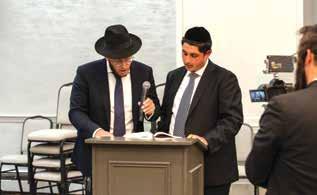


nachas were evident on the faces of the family members, and the guests enjoyed the brief graduation program immensely.
Immediately following the graduation, the Yeshiva held the much-awaited annual Grand Siyum Hashana to celebrate all the hard work and learning that the bochurim achieved this year. Everyone enjoyed a delicious buffet and leibidik dancing, accompanied by Yossi Perl and Elchonon Gartenhaus. The Oasis
Room at Bais Tefila of Inwood was filled with the joyous singing that is a Nishmas HaTorah trademark. The boys and hanhala danced alongside fathers and grandfathers and capped off the evening with a “hartzig” kumzitz. What a remarkable way to end a wonderful and productive year at Yeshiva!
Looking forward to seeing everyone again in Elul!

The boys at YOSS spent their last full week of school participating in an exciting School-Wide Math Olympics, combining friendly competition with a culminating review of the skills and concepts they mastered throughout the year.
Each grade level took part in unique math themed challenges designed to test fluency, teamwork, and problem-solving abilities. First graders raced through relay challenges and created their own human number lines, bringing math concepts to life through movement and collaboration.
Second graders put their time telling skills to the test by creating their own clocks and racing against time to complete a variety of clock-related challenges.
Third graders demonstrated their math fluency through balloon-popping relay races and engaging “I Have, Who Has?” card games that kept everyone thinking and moving.
Fourth graders competed in a multiplication fluency spelling bee-style game of “Buzz,” where quick thinking and strong number sense helped participants advance through each round.
Fifth graders faced off in scavenger hunts and game show competitions that challenged their mathematical knowledge across a range of topics. The excitement built throughout the day, ultimately leading to an epic tie-breaker that had students cheering until the very end.
The Math Olympics provided a fun
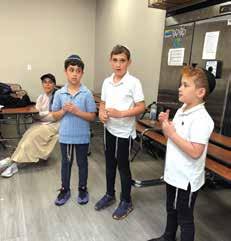
and memorable way for students to celebrate their hard work, showcase their skills, and enjoy some friendly competition as the school year comes to a close.

Three brand-new flags waved proudly on the corner of HANC’s newly completed Reinstein Family Campus as a bright sunny day welcomed more than 1,000 members of the HANC and West Hempstead communities to celebrate a historic milestone: HANC Is Home.
June 7, 2026 was more than just the dedication of a building; it was a celebration of the journey, the people, and the values that brought us to this moment. The goal of the event was simple: to celebrate, appreciate, and come together as a community. By every measure, it succeeded.
Hakarat hatov, one of the core values of our yeshiva, was at the heart of the morning’s donor celebration. The generous supporters who helped make this dream a reality gathered together to enjoy a delicious brunch while reflecting on the countless people, partnerships, and resources that transformed a vision into
a home. It was an opportunity to express our deepest gratitude to those whose commitment and belief in HANC made the Reinstein Family Campus possible.
The celebration then expanded to embrace the entire community as the doors opened for an unforgettable concert featuring Mordechai Shapiro. The moment felt especially full circle for HANC. Mordechai began his professional journey as a music teacher at HANC, and to welcome him back to perform at our Chanukat Habayit was both meaningful and inspiring.
Guests were also treated to a special artistic experience led by renowned artist Moully in partnership with the HANC PTA. Community members of all ages had the opportunity to bend, shape, and decorate a metal letter that will become part of a large commemorative mezuzah to be permanently displayed on campus and will serve as a lasting reminder of this extraordinary day.
Adding to the festive atmosphere

Gold medals were earned, teamwork was strengthened, and math learning was celebrated by all.


were complimentary treats for everyone to enjoy, including hot pretzels, popcorn, and custom HANC cookies. As the music filled the building and hundreds of voices sang together, the energy in the room was nothing short of magical. It was a powerful reminder of how far HANC has come and how many people have contributed to its success.
This historic moment belonged to
every donor, student, parent, educator, board member, alumnus, and community member who helped build HANC into what it is today.
As we look ahead, we pray that the love, unity, Torah, and community spirit felt throughout this Chanukat Habayit will continue to fill the halls of HANC for generations to come.



The New York Knicks won the 2026 NBA Championship by defeating the San Antonio Spurs 4-1 in the finals and ending a historic 53-year title drought. Before the Knicks captured their first championship since 1973 in game 5, the team completed the greatest comeback in NBA Finals history with a miraculous 29-point comeback at Madison Square Garden in game 4 Wednesday night.
At the same time, an estimated 450
enthusiastic fans from across the Five Towns and Far Rockaway came together at Andrew J. Parise Park for a once-ina-lifetime Knicks watch party. Hosted by the Village of Cedarhurst and the Merchants of Cedarhurst, local Woodmere resident David Kaye organized the watch party, including the halftime raffle for best dressed fan and other fun giveaways.
“The energy in the park was incredible,” said Mayor Benjamin Weinstock. Events like this showcase the strong


sense of community that makes Cedarhurst such a special place.”
Legendary Knicks head coach and Hall of Famer Red Holzman, who led the team to 613 wins and the 1970 and 1973 NBA Championships, lived right here in Cedarhurst with his family for over 40 years till his passing in 1998.
Holzman, who coached the team from 1967-1982, was not only a proud Five Towns resident, but an openly proud Jewish figure who grew into a symbol
As a licensed therapist and parenting coach, I often hear questions like, “How do I get my 9-year-old to be kinder to her 6-year-old sister?” or “What would motivate my son to ride his bike with the rest of the block on Sunday afternoons?”
While these questions sound practical, they are often rooted in a deeper concern: “Is this normal? Should I be worried? Am I handling this the right way?”
Parents aren’t simply looking for a quick fix. They want perspective from someone who understands both child development and the community we live in. They want help distinguishing between a passing challenge and something that may need more attention.
That’s exactly what Hidden Sparks’ expanded virtual Parent Education Cen-
ter (PEC) provides. Through free, oneon-one parent coaching, parents can speak with someone who helps them better understand their child’s behavior and develop practical, compassionate strategies for moving forward.
Chaya, an experienced mother, reached out because her daughter refused to hand over her iPad at bedtime.
“She keeps telling me, ‘You can’t take it away because it’s mine,’” Chaya said. “She got it as a bat mitzvah gift, and now she insists that since it belongs to her, she gets to decide when to use it. Every night turns into an argument.”
I encouraged Chaya to get curious about her daughter’s perspective rather than continuing to debate ownership. As they talked, her daughter explained that because the iPad had been given to her as
a gift, she felt that taking it away wasn’t fair. In her mind, ownership meant complete control.
With that understanding, Chaya was able to shift the conversation. Instead of arguing about whose iPad it was, she explained that many situations involve temporary limits on things that belong to us. We put phones on airplane mode during flights, students hand in their phones during the school day, and there are times when devices need to be put away to support safety, learning, or healthy routines.
Most importantly, Chaya helped her daughter understand that parents are responsible for setting the rules in the home. Even when something belongs to a child, parents still make decisions about when, where, and how it can be used.
of Jewish excellence in the greater New York area and beyond.
As Jews, we are all teammates on Hashem’s team. This week’s parsha, Korach, is the source in the Torah for not having machlokes, the opposite of achdus. As we get closer to the three weeks, we remember that the Churban Beis Hamikdash was destroyed due to disagreement in Klal Yisroel. Sports can serve as a vessel to bring our community together and remember we are all one people!
With a clearer framework and calmer conversations, bedtime became much less of a struggle.
At the Parent Education Center, we help parents answer these questions every day. Whether you’re concerned about social skills, anxiety, friendships, sibling conflict, behavior at school, learning challenges, or simply want guidance on a parenting dilemma, you don’t have to figure it out alone.
The PEC offers free, confidential, one-on-one parent coaching to parents in NYC and families with a child in a Far Rockaway yeshiva or day school. If you’ve ever found yourself wondering, “Is this normal?” or “What should I do?” we invite you to reach out. Sometimes the support, perspective, and guidance you need are just one conversation away

After months of hard work, practices, close games, and unforgettable moments, Championship Week by FM Home Loans finally arrived. From Cinderella runs and perfect seasons to walk-off grand slams and extra-inning thrillers, the final week of 5TLL delivered everything you could ask for.
Let’s take a look back at an incredible postseason.
Mr. Softee pulled off a huge upset over top-seeded SR Whee, rallying late and finding a way to come out on top. Myda Capital punched its ticket to the championship game behind the excellent allaround play of Yaakov Rosenberg, who helped lead his team past Posh Home & Bath.
Myda Capital completed its postseason run and captured the championship. Mose Slone was outstanding on both sides of the ball, delivering timely hits and making key defensive plays as Myda Capital defeated Mr. Softee to bring home the title.
In one of the highest-scoring games of the postseason, SD Shades defeated 5 Towns Restoration 18–15. Shauli Bauman came through with several clutch hits in the back-and-forth battle. Teller Life Insurance advanced with a 21–11 victory over Styles Design Interiors, fueled by a balanced offensive attack throughout the lineup.
Perfection achieved. SD Shades completed a perfect season, finishing the job with a championship victory. Nechemiah Oratz, Shua Lehrer, and Dovid Goldman were outstanding throughout the game, contributing both offensively and defensively to cap off an unforgettable season.
Smash House advanced past Newman Dental 11–6 behind a huge 3-run homer from Yehuda Roll, which proved to be one of the biggest swings of the game. On the other side of the bracket, BATTR pulled off an upset over Elegant Landscape, with Shimmy Dicker playing a major role in the victory.
When the lights were brightest, Avmo Olshan and Dovid Olshan delivered. The duo led Smash House to a championship victory, capping off a tremendous playoff run and bringing home the hardware.
Goldstar Mechanical continued its surprising postseason run, upsetting Altbanq behind strong defensive play from Moshe Beiss and Dovid Bender. Zlotowitz Law survived a tightly contested battle against Wieder Orthodontics, with Rafi Jeger contributing all over the field.
One swing. One moment. One championship. With the game on the line, Yitzchak Schattner stepped to the plate and launched a walk-off grand slam,


Law one of the most dramatic championship victories in league history.
The Cinderella story continued for Smash House. Led by rookie coach Yekusiel Sebrow and co-coach Ari Donowitz, Smash House entered the playoffs as underdogs and continued their magical run by defeating BlueBird Insurance to reach the finals. Meanwhile, Maidenbaum advanced with a victory over Goldstar Mechanical, powered by strong all-around play from Aharon Ehrman.
The Cinderella run nearly reached its storybook ending, but Maidenbaum had other plans. Led by Shaya Ribowsky, Maidenbaum held off Smash House 8–6 to secure the championship and complete an impressive playoff run of their own.
The championship game came down to the final inning. Emporio was knocking on the door, threatening to complete a comeback, but 5 Towns Premier found a way to hold on to a one-run lead and secure the championship. A tremendous effort from both teams, but in the end it was 5 Towns Premier lifting the trophy.
Men’s A League Semifinals
The postseason intensity carried over to the Men’s League as well. Kol Ve’or and Avi’s Custom Suits delivered an instant classic. After two overtimes, Jonathan Bayaz and Kol Ve’or found a way to survive, escaping with a thrilling 67–65 victory to punch their ticket to the championship game. On the other side of the bracket, Town Appliance knocked off defending champion Emporio. Ashie Schreier and Noah Aaron carried the load early, keeping Town Appliance afloat until the second-half arrival of Matt Rosenberg and Shelby Rosenberg, who provided a Willis Reed-esque boost and helped propel Town Appliance into the finals.
Emporio needed extra innings to defeat BATTR, and it was Aron Resnick who delivered the walk-off hit to send his team to the finals. 5 Towns Premier advanced by defeating Elegant Landscape, playing fundamentally sound baseball from start to finish.

As Torah Academy for Girls closes its doors after another, baruch Hashem, extremely successful year of learning, all talmidos and their teachers from all divisions enjoyed a visit from the ice cream truck. Thank you to the TAG family sponsors as well as the Women’s League for making this an exciting way to end the school year.
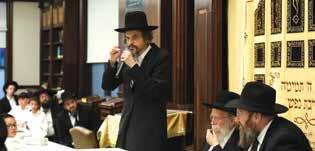













The Ohel Family Center was buzzing on Thursday night, June 4, as community members from across the Five Towns gathered for the inaugural Leil Shishi event, a new initiative designed to bring inspiration, connection, and meaningful communal experiences to the heart of the Five Towns community.
From the moment attendees began arriving, it was evident that this was something special. The Ohel Family Center quickly filled with men of all ages who came together for an evening of Torah, music, camaraderie, and inspiration. The packed crowd reflected the community’s enthusiasm for opportunities to gather, connect, and grow together.
The evening marked the first in what is envisioned as an ongoing series of Leil Shishi programs, each developed in partnership with a different local shul. The debut event was held in collaboration with The White Shul and drew an enthusiastic crowd that transformed the Family Center into a vibrant hub of Torah, music, and community.
The evening featured powerful divrei chizuk from Rabbi Eytan Feiner, Mara D’Asra of The White Shul, and Rabbi Motti Neuburger, rav of The White Shul. Both speakers focused on the unique opportunities and challenges presented by the summer months, encouraging attendees to approach the season with intentionality, growth, and renewed commitment to their avodas Hashem. Their heartfelt messages resonated deeply with the audience and provided a fitting spiritual framework for the evening.
The concept for the initiative was

developed by Rabbi Eli Portal, LCSW, Outreach and Partnership Coordinator at Ohel Children’s Home and Family Services, in collaboration with Malky Grossman, Director of the Ohel Family Enrichment Center. The event served as a powerful reflection of the Ohel Family Center’s ongoing mission to serve as a hub for community connection, enrichment, and support. Located in the heart of the Five Towns, the Center provides programming and resources for individuals and families throughout the community.
The tremendous turnout and enthusiasm surrounding the inaugural Leil Shishi highlighted both the importance of these efforts and the excitement for expanding opportunities that bring people together in meaningful and inspiring ways.
While Thursday night’s event focused on inspiration and connection for men, organizers emphasized that this is only the beginning. Future programming hopes to include women’s events, family programming, children’s activities, learning opportunities, support initiatives, community gatherings, and countless
other experiences designed to meet the evolving needs of the Five Towns community.
”The Family Center was created to be more than a building,” organizers shared.
“It is meant to be a home for the community—a place where people can gather, connect, learn, grow, and find support. We want to partner with the community to create programming that is meaningful, relevant, and impactful.”
Adding to the inspiration provided by the rabbis was a stirring musical performance by renowned Jewish musician Eitan Katz. Moving seamlessly between soulful niggunim and energetic melodies, Katz ignited the room with an atmosphere of achdus, simcha, and heartfelt connection. Throughout the performance, attendees sang together, danced, and joined in spirited participation, creating a palpable sense of unity and warmth. The event was also livestreamed, allowing many additional community members to participate remotely.
Among those in attendance were Ohel CEO David Mandel, Ohel Co-President

Jay Kestenbaum, members of Ohel’s Board of Directors, Lawrence Mayor Samuel Nahmias, and numerous community leaders, supporters, and local elected officials who joined to celebrate the launch of this exciting new initiative.
The overwhelming turnout and enthusiastic response underscored the community’s desire for opportunities to gather, connect, and grow together. Organizers expressed excitement about expanding the initiative in the months ahead and partnering with additional shuls throughout the Five Towns.
If the inaugural event was any indication, Leil Shishi is well on its way to becoming a cherished community tradition, bringing together Torah, inspiration, music, and meaningful connection for years to come.
Community organizations and shuls interested in participating in future Leil Shishi programs are encouraged to reach out to Rabbi Eli Portal, LCSW, at Eli_ Portal@ohelfamily.org
Last week, Congresswoman Laura Gillen (D-NY-04) joined Congressman Dan Goldman (D-NY-10) and Congressman Mike Lawler (R-NY-17) in introducing the bipartisan Jewish American Security Act (H.R. 9211), to strengthen federal efforts to counter antisemitism in the United States and protect Jewish Americans. Senators Jacky Rosen (D-NV) and James Lankford (ROK) lead the companion legislation in the Senate.
“The surge of antisemitism in New York and across the country is shocking and heartbreaking. As a member of the Bipartisan Task Force to Combat Antisemitism, I’m working across the aisle to confront this scourge of hate and protect the safety of the Jewish community. That is why I’m proud to help introduce the bipartisan Jewish American Security Act. This comprehensive bill will strengthen efforts to combat antisemitism on college campuses, provide record-level security funding for Jewish institutions, and prevent the spread of antisemitic content online. I urge my colleagues to act immediately to guarantee Jewish Americans can live without the
threat of religious violence,” said Rep. Laura Gillen.
“The shocking and continuing rise of antisemitism in the last few years requires immediate and decisive action,” said Rep. Dan Goldman. “I am proud to introduce the bipartisan, bicameral Jewish American Security Act, which puts into motion a course of action that will greatly improve the safety of Jewish Americans and Jewish institutions. I will continue to lead the fight for Jewish Americans’ right to attend school, worship together, and go online without facing hate and violence.”
“Freedom of religion is a fundamental constitutional right in the United States. Americans should feel safe practicing their religion, but unfortunately there have been a number of attacks at our nation’s synagogues. My legislation with Rep. Goldman tackles this issue by enhancing funding for the Nonprofit Security Grant Program (NSGP). This bill also delivers critical protections for Jewish students on college campuses through stronger Title VI enforcement, requires greater transparency from online platforms on antisemitic content, and estab -

Eighth graders at YOSS enjoyed an end-of-the-year barbecue at Rabbi Shonek’s house
Did you know?
While most teams retire player jerseys, the Knicks retired number 613 in honor of Hall of Fame coach Red Holzman, who coached the team to their NBA championships in the 1970s.
lishes key threat assessments. We must act decisively so Jewish Americans can feel safe in their schools, synagogues, and online,” said Rep. Mike Lawler.
Specifically, the Jewish American Security Act would:
Reauthorize the FEMA’S National Security Grant Program (NGSP) at $1 billion through 2031.
Authorize $9 billion annually for the Department of Justice (DOJ) from fiscal years 2027 through 2031 to:
Bolster state and local law enforcement efforts at religious institutions; Respond to the growing rise in religiously motivated hate crimes; and Enhance coordination between state and local law enforcement agencies and the DOJ.
Call on the FBI, Department of Homeland Security (DHS), and the National Counterterrorism Center to produce a joint annual domestic threat assessment that reports on antisemitic violent extremism for a 10-year period
and outline the following:
An overview of violent extremist ideologies that include antisemitic components;
The extent to which individuals in the U.S. have engaged in violent conduct to advance these ideologies;
The origins of online platforming of antisemitic domestic violent extremist ideologies, including the involvement of foreign state and non-state actors; and
The threat that antisemitic domestic violent extremism poses to the U.S. homeland.
Direct the Department of Education to appoint an Antisemitism Coordinator.
Direct large online platforms with at least 50 million monthly U.S. users to submit recurring transparency reports to the Federal Trade Commission (FTC) and publish those reports detailing how they identify, moderate, remove, demonetize, deprioritize, and limit the spread of antisemitic content on their platforms.


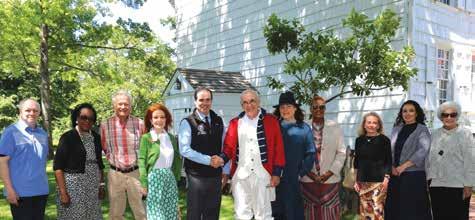

Throughout the year, the sixth and seventh grade girls at HALB began class sharing and writing down one thing they are grateful for, never saying the same thing twice. Now
as the year ends, they filled jars with everything they wrote to remind them how much they have to be grateful for in their lives.
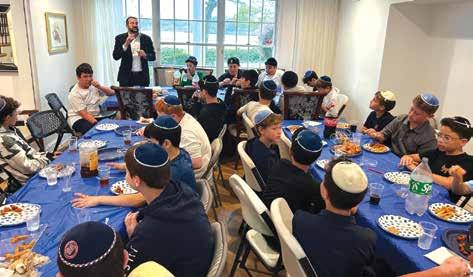
Rabbi Fine and 33 seventh grade boys at HALB learned together on their own time this year. Last

This past week at IVDU 5T, many classes celebrated their end-of-year accomplishments with special performances and presentations to parents and friends. From the oldest students to the youngest, each class showcased the hard work, growth, and learning they achieved throughout the year.
Class 105, our oldest class, completed learning Mishnayos Sukkah and shared their knowledge through engaging PowerPoint presentations. Class 104 presented a meaningful project based on interviews that explored each student’s family heritage and background. Class

103 delighted the audience with a presentation and songs from Tehillim composed by Dovid Hamelech. Class 102 performed a beautiful siddur celebration, highlighting their learning before receiving their very own special siddurim. Our youngest students in Class 101 proudly celebrated their Aleph-Beis accomplishment after completing their year-long curriculum.
We are truly amazed by the dedication, effort, and professionalism demonstrated by both our students and teachers. We are incredibly proud of all our classes and congratulate them on a job well done!


week, they made a beautiful siyum on
These eighth grade students at HALB were chosen every single week since the beginning of middle school by all of their general studies
and Ivrit teachers as the models of respect and citizenship! HALB is so proud of their consistent beautiful behavior and rewarded them with a lunch out!






On Sunday, the BACH Jewish Center’s Youth Department hosted a special Sunday Slime Day Fun Day event. The program was the kickoff of the BACH’s weekly series of youth events during the summer.


On Friday, HALB middle school celebrated America’s 250th birthday! Students participated in a special assembly culminating
with the reading of the Declaration of Independence. After that, they went outside for America-themed games and a delicious all-American BBQ!


On Friday, June 6, on the last day of classes, HANC High School students and faculty filled the school’s auditorium for this year’s Closing Ceremony. The program opened with remarks from Principal Rabbi Eli Slomnicki, who introduced the awards ceremony with a special emphasis on the process of choosing recipients. These awards are a series of honors presented to students who stand out in areas that are valued at HANC. Faculty members nominated candidates for consideration and collectively selected the recipients. Each award was given to one male and one female recipient. Each recipient of the ten awards will be added to the plaques adorning the second-floor hallway.
Elijah Friedman ‘27, received the Rav Avraham Yitzchak Kook Passion for Ed-
ucation Award and Elisheva Schutzman ‘28, received the Nechama Leibowitz Passion for Education Award. These recipients were recognized for their “academic achievement, true intellectual curiosity, and a demonstrated commitment to increasing knowledge in various disciplines.”
Students with outstanding “determination and diligence and an unwavering commitment to advance academically” received The Rabbi Meyer & Rebbetzin Goldie Fendel Determination and Perseverance Award. Gilad Kahen ‘27 and Emily Akbashev ’27 were the proud recipients.
The Golda Meir Community & School Spirit Award went to Molly Leifer ‘27 and the Natan Sharansky Community & School Spirit Award went to Didi Lubner

‘28, as students who exemplify “a strong commitment to the HANC community and work selflessly in order to foster inclusiveness and strengthen school spirit.”
The students who went above and beyond in their participation in Chesed activities were Shayna Wunder ’28 and Chaim Ilayew ‘28 who received the Rabbi Moshe & Rebbetzin Sandra Gottesman Chesed Award.
The Ateret Shem Tov and Keter Shem Tov awards recognize students who demonstrate distinguished character and a strong commitment to leading a life of high ethical and moral standard consistent with Torah ideals and values. The recipients were Eden Turkfel ‘27 and Jordan Furman ’27 respectively.
The next series of awards was presented by College Guidance to members of the
The Ezra Academy Legal Eagles concluded another outstanding year of legal advocacy with their annual Intra-Mural Trial Competition, an exciting evening event that brought together students from both the Mock Trial Team and the Trial & Advocacy class for one final showcase of courtroom skill, preparation, and quick thinking.
Throughout the school year, students honed their advocacy skills in Ezra Academy’s dedicated courtroom, generously gifted by alumnus Avi Shakarov (class of ’07). For the competition itself, however, classrooms throughout the building were transformed into simulated courtrooms, allowing multiple rounds to run simultaneously and creating a dynamic tournament atmosphere.
Unlike traditional mock trial competitions that provide weeks of preparation, this event focused on extemporaneous civil litigation. Students were assigned to teams and, through a coin toss, were
randomly designated to represent either the plaintiff or the defendant before ever seeing the facts of the case. Each team received only two affidavits—one from the plaintiff and one from the defendant— and had just 15 minutes to prepare an entire trial presentation.
Without the aid of technology, utilizing only collaborative strategy sessions, students developed opening statements, direct examinations, cross-examinations, and closing arguments in real time. Competitors were also tasked with serving as both attorneys and witnesses, requiring them to quickly master the facts, anticipate arguments, and present their cases with confidence.
The pace of the competition was relentless. Teams moved directly from preparation to presentation, received critiques and feedback from judges, and then immediately began preparing for the next round without a break. Throughout the evening, students demonstrated
Junior Class.
The Brandeis Book Award for Social Action & Civic Engagement – Eden Turkfeld
Yeshiva University Torah U’Madda Book Award – Judah Weitzman and Eliana Haftel
Rensselaer Polytechnic Institute Medal Award – Elijah Friedman
Bausch and Lomb Honorary Science Award – Shirel Barzideh
The Frederick Douglass and Susan B. Anthony Award – Jenny Schwartz
Xerox Award for Innovation and Information Technology – Itai Holtzman
George Eastman Young Leaders Award – Jonah Galanti
The program concluded with a nostalgic year-in-review video presentation expertly prepared by the Student Life Team. Haagen-Dazs ice cream bars were enjoyed by everyone.
The ceremony was uplifting with wonderful achdut among the students as they cheered for their peers who received awards. A tremendous yashar koach to all students for completing an outstanding year.
Wishing everyone a wonderful summer.
the same adaptability, composure, and advocacy skills that have made the Legal Eagles program one of Ezra Academy’s signature extracurricular offerings.
Adding to the prestige of the event was a distinguished panel of judges composed entirely of Ezra Academy alumni. Many have gone on to become practicing attorneys, while others are currently pursuing legal studies in law school. Their willingness to return, mentor students, and share their expertise reflects the lasting impact of the program and the strong bonds within the Ezra community.
After three challenging rounds, one team separated itself from the competition with a perfect 3–0 record. Displaying exceptional preparation, teamwork, and courtroom presence, Samantha Onefater, Eliana Babkhanov, and Jacob Geula emerged as this year’s Intra-Mural Trial Champions, making a difficult feat look remarkably easy.

The evening served as a fitting conclusion to another successful year for the Ezra Legal Eagles. More than just a competition, the event highlighted the growth students have achieved through countless hours of practice, competition, and collaboration. As the program continues to grow, it remains committed to developing articulate speakers, critical thinkers, and future leaders—both inside and outside the courtroom.




Hundreds of community members gathered outdoors in Lawrence on Monday, June 15, for an unforgettable evening benefiting Bikur Cholim Far Rockaway & Five Towns. It was a memorable night featuring a wide variety of savory foods by Partini, uplifting live music by EKEV, and the opportunity to come together in support of an organization that impacts countless lives throughout our community.
The evening included keynote speaker, Rabbi Eli Portal, LMSW, who inspired the audience by reading a moving letter from a woman whose family benefitted from the services of Bikur Cholim. The letter also highlighted the array of services Bikur Cholim provides to our community.
The evening featured the premiere of Bikur Cholim FR & 5T’s first debut promotional video which showcased the organization’s many programs and the profound impact they have on local families.


The video offers a close look at the wide range of services Bikur Cholim provides, including financial assistance for medical expenses, transportation support, medical equipment loans, home-cooked meals, patient care packages, friendly visits, and mental health support. The six-minute video will be accessible on Bikur Cholim’s website for those who wish to become more aware of Bikur Cholim’s activities or want to become involved.
The evening was a celebration of music, chessed, and community, and served as a powerful reminder of what can be accomplished when a community comes together to support one another. The large turnout is a reflection of the great work Bikur Cholim does for the community, as well as an appreciation to all the volunteers who help ensure families and individuals alike are taken care of.
For more information or to support Bikur Cholim Far Rockaway & Five Towns, visit bikurcholimfr5t.org



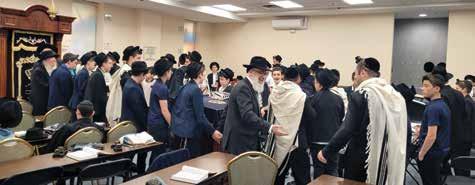
Yeshiva Ketana of Long Island was zocheh to a chashuvah visit from Harav Shimon Galai, shlita. Harav Galai spoke at our Shacharis Minyan about the simcha and satisfaction that comes from Limud HaTorah with clarity. Spontaneous dancing and sing-
ing of “Toras Hashem Temima” filled the building, as each class had their own visit from Rav Galai. The boys had the zechus to watch his glowing smile and tears of joy and pride, as our talmidim joined in the kiddush Hashem.

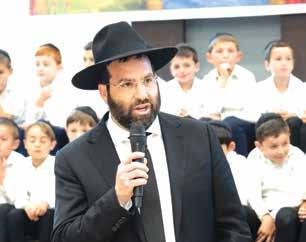


By Yisroel Besser
After the war, the Rebbe of Kretchnif, Rav Tzvi Hirsch Rosenbaum, dealt with his chassidim differently than he did with their children. The parents were survivors, and with them, the Rebbe was gentle and comforting. He listened to their worries and assured them that in this new world, their children would be safe; there would be enough to eat and drink, they would marry and find good jobs, and better days would come.
From the children, however, the Rebbe made demands, teaching them what it means to be a chassid — and particularly, what it means to be a Kretchnifer chassid. In 1950, the Rebbe opened a Talmud Torah — the first Yiddish-speaking cheder in the region— and a little more than a decade later, he established a yeshivah, intent on raising
a generation that would make his Zeide proud.
And what did it mean to be a Kretchnifer chassid?
To the Rebbe, being a Kretchnifer chassid called for a willingness to exert effort, to be engaged in constant battle; it was how he lived, and it was the basis of what he expected from the chassidim.
The Rebbe had a novel explanation of the words of the pasuk recited each morning before Shacharis: U’mosar ha’adam min habeheimah ayin And the superiority of man over beast is naught. What sets man apart from animals is the fact that he lives with the word “ayin” before him — not yet, or, as the Rebbe said, “nochnisht.”
In the morning, the Yid opens his eyes, but he does not put his feet on the floor until he washes negel vasser — nochnisht.
And then, even once he has washed his hands, he does not have a coffee

right away, because first, he must recite Birchos HaTorah — nochnisht.
And then, he is finally sipping the coffee, but breakfast will have to wait until after he davens Shacharis — nochnisht
This ability to live with the word ayin and to react accordingly is what elevates man — and it was the essence of the Kretchnifer Chassidus.
The Rebbe would often point out that the word Chazal use to refer to a story is “maaseh,” which literally means an action or deed. The choice of this word, rather than sippur, or uvda, which might seem more precise, reflects the fact that when Yidden repeat a story, the prime objective is to enable people to learn something practical — l’maaseh, turning inspiration into action.
The stories that were so cherished by the Rebbe were meant not to entertain, but to motivate; not to talk about those who did great deeds, but to emulate them and likewise do great deeds.
What the Rebbe wanted, more than anything else, was to elevate chassidim into his world, to enable them to rise above the temptations of this world by allowing them a taste of something more sublime.
He quoted the words from the Shacharis of Shabbos, Ein aroch lecha Hashem Elokeinu ba’olam hazeh There is no comparsion to You, Hashem, our G-d, in this world, interpreting them in a typically novel way: Ein aroch lecha — there is nothing that compares to the feeling of being close to You, Hashem, be’olam hazeh — among all the pleasures that this world has to offer.
Late one Friday night, the Rebbe

sat at the tisch with just a few people around him. “There is a common error,” the Rebbe said, “a mistake that people make. Conventional thinking is that more sleep gives a person more energy, but really, the opposite is true; those who train themselves to need less sleep will end up feeling more energetic, and they will live a more productive life — which will itself prove to be a source of energy!”
It was clear that the Rebbe was not just speculating but speaking from experience.
He would quote the words of the pasuk, Lo amus, ki echyeh — I shall not die, but I shall live, and say, “Ribbono shel Olam, when I am alive, should I not live fully?”
With his Torah and stories, the Rebbe was able to make the ideals of Chassidus accessible; with his personal example, he exemplified the joy that accompanied relentless avodah.
Reprinted from The Rebbe of Kretchnif by Yisroel Besser, with permission from the copyright holder, ArtScroll Mesorah Publications.

Atalmid once asked R’ Shraga Feivel Mendlowitz, Menahel of Torah Vodaath and America’s greatest Torah pioneer, which happened first: the miracle of Chanukah or the miracle of Purim. R’ Shraga Feivel responded, “Which came first, the First Beis HaMikdash or the Second Beis HaMikdash?” We don’t know if the bachur knew the answer.
Be that as it may, it is true that few of us have more than a cursory knowledge of our history, especially of events not recorded in Tanach. That sad fact led ArtScroll/Mesorah to undertake a project that was suggested to us by a friend in Israel: to adapt and expand a 2-volume Hebrew work, entitled a History of the Jewish People. Volume 1 covers the turbulent era of the Second Beis HaMikdash. Volume 2, From Yavneh to Pumbedisa, tells the story of the nine centuries from the Churban of the Second Beis HaMikdash to the end of the era of the Geonim. These volumes record events that in many ways shaped our current existence. The 420 years of the Second Beis Hamikdash in-
cluded the glorious period of Chanukah and the start of the era of the Mishnah, but most of that time, our ancestors were under foreign domination, culminating in the rule of the Roman Empire and the sinas chinam that led to the Churban. Volume 2 illustrates how the focal point of Torah study migrated to Bavel, and how the Sages of the Talmud and the Geonim courageously maintained yeshivos and Torah life in the face of incredible persecution and hardship.
Baruch Hashem, ArtScroll had a precious human asset who knew virtually everything, including Jewish history. R’ Hersh Goldwurm’s renditions of those two volumes, the first of which appeared in 1982, opened readers to worlds of Jewish courage and devotion to the Torah under conditions of internal dissension, outside oppression, and strenuous, but unsuccessful, attempts at spiritual genocide to exterminate religious observance. Frankly, those volumes should be required reading for young and old, and we hope that these lines will lead to many
reprints of those classics.
Also in 1982, we published R’ Goldwurm’s “Rishonim,” which was followed several years later with “The Early Acharonim.” Both books contain short biographies of the gedolim, when they lived and their seforim, plus histories of the Jewish communities of the various countries. In later years, more history books joined the ArtScroll library, including several by R’ Berel Wein; more on those in future columns.
Some may wonder why bother with history; we are a nation of Torah and halacha. As someone once put it, “Historians tell us what Rashi wore, we’re interested in what Rashi taught.” Nevertheless, we should recognize that knowledge of our history is important. In Az Yashir, which Moshe and the Jews sang when the Yam Suf split for them, they said, “Elokei avi va’aromemenhu, Hashem is the G-d of my father and I will exalt Him.” Rashi explains that they were saying that holiness did not begin with them. They inherited it from their ancestors. This statement ap-

On June 9, Beth Shalom was filled with song, inspiration, and heartfelt connection as more than 320 girls, mothers, and grandmothers gathered for the Together For Tefillah event, a unique and innovative program produced by the Consortium of Jewish Day Schools (CoJDS).
The evening marked the culmination of a year-long journey of learning and growth in Shemoneh Esrei, bringing together participants from across the community in a powerful celebration of tefillah. Students from TAG, HAFTR, Shulamith, and HALB joined together with their mothers to celebrate what has become much more than a curriculum; it has become a shared community experience.
The Together For Tefillah innovative program integrates school, home, and shul by encouraging parents to learn

about davening alongside their children. This year marked the first implementation of the program, creating a unique opportunity for families to grow together in their understanding and appreciation of tefillah.
Throughout the school year, participating students studied an in-depth and engaging curriculum with their dedicated teachers, immersing themselves in the meaning, structure, and messages of Shemoneh Esrei.
The celebration began with a festive reception with refreshments, an interactive tefillah project, and a photo booth where mothers, grandmothers, and daughters received keepsake photographs printed alongside meaningful tefillos. The atmosphere then shifted into an inspiring and energetic kumzitz led by renowned singer and vocal coach Mrs. Malky Giniger. Through beautiful music, uplifting singing, and meaningful danc-

plies to us, as well. Klal Yisrael did not originate with us. We must learn from the previous generations.
This is our purpose in publishing books about our history. What can we learn from the previous generations that will make us better servants of Hashem? Who were the rebbeim of our great leaders and who were their students? How did they lay the foundations for future generations’ loyalty to Torah? Not just knowing about the greats before us, but learning from them, is the goal of our books on Jewish history and our many classic biographies.
UP NEXT: Literature for Children and Young People

ing, participants experienced the power of tefillah expressed through joy and achdus
One of the most remarkable aspects of the evening was the coming together of students from different schools and backgrounds, united by a common language of tefillah. After a year of intensive avodah shebalev, service of the heart, the girls emerged with a deeper understanding of Shemoneh Esrei and its relevance to their daily lives.
Earlier this year, the local boys participating in the Together for Tefillah program celebrated their own milestone event featuring Eitan Katz. Together, these experiences provided meaningful opportunities for students and parents alike to launch a shared journey of spiritual growth.
CoJDS extends heartfelt gratitude to the rabbanim who delivered shiurim throughout the year, enriching the Shem-
oneh Esrei curriculum and inspiring families to continue their learning beyond the classroom. Special thanks are also due to the many parents who invested in their own growth alongside their children, helping to create a true partnership between home, school, and community. Most importantly, CoJDS recognizes the extraordinary educators who brought this curriculum to life and guided their students on this journey, as well as the dedicated CoJDS team whose vision and hard work made the program possible. By fostering a deeper understanding of tefillah and strengthening students’ connection to Hashem, Together for Tefillah is helping to cultivate a generation rooted in emunah and a meaningful relationship with Hashem.
For additional photos and information about the program, visit togetherfortefillah.org.


What did things cost in 1973 when the Knicks last won the Finals and what do they cost today


A Knicks fan and a Celtics fan stumble upon a genie who give them each three wishes, but the genie adds: “Well, whatever you wish for, I’ll give the other guy double.”
“That’s alright with me,” says the Knicks fan, and starts the ball rolling by wishing for a million dollars.
“Granted!” says the genie, “but the Celtics fan gets 2 million.”
“Fair enough. Now, I’d like a nice new Ferrari.”
“Done. But the Celtics fan gets two Ferraris.”
“Okay,” says the Knicks fan, “I’d like to donate a kidney.”
I can fill an arena without taking up a seat. I can disappear in seconds after one missed shot.

The longer a championship drought lasts, the stronger I often become. What am I?
Answer: Hope
Okay, so you cried after the Knicks won the Finals on Saturday night. Were they crocodile tears or are you really a lifelong Knicks fan? Answer these questions, and we will find out.
1. Who was selected by the Knicks with the No. 1 overall pick in the 1985 NBA Draft?
a. Charles Oakley
b. Mark Jackson
c. Patrick Ewing
d. Xavier McDaniel
2. Which legendary coach led the Knicks to both of their NBA championships in 1970 and 1973?
a. Rick Pitino
b. Red Holzman
c. Hubie Brown
d. Willis Reed
3. Which player was nicknamed “The Pearl” after joining the Knicks in 1971 and helped lead the team to the 1973 NBA championship?
a. Walt Frazier
b. Earl Monroe
c. Richie Guerin
d. Bill Bradley
4. Which Knicks player famously dunked over Michael Jordan in the 1991 playoffs in a play simply known as “The Dunk”?
a. Charles Smith
b. Patrick Ewing
c. John Starks
d. Anthony Mason
5. Who hit the famous four-point play against the Pacers in Game 3 of the 1999 Eastern Conference Finals?
a. Chris Childs
b. Allan Houston
c. Larry Johnson
d. Marcus Camby
6. In 2012, Jeremy Lin was an undrafted guard from Harvard who slept on teammates’ couches before taking the NBA by storm in what became known as “Linsanity.” What was his breakout game?
a. When he scored 38 points against the Lakers while being guarded by Kobe Bryant
b. When he entered in garbage time and sunk four threepointers in a row
c. When he blocked 4 shots by Lebron James
d. When he hit a half-court buzzer shot to send the Knicks to the playoffs
7. Which Knicks player who spent 10 years with the team had a fight with Knicks owner James Dolan and is therefore banned from MSG (but he traveled to San Antonio to watch his beloved team win the Finals)?
a. Allan Houston
b. Latrell Spreawell
c. John Starks
d. Charles Oakley
9. In what year did Pat Riley become head coach of the New York Knicks?
a. 1988
b. 1991
c. 1993
d. 1997
10. Which player spent 15 seasons with the Knicks, holding the franchise record for being the longest lasting Knick?
a. Bill Bradley
b. Patrick Ewing
c. Walt Frazier
d. Charles Oakley Answers:

Scorecard:
8. When Amar’e Stoudemire signed his $100 million contract with the Knicks in 2010, he became the franchise’s biggest free-agent acquisition in years. From which team did he join New York?
a. Pheonix Suns
b. Miami Heat
c. Dallas Mavericks
d. Atlanta Hawks
9-10 correct: You have a right to cry about the Knicks finally being champs again…but you should still go to your own wedding instead of the parade
4-8: Not bad, you are definitely a fan. But don’t ask your rav if you can get a Knicks tattoo.
0-3 correct: Instead of banning Oakley from the Garden, they should ban you! (But then again, you probably think the Garden is a place in your local park where they grow vegetables.)
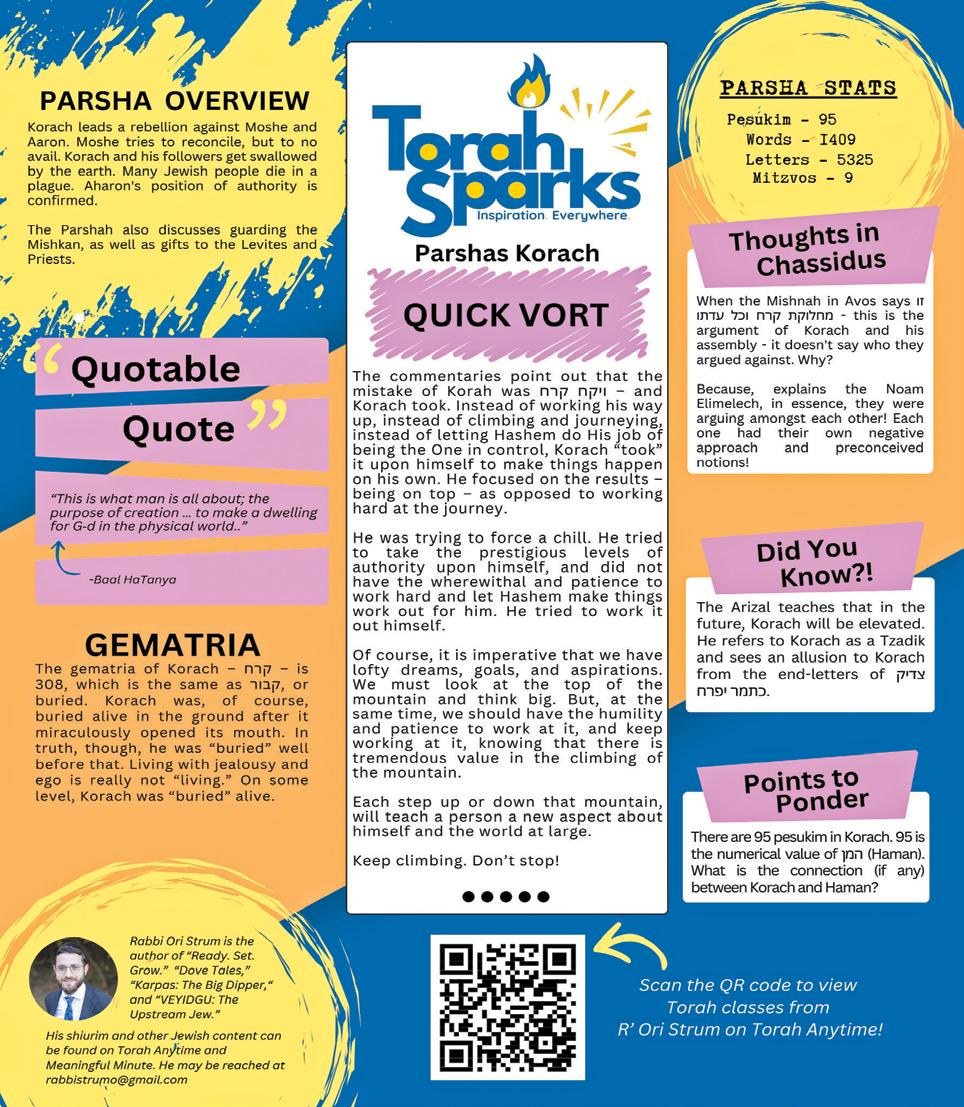
Rabbi Moshe ben Nachman (Ramban) is of the general opinion that events, as recorded in the Torah, occurred in a linear timeline. This is in spite of the maxim that there is no late or early in the Torah. He limits that rule to certain halachic instances as they appear in the Talmud. Thus, the story of Korach and his contest against Moshe that forms the central part of this week’s parsha occurred after the tragedy of the spies and their negative report about the Land of Israel.
As I have commented before, the negative report of the spies was motivated, according to rabbinic opinion, by personal interests having no objective value as to the issue of the Land of Israel itself. So too, this uprising against Moshe led by Korach is also not an issue of justice or objective benefit to the people, but rather it is motivated purely by the personal issues and jealousies of Korach and his followers.
Both Korach and the spies masked their own personal drives for power and position with high-sounding principles of public good, social justice and great

By Rabbi Berel Wein z”l

concern for the future of the people of Israel. The very shrillness of their concern for the good of society itself calls attention to their true motives – they protested too much!
Pious disclaimers of any self-interest seem to always accompany those
for their peoples and countries and yet all, without exception, eventually only pursued their own personal gain and power. Always beware of those who speak in the name of the people. Most of the time, they are only imitations of Korach.
The very shrillness of their concern for the good of society itself calls attention to their true motives – they protested too much!
that clamor for social betterment and a more just society. But it is often personal ambition and the drive to acquire power over others that is the true face of these movements and individuals. All of the dictators of the past and present centuries promised great improvements
This is perhaps an insight as to why Moshe took such a strong stand against Korach and demanded an exemplary punishment from Heaven. It is extremely difficult for humans to judge the true motives of others in their declarations and policies. Only Heaven,
so to speak, can do so. Moshe’s plea to Heaven is directed not only against the current Korach that he faces, but it is also against the constant recurrences of other Korachs throughout Jewish and world history.
Only a shocking miracle of the earth swallowing Korach and his followers and of a fire consuming those who dared to offer incense in place of Aharon would impress the historical psyche of Israel as to be wary of Korach’s imitators through the ages.
There is an adage in Jewish life that one should always respect others but also be wary of their true motives. Only regarding Moshe does the Torah testify that as the true servant of G-d, he is above criticism and suspicion. But ordinary mortals have ordinary failings, and self-interest is one of those failings. Moshe is true, and his Torah is true. After that, no matter how fetching the slogan or how glorious the promise, caution and wariness about the person and cause being advocated are the proper attitudes to embrace.
Shabbat shalom.

By Rav Moshe Weinberger
Adapted for publication by
Binyomin Wolf
Despite all of the difficulties caused by Dasan and Aviram, Moshe made one final attempt to speak with them. But when they made it clear that they would not even engage in a sincere conversation with him, saying, “We will not ascend” (Bamidbar 16:12), Moshe became angry. He said to Hashem, “Do not accept their offering!” (ibid. 16). Rashi, quoting the Midrash (Bamidbar Rabah 10), explains that Moshe was saying, “I know that they have a portion in the communal Daily Offerings. May their portion not be accepted favorably before You. Cause the fire to leave it and not consume it.”
First, why does Moshe say, “I know that they have a portion…,” as if this is some special secret that only he knows about? Everyone knows that the Tamid, Daily Offering, is paid for with the half-shekel collected from every single Jew. Second, the truth is that no individual has a portion in the Tamid offerings because they are communal offerings, which are distinct from individual offerings and from offerings brought by several partners. In each of these scenarios, there are identifiable individuals to whom the offering is associated. Communal offerings, by contrast, are not attributable to a million individuals. Rather, the communal offerings have only one owner – the Jewish people as one whole. So how can Moshe say that Dasan and Aviram have a portion in the Tamid offering?
These questions are answered in Likutei Sichos 33 by the tzaddik whose yahrtzeit was this week, 3 Tammuz, the Lubavitcher Rebbe, zy”a. There, the Rebbe explains something about tzaddikim in general, but there is no question that he was describing himself to a T. The Rebbe
reiterates the point that communal offerings are not ascribed to anyone, or even to a collection of individuals, by quoting the Gemara (Zevachim 4a). According to Chazal there, if the kohein bringing an individual offering has in mind the wrong individual, the korban is disqualified. But when it comes to a communal offering, if the kohein thinks about an individual, even an idol-worshiper, it does not affect the offering. This is because the communal offering belongs to only one owner, the Jewish people. After an individual donates his half-shekel to the Beis HaMikdash, the Tamid and other communal offerings purchased with that money is no longer identified with that individual. They are only identifiable as part of something greater, the Jewish people as a whole.
The Rebbe explains that there are two primary philosophies undergirding the various forms of government: those that prioritize the individual and those that prioritize the community. This debate rages on until today. Systems of government which prioritize the community recognize that they must sometimes do so at the expense of individual rights. For example, New York City’s stop-andfrisk policy was based on statistical data and was successful in reducing crime in communities plagued by high crime rates. Yet because of the program’s nature, the subjects of the policy disproportionately belonged to certain races, regardless of whether they, as individuals, had any greater likelihood of possessing contraband. To the extent a policy favors the community, it will come at the expense of individual rights.
In this example, governments which prioritize individual rights over those of the community would say that it is better to allow crime rates in impoverished communities to increase rather than infringe on the rights of any individuals within those communities. These two general approaches are mutually exclusive. Any increase in the emphasis of one comes at the expense of the other.
This tension between the needs of the group and the needs of the individual is extremely difficult to balance, even for much smaller collectives. Within a family, for instance, if there is only one child, it is not very challenging. But in families with two or more children, the parents naturally tend to govern based on the wellbeing or vision of how the entire family should look. Children who do not neatly fit into this overall vision often suffer. It is very difficult to act with every individual child according to his or her nature without this negatively affecting other children or the family as a whole.
The challenge becomes even more difficult for teachers and rebbeim. Most work to enable the class as a whole to prepare for the next regent or test, even though some children are left behind. It is a rare teacher who is able to drive the class as a whole forward while working with individual students who would otherwise feel left out, giving them what they need to succeed as well.
The tzaddik is the rare individual who knows how to contain within himself an impossible duality – unbreakable focus on the welfare and development of the entirety of the Jewish people with an unwavering focus on the wellbeing and growth of every individual. This is why Moshe Rebbeinu said, “I know that they
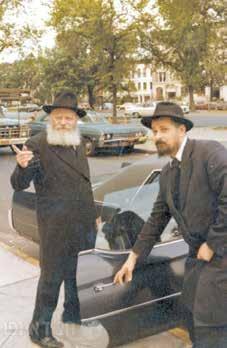
have a portion….” In almost every way, the individual Jews’ portions in the communal offerings is lost. Only the tzaddik has the ability to see every individual’s portion within the national offering.
While the Lubavitcher Rebbe concerned himself with building Jewish institutions and Jewish life in every nook and cranny throughout the world, most stories people tell about him involve the Rebbe’s unique ability to take care of individuals’ needs, no matter who they were or where they lived. In fact, a few years ago, a book was published called “My Story,” recounting 41 individuals’ stories of their encounters with the Rebbe. I would therefore like to share my own story with the Rebbe: When I was in my last year of college at Yeshiva University, I was at a crossroads – facing what I felt was the most critical decision in my life. On one hand, I considered attending law school. I had even attended the Kaplan LSAT preparation course, though I spent most of those classes listening to Simon and Garfunkel on my Walkman. My mother was an extremely strong and persuasive proponent of this option. My father always told me that it was better to go into a profession than into business because it would be easier to find a job even in difficult economic times. But my heart told me that I should continue learning Torah and pursue chinuch, teaching in ye-
shiva. It was an extremely difficult choice. Despite the fact that the Lubavitcher Rebbe was no longer holding individual meetings, I traveled to Crown Heights one Sunday. I did not have a clear plan, but I knew that the Rebbe finished Mincha and left to daven at the grave of his father-in-law, the Friediker Rebbe, zy”a, at the same exact time every Sunday. I suppose that I planned to try and catch the Rebbe’s attention and ask my question before he got into his car. If he normally left at, for example 3 p.m., I waited outside 770 Eastern Parkway at 2:55. I was initially pleasantly surprised by the fact that there were only three or four other people around. I thought it might be easier than I had originally anticipated to catch the Rebbe’s attention. Unfortunately, at approximately 2:59, hundreds of chassidim appeared seemingly out of nowhere and gathered on either side of the sidewalk between the exit from 770 and the Rebbe’s car.
The Rebbe began to duck into the car waiting for him when he paused for a moment. He then turned around and walked straight up to me. He stood about one foot in front of my face without saying a word. After a moment, looking at me straight in the eyes as he did so, he simply pumped his fist into the air in a gesture which said to me, “You can do it! You will succeed!” And just as quickly as he had come, he turned back toward his car, got in, and left. The chassidim around me were baffled and asked me what was going on and why the Rebbe had stopped and gestured to me.
Afterward, when I returned home to process what had happened and what the Rebbe’s message meant to me, I understood it to mean that despite the fact that Torah and chinuch held a more uncertain financial future, I could do it, and I would succeed. My mother, however, was convinced that the Rebbe was telling me, “You can get into Columbia Law School!” But in the end, I took the Rebbe’s encour -
After a moment, looking at me straight in the eyes as he did so, he simply pumped his fist into the air in a gesture which said to me, “You can do it! You will succeed!”
Not being a particularly pushy individual, I found myself about three rows back from the front of the row of people on my side of the sidewalk. My hopes of even catching the Rebbe’s eye now seemed completely unrealistic. A few of the chassidim around me, however, seemed to feel bad for me, realizing that if a young man like me, with a little kippah serugah , knitted yarmulke, was there, I must have some important reason for wanting to see the Rebbe. They therefore pulled me to the front row. Thankful for their help, I hoped that I would at least have the chance to make eye contact with the Rebbe.
When the Rebbe emerged from 770, he walked extremely quickly, carrying a siddur in one hand and a bag of kvitelach to bring to the Ohel in the other hand. With each step he took, he nodded purposefully at those in the crowd around him. As he sped past, I sadly realized that the Rebbe did not even notice my presence, and I was not able to make eye contact.

agement to mean that I should continue to pursue my dreams of continuing to focus on Torah and chinuch.
That is why we need and love true tzaddikim like the Lubavitcher Rebbe. While they live and die for the welfare and development of the Jewish people, they continue to concern themselves and care about every single one of us as well. They tell each of us, “I know. No one else may understand you, but I know your pain and your deepest desires and dreams. I haven’t forgotten about you.”
May Hashem send the ultimate tzaddik, Moshiach Tzidkeinu, into the world soon in our times so that we can also return to Yerushalayim for the ultimate fulfillment of our national and individual potential.

An inquisitive youngster might ask his father, “Why don’t we eat giraffe?” The old, popular answer was that we simply don’t know where along the long neck to perform shechitah. However, that answer is disproved by a recent daf. The Gemara in Chullin 45a states that Rabbi Chiyya bar Yosef taught before Rabbi Yohanan: “The entire neck is fit for slaughter, from the large uppermost ring of the windpipe downward until the lower edges of the lung.” This ruling is codified by the Shulchan Aruch. Indeed, finding the right spot on a giraffe’s neck to perform shechitah is like hitting a beachball with a baseball bat; you can’t miss!
Some say we don’t eat giraffe because it doesn’t taste good. Certainly, a quick perusal of a non-kosher supermarket will confirm that you won’t find giraffe meat in the aisles. But food critics have, in fact, tasted it. The meat is intensely lean and low in fat, similar to venison but noticeably more tender when cooked properly. Critics from publications like New York Magazine note
By Rabbi Avrohom Sebrow

a distinct, natural sweetness. Diners often describe it as a cross between a beef sirloin cut and a lamb chop, though it can carry a slightly gamey or bitter undertone.
Still, the import of meat from wild animals in Africa is restricted by the Centers for Disease Control. Perhaps if someone raised a domestic flock of giraffes, the meat would be available. Rabbi Dr. Ari Z. Zivotofsky once asked Rabbi Yosef Kafich, z”l, why we don’t eat giraffe meat, to which he responded that at $10,000 a kilogram, it would be ba’al tashchis!
Yet, there is another wrinkle with giraffe meat which leads to a fascinating discussion about the zebu and the bison. For some reason, kids never ask their parents, “Why do we, or don’t we, eat zebu?” A major controversy was reignited in 2004 when it was discovered that much of the South American beef imported into Israel came from zebu cattle or zebu crossbreeds. Zebus feature a fatty hump over their shoulders, large drooping ears, and a loose flap of skin (dewlap) under their chin.
At face value, this should be of no concern. After all, the Torah is very clear about what makes an animal kosher: it must have split hooves and chew its cud. The zebu possesses both of these signs, making it undeniably kosher. However, there is a machlokes over how to understand a particular ruling of the Shach.
Shulchan Aruch (Y.D. 80) discusses how to identify a chaya (wild animal) in contrast to a beheima (domesticated animal). There is a Torah obligation to cover the blood of a chaya after shechitah, whereas a chaya does not have forbidden cheilev fat. For example, when preparing kosher beef (beheima), one must be meticulous about removing the cheilev found by the ribs, as eating it is punishable by kareis. This exact fat is permissible on a chaya. Therefore, it is important to know how to differentiate between a beheima and a chaya so that if one finds a new species of animal, he would know whether he needs to cover the blood and would be permitted to eat the parts known as cheilev.
The Shach states that establishing identifying criteria to differentiate between a beheima and a chaya is ultimately irrelevant, as we do not consume animals for which we have no mesorah. This approach is similar to the restriction regarding kosher birds: despite the physical signs mentioned by the Gemara, we only consume species for which there is a clear, continuous tradition of their kosher status.
The Pri Megadim takes issue with the simple meaning of the Shach’s position. He asks why there would be a custom requiring a mesorah for mammals. The simanim of kosher birds are complex and thus prone to error, but the simanim of mammals, split hooves and chewing the cud, are straightforward and leave little room for confusion. Therefore, the Pri Megadim suggests that the minhag regarding unfamiliar mammals is to treat all unknown species as a safek chaya. Out of caution, we require the stringencies of both a chaya and a beheima: we must cover the blood (the stringency of a chaya), and we must
strictly forbid its cheilev fats (the stringency of a beheima).
The Chochmas Adam, however, understands the Shach in its simplest sense: one should not eat unknown species at all. The Chazon Ish followed this as practical halacha. Seemingly, this makes no sense. If we know an animal possesses the kosher signs, why shouldn’t we be able to eat it?
HaRav Shlomo Miller offered a logical explanation for the Shach and the Chazon Ish. As noted by the Pri Megadim, if we encounter a new species of animal and we don’t know whether it is a chaya or a beheima , we would need to be machmir on both ends: covering its blood and refraining from eating its cheilev. At face value, this would appear silly to an observer. Why keep two stringencies that are diametrically opposed? The animal cannot be both a chaya and a beheima at the same time! Yet, due to halachic uncertainty, that is exactly what we would be required to do. To avoid this seemingly laughable contradiction, which might not be followed, the custom developed to simply refrain from eating new animal species altogether. As a practical matter, in accordance with
the Chazon Ish’s ruling, many Israeli hechsherim do not allow zebu.
However, many American hechsherim are not as makpid on this point and do allow zebu, relying on other halachic perspectives.
This brings us to the bison. The Bronx Zoo once posted a joke on a
thor was told that Rav Dovid Feinstein, zt”l , held that one should be stringent regarding bison.
The permissibility of consuming zebu and bison hinges entirely on this earlier machlokes. Returning to the giraffe, which has split hooves and chews its cud: according to the Pri Megadim,
Finding the right spot on a giraffe’s neck to perform shechitah is like hitting a beachball with a baseball bat.
sign outside an exhibit: “What did the Mother Buffalo say to its calf? Bison.” The sign goes on to explain that bison and buffalo are two completely different animals. While the Rema explicitly discusses the status of the buffalo, the bison is a different species. Yet, the OU, following the ruling of the Pri Megadim, certifies kosher bison. However, this au-

there is no question that it is kosher. But could someone who follows the Chazon Ish’s ruling eat giraffe meat? Since there appears to be no mesorah of eating giraffe, it would seem forbidden. However, some point out that Rav Saadiah Gaon, the Radak, and other early Torah commentators identify the zemer, listed among the ten types of kosher animals
in Devarim (14:4-5), as the giraffe. This suggests that we do have a historical mesorah. But because that definition is itself subject to dispute, the mesorah is arguably broken.
Rabbi Natan Slifkin once considered serving kosher giraffe at his Biblical Museum of Natural History in Israel but realized the public outcry just wouldn’t be worth it. The Copenhagen Zoo learned a similar lesson. They had to euthanize a giraffe that couldn’t breed due to genetic reasons. While this is standard practice, the zoo faced a major PR disaster, even receiving death threats, because they handled it publicly and fed the remains to lions in front of visitors. It serves as a reminder that, even if lions eating giraffes is perfectly natural, most people prefer not to see that kind of scene firsthand!
Rabbi Avrohom Sebrow is a rebbe at Yeshiva Ateres Shimon in Far Rockaway. In addition, Rabbi Sebrow leads a daf yomi chaburah at Eitz Chayim of Dogwood Park in West Hempstead, NY. He can be contacted at ASebrow@gmail.com.

by Rabbi Yair Hoffman
Asurvey of more than 350 families, published this week in JAMA Pediatrics, found that roughly 70 percent of children are looking at a screen during dinner, and the figure for their parents is even higher. Over 75 percent of parents used media — most often a smartphone — during their last family meal, while their children, aged four to ten, were nearly as likely to be doing the same. The adults, the ones charged with modeling proper etiquette and behavior, are leading the retreat from the table.
The change that modern times has been having is that the shared family experiences of the previous doros are now giving way to private ones. The family sits together, co-author Cecilia Sada Garibay observed, and yet each person is doing something entirely separate from everyone else. The bodies remain at the table. The people have left it.
It could even be that frum families have it even worse in that with the busy schedule we all lead of yeshiva dinners, chasunahs, vorts, etc., many of us are only having family dinners on Shabbosim alone.
No one in the previous generation diagnosed the failure more sharply than Rav Shlomo Wolbe, zt”l, in his Alei Shur. Rav Wolbe, of course, was a talmid muvhak of the Mussar giant and Mashgiach of the great Mir Yeshiva in Poland, Rav Yeruchem Levovitz, zt”l.
“How foolish are the parents,” Rav Wolbe writes (vol. 2, p. 219), “whose entire conception of chinuch is reduced to the question of when to hit the child. Woe to such chinuch.” His objection is not that punishment is overused. It is that a parent preoccupied with correction has
mistaken the entire enterprise. Chinuch is not a system of consequences administered from a distance; it is a relationship conducted up close.
Rav Meir Chodosh, zt”l, in Ohr Meir (p. 151), teaches that a parent must love his children without limit, so completely that his own boundaries dissolve in it. His model is Avraham Avinu. Avraham Avinu had two sons who could not have been further apart. Yitzchak was Kedusha itself. Yishmael, in his youth, was guilty of the three cardinal sins — avodah zarah, gilui arayos, and shefichus damim — as Rashi explains on “metzachek ” (Bereishis 21:9, citing Bereishis Rabbah 53:11). As off-the-derech as a child can go.
When Hashem came to test Avraham with the Akeidah, the Yalkut Shimoni (Lech Lecha, remez 72) records the exchange word by word. Hashem said, “Take your son.” Avraham said, “I have two sons.” “Your only one.” “Each is the only son of his mother.” “The one you love.” And Avraham answered: “I love them both.” Then he asked: “Is there a limit to the compassion in a father’s heart?”
Avraham knew precisely who Yishmael was. He had no illusions about which son had abandoned his ways entirely. And still, when Hashem invited him to name the son he loved, he could not locate the seam where his love for one ended and his love for the other began.
In Zriah U’Vinyan B’Chinuch, Rav Wolbe, zt”l, describes two parallel labors of raising a child. Binyan is the active building — the shaping of a child toward the person he should become. Zeriah is the planting — the quiet sowing of values

that are then given room to grow organically inside him. Build without planting, he warns, and you produce a child who performs on command but owns nothing; plant without building, and the values grow wild and out of line.
The trick is the balance — and both labors, the building and the sowing, require a parent present in the soil of the child’s life rather than managing it by remote.
Rav Wolbe named three things a child needs above nearly all else:
• to be seen as an individual
• to be granted the freedom to err
• and to be shown love through abundant attention
Each one of these is forfeited the instant a parent devalues a child’s inner life or outsources it and contracts it out — to hired help, or, one might add, to a device.
Violating the second requirement by being over-controlling and ignoring the third requirement is a recipe for disaster.
The Torah itself frames chinuch as a labor of constant presence. “V’shinantam l’vanecha v’dibarta bam b’shivt’cha b’veisecha uv’lecht’cha vaderech uv’shochb’cha uv’kumecha — And you shall teach them diligently to your children, and you shall speak of them when you sit in your house, and when you walk on the way, and when you lie down, and when you rise up” (Devarim 6:7). The pasuk does not assign chinuch to a designated lesson or a scheduled rebuke; it locates it precisely in the ordinary, ongoing moments of a shared life — sitting, walking, lying down, rising — the very moments a screen now quietly consumes.
The Chofetz Chaim offered a mashal that reframes things for us.
A merchant in the marketplace calls out his wares hundreds of times a day and is not discouraged by the silence after the ninety-ninth call because he knows that the hundredth one may work. So too a parent’s guidance, repeated across many unremarkable moments in childhood, seeps in gradually and takes root.
But the merchant must be in the marketplace to call out at all. The parent who materializes only for the dramatic confrontation, and spends the hundred small moments scrolling, has abandoned his stall.
Every son or daughter is different. And every father knows, in his honest moments, that, quite often, the times in which a child wants to be with his father, learning, playing, swimming or shopping, do not last. The Torah’s instruction is not to provide for the child from a safe and busy distance. It is to be there — in the home, in the small and unglamorous hours that, in retrospect, turn out to have been the whole of it.
The screen and the phone call emergency can wait. The child, it turns out, cannot.

This Sunday is Father’s Day and also marks the official start of summer. Of course, every day should be Mother’s Day and Father’s Day, but there is value in carving out a moment to give ourselves a chizuk on just how central kibbud av va’eim is to who we are.
Here is a fascinating question. We make a bracha before nearly every mitzvah we perform. Before we eat matzah or before we shake a lulav, we pause and say, “Baruch Atah Hashem Elokeinu Melech ha’olam asher kidshanu b’mitzvosav…” So why is it that when my father asks me to bring him a cup of water, and I do it, fulfilling the Torah mitzvah of kibbud av, I do not say a bracha first? Almost every mitzvah in the Torah has a bracha attached to it. Why not this one?
The Rashba raises this exact question. His answer is that there is a category of mitzvos that depend on another person’s cooperation, and kibbud av va’eim falls into that category. Think of tzedakah. You approach a poor man with a donation, and he looks at it and says, “This is not enough. I will not accept it.” If you had already made a bracha, that bracha would now be a bracha l’vatala, a blessing said in vain, because the mitzvah never actually happened. The same is true of mishloach manos and other mitzvos that require a recipient to receive what you are giving. You can prepare a beautiful mishloach manos for someone, and they can decline it, perhaps because they are allergic to your peanut-butter-themed present. Kibbud av va’eim works the same way. You bring your father a cup of water, and he says, “This is not what I wanted.” The act never accomplished its intended mitzvah, and the bracha you said a moment earlier would have been said for nothing.
The Teshuvos Binyamin Ze’ev offers
By Rabbi Benny Berlin

a different approach entirely. Every bracha we say on a mitzvah includes the words “asher kidshanu b’mitzvosav, Who has sanctified us through His commandments.” That phrase is telling us that this particular mitzvah is part of
There is a third approach, one that comes from Rav Hai Gaon, as quoted by the Ran at the end of Pesachim, and it points in an entirely different direction. The Ran asks why we do not make a bracha before Hallel at the Seder when we
Kibbud av va’eim is not meant to make your parents into a lulav and esrog.
what makes us into a holy nation. But kibbud av va’eim is not unique to Jews. Non-Jews honor their parents too. So does hashavas aveidah , returning a lost object, which is something decent people of every nation practice. These mitzvos express values that are not uniquely Jewish, and therefore do not fit as naturally with the language of asher kidshanu b’mitzvosav.
make brachos on nearly everything else that night. Rav Hai Gaon answers that Hallel is shirah, song, not kriyah, recitation, and the two are fundamentally different categories. The Rav, Rabbi Joseph B. Soloveitchik, develops this idea beautifully. Most of the time when we say Hallel, on Rosh Chodesh or yom tov, we are fulfilling a chiyuv, an obligation. There is a command to say Hallel, and so we say a
bracha because a bracha announces that we are now discharging a duty.
But Hallel at the Seder is not like that. It comes after hours of telling the story of the Exodus, of discussing Hashem’s kindness, and of reliving our redemption around the table. By the time we reach Hallel, something has built up inside us that simply has to come out. It is not a chiyuv we are fulfilling. It is an authentic expression of gratitude. To place a formal bracha in front of that would be to turn a spontaneous outpouring into a ritual obligation, and that would undermine the very experience the Hallel is meant to create.
Perhaps the same is true of kibbud av va’eim . If I had to say a formal bracha every time I honored my father or mother, asher kidshanu b’mitzvosav, it would risk turning something that should well up naturally from the heart into a box to check. Kibbud av va’eim is not meant to make your parents into a lulav and esrog, a means through which you earn a mitzvah. The moment you place a structured bracha in front of it, you risk draining it of exactly what makes it such a special expression of honor.
Maybe that is the truest answer of all for this Father’s Day. Honoring our parents was never supposed to be a mitzvah we discharge, and certainly not one confined to a single Sunday in June. It is not a box to check or an obligation to complete. It is a feeling we are meant to carry with us every day. Perhaps that is why there is no bracha.
Some mitzvos begin with words. Kibbud av va’eim is meant to begin with gratitude.
Rabbi Benny Berlin is the rabbi of BACH Jewish Center in Long Beach, New York. For more information, visit, www.bachlongbeach.com.
By Nataly Magendzo
Every mother of a young child between the ages of three and six knows the excitement that comes from receiving a “nachas call” from a teacher. Parents treasure those moments when a rebbi or morah calls simply to share something positive. We proudly send mitzvah notes, celebrate accomplishments, and look for opportunities to build up our children.
There is an indescribable feeling a child experiences when praised by a parent or teacher. A few sincere words can light up a child’s entire day and remain with them for years.
Yet, for some reason, as our children grow older, we often lose that magical appreciation for the power of speech. We begin to assume that our words no longer carry the same weight. Tragically, many teenagers become accustomed to hearing criticism, reminders, corrections, and reports of what they are doing wrong far more often than words of encouragement.
I was privileged to have an extraordinary fifth-grade rebbi for my son. During a parent-teacher conference, we asked him how our son was progressing regarding some challenges for which we had received negative reports the previous year. The rebbi immediately responded, “Shh! I do not want to hear anything negative about my talmid.”
We sat in awe.
How easy it is to focus on the negative rather than the positive. How many detentions, non-compliance notices, tzinius reminders, and reports of lateness does a teenager receive compared to a single “nachas report”? Yet perhaps the need for encouragement is even greater as children mature. Adolescence is a period when self-confidence is fragile and identities are being formed.
As parents and educators, it is our obligation to identify that one good quality, that one area of strength, and nurture it. Often, one sincere compliment can have a ripple effect that accomplishes far more than a long list of criticisms. The “nachas call” may be just as important—if not more important—for a teenager than it is for a child in Pre-1A.
When Hashem created man, the Torah states: “Vayehi ha’adam l’nefesh chayah, and man became a living being.”
(Bereishis 2:7) The Targum Onkelos famously translates “nefesh chayah ” as “ruach memalela”—a speaking spirit.
Chazal teach that the defining characteristic of a human being is speech. Animals communicate, but only man possesses the unique ability to express ideas, inspire others, convey values, teach Torah, and build relationships through words.
This is no coincidence. Hashem Himself created the world through speech. Again and again throughout Bereishis, the Torah tells us, “Vayomer Elokim, and Hashem said.” Human beings, created in His image, were granted a similar power. Through speech we can create worlds, shape identities, strengthen souls, and bring people closer to Hashem.
But that same power can also destroy.
No parshiyos emphasize the consequences of speech more than Parshas Tazria and Metzora.
The Torah describes the affliction of tzaraas, a supernatural condition that appeared on a person’s skin, garments, or home. Chazal explain that one of the primary causes of tzaraas was lashon hara, negative speech about another Jew.
The Torah details how a person who discovered a suspicious spot on his skin would be brought before the Kohen. The Kohen would inspect the mark and often place the individual in isolation for seven days. Afterward, the Kohen would reexamine the spot to determine whether it had spread or grown larger (Vayikra 13).
A fascinating question arises.
If, after seven days, the spot did not spread and the individual was ultimately not declared a metzora, why did he receive the mark in the first place?
The answer teaches a profound lesson about the Torah’s understanding of speech.
The appearance of the mark itself was already a message from Hashem. True,

perhaps this person had not crossed the line into full-fledged lashon hara. Perhaps he had not caused the level of damage that warranted being declared a metzora. But the fact that the mark appeared at all suggests that something was lacking in his use of speech.
Too often, we view shemiras ha’lashon as merely refraining from saying something negative. Yet speech is not simply a tool to avoid harm; it is a gift meant to actively create good.
The purpose of our mouths is not only to avoid hurting others. It is to encourage, inspire, comfort, teach Torah, make peace, express gratitude, and build people.
Perhaps that was the lesson of the warning sign. Hashem was asking: “You may not have used your speech destructively, but have you used it constructively?”
The cure for lashon hara is not silence.
The cure is positive speech.
When a person damages with words, the repair must also come through words. Encouragement can restore confidence. A sincere expression of appreciation can rebuild a relationship. Just as negative speech spreads pain from one person to another, positive speech spreads confidence, hope, and connection.
This understanding transforms the entire discussion of lashon hara. The Torah is not merely teaching us what not to say. It is teaching us what we should be saying.
While much attention is rightly devoted to avoiding lashon hara, perhaps we have neglected the other side of the equation.
How often do we intentionally use our
speech to uplift?
Imagine if every correction was balanced with encouragement.
Imagine if every educator searched as diligently for strengths as they do for weaknesses.
Imagine if every parent looked for opportunities to verbalize admiration.
Imagine if every community member made it their mission to notice the good in others and say it aloud.
How many children would stand taller?
How many marriages would become stronger?
How many relationships would be healed?
How many people silently struggling would find the courage to keep going?
Shlomo HaMelech teaches: “Chayim v’maves b’yad ha’lashon, life and death are in the power of the tongue.” (Mishlei 18:21) Most people understand how words can bring emotional pain. Far fewer appreciate how words can literally give life. Perhaps this is why the Torah devotes two entire parshiyos to the subject of tzaraas. The Torah wants us to recognize the extraordinary power that rests inside every human mouth.
The metzora teaches us the devastating consequences of destructive speech. The “nachas call” teaches us the transformative power of positive speech. Both are lessons about the same gift. May we merit to guard our tongues from lashon hara and, even more importantly, to fill our speech with kindness, encouragement, gratitude, Torah, and hope.
For in the end, the greatest use of speech is not merely avoiding harm—it is building neshamos.

This morning I went to Pilates Michsharim (with a reformer) class. A reformer is a flatbed that has springs of varying tension attached to the front and loops for hand, arm and leg holds. Some reformers include a tower at the head for more torture. In Israel, my machines have the tower; the classes I took in Toronto with Meredith don’t. Yoga and Pilates both work your core muscles and help with balance. As we age, balance, always important, becomes even more so as falling for old folks can lead to disastrous consequences. In Israel, there is a proliferation of Pilates classes. Most are taught in studios, and mine is offered in my gym. I do Pilates every day but Shabbos – two times reformer and the rest floor.
Form and careful movement are key to getting the most benefit from a session. In New York and Canada, I was pretty proficient despite my wonky knees, age limitation and lack of leftright orientation. To add to that my lack of Hebrew skills (working in it), in Israel, I need to be pretty motivated to get through a class.
Sunday night the war once again poked a hole through our complacency. Despite a siren I did not hear (when

By Barbara Deutsch

I sleep, I sleep) and schools and large public gatherings shut down, I went to Pilates at the gym on the off chance it was open. I pay extra for the class and abhor waste.
The blanket closing of businesses can no longer be sustained as the government’s coffers are depleted and supporting lost income for small businesses is no longer an option. If you have a safe place to go, mahmad or miklat, you can stay open.
On my way – just a 10 minute walk from my apartment – a warning siren screamed on my phone. I made a hasty run for the building elevator; someone held the door. Not sure it’s a good idea to be on an elevator, but that’s moot when you have limited options. There was a “machloket ” about what to do and where to go as we waited for the “go to shelter siren.”
I went to my class held in a room in the garage. Lena, the Pilates instructor, had started the class. She is an Israeli Arab, and her community has no shelters. Lena gave us the option to stay; she was moving forward with the class (it was excellent) or to go back into the gym proper’s miklat. Everyone stayed.
As a side note, I guess I don’t bluff as
well as I thought. One of my gym colleagues with whom I regularly take class in the garage studio and not in the gym suggested to Lena, the instructor, that she translate all her instructions. She explained (I have no clue her name, but everyone seems to know mine) that in our last class, which was with a teacher I don’t love, I was a mess, and that this classmate had to help me understand the instructions much less help me with my form.
I really thought my mirroring her moves would suffice. Guess not.
What does being at war again mean?
Let’s start with uncertainty. All the seminary and yeshiva students packed up and returned to lives where there is no need for shelters. My grandson Ezra, already traumatized by his Pesach travels, did not need his yeshiva banquet night and preparations for flying home exploded by sirens, shelters (even while waiting in Ben Gurion), tension about getting his big luggage checked and almost missing his flight as a going-home gift.
After the early morning alerts Monday, the day turned glorious, warm and sunny. The day’s weather belied the un-
dercurrent of tension that is so much a part of life in Israel. It’s become the norm to have multiple back-up plans should the day go south. Planning a simcha has become a full-time numbers game. Who will come? Who can’t come? What venue has a shelter that’s big enough? How much of everything to order?
A host/hostess is forced to allow the matzav to determine what can and will work out for the purpose of the simcha. I attended a wedding, a sheva bracha, a bris, a bat mitzvah and a birthday celebration within the course of a few days. When news of more war (not again?) hit the airwaves, a murmur of thank-G-dwe-made-it-before-this-started rolled through the crowd.
There was a time when good weather for an outdoor chuppah was what you worried about.
The bris that I attended was my first Israeli Sefardic one. I am still working on navigating a simcha without my partner, so I am selective in choosing what I attend. During the shiva for Bob, many people came to pay their respects – people from all over Israel and even America. I knew most of the names but did not recognize all of the faces.
One day, a handsome, dark-haired young man with a beautiful smile sat quietly not far from my side. “I’m sorry, I don’t know you,” I commented. He smiled a white toothy, somewhat familiar grin and said, “My name is Ezra, and I’m Miriam’s son. She sent me to be menachem avel.”
As soon as he said his mother’s name, a surge of warmth rushed through my body, and I spontaneously began to cry. Miriam, my former beautiful, kind and brilliant Yeshivah of Flatbush Middle School student. Miriam comes from a remarkable big “Ashkesfard” family. Her twin siblings were friends with my daughter Meredith, and I taught just about every one of the kids in the large family.
Her mother’s family, the Schulmans, have somehow been involved in every school where Bob and I taught. Their names are on plaques displayed in every building.
When the bris invitation hit my WhatsApp, I knew I would go. Of course. What I didn’t expect was that I would also get a chance to see Miriam’s former Flatbush classmates – lifelong
friends now grown-ups with families of their own. They participated on Facetime from wherever in the world they live.
Smiling and waving “Mrs. Deutsch, Mrs. Deutsch, hi” were Tamara E, Tamar, Michelle, Beth, Erica all visible on Michelle S’s (she made aliyah) phone. I was able to celebrate with former stu -
wonderful chevra was poster children for that standard.
The bris was unique for me. The songs, the kibbudim, the minhagim will continue to resonate with me for a long time. Moroccans, like many Sefardim, name for the living.
Bob is gone nine months; the same time that it takes for a new life to form.
The day’s weather belied the undercurrent of tension that is so much a part of life in Israel.
dents and campers, as Michelle and Zahava stood beside me in the room.
Interacting with these remarkable women jolted me back into my seventh grade social studies classroom where those same waving hands were eager to be called upon. Yeshivah of Flatbush nurtured academic excellence, and this
It’s hard to believe how fast and slow the time has passed. I am happy that I allowed myself the joy of being witness to this new life rite of passage surrounded by memories of good times passed.
Thank you Ezra for doing your mother Miriam’s bidding and coming to the shiva. That gesture allowed for the re -
connection of our families.
Our grandson Ezra is named for no one in the family. In the Levy family, there were already two boys; one with a Torah name, a second with a Navi name, and so his parents chose a name from Kesuvim.
Ezra was in the NICU so our daughter sang a song from Tehillim 121. The name Ezra just seemed to fit him.
Noam, boy number four, kisheim hu.
Our Ezra landed home safely after 24 hours.
I’m working hard on my language skills and my physical, emotional balance. I continue to encourage myself to participate in celebrations. Despite yes war/no war, sirens, and tension, we joyfully welcome chances to celebrate.
Malachi Eliyahu, welcome.
Barbara Deutsch is the former associate principal at HANC, middle school principal at Kushner, and Dean of Students at Yeshiva of Flatbush. A not-retired educator, she is still trying to figure out life in Israel.

Iam transcribing only the memories that I truly remember. I bemoan the fact that forgetting most childhood memories is a very normal thing, yet I wish that I could remember more. Still, many people are astonished that I do retain so many tidbits of nostalgia from the days of my youth.
Shabbos & Yom Tov
Shabbos was a weekly event, and I was constantly exposed to my father’s Shabbos customs until he was niftar, when I was twenty years old. The way he conducted his Shabbos tish, the different zemiros that he sang, and the many tunes that he used as a baal tefillah became part of my repertoire. Over the years, I added some Bobover niggunim to our Shabbos and yom tov table, but the nusach is still basically what my father instilled in me.
As for yom tov, beginning with the days of Selichos, I recall my father waking me up when it was still pitch dark and heading to the Stuchiner Rebbe’s shul. The Rebbe said the Selichos on the first morning, and his sweet, wailing voice conveyed a sense of awe to the mispallelim. While the Rebbe davened the major tefillos during the Yomim Noraim, Shacharis was divided among the other baalei tefillos, including my father, a”h.
The type of sukkahs that we had during the 1950s were a far cry from today’s luxurious “temporary” dwellings. Our sukkah consisted of old doors, each one with peeling paint in a spectrum of colors. The schach was generally phragmites which grew along the Belt Parkway bordering the ocean. We decorated our sukkah with colorful crepe paper balls which leaked their colors on the white tablecloth during a rain. We made colored paper chains and later on bought ornaments and flashing lights that were actually marketed for X-mas trees. Sometimes, we built a “shlock” to keep out the rain, but most times, we let nature take


By Hershel Lieber

its course. I remember the one and only year that we used pine tree branches as schach and how the pine needles fell into our food. Our chicken broth looked more like vegetable soup.
My father had yahrtzeit for his father on Shemini Atzeres (an assumed date), and my mother made a gala kiddush at
a small sefer Torah and waving it from side to side as the oilem sang with gusto the same niggun for the first six hakofos. The last hakafa had its own niggun. What particularly stood out was Simchas Torah morning when the Rebbe danced at the end of each kapitel of Hallel and also during the subsequent kaddish.
It was a dual celebration combining my entrance into adulthood and mitzvos as well as a seudas hoda’ah for my father.
home which featured her signature “rum balls” made from leftover cake, baker’s chocolate and a generous dose of rum extract. The kiddush also featured steaming hot chalaptzes.
Simchas Torah was very special in Stuchin. During every hakafa, the Rebbe would stand by the bimah clutching
During Chanukah, after my father lit the oil menorah and we lit the candles, we would sing zemiros. We then ate oil-laden latkes with applesauce or sour cream. Doughnuts were not in style then. We played some dreidel, which was really boring, and then continued with some card games.
What I recall mostly from Purim was going to my parents’ friends and relatives with mishloach manos while dressed in homemade costumes. The costumes came from a collection of odds-and-ends shmattes that floated around the house. Nothing was bought! My mother’s mishloach manos consisted of a quarter of a “torte” (chocolate covered decorated cake), a large orange, a bar of chocolate and some “noont.” Noont was a popular East European Purim confection made by frying honey with chopped walnuts and letting it cool off until it became semi hard. It was associated with Purim in Europe, and my mother sent this mishloach manos to the Bobover Rebbe during the War in the Bochnia Ghetto. The Rebbe spoke of this act of optimism in the face of the surrounding hopelessness a number of times in my presence.
Pesach sedorim in our house were a blend of joy and sadness. My parents used the occasion to retell their own Yetzias Mitzrayim saga which happened during World War II. The story of the German invasion of Poland, the Ghettos, the escape from country to country, all their trials and tribulations and their subsequent liberation made up a good portion of our Seder narrative. Nevertheless, we sang the songs and went through the rituals with endless enthusiasm. The tune that I presently use to recite the Haggadah and the melodies that I sing for the various sections are mainly from my father’s beautiful rendition of the Seder. Toward the end of the Seder, we sang the Bobover niggun titled, “Der mamme hut geheisen,” which my parents recalled from the Seder that they made for the Bobover Rebbe after the war in Bucharest. Melancholic, but not with despair, it is based on a verse in Shir Hashirim.
I was never crazy about Pesach food nor did I consume much matzah. On erev Pesach, we ate meat burgers fried in schmaltz and chewed on crunchy gribben.
My father used ruzhinke wine made from raisins for his arba kosos which was too sweet for our tastebuds, so Yossi and I opted for Malaga wine instead. The most enjoyable treat for me was the intergeshlugene borsht, which my mother made by combining the broth of cooked beets, sour russel borsht, sugar and beaten eggs into a cold drink that still enchants my tastebuds. We enjoyed it with mashed or fried potatoes and onions.
On Lag B’Omer, we went from the Bobover Yeshiva for our annual outing to Prospect Park. Sometimes, we went to the zoo, but more often, we just stayed in the park where we played ball, shot bow and arrows (boring), and were treated to nosh and drinks. Not too exciting, but definitely better than being in class.
For Shavuos, we cut of branches off the bushes around our house and placed them within the living and dining rooms, overhanging the many paintings that my mother painted. Flowers were just too expensive. My mother was a great cook who never fol lowed recipes but created dishes by intuition. Her cheesecake and blintzes were truly delectable.
was on 49th Street just off 13th Avenue. The barber chairs for children were made up of different styles of vehicles, e.g. police cars, fire engines, or animals, e.g. horses, elephants, etc. Yossi was excited enough not to realize that he was being scalped.
I did have a Chumash seudah, probably when I was six years old. My parents invited some cousins and friends to a meal in their living room. I was seated at the head of the table with some elderly family members. I had to read from a Chumash a few pesukim and was cheered on with song and fanfare. Much more I can’t recall, except that I still have two small bechers that were given to me as gifts on that occasion.
The birth of my sister Mati in October of 1957 was a great joy for our whole family. Mati, who was named after my father’s mother, arrived almost twelve years after me and more than eight years after Yossi. My mother was thrilled to have a girl, and she let everyone know. Mati was put on a pedestal, and my mother loved dressing her up in the finest baby fashion. She even shopped for her at Bunnyland, Boro Park’s premier children’s store.
I only remember a snippet (pun intended) of my brother Yossi’s upsherin. There was no ritual connected to that event. We had no grandparents, uncles, or older siblings that would join that affair. The yeshivos did not cater to these events, and the Rebbes were too busy rebuilding their dynasties to accommodate these functions. The only way we celebrated Yossi’s third birthday was by taking Yossi to a nearby barber who specialized in giving haircuts to young children. The shop
My bar mitzvah was scheduled for Shabbos Shira in 1959. It was a bittersweet event. Months before the simcha my father, a”h, was diagnosed with cancer. This was at a time that many types of cancer were deemed fatal. My mother turned over heaven and earth in trying to save him. Dr. Alfred Hurwitz, a prominent surgeon in Maimonides Hospital, operated on him and removed the growth, and he said that if it doesn’t return in seven years, he would survive. My father came home from his surgery just before my bar mitzvah. We went to the Bobo -
ver Rebbe, zt”l, who put on my tefillin. I was the second-oldest boy in the yeshiva, and I clearly remember the fanfare of that day. I had my Shabbos aliyah by the Stuchiner Rebbe, zt”l, who presented me with a becher that I still use. That Motzei Shabbos, we had the formal bar mitzvah seudah in the simcha hall of Temple Bet El. It was a dual celebration combining my entrance into adulthood and mitzvos as well as a seudas hoda’ah for my father. We had a relatively large crowd of family and friends. There were many rabbonim with whom my father had cultivated a relationship over many years. My entire class came as well. I said the p’shetel which was written for me by my great uncle, Feter Yoshe Berger (which my son Mechel also used nearly forty years later). Of course, this event meant a lot to me, but for my mother, it represented hope and a renewed lease on my father’s life.
Lieber has been involved in kiruv activities for over 30 years. As a founding member of the Vaad L’Hatzolas Nidchei Yisroel he has traveled with his wife, Pesi, to the Soviet Union during the harsh years of the Communist regimes to advance Yiddishkeit. He has spearheaded a yeshiva in the city of Kishinev that had 12 successful years with many students making Torah their way of life. In Poland, he lectured in the summers at the Ronald S. Lauder Foundation camp for nearly 30 years. He still travels to Warsaw every year – since 1979 – to be the chazzan for Rosh Hashana and Yom Kippur for the Jews there. Together with Pesi, he organized and led trips to Europe on behalf of Gateways and Aish Hatorah for college students finding their paths to Jewish identity. His passion for travel has taken them to many interesting places and afforded them unique experiences. Their open home gave them opportunities to meet and develop relationships with a variety of people. Hershel’s column will appear in The Jewish Home on a bi-weekly basis.


By Eliyahu RosEnBERg
s a young teen mourning the tragic loss of his mother, Moshe Chaim Proctor found comfort on the basketball court. His heroes were the players, his passion was shooting hoops, and every dream of his, every road he fantasized
about traveling, led him back to basketball. His life revolved around the sport.
Growing up in Monsey, basketball wasn’t just young Rabbi Proctor’s passion. It was the 10-year-old’s escape from the trauma of watching his mother battle
i’ll quote Rav g av: There are two things in life: Things you can change, and things you can’t change. if you can change it, then change it! But if you can’t change it, then why worry?
so, wherever and whoever you are, look at yourself in the mirror and say, ‘ i’m okay. i’m okay with being me. i want to understand myself, and i’m going to trust the process. i don’t have all the answers now, but that’s okay.’ a nd again, unconditional love starts with the self. The Torah says, ‘V’ahavta l’reiacha kamocha,’ love your friend like you love yourself. if you don’t love yourself, you won’t be able to love your friend. it won’t be real love.
set aside time to spend with your child. Don’t ask him to learn with you if you know that’s going to push him away. Play ball with him, take him out. yes, take him to a movie, something pareve, something positive, something that will strengthen your relationship with him. a nd be very clear. l et him know that you’re there for him… Be there for your child, unconditionally!
cancer for two years. It was the only outlet, it seemed, for the young boy’s pent-up aggression, frustration, and helplessness. And as Moshe drifted into teenagehood and away from Yiddishkeit, basketball took on a new role in his life, filling the void he felt without Judaism. By the time he finished middle school and started high school at a Modern Orthodox yeshiva in Teaneck, the boy identified as two things: as a basketball fanatic and an atheist.
In ninth and tenth grade, Moshe emerged as a star player on his school’s basketball team. In eleventh, he won a gold medal in the Maccabi Games — a dream come true for the 16-year-old. But then, in the summer after eleventh grade, something weird happened.
“I went to a very intense summer camp after eleventh grade — a basketball camp. And… it was the first time in my life that I didn’t enjoy basketball,” Rabbi Proctor remembers. “Basketball for me at the time was, l’havdil, almost like G-d. But I didn’t enjoy it anymore. I was forced into it. I took a pen and wrote on my hand, ‘Do more of what makes you happy. If it’s not making you happy, cut it out.’”
But he decided to give the sport another shot, and so he continued playing in twelfth grade, which he says was “min hashamayim,” because it changed his life.
One day, Moshe messed up during practice and immediately retreated into a shell of frustration and self-loathing. When his coach, a non-Jewish man named Coach Oz, realized how upset Moshe was, he assured the boy that all was good.
“Moe, don’t worry, bro. We’re good. I got you,” Coach Oz told him.
Suddenly, Moshe had an ah-hah mo -
ment. The words “I got you” seemingly flipped a switch inside Moshe’s head.
“At that moment, I made my first kal v’chomer, my first kol she’kayn argument,” Rabbi Proctor shares. “I said, ‘If this person says he’s got me, he’s got my back, that I don’t have to worry — then how much more so does the Creator of the world, does the Source of everything, have my back, loves me, cares about me?’ What are we worried about? Stop: He’s got you.
“We created wristbands that said ‘GGM’ on them: ‘G-d’s got me,’ and we sold the wristbands and donated the money to Migdal Ohr.”
That “small” realization got the ball rolling. After three years of spiritual distance, he started thinking about Hashem again, and his connection to G-d began to blossom. “It was a whole journey, a whole experience. In twelfth grade, I started learning about G-d. I read the Garden of Emunah by Rav Shalom Arush and Living Emunah by Rabbi David Ashear,” Rabbi Proctor recounts.
From there, Moshe learned at Aish HaTorah during his gap year, following in the footsteps of his father, who became a baal teshuva at the yeshiva decades earlier. For a year, he immersed himself exclusively in chassidus and wisdom — in trying to understand Hashem.
“I wasn’t down for Gemara yet. I was trying to figure out: Is there a G-d? Does He care about me? Does He know me? Does He love me?” Rabbi Proctor recalls.
“Rabbi Moshe Chaim Eade taught us a little bit of Sefer Tanya, just a few pages, about the process of your G-dly soul fighting it out with your animal soul. Well, already that was a new point for
me — that I have a G-dly soul, a Chelek Elokah Mima’al, and that G-d loves me, cares about me, and knows who I am! And I said, ‘Wow.’”
There was another moment soon thereafter that changed the way Moshe viewed Judaism. He was in Yerushalayim at a wedding made by the Belzer Rebbe, and surrounding him were over 10,000 chassidim. He remembers them dancing with such joy, jumping up and down, singing their hearts out together.
“And I thought, ‘Hold up, hold up! I’ve been to Madison Square Garden. I’ve been to NBA Finals. To all sorts of sports arenas. And you have 20,000 people screaming about sports.’ And hey, I love sports, till this very day, especially basketball,” he notes. “But when I was in that arena, in that venue with 15,000 Jews, connecting to a higher power through the medium of music, I said, ‘This is incredible. Wow. There’s actually something here.’”
He spent another two years at Aish, delving into Gemara and halacha before continuing his studies in Mir. Soon thereafter, he met and married his wife. The couple lives in Yerushalayim.
Today, at age 26, Moshe Chaim Proctor is a rabbi at Aish HaTorah on a mission to inspire youths and connect people to Hashem.
ing a kid a Gemara in fifth grade and telling him to ‘learn this’ is not a derech!”
It’s not that these kids go “off the derech”; it’s that they were never given a derech — they were never told what it means to be on the derech — to begin with!
As Rabbi Proctor explains, “It starts in the home” — with unconditional love, a loving parental connection that exists regardless of a child’s actions; a rock that children could lean on no matter what.
“Yes, you can make it clear to them that you don’t approve of what they’re doing. But if they don’t have you, they’re going to find love, respect, and admiration from someone else, from not good places,” Rabbi Proctor warns. “Set aside time to spend with your child. Don’t ask him to learn with you if you know that’s going to push him away. Play ball with him, take him out. Yes, take him to a movie, something pareve, something positive, something that will strengthen your relationship with him. And be very clear. Let him know that you’re there for him… Be there for your child, unconditionally!”
That’s Rabbi Proctor’s advice to parents, which he bases on his own relationship with his father.
another one, and know that it’s okay, it’s normal. You’re a normal teenager. This is a part of life. And I’m going to borrow a term that they used for one of the basketball players in the NBA, Joel Embiid of the 76ers. When they drafted him, it was difficult, and he was going through injuries. You know what the NBA said? They said, ‘Trust the process,’” Rabbi Proctor shares. “So, wherever and whoever you are, look at yourself in the mirror and say, ‘I’m okay. I’m okay with being me. I want to understand myself, and I’m going to trust the process. I don’t have all the answers now, but that’s okay.’ And again, unconditional love starts with the self. The Torah says, ‘V’ahavta l’reiacha kamocha,’ love your friend like you love yourself. If you don’t love yourself, you won’t be able to love your friend. It won’t be real love.
“It starts with, ‘I love myself for who I am as a person. I’m G-dly. I’m special. I have what to give. I have what to accomplish.’ You might say, ‘Okay, I’m not per-
fect. I’m struggling. I don’t like Shabbos. I may not keep kosher. I have a hard time putting on tefillin. I don’t like the rabbi in school,’ whatever it might be, ‘I don’t like the way I look. But it’s okay. I’m in the process. I’m on a journey.’”
Rather than seeing them as “struggling,” Rabbi Proctor views teenagers who have a hard time with Judaism as “authentic.” While older generations perhaps emphasized going through the motions, pushing through discomfort, this generation insists on wrestling with their doubts, asking questions, and finding meaning, Rabbi Proctor says. The point of mitzvot, he reminds us, isn’t just performance — it’s about connecting to G-d.
“You are the future of Klal Yisrael, because you’re real. You’re authentic. And this is authentic Judaism,” Rabbi Moshe Chaim Proctor declares. “OTD is not ‘off the derech.’ It’s ‘on their derech.’ So, be real. Find your path.
“And be yourself.”
During high school, Moshe once discussed his spiritual struggles with Rabbi Moshe Weinberger, sharing how Judaism felt unfulfilling and confusing to him. But when Moshe mentioned the term “off the derech,” Rabbi Weinberger immediately objected.
“To say a kid is ‘off the derech’ implies that there was a derech and the kid went off of it,” Rabbi Weinberger told him. “Giv-

“Growing up, many kids who were trying to find themselves and are what they qualify as ‘off the derech,’ ended up at 7-Eleven and drinking, smoking, and doing drugs. Thank G-d, I never got involved in drinking, smoking, and drugs — and I was what they call ‘off the derech.’ I never got involved in those things because I have a father who gave me unconditional love, who wanted my best,” Rabbi Proctor shares.
Even more powerfully, he draws upon his own struggles as a teenager to guide kids whose shoes he once walked in. His first suggestion: “Take a deep breath.”
“Once you take a deep breath, take

Moderated by Jennifer Mann, LCSW of The Navidaters

Dear Navidaters,
Thank you for the insightful advice you provide each week to those navigating the dating world. I have a question of my own to which I was hoping you could provide your perspective.
To provide you with context, I am a 26-year-old-male attending law school in New York. I am frum and attended yeshiva and Beis Medrash. I have been dating for the past two years, but unfortunately, I have yet to find my bashert. The challenge I have encountered is that I often enjoy the company of the young women I date, but I find that most of them usually decline to move forward past the second date. I am unsure as to why this keeps happening. I am more of a quiet, reserved person, and I am wondering if perhaps I am not presenting the full extent of my personality on dates.
Can you offer any advice on how I can better present my authentic self and help a potential match get to know me more fully in the early stages of dating? More specifically, how can I create enough of a connection and interest on the first few dates that a young woman will want to continue getting to know me and give the relationship an opportunity to develop?
Thank you, Shmuel*
Disclaimer: This column is not intended to diagnose or otherwise conclude resolutions to any questions. Our intention is not to offer any definitive conclusions to any particular question, rather offer areas of exploration for the author and reader. Due to the nature of the column receiving only a short snapshot of an issue, without the benefit of an actual discussion, the panel’s role is to offer a range of possibilities. We hope to open up meaningful dialogue and individual exploration.
Dear Readers,
We want to offer YOU an opportunity to be part of the discussion! Please email us at MichelleMondShadchan@gmail.com, subject line “reader’s response,” if you would like to participate in the new “A Reader’s Response” columnist spot. We will send you a question and publish your answer in an upcoming Navidaters edition.
If you have a question you would like the Navidaters to answer, please reach out to this email as well.
Looking forward!
Michelle, the “Shadchan”
Rebbetzin Lisa Babich 5th Ave Synagogue
Hi
Shmuel,
Thank you for your question. That does sound frustrating, and I’m
sure it’s not easy to go on dates only to find that they keep ending in a way you weren’t hoping for. It’s difficult to know exactly why the girls are declining to continue, and it’s often hard to predict without direct feedback. You mentioned that it could be related to your reserved personality; however, it’s difficult to know whether that is truly the reason

unless you receive more concrete information.
Two suggestions come to mind. First, it may be worthwhile to ask the shadchanim directly if they can provide any feedback about why the girl said no. If you begin to notice a pattern in the responses, you may gain some useful insight into an area that can be worked on. Second, once you have a clearer understanding of what may be going on, it could be helpful to work with a dating coach. There are many excellent coaches, both men and women, who help singles navigate the dating process, present themselves in the best possible way, and make thoughtful decisions along the way.
I know that the shidduch system and dating process can be challenging. I wish you much hatzlachah on your journey to finding the right person!
Michelle Mond
Hi Shmuel,
Thank you so much for your question! There are a few key things a guy must do before starting to date in order to make the most of their dates.
1) Presentation
Make sure your car is clean and smells good. Make sure you are well groomed and dressed well. Nails should be cut, and your hair combed. Take a shower beforehand and make sure you have updated clothes/shoes/accessories.
2) Conversation
Even though you consider yourself quiet, you need to come prepared with

plenty of conversation topics. Think about topics that interest you and that may interest her. Think ahead about questions you are curious about the girl you are dating. Make sure the conversation is a healthy back-and-forth. Practice active listening – it is a very important skill!
3) Proper planning
Make sure you go into the date with a nice solid plan of where you plan on taking her. Make sure there’s a spot where you can offer to buy her a drink. Scout out the parking situation beforehand so you don’t end up with any unexpected surprises.
I would also recommend you do a “mock date” with a sister or someone close to you. It is important to get proper feedback about how you are coming across on dates. Without proper feedback, there is no way for you to actually know what you could do differently.
And finally, make sure that what you’re looking for and who you want to date actually matches who you are personally. I find that the most frustrated singles are the ones who are looking for, and only saying yes to, someone way out of their league. In these cases, when a guy actually does get a date with the kind of girl that he wants, it tends to end very quickly. Being realistic about who you are and who you will attract is important. Think about whether there are things you can do to make yourself a more attractive candidate. Whether it be socially, professionally, or physically, I urge you to work on those things in great depth before pursuing someone out of your league which will just leave you feeling frustrated and burnt out by rejection.
Zaidy
Dr. Jeffrey Galler
You are posing a really good question, because on paper you come across as a very desirable date. You have a fine, yeshiva background, are entering a respectable profession, are obviously
intelligent, and exhibit excellent communication skills.
So, what’s the problem here?
What is NOT the problem?
Clearly, there is nothing in your personal or family background that is causing girls to automatically reject the idea of dating you. If there were such issues, girls would not agree to date you in the first place.
Therefore, the fact that they accept dates with you, but subsequently don’t wish to continue dating you, suggests that the problem probably lies elsewhere.
What are the “Top Ten Reasons for the Girl to Decline Date #3”?
Just for fun, I asked some local shadchanim for funny, or sad, actual occurrences that caused girls to refuse additional dates. Here’s what I came up with:
1. The last time he cleaned his car was when Barack Obama was president.
2. He drives like he is competing in the Indianapolis 500 and thinks that red lights and STOP signs are merely helpful suggestions.
3. He is a bit overeager, and on Date #2, insists on discussing what they should name their eldest child.
4. Before the date, he tells the shadchan that he likes it when the girl wears high heels and then takes his date for a walk in Central Park.
5. He wears a suit and tie for a date to a Yankees game. He wears Bermuda shorts and sandals for a date at the Metropolitan Opera.
6. He spends the majority of the date discussing why he feels that the 13th president, Millard Fillmore, is sadly underrated by historians.
7. He brings along his pet dog and feeds it from his plate in the restaurant.
8. He talks nonstop about his mother.
9. He discusses all the medications that he’s taking for his stomach issues.
10. He suggests that rather than order two regular Diet Cokes, it would be more economical to share one extra-large Diet Coke.
Yes, I know that all of those exam -
ples are exaggerated for comic effect. I was just having fun, and I am certainly not suggesting that they are at all relevant to you. I was merely trying to lighten the mood.
In reality, your issue does deserve to be taken seriously and addressed appropriately.
Here are some suggestions:
1. It might be worthwhile to respectfully but persistently request feedback from the shadchanim you have dealt with and try to uncover any problems that you might be unaware of.
2. It might be worthwhile to consult with a professional dating coach.
3. THIS MIGHT BE A KEY PROBLEM: Sometimes, the traits we view as “quiet and reserved” can inadvertently be perceived as disinterested, distant, or difficult to get to know. Ask a trusted friend, mentor, Rebbe, or married couple who know you well whether you come across differently than you realize.
4. Dressing appropriately, paying attention to personal hygiene, keeping the date enjoyable, not dominating the conversation, and showing genuine interest in what your date says are all very important.
My suspicion is that your challenge is not that you lack good qualities. Rather, it may be that those qualities are not becoming visible enough during the first two dates. Please consider some of my suggestions.
Please do not despair. There are so many single women looking for a decent, intelligent, sincere guy with a fine professional future. Good luck connecting.
Mrs. Esti Ackerman Shadchan
Hi Shmuel, You sound like a mature and thought-out young man. I can sense that you really want to discover what’s blocking you from moving past a first date, and that’s admirable. What I find
The most frustrated singles are the ones who are looking for, and only saying yes to, someone way out of their league.
that can be helpful to help encourage deeper and more meaningful conversations is sharing something interesting or insightful about yourself that will prompt conversation. Not necessarily something vulnerable as a first date might be too early, but, as my dating mentor once told me, a first date is like a Shabbos meal. Your date is your Shabbos guest. How does your Shabbos meal look? Is it quiet and everyone is with themselves, or are you sharing interesting ideas and discussions?
Without being too boring, are there aspects of your career that you can share with your date? Have you done anything exciting while in yeshiva/ summer? Sometimes, these openers can lead to exciting and stimulating discussions.
Another alternative to keep conversations going is bringing a game like Perfect Matches on the date. This can also be a way to get to know each other than just asking resume questions. Another thing I feel strongly about: no hotel lobby dates. Those are boring! The weather is nice – find a nice place to walk around, a coffee shop, ice cream shop, park, etc. The environment can also help you with flowing and interesting conversations, which in turn might encourage more dates (especially from the right one)!
I wish you much hatzlacha with your dating. Hashem should bless you that you find your zivug quickly and with clarity and someone who appreciates the depth and thoughtfulness that you have.
Dear Shmuel,
I actually think you’re asking an excellent question.
Many people assume that dating success comes down to finding the right person. But there is another piece to the puzzle: allowing yourself to be found.
From your letter, I don’t hear someone who is socially awkward or doing anything terribly wrong. I hear someone who is thoughtful, quiet, and perhaps slower to reveal himself. There is absolutely nothing wrong with that. Some of the most wonderful people I know are reserved. They
don’t en-
ter a room with fireworks. They unfold gradually.
The challenge is that dating doesn’t always give us unlimited time.
After one or two dates, a young woman is often asking herself, “Do I feel excited enough and connected enough to continue exploring this?”
Notice that I didn’t say, “Am I ready to marry him?” The question in the early stages is much smaller. It is simply, “Am I curious to know more?”
Sometimes, reserved people unknow-
ingly answer questions but don’t really invite another person into their world. They discuss what they do, but not what they love. They talk about their schedule, but not what matters to them. They share facts but not themselves.
And there is a difference.
Telling someone you’re in law school is information. Telling someone what drew you to the law, what fascinates you, or what kind of difference you hope to make one day allows her to know you.
Saying you enjoy Shabbos is information. Sharing a favorite memory around your family’s Shabbos table allows her to experience you.
People are rarely drawn to perfection. They are drawn to humanity. I would encourage you to think less about how to make a woman like you and
more about how to make it easy for her to know you.
Tell stories.
Laugh.
Express opinions.
Ask meaningful questions.
Reveal what excites you, what you value, and what kind of life you hope to build. You don’t need to become louder or more outgoing. In fact, please don’t. The goal is not to perform. The goal is to become more visible.
And one final thought.
Perhaps instead of asking, “Why don’t they choose me?” ask yourself, “By the end of the second date, have I given them enough of myself to choose?”
Sincerely, Jennifer Mann, LCSW
Jennifer Mann, LCSW, is a therapist and certified life coach in private practice in Cedarhurst, NY and via telehealth. She works with individuals, couples, and families, and is a part-time school social worker at Bnos Malka Academy. Her work centers on anxiety, relationships, life transitions, and narcissistic abuse. She integrates attachment-based therapy, cognitive behavioral approaches, and relational work, grounded in the belief that healing and growth emerge through honest, attuned, and meaningful human connection. To set up a consultation or to ask questions, please call 718-908-0512.


By Aliza Beer MS, RD, CDN

Water is one of the most important substances required for human survival. Every cell, tissue, and organ in the body depends on water to function properly. It helps regulate body temperature, transport nutrients, remove waste products, lubricate joints, and support digestion. As sports drinks and electrolyte products become increasingly popular, many people wonder whether water alone is enough for proper hydration and what role electrolytes play in maintaining fluid balance.
Hydration refers to maintaining an adequate balance of fluids within the body. The human body is composed of approximately 50 to 70 percent water, depending on factors such as age, gender, and body composition. Water is continuously lost through sweating, urination, breathing, and digestion. These losses must be replaced through fluids and foods to maintain normal physiological function. Even mild dehydration can negatively affect both physical and mental perfor -
mance. A loss of only one to two percent of body weight from fluid depletion can lead to symptoms such as fatigue, headaches, difficulty concentrating, and reduced exercise performance. As dehydration becomes more severe, symptoms may progress to dizziness, rapid heart rate, low blood pressure, and heat-related illnesses. Fortunately, the body has an effective mechanism for regulating hydration through the sensation of thirst, which signals the need for fluid intake before significant dehydration occurs.
Electrolytes are minerals that carry an electrical charge when dissolved in body fluids such as blood and water within and around cells. These charged particles, called ions, help regulate many essential bodily functions, including fluid balance, hydration, nerve signaling, muscle contractions, heart function, and maintaining the body’s acid-base balance. While hydration is often thought of simply as drinking
enough water, proper hydration actually depends on having the right balance of both fluids and electrolytes.
When electrolytes are present in the correct amounts, they help move water into and out of cells where it is needed. Without adequate electrolytes, the body may struggle to properly distribute and utilize the water that is consumed. This is why electrolytes are often discussed alongside hydration. The major electrolytes include sodium, potassium, chloride, calcium, magnesium, phosphate, and bicarbonate.
Sodium is the primary electrolyte found outside the body’s cells and plays a major role in regulating fluid balance, blood volume, and blood pressure. It also helps transmit nerve signals and supports muscle contractions.
Potassium is the primary electrolyte found inside cells. It works closely with sodium to regulate fluid movement throughout the body and is important for muscle function, nerve signaling, and maintaining a normal heartbeat.
Calcium is best known for its role in bone health, but it also functions as an electrolyte. It is involved in muscle contractions, nerve communication, blood clotting, and hormone release.
Magnesium supports energy production, muscle relaxation, nerve function, and hundreds of biochemical reactions throughout the body. It works alongside calcium to support normal muscle function.
Chloride works with sodium to maintain fluid balance and blood pressure. It also helps maintain the body’s acid-base balance and is necessary for the production of stomach acid (hydrochloric acid), which aids digestion.
Phosphate contributes to bone and tooth formation and is a key component of ATP, the body’s primary energy source. It also helps support normal cell function. Bicarbonate helps regulate the body’s acid-base balance by maintaining a stable pH level in the blood and tissues. When electrolyte levels become too
high or too low, normal body functions can be disrupted. Maintaining adequate fluid intake and consuming a balanced diet can help support healthy electrolyte levels and overall hydration.
Electrolytes are naturally lost throughout the day, primarily through urine and sweat. Under normal circumstances, these losses are relatively small and are easily replaced through a balanced diet. However, certain situations can significantly increase electrolyte losses. Prolonged exercise, especially in hot and humid conditions, can result in substantial sweating and increased sodium loss. Likewise, illnesses involving vomiting or diarrhea can rapidly deplete both fluids and electrolytes, increasing the risk of dehydration.
The amount of electrolytes lost through sweat varies considerably between individuals. Some people naturally lose more sodium than others, while factors such as exercise intensity, environmental temperature, humidity, and fitness level can further influence sweat losses. These differences help explain why some individuals may benefit from electrolyte replacement while others do not.
For the vast majority of healthy adults, electrolyte drinks are not necessary. Most people obtain adequate amounts of electrolytes through the foods they consume each day. Fruits, vegetables, dairy products, meats, nuts, seeds, and whole grains naturally provide the minerals needed to maintain electrolyte balance. Additionally, many processed foods contain sodium, making sodium deficiency uncommon in the general population.
A person who participates in moderate exercise, such as walking, recreational cycling, yoga, or a typical gym workout lasting less than an hour, can generally replace lost fluids simply by drinking water. The electrolytes lost during these activities are usually replenished through normal meals and snacks. As a result, purchasing expensive sports drinks for routine workouts often provides little additional benefit.
For most people, water remains the best choice for hydration. While beverages such as coffee, tea, juice, soda, and sports drinks all contain water, they may not be ideal hydration sources. Large amounts of caffeine can increase urine output and
may contribute to fluid losses in some individuals, particularly during hot weather or prolonged outdoor activities. In addition, beverages such as fruit juice, soda, specialty coffee drinks, and many sports drinks can provide substantial amounts of sugar and calories without promoting fullness. Since liquid calories are often less satisfying than calories from solid foods, individuals may consume these beverages in addition to their regular meals, which can contribute to excess calorie intake and weight gain over time.
Water, on the other hand, provides hydration without added calories and may help support healthy weight management by replacing higher-calorie beverages. Proper hydration may also help individuals better recognize thirst cues that can sometimes be mistaken for hunger, potentially reducing unnecessary snacking and calorie intake throughout the day.
deplete fluids and essential minerals, increasing the risk of dehydration. In these circumstances, oral rehydration solutions or electrolyte-containing beverages can help restore fluid balance more effectively than water alone.
The popularity of electrolyte beverages has grown significantly over the past two decades, fueled largely by marketing campaigns that associate these products with athletic performance and health. While sports drinks can serve a purpose for endurance athletes, they are often consumed by individuals who do not require them. Many traditional sports drinks contain substantial amounts of added sugar, providing calories that may not be necessary for people engaging in light or moderate activity.
Electrolytes are naturally lost throughout the day.
For individuals trying to lose weight or maintain a healthy weight, choosing water more often in place of calorie-containing beverages can be a simple and effective strategy. For everyday hydration, water is typically the simplest and most effective option.
Although electrolyte beverages are unnecessary for most individuals, there are situations where they may be beneficial.
Endurance athletes participating in activities lasting longer than sixty to ninety minutes often experience significant sweat losses that can affect both hydration status and performance. Marathon runners, triathletes, long-distance cyclists, and competitive athletes training for extended periods may benefit from beverages that provide both fluids and electrolytes.
Electrolyte drinks can also be useful for individuals working in hot environments, such as construction workers, landscapers, firefighters, and agricultural workers. During prolonged exposure to heat, large amounts of sodium can be lost through sweat, making electrolyte replacement more important.
Another situation where electrolyte beverages may be beneficial is during illness. Vomiting and diarrhea can rapidly
also be found in calcium-set tofu, beans, and leafy green vegetables such as kale and collard greens. Magnesium is found in spinach, beans, whole grains, nuts, seeds, and fish such as salmon. Obtaining electrolytes from food allows individuals to receive vitamins, minerals, fiber, and other beneficial nutrients simultaneously.
In addition to providing electrolytes, many fruits and vegetables contribute to hydration because of their high-water content. Foods such as watermelon, strawberries, cantaloupe, oranges, cucumbers, lettuce, celery, tomatoes, and zucchini contain large amounts of water and can help support hydration, especially during the warmer summer months when fluid needs may increase.
For someone completing a twenty-minute walk or a short workout, the calories consumed from a sports drink may exceed the calories burned during exercise. Regular consumption of these beverages can contribute to excess calorie intake and potentially weight gain over time. Furthermore, some electrolyte products contain high levels of sodium that are unnecessary for individuals who are not experiencing significant sweat losses.
For most healthy individuals, a balanced diet provides all the electrolytes needed to maintain proper hydration and normal body function. Sodium is naturally found in foods such as meat, poultry, seafood, milk, and eggs, but the largest source in most diets is processed foods, including breads, canned soups, deli meats, cheese, frozen meals, and salty snacks. Since table salt is composed of sodium and chloride, foods high in sodium are often good sources of chloride as well. Potassium is abundant in fruits and vegetables, particularly potatoes, sweet potatoes, bananas, oranges, avocados, tomatoes, and leafy greens. It is also found in dairy products, beans, fish, poultry, and meat. Calcium is commonly obtained from milk, yogurt, and cheese but can
Maintaining proper hydration does not need to be complicated. For most healthy adults, drinking water consistently throughout the day, consuming a balanced diet, and including water-rich fruits and vegetables is sufficient. General recommendations suggest that women consume approximately 2.7 liters (91 ounces) of total water daily and men consume approximately 3.7 liters (125 ounces) daily, with some of this fluid coming from foods. Another commonly used guideline is 30 to 35 milliliters of fluid per kilogram of body weight per day, although individual needs vary.
Hydration requirements are not the same for everyone and may increase during hot weather, exercise, illness, pregnancy, or other situations that increase fluid losses. Paying attention to thirst, monitoring urine color, and increasing fluid intake during periods of increased activity can help prevent dehydration. During extended exercise or illness involving significant fluid loss, electrolyte-containing beverages may be appropriate, but they should be viewed as specialized tools rather than everyday necessities. For most healthy individuals, water, nutrient-dense foods, and a balanced diet provide all the hydration and electrolytes needed to support normal body function and overall health.
Aliza Beer is a registered dietitian with a master’s degree in nutrition. She has a private practice in Cedarhurst, NY. Patients’ success has been featured on the Dr. Oz show. Aliza can be reached at alizabeer@gmail.com, and you can follow her on Instagram at @alizabeer
By Hylton I. Lightman, MD, DCH (SA), FAAP

Let’s go into prevention mode. I urge you to be vigilant about never leaving your child unattended in a car, especially in the heat. Unfortunately, it can happen accidentally, and the consequences can reverberate for generations.
Why is it dangerous to leave a child unattended in a vehicle? Because it’s incredibly dangerous! The internal temperature of the vehicle can rise rapidly in the summer. The temperature inside a car in the summer can rise by almost 20 degrees in 10 minutes. Heat can also rise inside cars on mild days with windows cracked open.
Similarly, a child’s body heats up 3 to 5 times faster than an adult’s body. This makes them susceptible to heatstroke. Hyperthermia is life-threatening and requires immediate medical attention.
In the winter, their temperatures can plummet. Children lose body heat must faster than adults. This is hypothermia.
It, too, requires immediate medical attention.
FYI – NY State Senate Bill 2013-S306 prohibits leaving a child under 8 unattended in a vehicle if they are without the
• Never leave keys within reach of children.
• Use visual cues as a reminder. For example: when your baby is in the car seat, place a large stuffed animal in the
Place your workout gear, sefer, briefcase, laptop or whatever you need in the back seat when your baby is in the car seat.
supervision of someone age 12 and older, and conditions present significant health or safety risk, like extreme heat or cold. How can we prevent this from happening?
• When outside your vehicle, keep it locked at all times.
front passenger seat as a reminder that your child is in the vehicle.
• Need a coffee boost? Use a drivethrough service whenever possible.
• Place your workout gear, sefer, briefcase, laptop or whatever you need in the back seat when your baby is in the car
seat. These objects will help to remind you about who’s in back.
• Have a plan for when routine changes. You are unexpectedly driving the baby one day? Set an alarm in your phone for five minutes after the drop off time.
• Partner with your child care provider. Ask them to call you if your child does not show up as expected. This added communication step ensures that someone notices quickly if the child has not arrived.
As always, daven
Dr. Hylton Lightman MD DCH(SA) FAAP is a board-certified pediatrician and the Medical Director of Suffolk Health Five Towns. He adores his patients and tolerates their parents. His life’s mission is to deliver quality health care to babies, children, teenagers and young adults so they bring their children and grandchildren (and great-grandchildren) to him. He loves what he does.

By Etti Siegel

Dear Etti,
We are home for the summer. My four older children, ages 3 through 9, attend day camp and come home to me and the baby around 4:30 each afternoon. Then there are still hours to fill before bedtime, which doesn’t begin until about 8:00 in the summer. And don’t even get me started on the long Sundays!
We do not have screens of any kind in our home, and my husband and I intend to keep it that way. I am proud of our commitment, but I have to admit that I am also feeling overwhelmed. There are so many hours to fill, and I find myself worrying constantly about how to keep everyone occupied.
At the same time, I don’t want the summer to become one long stretch of entertainment. I would like my children to learn something, read a little, create a little, and use their minds. I don’t want them returning to school in September feeling like their brains have turned to mush.
How do parents survive a screen-free summer while keeping their children happy, busy, and learning?
- Worried Mom
Dear Worried Mom,
One of the biggest surprises of parenthood is that children spend most of the year counting down to summer vacation while parents spend much of the summer wondering how they are going to survive it.
Five children under ten, camp ending at 4:30, long summer evenings, endless Sundays, and no screens? That’s a lot of hours to fill.
The first thing I want to tell you is that I think your children are lucky.
Many parents tell me that they wish their children were more creative, more independent, more imaginative, and better able to entertain themselves. Those skills don’t develop from screens. They develop from having time to think, create, invent, negotiate, build, read, and sometimes even complain that they’re bored.
Some of the most creative children I know have grown up in screen-free homes. In fact, my own children are rais-
ing their families without screens, and I am constantly amazed by the games their children invent, the projects they create, the skits they make up, and the way they interact with one another.
Don’t worry about filling every minute.
That said, I understand your concern about “brain mush.” Summer should feel different from school, but that doesn’t mean learning has to stop.
Research consistently shows that reading is one of the best ways to prevent summer learning loss. Dr. Keith Kanner (https://www.fusionacademy.com/resources/keeping-kids-mentally-sharp-over-the-summer/) recommends making reading part of the family’s routine rather than presenting it as schoolwork. He has a point! Teachers I have spoken to find that children who read over the summer come back to school sharper than their counterparts.
One simple idea is to create a family reading time each evening. If the two-year-old is still awake, they can look through picture books. Older children can read independently. You can read to the younger children or sit with your own book. When reading becomes part of family life rather than an assignment, children are much more likely to embrace it. It is also a great way to wind down from a busy day.
Beyond reading, think about all the learning that naturally happens at home.
When children help make a shopping list, they are writing.
When they help prepare supper, they are measuring, estimating, following directions, and using math.
When they build with blocks, Magna-Tiles, cardboard boxes, or craft materials, they are solving problems and thinking creatively.
When they write letters, keep journals, create treasure maps, or put on a play for the family, they are practicing literacy skills without realizing it.
One of my daughters has each child sign up for a night
to plan supper. The child chooses the menu, helps make the shopping list, and then helps prepare the meal. The children love it, and it incorporates reading, writing, planning, math, and responsibility all at once. And gets them more individual attention with their mother, win-win!
Another daughter has a loose theme for each day after time playing outside. One afternoon might be baking. Another might be crafts. Another might be board games or backyard science experiments. The activity itself isn’t the point. The predictability is. Children are calmer when they know what to expect.
As for Sundays, I think many parents make the mistake of feeling they need to entertain children all day long. Instead, try creating a few anchor points throughout the day. Perhaps an outing in the morning, quiet time after lunch, and a family activity later in the afternoon. The outing doesn’t need to be expensive. Parks, nature walks, libraries, bike rides, visiting relatives, feeding ducks, picnics, or exploring a neighborhood you’ve never visited can become memorable family adventures.
And that’s really what summer is about.
Years from now, your children will remember making dinner with Mommy, reading books together on the couch, building forts in the living room, going on Sunday adventures, and staying outside later than usual.
So don’t worry about filling every minute.
Provide books, arts and craft supplies, sports equipment, opportunities, and a little structure. Then allow some room for boredom, imagination, and creativity to do their work. You may find that those long summer hours you’re worried about become some of your children’s best childhood memories.
Have fun!
- Etti * * *
Etti’s column will be going on vacation from TJH for the summer months – see you in September!
Mrs. Etti Siegel holds a MS in Teaching and Learning/Educational Leadership and brings sound teaching advice to her audiences culled from her over 35 years of teaching and administrative experience. Etti is an Adjunct at the College of Mount Saint Vincent/Sara Shenirer. She is a coach and educational consultant for Catapult Learning, FACTS Education Solutions, Brienza Academic Advantage, Yeled V’Yalda; is a sought-after mentor and workshop presenter around the country; and a popular presenter for Sayan (a teacher-mentoring program), Hidden Sparks, and the Consortium of Jewish Day Schools. She is a frequent contributor to Hamechanech magazine and The Journal for Jewish Day School Leaders and has a weekly column in The Jewish Home. She can be contacted for questions and comments at ettisiegel@gmail.com.
By Sara Rayvych, MSEd
Schools are winding down, and kids are already picturing themselves in their summer schedules. While there are many options, the overwhelming majority of our community’s children will be spending the next two months in the various camps sprinkled throughout the area.
Like many parents, I attended day camp as a child. I went back year after year, eventually becoming a counselor myself and trying to provide the same amazing experience to my own campers. It was far more difficult to be a counselor than to be a camper, but I gained valuable experience and learned many lessons during that time.
As my mother worked at the camp, I also had the unique perspective that comes with being a “staff kid.” Staff kids are in the position of being able to see the inner workings of camp from the adult viewpoint, while also knowing if they get into trouble their parents will find out right away.
I had the opportunity to see the camp experience from many viewpoints and the ability to see some of the many ways kids can benefit from those two months. It’s a time that will create warm memories of the past while it can shape children for years into the future.
Camp is a change of pace. It’s an opportunity for kids to spend much-needed time outdoors and be active within a structured program. Even while maintaining structure, the tone is still kept relaxed and fun. The campers have the chance to unwind after a busy year and recharge before the next one.
Camps provide many activities that children would not otherwise be exposed to. Campers are given the chance to try something new and perhaps discover something they enjoy or uncover an unknown talent.
Children who struggle in school have the opportunity to succeed in the different
options that camp provides. The child who has trouble sitting still may flourish when sports are the main event. A child who finds reading challenging may be fantastic at crafts. The presence of a counselor also helps ensure that campers are not only in the correct location, but that children are learning new things and improving their interpersonal skills.
When going to camp, everything needs to be labeled. As a former camp counselor, I can almost guarantee that otherwise someone will come home wearing the wrong underpants. Underwear and socks mostly look similar. There is only so much variety to skirts and shorts. In addition, many families shop in the same stores and will purchase the same items.
Little kids, in particular, can’t recognize their own items. With 20 pairs of little shoes thrown into a corner, they won’t know which is theirs. Camp staff has so much going on just keeping track of their precious charges that they don’t have the opportunity to notice who was wearing the striped shirt and who wore the solid. Many parents can’t remember what their own child is wearing today – the staff certainly can’t be expected to remember.
The need to label everything includes water bottles, sunscreen, yarmulkes and any item that comes in their bags (including the bag itself) or is worn on their body. If it leaves your house, it needs to have a name on it.
Even items that are labeled are not guaranteed to come home. Please do not send anything that is expensive or would be upsetting to lose. The kids are busy with sports, crafts and other activities. Nobody is paying attention to where an item is being (mis)placed. This includes shoes, toys and jewelry.
Rules and Expectations
Camps send out guidelines to assist

parents in knowing what they should and should not send with their child. The list will include a dress code and what is considered appropriate attire for their institution. Additionally, many camps will have separate expectations for how children should dress for specific activities, for example, requiring less casual clothes for davening and cover-ups or rash guards for swimming. It is prudent to become familiar with these guidelines before spending money on a wardrobe your child will be unable to wear.
Among these rules, many camps will restrict certain toys or electronic items. Please read these instructions carefully. There are generally sound reasons why these items are banned. Perhaps they can cause jealousy between campers or put pressure on the staff to ensure those items won’t become damaged. Sometimes, it’s because the item detracts from the camp environment. We don’t want our youngsters to be glued to the latest fad gadget instead of learning a new team sport. It detracts from the fun and camp experience parents are paying so much for. This is the time for kids to run around all day, have fun with their bunk, and learn the skills that only camp can teach. We don’t want to inadvertently deny them this opportunity.
Your child may want the forbidden item, may insist everyone has and will be bringing in the contraband, and that the staff doesn’t care about the rules anyway. Yes, kids want what they can’t have –adults are similar. This doesn’t change the existence of rules. As parents, we already know that “everyone has it” is rarely true. Additionally, children are rarely speaking for others – especially adults – when they say, “But they don’t mind anyway.” When kids say, “But they don’t mind,” they often
mean, “I want to do it and I don’t want you to ask someone else who may say no.”
Camp is a time for new experiences and new friends. They will be exposed to a variety of activities they may not normally do and children they have never met before. Their counselors may be unfamiliar, as will the rest of the staff.
Like adults, kids can be nervous facing the unknown. They may be scared or hesitant. It’s normal to have those feelings, and parents should validate their child’s feelings. Ultimately, children generally benefit from exposure to all these new things, and they will most likely have a blast, but we can still acknowledge how uncomfortable it can be to go into something new.
Many camps arrange for the counselors to call campers before the first day, and this is an excellent opportunity for the hesitant camper to “meet” their counselor from the comfort of their homes. The camp applications filled out months ago ask for bunking requests. Hopefully new campers will go into the summer knowing at least one child in their bunk as they make friends with the other children.
As we finish the last days of another school year, I want to wish our community’s children a wonderful end of one milestone as they begin the next one.
Sara Rayvych, MSEd, holds a master’s degree in general and special education. She has been homeschooling for over 15 years. Sara provides personalized parent mentoring services, addressing a variety of general and specific parenting concerns. She can be contacted at Sara.Rayvych@gmail.com with comments, questions or for private consultations.

By Mordechai Schmutter
Ifeel like I work too hard. Every week I drive myself crazy looking for topics. Even if nothing happened in my life that I can write about, I scour the news looking for actual, real new stories that are not stressful, and what do I find? An article from February titled, “Lazy People Have Longer Lives.”
They procrastinate everything, these people.
Okay, so I am one of these people too, usually. I would do any amount of work to prove why I should do less work. And apparently, so will scientists.
I don’t know about you, but I like reading studies that confirm that what I’ve been doing all along has been the right thing. I like this kind of thing in my mussar shiurim too. “Don’t talk during davening.” Great! I already don’t talk during davening. I’m an introvert. I have limited topics I can bring up that I don’t overthink; I’m not going to waste any of them during davening when I don’t have to talk. What will I talk about with this guy on the way home from shul?”
But this definitely tracks, scientifically. For example, if 6-8 hours of sleep is good for us, imagine what 24 hours can do!
And in fact, according to a study out of University College London, “Taking More Naps Could Change Your Brain Size.”
And also make it take the shape of the left side of your skull, I would think.
Again, this seems like the kind of study that was announced when the head of the lab walked in and everyone was sleeping, and they said, “No, we were doing research for our study!” and the boss said, “You were supposed to be studying brain size.”
“Yeah! Yeah! That’s what we were doing!”
And they won the argument, as people do when they have a larger brain size and also the impression of their sleeve buttons on their foreheads.
To put this scientifically, your brain

is like a sponge cake that’s just come out of the oven. At first, it’s big and vibrant and full of soft spots. But eventually, if you leave it out, the volume of the cake starts decreasing. BUT if you hang it upside down, it doesn’t decrease as fast. A bottle of wine also helps. Though sometimes the whole cake falls out of the pan if you do that. Unless you forgot to grease the pan. What were we talking about? I need a nap.
And you really need a rest from the day, because, according to a headline from last year, “It Really Hurts to Think, New Study Concludes.”
That’s where they concluded, because it hurt to think.
That’s not even what the study was supposed to be about.
This explains so much about the world, though. For example, this is why people try to take mental shortcuts, such as going with their gut. It doesn’t hurt the gut. They have plenty of gut. And if going with the gut results in them having less gut, it’s a win/win!
“But how do I get by without thinking?” you’re thinking.
This brings us to an article from Jan-
uary, titled, “This Japanese Man Earns $80,000 a Year Doing Nothing.”
As always, the Japanese are pioneers in all things scientific.
The man, Shoji Morimoto, rents himself out to strangers who need someone to do nothing. Like let’s say you have to go to a restaurant in middle of the workday, and you don’t want to look like a loser sitting alone. This way, you can sit with a Japanese guy. Everyone will be like, “Oh, he must have an important business meeting!” But he won’t actually say or do anything. That’s not his job. His job is just to be there.
Or, for example, you can hire him to wait in lines for you, instead of tricking your kids by bringing them shopping and getting in line with them and then suddenly dashing off to get “one more thing.”
“Will you get back in time?”
No one knows. You’re not actually running, though.
People also hire him to listen to them talk about their day and not give any actual advice – just say, “Yeah,” and “Uh huh,” and “No! She said that?” Many husbands out there are saying, “I already do this for free!” Well, you
can outsource. Have a third person at your table doing that while you sit on the sidelines and quietly stew about your day. Think about how your meeting went.
Shoji is 42, but in pictures he looks maybe 25. Which again proves that doing nothing keeps you young. He’s been doing this since he was fired from another job seven years ago for, quote, “not doing anything of value.” So now he plays to his strengths.
Do what you’re good at!
Shoji says he’s just having fun and trying to see if such a career is sustainable. It absolutely is. For the Jewish community specifically. I wonder how much he charges to go to one’s in-laws for a three-day yom tov.
And speaking of the Japanese figuring out how to make money doing nothing, there’s apparently this service in Japan that can contact your boss and quit your job for you. That way you don’t have to come in.
To me, it would be so I don’t overthink it and say the wrong thing.
It’s definitely an awkward conversation. You say, “I quit,” and then there’s that silence for the rest of the elevator ride.
In fact, one such company, Yameho, says, “For $29 a month, you can use our service two times!” In case you want to quit two jobs in a month. And I have to say, if you’re quitting that often, it totally pays to hire a service.
Wait, if it’s $29 a month, that means it’s a subscription, right?
“Oh no! I keep forgetting to cancel my subscription! I guess I have to look for a new job again!”
But what if you work at one of these job-quitting companies, and you want to quit? This brings us to a story from November, in which one such employee did want to quit working for this company – Momuri – so instead of hiring Momuri to call itself, he hired one of their competitors.
What are they going to say? “He hired someone else to do this service?
He’s fired!” If anything, they might say to the caller, “You seem pretty good at quitting for people. And a spot just opened up at our company! We can even quit your other job for you!”
He can’t just call the company himself? I guess he didn’t want to say the wrong thing. But I mean, isn’t he trained? Though they probably know all his tricks.
Point is, though, there are ways to get by without doing anything. And then you can be around longer for your loved ones, who won’t be too crazy about you, though, because you don’t do anything.
“But wait,” you’re thinking. “How could I live longer? Won’t being lazy make me fat?”
Well, according to an article from a couple of years ago, “Being Overweight May Actually Protect Against Life-Threatening Infections.” Though it’s a little harder to tell when things are infected.
It can also save your life in other
Basically, they’re saying it’s contributing to global warming – that there are more people on earth than ever, and they’re all breathing. It’s like why it’s so hot in shul even though the gabbai probably tested the temperature on Friday afternoon.
I’m not saying we should all stop breathing. Though maybe we should take turns. But I do want to point out that exercise causes extra breathing. Though on the other hand, people who don’t exercise do extra breathing while doing everyday tasks. So it turns out that life is complicated and full of hard choices.
But if you really do want to exercise, but not breathe so much, but also live longer, I have another article – this one is from the Atlantic , titled, “Standing Now Counts as Exercise.” In fact, research also found that we’re slightly stupider when we’re sitting than when we’re walking, which is why we pace on the phone.
To put this scientifically, your brain is like a sponge cake that’s just come out of the oven.
ways. Take the story from 2020 titled, “Overweight Chinese Man’s Big Belly Saves Him from Falling Down Well.”
It’s like the pluses are outweighing the minuses at this point.
So, if you’re ever like, “Why isn’t Hashem letting me lose weight?” you don’t know – maybe someday it will save your life.
The man had to be lifted out by a rope pulled by a team of five firefighters and several villagers. So, you know, pluses and minuses.
He didn’t even fall all the way in. The entire upper half of his body was above ground. And still his family said, “Nope! Let’s call the fire department.”
Point is, lack of exercise saves lives. Though technically the firemen also saved his life, and they probably exercise.
And on top of that, according to a recent study, “Scientists Say Breathing is Bad for the Environment.”
Maybe a little bit less so if you brush your teeth.
And it does explain why my students keep standing up in class. Particularly the students who can use the extra boost.
And if you like, you don’t even have to stand! According to another study from September, “Scientists Discovered That Drinking Coffee Seems to Counteract the Terrible Health Effects of Sitting All Day.” They found that people who sit all day yet drink coffee are 1.58 times less likely to die from, quote, “sitting-related deaths,” such as boredom, I guess.
No one dies of boredom while walking.
So if I stand around with a coffee, that’s basically a fitness regimen. I hope I don’t get too skinny. I’m going to start falling down wells.
Mordechai Schmutter was not in the mood of writing his bio this week. He can be contacted through the magazine, but he probably won’t write back.


By Noah Rothstein
This past week we marked the Rebbe’s 32nd yahrtzeit. He left behind one of the largest bodies of Torah any Jewish leader has produced: roughly 70,000 pages of talks, discourses, and letters across four decades and the whole of the tradition. Inside Chabad, that Torah is studied without pause. Outside it, in our own world, it has gone largely unread as philosophy. We have felt the Rebbe’s reach throughout our own communal life and read almost none of his Torah Engaging the Essence: The Torah Philosophy of the Lubavitcher Rebbe, published by Maggid Books, an imprint of Koren Publishers Jerusalem, means to change that, and after the year we have had, the Torah inside it is worth more than usual.
The author is an unlikely guide, which is the point. Bronstein is not a chassid. He teaches Jewish philosophy at Yeshiva University and heads a beit midrash in Efrat, a talmid of Rabbi Michael Rosensweig formed in the Litvish tradition, and he says it without hedging: he did not grow up with chassidism and does not call himself one. His charge is that our side of the study hall has badly underrated what sits across it, a body of chassidic thought whose existential depth we never troubled to take seriously. With a Chabad chavrusa beside him, he set out to correct that.
He is not the first from our world to look closely. Eulogizing the Rebbe in 1994, Rabbi Aharon Lichtenstein of Yeshivat Har Etzion said, “The Rebbe’s primary quality was caring,” a concern that reached past his own movement to the whole of the Jewish people. Bronstein takes the tribute as true and then asks what lies beneath it. The caring, he argues, was the visible face of a philosophy, and behind the warmth so many of us have felt from his emissaries stood a rigorous body of thought. The emissar -
ies and the campaigns we admire were that thought enacted, applied theology, and the theology is the part our world has skipped.
We know the Rebbe in a personal register, too. A grandparent who kept a letter of blessing in a drawer. A dollar received in a Sunday line to pass on to tzedaka. That closeness was real, and for most of us, it was as far as the relationship ever went. It was also the front door to a house of ideas we never walked past, a systematic philosophy documented across more than a thousand sources. Bronstein walks us in.
The library has a center, and it speaks directly to the moment we are in. Dira batachtonim means a dwelling for G-d in the lowest world, this physical one, the
This is where the book earns a non-chassid’s evening. Bronstein gives its middle to the parts of the Rebbe’s Torah that bear on a life. There is simcha, which the Rebbe placed at the very center of engaging the Essence, joy not as a mood but as the force that breaks through barriers nothing else can move. There is bitachon, which Bronstein renders as trusting and jumping, the audacious confidence that lets a young couple settle in a town with no minyan and expect G-d to meet them there. There is hashgacha, the conviction that no detail of a life is an accident, and an ahavat Yisrael the Rebbe refused to qualify. There is the role of women in our generation, which the Rebbe called the greatest challenge facing Orthodoxy and
We have all sat at one of the Rebbe’s tables without knowing whose Torah set it.
one that can feel furthest from Him. The Sages pictured this world as a corridor we pass through to reach the banquet hall beyond. The Rebbe refused the picture. The corridor, he taught, is itself the place we are meant to build. He went further still, teaching that the Divine Essence is found not in the soul’s heights but davka in the lowest places, the body, the material, the ordinary Jew. The lowest holds the highest. For a people that has spent recent years in something near the lowest, that is no comfort. It is a claim, and a demanding one: this world, this moment, is exactly where G-d means to be at home, and the building is our work.
had saved millions of Jewish lives, even as he declined to call it the beginning of the redemption. For more than 25 years, he argued against trading territory for the promises of hostile neighbors or the guarantees of the United Nations, grounding the stance not in messianic theology but in the plain halacha of defending a border town, since in his reading all of Israel had become a border. After everything, the chapter does not read like an archive. It reads like a position paper.
met by embracing classical Jewish femininity while drawing new vistas for women out of old sources. There is his insistence that the deepest secrets of Kabbalah be opened to every Jew and not guarded for an elite, the wellsprings carried out to the street. These, Bronstein says, are the chapters that reached his Yeshiva University students.
He also gives a full chapter to the Land and the State of Israel, and no one will read it this year as history. The Rebbe loved the land and its people and its soldiers and refused to gamble their lives. He saw the state’s very founding as the means by which G-d, in His kindness,
The book does not flinch from the hard subject, the Rebbe’s messianism and the split it caused, and it handles the matter as a scholar should, setting out what the Rebbe said and how his chassidim divided over it without rushing to a verdict. It establishes that the Rebbe never explicitly declared himself Moshiach. Bronstein is equally candid about his own limits: he worked from the Hebrew of the talks rather than the original Yiddish and stayed with the ideas instead of the streets of Crown Heights. For a reader who has felt the pull of the Rebbe’s world and wondered what generates it, the ideas are exactly the point.
We have all sat at one of the Rebbe’s tables without knowing whose Torah set it. The answer is an idea, that this lowest world, our own corner of it included, is meant to become a home for G-d and that the building is ours to do. This past week, having thanked the Rebbe again for the people he sent, we might finally read the Torah he sent them to teach.



ABy Nati Burnside
s members of the frum community, we have all heard of those “Mi k’amcha Yisroel” stories.
You know, the kind of story where something terrible is happening to some Jew, but no matter what it is, there’s some other Jew there to pick up the slack? And that’s just something we’ve come to expect as Jews. In fact, it’s something that has caught on in the social media world even amongst non-Jews. I’ve seen several videos of non-Jews complimenting the Jewish people on how much we take care of each other.
And yet, when it’s you in the “Mi k’amcha Yisroel” story, it feels a little bit different. I know, because a few weeks ago, it was me. Well, not just me. Me and around two dozen other Jews. The set-up is as follows…
As much as many readers think writing this column is my full-time job, it is not. I actually work adjacent to the healthcare industry. So right before Shavuos, I found myself in Columbus, Ohio, with many other Jews at a large industry convention. As the event ended around noon on Wednesday, everyone was headed to the airport for flights back to their homes before Shavuos the next night.
But there were severe storms in the tristate area. So my 3:30pm flight became a 5:30pm flight. No big deal, we boarded at 5:30pm. Until we deboarded a few minutes later. Then the flight was delayed until 7:30pm. So we boarded again. This time, we made it all the way to the runway…where we sat for over an hour before being told that we just couldn’t take off because there were already too many planes trying to land in the bad weather. Back to the gate. Flight cancelled.
As Columbus isn’t a huge airport, there aren’t exactly tons of flights out every day. So the next day’s flights were already booked up. With Shavuos starting in less than 24 hours, we were starting to get nervous.
Luckily for us, there were a lot of frum Jews at this event. So many, in fact, that there was already a WhatsApp chat for this
convention. That made it easy for all of the stranded Jews to get together at the baggage claim area. It also made it easy for us to send up the flares to the local community that we needed help.
In seemingly no time flat, we had two local Jews helping us. One was Rabbi Nechemia Hofman. He runs Kesher Columbus, a kiruv organization on campus at The Ohio State University. He was at the conference for networking purposes and therefore saw the messages on the chat. The other was Pesach Kovalenko. He was at the conference because he works for a healthcare construction company. Kovalenko, a member of the newly formed Chaverim of Columbus, figured he’d be able to lend a hand.
Before we could figure out how to get home, our pair of local saviors heard that we were hungry. They showed up with some snacks and drinks to help tide people over until the larger food issue could be resolved. Columbus only has two restaurants, a pizza place and a shawarma place, and both places are unsurprisingly closed by 8:00pm.
It was at this point that Rabbi Hofman called Chani Capland.
“I was baking challah and got a phone call about 25 people stuck at the airport,” Capland said of the night’s events.
“I had the food ready, because it was erev Shavuos. Then they asked if I could bring it to the airport. I had to wait for the challahs to come out of the oven, but I said, ‘I guess I can.’”
Luckily for all of us, Capland operates Catering by Chani, a fleishig takeout and catering company that is run out of the Columbus Torah Center, a Chabad shul where her husband, Chaim, is the rabbi. She was able to bring us a huge pan of schnitzel, a huge pan of rice, and a pair of babkas (cinnamon and chocolate) along with everything else we needed like ketchup, utensils, and plates. She didn’t even know who we were, but she was willing to send us food that she would have to hustle to remake in the morning for her takeout counter.
As we waited for the food, we davened



Maariv and counted the last day of the Omer together.
By 10:30pm, I was helping set-up a makeshift kosher buffet at a vacant Columbus tourism counter across from the baggage claim area that we had long since turned into our base of operations. We may have gotten some strange looks from those whose flights were landing at the time and were at the baggage claim to, well, claim their bags. We were there chowing down on some tasty schnitzel.
Maybe the food tasted better because we all had expected to have eaten dinner in our own homes hours earlier, but either way, we were all happy to have something to distract us from the situation at hand.
I was particularly impressed with the rice, which I later found out was basmati with lemon, almonds, and basil. It had a really nice texture as the almonds provided bits of crunch throughout, and it was definitely the best rice that I have ever eaten at an airport baggage claim area.
The babkas were both flaky and moist. I’m always partial to chocolate, but the cinnamon gave the chocolate a run for its money.
Speaking of money, we would all have happily paid for this meal, but it turned out that we didn’t have to. Chezky Badian, a resident of the Five Towns who works for an insurance company in the healthcare space, didn’t make it to Columbus for this year’s event. But he was there the year before and was therefore in the chat.
“I saw that people were going through a crisis,” Badian said about his involvement. “So I reached out and sponsored the food. I just wanted to be nosei b’ol im chaveiro.” By the time we had all eaten, arrangements had been made. Some people were
driving to Cleveland (two hours away) to sleep there and catch the back-up flights they had scheduled for the morning. Those with deeper pockets (or expense accounts) would wait in Columbus for a private jet to come take them home in the middle of the night. But for me and six others, the fun had just begun.
Kovalenko contacted a driver whom he had hired previously and asked him if he’d be interested in a somewhat unusual job. Sure enough, the guy said he was up for it. He enlisted his son to help with the driving and rented a 15-passenger van that was big enough for the seven passengers, two drivers, and all our luggage. We left the Columbus airport around 11:30pm and pulled into Newark airport around 7:30am.
As we went our separate ways at Newark, we all realized that we would likely never forget the events of the last 18 hours, so thanks to everyone who helped us along the way. In fact, somebody made a donation of $10,000 to the newly formed Chaverim of Columbus to thank them for all they did for us when we needed it most.
So, if you’re in Columbus and you need some great food for Shabbos, drop by Catering by Chani. She has plenty more options than just schnitzel, rice, and babka. Plus, hopefully you’ll eat it somewhere other than an airport.
Doesn’t that sound nice?
Meat (614)-296-0353
2942 East Broad Street Columbus, OH 43209
TheTorahCenter.net
Va’ad Ho-ir of Columbus


By Naomi Nachman
This is one of my all-time favorite recipes that I developed myself — and one I have taught in class many times over! This is a stunning, restaurantworthy ramen bowl that comes together faster than you’d think. The trick is pouring the boiling broth right over the thinly sliced raw steak and fresh vegetables — the broth does all the cooking for you. Pure magic in a bowl.
• 1 tablespoons canola oil
• 3 garlic cloves, minced
• 1 fresh ginger (1-inch piece), minced
• 8 cups beef broth
• 1 teaspoons sesame oil
• 1 tablespoons soy sauce
• ½ teaspoons sriracha (optional)
• 1 pounds New York boneless strip steak, frozen for 1 hour
• 2 packages ramen noodles, flavor packets discarded and cooked according to package and drained
• 4 scallions, chopped
• 2 baby bok choy heads, sliced
• 1 shiitake mushrooms (3.5 oz package), stems removed and sliced
• 1 pinch kosher salt, to taste
• 1 pinch freshly ground black pepper, to taste
Freeze the steak: Place the steak in the freezer for 1 hour before you begin. This firms it up so you can slice it paper thin.
Sauté the aromatics: Heat canola oil in a large soup pot over medium-high heat.
Add 3 garlic cloves and ginger, and sauté for 2 minutes until fragrant.

Add 8 cups beef broth, sesame oil, soy sauce, and sriracha (optional) if using. Stir to combine.
Simmer the broth: Bring the soup to a boil, then reduce the heat and simmer for 10 minutes. Season with 1 pinch kosher salt, to taste, and 1 pinch freshly ground black pepper, to taste.
Slice the steak: While the soup simmers, remove the partially frozen steak from the freezer and slice it as thin as possible — nearly paper thin. The partial freeze makes this much easier.
Arrange the bowls: In individual large, wide bowls, divide the ramen noodles, chopped scallions, baby bok choy heads, sliced steak, and sliced shiitake mushrooms. Pour and serve: Ladle the boiling broth directly over the ingredients in each bowl. The boiling broth will cook the meat and vegetables instantly. Serve immediately and eat right away!
Cook’s Tip: Any leftover vegetables and meat can be added back into the remaining broth. Bring to a boil for a quick and delicious beef, vegetable, and noodle soup the next day.
Slicing the steak: Don’t skip the freezing step! Even 45-60 minutes in the freezer makes it much easier to get those ultra-thin, delicate slices that cook perfectly in the hot broth.
Naomi Nachman, the owner of The Aussie Gourmet, caters weekly and Shabbat/ Yom Tov meals for families and individuals within The Five Towns and neighboring communities, with a specialty in Pesach catering. Naomi is a contributing editor to this paper and also produces and hosts her own weekly radio show on the Nachum Segal Network stream called “A Table for Two with Naomi Nachman.” Naomi gives cooking presentations for organizations and private groups throughout the New York/New Jersey Metropolitan area. In addition, Naomi has been a guest host on the QVC TV network and has been featured in cookbooks, magazines as well as other media covering topics related to cuisine preparation and personal chefs. To obtain additional recipes, join The Aussie Gourmet on Facebook or visit Naomi’s blog. Naomi can be reached through her website, www.theaussiegourmet.com or at (516) 295-9669.
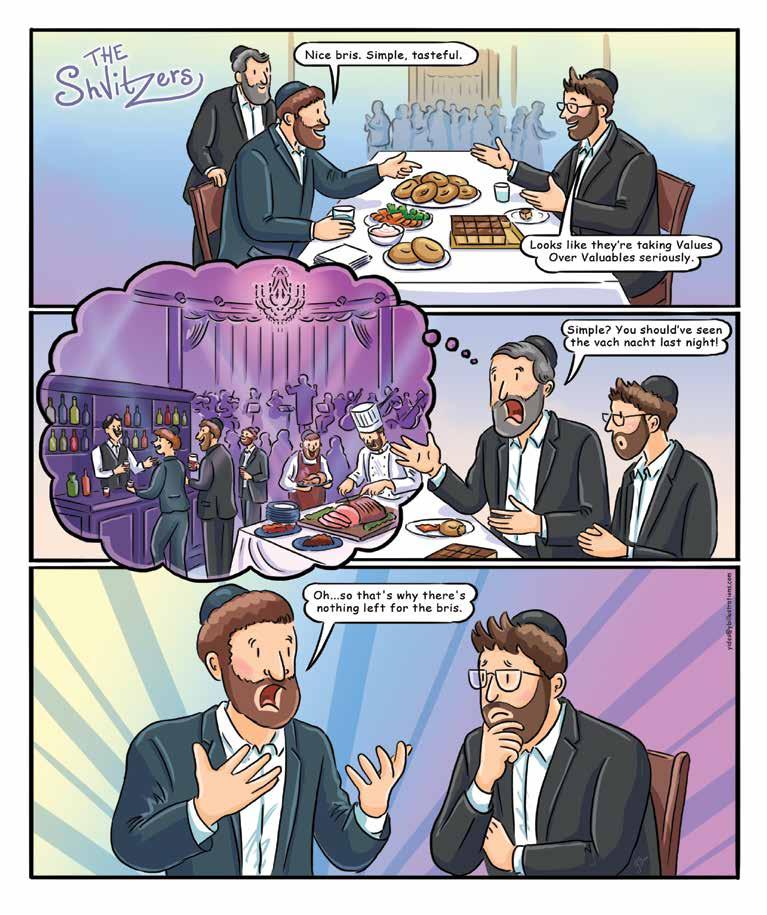

If people had told me this was going to happen, I was like, man, you must be smoking some really good crack, because I thought this company is going to fail. I mean, I gave SpaceX less than a 10% chance of succeeding at all, to be clear. In fact, I told people this, I was like, we’re probably going to fail, but you know, we should give it a try.
– Elon Musk addressing SpaceX employees after the company went public last Friday
You know, while the other aerospace companies, they build good rockets and everything, they were simply not pursuing the technology that’s necessary to make life multi-planetary, to make Star Trek, to make the exciting science fiction futures that we’ve read about real. And that’s what SpaceX is all about – is to take the fiction out of science fiction and create an exciting, inspiring future for everyone. - ibid.
I have nothing against Texas. I love Texas. I miss the Texas taxes.
- Knicks superstar Jalen Brunson during his post-game conference after winning the Finals in San Antonio, reflecting on the time that he spent in college in Texas
First of all, Mamdani is a socialist communist that I have zero respect for. He’s ruining a great city by allowing lawless activity to continue to run rampant on the streets.
- Homeland Security Secretary Markwayne Mullin responding to NYC Mayor Zohran Mamdani calling ICE evil
It doesn’t exist.
- Jerry Seinfeld responding to an agitator outside Madison Square Garden who repeatedly asked him to say “Free Palestine”
So many things have gone wrong: the layups that wasn’t with Charles Smith, the [Patrick] Ewings finger rolls, the Game 7s they didn’t come out on top. Time after time after time… And to be in attendance witnessing the end of a 53-year drought as born in The Bronx, raised in Hollis, Queens, New York City. I’ve been a New York fan all my life, I never thought I’d see it.
- ESPN host Stephen A. Smith
Hunter Biden says he’s really impressed by New York’s Mayor Mamdani. I guess that makes it official: Hunter’s on drugs again.
– Greg Gutfeld
When I hugged Patrick [Ewing], it was like he finally was able to exhale and see a trophy in a Knicks jersey.
- Knicks player Karl-Anthony Towns talking about what the victory in San Antonio meant to retired Knicks center Patrick Ewing, who was there to watch it
To finally be able to see that [Championship trophy] in [Patrick Ewing’s] hands and not in Michael Jordan’s and all these other people’s hands, I mean, there was just so much healing that I was stunned.
- ibid.
What makes that even more unsettling is that this man, our first trillionaire, the richest man in the world, is also one of the weirdest people we’ve ever seen on this planet.
- Late night host Jimmy Kimmel talking about Elon Musk upon SpaceX going public
This obscenely wealthy weirdo has the ability and means to blow up the moon if he chooses and also to put a lot of other people’s money in his pockets.
- ibid.
The most envious, Marxist, redistributive person in the world isn’t the guy busting his [chops] to frame a house, or the guy grinding out DoorDash… It’s the smug guy worth 7 or 8 figures staring at a trillionaire he considers socially beneath him.
- One commenter on X, responding to Kimmel’s statements
Turns out talk isn’t as valuable to society as making cars and reusable rockets.
- Another X response
I’ve had letters from the IRS that were funnier than Kimmel.
- ibid.
These dopes [like Jimmy Kimmel] picture Elon diving into a vat of gold coins like Scrooge McDuck. But Elon doesn’t just have hundreds of billions lying around. An estimated 800 billion of his fortune is tied up in SpaceX alone. It’s not cash. It’s capital for building rockets, cars, satellites – you know, all the stuff Dems think appear from a magic lamp. And even if he decided ever to cash out, his companies would collapse and ruin hundreds of thousands of lives. So his company runs not to his benefit, but to theirs. He can’t take the money and run. Where could he go? He doesn’t own a home.
- Greg Gutfeld
Dems have always been too lazy to learn economics. They prefer the soft scientist sciences like puppy pronouns and is my cat racist.
-ibid.
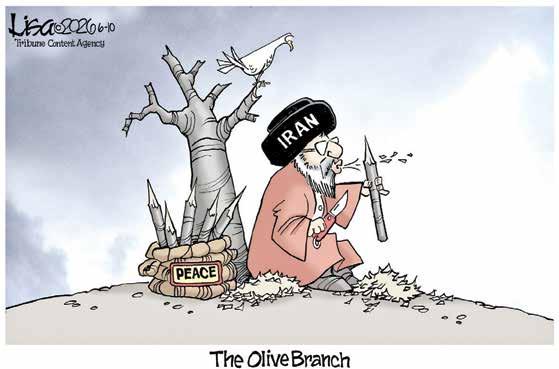









I don’t think our priority should try to be to persuade people. I think the priority should be to never let Israel compromise its security. Israel did the right thing in Gaza.
- Alan Dershowitz on a recent podcast
Even if they knew what the reaction was going to be, the only solution is a strong Israel, less dependent on the United States, more dependent on its own ability, less dependent on listening to foreign leaders, even if the foreign leader is their friend, but being able to defend themselves. The world hates weakness. Remember that Israel suffered its worst blow on October 7 and October 8, because for the first time they were seen as weak and vulnerable.
- ibid.
So my advice is do not prioritize public relations. Do not prioritize an attempt to convert people. Prioritize completely defending Israel’s right to defend itself, to become more aggressive against Iran, favor regime change.
- ibid.
It’s like your spouse being murdered.
- 60 Minutes’ Scott Pelley talking to The New York Times after being fired by CBS last week, along with several co-workers
No one saw the Black Thursday massacre coming.
- ibid.
When somebody wipes out, murders, a large number of your family members, people are desperate for some explanation, and as you and I sit here today, there still has been none.
- ibid.
It was hard for me to believe that I — and I would italicize the “I” if I knew how — that I could witness that. I’m supposed to miss games and moments like that. That’s what I was thinking.
– Larry Davd reflecting on being at Game 4 of the Finals and witnessing the 29-point comeback


By David Ignatius

Listening to U.S. and Arab negotiators recount inside details of their long, zigzag bargaining with Iran over the past five months, I have the sense that the framework announced Sunday isn’t the end of this story but an intermediate step – one that could ultimately prove a dismal failure or, the Trump administration hopes, the start of an extraordinary transformation toward a modern Iran.
Let’s be frank: In diplomatic terms, this agreement is an exit ramp from a costly and unpopular war, not a victory parade. The deal falls far short of President Donald Trump’s early talk of regime change and unconditional surrender. Even one of Trump’s close advisers concedes: “It’s inconclusive right now, in the sense that you can’t say it was a huge success, and you can’t say it was a failure.”
There are more question marks than answers: The details of limiting Tehran’s nuclear program haven’t been negotiated yet. The Strait of Hormuz is reopening, but perhaps only temporarily. The agreement seems to apply to Lebanon, but that doesn’t mean Israel or Hezbollah will
abide by it. And most worrying of all, a hard-line regime remains in power in Tehran, able to threaten its Arab neighbors and Israel.
The principal U.S. negotiators have been Trump’s special emissaries, Jared Kushner and Steve Witkoff, the president’s son-in-law and close friend, respectively. They aren’t diplomats but investors. That has given this negotiation a peculiar risk-reward character. It’s an investor pitch rather than a diplomat’s brief. The theme is a “pay to play,” rather than “check the boxes.”
When Kushner met in April in Islamabad with Iranian Parliamentary Speaker Mohammad Bagher Ghalibaf, he told him bluntly: “Look, if you want your Rolls-Royce price, we need the RollsRoyce product,” according to an official close to the negotiations. In other words, if Iran delivers by keeping the Strait of Hormuz open, stopping enrichment of uranium for 20 years and halting its export of revolution, it stands to gain hundreds of billions of dollars.
The American proposal, in effect, is to recapitalize Iran through a $300 billion
plan for private investment in the country’s modernization. Kushner told the Iranians, for example, that their state oil and gas company is potentially larger than Saudi Aramco, but only if Iran stops its revolutionary activities, the official said. Without stability and rule of law, Iran will remain feeble; with those changes, it could experience a post-war boom.
Here’s where some proper skepticism should kick in. Iran’s leaders are the hardest of the hard-liners. They have survived Israeli bombs and assassination attempts. Many are religious devotees who despise the West and its values. They’re closer in temperament to North Korea’s Kim Jong Un than émigré Iranian business tycoons like Uber CEO Dara Khosrowshahi. They’re interested in revenge, not a leveraged buyout.
But Kushner and Witkoff have worked through an extraordinary mediator, Ali Al Thawadi, minister of strategic affairs in the office of Mohammed bin Abdulrahman Al Thani, the widely respected prime minister of Qatar. Al Thawadi has brought a rare understanding of the Middle East and its culture. He has traveled
to Tehran, by one count, four times in the past 10 days to nail down the peace framework. Al Thawadi, though almost unknown to the general public, was a key emissary in the Gaza peace talks, on Venezuela, and a half-dozen other projects of the Trump White House. He also worked on mediation efforts with the Biden administration.
“The main message we need to keep in mind is that we have a country that has been isolated from the world for the past 47 years, and individuals that literally don’t have any communication outside of their circle,” a source close to the mediation team explained. “We need to show them that there is a much bigger world, and they could be accepted in it.”
Americans imagine that Iran is a theocratic dictatorship where the supreme leader’s decisions are decisive. But people from the region know Iran as an institutional country with layers of bureaucracy that move agonizingly slowly. Even the ruling Islamic Revolutionary Guard Corps is multilayered, with competing factions and personalities. Knowing the culture, emissaries from Qatar, and also
Saudi Arabia and the United Arab Emirates, have been able to maneuver.
Americans like Trump want quick results, but Al Thawadi has been able to slow the process. Explains a source close to the mediation team: “Patience is part of the Persian DNA. You have to be patient with them because that’s their secret weapon. They’re able to corner you because of frustration and then drain you and get the most out of it.” Al Thawadi’s final negotiating session on Sunday in Tehran lasted 17 hours.
For Kushner and Witkoff, this negotiation began many months ago. They came close to a deal in a Feb. 26 meeting with Iranian Foreign Minister Abbas Araghchi. Iran offered a framework deal, but it was as if “there were eight holes in the net, and they offered to patch five
in the regime is likely to continue.
On the crucial question of the Strait of Hormuz, the U.S. official recalls a comment he said was made by Ali Larijani, the head of Iran’s national security council until he was killed by Israeli bombs early in the war. “He said closing the strait was a card they could only play once,” because of how the West would respond. That assessment was right, the official said. Post-war changes will allow better defense of the strait and alternative routes for exporting oil through pipelines on land, rather than tankers at sea.
One little-noted boost in recent weeks, the U.S. official said, was a quiet continuation of the tanker-escort plan known as “Project Freedom,” which was officially shelved in May after Saudi objections. He said a limited version had continued
In diplomatic terms, this agreement is an exit ramp from a costly and unpopular war, not a victory parade.
of them,” recalls the official close to the negotiations.
The American side warned that the negotiations might be “timed out.” Two days later Israel launched the war, and the U.S. joined. When the war began, Iran was ramping up missile production, building as many as 100 missiles a month and “moving rapidly to reconstitute” what had been destroyed in the June 2025 “Midnight Hammer” campaign, the official said.
The war drove members of the regime closer together. But after the ceasefire agreement in Islamabad, splits began to emerge between Iranian leaders who wanted to negotiate a final deal and those who wanted to stay on the revolutionary path.
Ghalibaf impressed the American side over the 21-hour negotiation in Islamabad by showing that he was a reasonable counterpart. But he was assailed by militants when he returned to Tehran and sidelined for a time. The leadership scramble after Islamabad was a “jump ball,” according to the official close to the negotiations.
The official explains: “We kind of created this dynamic where they have internal tension.” Ghalibaf and his allies appear to be controlling the ball now –he’ll go to Geneva to sign the framework agreement Friday – but the jostling with-
allowing export of 7 million barrels of oil a day through the Gulf.
U.S. negotiators are hopeful that Iran will seize the opportunity to invest in its economy and modernize the nation after a peace deal, but recognize that it’s a gamble, according to the source close to the talks. “Whether they’re able to manage their politics and actually do it, I think time will tell, but we’ll find out in the next couple months. … We’re aiming for the most transformational option possible,” the official said.
If you’ve watched as many Middle East moon shots fail as I have covering the region, you have to question whether this big idea of transformation will succeed. But bending the arc of Iran away from revolution and toward a responsible modern state is the overriding challenge – and given the failure of regime change, I frankly don’t see a better route than what the Trump team is proposing.
Asked to summarize his takeaways as a negotiator, this official at the center of the Iran talks expressed a view that would probably be shared by every observer, whatever they think of Trump and his peace plan: “My biggest lesson … is it’s very easy to start a war, and it’s really hard to get out.”

By Bret Stephens
Iran’s military leaders have greeted the ceasefire agreement with President Donald Trump as a triumph, crowing that “through the imposition of their divine and iron will” they had “humiliated American and Zionist enemies.”
Mostly, they’re right.
Mostly, because it’s worth remembering that the current regime in Iran is far less formidable than it was before the Hamas assault on Israel on Oct. 7, 2023. Back then, Iran had potent allies and proxies in Syria, Lebanon, the Gaza Strip and Yemen. Its nuclear program was intact and steadily accumulating ever larger quantities of highly enriched uranium. It had a powerful military-industrial base, a weak but functional economy, and a government that — for all its repressiveness — was internationally recognized as legitimate.
Today, much of that is either gone or diminished. Iran is no longer within sprinting distance of a bomb. Its ally in Syria was deposed. Hezbollah, Hamas and the Houthis have lost much of their fighting strength. The Iranian rial is the world’s most worthless currency. The leadership rules an unhappy population that — outside of die-hard loyalists — would almost certainly overthrow it if given the chance. Its latest ballistic missile salvo against Israel failed to land a serious single blow. Its blockade of the Strait of Hormuz strained, but did not strangle, the world’s energy markets.
Those are real achievements against an evil, ambitious regime. Yet the outcome of war rarely rests on a tally of relative strength. War is a contest of wills. And in that contest, the hard men of Tehran appear to have scored a decisive victory over the vain man of Washington.
I write this as someone who supported the war from the outset and hoped to see Trump carry it through to a decisive result: if not regime change, then at least a deal in which Iran would be forced to relinquish all of its enrichment capabilities and access to the strait was unfettered. Those goals were well with-

in the president’s reach, particularly if he had continued to attack Iran’s military-industrial infrastructure until it agreed to terms, rather than conducting most of the negotiations after the fighting had mostly stopped.
But Trump got spooked after the regime didn’t instantly crumble and energy prices shot up. He then effective -
Tehran took the measure of Trump’s courage. What it found was a bone spur.
All this may seem odd for a president who once loudly complained that the United States hadn’t “fought to win” a war since 1945, who demanded “unconditional surrender” from Iran and who had repeatedly lambasted his predecessor for the humiliating exit from
In that contest, the hard men of Tehran appear to have scored a decisive victory over the vain man of Washington.
ly abandoned the war he had started after less than six weeks of sustained combat — combat in which the United States lost fewer service members than in the 1983 invasion of Grenada. He compounded the error with an almost comical succession of military threats and last-minute climb-downs, each of them signaling indecision and weakness to Iranian adversaries practiced in the study of weakness.
Afghanistan. Then again, it’s not odd for a president whose very essence is betrayal of everyone and everything, his own words not least.
Although the details of the deal remain murky — a telling indicator of its likely shoddiness, since the administration would surely trumpet the terms of a strong agreement — it’s already clear that Trump has betrayed his promise to the Iranian people, after they were mas -
sacred in January to quell anti-government protests, that “help is on its way.” As in Venezuela, to say nothing of China and Russia, this administration’s message to oppressed people everywhere is that their rights come last.
Trump is also on his way to betraying Israel, our principal ally in this fight, by pushing Jerusalem to stand down in its effort to stop Hezbollah’s attacks on its north, in that way handing Tehran the victory of creating a diplomatic linkage between Lebanon and Hormuz. If Iran is now allowed to extract some kind of service fee for permitting ships to transit the strait, Trump will have also betrayed our allies in the Persian Gulf by giving Iran financial and strategic leverage to which it has no right, and which it didn’t previously have.
The worst betrayal, however, is of Americans who supported the war — not only neocons like me but also most of Trump’s MAGA base — because we believed that Iran, which has waged a 47-year war against us, posed an increasingly intolerable threat to our security and vital interests.
This ceasefire neither ends nor eases that threat; it hardens and magnifies it. It removes the one point of U.S. leverage over Iran — the naval blockade of its ports — before there’s any negotiation over its nuclear program, which the Iranians will almost surely drag out until Trump is out of office. It reminds the world of the adage that while it can be dangerous to be America’s enemy, it is fatal to be its friend. And it gives Iran’s leaders something even more vital: The confidence that, whatever Trump may threaten, they can withstand the most any American president or Israeli prime minister can throw at them.
There’s a word for this: debacle. Not because the war, for all its costs or errors of execution, was a mistake. It’s because this pretense of a peace is an act of geopolitical self-harm that will haunt our standing in the world for years to come.
© The New York Times


It’s a bitter pill to swallow for those who have spent much of the last decade lauding President Donald Trump as the most pro-Israel president since the founding of the modern-day Jewish state. It’s equally difficult for those who understood that his rejection of the patent nostrums of the foreign-policy establishment that was entrenched in the U.S. State Department, the media and the academy was essentially correct in almost every instance.
Yet there’s no denying that Trump’s decision to make a deal with Iran—the rogue state that he had gone to war against on Feb. 28 alongside Israel—represents a staggering defeat for the United States, Israel and himself personally. And those who have commended the president for all the good things he did during his time in the White House should not be reluctant to say so.
The agreement, which Trump touted as “real peace” because it opened up the Strait of Hormuz, is a triumph for Tehran. The Iranians surrendered nothing except that one counter-measure to which they had resorted after it was clear that it was losing badly. What makes it all the more dismaying for Trump’s defenders is that one key criticism of his presidency has been vindicated.
The lack of precision and intellectual consistency in the president’s policy pronouncements has always been derided by his critics. But as long as Trump stuck to his instinctive distrust of the “expert” class that had guided American foreign policy for generations, that really didn’t matter. The approach that guided his decisions to move the U.S. embassy in Israel from Tel Aviv to Jerusalem; pursue the Abraham Accords, rather than stick to futile efforts to broker peace with the Palestinians; and hit Iran hard to end its bolstering of inter-
By Jonathan S. Tobin

national terrorism and give up its nuclear ambitions has led to success.
The same was true of other successes he achieved, such as securing the border that former President Joe Biden had left undefended, allowing millions of illegal immigrants to flood the country; toppling Nicolás Maduro, the dictator of Venezuela; or forcing elite American universities to stop tolerating and encouraging campus antisemitism because of their woke DEI policies.
So long as that was true, the president’s braggadocio and wild social-media posts filled with hyperbolic threats and boasts were merely a matter of style and manners.
But the failure in Iran can be traced back to the chaos that always lay underneath everything he did. Trump could have stuck to a principled stand on Iran, despite setbacks and problems, until victory. Launching a war with all of its unpredictable outcomes and variables was not the same as issuing executive orders or posting on social media. He lacked the ability
to stand his ground because his mindset tends to seek immediate gratification and quick victories. Trump is a strong man, but his unpredictability and belief in his genius in deal-making were not enough to sustain him when things got difficult.
That left him vulnerable to the influence of those—like Steve Witkoff, his special envoy to the Middle East, and adviser and son-in-law Jared Kushner—whose approach to Iran resembled that of members of past Democratic administrations.
A man with a coherent set of foreign-policy principles, as opposed to one with an unquenchable desire for shortterm triumphs, might have understood that Witkoff, Kushner and Vice President JD Vance—the putative leader of the neo-isolationists within the administration—were leading him toward the same misguided stand on Iran as Obama.
His devoted MAGA fans refused to believe it. They repeatedly chided anyone who expressed fears that he was on track to surrender the gains that the war had
achieved, as not understanding his subtle strategy. They said any indication that he might mimic Obama’s betrayal of the West on Iran was simply a matter of Trump playing three-dimensional chess while deceiving and trolling his critics. So deep is their faith in him that some will keep on insisting on this long after it’s become obvious that they have been deceived.
But their faith in his judgement is misplaced. Rather than endure more months of criticism, high oil prices and sinking popularity ratings in pursuit of the goals on which he had staked so much American blood and treasure, Trump has simply folded on one of the key foreign policy priorities he had adhered to since he entered politics in 2015.
Repeating Obama’s Blunder Trump’s claims notwithstanding, Iran’s nuclear ambitions have not been snuffed out. The pact leaves open the possibility that they can keep their remaining nuclear material. The promises they have made about not seeking nuclear weapons are merely recycled lies with which they had fooled the president’s predecessors. They are no more trustworthy than those in President Barack Obama’s dangerously weak 2015 Joint Comprehensive Plan of Action (JCPOA) that Trump had rightly derided as worthless for the past 10 years. Indeed, though Trump’s proposed terms for ending Iran’s nuclear program are somewhat tougher than Obama’s, both rely on Tehran, which is to say, they are equally meaningless.
Why, after so much bellicose rhetoric as well as tangible military success in the war, did Trump ultimately fold, handing both his domestic critics and his Iranian antagonists such a victory?
The United States and Israel had inflicted devastating losses on Iran’s mil-
itary, as well as its missile and nuclear programs, along with much of the country’s infrastructure, with which it had threatened the region. But Iran did have the power—via drone and missile fire—to menace shipping in the Persian Gulf, thus impacting the price of oil.
Thanks to the energy independence that Trump’s policies had helped achieve, Americans felt the impact of that problem less than most other people around the world. Yet it still led to higher gas prices at the pump in the United States. Given that Trump had not made a compelling case for war to the American people, that fact increased the conflict’s unpopularity, exacerbating the Republican Party’s deficit in the polls about the outcome of this fall’s midterm elections.
That created enormous pressure—amplified by those inside the administration, led by Vance, who were already opposed to his tough policy on Iran—to end the war without achieving any of its initial goals. Though not explicitly stated, the point of starting the war was to make Iran surrender its nuclear material, as well as its ballistic missiles and its decades-long policy of fomenting terror around the region. Washington had rightly left its intentions about overthrowing the Islamist regime vague, hoping that the pounding Tehran’s forces had taken, coupled with the elimination of much of its leadership, would lead to that result or force the slain Supreme Leader Ayatollah Ali Khamenei’s successors to give in to American demands.
The president could have kept striking Iran until it bowed to his will. Or, once he agreed to a loose ceasefire in April could have kept enforcing a blockade on Iran’s ports, which was doing far more damage to its economy than the spike in oil prices was having on the West, until Tehran gave up or the regime imploded.
But he didn’t do either of those things. He folded under pressure and abandoned the gains that Washington and Jerusalem had achieved.
Even worse, he accepted Iran’s premise that an end to the fighting must also cover Jerusalem’s efforts to force the Hezbollah terrorists in Lebanon to stop firing on northern Israel and cede power in Beirut. That also led to Trump’s much-publicized abusive comments about Israeli Prime Minister Benjamin Netanyahu, his erstwhile faithful partner in the war, about his temerity in prioritizing the defense of his people over the president’s pursuit of futile diplomacy with Iran.
The damage inflicted on Iran during
the first two months of fighting was real and set back its ability to spread mayhem throughout the region. It will take years for it to rebuild its military and reconstitute its nuclear and missile threats.
And there is always the possibility that Trump could reverse course and resume the attacks once it becomes clear that Iran is simply retooling its infrastructure of terror and aggression.
But does anyone in Washington and Jerusalem, and elsewhere in the West—and most importantly, in Tehran—seriously believe he will do that now that he’s declared that this accord has resolved all of the world’s concerns about Iran? The Iranians know that he has had enough of the fighting; that made them even more intransigent. As they did during the negotiations with Obama and his envoys, they had his measure and acted accordingly.
Trump has now made the same mistake as Obama by relaxing sanctions and even unfreezing billions of Iranian funds held by the United States and its allies. As Lee Smith aptly noted in Tablet magazine, the transfer of $20 billion in frozen assets by the United Arab Emirates, with $3 billion already delivered to Tehran, perhaps in cash stacked on wooden pallets like those sent by the 44th president to pay off the Islamist terrorists a decade ago, is key to understanding what has just happened.
The money that Trump’s surrender will make available to the Iranian government will prop it up and likely ensure both its longevity and its ability to sustain its Hezbollah and Hamas terrorist allies in Lebanon and Gaza.
The oil may now flow, as the president trumpeted on Truth Social, through the Straits of Hormuz, and gas prices may decline. But the flow of cash to Iran is a guarantee that its regime will go on fomenting terror and war in the future, even after Trump leaves office in January 2029. As Obama did with his signature foreign-policy “achievement,” he has left a dangerous problem for his successors to solve that will be far worse and much harder to eliminate than it would have been for him had he not surrendered.
Iran’s tyrants can, with justice, say that they survived a fearsome assault by the United States and Israel, and ultimately forced a superpower to give up. Still, it will take time for them to get back to where they were on Oct. 6, 2023, before the confident launching of the cruel war on Israel launched by their “resistant front” with the atrocities of Oct. 7. The
losses sustained by the Iranian regime, as well as Hamas and Hezbollah, during the fighting that took place during the last 33 months were not imaginary. All are far weaker than they were then.
But there is also no doubt that Iran’s prospects have improved since the start of the year, when it seemed as if the regime that had murdered tens of thousands of its citizens who protested its tyrannical rule was on its last legs.
By threatening to topple the Islamist terrorists but failing to make good on those threats, Trump did terrible damage to his standing throughout the world, as well as that of the United States. Much like Obama’s going back on his talk of taking action against the regime of Bashar Assad in Syria if it crossed a “red line” by using chemical weapons on its people, Trump has shown the Middle East that he, too, can be cowed into backing down. The American and Israeli attacks had shown Iran’s military weakness, but Tehran can now, as it did previously, claim to be the “strong horse” of the region that won’t reverse course in the face of Western attacks.
The deal with Iran is also a blow to the U.S.-Israel alliance.
The months of close cooperation between the two nations’ militaries had demonstrated just how powerful and important the bond between Washington and Jerusalem had become. By ending the war without achieving its goals and chiding the Israelis to stop defending themselves, Trump has sent the world a message that while not completely left on its own, the Jewish state has been put in a precarious position. His hyperbolic and inaccurate statements—“If it were not for me, there would be no Israel right now”— could be excused while he was actually supporting Israel, though now that he is undermining its security in this manner, they leave a bitter taste in the mouths of friends of the Jewish state.
The interests of the two nations aren’t identical, though they do mostly overlap. And Israel isn’t giving up and will continue to do what it must to defend itself. However, an opportunity to transform the region by defeating Tehran has been lost. And that will make future conflicts— that Trump’s deal, like Obama’s, will help foment—even more bloody and dangerous for the Jewish state, as well as moderate Arab states that must continue to fear what Iran will do in the years to come. Domestically, Trump’s decision also strengthens the wing of his party that
was soft on Iran and uninterested in defending Western interests in the Middle East. And those in the Democratic Party who no longer support Israel and opposed efforts to forestall the Iranian threat that Obama had encouraged have also been handed a victory. They can say that Trump wasted American lives and vast amounts of scarce military assets only to accept the same humiliation that Obama achieved without firing a single shot.
Vance, whose 2028 presidential prospects seemed on the wane in recent months, is a major beneficiary of this decision. His claim on NBC’s “Meet the Press” that every conflict, including World War II, ended in negotiation illustrated his lack of understanding of both the war and history. Yet that absurd statement puts him on Trump’s side in the current foreign-policy debate, which strengthens his chances of being the president’s successor and next leader of the GOP.
Trump may remain a better guardian of American security, as well as a more reliable friend of Israel and the Jewish people than his Democratic predecessors. But sadly, his war on Iran will now be spoken of with the same derision that he had used to describe the failed conflicts in Afghanistan and Iraq, even though that needn’t have happened had Trump been a man of stronger convictions and headed a less chaotic administration.
The fact that stopping Iran’s nuclear ambitions and terrorism was as much in America’s interests as that of any other country will be forgotten and even downplayed by many of the president’s supporters. And the growing antisemitic movement on both the left and the right will pick up and endlessly repeat the false narrative that it was Israel that led the United States to pursue a conflict that couldn’t be won.
We should not lose faith in Israel’s ultimate victory over the evil ideology that governs Iran and animates its terrorist allies. It is a more formidable nation than it was before Oct. 7, and will—no matter who leads it in the coming years—do what it must to defend itself. Yet, like the failure to eliminate Hamas in Gaza after Oct. 7, Trump’s decision to breathe new life into the Tehran regime will mean that more wars will have to be fought in the coming years to achieve that necessary goal. That’s a tragedy that could have been averted had Trump proved to be wiser and more steadfast than he turned out to be.
Jonathan S. Tobin is editor-in-chief of JNS (Jewish News Syndicate).
By Avi Heiligman

As America prepares to celebrate its 250th birthday with great fanfare, many are reflecting on the unique legacy that made the United States one of the most prosperous countries in history. Here at TJH’s Forgotten History Department, we are marking this milestone by uncovering some of the nation’s more interesting and overlooked incidents. While a few of these stories may be familiar, each one holds a unique place in the American story.
While the nation has had its fair share of inventors and innovators since 1776, there was one mind that was way ahead of his time – in fact, he began working on his inventions before independence had even been declared. David Bushnell began attending Yale College at the age of 31 to study science and mathematics, but by his senior year in 1775, he designed a device that was to become the world’s first combat submarine. Called the Turtle, it was built with oak beams and iron bands and featured a hand-cranked screw propeller, a foot-operated valve, and a hand pump to let water in and out of the ballast tank. Bushnell also demonstrated that explosives could be detonated underwater, constructing a mine that utilized a clockwork timing mechanism. In September 1776, Continental Army Sergeant Ezra Lee used the Turtle to attempt an attack
on the HMS Eagle in New York Harbor. While the attack failed, Bushnell continued developing weapons like the naval mine and later joined the Continental Army as a combat engineer.
Exactly 50 years after the signing of the Declaration of Independence, two of the most important figures involved with that historic document died just hours
pendence Day exactly five years later; James Monroe, America’s fifth president, died at the age of 73 in New York City.
Wilmer McLean was a grocer and sugar trader living near Manassas, Virginia, when, on July 21, 1861, one of the first large encounters of the Civil War took place on his farm. In what became known as the First Bull Run, or the First
Supply crates were stamped with “U.S.” for the United States, and soldiers joked that it stood for local supplier Samuel Wilson, whom they called “Uncle Sam.”
apart. On July 4, 1826, at Monticello, Virginia, former president and primary author of the Declaration, Thomas Jefferson, died at the age of 83. Just four hours later, in Quincy, Massachusetts, John Adams, the nation’s second president and the man known as the “Atlas of Independence,” passed away. Reportedly, his last words were, “Thomas Jefferson survives.” Incredibly, another former president and Founding Father passed away on Inde -
Battle of Manassas, his house, which was being used as Confederate headquarters, was bombarded by federal cannon fire.
A cannonball came through the kitchen fireplace, and because of this experience, McLean decided to move his business and residence to a place that was considered safer. Little did he know that his new location, Appomattox Court House, would be the site of the surrender of the Confederate Army under Robert E. Lee to
Union General Ulysses S. Grant. Thus, his homes were the sites of the first and last major engagements of the bloodiest war on American soil.
Often, the United States government is referred to as “Uncle Sam,” and the origins of the name date back over 200 years. Before Uncle Sam, the nation was personified as “Brother Jonathan,” named after Connecticut governor and advisor to George Washington, Jonathan Trumbull. This caricature was a New England “Yankee” with a small hat and striped pants, symbolizing everyday American citizens and colonists. However, during the War of 1812, supply crates were stamped with “U.S.” for the United States, and soldiers joked that it stood for local supplier Samuel Wilson, whom they called “Uncle Sam.” By the Civil War, this nickname had taken on the persona of an elderly man with a top hat and a striped suit, permanently replacing Brother Jonathan. Several other historical figures had their names enter the American lexicon, including John Hancock. As the legend goes, he signed his name on the Declaration of Independence so large that the King of England wouldn’t need his spectacles to read it. While it may just be a good story, the term “Hancock” today is universally recognized as a signature, no matter the size of the autograph.

Similarly, Elijah McCoy was an African American inventor who developed a revolutionary lubricant for steam engines. His product was so vastly superior to his competitors’ that when engineers went to buy it, they would insist on getting the “Real McCoy.”
While the United States is getting ready to hold the 2028 Olympics in Los Angeles and make it truly a spectacular show of the greatest sports in the world, the 1904 St. Louis Olympics were just the opposite. To say that the first time the Olympics were held on American soil was bizarre would be an understatement. In fact, 520 of the 650 athletes were from the United States, participating in
events such as Tug of War and a “Plunge for Distance” competition that required swimmers to jump into the water, remain motionless for a minute, and see how far they drifted. Gymnast George Eyser won six medals, three of them gold, in a single day. The crazy part about this feat was that he had just one leg – his other leg was a wooden stump.
Then came the brutal marathon, in which just 14 of the 32 competitors managed to finish the 24.85-mile run in 90-degree heat. The course had just two water stations, and officials in cars drove ahead of the runners, causing massive dust storms that led to severe respiratory issues for some of the athletes. The

race was originally won by Fred Lorz, who, after nine miles, got into a car for the next 11 miles. After the car broke down, he finished the race on foot. Just as the gold medal was about to be placed around his neck, someone pointed out that he had cheated. He claimed it was merely a joke. The real winner was Thomas Hicks, whose managers refused to give him water and instead gave him a potentially lethal cocktail that included strychnine and brandy. He had to be dragged over the finish line and was immediately rushed to the hospital. Other strange occurrences during the race included a South African runner who was chased a mile off course by feral dogs and a Cuban
mailman who arrived at the starting line in regular clothes and leather boots but still somehow finished fourth.
These are just some of the many colorful and improbable stories that have shaped America over the past 250 years. In future articles, we will explore more of these fascinating stories and forgotten figures from our country’s past.
Avi Heiligman is a weekly contributor to The Jewish Home. He welcomes your comments and suggestions for future columns and can be reached at aviheiligman@gmail.com.

LOOKING TO DECLUTTER? Moving? Downsizing? Get rid of your old Jewish/secular English books. Text (347)669-3445
MASSAGE THERAPY HEALING. Relief from muscle discomfort and pain. An escape to relax. It’s a wonderful present for yourself, friend, and family. Contact Yossi at (347) 722-0068
DU N DURT
Power & Soft Washing
We clean siding, stucco, decks, driveways, concrete, pool patios, pavers & sidewalks. Say goodbye to grime, mold & allergens!
Call/WhatsApp: 718-688-2964
Email: dundurtny01@gmail.com
THE LEATHER SHOPPE
The spot for all your custom leather Judaica. Tallis/tefillin bags, lulav and esrog bags, havdallah sets, challah covers, shtenders, pesach sets, matzah/afikomen bags. WhatsApp: (732) 523-0007 or email: theleathershoppe732@gmail.com for a full catalog. We ship.


PEACEFUL PRESENCE STUDIO
Men’s private yoga, Licensed Massage & Holistic Health Guidance 436 Central Ave, Cedarhurst Info. & free video training www.peacefulpresence.com 516-371-3715
HAIR COURSE: Learn how to wash & style hair & wigs. Hair and wig cutting, wedding styling Private lessons or in a group Call Chaya 718-715-9009
GERBER MOVING
Full Service Moving Packing Moving Supplies Local Long Distance. Licensed Insured 1000’S Of Happy Customers Call Shalom 347-276-7422
HANDYMAN AVAILABLE
For big or small jobs, Sheetrock, carpentry, painting, electrical, plumbing, install & repair appliances Call Ephraim at 347-593-4691
MANAGEMENT STAFF WILL ASSIST you with: * Obtaining Medicaid and Pooled Income Trust
* In-home Assessments, Individual and Family Counseling
* Securing reliable home care assistance
* Case and Care Management services Dr. S. Sasson, DSW, LCSW (718) 544- 0870 or (646) 284-6242




ZEVIZZ WOODTURNING JUDAICA Challah knifes, batei mezuzah, besamim holder, kiddish cups, havdalah candle holders, yad for sefer torah, pens, stenders, bowls and more 952-356-2228
MY MOTTO IS DON’T WAIT TO buy real estate
Buy real estate and wait Your realtor for life 516-784-0856 Alexandra at Realty Connect USA
Don’t Get Stuck With a Two Story House Ya Know, It’s One Story Before You Buy It But a Second Story After You Own It!
Call Dov Herman For An Accurate Unbiased Home Inspection InfraredTermite Inspection
Full Report All Included NYC 718-INSPECT
Long Island 516-INSPECT www.nyinspect.com
REAL ESTATE MANAGEMENT Services – Do Not Manage Your Properties Alone! Contact Aliyah Suites for all your real estate management needs and affordable office space near you! (516) 366-1049
Management@aliyahsuites.com
Marc Jeret (MJ) Team Leader & Licensed Real Estate Agent
NORTH WOODMERE
Big renovated,spacious 4br, 2fbh, W&D, Driveway, garage, deck,huge backyard, SD#14, tons of starages, huge master, jacuzzi, shower, available immediately, What’s up only owner, 347-517-3552
OPEN HOUSE IN NORTH LAWRENCE
On Sunday June 21 from 4 to 5 pm Multifamily 3842 sg footage 5 bdrs, 4 full bath, 4 , 3 kitchens, 4separate entrances , above ground pool, low taxes Call Alexandra Exp at 5167840856

Prime Restaurant Location For Lease.
For more information: Call/Text/WhatsApp Owner: (516) 206-1100
A multi-tasker needed for general office work. The ideal candidate is someone who is detail-oriented, responsible, and can take ownership. Looking for someone who is eager to learn, and expand his/her skill set while possessing the ability to work independently and as part of a team. Experience with Excel required. Five Towns location. In-office position only, not remote. Please send resume to 5tpart.timecareer@gmail.com
UPSCALE EVENING & Ready-to-Wear Boutique opening on Central Ave seeks fashion-forward, friendly sales associates with retail experience. Full-time & Part-time. Text/WhatsApp 718-310-8550.
REGENTS EXPERT
Tutoring regents in Algebra and Geometry A Darchei Torah instructor. Guaranteed results Text 347-491-8045 WhatsApp 347-767-1755
ARE YOU A DOULA?
Or have a passion to be?
Come join our great referral group and get access to a vast new clientele through Medicaid. JUST CALL 347-668-7886
BOOKKEEPER
A Five Towns Real Estate Company is seeking a full-time Bookkeeper. The right candidate must be proficient with QuickBooks and Excel. They must also be self-motivated, organized, detail oriented, reliable, and able to work independently or as a team player. Warm, frum office environment with excellent salary & benefits. Please email resume to HR@capsprop.com
SEEKING ELEMENTARY TEACHERS
For current school year, starting from end of January: Seeking assistant teacher for General Studies. Candidate should have skills to take over for teachers if needed. Far Rockaway area boys’ school, M-Th, PM hours, strong support. Excellent salary. Possibility to continue for next year. Send resume to teachersearch11@gmail.com
JEWISH CENTER SEEKS
Administrative Assistant with strong office/computer skills and experience working with toddlers & preschoolers ages 1–4. Responsibilities include office administration, social media/ PR, program support, substitute coverage/aftercare in preschool classrooms, and event setup. Knowledge of Jewish traditions is a plus. Full-time, Mon–Fri with occasional evenings/Sundays. Send resume to admin@jewishelc.org
JEWISH PRESCHOOL IN
Merrick seeks warm, loving, experienced toddler teachers for 2-year-olds, preschool teachers, and assistant teachers for children ages 18 months–4 years for the 2026–2027 school year. Mon–Thu 9–3, Fri 9–2. Email admissions@jewishelc.org or call 516-833-3057 ext. 110.
ARE YOU PASSIONATE About literature, writing, and inspiring young minds?
Are you someone who can create engaging learning experiences? Someone who can help students develop strong communication and critical-thinking skills? Then this is an opportunity for you! Shevach High School seeks an enthusiastic and experienced ELA teacher. Please send your resume to mribowsky@shevachhs.org




















Remote (requires in-person home visits in NY)
Support families facing serious medical or emotional challenges. Provide guidance, advocacy, and resource coordination from home or on-site. Training provided.
BA or 2 years Care Management required Apply online: www. chailifeline.org/careers or email hr@chailifeline.org
Center
The Marion & Aaron Gural
JCC Early Childhood Center is hiring Assistant Teachers and Substitute Teachers for the 2026-2027 school year.
Please send resumes to JCC.Nursery@guraljcc.org or call (516) 239-1354
5 Towns area Nursing Home management office seeking a Regional/Corporate level MDS Nurse to work in our office. Must be an RN. Regional experience preferred. 2-3 years MDS experience with good computer skills required. Position is Full Time but Part Time can be considered. Great Shomer Shabbos environment with some remote options as well. Email: officejob2019@gmail.com


SHMIRAS HALASHON
Text 516-303-3868 with a time slot of your choice to be careful on lashon hara. Be a part of the 1,000 people for klal yisroel!
BEIS HAMEDRASH CONG.
Chasdei Uvois Oshpitzin
Talmidei chachomim are willing to learn mishnayos, say kaddish and be the shliach tzibbur to daven for the umid on the yartzeit yom hashanah of your parents or close relatives or loved ones To arrange please call Rabbi Miller 917-445-6220




There are moments when it finally happens.
You realize the weather has committed to a change.
It can be transitioning to winter. Or it could be the start of the summer.
But those teasing days before the final commitment are usually the most confusing.
Do I switch my wardrobe? Head for the beach club?
Will I be dressed completely wrong and freeze or boil? Will my umbrella blow away and be gone with the wind? In fact, will I blow awaycompletely and be gone myself?
Sunshine is deceptive. It never tells the whole story.
Sometimes, you look outside and think what a beautiful day it is. You dress appropriately – or do you? And then, you take that walk outside and there’s a wind or a breeze or even a mist you totally weren’t prepared for. And you’re suddenly running for cover in every nook and cranny.
There are also other days when the sun is out shining, and you think it’s going to be another perfect day. You stroll
By Rivki D. Rosenwald Esq., LMFT, CLC, SDS

outside, and within seconds you’re melting – melting! Just like the Wicked Witch at the end of the Wizard of Oz.
Summer comes for such a short stint, but it’s only when all the schools end that you really believe it’s actually here. That’s when the infectious feeling summer has
almost everyone got a lot smarter about protecting their kid’s skin, so we just don’t get that “crispy critter” heads-up anymore.
It feels like countdown these days.
We are just waiting for the onslaught of weddings. That definitely signals the arrival of summer. Also, the traumat-
Summer comes for such a short stint, but it’s only when all the schools end that you really believe it’s actually here.
truly arrived begins spreading through the streets.
It’s the freedom of the kids running through the yards, the biking, scootering, laughter, and the playing outside that sends summer ripples through the atmosphere.
It used to be those few kids with the overly cooked sunburn that let everyone know that summer had truly arrived. But
ic beach traffic that keeps us shlepping along at a snail’s pace. And finally, the bumper-to-bumper mountain traffic, which confirms 100% that summer is here. When you get stuck in that, then you know definitively, you have hit another sunny season. The road is a confirmed parking lot!
Yes, that, my friends, is the moment it finally happens.
You know the season has truly transitioned.
We are all in that countdown mode. We want to feel the sun, but we want that breeze. We want the pool warm enough to walk right in but still cool enough to do laps.
We want to go to the water parks and feel comfortable walking around but not freeze in their pools.
We want warm weather but not stifling.
We all put in our orders. But ultimately, it’s not us who get to decide.
So, let’s just keep hoping for the perfect balance that makes us all happy – warm and cool and comfortable and exactly what we all want – all at the very same time! And good luck to us all.
Rivki Rosenwald is a Licensed Marriage & Family Therapist working with both couples and individuals and is a certified relationship counselor. Rivki is a co-founder and creator of an effective Parent Management of Adolescent Years Program. She can be contacted at 917-705-2004 or at rivkirosenwald@gmail.com.