












Last night, one of my children’s teachers called me for her “end of the year” call. Is summer here already? Is the school year finally over? Have so many months passed since they donned their new knapsacks and crisp uniform skirts?
You know what they say: time flies when you’re having fun. And it’s certainly been fun. Perhaps, though, children may not define the school year in “fun” terms. But when they look back, there is so much that they learned and so much that they gained from this past year.
There are lessons that they were taught and tested on – on paper and in life. From this year, they came out knowing so much more history, math, and science, but they also learned more about life. They learned how to better interact with friends and with peers. They were taught about the world and the role we, as Jews, play in that world. They were given lessons on the pride that we have in our heritage and the beauty of the mesorah that has been passed down through the generations.
These are lessons that they will keep with them for life. And they’ll pass them along to their children as they help them grow.
One more truth becomes clear at the close of every school year: chinuch is not measured only by report cards or grades, but by the small, almost unnoticed changes that take place over time. A child who is a bit kinder than she was in September. A boy who now understands the
words to the tefillos he says each day. A student who learned how to persevere through frustration instead of giving up. These quiet victories rarely make headlines, yet they are often the greatest accomplishments of all. They are the building blocks of people and their future homes, future families, and future generations of Klal Yisrael.
Although some of these lessons are learned outside the classroom, the rebbeim and teachers who give over these ideals to our children are the ones to whom we have so much gratitude. Every year, before school starts, we daven that our children have the right rebbeim and teachers who will understand them and help them grow and learn. In a way, a teacher-student relationship is like a shidduch, where each side has to be able to connect with the other person’s style and approach. The best rebbeim and teachers understand, instinctively, how to connect with each child. And once that connection is forged, the lessons that can be taught and instilled are limitless.
When we look back on these ten months, we see in them so much growth and accomplishment. We marvel at the successes and the triumphs and the achievements. And we applaud the teachers and rebbeim who worked so hard to help our children bring their latent potential to the fore.
Wishing you a wonderful week, Shoshana

Yitzy Halpern, PUBLISHER publisher@fivetownsjewishhome.com
Yosef Feinerman, MANAGING EDITOR ads@fivetownsjewishhome.com
Shoshana Soroka, EDITOR editor@fivetownsjewishhome.com
Nate Davis
Editorial Assistant
Nechama Wein Copy Editor
Rachel Bergida
Shana Brecher
Lani White Design & Production
Gabe Solomon Distribution & Logistics
P.O. BOX 266
Lawrence, NY 11559
Phone | 516-734-0858
Fax | 516-734-0857
Classified Deadline: Monday 5:00PM classifieds@fivetownsjewishhome.com text 443-929-4003
PAYMENT VIA CREDIT CARD MUST BE SUBMITTED ALONG WITH CLASSIFIED ADS
The Jewish Home is an independent weekly magazine. Opinions expressed by writers are not necessarily the opinions of the publisher or editor. The Jewish Home is not responsible for typographical errors, or for the kashrus of any product or business advertised within. The Jewish Home contains words of Torah. Please treat accordingly.






Dear Editor, Last week’s excerpt of the ArtScroll biography by Rabbi Shimon Finkelman of Rav Moshe Wolfson, zt”l, must relate many informative and inspiring stories of the Mashgiach. I have not read it yet. But, I am sure that it does not contain one of the best one liners that any Mashgiach ever said to a talmid.
I was 16 years old, in the Torah Vodaas Bet Midrash, and my hashkafa did not align with the normative and acceptable yeshivish hashkafa expected of Torah Vodaas bochurim. Rav Wolfson took me under his wing, and we had weekly discussions concerning my radical ideas. One day I said to him: “I’m an apikores.” He replied: “You’re not an apikores, you’re an ignoramus. When you know kol haTorah kulah you can be an apikores.” That reply was not said in anger but with warmth and understanding of the conflicts that teenagers experience.
Yehi zichro baruch.
Sol Liss
Dear Editor,
This past week presented me with a series of emotionally contrasting events. Just before Shabbat, NYC Mayor Mamdani announced Nakba Day. Perhaps, some people forgot that last Friday was Jerusalem Day, as well. I find it interesting that Mamdani called for a day of commemorating the catastrophe of the Arabs being expelled from their homes in the newly formed Israel. The narrative of the Nakba, of course, dismisses the thousands of Jews expelled from Arab countries at the same time. I was annoyed and puzzled that a group of people have continuously called for the total annihi-
lation of Jews and Israel since Israel was created, despite the plain fact that Arabs were given a parcel of land to form their own country that far exceeded the size of Israel. Because they decided to go to war against Israel multiple times, they lost more land each time. In a sense, their Nakba miseries have only increased since then. Nakba day has currently been declared not merely a day of protest. It is a day of violence and calls of Israel’s annihilation “by any means possible” including murder, bombing and terrorism.
On Sunday, I attended a Hachnasat Torah in Far Rockaway, sponsored by Ephraim Perlstein and family. Ephraim is my second cousin. Besides the opportunity to share a simcha with a beloved family member, I was thrilled to join over 100 men, women and children singing and dancing in the streets to celebrate this momentous occasion.
The timing of this event was perfect –on Rosh Chodesh Sivan, in the same week that we celebrate Shavuot. This is the holiday that commemorates the unity of the Jews and the Torah that caused and has perpetually kept their unity for thousands of years.
The contrast between Nakba Day and the Torah dedication couldn’t be starker. Nakba day calls for a day of war, violence and chaos. In contrast, Proverbs says, “The Torah’s ways are pleasant, and all its paths are peaceful.” Shavuot is the day we celebrate Jewish unity for the sake of peace. Moreso, most of the messages of how Nakba Day is commemorated is based on lies. The Torah and all of its messages are based on truth.
Daniel Feldman
Continued on page 12


Continued from page 10
Dear Editor,
The author of the Zohar fittingly placed his “Idrah Rabah” (the “Great Gathering”), which is a discourse with his nine talmidim about the nature of G-d’s attributes, in Parshat Naso.
Naso has a certain grandeur to it; it is the longest parsha in the Torah, with 176 pesukim, and the Chiddushei HaRim points out that this equals the number of pages in Bava Basra, the longest masechta in Shas. It also contains many transcendent themes, featuring topics such as Nazir, Sotah, and Birchas Kohanim.
The message is clear: after the profound experience of Matan Torah, the stakes are raised, and the desire for more overpowers.
Steven Genack
Dear Editor,
As our community is growing, so are people walking on Shabbos and this just makes it dangerous, as part of our community has no sidewalks, rightfully so as it keeps the rural suburban look intact.
Thankfully, our mayor, Samuel Nahmias, has established great lighting which in itself makes it safer to walk at night; however, one area that is congested with walkers and joggers not only on Shabbos is Causeway and Barrett Rd as these streets are the gateway to Back Lawrence, which brings to mind that the Lawrence Country Club ends right before the street where a walkway or sidewalk can be built along the perimeter of the golf course on Causeway from the country club to Barret Rd and Barret Rd from past Washington Ave until Yacht Basin. This would allow pedestrians and joggers to be able to walk or run along the path without interfering with cars, especially at night or twilight when it’s hard for drivers to see. It would allow walkers to take Barret instead of the winding Ocean Ave, which can be dangerous.
This path would not interfere with golfers as it’s outside the perimeter and would not interfere with anyone’s person-
al property or roads. Let’s save lives and use caution if we can avoid any accidents.
Reuven Guttman
Lawrence, NY
Dear Editor, I wanted to thank you for publishing the recent feature on Sarah Pachter. Long after I finished reading it, I kept thinking about the kind of person she is and the kind of impact one individual can quietly have on thousands of people without ever fully realizing it.
What struck me most was not only her accomplishments or popularity, but her sincerity. The article painted the picture of someone deeply genuine — someone who has managed to connect to women and girls not by pretending to be perfect, but davka by being real. In a world where so much feels polished, curated, and filtered, there was something refreshing and deeply moving about reading about a person whose strength comes from honesty and heart.
The article especially resonated with me because it highlighted how Sarah Pachter’s message was born from real-life struggles, growth, and self-reflection. That made her influence feel attainable rather than intimidating. Sometimes profiles of inspiring people can leave readers feeling inadequate, as though greatness belongs only to a select few. This article reminded me that meaningful impact begins with authenticity, empathy, and consistency.
More personally, the article challenged me to rethink how I approach my own relationships and personal growth. Sarah’s emphasis on self-awareness, kindness, and emotional honesty reminded me that becoming a better person is not about dramatic transformations. Often, it is about the quieter work — listening more carefully, judging less quickly, and showing up more fully for the people around us. It’s making small choices, consistently, that truly define who we are. Rachel T.



Secretary of State Marco Rubio arrived in India last week for a four-day trip that put him at the center of several major U.S. foreign policy tests, including strained ties with New Delhi, the future of the Quad, and the broader fallout from the war involving Iran.
The visit included meetings with Prime Minister Narendra Modi, Foreign Minister Subrahmanyam Jaishankar and the foreign ministers of Australia and Japan, allowing Rubio to frame the trip as both a bilateral repair effort and a broader show of U.S. commitment to Indo-Pacific diplomacy.
The trip came at a sensitive moment for U.S.-India relations, which have been strained by the Trump administration’s tariffs on Indian exports, as well as by questions over trade, energy and Washington’s engagement with India’s rival, Pakistan. At the same time, Rubio used the Quad meeting to promote cooperation on maritime surveillance, port infrastructure and critical minerals.
Rubio said the urgency was clear because a large share of global maritime trade passes through the Indo-Pacific, making secure sea lanes and freedom of navigation central concerns for the United States and its partners.
Energy security also shaped the visit. With fuel prices rising and disruptions in the Strait of Hormuz affecting trade, Rubio said his talks in India covered the conflict involving Iran and the need to reopen a waterway that is crucial to global commerce.
Rubio also sought to emphasize India’s importance as a strategic partner, saying the two countries had signed a pact on critical minerals and rare earth supply chains aimed at expanding cooperation while reducing dependence on supply chains dominated by China.
The trip’s broader geopolitical message was reinforced in a joint statement from the Quad countries — the United States, India, Japan and Australia — which opposed coercive efforts to change the status quo and highlighted concerns about freedom of navigation, offshore resource development and instability in the South China Sea
From India, Rubio traveled to Yerevan, Armenia, for a signing ceremony with Foreign Minister Ararat Mirzoyan, extending a trip that underscored how the administration is trying to project U.S. engagement across multiple regions as countries respond to war, energy disruption, and intensifying great-power competition.

A group of Australian women and children with links to Islamic State (IS) returned to Sydney and Melbourne, Australia, on Tuesday, after being stranded for years in a Syrian camp.
A plane believed to be carrying two women and seven children landed in Melbourne on Tuesday, while four women and six children were expected to arrive in Sydney later in the evening.
Some of the women may face charges over their decision to travel to Syria about a decade ago.
One woman, who has been banned from returning to Australia for two years for national security reasons, is understood to still be in Syria with her child.
Earlier in May, three of four Australian women who returned home with nine children were arrested and charged with offenses including crimes against humanity and joining IS.
In confirming the more recent group’s return, Home Affairs Minister Tony Burke said the government “has not and will not provide any assistance to this group.”
“These are people who have made the horrific choice to join a dangerous terrorist organization and to place their children in an unspeakable situation,” he said. “As we have said many times: any

members of this cohort who have committed crimes can expect to face the full force of the law.”
Authorities have been preparing for the group’s return since 2014, Burke said, and they have “long-standing plans in place to manage and monitor them.”
This group is believed to be the last Australians in the al-Roj camp in northeast Syria where families of IS fighters have been held since 2019. They reportedly left the camp on Thursday and boarded planes to Australia on Monday in the Syrian capital of Damascus.
One of the women is Kirsty RosseEmile, who left Australia when she was 19 and who told the ABC last year it was “not my choice” to be in Syria. Others include Nesrine Zahab, who has said she was tricked into travelling to Syria by her cousin, IS recruiter Muhammad Zahab; Sumaya Zahab, Muhammad’s sister; and Aminah Zahab, Muhammad’s mother.
Earlier in May, four women and nine children from the same camp returned home to Australia, with police arresting three of the women and charging them with various offenses including crimes against humanity and entering and remaining in a declared conflict zone.

Seven villagers have been trapped in a cave underground in Laos for nearly a week as rescuers desperately attempt to free them from the flooded area.
The villagers went into the cave in the central Laotian province of Xaisomboun last Wednesday in search of gold. Heavy rain triggered flash flooding which blocked the exit.
Two Thai divers and a Finnish expert who helped in the 2018 dramatic cave rescue of a young soccer team in Thailand joined the risky operation on Monday.
The villagers are believed to be trapped deep inside the cave on “an elevated ledge inside the cave that benefits from continuous airflow,” state-run Lao

News Agency reported. To reach them, rescuers will have to navigate a 340-meter (1,115 feet) tunnel, according to the Metta Tham Kalasin (MTK) Command and Control Center, one of the groups coordinating the rescue.
Some parts of the tunnel are just 60 centimeters (23 inches) wide, so rescuers will need to crawl to get closer to the trapped group. Images showed cables laid through a gap between the rocks to guide rescuers to its lower reaches.
Helmets, breathing masks and gas monitors are being used to monitor the level of oxygen and toxic gases in the narrow cave system. Efforts are being made to pump water out of the tunnels to make them easier to access.
Authorities were alerted to the trapped villagers by a member of the group who managed to escape before the exit was blocked
Villagers frequently visit the site to search for gold deposits despite repeated safety warnings from the authorities.
In 2018, 12 boys and their soccer coach became trapped deep inside a cave in the northern Thai province of Chiang Rai for more than two weeks when a downpour flooded the tunnels. A massive rescue operation featuring experienced divers from Australia, the United Kingdom and the United States saw the boys removed one by one through the cave network in a heroic mission that captivated audiences around the world.

This May, the United Kingdom has seen record-high temperatures, with the country’s national meteorological service, the Met Office, predicting a heat wave — an “exceptional spell of warmth for May” — for this week from East England’s Lincolnshire to the Midlands, western parts of East Anglia, and London. Highs of 35°C (95°F) were expected.
Such heat is rare for the U.K., particularly for this time of year. On Monday, the U.K. experienced its hottest May day since May 29, 1944, some 80 years ago. Before that, the record was 32.8°C (~91°F) in 1922.
Last century, the U.K. saw highs of 35°C or higher just once every ten years, a BBC report from 2025 noted.
Officials have also warned of dangerously high UV rays, advising locals to stay indoors. Despite warnings, many have been visiting beaches.
The U.K. has seen its three hottest recorded springs since 1884 from 2017 to now.
The warmest recorded day in the country’s history was July 19, 2022, when temperatures soared to 40.3°C (104.5°F). The summer of 2025, however, was the U.K.’s hottest recorded season.
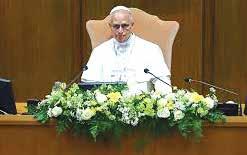
On Monday, Pope Leo XIV issued an unprecedented apology on behalf of the church for playing a role in the legitimization of slavery and failing for centuries to denounce it — two mistakes the Pontiff called a “wound in Christian memory.”
Although Leo’s predecessors have sought to make amends for Christians’ roles in the trans-Atlantic slave trade, Leo is the first to apologize for past popes’ complicity.
Leo, the first pope born in the United States, is a descendant of both slave owners and enslaved people. He discussed the Vatican’s role in slavery in the first encyclical, “Magnifica Humanitas,” during which he discussed the importance of preserving humanity in the age of artificial intelligence. Leo argued that new technology enables new forms of slavery and colonialism.
“The Catholic Church has never been an innocent bystander in the history of white supremacy,” said Shannen Dee Williams, a historian and author of a book about American Black Catholic nuns. “Black Catholics have waited a long time to hear the Vatican speak honestly about the church’s leading roles in the trans-Atlantic slave trade and chattel slavery and thus by extension the enduring systems of anti-Black racism in the world today.”
In the 15th century, the Vatican permitted Portuguese kings to conquer Africa and the Americas and enslave non-Chris-

tians, with Pope Nicholas V issuing the papal bull Dum Diversas in 1945, allowing Portugal “to invade, conquer, fight, and subjugate” and seize the possessions and lands of “Saracens, and pagans, and other infidels.” Three years later, another bull, Romanus Pontifex, was issued, upon which the Doctrine of Discovery, a theory that legitimizes the colonization of Africa and the Americas, was based. The doctrine wasn’t rescinded until 2023, although the bulls have remained, with the Vatican asserting that the Sublimis Deus, a bull issued in 1537, affirmed Indigenous people’s rights to liberty, freedom, and their property.
Leo noted that Pope Leo XIII, whose name he took, became the first pope, in 1888, to explicitly denounce slavery. Many popes before him had slaves.
Leo refrained from condemning his predecessors, noting that it’s unfair to judge them based on modern values.
“Yet neither can we deny or diminish the delay with which both society and the church came to denounce the scourge of slavery,” the current pope said.

A building under construction in the northern Philippines collapsed on Sunday, killing at least four people and trapping 16 others. By Monday, officials called off the rescue operation, turning the focus to recovering the remains of those trapped in the rubble of the nine-story structure.
The condominium project collapsed onto a nearby hotel in the city of Angeles, north of Manila, early on Sunday.
“We know how hard this is for you,” Maria Leah Sajili, information officer at the regional Bureau of Fire Protection, said on Tuesday, about calling off rescue efforts. “We sympathize with what you are going through. Rest assured, we did everything we could to save lives, and
now we have to move forward,” she said.
Authorities called off search and rescue operations late on Monday after rescuers, using life locator equipment, determined there were no longer signs of life beneath the rubble.
Seventeen people had originally been listed as missing, but rescue officials said one of them contacted officials on Monday to confirm he had not been in the area at the time.
Officials said up to 70 people were employed at the construction site, although most had gone home for the weekend.
On Sunday, rescuers detected signs of life from two people and saw them alive, but optimism quickly turned to pessimism when one was found dead and the other died shortly after being freed.
Iran has moved its 2026 World Cup base camp from Tucson, Arizona, to Tijuana, Mexico, FIFA confirmed on Monday.
FIFA released its official list of base camps for all 48 teams, which confirmed the switch that Iran Football Federation
(FFIRI) president Mehdi Taj announced over the weekend.
According to Taj, Iran made the request. Mexico President Claudia Sheinbaum said on Monday that the United States did not want the Iranian team staying overnight in the country.

“The United States doesn’t want the Iranian national team to stay overnight in the United States,” Sheinbaum told reporters.
Sheinbaum said FIFA requested Mexico host the team’s base camp.
“And we said, ‘Yes, no problem. We have no issue with that,’” Sheinbaum said.
Iran’s World Cup status has been in doubt since the U.S. and Israel launched an armed conflict against the Middle East nation in late February, with the nations currently in an unsteady ceasefire.
On Saturday, May 16, a FIFA delegation led by secretary general Mattias Grafström met with FFIRI officials in


20 Istanbul, Turkey. Following that meeting, Taj expressed optimism that Iran would be able to participate in the World Cup.
Iran is scheduled to kick off its World Cup campaign against New Zealand in Los Angeles on June 15. Team Melli will also take on Belgium in Los Angeles and Egypt in Seattle.

At least 24 people were killed in a suicide bombing in Quetta, Pakistan, on Sunday morning. At least 70 people were injured in the blast.
Prime Minister Shehbaz Sharif called the attack a “cowardly act of terrorism” on social media. Balochistan Chief Minister Sarfraz Bugti said on social media that “innocent civilians, including women and children” were killed.
The massive blast occurred near a railway track in the Faquir Abad area at around 8:00 a.m. local time and caused panic across nearby neighborhoods. Witnesses said the powerful explosion shook buildings, shattered windows, and sparked a fire that engulfed parts of a passenger shuttle train.
Pakistan Federal Minister for Railways Hanif Abbasi said the blast derailed the engine and three coaches on the shuttle train. Two other coaches overturned, he said. Photos show thick black smoke rising from the scene.
Many people were waiting at the train crossing when the explosion occurred.
The Balochistan Liberation Army, a group based in Afghanistan, has claimed responsibility for the attack. The BLA believes Balochistan should be an independent region, and its attacks frequently target civilians, soldiers and police. The U.S. State Department has designated the BLA as foreign terrorist organization.
Quetta is the capital of the Balochistan province. The oil- and mineral-rich province is the largest but least populated in Pakistan and is a hub for the country’s ethnic Baloch minority. Islamic militants also operate within the province.
The BLA has taken credit for multiple bloody attacks in the region. In February, coordinated suicide and gun attacks car-
ried out by the group killed 18 civilians and 15 security personnel. A suicide bombing at a train station in the same region killed at least 26 people, including soldiers and railway staff, in 2024.
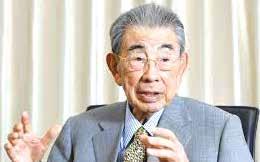
Toshifumi Suzuki, the Japanese businessman credited with creating the 7-Eleven convenience-chain global retail empire, died last week at the age of 93.
Suzuki founded the Japanese unit that operates the seemingly ubiquitous 7-Eleven “conbini” outlets, where busy people can hop in and grab sandwiches, rice balls, drinks, chips and other meals on the run, use ATMs, pay utility bills and copy documents.
The 7-Eleven stores, now numbering more than 80,000 worldwide, are the biggest convenience-store chain in Japan.
The business started out in Japan under a franchise agreement with the U.S. 7-Eleven in 1973. The first store opened in Japan the following year.
After The Southland Corp., which founded 7-Eleven, ran into financial difficulties, the Japanese company bought a majority stake in the 1990s. It made the American counterpart its 100% owned group company in 2005.
Suzuki, born in Nagano Prefecture, northern Japan, in 1932, graduated from the prestigious Chuo University in Tokyo. Before beginning his career in the convenience store business, he worked at Ito-Yokado, a major Japanese retail chain that sells a variety of products including groceries, cosmetics and clothing, which is also owned by Seven and i Holdings.
Apart from leading 7-Eleven, Suzuki engineered the acquisition of Barney’s Japan in 2015 and added banking functions to the empire.
He said he wanted to provide customers with what he called a lifestyle shopping experience. Over the years, the retailing giant also brought under its wing the Sogo and Seibu department stores.
Suzuki became chief executive of 7-Eleven Japan in 1978. He is widely seen as having innovated how Japanese consumers shop.
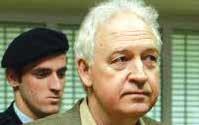
An 82-year-old man who was serving 17 life sentences for leading a farleft Greek militant group that killed 23 people, including a CIA officer, has been released from prison, prompting angry objections from relatives of the group’s victims.
Greek television footage on Friday showed the man, Alexandros Giotopoulos, walking through a central Athens neighborhood carrying a plastic shopping bag, hours after he was freed Thursday evening. His lawyer said he was released because of his advanced age, among other reasons.
A court ruled in 2003 that Giotopoulos was the mastermind behind November 17, a militant group that was active in Greece from 1975 to 2002. It carried out bombings and assassinations, as well as bank robberies that helped to finance its operations.
Its victims included industrialists, politicians and foreign officials, including Richard Welch, a CIA station chief in Athens who was gunned down in 1975. Giotopoulos has consistently denied that he led the group or was involved in its killings.
In Greece, people sentenced to multiple, concurrent life terms in prison are generally released after about 25 years, and Giotopoulos had filed several petitions asking to be freed. A judicial panel finally agreed, citing his age, failing health and good behavior in prison, where he completed postgraduate studies, his lawyer, Vasiliki Kamilari, said on Greek television.
Victims’ family members were dismayed by the news of his release.
“Let’s not forget that he’s the leader of November 17, who got 17 life sentences,” Kostas Bakoyannis, a former Athens mayor whose father, a conservative politician, was killed by the group in 1989, said on Greek television on Friday. “Let’s not forget that, because in a while we’ll be hearing that he’s not a murderer but a university professor.”
News reports said the prosecutor at the Greek Supreme Court was seeking to
review the ruling, raising the possibility that Giotopoulos could be returned to prison.
A spokesperson for the Greek police, Constantina Dimoglidou, said Giotopoulos would be required to report to his local police station once a month under the terms of his release.
November 17 took its name from the date in 1973 when a student uprising against Greece’s military dictatorship was violently repressed by police and the army, killing more than 20 people.
(© The New York Times)

The founder of an online political satire movement that mocked India’s governing party has accused the government of taking down the group’s official website.
Abhijeet Dipke, who is currently studying at Boston University and founded the so-called Cockroach Janta Party (CJP), said on X on Saturday that the government had taken down the “iconic” website.
Dipke launched the website and accompanying social media accounts a week ago in response to comments made by India’s Chief Justice Surya Kant earlier this month, in which he compared unemployed young people to cockroaches.
The remarks came during a hearing on a petition by a lawyer seeking senior advocate designations in the Delhi High Court. “There are already parasites of society who attack the system, and you want to join hands with them?” the CJI had observed.
Referring to certain individuals active on social media, Chief Justice Kant said, “There are youngsters like cockroaches, who don’t get any employment and don’t have any place in profession. Some of them become media, some of them become social media, some of them become RTI activists, some of them become other activists, and they start attacking everyone… The things they are posting on Facebook, YouTube, etc., do they think we are not watching?” he asked.
Kant has since clarified his remarks, saying his comments were aimed at people who acquire fraudulent degrees, and


24 described the country’s youth as “the pillars of a developed India.”
But his earlier remarks left a mark, which galvanized Dipke to form his movement.
Dipke said his personal Instagram account had been hacked, as well as the Instagram account of the CJP. The CJP’s Instagram page has attracted more than 22 million followers since it was launched a week ago. The party’s initials are a play on the acronym used by Indian Prime Minister Narendra Modi’s Bharatiya Janata Party (BJP). In comparison to the CJP’s Instagram following, the BJP – the world’s largest political party – currently has more than nine million followers.
According to Dipke, one million people have signed up to join the movement in the past week. The CJP is campaigning for Indian Education Minister Dharmendra Pradhan to resign, with Dipke saying 600,000 people had signed the movement’s petition. Large protests have broken out across the country in recent weeks, calling for Pradhan’s resignation, after allegations surfaced that exam papers had been leaked, forcing the cancellation of a government-run medical entrance test.
Speaking to the media earlier this week, Dipke explained the thinking be-
hind his rapidly growing movement.
“Those in power think citizens are cockroaches and parasites,” he said.
“They should know that cockroaches breed in rotten places. That’s what India is today.”

A gas explosion at a coal mine in northern China killed at least 82 people, making it the country’s deadliest such incident since 2009.
The blast occurred on Friday evening in Changzhi, a city in the coal-industry hub of Shanxi province, according to China Central Television. The state broadcaster said that 247 people were on duty underground at the time of the explosion.
More than 100 injured workers are being treated at local hospitals, including

many who inhaled toxic gases released by the blast.
Chinese leader Xi Jinping ordered an investigation into the explosion and urged local authorities to focus on rescue operations and treating the injured. Xi also called for nationwide efforts to curb industrial accidents.
While the cause of the incident remains under investigation, a local official said on Saturday that preliminary findings suggested that the mine operator had “committed severe legal violations.”
In 2009, a coal mine explosion in the far northeastern province of Heilongjiang killed 108 people and injured 133. In that case, authorities charged 12 people, including mining executives and government officials.
While China has led the way in developing green technologies, it remains the world’s largest producer and consumer of coal. Last year, some 4,000 coal mines in the country turned out a combined 4.85 billion metric tons of raw coal, accounting for more than half of global output. The coal industry remains a bedrock of the Chinese economy, powering factories and homes.
Beijing in recent years has ramped up safety inspections and oversight across the mining industry and other high-risk sectors. That has resulted in a decline in major incidents and fatalities.
In Changzhi, local authorities last year fined the Liushenyu coal mine, the site of Friday’s deadly explosion, citing two minor safety problems, government records show.
circles. As such, male doctors may not examine female patients.
Some three-and-a-half decades later, Israel has around 40 female Druze doctors.
“Choosing Dr. Nadia Khir means choosing a woman who broke barriers not only for herself, but for an entire generation of women in Druze society,” a Habama Shelahen prize spokesperson stated. “She succeeded in changing deeply rooted social perceptions and proved that education, leadership, and personal fulfillment can strengthen an entire community. Her impact continues to this day.”

The event held in her honor was hosted by Israel Hayom and sponsored by Dr. Miriam Adelson.
“I was 18 and wanted to learn medicine, but at the time, it was forbidden for Druze women to go to university,” Khir said. “A young woman who studied could cause her family to be excommunicated from the Druze community.”
In 1985, Khir was admitted to the Technion-Israel Institute of Science’s medical school, but she was afraid that her studies would cause her mother, a religious woman, to be excommunicated. However, after receiving assurances from a Druze religious leader, she went forward with her academic plans.
Khir has three daughters: a 29-yearold doctor, a 23-year-old electrical engineering student, and a 22-year-old software engineering student.
Thirty-five years ago, in the early 1990s, Dr. Nadia Khir became Israel’s first-ever female Druze doctor. On Sunday, she was honored with the Habama Shelahen (“Their Stage”) prize, an award that recognizes the accomplishments of Israel’s female leaders.
Khir, a 58-year-old gynecologist who lives in a Druze village in the Western Galilee, was inspired to become a doctor after growing up hearing stories of women who died or were harmed because they wouldn’t go to a male doctor. Men are not permitted to touch women other than close relatives in traditional Druze
About 150,000 Druze live in Israel, mostly in the Galilee, Carmel, and Golan Heights regions.



southern Israel during the Hamas-led October 7 massacre, using footage, photographic evidence, facial recognition software, and audio from intercepted phone calls to identify perpetrators.
The Wall Street Journal reported on the list on Wednesday, noting that Israel is committed to killing or arresting every single listed individual.
Israeli officials relied on at least two pieces of evidence before including each name on the list.
The list’s compilation began right after the massacre, with “hundreds” already eliminated or detained, according to the report. “No participant is deemed too insignificant,” it said.
According to the report, the file includes relatively “minor” offenders, such as a Gazan man who drove a tractor through the border fence, and major terrorists, such as Hamas platoon commander Ali Sami Muhammad Shakra, who played a role in abducting hostages
This list follows in the tradition of the Mossad’s campaign to kill every terrorist behind the 1972 Munich Massacre, when Israeli athletes were killed while competing in the Olympic Games.
“It will take time, just as it did after Munich,” Mossad director David Barnea declared in 2024. “But our hands will reach them, wherever they are.”

A soldier was killed in battle on Sunday in southern Lebanon, the Israel Defense Forces announced Monday morning.
Sgt. Nehoray Leizer, 19, was killed in battle on Sunday afternoon in southern Lebanon. Leizer, a combat engineer in the 601st Battalion, hailed from Eilat and was killed by an explosive Hezbollah drone. The drone struck an armored personnel carrier that Leizer was driving.
Another soldier was seriously wounded in the incident.
In a post to social media, the fallen soldier’s mother, Rotem David-Leizer, wrote: “They tore out my heart. Why? Why? G-d, why?”
His sister wrote, “My little brother. My whole world. My heart stopped beating together with you.”


Hersh Goldberg-Polin, Alon Ohel, Eliya Cohen, and Or Levy. Both terrorists have already been killed.
International law stipulates that countries may only kill attackers who pose an imminent threat, or else such killings would be considered extrajudicial executions. As such, the IDF has noted that every person targeted on the list has posed an “imminent threat to” nearby troops, crossed the “Yellow Line,” or was planning to attack Israel or its troops.
Prime Minister Benjamin Netanyahu eulogized Leizer in a statement, saying that the “marvelous young man from the city of Eilat fought with heroism and, with self-sacrifice, defended our northern border against the Hezbollah terror organization.”
Defense Minister Israel Katz wrote on X that “Nehorai, a son of the city of Eilat, was from the best among us — as a youth, he was already imbued with Zionism and a sense of mission, when he was a member of youth movements, and during a year of service after which he went on to serve as a combat soldier.”
Leizer was the tenth IDF soldier to be killed in southern Lebanon since the start of the ceasefire between Israel and Hezbollah, which has largely unraveled after being announced last month. He was the


attacked Israel on March 2, in support of terror sponsor Iran, after U.S.-Israeli strikes on the Islamic Republic. A civilian contractor was also killed in southern Lebanon.
On Friday, Staff Sgt. Noam Hamburger, 23, a technology and maintenance soldier in the 401st Brigade, from Atlit in northern Israel, was killed by a drone near the Lebanese border.
“Noam had big dreams and was an entrepreneur at heart. The absurdity is that he wanted to go into the field of drones. It’s unbelievable that a drone got him first,” said his mother, Liat Hamburger, on Sunday morning.
Another soldier was reportedly seriously wounded, and a non-commissioned officer was lightly hurt in the same incident. Both were evacuated to a hospital for treatment. A second explosive drone was said to have fallen in the same area of northern Israel roughly 25 minutes later, causing no injuries.
In a joint interview with her husband Eyal on ynet, the broken mother said, “Three of his friends were injured and I wish them all a full recovery. I hope we can already come together and understand that our strength is in unity. Enough with the division. We have lost what is dearest to us. It’s time to be united.”
Liat said about her son, “He was a gift of a child, sweet and wonderful. He was simply born with a smile. We didn’t know what to name him, but when he came out, it was clear he would be Noam [Hebrew for pleasantness]. A sweet, smiling, kind child. Wherever he went, always smiling, always managing and surrounded by friends. There was a quiet strength in him. He achieved everything he wanted in his own way, with his humility. He was an amazing brother. Being the eldest brother to three girls is a challenge, and he knew how to reach each one, lead them, teach them and support them. Truly, it still hasn’t sunk in.”
She added, “Our second daughter dealt with cancer for three years, beat it, and then fell ill again. The second time was harder, including a bone marrow transplant and travel to the United States. Noam was always there, supporting and accompanying her.
“He could have chosen differently, to be in a less dangerous unit. And every time I told him, ‘Noam, let me call, let me talk to the army, let me share,’ he said, ‘No. I want to be there. Do you understand, Mom? The soldiers are fighting there and when the tank stops working, everything stops. That’s my job. To fix the tank so they can defend themselves, that’s a huge responsibility.’”
The Israeli military has said that it has killed over 2,000 Hezbollah operatives, including hundreds of members of the terror group’s elite Radwan Force, since hostilities escalated amid the war with Iran. During the fighting in Lebanon, Hezbollah has fired more than 5,500 rockets at IDF troops operating in the south of the country, as well as around 2,500 at Israel, according to the military. There have been at least 75 rocket impact sites in Israel. In addition, Hezbollah has launched around 300 drones, of which 25 struck Israel, according to the IDF.
On Sunday, U.S. Secretary of State Marco Rubio said, “If Hezbollah is going to launch missiles or launches missiles at them, Israel has every right to respond to that, or to prevent that from happening,” adding: “That’s always been understood. It’s being understood during the ceasefire.”

The IDF announced Tuesday that Chief of Staff Lt. Gen. Eyal Zamir has formally decided to dismiss former military advocate general Yifat Tomer-Yerushalmi over her role in the explosive Sde Teiman leak affair, a scandal that has shaken Israel’s military and political establishment for more than a year.
According to the military, Zamir suspended Tomer-Yerushalmi as soon as allegations against her surfaced in November 2025. The IDF said the decision to permanently remove her from service was made because of the “severity of the alleged acts and suspicions” surrounding the case, which remains under criminal investigation.
Her dismissal will also strip her of financial benefits typically awarded to senior officers upon retirement. The army added that Zamir believes a demotion in rank could follow once the criminal proceedings conclude and “the facts become clearer.”
The Sde Teiman affair erupted after surveillance footage allegedly showing IDF reservists abusing a Palestinian detainee at the Sde Teiman detention facility was leaked to Channel 12 in 2024. The

30 video sparked outrage across Israel, with critics condemning the alleged abuse while others accused those behind the leak of damaging the military and distorting the incident’s context.
The controversy intensified after military police arrested several reservists suspected in the abuse case. In response, hundreds of protesters — including coalition lawmakers and a cabinet minister — stormed the Sde Teiman base in an attempt to stop the arrests. Activists later broke into another military base where suspects were being held, clashing with soldiers. No charges were ultimately filed against those involved in the break-ins.
Months later, the scandal took another dramatic turn when Tomer-Yerushalmi herself became the central suspect in the leak she had initially been tasked with investigating. She later resigned and admitted to leaking the footage.
Investigators also accused her of attempting to destroy evidence by disposing of her cellphone in the sea. She was hospitalized for nearly a month after overdosing on sleeping pills in what authorities later confirmed was a suicide attempt.
Defense Minister Israel Katz welcomed the dismissal, calling Tomer-Yerushalmi’s actions “grave acts” that caused
“severe damage.” Katz said he has asked the Attorney General’s Office to accelerate the criminal proceedings against her, including possible imprisonment and the stripping of her military rank.
Tomer-Yerushalmi remains under house arrest as the investigation continues.

One person died, and 34 Fire Department officials were injured on Friday afternoon after two explosions erupted on a barge at a commercial shipyard in the Arlington neighborhood of Staten Island, New York, causing an out-of-control fire.

According to Police Department spokesman Brad Weekes, at 3:25 p.m., the initial explosion occurred, with a number of firefighters responding. Fire Commissioner Lillian Bonsignore said that two workers were trapped in the barge following the first explosion.
At 4:19 p.m., after the fire officials requested backup, a second explosion ensued, injuring firefighters inside the barge.
More than 200 emergency officials responded to the incident, according to the Fire Department.
The person who died in the blast was identified as a 57-year-old father and husband from Flushing, Queens. The family of Xiaoyuan Li identified him as the victim of the deadly fire and explosion. Li, an immigrant from China, had been working at the shipyard for approximately four years.
Among the 34 FDNY members who were injured, a fire marshal and a firefighter were hurt most severely.
“They’re suffering from something that is silent, which is blast energy. In a confined space, that energy hits you and can penetrate organs,” said FDNY Chief Medical Officer Dr. David Prezant.
The fire marshal suffered a temporal fracture and a brain bleed, but he survived the tight quarters during a daring rescue.
“We got very lucky this day. We got lucky in the sense that none of our people were killed. It’s unfortunate that we have one fatality, and they did everything they could for that person,” said FDNY Commissioner Lillian Bonsignore.
Once the barge fire is extinguished, officials will investigate the incident, NYC Mayor Mamdani said.

Secret Service officers neutralized a gunman after he opened fire near the White House on Saturday. At the time, President Donald Trump was in the White House, where he had spent the long holiday weekend.
The man, later named as 21-year-old Nasire Best, was previously arrested by
the Secret Service in July for trespassing on restricted White House grounds, leading a judge to issue a “stay away order,” banning him from the White House’s surrounding areas.
Just after 6 p.m., after Best opened fire near 17th Street and Pennsylvania Avenue, Secret Service officials fatally shot him. He was later pronounced dead at a local hospital. One bystander was injured, though the severity of the injuries is unclear. No officials were hurt.
On early Sunday, Trump applauded the Secret Service and those who neutralized the assailant, adding that the gunman had “a violent history” and a “possible obsession” with the White House.
Two others in the last month have been arrested for opening fire near top U.S. officials. In late April, a California man attempted an attack at the White House Correspondents’ Association dinner, and in early May, a Texas man exchanged gunfire with the Secret Service near the Washington Monument.
Saturday’s gunfire led to a temporary lockdown at the White House. About 20 to 30 gunshots were heard.
Best opened fire at the northwestern corner of the White House grounds.

The Supreme Court on Tuesday declined to hear a lawsuit filed by Florida that sought to challenge policies in California and Washington allowing some people who entered the United States illegally to obtain commercial truck driver licenses.
Florida filed the case after a high-profile crash in the state last year involving a truck driven by Harjinder Singh, an Indian national. The crash left three people dead. Florida says Singh did not have legal status in the United States and that he was improperly issued commercial licenses in both California and Washington. Singh faces criminal charges in connection with the crash.
The justices denied Florida’s request without explanation.
Justice Clarence Thomas wrote separately to say he would have allowed the

case to proceed. Justice Samuel Alito joined that opinion.
“This court declines to even hear Florida’s claims, even though it has nowhere else to bring them,” Thomas wrote.
The case was unusual because Florida Attorney General James Uthmeier, a Republican, filed it directly with the Supreme Court rather than in a lower state or federal court. The justices can hear disputes between states in limited circumstances, but they rarely agree to do so.
In its complaint, Florida argued that the Democratic-led states’ alleged “open defiance” of federal immigration law had also led them to disregard federal safety standards. The state said this allowed some drivers to obtain licenses without proper training or the ability to read road signs, creating risks for motorists in Florida and elsewhere as those drivers travel across state lines. Iowa and 16 other states filed a brief supporting Florida’s position.
Lawyers for California and Washington responded that the dispute did not justify Supreme Court intervention.
The crash in Florida intensified a broader political fight over illegal immigration as the Trump administration continues to pursue a hardline approach. After the crash, the administration threat-
ened to withhold federal funding from California, Washington and New Mexico unless they enforced English-language requirements for commercial drivers.

An AI-generated video in support of Los Angeles Republican mayoral candidate Spencer Pratt has gone viral, depicting incumbent Mayor Karen Bass as the Joker and Pratt as Batman. The video also portrayed California Gov. Gavin Newsom and former Vice President Kamala Harris dining with rich people while mocking LA residents begging for help.
Although Pratt’s campaign denies involvement, the video has amassed more than five million views on X and has ostensibly boosted his standing in the upcoming race. Pratt, a former cast member of a hit 2000s reality TV show, has even
found himself on the radar of President Donald Trump, who told the press, “I’d like to see him do well. He’s a character.”
While Democrats claim Pratt’s online popularity won’t help him in the race, Bass has been losing ground to Pratt in recent polls. As such, it’s increasingly likely that the race will end in a one-onone runoff between Bass and Pratt in November.
Pratt’s popularity increased last year after his and his wife’s Pacific Palisades home burned down during the Los Angeles fires, leading him to promote his wife’s album. Pratt has criticized Bass and Newsom for their handling of the fires.
“This just isn’t a campaign — this is a mission, and we are going to expose the system. We are going into every dark corner of L.A. politics and disinfecting the city with our light,” Pratt declared in January, when he officially started his campaign.
According to a poll released last week by the Los Angeles Times, 30% of voters support Bass, 22% support Pratt, 20% support City Council member Nithya Raman, and 16% are undecided. In order to avoid a November runoff, a candidate needs to win 50% of the vote in the June 2 primary.
Fifty-six percent of LA voters ex-
pressed disapproval of Bass in a Los An
geles Times poll conducted in March.

Tulsi Gabbard, the Trump administration’s Director of National Intelligence, announced her departure on Friday, citing her husband’s recent bone cancer diagnosis in the resignation letter she submitted to President Donald Trump.
“My husband, Abraham, has recently been diagnosed with an extremely rare form of bone cancer,” wrote Gabbard, 45, who married her spouse in 2015. “He faces major challenges in the coming weeks and months. At this time, I must step away from public service to be by his side and fully support him through this battle.”



Gabbard, who was tasked with supervising the 18 U.S. intelligence agencies, didn’t play a major role in much of the Trump administration’s foreign policy decisions, including in Venezuela and Iran, as her isolationist-leaning stance was at odds with the president’s. Trump’s relationship with her was complex, oscillating between pride and disapproval. He praised Gabbard for her criticism of the Obama administration’s Russian collusion investigation. As Director of

Aimee Bock, the founder of Feeding Our Future, was sentenced to 500 months in prison on Thursday after being convicted of wire fraud and bribery. Her nonprofit, a Minnesota-based scam charity that embezzled government aid that it falsely said would go towards feeding schoolchildren, took over $250 million in federal funds, only $50 million of which was recovered, according to officials. In addition to her nearly 42-year prison sentence, Bock must also pay over $242 million in restitution. Her scheme took advantage of hungry children and taxpayer dollars, with the nonprofit positioning itself as a pandemic relief organization.
Just before her sentencing, Bock reportedly told the judge, “I don’t have the words to express just how horrible I feel. I know I’m responsible.”
Many of the organization’s nowcharged employees are Somali, which led the Trump administration to launch an immigration crackdown in Minnesota. The state’s governor, Democrat Tim Walz, decided not to run for a third term in part due to the controversy generated by this scandal.
Bock is among the first major COVID-19-related fraudsters to stand trial.
National Intelligence, Gabbard shrunk her office, rescinded security clearances of anti-Trump intelligence officials, and supervised a major turnover at her agency’s Liberty Crossing, VA, headquarters. However, her office often clashed with the CIA and FBI.
Gabbard will keep her position until June 30. After she steps down, her deputy, Aaron Lukas, will take the reins as acting director of National Intelligence, according to Trump. “Tulsi has done an
incredible job, and we will miss her,” Trump said on Truth Social, thanking her.
Gabbard, a Democrat-turned-Trump supporter, was a presidential candidate in 2020 after serving as a combat veteran and Hawaii congresswoman.
“Minnesotans are a generous people, and we believe in supporting folks who need a helping hand,” Minnesota Attorney General Keith Ellison stated following the sentencing. “It boils my blood that fraudsters are taking advantage of that generosity, and my office and I will gladly partner with all those who are also committed to holding fraudsters accountable.”
“My message to the fraudsters, is this: Eat, drink and be merry today,” Assistant Attorney General Colin McDonald said. “Because your days of frolicking and freedom are numbered. We are doing everything we can to find you, and when we do, we will prosecute you, and we will claw back every dollar you have stolen from the American people.”


Officials in Southern California announced on Monday that the danger of a major vapor explosion was eliminated after concerns surrounding a storage tank filled with methyl methacrylate, a hazardous substance commonly used in producing plastics and resins.
According to the Orange County Fire Authority, a fracture in the tank allowed pressure to escape, causing the temperature inside to steadily drop from 100 to 93 degrees and preventing a potentially catastrophic outcome.
Last week, authorities grew alarmed when the tank began swelling and heating up, raising fears that it could burst and either ignite or release the toxic chemical. These concerns led officials to
evacuate tens of thousands of locals. As of Monday morning, evacuation orders were still in place, with the American Red Cross servicing over 1,000 sheltered individuals at seven shelters. The crack in the 7,000-gallon tank was found on Saturday night at Garden Grove’s GKN Aerospace facility, some 35 miles southeast of Los Angeles.
“We are happy to report that the threat of a BLEVE is now off the table. That threat has been eliminated,” announced interim Orange County Fire Chief TJ McGovern, referencing the boiling liquid expanding vapor explosion.
The Environmental Protection Agency has begun monitoring air quality at 20 sites surrounding the area, officials said. Meanwhile, the Federal Emergency Management Agency assigned a local liaison to assist with coordination efforts, dispatched personnel to the State Emergency Operations Center, and activated its Interagency Modeling and Atmospheric Assessment Center to track and analyze potential airborne chemical threats.
Earlier on Monday, officials reported that one of the facility’s three storage tanks had been stabilized through the use of a neutralizing substance. However, the remaining two tanks, including the damaged one, have yet to undergo the same

process.
The Orange County Fire Authority also dismissed speculation that the compromised tank had multiple cracks, clarifying that such reports were inaccurate.
Had an explosion occurred, as officials feared, it would’ve been devastating and “possibly one of the worst chemical incidents in California history,” Division Chief Craig Covey, the Orange County fire incident commander, said.
On Saturday, a state of emergency was declared in Orange County by Gov. Gavin Newsom. On Monday, Newsom and Democratic California Rep. Derek Tran announced that President Donald Trump had signed a federal emergency declaration, permitting greater aid to the area.

According to Israeli researchers, Iranian hackers were responsible for a disruptive computer breach in March that forced Los Angeles’ transit system to shut down parts of its network.
The saboteurs stole at least 700 gigabytes of emails, backups, and other files from the Los Angeles County Metropolitan Transportation Authority (LACMTA), according to Gambit Security, a Tel Aviv-based cybersecurity firm that said it discovered the stolen data after it was inadvertently exposed online.
In a report published on Tuesday, the company said a digital trail of evidence tied the server where the data was discovered to a previously known hacking operation that Israeli officials and researchers attributed to Tehran.
Digital security specialists have suspected an Iranian hand in the operation against the LACMTA ever since responsibility was claimed by an obscure pro-Iran outfit calling itself Ababil of Minab. The group’s name refers to the bombing of a girls’ school in the Iranian city of Minab that officials there say killed more than 175 children and teachers.
Eyal Sela, Gambit’s director of threat intelligence, said a connection between Ababil and the Iranian state “has been a working assumption.”
“What our research adds is the foren-
sic evidence to support it,” he explained.
Gambit, a security startup founded in part by veterans of Unit 8200, Israel’s equivalent of the U.S. National Security Agency, said it had alerted relevant authorities to its findings.
The breach at LACMTA was discovered around March 16. About two weeks later, Ababil materialized online and claimed to have wiped an enormous amount of data in a destructive cyberattack, publishing a video that purported to show them rampaging through the transit system’s network.
Although Los Angeles transit officials said the breach did not interrupt circulation of trains or buses, local media said it disabled at least some arrival screens and prevented customers from putting money on their transit cards.
Ababil also has claimed credit for hacks affecting South Florida’s Tri-Rail commuter transit system, vehicle tracking company Vyncs, and Saudi infrastructure firm Unimac.
In a statement, Tri-Rail confirmed it had been hacked “about a month ago,” but said that none of the affected data was critical. Vyncs owner Agnik said it had detected its breach on April 2 but declined to comment on the nature of the data stolen by the hackers. Both Tri-Rail and Agnik said the FBI was involved, with Agnik saying in an email that the bureau “has a pretty good understanding of who these criminals are.”

In this case, the perpetrator had four legs and a wagging tail.
A woman was reportedly shot while sitting in her vehicle at a red light in Nebraska. The shooter? A dog that triggered a shotgun blast inside a truck at a nearby gas station.
The incident unfolded shortly after noon on Saturday when the vehicle pulled into Short Stop, a gas station and convenience store.
According to the police department,

38 the dog remained inside the vehicle after the owner stepped into the store. Another passenger riding along also stepped outside but stayed near the front passenger-side door.
During that time, the dog reportedly moved around in the rear seat area and came into contact with a shotgun stored in the vehicle. The firearm appeared to have a live round in the chamber and was discharged after being triggered
The blast passed through the vehicle’s front passenger-side door, traveled out of the parking lot, and struck a woman who was stopped at a nearby traffic light several yards away. The pellet struck the upper portion of her right arm, which was resting out the window at the time. Thankfully, her injuries were not life-threatening. Ruff ride.

Ferrari just did the unthinkable: it built a car with no roar. Somewhere, a middle-aged man in driving gloves just fainted into his espresso.
This week, the Italian luxury automaker unveiled the Luce — its first fully electric vehicle — proving that even Ferrari has finally accepted that the future may hum instead of growl. The name means “light” in Italian, though with a starting price of roughly $640,000, the only thing truly light will be your bank account.
Unveiled in Rome beneath a dramatic concrete stadium sail, the launch featured Formula One stars, gourmet tortellini, flashing lights, and enough cinematic flair to make the Oscars feel underdressed. The car itself? Imagine if an iPhone and a spaceship had a very expen-
sive Italian baby.
Designed with legendary former Apple designer Jony Ive, the Luce breaks nearly every Ferrari tradition. It has five seats — yes, five — making it the first Ferrari where you can bring the children and the luggage while still reaching 60 mph in under 2.5 seconds. Family road trips just became deeply intimidating.
The Luce is covered in glass, powered by four electric motors, and packed with futuristic touches. Yet Ferrari insists it still feels “analog.” Translation: there are still buttons for wealthy people who refuse to swipe left while driving 190 mph.
Of course, Ferrari knew the biggest challenge wasn’t speed. It was silence.
To soothe heartbroken purists, the company created an “external amplification system” that pumps engine sounds into the cabin and out onto the street. Essentially, the car plays Ferrari noises the way toddlers carry around toy phones pretending to make business calls.
Not everyone is impressed. Ferrari fans online have criticized the design for looking more Silicon Valley than Monaco Grand Prix, and the company’s stock dipped after the reveal. Critics say it doesn’t look like a Ferrari. Ferrari’s response seems to be: exactly.
Still, while other luxury automakers are quietly backing away from EVs, Ferrari is flooring the accelerator. CEO Benedetto Vigna says innovation matters more than nostalgia — which is brave talk from a company that sells heritage at six figures a pop.
Whether the Luce becomes a collector’s dream or a very expensive science experiment remains to be seen. But one thing is certain: Ferrari has entered the electric age wearing Italian leather gloves and refusing to arrive quietly.
For 110 years, the Indianapolis 500 has been a showcase of speed, strategy, and the occasional driver wondering if his tires are being held together by hope and duct tape. But on Sunday, the legend-
ary race delivered something even rarer: a finish so close it practically required a microscope.
Swedish driver Felix Rosenqvist stormed to victory in the closest Indy 500 finish ever, edging out David Malukas by a jaw-dropping 0.0233 seconds, roughly the amount of time it takes someone to say, “Wait… who won?”

After 500 miles, 200 laps, and enough lead changes to make fans dizzy, the race came down to one final mad dash down the front stretch at nearly 230 mph. Malukas appeared to have the win locked up entering the final turn, but Rosenqvist tucked into his slipstream like a man sneaking onto the subway before the doors close. Seconds later, he shot past at the line to snatch the checkered flag.
Even veteran racing fans were left blinking at the replay. The margin shattered the previous Indy 500 record of 0.043 seconds, set back in 1992. In racing terms, this wasn’t close — this was “two cars sharing the same parking spot” close.
The race itself was pure chaos in the best possible way. Rain delays, fiery crashes, caution flags, and a dramatic one-lap restart turned the final minutes into a Hollywood script no producer would dare pitch because it sounded too unrealistic. Rookie driver Caio Collet walked away from a frightening crash that briefly halted the race, setting up the unforgettable finish.
For Rosenqvist, it was his first Indy 500 victory and only the second IndyCar win of his career. For Malukas, it was heartbreak measured in thousandths of a second — motorsports’ cruel reminder that sometimes you can do almost everything right and still lose by the length of a nose cone.
tion. Instead, the fearless boy spent the last weekend climbing the infamous El Capital in Yosemite National Park.
He began the climb last weekend as a six-year-old child and finished the climb on Thursday a year older, becoming the youngest person to summit the legendary 7,573-foot stone landmark.
It was a six-day feat, according to his father Joe Evermore, where he and his family had to deal with windstorms, exposure to the elements, food and water rationing, exhaustion and fear.
Much of the climbing techniques Joey had to navigate himself, said the father, using ropes to slowly scale up El Capitan while attached to the wall during the entire climb.

“Joey is gaining so much more than a record. He’s got a new identity. I can see his confidence building,” the proud father said.
Joey completed the climb alongside his older brothers, Sam Evermore and Sylvan Evermore, his father, and a documentary crew. The family is from Colorado Springs, Colorado.
Fans of Joey came to cheer for him from Yosemite Valley as he neared completion. They sang him “happy birthday” from down below.
Prior to last week, the youngest to climb El Capitan was actually Joey’s brother Sam, who accomplished the feat at age 8 in 2022. Before that, 10-year-old Selah Schneiter completed her historic ascent in 2019.
The towering monolith in Yosemite National Park was deemed un-climbable until 1958. The first ascent, by Warren Harding, took 45 days. Many have died in doomed attempts in the years since.
Did you know?
Residents of the southern states tend to eat more hot dogs per year than individuals who reside in other parts of the country.
We wouldn’t recommend this as your next chol hamoed outing, but the Evermore family is not your average clan.
Joey Danger Evermore just celebrated his seventh birthday with his family – but without the cake and party hats that seven-year-olds generally wear in celebra-
At least 31 people have died climbing El Capitan in Yosemite National Park since 1905, according to park records. Accidents typically stem from falls, rappelling errors, or rockfalls. El Capitan is particularly difficult to climb due to its sheer drop and technical difficulty.
After finishing the grueling climb, Joey quipped, “I summited at six-seven.”

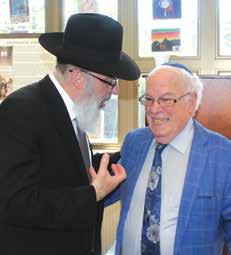
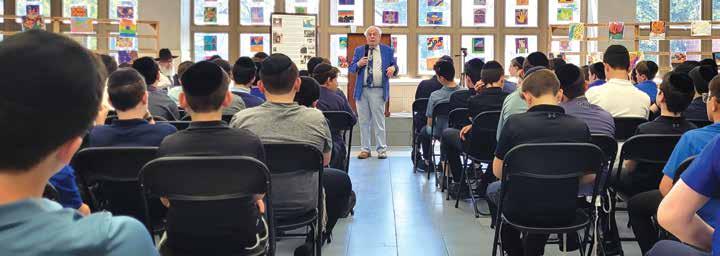


In honor of Memory Day at Yeshiva Ketana of Long Island, the yeshiva dining room was transformed into an incredible museum and exhibit. To
the backdrop of varied art, pictures, and writings, contributed and created by our own talmidim, the room transported everyone to a different time, place and


atmosphere. The boys had the zechus of meeting, interacting with and hearing from Professor Asher Matathias, a Holocaust survivor. YKLI walked away with
a renewed understanding and appreciation of those difficult times.

HAFTR High School is proud to celebrate the exceptional accomplishments of our Valedictorian, Zahava Kalen, and Salutatorian, Leah Kammerman, two students whose dedication, leadership, and character exemplify the very best of our school community.
Zahava Kalen has distinguished herself as an outstanding scholar, passionate leader, and aspiring medical professional. Throughout her time at HAFTR, Zahava has demonstrated a strong commitment to academic excellence while actively pursuing her interests in science and medicine. A participant in the Long Island Science Congress for three consecutive years, she conducted and presented independent research, deepening her understanding of the field. She further explored her passion through a pharmaceutical internship, gaining insight into medications and the broader medical landscape. Zahava serves as president of the Medicine and Public Health Club, where she has led initiatives
and educated her peers about careers in medicine. Her academic achievements include AP Scholar with Honors recognition and induction into multiple honor societies, including the National Honor Society, Chesed Honor Society, and Hebrew and Spanish Honor Societies. Zahava’s curiosity and love of learning are reflected in her favorite courses, including Biology, AP Psychology, and Untold Stories of Tanach. Beyond the classroom, she has taken on impactful leadership roles as co-founder and president of the Russian Language Club and president of the Digital Citizenship Club Fellowship, while also serving as Editor-in-Chief of the Spanish magazine. Her commitment to chesed is evident through her volunteer work at Northwell LIJ Valley Stream Hospital and the Hewlett Neighborhood Pharmacy, as well as her roles as a peer tutor, group leader at her shul, and summer lifeguard.
As Salutatorian, Leah Kammerman has made a remarkable impact through her academic excellence, intellectual cu-

riosity, and meaningful leadership. Leah has earned numerous academic honors, including induction into the Deah Chapter of the National Honor Society and the STEM Honor Society, as well as recognition as an AP Scholar with Honors. A two-time bronze medalist at the Long Island Math Fair, she presented advanced research on the Trachtenberg Speed System and the applications of Game Theory to Artificial Intelligence, showcasing both analytical rigor and innovative thinking. She has also contributed to her peers’ success as a dedicated chemistry tutor. Leah’s leadership extends across many facets of school life. She serves as Editor-in-Chief of the HAFTR Haftorah student Torah journal and as president of the school’s Yeshiva University National Model UN team, where she has fostered thoughtful dialogue and engagement. Deeply committed to chesed, Leah has taken on significant roles with Yachad, serving as both a National Board Member through the Impact Fellowship and as a school club president, while also
volunteering weekly with iShine. In recognition of her service, she was inducted into the Community Service Honor Society. Leah also balanced her academic and extracurricular commitments as a member of HAFTR’s varsity volleyball team. Zahava and Leah now look ahead to exciting futures. Zahava will attend Adelphi University Honors College, where she will pursue a degree in Biology on the pre-med track, with aspirations of attending medical school. Leah will spend a meaningful year studying in Israel at Michlelet Mevaseret Yerushalayim (MMY) before continuing her academic journey at Barnard College, where she plans to study Economics and Mathematics on a pre-engineering track, with future goals in intellectual property law or engineering.
HAFTR High School is incredibly proud of these students’ extraordinary accomplishments; we are confident that they will continue to make a meaningful impact in the world.



The fourth grade students at Bais Yaakov Ateres Miriam created an amazing Revolutionary War Fair that was both educational and entertaining. The event began with a song and dance presentation performed by the students, depicting the conflict between the Loyalists and Patriots during the Revolutionary War.
Following the performance, parents and students had the opportunity to walk around and explore beautifully prepared tri-board displays highlighting important events and influential figures from the era. The fair was a wonderful showcase of the students’ hard work, creativity, and knowledge of American history.

A special thank you goes to Ms. Honig for her hard work, dedication, and guidance in helping make the event such a success.

The simcha of Kabbalos HaTorah was eagerly anticipated and alive in BY5T – from the youngest grades baking delicious cheesecakes through our third graders who wrote the meaningful words of chazu chazu bani chavivi to create Torah centerpieces. It is our tefilla that they carry this excitement for Torah and mitzvos with them as they grow to be bnos melachim



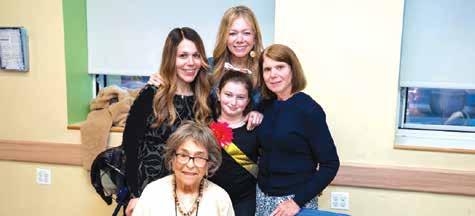
The fourth grade girls at HALB celebrated their history and connections to those who came before them at the M’Dor L’Dor dinner and

The talmidos of the Ganger Early Childhood Division of TAG enjoyed the warm outdoor weather this week
In their final debate of the year against Har Torah and HAFTR, HALB brought in some exciting wins. Yosef Shvili won first place speaker, and Yosef and Jack Spector won third place team.


Tperformance last week. It was a beautiful night as daughters, mothers, grandmothers and great-grandmothers came to celebrate together.
he children of Gan Chamesh have learned all about metamorphosis and have watched the process unfold before their eyes. They know that the process begins with eggs becoming caterpillars and caterpillars forming their cocoons or chrysalises. The children
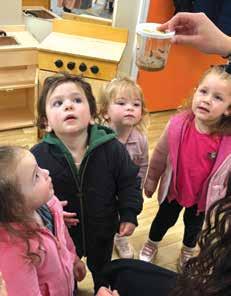
loved seeing the beautiful butterflies that emerged from the cocoons. They gently touched the butterflies and released them outside. It is experiences like these that help the children of Gan Chamesh appreciate the beauty of Hashem’s natural world.


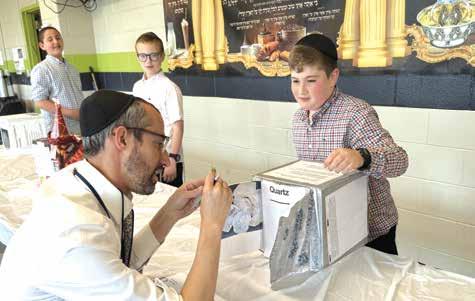
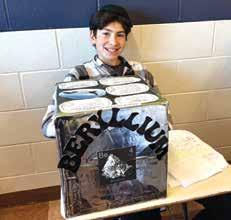
The halls of the Abraham and Sara Silber Middle School at Yeshiva of South Shore were filled with creativity, research, and scientific discovery during this year’s Annual Mineral Cube Fair. Students proudly showcased their beautifully designed mineral cubes, each highlighting the unique properties, uses, and importance of a specific mineral.
The projects featured a wide variety of minerals, including gold, titanium, cobalt, and many others. Students demonstrated not only their creativity in designing the cubes, but also their deep understanding of the minerals they researched. Several students enhanced their presentations by bringing in actual mineral samples, giving judges an up-close look at the materials they had studied.
Throughout the fair, students had the opportunity to present their findings and explain what they learned during the project. Many shared how surprised they were to discover how commonly their minerals are used in everyday products and modern technology. From electronics and medical equipment to construction and transportation, students gained a new appreciation for the important role minerals play in our daily lives.
The judges were highly impressed with the professionalism and knowledge displayed by the students. They challenged participants with thoughtful and difficult questions, which were answered confidently and with ease. The fair was a tremendous display of hard work, preparation, and enthusiasm for science learning.
A special thank you goes to Mrs. Etty Slansky, sixth grade science teacher, for
guiding the students throughout the whole project and to all of our judges for dedicating their time to the event: Rabbi Zev Davidowitz, Rabbi Avraham Robinson, Rabbi Yeshaya Samet, Rabbi Nossie Burger, Mrs. Leah Girnun, Mrs. Devorah Bahn, Mr. Eli Fogel, Mr. Stuart Vaiselberg, and Mr. Daniel Winkler.
Congratulations to all of the students who participated in this year’s Mineral Cube Fair for their outstanding effort, creativity, and passion for science.
First Place: Eliahu Alishaev, Pinchas Elgaoi, Yosef Glatt, Yoey Gornish, Benny Halpert, Shai Well
Second Place: Shmuel Kadry, Ben Krohn, Shmuel Lader, Yosef Melohn, Abe Morgulis, Naftali Safier, Natanel Teller, Gabriel Zilberman
Third Place: Noam Basch, Menachem Burger, Levi Hersh, Samson Milberg, Raph Picker, Diggy Trachtenberg
Honorable Mention: Yosef Akilov, Ilan Berg, Akiva Bollag, Alkyakim Blumberg, Yehuda Engelson, Aharon Katz, Liam Mashiach, Dovi Saunders, Izzy Traub



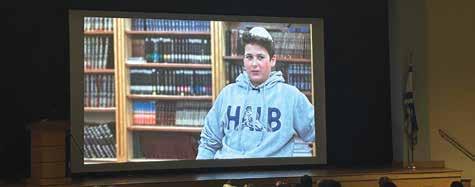

HALB’s eighth graders premiered their Names, Not Numbers documentary last week. All year long they learned interviewing, filming and editing skills. Then they put their new skills to work. While some students interviewed Holocaust survivors, their peers filmed it and together they edited the film. The evening was incredibly powerful, and the experience left a lasting impression on all the students.

Many members of our community today find themselves in what sociologists call the “Sandwich Generation.” These are the individuals who are simultaneously raising their own large families—navigating the rising costs of yeshiva tuition, weddings, and daily needs—while also taking on the sacred responsibility of caring for their aging parents. This dual role is a beautiful, albeit challenging, fulfillment of the mitzvah of kibbud av V’em, honoring one’s father and mother. This dynamic is increasingly common as life expectancy continues to rise. However, as parents live longer, the physical, emotional, and financial pressures on the “sandwich” child can become overwhelming. As parents age, they may reach a point of cognitive decline or physical frailty where they can no longer manage their own bank accounts, pay their bills, or make complex medical decisions. Without the proper legal tools in place, this transition can become a source of immense stress and confusion, threatening the very shalom bayis the family works so hard to maintain.
The most critical tool for any family in this position is the Power of Attorney (POA). This document allows an aging parent to appoint a child or another trusted individual to handle their financial and legal affairs if they ever become incapacitated. In both New York and New Jersey, the law is very specific about the powers granted in a POA. It is not a “one size fits all” form; a properly drafted POA should include specific provisions for gifting, tax planning, and the ability to apply for gov-
ernment benefits like Medicaid if longterm care becomes necessary. Without a valid, updated POA in place, the family may be forced to petition a local court for a public Guardianship or Conservatorship. This process is often expensive, time-consuming, and emotionally draining for both the parent and the children.
The “nightmare” of guardianship is something every family should strive to avoid. Because a guardianship proceeding is a public court matter, it involves court-appointed evaluators, attorneys for the alleged incapacitated person, and public hearings. For a family that values privacy and the dignity of their elders, having a judge decide who will manage a father’s pension or where a mother will live can feel like a profound violation. Furthermore, the costs of a contested guardianship can reach tens of thousands of dollars—money that should be preserved for the parent’s care or the grandchildren’s education. By securing a POA while a parent is still healthy and possesses “testamentary capacity,” the child can step in seamlessly to ensure that the parent’s bills are paid, their assets are protected from scammers, and their household continues to run smoothly.
Equally important is the Health Care Proxy (HCP). While a POA handles the “checkbook,” the HCP handles the “hospital room.” This document allows a parent to designate an agent to make medical decisions if they are unable to speak for themselves. For the Torah-observant family, this is not just a medical necessity but a religious one. It is vital to ensure

that medical decisions, especially those involving end-of-life care or complex surgeries, are made in accordance with halacha.
Consider the story of Rivka, a mother of six, who found herself in this exact position when her father, a Holocaust survivor who had always been the pillar of their family, began to show signs of dementia. Rivka was already busy with her children’s simchas and her own job, but her father’s care quickly became her top priority. Because her father had the foresight to work with an Elder Law attorney years earlier, he had signed a comprehensive Power of Attorney and a Health Care Proxy that specifically named Rivka as his agent. She did not have to wait for a court’s permission to act; she already had the “keys” to his affairs.
When the time came that her father could no longer manage his own finances, Rivka didn’t have to spend her days in a courtroom. Instead, she was able to use the legal authority her father had given her to manage his pension, pay for high-quality home-health aides, and coordinate with his doctors. She worked to ensure his medical care always followed halacha, providing him with treatment that aligned with his lifelong devotion to Torah values. The Power of Attorney wasn’t just a “legal document” to Rivka; it was a tool that allowed her to fulfill the mitzvah of kibbud av v’em with grace and efficiency.
It spared her father the “humiliation” of a public hearing where his mental state would have been picked apart by
strangers. It allowed their family to focus on what mattered most: spending quality time together, listening to his stories, and ensuring his final years were filled with peace, respect, and the comfort of his own home. Rivka’s story is a reminder that proper planning is not about taking control away from our parents, but about empowering their children to protect them. By addressing these needs early, the “Sandwich Generation” can reduce the “friction” of caregiving, allowing the family to remain a source of strength rather than a source of stress.
Ultimately, estate planning for the aging parent is an act of profound chessed It acknowledges the reality of the human condition while providing a map for the difficult days ahead. When a parent sits down with their adult children to put these documents in place, they are giving their children a gift: the gift of clarity. They are ensuring that when the time comes, their children won’t be arguing over who is in charge or what “our parents would have wanted.” Instead, the family will be unified, focused on the mitzvah at hand, and secure in the knowledge that they are honoring their parents exactly as the Torah intends.
To learn how to protect you and your family visit www.haaszaltz.com or call 516-979-1060. You can also email them at info@haaszaltz.com.

Second graders at Brandeis learned about Birchas Kohanim before Shavuos



This past Wednesday, the HAFTR community came together to celebrate an extraordinary milestone: the completion of Seder Kodashim by participants in HAFTR’s Mishnah Yomi program. Since March 2023, this daily learning initiative, spearheaded by Rabbi Asher Klein, HAFTR’s N–8 Mashgiach Ruchani, has united students, families, and faculty around a shared commitment to learning two Mishnayot each day, every single day, without interruption. Together, students have surpassed an incredible 120,000 Mishnayot learned

since this amazing program began.
Taking place just days before Shavuot, the Siyum carried an especially powerful sense of Zman Matan Torateinu. As we prepared to once again receive the Torah, the celebration served as a moving reminder that Torah is not only something we inherit, but something we actively acquire, embrace, and make our own through consistent learning and commitment.
This year alone, HAFTR’s Mishnah Yomi community collectively completed more than 20,000 Mishnayot in Seder


Kodashim, with 37 students in grades 4–8 completing the entire Seder. Over the past year and a half, these students immersed themselves in the intricate and meaningful topics surrounding the korbanot and kedusha of the Beit Hamikdash, demonstrating remarkable dedication, perseverance, and love of Torah learning.
The Grand Siyum, generously sponsored by the Wallach family in memory of Lee Wallach z”l, was a spirited and deeply meaningful celebration of Torah and community. Several esteemed community rabbanim joined the event, including Rabbi Yaakov Trump, rabbi of Young Israel of Lawrence-Cedarhurst, and Rabbi Elie Weinstock, rabbi of the Atlantic Beach Jewish Center, who offered heartfelt tefillot on behalf of Israel.
The Siyum culminated with Rabbi Ira Wallach, Rosh Yeshiva of HAFTR High School, emotionally reciting the final two Mishnayot of Seder Kodashim. In his remarks, Rabbi Wallach reflected on the legacy of his father, the importance of lifelong Torah learning, and the immense pride he felt in each student who participated in this initiative.
Following the Siyum, students heard words of bracha, encouragement, and congratulations from local rabbanim. To conclude the meaningful program, Rabbi
Klein and Dr. Gold unveiled a commemorative banner honoring the students’ incredible achievements, which is now proudly displayed in the Lower School gymnasium.
We extend our deepest gratitude to the community rabbanim who joined us for this special celebration. Your presence brought added meaning, inspiration, and strength to the occasion, and your words left a lasting impact on our students. We are grateful for your partnership in helping nurture a generation grounded in Torah, values, and community.
Lastly, we celebrate and thank our “Mishna Yomi Hawks,” whose dedication, perseverance, and passion for learning continue to uplift the entire HAFTR community. This milestone was a powerful reflection of HAFTR’s mission to cultivate a deep, joyful, and enduring connection to Torah and its timeless values.
We also extend heartfelt thanks to the Wallach family for their meaningful sponsorship, and to the entire HAFTR team, our administrators, teachers, rebbeim, morot, and especially Rabbi Asher Klein, for their vision, leadership, and unwavering commitment to our students’ spiritual and personal growth.


HAFTR MS celebrated 250 America by donning red, white, and blue, hosting a fun-America-themed trivia contest, and enjoying sweet American treats. Thank you to Mr. Daniel Stroock for making this a memorable day for our students.

This past weekend, Ezra Academy students traveled to Camp Moshava for an unforgettable retreat filled with tremendous ruach, achdus, and meaningful experiences that strengthened friendships, school spirit, and community connections.
Excitement began the moment students boarded the buses, where each participant was welcomed with a special retreat “comfy” featuring the exclusive Ezra Academy Retreat logo. The thoughtful touch immediately set the tone for a warm and uplifting Shabbaton that brought students and faculty together in a truly unique way.
Throughout the weekend, the atmosphere was filled with energy, enthusiasm, and connection. Shabbos davening and meals were elevated by the presence of the traveling Chassidim, whose singing, warmth, and spirit added a powerful dimension to the experience. From spirited zemiros to inspiring divrei Torah, a strong sense of unity and school pride


The cornerstone-laying ceremony for the new 12 Stones neighborhood, a joint project by the Saleet & Dimri companies, was held on May 19 at the site in Givat Ze’ev, in the presence of Local Council Head Mr. Yosef Asraf and other distinguished guests.
The new neighborhood, located adjacent to the spectacular Givat Ze’ev nature reserve, features 98 luxury private homes overlooking an open landscape. A portion of the homes has already been sold to a distinguished group of buyers, which will form the foundational stones
of the emerging community.
During the event, a foundation scroll was signed by representatives of the companies, contractors, planners, and guests. It was then interred in the ground as a symbol of vision, rootedness, and long-term commitment.
The developers envision 12 Stones as an exceptional, one-of-a-kind neighborhood, dedicating the utmost effort, planning, and meticulous attention to detail to create an intimate, luxurious, and deeply human living environment within a rare natural setting.
could be felt throughout the campus.
One of the most memorable moments of the retreat was a moving musical Havdalah followed by spirited dancing that carried the inspiration of Shabbos late into the evening and created lasting memories for students and faculty alike.
Students also enjoyed an action-packed lineup of activities, including an exciting scavenger hunt and a competitive 3-on-3 basketball tournament that highlighted teamwork, camaraderie, and healthy competition. Whether participating in programming, spending time with friends, or building relationships with faculty outside the classroom, students experienced a weekend designed to strengthen both community and connection.
By the end of the retreat, students returned home tired, inspired, and energized by an experience that reflected the warmth, spirit, and values of Ezra Academy — already looking forward to next year’s retreat.
Mercaz Academy in Plainview recently hosted its annual Scripps National Spelling Bee, in which 12 students from the fourth, fifth, and sixth grades showcased their spelling skills, confidence, and poise in front of classmates, teachers, and family members during ten exciting rounds of competition.
Along with thousands of schools nationwide, Mercaz participates each year in the Scripps Bee. To help students prepare, upper-grade students study a list of 450 words. This year, Karen Leeper, Assistant Principal of General Studies, expanded the study guide to include parts of speech and definitions to strengthen vocabulary development alongside spelling practice.
“The Spelling Bee makes spelling exciting for students. They’ve been looking forward to it since the beginning of the
year,” said Ms. Leeper. “In addition to learning spelling patterns, students gain valuable experience with public speaking and good sportsmanship.”
Four students from each grade earned spots in the competition after excelling in classroom spelling contests held last month. Morah Leah Levy served as announcer for the event, while Mrs. Katherine Papaccioli and Mrs. Jenny DeMeo acted as judges.
As the rounds progressed, increasingly challenging words narrowed the field. Competitors tackled words such as “vacuum,” “frustration,” “garishly,” and “deferential” with focus and composure. In the final round, fifth grader Arianna Yakubov secured the championship trophy by correctly spelling “prestigious,” drawing enthusiastic applause from the audience.

Meira Ginsburg is the 2026 Valedictorian of SKA. Meira is an outstanding and well-rounded student whose achievements reflect both academic excellence and deep commitment to her school and community. In addition to her exceptional scholastic accomplishments, Meira is captain of the math team, a member of the college bowl team, a member of the softball team, and represents SKA as a school ambassador.
Beyond the classroom, Meira is deeply dedicated to chessed. She serves as a Yachad counselor, is president of the Yachad school club, and volunteers with iShine, consistently giving her time and energy to help others.
Meira pursued a rigorous academic program, taking numerous AP courses including AP Calculus BC, AP Psychology, AP U.S. Government and Politics, AP Biology, AP World History, and AP U.S. History. She is an inductee of the National Honor Society, a member of the Principal’s Honor Roll, and has been recognized as a National Merit Scholarship Program Commended Student.
Next year, Meira will be studying at Michlelet Mevaseret Yerushalayim in Israel, after which she plans to attend the Honors Program at Stern College for
Women.
Mazel tov, Meira, on this well-deserved achievement!
Rivka Weissman, SKA Salutatorian of the Class of 2026, is a dedicated and accomplished student whose years at SKA are marked by academic excellence, leadership, and commitment to her community. She challenges herself with a rigorous academic schedule that includes numerous AP courses, such as AP World History, AP Psychology, AP Language and Composition, AP Computer Science Principles, AP Chemistry, AP Calculus BC, AP U.S. Government and Politics, and AP Physics 1. In recognition of her achievements, she earns the distinction of AP Scholar with Distinction from the College Board.
Beyond the classroom, Rivka plays an active role in the SKA community. She serves as captain of both the Mock Trial and Model UN teams and is an integral member of the Science Olympiad team, earning one gold and two silver medals. Rivka also participates on SKA’s tennis and track teams and contributes to the school publications The Looking Glass and Parsha Press. Respected by both peers and faculty, she is twice awarded the peer-voted Keter Torah Award for

outstanding character.
Outside of school, Rivka continues to give back to the community through her work as an Achiezer volunteer. Her accomplishments also include being named a National Merit Commended Student, induction into the Re’ut National Honor Society, and earning a place on the Principal’s Honor Roll each year. Next year, Rivka will attend Hunter College’s Nursing program. Mazal tov to Rivka on this outstanding accomplishment, and continued Hatzlacha in the future!
Meira Cohen is SKA’s 2026 Keter Shem Tov recipient. Meira is known for her genuine, compassionate, and kind personality. She is an outstanding student with a strong passion for art and a deep love of learning.
The Abraham and Sara Silber Mechina Division at Yeshiva of South Shore recently hosted its annual Invention Convention, where eighth grade students proudly presented a wide range of innovative projects centered around the theme of bioengineering. The event highlighted the creativity, problem-solving skills, and scientific curiosity of the students, who spent weeks developing inventions designed to improve everyday life and enhance human health and safety.
The judges were extremely impressed by the students’ ingenuity, presentation skills, and ability to combine scientific concepts with practical real-world applications.
Among the many impressive projects were practical survival packs designed for emergency preparedness, self-defogging mirrors intended to improve visibility and convenience, A wearable glove with built in LED turn signals, steering wheels capable of monitoring vital signs and
other important medical metrics while driving, and innovative electric bike kickstands engineered for greater ease and stability. Additional projects demonstrated the students’ creativity in addressing challenges related to mobility, safety, wellness, and daily living.
The convention served as an inspiring showcase of the students’ talents and reflected the Mechina Division’s commitment to fostering STEM education, innovation, and hands-on learning in a dynamic and engaging environment.
Congratulations to the winners:
First Place:
Versapants: Yisrael Dworetsky, Yakov
Yisrael Fridman, Aharon Steiner
Rideright: Rafi Fafska, Elisha Schmell, Menachem Simon
Second Place:
The Creamy Steamy (Self-Defog mirror): Tani Miller
Signalsafe Gloves: Asher Fine
Third Place: Medicar: Moshe Justic, Joshua Mashiach, Chaim Schaulewicz

Honorable Mention:
EasyOff: Effy Burg, Azariah Isaacson, Amram Rafailov, Adam Zavurov
Light Sight: Abie Lieberman, Moshe Shuman
Electric KickStand: Aryeh Burger, Simchi Greer, Azriel Lazar
Sipfinity: Yaakov Davis, Shaya Josef, Rafi Rose, Isaac Pinchasov

Meira participated in RISE, where she fostered her academic curiosity and her desire to understand the world around her through a Torah lens. She is deeply involved in chesed both inside and outside of school and was chosen by her peers for her sterling character, warmth, and genuine care for her classmates.
Meira took AP Studio Art, and her artwork was recently selected for exhibition in a local Long Island art museum. She is on the Principal’s Honor Roll and continually seeks to learn from those around her. Next year, Meira will be studying at Machon Maayan, followed by FIT. Meira, mazal tov on this well-deserved award!

The Cool Cap: Ezra Romer, Asher Romer, Yitzy Bornstein, Dovi Baron
A big thank you to Mrs. Korman and Rabbi Schulman for leading the students through this program, and a special thanks to our judges: Rabbi Greenberg, Mr. Fogel, Mr. Glatt, and Mr. Vaiselberg.

Anew and meaningful chapter in the olam ha’chinuch is unfolding with the opening of Ateres Shoshana, a girl’s high school in Queens thoughtfully designed to meet the evolving needs of today’s talmidos. Rooted in warmth, excellence, and individualized attention, Ateres Shoshana aspires to be a true makom Torah—a place where every bas Yisrael is empowered to grow, learn, and thrive.
At the helm of the school is Mrs. Meira Winter, Menaheles, whose more than two decades of experience in chinuch and administration—specifically working with high school girls with learning challenges—have shaped a deeply student-centered vision. She brings both professional expertise and genuine care to her role, ensuring that each talmidah is seen, understood, and guided toward success. Mrs. Winter is deeply committed to helping each talmidah reach her maximum potential, guiding every girl to recognize her strengths and build the confidence and skills needed to succeed both in and beyond the classroom.
Working closely with the talmidos is Dr. Naomi Saar, Dean of Students, a seasoned social worker with years of experience supporting girls with learning challenges. With a strong focus on social-emotional well-being, Dr. Saar is dedicated to fostering an environment where every talmidah feels secure, valued, and confident. At the same time, she is committed to ensuring that the school’s intentionally small and supportive setting creates a full and enriching high school experience—socially, emotionally, and developmentally, alongside strong aca-
demic growth.
What distinguishes Ateres Shoshana is its clear and compassionate recognition that no two talmidos learn alike. The school is prepared to support a broad spectrum of learning challenges, including auditory and language processing challenges, non-verbal learning disorders (NVLD), dyslexia, dysgraphia, and dyscalculia. It also supports memory-related difficulties and executive functioning challenges such as organization, planning, and time management. Each support is thoughtfully integrated into the school day, allowing every talmidah to access the curriculum in a way that works best for her.
It is also important to note that Specific Learning Disorders (SLD) are neurodevelopmental disorders, meaning they originate in the way the brain processes information, and are not the result of lack of effort, intelligence, motivation, or educational opportunity. This understanding is central to Ateres Shoshana’s approach, shaping a compassionate and strengthsbased model of support.
Learning difficulties significantly interfere with academic performance, occupational functioning later in life, and everyday activities that require reading, writing, or math skills. These challenges can impact a student’s ability to fully access and demonstrate her knowledge without appropriate support and intervention. The goal of Ateres Shoshana is to provide a structured, nurturing, and individualized high school environment in which girls are empowered to succeed academically while also developing confidence in their abilities. By addressing

learning needs directly and thoughtfully, the school seeks to help talmidos not only achieve success during their high school years, but also build the skills, self-awareness, and resilience necessary to set themselves up for long-term success in college, careers, and adult life—as well as wives, mothers, and integral members of the frum community.
The faculty at Ateres Shoshana will be a carefully selected team of highly trained special education teachers with a proven track record of success in supporting talmidos with diverse learning needs. These experienced educators will be thoughtfully integrated with newer teachers who bring fresh perspectives, up-todate training, and strong familiarity with the latest advancements in educational methods and technology. Together, this blend creates a dynamic, skilled, and forward-thinking teaching staff committed to maximizing each talmidah’s potential.
Beyond the classroom, Ateres Shoshana places strong emphasis on creating a vibrant and engaging high school experience. The school plans to incorporate a rich extracurricular program into the daily schedule, including opportunities such as choir, dance, art, and STEM, alongside a meaningful and ongoing chessed component. In addition, the school will offer Shabbatons, overnights, trips, Chagigahs, and other classic high school experiences, ensuring that talmidos enjoy a full, joyful, and socially enriching high school life just like in any well-rounded high school setting. These offerings are designed not only to enhance talmidos’ talents and creativity, but to foster a sense of joy, connection, and responsibility—ensuring a well-rounded and fulfilling high school experience.
From its very inception, Ateres
Shoshana is being built with this mission at its core: to meet each talmidah where she is and help her realize her fullest potential. Through close collaboration between administration, educators, and families, the school aims to nurture not only academic achievement, but confident, capable young women prepared to embrace their future.
The school will serve families across Queens, the Five Towns, Long Island, Brooklyn, Manhattan, and beyond, addressing a growing need for accessible, high-quality, specialized high school education within the community.
This initiative builds upon the decades-long impact of P’TACH, a trusted leader in specialized education that has served children with learning challenges in the frum community for over 40 years. Recognizing the increasing need for a dedicated high school setting for older talmidos, Ateres Shoshana represents a natural and important next step—extending this vital support into a space tailored specifically for teenage girls.
Guiding this vision are Dr. Judah Weller, Executive Director, whose leadership has been instrumental in bringing the school to fruition, together with Rabbi Sholom Skolnik, Assistant Director, who is spearheading this new initiative. The school proudly operates under the Rabbinical Board of Rabbi Doniel Lander, Rabbi Shmuel Marcus, and Rabbi Herschel Welcher, whose guidance ensures that every aspect of its development remains anchored in Torah values, educational integrity, and a deep commitment to the needs of Klal Yisrael. Together, they are helping ensure that every bas Yisrael is given the opportunity to flourish—academically, socially, emotionally, and spiritually.
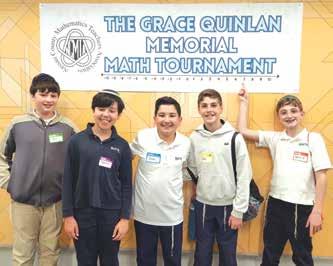
HAFTR sixth graders participated in the Adelphi University Grace Quinlan Memorial Math Tournament, performing challenging math problems and rising to the challenge.




HAFTR’s Hawks Nest was filled with excitement, energy, and inspiration as students from across the Five Towns came together for a dynamic basketball program featuring international standout and professional basketball player Ben Saraf. Welcoming participants in grades 2–8, the event combined high-level skill building with meaningful lessons in teamwork, leadership, and community responsibility.
Throughout the program, students
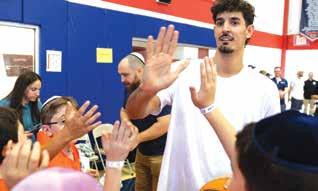
participated in hands-on clinics focused on fundamentals, effort, and sportsmanship, learning directly from a professional athlete in a high-energy and uplifting environment. Sponsored by United Hatzalah through their Leight Legacy Heroes program, a youth and teen philanthropy initiative, as well as Barbara and Alan Weichselbaum, the event also incorporated a meaningful chesed component, reinforcing the message that athletics can serve as a powerful platform for growth,

kindness, and impact.
The program was exceptionally well attended, bringing together families and students from throughout the community for an unforgettable experience. By the end of the day, participants left not only with stronger basketball skills but with a genuine sense of accomplishment, confidence, and pride. The excitement and positivity throughout the Hawks Nest reflected the very best of what youth athletic programming strives to build: charac-
At the Yeshiva University High School for Girls, Torah learning is an essential part of student life. Across all four classes, students engage with Jewish texts, traditions, and values, and participate in a wide range of programs designed to challenge and inspire. “The Judaic Studies program is the foundation of what we offer,” said Freshman Grade Dean and Judaic Studies faculty member Mrs. Karen Lavner, who will also be serving as YUHSG’s Assistant Principal during the 2026-27 school year. “We want to instill a sense of Jewish identity and meaningful connection with Hashem, as well as the skills and the desire for independent learning, in our students through discussion and rigorous textual study.”
Over the course of their high school careers, YUHSG students take courses such as Chumash, Navi, and Torah She’baal Peh, exploring classical sources and contemporary questions through discussion, analysis, and collaborative learning. Behind the scenes, faculty members work constantly to tailor this curriculum. This year, Mrs. Lavner collaborated with Director of Student Activities and Judaic Studies faculty member, Mrs. Sydney Yaros, to refine the ninth grade Navi curriculum. “We’re really proud of it,” Mrs. Lavner said. “The goals are knowledge,
skills, and big ideas, and the course is scaffolded to equip each class for the coming year. We want to connect students to the Jewish calendar in particular, and we focus on the major seforim students will be reading on holidays for the rest of their lives. And our extracurricular programming is designed to align with our curricula to provide a greater connection to the Jewish calendar.”
In addition to formal coursework, students also have opportunities to engage in Torah learning through schoolwide initiatives such as Rambam Bekiut and the Ethics Program, which bring Torah learning into the context of the everyday. “Both programs connect students to their love of Judaism and Torah,” said YUHSG’s Rosh Beit Midrash, Rabbi Zvi Lew, who leads both programs. “In Rambam, it’s through overall knowledge. And in Ethics, it’s through deep discussions of human behavior in the eyes of the Torah.” Participants engage in guided study all four years of high school. Each week, Rabbi Lew’s lectures are featured on YU Torah to an audience that includes YUHSG’s extensive alumnae network. Both cornerstones of YUHSG’s Torah offerings, Rambam and Ethics, have long fostered the values and perspectives graduates carry with them beyond the classroom. “Ethical and philosophical issues come
ter, community, sportsmanship, and joy through shared experiences.
HAFTR extends its heartfelt gratitude to United Hatzalah and the Leight Legacy Heroes program for partnering with us to create such a meaningful and inspiring program. We are also deeply thankful to Barbara and Alan Weichelsbaum for their generosity and support in helping provide this special opportunity for our students and broader community.

up in discussion all the time,” Rabbi Lew said. “Jewish law affects students on a regular basis. If you are dealing with issues of prayer, or a kosher diet, those are daily concerns.” These opportunities for real-world discussion have proven wildly successful. “Rabbi Lew gives up his free periods to teach Jewish Ethics,” Mrs. Lavner remarked. “And an impressive number of our students voluntarily join in discussions for both Ethics and Rambam. It’s a great example of the meaningful Torah study that we offer outside the classroom.”
YUHSG’s dual curriculum encourag-
es students to bring their Torah learning across disciplines, applying it to STEM and Humanities courses. It also encourages an atmosphere that values personal growth through action – that Wildcats have formed over ten Chesed clubs is a strong example – and facilitating events, like YUHSG’s F.I.R.E. (Friends Inspiring Religious Experiences) Ruach Fellows. As the school year comes to a close, these student-led efforts are a testament to the strength of the school’s Torah focus, which has resulted in a greater sense of purpose and community.

In celebration of Yom Yerushalayim, the Yeshiva of Central Queens (YCQ) hosted a thrilling and educational Color War for Junior High School students. Over the course of several days, students engaged in spirited competition, creative expression, and meaningful team-building activities.
The Color War began on Friday with a surprise breakout in the school yard. The teams were announced, with blue representing Malchut (Kingship & Leadership), and yellow representing Kehunah (Priesthood and Holiness), two fundamental concepts connected to Yerushalayem.
After a few opening games on Friday afternoon, programming continued on Monday and Tuesday, with a lineup of activities including a high-energy Apache Relay, team stomps, original skits, spirited cheers, creative banners, and original songs. The level of enthusiasm, creativity, and sportsmanship displayed by the students was remarkable.
Although the students enjoyed the three days of activities, this was more than just a fun time. From athletes to artists, techies to Torah bowlers, every single student had the chance to apply their individual talents and strengths. Everyone was given the opportunity to shine and develop their personal and collaborative skills, alongside their leadership abilities. Color War truly enabled students to develop a healthy sense of

self-worth and confidence that will help them mature into successful bnei and bnot Torah.
Many thanks to Mr. Jacob Grossman for organizing the best Color War to date. His vision and dedication, along with the support of countless teachers and staff members, made these incredible events possible.
Recognition is also due to the student leaders who played a pivotal role in guiding their teams. Blue Team: Benjamin Natanov and Leah Vaysband served as Generals, Dani Berkowitz and Anael Rachmanov as Lieutenant Generals, and Berel Baturov and Daniella Yuhananov as Captains. Yellow Team: Ilan Zelcer and Zoe Elias served as Generals, Jacob Gadol and Yael Gavriyelov as Lieutenant Generals, and Eli Kogan and Avital Davydov as Captains.
Congratulations to the Blue Team on their win!
New York State Assemblywoman Stacey Pheffer Amato celebrated the passing of part of the New York State Budget that included the enactment of “buffer zones” in sensitive locations to combat the growing issue of Antisemitism. For years, and especially recently, Jewish New Yorkers have been repeatedly bombarded and harassed by protesters outside religious schools, sanctuaries, or community centers, something Pheffer Amato called “absolutely unacceptable.” Throughout the 2026 Legislative Session, the Assemblywoman has worked on legislative language to address this serious problem. “We cannot, and will not, allow this to stand. That’s why we’re fighting back by changing the law to reflect what’s actually going on – criminal interference with access to a place of religious worship.”
In partnership with her Democratic colleagues, and Governor Kathy Hochul, a new law is set to take effect that would charge someone with criminal interference if they knowingly or intentionally obstruct or interfere with the entryway or exit of a place of religious worship, which includes: a place to regularly gather for or hold religious services, observance, prayer, assembly, education, instruction, or devotional practice, including community centers, and shall include its entrance, entryway, exit, parking lot,

parking lot entrance, driveway, driveway entrance, or sidewalk that touches such places. In addition, any and all protests at such locations must be conducted at least 50 feet away.
“While protesting is a fundamental right, there is a big difference between protesting and harassment. Scaring people isn’t acceptable and worrying families that they’ll be attacked because of their faith or what they look like is not how we operate in New York,” said Assemblywoman Pheffer Amato, the only Jewish elected official currently representing South Queens. “The New York City Council attempted to do this, but the Mayor of New York City vetoed that legislation – refusing to protect Jewish New Yorkers. Governor Hochul didn’t allow that to continue, and she stood up to protect our community. That’s leadership, and I am proud to support this legislation and make sure we continue to be protected,” said the Assemblywoman.
What sweeter words can a parent hear than “I love learning Gemara!”?
Unfortunately, such a statement has no connection to so many boys who struggle to connect to Gemara learning. When a boy doesn’t feel confident in his learning abilities, and doesn’t taste the sweetness of Torah, the consequences can be disastrous. Many boys turn to the streets when they no longer feel that school is the place for them.
This is where Lamdeini comes in. Lamdeini, based in Yerushalayim, is directed by Rabbi Meir Oratz, under the guidance and hadracha of Rabbi Yitzchak Berkovits and other leading Rabbonim
and Mechanchim.
Each boy learns with a specially trained avreich who works with the talmid to help him bond with Gemara learning through individualized techniques. BH Lamdeini has seen tremendous success among twenty-five schools across Yerushalayim, with many more hoping to join.
Lamdeini just held its annual event, on Erev Rosh Chodesh Sivan. The program was multifaceted, including an entertaining educational opening game, an Avos u’Bonim learning program, and joint tefillos led by many Gedolim, including Rav Don Segal, Rav Yitzchok Kolodetsky, Rav Dovid Yosef, Rav Yitzchak Berkovits and Rav Yosef Efrati. Of course, a joint


Don Segal, Rav Yitzchak Berkovits and Rav Yosef Efrati
Tefillas HaShla was recited by all. Every boy was then given the chance to get an individual bracha from each Gadol. The event was deeply inspiring and gave the
boys the feeling of belonging to something so much greater: the Lamdeini community, for which they are so proud to be a part of.
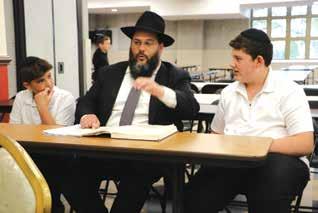

Erev Shavuos at Yeshiva Ketana of Long Island was very geshmak, as the entire elementary yeshiva joined together for an incredible and energy filled learning seder followed by hartzige singing and dancing.
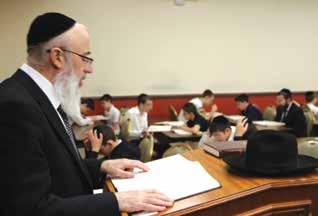
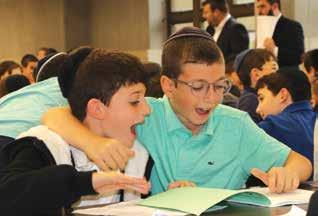

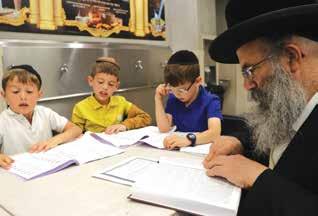
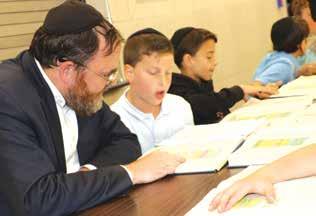

Kulanu Academy is proud to announce that it has been recognized as a Long Island Choice Award winner, an honor reflecting the trust, support, and confidence of the community in Kulanu’s commitment to educational excellence and individualized support for children with diverse learning needs.
This recognition celebrates Kulanu Academy’s dedication to creating a nurturing, inclusive environment where students are empowered to grow academically, socially, and emotionally while reaching their fullest potential.
“For our Academy to be selected by the Long Island community is incredibly
meaningful,” said Dr. Beth Raskin, Executive Director of Kulanu. “This award reflects the dedication of our teachers, therapists, staff, and families who work together every day to create opportunities for our students to thrive.”
Kulanu Academy provides specialized educational programming designed to meet the unique needs of children requiring individualized support, emphasizing academic growth, life skills, communication, and social development within a caring and collaborative environment.
Dina Rosenberg, Chief Program Officer at Kulanu, added, “This recognition reinforces what we witness every day,
children achieving milestones, building confidence, and reaching goals once thought out of reach. At Kulanu Academy, we believe every student deserves individualized support, compassionate educators, and an environment where they can succeed. We are excited to welcome new families into our community and continue expanding opportunities for children with diverse learning needs.”
As Kulanu Academy celebrates this recognition, spots are still available for the 2026-2027 school year, welcoming families seeking an innovative and supportive educational experience for their children.
“We invite prospective families to
learn more about what makes Kulanu Academy special,” said Raskin. “Our mission has always been to help every child discover their strengths, build confidence, and achieve success in school and beyond.”
Families interested in exploring Kulanu Academy are encouraged to schedule a tour, meet with staff, and learn about the programs and services available.
To learn more about Kulanu Academy or inquire about enrollment opportunities, visit www.kulanukids.org or contact the admissions office at 516-569-3083.

By Libby Lazewnik
Atalmid was once driving the Rosh Yeshivah somewhere. As they drove, he pointed to an empty shoebox. Proudly, he explained that as he left the shoe store, he noticed a poor man sitting there with tattered shoes. Although he’d been planning to save his new shoes for Yom Tov, he put them on right away and gave his old shoes to the pauper.
Reb Dovid listened politely, but the talmid saw that he looked puzzled. Suddenly, he realized why. The Rosh Yeshivah didn’t understand why he hadn’t done the mitzvah the best way — by giving the pauper his new shoes!
From then on, each year before Pesach, Reb Dovid made sure that the pauper received a new pair of shoes.
Once, when volunteers came to the Feinstein apartment collecting clothing for poor families in Eretz Yisrael, the Rebbetzin showed Reb Dovid that, since she’d recently bought him some new shirts, she was donating his older shirts
— freshly dry-cleaned — to the poor.
Reb Dovid remarked that the older shirts were still in good shape. “Better give away the new shirts,” he said.
Reb Dovid was always eager to donate money to a good cause. And not only money. Though he tried to make good use of every minute of his day, he was also ready to give away precious time to people who came to him for a berachah, a psak halachah, or for advice.
Whether he committed five minutes, an hour, or an entire day, once he made the decision, his time was theirs, and he gave it with complete calm and ease.
Reb Dovid’s father, Rav Moshe Feinstein, had set up a fund called Tzarchei Amcha, which means The Needs of Your People. After his passing, Reb Dovid continued to manage this fund. He helped many people, without anyone but him knowing who they were.
If a family on the Lower East Side couldn’t afford to send a child to camp, they called Reb Dovid.
If someone needed money for an operation, he called Reb Dovid.

If a yeshivah didn’t have enough to pay its staff, they called Reb Dovid.
And people from all over came to him when they needed money to help make a wedding.
Although there were many wealthy people who would have been happy to write out a check for the whole amount, Reb Dovid was careful not to rely on any one person.
When a young kollel man came to him in need of $2,000, instead of making one phone call, Reb Dovid made twenty. He called twenty people he knew, none of them wealthy, and asked that each one send $100 to the Tzarchei Amcha fund.
Sometimes he found out about those in need through his role as a posek. For example, a woman once came to him with certain halachic questions related to giving birth. In the course of their conversation, she mentioned that she was very worried about having another baby since it would mean not being able to work for a few months and also having an extra mouth to feed.
After she left, Reb Dovid arranged for a gemach (a free-loan society) to send a nice amount of money to the woman’s house each month. She never knew who arranged it, or who was paying the loan back to the gemach. Each month, the Rosh Yeshivah quietly made the payments.
As careful as he was to help those in need, he was equally careful not to spend money unnecessarily. Reb Dovid was once asked to speak in a certain shul, and he accepted the invitation.
“There will be a taxi waiting to drive you here,” the organizers told him.
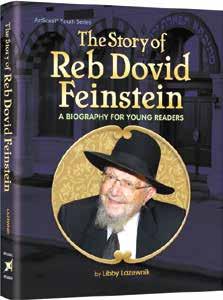
“Thank you, but I’ll take the train,” the Rosh Yeshivah answered.
The organizers argued that it would be beneath the Rosh Yeshivah’s dignity to take the train.
“Let me explain,” Reb Dovid said. “I collect money for yeshivos all year, so I can’t waste money or do something that is a luxury. If you’d like to send a driver to bring me to the event, that would be fine. But I cannot allow money to be spent on a taxi when the train goes to the very same place!”
Reprinted from The Story of Reb Dovid Feinstein by Libby Lazewnik, with permission from the copyright holder, ArtScroll Mesorah Publications.


By The Greenberg family
Adear father, neighbor, teacher, and friend, Reb Daniel ben Rav Moshe Yehuda Greenberg, z”l, passed away last year on 18 Sivan.
Tatty was born in Williamsburg and grew up in Flatbush. He was a son of Harav Moshe Yehuda Greenberg, zt”l, the longtime rav of Young Israel of Midwood. He was from the original talmidim of Rabbi Lipa Margolis in the beginning years of Yeshiva Torah Vodaas of Flatbush, and then moved on to Mesivta and Bais Medrash Torah Vodaas, learning under Reb Elya Chazzan, zt”l. The Greenberg family has been a pillar of the Flatbush community (and beyond) for many decades, raising a family of Torah and chesed that so many have benefited from.
Tatty was described in a hesped as an “eved ne’eman,” reaching a special sheleimus in his bein adam l’chaveiro and bein adam l’Makom. He was a determined person, actively pursuing a mission with a goal. He took every opportunity that came to him, turning it into a loving form of his avodas Hashem. Tatty always quoted his Rebbi, Reb Gedalyah Schorr, zt”l, that a person is a “holeich” – you are either going up or down and there is no such thing as remaining on a steady level. He personified this idea through his everyday life. Everything he did was for a reason and a purpose to grow in his avodas Hashem. He always said that “there is nothing in this world that can’t be used to grow in your avodas Hashem. If you think hard enough, you can use any tool in this world to shteig.”
At the levaya, Harav Yitzchok Steinwurtzel, shlita, focused on how Tatty’s ahavas Yisroel was tangible, always looking to help others. He did so much for so many people, but always with a special tzinius of “v’hatznei leches im Hashem Elokecha.” The Rav said over the pasuk of “u’matzdikei harabim, kakochavim le’olam va’ed.” He explained that a true matzdikei
harabim shines like the kochavim, the stars, because they come across as an unassuming dim light but really contain the brightest glow if you can get a closer look. Tatty epitomized this middah. He helped out in the shul, coming late at night to set up the Bais Medrash for the Daf Yomi shiur the next morning, so that the learning would begin with ease right after Shacharis. On Shabbos, he would always keep an eye out for those who would seem misplaced, giving them a seat and engaging them in conversation in a friendly, warm way. Never would a Shaliach Tzibbur’s efforts go unnoticed, offering a warm “shkoyach” amongst other praise.
Tatty always put a big focus on being there for the younger generation, infusing them with a love for Torah and tefillah. Every week in the winter, he would arrange the special snacks that were given out at the Motzei Shabbos learning program, so that the young children would be happy to come learn. Everyone knows that when they saw Tatty in shul, he would always be ready with a lollypop for the kinderlach who were there. He always said that we have to work to make a shul a place that children enjoy being there, so that they will continue to love to come when they get older. He always tried to involve and teach the younger bar mitzvah boys the nusach of Chazaras HaShatz for Shabbos and yom tov “because the children are our future.”
He would always convey his dream, how he wished to retire and return to the Koslei Bais Medrash. A few years ago, after Tatty found an opportunity to become semi-retired, his dream came true. He joined the Agrah D’Pirkah of Flatbush, headed by HaRav Aharon Kahn, shlita. He attended a full first Seder till Mincha, drinking up all of the divrei Torah from the shiurim that he enjoyed so much. In a hesped, Rav Kahn spoke about his kesher that he had with Tatty, connecting deeply in the
walls of the Beis Medrash. The Rav relayed that Tatty’s hasmadah had a young, fresh energy, and he came over after the shiur excited with his Ha’aros. The chizuk that he gave to the chaburah was resounding. Tatty rarely went away on vacations, but when he would, he would only go to places where he was able to stick with his regular Seder HaYom. He enjoyed going to Eretz Yisroel many times, but the highlight was when it was with the Agudah’s Yarchei Kallah. He said, “There is no such thing as a vacation from Yiddishleit,” and Toras Eretz Yisroel was a real treat. Even in the summers, he would only go to the programs that had his minyanim and shiurim in place.
Mesorah was a very crucial part of Tatty’s life. He appreciated the tremendous zechus of being able to frequent the home of HaRav Moshe Feinstein, zt”l, and lived by so much of what he witnessed. He always shared the following story. One time, he asked Reb Moshe about a certain case that was in the headlines. There was a Beis Din that publicized a decision about a certain shailah, and it was obvious to Tatty that Reb Moshe was not in agreement. Tatty asked Reb Moshe why won’t he come out publicly, that the psak of this Beis Din does not seem to be correct? Reb Moshe responded, “In life, one must look at the larger picture. If I were to come out against this Beis Din, then people may disregard the validity of other Batei Dinim as well. The gain would be outweighed by its loss.”
Tatty embodied this outlook. So many times, he would tell us to stop and think if what we are doing is a “chumrah habah lidei kulah.” Would this positive action cause harm to others? He always said over a mashal about a man who was walking through a crowded street. The man noticed a midget walking towards him. He quickly ran and picked up the midget in front of everyone and began to scream, “Come everybody, let us fulfill the halacha of making the bracha of Meshane HaBriyos!”
We must take into account the larger picture, the feelings of others, as well as the consequences of our actions.
Tatty was a nephew of HaRav Dovid Feinstein, zt”l, with whom he held a special close bond. The chinuch in the home was that of the “old school,” giving over the great mehalech hachaim that he grew up with. Our mother is the daughter of Reb Shmuel Chaim Soroka, zt”l, an Alte Mirrer who brought over the fervent mesorah, adding to the strong foundation that our home
is built on. The summers that Tatty spent in Seagate, allowing him access to many of the Gedolim that would frequent the area for vacation, was something very dear to him. Any time he was at a simcha, and there was a rav or rosh yeshiva who was present, he made an effort to go over, especially to bring his children over. He would always push us to make a shaychus with gedolim and to not let shame get in the way. Many times, when he spoke at family gatherings, it was on the topic that each one of us children have to adorn and appreciate that we are a treasured link in the chain of Klal Yisroel.
The love that Tatty had for his family was boundless. He would run around to visit his children in yeshiva, at all times of the day. He would make the trip at any time to our out-of-town yeshivas just to partake in hearing his children’s chaburos. He would always say, “My children are my most precious investments; I need to check up on them.” Even when he would be in the middle of a workday, he tried to make time to arrange an outing with the children, because he cherished being with his family. Chol Hamoed trips were a big highlight for him and never a strain, appreciating the moments to spend the happy times together. He would take time to learn with his children and grandchildren as much as possible. Attending the weekly learning programs to learn with the children was a tremendous pleasure. He always looked forward to the special times throughout the week that the young grandchildren would call him for their weekly chavrusah shaft. Tatty’s role in life was that of many. He was a father, grandfather, a leader, a teacher, and a good friend. To sum it up in one word, we referred to him as “Tatty.” The weekly calls and visits from Tatty’s beloved children and grandchildren was his highlight of the week. Mommy (she should be gezunt) was by Tatty’s side every step of the way, in health and in sickness. She cared for him and encouraged him in all his endeavors. Together they built generations of shomrei Torah, talmidei chachomim, and bnei Torah that they are extremely proud of. As a zechus for his neshama, may we all continue to reflect his ways in our growth of avodas Hashem. We are certain that Tatty will be a meilitz yosher for his family and Klal Yisroel, continuing his devotion on behalf of his family and all of Klal Yisroel. May we be reunited in the coming future, with Moshiach b’mheira b’yameinu, amen.


1. What is the Knicks NBA Finals record?
a. 1-4
b. 2-6
c. 2-2
d. 4-2
2. Which team defeated the New York Knicks in the 1994 NBA Finals?
a. Bulls
b. Spurs
c. Rockets
d. Celtics

3. What seed were the Knicks when they reached the NBA Finals in 1999?
a. 2nd
b. 4th
c. 7th
d. 8th
4. Which team defeated the Knicks in the 1999 NBA Finals?
a. Lakers
b. Spurs
c. Pacers
d. Jazz
5. In Game 6 of the 1994 NBA Finals, John Starks had a nightmare shooting performance from three-point range. How
many three-pointers did John Starks miss?
a. 0
b. 7
c. 9
d. 11
6. Who was the head coach of the Knicks during their 1999 NBA Finals run?
a. Pat Riley
b. Jeff Van Gundy
c. Don Nelson
d. Larry Brown

7. In Game 7 of the 1970 NBA Finals, Walt “Clyde” Frazier scored 36 points and had 19 assists. But who was the captain that famously limped onto the court to help the Knicks win?
a. Walt Frazier
b. Dave DeBusschere
c. Willis Reed
d. Bill Bradley
8. How many blocked shots did Knicks center Patrick Ewing have in the 1994 NBA Finals?
a. 12
b. 17
c. 22
d. 30
9. The Knicks won their most recent NBA championship in what year?
A. 1969
B. 1970
C. 1973
D. 1977 3-D 4-B 5-D 6-B 7-C 8-D 9-C
7-9 correct: Bing-bong!
4-6 correct: You wouldn’t be the only 3 seed to go far in life…Go, New York! Go, New York, go!
0-3 correct: So, how does it feel to be the only Brooklyn Nets fan in New York? Must be sad. They say that there’s a tree somewhere in Brooklyn; maybe hugging it will give you some comfort.


You call Madison Square Garden “The Garden” like you are boys. “Me and Friedman are going to the Garden to see if we can score cheap tickets.”
You just realized that the Nets are not a nickname for the Knicks and still don’t realize that they are not the Knicks D-League Team. Low blow, sorry Nets fans…all two of you.
You don’t even know Amar’e Stoudemire. “I know the guy who was his chavrusa when he was becoming a ger!”
You think suffering as a Knicks fan means “that rough week in February.” Some of us lived through real struggle…Charles Smith for the putback! Tries again! Tries again! Tries again…Bulls win! If you don’t know what I’m talking about, this Finals run may be fun for you, but its meaning is not as deep. Oh, the pain!
When I am analyzin,’ stylin’ and profilin’, rhymin’ and chimin’ about the Knicks, you wonder if it’s just about my rhymin’ that I have pride, not realizing; that I am imitatin’ Clive.
You keep telling people: “This team feels different.” Real Knicks fans have said that 47 times already. We will keep our mouths shut until we actually win the Finals!
The name Reggie Miller does not give you nightmares. Since the 1995 Eastern Conference Semifinals, I’ve been trying to calculate how many points per second 8 points in 9 seconds is! If you don’t know what I’m talking about…uh, never mind, it’s a math Regents thing!
You think that the Knicks long-time iconic center’s name was Patrick Eee-wing. Youuuuuu-wing…..
Youuuuuu-wing
Yankel is sitting at Game 1 of the NBA Finals, and the seat next to him is empty.
Another fan says, “Wow, it’s unbelievable that someone would miss Game 1 of the Finals. Whose seat is that?”
The man says, “My wife’s. We bought the seats together.”
The fan says, “Oh no… I’m so sorry. What happened?”
The man says, “Oh, nothing… We passed Bloomingdales on the way to the game, and she decided to go there instead.”



By Rabbi Berel Wein z”l
The term that the Torah uses for counting the Levite family of Gershon is naso – to raise and lift up. The word can also mean to carry and bear a burden. It can also mean to lead. When such words appear in the Torah with multiple, differing meanings – and Hebrew is replete with so many of them – the commentators remark that all of the possible meanings of that word are nuanced and meant to be part of the verse of the Torah itself.
I think this insight is especially pertinent regarding the word naso as it appears in this week’s parsha. The family of Gershon, as is the tribe of Levi generally, is quite small in number but nevertheless laden with great responsibilities. It can use its paucity in numbers as an excuse for shirking its responsibilities and for refusing to perform the holy tasks assigned to it. But
their duties and role but rather are to proudly lift themselves up to a higher level of Torah dedication and service to all of Israel. All of this is implicit in the word naso that introduces this week’s parsha to our attention.
Rambam, in a famous statement from his Mishne Torah, states, in effect, that all human beings who enter this world can reach the spiritual status of being a Levite. One must devote oneself to the service of G-d and of man, practice compassion and goodness, and be satisfied and not too overly ambitious with one’s physical lot in life, in order to aspire to such a status. The Levites were the bearers of the Torah both literally and figuratively. Rambam indicates that they avoided the petty foolishness in daily life and instead concentrated on the holy and noble task to which G-d assigned them.

In the difficult times and circumstances that surround us today, we are also in need of potential Levites who will rise to the occasion and its challenges. One cannot alter one’s genealogy but one’s spiritual aspirations to become a Levite have no limits or restraints. Shabbat shalom.
They
avoided the petty foolishness in daily life and instead concentrated on the holy and noble task to which G-d assigned them.
since it is meant to assume a leadership role in Jewish society, it is bidden to rise to the occasion.
There is no question that this role of leadership will be burdensome and frustrating. Yet it is enjoined at the beginning of its public service to bear up under the yoke of the Jewish people and to serve as the leaders, role models and mentors of the generations of the Jewish people. The Levites are not to shirk
The tasks and goals of the Levites were clearly delineated for them by the Torah. And even in our time when the service of the Temple is not yet present within Jewish society, the uniqueness of the role of the Levites in our midst has been preserved. At the time of the Golden Calf, when all of Israel was threatened with physical destruction and spiritual annihilation, it was the tribe of Levi that redressed the situation.


By Rav Moshe Weinberger
Adapted for publication by Binyomin Wolf

One of the 613 mitzvos of the Torah is the kohanim’s mitzvah to bless the Jewish people (Bamidbar 6:23): “Thus shall you bless the children of Israel…” The Sefer Hamitzvos lists this mitzvah, birchas kohanim, as the 23rd of the positive mitzvos. Generally, there are three categories of blessings in Judaism. The first are the blessings Hashem gives the Jewish people like “I will make you into a great nation” (Bereishis 12:2). Second are the blessings we give Hashem like “And you will eat and be satisfied and you shall bless Hashem your G-d…” (Devarim 8:10). The third category of blessings are those that Jews give each another like the blessings Yaakov gave his sons before he died and those Moshe gave the Jewish people at the end of the Torah. This is the category under which birchas kohanim falls. But how is it possible for one Jew to bless another? Can a person of flesh and blood be a source of blessing? How does this work?
It must be that when one person blesses another, it is more akin to a prayer to the Hashem, the Source of Blessing. We
see this clearly reflected in the language of Yitzchak’s blessing to Yaakov: “May G-d give you from the dew of Heaven and the fats of the earth…” (Bereishis 27:28). When the kohanim say birchas kohanim , they do not view themselves as the source of the blessing. Rather, they recognize that they are intermediates through whom Hashem’s blessings descends down onto the nation. This is reflected in the fact that the pasuk says about birchas kohanim (Bamidbar 6:27): “And they [the kohanim] shall place my Name on the children of Israel and I will bless them.” Hashem wants the kohanim to transmit His blessings with “love,” as it says in the blessing before birchas kohanim. By doing so, they awaken the quality of love below and thereby open up the gates of love and generosity Above.
Let us examine one word from the first line of birchas kohanim : “May Hashem bless you and safeguard you.”
We understand that when the kohanim ask Hashem to bless us, they mean that we should have everything good, both spiritually and physically. But what
does it mean that they ask Hashem to safeguard us? Rashi explains based on the Midrash: “‘And safeguard you’ that no robbers come and take your money. One who gives a gift to his servant cannot guard him from every other person. So when robbers come to him and take it away from him, what benefit does the [servant] have in this gift? But Hashem is the giver and the guardian.”
We see that according to Rashi, “and safeguard you” is the completion and fruition of the blessing of “May Hashem bless you.” If we lose Hashem’s blessings after receiving them, what good are they?
This is the kohanim’s prayer and blessing that Hashem should guard everything He gives us so that we should not lose His blessings.
Today, at least in civilized countries, it is unusual for some outside force to steal our money and property. Our blessings are endangered more by internal threats. This possibility is what Shlomo Hamelech was referring to when he referred to “wealth guarded for its owner to his detriment” (Koheles 5:12). How can this
happen? If a person lacks the vessels to guard and maintain his blessings, he will not only lose them, but he will be worse off than he was before.
The Sefardim have a beautiful custom. When someone receives a blessing from a talmid chacham, tzaddik, or a father or sandak at a bris, he holds his hands together like a cup while he receives the blessing. This custom is rooted in the idea that the recipient wants to make himself into a strong vessel so that he can contain and preserve the blessing he is receiving.
In penimius haTorah , we speak of “light” and “vessels.” Hashem’s blessing is the light and the safeguarding is the vessel. Without the vessel, all of the light in the world will simply slip through our fingers and will come to nothing – or worse.
We see this in the world in many ways. Many lottery winners who were not previously well-adjusted people wind up much worse off after winning the lottery than they were before. If someone was not accustomed to such blessings, he does not have the tools to receive those blessings in a healthy way. We are also familiar with
people who suddenly became wealthy sports stars. Many of these individuals have virtually nothing a short time after they retire. Because they do not have the tools to manage their sudden wealth, unscrupulous people take advantage of them or they squander their money and have nothing left in the end.
There are other character defects which are indicative of broken-vessel type people. Those who are stingy, arrogant, self-aggrandizing, or negative will see no joy in the blessings they receive. Returning to a sports analogy, imagine players on the basketball court who, after scoring a difficult basket, exult and bump chests to the point that one of the players on the other team makes a lay-up right behind them and they do not even notice. Similarly, a person who is full of himself or who consistently focuses on the negative in others and in his own life will never be happy no matter how much good he experiences.
The more a person internalizes the attributes of generosity, love, joy, and gratitude, the more he makes himself into a vessel capable of safeguarding all of the blessings Hashem showers upon him. And if such a person only has a little, or if he is beset by problems, challenges, and
failures, he will still be happier than one who is a broken vessel. A healthy, positive person will grow from his failures and difficulties because he is a strong vessel. He safeguards every drop of light that Hashem gives him. And not only will such a person not be broken by his difficulties;
he gets a certain promotion or clinches a contract with an important customer, whether he has a certain car or house, or manages to acquire the latest gadget or electronic device. The quality of a person’s “May Hashem bless you” is completely dependent on the level of his “and
The more a person internalizes the attributes of generosity, love, joy, and gratitude, the more he makes himself into a vessel capable of safeguarding all of the blessings Hashem showers upon him.
he will gain more empathy for others and become even more generous and sensitive to his less fortunate brothers and sisters among our people.
This is the secret of “Who is rich? One who is happy with his portion” (Avos 4:1). One’s happiness in life has nothing to do with his external circumstances. It is not dependent on what job he has, whether
safeguard you.” Without the latter, the former is meaningless.
Chazal in Avos are teaching us: Do you want to be rich? You must know that it is in your hands. It is not dependent on any external factor. It does not matter whether you win the lottery or have a high income. The only determinative factor is whether you develop a heart full
of love, compassion, gratitude, generosity, and positivity. You must become a whole vessel to contain the blessings you have.
The Rachmistrivka Rebbe, zt”l, was once walking with his chassidim out of the shul during a thunderstorm when a gust of wind blew by. All of the chassidim’s hats remained on their heads, but unfortunately the one person to lose his hat was the Rebbe. The Chassidim made a mad dash to catch the Rebbe’s hat as it rolled down the middle of the street. The Rebbe smiled the whole time his hat was traveling away. Finally, the chassidim caught the hat and brought it back to the Rebbe. The Rebbe smiled and thanked the person who brought it back to him and commented, “It’s not such a bad thing if I lose my hat. It would be much worse if I lost my head.”
Let us merit never to lose our heads. Instead, may Hashem help us attain all of the qualities that will make us whole vessels to contain all His blessings in both spirituality and physicality.
Rav Moshe Weinberger, shlita, is the founding Morah d’Asrah of Congreagation Aish Kodesh in Woodmere, NY, and serves as leader of the new mechina Emek HaMelech.


By Rabbi Shmuel Reichman
There is a story of a man who wanted to be successful. After asking around, he heard about a guru in a far-off town who held the secret to success. He immediately set off to find him, and after weeks of searching, he finally tracked him down and knocked on his door. The guru opened the door, and before the guru could even greet him, he blurted out: “All I want is to be successful. What is the secret to success?” The guru slowly looked him up and down, before saying in a soft voice: “Meet me at the beach tomorrow at 5:00 a.m., and I will tell you the secret to success.”
The man showed up at the beach bright and early the next morning, wearing his best suit. He should have worn his bathing suit, because as soon as the guru saw him, he smiled and said, “Walk into the water.” The man was confused, but after all the trouble he’d gone through to find this guru, he wasn’t about to walk away. He waded into the water until it came up to his knees, with the guru following behind him. “OK,” he said, “I’m in the water. Now can you please tell me how to be successful?” The guru stared back — no expression on his face — and simply said, “Keep walking.” Becoming more and more confused, the man took a few more steps into the ocean. He and the guru were now shoulder deep in the water. He turned back to the guru and said again, “I followed your instructions. Now can you please tell me how to be successful?” Without skipping a beat, the guru repeated: “Keep walking.”
He took a few more steps; he was now nose deep. He was about to turn around once more and ask the guru what was going on, when his head was suddenly forced underneath the water. He realized that the guru had taken hold of his neck and was holding him under the water. The man struggled and fought, but he couldn’t break loose; he couldn’t breathe! He continued fighting but realized that he would

soon lose consciousness. Just as his vision began to fade, the guru yanked him up from under the water. The guru held the man’s face parallel to his own and asked, “When you were underwater, what did you want most?”
The man replied, “All I wanted was to breathe!”
The guru stared deep into his eyes and said, “When you want to succeed as much as you want to breathe, then you will be successful.”
The Power of Ratzon
Desire, the most powerful human faculty, lies at the very root of the human being. The Ramchal, Rav Chaim of Volozhin, and other Jewish thinkers explain that what you want is who you are. And yet, we seem to have conflicting wants. On the one hand, we each have a deep yearning to transcend our limitations, to expand beyond our current state, to connect to something infinite, spiritual, beyond this world. Yet, at the same time, human beings have a deep craving for the most mundane, physical, and transient pleasures. Which of these is
our true desire, our true ratzon?
• Perhaps, at root, we are purely spiritual, and our pull toward earthly things is simply a corruption of our true nature.
• Or maybe we are simply physical beings, and our pull toward physicality is a reflection of our limited nature.
But perhaps we are more than either of these drives. Maybe our deepest root, our deepest desire, is connected to both the spiritual and the physical.
This leads us to an important question: What is the meaning and purpose of our desire for physicality, and how does it relate to our drive for spirituality?
“Im Lavan Garti ”
When Yaakov reunites with Eisav after living with Lavan, he proclaims, “Im Lavan garti — with Lavan I have lived” (Bereishis 32:5). Rashi explains this statement to mean that Yaakov maintained all of his learning and mitzvah observance while living in Lavan’s household. Lavan was a crooked, manipulative cheat and living in his household was a stark departure from the honesty and righteousness of Yitzchak’s household, thus posing a
potential challenge to Yaakov’s spiritual vitality. Therefore, it was a tremendous accomplishment for Yaakov to maintain his spiritual growth while living in Lavan’s house for twenty years. How did he accomplish such a feat?
If we trace our way back to Yaakov’s journey from his parents’ home, we’ll recall that he spent fourteen years learning in the yeshiva of Shem and Ever between leaving his parents’ home and arriving at Lavan’s domain (see Rashi, Bereishis 28:11 and Bereishis Rabbah 68:11). Why was this time necessary? Yaakov had spent his entire life surrounded by the Torah and values of Yitzchak and Avraham. Shouldn’t this have been enough to prepare him for the trials and tribulations that he would face in the house of Lavan? What did Shem and Ever offer that Yaakov had not already received from Avraham and Yitzchak?
Avraham’s Gift to the World
In order to understand this, let us take a step back and understand Avraham’s worldview and his unique approach to spirituality. If someone were to ask you, “What is Avraham famous for?” your immediate response would likely be “monotheism.” Many assume that Avraham taught the world of Hashem’s existence. However, this cannot be the case. Adam clearly knew that Hashem existed, as did Noach, who lived just a couple of generations before Avraham. Even if you want to say that people forgot this in the time between Noach and Avraham, we know this is not true: Shem and Ever were both alive before Avraham and were teaching Torah. If Avraham was not the first to teach of Hashem’s existence, what did he introduce to the world?
Some suggest that while Shem and Ever learned Torah, they did so in isolation, removed from society. Thus, Avraham was the first to openly teach Hashem’s existence to the world. In a sense,
Avraham was the first “baal kiruv,” the first to bring Torah to the masses. While this may be true and is indicative of Avraham’s nature, there is another layer to this profound topic. In order to understand Avraham’s unique worldview, we have to take a step back and study different spiritual perspectives.
Most spiritual schools of thought are focused wholly on the spiritual; they view the physical world as lowly and dangerous. They therefore claim that the physical should be avoided to the greatest extent possible. In order to live a spiritual life, one must escape the physical, completely rejecting their physical nature. Therefore, spiritual systems such as Buddhism prescribe meditation, abstinence, and the suppression of physical desire. In such a system, the ideal is to sit isolated on a mountaintop and meditate.
Historically, this was the spiritual system of Shem and Ever. They understood the dangers of the physical world; they witnessed the evil and destruction of both the Dor Ha’mabul and Dor Haflagah and concluded that in order to maintain their spirituality, they had to remove themselves from the physical, lowly world. Avraham, however, introduced a novel, idealistic approach to life. He understood that while the physical can be dangerous if misused, the ideal is not to transcend the physical but to use the physical to reflect something higher. In other words, he introduced the ideal Jewish spiritual system.
Think how many mitzvos are commandments of the mind? Incredibly few! You can count them on your hands: Believe in Hashem, love Hashem, be in awe of Hashem, don’t be jealous, and just a few others. The overwhelming majority of mitzvos are physical actions that connect you to the spiritual Source — Hashem. The act is physical, while the spiritual intention and mindset must be infused into it. We eat matzoh, shake a lulav, blow shofar, and wear tefillin – all actions, all physical. We don’t believe in transcending the physical; we wish to use the physical to connect to the transcendent.
This is because the physical world is deeply connected to the spiritual world. Every physical action affects the spiritual realm, creating cosmic ripple effects. This can be compared to when one plays a piano. When a piano key is pressed, a hammer inside the piano strikes the string below, generating the musical sound. The key itself does not create the musical note; it causes a chain reaction, and the
sound comes from a different, albeit connected, location.
The same is true of the physical world. Every action creates a corresponding reaction in the spiritual world. In essence, our physical world is like an upside-down puppet show. When a puppeteer pulls the strings from above, he causes the puppets to act down below. When we perform physical actions in the physical world, we create cosmic effects in the spiritual realm above.
This is what Avraham introduced to the world. Avraham’s mitzvah was bris milah (circumcision), the mitzvah that epitomizes the idea of taking the most physical and potentially animalistic organ and uplifting it to the spiritual. As the Maharal explains, bris milah is performed specifically on the eighth day as it represents the process of transcending the natural (Tiferes Yisrael, chaps. 1–2, 25). Seven is the number of the natural; this is why all physical and natural components of this world are built off sevens: seven days in the week, seven notes in the musical scale, and seven colors in the spectrum of light. Eight represents going beyond the natural, which is why bris milah is performed on the eighth day; we take the physical and use it to transcend.
We can now understand what Yaakov gained from learning with Shem and Ever. While Avraham represented spirituality that is deeply connected to the physical world, Shem and Ever represented a spirituality that transcends this world, a spirituality that Yaakov needed to connect to before continuing on his journey. Yaakov was about to enter a spiritually hostile environment — Lavan’s domain — an environment that contradicted everything Yaakov knew and stood for. While Yaakov represented and embodied the principle of truth (Titein emes l’Yaakov [Michah 7:20]), Lavan was a man of deceit, one whose speech did not reveal any higher inner truth. Just as Lavan’s words were disconnected from higher truth, Lavan served to disconnect the physical from the spiritual. In order to protect himself and his spiritual growth during this phase (and successfully build the foundation for Klal Yisrael and the twelve Shevatim), Yaakov needed to learn from those who had succeeded in such hostile conditions. Shem and Ever experienced the evils of both the Dor Ha’mabul and the Dor Haflagah, and they had built a system of learning that protected themselves from such challenges — a Torah that was disconnected from the challenges of the
physical world. While Yaakov had already embraced Avraham’s Torah and ideology, he also needed some time with Shem and Ever in order to succeed in the next stage of his journey. Each provided something essential to Yaakov’s development.
At root, we have a dual desire:
• To experience a completely spiritual, transcendent existence
• To experience a physical, limited existence
But when we synthesize these two desires, when we use the physical to fully reflect our spiritual purpose, we live an extraordinary life of true oneness. This, however, is not an easy path. Living a holistic, synthesized life requires idealism and constant willpower. It is much easier to transcend the physical world — to escape its temptations and dangers. If we are to engage and uplift the physical, we must be mindful, purposeful, and vigilant.
Going back to our introductory “guru” story, Yaakov was only able to succeed in his mission because he desired it with every fiber of his being. Rashi quotes the Midrash saying that not once during his entire fourteen years of learning in the Yeshiva of Shem and Ever did Yaakov go to bed. Every night, he would fall asleep at his seat, immersed in Torah and spiritual growth (Bereishis 28:11; Bereishis Rabbah 68:11). Yaakov wanted this, he lived this, he became this. He was able to build the ultimate synthesis, fully transcending the physical world, like Shem and Ever, and yet connecting the transcendent to the physical, like Avraham. He lived a life of complete harmony (tiferes). Both Avraham and the house of Shem and Ever were specialists in their form of spirituality; Yaakov was the ultimate harmony.
One of the most daunting but worthwhile exercises you can perform is the “want exercise.” It requires you to ask yourself: “What do I want in life?” Be completely honest with yourself. After answering, ask yourself, “Why do I want that?” Again, you must be completely honest. Then ask yourself again, “Why do I want that ?” Keep doing this until you get to something that you want for no external reason, something that you want simply because you want it. This desire, this want, is your underlying desire; it is what’s driving everything else in your life. This is your very root; this is who you truly are.
According to Jewish thought, the underlying want (ratzon) within each of us is to fulfill our unique purpose in life, to actualize our potential, to live the life we are meant to live. Essentially, our deepest ratzon is to fulfill the ratzon of Hashem. Hashem designed us in such a way that this type of life — one of Torah, growth, and contribution — generates immense happiness, as well as feelings of fulfillment and deep contentment. So many mistakenly interpret their underlying life drive to be happiness, and then they try to fulfill that desire through all types of other outlets, like money, fame, or physical pleasure. But the root yearning within each of us is a genuine expression of our higher and best self, our tzelem Elokim. Our goal in life is to get fully in touch with this root want, to harness it, and then fully express it into the world. Happiness is not our root want, it’s what manifests when we are in touch with our root want — becoming our best and highest selves.
So, close your eyes and ask yourself honestly: “What do I really want in life? Who do I want to be? What kind of life do I want to live?” Now, open your eyes, and go make that your reality
Rabbi Shmuel Reichman is an international speaker, bestselling author, business coach, the CEO of SMA, and a TED Talk Speaker. His online content reaches millions of people every month, and he lectures internationally on topics of Torah thought, psychology, leadership, and business – uniquely blending many areas of Torah and wisdom together. His bestselling book, The Journey to Your Ultimate Self, serves as an inspiring gateway into deeper Torah thought. After receiving his BA from Yeshiva University and Semicha from Yeshiva University’s RIETS, Rabbi Reichman received a Masters degree in Philosophy and Religion from the University of Chicago. As part of his Masters Degree at the University of Chicago, Rabbi Reichman received an Ivy Plus Scholarship to Harvard where he spent a year studying Religious Philosophy and Literature as an Ivy Scholar. Additionally, he received a Masters degree in Educational Psychology from Azrieli Graduate School and a Masters degree in Jewish Thought from Yeshiva University’s Bernard Revel Graduate School. As a business and leadership coach, Rabbi Reichman provides a unique 1-on-1 coaching program where he helps high-achievers, coaches, and business owners achieve their financial and personal goals. To learn more or to get in contact with Rabbi Reichman, visit his website: ShmuelReichman.com
By Rabbi Avrohom Sebrow

It is 5:45 PM on a sticky July Shabbos afternoon in the Catskills. Inside the wood-paneled walls of the main shul, a single window AC unit is fighting a valiant, entirely losing battle against the ninety-degree heat.
For the past forty-five minutes, fathers and sons have been engaged in the sacred tradition of the Shabbos afternoon learning program. Or rather, the fathers have been desperately trying to shake off their heavy, cholent-induced Shabbos shluf, while their sons vibrate at a frequency high enough to shatter glass.
But learning time is over now. The Gemaras are closing. The tension in the room is palpable. It is time for the main event.
It is time for The Raffle.
A Treasure Trove of Upstate Dreams
To the untrained eye, the folding table
at the front of the shul holds a random assortment of clearance toys. But to an eightyear-old boy in a bungalow colony, this is the ultimate showcase showdown.
The loot this week includes:
• The Shabbos Menace: A Nerf gun with exactly six foam darts. By Shalosh Seudos, three darts will be stuck on the shul roof, two lost in the tall weeds, and one shot directly into a sibling’s ear.
• The Static Broadcasters: A pair of battery-devouring walkie-talkies with a range of exactly twelve feet. They cannot actually connect to each other, but they will occasionally pick up the local Hatzalah radio frequency. (Since it is muktzeh, a picture of the prize suffices for today.)
• The Roof Magnets: A standard football and a neon frisbee. Both are destined to be thrown onto the roof of a bungalow before Sunday morning, never to be retrieved.
• The Decoy Prize: Yet another travel game of chess. It is the fourth one circulating the colony this summer, and half the pawns are strewn on the fields.
But is this raffle actually permissible on Shabbos?
The Shulchan Aruch (Orach Chaim 322:6) lays down the basic ground rules: casting lots on Shabbos is generally forbidden. It bears too much resemblance to weekday commerce, dividing partnerships, or gambling, and it may lead to forbidden writing or measuring.
There is one notable exception: you are allowed to cast lots within your own household, among your own children, to decide who gets which portion of food. The logic is simple; family members are not going to drag each other to a Din Torah over an extra scoop of cholent. Because no
one is strictly particular about the exact monetary value of the outcome, it doesn’t cross the line into prohibited commerce.
But what about the shul raffle? The Magen Avraham (O.C. 322:9) issues a fascinating ruling. He states that while you cannot cast lots to divide physical items, you are allowed to cast lots on Shabbos to determine who gets to perform a mitzvah such as who will get an aliyah or who will lead the davening as a chiyuv
Where does the Magen Avraham find the precedent for this? He looks straight to the Beis Hamikdash.
He points out that they used to cast lots in the Beis Hamikdash on Yom Kippur to determine which Kohen would slaughter the korbanos and who would throw the blood. Since Yom Kippur carries all the stringent halachos of Shabbos, we see
clearly that running a lottery for a mitzvah is perfectly permissible.
Here is where anyone learning our daf in Maseches Yoma will immediately raise an eyebrow, just as the Shvus Yaakov (Vol. 1, Siman 40) does.
Our sugya makes it abundantly clear: The Kohen Gadol performed all of the avodah on Yom Kippur! He was a oneman show.
The Shvus Yaakov points out this glaring contradiction: If the Kohen Gadol did everything himself on Yom Kippur, there was absolutely no need for a lottery to divvy up the tasks among the other Kohanim!
The Kesef Mishneh steps in to clarify. While it is absolutely true that the Kohen Gadol had exclusivity, this only applied to the specific Yom Kippur day services. However, the regular daily services, which were really tied to the previous day’s avodah , like Terumas Hadeshen (removing the ashes) or cleaning the inner altar still needed to get done.
According to the Kesef Mishneh, who cites the liturgy instituted by the Geonim, there actually was a payis (lottery) on
Yom Kippur for these standard, everyday avodos. The regular Kohanim still had a chance to participate in these services, and they used a lottery to decide who won the privilege.
Therefore, the Magen Avraham’s proof remains airtight. A lottery was indeed held on Yom Kippur, proving that drawing lots for a mitzvah does not violate the sanctity of Shabbos.
The Modern Shabbos Raffle: Piskei Halacha
Despite this, the Magen Avraham’s heter was limited to the right to perform services (like saying kaddish or getting maftir). It wasn’t intended for physical objects. Furthermore, some suggest that the Magen Avraham’s permit does not allow for the use of physical tickets. (While this limitation is often based on the Shvus Yaakov, a careful reading indicates he may not have actually made such a strict limitation.)
So, where does that leave our bungalow colony?
• Rav Yitzchak Berkowitz was asked: “It seems not uncommon to have raffles for kids during Shabbos learning programs. From the Shulchan Aruch, it looks problematic. Is there a valid heter
for this practice?” His straightforward response: “I am not aware of a heter.” Those who follow this ruling should make the raffle on Sunday. It is an interesting question whether tickets may be distributed on Shabbos. Since the raffle cannot be held on Shabbos, the tickets may be muktzeh.
• Rabbi Rosenberg (grandson of Rav Shmuel Wosner) of Kollel Zichron Chaim in Bobov takes a more lenient approach. He says that for a mitzvah whose time is that day, a raffle is permitted. Still, he points out that giving the prize to a child on Shabbos, even without a raffle, can be problematic regarding the laws of acquisition (kinyan). He advises stipulating that the child should not formally acquire the prize until after Shabbos.
The “DAF” Solution
Another possible avenue for a heter might be based on a different kind of DAF. Not the Gemara, but Donor Advised Funds.
In the secular financial world, donations made to a Donor Advised Fund are tax-deductible because, legally, the donor surrenders control over how the funds are spent. The donor can advise the fund on where the money should go, and while the fund doesn’t legally have to accept the recommendation, in prac -
tice, they virtually always do.
The Shabbos raffle can be held using the exact same logic. The boys have no true monetary claim to the prizes. Although they learned beautifully, they cannot legally demand a prize. The organizers of the learning program are simply handing out prizes randomly to make learning exciting, and they decided that a raffle is a fair way to choose the recipients.
Because the organizers made the rules, they retain the power to break them. To utilize this heter, the organizers can make the following announcement (verbally or via a sign):
“This raffle is strictly advisory only, and the organizers are the ultimate arbiters of who actually gets the prize.”
What this actually means for the kids: If your number gets picked, we are 99.9% going to give you the Nerf gun provided you haven’t fought with your siblings in the last ten minutes.
Rabbi Avrohom Sebrow is a rebbe at Yeshiva Ateres Shimon in Far Rockaway. In addition, Rabbi Sebrow leads a daf yomi chaburah at Eitz Chayim of Dogwood Park in West Hempstead, NY. He can be contacted at ASebrow@gmail.com.

by Rabbi Yair Hoffman
Did anyone notice this? There is a pasuk in Sefer Yeshayahu (35:1) that for nearly twenty-seven centuries seemed to defy literal fulfillment: “Yesusum midbar v’tziyah, v’sageil aravah v’tifrach kachavatzeles, the wilderness and the parched land shall be glad, and the desert shall rejoice and blossom like the rose.” The navi continues two pesukim later: “Ki nivk’u vamidbar mayim u’nechalim ba’aravah, for waters shall break forth in the wilderness, and streams in the desert.”
To the generations who read these words in galus, they were nechemta , consolation poetry, understood as metaphor. The aravah is, by definition, the place where water is not. The midbar is, by definition, the land that does not blossom. To promise that the desert would rejoice was understood as a promise that history itself would be overturned in yemos haMoshiach.
And yet, in our own days, beneath the Negev — that very aravah named explicitly by Yeshayahu — the literal pshat of the navi has begun to unfold.
The Mayim Nistarim Beneath the Aravah
In 1973, a frum geologist named Eliezer Issar drilled 2,300 feet into the sandstone beneath the Negev and struck water that erupted to the surface under its own pressure – no need to pump. He had tapped the Nubian Aquifer — an underground reservoir holding an estimated 150,000 cubic kilometers of ancient waters.
There is a concept in the Gemara (Megillah 13a) that Hakadosh Baruch Hu prepares the refuah before the makah. This also applies to the means of geulah long before geulah itself becomes visible.
Water that fell thousands of years ago, sealed beneath the very land that

Yeshayahu would later name, waited in darkness for the precise generation that would need it. “Nivk’u vamidbar mayim” — the verb nivk’u , “burst forth,” is striking. The water bursts upward of its own pressure, exactly as the lashon of the pasuk describes.
The Two “Defects” That Were Brachos in Disguise
The water that burst forth had two characteristics that, initially, made it appear useless. It was hot — 99 to 104 degrees Fahrenheit, heated by geothermal forces in the depths of the earth. And it was brackish — salty enough to destroy wheat and conventional produce.
The hot, salty water of the Negev could not grow wheat. But Hashem had created, in tropical river deltas across the world, fish – kosher ones barramundi, tilapia, European seabass — whose entire biology was designed for warm, and yes, slightly saline water. These fish, dwelling in the river mouths of Australia and the Mediterranean, were waiting for the day they would be brought to the ar -
avah and find that the “defective” water was, for them, gan eden
Hashem prepared the fish for the water, and the water for the fish, thousands of years before either was needed. And so they began farming fish in these pools that they had constructed from Eliezer Issar’s flow of water.
But, alas, yet another problem. In the Negev, the fish produce ammonia as waste — a substance that, in concentration, poisons the very water they swim in. Conventional farming treats this as pollution to be filtered or discarded. Something that would cost enormous sums of money.
But let’s not forget that Gemara about the yeshuah before the Makkah and the bracha in Shemoneh Esrei, “Attah chonain l’adam da’as.” Because a solution was readily at hand.
Ammonia is also nitrogen — the single nutrient that plants require most desperately, the nutrient for which the world burns two percent of its total energy supply manufacturing synthetically through the Haber-Bosch process.
And what poisons the fish feeds the tree.
Israeli engineers devised a solution where the water could flow from the fish tanks directly to the roots of olive trees and date palms, the precise two species named throughout Tanach as the signs of yishuv Eretz Yisrael. “Eretz zayis shemen u’dvash” (Devarim 8:8). The trees absorb the nitrogen, the soil filters the salt, and the water returns to the earth cleaner than when it emerged. And the salt itself — the very mineral that was supposed to destroy the agriculture — turns out to be the bracha hidden within. Olive trees and date palms grow in the saline soils of Eretz Yisrael and tolerate salinity up to 5,000 parts per million. The Negev water sits at 3,000. Mild salt stress causes these trees to concentrate sugars and oils. The dates become sweeter. The olive oil becomes richer. “U’devash mi’tzur” — “and honey from the rock” (Devarim 32:13) — the sweetness drawn out specifically by the hardness of the conditions.
The holy prophet Yeshayahu (35:7) continues: “V’haya hasharav la’agam v’tzimaon l’mavu’ei mayim, and the parched ground shall become a pool, and the thirsty land springs of water.” The navi names the precise transformation: the place defined by thirst becomes the source of water.
One million tropical fish now swim beneath the Negev. The pioneering work was launched in 1992 at Kibbutz Mash’abei Sadeh, which built a three-hectare reservoir and a series of covered rearing ponds. It became the only kibbutz in Israel to breed Australian barramundi alongside Nile tilapia and, later, yet another fish. The recycled brackish geothermal water from the fish ponds at Mash’abei Sadeh is used in its final stage to irrigate jojoba, olives, and melons — the closed loop that Yeshayahu describes in living agricultural form.
A second pillar of the industry is Re’em Farm in the western Negev, which uses the effluent from its fish rearing ponds to irrigate 120 hectares of olive trees, supplying the groves with water year-round — ten cubic meters per hour per day in winter and as much as one hundred in the summer. The integration is so seamless that the olive grove and the fish farm function as a single unit.
The largest barramundi operation in the world today is Aquatech Fisheries, operating its Negev Ecological Farm on a 35-dunam site in southern Israel. Aquatech uses local geothermal water, which enters its system at 37 degrees Celsius — the exact temperature optimal for barramundi — and produces 2,000 tons of barramundi annually using a land-based Recirculating Aquaculture System (RAS).
The water that exits the technological cycle is reused for irrigation of nearby olive groves, and the entire facility is powered by a photovoltaic solar array. Aquatech’s Israeli Barramundi brand is exported to France, Germany, and the United Kingdom — to the very European nations that, for two thousand years, watched the Land lie desolate as
proof that the Jewish people had been abandoned. Now those nations purchase fish raised in water that erupted from beneath the desert.
Other significant players in the Israeli desert aquaculture industry include AquaMaof Aquaculture Technologies, whose RAS systems were developed
was the brother of Rav Zelig Reuvain Bengis, zt”l, the Volozhin talmid who became the rav of the Eida Chareidis), the Jacob Blaustein Institute for Desert Research of Ben-Gurion University of the Negev in Be’er Sheva, founded and led for decades by Professor Samuel Appelbaum, whose research established
The closed loop is, in modern terms, a literal multiplication of bracha from input to output.
in the Negev and are now exported to fish farms worldwide; Pure Blue Fish, which operates a zero-water-discharge RAS technology; and Phoenix Farm in the Negev, an indoor bio-secure facility breeding ornamental tropical fish for the global aquarium trade. Underpinning all of this is the academic engine of the industry: the Bengis Center for Desert Aquaculture (yes, their patriarch

the scientific foundations on which the entire field now stands.
Together, these farms and institutions produce over 3,000 tons of fish annually from the Negev.
The Ramban on Vayikra (26:32) makes a remarkable statement. He says that one of the proofs that Eretz Yisrael belongs to Klal Yisrael, and that the promises of Tanach are true, is that the
Land refuses to flourish for any nation other than its own. For nearly two millennia under Roman, Byzantine, Arab, Crusader, Mameluke, and Ottoman rule, the Negev remained barren. The navi promised it would blossom — but only when its people returned.
The Negev fish farms are not carbon neutral — they are carbon negative. They remove more carbon dioxide from the atmosphere than they produce. The geothermal heat that costs nothing replaces gas heating that would otherwise emit two hundred tons of carbon. The date palms and olive trees sequester additional carbon. The closed loop is, in modern terms, a literal multiplication of bracha from input to output.
The pasuk does not say if. It says ki , because. Because the waters have broken forth, because the streams have come. “The wilderness and the parched land shall be glad, and the desert shall rejoice and blossom like the rose.”
This article should be viewed as a halachic discussion and not practical advice. The author can be reached at yairhoffman2@gmail.com.


By Barbara Deutsch
Nomi, our grandson Jakob’s wife and a loving granddaughter to us, graduated from NYU Law School this past week. For anyone, this would be a huge educational accomplishment. For Nomi, it is an out-of-the-box achievement.
As a child in second grade, Nomi was diagnosed with dyslexia. In the olden days, when I was trained as a Reading Specialist (sidebar: hated it, hated it), for my first post graduate degree, dyslexia was a scary specific term used for people who were unable to read left to right or at all. A dyslexia diagnosis meant you would forever struggle in school – and so it was.
Miraculously, the thinking changed dramatically when dedicated researchers and educators determined that given the proper and appropriate teaching environment, even the most challenged readers could learn to read with fluency. Windward, a forward-thinking language-based curriculum school in White Plains, teaches dyslexic and language -challenged students in a format that meets the needs of struggling readers. The school changes their lives for the better forever.
Today, dyslexia is the term used for general reading disorders. It is no longer a word that is synonymous with fear.
Nomi was blessed with parents, Penina and Tommy, who understood the needs of their child and transferred Nomi to Windward for third to eighth grade. Nomi went from a school where she felt small and “stupid” to a place where she was able to learn and grow from being a reading challenged child to one who was able to overcome her learning obstacles.
Nomi was motivated and determined to succeed; with the amazing support of the Windward staff, she was able to develop the confidence and skills that she would need to meet the rigorous demands of SAR High School, Barnard College and NYU Law School.
Nomi has a good law firm job lined up for the fall!
This was all accomplished while living
her life, meeting and marrying Jakob, a supportive husband who always believed in her ability to achieve, and becoming a mother to adorable and brilliant Sari. The skills she mastered at Windward helped her meet the challenges that come with being pregnant, birthing a newborn all the while keeping up with daily classes and work preparation successfully.
Sitting in the massive Madison Square Garden theater and watching proudly as Nomi donned her hood, I couldn’t help but reflect on the path to the future for each one of the students in the room. Many of the names were Asian, Hispanic, African, and Russian, coupled with a variety of other ethnicities. I am confident that each name comes with a backstory of hard work and grit that enabled them to reach this milestone.
I am sure that Nomi’s story is not unique. I do know that it took enormous drive to overcome the pitfalls presented by her learning challenges; she had to double down, work extra hard and keep at it in order to walk across the MSG stage. A picture of a beaming Nomi dressed in her cap and gown, holding Sari in her arms, Jakob standing at her side, says it all.
I’m making my first visit to Toronto since losing Bob. In the past, whenever opportunity presented itself, we would be off to see our kids in Montreal and, when they moved, Toronto.
Our son-in-law Jonathan was born in Rhode Island; when his professor dad, Rabbi Dr. B. Barry Levy, got a position at Montreal’s McGill University, the family settled there. His brilliant, beautiful mom, Cooki Levy, served as the unreplaceable Head of School at the prestigious Akiva School. For Jonathan and his two brothers, it was a frozen tundra, hockey-filled growing-up life that was good!
When Meredith married Jonathan, she was accepted to the excellent and almost free McGill Medical School. They began their married life in Montreal. Jonthan began his career as an assistant

principal at the Hebrew Academy, and three of their four boys were born there. Everyone learned how to speak French; it was always freezing.
When the Levys lived in Montreal, Bob and I would visit every Sukkos plus go for random weekends and vacations. We kept our promise to Meredith that we would spend at least one of the major chagim with her family.
When opportunity knocked 17 years ago, the Levys moved to Toronto. Opportunity has knocked again, and they are moving to Maryland next year.
We spent our money and any available, free from school, time traveling from Toronto, Levys, Miami, Senior Deutsches, and Israel, Shapiros, until life’s picadilloes forced changes. It was good. More significantly, it kept us connected to our parents, children, grandchildren and great-grandchildren.
We were saving “seeing the world” for retirement.
Now traveling solo, I am tapping into a new, and sometimes scary, skill set for me. With Bob, I never made a reservation, booked a ticket, picked a seat, filled out a declaration form or dislodged a luggage wagon. I shared the travel plans, and he made them happen.
With a lot of help from my kids and Shmuli Deutsch (no relation –I did once spell out my name for him, as I do for everyone, and he edited me with an, “I know”), my fabulous travel agent, I am figuring out how to do it myself. Frankly, this is a skill set I never imagined I would need until I did.
Additionally, navigating airports has
become a daunting endeavor. Flying to Toronto, a 54-minute trip, if you are lucky and have no additional weather, mechanical or serendipitous delays, takes more than 6 hours door to door. I was picked up at 6:45 am for a 9:30am departure. International flights, even one as close as Toronto, need a 3-hour lead time. I prefer to be early and not rushed.
I had one bag, stuff for the kids from Israel and Trader Joe’s that you can’t get in Canada, that I checked curbside. The Delta terminal at JFK is a small city; I had to take a shuttle to my gate. When I finally found the shuttle exit, got to my destination, onto the bus and located the promised coffee shop, they had run out of coffee.
I like a hot cup of coffee in the morning – black decaf Americano. I navigated the building – yes, a whole building – to the one coffee place where a rude barista, informed me that there was only regular drip to be had. Up and on the go since 5:30 am, I bought it even though it makes my heart feel “racey.”
It has not been fun or easy. I take an example from my granddaughter Nomi and her ability to overcome. I’m doing my best to learn skills that I now need for a journey I did not want to take. Saying it again, I’m blessed with family and friends, in America, Canada and Israel, who are always willing and ready to help and support.
Barbara Deutsch is the former associate principal at HANC, middle school principal at Kushner, and Dean of Students at Yeshiva of Flatbush. A not-retired educator, she is still trying to figure out life in Israel.



charged debate erupted on Monday in the Knesset Constitution Committee as lawmakers and public figures sparred over the proposed “Kotel Law,” legislation aimed at formally placing authority over conduct and tefillah arrangements at the Kosel under the control of Israel’s Chief Rabbinate.
For decades, activist groups tied to the Reform and progressive Jewish movements positioned themselves as the exclusive representatives of world Jewry in Israeli public affairs, particularly regarding the Kosel. Their messaging consistently framed their agenda as the unified voice of Jews abroad, especially in the United States.
On Monday, that narrative faced serious opposition.
During discussions in the Knesset Constitution Committee surrounding legislation that would formally place
the Kosel under the authority of the Chief Rabbinate and reinforce its status as a sacred religious site, familiar advocacy organizations arrived prepared to object. They warned lawmakers that strengthening the site’s halachic character would alienate Jews around the world and weaken ties with the Diaspora.
What unfolded then was something the committee had rarely witnessed before, with organized Orthodox representation from America directly challenging those claims.
Backed by the electoral success of Eretz HaKodesh, delegates entered the hearing not as observers, but as official representatives carrying the mandate of thousands of voters. Their message to lawmakers was straightforward: Many Jews in the Diaspora strongly support maintaining the traditional sanctity and
religious standards of the Kosel and reject the repeated assertion that progressive organizations speak on behalf of all American Jews.
Rabbi Nechemya Malinowitz, speaking during the session as part of the Eretz HaKodesh leadership, emphasized that Orthodox communities abroad expect the Kosel to preserve its kedusha and religious integrity.
Joining him was Esther Jacobs, an Eretz Hakodesh delegate and activist, who addressed the committee on behalf of women who feel deeply connected to the traditional character of the site and believe its holiness must be protected.
“As an American woman who was raised on the values of freedom, equality and opportunity, I say clearly and without hesitation: Torah and halacha do not degrade women, and they do not diminish women,” said Mrs. Jacobs.
“We are simply asking to preserve the kedusha of the holiest place of the Jewish people, as it has been maintained for generations,” she said, later adding, “The greatest irony is to claim that in the name of Diaspora Jewry, one must undermine and change the character of its mesorah and sanctity.”
In his remarks, Rabbi Malinowitz said that the voices of Orthodox and traditional Jews outside Israel are routinely ignored whenever the issue of the Kosel arises.
“The Eretz HaKodesh party is now in its second term in the WZO, and I am mentioning this in regard to what MK Kariv referred to as ‘the majority of the Jewish people’ and the ‘majority of Zionist organizations.’ We represent a very large public group of Orthodox and traditional Jews in the Diaspora— a public that yearns for the Eretz
Yisroel, contributes to it, visits here, invests here, send its children to study here in Israel, to volunteer here and sometimes even to settle here.
“I came here today to make their voice heard, the voice of Diaspora Jewry that is not always heard.”
Rabbi Malinowitz pushed back against repeated claims made during the Kosel debate that liberal Jewish movements represent the overwhelming majority of Jews outside Israel.
“Over and over again, we hear statements on behalf of ‘the majority of the Jewish people,’ as if there is one voice for Diaspora Jewry, but the reality is completely different.
“In the United States alone, there are thousands of Orthodox Jewish educational institutions with hundreds of thousands of students. There are thousands of shuls and communities that revolve around Torah tradition and a deep connection to Yerushalayim and the Land of Israel.
“There are tens of thousands of young people who study in yeshivos and seminaries in Israel every year. We help them get here, and we see the passion and the strong deep-rooted connection.”
Rabbi Malinowitz then referenced past warnings from liberal Israeli politicians that failure to advance expanded mixed-prayer arrangements at the Kosel could damage Israel’s relationship with Diaspora Jewry.
“As early as 2023, the opposition leader, MK Yari Lapid, said that if the Kosel plan is not advanced as the liberal party demands, it could break the alliance with Diaspora Jewry.
“And this is exactly the claim that we heard over and over again over the years in different variations, and here on this committee as well.”
Speaking emotionally, Rabbi Malinowitz declared that millions of Diaspora Jews support preserving the traditional kedusha and halachic status quo of the Kosel.
“So I came here today because I am a democratic representative elected through a democratic process by tens of thousands of Jews in the Diaspora to say clearly that there are millions of Jews in the Diaspora who want to preserve the sanctity of the Kosel Hamaaravi, the tradition of Israel, and the status quo in this holy place in accordance with halacha and longstanding tradition. This Judaism also has a voice, and it is also part of Diaspora Judaism.
“Therefore, we need to stop speaking on behalf of Diaspora Judaism as if
it belongs only to one side of the ideological map. No one has a monopoly on Diaspora Judaism, and no one has the right to speak on behalf of millions of believing and traditional Jews who do not agree with changing the character of the Kosel Hamaaravi. And the truth is simple: The covenant that connects us to Diaspora Judaism is the eternal covenant of the people of Israel with the people of Israel, with the Torah of Israel, with the Land of Israel, and with Hashem. Our job is to preserve it.”
Rabbi Malinowitz tied the Kosel debate to broader tensions involving liberal Jewish advocacy organizations in the United States, specifically referencing recent controversies surrounding calls to halt American weapons shipments to Israel during the war.
“And I want to make one more point: There is a big uproar online around the initiative of the J Street organization and other liberal organizations that have appealed to the U.S. Senate to stop the sale and shipment of weapons to Israel. The Israel ambassador to the United States, Dr. Yechiel Leiter, called them a ‘cancer,’ because they are harming Israel during the war. And because of what the ambassador said, the liberal organizations have signed a petition that he must retract and apologize. And they say that they are allowed to harm Israel because this is a ‘machlokes lesheim Shomayim ’ (a dispute for Heaven’s sake)! Who signed this petition and demands that the ambassador retract it? These are the same liberal people and organizations who come here to Yerushalayim and demand that the tradition and halacha be changed in the Kosel Plaza in the name of Diaspora Jewry.
“In the same breath, they also support organizations that are trying to stop arms shipments to Israel. They call it a machlokes lesheim Shomayim. So I want to ask: Can these people tell us what to do in the name of Diaspora Jewry? Or is it the opposite? We just celebrated Chag HaShavuos. Tens of thousands of Jews from the Diaspora boarded planes to capacity to get to Yerushalayim, to the Kosel Hamaaravi, despite the fact that there exists every day a chance that the war will resume and the heavens will close. These are the people on whose behalf I speak, Jews whose connection to the people of Israel is a connection of faith, of tradition, and of a deep belonging to the people of Israel, the Land of Israel, and Toras Yisroel. And my job is to maintain that connection, not to sever it.”



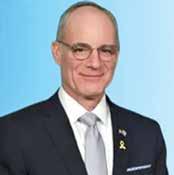
By Eliyahu RosEnBERg
heodor Herzl pondered the issue of antisemitism for years, but before becoming the father of modern Zionism — the visionary behind the State of Israel’s establishment — Herzl was convinced that the solution to the Jewish nation’s problems was to, well, stop being Jewish. The reason the world hates us, he thought, is because we’re different. And so, the only cure for antisemitism is assimilation — to eliminate that which distinguishes Jew from gentile.
But then, one day, Herzl awoke to the sound of screaming men. He ran out to his balcony, gazed into the distance, and saw hordes of Frenchmen streaming through Paris, screaming, “Death to the Jews!” — walking through the very same streets where the French had marched just a century earlier for universal liberty and equality. This antisemitic protest happened amid France’s infamous late 19th-century Dreyfus Affair, when government officials persecuted and hurled
This is what Zionism came to say: We have the right to come and present our case like anybody else. We don’t ask for more, but don’t treat us any less.
you can’t escape your identity.
Rav Kook, the first Chief Rabbi of israel, talks in one of his letters about how special souls come down at a certain period of time, and particularly in the context of returning to the land of israel. i think this generation has been graced with those special souls.
Today, this virus called Jew hatred has mutated into something now called anti-Zionism.
unfounded, antisemitic accusations of treason at Alfred Dreyfus, a Jewish French soldier.
So, Herzl stared at his French brethren — the people he had long hoped to assimilate into — in shock. The sight left him scratching his head, grappling with a mix of disgust and astonishment. If Dreyfus were a chassid, Herzl reasoned, then the antisemitism would make sense. After all, it’s understandable why the French wouldn’t view a man with a bekeshe and peyos as one of their own. But why Dreyfus? Why would they take issue with a completely assimilated Jew? You would never even know that Dreyfus is Jewish.
And that’s what made Herzl realize that you can’t escape your identity; that, no matter what Jews do, they’ll never appease antisemites. Because, the world isn’t anti-Judaism. Antisemites don’t hate us because we’re religious or because they have qualms with our faith. They don’t hate us because of our political beliefs. They hate us for one simple, inescapable fact: because we’re Jewish. After all, antisemites don’t care if we’re frum or secular, right-wing or left-wing, identifiably Jewish or not, rich or poor, accomplished or not, intelligent or not. All of these things are excuses. At the end of the day, they hate us not for what we do, but for who we are.
“Historically, every time there’s been a surge in antisemitism, there are those Jews and those haters who say that the Jews are to blame,” Dr. Yechiel Leiter, Israel’s ambassador to the U.S., shares. “If Jews would only give up on this or give up on that — mostly dilute their identity
— everything would be fine. This is what happened in the 19th century when Jews were permitted out of the ghettos and shtetls, and, all of a sudden, there was a shift from anti-Judaism to antisemitism — it became racial. Because Jews felt that they could really dilute themselves to the point where they’d actually be accepted by their surroundings. But then this racial hatred developed, which says, ‘You can’t hide from your race.’”
So, when Herzl realized that our Jewish identity is inescapable, he switched gears. Instead of assimilating into a gentile environment, he realized, we need to find our own place in the world. In other words, we need a state. Because if we could govern ourselves — if our nation could be as powerful and independent as any other — then we need not worry about antisemitism, Herzl believed.
And he was, to a certain extent, correct. But there was one thing he miscalculated. Israel’s establishment gave us protection, yes, but it didn’t eliminate the threat of antisemitism.
“Today, this virus called Jew hatred has mutated into something now called anti-Zionism,” Amb. Leiter declares. “So, the biggest haters of Israel say, ‘We have nothing against Jews; we only have something against Zionism.’”
The accusation that the Jews are colonialists and conquerors? The elation that erupted on campuses as Jews were being slaughtered on October 7? The celebration of terror groups and regimes whose sole mission is to eliminate the Jewish people? The modern-day blood libel that Jews starve and murder innocent chil-
dren? The notion that the Jewish people don’t deserve a home of their own? The claim that the Jewish state controls the world? You could call it anti-Zionism. You could call it antisemitism. You could call it whatever you’d like. But its name doesn’t change the fact that it’s a hideous mutation of the same hatred we’ve endured for millennia.
rest is history.” He never imagined that, some 48 years later, after a long career in politics and policy, he’d become Israel’s ambassador to the United States.
Dr. Yechiel Leiter spent most of his childhood in Scranton, Pennsylvania, where he enjoyed a peaceful, frum upbringing.
Amb. Leiter’s passion for Israel was born one day when he was a little boy in yeshiva.
“I don’t know if I’d call it an epiphany, but in third grade, we were learning Chumash Bereishis, and I asked the teacher where all of this was taking place. Was it on Madison Avenue or Monroe Avenue or Mulberry Street?” Dr. Leiter recalls. “And he smiled and said, ‘What do you mean? It took place in Israel.’ So, I said, ‘Well, then why aren’t we there?’”
From that moment forward, he felt out of place, walking through the streets of Scranton when he knew his true home — the land his forefathers walked — was just a 10-hour plane ride away.
“I had a very strange feeling about not being part of what I was studying,” he shares. “And it was obvious to me that as soon as I could, I would go to Israel. I had never been there before, we had never traveled as a family, but it didn’t really matter to me, because I imbibed myself with history — with Tanach — and what I think is the option of living in history rather than being a passive observer of destiny.”
So, just before his 19th birthday, he hopped on a plane, flew to the Holy Land, and, in his words, “the

At first, when Prime Minister Benjamin Netanyahu asked him to represent Israel in Washington, Dr. Leiter didn’t quite know what to say. “I hesitated, but then he said, ‘What would your son say?’” the ambassador recounts. “And I realized that this is what I have to do now. Otherwise, I’d probably collapse from my missing my son and in the pain of having him leave.”
As Amb. Leiter says, his oldest son, Moshe Yedidya, “was larger than life.”
“At his funeral, his best friend said that Moshe was 39 but had lived the life of an 80-year-old. And that’s who he was. When I told him that he’s doing too much, he’d say, ‘Abba, I’ll add more if you nudge me,’” Dr. Leiter remembers. “He loved the story that Rabbi Steinsaltz told often about how he visited the Lubavitcher Rebbe and asked him what he should delete from his schedule, because he was doing too much. Rabbi Steinsaltz was translating and writing commentary on Tanach and on the entire Talmud, and he was writing articles and giving speeches and running yeshivas. So, he asked the Rebbe, ‘What should I eliminate from my schedule?’ And the Rebbe thought for a moment and said, ‘Add something.’ Moshe loved that story, and that’s how he lived. It was always ‘add more.’”
After the October 7 massacre, Moshe — despite being a 39-year-old doctor with six kids — decided to return to the army to fight for Am Yisrael. Tragically, he was murdered just 14 days into the war after he uncovered a booby-trapped Hamas tunnel.
“On the afternoon just before the Shabbos of Parshas Chayei Sarah, while Avraham Avinu was looking for a cave to bury Sarah, my son was looking for a tunnel, in which he was ultimately buried,”
the ambassador says.
“He left me six grandchildren. He was the love of my life. He was my bechor, my firstborn. I miss him. The pain is often very physical — the degree to which I miss him. But I try to put him on my shoulders, just like when he was a little kid. Put him on my shoulders in the morning and run through the day, very conscious of his presence. I draw a lot of strength from memories and from my conversations with him,” the ambassador shares. “When he was alive, I used to consult his wisdom very often. His youthful zest for life. And somehow, I feel that he’s organizing things from above, as well. I don’t know how that works, exactly. I’m no expert in the supernatural. But I have a feeling that somewhere close to the Kisei HaKavod, the throne of glory, that he’s standing there and he’s influencing me, his siblings, and the world.” * * *
It’s people like his son Moshe, his other children, and those in the younger generation who give Yechiel Leiter hope in these dark times. When the massacre erupted in southern Israel, the soldiers of today — the 18-, 19-, 20-year-olds — didn’t cower in fear. They risked their lives to save others.
“Rav Kook, the first Chief Rabbi of Israel, talks in one of his letters about how special souls come down at a certain period of time, and particularly in the context of returning to the land of Israel. I think this generation has been graced with those special souls,” Dr. Leiter declares.
“On October 7, we had a complete breakdown of the system. It was the perfect storm. Nothing worked. Our intel didn’t work, our Air Force didn’t work, our bases on the ground didn’t work, our infantry didn’t work. What saved the country? What saved the country was this generation — kids between the ages of 18
and 40,” he continues. “Before they knew what was going on, exactly, they took their personal weapons, many deposited their kids with their wives, said goodbye — some for the last time — ran into their cars, and went careening south into the face of danger, into fire. That’s not a normal, natural response to fear, to danger. Generally speaking, people run from danger. These people ran into the face of danger, and they saved the country.”
Dr. Yechiel Leiter speaks in depth about society’s moral deterioration; how the world has discarded rationality and objectivity and removed G-d from the picture. He discusses Western society’s failure to understand Iran’s eliminationist ideology — how the Islamic Republic is merely a continuation of the Nazi attempt to wipe the Jewish nation off the face of the Earth. He talks about the hypocrisy of antisemites such as Tucker Carlson, who refuse to recognize Israel’s miraculous existence and instead promote lies about the Jewish people. Of course, our nation is facing an endless number of challenges. But the ambassador is anything but pessimistic.
When he sees the younger generation set aside their differences and stand united for their homeland, just as we stood at Har Sinai, k’ish echad, b’lev echad, as one man with one heart. When he sees Israel enjoying a fertility rate of over double the OECD average, just three generations after the Holocaust. When he sees the Jewish state in the top 10 of the Happiness Index after two and a half years of brutal war. When he sees our gentile allies rooting for us. When he sees young people in Israel sacrificing their lives and Jewish college students in the U.S. standing up for Eretz Yisrael. All of that gives him hope.
We’re going through a tough time, but Amb. Yechiel Leiter is confident that we’ll emerge from these times stronger than ever.

I g uess cheesecake season isn’t the best time to be discussing this, but I think it’s impor tant that I do I am ver y into fitness, health, and wellness I am 27 years old, a law yer by profession, and work out in my spare time.
I’m writing because I have been dating a girl for the past month and things are going ver y well Recently when I was picking her up from her house and I used the restroom before we left, I noticed in the open trash bin was a box labeled Ozempic I asked her about it on the date, and she said her mother and sister use it I am really avidly against these weight loss dr ugs, and it makes me ner vous that her close relatives use it/need it I want to stop thinking about it as a problem, but it does really bother me If this is her family’s mentalit y which has trickled down to her, aka shor tcuts rather than health, we may not be on the right waveleng th
I’m curious to hear the panel ’ s thoughts on this.
Dear Readers,
We want to offer YOU an opportunity to be part of the discussion! Please email us at MichelleMondShadchan@gmail.com, subject line “reader’s response,” if you would like to participate in the new “A Reader’s Response” columnist spot. We will send you a question and publish your answer in an upcoming Navidaters edition.
If you have a question you would like the Navidaters to answer, please reach out to this email as well.
Looking forward!
Michelle, the “Shadchan”
Rebbetzin Faigie Horowitz, M.S.
Ben, there are two questions here. Your nervousness about the young woman’s attitude susceptibility to the attitude of members of her family toward Ozempic is an enigma. Why is this such a concern of yours? What else is related to this? Are you very influenced by your family? Why is it so hard to get to know her and see whether or not she is an independent person?
Second, do you have trouble trusting people?
Ask yourself these questions and please stop looking in other people’s restrooms. Refrain from doing a medicine cabinet check and sort yourself out.
I can just imagine a Navidaters’ question coming from the girl’s perspective. A horrified letter suggesting that the guy she is dating was peeking through her family’s bathroom garbage bin. To me, that seems a lot more concerning!
My advice to you is to focus on the girl you are dating, how you get along and if you are connecting. She doesn’t know or ask about the medications your parents or siblings are on or have the
opportunity to look through your home medicine cabinet. If she knew, would she be completely fine with what she saw? Do you even know what medications all your family members are taking? You are overthinking, and if I were to guess, I would say you are probably an overthinker in general.
Are you the kind of guy that gets serious with someone and then suddenly finds 101 reasons why “This probably won’t work out”? I have seen this pattern in certain guys time and time again. It’s like clockwork, and I can see it a mile away. You need to get out of this habit.
Stop creating problems and focus on the amazing relationship you have in front of you. Work with a therapist or dating coach to get out of the toxic mentality that keeps you spiraling as soon as things get serious.
Hatzlacha with this inner work – it will change your life!
Dr. Jeffrey Galler
I have heard of guys who peek into their girlfriend’s medical cabinet in order to find out if their potential mate has any medical issues. But this is the first I’ve heard of “dumpster diving” for premarital screening purposes.
For readers who have not come across the term, “dumpster diving” refers to detectives, or spies, who search through an individual’s or an organi -
zation’s garbage in order to unearth valuable confidential information like un-shredded documents, passwords, or personal data.
Well, I suppose all’s fair in love and war.
I find no fault with your passion for physical fitness and health and with your desire to find a mate who will share your particular passion and values. Do not let anyone try to convince you that your lifestyle choice is unworthy. What you personally consider important is as valid as anyone else’s.
In hoping for a happy marriage with a like-minded soulmate, your quest is similar to singles who seek a spouse who will fully share their passion for Torah studies, or for performing chesed, or for travelling extensively, or for professional development, or for working on kiruv. You are dedicated to physical fitness and a healthy lifestyle.
This is the first I’ve heard of “dumpster diving” for premarital screening purposes.
(Just as an aside, several years ago, my wife gave me a birthday present of ten one-on-one sessions with a physical trainer at a local gym. “You have to get into shape,” she admonished. “Get into shape?” I retorted. “Isn’t round a shape?”)
Of course, Ben, a truly dedicated detective would at least have checked

whose name was on the Ozempic prescription. In any event, at this point, it is still very early in your relationship. Over the coming weeks and months, you will both learn whether you can fully trust each other completely and unquestionably and whether you truly share the same goals, values, and aspirations.
In the meantime, if you lack the patience for slowly and methodically letting you and your girlfriend learn more about each other, you can try some scientific experiments.
For example, take your girlfriend to an expensive restaurant. After a hearty meal, ask the server for the dessert menu. Read it out loud alluringly and tell her to please order whatever her heart desires. Then, observe whether she orders the fruit cup and sparkling water, or the triple-decker chocolate truffle cake, with layers of dense, dark chocolate sponge cake, heavy buttercream, thick ganache, and an extra thick, delectable marshmallow topping.
Or, alternatively, take her on a fun date to a local gym.
Isaiah Cox The Curmudgeon
Ben,
You did not see anything wrong with the family’s health and activity level before you saw the Ozempic wrapper, which tells us that the use of the GLP-1 is not evidence of a behavioral or moral failing.
One of the biggest lies modern society tells us is that we are helpless victims of circumstance and upbringing and our DNA – but that weight is somehow uniquely a moral issue, showing a moral failing. In short: being overweight is a sign of weakness and inferiority. Thin people are seen as better people because
Hi Ben,
I actually think there are two separate issues here.
One is that you clearly value health, fitness, discipline, and taking care of yourself. That matters to you and there’s nothing wrong with wanting a partner whose lifestyle generally aligns with your own.
But I’d be careful about turning a box you saw in a bathroom garbage into a bigger story about an entire family’s values or character.
The truth is, medications like Ozempic are complicated. Some people use them irresponsibly, sure. But many people use them because they’ve struggled with weight, insulin resistance, PCOS, diabetes, metabolism, or other health issues that aren’t as simple as “eat less and work out more.” Human bodies are complicated. So are people.
I also think it’s important to separate this girl from her mother and sister.
they must have superior self-control.
This is simply not true.
The new GLP-1 drugs are fantastic. Study after study are showing that they help with cancer and strokes and heart disease, in addition to diabetes and – yes – weight loss. My own cardiologist says they are miracle drugs, and he prescribes them to almost all of his patients.
Nature is not perfect. We are all meant to improve ourselves and the world around us. Jews often become doctors for precisely this reason: medicine is designed to help overcome nature’s desire to kill us soon after we pass the age of procreation.
In some countries, they are considering making Ozempic (or other GLP1s) standard for ALL adults older than a certain age because the health benefits for even thin people are overwhelmingly positive. This will spread.
I think you should re-examine your prejudice against improving the natural world. You live in an air-conditioned
I think you should re-examine your prejudice against improving the natural world.
home, and drive an automobile, with all the benefits of an industrial age. Many of us even wear – gasp! – eyeglasses! If you were morally strong, you would find a way to use willpower to see regardless of vision loss!
Why would we shun those who seek to similarly address the limitations of our physical bodies?
If she is willing to date you despite your tunnel vision and prejudice, then I suggest you may be getting the better end of the deal.
You’re dating her, not her family members.
Does she share your values around health? Do you enjoy how she lives? Do you feel aligned in lifestyle, energy, discipline, attraction, and outlook?
Those are probably the more important questions.
And honestly, you’ve only been dating a month. Right now, your job is really just to stay open and curious and continue getting to know her, not to decide what a medication in a trash can mean about her future mindset, parenting, or morality.
I’d also gently ask yourself why this hit such a nerve for you. Sometimes these things become symbolic of bigger fears we have about compatibility, self-control, attraction, or values. That’s worth exploring honestly.
You may ultimately decide you’re not aligned. That’s okay, too. But I’d try very hard to make that decision based on who she actually is, not on assumptions about what this medication represents to you.
Sincerely, Jennifer


By Mordechai Schmutter

We’re finally getting new neighbors. It seems that my neighbor Herschel is moving, baruch Hashem.
He wasn’t a bad neighbor. We didn’t have much to do with him, but he was friendly enough. His wife wasn’t very nice, but b”H she moved out a long time ago, so for the past few years it was basically just him and his son, who is also named Herschel. But other than that, he’s okay, except when he mows his lawn on Shabbos morning. In shorts.
Oh, I should mention that Herschel is not Jewish. He’s Dominican, actually. But Herschel is his real name. In fact, this is the main point of conversation when he talks to Jews. Sometimes you come across a non-Jew with a Hebrew name that someone found in the Bible, like Miriam or Abraham, but rarely do you meet one with a Yiddish name. There are very few nonJews named Beirish. Or Shprintzy.
“My cleaning lady’s name is Shprintzy.”
“No, it’s Esperanza. That’s not the same.”
“Where did you get the name?” we’ve asked him.
“My father,” he said.
No kidding. I also got my name from my father. That’s like the father’s main job when the kid is born.
But no, his father’s name was also Herschel, as was his grandfather. So this name
was normal to him growing up.
But anyway, he sold his house. And everyone wants to know: To whom? My wife asked him, and he said he couldn’t tell us. We’re not allowed to know who it is. It’s a big federal secret. It’s like with shidduchim, when people tell you, “My daughter is getting engaged tonight, but we’re not allowed to say to whom.”
Why not?
“It’s not finalized yet.”
But you can tell me that she’s getting engaged tonight. That part is finalized. It’s only the “to whom” that is not.
But Herschel was willing to tell us that it’s someone who already lives in town (Passaic). We get one hint. That narrows it down.
“Let’s see… Who do we know who already lives in town?”
I think he was trying to tell us that the family was Jewish. Because last time the house was sold, it was to someone who was not Jewish – namely, him. And a whole lot of good it would have done to have known his name beforehand. Our previous neighbors would have told us, “The buyer is Herschel Something.” And we would have gotten all excited.
The name means nothing. We can get a Jewish neighbor that, in the paperwork on the house, used their non-Jewish names that they use for work. Every Jew figures, “I need a non-Jewish name, so I don’t stand
out,” but meanwhile, there’s a non-Jew walking around with a name like Herschel. And passing it down to every generation of his family, religiously. Well, not religiously.
They would have felt really silly meeting him, though:
“Yeah, I’m Charles, uh, Samuel, and this is my wife, Rebecca Esperanza.”
“Oh. Well, I’m Herschel, and this is my son, other Herschel.”
But still, we figure the new neighbors are probably Jewish, because the day before the “Under Contract” sign went up, Herschel had an open house, and in just the five minutes that I looked outside, I saw about 12 frum couples come out.
We also know that he got about twice the asking price. And we’re not such desirable neighbors. For starters, we have chickens.
Anyway, we’re really excited, because we’ve never had Jewish neighbors before. I mean we have Jewish neighbors but not next door. The other side of the street is all frum, whereas our side of the street is just us and one house on the far corner.
Our other next-door neighbor is an older Indian couple who don’t quite speak enough English that we can have a conversation. We talk at them, and they nod. Literally. I once ran over their garbage can, so I bought them a new one and left it in front of their house with a note, so they would know it was theirs, and they put it back in
my driveway and didn’t once put trash in it, so eventually I just started using it. Until I ran over it again.
And the relationship goes both ways. They once cut down our aravah bushes that we were growing near their fence because they thought they were doing us a favor, trimming a weed that wasn’t pretty and wouldn’t grow fruit anyway. I mean, why would someone purposely plant willows in their backyard? My wife tried explaining it to them, but I’m not sure they understood.
And meanwhile, the house behind us is a multi-family Hispanic house containing, by our last estimate, about 16 families, who take turns having outdoor parties, because there’s no room in the house.
So we’re definitely very excited to finally have some frum neighbors we don’t know and who, from what we can tell, are basically our kids’ age.
Though I’m not sure why. We might get on with them, we might not.
But either way we’re going to be giving them mishloach manos until one of us moves. I hope they like eggs.
I hope they’re okay with the five-minute egg-laying song that our chickens sing every morning, in unison, after each of them lays her eggs.
I hope they’re okay with never having a parking space.
I wonder how long it’s going to take them to realize that Herschel built his fence
crooked, and in some parts, he has like a foot of property on our side of the fence that we’ve put fake grass on because we didn’t want to deal with it. If they read my articles, they’re realizing this now.
I hope they’re okay with living in a house that is nice and big for a divorced fireman with one kid, but barely big enough for a young family starting out, unless they have plans to convert the home office into a third bedroom and also finish the basement and the attic and maybe the shed.
I wonder if he even has stairs, or if there’s just a pole in there.
We’re actually very curious to see how frum people would furnish his house. Like where would they put the seforim shrank? Which room would they use for the dining room? Are they going to use the firepit he built in the backyard more than once?
There’s something exciting about having Jewish neighbors, and I’m not sure why.
I guess there’s the convenience of yet another family we could maybe borrow a cup of mayonnaise from a half hour before Shabbos.
We could take in each other’s packages. In fact, right now, I have one of their packages in my house, because they haven’t moved in yet. It’s helping us learn their name.
And they’re people who speak the same language as us. Like at some point we asked Herschel, “Where are you moving?” and he said, “Upstate!” And we said, “Oh, the Catskills?” And he said, “No, upstate New Jersey. Why would you think I meant New York?”
I don’t know; because we’re Jewish. Upstate means New York. Do other states even have an upstate?
three days. Though to be honest, we used his services maybe once. We’re not Shabbos goy people. But we still used him. Our Indian neighbors definitely wouldn’t get the hint if we told them that, say, our lights were off.
So now I don’t know where to get a Shabbos goy. Other than the house behind me with the 16 families who have all their outdoor parties in Espanol.
Our Indian neighbors definitely wouldn’t get the hint if we told them that, say, our lights were off.
I thought we were upstate New Jersey.
That said, there are definitely downsides to losing Herschel. For one, he was a fireman. There are worse neighbors to have than a fireman. Except for the one time that our smoke alarm wouldn’t stop chirping, so we put it outside and he gave us flak for it. He was also the entire block’s Shabbos goy. He would do whatever we needed, as long as it didn’t involve leaving a fire on for

Also, we used to bring him our chometz on erev Pesach, and he was like, “Ooh, I love Raisin Bran!” And we said, “Great, because our kids won’t touch it!” Who are we going to give Raisin Bran to now? Our other neighbors who will nod politely and then leave it on our steps a day later?
But if he has to be replaced by someone, I guess it’s nice to have frum neighbors who you know will never have wild parties in
their house except on days when you might also have wild parties in your house. And your definition of a wild party is loudish Jewish music and teenagers who are so excited to be collecting charity that they cannot contain their cookies. Or like if one of you has a baby girl and you all get together for a wild party on a Saturday morning featuring grape juice and beans. Or like if one of your babies gets engaged and you host a wild party on a worknight that is mostly people doing circle dances in your living room and shrieking in your foyer.
It’s nice to know that they’ll be people who will not cut down your aravos. And people who will not give side glances at your sukkah but who will in fact build their own sukkah that is close enough to yours that you can finally have singing competitions, as opposed to all the years that you had to make kiddush over the noise of a lawn mower. And who will almost definitely have a firepit in their sukkah.
I’m not sure Hershel would approve.
Mordechai Schmutter is a freelance writer and a humor columnist for Hamodia and other magazines. He has also published eight books and does stand-up comedy. He can be contacted at mschmutter@gmail.com.

Ienjoy when others suggest topics. I can’t always promise to use their ideas, but I do appreciate the suggestions. I was recently asked if I could write an article on the topic of sibling rivalry, particularly with younger children. I thought it was an excellent idea and one that will apply to many families.
It’s very painful for parents when their children fight. It hurts to see the friction between the kids, but it also drives parents crazy having to manage the many disagreements. Parents play the role of referee more often than they signed up for.
Most of us have siblings, and we are familiar with the role they play in our lives. Ideally, they become the ones we can rely on and know will always stand by us. We may have fought with them when we were young. Years ago, we may have questioned why our parents had them. We may have been annoyed by every single one of their actions, but today, we can’t imagine not having them in our lives. I personally feel fortunate for my own siblings.
There is a long road from “bane of our existence” to “forever friend”. We fought, we struggled, and we learned many important skills as we made our parents go gray. We may think of siblings as those “other people” who lived in our house while failing to recognize the role they played in our development. Yes, they lived in our house because it was more practical to not buy a
By Sara Rayvych, MSEd

separate house for each child, but they also taught us many important skills.
Children join a family predominantly through birth but may also come via adoption or other circumstances. They are not chosen based on personality or any specific criteria, yet they are divinely handpicked for their family. Two kids can be complete opposites yet live in the same home and need to learn to get along and work together. It’s an arrangement fraught with risk, yet it’s an important part of a child’s emotional development.
It’s normal for parents to ask what they can do to stop the fighting between their kids. They hope for a solution that will put an end to the insanity. It’s disappointing to have to tell these stressed adults that there is no solution to completely stop sibling rivalry that I am aware of. If any of our readers have a fail-proof method to stop all fighting, then I’m open to hearing it.
What we can do is minimize the negative interactions and increase the positive ones. When working with families, I focus more on decreasing any specific problematic behaviors/interactions rather than expecting extinction of the undesired actions. There is a simple reason why we can’t fully stop all sibling fighting, which is the same reason we can’t completely eliminate all other negative behaviors. Children are
humans, and they will make mistakes. Children, in particular, are more prone to making mistakes because they are inexperienced in the world and lack the cognitive development of an adult. Where an adult would be expected to communicate their feelings or needs, children just hit. They also may kick, spit or use foul language –none of these options being socially acceptable behaviors.
Siblings share limited resources. They share their space, their property, and their parents’ time. This need to share can result in competition and negative feelings such as jealousy. This naturally fuels whatever friction there may already be.
Before going into how to decrease negative interactions, I wanted to focus on some of the benefits that come with siblings. There may be friction, but there is growth within those struggles.
I was somewhat surprised when I heard that having siblings is associated with a lower divorce rate. Research has found that the divorce rate is lowered by each additional sibling a person has (up to seven siblings, at which point it remains steady). It seems that being forced to interact and learn to get along with many other individuals helps prepare a person for the interpersonal skills they will need in marriage.
Kids need to learn to share within a
family. They often share a room, as they share many parts of their life. There may be only one cookie left, twenty minutes of an adult’s time for homework help, or one extra inch of closet space. They need to learn to think beyond themselves and recognize there are others in this world, especially within their home and immediate environment.
Kids learn to communicate and negotiate by having siblings. They don’t pick these interlopers, but they still have to learn how to get their needs met while still keeping some level of peace. We pick our friends, but we don’t need to live with them. Our siblings drop into our lives, they may have nothing in common with us, yet we need to get along with them. It’s truly entertaining to hear some of the deals kids come up with. They become very creative, as they barter and negotiate like professionals. Parents can assist by modeling positive communication skills and providing a script when children need it. For example, “I don’t like when you take my toys.”
There are some ways parents can reduce the fighting. I’d like to mention a few. Parents should never compare kids. This is not only emotionally devastating; it’s a guaranteed way to fuel jealousy. Parents should not “play favorites.” Unfortunately, there are times parents may inad-
vertently give one child more attention, clothes, toys, or anything else. This is a recipe for hatred.
Life isn’t fair, and kids don’t need everything exactly as their siblings get. When speaking to a mother who was focused on the need to be fair, I asked if she bought her son a skirt every time she bought her daughter one. Mom smiled, recognizing how silly that can get. We should strive to meet each child’s personal needs, but we still need to ensure there is some level of overall perceived equality and not overt favoritism. It’s a hard balance, and it changes often.
We need to ensure everyone is safe –physically and emotionally. We especially need to watch out when the children are of unequal physical size or strength. It’s not hard to understand why big children are more likely to hurt smaller children. Bullying is a concern even within families, and parents should never dismiss it as regular sibling rivalry.
Babies and littles are particularly vulnerable, and even a slightly older sibling can cause serious injury, chas v’shalom Young children, in particular, are unable
and older children can help push a stroller. All ages can be encouraged to smile at, sing to or otherwise interact with “their baby.” While this needs to be done in a way that ensures the baby’s safety, it helps when they build a bond from the start.
The importance of emotional safety is often neglected. Children should feel safe in their home and know they can receive help when needed. Serious teasing and taunting can often be more damaging in the long term than physical pain.
This may seem counterintuitive, but not all disagreements require parental intervention. Kids will disagree, and that’s OK. It’s part of the learning process and helps them build those crucial communication skills. Knowing when to step back and when to intervene is a precarious balance that is dependent on the situation and players involved. A basic rule to work with is if the children are likely to work it out on their own, then let them. If they’re likely to physically or emotionally hurt each other, then parental assistance would be warranted.
Ultimately, we want siblings to be able to work things out on their own. Especially
They need to learn to think beyond themselves and recognize there are others in this world, especially within their home and immediate environment.
to accurately judge their own strength, nor are they able to anticipate the consequences of their behavior and are more likely to cause greater damage to a smaller child than they intended.
When it comes to the younger age set, there is no way to reason with them, and parents need to be present to ensure their youngster’s safety. This may mean bringing the new baby to the bathroom with you or into your bedroom when you need to grab something. It’s not pleasant, but it’s a time-limited phase. Wearing a baby in a carrier is another way to keep the youngest family member out of reach, when necessary.
Ideally, children are made part of the family and accepted as such from the start. When a new baby joins the family, the new siblings should be allowed to safely hold their baby and encouraged (not forced) to be a part of the newest member’s care. Toddlers can take pride in bringing a diaper,
as children get older, we want to encourage their independence while providing the minimal intervention necessary. We want to encourage a “we” team feeling and not “me vs. them.”
Fighting between children is painful, but some friction is, unfortunately, normal. It’s pure nachas to see older children getting along and supporting each other. May Hashem guide us in taking children from seeing each other as trespassers into recognizing their siblings as lifelong friends.
Sara Rayvych, MSEd, holds a master’s degree in general and special education. She has been homeschooling for over 15 years. Sara provides personalized parent mentoring services, addressing a variety of general and specific parenting concerns. She can be contacted at Sara.Rayvych@gmail.com with comments, questions or for private consultations.

By Etti Siegel
Note: As this seemed urgent and there is a lag between submitting my response and when the newspaper goes to print, the parent received my reply right away
Q:Dear Etti,
Ga’ava is not a middah we like to see, and it is inherently repugnant. Though my children are all typical yeshiva kids, one of my children, a young teen, is an extreme show-off suddenly and says crazy braggy-type comments, like “my report is the best and my teacher will be so impressed she will have to show it to everyone,” and “I’m the smartest in my class.” She stays up practically all night rewriting her notes to be perfect or deciding to make a bunch of cakes for Shabbos even if I don’t want her to and has become very unlikeable.
- Weirded Out and Worried
A:Dear Worried,
You’re describing something that is genuinely unsettling for a parent, especially a parent who values humility, balance, and good middos. When a child who has always felt typical and grounded suddenly becomes loud, braggy, driven, and frankly hard to live with, it can feel embarrassing, confusing, and even frightening. Statements like “I’m the smartest in my class” or “my teacher will have to show my work to everyone” understandably land as ga’avah, and the instinct is to correct, rein in, or worry about what kind of person this child is becoming.
But I want to offer an important reframe: what you’re describing sounds much less like a middah problem and much more like a real change in your child’s emotional or neurological state, and that distinction matters enormously.
True ga’avah is usually calmer and more self-satisfied. It doesn’t usually stay up all night rewriting notes or baking compulsively when nobody asked for it. What you’re describing feels much more pressured, intense, and driven. The exaggerated self-confidence, non-stop productivity, intense focus on being exceptional, and especially the reduced need for sleep all point away from ordinary teenage bragging and toward something bigger that deserves attention.
There is a brain state called mania, or sometimes the milder hypomania, that can appear in children and teens, often suddenly and often misunderstood. Adults sometimes picture mania as reckless spending or euphoric behavior, but in children, it can look very different. Kids may suddenly become consumed with projects, speak rapidly, seem unusually driven or energized, become extremely ir-
Mrs. Etti

ritable when interrupted, or develop inflated confidence and unrealistic ideas about their abilities. They may push themselves constantly without seeming tired.
The important thing is not one isolated behavior, but a cluster of behaviors that represent a noticeable shift from your child’s usual self. That “before and after” picture matters tremendously.
This is also why these situations are often missed in “good kids.” In homes that value achievement and responsibility, early signs can initially look like motivation, ambition, creativity, or taking things very seriously. In frum homes, it can even look like a child suddenly becoming intensely invested in succeeding, producing, or doing things “perfectly.” But middos usually do not transform overnight. Neurological states sometimes do.
The goal is to understand what is happening and help her return to a more regulated and balanced state.
your daughter well, you can begin there, but be very specific about the changes in sleep, intensity, confidence, energy, and behavior. And if your concerns are brushed aside but your gut continues telling you something is off, it is okay to seek another opinion. Therapy may also be helpful, especially with someone experienced in mood disorders in children and teens. But if a true mood episode is happening, therapy alone is usually not enough. The goal here is not to label your child. The goal is to understand what is happening and help her return to a more regulated and balanced state.
Sleep is one of the biggest clues here. Plenty of teenagers stay up too late. But eventually they crash. A decreased need for sleep is different. A child in this kind of state may function for days on very little sleep and still seem energized and driven. That is not ordinary willpower.
Because some of these behaviors overlap with anxiety, ADHD, perfectionism, or emotional intensity, it can be easy to misunderstand what is happening. That’s why this is not something to navigate through lectures about humility or stricter discipline alone. Before focusing heavily on correcting the behavior, the first priority is understanding whether your daughter is fully choosing these behaviors or whether something else is driving them.
Practically speaking, I would start with medical eyes. A child and adolescent psychiatrist is trained to evaluate sudden mood and behavior changes and determine whether something like mania or hypomania may be happening. If you have a pediatrician who knows
At home, try to lower intensity instead of arguing about content. You do not need to debate whether she is “the smartest” or lecture constantly about humility right now. Focus more on structure, sleep, calm routines, and lowering overstimulation. Think more about helping her regulate than correcting every statement she makes.
If this is a mood episode, it does not mean your daughter is suddenly arrogant, lacking good middos, or becoming an unlikeable person at her core. It means something may be happening that is bigger than ordinary teenage behavior. With appropriate help and support, children often return very much to themselves.
Chazal warn us about ga’avah because it develops over time and reflects a way of viewing oneself and others. What you’re describing does not sound deliberate or settled. It sounds uncomfortable, intense, and out of control. Right now, the middah most needed may not be mussar about humility, but rachamim: rachamim for your daughter and rachamim for yourself as you try to understand something frightening and unfamiliar.
May you see much nachas soon,
- Etti
holds a MS in Teaching and Learning/Educational Leadership and brings sound teaching advice to her audiences culled from her over 35 years of teaching and administrative experience. Etti is an Adjunct at the College of Mount Saint Vincent/Sara Shenirer. She is a coach and educational consultant for Catapult Learning, FACTS Education Solutions, Brienza Academic Advantage, Yeled V’Yalda; is a sought-after mentor and workshop presenter around the country; and a popular presenter for Sayan (a teacher-mentoring program), Hidden Sparks, and the Consortium of Jewish Day Schools. She is a frequent contributor to Hamechanech magazine and The Journal for Jewish Day School Leaders and has a weekly column in The Jewish Home. She can be contacted for questions and comments at ettisiegel@gmail.com.

By Rivka Kramer, PMHNP-BC

Pregnancy changes the way people think about everything they put into their body. Foods suddenly feel questionable, coffee becomes a debate, Tylenol gets googled ten times before taking it, and psychiatric medication becomes one of the biggest sources of anxiety for many women.
I see this often in practice. Women who were completely comfortable taking their medication before pregnancy suddenly become terrified once they see a positive test. Some stop their medications immediately before even speaking to a doctor. Others sit in appointments feeling guilty for needing treatment in the first place.
A lot of the fear comes from the idea that there should be a completely risk-free answer, and unfortunately, medicine does not usually work that way. Pregnancy especially does not work that way. Every decision becomes about weighing benefits, risks, functioning, and overall wellbeing not just avoiding one thing at all costs.
The Part Many People Forget: Untreated Mental Health
Conditions Matter, Too While many women worry about the risks of medication during pregnancy, un-
treated mental illness can also affect both mother and baby.
Untreated depression, anxiety, bipolar disorder, PTSD, or psychosis can lead to poor sleep, high stress levels, poor nutrition, substance use, difficulty functioning, and increased risk of postpartum depression or suicidality.
For the baby, untreated maternal mental illness has been linked to premature birth, low birth weight, developmental difficulties, emotional regulation problems, and higher rates of anxiety or behavioral issues later in life.
Maternal mental health also affects bonding and attachment after birth. When a mother is severely struggling emotionally, it can impact her ability to be fully present and regulated during early childhood development.
Sometimes, people talk about medications during pregnancy as though the alternative is automatically healthier. But if someone has severe anxiety, depression, bipolar disorder, OCD, panic attacks, or another psychiatric condition, stopping treatment is not always the safer option. For some women, it can lead to significant emotional deterioration during pregnancy or postpartum.
This is usually the part that helps patients start looking at things differently. The conversation is not “medication versus nothing.” It is “medication versus untreated illness.” That changes the framework entirely.
For example, a woman with severe anxiety who is barely sleeping, constantly panicking, unable to eat normally, and functioning in a state of chronic stress is not necessarily in a healthier situation simply because she stopped medication. The same goes for severe depression, bipolar disorder, or debilitating OCD.
A lot of patients also fear that taking psychiatric medication means they are somehow putting themselves before the baby. I think many women silently carry guilt around this. But maternal mental health is deeply connected to pregnancy outcomes and postpartum wellbeing. A mother who is emotionally stable, sleeping, functioning, and able to care for herself matters too.
Another issue is that information online is often presented in a very fearbased way. Someone googles a medica-
tion and immediately sees words like “risk,” “birth defects,” or “withdrawal,” without any explanation of what those terms actually mean clinically.
Most psychiatric medications are not associated with massive catastrophic risks the way people often imagine. Some medications have more reassuring pregnancy data than others. Some require closer consideration. Certain medications are avoided when possible. But the conversation is usually much more nuanced than the internet makes it seem.
What also confuses people is how statistics are presented. If something says a risk “doubles,” that sounds terrifying until you realize the absolute risk may still remain very low. Patients deserve explanations in normal language, not just alarming headlines or vague warnings.
One thing I notice often is that women are looking for certainty when certainty does not really exist in pregnancy medicine. They want someone to tell them, “This is 100% safe,” or “This is definitely dangerous.” But most of the time the real answer is somewhere in the
middle. Medicine is often about choosing the option that creates the best overall outcome, not the option with zero theoretical risk.
I also think there is a lot of pressure now surrounding natural pregnancy and motherhood. Social media has made many women feel like taking any medication during pregnancy automatically means they are doing something wrong. There is so much content around eliminating toxins, avoiding pharmaceuticals, and having the cleanest pregnancy possible.
Wanting to minimize unnecessary exposures makes sense. But sometimes women start feeling ashamed for needing legitimate medical treatment. Mental health treatment becomes viewed differently than other forms of healthcare, even though psychiatric conditions are real medical conditions.
No one thinks twice when a pregnant woman takes medication for blood pressure or thyroid disease. But psychiatric medications often carry emotional judgment attached to them.
Another thing patients worry about is whether their baby will have symptoms after delivery if they remain on medication. These conversations need context. Many symptoms are transient and manageable. The bigger issue is making sure women are making informed decisions rather than panic-driven decisions.
I think one of the most important parts of pregnancy psychiatry is helping patients slow down enough to actually process information clearly. Fear tends to create all-or-nothing thinking. Either: “I need to stop everything immediately,” or: “If I take medication, I’m harming my baby.”
But there is far more nuance than that.
Treatment decisions during pregnancy should also be individualized. Someone with mild anxiety who has been stable for years may make different decisions than someone with a history of psychiatric hospitalization, suicidality, or bipolar disorder.
There is no universal answer that applies to every patient.

I also think honesty matters more than over-reassurance. Patients usually do better when clinicians acknowledge uncertainty openly while still helping them feel supported. Saying, “We cannot guarantee zero risk, but we can carefully think through what creates the healthiest and safest situation overall,” often feels more grounding than pretending there are easy answers.
And honestly, many women just want someone to speak to them calmly. Pregnancy already comes with enough fear. When patients feel judged or pressured during psychiatric discussions, it usually makes decision-making harder.
The goal should not be to scare women away from medication or convince everyone to stay on it automatically. The goal is thoughtful care, looking at symptom severity, history, functioning, support systems, previous relapses, postpartum risk, and overall stability.
For some women, staying on medica-
tion during pregnancy makes the most sense. For others, tapering or changing medications may be appropriate. Some may manage well with therapy and monitoring alone. The important thing is that the decision comes from an informed and individualized process, not shame or fear.
I think one of the most reassuring things patients can hear is that needing psychiatric treatment during pregnancy does not make them a bad mother. In many situations, taking care of mental health is part of taking care of the pregnancy.
Women deserve space to ask questions openly, discuss fears honestly, and make decisions without feeling judged from either direction. Pregnancy psychiatry is rarely black and white, and patients usually feel better once they understand that the goal is stability, safety, and overall wellbeing for both mother and baby.
Rivka Kramer is a Board Certified Psychiatric Nurse Practitioner. She has a psychiatric private practice based in Cedarhurst, NY. She serves as a member of the board of JANPPA, the Jewish American Nurse Practitioner Psychiatric Association. She can be reached at 516-945-9443.

By Eli Sklar

This season is a reminder of how important home, family, and community truly are. For many families across New York and New Jersey, buying a home today is about creating stability and building a future.
One of the biggest questions I hear is: “Should I wait?”
Wait for rates to drop. Wait for prices to change. Wait for the “perfect” market.
But in my experience, success in real estate is less about timing the market and more about having the right financing strategy.
Today’s buyers are thinking differently. They’re focused on creating monthly payments that fit their long-term goals and lifestyle.
That’s why preparation matters more than ever. Buyers who understand their numbers early, secure strong preapprovals, and build a clear plan are often the ones who move with the most confidence.
At Eli Sklar Loans, my goal is simple: help clients make smart financial decisions with clarity, confidence, and personalized guidance every step of the way.
Every so often, the housing market shifts in a way that changes not just prices or interest rates, but how people think about homeownership itself.
Right now is one of those moments.
Across New York and New Jersey, I’ve been having the same conversations with buyers over and over again — families, first-time homeowners, and investors who all seem to be asking a version of the same question:
“Is now a bad time to buy?”
And more often than not, what they really mean is: “Should I wait until things feel easier?”
It’s a fair question. The past few years have been anything but predictable. Rates moved quickly, inventory tightened, and affordability became stretched in ways many buyers hadn’t experienced before.
But what I’ve learned from working closely with clients through all of it is this: the market doesn’t have to be perfect for the decision to be right
The Truth About “Waiting For the Right Time”
A lot of buyers are sitting on the sidelines hoping for the same three things — lower interest rates, lower prices, and more inventory — all at the same time.
The reality is, those three things rarely align in a way that creates a perfect moment.
Even when one improves, another often moves in the opposite direction. Rates might ease slightly, but competition increases. Inventory grows, but prices adjust. Conditions shift constantly.
So instead of asking, “Is this the perfect time?” a better question might be: “Am I financially prepared for the home I want right now?”
That shift in mindset changes everything.
Because homeownership today is less about trying to “beat the market,” and more about understanding how to work within it.
What Buyers are Actually Focused On Today
Something important has changed in
the way people approach buying a home. A few years ago, the conversation was heavily focused on price and rate — almost like a snapshot decision.
Today, buyers are thinking longer term. They’re asking:
• What will my monthly payment look like not just today, but over time?
• How stable is my income versus my expenses?
• What loan structure actually supports my lifestyle?
• How long do I realistically plan to stay in this home?
These are healthier questions. They reflect a more mature, more strategic approach to homeownership. Because buying a home isn’t just a transaction — it’s a financial commitment that shapes everyday life.
Affordability is Not
One-Size-Fits-All
One of the biggest misconceptions I see is that affordability is a fixed number. In reality, affordability is personal.
Two buyers can earn the same income, look at the same property, and walk away
with completely different decisions — and both can be right.
For one person, affordability means having the lowest possible monthly payment, even if that means adjusting loan structure or putting more down.
For another, it means keeping cash available for flexibility, even if the monthly payment is slightly higher.
And for investors, affordability might be defined by return, leverage, and long-term growth rather than monthly comfort alone.
There is no universal formula. That’s why mortgage planning can’t be treated as a checklist — it has to be a conversation.
The biggest difference I see between buyers who feel stressed and buyers who feel confident usually comes down to one thing: strategy.
A mortgage is not just an interest rate. It’s a structure. And within that structure, there are multiple ways to shape outcomes depending on goals.
Some buyers are exploring temporary rate buydowns to reduce early payments. Others are looking at adjustable-rate options that make sense for shorter timelines. Some are choosing to refinance later when conditions improve, while others prioritize long-term fixed stability from day one.
None of these choices are universally “right” or “wrong.” They just serve different situations.
What matters is alignment — making sure the loan fits the person, not forcing the person to fit the loan.
That’s where real planning makes a difference.
If there’s one pattern I consistently see, it’s this: preparation creates confidence.
The buyers who feel the least pressure in today’s market are not necessarily the ones with the highest budgets. They’re the ones who understand their budget clearly before they start looking. They already know their comfort zone. They already have their preapproval in place. They already understand what different payment scenarios look like.
So when the right property shows up, they can act quickly and decisively instead of trying to figure things out under pressure.
In competitive markets, hesitation often costs opportunities. Preparation helps eliminate that hesitation.
A large part of my work isn’t about numbers — it’s about conversations.
I’ve spoken with young couples trying to buy their first home while balancing student loans and rising rent.
I’ve worked with families relocating for stability and schools. I’ve helped investors structure financing for long-term portfolio growth.
In each case, the goal is the same: to make sure the mortgage supports their life, not complicates it.
Sometimes that means advising someone to wait and strengthen their position. Other times, it means showing them they’re more ready than they think.
There isn’t a script for it. It’s individual every time.
Instead of thinking about the “perfect time to buy,” a more practical approach is thinking in terms of readiness:
• Am I financially stable right now?
• Do I plan to stay in this home long enough for it to make sense?
• Do I understand what I can comfortably afford each month?
Have I explored different financing options instead of focusing on just one rate?
When those answers align, timing becomes less important than people expect.
Because markets will always move. Rates will always change. Conditions will always shift. But your personal readiness is something you can actually control.
At Eli Sklar Loans, the focus has always been on helping people make informed decisions — not rushed ones, not emotional ones, but thoughtful, well-structured financial choices that support long-term goals.
Homeownership is still very much possible in today’s environment. But it requires clarity, preparation, and the right guidance.
If there’s one thing I want every buyer to take away, it’s this:
You don’t need to wait for a perfect market. You need a plan that works for your life right now.



By Dov Pavel
Three Ivy League presidents once told Congress that their answers “depend on the context.” It did not go well for them. In artificial intelligence, those same words carry an entirely different meaning, and understanding that difference is what this installment is about.
An AI without context is guessing. It can’t see your emails, your financial data, or the documents your team is actively working on. You end up copying and pasting into a chat window, describing spreadsheets in words, and doing the connecting work yourself. Which is not exactly the future anyone was promised.
That is starting to change, and what’s changing it has a technical name you won’t need to remember but should understand: the Model Context Protocol, or MCP.
MCP was introduced by Anthropic, the company behind Claude, in late 2024. The idea was straightforward: create an open, universal standard that allows AI models to connect to outside tools, applications, and data sources in a consistent way. Think of it the way you think about USB. Before USB became the standard, every device had its own proprietary connector. After USB, everything just worked together. MCP is doing the same thing for AI.
What happened next surprised even people inside the industry. Rather than treating MCP as a competitive advantage to protect, the major AI platforms moved quickly to adopt it. OpenAI, Google, and Microsoft all came on board. Within months, hundreds of integrations were built on top of it. Today, MCP is the closest thing the AI industry has to a universal plug, and the number of applications it supports is growing every week.
The practical result: when you connect an AI tool to your real applications through MCP, it stops being an assistant that works in isolation and starts being a collaborator
that can see and act on the information you work with every day.
Not every MCP connector is a business tool. Google Drive is one of the most widely used personal connectors available, and if you’ve ever spent twenty minutes hunting through folders for a file you uploaded a year ago, you understand the problem it solves.
With Drive connected, you describe what you’re looking for in plain language and your AI surfaces it, references it, or works with it directly. A lease from a landlord dispute. A medical record from a specialist. A project file from a job you left two years ago. It doesn’t need to be organized perfectly. It just needs to be there.
For a large portion of the working world, Microsoft 365 is the operating system of the workday. Email, documents, meetings, and files are all connected, and most people have more buried in those tools than they could ever surface on their own.
With MCP, Claude connects directly to that environment. Ask it to summarize an email thread before a meeting, pull a contract from SharePoint and flag any unusual clauses, or draft a meeting agenda based on what’s already on your calendar. The AI goes to where your information lives. Nothing needs to be copied into a chat window first.
If you run a small business, you’ve probably stared at a QuickBooks report and wished someone could explain it in plain language. With an MCP connection, that’s closer to reality than you might expect.
Ask your AI to pull the accounts receiv-

able aging report and identify which clients are most overdue. Ask it to compare this quarter’s expenses to last quarter’s and flag anything worth a closer look. It works from your actual numbers, not hypotheticals you’ve typed in. Not a replacement for your accountant. Think of it as the layer that helps you show up to that conversation better prepared.
How to Find and Connect
The setup is simpler than it sounds. From your Claude account, navigate to Settings and look for the Connectors section. You’ll find a searchable directory of more than 375 pre-verified integrations, covering everything from productivity tools and communication platforms to finance, design, and healthcare apps. Search by name or browse by category. When you find the one you want, click it and follow the onscreen steps.
Most integrations that access private data use OAuth authentication, which is the same secure login flow you’ve seen when a website asks permission to access your Google or Microsoft account. You sign in to the connected service, grant the necessary permissions, and the connection is made. It typically takes under two minutes.
Once a connector is set up, it travels with your account across every Claude client: the web browser, the desktop app, and the mobile app. You configure it once and it’s available everywhere you sign in. Within any conversation, you enable it using the “+” icon at the bottom left of the chat window, then select Connectors. You’ll see your configured integrations with simple on/off toggles. A session focused on your finances doesn’t need your travel documents in the room. You decide what each conversation sees.
For most personal and small business
needs, the directory will have what you’re looking for or is coming soon. If a tool you rely on isn’t listed yet, there is a path forward. Businesses with specific workflow needs can add custom connectors by pointing Claude to an application’s existing API. This is not a basic self-service setup and typically involves working with a developer or a technical partner and is more technical that this article aims for.
the Spectrum
If the Google Drive example feels like one end of the range, here’s the other. Enterprise organizations are connecting AI through MCP to platforms like Snowflake, the cloud data warehousing platform used by some of the largest companies in the world. Analysts are querying massive datasets with billions of rows of data through plain language rather than code. The same standard that connects your email connects to infrastructure at serious scale. That’s what a genuine universal standard looks like in practice.
Start where your work actually happens. If your files are scattered across Google Drive, connect it. If you live in Microsoft 365, connect it. If QuickBooks runs your business finances, connect it. Context, it turns out, is not a dodge. It’s the next floor on the elevator.
Dov is a partner at Bond-Bridge Consultants, a firm dedicated to helping small businesses navigate and implement AI solutions. He writes about AI with a focus on practical application for everyday users and organizations. He can be reached at Dov@Bond-Bridge.com.

Pareve / Yields 6 servings

By Naomi Nachman

Sweet, colorful, and bursting with fresh flavor, this Tropical Slaw is the perfect side dish for warm-weather meals. The crunchy purple cabbage pairs beautifully with juicy mango, creamy avocado, and bright pops of pomegranate seeds, all tossed in a simple citrus-honey dressing. It’s refreshing, vibrant, and comes together effortlessly just before serving.
Ingredients
• 1 mango, cubed
• 2 avocados, cubed
• 1 red onion, diced
• ½ cup pomegranate seeds
• 1 small head or 1 (10-ounce) bag purple cabbage, shredded
Dressing
• 3 Tablespoons honey
• ½ cup olive oil
• 6 Tablespoons orange juice
• 1 teaspoon kosher salt, or to taste
In a small bowl, whisk together all dressing ingredients until smooth. Pour dressing over cabbage; let it sit for 30 minutes.
Add remaining ingredients just before serving.
Cook’s Tip: If you don’t have pomegranate seeds, you can use dried cranberries instead.
Naomi Nachman, the owner of The Aussie Gourmet, caters weekly and Shabbat/ Yom Tov meals for families and individuals within The Five Towns and neighboring communities, with a specialty in Pesach catering. Naomi is a contributing editor to this paper and also produces and hosts her own weekly radio show on the Nachum Segal Network stream called “A Table for Two with Naomi Nachman.” Naomi gives cooking presentations for organizations and private groups throughout the New York/New Jersey Metropolitan area. In addition, Naomi has been a guest host on the QVC TV network and has been featured in cookbooks, magazines as well as other media covering topics related to cuisine preparation and personal chefs. To obtain additional recipes, join The Aussie Gourmet on Facebook or visit Naomi’s blog. Naomi can be reached through her website, www.theaussiegourmet.com or at (516) 295-9669.




Thirty thousand dollars is great, but it’s not mine to keep. I like to earn my money.
- Construction worker Luis Salazar explaining to a local TV station in Florida why he returned $30,000 in cash that he found in a Wawa bathroom to the rightful owner who he tracked down
I just did the right thing; I don’t need to be put on a pedestal. - ibid.
The media is actually boosting Iran’s bargaining power because they make them think that Trump’s backed into a corner. Trump isn’t in an underground bunker hospital with no legs and no lips. He’s building a UFC cage at the White House.
- Jesse Watters
If we ran Amazon the way New York City runs their school system, your packages would take six weeks to arrive. We’d have to charge you a $100 delivery fee. And then when the package did finally arrive, it would have the wrong item in it anyway.
- Amazon founder Jeff Bezos on CNBC’s “Squawk Box”



The man who founded 7-Eleven in Japan has died at the age of 93. Funeral arrangements have yet to be made, but for now, his body will be slowly rotating on a hot dog machine.
- Greg Gutfeld
You all have AI – Actual Intelligence!
- Apple co-founder Steve Wozniak at the Grand Valley State University Commencement Ceremony in Michigan
My entire life in the technical world, I’ve been following people who were trying to figure out how to make a brain. Software, hardware, synapse chips, and I was at a company where the engineers figured out how to make a brain: it takes nine months.
- ibid
Senator Standers.
- How the far-left senate candidate in Maine, Graham Platner, repeatedly referred to Sen. Bernie Sanders while onstage together at a rally in which the supposedly Jewish Bernie Sanders rallied for the proud Nazi supporter who has a Nazi tattoo





The Black community is so proud of you right now. George Floyd is looking up at us all, laughing so hard he can’t breathe.
- Comedian Tony Hinchcliffe at a roast of actor Kevin Hart
I wasn’t shocked. Like, that’s what they do! It happens every year when they do a roast. It’s not new. This isn’t a new agenda. It’s not a new approach to comedy.
- Actor Kevin Hart defending the joke on a radio show
I’m right now at 99% in Israel. I could run for prime minister, so maybe after I do this, I’ll go to Israel and run for prime minister.
- President Donald Trump

Most effective subpoena of all time? Piker opens a single envelope, rats on all his comrades in a single breath.
– Michael Knowles on X commenting on radical leftist podcaster Hasan Piker, who recently went to Cuba, going on air and disclosing that he is under investigation for the trip and disclosing multiple people that funded it
Maybe you’re just forcing your kids to be into what you’re into at TOOOOO early an age.
- One social media response to a post by Joey Evermore celebrating that he climbed the infamous 7,573 foot El Capitan in Yosemite National Park over six days along with his family, including his 7-yearold son, ironically named “Danger”
I think people should stop paying their credit cards. Like, is it a sin to rip off your drug dealer?
- Tucker Carlson, who sounds more like a radical leftist every day, suggesting that since credit card companies solicit customers, they are predatory in nature and people should just not pay their credit card bills
A man in Idaho set a world record for putting on 32 t-shirts in one minute. Even more impressive, it took [Chris Christie] 32 minutes to put on one t-shirt.
- Greg Gutfeld
I find that tattoo and his commentary about it to be personally disqualifying. I hope Maine voters agree with me.
- Rep. Jake Auchincloss (D-MA) breaking with his party over Maine senate candidate Graham Platner who has a Nazi tattoo
0.02
— The margin of victory by which Felix Rosenqvist won the Indianapolis 500 after 500 miles and roughly three hours of racing
They’re all talking about the picture we took when I gave you this great cologne. Just in case you ran out!
- The note from Pres. Trump to Syrian leader Ahmed al-Sharaa accompanying two bottles of Trump cologne, the type that Trump strangely sprayed on al-Sharaa when he came to the White House last year




Imagine for a moment that you are an intelligence analyst at China’s Ministry of State Security. Your boss, Minister Chen Yixin, has just given you a potential career-killer of an assignment: Assess the relative strengths of the United States and China after last week’s summit between Presidents Donald Trump and Xi Jinping.
As a good intelligence analyst, you know all the upbeat metrics that are pumped out by Beijing and increasingly accepted by Western observers. China is first in power generation, first in steel production, first in military construction and many defense technologies, first in university rankings, first in top research papers. A new Australian study confirms China’s lead in 66 of 74 critical technologies.
Xi, your leader, is so confident that he needles Trump openly about China’s rise and America’s decline, telling him at the summit that “transformation not seen in a century is accelerating across the globe.” Trump amazingly endorsed the message, posting later that Xi’s description of America as “a declining nation … was 100 percent correct.” Trump blamed his predecessor, President Joe Biden, but you’re an intelligence analyst; you know better.
So what do you tell the top spies at their headquarters in northwest Beijing, near the Summer Palace? The safe bet is to embrace the consensus at home and abroad that China is rising and America is falling. That’s certainly what the numbers suggest. And Trump’s flattery of Xi, offered in a spirit of cooperation, also conveyed notes of weakness and uncertainty. But your boss at the ministry assigned you to make a skeptical “red team” analysis to challenge the conventional wisdom about China’s emerging dominance. So, you try to think of ways in which the pro-Beijing narrative might be wrong.
The first problem that worries you, as you’re drafting the assessment, is that
By David Ignatius

America keeps falling uphill. The 2008 financial crash appeared to be a deep crisis for capitalism, but U.S. financial markets bounced back and are as dominant as ever. America’s two decades of wasteful, no-win wars in the Middle East were corrosive, but the U.S. military is now innovating.
America is weirdly resilient. Covid-19 looked like a crippling problem, but China took a harder hit than the United States.
Border policy was a mess under Biden, but the public now seems unhappier about Trump’s crackdown than about illegal immigration. And finally, there’s the ever-expanding balloon of the U.S. economy. Despite inflationary tax and tariff policies, it keeps rolling along. The AI companies are so advanced they scare themselves. All the harbingers of American decline are present, to be sure. Trump himself is a walking symbol of arrogance and corruption that people once would have called “un-American.” But there’s a mysterious self-correcting mechanism at work. Every poll you read says that despite Trump’s electoral machinations, he’s still likely to lose the House of Represen-
tatives in November. Trump continues to try to undermine the Federal Reserve’s independence (which would truly be a gift to China), but he keeps failing. And even a Supreme Court packed with Trump appointees has rejected his arguments on tariffs and other big issues.
Trump makes wild statements every day, denouncing journalists and former presidents and intelligence chiefs as “traitors.” But increasingly people are tuning him out. There will be another president in less than three years, and no successor is likely to help China and Russia as much as Trump has by bashing America’s allies and partners. The “Trump Bump” for China won’t last.
You want to be an honest intelligence analyst, but you don’t want to get fired. So you decide to title the section on America’s decline: “Hopeful signs of U.S. demise, but too soon to tell.”
What about China’s rise? That part is even harder. Signs of China’s prosperity and modernization are everywhere – not just in the metropolises of Beijing and Shanghai, but in second-tier cities such as
Yinchuan, Kunming and Nanning, which are dotted with new skyscrapers. Unfortunately, some of those gleaming towers are half empty, and the real estate sector has been shaken by a generation of overspending, debt and corruption.
China is the world’s factory, seemingly able to manufacture everything faster and cheaper than anyone else. But this immense scale creates its own problems. It’s like trying to stuff an elephant into a Volkswagen. Trump’s anger about trade imbalances is shared by millions of resentful Americans, and by Europeans and Asians, too. For all its masterful planning, the Communist Party still hasn’t figured out how to share China’s wealth with its people. They don’t get to consume the vast surplus they produce.
And finally, as an analyst, you know that China has a demographic problem eerily similar to what Europe, Japan and South Korea are facing. There aren’t enough young workers to create the income and wealth needed to sustain an aging population.
Is this the Chinese century? Here, too, you want to hedge to avoid being sent to the MSS office in Chengdu. So you decide on a headline: “China’s rise: Inexorable but still some question marks.”
Your boss doesn’t like all the waffling. He says your net assessment reads like it was written by a graduate of the CIA’s Sherman Kent School for Intelligence Analysis: all caveats and no bold conclusions. So he asks you the bottom-line question: Are you willing to risk China’s stability and security on the confidence that China is becoming the dominant partner in its relationship with the United States?
And your honest answer, on careful reflection, is simple: No. China isn’t as strong as it appeared in Beijing, and America isn’t as weak.
© 2026, Washington Post Writers Group
President Donald Trump appears to be nearing an escape ramp from the Iran war, but it’s one that represents a risky bet that Tehran’s divided leadership will opt for postwar modernization rather than continuing conflict with the United States and Israel.
Like most peace deals, the framework described by U.S. officials Sunday would be a series of compromises, well short of the capitulation that Trump sought when he joined Israel in launching the war on Feb. 28. The Iranian regime can claim victory simply by having survived the assault. If these hardline leaders continue to destabilize the region, however, the deal will probably collapse in another round of strife.
The ceasefire agreement outlined to me Sunday by several knowledgeable officials focuses on several headline items: Iranian agreement to reopen the Strait of Hormuz immediately, without tolls, and an Iranian pledge not to seek nuclear weapons – in exchange for cessation of hostilities, release of frozen funds and gradual removal of U.S. sanctions.
The details of Iran’s denuclearization would be negotiated over the next 60 days, in a process that’s fuzzy at best. Iran is said to have agreed to dispose of its stockpile of highly enriched uranium but hasn’t yet accepted Trump’s demand that the material be delivered to the West. This problem could be finessed by a plan to dilute the enriched uranium or ship it to a third country, if Trump agrees. The International Atomic Energy Agency would verify compliance.
Trump’s baseline is that Iranian leaders “must understand … that they cannot develop or procure a Nuclear Weapon or Bomb,” as he put it in a Truth Social post Sunday. But the devil is in the details. Iran hasn’t publicly agreed to give up its “right to enrich,” and after this war, its desire for a nuclear deterrent will probably be as strong as ever.
By David Ignatius

To gain Iranian compliance during the 60-day negotiation over nuclear details, the U.S. has proposed performance-based incentives – “you get more if you give more” is the phrase officials use. Over the 60 days, the U.S. will remove economic sanctions gradually if Iran complies. But it will reimpose them – to the point of choking the economy – if it resists.
Trump and his advisers appear to have decided that resuming kinetic action to enforce harsher terms isn’t worth the big downside risk to the global economy and Trump’s political fortunes. But his move to end the blockade worries Israel and its supporters in Congress, such as Sen. Lindsey Graham (R-South Carolina). Trump sought to ease concern with his post Sunday that he would not “rush into a deal.”
The Trump team believes that global energy prices will decline quickly once the Strait of Hormuz reopens. One official said the ships now stranded in the Persian Gulf are carrying 150 million barrels of oil; as that oil heads to market,
prices will ease, the official predicted. Of the 20 million barrels that moved daily through the strait before the war, the official said, alternative means of delivery have been found for all but 7 million barrels. Others have less rosy predictions about how fast the global energy market will recover.
One fascinating aspect of the negotiations is that the Trump team has been playing what amounts to a game of thrones with the fragmented elements of Iran’s new leadership. They’ve reached out to a range of Iranian officials, including some senior members of the Islamic Revolutionary Guard Corps, using contacts developed by key intermediaries, especially Qatar, Turkey, Saudi Arabia, the United Arab Emirates and Pakistan.
The Trump team’s pitch has focused on the economic opportunities that would follow a settlement. The prize for the mullahs, they have argued, is significant postwar investment in Iran’s battered but potentially prosperous economy. “Act like a normal country, and you will be treated like one” has been part
of the negotiating mantra. Negotiators have explained that investors will demand rule of law, predictable policies and stable governance before committing capital.
This vision of a modern, prosperous country would delight most Iranians. But it’s anathema to many hardliners, who since 1979 have feared that modernization will undermine the revolution. The mullahs worry about “cultural contamination” from the West that will weaken Islamic values. But they must reckon with a war-weary population that’s eager to move Iran toward the glittering cityscapes of Saudi Arabia and the UAE.
Looking back on three months of war and blockade, what’s astonishing is how little clarity Israel and the United States had about how to help the Iranian people create this modern, post-revolutionary state. When tens of thousands of Iranians were in the streets in January denouncing the regime, Trump promised that help was on the way.
But it arrived Feb. 28 with decapitation strikes, a half-baked plan to arm Kurdish rebels and a loony idea to install Mahmoud Ahmadinejad, a hardline former president, as the agent of change. That path to regime change, never realistic, collapsed as the regime slaughtered thousands of the January protesters.
If Trump gets a peace agreement, he will have escaped what had become a military morass and a strategic dead end. As one source involved in war planning put it, “We have the capability to bomb anything. But what can we do that will change Iranian decision-making?”
The bet that triumphal IRGC cadres and their regime allies will join in building a modern state is a long shot. But Trump doesn’t appear to have any better options available.

There was no political advantage to President Donald Trump in going to war with Iran. Wars are filled with risk, as was seen in this one when two U.S. pilots were shot down, necessitating a dramatic rescue. And polls have consistently shown that many Americans think the decision to go to war in Iran was a mistake.
But Trump did it anyway, because he understands that Iran cannot have a nuclear weapon and that he is the only president America has had with the intestinal fortitude to stop it. So, he has pressed ahead, doing what he believes is right for U.S. national security, political costs be [darned]. When asked if he was concerned about the economic – and by implication, political –impact of the war, Trump answered: “Not even a little bit. The only thing that matters when I’m talking about Iran: they can’t have a nuclear weapon.”
That is the very definition of statesmanship.
The political gamble has always been that when the U.S. military wins on the battlefield, public opinion will come the president’s way. But that gamble only pays off if Trump achieves a decisive victory. And right now, Trump is under lots of pressure to cut a deal with Iran that falls far short of the “unconditional surrender” he has demanded.
What would an acceptable deal look like? In 2004, the U.S. military landed in Libya, crated up the entire Libyan nuclear program – including its uranium hexafluoride, centrifuges and designs for building bombs – and loaded it all onto planes, which were flown to a secure storage facility in Oak Ridge, Tennessee. The United States supervised the destruction of the regime’s ballistic missiles as well. If Iran allowed the U.S. to do the same with its nuclear program – with Trump at Oak Ridge to greet the arriving aircraft – Americans would see that as success.
But short of that, Democrats will say:
By Marc A. Thiessen

Trump threw away a perfectly good nuclear deal that President Barack Obama negotiated with Iran, took the U.S. to war and ended up with … Obama’s nuclear deal. It won’t matter whether that’s true. Their message will resonate. And that would cost Republicans at the polls. Because the
er level” than before the ceasefire. This does not require years of fighting. He paused the war at the 5-yard line, with about two weeks left to go before U.S. military commanders finished all the targets he gave them. He simply needs to get the ball into the end zone.
American people will endure paying higher gas prices for victory, but they won’t tolerate high gas prices for nothing.
American people will endure paying higher gas prices for victory, but they won’t tolerate high gas prices for nothing.
Americans love winning. And Trump promised them that under his leadership, America would win so much it would get sick of winning. So, he needs to win in Iran. He does not need a deal to do that. If Iran does not capitulate like Libya did, Trump needs to deliver on his promise to resume U.S. bombing “at a much high-
Here’s how: Direct U.S. Central Command to develop a plan to protect the energy infrastructure of America’s Persian Gulf allies, and warn Iran that if it targets that infrastructure, the U.S. will in turn destroy its energy infrastructure at Kharg Island. Resume combat operations with strikes to take out Iran’s recalcitrant leaders, destroy what remains of their weapons stockpiles and defense production capabilities, then announce the U.S. has achieved its military
objectives and declare victory.
Once major combat is over, and Iran’s missile threat has been decimated, open the Strait of Hormuz - and hand it off to an international coalition. But keep the blockade on Iran in place, strangling the remnants of the regime economically, and order the CIA to launch a covert operation to arm and train the Iranian opposition, much as the U.S. armed and trained freedom fighters across the world during the Cold War.
As Trump has said, the Iranian people “have to have guns. … As soon as they have guns, they’ll fight ... as good as anybody there is.” He is right. Eventually, the Iranian regime will fall like the Evil Empire before it – making Trump’s military achievements irreversible.
The war in Iran will not cost Republicans control of Congress – unless the U.S. loses. The GOP already had an uphill battle in the 2026 midterms. The party holding the White House almost always loses seats in midterm elections, and the GOP was trailing in the polls long before the Iran war began. But a failed end to the war would compound the party’s political problems, while a decisive military victory would give Trump momentum going into November.
History and public opinion reward success. No one would celebrate Abraham Lincoln today if the Civil War had ended in a stalemate. Lincoln is lionized as one of our nation’s greatest leaders because he succeeded in saving the Union. And Donald Trump will secure his place in history only if he succeeds in stopping Iran, decisively and irreversibly, from getting a nuclear weapon. A weak deal with the Iranian regime would do more than cost him the 2026 midterms; it would cost him the exalted place in history he so richly deserves.


It’s not the sort of language we’re used to hearing from ambassadors, especially not from Israeli ambassadors to the United States when speaking about American Jews. At a National Task Force to Combat Antisemitism meeting at the Museum of the Bible in Washington, Yechiel Leiter called the left-wing J Street lobby “a cancer within the Jewish community.”
That sort of blunt talk about American Jews who band together to bash or pressure the State of Israel has, up to now, generally been regarded as divisive and unproductive by the Jewish establishment here in the United States, as well as the diplomats and bureaucrats back at Israel’s Ministry of Foreign Affairs in Jerusalem.
But as efforts to delegitimize Israel grow, alongside and as part of an unprecedented surge of antisemitism in the United States, diplomatic niceties and happy talk about a big tent is no longer appropriate to cope with a real crisis.
Democrats are falling increasingly under the sway of their intersectional base that regards Israel as a “white” oppressor and an “apartheid” state. Antisemitism that operates under the guise of hatred for Israel has become normative both on the political left and the far right.
All of the instincts and past practices of the organized Jewish community impel it, as well as Israeli diplomats, to tread lightly when it comes to Jews who join the ranks of anti-Zionists. However, in the current crisis, it is vital that the hard truths like those spoken by Leiter be heard rather than the empty talk about inclusion and a big Jewish tent. Under the current circumstances, unity with J Street and openly anti-Zionist and antisemitic groups like Jewish Voice for Peace means giving those who are actively aiding and abetting others waging war
By Jonathan S. Tobin

on Israel and the Jewish people legitimacy they don’t deserve.
Leiter’s undiplomatic comment was not a one-line mic drop. He explained that “the worst thing about J Street is it’s duplicitous.” Referring to the group’s stand favoring the attempts of Democrats to cut off arms sales to the Jewish state, he asked, “How can you be proIsrael and advocate for an arms embargo on a state that’s fighting a seven-front war against Iranian proxies?”
While J Street and its defenders say they are just criticizing the Israeli government, Leiter says this stand is disingenuous.
“If they said that they were pro-Palestinian, I wouldn’t have a problem meeting with them,” Leiter said. “I meet with pro-Palestinian groups.
“But when you come and say in such a two-faced manner, ‘We’re pro-Israel, we’re pro-democracy,’ there’s a democratically elected government in Israel,” he said. “You don’t like Netanyahu, make aliyah, vote in the next election and express yourself. Don’t say you’re ‘pro-democracy,’ and decry and defy the position of the democratic government of Israel.”
Where “Pro-Israel” Merges With Anti-Zionist
J Street, which entered the political fray in Washington in 2008, was criticized harshly in the past by two of Leiter’s predecessors, Michael Oren and Ron Dermer, who also represented Israeli governments led by Prime Minister Benjamin Netanyahu. But they didn’t call the group a “cancer.”
Michael Herzog, who was appointed by the short-lived government led by Naftali Bennett and Yair Lapid from 2021 to 2022, stayed away from attacks on J Street, even if he was blunt about his negative opinion about the organization’s ally in the Senate, Sen. Bernie Sanders (I-Vt).
Leiter’s right about what J Street has been up to. They back the efforts of congressional Democrats to cut off arms sales to Israel in the midst of a war against Iran and its terrorist proxies, which began with the Hamas-led Palestinian Arab terrorist attacks in southern Israel on Oct. 7, 2023. Indeed, since its founding, J Street has made it its sole purpose to aid efforts in pressuring the Jewish state to make suicidal concessions rejected by its democratically elected governments and the voters that put them into office.
Despite their claims to be a nominally Zionist group, the difference between its stands and those of openly anti-Zionist and antisemitic groups like Jewish Voice for Peace is increasingly theoretical, rather than a matter of actual policy and actions.
That was made evident when J Street defended Zohran Mamdani, the virulently anti-Zionist and antisemitic mayor of New York City. When the Anti-Defamation League, which was slow to recognize the peril to the Jewish community from the left, began a “Mamdani Monitor” to note his actions and statements, J Street condemned it. The group claimed that it was wrong to “conflate” what they say is “criticism of Israel’s government” with antisemitism. But Mamdani has never made any effort to conceal his opposition to the existence of the Jewish state and his desire to aid those working to destroy it.
From his time as a student at Maine’s Bowdoin College, where he founded a chapter of the openly antisemitic Students for Justice in Palestine, the 34-year-old mayor has been an ardent anti-Zionist, dedicated to supporting the war on the one Jewish state on the planet.
That takes various forms. It includes his longtime support for illegal BDS discrimination against Israel and Jews, which J Street claims to oppose. It also means falsely labeling Jews who support Israel as taking part in violations of international law, even when that means egging on antisemitic marches and demonstrations outside of synagogues. There is also his consistent backing for mobs who target Jews for intimidation, in addition to violence on college campuses and elsewhere, while chanting for Jewish genocide (“From the river to the sea”) and terrorism against Jews wherever they live (“Globalize the intifada”).
Mamdani’s hate for Israel was front and center this week, but so was his abil-
“Nakba Day” Fraud
The mayor has announced that he will be the first person holding his office since the founding of the Jewish state to refuse to march in the annual “Salute to Israel” parade down Manhattan’s Fifth Avenue. Instead of making that token gesture of solidarity with the city’s Jewish residents, he commemorated “Nakba Day,” or “Disaster Day,” referring to the establishment of the modern-day State of Israel in 1948.
Mamdani did so by posting a video and a statement on social media, including a four-minute, documentary-style video created by his government-paid staff that featured an interview with a woman named Inea Bushnaq. “Inea is a New Yorker and a ‘Nakba’ survivor,” said Mamdani. In it, Bushnaq recounted her family’s departure from Jerusalem during the 1948 War of Independence, claiming that they were forced to flee because “the Zionists were coming into Jerusalem.”
Hundreds of thousands of Palestinian Arabs did, in fact, flee the British Mandate for Palestine before May 1948. They did so because of the war that their leaders and the surrounding Arab nations started, most often at the behest of those who claimed they could come back after the Jews were pushed into the sea. They had rejected the U.N. partition vote in November 1947 for an Arab state alongside the new Jewish one, just as they would reject every peace offer from Israel in the decades that followed.
The failure of that effort to carry out a second Holocaust, only a few years after the first one, which resulted in the slaughter of 6 million Jews in Europe, left the Arabs disappointed. But they were still determined to continue their war on the Jewish presence in the country, a self-destructive belief that persists to this day, which has brought nothing but suffering for Palestinian Arabs.
During this same period, an even larger number of Jews were expelled or forced to flee from their homes throughout the Arab and Muslim worlds—from North Africa to the farthest stretches of the Middle East.
The plight of the Palestinian refugees was hard, but unlike the Jews, who were resettled in Israel and the West, they were deliberately kept homeless to serve as props in the ongoing war on Israel that continues 78 years later.
What was particularly egregious about Mamdani’s highlighting of one such refugee lies in the fact that—contrary to the anti-Zionist mantra about the Palestinian
Arabs having been in the country from time immemorial—her family were relatively recent immigrants. Bushnaq’s relatives were Bosnian Muslims, who had arrived in what is now Israel in the 1880s, after that country was no longer controlled by the Ottoman Empire.
The Ottomans had ruled over parts of the Balkans for centuries, tyrannizing its Christian inhabitants, and some Muslims fled, fearing retribution from the new rulers. The Bushnaqs first went to Syria and then settled in Jerusalem, which was already starting to grow as a result of the initial wave of Jews returning to their ancient homeland.
Yet far from Jews being new to Jerusalem, as Bushnaq claimed, they had, of course, been there for thousands of years—long before the Muslim conquest in the seventh century C.E. While Jews had been the largest religious group in the city for many years before that, the Ottoman census in 1875 showed that they formed an absolute majority of the population.
And just to show how fake the claim that the city and country she fled was wrongly stolen from her family and other Muslims, Mamdani’s video contained one damning detail that his staff missed. The “Visit Palestine” poster on the wall behind Bushnaq was actually a work of a Zionist and Jewish artist, Franz Kraus, who saw it as part of the effort to promote the burgeoning Jewish homeland prior to 1948. Indeed, as Liel Leibovitz noted in the New York Post, if you look closely in the video, you can see that Kraus signed his work in Hebrew.
That is, as he rightly pointed out, a graphic metaphor for the fraudulent nature of the entire nakba narrative that Mamdani relentlessly promotes. Its purpose is not to help Palestinians, but to build support for the dispossession of the more than 7 million Jews of Israel. That is something that could only be accomplished by genocide—like the one the Arabs of 1948 failed to accomplish, and for which the Hamas atrocities of Oct. 7 were merely a trailer for what they wished to do to every Jew.
Yet Gotham’s Marxist mayor has had no trouble recruiting Jews to collaborate with his efforts to harm their own community.
One such person is Rabbi Miriam Grossman , a member of Jewish Voice for Peace. That’s a group that not only shares Mamdani’s desire to destroy Israel but is responsible for spreading blood li-
bels against it. Yet she will serve in a paid government post as the mayor’s “faith liaison” with the Jewish community.
That’s an outrage and an insult to the overwhelming majority of Jews who rightly understand that Israel and support for Jewish rights to it remain an integral part of their faith and identity as a people. The events of the last 31 months testify to one basic fact: anti-Zionism can’t be separated from antisemitism. The former is merely a variant of the latter.
As much as a third of the city’s Jewish population might have voted for Mamdani last November for a number of reasons, including their blind loyalty to the Democratic Party and justified disgust with disgraced former Gov. Andrew Cuomo, who was the main alternative. Still, Mamdani’s hostility to Jewish safety is no longer a theoretical argument.
The good news, however, is that the leaders of the organized Jewish world in New York have been forced by Mamdani’s actions to show some spine. Their language wasn’t as blunt as Ambassador Leiter’s about J Street. But by boycotting Mamdani’s pre-Shavuot Jewish Heritage Day reception at his Gracie Mansion official residence, they sent a message that the city’s Jews aren’t going to go along with the pretense that the mayor is anything but an open enemy of Jewish life.
Mamdani was nevertheless able to recruit some Jews to show up for his shindig. And they deserve the opprobrium not only of the Jewish community, but of all decent people who realize we are at a tipping point when it comes to the normalization of antisemitism.
Among them was the usual contingent of ultra-Orthodox Jews from the Satmar sect, who proclaim their opposition to Zionism and Israel for theological reasons that treat Jewish powerlessness as a virtue to be embraced until the coming of the Messiah. The far smaller and often violent Neturei Karta group is another problem. Such sectors of the community are willing to do business with anyone in power, regardless of whether or not they pose a threat to Jews.
Far more prominent were the leftwing Jews like Grossman and other JVP members, who see Mamdani’s hostility to Israel and mainstream Judaism as reasons to support him.
Perhaps even more significant were the comments of the man who gave the invocation at Mamdani’s sham event— Rabbi Irwin Kula, president emeritus of CLAL: The National Jewish Center for
Learning and Leadership. CLAL became an important focus of efforts to unify the Jewish community under its founder, Rabbi Irving (“Yitz”) Greenberg. But under his successor, Kula, it has become not merely irrelevant but arguably counterproductive.
For Kula and others who seek to normalize Jewish antisemites, as well as those working to undermine and attack Israel, inclusion is the most important value. He mocked the absence of Jewish leaders as illustrative of the collapse of “the liberal Zionist consensus.”
He blessed Mamdani and urged him to “hold the complexity of this city, to parse and nuance, with care and precision, the meanings of Zionism, of antisemitism, and the inextricable connection of Jewish identity and Palestinian dignity.” Such a meaningless word salad speaks to his intellectual and moral bankruptcy. It also demonstrates that Jews, including those who hold the title of rabbi, who won’t take a stand against open Jew-hatred and delegitimization, aren’t merely harmless idealists or starry-eyed dreamers of peace.
When they work to isolate Israel—and strip it of its only ally and the means to defend itself against genocidal regimes and their terrorist auxiliaries, and treat those who seek to destroy it as praiseworthy—they have lost more than the respect of their fellow Jews. They have instead taken on the role of foot soldiers in a globalized intifada against their own people.
The primary focus of Jewish activism must be combating those on the left and the right who are normalizing antisemitism, along with publications like The New York Times that traffic in blood libels against Israel and the Jews. Yet we cannot be silent about those Jews who aid and abet them. They are turning into a sect outside of normative Jewish life. They have little in common with those who understand that, imperfect as it may be, Israel deserves our love and support regardless of who leads it or what measures of self-defense they choose to employ against murderous enemies.
At a time when antisemitism is surging and Jewish lives are in danger, those who stand with the Israel- and Jew-haters do so outside of the Jewish community. What’s needed when dealing with them is not diplomacy or dialogue, but harsh truths like the ones spoken by Ambassador Leiter.
By Tyler Hicks and Gaëlle Girbes

The team carried lists of people who had signaled that they were ready, at last, to evacuate a place so ravaged by Russian bombardment that it had no power, gas, heat or running water, and little food or intact shelter.
The rescuers also called up to windows and balconies, shouting “evacuation,” as they tried to convince other stragglers, most of them old and infirm, that their lives here were finished, that they should grab their essentials and leave, too. They carried a disabled woman and her wheelchair to a waiting van.
Driving into Kostiantynivka “is like Russian roulette,” said Evgeny Tkachev, a worker with a United Nations-supported humanitarian group, Proliska. Rubble chokes the streets, which are pocked by craters, and drones are always overhead.
Kostiantynivka had about 67,000 residents before the war. By January, there were about 2,000. The city had become a prime target of the Russian offensive, a strategic node the Ukraini-
ans were determined to defend.
Last fall, as Russian forces blasted their way ever closer, a police team called the White Angels and civilian groups like Proliska evacuated as many of the remaining residents as they could. For some, it was too late.
The parents of Evdokimov Andriy, 44, watched as two officers carried away his remains, zipped into a body bag, a day after a strike killed him.
The rescuers have seen the unspeakable, the anguish of the living and the remains of the dead, which they also retrieve.
“People said my car stank, but I couldn’t smell it,” said one, Bogdan Zuyakov. “That scared me. I don’t smell the bodies anymore.”
Evacuees bid tearful goodbyes to friends, knowing they were unlikely ever to return. The report of an explosion, the constant crack of gunfire, were so familiar that no one flinched.
A few weeks later, Proliska’s rescue van was attacked.
“A fiber optic drone hit us even
though they could see clearly that we were a humanitarian team,” said Oleg Tkachenko, founder of Breath of Hope, a group that works with Proliska. “Thank G-d, we are alive. But we were supposed to rescue an injured person, and we couldn’t reach him, so he died. Simply because a Russian pilot decided to go on a human safari.”
Kostiantynivka lies in the kill zone, a 20-mile-wide strip of front line ruled by drones. Ukrainian troops hold the ruined city, but the Russians are edging their way in.
In blasted and charred buildings, evacuation workers knocked on doors in darkened hallways and helped residents, some bedridden, pack up their things and leave, even if they had to be carried.
“I try not to dwell on stories. I help, save lives, and try to forget — these things happen every day, and my psyche must cope,” said Tkachev, who said he had evacuated thousands of people from Kostiantynivka.
As the city grew steadily more danger-
ous, aid groups left the civilian holdouts supplies, but those are running out. People collect what scraps they can for fires.
“People live in basements, burn wood, and scavenge garbage, like in the Middle Ages,” said Capt. Yevhen Alkhimov, 33, spokesperson for the Ukrainian army’s 28th Mechanized Infantry Brigade.
Zuyakov, one of the rescuers, recalled what he said was the last evacuation mission by vehicle from the city to be organized by the military administration. It was for a family of seven, including a 2-year-old, who insisted on leaving together. But they came under attack, with three people injured, including a woman who lost a leg. Vadym Filashkin, head of Ukraine’s Donetsk regional administration, said the drones “are effectively hunting the population down.”
Ukrainians on the front lines say the growing number of drone strikes on civilians is intentional. “Today, drone operators can see everything while flying and know exactly what they are hitting,” Tkachenko said.
The dangers, for evacuees as well as evacuators, reached a point where missions had to be suspended. A trickle of people continued to make their way out on foot, or riding in hand carts pulled by others. The evacuation work went on for some months elsewhere, including in the nearby city of Druzhkivka, another bombardment target where drones fill the skies.
Much of Kostiantynivka’s city center is unrecognizable, flattened by relentless bombing. Coils of razor wire and “dragon’s teeth” anti-tank obstacles poke up from the wreckage.
The sky above buzzes like a swarm of bees, every moving thing filmed and targeted by drones. Ukrainian troops take what limited concealment is offered by doorways, courtyards, awnings and tree canopies, running from one to another. They fight to hold back the Russian advance while also trying to shoot down the menace overhead. But there are always more drones.
The 28th Brigade alone says it neutralizes 150 drones daily, “but those are only the ones we destroy,” Alkhimov said. More than 1,000 drones fly daily above the city and its outskirts. Fires
from recent strikes are a constant.
“Everything is controlled by drones. It’s a mix of Middle Ages siege with modern technologies,” Alkhimov said.
The part of the Donetsk region that remains under Ukrainian control is a focal point for Moscow, which demands
this small part of the territory,” said Junior Lt. Oleg Petrasiuk, a spokesperson for the 24th Mechanized Brigade. “Even if Russian drones control 100% of the sky, as long as our infantry stands in the trenches, it’s not enemy territory,” he added.
The report of an explosion, the constant crack of gunfire, were so familiar that no one flinched.
full Ukrainian withdrawal. A Russian breakthrough in Kostiantynivka would deal Ukraine a major blow: The city blocks a route to Kramatorsk, one of Ukraine’s key last strongholds in the Donbas.
The terrain changes hands slowly, but the bloodshed is constant.
“They are constantly attacking with columns. Losing men and machines for

Ukrainian artillery teams in and around the city stand ready to arm and fire their howitzers when a Russian target is identified. Ukraine’s own drone teams and spotters send them coordinates, hoping to slow the onslaught.
Similar dramas are playing out all along the 800-mile front line. Kostiantynivka is the latest in a series of Ukrainian cities such as Mariupol and
Bakhmut that have been turned into ghost towns, mostly uninhabitable, in more than four years of war. Russian President Vladimir Putin seems determined to grind on with his invasion, no matter the material or human cost.
“You survive. You don’t live!” said a 75-year-old resident named Anatoly. He stood beside the makeshift grave of his neighbor in their courtyard. Like many of those killed, the neighbor was buried where he fell: getting to a cemetery would be too dangerous.
For the evacuation crews who have tried to move civilians to relative safety, a sort of numbness sets in to the horrors they witnessed again and again. But some emotions do bubble up, like frustration — that the determination of Ukraine’s allies has waned, that President Donald Trump still insists that an end to the war can be negotiated with the Kremlin.
“I see destroyed houses, broken lives, people killed. I see the pain of someone who has lost everything,” Tkachenko said. “Who are you trying to negotiate with?”
© The New York Times

By Bret Stephens

There are powerful reasons to dislike, even despise, Israel’s current leadership: the prime minister, Benjamin Netanyahu, who repeatedly puts his political interests ahead of the national one; the national security minister, Itamar Ben-Gvir, who hung a portrait in his living room of Baruch Goldstein; radical settlers who, to little apparent pushback from this government, abuse, terrorize and sometimes kill their Palestinian neighbors in the West Bank.
There are also reasons (less persuasive to me, but subject to opinion) to object to the way Israel went to war in the Gaza Strip, with its heavy toll in civilian lives and a result that left Hamas in power. The same goes for Israel’s strategy toward Iran, which so far has gotten rid of neither the regime nor its nuclear program. Not least, there’s Israel’s overall approach to the Palestinians, which has resigned itself to a bleak and interminable status quo.
Valid or not, these sorts of objections to Israel are criticism, not hate. It is not a country of saints. As is true of every other country, the United States not least, plenty of sins past and present can be laid at Israel’s door. They include allegations, by Israelis and others, regarding cases of abuse of prisoners in Israeli jails. Those
cases should be thoroughly investigated, just as in the United States the 8,628 allegations of staff-committed misconduct victimizing adult inmates tallied in 2020 alone by the U.S. Bureau of Justice Statistics need to be deeply investigated.
Yet this kind of good-faith criticism of Israeli leaders and policy has for years been giving way to something darker. It’s a hyperbolic and often conspiratorial hatred of the country. It’s a belief that Israelis are perpetually out for the blood of their enemies, even when it comes at the cost of the blood of their friends. It’s the sense that it’s socially acceptable to boycott, assail and sometimes assault Israelis for the supposed sins of their government. It’s a conviction that Israel, alone among the nations, was a mistake to begin with and has no right to exist now.
None of these impulses are justified indictments of Israel. They are indictments of the indicters. More broadly, the fashionable frenzy that is today’s loathing of Israel, coming from the far right but especially from the far and not-so-far left, is a sign of the degradation of the West. Societies that value critical thinking and reasoned moral judgment do not make a fetish of demonizing one small country and its people while imagining that peace, justice and freedom would some -
how be achieved if only the country and its people were made to disappear.
I’ve been closely covering the Israeli-Palestinian conflict for over 25 years. It’s given me something of a front-row seat to this degradation.
I remember the story of Muhammad al-Durrah, the Palestinian boy who in 2000 became a global icon of Palestinian martyrdom and Israeli perfidy after allegedly being shot dead by Israeli troops — and then James Fallows presented a detailed and dispositive case in The Atlantic that the fatal bullet could not have been Israeli.
I remember the so-called Jenin Massacre in 2002, in which Palestinians alleged the killing of 500 people — and then United Nations fact-finders concluded that what had taken place was a battle in which at least 52 Palestinians were killed along with 23 Israelis.
I remember the 2009 Goldstone Report, a U.N. “fact-finding” mission, widely trumpeted in the press, that claimed that Israel had intentionally targeted Palestinian civilians as a matter of policy — and then, two years later, when the mission’s chair publicly retracted its most sensational claims against Israel.
I remember the stories, shortly after Oct. 7, 2023, that Israel had fired a mis-
sile on a hospital in Gaza, killing some 500 people inside — and then virtually every element of the fable collapsed on investigation.
I remember the Washington Post story from later that year, claiming that Israel was forcibly separating Palestinian mothers from their babies — and then the paper had to issue a lengthy editor’s note revealing that the factual basis of the story was weak and that the paper hadn’t even bothered to seek comment from Israeli officials.
The common thread in these and many other stories is that they all involve strenuous, if ultimately embarrassed, efforts to prove that Israelis deliberately seek to kill the innocent and maim the vulnerable, apparently for no other reason than gratuitous cruelty. This isn’t a matter of reporters’ impartially trying to expose wrongdoing wherever they find it — if that were the case, the errors wouldn’t invariably lean in the same ideological direction. It isn’t speaking truth to power. It’s feeding narratives to the credulous.
Over time, this does at least three kinds of damage.
The least of it is damage to Israel, which has been living under the endless drizzle of orchestrated propaganda and
media hostility over the course of its 78 years while still managing to transform itself into a military, technological and economic powerhouse — as well as one of the happiest countries in the world.
A more serious form of damage, paradoxically, is to Palestinians. Israelis have become so inured to the tide of tendentious allegations about their supposed perfidy that they can too easily shrug off real scandals, as it is with West Bank settler violence. And the endless parade of anti-Israel stories too often means the Western media pays too little attention to the domestic tyrannies that are Hamas’ rule in Gaza and the Palestinian Authority’s rule in the West Bank.
But the gravest damage is to Western institutions, particularly those entrusted with the dissemination of hard truths.
That goes not only for journalism, but also once-admired organizations like Amnesty International and Human Rights Watch, which in recent decades have turned themselves into factories of anti-Israel invective. “Major human-rights groups’ shift toward overt opposition to Israel has had the unusual effect of sidelining many of Israel’s own activists, who historically are among the sharpest critics of the Israeli govern -
ment’s behavior in Gaza and the West Bank,” noted Michael Powell last year in The Atlantic.
It’s a similar story with much of academia, in which the anti-Israel furies stirred by the attacks of Oct. 7 were both a symptom of the broader intellectual rot within them and an invitation to the political and legal blowback from which they are still suffering.
with considerable media and academic assistance, have convinced themselves that the major, if not sole, cause of injustice in the Middle East and even the world is Israel’s occupation of parts of the West Bank and Gaza.
As a result, this obsession has contributed to the relative neglect of the region’s other fundamental problems, above all the abiding grip of authoritarian politics
The fashionable frenzy that is today’s loathing of Israel, coming from the far right but especially from the far and not-so-far left, is a sign of the degradation of the West.
How is it that hatred of one country can wind up doing more damage to the haters than the hated?
All prejudice, mindless or deliberate, is mind-warping; obsessive prejudice, of the kind Israel disproportionately attracts, is even more so. There are today millions of people around the world who,

in places like Cairo and Ankara and totalitarian religious fundamentalism in Gaza and Tehran. When was the last time you heard of an American campus protest against the treatment of Kurds by Turkey (a NATO ally and longtime beneficiary of U.S. security guarantees) or the genocide in Sudan? Why is this year’s arts biennale
in Venice being roiled by the inclusion of Israel, but not of China? Why has the recent report detailing the extensive documentation of systematic use of assault and torture by Hamas and its collaborators received little attention?
These aren’t just questions of hypocrisy or double standards. They are evidence of minds that have lost the capacity to think dispassionately and critically. What we should really be worried about isn’t the future of Israel; it’s the fate of the West.
Moral judgments should be made about Israel according to the same standards by which we judge other countries faced with similar circumstances. It’s when Israel is demanded to be a saint and then, as it invariably falls short, is damned as the worst sinner — that we lose our sense of perspective and proportion.
“Everyone expects the Jews to be the only real Christians in this world,” observed philosopher Eric Hoffer in 1968. That remains true today. Hatred of Israel has become the stye in Western eyes that, as it grows larger, risks making too many people blind.
© The New York Times

By Avi Heiligman



Operation Overlord was the codename for the Allied operation that defeated Nazi Germany in Western Europe. The landings called Operation Neptune occurred on June 6, 1944 and are commonly referred to as D-Day. Behind the staggering logistics required to land two million men in France by the end of August lay a vast network of specialized units and diverse individuals. Months of planning culminated in the largest amphibious invasion in history with many people, both military and civilians, working in many areas to secure the foothold that would finally topple the Nazi regime.
Operations against German forces had been going on for years, starting with the North African campaign, then moving through Sicily in 1943, and by mid-1944, the Allies were slowly making their way up the Italian peninsula. British Prime Minister Winston Churchill called it “the soft underbelly of Europe,” but Allied planners knew that the occupied countries in Western Europe would need to be invaded in order to force the Nazis to surrender. The Soviets had been pressing for another front in Western Europe, but the timing had to be right.
The tides and weather had to be perfect. The landings had to happen on a rising tide about an hour after low tide to allow the landing craft to come ashore, drop their cargo, and return to the English Channel without stranding. The winds had to be
below 15 mph, the waves had to be less than four feet high, and the clouds had to be at least 3,000 feet with low winds so the planes, gliders, and paratroopers could operate safely. The target date was June 5, 1944, but Supreme Commander General Dwight D. Eisenhower pushed back the operation for 24 hours after chief meteorologist Captain James Stagg forecasted a brief window of improved weather on June 6.
Air missions in preparation for the invasion of France started many months in advance and included the Pointblank directive. It was a combined bomber offensive that targeted German aircraft production facilities, oil reserves and Luftwaffe planes and bases. The “Big Week” occurred in February 1944 when American and British bombers relentlessly attacked German engine, aircraft and ball-bearing plants. By D-Day, the Luftwaffe was a shell of its former self and was barely seen over the landing zones. Attacks on key transportation targets in France and Belgium took place from March to June. These raids destroyed many railways and locomotives and were one of the reasons that German reinforcements included Panzer divisions were delayed in reaching the front once the Allies landed on D-Day.
Naval assets were busy at work to prepare for the largest amphibious operation in history. Close to 7,000 vessels, from landing craft to battleships, were used in the operation and gathered at English
ports. Artificial harbors known as Mulberry harbors were being prepared to be towed across the English Channel as the major French ports would be heavily guarded by the Germans. Minesweepers swept through the English Channel and marked the cleared waterways with buoys to allow the vast armada to sail safely.
The deception and misdirection strategy fell under Operation Bodyguard which consisted of several components. Operation Fortitude was a most important part of Operation Bodyguard as its goal was to convince Hitler and the German high command that the Normandy landings were a mere diversion. A fictitious unit, the First U.S. Army Group under the command of General George Patton (who in reality commanded the U.S. Third Army – a unit that was to go operational in France weeks after D-Day), used all types of tricks to make it appear as a real army group preparing to land at a different part of France. The phantom army was just a few soldiers in comparison, and they used dummy or inflatable tanks, fake radio traffic, mock airfields and other tactics to make it look like a massive gathering of soldiers. Other parts of Operation Bodyguard consisted of making it look like the Allies were preparing to land in Greece, southern France and Scandinavia. Specific messages prepared by Allied intelligence were purposely leaked to German spies and agents in what became known as the Double Cross System.
The Navy also contributed to Operation Bodyguard by building dummy landing craft and placing them in ports facing the Pas-de-Calais. Right before the landing, radar spoofing methods were used by naval and air assets to mimic large forces that were heading to areas other than Normandy and the landing beaches.
French resistance networks were hard at work in occupied France with many Jewish partisans in their ranks. They helped downed Allied pilots escape, disrupted German administrative work, and conducted many sabotage missions on targets like rail lines and communications.
These are just some of the efforts that were part of the extensive planning and preparation for D-Day. Other details of the planning phase of the operation included creating accurate maps of the French coastline. The soldiers and paratroopers drilled for weeks and months while it took an army of other military specialists to keep the plans a secret. In almost every American military operation today, lessons learned from Operation Bodyguard are still applied, proving that meticulous planning and specialized intelligence remain the ultimate tools for reducing casualties on the battlefield.
Avi Heiligman is a weekly contributor to The Jewish Home. He welcomes your comments and suggestions for future columns and can be reached at aviheiligman@gmail.com.
classifieds@fivetownsjewishhome.com • text 443-929-4003
DU N DURT
Power & Soft Washing
We clean siding, stucco, decks, driveways, concrete, pool patios, pavers & sidewalks. Say goodbye to grime, mold & allergens!
Call/WhatsApp: 718-688-2964
Email: dundurtny01@gmail.com
THE LEATHER SHOPPE
The spot for all your custom leather Judaica. Tallis/tefillin bags, lulav and esrog bags, havdallah sets, challah covers, shtenders, pesach sets, matzah/afikomen bags. WhatsApp: (732) 523-0007 or email: theleathershoppe732@gmail.com for a full catalog. We ship.
PEACEFUL PRESENCE STUDIO
Men’s private yoga, Licensed Massage & Holistic Health Guidance 436 Central Ave, Cedarhurst Info. & free video training www.peacefulpresence.com 516-371-3715
HAIR COURSE:
Learn how to wash & style hair & wigs. Hair and wig cutting, wedding styling Private lessons or in a group Call Chaya 718-715-9009
GERBER MOVING
Full Service Moving Packing Moving Supplies
Local Long Distance. Licensed Insured 1000’S Of Happy Customers Call Shalom 347-276-7422
HANDYMAN AVAILABLE
For big or small jobs, Sheetrock, carpentry, painting, electrical, plumbing, install & repair appliances Call Ephraim at 347-593-4691
MANAGEMENT STAFF WILL ASSIST you with: * Obtaining Medicaid and Pooled Income Trust
* In-home Assessments, Individual and Family Counseling
* Securing reliable home care assistance
* Case and Care Management services
Dr. S. Sasson, DSW, LCSW (718) 544- 0870 or (646) 284-6242
ZEVIZZ WOODTURNING JUDAICA
Challah knifes, batei mezuzah, besamim holder, kiddish cups, havdalah candle holders, yad for sefer torah, pens, stenders, bowls and more 952-356-2228
MY MOTTO IS DON’T WAIT TO buy real estate
Buy real estate and wait Your realtor for life 516-784-0856 Alexandra at Realty Connect USA
Massage Therapy Healing. Relief from muscle discomfort and pain. An escape to relax. It’s a wonderful present for yourself, friend, and family. Contact Yossi at (347) 722-0068
UP-AND-COMING
Jewish community in Inwood, NY! Multiple apartments available at 385 Bayview Ave, Inwood, NY. For more information, please text: 347-606-9342
REAL ESTATE MANAGEMENT Services – Do Not Manage Your Properties Alone! Contact Aliyah Suites for all your real estate management needs and affordable office space near you! (516) 366-1049
Management@aliyahsuites.com Marc Jeret (MJ) Team Leader & Licensed Real Estate Agent



























Prime Restaurant Location For Lease.
For more information: Call/Text/WhatsApp Owner: (516) 206-1100
ASSISTANT
A multi-tasker needed for general office work. The ideal candidate is someone who is detail-oriented, responsible, and can take ownership. Looking for someone who is eager to learn, and expand his/her skill set while possessing the ability to work independently and as part of a team. Experience with Excel required. Five Towns location. In-office position only, not remote. Please send resume to 5tpart.timecareer@gmail.com
UPSCALE EVENING & Ready-to-Wear Boutique opening on Central Ave seeks fashion-forward, friendly sales associates with retail experience. Full-time & Part-time. Text/WhatsApp 718-310-8550.
ARE YOU A DOULA? Or have a passion to be? Come join our great referral group and get access to a vast new clientele through Medicaid. JUST CALL 347-668-7886
BOOKKEEPER
A Five Towns Real Estate Company is seeking a full-time Bookkeeper. The right candidate must be proficient with QuickBooks and Excel. They must also be self-motivated, organized, detail oriented, reliable, and able to work independently or as a team player. Warm, frum office environment with excellent salary & benefits. Please email resume to HR@capsprop.com
SEEKING ELEMENTARY TEACHERS
For current school year, starting from end of January: Seeking assistant teacher for General Studies. Candidate should have skills to take over for teachers if needed. Far Rockaway area boys’ school, M-Th, PM hours, strong support. Excellent salary. Possibility to continue for next year. Send resume to teachersearch11@gmail.com






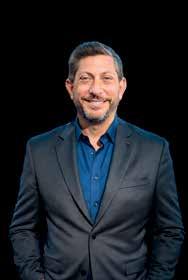
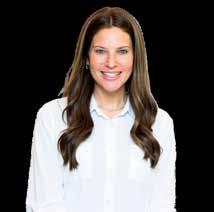















classifieds@fivetownsjewishhome.com • text 443-929-4003
SHEVACH HIGH SCHOOL
Is seeking experienced teachers for the following positions:
• ELA • First Aid Please send your resume to mribowsky@shevachhs.org
JEWISH CENTER SEEKS
Administrative Assistant with strong office/computer skills and experience working with toddlers & preschoolers ages 1–4. Responsibilities include office administration, social media/ PR, program support, substitute coverage/aftercare in preschool classrooms, and event setup. Knowledge of Jewish traditions is a plus. Full-time, Mon–Fri with occasional evenings/Sundays. Send resume to admin@jewishelc.org.
JEWISH PRESCHOOL IN Merrick seeks warm, loving, experienced toddler teachers for 2-year-olds, preschool teachers, and assistant teachers for children ages 18 months–4 years for the 2026–2027 school year. Mon–Thu 9–3, Fri 9–2. Email admissions@jewishelc.org or call 516-833-3057 ext. 110.
JOIN THE ZAREINU TEAM
Our small, special education classes are in yeshivas and Bais Yaakov’s in Far Rockaway and the Five Towns. For the 2026-2027 school year, Zareinu is seeking:
- AM Rebbe for a boys 4th -5th class - P/T, (AM and PM positions) Morah for middle school girls classes
- PM Special Education Secular Studies Teacher for middle school boys class
- P/T or F/T Assistants for both boys classes and girls classes
Highly competitive salary and caring, supportive administration. Send resume to info@zareinu.org / or call (718) 406-8343, Ext. 229 for further information.
CARE MANAGER
Remote (requires in-person home visits in NY)
Support families facing serious medical or emotional challenges. Provide guidance, advocacy, and resource coordination from home or on-site. Training provided. BA or 2 years Care Management required Apply online: www. chailifeline.org/careers or email hr@chailifeline.org
LOOKING FOR BT
Monday-Thursday 4-6 or 7
Friday afternoon after 1 and Sunday after 12
Please contact Malky 855-316-2700 ext 123 Or email malkak@supportiveaba.com
STAFF FOR EARLY CHILDHOOD
Center The Marion & Aaron Gural JCC Early Childhood Center is hiring Assistant Teachers and Substitute Teachers for the 2026-2027 school year.
Please send resumes to JCC.Nursery@guraljcc.org or call (516) 239-1354
REGENTS EXPERT
Tutoring regents in Algebra and Geometry A Darchei Torah instructor. Guaranteed results Text 347-491-8045 WhatsApp 347-767-1755
MDS REGIONAL NURSE
5 Towns area Nursing Home management office seeking a Regional/Corporate level MDS Nurse to work in our office. Must be an RN. Regional experience preferred. 2-3 years MDS experience with good computer skills required. Position is Full Time but Part Time can be considered. Great Shomer Shabbos environment with some remote options as well. Email: officejob2019@gmail.com

SHMIRAS HALASHON
Text 516-303-3868 with a time slot of your choice to be careful on lashon hara. Be a part of the 1,000 people for klal yisroel!
BEIS HAMEDRASH CONG. Chasdei Uvois Oshpitzin Talmidei chachomim are willing to learn mishnayos, say kaddish and be the shliach tzibbur to daven for the umid on the yartzeit yom hashanah of your parents or close relatives or loved ones To arrange please call Rabbi Miller 917-445-6220
Five Towns non-profit seeks an organized experienced hourly (25-30 hrs/week) office staffer to execute/manage tasks such as:
Billing/Receivables/CollectionsVendor Payments/Payroll Bank Management - Customer Relations & Records Management
Must be proficient using Excel and other PC tools, and be comfortable interacting with customers & vendors. Will be trained to use our proprietary software tools. Email a current resume and references to FIVETOWNJOB@GMAIL.COM

1


By Rivki D. Rosenwald Esq., LMFT, CLC, SDS

Tube, wheels, bowtie. Am I referring to transportation or clothing?
Neither, of course!
I’m talking about pastas!
There are endless shapes and sizes. However, we actually grew up with only one shape.
Spaghetti! Long, lean, and ultimately limp.
Who knew of variety?
And of course, we knew nothing at all of the recommended al dente. Which is, after all, the ideal way the creators suggest cooking your pasta – soft but firm. But what did we know?!
Our grandmothers believed in cooking things till they were cooked to a crumb or a shmatta. To them, “firm” was a place someone went to work.
Our spaghetti came slipping out of the strainer, glob-like, stringy and slimy. And that’s the way we thought it was supposed to be. Who knew it could retain its shape?!
And our authentic delicious marinara sauce was actually generously poured from a simple bottle of ketchup.
Cooking when we were young was very different. Food was not prepared
with so many variations.
A piece of chicken was usually rescued from the bottom of a chicken soup. It had more water coursing through it than a wet sponge – and tasted about the same. Most if its nutrients had already dissipated through the liquid base to create Grandmother’s total system cure!
Lovingly referred to by most as Bubby’s Magical Chicken Soup.
Today, it’s a whole different experi -
When it came to meat dishes, they were usually whatever floated out of a meat soup, or maybe a pot of chulent, or a stuffed cabbage.
Fancy restaurants were not something I grew up with. That came later.
Our grandmother’s creations were our delicacies. Whatever she brought from her mom’s table or her old country was our interesting menu experiences.
Today, we’ve already passed through
Our grandmothers believed in cooking things till they were cooked to a crumb or a shmatta.
ence. We prepare chicken in a multitude of ways. We do all fancy recipes, chicken Marsala, lemon caper chicken, onion maple chicken, and the list goes on and on.
For our grandmothers, a really fancy piece of chicken was paprika, garlic powder, and onion powder and – voila, a masterpiece. And of course, infused with a lot of Bubby love.
many amazing chefs’ cookbooks and now are often directed to great dishes by Instagram cooking all-stars.
Yes, we’ve come a long way from wet noodles to being gourmet rock stars.
We serve raw meat, which is considered a specialty.
We get excited about raw fish, which, I heard, my grandmother used to keep
floating in her bathtub till it met its destiny. We’ve substituted red sauces on our pasta with a less than appealing green that has become pleasant to the eye and palate as pesto, though the first time I was with people observing it, their visual reactions were less than enthusiastic.
Yes, we’ve certainly grown and developed sophisticated palates. And all the new stuff is usually tasty and exciting.
But somehow, when we think of the good, old days, it’s still about the spaghetti we grew up on and the chicken soup at Bubby’s house. Because before we became such mavens, we were just craving the things that we knew and loved.
We can always try new foods. But youth always raises images of the old favorites that felt like home.
Rivki Rosenwald is a Licensed Marriage & Family Therapist working with both couples and individuals and is a certified relationship counselor. Rivki is a co-founder and creator of an effective Parent Management of Adolescent Years Program. She can be contacted at 917-705-2004 or at rivkirosenwald@gmail.com.