Right now you might be wondering, “Family member? What does that mean?”
But come in, take a look around and it will make perfect sense.
Because the truth is, your friends shop here. Your neighbors shop here. Your relatives have been shopping here for years, even decades. And they keep coming back because they know they can get everything they need under one roof, whether they want to cook from scratch or bring home something ready to enjoy.
That is what makes this place feel like family. And that is what makes you part of it too.
We understand your needs, your standards, and your special requests. Our experienced team is here to make sure you find exactly what you are looking for, fresh, prepared, and done right.
For Shavuos and beyond, here is just a taste of what we have prepared for you:
OUR MEAT DEPARTMENT offers, besides our massive selection of meat, veal, lamb, and poultry, a full variety of seasoned ready to bake meat and poultry items, perfect for easy and flavorful cooking.
OUR FISH DEPARTMENTS features a wide variety of fresh fish along with prepared salmon in a range of styles, from ready to bake, baked for you, smoked to poached to grilled, cured fish platters, sushi ready tuna all prepared to perfection.
OUR SUSHI DEPARTMENT Famous for its delicious, fresh & quality full line of the rolls you know & love will also custom roll to your own preference and create a masterpiece sushi platter for Shavuos and all your occasions throughout the year.
OUR BAKERY DEPARTMENT carries a large selection of fresh Heimish Challahs along with an extensive variety of dairy baked goods and cheesecakes in all flavors and sizes.
Alongside our Challahs offerings & sour doughs we feature a large selection of fresh dips, starting with roasted garlic, babaganoush, chumus, jalapeno, olive, onion, tehina and tomato…plus much much more, complementing your choice of bread.
Perfect for enhancing any table.
OUR PRODUCE DEPARTMENT includes a large selection of carefully checked herbs and fresh produce, including the newest fruits of the season, along with beautiful fruit platters and vegetable platters, perfect for your Shabbos or Yom Tov table.
OUR DAIRY DEPARTMENT offers a huge and complete selection of appetizing options, from gravlax to pastrami lox, olives followed by yogurts, hard and soft cheeses, artisan cheeses, puddings, cold brewed coffees, and much more, ideal for your Shavuos menu.
OUR FREEZER SECTION is stocked with a wide selection of ice cream, blintzes, knishes, pizzas, pastry doughs, frozen fruits, and vegetables to make preparing Yom Tov simple and convenient.
OUR FLOWER DEPARTMENT showcases a beautiful range of floral arrangements and bouquets to enhance your home and table.
And OUR CANDY DEPARTMENT features an extensive selection of candies, chocolates, and nuts, including elegant platters perfect for your Yom Tov table or gifting.
From everyday essentials to Yom Tov specialties, from ingredients to fully prepared dishes, we have thought of it all so you do not have to.
So come in, walk through, and experience what a carefully curated store and a caring dedicated team can bring to your table.
Because here, you are family.
Sincerely Yours,
Yoeli Steinberg, COO
Dear Readers,
People hate voting. Maybe they aren’t strong enough to pull levers from left to right or right to left. Or maybe they don’t like filling out circles in blue or black pens. Or sliding those papers into machines. Or spending less than two minutes at a polling site.
But people also hate higher taxes and less services in the community. They hate when politicians don’t care about our community or ignore the problems festering on the streets.
And then, when those things happen – like higher taxes or quality-of-life issues – people like to complain. They kvetch about how no one is listening to them or that their representatives don’t represent them or care about them.
So let’s stop the cycle.
There’s only one way to stop it, and it’s quite easy: go vote.
Yup, I say it quite a few times a year – when elections roll around. Whether it’s a federal election or a local election, elections matter.
Your vote matters.
Every vote matters.
So go vote.
This upcoming Tuesday, there are elections for the school boards and the library boards. While most of our community does not send their children to the local public schools, the schools provide much-needed services such as busing and special needs services to our children. But even more than that, every homeowner in the Five Towns pays school taxes. Want to pay less school taxes – or at least the same amount as last year? Make sure you vote in this election.
In Lawrence District 15 (which includes a much larger area than just Lawrence), the school board has managed to hold the line on taxes for many years. You feel that bottom line every time you pay your taxes. Higher taxes – especially in this climate – is something we just can’t afford.
When it comes to the library board elections, it
is incumbent upon everybody in the community to vote. Whether you take books out of the library or not, there are many necessary changes that need to be implemented in the library to ensure that it is servicing our community. For example, the books on the library’s shelves should reflect the population taking out those books.
A few years ago, I compiled a list of Jewish books that would enhance the library. I went to different schools in the neighborhood and asked their librarians for suggestions of books that the community’s children would enjoy. But when I sent that list to the library, the librarians were very quick to dismiss my list – giving every excuse to order only three or four out of all those books on the list. Clearly, stocking books that the community’s children would like to read is not in their best interests.
Now, there are new members that sit on our library’s board. These people – voluntarily – are working to make sure that the library is serving our community’s needs. But they are being met with extreme resistance from the librarians, who don’t want to implement many of these needed changes. More work needs to be done, and this board is not afraid to work hard for our community.
I personally know one of the people running for the library board. Sara Isaacson will be a strong advocate for our community. She knows the library and its programs— she’s there with or without her children at least every week. Her kids attend the library’s programs. Her mother even hosted an art show at the library a few years ago! As a community member and a supporter of the library, Sara would be the best person to sit on the library board.
Whatever list of errands you have to do on Tuesday, I urge you to take the few minutes to vote. The school board and the library board are integral establishments in our community. Make sure you vote.
Classified Deadline: Monday 5:00PM classifieds@fivetownsjewishhome.com text 443-929-4003
PAYMENT VIA CREDIT CARD MUST BE SUBMITTED ALONG WITH CLASSIFIED ADS
The Jewish Home is an independent weekly magazine. Opinions expressed by writers are not necessarily the opinions of the publisher or editor. The Jewish Home is not responsible for typographical errors, or for the kashrus of any product or business advertised within. The Jewish Home contains words of Torah. Please treat accordingly.
AM Clouds / PM Sun Showers PM Showers
Dear Editor,
Borrowing a few words from the beloved Rabbi Moshe Weinberger, we are now living in a time of yesod. Kabbalistically, yesod is the ninth of the ten sefirot and represents the time immediately preceding the end of the 6,000 years of the world. It leads to the last sefirah of malchut, kingship, where G-d becomes manifest in the world.
This has huge ramifications in terms of the type of battle we are fighting. Yesod has an element of procreation attached to it, and Yishmael represents lust. We find ourselves in an existential battle against promiscuity and illicit thoughts.
How to win? My uncle has an interesting insight in comparing yom tov to Shabbos. We always think of them as apart, yom tov as a time initiated by the Beis Din, and Shabbos, a holiness ushered in by G-d. But the Ramban says that zachor in the Torah is a mandate for us to infuse Shabbos with kedushah through the act of kiddush. Therefore, we, in fact, play a role in kedushas Shabbos. The last tikkun to the world must come through us, through active pursuits. Shavuos was a night when the Jewish nation slept, for they thought kedushah could only come through the unconscious. But it’s not so. We must activate and participate to affect change.
Steven Genack
Dear Editor,
This Shabbos is being touted by President Trump as a “national Sabbath” across America to commemorate 250 years since the formation of a country that allows Jews to keep their faith openly. As part of Jewish Heritage Month,
Trump is encouraging all Jews to keep Shabbos from sundown Friday till nightfall Saturday (although it is unclear if he means tzeis ha’kochavim or 72 minutes after sunset). “This day will recognize the sacred Jewish tradition of setting aside time for rest, reflection, and gratitude to the Almighty,” said the President.
As a young boy, I recall marching down Kings Highway with my father on Parshas Beshalach as part of the Shabbos parade to encourage local businesses to be Shomer Shabbos. Singing, “Shabbos, Shabbos, heilege Shabbos,” followed by a speech by Rabbi Elizer Ginsburg in Sgt. Joyce Kilmer Square, we did get some local business owners to honoring the Shabbos and keeping it holy. This march, hardly a hafganah, was meant to demonstrate with joy, love and understanding, what our Day of Rest is all about.
Sgt. Joyce Kilmer, a New Jersey native who was shot and killed by a sniper’s rifle as a National Guardsman during World War I, was also a poet. He penned a line commemorating those who “nobly fought and nobly died” defending the United States. L’havdil, Jews have been moser nefesh to keep Shabbos, a reason we are still here today.
The Shabbos parade included a local family whose father made it out of Germany after Kristallnacht. Indeed, out of the ashes of the Holocaust emerged a family dedicated to keeping Hashem’s day holy. As a chassid who was interviewed by a local news broadcast after Shabbos stated: “When I sit down with my family around the Shabbos table it is a shtoch [diss] on Hitler” ym”sh. The Shabbos candles still burn bright.
There are those reading this who Continued on page 14
Continued from page 12
might say, “I am already Shomer Shabbos; what’s the chiddush here?” However, we need to take an accounting of ourselves: learn the laws of and spread awareness of Shabbos. In this week’s parsha, we read about the census that G-d commanded Moshe to take of Bnei Yisroel. We all count. Is your neighbor washing their car on Shabbos? Does that person in shul have a meal? Is your friend able to put food on their table? Let’s spread Shabbos by including our fellow Jew in the splendor and beauty of Shabbos. If the President of the United States sees this, how much more so should we.
Chaim Yehuda Meyer
Dear Editor,
Just days after embracing a candidate who has a Nazi symbol painted on his chest, Senator Charles Schumer (D-New York) condemned the painting of Nazi symbols on several synagogues and Jewish homes in Queens, NY.
Anybody notice the contradiction?
Graham Platner, the presumptive nominee for a U.S. Senate seat from Maine, has the Nazis’ “Totenkopf” (death’s head) symbol tattooed on his chest. Platner’s “defense” is that he was 23 years old at the time he chose that tattoo.
But when he was 30 years old, Platner wrote “I dig it” and “well executed” alongside a Hamas video of its terrorists murdering five Israelis. Platner added, though, that he would have preferred if the terrorists had shot one of their victims, instead of beating him to death.
While decorating himself with the symbol of a genocidal regime and praising genocidal terrorists, Platner has the audacity to accuse Israel of committing genocide. He is demanding that the U.S. stop providing Israel with the weapons it needs to defend itself against the mass-murderers and gang-rapists of Hamas.
Incidentally, Platner has not yet commented on the discovery, in Hamas hideouts in Gaza, of Arabic-language copies of Adolf Hitler’s Mein Kampf, with handwritten notations in the margins.
For some reason, neither Platner’s Nazi tattoo nor his affection for Nazi-style Hamas terrorism stopped Senator Schumer from calling Platner on April 30 to congratulate him on his successful campaign for the Senate nomination. Schumer pledged to work for Platner’s victory in November.
Four days later, somebody else who likes Nazi symbols decided to paint them on a number of synagogues and Jewish homes in Queens, New York.
“There is absolutely no place in our city for this type of vile antisemitism, or hate of any kind,” Senator Schumer declared in response. “I am proud to stand with the congregants of the vandalized synagogues…”
And yet Schumer also says he is proud to stand with a candidate who not only painted a vile Nazi symbol on his own body, but who embraces antisemitic terrorists who have engaged in the mass murder of Jews. Remarkable! Dr. Rafael Medoff
Dear Editor,
Since the discussion regarding the discolored and unhealthy water here in the Village of Lawrence, I am happy to announce that the mayor of the Village Shlomo Nahmias has responded with his full attention regarding this matter as a plan has been placed into effect whereby Liberty Water has an approximate four year plan to replace the aging infrastructure in the Village as the Village at the same time will invest in necessary road repairs in conjunction with Liberty Water, as both will be accomplished together which in essence will result in smooth pavement and pristine, clear drinkable water.
Reuven Guttman Lawrence, NY
Gang Violence in Haiti
Hundreds of people in Haiti were forced to flee their homes over the weekend, as a new wave of gang violence flooded the capital.
Gangs have overtaken more than 90% of the capital Port-au-Prince since the assassination of President Jovenal Moïse in July 2021 at his home. Police say they have expanded their terror activities — including looting, kidnapping, and assaults — into the countryside. Haiti has not had a president since the assassination.
In a statement released on Monday, the humanitarian group Doctors Without Borders announced the evacuation of its hospital in Cité Soleil following intense clashes in the Port-au-Prince neighborhood on Sunday. The organization, known by its French acronym MSF, reported treating over 40 gunshot victims within 12 hours while providing temporary shelter to 800 people fleeing the violence. One of those injured was a security guard who was hit by a stray bullet in the hospital’s grounds.
Scores of people fled to the highway after watching armed men burn houses in the neighborhood.
For the past two weeks, Haitian rum maker Barbancourt and two of the nation’s largest bottlers have also warned about deteriorating security conditions near Port-au-Prince’s Toussaint Louverture International Airport, where operations are now severely restricted.
The companies said that the government’s response to the crisis has been “largely insufficient” and noted that the poor state of the roads leading to the airport makes it difficult for Haitian security forces to patrol the area. The companies are among Haiti’s main fiscal contributors.
“You cannot secure an airport if you allow the roads around it to degrade,” the statement from the companies read.
In April, the first foreign troops linked to a U.N. force arrived in Haiti to help quell ongoing violence. The U.N. Security Council had approved a plan to authorize a 5,550-member force, which has not fully arrived in the island nation.
A report published earlier this year by the International Organization for Migration found that gang violence has displaced more than 1.4 million people in Haiti, with approximately 200,000 of them now living in crowded and underfunded sites in the nation’s capital.
Corruption in Ukraine
Ukraine’s war with Russia has entered its fifth year, but this week, the political explosions were happening far from the battlefield.
Anti-corruption investigators in Ukraine announced that Andriy Yermak, a longtime top aide and close confidant of President Volodymyr Zelensky, is now an official suspect in a massive money-laundering investigation involving roughly $10.5 million.
The announcement came from Ukraine’s National Anti-Corruption Bureau and Specialized Anti-Corruption Prosecutor’s Office, which said the investigation centers on an alleged scheme involving luxury real estate development near Kyiv. Authorities stressed that Zelensky himself is not suspected of wrongdoing.
Still, the case is politically awkward for the Ukrainian president, who has spent years trying to convince Western allies and the European Union that Ukraine is serious about tackling corruption. Joining the EU remains one of Kyiv’s biggest long-term goals, but corruption concerns continue to slow the process.
Yermak, who resigned in November, had been one of the most powerful figures in Zelensky’s government and served as a key negotiator in talks with the United States. His attorney, Ihor Fomin, dismissed the allegations as baseless and argued the investigation was fueled by
public pressure rather than evidence.
Meanwhile, as legal troubles swirled in Kyiv, Zelensky spent Tuesday discussing artificial intelligence and warfare with Alex Karp, head of Palantir Technologies. The company has worked closely with Ukraine throughout the war, helping analyze battlefield data, air attacks, reconnaissance information, and drone operations.
Zelensky said Ukraine and Palantir “can be useful to each other,” which is diplomatic shorthand for: modern wars are increasingly fought with algorithms as much as artillery.
Ukraine’s digital transformation minister, Mykhailo Fedorov, said the partnership has given Ukraine a technological advantage against Russia’s larger military force.
At the same time, hopes for a broader ceasefire appear as fragile as ever. A three-day U.S.-brokered pause in fighting officially expired Monday, and Ukraine says Russia quickly resumed large-scale drone strikes overnight.
Ukrainian Foreign Minister Andrii Sybiha said more than 200 Russian drones targeted civilian infrastructure, killing at least one person and injuring several others.
Russia, meanwhile, claimed its own air defenses intercepted 30 Ukrainian
drones near the border.
While diplomats talk peace, investigators chase corruption, and tech companies build AI war tools, the war itself keeps grinding on — one drone strike at a time.
Shuffling Syria’s Government
On Saturday, Syrian President Ahmed al-Sharaa replaced several government officials and ministers, including his own brother, in a partial government overhaul, state media reported.
The new appointments, announced by Syria’s official SANA news agency, include former Homs governor Abdul Rahman Badreddine al-Aama replacing Sharaa’s brother Maher as secretary-general for the Syrian presidency.
Mahar’s appointment had drawn crit-
icism from opponents who accused the administration of favoring nepotism over merit.
Sharaa appointed Khaled Zaarour as information minister, replacing Hamza Mustafa, who was moved to the foreign ministry. As agriculture minister, he named Bassel Sweidan, who also heads a committee tasked with reaching settlement agreements with business tycoons linked to the Assad-era elite, replacing Amjad Badr.
Zaarour was head of the media faculty at Damascus University before his appointment.
Sharaa also appointed new governors for several provinces, including Homs, Quneitra, Latakia, and Deir Ezzor, the eastern province where most of Syria’s oil fields are located.
The reshuffle is the first since the ouster of former President Bashar al-Assad and comes around a year and a half into the five-year transitional period set out in Syria’s constitutional declaration.
The Syrian transitional cabinet created in March 2025 came after the ouster of longtime ruler Assad in 2024 and was dominated by Sharaa’s inner circle.
The Syrian Civil War began in 2011 after protests against Assad escalated into a devastating conflict involving rebel groups, Islamist factions, foreign powers, and militias, leaving hundreds of thousands of people dead and millions displaced. In late 2024, Assad’s government collapsed after a major rebel offensive. Sharaa, a former rebel commander, took over the government.
3-Day Ukraine Ceasefire
In honor of Russia’s yearly Victory Day celebration, which marks the day the Soviet Union defeated Nazi Germany in World War II, Ukraine and Russia agreed on Friday to a three-day ceasefire and major bilateral prisoner swap, starting Saturday.
The halt was announced by U.S. President Donald Trump, who noted that his request for the ceasefire was accepted by both Ukrainian President Volodymyr Zelensky and Russian President Vladimir Putin.
“The Celebration in Russia is for Vic-
tory Day, but, likewise, in Ukraine, because they were also a big part and factor of World War II,” Trump posted on Truth Social, expressing his hope that this ceasefire marks “the beginning of the end of a very long, deadly, and hard-fought War.”
Zelensky noted that he accepted the deal, not to honor Russia’s holiday, but to secure the release of prisoners. As of late, Ukraine has been hitting Russia with long-range missiles, posing a threat to Moscow’s annual military parades. Initially, Zelensky rejected the deal because he believed that Russia was only looking for “a permit to hold their parade, so that they can go out onto the square safely for one hour once a year and then go on killing.”
“Red Square is less important to us than the lives of Ukrainian prisoners who can be brought home,” Zelensky posted on X. “I thank the President of the United States and his team for their productive diplomatic involvement. We expect the United States to ensure that the Russian side fulfills these agreements.”
Likewise, Russian officials thanked Trump for securing the ceasefire. Russia had threatened Ukraine with major retaliatory strikes if Kyiv breaks the three-day halt.
Barnes & Noble’s Future
Since James Daunt, a 62-year-old British bookseller, became CEO of Barnes & Noble in 2019, he has reshaped the bookstore chain, boosting its standing in a world increasingly shifting away from print.
Daunt has focused on massively improving efficiency, cutting jobs, placing smaller book orders, and negotiating higher discount rates from publishers. Additionally, the company is opening up new locations at record speeds. This year, Barnes & Noble is expected to open 60 new locations. In 2019, the chain had 627 U.S. stores. By the end of 2026, it’s expected to have 740.
Despite worsening conditions in the book retail industry, Barnes & Noble has managed to successfully adjust and remain competitive. Investors are confident enough in the company’s future that
22 plans for a possible public stock offering are now being considered.
Elliott Investment Management, the hedge fund that owns Barnes & Noble, is getting ready for an initial public offering that would combine Barnes & Noble with Waterstones, the United Kingdom’s largest bookstore retailer, and Paper Source, a stationery company based in Chicago.
According to sources familiar with the plans, major financial institutions involved as underwriters include JPMorgan Chase, UBS Group, Goldman Sachs Group, and Morgan Stanley. Some bankers have already begun preliminary discussions with potential investors as preparations for the offering move forward. Sources also indicated that Elliott is aiming to have the company listed on the London Stock Exchange.
Daunt, an avid book reader and owner of several independent English bookstores, purchased the company for $475 million in cash, rescuing it from its debt. He eliminated much of the company’s bureaucracy, allowing store managers greater freedom over how their stores looked. He forced his entire corporate staff to reapply for their jobs and fired several dozen staffers.
Publishers say that Daunt has helped cut down on the number of unsold books
Barnes & Noble sends back, lowering expenses tied to production, storage, and shipping. Before Daunt’s leadership, Barnes & Noble was returning around 20% to 25% of the books it stocked. He now estimates the return rate has dropped to about 8%, largely because of a more careful ordering approach, and he hopes to reduce it even further.
At the same time, Barnes & Noble has pushed for deeper discounts on newly purchased books. Publishers report that the retailer secured additional price reductions tied to the lower return rates, along with a marketing fee of roughly 6%, resulting in discounts that exceed 50% — similar to the pricing advantages Amazon receives.
Hantavirus Outbreak
An outbreak of a rare rodent-carried virus called hantavirus has killed three people and infected six others after the disease spread on the MV Hondius, a cruise ship traveling on the Atlantic Ocean, according to the World Health Organization.
Although the outbreak led to evacua-
tions and quarantines, the WHO has insisted that hantavirus, while dangerous, does not pose a serious threat globally. Dr. Maria Van Kerkhove, the WHO’s head of epidemic and pandemic preparedness, declared, “This is not the start of an epidemic … this is not the start of a pandemic.”
The first victim, a 69-year-old Dutch man, died on the ship on April 11 after experiencing symptoms such as a fever, headache, abdominal pain, and diarrhea. His 69-year-old wife left the ship on April 24, bringing his body to the British island of St. Helena, from which he was repatriated to the Netherlands. Soon thereafter, she became sick. After fainting at an airport in Johannesburg, South Africa, she was brought to a health facility and soon thereafter died.
On May 2, the third victim, a German passenger, passed away while on the ship.
While hantavirus is usually spread through contact with rodent droppings
or urine, this strain of the virus, the Andes strain, spreads among people. With that being said, the Andes strain, unlike COVID and the flu, doesn’t spread easily.
On Sunday, a month after the first passenger died, the ship stopped at the port of Granadilla de Abona in Tenerife, which is a part of Spain’s Canary Islands, and its 150 passengers and crew members were evacuated.
According to public health officials, 18 passengers who disembarked the cruise ship on Sunday returned to the United States. Most went to the University of Nebraska Medical Center, where one is in the center’s biocontainment unit and 15 are in quarantine. The remaining two passengers were taken to Emory University’s biocontainment unit. CDC officials said the two were moved to preserve space at the Nebraska biocontainment unit.
Initial symptoms of hantavirus include flu-like symptoms. Symptoms can develop as long as six weeks after exposure.
Iran Internet Blackout
Although the masses have largely lost internet access in Iran, a program called
“Internet Pro” is giving a select privileged few unrestricted access to the web.
Internet Pro’s debut came in February when the government-backed Mobile Communications Company of Iran (MCI) began selling the program to businesses suffering financially from internet blackouts implemented during the January nationwide protests.
Internet Pro focuses on offering more reliable connectivity and fewer limitations when accessing international websites. In many ways, it restores the broader online access that was previously common for all users, though it is now limited to a select group. To qualify, applicants must complete a verification process and be involved in business, academic, or scientific work.
Many Iranians complain that the situation is unfair, noting that it exacerbates a major gap between the country’s upper and lower classes.
According to the independent Khabar
Online publication, Internet Pro has “divided Iranian society into two distinct classes: a digital elite who enjoy fast, unfiltered channels for business, education, and communication, and digital subjects who are confined within heavy filtering, restricted speeds, and the high costs of the black-market VPN economy.”
In late February, the Supreme National Security Council approved Internet Pro, which has won praise from hardliners. However, the office of President Masoud Pezeshkian has criticized the technology as unfair.
To access the internet, many Iranians use black-market VPNs (Virtual Private Networks), which hide one’s location by changing the device’s IP address.
Fatal Volcanic Eruption
Mt. Dukono erupted suddenly on Friday, killing some hikers that had set out on the mountain in North Maluku province on the island of Halmahera in Indonesia.
Twenty hikers had set out to ascend the 4,445-foot volcano, in defiance of safety restrictions. They became stranded when Dukono erupted, spewing a thick
ash column that rose about 6 miles into the air.
On Sunday, rescuers found the bodies of two Singaporean men, located just a few yards from where another victim, an Indonesian woman, was found dead on Saturday, said Abdul Muhari, the National Disaster Management Agency’s spokesperson. All three had been about 165 feet from the rim of the main crater.
The men’s bodies were covered by thick layers of volcanic material, Muhari said, adding that the densely packed material had complicated evacuation efforts and significantly slowed progress.
“The bodies were buried under deep, densely packed volcanic material that is difficult to dig through,” Muhari said. “Rescue teams must proceed cautiously to ensure safety.”
Seventeen people were evacuated hours after the eruption, including seven Singaporean nationals. Ten of those evacuated had suffered minor burns, while two were able to join the rescue operation and provided information to help locate those missing.
Search teams involving nearly 100 personnel faced extreme terrain and continuing volcanic activity.
Authorities have banned all activities within a 2½-mile danger zone around the crater, in line with recommendations from Indonesia’s volcanology agency.
Mt. Dukono is among more than 120 active volcanoes in Indonesia, which is prone to seismic upheaval due to its location on the Pacific “Ring of Fire,” an arc of volcanoes and fault lines encircling the Pacific Basin.
on Monday after his one-year sentence was reduced by a parole board. He was released at around 7:40 a.m. from northern Bangkok’s Klong Prem Central Prison. Thaksin, 76, was convicted of corruption and abuse of power.
He was first elected prime minister in 2001 after rising to prominence as a telecommunications billionaire. Although he won reelection in 2006, he came under fire for allegedly posing a challenge to Thailand’s constitutional monarchy and was thrown out of office in a coup, triggering violence in the streets between his supporters and enemies, and forcing him into exile in Dubai.
While in exile, in 2011, his sister Yingluck Shinawatra became prime minister but was ousted in another coup three years later. After the progressive Move Forward Party won the general election in 2020 but was blocked from forming a government by the ruling conservative establishment, Thaksin’s Pheu Thai Party formed a government, and he returned from exile. But then, he was sentenced to eight years in prison for charges of corruption and abuse of power, which he was convicted of in his absence. Due to chest tightness, hypertension, and low blood oxygen levels, he was admitted to the V.I.P. suite of a hospital. Six months later, he was released from the hospital and received a royal pardon. He didn’t spend a day in prison. His daughter, Paetongtarn Shinawatra, became prime minister a few months later.
Soon thereafter, Paetongtarn came under fire for allegedly treating Cambodia’s prime minister with too much deference. Subsequently, in September, Thaksin was sentenced to a year in jail for previous convictions.
Now, a parole board has decided to free Thaksin, as he’s older than 70, has demonstrated good behavior, and is unlikely to offend again. For four months, he must wear an electronic monitoring device.
Former Thai PM Freed From Prison
Thailand’s former prime minister, Thaksin Shinawatra, was freed from jail
wealth and threats against President Ferdinand Marcos Jr., with 257 lawmakers (mostly the president’s allies) voting for the impeachment, 25 voting against, and nine abstaining. Duterte will now be tried in the Senate.
Once an ally to Marcos, Duterte recently became enemies with the president, accusing the commander-in-chief of letting the International Criminal Court “kidnap” her father, former President Rodrigo Duterte, who has been charged
in the Netherlands with crimes against humanity in connection to the fatal anti-drug crackdowns he oversaw as president. Furthermore, she has labeled Marcos a corrupt, weak leader, alleging that he is trying to stop her from running for president in 2028 after the incumbent’s six-year term expires.
While the vice president denies wrongdoing, the House Justice Committee’s head, Rep. Gerville Luistro, claims that Duterte has misused her office’s con-
vice president’s trial, was thrown out of office after 13 out of 24 senators, including Duterte’s allies, voted for his removal.
Will Starmer Quit?
Dozens of Labour Party lawmakers called on Prime Minister Keir Starmer to resign on Monday, effectively rejecting the British leader’s efforts to quell a mutiny in his own party’s ranks and raising the likelihood of a bruising leadership battle.
Starmer began the day with a speech he hoped would quiet the brewing rebellion, acknowledging the anger expressed by voters last week when they overwhelmingly rejected Labour Party candidates in elections across England, Scotland and Wales.
“That hurts, and it should hurt,” he said. “I get it. I feel it. And I take responsibility.”
But the speech appears to have done little to appease Labour Party members who blame Starmer’s deep unpopularity with voters for historic defeats in the contests for municipal council seats and control of the Scottish and Welsh parliaments. By the end of the day Monday, news organizations had tallied more than 70 Labour lawmakers who publicly said they wanted a fresh start. Several junior government aides resigned to protest his decision to stay on.
Critics of the prime minister must gather 81 signatures on a petition supporting a single challenger to trigger a formal leadership election, which could force Starmer out of office. It was unclear whether any single challenger was close to being able to assemble that many supporters.
But the public rejection of Starmer’s two-year tenure snowballed throughout the day.
fidential funds and received huge, undeclared bank transactions. Additionally, Duterte seemingly threatened Marcos and the first lady in 2024, declaring at an online news conference that she would arrange for their killings in case she is assassinated. Later, she said it wasn’t a threat but merely an expression of concern for her safety.
After the House impeached Duterte, Senate President Vicente Sotto III, who previously pledged to quickly start the
Officials said Starmer would meet with his Cabinet on Tuesday morning amid reports from multiple British news outlets, including the BBC, The Times of London and The Guardian, that several of his ministers are telling him that his political position is unsustainable and that he should consider setting out a timeline for stepping down.
Losing the support of key aides and members of his Cabinet would be a heavy blow to Starmer, who has previously been
28 criticized largely by backbenchers in Parliament, not members of his Cabinet.
a special military tribunal for Palestinians accused of taking part in the October 7, 2023, Hamas-led massacre, paving the way for what lawmakers described as one of the most significant legal proceedings in the country’s history.
The bill passed the Knesset by a vote of 93-0, reflecting unusually broad support from both coalition and opposition parties. The law was jointly introduced by Simcha Rothman of the Religious Zionism party and Yulia Malinovsky of Yisrael Beytenu.
The legislation establishes a special court within Israel’s military justice system to prosecute roughly 300 suspected terrorists captured inside Israel during the October 7 assault and held in detention ever since.
Oct. 7 Military Tribunal
Israel’s parliament approved sweeping legislation on Monday night to create
Under the new law, prosecutors will be permitted to pursue charges including genocide, terrorism, harming Israeli sovereignty, assisting an enemy during wartime, and causing war. Defendants convicted under Israel’s genocide statute could face the death penalty.
Justice Minister Yariv Levin called the vote “one of the most important moments of the current Knesset,” saying lawmakers had succeeded in uniting “despite all the disagreements that exist.”
Rothman described the tribunal as “a historic framework intended to deliv-
er justice and bring to trial the terrorists who carried out the worst massacre in the state’s history.”
Malinovsky used even sharper language, declaring, “These will be the trials of the modern-day Nazis, and they will go down in the history books.”
The October 7 attack, carried out by thousands of terrorists led by Hamas, left around 1,200 people dead after coordinated infiltrations by land, air, and sea along Israel’s border with Gaza. Hundreds more were wounded, and 251 people were kidnapped and taken into Gaza. The attackers committed widespread atrocities, including torture, assault, and executions, while filming portions of the violence on body cameras and cellphones.
The law also bars anyone accused, charged, or convicted in connection with October 7 from being released as part of future prisoner exchange agreements.
Still, the tribunal’s implementation may face delays because of disputes over cost. According to Hebrew media reports, the Defense Ministry estimates the project could cost nearly NIS 5 billion ($1.72 billion), largely due to plans for a dedicated judicial complex and hundreds of military and civilian staff members. Finance Ministry officials reportedly believe the figure could be closer to NIS 2 billion.
Trials would be public and livestreamed online. The court system would consist of 15 judges, including retired Israeli judges and potentially international jurists approved by the justice and foreign ministers. Panels of three judges would hear individual cases, while larger cases involving multiple defendants would be overseen by five-judge panels. Appeals would be heard before the full bench.
In explanatory notes attached to the bill, lawmakers said the “unique scope and severity of the atrocities pose an unprecedented challenge to the Israeli justice system,” citing the massive number of crime scenes, victims, suspects, and wartime evidence collection.
The legislation also sparked criticism from rights advocates, who questioned whether suspects held for nearly two-anda-half years without trial could receive fair proceedings. Some groups also raised concerns over allegations of abuse and harsh prison conditions, warning that public outrage surrounding the attacks could place enormous pressure on judges.
Debate in the Knesset became heated ahead of the final vote. Ahmad Tibi of the Hadash-Ta’al party was repeatedly interrupted by bereaved family members in the visitors’ gallery while speaking in Arabic. Protesters accused him of supporting terrorism, prompting shouting
matches and the removal of several audience members by ushers.
Outside the plenum, however, many hostage families and bereaved relatives focused their attention elsewhere — demanding a state commission of inquiry into the failures that allowed the October 7 attack to occur.
At a press conference organized by the October Council, former hostage Rom Braslavski called on all lawmakers to resign.
“The blood of everyone murdered on October 7 is on your hands,” he said. “And just before you go, establish the state commission of inquiry that will investigate what exactly happened here, so it never happens again.”
Jan Koum’s $200M Gift to Shaare Zedek
Jan Koum, co-founder of WhatsApp, has given the largest single gift to an Israeli hospital, donating $200 million to Shaare Zedek Medical Center in Jerusalem through The Koum Family Foundation.
The hospital will be officially renamed as Koum Shaare Zedek Medical Center.
The 24-story building will encompass more than 1.5 million square feet, including new surgical and emergency care facilities.
The donation surpasses the $180 million donation made by Shmuel and Anat Harlap to Rabin Medical Center (Beilinson Hospital) in August 2025 to build the “Tower of Hope.”
“This gift reflects our confidence in a future of medical innovation and research that will benefit patients in Israel and around the world,” Koum said in a statement.
Shaare Zedek, a leading center of medicine and research that treats over one million patients annually, has built a strong relationship with The Koum Family Foundation in recent years.
The Koum Family Foundation was established by Jan Koum, co-founder of WhatsApp, the world’s most popular messaging platform. As one of the world’s prominent Jewish philanthropists, Koum has built a remarkable legacy of support for Jewish communities globally.
30
Shaare Zedek Medical Center is Jerusalem’s most active major hospital and one of the seven largest medical centers in Israel.
Upon completion, the building will be the largest and most advanced facility of its type anywhere in Israel. The tower will total 24 stories and encompass over 1.5 million square feet including all-new and expanded surgical and emergency care facilities. In response to developing regional threats, it will be designed to the highest standards of structural protection, including significant underground spaces and a helipad positioned on the building’s roof to enable direct helicopter access.
UAE Funds Board of Peace
A few days ago, the United Arab Emirates gave the Board of Peace $100 million, funding the body’s contract for the training of a new Palestinian police force in Gaza.
While countries committed $17 billion to the Board of Peace, an international body led by the United States, less than one percent of those funds have been transferred. The Board of Peace, which is tasked with governing and policing Gaza, is already dealing with funding issues some three months after its founding.
The Board of Peace’s police force would replace Israeli forces in policing
and administering the Strip and ensure the demilitarization of Hamas. The police force would be part of the National Committee for the Administration of Gaza (NCAG), a panel of Palestinian technocrats who are expected to govern Gaza, though the NCAG has yet to enter the Palestinian enclave.
Thousands of Palestinians have applied to join the police force, according to the board’s Gaza envoy, Nickolay Mladenov. Former Hamas civil servants are allowed to apply but must undergo vetting by the Shin Bet, according to an Arab diplomat. Recruits would be trained in Jordan and Egypt.
Only the UAE and Morocco have begun transferring the funds they pledged, although Qatar, Saudi Arabia, and Kuwait each vowed to donate $1 billion or more to the Board of Peace.
Alexander Glovanyov, Hy”d
An Israeli reservist was killed in a Hezbollah drone attack near the Lebanese border on Sunday, as fighting between Israel and the terror group continued to intensify despite a shaky ceasefire agreement.
The IDF identified the fallen soldier as Alexander Glovanyov, 47, of Petach Tikva. Glovanyov served as a driver in the Transport Center’s 6924th Battalion.
According to the military, several ex-
plosive-laden Hezbollah drones crossed into Israeli territory Sunday afternoon and struck near Manara, a community along the northern border. One of the drones directly hit and killed Glovanyov.
He is survived by his wife, a 15-yearold son, and an eight-month-old daughter.
His mother, Flora, described her son as someone who constantly tried to calm her fears about the dangerous situation in northern Israel.
“We spoke the day before yesterday for the last time,” she said. “I was afraid of what was happening in the north. I called him, and he would always tell me, ‘Everything is fine.’ Until yesterday, it was fine.”
She added, “Alexander was a good person. He was my only son. I have no one now.”
Glovanyov is the fifth Israeli soldier killed in southern Lebanon since the ceasefire took effect in mid-April, underscoring how fragile the truce has become.
On Monday, the IDF said three additional soldiers were lightly wounded in separate Hezbollah drone attacks inside southern Lebanon. During the evacuation effort, an Israeli Air Force helicopter suffered a technical malfunction and was temporarily unable to take off after landing in Lebanon. The military stressed that the aircraft was not struck by enemy fire, and technicians later repaired the issue on-site.
Hours later, the IDF issued evacuation warnings for nine villages in southern Lebanon ahead of planned airstrikes against Hezbollah targets. Residents were instructed to move at least a kilometer away from areas expected to be targeted.
“In light of the Hezbollah terror organization’s violations of the ceasefire agreement, the IDF is forced to act against it with force and does not intend to harm you,” said IDF Arabic-language spokesman Avichay Adraee.
The fighting persists as diplomatic efforts continue behind the scenes. Lebanese Prime Minister Nawaf Salam said Lebanon supports peace with Israel “under certain conditions,” including a ceasefire, a full Israeli withdrawal from Lebanese territory, and the release of Lebanese detainees. He noted that more serious negotiations could follow if those demands are met.
Despite international mediation efforts, clashes along the Israel-Lebanon border have continued almost daily, with Hezbollah repeatedly launching rockets and drones at Israeli forces and communities in the north.
Chile to Return Amb. to Israel
Chile’s President José Antonio Kast told President Isaac Herzog during a meeting last week in Costa Rica that he intends to return his country’s ambassador to Israel in a few weeks.
Chile recalled its ambassador less than a month after the October 7, 2023, Hamas invasion of Israel under Kast’s leftist predecessor, Gabriel Boric, accusing the Jewish state of “unacceptable” human rights violations in the war against the terror group.
Hosting Herzog on Thursday, Kast also said that Chile wants to increase cooperation with Israel across all sectors, including agriculture, health, AI, technology and security.
He stressed to Herzog that Chilean media criticized him for the meeting, to which Herzog responded that there are many issues of bilateral interest.
“We discussed the important opportunities to restore Israel-Chile relations to their previous heights to the benefit of both our nations,” Herzog wrote on X.
The move marked a shift in Chilean policy, which has been marked by anti-Israel sentiment since Hamas’s October 7 attacks.
Chile, which has the largest Palestinian population outside the Arab world, joined calls in January 2025 for an investigation by the International Criminal Court into possible war crimes in the Israel-Hamas war.
In 2024, Chile said it would exclude Israeli firms from the International Air and Space Fair (FIDAE), Latin America’s biggest aerospace fair.
Kast was elected in a landslide victory in December, becoming Chile’s most right-wing president in 35 years of democracy. His election followed a series of victories for Latin America’s right, after wins in Argentina, Bolivia, Honduras, El Salvador and Ecuador.
Kast campaigned on a promise to expel more than 300,000 immigrants, seal the northern borders, take a “firm hand” on near-record crime rates, and restart the stalled economy.
Dear Neighbor,
PROTECT OUR COMMUNITY
I am Martin Oliner, former Mayor of the Village of Lawrence, and I'm running for Town of Hempstead Supervisor to protect our communities from developers who want to destroy them. To get on the ballot, I NEED YOUR SIGNATURE. BUT FIRST, LET ME TELL YOU WHAT'S AT STAKE.
The current Town of Hempstead Supervisor pretends he's fighting to stop the assault on our suburbs. But right now, a transient rental massive 440-unit 5 story complex is headed for the Five Towns and the Town Supervisor won't lift a finger to stop it.
The Town Board already voted unanimously against it. The town's own engineers say the project is unsafe. The community is overwhelmingly opposed. All the Town Supervisor has to do is call one more vote — the outcome is guaranteed. It couldn't be easier. HE REFUSES.
The Town Supervisor is a hypocrite. While he campaigns on protecting our suburbs from Albany, he is allowing developers to build even more than what Hochul wants.
SOMEONE MUST ACTUALLY PROTECT OUR NEIGHBORHOOD. That's why I'm running.
TO SIGN THE PETITION
PLEASE EMAIL US AT CITIZENSNOTDEVELOPERS@GMAIL.COM WITH:
• YOUR NAME(S)
• ADDRESS
• PHONE NUMBER
• BEST TIME FOR US TO STOP BY
We will come to you.
THANK YOU for standing up for our suburban neighborhoods!
Marty Oliner Former Mayor, Village of Lawrence Candidate for Town Supervisor
Paid for by Martin
Oliner
CA Mayor Worked for China
The mayor of a Southern California city is stepping down — and not because of potholes, parking tickets, or budget battles.
Eileen Wang, the mayor of Arcadia, resigned on Monday after agreeing to resolve federal charges accusing her of acting as an illegal agent for the Chinese government.
According to court filings, Wang admitted to working with Chinese officials between 2020 and 2022 to spread propaganda through a Chinese-American
news website she operated with her former fiancé, Yaoning “Mike” Sun. Prosecutors said the pair posted articles at the direction of officials tied to the People’s Republic of China and then reported back with screenshots showing how many people viewed the content.
One message highlighted in the plea agreement involved a defense of China’s policies in Xinjiang, where Beijing has faced international criticism over its treatment of Uyghur Muslims. After reposting a letter from China’s consul general defending the government’s actions, Wang allegedly received a reply from an official reading, “So fast, thank you everyone.”
Federal prosecutors said Wang never disclosed that the material was being directed by the Chinese government.
“Individuals in our country who covertly do the bidding of foreign governments undermine our democracy,” said First Assistant U.S. Attorney Bill Essayli in a statement announcing the agreement.
Wang appeared briefly in federal court in downtown Los Angeles on Monday, dressed in blue and accompanied by four attorneys. Through a Mandarin interpreter, she listened quietly as a judge scheduled future proceedings. She faces a maximum sentence of 10 years in prison.
Her attorneys insisted the conduct was unrelated to her work as an elected official and stemmed from “her personal life” and the media platform she once operated with Sun, whom she believed she would marry.
“Her love and devotion for the Arcadia community have not changed and did not waver,” attorneys Brian Sun and Jason Liang said.
Sun, meanwhile, was sentenced earlier this year to four years in federal prison after pleading guilty to acting as an illegal foreign agent. Prosecutors said he worked to advance Beijing’s interests in California, including monitoring critics of the Chinese government and opponents of Communist Party policies.
Arcadia officials said an internal review found no evidence that city finances or government decisions were affected though the political fallout has already paved its way into City Hall.
Real Life Drama
Two South Florida police officers are suing actors Ben Affleck and Matt Damon’s production company over claims that their new crime film borrowed a little too heavily from real life.
Miami-Dade Sheriff’s Office sergeants Jason Smith and Jonathan Santana filed a federal defamation lawsuit against Artists Equity, the production company coowned by Affleck and Damon. The officers claim the movie’s fictional story mirrors a real 2016 Miami-area drug-money investigation closely enough that viewers assumed the on-screen corruption was tied to them.
According to the lawsuit, characters in the film are shown stealing seized drug money, murdering a superior officer, working with cartel members, setting fires in residential neighborhoods, violating police protocols, and even killing a federal agent. The officers argue that because the film used several recognizable details from the real case, people in their personal and professional circles connected the dots, even though neither officer is actually named in the movie.
The film stars the two actors as South Florida narcotics officers who discover millions of dollars hidden inside a house.
The story was loosely inspired by a real 2016 incident in which police uncovered more than $21 million connected to a suspected marijuana trafficker in a Miami Lakes home. Apparently, “inspired by true events” has now entered its own legal gray area.
The actors spent time with narcotics officers while preparing for the movie.
“We really wanted to kind of understand what those dynamics were like,” Damon said. “These units are very tight because they’re really putting their lives in each other’s hands.”
An attorney for Artists Equity declined public comment, but in a response letter included in court filings, the company argued the movie never claimed to depict real people or tell the exact story of the 2016 case. The company also noted that the officers failed to identify which specific characters were supposedly based on them.
Tree Massacre
In Ann Arbor, Michigan, where treelined streets are practically part of the town’s personality, residents say the latest effort to prevent power outages is leaving the city looking a little less leafy and a lot more lopsided.
Anita and Ron Delph recently watched contractors for DTE Energy trim the large beech tree outside their home. By the time the chainsaws stopped buzzing, the once-full tree looked, in Anita’s words, like a “massacre.” Ron said the remains were so awkward-looking he wondered who would want to stare at it from their front window every day.
The Delphs are hardly alone. Across Ann Arbor — affectionately nicknamed “Tree Town” — residents have been voicing frustration as DTE crews aggressively prune branches near power lines. The utility says the trimming is part of a years-long campaign to improve electric reliability after outages caused by falling limbs repeatedly darkened neighborhoods across Metro Detroit.
DTE launched its “Tree Trim Surge” in 2019 and says it has spent more than $1 billion on the effort. According to the company, the work is paying off: Ann Arbor experienced its best electric reliability
service in 30 years last year.
Still, better power doesn’t necessarily soften the blow when your maple tree suddenly resembles abstract art.
On some streets, trees have been carved into sharp V-shapes around overhead wires, creating scenes residents say look more like something from a dystopian Dr. Seuss sketchbook than a postcard college town.
“It leads — rightfully so — to a lot of frustration and anger,” said Erica Briggs,
who has previously pushed DTE to explore alternatives to aggressive trimming.
DTE insists crews carefully evaluate every tree before cutting and says complaints about trimming are relatively rare. The utility also notes that when residents refuse full tree removal, workers sometimes have little choice but to leave oddly shaped results behind.
Arborists say the debate highlights a difficult balancing act between public safety and aesthetics.
ChatGPT Helped Shooter
According to a federal lawsuit filed against OpenAI by a victim’s widow, ChatGPT helped Phoenix Ikner carry out a deadly mass shooting at Florida State University last April.
Ikner, the suspected gunman, had “extensive conversations” with ChatGPT, during which the AI “either defectively failed to connect the dots or else was never properly designed to recognize the threat,” according to the complaint.
Ikner allegedly sent ChatGPT pictures of his firearms, and the chatbot helped him learn how to use them. In the months before the shooting, Ikner also spoke to ChatGPT at length about “his interests in Hitler, Nazis, fascism, national socialism, Christian nationalism, and perceptions about ‘Jews’ and ‘blacks’ by different political ideologies and social groups,” the lawsuit alleges, as well as other mass shootings.
Ikner allegedly asked ChatGPT about suicide, terrorism, and mass shootings, posing questions about the busiest times at the FSU student union and hypotheticals regarding what would happen in the event of a shooting at the university, including legal outcomes. According to the lawsuit, ChatGPT told Ikner that a shooting is significantly more likely to gain national attention “if children are involved, even 2-3 victims can draw more attention.”
OpenAI, the company behind ChatGPT, has denied wrongdoing.
“Last year’s mass shooting at Florida State University was a tragedy, but ChatGPT is not responsible for this terrible crime,” the company asserted in a statement.
“Trees around people must be managed for a lot of reasons,” said arborist Kay Sicheneder. “Having said that, there are some give-and-takes.”
For many residents, the issue boils down to finding a middle ground between reliable electricity and preserving the canopy that gives Ann Arbor much of its charm.
“It doesn’t have to be,” Ron Delph said, “‘don’t touch the tree’ or ‘hack it beyond recognition.’ There’s got to be a happy medium.”
“In this case, ChatGPT provided factual responses to questions with information that could be found broadly across public sources on the internet, and it did not encourage or promote illegal or harmful activity,” OpenAI spokesperson Drew Pusateri said. “ChatGPT is a general-purpose tool used by hundreds of millions of people every day for legitimate purposes. We work continuously to strengthen our safeguards to detect harmful intent, limit misuse, and respond appropriately when safety risks arise.”
The lawsuit, however, claims that ChatGPT should have known better.
“ChatGPT inflamed and encouraged Ikner’s delusions; endorsed his view that he was a sane and rational individual; helped convince him that violent acts can be required to bring about change,” the lawsuit said. “[The chatbot] generally provided what he viewed as encouragement in his delusion that she should carry out a massacre, down to the detail of what time would be best to encounter the most traffic on campus.”
A month ago, seven families sued OpenAI over a school shooting in Canada. In 2025, a family sued the company after their teenage son took his own life after speaking with ChatGPT.
Mosquito Magnets
If you’ve ever sat outside watching mosquitoes ignore everyone else at the barbecue while treating you like an allyou-can-eat buffet, science says that it’s probably not your imagination.
Researchers are making progress in understanding why some people seem irresistibly delicious to mosquitoes, and it turns out the answer is less about blood type and more about body chemistry.
“It’s not a misconception: mosquitoes are attracted to some people more than others,” explained Frederic Simard of France’s Institute of Research for Development.
Before you blame your Type O blood, however, scientists say that popular theory doesn’t really hold up.
“There is no scientific basis” for mosquitoes preferring specific blood types, Simard noted. Hair color, eye color, and skin tone also don’t appear to matter much. Apparently, mosquitoes are equal-opportunity nuisances.
What does matter is the invisible cloud of chemicals humans constantly release.
Mosquitoes first detect carbon dioxide — meaning simply breathing already puts you on their radar. Once they get closer, they use body odor, heat, humidity, and skin compounds to decide who gets selected for tonight’s dinner special.
Rickard Ignell, who recently led a study on the topic, said mosquitoes can detect dozens of odor compounds produced by humans. In one experiment, researchers released female Aedes aegypti mosquitoes among 42 women to study which scents attracted the insects most.
The winning ingredient? A chemical called “1-octen-3-ol,” nicknamed mushroom alcohol, which forms when skin oils break down. Even small increases in the compound appeared to make people significantly more attractive to mosquitoes.
And yes, beer lovers may have some unfortunate news buzzing their way.
Several studies found mosquitoes were more drawn to people who recently drank beer. Researchers believe alcohol raises body temperature, changes skin odor, and increases carbon dioxide output — basically turning humans into happy hour specials with legs.
In one study from Burkina Faso, malaria-carrying Anopheles mosquitoes showed a stronger attraction to beer drinkers than to the same volunteers after they drank water. A Dutch study later found beer drinkers were 1.35 times more attractive to mosquitoes.
Scientists say the research is becoming increasingly important as warming temperatures allow mosquitoes to spread into new regions around the world.
So what’s the best defense? Experts recommend loose-fitting clothing, mosquito nets, repellent, and perhaps limiting the beer if you’re tired of being the evening’s main course.
Soldier Found in Morocco
The remains of a U.S. soldier who went missing during military exercises in Morocco a week ago were recovered in the Atlantic Ocean, the army said Sunday. Military teams are still searching for a second missing soldier.
The remains were those of 1st Lt. Kendrick Lamont Key Jr., a 14A Air Defense Artillery officer who was one of two U.S. soldiers who fell off a cliff during a recreational hike in Morocco while off duty. He was 27 years old.
The two were reported missing on May 2 after participating in African Lion, an annual multinational military exercise held in Morocco.
“A Moroccan military search team found the Soldier in the water along the shoreline at approximately 8:55 a.m. local time May 9, within roughly one mile of where both Soldiers reportedly entered the ocean,” U.S. Army Europe and Africa said in a statement.
The two went missing around 9 p.m. near the Cap Draa Training Area outside Tan-Tan, a terrain characterized by mountains, desert and semidesert plains, according to the Moroccan military.
Their disappearance triggered a search-and-rescue operation involving more than 600 personnel from the United States, Morocco and other military partners. The operation deployed frigates, vessels, helicopters and drones.
Search efforts will continue for the missing second soldier.
Key was assigned to Charlie Battery, 5th Battalion, 4th Air Defense Artillery Regiment, 10th Army Air and Missile Defense Command, the army said. His decorations include the Army Achievement Medal and Army Service Ribbon. He entered military service in 2023 as an officer candidate and earned his commission through Officer Candidate School in 2024 as an Air Defense Artillery officer. He later completed the Basic Officer Leader Course at Fort Sill, Oklahoma.
Art Keeps You Healthy?
Turns out that your weekend trip to the museum may be doing more than expanding your horizons. It might also be slowing down your biological clock.
A new study from University College London found that adults who regularly engage in arts and cultural activities may age more slowly at the molecular level than those who rarely participate. Researchers discovered that people who paint, dance, attend concerts, visit museums, or explore cultural sites tended to show healthier biological aging markers in their blood.
ONE STOP SHOP
ment — all factors thought to contribute to healthier aging.
The strongest effects appeared in adults over 40, suggesting middle age may be a particularly important time for these benefits to emerge.
Previous studies have shown that music and artistic activities can influence genes related to inflammation and dopamine, but this is the first large-scale study to connect arts engagement with slower biological aging.
While scientists are not prescribing museum memberships instead of treadmills anytime soon, the research offers encouraging news for anyone whose ideal workout involves watercolor paints, jazz concerts, or wandering through an art exhibit pretending to deeply understand abstract sculpture.
Your hobbies, it seems, may be working overtime behind the scenes to keep you moving.
Indictment in Baltimore Bridge Collapse
In other words: your body might appreciate a gallery visit almost as much as a jog.
The study, published in the journal Innovation in Aging, analyzed data from more than 3,500 adults across the United Kingdom. Scientists examined participants’ DNA using so-called “epigenetic clocks,” tools that measure biological age based on chemical changes that build up over time.
Researchers found that people who
participated in arts and cultural activities weekly showed biological aging scores roughly one year “younger” than people who rarely took part. The effect was similar in size to the benefits linked to regular physical activity.
Importantly, scientists stressed that the study does not prove that attending concerts or painting landscapes directly slows aging. It’s possible that people who engage more in the arts also tend to have healthier lifestyles overall. Still, the
findings remained consistent even after researchers adjusted for factors like income, education, smoking, alcohol use, existing illness, and exercise habits.
The study also found that variety mattered. People involved in multiple kinds of cultural activities appeared to benefit more than those sticking to just one hobby. Researchers believe different forms of artistic engagement may stimulate the brain, reduce stress, encourage social interaction, and provide sensory enrich-
A grand jury indicted the companies that operated the ship that crashed into the Francis Scott Key Bridge in Baltimore in 2024 – sending it toppling into the Patapsco River and killing six workers – for charges including neglect and conspiracy to defraud the government.
Synergy Marine, based in Singapore, Synergy Maritime, based in Chennai, India, and employee Radhakrishnan Karthik Nair were listed as defendants in the indictment unsealed in the U.S. District Court of Maryland on May 12.
The companies were charged with conspiracy to defraud the U.S. government, failure to report a hazardous condition, obstruction and aiding and abetting misconduct or neglect of ship officers resulting in death, among other allegations. Nair was also individually accused of four overlapping charges.
The Dali container ship crashed into a pier that supported the central span of the bridge in the early morning hours of March 26, 2024. The bridge plunged into the river below, killing six
workers and bringing the major shipping artery at the Port of Baltimore to a screeching halt.
Last month, the state of Maryland announced it reached an agreement to settle with Synergy and Grace Ocean Private Limited, the operators and owners of the ship, for an undisclosed amount.
Prosecutors said in a news release on May 12 that the defendants failed to immediately notify the U.S. Coast Guard of a known hazardous issue with the Dali and
made false statements to investigators.
“The collapse of the Francis Scott Key Bridge was a preventable tragedy of enormous consequence,” Acting Attorney General Todd Blanche said. “This indictment is a critical step toward holding accountable those whose reckless disregard for maritime safety regulations caused this disaster.”
Nair, 47, is an Indian national who worked for the companies as the technical superintendent for the ship, prosecu-
two of the Dali’s four generators. However, the flushing pump was not designed to automatically restart following a blackout, and the Dali’s generators could not operate without a fuel supply, so the ship ultimately experienced a second blackout,” the Department of Justice said in a statement.
Giant Gem
Deep beneath the hills of war-torn Myanmar, miners have struck what many are calling a “gem of the century” — an enormous ruby weighing a staggering 11,000 carats. That’s about 4.8 pounds of pure sparkle..
The massive stone was uncovered near Mogok, Myanmar’s legendary ruby-mining hub often nicknamed the “Valley of Rubies.” According to state media, the gem was discovered shortly after the country’s traditional New Year celebrations in April — quite literally starting the year with a bang and a birthstone.
Though it is only about half the size of the record-setting 21,450-carat ruby found in Myanmar in 1996, experts say this newly unearthed treasure may shine brighter in value. The rough ruby reportedly boasts a rich purplish-red hue with golden undertones, moderate transparency, and a mirror-like gleam that has gem traders seeing red — in the best way possible.
Myanmar remains the source of roughly 90% of the world’s rubies, particularly from the Mogok and Mong Hsu regions. But behind the glitter lies a much darker story. The gemstone trade has long been tied to Myanmar’s military rulers and armed groups, making rubies as politically charged as they are precious.
tors said.
The Dali lost power twice in the span of four minutes, prosecutors said, likely due to a loose wire in a high-voltage switchboard. The Dali’s operators were allegedly using improper fuel supply pumps that did not automatically allow for the ship to regain power and safely navigate around the bridge.
“According to the indictment, the defendants allegedly altered the ship and relied on a flushing pump to supply fuel to
Human rights organizations, including Global Witness, have repeatedly urged jewelers to avoid Myanmar-sourced gems, arguing that ruby profits have helped bankroll decades of violence and repression.
The ruby was recently presented to Myanmar leader Min Aung Hlaing in the capital of Naypyitaw — proving once again that in Myanmar, fortunes can still be unearthed one stone at a time.
Kiwi Comeback
For more than 100 years, Wellington’s hills were missing one very important resident: the kiwi. Now, thanks to an ambitious grassroots conservation effort, New Zealand’s beloved national bird is finally coming home — one waddling step at a time.
Under cover of darkness this week, volunteers with the Capital Kiwi Project quietly carried seven kiwi through misty farmland overlooking the sea between New Zealand’s islands. Among them was the 250th kiwi relocated to the Wellington region since the project began, a milestone worth chirping about.
“They are a part of who we are,” said project founder Paul Ward. “They’ve been gone from these hills for well over a century.”
The kiwi may be small, flightless, and shaped a bit like a furry pear with a beak, but in New Zealand, it carries enormous cultural weight. The bird is so iconic that New Zealanders themselves are nicknamed “Kiwis” despite the fact that the bird can’t fly, has tiny useless wings, and would probably lose badly in an airport race.
Once numbering in the millions, kiwi populations have plummeted to roughly 70,000 nationwide. Introduced predators such as stoats, rats, and feral cats have turned life in the wild into a survival game with terrible odds.
But Wellington residents are fighting back with traps, monitoring systems, and enough determination to make the birds’ comeback less “Mission Impossible” and more “Mission Im-peck-able.”
The sprawling 24,000-hectare kiwi zone surrounding the capital now contains more than 5,000 predator traps. Thanks to those efforts, kiwi chicks in the region have a remarkable 90% survival rate.
The newest arrivals even made history before their release by becoming the first kiwi ever brought inside New Zealand Parliament. Lawmakers and schoolchildren gathered in awe as handlers cradled the birds like feathered VIPs.
As the crates opened on the windswept hillside on Tuesday night, long beaks cautiously emerged before the birds sprint-
ed into the darkness — proving that even flightless birds can still make a dramatic entrance.
Quite a comeback.
Eiffel Tower Piece for Sale
Looking to own a piece of one of the world’s most iconic structures? A piece of the Eiffel Tower can soon be yours.
On May 21, an original piece of the Eiffel Tower’s staircase will be sold to the highest bidder in an auction hosted by Artcurial.
The fragment is 9 feet tall and 5.7 feet in diameter and was part of the original spiral staircase that allowed visitors to climb to the top of the tower.
According to the auction house, the offering is “a section of the original spiral staircase dating from 1889, designed under the supervision of Gustave Eiffel.” It once connected the second and third floors.
Artcurial estimates it’s worth between $46,000 and $57,000.
The Eiffel Tower was designed by French civil engineer Gustave Eiffel and was completed in 1889. Now one of the most recognizable structures in the world, it was originally only intended to stand for 21 years. In 1983, the original spiral staircases that connected the second and third floors of the tower were separated into 24 sections and replaced with elevators.
These sections can now be found across the world. One sits on the Eiffel Tower’s first floor, and three others were dispatched to the Musée d’Orsay, La Villette, and the Iron Museum in Paris. Others can be found as far away as Pennsylvania and Japan.
The section up for auction marks the fifth piece of Eiffel Tower stairs that Artcurial has sold since 2013. It has been owned by an anonymous man for four decades, who has decided to bid it adieu and to put it back up for auction.
“He’s enjoyed it long enough,” Artcurial’s Art Deco specialist Sabrina Dolla told Artnet, “and now his circumstances are taking him elsewhere.”
Au revoir!
Around the Community
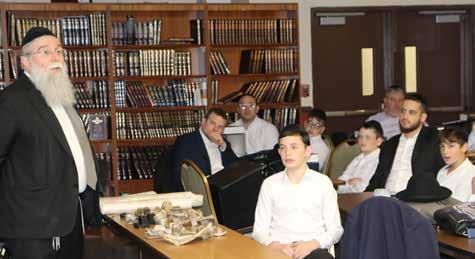
YKLI Bar Mitzvah Breakfast and Tefillin Presentation
eshiva Ketana of Long Island hosted our seventh graders and their fathers at our Bar Mitzvah Break-
fast and Tefillin Presentation. The boys enjoyed a beautiful davening with their fathers and a delicious breakfast spread,
followed by a thorough and interactive Tefillin presentation from Rabbi Pincus of Tiferes Stam. The boys received a gift
Tanach from the yeshiva as well as a collective gift from their classmates.
Congresswoman Laura Gillen Visits the Special Children’s Center
The Special Children’s Center was honored to welcome Congresswoman Laura Gillen for a heartfelt and inspiring visit. During her time at the Center, Congresswoman Gillen toured the facility, met with staff and families, and spent meaningful time interacting with the children.
The visit highlighted the Center’s commitment to providing compassionate care, education, and support services for children with special needs and their families. Congresswoman Gillen was visibly moved by the warmth, dedication, and joy she witnessed throughout the building.
She spent time smiling, laughing, and
engaging with the children, who were delighted to meet her. Staff members shared information about the programs and services the Center provides, as well as the impact the organization has on the community.
“We were truly honored to host Con-
gresswoman Gillen,” said Batya. “Her genuine interest in our children and appreciation for the work being done here meant so much to our staff and families.”
The Special Children’s Center continues to serve as a place of education, care, and love for children with special needs,
and the visit from Congresswoman Gillen helped shine a light on the importance of supporting these vital services.
Photos from the visit captured joyful moments of Congresswoman Gillen interacting with the children and staff, reflecting the warmth and spirit of the day.
Young Israel of Hewlett’s Youth Department Hosts Community Shabbaton
The Youth Department of Young Israel of Hewlett hosted a beautiful and uplifting Community Shabbaton on Parshas Behar-Bechukotai, bringing together individuals and families from across the community for a weekend filled with warmth, activity, and a special emphasis on youth involvement.
The Shabbaton kicked off on Thursday evening with a community challah bake, where participants of all ages gathered to experience the beauty of preparing challah as one united community. While the dough was rising, the children created beautiful centerpieces, which adorned the Shabbos dinner tables and kiddush throughout the weekend.
That same evening, the excitement brewed as six contestants began preparing for the Inaugural YIH Cholent Cookoff. The friendly competition added a special energy to the weekend and gave participants another opportunity to con-
tribute their talents to the Shabbaton.
On Friday night, more than 100 members of the community gathered for a meaningful and memorable candle lighting, followed by davening and a communal Shabbos dinner, with special divrei Torah from members of the youth groups. The room was filled with warmth and laughter connecting with friends both old and new.
On Shabbos day, the shul’s youth played a special role as they joined the main minyan for various parts of dav-
ening. Parents and community members alike were able to shep nachas as the children participated with enthusiasm and pride.
The festivities continued at kiddush, where the much-anticipated Cholent Cookoff took center stage. Six different cholents were entered into the competition, and the chefs stood proudly by as community members tasted each one and cast their votes. After much anticipation, Tammy and Brian Bernstein were announced as the winner.
From the challah bake to the Shabbos meals, the children’s creativity to their participation in davening and dvrei Torah, and from the delicious cholent competition to the spirit of achdut felt throughout the weekend, the event highlighted the strength and beauty of the shul’s community.
For information about our youth minyan, toddler group, or upcoming events, please reach out to info@yihewlett.org.
YOSS Mechina Lag B’Omer trip to Eisenhower and Grant Parks
Day and Shavuos
New Webinar to Highlight Rare Jerusalem Opportunity
Following a highly successful open house and growing demand for additional information, DERECH will be hosting a special webinar this week about its new high-end 60+ community planned for the Beit Hakerem area of Jerusalem.
For many, owning an apartment in Jerusalem has always been a lifelong dream. But as prices continued climbing, many people felt that opportunity had slipped away.
Now, for the first time in a long time, that may finally be changing.
Planned within the highly sought-after triangle of Beit Hakerem, Yefe Nof, and Beit Vegan, the project is generating excitement not only because of its location, but because of what it represents: a real opportunity to own in Jerusalem at a price point many thought no longer existed.
With entry-level apartments expected to begin at approximately $580,000 and up, the project is offering something almost unheard of in today’s central Jerusalem market, especially for a development of this quality.
The project is being designed as a high-end Modern Orthodox 60+ community built specifically for the American market. More than just another apartment building, the vision is to create a true community with the right atmosphere, lifestyle, and people for this next stage of life.
Plans include a boutique building with premium amenities such as a swimming pool, modern gym, and over 500 square meters of shared community
YOSS Makes Dollars into “Sense”
YOSS students in Mrs. Klein’s second grade classroom have been hard at work learning all about money through hands-on activities, games, and real-world math practice. Over the past several weeks, the boys have explored the different types of coins, learned their values, and practiced counting combinations of coins to determine total amounts. From pennies and nickels to dimes and quarters, students have strengthened their understanding of how money works in everyday life.
space. Buyers at this early stage will also have the ability to shape and customize their apartments according to their needs.
“There are many beautiful buildings in Jerusalem,” says Shimon Weinberg, who oversees marketing and sales strategy for the project. “What people are responding to here is the feeling that this was truly built for them. When you combine location, community, lifestyle, and pricing like this, it creates something very rare.”
The webinar will feature mortgage expert Tzvi Gleiberman, Chief Loan Officer at Qlear Mortgages, who will discuss retirement and purchasing property in Israel later in life, along with financing options available to English speakers and Olim.
The webinar will be hosted by Shimon Weinberg, who oversees marketing and sales strategy for the project, together with Shana Chinn, Director of Sales, who has been working closely with interested buyers and helping shape the vision and direction of the community.
At the same time, a limited initial group of approximately 40 buyers is now being formed. Early participants are expected to receive advantages that may not be available later as the project moves forward.
For many people, this may be more than just another real estate opportunity. It may be the chance to finally call Jerusalem home.
To register for the webinar, email Office@Derech.VIP or call 516-201-9204.
One of the most exciting parts of the unit has been using real coins and manipulatives to solve money challenges together. Students worked collaboratively in small groups to sort coins, calculate totals, and discover different ways to make the same amount of money. These activities helped reinforce important math skills such as skip counting, addition, and problem solving while also encouraging teamwork and discussion.
The boys also practiced making change through interactive classroom activities and mock shopping experiences.
By applying their subtraction skills and understanding of coin values, students learned how to determine how much money remains after a purchase. As they worked through increasingly challenging scenarios, students showed impressive growth in both confidence and mathematical thinking.
This engaging unit has helped students see how math connects to real life. Whether counting coins, purchasing items, or saving money, the boys are developing practical skills they will use far beyond the classroom. Mrs. Klein’s second graders have shown wonderful enthusiasm and perseverance throughout the unit, and it has been exciting to watch their confidence continue to grow.
First Sephardi Sefer Torah at DRS
Last week, the Sephardi Minyan at DRS celebrated a historic milestone as the yeshiva welcomed its first-ever Sephardi Sefer Torah. The Torah, generously on loan from Shaare Emunah, was danced into the school in a spirited and emotional Hachnasat Sefer Torah celebration joined by the entire yeshiva community.
With approximately 50 Sephardi students representing a wide range of communities, the Sephardi Minyan has become a meaningful and vibrant part of daily tefillah life at DRS. Students and faculty filled the hallways and Beis Me -
drash with singing and dancing as the Torah was carried into its new home, marking a significant moment for the growth and continued development of Sephardi life within the yeshiva.
Following the celebration, members of the Sephardi Minyan, together with rabbeim and guests, gathered for a special breakfast commemorating the occasion. The event reflected the strong sense of achdus within DRS, as students from all backgrounds came together to celebrate this meaningful addition to the yeshiva community.
Girls at the Special Children’s Center created beautiful fresh flower bouquets in honor of Mother’s
Lag B’Omer at HANC
The sounds of children enjoying themselves could be heard all over the building in HANC’s Reinstein Family Campus in West Hempstead. In conjunction with the arrival of Lag B’Omer, the children began their annual two-day Color War, with the red team representing Aish (Fire) and the blue team representing Mayim (Water). These two elements have been used to describe the study of Torah, because fire ignites us and pushes us to grow, lead and stand strong as B’nei Torah. The Torah has also been compared to water, because it sustains and nurtures us, teaching consistency, humility and depth. Together, Aish and Mayim create balance, strength and life.
Dressed in creative colorful outfits, the children arrived Monday morning knowing that the next two days would be filled with many fun activities. After spirited davening in each classroom and the Beit Midrash, the exciting day began. The children participated in numerous activities including Human Anagrams, Order in the Court, HANC Memory Game, Rock/ Paper/Scissors Challenge, Puzzle Piece Hunt, Lag B’Omer Grade-Wide Kahoot Game, Capture the Flag, Panoply, String Hunt, Apache Relay, Dance Off, Knee Hockey Tournament and a game of LifeSized Battleship. As the children participated, points were given not only for winning an activity but also for encouraging teammates from both teams and exhibit-
ing good middot and derech eretz as they competed. During the course of the twoday event, each team needed to compose a team cheer, compose and sing a song that reflects their team’s name, prepare a Dvar Torah, and create a one-minute promotional video that reflects HANC’s passion.
In addition to the myriad of indoor activities, there were plenty of outdoor games to enjoy as well. The children participated in multiple relay races and sports games, earning extra points for their team. In addition, during team time, the students worked together to create all of the projects that they needed to present at the conclusion of the twoday competition.
The moment the children had been waiting for came at the very end of the second day. After the students gathered for team cheers, songs, Divrei Torah, and videos, all of the points for good sportsmanship as well as performance were added up. In the end, it was the red team (Fire) that was declared victorious. It was a fun two days for all of the children and a great opportunity to enjoy themselves.
HANC wishes to thank Morah Daniella Hirt, HANC Student Activities Coordinator, for all of her hard work in preparing this jam packed, fun-filled Color War experience for all of the children. Hakarat hatov also goes to the entire staff for encouraging the students and helping out to make this year’s Color War such a huge success.
Gabe Solomon reading his favorite newspaper in London
Lone Soldier Program at HAFTR
HAFTR Lower School’s fifth grade students recently participated in a powerful and inspiring program that brought the stories, strength, and sacrifice of lone soldiers directly into their classrooms. Through this unique experience, students had the opportunity to hear firsthand from two lone soldiers, one from Israel and one from the United States, as well as from a brigadier general, who shared their personal journeys, motivations, and experiences serving in the IDF.
Week 5 at 5TLL
Week 5 of 5TLL by FM Home Loans brought another unbelievable slate of games, featuring walk-off homers, offensive explosions, highlight-reel catches, and clutch performances all across the league. Every division brought the energy this week as teams continue to battle it out heading into the heart of the season.
1st Grade Baseball
SR Whee edged Maidenbaum 13–12 in one of the highest-scoring games of the week. Yoyo Eichhorn powered the offense with a huge 2-home run performance, delivering clutch hit after clutch hit to keep SR Whee ahead. Posh Home & Bath defeated Mr. Softee 12–6 behind a strong all-around performance from Aaron Lifshitz, who drove in 3 runs and consistently came through at the plate.
As the students listened, they gained a deeper understanding of the courage, resilience, and sense of responsibility carried by those who dedicate themselves to protecting the people and land of Israel. The soldiers’ stories sparked meaningful conversations about identity, sacrifice, and Jewish unity, leaving a lasting impression on the students.
In preparation for the visit, students worked closely with their Morot Lashon to craft thoughtful and reflective questions, encouraging them to engage deeply
2nd Grade Baseball
In an offensive showdown, SR Whee outlasted Wieder Orthodontics 18–16. Yeruchem Moshayev had himself a MONSTER game: 2 triples, 7 RBIs, and multiple clutch hits throughout. FIFO 3PL defeated Mobile Auto Luxe 23–15 in another slugfest. The defensive highlight belonged to Yehuda Schwed, who made an unbelievable catch that completely shifted momentum back to FIFO.
3rd
Grade Baseball
Smash House walked it off against Newman Dental 12–10 in dramatic fashion. With the game on the line, Daniel Hammer launched a towering walk-off 3-run homer, sending the dugout into celebration. In another offensive thriller, Nate Builders edged BAT-
with the soldiers’ experiences and values. Their curiosity and sincerity transformed the program into a meaningful dialogue rooted in connection and admiration.
The experience also included interactive “training drills,” where students participated in team-based activities that brought energy, excitement, and camaraderie to the day. More than just fun, these activities helped students appreciate the physical and mental strength required of those who serve.
Throughout the program, students
strengthened their connection to Israel and also deepened their appreciation for the individuals who courageously defend the Jewish homeland. The experience empowered students to reflect on the values of perseverance, responsibility, and service to the Jewish people.
HAFTR is deeply grateful to The Lone Soldier Center in Memory of Michael Levin for providing this extraordinary opportunity and for helping inspire the next generation with stories of courage, commitment, and love for Israel.
TR 18–17 behind a massive performance from Yosef Haboura, who blasted a home run and a double while driving in key runs all game long.
4th Grade Baseball
Wieder Orthodontics defeated Zlotowitz Law 11–9 behind the biggest swing of the game — a huge grand slam from Shua Silber that completely flipped momentum. VMM Eagles pulled off one of the comebacks of the season against 5 Towns Landscaping, storming back with 8 unanswered runs to secure a dramatic 9–8 victory.
5th Grade Baseball
Maidenbaum defeated Blue Bird Insurance 6–4, helped by one of the best defensive plays of the week. Dovi Perl laid out for a huge inning-ending catch, putting his body on the line
to preserve the lead. CG Flooring rolled past Smash House behind a dominant performance from Zevi Neuberger, who finished with 5 RBIs while also making several great defensive plays in the field.
6th Grade Baseball
5 Towns Premier narrowly defeated Elegant Landscaping, with Uriel Cohen putting on a defensive clinic. Time after time, Uriel made difficult plays look routine, helping prevent multiple scoring opportunities.
7th/8th Grade Baseball
A massive 3-run homer from Alex Ribowsky proved to be the difference as Smash House defeated Twillory 11–9 in another exciting battle.
Zevi Samet meeting with boys in Yeshivas Ahavas Chaim
Morah Sara Goldman’s kindergarten students at Yeshiva Darchei Torah performing on Rosh Chodesh Iyar
Scenes from the Siach Yitzchok Bike-a-thon this past Sunday
Cheder Menachem PTAShavuos Cooking Demo
The Cheder’s Pre-Shavuos Women’s Event was a truly beautiful and uplifting evening, bringing together mothers in a warm and welcoming atmosphere that reflects the unique spirit of our Cheder family.
The highlight of the evening was a wonderful cooking demonstration led by our very own talented Cheder mothers, who generously volunteered as chefs. Mothers enjoyed watching the demonstrations and tasting the delicious dishes prepared, including a fresh halloumi salad, creamy four-cheese pasta, homemade cured salmon, Israeli cheesecake, and an array of refreshments.
The room was elegantly set with candlelight, flowers, and beautiful décor,
creating a warm and homey ambiance. Each mother was also gifted a framed photo of herself with her son — a meaningful keepsake that added a special touch to the evening.
Words of Torah were shared, focusing on the unique connection between women and the yom tov of Shavuos, inspiring everyone present.
Most of all, the evening gave mothers the opportunity to bond, connect, and get to know one another better. The warmth, friendship, and sense of belonging felt throughout the night truly captured what makes our Cheder so special — a place where everyone feels like part of one big family.
Lag B’Omer fun at Shulamith ECC
When the adorable talmidos of the Yellow Room Kindergarten in the Ganger Early Childhood division of TAG reached the letter W, they came up with a great WAY to celebrate the milestone by providing a car WASH!
Lag B’Omer at BY5T Mercaz Academy’s “Color Shalom” Games
The preschool girls at BY5T had a wonderful time celebrating Lag B’Omer with exciting fun in the bouncy houses, filled with laughter, energy, and smiles. Roasting marshmallows and eating delicious smores was the perfect end to a beautiful day!
Concession Stand In Cedarhurst Park
Yes. You read that correctly. With the support of NYS Assemblyman, Ranking Member of the Assembly’s Local Governments Committee, Ari Brown who believes that strong local business districts build strong communities, and with the blessings of Cedarhurst Mayor Ben Weinstock and the Village Trustees, the concession stand/food kiosk in Cedarhurst Park (near the playground) will OPEN on Sunday, May 17, with unique kosher food, snacks, drinks and toys. Warm food and hot drinks are coming soon!
The menu will keep changing. Suggestions are welcome – really. Comment as you eat!
Come to play, attend birthday/graduation parties, picnics, business lunch in the park, to-go snacks.
Long hours serving morning commuters through late night park strollers and concerts in the Park with warm desserts and a choice of dairy or parve ice cream.
Come to our soft Grand Opening on Sunday, May 17 and show us that you follow @CommonGroundsCedarhurst on Instagram for a free gift with purchase!
Last week, Plainview’s Mercaz Academy hosted its annual Color Shalom games – a twist on traditional Color War – that emphasizes teamwork and collaboration over rivalry. Alongside physical challenges, students earned points through divrei Torah, themed skits, and songs celebrating unity.
This year’s theme centered on the Israel Defense Forces, with the school divided into four teams representing its different branches: Cheyl HaYam (Navy) in blue, Pikud HaOref (Home Front Command) in yellow, Cheyl HaModi’in (Intelligence Corps) in green, and Cheyl HaRaglayim (Infantry) in red. Older students took the lead in writing skits, chants, and songs illustrating team values, and then taught them to their younger teammates, building leadership as well as connection across grade levels.
While the games featured classic athletic events – team sports, relay races, tug-of-war, and more – points were also awarded for derech eretz and good sportsmanship. Teams that encouraged their opponents, demonstrated kindness and camaraderie, and followed directions respectfully were recognized and rewarded.
Color Shalom 2026 concluded with the entire school coming together to perform a team song set to the tune of Eyal Golan’s Am Yisrael Chai. “We can all help if we work together, not as four teams but as one,” they sang. “We can do anything together, and we are stronger as one!”
Lag B’Omer at Gan Chamesh
The children of Gan Chamesh celebrated Lag B’Omer with simulated bonfires. They learned To -
rah, sang songs, and enjoyed “roasting” marshmallows over the flickering flames of the bonfires!
Rav Zevi Trenk, menahel of Mesivta Chaim Shlomo, on his annual pre-Shavuos visit to Yeshiva Darchei Torah’s nursery, when he gives each boy an “aliyah” to the “Torah” (actually a Navi on klaf), showing them the first letters of their names in the pesukim. Shown here with Yehuda Rosen and his father, YDT fourth grade rebbi Rav Shalom Rosen
HALB at Math Tournament
Ten HALB Middle School students participated in the Bnos Malka Math Tournament. Two of the seventh grade students came in first place. Incredible!
Mrs. Lieber’s first grade art students at Yeshiva Darchei Torah created a project for Sefirah called Chaverim Kol Yisrael, where all the figures in their pictures linked hands
Lag B’Omer Fun at HALB and Lev Chana
Students at HALB and Lev Chana went to parks all over Long Island to celebrate Lag B’Omer. They had a great time with friends, teachers and rebbeim! Some Lev Chana students went on a trip to the farm, and others had the farm brought to them at school! Everyone had a great day.
HAFTR Middle School students got to hear the inspirational story of a lone soldier on Lag B’Omer, taking with them lessons of courage and growth through challenges
HAFTR’s Power of Story Event
Over the course of the school year, HAFTR Middle School eighthgrade students have been busy working on what has now been named the “Power of Story” Capstone Project. Under the leadership of Associate Principal Dr. Yali Werzberger and faculty advisors Ms. Rebecca Zweibon, Mrs. Jennifer Boccia, and Mrs. Rinat Balsam, students embarked on a year-long endeavor that they called “life-changing.”
Dr. Joshua Gold explained that the idea for the program came from research conducted at Emory University that identified a correlation between knowing one’s family story and grit and resilience. To that end, all students researched and learned about their unique family history, heritage, and story. Along with eighth-grade Social Studies teacher Ms. Zweibon, students learned that family stories do not exist in a vacuum and that the historical context of the times greatly shapes each person’s life and story. In addition to interviewing family members in person and over the phone to learn more about their heritage, students also visited websites, museums, and communities to learn more about the historical back-
ground that shaped their ancestors’ lives. Students then examined the values that are central to their family and the values that they have learned at HAFTR. Lively and thought-provoking conversations about the importance of values then followed, and students thought about the person they want to be and the life they want to lead, based on the values that are central and meaningful to them.
With the guidance of eighth-grade ELA teacher, Mrs. Boccia, students then crafted and wrote a speech, using vivid imagery and powerful prose, to tell their family story, share the values they learned at home and at HAFTR, and discuss how their heritage and values will guide them on the path to becoming the person they want to be and the best version of themselves.
Dr. Yali Werzberger then ran a public speaking seminar, teaching all eighth graders the fundamentals of effective public speaking. Students then practiced and perfected their speeches, and all gave them to their classmates, inspiring each other. Students and faculty were moved and impressed by the students’ public speaking skills, powerful delivery, family
stories, and values. It was heartwarming to listen to students speak about what this project meant to them and how it will shape them in the future.
Students, their families, and the HAFTR Middle School faculty all celebrated together at the Power of Story culminating event, with Azarya Wernick welcoming families, and Ava Zalta introducing three students, Lian Elgrissy, Jonah Cohen, and Alma Scharman, who shared their speeches with the audience. Lian shared the tragic but captivating story of her relative Koby, who was tragically murdered in the Dizengoff bombing in 1996. Jonah tenderly told us of how his grandfather helped support and sustain the Chabad of Puerto Rico. Alma lovingly discussed her great-uncle’s trials and triumphs. Tori Koren then introduced the video that showed clips of each student’s speech. Everyone watched spellbound as students told stories about family members who escaped countries due to persecution and built successful businesses from scratch. The video also highlighted the many values, such as integrity, compassion, and vision, that are important for students, and the goals they have for
themselves now and in the future. Parker Scharf then welcomed families to view the photo gallery, where each student submitted a photo of the family member they studied, along with text highlighting the meaningful impact this person had on the family and the student’s values. The program then concluded with closing remarks from Ayala Lieber.
Reflecting on this project, Dr. Yali Wezberger remarked, “It was fascinating to listen to how so many family stories involved people with a certain goal and life path, and by no fault of their own, due to life circumstances, those plans had to change. Our students spoke with pride about how their ancestors did not respond to these circumstances with resignation and despair. Instead, they persevered and, with grit and resilience, built a new life and a new story. When learning about their family stories, students learned about the eternal nature of the Jewish people, giving us hope and strength to continue building and creating.”
Rav Eliyahu Saldinger, second grade rebbi at Yeshiva Darchei Torah, kindling the yeshiva’s Lag B’Omer bonfire
R’ Zitwer and R’ Klinkowitz with boys of Yeshiva Ahavas Chaim at Chickies
Rabbi Tzvi Krigsman, shlita, Menahel Yeshiva Ketana of Long Island, together with a Yeshiva Ketana alumni, Rabbi Chaim Siff, Menahel Torah Day School of Atlanta, at the recent Torah Umesorah Menahelim Conference
FD NOW Annual David Z. Herman
Memorial Dinner
Can you imagine finding out that your newborn has a life-threatening disease? That is the nightmare we lived through when we were told that our baby daughter had Familial Dysautonomia (FD). FD is a neurological disorder that affects every body system; its sufferers live in very unstable bodies. Twenty-one years ago, the prognosis was grim, leaving us hopeless and searching for help.
Soon after we met Dr. Berish Rubin, the Head of the Laboratory for Familial Dysautonomia Research in Fordham University. Together with Dr. Sylvia Anderson, the Director of the Lab, Dr. Rubin had discovered the gene mutation that causes FD and began research on treatments for FD that followed from that discovery. Within a few weeks of starting the recommended treatments, we saw signs that her nervous system was regulating! It was truly a miracle! From deep despair, we quickly had hope, as our beautiful girl continued to progress and develop. Over the years, our daughter has endured her share of difficulties. However, with the introduction of each new treatment, our daughter became more stable and much stronger.
Thank G-d, our daughter’s health improved so much that she was able to spend a year in Israel in seminary and is currently graduating college, alongside her twin and her friends. She is living an independent and happy life, due to the treatment advances that have turned a life-threatening condition into a chronic one with careful management. It is re -
markable!
FD NOW is a volunteer organization made up of families and friends of those with FD. Funds raised by FD NOW provide the sole support for the Lab for FD Research. As our story indicates, that research has been successful, b”H! Since 2003, Dr. Rubin and Dr. Anderson have made 10 treatment breakthroughs, each of which has made a drastic improvement in the overall health and quality of life of those with FD. FD NOW is committed to keeping the lab running and without sufficient funds, research will come to a stop. We need a cure for our children before time runs out!
On May 26, 2026, FD NOW is excited to host its 24th Annual David Z. Herman Memorial Dinner at the Sephardic Temple in Cedarhurst, NY. We are thrilled to honor FD NOW supporters Rachel and Josh Licht. Dr. Dalya Chefitz, a kind and brilliant physician at Robert Wood Johnson University Hospital, will receive the FD Hero Award, dedicated in memory of Philip Bach. Featuring a raffle, as well as good company and delicious food, the evening promises to be uplifting, inspiring, and fun. Please join us to see firsthand how, with G-d’s help, scientific research has saved the lives of Jewish children afflicted with FD and how they are now able to thrive!
To register for the dinner, buy raffle tickets, or for more information, please visit our website at fdnow.org or email fdnowny@gmail.com.
Memorial Day Weekend Events in Cedarhurst-Lawrence
If you’re searching for a festive and meaningful way to spend Memorial Day Weekend, the annual Cedarhurst-Lawrence Memorial Day Parade offers an ideal opportunity to honor America, our Veterans, and local community volunteer organizations.
The parade will begin at 10:00 AM on Sunday, May 24. Participants will march from Frost Lane along Central Avenue, making their way to Cedarhurst’s Parise Park for a heart-warming memorial ceremony.
Later in the evening, join us in Parise Park at 7:45 PM for a Free Family Movie Night featuring “A League of Their Own.” This comedy-drama film is based on the
real-life All-American women’s professional baseball league that was formed during World War II to lift American spirits.
This uplifting family movie is sponsored by The Village of Cedarhurst and the Merchants of Cedarhurst. It is presented as a thank you for shopping locally and supporting your community.
Community organizations interested in participating in the parade are encouraged to call JoMarie at 516-220-3218 for more information.
Let’s come together to celebrate our heroes and enjoy a patriotic Memorial Day Weekend!
HALB STEM Design Fab
The seventh grade girls at HALB had their Design Fab presentations last week. The girls were challenged with using their knowledge of 3D design and printing to create a Judaica item that enhances the performance of a mitzvah. They worked very hard and produced beautiful, creative and functional Judaica art. Three teams were chosen to participate in the upcoming CIJE Design Fab exploration trip!
YCQ Celebrates Lag B’Omer with Energy and Purpose
The spirit of Lag B’Omer was felt throughout the Yeshiva of Central Queens (YCQ) as students celebrated with energy and purpose on Tuesday. Elementary students in grades one through five engaged in a thrilling Color War at Flushing Meadows Park. These activities emphasized sportsmanship and teamwork, teaching students to compete with integrity. Upon returning to school, the building echoed with cheers that reinforced their shared educational journey.
The Junior High students also celebrated in the great outdoors, with the boys heading to Cunningham Park and the girls enjoying Flushing Meadows Park. These excursions provided a perfect backdrop for building friendships and practicing mutual respect. By taking education beyond the classroom, students learned the value of leadership and camaraderie in a supportive community setting.
Our youngest learners had their own
exciting adventures as well. The kindergarten classes enjoyed a trip to the Bowling Alley, while students in our nursery, 3K, and 4K programs participated in creative craft and tell sessions. These activities allowed our smallest students to express themselves while learning about Lag B’Omer through hands-on discovery and social interaction.
The festivities concluded with a delicious school-wide barbecue in the yard, bringing everyone together to share their experiences. Thank you to everyone who worked so hard to make these memorable experiences possible for all our children.
DRS Faculty vs. Students Basketball Game
DRS Yeshiva was filled with energy and school spirit last week as students and faculty packed the gym for the annual Faculty vs. Students Basketball Game. With the entire yeshiva cheering from the stands, the event brought together students, rebbeim, and faculty members for an exciting afternoon of competition and camaraderie.
The game featured both DRS basketball teams, with the JV team taking the floor in the first half before the Varsity team competed in the second. Adding to the fun atmosphere, the game was officiated by the captains of the DRS hockey team.
At halftime, the yeshiva held a special banner-raising ceremony honoring the DRS Varsity Basketball team’s remarkable season, including their Yeshiva League Championship and championship victory at the prestigious Sarachek Tournament.
The event showcased the tremendous ruach and achdus that define life at DRS, as the entire school community came together to support friends, teammates, and faculty members in an atmosphere filled with pride and excitement.
Rav Yaakov Bender, Rosh HaYeshiva of Yeshiva Darchei Torah, giving out packs of candy to the first grade talmidim of Rav Dovid Leib Rodkin, pictured here
It was a beautiful and nachas-filled morning at Yeshiva Ketana of Long Island, as our pre-1A boys excitedly received their siddurim at our siddur presentation. Proud parents and grandparents looked on as the boys sang hartzige niggunim and as the rebbeim presented each boy with his precious siddur.
The world famous town crier Alan Myatt enjoying TJH in Camden Market
Around the Community
Madraigos Annual Five Towns Breakfast Draws Strong Community Support
This past Sunday morning, May 3, Shavy and Mark Schlossberg opened their home to friends and supporters for the Madraigos Annual Five Towns Breakfast. The gathering brought together a broad cross-section of the community in support of Madraigos’ prevention programming and intervention services for youth, young adults, and families facing life’s challenges.
Special recognition is extended to the hosts for their leadership and dedication in advancing the event. Through their outreach, awareness-building, and engagement of supporters, this year’s Breakfast achieved a notably strong level of support—helping to secure critical resources that will enable Madraigos to continue serving youth, young adults, and families in need.
Rabbi Dov Silver, Founder and Executive Vice President of Madraigos, opened the program by expressing appreciation for the hosts’ hospitality and their meaningful role in the event’s success. “The existence and growth of Madraigos is
thanks to sincere, committed friends like the Schlossbergs,” he said. “I am deeply moved by their sensitivity to the needs of our teens and young adults, and humbled by their warmth and dedication.”
Corporate sponsors from across the region contributed to the event’s success.
Leading sponsors included Cross River, Miller Realty, Visionville, South Shore Vein, SHMA Camps, Town Appliance, and 4Beyond. Their participation reflects broad-based support for the organization’s work and the individuals and families it serves.
Through the efforts of the hosts and the event committee, the Breakfast also introduced Madraigos to new supporters from the Five Towns and surrounding areas, further increasing visibility and understanding of its services.
“It was a privilege for us to partner with and support Madraigos’ mission,” said Mark Schlossberg. “Their respectful and compassionate approach to helping individuals and families is truly inspiring. Madraigos makes a meaningful and
lasting impact on our community.”
Mrs. Sharon Gross, Executive Director of Madraigos, added, “We are deeply grateful to the Schlossbergs for the energy, dedication, and heartfelt commitment they invested in making this year’s Breakfast a huge success. Their efforts in engaging supporters and generating meaning-
ful support will play an important role in helping Madraigos continue meeting the community’s growing needs.”
For more information or to support the Annual Breakfast campaign, visit www. madraigos.org/breakfast or call 516371-3250.
Around the Community
50 Years of ArtScroll – Part X: Back to the Beginning
The Five Megillos were complete. The team now stood at a crossroads, tasked with deciding which monumental work R’ Zlotowitz and R’ Scherman would undertake next. R’ Meir decided to turn his energies to a translation and extensive commentary on Chumash. It was not merely a next step after the Megillos; it was a quantum leap forward. Ba’alei Mussar say that we all hear the Chumash narrative when we are very young children, when it must be presented in a simplified manner, like good guys versus bad guys. Most people, as they grow older, still think of the Chumash that way. But there is so much depth and eternal lessons in the Chumash. The greatest minds in history devoted themselves to understanding and presenting it to mature and brilliant Jews on their level. Studying Rashi and Ramban on the Chumash reveals how its understanding can deepen to ever higher levels. Add to that the insights of Chazal, the Rishonim, and the Acharonim, and it becomes clear just how vast the Torah is and how merely
scratching its surface is a lifelong endeavor. R’ Meir aspired to study and present Sefer Bereishis on a higher level, and inspire his readers to appreciate, delve into, and enjoy the spiritual and intellectual search for the truth. His brilliance as a lamdan was revealed in how he marshaled a broad array of sources and commentaries, from Chazal to contemporary gedolim, and blended them, contrasted them, and turned them into a smooth and flowing whole. In addition, he explained how the classic commentators understood such complex subjects as the concept of nisayon, Yosef and the brothers, and Yehudah and Tamar R’ Yosef Elias, himself a brilliant scholar and educator, said that virtually every important issue and question on Sefer Bereishis is dealt with in R’ Meir’s commentary.
R’ Scherman edited the manuscript skillfully. Someone once said that the job of an editor is not to rewrite, but to enhance and refine while retaining the author’s voice. The edited ArtScroll Chumash commentary is R’ Meir’s — it is merely honed
and polished by R’ Nosson. In addition, R’ Nosson wrote dozens of Overviews, explaining topics in depth, based on the writings of Mussar and Chassidic masters. The two rabbis spent countless hours, often deep into the night, formulating the translation, so that it would be faithful to Rashi and Chazal, but expressed in contemporary, flowing English.
The ArtScroll Chumash, written over a four-year period, spans 2,232 pages, including several hundred pages of Overviews. It was originally published in six volumes—each containing two parshiyos—and was later released as a complete two-volume edition. The ArtScroll Bereishis was published forty-five years ago and remains popular to this day, deservedly so, for, as Rabbi Elias said, everything is in it.
Rabbi Zlotowitz hoped to go on to Sefer Shemos, and actually began writing it, but it was made impossible by his responsibility to manage ArtScroll’s growth. It was a personal loss for him, and a greater loss for Klal Yisrael.
UP NEXT: The Tisch Family – Hashgachah at Work
IVDU 5T Robotics “Balloon Battle” Challenge
Under the direction of Mr. Daniel Maman, Class 105 at IVDU has been developing their engineering and problem-solving skills through exciting hands-on activities using VEX GO robots. Students learned how to build, control, and guide their robots through different obstacles and challenges while working together as a team.
One of their recent highlights was a fun and engaging “Balloon Battle” challenge. Each robot was designed with three balloons attached to its sides and back, while pins were placed on the front of the robots and around the walls of the student created VEX GO arena. Students carefully maneuvered their robots around the arena, attempting to pop other teams’ balloons while protecting their own.
Throughout the activity, students practiced cooperation, fair play, perseverance, and respect for their teammates. They also strengthened their critical thinking and adaptability as they adjusted strategies and solved problems
in real time.
The Balloon Battle challenge was not only an exciting competition, but also a meaningful learning experience that helped students build confidence and continue growing their engineering and teamwork skills through hands-on learning.
A picture of R’ Zlotowitz and R’ Scherman from a New York Times article about ArtScroll
13 Chinese Customs That Visitors Should Know (just in case Trump brings you along on his trip)
1. In China, burping after a meal can be a compliment to the chef. Similarly, slurping your noodles or soup is a perfectly fine way to dine.
2. People may hand you hot water instead of ice water because it’s considered healthier.
3. Refusing a gift once or twice is often polite before finally accepting it.
4. Business cards are usually given and received with two hands.
5. Entire fish are commonly served whole with the head still staring directly at you during dinner.
6. Many people avoid giving clocks as gifts because the phrase sounds similar to attending a funeral ritual.
7. The number 8 is considered lucky because it sounds similar to the word for wealth or prosperity.
8. In some places, wearing shoes inside the home is considered very impolite.
9. It’s common to share many dishes family-style instead of ordering individual meals.
10. Silence during a conversation is not always awkward; it can simply mean someone is thinking carefully.
11. Tapping two fingers on the table is a traditional way of silently saying “thank you” when someone pours tea for you.
12. Some apartment buildings skip the fourth floor because the number 4 sounds similar to the word for death.
13. Guests may keep insisting they should leave while the host keeps insisting they must stay longer. Both sides understand the ritual.
You Gotta Be Kidding Me!
The government of China announced today that they would be removing all telephones from their country. The government explained that there are too many Wings and Wongs and that many people are becoming annoyed when people wing the wong number.
Are You “Tso” Smart?
1. Which U.S. president made the first-ever official visit to China, helping reopen relations between the two countries?
a. Ronald Reagan
b. Richard Nixon
c. Jimmy Carter
d. Gerald Ford
2. Which animal is considered China’s national treasure?
a. Tiger
b. Snake
c. Panda
d. Dragon
6. What color is considered especially lucky in Chinese culture?
3. What is the capital city of China?
a. Shanghai
b. Hong Kong
c. Beijing
d. Guangzhou
4. Approximately how many people live in China?
a. 630 million
b. 700 million
c. 900 million
d. 1.4 billion
5. How long is the Great Wall of China?
a. 700 miles
b. 13,000 miles
c. 75,000 miles
d. 125,000 miles
Answers: 1-B 2-C 3-C 4-D 5-B 6-A 7-A
Wisdom Key:
6-7 correct:
Red Blue Green
Purple
What is the official currency of China?
Renminbi
Riddle Me This
Three guards stand along the Great Wall of China.
The first guard can see the second guard.
The second guard can see the third guard.
The third guard can see nobody.
Each guard is wearing either a red hat or a blue hat. They know there are two red hats and one blue hat in total.
The first guard says, “I don’t know my hat color.”
The second guard says, “I don’t know mine either.”
The third guard says, “Then I know mine.”
What color is the third guard’s hat?
3-5 correct: Your fortune cookie was spot on: “Don’t try to be great when mediocre suffices!”
0-2 correct: Let’s try this one, MAYBE you will get it right: Which country does Chinese food originate in?
Answer: Blue. If the first guard saw two red hats ahead, he would know his must be blue. Since he didn’t know, the second and third guards are not both red. The second guard sees the third guard. If the third guard were red, the second would know his own must be blue. Since the second also doesn’t know, the third guard must be blue.
Torah Thought
Parshas Bamidbar
By Rabbi Berel Wein z”l
The book of Bamidbar is perhaps one of the saddest, so to speak, of all of the Holy Scriptures. Whereas the book of Shemot, which records for us the sin of the Golden Calf, also gives us pause, it concludes with the final construction of the Mishkan and G-d’s Presence, so to speak, resting within the encampment of Israel.
But the book of Bamidbar, which begins on a high note of numerical accomplishment and the seemingly imminent entry of the Jewish people into the Land of Israel, ends on a very sour note. It records the destruction of the entire generation, including its leadership, without their entrance into the Promised Land.
The narrative of the book of Bam -
idbar tells us of rebellion and constant carping, military defeats and victories, false blessings, human prejudices, and personal bias. But the Torah warned us in its very first chapters that “this is the book of human beings.” And, the weaknesses exhibited by Israel in the desert of Sinai, as recorded for us in the book of Bamidbar, are definitely part of the usual human story and nature.
Over the decades that I have taught this book of Bamidbar to students and congregants of mine, invariably many of them have then asked me incredulously: “How could the Jewish people have behaved in such a manner?” I cannot speak for that generation of Jews as
Torah values. I imagine that this may have been true of the generation of the book of Bamidbar as well.
One of the wonders of the book of Bamidbar is that the count of the Jewish people at the end of the forty years of living in the desert was almost exactly the same as it was at the beginning of their sojourn there. Though the following is certainly not being proposed by me as an answer or explanation to this unusual fact, I have always thought that this is a subtle reminder to us that that no matter how great the experiences, no matter how magnificent the miracles, no matter how great the leaders, human nature, with all its strengths and weak-
Human nature, with all its strengths and weaknesses, basically remains the same.
described in the book of Bamidbar, but I wonder to myself, “How can so many Jews in our generation relate to the existence of the State of Israel in our time so cavalierly? How do we tolerate the cruelties that our one-size-fits-all school system inflicts on the ‘different’ child? How do we subject our daughters to the indignities of the current matchmaking process? How, indeed!?” And my answer to myself always is that for the great many of us, human nature trumps common sense, logic, and true
nesses, basically remains the same. It is not only that the numbers don’t change much – the people and the generations didn’t and don’t change much, either. Human nature remains constant. But our task is to recognize that and channel our human nature into productive and holy actions and behavior – to bend to a nobility of will and loyalty. Only by recognizing the propensity of our nature will we be able to accomplish this necessary and noble goal.
Shabbat shalom.
From the Fire
Parshas Bamidbar In the Name of Shame
By Rav Moshe Weinberger
Adapted for publication by Binyomin Wolf
Tosafos explain (Megilla 31b) that Parshas Bamidbar is always read on the Shabbos before Shavuos. One of the focal points of our parsha is (Bamidbar 2:2) “the Jewish people camp each person by his division, by the flags of his father’s house, they camped corresponding to and surrounding the Tent of Meeting.” In the desert, the Jewish people camped with the Mishkan in the central position, the Levi’im in the middle circle, and the other tribes in the outer circle. If this is a focal point of the parsha which is read just before Shavuos, we must understand how our encampments and flags are central to properly receiving the Torah.
There is an often-overlooked pasuk in which the Torah identifies the purpose of the giving of the Torah on Shavuos. The pasuk (Shmos 20:17) says, “And Moshe said to the nation, ‘Do not fear because Hashem [has come] in order to lift you up and in order that fear of Him should be upon your faces so that you will never sin.’” Rashi explains that the Hebrew word “nasos ,” means “harama u’gedulah k’mo harimu neis, lifting up and greatness, as in the pasuk (Yeshayahu 62:10) says, ‘Lift up a flag.’” We therefore see that the purpose of Sinai was to lift us up so that we will attain a fear of G-d which will help us avoid sin.
In what way does fear of G-d help us avoid sin? The Gemara (Nedarim 20a) says, “‘In order that the fear of Him should be upon your faces,’ refers to embarrassment, ‘so that you will never sin,’ teaches that embarrassment brings to fear of sin ... Anyone who has the trait of embarrassment will not soon come to sin, and if someone lacks the trait of embarrassment, his parents certainly never stood by Mt. Sinai.”
We see from here that the critical “takeaway point” from the Sinai experience was attaining the quality of embarrassment, which is the key to the self-motivation to avoid sin. In fact, Chazal tell us that this trait (embarrassment) is one of the hallmarks of a Jew (Yevamos 79a). We might have thought that the quality of embarrassment is a good thing but is tangential to a Jew’s nature. These teachings, however, demonstrate that the attainment of the quality of embarrassment is an essential part of the purpose of the Sinai experi-
ence and what it means to be a Jew. What, then, is the source of the quality of embarrassment? The Alter of Novardok, in his essay “The Essence of Truth,” explains the foundation of the trait of embarrassment through the story of Eliyahu Hanavi on Har Carmel. At that time, during the reign of Achav and Izevel, the worship of the Baal was rampant among the vast majority of the Jewish people, even though the people believed in and served Hashem as well. Achav’s wife, Izevel, had all of Hashem’s prophets executed. The only survivor
was Eliyahu, who, in his zeal to uphold G-d’s honor, decreed a famine in the land which lasted three years.
After three years, the people begged Eliyahu to rescind the decree and end the famine. He agreed, on the condition that they hold a “showdown” between the prophets of the Baal and he, Eliyahu, to demonstrate the falsity of Baal worship. They agreed, but before the “contest” between the 450 prophets of the Baal and Eliyahu began, he gave the Jewish people the following introduction (Melachim 1:18:21): “How long will you dance on two sides of the fence?! If Hashem is G-d, go after Him! And if Baal is, go after him!” Rashi explains that the two sides of the fence are the two thoughts regarding who G-d is.
The Alter of Novardok explained that the purpose of Eliyahu’s introduction was to sensitize them to the fact that Divine service and Baal worship are mutually exclusive – the two cannot coexist. He wanted to infuse them with hargashas ha’setirah, a feeling of contradiction. They must realize that the worship of Hashem and Baal cannot coexist. They cannot have it both ways. In response to Hashem’s demonstration on Mt. Carmel that only He is G-d, and not the Baal, the Jewish people responded enthusiastically (Id. at 39), “Hashem Hu Ha’Elokim, Hashem Hu Ha’Elokim , Hashem is G-d! Hashem is G-d!”
The root and foundation of the trait of embarrassment is the feeling of cognitive dissonance one experiences when he realizes that he is living a contradictory life. When one realizes that, he feels embarrassed to continue deluding himself into thinking that he can “have it all.” Why do people think they can live this double life? Chazal say that (Shabbos 31b) “the wicked know their path ends
in death.” Chazal also teach (as quoted by the Alter Rebbe in Tanya 11) that “the wicked are full of regrets.” Why do people continue sinning even when they know it is wrong and that they will not profit from it in the long term? It is because they only know this intellectually, but lack hargashas ha’setirah, a feeling of contradiction. The do not feel embarrassed by sinning because they lack a conscious awareness that the way they live and what they know to be true are mutually exclusive. The Gemara (Shabbos 119b) says, “Yerushalayim was only destroyed because people had no embarrassment in front of one another.”
To give some more modern examples, we have people who use their iPhone as a siddur and say, sincerely, in Shemonah Esrei, “Forgive us our Father for we have sinned!,” and then half an hour later, the same person is looking at inappropriate pictures and videos on that same iPhone, may Hashem protect us. Another person cries over the spilled blood of a precious Jewish soldier killed by terrorists in Eretz Yisroel, and the very same day, he humiliates his wife and children, which Chazal teach us (Avos 3:14) is like spilling blood! We have women who believe sincerely and wholeheartedly in Hashem, but who walk into shul wearing skirts that do not even approach their knees. To give a more extreme example, we have all heard stories of rebbeim who teach children the Aleph Beis, how to read the Torah and daven, and after class they murder these children by hurting them. Let us consider the man who sponsors the Choshen Mishpat kollel in the mornings, who studies halachic civil law every day, but when he goes to work he fails to disclose the money he earned off the books for tax purposes, he steals from a gentile, or enters into contractual agreements with no intention of fulfilling his part of the bargain unless the other side forces him to. How can we live such contradictions?!
Each one of us has something that he is guilty of, some way in which he or she is living a double life. We are not embarrassed because we lack that hargashas ha’setirah , a feeling of contradiction. Our job as Sinai Jews is to at least feel embarrassed about what we are doing wrong, which is an important first step even if we haven’t yet mustered up the courage to change. Then we must align our lives more and more with Hashem and less with the “other side.”
Rav Yaakov Galinsky offers a humorous parable to illustrate the contradic -
tions with which we live. He tells a story of a gentile in the shtetl who sees another gentile friend of his leaving a shul. He asks his friend what he is doing in the Jews’ shul, and the friend answers him that he dresses up as a Jew, walks around in shul saying “Tzedakah, tze -
then be able to change.
The trait of embarrassment is why it was not enough that Hashem told us on Har Sinai, “I am Hashem your G-d.” He also had to tell us, “You shall have no other gods before Me.” We must recognize that we cannot dance on both
The root and foundation of the trait of embarrassment is the feeling of cognitive dissonance one experiences when he realizes that he is living a contradictory life.
dakah,” and the Jewish people are merciful and give him plenty of money. He probably makes more money without all the work and sweat that his friend endures! Liking his friend’s idea, the man learns what to say, proceeds to obtain the necessary clothing, and goes to shul the next day asking for tzedakah, and the people responded generously! Pleased with his success, he continues going from shul to shul, collecting, but he noticed another collector in one of the shuls who was doing noticeably better than he was. So he asked the man his secret. The man told him that he is a Ger Tzedek, a convert, and that Jewish people have a special feeling for converts. Noting the Hebrew word for convert, he began saying, “Tzedakah for a Ger Tzedek!” Indeed, people began giving him even more than before.
As the man continued collecting, he saw another person collecting even more successfully. People did not just give him their spare change. They gave him bills! So he approached this person and asked him why everyone was so generous with him. He explained that he was a descendant of the Baal Shem Tov and that Jewish people have a special feeling for the descendants of tzaddikim. Noting the Hebrew expression for a descendant of the Baal Shem Tov, the man began attempting to collect the next day, “Tzedakah for a Ger Tzedek, a descendant of the Baal Shem Tov!” Needless to say, his luck ran out.
We live with contradictions as preposterous as this swindler. We must begin recognizing that we are living a life of contradictions. Once we feel that, we will feel embarrassment and will
sides of the fence, between the two ideologies of Yiddishkeit on one hand and some other power to which we are beholden on the other. We must see the fact that there is a contradiction. We cannot serve Hashem one minute and then our other masters the next minute. If we work now in these days leading up
to Shavuos to cultivate the sensitivity to be embarrassed by our life’s contradictions, we will then be worthy of the tremendous covenant entrusted to us at Sinai, and we will prove that we are people whose ancestors indeed stood at Sinai to receive the Torah.
As the pasuk says in this week’s parsha, the center of the Jewish camp is the Mishkan, Hashem’s dwelling place. We must ensure that all aspects of our lives surrounding that center are consistent with it.
With Hashem’s help, may we merit to receive the Torah and attain the sensitivity to be embarrassed by any inconsistency in our lives which contradicts our Divine service. May we then merit the day when we can cry out for a final time, without any embarrassment or shame, “Hashem Hu Ha’Elokim, Hashem Hu Ha’Elokim , Hashem is G-d! Hashem is G-d!”
Rav Moshe Weinberger, shlita, is the founding Morah d’Asrah of Congreagation Aish Kodesh in Woodmere, NY, and serves as leader of the new mechina Emek HaMelech.
Think. Feel.Grow.
Deepening Our Understanding of Sefiras Ha’Omer and Shavuos
By Rabbi Shmuel Reichman
In our previous article, we began exploring the depth of sefiras ha’omer. Based on the Maharal and Ramban, we explained that we are not counting down to Matan Torah, but rather we are building up towards it, ascending one day at a time. We do not wait for Shavuos to arrive; we actively bring it ourselves through the time and effort we invest as we count the omer. After developing a general understanding of sefiras ha’omer, let us focus on a few specifics of the count itself. The forty-nine days of sefiras ha’omer parallels the forty-nineday process that the Jewish people went through upon leaving Egypt, before receiving the Torah. What is the meaning behind this process, and why is it specifically forty-nine days long?
While we likely take it for granted that the omer is forty-nine days long, the Torah explicitly commands us: “Tisperu chamishim yom — you shall count fifty days” (Vayikra 23:16). Why then do we
only count forty-nine days, omitting the fiftieth day completely? This seems to be in direct contradiction to the Torah’s command! Additionally, we seem to skip the first day of the counting, only beginning the count on the second day of Pesach. What is the meaning behind this?
Rebuilding the First Night of Pesach
The Ramchal, Vilna Gaon, and many other Jewish thinkers explain the deep meaning behind the forty-nine-day process of sefirah based on a principle we have previously developed. Every process contains three stages. The first stage is the high, a spark of inspiration, an experience of perfection and clarity. However, this first stage is fleeting and is immediately followed by a dramatic fall — a complete loss of everything experienced in the first stage. The second stage is a process of rebuilding what was originally experienced, working and building
toward perfection. There is then a third stage, a return to the original perfection of the first stage. However, this third stage is fundamentally different from the first. It is the same perfection, the same clarity, but this time it’s a perfection and clarity that you have earned . The first time it was given to you, but now you have worked to build it for yourself.
The first night of Pesach was a gift, an experience of infinite transcendence. This night was characterized by the miracles of Makkas Bechoros — performed by Hashem Himself — and yetzias Mitzrayim , as well as the mitzvos of Korban Pesach and bris milah, mitzvos that connected the Jewish People to a higher dimension of existence. However, immediately following this night was a complete fall from this exalted level of transcendence. The Jewish people faced forty-nine days in the desert, a place of spiritual emptiness. It was during these forty-nine days of counting and of building that the Jewish
People were able to rebuild and earn that initial transcendent gift. What resulted from those forty-nine days of building was Shavuos, Matan Torah, an experience of transcendence, of infinity, and of the World to Come.
This is why the Korban Omer is a sacrifice of barley, a food described by the sages as animal fodder (Pesachim 3b).
The Shavuos sacrifice is Shtei HaLechem, a sacrifice of bread made of wheat, a food characterized by the sages as human food (Aruch Hashulchan 489:3). Prior to the process of sefiras ha’omer, we are on a low spiritual level, the level of animals. After spending the forty-nine days of the omer counting and building ourselves, we rise to a transcendent spiritual level, tapping into our true nature as tzelem Elokim, now worthy and ready to experience Matan Torah. Perhaps this is why there were two loaves of bread — one representing the original gift on the first night of Pesach, and the second
representing what we earned after forty-nine days of building.
We don’t count the first night of Pesach, because this night is a gift of inspiration, intangible and unearned. We cannot pin a number down to it, as it is fleeting and elusive. Sefiras ha’omer is a process of building, and the building process only begins on the second day of Pesach once the gift has been taken away; it is at this point that we must start the work of truly earning it.
Forty-Nine Days of Building
Let us now turn to our next question: Why is the counting of the omer specifically forty-nine days long? Nothing in Torah is arbitrary; there must be a reason why we count exactly forty-nine days before receiving the Torah on Shavuos.
In order to understand the number forty-nine, we must recall a principle we have developed previously, based on the ideas of the Maharal. We live in a three-dimensional world, which includes the six directions of space: right-left, updown, and forward-backward. These are the six sides of a three-dimensional cube. However, the six sides don’t automatically result in a three-dimensional cube; the six sides can be lying face down on the floor, amounting to nothing. The concept of “seven” refers to that which connects all the pieces together into a single unit. This is the unifying center, the unifying force that creates a physical form and vessel from the six disparate parts.
As we have discussed previously, the Maharal explains that seven is the number of the natural (Tiferes Yisrael, chaps. 1–2, 25). This is why all physical and natural components of this world are comprised of sevens: there are seven days in the week, seven notes in the musical scale, seven colors in the spectrum of light, and many other examples. “Six” represents the physical pieces, such as the days of the week. “Seven” represents that which connects the physical pieces together, connecting the physical to the spiritual, like the day of Shabbos. The “eighth” refers to that which transcends the sum of the pieces; it is the transcendent element that emanates from the level of seven, transcending the physical. This is why bris milah is performed on the eighth day; we transform the most physical and potentially animalistic organ into a vehicle of holiness and transcendence. This same theme is why the miracle of Chanukah lasted eight days and why the miracle occurred through shemen, a word with the same root and concept as shemonah.
This is why sefiras ha’omer is a seven-week process of seven days each. Sefiras ha’omer is a process of building from the physical to the spiritual, from the finite to the infinite. This is the journey from six to seven to eight. We build level-by-level toward transcendence, toward the infinite, and toward the eighth week — Matan Torah. We therefore count seven weeks of seven days for a total of forty-nine days, the ultimate expression of seven. This completes the physical building process, resulting in the fiftieth, the first day of the eighth week, the ultimate transcendence of the eighth level, Shavuos.
Two Types of Order
Another interesting feature of the omer is the emphasis on counting each day. This suggests that sefiras ha’omer is one long mitzvah, complete only if each of the forty-nine days are counted. However, l’halacha, we make a bracha on each individual day of the omer, suggesting that each one is a mitzvah in its own right. How can we reconcile this apparent inconsistency?
Rav Dessler describes two different types of order. The first is a practical one, an order that facilitates access and usability. For example, a library is organized according to a system that allows one to access each piece of information efficiently. Without an ordered system, it would be hard to benefit from a huge collection of books. The order therefore provides access and usability.
There is a second type of order of a fundamentally different quality from the first. In this second type of order, the pieces of a structure come together in such a way that it results in a whole that transcends the sum of its parts. For example, a radio is composed of a bunch of pieces, none of which is especially valuable on its own. However, when these pieces are assembled in just the right way, something incredible emanates from the pieces: a radio signal.
This level of order is fundamentally different from the first form of order. Regardless of their organization, each book in a library maintains its individual worth; nothing greater results from their order. However, in a system of the second type of order, it is only when the pieces come together that something truly valuable results.
This second level of order explains the dichotomy between each day of the omer containing its own significance and the fact that it is one long mitzvah, whereby if you miss a single day you can no longer count with a bracha. Each piece is
omni-significant, but only inasmuch as each day is built correctly, building off the previous structure and preparing for what is yet to come. Only when each and every one of the forty-nine pieces are built correctly can the fiftieth emanate from the pieces and can Matan Torah occur.
Why Don’t We Count the Fiftieth?
This second type of order is also the secret behind why we do not count the fiftieth day of the omer. While six represents the pieces, and seven represents that which connects the pieces together, the eighth represents that which transcends the pieces and which emanates from the pieces. The level of “eight” after the seven weeks of counting is the fiftieth — the eighth week, the day of Matan Torah. We don’t count the fiftieth because we cannot build the fiftieth; the fiftieth is the transcendent level that results and emanates from everything we have built during our forty-nine days of counting. The fiftieth day, Shavuos, is the result of all the pieces coming together — of all of Klal Yisrael bonding into a oneness. The result is Matan Torah, a transcendent experience of connection with Hashem, the infinite, and the World to Come (Maharal, Nesivos Olam, Nesiv HaTorah 1).
As we alluded to earlier, this is also why we do not count the first day of Pesach. The first day is the gift — fleeting and unearned, and therefore unreal. The next forty-nine days are the days of building, working, and creating it for ourselves. The fiftieth day is the same as the first day — transcendent, ethereal, and uncountable — but this time, we have earned it; it’s real, and it’s ours. In truth, even the fiftieth has a dimension of “gift” to it, but it is only given once we have created the vessel to receive it after forty-nine days of building. As the Ramchal explains, “Techilaso avodah v’sofo gemul, the beginning is toil, but the end is a gift [from Hashem]” (Mesilas Yesharim, chap. 26). Although we have worked toward the fiftieth day for forty-nine days, the transcendence we experience on that day is infinitely more than anything we could have expected or imagined.
This is why we only count forty-nine days, and this is why the chag is called “Shavuos” (weeks), the same root as sheva (seven). We are building seven weeks, and the transcendent fiftieth, Matan Torah, is what manifests from that which we create. This is also why the Maharal refers to Torah as the “eighth,” as it is Hashem’s transcendent wisdom and will that He bestowed upon us on the fiftieth day.
Why We Count from the Omer
This unique approach to sefiras ha’omer brings us back to our first point, deepening our understanding of why we count up from the omer instead of down toward Shavuos. Even if we are building, why don’t we build toward Shavuos, mentioning our destination of Shavuos and Matan Torah every time we count?
At least let us count toward the Korban Shtei HaLechem, the sacrifice we bring on Shavuos, instead of the omer, the barley sacrifice we brought back on Pesach. Why do we count from our point of departure, rather than toward our destination?
The answer is that we are counting toward the infinite, toward the transcendent. When building upwards, you begin by building a foundation and then ascend from there. The same is true for sefiras ha’omer. We are counting toward infinity, toward the fiftieth. While we do keep this lofty end-goal in mind, the mechanics of actually building toward the fiftieth require us to first construct a foundation — the first day of the omer — and then build our way up from there.
May we be inspired to create something extraordinary as we build toward Matan Torah, one day at a time.
Rabbi Shmuel Reichman is an international speaker, bestselling author, business coach, the CEO of SMA, and a TED Talk Speaker. His online content reaches millions of people every month, and he lectures internationally on topics of Torah thought, psychology, leadership, and business – uniquely blending many areas of Torah and wisdom together. His bestselling book, The Journey to Your Ultimate Self, serves as an inspiring gateway into deeper Torah thought. After receiving his BA from Yeshiva University and Semicha from Yeshiva University’s RIETS, Rabbi Reichman received a Masters degree in Philosophy and Religion from the University of Chicago. As part of his Masters Degree at the University of Chicago, Rabbi Reichman received an Ivy Plus Scholarship to Harvard where he spent a year studying Religious Philosophy and Literature as an Ivy Scholar. Additionally, he received a Masters degree in Educational Psychology from Azrieli Graduate School and a Masters degree in Jewish Thought from Yeshiva University’s Bernard Revel Graduate School. As a business and leadership coach, Rabbi Reichman provides a unique 1-on-1 coaching program where he helps high-achievers, coaches, and business owners achieve their financial and personal goals. To learn more or to get in contact with Rabbi Reichman, visit his website: ShmuelReichman.com
Delving into the Daf
Kosher Questions
By Rabbi Avrohom Sebrow
When Ben & Jerry’s announced a few years ago that they would stop selling their ice cream in certain parts of Israel, many kosher supermarkets and community organizations in the diaspora initiated a counter-boycott, pulling the familiar pints from their freezers. While an outright rabbinic ban on eating the ice cream didn’t sweep the Orthodox world, what if an official edict had been issued? Would one be able to finish the pints they had already purchased?
The Mishna Berura discusses a very similar question. It seems that in Europe, every once in a while, the local fishmongers would collude to raise prices. This placed a difficult financial burden on those who wished to honor their Shabbos with fish. To counter this price gouging, the rabbanim would occasionally ban the consumption of fish on Shabbos until the prices returned to normal. What if such a ban was issued, and a homeowner already had a roll of frozen gefilte fish in his freezer— could he still serve it? The Mishna Berura rules that he can! The ban would only take effect on future purchases. (One could argue that the answer might ultimately depend on the exact text of the edict: was the decree specifically against the purchase of fish for Shabbos, or against the consumption of fish on Shabbos?)
Perhaps we can find a source for the Mishna Berura’s ruling. The Gemara (Chulin 17a) quotes an interesting opinion of Rebbe Akiva. He holds that the mitzvah of shechita did not take effect until the Bnei Yisrael entered Eretz Yisrael. During the years they traveled in the desert, they were permitted to slaughter cattle in ways that would render the animal a neveilah today.
Rebbe Yirmiya raised the following question: According to Rebbe Akiva, what is the status of beef from animals that were killed in the desert in a non-shechita fashion and subsequently brought into Israel? In the desert, that meat was permitted. However, in Eretz Yisrael, only
animals with a proper shechita were permitted. Did the meat that was once considered kosher become “treif ” upon its entry into Israel, or do we say that permitted meat retains its kosher status?
The Gemara leaves this question unresolved with a Teiku.
Rashi is bothered by an obvious question: What difference does it make? Today, all animals must be ritually slaughtered.
record halachic questions that are entirely irrelevant. True, the Gemara does debate and clarify historical facts, but those discussions are usually relegated to Aggadah. Here, the Gemara raised a purely halachic question and left it unresolved with the tag of Teiku, a term exclusively used for matters of practical halacha.
The Rosh therefore suggests that the question at hand is, in fact, relevant in
Did the meat that was once considered kosher become “ treif” upon its entry into Israel?
comparison between his scenario and the Gemara’s query, with some Acharonim severely restricting the comparison to very specific circumstances. Perhaps we can argue that refraining from consuming fish on Shabbos during a time of price gouging is a mitzvah d’rabbanan. Since the Gemara’s foundational question was left unresolved, we can rely on the principle of safek d’rabbanan l’kula, in cases of doubt regarding a rabbinic decree, we may be lenient. It would logically follow that the gefilte fish, which was entirely permitted before the edict took effect, retains its permitted status.
Some Acharonim use this exact logic to permit eating Shabbos leftovers during the Nine Days. Ashkenazic Jews have the custom to refrain from eating meat from the beginning of the month of Av until after Tisha B’Av. On Shabbos, however, the consumption of meat is permitted. There are those who argue that one may serve the very same meat dishes partaken of on Shabbos as leftovers on Sunday. Because these dishes were permitted on Shabbos, perhaps they retain their permitted status on Sunday as well. This is strikingly similar to the Gemara’s question: does the meat that was permitted in Chutz La’aretz retain its permitted status even after being brought into Israel? Because the custom to refrain from eating meat during the Nine Days is rabbinic in nature, one could argue that safek d’rabbanan l’kula should apply.
Why even discuss a question that was only relevant at one specific point in ancient history? Rashi answers that we receive reward for expounding Torah concepts even if they are no longer practically relevant.
The Rosh agrees in principle with Rashi; there is, of course, a reward for learning topics of Torah that will never be put into practice. Yet, he notes that it is not the normal construct of the Gemara to
the following modern scenario: A person vowed not to consume meat during a certain stretch of time. However, when the time came for him to start curtailing his meat consumption, he found his fridge full of meat. Can he go on a one-day meat-eating binge to finish off his beef, or do we say that once the calendar date of the vow arrives, he must quit cold turkey?
Much has been written on the Rosh’s
The Aruch HaShulchan, however, rejects this logic. He rules that one may not serve any leftover meat dishes from Shabbos during the rest of the Nine Days, and the prevailing custom is in accordance with his ruling.
Rabbi Avrohom Sebrow is a rebbe at Yeshiva Ateres Shimon in Far Rockaway. In addition, Rabbi Sebrow leads a daf yomi chaburah at Eitz Chayim of Dogwood Park in West Hempstead, NY. He can be contacted at ASebrow@gmail.com.
Headlines Halacha
The Dybbuk in Warsaw
by Rabbi Yair Hoffman
Few things in Jewish religious life have provoked such enduring fascination — and controversy — as the dybbuk.
The notion that the floating neshama of a deceased Jew, denied even the cleansing process of Gehenom and rest in the grave on account of aveirah, might attach itself to the body of a living person and speak through that person’s mouth is grounded in serious sources: the writings of the Arizal as transmitted by Rav Chaim Vital, Sha’ar HaGilgulim, and numerous responsa and case-records from the sixteenth century onward.
Yet it has also been a recurring object of skepticism — sometimes from within the rabbinic establishment itself, more often from the maskilim, who found in such accounts a convenient instrument for ridiculing what they regarded as the credulity of traditional Jewish society.
Four interpretive possibilities present themselves at the outset:
The mekubal, the father, and the child were jointly engaged in an elaborate scheme to extract money from the credulous. The proceedings were a carefully constructed pious fraud — subterfuge in the service of strengthening religious observance. The account is a substantially accurate record of a genuine geirush ruchos. The document is the creation of a maskil who fashioned the episode, in whole or in part, to discredit traditional Jewish piety.
There is a story told of two men who once succeeded in defrauding the Chofetz Chaim. As the Chofetz Chaim walked through the street, one of them, carrying a heavy sack of flour, contrived to spill its contents over him. A second man, feigning outrage that anyone could so mistreat the saintly figure, rushed forward to brush him clean — and, in the course of his ostentatious solicitude, picked the Chofetz Chaim’s pocket. The episode reminds us that financial chicanery and religious charlatanism were no less prevalent in earlier generations than in our own.
In 1818, Warsaw was only a few years removed from the collapse of the Napoleonic-era Duchy of Warsaw and was now
under the Russian-controlled Congress Kingdom of Poland. The Russian-backed bureaucracy was increasingly interested in monitoring Jewish communal life, especially anything deemed irrational or socially destabilizing. This may explain why this story was preserved in a police account.
The account that follows is preserved in the Wyznaniowe Królestwa Polskiego (Central Religious Authorities of the Kingdom of Poland) collection, File 1424, pages 2 through 5, which contains materials bearing on Jewish communal affairs in nineteenth-century Congress Poland. It is a Polish police report describing a mekubalic exorcism performed in Warsaw during the Aseres Yemei Teshuvah of 5579 (early September 1818). The original report was composed by an unnamed observer, almost certainly affiliated either with the Haskalah or with the Russian-Polish administrative apparatus, which took a documentary interest in what it regarded as Jewish superstition. The reporter’s tone is hostile: he describes the proceedings as “fanatical works,” characterizes the mekubal as a “joker” and “fanatic,” and dismisses the assembled spectators as “blinded.” I originally saw it in Glen Dynner’s “Men of Silk.”
Regardless, the document preserves a
remarkable wealth of accurate mekubalic detail corresponding to the Lurianic dybbuk tradition: the imposition of cherem and the sounding of the shofar; parchment inscribed with sheimos; the gartel invoked as a spiritual seal; the prescribed egress of the spirit through the small toe of the left foot; the chicken designated as the vehicle of tikkun through ritual shechitah; the pidyon nefesh collection from those present; and the deliberate selection of the Aseres Yemei Teshuvah as the propitious moment for the proceedings.
A Short Description of the Fanatical Works of a Jewish Mekubal Here in Warsaw, Recently Arrived From Białystok, During the Past Month
Two months ago, a Jew from Wyszogród arrived in this city together with his twelve-year-old son, who suffered from an affliction resembling convulsions, with the intention of admitting him to the Jewish Hospital for treatment. When, after some time, the boy’s condition failed to improve, the father agreed to go to a mekubal who had recently arrived from Białystok, and inquired whether he might be of assis -
tance. The mekubal, having examined the boy, pronounced that the affliction was in fact possession by an evil spirit — the soul, as he explained, of a Jew who had apostatized to Christianity, and who, condemned in consequence to eternal wandering, could find no repose in the grave. This jester thereupon undertook to expel the spirit by means of cherem, the invocation of angelic names, the sounding of the shofar, and the like. He appointed a day for the operation, on which a great multitude of the Jewish populace assembled, that they might bear witness to the wonders of this holy man. The mekubal conducted the following exchange with the spirit: [Reporter’s footnote in the original: The afflicted boy answered throughout on behalf of the spirit, but the mekubal insisted that it was the spirit itself that spoke; and the bystanders were so blinded that they maintained the boy’s lips and tongue did not so much as stir during the conversation.]
MEKUBAL: Declare yourself. Who are you, from where were you summoned, and by what right have you entered into this child, who has not yet attained the age of accountability?
“RUACH”: (makes no reply)
MEKUBAL: Will you not answer? Then I shall place you under the ban — in the names of …
“RUACH”: What would you have of me?
MEKUBAL: That you depart from this child. Where shall I send you?
“RUACH”: Send me to the forest, that I may enter into some tree.
MEKUBAL: That I will not do, for there I should know no rest from torment. Yet I command you to depart; and should you persist in your refusal, I shall employ harsher measures against you. (Turning to the crowded assembly:) Bring me the shofar!
(The shofar is brought. Blasts are sounded.)
At this harsh tone, the boy fell into convulsions and began to heave his chest and snort. The mekubal, observing this, instructed the bystanders to recite a psalm; the convulsions immediately ceased; and he declared that “the spirit had sought to
depart by way of the throat and so to strangle the boy.” Since this operation had been begun on Friday, and the Sabbath — upon which even spirits rest — was drawing near, the consummation of the wonder was deferred until Sunday. The mekubal ’s first act on Sunday was to remove the afflicted boy to another house, where he might do battle with the spirit more conveniently. There he bound the head and hand of the possessed boy with parchments inscribed with Divine Names; upon his stomach he laid the cherem, written upon half a sheet of paper. The interrogation then resumed:
MEKUBAL: And now — will you at last consent to depart?
“RUACH”: I shall depart. But know that I shall enter into one of the great magnates of the realm, and shall declare to him that the Jews compelled me to possess him, and I shall move him to do you grave injury.
MEKUBAL: You shall not dare. See — I am even now gathering money on your behalf, that your soul may be redeemed. (Each spectator was required to contribute something.) And I shall gather more besides — only depart!
“RUACH”: Then I shall enter into an unsealed vessel — that is to say, into a Jew who wears no gartel.
MEKUBAL: (to the assembly) For the love of Heaven — fasten your belts at once! (All comply. The boy now falls once more into convulsions and begins to snort. The mekubal orders a psalm to be sung, whereupon the convulsions cease. The fanatic declares once again “that the spirit had sought to depart by way of the throat and to strangle the boy.”)
MEKUBAL: I charge you: do this child no manner of harm. You shall depart through the small toe of his left foot. (He resumes his incantations.)
“RUACH”: I will go — but suffer me to depart at the same hour at which I entered.
MEKUBAL: And at what hour was that?
“RUACH”: On Tuesday, between nine and ten of the night.
To this, the rabbi consented, and the operation was postponed accordingly until Tuesday. When the hour arrived, the spirit requested a further extension, until that watch of the night when the angels offer their praises to G-d. The mekubal granted this also, and instructed the spirit to enter into a hen — for, as he explained, when Jews should recite their prayers over the bird and slaughter it according to the laws of shechitah, the spirit would thereby be released from its torment, while he himself would intercede on its behalf through prayer before the Al-mighty. At half past
twelve in the night, the spectators are said to have heard a sudden report and a cry; and at that very moment, as the mekubal averred, the spirit took its leave.
On the following day, when the mekubal approached the boy, he asked him:
“Who is this before you?” The boy replied that it was a rabbi. He extended his hand to him and remarked that this was the first
September 1818, with the exorcism itself concluded on the sixth of Tishrei, 5579 — constitutes a remarkable piece of historical evidence, valuable in spite of, or perhaps because of, its hostile Haskalah framing. The reporter’s contempt does not prevent him from preserving authentic ethnographic detail, and every element preserved corresponds to the Lurianic and
He appointed a day for the operation, on which a great multitude of the Jewish populace assembled, that they might bear witness to the wonders of this holy man.
occasion on which he had ever beheld him. The mekubal then bade him to daven, and he did so — though previously he could not even bear to hear words of holiness, and had recoiled even from pronouncing the Name of Hashem.
(This section marked “omit” in the original)
I myself was present with the boy on the eve of the spirit’s departure, on the seventh of September, 1818. Casting his eyes upon me, he inquired: “Is this man also a Jew? I do not recognize his garments.” I answered that he was. The boy then said: “If you are indeed a Jew, show me your tzitzis” — these being the threads that a Jew binds to his garment, worn in the form of a shawl.
He was bidden to be silent. Yet he pressed further: “And why does he shave his beard, if he is a Jew?” The reply was given that this is the custom of the German Jews. “But it is against the commandment that the beard may not be shaved!” the boy cried. At this every man fell silent, and I was no little discomposed, for every eye in the room turned upon me.
The boy was asked what ailed him. “My head, my bones, my whole body — all of me is in pain,” he answered. I observed, however, that his sight was clear, that he was cheerful, smiled often, and spoke with full sense and coherence. After the spirit’s departure, it is reported, he suffered neither convulsions nor any other affliction — save only that the small toe of his left foot remained crooked, a thing which the mekubal forbade him to display for a long while afterward.
Closing Reflection
This document — datable to early
chassidic dybbuk removal tradition that descends from Rav Chaim Vital through the Baal Shem Tov to later disciples.
The account captures a moment of profound cultural collision: a Białystok-trained mekubal, almost certainly operating within the chassidic stream — the gartel detail is decisive on this point — performing an exorcism upon a possessed
boy from Wyszogród before the assembled Jewish community of Warsaw during the Aseres Yemei Teshuvah of 5579, while a Haskalah reporter records the proceedings with the avowed intention of exposing what he termed “fanatical works.” That the apparent voice of the dybbuk should itself rebuke German Jewry for the shaving of beards is suggestive: even the maskilic reporter could not wholly remove from his account the proceedings’ character as an authentic Polish-Jewish religious and cultural protest against the reforms emanating from Berlin and Hamburg.
The narrative deserves a place alongside the better-known cases preserved in Sha’ar HaGilgulim, Shivchei HaBesht, Niflaos HaRebbe, and the various nineteenth-century kuntreisim documenting geirush ruchos in Poland and Lithuania. It deserves to be read not as its maskilic reporter intended it to be read, but as a window onto the living world of Polish-Jewish activity on the eve of Yom Kippur, 5579.
This article should be viewed as a halachic discussion and not practical advice. The author can be reached at yairhoffman2@gmail.com.
School of Thought
Same Seats
By Barbara Deutsch
Everyone has things that get in the way of rational reactions. For me, it’s when people save seats by throwing a scarf or a bag with long handles across a row of seats and declare them “saved.”
What does an aging person look like? For starters, grey hair is usually a quick giveaway; my hair is snow white. My skin used to be smoother, though I never had that pore-less incandescence so popular these days. My knees are wobbly and cranky – too many step classes and treadmill miles; going down steps, especially carrying heavy packages (I know I should get them delivered) often proves to be a challenge.
I need a “gel shot” tuneup; I’m fine. After posting about our Jerusalem Marathon 5K accomplishment, we now have a whole list of people who want to Join Team Barbara and Dora. We already have a sponsor, “Peas, Love and Carrots,” and a t-shirt design. Stay tuned.
I suspect that with age there are certain expectations. In Israel, better than my experiences in the States, people actually insist that you take their seat when they see you holding on for dear life on a bus or train. There has never been a time when I have not been offered a seat on a bus – a good thing. In Israel, when you turn 80, you can flash your government issued “Senior Card” and move to the front of the line.
I have elaborated on this in the past.
I love the Kabbalat Shabbat davening at my son-in-law Josh’s minyan, KCD. His beautiful davening leads the participating mispallelim in a beautiful and meaningful tefilah; eyes often spontaneously fill with tears from the melodies emanating from the shul.
Not a shul-goer in the past, I am at KCD as often as I can.
As I was making my way to KCD this week, I noticed a gaggle of seminary girls a few short blocks in front of me. In addition to the regulars, KCD is a popular Friday night tefilah gathering spot for tourists and students. The girls usually leave right after kabbalat Shabbat When
I spied them, I immediately knew that I would have trouble finding a seat in the small “Ladies Section.” I sped up, but alas, all the seats were filled when I got there.
I knew that my worn-out knees would not be OK standing the whole time – they wouldn’t. Will any of the girls offer their seats? Sadly, less than one would hope. I scanned the room for empty chairs and noticed an empty one. I made my way to the back of the room to secure it.
As I approached the next-to-the-last row, I moved towards the empty chair. As I leaned into the row, a tall woman with a high-pitched voice blocked my way, and whispered loudly into my ear, “These two seats are saved.” It was only then that I noticed a white sweater thrown across the two chairs.
Have you ever stood at the edge of the ocean watching the cascade of waves roll in? In my gut, waves of perhaps suppressed fury over this very hard year rolled hard. My eyes grew wide; I had to use all of my internal superpowers to hold back the retort waiting to pour out of my mouth.
Just in time, a kind woman standing right behind us; she had obviously witnessed the whole exchange. She tapped me on the shoulder and graciously offered me her seat. I smiled at her kindly and commented in what was for sure a too-loud and whiny sarcastic voice, “Thank you so much; it seems that these two empty seats are SAVED.”
Full disclosure: I am a big baby when it comes to petty, disrespectful behavior.
Getting my overt message, the woman saving the seats rolled her eyes and looked up to the sky. I am very proud of myself; I did not give in to my primal instincts and punch her right in her self-satisfied face. I also did not share that KCD is my family’s shul, and that I am an OLD LADY and she is not.
Maybe I look younger than I thought.
The exchange also negatively tempered my usually uplifting and positive shul experience.
I go to an excellent monthly Rosh Chodesh lecture; it features wonderful
speakers who discuss more sophisticated secular topics of interest to the Anglo women olim community. Mostly smart and intelligent “senior” women attend. They offer a lovely buffet luncheon of foods I don’t like or eat and a lot of fruit, which I do. The event creates an educational, thoughtful and interesting opportunity to learn and interact.
It has a significant shortfall: if you don’t come at least a half hour early, you won’t get a preferred or any seat; everyone “saves seats.” This is also true for classes at Matan, random lectures and luncheons and just about anywhere that does not have purchased or assigned seating.
It makes me nuts.
A long time ago – maybe I have shared this story in the past – I was in charge of special Programs at the Yeshivah of Flatbush Middle School (loved that job). As part of the fun, we walked the students in the eighth grade the few blocks over to the Yeshivah of Flatbush High School on Ave. J. They went to watch the always excellent Senior Play production; this experience was always an eighth grade highlight.
As a chessed, the YoF invited a group from the Senior Citizen’s Hotel owned by the family of my dear friend Helen. She had worked as the “best science teacher ever” at YoF. The seniors always sat in the front row of the auditorium; the High School students catered to their every need.
As we stood waiting to leave after the show, I stood chatting with Helen. As the seniors loaded the bus to go home, one of the older women tugged at Helen’s arm, interrupting our casual conversation. “Same
seats, Helen? Helen, same seats, Helen?”
Here I am. I went to lunch with my cousin Miriam and a good friend, Fran, this week. They have been friends since accompanying their working-at-the-camp spouses. For those not in the know, it’s the best job ever. I was their one-time guest. We enjoyed a delicious lunch and went shoe shopping in a special store that accommodates special comfort shoes in more forgiving sizes and widths. While we were there, any person who came into the store, using a cane or a walker, was of a certain age.
During the whole of the ride, either Miriam or Fran, or both, looked for a phone, sunglasses, pocketbook, jacket and finally me. I was long gone into the shoe store.
We enjoyed a wonderful afternoon.
When we begin to forget, we panic. A helpful hint: everyone can’t find stuff, especially keys and phones. When you don’t remember what they are used for, well, that’s a whole other story.
I am now considered a “senior.” I had no idea how it happened so fast. In Israel, strangers call me Safta. Those who are blessed reach this magnificent milestone surrounded by supportive and loving family and friends.
Save your blessings.
Barbara Deutsch is the former associate principal at HANC, middle school principal at Kushner, and Dean of Students at Yeshiva of Flatbush. A not-retired educator, she is still trying to figure out life in Israel.
TJH Speaks with Murray Forman, Lawrence School Board Trustee
BY TJH STaFF
The school board election is coming up soon. When is Election Day?
Tuesday, May 19 – voting is from 7 a.m. to 9 p.m. You vote in your regular voting centers; there are four in the community.
How often do trustees run for office?
Every three years. There are seven people on the board, and the terms rotate in a two-two-three cycle. I’m running together with Dr. Asher Mansdorf. This is probably the seventh time we’ve run together.
How long have you served?
If I’m successful this term, I’ll complete 24 years on the board – with no time off for good behavior.
What made you get involved in the board years ago?
We moved to Lawrence in 1995. Shortly thereafter, a group of people believed there was an opportunity to reorient the leadership of the school district. The primary objective was rationalizing the tax burden on the community. At the same time, as the public school population shrank, there were opportunities involving surplus real estate and district properties.
But beyond that, we believed we could create what I call a “Goldilocks scenario,” where everybody — the public school parents, the frum community, and taxpayers in general — could get what they need. Not necessarily everything they want, because everybody always wants more, but what they need.
If you compare us to other majority-Orthodox districts, whether Lakewood or Ramapo, we’ve distinguished ourselves because everybody has gotten what they needed. The district has improved academically even though the public school population has become more challenging.
T he portion of the budget which provides services to the private school students primarily in the areas of transportation and special needs represents in excess of 30% of the budget today. We’ve done all of that while basically not raising taxes for the last 15 years. Here in District 15 we enjoy the lowest – certainly in the top five lowest – tax levies in Long Island.
You mentioned bussing and specialneeds services. Many people in the frum community ask why they should vote in school board elections if they don’t send their children to public school.
First of all, everybody’s a homeowner. School taxes are usually the largest component of a tax bill. In Lawrence, that portion is approximately half of what you would pay in neighboring Hewlett-Woodmere. From that point alone, people should vote – it affects their bottom line.
Second, the stewardship of the district matters. The current board has sympathies and an understanding of the Orthodox community. If the board was oriented differently, things people take for granted — like bussing and special-needs services — would become significantly more difficult to access.
This is about the community. Most people want to see something that’s working well continue. And for that to happen, they need to vote.
Bussing is always a major issue. Can you explain some of the challenges?
Kindergarten bussing still exists. What people are usually referring to is pre-K bussing. For a couple of years, pre-K transportation was included, but postCOVID there really is no safe, cost-effective way to provide that service.
The entire bussing system is almost at the breaking point. COVID had a devastating effect because a large
portion of the bus driver workforce disappeared. Even today, it’s very difficult to find drivers.
To transport very young children, you also need matrons. We can’t attract enough qualified people for those positions, and the yeshivos are unwilling to make their staff available for the buses. We’ve gone around and around on the issue.
Some parents, especially from North Woodmere, feel the carpool commute to schools in Far Rockaway is overwhelming. That highlights the structural problem in the community. The commute from North Woodmere to Far Rockaway is insane. We’ve asked yeshivos to modify schedules and start times, but they’ve been inflexible for their own reasons.
There’s also just nowhere to move anymore. Between 8 and 10 in the morning and 3 to 5 in the afternoon, Broadway and Central Avenue are basically gridlocked. The buses operate on very tight schedules, and every additional stop adds up. The bus system is doing the best it can, but traffic in our community is a big concern.
How extensive is the transportation system?
We bus more than 9,000 children every day to hundreds of destinations. Regular education transportation goes up to 15 miles, which includes parts of Brooklyn. For students with IEPs and special needs, the requirement is up to 50 miles. We’re bussing children to Monsey and all over the region.
The district serves very different populations — public school families and the Orthodox community. How do you balance that?
This is a highly regulated business. Everything we
do is under the jurisdiction of the New York State Department of Education, and almost every employee is covered by union contracts and civil-service regulations. There’s very little flexibility.
Because of the shrinking public school population, the relative affluence of the community, and more than 20 years of fiscally responsible management, I believe we’ve optimized the equation.
We’ve closed buildings because there simply weren’t enough students to fill them, but we haven’t reduced programming. In fact, programs have expanded. There’s a full complement of extracurriculars, sports teams, AP courses, special-needs services, and resource rooms for public school students.
As a public school parent, Lawrence is one of the best deals on Long Island. Lawrence High School still carries the reputation it built historically alongside districts like Great Neck and Jericho. Students aiming for Ivy League schools have often found a smoother path through Lawrence.
Tell me about the makeup of the school board.
There are seven members of the board. Dr. Mansdorf and I are among the longest-serving members. David Sussman is actually the longest tenured — by the end of his current term he’ll have served more than 30 years. David’s children attended the public schools, and he was instrumental in bridging the gap and helping facilitate this transformation of the district in the most civil way possible. The community owes him a tremendous debt.
Dr. Mansdorf was either the first or second frum trustee elected to the board, and he’s tremendously devoted to education. My background is more financial. I served as board president for about 17 or 18 years, and I’d say I’ve been the financial architect of where the district finds itself today.
Abel Feldhammer is probably the next-most tenured. Heshy Blachorsky came along shortly thereafter, and he’s great. He is serving as president this year. And then there is Tova Rosenfeld and Tova Plaut.
How often does the board meet?
Seven to ten times a year. This is a $100 million enterprise with roughly 700 to 800 employees, so obviously there’s a tremendous amount happening outside the meetings.
We’re blessed to have Dr. Ann Pedersen as superintendent of the schools. She’s professional, warm, caring, empathetic, and truly focused on the children. Having good management makes all the difference.
The board’s role is governance — setting direction and objectives — not micromanaging. We leave the day-to-day management to the professional staff. The most important thing is having administration that’s in sync with the board’s philosophy and objectives.
“Today, taxes in Hewlett-Woodmere are approximately double what they are in Lawrence because we essentially held the line for 15 to 20 years.”
Is there any connection between the school board and the library board elections, since they happen on the same day?
Technically, by a quirk of New York State Education Law, the library falls under the jurisdiction of the school board. But in practice, there’s really no connection. The library has its own governance and separate budget.
This year’s election is contested – there are two candidates running against you. What does the race look like?
Ari Dicker is on the ballot, and another candidate, Patricia Nolan, also entered the race. So yes, this is a contested election.
I’ve been on the board for many years, and I’ve given a lot to this community, but we’re not taking anything for granted. I am asking for everyone’s vote in this year’s election.
I know people are busy, and civic engagement is difficult. But it’s unfortunate because the financial impact is enormous. These elections matter.
When we started, taxes in Lawrence School District 15 and Hewlett-Woodmere School District 14 were roughly the same. Today, taxes in Hewlett-Woodmere are approximately double what they are in Lawrence because we essentially held the line for 15 to 20 years. The avoided tax burden to the Orthodox community alone is probably between $25 million and $35 million every year. That’s more money than I’d posit is raised annually by every tzedakah campaign and Tehillim group combined.
a ny final message to voters?
I’ve always been humbled by the community’s support and the opportunity to serve. I’d appreciate people’s support again this year. Even if some people don’t view the opposition as serious, from my perspective, this is a contested election, and I’d encourage everyone to come out and vote.
WNation
R’ Gershom Baraza
From Missionary to Rav
By Eliyahu RosEnBERg
hen Gershom’s mother abandoned Christianity — his religion since birth — and began exploring Judaism, he decided to prove that she was going down the wrong path. He wanted to restore her faith or at least reaffirm his own.
So, Gershom, then a twenty-something missionary living in London, set out to answer an ambitious, albeit biased research question: “Why I’m right, and the Jews are wrong.”
First, he dove into missionary materi-
In His Words…
al, reading books meant to convince Jews that Christianity is the truth. And, for a little while, that scratched Gershom’s itch for clarity.
But after a few weeks, doubt crept into his heart.
“It’s so obvious that the Jews are wrong. So, why do the Jews still believe in Judaism?” Gershom wondered. “If the Jews are so clearly wrong, why aren’t they converting to Christianity en masse? Why don’t I see articles — breaking news — that hundreds or tens of thousands of Jews are
i hope that everyone enjoys my story and that they appreciate the honesty and sincerity of what we do in Judaism. Questioning is something that we appreciate in yiddishkeit. o ther religions say, ‘Don’t ask questions.’ here, it says you have to ask questions — to your rav, in the gemara, everywhere. Don’t stop. never stop learning.
The whole time — at the missionary house, where i was at the highest level that you could be as a Christian — i felt like something was missing. But there i was, in israel. i didn’t speak much hebrew, just a few words, but i felt like i was home for the first time.
The truth, no matter how you test it, will withstand anything, because the truth is unbreakable.
getting baptized every year? How is it possible for such an intelligent, accomplished nation to be so blind?”
So, Gershom looked for answers outside his missionary house, turning to a group called Jews for J—. If anyone knows why Jews aren’t converting to Christianity, he reasoned, it would be the few who did.
He was instantly amazed by their knowledge.
“They have all these amazing booklets with quotations from the Midrash, Gemara, Zohar, from all sorts of rabbinic texts, to prove to you that Yashka is the Messiah, and the rabbis knew it and decided to hide it,” Gershom Baraza recalls. “And they always start with a conspiracy theory: the rabbis changed the Torah or changed its interpretation, but even still, they can’t hide it. So, within the rabbis’ books, you can see sprinkled around certain gems of truth that, if put all together, show you that Yashka is the Messiah.”
It was, to use Jewish terminology, a huge “chiddush” for Gershom. For the first time, he was exploring authentic Jewish texts — the Talmud, Kabbalah, Midrashim, and the like — and it seemed so clear to him, once again, that Christianity was the truth and Judaism was lies.
But once the novelty of his discovery wore off, Gershom realized that his question remained: If this is so clear, why don’t the Jews see it, too? And that’s when he had his ah-hah moment. He realized that he was making a big mistake.
Imagine this scenario: Reuven goes to a judge and says, “Your honor, Shimon owes me a million dollars!” So, what does the judge do? He says okay, strikes his gavel down, and immediately rules, “Shimon owes Reuven a million dollars.”
Well, what’s the problem with that ruling? Well, for one, the judge never got to hear Shimon’s side of the story. Shimon
never got his day in court; he wasn’t able to defend himself.
Suddenly, Gershom realized that his research method was unfair. He was asking Christians why Jews are wrong, but he never gave the Jewish people the opportunity to defend their faith. Before proving the Jews’ arguments wrong, he first had to find out what their arguments were.
“Truth has to be judged in a fair way, because, otherwise, you cannot find the truth,” he posits. “If Christianity is true and I probe into the basis of my faith, I reasoned, nothing bad is going to happen. Because the truth, no matter how you test it, will withstand anything, because the truth is unbreakable. So, if I search for the truth, I can only benefit from it. I can only gain more knowledge on how to present and defend my faith.”
So, to understand Jewish texts, he began learning Hebrew. Then, he ventured into London’s Jewish community on Shabbos to see how the other half lives. When he did, something odd started happening to him: Jews would pass by him and mutter a strange phrase. They’d say, “Good Shabbos.”
One day, Gershom asked his missionary friend about the weird happening.
“When you go to Golders Green — you know, where the Jews live — do they ever say ‘Good Shabbos’ to you? Is that usual?” he asked his fellow Christian.
“Um, no?” Gershom’s friend replied.
“Well, when we go together, do you notice that they say that? And when they say it, they only look at me and not you?” His friend nodded.
“Do you have any idea why they say that to me?” Gershom asked.
Gershom’s colleague sighed and thought for a moment. “Gershom…can I tell you something?”
“Of course.”
“I hope this doesn’t offend you, but… well…Gershom, you look Jewish.”
Huh. Gershom had never considered that before. Growing up in Spain, he had virtually no exposure to Jews, seeing the nation solely through the lens of the New Testament. He didn’t even realize that his name — Gershom, which his parents had chosen from the Bible — was Jewish. Yet, little did he know that a rumor had begun circulating the missionary house: “Gershom’s a Jew.”
After asking his mother about it, he made a few shocking discoveries. His mother’s maiden name, Tudela, is a Jewish last name from the Inquisition. He has Jewish genetics on his mother’s side. And moreover, Gershom’s mother, growing up, even saw her grandmother lighting candles on Friday night.
“So, that came a little bit as a shock to me. I’m researching all this Jewish wisdom, people are saying ‘Good Shabbos’ to me, I have Jewish ancestry, and now, people claim that I’m Jewish,” Gershom recalls. “The Christians were telling me that I’m a ‘Jew-boy.’ They were making all these jokes. ‘Hey Jew-boy, what are you gonna do? Circumcise yourself?’ ‘Oh, don’t give pork to Gershom, because he’s a Jew-boy.’”
Overwhelmed, Gershom turned to the internet, hoping it would answer his painfully perplexing research question and let him live happily ever after as a Christian. He quickly stumbled upon a three-hourlong video of a rabbi debating a missionary. Gershom pressed play, confident that the Christian would, in his words, “wipe the floor with the rabbi.” But by the time the video ended, he was in utter shock. The rabbi won.
The rabbi said something that blew Gershom’s mind:
“Judaism was around before Christianity and Yashka. If you claim that you’re a continuation or that you’re fulfilling Biblical prophecies, whatever you say has to match what was written before. Both Christians and Muslims agree that the Torah was given to the
Jews. They all agree that the Jews were chosen by Hashem. And if Hashem only provides truth to you, that means the Torah must be true. That means that anything that comes afterwards must match the Torah,” the rabbi declared. “As such, the burden of proof is on Christianity, which came later, to prove that Yashka is the Messiah and that the theological framework built around Yashka is compatible with the Torah. It’s not my responsibility to prove that he isn’t the Messiah. It’s your responsibility to prove that he is.”
Gershom thought about that argument for a while, and it made sense to him. After all, Christians use the same logic to dispute Islam and Mormonism: the Quran and the Book of Mormon can’t be true, because they contradict the New Testament.
At that point, Gershom was exhausted. What started as a simple project to reaffirm his faith developed into a frightening challenge to everything he believed in. It was, as he puts it, “one of the scariest feelings you can ever have.”
Cracks began rapidly forming in his faith. Questions and doubts started rushing into his mind, like an unleashed waterfall. One of his most painful thoughts was: “Is it possible that I, a man who devoted himself to converting others to Christianity, wasted my life away?”
He tried filling in the cracks, but the more questions he tried answering, the more confused he was. Eventually, he gave up, following in his mother’s footsteps.
He thought his research project — his search for truth — would strengthen his faith. Instead, it showed him that he’d been living a life of lies.
* * *
When his faith in Christianity came crumbling down, Gershom had a few notable realizations. For one, he realized that he had dedicated his career to promoting lies, even going as far as learning Mandarin to proselytize to Chinese communities. But more painful than that was the realization that he’d spent his life praying to Yashka, a human being. Not once did he ever pray to G-d.
So, one day, Gershom sat on his bed,
closed his eyes, and had his very first conversation with Hashem. Suddenly, he began to cry.
“G-d, I thought I knew You all my life. I thought I was doing Your will. I thought I was doing the right thing,” he said, pouring his heart out. “I don’t know anymore. I don’t know who You are. But if You’re listening, I’m going to ask You for two things. First, please help me know who You are. And second, please help me find the right girl for me to be my wife.”
Soon thereafter, Hashem answered his second request. While organizing a museum tour for a group of Chinese tourists, Gershom met a girl from Hong Kong named Grace. What started as a long-distance relationship (the two Skyping from across continents) ended with Gershom moving to Hong Kong to get to know her better. Before he knew it, they were married.
But besides getting married, moving to Hong Kong was beneficial in another way. At the missionary house, his internet access was monitored and censored. As such, he couldn’t research Judaism freely. But now that he was oceans away from the missionaries, the restrictions were gone. He could watch as many Jewish videos or surf as many Jewish websites as he wished. That was when he discovered Jews for Judaism, an anti-missionary website, and the YouTube channel of Tovia Singer, a famous rabbi who debates Christians — two resources that drew him closer to Yiddishkeit.
Some time after that, he moved back to Spain, around the time of the Yamim Noraim. On Rosh Hashana, he visited a local Chabad, where he was moved by the davening. On Yom Kippur, he decided to do something that he’d never done before: he fasted the entire fast. After Pesach, he opted to move back to Hong Kong, but before returning, he decided, at his mother’s urging, to visit Israel for three weeks.
“This was around 2013. So, I was there, and, for the first time in my life, I felt like I was home. The whole time — at the missionary house, where I was at the highest level that you could be as a Christian — I felt like something was missing. But there
I was, in Israel. I didn’t speak much Hebrew, just a few words, but I felt like I was home for the first time,” he explains. “It was a very strange feeling. And many Jews have this — that when they go to the Kotel, all of a sudden, they feel a connection with their tradition, with their mesorah, with their ancestors. And I felt it, too.”
And that was the straw that broke the camel’s back. Gershom Baraza — along with his wife, who had similar revelations — said goodbye to Christianity and said hello to Judaism.
Although Gershom has Jewish roots, he had to undergo a formal geirus process, since he didn’t have documentary evidence of his ancestry. The couple converted through the Beis Din of Sydney, Australia.
After becoming Jewish, Gershom and Grace felt elated. But, after changing their faiths and adopting a radically different lifestyle, it felt strange to finally be “done.” In other words, they asked themselves, “What now?”
During COVID, Gershom decided to take his halachic knowledge to the next level, enrolling in an intense, online semicha program while completing his master’s thesis. At the same time, he became a mashgiach in China.
After living in Hong Kong for 12 years, the couple relocated to a vibrant Jewish community in Australia. Just a few months ago, Rabbi Gershom Baraza became the rav of Brighton Shul, a synagogue in Melbourne.
Reflecting on his miraculous journey, Rabbi Baraza’s main takeaway is to never stop asking questions. Indeed, the one thing he always believed — both as a Christian and now, as a Jew — is that the truth can withstand any challenge.
“I hope that everyone enjoys my story and that they appreciate the honesty and sincerity of what we do in Judaism. Questioning is something that we appreciate in Yiddishkeit,” Rabbi Baraza concludes. “Other religions say, ‘Don’t ask questions.’ Here, it says you have to ask questions — to your rav, in the Gemara, everywhere. Don’t stop. Never stop learning.”
Dating Dialogue What Would You Do If…
Moderated by Jennifer Mann, LCSW of The Navidaters
Dear Navidaters,
Dear Navidaters,
I’m in a conundrum, and I don’t know what I should do. I’m a 23 year old girl and have been dating for three years. I don’t get a lot of dates in general. Recently, a shadchan proposed an idea that sounded great to me (let’s call him Avromi). I told her I was definitely interested. The shadchan didn’t get back to me within a week, so I assumed he wasn’t interested. By the way, she asked me first because I happened to tell her in the past that I like getting ideas suggested to me first. In the meantime, a different shadchan came to me with an idea where the guy (let’s call him Shua) already said yes. I said yes to Shua, and we went on a date; it went well. In the meantime, while I was waiting on going on another date, Avromi got back to the shadchan that he is interested.
Having all these opportunities at once has never happened to me before. My gut says to go out with Avromi also, at the same time, for two reasons. Firstly, Avromi sounded like an amazing guy, and I don’t want to lose out and compare as I’m dating Shua. But also, the shadchan is pressuring me, saying that since I already said yes over a week ago, it’s not nice for me to now say that I’m busy. She says I should have been waiting for an answer or at least, I should have told her when I decided to move on.
I simply cannot lose this opportunity! What do you suggest I do in this situation?
Thank you,
Danielle*
Disclaimer: This column is not intended to diagnose or otherwise conclude resolutions to any questions. Our intention is not to offer any definitive conclusions to any particular question, rather offer areas of exploration for the author and reader. Due to the nature of the column receiving only a short snapshot of an issue, without the benefit of an actual discussion, the panel’s role is to offer a range of possibilities. We hope to open up meaningful dialogue and individual exploration.
The Panel
Dear Readers,
We want to offer YOU an opportunity to be part of the discussion! Please email us at MichelleMondShadchan@gmail.com, subject line “reader’s response,” if you would like to participate in the new “A Reader’s Response” columnist spot. We will send you a question and publish your answer in an upcoming Navidaters edition.
If you have a question you would like the Navidaters to answer, please reach out to this email as well.
Looking forward!
Michelle, the “Shadchan”
The Rebbetzin
Rebbetzin Faigie Horowitz, M.S
Danielle, it is neither menschlech nor acceptable in current Orthodox circles to date two people at the same time. There are exceptions for this practice which is when one comes from abroad for a limited amount of time.
It is neither fair to you nor to the young men to not give your full interest to one person at a time.
Shadchanim are used to getting yeses from both parties but with the time not aligning. This is part of the dating life if you are being set up. You are not obligated to wait a week for an answer. And don’t let the current scarcity of dating opportunities throw you off your values.
This shadchan should not pressure you. Finally, be wary of this shadchan who is encouraging you to double date because “it’s not nice.” I would check into his/her reputation and consider whether s/he can be trusted with information and introductions.
The Shadchan
Michelle Mond
Danielle,
The first thing I want to say is that it is completely understandable that you moved on to another idea after not hearing back for over a week regarding Avromi. You did not do anything wrong here. In
fact, I think the pressure this shadchan is putting on you is unfair. If she knew you were interested, it was her responsibility to keep her finger on the pulse. Having you sit and wait for a whole week without any communication is not reasonable. Even a quick check in every few days (possibly getting an answer from Avromi sooner) would have prevented this entire situation.
At the same time, your current dilemma is actually a bracha, even if it feels stressful right now. As they say, “When it rains, it pours.” After years of not having many opportunities, suddenly having multiple promising ideas at once can feel overwhelming.
The question of dating two people simultaneously is not always black and white. On the one hand, there is logic to wanting to explore both opportunities before closing a door. Especially because Avromi sounded exciting to you from the beginning, it makes sense that you do not want to automatically let that go without seeing where it could lead.
On the other hand, there are risks that you should honestly think through. Dating two people at once requires a tremendous amount of compartmentalization. Scheduling can become complicated, emotions can become blurred, and sometimes instead of bringing clarity, having two options at once can make decision making even harder. There is also the possibility, however small, that he might see you on a date with the other guy. What if you slip up with the names? It just won’t be worth the risk.
Most importantly, you have to ask yourself if you are truly capable of giving each person the attention they deserve. Too often, singles become so focused on the possibility of what else may be out there that they never fully invest in what is directly in
front of them. Every new suggestion starts being compared against hypothetical future options. Unfortunately, that mindset can keep people stuck for a very long time.
For every person you agree to date, there should be a level of seriousness. Ask yourself, “Can I create a bashert with this person?” Only you know whether you can genuinely do that with two people simultaneously. Some people may. Others become emotionally scattered very quickly.
I also want to offer you another option that may buy you some time without forcing an immediate decision. Since you technically never did your own research into Avromi before saying yes, you can tell the shadchan that initially the idea sounded promising, but now that it is becoming more practical, you would like a little time to make your own calls and look into it properly. That is a completely reasonable request. (You know you have at least a week to do so without her checking in if you get the same white glove treatment he did!) In the meantime, you can focus on the guy you’re dating for a week or so and see whether things naturally progress. You may gain clarity very quickly about whether you want to continue pursuing that path or whether you would rather move on.
Most importantly, do not make this decision based on guilt because a shadchan is pushing you. This is your life. The decision should come from clarity and self-awareness, not pressure.
The Zaidy
Dr. Jeffrey Galler
Here are some thoughts for you to consider
Decisions, decisions
Many years ago, I took a public speaking speech course at Brooklyn College. At the end of the semester, the department chairman asked whether the course had helped me become more decisive.
I answered, “Well, yes and no.”
I thought that my answer was clever and sophisticated. Later, I came to realize that he deserved a more mature and thoughtful response.
As we go through life, we learn to think carefully before making a decision, so that afterwards we minimize time stressing over what we could have done differently.
Alternative scenario
Imagine if you had gone on a first date with a boy, and “it went well.” Then, imagine if the boy said, “Our date went well, and there may be potential for us. However, I now have an opportunity to date a different girl who might be much better than you.”
Ask yourself how that would make you feel about yourself. More importantly, ask yourself how that would make you feel about the boy.
Isn’t that, in some ways, precisely what you are now thinking of doing?
Priorities
So, what is really important here. The first shadchan? The second shadchan? The first boy? The second boy? Yourself?
Ricky Nelson (Garden Party, 1972) experienced some major disappointments, and famously sang:
But it’s all right now, I learned my lesson well
You see, ya can’t please everyone, so ya got to please yourself.
So, after weighing everyone’s feelings and perspectives, and after all the contemplation and hand-wringing, the bottom line is to gently prioritize what is genuinely best for your future.
Decision time
Allow me to offer a decision tree of alternatives for you to consider.
• On your date with Boy #1, did you feel a spark, an attraction, a possibility of true love and marriage? If so, continue dating him, and don’t worry about disappointing the other boy and his shadchan.
• But, if on your date with Boy #1, you did not feel anything special but were simply planning a follow-up date because that seemed like the proper protocol, politely end things with him and explore the second opportunity.
• However, if you honestly just can’t decide, then I see nothing wrong with pursuing both opportunities for a short while, until there is more clarity.
However, this would be a very bad idea: if both boys travel in the same circles,
or if you do not realistically have enough time in the week to properly date two guys. And, if you do decide to date both of them for a short while, keep the situation private and don’t share the decision with your friends, or the other shadchanim.
Conclusion
Consider yourself lucky to be in this position. You have gone from a scarcity of dating opportunities to a crisis of too many opportunities.
Yogi Berra once uttered, “When you come to a fork in the road, take it.” Like many “Yogi-isms,” the remark
seems nonsensical and humorous, but it does carry some serious wisdom. His advice is to make a decision, stop worrying, and move forward.
Reader’s Response
Shalom Berger A Single Who’s Been There
Hi Danielle.
Kudos to you for considering
Pulling It All Together
Dear Danielle,
Thank you for writing! First, I want to say that I’m answering this not as a shadchan, but as a therapist and coach who thinks a lot about the emotional experience of dating, anxiety, attachment, and decision making. Those are very different lenses. This and other questions of this nature put me in a bit of a pickle, because I really can’t tell you what to do. I am here to support you as you figure out what is best for you.
When someone has gone on very few dates over a long period of time, suddenly having two possibilities at once can feel emotionally overwhelming. Scarcity changes people. It can create a feeling of, “If I make one wrong move, I’ll lose everything.” At the same time, I think it’s important to slow the panic down a little.
You are not engaged to Shua after one date. And you are also not obligated to put your life on hold indefinitely because a shadchan disappeared for over a week without an answer. People move forward. That’s part of dating.
I can also understand why the shadchan feels frustrated. In the shidduch world, there’s often an expectation of communication and follow through, and ideally it may have been cleaner to update her once you decided to move ahead with another date. But I don’t think this is really about etiquette as much as it is about fear. You finally have options, and now you’re terrified of making the wrong choice and losing an opportunity.
At the same time, I do think it’s important to be mindful of the norms and expectations of your particular community. Different dating cultures handle this very differently. In some circles, dating more than one person early on is considered completely acceptable. In others, even very early dating carries more of an assumption of exclusivity or emotional focus.
One approach is not morally superior, but relationships do not happen in a vacuum. If either Shua or Avromi would feel hurt, misled, or uncomfortable dis-
what’s best for you and not just following the status quo! That shows real maturity and intellect.
This is definitely not a one-size-fits-all answer, but as someone who has double dated in the past, here is what I found helpful to consider.
Will double dating overwhelm you?
The time spent preparing for the date, the emotions of the actual date, and the processing of the date afterward, can often be a lot, and that’s only while dating one person.
If double dating, and all that goes into it, is too much, it can lead to you not being able to put your best foot forward for either boy, and you may end up losing both.
However, if you know that it’s within you to be able to double date and still put your best foot forward, I would definitely tell you to double date.
The Gemara says when a man wants to marry a woman he shouldn’t delay, as someone else may marry her first. I think this applies to your situation.
And throughout the dates, you’ll see who you naturally connect to more and can shift your focus solely onto him.
I wish you the utmost clarity.
P.S. You are not in the wrong for originally moving on after a week of not hearing back from the shadchan regarding Avrumi. That’s more than enough time for an update to have been communicated to you.
covering that you were dating both simultaneously, that is something worth thoughtfully considering. You are not only choosing between two men. You may also be choosing between cultural norms and your own emotional instincts.
If dating both men is considered socially acceptable in your world, then I don’t think you need to panic or feel guilty for gathering information before making a decision. One date is still very preliminary.
But if it would genuinely violate expectations in your community or create distrust later on, then that deserves reflection too – not from a place of shame or pressure, but from a place of integrity and self-awareness.
What stood out to me most in your letter was the sentence, “I simply cannot lose this opportunity.”
No person should feel like their entire future depends on grabbing every possible option before it disappears. That mindset usually develops after a lot of disappointment, longing, comparison, and hurt.
The truth is, dating is not a game of securing the last chair before the music stops.
It’s about finding someone you can ac-
tually build emotional safety, attraction, trust, friendship, and compatibility with. I would also encourage you not to date from panic, fantasy, or résumé comparison.
You mention that Avromi “sounds amazing.” Be careful there. Sometimes when we haven’t had many opportunities, we can become attached to the idea of someone before we’ve met the actual human being. A profile can sound perfect on paper and still not be your person. And someone quieter or less exciting on paper can wind up being emotionally safe, deeply compatible, and genuinely wonderful in real life.
Try to stay grounded in what you actually experience with these men, not what you fear losing.
And one more thing: shadchanim facilitate introductions. They are not the emotional authority over your inner world or your future. You are allowed to think carefully about both your values and your reality.
The goal is not simply to secure a husband as quickly as possible. The goal is to choose wisely from a grounded place instead of an anxious one.
Sincerely, Jennifer
Shmooze & Muse
It’s Like a Sauna in Here
By Mordechai Schmutter
Ihope there are other benefits to going to a shvitz besides relaxation, because I was not relaxed.
It started off well enough. The atmosphere was kind of relaxing. The spa, nestled in the small, quiet hamlet of Monroe, had kind of a rustic feel, with wood and plants and dead animal heads hanging on the wall, watching you relax.
When you sign in, they give you a robe that is one-size-fits-all-except-me. Maybe mine has been washed too many times. I think my bathing suit comes down further than my robe.
They also had slippers. These were not one-size-fits-all. You had a choice –you can walk around in bare feet and catch who-knows-what from everybody, or you can borrow slippers and catch who-knows-what from one specific person. Or more. They have a bunch of slippers lined up under the lockers, and you put your feet in all the slippers one at a time until you find your size.
The other thing that was one-sizefits-all were the giant branded yarmulkes that were made of a material that they can put through the wash six times a week that, along with the robe, make you look like a Smurf. But you put it on, because you don’t want to wear your regular yarmulke into the sauna. For the same reason you don’t want to put it in the dryer. It’s going to shrink. I wonder how big the giant yarmulkes were when they started.
I also brought a t-shirt – the one that says, “I like chickens and coffee and maybe three people.” Two of those people were with me. The third was the one who advised me to bring my own crocs.
I went with my brothers. Well, technically, one of my brothers, Meilich, who works in a yeshiva in Monroe, dragged me and another brother, who had a day off from kollel.
“You have to come try it out,” Meilich insisted. “It’s mamesh Gan Eden mitachton.”
I didn’t know what to expect. I pictured someone’s basement, and one
of those saunas that look like a transformed cedar closet in which someone had added space heaters and reinforced the shelves.
I had no idea there were so many different ways to shvitz.
To me, the most relaxing room was the one with massage chairs, a tea station, and a complimentary giant bowl of taffies watched over by a dead stuffed bear.
I am unaware of the health benefits of the taffies. But we kept going up for more. Just in case.
And that wasn’t the only food. They also had a restaurant that was was so heimish that if you’re the first guest there, you have to help turn on the ovens.
The restaurant was part of the relaxation, I think. You can just go into the restaurant, sit there in a robe, and eat steak.
They’re washing the robes anyway.
But there were also other ways to shvitz, besides the cedar closet and eating way too much meat.
The first thing Meilich said, on our
tour, was, “I want to show you the Russian Banya.”
You have to say, “Russian banya,” because otherwise people will mix it up with the Israeli banyas, which are completely different. And probably more relaxing.
It turns out that banya is Russian for matzah oven
It’s basically this room that when you walk in, there’s a thermometer that says “200 degrees,” and at the opposite end of the room, way past the 200-degree point, is a wood stove from the times of the Russian Revolution.
And then my brother goes, “Watch this! I’m about to make it worse.”
And he walks over to the stove, dips a ladle into a nearby bucket of water, and pours it on top of the coals. And it makes a “TSSSSSS” sound, kind of like when you keep throwing droplets of water on a blech until your mother yells at you.
And that makes the room hotter!
So we ran out. Anyway, right outside is this ice-cold pool that’s big enough for one person.
“That’s the cold plunge.” he says. Basically, you’re supposed to sit in the banya, and then when you can’t handle it anymore, you run outside, screaming, with a trail of smoke behind you, and jump into the cold plunge. Unless you’re stuck in line behind me, because I don’t plunge. I take forever to get used to cold water. I’d be standing on the first step, splashing my ankles, with a line of people behind me with their heads on fire.
I think in Russia they run out and jump into the snow.
We did sit in various other kinds of shvitz, though.
“What do you want to do first?” Meilich asked. “The dry shvitz or the steam room?”
In the dry shvitz, you can’t drink alcohol.
No, just kidding. You totally can. But the drink does heat up as you sit there. The taffies also melted.
The way the dry shvitz works is you come in and find an open seat. And then you quickly find out why that seat was open. Usually because it’s way too close to the heat source. Then you try to find another seat.
There was a cold plunge in the sauna, about the temperature of the Arizal’s mikvah. In fact, the sign implied that it was a mikvah. I didn’t make it in past my ankles.
I think the way you’re supposed to do it is you dip a towel in the mikvah and put it over your head. Basically, you have to walk in with three towels: the towel you sit on so you don’t burn yourself, the towel you put on the seat above you so you can lean back, and the towel that you dip into the mikvah to put on your face.
But there are more ways to entertain yourself in there besides figuring out how to stay alive. And sitting there in silence thinking about how hot your face is.
For example, the minhag is that, while you’re sitting there, you have to discuss finances. Because what else are you going to discuss? The weather? How
hot it is in there? After a couple of minutes, no one wants to think about that.
“You can feel the toxins leaving your body!” Meilich said.
I think you’re supposed to sit there and make millions of dollars in deals. Which I did not do with my one brother who’s a teacher and my other brother who’s in kollel.
But what you can do, in that situation, is talk about how much money the owner must be raking in every day.
“Yeah, but he spends it all on firewood.”
“No, I’m sure he has a wood guy.”
“What about the overhead of doing towel loads all day?”
The steam room isn’t as hot, but it feels hotter, because the hot water is literally everywhere, in the form of steam.
Nothing in the room is not wet. You bring in a towel, it turns into a washcloth. And you can’t see a thing.
There were fun activities in this room, too. Like my brother said, “Look over there!” And I said, “Where?”
“Where I’m pointing.”
“Where are you pointing? Like in relation to me.”
“I don’t know where you are. Look right.”
There’s this table you lie on and you put your mouth over an exhaust pipe. The pipe is the only source of breathable air in the room. The rest of the room is like someone left a lot of humidifiers on.
Like, “If one humidifier is good for you, what if I left on 12 humidifiers?”
“No!” and they couldn’t pull him off because everything was slippery, so they started hitting him with mops that were in the room to prevent people from sliding around.
It’s possible they were doing it wrong. It’s not like they’re profession -
I’d be standing on the first step, splashing my ankles, with a line of people behind me with their heads on fire.
And then, while you’re lying there, everyone else in the room whips you with what I’m pretty sure is the bottom part of a mop.
“It’s like a massage,” Meilich says, as the two of them mop me in the back.
“Definitely not the way you guys are doing it.”
I think it started off as a prank. Someone was laying there, hogging the exhaust pipe, and everyone else was saying, “Give us a chance,” and he said,
als. It was just two younger brothers whipping me, at least one of whom I’d dropped as a baby. So it was very relaxing. For them, I think.
So overall, it was a very productive day, in which we got to experience firsthand the fires of Gehinom. You come out and you feel like all your aveiros were mechaper.
“Toxins leaving the body,” they call it. Also, I got malkus.
It wasn’t relaxing to me . It’s weird
to be in a room where the more people are in there, scientifically, the more the temperature goes down. The whole time I have to wonder: Am I going to faint? Is it time to go into the cold plunge yet? How would I know? Are they going to hit me again with the aravos?
“Yeah, we’re trying to get all the leaves off.”
I don’t understand how it’s relaxing to be this hot. If it’s half this hot in my house, I’m turning on the A/C; I’m not walking into a 200-degree oven. That’s not shvitzing; it’s baking. People like sitting in each room for at least a half hour. If you put cookie dough in a 200-degree room for 30 minutes, you’ll have actual cookies. I looked it up.
I think it’s possible that it’s just the first time you’re there that you’re not relaxed. Maybe I’ll come back in the winter once. If my brother forces me.
Maybe if I come back enough times, the robe will fit.
Mordechai Schmutter is a freelance writer and a humor columnist for Hamodia and other magazines. He has also published eight books and does stand-up comedy. He can be contacted at mschmutter@gmail.com.
Parenting Pearls Some Praise for Praise
By Sara Rayvych, MSEd
In a recent article, I briefly touched upon the role of praise, but it’s such an important tool in our parenting toolbox that I felt the topic deserved a separate article.
Compliments and praise are not only great motivators, they also build up people and improve relationships. They are an important way to boost our children and create emotionally healthy individuals. It’s also a great skill to have for all our interpersonal relationships.
Praise is something that everyone can appreciate. Compliments are not only for children – we all feel different-
ly once we’ve received well-spoken and warm words. It’s amazing how quickly a terrible mood can be lifted from a few thoughtful words.
Sadly, we often forget how powerful a few well-placed words can be. It’s not often enough that we take the time to praise our children (and those close to us). Complaints can come quickly, while praise takes some time to catch up.
Beyond words that praise are an entire world of ways we can use our speech to connect with others and make them feel good. Words are a powerful way to raise our children with a healthy aware -
ness of who they are and how we feel about them.
Sometimes, we take the time to say something nice, yet our child dismisses us or says we don’t really mean it. Hearing this, parents may feel hurt or angry. They tried so hard and it was thrown in their face. Rather than praise their child further, these adults just want to scream about chutzpah.
There are some special individuals that have a gift for saying just the right things. It’s an underappreciated talent – but a talent it is! I hope someone writes an article sharing their wisdom on choosing the perfect words, but until then, there are some techniques we all can use to improve our ability to convey words of appreciation and praise towards our children.
Sincerity
Words only have meaning if they’re sincere. Lies don’t have value, and sheker lacks a leg to stand on. We need to give our children enough credit to assume they can differentiate between the times when we are sincere and the times we are not.
Part of being sincere is not saying things we don’t mean. It sounds simple, but it is still something we can forget if we’re not paying attention. It’s tempting to toss out a meaningless compliment because it’s easy and doesn’t require thought. We also need to be careful with exaggeration. There is definitely a place for being “over-the-top” or effusive with our responses, but we need to make sure
it is appropriate for the situation. Body language is underappreciated as a form of communication. We convey so much with our facial expressions and body language, sometimes more than with our actual words. My daughter is taking a course in ASL (American Sign Language), and the use of facial and body expressions is strongly stressed. ASL signs may be the words, but the rest of the body strongly conveys meaning and intention.
There are many ways to use facial expressions and body language. Eye contact or looking where our child directs us shows we are paying attention and actually seeing something. Smiles and enthusiasm demonstrate excitement, joy and love.
I’ve written before about the benefits of written notes. Even a brief token of love means more when it’s written down. There is something special about the written word, and it can be cherished and read again and again. Notes can be left in bags, on pillows or anywhere the child will find it. For young children, I find that smiley faces and other pictures are particularly meaningful and appreciated – even without words.
I know this may be unnecessary to include, but please don’t be sincere if it means being hurtful. “That is the ugliest dress you could have chosen to buy for yom tov.” It may be exactly what you are thinking, but please don’t say it out loud. “Look at your grade. Did you turn off your brain before the exam started?” Again, this would not be the time for
sincerity. Additionally, this would not be the way to motivate a child to improve. You don’t need to say how “stunning” the dress is, nor do you need to pretend a failing grade is an amazing success – it’s not necessary to say everything we think.
It’s All In the Details
“Good girl/boy!”
“Nice job!”
There is an endless supply of nice, but relatively meaningless, compliments. We may say it with intention and thought, and the person may appreciate the sentiment, but our words are still perfunctory.
One way to demonstrate we truly noticed them (and their accomplishments) is to be specific. It’s easy to say “nice picture,” and those are words we can toss out easily. A child may hear “nice picture,” but they may just as easily hear, “I didn’t notice anything you just showed me.” “I like the colors you used for the flowers, and the details of the house are beautiful” says to a child: “I looked at what you showed me, I noticed it and I really did like it.” We don’t need to mention every detail or minor
point to show we mean our words, nor do compliments need not be a ten-minute soliloquy.
While some would say otherwise, I do feel that there is a place for these generalized sentiments. Especially when combined with the right body language and facial expressions, these generalized statements can convey meaning. “Great job” when combined
Beyond the Compliments
“I missed you.”
“I was thinking of you.”
“I saw you studying hard yesterday. How did your test go?”
There are an endless number of ways we can use our words to create a bond with our children and demonstrate to them how much we love and value them.
“I love you” is simple, but popular, for
Words are a powerful way to raise our children with a healthy awareness of who they are and how we feel about them.
with vigorous clapping will certainly excite a little one. What is important is to recognize the limitations of these superficial praises and use them sparingly. Additionally, we can make these words more meaningful by adding other ways to convey just how much we appreciate them and their accomplishments.
good reason. “I’m proud of you” and other words of endearment add up. Not everything needs to be fancy – sometimes, it’s the simplest words spoken in the most heartfelt ways that mean so much. Children, too, can make others feel good with their words, and we should encourage this positive behavior.
Sometimes, kids need time to warm up to their parents’ warm and affectionate words. At other times, they may test their loving adults to see if that love withstands their childish phases and endures over the days ahead. As hurtful as rejection is, parents should not take this as a sign that their child doesn’t require their love and attention. Often, these children need it the most, and parents shouldn’t give up. If the rejection continues or the child seems to be struggling, then parents may want to speak with a professional for guidance. We may look for complicated equations to solve basic parenting – and general relationship – issues. Often, it’s the words we say and the emotions we convey that provide the framework for the love and connection our children need to grow into their best selves.
Sara Rayvych, MSEd, holds a master’s degree in general and special education. She has been homeschooling for over 15 years. Sara provides personalized parent mentoring services, addressing a variety of general and specific parenting concerns. She can be contacted at Sara.Rayvych@gmail.com with comments, questions or for private consultations.
School of Thought
By Etti Siegel
Q:Dear Etti,
My child complains all the time. Everything is negative. Nothing is ever good enough. If supper is okay, something else is wrong, like what I am serving to drink, or who is sitting too close at the table. If school was fine, the homework was terrible. If the homework was okay, the teacher was annoying.
My child is just an unhappy kvetch, and it brings us all down. How do I help a child like this see the good and not only the bad?
- Under a Constant Rain Cloud
A:Dear Under a Constant Rain Cloud, I smiled a little when I read your letter, not because it’s funny, but because almost every parent knows this child. The child for whom the glass is not half empty – it’s cracked, the water is warm, and the cup is the wrong color. There is always something. Living with that can be exhausting, and it can bring down the whole feeling in a house. But I want you to take a moment to think about this child differently as it changes how we look at this problem.
Your child is probably not an “unhappy child.” I see lots of children in schools like him or her. Your child is a child who has learned the habit of looking for what is wrong. And habits can be changed.
There was a very interesting article recently by Tatiana Denning called “The Science of Complaining: How It Harms Your Brain.” In the article, she explains that complaining is not just words coming out of our mouths, it actually trains the brain. When we repeatedly focus on what is wrong, we strengthen the brain’s pathways for negative thinking, so over time, the brain gets better and better at finding what is wrong and
worse and worse at noticing what is right. She explains that this pattern, called rumination, “reinforces attention on problems and amplifies negativity,” making it harder for a person to regulate emotions and cope well with stress.
In other words, complaining becomes a habit of mind, not just a habit of speech.
So the goal is not just to tell your child, “Stop complaining.” That won’t work. The goal is to retrain the brain to notice the good, not only the bad.
The goal is to retrain the brain to notice the good, not only the bad.
But before we work on the child, I always tell parents we have to first look at our home with honesty. What is the general tone in your home? When you and your spouse talk about your day, do you talk about what went wrong or what went right? When the first person walks into the house at the end of the day, what is the first conversation? Is it complaints about work, traffic, people, and problems? Or do your children sometimes hear you say, “You know what was nice today?” or “Something funny happened today,” or “I had a good conversation with someone today”?
Children don’t become positive or negative in a vacuum. They absorb the emotional tone of the house like sponges.
Another thing to think about, and this one is very practical, is what is the first question you ask your child when they walk in the door. Many parents, without realizing it, ask questions that invite complaints, like “How was school?” “Do you have homework?” “Any tests?” “Anything go wrong today?”
So what does the child do? The child scans the day for what went wrong, because that is what we are asking for.
Try changing the question. Instead of “How was your day?” try: “Tell me one good thing that happened today.” “What made you smile today?” “Who did you sit with today?” “What was the best part of your day?” By shifting what you ask and how you ask you are training the brain to look for good first.
Many families have a beautiful minhag to go around the supper table and say the best thing that happened that day. I love that idea, and I think every family should do it. But I would add one more question, because life is not only about good things; life is also about handling hard things. So at the table, everyone shares: One good thing, one thing you are grateful for, and one thing that was hard and what you did about it. It takes some practice, but it produces a child who learns, “Some things are hard, and I can handle hard things.”
Many children who complain a lot are not trying to be negative. They are often children who are easily frustrated, or who like things a certain way, or who feel uncomfortable when things don’t go the way they expected. Complaining is sometimes a child’s way of saying, “This is not how I wanted it,” or “This is hard for me,” or “I feel uncomfortable.”
So we don’t only want to stop the complaining, since it is their mode of communication. Instead, we want to replace the complaining with coping language. There is a big difference between a complaining sentence and a coping sentence.
A complaining sentence sounds like this: “This supper is disgusting.” “This homework is stupid.” “My teacher is so annoying.” “He’s sitting too close to me.”
A coping sentence is solution-oriented: “I don’t really like this. Can I add something to it?” “This homework is hard for me. Can you help me get started?” “My teacher is strict and I don’t like it. What should I do so I don’t get in trouble?” “Can we make a little more space at the table?”
One makes a person into a victim. The other makes a person into a problem-solver.
I think every child should learn the following sentence: “I don’t like this, but I can handle it.” That sentence builds resilient children. That sentence builds capable adults.
In the article I mentioned, the author explains that one of the most powerful ways to break the complaining habit is gratitude. She writes that “even brief, daily gratitude practices can shift attention away from chronic complaint patterns” and help retrain the brain to notice what is going well instead of only what is wrong.
One small rule that helps families trying to shift from kvetch mode to positive/solution mode is this: before you can complain about something, you have to say three good things. At first, the child will say,
“Nothing good happened.” And you calmly say, “I’m sure we can find three small good things. Did someone hold the door? Did you like lunch? Did you understand something in class? Did someone say something funny?” We are not looking for big things. We are training the brain to notice small good things.
Another strategy the article talks about is helping a person see another perspective. Complaining is very self-focused; this is bothering me, this is not how I want it, this is uncomfortable for me. When we help a child think about what someone else might be thinking or feeling, it softens the complaint and builds empathy.
So when your child complains, instead of arguing, try asking: “Why do you think the teacher did that?” “Why do you think your sister wanted to sit there?” “What do you think I was thinking when I made supper?” “What is another way to look at this?”
This is helping your child expand their thinking. And one last thing – and this is very important –be careful with labels. Even jokingly, try not to call your child a kvetch. Children grow into the labels we give them. If a child hears, “You are so negative,” they begin to believe that this is just who they are. Instead
say, “You are very good at noticing what’s wrong. Now we are going to train your brain to also notice what’s right.”
The goal is not to raise a child who thinks everything is wonderful. That is not real life. The goal is to raise a child who understands that some things are annoying, some things are disappointing, some things are hard, and I can handle hard things, and I can still find good things in my day.
If you slowly change the conversation in your home, if you model noticing the good, if you create small routines of gratitude, if you teach problem-solving language instead of complaining language, you will hopefully slowly see a change. But it won’t happen overnight. Habits take time to change. But you are not just stopping complaining – you are teaching your child how to think, how to cope, and how to see the world.
Hatzlacha, - Etti
Mrs. Etti Siegel holds a MS in Teaching and Learning/Educational Leadership and brings sound teaching advice to her audiences culled from her over 35 years of teaching and administrative experience. Etti is an Adjunct at the College of Mount Saint Vincent/Sara Shenirer. She is a coach and educational consultant for Catapult Learning, FACTS Education Solutions, Brienza Academic Advantage, Yeled V’Yalda; is a sought-after mentor and workshop presenter around the country; and a popular presenter for Sayan (a teacher-mentoring program), Hidden Sparks, and the Consortium of Jewish Day Schools. She is a frequent contributor to Hamechanech magazine and The Journal for Jewish Day School Leaders and has a weekly column in The Jewish Home She can be contacted for questions and comments at ettisiegel@gmail.com.
Health & F tness Mental Health Treatment Is Not About “Crazy”
By Rivka Kramer, PMHNP-BC
There is a harmful belief that still quietly lives in many homes, communities, and conversations: that people who take psychiatric medication or go to therapy are somehow “crazy.” That belief has hurt millions of people in silence. It has stopped people from asking for help, delayed treatment, damaged relationships, and created unnecessary shame around something deeply human: struggling.
But mental health treatment is not a dividing line between “normal people” and “crazy people.”
Mental health care is about functionality, healing, self-awareness, emotional regulation, and quality of life. It is about helping people live more fully, love more deeply, think more clearly, and suffer less. It is not weakness. It is not failure. It is healthcare.
We do not shame someone for taking insulin for diabetes or call someone weak because they wear glasses. We do not criticize someone for going to physical therapy after an injury. Yet when it comes to the brain, the very organ responsible for our thoughts, emotions, focus, relationships, and sense of self, society suddenly becomes judgmental and fearful.
That stigma needs to end.
Therapy is Not for “Crazy People”
One of the biggest misconceptions about therapy is that it is only for people who are severely mentally ill. In reality, therapy is often about growth, understanding, and learning how to navigate life more effectively.
Therapy gives people a space to slow down and look inward. It helps people identify patterns they may not have noticed before. Patterns in relationships, reactions, fears, communication, boundaries, selfworth, and coping mechanisms. Many people go through life surviving without ever
truly understanding themselves. Therapy creates an opportunity to change that.
A person does not need to be falling apart to benefit from therapy.
People go to therapy because:
• They want healthier relationships
• They struggle with anxiety or stress
• They want to heal from childhood experiences
• They want to manage emotions better
• They feel overwhelmed
• They want to improve communication
• They are grieving
• They want to break cycles
• They want to grow
Therapy is not about being broken. It is about becoming more aware.
And awareness changes lives.
Many people spend years operating on autopilot, reacting instead of responding, numbing instead of processing, or surviving instead of living. Therapy teaches emotional tools that most people were never taught growing up. Skills like emotional regulation, mindfulness, distress tolerance, self-reflection, communication, and boundary setting are life skills, not signs of illness.
In truth, therapy often requires tremendous courage. Looking inward is not easy. Being honest with yourself is not easy. Confronting pain, trauma, fear, shame, or grief takes strength.
Avoidance is easier. Growth is harder.
Therapy is for people willing to grow.
Medication Does Not Change Who You Are
Another deeply damaging myth is that psychiatric medication changes someone into a different person or means something is “wrong” with them.
For many people, medication does not
erase personality. It removes barriers.
Someone struggling with severe anxiety may know coping skills intellectually but be too overwhelmed physiologically to apply them consistently. Someone battling depression may desperately want to function but feel mentally trapped under exhaustion, hopelessness, or emotional numbness. Someone with ADHD may be intelligent and capable but unable to organize thoughts, sustain focus, or regulate impulses effectively enough to function in daily life.
Medication can help quiet the noise. It can help regulate systems that are dysregulated so a person can actually access the skills they are learning in therapy. This is an important point many people misunderstand: therapy and medication are not opponents. For many individuals, they work together.
Therapy teaches the tools.
Medication can help the brain access them.
Imagine trying to learn how to swim while drowning. That is what therapy can feel like for some people without enough stabilization. Medication can reduce the intensity of symptoms enough that a person can finally breathe, focus, reflect, and practice new behaviors.
This does not mean medication is necessary for everyone. Some people thrive with therapy alone. Others benefit greatly from medication. Some only need medication temporarily during difficult periods of life. Mental health treatment is not one size fits all.
The goal is not to medicate people into numbness. The goal is functionality and quality of life.
The Problem With the Word “Crazy”
The word “crazy” is often used care -
lessly, but its impact can be devastating. It reduces complex human experiences into insults. It creates fear instead of understanding. It discourages vulnerability. It tells people that if they struggle mentally or emotionally, they should hide it.
But mental health struggles are part of the human condition.
Every human being experiences emotional pain. Anxiety, grief, trauma, stress, heartbreak, fear, loss, insecurity, loneliness, and overwhelm are universal experiences. Some people experience these struggles more intensely due to genetics, neurobiology, trauma history, environmental stressors, or life circumstances. That does not make them “crazy.” It makes them human.
The reality is that mental health exists on a spectrum. People move along that spectrum throughout life. Someone may function well for years and then experience depression after loss. Someone may develop anxiety after chronic stress. Someone may discover in adulthood that they have ADHD and finally understand years of struggles they blamed on laziness or failure.
Mental health treatment exists because life affects the mind and nervous system. Seeking help should be viewed as responsible, not shameful.
Emotional Suffering is Not a Moral Failure
Too often, people interpret mental health struggles as character flaws instead of health issues. Depression becomes “laziness.” Anxiety becomes “weakness.” ADHD becomes “lack of discipline.” Trauma responses become “overreacting.” This mindset is not only inaccurate. It is cruel.
People do not choose panic attacks. They do not choose intrusive thoughts.
They do not choose nervous system dysregulation.
They do not choose depression.
What people do choose is whether they seek support.
And seeking support is one of the healthiest choices a person can make.
Many individuals who begin therapy or medication report something profound: they finally feel like themselves again. Not because treatment changed who they were, but because it removed the barriers preventing them from functioning fully.
For some, treatment helps them reconnect to joy.
For others, it helps them become emotionally available in relationships.
For others, it allows them to parent more patiently, communicate more clearly, or simply get through the day without constant internal suffering.
That is not weakness.
That is healing.
We Need to Stop Glorifying Silent Suffering
Society often praises people for “pushing through” pain silently. But silent suffering should not be the gold standard of strength.
Strength is honesty.
Strength is self-awareness.
Strength is asking for help when needed.
Strength is doing the work to heal.
Too many people have spent years pretending they are fine because they feared judgment. They smile in public while privately struggling with anxiety, depression, burnout, trauma, or emotional exhaustion. The stigma surrounding therapy and medication keeps people trapped in shame.
And shame delays healing.
Imagine how many relationships could improve if people understood their emotional triggers. Imagine how many families could heal if therapy was normalized. Imagine how many people could experience peace if they were not afraid to seek treatment.
Mental health care does not divide people into “healthy” and “broken.” It simply acknowledges that human beings sometimes need support.
And there is nothing shameful about support.
Healing Looks Different for Everyone
Not every person’s healing journey will look the same.
Some people need weekly therapy. Some need temporary medication. Some need lifestyle changes.
Some need trauma work.
Some need nervous system regulation.
Some need community and connection.
Some need all of the above.
There is no single “correct” way to heal.
What matters is whether a person is becoming more functional, more emotionally regulated, more connected, and more capable of living the life they want.
Mental health treatment is not about erasing personality or avoiding responsibility. Good therapy actually increases accountability. It teaches people to become more aware of behaviors, emotions, reactions, and patterns. It encourages growth, not avoidance.
The goal is not perfection.
The goal is progress.
A More Compassionate Future
We are long overdue for a cultural shift in how we talk about mental health. The old narratives rooted in shame, fear, and judgment do not help anyone. They isolate people who are already struggling.
We need more compassion.
More education.
More openness.
More humanity.
People should not have to hide therapy appointments.
They should not feel embarrassed for taking medication.
They should not fear being labeled because they chose to care for their mental health.
The truth is that everyone is managing something unseen. Mental health treatment simply gives people tools and support to manage life more effectively.
That is not “crazy.”
That is responsible.
A person taking psychiatric medication is not less intelligent, less capable, less strong, or less worthy of respect. A person going to therapy is not broken. In many cases, they are doing some of the deepest and bravest work a human being can do: understanding themselves enough to change.
And that deserves respect, not stigma.
Because at the end of the day, mental health care is not about creating a divide between “normal” and “crazy.”
It is about helping human beings suffer less and live better.
Rivka Kramer is a Board Certified Psychiatric Nurse Practitioner. She has a psychiatric private practice based in Cedarhurst, NY. She serves as a member of the board of JANPPA, the Jewish American Nurse Practitioner Psychiatric Association. She can be reached at 516-945-9443.
Book Marked
The King and the Commentator
Review by Baruch Landa
Rabbi Akiva had a warning about the Song of Songs: anyone who recited it as a drinking song at a banquet, he said, had no portion in the World to Come. The warning tells you something about the poem. It has no prayer. No sacrifice. The name of G-d does not appear in it. The Sages debated whether it belonged in Scripture at all. What finally saved it was allegory: Rabbi Akiva himself declared that while every other book of the Hagiographa was holy, the Song of Songs was holy of holies, because its love story was not about two people but about G-d and Israel. That settled one argument and started another. How, exactly, does allegory work across eight chapters of love poetry? Which verse maps to which moment in Jewish history? And what do you do with the parts that don’t fit?
Rashi had answers for all of it.
The King and the Commentator: Rashi’s Holistic Readings of Solomon’s Song, Proverbs, and Ecclesiastes, published by Maggid Books, an imprint of Koren Publishers Jerusalem, is a careful reconstruction of what those answers were and what they add up to. Lisa Fredman’s doctoral work on Rashi’s commentary led to the critical edition of his Proverbs she edited for the World Union of Jewish Studies in 2019. This volume, the second Kitvuni publication in English, from Matan’s fellowship dedicated to supporting exceptional women Torah scholars in writing and publishing serious Torah scholarship, is the result. The argument is specific: that in his commentaries on Solomon’s three books, Rashi built something he built nowhere else at this scale and built it openly enough that you can see the structure from the outside.
Rabbi Shlomo Yitzhaki, known by the acronym Rashi, lived in northern France from 1040 to 1105 and wrote the commentaries that remain, nearly a thousand years later, the gateway to studying both the Talmud and the Hebrew Bible. For nine centuries, he has been understood as working through both the same way: one word, one verse at a time. He drew from rabbinic sources that treated each passage in isolation. James Kugel, an American scholar
of Jewish biblical interpretation, captured it precisely: the individual verse treated as “isolated in suspended animation.” For the vast majority of Rashi’s biblical commentary, that description holds. But for the Song of Songs, Rashi built a timeline the individual verses had to serve, and when a rabbinic interpretation violated it, he said so flatly: “There are many homiletical midrashim, but they do not accord with the seder hadevarim,” the sequence of the text. The word he used was seder, order.
The love story, in his reading, is a precise historical allegory. It runs from the Exodus through the sin of the Golden Calf, the Tabernacle, the entry into Canaan under Joshua, Solomon’s Temple. It keeps running: through the Babylonian destruction, the Second Temple, the Hasmonean rise and fall. It arrives, finally, at the Roman exile that stretched from the Temple’s fall through Rashi’s own lifetime in eleventh-century France. Every verse is assigned to a specific moment. The same phrase, read one way in chapter 2 where the chronology is the desert, is read an entirely different way in chapter 4 where the chronology has advanced to Shiloh. Same words. Different history.
The poem praises the woman’s physical features, and Rashi reads each one as a part of the nation. Her navel, compared to a round goblet, is the Sanhedrin, the supreme court of Jewish law, “situated in the navel of the world.” Her eyes, like pools of water, are the Torah scholars at the gates of Jerusalem whose wisdom flows before the nations. Even the same word, appearing in two different chapters, gets read as two entirely different people: the watchmen who find the woman in chapter 3 are Moses and Aaron; the watchmen in chapter 5 are Nebuchadnezzar’s armies, who destroy the Temple, because by chapter 5 the chronology has moved from Sinai to the Babylonian destruction.
You have to sit with that for a moment. The same word. Two chapters apart. One is the greatest teacher in Jewish history. The other is the general who burned the Temple. Rashi holds both readings without apology because
his timeline requires them both.
The destruction of the First Temple is narrated plainly: Nebuchadnezzar and his armies, the Temple’s mantle stripped away. But the fall of the Second Temple is rendered in sideways language. In his gloss on chapter 6, Rashi writes only that “my soul set me” to be “like a chariot, with the nobility of other nations riding upon me.”
The destruction itself is simply not recounted. Christianity had built a theological argument, grounded partly in the book of Daniel, that the Second Temple’s fall was divine punishment for the Jewish rejection of Yashka. Rashi’s silence at precisely this point gives them nothing to work with. The commentator who enforced sequence became, here, deliberately imprecise.
He casts the Congregation of Israel not as a young lover but as a living widow, separated from her husband but not divorced, the bond not severed. The figure is Rashi’s invention. It refutes the Christian claim that G-d had permanently abandoned His covenant with the Jewish people. A living widow is not abandoned. He let the image make the case.
Proverbs and Ecclesiastes required a different approach, and a different one for each. Both had nearly been excluded from Scripture, Proverbs for seeming too pragmatic and worldly, Ecclesiastes for seeming too skeptical and unorthodox. For both, Rashi finds the same center: wisdom means Torah. But how he builds from there reflects his reading of each text’s distinct nature. In Proverbs, more than 140 verses about the pursuit of wisdom and practical success become, in Rashi’s hands, a guide to Torah study. How to learn, how to teach, what neglect costs, what diligence yields. The book that seemed too worldly for the canon becomes a manual for Jewish education. Running alongside it is a second polemical thread that most readers would miss entirely: the strange woman who tempts the young man away from wisdom throughout the book’s opening chapters is Christianity, and the capable wife who anchors its final chapter is Torah. Rashi threads that identification through the commentary without announcing it once.
In Ecclesiastes, the problem is different. Kohelet doesn’t offer pragmatic advice; he questions whether anything has meaning at all. Rashi doesn’t redirect the skepticism. He inhabits it: the toil that is empty is worldly, and the life that has meaning is the life of Torah and commandment. Solomon, who wrote the book and sinned, repents within its pages. Rashi attributes divine inspiration to him no fewer than six times. In rabbinic tradition, the presence of prophecy is a sign of divine favor, and its attribution to Solomon implies, without Rashi needing to say so, that Solomon had been forgiven.
In the Torah and the Prophets, Rashi’s instinct for the whole is present but buried, available only to a reader patient enough to reconstruct it from his verse-by-verse notes. Fredman’s term for what she finds in Solomon’s three books is precise: the cohesion there “demands no detective work.” He tells the reader he is rejecting an interpretation because it violates the sequence. He even has a name for it: dugma, the Hebrew word for illustration. He uses it more than 20 times in the Song alone. He shows his hand. Fredman raises the question honestly: was this a response to texts that had nearly been excluded from the canon and needed defending, or was it something always present in Rashi’s method that here, finally, came to the surface? She doesn’t claim to know.
What is clear is simpler. Rashi was not just commenting on Solomon’s writings. He was arguing that they belonged in the Bible at all. That argument required a structure, and what Fredman has done is show us it was always there. The verse-by-verse commentator was also, in these three books, someone who could see the whole. And for once, he lets you see it.
In The K tchen
Herb Citrus Salmon
Yields 8 appetizer servings
By Naomi Nachman
Bright, fresh, and full of flavor, this Herb Citrus Salmon is as beautiful as it is delicious. Fragrant herbs and warm spices create the perfect balance for the rich salmon, while layers of fresh citrus add a vibrant finish that feels elegant yet effortless. It’s the kind of dish that makes a stunning presentation and tastes just as wonderful served warm or at room temperature.
Ingredients
• 8 salmon portions (about 6 ounces each)
• ½ cup olive oil
• 1 teaspoon chili powder
• ¼ teaspoon whole grain mustard
• 2 garlic cloves, crushed
• ½ teaspoon kosher salt
• ¼ cup fresh parsley, finely chopped
• ¼ cup fresh dill, finely chopped
• ¼ cup fresh cilantro, finely chopped
• ¼ cup fresh mint, finely chopped
Citrus Topping
• 1 orange, thinly sliced
• 1 lime, thinly sliced
• 1 lemon, thinly sliced
Preparation
1. Preheat oven to 400°F. Line a baking sheet with parchment paper.
2. Arrange the salmon portions on the prepared baking sheet.
3. In a small bowl, whisk together the olive oil, chili powder, mustard, garlic, and salt. Brush the mixture evenly over the salmon.
4. Combine the parsley, dill, cilantro, and mint in a small bowl. Sprinkle the herb mixture generously over the salmon.
5. Arrange the orange, lime, and lemon slices decoratively over the top of each piece of salmon.
6. Bake for 20–25 minutes, or until the salmon is cooked through and flakes easily with a fork. Serve warm or at room temperature.
Naomi Nachman, the owner of The Aussie Gourmet, caters weekly and Shabbat/ Yom Tov meals for families and individuals within The Five Towns and neighboring communities, with a specialty in Pesach catering. Naomi is a contributing editor to this paper and also produces and hosts her own weekly radio show on the Nachum Segal Network stream called “A Table for Two with Naomi Nachman.” Naomi gives cooking presentations for organizations and private groups throughout the New York/New Jersey Metropolitan area. In addition, Naomi has been a guest host on the QVC TV network and has been featured in cookbooks, magazines as well as other media covering topics related to cuisine preparation and personal chefs. To obtain additional recipes, join The Aussie Gourmet on Facebook or visit Naomi’s blog. Naomi can be reached through her website, www.theaussiegourmet.com or at (516) 295-9669.
Notable Quotes
“Say What?!”
We get it—we know that Trump is a two-hour drive for an hour at the beach. Sure, there is too much traffic, the road is bumpy, and the AC is broken. But you’ve been to the beach and it’s pretty awesome! Sunshine! Cold beer! Free hypodermic needles. But it’s pointless to explain because the derangement filter still morphs reality into one conclusion: Trump bad! - Greg Gutfeld
Gavin Newsom is saying that the Dems have to be more culturally normal. Which is like Hillary saying not to hang people.
– ibid.
The Democrat Party is like a thug with 44 priors, and to stay out of jail they have to make their past inadmissible in court, and we can’t let that happen. – ibid.
Such signage does not reduce crime and can reinforce biased surveillance.
- Statement by the Ann Arbor City Council explaining why it removed 600 anti-crime watch signs across the city to be more “inclusive”
I do believe so. Absolutely!
- Dr. Ben Carson on the “The Alex Marlow Show,” when asked if he thinks that we are nearing the end of times
Throughout this historic year, we rejoice in the triumph of the American spirit and rededicate ourselves to the cause of liberty and justice for all. In special honor of 250 glorious years of American independence and on the weekend of Rededicate 250 — a national jubilee of prayer, praise, and thanksgiving — Jewish Americans are encouraged to observe a national Sabbath. From sundown on May 15 to nightfall on May 16, friends, families, and communities of all backgrounds may come together in gratitude for our great Nation. This day will recognize the sacred Jewish tradition of setting aside time for rest, reflection, and gratitude to the Al-mighty.
– From President Trump’s proclamation in honor of Jewish American Heritage Month
The only person slinging margaritas in El Salvador on the taxpayer dollar with a convicted [criminal] was you!
– FBI Director Kash Patel to Sen. Chris Van Hollen (D-MD) at a Senate hearing when asked about a debunked news story that claims that Patel has a drinking issue
The only person that ran up a $7K bar tab in Washington, D.C. was you. You drink during the day!
- ibid.
This is the ultimate example of hypocrisy. I will not be tarnished by baseless allegations of fraudulent statements from the media.
- ibid.
I live here in Hollywood. I have to live amongst people, most of whom think it’s cool to wear the keffiyeh to the Oscars and to say, “Free Palestine.” As if Palestine would be liberated by living under Hamas. By the way, Gaza— you geniuses educated on TikTok—was liberated in 2005 by Israel. Israel gave it back and said, “Here you have your land again. You do something with it.” And this is what they did with it... It could have been Dubai.
- Bill Maher in a podcast with Sen. John Fetterman (D-PA)
If you’re doing that much rage-thinking about Trump, you’re not really mad at him. You’re mad at your life.
– ibid., talking about White House Correspondents’ Dinner shooter Cole Allen and others who are afflicted with TDS
This was a face-planting of legendary size for Governor [Abigail] Spanberger. She had previously assured voters that she was vehemently against gerrymandering. And as soon as she was elected, she went to the hard left, and then asked and pushed through the most radical gerrymandering scheme in the country. And so, this is a remarkable effort that has resulted in a massive loss for the Democrats. They spent a fortune to get this thing through. In addition to the $64 million, they alienated half of this state.
- Law Professor Jonathan Turly on Fox News talking about the Virginia Supreme Court’s decision that overturned Virginia’s new gerrymandered congressional maps
I want to draw down to zero the American financial support, the financial component of the military cooperation that we have. Because we receive $3.8 billion a year. And I think that it’s time that we weaned ourselves from the remaining military support.
– Prime Minister Netanyahu on “60 Minutes”
I didn’t know that number. I would certainly like to be there, but I wouldn’t pay it either, to be honest with you.
- Pres. Trump when asked by the New York Post about FIFA World Cup tickets going for over $1,000
I’ve always thought that anger is one thing that eats up a person’s insides –and hate.
- Actor Dick Van Dyke, 99, talking about his secret to longevity
It’s no news flash that President Obama does not like Republicans. It occurred to me that he might have been pandering to Mr. Colbert and his audience, all seven of them. President Obama has always been better at pandering than persuasion.
- Sen. John Kennedy (R-LA) when asked about Obama’s recent interview with Stephen Colbert
I don’t have anything against Mr. Colbert. I’ve always thought that he was shallow as a puddle. Now, he doesn’t believe that. He thinks he’s one of the smartest people on the planet. If you don’t take my word for it, ask him. His personal vanity has always been unshakable.
- ibid.
I know he promised his voters the subway will be free, and I’m promising my voters the L.A. Metro buses and trains will be free from urine, feces, stabbings, attacks. So that’s kind of similar – we both have free things for public transportation.
- Former reality TV personality and insurgent Los Angeles mayoral candidate Spencer Pratt when an interviewer pointed out that his insurgent campaign seems similar to democratic socialist NYC Mayor Zohran Mamdani’s campaign
AOC says that there are a lot of people who want to see her run for president in 2028. Yes— they are called Republicans.
– Greg Gutfeld
Thanks to the war, businesses in Iran are experiencing mass layoffs. The good news is that all the guys that scream “Death to America” were hired by Columbia University.
- ibid.
I regret it 100%, and I actually feel really bad that a man lost his life. Maybe a part of me was like, I don’t want to put another black man in jail.
– A 23-year-old woman, who declined to cooperate with police after a man had pushed her onto subway tracks and then days later shoved a retired schoolteacher to his death
Political Crossfire
An American Industrial Revolution is Brewing. I Saw It in Pittsburgh
First of two columns on the transformation in defense technology and manufacturing.
PITTSBURGH - Watching a nimble robot check for flaws along the side of a massive steel tube crafted to simulate the reactor of a nuclear submarine, you see a snapshot of the revolution in manufacturing and maintenance that could transform the gritty, routine tasks of the defense industry – and perhaps American manufacturing, as well.
The robot I’m watching was built by a Pittsburgh start-up called Gecko Robotics. Jake Loosararian, the company’s co-founder and chief executive, tells me his mission is to train robots to inspect and maintain the “built world.” That includes aging weapons like submarines, surface ships, missile silos and a dozen other military platforms. His robots are also crawling across refineries, power plants and factories that span America’s old industrial landscape.
Industrial robots are the physical counterpart of the artificial intelligence revolution that’s reshaping the global economy. These technologies are spreading fast in the defense sector, which for decades has been using traditional production techniques to make “legacy” weapons that cost too much and take too long to build. The new weapons that America needs are robots – drones and other autonomous systems – and many of them will be built and maintained cheaply in ultramodern, software-driven factories.
Think of robots as new age replacements for “Rosie the Riveter,” the imaginary heroine of America’s astounding defense buildup during World War II. Perhaps they can even help save the Rust Belt by using digital tools to fix the broken infrastructure of old manufacturing cities like Pittsburgh.
By David Ignatius
A road map for this transition is a book just co-written by Shyam Sankar, chief technology officer of Palantir, titled “Mobilize: How to Reboot the American Industrial Base and Stop World War III.” The message is as ambitious as the book’s title. Sankar argues that defense tech can lead a transformation that ripples across industry. “Manufacturing will start to command the respect and premium it lost decades ago, as digital upgrades and automation increase sectoral productivity,” he writes.
“We have a chip on our shoulder” at Gecko, Loosararian tells me, because his company is based in the old industrial hub of Pittsburgh. “[Forget about] Silicon Valley! We’ll build it here in western Pennsylvania for people that nobody ever cared about.” He hopes his robots can help rescue “industries that have been left behind in the digitalization movement.”
Gecko illustrates the shift that’s accelerating in American industry toward robotics, as digital tools perform more of the time-consuming and expensive tasks of traditional manufacturing. The United States is coming late to this party: China installed 295,000 new industrial robots in 2024 – more than every other country in the world combined. America has a lot of catching up to do.
Loosararian was a college senior studying electrical engineering in 2012 when he started Gecko. He visited a 30-year-old power plant near Pittsburgh that was closed 30 percent of the time because of corroded pipes that kept bursting. Fixing them with humans perched atop scaffolding was a nightmare. It occurred to Loosararian: Why not build robots to scale the rusted pipes and diagnose the problems? He says his innovation eventually saved the power plant more than $20 million in maintenance.
Gecko’s robots are now crawling up pipes, boilers and storage tanks at power plants across the country. They’re also inspecting refineries and other energy infrastructure here and abroad. For the Pentagon, they’re inspecting rusted decks of Navy ships, potentially corroded pipes of submarines and decades-old silos for Air Force ICBMs.
As these robots do their work, they create digital maps to replace drawings and paper records stored in file cabinets – or in the memories of retiring engineers. What began as Loosararian’s vision of a wall-walking robotic lizard is now a company with 275 employees and a valuation of $1.25 billion.
Someday these robot workers will design, manufacture, deliver and maintain many of the products we consume. China already has “dark factories” making cars, computers and other products – dark because robots don’t need light to do their work. It hopes to have 10,000 such “autonomous factories” by 2030.
The defense base badly needs this disruption. The U.S. spends staggering sums for “exquisite” systems that can’t be produced in sufficient volume or maintained at reasonable cost. Critics liken the Pentagon’s current procurement system to buying a fleet of luxury cars with sky-high repair bills. The folly of this approach has been clear in the Ukraine and Iran wars, where cheap drones have overwhelmed expensive interceptor missiles.
In one of its most laudable but least noticed moves, the Trump administration is trying to break this addiction to “legacy” weapons and production systems. President Donald Trump began the process a year ago with an executive order to modernize defense acquisitions. Rather than depending on traditional prime contractors like Lockheed Martin and Northrop Grumman, the
Loosararian sits on a pipe used to test a robotic arm
Pentagon seeks to encourage new players such as Palantir, Anduril and little Gecko Robotics.
“We want to allow start-ups to innovate on solutions, as opposed to being dictated a list of features,” Emil Michael, the Pentagon’s chief technology officer, told me in a recent interview. He said he aims to disrupt the moribund procurement process, with fewer top-down requirements, bigger bets on a half-dozen critical technologies and “faster yesses and faster nos.”
Gecko’s defense business focuses on one of the Pentagon’s gnarliest but least visible problems – the maintenance of decades-old ships, missile silos and other weapons platforms. The company’s first big defense contract in 2022 was to inspect 450 concrete silos for the Air Force’s aging ICBM fleet.
Next came the Navy. Because of maintenance delays, only 67 percent of Navy ships meet readiness standards – a “very weak” performance, according to a recent report by the Heritage Foundation. Inspecting and repairing ships in dry dock can take more than a year. Gecko’s first round of inspections on 12 ships in the Pacific fleet saved 202 days of inspection, Loosararian says. He hopes the Navy will expand the program to all ships in the Pacific and Atlantic fleets.
The Navy’s nuclear submarines are especially expensive to repair. I watched Gecko robots crawl the circumference of huge metal tubes that simulate part of a nuclear reactor. The digital repairmen can find defects 92 percent faster than humans, Loosararian told me. They cut the time needed to fully inspect a reactor vessel from 300 hours to six.
The big payoff for the Pentagon will come when massive, robot-driven factories can radically reduce the cost of making weapons, too. That’s Anduril’s goal in a project it calls “Arsenal,” which aims to build weapons in software-driven factories at “hyper-scale.” Anduril was founded by Palmer Luckey, an entrepreneur who made a fortune developing virtual reality headsets and then set out to transform the archaic defense business with cheap drones and other products.
A 2024 Anduril concept paper argued that existing production systems are so costly, the Pentagon can’t make enough to last through anything more than a brief war. “We may be ready for day one, but we are utterly unprepared for day 30, let alone day 300,” Anduril’s executives wrote. That shortage of weapons manufacturing capacity has been obvious in
the Ukraine war. Now it’s affecting the Iran operation, too.
When Anduril’s CEO, Brian Schimpf, first explained the Arsenal idea to me two years ago, it sounded like a pipe dream. But Anduril opened the first stage of its first mega-factory near Columbus, Ohio, in March, three months ahead of schedule. The company plans to invest nearly $1 billion to build “a software-defined manufacturing platform that is optimized for the mass production of autonomous systems and weapons.” The aim is to produce mass quantities of drones for air, sea and land – with robots doing part of the manufacturing.
One of the Paul Reveres of this defense tech revolution may be Sankar at Palantir. In 2024, he wrote a manifesto he called “The Defense Reformation” that described how in three decades, the nation’s 51 prime defense contractors had collapsed into just five corporate behemoths. Sankar posited “18 Theses” for reform. Among them: Lack of competition is “the root of what ails us,” “costplus contracting makes the nation dumber, slower, and poorer” and “risk capital, not taxpayer capital.”
Palantir became an early defense disrupter by creating software systems that allowed the military to understand its mountains of scattered data. The company went on to build systems for Ukraine and Israel that could help target those countries’ new arsenals of drones and autonomous weapons, through “Project Maven” and other systems. Now the revolution is spreading to the physical world of advanced robotic weapons and systems to build them.
People like Loosararian, Schimpf and Sankar are making the dull, dusty world of manufacturing “cool.” They want to replace the old stereotypes I saw 50 years ago covering the steel industry in Pittsburgh – beefy steelworkers operating outmoded machinery while button-down managers enjoyed fancy lunches at the Duquesne Club and let America’s manufacturing dominance slip away.
Loosararian is a model CEO for this new age: He greets visitors in a gray T-shirt, jeans and work boots. His corporate headquarters are in an abandoned shopping center. The old Pittsburgh, the smoky inferno that a 19th-century visitor described as “[gehennom] with the lid taken off,” has vanished. Maybe the next version of this city will be created by software engineers, dark factories and wall-climbing robots.
Political Crossfire
Trump Risks Snatching Defeat From the Jaws of Victory in Iran
President Donald Trump’s decision to launch Operation Epic Fury will go down in history as one of the most courageous and important in my lifetime. Presidents of both parties declared that Iran could not have a nuclear weapon; only Trump took decisive action to stop it.
But how you finish a war matters just as much as how you start one. And right now, Trump is in danger of snatching defeat from the jaws of victory with a deal that would give the battered Iranian regime a new lease on life.
Trump says he holds all the cards, but Tehran disagrees. Why is that? Consider the events of the past few days from Iran’s perspective: First, the president launched “Project Freedom” to guide ships through the Strait of Hormuz and warned that if Iran dared to fire at American vessels, it would be “blown off the face of the earth.” Iran defied his warning, not only firing on a U.S. warship but launching 12 ballistic missiles, three cruise missiles and four drones at the United Arab Emirates. In response, the United States did … nothing. Not only did Trump not blow Iran “off the face of the earth,” Secretary of State Marco Rubio said at a White House news conference that “the operation is over. Epic Fury is – the president notified Congress we’re done with that stage of it, okay? We’re now on to this Project Freedom.” Then, Trump suspended Project Freedom – pulling the plug on the mission and allowing Iran to violate the ceasefire with impunity.
If you were in Iran’s shoes, what would you think? You would perceive weakness. You would conclude that Trump’s threats were bluster and that he is unwilling to resume the bombing campaign. You would decide that Trump is feeling political pressure from high gas prices, that the U.S. blockade of Iran in
By Marc A. Thiessen
the strait is backfiring on him and that it is only a matter of time before he is forced to end that, too. You would think that your ability to threaten the oil infrastructure of America’s Persian Gulf allies is not only successfully deterring Trump
a fragile ceasefire in the conflict.” This comes after Trump publicly appealed to the regime to spare the lives of a group of female protesters. Far from being chastened, Iran’s leaders are stepping up their campaign of domestic repression
How you finish a war matters just as much as how you start one.
from striking you again but also preventing him from taking away your control of the strait. You would think that you, not Trump, have the cards.
If anyone doubts that Iran is emboldened, consider: The Financial Times reports that “Tehran has stepped up hangings of people accused over anti-government unrest,” adding that “the pace of hangings accelerated following
in a clear message of defiance to Trump. So, what should Trump do? Simple: finish what he started. Resume Project Freedom, making clear that Iran will not be allowed to control the Strait of Hormuz or threaten ships passing through it. If Iran fires at the U.S. or threatens the energy infrastructure of our Gulf allies again, retaliate by striking Iran’s energy infrastructure on Kharg Island, through
which over 90 percent of Iran’s oil passes. Then give Israel the green light to resume combat operations, striking leadership, weapons and energy targets across Iran. Israel keeping the regime occupied at home will make the freedom-of-navigation operation easier for U.S. forces. If Iran still won’t capitulate, Trump can launch a final barrage of strikes, eliminate all the targets he set at the start of the war, declare victory, and then begin covert operations to arm the Iranian people to overthrow the regime.
Politically, the only way the Iran war can hurt Trump is if he does not bring the conflict to a decisive victory. While most Americans did not support the decision to go to war, polls show they do want the U.S. to prevail. A new Harvard CAPS-Harris poll of registered voters finds that supermajorities support Trump’s objectives in Iran: Seventy-one percent say it is essential that “Iran gives up the right to enrich any uranium and turns over the enriched uranium it already has on hand”; 74 percent agree Iran “must give up control of the Strait of Hormuz”; 78 percent agree “Iran must stop executing protesters”; and 79 percent agree that “Iran must stop supporting terror proxies like Hezbollah and Hamas” – and 66 percent say Trump should “insist on all these points” and not “settle for less.”
Americans want to win. The only thing they like less than war and high gas prices is enduring them for nothing. But to deliver that victory, President Trump needs to show the Iranian regime that it doesn’t have the leverage it thinks it does. And he can’t negotiate a deal that lets the regime off the mat. If he does, he will squander the opportunity to secure one of the greatest national security achievements of any modern president.
Political Crossfire
Antisemitism, Islam and the Future of the GOP
If lately you have been feeling as if the world is not quite spinning on its axis the way it used to, you’re not the only one. The shift in the political wind with respect to how antisemitism is treated is no longer merely a matter of hateful calls for genocide or violence against Jews uttered on college campuses or protests in the streets of U.S. cities. The main front where the battle against Jew-hatred is being fought these days is on popular podcasts. What is most disconcerting—and a sign of how much the world is changing— is that some of the bastions of the liberal establishment are doing their best to put their fingers on the scale in favor of the hate-mongers.
Simply put, we’re now living in a world where The New York Times is lending its considerable weight to boost one side in an increasingly bitter civil war on the political right. And the side that they are helping is the one championing the sort of antisemitism that even the newspaper acknowledges seems taken straight out of The Protocols of the Elders of Zion.
“Strange New Respect” For Right-Wing Antisemites
The New York Times Magazine’s lengthy and astonishingly friendly profile of former Fox News host and current podcaster Tucker Carlson was a watershed moment. In the 1980s, the late Tom Bethell coined the term “strange new respect” to describe the way liberal media would shower a conservative with praise for “evolving” and adopting positions that they favored. Back then, it was usually reserved for Republicans who opposed President Ronald Reagan and accused him of being a radical. In recent years, the same phenomenon could be observed when it came to those in the GOP establishment or former Republicans who opposed President Donald Trump.
The latest instance of “strange new
By Jonathan S. Tobin
respect” is reserved for those who share the newspaper’s antipathy for Israel and its willingness to mainstream antisemitic tropes about the Jewish state and its supporters. Interviews like the one with Carlson are examples of what journalist Mark Helprin described as the Times’ embrace of “new heroes” who oppose Trump.
As the Manhattan Institute’s Jesse Arm noted , the newspaper “runs polished, quasi-glamorous profiles” of people like Carlson, Holocaust denier Nick Fuentes, former Georgia Rep. Marjorie Taylor Greene and Florida gubernatorial candidate James Fishback, rather than mainstream conservatives or administration officials, to portray the right as a pack of “cartoonishly bigoted” fringe figures. But what all those people have in common is that they’ve parted company with Trump largely because of his support of Israel, as well as having all headed down the rabbit hole of antisemitic conspiracy theories. What we’re observing is one more piece of evidence that illustrates how the nation’s political alignment is being
altered by the surge of global Jew-hatred post-Oct. 7, 2023. During the last 31 months, the widespread demonization of Israel has fractured old assumptions about the limits of acceptable discourse, as well as what were once thought to be immutable differences between the right and the left.
Even before Oct. 7, it was already obvious that a bizarre red-green alliance of Marxists and Islamists was having an impact on European politics and culture and starting to be felt in America. Left-wingers who had little in common with Muslim immigrants who brought with them reactionary attitudes about social issues bonded with them over their antipathy for Israel and the Jews.
Corbynizing Democrats and Republicans
A decade ago, Britain’s Labour Party was captured by the far left in the form of a faction headed by Jeremy Corbyn, who led it to two electoral defeats in 2017 and 2020. The “Corbynization” of Labour
was theoretically undone by the election of Keir Starmer as prime minister in 2024. Still, the impact of the normalization of the far left lingers as the main parties splinter, and the Greens, which epitomize the alliance of left-wingers and Islamists, seem poised to topple Labour in the foreseeable future.
The “Corbynization” of the Democratic Party has been proceeding slowly and surely since the election of the first four members of the far-left congressional “Squad”—Reps. Alexandria Ocasio-Cortez (D-N.Y.), Ilhan Omar (D-Minn.), Rashida Tlaib (D-Mich.) and Ayanna Pressley (D-Mass.). Eight years ago, such people were marginal in the Democratic Party. Today, they are among its leaders and most popular figures, with the older, nominally pro-Israel establishment kowtowing to them. The party’s leaders are now even ready to support Israel-bashing extremists like Graham Platner or Abdul El-Sayed.
What we’re seeing in the United States goes beyond the hijacking of the Democrats by its intersectional left-wing anti-Israel base. Here, the promotion of blood libels about Israel committing “genocide” against Palestinian Arabs in the Gaza Strip has spread from the left to the right. Young people have been disproportionately influenced by the algorithms of social-media platforms that favor anti-Israel talking points and lies, in addition to skewed news coverage. As a result, polls show young people are far more likely to be opposed to the Jewish state or to believe the Hamas propaganda about alleged Israeli crimes. And that seems to apply to young people, especially males, who otherwise describe themselves as conservative, as well as to those on the left.
That is apparently the core audience of Carlson’s podcast and that of others on the far right, such as those of openly
antisemite Candace Owens or neo-Nazi groyper Fuentes.
Muslims like the Antisemitic Right
These purveyors of hate are also getting a boost from the growing Muslim population. As Kelly, who was once a mainstream pro-Israel conservative but actively defended Carlson and Owens in the last year, said this past week, all three are getting a major boost in Internet clicks and YouTube views from Muslims. And so, they have adjusted their views to suit their new fans.
Like Carlson, Kelly is now also professing that Jews and the pro-Israel community have been spreading negative ideas about Islam that should be refuted. Only in January, she was correctly stating that Islamism was a threat to Western freedoms and that accusations of Islamophobia were merely an attempt to shut down those who told the truth about hate emanating from the Muslim world.
Now, she says that she and Tucker are rejecting pro-Israel influence and “standing up for Islam.” By shedding their support for the Jewish state while also floating vile antisemitic conspiracy theories about Israel’s Prime Minister Benjamin Netanyahu, such as dragging Trump into war with Iran or being behind the Jeffrey Epstein scandal, they are being rewarded with an enthusiastic audience of listeners and viewers.
In part, this flip-flop is connected to Kelly’s all-consuming quest for the clicks and views extremism and Jew-hatred draw, monetized in ways that pad her bank account.
Yet their podcasts must be understood as more than an internet kerfuffle or marketing ploy. Rather, it is the soundtrack of a civil war being fought within the Republican Party that will determine whether it, too, will follow the Democrats down the path of the abandonment of Israel and the normalization of antisemitism.
One of the two sides in this battle consists of conservatives who are loyal to Trump and believe in the U.S.-Israel alliance. Their opponents are right-wingers who are essentially mimicking the pro-Hamas propaganda and blood libels about Israel that are part of the basic script of the political left these days.
Mainstreaming Antisemitic Tropes
Carlson and Kelly are determined to mainstream the notion that Trump and the United States are acting as the “slaves” of Israel and Netanyahu—a vi-
cious trope of Jew-hatred that seems taken straight out of 1930s Nazis propaganda, as well as the anti-Zionist script written for the left by the Soviets in the 1960s and ’70s. In doing so, they have largely dropped the distinction between their programs and the supposedly more marginal and extreme ones of Owens and Fuentes, which nonetheless also number in the millions.
The question is whether they are capable of helping to turn GOP voters against Trump.
The Times seems to think so. In a subsequent article published this week, it sought to depict conservative pro-Israel influencer and former Republican congressional candidate Lara Loomer as waging a losing battle against Carlson and his allies. To buttress this claim, they point to the attention that anti-Israel Fishback has gotten in his underdog campaign for governor. They cite the willingness of someone like veteran conservative campaign operative and former Trump ally Roger Stone not merely to attack Loomer, but to claim that supporters of Israel are traitors betraying both the president and America. The article also quotes pessimistic statements made by Loomer in which she says she told Trump that he would be the last pro-Israel president and that his party is slipping into the hands of those who hate the Jewish state.
To date, the evidence for such a development is nonexistent; polls show both Republicans and, especially, those who identify as members of Trump’s MAGA base, as still supportive of Israel. For one thing, pro-Israel evangelicals vastly outnumber Muslim Americans.
The Fight for the Conservative Future
Yet the decline of support for Israel among young conservatives does raise the question about the future and whether a post-Trump GOP will, like the Democrats, fall into the hands of those who are hostile to Israel. Carlson, and other Israel-bashers and antisemites on the right, are still hoping that Vice President JD Vance—still considered the frontrunner for the 2028 Republican presidential nomination—will champion their cause. Their main worry is that he might be tainted by association with the Iran war.
While progressives speak of Israel and Jews in the jargon of the intersectional left as “white” oppressors, the antisemitic right talks of them as manipulating hapless non-Jews into waging wars against American interests. The practical effect of both is to isolate Jews and the Jewish
state. And just as Islamists have successfully aligned themselves with progressives—the coalition that elected New York City Mayor Zohran Mamdani is an obvious example—Carlson’s and Kelly’s boasts of their growing Muslim audience is evidence that they’d like this to be repeated on the right.
But there is a basic problem with the belief that the right is doomed to undergo its own version of Corbynization, at least as far as Israel and antisemitism are concerned. A conservative movement that rejects, as Carlson advocates, the idea of a Judeo-Christian heritage is rejecting core conservative values about liberty. To “speak up for Islam” and deny the threat that the theocratic terror regime in Iran poses to the West and America is not so much a blow against Israel, but one against a Western civilization that is being assaulted by woke progressives as well as Islamists. Should the views of Carlson and Kelly prevail in a post-Trump era, it will not be so much the U.S.-Israel alliance that will suffer but traditional American beliefs that give substance to the conservative critique of the left. Antisemitism would be enabled by such a development, but so would the
woke push to erase American exceptionalism that Carlson once opposed so articulately before he became obsessed with Israel. The ideas that fueled the backlash against the left on family values and national security that sent Trump back to the White House in 2024 would be negated.
A political alignment in which the far-right joins forces with the far left is a nightmare scenario for Jewish Democrats as well as Republicans. But more than that, it is a fifth column effort that would sink American conservatism. That movement traces its roots back to the writings of William F. Buckley, the triumphs of President Ronald Reagan, and now, the efforts of Trump to roll back the woke tide that has taken possession of the education system, pop culture, the fine arts and much of journalism in recent years.
Successfully resisting this antisemitic alliance won’t just save the Republican Party but also any hope of preserving America and the West from the worldview of the ayatollahs, AOC and Mamdani.
Jonathan S. Tobin is editor-in-chief of JNS (Jewish News Syndicate).
Political Crossfire Secret Recordings, Hidden Shares, and a Family Rift at the South Korean Giant LG
By Daisuke Wakabayashi
SEOUL, South Korea — On a Thursday afternoon in June 2020, two executives from the LG finance department arrived at the hilltop home of Kim Young-shik, the widow of the company’s previous chair, for what was supposed to be a routine review of her family’s finances.
They sat at a long wooden table near the entryway, looking out at sweeping views of Seoul and a Japanese garden tended by the former chair, who had died two years earlier. He had built LG into one of South Korea’s most powerful chaebols, the family-run conglomerates that have dominated the country’s economy for decades.
Kim and her elder daughter spent part of the meeting discussing their monthly electricity bill and whether to buy or lease a new Chevrolet van. Then the women turned to what they really wanted to talk about. They wanted an explanation of a secret formula governing how the family’s shares in LG were
divided after the death of their husband and father, Koo Bon-moo.
A top company official said the family’s assets, including its 38% stake in LG, were pooled and effectively controlled by a small circle of family members known as the “shareholder group.”
They said Koo Kwang-mo, LG’s chair and Kim’s adopted son, controlled about two-thirds of the family’s stake — around 26% of LG shares. That’s significantly higher than the 16% disclosed in regulatory filings, a gap worth about $1.6 billion, suggesting that some of his shares were held in the names of other family members.
At one point in the meeting, the top official, Ha Beom-jong, now LG’s president, said Kim could start using some of her late husband’s money that was held in other relatives’ names. Because the names were “dispersed,” he said, the South Korean authorities would not find a paper trail to tax her.
What the officials did not know was
that Kim was secretly recording the meeting, a recording that has become central to an effort by the widow and her daughter to expose what they see as potentially criminal behavior at the company.
For decades, Kim’s life revolved around the company and the family, their interests so intertwined that it was difficult to distinguish where one began and the other ended, with her husband at the helm of both. Even their adoption of Koo Kwang-mo was intended to protect the company, a conglomerate with an array of global businesses, including LG Electronics.
After their teenage son tragically died in 1994, she and her husband tried to have another child, hoping for a boy to carry on the company’s tradition of male primogeniture. When they had another daughter, they adopted Kwangmo, her husband’s nephew, positioning him as heir.
But Kim’s relationship with the com-
pany — and, ultimately, with her family — started to fracture as she grew suspicious of what LG officials and Koo Kwang-mo were saying about what she and her two daughters would inherit.
“I was anxious and afraid that if I were to die, everything would again be given to Kwang-mo, leaving my daughters with nothing,” Kim said in a written response to questions from The New York Times.
Her recordings, along with transcripts of other conversations her daughters had with LG officials, were among hundreds of pages of documents and court records filed in a 2023 lawsuit brought by Kim and her daughters. The women said they had been misled into accepting an unfair inheritance agreement that left Koo Kwang-mo with an outsize portion of the former chair’s estate, valued at nearly $2 billion.
Lost in the drama of the lawsuit is the women’s claim that they were kept in the dark about an illegal ownership struc -
Koo Yeon-kyung with her mother, Kim Young-shik
ture in which they were unwitting participants, and that the late chair’s wealth was far greater than publicly disclosed.
In February, a South Korean court dismissed the inheritance lawsuit, saying that the women’s claims lacked merit and that there was no evidence that the shares were held in other people’s names. The women said they planned to appeal.
The ruling was a victory for LG’s corporate leadership. But it may not end the fight: In a previously unreported development, Kim and her elder daughter filed a criminal complaint with the Seoul Central District Prosecutors’ Office in November 2024 against Koo Kwang-mo and his biological father. Ha and another senior LG official were named in the complaint.
The women’s legal fight is centered on the unusual governance practices of South Korea’s chaebols — an unconventional mix of corporate giants and family-controlled businesses. At the heart of the criminal claim is a practice known as a borrowed-name, or nominee, arrangement, in which one person holds shares on behalf of another.
In 1993, South Korea passed a law requiring real names for financial transactions to prevent the hiding of assets, although it did not explicitly state that shares under borrowed names were illegal. However, the practice is often used to facilitate crimes such as tax evasion or to skirt financial regulations, said Bahng Minju, a partner at the Weon Law Firm in Seoul. The arrangements are difficult to prove, he added, because they typically involve family members, leave little documentation and rely on tacit agreements.
Woochan Kim, a finance professor at Korea University Business School, said that nominee shares were more common in the past, but that the incentive persisted for some chaebol families trying to avoid South Korea’s inheritance tax, among the world’s highest at up to 50%.
The women say such practices were used in their family. In their criminal complaint, they said nominee shares had been used to commit tax evasion, embezzlement and violations of capital markets laws, and asked prosecutors to open a full investigation.
In South Korea, anyone who believes that he or she is the victim of a crime can file a criminal complaint, leaving prosecutors to decide whether to investigate or pursue charges. A spokesperson at the prosecutors’ office declined to comment on the complaint, citing rules against discussing individual cases.
Koo Yeon-kyung, the former chair’s
elder daughter, said in a statement to the Times that she, her sister and their mother wanted to dismantle the nominee ownership structure. It allows certain individuals to “consolidate enormous power and wealth” while leaving others, especially the women, “isolated, misled and deprived of their rightful inheritance,” she said.
In a separate written interview, Koo said many relatives had been unaware of the nominee shares and simply followed instructions from family elders and the financial management team.
Yulchon, a South Korean law firm that has represented LG’s chair in the inheritance lawsuit, did not answer direct questions about the recordings, but said they reflected only “excerpts or isolated words” selected by the women. The firm also said the dispute was in “no way related to gender” and centered on agreements of free will and compliance with the law. (The firm said it was responding to a request for comment that the Times had sent to Koo Kwang-mo, Ha and Kang Yoo-shik, a former vice chair of LG and a longtime aide to the former chair.)
Yulchon said in a statement that the women’s claims repeated arguments that they “unilaterally asserted without objective evidence” or “presented in a distorted manner” in the earlier civil case, noting that the South Korean court did not accept those claims.
Beyond the legal risks, the allegations from Kim and her two daughters, who together hold about $1.1 billion worth of LG shares, could revive long-running criticism that chaebol families favor their own interests over those of other investors. Over the past year, LG’s share price has risen about 49%, but it has lagged South Korea’s benchmark Kospi Index, which has more than doubled.
LG’s founding family has faced past tax investigations. In 2018, prosecutors raided the company’s Seoul headquarters and indicted 14 Koo family members and the finance team on charges of evading billions of won in capital gains taxes, including Koo Kwang-mo’s biological father, Kim and her elder daughter. A Seoul court declared all parties not guilty in 2019.
The episode drew attention to the family’s finances, but not their management. The women said LG’s nominee-share system is run by a financial management team that controls the assets, bank books and personal seals of dozens of family members, enabling it to open accounts, take out loans and conduct transactions without their knowledge or consent.
Koo Yeon-kyung, the elder daughter,
said in the written interview that she discovered in 2022 that 21 bank accounts had been opened in her name without her approval.
At a meeting in May 2022, when the women were considering filing their lawsuit to nullify the inheritance agreement, Koo Kwang-mo, who had become the company’s chair, told them that doing so might shed light on this long-standing family practice and that, as the corporate leader, he would be criminally liable.
“Because the names don’t match from the top, there is a risk,” he said in a recording made by Kim and reviewed by the Times.
“If employees become whistleblowers, I could get 30 years in prison,” he said. “That’s why only a small number of people talk about this.”
Koo Kwang-mo did not respond to questions about this comment. Yulchon said its statement stood in lieu of his response.
At a separate meeting with Kim a few months later, Kang, the former LG vice chair, said he was there to offer more details about how the so-called shareholder group operated and how it dated back generations to a structure established by the company’s patriarchs.
“The name doesn’t matter,” Kang said in the recording. “Ultimately, this was about adjusting the shareholders’ assets to maintain these proportions.” He, too, did not respond to a request for comment. Yulchon, the law firm, said its statement stood in lieu of a separate response from Kang.
When Kang testified as a witness in the lawsuit in January, he said he did not know if Koo Kwang-mo controlled more shares than the chair had publicly disclosed but denied the existence of borrowed-name shares. During questioning, Kang said his conversation with the widow had been about not something already done but rather an aspirational “moving target” for the family to strive toward.
On the witness stand, Kang said he had gone to speak with Kim to clear up any confusion and put to ease any grievances she might have felt. But the conversation, according to the recording, also included a warning that moving forward with the lawsuit could jeopardize LG’s reputation as a harmonious company.
“Please resolve this within the family,” Kang said. “If this gets out, the company’s reputation will be ruined.”
In June 1940, British Prime Minister Winston Churchill issued a directive:
“Enterprises must be prepared, with specially-trained troops of the hunter class, who can develop a reign of terror down these coasts.” This order created the British commandos who were to train for high stake raids against Nazi-held territory in Europe. By the end of the war, more than 25,000 soldiers had trained as commandos, with operations spanning all theaters of war. Whether striking by sea or dropping by airplane, these units became the spearhead for crucial operations and invasions. Within the ranks of the commandos were hundreds of Jewish volunteers, many coming from the Middle East, and their language skills and determinations to defeat the Nazis left a legacy that remains today.
Born in Berlin in 1916, Peter Nagel was from a Jewish family that fled to Great Britain after a brief period in Paris. Peter joined the British Army in 1940 and volunteered for No. 2 Commando in 1941 where his primary role was interrogating German prisoners. His fluency in German was also utilized on the battlefield where he would shout conflicting commands to confuse the enemy soldiers. In early 1942, he participated in two of the most daring missions of the war: Operation Biting (the Bruneval Raid) and Operation Chariot (the St. Nazaire Raid).
Operation Biting was a raid into France involving British paratroopers from Company C, 2nd Parachute Battalion, led by Major John Frost. Nagel, operating under the alias Peter Newman, served as the unit’s German language expert. One
hundred twenty men jumped from twelve planes into France with the objective of capturing components of the advanced Wurzburg radar system. Despite facing stiffening opposition as the raid progressed, the paratroopers suffered only two fatalities. Engineers worked fast to dismantle the radar system, and the force fought its way to the beach for a rendezvous with the navy. The raid was a success as the captured radar proved vital in developing counter-measures. Among the prisoners Nagel interrogated was a radar operator who was convinced his wife had predicted the airborne raid and tipped off the British.
Nagel was the only participant from Operation Biting to also go on Operation Chariot, although the outcome of the operation proved to be the last mission he would undertake during the war. The objective was to disable the massive Normandie dry dock at St. Nazaire to prevent heavy warships like the Tirpitz from being repaired on the Atlantic coast. Of the 612 men who launched the raid, casualty rates were staggering: 169 were killed and 215 were captured, including Nagel. However, the mission achieved its goal when the destroyer HMS Campbeltown, packed with tons of hidden explosives, rammed the dock and detonated. Nagel survived the remainder of the war in a Nazi POW camp while successfully maintaining his second alias, Peter Walker. While he was recommended for the Military Medal, Nagel never received it, making him one of the war’s most highly regarded undecorated heroes.
Fritz Sigmund Hausman was another German-born refugee who found his way
into the ranks of the British Commandos. His family fled Europe in 1934 and moved to the Mandatory Palestine which was under British control. As with many Jewish refugees who were in Eretz Yisrael at the time, Hausman joined the British Army determined to play a part in defeating the Nazis. He joined the 462nd General Transport Company of the Royal Army Service Corps (RASC), which was made up mainly of Jewish volunteers from the Mandate and had previously fought during the Battle of El Alamein. On May 1, 1943, the unit was traveling from Egypt to Malta on the troopship SS Erinpura when it was sunk by Luftwaffe bombers. Tragically, 140 Jewish soldiers from the unit went down with the ship. Hausman, who had joined the 462nd after the unit’s battles in North Africa, survived the sinking because he had left the lower decks to visit someone in the sick bay. Surviving members of his unit were placed in different units with many becoming core members of the Jewish Brigade. It was at this point that Hausman decided to join No. 2 Commandos and changed his name to Fred Houseman in the hope of avoiding torture if he was ever captured.
The first battle that Hausman participated in with the Commandos was the invasion of Salerno. He went for special commando training at Monte Volturno and was then sent to the island of Vis, Yugoslavia. It was in the Balkans where he participated in most of the 23 landings and 40 battles during his time with the Commandos. It was a dangerous job as he was wounded eight times. He was awarded the Distinguished Conduct Medal, the second-high-
est gallantry award for non-commissioned personnel. One of the missions his citation mentions occurred on March 5, 1944. As the lead scout for his section on Brac Island, Hausman opened fire after they were spotted by two sentries. The Commandos were pinned down, but Hausman pushed forward. He killed one sentry and followed the other into a house. Hausman threw a grenade and shouted in German for the remaining occupants to surrender. They gave up and surrendered to Hausman.
Hausman’s citation also mentions his actions on March 19, 1944. This refers to the Commando raid on Solta Island. After leading a small assault team against a German garrison in a village, Hausman personally wounded a Nazi machine gunner who was holding up the British advance, allowing his unit to seize the objective.
Most of the commando units were disbanded after the war, but their legacy lives on today within the special forces units of the modern British military. The commando raids of World War II played key roles in the defeat of the Nazis. While men like Nagel and Hausman are hardly known today, the bravery and actions of these Forgotten Heroes are essential chapters of military history that deserve to be remembered.
Avi Heiligman is a weekly contributor to The Jewish Home. He welcomes your comments and suggestions for future columns and can be reached at aviheiligman@gmail.com.
Peter Nagel
Members of the British Commandos
Fritz Sigmund Hausman
Classifieds
DU N DURT
Power & Soft Washing
We clean siding, stucco, decks, driveways, concrete, pool patios, pavers & sidewalks.
Say goodbye to grime, mold & allergens!
Call/WhatsApp: 718-688-2964
Email: dundurtny01@gmail.com
THE LEATHER SHOPPE
The spot for all your custom leather Judaica. Tallis/tefillin bags, lulav and esrog bags, havdallah sets, challah covers, shtenders, pesach sets, matzah/afikomen bags. WhatsApp: (732) 523-0007 or email: theleathershoppe732@gmail.com for a full catalog. We ship.
PEACEFUL PRESENCE STUDIO
Men’s private yoga, Licensed Massage & Holistic Health Guidance 436 Central Ave, Cedarhurst Info. & free video training www.peacefulpresence.com 516-371-3715
HAIR COURSE:
Learn how to wash & style hair & wigs. Hair and wig cutting, wedding styling Private lessons or in a group Call Chaya 718-715-9009
GERBER MOVING
Full Service Moving Packing Moving Supplies
Local Long Distance. Licensed Insured 1000’S Of Happy Customers Call Shalom 347-276-7422
HANDYMAN AVAILABLE
For big or small jobs, Sheetrock, carpentry, painting, electrical, plumbing, install & repair appliances Call Ephraim at 347-593-4691
MANAGEMENT STAFF WILL ASSIST
you with: * Obtaining Medicaid and Pooled Income Trust
* In-home Assessments, Individual and Family Counseling
* Securing reliable home care assistance
* Case and Care Management services Dr. S. Sasson, DSW, LCSW (718) 544- 0870 or (646) 284-6242
ZEVIZZ WOODTURNING JUDAICA Challah knifes, batei mezuzah, besamim holder, kiddish cups, havdalah candle holders, yad for sefer torah, pens, stenders, bowls and more 952-356-2228
MY MOTTO IS DON’T WAIT TO buy real estate
Buy real estate and wait Your realtor for life 516-784-0856 Alexandra at Realty Connect USA
Massage Therapy Healing. Relief from muscle discomfort and pain. An escape to relax. It’s a wonderful present for yourself, friend, and family. Contact Yossi at (347) 722-0068
FOR RENT
UP-AND-COMING
Jewish community in Inwood, NY! Multiple apartments available at 385 Bayview Ave, Inwood, NY. For more information, please text: 347-606-9342
HOUSES FOR SALE
REAL ESTATE MANAGEMENT Services – Do Not Manage Your Properties Alone! Contact Aliyah Suites for all your real estate management needs and affordable office space near you! (516) 366-1049
Management@aliyahsuites.com Marc Jeret (MJ) Team Leader & Licensed Real Estate Agent
the beach, private balconies, access to private beach and dock. Ayelet (516)993-9561
STARTING AT $1.15M
Exceptional custom Colonial featuring 6 bedrooms, 6 5 baths on a 30,056 sf lot Avigail (516)316-3452 $4.15M
Don Miller Tamar Miller
Classifieds
COMMERCIAL REAL ESATATE
CEDARHURST
Prime Restaurant Location For Lease.
For more information: Call/Text/WhatsApp Owner: (516) 206-1100
HELP WANTED
DEVELOPMENT ASSISTANT
A multi-tasker needed for general office work. The ideal candidate is someone who is detail-oriented, responsible, and can take ownership. Looking for someone who is eager to learn, and expand his/her skill set while possessing the ability to work independently and as part of a team. Experience with Excel required. Five Towns location. In-office position only, not remote. Please send resume to 5tpart.timecareer@gmail.com
UPSCALE EVENING & Ready-to-Wear Boutique opening on Central Ave seeks fashion-forward, friendly sales associates with retail experience. Full-time & Part-time. Text/WhatsApp 718-310-8550.
HELP WANTED
ARE YOU A DOULA? Or have a passion to be? Come join our great referral group and get access to a vast new clientele through Medicaid. JUST CALL 347-668-7886
BOOKKEEPER
A Five Towns Real Estate Company is seeking a full-time Bookkeeper. The right candidate must be proficient with QuickBooks and Excel. They must also be self-motivated, organized, detail oriented, reliable, and able to work independently or as a team player. Warm, frum office environment with excellent salary & benefits. Please email resume to HR@capsprop.com
SEEKING ELEMENTARY TEACHERS
For current school year, starting from end of January: Seeking assistant teacher for General Studies. Candidate should have skills to take over for teachers if needed. Far Rockaway area boys’ school, M-Th, PM hours, strong support. Excellent salary. Possibility to continue for next year. Send resume to teachersearch11@gmail.com
HELP WANTED
JOIN THE ZAREINU TEAM
Our small, special education classes are in yeshivas and Bais Yaakov’s in Far Rockaway and the Five Towns. For the 2026-2027 school year, Zareinu is seeking:
- AM Rebbe for a boys 4th -5th class - P/T, (AM and PM positions) Morah for middle school girls classes
- PM Special Education Secular Studies Teacher for middle school boys class - P/T or F/T Assistants for both boys classes and girls classes
Highly competitive salary and caring, supportive administration. Send resume to info@zareinu.org / or call (718) 406-8343, Ext. 229 for further information.
CARE MANAGER
Remote (requires in-person home visits in NY) Support families facing serious medical or emotional challenges. Provide guidance, advocacy, and resource coordination from home or on-site. Training provided. BA or 2 years Care Management required Apply online: www. chailifeline.org/careers or email hr@chailifeline.org
HELP WANTED
STAFF FOR EARLY CHILDHOOD
Center
The Marion & Aaron Gural JCC Early Childhood Center is hiring Assistant Teachers and Substitute Teachers for the 2026-2027 school year. Please send resumes to JCC.Nursery@guraljcc.org or call (516) 239-1354
REGENTS EXPERT
Tutoring regents in Algebra and Geometry A Darchei Torah instructor. Guaranteed results Text 347-491-8045 WhatsApp 347-767-1755
MDS REGIONAL NURSE
5 Towns area Nursing Home management office seeking a Regional/Corporate level MDS Nurse to work in our office. Must be an RN. Regional experience preferred. 2-3 years MDS experience with good computer skills required. Position is Full Time but Part Time can be considered. Great Shomer Shabbos environment with some remote options as well. Email: officejob2019@gmail.com
Classifieds
SHMIRAS HALASHON
Text 516-303-3868 with a time slot of your choice to be careful on lashon hara. Be a part of the 1,000 people for klal yisroel!
BEIS HAMEDRASH CONG.
Chasdei Uvois Oshpitzin Talmidei chachomim are willing to learn mishnayos, say kaddish and be the shliach tzibbur to daven for the umid on the yartzeit yom hashanah of your parents or close relatives or loved ones To arrange please call Rabbi Miller 917-445-6220
LOCAL PART-TIME EMPLOYMENT OPPORTUNITY
Five Towns non-profit seeks an organized experienced hourly (25-30 hrs/week) office staffer to execute/manage tasks such as: Billing/Receivables/CollectionsVendor Payments/Payroll Bank Management - Customer Relations & Records Management
Must be proficient using Excel and other PC tools, and be comfortable interacting with customers & vendors. Will be trained to use our proprietary software tools. Email a current resume and references to FIVETOWNJOB@GMAIL.COM
WOODSBURGH
Life C ach
The Work of the Wizard
By Rivki D. Rosenwald Esq., LMFT, CLC, SDS
The Hebrew language is kind of tricky, layered, and interesting. Well, it does make sense that it would be. After all, it was actually the building block of the most inventive Magician — One who committed no small feat, utilizing letters to accomplish a world-shaking event: creating the world itself.
Thus, not surprisingly, words have double, triple, and even quadruple meanings. Along with that come hidden messages and references, plus added numerical values to boot.
For example, let’s think about this month — Sivan.
Sounds a lot like “seven”!
And isn’t it interesting that it comes during those seven weeks between Passover and the holiday on which we received the Torah, Shavuot?
Interestingly, leave it to our Wizard — there are no big stories connected to this month the way there are with other Hebrew months. And then again, that seems to make sense in the scheme of things.
Because where were we, after all, during this period?
You got it — the desert. And trust me, we all know that’s not the most happening place!
Somehow, though, it didn’t seem like a bad idea. The people needed a placid place to be. The nation was gearing up for a big event, and we all know how difficult it is to avoid distractions when preparing for an important occasion.
So there we were, with seven weeks until the big day, and, luckily, not saddled with a million other things to take care of.
Could you imagine such a luxury?
Just think of it: Imagine making a big wedding and not having to be busy with all of life’s other demands and emergencies. Is that even something you can fathom?!
But there they were — the Jews — in a quiet place, one that afforded all the time in the world for their mission. They were gifted that elusive commodity: time, generously available to them.
We see that it is not words alone that have been given powers to convey or create, but also that time and place may accomplish or accommodate results as well.
We had work to do, and the great Houdini set up the ideal environment to get it done. Wow, wow — we can see that the amazing Creator certainly has access to many other tricks up His sleeve.
We were on a dangerously low level of personal refinement, and we needed to work our way up. We needed to stop look-
ing at everything around us and be able to focus inward. Ergo — the desert.
We needed to disconnect from our personal devices, so to speak. Ergo — the desert.
We needed to be “present,” as popular vernacular would say. Ergo — the desert.
Honestly, where was there to go anyway?!
Yes, it certainly seems the Creator has some really helpful talents.
So while we were busy working on ourselves, the simultaneous plan was to give us a mechanism to keep the good times going — ergo, the Torah.
Now this brings us to some magic within the structure of words and their connections. The Torah didn’t have a random name. Its name is its essence.
And what does the name mean?
Torah: a teaching tool or a guide. Just what we needed to up our game.
And it didn’t stop there. We were given further means to support our journey: a parent/horah . And guess what that means? A teacher or a guide.
And did the Magician stop there? No! Added was another support for when we were out and about. And what’s that? A morah, literally, a teacher or a guide.
Notice the thread between these
names that ties them together in purpose. And such is an example of the mystical, magical powers within the interacting elements that make up this world, our olam. And that sparks another interesting insight into the depth of the creativity of our Wizard. Look at the word olam, which means “world”… oh, and by the way, also means “forever”… and also means “disappearing”… and also means “hidden.”
So is it saying the world is here forever, or is disappearing, or ultimately hidden? Or is there a cumulative message being sent?
If you are curious, you can access your Torah, horah, or morah, or utilize these weeks before Shavuot to think about why the grand Creator would want to send all these messages together in this one word. I’ll leave you the time and space to ponder this.
Rivki Rosenwald is a Licensed Marriage & Family Therapist working with both couples and individuals and is a certified relationship counselor. Rivki is a co-founder and creator of an effective Parent Management of Adolescent Years Program. She can be contacted at 917-705-2004 or at rivkirosenwald@gmail.com.