







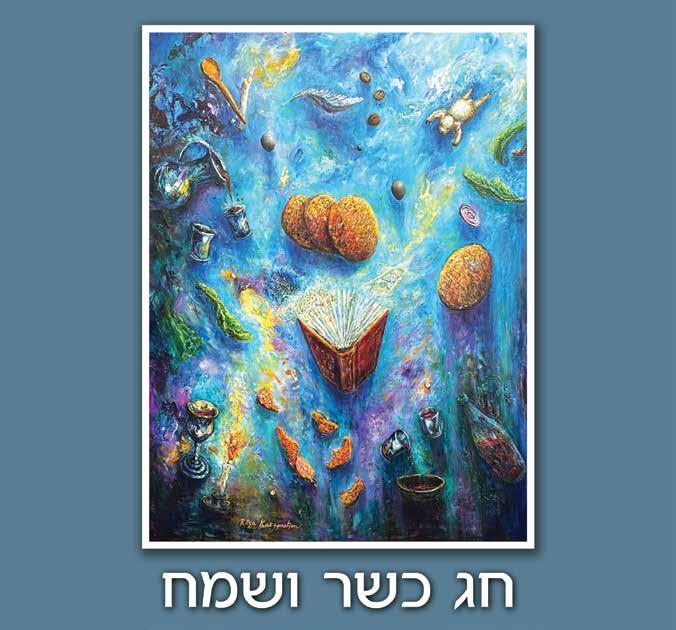













Cleaning for Pesach is not easy. It involves a lot of physical labor. There’s vacuuming and dusting, organizing and disposing, scrubbing and mopping. But I actually enjoy cleaning for Pesach. It’s an impetus that propels me to deep-clean my home and pushes me to organize areas that sometimes are conveniently forgotten in the busyness of life. I don’t see Pesach cleaning as backbreaking labor; there’s a higher purpose to all those pre-Pesach tasks.
When the Jews were in Mitzrayim, they weren’t able to listen to Moshe’s words because they were short of breath; they were so entrenched in their enslavement that their minds weren’t free. A free man is able set goals for himself; he’s able to dream and act upon those dreams. But a slave? He’s trapped in his master’s world, unable to escape even in his thoughts.
And perhaps that is what all this cleaning represents. As we sift through drawers and closets, deciding what to keep and what to discard, we are doing more than tidying our homes. We are reclaiming a sense of control over our surroundings and, in a deeper sense, over ourselves. The act of clearing out the old, of making space where there was once clutter, mirrors the inner process of stepping out of constraints and habits that hold us back. In that way, the physical work becomes a quiet declaration of independence, a reminder that we are not stuck, that we can choose differently, live differently, and prepare ourselves – both inside and out – for something greater.
Being free means being able to think for oneself. It means being able to make your own decisions, being able to determine your life’s purpose. And, as free people, we can decide if our lives will be ones of joy or ones of struggle. We can decide what thoughts to hold onto, what ideas to keep or
to push away, what values we wish to hold dear. Leaving Mitzrayim meant that we were exiting meitzarim, the restraints and constraints of what slavery represented.
On Pesach, within the busyness, we can become masters over our emotions and our thoughts. We can decide how we can uplift the yom tov.
It is not easy making 16 yom tov meals in one week. It is not easy hosting other families in your home. It is not easy washing endless dishes on little sleep or running after the ever-present matzah crumbs. But there are so many moments during Pesach that should make you stop and marvel and say, “Look at what I’ve been working for.”
Admire your beautiful family sitting around the Pesach Seder, each person different in their own way. Listen to the young ones’ melodious voices as they chant the Mah Nishtana. Take time to catch up with your relatives. See how the cousins – young and old – delight in each other’s company. Spend time in the kitchen with your grandchildren as they help you prepare a salad or bake a cake. Set your table with prettiest flowers and your finest dishes. Take pride in the beautiful menu that you created with minimal ingredients. Invite your friends and neighbors who may be feeling a bit lonely. Connect with the words of Hallel and the tunes of the davening. Shep nachas at how your children have grown up to be such fine parents. These are the glimpses of freedom that we all have over the holiday.
If, over the course of yom tov, we are able to tap into those joyful, uplifting moments, then really, truly we are free.
Wishing you a wonderful Pesach, Shoshana

Yitzy Halpern, PUBLISHER publisher@fivetownsjewishhome.com
Yosef Feinerman, MANAGING EDITOR ads@fivetownsjewishhome.com
Shoshana Soroka, EDITOR editor@fivetownsjewishhome.com
Nate Davis Editorial Assistant
Nechama Wein Copy Editor
Rachel Bergida Shana Brecher
Lani White Design & Production
Gabe Solomon Distribution & Logistics
P.O. BOX 266
Lawrence, NY 11559
Phone | 516-734-0858
Fax | 516-734-0857
Classified Deadline: Monday 5:00PM classifieds@fivetownsjewishhome.com text 443-929-4003
PAYMENT VIA CREDIT CARD MUST BE SUBMITTED ALONG WITH CLASSIFIED ADS
The Jewish Home is an independent weekly magazine. Opinions expressed by writers are not necessarily the opinions of the publisher or editor. The Jewish Home is not responsible for typographical errors, or for the kashrus of any product or business advertised within. The Jewish Home contains words of Torah. Please treat accordingly.
MONDAY WEDNESDAY TUESDAY THURSDAY FRIDAY SHABBOS SUNDAY






Career-driven programs built to professional standards.
Undergraduate Programs
B.O.T. Occupational Therapy
LL.B. Law
B.A. Finance & Real Estate
Graduate Programs
M.A. Art Therapies
MBA tracks including Fintech and Cybersecurity & Forensics


All-around student support: academic advising plus personal and social guidance throughout your journey.
for U.S. students and new olim seeking a smooth transition.






Dear Editor,
I’ve had hit and miss experiences when flying Delta, but I’ll do a rain check on writing my reviews on the airline.
Credit where credit is due, though. I applaud them for temporarily suspending special privileges when members of Congress fly, as a result of the TSA shutdown and the long airport lines resulting in that.
Especially as people fly to destinations for Pesach – and my parents recently joined the flock going to Florida – this has been a lose-lose situation. TSA agents work without pay for weeks on end. Passengers miss their flights. People spend at least twice as much time at airports on their feet – we’re talking about travelers who are elderly, disabled, ill, and even the healthy. It’s annoying to wait. I’m sure there’s more to this I’m not aware of.
People just simply want to earn a paycheck, pay their bills, and travel from point A to point B as quickly and as cheaply as possible. This will for sure get people to drive instead, especially for short haul flights, such as between JFK and Toronto, for example. This is not something to play politics with. Get to the bottom of it, already.
To all members of Congress – end this already.
To Delta – we applaud you. Members of Congress very well deserve this punishment.
Sincerely,
Not looking forward to a long TSA line, even if I have Precheck
To Our Community,
We need to have a serious conversation—one that’s long overdue.
Reckless driving is not just an inconvenience. It’s not just “kids being kids” or people in a hurry. It is dangerous, it is selfish, and it is killing people in our own neighborhoods.
Every day, we see cars speeding, weaving through traffic, ignoring stop signs, and treating our streets like racetracks. Nowhere is this more obvious than on Branch Boulevard, where driving at extreme speeds has become far too common. What should be a normal road used by families, pedestrians, and local residents has turned into a high-risk zone where one mistake can cost a life.
Let’s be clear: driving fast on Branch Boulevard—or anywhere in our community—is beyond ridiculous. It puts children crossing the street, parents walking with strollers, joggers, cyclists, and other drivers in immediate danger. It turns ordinary moments into potential tragedies.
And when something does happen, the consequences don’t just affect one person. Families are shattered. Friends are left grieving. A whole community feels the loss.
This is not someone else’s problem. This is ours. Something better change, and it starts now.
We all share these streets. We all have a responsibility to look out for one another. Slowing down, paying attention, and
Continued on page 22

Continued from page 20
respecting traffic laws are not optional—they are the bare minimum of what it means to care about the people around you. We can’t force the Town to implement traffic controls, but we can at the VERY LEAST slow down. What’s the hurry? Going nowhere fast? SLOW DOWN!
To those who continue to drive recklessly: ask yourself if saving a few seconds is worth risking someone’s life. Ask yourself if you could live with the consequences of that decision.\
To the rest of the community: speak up. Report dangerous behavior. Support efforts to make our streets safer. Talk to your friends, your family, and your neighbors about the importance of responsible driving.
We should not have to accept this as normal. We should not wait until a life is lost to take it seriously.
Enough is enough.
SLOW DOWN!
Sincerely, A Concerned Member of the Community
Dear Editor,
In this week’s Letter to the Editor, Rabbi Azose wrote that he experienced “a parent’s worst nightmare” in trying to bring his daughter back from Eretz Yisrael.
Our words must be chosen carefully. Language counts. Any of us with a full refrigerator and pantry should never say we are “starving.” Any of us with sweaters, coats and a heated home should never say we are “freezing.” The Jews on the Death March were starving and freezing. We may be cold. We may feel hungry. But we, baruch Hashem, are neither starving nor freezing.
Rabbi Azose, it may have been a frustrating, complicated and worrisome experience to bring your daughter back from Eretz Yisrael for Pesach. But baruch Hashem it certainly was not, “a parent’s worst nightmare.” Anyone who, lo aleinu, has buried a child due to illness, accident, war, a terror attack or the like has lived through a parent’s worst nightmare. Any one of us who are blessed to be able to hug our child should realize how fortunate we are and use appropriate language to describe it. May we never experience a parent’s worst nightmare.
Chag kasher v’same’ach, Sharon Herzberg Woodmere, NY
Dear Editor,
Irrespective of one’s political beliefs or party affiliation, I was appalled by the Democrats’ block of the GOP’s required voter ID.
Even a decade ago, my brother witnessed people in his polling place lying about who they were to vote. This is stealing, lying, illegal, and wrong.
At the same time, I strongly believe that voting should not be restricted to citizens. There are people in the U.S. on Green Cards and other visas unhappy with certain policies and politicians who unfortunately don’t have a say in the civics of this country, yet still pay taxes and contribute to this nation just like citizens. This should be changed to better America.
Dear Editor,
I read your recent reflection on the pre-Pesach bustle with great interest and, I’ll admit, a fair amount of recognition. The image of Central Avenue brimming with energy, optimism, and yes, impossible parking is one many of us know all too well. Your point about the value of preparation—the idea that Pesach is something we build toward rather than simply arrive at—is both true and important.
At the same time, I wonder if there is room to view that “bored” high school girl a bit more generously.
Not every form of preparation is visible, and not every family’s Pesach looks the same. For some, going away for Yom Tov is not an escape from responsibility but a necessity—whether due to space, finances, health, or simply the need for a different kind of support system. In those situations, a teenager’s role may indeed be less defined, her opportunities to help less obvious. That doesn’t necessarily reflect apathy or a lack of appreciation. Moreover, even within homes deep in the throes of cleaning and cooking, each person connects to Pesach differently. For some, it’s through the tangible acts of scrubbing and shopping. For others, it may come through learning, reflection, or even the quiet anticipation that doesn’t always translate into visible busyness. Enthusiasm for yom tov can take many forms, and it’s not always measured by how full one’s to-do list is.
As we navigate these hectic days, perhaps we can aim not only to involve others in the preparations but also to see them a bit more fully, and a bit more kindly.
Sincerely,
A Thoughtful Reader



Finland has something to smile about. For the ninth year in a row, the country was rated the happiest country in the world.
Each year, the World Happiness Report ranks countries based on the “life evaluations” of more than 100,000 global survey respondents. The report is a partnership between the University of Oxford Wellbeing Research Centre, Gallup, the United Nations Sustainable Development Solutions Network, and independent editorial board members.
On a scale of 0 to 10, with 0 representing the worst possible life for themselves and 10 being the best, respondents are asked to state where they see themselves on issues like freedom, inequality, positive and negative emotions, and healthy life expectancy.
“Many people think of happiness as a positive emotional state, associated with smiling, laughing, and feeling good.... However, people often use happiness to describe their assessments and judgements too,” according to the report’s website, which noted the last three years of responses are taken into account for rankings. “We care about both of these aspects.”
This year, all but one of the six happiest countries are Nordic, and nearly all of the top 10 are in Europe, according to findings published March 19.
Finland – once again – topped the list. Iceland, Denmark, Costa Rica and Sweden rounded out the top five.
They were followed by Norway, the Netherlands, Israel, Luxembourg, and Switzerland.
The United States came in 23rd on the report, two spots above Canada. Mexico ranked twelfth on the list this year.

Last week, Ecuador arrested a Syrian man identified as a terrorist by the United States. He was part of the Hezbollah terror group.
The arrest came as the government of Ecuadoran President Daniel Noboa, an ally of U.S. President Donald Trump, wages a crackdown on drug trafficking gangs, with Washington’s backing.
Ecuadoran Interior Minister John Reimberg said on X that the man had been arrested in a joint operation between immigration authorities and the national police intelligence service.
“Deportation proceedings have been initiated” against the man, who was identified only as M.K. and entered Ecuador without proper documentation, said Reimberg. The man was known to Ecuadoran authorities, having been arrested in the country in 2005 on charges of leading a drug trafficking network that allegedly moved millions of dollars on behalf of Hezbollah.
He had been granted provisional release in 2012.
“There are international terrorist groups that intend to operate in the country, and President Daniel Noboa’s Government will not allow it,” Reimberg declared.
Noboa last year issued a decree blacklisting Hezbollah and Palestinian militant group Hamas as terrorist organizations. The president claims the groups advise drug trafficking gangs operating in Ecuador.
Earlier this month, Ecuador launched operations against drug traffickers with support from the U.S. The two countries are part of a 17-country cartelfighting alliance launched by Trump at a summit earlier this month.
U.S. and Ecuadoran forces recently conducted joint strikes inside Ecuador. Ecuador’s military recently sank a “narco sub” near its northern border. Earlier this month, the FBI said it would open an office in Ecuador to investigate organized crime, money laundering, and corruption in conjunction with local police.
Noboa has spent the past two years
targeting cocaine traffickers, but the rates of associated crimes including murders, disappearances and extortion have not fallen despite his efforts.

Belarusian President Alexander Lukashenko signed a friendship treaty with Pyongyang this week. At the signing, he gifted North Korean leader Kim Jong Un with a rifle.
The two leaders, both key supporters of Russia’s war in Ukraine, agreed to cooperate more closely and resist pressure from the West.
Lukashenko joked to Kim that he brought him an automatic rifle “just in case enemies appear,” according to a vid-
eo released by Belarusian state media.
In turn, Kim gave Lukashenko a sword and a vase featuring a portrait of the Belarusian leader.
“I can tell you as a friend, as a person who has already seen everything in this world: a great future awaits your country with this hardworking, disciplined people,” Lukashenko told Kim, according to Belarus news agency Belta.
At a time when “the norms of international law are openly ignored and violated by powers that be,” countries need to cooperate in “protecting their sovereignty and improving the well-being of our citizens,” he added.
Lukashenko described the friendship treaty as fundamental, while Kim said it would “further guarantee the stable development of bilateral relations,” Belta reported.
The two leaders also agreed to cooperate in fields ranging from agriculture to information to public health, KCNA reported.
North Korea and Belarus are heavily-sanctioned by the West for human rights abuses and for supporting Russia’s war in Ukraine. Pyongyang faces separate sanctions for its nuclear weapons program.
Pyongyang has been supplying sol-
diers to Russia’s campaign. An estimated 1,000 North Korean soldiers died in the first few months of Moscow’s war in Ukraine.
In a message to Putin this week, Kim said, “Pyongyang will always be with Moscow,” according to North Korea’s KCNA.

If you’re looking to spend Pesach in Iran, I’d suggest you go elsewhere. Recently, the State Department updated its travel advisories.
In its interactive world map, the agency has branded several Middle Eastern countries as unsafe for Americans to travel to. Saudi Arabia, Oman, Kuwait, and Bahrain have moved from Level 2 to Level 3 advisories, meaning Americans should exercise caution or reconsider their travels to those locations altogether.
Want to head to Tehran? Iran has been branded a “Level 4: Do Not Travel” destination, with Americans facing risks of wrongful detention, violence, and kidnapping amid the unrest there.
Last week, the State Department issued a worldwide security alert warning Americans to be cautious about threats from groups linked to Iran.
“From now on, based on the information we have about you, even parks, recreational areas, and tourist destinations anywhere in the world will no longer be safe for you,” Iranian Brigadier General Abolfazl Shekarchi warned Americans and Israelis on Iranian state television.
Other countries where you’re warned to stay far away from include Afghanistan, Haiti, Iraq, Libya, Russia, Somalia, Sudan, Ukraine, and Yemen, which all received Level 4 warnings. The U.S. may not have a consular presence in those nations, and U.S. citizens there could have difficulty accessing services. Russia, in particular, has been known to wrongfully detain Americans for years.
Countries with a Level 3 advisory –meaning Americans should reconsider travel – include Bahrain, Colombia, Honduras, Israel, Nicaragua, Qatar, Saudi Arabia, the United Arab Emirates, and Venezuela.






Exercise caution – Level 2 – if you’re heading to Cuba, the Dominican Republic, France, Greenland, Italy, Mexico, and the United Kingdom.
Parts of Mexico have been designated as Level 4 zones, including Sinaloa and Colima, while other states like Jalisco and Baja California are designated Level 3 due to cartel activity.

International Olympic Committee president Kirsty Coventry announced on Thursday, March 26, that only women who were born women can compete in women’s events at the Olympics, starting with the Los Angeles Summer Games in 2028.
The announcement reverses its 2004 decision to allow the participation of athletes who were not born female to compete in women’s sports. To date, only one such person has competed at the Olympics in 2021, a weightlifter from New Zealand who did not make it past his opening round of competition at the Tokyo Games.
Women who want to compete at the Olympics will have to do a one-time test to screen for the presence of the SRY gene to confirm that they are female.
Coventry noted that there are some countries that ban genetic testing.
“If it is illegal in a country, athletes will have the possibility when they travel to other competitions to be tested there,” Coventry said. “This is also why we’re saying the policy comes into effect now, but will be implemented in LA 28. So we have time to walk through this process with everyone.”
“The scientific evidence is very clear,” she said in a video released by the IOC. “Male chromosomes give performance advantages in sports that rely on strength, power or endurance.”

Besieged by growing evidence of meddling by Hungary’s security service and Russia in a high-stakes election next month, the right-wing government of Prime Minister Viktor Orban on Thursday said it had opened an espionage case against a prominent investigative journalist who has chronicled dirty-trick operations by Russian intelligence agencies.
The government’s accusations against the journalist, Szabolcs Panyi, came 17 days before a general election that opinion polls indicate could end Orban’s 16year tenure.
Orban, who has been endorsed by President Donald Trump as a “true friend, a fighter and a WINNER,” is Europe’s longest-serving head of government and the standard-bearer for nationalist political forces in Europe and beyond.
He has also been a staunch friend of Russian President Vladimir Putin, consistently blocking European Union efforts to support Ukraine and impose sanctions on Russia for its full-scale invasion. Orban’s government has pursued an escalating campaign against critics in the news media and political rivals as opinion polls show no sign of turning in his favor.
After a series of recent revelations that upset the government, Gergely Gulyas, Orban’s chief of staff, told a weekly news briefing in Budapest on Thursday that Panyi had “engaged in spying against his own home country in cooperation with a foreign state,” without specifying which. The Justice Ministry, he added, was opening a case for espionage.
Panyi dismissed the government’s claims as a “false” and “completely unjust accusation,” lamenting in a post on Facebook that Hungary, a member of NATO and the European Union, was adopting methods that “really belong in Putin’s Russia, Belarus and similar regimes.”
“I am a Hungarian patriot; I serve the Hungarian public,” he added, deriding what he called “political theater” by the government.
Orban, who has won four elections in a row, faces a tough challenge before

36 the April 12 balloting from the opposition Tisza party of Peter Magyar, a conservative former Orban loyalist who split from the governing Fidesz party in 2024.
The prime minister has put hostility to Ukraine at the center of his election campaign, branding Magyar as a warmonger who, if elected, would put Ukrainian interests first and drag Hungary into war against Russia. (© The New York Times)
were wounded in a Hezbollah anti-tank missile attack in southern Lebanon.
Staff Sgt. Ori Greenberg, 21, of the Golani Brigade’s Reconnaissance Unit, from Petah Tikva, was the third IDF soldier to be killed in Israel’s renewed ground offensive against Hezbollah in southern Lebanon.
According to an initial IDF probe of the incident, at around 2 a.m., the Golani soldiers identified several Hezbollah operatives in their area of operations in southern Lebanon. The troops exchanged fire with the Hezbollah gunmen, and during the battle, Greenberg was killed and another soldier was lightly hurt.

On Thursday, the military said that an IDF soldier was killed overnight during a firefight with Hezbollah operatives in southern Lebanon. Later in the day, an Israeli soldier was killed and four others
The military said the Golani soldiers managed to kill several of the Hezbollah operatives during the clash and were searching the area for the remaining gunmen.
“Ori was a boy who overcame all obstacles and all his fears,” his father Yaron said. “He always pushed himself forward with determination, with love, with a good heart. And they told us that’s how he met his death.”
Sgt. Aviaad Elchanan Volansky, 21, of the 7th Armored Brigade’s 77th Battalion, from Jerusalem, was killed later in the day.
Israel has responded to Hezbollah’s

attacks with heavy airstrikes on Hezbollah targets and by deepening its presence on the ground in Lebanon. Lebanese state media said Israeli strikes killed at least five people on Thursday, two of them in a raid on a building in the Nabatiyeh area in the south.
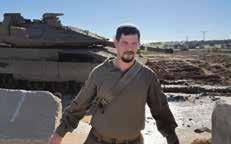
Volansky, the second soldier killed by Hezbollah on Thursday, is the son of Defense Establishment Comptroller Brig. Gen. (res.) Yair Volansky, who previously commanded the 401st Armored Brigade.
According to an initial IDF probe, Hezbollah operatives launched two anti-tank missiles from an area north of the Litani River in the eastern sector of southern Lebanon, targeting an Israeli Merkava tank. The first missile was intercepted by the Merkava’s TROPHY active protection system, while the second struck the tank, killing Volansky and wounding other crewmembers, according to the probe.
The IDF said two officers and two soldiers of the 77th Battalion were lightly wounded in the incident.
Lebanon, meanwhile, said it would complain to the United Nations Security Council over the Israeli attacks. That statement came as the government is contending with internal divisions in its government after its decision this week to declare the Iranian ambassador persona non grata. In response, two ministers from Hezbollah and two from its ally Amal boycotted Thursday’s cabinet session.
Dozens of protesters gathered near Iran’s embassy on the outskirts of south Beirut, where Israel has repeatedly bombed in recent weeks, some waving Iranian or Hezbollah flags amid chants of “Death to America, death to Israel.”
Also Thursday, Hezbollah denied that it had any presence in Kuwait, a day after the Gulf country announced more arrests of people allegedly linked to the terror group.
“For the third time, Hezbollah reiterates its complete denial of the accusations” made by Kuwait’s interior ministry, the group said in a statement.
“Hezbollah has no presence in the state of Kuwait or any other country,” the statement adds, calling the accusations “removed from reality and devoid of truth.”

A U.S.-backed proposal to end the war in Gaza would require Hamas to dismantle its vast tunnel network and surrender its weapons in stages, according to a plan presented by aides to Donald Trump.
The proposal, drafted by Trump’s so-called “Board of Peace,” lays out an eight-month timeline aimed at fully demilitarizing Gaza. It begins with a U.S.-supported committee of Palestinian technocrats taking over governance and security and ends with a complete Israeli withdrawal once the Strip is verified to be free of weapons.
At the center of the plan is a sweeping disarmament process. Under the framework, all armed groups in Gaza — including Palestinian Islamic Jihad — would be required to give up their weapons under the principle of “one authority, one law, one weapon.” A newly formed body, the National Committee for the Administration of Gaza, would oversee security, while a verification panel would monitor compliance.
The most sensitive demand is Hamas’s agreement to dismantle its underground tunnel system, long seen as a cornerstone of its military strategy. During the plan’s third phase, the group would hand over heavy weapons and “allow the destruction of all tunnels, explosives and military infrastructure,” according to the document.
“It has been presented to the parties, and the engagement on it is very serious,” Board of Peace High Representative for Gaza Nickolay Mladenov said in remarks at the United Nations Security Council’s monthly session on the Israeli-Palestinian conflict.
Mladenov’s briefing to the Security Council was the first time aspects of the disarmament offer were disclosed on the record.
The proposal follows an October 2025 ceasefire that halted two years of war triggered by Hamas’s October 7, 2023 attack on southern Israel. While the truce stopped large-scale fighting, Gaza remains divided, with Israeli forces controlling significant territory and Hamas maintaining influence over the rest.


Publicly, Hamas has rejected calls to disarm. Privately, however, some officials have indicated a willingness to consider it if tied to a broader political process leading to Palestinian statehood — a condition not included in the current plan. Israel, led by Benjamin Netanyahu, has repeatedly opposed such a pathway.
Other Palestinian factions have already criticized the proposal, arguing it prioritizes disarmament over reconstruction and a full Israeli withdrawal.
If implemented, the plan would unfold in five stages, beginning with a rapid transfer of administrative control and culminating in final verification of disarmament and the launch of large-scale rebuilding efforts.
Whether Hamas ultimately accepts the terms remains unclear, but the proposal underscores the central challenge facing negotiators: ending the war will likely hinge on resolving the question of Hamas’s weapons — and the future political shape of Gaza.

According to Israel, the commander of the Islamic Revolutionary Guard Corps Navy, Adm. Alireza Tangsiri, was killed in an airstrike on Thursday, the latest senior Iranian official targeted in a relentless hunt-and-kill campaign. The IDF later said all of the IRGC Navy’s key commanders had been killed in the strike.
Israel took Iranian Foreign Minister Abbas Araghchi and Parliament Speaker Mohammad Bagher Qalibaf off its hit list after Pakistan requested that Washington not target them. Qalibaf is reportedly the “top man” with whom U.S. President Donald Trump said he has been indirectly negotiating on terms for ending the conflict.
“The IDF eliminated the commander of the IRGC Navy, the person directly responsible for the terror operation of mining and blocking the Strait of Hormuz to maritime traffic,” Defense Minister Israel Katz said during a morning assessment with military officials.
Katz said the strike was a “message” to the IRGC: “The IDF will hunt you down
and eliminate you one by one.”
He underscored, “We will continue to operate in Iran with full force to achieve the objectives of the war.”
In addition to Tangsiri, the strike also killed the IRGC Navy’s intelligence chief, Behnam Rezaei, and the rest of the navy’s top leadership.
Tangsiri was targeted in the Iranian port city of Bandar Abbas while meeting with senior commanders of the IRGC Navy, according to the military.
“Over the years, Tangsiri was responsible for attacks on oil tankers and commercial vessels and personally threatened the freedom of navigation and trade in the Strait of Hormuz and the international maritime domain,” the IDF said. During the current war, the IDF said he “led efforts to close the Strait of Hormuz and advanced terror attacks in the maritime domain, one of the primary figures responsible for disrupting the global economy.”
The IDF said the killing of Tangsiri and the IRGC Navy leadership “constitutes an additional significant blow to the command-and-control arrays of the IRGC and its abilities to orchestrate terror activities in the maritime domain against countries in the region.”
Prime Minister Benjamin Netanyahu said, “We are continuing to strike, with full force, targets of the Iranian terror regime.
“Last night, we eliminated the commander of the Islamic Revolutionary Guard Corps’ navy. This individual has a great deal of blood on his hands, and he was also responsible for leading the closure of the Strait of Hormuz.”

An Israel Defense Forces soldier was killed in a Hezbollah rocket attack on troops in southern Lebanon overnight between Friday and Saturday, the military announced early Sunday morning.
Sgt. Moshe Yitzchak Katz, 22, of the Paratroopers Brigade’s 890th Battalion, was killed in a Hezbollah rocket attack on troops in southern Lebanon on Friday

night. Moshe was a lone soldier, hailing from New Haven, Connecticut.
“My oldest son, with a zest for life and jokes,” Moshe’s father Mendy wrote on Facebook. “My heart is shattered and the wound is real.”
Three other soldiers were moderately wounded in the attack that killed Moshe and were taken to hospitals for treatment.
Moshe had come to Israel on his own to serve in the IDF as a lone soldier, following in the footsteps of his sister.
Katz’s parents, Mendy and Devorah, were in Israel visiting their son earlier this month and managed to make it back to the U.S. after the war in Iran started on February 28.
Moshe Yitzchak “chose to leave an entire life in the U.S.… and enlist to the IDF out of a deep sense of mission and Zionism,” Defense Minister Israel Katz wrote on social media. “I salute him for his heroism and his contribution to the security of the State of Israel.”
The IDF has pushed troops deeper into Lebanon and carried out massive strikes on Hezbollah strongholds there after the Iran-backed terror group renewed its rocket attacks on Israel on March 2. Since Hezbollah renewed its attacks on Israel on March 2, five IDF soldiers, including Moshe Katz, have been killed fighting in
southern Lebanon. Another two civilians were killed by Hezbollah rockets, and an Israeli civilian was mistakenly killed in the north by Israeli artillery shelling.

It was only a matter of time before the Houthis, a proxy of Iran, joined the fight.
On Saturday morning, the terror group that resides in Yemen launched a ballistic missile attack at southern Israel, triggering sirens in Beersheba and surrounding areas, in the first offensive from the Iranaligned group since the start of the war with Iran.
In a statement, the Houthis claimed responsibility for the attack, saying they had targeted “sensitive Israeli military sites” with a “barrage of ballistic missiles.”

Thankfully, the IDF was able to shoot down the missile and there were no injuries reported.
Several hours later, a cruise missile launched from Yemen was shot down over the Red Sea, according to the IDF. No sirens sounded in Israel for that attack, as no towns were under any threat, the military said. In the evening, a drone, suspected to have been launched from Yemen, was intercepted by air defenses over the southernmost city of Eilat, according to the IDF.
Just a day before the attacks, the Houthis warned that it would intervene if the United States and Israel continue their fight with Iran.
“We confirm that our fingers are on the trigger for direct military intervention” if any new alliances join Washington and Israel against Iran and its allies, or if the Red Sea is used for “hostile operations” against Iran, the rebel group’s military spokesperson Yahya Saree said in a televised speech late Friday evening.
Saree also said the Houthis were prepared to act if what he called the escalation against Iran and the “axis of resistance” continued.

On Thursday, Nicolas Maduro, former leader of Venezuela, and his wife, appeared in federal court in Manhattan. It was nearly three months since American forces stormed Maduro’s home and took him and his wife to the United States to face narco-terrorism and drug trafficking charges
Since his January arrest, Maduro has been held in a secure unit described as a “jail inside of a jail” for the most high-risk detainees at the Metropolitan Detention Center in Brooklyn. He is being kept under “special administrative measures” in what corrections officers dub the “SAMs unit.”
Special administrative mea-
sures are designed to restrict contact prisoners have with the outside world in cases where officials believe their communications could bring harm to others. The U.S. Department of Justice states that only the attorney general of the United States is authorized to direct the Bureau of Prisons to implement special administrative measures.
Maduro’s wife, Cilia Flores, is being held in a different unit in the same facility.
Maduro is only allowed to leave his cell to shower, visit his lawyer or go for solo recreation for an hour a day. Those under special administrative measures are isolated from other inmate contact.
Under 24-hour surveillance, Maduro is accompanied by two corrections officers and a higher-ranking lieutenant any time he moves within the unit. No one can come in from outside without approval; everyone has to be signed in and signed out.
Maduro pleaded not guilty to all charges and proclaimed himself a “prisoner of war” at his arraignment on January 5. “I am innocent. I am not guilty. I am a man, the president of my country,” he told Judge Alvin Hellerstein.
Lawyers for Maduro and his wife have moved to dismiss the case and, in a court filing, argued that the Trump administration is blocking the Venezuelan government from paying their legal fees in violation of their constitutional rights.
Due to U.S. sanctions, a license from the Treasury Department’s Office of Foreign Assets Control (OFAC) is needed for Venezuela’s government to pay the couple’s attorneys. In court filings, Maduro’s lawyer Barry Pollack claimed that licenses were initially granted, then revoked, and that OFAC has refused to reinstate them.



44 It will be the first time a sitting U.S. president’s signature has appeared on paper notes.
“There is no more powerful way to recognize the historic achievements of our great country and President Donald J. Trump than U.S. dollar bills bearing his name, and it is only appropriate that this historic currency be issued at the Semi-quincentennial,” Treasury Secretary Scott Bessent said.
Trump’s likeness is set to appear on a variety of other 250th anniversary materials issued by the government. Earlier this month, Trump’s handpicked Commission of Fine Arts approved a large commemorative gold coin featuring an image of the president standing near a desk.
The commission is also reviewing a proposed $1 coin featuring Preident Trump. Those plans have raised legal questions because it’s against U.S. law to display the image of a sitting president or living former president on currency. A president may be featured on a coin no sooner than two years following the president’s death
A sitting president is not prohibited from appearing on commemorative coins. Democrats in Congress have introduced legislation to prohibit any living or sitting president from being featured on any U.S. currency.

Republicans gathering at the Conservative Political Action Conference this week struck a unified tone on one of the most divisive issues facing the party: U.S. strikes on Iran.
Inside the convention halls in Grapevine, Texas, speakers and attendees largely rallied behind President Donald Trump, even as public support for the conflict may be slipping nationwide. The war, now weeks underway, has rattled global markets and raised concerns among voters about its long-term costs.
On stage, Franklin Graham framed the conflict in stark moral and religious terms, praising Trump’s decision to act. “He stepped up to protect Israel and the Jewish people,” Graham said, warning of what he described as the threat of “nucle-
ar annihilation.” He added, “Thank G-d for President Trump.”
Other speakers echoed that message, including Mercedes Schlapp, who noted that the war could ultimately free the Iranian people. “The madness needs to stop,” she told the crowd. “We’ve got to make Iran free again and…make sure America stands strong by their side.”
Matt Gaetz emerged as one of the few cautionary voices, warning that U.S. policy risked being overly aligned with Israeli interests, a critique he has voiced before.
Among attendees, support for the war remained visible and vocal. Dozens of Iranian-Americans waved both U.S. and Iranian flags, backing military action and calling for regime change. Nima Poursohi, wearing a “Persians for Trump” shirt, said the stakes justified the risks. “Dropping bombs and military action is scary,” he said, “but living under an Islamic regime is a lot scarier.”
The conference also featured emotional testimony from Iranian activists who survived violent crackdowns during protests, reinforcing the moral case for intervention in the eyes of many attendees.
Even so, as the conflict continues without a clear endpoint, the political calculus for Republicans may grow more complicated in the months ahead.

Alen Zheng and his siter Ann Mary Zheng were charged after they left an improvised explosive device outside MacDill Air Force Base in Tampa, Florida, earlier this month, federal prosecutors announced on Thursday.
Indictments were unsealed charging the siblings in connection with the device, which was found at the base’s visitor center on March 16. FBI Director Kash Patel said Alen Zheng fled to China, where he remains, and Ann Mary Zheng is in custody for accessory and evidence tampering. She had her initial appearance before a judge on Thursday morning.
“This FBI, working with our partners, will continue pursuing all those responsible and ensure they are brought to justice, no matter where they are,” Patel assured.
Law enforcement in Tampa responded to a report of a suspicious package at

































Discover a vital, growing, and well-paid career in Sonography.
Diagnostic medical sonographers are more in demand than ever. At Touro’s Machon L’Parnasa, our small class sizes, personalized attention, and strong track record in the health sciences will set you up for success. Our program requires only a high school diploma or equivalent and is designed for students who wish to quickly qualify for a career as a sonographer—in less than two years! With affordable tuition and financial aid packages, you’ll be ready for what’s next!

Sign up for a virtual open house! April 14th at 5 pm


machon.touro.edu/ultrasound

MacDill’s visitor center near an entrance gate to the base on March 16, when the device was found by base security. Investigators with the FBI’s Tampa field office said last week that field screening of the package identified “possible energetic materials,” though final lab analysis hadn’t yet been completed. It was planted outside the visitor center on March 10. Minutes after it was left, a 911 call was placed reporting that there was a bomb on the base, though the caller did not provide a specific location.
MacDill personnel searched the base on March 10 but didn’t find the device. It was ultimately discovered in a secluded area at the visitor center. On March 11, one day after the bomb was planted, Alen Zheng and Ann Mary Zheng purchased plane tickets to China and sold the vehicle that had been used to transport the device to the base visitor center.
The siblings then left for China from Tampa on March 12, though Ann Mary Zheng returned to the U.S. on March 17, U.S. Attorney Gregory Kehoe said. Alen Zheng has not returned.
During their probe, investigators tied Alen to the phone used to place the 911 call to emergency personnel about the bomb at MacDill on March 10 and received footage from Best Buy showing him buying the phone, according to prosecutors.
Law enforcement also obtained a search warrant for Alen’s home and found components consistent with the device. His mother and sister also acknowledged to agents they knew he had planted the bomb at MacDill.
Kehoe said that the device did not detonate but “could’ve been potentially very deadly.” The motive is unknown, but, he said, “they obviously felt quite strongly about something or anything that the United States government was doing.”
Ann Mary Zheng faces one count of evidence tampering and one count of accessory after the fact for helping her brother flee and destroy evidence. Alen Zheng was charged with three counts: attempted damage of government property by explosion, unlawfully making a destructive device, and possessing an unregistered destructive device.
MacDill Air Force Base is home to U.S. Central Command, U.S. Special Operations Command and the Air Force’s Air Mobility Command. Kehoe said the base houses “extremely, extremely important assets for the Department of War that are obviously involved in ongoing operations in the Middle East and elsewhere,” a reference to the war with Iran.
MacDill, he said, is crucial “to the safety of the United States” and the American people.

A California jury delivered a landmark verdict last week, finding that Meta Platforms and Google bear responsibility for the mental health struggles of a young woman who became addicted to social media as a child.
The Los Angeles jury awarded $6 million in damages, concluding that the companies’ platforms were deliberately designed in ways that contributed to the plaintiff’s depression and anxiety. While modest compared to the tech giants’ vast valuations, the ruling is being seen as a turning point: the first time a jury has treated social media platforms as defective products rather than neutral tools.
At the heart of the case was a shift in legal strategy. Instead of focusing on harmful content, attorneys targeted the architecture of apps like Instagram and YouTube — features such as endless scrolling, autoplay videos, and constant notifications that they argued were engineered to keep young users hooked. “That’s called the engineering of addiction,” said lead trial lawyer Mark Lanier during proceedings.
The plaintiff, identified as Kaley, testified that her compulsive use began early — YouTube at age 6 and Instagram by 11 — and soon spiraled into isolation, body image issues, and a constant need for validation. She described sneaking off during school to check “likes” and struggling to focus on anything beyond her feeds.
Jurors ultimately agreed that the platforms’ design was a “substantial factor” in her distress. “We wanted them to feel it,” one juror, Victoria, said after the verdict. “We wanted them to realize this was unacceptable.”
The decision could ripple far beyond this single case. It is one of thousands of similar lawsuits pending nationwide and has already drawn comparisons to the legal battles against Big Tobacco in the 1990s. Still, both companies pushed back and vowed to appeal. In a statement, Meta said teen mental health is “profoundly complex” and cannot be blamed on a single platform, while Google argued that YouTube is “a responsibly built streaming platform, not a social media site.”

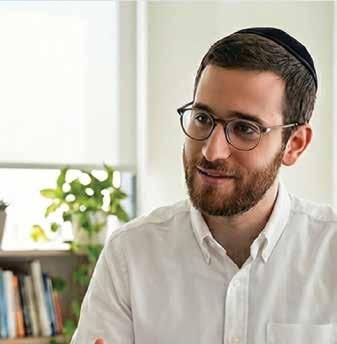




The verdict also comes amid mounting scrutiny of social media’s impact on children, with lawmakers and school districts increasingly moving to limit phone use. For now, the financial penalty may be small, but the message from the jury was not. As attorney Joseph VanZandt put it, “Today’s verdict is a referendum…that accountability has arrived.”

Every metro area in the United States experienced lower immigration rates during the year leading up to July 2025 compared with the previous year, according to new estimates released Thursday by the Census Bureau.
In about 75% of all counties, overall population growth — including immigration, domestic migration, births and deaths — either slowed or turned negative. Only 25% grew faster.
Large urban counties and border counties, which had experienced a surge in new arrivals in recent years, were among the hardest-hit parts of the country.
The new census estimates offer the most detailed picture yet of the demographic impacts from the immigration restrictions that started late in the Biden administration and have ramped up during the Trump presidency. The previous year brought record levels of immigration.
The census attempts to account for both legal and illegal immigration, as well as deportations and voluntary departures.
The numbers also captured the continuing effect of declining birth rates, as deaths outnumbered births in about two-thirds of U.S. counties. It is a sign that many communities are still struggling to keep their population levels up, even as the impact of COVID-related deaths has waned.
The nation’s overall population still increased last year by 1.8 million people, but the combination of low birth rates and dramatically slowing immigration led to one of the slowest growth rates in U.S. history. Some of the strongest population gains came in suburban counties, especially in the South, which continued to grow rapidly as they attracted people from other parts of the country.
The U.S. census numbers are a mea-

sure of the country’s demographic health and take account of births and deaths as well as immigration, emigration and deportation.
Kenneth Johnson, a demographer at the University of New Hampshire, said that normally, the main driver of population growth is people having children. But the decline in birth rate has shown few signs of reversing course.
“Now, it’s immigration fueling much more of the gain,” he said. “So any change in immigration has a huge impact on demographic trends.” (© The New York Times)

A new study is shedding light on yet another reason to stay active — your brain may depend on it more than previously understood.
Research published this month in Cell suggests that exercise could help repair a
weakening blood-brain barrier, a critical defense system that protects the brain from harmful substances. The findings, based on experiments in mice, point to a previously underappreciated connection between physical activity and long-term brain health.
As people age, the blood-brain barrier naturally becomes more permeable, allowing toxins to seep in and potentially contribute to inflammation and cognitive decline, including dementia. But scientists found that exercise triggers the release of a protein from the liver — known as GPLD1 — that appears to help restore the integrity of this barrier.
In older mice, including those with a form of Alzheimer’s disease, increased levels of this protein led to noticeable improvements in memory and learning. Even more striking, sedentary mice that were genetically modified to produce higher amounts of GPLD1 performed just as well on cognitive tests as their active counterparts.
“These results provide compelling evidence in animal models that exercise-related signals from the liver can improve brain function,” said Michelle Voss, a researcher who was not involved in the study.
The discovery builds on growing interest in “exerkines,” molecules released during physical activity that influence


50 various bodily systems. While most are produced by muscles, GPLD1 stands out because it originates in the liver and appears to work indirectly, not by entering the brain but by altering the cells that form its protective barrier.
Researchers found that GPLD1 reduces levels of a damaging protein that accumulates with age and weakens the barrier. With that threat diminished, the brain is better shielded, allowing it to function more effectively and even generate new neurons.
The study also found higher levels of GPLD1 in physically active people, suggesting the mechanism may extend beyond mice.
Still, experts caution that translating these findings into human treatments will take time. “Many promising exercise-related pathways in mice turn out to be more complicated in humans,” one researcher noted.
Scientists hope to begin early human trials within the next few years, potentially offering a new option for those unable to exercise. But researchers stress that no shortcut can fully replace physical activity.
“If you can, exercise,” the study’s lead author said. “It’ll always be one of the best things you can do.”

Facing years of recruitment shortfalls and mounting global tensions, the U.S. Army is expanding who can serve both in age and background.
Under new rules finalized last week, the Army has raised its maximum enlistment age to 42, up from 35, and eased restrictions for individuals with minor marijuana-related convictions. The changes, which take effect April 20, are part of a broader effort to widen the pool of eligible recruits as the military grapples with persistent enlistment challenges.
The updated standards bring the Army more in line with other branches. The Air Force increased its enlistment age cap to 42 in 2023, while the Navy set its limit at 41 a year earlier. Officials say aligning re-

quirements helps the Army remain competitive in attracting candidates.
The policy also removes a hurdle that previously barred some applicants. Recruits with a single prior conviction for marijuana possession or related paraphernalia will no longer need to obtain a waiver to enlist. In the past, such applicants often faced waiting periods of several years and additional screening before being considered.
Although the policy shift was initially introduced in 2023, the Army formally codified it into official regulations last week, making the changes permanent and standardized across recruitment offices.
Analysts say the move reflects both necessity and strategy. Katherine Kuzminski, director of studies at the Center for a New American Security, noted that raising the age limit allows the Army to draw from a broader and potentially more skilled population.
“Older recruits can bring valuable expertise, especially in fields like cybersecurity, logistics and transportation,” Kuzminski said.
A 2022 report she co-authored for Rand Corp. found that while older recruits are more likely to drop out during basic training, those who complete it tend to advance faster and reenlist at higher rates than younger counterparts.
The changes come after several difficult recruiting years. In 2022 and 2023, the Army fell roughly 15,000 recruits short of its annual targets. While it narrowly met a reduced goal of 55,000 enlistments in 2024, officials continue to search for ways to stabilize and strengthen recruitment moving forward.
With the latest adjustments, the Army is betting that a more flexible approach will help fill its ranks in an increasingly complex security environment.

Last week, New Jersey Gov. Mikie Sherrill signed legislation to prohibit on-duty law enforcement officers, including immigration agents, from wearing masks. Federal officials have already said they will ignore the new rule, which is likely to lead to a court challenge.
The initiative is part of a package of bills the Democratic governor enacted on Wednesday to protect migrant rights in New Jersey, which has the country’s second-largest percentage of immigrants after California.
Sherrill campaigned on a promise to combat President Donald Trump’s initiatives. The mask ban comes as Immigration and Customs Enforcement agents have increased the pace of arrests throughout New Jersey.
“I can’t believe we have to say this, but in the United States of America, we’re not going to tolerate masked, roving militias pretending to be well-trained law enforcement agents,” Sherrill said during a bill-signing ceremony.
A similar mask ban was signed into law last week in Washington state. Democrats have introduced bills in 17 other states that would prohibit police from wearing masks, according to the National Conference of State Legislatures. Most of the legislation includes exceptions for fire or water rescues, or to prevent the spread of disease. In Tennessee, the bill is named the “Stop American Gestapo Act.”
Lauren Bis, a spokesperson for the Department of Homeland Security, which oversees ICE, said that federal agents would not stop wearing masks.
“To be crystal clear: We will not abide by this unconstitutional ban,” she said after the New Jersey Legislature passed the bill.
After being sworn in as governor two months ago, Sherrill set up an online portal and encouraged residents to upload videos of arrests by federal agents, most of whom now wear military-style neck gaiters over their faces.
Department of Homeland Security officials have said that agents must shield their identity to safeguard themselves and their families from online harassment and assaults, which they say have increased drastically during Trump’s second term.













Touro University is all in on one mission—your excellence. We’re here to help you become exceptional: highly successful, purpose-driven and ready to make a meaningful impact. The first step? Choose Touro. We’ll take you where you want to go.
BENJAMIN BLOOM
TOURO’S LANDER COLLEGE FOR MEN
TOURO COLLEGE OF DENTAL MEDICINE
FUTURE DENTISTS

52 immediately pay Transportation Security Administration agents, as lawmakers scramble to resolve a partial government shutdown that has disrupted airports nationwide.
The announcement comes as the Senate moved forward with a funding bill for most DHS operations, including TSA. However, the House must still approve the measure before it can take effect, leaving uncertainty over when paychecks will actually resume.
The stakes are high. Since the shutdown began in mid-February, roughly 480 TSA officers have quit after going weeks without pay, according to agency officials. The staffing shortages have triggered long security lines — in some cases stretching four to six hours — leading to missed flights and widespread travel disruptions during a busy season.
Trump, in a post on Truth Social, framed the move as an emergency measure. “I am going to sign an Order…to immediately pay our TSA Agents…and to quickly stop the Democrat Chaos at the Airports,” he wrote. He did not specify how the payments would be funded, though administration officials suggested the money could come from provisions tied to his 2025 tax legislation.
Meanwhile, Secretary Markwayne
Mullin would be tasked with carrying out the order if signed, though no timeline has been released.
Separately, Congress is advancing its own solution. If the House passes the Senate’s funding bill, TSA workers would begin receiving pay through normal appropriations, though only after the legislation is finalized and processed.
Questions also remain about back pay. Historically, federal workers receive full compensation after shutdowns end, and TSA leadership has pointed to that precedent. Still, exact timing will depend on when funding is restored and payroll systems restart.
Even once pay resumes, relief at airports may not be immediate. Training new TSA officers can take up to six months, meaning some locations could continue to face staffing gaps well into the summer.
Airlines and industry groups welcomed the administration’s push to restore pay, arguing it would help stabilize operations. But with two potential paths forward — executive action or congressional approval — travelers may continue to face uncertainty in the days ahead.


Joshua Fyksen likes to eat. In fact, he likes to eat so much that he’ll do it all day.
The Las Vegas resident recently broke a Guinness World Record by dining at 28 Michelin-star restaurants in New York in 24 hours.
His first stop was at Oxomoco in Brooklyn. He completed his restaurant-hopping, stomach-popping journey the next day at Gramercy Tavern in Manhattan.
Fyksen previously broke the record for the most Michelin-starred restaurants visited in 24 hours in 2023, when he hit 22 New York eateries in the allotted time. He later lost the record to Indian foodies Sujoy Kumar Mitra and Rajnish Kumar Tripathi, who visited 25 Michelin-star restaurants in Hong Kong in 2024.
Before deciding to tackle the challenge again, he asked around.
“I asked friends and family if I should go for it again, and I think my father put it best: ‘But I wasn’t done bragging!’” Joshua said. “Neither was I. So I got to work.”
He and his wife planned out a meticulous itinerary for his second time around whirlwind food adventure, which wasn’t cheap.
“I can’t even imagine the total cost – including the trip – or maybe I prefer not to,” he told Guinness World Records “But the food alone cost $976.97, plus tips. Transportation between restaurants was another $474.37.”
Still, the food was worth it.
“The highlights for me were the Jonah crab salad with Apple and Wasabi at Le Pavillon, the Scallop Dumpling with English Peas and Foie Gras at Tuome, and the Tortellini Pomodoro at Torissi,” he said.
“Honestly, there wasn’t a single dish I didn’t enjoy this time around.”
Food for thought.
Some people welcome spring by opening their windows and planting flowers.
Others? Well, they just burn their socks.
In the Chesapeake Bay town of Annapolis, that’s what people do.
“I like to watch the socks burn, something about that,” Mary Keller, a lifelong Annapolis resident, said.
The town hosts an annual festival timed to coincide with the spring equinox. Hundreds join in.
Kelly Swartout, vice president of development at the Annapolis Maritime Museum & Park, explains that it all started in 1977 “during one of the coldest seasons we had.” The bay froze over and “a local sailor got so fed up with the cold weather that he decided he was going to take his socks off and burn them.”

Bob Turner, a boatyard worker, supposedly found two things unbearable — winter and wearing socks — so he decided to toss his into a bonfire. He told his coworkers, “‘I’m not putting them on again until next winter,’” he recalled to a magazine in 2015.
It’s been a really cold winter. In fact, the start of the Annapolis Yacht Club’s annual “Frostbite” sailboat race series — so named because it runs in the winter — had to be delayed this year because there was too much ice in Spa Creek and the Severn River, where the races are held. It’s the first time that’s happened in 20 years.
“We had a real old-style winter, and it caught us a little bit by surprise,” Dick Neville, co-chair of the race committee, shared. “But it is what it is. And when the creek freezes, you can’t race.”
The sock-burning party culminates in a poetry reading. Annapolis poet laureate Jefferson Holland recites his “Ode to the Equinox,” which explains that revelers “burn their socks at the equinox” because: “Through the spring and the summer and into the fall/They go around not wearin’ any socks at all/Just stinky bare feet stuck in old deck shoes/Whether out on the water or enjoyin’ a brew.”
After the reading, the crowd comes out to burn the socks. Dozens of socks of all colors rain onto the flames.
The annual festival is “really just an excuse to drink,” one reveler said. “But build it around sock burning and bringing out the old and ringing in the new and you’ve got a good party.”
A party to knock your socks off.


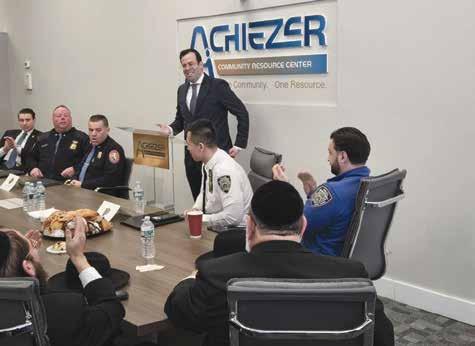
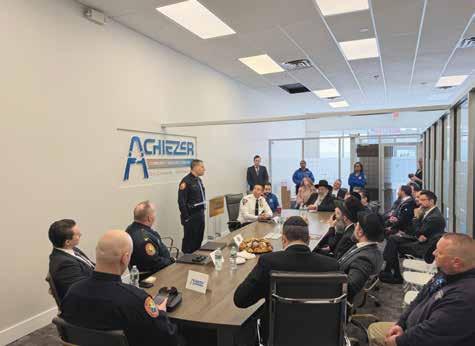
Achiezer hosted a pre-Pesach security briefing on Thursday at its headquarters, bringing together NYPD leadership from the 101st Precinct and senior Nassau County officials, including newly appointed 4th Precinct Commanding Officer Inspector Schiller.
Rabbonim, shul presidents, and security representatives from across the Five Towns and Far Rockaway filled the room amid rising antisemitic incidents nationwide and abroad.
Rabbi Yaakov Bender of Yeshiva Darchei Torah opened the event with
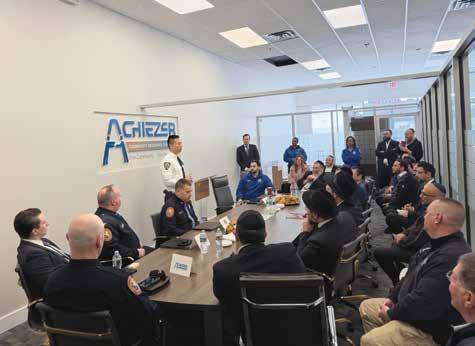
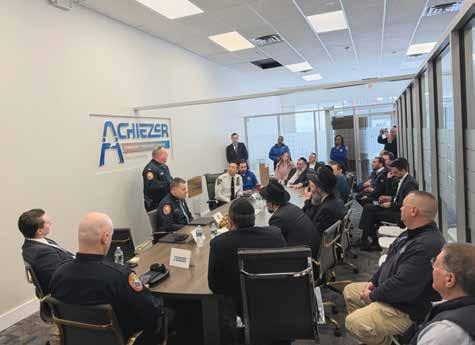
remarks praising law enforcement, with participation from Hatzalah, JCCRP, RNSP, and clergy liaisons. During the meeting, the 101st Precinct’s commanding officer, George Ng, was informed of his promotion to Deputy Inspector by NYPD leadership, a recognition of his
leadership and commitment, as Achiezer President Rabbi Boruch Ber Bender emphasized that “actions speak louder than words.”


The annual Fish Tank Competition at the Abraham and Sara Silber Middle School at the Yeshiva of South Shore continues to be a powerful showcase of student creativity and entrepreneurial thinking. Now in its fifth year, the program once again brought forward a wave of fresh ideas and inspired solutions, demonstrating the remarkable potential of our students.
Over the past several months, participants fully immersed themselves in the process of building original business concepts. From crafting thoughtful business

plans to developing prototypes, designing presentations, and producing pitch videos, students approached each stage with focus, determination, and a high level of professionalism.
What was most striking was the originality behind their ideas. Students embraced creative thinking, developing innovative yet practical solutions to real-world challenges. The projects reflected strong collaboration, thoughtful planning, and impressive execution across the board.
Congratulations to all who participated, and special recognition to the teams
With Color War behind us and Pesach break just around the corner at the Yeshiva University High School for Girls (Central), the season is shifting – and with it, the rhythm of the school year. Soon, Wildcats will enjoy two weeks away from campus. When we return, the final stretch of the 2025-2026 year will fly past. But before
the rush to the end of the year begins, the YUHSG community paused this week for a meaningful occasion: Tefillah Week. Coordinated by Director of Israel and Religious Guidance, Senior Grade Dean, and Judaic Studies faculty member, Mrs. Yael Axelrod, and YUHSG’s very own
F.I.R.E. (Friends Inspiring Religious Experiences) Luach Fellows – seniors


who earned top honors in the Fish Tank 2025–26 competition: First Place: Sky Stable: Moshe Abrams, Yehuda Caplan, Aaron Fox, Yosef Slansky Heat Tote: Shua Bahn, Raph Berg, Mordechai Halali, Eli Picker, Dovid Selengut Second Place: Pairlock Socks: David Tzionov Third Place:
Tefillin Sorter: Yosef Baruch, Akiva Halalai, Yonatan Kurland, Isaac Lefkowitz Honorable Mention: Drinkoozie: Mendel Stern, Ezra Behar Locker Link: Momo Gelbstein, Shaya
Raskin
Each group should take great pride in their accomplishments. Beyond their inventive ideas, students demonstrated perseverance, creativity, and the courage to think big.
A sincere thank you to our judges, Rabbi Burger, Mr. Fogel, and Mr. Glatt, for their time and insight. We also extend our appreciation to Mrs. Korman for her leadership and guidance in helping bring this incredible experience to life and to Rabbi Schulman for leading and guiding his students in the finale.
Michal Feder, Tamar Frankel, Eliana Goldman, Malka Lavner, Meira Levine, Shira Massihesraelian, and Dina Milchman – Tefillah Week offered Wildcats new ways to reflect on their relationship with prayer with daily offerings and opportunities that encouraged intention and spiritual growth. The week comes at a perfect time, as the YUHSG community anticipates the Yom Tov of Pesach. Monday morning brought an introduction to Tefillah Week, as well as a Tehillim bake sale. Tuesday featured a Tefillah Breakfast, as well as a special lunch chaburah with Mashgiach Ruchani, Rabbi Joshua Goller. Wednesday morning hosted a panel discussion on the role of intention in prayer featuring Mrs. Sydney Yaros, Mrs. Saritte Wolkenstein, and Mrs. Baila Walfish. Thursday morning offered all Wildcats a “choose your own Tefillah” session, including Musical, Outdoors, Explanatory, and Silent Davening options, and the senior class a special immersive experience: a trip to the Ohel Chabad Lubavitch, which featured a special tour and exploration of the site’s importance by Rebbetzin Chaya Rochel
Lieberman, as well as time and space for YUHSG students to say Tehillim. The trip to the Ohel was a precursor to YUHSG’s annual Senior Seminar program, which will take place in late April and will give the class of 2026 a well-rounded instructional overview of how to be an adult, including seminars in finance, education, career planning, and general life after high school. Thanks to Mrs. Axelrod and the F.I.R.E. Luach Fellows for coordinating such a dynamic and inspiring week!
After the holiday break, action at YUHSG will be high, as we enter the “Yom” season here in Central. Also taking place in April: YUHSG’s participation in the annual citywide Envision Shakespeare competition (in which YUHSG placed first overall last year), in which the troupe will be performing a scene from A Midsummer Night’s Dream, as well as Science Olympiad and events honoring Yom HaShoah, Yom HaZikaron, and Yom Ha’Atzmaut. And the rest of the semester will bring grade trips, senior internships, and – of course – the commencement ceremony of the class of 2026, which will be held on Monday, June 8.




There was a strong sense of energy and purpose last week when students from North Shore Hebrew Academy visited the Yad Leah Volunteer Center for a Pack for Israel experience.
After helping collect bags of clothing during recent drives in Great Neck, the students came to the warehouse to sort and pack those very donations, ensuring they would reach families in Israel. Their visit was part of a broader wave of chesed from the Great Neck community this spring, which included two clothing drives on consecutive weekends.
The warehouse was lively and up -
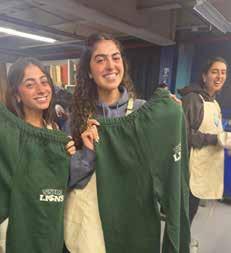
beat, with students working together to sort and pack donations. At one point, two students were surprised to discover sweatpants from their own school’s softball team—to everyone’s amusement.
Senior Matthew Radparvar, who volunteered both at the clothing drive and in the warehouse, reflected on the experience. “It was really meaningful to see the full process—from when the clothes leave your house to when they’re shipped off,” he said. “Now I better understand what items are best to donate.”
He was especially struck by the dignity Yad Leah provides. “I think it’s won-

derful that people in need can shop in stores just like we do, rather than rummaging through bins. It really preserves their dignity.”
Students were also impressed by the scope of the operation, which distributes over $10 million worth of clothing to Israel each year.
From collecting to sorting to packing, the students of North Shore Hebrew Academy demonstrated what it means to do chesed with heart, energy, and a strong sense of community.

The DRS Wildcats capped off a spectacular, undefeated season by winning the Tier I Finals at Yeshiva University’s annual Red Sarachek Invitational Tournament.
Coming off their back-to-back Yeshiva League championships under the leadership of Coach Moshe Cohen and Assistant Coach Jonathan Bayaz, the Wildcats entered the national tournament as the top-ranked team—and proved exactly why. In a hard-fought championship game, DRS defeated the Frisch Cougars 54–50, securing the program’s second Sarachek title.
The game featured standout performances across the board. Elisha Tsaidi delivered an electrifying third quarter, scoring 15 points in just four minutes to shift the momentum in DRS’s favor. Michael Solomon’s passion and heart were on full display in the second quarter, anchoring the team with his defensive intensity and leadership. Meanwhile, Gaby Spodek provided a steady, composed presence throughout the game, helping guide the Wildcats to victory.
A remarkable season, a complete team effort—and a championship finish for the DRS Wildcats.

As SKA alumni returned from Israel for the Yom Tov break, the school was abuzz with excitement as alumni eagerly returned to its halls, reconnecting with their teachers and students. For many, coming back to SKA is more than a visit, it’s a homecoming. The familiar classrooms, the voices of cherished teachers and rebbeim, and the unique ruach of the school create an environment that continues to resonate long after graduation.
In honor of the returning alumni, SKA faculty organized a wide array of shiurim offered at various times throughout the week. These sessions gave graduates the opportunity to connect in meaningful Torah learning while preparing spiritually for Pesach. Teachers enthusiastically welcomed their former students back, in an atmosphere that was both uplifting and deeply personal.
An SKA girl remains an SKA girl for life. The enduring relationships between students and faculty, and the shared commitment to growth in Torah and mitzvot, continue well beyond the years spent within the school’s walls.
Adding to the pre-Pesach inspiration was the “Haggadah Roundtable,” a dynamic program curated by the SKA Beit Midrash Fellows. Students were divided into small groups, where they explored the Haggadah in depth, engaging in thoughtful discussion and analysis. The program was designed to empower students to bring greater meaning and
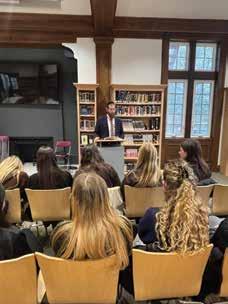
personal connection to their own Pesach sedarim. Through collaborative learning and guided exploration, students gained new insights into the themes of freedom, gratitude, and bitachon that define the Pesach experience.
Welcoming alumni back for shiurim and fostering meaningful student engagement through the Haggadah Roundtable, reflect the vibrant and enduring spirit of SKA. Whether past or present, every student remains part of a community dedicated to growth, connection, and lifelong learning.
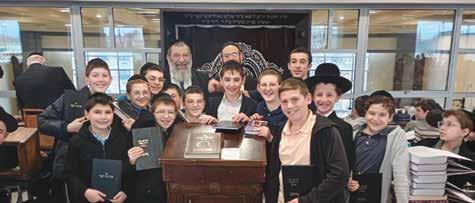
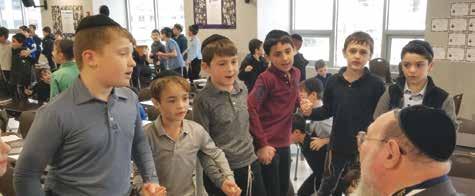
This year, Yeshiva Har Torah proudly participated in Civic Spirit, a nationwide organization dedicated to enhancing students’ civic knowledge and responsibility. As part of a special initiative marking the United States’ upcoming 250th anniversary, Civic Spirit hosted a contest inviting middle school students from across the country to design a new symbol representing America’s history.
We are thrilled to share that Yeshiva Har Torah student Itai Samuel earned first place in the painting and drawing category. Competing against students from many participating schools, Itai’s artwork stood out for its creativity and
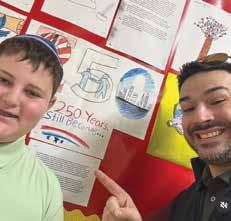
meaningful representation of our nation’s story.
Congratulations to Itai on this outstanding achievement!
ithin a class novel, the YOSS third, fourth, and fifth grades in Mrs. Lowenstein’s classes discover more than a story; they are taught the ELA curriculum straight from the pages. Vocabulary, punctuating quotes, literary devices such as similes and metaphors, as well as how an author stages suspense in the plot line in realistic fiction, science fiction, or historical fiction, are lifted right from the class novels.
Reading The Chalkbox Kid, third graders learned not only vocabulary and how commas fit into a compound sentence, but how to determine a character’s feelings from actions or speech. Students showed with facial expressions how Gregory really felt when his uncle was disrespectful to him. And in contrast, they noticed how small actions of Ivy showed her generosity toward Gregory.
Students learned the difference between feelings in a certain time and personality traits that are always a part of the character. Students were able to determine the theme of the book, kindness, through the characters’ actions and speech.
Fourth grade has discovered in The
Power of Un that a person’s choices in an ordinary day, even in science lab, can have ripples of effects in the following hours in ways seemingly unrelated to an unimportant but selfish choice. Students determined which choices unexpectedly turned Gib’s world upside down. Where did he go wrong? What behavior choice could have saved his sister from an accident? Through the use of an “unner,” which allowed Gib a do-over, multiple times, students break down how Gib’s small choices for good or not, add up to deeply influencing others’ lives, as well as his own. Here, again the theme of kindness reveals how choosing to help someone else before yourself sends ripples of good into the world.
Number the Stars, a book of Jewish historical fiction, takes place in Denmark during World War II. On almost every page, examples of semi-colon usage make an often misunderstood punctuation understandable to fifth graders. Experimentation with semi-colons in their own writing is a delightful outgrowth of reading this novel. Again, themes of kindness, the value of loyalty to friends, and remaining true to who you are are life lessons woven into the ELA curriculum.



At the Yeshiva of South Shore Abraham and Sara Middle School, seventh grade students are stepping into the world of finance and investing through their participation in the nationally recognized Stock Market Game. Over the course of this three-month program, students take on the role of investors, managing an online portfolio while gaining hands-on experience in the fundamentals of economics. Through this engaging simulation, students develop essential life skills such as budgeting, financial planning, and decision-making. Working collaboratively in teams, they learn to analyze stock data, research companies, build diversified portfolios, and understand key financial concepts. Each group begins with a virtual $100,000, carefully allocating funds as they navigate the ups and downs of the market.
In addition to trading, the program introduces students to a wide range of
topics, including careers in the financial sector, the structure of the three major U.S. stock exchanges, and the basics of bonds, mutual funds, and investment research.
The club was also excited to welcome a special guest speaker, Mr. Daniel Winkler, principal of the Middle School, who provided an overview of the market, shared ideas for further research, and engaged students in thoughtful discussion.
Students will continue managing their portfolios through the end of April and are eagerly anticipating their final regional and state rankings. With the skills and knowledge they are developing, it is easy to imagine that one day a Yeshiva of South Shore graduate may be offering financial advice or executing trades on Wall Street.
Special thanks to Mrs. Linda Kastriner, the Economics Club instructor, for her leadership and dedication!



For nearly nine years, Mekor Chaim has been steadily building a network that speaks to the needs of today’s young working professional.
Rooted in the Five Towns, Mekor Chaim extends beyond its home base, with active satellite communities in Brooklyn, Staten Island, and Baltimore. Today, it engages close to 250 individuals across its network, each one seeking a structured and meaningful way to continue growing in the next stage of life.
Led by Rabbi Dov Blumberg, Mekor Chaim has developed into a framework that integrates both ruchniyus and gashmiyus in a practical and relevant way. On the ruchniyus side, the organization of-

fers consistent night seder multiple evenings a week, alongside shiurim tailored to different levels and backgrounds. Chaburos and smaller learning groups foster accountability and real connection, enabling participants to build lasting chavrusas and relationships. The focus is on consistency, helping individuals sustain growth while navigating the realities of work and daily life.
A central pillar of Mekor Chaim is its emphasis on connection. Through carefully curated programming, dating events, and regular community gatherings, participants are given natural opportunities to form meaningful relationships. These ongoing touchpoints create


a sense of belonging and shared growth. Mekor Chaim has become a place where individuals build friendships, support systems, and for many, their future.
Alongside that, Mekor Chaim provides practical support through a discretionary fund available to its members. This fund assists with real life needs such as therapy, short term loans, and unexpected expenses, ensuring that members feel supported both spiritually and practically.
Recently, the organization expanded further with the launch of a Nshei division, bringing the same structure, programming, and sense of community to women seeking growth, connection, and support at this stage of life. All of this reflects a broader mission, creating a true life after yeshiva that is continuous, supported, and deeply relevant.
An important part of Mekor Chaim’s approach is accessibility. All programming, events, and support are completely free of charge. From its inception, Mekor Chaim has never charged participants, and it continues to stand by that commitment, ensuring that financial barriers never stand in the way of growth, connection, or opportunity.
The next stage of Mekor Chaim is already underway. With the recent purchase of a property on the outskirts of the Five Towns, within Hewlett, Mekor Chaim is taking a significant step forward in expanding its impact. This development is focused on creating a new Torah center designed to support the next

wave of growth, particularly for younger couples looking to settle in the New York area and build their lives within a strong and connected community. This new space will serve as a foundation for continued growth, offering an environment where individuals and families can establish themselves with access to consistent Torah, meaningful relationships, and a supportive network around them. At the same time, this expansion is a natural extension of what already exists. Mekor Chaim remains deeply committed to those in their 20s who are at the core of its community, continuing to invest in the programming, relationships, and support that have defined its growth. As the needs of the community continue to evolve, additional layers are being built around that foundation with care and intention. A full five page spread in the paper highlights the future center, and the night seder currently taking place in the Five Towns.
For more information regarding anything Mekor Chaim, call or WhatsApp Rabbi Blumberg at (516) 880-4257.




Students in HAFTR LS gained exposure to how matzah is made. From mixing and rolling to baking, each student at HAFTR LS had the opportu-
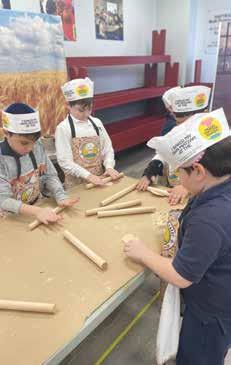
nity to take part in this fun, hands-on activity while also getting to take home their own handmade matzah.

Leah Ballen was planning a future as a computer programmer. Tzivia Koyfman knew she wanted a career in medicine but wasn’t sure which path to take. Neither was considering a career in pharmacy.
Today, not only have they found their professional direction as students at Touro College of Pharmacy (TCOP), but both have been inducted into the Rho Chi Society, the international honor society for pharmaceutical sciences. Their selection to the Rho Chi Society, which recognizes students in the top 20 percent of their class, reflects not only academic achievement, but also the journeys that led them to TCOP and helped shape their goals.
For both students, induction into Rho Chi represents a meaningful milestone and validation of their hard work. “It’s definitely very exciting,” Koyfman said. “It’s a very prestigious honor in the pharmacy world.”
Ballen agreed, noting that many members share similar qualities beyond strong grades. “You can see that the people who get involved, ask questions, and take leadership roles are the ones who excel,” she said.
Ballen’s path to pharmacy began in an entirely different field. Initially pursuing computer programming at Lander College of Arts & Sciences Touro’s Flatbush campus, she interned as a data analyst at a pharmaceutical research company where her interests began to shift.
“I always thought a pharmacy career meant working in retail drug stores,” Ballen said. “But being at the pharmaceutical company opened my eyes to a whole other side of pharmacy, that it’s a field with diverse options like developing drugs and being part of a hospital medical team versus just counting out pills. That’s when I decided to change what I was going for.”
After completing prerequisite science courses, Ballen applied to various pharmacy schools, ultimately deciding on TCOP for several practical reasons, including its in-person format and a schedule that aligned with her observance of Shabbos and the Jewish holidays. She was also impressed by TCOP students’ performance on the North American

Pharmacist Licensure Examination (NAPLEX). “The strong NAPLEX scores made me enthusiastic about continuing there,” she said.
A graduate of Touro University’s Lander College for Women, Koyfman was searching for a career in medicine but didn’t know which area. She settled on TCOP after learning how clinical pharmacists are part of the medical team in hospitals.
“You’re known as the medication expert among the medical team,” she said. “The doctors are looking at the overall medical condition of the patient while the pharmacist focuses on specific details in order to recommend the safest, most effective treatment and doses.”
Koyfman was also drawn to TCOP because it provides an additional semester of rotations beyond what other pharmacy schools offer. “That extra semester gives us so much more experience and lets us explore what we enjoy,” she said.
Both students credited TCOP’s curriculum with helping prepare them for both professional success and the Rho Chi recognition. The program’s structure, which revisits topics across multiple courses, reinforces learning and builds long-term understanding.
“We learn a topic in pathophysiology, then again in pharmacology, then again in therapeutics,” Koyfman said. “By the end, you’ve seen it multiple times and really know it.”
Ballen pointed to the accessibility of the faculty.
“You can always reach out to teachers, and we’re still connected to them during rotations,” she said.
From unexpected beginnings to academic recognition, Ballen and Koyfman’s journeys reflect how finding the right program can transform uncertainty into purpose, and achievement into opportunity.
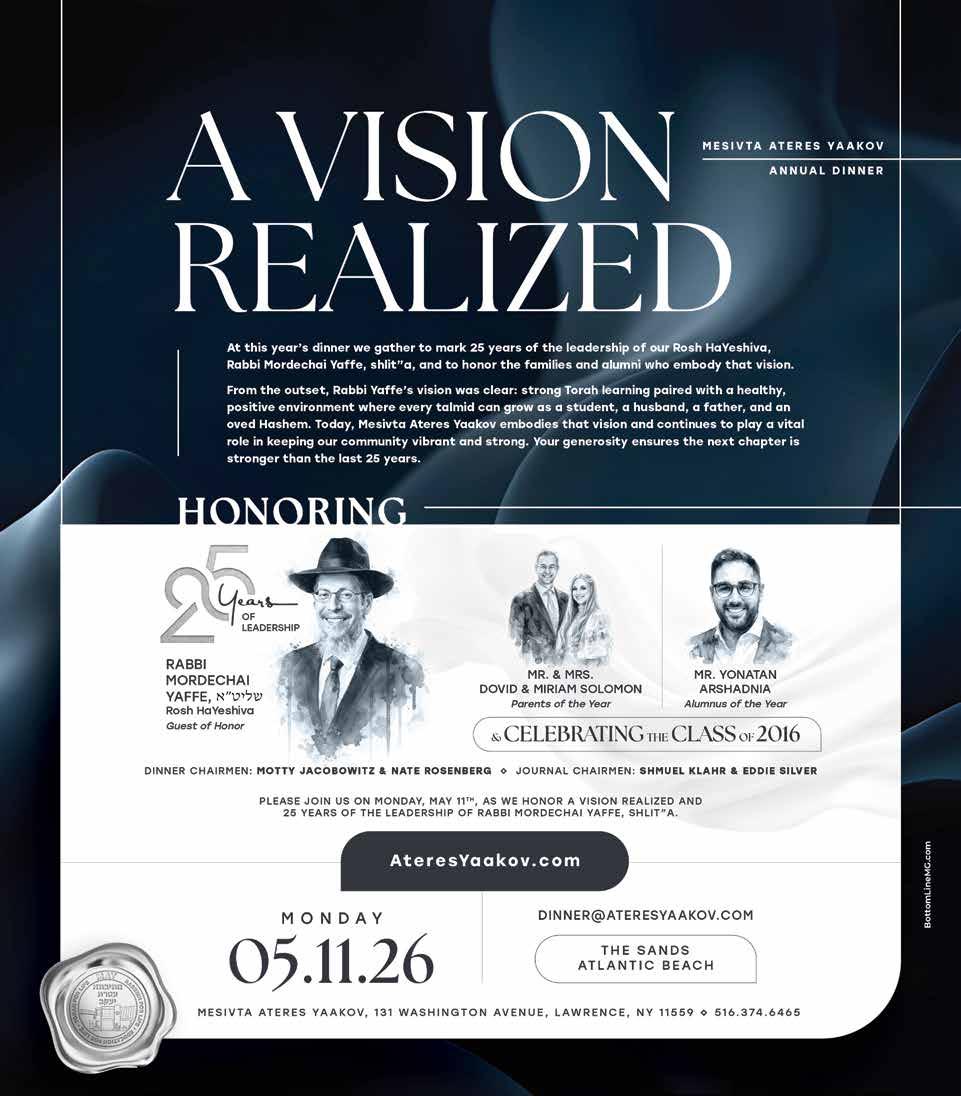
This Nissan, YSZ High School centered its programming on the legacy we carry as the women of Klal Yisrael. Framed by the words of Shir HaShirim — “Tze’enah u’re’enah bnos Zion…” — the focus was clear: the geulah we celebrate was brought about through women, and the future geulah will be as well. Pesach may come with nonstop cleaning and cooking, but the message to our girls was just as strong — the women in this story are its builders.
On Rosh Chodesh, students stepped into the lives of the women who shaped our history. Each group chose a heroine and rotated through “speed-dating” style cards, exploring her story and the middah she represents. With sources and guiding questions, they worked through moral courage with Yocheved, hope with Miriam, achrayus with Tziporah, empathy with Batya, and the quiet resilience of the women of that generation. The goal was not just to learn about them, but to recognize the middot we carry forward. Later in the week, the energy shifted

to preparation for the Seder. Tuesday’s Lightning Rounds gave girls the chance to hear short divrei Torah from their teachers on different parts of the Haggadah, jotting down ideas they were excited to bring to their own tables. This flowed into a Haggadah World Café, where interactive stations focused on core themes of the chag. Through sources, discussion, and creative reflection, the girls left feeling ready — not just to attend the Seder, but to contribute to it.
Heritage Day, as always, was a highlight. Mrs. Zerykier opened the program, welcoming mothers and grandmothers — the women whose mesirus nefesh built the foundation our students stand on. After a light breakfast, grandmothers and granddaughters moved into workshop sessions that built on the month’s theme, focusing on the transmission of middot across generations. The conversations were real: stories of challenge, choices, and what it means to carry responsibility forward.
One of the most meaningful moments
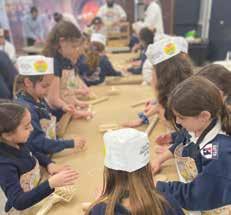

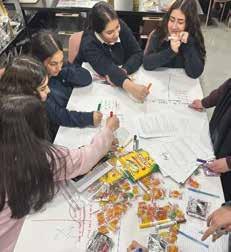
came through a mirror installation, where participants wrote what they see in one another. Taken together, it became a reflection of the kochos of nashim tzidkaniyos — past, present, and future — and the quiet awareness that this chain continues through them.
A hands-on component brought the ideas into something tangible. Grandmothers and granddaughters decorated
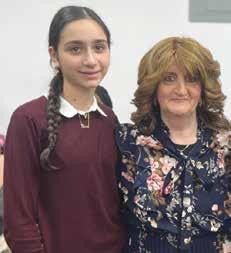
washing bowls for the Seder, connecting back to the mirrors donated by the women in the Mishkan — objects once used to build the nation, and treasured for that very reason. The girls are looking forward to using them in just a few days’ time.
The day closed with music and dancing — generations together, celebrating what has been built and what still lies ahead.
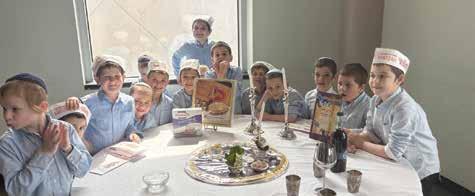
Cheder Menachem of Long Island, based in Valley Stream, NY, recently visited a special model matzah bakery and workshop at the Jewish Children’s Museum in Crown Heights to see how matzah is made and to take part in the process themselves
Rolling up their sleeves, the boys mixed, kneaded, and rolled out their dough, following each step carefullymaking sure to keep within the time limit, understanding how every minute counts.
Before baking, they poked small holes into the dough, then watched as it went into the oven. Just a few minutes later,

the matzah came out crisp and ready. The students even had the chance to taste what they had made. The trip offered an enriching and meaningful, hands-on way to understand matzah production — bringing classroom learning to life in a memorable way.

HAFTR Kindergarten students stepped into the Pesach spirit with a joyful and engaging Model Seder led by Rabbi Klein, our Mashgiach Ruchani, and musically infused by Mrs. Janet Goldman, bringing the story of Yetziat Mitzrayim to life in a meaningful and interactive way. From singing the Mah Nishtanah to tasting the symbolic foods and acting out the journey from slavery to freedom, each moment helped our youngest learners connect deeply to the traditions and values of Pesach. Just as the Seder guides us to grow, ask questions, and learn from our mesorah, HAFTR nurtures each child along their own path: building a love of Torah, con-
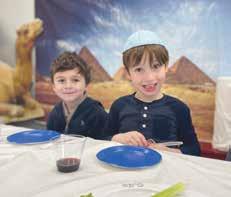
fidence, and curiosity that lasts a lifetime. This is where the journey begins. This is the HAFTR way.
Chag kasher v’sameach!
More than 100 members of the community came together for a meaningful pre-Pesach mitzvah event co-hosted by UJA and Young Israel of Woodmere. Families came out for a hands-on day of chesed—working side by side to sort, organize and pack food and other essential Pesach items for those in need in the community. The energy in the room was truly special, as participants of all ages came together with a shared sense of purpose, generosity, and care for others. From toddlers to grandparents, everyone pitched in—each person playing a role in making the day a success.

As security tensions force many Israelis to remain at home for extended periods, the professional teams of the Shtilim Network mobilized for a wide-ranging logistical and educational effort to support children with special needs.
Their response includes personalized remote learning, daily phone contact with students, and the delivery of activity kits to students’ homes. In addition, Shtilim organized entertaining and relaxing Zoom shows for the children and their families, including a magician, an animal show, and a Kabbalat Shabbat program.
Meanwhile, the network’s residential programs continue to operate under emergency protocols. Special attention has also been given to guiding parents as they cope with the constant stress of children remaining at home and the disruption of their daily routines.
While the entire education system is grappling with the security situation and
the impact of Operation “Roaring Lion” on the home front, educators at Shtilim understood that for their students, staying home is far more than an inconvenience. For children with communication disorders or other special needs, any disruption to their familiar routine can lead to regression and place significant strain on their families. Recognizing this challenge, the network transferred much of its therapeutic and educational framework directly into students’ homes, helping children and parents maintain stability during a tense and uncertain time.
Across the network’s institutions, a remote learning system based on close personal contact was established. Each day, teachers and therapists hold individual conversations with students, while group video calls during the week allow children to see their classmates and maintain a sense of community.
Beyond the digital response, Shtilim also ensured that learning materials reached students physically. Customized

The packages will be distributed to families through the SHOP at the Marion & Aaron Gural JCC, a UJA partner agency, helping bring the joy and dignity of Pesach to households across the Five Towns community.

worksheets, informational guides for parents, and creative activity kits were delivered to homes. At the Beit Miriam School in Beit Shemesh, which serves girls with communication disorders, students received kits containing stories and hands-on craft activities, allowing them to remain engaged with meaningful, age-appropriate content even during long hours at home.
The human toll of the crisis became painfully clear when a lethal missile struck Beit Shemesh, causing extensive destruction and completely demolishing the home of one of the network’s students. The child and his family were evacuated to a hotel in Jerusalem with virtually nothing. Shtilim immediately stepped in, purchasing clothing, toys, food, and other necessities for the child. His teachers even traveled by taxi from Beit Shemesh to the hotel in Jerusalem to visit him. Deeply confused and anxious after the traumatic event, the student was comforted by the familiar presence
of his teachers, who helped explain the situation and ease his fear and uncertainty.
Even during the height of the operation, Shtilim continued operating its residential and out-of-home programs, which serve as a vital anchor for at-risk youth who require a stable therapeutic environment. These facilities maintained a full daily schedule including studies, physical activity, and community volunteering, based on the understanding that routine is one of the most powerful tools in times of uncertainty.
Throughout the crisis, the network’s paramedical staff remained available for consultation and remote support. As a leading provider of special education in Israel, Shtilim remains committed to offering professional and compassionate assistance at all times, recognizing the complex challenges faced by families during this difficult period.

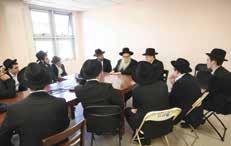
Rav Yitzchok Zev Miller took his eleventh grade talmidim of Yeshiva Darchei Torah’s Mesivta Chaim Shlomo to Lakewood, New Jersey,
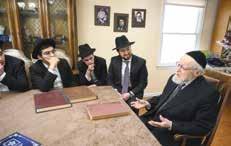
on a trip focused on chizuk from gedolim.
The bachurim met with and were inspired by: Rav Aryeh Malkiel Kotler


and Rav Yeruchim Olshin, Roshei Yeshiva of Beth Medrash Govoha; Rav Aaron Zuckerman, a distinguished rav and a talmid muvhak of Rav Aaron Kotler zt”l;
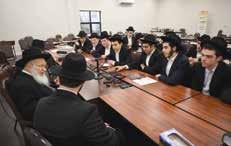
and Rav Shlomo Feivel Schustal, Rosh HaYeshiva of Tiferes Yerachmiel—and Rabbi Miller’s own rebbi. Also visible is Rabbi Miller’s father, R’ Dovid Miller.
HAFTR Lower School students brought the spirit of Pesach to life by participating in a fun “Pesach Around the World” program led by Ms. Tova Zucker, assistant principal of HAFTR LS, which explored how Jewish communities around the world celebrate this meaningful holiday.
Students discovered unique customs, traditions, and foods from different countries, deepening their connection to the holiday in a global and relatable way. This immersive experience was fun and interactive, and helped students appre-
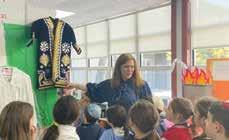
ciate the richness and diversity of Jewish life, fostering within them a deeper sense of pride, connection, and joy as they prepared for Pesach. Chag kasher v’sameach!
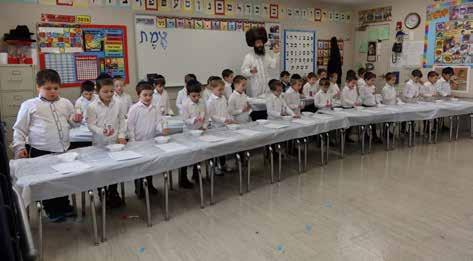
Rabbi Usher Jungreis with his Pre-1A class in Yeshiva Chaim Berlin learning about the Pesach Seder
It takes around 600-800 grapes to make a bottle of wine.

On any given evening at a Yachad program, the room is filled with the sounds of laughter, music, and conversation – friends reconnecting, new relationships forming, and individuals of all abilities sharing experiences that build confidence, independence, and community. For more than four decades, these moments have defined Yachad’s mission: creating spaces where every individual feels valued, included, and celebrated as a full member of Jewish life.
That spirit will take center stage on April 29, when the community gathers at the Sands in Atlantic Beach for the Yachad New York Gala, an evening dedicated to honoring the people and partnerships that make those moments possible.
“As we celebrate more than four decades of Yachad’s impact, what continues to inspire us most are the individuals, families, businesses, and young leaders who embrace our mission of inclusion,” said Avromie Adler, International Director of Yachad. “Their partnership ensures that people with disabilities are not simply welcomed into our communities but truly belong within them.”
This year’s Gala will recognize three honorees and a group of high school seniors, whose exceptional leadership and stories reflect the heart of Yachad’s mission: the Goldstein family, Camp Morasha, White Glove Consulting, and High School Senior Leaders.
The Goldstein Family - Yachad Family Award
For almost two decades, the Goldstein family has been deeply connected to the Yachad community. Their journey began close to 20 years ago when their son JJ first became involved in the program.
Like many families, Brenda and Stanley Goldstein were searching for a place where their son could socialize, build friendships, and feel a genuine sense of belonging. From the moment JJ joined Yachad, they found exactly that.
Over the years, JJ has flourished within the community. Through Yachad’s programs he has developed meaningful friendships, gained confidence, and found a place where he feels comfortable, supported, and valued. Known affectionately by friends and staff as the “life of the party,” JJ brings warmth, enthusiasm, and joy wherever he goes.
For the Goldstein family, Yachad has become far more than a program - it is
a community. Brenda and Stanley have embraced that community wholeheartedly, participating in family Shabbatons and forming close bonds with other parents. One especially meaningful tradition has been hosting the Shabbos afternoon Oneg during the Woodmere Shabbaton, an event JJ proudly tells everyone about each year as he welcomes “all his friends” to his home.
Their dedication to Jewish communal life extends well beyond Yachad. Both Brenda and Stanley are proud alumni of Camp Morasha, where they met 56 years ago while serving as counselors. In later years they returned for more than two decades, with Stanley serving as the camp doctor.
Together with their children, the Goldsteins have also participated in numerous Yachad marathons in Miami and Israel, helping raise critical funds to support Yachad’s programs.
In recognition of their longstanding dedication and the spirit of community they embody, Yachad is proud to honor the Goldstein family with this year’s Yachad Family Award.
Celebrating 25 Years of Yachad at Camp Morasha
Another highlight of the evening will be a special recognition celebrating the 25-year partnership between Yachad and Camp Morasha, a collaboration that has transformed the summer camp experience for countless individuals with disabilities.
Twenty-five years ago, under the visionary leadership of Rabbi Abie Wahrhaftig, z”l, then director of Camp Morasha, the camp partnered with Yachad to welcome youth with intellectual and developmental disabilities into the Morasha community.
Together, the leadership of Camp Morasha and Yachad created a thoughtfully designed program that ensured campers with disabilities could fully participate in camp life while receiving the support they needed. Dedicated bunkhouses and specialized staff support allowed Yachad campers to grow, learn, and form friendships alongside mainstream campers.
This past summer marked the program’s 25th anniversary, which was beautifully celebrated during Morasha’s beloved annual Shiria sing-off. Appropriately themed “We Can All Sing,” the event reflected the unity, joy, and sense of belonging that define Yachad’s presence at camp. It served as a powerful reminder that the
Morasha camp experience is enriched by every member of its community.
The award will be accepted by Camp Morasha Director Jeremy Joszef, together with the Wahrhaftig family, in honor of Rabbi Abie Wahrhaftig’s enduring legacy.
White Glove Consulting –
The Lev Business Award
Yachad will present the Lev Business Award to White Glove Consulting, recognizing the company’s commitment to inclusive employment through Yachad’s Jewish Union Foundation (JUF).
Employment is one of the central pillars of Yachad’s mission. Through JUF, individuals with disabilities receive vocational training, job coaching, and real-world work experience that helps them build professional skills and independence.
White Glove Consulting became one of these valued partners several years ago when a JUF job coach approached the company about providing job skills training for Yachad participants. Under the leadership of Duvi Taub, Co-Founder and CEO, the company immediately embraced the opportunity - not simply as a business initiative, but as a reflection of its core values.
Duvi and his team have demonstrated a deep commitment to Yachad’s mission, recognizing the importance of creating meaningful employment opportunities for individuals with disabilities. By opening their workplace and investing in training and mentorship, they have helped foster an environment where employees are supported, empowered, and given the opportunity to succeed.
“At White Glove, we believe that every individual deserves the opportunity to contribute in a meaningful way,” said Duvi Taub. “Partnering with Yachad has shown us just how impactful an inclusive workplace can be - not only for the individual, but for our entire team.”
At the time, Zahava, a graduating student from the Yachad IVDU School, was ready to transition from volunteer placements into the workforce. White Glove Consulting welcomed her into the company, providing not only a position but a supportive environment where she could thrive.
Through dedication and hard work, Zahava grew steadily in her role. What began as a supported placement eventually developed into a meaningful career as an Administrative Assistant. Today she
plays an important role in the company’s daily operations and has become fully independent in her responsibilities.
White Glove Consulting’s commitment, driven by Duvi Taub’s leadership, demonstrates the transformative power of inclusive employment and the meaningful impact that businesses can have when they actively embrace opportunities to support individuals of all abilities. In recognition of their partnership, leadership, and dedication to creating inclusive opportunities, Yachad is proud to present Duvi Taub from White Glove Consulting, with the Lev Business Award.
This year’s gala will also include the High School Seniors Leadership Award. Recognizing a group of exceptional students whose dedication and leadership have strengthened Yachad’s mission of inclusion.
Throughout their high school years, these seniors have devoted countless hours to supporting Yachad programming in their schools and communities. Many students served as Clubheads of their school’s Yachad Club, developing programs that brought their peers together with Yachad participants in an atmosphere of friendship and respect. Their initiatives have included social programs such as pre-Chagim baking, basketball games, Chanukah and Purim celebrations, Mishmar events, as well as creative fundraising efforts like bake sales, raffles, and competitions. These student leaders have also helped organize educational programming, inviting Yachad staff to lead sensitivity training and inclusion workshops for their classmates.
The Yachad Gala will take place on Tuesday evening, April 29, at The Sands Atlantic Beach. The evening will celebrate more than forty years of Yachad’s impact while honoring those who continue to strengthen its work and ensure that individuals with disabilities are embraced as full and valued members of Jewish communal life.
For more information, please contact Rebecca Shatz at shatzr@ou.org. To register for the gala or to make a donation, please visit www.yachad.org/newyork/gala.



The MTA Honors College welcomed a special guest this past week: Professor Jeffrey Rosen, President Emeritus of the National Constitution Center. He spoke with the boys about the Founding Fathers and their surprising connections to Jewish tradition, bringing this year’s Honors College theme, What Would the Founding Fathers Think?, vividly to life.
Drawing from his new book, Pursuit of Liberty: How Hamilton vs. Jefferson Ignited the Lasting Battle Over Power in America, Professor Rosen explored how the debates and tensions between the Founders continue to shape today’s political landscape. After a brief introduction, the session quickly became a genuine conversation, as students engaged him with thoughtful questions of their own.
Among the many fascinating ideas he shared was the remarkable connection between Benjamin Franklin’s system for moral perfection, outlined in his Autobiography, and Rabbi Menachem Mendel Levin’s Cheshbon HaNefesh, a founda

tional Mussar work on self-improvement that remains widely studied today. It was a powerful example of how the ideas of the Founders reached further than most people realize. Professor Rosen also discussed the influence of Justice Louis Brandeis on American constitutional thought.
The Honors College continues to read Joseph Ellis’s American Dialogue alongside conversations like these, giving students a rich framework for grappling with the big questions that shaped, and continue to shape, American life.


HAFTR Middle School’s highly anticipated STEM Summit took innovation to the next level this year, as students stepped into the world of AI to design creative, clever, and original apps to enhance Jewish life.
With a powerful theme centered on the intersection of STEM and Jewish values, students worked in teams to develop creative, purposeful solutions, ranging from tools that support mitzvah observance to apps that make Jewish living more accessible, meaningful, and connected. Their work was “on display” in the “HAFTR MS STEM App Store,” where students proudly showcased their AI-created applications to peers, faculty, and families.
Six finalist teams were selected to present their projects in HAFTR High School’s state-of-the-art auditorium.
In front of an engaged audience, they shared their ideas. They demonstrated their apps to esteemed judges Eli Langer (Founder and CEO of Maigrate, runs Harvesting Media, and host of the Kosher Money Podcast) and Albert Tamayev (an Information Technology engineering leader with global experience in financial technology and e-commerce/consumer services), highlighting not only technical skill but also understanding of how innovation can serve tradition.
Parents and attendees were impressed by the creativity, effort, and vision on display. Their use of cutting-edge technology to strengthen their connection to Jewish life in meaningful, forward-thinking ways brought much amazement to those in attendance.
The STEM Summit was a celebration of curiosity, collaboration, and Jewish

pride. HAFTR is incredibly proud of our students and excited to see how they continue to build, create, and shape the future of Jewish living.
HAFTR continues to lead the way in STEM education, empowering students with the skills, creativity, and confidence to thrive in today’s world while staying deeply rooted in their values.

Thank you to our dedicated faculty, staff, judges, and families who helped make this incredible night a reality. We thank Mrs. Gittel Grant, HAFTR’s STEM and Science Chair, Ms. Hodaya Kuighadoush, Science Faculty, and Mrs. Shirley Lane for their guidance and dedicated work with our students, and for their vision and planning of this event.
No organization knows kosher food in New York better than Met Council. As the largest free kosher food distributor in America and the organization behind the largest free Pesach food distribution in history, Met Council is now launching a major new year-round benefit for low-income New Yorkers: free kosher groceries and prepared meals delivered to eligible households through its Social Care Network initiative.
The new free program connects eligible Medicaid members to ongoing gro -
cery assistance, prepared meals where appropriate, and other critical support services. More than 1 million New Yorkers may qualify for this benefit, which is designed to help families and individuals access nutritious kosher food with dignity long after the Yom Tov season ends.
As Met Council rolls out this expanded support, it is also completing the largest Pesach food distribution in its history. Just hours before Pesach begins, Met Council will have distributed more than 3.5 million pounds of Kosher for Pesach food, reaching more than 350,000 peo -

ple through 250 distributions conducted in partnership with 230 community organizations and local food pantries.
In the weeks leading up to Pesach, Met Council surged over $6 million worth of food to its pantries, partners, and special distribution sites, including 61,000 pounds of matzah, over 50,000 gallons of grape juice, and 2,300,000 eggs. Other staples distributed included Kosher for Pesach chicken, gefilte fish, tuna, applesauce, borscht, cake mix, chopped walnuts, cocoa powder, jam, lemon juice, macaroons, matzah meal, potato starch, sugar, tomato sauce, vinegar, and fresh fruits and vegetables.
More than 800 volunteers, including government officials and community members, joined the effort, working alongside community partners to pack, organize, and deliver food in a dignified and efficient way.
“This is about much more than food,” said Met Council CEO David Greenfield. “Met Council has long been the address for kosher food assistance in New York, and now we are taking that work to the next level. Through this new benefit, eligible low-income New Yorkers can receive free glatt kosher groceries and prepared meals year-round. We are proud not only to help families for Pesach, but to help working families put food on the
table every single week of the year.”
Through the Social Care Network, eligible participants may receive free kosher grocery deliveries, medically tailored meals where appropriate, and additional services that help address food insecurity and related needs.
The goal is to ensure that support continues long after Pesach for families facing ongoing financial pressure.
This year’s Pesach distribution was funded and supported by major partners, including UJA-Federation of New York and Deb El Food Products, which donated 2,100,000 eggs, along with many other generous donors and community partners.
As inflation and economic uncertainty continue to strain household budgets, Met Council remains committed to expanding food access through innovative partnerships, government collaboration, and year-round support for New Yorkers in need.
Individuals interested in receiving assistance or learning more about eligibility for Met Council’s programs, including free year-round grocery and meal support through Medicaid, can call (718) 306-8731 or email SCNSupport@metcouncil.org.

In response to the rising incidence of antisemitism across academia, Touro University – the largest university under Jewish auspices in the United States – recently announced the launch of the Touro University Antisemitism Institute, a first-of-its kind institute dedicated to confronting and eradicating antisemitism in higher education and around the country.
The Institute builds on Touro’s decades-long legacy of providing academic and practical resources to root out antisemitism and hatred of all kinds, specifically in academia. Through the establishment of the Touro University Antisemitism Institute, Touro will take a multi-pronged approach: partnering with and educating professors from universities nationwide to teach rigorous courses on antisemitism and Jewish peoplehood within their own disciplines; disseminating research on the causes and impact of antisemitism; studying how existing laws can be used to combat hate, and evaluating the need for new legislation; examining the role of social media in the spread of antisemitism;
teaching the next generation of Jewish civil rights attorneys how to actually handle cases in the field; and convening leaders across academia, policy, law, media, and business to share key learnings and develop new strategies for confronting antisemitism.
“As we approach the two-year anniversary of the encampments on college campuses, it is not lost on me that more than 70% of Jewish college students have experienced antisemitism of some sort at their universities,” said Dr. Alan Kadish, President of Touro University. “While we can’t protect against every instance, education is the first step to rooting out hatred, bias and violence, which is why Touro has established this institute. The college years are among the most formative in a young person’s life and through the establishment of this institute, Touro is committing to serve as a beacon for those interested in taking a stand against hatred and making campuses and communities safe for all.”
While the institute will unveil new programming in the months to come, an inaugural effort will begin this sum-

As Pesach approaches, the students at Yeshiva Har Torah are eagerly preparing for the Chag with excitement and hands-on learning. Classrooms are buzzing with activity as students take part in cleaning and organizing, helping to create a true Pesach-ready environment.
Learning comes to life through engaging experiences, including meaningful model seders where students explore the Seder step by step, deepening their understanding of the story of Yetzias Mitzrayim and the traditions of the night.
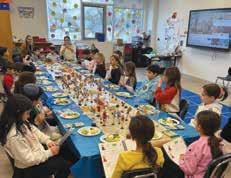
One of the highlights of the preparation has been an incredible matzah baking program presented by The Tzivos Hashem Traveling Model Matzah Bakery. Students had the unique opportunity to learn all about the process of making matzah and then bake their very own from start to finish. The hands-on experience brought the mitzvah to life in a memorable and meaningful way.
Through these engaging activities, YHT students are not only preparing for Pesach—they are truly experiencing it.
mer with The Touro University Teaching Fellowship to Combat Campus Antisemitism, led by Professor Mark Goldfeder in association with National Jewish Advocacy Center (NJAC). This new initiative is designed to help professors build and teach rigorous undergraduate and graduate courses—within their existing academic specialties—that strengthen campus understanding of antisemitism, civil rights protections and the modern challenges facing Jewish students and Israel today. The first cohort of fellows will take part in this program in the Summer of 2026.
“This fellowship is about reclaiming the campus as a serious place for scholarship, fairness and safety—through the most powerful tool available to universities—the classroom,” said Professor Goldfeder.
In addition, the Institute will also host Touro’s first-ever conference on antisemitism in New York City in the Fall of 2026, bringing together leaders in politics, academics, media and business to understand, confront and combat antisemitism through education and research, coalition building, and legal strategies with the goal of weeding out antisemitism across academia. The conference will be led by Professor Ido Aharoni Aronoff, former Israeli Consul General.
The institute will serve as an umbrella for Touro’s existing work in this space, bringing together under one roof:
The Touro Institute on Human Rights and the Holocaust, which promotes tolerance and human rights through advocacy and education.
The Antisemitism Law Clinic at Touro Law Center, which launched last year in the wake of October 7 and is the nation’s first law school clinic dedicated to combatting antisemitism.
The Jewish Law Institute at Touro University Jacob D. Fuchsberg Law Center, which provides a scholarly framework for studying the intersection of Jewish law, American law, and legal ethics, and serves as a national clearinghouse for new ideas and independent research.
A History of Antisemitism Course, open to all Touro undergrad and graduate students and the community at large.
“Touro University’s launch of an Antisemitism Institute is both timely and essential. At a moment when Jewish communities in New York and across the country are facing a disturbing rise in antisemitism, initiatives like this play a critical role in education, research, and combating hate. I commend Touro for its leadership and commitment to ensuring the next generation is equipped to stand up against antisemitism in all its forms,” said Congressman Mike Lawler (NY-17).
The institute will bridge academic research, policy, legal response, and ontheground education – serving as a central hub for students, faculty, community members, researchers, and practitioners, and empowering them with the tools to understand, prevent, and counter antisemitism in all its forms.
For more information about the Touro University Antisemitism Institute, please contact the Institute Director, Malka Fleischmann at malka.fleischmann@touro.edu
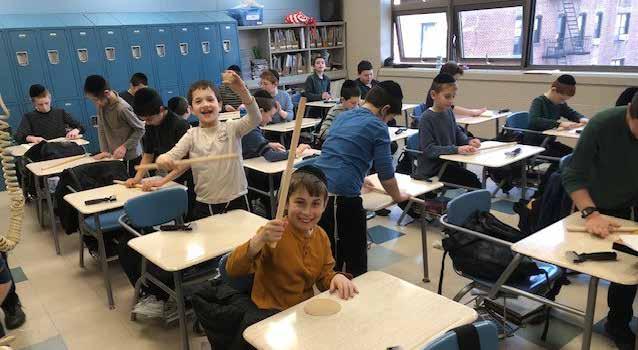

The fifth grade students in the HANC Elementary Division of the Reinstein Family Campus in West Hempstead brought social studies to life at the annual State Fair. Since October, when each child selected a state by spinning a wheel at the launch party, the students researched many aspects about that state. They researched the lives of the Native Americans that lived there, including tribes, religious beliefs, clothing, food, daily activities and their home lives. They also explored cultural regions and shared what they learned by creating a graphic organizer that they created using their graphic design skills.
Travel to each state was also researched, and the children utilized their creative writing skills to prepare a travel brochure that included information about the state government, the Jewish population, major industries and main attractions. Graphic design skills brought the attractions to life, and the final product looked truly professional. In addition, the students created a license plate that included the state abbreviation, the year the state was established and the state motto. Complementing these items, the students created Explorer Trading Cards, which featured facts about a famous explorer who explored the region and made their state famous. State money, featuring the state abbreviation, the year the state was established and the number of the state according to the order of when it was admitted into the union was also included on each bill. A research paper, incorporating all of the topics that they had researched, was also on display.
On the evening of the State Fair, all of the children came to school dressed up

to represent a famous person from or an important aspect of their state. All of the costumes were creative, and some were cleverly homemade.
The children’s costumes included: state birds, forest rangers, an ice cream cone, a Hershey bar, a chicken, a corn cob, Mickey Mouse, Fruit Loops and a Walmart employee, just to name a few. Inside the auditorium, the display tables were covered with red, white and blue table cloths and patriotic balloons and decorations were on display, adding to the festivity of the evening.
On the display tables that covered the entire periphery of the room, each station included the materials that the children had researched and produced. As the fifth grade parents and families visited the Fair, the students began the program with a musical cantata of famous American songs and an overview of their exploration journeys in preparing the State Fair. As the families circulated, the children shared their expertise on the states that they researched with their many guests. The fifth graders had a great time preparing and sharing their findings with everyone at HANC and were very proud of the work that they had done.
Reflecting on the program, fifth grade teacher, Ms. Wendy Pace, commented,
“Our goals for this project were for the children to learn about their state and the progression of how it developed into an official state. We wanted them to be creative, so each element reflected their own personality. The children were so proud of themselves and the teachers were impressed by how professionally they presented their research.”


by Shlomo Yehuda Katz
Ican’t believe I’m writing this. For some reason, I always thought that when I reach 120, Zaidy would be the one writing a tribute for me, just like he would so beautifully do every single year for his own parents, all the way until this past year. As one of my cousins said, still slightly drunk from Purim, when he heard about Zaidy’s petirah: “It can’t be. Zaidy doesn’t die.” And he was right to feel that way, because Zaidy wasn’t a person with a life; he was life itself!
He lived with energy, with simcha, with joy in doing things and joy in sharing that joy with everyone around him. From when I was a little child, I always wondered how he had the energy to do everything he did. I remember pulling up to his house in Flatbush for Sukkos, and we would usually arrive within the last few minutes before Yom Tov, rushing and scrambling to get ready. But there he was, the father and grandfather hosting all his children and grandchildren for yom tov, standing on top of a ladder in the sukkah, putting up the final decorations, making it as beautiful as it could possibly be. Because he had to be the one to do it, and he had to do it the most beautiful way possible.
Zaidy never pushed things off, he just did. There was no “later,” no “maybe tomorrow.” If something needed to be done, he was already doing it. Nothing would stop him.
Zaidy would always make sure that everything was as fun as it could be, ev-
ery Chol Hamoed trip, every Chanukah party, every Purim seudah, every Pesach Seder, every birthday, every single prize and raffle and the list goes on. He wasn’t the type to stand up and tell everyone, “It’s geshmak to be a Yid.” He didn’t have to. HE LIVED IT, in a way that made it impossible to have any doubts about just how geshmak it truly was.
As a child, I would love coming back to school after yom tov and telling everyone how rich my grandfather was, that we went on the best trips and had the most unbelievable experiences. It
lap and getting a huge kiss and hug, as we would say together: “Who loves you the most?” “ZAIDDDDDY.” And then quietly he would whisper, “Of course, after Hashem.” How I wish I could have stayed young just a little longer to have those moments more.
To Zaidy, family was everything. There was no such thing as something getting in the way of being together. Every excuse to gather wasn’t just an excuse; it became law. Every simcha in the family meant the entire extended family had to be there, no exceptions.
That priority was making the most enjoyable, the most fun, the most geshmake Yiddishkeit imaginable.
was only years later that I came to understand that he wasn’t rich. He was very far from it. But there were priorities, priorities that no amount of money or lack of it could get in the way of. And that priority was making the most enjoyable, the most fun, the most geshmake Yiddishkeit imaginable.
I can still remember from when I was very young, climbing on Zaidy’s
of us to be wrong.” Always the sharp line. Always the perfect sense of humor.
As I got older, I came to realize just how brilliant he really was. There was nothing he didn’t know and nothing he didn’t do to the best of his ability. As he would say, “I’m always right, and when I’m wrong, the wrong is that I’m thinking I’m wrong because I’m actually right.” And if someone dared to argue with him, he would just smile and say, “I would agree with you, but it would be a shame for both
Zaidy’s reach went far beyond our family walls. At 18 years old, he became a teacher and then within a few years the principal of Stolin Cheder, alongside being in the business world in Commercial Mortgages, because sitting still and doing just one thing was never really his style. From there, he moved on to fulltime chinuch, becoming English principal in Yeshivas Rabbeinu Chaim Berlin, and seventh grade rebbi at Yeshivas Derech Hatorah of Brooklyn. He then continued on as seventh grade in HALB, the Hebrew Academy of Long Beach, where he served for close to two decades shaping generation after generation of talmidim. He also served as the General Studies principal of Yeshiva Gedola Bais Yisroel high school for 8 years, before moving on to Ohavei Torah in Riverdale for 11 years, followed by Menahel of Or Hatorah and eventually moving on to Yeshivas Ziv HaTorah in Flatbush. And even after he moved to Lakewood, he refused to let that go. Every single morning, he drove from Lakewood to Brooklyn to continue serving his talmidim as Menahel of Ziv HaTorah and then back to Lakewood to serve as an afternoon teacher in Yagdil Torah, continuing both all the way until his petirah.
And then there were the camps – from Aguda to head counselor of Rayim to Director of Shivtei, to build-
ing his own kiruv Camp Kochavim, to Camp Govoha, to Manhig Ruchani of Camp Romimu teen division, to head counselor of Blev Echad in Lakewood, summers full of the same energy, the same simcha, the same relentless drive to make every moment meaningful for every single child.
Retirement was simply not a word that existed in his vocabulary. Wherever he went, he didn’t just show up. He built something. He left people different than he found them, impacting thousands of talmidim and campers for life.
When I was only twelve years old everything changed. He got COVID and spent the next five months in the hospital, in a coma on a ventilator, fighting for his life. And it was during those very months, while he lay there in septic shock with the doctors giving him no chance of survival, that I turned thirteen. My bar mitzvah. The day a boy takes on the ol mitzvos comes a Yid in the fullest sense. The day he is now mechuyav most geshmake thing in the world, and Zaidy wasn’t there to see it.
I thought and cried for him the en tire time. I thought about what he would have wanted. But I knew with complete clarity that there was only one thing he would have said if he could: “Sholom Ye huda’le, you got this. Don’t let the sim cha dim for even a moment.” Because to Zaidy, it wasn’t just a celebration. This was the moment I was becoming a chiyuva. It was everything he had spent his entire life building and showing us. Standing there, at the most personal and sacred moment of my life without him, I finally understood it fully. The mo ment may be hard, the pain may be real, but through every tear and every ache one thing remained absolutely clear: It is the most geshmake thing to be a Yid. It was the truth he never had to say out loud because he lived it every single day, and now at my bar mitzvah, without him in the room, rather lying in a CCU fight ing for his life, he was somehow teaching it to me more powerful than ever.

B’nissim giluyim he survived. Against every doctor’s predictions, against every statistic. But after the many long months of recovery, no one could deny that he was no longer the same Zaidy he had once been. That strength, that energy, it was different now. And just when we were all beginning to come to terms with a new reality, he stood up and put his foot down. No. This will not be the new reality.


He fought every single day to be him self again. No matter how hard it was, and it was hard, he pushed himself to be the menahel, the father, the camp director, the Zaidy that he had always been. He always said that not trying is guaranteed failure, because if you don’t try it simply won’t happen. But if you try, there is always a chance. And so he tried,




Everywhere is walking distance if you have the time.
There’s a fine line between fishing and just standing on the shore like an idiot.
I was walking down the street wearing glasses when the prescription ran out.
I intend to live forever. So far, so good.
Curiosity killed the cat, but for a while I was a suspect.
I went to a restaurant that serves “break fast at any time”. So I ordered French Toast during the Renaissance.
Ambition is a poor excuse for not having enough sense to be lazy.
Borrow money from pessimists –they don’t expect it back.
I hate it when my foot falls asleep during the day because that means it’s going to be up all night.
I took a course in speed waiting. Now I can wait an hour in only ten minutes.
I used to work in a fire hydrant factory. You couldn’t park anywhere near the place.

Cross country skiing is great if you live in a small country.
Eagles may soar, but weasels don’t get sucked into jet engines.
Everyone has a photographic memory. Some just don’t have film.
Half the people you know are below average.
How do you tell when you’re out of invisible ink?
I almost had a psychic girlfriend, but she left me before we met.
I went down the street to the 24-hour grocery. When I got there, the guy was locking the front door. I said, “Hey, the sign says you’re open 24 hours.” He said, “Yes, but not in a row.”
I went to a general store. They wouldn’t let me buy anything specific.
If at first you don’t succeed, then skydiving definitely isn’t for you.
The problem with the gene pool is that there is no lifeguard.
Why is it a penny for your thoughts but you have to put your two cents in? Somebody’s making a penny.
If you think nobody cares about you, try missing a couple of payments.
If you were going to shoot a mime, would you use a silencer?
I remember when I was a fetus I used to sneak out at night while my mother was sleeping.
Boycott shampoo! Demand the REAL poo!
1. How many colors are there in a rainbow?
a. 4
b. 5
c. 7
d. 8
2. How many squares are there on a chess board?
a. 42
b. 64
c. 76
d. 90
3. How many points does a compass have?
a. 32
b. 49
c. 56
d. 81
4. How many feet are there in a mile?
a. 2,370
b. 3,465
c. 4,760
d. 5,280
5. What comes after a trillion?
a. Quintillion
b. Quadrillion

c. Sextillion
d. Septillion
6. The Burj Khalifa in Dubai is the tallest building in the world. How many stories does it have?
a. 120
b. 140
c. 160
d. 210
7. What percentage of people in the world are left-handed?
a. 11%
b. 22%
c. 35%
d. 48%
8. How many dimples does the average golf ball have?
a. 42
b. 164
c. 336
d. 1,075
9. The sun is how many times larger than the Earth?
a. 4 times
b. 1,750 times
c. 330,330 times
d. 2 million times
10. For how long can a snail sleep without waking up?
a. 7 days
b. 2 months
c. 13 months
d. 3 years
Answers: 1-C 2-B 3-A 4-D 5-B 6-C 7-A 8-C 9-C 10-D

Wisdom Key:
8-10 Correct: You are great at numbers! But since you are counting the dimples of a golf ball, you certainly have other problems.
4-7 Correct: Not bad, but you have to wake up! Your three years of sleeping are almost here!
0-3 Correct: Hmm…let’s try this: How many days are there in a week? (Baby steps.)
Two people wish to cross a river. The only way to get to the other side is by boat, but that boat can only take one person at a time. The boat cannot return on its own, there are no ropes or similar tricks, yet both people manage to cross using the boat. How?
Answer: Who said they were on the same side? They start on opposite sides of the river.
It has been a long and cold and rainy winter here in Jerusalem. Nevertheless, spring has arrived with the warming season and flowering greenery. The holidays of the Jewish calendar undoubtedly were meant to be celebrated here in Israel, where the climate matches the mood of the individual holiday. Here in Holy Land, we do not have snow falling on the sukkah or freezing temperatures to accompany the Pesach Seder. Because of this confluence of calendar and nature, the holidays here in Israel take on a different perspective, an additional layer, so to speak, than the celebration of the holidays in the Diaspora.
As we recite the words of rapture that compose the Song of Songs of Solomon, we, here in Israel, are struck by the detailed and exquisite description of the nature of the land that we see before our eyes. Part of the idea of the Exodus from Egypt is that we were not just taken out from a land of slavery and oppression but were also guaranteed to arrive at a particular destination – a land of beauty,

By Rabbi Berel Wein z”l

sustenance, and inspiration.
In the first message to our teacher Moshe, G-d already informed him of the destination and mission that was to be entrusted in the later generations of Jews. It was not sufficient merely to be redeemed from slavery and remain in Egypt
civilization that would serve to be an example for others to emulate, a light unto the nations.
I think, therefore, that the natural weather patterns which visit our planet year in and year out are meant to reinforce this idea that the Jewish national
It is not only that nature is renewed in the holy land but also that the holy people find new spurts of energy each year.
as free citizens treated with equality and fairness. That existence is still deemed to be exile, for the country and the land is not ours and never will be. It was, rather, the goal of arriving in the land of Israel, settling it, creating there a Jewish national state, a Holy Temple, and having a
dream can only be fulfilled in the land of Israel for only there was the connection between the natural, almost predictable environment of weather coinciding with the great moral values and teachings of the Jewish holidays most apparent.
The coming of spring, of sunlight and
warmth, also attests to the coming of freedom and a purposeful national existence. The Jewish people, so to speak, are born again every Pesach. It is not only that nature is renewed in the holy land but also that the holy people find new spurts of energy each year and a glimmer of the great future that yet awaits us and all of humankind.
Jews have observed Pesach meticulously in every climate and geographical location on this planet. But, as our sages pointed out in many of their commentaries to the Torah, the observance of the holidays, and even of the commandments themselves outside of the land of Israel, were only meant to remind us of their existence so that we would be able to observe them correctly when we would eventually be restored to our homeland and our national existence.
The holiday of Pesach restores this fundamental value in Jewish life and history and propels us towards the great future that we are yet to experience.
Chag kasher v’sameach.
By Rabbi Avrohom Sebrow
Shehechiyanu and kiddush on Yom Tov are a beautiful pair. However, we must remember that the second days of Pesach present a unique exception: they are the only nights of yom tov on which Kiddush is recited without Shehechiyanu.
The blessing of Shehechiyanu is recited on mitzvos that occur at specific times of the year. Yom tov itself qualifies, as it returns annually. Even Shemini Atzeres warrants its own Shehechiyanu because it is considered a new yom tov. In contrast, we do not recite Shehechiyanu at kiddush or candle lighting on the final days of Pesach, since those days are viewed as a continuation and conclusion of the yom tov that already began with Shehechiyanu on the first days.
Similarly, on the first day of Sukkos, one recites Shehechiyanu upon taking the lulav for the first time that year. The same applies to mitzvos such as shofar, megillah, and Chanukah lights. These mitzvos are not performed year-round; when we merit to fulfill them, we thank Hashem for sustaining us and enabling us to reach zman hazeh, this moment in time.
The Gemara in Menachos (75b) teaches that one recites Shehechiyanu upon bringing a Mincha offering, though it does not specify who is bringing it or which offering is involved. One explanation, found in the printed version of Rashi, is that a Kohen recites Shehechiyanu when offering the Minchas Ha’Omer, which is brought once a year on the second day of Pesach. This aligns perfectly with the general principle: the Kohen thanks Hashem for enabling him to live to perform this annual mitzvah. Tosafos offers a different explanation. The Kohanim were divided into rotating groups, meaning that each Kohen served only once every half-year. According to this view, the Gemara refers to a Kohen reciting Shehechiyanu upon performing the

avodah for the first time in his designated rotation. He expresses gratitude for reaching this long-awaited, pre-scheduled day.
A third, fundamentally different explanation appears in a manuscript version of Rashi. Here, the Gemara refers to a Yisrael bringing a Mincha offering for the first time in his life. Although the mitzvah is available daily, this individual has never performed it before. His Shehechiyanu reflects gratitude for reaching the moment of his first personal fulfillment of this mitzvah. This concept may extend beyond this case.
For example, there is a mitzvah to cover the blood of fowl and non-domesticated animals after shechitah. The Rema (YD 28:2) writes that the first time a shochet performs this mitzvah, he should recite Shehechiyanu. Even though the mitzvah applies regularly, the first personal performance warrants the blessing.
The Pri Chadash, however, disagrees. He notes that reciting Shehechiyanu on the first performance of a mitzvah is sub -
ject to a dispute among the Rishonim. This concept appears only according to one explanation in the manuscript version of Rashi; according to the other explanations, there is no clear source in the Gemara. Therefore, applying the principle of safek brachos lehakel, we refrain from reciting the blessing in cases of doubt.
The Pri Toar, on the other hand, extends the Rema’s ruling further. When a boy reaches bar mitzvah, he fulfills the mitzvah of tefillin for the first time as an obligated individual and, indeed, becomes obligated in all mitzvos. Accordingly, the Pri Toar suggests that he should recite Shehechiyanu at that moment, intending it to cover both tefillin and all other mitzvos.
The Chasam Sofer similarly records that in some communities, women would recite Shehechiyanu the first time they light Shabbos candles.
Practically, however, the Mishnah Berurah rules that a bar mitzvah boy should not recite Shehechiyanu upon first donning tefillin. Nonetheless, since many
Rishonim support doing so, he should ideally wear a new suit, recite Shehechiyanu on the garment, and intend to include the mitzvah of tefillin.
Rav Shlomo Zalman Auerbach offered a creative solution: a father should purchase tefillin for his son but lend them to him until the bar mitzvah. On the day he becomes obligated, the father should formally give the tefillin as a gift. The boy then recites Shehechiyanu upon receiving the valuable item, with the intention of including the mitzvah of tefillin and all other mitzvos he now assumes.
Rav Mordechai Eliyahu suggested a similar approach for a kallah. When lighting Shabbos candles for the first time, she can recite Shehechiyanu on new candlesticks and have in mind to include the mitzvah.
As an interesting aside, Rav Dovid Feinstein once noted that if a family receives a new Chanukah menorah as a gift, the husband should recite HaTov VeHaMeitiv. This blessing replaces Shehechiyanu when multiple people benefit from the item. Since both husband and wife share the mitzvah of Chanukah lights, they jointly benefit from the menorah. By the same logic, if a family were to receive a new candelabra, one could argue that HaTov VeHaMeitiv might apply there as well, given their shared connection to the mitzvah of lighting Shabbos candles. Rav Mordechai Eliyahu’s suggestion to recite Shehechiyanu over candlesticks a kallah receives may stem from the fact that, while both the couple benefit, the gift is truly intended for her.
Rabbi Avrohom Sebrow is a rebbe at Yeshiva Ateres Shimon in Far Rockaway. In addition, Rabbi Sebrow leads a daf yomi chaburah at Eitz Chayim of Dogwood Park in West Hempstead, NY. He can be contacted at ASebrow@gmail.com.
By Rabbi Yair Hoffman
Rav Shneur Kotler, zt”l, the illustrious Rosh Yeshiva of Beth Medrash Govoha in Lakewood, once cited a remarkable teaching from the Amudei Ohr, the sefer of responsa authored by the gaon Rav Yechiel Heller, zt”l (1814–1862), rav of Suvalk and one of the great Lithuanian poskim of the nineteenth century. The teaching was as follows:
When a person sits at the Seder and engages in sippur Yetzias Mitzrayim , he should not merely recount the story of our nation from 3,338 years ago. He should also reflect on his own journey — how he arrived at this very seat, at this very table, involved in the great mitzvah of the night. He should tell his own story of redemption.
Every person has his or her own story. And that story, the Amudei Ohr is teaching, is itself part of the larger story of Yetzias Mitzrayim.
The Obligation to Personalize the Exodus
The Mishnah in Pesachim (116b) states, “B’chol dor vador chayav adam liros es atzmo k’ilu hu yatza mi’Mitzrayim,” in every generation, a person is obligated to see himself as though he person-
ally left Egypt.” The Rambam (Hilchos Chametz U’Matzah 7:6) rules this as binding halacha: “Chayav adam l’haros es atzmo k’ilu hu b’atzmo yatza hashata mei’Avdus l’cheirus, a person must present himself as if he personally, this very year, went out from slavery to freedom.”
But what does it mean to see yourself as having left Egypt? One pshat, of course, is to picture ourselves as there, since we were. But the Amudei Ohr’s pshat seems to add another dimension. The great Maharal of Prague in the Gevuros Hashem (Chapter 62) explains that each Jew carries within himself a spark — a chelek — of that original redemption. And its liberating force is embedded in every Jewish neshama in every era.
The Sfas Emes (Pesach 5636) writes that the word sippur — telling — shares its root with sapir, a gleaming gem. To tell the story is to reveal the hidden gem within it, to draw out its inner light. When we tell the story, we are not merely reciting the history; we are uncovering something alive, something present and personal.
We Live in a Somewhat Orphaned Generation Rav Shneur Kotler’s invocation of this
teaching was framed in a context we recognize acutely today: we live in a generation that is, in many ways, spiritually orphaned. The towering figures of earlier generations — those who could plumb the very depths of Torah and hashkafas haTorah with the breadth and clarity of a Rav Moshe Feinstein, a Rav Aharon Kotler, a Rav Yaakov Kamenetzky — are no longer with us in the same way.
The Iggeres HaRamban instructs a son: “V’al titosh Toras imecha,” do not abandon the Torah of your mother. The Torah is transmitted not merely through texts but through a living chain of transmission, from rav to talmid, from parent to child, from generation to generation.
The question is: given where we are — given this somewhat diminished era — how did each of us get here?
The Rambam (Hilchos Chametz U’Matzah 7:1) identifies the five mitzvos of Pesach night: sippur Yetzias Mitzrayim, the telling of the Exodus; achilas matzah, eating matzah; achilas maror, eating the bitter herbs; arba kosos, the four cups; and Hallel, the songs of praise. Each of these is a distinct mitzvah with its own character and its own source.
A person who sits at the Seder and ful-
fills these mitzvos is participating in something extraordinary.
The Ramban writes in his commentary to Shemos (13:16): “U’min ha’nisim ha’gedolim u’meforhessim, adam modeh b’niflaos v’tzefunos,” from the great and revealed miracles, a person comes to acknowledge the hidden miracles. The Ramban’s point is breathtaking: the revealed miracles of Yetzias Mitzrayim — the plagues, the Splitting of the Sea — are meant to open our eyes to the hidden miracles woven through every day of existence. Among the greatest of those hidden miracles is the fact that we are here, at the table, reciting the Haggadah.
This is what the Amudei Ohr was teaching, as conveyed by Rav Shneur, zt”l. When the Torah says “v’higadeta l’vincha” — and you shall tell your son (Shemos 13:8) — it uses the word higadeta, related to haggadah, which Chazal connect to “maggid,” one who declares and reveals. Rashi explains that this is a declaration made specifically in response to a question: “bishvil zeh asah Hashem li,” because of this — the matzah, the maror, the Seder — did Hashem do for me. The pronoun is singular, in-
timate, and personal.
The Nesivos Shalom writes in one of his essays on Pesach that the great work of the Seder night is an awakening of memory — not only national memory but personal memory. Each person must ask: where was I spiritually, and how did I come to be here? The very word “Mitzrayim” is related to “meitzar,” a narrow place, a constraint. Every person has his own Mitzrayim — his own narrow places, his own constrictions — and the Seder night is the moment to recognize that Hashem brought him out. And stories abound.
Our family was zocheh to meet and befriend an incredible baalas teshuvah who was formerly an opera singer. How did she come to Torah u’mitzvos? She was at Auschwitz visiting. The tour guide said, “You are here at Auschwitz where a million and a half Jews were not allowed to leave and were murdered. They did not have an opportunity to leave Auschwitz and learn about their glorious heritage – their birthright of Sinai. You, however, are here and are different. You can go out and learn more about your true birthright – your Torah heritage. I urge you to do so.”
The words seared into her pintele Yid, her neshama, and now she is married to a ben Torah, is involved in kiruv and serves
as a shining example of one’s own story of Geulah.
The Chidushei HaRim (Rav Yitzchak Meir Alter of Ger, on Pesach) taught that the Exodus was not completed at the sea. It is completed in each individual when he breaks free of his own constrictions, his own narrow places, and attaches himself to Hashem.
The Gemara in Brachos (9b) tells us that the mitzvah of remembering Yetzias Mitz-
something that began in Egypt and continues until the final redemption.
And so, as Rav Shneur, zt”l, taught in the name of the Amudei Ohr: take a moment this Pesach night. Before you recite “Avadim hayinu” — we were slaves — ask yourself: where was I? What were my narrow places? What hashgachah, what seemingly small moments, brought me to this seat, to this table, to this mitzvah?
Then tell that story. Tell it with grati-
Each Jew carries within himself a spark — a chelek — of that original redemption.
rayim applies every night of the year — not only Pesach. It is a daily obligation because the journey out of Mitzrayim is a daily one. But Pesach night is the great annual awakening. The Leil HaSeder is the night designated to sit with our story — as a nation, yes, but also as individuals. It is the night to look at the person sitting across the table and recognize: we are both miracles. We both have stories. We are both part of

tude. Tell it with awe. Because your story — your personal sippur Yetzias Mitzrayim — is not separate from the great story of our people. It is woven into it.
P. S. As an added bonus, here are seven more teachings of Rav Shneur:
1. The purpose of our life is to take that which is in potential form and bring it into action and fruition. The Divine Image and the light of Torah that are hidden
within us.
2. Constantly working on improving one’s ruchnius throughout one’s life is tantamount to Maaseh Bereishis itself. The Shechinah only dwells in Klal Yisroel when we are k’ish echad, like one person.
3. The true acquisition of our cheilek in Torah can only be obtained after the perfection of our character traits. Working hard with ameilus in Torah during yissurim creates a sea-change within the individual.
4. A person is obligated to constantly grow and to emulate the malachim themselves.
5. The value and importance of an action is dependent upon the nature of the intent that one had when the action was first performed.
6. The influence of any action is three-fold: it is immediate; it is upon the future; and it is upon countless generations of one’s own descendants.
7. Acts of chessed have within them the ability to change the very laws that Hashem set forth in Creation itself.
This article should be viewed as a halachic discussion and not practical advice. The author can be reached at yairhoffman2@gmail.com.


By Barbara Deutsch
Ifind that for most Shabbatot in Israel, I am by choice out for the meals. My grandson Ezra, learning at Lev Hatorah for his gap year, is a good sport, and he often serves as my dinner partner. I am blessed with a very supportive and well-intentioned group of family and friends who welcome us to their table.
In Israel, family Shabbat tables are always filled with a diverse range of interesting and oftentimes unique people who come from all parts of our worldwide community. Frequently, no matter at whose table I may find myself, someone young to older remembers me from my long career in education. Just recently, it happened again.
Dora and Eddie, good friends, are finally back from their complicated time spent in Miami and Dallas. When we met, Dora immediately asked about my Shabbat meals plan which at the time happened to be incomplete. Ezra and a friend were coming, and though we were going to my daughter Rachel’s for Friday night dinner, lunch was open.
Rachel and Josh always have a seat at their table for me, but sometimes they need a break.
Also invited to the Shabbat meal at Dora and Eddie’s was a lone soldier, Efraim. When we arrived in the rain (a lot of rain lately), we were introduced. Efraim turned to me and said, “Hi, Mrs. Deutsch, I went to HANC for sixth grade.” I have almost zero recollection of this lovely young man. Efraim only attended HANC for sixth grade, and he must have been a good boy because we apparently enjoyed little to no “quality time” together in my office.
During the course of our excellent meal, despite the fact that Dora and Eddie had only been back for two days, Efraim’s experiences and adventures as a lone soldier kept us rapt in attention.
One story stood out. One of the mem-
bers of Efraim’s combat unit, stationed for over six months in Gaza, was a young chiloni soldier called Amir. He needed undershirts as an absorbing and protective layering piece under his uniform – it’s boiling hot and humid in Gaza. At some earlier time, the army had run out of undershirts. They did have a big supply of tzitzit. There continues to be ongoing tzitzit-making throughout the country.
In a corner, they found a big box filled with army-issued tzitzit.
Efraim suggested that Amir wear a pair of tzitzit in lieu of an undershirt. He proceeded to explain to the clueless Amir their purpose and helped him recite the bracha. Amir wore tzitzit every day during his six months of combat in Gaza which included the day that he was severely injured. This injury cost him a finger and severe burns all over his body.
Following his evacuation and surgeries, Amir was placed into a recuperative coma for four months of healing.
When he was awake and stable, Efraim and their unit came to visit. After Amir recounted his war story to his combat buddies, he asked for their help in making him the bar mitzvah that he never had.
Efraim had always wondered about the destiny of Amir’s tzitzit; he asked him if he still wore them In response, Amir picked up his hospital gown to share with his friends the full nature of his burn injury. What they witnessed was Amir’s body scarred and raw save for the outline of the skin that had been covered by his tzitzit.
Efraim himself is in recovery from spinal and brain blast injuries suffered in Gaza. He is looking forward to meeting someone special to partner with him as he moves on with his life after his service. Not one time during our entire meal did Efraim complain about his experience.
As is typical of our magnificent chayalim, he spoke with pride about the privilege to serve our country.

Life in Israel continues to be complicated as sirens continue to stop you in your tracks, warn you to wait, and missiles, not simply rockets, find their targets. When there is a loud boom – and they are loud and scary – you check your phone to determine the location of the damage and pray that there was no loss of life – nine and counting just today.
An interesting observation made by a reporter featured on Instagram was posted recently. Ukraine has the same missile interceptor system as Israel, yet Ukraine has a 50% success rate as opposed to Israel’s of more than 90%.
Miracles are happening in real time. It is no fun and disruptive. It’s taking a real toll on our people, especially the kids.
Most of the shops are open, but you do have to double check for availability. All of the wonderful opportunities that used to fill my days are either on Zoom or cancelled until further notice. Most elective therapies are on hiatus. Museums, concerts, plays and tiyulim are postponed, cancelled or closed.
The brave or stupid (I count myself among the latter) venture out and take their chances. I am familiar with most of the public local shelters, and for distances, I usually take a cab. I attend intimate, limited in number classes where I am learning about Breslover Chassidus. I had an appointment with a Healer resulting in a lot of crying as I got rid of toxins? Eat out where I can in restaurants with friends. I continue to work on my attempts at papercutting – nowhere near as good as my cohort but improvement noted.
I play Mahjongg.
The Hebrew rendition of “My Fair Lady” is rescheduled to August and the candle-lit Vivaldi to who knows when.
This Pesach is layered with so many confusing and conflicting emotions, both personal and metaphysical. For each and every one reading this submission, the anticipation of the chag has been fraught with joy at the opportunity to celebrate with family and friends and anxiety (not over the cleaning, although there is always some of that) about what will be in this seemingly never-ending war.
The weather has been unpredictably cold and rainy. As one of my many Israeli cabdrivers told me on a particularly rainy and siren-filled day, “Hashem wants us to stay inside, and if He can’t get us to do it with sirens, He will accomplish it with pouring rain.”
He continued, “I hope this war buys us 20 years of peace. We are Jews – that’s the most we can hope for.”
Cab driver, you are right!
In Israel, we turn the clocks forward tonight.
Waiting for the rain to stop, the cold to warm, sleeping through the night, getting somewhere without having to stop to find shelter, and more sunlight.
Chag sameach.
Barbara Deutsch is the former associate principal at HANC, middle school principal at Kushner, and Dean of Students at Yeshiva of Flatbush. A not-retired educator, she is still trying to figure out life in Israel.

By Gedaliah Borvick
When my family made aliyah over two decades ago, we left behind in Bergenfield, NJ, a synagogue that played a central role in our religious and communal lives. We loved our shul, our rabbi, and the close-knit community that formed around it.
Our greatest concern wasn’t employment or language. It was whether we could recreate the communal infrastructure that had shaped our family.
With that in mind, we chose the Sheinfeld neighborhood in Beit Shemesh, drawn
to Rabbi Avishai David and Beit Midrash Torani Leumi. Known widely as “Rabbi David’s Shul,” BMTL reflected a model familiar to many Anglos: a synagogue that serves not only as a place of tefillah and shiurim, but as the organizing center of communal life – chesed, friendships, youth engagement, and shared responsibility.
Several years later, we moved down the road to Nofei Hashemesh, where the inspiring Rabbi Shalom Rosner serves as its spiritual leader. There, too, serious Torah commitment exists alongside inte -

gration into Israel’s broader national life. Seeing our children, after high school, enter hesder programs – learning in yeshivot and protecting our nation in the armed forces – reminds us that while these communities may feel culturally familiar to Anglo families, they are deeply and authentically Israeli.
This approach did not begin in Beit Shemesh.
Rabbi Shlomo Riskin of Lincoln Square Synagogue was among the first to embody it. In 1983, at the height of a flourishing American rabbinate, he made aliyah. His commitment to Israel was already evident. During the 1973 Yom Kippur War, under Rabbi Riskin’s guidance, Lincoln Square redirected funds designated for a synagogue expansion to support Israel in its hour of crisis. Yet solidarity from afar was insufficient. Rabbi Riskin sought to help shape Jewish life where Jewish history was unfolding.
That vision became Efrat, demonstrating that Torah commitment, inclusivity, and civic responsibility could coexist within Israel’s evolving society.
Over time, similar communities developed across the country, attracting English-speaking families eager to make aliyah without relinquishing the communal framework that had nurtured them.
Leaders such as Rabbi Shai Finkelstein, who reinvigorated the Nitzanim shul in Baka, and Rabbi Larry Rothwachs, now moving to Ramat Beit Shemesh, continue strengthening communities grounded in Torah while fully engaged in national life.
Which brings us to the present.
Rabbi Kalman Topp – senior rabbi of Beverly Hills’ Beth Jacob Congregation and formerly of the Young Israel of Woodmere – has chosen to make aliyah in the prime of his career to help establish a new kehillah in Givat Hamatos, Jerusalem’s first new neighborhood in decades.
His decision reflects a much older pattern. Well before Rabbi Riskin, figures such as Rabbi Abraham Isaac HaCohen Kook and Rabbi Yitzhak HaLevi Herzog left Europe to assume rabbinic leadership in the Land of Israel. They understood that Jewish destiny was no longer centered in Europe. Torah leadership needed to stand where the Jewish future was being built.
Today, amid rising global antisemitism and uncertainty in the Diaspora, many Anglos considering aliyah are searching not only for housing but for belonging. When seasoned communal leaders relocate and invest in building strong synagogue-centered communities, they ease the transition for new immigrants and provide a framework for meaningful Jewish life.
Aliyah does not require abandoning the communities that shaped us. For my family, it has meant carrying forward the warmth and framework we once knew in Bergenfield – now part of our lives here in Israel, where we are privileged to witness the next chapter of our national story unfold.
Gedaliah Borvick is the founder of My Israel Home (www.myisraelhome.com), a real estate agency focused on helping people from abroad buy and sell homes in Israel. To sign up for his monthly market updates, contact him at gborvick@gmail.com.
Moderated by Jennifer Mann, LCSW of The Navidaters

Hey, love your column!
I recently had a situation I think you could help me with. I’ve been dating a girl for a couple of months, and things have been good (I’ll call her Sara, not her real name.) We are talking about engagement, and we hope to get engaged soon.
We started discussing Pesach plans so that hopefully we could spend some time together. I told her she should come to my hometown for the second days. I could put her up at neighbors and she could have the meals by us. I casually mentioned that my mom makes the most amazing Pesach foods, and I joked that maybe she could even get some Inspiration for our future home as my mom loves sharing recipes. She seemed to shut down after I said that, like she was upset. I asked her what was wrong and she said that she likes to cook and she doesn’t need my mother’s recipes.
I didn’t like how she responded, almost as if she was completely against the idea even before meeting my mother at all. The attitude surrounding her response was off-putting. Was I wrong to bring that topic up? Was that a faux pas? Or was her response out of line?
Thanks Benji*
Disclaimer: This column is not intended to diagnose or otherwise conclude resolutions to any questions. Our intention is not to offer any definitive conclusions to any particular question, rather offer areas of exploration for the author and reader. Due to the nature of the column receiving only a short snapshot of an issue, without the benefit of an actual discussion, the panel’s role is to offer a range of possibilities. We hope to open up meaningful dialogue and individual exploration.
Dear Readers,
We want to offer YOU an opportunity to be part of the discussion! Please email us at MichelleMondShadchan@gmail.com, subject line “reader’s response,” if you would like to participate in the new “A Reader’s Response” columnist spot. We will send you a question and publish your answer in an upcoming Navidaters edition.
If you have a question you would like the Navidaters to answer, please reach out to this email as well.
Looking forward!
Michelle, the “Shadchan”
Rebbetzin Faigie Horowitz, M.S.
Going to meet future in-laws can be stressful, especially when you don’t have where to escape to. The environment as well as the people will be foreign. She probably feels like she will be under inspection the whole time she is in your hometown.
I would make every effort to reassure her and prepare her for the people, the town, the weather, the ambiance at the yom tov table, and more. She may be stressing about what kind of clothing to bring, as well. Maybe have some of your family members call her before to tell her that they are looking forward to meeting her. You want to tell her as well that you like her and are sure your family members will like her, too.
Another thing to bring up at some time is gender roles. Maybe she feels that you might be hands on in the kitchen and household management. That’s a good thing; women feel good when prospective mates tell them that they plan to be partners in domestic and parenting matters. You can tell her that you help a lot before Pesach at home (if you do) and be specific. This is an important topic because no one likes surprises. There are also cultural norms involved. For example, European men of a certain age don’t do direct child care and cook. Talk about family cultures, too.
Don’t feel bad for bringing it up, especially if you were kidding. But do have conversations about expectations and
norms at home. Surprises are not fun for people who may feel insecure and vulnerable in a situation.
Michelle Mond
Benjy,
You did not do anything wrong.
From what you described, you made what sounds like a very casual comment. You were speaking warmly about your mother’s Pesach cooking and suggesting what could have been a nice bonding point between the two of them. That is not inappropriate; it actually sounds pretty innocent.
Now yes, if we want to be generous, it is possible that Sara was feeling nervous and insecure. Talking about Pesach, going to your house for the first time, can bring up a lot…especially when things are getting serious. So I do think it is possible to understand where some sensitivity may have come from.
But even with that said, the way she responded would give me pause. A mature person does not need to love everything that’s said in the moment. Part of building a relationship is learning how to respond kindly. Even if she internally felt a little uncomfortable, there was a much more pleasant way to handle it. She could have smiled, laughed it off, or simply said something like, “Aww, I’d love to see what she makes.” (I mean, why not? Who doesn’t love good food and new recipes?!) That wouldn’t have taken away from her
own confidence or her own place in your future home.
And that is really the point. Your future wife will have plenty of opportunities to cook for you, create her own recipes, and build a home that reflects who she is. The mention of your mother’s recipes should not have felt so threatening unless it hit something deeper. What was the nerve you inadvertently touched?
To get another perspective, I actually brought up this exact kind of scenario with my lovely and wise grandmother, Mrs. Rivka Langer, who had the kind of mother-in-law and daughter-in-law relationship people only wish for. She said something very simple and very true: see the person as they are, and judge the person as they are.
In other words, do not walk into a relationship assuming there will be motherin-law issues. Give people the opportunity to build something healthy. Another woman’s strengths or experiences do not
Part of building a relationship is learning how to respond kindly.
take away from yours. If anything, shared interests like cooking can actually become something you bond over.
So while I wish I could speak to Sara directly and encourage her to look at this differently, I’m speaking to you. Because of that, my advice is this: pay attention. Does she shut down around other topics, too? Does she seem open to relationships, or already bracing for conflict? This may have been about recipes, but it also may not have been about recipes at all.
Keep your eyes open. Sometimes a small moment reveals something much bigger.

Dr. Jeffrey Galler
Ifeel your pain. Fortunately, I can help you. Allow me to present an abridged version of the Zaidy Sensitivity Training Tutorial.
Lesson #1: Different expectations
You and your girlfriend view the Pesach visit quite differently. You look forward to experiencing a wonderful yom tov, enjoying her company, and proudly introducing her to your family.
She also looks forward to meeting your family, but please understand that she is very nervous about how she will be perceived and accepted.
Please don’t accuse me of stereotyping, but men and women prepare for such a visit quite differently.
For example, a guy will prepare for a yom tov visit by making sure to pack a few clean shirts. A young woman, by contrast, may spend hours considering how to make a pos -
itive impression: what to wear when she arrives, what outfit to wear at each meal, which shoes will be comfortable for a long walk to shul, and how much makeup will look attractive without being excessive.
Lesson #2: Different concerns
You also may not fully understand the very different concerns that men and women often discuss with their friends.
For example, and once again please do not accuse me of stereotyping, men will likely discuss:
*Which teams will make the Final Four this year.
*Whether President Trump should send the marines onto Kharg Island.
*How to avoid marrying a high-maintenance girl, whose father will forever suspect that you are not capable of supporting her in the style to which she has become accustomed.
By contrast, women will likely discuss:
*Which hairstyles/sheitels look attractive without being flamboyant.
*Which careers allow full-time or
The Navidaters
Dating and Relationship Coaches and Therapists
Hi Benji,
I don’t think you did anything wrong.
What you said sounds natural and even warm. You were picturing her being part of your home, your family and your future. You were certainly well intentioned. That’s a good place to be coming from.
And…I also want you to trust yourself a little here. Something in her
response didn’t sit right with you. Not just what she said, but how she said it. At the same time, moments like this are so often about meaning getting lost in translation. You meant, “I want to share something I love with you.” She may have heard, “This is how things should be done,” or felt a need to hold onto her own space and
part-time flexibility?
*How to avoid marrying a “Mama’s Boy,” whose mother will forever suspect that you are not quite good enough for her son.
Accordingly, you inadvertently stepped into one of a young woman’s greatest sensitivities. Instead of picturing herself comfortably sharing stories with your family, she now imagines herself standing in the kitchen wearing an apron, while your mother instructs her exactly on how her precious son likes his soup and kugel.
No bride, ever, ever, ever wants to hear, “Maybe someday you’ll be as good as my mother.”
Lesson #3: Different solutions
I might be showing my age, but folks my age will remember how Oliver Hardy would often say to Stan Laurel, “Well, here’s another fine mess you’ve gotten into!”
You can get out of this mess by demonstrating some sensitivity.
*Try saying, “Remember those incredible chocolate chip cookies you once made for me? I hope you get a chance to teach my mom how to make them. Her cookies never taste that good.”
*Share the old joke: A new bride makes toast for her husband every
Right now, the essential ingredients are sensitivity, reassurance, and respect.
morning, but he constantly criticizes her and complains because it does not taste like is mother’s. One day, distracted, she burns the toast beyond recognition. She serves it anyway. He takes a bite and exclaims, “Finally! Thank you! That tastes exactly like my mother’s!”
*Explain, gently: “I didn’t mean to compare you to my mother. I love you and your cooking. I would never expect you, or ever want you, to be like my mother. I just thought it might be a pleasant way for the two of you to get to know each other. “
A closing thought
Recipes can wait. Right now, the essential ingredients are sensitivity, reassurance, and respect.
identity. Neither of you is wrong. But you are touching on something real. What matters most now isn’t the comment about recipes. It’s whether the two of you can talk about a moment like this and come closer, not further apart.
I would suggest to go back to her, gently and without accusation, and say something like: “I’ve been thinking about that conversation. I meant it in a warm, inclusive way, but I felt like something shifted for you, and I don’t want to
miss that. Can we talk about it?” You’re not trying to prove a point. You’re trying to understand her. And you’re also letting her see you more clearly.
That kind of conversation, especially this early on, is not a problem. It’s actually how you build something strong. Trust your instinct and follow it and stay open.
Sincerely, Jennifer










By Etti Siegel

Q:Dear Etti,
I recently attended a school event for my fifth grade daughter, and I’m worried. Kids were laughing, squealing, running to friends, clearly in their element. And then there was my daughter, standing quietly, watching, not engaging much at all. She didn’t look unhappy, but she also didn’t look like she was having fun. She has a few close friends, but she doesn’t enjoy these events and would happily skip them if she could. I made her go because these things feel important. They’re part of childhood. They build memories.
Watching her, I felt a deep sadness and worry. What if school is always harder for her? What if she misses out on experiences she needs? A friend casually said, “She might just be an introvert,” but instead of calming me, that made me feel worse.
I don’t want her life to be harder than it has to be. How can I help her fix this about herself?
- Worried
A:Dear Worried, Thanks for writing in. It sounds like you are an extrovert and raising a child who may not be. When an extroverted parent watches a quieter child in a highly social setting, it can feel alarming, not because something is wrong with the child, but because the parent is seeing the world through their own nervous system.
There’s a powerful quote by the psychologist Alison Gopnik that speaks directly to this moment: “Parents often think of children as extensions of themselves. In fact, children are separate people, trying to become themselves.”
That distinction matters more than almost anything else in parenting.
Your daughter is in fifth grade, an age when temperament becomes more visible, not because something is breaking, but because children are becoming more themselves. And here’s the key point that deserves to be said clearly: Introverts do not need to be fixed.
The goal is not to make her enjoy what you enjoy.
Here’s something essential to understand: introversion is not a deficit. It is not a lack of confidence, social skills, or emotional health. Introverts are often capable, thoughtful, and deeply connected people. And you’ve already shared the strongest evidence of this: your daughter has friends.
Introversion is not shyness. It is not social anxiety. It is not a lack of confidence or skill. It is a difference in how a person processes stimulation and restores energy. As author Susan Cain writes in Quiet : “There is zero correlation between being the best talker and having the best ideas.”
You offer crucial evidence of your daughter’s strength without realizing it: she has friends. Maybe not the crowds you wish for her, but she has real relationships. That is developmentally healthy and emotionally meaningful. Many introverted children prefer depth over breadth in friendships, and that is not something to outgrow. It’s how she appreciates people and the world around her.
What may look like “withdrawal” at a loud school event may actually be self-regulation. For an introverted child, being “out there” socially can be genuinely exhausting. Fifth graders don’t always have the language to explain this; they simply feel drained. Forcing
constant participation doesn’t energize her the way it energizes you; it probably exhausts her. Your longing for her to have memories, fun, and tons of friendships is understandable. But your daughter’s job is not to live childhood the way you did. She needs to figure out what makes her happy, and it will be different at times from what made you happy as a kid.
This doesn’t mean you stop teaching social skills or encouraging growth. It means you shift the goal. The goal is not to make her enjoy what you enjoy. The goal is to help her understand herself, advocate for her needs, and feel respected for who she is.
One practical place to start is how you bond. If you bond through shared experiences, social events, and excitement, that doesn’t mean your daughter does. Try bonding over things you both enjoy, like quiet conversations, shared interests, routines, books, walks, music, cooking, or just sitting together without pressure to perform.
And finally, I have a question for you. Who decided she is an introvert? A comment at a noisy school event is not a diagnosis. Temperament is fluid, contextual, and shaped by safety. Some children blossom socially later. Some are situationally quiet. Some are simply selective. Labels can wrongly define people.
Your daughter may grow into a woman who is thoughtful, steady, discerning, and deeply connected in her own way. Or she may change and be more outgoing and social. Either way, what she needs most right now is not to feel like you are unhappy with who she is.
Enjoy your nachas,
- Etti
by Malka Klaver
Iknow what you’re thinking. Another article, another person telling you to “see the good” and to “relish in the beauty of Pesach,” to focus on the special moments.
Don’t get me wrong – that’s all important. But that’s not this article.
What if this Pesach is different? What if instead of trying to feel a certain way or be somewhere you’re not, you simply lean into where you are and what you’re actually feeling?
It has been a long winter. Yes, practically, but also emotionally and personally for many. We are living in a time of uncertainty, with so much heaviness in the world.
But right now, I want to focus on you. Is it possible that this yom tov, you allow yourself to lean into your own experience, the thoughts and emotions that brought you to this very moment?
Maybe there is sadness, grief, loss, hopelessness, or anxiety. And also joy, gratitude, and love.
The reality is you are here.
And if there is something deeply true we learn from Yetzias Mitzrayim, it is that redemption, glory, triumph, connection, and love are not born from a pain-free place. If we want to experience it fully, we have to be willing to “sit with it all.”
And when I say “sit,” I mean to hold space for it. To acknowledge the pain and the darker emotions.
Because if we do not, those very experiences begin to enslave us. We avoid what is, but in doing so, we become trapped by it.
It is when we are willing to show up to our lives and lean into the discomfort that transformation begins. Only then can we experience true joy and connection.
Chazal describe how Bnei Yisrael cried out from the depths, “Vaniz’ak.” That cry was a turning point. It was what allowed them to be redeemed.
What allows a person to cry out like that, with such clarity and truth?
One part of the answer is the ability to fully face the reality in front of them. To see the pain, to name it, to feel it, and then

to channel it toward connection with the Ribbono Shel Olam.
Rachmana liba b’ai. Hashem wants our hearts.
Yes, we hope those hearts are filled with joy. But He created pain and struggle, too, and it is often in those moments that He wants to hear from us the most.
To sit.
To reflect.
To acknowledge both the good and the hard.
To recognize that all of it is part of our story.
And from that grounded place, with our feet firmly on the ground, we can lift
This Pesach, we can make space, even briefly, to feel the full range of what is inside of us.
Perhaps this Pesach, we can make space, even briefly, to feel the full range of what is inside of us.
And let’s not be afraid of that.
Research shows that when we push emotions away, they gain strength. Like a beach ball forced under water, the more pressure you use to keep it down, the more forcefully it will shoot back up.
Does that feel familiar?
When we suppress, we often end up reacting. We numb, distract, and stay busy – anything to avoid what is underneath.
But maybe this Pesach, we can be a little braver.
our eyes upward. Our tefillah becomes more real, more honest, more connected, because it is coming from a place of truth.
Let me ask you honestly: Do you think that kind of tefillah feels different than one that comes from disconnection or avoidance?
Before the joy of Matan Torah came a process, and it was not a pretty one. We speak so much about growth through struggle, but do we actually make space for ourselves and for others to sit in discomfort?
Or do we rush to fix it, soften it, or move past it?
I was once at a crowded event with
my children. My son went to play, and from across the room, I saw him searching for me. I ran over to him and saw that he was sobbing.
I told him, “I’m right here. What’s wrong?”
Through tears, he explained that he could not find me and that he wanted me. Then he looked up and said, “I didn’t want to cry, but the tears just came.”
I pulled him aside, looked at him, and said gently, “It’s always OK to cry. Crying just means you’re very sad, and that’s OK.”
I held him, and a few minutes later, he was back to himself.
Can we do that for ourselves?
This is not about being sad over yom tov. It is about making space, at the right time, for what is real inside of us. When we allow ourselves to feel and move through those emotions, we do not get stuck in them. We are able to return, just like a child who feels held, to a place of calm, presence, and full engagement.
It is not easy.
But greatness rarely is.
Greatness comes from doing the real work, the honest work.
And when we do, not only do we feel more connected to ourselves, but we become more present for the people we love.
This Pesach, maybe we do not need to become someone new. Maybe we just need the courage to be exactly where we are.
And from there, connect.
And maybe that is the deepest freedom of all, not escaping our experiences, but being able to meet them with honesty, strength, and connection.
Malka Klaver is a relationship coach dedicated to helping women and couples build deeper connection, love, and fulfillment in their relationships. Through her private practice, she works closely with individuals and couples, guiding them toward greater happiness and emotional connection in their lives. She is also a passionate speaker on topics related to dating, relationships, and marriage. To share feedback, book a talk, or inquire about a free consultation, reach out via email at Malkaklaver@gmail.com.
It is a time of birth and renewal, and the timing of Pesach couldn’t be better. Even the weather is welcoming in the upcoming yom tov. The world comes back to life in the spring, ushering in days of increased warmth. There is so much to look forward to, and Pesach is just the beginning.
As someone whose anniversary is this time of year, I marvel that my parents pulled off a pre-Pesach wedding years ago, but I can appreciate that there was something special about Pesach being our first yom tov together. Based on the number of chasunas we are invited to, it seems we’re not alone in this thought.
Marriage is a time of rebirth and hope, anticipation and renewal. We go into marriage with dreams and hopes that we may forget with the distracting and gritty details of daily life. Stars in our eyes are replaced with dirty laundry in our view. We forget what we looked forward to and the beauty we saw in another person.
When our children are born, we see their endless potential. There was nothing more exciting than looking into their faces, their toes tinier than seemed possible. Today, we just want to survive the day and get through to bedtime. We may forget their charm, replaced by the mayhem they create.
We also lose sight of our personal goals and the potential we once saw within ourselves. We had dreams, hopes, goals to accomplish and big plans for the future. We quickly find ourselves not seeing past the overwhelming here and now. We lose sight of tomorrow in the hecticness of today.
With our daily schedules, we can lose sight of our goals and the optimistic way we see others. Pesach is one of the opportunities we are given each year to mentally renew ourselves. We can try to once again see the beauty in those most important to us, the endless potential in our beautiful children and beyond the limits we inadvertently impose on ourselves. It’s a chance to renew our relationships and spiritual potential, a form of rebirth and growth.
By Sara Rayvych, MSEd

Have fun. I know that sounds crazy when your house looks like it imploded, but fun can be included in the work. Turn on music, dance, make cleaning contests, listen to audio stories or sing silly songs. It will improve your mood and make the jobs more enjoyable. Our children will want to be a part of the fun, and they will have a much healthier view of the tasks.
The job can get done even quicker when our kids are smiling than it will if they’re crying. It’s a challenge, but parents should try to be mindful of their tone. It’s tempting to lose control, and perhaps it momentarily feels better, but it’s ultimately less effective and creates an unpleasant atmosphere. Additionally, kids start to tune out the yelling, and parents become irrelevant in their mind. It can help to take a deep breath and pause before speaking. A firm tone said in a normal voice level will ultimately be more effective than an angry or loud one.
Homes look messier before they get clean, and there is no judgement from others. The books may not be perfect, the counter may be a little cluttered and the table will have extra papers on it. Ignore what you don’t need to do now so you don’t get bogged down with irrelevant tasks.
Keep relevant books on hand. Reading is a very healthy activity, and even young children can enjoy the pictures.
Beyond a mere distraction, it helps get the children excited for the big event. Parents may be surprised how much proficient readers will learn from reading on their own, and reading out loud to children is an excellent way to bond and spend meaningful time together. Parents, too, may benefit from having some good reading material on hand. With so much to do, we often lose sight of why we’re doing it. A good book can help us focus and gain even more from the yom tov.
Keep it simple. Making easier dishes, doubling (tripling or more) recipes and preparing in advance are some of the ways we can cut down on the stress that comes with having to prepare for so many meals. Kids will usually not notice if we didn’t make that fancy five-step recipe that dirties six bowls and two pots. My experience is that kids often prefer to eat what is familiar, and they will avoid those fancy dishes anyway. If they have to ask, “What is that?” then the next question is often, “Can I have matzah with cream cheese instead?”
The Seder need not be a serious or painful affair. It can be fun and even a little wacky when kids are around. Bringing the story of yetzias Mitrayim to life is more effective than lectures, and the kids will remember it long after the matzah is cleared. Act out the plagues (without hurting any firstborns), use dif-
ferent voices for each personality in the story or sing jubilantly. Anything we do to make the Seder exciting will enhance the experience for everyone.
Having colorful or well-illustrated haggadahs is another way to enhance the Seder. The children will be more interested by pictures than when there are just words. Additionally, many of the pictures are an excellent springboard to share the story and bring out some of the many nuances. The one leading the Seder can even use a children’s haggadah for themselves to help attract the little ones.
Pesach is the most physically labor intensive yom tov of the year. It’s easy to complain about all the work, and it’s tempting to be short tempered with others. We can easily underestimate the role we have in shaping their young minds, and we set the tone now for how our children will think of Pesach throughout their lives.
We don’t want our children to grow up dreading Pesach or seeing it as a burden. It’s a time of freedom and shouldn’t be felt as torture. I know that’s easier said than done, but it’s the subtle things we do that shape their impressionable minds.
Ultimately, kids will enjoy the yom tov better when they have parents that are friendly and loving. More than the food or trips, it’s what we bring to the yom tov that makes it special for them. May this be a yom tov of growth, renewal and geulah for all of Klal Yisroel.
Sara Rayvych, MSEd, holds a master’s degree in general and special education. She has been homeschooling for over 15 years. Sara provides personalized parent mentoring services, addressing a variety of general and specific parenting concerns. She can be contacted at Sara.Rayvych@gmail.com with comments, questions or for private consultations.


By Naomi Nachman
There’s something deeply comforting about a beautifully braised brisket on Passover. It is rich, tender, and infused with layers of flavor. As families gather to retell the story of freedom, this dish becomes a centerpiece that reflects both tradition and warmth.
Slow-cooked with aromatic vegetables and a savory sauce, brisket is not only practical for holiday prep (it reheats beautifully), but it also carries that unmistakable “yom tov” feeling.
• 3-to-4-pound second-cut brisket
• Zest of 2 lemons
• Zest of 2 limes
• 2 to 3 tablespoons vegetable oil
• 1 tablespoon kosher salt
• Black pepper, to taste
• 1 cup dry red wine
• 6 cloves garlic
• 2 cups cherry tomatoes
• 2 red onions, sliced
1. Preheat oven to 325° Fahrenheit.
2. Place vegetables in a large baking dish and set aside.
3. In a small bowl, add zests, salt, and pepper and mix together. Rub mixture all over the meat.
4. In a pan, on a medium-high heat, heat oil. Sear the brisket on both sides till a nice crust forms.
5. Place meat on top of vegetables in the baking dish. Pour wine over everything.
6. Cover the pan tightly and cook for three hours.
7. Remove from oven, cool, and then slice.
8. Take out most of the vegetables (leaving some for garnish) and the liquid and blend with an immersion blender to make a sauce.
9. To plate, take a large platter and add the sauce and place the meat, sliced, on top. Garnish with remaining vegetables.
Naomi Nachman, the owner of The Aussie Gourmet, caters weekly and Shabbat/ Yom Tov meals for families and individuals within The Five Towns and neighboring communities, with a specialty in Pesach catering. Naomi is a contributing editor to this paper and also produces and hosts her own weekly radio show on the Nachum Segal Network stream called “A Table for Two with Naomi Nachman.” Naomi gives cooking presentations for organizations and private groups throughout the New York/New Jersey Metropolitan area. In addition, Naomi has been a guest host on the QVC TV network and has been featured in cookbooks, magazines as well as other media covering topics related to cuisine preparation and personal chefs. To obtain additional recipes, join The Aussie Gourmet on Facebook or visit Naomi’s blog. Naomi can be reached through her website, www.theaussiegourmet.com or at (516) 295-9669.


I like to watch the socks burn, something about that.
- An Annapolis, Maryland, resident talking about the annual Burn Your Socks festival to honor the arrival of spring
What I have learned in this debate is that Democrats care about three things: Muslim terrorists, Somali pirates and illegal immigrants.
- Florida Rep. Randy Fine (R-Fla.) during a debate about Department of Homelands Security funding
You had the chance to show basic humanity, to acknowledge Katie’s life and death, as other senators in your own party did. Instead, silence. Not a call, not a statement, not even basic human acknowledgment.
- Joe Abraham of Illinois, whose 20-year-old daughter, Katie Abraham, was killed by an illegal alien, chastising Illinois Sen Dick Durbin (D)
Silence in the face of tragedy isn’t neutrality. It’s indifference.
- ibid.
I revere the state of Israel. I’m proud to support the state of Israel.
- Gov. Gavin Newsom (D-Cali.) telling Politico that he regrets having called Israel an “apartheid state” several weeks ago
It sounds like this might have been a wrongplace-wrong-time situation.
- Chicago lawmaker Maria Hadden (D) in a TV interview talking about the senseless murder of eighteen-year-old Sheridan Gorman in Chicago when she and some friends were walking on a pier and an illegal immigrant with a criminal record randomly shot her
In the body of the original post, we described the man who was charged as an “illegal immigrant,” using language provided by the Department of Homeland Security. That language does not align…with the values of this newspaper. No human’s existence is illegal, and we quickly changed our wording to reflect that.
- Part of a editor’s note in the Loyola University Chicago’s student newspaper apologizing to the monster illegal immigrant who randomly shot down 18-year-old Sheridan Goraman


I think this is an important quote that everybody should listen to right now. This is Hakeem Jeffries, and I quote, “We are here today to do a single job, and that should be to fund fully the Department of Homeland Security. Anything else is an abdication of our responsibility. Anything else is an act of legislative malpractice. We’re playing political games at a time when the safety and the security of the American people is being threatened.” Unfortunately, that was Hakeem Jeffries from February of 2015. What happened to that Hakeem Jeffries?
-House Majority Leader Steve Scalise pointing out the hypocrisy of House Minority Leader Hakeem Jeffries and the Democrats who were refusing to fund the Department of Homeland Security
Right now, our party, is governed by TDS.
- Sen. John Fetterman (D-PA) on a recent podcast positing that the Democrat Party does not have a leader but is ran by Trump Derangement Syndrome
Part of my party’s become so inflexible. What I’ve discovered that, you know, you are not allowed to be proud of unapologetic standing with Israel, but it’s okay, it’s not a big deal, if you have a Nazi tattoo on your chest – you have people now in my party are trying to normalize that or excuse that.
- ibid.
Just a day after Trump made his admiring remarks about Churchill, Carlson said something that is worth quoting at length.
Because it is where the ignorant and the sinister meet.
“Winston Churchill, who I know we’re required to deify, presided over the imprisonment of his opposition party during the entire length of the war. And their families, and their wives. They’re rotting in prison away from their little kids — in some cases, their infants. And their crime was being the opposition party and being ‘disloyal and unpatriotic.’ They weren’t. The opposition party was led by a First World War hero who fought not just as a pilot in the sky but in the trenches. One of the great war heroes, former member of Parliament, the country ever produced.”
The person to whom Carlson is referring there is Oswald Mosley.
Mosley was not the leader of the opposition party in Britain.
That was the Labour party leader — and First World War hero — Clement Atlee.
Once war was declared, Atlee became deputy prime minister in the coalition government that led Britain through the war.
Mosley was once a Labour MP but fell out with his party and indeed mainstream politics in the 1920s.
In 1932, he formed the British Union of Fascists — a party that wanted to introduce Hitler’s policies to the UK and form an alliance with Nazi Germany.
Mosley was not an “opposition party” leader.
His wretched fascist party never managed to get a single member elected to Parliament.
Mosley was a traitor to his country. He married his second wife — like him, a fascist and friend of Hitler — in Berlin in 1936.
They married in a small, private ceremony at the home of Nazi propaganda minister Joseph Goebbels.
One of the only other people to attend the wedding was Adolf Hitler, who gifted the newlyweds a silver-framed photograph of himself.
Why does this matter?
Because in his attempts to undermine Trump, Tucker Carlson has decided to subvert and pervert history.
Mosley and his wife were imprisoned during the war because in a time of total war, they were people who wanted to sell out their country to Hitler and would have done anything they could to continue collaborating with their country’s mortal enemy.
-Douglas Murray, NY Post

I offered our services years ago to both the USA and Israel. We could have captured Tehran in 72 hours without any bombing. But of course, they never listen to a black man.
- Tweet by Uganda’s Chief of Defense Forces Gen. Muhoozi Kainerugaba
Sounds like one of those Ugandan e-mail scams.
- A reply tweet

An indicted House Democrat could be expelled from Congress. She allegedly stole millions in COVID funds… Everyone knows that money was earmarked for Somalian thieves.
- Greg Gutfeld
A Secret Service agent guarding Jill Biden shot himself in the leg at the Philly airport on Friday. When he screamed, “Is there a doctor in the house?” Jill said yes and quickly started reading him a children’s book.
- ibid.
I am not a fan of AI… You become dependent on it.
- Apple co-founder Steve Wozniak on FOX Business
I want to know some human being like myself is thinking, knowing what I might feel, and understanding emotions and all that.
– ibid.
A California gubernatorial debate was canceled just hours before it was set to occur on Tuesday after mounting criticism that only white candidates in the crowded field had qualified for the event.
- NBC News reporting on a California gubernatorial primary debate which was canceled

They all became so about their politics and who’s good and who’s bad. Imagine sitting next to someone like that on a … plane. You’d be like, “How do I get out of this … seat?”
- Actor Vince Vaughn talking about why nobody watches the late night talk shows anymore
At a time when the norms of international law are openly ignored and violated by powers that be, countries need to cooperate in protecting their sovereignty and improving the well-being of our citizens.
- Belarusian President Alexander Lukashenko while in North Korea, which happens to be perhaps the most repressive regime in the world
Just in case enemies appear.
- ibid., while gifting Kim Jong Un a rifle
President Trump is exactly the opposite of everything that I believed him to be. I admit I basically drank the Kool-Aid that he was this bombastic narcissist that didn’t read books [and] was ill-informed. And now I know the exact opposite. He’s the opposite of a narcissist; he’s an empath.
- HHS Sec. Robert F. Kennedy at the CPAC Conference
Ilhan Omar definitely committed immigration fraud against the United States of America.
- Vice President J.D. Vance

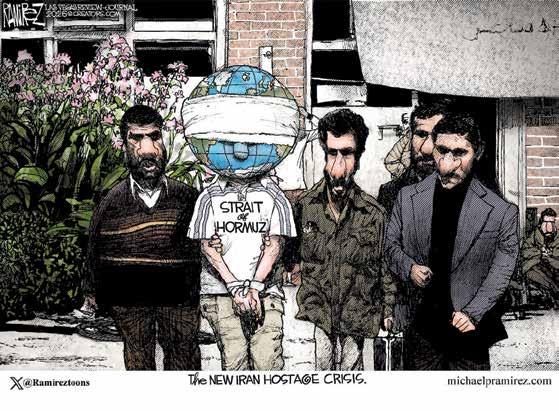
The president and Bibi have had a plan all along to do regime change. That’s my hunch based on the totality of what I know, that there’s been a secret plan for regime change.
- Journalist Mark Halperin


When bargaining about war and peace, the strategist Thomas Schelling wrote, you’re more likely to win concessions “if you get a reputation for being reckless, demanding, or unreliable.”
By that measure, President Donald Trump and Iran’s hardline leaders both deserve what we might call the Schelling Prize for negotiations. They scrambled up the ladder of escalation without clearly defined objectives or a strategy for climbing down. Their recklessness was believable. But they seem to have come back from the brink.
This game of chicken paused Monday morning, just hours before the expiration of Trump’s ultimatum to “obliterate” Iran’s power plants unless it agreed to reopen the Strait of Hormuz. Trump made a surprise announcement that he’d had “very good and productive conversations regarding a complete and total resolution of our hostilities in the Middle East.”
He said he would delay the power plant strikes for five days.
Trump has made similar claims about negotiating breakthroughs before, only to reverse course and attack. He did that in late February, on the eve of this war, and back in June 2025 before the 12-day conflict. But an Iranian Foreign Ministry spokesman confirmed that messages had been received through “friendly countries” seeking negotiations to end the war.
The trick to the game of chicken is to make the other guy believe you are truly ready to crash the car. As strategist Herman Kahn observed in his 1965 book “On Escalation,” a winning strategy might be to remove the steering wheel and throw it out the window as a sign you’re totally out of control. Except that the “winner” might end up dead. Trump is convincing as a risk-taker, but not a suicidal one. He has an instinct for self-preservation amid
By David Ignatius

the chaos he inflicts.
The Iran war, to me, has been a lesson in the limits of brinkmanship. As Schelling put it in “The Strategy of Conflict,” his classic work, “Brinkmanship involves getting onto the slope where one may fall in spite of his own best efforts to save him-
tolerance, until he reaches an unacceptable pain threshold.
Critics call this TACO, for “Trump always chickens out.” But the real lesson is one that the president never seemed to learn in business: Don’t bet more than you’re willing to lose.
The trick to the game of chicken is to make the other guy believe you are truly ready to crash the car.
self, dragging his adversary with him.” Trump approached the brink - but not so close that he might slide off.
That’s the problem with Trump’s way of war: You can’t bluff your way to a decisive victory. After Iran closed the strait, it became increasingly clear that Tehran had a potentially ruinous squeeze on the global economy. Trump has a high risk
Even before Monday’s announcement of peace negotiations, there were signs that a diplomatic track was reemerging. One was the almost frantic signaling by Trump that he wanted to end the conflict – as he moved from demanding “unconditional surrender” to announcing that the war was over to threatening destruction of Iranian power plants.
Another telling sign was that Trump quietly encouraged mediation efforts by two nations that Israel regards as adversaries: Qatar and Turkey. Qatari officials explored settlement terms last week until Israel’s strike on Iran’s South Pars gas field triggered a reciprocal Iranian attack on Qatar’s Ras Laffan gas facility. Then Turkey’s foreign minister, Hakan Fidan, announced Sunday that he was talking with Tehran, Washington and Brussels about a possible deal.
A third signal came from Iran itself. Foreign Minister Abbas Araghchi posted an intriguing message Sunday: “Strait of Hormuz is not closed. Ships hesitate because insurers fear the war of choice you initiated – not Iran. ... Freedom of Navigation cannot exist without Freedom of Trade. Respect both – or expect neither.”
When a crisis becomes as dangerous as this one – and there is no clear path to victory at an acceptable cost – then de-escalation makes sense. But nobody should pretend that the kind of deal Trump and Iranian leaders are exploring will resolve the fundamental issues in this conflict. The Iranian nuclear program may be shattered, but not the malign regime that spawned it.
What worries me as this war is cresting are those caught in the crossfire. The United Arab Emirates, for example, cautioned Washington against going to war, but the UAE took more missile and drone hits than Israel. It wanted Trump to “finish the job” but seems likely to get something considerably less.
And the Iranian people, who marched in the streets to protest a regime they detest, died by the tens of thousands in January as the regime cracked down. Everyday Iranians are the real victims: They shouldn’t be left on the precipice much longer.

By Marc A. Thiessen

“If you can keep your head when all about you are losing theirs and blaming it on you. If you can trust yourself when all men doubt you. … If you can wait and not be tired by waiting. … Yours is the Earth and everything that’s in it.” - Rudyard Kipling
Speculation is flying that President Donald Trump, buffeted by rising gas prices and domestic political concerns, is desperate for an off-ramp and looking for a deal with Iran to end the war. These leaks, whispers and rumors are wrong. While others may be panicking, I know from well-placed sources that Trump has never been more determined to see this military campaign through to completion.
Nearly four weeks into Operation Epic Fury, the president is on the cusp of achieving all of the military objectives he has set – but he understands that none of them are yet fully complete. We are at the enemy’s 20-yard line, but the final yards are always the hardest. All the easy targets have been hit. What’s left are the most hidden, hardened and complex challenges.
“We’re in a red zone,” retired Army
Gen. Jack Keane told me in a podcast interview. But to win, the United States needs to get into the end zone, and Adm. Brad Cooper, commander of U.S. Central Command, needs another three weeks for that. Given that time, Keane said, “the combined force will accomplish all assigned objectives … to include opening the Strait of Hormuz by force and keeping it open” and taking “nuclear enrichment … off the board completely by military operations.”
U.S. negotiations with Iran are a sign not of desperation but strength. Shortly after the start of the war, Trump declared that there would be “no deal with Iran except UNCONDITIONAL SURRENDER!”
He has now put a 15-point plan on the table that effectively sets the terms of that surrender. He is willing to talk with Iran – but while he negotiates, he is pummeling the regime.
The message to Iran is that the war can end in one of two ways: Either the regime gives Trump what he demands, or the United States will “unleash hell” and take it from them. Trump is right to pursue both options at once – speaking to the remnants of the regime to see if they are ready to cry
uncle, while ruthlessly battering them from the sea and skies.
After Iran’s capacity for nuclear enrichment is eliminated and the strait is reopened, the final military task will be to take control of Kharg Island, through which roughly 96 percent of Iran’s crude oil exports pass. If the U.S. controls Kharg and the Strait of Hormuz, it controls Iran’s oil – and thus its economy. Trump, in other words, will then have this brutal, terrorist-supporting regime’s head in a vice from which there is no escape.
At that point, he can impose terms of surrender: No more nuclear enrichment, no more ballistic missile production, no more support for terrorist proxies and, importantly, no more massacres of protesters. If regime remnants violate any of Trump’s terms, he can tighten the vice at will – either by cutting off Iran’s oil and forcing the economic collapse of the country or by striking it militarily.
Though anything can happen, it is unlikely the regime will disappear in the next three weeks. But once military operations conclude, the United States and Israel will have created ripe conditions for Iranians to
restore their lost freedoms. Iran’s surviving leaders should be told in no uncertain terms: If you continue executions or fire on protesters, you will pay a heavy price. This threat will create space for the Iranian people to organize, form an opposition and return to the streets to force democratic change.
This much is certain: We are closer to the end than the beginning – and the military campaign is “exceeding expectations,” Keane said. In the next three weeks, the U.S. aims to eliminate Iran’s capacity for nuclear enrichment, offensive military action and military production; take control of the Strait of Hormuz and Iran’s oil; and set conditions for eventual regime collapse. If it achieves those goals, that “would be a stunning accomplishment by anybody’s definition, except the people that are ideologically opposed to anything that Donald Trump does.”
All of that is within the president’s grasp if, like Kipling’s great man, he continues to keep his head while all around him others are losing theirs.
by Bret Stephens

Most Americans probably don’t look back at March 2012 — if they remember it at all — and think of terrifyingly high gas prices. In the month when “The Hunger Games” ruled the box office and President Barack Obama was on his way to a comfortable reelection, the price of Brent crude closed the month around $123 a barrel. That would be about $175 a barrel in today’s dollars.
As of Tuesday, despite Iran’s effective closure of the Strait of Hormuz and its attacks on its neighbors’ energy facilities, it’s hovering around $100, slightly higher than the average inflation-adjusted price since January 2001, roughly $95.
That ought to provide some perspective on the panic over the war in the Middle East. To hear the critics’ version of events, an unprovoked and unnecessary attack on Iran, launched at Israel’s behest, is already a foreign-policy fiasco that has put the global economy at risk without any clear objective or endgame.
As Sen. Chris Murphy, D-Conn., told NBC’s Kristen Welker over the weekend, “We’ve never seen this level of incompetence in war-making in this country’s history.”
Really? Let’s take a tour of some of the recent history.
combat. In this conflict, four manned aircraft have been destroyed, three to friendly fire and one in an accident. Not a single manned plane has yet been lost over Iran.
— The U.S. air and land campaign in that operation lasted a full six weeks.
Yousef Pezeshkian, the son of the current president, has written that if Iran can’t prevent the continued assassination of its leaders, “we will lose the war.”
— During the 1991 Operation Desert Storm against Iraq’s Saddam Hussein, a campaign that is widely considered a brilliant military success, the U.S.-led coalition lost 75 aircraft, 42 of them in
Today it’s remembered as a lightning-fast war. The current conflict with Iran is less than four weeks old.
— In the 1989-90 invasion of Panama, whose military phase lasted a few
days, the United States lost 23 soldiers, with 325 more wounded. So far in this war, U.S. losses are 13 dead. Among the more than 230 wounded, most have swiftly returned to duty.
— During the Persian Gulf crisis that began with Iraq’s invasion of Kuwait in August 1990, the U.S. economy went into recession and the Dow fell by about 13% before the allied air war began. Since conflict with Iran began last June with Operation Midnight Hammer, the Dow is up by 9% as of Tuesday morning.
— At the outset of the 2003 invasion of Iraq, the United States made a failed decapitation strike against Saddam and his senior leadership, some of whom became leaders of the insurgency. In this war, much of Iran’s top leadership was killed on the first day, and there is still no proof of life from the new supreme leader. Yousef Pezeshkian, the son of the current president, has written that if Iran can’t prevent the continued assassination of its leaders, “we will lose the war.”
— Between 1987 and 1988, in the final stages of the so-called tanker war, the Reagan administration reflagged Kuwaiti tankers and had the U.S. Navy escort them out of the Strait of Hormuz. An Iranian mine nearly sank an American frigate. The conflict wound down after the United States sank a handful of Iranian navy ships. This time around, we have destroyed almost all of Iran’s navy with no naval losses of our own.
— In 1991, Iraq fired roughly 40 missiles toward Israel. Hardly any were intercepted despite the deployment of Patriot batteries there. In this war, Israel is registering an interception rate of 92% against more than 400 missiles. Iran’s overall rate of fire has dropped from 438 ballistic missiles on the first day of the war to 21 on Monday. Drone fire has also declined from 345 to 75 for the same dates.
— In the months leading up to the second Iraq war, the George W. Bush administration made a case based on erroneous information that Saddam possessed weapons of mass destruction. In the current war, there is no question that some 970 pounds of highly enriched uranium lies stashed and buried in Iran — possibly enough, with further enrichment and conversion into uranium metal, for 11 nuclear bombs. If the outrage of the Iraq war is that Saddam didn’t have WMD capabilities, is it now supposed to be somehow more outrageous that Iran does?
— One of the worst mistakes of the wars in Iraq and Afghanistan was the attempt by U.S. administrators to remake societies in both countries — well-intended efforts with some noble results that nonetheless were beyond our grasp. In this war, despite some varying rhetoric from President Donald Trump, the goal has been reasonably clear and consistent: Iran cannot have nuclear weapons or other means to menace its neighbors. As for regime change, we hope the Iranian people use the opportunity of their leadership’s weakness to seize their own destiny. But we won’t do it for them.
— The Bush administration had little support from Arab nations during the 2003 invasion of Iraq and its aftermath. Now The New York Times reports, “Saudi Arabia’s de facto leader, Crown Prince Mohammed bin Salman, has been pushing President Trump to continue the war against Iran, arguing that the U.S.-Israeli military campaign presents a ‘historic opportunity’ to reamake the Middle East.” Hopefully, one way in which it can be remade is through a peace treaty between Riyadh and Jerusalem.

— In hindsight, the single biggest error of the Gulf War was to end it too soon, before Saddam’s forces were thoroughly routed. Trump should not make the same mistake.
I am not blind to the Trump administration’s failures in planning, particularly its unwillingness to make a stronger public case for war and get more allies
on our side before the campaign began. I am also purposely comparing the war with Iran to past wars of similar scale, rather than our true military fiascos in Vietnam, Korea and the two world wars — in which tens of thousands of Americans died due to poor tactical planning and bad strategy.
Still, if past generations could see
how well this war has gone compared with the ones they were compelled to fight at a frightening cost, they would marvel at their posterity’s comparative good fortune. They would marvel, too, at our inability to appreciate the advantages we now possess.
© The New York Times

For Democrats who are already immersed in the run-up to the 2028 presidential election, Israel isn’t so much a country in the Middle East as it is a landmine. California Gov. Gavin Newsom provided a classic example earlier this month of how hard it is to navigate the issue for politicians who want the support of both pro- and anti-Israel voters.
Newsom set off something of an explosion when, while promoting his autobiography, Young Man in a Hurry: A Memoir of Discovery, written to promote his presidential prospects. At a Los Angeles event , he told the hosts of the Pod Save America left-wing podcast that those who are smearing Israel as an apartheid state are doing so “appropriately.” In the same interview, he spoke of considering supporting a ban on military aid to the Jewish state, even in the midst of war, and implied that he thought that Israel was pushing the United States into a war with Iran in which it had no stake.
When faced with strong and immediate pushback from pro-Israel Democrats over his seeming willingness to join the growing ranks of anti-Zionists who help fuel antisemitism with blood libels about Israel, Newsom predictably backed down.
In a fawning interview with the liberal Politico website, Newsom said that he regretted the statement. He insisted that what he really meant was that he agreed with New York Times columnist and inveterate Israel-basher Thomas L. Friedman, whom, he said, has written that Israel is heading toward apartheid under Israeli Prime Minister Benjamin
By Jonathan S. Tobin

Netanyahu and his right-wing and religious supporters who oppose a twostate solution. While refusing to label himself as a “Zionist”—a word that has become a term of abuse on the political left—Newsom still claimed to “revere” Israel and decreed that he was “proud” to support it.
That pleased some on the left, such as Forward columnist Rob Eshman, who claimed that this meant that the governor wasn’t waffling on Israel but was actually voicing “sensible ideas” about the Middle East. Among the dwindling ranks of so-called “liberal Zionists” who join in the demonizing of the government (elected by Israeli citizens) but wish to distinguish themselves from those treating support for even the idea of a Jewish state as illegitimate, that’s good enough.
Newsom’s walk-back of his statement
regarding the “apartheid” slur angered many others on the left, who felt that the politician was betraying them. Farleft actor/anti-Israel activist Mark Ruffalo claimed to know that the governor had “said what you meant” in the first place. “I don’t know what billionaire got in your ear, but it’s not working for you. This is not how you are going to win. It’s apartheid, and it’s a genocide!”
The question is: Who does Newsom think has a better idea of where Democratic voters are these days—those donors who likely did get in his ear about calling Israel an “apartheid” state or people like Ruffalo who want to see it destroyed?
According to the annual Gallup poll on the subject, published last month, the overwhelming majority of those identifying as Democrats oppose the Jewish state. Under those
circumstances, positioning oneself as an unabashed supporter of Israel seems like a political death wish. But going all the way over to the other side and joining those who slander it and support its destruction is also problematic.
Will Democrats Tilt Farther to the Left?
That’s especially true for those who seek to run in what is left of the “moderate” lane in 2028 that was occupied by Hillary Clinton in 2016 and by Joe Biden in 2020 and 2024 (before he was deposed because of his mental incapacity). 2028 might be the year when the left wing of the party, led in the past by Sen. Bernie Sanders (I-Vt.), finally takes control.
But despite the fact that those who share their views on both Israel and other issues seem to dominate the liberal media and popular culture also lean hard to the left, a lot of Democrats who matter still fear nominating someone in the mold of Sanders. That’s true even if the next time, the candidate is someone who is much younger—for example, Rep. Alexandria Ocasio-Cortez (D-N.Y.). They not unreasonably believe that would lead to electoral disaster. That’s why those who are perceived as less extreme, like Newsom, are still broadly favored by most officeholders and the donor class. And among the latter are a great many large Democratic Party donors who still remain supportive of Israel—or at least opposed to the anti-Zionist and antisemitic left.
The 2028 Democratic presidential primaries are two full years from now, so guessing which issues and stands will appeal to voters is a somewhat hazardous task. Nevertheless, the maneuvering of leading Democrats right
now with respect to Israel is part of a process that has been building for years. Part of it is rooted in the way toxic leftwing ideas like critical race theory, intersectionality and settler-colonialism, that among other things falsely labels Israelis and Jews as “white” oppressors, have become a new orthodoxy among Democrats. Mixed in with it is the way hatred for President Donald Trump and opposition to virtually everything he does has become a litmus test for party loyalty.
Anti-Israel
In this way, rather than Trump’s historic support for Israel being something on which the majority of Americans could agree, it has instead become just one more example of something Democrats respond to on a knee-jerk basis.
Pro-Israel Democrats were clearly uncomfortable when Trump accomplished measures during his first term that they would have cheered had a president of their party done them, such as moving the U.S. embassy from Tel Aviv to Jerusalem in 2018 or brokering the 2020 Abraham Accords. Still, they didn’t actively oppose them. In his second term, many of their opinion leaders and voters have embraced the blood libels about the Jewish state committing “genocide” in Gaza, being an “apartheid” state, and now, the claim that Israel has dragged America into a war with Iran.
At this point, backing for the Jewish state among Democrats has become, as Newsom demonstrated, a theoretical exercise. They’re ready to support an Israel in sync with liberal Democratic policy priorities—meaning, support for a Palestinian state and making deals with Iran. That’s an Israel, however, that doesn’t really exist.
After the once-popular Oslo Accords exploded into the terrorist war of attrition known as the Second Intifada (2000-05), then the disengagement from Gaza, and then the Hamasled atrocities on Oct. 7, 2023, support for a Palestinian state among Israelis is limited to a small percentage of diehard leftists. Even fewer Jewish Israelis oppose the current war in Iran, with 93% backing it—a total that reflects an overwhelming majority of even those who will vote against Netanyahu in the next election.
Simply put, there is a broad consensus within Israel that stretches from left to right on these issues. That con-
sensus views a Palestinian state, such as the one that existed in Gaza prior to Oct. 7 in all but name, as an invitation to future slaughter and perpetual war. It also understands that the only option available to them with respect to Iran,
of Trump’s stands, including the current war on Iran. And that has also placed Vice President JD Vance, the putative champion of the Tucker Carlson anti-Israel wing of the party, in a very uncomfortable position. He and his staff are
According to the annual Gallup poll on the subject, published last month, the overwhelming majority of those identifying as Democrats oppose the Jewish state.
as long as it is governed by fanatical Islamist theocrats, is a fight to the finish.
Seen from that perspective, it makes even those Democrats who claim to be supporters of Israel, though bitterly opposed to its government, like Newsom or even Pennsylvania Gov. Josh Shapiro, as not merely out of touch with the realities of Israeli politics but also with their own voters. Such candidates may try to finesse the issue, as Newsom and Shapiro are trying to do, by declaring their support for Israel while avowing perpetual opposition to Netanyahu and Trump. But even if you take Netanyahu out of the equation, there is no conceivable government that could emerge from the next Israeli election that would have policies on two states or Iran that any almost any Democrat outside of an outlier like Sen. John Fetterman (D-Pa) could support. And as far as the left-wing base of the Democratic Party is concerned, all Israelis and their American supporters—be they Jewish or Christian evangelicals—are backers of the mythical “genocide” and “apartheid.”
And that is why Israel is a land mine that Democratic presidential contenders understand can blow up their ability to reach their party’s activists who are the key to winning primaries and the nomination.
It’s true that there is also a vocal anti-Israel and increasingly antisemitic faction on the right that is unhappy with Trump’s pro-Israel policies. But it is clearly a minority with most Republicans, including the MAGA base. Most are enthusiastic supporters of Israel and
reduced to leaking their unhappiness with Netanyahu, as well as their hopes about brokering a deal with Iran, to leftwing publications like Axios.
The anti-Israel right may think that it can reverse the GOP’s pro-Israel stance if Vance wins the presidency in 2028. But their problem is that unlike the situation on the other side of the aisle, the
Veep’s coolness to Israel and the conflict with Iran is making that prospect far less of an inevitable occurrence than it seemed just a few months ago.
But for Democrats, the trend is moving in the opposite direction.
The best that supporters of Israel can hope for from a Democratic presidential candidate going forward is exactly the sort of dodge Newsom has just demonstrated—by talking out of both sides of his mouth. He signaled acquiescence to the “apartheid” and “genocide” blood libels while saying he supports a mythical Israel that has, like the few remaining liberal Zionists, learned nothing from Oslo, the events of Oct. 7, or Iran’s role in fomenting terror and war. Some “moderate” Democrats may think that trying to thread the needle in this way will allow them to be acceptable to both left-wingers and Jewish donors. That’s a sham that increasingly fewer opponents or supporters of Israel will accept.
Jonathan S. Tobin is editor-in-chief of JNS (Jewish News Syndicate).

KARACHI, Pakistan — Pakistan’s government has embarked on a major push to reshape its image abroad, an effort now visible in how it’s handling the escalating conflict with Afghanistan.
The media offensive is part of a renewed push by Pakistan to position itself as a key partner to the West, including President Donald Trump, and a diplomatic power in the region.
Over the past year, representatives of Pakistani security agencies have lobbied journalists to start state-friendly English-language news outlets, according to officials and journalists approached for the ventures. In October, Pakistan also relaunched its public broadcast channel, Pakistan TV. During a visit to the headquarters last fall, Prime Minister Shehbaz Sharif said the channel’s new digital department would counter foreign propaganda and promote Pakistan’s messaging abroad.
The new outlets have pursued two main targets — India and the Taliban government next door in Afghanistan. Their journalists have been highly critical of Pakistan’s archrival, India, and have framed a military campaign against the Taliban in terms that mostly echo the Pakistani military’s rhetoric — reinforcing claims that all strikes hit Afghan military targets, for example, despite evidence to the contrary.
“Pakistan has traditionally been far too shy and risk averse in shaping its own story,” said Mosharraf Zaidi, a spokesperson for Prime Minister Shehbaz Sharif. “That is beginning to change.”
A Pakistani official involved in the effort said it was prompted by the military clash with India last May, when Pakistan became “overwhelmed” with pro-Indian content on social media, the official said.
Both Indian and Pakistani media amplified falsehoods during the conflict last year.
by Elian Peltier and Zia ur-Rehman
In response, the Pakistani official said, security agencies “motivated and requested” media executives to start new English-language channels to counter those narratives, in part by providing tax exemptions.
The appeal was patriotic, the official said, speaking on condition of anonymity to detail a plan not yet reported public -
dia. At least two more are in the works, according to journalists approached for the ventures.
The channels are part of Pakistan’s larger diplomatic strategy. Since the military clash with India, Pakistan’s army chief, Field Marshal Syed Asim Munir, has forged a personal relationship with Trump, who calls him his “favorite field
Both Indian and Pakistani media amplified falsehoods during the conflict last year.
ly. The official didn’t disclose how much funding the channels had received, but said that no English-language channel in Pakistan would be sustainable without state support.
In addition to Pakistan TV’s revamp, two new English-language channels were started shortly after the clash with In -
marshal,” and wooed Trump’s allies with cryptocurrency and his administration with mineral deals.
Pakistan has also tried to be perceived as a diplomatic power at the crossroads of Central Asia, South Asia and the Middle East. It signed a defense pact with Saudi Arabia in September
shortly after renewing a long-term economic partnership with China.
To back up its diplomacy, Pakistan is trying to replicate successful statebacked channels that amplify their countries’ messages and burnish their images abroad, such as Turkey’s TRT or Qatar’s Al Jazeera.
“If you’re doing well diplomatically, if your economy is on track, you need a strong state broadcaster that can bring Pakistan’s vision to the world,” Adil Shahzeb, the head of the state broadcaster, Pakistan TV, said in an interview last fall.
Pakistan has a long history of starting television channels in the wake of conflicts with India. In the mid-2000s, three English-language news channels were started amid heightened tensions. But the initiatives, unprofitable, quickly folded.
Journalists said this new media push may face the same fate, because the funding and vision are nowhere near those provided by Qatar and Turkey.
“The problem is, these efforts pick up steam when a crisis flares up, but nobody is really trying to figure out what comes next,” said Arifa Noor, the host of an Urdu talk show on Dawn TV, one of the country’s few independent news outlets.
In recent months, Pakistan TV, the public broadcaster, has covered protests in neighboring India; a humanitarian crisis in Afghanistan; and Pakistan’s diplomacy, including three meetings between Trump and Munir and Pakistan’s decision to join Trump’s Board of Peace.
But contentious domestic issues have remained mostly absent.
“The government thinks that it can fund television channels, directly or indirectly, that it will use as mouthpieces for easy communication purposes,” said Bilal Gilani, the executive director of Gallup Pakistan, an independent research institute.
It is unclear what funding mecha -
nism, direct or indirect, Pakistan used for this effort.
Three Pakistani journalists said they had been approached by Sharjeel Inam Memon, a provincial information minister who is seen as a key intermediary for the state, to start one of the ventures. All three media executives said they declined the request. They spoke on condition of anonymity to describe the government’s methods.
Memon and Pakistan’s information minister, Attaullah Tarar, didn’t respond to requests for comment.
The Pakistani official involved in the state’s efforts said journalists had been invited by the security agencies to devise the new ventures’ editorial strategy. He said he wasn’t sure how the new channels would keep operating after the initial round of funding.
The new outlets have had to contend with what the country’s leading editors’ organization has called the government’s “complete control” of Pakistani media.
Reporters in Pakistan have faced increased censorship and financial pressure, including frozen bank accounts and the suspension of government advertising; forced removal, arbitrary arrests and imprisonment, according to journalists and human rights groups. Several journalists have also been arrested under a law criminalizing “false and fake information.”
Dawn, the country’s most wellknown newspaper, currently faces a financial crisis after the government choked off advertising revenue, in what the paper said is retaliation for its reporting.
Pakistan ranks 158th out of 180 countries in the press freedom index of Reporters Without Borders.
Some pockets of independence remain on YouTube and podcasts, Noor said. “It allows a conversation to happen that the state wants to put an end to,” she said.
Two leaders of state-friendly news outlets say they intend to maintain their independence.
“We will try to be as independent as we can be as a state broadcaster,” said Shahzeb, of Pakistan TV. “I won’t just say ‘yes boss’ to those who’ve named me here.”
He said he wanted the channel to be “calm, credible, composed.”
Asia One, one of the new channels, made its debut last summer in Karachi.
Naveed Qamar, Asia One’s director and a veteran journalist, said the channel had hired 250 employees, including on-air hosts who are primarily for -

eigners. Local journalists, Qamar said, lacked the broadcast-standard English required for a global audience.
“We want to show the world that a foreign journalist can be based in Pakistan and be safe here,” Qamar said.
During a visit to Asia One’s headquarters last fall, the newsroom hummed as dozens of journalists prepared news clips
and bulletins.
But an Asia One employee, who requested anonymity to speak candidly, said the channel offered only temporary relief in an industry where jobs are scarce.
Shahzeb Jillani, the head of the Karachi-based Center for Excellence in Journalism, said the speed at which the
new channels started running was “impressive,” but that they could collapse as quickly.
“I tell my students about those new channels, ‘Go there, learn, make money,’” Jillani said. “But be mindful of who you work for.”
© The New York Times
by Maria Varenikova and Evelina Riabenko

VELYKYI DOROSHIV, Ukraine —
On his first day home after nearly four years in Russian captivity, Nazar Daletskyi took a walk to his village’s small cemetery in western Ukraine. There, he gazed down at his own grave.
Weeks before, Daletskyi and dozens of others had been freed in an exchange of prisoners of war. He learned from a Ukrainian security officer that a DNA mistake had led his relatives three years ago to bury a bag of remains they thought were his own. On paper, the officer said, Daletskyi no longer existed.
On Sunday, Daletskyi, 46, stood over his grave, one of a few dozen in an open field. Six flags adorned the stones for soldiers killed in the war. A seventh flag, marking his own grave, had been removed, as had the remains of the yet-unknown soldier inside it. Piles of soil from the digging were left behind.
“Not everyone gets a chance to see their own funeral and find out who cried the most for you,” Daletskyi said.
On Feb. 5, the day he was returned
to Ukraine, his mother, Nataliia Daletska, 72, received a call. The head of the village knew it was coming, and went to Daletska’s home to film the moment. Her niece Roksolana Makohin was there and picked up the phone first, screaming with happiness.
When Makohin said Daletskyi’s name aloud, his mother covered her face with her hands, asked for the phone and said, “My G-d, how long I’ve waited for you, my precious child.”
They would have to wait weeks to meet. Daletskyi, who had been captured by Russian forces in May 2022 as he and his comrades tried to hold a position in Ukraine’s east, was first sent to a military hospital to recover. In captivity, he had been regularly beaten and had lost 35 pounds. At the hospital, he was given the call sign “Resurrected.”
On the day of their reunion, as Daletska spoke in the living room where her son’s coffin had once stood and where the family would celebrate his return, the toll on her from the government’s mistake
was clear. Even with him back, she would never fully recover the health she had lost while mourning him, she said, nor would she forget the grief of visiting his grave for three years.
Russia’s long, brutal war has overwhelmed Ukraine’s system for identifying its dead soldiers, who are estimated by researchers to number more than 100,000.
DNA results are often slow to arrive, and morgues are filled beyond capacity. More than 90,000 people are registered as missing in Ukraine, a majority of them soldiers, according to official data reported by Ukrainian news outlets. Many are presumed dead.
As for those still living but in Russian captivity, Moscow does not provide precise lists. The Ukrainian government says that in every exchange of prisoners there are some who had been listed as missing.
But this is the first time that a soldier turned out to be alive after his family had held his funeral. The Ukrainian government has acknowledged the error and said the family would not have to return
the $340,000 it had received in bereavement compensation.
For Daletskyi to officially reclaim his identity, a court must now recognize that he is alive.
His long journey home began in February, when he boarded a bus with other prisoners of war and was taken to Ukraine. Going down a list, a Ukrainian security officer read each name aloud, checking them off one by one. All but Daletskyi’s.
Instead, the officer waved him off the bus. He looked at Daletskyi carefully, then at a photograph of him on his phone.
“He looked at me again and said, ‘Congratulations — you rose from the dead,’” Daletskyi said in an interview Saturday near the military hospital where he had recovered.
After hearing about his own burial from the officer, Daletskyi returned to his seat, white as a ghost, he said.
In May 2022, three months into the war, Daletskyi’s mother was told that he was in captivity. A year later, a police offi-
cial in Kharkiv, near the front line, called to say that a genetic test on a set of recovered remains was a 99% match with her own DNA.
She refused to believe it. She could not understand how the body had ended up on Ukrainian soil if her son had been in Russian captivity. The Kharkiv official warned that if she did not accept the results, the remains would be buried as an unidentified body.
Daletska said she had faith in DNA. “I often watch investigative series on TV,” she said. Still, her doubts lingered. The DNA test did not match Daletskyi’s daughter.
“The policeman apparently said that maybe she isn’t mine,” Daletskyi said. “I mustn’t forget to go and punch him in the face.”
When Daletska went to collect the body she had been told was her son’s, she asked to see anything of him that remained. She was told there was nothing but charred remains and ashes.
At his funeral, people asked, “Are you sure that’s him?” She tried to push any doubts away. “If I thought like that, I would go mad,” she said.
Daletska learned last autumn that her son might be alive, when two soldiers re -
turned from captivity and said they had seen Daletskyi in prison. Unsure what to believe, she was careful not to let hope take hold.
“Nobody knew what to do,” her niece, Makohin, 40, said. So the family waited.
When Daletskyi finally returned home Sunday, dozens of people filled the square near the village hall, singing

songs as children ran around holding Ukrainian flags.
His mother stood in the crowd, breathing heavily. She struggled to make sense of her emotions, smiling, then crying, then smiling again. When a car stopped and her son opened the door, she burst into tears and rushed to him. They embraced. She leaned her head on his
chest, and he kissed it.
He looked happy and bewildered. As people lined up to hug him, they asked if he remembered them. “Come on, I was away for only four years,” he said, and the crowd laughed. People whispered to one another: “Does he look like Nazar? Is that really him?”
Afterward, Daletskyi took his mother’s arm, and together with his large family of nephews, cousins, aunts and uncles, they went home. A table was set, while children ran through the house. “Hey, Gran, Nazar has two lives now!” shouted his 9-year-old cousin, Hnat.
“Indeed,” Daletska said. “We will now celebrate his birthday on Feb. 5,” she added, referring to the day her son first called her after his long captivity.
In the room where Daletskyi now sat on a sunny Sunday, with noise and song swirling around him, his coffin had rested three years before in mournful solitude. The same people who surrounded him now were there then, offering words of support to his mother. She had sat beside the coffin, crying and staring at a memorial photograph of her son, which she would later burn.
© The New York Times

By Avi Heiligman
Preparations for Pesach typically start several weeks in advance, an effort extended to service members serving at home or abroad. Whether serving in the IDF, the United States military, or another nation’s forces, Jewish personnel try to celebrate Pesach as best as their circumstances allow. Throughout the last few centuries, there have been numerous accounts of soldiers, sailors, airmen, guardsmen and marines eating matzah and recounting the story of the Jews leaving Egypt, even while serving on the front lines.
The Jewish population in America was small during the Revolutionary War, and approximately 160 Jewish soldiers served in the Continental Army. While there aren’t documented accounts of soldiers celebrating Pesach, they most likely observed the holiday as best as they could. Jewish officers and soldiers like Colonel Isaac Franks and Major Benjamin Nones served under General Washington’s command, bringing their faith into a war with little religious resources.
During the American Civil War, there are several accounts of soldiers procuring matzah, wine and other provisions needed for Pesach. A group of 20 soldiers led by Private Joseph Joel from Ohio obtained matzah from Cincinnati and were given time off to have a Seder while stationed in the wilds of West Virginia. Joel later wrote of his experience: “Horseradish or parsley we could not obtain, but in lieu we found a weed, whose bitterness, I apprehend, exceeded anything our forefathers ‘enjoyed.’”
Other soldiers wrote of obtaining kosher meat while on the front lines, while
another told his story of finding a Jewish family in a captured Southern town that gave him matzah.
In 1864, Confederate soldier Isaac J. Levy of the 46th Virginia Infantry Regiment wrote to his family that he was able to buy matzah at two dollars a pound in Charleston. He continued by saying he and his brother were “observing the festival in a truly Orthodox style.” Just a few months later, he was killed during the Siege of Pe -
ner given the fact that they were middle of a war. Riseman wrote about Pesach on the front lines, “While at our three day’s rest camp, provisions were made for Lt. [Bernard I.] Gorfinkle. An order was immediately sent around, and all the Jewish boys were notified to attend. Our Passover service was held in a schoolhouse of a little French village. The young school teacher was kind and offered us anything we desired. At about 8:30 pm, our services
“In lieu we found a weed, whose bitterness, I apprehend, exceeded anything our forefathers ‘enjoyed.’”
tersburg. It was later written about him: “He and his brother Ezekiel Levy have observed their religion faithfully, ever since they have been in the army, never even eating forbidden food.”
The Jewish Welfare Board was formed in April 1917; just days after the United States declared war on Germany in World War I. Among their many tasks was assisting more than 200,000 Jewish servicemen in preparing for Pesach and other holidays. By 1918, many Jewish soldiers were overseas during Pesach, and it was up to soldiers and officers like Colonel Max Wainer of the Quartermaster Corps and Sergeant Jay Riseman of the 101st Infantry, 26th Division to celebrate in the best man-
commenced. Each once was …presented with a prayer book in Hebrew and English by our worthy lieutenant. Wine was had, but what we missed was the unleavened bread.” Wainer led a separate Seder and became a vital liaison for the Jewish Welfare Board due to his position on General John Pershing’s staff.
Celebrating Pesach varied for the over 550,000 Jewish service members that served in the American Armed Forces during World War II. The logistical effort was immense, with the shipping of millions of pounds of matzah and Haggadahs to the European and Pacific theaters. In some cases, the War Department even authorized the production of special “Pesach
Rations” to replace standard field meals. Large sedarim in rear echelon areas lead by chaplains like Rabbi Aaron Paperman took place, while others had their Seder on ships, in mess halls and in combat conditions. One of the most famous front line sedarim occurred in 1945, when hundreds of Jewish GIs held a Seder in the German town of Rheydt, inside the former estate of Joseph Goebbels.
Orthodox Chaplain Rabbi Alan Greenspan from Bridgeport, Connecticut, joined the army in 1960 and six years later was stationed in Saigon during the Vietnam War. In 1966, he overcame challenges like late arriving supplies and hosted a Seder for 135 soldiers the first night of Pesach and for 100 soldiers the next night at the Saigon USO. The men shared canned kosher food while the explosions in the distance made the words of the Haggadah resonate with everyone present at the Seder.
There have been many Pesach sedarim for those serving in the military with many accounts of their preparations having been written down. These include for American soldiers fighting in wars across the globe to members of the IDF fighting to protect their homeland. For the soldiers serving on the front lines, having a Seder is a time to remember the miracles done for the Jewish people so many years ago as well as time off from the harsh realities of war.
Avi Heiligman is a weekly contributor to The Jewish Home. He welcomes your comments and suggestions for future columns and can be reached at aviheiligman@gmail.com.



PUBLISH YOUR SEFER
Affordably with Amazon. We handle formatting and cover—ready to print. Contact: belleharborminyanhelpers@hotmail.com 929-208-6597
DU N DURT
Power & Soft Washing
We clean siding, stucco, decks, driveways, concrete, pool patios, pavers & sidewalks. Say goodbye to grime, mold & allergens!
Call/WhatsApp: 718-688-2964
Email: dundurtny01@gmail.com
THE LEATHER SHOPPE
The spot for all your custom leather Judaica. Tallis/tefillin bags, lulav and esrog bags, havdallah sets, challah covers, shtenders, pesach sets, matzah/afikomen bags. WhatsApp: (732) 523-0007 or email: theleathershoppe732@gmail.com for a full catalog. We ship.
PEACEFUL PRESENCE STUDIO
Men’s private yoga, Licensed Massage & Holistic Health Guidance 436 Central Ave, Cedarhurst Info. & free video training www.peacefulpresence.com 516-371-3715
HAIR COURSE:
Learn how to wash & style hair & wigs. Hair and wig cutting, wedding styling Private lessons or in a group Call Chaya 718-715-9009
GERBER MOVING
Full Service Moving Packing Moving Supplies
Local Long Distance. Licensed Insured 1000’S Of Happy Customers Call Shalom 347-276-7422
For big or small jobs, Sheetrock, carpentry, painting, electrical, plumbing, install & repair appliances Call Ephraim at 347-593-4691
MANAGEMENT STAFF WILL ASSIST you with: * Obtaining Medicaid and Pooled Income Trust
* In-home Assessments, Individual and Family Counseling
* Securing reliable home care assistance
* Case and Care Management services Dr. S. Sasson, DSW, LCSW (718) 544- 0870 or (646) 284-6242
ZEVIZZ WOODTURNING JUDAICA
Challah knifes, batei mezuzah, besamim holder, kiddish cups, havdalah candle holders, yad for sefer torah, pens, stenders, bowls and more 952-356-2228
MY MOTTO IS DON’T WAIT TO buy real estate
Buy real estate and wait Your realtor for life 516-784-0856 Alexandra at Realty Connect USA
Don’t Get Stuck With a Two Story House Ya Know, It’s One Story Before You Buy It But a Second Story After You Own It! Call Dov Herman For An Accurate Unbiased Home Inspection InfraredTermite Inspection Full Report All Included NYC 718-INSPECT Long Island 516-INSPECT www.nyinspect.com
HOUSE FOR SALE
Fallsburg Willow Woods Sec. B, upgraded, fully furnished 3 bedroom, 3 bathroom duplex, available immediate move-in, indoor & outdoor porches, reduced $499,000 Text 917-270-6032
REAL ESTATE MANAGEMENT
Services – Do Not Manage Your Properties Alone!
Contact Aliyah Suites for all your real estate management needs and affordable office space near you! (516) 366-1049
Management@aliyahsuites.com
Marc Jeret (MJ) Team Leader & Licensed Real Estate Agent





















CEDARHURST
Prime Restaurant Location For Lease. For more information: Call/Text/WhatsApp Owner: (516) 206-1100
5 TOWNS - OFFICES FOR LEASE 250SF to 500SF Offices in Inwood & Cedarhurst Utilities, Internet & Parking incl. with some Kosher kitchen - Minyan Next to LIRR - No broker fee Call/text/Whatsapp: 516-206-1100
Commercial Real Estate section: Westbury Office Space for Lease Private Office Within Law Firm Building Close to LIRR - $1,000 per month Utilities Included Call/Text (773) 704-1650
CAN‘T AFFORD YOUR PROPERTY TAXES? MORTGAGE?
Must sell for any reason? Call for FREE Consultation. Call now 212-470-3856 Cash buyers available!
UPSCALE EVENING & Ready-to-Wear Boutique opening on Central Ave seeks fashion-forward, friendly sales associates with retail experience. Full-time & Part-time. Text/WhatsApp 718-310-8550.
DELIVERY PERSON NEEDED
to deliver this Newspaper every Thursday morning to locations in Brooklyn. Must have Mini van or SUVand availability to work Consistently every week. Good pay - Please email gabe@fivetownsjewishhome.com or call (917) 299-8082

REGENTS EXPERT
Tutoring regents in Algebra and Geometry A Darchei Torah instructor. Guaranteed results Text 347-491-8045 WhatsApp 347-767-1755
BOOKKEEPER
A Five Towns Real Estate Company is seeking a full-time Bookkeeper. The right candidate must be proficient with QuickBooks and Excel. They must also be self-motivated, organized, detail oriented, reliable, and able to work independently or as a team player. Warm, frum office environment with excellent salary & benefits. Please email resume to HR@capsprop.com


BECOME A DSP
With The Special Children’s Center. Work with children, support families, and bring stability to homes. Part-time flexible hours, excellent compensation. High School Diploma or BA required. Call (732) 367-0099 x164 or email shoshanay@thecenterny.org
SEEKING ELEMENTARY TEACHERS
For current school year, starting from end of January: Seeking assistant teacher for General Studies. Candidate should have skills to take over for teachers if needed. Far Rockaway area boys’ school, M-Th, PM hours, strong support. Excellent salary. Possibility to continue for next year. Send resume to teachersearch11@gmail.com







The Marion & Aaron Gural JCC Early Childhood Center is hiring summer camp counselors, lifeguards, and camp nurse or EMT. Applicants must be over 16-yearsold for Summer, 2026. Please send resumes to Camp@guraljcc.org or call (516) 239-1354.
Remote (requires in-person home visits in NY)
Support families facing serious medical or emotional challenges. Provide guidance, advocacy, and resource coordination from home or on-site. Training provided. BA or 2 years Care Management required Apply online: www. chailifeline.org/careers or email hr@chailifeline.org
ARE YOU A DOULA?
Or have a passion to be?
Come join our great referral group and get access to a vast new clientele through Medicaid. JUST CALL 347-668-7886
5 Towns area Nursing Home management office seeking a Regional/Corporate level MDS Nurse to work in our office.
Must be an RN. Regional experience preferred. 2-3 years MDS experience with good computer skills required. Position is Full Time but Part Time can be considered. Great Shomer Shabbos environment with some remote options as well. Email: officejob2019@gmail.com

A multi-tasker needed for general office work. The ideal candidate is someone who is detail-oriented, responsible, and can take ownership. Looking for someone who is eager to learn, and expand his/her skill set while possessing the ability to work independently and as part of a team.
Experience with Excel required. Five Towns location. In-office position only, not remote. Please send resume to 5tpart.timecareer@gmail.com
DONATE YOUR VEHICLE
Help Jewish Children Organization. Get $1500 tax deduction and $500 shopping card or cash. 718-974-9428
Text 516-303-3868 with a time slot of your choice to be careful on lashon hara. Be a part of the 1,000 people for klal yisroel!
CONG. Chasdei Uvois Oshpitzin Talmidei chachomim are willing to learn mishnayos, say kaddish and be the shliach tzibbur to daven for the umid on the yartzeit yom hashanah of your parents or close relatives or loved ones To arrange please call Rabbi Miller 917-445-6220

















Order in the house!
As many of you know, Seder means “order.”
Order turns chaos into meaning.
You may be thinking:
• So I worked like a dog to get here.
• I’m directed to sit like I’m falling off my chair, while simultaneously competing with my pillow for space just to remain seated.
• I’m eating ridiculously large crackers with minimal flavor, consuming this bland fare in a limited time span—as if it’s delicious!
• I’m turning red… white…and blue as I cough, choke, and devour an unpopular vegetable that is actually supposed to make me do just that.
• And I’m dipping bland potatoes into—if I’m lucky—salty enough water.
And this is order?
What does all this have to do with ORDER? If it were up to me, I’d certainly order a different menu for starters!
But that’s not what it’s all about. Those foods are just the embellishments. I know. You’re thinking, “What kind of embellishments are those? They seem more like consequences!”
Well, in reality, the Seder night has plenty of yummy food—if you stick around.
By Rivki D. Rosenwald Esq., LMFT, CLC, SDS

The point of the order is to recreate an experience.
It’s a night to integrate firsthand emotions and, through them, pass on an understanding of how we came to be and who we are in “order” that the next generation will imbibe its heritage and embrace its mission of appreciation and shared goodness.
And what better way than to recreate the actual journey?
begin the questions—and the explanations.
Anything that seems a little wacky gets people’s attention, and that is our goal. So we use costumes, foods, songs, and stories.
The symbolic eating helps us engage more of our senses to relive the events.
The storytelling and explanations help us journey back to the time when Hashem taught us that He is integrally
If it were up to me, I’d certainly order a different menu for starters!
Each activity of the night is a partial replica of our journey to becoming a nation—of going from slaves, controlled by an irrational, power-hungry tyrant, to children of a loving, moral Father and Creator, a truly involved and protective Guide.
We begin by building attention and curiosity.
We make things different so that children’s interest is piqued. And so,
involved in our lives—not just as a Creator who placed us here and then went on vacation, but as One who is with us through all our expeditions and travels.
We move through the Seder night, symbol after symbol, trying to relive the experience. We go from feeling stuck and defeated to recognizing, as we retell plague after plague, that Hashem can turn the world upside down at will—taking us from bitter to sweet,
from hardship to abundance. We move from stories of suppression to songs of thanks.
And we come away with the realization that we are never truly stuck—not even at the edge of a vast sea. Swimmer or not, boat or not, obstacles or not— Hashem will take us straight through.
We emerge on the other side—of the water and of the Seder—with gratitude and appreciation, knowing that Hashem is there for us and protects us.
On this night, we sense what true freedom looks like.
Chaos is not freedom—it is confusion and lack of control. Knowing what’s happening, what to do, and where we are headed—that is real freedom.
May the Seder experience bring our lives back into ORDER!
Enjoy the journey, the education, and the celebration.
Rivki Rosenwald is a Licensed Marriage & Family Therapist working with both couples and individuals and is a certified relationship counselor. Rivki is a co-founder and creator of an effective Parent Management of Adolescent Years Program. She can be contacted at 917-705-2004 or at rivkirosenwald@gmail.com.


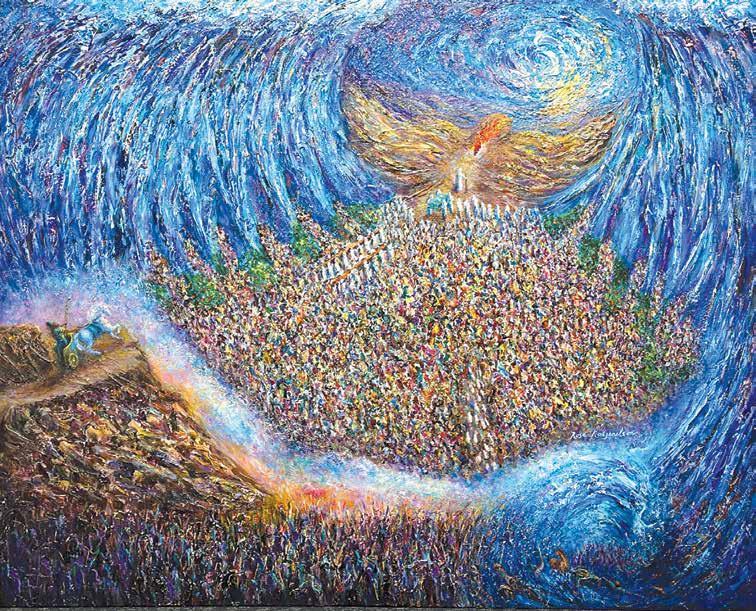



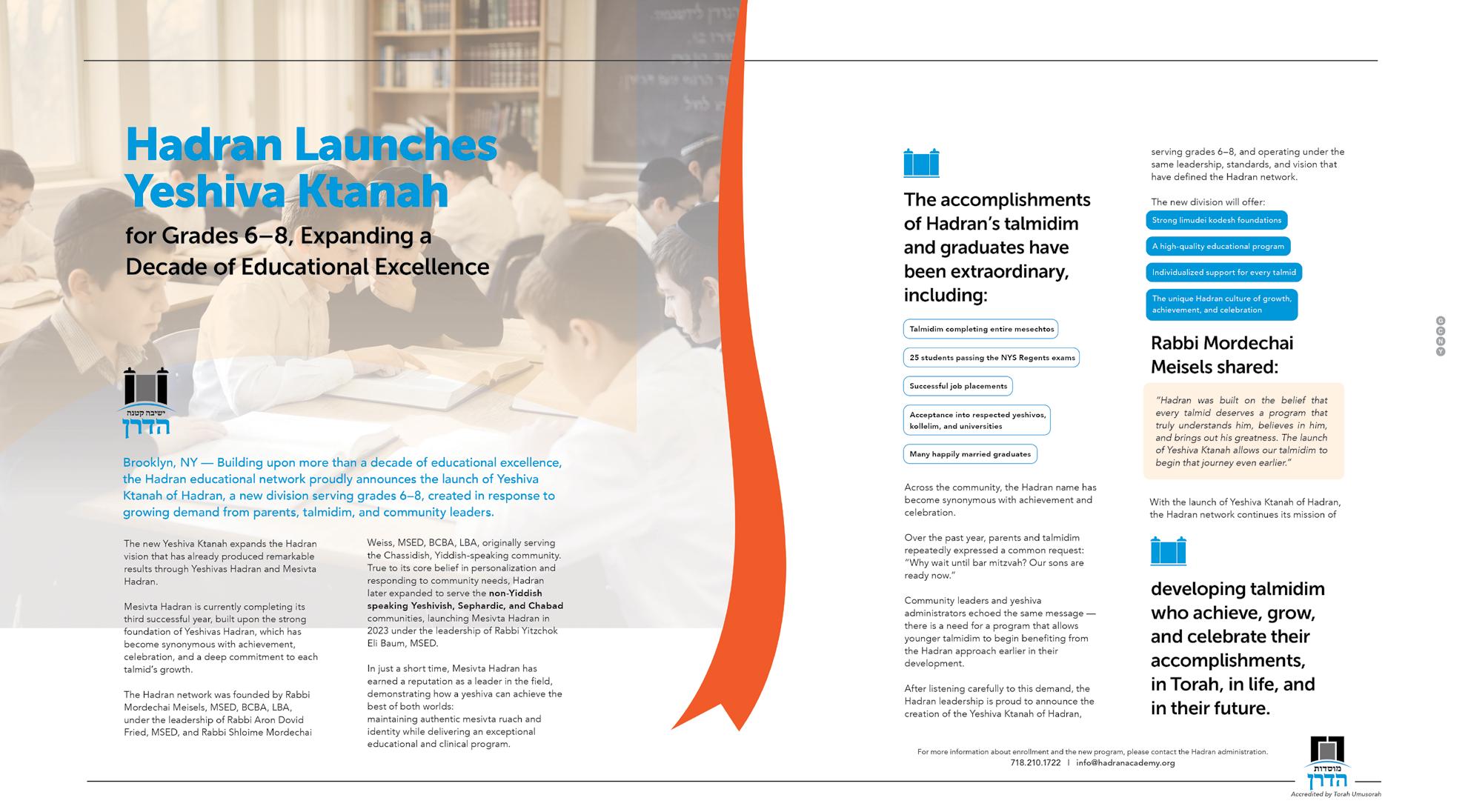


By Rav Yaakov Feitman
The Rama (430:1) cites the popular custom to recite part of the Haggadah on the afternoon of Shabbos Hagadol. However, the Mishnah Berurah (Biur Halacha) records that the Gra (see Maaseh Rav 177) did not approve of this minhag because the Haggadah specifically states, “We would have thought that [we should tell the story of Yetzias Mitzrayim] beginning at Rosh Chodesh, but the pasuk teaches us that this mitzvah begins only when we have matzah and maror before us.” What is this disagreement all about? Rav Yaakov Emden (Haggadah on this passage) writes that “it is only human nature to like things which are new, not old. Therefore, one should leave the saga of the Exodus from Egypt to the Seder and not recount any of it earlier, including Shabbos Hagadol.”
My rebbe, Rav Yitzchok Hutner, (Maamorei Pachad Yitzchok 28) has a different approach, which goes to the heart of what Pesach is all about. He discusses the statement (see the beginning of the Kuzari) that Hashem originally created four forms of existence. These were domeim (inanimate such as rocks), tzomeach (that which grows such as flowers), chai (that which is alive such as a cow), and medaber (literally “speaking,” meaning mankind.) Then he created Klal Yisrael, which is also a new species, as different from each of the others as they are from each other. The ultimate chiddush (novelty) of Yetzias Mitzrayim was not just the miracles, the supernatural and the revelations. It was the fact that one form of creation was able to change into another. This concept flows from the fact that Chazal (see Avos 3:11, “chavivim Yisrael shnikreu bonim”) tell us that all of Klal Yisrael in effect were megayeir (converted) to Judaism. In the Rosh Yeshiva’s pithy words, “wine is wine and not water.”
We know (see Rambam Hilchos Isurei Biah 13:1) that all of Klal Yisrael went from being just human beings, which was already the most exalted creature in the world, to the even higher level of being a member of Am Yisrael. Rav Dovid Cohen (Birchas Yaavetz 3:221224; Sefer Knesses Yisrael, page 10) adds that “the essence of Yetzias Mitzrayim was the separation and differentiation of Klal Yisrael from the nations. That is the definition of geulah.”
In these days of rampant antisemitism, pundits and politicians, both friend and foe, search for an explanation for this ancient phenomenon. However, Chazal (see Sifri, Bamidbar 9:10) have already prepared us for this, especially at the End of Days, with the statement that “it is a halacha that Eisav hates Yaakov.” It is almost laughable when another one of our enemies commits murder and mayhem upon innocent Jews at prayer, work or at home, and the media begins searching for a motive. A decent historian, Robert L. Wistrich, called his book on antisemitism, “The Oldest Hatred,” since it is indeed ancient and requires no new motivations. However, our sources have taught us that there is an ongoing jealousy and resentment because the antisemites know in their hearts that we are totally different than them. This began when we left Mitzrayim.
Of course, just as there was no justification for the antisemitism of Paraoh or Hitler, so too there is no forgiveness for the modern anti-Jew Iran or Yishmael. We have never done anything wrong to them. On the contrary, as Rav Yaakov Kamenetzky taught us, all we wish is to be left alone. In fact, our Torah places restrictions upon us which no gentile would ever want or accept. We, on the other hand, honor righteous gentiles and place

no restrictions upon any human being except the basic Seven Noahide laws which require people to be kind to each other.
Now, to return to Rav Hutner’s explanation about the Gaon of Vilna who was against reciting the Haggadah on Shabbos Hagadol. The Rosh Yeshiva explains that when we are reliving the Exodus from Egypt, we are not in a position to “go from degradation to glory” (Pesachim 116a) unless we have already been changed. As we say annually in the Haggadah, we are not just “telling a story”; we are reliving the events. Therefore, we can only claim the exceptionalism of being a Jew and the totality of the change in ourselves unless we have just experienced that seismic alteration ourselves.
We can now add that Hashem Himself showed us the way that we can effectuate this change without undergoing geirus again or even any difficulties. In the Haggadah, we recite that the “Holy One blessed is He calculated the End” and brought us out of Egypt. That word chisheiv means much more than “calculated.” It means that Hashem manipulated time so that what was to have been an exile of 400 years was reduced to 210. The first mitzvah in the Torah which was given to Klal Yisrael as a whole was Kiddush Hachodesh, the sanctification of the new moon. Chazal tell us that this process was given over to the great Sanhedrin, and if they made a mistake, it is done nevertheless. This is because Hashem handed us the power to create the calendar and even which days were to become a yom
tov. This glorious power is part of being a Jew and will be returned to us, G-d willing, with the coming of Moshiach. In the meantime, what Hashem wants from us is the kind of change which we have the ability to accomplish. We can always be better, learn more, be a more decent human being and make a kiddush Hashem wherever we go. Pesach is the yom tov of change, as the Torah (Shemos 13:3) keeps stressing to us, the month of spring, when everything is changing. Even those who do recite the Haggadah on Shabbos Hagadol can prepare for the spiritual and religious changes which Pesach and the Haggadah afford us the ability to accomplish. The Gra simply reminds us that the most propitious time for us to succeed in our own process of spiritual upgrades and personal improvement is the night of Pesach. Rav Moshe Chaim Luzzato (Derech Hashem) always teaches us to take advantage of the “returning lights” which become available annually at our Seder table.
This year, when once again we are under the onslaught of our enemies and cannot even travel where we wish, we should redouble our efforts to attain the personal change for the better our Creator wants to see. This will hopefully allow us to ask for the change which only He can bring about – the true geulah of Moshiach Tzidkeinu bimeheira b’yameinu, amen.

by Rabbi Daniel Gla TST ein

The Netziv quotes the Bahag, who assigns topically appropriate titles for each of the Chamishah Chumshei Torah. The Bahag refers to the Chumashim as follows: Sefer Bereishis, Vayikra is Sefer Kohanim, Bamidbar is Chumash HaPekudim, and Devarim is Mishneh Torah. Sefer Shemos, however, is simply referred to as Sefer Sheini, Book Two. There is a precedent for this designation in Maseches Sotah, which refers to Sefer Shemos as Sefer Shieni Vayikra is not called Book Three, and Bamidbar is not called Book Four. Why is Shemos called simply “Book Two”? Why is Chumash Shemos singled out and given a title that reflects not its content, but rather its chronological position?
The very first mitzvah that Klal Yisrael received on a national level was “Hachodesh ha’zeh lachem, This month shall be for you the beginning of the months” (Shemos 12:2). As such, Rashi, at the beginning of Bereishis, suggests that the Torah could have begun with this mitzvah.
Rav Dovid Cohen, the Rosh Yeshivah of Yeshivas Chevron, expresses incredulity at the placement of this mitzvah. Why is “Hachodesh ha’zeh” הַ specifically placed between the ninth and tenth Makkos, Plagues?
The Torah begins with the creation of the world. The Midrash teaches: The Egyptians enslaved Klal Yisrael, for whom the entire world had been created with
ten utterances. As payback, Hashem used ten utterances to bring the Makkos upon the Mitzriim.
In our quest to understand this Midrash, it behooves us to identify the ten utterances of Creation and to understand the parallel between them and the ten statements that brought the Plagues upon the Egyptians.
The Mishnah teaches that while Hashem could just have readily created the entire universe with one single utterance, He chose to do so with ten utterances in order to provide greater reward to the righteous who uphold the world and to exact harsher punishment on evildoers whose sinful behavior destroys the world.
The Gemara notes that there seem to be only nine utterances listed in the Torah throughout the process of Creation; only nine times in the account of Creation does the word “vayomer ” appear. The Gemara answers that the word Bereishis must also be counted as a maamar, an utterance through which the world was created.
The Malbim wonders why, in fact, the Torah does not use the word “vayomer, and he said,” for the first utterance as well. Why instead did Hashem use Bereishis for the first utterance?
The Malbim explains that vayomer can be employed only when something is being addressed and spoken to. However, the first act of Creation was ex nihilo, yeish mei’ayin, something from nothing; therefore, the use of vayomer is not appropriate, and the word Bereishis is employed.
Still, even if we include the word Bereishis we do not find ten utterances of Creation.
1. Bereishis barah Elokim, In the beginning of G-d’s creating (Bereishis 1:1).
2. Vayomer Elokim va’yehi ohr, G-d said, “Let there be light” ( ibid. v. 2).
3. Vayomer Elokim yehi rakiyah, G-d said, “Let there be a firmament” ( ibid. v. 6).
4. Vayomer Elokim yakavu ha’mayim, G-d said, “Let the waters be gathered” ( ibid. v. 9).
5. Vayomer Elokim tadshei ha’aretz, G-d said, “Let the earth sprout vegetation” ( ibid. v. 11).
6. Vayomer Elokim yehi meoros, G-d said, “Let there be luminaries” ( ibid. v. 14).
7. Vayomer Elokim yishritzu ha’mayim, G-d said, “Let the waters teem” ( ibid. v. 20).
8. Vayomer Elokim totzi ha’aretz nefesh chaya, G-d said, “Let the earth bring forth living creatures” ( ibid. v. 24).
9. Vayomer Elokim na’aseh adam b’tzalmeinu k’dismuseinu, G-d said, “Let us make Man in Our image” ( ibid. v. 26).
The Midrash Rabbah cites two opinions as to the identity of the tenth utterance Hashem spoke in the process of Creation. One opinion is that v’ruach Elokim m’rachefes, and the Divine Presence hovered (Bereishis 1:20), is an utterance. The second view is that vayomer Elokim lo tov he’yos ha’adam levado, G-d said, “ It is not good that man be alone” (ibid. 2:18), is the tenth.
Pirkei D’Rabbi Eliezer brings a different opinion.

The truth that Hashem created and controls the universe was disseminated worldwide through the Ten Plagues.

Bereishis is not considered a statement; in its place, we would include either vayomer Elokim hinei nasati lachem, G-d said, “Behold, I have given to you” (ibid. 1:29) or lo tov he’yos ha’adam levado. The Vilna Gaon was of the opinion that vayomer Elokim hinei nasati lachem is the tenth maamar
The full text of this tenth maamar reads as follows: G-d said, “Behold, I have given you all herbage yielding seed that is on the surface of the entire earth, and every tree that has seed-yielding fruit; it shall be yours for food. And to all every beast of the earth, to every bird of the sky, and to everything that moves on the earth, within which there is a living soul, every green herb is for food.”And it was so (Bereishis 1:29-30).
An analysis of these pesukim reveals that Hashem is saying that He has provided certain foods to each living being. There does not seem to be any reference to an “utterance” or “statement” with which Creation transpired.
The Sfas Emes explains that Hashem’s indication of which food items may be consumed constitutes an understood declaration akin to “let there be food.”
Now that we have identified the ten utterances of Creation, let us learn their connection to the Ten Makkos
The sefer Tzror HaMor teaches that Pharaoh denied Hashem as the Controlling Force of the universe. Pharaoh promulgated the idea that he himself was a deity, and he denied Hashem’s ongoing control over heaven and earth. Hashem sent the Makkos to demonstrate to Pharaoh and the Egyptians His existence, that He created everything, and that He continues to control all of creation.
Pharaoh denied that a Creation that occurred with ten utterances is still under Hashem’s control; Pharaoh was therefore punished with Ten Plagues. He denied the existence of a G-d Who rules over heaven, earth, and its fullness, so he was punished with Makkos that afflicted the heavens and the earth, water, sky, and the entirety of creation.
It was as if Hashem were re-creating the world just so Pharaoh could personally see the error of his ways. Through the Makkos, Hashem demonstrated His total control over everything in the universe. Egypt came to recognize that Hashem, Who created the world, does, in fact, continue to rule over it.

We refer to this in Kiddush, when, in addition to stating zikaron l’maaseh Bereishis, as a remembrance of Creation, we add zecher l’yetziyas Mitzrayim, a zecher of the Exodus from Egypt. How does Shabbos affirm both the Creation and the Exodus? Yetzias Mitzrayim was the vehicle through which Hashem’s role as Creator was reaffirmed in the eyes of the world. The truth that Hashem created and controls the universe was disseminated worldwide through the Ten Plagues.
The Makkos were akin to a second creation, and the ten maamaros that brought the Makkos to fruition are a second iteration of the ten utterances with which Hashem created the world initially.
The Maharal expands this idea, drawing a parallel between Hashem’s utterances at the time of Creation with the maamaros uttered when the Makkos were inflicted upon the Egyptians. He demonstrates that the order of Hashem’s utterances at Berias HaOlam is reversed in the order of the Makkos (albeit with a different sequence*1).
The Maharal utilizes the system of the Vilna Gaon, and thus, the final maamar of Creation, that of sustenance and food, corresponds to the first maamar used to inflict the Makkos Hashem attacked the Nile, the Egyptians’ source of water, and turned it into blood. The fields and crops were left without water. Produce could not grow, and the Mitzriim had no water to drink. They lost their source of sustenance.
The utterance of Creation, yishritzu ha’mayim sheretz nefesh chaya, let the waters teem with living creatures, was restated in the second Makkah — Tzefarde’a, Frogs.
During the third Makkah, Kinim, Lice, the sand on the ground, transformed into lice. This is k’neged yikavu ha’mayim v’seira’eh ha’yabasha, let the waters be gathered … and let the dry land appear. The dry land became kinim.
Totzi ha’aretz nefesh chaya, Let the earth bring forth living creatures, was reiterated with Makkas Arov, the Plague of Wild Beasts.
Dever, Pestilence, the plague that caused the demise of the Egyptians’ animals, was k’neged yehi meoros b’rekiyah ha’shamayim, let there be luminaries in the firmament of the heaven. The Maharal highlights the connection between living beings and luminaries by invoking the scientific belief linking the occurrences of the world to the happenings in the heavens. An example of this can
be found in Rashi (Bereishis 1:14), who cites the teaching of the sages linking childhood disease to the eclipses of the luminaries.
Na’aseh adam b’tzalmeinu, let us make Man in Our image, was restated with the Shechin, Boils, since the boils afflicted their very person.
Yehi rakiyah b’soch ha’mayim, let there be a firmament in the midst of the waters, and let it separate between water and water, was reaffirmed with the Makkah of Barad, Hail, when the rains altered their natural tendencies.
Arbeh, Locusts, consumed all the vegetation. The Maharal states that this was a reiteration of totzi ha’aretz eitz pri oseh pri, the command that the earth give forth trees and fruit.
Darkness, Choshech, reaffirmed the maamar, Yehi ohr, Let there be light. Makkas Bechoros, the death of the firstborn in each and every Egyptian home, was k’neged the first maamar, Bereishis , In the beginning.
Rav Dovid Cohen explains why the Makkos fundamentally restate the ten utterances of Creation in reverse order and do not begin with a reiteration of Bereishis
As Hakadosh Baruch Hu created the world, He progressively demonstrated His supreme authority and control over all aspects of the universe. When people began to veer away from the truth and reject Hashem as the Creator, they started by denying and concealing the last utterance Hashem made. They began by negating Hashem as the Creator of food and progressed until the last maamar to be denied was the first that was uttered.
The ten Makkos aimed to once again reveal the truths of Hashem to the world by reaffirming the ten utterances of Creation. The first truth to be uncovered would necessarily be the one that was most recently rejected. Therefore, writes Rav Dovid Cohen, the first Makkah came to reaffirm the last of the statements of Creation.
Rav Cohen highlights a similarity between the fifth maamar of Creation and its corresponding Makkah. In Hashem’s declaration on the third day of Creation, He stated, “Eitz pri oseh pri l’mino, fruit trees yielding fruit each after its kind” (Bereishis 1:11). This meant that not only should the trees come forth, but the

in a sense, the Ten Makkos were Creation, take two.
tree itself should taste like the fruit. The trees did not comply and were punished for not listening to Hashem. Remarkably, we find a similar occurrence in the corresponding Makkah, Arbeh
The locusts were directed to consume all the trees that were growing; as the pasuk states, “It will consume all the trees that grow for you from the field” (Shemos 10:5). However, the locusts deviated from the command and did not consume the trees. They ate only the fruits from the trees, as the Torah states, “It ate all the grass of the land and all the fruit of the tree” (ibid. v. 15).
Thus, the fifth Makkah was a perfect reiteration of the corresponding utterance of Creation.
B’siyata d’Shmaya, we can uncover a further parallel between the Makkos and the statements of Creation. Regarding Makkas Barad, the Torah tells us, “There was hail, and fire flaming amid the hail” (ibid. 9:24). Rashi comments that the Barad was a double miracle, as fire burned within the water; the two conflicting entities made peace to fulfill the will of Hashem.
One may ask why it was necessary for Hashem to include fire within the hail. Would not the miraculous hailstorm alone have sufficed, without any fire? According to Maharal, we can see wonders from the holy Torah. The Makkah of Barad corresponds to the utterance of Creation, “G - d said, ‘Let there be a firmament’” (Bereishis 1:6), which was the fashioning of Shamayim. Rashi (ibid. v. 8) tells us that Shamayim consisted of aish u’mayim, fire and water, together. Thus, Makkas Barad, which refuted Pharaoh’s denial of the Creation of Shamayim, displayed the miracle of the fusion of fire and water.
We can now appreciate why the Torah chose to place the mitzvah of kiddush hachodesh immediately before the last of the plagues, Makkas Bechoros. The tenth Makkah was an affirmation and authentication of the first of the ten utterances with which the world was created: Bereishis. Rashi, at the very beginning of Bereishis, discusses why the Torah


starts with Creation. He writes, “ The Torah should have begun only with ‘This month shall be for you’ (Shemos 12:1) because this is the first mitzvah commanded in the Torah.” This seemingly should have been the subject with which the Torah began.
Instead of beginning with Bereishis, the Torah should have opened with the mitzvah of kiddush hachodesh. Therefore, when the ten utterances of Creation are reiterated and verified, the mitzvah of kiddush hachodesh is indeed placed right before the maamar that corresponds to Bereishis
But there is a deeper connection between kiddush hachodesh and the Maamar Bereishis that warrants placement of this mitzvah right before the re-establishment of Bereishis. The word Bereishis is often translated as “in the beginning,” referring to the beginning of the process of Creation. Homiletically, it is understood as “because of reishis,” where reishis refers to a unique entity such as the Torah, Klal Yisrael, or bikkurim. Hashem created the world in the merit of one of these.
However, there is a more basic way to understand the word Bereishis, the first utterance of Creation: Bereishis barah Elokim, Hashem created the beginning. He created time. Reishis and acharis, beginning and end, are concepts we can understand only if there is an entity known as time.
Before Creation, there was no such entity. The Vilna Gaon, the Dubno Maggid, and the Malbim interpret the words Bereishis barah Elokim as Hashem created time as the first act of Creation
We refer to this daily in Baruch She’amar when we state, Baruch oseh Bereishis, Blessed is He Who created the Bereishis, Who created the concept of time. Likewise, in Aleinu we say, “La’seis gedulah l’yotzer Bereishis, to ascribe greatness to the Creator of Bereishis, to the Creator of time.
Makkas Bechoros, then, represented the reaffirmation of the first utterance of Creation — Bereishis. We now understand this to be the creation of time. The tenth Makkah was thus the re-creation of time.
Kiddush hachodesh, the mitzvah of declaring Rosh Chodesh, gave Klal Yisrael control over time. Beis Din can now legislate when the month begins and when a Yom Tov will occur. Furthermore, the calendar was revised. Tishrei was no longer designated the first month of the year, as Nissan now assumed that role.
The Torah places this mitzvah, which gives Klal Yisrael a degree of control over time, right before the maamar that corresponds to Bereishis, the creation of time. Indeed, then, the mitzvah is perfectly placed right before Makkas Bechoros
Sefer Bereishis is the Book of Creation. Hashem created the world with ten maamaros, utterances. We have explained how in Sefer Shemos these ten utterances were repeated when the ten Makkos were visited upon the Mitzriim.
Hashem’s role as Creator was thus reaffirmed. Hashem’s power was authenticated, as even the most ardent naysayers were humbled into admitting their folly in the face of Hashem’s recreating the world. In a sense, the Ten Makkos were Creation, take two.
In referring to Sefer Shemos as Sefer Sheini, Book Two, the Bahag is not labeling it “the second Book of the Torah.” Rather, the title highlights the sefer’s identity as the sequel to Sefer Bereishis. It is the second Book of the Creation of the world.
1 I asked Rav Dovid Cohen, Rosh Yeshivas Chevron, about the order. According to the Maharal, the utterances of Creation pair up with the Makkos as follows: Makkah 1 = Maamar 10; Makkah 2 = Maamar 7; Makkah 3 = Maamar 4; Makkah 4 = Maamar 8, Makkah 5 = Maamar 6; Makkah 6 = Maamar 9; Makkah 7 = Maamar 3; Makkah 8 = Maamar 5; Makkah 9 = Maamar 2, Makkah 10 = Maamar 1. This order seems random; it is not an exact reversal of the order of Creation. Rav Dovid Cohen explained that although the order is not consistently reversed, since the first corresponds to the last and the last to the first, we can consider it to be fundamentally reversed.


Jews in Israel are spending their nights running to a room they did not choose.
The mamad, bomb shelter, exists for exactly this – missile strikes. The kind of war that finds you in your living room. Sirens. Thirty seconds. Run. And yet, in those same homes, those same families are preparing for Pesach. Soon they will sit down at that table and say the words Zman Cheiruseinu. The time of our freedom.
That tension is not new. It is, in fact, the original Pesach story.
On the night the Jewish people left Mitzrayim, the first Seder ever held, they were commanded to stay inside. Blood on the doorposts. Family gathered. Do not cross the threshold. Outside, firstborns were being killed. Inside, something entirely new was being born. The night we call the time of our freedom was experienced behind a door.
What kind of freedom begins in confinement?
The answer lives in a Halachic argument most people have never heard of and in a question asked under circumstances no one should ever have to face.
The Gemara discusses the Kohen Gadol in the days before Yom Kippur. To ensure his purity, he was removed from
By Rabbi Benny Berlin

his home and sequestered in a chamber in the Beis HaMikdash for an entire week (Yoma 10a). Separated from his family. Confined to a single room. The question the Gemara asks is precise. Does that chamber require a mezuzah? The answer hinges on whether a forced dwelling counts as a dwelling at all.
The conclusion is that it does. Because what he was doing there was a mitzvah. His will had merged with the divine will.
dwelling with no sacred purpose woven into the suffering is not called a home. It does not require a mezuzah.
The contrast is devastating and clarifying at once. The Kohen Gadol was confined in service of something sacred, so his confinement became a dwelling. The Jews of Kovno were caged by evil, so their confinement remained exactly that.
The mamad sits closer to the first than the second.
What kind of freedom begins
And when that happens, even a forced residence becomes a home. You put up a mezuzah.
Centuries later, that same question reached a place no halachic text should ever have to reach.
In the Kovno Ghetto, Jews asked their Rav whether they needed mezuzahs on their doors. His answer was the opposite. No. Because the ghetto fulfilled no mitzvah. It was pure oppression. A forced
An Israeli family running to their safe room did not choose the siren. But what they are protecting, the Seder they are preparing, the story they intend to tell their children, the holy land they are living in, that is a life built on mitzvos. That is purpose. And the Gemara is clear. When a forced dwelling is filled with that kind of purpose, it deserves a mezuzah.
The blood on the doorposts in Egypt was not decorative. It was a declaration.
We are inside because we choose to be inside. Not because we have nowhere else to go, but because this is where we belong, doing what we were called to do.
That is still the declaration being made Pesach night in Dimona. In Arad. In every Israeli city where families run to reinforced rooms. They are not interrupting their Seder. They are living it.
Because the first Seder was also held by people who did not know what the morning would bring. Who stayed inside by faith rather than certainty. Who put blood on their doorposts not as a magic formula but as an act of commitment.
The mamad is the modern doorpost. It says we are still here, still living a life of purpose in our Holy Land. We are still telling the story. Our enemies have not and cannot take that from us.
Zman Cheiruseinu. The time of our freedom. This year, more than most, that phrase takes courage to say.
And that is exactly why it must be said.
Rabbi Benny Berlin is the rabbi of BACH Jewish Center located in Long Baeach, New York. For more information, visit: https://www.bachlongbeach.com/.

We must understand the connection between the world of Shevi’i Shel Pesach, the seventh day of Pesach, when we celebrate the splitting of the sea, and Acharon Shel Pesach, the last day of Pesach which relates to the coming of Moshiach. In order to do this, we will address two questions with respect to the song at the sea, “Az Yashir Moshe.”
The first question is why the first words of the song (Shemos 15:1), “Az yashir Moshe, then, Moshe will sing,” are written in the future tense. It should have said, “Az yashar Moshe, then Moshe sang.” The Gemara in Sanhedrin 91b analyzes this question, but its answer is perplexing. According to the Gemara, “‘Then Moshe and the Jewish people will sing this song to Hashem,’ it does not say ‘Then Moshe sang;’ rather it says ‘Then Moshe will sing.’ We thus see a reference to the resurrection of the dead in the Torah.” The Gemara is difficult to understand. The whole connection between the Song at the Sea and the

By Rav Moshe Weinberger
Adapted for publication by Binyomin Wolf
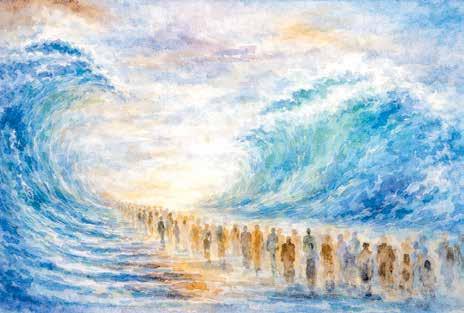
resurrection of the dead is the use of the future tense?! Many things will happen worthy of song in the future. How does the Gemara make the leap from the use of the future tense to the resurrection of the dead specifically?
The second question is how we can understand the following extremely mysterious medrash (Shemos Raba 23:4):
“Then Moshe will sing:” This is what was meant by the verse (Mishlei 31:26, from Eishes Chayil), “Her mouth opened up with wisdom and the Torah of kindness was on her tongue...” From the time that Hashem created the world until the Jewish people stood at the sea, no one sang a song to Hashem but the Jewish people. Hashem created Adam, and he did not sing a song. Avraham was saved from the fiery furnace and from the kings, and he did not sing a song. Similarly, Yitzchak was saved from the knife [at the Akeida], and he did not sing a song. So too, Yaakov was
saved from the angel, from Eisav, and from the people of Shechem, and he did not sing a song. But when the Jewish people came to the sea and it split for them, they immediately sang a song to Hashem, as it says, “then Moshe and the Jewish people will sing...” This is what was meant by “her mouth opened up with wisdom.”
According to the medrash, there was some new form of wisdom that was “opened up” when the Jewish people sang to Hashem at the sea.
This is difficult to understand. First, how could the medrash say that none of the tzaddikim of the previous generations ever thought to sing a song to praise Hashem when they were saved by great miracles from various dangers and troubles? It is only natural for a person, especially the great tzaddikim and the Avos, to sing to Hashem out of the feeling of exuberance when saved from extraordinary danger. How could the medrash assume
that they did not sing a song to Hashem, even if the pesukim do not explicitly say so. In particular, we know (Bereishis Raba 23:13) that Adam HaRishon composed (Tehillim 92:1) “Mizmor Shir l’yom haShabbos, A song in praise of the Shabbos day.” How, then, can the medrash say that neither Adam HaRishon, nor any of the Avos, sang a song to Hashem?
The second question on this medrash is why it associates chochma, wisdom, with the innovation of singing to Hashem. We would understand if it said about the Jewish people, “Pi’ah paschah b’shira , her mouth opened in song...” But why “wisdom?”
We also refer to the Song at the Sea in the blessings after saying Shema every morning. There, we say, “Moshe and the Jewish people responded with song to You with great joy and all said together (Shemos 15:11), ‘Who is like You among the powers Hashem, who is like You mighty in holiness?’” We must understand. Out of all of

the many beautiful pesukim of the Song at the Sea, why does this blessing focus on this particular pasuk from the song, “Who is like You among the powers Hashem?”
The Gemara in Gittin 56b explains this pasuk in a startling way. According to the Gemara, “It is difficult to understand: You hear the treachery and blasphemy of that wicked man [Titus], and you are silent. [In connection with this fact], the school of Rabi Yishmael taught, [the verse] ‘Who is like you among the powers, b’eilim, Hashem,’ [should be read to add the letter mem to the word for ‘powers’ so that the verse should read] ‘Who is like You among the silent ones, b’elmim, Hashem?” Why would the Jewish people praise Hashem for His silence in the face of evil?
It is known that prior to the time of the Anshei Knesses HaGedolah, the Men of the Great Assembly, who codified the text of the Shemonah Esrei prayer, the prophets refused to say the words, “Ha-kel hagadol ha’gibor v’ha’norah, the great, mighty, and awesome G-d,” in Shemonah Esrei. According to the Gemara (Yuma 69b): Why were they called the “Men of the Great Assembly?” Because they returned the crown to its proper place. Moshe came and said (Devarim 10:17) “the great, mighty, and awesome G-d.”
Yirmiyahu, however, came and said, “Strangers are dancing in Hashem’s courtyard! Where is His awesomeness?!” He therefore left out the word “awesome” from his prayer. Daniel said, “Strangers are enslaving His children! Where is His might?!” He therefore left out the word “mighty” from his prayers.
tude when things are good is not the most noteworthy accomplishment. It is natural to sing praises to Hashem when He does miracles for a person. Such a song is simple hakaras hatov, gratitude. The highest accomplishment is the level reached by the tzaddikim who believe so completely in Hashem’s salvation that even in the midst
They sang out in praise of Hashem for Hashem’s great patience and silence in the future, knowing that He would preserve His tiny people.
Then they [the Men of the Great Assembly] reinstituted “mighty” and “awesome” into the text of the prayers, reasoning, “It is just the opposite! This is exactly what makes His might mighty; that he overcomes His ‘natural’ inclination and shows patience to the wicked, and that is his awesomeness.”
According to the Shela Hakadosh, singing to Hashem out of a sense of grati-
of the their pain and torment, they can sing to Hashem out of gratitude for the future redemption they know either they or their descendants will experience.
the silent ones Hashem!” They sang out in praise of Hashem for Hashem’s great patience and silence in the future, knowing that He would preserve His tiny people like a sheep among the seventy wolves of the nations of the world throughout the long years of exile. We therefore quote this verse in particular as the most joyous part of the Song at the Sea, since it praises Hashem not for past redemptions but for our faith and gratitude for the future redemption at the end of time.


But how were the Jewish people able to sing with “great joy” for their salvation? Only one fifth of our people were redeemed from Egypt. This means that every family that made it through the sea was also mourning the loss of their parents, brothers, sisters, children, and friends. How could they sing out to Hashem?
The only possible explanation is that their faith is the resurrection of the dead, that one day their loved ones would come back to life and they would join together once again to serve Hashem. It can only be with faith in the resurrection of the dead that the Jewish people could have come to a state of “simcha rabba, great joy.” It was therefore not random that the Gemara associated the fact that the song of the Jewish people at the sea was sung in the future tense with the ultimate resurrection of the dead, since it was only their faith in that resurrection that enabled them to sing the Song at the Sea.
The majority of the Song at the Sea, however, was about the recent miracles and salvation that the Jewish people had just experienced. One pasuk stands out as a song to Hashem with gratitude for a future redemption from pain and torment that the Jewish people had not yet endured. We know that even the simplest Jew experienced prophecy as great and as deep as Yechezkel (Mechilta B’Shalach 3). The Jewish people therefore saw all of the suffering, torment, and genocide that their descendants would endure until the coming of Moshiach. As we say in davening, they sang out b’simcha rabba, with great joy, “Who is like You among
The Jewish people at the sea opened up a new concept. Adam, Avraham, Yitzchak, and Yaakov sang to Hashem for miracles which had occurred in the past. But no one had sung to Hashem out of gratitude for a salvation which had not yet occurred. The Medrash quoted earlier calls this novel approach chochma, wisdom, in the way that word is used in the Gemara (Tamid 32a), “Who is wise? One who sees what will happen in the future.” It takes wisdom to see what will happen in the future and sing to Hashem now, in the midst of his troubles, because of his deep belief in Hashem’s redemption. There is a pasuk in Shir Hashirim (4:8), which says, “With my bride from Levanon, with me from Levanon shall you come, you shall look, ta’shuri, from the peak of Amana...” The Medrash (Shemos Raba 23:5) explains this pasuk in the following way: “There is a mountain called Amana. Until ones reaches this mountain, he is in the land of Israel. From that mountain and on, he is outside of the land of Israel. Rabi Elazar said in the name of Rabi Yosi, ‘When the exiles reach that place, they will sing a song, as it says, ‘You will sing a song (ta’shuri can mean both ‘look’ and ‘sing’) from the peak of Amana.”
That is the relationship between the seventh day of Pesach, where we read the Song at the Sea, and the eighth day of Pesach, which shines with the light of the coming of Moshiach. We learn from the wisdom of the Jewish people’s Song at the Sea how to sing to Hashem out of gratitude to Hashem for the future redemption. And with Hashem’s help, we too can approach that mountain of faith (the name Amana is also related to the word for Emunah, faith) on our way back into Eretz Yisroel and sing to Hashem together, even before the rebuilding of the third Beis Hamikdash and sing a new song of faith in Hashem’s future redemption of our people.
Rav Moshe Weinberger, shlita, is the founding Morah d’Asrah of Congreagation Aish Kodesh in Woodmere, NY, and serves as leader of the new mechina Emek HaMelech.


By Rabbi Shmuel Reichman
We all want to share deep and thoughtful ideas at the Seder in order to enhance our Pesach experience. I hope this collection of divrei Torah will aid you on your journey towards a meaningful and transformative Seder night.
Seder?
Why do we begin the Seder by announcing all the steps of the Seder that we will complete? On no other chag do we announce the steps of the holiday ritual aloud before proceeding to perform them. On Sukkos, we don’t say: “Lulav, shofar, sukkah…,” on Purim, we don’t say, “Megillah, mishloach manos, matanos li’evyonim, seudah…” So why on the Seder night do we begin by announcing all the different steps of the Seder?
Any great journey begins with a clear goal and destination. As we say every Friday evening in Lecha Dodi, “Sof ma’aseh bi’machshava techilah,” the physical result originates first within the mind. In order to accomplish anything great, you must first create a clear target and only then determine what steps you must take to get there.
The Seder is comprised of 15 steps, which is the same number of steps leading up to the Beis Ha’Mikdash and the same number of “Shir Hamaalos” psalms, the Songs of Ascension. The Seder is likewise a 15-step process of ascension, a 15-step journey towards spiritual greatness. However, one does not simply achieve spiritual greatness accidentally. It requires focus, planning, and extreme dedication.
The Seder night is a journey with tremendous potential, providing an opportunity to tap into something genuinely special. On the Seder night, we attempt to experience true freedom, a fundamental-
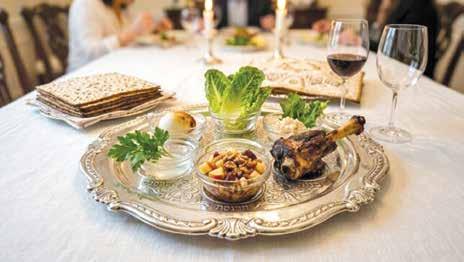
ly deeper connection with Hashem, true gratitude, and an understanding of our mission in this world. Only when we lay out the steps of our Pesach Seder and create a clear destination can we achieve the extraordinary.
A notably prominent theme of the Seder is that of asking questions. While “Mah Nishtanah” is the most obvious example, the commentators explain many features of the Seder as purely serving as an impetus for the children to ask questions. It’s not only children, though, who are enjoined to question. The Gemara in Pesachim (116a) says that if a man’s child cannot ask the questions, then his wife should, and if he has no wife, he must ask himself questions. Even if two Torah scholars are sharing their Seder together, they should ask each other. Why is questioning such an integral part of the Pesach Seder?
Asking questions is the gateway to learning. A question creates a gap. It allows you to recognize your current limitations,
to shed the illusion that you already know everything. You can only learn something once you realize that you don’t already understand it. The Gemara in Gittin (43a) says that you can only understand a Torah concept if you originally struggled with it. Only by recognizing that you don’t already know something can you break it down, analyze it, and see it in a new way, thereby building a new, deeper understanding. If you believe that you fully understand something, you simply will not allow your mind to develop a new way of seeing it. Only by realizing a lack in your understanding and perception can you develop deeper paradigms.
The Seder night serves as an opportunity to pass over our mesorah, our tradition and legacy, to the next generation. It’s a night when we speak about emunah (faith), the meaning of being a Jew, and our purpose in this world. In order to teach these lessons to our children and ourselves in a deep and lasting way, we must encourage the Seder participants to ask questions, no matter the age or knowledge level.
Our yetzer hara convinces us that we are perfect, that we already know everything. As such, there’s no need to question. This flawed belief is personified by Eisav, who was born fully hairy. Hair is the outermost expression of a grown human being. Eisav projected the belief that he was completely developed and therefore required no additional growth. The name “Eisav” itself is the word “asui,” meaning made or complete. Eisav represents the illusion of being complete, perfect, not requiring any further work or growth.
Our goal and mission as the Jewish people is to grow, develop ourselves, and fulfill our potential. On the Seder night, as we focus on whom each of us can become, we ask questions – creating holes that we then yearn to fill with additional knowledge, insight, and growth.
The ka’ara holds many symbolic foods that we use throughout the Seder, such as charoses, a shank bone, an egg, and several others. Some of these are eaten during the course of the Seder, while others we simply look or point at. What is the meaning of these simanim? Is there a deeper meaning behind displaying them on our Seder tables?
The simple answer is that we display these foods in order to engage the children, to encourage their curiosity and questions. We use simanim to accomplish this because children are not capable of grasping conceptual or intellectual ideas. They live within the world of the finite, and they require something concrete and tangible, something they can see and touch, in order to relate to a concept. Therefore, in order to include our children in the concepts and ideas that are taught and developed at the
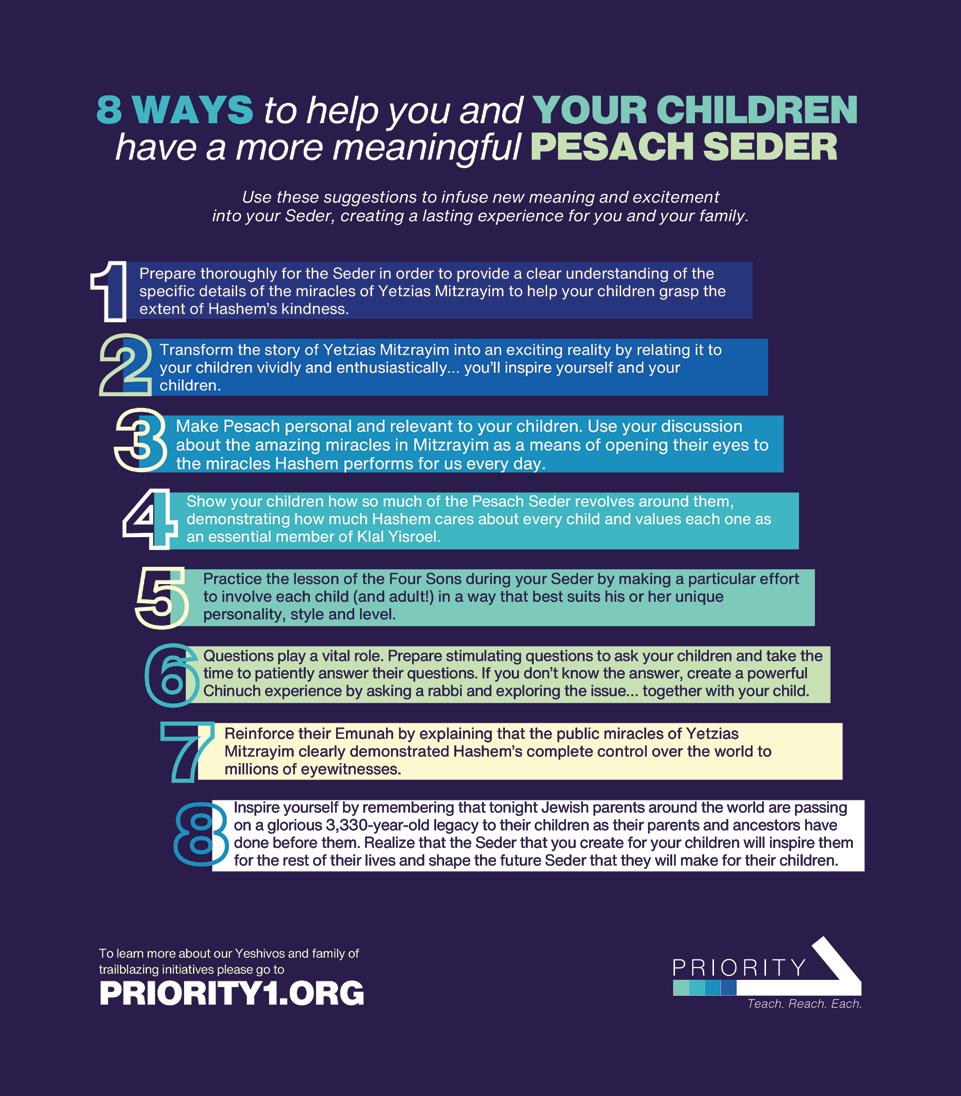
Seder, we use physical simanim to actively engage them.
There is a deeper idea which can be learned here as well, one that is applicable not only to children but to those of all ages. The most essential principle to internalize in this world is that there is always something deeper than that which appears on the surface. Living in a physical world can compel one to forget to seek out the spirituality inherent within every object, event, and person in this world. Seder night is when we instill within ourselves the pillars of emunah and our mission as the Jewish People. On this night, we must all learn this powerful principle. Each physical object on the ka’arah represents a world of profundity, but this is not limited to the Seder plate alone. There is spiritual depth within everything, we need only look for it.
What’s Our Goal in Telling Over the Story?
We conclude the paragraph of “Avadim Hayinu” by proclaiming, “V’chol hamarbeh li’saper bi’yitzias Mitzrayim, harei zeh mishubach,” all those who elaborate on the Exodus from Egypt, behold, this is praiseworthy. The Rambam (Maimonides) codifies this as a legitimate halacha of Seder night. What is the meaning of this
statement? What is the importance of telling over the Pesach story at great length, and why on this night specifically?
There are two ways to interpret the statement of “v’chol hamarbeh.” The first is on a quantitative level, that one should tell over as much of the Exodus story as possible. The second is a qualitative approach, that one should delve into the miracles and wonders that Hashem performed when
The Seder night
with them growing into the nation they are meant to become. When the Jewish people left Mitzrayim, we journeyed to Har Sinai and Matan Torah, where we were given the Torah and our mission in this world as Hashem’s chosen nation. This is the story that has continued throughout history, that you and I are commissioned to continue to this very day.
Sippur means to tell over a story, and
is a journey with tremendous potential, providing an opportunity to
tap into something genuinely special.
taking us out of Mitzrayim in as much depth as possible.
There is, however, a third way to understand this statement, one that offers a new perspective on Yetzias Mitrayim and the goal of Seder night. Yetzias Mitzrayim was not merely a historical event, rather it was the birth of the Jewish people – our people, you and me. The story did not end with the birth of the Jewish people; it continues

the hagaddah says that whoever does this increasingly is praiseworthy. Jewish history is not only “his”-story, it’s our story. It is our mission and destiny, and we must continue to grow and thrive in this mission. The goal is to make yourself a part of the Jewish story, to continue what began with Yetzias Mitzrayim, to become the person you were meant to be. V’chol hamarbeh... harei zeh meshubach.
Wine on the Seder Night… Really?
Pesach is a spiritual time, where we connect to some of the deepest themes of Judaism. Why then do we spend the night drinking wine? We see repeatedly that wine is a dangerous and damaging entity, connected to many infamous sins. According to one opinion, the Eitz Ha’daas was a grape vine. Immediately after the Mabul, Noach became intoxicated, repeating Adam’s original sin. Lot and his daughters erred with wine. According to one opinion, Nadav and Avihu’s sin was performing the avodah while intoxicated. If wine has so many destructive consequences, why do we spend our Seder night drinking wine?
Nothing in the physical world is objectively good or evil, rather, everything has the potential to be used for either good or evil. The choice is solely up to you! Electricity is neither good nor bad. An outlet can be used to charge your appliances, but it can also give you an electric shock. The same applies to money: it can be used to enable Torah learning, but it can also be used to fund destruction and chaos. A charismatic personality can be used to inspire others to grow or to seduce them down a twisted path. Everything in this world is merely potential, waiting to be used. Evil, therefore,

is really the misuse of potential, when we choose to use an object for something other than its true purpose. Evil is the breakdown and corruption of good. This is why the Hebrew word for evil is “rah,” which means brokenness or fragmentation.
Hashem created the world in this way so that we can have free will. We get to choose whether to use things for their true purpose, actualizing their potential, or to misuse them, getting pulled into the clutches of evil. This choice between good and evil is magnified as the power of something increases. The more power there is, the more potential there is. For example, a 220-watt outlet can either charge your phone or give you a small electric shock. But 20,000 watts can either light up your neighborhood or electrocute you. The more power, the more potential. Of course, this results in an important principle: the value in any power
is only in as much as it can be controlled. Otherwise, the more power you have, the more destruction you will have, as we often see with nuclear energy and money. Just think about giving a child the power to cross the street by himself. When do you give him such a power? Only when he has the ability to control it, to know when not to cross the street.
The Vilna Gaon explains that wine is the greatest paradigm of physical potential. On the one hand, it is clearly dangerous, and its misuse often leads to utter disaster. But when used properly, it elevates you. Wine is able to open up the mind, allowing it to transcend its normal limitations. As Chazal explain, “Nichnas yayin yatzeh sod,” when wine enters, secrets are revealed. (Both yayin and sod have the gematria of 70.) Wine opens up your consciousness to a deeper level of experience and understanding that transcends the revealed level of reality.
The spiritual nature of wine is also evident in its physical nature. Everything physical rots, withers, and decays with time, such as the human body and food. Wine, however, only improves with time. Furthermore, as R’ Shlomo Zalman Auerbach, zt”l, explains, when it comes to most foods and drinks, the more you have, the less you want; you become full and lose your appetite. With wine, however, the opposite is true: the more you have, the more you desire.
This is why we have wine at every point of kedushah, at every point where we want to uplift the physical. It’s our way of showing that we’re taking the physical, something that has the potential for both spirituality and spiritual emptiness, and using it for the good. We therefore make kiddush on wine on Shabbos, on Yom Tov, at a wedding, at a bris milah, and for other such holy celebrations.
We drink wine at the Seder in order to uplift the night of Pesach. We are uplifting our Seder experience, but we are tapping into a larger experience as well. The Ramban explains that the grand miracles of Pesach are meant to instill within us the understanding that not only are the open reversals of nature miraculous but the dayto-day workings of nature are miraculous as well. Hashem performed outstanding miracles when taking us out of Mitzrayim, but the entire world of nature is a constant miracle upheld by Hashem as well. This means that every aspect of this physical world is infused with G-dliness, with the potential for spirituality, and we can therefore uplift every single thing we encounter to a state of holiness. As we relive the Pesach story at the Seder, we learn about the inherent spirituality present within every facet of the physical world. What better way to do this than with wine?
Rabbi Shmuel Reichman is an international speaker, bestselling author, business coach, the CEO of SMA, and a TED Talk Speaker. His online content reaches millions of people every month, and he lectures internationally on topics of Torah thought, psychology, leadership, and business – uniquely blending many areas of Torah and wisdom together. His bestselling book, The Journey to Your Ultimate Self, serves as an inspiring gateway into deeper Torah thought. After receiving his BA from Yeshiva University and Semicha from Yeshiva University’s RIETS, Rabbi Reichman received a Masters degree in Philosophy and Religion from the University of Chicago. As part of his Masters Degree at the University of Chicago, Rabbi Reichman received an Ivy Plus Scholarship to Harvard where he spent a year studying Religious Philosophy and Literature as an Ivy Scholar. Additionally, he received a Masters degree in Educational Psychology from Azrieli Graduate School and a Masters degree in Jewish Thought from Yeshiva University’s Bernard Revel Graduate School. As a business and leadership coach, Rabbi Reichman provides a unique 1-on-1 coaching program where he helps high-achievers, coaches, and business owners achieve their financial and personal goals. To learn more or to get in contact with Rabbi Reichman, visit his website: ShmuelReichman.com

By Eliyahu RosEnBERg
n 1996, people didn’t talk about kids at risk. They rarely discussed child abuse or the reasons teenagers go off the derech. The subject, shrouded in layers of taboo, was not to be discussed, especially in public.
That’s why Rabbi Yakov Horowitz’s first article — a groundbreaking 4,500word essay published in 1996 in The Jewish Observer — received mixed reviews, ranging from, “You’re the devil for embarrassing our community,” to “You’re amazing for bringing this issue to light.” The article, titled “An Ounce of Prevention,” discussed the concept of “kids at-risk.” And it included a powerful call to action: the yeshiva system must accommodate all children, including the ones who don’t learn the way everyone else does.
The article changed the conversation
surrounding kids at-risk. And it also changed Rabbi Horowitz’s life. Before publishing the article, Rabbi Horowitz, a then-rebbi of 15 years, led a simple, quiet life in Monsey. His days were basically the same. He would go to work, teach Torah to eighth graders, come home, play with his kids... But the day he published that article, everything changed. Overnight, his private life became public, and he found himself in situations he’d never before considered imaginable. At 37 years old, he was given an open mic at the Agudah Convention. He started an organization called Project Yes for at-risk teenagers. From there, he founded his own yeshiva in Monsey. All the while, driving him to help the younger generation were his own childhood experiences.
“That’s what life is about. You learn
i’ve always told my students — always —you can ask me anything.
Why do we say, Zecher yitzias Mitzrayim, remembering that we left Egypt, all the time? i think that the Torah is telling us to remember that we were slaves. it’s a part of our culture. it’s part of our Dna , of our history. so, either you could be compassionate when you see racism or people being mistreated or children being abused or kids struggling in school or anything, or you could say, ‘Tough luck, deal with it.’ you could get hard and callous, or you could say, ‘ i remember what that was like.’
My passion is to try to be a voice for the voiceless and to try to educate the public at large.
People don’t realize how profound it is for a survivor when you stand with them.
from your experiences and, you know, it either makes you bitter, hard, and angry — which I didn’t say I wasn’t: I lost my father when I was three, I had challenges — or you could say, ‘I’ll find meaning by helping kids avoid that.’
“That’s how I see things,” Rabbi Horowitz shares. “Why do we say, Zecher Yitzias Mitzrayim, remembering that we left Egypt, all the time? I think that the Torah is telling us to remember that we were slaves. It’s a part of our culture. It’s part of our DNA, of our history. So, either you could be compassionate when you see racism or people being mistreated or children being abused or kids struggling in school or anything, or you could say, ‘Tough luck, deal with it.’ You could get hard and callous, or you could say, ‘I remember what that was like.’ That’s how I see it. And that’s what it’s all about.”
* * *
This scenario happens every day: A child does something wrong. Maybe they didn’t do their homework, or they spaced out during class, or they failed a test. Tragically, the assumption is that the kid’s “bad” and that their behavior warrants a punishment of some sort. But, as Rabbi Horowitz explains, that’s the wrong approach. In fact, he likens hasty punishment to doing surgery before a CAT scan.
“My philosophy is that every child has an answer key. You see that they’re doing something that doesn’t make sense to you, don’t respond until you figure it out. Because there’s a reason,” Rabbi Horowitz shares. “A child doesn’t do their homework every day? There’s a reason. Maybe they’re disorganized, maybe their home situation is chaotic, maybe they, G-d forbid, have a parent in the hospital. So, if you give the kid a punishment, you’re just making it worse.”
The same principle applies, he adds, to teenagers who abandon religion. As
Rabbi Horowitz explains, there are two totally different types of people who go off the derech. The first he calls Ozvim es HaDa’as, “abandoning the religion.” That group includes individuals who live normal, productive lives — they work or go to school, have a healthy social life, and are making progress in their goals — but they just don’t see a point in living a frum life. That’s one issue.
The second group is Ozvim es Ha’Chaim, “abandoning life.” It’s not just that they went off the derech; they’ve given up on everything. They’re miserable. They have no hope for the future. They have no goals, no drive. With every part of their life, they’re self-destructive. Drugs. Addictions. Self-destructive behaviors.
What causes people to “abandon life”? In nearly 100% of the cases that Rabbi Horowitz has seen, he explains, it’s abuse.
“There’s this brilliant theory by Abraham Maslow. He came up with this concept of a hierarchy of needs. He says there are five levels of human needs, and they’re sequential. You have to go from the bottom up,” Rabbi Horowitz explains. “The lowest level is physiological needs: food, shelter, sleep. The second is security, safety, just feeling comfortable. The third is socialization: friends, love, relationships, all of that. The fourth is self-esteem, feeling good about yourself. And then the top one is self-actualization: to grow, to develop.
“So, the theory is that, if you’re missing one of the lower levels — if you haven’t slept in two days, and then you try to engage in self-actualization, you want to study for a test — are you kidding me? You need sleep. You need to eat!” he explains.
“Let’s say your car breaks down in a bad neighborhood at night. You’re not feeling safe. You see some folks coming to you who look scary. Anything in the world that’s above that — you might be in a relationship with someone you love, you’re
dating, your spouse, your friends — all of that isn’t relevant right now. And it’s also funny. Imagine you have a life coach, and he or she calls you then, and they say, ‘Remember we were working on those fiveyear goals? Where do you see yourself? Are you working on that?’ And you say, ‘I don’t know if I’ll be alive in five minutes!’ So, if you’re lacking those bottom levels — the comfort of having your physical needs met — then nothing else works.”
Likewise, when an individual reels from unspeakable trauma, when they live in a perpetual state of discomfort and shame, when they feel all alone, it’s not practical for them to focus on their spirituality, careers, or relationships. When your most basic needs aren’t met — such as the need to feel safe — you can’t live a healthy life.
In 2002, Rabbi Horowitz was working with six teenagers who had hit rock bottom. But it made no sense. These kids came from amazing, healthy homes. From an outsider’s perspective, it seemed as though they had everything going for them, and yet, these teens were actively self-destructing. And that’s when Rabbi Horowitz realized it: they must have been abused.
He called each one’s parents and asked if the kids had gone through any trauma. Each one said no. So, he asked them to make sure. And lo and behold, Rabbi Horowitz’s assumption was proven correct. Unbeknownst to their parents, all six teenagers were abuse survivors.
Realizing the horrific effects of abuse, Rabbi Yakov Horowitz, from that day forward, decided to dedicate his life to preventing child abuse through child safety education. * * *
According to Rabbi Horowitz, predators groom their victims, specifically targeting kids who they know won’t speak up.
“There’s a woman, Dr. Ann Salter, who spent 20 years interviewing serial pedophiles in prison. And they all said the same thing: they would check and look and go through this grooming pro -

cess,” he shares. “They’re terrified of kids who are educated [on body awareness], and they’re terrified of kids who speak to their parents.”
Rabbi Horowitz’s book, “Let’s Stay Safe,” highlights the four elements of body awareness.
“This is a book about tzinius. It talks about personal space, and it’s about establishing a norm where children can speak up if they feel uncomfortable,” Rabbi Horowitz explains. “There are four messages. First, no secrets from parents. Second, your body belongs to you: how old does a kid have to be to know something belongs to them? At 12 months old already, they start yelling if you take away their blankie. Third, there’s good touching and bad touching; some touching’s okay and some touching’s not okay. And fourth is that no one has the right to make you feel uncomfortable; that if you’re in an uncomfortable spot, get out.”
Since publishing the book over a decade ago, Rabbi Horowitz and his team have received thousands of messages from parents, sharing how the book literally saved their kids’ lives.
One of Rabbi Horowitz’s main messages is that children must feel comfortable talking to their parents about literally anything. As such, parents need to create a culture at home where their kids won’t feel judged or ashamed to discuss their feelings. Children need to see their parents as safe and open, or else they won’t feel comfortable sharing traumatic experiences.
A few years ago, Rabbi Horowitz and Dr. David Pelcovitz, a Yeshitva University psychologist, gave a talk on these issues. During their speech, they discussed the Halo Effect, a psychological phenomenon where people overlook the wrongdoings of people perceived as “perfect.”
“The example I give is a practical one. You’re in shul, and the guy who reads the Torah hasn’t made a mistake in 40 years. He’s perfect. He’s like a machine,” Rabbi Horowitz shares. “Well, one day he makes a mistake. You see it. Do you speak up? Do you get up and say, ‘Wait, whoa’? No, I’m not going to speak up, because this guy’s perfect and I’m just Yanki Horowitz. So,
you’ll have the most extraordinary rationales in your head about why you didn’t see what you saw, which is exactly what happens by abuse.
“When you see somebody alone with a child in a room by themselves, and you say, ‘What’s that all about?’ but then you say, ‘Oh, it’s Rabbi So-and-So, so you it must be okay; he does good work and whatever.’ That’s how they get away with it. Because there’s a Halo Effect; when the guy doesn’t make a mistake in 40 years, you’re not going to be the one yelling, because maybe you read it wrong, maybe Artscroll made a mistake, maybe this guy’s grandfather has a reason that he reads it this way. You will not say anything. No one will, in all likelihood.”
If the person seems holy, if they seem like they can do no harm, people will inevitably excuse any suspicious behavior; they’ll question their own reality before accusing a supposed tzaddik.
When Rabbi Horowitz and Dr. Pelcovitz explained this concept during a talk, a woman in the audience raised her hand.
“Rabbi Horowitz, so why should I trust you and Dr. Pelcovitz?” she blurted out.
Immediately, she began apologizing profusely for her “disrespectful question.”
“No, it’s a very fair question. Thank you for asking it,” Rabbi Horowitz responded. “If trust means that you think I’m an ethical person, I hope you trust me. If trust means that you think if I say something, then I mean it, I’m honored. If trust means that if I said something, then you know I did research to make sure it’s true — that I appreciate. But if trust means that you tell me to take your 12-year-old daughter across town at night by myself…don’t trust me. Don’t trust Dr. Pelcovitz. Don’t trust anybody.”
* * *
Rabbi Horowitz has dedicated his life to helping those who need it the most.
“I empathize with people who need a break, with people who are voiceless. Whether it’s a child in class who doesn’t understand how Gemara works, or it’s an abuse survivor, or it’s a single mom who’s struggling to make it all work — I naturally empathize with them,” Rabbi Horowitz remarks. “My passion is to try
to be a voice for the voiceless and to try to educate the public at large.
“Everything is about education,” he maintains. “If you’re upset about something, educate the people. Try to offer your way of thinking. You might think differently than they do, but sit down and try to explain it to them in a rational way, in a way that they can understand it.”
While Rabbi Horowitz focuses on abuse prevention, he’s also deeply committed to supporting survivors, and he encourages others to do the same.
“People at large don’t realize how profound it is for a survivor when you stand with them,” Rabbi Horowitz declares. “People feel very lonely, and, in the case of abuse, one of the most evil things that abusers do is that after they abuse the kids and after the children deteriorate, they then turn to them and say, ‘You’re going to believe that druggy over me?’”
Rabbi Horowitz compares it to the way the Romans treated the Jews after destroying the Beis HaMikdash. They invaded, placed us under siege, starved us, and tortured us. And at our lowest point — when we were dying, when we had to do unspeakable things to survive, they laughed at us. “Look how disgusting these people are!” they’d scoff, without mentioning that they were the reason we were forced to stoop that low.
“That’s what really ticks me off. When there’s an accusation, almost invariably, the one who’s making the accusation has a very difficult life. And they say, ‘You’re going to believe him or her over me?’ That’s what makes victims less likely to report. And standing with them makes all the difference in the world,” Rabbi Horowitz concludes. “People who are struggling feel lonely. They feel alienated. But the most inspiring thing that you could do is to just say: ‘I’m here for you.’
“Dr. Pelcovitz told me this years and years ago: He said, ‘Yanki, when people come to you and talk to you about stuff going on, they don’t expect you to solve the problems. They just want to be validated. They want you to listen.’
“So, I tell everybody, you don’t know how much it means to someone who’s struggling. Just be there for them.”
By Malkie SchulMan
As Pesach approaches and Jews around the world prepare to celebrate freedom, it’s also a time to remember there are still individuals today whose freedom is limited or taken away. The story of Yetzias Mitzrayim reminds us that redemption is not only a moment in history but an ongoing responsibility. For those who find themselves behind prison walls, serving far from home in the military or struggling to rebuild their lives, the Aleph Institute works quietly to bring hope, connection and encouragement. In so doing, it reflects the timeless message of Pesach: that no person should be forgotten and that every soul deserves the chance to move toward freedom.
The Lubavitcher Rebbe believed that not only should no Jew be left behind, but no human being should be left behind. No matter a person’s circumstances, everyone is worthy of compassion, dignity, and support. To that end, in 1981, Rabbi Sholom Dovber Lipskar, a”h, established the Aleph Institute, a multifunctional organization that assists incarcerated individuals, military personnel, and their families. By providing spiritual guidance, advocacy, reentry assistance, and humanitarian services, the organization supports people in difficult or isolating environments. Aleph is there for anyone who reaches out for help but primarily those within the Jewish community.
“Through our educational programs, we teach Torah values and show the Jewish inmates how they can use them to help reintegrate into society once they leave prison,” explains Rabbi Aaron Lipskar, CEO of the Aleph Institute. “Through these programs we also become heavily involved in advocacy for any prisoner, Jewish or not.”
Sometimes, medical issues arise and an incarcerated individual may not be receiving the care he needs. The Aleph Institute will intervene and work with the appropriate agencies to ensure proper attention and treatment.
Each division of Aleph has a particular function. Legislative and judicial efforts focus on ensuring that sentences are appropriate to the crime. The Aleph team goes into courts and works with judges and the Department of Justice, employing thoughtful and creative methods to advocate for fair outcomes when a
sentence is not commensurate with the offense.
Aleph also works to extend family visitation rights, especially around holiday time. Throughout the summer, yeshiva students visit the Jewish prisoners. When a Jew is in a prison where there is no Jewish chaplain, the Aleph team will work through the non-Jewish chaplain to provide services.
Rabbi Lipskar shares, “We work closely with the Bureau of Prisons leadership to meet their needs. In the military as well, our chaplains minister to people of all faiths. In the absence of Jewish chaplains, the non-Jewish chaplains will assist Jewish service members.”
Rabbi Lipskar acknowledges that there are certain environments that are very complicated. Whether it is trying to get tefillin to an inmate or get permission for them to light Chanukah candles or receive kosher food, Aleph works hard to ensure policies are in place so they can practice what they want.
Sometimes, receiving kosher food in prison is problematic even today in 2026. Some prisons insist on preparing all their food in the facility. Each state has different laws of what they allow. The Aleph Institute learns how each state and its laws operate before deciding how to proceed. Sometimes, the only recourse is using shelf stable options, prepackaged kosher food that requires no preparation inside the prison. For Chanukah candles, some facilities only allow lighting under supervision in the chapel. Some places do not allow open flames at all.
“People shouldn’t be defined by their darkest moments.”
“We have an entire department of 10 to 15 advocates that work with each incarcerated individual. Sometimes, it’s about helping an inmate be transferred to a prison that is closer to his family. For the most part,” Rabbi Lipskar says, “frum inmates are in locations that are familiar with and cater to the needs of a religious Jew. There was the time, though, that
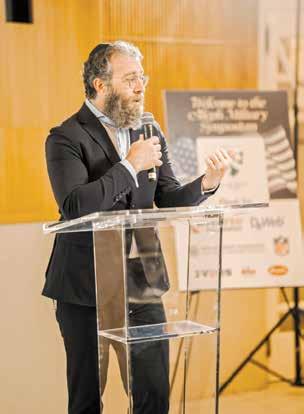
we had a frum man in an Arkansas prison. They had never seen a religious Jew before. It took a lot of effort to obtain a tallis and tefillin for him. Certain religious items were permitted, but they had to remain in the chapel and the prisoner could only access them at certain times of the day.”
Members of the Aleph Institute strongly believe in the dignity of a human being.
“People shouldn’t be defined by their darkest moments,” asserts Rabbi Lipskar.
Even in cases where a person is serving a lengthy sentence that cannot be reduced, Aleph works to ensure they have kosher food, tefillin, and Jewish books while they are behind bars.
“Our efforts were a catalyst for the First Step Act, a law that was enacted to help people in federal prison imprisoned for white collar, nonviolent offenses to

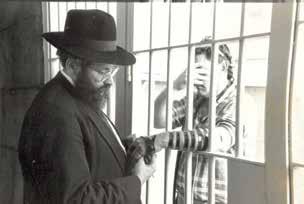
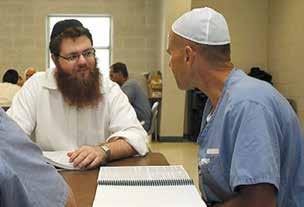

earn credits that reduce the amount of time they stay in prison or move them earlier to halfway houses or home confinement by completing approved programs like education, job training, or counseling.”
Another area in which they work tirelessly is advocating for the elimination of solitary confinement. When prisoners are put in solitary confinement, they are often left there for weeks at a time, with family members unaware of their situation.
Rabbi Lipskar adds, “A few times a year, we have a three-day yeshiva program in prison. We bring in rabbis and students and create a yeshiva atmosphere for every Jewish inmate. We call it ‘Learning to Live.’ The rabbis and students are there a full day. They daven and eat with the prisoners. It’s very beautiful.
“One time, I was visiting and had a list of all the Jewish inmates. One man on the list did not join us. When I asked where he was, I was told he’d been placed in solitary confinement, and no one knew why. This was a week before Pesach.”
Rabbi Lipskar requested permission from the warden to speak to the prisoner.
“When I met him, he was trembling. He was a gentle person imprisoned for a white-collar crime, locked into a tiny cell by himself. When they took him out so I could help him put on tefillin, they immediately handcuffed him like he was a violent prisoner. He had no clue why he was in solitary confinement.”
Rabbi Lipskar discovered that the man’s co-defendant had just been brought to the same facility, and to ensure there would be no communication between the two, they placed him in solitary confinement.
“As soon as I left the facility, I contacted his attorney and his family,” continues Rabbi Lipskar, “who knew nothing of what had transpired. Baruch Hashem, although usually inquiries of this sort take 30 to 60 days to clear up, we were able to get him out within a few days so he could be with his group for the sedarim and his family was able to visit.”
Unfortunately, Rabbi Lipskar acknowledges, divorce rates are very high among incarcerated individuals. The statistics are also significantly higher for children of incarcerated parents to later become incarcerated themselves, compared to the general population. The Aleph Institute aims to keep families connected and to help the families outside waiting for their loved one—and often their breadwinner—to return.
“We have programs for the children to keep them on the path and also provide monetary assistance if necessary,” says Rabbi Lipskar. These programs fall under Aleph’s family services department. Case workers are in touch with the families, and they have dozens of social work interns who have one-on-one
“I realized that while the Marines are about passing things on to the next generation, it’s ten times bigger in Judaism, passing down to the next generation.”
relationships with spouses and children simply to hold their hand through their crisis.
“It’s difficult,” Rabbi Lipskar says, “when the breadwinner is in prison. The mothers are working tirelessly to make ends meet, and the children often get neglected. We send them holiday gifts and cards. We also offer grants to send them to summer camp, as well as anything else they might need for camp, such as clothes, snacks, and a duffle bag.”
In one case, a father from a traditional Jewish family was in prison and the mother was struggling to pay the bills. Their son’s bar mitzvah was coming up.
“We made sure that this boy not only had a bar mitzvah celebration with family and friends, but we also advocated with the prison to get his father out for the bar mitzvah. We didn’t tell him until we knew for sure because we didn’t want to give false hope. He ultimately had his father with him at the bar mitzvah, and they put on tefillin together before his father had to return to prison. This child will have a different trajectory because of what we did for him.”
Recently, Aleph helped a mother of six, three of
whom she adopted, some of them special needs, who was sentenced to 18 months in prison for a first-time, non-violent offense. While living in a shelter for women fleeing domestic abuse, in a moment of desperation, she misrepresented information on a PPP application to meet her children’s basic needs. Rabbi Lipskar and his team did all they could to commute her sentence which, baruch Hashem, they were able to do. They continued to provide emotional, spiritual and financial help to her and her family while she was in jail as well as helped them get back on their feet after her release.
She describes her gratitude.
“What Aleph gave me was something the system itself does not know how to offer: the ability to see myself not as an aveirah, not as a label, not as a ‘felon,’ but as a full human being—still worthy of teshuvah, still capable of growth, still beloved by Hashem. In a world where rehabilitation is rarely recognized or rewarded, Aleph embodies the Torah’s understanding that sincere teshuvah transforms a person at their core.
“Because of Aleph, I was motivated to truly engage in avodas Hashem while incarcerated, to learn Chumash daily, say Tehillim, and teach others. I entered prison knowing that I was redeemable, and that belief changed everything.”
Mental health advocacy is another area in which Aleph is involved. There are people locked up because of addiction or mental health related crimes. They need our help, maintains Rabbi Lipskar. Aleph will attempt to get these individuals into facilities that can cater to their needs or create opportunities within facilities that can assist them so they will not end up repeat offenders.
“We became friendly with an inmate in a state prison who had addiction issues which led him to commit some pretty bad crimes,” shares Rabbi Lipskar. “He was incarcerated for 15 years. We visited him and studied with him. We saw that he was sincere. He wanted to turn his life around and put his past behind him.”
At that point, however, rebuilding a life after so many years in prison was not easy. Job placement is almost impossible. Nobody wants to hire an ex-convict. Housing is also difficult, and usually after such long periods the person has no family to return to.
“We vouched for this man,” continues Rabbi Lipskar, “and were able, baruch Hashem, to get him a job in a restaurant. It may not be a glamorous job, but

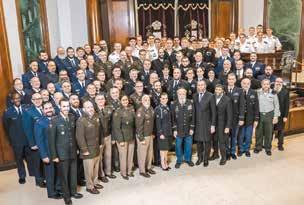

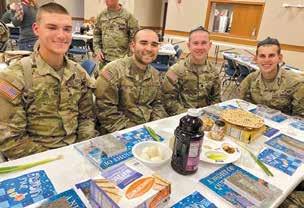
it’s gainful employment. He shows up to work every day and davens every day. It’s been three years, and we continue to keep in touch with him frequently. He’s a decent person and a good Jew. This is a true victory for us because there is a high recidivism rate in the world due to the challenges of reintegrating into society after long-term imprisonment. We become their families and their support system to guide them to lead productive lives.”
Not every person is going to be released. Rabbi Lipskar speaks about the time he visited a person on death row whose sentence was ultimately commuted to life imprisonment.
“Although we were not advocating for early release, we still come to offer connection, hope, and humanity.
“I was once teaching a group of Jewish inmates when an elderly man came over and asked if he could speak with me for a few minutes,” Rabbi Lipskar continued. “‘I’ve been in prison for almost 35 years,’ he said. ‘I have no one left in my life, no parents and no siblings. Sometimes, I try to connect and put on a yarmulke and tefillin. But this morning, I packed them away and swore never to use them again. I felt like I couldn’t go on anymore. I considered taking my life. I prayed to G-d for a sign, and then you showed up and started teaching us. Because of your visit and your desire to connect, I feel like I’m a part of something and it has given me the strength to continue to live.’
“Other long-term inmates have asked me, ‘Why are you even here?’ We’re here because we’re family, I tell them. They break down and cry. We show them that even if the world has discarded them, we haven’t. You matter to us because we’re family, we say.”
Another important population the Aleph Institute serves is members of the U.S. military. They reach out to Jewish service members and their families and provide for their spiritual, physical, and emotional needs in any way they can. This may include advocating on their behalf with government or outside agencies when necessary.
Rabbi Lipskar shares that there are many stories of young men discovering Yiddishkeit while stationed in faraway places. Here he shares the stories of just two of them, one, a young man who began learning
about Judaism while stationed in Okinawa, Japan, and another who enlisted in the US Army, was stationed in Iraq, and ultimately found his way back to frumkeit.
Many who enlist in the U.S. military are on the periphery of Judaism. A prime example is the story of Staff Sergeant Benjamin Craig, a Marine officer who has generously shared his story with the public.
“Because of your visit and your desire to connect, I feel like I’m a part of something and it has given me the strength to continue to live.”
“As a kid growing up, I knew nothing about Judaism. I didn’t know what Shabbat was. I didn’t know what tefillin was. All I knew was that I was Jewish. As a teenager, I realized I was going down the wrong path, so that’s when I decided to enlist at age 18 in the Marines, where I still am ten years later. It is a tough regimen but one that I deeply appreciate. As someone who was looking for a purpose, I felt I got that from the Marines.
“I was sent to Okinawa in August 2020 and started looking around for what could bring me a little connection there. I went to the unit’s chaplain and asked if there was anything Jewish. He first laughed, then said, ‘Oh, you’re serious.’ The only rabbis I had met before were Reform rabbis, so I was shocked to see a rabbi with a big beard and a uniform, with things hanging out on the side. In the military, you don’t see this. He started talking to me and invited me for Shabbos. I asked, ‘What’s that?’ It was my first ever Shabbos service. I understood none of it, people standing and sitting. When I asked the rabbi if I could walk him back to his car, he told me he doesn’t drive on Shabbos. For the next year and a half, I didn’t miss a service.
“Putting on tefillin for the first time was an incredible experience made even more awesome because, as my rabbi said, take your time because you will never have this experience of putting on tefillin on for the first time again. Something changed after that. I began to identify more with being Jewish. I realized that while the Marines are about passing things on to the next generation, it’s ten times bigger in Judaism, passing down to the next generation. Now, it’s my honor and privilege to teach new Jewish Marines candidates about the parsha, about tefillin, and about Shabbos.”
Another young man who had grown up frum became disenchanted and enlisted in the army to run away from his background. He was deployed to Iraq, and Purim was approaching. A bulletin was sent out to all the chaplains asking whether they had any Jewish servicemen and, if so, they would send whatever was needed for Purim. It also said that if they had someone who could read the megillah, they should let them know, and a megillah would be sent as well. The non-Jewish chaplain then asked this formerly religious Jewish soldier if he could read the megillah, and he answered, “Yes, I can.” From reading the megillah there in Iraq, he became the chaplain’s assistant and eventually came back to Yiddishkeit.
The work that he does every day, Rabbi Lipskar says, teaches him to appreciate everything in life.
“I see how your life can be upended in a moment, and I realize I can’t take anything for granted.”
He also sees on a daily basis how simple acts of kindness can change lives.
“You don’t have to go to a prison to see that either,” he reflects. “We can be kind to the people around us. A smile can make all the difference. We never know the impact of a simple gesture of love. We are so blessed that all of us have the ability to make a difference in someone else’s life. I try to instill that into my children.”
Rabbi Lipskar’s message to fellow Jews is “don’t be so quick to judge others. Don’t discount people based on what you read in the news. We are all much bigger than our flaws. Flaws don’t define a person.”
He urges, “We should daven for redemption for others as we do for ourselves. Be ready to overlook the bad in your brother and show love. Be open to understanding that anyone can make mistakes. We must be there for each other. No one should be alone and forgotten.
“Remember, we all have our journey.”

by Daniella Winegar D

Picture this: a young girl sitting on a stiff church bench with her family somewhere in Maryland. She is a devout Catholic, just like her parents and her sisters. Today, that same girl is a mother who sits at shul on Rosh Hashanah and at a Seder on Pesach. That girl is Kylie Ora Lobell—and her journey to Judaism was, in her words, a “miracle.”
We each have a path that we’ve followed to get us to the person we are today. Each path varies from one to the next. One of these paths took a young Kylie Ora Lobell from Catholicism to Judaism, a path that your average Jew may not relate to.
Many of us have the “luxury” of being born into Judaism. A luxury in the sense that the mitzvos and values are second nature to us. Do we have to think twice about whether or not to pick up a phone that rings on Shabbos? Is it an extra effort to remember what bracha we say on bread?
For someone like Kylie, it wasn’t that simple—and yet she chose it. Not only did she choose it, but she saw such greatness in being part of the Jewish people that she titled the book sharing her journey Choosing to Be Chosen.
Kylie went to public school much like your average American. She continued on to college and pursued internships and went to parties. She celebrated X-mas with her family and ate fast food from the place down her block. Nothing called for a change.
She wasn’t a Jewish girl rebelling or searching for her place within Judaism. She was a Catholic girl living the life she had always known—at least on the surface.

The concept of the Jews being the Chosen People is not about superiority but about recognizing the profound beauty, responsibility, and meaning found in living a Jewish life.
Like many people, however, Kylie faced her share of struggles growing up. At one point, she found herself losing hope in her religion. She prayed every night to
G-d and yet it felt like things around her didn’t improve. Praying, believing even, felt pointless.
At one point, Kylie became an atheist. As a teenager, she recalls that the idea of not believing in anything felt freeing. In that mindset, nothing was about anyone else but herself. She gave an example: if she had no money to buy food one night, there would be no issue stealing a sandwich from a store. In her mind, the store was a large corporation that could afford the loss, while she could not afford to go hungry.
At a certain stage of her life, this may have been a comforting mindset for her to hold; there was something that seemed freeing about it.
As an adult, however, Kylie appreciates the boundaries Judaism presents. Though an atheist may find ways to justify stealing, she explains that Judaism does more than simply forbid the act because it’s built on a framework of values that shapes the do’s and dont’s. Jews are not only instructed not to steal but are also taught to make an extra effort to return lost objects. Yiddishkeit places a strong emphasis on respecting others. This respect extends beyond simply avoiding wrongdoings; when we know someone has lost something, we are encouraged to take the extra
step to return it to them.
For those of us born and raised Jewish, a concept like this may simply go overlooked. Mitzvos are so ingrained within us that oftentimes we miss the deeper meaning behind them. Imagine how it would feel to do each mitzvah with fresh eyes, with an appreciation of what it is that we are doing and what it means.
One of the things that drew Kylie toward Judaism was the thoughtful answers she received to the questions she asked. To someone unfamiliar with Judaism, many aspects of the religion can seem unusual or difficult to understand. For someone considering conversion, the process can feel overwhelming. At first glance, it may look like an endless list of rules and obligations. Without guidance, it would be easy to walk away.
or demanding? Why would someone willingly choose to take all of that upon themselves?
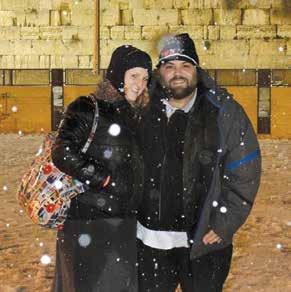
Kylie Ora and Danny at the Kosel after getting engaged
Kylie was fortunate to have a rabbi who she could turn to with each and every one of her questions. She shared that in other religions they may be quick to turn someone away when they come seeking explanations. But in Judaism, it felt like she was encouraged to ask. With every question asked, she gained a deeper understanding of Judaism and a deeper appreciation for the greatness of the religion she had chosen.
The impression that was made during her conversion process had an impact beyond Kylie herself. Danny Lobell, the Jewish man she was dating—and would later marry, did not have the most positive impression of Judaism at the time. when he was younger, he was kicked out of Orthodox schools, which left a bad taste in his mouth about Orthodoxy. Still, he supported Kylie as she went through the conversion process but had his own struggles connecting to Judaism, to connecting with Hashem.
When Kylie and Danny made their move from New York to Los Angeles, they were introduced to mentors who would be of great influence in their lives. There were rebbeim who made the conversion process such a positive experience not only for Kylie but for Danny as well. Danny was reminded that the negative experiences he had with religion shouldn’t be the defining ones. They don’t have to take away from all the good he connected with in Yiddishkeit.
Through Kylie and her journey, Danny was brought back to see Judaism through fresh eyes. He no longer defined it by the events that hurt him and was able to reconnect to the parts that he loved.
His journey highlights something powerful: people can return to Judaism after wrestling with it. But Kylie’s story raises a different kind of question. Why wasn’t she discouraged by the aspects of Judaism that many people might view as restrictive
A key point Kylie made is that it’s very easy to view responsibility as a burden and lack thereof as freedom. It’s the mindset that I have no one to answer to, and I can do whatever I want! But Kylie had lived that life, and what she learned is that kind of freedom opens you to become a slave to something else. You become a slave to social media or a slave to the popular trends. You look for admiration from likes and follows and comments, or from trendsetters who don’t even know you. Not only is it not freedom, but its enslavement to something with no real meaning. With Yiddishkeit, you are choosing to be part of something with meaning. Every mitzvah that you do is an opportunity to connect with

"I want people to be proud to be Jewish."
Hashem. It doesn’t feel like a burden, it feels like an opportunity to become closer to Hashem, Kylie explained.
This brings us back to one of the main points she makes throughout her book. There’s a reason she put her story out there.
“I want people to be proud to be Jewish,” she shares.
Her story gives us all an opportu nity to pause and strengthen our relationship to Yiddishkeit, to remember what it’s all about.
Kylie came into this religion, this relationship with Hashem, actively choosing to be a part of it each step of the way. She sought to see the meaning behind being a part of the Jewish people, being one of the Chosen People.
It’s easy to move through our day simply going through the motions of being Jewish. But how often do we pause to appreciate the magnitude of what we are doing? Do we stop while saying a bracha and
reflect on the extraordinary opportunity to personally thank the Creator of the world? Do we sit at the Pesach Seder and put in the extra effort to appreciate what it is we are speaking about from the Haggadah?
It is easy to get caught up in the everyday motions to the point where being Jewish is just another one of our identities. But what we learn from Kylie Ora Lobell is that it’s so much more. Being a Jew is not just another label. It’s not some title that tells others what we eat and what we wear. Being a Jew is a relationship with Hashem, and each mitzvah is an opportunity to build on that relationship. If we share Kylie’s perspective on mitzvos, we can bring more meaning into our actions and into our lives. We can feel the pride that she hopes for her readers to feel in being part of this great nation.
Kylie and her husband Danny aim to instill this same sense of pride in her children. She shares that she and her husband try to make Judaism exciting for them. They chose a shul where their children can be actively involved, so from a young age they feel like they truly belong and are part of the community.
By creating these positive experiences, she hopes her children will feel the same joy and excitement about Judaism that she felt when she first embraced the religion after becoming a Jew. One example that always makes her smile is her daughter, who takes such pride in being Jewish that she may not even realize that not everyone in the world is. Once, when they encountered a non-Jew, her daughter eagerly jumped at the opportunity to share something about the weekly parsha. Her Jewish identity feels so natural and complete to her that she almost assumes everyone else must share it, too.
The pride her daughter shows in being Jewish reflects a theme Kylie returns to throughout her book: what it means to “Choose to be Chosen.” For her, the concept of the Jews being the Chosen People is not about superiority but about recognizing the profound beauty, responsibility, and meaning found in living a Jewish life.
As Pesach approaches, it is worth taking a moment to reflect on what the yom tov is about. The Jewish people are described as the Chosen People, and throughout our history, Hashem has revealed that relationship in profound ways. The geulah from Mitzrayim was a defining moment that helped shape the Jewish nation and our connection to Him. The miracles and events of that time brought us closer to Him and established a relationship that continues to guide us today. As we enter Pesach, it is an opportunity to reconnect with our history and the meaning behind it—to pause and appreciate the depth, responsibility, and privilege of being part of the Jewish people.
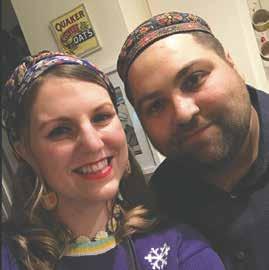
It is truly an opportunity for us to appreciate what it means to be “chosen.”
Something important to Say Touched by Our Story by
Rabbi Yechiel Spero
rav Shimshon Pincus once met a colleague who had just come back from a fundraising trip in America. The fellow was somewhat dejected, since he had been unable to gather the necessary funds for his yeshivah. Rav Shimshon told him that if he really believes in what he is doing, and is truly confident that it is beneficial for the donor to give him money, then he would be more successful. In fact, he insisted, there was no way he would ever fail. Rav Shimshon then gave an example to prove his point.
“One time, when I was in Los Angeles, someone showed me a New York Times article from 1942 where the Vaad Hatzalah advertised that for $50, one could save Jews in Europe. Imagine that you had read that article, and, unlike American Jewry in 1942, you knew what was happening in the war. You knew that every Jew there wasn’t safe and that he would, in all probability, be killed unless you were able to get him out of the inferno — soon. And for $50 you would be able to save those people. When you went knocking on doors, you would not leave without a significant donation. You would beg and implore every person to give you the necessary funding. You’d know the value of every $50.
“Indeed, if you really believed that it is beneficial for every person to give the money — so that he could take part in this precious mitzvah of saving lives — you would not leave without a check. Failure would not be an option.
“That,” he said, “is the key to raising money for those who are learning. You must really believe that the person who is giving the money is receiving a benefit by giving the money and joining in the mitzvah of limud haTorah.”
Rav Shimshon recalled an anecdote to emphasize his message.
“There was a housing office in Ofakim, where there were always very long lines. The woman behind the desk was careful not to let anyone cut the line.
“One day, I saw her father walking near our home, when suddenly he collapsed. Before anyone had a chance to revive him, he passed away. I quickly ran to the woman’s office to inform her of the tragic news. As usual, there was a long line, but I walked right up to the front. She immediately snapped at me that I was to wait in the back of the line like everybody else. But I told her that I have to talk to her about something very important. Again, she told me that I should go to the back of the line. I leaned forward and asked her if she knew where her father was. She did not understand the question, and I repeated it. ‘Do you know where your father is?’ I broke the news to her gently, and she began to cry. Of course, she apologized for trying to send me away.
“Can you imagine if I would have waited in line to tell her this news? What an absurd thought that is. I knew I had something very important to say to her, and I wasn’t about to let anything stand in my way.”
Although Rav Pincus used this story to encourage a fundraiser, this is the way a parent must approach the Seder. We have something very, very important to tell our children. We have the traditions and legacies that our parents passed down to us, and we need to convey the lessons to our progeny.

Initially, we may be met with resistance. Our children may not want to hear what we have to say. They may tell us to “wait in line,” by stating, “I have so many important things in my life. I have school and my social life and my other interests.”
Yet, tonight we cannot be pushed away. We must let our children know how important this message is: Do you know where your Father is? Do you know where the Al-mighty is in your life? When they see how serious we are about it, they will stop pushing us away. They will listen to everything we have to say and will be eternally grateful to us for sharing this message.
perfect Solution
Rav Chaim Kanievsky Haggadah compiled by Rabbi Avraham Yeshayahu Shteinman, adapted by Rabbi Dovid Hollander
afamily was fighting bitterly about where to go for the Pesach Seder. The husband insisted that they go to his parents, and the wife was adamant that they go to hers. Someone suggested that the couple consult with Rebbetzin Batsheva Kanievsky – as she had much experience dealing with many different life situations — and do whatever she advised.
After the rebbetzin heard both sides of the issue, she came up with an idea that appealed to both parties: she invited them to her house for the Seder! The couple accepted the rebbetzin’s offer and joined the Kanievskys for the Seder, thus restoring domestic harmony.

fulfilled by Waiting
The Chazon Ish Haggadah compiled by Rabbi Asher Bergman, adapted by Rabbi David Oratz and E. van Handel.
“On this night — we all recline.”
One week before Pesach, a young scholar passed away in Yerushalayim, leaving a widow and seven orphans. The rosh yeshivah of Ruzhin, Rav Yehoshua Heschel Brim, supplied the family with all their holiday needs and even arranged for a young man to conduct the Seder for them. Before departing for shul on erev yom tov, Rav Brim told his family that he would come home late. He planned to stop at the widow’s house after Maariv to help with last-minute preparations for the Seder. Rav Brim found the atmosphere in the widow’s house mournful. The young man who was to conduct the Seder had inexplicably failed to appear. Without hesitating, the rosh yeshivah proclaimed, “Kadeish .” Joyously, he led the entire Seder, ate the festival meal with them, and sang the familiar melodies.
Half an hour before midnight, Rav Brim entered his own home, where his family was waiting for him to conduct their Seder. He immediately began Kadeish again. This time, he rushed through the Haggadah; the Afikoman had to be eaten before chatzos! Only after the Afikoman was eaten did Rav Brim apologize for the delay.
“True,” said one of the family members, “you did a great act of kindness for the widow, but your family, too, needed a Seder!”
Rav Brim explained by telling the following story.
“As a bachur, I frequented the home of the Chazon Ish. Once, he told my friend and me, ‘Reuven has reached marriageable age. You must help him find a wife.’ The words of the Chazon Ish were sacred to us. We made the necessary efforts and were successful. When we reported to the Chazon Ish, he said, ‘I would like to be present for the signing of the tena’im , but since my time is very limited, please come get me when the ceremony is about to begin.’ When we came for him, he was sitting in his study with a couple. They were reading a list of items and asking which ones were preferable and how and where to obtain each item. He answered all their questions patiently. For an hour and a quarter, we waited outside the open door. The Chazon Ish saw us but continued the conversation. Finally, the
consultation ended. The couple rose, and the Chazon Ish escorted them out and bid them farewell.
“As soon as they had left his home, the Chazon Ish quickly donned his hat, and we hurried to the tena’im.
“You are surely wondering,” he said, “why I kept you and all of Reuven’s guests waiting.
“The couple with whom I was speaking are Holocaust survivors. They had told me that they had no source of income, and I advised them to open a store. Now they came to consult me about how to run it and what merchandise to buy.
“I could not help them financially, since I have no money. I was therefore obligated to assist them with advice, which is also a great mitzvah.
“This mitzvah was incumbent on you and Reuven’s other guests no less than on me. I fulfilled the mitzvah by advising them, and all of you fulfilled it by waiting for me.”
Rav Brim concluded: “Each of us was obligated to gladden the widow and orphans. I fulfilled the mitzvah by conducting the Seder, and you fulfilled it by waiting for me.”
old and neW
The Rav Moshe Haggadah from Rav Moshe Feinstein, compiled by Rabbi Shalom Meir Wallach, adapted by Malky Heimowitz
the granddaughter of Rav Shmuel Dovid Walkin asked him on the Seder night why we break the middle matzah to allude to the “bread of poverty” that we ate in Egypt, considering that the middle matzah corresponds to Levi, and the tribe of Levi was not enslaved.
Rav Walkin answered beautifully that it is to teach us that even though the tribe of Levi was not enslaved, they were heartbroken over the suffering of their brethren (Kisvei Abba Mari 241).
Once, the person who was supposed to drive Rav Moshe Feinstein to yeshiva to say his shiur was waiting, yet Rav Moshe, who was always punctual, did not emerge from his house. The driver was worried; he knew how important it was to Rav Moshe to arrive on time to avoid causing large-scale bitul Torah. He went up to see what had happened and found the outer door open a bit.
He went inside and heard the sound of crying coming from Rav Moshe. Frightened, he inclined his ear and heard two people sobbing inside the room. To his alarm, he recognized the sound of Rav Moshe’s voice. What had happened?
He looked at his watch — it was getting late. He opened door a crack and saw Rav Moshe sitting in his place, with an elderly man beside him. Both of them were sobbing.
The driver made a split-second decision to open the door and ask, “Rebbi, can I help?”
Rav Moshe looked up at him, his eyes red from crying. “Oh, it’s time to go say the shiur. Please wait a little. I’m busy now.”
The driver retreated and closed the door. A moment later, the old man emerged, leaning on his cane, with Rav Moshe escorting him. Rav Moshe then went to the sink and washed his tear-stained face.
“Forgive me for the delay,” he said to the driver. “But you saw. What could I do?”
They entered the car and hurried to the yeshiva.
“Why was the rav crying?” the driver asked. “Did some tragedy occur?”
“To tell you the truth,” Rav Moshe answered, “I don’t know why.”
“What?”
“Of course!” said Rav Moshe. “You heard him crying, but you didn’t hear him speaking. He came in, sat down, and spoke some unintelligible words. Then, he started crying bitterly. I didn’t know why he was crying, and I could not help him at all. But when a Jew cries, how can I not cry with him?”
g ratitude iS moS t important
The Rav Shach Haggadah from Rav Elazar Menachem Man Shach, compiled by Rabbi Asher Bergman, adapted by Rabbi Yaakov Blinder
“Had not the Holy One, Blessed is Be taken our fathers out from Egypt, then we, our children and our children’s children would have remained subservient to Pharaoh.”
this statement seems rather unlikely. The Pharaohs have not ruled Egypt for centuries. So utterly forgotten by history is the Pharaoh of
the Exodus that no one even knows his true identity with certainty. Surely, over the millennia, the Jewish people would have shaken off the yoke of slavery under natural historical circumstances, even if not for the Exodus. There aren’t even any slaves anywhere in the world anymore!
The answer to this question, said Rav Shach in the name of the great rabbis of the Mussar Movement, is that if Hashem had not taken us out of Egypt, but we would have gained our freedom through some political or natural process, taking advantage of Pharaoh’s magnanimity, we might not have remained enslaved to Pharaoh, but we would have been subservient to him — that is, we would have been beholden to him with a debt of gratitude, which would remain an encumbrance upon us for all time. There is no greater responsibility than the indebtedness owed to a benefactor for his kindness.
Rav Shach himself exemplified this trait in his personal life, as the following anecdotes illustrate.
In 5749 (1989), Rav Shach founded a new party called Degel Hatorah, which split away from the old, established party called Agudas Yisrael. As the new party prepared itself to enter the political fray and participate in Knesset elections, Rav Shach was greatly concerned that it should not fail in its attempts to gain a foothold in Israeli politics. Such a debacle would bring about a chillul Hashem in the eyes of the general public, since so many Torah leaders had thrown their weight behind it. Anything less than two seats in the Knesset, Rav Shach felt, would constitute a failure at the polls. He invested a great amount of time, effort and emotional energy into the nascent party, which, as it turned out, did achieve a second Knesset seat, but by only a handful of votes. At that time, an individual who was the head of an organization of English-speaking olim (immigrants to Israel) went to Rav Shach with the following question. Their organization had received extensive assistance in several matters from a senior party activist of Agudas Yisrael. How, then, does Rav Shach instruct them to vote? Rav Shach knew very well — and he never missed an opportunity to stress to others — that the fate of Degel Hatorah depended on every single vote it could muster. Yet, despite his tremendous dedication to this cause, he told the representative of the olim organization, “Gratitude is the most important of traits! If your organization received assistance from Agudas Yisrael, you must vote for them!”
For many years, Rav Shach used to visit an elderly woman in Ramat Gan and inquire after her welfare, offer-
ing to help her in whatever way he could. Rav Shach explained the background to his connection with this woman:
“When I was a child, we lived in a little village called Vovoilnik. My mother had the practice of spending the entire Yom Kippur in shul davening, straight from Kol Nidrei until Ne’ilah. One year, when I was about 5 years old, I was playing outside, when a band of Gypsies came along and snatched me, pulling me into their wagon as they continued to ride along. It so happened that several girls saw what had happened and began to run after the wagon, crying, ‘Stop! Thief!’
The Gypsies became frightened and threw their ‘catch’ out of the wagon. Thus I was saved from being kidnapped and from who knows what other forms of calamity. This woman living in Ramat Gan is one of those girls from Vovoilnik!”
Many decades had passed since that incident. Rav Shach had gone on to study in Ponevezh, in Slabodka, Slutsk, Kletzk, Luninetz, Novoardok and Vilna. He had moved to Eretz Yisroel and lived in Yerushalayim and then in Bnei Brak. But he never forgot his debt of gratitude to that woman!
Why me?
the g eneration to g eneration haggadah by Rabbi Nosson Muller
“On all other nights we do not dip even once, but on this night twice.”
Several years ago, one of the hidden tzaddikim in the Boro Park section of Brooklyn, Reb Mendel Weiss, passed away. Although he dressed in layers of old rags and musty coats, those who merited to know him testified that Reb Mendel was a lofty, holy Jew who disguised himself as a simple, hapless Jew.
Someone who once gave Reb Mendel a ride was rewarded with this gem of a vort from this gem of a man.
“Why is it only on Pesach night that we ask why we dip twice, but on Rosh Hashana, we don’t ask? On Rosh Hashana, as well, we dip twice, first the challah in honey and then the apple?”
With a twinkle in his eye, Reb Mendel answered, “Because we tend to ask questions only when we dip into bitter things. When something is dipped into honey, we don’t have any questions!”
How true were his words. How many times throughout our lives, when things aren’t going well, are we quick to question the Ribbono Shel Olam, “Why me?” or “Is this really fair?” Yet, when things are going well and we are blessed with an abundance of sweetness, we somehow don’t rush to ask, “Why me?”
old and neW
The Sephardic Heritage Haggadah
By Rabbi Eli Mansour and Rabbi David Sutton
“Initially, our fathers were idol worshippers.”
there is a powerful story about Rav Yitzchak Elchanan Spektor of Kovna that sheds an interesting light on this passage in the Haggadah. Rav Spektor was beloved by all Jews. Even the maskilim (the so-called enlightened Jews, most of whom had forsaken their precious heritage) admired him and thought that he was one of them, because in his rabbinical response, he seemed to them to have found leniencies in certain areas of halacha.
Once, when Rav Spektor was returning from a railroad journey to St. Petersburg, he stopped at the Vilna station on his way back to Kovna. Many people came to the station to greet him. One of the maskilim , who had been on the train but had not as yet seen Rav Spektor, became intensely curious as to the reason for the large crowd of well-wishers, and he was told that they had come out to greet Rav Yitzchak Elchanan of Kovna. At that point, the maskil wanted to meet the rav himself, and upon his being pointed out to him, the man saw a venerable chacham with a long beard and peyos, wearing a tallis and tefillin
The maskil could not disguise his disappointment. He said, “Rabbi, we used to praise you as being one of us, one of the progressive elements, a member of the new generation. But now I see that you are from the old generation!”
Rav Spektor smiled as he answered, “No, it is just the opposite of what you are saying: I am from the new generation – and you are from the old generation! After all, we say in the Haggadah, ‘Originally, our fathers were idol worshipers.’ That is the old way, the way you maskilim practice your religion [by revering the ‘gods’ of the secular world around you]. However, the way I practice my religion is the new way — G-d’s way!”


never loS t our identity from bondage to freedom haggadah
by Rabbi Abraham J. Twerski
“Vayagar sham, he sojourned there.”
the word “vayagar ” that the Torah uses in referring to Yaakov’s dwelling in Egypt has its origin in the word gar, which connotes temporary residence rather than permanent citizenship.
The Talmud states that although the Bnei Yisrael lived in Egypt for two hundred and ten years, they maintained their identity by retaining their Hebrew language, by retaining the traditional Hebrew garb, and by giving their children Hebrew rather than Egyptian names. It was this preservation of their identity that allowed them to remain a distinct people, by virtue of which they were redeemed at the Exodus.
Throughout history, some Jews have sought to avoid discrimination and persecution by phasing out their Jewish identities and by frank assimilation. While one can hardly be condemned for seeking a way to avoid the suffering of anti-Semitism, we must remember that we were commissioned by Hashem to be a spiritual people and to carry the message of G-dliness and spirituality to the world. We cannot carry out our mission if we lose our identity by assimilation and become part of the non-Jewish world. A spiritual person does not shirk responsibilities, even at the cost of personal distress.
•
An anti-Semitic Russian minister of education once challenged one of the noted Torah leaders: “You Jews do not observe the teachings of your own Torah. Your Torah states that you must follow the majority. You constitute only a small minority among a vast majority of non-Jews, yet you are obstinate in being different. You are violating your own laws.”
The gadol replied, “Your Excellency is not applying the Torah law accurately. We indeed do follow the majority, but only when we are in doubt about the nature of something do we assume that the benefit of doubt lies with the majority. Or if there is an admixture of kosher with non-kosher food, so that the non-kosher food is not recognizable, we may then apply the majority rule. However, the latter does not apply in absence
of doubt or when something is clearly recognizable.
“We Jews are never in doubt. We know who we are and have never lost our identity. Furthermore, we are easily recognizable. Hence the principle of following the majority does not apply.”
•
Yaakov Avinu knew that his descendants would have a lengthy stay in Egypt. His message to them was that they must always consider themselves geirim, for-
“We Jews are never in doubt.
We know who we are and have never lost our identity.”
eigners in an alien society. They must always remain distinct and never allow themselves to be absorbed by the dominant culture.
tearS over the Seder Food for Thought Volume 2 by Rabbi Yitzchok Hisiger
afew days before Pesach, Rav Yekusiel Yehudah Halberstam, the Sanz-Klausenburger Rebbe, was hospitalized with a serious virus. On Erev Pesach, the physicians examined him and decided that he has to stay in the hospital for the Seder night. They added that due to the seriousness of his condition, no one, not even close family members, would be able to be with him.
While accepting the doctors’ decision, the Rebbe broke down crying. He was seemingly devastated by what he had been told.
Toward the end of the month of Nissan, the Rebbe was finally discharged and allowed to return home. At that moment, the Rebbe explained why he had cried several weeks earlier. The Rebbe endured unspeakable tragedies in his life. His strength and fortitude were the things of legend. His faith was indestructible and his resilience rock-solid. Why had he suddenly broken down in the hospital?
“From the time I was born,” the Rebbe explained, “I can honestly say that there has not been one tzarah that I have not endured, but I never cried or paid attention to my troubles. I was always concerned that someone might think that I may have even a tiny complaint against HaKadosh Baruch Hu, chas veshalom. I accepted everything with love.
“But when the doctors told me that I will have to remain in the hospital for the leil haSeder, I cried, because I saw the pain on the faces of my wife and my children. I saw their pain of not being able to be together for the Seder.
“It was my pain over their pain that caused me to cry.”
The rebbe’s close attendant, Rav Yosef Binyomin Williger, upon telling this story, would note that the rebbe was orphaned at a young age and went through the Holocaust, during which he lost his first wife and eleven children. Yet he never cried. He only cried when others were suffering and he felt their pain along with them.
changing Who i a m
Rav Shlomo Zalman Haggadah
From Rav Shlomo Zalman Auerbach, compiled by Rabbi Yisroel Bronstein, adapted by Rabbi David Oratz
“Who redeemed us and redeemed our ancestors.”
on Pesach, we say, “Who redeemed us and redeemed our ancestors,” yet on Purim, we say only, “Who has performed miracles for our ancestors.” If a person is required to personally thank Hashem for miracles that occurred to his ancestors — because, ultimately, he is affected as well — then on Purim, he should also say, “Miracles for us and for

our ancestors.” If, on the other hand, one need not personally thank Hashem for a miracle that occurred to his ancestors, then why do we say “redeemed us” on Pesach?
The answer seems to be that a miracle that occurs to one’s ancestors, i.e., allowing the ancestor to live and bear children, does not require the descendant to offer personal thanks. The blessing that is said to express such thanks is “Who has performed a miracle for me in this place.” How can a person say for me when in his present state no miracle was performed for him (other than that he would not be in existence had the miracle not occurred to his ancestors)?
This is not the case, however, concerning the slavery in Egypt. Had Hashem not redeemed our ancestors, we would still have been born — but only in the lowly spiritual state of the enslavement, immersed in the fifty gates of defilement. In this case, it is appropriate to say, “Who has performed a miracle for me in this place.” The miracle He performed for me was that my ancestors were redeemed from this spiritual enslavement, thereby changing who I am. It is thus appropriate to say, “Who redeemed us and redeemed our ancestors.”
In a similar vein, it is said that Rav Chaim Volozhin, the famed disciple of the Vilna Gaon, once passed a place in which a miracle had occurred to the Gaon’s mother. At that place he recited the blessing, “Who has performed a miracle for me in this place.” Now, it did not seem that a miracle was performed for him in that place; rather, as a result of that miracle, his master, the Vilna Gaon, came into existence. True, with or without that miracle, Rav Chaim would have been born, yet had the Vilna Gaon not been born, it would not have been the same Rav Chaim. Would he not have been the benefactor of the Gaon’s tutelage, he would have never reached those levels of greatness.
look in the mirror
Rabbi Yissocher Frand on the Haggadah
“And now, please let your servants dwell in the land of Goshen.”
lest we think that the Jewish settlement in the land of Goshen was just happenstance, the Torah uncharacteristically mentions it as the dwelling
place of the Bnei Yisrael no less than eight times, and that’s just in Sefer Bereishis, before the story of Yetzias Mitzrayim actually begins. In Sefer Shemos, Goshen is mentioned twice, both of which discuss how Hashem differentiated between the areas the Egyptians inhabited and where the Jews lived. In advance of Makkas Arov, the plague of wild animals, Hashem sent a message to Pharaoh: “And on that day, I shall set apart the land of Goshen upon which My people stands, there shall be no swarm there; so that you will know that I am that Hashem in the midst of the land” (8:18). In
“We tend to ask questions only when we dip into bitter things. When something is dipped into honey, we don’t have any questions!”
describing barad (hail), the Torah states: “Only in the land of Goshen, where the Children of Israel were, there was no hail” (9:26). Clearly, because the Bnei Yisrael maintained a separate settlement, they merited to see Hashem’s Hand differentiating between them and the Egyptians. But differentiation can also come with an inherent theological danger.
On January 25, 1991, the most devastating night for Eretz Yisrael during the first Gulf War, seven of Saddam Hussein’s Scud missiles landed in the country
despite the Patriot Missiles the United States had sent to intercept them, destroying nearly 150 apartments and damaging another 400. Two of those Scuds landed in Ramat Gan, a neighborhood that is contiguous with Bnei Brak, with streets leading directly from one to another. One of the relatives of Rav Elazar Menachem Man Shach visited him the next day and smugly noted that the scuds had landed only in the less-religious Ramat Gan but not in the “holy city” of Bnei Brak.
“We have witnessed a fulfillment of the verse, ‘And I will separate the Land of Goshen,’” he declared.
“My reaction was exactly the opposite,” Rav Shach countered. “When the storm hit the boat that was carrying Yonah HaNavi, each of the sailors began to pray to his idol. What did Yonah tell them? “B’sheli hasa’ar hagadol hazeh aleichem, It is because of me that this great tempest is upon you” ( Yonah 1:12).
“Shouldn’t Yonah have told them, ‘If not for you and your idolatry, we wouldn’t be in this mess’?” asked Rav Shach. “Why did he assume that the storm was due to his failure?”
“Do you know why I think the Scuds fell Friday night at 7 p.m.?” Rav Shach continued. “Because at that time, during a January Friday night, rather than going to learn or reviewing the parashah, people were sitting around and schmoozing at their tables. I think that the Scuds landing at that time were a reminder to us, in Bnei Brak, that we weren’t doing what we should have been doing. It is incumbent upon us to say: ‘B’sheli hasa’ar hagadol hazeh… It is because of me that this great tempest occurred…”
When tragedies occur, it’s so easy to point fingers at other segments of Klal Yisrael and blame them. The religious blame the secular, the frummer blame the more modern, the older generation blame the younger generation. But how many people look at their own shortcomings and try to improve?
Yes, Hashem sometimes differentiates between the Jewish people and others in the world. But the Torah philosophy is not to smugly point out how we were unaffected, but to think about the message Hashem is sending us through whatever catastrophe has struck, and to determine how we can improve so that we are spared a similar fate.
Reprinted with permission from ArtScroll/Mesorah Publications

The day after the Iran War broke out, I shelved an op-ed I had started to write. It centered on the combustible issue of the Kotel status quo that had burst back in the news in late February.
I informed the publisher that in light of the war, I proposed holding off on the piece. “Although the Kotel is always of paramount importance,” I wrote at the time, “I think a piece on its sanctity now will not get the attention it deserves.” She agreed.
The Kotel issue had reemerged around a week before the war began, after lying dormant for some time. In a ruling widely cheered by diaspora’s non-Orthodox Jews, the Israeli High Court of Justice ordered the government to advance the upgrade of the egalitarian prayer section at the Kotel, demanding that the multimillion-dollar construction be completed within ten months.
In response, Avi Maoz of the Noam Party introduced the “Western Wall Bill”. The bill is an unambiguous amendment to the existing 1967 law concerning the Kotel, which places control of prayer arrangements under the authority of the Chief Rabbinate. Maoz’s legislation essentially criminalizes egalitarian prayer at the Kotel by classifying any failure to comply with rulings of the Chief Rabbinate as a “desecration,” punishable by up to seven years in prison.
Maoz’s bill passed its initial presentation on February 25 by a 56-47 vote. While it needs to pass future readings, Maoz was joined by Chareidi and Orthodox politicians in calling the bill a “victory for tradition, Jewish law and Judaism.”
Predictably, the Reform Movement put out a statement unequivocally condemning “this alarming proposal.” The statement urged “our Reform and Conservative partners worldwide in calling on Israeli leaders and diplomats to halt this dangerous legislation.”
Three days later, America and Israel jointly attacked Iran. The Kotel issue stalled again.

by Sara Lehmann

But protecting the holiness of the Kotel is not a subject that ever goes away. As the last standing vestige of the Beis Hamikdash, the kedusha of the Kotel is a symbol of the kedusha permeating all precepts of Jewish life. War or no war, the topic may temporarily recede in the background but its relevance remains ubiquitous.
it too. From the opposite point of view.
According to the Reform, “This proposal risks setting a broader precedent. If codified, it could embolden efforts to restrict recognition of non-Orthodox conversions, limit public funding for pluralistic institutions, and expand rabbinic court jurisdiction in ways that further erode religious freedom.”
Spiritual battles don’t have a timeline. Or a deadline.
Certainly, the Reform movement did not put the issue on the back burner. An action alert regarding “Defending Egalitarian Prayer at the Kotel” that appeared before the war still runs on their website’s homepage. It provides directives and resources to block the bill, including email links to Prime Minister Netanyahu.
Just like we understand that adherence to halacha is what undergirds Eretz Yisrael, the Reform understand
This is precisely why we must do whatever is in our power to protect the status quo of the Kotel, thus protecting the status quo of halachic decisions that come under the purview of Israel’s Chief Rabbinate.
To that end, Am Echad and the Coalition for Jewish Values put out an ad in late February warning that “this is not about prayer. It is about the future of the state. A small but radical minority among Diaspora Jews is attempting to
overturn a 3,000-year tradition at the Western Wall by establishing a ‘Reform section’ at this holy site.”
Two weeks into the war, Rabbi Pesach Lerner from Eretz HaKodesh, a movement representing Orthodox communities in the diaspora, assisted by Esther Jacobs, who facilitated the enormously consequential Am Echad Kotel petition campaign several years ago, sent a letter to Israel’s Ambassador to Washington Yechiel Leiter. Rabbi Lerner proposed meeting with Ambassador Leiter to “express our unwavering support for the current actions of the Israeli government in her quest to eliminate the threat of Iran, and her proxies; and to discuss the Kotel issue.”
A Zoom meeting took place on March 18 with Ambassador Leiter that included rabbis and lay leaders that ran the gamut from Ashkenaz, Sephard, Chassidic, Chabad, Russian, Syrian, Bucharian and other communities. Ambassador Leiter spoke of the war and the threat of delegitimization that Israel faces, and he called for unity among Jews to combat the scourge of antisemitism. However, he was unwilling to discuss the topic of Kotel when I broached it.
I asked why Israel would acknowledge grievances by non-Orthodox diaspora denominations when they often partner with progressive groups like the New Israel Fund and J Street. These groups oppose the Iran War, promote the two-state solution and deny the IHRA definition of antisemitism, thereby endangering the State of Israel and Jews worldwide.
While Ambassador Leiter did state that he was the first ambassador to officially announce that J Street was outside of the tent, it was clear he did not want to touch the hot button Kotel issue. He said that he did not think it was time to make an issue of Kotel legislation in the midst of a war nor did he think there was an assault on the Kotel. The time for both sides to debate the issue, he said, is after the war.
The ambassador is doing a superb job representing the State of Israel during wartime and the pressures on him must be enormous. But perhaps fog of war obscured the fact that the Knesset itself went back to business two days before our Zoom meeting.
On March 16, the Knesset convened a more expanded legislative framework. Bills were scheduled, including the Western Wall Bill, which thankfully advanced.
On cue, the non-Orthodox shried gevalt again. Anna Kislanski, CEO of the Israeli Movement for Progressive Judaism, slammed the advancement as an afront to non-Orthodox Jews “in the midst of a war.” It was a refrain that other groups, like Women of the Wall, used too.
When is the time to tackle the issue? In four weeks? Eight weeks? When the war is over?
Spiritual battles don’t have a timeline. Or a deadline. While the non-Orthodox continue to push against the Western Wall Bill during the war, the Orthodox need to be as vociferous in pushing for it.
Furthermore, there can be no place for debate here. There are no two legitimate sides to this issue, when one side is pro-halacha and the other side is anti-halacha.
It’s not surprising to hear the outrage of the non-Orthodox, considering how desperately their leadership tries to hold on to fading relevance amidst dwindling membership and an intermarriage rate of over 70%.
After October 7, Israeli Jews have been moving towards tradition rather than away from it. During the debate for the Western Wall Bill, Israeli Finance Minister Betzalel Smotrich referenced the miniscule Reform presence in Israel, saying that there are only “three and a half Reform Jews in Israel, out of eight million Jews.”
In the diaspora, there is the growing phenomena of the October 8th Jew – the unaffiliated Jew eager to learn about his heritage after having it thrust on him in the form of Jew-hatred.
Even the ADL, long associated with progressive groups that now shun Jews, seems to be doing teshuva of sorts upon being confronted with a devastating volume of antisemitic attacks. At their recent Never is Now Summit in NYC, there was an Orthodox presence in attendance and among speakers that is new and growing. Even their meals were strictly Cholov Yisrael. The heads of the Conservative and

Reform denominations have been busy publishing articles, raising awareness and urging their constituents to contact Netanyahu and “demand that members of his coalition reject this bill and respect Jewish pluralism.”
Orthodox Jewry must respond in kind. We must also educate Orthodox diaspora Jews on the issue, partner with
groups that promote the Kotel’s sanctity, and contact Israeli politicians to support the Western Wall Bill.
This year, as we recite “bechol dor va’dor ” at the Pesach Seder, the words take on a singular immediacy. And we should be mindful that the threat to the Jewish people sometimes, sadly, comes from within.
As this article goes to print, we do not know when the war will end. But we do know that protecting Kedushas Hakotel can only be a zechus for us as we beseech Hashem to vanquish the enemies of the Jewish State and Jews worldwide.
This article first appeared in Hamodia.
Pesach is a beautiful and meaningful yom tov. However, with an abundance of matzah, multi-course meals, and late-night Sedarim, it’s easy to overeat and feel sluggish. With a mindful and balanced approach, you can enjoy the chag while still feeling your best.
Matzah
Matzah is a central part of Pesach, but eating large amounts throughout the day can lead to discomfort. Since it is low in fiber and very dense, it can slow digestion and contribute to bloating or constipation. It is best to stick to the required portions during the Sedarim, and, for other meals, limit matzah to one serving to avoid overconsumption.
When possible, choosing whole wheat or spelt matzah instead of white matzah can help increase fiber intake and support digestion. Pairing matzah with protein or healthy fats, such as eggs, tuna, or avocado, can also help promote fullness and prevent quick energy crashes.
With many meals packed into a short time, especially during a three-day yom tov, eating large, heavy meals back to back can lead to fatigue and discomfort. Meals that are high in refined carbohydrates and fats can cause spikes in blood sugar followed by sluggishness. To help maintain steady energy, try to eat every 3-4 hours rather than letting yourself get overly hungry and then overeating.
Using a simple “plate method” can help keep meals balanced:
½ plate vegetables – for fiber, vitamins, and fullness
½ plate protein – such as chicken, fish, or eggs
Since matzah provides the carbohydrate for the meal, it’s not necessary to include additional starchy foods. Instead, consider using vegetables in place of starches, such as cauliflower mash, cauli-

By Aliza Beer MS, RD, CDN

flower rice, zoodles, or spaghetti squash. These can add variety, texture, and fiber without extra heaviness.
It’s important to stop eating when you feel about 80% full instead of completely stuffed, and if another meal is coming soon, consider keeping your portion slightly smaller. Simple, nourishing meals—like grilled chicken with roasted vegetables or baked salmon with a vegetable side—can provide energy without leaving you feeling weighed down. By spreading out meals, managing portions, and emphasizing vegetables and lean proteins, you can enjoy Pesach meals while maintaining comfort and steady energy throughout the day.
Pesach meals are often centered around meat, but the type of meat can make a difference in overall health. Fatty cuts of red meat are high in saturated fat, which, when consumed frequently, can contribute to elevated LDL cholesterol levels and increase the risk of cardiovascular disease. During the three-day yom tov, it’s best to limit red meat to no more
than once per day, to avoid excess from repeated servings throughout the day.
Choosing leaner proteins such as chicken or lean meats more often can help support heart health and maintain a more balanced intake. In addition, aim to make fish such as salmon or Bronzino as the protein portion for one or two meals during the chag, instead of defaulting to chicken or meat at every meal. Using fish as the primary protein can help keep meals lighter while still providing high-quality protein and omega-3 fatty acids, which are associated with reduced inflammation and improved heart health.
By balancing chicken, red meat, and fish, you can enjoy Pesach meals while supporting overall wellness.
On a three-day yom tov, there are six meals in a row, and having both heavy appetizers and a full entrée at each one can quickly become too much for your body to handle. Having multiple courses or larger meals once in a while at a simcha or event is normal
and understandable, however, during consecutive yom tov meals it becomes too much food in a short period of time. Therefore, simplifying these meals can help you feel significantly better. Instead of starting with rich or heavy appetizers, consider lighter options like a fresh salad or a broth-based soup. These choices can help take the edge off hunger, support digestion, and prevent overeating during the main course. By keeping appetizers lighter and more intentional, you can better manage portions and maintain your energy throughout the chag without feeling overly full or uncomfortable.
Making Veggies the Foundation
With matzah replacing many typical grains, meals can easily become low in fiber. A low-fiber intake can contribute to constipation and may not provide lasting fullness, leading to increased hunger shortly after eating. Making vegetables a central part of your meals helps support digestion and balance overall nutrient intake.
Practical tips to make vegetables a focus:
• Start each meal with a salad or vegetable soup
• Keep pre-cut vegetables in the fridge for easy access
• Aim for at least two different vegetables per meal
Filling your plate with options like Israeli salad, roasted broccoli and cauliflower, vegetable soups, or sautéed greens helps improve fiber intake, supports regular bowel movements, and keeps you fuller longer throughout the day.
Mindful Eating and Snacking
Many packaged Pesach foods are highly processed and often made with potato starch and oils. These foods are typically low in fiber, vitamins, and minerals, and the oils used can be high in

saturated or trans fats, which, when eaten in excess, may raise cholesterol and impact heart health.
To stay energized and avoid overeating, it’s best to plan your snacks intentionally rather than grabbing packaged foods out of habit.
Tips for healthy Pesach snacking:
• Portion snacks ahead of time: Avoid eating straight from the package by putting nuts, dried fruit, or crackers on a small plate or bowl.
• Ask before you snack: Check if you’re actually hungry or just bored.
• Prepare nutritious options in advance: Make simple homemade treats like nut-and-fruit bars, healthy cookies, or small energy bites so you always have something wholesome ready.
• Combine protein and fiber: Snacks like yogurt with fruit, hard-boiled eggs with vegetables, or a handful of nuts with an apple help you feel fuller longer.
• Keep healthy foods visible and accessible: Pre-cut vegetables, fruit cups, and ready-to-eat snacks in the fridge or pantry make it easier to choose nutritious options over processed ones.
• Pair snacks with water: Drinking a glass of water with your snack can help with digestion and prevent confusing thirst with hunger.
By planning ahead and keeping a variety of quick, nutrient-rich snacks on hand, you can satisfy hunger between meals without relying on highly processed Pesach foods.
The Seder is one of the highlights of Pesach, but its late timing can make it challenging. Arriving overly hungry often leads to overeating once the meal begins. Having a balanced, protein-rich meal earlier in the day, such as eggs with vegetables or chicken with salad, can help prevent this. If needed, a small snack like yogurt or fruit before the Seder can also take the edge off hunger. Since the main meal often takes place very late at night and you have already had matzah, potatoes, and additional foods earlier in the Seder, it’s best to keep the meal itself lighter rather than heavy. A simple option like soup with vegetables, or soup with a small portion of chicken, can help you feel satisfied without discomfort so late at night. Throughout the Seder, aim to be mindful and intentional with your eating, and try to avoid continuously snacking out of habit rather than actual hunger.
Choosing what to drink for the Four Cups can be challenging. It is important to consider that grape juice and some wines can contain a significant amount of added sugar. Consuming large amounts at once may lead to spikes in blood sugar levels followed by energy crashes. Choosing dry wine or light grape juice, which contains less sugar, can help reduce overall intake.
Pesach foods, especially matzah and higher-protein meals, can contribute to dehydration, which may worsen constipation and leave you feeling fatigued. Staying well-hydrated throughout the day supports digestion, keeps energy levels steady, and helps prevent bloating.
Practical tips for staying hydrated:
• Aim for 6-8 cups of water daily as a baseline.
• Start your day with 1 cup of water upon waking to rehydrate after sleep.
• Drink a glass of water before each meal to aid digestion and help prevent overeating.
• Drink a glass of water before each meal so you’re not going into the meal overly hungry.
• Sip water throughout your meals as often as you can—this can help slow down eating and promote fullness.
• Carry a water bottle as a reminder to sip regularly.
• If plain water feels boring, try herbal teas, sparkling water, or water with lemon or cucumber slices for flavor.
• Include water-rich foods in meals, such as salads, soups, and fruits like watermelon or oranges, to further support hydration.
By making water and hydrating foods readily available and incorporating small habits throughout the day, you can prevent dehydration and support digestion, especially during the busy Pesach schedule.
Desserts and Treats
Pesach desserts are often high in sugar and refined ingredients, which can lead to rapid spikes in blood sugar followed by fatigue. It is important to remember moderation and not deprivation!
To enjoy sweets without feeling sluggish, it helps to approach desserts mindfully. Try choosing one dessert per meal instead of multiple and consider sharing with others so you can enjoy the treat without overindulging. Waiting 10-15 minutes after finishing your meal before deciding if you still want dessert can also
help you determine if you’re truly hungry or just eating out of habit. Keeping fresh fruit or simple nut-based treats easily available provides a natural, balanced alternative to more sugary options. Options like compote or chocolate dipped strawberries can be great choices that feel like a treat while still being lighter.
By savoring smaller portions and prioritizing nutrient-rich choices, you can satisfy your sweet cravings while maintaining steady energy throughout Pesach.
With long meals and a busy schedule, it is easy to become more sedentary during Pesach. Even light movement can make a difference in how you feel. Taking a short walk after meals can support digestion, and using Chol Hamoed for outdoor activities or family walks can help maintain energy and overall well-being.
For those attending Pesach programs, constant access to food can make it especially challenging to maintain balance. Buffets, tea rooms, and frequent events make it easy to eat far more often than usual. It’s important to remember that there are always good options available at every meal; it’s just a matter of having the discipline to choose them.
Try to stay mindful by planning ahead and approaching meals intentionally. Walk through the buffet once before filling your plate and aim to fill your plate only once rather than going back multiple times. When possible, sit away from the food area and choose specific times to eat instead of grazing throughout the day. In tea rooms or snack stations, take a plate and sit down rather than standing and picking, which can lead to overeating. Avoid bringing extra food back to your room, aside from something simple like fruit.
At breakfast, instead of starting with cake or pastries that are high in sugar and refined carbohydrates, choose more balanced options. Omelet stations are often available, making eggs with vegetables a convenient and filling way to start the day. Yogurt, cottage cheese, and fruit are also easy, nutritious options that can help you start the day with steady energy.
Lunch is usually an opportunity to build a balanced meal from a salad bar with protein options like fish or eggs. While foods like matzah pizza are often available, it’s best to enjoy them in moderation—such as having it once or twice during the program rather than every day. Aim to build your meal around vegetables and protein first, then add other items
mindfully.
One of the biggest challenges on Pesach programs is the constant flow of food—lunch, poolside BBQs, dinner, and even late-night “midnight madness” events. It’s not realistic or necessary to eat at all of them. Try to stick to three structured meals per day and remember that just because food is being served, it doesn’t mean you need to participate each time. Being selective about when you eat can make a big difference in how you feel. When choosing main dishes, look for grilled, baked, or lighter options rather than fried or heavy foods. Meals centered around protein and vegetables can help maintain steady energy levels and prevent feeling overly full or sluggish.
Another advantage of being on a program is that you’re not busy with cooking, serving, or cleaning, which often frees up time for physical activity. Take advantage of this—if you’re in a warm climate, go for walks or spend time being active outdoors. If you’re in a colder location, consider using the gym or joining exercise classes. This can help balance the higher calorie intake and keep you in check.
By being intentional, making thoughtful choices, and staying aware of your eating patterns, you can enjoy Pesach programs without feeling overly full, fatigued, or out of control around food.
When going out on Chol Hamoed, it is important to plan ahead. Food access is often limited when you’re out for the day or on long car rides, so it’s helpful to bring your own snacks. Simple options like cut vegetables (cucumbers, peppers, baby carrots) or fruit can help you stay on track and avoid relying on less balanced choices.
One can enjoy Pesach without overdoing it when using awareness and balance. By being mindful of matzah intake, choosing lean proteins, controlling portions, prioritizing vegetables, and approaching meals with intention, you can stay balanced throughout Pesach without feeling overwhelmed (or overweight). Small, practical choices can go a long way in supporting your overall health while still enjoying the chag.
Wishing all of my readers a chag kasher v’sameach!
Aliza Beer is a registered dietitian with a master’s degree in nutrition. She has a private practice in Cedarhurst, NY. Patients’ success has been featured on the Dr. Oz show. Aliza can be reached at alizabeer@gmail.com, and you can follow her on Instagram at @alizabeer

by Perel Sherman
We all had one. That piece of copper. We picked it up, after it had been smoothed out and gleamed with a shine. By gazing into it, we could see ourselves. We would turn our heads this way and that. We would smile, or rather, force a smile. Those days, there was not much to smile at. In our little huts, we ruled our homes. We figured out how to procure provisions, so our families could eat. We made due with the bread, if you could call that bread. It was flat, and meant to be eaten quickly, so our men could get back to the building sites.
Each morning, we’d smile at them, with encouragement, even as we remembered their backs were ridden with stripes from the lashes they had yesterday and the day before. We would find salves from plants and soothe those burns and
happy couple. The sad eyes would slowly transform to ones with hope, and no conversation could cheer our men better.
As slaves, the men were struggling to keep up a frenetic pace, impossible to accomplish. Some days, they could not keep up. That is when the Hebrew overseers would notice that the tally was short that day. And these men stood in for them, absorbing those lashes meant to punish the one who had fallen short. Oh, those brave ones! But no man wanted to put his brother in that agony – and each one would struggle to meet his tally as best he could.
In the hot son, each man thought back to his wife, who held hope in a piece of copper. He was not alone – his wife was there with him, in spirit, in the limestone pits. The Egyptian masters began to notice that the men began their days strong and hopeful. They sought out the secret of their strength – it came from their wives! Those women who were so busy, tending child after child, while doing multiple tasks for the Egyptian women. Oh, so that was how they managed to cope! The taskmasters were surprised. Their own wives spent copious amounts of time adorning themselves, applying thick cosmetics, with their mirrors. Their mirrors were used to admire themselves with the latest jewels and trinkets. Their wives spent days resting and chatting with friends. But these Hebrew wives were different. Even in their rags, they seemed to have the power to energize an army of slaves. So, one day, it was decided to set up separate camps.
loved spouses; let the men remain in barracks, by themselves. The decree was implemented, and all the women felt like they were hit on the head with heavy leather whips. Lose the company of their beloved men? How would the husbands be able to cope? Who would soothe the wounds? Who would lift the spirits?

Let the men not rush back to their be-
Ingeniously, spontaneously, each woman embarked on a new plan of her own. We will fight back, these women decided. The Egyptians could not prevent them from being together, from family life. The women hatched a crazy plan. A wife would cook fish and flavor it the best she could. She would secretly arrange to meet her husband on the fields, away from the eyes of the taskmasters. She would serve her husband the delicious fish. Slowly, her husband’s shoulders would loosen. A smile would cross his face, as he looked at his wife, knowing the risk she took for him. After a few moments, his wife would take out her copper mirror. She would hold it out and ask him to sit beside her. At first, he would be confused. How does this piece of copper belong here, in the fields? But he would not refuse her. Slowly, he would lower himself next to her. She would lift up the mirror, and they would both smile in it together. He forgot his pain, his humiliation, as she would ask him, “Who is prettier, me or you?”
On the day the Jewish people marched with their precious donations, the women brought their most beloved possessions, too. It was not gold, for they shuddered at the memory of frantic men searching for gold. No one should look at gold and connect the women to the fiasco of the Golden Calf. The women brought their mirrors. Woman after woman, they came clutching their most prized possessions.
Moshe Rabbeinu was aghast. Mirrors! How could such a mundane and trivial item be brought! Something women look into to admire themselves? Such a symbol of vanity! But, Hashem knew. He admonished Moshe, the greatest of our prophets, who could not discern the holiness in these pieces of copper. “Of all the donations that have come to build the Mishkan, these are the most precious to Me! They may be copper, but they are like diamonds to Me! Through these mirrors, the women established homes and built a nation.” Moshe took them. The mirrors would be later melted to create a water laver that
would be used to sanctify the hands and feet of the Kohanim. There were times the water of the laver would be used to test the loyalty of a wife who lost her way. The mirrors, which built a nation, were held by our mothers long ago. These same women were busy packing when leaving Egypt. There was so much to do, so many decisions to make. What to take and carry on the backs of the animals or carry in bundles. Each family was large and had so much to carry. The women packed their instruments. They would make room in their sacks for them, though to others it would seem ridiculous. There seemed no need, in the rush of packing to consider celebration and revelry. But the women knew. They knew that Hashem had seen their suffering. They had seen how each plague at first offended and later demolished the pride of Egypt. They knew there were more miracles to come. Uncertain of when or how, they packed their instruments as they marched into the desert. At the splitting of the sea, each woman rushed back to her tent to pull out her instrument as she joined Miriam. Miriam was singing – separately from the men, repeating the words uttered by Moshe, her brother. Jubilantly, the women sang and played their instruments, joining in the Divine melody. Singing along, they knew that they had again served Hashem with an object in their hands.
I remember seeing an older woman clutching her Tehillim years ago that was worn from her words and tears. I have seen women on buses in Israel, saying Tehillim as they rush to the Kosel after Shabbos. And I? Do I clutch eternity, as I hold my phone? A phone that locks out the ones around me? That creates distance rather than connection? How do I reconnect to my ancestors who fearlessly created new ways to connect husbands, families, friends, and children?
How do I copy these women, so eager to serve the Al-mighty?
Perel Sherman has been a teacher for over 40 years. She first taught in Tapeinu, the forerunner of BBY. After living and teaching out of town, Perel recently returned to New York and currently works in TAG’s preschool. To comment or read more, go to https://paulasherman.substack.com/
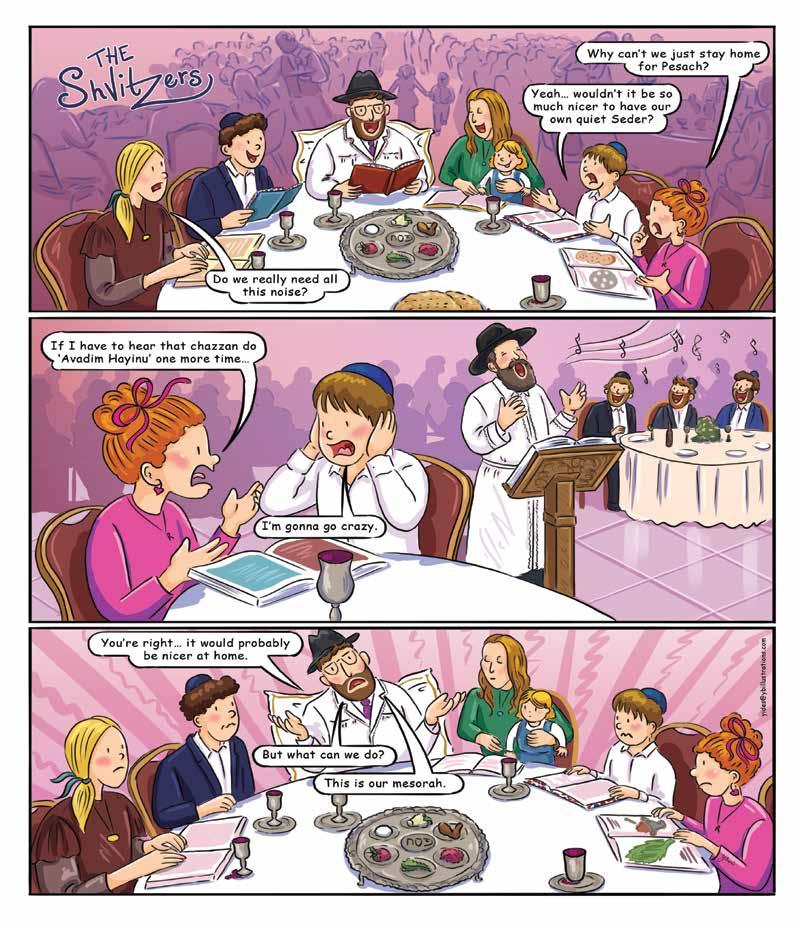
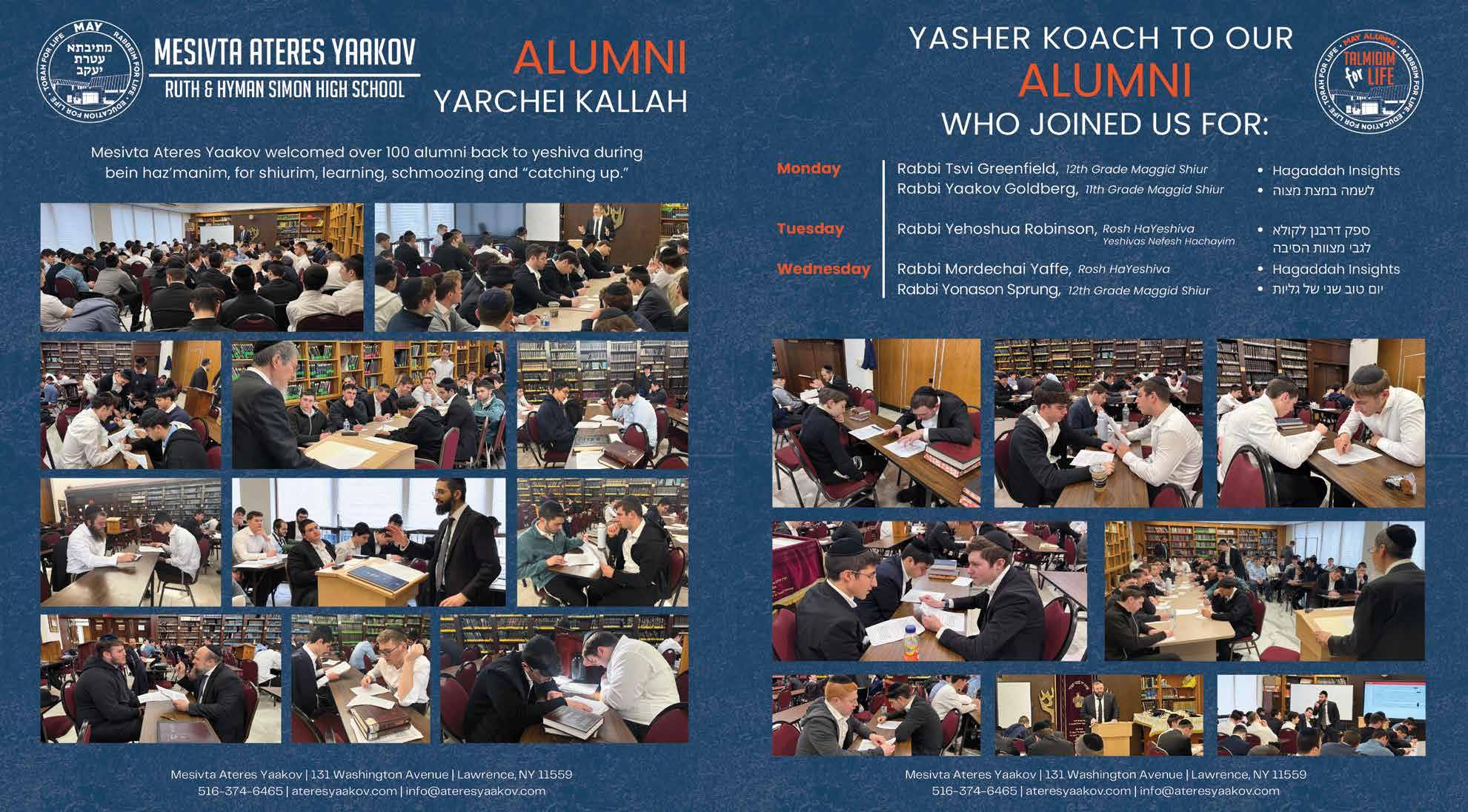

Pesach comes out as the buds are beginning to blossom and the sun starts to peek through the clouds. We hope to have balmy temperatures as we celebrate Chag HaAviv, but remember that nothing warms you up more than enjoying quality time together. Take advantage and spend time with the family during chol hamoed – indoors or outdoors.
TJH has compiled a list of ideas, activities, and places to go for you to enjoy. Make sure to pack enough food (macaroons, matzah, and marshmallows!) and music for the road and have fun!
Queens County Farm Museum
73-50 Little Neck Parkway, Floral Park, NY 11004 718-347-3276
White Post Farms
250 Old County Road, Melville, NY 11747 631-351-9373
New York Aquarium
Surf Avenue & West 8th Street, Brooklyn, NY 11224
718-265-FISH
Long Island Aquarium and Exhibition Center 431 East Main Street, Riverhead, NY 11901 631-208-9200
Prospect Park Zoo
450 Flatbush Avenue, Brooklyn, NY 11225 718-399-7339
Queens Zoo
53-51 111th Street, Flushing, NY 11368 718-271-1500
Central Park Zoo
64th Street & 5th Avenue, New York, NY 10065 212-861-6030
Bronx Zoo
2300 Southern Blvd, Bronx, NY 10460 718-220-5103
Long Island Game Farm 489 Chapman Boulevard, Manorville, NY 11949 631-873-6644
Green Meadows Farm
73-50 Little Neck Parkway, Floral Park, NY 11002 718-470-0224
Green Meadows Farm Brooklyn At the Aviator Sports Center 3159 Flatbush Avenue, Brooklyn, NY 11234 718-470-0278
Union Square Greenmarket Union Square West, New York, NY 10003 212-788-7476
Rose Hill Farm 19 Rose Hill Farm, Red Hook, NY 12571 845-758-4215
Greig Farm 227 Pitcher Lane, Red Hook, NY 12571 845-758-8007

Central Park
Boating, biking, the Great Lawn, model-boat sailing, carriage rides, carousel Between 5th & 8th Avenues and 59th & 106th Streets, New York, NY 212-360-3444

Bryant Park
6th Avenue, between W 40-42 Street, New York, NY 10018 212-768-4242
Hempstead Lake State Park Eagle Ave, West Hempstead, NY 11552 516-766-1029
New York Highline
Gansevoort St. to West 30 St. between Washington St. and 11 Ave., New York, NY 212-500-6035
Brooklyn Bridge Park
1 Main Street, Brooklyn, NY 718-222-9939
Little Island Floating Park
Pier 55 in Hudson River Park West 13 Street, New York, NY 10014
Roosevelt Island Tramway
300 E Main St, New York, NY 10044 212-756-7476

Fort Tyron Park Riverside Drive to Broadway, W 192 Street to Dyckman Street, New York, NY
New York Circle Line
Pier 83, West 42nd Street, New York, NY 10036 Pier 16, South Street Seaport, New York, NY 10038 212-563-3200
Statue of Liberty/Ellis Island Ferries from Battery Park, NY 1 Battery Place, New York, NY 10004 212-363-3200
Jamaica Bay Riding Academy 7000 Shore Pkwy, Brooklyn, NY 11234 718-531-8949
Bethpage Equestrian Center 499 Winding Road, Old Bethpage, NY 11804 516-845-1000
New York Equestrian Center 633 Eagle Avenue, West Hempstead, NY 11552 516-486-9673
Old Westbury Gardens 71 Old Westbury Road, Old Westbury, NY 11568 516-333-0048
Sands Point Preserve 127 Middle Neck Road, Sands Point, New York 11050 516-571-7901
Great Neck Steppingstone Park
38 Stepping Stone Lane, Great Neck, NY 11021 516-487-9228
Sagamore Hill
20 Sagamore Hill Road, Oyster Bay, NY 11771 516-922-4788


South Street Seaport 89 South St., New York, NY 10038 212-732-7678
Brooklyn Botanic Gardens 900 Washington Avenue, Brooklyn, NY 11225 718-623-7200
Brooklyn Heights Promenade Downtown Brooklyn Remsen Street to Orange Street along the East River
The New York Botanical Garden 2900 Southern Boulevard, Bronx, NY 10458 718-817-8700
Governors Island
10 South Street, Slip 7, New York, NY 10004
Wave Hill Public Gardens
4900 Independence Avenue, Bronx, NY 10471
718-549-3200
Union Square Greenmarket Union Square West, New York, NY 10003
212-788-7476
Historic Richmond Town
441 Clarke Avenue, Staten Island, NY 10306
718-351-1611



Bear Mountain State Park
Route 9W North, Bear Mountain, NY 10911
845-786-2701
Harriman State Park Seven Lakes Dr. / Bear Mountain Circle, Ramapo, NY 10974 845-947-2444
The Amish Village 199 Hartman Bridge Road, Ronks, PA 17572 717-687-8511
Mystic Seaport
75 Greenmanville Avenue, Mystic, CT 06355 888-973-2767
Six Flags Great Adventure
1 Six Flags Boulevard, Jackson, NJ 08527 201-862-0250
Hersheypark
100 W. Hersheypark Drive, Hershey, PA 17033 717-534-3900

ZooAmerica 201 Park Ave, Hershey, PA 17033 717-534-3900
Nickelodeon Universe Theme Park 1 American Dream Way, East Rutherford, NJ 833-263-7326
Adventureland
2245 Broad Hollow Road (RT 110), Farmingdale, NY 11735 631-694-6868
Adventurer’s
1824 Shore Pkwy, Brooklyn, NY 11214 718-975-2748
Luna Park Coney Island 1000 Surf Avenue, Brooklyn, NY 11224 718-373-5862
Bayville Adventure Park 8 Bayville Ave, Bayville, NY 11709 516-624-7433
Big Kahuna Water Park & Diggerland 535 N Route 73, West Berlin, NJ 08091 856-767-7580
Island Water Park
801 Boardwalk, Atlantic City, NJ 08401 609-964-7663


Legoland Discovery Center Westchester 39 Fitzgerald Street, Yonkers, NY 10701 844-740-9223
Fun Fuzion at New Roc City 19 Lecount Place, New Rochelle, NY 10801 914-637-7575
Fun Station USA
3555 Victory Blvd, Staten Island, NY 10314 718-370-0077
The Funplex
3320-24 NJ-38, Mount Laurel, NJ 08054 856-273-9666
Laser Bounce
80-28 Cooper Avenue, Glendale, NY 11385 347-599-1919
Laser Bounce 2710 Hempstead Turnpike, Levittown, NY 11756 516-342-1330

RPM Raceway Go-Karting
40 Daniel St, Farmingdale, NY 11735
631-752-7223
RPM Raceway Go-Karting
99 Caven Point Rd, Jersey City, NJ 07305 201-333-7223
HQ Racing
7 John Walsh Blvd, Peekskill, NY 10566 914-824-9236
One World Observatory
One World Trade Center, 117 West Street, New York, NY 10007 844-OWO-1776
Chelsea Piers
Hudson River—Piers 59-62—New York, NY 212-336-6800
Edge at Hudson Yards
30 Hudson Yards, New York, NY 10001
332-204-8500
Woodmere Lanes
948 Broadway, Woodmere, NY 11598 516-374-9870
Maple Lanes RVC
100 Maple Ave, Rockville Centre, NY 11570 516-678-3010
Funfest Bowling
6161 Strickland Avenue, Brooklyn, NY 11234 718-763-6800
Chuck E. Cheese
162 Fulton Avenue, Hempstead, NY 11550 516-483-3166
Chuck E. Cheese
750 Sunrise Highway, Valley Stream, NY 11581 516-234-5535
Kids N Shape

162-26 Cross Bay Boulevard, Howard Beach, NY 11414 866-567-1989
Beat the Bomb
255 Water St, Brooklyn, NY 11201 917-983-1115
Brooklyn Boulders 23-10 41 Avenue, Long Island City, NY 11101 718-482-7078
MetroRock Brooklyn 321 Starr Street, Brooklyn, NY 11237 929-500-7625
Area53 Adventure Park 616 Scholes St, Brooklyn, NY 11237 347-305-7448
Thrillz High Flying Adventure Park

5 Prindle Ln, Danbury, CT 06811 203-942-2585
Thrillz High Flying Adventure Park
555 South Henderson Road, King of Prussia, PA 19406 484-235-5555
Long Island Adventure Park
75 Colonial Springs Rd, Gate #3, Wheatley Heights, NY 11798 631-983-3844
Boundless Adventures
735 Anderson Hill Rd., Purchase, NY 10577 914-893-4550
Flight Adventure Park 1850 Lakeland Avenue, Ronkonkoma, NY 11779 631-619-6000
Circus Academy NY 30 Tompkins Ave, Brooklyn, NY 11206 929-456-5219
Circus Academy
353 West St, New York, NY 10014 929-456-5219
Empire Adventure Park
1500 Old Country Rd, Westbury, NY 11590 516-992-6778


Urban Air
4422 2nd Ave, Brooklyn, NY 11232
347-732-5438 Urban Air
683A Old Country Rd, Dix Hills, NY 11746 631-213-3894
Urban Air
69 Wesley St, South Hackensack, NJ 07606 201-212-6454
Skyzone Trampoline Park
33 Lecount Place, New Rochelle, NY 10801 914-740-8272
Skyzone Trampoline Park
111 Rodeo Drive, Deer Park, NY 11717 631-392-2600
Skyzone Trampoline Park
241 Market Street, Yonkers, NY 10710 914-510-9119
Skyzone Trampoline Park
34 Spring Valley Market Place, Spring Valley, NY 10977 845-205-0081
Rockin’ Jump Trampoline Park
241 Market Street, Yonkers, NY 10710 914-510-9119
Rockin’ Jump Trampoline
77 Willowbrook Blvd, Wayne, NJ 07470 973-302-3340
Launch Trampoline Park
163-50 Cross Bay Blvd, Howard Beach, NY 11414 718-593-4204
Ferox Ninja Park
72 Noble St, Brooklyn, NY 11222 347-482-1580
DEFY
77 Willowbrook Blvd., Wayne, NJ 07470 973-302-3340
iFLY
849 Ridge Hill Blvd, Yonkers, NY 10710
914-449-4359
iFLY
10-20 Borden Ave, Long Island City, NY 11101
212-977-4359
Glow Golf Roosevelt Field Mall, Garden City, NY 11530
516-747-3682
Topgolf
1013 US-1, Edison, NJ 08817
732-374-4097

Topgolf 5231 Express Dr N, Holtsville, NY 11742 631-977-7645
Smith Point Archery 215 E Main Street, Patchogue, NY 11772 631-289-3399
Rise NY
160 West 45th St, New York, NY 10036 718-701-4998
SUMMIT One Vanderbilt 45 E 42nd St, New York, NY 10017
City Climb 30 Hudson Yards, New York, NY 10001 332-204-8500
Dave & Busters 395 Gateway Dr, Brooklyn, NY 11239 718-368-6100
Dave & Busters 1504 Old Country Road, Westbury, NY 11590 516-542-85011504
Dave & Busters
4661 Palisades Center Dr, West Nyack, NY 10994 845-353-1555
Palisades Center
1000 Palisades Center Dr., West Nyack, NY 10994 845-348-1000
American Dream Mall
1 American Dream Wy, East Rutherford, NJ 07073
Iceland Long Island 3345 Hillside Avenue, New Hyde Park, NY 11040 516-746-1100
City Ice Pavilion
47-32 32 Place, Long Island City, NY 11101 718-706-6667
Long Beach Ice Arena
150 W Bay Dr, Long Beach, NY 11561 516-705-7385
Northwell Ice Arena
200 Merrick Ave, East Meadow, NY 11554 516-441-0070


Lefrak Center Ice Skating
171 East Drive, Brooklyn, NY 11225
718-462-0010
Big Snow
1 American Dream Way, East Rutherford, NJ 07073
833-263-7326
United Skates of America 1276 Hicksville Rd, Seaford, NY 11783 516-795-5474
Something Different Puppetworks
338 Sixth Avenue, Park Slope, NY 11215 718-965-3391
Build a Bear
Roosevelt Field Mall
630 Old Country Road, Garden City, NY 11530 516-248-0027
Build a Bear
9015 Queens Blvd, Elmhurst, NY 11373 718-289-7135
Sloomoo Institute: Slime Museum 475 Broadway, New York, NY 10013 Sloomooinstitute.com

Color Factory NYC
251 Spring Street, New York, NY 10013
347-378-4071
Artrageous Studio
5 N Village Ave, Rockville Centre, NY 11570 516-255-5255
Once Upon a Dish
659 Franklin Ave, Garden City, NY 11530 516-742-6030
Brooklyn Clay Industries 62 5th St, Suite 306, Brooklyn, NY 11205 301-395-0143
Color Me Mine
123 Baxter St, New York, NY 10013 212-374-1710
Color Me Mine
177 Amsterdam Ave, New York, NY 10023
212-877-0007
La Mano Pottery 110 West 26 Street, New York, NY 10001 212-627-9450
Casa de Spin 81 Grand Avenue, Massapequa, NY 11758 516-654-7746

Taro’s Origami Studio 95 7th Avenue, 2nd Floor, Brooklyn, NY 11215 718-360-5435
Bury the Hatchet 25 Noble Street, Brooklyn, NY 11222 917-243-9696
2BA Pilot Flight Lessons
9100 Republic Airport, Farmingdale, NY 11735 516-662-8887
Classic Harbor Line Sailing
Chelsea Piers, Pier 62, New York, NY North Cove Marina, Battery Park, New York, NY 212-627-1825
Intrepid Sea, Air and Space Museum
Pier 86, 12th Avenue and 46th Street 212-245-0072
9/11 Memorial and Museum
200 Liberty Street, New York, NY 10006 212-266-5211


Jewish Museum
1109 Fifth Avenue, New York, NY 10128
212-423-3200
Museum of Jewish Heritage
36 Battery Pl, New York, NY 10280 646-437-4202
Living Torah Museum
1603 41 Street, Brooklyn, NY 11218 718-851-3215
Long Island Children’s Museum
11 Davis Avenue, Garden City, NY 11530 516-224-5800
Museum of Ice Cream
558 Broadway, New York, NY 10012
866-665-1018
Skyscape
928 8th Avenue, New York, NY 10019 212-549-1941
Museum of Illusions
77 Eighth Avenue, New York, NY 10014 212-645-3230
National Museum of Mathematics 11 East 26 Street, New York, NY 10010 212-542-0566
Brooklyn Children’s Museum
145 Brooklyn Avenue, Brooklyn, NY 11213 718-735-4400
Jewish Children’s Museum
792 Eastern Parkway, Brooklyn, NY 11213 718-467-0600
Children’s Museum of Manhattan
212 W 83rd St, New York, NY 10024 212-721-1234
Banksy Museum
277 Canal Street, New York, NY 10013 917-773-8411
NYC Fire Museum
278 Spring Street, New York, NY 10013 212-691-1303
Cradle of Aviation
Charles Lindbergh Blvd, Garden City, NY 11530 516-572-4111
American Museum of Natural History Central Park West at 79th Street, New York, NY 10024 212-769-5100
New York Hall of Science
47-01 111th St, Corona, NY 11368 718-699-0005
Metropolitan Museum of Art 1000 5th Avenue, New York, NY 10028 800-662-3397
Frick Collection 1 E 70 St., New York, NY 10021 212-288-0700

Lower East Side Tenement Museum 103 Orchard Street, New York, NY 10002 877-975-3786
The Skyscraper Museum 39 Battery Pl, New York, NY 10280 212-945-6324
Madame Tussaud’s New York 234 W 42 Street, New York, NY 10036 212-512-9600
Citi Field Non-Game Day Tours 41 Seaver Wy, Queens, NY 11368 718-803-4097
Yankee Stadium Tours 1 E 161 Street, Bronx, NY 10451 646-977-8687
Vanderbilt Museum & Planetarium 180 Little Neck Road, Centerport, NY 11721 631-854-5579
Liberty Science Center Liberty State Park, 222 Jersey City Boulevard, Jersey City, NJ 07305 201-200-1000
Crayola Experience 30 Centre Square, Easton, PA 18042 1-866-875-5263
The Franklin Institute 222 North 20th Street, Philadelphia, PA 19103 215-448-1200

Please Touch Museum 4231 Avenue of the Republic (formerly North Concourse Drive), Philadelphia, PA 19131 215-581-3181
Imagine That! Children’s Museum 4 Vreeland Road, Florham Park, N.J. 07932 973-966-8000
TJH assumes no responsibility for the kashrus, atmosphere, safety, or accuracy of any event or attraction listed here. Please call before you go. Have a great time!


by Faigy Murray
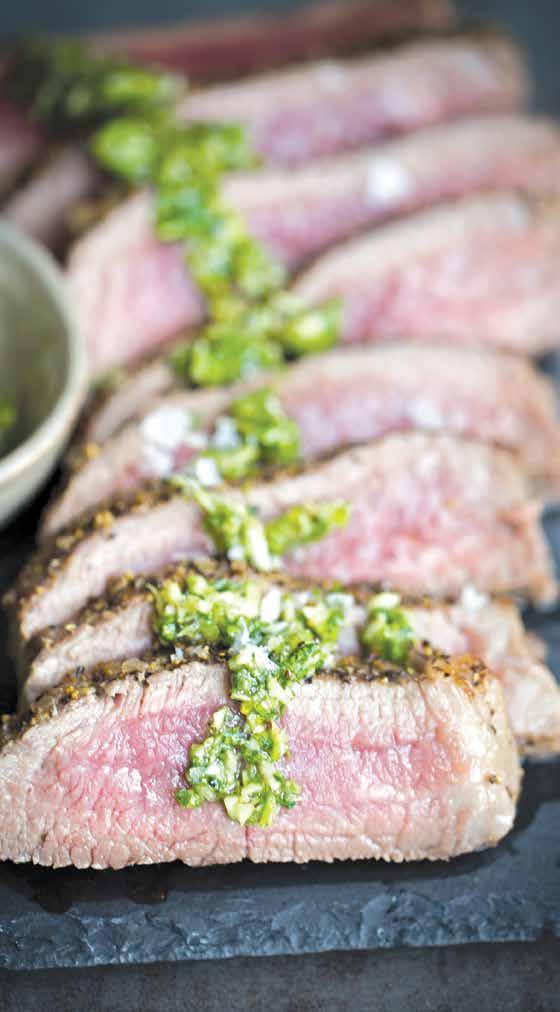
Yields 4-6 servings / Meat
I am always very hesitant to prepare meats that have lots of sauce on them. Meat has such an unbelievable depth of flavor that sauces and condiments can just detract from it. So, when I have a recipe that I can make with the sauce as an outer component, as opposed to cooking it with the meat, it’s a win-win: for my husband, who loves a good sauce, and for me, who can eat it without.
>> 1 (2-lb) London broil
>> 2 Tbsp coarse sea salt
>> 3 Tbsp coarsely ground black pepper
Chimichurri Sauce
>> 1 bunch scallions
>> 1 bunch parsley
>> 3 cloves garlic
>> 2 tsp oil
>> 1 tsp salt
>> ½ tsp black pepper
Prepare the meat: Rub salt and pepper well onto both sides of meat.
Heat a frying pan or skillet until it’s very, very hot; add meat. When the meat hits the pan, you want to hear a sizzle. Sear on each side for 4 minutes for rare or 6 minutes for well done.
Prepare the chimichurri sauce: Place all sauce ingredients into a food processor fitted with the “S” blade. Pulse until well blended. (This can be made a few days in advance.)
Allow meat to cool; slice thinly before serving. Drizzle with chimichurri sauce.
When reheating, reheat just until warm. (I usually just put it near a heat source to warm; the meat will dry out over direct heat.)
If I have leftover meat, I like to slice it into salad; it’s delicious.
You can broil the meat 6 minutes per side if you don’t have a stovetop pan to sear it in.

Yields 4-6 servings / Meat
Anything with fries makes me happy. If I was stuck on an island, all I’d need is a fryer and a case of potatoes, and I’d be good to go! I like to make this as a special side dish with any leftover meat I have from yom tov.
>> 1 (2-lb) chuck roast
>> 1 onion, sliced into strips
>> 2 cups good quality BBQ sauce OR Victoria’s BBQ
>> Sauce (page 134)
>> Homemade Fries (page 190)
Paprika Mayonnaise
>> 1 cup mayonnaise
>> 1 Tbsp paprika or smoked paprika
>> 1 tsp ketchup
>> 1 tsp schug (optional, if you want it spicy)
>> 2 jalapeño peppers, sliced
>> 1 red onion, diced
>> ½ pint cherry tomatoes, diced
Preheat oven to 200°F.
Prepare the mayonnaise: mix mayonnaise, paprika, ketchup and schug together. Refrigerate until using.
Place meat, onions, and BBQ sauce into a pan. Cover tightly; bake overnight or 6-8 hours.
Shred beef. Place over fries. Serve with toppings and paprika mayonnaise.
When using leftover meats, I shred them, add BBQ sauce, mix together, and bake for 1 hour, well covered, at 350°F.
You can add or use any toppings that you think would work; some ideas are diced avocado, leftover matbucha dip, and chopped olives.
The pulled beef is freezer friendly, but make sure to reheat before topping the fries.


Yields 9 servings /Pareve
Apple crisp is probably the first recipe I ever made. I have vague memories of going to my teacher’s house and baking apple crisp with her for a school Shabbaton. Honestly, the memory I have of standing side by side with my teacher in her kitchen is priceless!
Every time I wanted crumbs for a dessert, I would take out a second bowl and make them. Then I had the brilliant idea of making a huge batch of crumbs, keeping it in the freezer, and grabbing a cup or two whenever I needed them.
>> 4 medium apples, peeled and sliced
>> 2 tsp lemon juice
>> 2 cups Pesach Crumbs (see below)
Preheat oven to 350°F. Place apples into a bowl; toss with lemon juice. Set aside.
In a round 9-inch pan or 8x8-inch square pan, press 1/3 of the crumbs; top with apples, then with remaining crumbs.
Bake for 45 minutes.
Pesach Crumbs
Yields 3 cups / Pareve / Freezer Friendly
>> 1¼ cups ground almonds
>> 1¼ cups potato starch
>> 1 tsp cinnamon
>> ½ cup oil
>> ½ cup sugar
Place ingredients into a bowl.
Mix with your hands until a nice crumb texture forms. Store in a container or Ziploc bag.
This recipe can easily be doubled.
Sometimes, the crumbs can get a little moist from the freezer and lose their crumbly texture. If that happens, simply add an additional ½ cup potato starch and mix until the texture is correct.
Adding additional fruit, such as strawberries, blueberries, or pears, gives the crisp a delicious flavor.


Yields 20 biscotti / Pareve / Freezer Friendly
My definition of biscotti was always the rock-hard sticks that you could crack your teeth on. There are very few foods that I won’t go near, but biscotti was just not worth it for me, until I discovered it doesn’t have to be that way. You can have delicious, chewy biscotti; ironically, my husband loves the super crunchy, almost-burnt version! So I always overbake some pieces for him.
>> 2 cups potato starch
>> 2 cups ground nuts (I use almonds)
>> 1 cup sugar
>> ¾ cup oil
>> 2 eggs
>> ½ tsp baking soda
>> 1 tsp imitation vanilla extract
>> 1 cup chocolate chips
Preheat oven to 350°F. Line a baking sheet with parchment paper.
In a large bowl, combine all ingredients until just incorporated (see Notes & Tips).
Shape batter into two skinny logs; place on prepared baking sheet.
Bake for 30 minutes.
Slice while warm.
When the batter gets too difficult to mix with a spoon, I switch to using my hands.
I place the divided batter directly on the lined baking sheet and shape the logs there.
Sometimes I sprinkle on cinnamon mixed with sugar, as pictured, to add flavor and a little crunch to the biscotti.

Reprinted from My Pesach Kitchen by Faigy Murray, published by ArtScroll.



By Mordechai Schmutter

We definitely eat a lot of weird foods on Pesach.
Most of us look at Rosh Hashana as the yom tov of weird foods: “We had to eat squash! And fruits that looked like insects! And foods with eyes!” But Pesach has some pretty strange foods, too.
And I’m not talking about the foods we eat for a mitzvah. I mean horseradish is a weird food, if you think about it – it’s a root, and it comes with clumps of dirt on it, and it clearly doesn’t taste like it’s meant to be eaten, and it’s named after an animal but not one that we eat – yet we eat horseradish every Shabbos. With beets, which is objectively weirder.
I’m talking about the other things we eat, voluntarily.
Not that it’s bad food. People tend to exaggerate how bad Pesach food is. It’s basically like when you’re cooking and you realize you’re missing an ingredient, so you substitute something else, and then everyone tells you how good it is anyway, but you still would never make it this way again voluntarily.
So Pesach food is fine. It just happens to be that you make way too much of it, because everyone keeps complaining every year that there’s nothing to eat, and you’re like, “I’ll show them!” and then they complain again, so the next year you make even more, because you’ll show them! And eventually you have so much that by the time you’ve finished eating the
last of it you don’t want to look at it for at least 12 months. Some years, 13.
People are always starving on Pesach. Mostly as soon as Chol Hamoed hits. That third night of Pesach, after two Seder nights in a row, when our bodies say, “Well, where’s my Shulchan Orech? It’s 11:30!” Even though when there was Shulchan Orech, we weren’t hungry. In fact, the only time you’re actually full on Pesach is right before Shulchan Orech.
Then you don’t want to look at food. Maybe that’s the key. Maybe we should drink more wine on Chol Hamoed, followed by a tiny bite of vegetable and then about a pound of matzah.
As my son put it, “You never get full on Chol Hamoed; you just get tired of spreading cream cheese on matzah.” Spreading cream cheese on matzah is like spackling a wall that falls apart as you spackle it.
PESACH TIP: Maybe don’t keep your cream cheese in the fridge.
Some people – particularly those who eat gebrochts – eat matzah pizza every single night of Chol Hamoed. Speaking of weird foods. Sometimes they also eat matzah lasagna, which is when you stack several matzah pizzas on top of each other.
“It’s amazing!” they assure us. But they’re still the first ones in line at the pizza shop when Pesach is over. Meanwhile, my family is like, “Yay! Gebrochts!”
But we’re spoiled; some people don’t
even eat milchigs on Pesach. Some of you out there are making cakes with chicken shmaltz. Speaking of things you would never ever eat if it wasn’t Pesach. You have company over and say, “Hey, you want a brownie?” and they have one, and you say, “Oh, by the way, you’re fleishig now for the next six hours.”
This is why people stopped mishing. By far, the strangest things we eat on Pesach are not the mitzvah foods. Hashem said matzah and marror, and we’re like, “I’m also going to gnaw on this mango pit!”
No one actually knows what shape a mango pit is without fruit on it. We’ve never gnawed on it for long enough. All we know is that when we try to cut the fruit off with a knife, our knife gets stopped on what we assume is parts of the pit, until we just give up, and the mango ends up looking like a cyber-truck.
“Hey, you want to suck on this pit for a while? The rest of us already had a turn.”
It’s something to do. A lot of what we eat on Pesach is like, “This isn’t going to be filling, but it’s more of a project so you can pass the time between bites.” Like spreading cream cheese on increasingly smaller matzah shards. Or shelling walnuts. I don’t even like walnuts, but I’ll eat a couple every Pesach, just in case something’s changed.
It also explains string cheese. And yogurt, which is all about taking two bites, and then spending the next ten minutes
scraping the sides of the container trying to get a third.
Here’s a question: How many times a year do you eat asparagus? Only when you can’t eat green beans, right?
And actually, there’s a lot of produce that you only buy Pesach time to see if this is the year your kids will eat it. Like parsnips. Hashem definitely created those for Pesach. They’re in some of the picture Hagaddahs, under “vegetables we eat all the other nights of the year,” but we most certainly do not. So you might say that it’s wrong for our kids to say that in the Mah Nishanta, but to be honest, about 50% of kids who ask the Mah Nishtana don’t eat any vegetables on all the other nights of the year. Nor do they eat sitting. And they definitely dip things more than twice.
Basically, you buy the entire produce aisle, just in case. Including things you have no idea how to eat.
How do I eat a ginger? Do I need to eat it with sushi?
And I don’t even know how to get started on celery root. It’s also the only time of the year that I buy sweet potatoes. Though maybe not this year. I think we still have our sweet potatoes from last Pesach.
I think more people would eat them if we didn’t call them sweet potatoes. They’re just disappointing potatoes. So some people call them yams, but that’s not better. Yam sounds slimy. As in, “Why is
there yam all over the matzah?”
We also serve at least one salad made of just the leaves of the romaine lettuce because we ripped all the stalks off for marror.
We eat a lot of eggs. People complain about potatoes, but we eat way more eggs than potatoes. People say, “Yeah, but potato starch cakes, potato kugel, yapchick…”
All of those have eggs!
Basically, if the other yomim tovim teach you how to cook, Pesach teaches you chemistry. Most of what you make is the same three ingredients heated with different cooking methods. If you fry it, it’s soup lukshen. If you then fill it and fry it again, it’s blintz wrappers. If you smear it on a cookie sheet, it’s kichel. If you put it in a deep pan, it’s cake. If you throw in a vegetable, it’s kugel. And they all taste a little bit like scrambled eggs.
“Well, there’s meat.”
Yeah, there’s meat. One meal we grill it, one meal we bake it, one meal we put it in a crock pot, one meal we put it in a regular pot, and one meal we cut it into pieces before we prepare it. And then we take some and dehydrate it and serve it as jerky, for the people who want to keep restarting their fleishig clocks all of Chol Hamoed.
(“Three hours left to supper? I guess I’ll eat jerky! ... OK, now six hours left to supper.”) People are normally scared of becoming fleishig, because what if good food comes along within six hours? On Pesach, they’re not worried about that so much.
“Wait, you want dessert? We have fresh fruit, frozen fruit, baked fruit, fruit soup,
“Is everything OK at home?”
And then there are macaroons, which are cookies, but when you chew them, it sounds like you’re eating cole slaw, and they come in a can with no expiration date so that you have something to eat in the event of a nuclear war. All the Yidden will be down in bunkers eating macaroons,
Spreading cream cheese on matzah is like spackling a wall that falls apart as you spackle it.
dried fruit, and mushed fruit. Oh, and we still have charoses.”
The snack food situation is crazy.
Pesach is the only yom tov when we eat something called lady fingers. Who was in charge of naming that? I bet it’s the same person who named horseradish.
“Why don’t we call them lady fingers?”
“Why?”
“Because that’s what they look like.”

while all the non-Jews will be eating canned beans. Which bunker would you rather be in?
We also make popsicles. No one eats homemade popsicles the rest of the year, but on Pesach we go nuts. You can make orange juice popsicles! Lemonade! Raspberry syrup! Chicken schmaltz! Salt water! The possibilities are endless. You put any kind of juice in those popsicle holders and
put a stick in, and if any of your kids earns a freeze pop, you just pull out a stick, and… OK, the ice part stayed in the holder.
“Go run it under hot water. But try not to run the other seven under hot water.”
And then you spend all of yom tov fishing the plastic sticks out of the trash. Every set is missing one stick and has a plastic fork leaning in at an odd angle.
People also eat potato sticks. I never understood those. It’s like someone took potato chips and then stepped on the bag. That’s all it is. But it takes you longer to eat, so that’s something. Amusement parks on chol hamoed are full of people with their heads tilted back, pouring potato sticks into their mouths.
But we’ll make absolutely anything about of potatoes. What did Yidden do before potatoes were discovered? They must have starved on Pesach. Though they were probably starving all year, so they didn’t really know the difference.
Mordechai Schmutter is a freelance writer and a humor columnist for Hamodia and other magazines. He has also published eight books and does stand-up comedy. He can be contacted at mschmutter@gmail.com.