







Aish Kodesh 33rd Annual
Ateres Miriam Annual Celebration








Nissan is a month of miracles. We are seeing it every day – especially in Eretz Yisrael. When a bomb falls in middle of the street, right in between two buildings. When a child falls out of a demolished building, only to walk away with barely a scratch. When munitions destroy fields and crops but thankfully don’t kill people. Open miracles – many times each day.
Each war that Israel faces forces us to learn about the ammunition and weapons that its enemies use to attempt to destroy the Jewish State and our people. In the 1991 Gulf War, it was Saddam Hussein with his SCUDs that forced Israelis into sealed rooms, concerned about a gas attack that could come with the missiles. This time around, Iran has been blasting Israel with cluster bombs.
Over the past few weeks, Tehran has been outfitting some of their ballistic missiles with these cluster munitions – each small bomb carries up to 11 pounds of explosives. Most of Iran’s ballistic missiles carry about 24 bomblets, but one of its weapons – the Khorramshahr – can be equipped with up to 80. What is most concerning and dangerous about these bombs is that they explode midair, dropping scores of small bombs indiscriminately before its main missile hurtles to the ground. This means that the place of impact is not just one place and not one place that can be tracked. Anyone within miles of these bombs can be impact-
ed, and they have fallen on random homes, buildings, businesses, and roads.
It is warfare that is intent on traumatizing and destroying an entire nation – inflicting maximum damage – and is prohibited under international humanitarian law, although the ayatollahs have never been among those who follow the law.
When you understand what Israel is dealing with, you can appreciate the chessed that Hashem does for His nation every day. When headlines blare about missiles and attacks and buildings that have been reduced to rubble but Hashem’s people are spared, you know that it is only through His hashgacha pratis that our nation survives.
That understanding, that realization, comes along with the recognition that Hashem, since the time He acquired us during Yetzias Mitzrayim – and even before then – has been protecting us and watching over us. Sometimes, we see the open miracles that proclaim His name. But many times, we are unaware of how He shelters us and protects us, preventing catastrophe and harm.
During this month, a month of miracles and a month of geulah, may Hashem bring each one of us our needed yeshuos and brachos – both on a personal and communal, collective level.
B’Nissan nigalu u’b’Nissan asidin lehigo’el.
Wishing you a wonderful week, Shoshana

Yitzy Halpern, PUBLISHER publisher@fivetownsjewishhome.com
Yosef Feinerman, MANAGING EDITOR ads@fivetownsjewishhome.com
Shoshana Soroka, EDITOR editor@fivetownsjewishhome.com
Nate Davis
Editorial Assistant
Nechama Wein Copy Editor
Rachel Bergida
Shana Brecher
Lani White Design & Production
Gabe Solomon Distribution & Logistics
P.O. BOX 266
Lawrence, NY 11559
Phone | 516-734-0858
Fax | 516-734-0857
Classified Deadline: Monday 5:00PM classifieds@fivetownsjewishhome.com text 443-929-4003
PAYMENT VIA CREDIT CARD MUST BE SUBMITTED ALONG WITH CLASSIFIED ADS
The Jewish Home is an independent weekly magazine. Opinions expressed by writers are not necessarily the opinions of the publisher or editor. The Jewish Home is not responsible for typographical errors, or for the kashrus of any product or business advertised within. The Jewish Home contains words of Torah. Please treat accordingly.






Dear Editor,
I very much enjoy participating in these weekly polls. They’re one of the highlights of my week. Keep them coming!
I know you usually post more relevant questions, especially given the season, such as where everyone goes for Pesach or how early they shop/prepare, and I figured you’d ask such a question. But this one particularly disturbed me, and I should respectfully warn you to be prepared for similar responses.
Yes, there are plenty of those readers like myself living in the Five Towns as registered Nassau County voters. We couldn’t vote Mayor Mamdani out this past November, and, to my knowledge, we don’t have much power to say anything about him given the status as where we’re registered to vote.
Then there are your readers in Far Rockaway, Queens, and Brooklyn (I see your papers in Flatbush when I’m there on rare occasions), as well as the plenty of Nassau County commuters to Manhattan, Brooklyn, and Queens for their jobs.
Mayor Mamdani has proven himself time and again to be not just a diehard antisemite against Jews but a supporter of key anti-Israel terrorist proxies, such as Iran and Hamas, just to name a few.
Not even 24 hours after Mamdani got elected, we heard the tragic news of approximately SIX hate-crimes against Jews, likely linked to this.
Growing up, when I visited Flatbush weekly to see my grandparents, I was not afraid to wear a yarmulke there. Now, I join plenty of frum Yidden in both Brooklyn and Manhattan – whether visitors, employees, or residents – in being afraid
of being beaten up by his allies, our shuls and businesses being sprayed with swastikas, and much more. It’s only a matter of time until we hear “Allahu akbar” right next to the Empire State Building or the Lincoln Square Synagogue and never see those buildings again. Our family and friends will only be highly affected in the long run by this mayor.
Your question about if a Yid would join Mamdani for dinner is indeed appalling, to say the least, especially as a pro-Israel, anti-crime newspaper – is just as bad as one having a meal with Hitler, Mengele, Stalin, Sinwar, and other such individuals. Hence, my response to this question is: MOST POSITIVELY NOT! and I hope others will respond that strongly. I reverently urge you to remove this immediately, and substitute this highly controversial poll question with a more appropriate one.
The recent uncertainty surrounding travel to and from Israel has taught my family a lesson we won’t soon forget: in an age of DIY online booking, a professional travel agent is not a luxury—they are a lifeline.
In February, we booked our daughter’s flight home from seminary for Pesach. We chose El Al, believing it to be the most reliable option. However, as tensions escalated and flights began to be cancelled, we found ourselves in a parent’s worst nightmare. We spent days in a “communication black hole,” receiving no word from the State Department or the airline. We logged countless hours
Continued on page 12


Continued from page 12 on hold and on WhatsApp, desperate for any way to get our daughter back to New York.
The “convenience” of booking a flight ourselves quickly evaporated. When we reached out to various agencies for help, many understandably couldn’t prioritize us because we hadn’t used them originally. Others offered “solutions” that would have cost us thousands of additional dollars.
It wasn’t until the very day of our daughter’s original cancelled flight on Wednesday, March 18, that we were directed to Joy Travel. Despite having no prior obligation to us, they did what we couldn’t do in days of frantic searching: they promptly secured her a seat on a Friday morning flight to JFK.
The takeaway is clear. We live in a world where travel can be disrupted in an instant by global events. While booking your own flight might save a few minutes or a few dollars upfront, you are essentially on your own when things go wrong.
A dedicated travel agent has the expertise, the connections, and the willingness to advocate for you when the automated systems fail.
To my fellow travelers: do yourselves a favor. For your peace of mind and your family’s safety, use a travel agent. When the “unthinkable” happens, they are truly indispensable.
Praying for yeshuat Hashem in these perilous times Rabbi Yossi Azose West Hempstead, NY
Dear Editor,
The Cornell University’s Student Assembly recently voted, by 19 to 2, to condemn the university administration for permitting a former Member of Knesset to speak on campus.
Who do you suppose was the speaker to whom the students angrily objected?
A representative of one of Israel’s rightof-center parties? Someone who supports building Jewish settlements and opposes making more concessions to the Palestinian Authority?
Hardly. The target of the Cornell students’ ire was none other than Tzipi Livni, former leader of the left-of-center opposition in the Knesset.
If ever there was an Israeli politician whom you would expect American college students to embrace, it would be Livni.
She’s a fervent supporter of creating a Palestinian Arab state and over the past decade has been one of the harshest critics
of Prime Minister Benjamin Netanyahu. Livni has said, “History won’t forgive Netanyahu for the damage he is doing to Israel.” She has accused Netanyahu of “humiliating the Palestinians.” She has even gone so far as to claim that Netanyahu was bringing about “the demise of the Jewish state.”
The Cornell students who denounced Livni pointed to the fact that she was Israel’s foreign minister during Operation Cast Lead, a military action against Hamas terrorists in Gaza in late 2008 and early 2009.
It’s worth recalling that the prime minister who ordered Cast Lead was Ehud Olmert and the defense minister who implemented it was Ehud Barak— two more of Netanyahu’s most vehement critics on the left.
That fact is a reminder that there has always been a broad right-to-left consensus in Israel on the need to take action against the Hamas terrorists, even before October 7. Israelis may have their differences, but not when it comes to national self-defense.
Media pundits and critics of Israel often claim that the college campus attacks on Israel are merely disagreements with the policies of Prime Minister Netanyahu, not opposition to Israel itself.
The Cornell students’ denunciation of Tzipi Livni, Netanyahu’s arch-critic, suggests otherwise.
Rafael Medoff
Dear Editor,
I was recently listening to a shiur in which it was stated that a person should be repenting “50,000” times a day, based on the constant sins that occur every moment (perhaps fewer than 50,000). This is based on the Kotzker Rebbe’s idea that the yetzer hara lives on our shoulders, waiting to destroy us every instant. A few hours a day of Torah gives us the chance to deflect this instrument of destruction.
How does this relate to Pesach?
Our slavery in Mitzrayim was a refinement process. It was a land of meitzar, a narrow place, that served as a kur ha’barzel, an iron furnace. We emerged from this narrow and intense environment as a reborn people. The final geulah will also be like a rebirth, and we are now experiencing the “pangs of Moshiach.”
Acknowledging the agent of destruction on our shoulders will free our bodies of spiritual imprisonment.
Steven Genack



On Monday, it was announced that police in Hong Kong can demand the passwords of the cellphones and computers of those suspected of breaching the city’s national security law.
Refusing to comply could lead to up to one year’s jail and a fine of up to HK$100,000 ($12,773), while providing false or misleading information could bring up to three years’ imprisonment and a fine of up to HK$500,000.
The new rule announced this week are amendments to the implementation rules of the national security law imposed by Beijing in 2020, using powers to bypass Hong Kong’s legislature.
The sweeping law punishes acts, including subversion and collusion with foreign forces, with up to life imprisonment. It sparked criticism from Western governments and rights groups, but Beijing and Hong Kong officials said it was needed to restore stability after the city was rocked by months of pro-democracy protests in 2019.
The new amendments empower police to require a person under investigation suspected of endangering national security to provide any password or decryption method for electronic devices and to provide the police “any reasonable and necessary information or assistance.”
The new amendments also empower customs officers to seize items that are deemed to have “seditious intention” regardless of whether any person has been arrested for an offense endangering national security because of the items.
A Hong Kong government spokesperson said the amended rules conform to the city’s mini-constitution, the Basic Law, and its human rights provisions, and “will not affect the lives of the general
public or the normal operation of institu
tions and organizations.”
According to the Security Bureau, a total of 386 people have been arrested for national security crimes so far, with 176 people and four companies convicted.

A strike on a healthcare facility in Sudan killed 64 people on Friday. Eightynine others were wounded, according to the World Health Organization.
The UN’s humanitarian office in Sudan said it was “appalled by the attack on a hospital in East Darfur yesterday, reportedly killing dozens, including children, and injuring more.”
Sudanese rights group the Emergency Lawyers, who document atrocities in the war between Sudan’s army and the paramilitary Rapid Support Forces, reported it was an army drone strike that hit the El-Daein teaching hospital.
Since April 2023, the Rapid Support Forces has been at war with the Sudanese military. The conflict has wreaked havoc on the northeastern African country, killing over 40,000 people, according to the United Nations. Other aid groups suggest the death toll might be much higher. Meanwhile, the war has displaced over 14 million people and caused diseases to spread, with more than 33 million people needing humanitarian aid.
The RSF dominates the vast western Darfur region, while the army is in control of Sudan’s east, center and north.
Friday’s attack involved “violence with heavy weapons” and affected a secondary health care facility, medical personnel, patients, supplies and storage.
Near-daily drone strikes are now a hallmark of Sudan’s brutal war, killing dozens at a time, mostly in the southern Kordofan region.
The UN human rights chief, Volker Türk, this month said he was “appalled” after more than 200 civilians were reported killed by drone attacks within an eight-day period.
“Parties to the conflict in Sudan continue to use increasingly powerful


drones to deploy explosive weapons with wide-area impacts in populated areas,” he said.
Hospitals have been targeted repeatedly during this conflict. By December, more than 1,800 people had been killed in attacks on health facilities since the start of the war, including 173 health workers, according to the UN. This year, a total of 12 attacks on health care facilities in Sudan have been recorded, causing 178 deaths and 237 injuries.
India’s Loni was the world’s most polluted city in 2025, with average PM2.5 levels of 112.5 micrograms, followed by Hotan in the northwestern Chinese region of Xinjiang at 109.6 micrograms. The world’s top 25 most polluted cities were all located in India, Pakistan and China. Only 14% of the world’s cities met the WHO standard in 2025, down from 17% a year earlier, with Canadian wildfires driving up PM2.5 across the United States and as far as Europe.

Among the countries that met the standard in 2025 were Australia, Iceland, Estonia and Panama.
Seventy-five countries reported lower PM2.5 levels in 2025 compared to a year earlier, with 54 recording higher average concentrations, according to IQAir.

A Colombian military aircraft transporting 125 troops and crew members crashed shortly after taking off from southern Colombia on Monday morning. At 34 people were killed and at least 77 others were injured in the crash.
Pakistan was ranked the world’s smoggiest country in 2025, with concentrations of hazardous small particles known as PM2.5 up to 13 times higher than the recommended World Health Organization level, research showed on Tuesday.
Swiss air quality monitoring firm IQAir said in its annual report that 13 countries and territories kept average PM2.5 levels at the WHO standard of less than 5 micrograms per cubic meter last year, up from seven in 2024.
In total, 130 out of 143 monitored countries and territories failed to meet the WHO guideline.
Bangladesh and Tajikistan were second and third on the most polluted list, followed by Chad.
According to Mayor Luis Emilio Bustos, of Puerto Leguízamo, the town where the plane crashed, at least 14 people who had been taken to the town’s hospital were in “grave condition.”
“We continue to work and continue to conduct rescue missions, taking into account that many bodies fell faraway,” he said. “Others, possibly because of the large amount of fire, will be difficult to find.”
Gen. Carlos Fernando Silva Rueda, the commander of Colombian Air Force, said the military was still investigating the cause of the accident.
“At this time, we don’t have any more

20 details except that as soon as it took off, the airplane suffered a problem and descended toward the ground, a couple of kilometers from the airport,” the general explained.
The plane involved in the crash was a C-130 Hercules, a large, four-engine turboprop aircraft typically used to transport heavy loads of cargo, military personnel and military vehicles.
The aircraft had taken off from Puerto Leguízamo, a riverside town in the Putumayo region, on Colombia’s border with Peru, at 9:50 a.m. before it crashed. There were 114 soldiers and police officers on board and 11 crew members, officials said.
President Gustavo Petro thanked the residents in the Putumayo area who rushed to the crash site on motorcycles and on foot to help those injured.
“That is how a homeland is built,” he said on social media, adding that locals “went all the way to the airport runway
Pedro Arnulfo Sánchez, the defense minister, said that there were “no indications of an attack by illegal actors.”
He added that the fire at the crash site had caused some of the ammunition being transported by the airplane to explode.

Local elections on Sunday in Paris, Marseille, Lyon, and Lille, France’s big four cities, ended with socialists and allies retaining control, with far-left and far-right parties winning in some other cities, including Nice — where Marine Le Pen-ally and UDR party leader Eric Ciotti won — and Roubaix, which saw France Unbowed (LFI) securing a win.


strongholds, with voters preferring center and right-wing parties.
National Rally (RN), a far-right party, underperformed in Marseille and Toulon after faring well in pre-presidential opinion polls. However, it secured wins in Montargis, Carcassone, and La Seynesur-Mer.
The Renaissance party, which backs French President Emmanuel Macron, won in Bordeaux, after former minister Thomas Cazenave defeated the incumbent.
The Socialist Party generally avoided allying with LFI and other far-left parties amid accusations of antisemitism and extremism in the party. Many have called for an LFI boycott, as officials charged one of its parliamentary assistants with incitement to murder a far-right student in Lyon, and its radical leader Jean-Luc Melenchon made an antisemitic joke about Jeffrey Epstein, the convicted financier and offender.
Still, a number of candidates from the Socialist and Green parties coalesced with LFI after round one of voting.
Mainstream left, right, and center parties performed the best in the election.
grateful. However, our phones haven’t stopped, our volunteers are responding to callouts, and our service continues unbroken,” Laurence Blitz said, speaking for Hatzalah.
Keir Starmer, the prime minister of Britain, condemned the attack as disgusting and “horrific” when he spoke in the House of Commons.
“This is not just an attack on the Jewish community, but it’s an attack on all of us, on everyone who holds the fundamental British values of tolerance and respect,” he declared.
The four ambulances, which reportedly cost around $166,000, will be replaced by the British government, according to Health Secretary Wes Streeting, who added that the London Ambulance Service will give extra attention to the area.
This attack comes amid rising antisemitism, both in the United Kingdom and globally.
Last year, Starmer warned that hatred against Jews was “rising once again” and that Britain must defeat it, after two Jewish worshipers were killed in a car ramming and stabbing attack outside a Manchester synagogue.
Meanwhile, the mainstream and LFI’s

The number of antisemitic incidents reached record levels in 2023, according to Community Security Trust (CST), a charity that monitors incidents.
Britain’s Chief Rabbi Ephraim Mirvis called the ambulance attacks “a particularly sickening assault – not only on the Jewish community, but on the values we share as a society.”











Four Hatzalah ambulances were set ablaze on Monday in Golders Green, the largest Jewish community in London, in an antisemitic arson attack.

Harakat Ashab al-Yamin al-Islamia allegedly claimed responsibility for the attack, posting footage on social media of the incident’s location and the burning ambulances. No arrests have been made

Video from security cameras showed three masked individuals setting a Hatzalah Northwest ambulance on fire at 1:36 a.m. at Machzikei Hadath, a nearby shul. Charlie Richards, a community resident who lives nearby, took a video that showed a big orange explosion, likely from the ambulance’s ignited gas canis-
“What happened overnight is shocking in the extreme. The emergency services were magnificent, and we are deeply
“Our Hatzola volunteer ambulance corps is an extraordinary service, whose sole mission is to protect life, Jewish and non-Jewish alike,” he said on X.
“The UK Jewish community will meet the moment with strength, pride and resolve. We will replace the ambulances and continue our service to this nation that we love. We shall not be moved,” wrote Phil Rosenberg, president of the Board of Deputies of British Jews.
Just under 300,000 people identified as Jewish in England and Wales in 2021, during the most recent census.
Slovenia appeared headed for political gridlock after a razor-thin parliamentary election left the country’s two main blocs virtually tied, according to near-final results released Sunday.
Prime Minister Robert Golob and his

center-left Freedom Movement secured 28.5% of the vote, narrowly edging the right-wing Slovenian Democratic Party (SDS), led by former premier Janez Jansa, which garnered 28.1%. With neither party close to a majority in the 90-seat parliament, attention now shifts to smaller factions that could determine who ultimately forms the next government.

The tight outcome sets the stage for protracted coalition talks and a period of uncertainty in the European Union member state.
“Tough negotiations lie ahead,” Golob acknowledged, while expressing confidence he would remain in power. “In the next term, we will do everything we can to ensure a better future,” he said, striking an optimistic tone despite the divided result.
Jansa, however, warned that the fractured vote could usher in instability. “There will not be much political stability,” he predicted, framing the election as a turning point for the country’s direction.
The vote was widely viewed as a referendum on Slovenia’s political trajectory –whether it would continue along a liberal, pro-European path under Golob or shift rightward under Jansa, a populist figure and ally of Hungarian Prime Minister Viktor Orban. The near tie underscores deep divisions among the country’s roughly 1.7 million voters.
Both leaders sought to mobilize supporters with stark warnings. Golob urged citizens to safeguard the nation’s “democracy and sovereignty,” while Jansa cast
the race as a chance for voters to “take back the state.”
The campaign itself was clouded by controversy. Slovenian authorities have launched an investigation into allegations that secret video recordings, purportedly showing government-linked corruption, were circulated to influence voters. Reports suggested possible ties between the effort, Jansa’s party, and a foreign intelligence-linked firm, claims Jansa has denied despite acknowledging contact with an adviser.
Beyond domestic issues, the candidates diverge sharply on foreign policy. Golob has positioned Slovenia as a vocal liberal voice in Europe, including recognizing a Palestinian state in 2024. Jansa, by contrast, has taken a pro-Israel stance and aligned himself with Europe’s nationalist leaders.
Slovenia, which gained independence in 1991, has long alternated between left-leaning and conservative governments. Sunday’s result suggests that pattern is unlikely to change — but forming the next coalition may prove especially difficult.
According to U.S. President Donald Trump, the United States, represented by U.S. envoy Steve Witkoff and Jared Kushner, held talks with an Iranian leader on Sunday. Trump said on Monday that Iran wants “to make a deal.” Additionally, he gave a five-day extension to his deadline for Iran to reopen the Strait of Hormuz.
Trump’s claim that Iran is looking to wind down the war led stock prices to rise and oil prices to fall.
Trump did not specify the Iranian leader that Witkoff and Kushner spoke to, but he confirmed that it was not Supreme

Leader Ayatollah Mojtaba Khamenei.
Meanwhile, Iran contradicted Trump’s statement, claiming that the talks never happened.
“No negotiations have been held with the U.S.,” Iranian parliament Speaker Mohammad Bagher Qalibaf wrote on X. “[F]ake news is used to manipulate the financial and oil markets.”

The U.S. would confiscate Iran’s enriched uranium under a potential deal, Trump said. Previously, Iran has rejected calls to stop enriching uranium. According to experts, Iran is extremely close to producing enough weapons-grade uranium to build nine nuclear weapons.
Indirect negotiations may also be taking place, as Turkey and Egypt have said they’ve spoken to both sides.
Over the weekend, Trump vowed to destroy Iran’s power plants unless it reopens the Strait of Hormuz by late Monday. He has since extended his deadline by five days. He attributed the extension to “the success of the ongoing meetings and discussions.” Iran has threatened to strike power plants that American bases rely on, “as well as the economic, industrial and energy infrastructures in which Americans have shares,” if its power plants are struck.
Trump said that there’s a “very good chance” that a deal will be sealed this week.
On the Iranian side, state-controlled news outlets claim Trump is giving up.
“Since the start of the war, messages have been sent to Tehran by some mediators, but Iran’s clear response has been that it will continue its defense until the required level of deterrence is achieved,” Tasnim, Iran’s news agency, said. “With this kind of psychological warfare, neither the Strait of Hormuz will return to prewar conditions nor will calm return to energy markets.”
Two rivers in Kenya overflowed from their banks recently, flooding farms and displacing families. At least 88 people were killed in the flooding.
At least 21 counties have been affected by the floods, raising concerns over public safety, infrastructure damage and
growing humanitarian needs. The number of people displaced from their homes in flooding that started earlier in March has now reached over 34,000, the Interior Ministry said.

The latest flooding incident occurred in western Kenya, where the Nyando River overflowed on Monday, submerging sections of the Ahero Bridge along the Kericho-Awasi-Kisumu road and disrupting transport in the region.
Emergency response efforts have intensified in the worst-affected areas, led by the Kenya Red Cross Society, which has been rescuing stranded residents and relocating families to safer ground. The government has advised people to exercise caution when using roads, particularly at night.
In the Nyando area, rescue teams have evacuated more than 200 people and over 200 livestock, while at least two families were pulled from immediate danger. Authorities are also working to evacuate more than 900 students from the Ahero Girls National School as floodwaters continue to rise.
The Ministry of Interior and National Administration on Tuesday said at least 265 households have been affected in the area. Displaced residents are being sheltered in public facilities, including government offices, churches and health centers.
Flooding has also been reported in other regions.
In Tana River County, the River Tana burst its banks, flooding farms in Mbalambala and surrounding areas, including Asako village, and threatening food production. In Uasin Gishu County, a multi-agency team is assessing the impact of rising water levels along Sosiani River in Lower Elgon View, where residential and hospitality facilities have been affected.
Across the country, the floods have disrupted daily life, forcing the closure of schools, rendering roads impassable, and interrupting business activity, particularly in low-lying and informal settlements. Kenya experiences seasonal flooding each year, but the scale and intensity of the current crisis have renewed concerns about disaster preparedness and the vulnerability of communities living near rivers and flood-prone areas.


A wave of Iranian missile strikes killed a Thai worker in central Israel last Wednesday night, as well as four Palestinian women in Judea and Samaria.
The Thai worker was killed by a missile that carried a cluster bomb. He was identified as 30-year-old Chaiwat Waewnil, who died of critical injuries from shrapnel, according to Magen David Adom. The bomb struck the shed he’d been working in in Moshav Adanim, the nonprofit Hotline for Refugees and Mi-
grants said. He leaves behind a wife and one child.
An Iranian cluster munition killed four Palestinian women in Beit Awwa, a village in Hebron, and wounded nine others. They were later named as Sahira, Amal, Aseel, and Mais Masalma. According to the Palestinian Authority, they were 50, 36, 32, and 17, respectively. Aseel was reportedly six months pregnant.
A home in the nearby Israeli community of Neta was damaged by another cluster munition, though no injuries were reported.
One person was lightly injured and a residential building was seriously damaged in a munition strike on Tel Aviv. Another Iranian ballistic missile attack lightly injured a 44-year-old man and two kids, ages 13 and 12, in Petah Tikvah earlier on Wednesday.
According to the IDF, around half of the ballistic missiles Iran launched at Israel since the start of their ongoing war have carried cluster bomb warheads.
Early Wednesday, a cluster munition hit a home in central Israel in Ramat Gan, killing a couple in their 70s, Yaron and Ilana Moshe. They had been heading to the shelter when they were killed.
Iran says the cluster munitions were revenge for Israel eliminating Ali Larija-

ni, Tehran’s security chief.
The war began on February 28, when the U.S. and Israel struck Iran, killing its supreme leader, who has since been replaced by the deceased Ayatollah’s son, Mojtaba Khamenei.
On Sunday, an Iranian ballistic missile dropped cluster munitions in central Israel, hitting Tel Aviv and nearby cities, and wounding 15 people, including one who sustained serious injuries. The ballistic missile attack was Iran’s fourth since midnight. The causes of the injuries haven’t been specified.
A number of homes and roads were also damaged.
Sunday’s first missile strike, which happened at around 7 a.m., contained a cluster bomb warhead.
The evening before, two strikes directly hit Dimona and Arad, wounding hundreds. Dozens were hospitalized.
Five of those injured in Dimona were still being treated as of Sunday morning, according to Soroka Medical Center. Additionally, 31 people, including 18 children, injured from the Arad strike are still at Soroka. Two people who were lightly injured are being treated at Sheba Medical Center.
The ongoing war with Iran has caused 4,564 people to be hospitalized in Israel, the Health Ministry says.
According to officials, the majority of those wounded in Dimona and Arad were not in their shelters during the attack. While visiting Arad, Prime Minister Benjamin Netanyahu said it was a “miracle” that no one died.
“We don’t want to rely on miracles. There was a full ten minutes from the [early cellphone] warning until the missile’s impact. If everyone had gone to protected areas in time, to the shelters that are there under every home, no one would have been wounded,” Netanyahu said. “If you’re in a shelter, you’re protected.”
He noted that, besides for one case, no one in a shelter has been killed or seriously hurt.
On Saturday afternoon, Yehuda Sherman, an 18-year-old boy from northern Judea and Samaria’s Shuva Yisrael Farms, was killed after a Palestinian driver drove into his ATV. At this time, authorities are still investigating if the incident was a terror attack or an accident, though Finance Minister Bezalel Smotrich and others have said it was “murder.”
Sherman’s brother, Daniel, was also
on the ATV at the time and was injured. The victim’s brother recalled the Palestinian vehicle intentionally speeding up to hit them and ram them off a cliff.
The following day, Yehuda was buried in Elon Moreh, a community in Judea and Samaria. His funeral drew hundreds of people, including a number of top politicians.

Yehoshua Sherman, Yehuda’s father, urged the government to abandon the Oslo Accords and exert complete Israeli control over Judea and Samaria, building Jewish communities throughout the territory.
Smotrich, a good friend of the victim’s family, also spoke at the funeral, pledging to work to eliminate the Palestinian Authority and ensure complete Israeli control over Judea and Samaria.
Shuva Yisrael Farms is a small community near Nablus.
“Our Yehuda — a boy who was all heart and soul, a boy from the Land of Israel, a proud sabra, who loved the Land of Israel with all his soul, a child of the generation of redemption — ‘Earth, do not cover his blood,’” the victim’s father cried during his eulogy. “Father in Heaven… we are sending you a brave warrior, a true hero, our Yehuda.
“We will raise up new settlement outposts in northern Samaria, Tzur Yehuda, Netzah Yehuda, and Pisgat Yehuda,” he pledged after calling for the Oslo Accords’ end. “G-d willing, with joint forces, we will continue to inherit our beloved land.”
Before assassinating Iran’s Ayatollah Ali Khamenei on February 28, Israel tracked down the supreme leader by hacking Tehran’s street cameras. Ironically, Israel hacked the cameras that the Iranian regime installed to track and control their citizens.
“The irony is that the infrastructure authoritarian states build to make their rule unassailable may be what makes their leaders most visible to the people trying to kill them,” said Conor Healy, director of research at surveillance research publication IPVM. “Do you trust who is watching?”


It is relatively easy to hack security cameras — sometimes as easy as guessing a bad password or exploiting outdated software — as many aren’t secure.

Hacking cameras is becoming a more common part of war. Before the Hamasled October 7 massacre, the terror group hacked surveillance cameras in southern Israel. Russia allegedly tried hacking Ukrainian cameras. Now, thanks to AI, militaries could easily identify people.
This isn’t the first time Iran’s security cameras were hacked. In 2021, an Iranian exile group hacked and leaked footage of the infamous Evin prison in Tehran. The following year, another group was purported to have hacked 5,000 cameras across Tehran, publishing the footage on social media. In 2025, during the 12-Day War between Israel and Iran, the Jewish state located Iranian President Masoud Pezeshkian at a Supreme National Security Council thanks to hacked security footage.
According to sources with information on the matter, Israel has had access to nearly all of Tehran’s traffic cameras.

This week, Defense Minister Israel Katz said that Israel will maintain control of a “security zone” in southern Lebanon, up to the Litani River, until the threat of Hezbollah is removed.
Israel has been pounding targets belonging to Hezbollah, as the terror group keeps up its rocket barrages on northern Israel.
“The IDF will continue to operate in Lebanon with full force against Hezbollah. Hundreds of thousands of residents of southern Lebanon who evacuated
northward will not [be allowed to] return south of the Litani River until security for the residents of the north [of Israel] is ensured,” Katz said during an assessment with IDF Chief of Staff Lt. Gen. Eyal Zamir and other top officers.
According to Katz, all bridges over the Litani River that had been used by Hezbollah to move operatives and weapons into southern Lebanon “have been blown up, and the IDF will control the remaining bridges and the security zone up to the Litani.”
He added, “The principle is clear: Where there is terror and missiles, there will be no homes and no residents, and the IDF will be inside [Lebanon].”
A November 2024 ceasefire agreement obligated the Lebanese national government to ensure there were no weapons held by non-state bodies in the area of south Lebanon between Israel and the Litani, something that the government has been unable to do. A 2006 UN Security Council resolution had already barred Hezbollah from operating in the region, but it was consistently violated.
IDF troops operating on the Lebanese side of Mount Dov recently located a Hezbollah tunnel shaft, as well as demolished other structures used by the terror group. The Israeli Air Force also leveled a multistory building and struck other structures in Beirut overnight Monday-Tuesday that the military said were being used by Hezbollah as command centers.
According to the IDF, the strikes in the Lebanese capital targeted Hezbollah headquarters, including one belonging to the elite Radwan Force and another of the terror group’s intelligence division. Another overnight strike in the southern Lebanon town of at-Tiri targeted a Hezbollah command center that had been embedded within a studio of the terror group’s Al-Nour radio station.
On Tuesday, Hezbollah fired a barrage of some 30 rockets from Lebanon at the Haifa Bay area. Most of the rockets were intercepted by air defenses, and there were no immediate reports of impacts in residential areas.
The Israeli military has said that it has killed over 570 Hezbollah operatives, including 220 members of the terror group’s elite Radwan Force, since March 2. More than 2,000 Hezbollah targets in Lebanon have also been struck, including 120 command centers, 100 weapon depots, and 130 missile launchers, according to the IDF.



The Senate on Monday confirmed Markwayne Mullin to lead the Department of Homeland Security, installing the Oklahoma Republican at the helm of the embattled agency as a weeks-long shutdown shows no signs of easing.
Mullin was approved in a 54-45 vote, with two Democrats — John Fetterman and Martin Heinrich — crossing party lines to back his nomination. But opposition remained sharp, including from Republican Sen. Rand Paul, who broke with his party after a tense confirmation
hearing. Paul questioned Mullin’s temperament, asking whether someone with “anger issues” could effectively lead federal immigration agencies.
A close ally of Donald Trump, Mullin assumes leadership following Kristi Noem, who was dismissed just a few weeks ago.
The fallout from ICE in Minneapolis and two deaths there by ICE officers triggered a standoff in Congress. Democrats have withheld support for DHS funding, demanding stricter oversight of Immigration and Customs Enforcement and Customs and Border Protection. Among their conditions: requiring agents to display identification, limiting the use of masks, and mandating judicial warrants for certain enforcement actions.
Despite Mullin’s confirmation, lawmakers from both parties acknowledge that the leadership change alone is unlikely to break the deadlock. Democrats have made clear their objections are rooted in policy, not personnel, and have vowed to block funding unless reforms are adopted.
Meanwhile, the shutdown — now in its sixth week — is straining the agency’s workforce. Thousands of TSA officers and other employees are working without pay, contributing to staffing shortages and

long airport security lines nationwide. More than 400 TSA officers have reportedly resigned since the impasse began.
“It’s a very challenging job under the best of circumstances,” said Sen. John Cornyn. “And this may not be the best of circumstances.”
Mullin’s allies point to his independence. “This is going to surprise some people, but I consider Markwayne Mullin a friend,” Heinrich said. “He is not someone who can simply be bullied into changing his views.”

Dennis Coyle, a U.S. national, was held by the Taliban since January 2025. The week, Afghanistan’s government agreed to release him.
According to the foreign ministry, the Taliban agreed to the release after a letter from his family and said that Dennis Coyle “would be pardoned and released” for Eid, the holiday marking the end of Ramadan.
The Taliban and U.S. have been holding talks about Coyle’s release since the last week of February.
Coyle, a 64-year-old academic from Colorado, was taken by force from his Kabul apartment by the Taliban. His abduction came just six days after another American, Ryan Corbett, was released at the start of President Trump’s second term.
Coyle was being released “based on humanitarian sympathy and goodwill and believes that such steps can further strengthen the atmosphere of trust between countries,” the foreign ministry said in its statement, adding that Kabul “also expresses the hope that both countries will find solutions to the remaining problems through understanding and constructive dialogue in the future.”
Coyle, who spent nearly two decades in Afghanistan conducting language research, was being held by the Taliban General Directorate of Intelligence in near-solitary confinement with no charges filed, according to his family.
Last June, the U.S. government officially designated Coyle as wrongful-
ly detained under the Robert Levinson Hostage Recovery and Hostage-Taking Accountability Act, a status that unlocks select government tools and elevates the priority of efforts to secure his release.
The United States does not recognize the Taliban as Afghanistan’s legitimate government and lacks a diplomatic presence in the country, complicating release negotiations that are often conducted by Qatar as an intermediary on behalf of the U.S.

Last week, Washington Gov. Bob Ferguson signed a law prohibiting law enforcement officers in the state from covering their faces to hide their identities. The law came in a response to concerns about identification during the recent immigration crackdown.
All law enforcement officers, including federal immigration officers, must show their faces while performing their official duties in the state, effective immediately.
“Law enforcement’s job, of course, is to protect us. Yet ICE is hiding from public accountability,” accused Ferguson, a Democrat. “Washingtonians must know they are interacting with legitimate law enforcement officers.”
The bill passed unanimously by Democrats, who hold a majority in the state’s Legislature, and received no votes from Republicans, who called the bill unconstitutional. The Supremacy Clause in the Constitution mandates that federal law take precedence over state law — an argument the Trump administration used to challenge a similar law in California, which was blocked last month by a federal judge. The judge said California’s “No Secret Police Act” violated the Constitution by targeting federal police and not state and local police equally.
Previous Washington state law only required law enforcement to be “reasonably identifiable” while performing their official duties, which included through a name on their badge or uniforms. It had no specifics around face coverings, which this new law aimed to clarify.


rently in default — typically defined as missing payments for at least 270 days — highlighting the scale of the challenge facing both agencies.


Washington’s law differs from Califor nia’s. The new legislation in Washington state applies to all federal, state and local law enforcement, potentially bolstering its chance of holding up in court.
Ferguson told reporters after the bill signing that he knew legal challenges to the law would be “inevitable,” but re mained optimistic.
“I’m confident, and we did our best to structure it in a way that is defensible,” he said.

Education Secretary Linda McMahon sharply criticized her department’s past performance, saying the system has been mismanaged for years. “Americans know that the Department of Education has failed to effectively manage and deliver these critical programs,” she said, adding that Treasury’s financial expertise could help restore order. “We are confident that American students, borrowers, and taxpayers will finally have functioning programs after decades of mismanagement.”

Secretary Scott Bessent echoed that sentiment, arguing his agency is uniquely equipped to take on the role. He pointed to Treasury’s access to borrower tax data and its experience handling large-scale financial operations, saying it can bring “long overdue financial discipline” to the program.
The move aligns with broader goals outlined by Donald Trump, who has repeatedly floated dismantling the Department of Education and redistributing its responsibilities across other federal agencies. Previous discussions included potentially shifting the loan system to the Small Business Administration, though Treasury has now emerged as the leading
The timing is significant. The administration is preparing to roll out sweeping repayment changes tied to its recent spending legislation, including new repayment plans and limits on borrowing. Officials say the Treasury partnership could help bring struggling borrowers back into repayment.
Consumer advocates, however, warned the transition could create confusion. Kyra Taylor of the National Consumer Law Center said the shift raises serious questions about borrower protections and communication. “The Department of Education hasn’t answered how it will ensure borrowers understand their rights during this transition,” she said, cautioning that the change could introduce new obstacles without clear solutions.


Late Sunday, shortly before midnight, an Air Canada aircraft hit a Port Authority fire vehicle at LaGuardia Airport shortly after landing.
The collision killed two pilots, left 39 flight passengers and two officers in the truck hospitalized, and forced the New York airport to close temporarily, with around 600 flights canceled. As of Monday, the airport reopened one runway, while its main runway, where the plane’s wreckage is, was still closed. Thirty-two of those hospitalized have since been released.
There were 72 passengers and four crew members onboard the plane at the time of the incident.
The airplane, a CRJ-900 operated by Jazz Aviation, left Montreal at around
10:35 p.m. EST on Sunday, arriving at 11:37 p.m. at LaGuardia. Around a minute later, the New York City Fire Department responded to a call regarding an incident between a plane and a vehicle on the runway. Moments later, the tragedy struck. At 3:16 a.m. EST, the airport was shut down.
According to Kathryn Garcia, New York and New Jersey Port Authority’s executive director, the fire truck was responding to an unrelated odor issue in another aircraft. The two officers in the truck are in stable condition.
The two pilots who were killed were named as Antoine Forest, from Coteaudu-Lac, Que., southwest of Montreal, and Mackenzie Gunther, a 2023 alum of Toronto’s Seneca Polytechnic. Forest developed an interest in aviation as a teenager. He learned to fly bush planes at 16 and later pursued a professional career in aviation.
Audio from LiveATC.net documents the critical seconds before the collision. In the recording, an air traffic controller initially authorizes the truck to cross Runway 4. Within moments, though, the controller told the vehicle to halt and directed another aircraft to cancel its landing and go around.
“Stop, stop, stop, stop, truck 1… stop,

stop, stop!” the controller is heard saying. The controller then reported an incident on the airfield and declared the runway closed.
Senate Minority Leader Chuck Schumer said the crash should lead to “much closer scrutiny” of air traffic control staffing, highlighting a persistent shortage of controllers.
New York City Mayor Zohran Mamdani said in a Monday morning post on X that the city is coordinating closely with federal, state, and local officials as the National Transportation Safety Board investigates the incident. He also commended first responders, noting that their quick actions helped save lives.
This was the first fatal crash at the airport in 30 years.

Robert Mueller, the former FBI director who later led an investigation into alleged Russian collusion in the 2016 presidential election, passed away on Friday at age 81.
“With deep sadness, we are sharing the news that Bob passed away last night. His family asks that their privacy be respected,” his family stated.
President Donald Trump — in response to the death of the man whose investigation called into question the 2016 election’s legitimacy and led to several convictions of Trump campaign advisers — celebrated Mueller’s passing.
“I’m glad he’s dead,” Trump posted to social media. “He can no longer hurt innocent people!”
Mueller brought criminal charges against six of the president’s associates, including his campaign chairman and first national security adviser
His 448-page report released in April 2019 identified contacts between the Trump campaign and Russia but did not allege a criminal conspiracy. Mueller laid out details about Trump’s efforts to seize control of the investigation and even shut it down, though he declined to decide whether Trump had broken the law.
Mueller served as FBI director from 2001 to 2013, reshaping the agency in the
wake of the September 11 attacks. He was appointed by then-President George W. Bush, and his 10-year term was extended by two years by President Barack Obama. Before then, he was a Marine in Vietnam, a lawyer, and the head of the homicide division of the U.S. attorney’s office in Washington, D.C. and the Justice Department’s criminal division.
Mueller was the second-longest-serving director in FBI history, behind only J. Edgar Hoover.
Mueller was born in New York City and was raised outside Philadelphia.
After leaving his post as FBI director, he retreated from public life. Other than testifying before Congress on his final report, he never publicly spoke about the investigation.

Heavy rains unleashed muddy floodwaters that swept through communities north of Honolulu on Friday, submerging streets, dislodging homes from their foundations, and carrying away vehicles. The flooding forced thousands of residents to evacuate as officials warned that a 120-year-old dam could be at risk of failing.
Emergency sirens sounded across the North Shore of Oahu as rising floodwaters hit neighborhoods, damaging homes in the region. Honolulu officials urged residents Friday morning to evacuate areas downstream of the vulnerable Wahiawa dam, warning it was at “risk of imminent failure.”
Officials rescued at least 230 people as relentless rain slammed Oahu, triggering the island’s worst flooding in two decades and causing damage the governor said could exceed $1 billion.
Although water levels at the dam have since begun to fall, officials cautioned that conditions could quickly worsen if additional rain arrives. In under 24 hours, the water level surged from 79 feet to 84 feet, just six feet below the dam’s capacity, according to authorities.
According to Gov. Josh Green, the flood has yet to kill anyone, although



around 10 people were hospitalized for hypothermia. He added that stranded individuals were being rescued by air and water.
The floods damaged a large number of homes, according to Honolulu Mayor Rick Blangiardi.
Seventy-two children and adults attending a spring break youth camp on Oahu’s west coast were airlifted to safety by the National Guard and Honolulu Fire Department, officials said. The group
had been staying at a retreat known as Our Lady of Kea’au. Although the site is located on elevated ground, authorities opted to evacuate as a precaution, with the mayor saying officials did not want to risk leaving them there as conditions remained uncertain.
Officials have been closely monitoring dam levels since a powerful storm last week drenched the state, triggering severe flooding that destroyed roads and swept away homes. Two people were se-
Flooding prompted the evacuation of a shelter at Waialua High and Intermediate School, where roughly 185 people and 50 pets were being relocated. By midday, 54 people remained, officials said.
Heavy overnight rains dropped 8 to 12 inches across parts of Oahu, with nearly 16 inches recorded at Kaala, the island’s highest point, further soaking already saturated ground. The deluges were driven by winter storm systems known as “Kona lows,” which bring moisture-rich air into the islands on southerly and southwesterly winds.
In 1906, the dam was constructed in order to boost sugar production for the Waialua Agricultural Company. It was later rebuilt after its collapse in 1921.

This week, after a federal judge sided with The New York Times in a lawsuit challenging limits on reporters’ access to the building, the U.S. Defense Department said it will remove media offices from the Pentagon.
An area of the Pentagon known as “Correspondents’ Corridor” that reporters have used for decades to cover the U.S. military will close immediately, department spokesperson Sean Parnell said. Journalists will eventually be able to work from an “annex” outside the building, which he said “will be available when ready.”
The Pentagon Press Association said the announcement “is a clear violation of the letter and spirit of last week’s ruling.”
riously injured in the flooding, one suffering a neck injury and another a head injury.
Forecasters say a similar, though less intense, storm is expected to bring additional rain to the area over the next few days.
A flood watch covered most of the state, while Haleiwa and Waialua on Oahu’s North Shore were under a flash flood warning, the National Weather Service said.
“At such a critical time, we ask why the Pentagon is choosing to restrict vital press freedoms that help inform all Americans,” the association said.
The Times sued the Pentagon and Defense Secretary Pete Hegseth in December, claiming the agency’s new credentialing policy violated journalists’ constitutional rights to free speech and due process. Dozens of reporters had walked out of the building rather than agree to government-imposed restrictions on their work

40
U.S. District Judge Paul Friedman in Washington, D.C., last week sided with the Times. He ordered the Pentagon to reinstate the press credentials of seven Times journalists and struck down some of the agency’s restrictions on news reporting.
Friedman said the “undisputed evidence” shows that the policy is designed to weed out “disfavored journalists” and replace them with those who are “on board and willing to serve” the government, a clear instance of illegal viewpoint discrimination.
Parnell said the Defense Department disagrees with the ruling and is pursuing an appeal. He said security concerns prompted restrictions on press access, a claim that journalists have rejected.

Karl Adolf Amrhein was taking a walk in Bali on Thursday when he was spotted by police officers who detained him. His crime?
Taking a walk.
The country holds a Day of Silence one day a year. This year, it fell out on May 19. The Hindu holiday is supposed to convince the “spirits” that the island is uninhabited. As such, normal life is put on pause – airports close, entertainment centers remain shuttered, and there is no outdoor activity.
But Karl, an American tourist, explained to officers that he had nowhere to go. His hotel had kicked him out because his stay there expired. Officers weren’t impressed with his excuse for violating the law. He then checked into a new hotel after being warned by the police against further violations of being on the street. He isn’t the first American tourist to break Nyepi rules.
In 2020, a U.S. national was arrested on the sacred day for refusing to stop his
morning run.
Karl, when in Rome, do as the Romans do…

The art world’s most elusive figure may finally be stepping out of the shadows— though, in true fashion, only halfway.
After decades of speculation, amateur sleuthing, and more conspiracy theories than a late-night group chat, new claims have surfaced suggesting that the identity of Banksy has been uncovered. The anonymous street artist, whose politically charged murals have appeared overnight from Bristol to Bethlehem, has long insisted on keeping his identity under wraps—preferably spray-painted on.
The latest theory, circulating in both art circles and online forums, once again points to Robert Del Naja, a founding member of the band Massive Attack, as the elusive artist. Fans of this theory note that Banksy murals often appear in cities where the band is touring, suggesting that the artist might be hitting more than just high notes. Others, however, argue the evidence is thin—more stencil than substance.
Banksy first rose to prominence in the early 2000s with his distinctive stenciling technique and biting social commentary. Works like “Girl with Balloon” and the self-shredding “Love is in the Bin” have cemented his place in art history—proof that even when his art self-destructs, his reputation only builds.
Despite the fresh wave of “unmasking” claims, experts remain skeptical. “Banksy’s anonymity is part of the art,” one curator noted. “Revealing him might be like taking the punchline out of the joke—or the spray out of the can.”
Indeed, previous attempts to identify Banksy have come and gone, each fading as quickly as unauthorized graffiti under a fresh coat of municipal paint. For now,
the mystery remains, and perhaps that’s exactly how the artist intends it. After all, in a world obsessed with exposure, Banksy’s greatest masterpiece may be staying hidden in plain sight.
Whether this latest reveal sticks or gets brushed off, one thing is certain: when it comes to Banksy, the truth is always just a little out of reach—and perfectly framed.

Want to own a waterfall? Too bad –the state of Oregon may have beat you to it.
Abiqua Falls recently was put up for sale on Redfin.
The spectacular waterfall, beloved by generations, is known for its 92-foot vertical drop over a columnar basalt cliff. It has been privately owned for over a century but open to the public. Its owner, a nonprofit that supports a community of Benedictine monks, put it on the market earlier this year.
Fans of the natural wonder were concerned. What if the wrong buyer ended up purchasing it and restricted access or hurt the natural habitat?
They need not have worried. This month, a bipartisan group of lawmakers in Oregon stepped in and approved $2.1 million to buy the falls and its surrounding land.
“It’s not every day where you see a waterfall come up for sale on Redfin or Realtor.com with no price,” said Travis Williams, president of the Willamette River Preservation Trust, a conservation nonprofit. “The public was really confused and fearful that the site would be closed off.”
The waterfall is about 30 miles east of the state capital, Salem, and roughly 50 miles south of Portland. It’s reached by a rough, unpaved road and short, steep hike — so steep that previous visitors have left ropes in some spots for assistance.
In a statement, Republican state Sen. Fred Girod, whose district includes the waterfall, assured the public: “Oregon is pledging that Abiqua Falls will continue to be protected and accessible for generations to come.”
The waterfall was acquired by Mount
Angel Abbey in 1908 and transferred to The Abbey Foundation of Oregon, a nonprofit that supports the monks, in 2002, according to Amanda Staggenborg, the foundation’s communications director.
“We just realized that it was time,” she said. “There were a lot of people that were hiking on the property, and while we welcome that, we wanted to ensure that the proper stewardship was overseeing it.”
“It has a sense of spirituality about it,” Williams said. “It’s just gorgeous.”
Falling head over heels for this waterfall.

Bug Tussle is grappling with a bad case of theft.
The small Texan town is no longer receiving new road signs from the Department of Transportation due to rampant thefts that have seen more than 70 Bug Tussle road signs stolen over the years by thieves who apparently appreciated the town’s unusual name.
The town, with a population of 15, is no longer receiving new signs as a result of the crimes.
Locals said they are proud of the town’s unusual name, which came at some point after its founding as Truss in the 1890s.
“People ask me all the time when I’m on a plane: ‘Are you from Dallas?’ ‘No, I’m from Bug Tussle.’ They say, ‘What?’” resident Deborah Stout said.
Where did the unusual name come from? According to the Texas State Historical Association, there are multiple potential origins for the name Bug Tussle. The most popular local legend is that a church ice cream social was ruined by an invasion of insects. Another posits that two men arguing about the town’s new name were distracted by the sight of two bugs tussling.
Don Stout, Deborah’s husband, offered a third explanation.
“A gentleman was traveling through, a salesman. He said, ‘Well, what do y’all do when nothing’s going on?’ One man said, ‘When we’re not doing anything else, we watch the bugs tussle,’” he said.
Fighting tooth and snail.




Congregation Aish Kodesh’s 33rd Annual Dinner was a truly beautiful evening, drawing a packed house at the Sewane Club in Hewlett in celebration of the kehilla and its remarkable honorees. Eitan and Naomi Agbashoff, Shlomo and Addi Kapetas, and Alex and Esther Shulman were recognized as the Guests of Honor, alongside Eliav and Ruchie Frei, recipients of the Nahum Gordon z”l Community Service Award.
The program opened with heartfelt Tehillim for our brothers and sisters in Eretz Yisrael, setting a tone of unity and reflection that carried throughout the night. After tribute videos to each of the honorees, Rav Moshe Weinberger, shlita, spoke movingly about the uniqueness of the kehilla and the evening’s theme, “Gal einei va’abita,” a call for Hashem to open our eyes to the abundant good in our lives and a reminder to never take for granted the incredible brachos we have.



The evening concluded with a powerful and moving display of chessed, as volunteers remained behind after dessert to pack all of the leftover food for donation to Bubby’s Kitchen, ensuring it did not go to waste and reached those in need the very next day.
From beginning to end, the dinner was a meaningful expression of gratitude, achdus, and chizuk, an inspiring reminder of what makes Aish Kodesh so unique.

































Discover a vital, growing, and well-paid career in Sonography.
Diagnostic medical sonographers are more in demand than ever. At Touro’s Machon L’Parnasa, our small class sizes, personalized attention, and strong track record in the health sciences will set you up for success. Our program requires only a high school diploma or equivalent and is designed for students who wish to quickly qualify for a career as a sonographer—in less than two years! With affordable tuition and financial aid packages, you’ll be ready for what’s next!

Sign up for a virtual open house! April 14th at 5 pm


machon.touro.edu/ultrasound
Mercaz’s sixth graders traveled to Albany last week for a real-life civics lesson – not just in how government works but in how to effect change. It was a uniquely empowering experience that offered students the chance to advocate directly to lawmakers on issues affecting their community, showing them that their voices can truly make a difference.
The class, along with school principal Rabbi Kalman Fogel, general studies teacher Mrs. Jenny Demeo, and parent chaperones, headed by bus to the state capitol on Tuesday. During a preparatory session led by TeachNYS, students were briefed on current State budget discussions impacting non-public schools and developed their own advocacy points, focusing on causes such as STEM funding, the arts, and school security.
On Wednesday, the students met with lawmakers and their teams, includ-
ing Assemblyman Jake Blumencranz, Assemblyman Sam Berger, and Senator Steven Rhoads. The meetings were entirely student-led, with each sixth grader presenting their perspective and lobbying for resources critical to their schools and community.
The students represented Mercaz with excellence. “A number of the legislators and aides we met with said they were more passionate and more well-spoken than paid lobbyists,” related Rabbi Fogel. “It was a kiddush Hashem from beginning to end.”
A major highlight of the visit came when the group observed the opening of a Senate session and Senator Rhoads, who visited Mercaz in November, recognized each student by name. “We are proud to welcome to the Senate chamber some of New York’s shining stars,” Senator Rhoads announced, recalling that in meetings with students, he was “grilled by some of the most thoughtful and intui-

The HAFTR community recently gathered for a magical Fourth Grade Evening of the Arts, where students showcased their creativity, learning, and pride. Families were treated to a dazzling display of paintings, sculptures, and a collaborative Four Seasons quilt, created alongside artist-in-residence Tali Hinkis-Lapidus of the artist duo @Lovid. Each piece reflected the students’ imagination, skill, and inspiration from studying renowned artists and artistic styles throughout the year.
The evening continued as the fourth graders took the stage in a musical tribute to America at 250, moving seamlessly between 1776 and 2026. Through lively performances of “Yankee Doodle,”

tive questions that I have ever had.” After the introduction, he asked the chamber to rise in applause.
“How many sixth graders at how many schools can say that the New York State Senate gave them a standing ovation?” asked Rabbi Fogel. “They learned that they can really have a presence and make an impact.”
Added parent chaperone and sixthgrade parent Shmuela Sternbach, “I was

“This Land Is Your Land,” and “G - d Bless America” in Yiddish, the students celebrated American history as young, grateful Jews. The production marked the culmination of their humanities curriculum, connecting lessons on colonial life and the American Revolution to a dynamic and engaging theatrical experience.
Beyond the stage and gallery, the evening offered a powerful lesson in patience, precision, and vision. “Just as the United States Declaration of Independence was written carefully by hand, each word deliberate, each stroke meaningful, our Torah is crafted with the same reverence, letter by letter, on parchment over 365 days,” said Ms. Tova Zucker, Assistant Principal of HAFTR
Lower School. This connection between intention, discipline, and craftsmanship mirrors the skills students develop through their art and studies, reminding them that learning is both thoughtful and creative. “This is why the arts matter so deeply at HAFTR,” she continued. “Art teaches patience, discipline, and vision. It encourages students to see the world not only as it is, but as it could be and shows that creativity is an essential part of learning.” Through painting, sculpture, quilting, and performance, students grow not only as artists but as thinkers, historians, and engaged members of their community.
“At HAFTR, this is what learning looks like,” HAFTR K-8 Principal Dr. Josh Gold remarked. “Through an inter-
truly in awe of their confidence and maturity. Their requests were well thoughtout, powerful, and from the heart, and they left a real impression on the lawmakers, who told us how meaningful it was to hear directly from the students themselves, rather than an adult speaking on their behalf. I’m so grateful to Mercaz for giving our children this once-in-a-lifetime opportunity.”

disciplinary approach that blends general studies, Judaic studies, and the arts, our students gain a deeper understanding of both history and identity. Tonight’s celebration allowed them to experience firsthand the intersection of Jewish and American values that lies at the heart of our mission.”
The evening was a testament to HAFTR’s commitment to interdisciplinary education, where creativity, academic learning, and values-based teaching intersect.
The school community extends its gratitude to the educators, collaborators, and families who made the evening possible, and is immensely proud of the fourth graders for sharing their talents, heart, and vision.


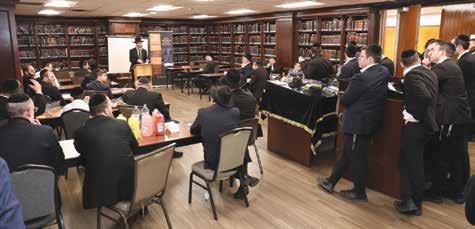
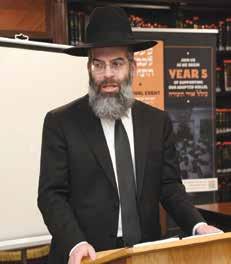
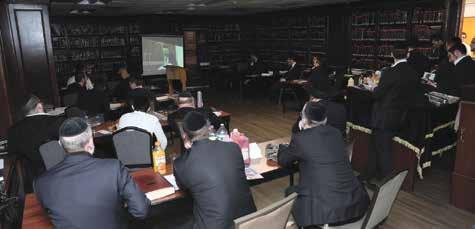
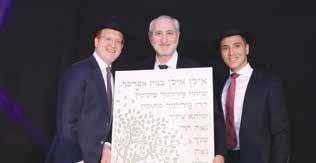
One of the unique Adopt-a-Kollel partnerships is the one between the yungeleit learning in Kollel Tirtza Devorah of Yeshiva Darchei Torah, led by Rav Yaakov Bender and Rosh Kollel, Rav Dovid Bender, and Kollel Ohr Torah of Beit Shemesh. It is unique because in this partnership Kollel yungeleit from America are supporting their fellow Kollel yungeleit in Eretz Yisrael.
The fifth anniversary renewal event was held at the kollel in Far Rockaway on Monday, 27 Adar/March 16. The special guest speaker at the event was Rabbi Itche Rosenbaum, founder and president of Madison Title. Rabbi Yaakov Bernfeld, National Director of Adopt-a-Kollel, also addressed the gathering.
A swarm of locusts flew from northwest Africa to Great Britain in 1954 in just ten days.





















Episcopal Health Services (EHS) is now offering low dose radiotherapy (LDRT), using its new TrueBeam™ linear accelerator, which recently received FDA clearance to treat adults with medically refractory osteoarthritis. The new RAPID Program (Radiation for Arthritis & Painful Inflammatory Disorders) is the first of its kind being offered on the Rockaway Peninsula. Led by Mark Ashamalla, MD, Chief of Radiation Oncology at EHS, the RAPID program is providing patients with innovative, nonsurgical treatment options to help reduce inflammation and relieve pain in certain joints and tissues.
According to the Centers for Disease Control and Prevention, osteoarthritis is a degenerative joint disease that can affect the many tissues of the joint. It is the most common form of arthritis, af-
fecting more than 32.5 million adults in the United States. Unlike radiation used for cancer treatment, LDRT uses very low doses of radiation that work by reducing inflammation in the treated area, modulating immune and inflammatory responses, and helping relieve pain and improve function. Treatments are usually delivered over several visits (approximately 6) and only last a few minutes. Patients can return to normal activities and work immediately afterward as there is no recovery time required and side effects are rare.
“LDRT is an evidence-based treatment that is safe, effective, and non-invasive for inflammatory and degenerative conditions of the tendons, joints, and other soft tissues of the body,” said Dr. Ashmalla. “Studies show an 80% response rate with a patient achieving
a steady state in terms of their pain and function. Treatments are short and simple, and it can significantly improve pain and stiffness, helping avoid the need for surgery.” It has been used internationally for decades to treat inflammatory conditions such as arthritis and tendon disorders.
The Rapid Program is specifically designed to help patients over the age of 40 with conditions such as osteoarthritis (knee, hip, shoulder, elbow, hand, ankle, and other joints); plantar fasciitis; calcific tendonitis; tennis elbow; other tendon or ligament inflammation; dupuytren’s disease; as well as keloids and hypertrophic scars. LDRT can be very helpful for patients who have not experienced relief from traditional treatments such as physical therapy, medications, injections and even weight loss management. It can
The fifth grade girls had an incredible and memorable opportunity when they were selected to visit the Newsday headquarters in Melville, Long Island. From the moment they arrived, the students were immersed in the fast-paced and fascinating world of journalism.
During their visit, the girls experienced what it’s like to be part of a real newsroom. One of the highlights of the trip was participating in a mock press conference, where each student stepped into the role of a reporter asking thought-

ful questions and engaging as members of the press.
The excitement continued as they entered the actual newsroom, getting a be-


also provide benefits for patients before considering joint replacement or other invasive procedures.
The RAPID Program is part of EHS’ Radiation Oncology services offered at the Walsh Ambulatory Pavilion. To schedule a consultation, visit ehs.org/rapid or call 718-869-7101.

hind-the-scenes look at how the news is created. The girls had the chance to stand behind cameras and explore the green screen area, learning firsthand how meteorologists deliver the weather forecast. They also toured the newsroom floor, where they discovered how many different departments advertising, photography, and reporting must work together seamlessly to produce the news each day. It was eye-opening to see just how intricate and essential each role is.
Another unforgettable experience was practicing reading the news aloud direct-
ly into a camera, even as new information was being delivered just like real broadcasters! The girls also had fun taking photos in front of the green screen, transforming themselves into on-the-scene reporters.
We are so grateful to the parent chaperones who helped make this trip possible, and we extend a special thank you to Newsday for opening their doors and providing such an engaging and educational experience. The news truly came alive for our fifth grade girls!



Last week, Morah Wieder’s class at HALB visited the JCCRP. They spent their morning packing Pesach food for families in need.

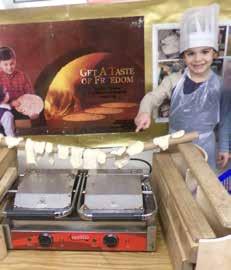

The children of Gan Chamesh were transported back to the time of Yetzias Mitzrayim through a realistic dramatization of the experience. They actually felt like they were there, experiencing Hashem’s wondrous miracles. It was hands-on experiential learning at its best!





The yeladim at HANC EC are all ready for Pesach


Kehilas Nishmas Hatorah, led by Rabbi Yissachar Blinder, was filled with excitement at Rabbi Weitz’s pop-up matzah factory, where fathers and children joined together for a hands-on matzah chaburah. Working side by side, they experienced the excitement and precision of baking kosher matzah in under 18 minutes, bringing the Pesach preparation to life in a truly memorable way.




On Sunday, the fifth through eighth grade boys at HALB spent the morning davening and learning Torah with their fathers, grandfathers and rebbeim and HALB’s annual Veshinantam Siyum. It was a beautiful and meaningful way to close out Sunday yeshiva.
By Chaya Feldstein
Be My Guest enters the season of invitations as this is the holiday of Kol Dichfin…”Anyone who needs…” Those are amongst the first words iterated at the Pesach Seder. But it always puzzles me – who still “needs” an invite at the time those words are recited? Anyone who is “needy” will feel worse being invited to the Seder last minute?! I haven’t yet found a good answer, and it continues to keep me thinking…of others!
Yes, at a time that you are most busy and overwhelmed with your Pesach preparation, there are others who wish they were in those shoes. They are the ones that are hoping you would extend yourself and reach out before Yom Tov. The power of a genuine and kind phone call, offer to go out for coffee, walk, etc. is underestimated by those who are so happily immersed in their lives. Time is one of the most important and precious things you can give. A finishing touch – a small gift shows someone that he or she
is an important part of your life.
How amazing it is that the Chag of Pesach coincides with Chag HaAviv. Aviv, spring symbolizes hope. Especially following a cold frigid icy and snowy winter, the trees will soon change from bare to pink. It happens almost overnight that you can see the blossoms and suddenly what seemed so bleak, changes its full capacity to bring light and life so uplifting and bright!
That is precisely what happens when you reach out! You bring hope. You change darkness to light. Your kindness brings redemption. Quite figuratively. May we be zocheh this Nissan to bring personal Geula to those around us. Be My Guest brings awareness and you do the work; challenge yourself, one person. Yes, one person can change the world and why pass over (pun intended) that opportunity?! Because if each person reached out to only one person, the world be a better, happier, less alone place!
Please share your thoughts – they can be anonymous – at bemyguestforShabbos@gmail.com


The fourth grade students in HANC Elementary School in the Reinstein Family Campus in West Hempstead have been exploring family history through family heirlooms. As the hundredth day of school approached, their teacher, Mrs. Tracy Lloyd, asked the children to find family heirlooms at home that are close to one hundred years old. As the students searched for their families’ precious items, they were tasked with researching the history of the items, how they came into their family’s possession, what significance the items played in the lives of their family members, and why it was so special for their families.
The results were truly inspiration-
al. For some children, the heirloom had graced their great grandparents’ Shabbat and yom tov tables: a ninety-three-yearold challah board; a seventy-five-year-old candelabra that a student’s great-grandfather bought for her great-grandmother when they were living in Germany and miraculously smuggled out of the country for safekeeping in the United States; a stained glass Kiddush cup smuggled out of Austria that had been used by a great-grandparent. Other religious items included tefillin; a Purim megillah; and a menorah from Germany that a great-grandfather, who had fought against the Nazis, gave to the student’s mother to keep the family tradition going as she lit the candles for their family here

in America.
Additional items included a Purple Heart that was received by a student’s great-grandfather in 1944, awarded for saving the lives of many people; an apple pie recipe handed down from a student’s great-grandmother; a viewmaster that contained photographs of the student’s great-grandmother and great-grandfather in his army uniform; a brain teaser game that was played by a great-grandfather for whom that student was named; an ivory cameo pin; a Chinese Chess game with wood carvings that was brought to this country by a student’s great-grandparents; and a very large Japanese rifle that a student’s great-grandfather saved after fighting in World War II. (Note: a
photograph of said item was brought to school, not the item itself, for safety reasons.)
As each child presented their heirlooms, the children traveled back in time and learned so much about world history, the bravery of previous generations who did everything in their power to continue performing mitzvot, and the triumph of the human spirit to preserve family traditions even when faced with adversity. It was clear from the children’s faces as they examined each item that this type of hands-on learning truly made these historical family items come to life. It was a fascinating experience they will not soon forget.
































Last week, the Class of 2026 at Touro University’s New York Medical College (NYMC) School of Medicine gathered on campus with family and friends for the culmination of years of hard work – the annual Match Day celebration. Along with graduating medical students across the country, NYMC seniors learned where they were matched to medical residency programs and will continue their training for the next several years in their chosen specialties. Conducted annually by the National Residency Matching Program (NRMP), the Match uses a computer algorithm to match the preferences of applicants with the preferences of residency programs, to fill the available training positions at U.S. teaching hospitals.
The Class of 2026 will go on to train in 21 states and the District of Columbia at 99 different institutions, including at NYMC major clinical affiliates Westchester Medical Center and NYC Health + Hospitals/Metropolitan, as well as local clinical affiliates Phelps Hospital, Lenox Hill Hospital, Northern Westchester Hospital, and Greenwich Hospital. They will also train at other major top-tier, research-intensive, academic medical centers across the country, including Beth Israel-Deaconess and Massachusetts General of the Harvard Medical School, Brown, Mount Sinai, Boston University, Stanford, Mayo Clinic, Columbia, George Washington University, Weill Cornell, New York University, Cedars Sinai, UCLA, Tufts, Tulane, Vanderbilt, and Yale.
The top career choices for the Class of 2026 were internal medicine, surgery, emergency medicine, psychiatry, anesthesiology, neurology, orthopedic surgery and radiology.
Shomer Shabbos Residency Matches
NYMC partners with its clinical sites in founding and promoting Shomer Shabbos medical residency training slots, which accommodate Shabbos observance while prioritizing patient care.
“New York Medical College and Touro University are proud to offer the largest number and variety of Shomer Shabbos medical and dental residency training opportunities in the United States. I am always pleased on Match Day to see students avail themselves of this option for their training,” said Edward C. Halperin, M.D., M.A., chancellor and CEO of NYMC.
Six NYMC students matched to Shomer Shabbos or Shomer Shabbos-friendly residencies, including David Schipper who will do a combined internal medicine/emergency medicine residency at SUNY Downstate/Kings County Hospital and Yitzchok Lubin who will do internal medicine at Mt. Sinai South Nassau and then follow that with a fellowship to achieve his ultimate goal of entering the fields of oncology or pulmonary critical care.
A father of six whose mother is a neurologist and grandfather is an oncologist, Lubin grew up with an awareness of the lifestyle that busy doctors lead as well as the immense satisfaction that comes from

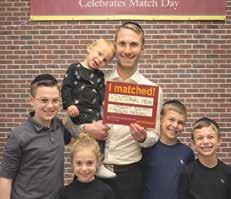
Yitzchak Lubin celebrates Match Day with his children
a life devoted to patient care.
“I didn’t choose this career because of them, but I knew what I was getting into, and I was drawn to it,” says Lubin. “Touro’s New York Medical College was an ideal place to pursue my training. I had heard in advance about the congenial student body and the accessible faculty, and I experienced it myself. Even with a large class size, I got to know everyone, and my professors were open to feedback and willing to tailor the curriculum to meet the students’ needs. Also, as an observant Jew, I appreciated being in a rigorous medical setting and a school that is able to accommodate religious needs. My observance was never in conflict with my academics. It was a huge advantage, and I’m looking forward to having a similar experience during residency.”
David Schipper also grew up in a medical family—his mother is a dermatologist and father is a neurologist. Yet he chose this career because it allows him to spend


LDavid Schipper celebrates Match Day with his mom
his life helping others and giving back to the community while also pursuing his passion for teaching and the sciences. New York Medical College was a familiar choice as his mom is a 1983 NYMC graduate.
For Schipper, it was a no-brainer. “Having an active Jewish community on campus and training at a medical school where my religious practices would be accommodated made it the ideal choice.”
Schipper was drawn to both emergency medicine and internal medicine so he decided to pursue dual training. “I love the continuity of care that internal medicine offers, where you get to know your patients and I also love the excitement of emergency medicine, triaging urgent, life-and-death situations, and the opportunity to perform procedures. This combined residency is a dream come true for me, and I’m overjoyed that Shabbos observance will be largely accommodated as I continue my medical training.”

ast Thursday, the YCQ Grade 8 girls hosted a lively and interactive Shabbat Fair for Grades 3-6, bringing the 39 Melachos to life with handson games and activities. Thank you to Morah Sarit Auerbach for organizing! Learning about Shabbos has never been this creative!




Morah Goldie’s Pre 1A class at TAG’s Early Childhood Center embroidered beautiful pillowcases for the Seder

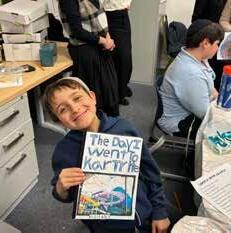

TAL Academy’s Tal-A class recently celebrated a publishing party, showcasing the boys’ hard work and creativity in personal narrative writing. The classroom was filled with excitement as each student proudly shared his story. The effort and thought invested throughout the writing process was apparent to all.
Fellow TAL students and members
of the administration joined the celebration, taking time to read the stories and write thoughtful reviews for each author. The event created a true sense of accomplishment, as the boys experienced what it feels like to be published writers.
The students left the celebration with a deep sense of pride in their work and a growing confidence in their abilities as writers.





YOSS students recognized for their outstanding achievements received student of the month awards
To celebrate the 100th day of school, classes at YOSS took part in a fun writing activity. Each student wrote a “100-year-old” piece imagining what their life might look like when they are 100 years old. The students really enjoyed thinking about the future and came up with many creative and funny ideas about where they might live, what they might be doing, and what life could be like at that age.
It was a great opportunity for the students to practice their writing while also celebrating this special milestone in the school year. The class had a wonderful time sharing their pieces with one anoth-
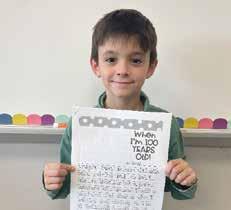
er, and it was so nice to see their creativity and imagination shine through. We are very proud of the effort everyone put into their work!
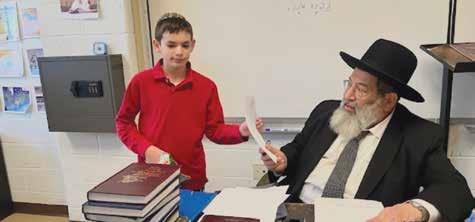
At Zareinu, we believe every child deserves to thrive alongside their peers. By embedding our classrooms within six local community schools, we provide the perfect balance of academic support and social inclusion. From single-subject assistance to fullday instruction, our flexible programs are customized to meet each student’s individual needs, empowering them to suc-
ceed within their own school community. During a recent visit to our Zareinu 5/6 Darchei class, Rabbi Yaakov Bender personally returned tests on Parshas Acharei Mos and Millim. He was extremely impressed by the boys’ hard work and mastery of the material. To celebrate their outstanding accomplishments, Rabbi Bender awarded the entire class a well-deserved pizza party.

This past Monday, March 16, eight MTA seniors returned to Newark Airport after a powerful and unforgettable week-long trip to Poland. These students are participants in MTA’s year-long Names, Not Numbers program, an oral history documentary initiative in which students interview and film Holocaust survivors, preserving their stories for future generations. At MTA, students have the added privilege of bringing that learning to life through a meaningful journey to Poland.
During the trip, the boys spent time in Warsaw, Lublin, and Krakow, encountering both the depth of pre-war Jewish life and the devastation of the Holocaust.
In Warsaw, they met with family members of a Polish Righteous Gentile,
spoke with the Chief Rabbi of Poland, and walked through the remnants of the Warsaw Ghetto and the historic Warsaw Jewish Cemetery. They also visited the POLIN Museum, which highlights the rich, centuries-long history of Jewish life in Poland prior to the Holocaust.
In Lublin, the students visited the Majdanek and Belzec death camps, confronting the stark realities of destruction and loss. They stayed in the famed Yeshivas Chachmei Lublin, connecting to the vibrant Torah life that once defined the city.
After visiting the kever of the Noam Elimelech, the group traveled to Krakow, where they spent a meaningful Shabbos. Following Shabbos, the boys enjoyed a traditional klezmer concert, followed by bowling and a melava malka together.
By Avichai Yosipov
Discuss, discuss, discuss. That’s America’s lifeblood. An essential part of our identity. The members of the Civic Spirit Club at Rambam had the opportunity to attend Civic Spirit 2026, at the New-York Historical Society in the UWS. As the country nears its 250th, members engrossed themselves in learning the struggles and achievements our country has experienced. The club was invited to the NewYork Historical Society by the amazing Yael Steiner at Civic Spirit.
The event’s objective was to encourage healthy and open discourse with people from different backgrounds. The group included approximately nine schools, each with major differences: Jewish, Catholic, co-ed, secular, religious, all combined for this unique experience. Members were separated into six groups with four to five subgroups of four to five members each. This allowed for a personal connection with each member, demonstrating that meaningful discourse is possible regardless of differing backgrounds. An additional method used to encourage discussion was human bingo. Members were given bingo sheets with questions such as “Birthday in March” or “Loves their pet,” pushing members to speak up, tell their story, and build new connections with many members—all while being from different backgrounds. Each group was taken on a productive

The trip concluded with a visit to Auschwitz, leaving a lasting impression on all who attended.
The students were accompanied by Rosh Yeshiva Rabbi Michael Taubes, who shared his vast knowledge of the Holocaust and Jewish life in Poland throughout the journey, adding depth and per-
spective at every step.
A tremendous hakaras hatov is extended to Tova and Dov Rosenberg for coordinating every aspect of the trip, including flights, speakers, accommodations, transportation, and meals, ensuring a seamless and impactful experience for the students.
and thought-provoking tour of the NewYork Historical Society; exhibits were paired with a series of questions and discussion points. For example: “Which artifact caused you to do a double take?” And “Do you have a heirloom passed down that shares a similar story?” An exhibit I found particularly interesting was a mosaic-style map of Manhattan presenting the melting pot occurring. The piece showed Manhattan’s astonishing level of diversity, with so many different colors and shades representing different cultures.
During the sponsored lunch, I had the privilege to sit personally with the co-founder Rabbi Robert S. Hurt. Rabbi Hurt emphasized his commitment to developing Civic Spirit across the nation. Speaking with members in my group, listening to each other’s backgrounds and experiences, he was truly proud of the level of excellence present. The Rav left us with an incredible quote from Rav Kook: “Renew the old and sanctify the new.” Meaning, don’t disregard our past experiences and automatically embrace modernity; make sure the modernity is substantive.
Following the four separate large room exhibits, sub-groups were given the opportunity to develop a presentation for the coming 250th anniversary. Approximately one hour was allocated for the development; roles including facilitator, design specialist, note taker, and advocates were allocated. The display of cohesion in the group, only a handful of hours old,

from widely different backgrounds was a sight to be seen. Brainstorming, teamwork, and creativity were on high display in each group.
Following the completion of the projects, members voted for their favorite, and those favorites later presented on stage to the whole group. The winning project of my room was by none other than our own Michael Groyer and Yoni Pfeifer and their team. Their concept was a salad bowl, full of multi-colored Post-it notes. Pink notes represented an American event that makes you feel patriotic, and yellow notes asked what being American means to you.
The event commenced following the presentation of each most popular production and the winners of the bingo competitions raffle, who each received $17.76. A group of Rambam students had the opportunity to pick Rabbi Charles Savenor and Rabbi Robert S. Hurt’s brains. Rabbi Hurt explained that Paul Revere was successful not simply because of his ride, but
because he knew many people, belonged to numerous social clubs, loved telling his story, and understood how to reach others. This, he says, is the necessity he’s been working to develop. As both Rabbi Charles Savenor and Rabbi Robert S. Hurt are master orators, we had to delve into tips and techniques. Rabbi Charles explained, “A speech is like a meal. If you eat too fast, you throw up.” Likewise, by speaking. You must move around, make eye contact, and speak with them, not at them. Rabbi Hurt mentioned that when we’re in shul, what does the Aron Kodesh very often say? “Know before whom you stand.” Emphasizing the need to understand your audience.
The Civic Spirit Club extends its deepest appreciation to the Civic Spirit club at Rambam advisor Josh Goldenberg. A special thank you goes to Yael Steiner at Civic Spirit for their unwavering support and guidance throughout our participation.








As part of the Meah Brachos contest, in which each boy keeps track of the 100 brachos that they say daily, boys receive special prizes and incentives. If someone davens Shacharis, Mincha and Maariv, he will have said 90 brachos. Between eating and using the facilities, he/she can easily reach 100 brachos a day.
here are
Brachos winners for Rabbi Eisikovic’s class in Yeshiva Ketana of Long Island and from Rabbi Schon’s class in Siach Yitzchok.
Charts to keep track of your brachos can be downloaded on www.meahbrachos.com. For more information, reach out to outloudbrachos@gmail. com


Few people are fortunate to have even one mentor for a lifetime. Rabbi Zlotowitz z”l had two, Rav Dovid Feinstein, zt”l, and yb”l Rav Dovid Cohen, shlit”a.
His relationship with R’ Dovid Cohen began when he was a youngster in Camp Munk, where R’ Dovid was morah d’asra. The most successful campers are good athletes and articulate speakers. Meir was neither, but he had a talent in which he was head and shoulders above the other campers and even counselors – he was a fine artist. Recognizing his ability, Camp Munk founder Rabbi Michael Munk, zt”l, gave him his own little “studio.” R’ Dovid Cohen saw another talent, as well. The young camper had a great mind and intellectual curiosity. R’ Dovid, even as a young man, was already an exceptional talmid chacham and also had an unusual breadth of knowledge in all areas, was a “people person” of the first degree, was an enormously popular rebbi and role model, and was a magnetic judge of potential. He took an interest in the young artist, and they developed a close, lifetime relationship,
that continues to R’ Meir’s son, R’ Gedaliah.
This friendship was not only a personal gift for R’ Meir and his future family; it was a building block for ArtScroll/ Mesorah. R’ Dovid is a living, breathing encyclopedia of Torah knowledge, and we consulted him constantly for sources, clarity, and hashkafah matters. It’s no exaggeration to say that he shares credit for establishing ArtScroll’s high standards of accuracy.
After his Mesivta years, R’ Meir became a talmid of the gadol hador, Rav Moshe Feinstein, zt”l, in Mesivta Tiferes Yerushalayim. The Rosh Yeshivah’s older son, R’ Dovid, the future gadol hador, was about ten years older than Meir, but the two developed a personal relationship that remained close and warm until R’ Meir’s last day. They spoke on the phone almost daily, and every summer for many years, they and their wives took brief summer trips together. R’ Meir marveled not only at R’ Dovid’s incredible knowledge of Shas, halachah, Tanach, and other subjects but at his power of concentration.
On plane trips of several hours, he’d notice how R’ Dovid was often so absorbed in his Gemara that he was totally oblivious to everything around him. He provided encouragement and guidance to ArtScroll, especially in the excruciatingly difficult early years and once even made us a loan of his meager savings. His opinion was the deciding factor in countless major decisions. More than once, we wanted to undertake a project, but R’ Dovid said not to do it. His was the last word. Case closed.
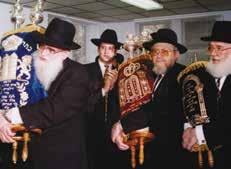
R’ Dovid Cohen, R’ Gedaliah Zlotowitz and yb’l R’ Dovid Feinstein and R’ Meir Zlotowitz
We are confident that ArtScroll’s success can be attributed to always having followed the daas Torah and guidance of Torah giants like R’ Dovid Feinstein and ybl R’ Dovid Cohen.
UP NEXT: Rav Mordechai Gifter – An Endorsement and an Offer
R’ Dovid never drew attention to himself and almost never spoke in public, though he made a rare exception and spoke by R’ Meir’s shloshim. He did his best to avoid the spotlight and was successful for most of his life, but he was ultimately not successful for his brilliance shown through and the public’s recognition grew. Once an American brought a shailah to Rav Elyashiv and the gaon said, ‘You have R’ Dovid Feinstein, why do you come to me?’ R’ Dovid, on the other hand, was amazingly deferential to older gedolim. Sometimes, he privately disagreed with a p’sak and would tell R’ Meir, “The gadol hador gave his decision, and we must abide by it.”




“Chazer, chazer, and chazer again!” — the powerful tagline of the V’Haarev Na learning program — has become more than just a slogan; it has become a movement transforming the way talmidim approach their learning.
For many years, Rabbi Aryeh Yudin has been implementing the V’Haarev Na methodology in his 12th grade shiur, with remarkable success. The program emphasizes mastering large amounts of Gemara through consistent and repeated chazarah, enabling talmidim not just to learn the material, but to truly own it. Year after year, Rabbi Yudin’s shiur has completed Masechet Taanis (multiple times with chazarah), a significant accomplishment made even more meaningful by the depth and retention his students achieve.

Morah Ackerman’s class at Torah Academy for Girls paid a special visit to the Nautilus before Purim. The talmidos circulated and shmoozed with the residents and listened intently to their life stories.
They then performed the dance they had prepared, and their energy brought so many smiles! When the residents re -
What makes this success particularly noteworthy is its impact on students themselves. Talmidim who may have once struggled with motivation in their learning have found new energy and confidence through this approach, returning to the Gemara again and again until it becomes second nature.
This growth was on full display on Monday night, as DRS talmidim traveled to Monsey to participate in the annual “V’Haarev Na Chasunah,” a unique gathering celebrating Torah achievement. Joined by hundreds of talmidim from yeshivos across the tri-state area, the evening began with an inspiring threehour retzifus seder, followed by spirited davening and a shared seudah. The atmosphere was one of unity, dedication, and genuine simchas haTorah.

quested that they sing, the girls rose to the occasion despite not having practiced or prepared. After a second performance of the dance, they finished off our visit with another round of shmoozing in small groups.
It was hard to leave to go back to school as the residents kept asking the girls to stay longer!

By Rabbi Nachman Seltzer
A Holy Kind of Chutzpah
Rabbi Murray was a master at getting things done, even when those seated across from him on the other side of the desk didn’t necessarily want those things to happen. If he felt that something was important, he would go to great lengths to ensure that it was achieved. This called for a certain degree of chutzpah, which he expertly employed to fight for what was right.
One very famous story involved a young boy whom Rabbi Murray wanted to enroll in one of the more prestigious elementary schools in Brooklyn. Sitting with the principal in his office, Rabbi Murray explained what he wanted and waited for the expected refusal.
“Rabbi Maslaton,” the principal said, spreading his arms wide as if in supplication, “it’s not a question of wanting to accept the boy or not. It’s simply a question of space. If you can find room for another desk in the classroom, we will sign him up right away.”
It was a well-crafted answer, one that most people would find hard to counter. From a political standpoint, the response was a beauty, and the principal was confident that at least this time he was going to win the battle.
Rabbi Murray returned to the yeshivah later that afternoon. Since he looked like one of the rebbeim, nobody paid him any attention as he entered the relevant classroom and began measuring the desks that filled the room. It didn’t take him long to ascertain that if each of the desks was just a little smaller, there would be enough space in the classroom for another desk. Measurements in hand, he left the building and went home.
The next morning found Rabbi Murray on the phone with the company that manufactured the desks the yeshivah used.
“I have a question for you,” he said to the company rep. “I was just in a school that uses your desks, and I wanted to know if you would be able to manufacture the exact same desks — just a little bit smaller.”

“Can you give me the measurements that you want?”
The company delivered the new desks a few days later. Rabbi Murray, of course, was on hand for the delivery. The desks were brought into the classroom, and Rabbi Murray asked the school custodian to move the older desks into the school’s storage area. With the new setup, the previously packed classroom was now able to accommodate another desk — which meant that a new student was about to join the yeshivah.
The next day, Rabbi Murray brought the boy to the school. Walking into the building, he led the child to the classroom that had previously been unable to hold another desk and had now been redesigned. After greeting the rebbi, Rabbi Murray explained that the boy at his side was there to join the class.
“Did you clear this with the principal?”
“Of course. The principal said that if we can fit another desk into the classroom, he can join the class. Take a look. There’s another desk in the room, waiting for him.”
Later that morning, the principal passed the classroom, looked through the window, and saw the child sitting in the class. Rabbi Murray was still there, awaiting the inevitable confrontation.
“Rabbi Maslaton, you know I didn’t mean for you to reconfigure the entire room!”
Rabbi Murray smiled. “Is there space in the classroom for the desk or not?”
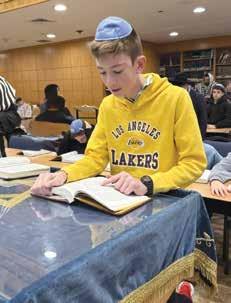

The principal had no choice but to shrug his shoulders and give in. As for the student, he remained in the yeshivah. For Rabbi Murray, that was the most important thing of all.
The desk maneuver turned out to be a personal favorite of Rabbi Murray’s, and he used it with various adaptations at a number of different schools, both for boys and for girls — even with educators with whom he shared a very close connection, such as R’ Manis Mandel.
Seeing the extra desk that Rabbi Murray had placed in one of his classrooms, R’ Mandel not only appreciated the move and allowed the student to stay, but also appreciated his friend Rabbi Murray more than ever.
Reprinted from Rabbi Murray Maslaton by Rabbi Nachman Seltzer, with permission from the copyright holder, ArtScroll Mesorah Publications.




U“Partly Cloudy”
We truly have no idea which way this is going.
U“Chance of Rain”
Somewhere, at some point, someone will get wet.
UUU
“Isolated Showers” It will rain exactly where you are.
“Scattered Thunderstorms”
Bring everything: umbrella, hoodie, backup plans.
“A Passing System”
This could last 20 minutes or your entire afternoon.
U“Cooling Trend” You had your fun. It’s over.
U“Unseasonably Warm”
Enjoy it because it will be freezing again tomorrow.
UU
U
U
U
U“Wintry Mix”
We’ve officially lost control of the situation.
“Light Snow”
Either nothing…or 6 inches. No in-between.
“Accumulation Possible” It may just be time to panic-buy milk.
“Gusty Winds”
Yes, your garbage cans are in danger.
“Developing Later”
We’ll deal with this problem in a few hours.
“We’re Monitoring the Situation” Things can get bad fast!
A meteorologist says there is a 100% chance of rain tomorrow.
Two people hear the forecast.
One brings an umbrella and stays dry.
The other does not bring an umbrella and also stays dry.
The forecast turns out to be completely accurate.
How is it possible that the person who did not bring an umbrella stayed dry?

Answer: He never went outside in the rain.
1. According to Indeed, what is the average salary range for a meteorologist in the United States?
a. $71,000 to $109,000
b. $175,000 to $210,000
c. $240,000 to $270,000
d. $400,000 to $$500,000
2. What does a Doppler radar primarily detect?
a. Temperature changes
b. Air pressure
c. Movement of precipitation
d. Cloud color
3. What scale is used to measure the intensity of tornadoes?
a. Richter Scale
b. Saffir-Simpson Scale
c. Celsius Scale
d. Enhanced Fujita (EF) Scale
4. What does humidity measure?
a. Wind speed

b. Cyclone
c. Jet stream
d. Monsoon
6. What type of cloud is most associated with thunderstorms?
a. Cirrus
b. Stratus
c. Cumulus
d. Cumulonimbus
7. What is the boundary between two different air masses called?
a. Front
b. Pressure line
c. Storm zone
d. Climate barrier

Answer Key:
Well Said

I
tried to become a meteorologist, but I couldn’t handle the pressure.
b. Amount of water vapor in the air
c. Cloud thickness
d. Air pressure changes
5. What is the term for a fastmoving, narrow band of strong winds in the upper atmosphere?
a. Trade winds
Wisdom Key:
6-7 correct: You definitely have a weather vane on your roof, which means that you are totally not vain.
3-5 correct: You are right in the middle – need a spring jacket.
0-2 correct: You don’t even know what a meteorologist is. Is it a type of macaroon?
My weather app is like me –mostly wrong but confident. The meteorologist said “high pressure,” and I thought he meant my life.
Cloudy with a chance I stay indoors forever.
Hail is like snow’s angry cousin.
Storms come and go, but meteorologist puns reign forever.
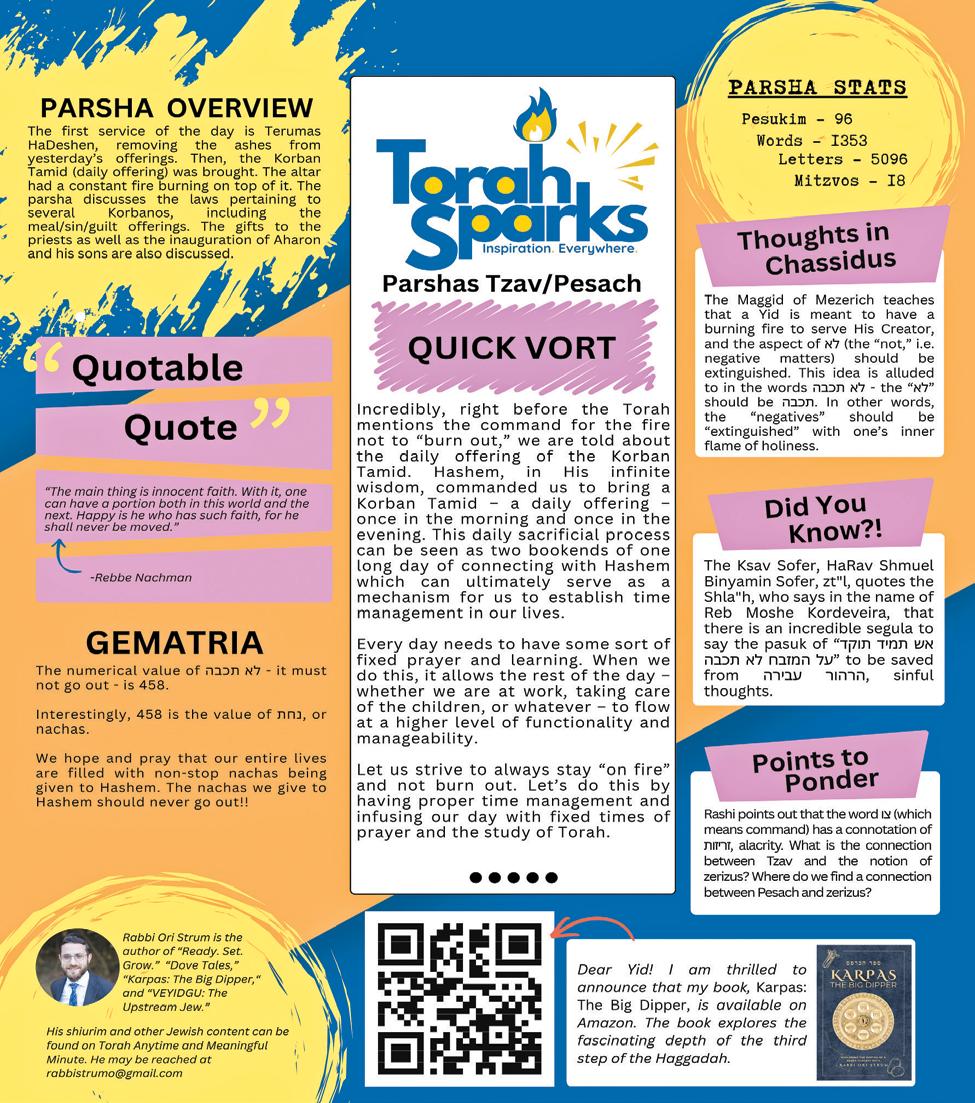


By Rabbi Berel Wein z”l
This year, as is true in most years of the Jewish calendar, the Torah reading of Tzav coincides with the Shabbat preceding Pesach, Shabbat Hagadol. Since on a deep level of understanding there are really no coincidences in Torah matters, the connection between Tzav and Shabbat Hagadol should be explored and explained.
The word “tzav ” is one of a mandatory command. It does not present reasons or explanations and does not brook
discussion or argument. It is representative of military discipline, of service to a higher purpose even if all of the participants in the project are not really aware of the workings of that higher purpose. A necessary part of living in society is the mandatory obligations, which are part of everyone’s life. If it were not for these rules, mores, and practices imposed upon us, life would become so chaotic as to be unlivable. It is the “tzav” part of life that allows all of the other more freedom-


of-choice opportunities to be present in our lives. An ordered society demands that there be commands, not only recommendations or suggestions. There is an understandable reflex built into our emotional system that resists and resents commands from others. Any parent of a three-year-old can easily testify to the truth of this observation. Nevertheless, the young child must eventually respond to commands in order to grow, mature, and become a successful human being. So, “tzav” plays a vital role. Perhaps there are no two areas of Jewish life and law that are as complexly
that Shabbos and Pesach represent and then ignore all the mandatory commandments that accompany these days, their values and ideals. Without mandatory commandments, no commemoratory day, no matter how well meaning and well planned, will stand the test of time and changing circumstances. It is the “tzav” component of Shabbos and Pesach that make this Shabbos the Shabbat Hagadol – the great Shabbos that it is. It is an historical fact that those movements and individuals that ignored or rejected mandatory observances associated with Shabbos or Pesach eventually
If it were not for these rules, mores, and practices imposed upon us, life would become so chaotic as to be unlivable.
intertwined with mandatory commands and laws as are Shabbos and Pesach. The concepts behind these holy days and their observances represent noble values – serenity, leisure, freedom and independence. But noble ideas alone, without detailed instructions as to their realization, are useless in a practical sense. The sons who appear in the Torah and the Haggadah all ask the same question: “What relevance do these laws have in our time?”
It is not sufficient that we honor the ideas
slipped out of Jewish life and continuity entirely. Again, without “tzav,” there can be no Shabbos Hagadol. This is the basic issue that divides much of the Jewish world today. The avoidance of mandatory commandments, attractive and popular as this idea may initially appear, is a sure recipe for Jewish extinction. Shabbat Hagadol comes to remind us of this lesson.
Shabbat shalom and Chag kasher v’sameach.

The Gemara (Pesachim 108b) discusses a number of customs we observe in order to keep the children awake at the Seder, one of which is quite shocking when we think about it: “Rabbi Eliezer says, ‘We grab matzos on the nights of Pesach in order that the children should not fall asleep.’” Many Rishonim, including the Meiri, the Rava’an, and the Ravya, teach that this means one must keep the Seder moving quickly so that the children should not fall asleep. Similarly, the Rambam (Hilchos Chametz U’matzah 7:3) explains that it means people should grab the matzos from one another to awaken the children’s curiosity so that they should ask what makes the Seder night different from all other nights.
Many other Rishonim, including the Chok Yaakov and the Elya Raba, explain that the custom to “grab matzos” means that the children should steal the Afikomen. The Chavos Yair (Mekor Chaim 477) writes that the reason for the custom that children steal the Afikomen is to make the mitzvah more precious to them, but that the custom should not be followed because it gives the non-Jews one more way to libel us. They will point at this custom and say, “Look, the Jewish people teach their children from a young age to be thieves at the Pesach Seder to remember how their ancestors were thieves, as the pasuk (Shemos 12:36) says, ‘And they emptied out Egypt.’” Even in this generation, I heard that Rav Shlomo Zalman Auerbach, zt”l, would announce at his Seder that there is a custom to steal the Afikomen, but that this is not done in his house. I also heard that Rav Chaim Kanievsky, zt”l, follows the same practice in order not to teach children to accustom themselves to stealing.
The truth is that the custom is difficult to understand. In halacha, it is forbidden to steal from a friend even as a joke or

By Rav Moshe Weinberger
Adapted for publication by Binyomin Wolf

to teach a lesson, even if one has no intention of keeping the “stolen” object. But the majority of the Jewish people, including mekubalim and tzaddikim, keep this minhag and even encourage it. What is the meaning of this mysterious custom to steal the Afikomen?
The Avudraham and other poskim teach that when we kasher our vessels for Pesach, we must immerse them in boiling water and wash them in cold water, based on the halacha with respect to vessels to be used in the Beis Hamikdash (Vayikra 6:21).
The Rambam also teaches in the halachos of kashering vessels for Pesach (Hilchos Chametz U’matzah 5:26), “And one should fill up [the pot] with water until the water overflows the lip [of the pot] and the water boils in it and that is sufficient. Afterward, he should rinse the put and then he may use it for [Pesach food].”
The Rambam, as well as Tosafos and the
Tur, maintain that the rule that one must rinse a vessel in cold water after immersing it in boiling water is unique to the halachos of preparing mundane vessels for service in the Beis Hamikdash and vessels used all year long for use on Pesach. But one need not rinse non-kosher vessels in cold water after kashering them if the only purpose is to prepare them for regular, mundane use.
The Shulchan Aruch (Orach Chaim 452:7) also mentions cold water rinsing only with regard to kashering vessels for Pesach, but not with respect to kashering vessels for mundane use. And the Ravya even recounts that in the city of Magentza, people would immerse their vessels in the mikvah after kashering them for Pesach!
From the foregoing, it is clear that when we kasher vessels for Pesach, we accomplish much more than simply removing the chametz absorbed in the walls of the vessels. We must be accomplishing something more akin to preparing vessels for service in the Beis Hamikdash, the only other con-
text in which we rinse vessels in cold water after boiling them.
Impurity the Same Way it Became Absorbed Rav Avraham Tzvi Kluger of Beit Shemesh explains this concept beautifully. He says that when we boil a vessel to purge it of that which had been absorbed into it, we are accomplishing the same thing whether it is a non-kosher vessel about to be used in the Beis Hamikdash, a vessel used for chametz about to be used on Pesach, or a non-kosher vessel about to be used for kosher – but mundane – purposes. But we only perform the second stage, washing the vessel in cold water, when we prepare a vessel for use in the Beis Hamikdash or for Pesach. This step has nothing to do with removing forbidden things which had become absorbed into the walls of the vessel. That was already accomplished by boiling it. Rather, the purpose is to prepare the vessel for a higher level of holiness, a greater level of service. This is especially apparent in Magentza, where they even immersed their vessels in the mikvah after all of the chametz was already removed from them by boiling them in hot water! The Rambam (as quoted by Tosafos Yom Tov on Zevachim 11:7) hints at this as well when he says “and adding cleanliness is called rinsing…”
From the above, we see that with respect to mundane, ho-hum vessels, the only important thing is removing any impurity which had become absorbed into them. But holy vessels which will be used in the Beis Hamikdash or on Pesach require more. It is not enough to remove impurity from them. They must be raised up to a higher level of holiness akin to immersing them in a mikvah.
A Jew may feel that he has become a non-kosher vessel. He may feel that impure
thoughts, images, and sounds have become absorbed into his heart and soul. He knows that he must boil out that chametz, that non-kosher filth which he allowed into his mind and body. He may feel that because he has fallen so low, the best he can hope for is to become an average, mundane vessel by removing the impurity. But that is the extent of his aspirations. He has given up hope on achieving anything greater. But a Jew must know that he is a holy vessel, destined for Beis Hamikdash-like service. As Reb Tzadok Hakohein of Lublin, zy”a, says the halachic principle (Pesachim 74a) that one must use the same means to remove impurity absorbed into a vessel that was used to defile the vessel in the first instance. If a non-kosher soup was boiled in the pot, he must boil water in the pot to remove the taste of the non-kosher food which had become absorbed into the pot. If non-kosher food became absorbed into the vessel through contact with fire, then fire must be used to remove it. Similarly, if one brought impurity into his life by the calm performance of sinful acts, then a cold, calculated service of G-d may be sufficient to remove that person’s bad influences. But if a person sinned with fiery desire, then the only way to remove that impurity is with fiery, passionate service of G-d.
Jews are holy vessels. It is not enough to settle for the simple removal of impurity as our only goal, great as that is. A person may feel: “I have so much chametz built up inside of me. I’ll be lucky if I ever get rid of that. But what possible connection could I have to holiness? What business does someone like me have learning the deeper parts of the Torah?!” We must answer such a person: “Why are you looking at yourself like a mundane vessel?! You were created to be a holy vessel! You must sanctify yourself in the mikvah to take up the mantle of holiness. Do not settle for removing your chametz. You can achieve a deeper, higher level of service!”
We see this when Hashem took the Jewish people out of Egypt. We know that they were on the forty-ninth level of impurity, and according to the Arizal, if they had been redeemed even a moment later, they would have been so immersed in impurity, that they could not have left Egypt. One might have expected Hashem to first tell them, “You have become so low and despicable. You are nothing like your lofty forefathers. I must now redeem you lest you fall any further and become irredeemable.” But that is not how Hashem approached them. Rather, He told Moshe (Shmos 6:6-8) to tell them, “I am Hashem… I will take you out from the burdens of Egypt, I will save you from their servi-
tude, I will redeem you… and I will take you for Myself as a nation… and you shall know that I am Hashem your G-d… and I will take you to the land… I am Hashem.”
That was Hashem’s introduction to the exodus from Egypt. He did not focus on how low they were. He introduced them to His service; He revealed His name to them. If a Jew wants to escape from his own smallness, his own personal Egypt, he must also realize his own greatness. He must set his goal way beyond simply escaping the impurity into which he had become mired and set his sights on connecting to the unity of G-d’s name. Rebbe Nachman of Breslov said homiletically, “When you hold matzah in your hand, you hold G-d in your hand.” Pesach reminds us that we are so much greater than the temptations and mistakes that threaten to bring us down or which we are afraid have already brought us down. We are Jews so we have access to greatness. We hold G-d’s name in our hands.
the palace. He did not even imagine that he could ask for his former royal lifestyle. The most he could bring himself to request was a piece of bread for his next meal.
Rav Kook taught in Oros Hateshuva that teshuva does not only mean repenting from our sins. It means returning to a conception of greatness for ourselves.
The last part of the Seder is “Tzafun,” which means “Hidden,” when we eat the hidden Afikomen. This refers to the hidden light Hashem hidden away for only the tzaddikim (Rashi on Bereishis 1:4). Our custom is to steal the Afikomen. Our job during these last few minutes before Moshiach comes, at the end of the Seder, is to steal aspects of G-d’s service that we are completely unworthy for.
I have had people tell me that they have friends who learn the Daf Yomi, who learn Yerushalmi, or who get up for minyan every day, but that they have never done these
When we recognize that we are “great,” we will bring about the time of the sounding of the “great” shofar.
We must break out of the smallness into which we have become mired. We are not simple mundane vessels!
We are like small children who have fallen asleep at the Seder. We must wake up and remember that we are great! We need Hashem to fulfill that which the pasuk (Yechezkel 36:25-26) says, “And I will sprinkle upon you pure waters… I will purify you. And I will give you a new heart, and I will place a new spirit in you.” The pasuk (Yeshaya 52:1) also says, “Arise, arise, don the garments of your strength Zion, don the garments of your glory Yerushalayim the holy city…” As Shlomo Hamelech said (Shir Hashirim 2:10), “Arise, my beloved, my fair one, and come away!” These pesukim tell us, in our smallness, in our exile mentality, that we must wake up and recognize that we must set our sights so much higher than simply getting by.
The exile Jew, mired in smallness, is like the prince in the parable who spent so much time in exile that he forgot royal life completely. He became so accustomed to poverty and deprivation that when he finally returned to the palace, he saw himself as a poor person who did not really belong in
after eating the Afikomen” (Haggadah). The tzaddikim teach us this connection between Yaakov “stealing” the blessings he felt he was unworthy of and the Afikoman based on our custom to break the middle matzah to set it aside for the Afikomen at the part of the Seder called “Yachatz,” which is an acronym for “yadav chelkas tzavaro,” his hands, the smoothness of his neck,” which were the parts of Yaakov’s body Rivka covered with fur to help trick Yitzchak into believing that he was Eisav in order to take the blessings (ibid. at 16). Yaakov’s quality is truth. He therefore did not want to take the blessings. He felt they were not coming to him, and he did not deserve them. They were above his level. He told his mother (ibid. at 12), “Perhaps my father” in Heaven “will examine me.” He will know that I am not deserving. Then, Yaakov Avinu feared (ibid.), “I will be in his eyes as a deceiver.” Like many of us, our father Yaakov was afraid of “stealing” spiritual levels that he felt he was unworthy of. We, too, are afraid to learn the deeper parts of Torah and chassidus because we feel we are not worthy. But, like Yaakov Avinu, we must steal the Afikomen!
things and don’t see themselves as being the kind of people who could do that. Other people say they cannot imagine getting up to learn before davening or guarding their eyes because they have never done it before. They may feel that they are not worthy, but they must know that they can “steal” those accomplishments. They must become Afikomen thieves, stealing the light that’s hidden only for “tzaddikim!”
According to the Ateres Yeshua, Yaakov Avinu dressed up as Eisav and stole Eisav’s blessings at Rivka’s command on the first night of Pesach. Indeed, when Eisav came into Yitzchak’s room after he had already blessed Yaakov, Yitzchak told him (Bereishis 27:35), “You brother came with cunning, b’mirmah.” The numerical value of the word b’mirmah is the same as the word Afikomen. Similarly, the sefer Lehoros Noson quotes a Midrash that when Yitzchak told Eisav that he could not eat from the meal Eisav prepared for him because Yaakov had come with cunning, he showed him the Afikomen, as if to say, “It is Pesach night and Yaakov already gave me some Afikomen to eat, and the halacha is that we do not eat anything at the Seder
Reb Elazar, the son of the Noam Elimelech of Lizhensk , zy”a, once spent a Shabbos with Rav Pinchas Koritzer, zy”a, who was very old at the time and was considered to be both a student and quasi-colleague of the Baal Shem Tov. When he returned to Lizhensk, his father asked him, “What happened over Shabbos?” Reb Elazar told him some of the Torah taught by Reb Pinchas over Shabbos. “No,” the Noam Elimelech, “I asked what happened, not what you learned.” Reb Elazar answered that it was a beautiful Shabbos by the tzaddik. “No,” his father responded, “what specifically happened to you over Shabbos with the tzaddik?”
Reb Elazar then related to his father how, at Shalosh Sheudos, the Rebbe Reb Pinchas paused for a few minutes, and that in the complete silence, he was so overcome by the tzaddik’s presence that he let out a sigh and said, “Oy! Tatteh in Himmel!, Father in Heaven!” It is wellknown that Reb Pinchas’s trademark was the attribute of truth. So, displeased, Reb Pinchas banged on the table and said, “Nu, and who says He’s your father?!” Excited to hear this, Reb Elimelech asked his son, “And…what did you answer?” Reb Elazar told his father that he was too scared and that he did not say anything.
The Noam Elimelech answered his son that he should have told the Rebbe Reb Pinchas that the pasuk (Devarim 32:7) says, “Ask your father and he will tell you…” The word for “ask, she’al” also means “borrow.”
You should have told the Rebbe that even if you are not “worthy” of truly recognizing that Hashem is your Father, you can “borrow” Him as your Father. Because you felt that He was your father at that moment, you were allowed to “borrow” Hashem as your father.
So, too, at the Seder, just before the Four Questions, the Haggadah says, “Here the son asks.” Again, the word for “asks, sho’el ” also means “borrows.” We must “borrow” holy accomplishments that we may not be worthy of. We must not feel limited by what we are actually deserving of. We must “borrow” and “steal” accomplishments that we do not deserve. Our Father is waiting for us to “steal” holiness from him, to be Afikomen thieves!
We have become so consumed with smallness that we believe we speak “out of turn” if we talk of high aspirations or growing in our service of Hashem. Some women feel that they are working so hard just to get by with daily life that they cannot attend a shiur or think about anything above their daily grind. Many men feel that they cannot break free of their desires to look at inappropriate things on their computers and smartphones, or they cannot get up early to learn and daven. They have given up hope on themselves. They ask themselves, “After what I did last night, how can I possibly show my face in shul in the morning?” They therefore do not come to shul in the morning or come very late so that they will be able to rush through davening and never feel like they have to “look Hashem in the eyes,” knowing that they are so far from worthy.
But a Jew is not a simple, mundane vessel filled with impurity absorbed into his mind and body. A Jew is a holy vessel. He can and should set his sights so much higher than simply removing the impurity from his life, as great as that is. The custom of stealing the Afikomen teaches us that we must be burglars, breaking into aspects of holiness where we do not belong! There are very busy working people in the shul who are studying for semicha, rabbinical ordination! They steal time to prepare every day notwithstanding their busy schedules. When have we experienced such holy brazenness before this generation? When have we seen such holy thieves? There are women in the shul who “steal” an hour each week from their hectic lives to go to a shiur to connect to Torah whether they are “deserving” or not.
The Divrei Chaim of Tzanz, zy”a, expresses this idea beautifully (Parshas Teruma): “And so, too, in truth, every person, even if he has not completely rectified himself, if he has [at least] accepted upon him-
self to rectify himself, he should not be lazy by excusing himself and saying, ‘Who am I to unify G-d’s name? I am full of blemishes!’ G-d forbid to say such a thing! Just the opposite! If one has done packages of sins, he should counteract them with packages of mitzvos… He should do everything he can, and he should rectify himself little by little until he merits a complete rectification.”
We see ourselves as the “Wicked Son.” What was the Rasha’s mistake? He said, “What is this service to you?” He excluded himself from the Jewish people. He gave up on himself. He felt he had made so many mistakes that he was no longer worthy of counting himself among the Jewish people. He saw himself as an impure vessel such that the best he could hope for is to rid himself of some of the impurity he had
dren would say, “When the father comes home from shul on the night of Pesach, he needs to make kiddush right away so that they children don’t fall asleep.”
One time at the seder of the Shpoler Zaide, his son made this declaration at Kadesh, but left out the explanation, “so that the children won’t fall asleep.” His father asked him why he left out the last part. He answered that he did not know any more. That was all his rebbe had taught them.
The Shpoler Zeide was not pleased. Unfortunately for the teacher, he was one of the guests at the Shpoler Zaide’s meal the following afternoon. The Zaide asked him why he doesn’t teach the last part of the explanation, as it had always been taught. The teacher answered him that it didn’t seem
If a Jew wants to escape from his own smallness, his own personal Egypt, he must also realize his own greatness.
imbibed into himself. He did not recognize that he can still “steal” the Afikomen, the light hidden for the tzaddikim.
Hashem set aside the Seder night as the time for us to come with “cunning,” to steal the Afikomen, to take light and holiness we feel only tzaddikim are deserving of, and take it for ourselves. It is the night we recognize that we are not mundane vessels from which all we need to do is remove the impurity. We are holy vessels which we must prepare for service in the Beis Hamikdash. We must immerse in the mikvah of Hashem’s service whether we think we are worthy or not.
At the Seder, we steal aspects of holiness in order to wake ourselves up from the sleep of our exile mentality in which our aspirations are so silly and small. The Seder wakes us up to recognize that we are great, we are the furthest thing from the tiny, unworthy mundane vessels we make ourselves out to be. We are worthy of reading the book in Tanach called (Yadayim 3:6) “Holy of Holies” on Pesach because we are the “Holy of Holies.” We recognize that we are actually “great,” which is why this Shabbos is called “Shabbos Hagadol,” the great Shabbos.
From time immemorial, there has been a minhag that teachers taught children to say certain explanations before each part of the Seder. Before Kadesh, kiddush, the chil-
our Father in Heaven returns to our homes after Maariv on Pesach night, He sees that every Jew is tired and worn from the pressures of life in exile, from work, and from the labor of preparing for Pesach. Nevertheless, when they are in shul, they daven Maariv, they say Hallel with fiery enthusiasm, and they pour out their hearts before Hashem, each one according to his level. At that point, the children say, “He needs to make kiddush right away.” In other words, Hashem must immediately renew His betrothal to the Jewish people, as the pasuk (Hoshea 2:21) says, “I will betroth you to Me...” This is “in order that the children not fall asleep,” meaning that Hashem should redeem us from exile so that His children, the Jewish people, do not fall asleep, G-d forbid, in the deep sleep of the exile and give up hope of ever being redeemed.
When the Shpoler Zayde finished this explanation, he cried out, “Abba, Father in Heaven! Redeem us quickly from our exile! Just a little bit longer and it will no longer be, ‘I am asleep but my heart is awake,’ but we will completely fall asleep in this exile, G-d forbid!”
like such a good reason for making kiddush right away, because the halacha of making kiddush quickly after arriving back at home applies even when there are no children in the house. He therefore decided not to teach the children that explanation.
The Shpoler Zaide got very angry and rebuked the teacher for his arrogance by tampering with ancient customs. He explained to the young teacher that there are much deeper meanings behind this custom than he understood.
The Rebbe then proceeded to explain the deeper meaning of why our forefathers instituted that particular introduction that children say to Kadesh at the Seder: The Zohar (95a) states that Rebbi Chiya introduced the Zohar with the pasuk from Shir Hashirim 5:2, “I am sleeping but my heart is awake.” The Zohar explains that this means that the Jewish people say, “I am sleeping in my exile.” What is the significance of this? The Shpoler Zaide continued that the Zohar teaches that while the Jewish people are in exile, they are in a state of slumber and their intellectual capacity has left them because exile brings with it a variety of pressures, persecutions, poverties, and expulsions. Our forefathers therefore instituted the custom that children open up the Seder with the same introduction Rebbi Chiya gave to the Zohar.
The deeper meaning of that is as follows: When the children say, “When father comes home from shul,” it means that when
The Seder reminds us that we are great, that we can steal aspects of holiness and Divine service whether or not we are deserving. It wakes us up so that we no longer think of ourselves as children, but as great people.
Reb Levi Yitzchak of Berditchev, zy”a, says that when we clean away the chametz for Pesach, it accomplishes greater things than blowing the Shofar on Rosh Hashana. By preparing for higher levels of holiness than we feel we deserve, we merit to bring the time we daven for every day in Shemoneh Esrei when we say, “Sound the great shofar of our redemption!” When we recognize that we are “great,” we will bring about the time of the sounding of the “great” shofar.
Yiddishkeit is so much more than simply removing impurity from our vessels. We must immerse ourselves in the mikvah of Hashem by stealing aspects of holiness whether we think we are worthy of them or not. By doing so, may Hashem sound the great shofar of our redemption and give us “a new heart” and “a new spirit,” so that we will “don the garments of your strength Zion,” and Hashem will finally announce, “Arise, my beloved, my fair one, and come away” with the arrival of the complete redemption, may it come soon in our days.
Rav Moshe Weinberger, shlita, is the founding Morah d’Asrah of Congreagation Aish Kodesh in Woodmere, NY, and serves as leader of the new mechina Emek HaMelech.


By R ABBi DAniEl Gl AtstEin

V’ilu lo hotzei
Hakadosh Baruch
Hu es avoseinu mi’Mitzrayim, harei anu u’vaneinu u’vnei vaneinu meshubadim hayinu l’Paroah b’Mitzrayim, and if Hakadosh Baruch
Hu had not taken our fathers out of Egypt, then we, our children, and our children’s children would all be enslaved to Pharaoh in Egypt.
The Beis HaLevi, citing the Arizal, rephrases this translation as follows: Since Klal Yisrael had fallen to the forty-ninth level of impurity, had they remained in Mitzrayim for another moment, they would have descended to a level that was a point of no return.
The Arizal implies that we would have been so entrenched in sin that recovery would have been impossible. This thought has always puzzled me. We know that the Gates of Repentance are never closed. Doesn’t the Rambam write, “There is nothing that stands in the way of teshuvah”?
Why would Klal Yisrael have been trapped in Mitzrayim forever? Even if we had descended to the fiftieth level of impurity, why couldn’t we have done teshuvah and earned salvation?
Avraham Avinu Paved the Way
I believe that the words of the Rambam can provide us with insight into this quandary. The Rambam chronicles the development of idolatry from its beginnings during the times of Enosh until Avraham Avinu taught the world that there was one G-d. Humankind worshiped the stars and other celestial beings. At age forty, Avraham Avinu contemplated the world around him and recognized that there must be a Creator Who controls the universe and everything in it.
Avraham began to battle the idola-
tors of his city — including his own parents. This roused the wrath of the king, who attempted to kill him. Avraham was miraculously saved and fled to Charan.
Avraham then traveled from city to city, disseminating his belief in Hashem and the error of avodah zarah. Avraham’s message resonated with the masses. The result was the tens of thousands of people who became members of the “Beis Avraham.” Avraham “planted” in their hearts the great principle of emunah
Avraham wrote sefarim about belief in Hashem and transmitted these values to his son Yitzchak, who in turn taught his son, Yaakov. Yaakov conveyed these principles of emunah to his children and designated his third son, Levi, to ensure the perpetuity of this belief. This emunah was reinforced among the descendants of Yaakov until they became a vibrant nation of ma’aminim.
The Rambam records the decline of the state of this emunah. As the Jewish people’s sojourn in Mitzrayim became extended, many began to worship idols as did their enslavers. Only Shevet Levi remained steadfast in its commitment and belief in Hashem.
The Rambam pointedly emphasizes: “Verily, in but a short space of time, the root that Avraham had planted would have been uprooted, and the sons of Yaakov would have turned to the universal error and wandering.”
Were it not for Hashem’s love for us
and His merciful intervention in rescuing us from Mitzrayim, we would have become completely entrenched in avodah zarah, and the root that Avraham had planted in his descendants would have been completely uprooted.
This comment of the Rambam, I humbly believe, serves to clarify the intent of the Arizal. Had we remained in Mitzrayim any longer, we would have sunk to the point of no return in that our connection to Avraham would have been severed.
Perhaps we could have done teshuvah and even become worthy of being redeemed — but it would no longer have been as the children of Avraham, Yitzchak, and Yaakov. We would have been considered a new nation, with no connection to the Avos HaKedoshim from whose teachings and belief system we would have been cut off.
Avraham Avinu established and taught the foundation of emunah that has been implanted into our very DNA. His belief in Hashem that he transmitted to us remains the core essence of every Jew. But that is only because we were able to leave Mitzrayim with an intact connection, since Hashem drew us out before we irreversibly severed all ties with Avraham and the yesodos ha’emunah that he promulgated. Had we remained in Mitzrayim a moment longer, the roots of emunah planted by Avraham Avinu would have been lost, and a new foundation would have had to be built.
transmission From Father to son on Pesach
The Tur writes that the Yom Tov of Pesach is “k’neged Avraham Avinu.” This teaching takes on new meaning in the context of what we have just presented. Had Klal Yisrael fallen into the spiritual abyss, it would have severed any remnant of a connection with Avraham Avinu.
Hashem rescued us from this tragic fate. We remain forever connected to the mesorah of our Avos HaKedoshim
The Yom Tov of Pesach is k’neged Avraham Avinu as a testament to the fact that we are privileged to remain connected to him. This illuminates why on Pesach there is a focus on transmitting the events of Yetzias Mitzrayim specifically from father to son. V’higadeta l’bincha is specifically critical to Pesach. Other mitzvos do not contain the stipu-
their language in Egypt.
Rav Moshe Feinstein writes the once the Torah was given, there was no imperative to maintain a Jewish name and language, as we are distinct through the 613 mitzvos of the Torah. However, in Egypt, without the Torah, our Jewish names and language were among the only distinctive qualities we had.
Thus, a Jewish name and language are not among the significant factors of Jewish observance. One would naturally wonder, then, why they were such a great source of merit for the Jewish people to leave Egypt. We can understand why the Midrash highlights that we were careful not to speak lashon hara and we exhibited chastity in the matter of relationships, as these are matters of fundamental importance. But what was the great merit that we did not change our names and our language? In light of what we wrote
His belief in Hashem that he transmitted to us remains the core essence of every Jew.
lation that they be conveyed from father to son. Tefillin, shofar, mezuzah are all important, but there is no requirement that the mitzvah be transmitted from parent to child. This feature is unique to Pesach, because inherent and integral to our celebration on Pesach is the intact connection we maintained with our forefathers, throughout the generations. One of the foundations of the Pesach Seder is that we continue our connection to our ancestral chain going all the way back to Avraham Avinu. We have never lost that connection, and we commemorate this by making sure that, on Pesach, the next generation is linked to the glorious chain of our ancestors.
The Midrash teaches that the Jewish people were redeemed from Egypt in the merit of four zechusim, among which are that they did not change their names or


earlier, we can understand the importance of these traditions.
The joy of the Exodus was not that we were taken out, as sooner or later the Jewish people would have done teshuvah and merited salvation. The joy of Yetzias Mitzrayim was that we were taken out with our connection to the Avos HaKedoshim intact. Therefore, while these traditions of a Jewish name and language may not be inherently essential, they facilitated that we remained connected to mesoros avoseinu, Avraham, Yitzchak, v’Yaakov. This is the source of our celebration on Pesach; thus, the observance of tradition, of minhag, loomed large as a merit for our salvation.
There is no other time of the year when there is such an emphasis on minhag, Jewish custom. As Pesach is the Yom Tov commemorating our connection to the Avos, part and parcel of this celebration is the observance of minhag Yisrael
This article has been printed from Rabbi Daniel Glatstein on the Haggadah, published by Artscroll.
Rabbi Daniel Glatstein is the Mara D’asra of Kehilas Tiferes Mordechai in Cedarhurst, NY, and author of numerous seforim in Lashon Hakodesh and in English for ArtScroll. He is an international lecturer and maggid shiur. His thousands of recorded shiurim are available on Torahanytime.com, podcast, his website rabbidg.com, and other venues.


By Rabbi Shmuel Reichman
Time is a prominent theme of Pesach, but it expresses itself in a unique and somewhat puzzling manner. On Pesach, we are commanded to eat matzah and eating chametz is absolutely forbidden (Shemos 12:15). This is an incredibly strict prohibition; the punishment for eating chametz is kares (spiritual excision). This seems extreme, as the difference between matzah and chametz can come down to a matter of seconds. This means that a single second can decide a person’s spiritual reality, determining whether one performed a mitzvah or violated the most severe of prohibitions. Why is time so central to Pesach, and how can a single second of time have such significant implications?
Let us trace this theme of time through the story of Yetzias Mitzrayim, the exodus from Egypt.
The Torah commands us to eat matzah on Pesach because the Jewish people left Mitzrayim “b’chipazon,” in great haste (Devarim 16:3). The Jewish people were forced to eat matzah because they did not have enough time to make bread. Although this is the most well-known reference to time in the Pesach story, there is another.
The Arizal makes an intriguing statement about time and its significance in the Pesach story (see Beis Halevi, Derush 2, quoting the Arizal). He states that had the Jewish people remained in Egypt for even one more second at the point of the Exodus, they would have reached the 50th level of tumah, a point of no return. Chazal explain that the Jewish people in Mitzrayim were on the forty-ninth level of tumah, the very lowest level of spiritual impuri-

ty (Ohr Hachayim, Shemos 3:8). Had we sunk even one level lower, we would have been lost completely, beyond the point of rescue. The Arizal emphasizes that it was necessary for us to leave with such speed to save us from falling to this lowest level.
It is thus clear that the speed with which we left Egypt was of fundamental importance, but we must still answer the question of why.
Before answering our questions, we must analyze the Arizal’s comment more closely. The Arizal says that had the Exodus been delayed for even one more second, we would have been completely lost within the depths of impurity. However, the moment of the exodus seems to be the furthest thing from a spiritually dangerous time. In fact, it appears to be the moment at which Klal Yisrael was at an ultimate spiritual high, far from spiritual risk.
The Jewish people had just witnessed Hashem unleash His wrath on the Egyptians through the performance of the ten miraculous plagues, a systematic process of openly revealing Hashem to the world. On the night of the exodus, Hashem performed Makkas Bechoros (the Plague of the First-
born), devastating Egypt and causing even Pharaoh to panic. Makkas Bechoros was unique in that Hashem Himself performed this makkah (Rashi, Shemos 12:12). The Ramban explains that all the principles of hashgacha pratis were displayed through these events. We were clearly then on an immensely high spiritual level.
On this same night, the Jewish people brought the Korban Pesach and painted their doorposts with blood, instilling within their hearts the knowledge that Hashem watches over and protects us. This night contained some of the loftiest moments imaginable – one would expect the Jewish People to be on an equally lofty level. This was the birth and creation of Klal Yisrael, the root of their journey to Har Sinai to accept the Torah. How could one more second in this intensely holy atmosphere possibly have caused the destruction of the Jewish People?
If the Arizal’s statement was not already difficult enough to understand, he takes his statement one step further. The Arizal says that not only would going out one second later have placed us beyond hope, but even if we had gone out just the slightest bit slower it would have been too late as well. Not only did we have to leave right away,
but the pace itself had to be quick. Not only when we left, but how we left was important. What is the meaning of all this?
These questions all come back to the concept of time. In order to understand time, we must take a step back and look at the nature of physicality in general. Time is a dimension of physicality and in some ways is even emblematic of the physical. Therefore, our approach to physicality will illuminate our understanding of time. Most spiritual schools of thought are focused wholly on the spiritual; they view the physical world as lowly and dangerous. They therefore claim that the physical should be avoided to the greatest extent possible. In order to live a spiritual life, one must escape the physical, completely rejecting their physical nature. Therefore, spiritual systems such as Buddhism prescribe meditation, abstinence, and the suppression of physical desire. In such a system, the ideal is to sit isolated on a mountaintop and meditate on our navel.
Avraham, however, introduced a novel, idealistic approach to life. He understood that while the physical can be dangerous if misused, the ideal is not to transcend the physical but to use the physical to reflect something higher. In other words, he introduced the ideal Jewish spiritual system.
Think, how many mitzvos are commandments of the mind? Incredibly few! You can count them on your hands: believe in Hashem, love Hashem, be in awe of Hashem, don’t be jealous, and just a few others. The overwhelming majority of mitzvos are physical actions which connect you to the spiritual Source, Hashem. The act is physical, while the intentions and mindset must be infused into it. We
eat matzah, shake a lulav, blow shofar, and wear tefillin – all actions, all physical. We don’t believe in transcending the physical; we wish to use the physical to connect to the transcendent.
While the ideal is for the physical to be utilized and elevated, there is an important qualification. When the physical is channeled properly, it enables the highest of spiritual accomplishments, but when misused, it has infinitely negative reverberations. We must therefore maintain control and focus while using the physical. Our root must be transcendent, fully connected to the spiritual, and only then, while maintaining that foundation, can we descend and use the physical. This is why the first stage in the process must always be transcendent. We begin with Yom Kippur, where we transcend as malachim (angels), and only then do we have Sukkos, in which we come back down and embrace the physical aspect of life. We start with the first night of Pesach, a night of transcendence, and then we descend into the physical world, where we build (count) our way to Matan Torah.
Without rooting ourselves in the transcendent, we risk getting stuck within the physical.
Applying these concepts to time, we can understand the importance of using time – controlling it, rather than allowing it to enslave us. We have two options: we can either let time pass us over and push us through life, or we can pass over time and transcend its limitations. The key is to use time, not to be used by time. We need to learn how to ride the waves of time, harnessing the dormant potential within each moment.
When we are passive in life, everything moves slowly – time becomes quicksand. A life without goals, without a schedule, where moments of time don’t mean anything, is a life stuck within the confines of time. Such a person can kill time, can waste an evening just to get to tomorrow. One who values time, who rides time, views time like money. Time is currency, and you choose how to spend it. Every day we get 86,400 seconds, and how you use your allotted time determines what kind of life you live.
This is the theme of matzah. Chazal state, “Mitzvah haba’ah liyadchah, al tachmitzenah – when a mitzvah comes to your hand, don’t let it spoil,” or more literally, don’t allow it to become chametz (Rashi, Shemos 12:17). Chametz is the result of add-
ing time to the baking process of bread. As the Maharal explains (Gur Aryeh, Shemos 12), this statement of Chazal teaches us not to allow any extra time to get added to our mitzvos either, otherwise, the mitzvah becomes stuck in time. Fascinatingly, the word mitzvah has the same shoresh as matzah, and the word tachmitzenah has the same shoresh as chametz. Just as on Pesach we must not allow our food – our
yond the constrictions of time and space. We were creating our DNA; everything had to be perfect. Once we were rooted beyond time and space, we could receive Hashem’s Torah, which is also rooted beyond time and space (Maharal, Tiferes Yisrael, Chapters 1-2, 25). Only once we are rooted beyond time and space can we then come back down and use time and space to reflect something higher.
How could one more second in this intensely holy atmosphere possibly have caused the destruction of the Jewish people?
matzah – to get stuck within the confines of time, so too, we cannot allow our spiritual commandments – our mitzvos –to become stuck within the confines of time.
The Formation of Klal Yisrael
We can now return to our original questions. Pesach night was the inception of Klal Yisrael as a nation. As the Maharal explains (Gevuros Hashem, Chapter 60), on the first night of Pesach, we became a single, unified nation.
Every process is made up of multiple stages. The first stage is the spark of creation, which is followed by a slow process of expressing that original root seed, finally culminating in the finished product. In every process of creation, the root – the seed – is the most crucial and potent phase. This formative stage is also the most delicate. Any error or imperfection that occurs at this stage will have cataclysmic results. For example, if a child cuts his finger at the age of seven, the injury will be minor at worst. However, if there is even a minor glitch in the DNA of a zygote, even a single chromosome missing, everything can go wrong –the results can be catastrophic!
Therefore, when forming the root and seed of Klal Yisrael, it was imperative for us to be perfect, transcending all the limitations of time and space. We needed to move b’zerizus. Our food needed to transcend the limitations of time and space, and so did our very movement. This is the secret of matzah, and this is the secret behind the Arizal’s cryptic statement.
Had we moved one second slower, or a moment too late, our root as a nation would have been stuck within the confines of time. Our “zygote” had to be constructed within the dimension of zerizus, be -
May we be inspired to fully harness the potential of our time, to use time and not be used by time, and to enter Pesach and the mitzvah of matzah with the mindset of connecting to ourselves, to all of Klal Yisrael, and to Hashem.
Rabbi Shmuel Reichman is an international
speaker, bestselling author, business coach, the CEO of SMA, and a TED Talk Speaker. His online content reaches millions of people every month, and he lectures internationally on topics of Torah thought, psychology, leadership, and business – uniquely blending many areas of Torah and wisdom together. His bestselling book, The Journey to Your Ultimate Self, serves as an inspiring gateway into deeper Torah thought. After receiving his BA from Yeshiva University and Semicha from Yeshiva University’s RIETS, Rabbi Reichman received a Masters degree in Philosophy and Religion from the University of Chicago. As part of his Masters Degree at the University of Chicago, Rabbi Reichman received an Ivy Plus Scholarship to Harvard where he spent a year studying Religious Philosophy and Literature as an Ivy Scholar. Additionally, he received a Masters degree in Educational Psychology from Azrieli Graduate School and a Masters degree in Jewish Thought from Yeshiva University’s Bernard Revel Graduate School. As a business and leadership coach, Rabbi Reichman provides a unique 1-on-1 coaching program where he helps high-achievers, coaches, and business owners achieve their financial and personal goals. To learn more or to get in contact with Rabbi Reichman, visit his website: ShmuelReichman.com

By Rabbi Avrohom Sebrow
Although Cloudy with a Chance of Meatballs sounds like pure fiction, unusual “food rain” events have, at times, been reported.
In 2011, residents of Coundon, England, described a bizarre incident in which numerous apples appeared to fall during a sudden, localized storm. Drivers reportedly pulled over as the fruit struck their windshields, leaving parts of the roadway covered in pulp. While such accounts are difficult to independently verify in detail, meteorologists note that small whirlwinds or localized gusts can, in theory, lift lightweight objects, such as fruit from orchards or markets, and deposit them elsewhere.
A more widely reported phenomenon occurred in Qingdao, China, in 2018, after powerful waterspouts moved over the Yellow Sea. Following the storm, residents photographed sea creatures, such as shrimp and starfish, scattered across streets and clinging to cars. Scientists explain that waterspouts can act like vertical vacuums, lifting marine life into the air and transporting it inland before releasing it.
Claims of “grain rain,” such as a reported incident near Rostov, Russia, in 2021, are less well documented in reliable scientific literature. However, the underlying mechanism is plausible: strong updrafts in whirlwinds or tornado-like systems can carry dust, seeds, or grain from exposed storage areas and later deposit them when the storm weakens.
Indeed, the idea of substances falling from the sky is not new. Perhaps one of the earliest recorded references appears in the Gemara (Menachos 69b), which recounts an incident involving an Arab merchant named Adi, upon whom wheat “rained down,” accumulating to the height of a handbreadth over a vast area.
The Gemara explores a halachic dilemma: If wheat were to descend from the clouds (acting as “rain”), could it be used for the Shtei HaLechem offering? This offering, presented on Shavuos in

the Beis HaMikdash, must be made from the new wheat crop. The Torah mandates that the offering come from “moshvoseichem,” your settlements, which is interpreted to mean that the produce must come from Eretz Yisrael. The uncertainty lies in whether this requirement strictly demands that the wheat have grown within Eretz Yisrael, or whether it is sufficient that the wheat ultimately arrives there
Yisrael, why should its aerial transport disqualify it?
The Chasam Sofer and the Yad David offer two approaches to resolve this difficulty. According to the Chasam Sofer, the wheat indeed grew in Eretz Yisrael, but perhaps “moshvoseichem” requires that it come directly from the land in its natural state. Grain that temporarily left the ground via the atmosphere might not
Miraculous oil may have identical properties, but is it halachically considered true olive oil, or merely “shemen nes”?
through an unconventional means, such as falling from the sky.
Rashi explains that the wheat may have originated from a ship and been carried into the clouds. Tosafos, however, questions the very premise. If the grain originated outside Eretz Yisrael, it is clearly invalid; if it grew within Eretz
qualify. The Yad David suggests the opposite: the grain originated outside Eretz Yisrael, but perhaps its transport and redepositing through the clouds constitutes a form of “new” placement, potentially altering its halachic status.
Tosafos ultimately rejects these approaches, proposing instead that the Ge -
mara is not discussing a natural phenomenon at all but rather a miraculous one. The question, then, is whether wheat created or delivered through a miracle qualifies as coming from “moshvoseichem.” On one hand, it appeared in Eretz Yisrael; on the other, it did not grow from its soil.
This discussion has an interesting parallel to one approach to the miracle of Chanukah. Some understand that the Chanukah oil did not merely last longer than expected but that the jug was miraculously replenished each day. A famous question, often attributed to Rav Chaim Brisker, asks whether such oil would qualify as the shemen zayis required for the mitzvah of lighting the Menorah. Miraculous oil may have identical properties, but is it halachically considered true olive oil, or merely “shemen nes”?
Tosafos seems to challenge the premise of this question. In Menachos, Tosafos entertains the possibility that miraculously provided wheat would still be considered bona fide wheat; the only concern is whether it satisfies the requirement of “moshvoseichem.” If so, it can be surmised that miraculously produced oil should qualify as olive oil for the Menorah, where no such geographic requirement exists.
The sefer Yemei Chanukah tells an interesting story about Rav Chaim Brisker’s famous question. A young man, staying at the same inn, worked really hard on an amazing answer to a deep question he thought Rav Chaim had asked about shemen neis. He got a chance to share his original ideas with the Gadol himself. But he was totally shocked when Rav Chaim told him simply, “I never asked such a question.”
Rabbi Avrohom Sebrow is a rebbe at Yeshiva Ateres Shimon in Far Rockaway. In addition, Rabbi Sebrow leads a daf yomi chaburah at Eitz Chayim of Dogwood Park in West Hempstead, NY. He can be contacted at ASebrow@gmail.com.

Recently, this author came across a mechaneches in California with the title of “Director of Student Success.” The benefits of such a position are abundantly clear, and every yeshiva high school and Beis Yaakov should perhaps consider creating such a position along with clear goals and a metric to analyze its success. When a student is struggling — academically, socially, or emotionally — there should be someone whose entire job is to make sure that that student does not fall through the cracks.
Subsequently, someone sent me a research study on singles in the charedi world, conducted by Dr. Sima Zalcberg-Block of Ariel University, and the connection became immediately apparent. We need a Director of Singles Success as well.
In every community. It is the modern day fulfillment of v’ahavta l’rei’acha kamocha.
The study interviewed thirty charedi women between the ages of twenty-five and thirty-six in Israel. What emerged
By Rabbi Yair Hoffman

was a portrait of resilience — and of inadvertent neglect.
These women are navigating crushing loneliness, family pressure, complicated feelings toward the Ribono Shel Olam, a bit of stigma in their communities, and the absence of any institutional support structure designed to address their specific situation.
I once spoke with Rav Yaakov Reisman, shlita, the son-in-law of Rav Mordechai Gifter, zt”l, about an individual in the Far Rockaway community. Rav Reisman remarked that this individual exhibited a remarkable sense of acharayus, responsibility for others. He said that it is a rare middah, sadly, and one that everyone should emulate. He was absolutely right. We can do better. And we must.
In charedi and broader Orthodox society — both in Israel and in America — marriage is not merely a personal milestone. It is understood as a religious
imperative and the foundation of a Torah life. Girls are raised from childhood with the expectation that their primary role will be as a wife and mother. Boys are told that building a bayis ne’eman b’Yisroel is among the highest callings available to them.
This is not wrong. It is, in fact, a beautiful and true reflection of Torah values. But what happens when, despite every effort, a person has not yet found his or her zivug? What systems does our community have in place to support that person?
In many communities, the honest answer is: nada – nothing. Or at best, very little.
The study documents what many of us already know anecdotally. Singles, both men and women, face layered, compounding challenges:
1. loneliness that intensifies as friends marry and drift away;
2. the anguish of watching younger siblings approach marriageable age;
3. the subtle — and sometimes not so subtle — pity of neighbors and relatives;
4. the physical and emotional deprivation that comes from years of enforced isolation
5. and the devastating feeling that the community’s institutions simply were not designed with them in mind.
The researcher coined the term “embodied deprivation” to describe the cumulative effect of years of the isolation. The loneliness seems to reshape or further highlight how a person relates to others, how comfortable she feels in social settings, and even how she behaves on dates — sometimes causing the very awkwardness that leads to a shidduch not working out. It is a cycle, and, sadly, no one in a position of communal authority is taking meaningful steps to break it.
What a Director of Singles Success Should Do
Every Orthodox community of significant size should appoint a Director of Singles Success, a dedicated professional whose sole mandate is the welfare and
advancement of unmarried community members.
This is distinct from a shadchan, and the distinction matters.
A shadchan’s job is to make matches. The Director of Singles Success’s job is to make sure that every single person in the community is thriving — supported, informed, dignified, and never invisible.
Here is what that position should encompass:
1. Connecting Singles to Mental Health Support
The study found that therapy was one of the most powerful coping tools available to single women, but that stigma, cost, and lack of information kept many from accessing it. In our community, the same barriers exist. The Director of Singles Success should maintain a vetted list of capable people and or therapists who are both frum and professionally trained, who understand the specific pressures of the shidduch world, and who will not make a single person feel that something is fundamentally broken about them.
The Director should actively and warmly encourage singles to avail themselves of this support — normalizing it, destigmatizing it, and where possible, helping to make it financially accessible.
2. Educating Families on How to Help — and How Not to Hurt
The study found that parents, despite loving their children deeply, were often an unfortunate and inadvertent significant source of pain. Examples abound: The worried look after every failed date. The pressure around a younger sibling’s shidduch. The unspoken message that until marriage, something essential is missing. These communications are, of course, unintentional but are devastating nonetheless.
Even the joy that families experience when their married son and daughter-inlaw just got back for yom tov traveling 30 hours through Egypt can make the single child feel so judged and rejected.
The Director of Singles Success should offer workshops, shiurim, and one-on-one guidance for families of older singles. The message is how to be a source of chizuk rather than an additional weight to carry. Here is how to be the one place your child can come home to and breathe.
3. Building and Supporting Peer Networks
One of the most striking findings of the study was the organic power of community. The women who fared best were
those who had formed close friendships with other singles — whether in shared apartments, through college, or through WhatsApp groups that they themselves created. These networks gave them a sense of belonging, practical information, and the knowledge that they were not alone. We should perhaps look at WhatsApp groups as a vehicle for v’ahavta l’rei’acha kamocha rather than an evil scourge of humanity.
The Director of Singles Success should facilitate and support these networks — organizing Shabbos and yom tov gatherings so that no single person is sitting alone at a table designed for a
and the silence is causing real harm. A woman who marries at thirty-four or thirty-eight faces a very different fertility reality than one who marries at twenty-two. She deserves to have this information, to understand her options, and to make informed decisions in accordance with halacha and da’as Torah.
The study found that some women organized their own informational sessions because no one else was doing it. The Director of Singles Success should take ownership of this area — consulting with poskim to ensure that the information provided is halachically grounded, and working with medical
What Success Looks Like: Metrics That Matter
Any serious position requires measurable goals. Here is what the Director of Singles Success should be tracking:
• Percentage of singles in the community who are connected to at least one form of ongoing support — a therapist, a peer group, or a communal program.
• Number of singles receiving active shidduch assistance — not just names in a database, but meaningful, follow-through engagement.
• Rate of retention of singles within Torah observance and within the community. “Yetzias ha- community” is a crisis that does not announce itself.
• Number of family education sessions conducted annually.
It creates a communal infrastructure that says clearly: you are seen, you matter, and we are not going to leave you to navigate this alone.
family, creating ongoing social programming, and ensuring that the singles of the community see themselves as a kehillah within the kehillah rather than as an afterthought.
4. Reforming and Supplementing the Shidduch Process
The traditional shadchan system, whatever its merits, is not sufficient. The study documents women who felt entirely dependent on unreliable and sometimes costly middlemen, with no ability to advocate for themselves or access alternatives. In response, many formed their own WhatsApp dating networks and found them genuinely helpful. The Director of Singles Success should help coordinate and expand such initiatives, bringing them under a more organized communal framework while preserving their grassroots character.
Additionally, the Director should work directly with shadchanim in the community — not to replace them, but to ensure better coordination, accountability, and follow-through. How many shidduchim have fallen apart not because of incompatibility but because of poor communication, lost leads, or a shadchan stretched too thin? A centralized communal resource can help.
5. Providing Critical Information
This is a topic that is almost entirely absent from communal discourse —
professionals to make it accessible and understandable.
A woman should not have to find out about these options on her own, when it may already be too late.
6. Protecting the Dignity of Singles in Communal Life
The language that we use to describe singles in the community must change. The researcher notes that a prominent rabbi referred to unmarried women as “unfortunate ones” who needed to be “rescued.” This kind of language — however well-intentioned — compounds the pain rather than alleviating it. It communicates that the single person’s value is conditional on their marital status.
The Director of Singles Success should work with rabbanim, community leaders, and mechanchim to shift this paradigm. A single person in their late twenties or thirties who is working, growing, contributing to the community, and maintaining their Torah observance under difficult circumstances is not and should not be an object of pity. They are a model of emunah and strength. Our language and communal culture should reflect that. It should be no different than the Imahos who were barren precisely because Hashem wanted their closer relationship. I know a major talmid chochom who couldn’t get a deserved position as a rosh yeshiva because he was single.
• Subjective wellbeing data — through annual anonymous surveys — asking singles how supported, seen, and dignified they feel within the community.
The Chofetz Chaim writes that the mitzvah of v’ahavta l’rei’acha kamocha — loving one’s neighbor as oneself — requires us to feel another’s pain as if it were our own and to act accordingly. This is actually an obligation.
The women described in this study were davening, struggling, growing, and maintaining their emunah under conditions of real suffering. Many of them felt invisible to their community’s institutions. That invisibility is a communal failure — one we have both the ability and the responsibility to correct.
The shidduch crisis is not only a crisis of matches unmade. It is a crisis of people unsupported. Creating a Director of Singles Success does not solve the underlying problem of why so many people are unmarried — that is a larger conversation for another time. But it creates a communal infrastructure that says clearly: you are seen, you matter, and we are not going to leave you to navigate this alone.
Every yeshiva and Bais Yaakov should have a Director of Student Success. And every Orthodox community should have a Director of Singles Success. The position of the California mechaneches and the suffering of the charedi women are telling us the same thing: dedicated, professional, compassionate support structures save people. It is time to build them.

By Barbara Deutsch
Ihad no intention of writing about the impact of sirens and the sound of missiles falling. This week, I really wanted to focus on Pesach prep and the budding flowers that are the first signs of spring.
Thursday night, the sirens kept blaring. It crazy poured in Jerusalem; walking home from my daughter’s house, it felt like there were big buckets of rain being dumped directly onto my head. There was loud thunder and bright lightning – this was a first for me.
Maybe the soaked ground will absorb missile damage.
It is hard for me to adequately describe the resilience of the Jewish people with mere words. In order to get a full understanding of what is going on daily in Israel, since Covid and October 7 especially, you would have to see real-time pictures of tired faces. Three weeks of non-stop sirens has resulted in a lot of grownups, children and babies feeling tired, on edge, and grumpy.
Compounding the stress for many yeshiva boys and seminary girls are the cancelled and limited flights coming into and leaving Israel. Through protocols that change daily, a passenger may or may not get on a scheduled flight. Even those with confirmed seats may find themselves bumped at the gate – and not every family can afford the price of multiple flights and changes in plans.
Doing errands has become an Olympic sport. Here’s the drill: siren, miklat or mamad, all clear. Sprint to get your lists and granny cart and hustle to the nearest makolet or supermarket for your immediate needs. Speed through the aisles, pay, and get home to wait for the next alert – the calculation being that there will be enough time between alerts if you leave the minute after the all clear message is posted.
Nights are a whole different story. Many have started sleeping in their clothes in the miklat or leaving their individual bedrooms to bunker together in an apartment with a mamad.
In Israel, there is always room for an
upside. Leave it to our people’s ingenuity. Suddenly, there are whole new categories of apps on the scene. There is one for the “Best Time to Shower” – running for shelter with a head full of shampoo is no fun. Another, clever one called “Hooked,” matches singles with similar interests who are sheltering in the same miklat with you. It’s been reported that about 40 couples started dating through that app. I don’t know the traction or success rate of “Showers.”
I did hear that this Pesach, instead of shopping for new clothes for the holiday, young dating-age ladies are buying attractive miklat wear; you never know who you might meet while waiting for an alert in a random community shelter.
For the past several months, I have had the privilege of learning with a group of neighborhood post-high school charedi girls. We have created a safe space to share ideas and to talk about things that are on our hearts and minds. I share my own experiences, too.
My apartment’s spacious and airy setup allows for this type of informal format. There are always ample snacks and laughter.
The topics range from interpersonal relationships to life goals, appearances, values and what to look for in a life partner. The topic the girls had the most trouble and fun with was the one in which they had to say three nice things about themselves. For some reason, it’s easier to say negative ones.
A standout series was the special three weeks of sessions guided by a trained Shalom Task Force counselor. Lisa taught the girls to find the positive characteristics in the boys that they date and be on the lookout for possible red flags.
My dear friend Lisa also happens to be the beloved grandmother of the twin girls in the group.
The discussions sometimes got intense and noisy. Even the quietest of the girls manifested strong feelings and used this forum to articulate them. We often

had to wrap up by agreeing to disagree; this old lady had to go to sleep.
There have been many nights when I have heard them continue the conversation outside my courtyard.
We abide by a loose but respectful strict code of interaction. We have often talked about the courtesy of being on time. It’s a rare night when everyone shows up at the designated hour, but we talk about it often. Missing more than two sessions results in an exit ticket. No phones (most/some), no taping of sessions, and no additional members can be part of this cohort. We have become a family.
There are plans to create a new additional one for different similar, younger and older women.
In the charedi world, there is no such thing as protracted dating. By the fourth date, you can indulge in a meal, and you will probably soon be meeting the boy’s parents. It’s that quick. There is little talk of love, but there needs to be a lot of “like,” common goals and values. It also helps if there is humor and laughter.
This week, the older twin got engaged.
There is so much and not much to share about her journey. The fact that the kallah is a twin brings a special perspective which the girls and I discussed. What I would like to share here is the magic that occurred on the night before her engagement which happened to coincide with our weekly meeting.
Yudit came to my apartment to get our opinions on what she planned to wear to “meet” his parents. A beautiful girl with
a radiant smile and a larger-than-life personality, it did not really matter what she wore, except that it did. We encouraged her to add a finishing piece, a little black jacket. She agreed, then all 10 of us excitedly sang and danced for her.
When her “date” was spotted, all of us crowded into my courtyard to check him out. We barely could see his smiling “in the know” face as they walked together to his car. Spontaneously, the girls in the group began to recite a paragraph of Tehillim, perek 100.
We say so many rounds of Tehillim during hard times of illness and now war, it caught me by surprise. It was so magnificent to hear a prayer of joy and thanks.
I realized a long time ago that I would rarely cry when I saw or heard something sad. I always cry when I hear children singing. At school productions, for my own children or students, as soon as the kids would start singing, my eyes would fill with water.
In the middle of a terrorizing war, on a glorious night, on the porch of my airy, spacious apartment, with new doors and windows, on Jerusalem’s Rechov Tsfat, surrounded by beautiful, courageous, resilient girls saying prayers of thanks to Hashem, I cried.
Mazal tov Yudit and Moshe.
Barbara Deutsch is the former associate principal at HANC, middle school principal at Kushner, and Dean of Students at Yeshiva of Flatbush. A not-retired educator, she is still trying to figure out life in Israel.



By Eliyahu RosEnBERg
n the early days of Rabbi Elyada Goldwicht’s rabbinical career, the young rabbi found himself neckdeep in his job search. He was 28, married, newly ordained, and open-minded. So, when he heard about a Sephardi moshav looking for a rabbi, he decided to try his luck. Rabbi Goldwicht recalls his visit to the community.
“I get there. And I see Sephardi rabbanim and farmers. And they start interviewing me, asking me all these different questions, and I’m answering them. And then one farmer interrupts me. He says, ‘B’mechila k’vod haRav, with all due respect…’ And you know, when someone starts a question with ‘with all due respect,’ you are finished!”
We want people to be excited and passionate about their Torah learning and that their kids should see that. i’m sure that baal habatim are excited about their learning, but it’s very hard to pour over that passion into the home.
People tell me all the time, they say they never had such a geshmak in Torah learning in their entire life. They just never before felt the sweetness of Torah.
semichas Chaver has three goals. number one is we want people to have a good time learning. it should be fun. it should be geshmak. number two is that we want the learning to be brought home. it shouldn’t stay in the Bais Midrash. Everything should be brought home. number three is we want people to remember what they learned.
Rabbi Goldwicht says with a chuckle. “And he just laid it on me.”
“With all due respect, why are you interviewing for a Sefardi moshav?!” one of the farmers blasted Rabbi Goldwicht. “Do you even know our mizmorim? Do you know anything?”
Rabbi Goldwicht paused for a moment.
“The truth is…I don’t,” he admitted. “I can’t sing your songs. I can’t do those things – not yet, at least. I would love to, eventually. But my goal is to make Torah relevant, fun, and exciting, so that your kids will want to learn.”
The interviewers, moved by his vision, gave him a standing ovation. “This is what we need!” another farmer exclaimed.
“Well,” Rabbi Goldwicht laughs. “I didn’t get the job.”
But that vision — his dream to make learning enjoyable and practical — survived the job rejection. After that, he doubled down on fulfilling his mission.
“I started thinking, ‘What could I do? Where is there a need?’ And I saw two problems. One, a lot of people don’t have a feeling of, ‘Wow, I accomplished something’ in limud Torah ,” Rabbi Goldwicht shares. “And two, your average baal habaas doesn’t really know halacha. When his wife comes in with a question in Hilchos Shabbos or Basar B’Chalav, he doesn’t know because it’s not taught in yeshiva.”
Soon thereafter, he realized what he had to do. He started a revolutionary halacha learning program called Semichas Chaver.
Rabbi Goldwicht modeled Semichas Chaver, an international halacha learning program, after the Daf Yomi movement.
“Daf Yomi is, for sure, the most successful Torah initiative for baal habatim, probably in the history of Am Yisrael. Daf Yomi has a lot of advantages, but, in my opinion, some things could be improved,” Rabbi Goldwicht explains. Its advantages are fairly obvious. For one, learning Daf Yomi feels rewarding, because it has a clear start and end — you’ll finish a masechta in a few months, and in seven-and-a-half years, you’ll complete Shas. Many learners are already familiar with certain masechtas because of yeshiva. As such, there’s little barrier to entry.
But, as Rabbi Goldwicht explains, there are two, for lack of a better term, disadvantages to learning the daf. First, retention. Because Daf Yomi is so fast paced, it’s nearly impossible to retain the learning. And second — as Rabbi Goldwicht puts it — “it’s very hard to bring home.” While there are countless lessons to be learned from the Gemara, some masechtas are, in terms of practicality, difficult to translate into a Shabbos d’var Torah.
“So, I said, ‘Let’s take the most successful Torah initiative in the history of Am Yisrael and try to make it applicable without those disadvantages, for regular baal habatim , specifically for halacha,’” Rabbi Goldwicht recalls. “With Semichas Chaver, every six months, we have a new topic in halacha where the rabbeim of local shuls go and teach it. So, every six months, there is a point
of entry. And then there’s a feeling of accomplishment because, at the end of every six months, we have a siyum on everything that we learned. It’s very practical, very l’ma’aseh. The goal is that people remember what they learned because, at the end of every zman , there’s a test on everything.
“There’s a feeling of accomplishment because, ‘Wow, I just learned Basar B’Chalav in six months,’ or ‘I just learned Hilchos Tefillah in six months.’ You don’t have the downside of not remembering it because there’s a test that pushes you to remember it,” he notes. “Also, a big part of Semichas Chaver is that it makes it home to the Shabbos table.

So, after every shiur, the maggid shiur will email the participants questions and answers for the Shabbos table and comics. So, whatever you learn in the Beis Medresh, all of that gets poured back into the home.”
According to Rabbi Goldwicht, Semichas Chaver has three goals. First, to make learning fun. Second, to make halacha accessible not only for baal habatim , but for their home, as well.
“The goal is that, at the end of the six months, we want you to know the answer for 99% of related shailos that arise in your house,” he says. And third, to make halacha memorable. The shiurim are engaging and interactive, with lively debates and discussions, and the lessons are extremely practical, focus -
ing on the most relevant concepts.
Semichas Chaver’s shiurim have a unique format – they’re once a week. Beyond halacha, the shiurim delve into ethics and philosophy: why we, for example, keep Shabbos, or why we can’t eat milk and meat together. The program doesn’t only equip fathers with the tools to answer their children’s halacha questions; it also teaches them how to answer their kids’ questions on complex issues. Why we’re here. Why we have to keep the mitzvos. How to serve Hashem.
“The goal is to bring HaKadosh Baruch Hu into the learning,” he adds.
“We want people to be excited and passionate about their Torah learning — and that their kids should see that. I’m sure that baal habatim are excited
about their learning, but it’s very hard to pour over that passion into the home,” he says.
The program has hundreds of locations across the globe, with thousands of participants.
As Rabbi Goldwicht clarifies, Semichas Chaver is not a semicha program. If you pass a test, you’ll get a certificate signed by Gedolei Yisrael, but it’s not for rabbinical ordination. Rather, the certificate is a bracha for the family: a blessing that the family should be filled with ahavas haTorah
“People tell me all the time that they say they never had such a geshmak in Torah learning in their entire life,” Rabbi Goldwicht declares. “They just never before felt the sweetness of Torah.”
This article is based on a podcast, “Inspiration For the Nation,” hosted by Yaakov Langer. To catch more of this conversation, you can watch it on LivingLchaim. com or YouTube.com/LivingLchaim or listen wherever you listen to podcasts (just search for “Inspiration For The Nation”) or call our free hotline: 605-477-2100

Moderated by Jennifer Mann, LCSW of The Navidaters

Dear Navidaters,
I appreciate the ability to write in. Thank you.
I’m 29 years old and got engaged early on in my years of dating. It was a mismatch in many ways. Over time, though, I really am second guessing myself. He was a nice guy, and things did align, however, he had lifestyle things that were different (we are more Yekkish, he was more relaxed, we are balabatish and they were more simple...).
As the years have gone on, I have changed in many ways, and I am much more flexible. Is it crazy to reevaluate this idea? Or is it a mess bound to happen? I also don’t want to embarrass myself for asking when I was the one who broke it off to begin with.
Any suggestions would be helpful.
Thanks, Rikki*
Disclaimer:
Dear Readers,
We want to offer YOU an opportunity to be part of the discussion! Please email us at MichelleMondShadchan@gmail.com, subject line “reader’s response,” if you would like to participate in the new “A Reader’s Response” columnist spot. We will send you a question and publish your answer in an upcoming Navidaters edition.
If you have a question you would like the Navidaters to answer, please reach out to this email as well.
Looking forward!
Michelle, the “Shadchan”
Rebbetzin Faigie Horowitz, M.S.
Rikki, do not hesitate. If there was indeed a strong connection between the two of you and you have matured, get a very skilled shadchan/mentor/friend who knows the young man well to feel him out. I would suggest a face-to-face meeting where you are upfront. Be specific about why you liked him then (and now). Be clear about what went wrong the first time and why you are swallowing your pride to try to revisit this again. This takes courage. The fact that you are ready to do it and are asking us for encouragement tells me that you really have gone through a journey since then and know yourself well.
A veteran shadchan who works with “older singles” told me last week that she regularly asks new people she meets whether there was someone who fit the bill and with whom they deeply connected with in the past. It’s not only part of getting to know the person; it’s an opportunity to see if she can help the couple revisit a previous suggestion.
This kind of situation is not uncommon. But it will take someone skillful to facilitate round 2. Go for it!
The Shadchan
Michelle Mond
What you are describing is not crazy at all. In fact, it is often a sign of
maturity. Sometimes, a shidduch really can be the right idea at the wrong time. That does not mean it definitely was, and it does not mean that revisiting it will automatically lead to a happy ending, but it does mean that it is worth looking at honestly rather than dismissing the thought simply because you were the one who ended it the first time.
People grow, and things that once felt like dealbreakers can, over time, start to feel far more manageable or even insignificant. It actually says something very admirable about you that you are able to look back and say, “Maybe I was too rigid.” That kind of reflection is healthy and mature! Many people stay locked into old ways just to protect their pride. Growth requires humility, and humility can be uncomfortable.
Yes, you will need to be open to the possibility that he may not be interested. That can feel vulnerable, especially since you were the one who broke it off. I would venture to say, though, that sometimes a little vulnerability is worth it at the price of clarity.
You shouldn’t make some dramatic move on your own. This can be approached delicately through a shadchan, or someone trusted who can gently feel out whether there is openness on his end. If the answer is no, you have not embarrassed yourself. You will have given yourself an answer instead of carrying a quiet “what if” in the back of your mind. Sometimes, revisiting the past is a dead end. However, sometimes, it is exactly how someone finds what they were not yet ready for the first time around. You won’t know unless you are willing to be vulnerable enough to try. Hatzlacha!

Dr. Jeffrey Galler
We can assume, I guess, that you already know that your old boyfriend is still single and available.
If so, even though it will require real courage and leave you emotionally vulnerable, I would encourage you to attempt to reach out. You might be pleasantly surprised to discover that he, too, is older, wiser, more mature, and open to reconnecting.
But, of course, prepare yourself for disappointment. He might still harbor a lot of hurt and resentment toward you and prefer not to revisit the past.
In order to minimize potential embarrassment, you might wish to ask a trusted confidant, or a mutual friend, to discreet-
ly explore the possibility on your behalf.
And, even if your old boyfriend emphatically responds, “NO, THANK YOU,” you will have still accomplished something valuable. You will have replaced uncertainty with closure, and you will never need to wonder what might have been.
As the poet wisely wrote: “Of all sad words of tongue or pen, The saddest are these: It might have been.” (John Greenleaf Whittier)
Eli Sharvit of @KallahreadywithEli
Dear Rikki,
For a shidduch to work, I truly believe it needs to be both the right
Dear Rikki, I really hear the thoughtfulness in your question. This isn’t coming from a place of chaos. It sounds like it’s coming from growth…and a quiet wondering. And I don’t think that’s something to shut down.
People do change. You’re not the same 29-year-old who made that decision. If you feel yourself becoming more flexible, more open, less attached to a very specific picture, that matters. That’s real. So, no, it’s not crazy to revisit an old idea.
At the same time, I’d want you to hold this gently and not swing all the way into, “I made a mistake and need to fix it.” Be -
cause there was a reason you ended it. Even if that reason feels less loud now, it deserves your respect.
What I’m hearing is that the differences were more about lifestyle and tone than anything glaring or wrong. And those kinds of differences live in a gray area. Sometimes, they matter a lot. Sometimes, they soften over time, especially as we grow into ourselves.
I actually don’t mind the idea of a measured revisit. Not a dramatic return. Not a big emotional leap. Just a small, grounded step.
But before that, I’d want you to get a
person AND right time. I know of many couples who initially dated and ended it for various reasons, only to reconnect months or years later. In your case, particularly, it seems as though you can pinpoint the exact areas that were mismatched prior and why they are no longer of concern. Further, what you describe sounds like you have matured significantly in this process.
The real question is “what do you have to lose?” I’d argue nothing – but everything to gain. The best-case scenario is that he is also interested, and you end up happily married. Another positive scenario is that he says no, and this provides you with closure and clarity. Either way benefits you significantly.
My only piece of advice would be to use the right shaliach. I do recommend having someone discreet and close with him reach out on your behalf to open that
Sometimes, a shidduch really can be the right idea at the wrong time.
conversation rather than doing it yourself. This will give him the opportunity to process the option of reconnecting with you without any pressure. It will also save you any embarrassment if he responds to the negative (immediately on the spot). Wishing you success, bracha, and clarity with whatever happens.
little clearer with yourself so you’re not acting from a swirl of “what ifs.”
A few things I’d be curious about if you were sitting with me:
When you think about him now, what exactly pulls at you? Is it him, or the feeling that he was “a good guy” and maybe you let something solid go?
What specifically about your flexibility feels different today? Where do you see that showing up in real life, not just in theory?
If you imagine sitting across from him again, as he was then, do you feel relaxed and yourself… or slightly tight, like you’d have to adjust?
What would you need to see or feel differently this time for it to actually work?
If, after sitting with that, you still feel a quiet curiosity, I think it’s okay to reach out in a simple, respectful way.
Not with intensity. Not with a whole story attached. Just something like, “I’ve
been doing some thinking and growing, and you came to mind. I don’t know what it means, but I’d be open to catching up if you are.”
That’s not embarrassing. That’s human.
And then you let reality answer you. You don’t force it into a meaning it may or may not have.
One more thing I’ll say, gently. Sometimes, when something was almost right, it can linger in a particular way. Not because it was meant to be, but because it didn’t fully play out. So as you explore this, keep one foot in curiosity and one foot in honesty.
You’re not trying to rewrite the past. You’re just checking, from who you are now, whether there’s anything real still there.
Sincerely, Jennifer
You
on
and Instagram for dating and relationship advice.


By Mordechai Schmutter

One of the most frustrating parts of cleaning for Pesach is cleaning your car.
It’s the messiest thing you own. You clean the house when company’s coming, but if you have a guest in the car, you say, “Just sit on the garbage. It’s fine.”
How does the car even get so messy?
One of the main reasons, probably, is unsupervised boredom. When you have kids in the car, the main way you occupy them is by passing back food, and then they immediately start passing up wrappers, and you have to take the wrappers awkwardly and stuff it into that overfull trash bag at the front, because according to federal law, a car can only have one bag for garbage, and it has to be in the front seat, and you have to almost never empty it.
Every marriage consists of one person who’s always annoyed at how messy the car is and one person who thinks a pizza box fits in the car trash.
We should have a full kitchen bag in there, at least.
Another reason the car is so messy is that you clean your house for Shabbos, but you never clean your car for Shabbos. And why would you? You’re never in the car on Shabbos! In fact, sometimes, if there’s something large in your house close to
Shabbos and guests are coming, your spouse goes, “Hide it in the car. We’ll bring it back in after Shabbos.”
And the process of cleaning is itself annoying. First of all, you can’t do a little bit here and there whenever you have time. Once the vacuum is outside, and you found the one day that’s not too cold or too rainy, you’re doing all the cars.
And mostly it’s about spending several hours going over the same stubborn spot with the vacuum over and over, trying to scratch dirt out of the carpets with the various attachments. And it doesn’t help that the carpeting is made out of Velcro. This is a safety feature so that when your kids drop things on the floor, they don’t all migrate to the front seat every time you go down a hill. And did all the kids eat Nature Valley bars back here or did we bring home the entire beach? So at some point, you say, “This has to be good enough; I have a hundred more spots just like this,” and then you spray something that will hopefully deter any animal that sneaks into your car while you have all the doors open for two hours.
And then you repeat this process –move the seats forward and vacuum, move the seats backward and vacuum, stick the corner piece as far as you can into the crack in the seats until you’re
pretty sure you’re just vacuuming the floor behind them, try to vacuum the dust that’s building up behind the steering wheel before deciding to wipe it down with a lone sock you found in the car and some of the poison spray – until you get to the part of the car that the vacuum cord doesn’t reach. And then you’re done.
Actually, you’re not done. Then there are the floor mats. Which are basically a second layer of Velcro, Velcroed to the first later. The nice part about the mats is that you can take them out of the car for a change of pace and vacuum them off on your lawn, using the standing vacuum piece. Or you can whack the mats against the side of your car to get the dirt off, like you do with your weekday hat.
You also have this option with the kids’ car seats. The car seats get dirty even if your kids never eat in the car.
“Who keeps buying Cheerios?! These are not from this year.”
And nowadays, there are laws that keep the kids in car seats until they’re old enough to buy their own cars. When I was growing up, there was one car seat to clean. The youngest child in the family had to sit in a car seat. That’s it. The second-youngest maybe had a backless booster. The third-youngest got to bounce around in-
side a regular seatbelt, or, if it was too loose, share a seatbelt with the fourth-youngest. Nowadays, if you have nine kids, that’s nine car seats.
“Who ate rice in the car?!”
Also, who decided that the cupholders should not be able to snap out of the car and be brought inside to the sink? Is that a melted lollypop?!
And don’t forget about the loose garbage. Every year, you pull up an outdoor garbage can alongside the car and fill it to the brim. Every year. Didn’t they hand up all their wrappers?
Some years, the best day we can hope for is one that is freezing cold but at least not rainy. And then we climb into the car and close the doors and windows – it’s just us and the poison spray. We move all the loose junk back and forth so we can clean under it, and we stretch that tiny garbage bag until it develops a second opening. And then the day after we do that is the nicest day of the year.
We need it to be a nice day so we can put everything out on the lawn, amongst the little kids who were sent out to go help Totty. They’re sitting on the lawn too, unsupervised. But it’s OK; they can see your legs.
Nobody who’s cleaning their house
takes everything out of the house and puts it on the ground outside.
“Is this a garage sale?”
“No, I’m just cleaning my house.”
“How much for this welcome mat?”
Then you have to go through everything on the ground and decide what goes back in the car and what goes in the house.
“Whose coat is this?”
“Why is there one sock?”
Some people hire bochurim to clean their cars, but I’m not sure that bochurim you barely know are equipped to make these decisions for you. They just take everything out of the car, vacuum until their cord can’t reach, and put everything right back in. Like you do. The single sock comes out; it goes back in. Years later, the same coat is still in there. It fits no one, but the person who cleans the car is not the same person who keeps track of what size everyone wears.
Ultimately, you’re like, “I don’t want to bring things into the house. I just cleaned the house.”
So all of these things are going to go right back into the car:
-More umbrellas than the number of people who will ever be getting out of the car at once.
- A poncho from Niagara Falls.
-The ice scrapers live in the car yearround. They live in the middle seat in the winter, and in the backseat in the summer. They trade places with the sun blocker that doesn’t actually do anything. You never get into the car in the summer, take down the sun blocker, and say, “Wow. I don’t even need the A/C! I should just drive with this thing in.”
-A whole bunch of reusable cloth bags
-An emergency roll of paper towels with a shoeprint on it.
-A thousand pens that don’t work. (“Well, I need a thousand pens, because half of them don’t work.”)
-About twelve dollars in pennies.
-One bleached car sefer for when you’re stuck in traffic.
-Three identical bentchers with Shabbos zemiros.
belong to no one. They might not be OK to drink anymore, but you might as well keep them, because what if you have to go to a cemetery? Everyone can wash outside your car! (“Why does my paper towel have a shoeprint on it?”)
-Receipts everywhere, in case you visit your accountant and he asks you for a receipt. “Oh, I think we left it at home.” “No, actually, it didn’t even make it into the house! It’s somewhere in the car!”
All of these items should go right back into the car. You never know when they’re going to come in handy. My daughter teaches kindergarten, and she says that every day she gets mitzvah notes written on bank statements, receipts, paper plates – whatever one can find in a rush in the carpool lane in the morning. No one carries paper anymore, so the car should, at least.
stuffed into the biggest reusable cloth bag to make it neat, and that’s the one you use the most.
-Chargers for phones you don’t own anymore. (“Yeah, but what if I pick up a passenger, and he needs to charge something? Like he has a really old flip phone? Or a GPS device that’s just GPS?” (“Can you give me a ride?” “To where?” “Here!” and he hands you his GPS.))

-One windshield wiper that you bought because you needed it, and then weeks later your wife asked, “Why is this in the house?” so now it’s in the car.
-A piece that fell off the car.
-Stuff to get toiveled.
-Extra Slurpee straws, in case the store ever has Slurpees but not straws.
-All the broken sunglasses.
-Multiple half bottles of water that
It’s a good thing you have all those pens.
And also pennies. \
Mordechai Schmutter is a freelance writer and a humor columnist for Hamodia and other magazines. He has also published eight books and does stand-up comedy. He can be contacted at mschmutter@gmail.com.

By Sara Rayvych, MSEd
“But I told him/her what I needed done!”
This statement will probably be said throughout homes over the next few weeks. We asked for help or said what we needed, and it still wasn’t done.
It’s frustrating to be ignored, and it’s time consuming to repeat ourselves. It can also set us back if we expected something to be done, and we – last minute – find out it wasn’t. It’s a busy Pesach season, and there is so much to do. We need it done now, and we need it done right!
There are many reasons why we may be ignored. Laziness is definitely one of them. Often, it’s because they kind of hope it will magically happen on its own (or by someone else) if they procrastinate long enough. Perhaps the job really is too much for them, and they don’t know how to convey that. Other times, it’s because we failed to accurately convey what we needed. We thought we were clear, we assumed we were understood, yet the message never made it from Person A to Person B.
These same issues in communication, and the reasons for them, cause problems in other areas of our life, too. There’s more to life than just needing chores completed properly. With our children, spouse, or anyone else we encounter, there are endless opportunities to convey and accept information. Correctly conveying and accepting these messages is a major area of growth in relationships but also a potential cause of friction.
Generally, our loved ones want to make us happy, just as we want to do the same for them. Accurately communicating these needs allows us to be there for each other, as well as get those good feelings that come from doing a job right. Improving these skills will not only make Pesach preparations easier, it can enhance all areas of our life.
Clarity
It’s important to respectfully state
clearly what we need. This applies to many areas, including both physical and emotional needs. Recognizing what we actually need is the first area we have to clarify. It’s surprising how often we are unable to accurately pinpoint our own needs. This is especially true when it comes to more emotional requests. For example, we might get upset over something minor our spouse said, not realizing that what we really should be saying is, “Please keep an eye on things while I go take a nap. I’m exhausted.”
Many requests are unknowingly vague. “Clean your room.” “Help me with this.” “Put this away.” Taking apart these common statements, we can recognize that “clean” means something different to adults than children, “help” doesn’t say what actions are needed, and “away” is not a specific location. A child may “clean” their room by shoving all their clothing under their bed. “Help” can mean too many bizarre options to list. “Away” can be misinterpreted to mean “drop this in a random spot – even the spot I just picked it up from.” It would be funny if it weren’t frustrating for us. The only ones more frustrated than us are the kids who sincerely think they did what we asked and can’t figure out why we’re still not happy.
“Toys in the bin, dirty laundry in the hamper, clean clothes back in your drawer, and wrappers in the trash” is an unruly statement but far more accurate of what we mean by “clean.” Even with that, you need to ensure there is a garbage bag in the pail before they drop in something gross. “Put this glass in the second cabinet next to the other ones” is a mouthful but does say where you want it to go.
I intentionally wrote the above demands how they’re normally said. Making requests is often more pleasant than issuing orders, and good manners demonstrate the middos we wish our children to emulate. We can say “please” when we make our request, and we can always say “thank you” afterwards. Phrasing things as a request or

question can be a more thoughtful wording. “Can you please put this away?” Even if children have a mitzvah of kibbud av v’aim, they’re not servants to be ordered around. We can expect a job to be done even if we are thoughtful in how we say it.
Demonstrating what we expect is another way to provide clarity. We can model what we want done or visually show what is expected. This can be helpful for many children who have trouble with verbal commands or who tend to forget or get easily distracted.
All jobs should be age appropriate. Follow-up is important. If they know we won’t check, then it is extra tempting for them to pretend we never said it.
Assumptions are so common we often fail to realize we’re making them. A certain amount of assumptions are necessary for normal living, but they can also be a hindrance when it comes to interpersonal relationships.
Many daily confusion and arguments occur because of assumptions. We assume they knew what we wanted or understood what we said. They are frustrated because they assume they did the job and we still weren’t happy.
Expectations are often not met because of false assumptions. We can communicate effectively, but it’s still not sufficient if our words were based on false assumptions. When asking anything of someone else, we have to be careful to not mistakenly assume they understand background or other information.
We also make assumptions regarding intention. We assume someone else meant to ignore us or say something hurtful. We assume they know we are hurting or need help. We assume they understood us when they didn’t. These assumptions hurt us and those around us.
It’s my humble opinion that many adults’ miscommunications derive from false assumptions. We assume others can read our mind or that something is obvious. It is when we take a step back and clearly state what we need without assuming others can read our mind that we can best get our needs met.
Using a real-life example (that really happened), a wife was overwhelmed erev yom tov balancing the cooking with bathing the little ones. She was frustrated that her husband was doing other things that weren’t necessary before the holiday. She was ready to scream at him because of his insensitivity. With Hashem’s assistance, she took a step back before verbally giving it to him and thought that perhaps he didn’t actually realize she needed help. While it was obvious to her, maybe it wasn’t to him. In a less than patient voice, she respectfully told him she really needed his help. He immediately came down, asked what was needed, and took the dirty child for a bath. What could have become an erev yom tov fight turned into a helpful spouse.
We can assume the best in our loved ones and that they really want to be there for us. Clearly stating our needs allows those close to us to show their love back for us. “Can you please help me with ___?” is a statement that allows chessed to be done by both sides. With clarity in communication and siyata dishmaya, we can keep these busy days more pleasant and loving.
Sara Rayvych, MSEd, holds a master’s degree in general and special education. She has been homeschooling for over 15 years. Sara provides personalized parent mentoring services, addressing a variety of general and specific parenting concerns. She can be contacted at Sara. Rayvych@gmail.com with comments, questions or for private consultations.
By Etti Siegel
Q:Dear Etti,
Hi! I really enjoy reading your column each week and appreciate the practical wisdom you share. I’m hoping you can offer some insight about my 13-year-old son. He is overall a pretty easygoing, respectful boy and seems to do fine socially in school. He has friends, participates in class, and doesn’t appear withdrawn or isolated during the day. Teachers have never expressed concerns.
What worries me is his approach to taking initiative outside of school. When he was younger, he played regularly with neighborhood boys and didn’t seem to feel the need to reach out to classmates for playdates. As he has gotten older, those neighbors are less available, and his social interactions outside of school have really decreased.
When I encourage him to reach out to someone from school, he hesitates, gets slightly ruffled, and says things like, “I can’t,” “Boys don’t get together like that,” or “I just don’t understand how it works.” This has been his response across different classes and even different schools, so I don’t think it’s about one specific group.
I’m concerned that maybe he doesn’t have the tools to initiate, or that he’s somehow stuck socially. Should I be pushing him to initiate plans? Do I need to seek professional help to overcome this block? Or is this simply personality or immaturity that will resolve with time?
Thank you,
Concerned
A:Dear Concerned,
I’m so glad you wrote in. What you’re describing is a developmental shift, and it’s a good time to evaluate whether this is something to coach, push, or simply allow to unfold.
The first thing to remember is your son is functioning socially during the school day. He is not isolated, not disruptive, not chronically excluded. That tells us something significant. The capacity for connection is there. This is not a child who cannot relate to peers. The question is if he has developed the skill, and confidence, to initiate outside of structured settings, and if not, what to do to help him.
Many boys in childhood rely on proximity for

friendships. Psychologist Michael Thompson, co-author of Raising Cain, who has written extensively about boys’ emotional development, explains that boys often form friendships through shared activities rather than through intentional social planning. When they are younger, neighbors, teammates, and classmates create automatic interaction. There is little need to arrange or organize. When those built-in opportunities shrink, as they naturally do in early adolescence, some boys don’t instinctively know how to pivot to planned outreach.
Intelligence does not always show up in expected ways.
Research on peer relationships by developmental psychologist Kenneth Rubin shows that social initiative, like inviting, suggesting, and following up, is a learned component of social competence. Some children acquire it organically. Others need modeling and rehearsal. When your son says, “I can’t” or “I don’t understand how it works,” I hear uncertainty more than resistance. He may genuinely lack a script. He may also fear rejection and protect himself by dismissing the whole idea.
Early adolescence complicates things further. The American Academy of Pediatrics notes that ages 12–14 are marked by heightened self-consciousness and shifting peer norms. Boys, in particular, can become wary of appearing eager or needy. Saying “boys don’t get together” may reflect confusion about new social rules rather than indifference to friendship.
So what do you do?
Forcing him (nagging him?) to initiate repeatedly may increase anxiety and resistance. Ignoring the issue entirely can allow avoidance to settle in. The most effective approach is gentle coaching.
Instead of broadly saying, “Call someone,” make the process concrete and manageable. Sit with him and
break it down. Who does he sit near at lunch? Who shares a similar interest? What specific activity could anchor an invitation: basketball, homework, building something, going somewhere? Boys often feel more comfortable when the invitation centers on an activity rather than a vague “hang out.” Sideby-side interaction reduces social pressure. You might even role-play a conversation or text together. Not because he is incapable, but because rehearsal lowers uncertainty. Over time, step back and let him send the message independently. The goal is gradual ownership.
If you begin to see broader red flags, like significant loneliness, high anxiety, difficulty reading social cues, or persistent avoidance across settings, then consulting a therapist or structured social skills group could be helpful. Organizations such as the Child Mind Institute emphasize that social initiation can be explicitly taught and strengthened like any other developmental skill. But based on what you describe, I would not leap there yet.
What I hear most clearly is this: your son has been a passive participant in friendship structures that once came easily. Now the structure has changed, and he needs to build a new muscle. Muscles strengthen through repetition, not pressure.
Praise effort, not outcome. If he reaches out and it doesn’t materialize, that is still growth. Confidence builds from attempts.
This does not sound like a child who is “stuck.” It sounds like a 13-year-old learning the next layer of social maturity. With steady modeling and calm support, many boys grow into this stage just fine.
Hatzlacha, - Etti
a popular presenter for Sayan (a teacher-mentoring program), Hidden Sparks, and the Consortium of Jewish Day Schools. She is a frequent contributor to Hamechanech magazine and The Journal for Jewish Day School Leaders and has a weekly column in The Jewish Home. She can be contacted for questions and comments at ettisiegel@gmail.com.

By Michael Bernstein
Reviewing: “New-Russia: Images from a Journey”
By I.J. Singer.
Translated by
Joshua A. Fogel.
The Toby Press, an imprint of Koren Publishers Jerusalem (korenpub.com)
ISBN 978-1-59264-741-5, Paperback, 220 pages. Published 2026.
In the Kiev region, there had been a town called Tagantsha, with a market, alleyways, a rabbi, a ritual slaughterer, and a wooden wedding canopy. Petliura’s gangs came and exterminated it. A few dozen survivors pooled their last kopecks, found land on the Krivarog steppe, built new houses with white walls and newly shingled roofs, and gave this new settlement the name of what was gone. “Such a stirring picture,” I.J. Singer writes, “of displaced Jews in their displaced city.”
That sentence captures Singer’s method, and his problem. He is moved. He records it. He does not explain what it means. New-Russia: Images from a Journey, published by The Toby Press, an imprint of Koren Publishers Jerusalem (korenpub.com), collects the dispatches Singer filed for the Forward during his journey through the Soviet Union in late 1926 and early 1927. Among the great Yiddish writers of the twentieth century, author of The Brothers Ashkenazi and Yoshe Kalb, Singer is perhaps best known in English as the older brother of Nobel laureate I.B. Singer. His eye in these pages is entirely his own. He came to see whether Soviet Russia was saving the Jews or consuming them. What he discovered was that any verdict would have been dishonest. Refusing to render one is the book’s deepest argument.
He moved through Moscow, Minsk, Kharkiv, the Jewish colonies of Ukraine, the Crimean steppe, Berdichev, and Kiev. In his brief introduction, he warns the reader: “I do not intend with my book
Nay Rusland (New-Russia) to offer an estimation of the Soviet Union.” He would transmit images. Impressions. What he found was a country that defeated summary.
The book’s longest section follows Singer into the Jewish agricultural colonies of Ukraine and Crimea. He meets Moysey Abramitsh, a former landowner who lost everything, went back to the land he once worked as a tenant, and built a colony from nothing, teaching uprooted city Jews to hold a plow. Singer meets him now as the respected chairman of a thriving settlement. “Now we are looking forward to what comes next,” Moysey Abramitsh tells him. “Here, the land is now our last card. Life and death are here.”
There is a Jew in a city overcoat crossing twenty verst of frozen steppe with his son, looking for a pony that had gone missing two days earlier, carrying the rope it was tied with, telling himself it must have pulled free and walked home. Singer knows the rope means it was stolen. He does not say so. “Who has the heart,” he writes, “to deprive this unfortunate Jew of his tiny bit of succor?”
The colonies are real. People are farming. Antisemitism is officially illegal and actually prosecuted. Yiddish courts operate in Minsk and Dzhankoi. But the picture is not simple, and Singer does not simplify it. In Crimea, he finds the pioneer communes of Tel-Hai and Mishmar, the best-organized farms he sees anywhere, run by young Zionist men and women who refuse to marry so that Palestine remains possible. “The pioneers

stand with one foot in the colony and the other foot in Palestine,” Singer writes. The police drop in periodically and arrest some of them for the sin of Zionism. Singer does not say which will win.
Against this, he sets Berdichev. The merchants stand in front of their shops with their heads down. The cooperatives are devouring them. The large tanneries no longer belong to proprietors. One man, on the record, said something Singer writes he would not have believed if he had not heard it himself: a regime change might bring pogroms, yes, but “a pogrom is a pogrom. Only when the pogrom comes to an end, can one then go on living.” That is the sound of a man choosing episodic catastrophe over slow suffocation. The joyousness of the old city has migrated into the club, where thousands of young people crowd onto the steps to read newspapers and hear lectures and argue. It is something. It is not the same thing.
The book’s most revealing scene comes late, in a chapter called “What Else I Encountered.” On a train, Singer falls into conversation with a paranoid, opinionated Jewish passenger who knows everything about Soviet Russia without having looked at any of it. The man insists the colonies are fabricated, the factories a show put on for foreign delegations, the workers secretly miserable. Singer patiently presents what he saw with his own eyes. “Don’t believe it,” the man says each time. “They directed you specifically to one place.” Singer replies that he traveled alone, to dozens of colonies, and that where things were bad, people said
so. The man is not moved. Singer does not lose patience. He keeps listing what he witnessed. The man gets off the train still convinced, throwing trembling glances backward to see if Singer will detain him. The last subject they had touched was Jewish schools. Singer had defended teaching children in Yiddish. Singer records the exchange’s final irony without gloss: “It is the Jewish schools, which I discussed with him, that are guilty of everything. It is that more than anything else which convinces him that I am one of those people.” Singer’s refusal to declare himself is not cowardice. It is the only honest position available to someone who actually looked.
New-Russia was published in Yiddish in 1928 and arrives in English for the first time, nearly a century after its Yiddish publication, in Joshua A. Fogel’s translation, at a moment when the questions Singer refused to answer are being asked again. Jewish intellectuals are once more being pressed to declare themselves about Israel and the diaspora, about whether integration is security or slow disappearance. Singer watched such a project unfold in real time and refused to supply one.
At the border on his last night, in the dark, with snow falling and the Dnieper frozen and St. Vladimir casting a shadow on the white hills, he boards the empty train back to Poland. Three people get off at Stowbtsy. A guitar strums somewhere on both sides of the border. He signs his name. He gives the date. He does not ask for a verdict.
A survivor will go to a party and feel alone.
A survivor appears quiet but is screaming within.
A survivor will make large weddings with many guests, but the ones she wants will never arrive.
A survivor will go to a funeral and cry, not for the deceased but for the ones that were never buried.
A survivor will reach out to you but not let you get close, for you remind her of what she could have been, but will never be.
A survivor is at ease only with other survivors.
This poem, written by a survivor, is quoted by William B. Helmreich in Against All Odds; Holocaust Survivors and the Successful Lives They Made in America . Helmreich, himself the child of survivors, is a professor of sociology and Judaic studies at City College and the City University Graduate Center. Amazed by the tenacity and resilience of the 140,000 survivors who came to America, Helmreich interviewed a representation of this population and reported his findings in his book, published in 1992. Those of us who are children of survivors will undoubtedly relate to at least one or two of the lines above, if not all of them! We may see our mothers in these lines, our fathers, our grandparents, our neighbors. Undergoing such trauma will inevitably leave its impact on one’s psyche. How does one cope?
The Bikur Cholim Chesed Organization located in Brooklyn, NY, recently completed a ten-part discussion series facilitated by Dr. Irit Felsen. The title of the series was
By Miriam Liebermann, MSW
“Our Parents, Ourselves, Our Changing Lives.” The premise of the series was that our earliest family life will deeply impact our adult relationships. Those who grew up with parents who had survived extreme trauma may have had experiences that are not the norm. Perhaps they strongly felt the need to protect their parents, causing a reversal of roles. Perhaps their parents, though loving and kind and well-meaning, were still living with emotional wounds that had not yet healed.
Dr. Felsen has spent many years dedicated to exploring this topic, helping children of survivors understand the complex relationships they may have had, validating their experiences and enabling them to move on with their lives. This is not a simple matter, not today, and not 50 years ago, either.
Anita Kirschner’s Doll
Anita Hochstein Kirschner is a survivor, one of the thousands of hidden children during the Holocaust. She was born in Maastricht, Holland in 1937. The Nazis invaded Holland on May 10, 1940. The Hochsteins managed to go into hiding merely a half hour before the Jews in their area were rounded up. They hid with the Schellinx family, non-Jewish friends who lived in their city. After several weeks in hiding, three-yearold Anita was sent to Belgium. She was taken across the border on a bike driven by a member of the Dutch resistance and was brought to the Aelbert family where she was treated well. Anita remained there for about ten months, until the Nazis found Jewish children in a nearby village, and Anita was in danger of being discovered. Anita’s parents had planned to flee to Switzerland with their older daughter. When that plan did not work out, they stayed in hiding in Holland.
When it became clear that Anita might be in danger, her parents arranged for her to be brought back to them. The family remained together in Maastricht until the liberation.
Throughout this entire period of time, little Anita held onto her beloved doll. This doll – part of the current exhibit, “Children and the Holocaust,” at Amud Aish Memorial Museum – was her sole connection to her earliest years, a more peaceful, tranquil period of her very short childhood. It represented stability, the warmth of her beloved parents, the comfort and security of her original family home. This doll was her “security blanket,” filling a huge, emotional need.
In 1984, Yad Vashem recognized Anita’s rescuers as Righteous Among the Nations. Anita remains in contact with both families.
Miriam Goldstein’s Journal
Miriam Goldstein, daughter of Reb Shmuel Goldstein, was born in Przemysl, Poland, in 1930. Przemysl was originally under Russian control, but when it came under German control in July 1942, a ghetto was established. The Goldsteins worked outside the ghetto, which enabled them to escape.

In September 1942, shortly before the liquidation of the ghetto, Shmuel Goldstein, his wife and two children, along with six other Jews, escaped to Dubieck, a nearby village, and found a hiding place with the Kreicarek family. The Kreicareks, clearly righteous gentiles, welcomed these refugees warmly and, despite the danger, hid them on the farm, shared their food with them, and saw to their needs until the liberation.
Whilst in hiding, Miriam Goldstein wrote regularly in her small diary. This
diary is also currently on exhibit at Amud Aish. Writing this diary was cathartic for Miriam. The days were long and endless; Miriam wrote. Life was monotonous and occasionally frightening; Miriam kept writing. The future was precarious as was the present. Writing enabled her to endure this exceedingly challenging chapter in her life.
The ten Jewish refugees stayed with the Kreicareks until the area was liberated by the Red Army in August 1944. Following liberation, the Goldsteins emigrated to Eretz Yisrael and then eventually to America. In 1963, Yad Vashem recognized the Kreicareks as Righteous Among the Nations.
So many aspects of the Holocaust are still being researched, providing further details and exposing stories of great emotional stamina and spiritual heroism. New books are being published regularly sharing different aspects of the Holocaust experience. I am now reading Miracles in Switzerland by Jutta Luksenberg (ArtScroll).
Jutta, born into a Torah-observant family in Poland, suffered from tuberculosis. In order to recuperate, she was sent to a Christian sanitarium in Switzerland. Her mother would visit her regularly, until the war came, and the visits ceased. Her mother was no longer alive. Hers was not an isolated case. There were many children stranded in Christian institutions during those years. Members of the Jewish community in Switzerland rose to the occasion and did their utmost to rescue these children.
There are so many stories still begging to be told. Stories waiting to be shared. Experiences waiting to be validated. The professional staff at Amud Aish procures artifacts from those years, researches each item extensively, and then shares these precious items and stories with our greater community. Let’s be there to listen.
To arrange a tour of the Amud Aish Museum, contact Mrs. Chavi Felsenberg at 917-494-8689.


By Naomi Nachman
I created this easy, yummy, no-fail, Pesach Brownie recipe a few years back. It all starts with good quality ingredients and a great burst of flavor from orange juice.
You’ll want to make it for Pesach and all year round!
Ingredients
• 5 eggs
• 2 ½ cups white sugar
• 1 ¼ cups vegetable oil
• 1 ¼ cups almond flour
• ¼ cup orange juice
• 1 ½ cups unsweetened cocoa powder
• 1 tsp vanilla extract
Orange Glaze
• 1 cup confectioners sugar
• 2 tablespoons orange juice

Beat eggs and sugar. Add oil and orange juice. Mix in almond flour and cocoa. Bake in a greased 9 x 13 inch pan at 350 degrees for 25 minutes. Let cool. Prepare the glaze: Mix confectioners sugar with 2 TBS orange juice. Add a few more drops of orange juice if it’s too thick. Drizzle over cooled brownies.
Naomi Nachman, the owner of The Aussie Gourmet, caters weekly and Shabbat/ Yom Tov meals for families and individuals within The Five Towns and neighboring communities, with a specialty in Pesach catering. Naomi is a contributing editor to this paper and also produces and hosts her own weekly radio show on the Nachum Segal Network stream called “A Table for Two with Naomi Nachman.” Naomi gives cooking presentations for organizations and private groups throughout the New York/New Jersey Metropolitan area. In addition, Naomi has been a guest host on the QVC TV network and has been featured in cookbooks, magazines as well as other media covering topics related to cuisine preparation and personal chefs. To obtain additional recipes, join The Aussie Gourmet on Facebook or visit Naomi’s blog. Naomi can be reached through her website, www.theaussiegourmet.com or at (516) 295-9669.

I’ll look into the case.
- House Minority Leader Hakeen Jefferies (D-NY) when asked, “An illegal immigrant has been charged with murdering a college student in Chicago last week. Do House Democrats believe that if he is convicted, he is someone that should be deported?”
The last thing that the American people need are for untrained ICE agents to be deployed at airports all across the country, potentially to brutalize or in some instances, kill them.
- House Minority Leader Hakeem Jeffries (D-NY) on CNN when asked about ICE helping out the TSA which is understaffed because the Democrats are refusing to fund the Department of Homeland Security
But maybe the first step should be to go down to Palm Beach and see who we can bring back home because our tax base has been eroded.
- New York Gov. Kathy Hochul (D) in a recent interview laughably begging wealthy people who fled New York’s high taxes to return to the Empire State
We are saying that Iran shoots protesters. Well, so do we.
- Former CNN anchor Don Lemon equating the United States with Iran, which recently gunned down an estimated 35,000 protestors
The last time I saw Charlie Kirk on this earth was in June, in the West Wing, in the stairway, and I said hi to him, and he looked me in the eye and he said very loudly, “Joe, stop us from getting into a war with Iran.” Very loudly.
- Former National Counterterrorism Center director Joe Kent in an interview after he quit his job in objection over “the U.S. going to war with Iran for Israel”
I’m so sick of hearing about Charlie Kirk and what his beliefs were, you know, right before he died. Because I had a conversation with Charlie Kirk right before he died, and he said, “You know, I really hate Joe Kent. He’s just a bad guy.” And now, I can’t prove that, but it was the last conversation that I had with Charlie Kirk. He said, “I really think Joe Kent’s a bad guy.”
- Conservative Radio host Jeff Beck demonstrating the absurdity of Joe Kent’s claim that the last thing Charlie Kirk said to him was to make sure that the U.S. doesn’t attack Iran
Can you stop with this stuff!? Stop with the Charlie Kirk’s last conversation was, fill in the blank, please. I can’t take it. Now, if you have a text from him, you have something and we can see the whole context of it, great. But can we stop saying, you know, his final words were: “It was Israel that did it.”
- Glenn Beck
Who knows better about surprise than Japan? Why didn’t you tell me about Pearl Harbor, right? OK?
- Pres. Trump during a press conference alongside Japan’s prime minister, when asked by a Japanese reporter why the U.S. didn’t warn its allies ahead of the war on Iran
Schumer is gone; he’s a Palestinian. He should be fighting on the side of Palestine. He’s actually become a Palestinian leader.
- Pres. Trump talking about Senate Minority Leader Chuck Schumer (D-NY)




Much to my pleasant surprise, I saw emotion on the President’s face, because usually when you see him on TV, he’s just being a stern leader; I get that. But his humanity showed in that moment.
- The father of one of the U.S. soldiers killed in the Iran war, in an interview with ABC, reflecting on his meeting with President Trump
It’s the only army I’ve ever seen that warns the local population that it’s going to bomb and asks for the evacuation of civilians.
- Lebanese MP Camille Chamoun on Lebanese TV, talking about Israel
The United States and Israel began their operation against the Iranian regime just three weeks ago. Iran’s military movements now resemble the movements of a frog’s legs during dissection. The legs may twitch, but the frog isn’t going anywhere…. I give the regime another ten days or two weeks, tops.
- Roger Kimball, American Spectator



Over the weekend, Ilhan Omar’s daughter went to Cuba to show solidarity with the communist leadership. That’s a switch. Usually, when her family goes to Cuba, it’s Guantanamo Bay.
- Greg Gutfeld
It turns out that Democratic Congresswoman AOC spent $19,000 in campaign funds last year on a psychiatrist who specializes in ketamine therapy. It wasn’t for AOC, though. It was for the therapist after spending two hours listening to her.
- ibid.
Transportation Secretary Shawn Duffy warned that airport wait times are going to get much worse and warning Spirit customers to plan ahead by bringing extra meth.
- ibid.
Over the weekend, former FBI director Robert Mueller passed away at 81. His last words were, “What are you doing here, Hillary?”
- ibid.
After the death of Mr. Mueller, President Trump posted, quote, “Good. I’m glad he’s dead.” It’s part of a new line of Trump sympathy cards.
- ibid.
If we can’t get my Democratic friends on board with showing an ID to vote…they really are 10 exits past normal.
- Sen. John Kennedy (R-LA)
We’ve decided to share the ocean with Iran. We’ve given them the bottom half.
- Secretary of War Pete Hegseth at a recent press conference


By David Ignatius

Nobody else will clean up the mess in Iran. That means President Donald Trump needs to finish the war he started so impulsively – by setting a limited, achievable goal of reopening the Strait of Hormuz and containing an Iranian regime that’s seething for revenge.
This metastasizing war entered a dangerous new phase Wednesday as Israel struck Iran’s South Pars gas field and Iran retaliated by hitting Qatar’s nearby liquefied natural gas facilities at Ras Laffan. The Trump administration’s predicament was suggested by Thursday’s statement from Treasury Secretary Scott Bessent that the United States may “un-sanction” Iranian oil in tankers to ease the price shock, even as the war continues.
Gas may be an even bigger worry for the global economy than oil. Qatar provides about 20 percent of the world’s LNG supply, and spot prices have nearly
doubled this month. Energy experts tell me Gulf countries could export at least 7 million barrels a day using pipelines to bypass the strait. No such work-around exists for Qatari gas.
Trump took a rare step away from Israel after the gas attacks, saying it had “violently lashed out” in attacking South Pars without informing him. He promised that Israel would launch “NO MORE ATTACKS” on South Pars if Iran refrained from hitting Qatar again. It was Trump’s first hint of reciprocal de-escalation since the war began Feb. 28.
Unwinding this conflict will be much harder than starting it was. Declaring “victory” and walking away would leave the region in dangerous disarray. To truly end the crisis, Trump will have to reopen the Strait of Hormuz and put limits on Iran’s ragged new leadership. He can achieve these goals through coercion, or diplomacy, or a combination of the two. But he must choose a strate -
gy and implement it.
Trump will compound the damage if he takes out his frustration over Iran by bashing Europe for its refusal to provide military aid. Attacking Iran was defensible; wrecking NATO isn’t. And if Trump, in his pique, decides to abandon Ukraine and seek solace from Russian President Vladimir Putin, even as Moscow is reportedly feeding Iran intelligence about American targets, Congress should rebel.
U.S. allies took a step Thursday toward helping Trump defuse the widening crisis. The leaders of Britain, France, Germany, Italy, the Netherlands and Japan issued a joint statement in which they expressed “our readiness to contribute to appropriate efforts to ensure safe passage through the Strait.” That’s far from a joint naval coalition, but it gives Trump some support when he needs it.
Politicians are rarely good at
self-criticism, and Trump usually seems incapable of it. But he should recognize that he has stumbled in Iran because of his “chaotic, ego-driven approach to the presidency,” as the New York Times described it this week. He didn’t heed warnings that Iran would be a tougher adversary than Venezuela, and he didn’t think through an endgame. He was afflicted by what military analyst Tom Nichols described as “victory disease.”
Trump should listen to Susie Wiles, his friend and White House chief of staff. She told Vanity Fair that the president has “an alcoholic’s personality.” He “operates [with] a view that there’s nothing he can’t do. Nothing, zero, nothing.” That sense of infallibility, drunk with power, so to speak, was evident in his Iran decisions. Trump is a teetotaler but maybe Wiles and other close aides should consider an intervention anyway.
The path out of this war begins with
realistic objectives. The United States and Israel probably can’t topple the government, but they can weaken it so severely that its threat can be managed. In an acceptable endgame, missile and missile production facilities are destroyed; the nuclear program and its scientists truly have been obliterated; and the Islamic Revolutionary Guard Corps is hobbled.
A battered regime may prefer a ceasefire to internal chaos and dysfunction. Israeli sources gave the Wall Street Journal details suggesting that this moment may be approaching because of relentless decapitation strikes. “A sense of disorder is starting to take hold” in Tehran, the Journal reported Wednesday. That disorder will grow.
If Iran opens a serious negotiating channel, Trump should demand at least three conditions: Iran must agree to reopen the Strait of Hormuz and allow free passage for all vessels; it must verifiably remove or dilute down more than 400 kilograms of highly enriched uranium buried near its nuclear facility at Isfahan and other sites; it must allow International Atomic Energy Agency inspectors to verify that its nuclear program remains dismantled.
Maybe such an agreement would only be temporary, and the regime would use the pause that followed to rebuild its missile and nuclear programs. That would bring another round of war, in the cycle Israelis chillingly describe as “mowing the lawn.” Many Americans may be furious that Trump put us in
have an overwhelming interest to protect a ceasefire and ensure free transit in the Gulf.
Iran may refuse negotiations. In that case, Trump would have to reopen the strait via military power. The United States has already begun bombing military facilities at the oil terminus
flict further if he sends Marines to seize Kharg Island, an idea floated on X by his friend Sen. Lindsey Graham (R-South Carolina). Holding Iran’s oil terminal hostage would be dramatic, but it strikes me as a bad idea if the goal is to reduce oil prices. “You can’t shoot the hostage,” as Robert Kagan of the Brookings Institution told me this week. Taking Iranian oil off the market indefinitely would only make the oil squeeze worse.
Trump’s dilemma in ending a war he bizarrely still calls “a little excursion” was clear in comments in the Oval Office on Thursday. “We can take out [Kharg] island anytime we want,” he said. But wary of going further down the slippery slope, he cautioned, “We’re not putting troops anywhere.”
such a “forever war” situation, but his decisions can’t be undone now.
If Iran does agree to open the strait, then European and Asian nations must join in providing ships for a coalition to safeguard commercial traffic. In that situation, America’s allies can’t complain, in the words of German Defense Minister Boris Pistorius, “This is not our war, we have not started it.” They’ll
of Kharg Island and along the Iranian coast. What would come next? Mark Montgomery, a retired rear admiral, told the Journal that keeping the strait open would require constant presence of fighter jets armed with anti-drone missiles, helicopters that could strike small boats, and Aegis-class destroyers to escort tankers.
Trump would escalate this con -

Finishing this war successfully will take a lot more planning and patience than Trump has shown so far. If he keeps flailing at imaginary enemies who refuse his demands for support, he’ll only make things worse. He got the world into this situation. Now he has an obligation to find a pathway out.
© 2026, Washington Post Writers Group



President Donald Trump did not ask much from our European allies before launching Operation Epic Fury. He didn’t ask them to join U.S. pilots in combat in the skies over Iran or to contribute money and material to support military operations. All he asked was for Europe to hold America’s coat as it defeats an enemy that threatens us all – by allowing U.S. forces to use the European bases where America has troops stationed to defend Europe and to fly over European airspace as Americans risk their lives to disarm the Iranian regime. Apparently, even that was too much for some allies. British Prime Minister Keir Starmer declared that Britain does not believe in “regime change from the skies” and refused to let the United States use its own aircraft at RAF Fairford and the naval base at Diego Garcia in the Indian Ocean – backtracking only after Trump publicly excoriated him. Spanish Prime Minister Pedro Sánchez barred the U.S. from using its bases at Rota and Morón de la Frontera and forced Trump to withdraw U.S. refueling tankers stationed there. Though Germany has not stopped the U.S. from using its base at Ramstein, it has made clear it will not help the U.S. in other ways. “The war in the Middle East is not a matter for NATO,” German Chancellor Friedrich Merz declared, “therefore Germany will also not become militarily involved.”
Trump never asked for Berlin’s help in the military campaign to disarm and decapitate the Iranian regime. But now he’s asking for help in a discrete mission: preventing Iran from cutting off the Strait of Hormuz, one of the world’s most critical energy choke points.
Some NATO allies have stepped up. Estonian Foreign Minister Margus Tsahkna declared this week, “We are a small
By Marc A. Thiessen

nation but we also maybe have some specific capabilities that [we] will be ready to offer if there is a need for any kind of support to [the] U.S.” Finland, which only joined NATO in 2023 and has limited naval capabilities, has similarly offered to help – and President Alexander Stubb has urged other allies to do the same. Iron-
drone strikes and offering the same assistance to the U.S.
As usual, NATO Secretary General Mark Rutte is trying to save the Atlantic Alliance from itself. “I have been in contact with many allies. We all agree, of course, that the strait has to open up again,” he declared this week. “They
Our allies need oil from the Persian Gulf more than America does.
ically, Ukraine – which is not a NATO member – is proving to be a more reliable partner than many of America’s treaty allies, sending more than 200 military advisers to assist Middle Eastern countries in defending against Iranian Shahed
are working on that collectively, to find a way forward.” On Thursday, at Rutte’s urging, Britain, France, Germany, Italy, the Netherlands, Japan and Canada released a joint statement condemning “de facto closure of the Strait of Hormuz by
Iranian forces” and expressing “our readiness to contribute to appropriate efforts to ensure safe passage through the Strait. We welcome the commitment of nations who are engaging in preparatory planning.” We will see if those words turn into concrete action.
Rutte understands that the fate of the NATO alliance lies in the Strait of Hormuz. He also understands that Trump has done more to strengthen NATO than any previous president. When he took office in 2017, only five European allies were meeting their commitment to spend 2 percent of GDP on defense. Now, all except Spain are doing so – and have committed to raise that to 5 percent. But all that spending is meaningless if allies cannot be depended on to use those resources in a time of need.
Trump is expecting support not just from NATO. America’s Pacific allies are even more dependent on Persian Gulf energy than Europe is. Japan gets about 90 percent of its crude oil imports from the Middle East, while South Korea gets about 70 percent – most of which passes through the strait. Our allies need oil from the Persian Gulf more than America does, and they should be cooperating with the U.S. to reopen the strait as soon as possible.
With or without allied help, the United States will eventually restore the flow of oil and gas in the Persian Gulf. For Trump, the request for assistance is less a matter of ensuring the success of the mission than a test of the viability of U.S. alliances. “I’ve long said that we’ll be there for them, but they won’t be there for us,” he said this week.
In the Strait of Hormuz, the smart allies have a chance to prove him wrong.
© 2026, Washington Post Writers Group
By Bret Stephens
For most of the postwar era, the United States has gone to war with partners whose military contributions ranged from moderately helpful to mainly symbolic. Britain in Afghanistan and Iraq comes to mind in the first case. Germany in the 1999 Kosovo war comes to mind in the second.
The war against Iran is different. As of Monday, Central Command reports that the United States had struck more than 7,000 targets inside Iran. Israel, for its part, had carried out some 7,600 strikes, according to a representative of the Israeli military. This may be the first time since the Second World War that Washington has had an equal partner with which to share the burdens of war.
That’s a good starting point from which to consider the claim that the U.S. war with Iran is really a war for Israel. Past administrations have, in fact, gone to war for other countries. In the early 1990s, we went to war in the Persian Gulf for the sake of freeing Kuwait and defending Saudi Arabia — two countries that couldn’t defend themselves — from Iraq. Later that decade, we went to war in the Balkans after Europe proved shamefully unable to police its own neighborhood.
In both cases, U.S. presidents believed they were serving the national interest. But the military helplessness of our allies was a major factor in the decision to intervene.
As for Israel, the charge that the United States has gone to war for it isn’t new.
In 1990, Patrick Buchanan insisted that the only groups in favor of a war against Saddam Hussein over his invasion of Kuwait were “the Israeli Defense Ministry and its amen corner in the United States.” (That amen corner, Buchanan later indicated, consisted of columnists
A.M. Rosenthal and Charles Krauthammer, defense expert Richard Perle, and Henry Kissinger, the former secretary of state. Spot the commonality.) Opponents of the later Iraq War also spun a tale that the Bush administration was mostly doing Israel’s bidding. And Tuesday, Joe Kent, a top adviser to Tulsi Gabbard, the director of national intelligence, announced his resignation over what he called a war started “due to pressure from Israel and its powerful American lobby.”
Those charges always sat awkwardly with the facts. Israel stayed out of the Gulf War under heavy U.S. pressure, despite being hit by Iraqi missiles. As for Iraq, Ariel Sharon, then the Israeli prime

est priorities” as president would be to ensure that Iran never became a nuclear power. Was she, also, just another of Benjamin Netanyahu’s little stooges — a manipulated American politician with no mind of her own?
That charge is now being leveled at Donald Trump, never mind that the president first expressed a desire to thwack the Iranian regime in 1980, during the hostage crisis at the U.S. Embassy in Tehran, and repeated the point over decades. Whatever one thinks about the wisdom or the timing of Trump’s decision to go to
Whatever one thinks about the wisdom or the timing of Trump’s decision to go to war, it was, plainly, his decision
minister, told journalist Nadav Eyal that George W. Bush was fighting “the wrong war.” Sharon thought Iran was the more dangerous enemy in what was then called the war on terror.
In the case of Iran, the idea that crippling its capacity to threaten its neighbors is some sort of purely Israeli interest is belied by every Iranian missile or drone that falls on Dubai, Doha, Manama or Riyadh, not to mention U.S. and NATO military bases in the region. In October 2024, Kamala Harris called Iran our “greatest adversary,” adding that one of her “high-
war, it was, plainly, his decision — one for which he needed little convincing from Netanyahu, or, for that matter, Crown Prince Mohammed bin Salman of Saudi Arabia, who, the Times reports, is urging Trump to “keep hitting the Iranians hard.”
What is true is that the United States is going to war with Israel, not for it. That’s something many Americans, MAGA-type conservatives most of all, often claim to want: an ally that pulls its weight, shares the risk and contributes meaningfully to victory.
That means that when Israel last
Tuesday took out Ali Larijani, the regime’s de facto leader and an architect of January’s massacres of Iranian civilians, as well as Gholamreza Soleimani, the commander of the Basij militia that did much of the killing, it was making a unique contribution to a joint effort to destroy Iran’s command and control system and thus its ability to harm America, Israel and Arab states alike.
Since when, one wonders, has the Pentagon or the CIA had such help from our resourceful friends in, say, Paris?
It is of course true that Israel greatly benefits from Trump’s courageous decision to join the war. Also true is that U.S. and Israeli interests, goals and tactics don’t perfectly overlap and sometimes conflict. That’s always the case whenever allies go to war. But the central point is that Israel, population 10 million, is behaving as an equal partner to America, population 342 million, in a war that the elected leadership of both countries believe is in their respective national interests. Whatever else that is, it isn’t the tail wagging the dog.
The killing of Larijani may help dispel the odd gloom that’s descended on a war that is persistently dismantling Iran’s ability to put up a meaningful fight, beyond the desperate play of seeking to shut the Strait of Hormuz. That, too, won’t last long, thanks to the United States achieving what’s known among war planners as “escalation dominance.”
Good thing that, in this war, the United States for once had a bold and competent ally to help us achieve it. ©

President Donald Trump’s announcement of a five-day delay before making good on his threats to bomb Iran’s power plants was greeted with relief by those who have been hoping that he would end the U.S.-Israeli military campaign as soon as possible. It remains to be seen whether the talks reportedly taking place with the Islamist regime to end their nuclear program are achieving any real progress.
This may be evidence that those within the White House pushing for a diplomatic deal with Iran are winning the day over concerns about the economy and increasing gas prices. Or, as with previous decisions by the president prior to the 12-day war in June 2025 and the start of the current conflict, it may be that he is giving them one more chance to bend to America’s will to avoid heavier blows yet to come on what’s left of the country’s infrastructure and military capabilities.
In the absence of evidence that the fanatics who still control Tehran are finally giving up their faith in a perpetual jihad against the West, the latter still seems the most likely answer. His assurance that Israel would be satisfied with what the United States is demanding—and his reminder that if the Iranians don’t satisfy him, his threat that “we’ll just keep bombing our little hearts out”—seems to indicate that he has not changed his position from one of maximum pressure to appeasement.
Regardless of how anyone chooses to interpret this development, discussion about the progress of the war is largely being driven by a narrative promoted by the president’s political opponents and their media cheerleaders. They crow that the American effort is already a failure. Democrats like Sen. Chris Murphy (D-Conn.), as well as many of his congressional col-
By Jonathan S. Tobin

leagues and other would-be 2028 presidential contenders, have been pouring scorn on the administration from the moment the bombs started falling on Iran. They have variously denounced it as illegal, without clear goals and incompetently led. Every small setback and American casualty is depicted as a catastrophe and reason enough not only to end the strikes immediately, but to impeach the president and every official involved with their implementation.
Some, though not all, of these war critics pay brief lip service to the fact that America’s opponent is a savage, theocratic terrorist government that slaughters its own people in their tens of thousands and has been at war with the United States since it seized power in the 1979 revolution. Yet it’s hard to avoid the impression that most of those claiming that the campaign is already a “quagmire”—echoing the propaganda emanating from regime figures like Iran’s Deputy Foreign Minister Saeed Khatibzadeh—are in one way or another rooting for the United States to be defeated.
As was apparent from the first days after Trump’s decision, the Democrats and their new allies on the antisemitic right, led by former Fox News host Tucker Carlson, have a great deal invested in the failure of the effort to stop Iran.
For Democrats, like their Republican foes, in this hyper-partisan age of Trump, every issue, even those that ought to be a matter of bipartisan consensus rooted in a common and easily understood conception of national interest, represents a zero-sum game.
That is especially true for the president’s opponents, whose dislike of him goes beyond normal political antagonism and has become something of a derangement syndrome. In this view, anything that might be construed as a victory for Trump, even if it advances national interests or the security of the American people, is considered bad. That’s because they think he is an authoritarian racist and/or fascist leader, and his discomfiture, if not defeat, transcends every other possible interest.
To note this incontrovertible fact about his opponents is not to assert that Trump cannot or has not made mistakes. Nor does it give him a pass for his trademark way of communicating his positions, which is, at best, unorthodox, often confusing and clearly more focused on trolling his critics than on conveying clear messages to the American people. That’s true even if, after sifting through his various comments on this issue, his intentions are not exactly a mystery. Indeed, Trump has expressed over and over again his belief, shared by his predecessors of both parties over the last two decades, that Iran must not be allowed to have a nuclear weapon and that this must be prevented at all costs. He has also expressed, as has Israeli Prime Minister Benjamin Netanyahu, a desire to see the Iranian regime fall and the oppressed people of that tortured country given the opportunity to choose a better government, and thus better lives, for themselves. If he hasn’t laid that out point by point as part of a specific address to the American people, then that is more Trump’s governing style, as well as his demonstrating sensible caution about events he can’t control, than a lack of clarity on his part.
Where he differs from other presidents is his clear-eyed understanding that all of the negotiations and deals cut with the Iranians have been disastrous failures. Former President Barack Obama’s 2015 nuclear agreement was, at best, an effort to kick the can down the road. What it did do was to enrich and empower a dangerous regime, enabling it to finance a campaign of international terrorism and a bid for regional hegemony. Even worse, it not only failed to shut down Tehran’s nuclear program but guaranteed that the mullahs could acquire a bomb once its weak restrictions expired
at the end of the current decade.
Those facts may be disputed by partisans, but that doesn’t alter the truth that the efforts of Obama and his predecessor, Joe Biden, to appease Iran actually made the world less safe. Without Obama’s Iran deal and the advantages it gave the Islamist regime, including finances and encouragement of its terror proxies, the Hamas-led Palestinian Arab terrorist assault on Israel on Oct. 7, 2023, may not have occurred. And the world would not have gotten to this point.
Still, the debate currently taking place about the Iran war is not about the desirability of stopping Iran’s nuclear ambitions, its ballistic-missile program or ending its status as the world’s leading state sponsor of terror. It’s an assertion that the U.S.-Israel military campaign is failing in its goals. And that is as palpably false as is the denial about the disastrous impact of Obama’s nuclear pact in the first place.
Is “Regime Change” Possible?
No matter what follows, there is no question that the devastation of Iran’s military capabilities, nuclear facilities and missile program has, at the very least, set back the regime’s ability to make mischief and inflict pain on the region for years to come.
Should the campaign continue, as logic would dictate that it should, that damage will be compounded. Even now, it’s to the point where the regime has been stripped of much of the power. No longer is it the “strong horse” of the Middle East in the wake of its diplomatic triumph over a feckless Obama administration that gave away its leverage in negotiations to get a deal at any price.
That said, there is no sign yet that the regime is at the point where it will fall, which is disappointing. The notion that the Iranian protest movement that shook the regime back in January won’t rise again and take to the streets is, at best, premature. But the bombing campaign is still ongoing, and it’s too soon right now to be sure of the outcome of the conflict.
Can the campaign be a success, even if the mullahs who have succeeded Ayatollah Ali Khamenei and other regime figures taken out during the opening days of the conflict stay in power, however shaky their hold might be?
It’s true that the conflict with Iran will never end until the Islamists are out of power. If Trump accepts a truce at some point with the theocrats still in control, Tehran will declare itself victorious. That verdict will be accepted by Trump’s critics, but also by those in America and Israel
who believe that the current campaign is a singular opportunity to end things once and for all.
Yet the real lesson of recent history is not, contrary to Murphy and other Trump foes, that all attempts at “regime change” are foolish and bound to fail. It’s that you can’t impose a change in the system of government in any country from the outside. Trump is right not to invade Iran and replace its government. What he and the Israelis have done is give the regime’s opponents a better chance of success. The United States and Israel have cut their oppressors down to size, killing their leaders and many of their operatives, depriving them of their most deadly weapons and, perhaps most importantly, humiliating them with a resounding military defeat. But the question of their overthrow remains in the hands of the Iranian people, not Washington or Jerusalem.
Simply put, even if the Iran campaign ended immediately, the devastation that it wrought on a dangerous regime should still be counted as a success. Whether it will be a full victory will, as military analyst John Spencer has written, be a function of whether Trump and Netanyahu follow through beyond the current limited scope of their joint effort to ensure that Iran cannot simply come back in a few years with a vengeance, forcing their successors to strike again.
The Price That’s Being Paid
It’s true that the Iranians have made America and Israel pay a price for this military operation.
Israel has suffered through weeks of missile attacks, including some that have caused casualties and significant property damage. The United States has also suffered military casualties. That these losses have been very few when compared to the scale of destruction being visited upon Iran doesn’t make the individual deaths any less tragic. But a dispassionate analysis would have to acknowledge that those casualties do not negate the fact that a dangerous regime that considers itself at war with the West, and allied to China and Russia, has been rendered far weaker. Whatever chance the Iranians had of racing to a nuclear weapon or achieving their hopes to dominate the Middle East is gone. That’s a far greater contribution to the security of the Middle East than that of Obama’s disastrous policy of appeasement.
The war has also caused an immediate and steep rise in oil prices, with a consequential hike in the cost of gasoline at the pump. That, of course, has affected the
American and global economies. If this continues indefinitely, it could seriously impact the GOP’s chances of holding onto Congress in the November midterm elections. That, in turn, could ruin Trump’s final two years in office as his Democratic foes proceed to use their majorities to investigate and likely impeach him (albeit with little or no chance of removing him from office) as they did in his first term.
But looking beyond the political implications of higher oil prices, predictions of the collapse of the economy are mere hyperbole, not a serious analysis of the prospects of such an event.
In the end, the doom-and-gloom view of the war that is being published and broadcast, and echoed by the Democrats, is simply a matter of hoping that their principal opponent can be hurt by the conflict, not whether it’s actually being lost or is doing more harm than good. It is one more cudgel with which to bash anything that comes out of this administration. There’s also the fact that many of those who are vocally opposed to the attack on Iran are committed to the myth that Israel dragged the United States into a war that wasn’t dictated by U.S. interests. They believe this not because a war against a regime that has killed thousands of Americans and seeks the country’s destruction because of their religious fanaticism is unjustified. Their arguments along those lines are easily refuted by a simple rehashing of the last 47 years of Iranian behavior.
They oppose the U.S.-Israeli campaign because many of them fear it will actually make Israel, as well as America, safer. Those who embrace the post-Oct. 7 Hamas propaganda lies about Israel committing “genocide” are appalled at the idea that an existential threat to the Jewish state is being reduced. Meaning, that is how much a significant cadre in the United States hates the existence of the State of Israel and the power that it currently has.
A poll conducted by the left-leaning Israel Democracy Institute showed that a whopping 93% of Israelis—a figure that encompassed the overwhelming majority of even those who are politically opposed to Netanyahu—support the war on Iran. Indeed, even the far-left Haaretz newspaper, whose politics are even more extreme than those of most liberal Democrats, excoriated J Street, the liberal American group that purports to be “pro-Israel” but which has more in common with anti-Israel and antisemitic organizations than Zionist ones, for opposing the war.
Yet those Israel-haters ignore the fact
that the Arab nations in the Gulf and throughout the region are reportedly urging Trump not to stop. Tehran’s decision to attack its Muslim neighbors with even more missiles and drones than the ones it has fired at Israel is a reminder that it is, as it always has been, at war with every country that doesn’t embrace the brand of fanatical and jihad-obsessed Shia Islam that the mullahs have imposed on Iran.
The war is not a personal project of Trump or Netanyahu. It is one started by the Islamists themselves. They are essentially fighting against everyone but their terrorist allies and auxiliaries. What Trump has done is to stop pretending that this existential struggle is something that can be solved by Western compromises. That recognition ought to be backed by a bipartisan consensus rooted in the notion that politics ends at the water’s edge. Unfortunately, that sort of willingness to prioritize the country’s best interests and security over political one-upmanship is something Trump’s opponents just cannot acknowledge. Their small-mindedness, frustration and obsession with him not winning at any cost make that impossible to consider.
Whatever the campaign against Iran turns out to be—either in terms of regime change or the mullahs’ eventual prospects for rebuilding their arsenal if they hold onto control in Tehran—the effort to strip them of their military assets and make it much harder, if not impossible, to regain the strength they possessed before the current conflict was set in motion by the Oct. 7 atrocities. The blows administered to Hamas and Hezbollah, as well as the significant leadership change in Syria, were all brought on by an atrocious attack on southern Israel. As they say, war has consequences.
As for this one, at worst, it is a limited victory over a dangerous foe that will make the next round of conflict less dangerous for the West and Iran’s Middle Eastern neighbors. At best (and that is still a very real possibility), it has started a process that will eventually end with the collapse of an evil regime and the removal of one of the greatest threats to peace on the planet. Calling that a quagmire—or a failure when these operations are still in full throttle—isn’t just hyperbolic political spin. It’s premature, based on petty prevarications, and downright false.
Jonathan S. Tobin is editor-in-chief of JNS (Jewish News Syndicate).
by Farnaz Fassihi
Mojtaba Khamenei’s ascension as Iran’s new supreme leader might have appeared straightforward, even predestined. In fact, it was neither.
His rise came only after a full-on war of succession. The high-stakes process became the Islamic Republic’s version of “Game of Thrones”: an empty throne; a council of clerics; and two dynasties — Khamenei and Khomeini — competing. Political figures vied, military commanders defended their realms, and a former spy master known for plotting assassinations weighed in.
Even in the best of times, the task of finding Iran’s third supreme leader — the man who would not only represent G-d on earth, but wield authority over politics and the armed forces — would have been challenging. Ayatollah Ali Khamenei, after all, had ruled since 1989, through decades of tumult in the country.
But during a war with the United States and Israel, as bombs dropped from the sky and explosions rocked the earth, the selection of a successor with a lifetime appointment became a full-on test of whether the theocracy could survive.
This recounting of the inner deliberations, power plays and rivalries that thrust the ayatollah’s reclusive 56-year-old son into the leadership role is based on interviews with five senior Iranian officials, two clerics, two Iranians affiliated with the supreme leader’s office and three members of Iran’s Revolutionary Guard with knowledge of the selection process. They all asked for anonymity because they were not authorized to speak publicly about internal government deliberations. By all accounts, Mojtaba Khamenei most likely would not have risen if his father had died a natural death. Ali Khamenei had given his close advisers three names as potential successors. His son was not among them.
On March 3, the Assembly of Ex-

perts, 88 senior clerics constitutionally in charge of appointing a supreme leader, held a virtual secret meeting to begin a process that would end when one of the candidates achieved a two-thirds majority. Earlier that day, Israel had bombed the assembly’s headquarters in the city of Qum, where many of the clerics lived and taught at Shiite seminaries, killing some of its administrative staff.
Since Ali Khamenei was killed Feb. 28, in airstrikes on the first day of the war, rival political factions and Revolutionary Guard generals had been scheming to elevate their candidates and secure their own power bases, senior officials, clerics and Guard members said in interviews.
The hard-liners preferred defiance against the internal and external calls for regime change. They wanted continuity and a doubling down on the ayatollah’s domestic and foreign policies. The moderate faction argued for a new face, a new style of governance and an end to hostilities with the United States.
Mojtaba Khamenei had powerful allies backing him: the Revolutionary Guard and its newly appointed commander in chief, Gen. Ahmad Vahidi;
Gen. Mohammad Ali Aziz Jaffari, a Guard strategist in the current war; and Gen. Mohammad Bagher Ghalibaf, the speaker of the parliament and a former commander of the Guard. Hossein Taeb, the former head of the Guard’s intelligence unit and the mastermind of cross-border assassination plots, was also in his camp.
Opposition to Khamenei surfaced from unexpected corners. Ali Larijani, the head of Iran’s National Security Council and currently the de facto ruler of Iran, told some members of the Assembly of Experts that he believed the country needed a moderate and unifying leader and that Khamenei would be a polarizing figure. President Masoud Pezeshkian, a moderate, and several senior officials and clerics also joined the naysayers, according to the senior officials, clerics and Guard members.
The moderate camp was pushing two potential candidates: a former president, Hassan Rouhani, somewhat sidelined but a centrist who had presided over the negotiations leading to the 2015 nuclear deal with the United States; and Hassan Khomeini, the grandson of the founding father of the theocracy, Ayatollah
Ruhollah Khomeini. Hassan Khomeini is aligned with reformist political parties. The moderates also put forth Alireza Aarafi, a scholar and jurist, as a compromise choice: a candidate with solid religious credentials but no sway in policy or military circles, making him easy to manage.
As the assembly debated and discussed the top candidates, officials said, rage against President Donald Trump and the Israeli prime minister, Benjamin Netanyahu, fueled a determination to remain defiant that undermined the moderates’ efforts. As the discussion evolved, the members of the assembly appeared less interested in a leader to rescue the country from its current state of acute crisis than in a reincarnation of their “martyred” leader to avenge his death, senior officials said.
“We were looking at seven criteria for picking a candidate,” Ayatollah Mahmoud Rajabi, a member of the assembly’s board of directors, said in an interview with state television. “Some had very strong social and political vision; another one had more religious credentials; another had strong management; one in wisdom.”
He said the assembly tried to meet five or six times in person, but the sessions were canceled for security reasons.
In an initial round of voting March 3, Mojtaba Khamenei obtained the necessary two-thirds majority, signaling that the Guard generals had gained the upper hand. The Assembly of Experts notified government officials, who, in turn, alerted state media to prepare for announcing Khamenei’s succession with the dawn call to prayer March 4.
But that was just the beginning.
Larijani called off the announcement of Khamenei’s ascension, saying it would be a risk to his life, as Trump and Israel’s minister of defense, Israel Katz, had threatened to eliminate any successor. He suggested waiting until after the war ended.
On March 6, Israel carried through with the threat, dropping bunker busting bombs on the supreme leader’s compound in downtown Tehran, reducing it to a pile of rubble. But Khamenei was not there.
The halting of the announcement provided the moderate camp an opportunity to mount a last-ditch effort to pressure the Assembly of Experts to reconsider. But forcing a new election required solid reasons.
Larijani, a close confidant of the elder Khamenei, argued that the virtual vote for Mojtaba Khamenei was invalid because the constitution mandates that assembly members vote in person. Then the assembly was informed that Khamenei, who was recovering from wounds sustained in the airstrikes on Day 1 of the war, did not even want the job. For security reasons, communicating directly with Khamenei was impossible.
But others said his refusing the position was only a formality.
“When they told Mojtaba he was elected, he said, ‘I don’t want to accept it; pick someone else,’” Abdolreza Davari, a politician who is close to Khamenei, said in a telephone interview from Tehran. “It’s a Shiite custom of polite refusal among clerics to say, ‘I’m not after power,’ but then they eventually accept.”
The members of the moderate camp then told the assembly that they had uncovered a new and important directive from Ali Khamenei and requested an in-person meeting with the leadership board of the assembly, the senior officials and clerics said.
At the meeting, two of Ali Khamenei’s closest aides, one a top military adviser and the other, Asghar Hejazi, his chief of staff, testified that Ali Khamenei had told them he did not want his son or any member of his family to succeed him.
They said he had banned hereditary succession because it would violate the essence of the 1979 Islamic Revolution that toppled monarchical rule. Then they presented a written will with the same overall message and urged the assembly to rescind its initial vote.
The last-minute effort to undo the assembly’s decision stunned the clerics present at the meeting, according to the officials and clerics. They asked for time to consult with the wider membership. It also alarmed the Guard generals pushing for Mojtaba Khamenei, who then set in motion a counteroffensive.
In a speech posted on video, Ayatollah Ali Moalemi, one of the assembly’s members, denounced the moderates’ efforts as akin to a “coup.”
“There were efforts to change the minds of the assembly members and drag us in another direction,” Moalemi said. “There were hands from outside the assembly with the intention to infiltrate and influence us.”
The Generals
On March 7, Pezeshkian, the president, announced that Iran would stop attacking Arab nations in the Persian Gulf and apologized. He said the decision to de-escalate with Arab neighbors came from the three-person transition council, of which he was a member, filling in for the supreme leader until a new one was elected.
The Revolutionary Guard generals running the war and backing Mojtaba Khamenei were outraged, according to the Iranian officials and the three Guard members. Vahidi, the Guard commander in chief, and Jaffari, the general, pushed the Assembly of Experts to convene immediately for a final vote and to announce Khamenei as the new leader.
Taeb, the Guard’s former spy chief, called all 88 members of the assembly and urged them to vote for Khamenei. He said voting for the ayatollah’s son was a moral, religious and ideological duty, according to the Iranian officials and the two clerics.
The assembly met again March 8, also virtually, and debated the issues raised by the moderates. Some said they should honor Ali Khamenei’s wishes and cast aside his son. Others argued that the constitution did not require them to make choices based on a predecessor’s will and that they had the authority to decide independently. Everyone agreed that wartime protocols allowed for a virtual vote to count as legitimate.
Each cleric wrote a name on a piece of paper, folded it into an envelope, and sealed it with wax. Couriers then hand-carried the ballots to a committee in charge of counting and validating the votes.
Khamenei received 59 out of 88 votes, a clear two-thirds majority but still far from unanimous. Shortly before midnight, state media announced that Iran had a new supreme leader. Statements of congratulations and pledges of loyalty to Khamenei flowed, even from people who had tried to derail his rise.
And, at least publicly, Iran’s establishment closed ranks behind the new supreme leader, who has yet to be seen in public.


By Avi Heiligman

The American Civil War (18611865) remains the bloodiest conflict on American soil. While the average American is familiar with the names of the top commanders like Generals Ulysses S. Grant and Robert E. Lee, many other names are completely unknown to the public. Even though record keeping from the Civil War lacked the sophistication of the 20th century, many personal accounts and military records of these individuals have been preserved. An estimated 10,000 Jewish soldiers and sailors served on both sides of the conflict, ranging from high-ranking to officers to infantrymen, serving in various roles from medical personnel to color bearers. Many served with distinction, garnering awards and citations for their actions in battle including several who were awarded the nation’s highest honor, the Medal of Honor.
Up until recently it was thought that there were four Jewish Civil War soldiers who were the recipients of the Medal of Honor. Researchers then cross-referenced old files and discovered that a fifth soldier had also been awarded the prestigious medal.
Sergeant Eugene Philip Jacobson was born in Prussia and served with the 74th New York Infantry Regiment during the Civil War. During the Battle of Chancellorsville, on the night of May 2, 1863, he voluntarily led a scouting party of five other soldiers to within 10 yards of the Confederate position. With-
his “unwavering gallant conduct while in camp and in the field” was deserving of the Medal of Honor. Two years later, he was officially awarded the medal which read, “Bravery in conducting a scouting party in front of the enemy.” Modern genealogical research into his heritage helped researchers confirm
Without making a sound, the Union soldiers reconnoitered for about a quarter of a mile and gathered important intelligence.
out making a sound, the Union soldiers reconnoitered for about a quarter of a mile and gathered important intelligence. This information regarding Confederate movements and disposition allowed Union Brigadier General John Geary to reposition his troops to hold a key part of the Union line. Jacobson’s commanding officer later wrote that
that he should be included on the list of Jewish Medal of Honor recipients.
The other four recipients include Abraham Cohn of the 6th New Hampshire Infantry Regiment who was awarded the medal for heroism at the Battle of the Wilderness and the Battle of the Crater, Virginia. Leopold Karpeles of the 57 th Massachusetts Infantry
Regiment was honored as a color bearer during the Battle of the Wilderness for rallying the retreating troops under heavy fire. Benjamin Levy, a drummer boy with the 1 st New York Infantry Regiment, took the gun of a fallen soldier and saved his unit’s colors from capture at the Battle of Glendale. Virginia. Another recipient was Private David Orbansky of the 58 th Ohio Infantry Regiment who was cited for “Gallantry in Actions” at Shiloh. While his Medal of Honor citation provided few details of his actions, other accounts of his heroism have been uncovered. For example, Orbansky ran onto the battlefield to rescue his fallen commander and carried him safely back to Union lines. His actions saved the commander’s life, and Orbansky was ultimately awarded the Medal of Honor.
Battlefield promotions were another method of rewarding soldiers, as was the case with a Jewish soldier who later became a prolific inventor. Edmund Louis Zalinski was born in Prussia in 1849, and his family immigrated to the United States when he was four years old. In 1864, at just fifteen years old,

he joined the Union Army and became an aide-de-camp to Brigadier General Nelson A. Miles. Known for his sharp engineering aptitude and intelligence, he earned a battlefield promotion to lieutenant in the 2 nd New York Heavy Artillery Regiment for gallantry and meritorious conduct at the Battle of Hatcher’s Run in February 1865. After being mustered out of volunteer service at the end of the war, Zalinski was commissioned as an officer in the regular army in 1866 and reached the rank of captain with the 5 th U.S. Artillery in
1887. He later became a professor at the Massachusetts Institute of Technology as a professor of military science and was the inventor of the pneumatic dynamite (compressed air) cannon, a ramrod bayonet, an entrenching tool, a telescopic sight for artillery and numerous patented improvements for range finding devices.
Dr. Morris Asch of Philadelphia was a prominent Jewish surgeon in the Union Army who participated in over a dozen battles, including Chancellorsville, Gettysburg and the Wilderness.

At the outbreak of hostilities in 1861, the Union Army appointed Dr. Asch as an assistant surgeon. He entered active duty a few months later and by 1862 was appointed surgeon-in-chief for the artillery reserves in the Army of the Potomac. Asch later held positions as the medical inspector of the army and the medical director for the 24th Army Corps and was awarded the rank of brevet captain and brevet major for faithful and meritorious service. After the war, he became the staff surgeon for General Philip Sheridan.
These accounts are just some of the many stories of the men who received recognition for their actions during the Civil War. Their selfless bravery in battle is an important piece of American history whose dedication and sacrifice deserve to be remembered.
Avi Heiligman is a weekly contributor to The Jewish Home. He welcomes your comments and suggestions for future columns and can be reached at aviheiligman@gmail.com.

classifieds@fivetownsjewishhome.com • text 443-929-4003
DU N DURT
Power & Soft Washing
We clean siding, stucco, decks, driveways, concrete, pool patios, pavers & sidewalks. Say goodbye to grime, mold & allergens!
Call/WhatsApp: 718-688-2964
Email: dundurtny01@gmail.com
THE LEATHER SHOPPE
The spot for all your custom leather Judaica. Tallis/tefillin bags, lulav and esrog bags, havdallah sets, challah covers, shtenders, pesach sets, matzah/afikomen bags. WhatsApp: (732) 523-0007 or email: theleathershoppe732@gmail.com for a full catalog. We ship.
PEACEFUL PRESENCE STUDIO
Men’s private yoga, Licensed Massage & Holistic Health Guidance 436 Central Ave, Cedarhurst Info. & free video training www.peacefulpresence.com 516-371-3715
HAIR COURSE:
Learn how to wash & style hair & wigs. Hair and wig cutting, wedding styling Private lessons or in a group Call Chaya 718-715-9009
GERBER MOVING
Full Service Moving Packing Moving Supplies
Local Long Distance. Licensed Insured 1000’S Of Happy Customers Call Shalom 347-276-7422
HANDYMAN AVAILABLE
For big or small jobs, Sheetrock, carpentry, painting, electrical, plumbing, install & repair appliances Call Ephraim at 347-593-4691
MANAGEMENT STAFF WILL ASSIST you with: * Obtaining Medicaid and Pooled Income Trust
* In-home Assessments, Individual and Family Counseling
* Securing reliable home care assistance
* Case and Care Management services
Dr. S. Sasson, DSW, LCSW (718) 544- 0870 or (646) 284-6242
ZEVIZZ WOODTURNING JUDAICA
Challah knifes, batei mezuzah, besamim holder, kiddish cups, havdalah candle holders, yad for sefer torah, pens, stenders, bowls and more 952-356-2228
MY MOTTO IS DON’T WAIT TO buy real estate
Buy real estate and wait Your realtor for life 516-784-0856 Alexandra at Realty Connect USA
Don’t Get Stuck With a Two Story House Ya Know, It’s One Story Before You Buy It But a Second Story After You Own It! Call Dov Herman For An Accurate Unbiased Home Inspection InfraredTermite Inspection
Full Report All Included NYC 718-INSPECT Long Island 516-INSPECT www.nyinspect.com
HOUSE FOR SALE
Fallsburg Willow Woods Sec. B, upgraded, fully furnished 3 bedroom, 3 bathroom duplex, available immediate move-in, indoor & outdoor porches, reduced $499,000
Text 917-270-6032
REAL ESTATE MANAGEMENT
Services – Do Not Manage Your Properties Alone!
Contact Aliyah Suites for all your real estate management needs and affordable office space near you! (516) 366-1049
Management@aliyahsuites.com Marc Jeret (MJ) Team Leader & Licensed Real Estate Agent




















classifieds@fivetownsjewishhome.com • text 443-929-4003
CEDARHURST
Prime Restaurant Location For Lease.
For more information: Call/Text/WhatsApp Owner: (516) 206-1100
5 TOWNS - OFFICES FOR LEASE
250SF to 500SF Offices in Inwood & Cedarhurst Utilities, Internet & Parking incl. with some Kosher kitchen - Minyan Next to LIRR - No broker fee Call/text/Whatsapp: 516-206-1100
Commercial Real Estate section: Westbury Office Space for Lease Private Office Within Law Firm Building Close to LIRR - $1,000 per month Utilities Included Call/Text (773) 704-1650
CAN‘T AFFORD YOUR PROPERTY TAXES? MORTGAGE?
Must sell for any reason? Call for FREE Consultation. Call now 212-470-3856
Cash buyers available!


UPSCALE EVENING & Ready-to-Wear Boutique opening on Central Ave seeks fashion-forward, friendly sales associates with retail experience. Full-time & Part-time. Text/WhatsApp 718-310-8550.
DELIVERY PERSON NEEDED
to deliver this Newspaper every Thursday morning to locations in Brooklyn. Must have Mini van or SUVand availability to work Consistently every week. Good pay - Please email gabe@fivetownsjewishhome.com or call (917) 299-8082




In Merrick seeks warm, loving, experienced toddler teacher for 2-year-olds.
Mon-Thu 9-3, Fri 9-2. Email admissions@jewishelc.org or call 516-833-3057 ext 110
A Five Towns Real Estate Company is seeking a full-time Bookkeeper. The right candidate must be proficient with QuickBooks and Excel. They must also be self-motivated, organized, detail oriented, reliable, and able to work independently or as a team player. Warm, frum office environment with excellent salary & benefits. Please email resume to HR@capsprop.com
BECOME A DSP
With The Special Children’s Center. Work with children, support families, and bring stability to homes. Part-time flexible hours, excellent compensation. High School Diploma or BA required. Call (732) 367-0099 x164 or email shoshanay@thecenterny.org
For current school year, starting from end of January: Seeking assistant teacher for General Studies. Candidate should have skills to take over for teachers if needed. Far Rockaway area boys’ school, M-Th, PM hours, strong support. Excellent salary. Possibility to continue for next year. Send resume to teachersearch11@gmail.com

The Marion & Aaron Gural JCC Early Childhood Center is hiring summer camp counselors, lifeguards, and camp nurse or EMT. Applicants must be over 16-yearsold for Summer, 2026. Please send resumes to Camp@guraljcc.org or call (516) 239-1354.
Remote (requires in-person home visits in NY)
Support families facing serious medical or emotional challenges. Provide guidance, advocacy, and resource coordination from home or on-site. Training provided. BA or 2 years Care Management required Apply online: www. chailifeline.org/careers or email hr@chailifeline.org
REGENTS EXPERT
Tutoring regents in Algebra and Geometry A Darchei Torah instructor. Guaranteed results Text 347-491-8045
WhatsApp 347-767-1755
ARE YOU A DOULA?
Or have a passion to be? Come join our great referral group and get access to a vast new clientele through Medicaid. JUST CALL 347-668-7886
5 Towns area Nursing Home management office seeking a Regional/Corporate level MDS Nurse to work in our office. Must be an RN. Regional experience preferred. 2-3 years MDS experience with good computer skills required. Position is Full Time but Part Time can be considered. Great Shomer Shabbos environment with some remote options as well. Email: officejob2019@gmail.com

A multi-tasker needed for general office work. The ideal candidate is someone who is detail-oriented, responsible, and can take ownership. Looking for someone who is eager to learn, and expand his/her skill set while possessing the ability to work independently and as part of a team.
Experience with Excel required. Five Towns location. In-office position only, not remote. Please send resume to 5tpart.timecareer@gmail.com
DONATE YOUR VEHICLE
Help Jewish Children Organization. Get $1500 tax deduction and $500 shopping card or cash. 718-974-9428
Text 516-303-3868 with a time slot of your choice to be careful on lashon hara. Be a part of the 1,000 people for klal yisroel!
BEIS HAMEDRASH CONG. Chasdei Uvois Oshpitzin Talmidei chachomim are willing to learn mishnayos, say kaddish and be the shliach tzibbur to daven for the umid on the yartzeit yom hashanah of your parents or close relatives or loved ones To arrange please call Rabbi Miller 917-445-6220





(516)449-9692












Don’t even think about it.
Don’t take a crumb out of the kitchen.
I’ve been cleaning, scrubbing, dusting, switching dishes, labeling, and setting up as many Pesach-ready areas as possible – OK, maybe even getting in some spring cleaning (that I know should not be a goal right now). But still, I’ve been really focused on Pesach cleaning. Therefore, how can you even semi-contemplate smuggling a crumb out of the kitchen right now?
Stop and think twice. Do you value your life?! Do you value mine?
OK, just kidding around, but I don’t want to have to clean and vacuum again, and I know you don’t want me to have to either.
And by the way, I know that Pesach cleaning is not about spring cleaning at all. But, honestly, who can help clean out a closet or two when they suddenly see items that nobody’s worn, touched, or even looked at in a year— or ten?! (And though it’s a plague having
By Rivki D. Rosenwald Esq., LMFT, CLC, SDS

them, at least it’s not the Ten Plagues.)
This ritual of cleaning everywhere is about personal introspection as much as it is about Pesach house purging.
And how do we know that? Obviously, because G-d doesn’t want us to be crumby anymore!
ship. G-d was the One taking care of us. Not some “elevated” sense of having all the bread we need and no need for our Maker.
Eventually, of course, our dough started to rise, and we began having plenty to go around and everyone
Let’s each and every one of us join the personal de-crumbing party.
Actually, not exactly that.
It’s just that we know that on Pesach we are recalling that we began anew – as a united entity. We became G-d’s people. We were freed from receiving no “dough” for our work and instead received dough to-go.
We ate minimized bread then and do now to commemorate this new relation-
who had been gifted with more was advised to help others.
We were becoming a nation who took care of one another. A family.
On Pesach, we commemorate each year where we came from and remind ourselves where we are heading. We scrub away any haughtiness that may distract us and make us lose sight of
what our finer goals are: to be one people and care for each other and respect and respond to our Creator and His goals.
We look outside of ourselves and inside for those tiny specks that we let build up all year that cause invisible impact.
So let’s not ignore the cleaning up and cleaning out. Let’s be inspired by it.
Let’s each and every one of us join the personal de-crumbing party. And try not to pass over even one aspect of our awesome potential to come out on the other side of this holiday a beautiful and elevated flour!
Rivki Rosenwald is a Licensed Marriage & Family Therapist working with both couples and individuals and is a certified relationship counselor. Rivki is a co-founder and creator of an effective Parent Management of Adolescent Years Program. She can be contacted at 917-705-2004 or at rivkirosenwald@gmail.com.