





































My counter is covered with candy and confetti, Presidors and lollipops. They’re the classic remnants of Purim, a day filled with simcha that culminates in a crescendo of tired children, sticky floors, and lots of candy.
Perhaps the biggest stress for you was making it to the teachers’ and rebbeim’s houses between the hours of 10:45 to 11:15, or dealing with the traffic on West Broadway or Reads Lane, or recycling the mishloach manos quickly while your long-lost best friend from high school stands at the door. But for many people, Purim was quite different this year, with Megillah being read in Gaza or rushing out of their Purim seudah to the shelter next door to escape the missiles flying overhead.
For them – and for us – the words of the Megillah were not simply a story of the past but a living reminder of the present. In every generation, there are moments when the world seems uncertain, when danger feels close, and clarity feels distant. And yet, the message of Purim has never changed. Even when Hashem’s Name does not appear openly in the Megillah, His presence guides every moment behind the scenes.
This is the essence of emunah and bitachon Emunah is knowing that Hashem is there, even when we cannot see Him clearly. Bitachon is the quiet strength that comes from trusting that everything unfolding around us is part of His plan. When the world
feels chaotic, when headlines shake us and the future seems unclear, a Jew instinctively looks upward. Our answers do not come from the noise around us — they come from Above. Sometimes, we need to strain our ears to hear those answers. Sometimes, our ears can barely discern the messages that come from Above. But we know that if we continue to look heavenward and focus on our Creator, we will be able to hear His message quite clearly.
Perhaps this is why our generation feels the weight of history so strongly. We live in times that are both frightening and inspiring, watching events unfold at a pace that feels prophetic. There are moments when it seems as though the world is shifting beneath our feet. But in those very moments, our emunah reminds us that nothing is random. The Ribbono Shel Olam is guiding the story, just as He did in the days of Mordechai and Esther. Perhaps that is our role in this moment of history. To hold onto the truth. To remember that even when Hashem is hidden, He is never absent. Just like the Jews of Shushan who held onto their faith until the final moment of salvation, we too hold tight to our belief in the One Above. Because we know that no matter how uncertain the world may feel, the Author of the story has never left the page. Wishing you a wonderful week, Shoshana

Yitzy Halpern, PUBLISHER publisher@fivetownsjewishhome.com
Yosef Feinerman, MANAGING EDITOR ads@fivetownsjewishhome.com
Shoshana Soroka, EDITOR editor@fivetownsjewishhome.com
Nate Davis Editorial Assistant
Nechama Wein Copy Editor
Rachel Bergida Shana Brecher
Lani White Design & Production
Gabe Solomon Distribution & Logistics
P.O. BOX 266
Lawrence, NY 11559
Phone | 516-734-0858
Fax | 516-734-0857
Classified Deadline: Monday 5:00PM classifieds@fivetownsjewishhome.com text 443-929-4003
PAYMENT VIA CREDIT CARD MUST BE SUBMITTED ALONG WITH CLASSIFIED ADS
The Jewish Home is an independent weekly magazine. Opinions expressed by writers are not necessarily the opinions of the publisher or editor. The Jewish Home is not responsible for typographical errors, or for the kashrus of any product or business advertised within. The Jewish Home contains words of Torah. Please treat accordingly.









Dear Editor, Rabbi Yoshiyahu Yosef Pinto has a wonderful insight that, when coupled with a Chasam Sofer and Zohar, offers the keys to know what attracts G-d to live within us and how one can achieve a life of peace. He brings down the Midrash (Shemos Rabbah 34:1), which discusses Moshe’s question to G-d about how the Mishkan could possibly house the Divine Presence that fills the heavens. G-d responds by saying, “Build twenty boards on the north, twenty on the south, and eight in the west…” A seemingly perplexing answer—but not really. G-d is contained within “measurements,” good middos. A person who is measured by good middos easily houses the Divine.
Add to this the Chasam Sofer, who quotes the verse (Tehillim 147:14): “Within your borders He makes peace; with the best of the wheat He will satisfy you.” The Chasam Sofer darshens that if your borders are bound by peace, and you never cross into the area of argument, then you will be sustained by G-d.
Think about Shabbos now, when peace is most on the line, as illustrated by the Gemara (Gittin 52b), where a husband and wife used to fight every Friday night. To this, the Zohar (Vol. 2, 204a) elaborates that the prohibition of lighting fire on Shabbos is not only literal but also metaphorical, a warning not to kindle anger on this holy day.
Steven Genack
Dear Editor,
I read with great interest The Jewish Home’s interview with Dr. Paul Brody, regarding his leining of Megillas Esther,
for more than a half-century, and creating a program to instruct hundreds of North Shore Hebrew Academy middle schoolers in reading the Megillah (“The Gantze Megillah,” February 26, 2026).
Dr. Brody is the “gantze megillah”: he represents chessed, community involvement and Jewish pride. In another article, “Queens Jewish Link Networking Expo,” in the very same issue, the writer states that Dr. Brody, who was the honoree at last year’s event, arranged proclamations from officials for this year’s honorees.
This is hardly an isolated act. Dr. Brody doesn’t just “call it in”; he helps others answer the call, as well. He has encouraged his young students to be the next generation of readers for their communities and beyond. Indeed, some of Dr. Brody’s students read for him when he was hospitalized on Purim day, for a cardiac quadruple bypass, 15 years ago.
Dr. Brody keeps the listeners engaged by using innovative techniques, such as modulating his voice for various Megillah personages, and by swinging a paddle featuring photos of Israel’s current enemies, during the portion when Haman and his sons are hanged.
Early on, Dr. Brody risked reading the Megillah in Soviet Russia for those that the miracle of Purim was hidden under Soviet rule.
All these adventures, as related so eloquently by your writer, demonstrate someone who is truly an “ish Yehudi.” Readers should be delighted to have a modern-day Mordechai in their midst.
Howard Jay Meyer Brooklyn, New York
on page 14





Continued from page 12
Dear Editor,
Several of my friends forwarded me the wonderful interview you did with Dr Paul Brody entitled “The Gantze Megillah.”
Yes, I was mentioned in the opening paragraph as being the one who organized Dr. Brody’s first – and only – Megillah reading in Israel…but that’s not the reason for my letter.
Rather, I am writing to inform you that Dr. Brody’s students are far more than you think.
He taught me how to read the Megillah way back in the mid ‘70s, and I had the privilege of teaching my son how to read it about 40 years later.
Then, two years ago, my son taught his wife and daughter how to read the Megillah for a special women’s reading that was being organized in his settlement.
This year – because of the war in Israel and the possibility of running to the shelter – my son read the Megillah FOUR TIMES on Purim night, since only small groups were allowed.
His wife and daughter then read it for the ladies… What a busy Purim it was!
All of this was possible because 50
years ago, Paul Brody (who wasn’t a doctor back then…) noticed some bored teenagers hanging out on Shabbos in the YI of Kew Gardens Hills, between Mincha and Maariv.
The older gentlemen of the shul were busy with “Seuda Shlisheit,” but the teenagers were simply wasting time.
Paul Brody approached us and offered to teach us the Megillah. Most of us thought it was a great idea and that is when I learned to lein Megillat Esther.
From that wonderful gesture on his part, not only did I learn but – as stated above – it’s now three generations of Sacketts who read the Megillah…all in the merit of Dr. Paul Brody.
Thank you for interviewing this wonderful “ba’al chesed” and for refreshing happy memories for me.
Kol hakavod,
Shmuel Sackett
Herziliya, Israel









The United States and Israel launched Operation Eric Fury on Saturday, striking Iran and killing its supreme leader of nearly four decades, Ayatollah Ali Khamenei. Initially, Iranian officials denied reports of Khamenei’s assassination but later confirmed the 86-year-old’s death, describing it as martyrdom.
More than 40 senior Iranian officials were reportedly killed in the strikes, along with members of Khamenei’s family, including his daughter, grandchild, daughter-in-law and son-in-law. Khamenei was reportedly killed in his office.
Khamenei, the Islamic Republic’s second supreme leader, ruled Iran for decades and played a central role in shaping its regional policies and alliances.
The operation followed a series of failed nuclear talks between the United States and Iran. After deliberation, President Donald Trump authorized the strikes, citing intelligence indicating that Iran was preparing a preemptive attack.
Iran retaliated, significantly escalating the conflict by striking Israel and targeting U.S. military bases and allied positions in the region. Since Saturday, Iranian strikes have killed six American soldiers, according to U.S. Gen. Dan Caine, with additional casualties expected.
As of Monday, U.S. and Israeli forces had struck more than 2,000 targets across Iran. Overnight Monday, Hezbollah entered the conflict in response to Khamenei’s killing, ending its ceasefire with Israel. Israel subsequently launched strikes in Beirut.
Khamenei’s death leaves a power vacuum in Iran with no clear successor identified.
Iranian officials have vowed further retaliation against the United States and
Israel. Trump has urged Iran’s Islamic Revolutionary Guard Corps and state security forces to surrender and has indicated support for the Iranian people. He said he remains open to negotiations but suggested the operation could last four to five weeks. Defense Secretary Pete Hegseth said the campaign’s duration remains uncertain but would not be “endless” like the Iraq War.
On Sunday, an Iranian strike killed nine people in Beit Shemesh. Many others were injured.
Iran has also launched strikes against several U.S.-allied Gulf nations, including the United Arab Emirates and Qatar, as well as a British military base in Cyprus. Iran attacked U.S. bases in Bahrain, Qatar, the UAE, Kuwait and Iraq. The United Kingdom has since authorized the United States to use its military base there.

At least 22 people were killed and more than 120 others were injured as violent clashes broke out between protesters and security forces in Pakistan’s port city of Karachi and in the country’s north on Sunday. Pro-Iran demonstrators attempted to storm the U.S. Consulate in Karachi.
In the north of the country, demonstrators also attacked U.N. and government offices.
The violence came after the United States and Israel attacked Iran, killing its Supreme Leader Ayatollah Ali Khamenei.
President Asif Ali Zardari expressed his “profound sorrow over the martyrdom” of Khamenei and conveyed his condolences to Iran, according to his office. He said, “Pakistan stands with the Iranian nation in this moment of grief and shares in their loss.”
Twelve people were killed and over 80 other were wounded in clashes with police in the northern Gilgit-Baltistan region when thousands of Shiite protesters angered by U.S. and Israeli strikes on Iran attacked the offices of the U.N. Military Observer Group and the U.N. Development Programme (UNDP).
According to government spokesman


20 Shabir Mir, all staff working for those organizations were safe. Protesters repeatedly clashed with police at various places in the region, damaged the offices of a local charity, and set fire to police offices. Troops had been deployed and now the situation is under control, Mir said.
The U.S. Embassy in Pakistan said in a post on X that it was monitoring reports of ongoing demonstrations at the U.S. Consulates General in Karachi and Lahore, as well as calls for additional protests at the U.S. Embassy in Islamabad and the Consulate General in Peshawar.
In Karachi, which is the capital of southern Sindh province and Pakistan’s largest city, senior police official Irfan Baloch said that protesters briefly attacked the perimeter of the U.S. Consulate but were later dispersed. The building was not set on fire, although protesters burned a nearby police post and smashed the consulate’s windows. The protests surrounding the U.S. Consulate went on for hours, with dozens of Shiite youth throwing stones at law enforcement officers.
The clashes prompted Interior Minister Mohsin Naqvi to issue an appeal for calm.
“Following the martyrdom of Ayatollah Khamenei, every citizen of Pakistan
shares in the grief of the people of Iran,” Naqvi said in a statement.
He described it as “a day of mourning for the Muslim Ummah and for the people of both Iran and Pakistan” but urged people not to take the law into their own hands and to express their protests peacefully.
In Islamabad, police fired tear gas and swung batons as hundreds of Shiite protesters, angered by the killing of Khamenei, tried to march toward the U.S. Embassy. The clashes took place outside the Diplomatic Enclave, where the embassy is located and additional police had been deployed.
Meanwhile, in the northwestern city of Peshawar, authorities also used tear gas and batons to disperse thousands of demonstrators attempting to approach the U.S. Consulate to hold a rally to denounce the killing of the Iranian leader, police said.
Shiites also held a peaceful rally in Multan, a city in Punjab province, chanting slogans against Israel and the United States.
They also held a rally and clashed with police repeatedly near the U.S. Consulate in Lahore, the capital of eastern Punjab province, police said.
Shiites make up roughly 15% of Pa-

kistan’s population of about 250 million and represent one of the largest Shiite communities in the world. They have frequently staged anti-Israel and anti-U. S. rallies in the past, though clashes of this scale are rare.

On Monday, three United States fighter jets were “mistakenly” shot down over Kuwait.
Videos showed a U.S. F-15E Strike Eagle fighter jet spinning and spiraling downwards with its tail on fire and smoke trailing behind it. Another video showed two pilots ejecting. They were later seen alive on the ground being helped by locals.
U.S. Central Command (CENTCOM), a U.S. combat command whose area of responsibility includes the Middle East, said three US F-15E Strike Eagles had “mistakenly been shot down” by Kuwaiti air defenses “during active combat.”
“All six aircrew ejected safely, have been safely recovered, and are in stable condition. Kuwait has acknowledged this incident, and we are grateful for the efforts of the Kuwaiti defense forces and their support in this ongoing operation,” a CENTCOM statement published on X said.
“The cause of the incident is under investigation. Additional information will be released as it becomes available,” it added.
Kuwait has been drawn into the conflict, as Iran has been hitting U.S. bases in the Middle East.
Loud bangs and sirens were also heard in Kuwait early on Monday with a witness seeing smoke rising near the U.S. embassy in Kuwait City. Videos showed rescue crews working at the scene.
Kuwaiti authorities said drones had approached the capital. Air defenses intercepted a majority of them near the Rumaithiya and Salwa neighborhoods.
Iran has hit a range of civilian and commercial areas across Gulf cities, widening the conflict’s impact on key regional aviation and economic hubs. Tehran said it would target U.S. military assets in the region after the U.S.-Israeli strikes on
Iran continued for a third day.
The top U.S. general said from the Pentagon that it would take time for the U.S. to achieve its military objectives.
“This is not a single overnight operation. The military objectives that CENTCOM and the joint force have been tasked with will take some time to achieve and in some cases will be difficult and gritty work,” U.S. General Dan Caine, chairman of the Joint Chiefs of Staff, noted.
Six U.S. service members have been killed in the U.S. operation against Iran.
U.S. Defense Secretary Pete Hegseth said this week that military operations against Iran would not lead to an “endless war,” although he acknowledged that the operation would not be completed overnight. Hegseth said the aim was to destroy Tehran’s missiles, navy and other security infrastructure.
“This is not Iraq. This is not endless,” Hegseth vowed.

The European Union will test out a free-trade deal with Argentina, Brazil, Paraguay and Uruguay, four founding members of the South American trade bloc Mercosur. The agreement is intended to expand trade between the two continents at a time of uncertainty surrounding Europe’s trading relationship with the United States.
The deal, which will be implemented on a provisional basis, was ratified on Thursday by Uruguay and Argentina, with Brazil and Paraguay expected to join as well, according to European Commission President Ursula von der Leyen.
However, the deal still requires approval from the European Parliament, the E.U.’s legislative branch. The Mercosur agreement’s legality was called into question last month after lawmakers voted to have the E.U.’s judicial branch review the deal. Once the judicial review concludes, Parliament will be able to vote on the agreement.
Industry bodies, including the German automotive industry association (VDA), celebrated the announcement. VDA chief Hildegard Mueller described






the deal as “good news for the economy in Europe and for the German automotive industry.”
Still, the agreement has attracted opposition, particularly from the European agricultural sector. Agricultural businesses are concerned about competition from cheaper labor across the Atlantic. France — where farmers have protested the deal — opposes ratifying the agreement in its current form.
Economists at Dutch bank ING noted that changes to Europe’s trade flows would not be immediate.
“Most of the impact will probably materialize after 2026, as tariffs will be phased out gradually,” ING said. “For now, the symbolic value of strategic independence and the signaling effect outweigh trade benefits.”
“The Last Judgment” is a masterpiece created by Michelangelo almost five hundred years ago. It hangs in the Vatican where viewers can gaze at the Renaissance piece of art. This week, the Vatican closed off the fresco for visitors, as the
piece will undergo a cleaning operation.
The last time the masterpiece was cleaned was three decades ago. Since then, the painting has accumulated a white film of salt, which needs to gently be removed. The cleaning process should be completed by April 1.

Almost 25,000 visitors pass through the Vatican museums each day. For now, the viewers will only see a reproduction of “The Last Judgment” superimposed on a screen that covers the scaffolding that was constructed for the cleaning.
“This salt is created because, above all, when we sweat, we emit lactic acid, and unfortunately lactic acid reacts with the calcium carbonate present on the wall,” said Fabio Moresi, in charge of the scientific research team at the Vatican Museums that is overseeing the cleaning.
Vatican Museums chief Barbara Jatta described the film as a “cataract” that is easy enough to remove: Restorers dip
sheets of Japanese rice paper into distilled water and apply them to the fresco and carefully wipe away the salt film.
The Sistine Chapel is named after Pope Sixtus IV, an art patron who oversaw the construction of the main papal chapel in the 15th century. Pope Julius II commissioned Michelangelo to paint the famous ceiling of the chapel between 1508 and 1512. A later pontiff, Pope Clement VII, commissioned Michelangelo in 1533 to return to paint “The Last Judgment.”
The other frescos of the Sistine Chapel undergo yearly cleaning with restorers working at night on cherry-pickers that can be removed each morning before the public arrives. That cleaning method doesn’t work for this particular piece since it’s located in an area raised on marble steps.
The Akuntsu people, a tiny tribe with just three members, were on the brink of extinction. But in December, one of the tribe’s members unexpectedly gave birth to a baby boy, offering hope for the group’s continued survival.
Since 2017, when the tribe’s last male member died, the Akuntsu had consisted only of Pugapia and her daughters, Aiga and Babawru. Babawru, who is in her 40s, gave birth to the child.

“This child is not only a symbol of the resistance of the Akuntsu people, but also a source of hope for Indigenous peoples,” said Joenia Wapichana, head of Funai, Brazil’s Indigenous protection agency. “He represents why recognition, protection and proper management of this land are extremely necessary.”
In the 1980s, the Akuntsu were believed to number around 20 people. In 1995, after being attacked by Brazilian settlers, they were located by Funai officials, who found only seven surviving members. In 2006, Funai established the Rio Omere Indigenous Land to provide the Akuntsu with territorial protection. They share the land with the Kanoe people, a group that was once considered

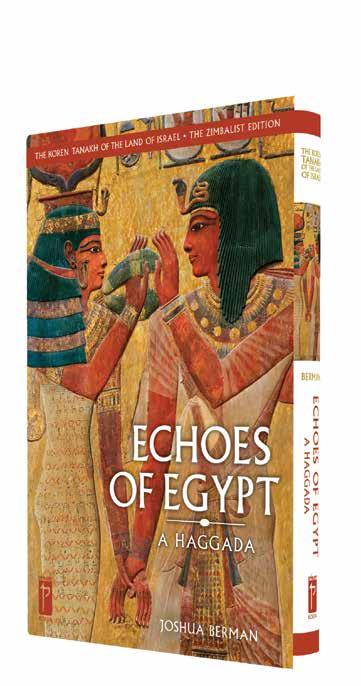
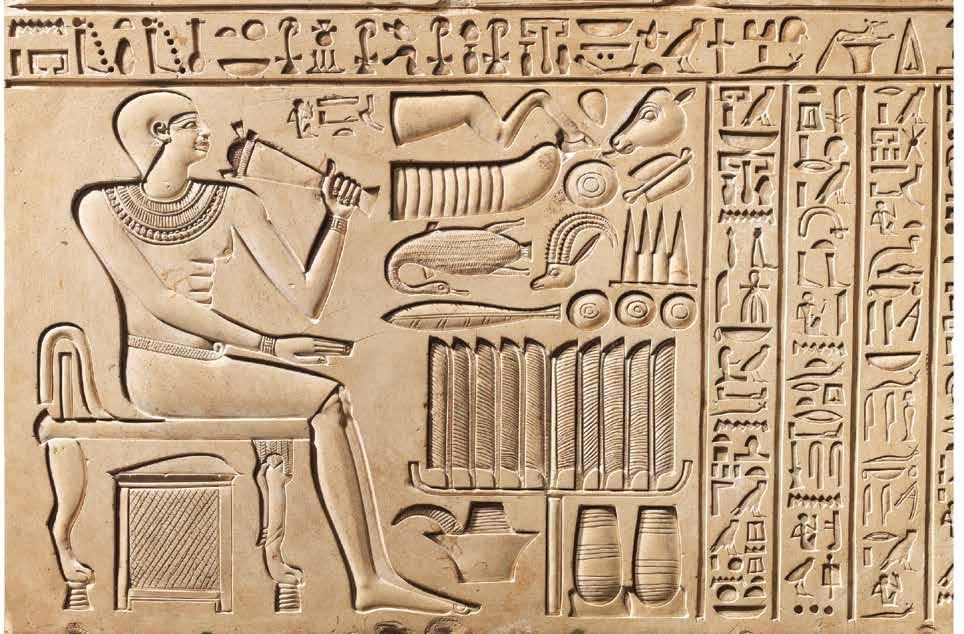
This Haggada shows you the Egypt that the Torah knew and confronted.
By Rabbi Dr. Joshua Berman





their enemy.
The child’s father is a Kanoe man. The Akuntsu women rely on Kanoe men for traditionally male roles, including hunting and clearing fields.
Initially, the Akuntsu women — traumatized by violence, discouraged by the disintegration of their community and without Akuntsu men — chose not to have children. That is why the recent birth came as such a surprise.
The birth is especially significant be-
cause the child is the first male born into the tribe since its last male member died in 2017.
Two Israelis and two Greeks were sentenced last week to eight years in prison for their involvement in a major spyware
Dilian was among those sentenced, along with Sara Hamou and two former Greek executives from his company. The judge said the defendants — who were not present at the sentencing — were convicted of “breaching the confidentiality of telephone communications,” as well as “tampering with a personal-data filing system on a repeated basis” and “illegal access to an information system or data.”
The Predator software allows hackers to access messages and photos on targeted phones and remotely activate the device’s microphone and camera.

In 2022, Thanassis Koukakis, a Greek investigative journalist, discovered that Greece’s intelligence service (EYP) had wiretapped him and infected his phone with Predator. The scandal — dubbed “Greek Watergate” by local media — led to several resignations within the administration of Prime Minister Kyriakos Mitsotakis.
The controversy intensified in July 2022 after Nikos Androulakis, now leader of the socialist Pasok-Kinal party, revealed that his phone had also been tapped, prompting additional government resignations.
The four individuals will remain out of custody while their attorneys pursue an appeal.
scandal in which prominent Greek politicians were hacked and wiretapped.
The spyware, known as Predator, was supplied by Intellexa, a company founded by Tal Dilian, a former Israeli military officer. The software was used to target more than 90 individuals, including politicians, journalists and senior military officials. In 2024, then-U.S. President Joe Biden imposed sanctions on Intellexa, which were later lifted by President Donald Trump.

As Cuba reels from a fuel blockade imposed by the United States, President Donald Trump has floated the idea of a “friendly takeover” of the Caribbean nation, drawing comparisons to recent U.S. actions involving Venezuela.
“If we don’t see a tanker come into Havana sometime by mid-March, that’s what we call the zero hour. In other words, that’s it. There’s no inventory,


there are no strategic reserves — that’s it, they’re out of business,” said Jorge Piñon, director of the Latin America and Caribbean Energy Program at the University of Texas at Austin, noting that time is running out for Cuba’s government.
Last Wednesday, Trump allowed limited commercial and humanitarian fuel deliveries to Cuba, though experts say the shipments provide little relief. While the country requires roughly
.

On Friday afternoon, a cargo plane carrying $62 million worth of newly printed Bolivian currency crashed at an airport near the capital La Paz.
The Hercules C-130 aircraft was ferrying the money from the country’s central bank when it “landed and veered off the runway.”
At least 20 people were killed in the crash and more than a dozen were injured.
As the plane crashed, thousands of people ran to the airport, attempting to pick up the bills that had billowed out of the plane when it crashed.
Authorities sprayed water and tear gas to fend off the mob of scavengers.
More than 500 soldiers and 100 police officers were brought in to deal with the chaos.
“Our estimates suggest that at the peak of the conflict there were about 20,000 people” trying to collect the bank notes, Bolivia’s Vice Minister of Interior Order Hernan Paredes said. “There were vandal groups embedded, that’s why we detained 49 people.”
Police and military personnel burned the cash boxes in the presence of Central Bank President David Espinoza, who said the bills “have no legal value because they never entered circulation,” without clarifying what that meant.
Espinoza said the banknotes had arrived in Santa Cruz from abroad.
Bolivia is one of the poorest countries of Latin America and is facing one of the highest bouts of inflation recorded at an increase of 25 percent last year.
22,000 barrels of fuel per day, the approved shipments total only about 150 barrels daily.
International groups have raised humanitarian concerns.
According to reports, Secretary of State Marco Rubio is holding negotiations with Raúl Guillermo Rodríguez Castro, the grandson of Cuba’s 94-year-old de facto leader, Raúl Castro.
Rubio has not indicated that imme -
diate regime change is the objective.
“Cuba needs to change. It needs to change. And it doesn’t have to change all at once,” Rubio said on Wednesday. Previously, he stated that Cubans need “economic freedom.”
Some analysts speculate that the crackdown is intended to pressure Cuba to normalize relations with the United States and distance itself from Russia and China.
On Wednesday, four days into the U.S. and Israeli war against Iran, a United States attack submarine sank an Iranian naval ship off the coast of Sri Lanka with a torpedo.
“This was never meant to be a fair fight,” Defense Secretary Pete Hegseth said. “We are punching them while they


Ono International School Programs
Undergraduate Programs
B.O.T. Occupational Therapy
LL.B. Law
B.A. Finance & Real Estate
Graduate Programs
M.A. Art Therapies
MBA tracks including Fintech and Cybersecurity & Forensics


Signature Advantages
Career-driven programs built to professional standards.
All-around student support: academic advising plus personal and social guidance throughout your journey.
Ideal for U.S. students and new olim seeking a smooth transition.




are down, which is exactly the way it should be.”
It was the first time an American torpedo has sunk a ship since World War II. The attack left at least 101 people missing, one dead and 78 injured.
“An American submarine sank an Iranian warship that thought it was safe in international waters,” Hegseth said. “Instead, it was sunk by a torpedo. Quiet death.”
Sri Lanka’s Foreign Ministry has said
at least 80 people were killed in the attack. Search-and-rescue operations were underway in an effort to locate survivors.
Hegseth also claimed the U.S. hunted down and killed an Iranian inside Iran who had been involved in plotting to assassinate President Donald Trump. “Iran tried to kill President Trump and Trump got the last laugh,” he said.
Chairman of the Joint Chiefs of Staff, General Dan Caine, said the U.S. strikes have already eroded Iran’s ability to send
East, raising concerns in Congress that the U.S. is further depleting its stocks of such anti-missile defenses. Those munitions stocks have already been depleted by weapons shipments to Ukraine to aid its defense against Russian strikes.

“Our stockpile of those, as well as Patriots, remain extremely strong,” Hegseth said. “Our air defenses and that of our allies have plenty of runway.”
ballistic missiles against U.S. bases in the region. Iran’s total number of ballistic missiles fired in the region has gone down by 86% from the first day of fighting, Caine said. Iran’s launch rate of so-called kamikaze attack drones is down 73%.
Iran’s ballistic missile volleys have required the U.S. to use expensive defense equipment—such as Patriot missile batteries and Terminal High Altitude Area Defense (THAAD) systems—to protect American bases and allies in the Middle

visited Israel last Wednesday for a two-day trip, addressing the Knesset in a speech in which he reaffirmed his strong relationship with Prime Minister Benjamin Netanyahu and vowed to combat Islamist terrorism.
“India stands with Israel firmly, with full conviction, in this moment and beyond,” Modi declared to Israel’s parliament.
Before Modi spoke, Netanyahu addressed the Knesset, touting the two countries’ “iron alliance … in the face of extremist Islam.” The Israeli prime minister also discussed the IMEC initiative, an in-progress transport project supported by the United States and developed by Israel and India. The project aims to connect India to Europe by sea and rail through the Middle East.
“This maritime-land corridor can exist and flourish only if it passes through stable and secure countries. And there are no stronger and more secure countries on this axis than India and Israel,” Netanyahu said.

During his remarks, Modi praised Israel as a “protective wall against barbarism.”
“The massacre of October 7 made it absolutely clear: either the jihadist axis of evil will break us, or we will break it,” Modi said, referring to the Hamasled attack on southern Israel that killed 1,200 people and left 251 hostages in captivity. “And we are breaking it — and will break it.”
He added, “I carry with me the deepest condolences of the people of India for every life lost and for every family whose world was shattered in the barbaric terrorist attack by Hamas on October 7.”
Netanyahu expressed gratitude for Modi’s support following the October 7 attacks. He also described India as “a civilization where Jews were never persecuted by the state, only welcomed.”
Modi praised the U.S. Gaza peace plan, asserting that it “holds the promise of a just and durable peace for all the people of the region, including by addressing the Palestine issue.”
Modi first visited Israel in 2017, becoming the first Indian prime minister to do so. During that visit, his close friendship with Netanyahu was on display as the two leaders toured together
and publicly emphasized their strong ties.
“Narendra, my dear friend, I am deeply, deeply moved by your visit here today,” Netanyahu said. “Because I have to be diplomatic, I will not rank it. I’ll get into trouble. But I’ve never been more moved than by your visit here with us — a great friend of Israel, a great champion of the Indian-Israeli alliance, and a great leader on the world stage.”
Opposition members staged a walkout during Netanyahu’s speech in protest of High Court President Isaac Amit’s exclusion. They returned when Modi began speaking. Opposition
Leader Yair Lapid shook the Indian leader’s hand, telling him the protest “had nothing to do with you.”
“The entire State of Israel is filled with admiration for your leadership, for your friendship, for the fact that you were here for us in our time of trouble, and for the alliance — the eternal alliance — between our two states,” Lapid said. “So thank you very much for being here. We are all, on both sides of the aisle, looking forward to hearing your speech.”

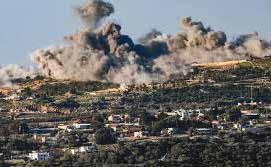
In a video message delivered on Saturday, Prime Minister Benjamin Netanyahu announced the launch of Operation Roaring Lion, an ongoing joint U.S.-Israeli campaign that aims, in his words, “to put an end to the threat from the Ayatollah regime in Iran.”
Netanyahu referenced multiple missile strikes and said the operation would continue for as long as necessary.
He sharply criticized the Iranian regime, stating that during its 47-year rule it has called for the destruction of Israel and the United States, suppressed its own people, invested heavily in nuclear weapons development and missile programs, and funded terrorist groups across the region.
“If anyone needed further proof of the murderous nature of the Ayatollah regime, they received it last month,” he said. “We all saw how this regime of terror in Tehran carried out an unprecedented mass slaughter of Iran’s own citizens. It murdered thousands of children, adults and elderly people in cold blood. Tens of thousands were arrested, tortured and abused. And why? Simply because they sought lives of freedom and dignity.”
He described Iran’s negotiations with the United States as “futile and deceptive,” arguing that previous military actions failed to prevent Tehran from secretly rebuilding its nuclear and missile capabilities. As a result, he said, the United States and Israel launched a new campaign to “strike the terror regime hard and create conditions that will enable the brave Iranian people to cast off the yoke of this murderous regime.”
“As a people that cherishes life, we have no choice but to go to battle. But this time, we do so with the combined mighty power of the State of Israel and the United States of America,” Netanyahu said. “To the citizens of Iran: You, the people of Iran, and the honorable Iranian army are not our enemies, and we are not your enemies. We have a










common enemy: the murderous clique of Ayatollahs that seized control of you through the oppressive forces of the Revolutionary Guards and the Basij.”
Netanyahu urged the Iranian people to seize the moment, overthrow their government and “establish a new and free Iran.”
He thanked U.S. President Donald Trump, calling him “not only Israel’s greatest friend to sit in the White House” but also “a determined leader of
the free world.” He also commended the Israeli military and security services.
Netanyahu concluded by drawing parallels to the upcoming Jewish holiday of Purim.
“My brothers and sisters, in two days, we will celebrate the holiday of Purim,” he said. “Two and a half thousand years ago, in ancient Persia, a tyrant rose against us with the same goal: to destroy our people completely. But Mordechai the Jew and Queen Esther,
through their courage and resourcefulness, saved our people. In those days of Purim, the lot fell, and the wicked Haman fell with it. Today as well, the lot has fallen, and the evil regime’s end will also come. The prophet Amos said: ‘The lion has roared — who will not fear?’ In Operation Roaring Lion, we roar. Do not fear, Israel, for the lion’s cub has risen.”
On Monday, Israel said that it had killed Hussein Makled, chief of Hezbollah intelligence, in an overnight strike in Lebanon. Beirut said that it would ban the terror group’s military activities, hours after the Iran-backed organization fired rockets and drones at Israel, leading to major retaliatory strikes.
The Israeli military said Makled was responsible for “forming the intelligence picture using various intelligence collection tools to provide the Hezbollah terror organization with intelligence assessments regarding IDF troops and the State
“He also closely cooperated with senior commanders in Hezbollah who planned and advanced terror attacks against Israel and its citizens,” the military added.
The terror group’s overnight attacks — which it said were in retaliation for the killing of Iranian supreme leader Ali Khamenei in the opening minutes of the joint Israeli-U.S. assault on Iran on Saturday — led to waves of Israeli airstrikes across Lebanon, including in Beirut, the capital.
In a statement after a cabinet meeting, Prime Minister Nawaf Salam said Lebanon rejected any military actions launched from its territory “outside the framework of its legitimate institutions and affirmed that the decision of war and peace is exclusively in its hands.”
This “necessitates the immediate prohibition of all Hezbollah’s security and military activities as being outside the law, and obliging it to hand over its weapons to the Lebanese state,” he said.
Salam ordered the military and security agencies to take “immediate measures” to implement the cabinet decision and prevent “any military operation or the launching of missiles or drones from Lebanese territory.”
Lebanon has been seeking to disarm Hezbollah since the ceasefire with Israel went into effect in November 2024.
On Saturday, upon the beginning of Israeli and American operations in Iran and the subsequent retaliatory fire from

Recipes That Work Year-round swaps

Systems That Save You
Meaning That Grounds
Tehran, Salam had warned that Lebanon refused to be dragged into war. After Hezbollah on Sunday promised to take action against Israel and the U.S., President Joseph Aoun reiterated that “the decision of war and peace rests solely with the Lebanese state,” in a plea for the terror group to remain on the sidelines, as it had done during the previous 12-day war between Israel and Iran in June 2025.
But the request fell on deaf ears as Hezbollah moved ahead with its attack, the first time that the Iranian proxy had fired at Israel since the U.S.-brokered ceasefire between Israel and Lebanon.
In the wake of the attack, Defense Minister Israel Katz said on X that Hezbollah’s chief Naim Qassem was now “a marked target for elimination.” He warned that Qassem would meet the same fate as Iran’s Khamenei.
Nine people were killed when a ballistic missile fired from Iran slammed into a residential neighborhood in Beit Shemesh on Sunday. More than forty people were injured when the missile destroyed a shul
and caused extensive damage to a public bomb shelter beneath it, as well as surrounding homes.
The victims were three teenage siblings, a mother and her adult daughter, a mother and her adult son, a 16-year-old boy, and a man.

It was the deadliest missile strike in Israel in the current conflict with Iran.
On Saturday, Philippine national Mary Anne Velasquez de Vera, 32, was killed in a missile strike in Tel Aviv.
The IDF said that the failure to intercept the missile that hit Beit Shemesh was under investigation by the Israeli Air Force. Air defense systems were activated in the area, but the interceptors failed to shoot down the missile for as-yet unclear reasons, resulting in the direct hit by the estimated 500-kilogram warhead.
Ronit Elimelech, Hy”d, 45, volunteered with the United Hatzalah emer-

gency service. Paramedics called to the scene found her medical kit and vest amid the rubble. Her mother, Sara, was also killed in the attack.
Ronit and her three children had been at her parents’ home in Beit Shemesh and entered the public shelter underneath the shul once they heard sirens go off. First responders rescued two of Ronit’s children from the rubble and took them to Jerusalem’s Hadassah Ein Kerem Medical Center after they sustained light to moderate injuries in the strike.
The third child was apparently unharmed, and Sara’s husband was also found safe.
“Ronit joined United Hatzalah after her young son asked her to volunteer as his birthday gift. I met them personally, and they hold a very special place in our hearts,” Eli Beer, United Hatzalah’s president, wrote on X. Ronit volunteered after her son, Itamar, who is autistic, requested that she join on his 11th birthday.
“Itamar was so proud of his mother,” Beer wrote.
Siblings Yaakov Biton, 16, Avigail Biton, 15, and Sara Biton, 13, Hy”d, were also killed in the attack.
Oren Katz, Hy”d, was laid to rest on Monday and was eulogized by his son.
“You were always a special person who cared for everyone, not only yourself,” said Yosef Katz. “Yesterday, you came home in the middle of the workday so we’d have something to eat for lunch. I’m glad I had the privilege to eat your food for the last time,” he said. “You told us we were your reason for living.”
Sixteen-year-old Gavriel Baruch Ravach was also killed in the strike. Baruch’s father had previously donated funds to and had been involved in the building of the shul destroyed in the same missile strike in which his son was killed.
Bruria Cohen, Hy”d, was killed alongside her adult son Yosef, Hy”d.

More than 50,000 people took part in the Tel Aviv Marathon on Friday, with over 3,000 people running the full race — more than any other previous year.
The half-marathon also saw record
participation, with more than 12,000 runners.
In the women’s full marathon, Baraki Gabriela of Ethiopia set a new record of 2:35.20, a 31-second improvement on Kenyan runner Margeret Njugana’s record-setting 2:35:5 in the race’s 2017 edition.
Among men, Nyakundi Dickson Simba of Kenya came in first with a time of 2:10.14, just seconds short of the record.
Tel Aviv Mayor Ron Huldai spoke before the race. He expressed hope that it would signify a return to normalcy after more than two years of war.
“This is the largest marathon we’ve had, and I believe this marathon will be a symbol of a return to regular life in the State of Israel,” he said.

According to a new study by healthcare staffing platform Nursa, Vermont is the fittest state in the United States. The state received high marks for sleep, diet, physical activity and low smoking rates. The analysis gave Vermont a score of 8.97 out of 10.
More than 70% of Vermonters report getting seven or more hours of sleep per night, and 12.9% say they consume two or more fruits and three or more vegetables daily — the highest rates in the country. Additionally, Vermont has 13.1 gyms per 100,000 residents, along with numerous walking and hiking routes. The state also has fewer fast-food restaurants than many others, and its adult smoking rate is 13.2%, nearly 3 percentage points below the national average. Vermont’s life expectancy stands at 78.4 years.
Massachusetts ranked second, earning an 8.73 out of 10 due to relatively low obesity rates (27%, compared with the national average of 34%), low smoking rates (11.7%), and the highest aerobic activity rates nationwide.



Washington placed third, boasting the most walking, running and hiking routes, along with a high number of gyms. Colorado ranked fourth and, despite having the highest number of fast-food restaurants, has the lowest obesity rate in the country and one of the largest numbers of gyms.
Louisiana was ranked the least fit state, scoring 4.25. The state has relatively few gyms, an adult obesity rate of 39.2%, a smoking rate of 21%, and low
activity levels. Mississippi and West Virginia were ranked the second- and third-least fit states, respectively, with high obesity, smoking and physical inactivity rates. Southern states overall received the lowest scores.
New York ranked 15th with a score of 7.75. New Jersey placed ninth with an 8.06, and California came in eighth with an 8.08.
All 10 occupants were Cuban nationals residing in the United States. The boat, which authorities say was stolen from one of the men’s employers, departed from Florida.
U.S. officials said that one of the four people killed was a U.S. citizen and that another American citizen was among those detained.

The Cuban government alleged that the passengers — who were carrying assault rifles, handguns, Molotov cocktails, bulletproof vests, telescopic sights and camouflage uniforms — had been planning to carry out an attack. Each of the occupants had a “known history of criminal and violent activity,” the Interior Ministry claimed.
Cuban authorities said the speedboat opened fire on a border patrol vessel, prompting the exchange of gunfire.
U.S. officials said they had limited information about the incident and would investigate further.
The deceased were identified as Michael Ortega Casanova, Pavel Alling Peña, Ledián Padrón Guevara and Hector Duani Cruz Correa. The surviving occupants were Cristian Ernesto Acosta Guevara, Conrado Galindo Sariol, José Manuel Rodríguez Castelló, Leordan Enrique Cruz Gómez, Amijail Sánchez González and Roberto Álvarez Ávila.
Authorities also detained another Cuban national, Duniel Hernández Santos, on the island.
Casanova, an American citizen, had lived in the United States for more than 20 years and worked as a truck driver. His brother said he had an “obsessive and diabolical” mission to free Cuba from its communist regime.
Last week, a Florida-registered speedboat approached Cuba carrying weapons, leading to a deadly shootout in which Cuba’s coast guard killed four people onboard. According to Cuba’s Interior Ministry, the other six occupants were injured and detained.
A new study led by Israeli and American researchers has found that so-called “SuperAgers” — adults over 80 with memory abilities comparable to people decades younger — may generate significantly more new brain cells than their peers.
The peer-reviewed research, published in Nature, was headed by Orly




















Pursue a vital, growing, and well-paid career in Pharmacy.
Pharmacists are in great demand across healthcare—from patient care to industry—with an average salary of $152K. At Touro College of Pharmacy, you’ll learn in small classes with supportive faculty and gain real-world experience through 54 weeks of hands-on rotations. Our graduates achieve the highest NAPLEX pass rate in NYC, a 99% employment rate, and train at our new 3 Times Square campus with state-of-the-art labs and a model pharmacy.


tcop.touro.edu
Henry Cohen, PharmD, MSc, FCCM, Dean and Professor
CONTACT: Heidi Fuchs, Assistant Dean, Admissions & Enrollment 646.981.4750 | admissions.pharmacy@touro.edu | tcop.touro.edu
40 Lazarov, a professor at the University of Illinois Chicago’s College of Medicine and director of its Alzheimer’s Disease and Related Dementia Training Program. Lazarov earned her doctorate at Israel’s Weizmann Institute of Technology.
Adults 80 and older who can recall daily events and personal history as sharply as cognitively normal people in their 50s and 60s are classified as SuperAgers. Until now, scientists did not fully understand the biological basis for their remarkable memory retention.

“We’ve always said that SuperAgers show that the aging brain can be biologically active, adaptable, flexible, but we didn’t know why,” said Tamar Gefen, an associate professor at Northwestern University Feinberg School of Medicine and a neuropsychologist at Northwestern’s Mesulam Institute.
By analyzing postmortem hippocam-
pus tissue from five groups — including healthy young adults, typical older adults, people with early cognitive decline, Alzheimer’s patients and SuperAgers — the team examined nearly 356,000 individual cell nuclei using advanced single-cell sequencing technology.
The findings were striking: SuperAgers produced roughly twice as many new neurons as other healthy older adults and two-and-a-half times more than individuals with Alzheimer’s disease. Researchers also identified a distinct “resilience signature” in the SuperAger hippocampus that appears to support the birth and survival of new neurons.
“SuperAgers had twice the neurogenesis of the other healthy older adults,” Lazarov said. “Something in their brains enables them to maintain a superior memory. I believe hippocampal neurogenesis is the secret ingredient, and the data support that.”
In contrast, brains from individuals in the earliest stages of cognitive decline showed minimal neuron growth, while those with Alzheimer’s generated almost none.
“This is biological proof that their brains are more plastic,” Gefen said, calling the discovery “a real breakthrough.”
Researchers say the findings could

help guide new therapies aimed at promoting cognitive resilience, preventing Alzheimer’s disease and supporting healthier aging overall.

Two people were killed and 14 people were injured in a shooting in downtown Austin, Texas, early Sunday in front of a bar. Authorities are investigating if the shooting is connected to terrorism.
The shooter was also killed.
Austin Police Chief Lisa Davis said a man armed with a pistol opened fire from his SUV and shot at people around 2 a.m. local time. The man then drove to another street, exited the vehicle with a rifle and started shooting at people walking by. Police officers fatally shot the shooter, 53-year-old Ndiaga Diagne, at an intersection.
Alex Doran, the acting special agent in charge of the Federal Bureau of Investigation in San Antonio, said it was too early to know the shooter’s motive. “There were indicators on the subject and in his vehicle that indicate potential nexus to terrorism,” he related.
Fourteen people were taken to hospitals where three remain in critical condition.
Davis said the shooter had driven around the block several times before putting on his flashers, rolling down his window and opening fire at the bar on West Sixth Street, a popular stretch of nightclubs several blocks west of the famed Sixth Street nightlife district. The area is usually packed with thousands of revelers and police on patrol.
Six U.S. soldiers were killed on Sunday in Kuwait. They died just one day after the U.S. and Israel launched their military campaign against Iran. Iran responded to the attacks by launching missiles and drones against Israel and several Gulf Arab states that host U.S. armed forces.
Sgt. 1st Class Nicole Amor was just
days away from returning home to her husband and two children when a drone strike at a command center in Kuwait killed her and five other U.S. service members.
“She was almost home,” her husband, Joey Amor, said from their home in White Bear Lake, Minnesota,. “You don’t go to Kuwait thinking something’s going to happen, and for her to be one of the first – it hurts.”
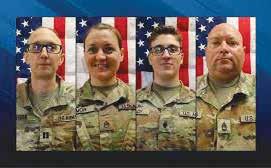
Those killed also included Capt. Cody Khork, 35, of Winter Haven, Florida; Sgt. 1st Class Noah Tietjens, 42, of Bellevue, Nebraska; and Sgt. Declan Coady, 20, of West Des Moines, lowa, who was posthumously promoted from specialist. Two other soldiers were not yet identified.
“These men and women all bravely volunteered to defend our country, and their sacrifice will never be forgotten,” Army Secretary Daniel Driscoll said. All were assigned to the 103rd Sustainment Command, which provides food, fuel, water and ammunition, transport equipment and supplies.
Coady had just told his father last week that he had been recommended for a promotion from specialist to sergeant, a rank he received posthumously. He was one of the youngest people in his class but seemed to impress his instructors.
“He was very good at what he did,” his father Andrew recalled.
Coady trained as an information technology specialist with the Army Reserves and was studying cybersecurity at Drake University in Des Moines. He was taking online classes while in Kuwait and wanted to become an officer.
Amor, 39, was an avid gardener who enjoyed making salsa from the peppers and tomatoes in her garden with her son, a senior in high school. She also enjoyed rollerblading and bicycling with her fourth-grade daughter.
A week before the drone attack, Amor was moved off-base to a shipping container-style building that had no defenses, Joey Amor said.
“They were dispersing because they were in fear that the base they were on was going to get attacked and they felt it was safer in smaller groups in separate places,” he said.
Khork was very patriotic and was

42 drawn from a young age to serve the U.S. He enlisted in the Army Reserve and joined Florida Southern College’s ROTC program.
“That commitment helped shape the course of his life and reflected the deep sense of duty that was always at the core of who he was,” said his mother, Donna Burhans, father, James Khork, and stepmother, Stacey Khork, in a statement.
His family described him as “the life of the party, known for his infectious spirit, generous heart, and deep care for those who served alongside him and for everyone blessed to know him.”
Tietjens lived with his family in the Washington Terrace mobile home park in the Omaha suburb of Bellevue, Nebraska. He was married with a son. He earned a black belt in Philippine Combatives and Taekwondo and was “an instructor who gave his time, discipline, and leadership to others,” the Philippine Martial Arts Alliance said in a Facebook post.
State Rep. James Talarico defeated U.S. Rep. Jasmine Crockett of Dallas in
the Texas Senate primary on Tuesday in a battle of two national Democratic rising stars.
Talarico will now face the Republican candidate – either incumbent Sen. John Cornyn or embattled state Attorney General Ken Paxton – in the May 26 runoff.
Talarico, 36, is a Presbyterian seminarian and former elementary school teacher.

No Democrat has won a statewide race since 1994, although former Rep. Beto O’Rourke came within about 2.5 percentage points of Sen. Ted Cruz in 2018. While Crockett entered the race three months after Talarico, she was the favorite due to her star power and fundraising prowess. She had gained nationwide fame for her cutting comments about Republicans, such as slamming former House peer Marjorie Taylor Greene as a “beach blonde bad built butch body” for

insulting her false eyelashes.
Talarico’s platform revolved around economic issues such as increasing wages and expanding access to affordable housing and childcare.
Talarico launched his campaign with a cinematic ad standing on the bed of a rusted pickup truck, sleeves rolled up, outside a church. “The biggest divide in our country is not left vs. right, it’s top vs. bottom,” Talarico said in the ad, previewing his campaign focused on economic inequality.

A senior figure in Japan’s notorious underworld has been sentenced to two decades behind bars in a New York federal court for attempting to traffic nuclear material, narcotics and weapons, U.S. officials announced Tuesday.
Takeshi Ebisawa, 61, described by prosecutors as a leader in Japan’s Yakuza crime syndicate, was handed a 20-year prison term after pleading guilty earlier this year to six federal charges. He had been in custody since April 2022 following his arrest in Manhattan during a U.S. Drug Enforcement Administration sting.
According to the Justice Department, Ebisawa believed he was negotiating in 2021 and 2022 with an Iranian general seeking weapons and nuclear material. In reality, he was communicating with a confidential DEA source and an undercover associate posing as the general.
“After initially offering uranium, Ebisawa proposed to supply the General with ‘plutonium’ that would be even ‘better’ and more ‘powerful’ than uranium for Iran’s use,” the Justice Department said in a statement.
Prosecutors said Ebisawa boasted in 2020 that he had access to significant quantities of nuclear material. To bolster his claims, he allegedly sent photographs showing rocky substances alongside Geiger counters registering radiation, asserting they contained uranium and thorium. U.S. authorities later obtained samples of the material, and a federal laboratory determined they included uranium, tho-
rium and weapons-grade plutonium — meaning the isotope composition could be suitable for use in a nuclear weapon if refined in sufficient quantity.
Court filings allege the material originated from an unidentified leader of an ethnic insurgent group in Myanmar that had been mining uranium. Ebisawa purportedly sought to broker the sale to finance a weapons purchase, including surface-to-air missiles, for armed groups in the region.
In addition to the nuclear trafficking scheme, prosecutors said Ebisawa conspired to sell 500 kilograms each of methamphetamine and heroin for distribution in New York and worked to launder $100,000 in drug proceeds.
“Takeshi Ebisawa has been held accountable for his crimes, including an attempt to sell weapons-grade plutonium to Iran and to flood New York with deadly narcotics,” said John Eisenberg, assistant attorney general for national security.

Rep. Dan Crenshaw has become the first sitting House member to lose a primary in 2026, a stunning setback for the Texas Republican once seen as a rising force within the party.
State Rep. Steve Toth defeated Dan Crenshaw in Tuesday’s GOP primary, securing roughly 56% of the vote to Crenshaw’s 41% with nearly all ballots counted, according to the Associated Press. The district, located outside Houston, had been redrawn ahead of the election.
Crenshaw, a former Navy SEAL who lost an eye in an IED explosion while serving in Afghanistan, rose to national prominence in 2018 after responding with humor to a mocking “Saturday Night Live” skit. But in recent years, his relationship with the MAGA wing of the party appeared to fray.
Though Crenshaw frequently defended his conservative credentials, he did not receive an endorsement from Donald Trump. He also declined to vote to overturn the 2020 election results and was outspoken in condemning the Jan.

Capitol events — positions that fueled criticism from some Trump allies.
Toth branded himself a “true conservative” and won backing from Turning Point USA, the youth-focused conservative group founded by Charlie Kirk. Days before the primary, Sen. Ted Cruz publicly endorsed Toth, shortly after Crenshaw voted against Cruz’s ROTOR Act aviation safety bill.
Crenshaw also drew fire from prominent conservative voices, including Tucker Carlson, who once derided him as “eyepatch McCain,” questioning his ideological loyalty.
Elsewhere in Texas, several high-profile Republicans are headed to runoffs. Sen. John Cornyn will face Attorney General Ken Paxton in a costly and closely watched GOP Senate runoff, highlighting tensions between establishment conservatives and MAGA-aligned firebrands.
In another House race, Rep. Tony Gonzales advanced to a runoff against
former Rep. Colin Allred.
For Crenshaw, the loss underscores the shifting dynamics within Texas GOP politics — and the continued power of Trump-aligned conservatives in primary contests.
gers total, were unable to take off before the airport’s 1 a.m. curfew on Thursday due to bad weather. There was no space left at the terminal due to all the cancellations, and so the planes stayed where they were.
Around 100 flights were canceled in Munich on Thursday, and temperatures dropped to 30 degrees Fahrenheit. There were long lines to de-ice planes, while runways were periodically closed at short notice to clear the heavy snowfall.


Last week, hundreds of people spent their night trapped on parked airplanes at
Munich, Europe’s 10th-busiest airport, typically shuts at midnight, but it received a permit that day to operate an hour later.
The passengers on the six flights couldn’t be transported to the terminal because “bus service was severely restricted” due to “the late hour and communication problems,” the airport said.
It took hours for the buses to come to pick up the passengers from the planes.
Five of the affected flights were operated by Germany’s Lufthansa Group, two of which were with its subsidiary, Air Dolomiti. The other plane belonged to Air Arabia, a budget airline based in the UAE.
“There was no food or drink for us. There were no blankets for us, either,”
Firefighters were called in to deal with the “high angle rescue” just before 9 a.m. They had received reports that a rainbow hot air balloon became snagged on a cell tower. The balloon was punctured and was left dangling almost 920 feet off the Texan ground.
Fourteen rescuers were involved in saving the duo. They had to scale the tower and finally reached the victims, who were in the basket of the hot air balloon, swaying in the wind.
First responders used multiple 300foot ropes to safely remove the passengers from the hot air balloon basket. They lowered the shaken pair “rope by rope” until they were back on the ground.


He said passengers on the canceled flight to Copenhagen asked if they could enter the airport, but they were told it was forbidden and that all the bus drivers had
“We’re simply trapped here, along with the staff, too,” he added.
“Overall, it was a pretty smooth operation, as much as it can be, with all the challenges here,” Longview Special Operations Lieutenant Stephen Winchell said.










A Lufthansa spokesperson apologized for the snafu. “Together with our partners at Munich Airport, we are doing everything we can to ensure that such mistakes do not happen again,” he said.
Let’s not fly off the handle about this.

Two people were saved in a heart-stopping rescue after their hot air balloon collided with a cell tower on Saturday morning, leaving them high and dry, dangling nearly 1,000 feet above the ground.

“Climbing 1,000 feet up, 1,000 feet down, for some of them, with a bunch of heavy gear and rope, is a very physically taxing event. I’m thankful for their sweat-equity, and the L-rd being with us,” he added.
He described the situation as “the Super Bowl of rope rescues” simply due to the logistical challenges, including the exposure to the elements and the height of the tower.
Tower King II, a local construction company, will break down the remnants of the balloon piece by piece. Their first priority is lowering the basket and its remaining tank of propane back to the ground. After that, they’ll free the rest of the shredded balloon.
High five to them.



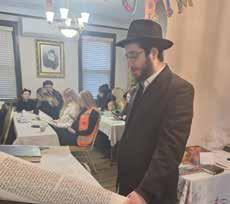
Purim with Chabad of the Five Towns reached thousands across the community. More than 150 Megillah readings took place throughout the Five Towns, including readings every half hour at Chabad, with over 3,000 people hearing the Megillah this Purim. Through the Friendship Circle, 200
teen volunteers delivered over 200 Mishloach Manot packages to every child with special needs in the community. The packages were lovingly prepared by Chabad’s Chai Five Mitzvah Club. Chabad’s Kitchen of Kindness also delivered 100 healthy “Hugs from the Kitchen” care packages to seniors and others

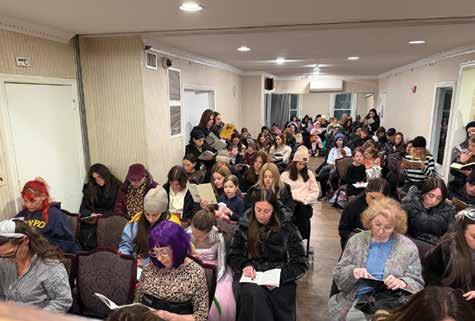
who could use an extra lift, bringing the warmth and joy of Purim throughout the Five Towns.
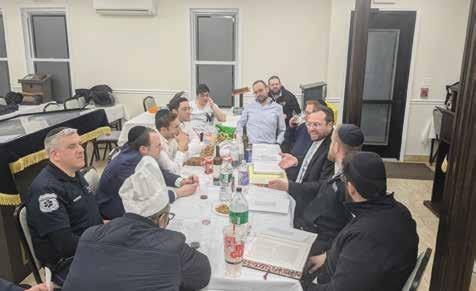
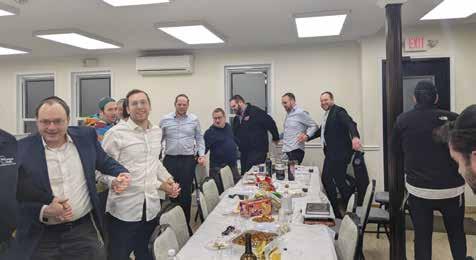
A sold-out crowd gathered at Chabad of the Five Towns for an unforgettable Purim Seudah, “Neon Nights in Shushan.”


CHABAD. JOY. COMMUNITY.

DINNER WITH A DIFFERENCE
UE S DA Y , M

VIP COCKTAIL RECEPTION 6:00 PM DINNER EXPERIENCE 7:00 PM
GRAND BALLROOM OF THE SEPHARDIC TEMPLE 775 BRANCH BLVD ⋅ CEDARHURST, NY









VACATION ORLANDO FAMILY GETAWAY WEEKLY FLOWERS FOR A YEAR HANDWRITTEN MEGILLAH $1,800 AMEX GIFT CARD





























































nurtures every
empowering them to soar with









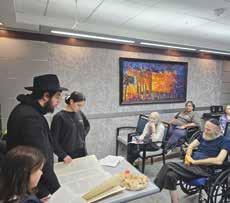
While most Long Islanders celebrated Purim this year with festive gatherings, costumes, and baskets of sweets, one small act of kindness inside the Nassau County Correctional facility in East Meadow left a powerful impression on Rabbi Anchelle Perl of Chabad of Mineola.
Rabbi Perl had entered the facility to read the Megillah for two Jewish inmates, bringing the message and joy of Purim to those spending the holiday behind bars.
“The contrast was striking,” Rabbi Perl recalled. “Outside, Purim was alive with celebration and laughter. Inside the jail facility, the atmosphere was quieter, heavier — but no less in need of Purim’s light.”
Shortly after arriving, one of the inmates approached him with a small item in his hand — a 0.08-ounce packet of zero-sugar raspberry lemonade drink mix,
purchased from the jail commissary.
“He handed it to me and said this was his mitzvah of mishloach manot,” Rabbi Perl said.
The Purim tradition of mishloach manot encourages people to exchange food gifts with friends and neighbors as a way of spreading joy and unity during the holiday.
“In that moment, I was deeply moved,” Rabbi Perl said. “I had come to bring him the joy of Purim, yet here he was fulfilling the mitzvah toward me.”
The rabbi noted that while he has received many elaborate Purim baskets over the years, none affected him quite like this small packet.
“Of all the mishloach manot I have received in my life — beautifully arranged baskets and gourmet treats — none touched me like that tiny packet of raspberry lemonade mix,” he said.
Rabbi Perl reflected that the experience brought to life a teaching from the Talmud: “More than the homeowner gives to the poor person, the poor person gives to the homeowner.”
“I came to cheer him up,” Rabbi Perl said. “But he cheered me up in a way I cannot fully describe.”
The rabbi said the encounter reminded him of several core Torah lessons — including the idea that true generosity is not measured by wealth.
“Here was a man with very limited resources, yet he still found a way to give,” he explained. “It was a powerful reminder that real giving comes from the heart.”
He also reflected on the resilience of the human spirit.
“Circumstances can confine a person physically, but they cannot imprison the soul,” Rabbi Perl said. “In that moment I saw the dignity and light that every per-
son carries.”
For Rabbi Perl, the gesture also reflected the deeper message of the Purim story itself — that hidden miracles often unfold in unexpected places.
“The Megillah never explicitly mentions G-d’s name, yet His presence is revealed through small events that change everything,” he said. “That tiny packet was a reminder of that hidden miracle.”
As Rabbi Perl left the facility that day, he said he carried with him a renewed appreciation for the power of simple acts of kindness.
“Sometimes, the smallest gifts carry the greatest meaning,” he said. “And sometimes, the person you come to uplift ends up uplifting you.”
Reflecting on the moment, Rabbi Perl added: “I will never forget that Purim gift. It was only 0.08 ounces, but it carried the weight of a very large soul.”




Mazal tov to HALB’s sixth grade girls on their Bat Mitzvah Breakfast! The morning began with parent-child learning and breakfast. Then the students performed and presented what they learned about the different women in Tanach. Finally, the morning ended with a fun dance party with Naz.
On Shabbos Parshas Tetzaveh, Rabbi Binyamin Zimmerman, a captain in the IDF Rabbinate, was the Scholar in Residence at the Young Israel of Woodmere. Rabbi Zimmerman discussed the great spiritual heights soldiers achieved in asking him the questions they did. For example, when Israel recaptured a certain kibbutz, a commander called Rabbi Zimmerman asking if he could avail himself of the shower and food in a recaptured house. This was a soldier who had not slept in three days.
Rabbi Zimmerman explained how Israeli soldiers not only demonstrated koach in fighting Hamas post-October 7 but also displayed gevurah in asking questions that shaped the war and inspired a nation. One Shabbat, a soldier was with his wife who had just given birth in Shaare Zedek Hospital. He was now being called back to the front. However, he nicked someone’s car and would not have menuchas ha’nefesh until he could “make it right.” “Can I leave a hand-written note for the owner to contact me for payment?” The rabbi said he would remain next to the car until Motzei Shabbat

and tell the owner.
The inspiring stories, divrei Toraj and important lessons on pikuach nefesh displayed to the congregants how superheroes emerged from the challenges they faced post-October 7. As a member of the IDF Rabbinate, Rabbi Zimmerman explored halachic issues that emerged in the heat of battle: how do we construct an eiruv? What constitutes pikuach nefesh?
How do we keep Shabbos? Many questions of first impression came to Rabbi Zimmerman via a hotline. Rabbi Zimmerman did not seek to answer all of these questions for his audience; rather, he was showing how we defeat our own Amaleks.
The Jewish people have shown tremendous achdut, as Rabbi Zimmerman explained. People went out of their way to ensure soldiers had hot, kosher meals. Differences were set aside to defeat Israel’s enemies.
Over the course of Shabbos, news came in that Iran’s Supreme Leader, Ayatollah Khomeini ym”sh, was killed in a U.S. missile strikeRabbi Zimmerman will no doubt be called back to issue more halachic rulings as the brave men and women of the IDF fight on.

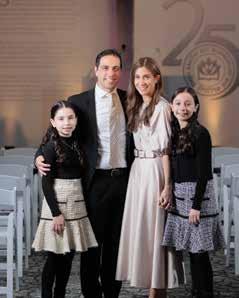


Arecord crowd turned out at Seawane Country Club this past Motzei Shabbos for the 25th Annual Shulamith School for Girls Dinner. The theme of the evening, “Honoring Our Story – Turning the Page Forward,” offered a meaningful opportunity to reflect on the school’s remarkable 25 years of growth and impact in the Five Towns community.
Parents and friends enjoyed a delicious dairy affair catered by Partini, enhanced by a beautiful live musical performance by Duvid’l. The atmosphere was vibrant, warm, and filled with an energy that resonated throughout the room.
Dinner Chairs Ben Portal and Yossi Reich opened the program, sharing heartfelt reflections about their daughters’ experiences at Shulamith and their deep appreciation for the evening’s honorees.
Rabbi Shay Schachter of YIW recited Te-


hillim and introduced special guest from the IDF Rabbinate, Rav Zimmerman, who thoughtfully framed the evening in light of the matzav in Eretz Yisroel.
Mr. Ari Cohen, President of the Board, encapsulated the audience with a unique “State of the Union” address which focused on the past, present, and future, with an underlying theme of ha’zorim b’dimah b’rinah yiktzoru, and all that it took to get Shulamith to where it is today and the impact it has had on countless girls.
Each honoree was introduced with a moving video presentation that captured the depth of their impact on the school and its students.
Mrs. Danyel Goldberg, our Educator of the Year, was celebrated for her unique warmth, humor, and ability to make every student feel seen and valued. She was presented with “The Danyel Papers,” a collection of essays written by past, pres-

ent, and future students — a heartfelt, student-led tribute conceived by Mrs. Shoshana Fischman and presented by Ms. Leora Goldstein.
Ruby and Michael Goldstein, honored as Parents of the Year, were recognized for their extraordinary dedication to Shulamith, the broader community, and their family. The video highlighted the Goldstein parents as remarkable role models in community service and traced the path of their many meaningful contributions to the school since becoming involved.
The evening concluded with a deeply meaningful Legacy Award presented to the Austein and Schachter families in recognition of their multigenerational commitment to Shulamith. Founding Principal Mrs. Joyce Yarmak spoke movingly about the school’s generational impact and highlighted the unique contributions of each family.
The video presentation concluded
with a beautiful visual tribute to “Why Shulamith,” featuring many of our students sharing their personal Shulamith stories — a powerful reminder of the school’s enduring impact.
A highlight of the evening was the spirited “Scratch Off for Shulamith” raffle, spearheaded by Mrs. Ruby Goldstein.
We extend our deepest gratitude to our Executive Director Rabbi Moshe Monczyk, Mrs. Kaitlyn Schlusselberg, the Shulamith Business Office, our Dinner and Journal Chairs, the Dinner Committee, and most importantly our devoted parents, grandparents, and generous donors. Your partnership and support made this milestone celebration possible.
As we honor our story and turn the page forward, we look ahead with excitement to continued growth and success for Shulamith School for Girls.
















The much anticipated seventh and eighth grade girls Shabbaton at YCQ began at the beautiful Honors Haven Resort last Friday. Upon arrival, students spent the afternoon swimming and participating in exciting Pre-Shabbat ruach with DJ Eli Arshadnia to welcome in Shabbat with singing and dancing. The energy continued throughout the evening.
After a beautiful tefilah and a dvar Torah from Rabbi Knapp, students gathered for seudat Shabbat. During the meal, the atmosphere was filled with Torah and friendship as Miriam Feder and Michal Kasaev shared insightful divrei Torah. When the meal was over, students participated in a spirited game of YCQthemed Apples to Apples. Talmidot then had the opportunity to hear from the absolutely incredible Mrs. Jackie Bitton, who captivated the audience with a talk about “The Power of Our Actions!” The
From dominant offensive explosions to overtime thrillers and playoff intensity, this week of JSL Winter 2026 by FM Home Loans delivered across the board. Let’s break it down.
K/P Hockey
Exclusive Cabinetry earned a fantastic team win over Smash House, 8–6. The entire squad played with heart and hustle, but Nate Friedman led the charge with multiple goals. Maidenbaum rolled past Yeled LI Panthers, 9–3, behind a monster 7-goal performance from Jack Schlessel. SD Shades pulled out a late 7–4 win over Marciano PD, courtesy of an Aharon Glickman Hat Trick. Demo & Cleanouts defeated MoldPro, 9–4, as Yonah Wegh exploded for 5 goals.
K/P Soccer
SR Whee topped Sunflower Cafe, 4–1, with Gavriel Goldman scoring twice. Arise Real Estate earned an 8–3 victory over 5 Towns Central, fueled by a dominant 5-goal performance from Nissim Schwartz.
Chosson Central defeated Tikva Fire, 9–5, behind an incredible 8-goal effort from Yaakov Rosenberg. Posh Home & Bath knocked off Zlotowitz Law, 11–7, as Moshe Gruen netted 5 goals in a lightsout performance.
2nd/3rd Grade Hockey (Playoffs) #3 Remsen Auto defeated Newman

night concluded with an energizing oneg Shabbat.
Shabbat morning kicked off with tefillah and a kiddush, after which the grades split up for interactive games, with the eighth grade playing Fe Fi Fo Fum and the seventh grade playing Order in the Court. After a delicious lunch that featured divrei Torah from Loren Moradov and Natalia Matatov, the girls enjoyed a period of menucha. This was followed by
Dental, 8–3, with Elan Hirth locking it down in net. #4 J Works Construction edged #5 Styles Design Interiors, 3–2, as goalie Yaakov Polansky stood tall under intense playoff pressure. Nate Builders erased a 0–2 deficit to defeat Growtha, 3–2. Yaakov Kret scored twice, including the game winner. In a double-overtime thriller, Town Appliance defeated TNB Architecture when Ezra Gruen stole the puck and went coast-to-coast for the dramatic breakaway winner.
4th/5th Grade Hockey (Playoffs)
J Works Construction defeated Wieder Orthodontics, 9–6, with Izzy Weiler tallying 2 goals and 3 assists. Frank Kitchen & Bath earned a 4–2 win thanks to clutch saves from Shlomo Greenspan. SR Whee shut out Smash House, 4–0, as Mordechai Kirschner was dominant between the pipes. Extreme Vent Cleaning defeated Styles Design Interiors, 8–6, boosted by a massive goal from Gavriel Yormark.
6th–8th Grade Hockey (Playoffs)
SD Shades defeated Wieder Orthodontics, 10–6, behind a Hat Trick from Menachem Simon. Town Appliance knocked off Sperling Productions, 7–4, with Tzvi Greenspan delivering a composed and clutch performance in net.
1st Grade Basketball
Marciano PD edged The Shoppe, 13–12. Nossi Schwab applied clinic lessons

a hilarious skit by the eighth grade girls that brought the house down.
Students then had another opportunity to hear from Mrs. Bitton, who spoke about how kindness and the little things make big people, followed by an exciting raffle and Mincha. A meaningful seudat shlishit followed, allowing for a time of reflection and connection. After Arvit and Havdalah, the ruach train was full steam ahead with a Grade vs. Grade
perfectly, logging a steal and a score in the win. Seasons defeated Posh Home & Bath, 12–8, executing drills and fundamentals beautifully throughout.
2nd Grade Basketball
Wieder Orthodontics defeated 5 Towns Landscaping, 14–6, with strong play from Meir Fuerst. Rita’s topped White Glove Concierge, 16–14, as Meir Newman recorded 6 steals to fuel scoring opportunities.
3rd Grade Basketball
Seasons Express defeated Elegant Lawns, powered by rebounding dominance from Mordechai Berkowitz. In a double-overtime tie between Central Pizza Co. and Tikva Fire, Yehuda Stein stood out with his scoring ability.
4th/5th Grade Basketball
Newman Dental completed a perfect undefeated regular season, defeating Zlotowitz Law, 24–19. Aryeh Reich played outstanding defense with huge blocks. Wieder Orthodontics defeated Tal By Luxe, 28–20, as Akiva Scharf posted a double-double with 18 rebounds and 11 assists.
6th/7th Grade Basketball
TNB Architecture defeated Twillory, led by lockdown defense from Dovid Bornfreund. Elegant Lawns edged Maidenbaum, 20–19, as Menachem Wiener scored clutch baskets down the stretch.
(GVG) competition featuring DJ Eli, which included more singing and dancing as the girls created amazing memories to end the weekend.
Special thank you to the administration, morot, and their families making the Shabbaton so successful and truly one of the highlights of the year.

Men’s Basketball Emporio defeated Kol Ve’or, 47–38, with Yitzy Wieder scoring 19 points. Altbanq defeated Maidenbaum, 66–49, behind balanced scoring from Daniel Kahn (16), Binyamin Buchbinder (17), and Michael Kornick (18). Smash House knocked off Twillory, as Sam Klein drained 9 three-pointers and finished with 31 points. Town Appliance defeated SR Whee, with Shelby Rosenberg erupting for a week-high 49 points in a dominant performance.


Shulamith ECC enjoyed a Purim carnival hosted by the 8th grade

It was a banner week for the DRS Wildcats, as students on various teams delivered standout performances in academics, law, and athletics.
At the YLMC conference hosted at HAFTR, the DRS Model Congress team showcased remarkable talent and preparation. Competing against top students from across the region, Junior Justin Falk earned 2nd place in the Armed Services Committee, demonstrating sharp analysis and poise under pressure. Senior Gabriel Haber rose to the top in the Foreign Intelligence Committee, taking home 1st place for his exceptional leadership and debate skills.
Capping off an incredible showing, Model Congress Co-Captain Dovid Feld
hamer distinguished himself above all, earning 1st place overall and outperforming 180 students from 22 yeshivot.
An extraordinary accomplishment and a testament to his dedication, preparation, and commanding presence.
Meanwhile, the Mock Trial Wildcats delivered another thrilling victory, defeating Sacred Heart as the prosecution. With this win, the team advances to the Sweet 16 on March 11.
The Varsity Basketball team punched their ticket to the championship after a hard-fought, nail-biting semifinal victory over Ramaz. In a game that came down to the wire, the Wildcats showed grit and achdus.





The above title sounds like a stale cliché, but it’s a perfect description of what became apparent with the unexpected success of ArtScroll’s Megillas Esther. In 1976, there were large numbers of English-speaking men and women who had attended yeshivos and Bais Yaakovs. They could “study” Torah works but with difficulty. They had families and jobs, and their time was limited. Their mother tongue was English, not the Hebrew or Aramaic of Torah, and, unfortunately, many or most had drifted away from regular learning.
And then, ArtScroll’s Megillas Esther came along. To many, it was a revelation. A Torah work in their own language, written with literary grace, elucidating the text clearly, and introducing the back
ground and challenges of its era. R’ Meir and his colleagues, at first, had no intention of turning the ArtScroll Megillah into the “ArtScroll Series,” but many gedolim and Torah leaders thought otherwise. It was clear to them that the cliché was literally true. It really was “an idea whose time had come”; it was proof that English-speaking Jews needed and wanted this new kind of Torah literature. They prevailed on R’ Meir to continue and he accepted the challenge, as did R’ Nosson Scherman and R’ Sheah Brander. Resolving to complete all five Megillos, they devoted day and night to complete Megillas Ruth in time for the upcoming Shavuos, and then went on to publish the remaining Megillos in record time.

Until then, ArtScroll Studios had been
what its name implied: it produced artistic scrolls, brochures, and invitations. R’ Meir was a trained artist and R’ Sheah was a graphics genius who would go on to set the standard of excellence in Jewish publishing. It soon became clear that ArtScroll Studios would have to give up its commercial role and become the fulltime publisher of the ArtScroll Series. R’ Meir and R’ Sheah segued from ArtScroll Studios to Mesorah Publications, and R’ Nosson left his position as principal in Stolin and joined the ArtScroll team full time.
Many were surprised at the success of ArtScroll’s sefarim – yet some wondered: the traditional language of Torah transmission was Yiddish, wasn’t it? In 1976, Yiddish was still the language of instruction in most yeshivos. Even American-born rebbeim taught in Yiddish, although most of the classroom conversation and explanation of the subject matter was increasingly in English. Was it proper to render Torah sefarim in English? It was an innovation, and history has taught us to be suspicious of innovation in Orthodox practice. “If it ain’t broke, don’t fix it.” And if you insist on fixing it, you may break it, as the Torah community has learned over the centuries.
An incident in the home of the Rosh Yeshivah Rabbi Yaakov Kamenetsky sheds light on the answer and how the emergence of English was understood by the greatest Torah leaders, who recognized the need and applauded it. It was Chol Hamoed Pesach. and

many people were visiting the Rosh Yeshivah, in accordance with the custom to visit Torah leaders on the festival. When R’ Nosson entered the room, a distinguished rosh yeshivah asked him teasingly (in Yiddish, of course), “What will you do when Moshiach comes, and we won’t need English sefarim anymore?” Everyone laughed (except for R’ Nosson). Then R’ Yaakov spoke up. He said, “In its time, Ladino became a language of Torah, and in its time, Yiddish became a language of Torah. Today, English is a language of Torah. The ArtScroll sefarim are good, and they will still be used when Mashiach comes.” It was a powerful testimonial from one of our greatest Torah leaders. As he foresaw, English has indeed become the primary language of Torah in many countries.
To us, fifty years later, it seems surprising that the question was even asked. In hindsight the answer is obvious; the need for Torah in English has arrived, and the ArtScroll Series lead the way.
Up Next: How R’ Meir and R’ Nosson First Met


THIS UNIQUE TWO-IN-ONE SEFER FEATURES:
• The 30-Day Reader: Daily doses of emunah and bitachon relating to the Haggadah.
• The Full Haggadah: Profound commentary and stories to bring the Seder table to life.
Designed to help readers arrive at the Seder with a deeper sense of emunah and bitachon, Rabbi David Sutton, bestselling author of Beis HaLevi on Bitachon, A Daily Dose of Bitachon, and A Daily Dose of Preparation for Yamim Noraim, will transform your Pesach preparation into a meaningful journey that will culminate in a more focused and elevated Seder.

DEDICATED BY: MICKEY AND MARTY BAUMRIND & FAMILY
This beautifully crafted Haggadah brings the spirit and teachings of Chachmei Lublin to the Pesach Seder table. Rooted in the Torah and legacy of R’ Meir Shapiro — founder of Daf Yomi and Yeshivas Chachmei Lublin — it weaves together the divrei Torah, stories, and insights of the yeshiva’s leading figures, along with illuminating biographical sketches.
Featured personalities include:
• R’ Meir Shapiro
• R’ Aryeh Tzvi Frommer, the Kozhiglover Rav
• R’ Shimele Zelichover
• R’ Pinchas Hirschprung
• R’ Shmuel Wosner
• and others

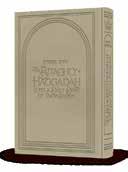




From the author of The Eishes Chayil Haggadah




What do you remember most about Purim when you were a child? Was it dressing up each year in an exciting new costume? Delivering and receiving endless packages of mishloach manot? Maybe it was the annual Purim party your family were guests at or hosted themselves? For most children the memories are multiple and cherished. For children from single parent households, however, Purim is often one more date on the calendar fraught with tension. It’s yet another holiday where they aren’t sure if and where they will be celebrating and how.
The Kadima program at the Marion & Aaron Gural JCC for single parent families has been making sure Purim remains a fun and positive date on the calendar for all. Each year, our members are invited to a party that not only features entertainment, refreshments and mishloach manot but creates an atmosphere of warmth and belonging for all who come.
This year our festive Purim party, held at the JCC’s Harrison-Kerr campus in Lawrence, featured an amazing Mad Science show, balloon creations, pizza and ice cream bar, plenty of snacks, some courtesy of Gourmet Glatt, Purim Bingo, music, costumes, a dental themed Mishloach Manot satchel provided by the Nassau County Dental Society Give Kids a Smile initiative filled with goodies, an abundant collection of Purim packages for our children to distribute to their friends, created by the students at North

Shore Hebrew Academy High School, and more. With the attention of our Kadima staff and our warm volunteers, every child felt special and wore a happy smile on his/her face. It was also an opportunity for the parents, who have so much on their plates, to relax, socialize and feel some sense of normalcy. Despite the many struggles these families are dealing with they always know that they are remembered and cared for on Purim - and all year long - at Kadima and the Gural JCC.
If you or someone you know is a single parent who needs support and services, call the Gural JCC (516)569-6733 extension 222.
The Marion & Aaron Gural JCC is a proud non-profit partner of UJA -Federation New York.


At IVDU Five Towns, Mrs. Kamin’s class ended the month of February with a very exciting celebration: the 100th day of school!
Each student brought in 100 of something from home. We saw so many creative ideas, from snacks to small toys, and the children loved sharing what they collected. It was a fun way to practice counting and celebrate how much we have learned over the past 100 days.
To make the day even sweeter, we made our very own s’mores treats because we know “there’s always S’MORE to learn!” The students had a great time putting them together and enjoying their special snack.

At the end of the day, each child received a “100 Days Smarter” certificate. We are so proud of all our students and everything they have accomplished in the first 100 days of school!






Episcopal Health Services (EHS) recently announced the opening of the new EHS Cancer Center, anchored at the Walsh Ambulatory Pavilion, a state-of-the-art outpatient facility spanning more than 50,000 square feet across five floors and located directly across from St. John’s Episcopal Hospital.
The EHS Cancer Center expands access to comprehensive, coordinated cancer care for patients across the Rockaway Peninsula, the Five Towns, South Nassau, and neighboring communities. Medical and radiation oncology services are now offered at the Walsh Ambulatory Pavilion, while surgical oncology services are provided at St. John’s Episcopal Hospital, allowing patients to benefit from a seamless continuum of care across the EHS campus. Notably, the opening marks the return of radiation oncology services to the Rockaway Peninsula for the first time in more than a decade.
“The opening of the EHS Cancer Cen-
ter represents a significant step forward in our mission to provide high-quality, comprehensive cancer care for the communities we serve,” said Donald Morrish, MD, MMM, President and Chief Executive Officer of EHS. “By investing in advanced technology, new facilities, and expert physicians, we are strengthening our ability to diagnose, treat, and support patients through every phase of their cancer journey.”
At the Walsh Ambulatory Pavilion, patients will have access to medical oncology, radiation oncology, hematology, immunotherapy, clinical trials, and a dedicated cancer navigation program, supported by advanced diagnostic and treatment technology. The Cancer Center features a PET/CT scanner for precise imaging, a TrueBeam linear accelerator for highly targeted radiation therapy, and a modern infusion therapy suite designed for patient comfort and efficiency.
In addition to clinical services, patients will benefit from a robust range
of supportive care offerings, including social work services, pastoral and spiritual support, inpatient physical rehabilitation, a specialty pharmacy, and survivorship services — ensuring care that addresses both medical and emotional needs.
“A cancer diagnosis affects every part of a patient’s life, not just their health,” said Marc Warshawsky, MD, Chief of Hematology and Oncology at EHS. “This Cancer Center allows us to deliver advanced, coordinated care locally, while surrounding patients with the support services they need. Our goal is to simplify the care experience, improve access, and provide a more integrated treatment journey.”
“The addition of a TrueBeam linear accelerator and on-site imaging allows us to deliver highly precise, effective treatment while minimizing disruption to patients’ daily lives,” said Mark Ashamalla, MD, Chief of Radiation Oncology at EHS. “This expansion strengthens our ability
The Mercaz Mustangs boys’ basketball team has just wrapped up their best season yet – a year defined not only by wins, but by growth, teamwork, and sportsmanship.
With the team, made up of fourth, fifth and sixth grade students, racking up four wins, it was the most successful season in the history of the program.
“I’m very happy and we’re very proud of what they accomplished,” said Coach Anthony Delwey. “Everyone contributed and worked hard, and it showed.”
The season began in September, when
the still-raw team began twice-weekly practices with enthusiasm and dedication. Focusing heavily on skills and fundamentals, and encouraged by major support from parents and community, the players improved significantly over the course of the season.
The Mustangs now play excellent defense, compete hard in every game, and recently put up an impressive 48-point performance – their highest-scoring game of the season. The outgoing sixth graders led the way, serving as the team’s high scorers and strongest defenders
– and guiding and supporting younger players.
Beyond the scoreboard, the team’s positive attitude, school pride, excellent values, and focus on fun set the Mustangs apart.
“They have fun no matter what the score is, and they’re excited to be out there playing. They never get upset, and they’re always doing their best. Being part of the team makes them feel good about themselves, and proud of Mercaz,” shared Coach Delwey.

to provide timely care and improves continuity throughout the treatment process.”
The EHS Cancer Center is the first specialty service to open at the Walsh Ambulatory Pavilion. Additional outpatient clinical services are expected to begin opening in March 2026.
To schedule an appointment at the EHS Cancer Center, visit ehs.org/oncology or call:
• Medical Oncology: 718-869-7949
• Radiation Oncology: 718-869-7101
• Surgical Oncology: 718-347-3627

Following this record-making season, he said, the Mercaz basketball program looks forward to a bright future. “We’re all very proud of what we’ve accomplished, and we’ll continue to grow as a team.”

Last week, the eighth grade boys at HALB participated in a program to support Israeli soldiers injured in Gaza during the October 7 War. The 8 Project is a healing through art initiative. Through residencies, workshops, exhibitions and community programs, it helps survivors, soldiers and artists turn pain into purpose. The program was led by Sahar Chaba who is an IDF soldier and artist. The boys learned about the importance of art therapy and then decorated their own army jackets.
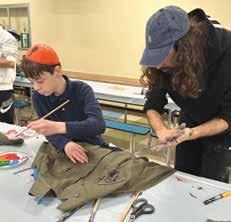
Mrs. Khaimov’s first grade class in Yeshiva Darchei Torah celebrated the 100th day of school through engaging, hands-on activities designed to reinforce academic skills while promoting teamwork and problem-solving.
Students participated in a “100 Day Detectives” themed class activity, where they worked collaboratively to complete a series of five missions.
Each mission integrated academic skills across subject areas, including:
-Applying math skills through counting and addition activities
-Flipping coins and recording results to practice number concepts and probability awareness
-Counting and organizing classroom supplies to strengthen number sense
-Completing word searches to reinforce vocabulary and spelling skills
-Solving addition color-by-number
sheets to combine math practice with creative expression
Students used five structured clues throughout the activity to help solve a class mystery, encouraging critical thinking, cooperation, and attention to detail.
As part of the celebration, students designed and decorated their own 100th Day shirts, allowing for creativity while recognizing their accomplishment of reaching 100 days of learning.
Students also created 100th Day hats, further enhancing engagement and building excitement around the milestone.
The celebration provided an opportunity for students to reflect on their growth, celebrate progress, and participate in meaningful learning experiences in a fun and motivating environment.



As MTA welcomed Rosh Chodesh Adar with special programming in the building, the excitement continued well beyond the classroom this past Shabbos. Multiple shiurim took part in Shabbatonim across different communities, bringing the ruach of Adar directly into the homes and shuls of our talmidim.
Rabbi Balsam, Rabbi Cohn, and Rabbi Konigsberg each led their talmidim for uplifting Shabbaton experiences. From Friday night tefillos through Seudos Shabbos and Shiur bonding, the learning and connection that define each shiur extended naturally into the community setting. Divrei Torah were shared, zemiros were sung with energy, and talmidim had the opportunity to strengthen their connection with their rebbeim in a meaningful Shabbos environment.
At the same time, talmidim gathered for a special North Woodmere Shabbaton. The weekend featured spirited tefillos, warm host homes, and a strong sense of camaraderie among the Talmidim. A highlight of the Shabbos was an inspiring oneg with Rav Aryeh Lebowitz, whose words of chizuk and Torah added

depth and perspective to the atmosphere of simcha and growth.
The achdus and momentum of Shabbos carried directly into the annual MTA Family Melava Malka on Motzei Shabbos, featuring Eitan Katz. From the very first note, the energy in the room was electric. Eitan’s powerful voice and high energy instantly elevated the atmosphere, setting the tone for a night filled with pure simcha.
Within moments, the dance floor was packed. Talmidim, parents, rebbeim, and alumni sang and danced together. It was a celebration of Torah, family, and community, and the joy in the room was unmistakable.
With profound sorrow, we extend םימוחנת תכרב to Rabbi Moti Goldstein and his dear children on the heartbreaking הריטפ of their beloved wife and mother,
Our dedicated BBY Morah, par excellence, beloved by her students and colleagues.

A young mother whose life radiated love of Torah, Yiras Shamayim, Emunah, Simcha and devotion to her husband and precious children.
With heartfelt sympathy, Bnos Bais Yaakov Administration, Faculty, and Talmidos
By Natalie Bellehsen
The Hebrew Academy of the Five Towns and Rockaway (HAFTR) High School proudly hosted its 35th Annual Yeshiva League Model Congress (YLMC) tournament on Sunday, March 1, welcoming 180 student delegates, 35 presiding officers from 20 yeshiva high schools across the region for a full day of rigorous debate, collaboration, and leadership.
YLMC provides students with the opportunity to simulate the United States legislative process by debating and voting on proposed legislation. Throughout the day, committees engaged in structured debate, where delegates delivered speeches, questioned one another, and worked to pass proper bills. The tournament not only strengthens public speaking and research skills, but also challenges students to think critically, respond under pressure, and collaborate with peers holding diverse viewpoints.
The opening ceremony was led by
YLMC Co-President Gabriella Hersh, who welcomed delegates and set the tone for the day. Throughout the morning, students moved into committee sessions, guided by Presiding Officers who ensured debate remained organized and productive.
The keynote speaker was introduced by Co-President Hailie Avigdor following the introductions by Principal Dr. Joshua Wyner and Coach Alex Libkind. It was their honor to welcome Rabbi Barry Dov Schwartz, a leader whose life exemplifies service and dedication.
Rabbi Schwartz served for 37 years as a congregational rabbi and as a U.S. Air Force chaplain during the Vietnam era, dedicating his life to principled, community-centered leadership. A steadfast advocate for civil rights and interfaith understanding, he continues to serve as a Nassau County police chaplain, embodying the service-driven leadership YLMC seeks to inspire.
Following a full day of debate, Co-President Natalie Bellehsen delivered
Thanks to the blizzard, this past school week was short, but the Yeshiva University High School for Girls (Central) made it count in every way.
On Wednesday, February 25, YUHSG’s student-engineers braved the snow and ice to travel to the 8th annual city Hackathon, hosted by the Center for Initiatives in Jewish Education (CIJE) at Industry City in Brooklyn. This year’s event, themed “Innovating for Accessibility,” tasked participants with developing creative solutions for real-world environmental issues. The event hosted two “hack” options: an “innovation” hack requiring groups to design, code, manufacture, and pitch a product, and a remote aquatic challenge in which student-engineers developed a marine craft to compete in a water-based task. YUHSG’s Engineering I and II classes, led by Engineering faculty member, Mr. Michael Spindel, have a long history of Hackathon success. 2026 was no exception: “It’s a great opportunity for the students to expand on the skills they’ve been learning in Engineering and apply

the closing remarks, congratulating delegates for their preparation and willingness to challenge themselves throughout the day.
Coach Libkind was met with warm applause from senators and members of the Citron Online NSDA District, which he founded, in recognition of his dedication and leadership. His careful organization of ballots, coordination of judges, and oversight of tournament logistics ensured that the day ran smoothly from start to finish. From clearly structured committee procedures to engaging crisis simulations woven into both sessions,

the success of the 35th Annual YLMC reflected months of thoughtful preparation behind the scenes.
The day concluded with the awards ceremony, recognizing first and second-place winners in each committee, with Dovid Feldhammer from DRS, in Woodmere, and Abby Kaye from Kohelet in Philadelphia, receiving the top honor of First Overall. As students departed, it was evident that YLMC is more than a competition; it is a space where students develop effective communication and the leadership skills to act with integrity.
them in a practical way,” said Mr. Spindel. “This year’s group has a lot of potential, and a lot of room for positive growth. Coming up with an idea and seeing it through to the finish line in five hours is a challenge, but the students rose to the occasion. They had fun and gained valuable experience.”
This year’s CIJE cohort included sophomores Baila Bodlander, Orly Adler, Nili Bruckner, Michal Miller, Tali Schneider, and Jackie Marmer, with juniors Camryn Brunner, Annabelle Klein, Aden Muskat, and Emily Segall. And if one event wasn’t enough for a Central Wildcat: as our friends competed at CIJE, the building was abuzz with our annual Giving Day Campaign, as well as an amazing “Through the Seasons” carnival with Yachad Ivdu and a fierce Mock Trial competition to end the day.
On Thursday, February 26, YUHSG students committed themselves to a special chesed event: a bat mitzvah for Rayna, a new friend to the Central community. Wildcats celebrated Rayna in high style, with a buffet, music, dancing, and dessert, all accompanied by a profes-

sional DJ, photo booth, and decor wall. Rayna’s bat mitzvah was coordinated by YUHSG’s F.I.R.E. Ruach Fellows, which is advised by Director of Israel and Religious Guidance, Senior Grade Dean, and Judaic Studies faculty member, Mrs. Yael Axelrod.
“YUHSG is so honored for the opportunity to make Rayna a beautiful bat mitzvah,” Mrs. Axelrod said. “She has gone through so much in her life, and we were so happy to give her a night that she will never forget. Thank you to the FIRE Ruach Fellows – seniors Atara Feldman,
Orli Fish, Ellie Gross, Evie Haar, Leora Kurlander, and Noa Shuval – who learned Megillat Esther with Rayna and worked on so many aspects of the bat mitzvah, as well as sophomore Katie Pilarski, who put together the montage, and senior Rebecca Moskovitz and juniors Nili Aharon, Jamie Blass, and Shira Peskin, who served as our motivators. Thanks to sophomore Baila Bodlander, for making the balloon arches, and YUHSG alumna and madricha, Emuna Posner (YUHSG ‘24) for spearheading the entire initiative. What an amazing team!”




By Talya Shalomoff
HAFTR High School had the privilege of hearing from Omer Wenkert, who was held captive in Gaza for 505 days. Omer visited the school on Friday, February 6, and shared not only a story of survival but a story of transformation. He spoke about who he was just before October 7 and the man he became after. He describes himself as being someone who was deeply passionate about the food industry, someone who ate non-kosher, and someone still searching for deeper meaning. Through his unimaginable hardships, his priorities shifted. During captivity, even the smallest acts – like saying a bracha before eating, expressing gratitude, holding onto faith – became a source of strength. He shared that in the darkest moments, he found himself remembering the Shema and Perek Tehillim Chuf Gimmel (23), words his grandfather taught him when he was just 10 years old, more than a decade earlier. These lessons stayed with him when he needed them most. Today, Omer eats only kosher and describes a much closer connection to Hashem, one that was shaped not by comfort but by challenge. His story reminds us that growth often comes from the most unexpected places.
What stood out most was Omer’s perspective and sense of belonging. Despite being alone for long periods of time, he said he never truly felt lonely because he could feel a connection to his family, to Am Yisrael, and to something greater than

himself. He spoke about how seeing his parents again made him feel secure, and how unity gave him and others strength even in the darkest moments. His biggest dream today is simple and powerful: to build a family and live a life filled with meaning and simcha. As he shared his story, it became clear how much community matters, and that message resonated deeply within our own walls.
HAFTR High School is more than a school. It is a family. It is a place that consistently makes students feel seen, supported, and welcomed – a true makom shelanu, a place we return to for safety, growth, and belonging. Omer’s story reminded us that when we have a home, people who love us, and faith to ground us, everything else is a bonus. His words challenged us to appreciate what we have, strengthen our connection to Hashem and to one another, and remember that unity and gratitude are among our greatest sources of strength.


By Chaim Gold
“Every yeshiva leaves an indelible stamp upon its talmidim. You can tell what roshem the yeshiva makes by observing the talmidim of that Yeshiva. Dirshu is also a yeshiva! It does not have a brick-and-mortar building, but it is a yeshiva! What special imprint does the Dirshu Yeshiva leave on each of its talmidim? The answer is that a lomed Dirshu always has a Gemara in his hand! Wherever he is! Yes! The shtempel of a Dirshu yeshivaman, is the consistent Gemara in his hand. Whether he is visiting a doctor’s office or is at work; whether it is bein hasedorim or he is on a bus. A lomed Dirshu grabs every extra minute possible to learn more, to review more, to gain more clarity in his daily learning! That is the imprint of the Dirshu Yeshiva!” exclaimed HaGaon HaRav Shlomo Feivel Schustal, shlita, Rosh Yeshiva of Yeshiva Gedolah Tiferes Yerachmiel, during the shalosh seudos at the recent Dirshu Convention held on Shabbos Parshas Terumah.
In truth, shalosh seudos was but one highlight of a Shabbos full of remarkable spiritual delights and plateaus.
Over the course of Shabbos Kinnus Olam Hatorah, as the Dirshu convention is called, the many hundreds of participants had the tremendous zechus to hear Divrei Torah and guidance from luminaries such as HaGaon HaRav Hillel David, shlita, Rav Kehillas Yeshivas Shaarei Torah; HaGaon HaRav Yeruchem Olshin, shlita, Rosh Yeshiva of Beth Medrash Govoha of Lakewood; HaGaon HaRav Yitzchok Sorotzkin, shlita, Rosh Yeshivas Telshe and Mesivta of Lakewood; HaGaon HaRav Shlomo Feivel Schustal, shlita, Rosh Yeshiva of Yeshiva Toras Yerachmiel; HaGaon HaRav Yechiel Michel

Steinmetz, shlita, the Skverer Dayan of Boro Park; HaGaon HaRav Chaim Mordechai Ausband, shlita, Rosh Yeshivas Ateres Shlomo; HaGaon HaRav Dovid Goldberg, shlita, Rosh Yeshivas Telshe; and Rav Dovid Hofstedter, shlita, Nasi of Dirshu, among many other prominent Rabbanim and Roshei Yeshiva.
Dirshu’s Kinnus Olam Hatorah is a unique convention. It is perhaps the only convention where the tzad hashaveh, the common denominator, of every participant there is Torah – the Torah they learn and review every day and the tests that they take every month.
At a Dirshu convention, outer appearances and outer trappings mean very little. The sight that meets your eye is a Yid with a shtreimel in animated conversation with his Sephardic brother about a Tosafos in Masechta Pesachim in the Amud HaYomi, that he found difficult; one seat over is a Litvish Yid heatedly talking with a Bobover Chossid about an interesting Biur Halacha in Chelek Daled of Mishnah Berurah that they have both been learning in the Daf HaYomi B’Halacha program.
Just a table over is a Skverer yungerman discussing a difficulty in the commentary of the Taz with a yeshivish yungerman that seems contradictory in the Kinyan Halacha program that they both learn.
This is the natural rhythm of a Shabbos Dirshu. It begins before licht bentschen and continues straight. At any time, in between the programming, whether it is at 1:00 in the morning or 6:00 a.m. mere hours after the beautiful oneg Shabbos ended, lomdei Dirshu were found learning, in the lobby, in the large beis medrash consecrated for limud haTorah! A resounding kol Torah reverberated throughout the hotel, throughout the Shabbos.
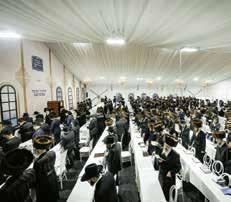
Among the many highlights of every Dirshu Convention are the iyun shiurim delivered by Gedolei Torah. After the seudah on Friday night, Rav Shlomo Feivel Schustal delivered a shiur about the prohibition of making images. On Shabbos morning before Shacharis, Dirshu’s Nasi, Rav Dovid Hofstedter delivered an iyun shiur revolving around the arbah kossos on the night of the Seder. Rav Chaim Mordechai Ausband, Rosh Yeshivas Ateres Shlomo, delivered an iyun shiur related to the chiyuv of hearing Parshas Zachor. Watching Rav Ausband deliver the shiur while energetically and excitedly fending off many questions in a spirited give-and-take by the lomdei Dirshu who were interjecting questions from all over Shas or obscure Tosafos in attempts to question his thesis was an unbelievable sight. It was a clear rischa d’Oraysah as could be seen from the intent expressions on the faces of both Rav Ausband and the lomdim who were questioning him. Their faces did not reflect a sense of being upset or fighting! Rather, they were glowing with an ethereal joy gained from gaining clarity in the heiligeh words of the Torah.
Grand Melave Malka: A Celebration of Torah
It is almost impossible to imagine how a Shabbos full of climaxes could possibly conclude with the greatest climax of all! And yet, that is just what the melave malka was!
During the melava malka, the assemblage was treated to a breathtaking array of daas Torah espoused by some of today’s senior Gedolei Yisrael. The chairman of the evening, Reb Naftoli Friedman, introduced HaGaon HaRav Hillel David, shlita, who devoted his remarks to the chinuch impact made on one’s chil-
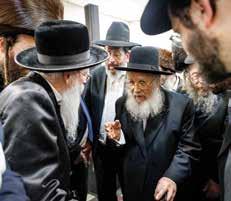
dren when a person is a member of Dirshu.
Dirshu members were then treated to short remarks from Ambassador Mark Walker, President Trump’s personal envoy on combating antisemitism and religious intolerance throughout the world.
Rav Dovid Goldberg: The Dirshu Yungeleit Love Torah
Rav Dovid Goldberg’s remarks focused on the importance of chashivus haTorah. He quoted Rav Yisroel Eliyahu Weintraub in saying that greatness is not dependent on how much Torah one knows but on how much a person appreciates the Torah, how much he is machshiv the Torah, how much he makes Torah a priority of his life!
Rav Goldberg expressed his deep sense of admiration for the lomdei Dirshu. “Wherever I went throughout Shabbos, I saw bli ayin hara, 1,500 people sitting and learning! Wherever I went I saw mesikus haTorah! What I saw over the course of this Shabbos is that the Torah is a living organism! It pays back those who love it! When a person learns with mesiras nefesh there is no limit to what he can accomplish! The Dirshu yungeleit love Torah and Torah loves them back!
Rav Yechiel Michel Steinmetz: Those Who Learn In Dirshu’s Programs are the Happiest People
The Skverer Dayan, Rav Yechiel Michel Steinmetz, was introduced as a person who is part of the DNA of Dirshu. In his remarks, Rav Steinmetz related a story about a wealthy man who came to Rav Aharon Kotler and asked him, “What is the difference between my Olam Habaah and your Olam Habaah? I get Olam Habaah because I support learning, and the Rosh Yeshiva gets Olam Habaah because he learns Torah. So, what is the difference between us?”

Rav Aharon answered, “Perhaps there’s no difference between our Olam Habaah, but there is a tremendous difference in our Olam Hazeh! I am the one who has the greatest Olam Hazeh! There is no greater pleasure in Olam Hazeh than being in Torah learning!”
“Those who learn in Dirshu’s programs,” Rav Steinmetz exclaimed, “are the happiest people in this world! Let’s not even talk about the Next World!”
The warm words of Rabbi Steinmetz were followed by the entire assemblage bursting into spirited song together with the orchestra led by Reb Hershy Weinberger and Avrumi Berko Productions. Palpable joy pulsated through the room as the nearly 2,000 people danced together celebrating their deep, abiding connection with accountable Torah learning.
Rav Dovid Hofstedter: “Only Mesiras Nefesh!”
A hush settled over the room as the Nasi of Dirshu, Rav Dovid Hofstedter got up to address the assemblage. He looked around and emotionally referred to every member of the assemblage collectively as Mishpachas Dirshu, one big family of people dedicated with heart and soul to learning, to knowing Torah and to being connected with Torah.
“Rav Elchonon Wasserman explains that there are two types of gezeiros placed by Hashem upon the Yidden during difficult times. When it is a gezeirah on the guf, the answer is that we have to engage in teshuvah. When, however, there is a gezeirah on kiyum hamitzvos, that is a gezeirah that comes from Satan, and the only way to overcome such a gezeirah is
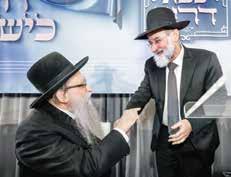

through mesiras nefesh.
“From here, we see that the primary response to a decree regarding ruchniyus is mesiras nefesh
“Amalek was only able to have power over Klal Yisrael when they slacked off in their limud haTorah. The only way that the Bnei Yisrael were able to overcome Amalek was through the mesiras nefesh of Moshe Rabbeinu!”
With great sadness in his voice, Rav Hofstedter continued, “I don’t have to tell you that Amalek is attacking! Who would believe that in such a short time after the Holocaust, after the churban of Europe, when there are still among us a few of those precious shearis hapleitah with numbers on their arms, that in the highest echelons of society, in academia, there are those who shamelessly deny the existence of the Holocaust?! This is maaseh Amalek! The chutzpah, the sheker! Who would believe that a mere eighty years after the Holocaust, Jews across the world would feel unsafe? Who would believe that the world can protect the rights of muschasim of all types, they can even protect the rights of animals but they can’t protect the rights of Torah Yidden?!
“Shemiras hamitzvos is under attack in many places! We are under attack from without and within! In Eretz Yisrael, our precious yeshiva bachurim are being thrown into jail!”
In a voice full of pain, Rav Hofstedter exclaimed, “Sadly, Amalek is still among us! This generation’s weapon of mass destruction is social media. Tragically, on social media, they cast aspersions on our wonderful yeshivos. I even found myself in the crosshairs! I was told that I am
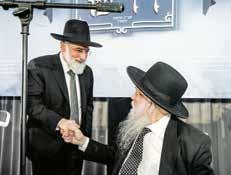
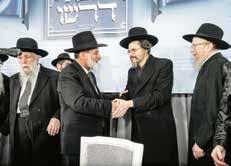
threatening the security of the State of Israel because I am taking boys who would be good soldiers and turning them into chareidim!
“The Olam HaTorah is under attack! Our response must be, ‘Lech kenos es kol haYehudim. Tzumu ailei sheloshim yom!’ Only mesiras nefesh will save us!”
“This Shabbos is called ‘Shabbos Kinnus Olam HaTorah’. Only when we, the Olam HaTorah, come together and make all kinds of new initiatives to ensure the blossoming of Torah will we be able to overcome the Amalek of our times!
“Only with mesiras nefesh! Only with going that extra mile for learning, adding that extra hour or two in our day to make sure that Torah is our life, ki heim chayeinu! We must avail ourselves of every opportunity to learn Torah, to seek Hashem day and night. Dirshu Hashem v’uzo, bakshu fanav tamid! We have to seek out Hashem tamid, at all times of the day and night. ‘Ma ahavti sorasecha kol hayom hi sichasi.’
“Just as Moshe Rabbeinu told Yehoshua, ‘Bechar lanu anashim, v’tzei l’milchama – pick for yourself people and go to war,’ so too must we! This is not about ‘doing the daf’. It is not about ‘kol haTorah kulo in twenty minutes’! It is ki heim chayeinu! It is about availing ourselves of every opportunity that we have to learn Torah.
“Let us leave here with a commitment. We will fight this battle b’lev venefesh, with mesiras nefesh until Hashem will look down on His children and say, ‘Enough! It is time to go home!’ He will finally say, ‘Kinderlach, kum shoin aheim Bimheira biyameinu!”
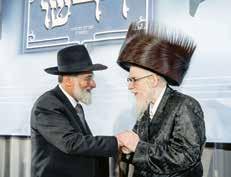
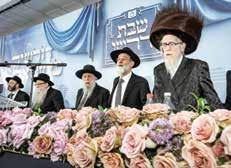
Rav Yeruchem Olshin: Mishpachas Dirshu Goes Above And Beyond When Rav Yeruchem Olshin, Rosh Yeshiva of Beth Medrash Govoha of Lakewood, rose to speak, he looked around benevolently at the assemblage, his expression one of deep love and admiration. He began by saying, “When Rav Boruch Ber Leibowitz, Rosh Yeshiva of Kamenetz, would get up to address his yeshiva, he didn’t address them as talmidei or bnei hayeshiva. Rather, he addressed them as mevakshei Hashem. And I,” Rav Yeruchem continued, “I want to say a few words to the chashuve mivakshei Hashem of Mishpachas Dirshu.”
“The Chovos Halevavos,” Rav Olshin explained, “says that this is the difference between a Yid who is doing just what he is able to do and a Yid who is going above and beyond his ability to push himself. A Yid must go above and beyond, must push himself. When he does, he is endowed with the ability and the intellect to do above and beyond what he originally thought he could do.”
With great passion Rav Olshin concluded, “I want to say something about my dear friend, Rav Dovid Hofstedter and the entire kehillah hakedoshah of Dirshu. They go above and beyond anything that could be considered the norm! Those participating in Dirshu’s programs come home after a difficult day in yeshiva or at work and that they still have to chazer and chazer over and over again. They have to master large amounts of Torah, understand it and be able to be tested on it. They are only able to do that because they go above and beyond their abilities.

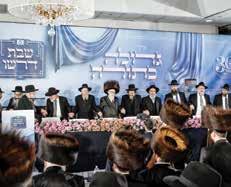
They are therefore endowed from Above with kochos and abilities that they may not have had until now.”
Shabbos at the Dirshu Convention
As the kedusha of Shabbos slowly descended upon the Armon Hotel in Stamford, Connecticut, throngs of talmidei chachomim, made their way to the large-heated tent especially erected so that davening could be done in a hallowed atmosphere conducive to tefillah.
Following Mincha, a fascinating question and answer session was held with Rav Yechiel Michel Steinmetz, the Skverer Dayan of Boro Park.
Rav Yitzchok Sorotzkin: The Importance Ohl Torah, Singular Focus
After a beautifully moving Kabbolas Shabbos led by the well-known chazzan, Reb Isaac Honig, and the Shira Choir, Rav Yitzchok Sorotzkin emphasized that the only way a person can be truly successful in learning Torah is if he accepts upon himself the ohl haTorah, the yoke of Torah. He then explained why it is called an “ohl haTorah.” When a horse or donkey wears a yoke, it is unable to look to the right or to the left. It can only go straight. So, too, a person who accepts upon himself the ohl haTorah cannot look around at the world, he has to be singularly focused on aliyah baTorah.”
Rav Sorotzkin continued by explaining that there are many yetzer haras to distract us from our mission to be completely immersed in Torah learning.
“Many people today claim that you can’t demand total immersion from today’s generation. I propose that the greatest proof that you can demand total immersion from today’s generation is the iPhone! We see how today’s generation is completely absorbed with their phones! Their phone goes with them wherever they are, day and night, early morning, late at night, 24/7. I would say,” Rav Yitzchok thundered, “that kal vachomer one should completely become absorbed in Torah, all day 24/7!”

The kedushas Shabbos was palpable. Dirshu, ever sensitive to the varied minhagim of its participants, provided three separate dining rooms for the Shabbos seudos, one for couples where each couple had their own individual table, another that one for men only and third that was only for women. Each of the dining rooms was royally and elegantly set as befitting kavod haTorah to the nth degree.
In each dining room, the seudos were treated to Divrei Torah delivered by dynamic rabbonim from all over the world and from all walks of life.
Shalosh Seudos:
One of the most inspirational moments of the convention was the shalosh seudos where the men joined together to be treated to words of chizuk and hisorerus. Rav Shlomo Feivel Schustal recalled how Rav Elchonon Wasserman was once asked during times of great economic hardship, “We all know that in difficult economic times every government makes sure that the army and its soldiers have enough food to eat. Hashem’s army are the bnei yeshiva. Why then do yeshiva students have to suffer so much hardship?!”
Rav Elchonon answered that sometimes even the zechus of Torah is not enough and we need an extra zechus. What extra zechus can help? The zechus of learning Torah m’toch hadechak. Torah learned under hardship and duress is far more potent and can save Klal Yisroel.
Rav Schustal exclaimed, “Dirshu learners learn under tremendous dechak It may not be economic hardship, but it is the duress of constantly learning and chazering. The fact that lomdei Dirshu learn Torah m’toch hadechak is a tremendous zechus for all Yidden wherever they may be!”
Rav Yehoshua Abba Busel: Hundreds of Yidden Thirsting for…Another Blatt Gemara!
Rav Yehoshua Abba Busel, rav of the High Street Shul in Lakewood and a R”M
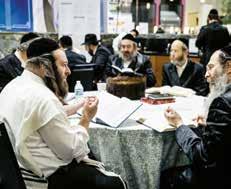
at Beth Medrash Govoha, shared a story about several seminary girls who got lost in Midbar Yehuda many years ago. When they were found, they were severely dehydrated and had to be hospitalized. Rav Mordechai Gifter and Rav Leizer Plachinsky went to visit the girls in the hospital. During their visit, Rav Plachinsky began to sing words from sefer Tehillim. He explained that David Hamelech had also been in Midbar Yehuda and had also become thirsty. But he was “tzomah lecha nafshi!” He was thirsty for Hashem!
“Lomdei Dirshu,” Rav Busel thundered, “are also thirsty! What I saw over Shabbos was hundreds upon hundreds of Yidden thirsty for yet another blatt of Gemara!”
The “Disadvantages” of Being Part of Dirshu
Rav Yitzchok Zalman Gips then took the entire assemblage completely by surprise.
“Usually, when people are at a convention, they hear all the maalos of being part of the organization. Well,” Rav Gips announced, “I want to discuss the chisronos of being part of Dirshu! People tell me that even if they do well on a test, they eventually forget what they learned. Perhaps then it is not worth it? Others say, ‘Maybe I should be investing more time in iyun?’ Still others have said that sometimes after having to take monthly tests for so many months a person might feel burned out?”
Rav Gips went on to explain why all those seeming deficiencies, should not be deterrents to continued learning in Dirshu programs.
“When it comes to forgetting the Gemara, certainly, we must review and review, but forgetting is part of the process. The Gemara teaches us that it is inevitable that we forget, that should never be a reason to stop learning! Hashem wants us to learn. Of course, learning iyun is very important and a person must have an iyun seder but that should not preclude him from also making sure to cover
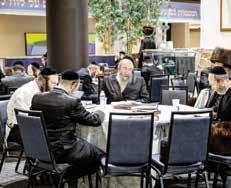
ground in an accountable way!
“Regarding burnout, everybody gets burnt out at one time or another, and the solution is to freshen yourself up and attack the new blatt Gemara with new intensity and new freshness. Then the burnout will go away!”
Rav Zev Smith: “Ein Bereirah!”
Rav Zev Smith spoke about the miraculous rebirth of Torah in the aftermath of the Holocaust.
“How did those great Roshei Yeshiva succeed in inspiring a whole generation and creating the miraculous ribui of Torah that we see today? How? The answer is that they knew ‘ein bereirah!’ They knew that there was no choice. The world could not exist without Torah! They understood that when a person knows that there is absolutely no choice he can do anything!
“That,” Rav Smith passionately proclaimed, “is the secret of the success of Dirshu learners. They know that ein bereirah! They know that no matter what they must finish the material, they must chazer the material until they know it klor! That is how they are able to take test after test. The secret to the success of every lomeid Dirshu is ein bereirah!”
The conclusion of the Melava Malka, the culmination of the Shabbos, cannot possibly be described in an article. One can give over the main message of each drasha in an article, but one simply cannot, with dry ink and paper, describe the dancing after the Melava Malka. The thousands who danced with such elevation, such dveikus, that lasted into the wee hours of the morning; the way they came to dance with Rav Dovid Hofstedter, the simcha that emanated from them and the contagious enthusiasm that permeated the hall was indescribable. It was a dancing of simcha, of dveikus and of deep hakaras hatov to Dirshu and for what it has done to their lives.

By Yosef Sosnow
One of the most gratifying aspects of a Dirshu Convention is the opportunity it offers to avail oneself of the tremendous gift that Hashem has given us, being able to hear guidance from Gedolei Yisrael. For the first time, Dirshu featured a panel of three rabbanim, answering questions sent in by lomdei Dirshu. It was a sight to watch the packed assemblage thirstily absorbing words of advice and chizuk given by the rabbanim. The panel members were Rav Chaim Mordechai Ausband, Rav Eytan Feiner, and Rav Shlomo Cynamon. (Space constraints have forced us to summarize the answers.)
Lomdei Dirshu learn with a strong emphasis on covering ground, learning with accountability and mastering considerable amounts of Gemara. At the same time, their sons are in yeshiva, often learning at a slow pace, under great Roshei Yeshiva, who say shiurim with tremendous iyun. When their sons come home, they seek to talk in learning with their fathers. However, their fathers learn differently and may not believe that the way their sons learn is optimum. This can, challilah, lead to a situation where the son does not completely respect his father’s approach to learning and vice versa. How does one balance these two approaches so they do not contradict each other?
Rav Ausband: It goes without saying that both approaches to learning are very important. A person must learn with great iyun but must also cover ground and complete masechtas. Now, the father has two choices: Either send his sons to a yeshiva that encourages the same approach as he has, or send to a yeshiva that has shiurim and learns with great iyun –but then he must fully support the yeshi-
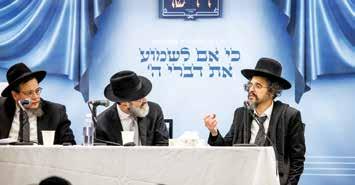
va’s approach. If you send your son to a yeshiva, he must feel that you hold of the yeshiva. Now, whether or not the son will respect his father if his father cannot say over a Rav Chaim with a chakira? That is indeed a good question.
Rav Feiner: In truth, this question is similar to one brought in the Gemara The Gemara asks what is better a Sinai or an okker harim? Is it better to have knowledge all over Shas or able to incisively uproot mountains with your logic?
Yes, undoubtedly, one needs to learn how to learn in yeshiva and that requires iyun. Nevertheless, that doesn’t absolve a person from the obligation to broaden his knowledge of Shas
Rabbi Cynamon: We live in a cynical time where people find it easy to criticize. Every father must be extremely vigilant that not one word of criticism or lack of satisfaction should leave his mouth regarding a mossad where any of his children learn. A child must be certain that his parents have tremendous respect for the yeshiva and for the child’s rebbi. You may have legitimate criticism regarding the way the yeshiva is learning, the pace may be too slow, etc. Nevertheless, if your son detects even a small seed of disrespect for his rebbi or his yeshiva he will not be able to grow properly there. Therefore, it is imperative that parents fully support the yeshiva where their son learns.
If someone is already learning Daf HaYomi and Amud HaYomi and has some extra time in his day, what should he do? Should he perhaps add learning Tosafos to his schedule? Should he perhaps review a few more times? Or should he take on another Dirshu program?
Rav Ausband: The general rule is that a person who has many different sedarim a day will not acquire Torah properly. When there are too many, you end up with very little of anything. The Brisker Rav would say that he doesn’t know how
somebody could even learn three different things a day, perhaps two, but three is already too much! It is probably better not to take on a new seder but rather to learn with more depth that which you are already learning.
That said, the first thing a person must do is make sure to have a seder in Mishnah Berurah. It is an absolute obligation to learn daily halachos so he should know how to conduct himself.
Rabbi Cynamon: If a person values Hashem’s Torah and has a few extra minutes, he should think about what he just learned. Look into a Rashi a bit more, learn another Tosafos, review what you just learned so you can gain clarity. Part of kavod haTorah is when it is important enough to you to spend a few extra minutes thinking deeply and reviewing what you learned! This is a much more productive use of one’s time than haphazardly adding another seder to one’s day.
Rabbi Feiner: Firstly, let me reiterate what the Rosh Yeshiva said, that a daily seder halacha, to learn halachos that one encounters every day, is imperative. In addition, I would add that a daily mussar seder is imperative. The baalei mussar teach that a person should find half an hour each day to learn mussar
Rav Gedaliah Nadal once said, “I have

met many great men, but I never met a gadol who became a gadol just from learning. The way one becomes a gadol is through constant chazarah, constant review.”
Today, most homes need two incomes. Whether the husband is learning in kollel or even when he is working, it is often impossible to get by with one income. The question is: should the wife take care of all practical financial decisions to enable the husband to learn more? Is that the tzurah of a Jewish home or is it perhaps a deficiency when the husband is not in charge of the finances?
Rav Ausband: What can be wrong? Even the Gemara says that the woman is in charge of worldly matters and the man should be in charge of spiritual matters. I don’t see anything wrong with that arrangement.
Rabbi Feiner: This question I think may depend on the individual dynamic between husband and wife. There is no one-size-fits-all answer for such a question, and each couple should consult with their individual rav on this matter. As a general rule, however, what Rav Ausband said is correct.
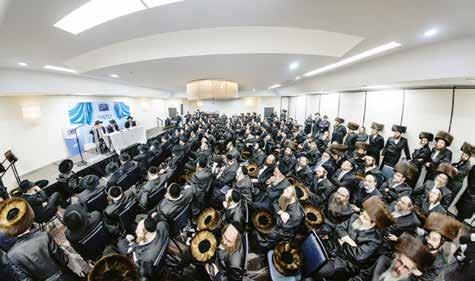

By Yosef Sosnow
It is no secret that antisemitism has reared its ugly head throughout the world. It is not an exaggeration to say that the overt antisemitism being witnessed worldwide has not been seen since the 1930’s.
As a son and son-in-law of Holocaust survivors, Rav Dovid Hofstedter views this epidemic of antisemitism with great concern.
Over the past months, Rav Hofstedter has become acquainted with Ambassador Mark Walker, Ambassador-at-Large for International Religious Freedom who served as a U.S. Representative for North Carolina’s 6th district from 2015 to 2021.
The Ambassador’s mission entrusted to him by President Trump and Secretary of State Rubio is to combat rising global antisemitism and protect faith groups from persecution. The Ambassador developed a close relationship with Rav Hofstedter and is clearly dedicated to fighting antisemitism throughout the world.
On Motzei Shabbos, Ambassador Walker visited the Dirshu Convention where he had a personal meeting with Rabbi Hofstedter, delivered a short address to the thousands in attendance, and participated in a panel discussion about antisemitism. Below are some highlights from his visit.
When Ambassador Walker was introduced by MC, Reb Naftali Friedman, he was given a standing ovation. He told the assembled that he was President Trump’s principal advisor for global religious freedom and it was a great honor for him to push back against antisemitic behavior and religious intolerance throughout the world. He then expressed how he feels it a great privilege to call himself a friend of Dirshu’s Nasi, Rav Dovid Hofstedter.
He stressed how impressed he was when he observed the Slabodka Yeshiva in action during a recent visit to Bnei Brak and was gifted the opportunity to meet the venerated Rosh Yeshiva, Rav Moshe Hillel Hirsch, shlita
“Since my initial meeting with Rabbi Hofstedter, I feel we have developed a strong connection and bond. I believe we are going to be lifelong friends.”
Ambassador Walker concluded, “Let me simply give you a few parting words: Stand strong! Stand strong in maintaining your convictions and your principles. I grew up in a very conservative household. My father was strong enough that he did not want the world to influence us. He took away our television to make sure that the immoral conduct sometimes portrayed there would not influence us. Make sure to continue raising strong families who are proud of their convictions so they can go out and be upstanding, moral, productive citizens.”


Before the Melave Malka, Ambassador Walker participated in a panel discussion regarding antisemitism. For brevity purposes we will only cover two of the questions that he was asked.
In Belgium, there was recently a dispute between the Belgian government and the U.S. Ambassador to Belgium who called out the government for trying to outlaw circumcision. The Ambassador was called in and disciplined by the Belgian government. What are your thoughts about government-sanctioned antisemitism in European countries?
My role at the behest of President Trump and Secretary Rubio is that I am the personal emissary for global religious freedom. It is my job to monitor religious minorities under attack, and as we saw recently, that this was a direct attack against the Jewish faith. After all, historically according to the Bible, on the eighth day, young males would be circumcised. It would be my job to go in and meet with the leaders [who make that an object of discrimination], push back and say, “No! That is religious discrimination.” We stand with the Jewish people whether it’s in Antwerp or anywhere else.
In America, antisemitism has never been higher. Over the last de-


cade, far-left antisemitism has had the greatest resurgence. More recently, there has been a resurgence of right-wing antisemitism in what we can call “the Tucker Carlson wing of MAGA.” On the one hand, we understand that politically President Trump needs the electoral force of that wing of MAGA. On the other hand, as the President’s ambassador, how can he condone the overt antisemitism infecting a large wing of his supporters?
That is a long, very important question. First of all, today on social media I gave my unequivocal support for Ambassador to Israel, Mike Huckabee, for the strength he displayed in the Tucker Carlson interview. I am honored to call him my friend, and we stand by him. Regarding antisemitism, even when I was a congressman sitting on the Homeland Security subcommittee, we already saw a bell curve of antisemitic behavior in our country. Now we are going almost vertical. So yes, we need to address it. We have many people around the world monitoring religious discrimination, but we need to do the same in our country. We cannot afford to be bashful about calling it out whether it is in the entertainment industry, on our university campuses or coming from religious groups. We must be strong voices against it!

By E. T. Rubin
There was an aura, a spiritual energy of kedusha and tahara, pulsing through the lobby. That pulsing energy accompanied a pure, lechtig glow emanating from the many hundreds of women whose hands were covering their faces as they welcomed the Shabbos Malka; the flames of their lecht dancing, reflecting the flames of Torah that they had all come to celebrate.
The sight of so many Yiddishe Mammes whispering tefillos, gazing in wonder at the lecht that they had just kindled in the lobby of the Armon Hotel in Stamford, Connecticut. The sight of so many Yiddishe Mammes ranging from newlyweds to young mothers, to grandmothers and even great-grandmothers, all united by the light of Shabbos and the light of Torah, literally took my breath away!
And then I spotted one of my “Dirshu friends,” a woman whose husband, learns in Dirshu and who comes to the Dirshu Shabbos for a spiritual boost. This time, however, I noticed that she was wheeling a very, very newborn baby.
“Mazal tov!” I lean over, offering to hold her precious bundle. “Wow! This baby looks really new?”
“He is three weeks old.”
“Three weeks old, and you still came?!”
“Well,” the smile doesn’t leave her face, “we discussed it back and forth, but really, I decided that there was no way I could miss this Shabbos!”
And that said it all. Every woman in that hotel was there because “there is no way we can miss this Shabbos!”
Greeting Shabbos Together
They came in droves, women from all walks of life and all corners of the country, women of all ages and from all different backgrounds, all came with one goal: to return home rejuvenated! To return home infused with chizuk to continue in their mission of doing everything possible to enable and empower their husbands to learn, review and learn more Torah! To gain an even deeper appreciation for their role as the eizer kinegdo.
One by one, the women finished their whispered tefillos, raised their heads,
gazed lovingly into the hundreds of dancing flames and headed into the Crowne Ballroom to raise their voices together l’kras Shabbos with a medley of song and inspiration.
The evening was opened by the MC, Mrs. Miryam Swerdlov, whose simchas chaim injected an uplifting feeling of joy into the assemblage, eliciting smiles and laughter interspersed with her messages of chinuch tailored to the theme of the Shabbos, “Nashim b’may zochyon.”
A heartfelt, melodious Kabbalas Shabbos followed, led by the sweet and powerful voices of the Harmonies Choir led by Mrs. Hindy Ausch. The entire assemblage accompanied the young girls, singing the age-old words of the tefillos with Yiddishe niggunim
It was a magnificent start to a Shabbos replete with food for the soul, opportunities for growth, passion and inspiration, complimented by a remarkable array of delectable seudos and oneg to please the palate as well.
The Kochos of the Four Imahos Implanted… in U.S.!
In one of her speeches, Rebbetzin Slovie Jungreis-Wolff passionately and emotionally described how each of the four Imahos implanted unique kochos into the DNA of every single Jewish woman.
“Yes!” she exclaimed, “Each one of YOU has the koach of the Imahos!”
She then poignantly described how Sara Imeinu gave us the koach to always look at everything as good, as fresh. The Torah tells us Sara Imeinu’s years were kulo shavin l’tov!
“Really? Was Sara’s life good? She left her family and home…to famine! She was barren for so many years! Then Hagar came and immediately bore Avrohom a child! And finally, her husband took her son to the akeidah! Good?! Yes! Sara looked at everything in life as good and therefore WE have that koach!”
“Rivka gave us the ability to go. When everyone tried to convince her to stay, she said, ‘Eilech – I will go’. With those words, she gave us the ability to go and do, to never give up on a child just because the world tells us to!”
She continued by explaining how Leah engrained in the psyche of Yidden to sin-
cerely thank Hashem for no reason other than to say thank You! Until Yehuda was born, people did thank, but with a selfish bend, such as when we thank our children for cleaning their plates off the table, in the hopes that it will encourage them to clean up again next time. And Leah said, “Hapaam odeh es Hashem – this time, I am just thanking Hashem!”
“And Rochel? She gave us the koach to cry! Rochel mivaka al baneha! Each of us has inherited that ability, of a mother crying for her children!”
Our Support for Our Husband’s Torah = Their Ticket to Gan Eden!
Rebbetzin Aviva Feiner magnificently portrayed how it is a woman’s koach to spread Torah. Just by being there for our husbands, just by supporting our husbands and sons, encouraging them to committed learning, we become their ticket to Gan Eden.
She shared the story of Rebbetzin Lopian who had nine sons and was poverty stricken. Another woman asked the Rebbetzin, “You have nine boys! Can’t you send one to work to ease your poverty?”
“You know,” the Rebbetzin answered, “in this world, I don’t need my children, but when it comes to the next world, BOY will I need them!”
“Write it Down…and Burn it!”
Mrs. Miryam Swerdlov said, “One summer, a staff member came to give me the honors of dealing with a bunk that had misbehaved terribly. ‘Girls,’ I announced. ‘Meet me in back of the bunkhouse at midnight but first, write down e…x…a…c…t…l…y… what happened and bring it along.”
Mrs. Swerdlov explained that as the girls gathered around, she had someone ignite an entire garbage can of paper. Then she had each girl put their letters in the burning fire. “Finished! Hashem forgives you also!”
“That is what everyone can do when you are feeling upset – write it down, burn it in the sink and poof! Gone! Sad –write it and burn it! Get all your feelings out and then burn them! Then you won’t be weighed down by your feelings, and you will be able to be b’simcha!”
The spiritually uplifting Shabbos was brought to a close by Mrs. Devoiry Ginsberg, who painted a picture of her most

remarkable daughter, Hindy, a”h, a sixteen-year-old girl stricken with cancer who fought valiantly, with tremendous kochos hanefesh, simchas hachaim, emunah and bitachon. Anyone hearing about such a young girl losing her life might think, “Tragic!” But Mrs. Ginsburg tells a story that is anything but tragic. In fact, the words Rebbetzin Jungreis-Wolff quoted from her father, encapsulate young Hindy’s story: “A long life is not good enough, but a good life is long enough!”
The climax was the Melave Malka where the women were treated inspiration, musical interludes by Mindy Blatt and the Harmonies Choir along with practical, take-home messages!
One of the many highlights was when a granddaughter of Mrs. Hofstedter emotionally described how when she dreams of a worldwide movement of Torah, she pictures one person standing behind it, “My Bubby!” Enthusiastic applause filled the room as Mrs. Hofstedter came up to receive a stunning gift presented by her very own granddaughters.
The main speaker, Rabbi Joey Haber, drew a magnificent picture of the confusion clouding today’s world. The Bnei Yissoschor highlights that the difference between the word echad in Shema and the word acher in the aseres hadibros, “el acher,” is the last letter: daled or reish The confusion between echad, Hashem and the Torah, and acher, all the avoda zarahs of the world, is the biggest obstacle to happiness. Torah brings clarity! Someone who commits to learning Torah for real, with Dirshu, gains clarity!
The night wound to a close, tying up the “mishloach manos” of a wonderful, uplifting Shabbos that will serve to inspire and encourage all the remarkable Dirshu women for many weeks to come!
By Rabbi Meyer Yedid
One of the joys of a life of chessed may not be an obvious one: the joy of being cleansed spiritually. Shlomo HaMelech said in Mishlei (16:6): B’chessed ve’emes y’chupar avon, Through kindness and truth, sin will be atoned.
Where else do we see that chessed atones for sins?
Let us delve deeper into the subject of kapparat avonot (atonement of sins). We will see that it is much more than paying off a debit on a spiritual accounting form.
The Mishnah states (Taanit 4:8) that there were no happier days for Am Yisrael than Yom Kippur and Tu B’Av.
The happiest day of the year — Yom Kippur? Not Simchat Torah, Purim, or any of the great Yamim Tovim? So, the Gemara (30b) clarifies: Yom Kippur is joyous because it offers forgiveness and atonement.
Yom Kippur is a day of cleansing. Our
aveirot (sins) can be compared to stains on the neshamah. On this extraordinary day, those stains are washed away, restoring the soul to its original purity. This renewal allows the neshamah to fully express itself, enabling us to experience genuine simchah
You might wonder, “What stains? I don’t feel anything wrong with my neshamah.” Even if this idea seems hard to grasp, the truth is that we all carry spiritual blemishes. In fact, feelings of sadness, unease, or discontent often come from unresolved spiritual imperfections. While a deeper understanding of this idea goes beyond the scope of this essay, let us examine it briefly. People often believe that unhappiness stems from unmet desires, tough circumstances, or personal struggles. However, on a deeper level, this isn’t entirely accurate. Life’s challenges and difficulties are not the true source of our unhappiness. The sadness and discontent we experience actually come from the impact of sin upon our lives.

I can prove this: For any reason you can give me for feeling unhappy, I can point to other people who faced the same challenges and yet found happiness and were content. This shows that the root cause of unhappiness isn‘t these external issues but something deeper. True happiness originates from the neshamah, not the physical body. Your fingers, hair, and other parts of your body don’t feel happiness — it is the soul that experiences simchah. When the neshamah is stained with aveirot, its ability to generate simchah is diminished, and our joy fades. Conversely, when the soul is cleansed of these burdens, true happiness can flourish, regardless of the circumstances around us.
On Yom Kippur, the extraordinary day that comes once a year, Hashem proclaims, “On this day, I will cleanse you.” This is why Yom Kippur is the most joyous day on the Jewish calendar; what could bring greater happiness than having all the neshamah’s stains wiped away, enabling it to radiate pure simchah?
With this, perhaps, we can understand an unusual statement in the Rambam. As we know, there are four mitzvot that we are obligated to perform on Purim: reading the Megillah, mishlo’ach manot, seudat Purim, and matanot la’evyonim. After going through the halachot, the Rambam (Hilchot Megillah VaChanukah 2:17) addresses what to do if one does not have enough money to perform all of these mitzvot in grand style. In other words, which one should be prioritized over the others? The Rambam rules that it is better for a person to be more generous with his matanot la’evyonim than to make his Purim feast lavish or to spend a lot on mishlo’ach manot. The Rambam teaches that on Purim, one should give priority to the poor over spending on a lavish meal to bring simchah to oneself. He suggests cutting down on personal expenses and using that money to help others. But isn‘t Purim a day of simchah? Isn’t this the day when we are supposed to bring joy to ourselves? Why, then, does the Rambam prioritize giving to others over enhancing our own simchat Purim?
If I were to answer this question simply, I would say, “Yes, helping others is
more important than focusing on your own simchah,” and leave it at that. But the Rambam offers a deeper explanation: For there is no more splendid happiness than to gladden the hearts of the poor, the orphans, the widows, and the converts. One who brings happiness to the hearts of these unfortunate individuals resembles the Divine Presence, which Yeshayah describes as “reviving the spirit of the lowly and reviving those with broken hearts” (57:15).
The Rambam teaches that there is no greater simchah than the joy of helping others, particularly widows, orphans, and the oppressed. In other words, precisely because Purim is the day of the greatest simchah, you should focus on the largest source of simchah, which is giving. That is why we should prioritize matanot la‘evyonim over a lavish meal: By giving, one can achieve the grandest possible simchah on Purim for oneself, let alone for the recipients of the matanot. The Rambam’s ruling may align with the concept that simchah is enhanced when our actions reduce our avonot When done with the right intentions, the act of giving leads directly to the forgiving of our sins. As Shlomo HaMelech wrote, b’chessed ve’emes y’chupar avon. Thus, when we are commanded to be joyous on Purim, we should know that the path to true simchah is through giving and caring for others. This fulfills not only the mitzvah of the day but also purifies us, enhancing our spiritual joy. Perhaps that is why we feel so good when we help others — a feeling we have all experienced. Perhaps it is the tingling of the neshamah saying: Wow. Thank you for cleaning me a little today; that feels great!
Reprinted from The Power of a Giver by Rabbi Meyer Yedid, with permission from the copyright holder, ArtScroll Mesorah Publications.


In this new collection of powerful, true stories, Rabbi Yechiel Spero shares moments when hashgachah becomes visible, when one small decision changes everything, and when ordinary people rise to extraordinary heights. These stories are rich with faith, meaning and

OVER 65,000 COPIES OF THIS SERIES IN PRINT!

Giving is central to Torah life—but true chessed is far more than an act of generosity. It is a way of thinking, a way of seeing others, and a powerful force for personal growth.
In The Power of a Giver, Rabbi Meyer Yedid presents a compelling Torah vision of chessed as the foundation of authentic Jewish living, and reveals giving as proactive, perceptive, and transformative.
Through penetrating insights, real-life illustrations, and practical guidance, this sefer challenges readers to rethink what it truly means to give—and to discover how chessed refines the giver even more than the recipient.
Rabbi Chaim Mintz, author of the best-selling Ask the Rabbi Volumes 1 and 2, returns with a new collection of nearly 150 practical, Torah-true answers to the questions shaping Jewish life today.


When your wife asks you to measure something you pull out a Fruit By The Foot.
When you are playing ball and you need to hydrate yourself, you pull out a 12-ounce bottle of Kedem Grape Juice.
You know all 75 ways to eat a Presidor...and you are an expert at “skinning” them.
Your hamantash withdrawal is so bad that your doctor has given you a prescription for apricot jam.
You spend hours desperately searching for a local homemade chocolate chip cookie gemach.
A guy walks into a bar with an apple pie on his head. The bartender is taken aback and asks, “Sir, why in the world are you wearing an apple pie on your head?”
The man replies, “It’s a family tradition. We always wear apple pies on our heads on Tuesday.”
The bartender responds, “But, sir, it’s Wednesday.”
Embarrassed, the guy says, “Gosh, I must look like a real fool.”

When you open something that you bought at the supermarket, you immediately look to see if it came with a poem.
When you go on the scale, it says: “Never mind, just come back after Pesach.”
You make sure that everything you eat is matching.
When you see little rocks, you pick them up to taste them.
Instead of putting on a scarf, you wrap yourself in cellophane.
You throw away the outside and cook the inside.
Then you eat the outside and throw away the inside.

What are you eating?

Answer: Corn on the cob (sorry for being so silly…I mean corny.)
1. How long are standard size Twizzlers?
a. 5 inches
b. 6 inches
c. 8 ¼ inches
d. 12 inches
2. Who invented cotton candy?
a. A carnival clown
b. A candy store owner
c. An ice cream shop owner
d. A dentist
3. What is the most popular candy in the U.S.?
a. Hershey Kisses
b. Mike & Ikes
c. M&Ms
d. Twizzlers
4. How many quarts of popcorn are eaten annually in the U.S.?
a. 500 million
b. 2 billion
c. 4 billion
d. 16 billion
5. Ruth Wakefield of Massachusetts created the chocolate chip cookie in 1930. When her invention instantly gained popularity, she reached an agreement with Nestle Chocolate for her recipe to be written on its packaging. What did she get in return?
a. She was given a lifelong supply of Nestle Chocolate
b. She was paid 10% of the increase in net revenue that Nestle made after putting her recipes on its packaging
c. She was paid $5,000
d. She was paid $250,000
6. Place the following drinks in the correct order, according to their popularity in the U.S.:
a. Sprite
b. Diet Coke
c. Pepsi
d. Coca Cola
e. Dr. Pepper
f. Mountain Dew


g. Potato chips were invented in Saratoga Springs in 1853 by Chef George Crum.
7. Why did he create this crunchy treat?
a. He realized that packaged snacks were becoming popular so he invented chips.
b. He worked at an old age home, and he realized that they were a good alternative to cookies.
c. A frustrated customer thought his French fries were too thick and repeatedly requested that they be made thinner.
d. There was an excessive amount of potatoes at his diner, and he needed to figure out what to do with them.
1) C- Standard size is 8 ¼ inches. (Now they have all of these different sizes, but “ven I vas a kid ve only had von size. Ve were not spoiled like de kids today!”)
2) D-William James Morrison, from Nashville, Tennessee, was also an avid inventor. He created the first cotton candy machine (which he called “Fairy Floss”) and introduced it at the 1904 World Fair in St. Louis.
3) C-340 million M&Ms are produced every day.
4) D
5) A-In 1930, Ruth Wakefield was mixing a batch of cookies for her roadside inn guests when she discovered that she was out of baker’s chocolate. She substituted broken pieces of Nestle’s semi-sweet chocolate, expecting them to be absorbed into the dough to create chocolate cookies. When she removed the pan from the oven, Wakefield realized that the chocolate did not spread to the rest of the cookie but stayed in chunks. Guests at the inn quickly gobbled up her “chocolate chip cookies.”
6) D, Coke; B, Diet Coke; C, Pepsi; F, Mountain Dew; E, Dr. Pepper; A, Sprite
7) C-Crum was a chef at the Moon Lake Lodge resort in Saratoga Springs, NY. French fries were popular at the restaurant, and one day, a diner complained that the fries were too thick. Although Crum made a thinner batch, the customer was still unsatisfied. Crum finally made fries that were too thin to eat with a fork, hoping to annoy the extremely fussy customer. The customer, surprisingly enough, was happy – and potato chips were invented!
Wisdom Key:
5-7 correct: Congratulations! You have earned eight cavities! (Yeah, I know, you probably had them already.)
3-4 correct: You are on a Tootsie Roll—you’re good, but not great.
0-2 correct: Don’t worry—cucumbers are fun, too.
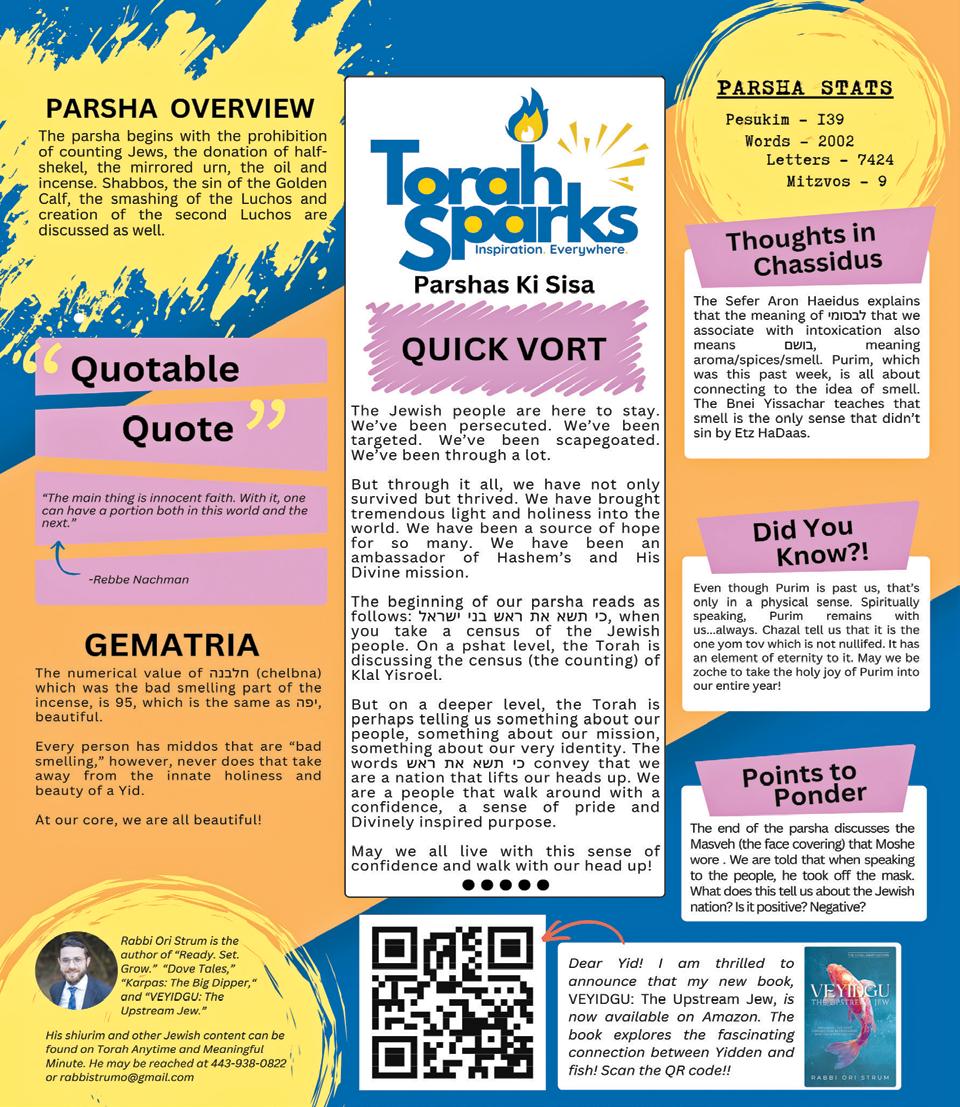












TBy Rabbi Berel Wein z”l
hough the main topic of this week’s parsha is certainly the fateful and nearly fatal incident of the Golden Calf, the opening subject of the parsha also bears study and insight. We see throughout the Torah that there is an emphasis placed on counting the numbers of Jews who left Egypt, those who existed in the Sinai Desert, and finally, those who arrived in the Land of Israel.
In this week’s parsha the Torah provides us with the “Jewish” way of counting the people of Israel. We do not count people directly but rather indirectly, as is the case of the half-shekel tax that was
imposed by Divine commandment at the beginning of this week’s parsha. The number of Jews present and accounted for was arrived at by counting the number of half-shekels that were collected.
We also see later in Jewish history, at the time of King Shaul, when he wanted to conduct a census of Israel he did so by having everyone donate a sheep. He then counted the sheep, again not counting the people directly. Even when we count the ten people necessary for a prayer quorum, we do not count them directly but rather only by counting the number of words that appear in a certain verse in the Bible.


The Talmud teaches us that King David was found guilty and punished for counting the people directly during his reign. Why is the Torah so interested in the numbers of Jewish population? And why is the Torah so loath to count people in a direct manner?
Even today, the census here in Israel, unlike the ones I remember in the United States, is taken indirectly, and no one has ever appeared at my door here in Jerusalem to count how many people live in our home. Apparently, this is the “Jewish” way of determining population numbers, always in an indirect fashion.
are all different for so have we been created by the L-rd.
The Torah treats every individual as special, and because of this, places an emphasis on the numbers of the Jewish people. Look and see how many different people exist within us, and yet somehow, we are all connected and part of the great whole that is the people of Israel! By counting people directly, we somehow minimize their individual qualities and uniqueness.
The Torah, which is interested always in promoting individuality and creativity, counts us many times to indicate our im-
The uniqueness of every individual is one of the axioms of Jewish life and thought.
I think that the lesson here is fairly obvious. No two people are alike, and each one is really number one by himself or herself. There is no number two because there is no one else like number one. The uniqueness of every individual is one of the axioms of Jewish life and thought. While people may appear to be similar, they are never identical.
Fingerprints and DNA testify to this phenomenon in the physical world. In the spiritual and personal world of our souls, personalities, creativity and accomplishments are unique to each one of us. We
portance, but never directly. The Talmud teaches us that the greatness of G-d can be seen in the fact that all human beings are stamped from the same die and yet no two are alike.
The Torah wishes us to understand and appreciate this lesson and transmit it to our lives through our actions and attitudes, our behavior, and sensitivities. By so doing, we “raise our heads” – ki tisa es rosh Bnei Yisrael – and become worthy of the L-rd counting us amongst the eternal people of Israel. Shabbat shalom.

Vayikra Complete in 1 volume

CONVENIENT STUDENT SIZE






Make being “maavir sidrah” easy and meaningful!

This new Chumash makes Sh'nayim Mikra more approachable and understandable, presenting the Hebrew text of each pasuk twice, followed by the Onkelos text, alongside an English translation of the pasuk based on Onkelos.
Each aliyah features a short introduction by Rabbi Moshe Bamberger, giving an overview of what the upcoming aliyah will be discussing.
This Chumash also includes the full Hebrew text of Rashi.
Also available: Bereishis and Shemos
The remaining two volumes will be published for this year’s cycle.
Access the remarkable segulah promised by the author of Sefer Zera Shimshon, in this new volume by Rabbi Nachman Seltzer that brings the timeless insights of Rav Shimshon Chaim Nachmani to life for daily study. Each day’s selection presents insightful and compelling explanations based on the weekly parashah, in clear, brief segments, perfect for consistent daily learning. Shabbos selections also feature true stories, as well as reallife accounts of the segulah’s impact.
The Famous “Segulah” of the Zera Shimshon “… [those who learn my Torah] will see children, and children’s children… wise and discerning, and homes filled with everything good, and wealth and honor…” — From the Introduction to Zera Shimshon by R’ Shimshon Chaim Nachmani

The Torah: With the Commentary of RABBI SHLOMO EPHRAIM OF LUNTSCHITZ

Translated, Annotated, and Elucidated VAYIKRA THE SCHOTTENSTEIN EDITION
Volume dedicated by Jack Dimenstein and Family
Also available: Bereishis Vol. 2, Shemos Vol. 1, and Devarim
ZICHRON HIRSCH WOLF EDITION
Volume dedicated by Moshe and Miriam Feuer
Also available:
Bereishis complete in 2 volumes, Shemos complete in 2 volumes, Bamidbar complete in 2 volumes, Devarim complete in 2 volumes
Coming Soon: Final Volume! — Vayikra Vol. 2



By Rav Moshe Weinberger
Adapted for publication by Binyomin Wolf
What did we take with us from Purim? One lesson was the rectification of that which Amalek tried to do to us. The pasuk (Devarim 25:17) says, “Remember what Amalek did to you…” The inner Amalek tries to cause us to focus only on ourselves, on “you.” It attempts to make a person think that he does not need anyone else, to live in his own little world indifferent to those around him. But the focus of Purim is (Esther 4:16), “Go gather together all the Jewish people…” Similarly, in this week’s parsha, the Torah teaches us that when Moshe took a census of the Jewish people, he was commanded to do so by causing every person to give a half-shekel (Shemos 30:13). This also teaches us that we must see ourselves as only “half” a person, as lacking without other people.
Every year, it is so hard to read the story of the Golden Calf and the breaking of the Tablets, the Luchos. How could the Jewish people have possibly fallen so far so soon after personally hearing Hashem’s voice on Sinai merely because of a slight perceived delay in Moshe’s return from the mountain?
One way we can understand it is through the lens of the Kuzari by Rabbi Yehuda Halevi, zy”a. He explains that the root of the people’s sin was not actually idol worship. Rather, their mistake was that they attempted to channel their faith in G-d into something which they could feel and touch.
This desire, while misguided, is understandable and natural. The reality is that it is very difficult to talk to and serve a G-d we cannot see. In one of my shiurim at yeshiva this week, I asked the
boys, “What is more difficult: davening or learning?” They all answered that davening was more difficult. I asked them why. One young man asked me if I was sure I wanted to hear the truth. I confirmed that I did. He answered, “It is so hard to daven because I feel like I am just talking to the wall.”
The desire to see and feel Hashem’s presence is very strong because it is truly difficult to internalize Hashem’s presence before us when we cannot see Him. That is why the Kuzari explains that “the intention of the nation was not to depart from the service of G-d. Rather, they believed that they were working toward the service [of G-d].” They were really saying (Mechilta D’Rabbi Yishmael, Yisro, 2), “Our desire is to see our King!”
The truth is that what the Jewish people went through is the paradigm for the growing pains every person experiences when he grows up. That is the path from spiritual immaturity to spiritual adulthood. The Torah tells us (Shmos 32:16), “The Luchos were the work of G-d, and the writing was the writing of G-d.” Everything came from G-d. And in reality, nothing could be greater than that. But as a person grows to spiritual maturity, he begins to wonder, “Where am I in all of this?” We felt like children whose parents did everything for them. That is wonderful, but as children mature, they will never feel like whole human beings until they begin creating a life for themselves by making their own choices.
Moshe descended from Sinai and saw the people dancing around the work of their own hands. He recognized that a mature nation can only rejoice in spiritu-

al accomplishments it makes on its own. The Jewish people were like children who rejected that which their parents gave them. Moshe saw that in the end, forcing us to accept the Torah (Shabbos 88a) simply did not work. That is why he threw down “the work of G-d” and “the writing of G-d.” And Hashem acknowledged that Moshe did the right thing when He said (ibid. 87a), “You acted correctly by breaking [the Luchos].”
We have never had a generation of children when parents were able to give more to their children. We give them everything, including the beliefs and the Torah life of our fathers and mothers. But our children continue to rebel like in previous generations. It is apparent that the problem is not a failure to bring down more Yiddishkeit on our children from above. At some point in their lives, they must make Torah their own. And in order to do so, they feel that they have no choice but to shatter the Luchos given to them by their parents.
There are so many ways to serve G-d within the parameters of Yiddishkeit. But we must understand that many of those will not coincide with the exact brand of Yiddishkeit we feel most comfortable in or in which we raise our children. They must blaze their own path in the service of G-d. Only then will they feel ownership of it. Only then will it last forever like the second set of Luchos which Moshe – not Hashem – carved.
The root of this principle is the fact that (Menachos 99b) “the foundation of the Torah is its nullification.” While the Jewish people stumbled and sinned grievously by building the Golden Calf, their attempt to fashion their own way in the service of G-d was actually a step toward a more mature, ground-up way of serving G-d. So, too, when our children stumble in their efforts to forge their own identity, independent from the way we raised them, we pray that they eventual-
ly will find a path within Yiddishkeit that they have taken personal ownership of, which belongs to them.
We also find this underlying concept in halacha. When a father redeems his first-born son from the kohen (the pidyon haben), he makes a festive meal because the child is transitioning from the sanctity of being set aside for holiness to the more permissive mundane life of a regular Jew. But why is this a reason to celebrate? It sounds more like a reason to mourn! The child is going from a state of holiness with which he was born to a lower state, one in which he will have to eventually be involved in humdrum physical life. The answer must be that a state of holiness which only exists because one is born with it is like the first Luchos which
one who studied it]” (Avodah Zara 19a). The pre-Golden Calf Torah which comes purely from above does not last. When we mature, we must break the Luchos which are the work of Hashem’s “Hands” and build our own personal relationship with G-d from the ground up.
Along these lines, the Baal Haturim offers an amazing explanation of the pasuk regarding the relationship between Yaakov and Yosef, which the Torah (Bereishis 37:3) explains as “because he was a son of his old age, zakunim.” The Baal Haturim says that the word for old age, zakunim, lacks the letter Vav. According to this spelling, the word is an acronym for five of the six sections of Mishna: Zeraim, Kodshim, Nashim, Yeshuos (meaning Nezikin), and Moed. The Baal Haturim
The Yiddishkeit we choose has much more staying power than the Yiddishkeit handed to us.
came from G-d. It is wonderful but it is not the ultimate goal. The pidyon haben ceremony is like Moshe’s breaking of the Luchos. It signifies the transition from a G-d-given, unearned Yiddishkeit to one in which a person will work to find his own way toward Hashem’s service.
The breaking of the Luchos brings about a tremendous loss of the Torah which came before. But ultimately “the nullification of Torah is its foundation” because that is what gives us the power to choose and toil in Torah, to find the sanctity of Torah for ourselves. It enables us to fashion a path within Yiddishkeit that we have made with our own hands. That is what it means to leave the sanctity of G-d’s womb and enter a mundane human life which belongs to us. The Yiddishkeit we choose has much more staying power than the Yiddishkeit handed to us.
The Ibn Ezra explains, in the name of the Gaonim, that the second Luchos were greater than the first because they were carved by Moshe. They correspond to the Oral Torah, in which we discover and derive the Torah’s teachings on our own. Because we work out the Torah’s message inch by inch, word by word, on our own, it belongs to us. We acquire it. It is ours. “At the beginning, [the Torah] is called in the name of Hashem, but in the end, it is called in his name [the name of the
France Provence 10 days
teaches that Yaakov gave all of this over to Yosef. But one of the six sections of the Mishna is missing. There is one section Yaakov never gave over to Yosef. And that is Taharos, the laws regarding that which is holy. A parent can give over all of the “do’s” and “don’ts” to a child. But he cannot transmit holiness to the child. That is something the child must discover and attain on his own according to his own path in Yiddishkeit, a path he acquires himself.
Parents must have the wisdom, gentleness, and patience to give their children the Luchos of their beliefs, their love, and their own sacrifice for Hashem and Torah. But at the same time, they must have the flexibility, humility, and broadmindedness to encourage them to forge their own path in Yiddishkeit. That is true wisdom.
May all of us merit to raise our children in this way, and may we merit to see our children successfully fashion a path in Yiddishkeit that belongs to them so that every generation will continue rising higher than the one before, each in its own unique way.
Rav Moshe Weinberger, shlita, is the founding Morah d’Asrah of Congreagation Aish Kodesh in Woodmere, NY, and serves as leader of the new mechina Emek HaMelech.
25 May 2026
Costa Rica 8 days 8 days
Experience the highlights of the natural wonders of Costa
of
05 MAY 2026
Portugal 9 days

Peru 9 days 9 days
Experience the breathtaking beauty of Machu Picchu, the rich history of Cusco and Lima, and the wildlife of the Ballestas Islands. From ancient Inca ruins to vibrant markets and stunning landscapes, this journey through Peru is an unforgettable adventure!
02 AUG 2026
Ecuador & Galapagos 12 daysEcuador & Galapagos 12 days
A luxurious 12-day journey, including a 4-day cruise on the Galapagos Legend, exploring breathtaking volcanic landscapes, unique wildlife, and rich cultural heritage. Discover Ecuador's colonial cities, stunning cloud forests, and the legendary Galapagos Islands.
05 Aug 2026 Guide: Mr. Avi Feldman 23 Dec 2026
Japan 10 days 10 days
Discover the perfect blend of ancient traditions and futuristic innovation as you explore Tokyo's bustling streets, Kyoto's historic temples, Hiroshima's moving memorials, and breathtaking natural landscapes. From samurai castles to hightech wonders, this journey through Japan is unforgettable!
10 Aug 2026 09 Nov 2026
Vietnam & Cambodia 1 days 14
20 Oct 2026
Australia and New Zealand 18 days 18 days
A
United
Oct 2026
and

By Rabbi Shmuel Reichman

After an overwhelming week at work, Daniel decides to go on a nature hike to recharge. Without letting anyone know of his plans, he heads off into the mountains. As he is enjoying the view and the peaceful quiet around him, he suddenly slips and tumbles off the edge of a cliff. He plunges downwards but somehow manages to grasp onto a branch jutting out of the cliff face. He clings to the branch for dear life, trying not to look down at the ravine below.
As his life flashes before his eyes, he is struck by a disheartening thought: “I am alone. Nobody knows I am here, and I have no way of escaping. I am going to die.” He begins to take stock of his life, thinking about the good times he’s had and what he has managed to accomplish in his short existence. He thinks about his family and how much they are going to miss him.
Just then, a rope soars past his head, hanging directly in front of him. After a moment’s shock, he grabs the rope and holds on for dear life as someone on the other end begins to pull him up over the cliff edge.
As Daniel reaches the top, he is still gasping and amazed at the fact that he just survived. He immediately asks the man who saved him, “How did you know that I was hanging off the edge of the cliff and needed rescuing?”
The man stares back at him blankly and says, “I didn’t. This morning, I randomly decided to practice throwing ropes over cliffs.”
There are two reactions that Daniel can have to this series of events. He can recognize the miracle that just occurred, thanking G-d for sending him salvation when all hope seemed lost. Or he can laugh at the unlikely coincidence that this man decided to practice rope-throwing the same exact day that he fell over a cliff face, thankful that he happened to get lucky this time.
This is the exact decision we face in every moment and aspect of life, and this theme runs through the entire Purim story.
Haman and Our Battle Against Amalek
As we just experienced Purim and
our victory over Haman, let us delve deeper into the unique spiritual and existential battle that the Jewish People must continue to wage against the philosophy of Amalek.
As a descendant of Amalek, Haman continued their legacy of Jewish obliteration. As the Maharal explains, Amalek rejects Hashem’s connection to this world or any connection between the spiritual and the physical. Essentially, Amalek denies Hashem’s control of this world and the ability for man to uplift himself to the level of the spiritual. Torah is the epitome of both of these principles, and it provides the guidelines for how to achieve this spiritual elevation. It is based on the axiom of Hashem’s connection with this world, and it is the means for elevating ourselves and all of physicality to a higher purpose. Amalek stands in direct opposition to this, and when they saw that the Jewish People were ready to adopt the Torah way of life, they had no choice but to attack.
Amalek’s entire existence is predicated on a lack of connection between Hashem and this world, an acceptance of that principle would mean the cessation
of Amalek’s existence. Amalek therefore attacked the Jewish People in order to prevent Matan Torah — to stop the world from accepting Hashem’s Torah and the truth that lies within it.
Let us delve deeper into the spiritual nature of Haman in order to understand our battle against Amalek on an even deeper level.
“Ha’min Ha’eitz” — the Source of Haman
The essence of Haman, the person who most potently expressed the characteristics and mission of Amalek, is revealed in a very strange discussion in the Gemara (Chullin 139b). The Gemara asks, “Where is Haman found in the Torah?”
Before we discuss the Gemara’s answer, it is essential that we fully understand the nature of this question. After all, Haman was a man, not a halachic principle, so why is it important to find a source for Haman in the Torah?
Torah is not simply a guide to living a life of truth; it is the blueprint and DNA of this physical world. In other words, our physical world is a projection and emana-
tion of the deep spiritual reality described in the Torah. This is the meaning behind the famous Midrash that says, “Istakel b’Oraisa u’bara alma — [Hashem] looked into the Torah and used it to create the world” (Bereishis Rabbah 1:1). Torah is the blueprint of the world; the physical world is an emanation and expression of Torah, the spiritual root of existence.
To illustrate this concept, imagine a projector. The image that you see on the screen emanates from the film in the projector so that everything you see on the screen is simply an expression of what is contained within the film. So, too, every single thing that we see and experience in the physical world stems from the spiritual world — the transcendent dimension of Torah. This is what the Gemara means by “where is Haman found in the Torah?” Haman’s spiritual root as well must be found within the Torah, and by understanding this source, we can understand his spiritual nature and purpose.
The Gemara answers: “Ha’min ha’eitz.” Ha’min shares the letters as Haman. Right after Adam and Chavah sinned, they were embarrassed, so they hid behind a bush. Hashem then asks them, “Ha’min ha’eitz, did you eat from the tree?” (Bereishis 3:11). Let us try to understand the profound meaning of this Gemara.
Before Adam sinned, he was on an angelic level, almost perfect. He saw reality through a crystal-clear lens; his body itself was transcendent, and he lived in the spiritual realm of Gan Eden. However, once Adam sinned, his entire existence, his body, and the world itself fell to a lower, incomparably more physical level. The physical no longer revealed the spiritual; it now hid it instead. Once he ate from the Eitz HaDaas, his spiritual vision became distorted and he became confused. At this point, he does the impossible: He hides from Hashem. The problem is obvious: How can Adam expect to hide from Hashem? He knows fully well that this is impossible, but he does so because he is confused. Evil and doubt have become mixed into his very self. While he knows this behavior is ridiculous, a small voice of doubt within him whispers, “Maybe it is possible to hide from Hashem.” In fact, it was the very shame and embarrassment of having eaten from the Eitz HaDaas that made him want to hide from Hashem. He was hiding from the truth — from the consequences of his actions.
However, deep down, Adam hoped that Hashem would come and tell him that everything will be OK, that Adam would be able to recreate the closeness to Hashem that he previously possessed, and that ev-
erything would go back to the way it was. This was the true pain of Hashem’s response: “Ayekah, where are you?” “Ha’min ha’eitz, [did you eat] from the tree?” The moment Adam acts as if Hashem can’t see him, i.e., the moment he relates to Hashem with doubt and uncertainty, Hashem responds in kind. This is because Hashem relates to us in exactly the way we relate to Him. As the pasuk says, “Hashem tzilcha, Hashem is your shadow (Tehillim 121:5).”
However you relate to Hashem, He will
in the finite.
Amalek fights for a G-d-less reality, devoid of spirituality and meaning, a world of Haman, of doubt, where a gap exists between us and Hashem. Only when you look closer, deepening your gaze, do you see the deeper layer of reality, the transcendent root. Hashem is Echad – One –and our goal is to see the spiritual oneness inherent within every event and object in this world. Amalek seeks to hide the truth, to disconnect us from our Source, and thus
He was hiding from the truth — from the consequences of his actions.
mirror (Nefesh Hachaim 1:7).
Ayekah, a question of doubt and uncertainty, would become the foundation for all of history. Ayekah has the same letters as “Eichah,” the Megillah we read describing the destruction of the Jewish People’s connection with Hashem. Our destruction is the direct result of denying Hashem’s connection to the world, acting as if He does not see what occurs here. The question of “Ha’min ha’eitz” is the source of Haman, the source of Amalek, the source of all doubt and uncertainty in this world. Hashem asks, “Did you eat from the tree?” as if He does not know. It is this question itself that represents the gap between us and Hashem, a gap that Amalek battles to keep open, a gap that the Jewish People must forever strive to close.
Megillas Esther is unique in that it is one of the only books in Tanach in which Hashem’s name is not mentioned. This is because Purim marks a transition in history, when our battle against Amalek manifested in a new form. Until Purim, history was permeated with consistent open miracles, nevuah was common, and Hashem was openly revealed in the world. The second stage, ushered in by Purim, is characterized by hidden miracles. In our present world, Hashem is no longer openly manifest and clearly visible. In this stage, we must choose to see Hashem within the darkness — to peer past the façade of a meaningless world. It is in this stage that Amalek’s claims are all the more tempting to believe, as it is so easy to ignore Hashem’s involvement in this world. Our challenge is to see past the surface, to see the miraculous within the natural, the ethereal within the mundane, and the infinite with-
to strip all meaning from life. Only when we see past the surface, when we trace everything that happens in this world back to Hashem, our spiritual Source, will we ultimately defeat Amalek and all that they stand for.
Rabbi Shmuel Reichman is an international speaker, bestselling author, business coach,
the CEO of SMA, and a TED Talk Speaker. His online content reaches millions of people every month, and he lectures internationally on topics of Torah thought, psychology, leadership, and business – uniquely blending many areas of Torah and wisdom together. His bestselling book, The Journey to Your Ultimate Self, serves as an inspiring gateway into deeper Torah thought. After receiving his BA from Yeshiva University and Semicha from Yeshiva University’s RIETS, Rabbi Reichman received a Masters degree in Philosophy and Religion from the University of Chicago. As part of his Masters Degree at the University of Chicago, Rabbi Reichman received an Ivy Plus Scholarship to Harvard where he spent a year studying Religious Philosophy and Literature as an Ivy Scholar. Additionally, he received a Masters degree in Educational Psychology from Azrieli Graduate School and a Masters degree in Jewish Thought from Yeshiva University’s Bernard Revel Graduate School. As a business and leadership coach, Rabbi Reichman provides a unique 1-on-1 coaching program where he helps high-achievers, coaches, and business owners achieve their financial and personal goals. To learn more or to get in contact with Rabbi Reichman, visit his website: ShmuelReichman.com

My Rosh HaYeshiva, zt”l, would often quote a powerful Gemara in Menachos, sharing it in a way that left a lasting impression. The following is a partial paraphrase based on various commentaries.
Rebbe Yitzchak teaches that at the time when the Beis HaMikdash was destroyed, Hashem found Avraham Avinu standing in the Beis HaMikdash. Hashem asked, “What is My beloved doing in My Temple?” Avraham replied, “I have come on account of my children.” Hashem responded, “Your children have sinned and have been exiled.”
Avraham immediately began to defend Klal Yisrael. “Perhaps they sinned accidentally?” he suggested. Hashem replied that their sins were deliberate. “Perhaps only a minority sinned?” Avraham persisted. Hashem answered that the majority had sinned. Avraham continued, arguing that even if they had transgressed, the merit of the mitzvah of circumcision should protect them from exile. Hashem responded that they had
By Rabbi Avrohom Sebrow

abandoned that mitzvah as well.
Still unwilling to give up, Avraham pleaded, “If You would only wait for them, perhaps they would repent.” Hashem replied that even when given opportunities for repentance, they instead used those opportunities to sin further.
At that point, Avraham placed his hands upon his head and cried out, “Heaven forbid! Is there no possibility of repentance for them?” Hashem answered with a metaphor: “Klal Yisrael is like a leafy olive tree. Just as an olive tree takes a long time to bear fruit after it is planted, so, too, Klal Yisrael will repent. It may take time, but they will ultimately return.”
There is something deeply striking here. At a certain moment, Avraham Avinu seemed to conclude that Klal Yisrael was beyond hope. This is surprising, given his unwavering belief in the inherent greatness and potential of every human being.
When three travelers appeared near his tent shortly after his bris milah,
Avraham rushed out to greet them. To persuade them to enter, he insisted that serving them would be an honor for him. This was not empty rhetoric or exaggerated humility. Avraham truly meant it. These were individuals who worshipped the dust on their feet, yet Avraham saw in them profound worth. Like all humanity, they were fashioned b’tzelem Elokim Every person carries a spark of G-dliness within. Avraham felt genuinely privileged to serve them, even though he stood incomparably closer to Hashem. He recognized the intrinsic greatness embedded within every individual and believed that no matter how distant a person might appear, the potential to ascend to spiritual heights always remains.
And yet here, after hearing that Bnei Yisrael failed to repent even when granted time to do so, Avraham momentarily assumed they had crossed the point of no return. They had strayed too far.
But Hashem’s response reframed everything. Klal Yisrael is like an olive tree. Growth may be slow. The fruit may not
appear immediately. But the life within the tree endures, and eventually it bears fruit. So too, even when the nation seems spiritually depleted, the inner vitality remains. Teshuvah may take time, but it is never impossible.
This is a powerful and enduring lesson. For those engaged in kiruv, it is a foundational principle: no Jew is ever too far gone. The spark may be hidden, the growth delayed, but the capacity for return is always alive. And for each of us personally, the message is equally vital. No matter how distant we may feel, no matter how many opportunities we believe we have squandered, teshuvah remains within reach. It may require patience and perseverance, but the olive tree will yet bear fruit.
Rabbi Avrohom Sebrow is a rebbe at Yeshiva Ateres Shimon in Far Rockaway. In addition, Rabbi Sebrow leads a daf yomi chaburah at Eitz Chayim of Dogwood Park in West Hempstead, NY. He can be contacted at ASebrow@gmail.com.

YOUTH AGES 16-24: WORK 25 HOURS PER WEEK FOR 6 WEEKS
EARN UP TO $2,550
YOUTH AGES 14-15:
COMBINATION OF IN PERSON AND ONLINE LEARNING EXPERIENCE FOR 12.5 HOURS PER WEEK FOR 6 WEEKS
EARN UP TO $700
• NYC residents between the ages of 14-24 by July 1, 2026 may apply for the SYEP lottery online by going to application.nycSYEP.com
• Select “BEGIN ONLINE APPLICATION” then enter your “email address” and create a “password”
• Once you complete your application n, you wiilll l be a asked to choose a r referring a agency. Click on “DYCD”
• Next, you will be asked to choose a provider. Click on “Brooklyn” or “Queens” (if you live in Queens). Select “Council of Jewish Organizations of Flatbush”
• Complete the application, click “Submit,” print a copy of your application and receipt
• Prepare your required documents
APPLIC ATION PERIOD
JANUARY 20FEBRUARY MARCH 13 27

Even if you are not sure where you want to work, apply so that you don’t miss this opportunity.
Online applications will be accepted from January 20 to February 27
If you are not able to apply online you may obtain a paper application from our office at 1523 Avenue M, 4th Floor, Brooklyn, NY
Submission of an application does not guarantee acceptance into the program
Applicants selected for SYEP will have to upload their “Required Documentation” in the SYEP Document System. See the application for the list of required documents. .
By Rabbi Yair Hoffman

The United States launched Epic Fury. Israel launched Roar of the Lion. And now it is our turn to launch our own mission to protect everyone fighting against tyranny. The operation presented below has the same name as the latter mission. The Roar of the Lion or the Shaages Aryeh. Learning Torah has a protective effect. So let’s learn the 12th Siman in the Sefer Shaages Aryeh.
Rav Aryeh Leib ben Asher Gunzberg (c. 1695-1785) was a Torah giant whose brilliance and fierce independence earned him a place among the greatest minds of his era. Known universally by the title of his masterwork, the Shaagas Aryeh — “The Roar of a Lion” — he lived up to his name in every sense.
Born in Lithuania, the Shaagas Aryeh founded a yeshiva in Minsk, served as rav in Volozhin — where the legendary Reb Chaim of Volozhin learned under him — and ultimately became rav of Metz, France, where he served until his passing at approximately ninety years of age. He was a man of towering principle who never bent to political pressure. The
chassidim considered him the definitive talmid chacham of the generation, and the Besht himself is said to have sought him out and served him with reverence.
His sefer Shaagas Aryeh , first published in 1755, remains a cornerstone of halachic discourse to this day, quoted constantly in batei midrash worldwide, particularly in areas of Orach Chaim. His Turei Even and Gevuras Ari on multiple masechtos continue to sharpen the minds of lomdim everywhere.
Siman 12 –Are Women Obligated to Remember the Exodus?
1) The Mishna’s Teaching on Remembering the Exodus at Night
The Mishna at the end of the first Perek of Brachos (12b) teaches that we remember the Exodus at night. R’ Elazar b. Azarya states that he was like seventy years old and did not know the source for remembering the Exodus at night until Ben Zoma expounded the verse (Devarim 16:3) “the days of your life” refers to the daytime, and “all the days of your life” comes to include the nights.
The Dispute Between Ben Zoma and the Chachamim
The Chachamim, however, disagree. They interpret “the days of your life” as referring to this world, and “all the days of your life” as coming to include the days of Moshiach (see Brachos 12b; Rambam, Hilchos Krias Shma 1:3).
Ruling Like Ben Zoma
At first glance, one might think the halacha follows the Chachamim, since they are the majority. And although the unnamed Mishna appears to follow Ben Zoma, we have a principle that we do not rule like a Stam Mishna (unnamed Mishna) when a machlokes follows it (see Yevamos 42b; Kesef Mishneh, Hilchos Krias Shma 1:3).
Nevertheless, it is clear that the halacha is like Ben Zoma. The Stam Gemara in the second Perek of Brachos (21a) assumes his position, asking: according to the opinion that one does not recite Parshas Tzitzis at night and does not say Emes v’Yatziv either, how does one fulfill the obligation to remember the Exodus at night? The Gemara answers that there is an alternative version
of the bracha after Shema — “we thank You, Hashem, Who took us out of Egypt, etc.” This demonstrates that the Stam Gemara takes it as a given that we are obligated to remember the Exodus at night, in accordance with Ben Zoma (see also Tosafos, Brachos 12b, s.v. “She’ne’emar”).
The Rambam’s Ruling
The Rambam (Hilchos Krias Shma 1:3) rules accordingly, stating that because of this obligation to remember the Exodus at night, we recite Parshas Tzitzis at night even though the mitzvah of tzitzis itself does not apply at night (see also Shulchan Aruch, Orach Chaim 67:1; Mishnah Berurah 67:1).
The Initial Argument That Women Should Be Obligated
If it is established that remembering the Exodus applies at night as well, then women should be obligated in this mitzvah, since it would not be classified as a mitzvas asei she’hazman grama (a positive time-bound commandment), and there is no time when one is exempt, as the obligation spans both day and night (see
Kiddushin 34a for the general principle of women’s exemption from time-bound mitzvos).
Although Krias Shema itself applies both day and night, women are still exempt from it because it has specific time constraints — the Mishna teaches this, and the reason is that it is not applicable all day. The night Shema lasts the whole night, from Tzeis HaKochavim to dawn, according to the opinion of R’ Gamliel in the first Mishna (Brachos 2a), who we pasken like (see Shulchan Aruch, Orach Chaim 235:3). But the day Shema is only applicable part of the day — it is only until sunrise according to R’ Eliezer, and until the third hour according to R’ Yehoshua (Brachos 9b; Shulchan Aruch, Orach Chaim 58:1; Mishnah Berurah 58:1).
However, the obligation to remember the Exodus during the night is the whole night, and to remember the Exodus during the day is the whole day, as explained in earlier simanim. If so, it is a positive mitzvah that is not time-based, and therefore women should be obligated to remember the Exodus.
2) Why Don’t Our Women Remember the Exodus in Practice?
However, we must ask: why don’t our women remember the Exodus in practice? After all, they don’t read Shema and its Brachos since they’re exempt from them (see Brachos 20b; Shulchan Aruch, Orach Chaim 70:1), and they don’t read anything else to fulfill remembering the Exodus. It would be applicable to apply the principle stated regarding a different halacha in Pesachim (116a): “although they’re not prophets, they’re children of prophets, so leave them in their practice” (see also Tosafos, Pesachim 66a, s.v. “Elah”).
So, even though it seems that they should be obligated, upon further inspection, we must say they’re not obligated. After all, the Mishna says that women are exempt from Shema, and this implies that they are also exempt from the brachos before and after Shema (see Brachos 20b; Rambam, Hilchos Krias Shma 1:2).
Chazal’s Enactment for Remembering the Exodus
We also see that Chazal enacted a specific framework for the man to be Yotzei remembering the Exodus — either to say Parshas Tzitzis, as Rashi (Brachos 12b) and the Rambam (Hilchos Krias Shma 1:3) say, or as explained in an earlier siman, it is the third Bracha of Shema. As we brought a proof from the above Gemara, at night one doesn’t need to say Parshas Tzitzis, and in order to be Yotzei remembering the Exodus, they enacted a different
text for the third bracha: “We thank You, Hashem, Who took us out of Egypt, etc.”
So, Chazal enacted the third bracha to be Yotzei remembering the Exodus. They enacted it as a specific text that every man should say and didn’t leave each one to say it as he sees fit. So why didn’t they enact some text for women to say as well? It must be because they’re exempt, since it is a positive time-based mitzvah (see Magen Avraham 70:1).
3) Why Remembering the Exodus Is Still Considered Time-Based
Although we pasken like Ben Zoma that we must remember the Exodus both day and night, it is still a time-based mitzvah. After all, the obligation to remember it by day is only applicable until nightfall — afterwards, the obligation ceases. Although one needs to remember
(see Brachos 10b; Shulchan Aruch, Orach Chaim 58:6; Mishnah Berurah 58:25). If it’s true that the time of Shema is only until the third hour, then those Brachos would be l’vatala, for no reason.
The Magen Avraham asks on this: if so, one is obligated from the Torah to say Shema all day and all night, and women should be obligated to say Shema according to this, but the Gemara (Brachos 20b) says that they’re exempt since it’s a timebased positive mitzvah!
5) Resolving the Kesef Mishna’s Position
However, although the Kesef Mishna is incorrect, and this is not the place to be lengthy in explaining why, this is not a proper question on him. After all, even if you say that the mitzvah of Shema by night is the whole night, and the mitzvah
He was a man of towering principle who never bent to political pressure.
it during the night, that is a new, separate obligation, not based on the original daytime obligation.
The same applies in reverse: if you don’t say the night remembrance until daybreak, the time for that obligation has ceased, and you don’t need to say it by day. Although you need to remember during the day, that is a new mitzvah. Therefore, the day and night remembrances are different mitzvos, as they require two separate remembrances (see Turei Even, Megillah 20b; Sha’agas Aryeh, Siman 12–13). Since the day remembrance can’t be done at night, and the night remembrance can’t be done by day, they are both time-based positive mitzvos from which women are exempt.
4) The Magen Avraham’s Question Based on the Kesef Mishna
The Magen Avraham (Orach Chaim 67:1) quotes the Kesef Mishna (Hilchos Krias Shma 1:3) who asks: why do we darshen from Shema that “when you sleep” refers to any time you’re sleeping, and “when you get up” is only when you rise, and not the whole time when you’re up? We must say that the specific times for Shema are only rabbinic, and the verse is merely an Asmachta. From the Torah, you may say Shema the whole day.
A proof to this approach: if you didn’t read Shema before three hours in the day, you don’t lose saying the Brachos of Shema
Refuting the Proof from Tefilla
However, this can’t be. For if so, we should combine the obligation to remember the Exodus during the whole night to the obligation to remember the Exodus during the whole day, which would make women obligated. But we already proved that they’re exempt, so we must say that they don’t combine to make it not time-based.
Also, we can’t say that the reason the Shulchan Aruch considers tefilla not timebased is because we combine all the tefillos together. After all, we hold that Maariv is not an obligation, but voluntary (reshus) (see Brachos 27b; Shulchan Aruch, Orach Chaim 235:1; Rambam, Hilchos Tefila 1:6). Therefore, we have no obligation to pray during the whole night. Although Tosafos (Brachos 27b, s.v. “D’Rav”) explains that it’s not completely voluntary and you shouldn’t miss it for no reason (but unless there is another pressing mitzvah, since it’s a mitzvah to say it), it’s still not a proof.
of Shema by day is all day, it is still a timebased positive mitzvah. That’s because the night Shema is not applicable during the day, and the day Shema is not applicable at night (see Sha’agas Aryeh, Siman 12; Turei Even, Megillah 20b). Each is a separate, time-bound obligation, and therefore women remain exempt.
Although the Magen Avraham brings a proof from davening that this type of mitzvah is considered not time-based, it is not really a proof, as we will explain. The Shulchan Aruch (Orach Chaim 106:1) says that despite the fact that women and slaves are exempt from Shema, they are obligated in tefilla since it’s not a time-based mitzvah (see also Rambam, Hilchos Tefila 1:1–2; Mishnah Berurah 106:4). The Magen Avraham understands this to mean: since Shacharis and Mincha together make up the whole day, and Maariv is during the whole night, they’re applicable always when combined. So, we see you can combine different times that you’re obligated to do the same mitzvah to say that it always applies. So, we can say the same by Shema — since you’re obligated from the Torah (according to the Kesef Mishna) to say it all day, and you’re obligated to say Shema during the whole night, we combine them together to say they apply always.
After all, we pasken like R’ Yehuda who holds that Shacharis is only until four hours into the day (see Brachos 26a; Shulchan Aruch, Orach Chaim 89:1; Mishnah Berurah 89:5). Therefore, from the fourth hour until the sixth hour, which is the real time for Mincha (although the rabbanim obligate you not to start until a half hour later — see Shulchan Aruch, Orach Chaim 233:1), is not a time for tefilla. Therefore, tefilla is a time-based mitzvah.
The Correct Understanding of the Shulchan Aruch
Rather, we must say that the Shulchan Aruch is not explained like the Magen Avraham’s understanding. Rather, it’s based on the Rambam (Hilchos Tefila 1:1–2) who says that, from the Torah, you’re obligated to daven once a day, any time during the day or night. If so, the Torah obligation to daven is not time-based. Therefore, although the rabbinical times to daven are time-based, still, they enacted it for all who are obligated in the Torah’s obligation (see Ramban, Hasagos L’Sefer HaMitzvos, Asei 5; Megillas Esther ad loc.).
This is also implied by the Gemara (Brachos 20b), which says that women are obligated in tefilla since it’s davening for mercy (see also Rashi, Brachos 20b, s.v. “D’Rachamei”). This seems to say: although it’s a time-based mitzvah to read the individual tefillos, still, they enacted it so that they should daven for mercy.
This article should be viewed as a halachic discussion and not practical advice. The author can be reached at yairhoffman2@gmail.com.
By Gedaliah Borvick
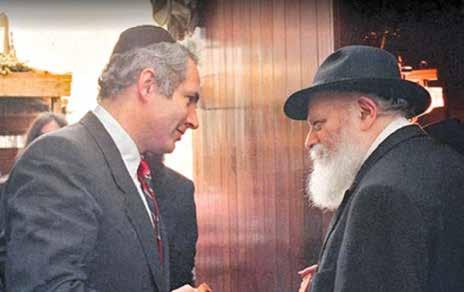
Drive through any Israeli city, and you’ll find streets named for rabbis and religious leaders, alongside politicians, biblical figures, poets, and friends of Israel – essentially anyone who has shaped the Jewish story. Only recently, however, have a handful of Israeli cities – including Rishon Lezion, Gedera, Dimona, Beitar Illit, and Kfar Saba – begun naming streets for one of the most influential Jewish leaders of the twentieth century: Rabbi Menachem Mendel Schneerson, the Lubavitcher Rebbe, zt”l.
For decades, he guided Israeli leaders, inspired soldiers and citizens alike, and transformed Jewish identity around the world. His portrait hangs in gas stations, army bases, and tefillin stands across the country – symbols of a movement that has become part of Israel’s spiritual landscape. Yet it took years for the Rebbe’s name to appear on the nation’s street signs.
The delay is striking. Though the Rebbe never visited Israel, his influence reached its highest offices. Prime Min-
isters Yitzhak Rabin, Menachem Begin, Yitzhak Shamir, and Benjamin Netanyahu all sought his counsel, as did Presidents Zalman Shazar and Ezer Weizman, along with a number of generals and senior army officers. They traveled to Brooklyn to meet him privately, emerging deeply affected by his clarity, confidence, and moral conviction. The Rebbe spoke not in slogans but in strategy – urging strength in defense, integrity in leadership, and faith in Israel’s divine mission. Why, then, did it take so long for his name to reach the map?
Some suggest that municipal committees viewed his complex legacy as ideologically sensitive. Officials wary of his followers’ messianic beliefs or his principled distance from secular Zionism feared that honoring him might inflame debate. Another factor is geography: Rabbi Schneerson never lived in Israel, nor did he ever visit, which may have made cities hesitant to include him among figures with a more direct physical connection to the land.
Yet the reason may lie deeper. The
Rebbe’s influence in Israel has always defied categories. He was not a Zionist in the conventional sense, yet he was passionately devoted to the Jewish homeland. Though not a hawk, his vision of peace was grounded in realism: he spoke constantly about Israel’s need for strong security, urged Jews to settle the land, supported the IDF, and framed Israel’s defense as a matter of pikuach nefesh, protecting life. Thousands of Chabad chassidim serve proudly in the army – a striking contrast to much of the ultra-Orthodox world.
That same sense of commitment and responsibility defines Chabad’s presence across the country today. Its emissaries stand on street corners offering tefillin to passing citizens, deliver food to the needy, and open their doors to any Jew seeking comfort or connection. The movement’s credo of unconditional love – ahavas Yisrael – has softened the hearts of countless Israelis, religious and secular alike. Yet that same visibility also unsettles some who prefer faith to remain private,
and Chabad’s confidence can challenge a society still negotiating the role of religion in modern statehood.
The Rebbe wasn’t a politician but a spiritual architect whose reach transcended left and right, religious and secular. His influence is everywhere precisely because it resists being confined to plaques or titles.
Walk through Israel, and you’ll see it: the Chabad tefillin stand outside a mall, the soldier tying his straps before a mission, the Rebbe’s portrait smiling from a bus stop in Ofakim or Eilat. His name now appears on a few street signs, but his presence has long filled the landscape –a reminder that his message was never meant for a street sign but for the people on the street.
Gedaliah Borvick is the founder of My Israel Home (www.myisraelhome.com), a real estate agency focused on helping people from abroad buy and sell homes in Israel. To sign up for his monthly market updates, contact him at gborvick@gmail.com.

Living in Jerusalem you are privileged to have a plethora of opportunities in both Torah and secular realms. Each day presents new opportunities for something interesting and fulfilling to do.
When it comes to special days like Rosh Chodesh, filled with so many classes, tiyulim, workshops and more, musical Hallels, special guest lectures, hikes and tours. Chodesh Adar is permeated with so many layers of wonderful programs that they collide with each other and make it difficult to choose among them.
I have kept myself super busy and sometimes double and triple up the activities on my calendar. Not a good thing. I float through my days and crash-land when my brain accepts that my body cannot keep up with its demands. Today in pilates, I was standing on the Reformer, sliding first with the right leg, then the left, when the left one said, “No more.”
The Cherry Blossoms in Jerusalem’s Botanical Gardens are beautiful, but for some reason, this jaded eye expected more. The six trees there are in bloom for no more than two weeks. It seems that February is the flowering month in Israel; the desert is green. I bought a Bonsai tree from the shed. Let’s see if I can keep it alive.
I walked the route of the Hebrew pilgrims with Ir David’s recently completed Pilgrimage Road Tour. It will never

By Barbara Deutsch

cease to amaze me that in Israel I can walk in the steps of our forefathers. If I listen closely, I can hear their murmuring voices.
Every Rosh Chodesh, the Jerusalem Anglo Women’s Rosh Chodesh Lunch Club presents a lecture on secular topics of interest which span subjects of political, social and emotional interest. You have to live in Jerusalem to sign up in advance. The venue is packed with interested seniors from America, South Africa, Australia and Great Britain.
The Adar lecture featured the first woman mayor of Beit Shemesh, Dr. Aliza Bloch. She had no money and no supporters when she began her campaign to create a sense of community between all of the factions living in Beit Shemesh. Dr. Bloch knocked on over 25,000 doors to win the mayoralty.
After losing in the last election (it’s not clear why, but Israelis do like to disagree), she is helping the Kiryat Shmona Municipality bring back the more than 40 percent of the people who left or were sent elsewhere during the recent war.
I sampled a variety of tasty soups, breads, and toppings at the now famous “Inbal Soup Festival.” An evening with Gershwin featuring a concert production of Porgy and Bess with two brilliant New York Metropolitan Opera stars was one of the best productions that I have ever enjoyed.
In this same Jerusalem Theater, just a few blocks from my home. I was treated to “A Night in Paris” featuring songs from Phantom of the Opera and my alltime favorite (five times) Les Miserables.
The rendition of “Bring Them Home” brought tears to all. Any person connected to Israel who has endured these last two years of war and hostages is able to relate.
I am back at Matan, papercutting, eating in restaurants, cafes and diners. I was introduced to a new place called Buchman’s, a ‘50s-era diner that serves the uncomplicated simple and delicious foods of my childhood. It is located behind the construction fences on Emek Refaim.
Buchman’s is named after an Anglo-populated building in Modiin. The entrepreneurial young (less than 30) couple who own and run it already have two franchises – even sold one – under their belt. The whole diner looks like it was taken from the set of Happy Days You half-expect Fonzie, sporting his gelled dark pompadour, to come strutting back into your life. You can sit as long as you want as you listen to the familiar sounds of the soothing, old songs playing in the background.
I gave our daughter Rachel my pots; I was not the cook anyway. If there will be a time when I will be cooking, I will purchase new ones #girlmath.
For now, I continue to build my “restaurant reviewer” resume.
Some follow-up on some of the people and things that I have introduced on this platform:
Homeless Lady is still homeless and parked near my former Ulpan in Beit Haam. My friend Rock is one of the most thoughtful people I know; she is always available with an outstretched helping hand. On the way to Mahjong (getting better at it), I noticed a bag on the floor of her car; the bag was filled with assorted canned goods and other dry food items. I inquired and Rock replied, “I don’t have the heart to throw this good, never-opened food out. The dates are iffy, just a little expired or almost expired. I think I want to donate it to someone in need?”
I replied, “Why not the Homeless Lady who lives right near you?”
“You mean Anat?” Rock knows her name – of course, she does!
That conversation gave me an idea. I also have a bunch of yogurts and stuff in my fridge sitting there since before I went away. I will give them to the Homeless Lady. I packed it all into a plastic bag, and off I went to accomplish a good deed.
I spotted Anat (Homeless Lady) in her usual Beit Haam spot sorting through her bags and baggage. I tiptoed closer without breathing, dropped the bag alongside one of her suitcases and hurried away.
“Ma zeh?” a strong voice rumbled to my back.
“Ochel tov,” I shakily responded and ran away.
I don’t attend Ulpan anymore. I still have 3 months’ worth of zechuyot, but I do not feel compelled to get back into that grind. When my friend Anna and I walked into Buchman’s (just to eat), a familiar-looking woman sitting at a back table with two friends waved me in. It turned out that she is Cousin Judy, my sister-inlaw’s close friend and relative. After some pleasantries, I noticed her tablemates were studying for Ulpan. Never!
I am well versed in all parts of the body from my gym attendance. I still attend the gym classes regularly, and, surprisingly, two gym “friends” actually welcomed me back after being away for a month. Almost everyone else continues to smile politely or ignore me. The teacher I like and actually checks my form just returned from vacation. Even though I have been a member at this gym for almost a year and a half, most people don’t acknowledge me.
Following instructions gets tricky. My gym-related Hebrew mostly works; I check my form with the person next to me. Hopefully, she also is doing the poses correctly. What counts is that I move the
old bones and stretch the muscles. Who really cares if it’s in the wrong direction?
My Hebrew skills are a real deficit when it comes to medical needs, directions, and small printed letters from the municipalities and banks. It comes in handy to have helpful children, grandchildren and friends who are fluent.
My favorite Israeli shoe store, Shufra, is having a blowout sale. Of course, I had to
have a collapsible elastic back that cuts into my foot.
My daughter said, “If they hurt you, throw them out.”
No way!
“Third” thing Sunday morning I walked to Shufra on Shlom Tzion street. I showed her the shoes and asked for options to fix the problem. The lovely saleswoman listened to my request and wrote
I float through my days and crash-land when my brain accepts that my body cannot keep up with its demands.
buy; I do have too many (even more than that) shoes. At some point, my foot sort of grew; sometimes, I’m a 37, and at other times, a 38. One of the fancier pairs I purchased – funky silver flats with a square toe and a strap across the mid-foot – tore real holes into the back of my foot on the first and the one Shabbat that I wore them.
Like a lot of shoes these days, they
it down with my phone number on a small square of paper. When I asked her if anyone else had had a problem, she smiled and nodded.
When I asked what she planned to do for me, she said, “I will contact Customer Service at the shoe company.”
Satisfied, I left the store with another pair of much-needed sale shoes. I have
holes in my feet, and these do not hurt.
About an hour later, I got a message from Shufra. “Something something” (in Hebrew) “more than 15 days.” I thought, “What?!” I just bought them last Monday, six days at most. I wrote back a heated response.
When I showed my friend Anna the message, she clarified: “They are sending the shoes back to the company and you should have a response within 15 business days.”
I deleted my message and sent them a thankful emoji.
Maybe I should reconsider Ulpan, although I have promised myself that I will never do homework again, especially while enjoying a good meal in a cool restaurant with friends.
The past week was filled with adventure and excitement and was busy. This coming week will be busier, more exciting and definitely adventurous.
Stay tuned.
Barbara Deutsch is the former associate principal at HANC, middle school principal at Kushner, and Dean of Students at Yeshiva of Flatbush. A not-retired educator, she is still trying to figure out life in Israel.



By Eliyahu RosEnBERg
f you take a mindful stroll down Ben Yehuda Street, you’ll notice its pale Jerusalem stone ground, outdoor cafes, and bustling shops and restaurants. You’ll hear music from street performers. The sounds of a dozen languages. And the voices of soldiers, excited tourists, ordinary folks enjoying a coffee, children giggling, and families walking — all the sounds that make up the soundscape of the iconic Jerusalem pedestrian mall.
But then there are other sounds and visuals that are, let’s say, less ordinary. Imagine yourself there: You’re passing by a souvenir shop when suddenly you spot a woman dressed in a white robe, yelling words that make no sense, holding up a big sign with bold letters. You squint at the sign from afar.
“I AM THE MESSIAH!” it reads. “I don’t want to be the Messiah, and my donkey doesn’t want to be a donkey. But we can’t help it.”
Before you process what’s happening, your confused brain scans the area and very quickly concludes that this woman — this eccentric woman parading down Ben Yehuda Street — is mistaken. She’s neither the Messiah nor a donkey owner.
You might think this woman’s crazy, but she’s far from the only Messiah claimant waving signs and yelling on the streets of Yerushalayim. Spend enough time in the area, and you’ll likely meet people who suffer from what experts call Jerusalem syndrome, a condition wherein an individual is seized by sudden delusions upon arriving in the holy city, genuinely convinced that he or she is the savior.
Now, the vast majority of people wouldn’t take this woman seriously. Nor would they pay any mind to a disheveled-looking man yelling unintelligibly about the redemption on a street corner. But what happens when a Messiah claimant seems credible? When, rather than appear-
When it comes to Moshiach, the most important thing to focus on is that you don’t get the title until you complete the job.
Maimonides said, ‘The sages and prophets did not long for the Messianic era in order to rule the world or to subdue the nations, but to be free to pursue Torah and its wisdom. at that time, there would be no jealousy and no war, no hunger and no strife.’
Extremism is back, and the Jews are always going to be at the center of it because the way society treats us is the litmus test for where humanity’s holding.
ing to be crazy, they seem charismatic and brilliant, like a real-world miracle worker? What happens when this individual is so out-of-this-world that even the greatest rabbis are persuaded that he’s Moshiach? When his presence convinces most Jews that Moshiach has arrived?
In that case, Rabbi Ken Spiro explains, we’re dealing with three kinds of Messiah claimants. First, there’s potential Messiahs. Then, there are failed Messiahs — the sort of people who could have been Moshiach but didn’t fulfill the mission. And third (and most common), there are false Messiahs.
So how do we tell whether a Messiah claimant is the real deal? As Rabbi Spiro explains, it’s actually very simple. If you complete the job, you get the title.
Rabbi Ken Spiro, a top author, historian, and Aish HaTorah lecturer, was once teaching a class on the Messianic era. He explained that all religions would disappear once Moshiach comes. Christianity would be gone. Islam, Buddhism, Hinduism, and every other religion would suffer the same fate, with all gentiles recognizing Judaism as the one true faith.
“So then, what does the whole world become?” Rabbi Spiro asked his class.
In response, one guy hollered, “Slaves to the Jews!”
Well, no. Not quite, Rabbi Spiro says with a chuckle.
“Maimonides said, ‘The sages and prophets did not long for the Messianic era in order to rule the world or to subdue the nations, but to be free to pursue Torah and its wisdom. At that time, there would be no jealousy and no war, no hunger and no strife. The entire world will be entirely occupied with acquiring the knowledge of G-d, as it says: The world will be full of the knowledge of G-d as the waters cover the sea.’ So, we’d just be connecting all of hu-
manity to G-d,” Rabbi Spiro shares. “The rest of the world becomes Noahides, and they keep the seven Noahide laws.”
That — making the entire world recognize G-d and the truth of Judaism — is perhaps the Messiah’s biggest task. But there’s more to the job.
“In a nutshell, the Messiah has to spiritually bring the entire Jewish nation back to Torah observance. That’s number one,” Rabbi Spiro says. “He has to physically bring all the Jews back to the land of Israel. He has to reconstitute a Jewish government with the Sanhedrin, the Jewish supreme court of 71 judges, and a high priest and king, governing through a Jewish legal system with a Jewish code of laws. He has to rebuild the Temple, which is where the Dome of the Rock is. The Temple service, with animal sacrifices and the laws of ritual purity, has to be reinstated. And by the way, Moshiach also has to fight off all the people who try to stop us.”
According to Rabbi Spiro, we are currently in the Messianic Era, a transitional period that immediately precedes the redemption. We’re seeing the world breaking down. Conflicts are erupting constantly. Simultaneously, the baal teshuva movement has brought countless Jews home, and Jews are making Aliyah en masse from everywhere in the world (the only other country outside of Israel that still has a substantial Jewish population is the United States). The process is already beginning. Now, Rabbi Ken Spiro says, we just need the Messiah to finish the job.
“But the most important thing to focus on is that you don’t get the title until you complete the job,” Rabbi Spiro emphasizes. “Now, that doesn’t mean there can’t be potential Messiahs; Judaism has that concept. The Talmud explicitly says that Hezekiah — the 14th king after King David, who was an incredibly righteous
man — had the potential to do it, but for various reasons, he didn’t.
“We’ve also had failed Messiahs: maybe Shimon Bar Kochva, who led the Bar Kochva revolt and had the backing of one of the greatest rabbis in Jewish history, Rabbi Akiva,” he adds. “We also have fake messiahs.”
And of course, the two most famous false messiah claimants in Jewish history are Shabbatai Tzvi and Yashka, both of whom garnered incredibly large followings.
Shabbatai Tzvi, a charming Turkish Jew who lived in the 17th century, is at the center of one of the most tragic stories in Jewish history. Somehow, he convinced much of the Jewish nation that he was Moshiach. A messianic fervor, a palpable sense of hope and excitement, surged through the nation. Convinced that their miserable galus was over, the masses rallied around Shabbatai Tzvi, declaring him the Messiah, selling all their possessions to make Aliyah, and, at his urging, eating lavish meals on fast days and disregarding several mitzvos. Great rabbis even backed him.
But then, one day, Shabbatai Tzvi got a little ahead of himself. He visited the Sultan.
“I’m the Messiah,” Shabbatai Tzvi declared. “Take off your crown and put it on my head.”
The Sultan very quickly declined, and he said something along these lines: “I don’t think so. But I’ll make you an offer: Become a Muslim or I’ll behead you.”
And just like that, the dream was over, the nation’s excitement came crashing down in the cruelest of ways, leaving in its wake an unspeakable despair — the kind one faces only when all hope is lost. Shabbatai Tzvi yielded to the Sultan’s threats, converting to Islam.
* * *
While Shabbatai Tzvi is a well-documented historical figure, far less is known about Yashka, who is presumed to have lived some 2,000 years ago. Yashka is the central character of Christianity. Christians believe he’s the “son” of G-d — comprising a trinity wherein G-d is chas

v’shalom split into three components — and await his “second coming” as the messiah.
But though Christian scripture writes extensively on Yashka’s life, its accounts are not from eyewitnesses; they were written years after Yashka’s death. While people from the Tanach, like Avraham and Moshe, lived in prehistoric times, Yashka allegedly lived at a time when historians were recording history. And yet, there is virtually no firsthand historical information about Yashka.
“Roman historians talk about Yashka, but only in the framework of Christianity being based on this guy — not that ‘I hung out with him.’ There’s no Roman soldier saying, ‘Yeah, I was at the crucifixion, I got the robe,’ stuff like that. So interestingly, there aren’t eyewitnesses,” Rabbi Spiro shares. “But there’s one Jewish historian who actually comes after the Yashka narrative, but not that long after, whose name is Josephus.”
As Rabbi Spiro explains, Josephus wrote a book called “Jewish Antiquities,” where he gives an incredibly detailed account of Jewish history. He leaves virtually nothing out. So, the question is, “Does Josephus talk about Yashka?” And the answer is…kind of?
“There’s a one chapter reference to J—,” Rabbi Spiro shares. “I don’t remember the exact quote, but he says that there was a man called J—, who was a great worker of wonderful deeds, and he was the [Messiah]... And it’s like 10 sentences.
“First of all, think about it logically. If J— was who he was and did what he did, this would be a really big speech, like at least a chapter! We’re the people who brought the idea of the Messiah into the world. No one would be more excited about that than the Jewish people: redemption’s finally come, we’re free at last. But the mention is just stuck in the middle,” Rabbi Spiro continues. “So, all the people who really know Josephus well and study him agree that it’s what’s called an insertion.”
In other words, someone, at a later time, took Josephus’ work and edited it to include mentions of Yashka.
But there’s one other text that seemingly discusses Yashka: the Gemara.
In fact, there are several parts of the Talmud that mention a “Yeshu HaNotzri,” which many people assume is the Hebrew name for “J— of Nazareth” or “J— the Christian” (the latter translation is dubious, because while Notzri is the modern-day Hebrew word for Christian, in the days of the Talmud it referred to an offshoot heretical sect of Judaism, not a separate religion). But, as Rabbi Spiro explains, these mentions of Yeshu HaNotzri have nothing to do with Yashka. For one, there’s not one but two Yeshu HaNotris in the Gemara.
“One is an apostate, a heretical student of Rabbi Yehoshua ben Prachya, who lived in the second century before the common era. And one is the illegitimate son of the wife of a guy by the name of Papas ben Yehuda, who lived around the time of Rabbi Akiva in the second century CE,” Rabbi Spiro shares. “You have two different people, living about 300 years apart, not connected to each other in any way. They just happen to have the same name, at least in the Talmud. And the Talmud is often speaking encoded and polemically, so even taking the stories in the Talmud literally is an interesting discussion. But neither of them fit into the J— of Nazareth time of the early first century.”
So, we have no historical evidence for Yashka, but that hasn’t stopped the movement that was created in his name. Nor has it stopped antisemites from using his death as ammunition against the Jewish people. Much of modern-day antisemitism started with the Christian world’s accusation of deicide against the Jews (accusing the Jewish people of killing their “deity”).
By allegedly killing Yashka, the Jewish people became, in the eyes of antisemitic Christian sects, the devil. Just like the devil, the Jewish people, they say, are the root of all evil. They killed the world’s only hope for salvation. They murder Christian children to make blood matzah. They rob and desecrate churches. And of course, they started the Black Plague, the 14th-century pandemic that wiped out half of Europe (25-50 million people).
You can hear echoes of this rhetoric in modern-day antisemitic allegations,
including that the Jewish people control the media, government, and economy and use their power for evil. At the core of these antisemitic claims is the idea that the Jewish people are the reason why bad things happen.
“Today, there are millions of super supportive Christians. But historically, Christianity has been used to create the most toxic, violent form of hatred and rivalry,” Rabbi Spiro notes.
In this sense, the movements behind Yashka and Shabbatai Tzvi were quite similar. Both movements attracted skeptics. And in turn, those skeptics were chastised as evil and demonic. With regard to Shabbatai Tzvi, Chabad.org writes, “Strong, reasonable rabbinic opposition was swept aside in the frenzy, with those showing disbelief in the so-called Messiah hounded and reviled,” so much so that one rabbi was even exiled for doubting Shabbatai Tzvi’s claims. Likewise, critics of Yashka were and are frequently labeled heretics and followers of the devil.
What do those two Messianic movements have in common? They were cults. And, as in every cult, dissent is prohibited, questions are banned, and blind faith is mandatory. Even though there was no conclusive evidence that either man was Moshiach, no one was allowed to question their status or remain skeptical pending real proof. But the beautiful thing about Judaism is that blind faith plays no role in our religion. We are obligated to question everything. In that sense, there’s very little difference between Yashka, Shabbatai Tzvi, and the Messiah claimants on Ben Yehuda Street: they can claim they’re Moshiach, but it would be foolish to believe them until they prove it.
When the real Moshiach comes soon, Iy”H, we won’t be confused. There will be no need to accept what he says blindly or to worry about rejecting him hastily. As Rabbi Spiro says, Moshiach doesn’t earn his title until he finishes the job. And when he does, there will be no room for doubt. Our enemies will be defeated. We’ll be back in Eretz Yisrael, standing before the Beis HaMikdash. There will be peace. And we’ll be free, forever, to learn Torah and serve Hashem.
Moderated by Jennifer Mann, LCSW of The Navidaters

I have been reading your column since before I was even dating, so I love that I’m able to contribute to it now! Thank you for the opportunity.
I’m 21 years old and just began to date about a year ago. I have gone out with nine guys so far, and they all liked me. I’m pretty shocked because from what I have seen from my friends and read about, that’s not usually so common. I do feel lucky that I’m in this situation, but a drawback that I am experiencing is that I am pretty particular about who I say yes to now. For example, last week alone I said no to six guys that were sent to me by various matchmakers. I get the feeling that the matchmakers are getting upset with me based on their attitudes when I give a no. To clarify, these are really not bad guys; there’s nothing off putting about them other than they’re not the look I usually go for, which I am particular about.
I want to convey this in a way that the matchmakers don’t get upset. I don’t want to get a reputation as being picky, although I do know I am particular. Is there any way to get the message to these matchmakers in a way that they will actually understand and not be judgmental?
Thanks!
Temima *
Disclaimer: This column is not intended to diagnose or otherwise conclude resolutions to any questions. Our intention is not to offer any definitive conclusions to any particular question, rather offer areas of exploration for the author and reader. Due to the nature of the column receiving only a short snapshot of an issue, without the benefit of an actual discussion, the panel’s role is to offer a range of possibilities. We hope to open up meaningful dialogue and individual exploration.
Dear Readers,
We want to offer YOU an opportunity to be part of the discussion! Please email us at MichelleMondShadchan@gmail.com, subject line “reader’s response,” if you would like to participate in the new “A Reader’s Response” columnist spot. We will send you a question and publish your answer in an upcoming Navidaters edition.
If you have a question you would like the Navidaters to answer, please reach out to this email as well.
Looking forward!
Michelle, the “Shadchan”
Rebbetzin Faigie Horowitz, M.S.
Temima, telling matchmakers the look you go for is unlikely to be helpful. They are busy people and under a lot of pressure from hundreds of people who want their help and actively pursue them. They are unlikely to invest in trying to figure out your preferences in the looks department.
Tell your friends and family members what your dream young man looks like and is like. You might even want to compose a job description from your list.
Michelle Mond
Iam very happy to hear that you have many suggestions coming your way in quick succession. You are right that this is not the most common experience for most girls.
What you describe is similar to what I hear from the young men I set up. It is a difficulty that has been described as being lost in a forest vs. the difficulty of many young women feeling as if they are lost in a desert. One of the most important things you can do right now is to navigate your dating in a way that you don’t get burnt out. The best way to do this is to be assertive but at the same time be very grateful.
Like many things in life, it’s not what you say; it’s how you say it. When you are speaking to the shadchan, acknowledge
the time and effort they spent setting this up. Remember that even before the idea came to you, there were many steps the shadchan made on your behalf that required a lot of time and energy. If you receive a resume/picture, and within five seconds you respond with the words, “Sorry, but not for me,” what do you think the shadchan will think and feel? Do you think she will choose to volunteer to spend time and energy on someone who inherently seems quick to judge and ungrateful? An alternative response could be along the lines of this instead. “Mrs. XYZ, thank you so, so much for thinking of me! He sounds like an amazing guy; he’s just not the right guy for me. If I think of anyone for him, I will definitely let you know. I really appreciate your efforts!”
It might take you 30 more seconds to write, but it will be received by the shadchan in a more positive light.
Dr. Jeffrey Galler
Among my circle of friends back in our Brooklyn College days, there was one fellow who insisted that he would only date girls who were absolutely gorgeous. When we commented that “beauty is only skin deep,” he responded that he wasn’t interested in going any deeper.
Here are three thoughts to consider. Reflection #1: The quest
Every single person begins dating with a checklist of criteria they deem important. Those using the shidduch system should naturally seek a shadchan whose
client base matches their priorities. For example: professionals, serious learners, or business-oriented singles.
Accordingly, choose the right shadchan. Then, it would be perfectly appropriate to tell that shadchan that you hope to meet someone pursuing a certain profession, lifestyle, or hashkafa and that physical attraction is very important to you.
Your letter, however, indicates that a certain “look” may be the primary consideration in your decision-making.
There are shadchanim who specialize in professionals, or in serious learners, or in entrepreneurs. I do not think there are shadchanim who specialize in finding guys who are good-looking.
(As an aside, when my wife was dating, she sought someone who was very smart and very kind, and who would be a great husband and father. Naturally, she gravitated to me. As a bonus, I was also incredibly good-looking.)
Dating is not meant to be a numbers game.
You probably realize that you are very fortunate to have been deluged with so many dating opportunities.
Please do not be insulted by the following observation. Shadchanim are accustomed to dealing with, and trying to help, singles who are very “picky.” Picky is something shadchanim can work with. Matchmakers are usually very understanding and willing to work with folks who are very demanding or particular. However, they may not be happy dealing with someone who comes across as being very shallow. Shallow is much harder for shadchanim to work with. You may

be coming across as someone who focuses mainly on externals, like appearance.
Unfortunately, a shadchan may naturally shift attention away from you and toward singles who are less rigid and less superficial. You might find that dating suggestions begin to dry up.
Reflection #3: The recommendations I do have two possible suggestions for you. I regret, in advance, that you may not be happy with my first suggestion and that some readers may not be happy with my second suggestion.
First, you are very young. You may wish to consider taking a short break
from active dating. Invest some time in developing your own career, or continuing your own education, and/or involving yourself in chessed or philanthropic projects.
After a short while, you may find that your world view has evolved and that you have a more pragmatic approach.
Second, you may wish to consider bypassing the shidduch system. Attend singles’ events, shul or community programs and check out the single guys. If you find someone who has the “look” that you seek, find out if he might be a suitable match. And, if so, ask someone to introduce you or boldly introduce yourself.
The Navidaters
Dating and Relationship Coaches and Therapists
Thank you for writing. I always smile a little when someone says they’ve been reading the column since before they were dating and now find themselves writing in. It tells me you’ve been thinking about this process long before you entered it, which already says something about the way you approach things.
Let’s start with this: saying no to someone you don’t feel excited about is not a problem. Dating is not meant to be a numbers game where the goal is to say yes as often as possible. You’re allowed to notice what resonates with you and what doesn’t. Being thoughtful about who you meet is part of taking the process seriously.
At the same time, I hear another layer in your question. You’re sensing that the matchmakers may be reacting to the number of no’s, and you’re worried about being perceived as difficult or overly picky. That concern isn’t unreasonable. Matchmakers are putting time and effort into
thinking about suggestions, and when many ideas are turned down, they can begin to wonder whether their suggestions are being given a real chance. In the practical world of shidduchim, perception does sometimes affect how often someone continues to be set up.
So part of what you’re navigating is a balance: staying honest with yourself while also showing the people helping you that you are genuinely open to meeting someone.
You mentioned that many of your no’s are based on appearance. Attraction absolutely matters. But attraction is also more complicated than we sometimes think. It’s not only about whether someone fits the picture we have in our mind at first glance. The way a person moves, his scent, how he fidgets, a surprising dimple that emerges when he’s engaged in conversation and laughing, the way he treats the waiter, a shared glance… these are all
Please remember that physical attraction draws two people together. Inner beauty is what helps them build a life together.
Avital
Hey Temima,
Consider yourself lucky to be at the top of the dating pyramid. You’re young and fresh to the dating scene so you’re in the stage of shadchanim shooting darts at a board hoping one sticks. Because you’re in demand and there’s a large supply of men, you’re allowed to be pickier. Guys say no to girls all the time based off attraction alone, and no one looks down upon them. Attention shad-
These resumes seem both necessary and functional and detrimental and silly.
chanim: women have preferences, too. You should 100% not say yes to a man you find very unattractive. However, I’d stay away from using that language and instead tell the shadchan that you’re busy and will revisit the idea another time. Best of luck!
things that have no way of being captured in a resume. I wish there was another way. These resumes seem both necessary and functional and detrimental and silly.
Sometimes, the emotional and psychological qualities of a person — their steadiness, their humor, their kindness, the way they listen or think — begin to register in a way that actually becomes physically attractive. In other words, the way someone is can change the way they look to us.
That doesn’t mean attraction always grows after meeting someone. Sometimes it doesn’t. But sometimes what initially feels neutral becomes surprisingly compelling once you encounter the person.
So it might be worth asking yourself a few gentle questions when a suggestion comes your way:
Am I saying no because something genuinely feels off to me, or simply because he doesn’t match the image I usually imagine?
Is there anything about this person that makes me curious to meet him for an hour?
Could I imagine enjoying a conversation with him, even if he isn’t my usual “type”?
Is my idea of attraction allowing room for surprise?
Matchmakers tend to feel much more comfortable continuing to suggest people when they sense that someone is open to meeting individuals who may not immediately fit a very specific mold.
You can also communicate that openness directly. A simple response such as, “I really appreciate you thinking of ideas for me. I try to stay open when something sounds promising, even if the person isn’t exactly my usual type” lets them know you value their effort and are engaging thoughtfully with the process.
And one final thought. The fact that the men you’ve gone out with have responded positively to you suggests that you likely bring warmth, presence, and genuine interest into your dates. Those qualities create connection. Staying curious about where connection might appear, even in places you didn’t initially expect, can make the process far richer.
Dating is less about selecting perfectly from a list and more about discovering what actually moves your heart.
Sincerely, Jennifer











By Aliza Beer MS, RD, CDN
Herbs and spices are plants used to flavor food, but they also provide important health benefits. For thousands of years, they have been used in traditional medicine to treat illnesses, improve digestion, and support overall health. Today, research shows that many herbs and spices contain natural compounds that act as antioxidants, reduce inflammation, and support the immune system. Adding herbs and spices to meals is a simple way to improve both flavor and nutrition without adding extra calories, sugar, or salt.
Herbs and spices both come from plants, but they are taken from different parts. Herbs generally come from the leafy green portion of the plant and can be used fresh or dried. Common examples include basil, parsley, cilantro, mint, rosemary, and thyme. Spices, on the other hand, come from other plant parts such as roots, seeds, bark, or flowers and are typically used in dried form. Examples include turmeric, cinnamon, ginger, garlic, and black pepper. Even though they come from different parts of plants, both herbs and spices contain natural plant compounds that provide important health benefits.
Many popular herbs provide important medicinal benefits:
• Basil is commonly used in pasta dishes, salads, and sauces. It contains antioxidants and antibacterial compounds that help protect the body from infections and may help reduce inflammation. Fresh basil works especially well on tomato-based dishes. For example, chopped basil can be added to marinara sauce, sprinkled over scrambled eggs, or placed on grilled salmon with olive oil and lemon.

• Parsley is rich in vitamin C, vitamin K, and antioxidants. It supports immune health and bone health and may help reduce inflammation and support kidney health. Fresh parsley can be added to chicken soup, mixed into rice, sprinkled over roasted vegetables, or used as a garnish on grilled chicken or fish.
• Mint is well known for helping digestion. It can reduce bloating, gas, and stomach discomfort. Mint is often used in teas and may help relieve nausea.
• Rosemary contains antioxidants that help protect brain cells and may help improve memory and concentration. It also has anti-inflammatory properties and supports immune health. Rosemary can be added to roasted potatoes with olive oil and garlic or used to season baked salmon or roasted chicken.
• Thyme has strong antimicrobial properties, meaning it helps fight bacteria. It has traditionally been used to support respiratory health and may help with cough and infections. Thyme works well in soups, stews, roasted vegetables, and poultry dishes. It is commonly used in chicken soup and roasted chicken.
• Cilantro contains antioxidants and may help remove certain toxins from the body. It also supports digestion and immune function. Fresh chopped cilantro is excellent on fish such as branzino. It can also be added to rice, soups, or salads to enhance flavor.
• Dill is rich in antioxidants and may support digestive health. It has calming properties and may help reduce bloating. Dill pairs especially well with fish, particularly salmon or branzino. It can also be added to yogurt-based sauces, cucumber salads, egg dishes, and chicken soup.
Spices are especially powerful because they contain concentrated beneficial compounds.
• Turmeric is one of the most studied spices. It contains curcumin, which has strong anti-inflammatory and antioxidant effects. Turmeric may help reduce joint pain, support immune function, and protect against chronic disease. It can be added to rice, soups, roasted
vegetables, scrambled eggs, or chicken dishes. Turmeric works especially well in lentil soup or seasoned chicken.
• Cinnamon is commonly used in oatmeal, baked goods, and beverages. It can help regulate blood sugar levels by improving insulin sensitivity. Cinnamon can be sprinkled on oatmeal, yogurt, toast with nut butter, smoothies, baked apples, or coffee.
• Ginger supports digestive health and helps reduce nausea. It is commonly used to relieve motion sickness, pregnancy-related nausea, and stomach discomfort. Ginger also has anti-inflammatory properties. Ginger can be added fresh to tea, smoothies, stir-fries, soups, or rice.
• Garlic supports heart health. It may help lower blood pressure and cholesterol levels. Garlic also has antibacterial and antiviral properties, which help support the immune system. Garlic can be used in almost any savory dish, including chicken soup, roasted vegetables, pasta, fish, and sauces.
Herbs and spices play an important role in supporting many systems in the body, including digestion, heart health, and immune function. Their natural plant compounds help the body function properly and protect against disease. Many herbs and spices improve digestive health by helping the body break down and absorb food more efficiently. For example, ginger helps stimulate digestive movement and can reduce nausea, bloating, and stomach discomfort, while mint helps relax the muscles of the digestive tract, which can relieve gas and indigestion. Fennel is also known to reduce bloating and support comfortable digestion. Turmeric supports liver function, which is important for processing fats and removing waste from the body.
Herbs and spices also provide important benefits for heart health. Garlic is especially well known for supporting the cardiovascular system because it may help lower blood pressure and cholesterol levels. Cinnamon can help regulate blood sugar levels and may also improve cholesterol levels, which helps protect the heart. Turmeric helps reduce inflammation in blood vessels, while herbs such as rosemary and oregano contain antioxidants that help protect blood vessel health. Using herbs and spices to flavor food instead of excess salt is another important way to support healthy blood pressure.
In addition, many herbs and spices strengthen the immune system and help the body defend against infections. Garlic contains natural antibacterial and antiviral compounds that help fight harmful microorganisms. Ginger and turmeric help reduce inflammation and support immune function. Herbs such as thyme and oregano also have antimicrobial properties that help protect the body from illness. Regularly including these herbs and spices in meals can help support the body’s natural defense system. Overall, herbs and spices support mul-
tiple body systems at the same time. Their antioxidant and anti-inflammatory properties help protect cells, improve organ function, and promote long-term health.
Use Herbs and Spices
Herbs and spices can be easily added to meals throughout the day. Here are some simple meal ideas that include multiple herbs and spices:
• Chicken soup: Use garlic, parsley, dill, thyme, and black pepper. These
• Roasted potatoes: Add rosemary, garlic, black pepper, and olive oil. This creates a flavorful and heart-healthy side dish.
• Grilled chicken: Season with garlic, thyme, rosemary, and black pepper. Sprinkle fresh parsley after cooking.
• Rice or quinoa: Add turmeric, garlic, parsley, or cilantro for added flavor and antioxidant benefits.
• Egg dishes: Add parsley, dill, black pepper, and turmeric to scrambled eggs or omelets.
Herbs and spices are safe when used in normal cooking amounts. However, very large amounts in supplement form may cause side effects or interact with medications. It is best to use herbs and spices as part of a balanced diet.
Their natural plant compounds help the body function properly and protect against disease.
Herbs and spices provide many health benefits in addition to improving flavor. Common herbs such as basil, parsley, mint, rosemary, thyme, and cilantro support immune health, digestion, and overall wellness. Popular spices such as turmeric, cinnamon, ginger, garlic, black pepper, and chili peppers help reduce inflammation, support heart health, and regulate blood sugar. Adding herbs and spices to meals is a simple and natural way to improve health and prevent disease while making food more enjoyable.
herbs enhance flavor while supporting immune and digestive health.
• Roasted salmon or branzino: Season with garlic, lemon, dill, and fresh chopped cilantro. This combination supports heart health and provides anti-inflammatory benefits.

• Vegetable dishes: Season roasted vegetables with garlic, rosemary, thyme, or turmeric.
Using herbs and spices regularly is a simple way to make meals more enjoyable while reducing the need for excess salt and added sugar.
Aliza Beer is a registered dietitian with a master’s degree in nutrition. She has a private practice in Cedarhurst, NY. Patients’ success has been featured on the Dr. Oz show. Aliza can be reached at alizabeer@gmail. com, and you can follow her on Instagram at @alizabeer

By Sara Weissman
“Min-maxing” is when a person strives to maximize specific desirable attributes at the cost of putting any investment into other, less important attributes. This attitude is rampant in sports. Weightlifters skip cardio and leg day, runners look like they have never lifted a three-pound weight, and cyclists have shredded quads but fragile bones.
Is there another path to the top? Enter Georgia Hunter Bell, who won bronze in the 2024 Summer Olympics. While most middle distance runners run 70-80 miles per week, Bell averages just 25-30 miles of running, supported by a massive ~100 miles of cycling. According to Bell, her unique duathlete-style approach has kept her injury-free and incredibly competitive.
Cross-training refers to any exercise an athlete performs outside of their main sport, like a football player doing pilates or a runner going cycling (the example I will use in this article). As an endurance athlete, should you incorporate cross-training?
Different sports improve your fitness in different ways. Cycling strengthens your quadriceps and glutes. It is low-impact, allowing for high volume and easy recovery. Running strengthens your tendons and bones. It also improves deceleration control and footspeed. A cyclist who never runs can develop back issues and low bone density. A runner who never cycles may lack the sustained concentric hip extension strength that supports pelvic control and long-term joint resilience. By cross-training, you can distribute your strengths more evenly and develop into a more well-rounded athlete.
Con: Sport-Specific Training Matters Most for Performance
Ever hear about the Olympic champion cyclist who only trained by running? Of course not, because that wouldn’t be possible. All forms of cardio improve your oxygen uptake and heart strength, which are crucial for endurance performance.

For this reason, increasing performance in one sport typically increases performance in others. However, each sport calls upon a unique set of muscles to perform unique actions. Even if two activities predominantly rely on lower-body muscles, like cycling and running, they can differ greatly in muscle recruitment. Becoming a good runner made me a
There’s an old saying in sports: “the best ability is availability.” Different sports have different “stress points” that are more likely to be injured. Runners everywhere recoil at the mention of “shin splints,” which is caused by too much impact, too quickly on the shins. Strains in the Achilles tendon, runner’s
By cross-training, you can distribute your strengths more evenly and develop into a more well-rounded athlete.
stronger cyclist, and some of the gains certainly translate across sports. However, when I get on the bike, my lungs feel fine but my legs feel the burn. My machinery can’t keep up with my engine. To significantly improve as a cyclist, you need to spend time on the bike, as it is the optimal way to target the proper muscles. Running improves running, cycling improves cycling, and swimming improves swimming. The top triathletes, who train to be the best in all three of those sports combined, are not as good as the top runners, cyclists, and swimmers at any of the individual sports.
knee, and IT band syndrome are some other typical running ailments. Cyclists all too often suffer from saddle sores, back pain, and anterior knee pain. Repeatedly straining the same joints and muscles increases the likelihood of overuse injuries. Alternating different sports spreads the impact across different areas of the body, reducing the risk of injury. When I was building up my running volume, I swapped running for cycling twice a week to avoid overuse injuries. In the long term, cross-training will likely improve your performance in your main sport by keeping you healthy:
no athlete has ever improved their fitness while on the couch injured.
Motivation is what actually gets us moving, but it can be fickle. If you are starting to feel burnout from doing the same activity over and over again, it can be refreshing to switch it up. If there’s a cold wave that makes running seem like torture, there’s no shame in spinning your legs on the bike instead.
Whether you love or hate cross-training, you’ll eventually probably get forced into it. Injuries happen and can throw a wrench in your training routine. Transferring your training to another sport can help you maintain fitness (and sanity) while recovering. The bike is not my first choice of sport, but it does make a good “runner’s wheelchair.” When I was recovering from a stress reaction in my pelvis, I was so relieved that I could still comfortably bike. I did not choose the cross-training life, but during a month off of running, it was exhilarating to see myself rapidly improving on the bike. Cross-training is a great tool if you have exercise-ADHD, are injured, don’t want to get injured, or are just trying to improve general fitness. Even many professionals cross-train during the off-season to maintain fitness without getting sick of their main sport. The best way to be consistent with exercise is to enjoy it.
Don’t be afraid of being the jack-ofall-sports, because when it comes to cross-training, that might be the best path to being a master of one.
Sara Weissman is a high school psychology teacher, biochemistry researcher, former adjunct professor of biology, and distance runner. Follow her running adventures on Strava @Sari Weissman. If you have feedback or suggestions for future articles, contact Sara at sara.lifshitz18@gmail.com.
By Etti Siegel
As educators and parents, we spend an enormous amount of time worrying about whether our teenagers are happy. We track stress levels, academic pressure, social dynamics, confidence, motivation, and resilience. We ask ourselves constantly: Are they OK? Are they enjoying life? Are they fulfilled?
But what if happiness, as we usually define it, isn’t the whole story?
New research published in Applied Psychology: Health and Well-Being suggests that there is another dimension of a “good life” that may matter just as much, especially during adolescence. It’s called psychological richness, and one of its strongest predictors isn’t achievement, confidence, or optimism. It’s something far more internal, and far more contagious than we often realize: self-compassion.
The study, led by Yuening Liu and colleagues at Shaanxi Normal University in China, followed over 500 high school students between the ages of 14 and 18 across a four-month period. What they found offers both reassurance and a challenge to the adults raising and teaching teens today. The way young people learn to treat themselves becomes the lens through which they experience the world, and much of that learning happens by watching us.
For years, psychology described well-being in two ways. Hedonic well-being focuses on pleasure and satisfaction –feeling good and avoiding discomfort. Eudaimonic well-being centers on meaning and purpose – living a life aligned with values and contribution.
Psychological richness is different.
A psychologically rich life isn’t necessarily easy, comfortable, or consistently happy. It’s defined by variety, novelty, complexity, and experiences that shift perspective. It includes challenge, uncertainty, discomfort, and growth. In other words, a psychologically rich life isn’t smooth; it’s textured.
Adolescence is a prime time for developing this kind of richness. Teenagers are navigating academic pressure, social hierarchies, identity formation, independence, success, failure, belonging, and exclusion, all while their brains and emotional systems are still developing. The same challenge can either become a source of growth or a source of shutdown.
The researchers asked a simple but important question: What inner tools help adolescents turn challenge into richness rather than stress? Their answer was self-compassion. Self-compassion is often misunderstood. It isn’t self-

pity, weakness, or lowered standards. It’s treating yourself with the same care and understanding you would offer a close friend.
The researchers broke self-compassion into six components. The compassionate components – self-kindness, mindfulness, and a sense of common humanity – were linked to greater psychological richness over time. Teens who were kind to themselves after setbacks, who could sit with difficult emotions without spiraling, and who understood that struggle is part of being human were more likely to describe their lives as interesting, meaningful, and perspective-changing months later.
The way young people learn to treat themselves becomes the lens through which they experience the world.
The non-compassionate components – self-judgment, isolation, and over-identification –worked in the opposite direction. Harsh self-criticism and feeling alone narrowed teens’ willingness to engage with new experiences. Isolation, in particular, fed self-judgment, creating a negative cycle that shrank their inner world.
This wasn’t about personality. It was about the way they viewed the world around them.
Psychological richness doesn’t come from avoiding struggle. It comes from staying open in the presence of struggle. A teen who can be kind to themselves after failure is more likely to reflect, learn, and try again. A teen who can tolerate discomfort without being consumed by it can grow from it.
But teenagers do not learn these habits in a vacuum. They learn them by watching us.
If we are constantly judging others, criticizing ourselves, complaining about life, catastrophizing, or playing the victim, we are not just venting, we are teaching. We are teaching teenagers how to interpret discomfort, how to speak to themselves when things go wrong, and whether challenge is something to grow from or something to fear.
When a child hears:
“I’m such an idiot.”
“Nothing ever works out for me.”
“People are always against me.”
“This is just how my life is.”
They don’t just hear words, they absorb the worldview being shown.
And when that worldview becomes harsh, narrow, and judgmental, we rob teenagers of one of the greatest gifts we can give them: the ability to experience life with openness, nuance, and growth.
Our job isn’t to create perfect conditions for our children. It’s to help them develop the internal tools to engage with an imperfect world. A teenager doesn’t need a life free of stress to thrive. They need a life where stress doesn’t define them.
Self-compassion, especially self-kindness and mindfulness, creates that buffer. And the most powerful way teens learn it is through us.
Psychological richness isn’t taught in lectures. It’s transmitted in our tone, language, and daily moments. Let us be mindful of the messages we are sending our (almost and already) teens!
Mrs. Etti Siegel holds a MS in Teaching and Learning/Educational Leadership and brings sound teaching advice to her audiences culled from her over 35 years of teaching and administrative experience. Etti is an Adjunct at the College of Mount Saint Vincent/Sara Shenirer. She is a coach and educational consultant for Catapult Learning, FACTS Education Solutions, Brienza Academic Advantage, Yeled V’Yalda; is a sought-after mentor and workshop presenter around the country; and a popular presenter for Sayan (a teacher-mentoring program), Hidden Sparks, and the Consortium of Jewish Day Schools. She is a frequent contributor to Hamechanech magazine and The Journal for Jewish Day School Leaders and has a weekly column in The Jewish Home. She can be contacted for questions and comments at ettisiegel@gmail.com.
By Sara Rayvych, MSEd

This article should have been written before Purim, but I only thought of the topic after other parents shared with me their Purim hesitations. I decided to write about it anyway since the issue is likely to arise with Pesach, vacations, summer plans – pretty much year round.
Purim is one day of too much activity. The families I spoke with were concerned about how to balance the many Purim festivities – ensuring everyone got what they wanted – while still maintaining adult sanity. The basic answer is that this is impossible. Article complete.
The bigger discussion is how to set realistic expectations and ensure that a special time is enjoyed by all. Setting boundaries for ourselves and our families helps protect our sanity while ensuring the most important things get done.
Many have the hope of “doing it all” and “getting it all.” This is a fallacy, albeit a popular one to hold onto. The truth is that everything we say “yes” to means we’re saying “no” to something
else. If I say “yes” to making a last-minute dessert before Shabbos, then I’m saying “no” to a clean kitchen or inner calm as I go into Shabbos. Does this mean I shouldn’t make that last-minute dessert? Not necessarily. It means I need to acknowledge the pros and cons, recognizing that I can’t have the dessert, a clean kitchen and last-minute calmness simultaneously. Once I accept that reality, then I can decide if the benefits of the dessert outweigh the potential negatives. If the dessert contains enough chocolate, then it may be worth it.
I want to stress that there is no right or wrong decision to this question. It’s simply a matter of recognizing our limitations and having a realistic idea of what we can do when making our decision.
For Purim, trying to make everyone happy may look like insanity. Parents driving all day, stuck in traffic and annoyed, while kids scream about the
friends they need to visit. Each child considers their friends and teachers the most important – the only ones that actually matter, if we’re being honest. The kids complain about the traffic and how long it’s taking, even though they refuse to eliminate anyone from their list. In their humble opinion, their siblings take too long at each house. They’re hungry – again – even though they just finished three bags of chips, two packages of sour sticks and four hamantashen. Despite the parental reminders, wrappers and crumbs fly. Don’t worry – you’ll enjoy cleaning it up for Pesach. You will also spend the next three weeks trying to find where they stored a warehouse stock of snacks. In the end, nobody is happy, and parents check for additional white hairs.
For Pesach, trying to make everyone happy isn’t looking much better. Parents try to focus on getting rid of chometz, but, of course, they want to spring clean and make the house feel extra special. Each child has the foods they want
made, but that doesn’t mean they’re necessarily offering to peel vegetables or clean up afterwards. Each child has many beautiful divrei Torah they want to share at the Seder but doesn’t have the patience to listen to all their siblings. Naturally, they also each want to go first. The kids can’t understand why their parents won’t only go on the trips they want and insist on also doing things the other kids like. It’s painful, chaotic, and the hurt feelings last longer than the matzah.
While using the two closest yomim tovim as examples, the same issue can be applied to practically every event in a family’s life. It can apply to our personal schedules, and it can apply to our emotions and personal expectations.
There are many ways to address the above problems, but they all involve being realistic about our expectations and then setting the appropriate boundaries. None of the solutions involve ignor -
ing the issue and hoping for the best. I’ll provide some examples, but the ideas can be similarly applied to other situations.
I want to stress that this isn’t about making everyone happy – that will never happen. It’s not about getting everything we want done – that will never happen. It’s about prioritizing what needs to get done while meeting everyone’s actual needs – not wants (wants are unlimited). Parents are people, too, and we have to make sure our needs are met, and our health and sanity maintained. I can guarantee that children will have a more enjoyable time with less “extras” and a calm parent than they will with all the “bonuses” as a parent screams or cries.
Expectations need to be realistic and something we can actually accomplish during the given amount of time. It also needs to be within our emotional ability to do so. Sometimes, we physically may be able to do something but not unless we emotionally overextend ourselves in the process.
Let’s take a look at some of the ways Purim could have been addressed. Children can be given a set number of
children they can choose to deliver to or informed of which streets/communities you will be driving to. For Pesach, we can allow each child a set number of divrei Torah to say at the Seder or give each child a yom tov meal that is theirs for speaking. We can make trips that will (ideally) appeal to multiple chil -
to have four complicated side dishes for the Seder, but we only need a regular yom tov meal. We may want our house to smell like fresh breezes (whatever that smells like), but we only need our house to be free from chometz. Our child may want the latest fad backpack, but they only need something strong to
It’s about prioritizing what needs to get done while meeting everyone’s actual needs.
dren, while ensuring each child has at least one trip that will excite them. Part of setting priorities is making a distinction between wants and needs. This is different for each person, but there are certain more universal examples. We may want to deliver to our hundred closest friends, but technically, we only need to deliver one. We may want
carry their books each day. It’s important to note that the most popular bag (or other item) is often not the most durable.
Ideally, we set our expectations before the big day and convey our intentions to those close to us well in advance. Deciding at the last-minute leaves us fewer options. Allowing our children
time to absorb the plans and have their own realistic expectations will ease their adjustment. For example, telling kids last minute that they won’t be able to deliver to all their friends will almost guarantee a revolt and not give them time to prioritize their own deliveries. Beyond being practical, this encourages setting boundaries. Setting boundaries is a difficult skill for both adults and children. For our emotional health and shalom bayis, it’s crucial we maintain healthy boundaries. Sadly, we often only realize how important boundaries are once someone has trampled upon them. I hope everyone had a wonderful Purim. I join all of Klal Yisroel in davening for peace for our nation and the geulah b’karov.
Sara Rayvych, MSEd, holds a master’s degree in general and special education. She has been homeschooling for over 15 years. Sara provides personalized parent mentoring services, addressing a variety of general and specific parenting concerns. She can be contacted at Sara.Rayvych@gmail.com with comments, questions or for private consultations.


By Mordechai Schmutter
Ifeel like the only seudah that people are less makpid on than Shalosh Seudos is Melava Malka.
It’s almost like if a seudah has a name, people are less likely to take it seriously. The Friday night seudah everyone eats. Shabbos lunch everyone eats – both the people who think the term “Shabbos lunch” is disrespectful because lunch implies egg salad on a sandwich, so they call it “the Shabbos day seudah” and the people who think “Shabbos day seudah” is disrespectful because it implies there’s no such thing as Shalosh Seudos, just because that is, in fact, egg salad sandwiches. But everyone eats that seudah. Meanwhile, Shalosh Seudos has a name – albeit one that everyone butchers – and many people don’t take it seriously. And Melava Malka has a name that no one butchers and is, in fact, a beautiful name that we would consider naming a daughter that’s born on Motzoei Shabbos, but no one’s even home.
It’s like the more solid the name, the less everyone is makpid.
Though people are pretty makpid about the Seudah Hamafsekes. And that’s also eggs and bread. We’re also pretty makpid about the Seder. And there are eggs there, too. But not bread.
This is not to say no one cares about Melava Malka. Every Motzei Shabbos, the pizza shops are full of people who are makpid on Melava Malka. And on b’rov am hadras Malka.
But for the most part, we don’t eat as a family, we don’t all eat the same thing, and we definitely don’t sing zemiros. Nor do we light candles, unless one went out on Friday night.
But Melava Malka is important; it’s how we respectfully send off the Shabbos Malka. And if you forget to officially send off a queen, she doesn’t leave. She just freeloads in your house for a few days until you notice she’s still there.
“Wait, why does the cholent still taste good? Oh.”
But this is how we send her out sometimes – with a single brownie eaten over the sink.
“Oh, can I offer you a piece?”

“No, thanks. I’m still full from all the yummy food you had at Shalosh Seudos!” But why don’t we seem to take it seriously? Let’s see…
1. For one thing, no one can agree on what to eat.
Well, not no one. Most people want milchigs. But then every time you’re invited out to an official Melava Malka, it’s fleishig. Who’s planning those? We’re finally milchigs, and you’re serving fleishigs? We waited six hours! Daytime hours!
So you go to these events and you wonder, “Is that what the mitzvah is? Fleishigs? Because otherwise why would they serve this?”
Seudah Shlishis we all agree: no fleishigs. Milchigs if possible. Pareve in the winter. Even if you go to an institutional Shalosh Seudos, no one’s serving fleishig. They will choose to serve food no one wants to eat over serving fleishigs. And then they ask, “Are you coming back later for Melava Malka?”
“Maybe. What are you serving?”
“Fleishigs!”
“Then what did I eat all this tuna for?”
2. Secondly, it doesn’t actually feel like a chiyuv when people are eating it in pizza shops. There’s no other official seudah that people eat in pizza shops. Not even the Seudah Hamafsekes. And I know they have all the ingredients. And a way
to get a large amount of ashes in a hurry.
It’s like the easier Chazal made the mitzvah, the less likely people are to actually do it.
Shalosh Seudos they said, “Try to have fish,” and we said, “Oh. Can we just have fruit?”
Melava Malka they said, “Try to have something hot? I guess?” and we’re like, “What about ice cream?”
And no one has a plan. A couple of hours after Shabbos, we finally ask each other, “So what should we eat?”
“I don’t know; what restaurants are open?”
And then you root through the freezer, looking for something you can turn into pizza.
3. Motzoei Shabbos can be very late. Particularly in the summer.
And some people don’t have an appetite that late. It’s like Shulchan Orech at the Seder. It’s 11 o’clock at night, and in the past couple of hours, they’ve already had wine, a vegetable that was less than a kezayis, and some matzah, and they’re like “Shulchan Orech? Now?!”
Not to mention that when Motzei Shabbos is late, everything’s closed in some communities. What, are you supposed to make food yourself, fresh, like Chazal suggested? I’ve gone to father/ son Melava Malkas that were all makpid on fleishigs and still clearly nothing was
made that day. Some of it may have been made in the time of Chazal.
But then you’re like, “Well, what about the winter?”
4. In the winter, everyone has to rush out after Shabbos.
“We have to get out before the stores close! Why do they close so early?”
Non-Jewish stores on Motzei Shabbos are full of frum families dragging around their bochurim who are growing every single day and get one off-Shabbos a month to rebuild their entire wardrobes from stores that are all religiously closed on Sunday.
“Well, do they at least open on Sunday night, after sundown?”
They do not.
5. Another thing that happens in the winter is that every week some shul or yeshiva is making a Melava Malka. Because apparently, there’s an ancient kabbalah that having a Melava Malka is a segulah to raise funds.
Is the whole family invited? No. It’s either father/son or Ladies Auxiliary or couples only… Not a single mossad cares.
And apparently, they don’t get a whole influx of people who RSVP to say, “Sorry, I can’t come. I’m makpid to eat Melava Malka with my family.”
“Can you maybe eat twice?”
“I already ate four times today.”
“Four?”
“Two kiddushim.”
6. The yeshivos don’t really stress it. The rebbeim talk about Shabbos seudos, but when it comes to Motzei Shabbos, you have one rebbi who mentions one time that eating Melava Malka sustains some bone in your back, but he’s not sure where this bone is because his rebbeim only mentioned it once.
The most chinuch we get on the topic – at least in the yeshiva I sent my kids to – is that once a year, during flu season, some of the grades have a father-son Melava Malka made primarily of foods that the fathers should not be eating, such as small hot dogs that everyone has touched, and the only vegetable on the table is ketchup.
And then they sing zemiros using tunes that the kids barely know and the
fathers definitely don’t know. The only thing I remember from year to year is that at some point in the middle of one of the songs, you have to pick up your cup of soda because everyone bangs the table at the same time, and they’re not great tables.
7. No one knows the zemiros.
You know how you look through a bentcher for the other seudos, and there’s always one or two songs that you’ve never heard in your life? For Melava Malka, it’s all of them.
Maybe if we invite guests for Shabbos, they’ll know the tunes. Well, no, because…
8. The guests run out right after Shabbos.
I mean, they have things to do, too. They came to you for Shabbos despite having 13 commitments in their hometown an hour after Shabbos. You come home from Maariv, and all of their stuff is sitting in your entranceway, waiting for the husband to schlep it out to the car. Even his tallis has been folded.
“You guys aren’t staying for Melava Malka? We just have to make it! After the dishes!”
And they say, “No, our kids have to get to bed.” They always blame the kids.
And their kids are like, “It’s alright. We don’t have to go to bed.”
Apparently, the only thing that was keeping the guests in your house through Seudah Shlishis was their inability to drive home.
It was never their plan to stick around. Either they’re not makpid on Melava Malka, because of the yeshivos,
Melava Malka!” and then immediately start rooting around in your freezer and smelling things.
So I’m thinking that we try to do it properly like once or twice a year. Like if yom tov falls on a Motzei Shabbos. OK, just kidding. But once or twice is a nice start. And not with your Shabbos guests, necessarily. The best Melava
And you say, “Of course! We do it every week!” and then you make a mental note to tell your spouse that you’re doing Melava Malka that week.
Some of the grades have a father-son Melava Malka made primarily of foods that the fathers should not be eating, such as small hot dogs that everyone has touched, and the only vegetable on the table is ketchup.
And then as soon as Shabbos is over, you light some candles and brainstorm some foods to serve (“MeLAVA cake?”) and tell your kids to stop getting in pajamas, and meanwhile, the other family will tell their hosts, “We’re sorry, our kids have to go to bed,” and their kids will go, “Nuh uh!” and then they’ll hightail it over to your house, and you’ll have a lovely seudah. And then maybe, between the two families, someone can say, “Hey, it’s not actually Shabbos. Why don’t we look up what the tunes are?”
You only need to do this once or twice a year. And if you do it right, you might choose to do it more often! Kind of like becoming a baal teshuva when it comes to Shabbos seudos.
Imagine how many Motzei Shabbos functions you can get out of.
or they are, but they’re not sure if you are, and to be honest, it’s awkward to hang out at one’s Shabbos hosts on Motzei Shabbos and hope they get the hint to feed you.
And if they ask you point blank, you’ll say, “Of course, we’re having
Malka guests are when you find out at some point over Shabbos that someone you know is in town, staying at someone else, and you tell them, “You have to come for Melava Malka!”
And they say, “Are you sure? You guys do Melava Malka?”
Mordechai Schmutter is a freelance writer and a humor columnist for Hamodia and other magazines. He has also published eight books and does stand-up comedy. He can be contacted at mschmutter@gmail.com.

Jews have long been referred to as the “People of the Book.” Centuries ago, when only the upper class would be taught to read and write, we conducted ourselves differently, and even our young were taught to read and write. As a book lover myself, I take great pride in this appellation.
On Tisha B’Av, along with the kinnot mourning the destruction of Jerusalem, there is one kinah, #41, entitled, “Shali Srufa B’aish”— Seek (O Torah) Consumed by Fire. As explained in the ArtScroll Tisha B’Av Kinnot, in the year 1242, 24 cartloads of the Talmud and its commentaries were publicly burned. Please note that this happened two hundred years before the invention of the printing press. Each of those volumes had been handwritten, taking months, even years, of tedious labor and at huge expense. What a calamity this was, for we are the “People of the Book.”
What is amazing is that even under terribly difficult circumstances, this passion for our holy books, our sefarim, never waned. Despite the severe economic hardships, the harsh climate, and constant worry over family members in Europe, the refugee yeshiva students in Shanghai, China, spent the war years seriously engaged in their studies. They used sefarim that had been reprinted from those few carried along to Shang-
By Miriam Liebermann, MSW
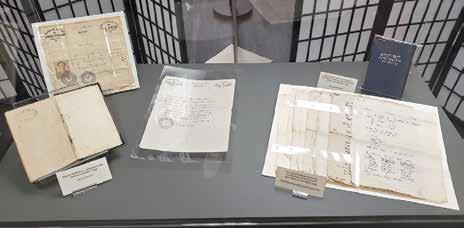
hai from Poland, or sent to them by supporters, particularly Rabbi Kalmanowitz in New York. In an amazing instance of hashgacha pratis , Shanghai, hosting 25,000 Jews by the end of the war, actually became the center for the printing of Jewish books. While books being printed in Europe were done through typeset, a novel, more progressive form of printing had been introduced in Shanghai, offset printing, which proved to be a quicker and more economical process. In fact, survivors who made their way from Shanghai to America after the war reported that sefarim were printed in Shanghai to be shipped to America!
Ms. Fayga Brisman, Development Director of Amud Aish Memorial Museum, shared with me that her grandfather, Reb Shimon Brisman, had been a printer in Shanghai. A former student in Baranovitch and Grodno, he escaped together with the Mirrer Yeshiva bochurim to safety in the East. With a partner, another yeshiva student, Reb Berish Mandelbaum (who later became a librarian at Yeshiva University), they established a successful printing plant. Ms. Brisman points out that the depth of scholarship in Shanghai was quite remarkable. Each yeshiva had its own imprint and arranged for the printing of designated sefarim. Reb Brisman, a veritable scholar, eventually made his way to America and
became the chief librarian of the Judaica library at UCLA.
The Mirrer Yeshiva was based in the Bais Aharon Synagogue, built by Silas Hardoon, one of the wealthiest members of Shanghai’s Sephardic Jewish community. The existence of this shul was quite miraculous. Years earlier, Mr. Hardoon dreamt that he should build this edifice. The shul was completed in 1927 and remained empty, unused, until the Mirrer students arrived more than 10 years later and the glorious echoes of Torah learning reverberated through its very walls.
At the first siyum celebration held in Hongkew, Rav M. G. Kagan shared the following, “Jewry, despite its 2,000-year-old exile and martyrdom, notwithstanding the heavy suffering and hardships of its dreary life in exile, in spite of thousands of years of tragic wanderings, exists and lives, builds and creates! The Jewish spirit lives in every branch of life and the Jewish heart palpitates everywhere.”
Rav Yaakov Yosef Hakohein Zabare, zt”l, of Yerushalayim, passed away in the month of Tammuz. He was among the last of the “Alter Mirrers.” At his levaya, many referred to the 5½ years he had spent in Shanghai, together with several hundred Talmudic students. Rav Zabare used to point out that although many of the students became ill with typhoid
due to the oppressive heat and lack of proper nutrition and sanitation, not one succumbed to the illness. Their entire existence in Shanghai had been totally out of the norm, above nature. The humidity was so intense that they would cover the pages of their Talmud with plastic and wrap towels around their necks to prevent their sweat from dripping down and soaking the pages.
The learning was intense, passionate, occupying every waking hour. There was only one volume of the “Ketzos” available for the entire yeshiva. They would take turns studying from this holy sefer. Rav Zabare’s designated time slot was 3 a.m. Because of the curfew, he could not walk the streets at night, and so he would spend the entire night in the yeshiva, sitting over his beloved sefarim This was the world of Shanghai, 1942-1947. Fishburn Books, based today in Golders Green, England, in 2011 published a listing of sefarim that had been printed in Shanghai. It contains 102 items, including several that are very rare. Among the texts were volumes of the Talmud, Code of Jewish Law, Yore Deah of the Shulchan Aruch as well as rabbinic journals publishing the novella of the rabbinic students and works of mussar and chassidut. Several of these volumes have introductions that reflect on that particular historical era.
Students of the Lubavitch Yeshiva living in Shanghai were in touch with their Rebbe, Rav Yosef Yitzchok Schneerson, who was in New York then. A group of Lubavitcher chassidim established Yeshiva Tomchei Temimim in Shanghai and in 1943 arranged for the printing of Derech haChaim, the Tanya, and Lekutei Devorim.
Yeshiva Chachmei Lublin, established by Rav Meir Shapiro in pre-war Poland, also had a presence in Shanghai. They arranged to print the Sfas Emes along with Chidushei Mesechto M’Seder Kodshim, together with Mefitsei Or, in 1943. An interesting footnote: Masechet Yevamot was not printed in Shanghai. According to Reb Moshe Lieb Weiser, the Mirrer Yeshiva was learning Yevamot at the time they fled from Europe and so they had their own copies. Among other volumes printed we find the Mesilas Yesharim, Chachmat Adam by Rav Avraham Danzig, Shitah MeKubetzes, Ketzot HaChoshen, Chidushei haRamban, Sefer Charedim, Gur Aryeh, Netivat Olam, Nefesh HaChaim, Tomer Devorah, and Chovot Halevavot along with many others. It is quite remarkable to note that whilst so many of our brethren were be -
ing tragically slaughtered and tortured in Europe, the Talmudic students in Shanghai were strongly engrossed in their studies and printing these volumes to help spread further Torah scholarship. The yeshiva students and their rabbanim realized how awesome this was and gratefully acknowledged the hand of G-d that enabled them to continue to learn and
over 160 girls attending! The Bais Yaakov began as a Shabbos afternoon Bnos program that evolved into a full day school program. The girls were taught by noted mechanchos: Reb. Chana Gorfinkel, Reb. Basya Safran, Reb. Chaya Bluma Hellman, and Reb. Yenta Mannes, former students of the legendary Sarah Schenirer. These women were committed,
The humidity was so intense that they
would cover the pages of their Talmud with plastic and wrap towels around their necks to prevent their sweat from dripping down and soaking the pages.
produce these sefarim in the middle of the Holocaust.
Besides Bais Ahron, accommodating the bais medrash students, there were also schools set up for the younger ones. There were two Jewish schools along with a Bais Yaakov that eventually had

passionate and took their responsibility very seriously. As was stated, “Everything created throughout so many generations is now in ruins and along with it the glorious Bais Yaakov movement. But will the work of our mother Sara Schenirer really come to nothing? We, a group of teachers
and friends of the Bais Yaakov movement, who were torn from our homes by the stormy waves of war and tossed to distant Shanghai, declare, No! We must establish Bais Yaakov schools here in the same pattern as the Bais Yaakovs in Poland…”
The Amshinover Rebbe, Rav Simon Shalom Kalisz, also played a major role in the yeshiva world that existed in Shanghai. He served as a wellspring of fortitude and spiritual strength for the refugees, especially for the chassidic students.
What a glorious people! Steadfast, proud, strong and unwavering in their beliefs and in their commitment to Torah.
The Amud Aish Memorial Museum is a Holocaust museum and archival center dedicated to preserving artifacts and original archival collections donated by frum survivors. We serve as a voice for the Kedoshim, enabling the next generation to connect to what mattered most to them—faith, spiritual resistance, and rebuilding Yiddishkeit after the war. To arrange a private tour of the Amud Aish Memorial Museum, please contact Mrs. Chavi Felsenberg at 917-494-8689.

Meat / Yields 4-6 servings

By Naomi Nachman
There’s something so comforting about a crispy chicken cutlet, and when you add the rich crunch of toasted pecans with just the right touch of sweetness, it becomes something truly special. These Sweet & Salty Pecan Chicken Cutlets are the perfect balance of savory, nutty, and lightly caramelized goodness in every bite.
The pecans create a golden, crisp coating that feels elegant enough for company, while the subtle sweetness from brown sugar and maple syrup makes the flavors pop without overpowering the dish. It’s the kind of recipe that looks impressive on the table but is simple enough to prepare for a relaxed Friday afternoon.
Whether you’re serving it for Shabbos, a Yom Tov meal, or just a cozy family dinner, this dish delivers beautiful presentation, incredible texture, and flavors everyone.
◦ 1½ lb chicken cutlets, cut into nugget or finger shapes
◦ ¼ cup potato starch
◦ 2 eggs
◦ 1 teaspoon kosher salt
◦ 1 Tablespoon maple syrup
◦ 2 cups finely chopped pecans (see Cook’s Tip, below)
◦ ¼ cup sugar
◦ 1½ teaspoons kosher salt
◦ Oil, for frying
1. Place chicken pieces into a medium bowl; toss with potato starch until all chicken is coated.

2. Place eggs, salt and maple syrup into a second bowl; whisk to combine.
3. Combine pecans, sugar, and salt in a third bowl; stir to combine.
4. Dredge each piece of chicken in the egg mixture, then in the pecan mixture.
5. Heat oil in a large frying pan over medium heat. Fry each piece of chicken for a couple of minutes per side, until golden brown and cooked through.
Cook’s Tip:
1) If you can’t find maple syrup, use honey instead.
2) For best results, crush the pecans in the food processor or with a big knife. You want them to be finely chopped but still have some texture. Don’t chop until they are fine crumbs.
Prepare Ahead: You can freeze these after frying, but for best results, freeze them raw and fry just before serving.
Naomi Nachman, the owner of The Aussie Gourmet, caters weekly and Shabbat/ Yom Tov meals for families and individuals within The Five Towns and neighboring communities, with a specialty in Pesach catering. Naomi is a contributing editor to this paper and also produces and hosts her own weekly radio show on the Nachum Segal Network stream called “A Table for Two with Naomi Nachman.” Naomi gives cooking presentations for organizations and private groups throughout the New York/New Jersey Metropolitan area. In addition, Naomi has been a guest host on the QVC TV network and has been featured in cookbooks, magazines as well as other media covering topics related to cuisine preparation and personal chefs. To obtain additional recipes, join The Aussie Gourmet on Facebook or visit Naomi’s blog. Naomi can be reached through her website, www.theaussiegourmet.com or at (516) 295-9669.

We’re going to ask Dunkin’ Donuts and Starbucks: show us the safety data that show that it’s okay for a teenage girl to drink an iced coffee with 115 grams of sugar in it.
- Health and Human Services Secretary Robert F. Kennedy Jr.
I don’t think they’re gonna be able to do it. - ibid.
[Trump’s] a rock. He just received this disappointing Supreme Court ruling— tariffs getting smacked down—and he’s about to greenlight or knows major action against Iran is next. But during the SOTU, he was calm, collected, laser-focused. He didn’t let it rattle him. He baited the Democrats, championed the wins, and projected strength. That’s leadership under pressure. Most people would crack; he doesn’t. He’s negotiated bigger deals, stared down bigger threats. If I have to bet on somebody handling chaos like this, it’s Trump.
– Patrick Bet-David, Fox News
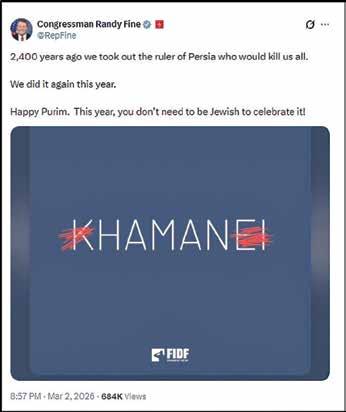
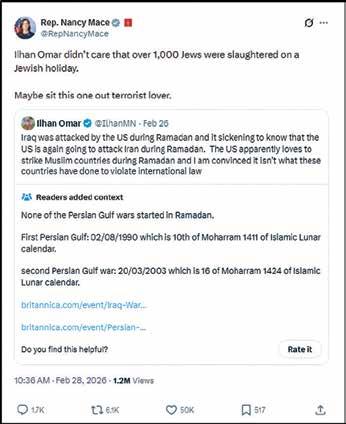
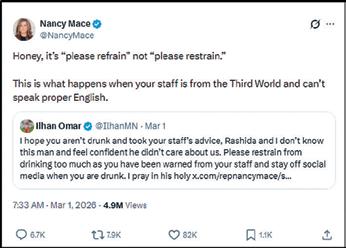


Tampa International Airport regularly shares lighthearted, satirical social media content as part of our ongoing effort to engage with our followers. Today’s post about “banning” pajamas was another playful nod to day-oftravel fashion debate.
- Tampa International Airport statement after pushback for a post that said that it is time to ban pajamas in the airport
Please ask for the science-based regimens. Not whatever RFK Jr. is getting kickbacks on or, you know, whatever whole milk, white supremacy dogwhistling that’s happening right now.
- Rep. Maxine Dexter (D-OR) at a townhall meeting calling out whole milk for being racist
Today, every senator–every single one–will pick a side. Do you stand with the American people who are exhausted with forever wars in the Middle East, or stand with Donald Trump and Pete Hegseth as they bumble us headfirst into another war?
- Sen. Minority Leader Chuck Schumer (D-NY), who used to refer to himself as the “shomer Yisroel,” once again proving what a fraud he is
My hope for all of you is that you find somebody who loves you as much as Nancy Pelosi loves insider trading, because then you will have a very good life indeed.
- Vice Pres. JD Vance at a recent rally
No. I might have forced their hand.
- Pres. Trump when asked if Israel forced his hand to launch strikes against Iran
You see, we were having negotiations with these lunatics, and it was my opinion that they were going to attack first. They were going to attack if we didn’t do it. They were going to attack first. I felt strongly about that. We have great negotiators, great people, people that do this very successfully and have done it all their lives very successfully. And based on the way the negotiation was going, I think they were going to attack first, and I didn’t want that to happen. So if anything, I might have forced Israel’s hand, but Israel was ready and we were ready, and we’ve had a very, very powerful impact.
– ibid.
I will shed no tears for the Ayatollah Khamenei. He won the coin toss, and he elected to receive—and boy, did he receive. May he rest in pieces!
- Sen. John Kennedy (R-LA) on Fox News
We are only four days into this, and the results have been incredible, historic really. Only the United States of America could lead this, only us. But when you add the Israeli Defense Forces, a devastatingly capable force, the combination is sheer destruction for our radical Islamist Iranian adversaries. They are toast and they know it, or at least soon enough they will know it. And we have only just begun to hunt, dismantle, demoralize, destroy and defeat their capabilities just four days in.
- Sec. of War Pete Hegseth
Starting last night and to be completed in a few days, in under a week, the two most powerful Air Forces in the world will have complete control of Iranian skies, uncontested airspace. I hope all the folks watching understand what uncontested airspace and complete control means. It means we will fly all day, all night, day and night finding, fixing and finishing the missiles and defense industrial base of the Iranian military, finding and fixing their leaders and their military leaders, flying over Tehran, flying over Iran, flying over their capital, flying over the IRGC [Islamic Revolutionary Guard Corps], Iranian leaders looking up and seeing only U.S. and Israeli air power every minute of every day until we decide it’s over.
- ibid.
And Iran will be able to do nothing about it. B-2s, B-52s, B-1s, Predator drones, fighters controlling the skies, picking targets, death and destruction from the sky all day long. We’re playing for keeps. Our warfighters have maximum authorities granted personally by the president and yours truly. - ibid.
Our rules of engagement are bold, precise, and designed to unleash American power, not shackle it. This was never meant to be a fair fight, and it is not a fair fight. We are punching them while they’re down, which is exactly how it should be. Thus far, Operation Epic Fury has delivered twice the air power of shock and awe of Iraq in 2003, minus Paul Bremer and the Nation Building.
- ibid.
Please accept my deep condolences in connection with the murder of the Supreme Leader of the Islamic Republic of Iran, Seyed Ali Khamenei, and members of his family, committed in cynical violation of all norms of human morality and international law.
- Russian Pres. Vladimir Putin, who is responsible for more than 2 million deaths over the past four years, in a message to Iran
























By Bret Stephens
President Donald Trump is being criticized from many quarters for his decision to join Israel in a war to topple the Iranian regime, which Saturday yielded the killing of the supreme leader, Ayatollah Ali Khamenei. The reasons vary.
It’s “a betrayal of the American people,” says Elizabeth Warren, who warns that the intervention risks dragging “yet another generation into a forever war.” It’s a betrayal of MAGA principles, says Marjorie Taylor Greene, who denounced Trump for putting “America last.” It’s unconstitutional, according to the American Civil Liberties Union, because it’s being conducted without authorization from Congress. It’s unnecessary, according to writer Andrew Sullivan, who (quoting me, albeit misleadingly) thinks that Iran isn’t much of a threat and the war is being waged for Israel’s sake.
And so on. But one country where the United States and Israel are garnering broad support is the same country that’s being bombed.
“Everyone is joyful; it is one of the best days of probably 95% of Iranians’ lives,” one Iranian resident of the city of Karaj told The Wall Street Journal about Khamenei’s death. “We bolted outside and shouted from the top of our lungs and laughed and danced with our neighbors,” a woman in Tehran named Sara told The New York Times. A doctor who lost his son when Iran’s Revolutionary Guard mistakenly shot down a Ukrainian passenger plane in 2020 wrote on social media, “We will endure the winter, spring is near.” In the city of Shiraz, videos showed people “joined together in a cheer that is typically reserved for weddings, symbolizing pure joy.”
It is also true that scores of civilians have been killed, and there was public
mourning for Khamenei. But those mourners didn’t have to emerge under the threat of the regime’s guns.
There was a time when American hearts could be moved by moments like these — when free nations, having endured years of provocations and attacks from tyrants, band together to administer justice and supply hope. We’re a different country now, less naive but considerably more pessimistic and cynical, and thus likelier to ask: What’s in it for us?
Let me try to answer that question.
First, it’s a mistake to say that Trump got America into war Saturday. What he did was respond to a war that Iran has been waging against the United States since 1979.
It waged war when it seized our embassy in 1979, murdered (via proxy) hundreds of our service members in Beirut in 1983 and supplied the IEDs, or roadside bombs, that killed or maimed more than 1,000 of our troops during the war in Iraq. It waged war when it sought to assassinate former senior U.S. officials, including John Bolton, Mike Pompeo and, according to a 2024 report in Politico, Trump himself. One reason Iran behaved as it did is because it drew the lesson that it would pay no great price. No more.
Second, Tehran had an opportunity to change course in June, after its 12-day pummeling by Israel and an overnight strike by the United States. Instead, it set out to begin reconstituting its nuclear capabilities while rapidly rebuilding the missile force that is now terrorizing civilians in Tel Aviv, Israel; Dubai, United Arab Emirates; Manama, Bahrain; and Riyadh, Saudi Arabia; and targeting U.S. military assets in the region.
Would the United States, the Arab

world or Israel have been safer if we had waited a year or two for Iran to build several thousand more missiles? Or after Russia had supplied the regime with thousands of advanced shoulder-fired air defense missiles, as The Financial Times reported last week that it had agreed to do?
Third, Iran does not exist in a geopolitical vacuum: With Russia and China, it is a core member of the axis of autocracies that threaten the democratic world broadly.
The same liberals who fault Trump for not vigorously opposing Vladimir Putin should at least consider that it’s Tehran that has given Russia the drones and drone technology that have destroyed so much of Ukraine. And the same conservatives who fault Trump for diverting military resources away from the Pacific for the war in Iran should also note that Iran covertly supplies China with much of its oil as part of a promised 25-year, $400 billion strategic partnership. If Tehran falls out of the axis, our remaining adversaries can only be weaker.
Fourth, it is impossible to imagine anything like Mideast peace without the end of this regime.
It isn’t simply that Iran has been the principal backer of the so-called axis of resistance that includes every terrorist group that sought to wipe Israel off the map. It’s also that no Israeli government will ever agree to a Palestinian state that could fall into Iran’s orbit. Paradoxically, the government of Prime Minister Benjamin Netanyahu will face a much tougher time fending off international pressure for Palestinian statehood if the Tehran regime falls and Saudi Arabia offers peace with Israel.
Fifth, even if the United States and Israel don’t force regime change in Iran, they
can achieve strategically significant goals.
The United States is stronger when anti-American dictators have solid reasons to fear our wrath: It restores deterrence and, in doing so, makes diplomacy more effective. Israel and the Arab world are safer when Iran is weaker: Notice that, at least so far, Hezbollah, fearing for its position in Lebanon, has not joined the war against Israel. Finally, even if the regime doesn’t fall, it will be under heavy internal pressure to modify its behavior as a pragmatic concession to reality, much as Venezuela has under Delcy Rodríguez, its (hopefully) interim president.
That may not be the optimal outcome. But it’s considerably better than what came before.
Finally, the United States and Israel have taken considerable military and political risks to do the right thing. And that’s no small thing.
They have rid the world of an odious tyrant and of several layers of his equally odious deputies. It’s odd that the same people who fault Trump for divorcing U.S. foreign policy from its democratic values now fault him for going to war for the sake of advancing democratic values. Still, millions of ordinary people around the world — not just in Tel Aviv or Tehran or Tehrangeles but also, perhaps, in Taipei and Tallinn — will notice that the United States, for its many warts, still stands for freedom.
My column has never been shy about denouncing either Trump or Netanyahu. It won’t be shy to criticize them in the future. But Saturday this much-maligned duo did the free world a courageous and historic favor. It will be remembered long after the petulant criticism dies down.
The New York Times


FBy David Ignatius
or more than 45 years, U.S. presidents have wanted to destroy the radical, anti-American regime in Tehran. They always concluded that the risks of war were too great – until President Donald Trump’s all-out attack with Israel early Saturday.
Trump said Saturday that the massive airstrikes had killed Supreme Leader Ali Khamenei. Few outside Iran will mourn the demise of a man who spent his career shouting: “Death to America!” and “Death to Israel!” And by this limited definition, Trump’s decapitation strategy may have worked. But killing Khamenei, who was aging and infirm, isn’t the same thing as regime change. If there’s a plan for what’s next, I haven’t heard any U.S. or Israeli official explain it.
Wars always are easier to start than to finish, especially when you’ve set a political goal of regime change, rather than a clearly defined military objective. President Vladimir Putin thought he would take Kyiv in a week. Israel thought it would throttle Hamas in a few months. But wars to erase a regime don’t work like that.
Once a president launches a war, he feels obligated to finish it successfully. “If you’re in it, win it,” the generals like to say. That’s especially true in this case, where the regime is odious and Trump has urged Iranian citizens to risk their lives to topple it. It may be a war of choice for the United States, but that doesn’t mean there’s an easy exit ramp ahead.
Trump’s preference had seemed, until Saturday, what might be called the “Viking way of war,” in and out quickly, using speed and surprise to bring a rapid capitulation.
But this war escalated in the first few hours, and by Saturday night, fires were raging from Iranian counterattacks on Bahrain, Dubai, Abu Dhabi and Israel. Iran has also closed the Strait of Hormuz, choking oil supplies. Somebody should have posted a sign at the White House above a map of Iran: “This isn’t Venezuela.”
A Bahraini security adviser told me Saturday afternoon that 14 Iranian drones had struck the port facility that’s home to the U.S. Fifth Fleet. In videos from the scene, you can hear the eerie mosquito buzz of a Shahed UAV and then see the burst of flame as it hit its target. That kind of attack usually strikes the other side in wars that America fights. The security adviser said that Bahrainis were puzzled why U.S. forces seemed powerless to stop the drones.
Make no mistake: Trump has announced maximalist goals for this operation. His statement released early Saturday morning was Trumpian rhetoric on steroids: “To the members of the Islamic Revolutionary Guard, the armed forces and all of the police, I say tonight that you must lay down your weapons and have complete immunity. Or in the alternative, face certain death. So, lay down your arms.”
Trump called on the Iranian people to rise, once again, against a regime that, by Trump’s estimate, slaughtered more than 30,000 protesters in January. “For many years, you have asked for America’s help. But you never got it.… Now you have a president who is giving you what you want. So let’s see how you respond. America is backing you with overwhelming strength and devastating force.… This is the moment for action. Do not let it pass.”

Like Trump and so many Americans, I loathe the Iranian regime. It has spread havoc from one end of the Middle East to the other. One day in April 1983, I missed getting hit by an Iranian car bomb at the American Embassy in Beirut by about 35 minutes. The sooner this regime is gone, the better.
But over the years, I’ve learned not to misjudge the regime’s staying power. When I visited Iran in 2008, I was struck by the fact that police required people in automobiles to wear seatbelts. On the road from Tehran to Qom, they had radar guns to catch speeders. This regime spreads chaos, but it’s careful, too.
Talking to key European allies of the U.S. late Saturday, I heard an intense desire for a quick negotiated settlement to the war. Most of our allies had thought the attack was a bad idea. Britain denied use of a critical refueling facility at the Diego Garcia base in the Indian Ocean. The United Arab Emirates and Saudi Arabia were worried and wary. Only Israel seemed a passionate advocate. Now that it’s happened, these allies will hope Trump quickly gets a settlement he can call a win. They won’t want to stay on the firing line.
What worries me most is that the conflict may put more time on the clock of an Iranian regime that was about to expire. The aging supreme leader was unpopular. Iranians had been jockeying for position in the succession process. The one thing that could rehabilitate the hardline clerical team he represents is his martyrdom.
U.S. Central Command tried to emphasize that the United States was focused on military targets. Centcom said its rockets and missiles were seeking to “dismantle the Iranian regime’s security apparatus.”
A Western security official told The Post
that strikes on the headquarters of Iran’s intelligence service had killed at least four senior commanders. “Everything is falling apart there – we’re seeing it, and feeling it,” the official said.
It’s good news for Iranians if the regime’s apparatus of repression is crumbling. But just as Russia can absorb suffering in warfare, martyrdom is a powerful driver in Iran. I recall a reporting visit to the CIA’s Iran Operation Center nearly 20 years ago, when the United States had embraced an earlier vision of regime change. On the wall was a poster of the beloved martyr Imam Hussein – a touchstone for IRGC members and a reminder to CIA officers of the passionate commitment of their adversary.
Mark Fowler, a retired CIA officer who worked on Iran for years, messaged me Saturday: “If the United States has learned anything from its past mistakes, it should use these hard-earned lessons by crafting a smart, bold post-war strategy worthy of the Iranian people’s sacrifice, one that supports their pursuit of lasting change.”
It would be nice to imagine, with Trump, that this will be a short war. But now that the United States has embarked in earnest on a campaign of regime change, we should understand that it’s likely to be a protracted conflict, with many dangerous moments ahead.
In a conflict like this, with such big stakes and unknowable risks, Trump has a special responsibility to explain what he’s doing to the American people – and ensure that the United States can stay the course. This is the opposite of “one and done.” It may be a worthy fight, but it’s likely to be an arduous one.

As the United States celebrates its 250th birthday, the nation is suffering a crisis of patriotism. A Gallup poll last year found that just 41 percent of Americans say they are “extremely proud” to be American – down from 70 percent in 2003.
Enter the U.S. men’s Olympic hockey team to provide a much-needed adrenaline shot of patriotism. It was cathartic to see these young players bursting with pride in their country following their thrilling overtime gold medal victory over Canada. Millions nodded along as Jack Hughes declared, a wide grin exposing the missing teeth lost before scoring the game-winner, “This is all about our country right now. I love the U.S.A.… I’m so proud to be American today.” (“I’m lucky I’m from the best country in the world, and we’ve got great dentists,” he added.) We wiped away tears as the players brought the kids of fallen teammate Johnny Gaudreau onto the ice for the team photo, then belted out “The Star-Spangled Banner” during the medal ceremony – followed by Toby Keith’s “Courtesy of the Red, White and Blue” in the locker room (“We’ll put a boot in your… it’s the American way!” they crooned while downing Michelob Ultras). Their unapologetic love of country was infectious.
But everything changed when President Donald Trump called to invite them to Washington. Never mind that the last time the U.S. hockey team won gold – after 1980’s “Miracle on Ice” – President Jimmy Carter sent a plane to Lake Placid, New York, to bring the players and coaches to the White House. With Trump’s invitation, many on the left suddenly turned on the team.
The backlash was fast and furious. First came the outrage that the players laughed at Trump’s bad joke that he would “have to bring the women’s team,” too, or be impeached. Hughes’s mom is
By Marc A. Thiessen
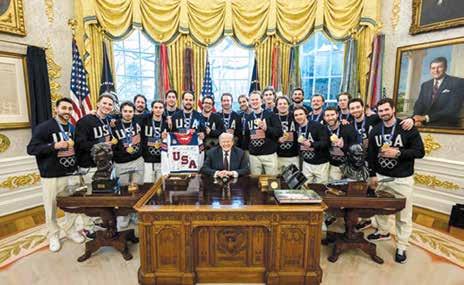
a coach for the women’s team, and the men cheered the women on during their own thrilling run for Olympic gold, but no matter. How dare they not push back on the president? Misogyny!
The seething intensified after the team bantered with the president in the Oval Office and ate a McDonald’s lunch in the
and then lost the room,” wrote the Athletic’s Jerry Brewer. (Tell that to the fans at New Jersey’s Prudential Center who greeted Hughes like a conquering hero upon his NHL return.) The U.S. team “utterly failed to meet the cultural moment,” crowed a USA Today headline. Vox published a piece judging the U.S. hockey players a “loser” of
The real losers were all those who allowed Trump Derangement Syndrome to prevent them from celebrating Team USA’s triumphant visit to Washington.
Roosevelt Room. By the time Trump introduced them during his State of the Union address – and announced he was giving goalie Connor Hellebuyck the Presidential Medal of Freedom – they were being denounced as political pawns. “The U.S. men’s Olympic hockey team won gold –
the games (while crowning Eileen Gu, the American-born skier who chose to compete for communist China, a “winner”).
Actually, the real losers were all those who allowed Trump Derangement Syndrome to prevent them from celebrating Team USA’s triumphant visit to Washing-
ton. Ask yourself: Why did so many on the left turn on the hockey team? It turns out, according to Gallup, that for many Democrats, patriotism is situational. While Republicans are consistently very proud to be American regardless of who is in the White House, many Democrats’ pride in country shifts with the political winds. In 2024, under President Joe Biden, 62 percent of Democrats reported they were “extremely” or “very” proud to be American (as were 85 percent of Republicans). But last year, with Trump back in office, the figure for Democrats plunged to 36 percent, while Republican levels were virtually unchanged. Pride among independents has dropped, too, but not as far; more than half – 53 percent – are extremely or very proud to be American today.
Things were different not so long ago. In 2001, about 9 in 10 of both Democrats and Republicans were extremely or very proud to be Americans. In the quarter-century since, this high level of Republican patriotism has held steady through the presidencies of George W. Bush, Barack Obama, Trump, Biden and Trump again. But the percentage of Democrats who answered that way declined by 51 points – with the most precipitous dive starting in 2017 under Trump.
Love of country was once a source of American unity. No longer. The crisis of patriotism today is driven by a sharp erosion of American pride on the American left –as epitomized by its reaction to Team USA’s visit to Washington.
Instead of criticizing the U.S. players, perhaps Democrats ought to emulate them. At a time when partisanship seems to be infecting every last crevice of American life, these athletes offered an example of how to love your country without reservation. It turns out they met the “cultural moment” perfectly.
© 2026, Washington Post
Critics say President Donald Trump’s decision to strike Iran is a violation of his promise not to engage in “forever wars.” In fact, the opposite is true. Trump is not starting a forever war in Iran; he’s ending one.
For 47 years, the Iranian regime has been waging war against the United States. That war began in 1979, when Iran seized the U.S. Embassy in Tehran, taking more than 50 Americans hostage for 444 days. The war continued as Iran orchestrated the 1983 bombings of the U.S. Embassy and Marine barracks in Beirut that killed 258 Americans, followed by the 1996 bombing of the Khobar Towers in Saudi Arabia that killed 19 Americans. It continued in 1998, when Iran provided “direct assistance” to al-Qaeda for the bombings of the U.S. Embassies in Kenya and Tanzania, training its “operatives about how to blow up buildings,” according to a ruling by the U.S. District Court for the District of Columbia.
After the 9/11 attacks, Iran provided sanctuary to senior leaders of al-Qaeda fleeing U.S. forces in Afghanistan and allowed the group to use Iranian territory as a pipeline to move money, facilitators and operatives from across the Middle East. (It still harbors Saif al-Adel, successor to Osama bin Laden and Ayman al-Zawahiri as leader of al-Qaeda, in Tehran). Iran also provided training and bomb-making equipment to insurgents in Iraq, including “explosively formed penetrators” that killed and maimed thousands of American troops.
On Oct. 7, 2023, Iran’s proxy Hamas slaughtered more than 1,200 innocent people – including 46 Americans – and took 12 Americans hostage. The Iranian regime has also attempted terrorist attacks on U.S. soil, including a 2011 plot to set off a bomb in Cafe Milano
By Marc A. Thiessen
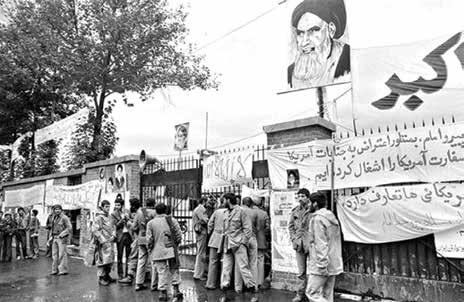
in Washington to kill the Saudi ambassador, a plot to kill former secretary of state Mike Pompeo and other senior U.S. officials, and a plot to assassinate Trump himself. And the regime that did all this was pursuing nuclear weapons and refused Trump’s repeated demands to peacefully disarm.
Now, Trump is taking decisive action to bring this reign of terror to an end. If he succeeds, the impact will be profound, opening up the possibility of enduring peace in the Middle East and beyond.
The Iranian threat is a primary reason the U.S. has to spend billions on large deployments in the Middle East. If that danger is eliminated, and a new government – one whose mantra no longer is “Death to America” – takes power in Tehran, the United States can finally draw down those forces, execute the long-promised “pivot” to the Indo-Pacific, and focus on defending American interests in our own hemisphere.
As important as what Trump is doing is how he’s doing it. With Operation Epic Fury, we are witnessing the birth of a new doctrine to guide U.S. global leadership in the 21st century: the Trump Doctrine.
When Trump came to office, he faced a situation similar to the one Ronald Reagan inherited in 1981. In the wake of the Vietnam War, Americans had no appetite for sending U.S. troops to fight in distant lands. Reagan had to find a new way to lead on the world stage. So, he forged the “Reagan Doctrine,” supporting anti-communist freedom fighters across the globe to roll back the tide of Soviet Communism. That strategy helped win the Cold War.
Today, after the wars in Iraq and Afghanistan, there is similarly no popular appetite for U.S. boots in foreign hot spots. So, Trump, too, is pioneering a new way to lead. From Caracas to Tehran, he is using sanctions, tariffs, diplomacy and
other tools to impose America’s will on its adversaries. If those adversaries don’t yield, then he is employing military force to decapitate regimes that threaten the American people. And he is controlling events on the ground through his willingness to strike those regimes again and again until leaders emerge who will work with America.
At this moment, the U.S. is striking Iran from the air – eliminating the regime’s leadership, its retaliatory capabilities, its nuclear program, and its infrastructure of repression. Expect this campaign to last for weeks, not days. After that, what happens will be up to the Iranian people. As Trump proclaimed on Saturday: “To the great, proud people of Iran, I say tonight that the hour of your freedom is at hand. … When we are finished, take over your government. It will be yours to take.”
In other words, there is no need for a U.S. invasion force. The Iranian people are the boots on the ground, and the fate of the country is in their hands. And if things do not turn out as we hope, and a government emerges that resumes its hostile posture toward America and its pursuit of nuclear weapons, Trump can eliminate it as well.
This much is certain: Donald Trump is making history. There have been just 45 presidents since the founding of our republic. Of those, only a handful truly transformed the world. In the modern era, Franklin D. Roosevelt defeated Nazi fascism and Ronald Reagan defeated Soviet communism. If he succeeds in defeating Islamic radicalism in Iran, Trump will take his place alongside them as one the most consequential presidents in U.S. history.

By Jack Nicas, Paulina Villegas and Maria Abi-Habib

MEXICO CITY — El Mencho, arguably the world’s most powerful criminal, did not have a cellphone.
Worried the devices would expose his location, he relied on human messengers to manage a sprawling criminal organization that stretched across Mexico and into 40 countries, senior Mexican officials said. He issued his orders from shifting encampments in the wooded hills of western Mexico, surrounded by what authorities say were at least 60 men and an arsenal of military-grade weapons.
His life hiding in the forest belied the fact that he was one of Mexico’s richest men. Such discipline kept El Mencho — a former police officer turned hit man whose legal name was Rubén Oseguera Cervantes — at large for two decades.
That was until last weekend, officials said, when Mexican authorities took advantage of a weakness.
Oseguera, 59, wanted to see his adult
daughters, they said. So he recently moved into a home in a gated community outside Tapalpa, a touristy Mexican ranch town, bringing a much smaller set of bodyguards.
Then he invited over one of his [friends], officials said — unaware that Mexican intelligence had been tracking her.
On Thursday, Feb. 20, Mexican and U.S. intelligence agents watched the woman and two young children travel to a house in that community.
The next day, a U.S. surveillance drone hovering overhead recorded the woman and children leaving the house, according to two senior Mexican officials and another person briefed on the operation, some details of which are reported here for the first time.
It remained unclear who was inside, until the drone’s infrared camera detected another figure emerging. The person hugged the woman and two children goodbye.
The authorities made a calculation: The
only person who would dare to hug the cartel boss’s friend was the cartel boss himself.
El Mencho was home. Mexican authorities immediately began planning an operation.
Less than 48 hours later, Mexico’s most wanted man was dead.
In a fierce firefight last Sunday, Mexican forces ended one of the most consequential criminal careers in Mexico’s modern history. His journey from farm boy to cartel boss left a trail of thousands of corpses, billions of dollars in illicit profits, and a criminal enterprise that reaches from Mexico to Asia.
It also opened a new chapter for the country. The Jalisco New Generation Cartel that he led, widely considered Mexico’s most powerful criminal group, is now headless. Such power vacuums have often led to turbulent stretches of violence as deputies and rival cartels battle for control.
Mexicans quickly got their first taste of the fallout from Oseguera’s death.
Jalisco cartel operatives rampaged across 20 states, setting cars and buildings ablaze, blocking roads and gunning down 25 Mexican soldiers. The show of force rattled the nation, shut down businesses, disrupted travel and trapped tourists.
President Claudia Sheinbaum of Mexico has been facing intense pressure from President Donald Trump to defeat the cartels or face unilateral U.S. military strikes on the criminal groups. Some Mexican officials hoped that killing Oseguera would have bought her some good will.
But Trump called her the next day, worried and irritated by the scenes of mayhem, according to four people with knowledge of the call who were not authorized to speak publicly.
Trump called “to ask me what was happening in Mexico, how things were going, are you OK?” Sheinbaum told reporters this week. “I told him how the operation had gone, that we had received
intelligence support from the U.S. government, that the coordination was going very well.”
The same day, Trump posted that “Mexico must step up their effort on Cartels and Drugs!”
In his State of the Union address Tuesday, Trump took credit, without mentioning the Mexican government: “We’ve also taken down one of the most sinister cartel kingpins of all.”
“Just
The son of avocado farmers, Oseguera grew up poor in a scorching region of western Mexico. He dropped out of primary school to take his first job: guarding fields of marijuana, then the primary business for Mexico’s emerging cartels.
Like many men in his town, as he approached his 20s, Oseguera headed north. He illegally crossed the border into California in 1980s, arriving just as synthetic drugs were gaining a foothold there, particularly methamphetamine.
Oseguera spotted opportunity, according to court records, officials and analysts who have studied his life. Cocaine and marijuana required vast tracts of land, time and an army of crop pickers. Meth could be cooked up quickly in a kitchen with cheap chemicals.
Oseguera began selling meth and other drugs across California, until he was caught by an undercover police officer in a Sacramento bar in 1992. He spent three years in prison and was deported.
Back in Mexico, though fresh off a drug conviction, he joined the police force in Jalisco state, according to Ralph Villarruel, a former Drug Enforcement Administration agent who tracked Oseguera. At the time, parts of Jalisco were controlled by a criminal group called the Milenio Cartel. Oseguera briefly colluded with the cartel before deciding to quit the police and join them.
He soon made a name for himself as a ruthless hit man. But it was romance that shot him up the ranks: He married one of the commander’s sisters, Rosalinda González Valencia.
“Until he married Rosalinda, he was just a thug,” Villarruel said. “By marrying into the family, it gave him access to a sophisticated money laundering operation.”
The cartel liked his knowledge of both sides of the border and his experience with meth, just as traffickers were trying to push the drug on the East Coast. To hook new clients, Mexican cartels sent meth to cities like New York for free.
“El Mencho became this valuable person within the cartel because of his expe -
rience in the United States,” said Carlos Pérez Ricart, a Mexican security analyst.
“Meth is having a huge boom in the United States, and he understands it.”
At some point, like many cartel operatives, he began going by a nickname. El Mencho is believed to be a derivative of another adopted name he used, Nemesio. By 2009, the Milenio Cartel fractured. Mexican forces arrested and killed two top leaders, setting off a war for power.
During a Tuesday rush hour in 2011, two trucks were abandoned on a highway in the Mexican state of Veracruz. Inside were 35 corpses, many of them bound and tortured.
It was Oseguera’s first big, bloody performance, analysts said, and the effective arrival of what would become the Jalisco New Generation Cartel.
With sheer brutality, Oseguera defeated his former allies in the Milenio Cartel. That gave his new cartel a notorious reputation, which it began to exploit.
mines, rocket-propelled grenades and armored trucks mounted with heavy machine guns, officials say. In recent years, the group has expanded into improvised explosive devices and drones that carry toxic chemicals or makeshift bombs.
The Jalisco cartel’s heavy weaponry has become the stuff of legend. In one narcocorrido — a type of Mexican ballad that celebrates drug cartels — about the group, the singers belt out over an accordion: “We’ve swapped pocketknives for AR-15s and AK-47s, for .50 calibers and antiaircraft guns.”
When the Mexican army moved to capture Oseguera in 2015, his henchmen shot down an army helicopter with a rocket-propelled grenade, killing three soldiers. He got away.
His journey from farm boy to cartel boss left a trail of thousands of corpses, billions of dollars in illicit profits, and a criminal enterprise that reaches from Mexico to Asia.
Oseguera’s forces began invading territory and telling local gangs — and politicians — that they could either join forces or be killed.
“They were like ISIS,” said Eduardo Zerón, a former Mexican security official. “They would arrive at a municipality and say, ‘The Jalisco cartel is here, and whoever isn’t with us, we’ll destroy them.’”
From 2013 to 2017, the Jalisco cartel expanded its presence in Mexico to 20 states from four, Zerón said.
Unlike some rivals, who focused on trafficking drugs, Oseguera built the Jalisco cartel into a sprawling, diversified empire.
It has sold enormous amounts of fentanyl and meth, particularly in the United States. But it also has smuggled migrants, extorted businesses and invested in a vast portfolio, including hotels, casinos and racetracks.
The cartel has also built an arsenal that resembles a small army’s. It has land
Over the next decade, at least 400,000 people were killed or disappeared in Mexico, according to conservative estimates. Analysts say Oseguera’s cartel may have killed more of those people than any other group.
Since his escape in 2015, Oseguera remained mostly a ghost to Mexican authorities. Only a few public images of him exist.
Yet in the rural hills of Jalisco, local residents said he was sometimes spotted among the blaring music and flowing beer of cockfights, a sport he loved so much that he was nicknamed “Lord of the Roosters.”
Early Sunday morning, Mexican special forces — who had been trained by their U.S. counterparts — stormed Oseguera’s hideout. They were backed by six helicopters.
As Oseguera’s men fired on the sol-
diers, he and his inner circle slipped out the back, officials said. “Special forces personnel pursued them,” Gen. Ricardo Trevilla Trejo, Mexico’s defense secretary, told reporters. “They located them hiding in the brush.”
Oseguera was shot. Officials said that he and two bodyguards died during a helicopter ride to a hospital.
The authorities had not seen Oseguera for years. His corpse revealed an aging man who had taken steps to look younger. His hair and mustache were dyed, an official said, and his teeth were capped with veneers.
The operation was violent, with 13 people killed, but better than officials had expected. Because of the setup of his encampments, Mexican authorities had long worried that killing Oseguera could leave maybe 80 dead.
But the backlash by his cartel after his death was worse than officials had feared. Across Mexico, Jalisco cartel members created more than 250 roadblocks and burned more than 500 cars, targeting supermarkets and state-owned banks. More than 70 people died in the operation and its aftermath, including 47 cartel members, 25 Mexican soldiers and one pregnant civilian caught in a shootout.
Now, Mexico is bracing for what may come next.
According to an internal Mexican government document viewed by the Times, at least seven men currently sit atop the Jalisco cartel, many of them hardened hit men with nicknames like The Gardener and The Toad.
Perhaps the most likely successor is Juan Carlos González, known as El 03. His mug shot shows a young man with a buzz cut and a smirk.
He has at least one advantage over the others: El Mencho was his stepfather.
© The New York Times
By Steven Lee Myers and Paul Mozur
In Gurugram, the sprawling tech suburb outside New Delhi, Krishna Khandelwal is using artificial intelligence to build an army of chatbots designed to eliminate the kind of jobs that once lifted India into the ranks of the world’s fastest-growing economies.
Since last summer, his startup, Hunar.AI, has offered companies bespoke AI voice agents that steer job applicants through virtually every step of the hiring process, from resume screening to orientation.
“For onboarding,” he said in an interview in the company’s headquarters in a shared workspace, “you don’t need humans at all.”
For a quarter century, India has made itself the world’s back office, providing an educated, English-speaking workforce to do tasks more cheaply than in the United States or Europe. The industry today employs more than 6 million people and is worth nearly $300 billion, more than 7% of the country’s gross domestic product.
Now, AI threatens to do to India what its outsourcing model did to the rest of the world: replace hundreds of thousands of office workers.
Economies everywhere are bracing for an era in which AI tools automate entire categories of white-collar work, but the brunt could fall hardest on India, undermining two decades of effort to climb the value chain and establish a place in the global tech world.
“It’s a matter of time,” said Deedy Das, a partner at Menlo Ventures, an investment firm that closely tracks AI. “Markets are pretty efficient. If a tool exists that does a job cheaper, it will be adopted,” he said. “I’m surprised it hasn’t happened at a faster clip, but it will.”
The tremors are already being felt. Tata Consultancy Services, one of India’s largest employers, has shrunk its workforce to 580,000, a decline of more than 20,000 from a peak in 2022, when it hired 100,000 new workers in one year alone.

Its main rival, Infosys, has also slowed hiring, while dozens of smaller startups laid off workers across the country in 2025, according to Inc42, a digital economy news outlet in India.
Graduates of the country’s universities and technical colleges are finding fewer openings, forcing them to scramble to “upskill,” an increasingly popular term in the context of learning the AI technology that is reshaping the industry.
Tech stocks in India were already slumping this year, but a speculative report on Feb. 22 by Citrini Research, an analytics company based in the United States, sent them spiraling, by painting a doomsday scenario about AI’s impact on India in particular.
“The entire model was built on one value proposition: Indian developers cost a fraction of their American counterparts,” the report said, imagining the world in the not-so-distant future of 2028. “But the marginal cost of an A.I. coding agent had collapsed to, essentially, the cost of electricity.”
Narendra Modi, India’s prime minister since 2014, has recognized the challenge. Like many leaders, he has pledged to make
the country an AI power, including by overseeing international deals and urging the country’s own software engineers to develop new technologies and export them to the world.
“There have been certain turning points that have shaped entire countries,” Modi said during an international conference on AI in New Delhi last month, according to a translation of his remarks. “These turning points set the direction of civilization and transform the pace of development. Artificial intelligence is one such transformation in history.”
It is far from clear, however, whether India is positioned to make that transformation. While it has a highly educated workforce, it lacks the infrastructure and natural resources needed to power AI products.
At the AI conference in New Delhi, India’s largest outsourcing firms announced deals with U.S. companies including Anthropic and OpenAI to expand use of their products and to develop data center capacity to power them. The announcements, while welcomed as foreign investment in the economy, underscored how reliant the country remains on the United
States for everything from the microchips to the foundational models that are driving the AI boom.
Upheaval in the economy could undermine political support for Modi’s government, whose party lost seats in the last parliamentary elections in 2024. The country already faces labor unrest that further job losses could worsen. Unemployment among educated young people reached as high as 65% of the total unemployed in 2022, according to a report by the International Labor Organization.
While 6 million tech workers might not seem like a lot in a population of nearly 1.5 billion, they represent a politically vocal middle class concentrated in some of the country’s most dynamic cities, including Bengaluru, Hyderabad and Pune.
“If you’re a young engineer getting out of university, I’d be worried,” said Rajesh Nambiar, president of Nasscom, the tech industry association founded in 1988, when India’s tech boom was in its infancy. “It’s not going to be pretty out there.”
Nambiar and other industry leaders and experts are not exclusively gloomy. They point out that AI is already driving local startups in India that aspire to build products for global markets.
“This is the best place to be,” said Nikhil Gupta, a founder of LimeChat, an e-commerce company in Bengaluru. LimeChat designs chatbots for retailers on WhatsApp, the Meta-owned messaging app, which has more users in India than anywhere in the world.
Gupta grew up in Cupertino, California, in the heart of Silicon Valley, but returned to India for high school and college and decided to build his startup there. India, he said, “has all the ingredients already to provide services for the world.”
For India’s outsourcing giants, deep relationships with multinationals and the ability to manage sprawling software systems mean that they will not disappear overnight. They have already expanded beyond call centers, offering services such
as human resources and accounting.
In recent years, hundreds of international companies, many of them American, have opened their own operations in India, known as global capability centers, rather than simply contracting out the work.
K. Krithivasan, the CEO of Tata Consultancy Services, said the company planned to remake itself as an AI powerhouse. On an earnings call in January, he said revenues for the company’s AI services had swelled in the past quarter to $1.8 billion, on an annualized basis. “We remain steadfast in our ambition to become the world’s largest AI-led technology services company,” he told investors.
On the ground, however, the prospects seem grim. In call centers and back-office operations, hiring has slowed to a crawl. AI is creating new kinds of jobs — including training AI chatbots by labeling data and teaching robots tasks like fold-
During the semester break in January, Complygate, a background-check company based in Birmingham, England, held a 10-day training course on campus for nearly 100 students. The course ended with a test. Only the top scorers — roughly 10 — received job offers.
“AI has changed the business model,” said one student, Tathagat, 23, who goes by one name.
A native of Bihar, a state bordering Nepal, Tathagat said the onus was on students to learn the skills that this new model demanded.
“It depends on us,” he said. “If you adapt with the times, it’s a great time to graduate.”
The college has had to scramble to keep its curriculum up-to-date with technology, which changes as quickly as semesters pass. “You have to move with the markets,” said Rakesh Sharma, the college’s president. Referring to the students, he added,
AI threatens to do to India what its outsourcing model did to the rest of the world: replace hundreds
of thousands of office workers.
ing clothes — but the jobs are repetitive, poorly paid and offer few paths upward.
Young graduates can now make more money making deliveries for the country’s booming e-commerce companies than they once could in entry-level tech, analysts and executives said. But for many, cultural expectations around careers have not caught up with the lowered prospects, said Siddharth Srivastava, a product leader at Instawork, a staffing platform based in San Francisco.
“They don’t have skills, but they have ambitions,” he said. “They can’t see their socioeconomic strata doing a blue-collar job.”
At the R.D. Engineering College in Ghaziabad, a gritty industrial city with an estimated 2.5 million people east of New Delhi, tech companies such as Tata and Infosys once came calling in search of recruits. Now the college has to seek the companies out, according to Mohd Vakil, the dean of academics.
Only a few years ago, 85% of graduates, on average, had jobs when they finished, Vakil said. In the past two years, it was 75%. With fewer companies hiring, competition has become fierce.

“We are making all efforts to make them employable.”
Hunar.AI offers a window into both the potential and the disruption.
Khandelwal, who is 38, began by creating a traditional job-recruiting company with 65 employees handling calls to prospective applicants, mostly in banking but also for local Starbucks franchises.
The company then fed more than 4 million minutes of recorded calls into a large language model using OpenAI’s products to train its chatbots to make and conduct the calls in a robotic but fairly convincing conversational tone.
Since launching last August, Hunar. AI has signed 70 clients and brought in $3 million in revenue. Its success illustrates the challenge facing India. Instead of 65 recruiters, the company now has 45. Khandelwal expects that number to dwindle to 25 or fewer, even as business grows.
He estimated that the company has already eliminated 1,000 jobs in human resources. By the end of the year, he said, “we’ll be doing the work of 10,000.”

By Avi Heiligman



After World War I, American aviation saw a shift from military operations to a more commercial mindset. While other countries focused on building their air forces and mass producing military planes, the Americans were barnstorming at air shows and using planes for transport. Many in the military saw planes strictly in support roles for the ground or naval forces. However, there were some pioneers who looked at the bigger picture and realized that aviation would fundamentally change how wars were fought. These innovators and their tactics evolved throughout the war, and their contributions ultimately transformed aircraft into a powerful weapon that turned the tide of the global conflict.
Paul “Pappy” Gunn enlisted in the Navy at the very end of World War I, becoming an aircraft machinist mate while learning to fly. In 1923, he joined the oldest fighter group in the Navy, known as the Tophatters. He served as an instructor until his retirement in 1939, when he started flying for Philippines Airlines. Two years later, the American garrison in the Philippines was attacked by Japanese forces. Gunn flew evacuation missions out of the country, determined to rescue his wife and four children who were taken captive by the Japanese. Soon, he was commissioned in the Army Air Forces. His hair-raising missions included being shot down by enemy planes and surviving the crash. For flying an unarmored plane into Bataan to deliver desperately needed medical sup -
plies, he was awarded the Distinguished Flying Cross.
After the fall of the Philippines, Gunn flew to Australia where he started modifying aircraft firepower. He took 50-caliber machine guns salvaged from wrecked planes and placed them into the nose of an A-20 Havoc plane to increase its effectiveness on ground support operations. Major General George Kenney heard of Gunn’s modifications and put him on his staff as the special projects officer. Another sixteen A-20s were modified by Gunn as well as several B-25 medium bombers. These planes played a crucial part in the Allied victory at the Battle of the Bismarck Sea. Gunn continued augmenting the armament of aircraft. These planes devastated Japanese targets for the rest of the war. His family was released in early 1945 during the liberation of the Philippines, and Gunn reestablished Philippines Airline after the war.
Many of the top pilots in the American military innovated new ways to combat the enemy and achieve success in the sky.
F6F Hellcat pilot David McCampbell was the Navy’s highest scoring ace with 34 aerial victories to his record. Over the course of the war, he taught his squadron new and improved tactics to attack the enemy while gaining the upper hand in aerial combat.
McCampbell relied heavily on a tactic called the “Thach Weave” in which two planes fly in a weaving pattern instead of simply chasing an enemy plane in a dogfight. This maneuver avoids vulnerability
during a chase and traps the enemy into the sights of the wingman. Invented by Navy Lieutenant Commander John S. “Jimmy” Thach in 1941, it was first used successfully by Thach in the Battle of Midway in June 1942. McCampbell also taught his squadron to preserve ammunition and only fire in short bursts. This discipline allowed him to record an incredible nine aerial victories in a single mission. Additionally, he developed a clearer, shorter way of communicating over the radio which allowed him to maintain strict control over the squadron. Inexperienced pilots often got excited during the action and used the radio for unnecessary chatter which could cause important information to be missed. McCampbell curbed that chatter and pioneered concise code words, including using clock positions in regards to the location of the enemy.
The proximity fuze was introduced to combat situations toward the end of the war, helping to thwart last-ditch efforts by the Axis powers. Invented by British scientists alongside American physicists Merle Tuve and Richard Roberts, the fuze detonated an explosive shell once it came within a specific distance of its target. Before the proximity fuze, anti-aircraft shells required a direct hit or timers within the shell had to be preset to the estimated altitude of the target. These less reliable methods were replaced by the proximity fuze, which used a small radio transmitter and receiver that emitted radio waves to bounce off the approaching aircraft. Once
the target came into range, the explosive charge detonated automatically. By late 1944, kamikaze attacks were creating major problems for American ships in the Pacific. With the introduction of the proximity fuze, the American forces were able to intercept hundreds of incoming suicide planes, significantly reducing the number of aircraft able to reach their targets.
American pilots also used rockets equipped with proximity fuzes. The rocket would “sense” the plane and detonate, allowing fighter pilots to pick off enemy aircraft at longer distances and use them to break up tight formations of bombers. This technological advantage was instrumental in helping the Allies achieve total air supremacy at the end of the war. In a short period of time, aviation transformed from the early days of barnstorming to the total air supremacy reached at the end of the war in 1945. Pioneers like Pappy Gunn and David McCampbell, along with the development of the proximity fuze, changed aviation forever. Their contributions turned American air assets into military powerhouses, and their work remains a vital part of history to be remembered.
Avi Heiligman is a weekly contributor to The Jewish Home. He welcomes your comments and suggestions for future columns and can be reached at aviheiligman@gmail.com.

Did our expectations grow up, or just grow bigger? Be Part of the Solution....














































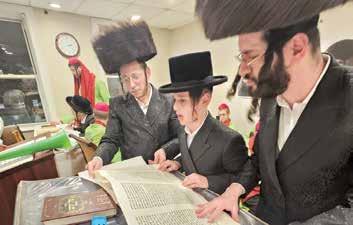




























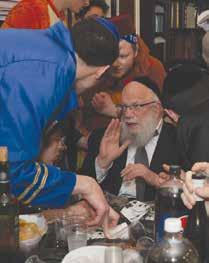
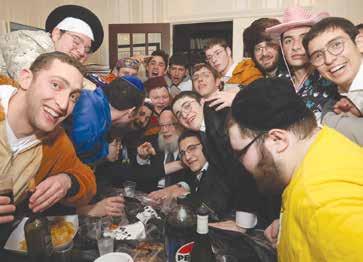


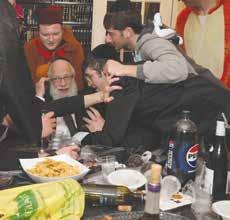




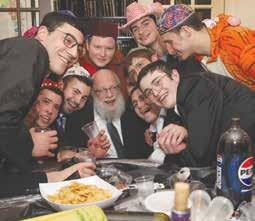











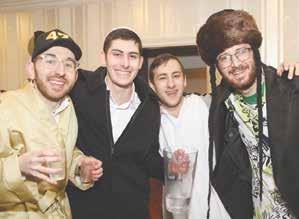

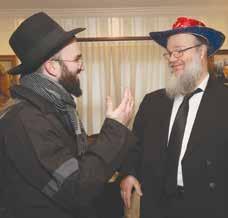


































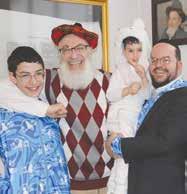


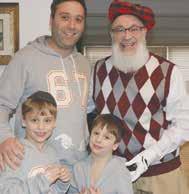









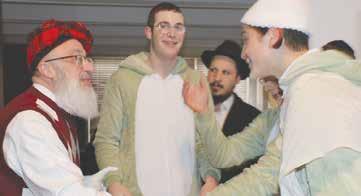



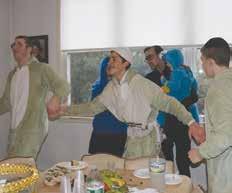






















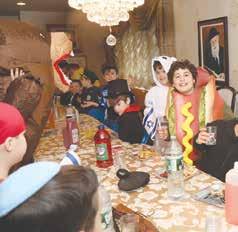
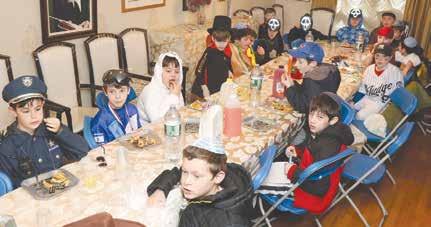







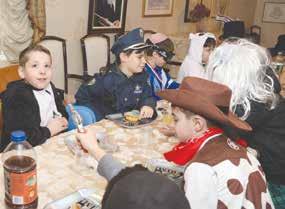
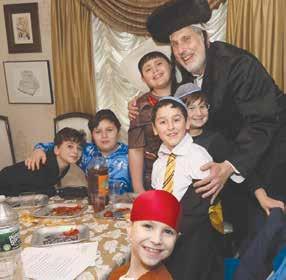


















































































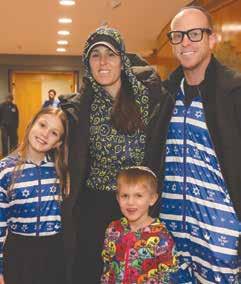











































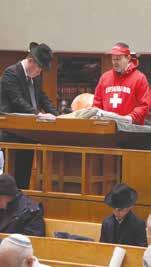

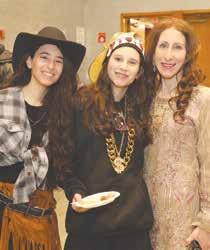




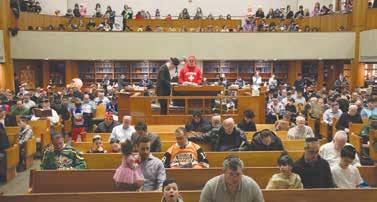
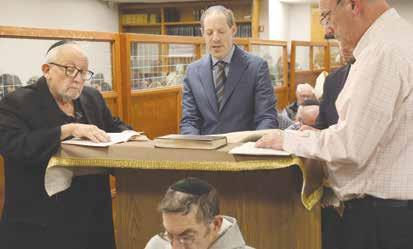






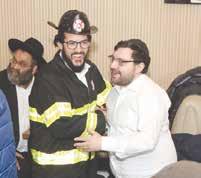






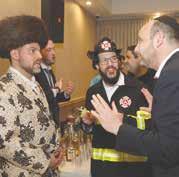



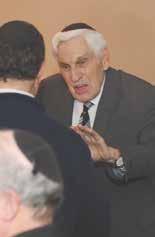





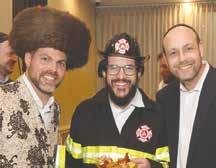




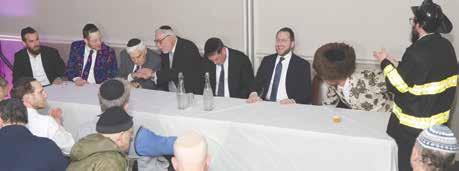










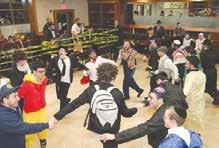

















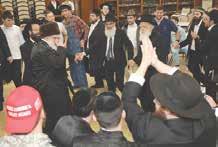
















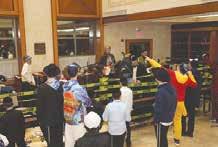


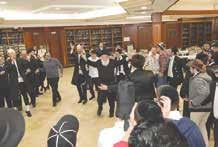










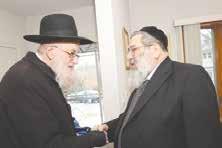






















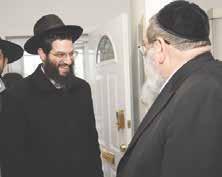






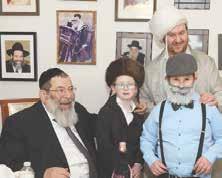

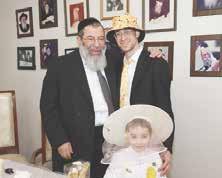


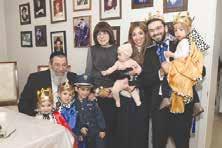

















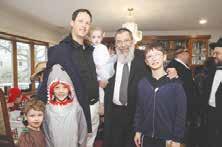
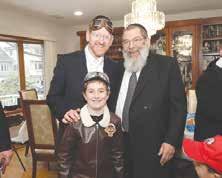
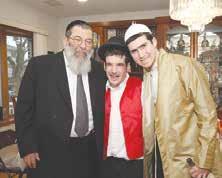













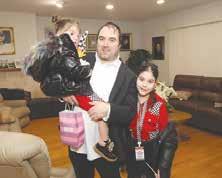
















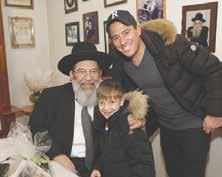

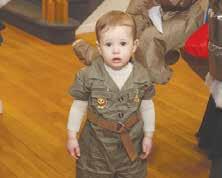

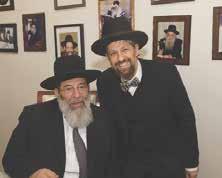


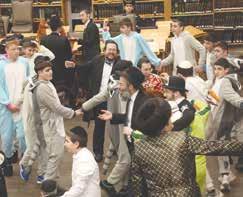
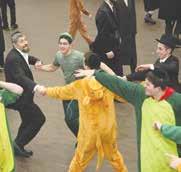


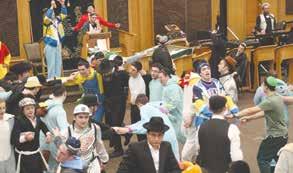








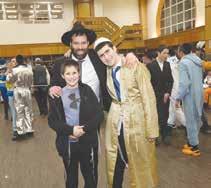





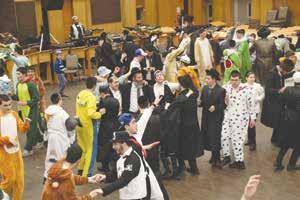








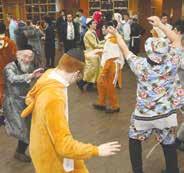
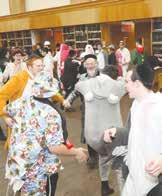

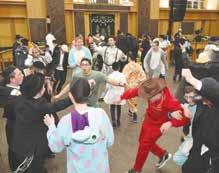

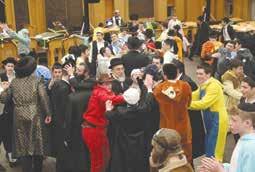


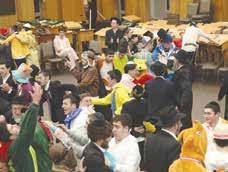








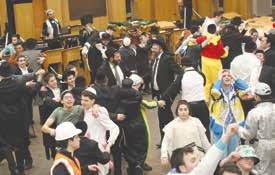

DU N DURT
Power & Soft Washing
We clean siding, stucco, decks, driveways, concrete, pool patios, pavers & sidewalks.
Say goodbye to grime, mold & allergens!
Call/WhatsApp: 718-688-2964
Email: dundurtny01@gmail.com
THE LEATHER SHOPPE
The spot for all your custom leather Judaica. Tallis/tefillin bags, lulav and esrog bags, havdallah sets, challah covers, shtenders, pesach sets, matzah/afikomen bags.
WhatsApp: (732) 523-0007 or email: theleathershoppe732@gmail.com for a full catalog. We ship.
PEACEFUL PRESENCE STUDIO
Men’s private yoga, Licensed Massage & Holistic Health Guidance 436 Central Ave, Cedarhurst Info. & free video training www.peacefulpresence.com 516-371-3715
GERBER MOVING
Full Service Moving
Packing Moving Supplies
Local Long Distance. Licensed Insured 1000’S Of Happy Customers
Call Shalom 347-276-7422
HANDYMAN AVAILABLE
For big or small jobs, Sheetrock, carpentry, painting, electrical, plumbing, install & repair appliances Call Ephraim at 347-593-4691
MANAGEMENT STAFF WILL ASSIST
you with: * Obtaining Medicaid and Pooled Income Trust
* In-home Assessments, Individual and Family Counseling
* Securing reliable home care assistance
* Case and Care Management services
Dr. S. Sasson, DSW, LCSW (718) 544- 0870 or (646) 284-6242
HAIR COURSE:
Learn how to wash & style hair & wigs.
Hair and wig cutting, wedding styling
Private lessons or in a group
Call Chaya 718-715-9009
ZEVIZZ WOODTURNING JUDAICA
Challah knifes, batei mezuzah, besamim holder, kiddish cups, havdalah candle holders, yad for sefer torah, pens, stenders, bowls and more 952-356-2228
MY MOTTO IS DON’T WAIT TO buy real estate
Buy real estate and wait
Your realtor for life
516-784-0856 Alexandra at Realty Connect USA
REAL ESTATE MANAGEMENT
Services – Do Not Manage Your Properties Alone!
Contact Aliyah Suites for all your real estate management needs and affordable office space near you! (516) 366-1049
Management@aliyahsuites.com
Marc Jeret (MJ) Team Leader & Licensed Real Estate Agent
















classifieds@fivetownsjewishhome.com • text 443-929-4003
CEDARHURST
Prime Restaurant Location For Lease.
For more information: Call/Text/WhatsApp Owner: (516) 206-1100
5 TOWNS - OFFICES FOR LEASE 250SF to 500SF Offices in Inwood & Cedarhurst Utilities, Internet & Parking incl. with some Kosher kitchen - Minyan Next to LIRR - No broker fee Call/text/Whatsapp: 516-206-1100
Don’t Get Stuck With a Two Story House Ya Know, It’s One Story Before You Buy It But a Second Story After You Own It! Call Dov Herman For An Accurate Unbiased Home Inspection InfraredTermite Inspection
Full Report All Included NYC 718-INSPECT Long Island 516-INSPECT www.nyinspect.com
UPSCALE EVENING & Ready-to-Wear Boutique opening on Central Ave seeks fashion-forward, friendly sales associates with retail experience. Full-time & Part-time. Text/WhatsApp 718-310-8550.
WANT TO WORK WITH A COMPANY that sells guitar accessories? We need help boxing and shipping our gear, taking pictures and organizing our inventory. If this sounds interesting, reach out! Evan (516) 447-1018
DELIVERY PERSON NEEDED to deliver this Newspaper every
Thursday morning to locations in Brooklyn. Must have Mini van or SUVand availability to work Consistently every week. Good pay - Please email gabe@fivetownsjewishhome.com or call (917) 299-8082

JEWISH PRESCHOOL
In Merrick seeks warm, loving, experienced toddler teacher for 2-year-olds. Mon-Thu 9-3, Fri 9-2. Email admissions@jewishelc.org or call 516-833-3057 ext 110
BOOKKEEPER
A Five Towns Real Estate Company is seeking a full-time Bookkeeper. The right candidate must be proficient with QuickBooks and Excel. They must also be self-motivated, organized, detail oriented, reliable, and able to work independently or as a team player. Warm, frum office environment with excellent salary & benefits. Please email resume to HR@capsprop.com
BEHAVIOR TECHNICIAN Pays up to $30 an hour. Part-time: Late Afternoon (3-9 pm) M-F. ABA therapy support for child. Warm Jewish family environment. Garden City, Valley Stream NY Text: 718-304-6359 or email: talent@encoresupport.org to apply.

YESHIVAT KOL YAAKOV
In Great Neck, NY, is seeking general studies teachers for both the elementary and middle schools, for the upcoming academic year. Mon-Thur afternoons. Competitive salary, warm and supportive environment. Send resume to m.kalati@kolyaakov.org
For current school year, starting from end of January: Seeking assistant teacher for General Studies. Candidate should have skills to take over for teachers if needed. Far Rockaway area boys’ school, M-Th, PM hours, strong support. Excellent salary. Possibility to continue for next year. Send resume to teachersearch11@gmail.com





ARE YOU A DOULA? Or have a passion to be?
Come join our great referral group and get access to a vast new clientele through Medicaid. JUST CALL 347-668-7886
REGENTS EXPERT
Tutoring regents in Algebra and Geometry A Darchei Torah instructor. Guaranteed results Text 347-491-8045 WhatsApp 347-767-1755

5 Towns area Nursing Home management office seeking a Regional/Corporate level MDS Nurse to work in our office. Must be an RN. Regional experience preferred. 2-3 years MDS experience with good computer skills required. Position is Full Time but Part Time can be considered. Great Shomer Shabbos environment with some remote options as well. Email: officejob2019@gmail.com
A multi-tasker needed for general office work. The ideal candidate is someone who is detail-oriented, responsible, and can take ownership. Looking for someone who is eager to learn, and expand his/her skill set while possessing the ability to work independently and as part of a team. Experience with Excel required. Five Towns location. In-office position only, not remote. Please send resume to 5tpart.timecareer@gmail.com

Text 516-303-3868 with a time slot of your choice to be careful on lashon hara. Be a part of the 1,000 people for klal yisroel!
BEIS HAMEDRASH CONG.
Chasdei Uvois Oshpitzin
Talmidei chachomim are willing to learn mishnayos, say kaddish and be the shliach tzibbur to daven for the umid on the yartzeit yom hashanah of your parents or close relatives or loved ones To arrange please call Rabbi Miller 917-445-6220




8 bedroom, 6 5 bath, Newly designed custom home, on a 6,000sqft lot Bryna (516)322-4831, Chana (516)449-9692 $2.99M






Spacious Colonial home for rent featuring 5 bedrooms and 4 full baths on a 6,060 sq ft lot


Avigail (516)316-3452
$2.95M

Move right into this beautiful 4br home in heart of N woodmere on an oversized lot
Sarah (347)524-9147
$1.199M

Moshe (516)455-5364

$6,000/M






TBy Nati Burnside
he newest addition to the Five Towns restaurant scene is Bellagio Café. Replacing the previous tenant (Coffee Bar) that had long occupied the space, Bellagio seeks to upgrade the location by giving it a much-needed facelift, adding a full bar, and expanding hours to being open for three meals a day.
It may not sound like much, but the difference is notable. Bellagio is now able to host large events (the night I was there featured a 75-person dinner on the far side of the restaurant behind curtains) with seating room to spare for regular patrons. With the ever-growing needs of the community, that capacity is a great factor that Bellagio hopes will lead to a long run for years to come.
When I was invited to Bellagio, I took a look at the extensive appetizer options and was glad that at least one of my choices was easy due to it having been recommended by several people. Honestly, I would have ordered the Mozzarella Basket even if it hadn’t been so highly recommended. A bowl made of a crispy wonton chip substance is filled with cubes of fried mozzarella and a teriyaki sautéed mixture of mushrooms, onions, and cherry tomatoes. The result is a great shareable app that is not only delicious but is also fun to eat. Break off a piece of the bowl, get a cube of cheese and whatever else can fit on your wonton shard, and enjoy. The wonton has great crunch, the cheese is creamy on the inside, and the sautée mixture is salty and sweet.
Though it isn’t actually in the appetizer section, one of my favorite items on this menu was the Creamy Cheese & Mushroom Baked Potato. This item isn’t nearly as complicated as the last, but you can share it as well. I think the process involves baking a potato, cutting it open, scooping out the inside, mixing it with mushrooms and onions, putting it back, topping it with cheese, and then putting everything back in the oven. As simple as that sounds, it also sounds like something I would devour. Also, it comes with a side
salad so that you can maybe eat this as a whole meal and convince yourself that you also ate something healthy? Whatever the reason, the salad is a nice, light touch compared to the obviously dense potato. More easily shareable than the potato, I can’t recommend the Grandma Pizza enough. I’ve had a lot of artisan personal pies at a lot of nice dairy restaurants, and I can say for sure that this is one of the best. Don’t get me wrong – it’s nothing crazy. The dough is really solid. Good taste, good texture, but nothing really special. What makes this pizza amazing is actually the balance. First, there’s the balance between the tomato sauce and the pesto that is lightly drizzled on top. The sauce is rich and very tasty, and the amount of pesto is simply perfect to add that nice note of herbiness but not overpower everything. Also, the balance of the mozzarella cheese and the sprinkle of parmesan is just right. You get the slight nuttiness and richness of the parmesan, but it’s not too much as to outpace the melty base of the mozzarella. It may sound like a mostly normal pizza, and in some ways, it is. But sometimes, you find something that is just done perfectly, and this is that.
Moving to a more inventive item, the Burrata Salad is a nice and refreshing combination of ingredients that might make you think of a time when the ground isn’t covered in several feet of snow. With a spinach and arugula base, this salad sports cherry tomatoes, slices of grilled peach, pistachios for crunch, and a balsamic dressing. First of all, once you puncture the whole sphere of burrata that comes in the center of the bowl, that creamy center combines with the balsamic and the dressing jumps at least a level or two. Next, if you’re able to get a little bit of everything in one bite (it’s a lot, so it’s not easy), you’ll get some chewiness from the cheese, sweetness from the peach, a nice punch of acid from the tomato, and a crunch and salty hit from the pistachio. It may be winter, but don’t be shy about ordering this summer salad if it sounds



like something that’s up your alley.
Let’s move on to some choices for mains. Now, if I’m at Bellagio for lunch, I think my top choice is the Five Town Panini. Simply put, there’s a lot going on here, but it somehow works. A trio of cheeses (mozzarella, muenster, and feta) combine for a nice base for a panini. The mozzarella is there for melting, the muenster adds some nice flavor, and the feta combines nicely with the other elements even though it does not melt. Speaking of those other elements, they are sliced tomatoes, guacamole, and pesto mayo. Feta and tomato are an amazing pairing and are found on avocado toast fairly frequently. In a sense, this is like an avocado toast pesto melt. Frankly, that sounds delightful. There are two other things that you should know about this panini. The first is that it doesn’t have to be a panini. Bellagio’s menu allows for any of the choices in this category to be made into a panini or a quesadilla. I chose to make it a panini, but maybe you’d rather the latter. The second is that it comes with your choice of a side salad or fries to really make it a full meal.



Speaking of full meals, if it’s dinnertime at Bellagio, I’m going with the Cajun Blackened Ahi Tuna. This isn’t complicated, but a nice tuna steak is actually harder to achieve than you might think. Not only was my tuna steak made perfectly, but the cajun spices came through nicely in the pan sear. Like all the other fish entrées on the menu, the tuna steak comes with two sides. I chose the Avocado and Roasted Corn Salsa along with the String Beans, and they both went very well with the tuna steak. In fact, the corn salsa worked really great as a cold topping to the hot fish. Getting a bite of both together was a nice contrast of tastes, textures, and temperatures.
The menu at Bellagio has much more than I can write about in one column, so you might need more than one visit to try everything that strikes your fancy.
Not that that’s a bad thing.
Dairy - Waiter Service 345 Central Avenue, Lawrence, NY 11559 (516)-791-5200
BellagioCafeNY.com
Vaad Hakashrus of the Five Towns & Far Rockaway