














This past weekend, I had the privilege of attending the Harmony production — a community-wide performance for girls in grades 5 through 8 from all our local schools. If you’ve ever been there, you know it’s hard to describe the scope of it. Hundreds of girls filled the stage over the course of the evening. There were dances — energetic, graceful, synchronized — and a choir whose tunes highlighted each girl’s voice.
From a distance, it was spectacular. Waves of coordinated movement. Rows of girls singing in unison. Incredible costumes blending into a tapestry of color and light. You could sit back and admire the sheer magnitude of it — the organization, the talent, the hours of rehearsal that must have gone into every step and every note.
Although we all saw the dances as a whole, although we appreciated the choir as one powerful voice, each person in that packed auditorium was there for someone specific –a daughter, a niece, a sister, a granddaughter, a cousin, a friend, a student.
You could see it in the way people leaned forward in their seats. In the way phones zoomed in, not on the center of the formation, but slightly to the left — or the back row — or on the third girl from the end. When the dancers moved in perfect synchronization, every mother knew exactly which pair of feet belonged to her child. When the choir swayed as one, every aunt’s eyes were locked on a single face in the crowd.
To an outsider, it was one large, unified production.
To the people in the seats, it was deeply, personally individual.
And as I watched, I couldn’t help but think: maybe this is a metaphor for life.
We move through our days as part of something bigger. We are members of families, communities, schools, workplaces. We are part of Klal Yisrael. From a distance, humanity may look like one vast, synchronized performance — billions of people living, working, striving.
But just as every parent in that auditorium had eyes for their own child, we are never lost in the crowd.
We sing and dance through life — sometimes confidently, sometimes awkwardly, sometimes unsure if we’re even on the right step. We may feel like just one face among hundreds, one voice among thousands. Yet Hashem does not watch us the way a distant observer watches a stage.
He watches us in the way a parent watches her daughter in a performance: focused, intent, filled with love, cheering for our success.
There is something both humbling and comforting in that thought. It reminds us that our actions are never insignificant – and it reminds us that our efforts never go unseen.
We are part of something grand. But we are also individually precious.
Wishing you a wonderful week, Shoshana

Yitzy Halpern, PUBLISHER publisher@fivetownsjewishhome.com
Yosef Feinerman, MANAGING EDITOR ads@fivetownsjewishhome.com
Shoshana Soroka, EDITOR editor@fivetownsjewishhome.com
Nate Davis Editorial Assistant
Nechama Wein Copy Editor
Rachel Bergida Shana Brecher
Lani White Design & Production
Gabe Solomon Distribution & Logistics
P.O. BOX 266
Lawrence, NY 11559
Phone | 516-734-0858
Fax | 516-734-0857
Classified Deadline: Monday 5:00PM classifieds@fivetownsjewishhome.com text 443-929-4003
PAYMENT VIA CREDIT CARD MUST BE SUBMITTED ALONG WITH CLASSIFIED ADS
The Jewish Home is an independent weekly magazine. Opinions expressed by writers are not necessarily the opinions of the publisher or editor. The Jewish Home is not responsible for typographical errors, or for the kashrus of any product or business advertised within. The Jewish Home contains words of Torah. Please treat accordingly.








Dear Editor,
Welcome to Mamdani’s NYC!
Coming soon to your neighborhood where you live, work, and play:
1. Unplowed streets and sidewalks
2. Rising amounts of crime, antisemitism, and terrorism.
3. A mayor who treats the city like trash, both literally and figuratively. Aside from the aforementioned negative actions and pictures of trash bags I’ve seen on social media, I’ve never seen Penn Station, AKA “Homeless Hotel,” so full of homeless people; it’s worse than the Adams and for sure De Blasio administration combined.
A Manhattanite confirmed to me that this was very much indeed Mamdani; he created a new NYC law that the homeless cannot forcibly be moved by the NYPD to homeless shelters or warming centers.
Which gets me to this:
4. Less NYPD. Aside from the safety aspect, it really does change the culture of New York City.
As for his free supermarkets, I’ll say this much, for now:
Social media reported that several hundred people waited in line in the cold as early as around 6 a.m. to fill up one bag of bread, milk, eggs, canned goods, and other food items.
I’ll gladly take free groceries any day. Can we get that in Nassau County, please?
A Reader
Dear Editor,
I am your invisible neighbor. I might live next door to you or around the corner.
My husband was niftar three years ago. I often wonder where are the friends with whom we have shared simchas and life events, my husband’s chavrusas, people who sat on his table, rabbis and rebbetzins who don’t call women who don’t go to shul anymore. Where are you?
The pain and loneliness are very painful. Where is the chessed? Does everything need a plaque on the wall?
A phone call…a bouquet of flowers...a box of chocolates…or just a smile…
Your Neighbor
Dear Editor,
In the difficult area of watching one’s eyes, Rav Aharon Pessin, who was a close talmid of Reb Chaim Kanievsky, zt”l, tells the following inspiring story.
Rav Eliyahu Lopian (1872–1970), author of the sefer Lev Eliyahu, was waiting at a bus stop with his talmid. A woman approached him and asked the time. He told her the time. Two minutes later, she came over again and asked the time, and the Rav gave it to her. She kept approaching every two minutes, and finally, the talmid asked the Rav: “How can you keep participating in this?” Rav Lopian responded by saying: who says it was the same woman?
It reminded me of a story of my late relative, Rav Avrohom Genechovsky, zt”l. As he was walking one day to give shiur, a child outside the Jerusalem Biblical Zoo was crying because the child couldn’t find his parents. Rav Avrohom lifted him on his shoulders and told him to be on the lookout to find his parents so that he could keep his eyes down. The
Continued on page 18



child finally found his parents. Rav Pessin brings sources to demonstrate the benefits of watching one’s eyes. The Rishon, Rav Yehudah HaChassid, author of Sefer Chassidim, says (Siman 495) that if one struggles with watching their eyes and puts in great effort to overcome it, then their children will see lengthier days. The Chasam Sofer, in the name of his rebbe, Rabbi Nosson Adler, says that one who guards his eyes won’t experience suffering that’s associated with passing away. Reb Chaim Palagi, the greatest halachic decisor of his generation, who lived about 200 years ago, gives a segulah based on the verse (Tehillim 145:15), “The eyes of all look to You expectantly, and You give them their food when it is due.” If our eyes are focused towards G-d, and not inappropriate gazes, then our sustenance comes. Finally, Rav Pessin gives his own source. The last verse in the Torah contains the words (Devarim 34:12), “To the eyes of all Israel.” And the first word that we begin the Torah with is Bereishis, which, if split into two words, reads as “bar” – bread, “asit” – I will give. If we guard our eyes, G-d will shower us with parnassah
Steven Genack
The harshly cold winter weather that we have experienced during much of December and January makes me doubt the reality of climate change. I am about 80% convinced that it does exist, but not as much for its contributions to warmer weather or stronger hurricanes. I think its major contribution has been more frequent forest fires occurring in California and Canada and sending that toxic air our way during a good portion of the summer. Of course, major forest fires make me wonder about the usefulness of so many trees in the forest to start, but that’s a different debate.
I think our response to climate change is incorrect. The U.S. contributes huge amounts of money for programs that have minimal impact in solving the problem. Other major countries such as China and Russia don’t seem to care much about preventing greenhouse gas emissions. There is little anyone can do to prevent a category 5 hurricane from slamming into a densely populated area if that’s its planned course. FEMA spends an average of $31.7 billion annually on disaster repairs, despite what we spend on climate change programs.
If you view our local area alone, you will notice how vulnerable we are to rel-

atively minor storms. There doesn’t seem to be much prevention since Hurricane Sandy. Our area is surrounded by water on all sides. Some inlets and bays flood whenever there is a slightly higher tide than usual. Moderately heavy rains flood our streets fairly quickly. We pretty much know which areas are most vulnerable to flooding and other major damage, yet we haven’t done much to strengthen our current infrastructure.
Finally, let’s be honest about the “plastics program.” Almost every grocery product you buy is in a plastic container or bag. Meats and produce go in plastic bags, and you can take as many bags as you want. But you can’t get a plastic shopping bag for all your groceries because we’re saving the environment. How contradictory is this?
I’m not suggesting that we should do nothing. Investing in solar energy and reducing our carbon footprint is useful. But I think we need to better deal with the reality that natural disasters will occur, and we should be spending far more money to strengthen our infrastructure to deal with these disasters and minimize the damage.
Daniel Feldman
To Those Who Need to Hear This,
As I sit in my home on Motzaei Shabbos, I’m reminded once again of the challenges of living on a block that leads directly to Lawrence High School.
Let me be clear: I truly appreciate the productions put on by Harmony Productions. The talent, the energy, and the achdus they bring to our community are something special. My frustration is not with the performers or the organizers. This concern applies to any event at Lawrence High School, not only Harmony.
What I struggle to understand is the traffic chaos created by drivers attempt-
ing to make a left turn across Peninsula Boulevard to enter. Time and again, cars line up trying to cross traffic, blocking Peninsula, jamming surrounding streets, and leaning on their horns as if that will somehow make vehicles move faster. What should be an exciting evening for families becomes a stressful and noisy ordeal for residents.
It seems so unnecessary. If drivers simply continued around the block and approached from the right and made a simple right-hand turn instead of cutting across traffic, the flow would be smoother and safer. A single-lane right turn could eliminate much of the gridlock and reduce the aggressive honking that echoes through our homes.
The same courtesy should apply when exiting. There is no need for constant horn-blowing or impatience. We all share this neighborhood. Residents should not have to endure excessive noise and blocked driveways because of avoidable traffic decisions.
Perhaps I am missing something, but it feels like a small change in driving habits could make a significant difference for everyone, attendees and neighbors alike. The broader truth is that this applies to many situations in our neighborhood. We all have somewhere to be, yet we all recognize that strange sense of urgency that seems to take hold before every Yom Tov and Friday afternoon, turning otherwise kind people into participants in a brief road rage apocalypse.
I respectfully ask drivers to show a bit more consideration and common sense. With a little planning and patience, we can enjoy these wonderful events without turning our streets into a source of frustration.
Respectfully, A Neighbor



Five of the 10 miners abducted last month from a Canadian-operated mine in northwestern Mexico have been identified among 10 bodies discovered in hidden graves in Sinaloa, Mexican authorities said Monday.
Mexico’s Attorney General’s Office confirmed that five of the missing workers from a project operated by Vizsla Silver Corp. had been identified. The remaining bodies are still awaiting formal identification.
The Vancouver-based company said it had been notified by several families that their loved ones’ bodies had been found near the municipality of Concordia.
“We are devastated by this outcome and the tragic loss of life,” said Vizsla President and CEO Michael Konnert. “Our focus remains on the safe recovery of those who remain missing and on supporting all affected families and our people during this incredibly difficult time.”
Jaime Castañeda told Canada’s CBC News that he identified his brother, José Manuel Castañeda Hernández, through photographs shown to him by local officials in Mazatlán.
“In truth, this has been very painful to be here, in a place where we don’t want to be,” he said in a phone interview. Speaking of his brother’s wife and two children, he added, “It’s so hard to see … how they suffer. There’s no justice with what’s happening.”
Mexican President Claudia Sheinbaum said suspects detained in connection with the disappearances led authorities to the burial sites. “Everything is under investigation,” she said. Four individuals believed to be tied to the abductions have been arrested.
The mountainous region of Sinaloa has been gripped by violence amid an ongoing turf war between rival factions of the Sinaloa cartel. Mines in Mexico have increasingly become targets for organized crime groups seeking to extort operators or profit from stolen ore.
Sinaloa Gov. Rubén Rocha Moya said additional graves were located last week and that search efforts continue.
Mines, along with other businesses like avocado groves and pipelines carrying gasoline, have long attracted organized crime’s attention in Mexico as a source of extortion payments or to steal the extracted material. According to federal data, more than 7,000 people are listed as missing in Sinaloa, part of over 132,000 nationwide — a grim backdrop to a tragedy that has left families mourning and a region once again confronting the toll of cartel violence.

Five European governments on Saturday accused the Kremlin of poisoning Russian opposition leader Alexei Navalny with a rare toxin derived from South American poison dart frogs, as the second anniversary of his death approaches.
In a joint statement, the foreign ministries of the United Kingdom, France, Germany, Sweden and the Netherlands said laboratory analysis of samples taken from Navalny’s body “conclusively confirmed the presence of epibatidine,” a powerful neurotoxin not found naturally in Russia. The countries said Moscow had the “means, motive and opportunity” to administer the poison and announced they would refer the case to the Organization for the Prohibition of Chemical Weapons, alleging a breach of the Chemical Weapons Convention.
Navalny, President Vladimir Putin’s most prominent critic, died on February 16, 2024, in an Arctic penal colony while serving a 19-year sentence he said was politically motivated. Russian authorities have maintained he fell ill after a walk and died of natural causes.
British Foreign Secretary Yvette Cooper said the findings underscored what


she described as Moscow’s fear of dissent. “Russia saw Navalny as a threat,” Cooper said. “By using this form of poison, the Russian state demonstrated the despicable tools it has at its disposal and the overwhelming fear it has of political opposition.”
Navalny’s widow, Yulia Navalnaya, attended the Munich Security Conference over the weekend and reiterated her longstanding accusation that the Kremlin was responsible for her husband’s death.
“I was certain from the first day that he was poisoned,” she said. “But now there is proof.” In a post on X, she wrote, “Putin killed Alexei with chemical weapon,” calling the Russian president “a murderer” who “must be held accountable.”
Epipedobates anthonyi, known as Anthony’s poison arrow frog, typically measures 22 mm long. Its skin carries sufficient epibatidine to kill a human several times over, with lethal doses measured in minuscule amounts as little as 1.4 micrograms. Epibatidine affects the nervous system in a manner similar to nerve agents, causing respiratory distress, seizures and cardiac failure. European officials said scientists believe the substance used was synthetically produced.
Navalny previously survived a 2020 poisoning from the nerve agent Novichok, an attack he blamed on the Kremlin. After recovering from the poisoning in Germany, he returned to Russia in 2021 and was immediately arrested.
The Kremlin has consistently denied any involvement in both incidents.

The United States and Hungary signed a civilian nuclear cooperation agreement on Monday in Budapest, strengthening ties between the Trump administration and one of its closest allies in Europe just weeks before Hungary heads to the polls.
U.S. Secretary of State Marco Rubio met with Hungarian Prime Minister Viktor Orbán, and the two formalized the pact aimed at expanding cooperation in civil nuclear energy, including small modular reactors (SMRs) and nuclear

fuel supply.
The agreement builds on a November 2025 memorandum of understanding and marks a significant shift for Hungary, whose nuclear sector has long relied on Russian technology and fuel. Under the new deal, Hungary will, for the first time, purchase nuclear fuel from American suppliers, and U.S.-based Holtec International will assist in managing spent nuclear fuel.
The State Department said the agree-
ment would “deliver decades of cooperation in nuclear energy” and position Hungary as “a hub for regional small modular reactor (SMR) development,” while advancing “our mutual security interests in the region.”
For Washington, the deal aligns with President Donald Trump’s broader push to counter Russian and Chinese influence in Central Europe’s energy markets and expand the global footprint of American nuclear technology.
Hungary currently generates nearly half its electricity from the Russian-built reactors at the Paks nuclear power plant. Despite Russia’s war in Ukraine, Orbán has maintained close ties with Moscow, a stance that has strained relations with several European Union partners.
Speaking after the signing, Rubio underscored the personal rapport between the two leaders. He told Orbán he could “say to you with confidence that President Trump is deeply committed to your success.”

Orbán hailed what he called “a new golden age” in U.S.-Hungarian relations and reiterated his offer to host a Ukraine-Russia peace summit in Budapest.
The timing of the agreement is politically significant. Hungary’s parliamentary elections are set for April 12. The deal allows Orbán to showcase diversification away from Russia while highlighting strong ties with Washington.
A polarizing figure in Europe, Orbán has faced criticism from EU institutions and human rights groups over concerns about judicial independence, media freedom and minority rights. Monday’s agreement, however, signals that the Trump administration views Budapest as a key regional partner in energy and security policy.

South African President Cyril Ramaphosa announced last week that he will deploy the army to assist police in battling gang violence and illegal mining, calling organized crime “the most immediate threat to our democracy.”
In his annual State of the Nation Address before Parliament, Ramaphosa said he had instructed police and military chiefs to finalize plans “within the next few days” to deploy forces in the Western Cape and Gauteng provinces.
“Children here in the Western Cape are caught in the crossfire of gang wars. People are chased out of their homes by illegal miners in Gauteng,” he said. “I will be deploying the South African National Defense Force to support the police.”
South Africa has one of the highest homicide rates in the world, with roughly 60 killings recorded each day. In Cape Town, rival drug gangs have turned entire neighborhoods into battlegrounds. In Gauteng, which includes Johannesburg, mass shootings and violence have been linked to illegal mining operations.
“The cost of crime is measured in lives that are lost and futures that are cut short,” Ramaphosa said. “It is felt also in the sense of fear that permeates our so-
ciety and in the reluctance of businesses to invest.”
Authorities estimate that more than $3 billion in gold was lost in 2024 alone to the illicit mining trade. Gangs known locally as “zama zamas” — a Zulu term meaning “hustlers” — are accused of entering thousands of abandoned or closed mines in search of remaining deposits.
The government says many are armed and tied to broader crime syndicates.
Ramaphosa said additional measures would include recruiting 5,500 new police officers, strengthening intelligence operations, and targeting priority criminal networks.
Beyond crime, the president also addressed mounting frustration over water shortages and failing municipal services.
In Johannesburg, residents have protested after taps in some neighborhoods ran dry for more than 20 days.
“Water outages are a symptom of a local government system that is not working,” Ramaphosa said, vowing to pursue criminal charges against officials who fail to deliver basic services. “We will hold to account those who neglect their responsibility to supply water to our people.”
Ramaphosa, who has led a coalition government since 2024, faces growing pressure to restore public confidence amid persistent unemployment and deepening social strain.

The Habanos Festival, Cuba’s wellknown annual cigar convention, has been delayed in order to “preserve its high standard of quality,” its organizers announced on Saturday, as the country grapples with power outages and a crippling oil embargo by the United States.
The festival, which was originally scheduled for the last week of February, is organized by Habanos S.A., a joint venture between Cubatabaco, a state-owned company, and Altadis, an international firm. This would have been the fair’s 26th year. It is unclear when it will now be held.
The event concluded last year with an
auction at which $18 million was spent on a collection of highly sought-after, hand-rolled cigars. The company also announced record-breaking sales of $827 million for the year.
Similar events in Cuba have also recently been delayed.
Around 60 percent of Cuba’s energy supply is imported, with the country receiving most of its oil from Venezuela and Mexico. However, since the U.S. captured Venezuela’s President Nicolas Maduro and began overseeing its oil industry, Venezuelan oil exports to Cuba have stopped. In late January, U.S. President Donald Trump vowed to levy tariffs against any country that exported oil to Cuba. Since mid-February, Mexico, in order to avoid U.S. tariffs, has stopped selling oil to Cuba.
Cuba’s tourism industry has suffered due to the fuel shortages, and many flights have been canceled.
The state-run Tabacuba tobacco company blamed the U.S. for “the intensification of the economic, commercial and financial blockade,” which has led to the “complex economic situation” that forced organizers to postpone the event.

Jordan Cowan, a former competitive ice dancer from the United States, has become the Olympics’ first cameraman to capture moments while figure skating on the ice. Cowan films Olympic figure skaters before and after their routines, capturing the athletes’ emotions in ways that traditional overhead or sideboard cameras cannot.
“To be the first person out on the ice at the end of their performance is such a privilege, and I definitely want them to feel their feelings,” Cowan said in an interview. “The ice is a sacred place for a skater.”
When Ilia Malinin, a 21-year-old skater from the U.S., delivered a flawless long program in the team competition, he joyfully threw a punch toward Cowan’s camera, celebrating as Team U.S.A. secured the gold medal. But when Malinin erred
in his final free skate in the singles event, Cowan gave him space, as the skater was visibly disappointed.
“I’m there to tell the audience, ‘It’s going to be OK, he’s still here.’ You know, you finish a program, you’re still alive. There’ll be another day. To see Ilia’s emotion really is just part of his story,” Cowan said. In 2011, Cowan retired from competitive skating and began working in ballroom dancing. In 2018, he started a company called On Ice Perspectives, which produces viral videos of figure skaters.
Thanks to Pilates and yoga, Cowan is able to hold his lightweight camera — mounted on a rig he designed — while skating at the same speed as the athletes. While filming, he remains discreet, blending into the ice with his outfit. He also predicts skaters’ moves in real time in order to stay out of the way and film effectively.
“I’ve trained myself to be able to follow skaters without knowing the choreography,” he said. “They know they don’t have to look out for me, and I’m going to do everything I can to stay out of their way because safety is my number one priority. The perfect compliment I get is when the skaters say they didn’t even realize I was out there.”

When officials at the Louvre in Paris suspected a couple of tour guides of reusing tickets in late 2024, they did not expect to learn that a broad scamming network had cost the museum nearly $12 million over a decade.
But investigators say that evidence uncovered over the past year points to exactly that, including bribes of museum employees, tickets reused multiple times, and groups of tourists being split up to avoid paying an extra fee.
Last week, police arrested nine people in the case, including two museum employees, according to the Paris prosecutor’s office. Its investigation suggested that for the past 10 years, a scamming network had been bringing in up to 20 groups per day. Investigators think the


ticket fraud also took place at Versailles Palace.
Part of the money was invested in real estate in France and Dubai, United Arab Emirates, said the investigators, who have seized more than $1 million in cash and more than $500,000 from bank accounts, according to the prosecutor’s office.
The identities of the nine people arrested have not been made public. The suspects have been charged with crimes including fraud committed by an organized gang, use of forged documents, corruption and aggravated money laundering. One suspect has been placed in pretrial detention on several charges, and the remaining eight have been released under strict conditions.
The Louvre said in an email that it was encountering “an increase and diversification of ticket fraud” and that its management was working with the police to better identify and prevent it.
In an interview with a French TV channel on Friday, Kim Pham, the general administrator of the Louvre, acknowledged “difficulties in checking tickets that have been purchased online when visitors go through and enter the museum.”
According to the prosecutor’s office, the investigation into the suspected ticket
scam was opened after the Louvre filed a complaint in December 2024 in which it said that some Chinese tour guides were suspected of reusing tickets several times for different people. After uncovering evidence that supported those claims, investigators then suspected that guides could be bribing museum employees in order to carry out the scam. (© The New York Times)

Last week, an assailant entered a school building and murdered six people — five 12- and 13-year-old children, as well as a 39-year-old teacher — in what authorities are describing as Canada’s first mass shooting in years. Two other female students were in serious condition last Wednesday after sustaining injuries.

The heinous attack occurred in the tight-knit community of Tumbler Ridge — around 730 miles northeast of Vancouver — a town with approximately 2,400 residents.
The suspected shooter was identified as Jesse Van Rootselaar, an 18-year-old resident whom authorities say struggled with severe mental health issues and substance abuse. Before killing children in a school library, Van Rootselaar allegedly murdered his 39-year-old mother, Jennifer Jacobs, and his 11-year-old stepbrother, Emmett Jacobs. After the shooting, the assailant killed himself.
The shooter used two firearms. He had a minor’s firearms license, which had expired in 2024. Online, the assailant expressed suicidal thoughts and admitted to being depressed, using drugs, and having been admitted to a psychiatric ward. He also expressed a strong interest in firearms, posting images of himself holding weapons.
During the attack, students and teachers hid for hours, barricading themselves in rooms. The mass shooting was Canada’s fourth in recent years and one of the deadliest the country has seen.
The assailant’s motive is not yet clear, though he had dropped out of the school around four years ago.
“This morning, parents, grandparents, sisters, brothers in Tumbler Ridge will wake up without someone they love,” said Prime Minister Mark Carney. “The nation mourns with you. Canada stands by you.”
Among those killed at Tumbler Ridge Secondary School was 12-year-old Kylie Smith, an art lover who attended school with her brother Ethan; 12-year-old Ticaria Lampert, whose nickname was Tiki; and Zoey Benoit, a 12-year-old whose family said she was “the strongest little girl you could meet.”

Tarique Rahman’s Bangladesh Nationalist Party (BNP) secured a twothirds majority in a key election the country held last Thursday. Meanwhile, the Jamaat-e-Islami party received the sec-
ond-highest number of votes.
Along with the general election, Bangladeshi voters also weighed in on a national referendum on “the July Charter.”
According to the Bangladesh Election Commission (EC), voter turnout was 59.88 percent. Despite unsubstantiated assertions of voter fraud, the election is considered one of Bangladesh’s most credible in recent history.
All but one of parliament’s 300 seats were up for re-election; one was not contested due to the death of a candidate.
BNP and its coalition secured 212 seats, Jamaat and its alliance won 77, and the National Citizen Party (NCP), a Jamaat ally that emerged just months ago, won 30 seats. NCP leader Nahid Islam became one of Bangladesh’s youngest members of parliament at 27.
Rahman, who is expected to become the next prime minister, is the son of former Prime Minister Khaleda Zia, who died in December 2025. Rahman, 60, went into self-exile in 2008, fleeing to the United Kingdom. He returned to Bangladesh just weeks before the election.
On Saturday, Jamaat conceded, despite initial allegations of election tampering.
BNP’s leader won the constituencies of Dhaka-17 and Bogura-6, while Jamaat’s leader won the Dhaka-15 constituency. Mirza Fakhrul Islam Alamgir, the secretary-general of BNP, won the northwestern Bangladesh constituency of Thakurgaon-1. The Brahmanbaria-2 constituency in eastern Bangladesh was won by former BNP lawmaker-turned-independent candidate Rumeen Farhana. Of Dhaka’s 20 seats, the BNP won 13, Jamaat secured four, and the NCP won one. Most experts predicted BNP’s victory. The party has vowed to address unemployment and inflation. It became more popular following the mass protests that led to former leader Sheikh Hasina’s ouster in 2024. Hasina has since been in exile in India.
The July Charter included over 80 reform proposals, including “increasing women’s political representation, imposing prime ministerial term limits, enhancing presidential powers, expanding fundamental rights, and protecting judicial independence,” according to the International Institute for Democracy and Electoral Assistance (IDEA). Around 60.26 percent of voters favored the charter, according to the EC.



has declared it an illegal
Despite this, officials have remained committed to the tax hikes and have intensified efforts to crack down on criminal groups.

Australia has seen at least 100 fire-bombings connected to gangs battling for control of the illegal cigarette market. In January 2025, gang members killed a 27-year-old woman after setting her house on fire; they had reportedly intended to target a different residence.

Australia will not assist in bringing home a group of 34 women and children with alleged ties to the Islamic State group who were recently blocked from leaving Syria, Prime Minister Anthony Albanese said Tuesday.
The group, drawn from 11 families, had been expected to fly to Australia before Syrian authorities returned them on Monday to the Roj detention camp in northeastern Syria, citing procedural issues. Despite reports that the women and children may hold Australian passports, Albanese made clear the government would play no role in their return.
In an effort to crack down on cigarette use, Australia has, over the past 10 years, implemented a number of tax hikes to make the dangerous habit unaffordable. Today, the average cost of a pack of mid-market cigarettes in Australia is 55 Australian dollars (nearly $40 USD),
whereas the price of cigarettes in New York City is almost half that amount.
Australia’s policy aligns with the World Health Organization’s recommendations. However, the tax hikes have had serious unintended consequences, leading experts to question whether the policy causes more harm than good.
Instead of quitting smoking due to its high cost, many Australians have resorted to purchasing illegal cigarettes, which are often a fifth of the price (10 Australian
dollars instead of 55). Illegal cigarettes can reportedly be purchased on many main streets in Australia, including at convenience stores, candy shops, and tobacconists. Prices have continued to drop due to intense competition.
The black-market cigarette industry has also led to turf wars between criminal gangs involved in selling illegal tobacco, resulting in a rise in violence.
The situation has become so problematic that the Australian government
“We’re providing absolutely no support, and we are not repatriating people,” Albanese told the Australian Broadcasting Corporation in Melbourne.
He added that the government had “no sympathy” for those who traveled abroad to support Islamic State’s self-declared caliphate. “You make your bed, you lie in it,” Albanese said, invoking a phrase he attributed to his mother.
The Islamic State group, also known as IS, once controlled large swaths of

34 Syria and Iraq, declaring the Syrian city of Raqqa its capital. Though the extremist group was territorially defeated in 2019, thousands of foreign fighters and their families remain in detention camps across the region.
Opposition leader Angus Taylor pressed the government to clarify whether it had considered issuing temporary exclusion orders to prevent the group’s return. Such orders allow authorities to bar high-risk citizens overseas from reentering Australia for up to two years.
“These are individuals who chose to associate with a terrorist caliphate,” Taylor said. “The door must be shut to people who do not believe in” Australia’s democratic values and freedoms.
Albanese declined to say whether exclusion orders were under consideration, stating only that national security matters would be handled “appropriately upon advice” from security agencies.
The debate follows a 2024 federal court ruling that rejected a legal bid by Save the Children Australia to compel the government to repatriate Australian citizens from Syrian camps. After the decision, chief executive Mat Tinkler argued that while there may be no legal duty, there was a moral obligation to bring families home.
Albanese reiterated that any individuals who return independently could face prosecution under Australian law, which criminalized travel to Islamic State-held areas, including Raqqa, between 2014 and 2017 without legitimate reason.
“It’s unfortunate that children are impacted,” he said. “But we are not providing any support. And if anyone does manage to find their way back to Australia, then they’ll face the full force of the law.”

France says that it released an oil tanker suspected of being part of Russia’s sanctions-busting “shadow fleet!” after its owner paid a fine.
According to French Foreign Minister Jean-Noël Barrot, the vessel, named
Grinch, was “leaving French waters” on Tuesday having paid a penalty of “several million euros.”
The tanker was seized by French forces in the Mediterranean last month and was then diverted to the port city of Marseille. It had set sail from Murmansk in northern Russia and was flying under a Comoros flag, officials said.
Moscow’s so-called shadow fleet is a clandestine network of tankers used to evade Western sanctions on Russian oil exports by using aged tankers with obscure ownership or insurance. Many Western countries imposed sanctions on Russian oil after it launched a full-scale invasion of Ukraine in 2022.
“Circumventing European sanctions comes at a price. Russia will no longer be able to finance its war with impunity through a ghost fleet off our coasts,” Barrot posted on X. “The tanker Grinch will leave French waters after shelling out several million euros and three weeks of costly immobilization at Fos-sur-Mer. Let’s keep it up.”
“As part of a guilty plea procedure, the company that owns the vessel was sentenced by the Marseille judicial court to a financial penalty of confiscation,” the public prosecutor’s office and regional maritime authorities said in a statement.
Shadow fleets are becoming increasingly common. A growing number of tankers transporting Russian, Iranian, and Venezuelan oil are using a variety of methods to conceal their identities and contravene Western sanctions. While estimates vary, data from the monitoring group TankerTrackers.com suggests the fleet currently consists of 1,468 vessels, roughly triple its size at the time of Russia’s full-scale invasion of Ukraine four years ago.
The vessels tend to be old and are often poorly maintained. Details of ownership and management are deliberately opaque as names, identification numbers and flags are frequently changed.

U.S. Ambassador to Belgium Bill White is calling on Belgian authorities to



drop charges against three mohels arrested last summer in Antwerp, denouncing the case as “ridiculous and antisemitic.”
In a sharply worded post on Monday on X, White demanded that Belgium halt what he described as the “unacceptable harassment of the Jewish community” and urged Health Minister Frank Vandenbroucke to deregulate ritual circumcision.
“The mohels are doing what they have been trained to do for thousands of years,” White wrote. “It’s 2026, you need to get into the 21st century and allow our brethren Jewish families in Belgium to legally execute their religious freedoms!”
Later that day, Belgium’s Foreign Minister Maxime Prévot summoned White over the post.
“Any suggestion that Belgium is antisemitic is false, offensive, and unacceptable. Belgium condemns antisemitism with the greatest firmness,” Prévot wrote on Monday evening in a long post on X, calling White’s statements “unacceptable.”
“Personal attacks against a Belgian minister and interference in judicial matters violate basic diplomatic norms … The Ambassador has been immediately summoned for a meeting this Tuesday,” Prévot continued.
In May, Belgian police conducted early morning raids in Antwerp’s Jewish Quarter and nearby Green Quarter, searching homes for knives and other circumcision equipment. Three mohels were later charged with performing a medical procedure without a license. Prosecutors now believe they have sufficient evidence to secure convictions, though a trial date has not yet been set.
Belgian MP Michael Freilich, the country’s only Orthodox Jewish lawmaker, said the issue stems from a lack of legal clarity.
“It’s not that brit milah is not allowed; it’s that there needs to be a clearer law about who can perform the procedure,” he said, urging the government to regulate rather than criminalize the practice.
White signaled he has the backing of President Donald Trump and Vice President JD Vance and announced plans to meet the mohels in Antwerp next week.
“It’s disgusting what’s happened to these fine men and their families,” White wrote, inviting Vandenbroucke to join him.
Ralph Pais, vice-chair of the Jewish Information and Documentation Centre (JID), called White’s intervention “a huge bomb,” adding that “America continues to uphold a promise that Europe also pledged to keep: safeguarding Jewish life
and ensuring that Jews can live openly and securely.”
Freilich pointed to models in countries such as Germany and the United Kingdom, where ritual circumcision is regulated in cooperation with Jewish communities. “We need to see how we can implement the highest levels of health and medicine within the requirements of religious freedom,” he said.
The controversy comes amid a sharp rise in antisemitic incidents in Belgium following Hamas’s October 7, 2023, attack on Israel, with Jewish leaders reporting weekly cases of harassment and intimidation in the country’s 30,000-strong community.

Firecrackers echoed through city streets, red lanterns swayed in the winter breeze, and families gathered for reunion dinners as communities around the world celebrated the arrival of the Chinese New Year and the beginning of the Year of the Horse.
Marking the start of the lunar calendar, the holiday—also known as the Spring Festival—is one of the most significant celebrations in Chinese culture. This year’s festivities carry special meaning as the zodiac cycle turns to the Horse, a symbol traditionally associated with strength, energy, perseverance, and freedom.
From Beijing to San Francisco, celebrations began with thorough house cleanings meant to sweep away bad luck and make room for good fortune. Homes were decorated with red banners and paper cuttings bearing messages of prosperity and happiness. Red envelopes filled with money were exchanged among family members, especially given to children, as a gesture of blessing for the year ahead.
Public celebrations featured vibrant dragon and lion dances, accompanied by the steady rhythm of drums and cymbals. Performers in elaborate costumes wound their way through crowded streets, delighting spectators and symbolically chasing away evil spirits. Markets bustled with shoppers purchasing flowers, fruits, and traditional foods prepared for festive meals.

The Year of the Horse is expected by many to bring momentum and forward movement. In Chinese tradition, people born under this sign are believed to be hardworking, independent, and quick-witted. Astrologers and cultural commentators alike suggest that the year may favor bold decisions and ambitious undertakings.
For families, however, the holiday’s heart remains reunion. Millions traveled long distances to share meals featuring dumplings, fish, rice cakes, and other symbolic dishes representing abundance and unity. The holiday period, often described as the world’s largest annual human migration, underscores the deep importance of family ties.
military’s plan to disarm the Hezbollah terror group.
Last year, Lebanon’s government committed to disarming the terror group, which was badly weakened in a recent war with Israel, and tasked the army with drawing up a plan to do so.
The military announced last month that it had completed the first phase of the plan, covering the area between the Litani River and the Israeli border, about 20 miles farther south. The second phase concerns the area between the Litani and the Awali rivers, around 25 miles south of Beirut.

On Monday, Lebanon said that it would take its army at least four months to implement the second phase of the
Israel has been critical of the pace of the army at disarming the terror group. As such, it has kept up a campaign of regular strikes on Lebanon despite a November 24 ceasefire. Israel has also kept troops in five south Lebanon areas it deems strategic, while Hezbollah has rejected calls to

surrender its weapons north of the Litani.
Lebanon’s health ministry said Israeli strikes on Monday on the country’s south killed two people, while the Israeli army said it struck and killed a Hezbollah operative involved in restoring the terror group’s infrastructure in the southern Lebanon town of Tallouseh.
The IDF said the operative served “as a local representative of the Hezbollah terror organization in the village” and was actively “engaged in attempts to restore military infrastructure.”
As part of his role, he was responsible for liaising between the terror group and the residents of Tallouseh “on economic and military matters,” according to the military.
The IDF said the operative also “acted to seize private property for terror purposes.”
German President Frank-Walter Steinmeier visited Beirut on Monday. He urged Lebanon to keep disarming Hezbollah, saying it would help ensure the withdrawal of the IDF from Lebanese territory.
Steinmeier said his visit is about “the demand that both sides fulfill their obligations under the November 2024 ceasefire agreement and that the disarmament of Hezbollah here in Lebanon continues, thereby creating the conditions for the Israeli army to withdraw from southern Lebanon.”
“Both sides are obliged to fulfill the ceasefire agreement — I say this in Israel as well as in Lebanon,” he told a press conference with his Lebanese counterpart Joseph Aoun, calling the deal “an opportunity.”
Aoun said that Lebanon has asked Germany to “demand the Israeli side implement the ceasefire agreement and withdraw from the territories it occupies.”
He also asked Germany to assist the Lebanese army and to play a “key role” after the departure of United Nations peacekeepers, whose mandate expires this year.
On Monday, Hezbollah chief Naim Qassem said that “what the Lebanese government is doing in focusing on disarmament is a grave sin, because this issue serves the goals of the Israeli aggression.”
“Stop all action to restrict weapons,” he added in a televised address, saying the government’s “successive concessions” were partly to blame for Israel’s persistent attacks.

In August 2023, one of the arches of Israel’s ancient Caesarea aqueduct collapsed. This month, the Carmel Beach Regional Council, the Caesarea Development Company, and the Israel Antiquities Authority (IAA) agreed to restore the 2,000-year-old aqueduct, signing a NIS 39 million ($12.6 million) agreement to preserve and develop the structure.
The aqueduct, which was constructed during King Herod the Great’s reign and expanded under Hadrian, is located along one of Israel’s most iconic beaches. It was built to transport water to Caesarea from springs approximately 16 kilometers to the northeast and was used until the seventh century CE.
“This is one of our most important heritage treasures, not only for the Carmel Coast but in all of Israel, located at one of the country’s leading tourist sites,” Carmel Beach Regional Council head Assif Isaac stated. “After years of structural deterioration, we have embarked on a joint path that ensures its preservation, its safety, and provides the highest-quality restoration — for the benefit of the public and future generations. This is an excellent example of regional cooperation that puts the public interest above all else.”
The current project will see NIS 15 million invested by the IAA, the Carmel Beach Regional Council, and the Edmond de Rothschild Foundation to preserve the aqueduct through conservation work expected to last about 40 months. The plan includes conserving and structurally stabilizing all 85 of the aqueduct’s arches, along with engineering treatment of the upper section — the water channel itself — under the IAA’s scientific supervision.
The Caesarea Development Company, an arm of the Edmond de Rothschild Foundation, will allocate an additional NIS 24 million to upgrade the site and improve visitors’ experiences, including landscaping, the creation of walking trails, and other amenities.






MR. AND MRS. Nechemia and Devora Salzman
GUESTS OF HONOR


MR. AND MRS. Mordechai and Malkah Hartman
KESSER SHEM TOV AWARD


MR. AND MRS. Elie and Adina Waldman
PARENTS OF THE YEAR
ASSEMBLYWOMAN
Stacey Pheffer Amato
OUTSTANDING LEADERSHIP AWARDEE
CAMPAIGN CHAIRMAN
Chaim Homnick
DINNER CHAIRMEN
Menachem Ruvel
Yitzi Fried
JOURNAL CHAIRMAN
Avrumi Sax










BNOS BAIS YAAKOV
















MONDAY EVENING FEBRUARY 23, 2 0 26
THE SANDS ATLANTIC BEACH



RECEPTION 6:30 PM • DINNER 7:30 PM

The Israeli government and Judea and Samaria’s Mateh Binyamin Regional Council have agreed to build a new neighborhood on the northeastern outskirts of Jerusalem. If approved, the plan would expand Israel’s capital for the first time since 1967.
Although the plan would technically involve expanding the Adam community, the proposed neighborhood of 2,780 housing units would be separated from Adam by Route 437 and a security barrier. The new neighborhood would thus have more direct contact with Neve Yaakov, a neighborhood in eastern Jerusalem. Still, the development — which would be
located on 500 dunams of land between Hizma and al-Ram — would officially be considered part of Adam rather than Jerusalem. The plan is estimated to cost around NIS 120 million ($39 million).
Because the proposal has yet to be filed with the Civil Administration’s Higher Planning Committee, final approval remains pending and could take up to two years to secure. According to the Housing Ministry, however, 500 housing units have already been marketed as part of the first phase of development.
“The agreement constitutes a significant step in continuing the development of the settlement and strengthening settlement continuity in the area, while providing a response to the demand for housing in and around Jerusalem, and integrating phased and balanced planning of new neighborhoods alongside the existing fabric,” the Housing and Construction Ministry stated earlier this month.
Peace Now, an organization that opposes Israeli expansion, criticized the move.
“Under the pretext of a new settlement, the government is carrying out a backdoor annexation. The new settlement will function, for all intents and purposes, as a neighborhood of the city of Jerusalem, and its planning as a ‘neigh-

borhood’ of the Adam settlement is merely an excuse and an attempt to conceal the move, the implication of which is the application of Israeli sovereignty to territories in the West Bank,” the organization said.
Gilad Kariv, a Democratic Knesset member, claimed the move could lead to an “explosion” and a “security catastrophe” in Judea and Samaria.
Meanwhile, Mateh Binyamin Regional Council head Israel Ganz praised the plan, framing it as a means of “dramatically upgrading the quality of life of the residents.”

The Lod-Central District Court on Tuesday extended the restrictive release conditions imposed on Tzachi Braverman, Prime Minister Benjamin Netanyahu’s chief of staff, ruling that evidence gathered by police has “substantially strengthened” suspicions against him.
Judge Michael Karshen overturned a decision by the Rishon Lezion Magistrate’s Court last week that had denied police a request to prolong the restrictions. The new order remains in effect until February 24.
Under the ruling, Braverman is barred from entering the Prime Minister’s Office and the IDF’s Kirya headquarters in Tel Aviv. He is also prohibited from contacting Netanyahu, the premier’s former media adviser Eli Feldstein, and other PMO staff members connected to the case. In addition, he is forbidden from leaving the country — a restriction that has delayed his planned appointment as Israel’s ambassador to the United Kingdom.
While acknowledging that the travel ban harms Braverman’s rights “to a greater extent than is usual,” Karshen argued that the intensifying suspicions justified keeping it in place.
“After reviewing the investigative material collected so far in the case, I have come to the conclusion that the reasonable suspicion against the respondent has strengthened significantly,” Karshen wrote, referring to allegations of interfering with an investigation. He added that
this was already apparent when the material was first presented to the lower court and has since grown stronger.
Braverman is under investigation for suspected obstruction of justice, unlawful transmission of official information, fraud, and breach of trust. The probe centers on claims that he met Feldstein overnight in an underground parking lot at the Kirya and told him he was aware of a secret IDF investigation into Feldstein’s leak of classified documents to the German newspaper Bild and that he could quash it.
Karshen sharply criticized Magistrate’s Court President Menahem Mizrahi, calling his earlier ruling “flawed in numerous ways” and rejecting the assertion that police had acted too slowly. “There is no foundation to the rationale of the lower court that the reasonable suspicion against the respondent has weakened. The opposite is true,” he concluded.
The case is part of the broader “Bild” leak affair and the so-called Qatargate investigation, in which Feldstein and other Netanyahu aides are suspected of additional misconduct.

On February 4, Alaskan Dream Cruises announced that it would halt all operations, disrupting many upcoming travelers’ plans.
The small-ship cruise line, which was based in Sitka, Alaska, and offered sailings to Southeast Alaska, said guests who had booked reservations would receive refunds and information on next steps in an email.
“Our guests are being fully refunded any deposits or payments they’ve made, but we sincerely hope they choose to visit our state with another company if they’re able,” Zak Kirkpatrick, a company spokesperson, said.
The cruise line’s ships typically sail from May through September.
The company’s fleet of 10- to 76-guest


vessels was considered unusual because it was a more intimate experience. Focusing on Alaskan heritage, the voyages would navigate remote fjords and narrow channels inaccessible to large ships.
The cruise ship operator — owned by a family from the Tlingit tribe and founders of the Sitka-based maritime business Allen Marine — faced an increasingly competitive cruise industry.
The cruise line industry faces rising fuel and labor costs and higher port fees.
shocked and angered by the move.
In response, FAA Administrator Bryan Bedford shut down El Paso’s airspace on Tuesday night for 10 days, fearing that the unauthorized lasers could endanger the public. However, according to the administration, Bedford failed to notify the White House or the Pentagon in advance of the airspace closure. On Wednesday, under pressure from the White House, Bedford rescinded the order.

The FAA had warned the Pentagon on February 6 that laser deployment without flight restrictions could pose a “grave risk of fatalities or permanent injuries” to Americans traveling in the area by air. Last Tuesday, the FAA did, in fact, email 14 government officials — including senior Defense Department officials and White House National Security Council staffers — about its plan to shut down El Paso’s airspace.
Officials initially claimed that the lasers were deployed to destroy a cartel drone. It was later revealed, however, that the object shot down was actually a party balloon.
Defense Secretary Pete Hegseth approved a Homeland Security request in late January allowing border protection agents to deploy lasers against drones. Around that time, Mark Roosevelt Ditlevson, a principal deputy assistant defense secretary specializing in homeland defense, emailed FAA chief counsel William McKenna explaining that the Army wished to use the new technology. The FAA had not concluded its internal review of the weapons by the time the Pentagon used the lasers on February 9. McKenna responded on February 6, noting concerns that the technology could kill or injure travelers.
Last week, the Pentagon and the Department of Homeland Security deployed a new high-energy laser near El Paso International Airport, just months after Pentagon officials warned then-newly appointed Deputy Defense Secretary Steve Feinberg against using the technology
without coordinating with the Federal Aviation Administration (FAA) and the Transportation Department.
Feinberg, according to reports that the Pentagon disputes, believed his department had the authority to proceed without coordination with the FAA and the Transportation Department. As such, when the military and Customs and Border Protection agents (who work under Homeland Security) activated the technology last week, the FAA was reportedly
In emails, Pentagon officials insisted they had the right to deploy the weapons. Laser deployment has since been paused by the Trump administration.
On January 15, SpaceX emergently brought home Crew-11 — four International Space Station astronauts — due

46 to an undisclosed medical issue, leaving only three astronauts aboard the ISS. On Friday at 5:17 a.m., SpaceX, under contract with NASA, launched Crew-12 into space from Florida’s Cape Canaveral Space Force Station. On Saturday, the four astronauts arrived at the ISS, resolving the station’s month-long staffing shortage.

Although SpaceX had hoped to launch the crew on Wednesday or Thursday, bad weather prevented the earlier departure.
“I’ll say it again: This mission has shown, in many ways, what it means to be mission-focused at NASA,” Jared Isaacman, NASA’s administrator, said. “Just to recap, in the last couple of weeks we brought Crew-11 home early. We moved up Crew-12 to today — all while simultaneously making preparations for the Artemis II mission.”
Crew-11 included astronauts Zena Cardman and Mike Fincke from NASA;
Kimiya Yui from the Japan Aerospace Exploration Agency; and Oleg Platonov from Russia’s Roscosmos. The four landed off the coast of California and subsequently went to Scripps Memorial Hospital in La Jolla.
Crew-12 consists of Jessica Meria and Jack Hathaway from NASA; Sophie Adenot from the European Space Agency; and Andrey Fedyaev from Russia’s space agency. They joined NASA astronaut Chris Williams and Russian cosmonauts Sergey Kud-Sverchkov and Sergei Mikayev aboard the ISS.
Although NASA usually swaps crews immediately, the agency was unable to do so due to Crew-11’s emergency return.
Crew-12, which is expected to remain on the ISS for around eight months, will conduct various research projects.
Horse racing, one of America’s oldest sports, has repeatedly been left for dead. Worries over animal safety, cheating scandals, and competition from online gambling have undermined racing’s appeal.

But lately, horse racing is seeing a renaissance. Last year, owners spent nearly $1.5 billion in pursuit of fast racehorses in North America, a nearly 21% increase from 2024. The Keeneland September Yearling Sale, one of the premier horse auctions, set a global record with $531.5 million in total sales, up nearly 24% from the year before.

The sport has been helped by a series of aggressive safety measures for the animals.
But a big impetus of the recent cash infusion into the sport of kings has come from a tax break tucked away in President Donald Trump’s signature tax and spending bill, which he signed into law in the summer.
The tax provision — called a bonus depreciation — means businesses can immediately deduct the full cost of certain assets, like machinery and equipment, and enhance their cash flow.
It now applies to racehorses, and it is helping turn these animals into a hot investment for wealthy people.
Racehorses were included in the final version of the tax and spending bill after an eleventh-hour lobbying effort by the National Thoroughbred Racing Association.
The lobbying also was successful in expanding the definition of what could be depreciated.
Previously, only a “new” yearling purchased at sale could be depreciated. Under the new tax provision, “new” can include a broodmare or stallion prospect purchased after it had started racing so long as the buyer hadn’t owned that horse before.
Another factor driving up prices is the short supply of young horses for sale. In 2000, nearly 38,000 foals were born in North America, compared with 17,300 last year, according to the Jockey Club. In an industry long known for undercutting its own progress, there is concern that a dwindling foal crop is putting top-quality horses into the hands of just a few incredibly deep-pocketed buyers.
Horse racing boasts a plethora of multimillionaires and billionaires with family offices focused on preserving their fortunes and limiting tax liabilities. Some of them also team up on some of the most
expensive thoroughbreds, driving up prices and keeping the top of the market in the hands of a few. (© The New York Times)

Shipwreck World, a group that searches for shipwrecks, announced on Friday that a team had found the Lac La Belle, a luxury steamer that sank in 1872, about 20 miles offshore between Racine and Kenosha, Wisconsin.
The wreckage was discovered in October 2022 by Paul Ehorn, a seasoned Illinois shipwreck hunter. In a phone interview Sunday, Ehorn told The Associated Press that the public announcement was postponed because his team hoped to release it alongside a three-dimensional video model of the wreck. However, unfavorable weather and other obligations prevented the dive team from returning to the site until last summer.
Ehorn, 80, had been searching for the Lac La Belle since 1965. Since the age of 15, he has discovered 15 shipwrecks. Thanks to a clue from another wreck hunter and the use of side-scan sonar, his team located the wreckage in just two hours.
“It’s kind of a game — like solving a puzzle. Sometimes, you don’t have many pieces to put the puzzle together, but this one worked out and we found it right away,” Ehorn said, explaining his elation.
The Lac La Belle, a 217-foot steamer, was constructed in 1864 in Cleveland, Ohio, according to Shipwreck World. It originally sank in 1866 after a collision in the St. Clair River. However, it was raised and reconditioned in 1869. Then, on the night of October 13, 1872, the ship sank — this time for good — during a storm it encountered on its journey from Milwaukee to Michigan. Of the 53 people on board, eight died after one of the lifeboats capsized.
Ehorn said the wreck’s exterior is encrusted with quagga mussels and its upper cabins have disappeared, but the hull appears largely intact and the oak interior remains well preserved.

48 According to the University of Wisconsin-Madison’s Wisconsin Water Library, the Great Lakes contain an estimated 6,000 to 10,000 shipwrecks, the majority of which have yet to be found. In recent years, shipwreck hunters have intensified their searches amid concerns that invasive quagga mussels are gradually deteriorating the wrecks.

Jesse Jackson, the civil rights leader who rose from the movement of the 1960s to become one of the most recognizable political figures in America, died this week at the age of 84, leaving behind a complex and often polarizing legacy that spanned more than half a century.
Born in 1941 in Greenville, South Carolina, Jackson became a protégé of Martin Luther King Jr. and was present in Memphis when King was assassinated in 1968. He later founded Operation PUSH and the Rainbow Coalition, advocating for economic justice, minority empowerment and expanded voting rights. Jackson sought the Democratic presidential nomination in 1984 and 1988, building one of the most diverse political coalitions of the era and paving the way for future Black presidential candidates.
Jackson’s career, however, was not without controversy — particularly regarding his relationship with Jewish Americans and Israel. In the 1980s, he faced sharp criticism after referring to New York City as “Hymietown,” a slur he later publicly apologized for, calling it a “mistake” born of frustration. The episode strained his ties with many in the Jewish community, though some leaders accepted his apology and continued to work with him on civil rights and social justice causes.
On Israel, Jackson’s views evolved over time. Early in his career, he was critical of certain Israeli policies and expressed support for Palestinian rights, positions that put him at odds with pro-Israel groups. Yet he also met with Israeli leaders and advocated dialogue in the Middle East. In 1979, he traveled to the region and later supported diplomatic efforts between Israel and its neighbors.
Menachem Begin famously refused to meet with him. Jackson met with PLO leader Yasser Arafat in Beirut and spoke glowingly of the terrorist leader, meeting with him several times in Judea and Samaria.
Jackson was also close to the Nation of Islam’s Louis Farrakhan, though Jackson condemned the latter’s antisemitic statements as “reprehensible” during his 1984 campaign, which he said Farrakhan was “not a part of.”
Despite disagreements, Jackson maintained relationships with a range of Jewish leaders and organizations, reflecting the broader historical alliance — and tensions — between Black and Jewish communities in America.
Remembered as a gifted orator and tireless organizer, Jackson leaves behind a legacy defined by both groundbreaking achievements and enduring debate.

The last time Brenda Ogden saw her leg — her waterproof, titanium, prosthetic leg — waves were sweeping it away.
Ogden, 68, had come to Bridlington beach that day, on England’s North Sea coast, curious to see if her first ocean swim might become a new hobby. But a wave knocked her down as she was standing for a photo. She had planned to remove the leg to swim but lost it before she had the chance. And then, almost a year later, an improbable discovery brought it back to her.
For Ogden, swimming was a possible second act. Until five years ago, she was a dedicated runner. She ran with her husband. She ran with her friends. She ran the New York City Marathon three times.
Then, in 2020, as she was driving, a deer ran in front of her car. Ogden swerved into another vehicle and was trapped in the wreckage for several hours. She broke her back and other bones. Her left leg was crushed and later amputated.
A retired nurse, Ogden focused on her
recovery and started using a prosthesis for walking and would later be outfitted with a titanium waterproof blade, which she could use to help get into the water and then detach before swimming. But that wave on Bridlington ended that plan, at least until this month.
On Monday, about a dozen miles away in Atwick, Lizi Forbes, 38, was on one of her usual coastal walks when she saw something unexpected wedged in some rocks.
“There’s this prosthetic leg with a sock still attached,” she said. “I immediately looked around and thought: Oh, where’s the rest of this person?”
This find was unusual enough for her to snap a photo and post it to a local Facebook group, though she did not retrieve it. Within hours, the post made its way to Ogden’s friends and family.
Ten months after the sea had swallowed up her leg from one beach, Ogden learned, it had yielded it back.
On Saturday afternoon, on the beach where the leg was lost, the Flamborough Flippers, Ogden’s swim group, gathered for a toast as Ogden and her limb were reunited.
“Life’s good and you just take every day,” Ogden said. She still sees running in the future. Her new goal, she said, is to run the London Marathon. (© The New York Times)

Sonny is the world’s oldest cockatiel.
The 33-year-old feathered pet was officially named the world’s oldest bird of his species by Guinness World Records.
Sonny received the official feather in his cap in October 2025, when he turned 32 years and 292 days. He turned 33 years on January 10.
The bird’s owner, Illinois resident Janet Reicher, said Sonny came to live with her family when he was just a few weeks old in 1993. He quickly showed an aptitude for music and learned to whistle songs from different TV shows.
“We used to do duets while I showered, and he sat on the vanity,” Reicher shared. “He used to have a large vocabulary, but now it is just a few words with lots of baby babble.”
She credited Sonny’s good health and long life to a healthy diet and plenty of social engagement.
“He is a great companion to me,” Reicher said. “He socializes with anyone that pays attention to him. My husband used to travel a lot, and Sonny kept me company and always made me laugh.”
She said Sonny is paper trained, so he only has to go into his cage to eat seed, drink water and take naps.
“He usually spends waking hours outside of his cage, sitting on various size perches. In the evenings, he often sits on my knee while watching TV,” she said. Definitely something to crow about.
A Pickachu Illustrator Pokeman card sold for a whopping $16.5 million on Monday after 41 days of bidding.
The card had been owned by Logan Paul, a wrestling star, who had purchased the card in 2021 for $5.275 million, a Guinness record at the time for a Pokémon card. He had added a diamond necklace and custom case and wore the card at WrestleMania 38 in 2022.
Guinness World Records adjudicator Sarah Casson was on hand on Monday for the auction’s closure, which was livestreamed on YouTube, and confirmed the price was a record not just for a Pokémon card but for any trading card sold at auction.
“Oh my gosh, this is crazy,” said Paul, who placed the card around the neck of winning bidder A.J. Scaramucci, a venture capitalist and son of former White House communications director Anthony Scaramucci.
Pokemon is the world’s highest-grossing media franchise, surpassing even Disney and Star Wars. Cards have rocketed in value, outpacing sports cards and beating the S&P stock market by 3,000% in the past 20 years.
“This is the most coveted trading card in the world,” Goldin founder and CEO Ken Goldin said.
According to Goldin, the Illustrator is considered “the holy grail of all Pokémon cards” and Paul’s card was what every-


body wants because it’s virtually flawless – the only Illustrator card considered a Grade 10 card by authentication agency PSA.
Paul bid farewell to the card on Saturday in an Instagram post, saying, “Goodbye my friend. What a privilege it’s been to be the owner of the greatest collectible in the world.”
The card was designed by Atsuko Nishida for a 1998 contest. Only a few dozen are believed to exist, and Paul’s
card is believed to be the only with a quality rating of 10.
You gotta know when to hold ‘em, know when to fold ‘em.
When Heidi Price pulled into her driveway after a long shift as a nurse, she
wasn’t a joke.
Out in the field, their eight llamas had formed a tight circle around a man in a black puffer jacket who had apparently hopped the fence. The suspect, later identified by police as a man in his 30s, was allegedly cutting through the property while fleeing officers after reportedly stealing packets of tobacco from a woman on Mansfield Road.
Oliver approached the man, who claimed he’d slipped through a hole in the fence. Concerned about wandering cattle or peacocks staging their own jailbreak, Oliver asked him to point it out. Instead, the man scrambled back over the fence and bolted.

Spotting police nearby, Oliver waved a flashlight and asked if they were looking for “a chap in a black puffer jacket.” They were — and advised him not to approach, as the suspect could be dangerous. Oliver pointed them in the right direction. The man was soon arrested and later charged with theft, according to Derbyshire police.
As for the real first responders? Price believes her llamas deserve commendation. “They acted responsibly, efficiently, in an organized manner,” she said. “Quite frankly, I think they did pretty good police work.”
Standing nearly six feet tall, llamas are known guard animals — intimidating, though more prone to spit than to tackle. Price has even trained hers as therapy animals.
Given their calm “llaw enforcement” technique, she joked they might outshine traditional K-9 units. After all, these pasture protectors managed to surround a suspect on the “llam” without laying a hoof on him — proof that sometimes, justice is best served with a side of hay.
expected dinner and a quiet evening. Instead, she found her road in Derbyshire, England, ablaze with flashing blue lights — and her husband waiting with unexpected news.
“I was met at the front door,” Price said, “being told my llamas were heroes.” Graham Oliver had let the dogs out on their farm when he heard the llamas sounding the alarm. “It’s quite a weird and haunting sound,” he said. “It sounds like someone laughing.” In this case, it


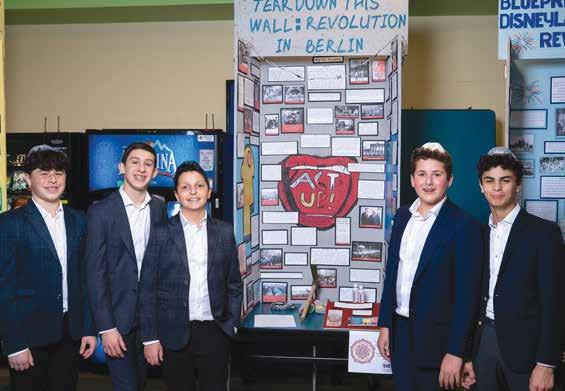
On Monday, February 9, the Hebrew Academy of Long Beach proudly held its ninth annual HALB History Day, part of the National History Day program that challenges students across the country to think deeply about the past and its impact on the present.
For five months, 102 eighth grade students immersed themselves in this year’s theme, Revolution, Reaction, Reform. They did more than research events. They stepped inside them. They asked what forces ignite change, who resists it, and which reforms truly reshape society. Working with primary sources, students debated interpretation, analyzed evidence, and crafted arguments that reflected both intellectual rigor and personal investment.
Walking through HALB History Day felt like moving through time. In one room, students transported visitors to the streets during the Warsaw Ghetto Uprising, confronting impossible choices and extraordinary courage, while others explored Holocaust history through deeply personal connections to family memory and identity. In another, guests stood at the gates of Disneyland, examining how one bold vision transformed American
leisure. Around the corner, the concrete barrier of the Fall of the Berlin Wall symbolically crumbled, and nearby students traced how Branch Rickey helped integrate Major League Baseball, demonstrating how reform often begins with moral courage.
Students presented their work in one of three formats: documentary, website, or exhibit. Each required extensive research, clear argumentation, and confident public presentation, blending scholarship with creativity and technology. The top three projects in each category will advance to Long Island History Day at Hofstra University on March 22, 2026, where HALB students will compete among some of Long Island’s most accomplished young historians.
First Place Exhibit: “Tear Down This Wall”: A Revolution in Berlin by Jonah Brown, Eitan Englander, Alex Sinnreich, Eitan Sokol, and Jacob Spector
First Place Documentary: A Rhythm Revolution: The Birth of Rock n’ Roll by Aliyah Amar, Aviva Aryeh, Ella Frenkel, Ariel Spitz, and Layla Schwartz
First Place Website: Branch Rickey’s Baseball Revolution: From Farm Systems to Breaking the Color Line by Yoni Fischbein, Rafi Levine, Sam Medetsky, Daniel Sacks, and Kobe Stern.
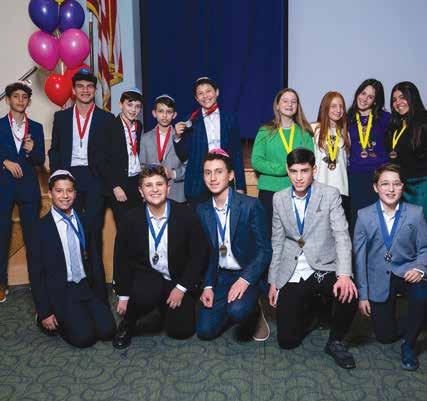
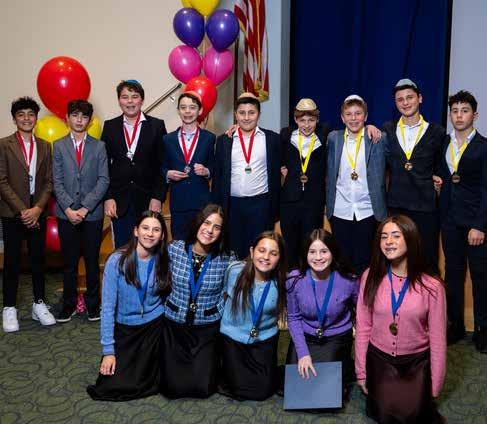


At the heart of everything SKA does is a commitment to cultivating a deep and meaningful connection to Torah and Yiddishkeit. SKA is proud to highlight an innovative addition to its rich programming: the L’Shma Learning Program.
L’Shma gives students an opportunity to learn Torah beyond the walls of the classroom, learning that is self-motivated, inspired, and truly “lishma,” for its own sake. While SKA’s academic program is known for its rigor and depth, L’Shma offers something different — a space where girls choose to grow, choose to engage, and choose to strengthen their connection to their Yiddishkeit on their own time.
The program is built around a creative and engaging “punch card” system. Students attend shiurim, participate in extra learning sessions, or engage in independent Torah study and receive punches toward meaningful prizes. The incentives add excitement, but SKA students’ true reward is the sense of accomplishment and spiritual growth that comes from consistent Torah engagement.
This past week, in a packed house filled with students, alumni, and moth-
ers, SKA welcomed Rav Mordechai Burg of Yeshivat Mevaseret Zion. Rav Burg delivered an inspiring address that challenged and uplifted attendees, emphasizing the power of personal growth through Torah learning and the impact of choosing to connect more deeply to one’s spiritual identity.
The evening was more than just a school event; it was a community experience. Mothers sat alongside daughters, alumnae returned to reconnect, and current students filled the room with energy and enthusiasm. It was a powerful reminder that SKA’s vision extends beyond its current student body. By opening its doors to the broader community, SKA continues to serve as a center of Torah learning and inspiration for families as a whole.
Through initiatives like L’Shma, SKA reinforces its core mission: to cultivate lifelong learners who pursue Torah growth with passion and joy. L’Shma learning promises to strengthen the bonds between students and Torah, between mothers and daughters, and between the school and the wider community.

In honor of Presidents Day, Gesher’s Pre-1A students enjoyed an engaging and hands-on introduction to the role of the President of the United States. The children learned about why we celebrate Presidents Day in February and discussed the important responsibilities of the president.
A highlight of their learning was discovering the life and accomplishments of one of America’s most famous presidents, Abraham Lincoln, whose birthday is in February. The students were fascinated to learn about his leadership and that he was known for being exceptionally tall.
To bring the lesson to life, each child had a blast measuring themselves against Abraham Lincoln’s impressive height, gaining a whole new perspective on just how tall he really was!
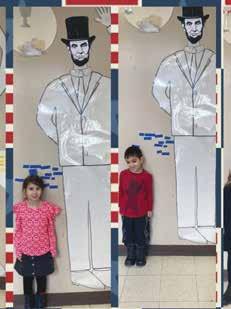
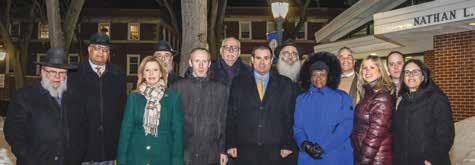
Hempstead Town Supervisor John Ferretti (center), Deputy Supervisor Dorothy Goosby (5th right), Councilman Dennis Dunne (6th left), Councilman Tom Muscarella (4th right), and Councilwoman Laura Ryder (3rd left) hosted a recognition of

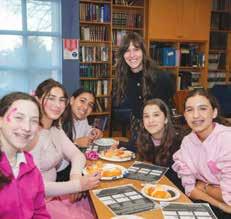
Health Week 2026 at HAFTR was an inspiring and energetic celebration of what it truly means to care for the whole child. Throughout the week, our students focused on growing physically, emotionally, socially, and spiritually, embracing healthy living in ways that were meaningful, hands-on, and fun.
Across every division, classrooms and hallways were filled with engaging, thoughtful programming designed to build strong bodies, resilient minds, supportive friendships, and grounded values.
In our Lower School and Early Childhood divisions, HAFTR parents who are professionals in the medical field visited classrooms to share their expertise and passion for wellness. Students explored topics like nutrition, hydration, anatomy, dentistry, and heart health in interactive and age-appropriate ways that sparked curiosity and excitement. They asked thoughtful questions and gained practical tools they can carry with them for life. Additionally, our LS students got some physical movement in there with visits to Warren Levi Karate. And of course, the week was fueled by delicious PTA-sponsored fruit snacks that kept everyone energized and smiling.
Our Middle School students participated in several unique experiences. Most notably, they took part in a program entitled “An Athlete’s Perspective” which gave them insights on being Jewish and working to be a successful athlete, and the students walked away with confidence in their ability to be both. Additionally, the eighth graders completed CPR courses, learning life-saving skills that empower them to act confidently and responsibly in critical moments. All grades engaged in basketball drills that

reinforced teamwork, discipline, and physical fitness. Both seventh and eighth graders participated in Inclusion and Sensitivity Training in partnership with Yachad (from the OU), deepening their understanding of empathy, respect, and the importance of building a community where everyone feels valued and included.
Our high schoolers participated in meaningful, grade-level experiences as well, engaging in thoughtful programming designed to meet them where they are and challenge them to think more deeply about their well-being. Through interactive workshops, guided discussions, and reflective activities, students explored topics connected to personal responsibility, balance, stress management, leadership, and making healthy choices. These sessions encouraged them to consider not only their physical health, but also their emotional resilience, social awareness, and spiritual growth.
A highlight of the week was our annual Pink Day, when the entire HAFTR community united in support of important health-related causes. Dressed in pink, both MS and HS students and faculty demonstrated the impact of awareness and advocacy.
Health Week reminded HAFTR that wellness is not one-dimensional. It is about strength and compassion. Knowledge and kindness. Confidence and connection.
A heartfelt thank you to our amazing PTA, parent volunteers, guest speakers, faculty, and staff for making this week so vibrant and impactful. Because of you, our students experienced not just a week of activities, but a week of growth.
Here’s to a year filled with strength, balance, positivity, and continued growth together. Stay healthy, HAFTR!
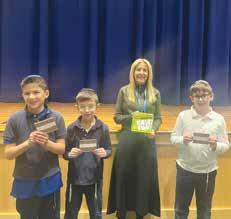
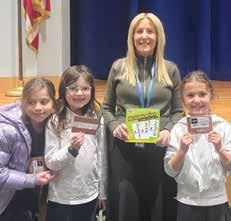
Congratulations to the students who won the HALB third grade
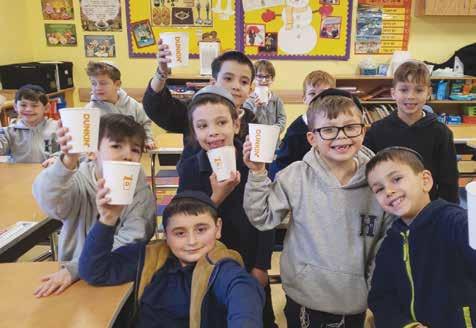
With all this cold weather and snow, Rabbi Ehrenfeld decided to get hot cocoa to warm everyone up! It was a fun and unexpected treat for HALB!


Harmony lit up the stage on February 14 and 15 with two incredible performances, and the excitement continues with two more shows still to come. With over 600 girls participating in this inspiring production, Harmony is more than just a performance — it is a celebration of unity, friendship, and confidence.
For many girls, the highlight was the friendships formed along the way.
Sixth grader Atara Shanin shared that her favorite part was making new friends from other schools. Nechama Eisenberger, grade 6, loved the backstage rehearsals and creating memories with friends, while Miri Shaiman said she loved performing and being with friends. Sara Willig and Chana Dachs both expressed how meaningful it was simply making and hanging out with new
friends.
Beyond the stage lights, Harmony created lasting growth.
“I didn’t think I could do it, but then I was able to!” said Rina Pilevsky, grade 5, about going on stage and performing in front of everyone.
Racheli Braunstein, grade 6, shared, “Harmony showed me that there is no point in being stage fright,” and Shulie Weinstein, grade 6, said performing helped her gain confidence.
The most rewarding part for many was working hard and finally performing. Sixth grader Ettie Gerber described it as “working hard for the show and finally performing,” while Tehila Friedman shared that Harmony was about making friends and gaining confidence.
Perhaps the most powerful message of Harmony was achdus. Aliza
Another thrilling week of JSL Winter 2026 by FM Home Loans brought overtime drama, clutch shootout moments, dominant offensive explosions, and lights-out goaltending across every division. From K/P to Men’s League, the intensity continues to build as playoff positioning begins to take shape.
Yeled LI Panthers defeated Smash House 5–3 behind stellar goaltending from Yisroel Atkin, who made clutch saves down the stretch. Maidenbaum topped Exclusive Cabinetry 5–1, with much credit going to Joshua Anhalt, who made spectacular saves in net. SD Shades defeated Mold Pro 6–3, as Yaakov Gutfreund played lockdown defense and added 2 assists. Demo & Cleanouts knocked off Marciano PD 6–1 behind a Yona Wegh Hat Trick.
K/P Soccer
Arise Real Estate got the better of Sunflower Cafe, led by huge performances from Ovadia Aryeh and Nissim Schwartz. 5 Towns Central defeated SR Whee, with JJ Rabinovicci continuing his scoring surge.
Chosson Central defeated Posh Home & Bath 7–5, powered by a Yoel Nagelberg Hat Trick. In a wild back-and-forth battle, Tikva Fire edged Zlotowitz Law 8–7

Rosenthal, grade 8, said, “It doesn’t matter which school you go to — you can be friends with everyone.”
Eighth grader Eliana Boczko added, “Everyone is nice no matter where they come from.”
Rachel Edelstein, grade 5, reflected, “I learned to judge people favorably because everyone is going through some -
thing and to be nice to everyone.”
Harmony is not just a dance production. It is 600 girls discovering courage, building friendships across schools, and learning lessons that will stay with them for years to come.
As we look forward to the upcoming performances, the harmony continues.
in a shootout. Refael Rosenberg came up huge with timely saves to secure the win.
2nd/3rd
J Works Construction earned a 4–2 win over Growtha, led by the impeccable defense of Gavriel Aryeh. Newman Dental defeated Nate Builders 7–5 behind strong two-way play from Ari Blobstein. Town Appliance locked up the #1 seed with a 6–3 win over TNB Architecture, as Ezra Gruin exploded for 4 goals. Remsen Auto defeated Styles Design Interiors 10–6, fueled by an electric double hat trick (6 goals) from Abie Tennenberg.
4th/5th
Extreme Vent Cleaning secured the #1 seed with a 7–3 win over Frank Kitchen & Bath, thanks to a multi-point performance from Dovid Krigsman. J Works Construction edged BlueBird Insurance 3–2 in overtime, with Rafi Taber delivering an incredible performance between the pipes. Smash House defeated SR Whee 6–5, highlighted by elite defensive play from Benny Markowitz. In a tightly contested, low-scoring battle that went to a shootout, Wieder Orthodontics defeated Styles Design Interiors. Isaac Belsky was the hero, scoring the shootout winner to secure the victory.
6th–8th Grade Hockey
In an overtime thriller, Town Appliance knocked off Twillory, with Binyamin Flegmann burying the game-winning
OT goal. SD Shades edged Emporio 4–3 behind a lights-out performance in net from Zach Borenstein, who made highlight-worthy saves all game long. Wieder Orthodontics defeated Sperling Productions 5–4, as Yaakov Levine scored 2 huge goals from the defensive position.
1st Grade Basketball
Marciano PD defeated Posh Home & Bath 14–12, with Gavriel Kranzler leading the scoring attack. Seasons squeaked by The Shoppe 7–4 in a tight contest.
2nd Grade Basketball
Wieder Orthodontics defeated White Glove Concierge, led by Ruby Wieder’s 8 points and 4 assists. 5 Towns Landscaping edged Rita’s 20–17 in a thriller, powered by Julius Berger’s all-around shooting, passing, and defense.
3rd Grade Basketball
Central Pizza Co. defeated Seasons Express 20–9, highlighted by a spectacular reverse layup from Yehuda Stein off a quick inbound play. In a low-scoring double overtime battle that ended in a shootout, Elegant Lawns defeated Tikva Fire 5–4. Moshe Loeb hit 2 clutch shots in double OT to seal the win.
4th/5th Grade Basketball
Newman Dental defeated Tal By Luxe 23–13 behind the selfless and high-energy play of Pinny Bell. Wieder Orthodontics topped Zlotowitz Law 22–17, as Ben Gordon tallied 5 points and 6 assists.

6th/7th Grade Basketball
Maidenbaum defeated TNB Architecture 57–46, led by Ari Van Halem’s gamehigh 11 points. Elegant Lawns earned a big win over Twillory, fueled by an unbelievable all-around performance from Menachem Wiener.
Men’s Basketball SR Whee defeated Maidenbaum 78–60, with Yitzy Berger and Zach Wiener each scoring 20 points. Altbanq completed a comeback win over Twillory 62–60, powered by Yehuda Klein’s 25-point performance.





Excitement was in the air on Rosh Chodesh Adar at Bais Yaakov Five Towns as the girls raced to dress up in their designated costume while their classmates cheered them on! The girls wowed their friends with their original and creative “hilarious hair day” hairstyles.

At Shulamith, Hebrew is more than a subject, it is an experience. Our beloved Hebrew Library (sifriyah) is filled with hundreds of engaging children’s books, all in Hebrew, creating an immersive and exciting environment for language growth. Each week, students choose a Hebrew book to take home and read with their families, bringing Ivrit into their homes. In the library, the girls enhance their learning through creative projects such as puppets and crafts that bring their stories to life. This time of year, we are especially grateful for our Guest Read-Aloud Program, where parents and grandparents visit to read a Hebrew book to the class. It is a wonderful way to showcase the girls’ growing Hebrew skills and strengthen the home-
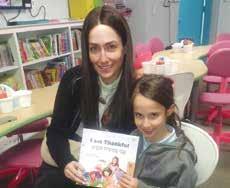
school connection. A heartfelt thank you to Morah Riki Tabuer for organizing this meaningful program, and to all the parents and grandparents who participate. The girls all agree: Hebrew Library is a fun and exciting place to learn, read, and speak Hebrew!
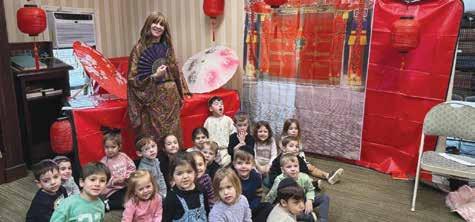
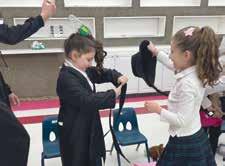
The children of Gan Chamesh traveled around the world and visited China and Mexico as part of the school’s acclaimed Travelmania program. In Mexico, the children examined Sombreros, learned how to say hola (hello), and enjoyed a snack of chips and salsa. In China, they saw beautiful kimonos, pointy hats, and paper umbrellas and lanterns. They know that rice, the local delicacy, is eaten with chopsticks, and they mastered
saying Ni Hao (hello) in Chinese. The Travelmania program teaches the children about the cultures, clothing, languages and pastimes of various countries. It emphasizes that Jewish people live all over the world and do mitzvot, learn Torah and go to shul just like we do. What a wonderful way to explore Hashem’s beautiful world!
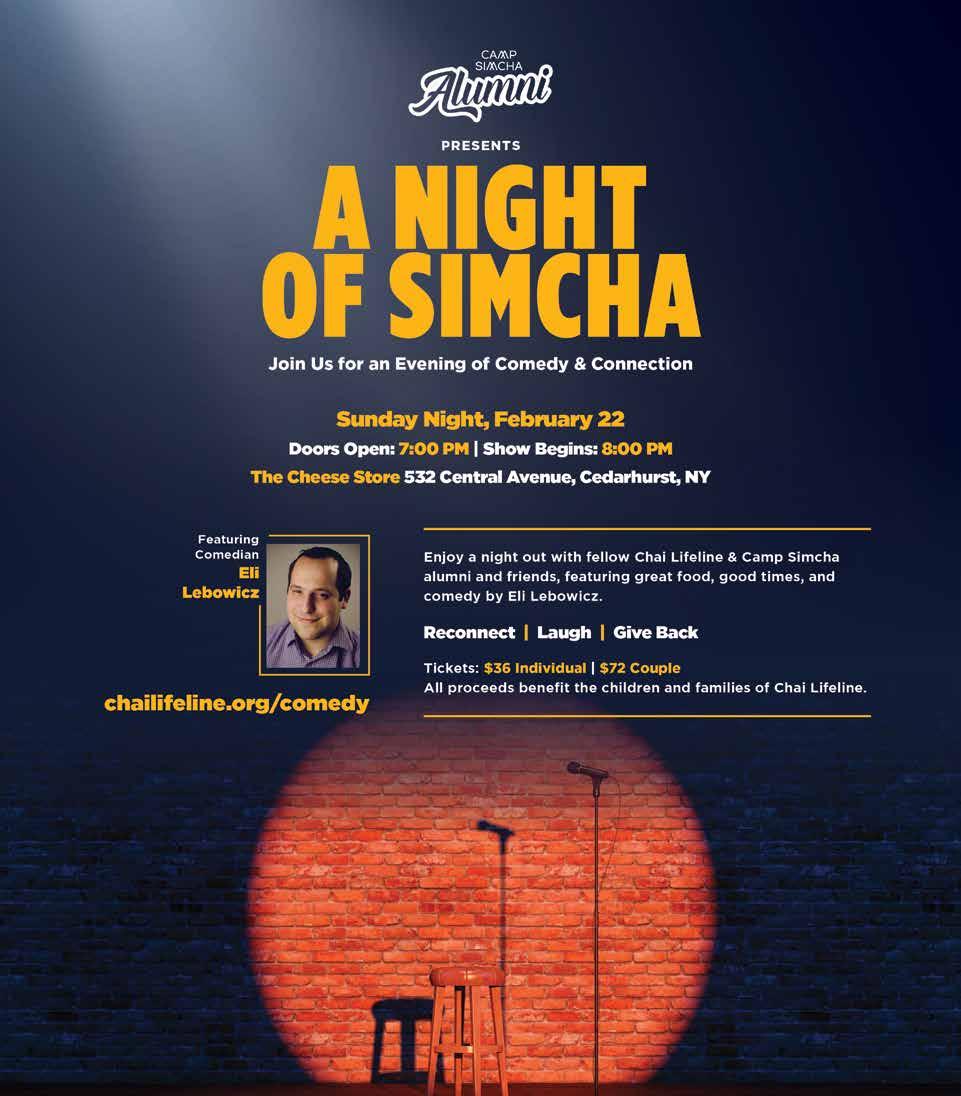

Students at the Yeshiva of Central Queens (YCQ) concluded two weeks of intensive study with the annual Bracha Bee this past week. The event marked the grand finale of a brachos unit that launched on Tu B’Shvat. Grades 1 through 8 participated in a series of Kahoot games to crown class winners after studying hilchos brachos in great detail. These digital competitions challenged students to quickly identify the correct brachot and halachos for various items. The interactive format turned the traditional classroom setting into an arena of friendly competition and collective learning. Congratulations to classes 1-203, 2-205, 3-21, 4-304, and 5-302, and to Erez Cohen and Avigail Co -
hen in the Junior High School!
The week also featured hands-on activities like pizza making to learn more about the difference between Hamotzi and Mezonos, and class brachot parties, which allowed students to apply their knowledge in a social setting while enjoying a wide variety of foods.
Junior High School students showcased their creativity through a door decorating competition where each classroom entrance was themed around a specific bracha. In addition to the internal celebrations, the school organized a food drive to collect items for those in need.
Kol hakavod to all of the YCQ students who are now brachos masters!
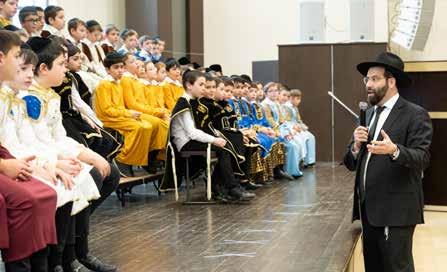

What an incredible evening!
The Niggun Chabura event this past Tuesday night in the Aish Kodesh trailers was one of those experiences that, as they say, “you had to be there.”
Reb Yirmi Ginsburg opened the evening by explaining how Niggun Chabura is always seeking to connect with young musical artists whose music and lyrics stir the soul. He invited Ya’akov Lauber, a high school student, to begin the program with two original songs that immediately set a tone of sincerity and depth.
Reb Yirmi then asked the evening’s keyboardist, Nati Broyde, to play a sweet Zusha medley to prepare and open the hearts of the crowd. As Nati sang the moving lyrics, “I can’t, can’t do this without you. We’re in this together. Don’t leave me on my own,” Reb Yirmi explained that while a Yid says these words to Hashem, Hashem in a certain sense says the same to the Jewish people. He
created a world and entrusted its mission to Am Yisrael—as if to say, “I can’t do this alone.”
Reb Yirmi connected this message to the room: the musicians need the crowd, and the crowd needs the musicians. We can’t do this on our own.
And the crowd was tremendous!
Then the main part of the evening began with Chaim Ghoori—who plays his heart and sings from his soul even more than he plays his guitar and sings with his mouth.
Reb Yirmi explained the theme of “Unplugged.” Unplugged means being real and authentic—not plugged into what’s popular or into other people’s opinions. It means being your true self.
Chaim invited his ever-talented and sweet-voiced brother, Shlomo, to join him for several songs, including “When you call,”, “Uvnei,” and “Lecha Amar Libi.” He also brought up his childhood friend, Eli David, another tremendous
musician, to sing a song they worked on together, “Wake up, my love,” that contain the lyrics “for your light is bright.”
Chaim shared that every person carries a light within; everyone is intrinsically good and has have simple faith in himself to reveal that light.
In a surprise moment, Reb Yirmi called up Zevi Kaufman from the TYH Boys Choir to sing the ever-popular “I Wanna Be Like Zusha.” The theme of the night became crystal clear: “I just gotta sing from my heart.” While we may look up to others, the ultimate goal is to become our authentic selves—to become fully ourselves.
Chaim continued to inspire the crowd through both his music and his Torah insights, weaving song and message seamlessly.

The night culminated with one of the most beloved songs of recent years, “Yidden,” as everyone joined together—“like one man with one heart.” It was truly a night where people unplugged and connected—hearts and souls soaring. An evening forever etched in memory as one to remember. To follow along and connect, please visit NiggunChabura.com.

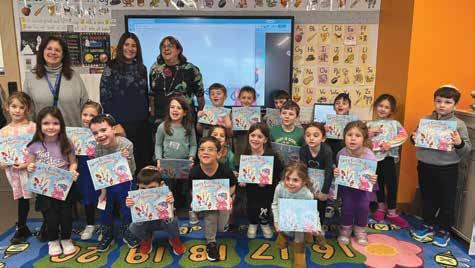
The students in the kindergarten classes in HANC’s Reinstein Family Campus in West Hempstead welcomed a very special guest last week. Author and illustrator Mrs. Ann Koffsky visited their classrooms to tell them about how a childhood hobby turned into her life’s passion and career. She relayed to the children that from her earliest days as a HANC student, she always loved art, reading, and telling stories. To enhance her art skills, her mother sent her for art lessons with Mr. Murray Morris, a local resident of West Hempstead who also loved to paint and shared his art skills with children by giving classes in his home as well as in an after-school clubs in HANC. Mrs. Koffsky demonstrated to the children that Mr. Morris showed the children how a few well-placed lines and curves could create a beautiful picture of a Shabbat table with challah and candlesticks. After demonstrating how to draw the scene, she even shared a photograph of the original drawing that Mr. Murray shared with her so many decades ago. After taking more art classes through the years, Mrs. Koffsky combined her art talents and her love of telling stories into a storybook writing career. She also shared her method of finding topics for her children’s books, which were often based on experiences she had or observations of life around her. She brought several samples of her many delightful children’s books, and the young audience sat in rapt attention as they explored her creative ideas and saw them come to life in the colorful pages of her story books.
Mrs. Koffsky then presented one of her more recent books, entitled Fairy Godbubbie’s Shabbat She crafted the idea of a fairy godmother that resembled
a grandmother who wanted to encourage family members to keep Shabbat. Unsure of how to illustrate her, Mrs. Koffsky examined photographs of her own “Granny” as well as other older role models, and created the main character of her book utilizing various features of each of these formative women. In order to illustrate her Fairy Godbubbie in action, she enlisted the help of her own family members to position their bodies and hold household items that resembled a magic wand so that her drawings would look as realistic as possible.
After describing the many stages of the process of writing a book, Mrs. Koffsky read the book to the children. They were mesmerized as the main character found creative ways to encourage the family members to turn off their devices and spend Shabbat together as a family. At the end of the presentation, a second special guest was revealed. Mrs. Nancy Smith, who is the daughter of Murray Morris z”l, presented each child with a copy of the book they had just read together, autographed by the author, and containing a dedication label with information about Mrs. Smith’s father and his love for art. Complementing this gift, the children also received a sticker and a coloring sheet created by Mrs. Koffsky. The students were delighted with this special gift to take home, and each class was gifted an additional copy for their classroom library.
This special opportunity to meet a well-known author who went to HANC as a child, as well as to meet the daughter of the art teacher who inspired Mrs. Koffsky and expanded her artistic skills, was truly special. It was an experience that they will remember for a long time to come.
Last week, HALB fifth grade boys hosted students from Ivdu to view the sukkahs they made for their sukkah fair. The HALB boys had the chance to explain their sukkahs and the halacha they focused on, and the Ivdu boys asked great questions and shared what they were learning, too!


The joyous sounds of lively music filled the air at DRS Yeshiva High School’s Annual Parent-Son Melava Malka this past Motzei Shabbos. In an email to the DRS family, Menahel Rabbi Yisroel Kaminetsky described the event’s purpose as a celebration of “the joy, fulfillment, and meaning of being a Jew,” emphasizing the “positive Jewish energy that the yeshiva strives to instill in its talmidim through song, divrei Torah, food, and dancing.” The Melave Malka serves as a unique occasion where the entire DRS family – rabbeim, parents, and talmidim – comes together to celebrate these core values of the yeshiva.
The evening began with a delicious dairy buffet in the cafeteria. Following the meal, attendees made their way into the gym, which had been beautifully transformed into an elegant and beautifully lit tisch setting. The atmosphere was electric as Duvid’l Ziff and his band played uplifting melodies, filling the
room with spirited singing. Parents and sons joined together in heartfelt harmony, singing DRS favorites.
A cherished tradition of the Melava Malka is recognizing a distinguished faculty member for their dedication to the yeshiva. This year, DRS honored Mrs. Debbie Pearlman, a beloved administrative assistant, for her more than 23 years of devoted service. A moving tribute video was shown in her honor, followed by the presentation of an award acknowledging her unwavering commitment to the yeshiva.
The yeshiva also presented two sets of awards to students. The Torah Growth Award was given to one talmid from each Gemara shiur in recognition of his outstanding dedication to learning. Additionally, the Grade-Wide Middot Award, determined by peer vote, was awarded to a student in each grade who exemplified exceptional middot and character.


At Yeshivas Ateres Eitz Chaim, the early morning hours are filled with a special sense of purpose and growth. Each day before minyan, a dedicated group of outstanding and committed bochrim gather for the 8:30 a.m. Learning Club, investing their time in meaningful limud under the guidance of the Menahel, Rabbi Boruch Oppen, shlit”a.
Last week, the chaburah celebrated a significant milestone — the completion of Sefer Ani Maamin, a sefer that strengthens clarity in the yesodos of emunah and provides powerful perspective in matters of halacha and hashkafa. Through consistent effort, thoughtful discussion, and Rabbi Oppen’s insightful leadership, the bochrim deepened their understanding of the fundamentals of Jewish belief and sharpened their ability to approach life with clarity and conviction.
The daily shiur has become a cornerstone of inspiration. Before the formal seder ha’yom begins, these talmidim choose to come early, demonstrating true
commitment to growth in Torah and yiras Shamayim. The learning is marked not only by diligence, but by lively engagement and sincere curiosity — a reflection of the unique environment cultivated by Rabbi Oppen, who guides the bochrim with warmth, depth, and practical application.
In honor of completing the sefer, the group celebrated together with a delicious lunch at The Shoppe. The seudah was filled with camaraderie, divrei Torah, and a sense of accomplishment, as the bochrim reflected on the journey they undertook together and looked ahead to future limud with excitement.
The 8:30 a.m. Learning Club continues to exemplify the spirit of Ateres Eitz Chaim — talmidim striving for excellence, guided by devoted rabbeim, building a foundation of emunah and knowledge that will accompany them throughout their lives. May they continue from strength to strength, adding many more siyumim in the future.



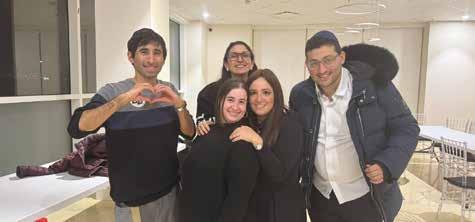

This past Saturday night, R&N hosted a singles event at American Dream. The night started with choosing from a variety of activities, including ice skating, laser tag, arcade games, and Activate.
After the activities, guests gathered in a private party room to enjoy pizza and salad, play icebreaker bingo, and continue mingling in a relaxed and welcoming atmosphere. With more than 300 singles in attendance, the energy in the room was incredible. As one guest shared, it felt like “all the singles from the tri-state area were in one room.”
The event created meaningful opportunities for connection, with several
attendees already exchanging contact information and scheduling dates following the event.
Overall, the evening provided a fun, comfortable, and exciting setting for singles to meet and connect within the community.
Special thanks to the event coordinators who made the night such a success: Natan Aboff, Tzippy Feldman, Adam Beckoff, Rachel Lacher, and Miriam Livian. Thank you to the anonymous donor who sponsored the pizza, party room, and prizes.
To learn more about future R&N Singles events, contact Natan at 516-8249268 or Tzippy at (347) 470-4458.
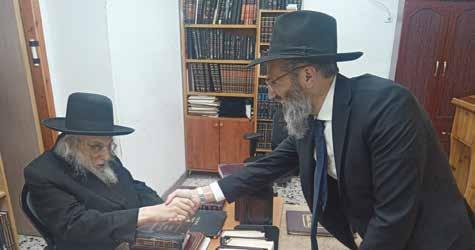
Rav Daniel Cooper greeting Rav Yitzchok Soloveichik
Khal Machzikei Torah of Far Rockaway held its annual Adopt-aKollel Shabbos Shutfus on Shabbos Parshas Mishpatim. The shul has a long-standing partnership with Kollel Shaarei Simcha led by Rav Yitzchok Soloveichik.
Recently, Rav Daniel Cooper was appointed rav of the shul, and he traveled to Eretz Yisrael where he met with Rav
Yitzchok Soloveichik and spoke to him in learning. Rav Cooper also visited the Kollel and was deeply impressed by the atmosphere of hasmada and aliyah b’Torah. On Shabbos, Rav Cooper spoke about what a zechus it was to actually partner with one of the senior gedolei Yisrael and encouraged the kehillah to take advantage of such a zechus
MTA seniors Gavriel Goller and Gavi Samuels have earned national recognition, placing in the Top 5 of the CNBC Financial Interview Video Competition and securing an impressive 4th place finish among 91 school submissions nationwide.
Through an exclusive partnership with CNBC, students in Ms. Felsman’s Marketing and Media class were invited to submit professionally produced financial interview segments. Working in pairs, students explored current financial topics, developing scripts, conducting research, and producing polished video interviews that reflected real-world media standards.
Gavriel and Gavi chose to analyze the NBA gambling scandal that broke last year, approaching the topic with depth, clarity, and professionalism. Their segment mirrored the structure and tone of a national news broadcast, complete with anchor-style delivery, sharp editing,

carefully selected background music, and even a creatively produced commercial for the segment.
The result was a compelling, high-level production that stood out on a national stage. Their achievement reflects not only their talent and dedication but also the strength of MTA’s commitment to experiential learning and real-world skill development.

At Yeshiva University High School for Girls, the Science Institute has spent the past three decades proving a powerful idea: when young women are trusted early with real scientific research, the confidence they gain lasts a lifetime.
Initially founded as the Science Research Program and later expanded into the Science Institute, the program was built on a bold premise: to invite high school students into professional laboratories, hold them to real standards, and allow them to discover what they are capable of achieving. Each year, students in the Science Institute commit to a rigorous three-year course of study that includes two summers of authentic scientific research in professional laboratories at institutions such as Albert Einstein College of Medicine, Stony Brook University, NYU, Hofstra University, Rockefeller University, Cooper Union, and Shaare Zedek Medical Center. Many go on to present their work at national and international science competitions and research symposia, experiences more often associated with graduate students than high schoolers.
The Institute’s Director, YUHSG Science Department Chair Mrs. Ruth Fried, has guided and mentored Institute students through the program since its inception, and can speak to the life-changing experiences the Institute offers YUHSG students. “Over the years, I’ve learned that confidence doesn’t come from being told you’re capable,” she reflected. “It grows when students are trusted with real
work. When that trust is given early, they rise to it in ways that stay with them long after they leave the lab.”
This fall, alumnae spanning nearly 30 years were invited to reflect on how those early research experiences shaped their lives. Their responses revealed something powerful and consistent: early exposure to serious research builds lasting confidence – not only in science but in life and work.
One alumna from the Class of 2015 recalled working in a laboratory as a tenth grader, surrounded by researchers devoted to a single project. Though her role was temporary, she felt a deep sense of responsibility. Learning to approach each task, no matter how small, with integrity continues to shape how she approaches academic and professional challenges. Others described the moment they realized they truly belonged in scientific spaces. An alumna from the Class of 2012 noted that only in hindsight did she grasp how rare it was to be conducting legitimate research as a high school student.
The belief of belonging is especially significant for young women entering STEM fields, where confidence, not ability, is often the first barrier to participation. Many alumnae went on to pursue careers in medicine, engineering, psychiatry, health technology, and science education. Others ultimately chose paths beyond traditional bench science. Yet even those who pivoted emphasized that a mindset developed through research, including critical thinking, persistence,
problem-solving, and intellectual courage, remains central to their work. Others continued to advanced study at leading universities and medical schools, including MIT, Columbia University, Johns Hopkins, and AECOM.
One alumna from the Class of 2013, now a licensed clinical psychologist specializing in the treatment of PTSD, described how her confidence as a clinician is rooted in her foundation in research. “While I was always interested in the sciences before joining the Science Institute, this program was my first real foray into formal research,” the alumna said. “Through my summer work at Einstein and Stony Brook, I learned how to ask good questions, think critically about data, and present my work with confidence.” She ultimately entered a PhD program built around the scientist-practitioner model. Today, she draws on current research in her therapy sessions and remains involved in research, presenting at national conferences. “Staying curious, questioning, testing, refining, that mindset began in high school,” she said. “Even now, I feel that my identity as both a clinician and a scientist started back then.”
Another alumna from the Class of 2018 described how the Science Institute shaped her perspective even as her professional path moved beyond traditional bench research. After completing her undergraduate studies, she began working in hospital administration, later pursued a master’s degree in health administration, then pivoted into health technology, working at the intersection of innovation,

care delivery, and problem-solving. She credits her high school research experience with helping her recognize where she thrives: at the balance point between science and the humanities.
Another alumna from the Class of 2011, now a physician in internal medicine, described how early exposure to high-level expectations reshaped her sense of what she could handle. “The pressure put on us was actually a belief in us,” she reflected. “A belief that we are capable of surprising ourselves and achieving things beyond what we may believe.”
Institute alumnae spoke about seeing science not as separate from values, ethics, or identity, but as deeply connected to them. An alumna from the Class of 2018 was struck by the compassion needed for clinical work while shadowing an OB-GYN. “Every day brought new stories and experiences that opened my eyes to the realities of patient care,” she said. “It’s a big part of why I’m pursuing medicine today.”
These reflections affirm what educators and families have long hoped but rarely see articulated across decades: authentic research experiences in high school prepare students not only for college, but also for the workforce and for life.
By Monet Binder, Esq.
This past February 1 was National Unclaimed Property Day and serves as a reminder that state governments currently hold over $70 billion in forgotten assets. This isn’t abandoned real estate; it’s usually dormant bank accounts, uncashed paychecks, utility refunds, or forgotten stocks that were turned over to the state after a period of inactivity.
Assets often disappear due to simple life changes like moving, changing a name, or the death of a family member without a clear financial record. With so
many of us juggling multiple bank accounts, retirement funds, PayPal, Venmo, old 401(k)s from previous jobs, and who knows what else, it’s easier than ever to lose track of where all your money actually is.
Check and Claim
The first step is to Search. Visit unclaimed.org to search for your name in every state where you’ve lived or worked. The process is free, though you will need to provide identification to prove ownership.
Prevention
The second, and more vital step is to prevent. You can protect your family by
consolidating accounts, updating your contact information whenever you move, and maintaining a comprehensive inventory of your assets. Working with a professional to create an Estate Plan ensures that your hard-earned money stays with the people you love rather than becoming a statistic gathering dust in a state vault somewhere.
Consult a professional who has your best interests in mind, not someone who only focuses on after death documents. Estate Planning is also about what happens while you’re still living. Learn the best way to protect yourself and your family while you’re still living and after
you’re gone and keep everyone out of court and conflict.
Call today 718-514-7575 or 732-3331854.
Monet Binder, Esq., has a practice in Lakewood, Queens, and Brooklyn areas, dedicated to protecting families, their legacies and values. All halachic documents are approved by the Bais Havaad Halacha Center in Lakewood, under the direction of Rabbi Dovid Grossman and the guidance of Harav Shmuel Kaminetsky, shlita, as well as other leading halachic authorities.



For a roster loaded with senior talent, this season was never just a schedule; it was a collection of storylines waiting to unfold. The Macs’ schedule was ambitious and decorated with high-ranking opponents: #1 Trinity, #2 Randolph-Macon, a rematch of last year’s NCAA Tournament with #4 Tufts, #15 Mary Washington, and a first look at Farmingdale State since Zevi Samet’s championship-winning dagger. Six of YU’s 9 non-conference opponents are currently ranked in the top 15 of the D3 Top 25 poll; 2 more are currently receiving votes; the only one not named on any voters’ ballots now was receiving votes at the time of the game. It was a daunting schedule, but Coach Elliot Steinmetz knew his team was up for the challenge. Despite struggling to win games in the early season, the Macs battled against many opponents in the upper echelons of D3 and improved in conference play as a
result. Now, after months of turbulence and triumph, the season reaches its crescendo: the Skyline playoffs. The goal is clear: win the conference championship and punch a second straight ticket to March Madness.
The Macs have finished the regular season as the #1 seed in the Skyline Conference with a perfect 16-0 conference record. For just the second time in program history, the Macs clinched the #1 seed and control their own destiny to host 3 playoff games in their home gym.
When talking about this past season, the name Zevi Samet has to be brought up. Zevi passed Ryan Turell to become Yeshiva University’s all-time leading scorer and averaged a career-high 23 points per game. Meanwhile, rookie sensation Yair Dovrat quickly established himself as an elite floor general with a high basketball IQ. His highlight-reel dishes made him an instant fan favorite;

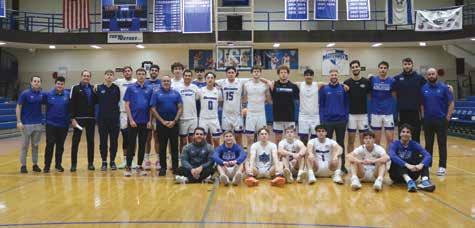
the 6’7” guard averaged nearly five assists per game while shooting 40% from behind the arc. Down low, junior Yoav Oselka enjoyed a breakout year, averaging 14 points and 5 rebounds per game to provide the Macs with the dominant interior presence they’ve sought for the past few years.
Everything has clicked for the Macs over the last few weeks. After a grueling stretch against the top teams in the country, the Macs look ready for the postseason. They’ve dominated their Skyline opponents lately, eclipsing the century mark twice in the past three weeks.
The individual performances are just as sharp: Max Zakheim is playing his best basketball of the season, and Zevi Samet is on a tear, averaging 29 points over his last six games. With assists up and turnovers down, the team is finally firing on all cylinders at exactly the right time.
On Tuesday, February 24, the playoffs begin, and everything in the past will become irrelevant. With home court advantage and the Macs faithful behind them, the gym will be electric and pro -
vide a spark for a deep playoff run. The Macs have proven that they are the team to beat in the Skyline Conference.
Yet, one question remains: can the conference’s best team in the regular season finish the story?
The trophy is within reach. The mandate is clear: repeat as champions and carve this team’s name permanently within program history. The gym has to be full, the bleachers rocking, and the walls shaking. The best teams thrive off of energy and momentum, and the Macs faithful can provide that.
If you want to watch the playoffs, you can bring your voice, passion, and energy in person to the Max Stern Athletic Center or join us from the comfort of your home on the MacsLive YouTube channel. Join us on Tuesday, February 24, for the first-come first-serve quarterfinals contest. For ticket sales information for what will, please G-d, be the semifinal and championship home games on Thursday, February 26 and Sunday, March 1, follow MacsLive and Yeshiva Athletics on social media.
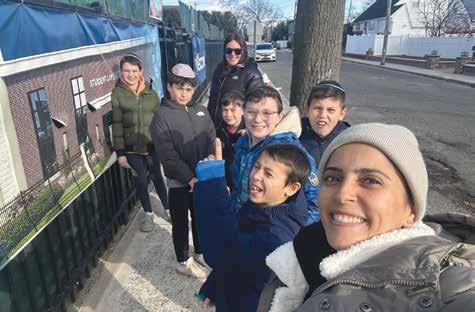
In Mrs. Berokhim’s second grade ELA class, students recently finished reading Jake Drake and the Bully Buster by Andrew Clements. They made meaningful connections to the story while strengthening key reading skills, including identifying the main idea and supporting details. The boys are now writing their own creative stories, complete with a clear beginning, problem, climax, solution, and ending — featuring exciting adventures set in the Amazon Rainforest. In fifth grade Math, students have been strengthening their foundational
skills and are now diving into decimals. They are learning how decimals differ from whole numbers, what each digit represents, and why these concepts are important. With practice and perseverance, their confidence and understanding continue to grow.
Meanwhile, in fourth grade Math, students are preparing for an assessment on multiplying double-digit numbers by double-digit numbers. Their focus, effort, and positive attitudes have been impressive as they rise to new challenges.
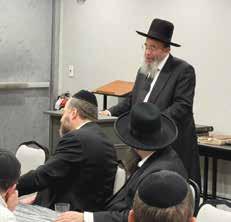
Congregation Bais Tefilla of Inwood, led by Rav Pinchas Weinberger, has a long-standing partnership with Kollel Derech Hachaim of Yerushalayim, led by Rosh Kollel, Rav Boruch Levi Faivelson. Rav Faivelson visited the kehillah on Sunday, 28 She -
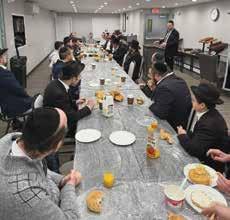
vat/ February 15. A special breakfast was held at the shul in honor of the Rosh Kollel. At the breakfast, Rav Faivelson gave a powerful address. Rav Pinchos Weinberger, the rav of the shul, also addressed the event.

By Natalie Bellehsen
Students from yeshiva high schools across the country attend the annual Yeshiva University National Model United Nations (YUNMUN) tournament to showcase their public speaking abilities and strengthen their debate and collaboration skills. This year, the Hebrew Academy of the Five Towns and Rockaway (HAFTR) reached a new milestone, placing third overall as a school for the first time while representing the delegations of Singapore and France.
The conference began on Sunday, February 1, and concluded with awards on the 3rd at the Armon Hotel in Stamford, Connecticut. Berman Hebrew Academy took first place, and Yeshiva University of Los Angeles came in second. The competition consists of six committee meetings, and each school sends a delegation based on the percentage of graduates who attend Yeshiva University, with a maximum of 12 students. During committee sessions, delegates speak from their country’s perspective and collaborate with others to draft and pass resolutions.
This year, the first day of committee sessions also fell on Tu B’Shvat, and
refreshments and fruit were set out for students to enjoy after their first intense meeting. Beyond academic debate, the tournament gives students the opportunity to connect with fellow Jewish students from across the country, including participants from Canada and occasionally South America. Many rekindle friendships from summer camps, network with YU students, and consider attending YU after high school. At the end of the final committee session, chairs host a “YU Panel,” where students can ask questions about life at YU and learn more about the university, making it a meaningful opportunity for YU to showcase its programs.
The experience extends beyond debate. Each committee encounters a surprise “crisis” event, which can include activities such as capture the flag, dodgeball, or even water fights in the hotel lobby. The wit and humor students bring, often tailored to their country’s perspective and woven into their speeches, highlight a unique talent developed through participation in the conference.
Over the years, HAFTR has steadily grown, earning more awards each season and ultimately reaching the podium for the first time. The team of 10 credits its
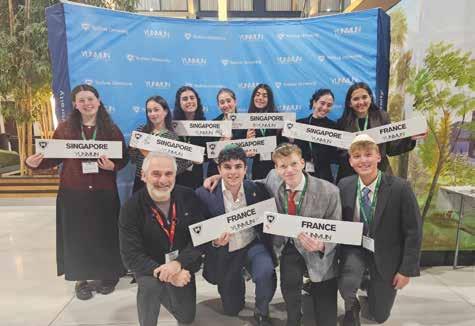
success to its senior captains, who held weekly practices beginning in October, and to Coach and chaperone at the competition Alexander Libkind for his guidance and support. Congratulations to this year’s award recipients: Rylee Gluck (Best Delegate, UNHRC), Miles Shusterman (Best Delegate, ICC), Gabriella Hersh (Honorable Mention, CSW), and Joseph Mitgang (Honorable Mention, UNICEF). Junior Micole Appel shared,
By Abigail Saldin
HANC High School Girls’ Winter Extreme trip kicked off on Wednesday, February 4. The girls began our trip with a lively glow-inthe-dark dodgeball game followed by a wonderful dinner. After this, we boarded buses to travel to the hotel in New Jersey.
The evening was absolutely spectacular. Students and faculty joined in game shows with DJ and game show host, Digital Dov. We then competed in lively Lip Sync battles, which was followed by a spirited chagiga and a heartfelt kumzitz. Midnight snacks of fried Oreos and churros were enjoyed by all.
The following morning began with Shacharit, breakfast and a meaningful presentation by Rabbi Benzion Klatzko, founder of Shabbat.com. Rabbi Klatzko emphasized the ability of every person, no matter their circumstance, to make a

positive impact on their community and the world.
We then headed to an escape room challenge, where we were divided into teams to see who could crack the puzzles first and escape the room. After a pizza lunch, we donned our warmest jackets and winter gear and went snowtubing, reaching exhilarating speeds as we zoomed down the hill. Our last stop on our trip was Teaneck, NJ, for dinner before returning home.
Meanwhile, the boys began their trip closer to home. On Thursday, they took a trip to Five Towns to hear a series of

shiurim at Aish Kodesh in Woodmere. With an opening by Rabbi Ginzberg, the boys then heard from the renowned Rabbi Moshe Weinberger, founder of the very shul they were sitting in, and father-inlaw of our very own Rabbi Yisroel Simcha Weingot. Afterwards, Rabbi Feiner, rav of the White Shul, inspired the audience with words of Torah. The morning proved to be incredibly impactful and left a lasting impression on all participants.
After their moving, Torah-filled morning, the boys headed to the American Dream Mall in East Rutherford, New Jersey. The trip continued at the Pruden-
“I am so thankful for my experience on this team for the incredible skills I have developed that I can utilize in my later career, as well as the strong bonds and friendships I made.” The team agrees that the event brings students from different grades closer together, forming friendships that continue long after the competition ends. HAFTR looks forward to seeing its student-led YUNMUN team continue to grow in the years ahead.
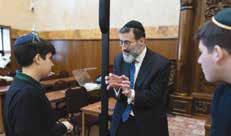
tial Center in Newark, New Jersey, for a New York Islanders vs. New Jersey Devils game. In the end, the Islanders beat the Devils 3-1, much to us native New Yorkers’ excitement.
All in all, the HANC High School winter retreat was nothing short of amazing, and we’re super grateful to our hard-working administration and student life faculty for going above and beyond with coordination and planning to help turn this trip from just an itinerary on paper into lasting memories for all the students.


Gesher’s second grade students proudly celebrated their annual Chumash Fair on February 12, marking a meaningful milestone in their lives. Each student chose and studied a personality from the Torah, exploring a unique middah that their tzaddik or tzadekes personified. Through their learning, the children gained a deeper understanding of the character traits that guide us in our daily lives.
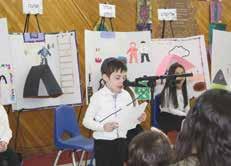
One by one, the students confidently presented their Torah figure to their classmates, sharing insights about the middah they had studied and the lessons they learned. Their enthusiasm and pride in their accomplishments were evident to all.
The program opened with warm introductory remarks from Mrs. Chava Bodner, Director of Gesher, who reflected on the tremendous growth the students

have shown throughout the year. Rabbi Ami Rabin, the second grade Chumash rebbe, then offered heartfelt divrei bracha to the class, encouraging them to continue growing in their Torah learning.
It was truly a special celebration,
with a palpable sense of nachas filling the room as parents, grandparents, and teachers witnessed the students’ achievements and their beginning love for Torah.
Garden City, NY — Nassau County Executive Bruce Blakeman accepted the Republican nomination for Governor of New York last week, delivering a sweeping indictment of Kathy Hochul’s record and pledging to fix Hochul’s affordability and public safety crisis.
“I am honored to receive this nomination to be your next Governor of the great State of New York,” Blakeman said. “Millions of New Yorkers rejected Kathy Hochul four years ago, and after four more years of soaring taxes, rising crime, and reckless spending, families simply cannot afford her failed leadership any longer.”
Blakeman cited more than $8 billion in tax hikes under Hochul, which has given New York the highest tax burden in the nation. He pointed to electric bills that are approximately 50 percent higher than the national average, as a result of the Hochul Administration’s 36 utility rate hikes, blocked energy infrastructure projects, and costly green energy mandates that have left nearly 70 percent of some utility bills going toward fees, delivery charges, and state-imposed costs.
He also sharply criticized congestion pricing, which charges drivers up to $27 to enter Manhattan. “In Hochul’s New York, you now pay a tax just to drive on a public road you already paid for,” Blakeman said. “And if she gets four more years, congestion pricing won’t stop in Manhattan — it will expand.”
Blakeman emphasized that while middle-class families, seniors, and small businesses struggle with rising costs,
Hochul has prioritized billions in spending on hotel rooms, prepaid debit cards, and benefits for illegal migrants. “That is not right,” Blakeman said. “What Kathy Hochul spends on waste, Medicaid fraud, and benefits for illegal migrants who’ve been here for fifteen minutes, I will redirect to better schools, roads, hospitals, infrastructure, and meaningful tax relief for the people who built this state.”
On public safety, Blakeman slammed Hochul for siding with criminals over law-abiding citizens by signing laws that release dangerous inmates, erasing criminal records, weakening parole standards, refusing to repeal cashless bail, and failing to fix the “Raise the Age” law as youth crime rises. “Kathy Hochul has turned her back on the rule of law,” Blakeman said. “As Governor, I will stand with our police, not against them. I will fight to keep violent criminals and cop-killers behind bars, because the safety of our children and neighborhoods demands it.”
Blakeman contrasted Hochul’s record with his own as Nassau County Executive, where he stopped a $150 million tax hike, has not raised taxes, secured seven bond upgrades, and worked with law enforcement to make Nassau County the safest county in America. He hired more than 600 police and corrections officers and invested heavily in public safety.
“Imagine bringing that level of fiscal discipline and commitment to safety to the entire state,” Blakeman said.
Blakeman also pledged to cut middle-class income taxes, roll back Albany’s “hidden taxes and mandates” driving up

energy costs, defend Second Amendment rights, and protect girls’ sports by ensuring biological males cannot compete against female athletes.
Blakeman emphasized that service is personal to him. The son of two World War II veterans — his mother served in the U.S. Army and his father in the Merchant Marines — Blakeman has long advocated for veterans. As County Executive, he partnered with Tunnel to Towers to expand housing for homeless veterans.
“No one who fought for America should ever be without a home,” Blakeman said.
Blakeman also reflected on his time as a Port Authority Commissioner during the September 11th attacks, when his nephew, Court Officer Tommy Jergens, was killed in the line of duty. “I’ve seen what happens when government fails, and I’ve seen what leadership matters,” he said. “Now my grandchildren are growing up here. This is their home. I refuse to accept that New York’s best days are behind us.”
Blakeman recognized his running
mates, Joseph Hernandez for State Comptroller, Saritha Komatireddy for Attorney General, and Todd Hood for Lieutenant Governor. He praised Hernandez’s business background and personal story as a Cuban immigrant, Komatireddy’s experience as a federal prosecutor and national security leader, and Hood’s 22-year career in law enforcement and leadership within the New York State Sheriffs’ Association.
“Together, we will bring fiscal responsibility, accountability, and public safety back to New York,” Blakeman said. Blakeman concluded by pledging to serve as “a governor for all people — regardless of race, religion, ethnicity, abilities, or lifestyle” and vowed to restore opportunity, affordability, and pride in the Empire State.
“We can fix this crisis. We can make New York affordable again. And we can make it safe again,” Blakeman said. “But it will take leadership that puts New Yorkers first. That’s the choice this November.”

By Chaim Gold
“Lama nigara – why not us?!” That was the message to Dirshu earlier this year from the Torah community of Panama! The thriving Torah community in Panama is home to wonderful mosdos of Torah, schools, yeshivos, kolelim and shuls. Yes, the Torah community and the shuls in this South American haven for Yiddishkeit are thriving, but prominent community members felt that something was missing.
They watched other communities with whom they were connected such as Argentina, Mexico and Brazil holding massive Dirshu events resulting in thousands of Yidden from those communities joining Dirshu’s programs and bringing a learning schedule of accountable limud haTorah into their lives.
They were tempted. They also wanted more.
Members of the Panama community therefore reached out to Dirshu’s Nasi, Rav Dovid Hofstedter and other senior members of hanhalas Dirshu, asking, “Why not us?”
Now their question is being answered
in the form of the upcoming “Maamad Ahavas HaTorah” that will be held this coming 8 Adar/February 25 at the large About Attie Auditorium in Panama City.
The massive maamad of chizuk will feature a siyum on Masechta Pesachim that is being learned in the Dirshu Amud HaYomi program, but it will be much more than a siyum. It will be a kinnus of chizuk, a kinus of ahavas haTorah and a kinus of kabbolas haTorah!
Members of the Panama community, led by their rabbanim that represent the entire cross-section of the Torah observant population in Panama, will come and show their desire to join one of Dirshu’s popular programs followed by what promises to be an explosion of new Dirshu shiurim in shuls and mekomos haTorah throughout the community. Shiurim on Amud HaYomi, Daf HaYomi B’Halacha, Kinyan HaTorah and Kinyan Chochma will be started and new testing sites will be opened.
Leading Senior Gedolei Yisrael Broadcast Timely Messages
The event will feature special interna-

tional guests including Rav Eli Mansour, shlita, rav of the Edmond J. Safra Synagogue in Brooklyn, Rav Dovid Hofstedter, shlita, Nasi of Dirshu, and many local rabbanim.
A highlight of the event will be the singular video messages recorded especially for the event by leading Gedolei Torah from Eretz Yisrael. Special messages tailormade for the Panama community will be given over by HaGaon HaRav Moshe Hillel Hirsch, shlita, Rosh Yeshiva of the Slabodka Yeshiva, HaGaon HaRav Avraham Salim, shlita, Rosh Yeshiva of Yeshiva Me’or HaTorah, HaGaon HaRav Dovid Cohen, shlita, Rosh Yeshiva of the Chevron Yeshiva, and HaGaon HaRav Shlomo Yedidya Zafrani, shlita, Av Beis Din, Kesser Torah and Rosh Yeshivas Sifsei Chaim.
These Gedolim will broadcast individualized messages just for this event with timely messages for the community and expressing their joy over the fact that the Dirshu revolution is now coming to Panama.
As in all Dirshu events, the Torah inspiration will be for all the senses. In addition to the powerful drashos, there will be heartfelt, deeply moving and inspiring musical accompaniment with a beautiful orchestra led by R’ Naftali Kempeh, who is coming from Eretz Yisrael especially for the event.
Dirshu will also hold a massive “yerid hasefarim,” a sale making available all sefarim published by Dirshu such as its popular Dirshu Mishnah Berurah, Shulchan Aruch, Chofetz Chaim and countless other sefarim that have enriched the spiritual lives of hundreds of thousands of Yidden.
All this will be just a part of the festivities that will transform the Panama Jewish community into a community of Dirshu Yidden!
Spreading the Dirshu Revolution
Indeed, the impact of Dirshu on the communities of South America has been colossal!
In the past two years alone, thousands of Yidden throughout South America have joined Dirshu programs. Whether in Buenos Aires, Sao Paulo, or Mexico City, hundreds of Dirshu shiurim have opened. The shiurim on Masechta Pesachim have caught on like wildfire. The slower pace of the Amud HaYomi has empowered so many community members to truly be koveia ittim l’Torah in a way that they walk away with true Torah knowledge. The Dirshu testing centers have been full. Even the difficult and heretofore
minimally studied complex halachos of Eruvin in Dirshu’s Daf HaYomi B’Halacha program are now being learned and grasped in shiurim and chaburas within these communities.
“Who would have believed that here in a community so far from the nerve centers of Torah in Eretz Yisrael and America,” one community member marveled, “even the complex halachos of Eruvin are being learned by hundreds?! It is a true Torah revolution! A uniquely Dirshu revolution!”
In Panama, where the vast majority of the community is comprised of Sefardic Jews, there is tremendous anticipation as they look forward to hearing Rav Eli Mansour, a dynamic speaker and Rav who has a profound impact on audiences all over the world.
The community is also very honored to be welcoming Dirshu’s Nasi, Rav Dovid Hofstedter, who has spearheaded a movement of accountable Torah learning that has transformed all of Klal Yisrael in six continents and in every significant Jewish community across the globe. Rav Hofstedter, who himself delivers daily shiurim in Daf HaYomi Bavli, Amud HaYomi and Daf HaYomi B’Halacha and is the author of the multi-volume sefarim Dorash Dovid, will be bringing a special message to the Panama community.
Perhaps the words said by one of the senior Gedolei Hador, Rav Moshe Hillel Hirsch, best encapsulates what this event will accomplish for Panama Jewry. When Rav Moshe Hillel heard about Dirshu’s plan for a major chizuk event in Panama, he exclaimed, “I have seen what Dirshu’s program to strengthen the learning of Torah, whether it is Gemara or halacha, has done for the Jews of Eretz Yisrael and America. They have added so much to the spiritual lives of those who are part of Dirshu and who have upgraded their Torah learning in a profound way. I am certain that joining Dirshu’s programs will likewise tremendously elevate the level of Torah learning in Panama.”




Your “Research & Development Department” is just the top drawer in your kitchen.
You’ve described a completely broken object as “still in beta.”
You tested your invention exclusively on siblings because “they signed nothing.”
You insist the reason your invention failed is because “the public wasn’t ready.”
You wrote “Patent Pending” on something that already exists at Walmart.
Your invention works perfectly…as long as no one touches it.
You’ve used the phrase “controlled explosion” more than once.
You describe smoke as “unexpected visual feedback.”
You invented a device to save time that takes 45 minutes to set up.
You think every failure proves you’re “just like Thomas Edison” — forgetting that he also eventually succeeded.
You said, “If two brothers can build a plane, how hard can it be?” completely ignoring that your last name isn’t Wright.
You labeled a pile of random screws “future innovation.”
You introduced a hands-free gadget that somehow requires both hands and a knee.
You confidently declared, “This will change the world,” and it turned out to be a glow-in-thedark stapler.
Your brainstorming sessions require a fire extinguisher.
You once said, “What’s the worst that could happen?” and then woke up in an ambulance.
What invention lets you look right through a wall?

1. Who received the first U.S. patent in 1790?
a. Thomas Edison
b. Samuel Hopkins
c. Eli Whitney
d. Benjamin Franklin
2. In what year did the Wright brothers achieve the first powered flight?
a. 1898
b. 1901
c. 1903
d. 1908
3. Who is credited with inventing the telephone?
a. Nikola Tesla
b. Alexander Graham Bell
c. Thomas Edison
d. Samuel Morse
4. What invention is Thomas Edison most famously associated with improving?
a. The steam engine

b. The radio
c. The light bulb
d. The camera
5. George Washington Carver is best known for his research on which crop?
a. Corn
b. Wheat
c. Peanuts
d. Cotton
6. The first successful printing press in Europe was developed by whom?
a. Isaac Newton
b. Johannes Gutenberg
c. Leonardo da Vinci
d. Galileo Galilei
7. What everyday item was patented by Mary Anderson in 1903?
a. Windshield wiper
b. Dishwasher
c. Zipper
d. Traffic light
8. The first successful vaccine was developed by Edward Jenner to prevent what disease?
a. Polio
b. Measles
c. Smallpox

Tuberculosis Answers:
You Gotta Be Kidding Me!
Of all the inventions of the last 100 years the dry erase board has to be the most remarkable.
The invention of the spoon was an important point in human history. It caused quite a stir.



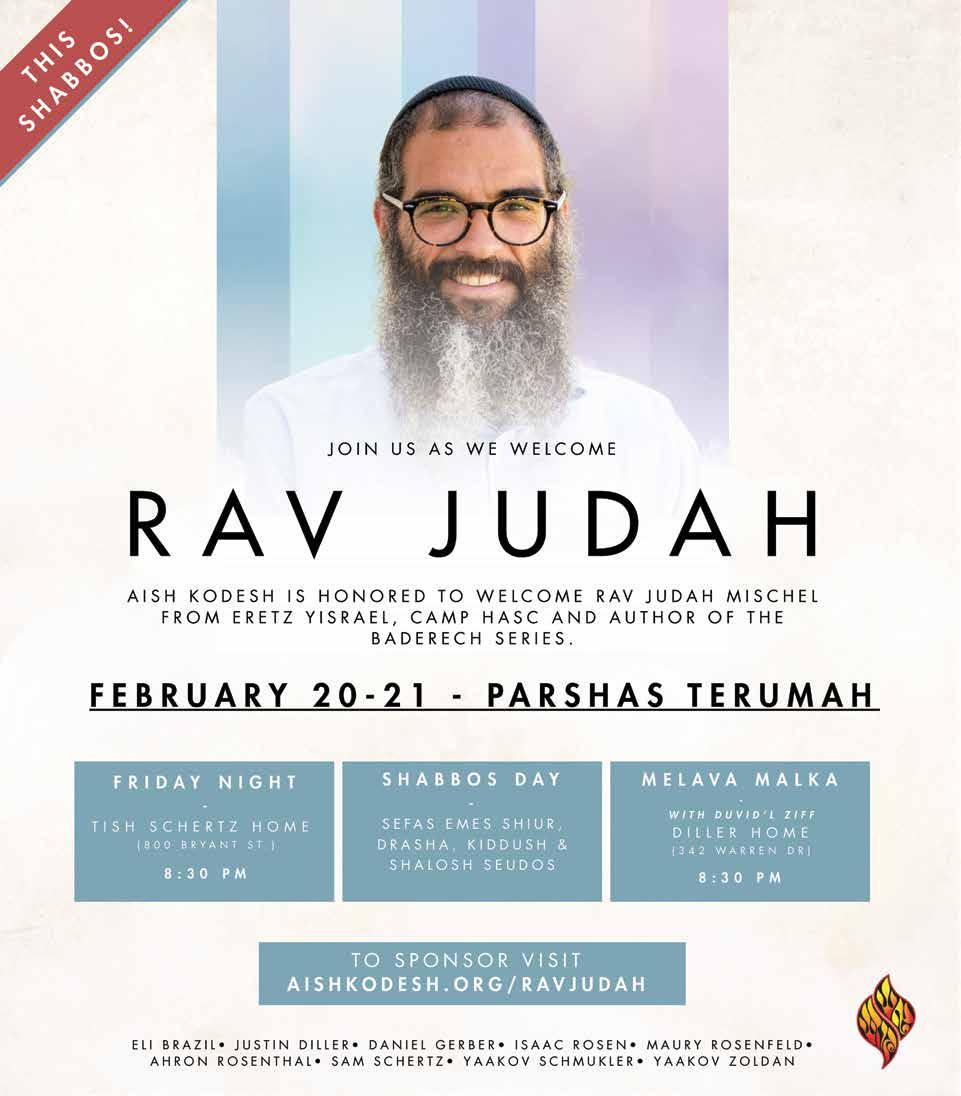

By Rabbi Berel Wein z”l
In an environment of financial crisis and reduced philanthropy, the call for donations issued by Moshe in this week’s parsha is timely if not in essence very challenging.
There are many reasons why people do or don’t contribute to charities and educational and social causes. Moshe
does not offer any convincing reasons for the necessity of his appeal for monetary help. He represents that it is G-d’s wish that the people of Israel become a nation of donors, each person according to the donative instinct that resides within his or her heart.
The L-rd phrases His appeal as being

a donation symbolically to G-d Himself. “Let them take for Me” is the sentence that is used to justify this appeal for donations from the people. Apparently, donations are given because of our relationship to our Creator and not only because of the justice of causes that require our help.
Charity is a commandment of the Torah. It may be a commandment that we can empathize with and claim to understand and appreciate, but at the very root of this commandment is the bald fact that we are bidden to imitate our
and being. It is within the nature of all to be charitable. Since we have freedom of will and choice, we can overcome our inner instincts of goodness and become miserly and even cruel towards others and to ourselves as well. Just as there are very base instincts that lurk within us, and we possess within ourselves the freedom to overcome and deny them, so too does this power of freedom of will and choice allow us to sublimate our good and charitable instincts. There is a well- known statement of the rabbis that many people regret being put
The Torah wishes to encourage our charitable instinct.
Creator, and our definition of G-d is one of goodness and charity.
We are told in the Torah that G-d is with the widow and the orphans even though we are ignorant as to why He made them widows and orphans. But that is our duty to also pursue goodness and charity as the L-rd commands us to do. At the very end of the day, charity is an inexplicable commandment. The reason that there is so much charity in the world is that there is, somewhere deep within our consciences and souls, a streak of human kindness and goodness. We really wish to be charitable people.
That is why the Torah is convinced that everyone will contribute according to the donative intent of one’s own heart
upon for a charitable contribution and yet feel a deep satisfaction within themselves after they have, in fact, made that contribution. It is that deep instinct towards being charitable that engenders satisfaction within a person after having done a charitable deed or having made a charitable contribution.
The Torah wishes to encourage our charitable instinct. It resorts to making what is essentially a voluntary act one that becomes mandatory. It is a mechanism to allow the good within us to burst forth. The holy institutions of Israel can only be constructed with the charitable instincts of the Jewish people.
Shabbat shalom.

By Rav Moshe Weinberger
Adapted for publication by Binyomin
Wolf
One of the great mashpi’im, influential figures, in Chabad was Rav Shlomo Chaim Kesselman, zt”l. He was arrested in Polotzk, under the former Soviet Union, for teaching Torah and spent several years in prison. During this time, he missed the upsherin of his twin sons, Velvel and Berel. Afterward, his wife somehow managed to smuggle an envelope into prison for him, which contained a picture of the two boys from the upsherin and a little bit of hair from the event. After he had was released, he said that while he treasured the picture of his sons, his primary comfort was physically holding his sons’ hair.
How is this story relevant to the parsha? I will explain. With regard to the Jewish people’s mitzvah to build the Mishkan in the desert, how did they obtain the materials necessary for the task? In particular, how did they obtain the trunks of cedar trees which were used to build the beams supporting the outer curtains of the Mishkan (Shemos 26:1529)? Rashi (on ibid. 15), quoting the Midrash Tanchuma, explains that Yaakov Avinu saw through Divine inspiration that the Jewish people would one day be redeemed from Egypt and would need cedar trees to build a Mishkan. He therefore planted them in Egypt and commanded his children to bring them out with them when the redemption arrived.
The Lubavitcher Rebbe, zy”a, asks why Yaakov Avinu had to do this. The Gemara (Yuma 75b) tells us that non-Jewish merchants ascended from Egypt with us and provided the Jewish people with many things that they needed.
They may not have been Amazon.com, but they could have supplied the cedar wood necessary to build the beams of the Mishkan. Why did Yaakov Avinu need to plant cedar trees hundreds of years before the redemption and then trouble his great-grandchildren to lug them into the desert when these merchants could have provided the lumber instead?
The Rebbe answers that even though Yosef HaTzaddik made a promise that Hashem would remember us and redeem us from Egypt (Bereishis 50:24) and the Jewish people transmitted this promise from generation to generation, the comfort provided by these words must have been limited. The suffering, back-breaking labor, degradation, discouragement, and humiliation, which must have felt unbearable and which the Jewish people endured every single day, must have made any comfort or hope difficult. Perhaps husbands and wives, after feeling completely broken at the end of the day, may have reminded each other of their great-grandfather’s promise and felt a little bit of comfort.
But this promise could only go so far because it was just words, in contrast with their suffering, which was real and tangible. Yaakov Avinu therefore wanted to plant a grove of cedar trees in Egypt so that his grandchildren could look out their windows and see the trees. They would pass them every day, touch them, and say to themselves, “These are the actual trees we are going to take out with us when we finally get out of this place.” One cannot compare the comfort provided by mere words to the hope that came with a

physical piece of their ultimate salvation. Perhaps this is why Rashi, when relating how Yaakov planted cedar trees for us, quoted the Tanchuma, as the word “Tanchuma” comes from the same root as the word nechama, comfort. It was only Yaakov Avinu’s physical, tangible cedar trees which could truly comfort us.
That is why Rav Shlomo Chaim was comforted more by his sons’ upsherin hair than by the picture. He could hold the hair in his hands and remember that his children are real. They were out there somewhere, and he could see them again one day.
Rav Levi Yitzchak of Berditchev, zy”a, once prayed to Hashem: “Master of the World, how can You blame the Jewish people for sinning? They see the temptations of the world right in front of them everywhere. Yet Your existence and the promises of the World to Come and Gehenom are just words. They cannot see these things in front of them. So how can You possibly blame them for straying after the things they see before their eyes?!”
One cannot compare the effect something tangible has on us relative to something ephemeral like words and promises. My father kept a pair of tefillin with him throughout his time in Mauthausen. It was a tangible piece of a sane world in the chaos of the Holocaust.
What physical manifestations of Hashem, Torah, and the World to Come do we have before us today? The pasuk
says, “A tzaddik…grows like a cedar in Lebanon” (Tehillim 92:13). The Navi compares tzaddikim to cedar trees. Just like Yaakov Avinu’s cedar trees were a tangible reminder to his grandchildren of their upcoming redemption, so, too, the tzaddikim are a tangible piece of the World to Come right here before our eyes. When we watch the behavior of tzaddikim, when we listen to their words and observe every single facial expression, we realize, “Wow, the Torah isn’t something theoretical. This is real!”
A husband can remember the reality of his relationship with his wife more concretely by keeping tangible reminders of her, their relationship, and their love with him when he is at work or traveling. Parents and children can keep physical representations of one another with them to keep the reality of their gratitude and love for one another in their hearts.
May we all merit to keep tangible manifestations of the Torah and Hashem’s promises to us, like the tzaddikim, before our eyes so that we will retain our hope in and commitment to the future Hashem has in store for all of us with the coming of the complete redemption, may we see it soon in our days.
Rav Moshe Weinberger, shlita, is the founding Morah d’Asrah of Congreagation Aish Kodesh in Woodmere, NY, and serves as leader of the new mechina Emek HaMelech.

By Rabbi Shmuel Reichman

An older couple sat together on the train, quietly chatting as they rode through the countryside. Their peace was suddenly disturbed by a teenage boy sitting across from them.
“Dad, look!” the boy exclaimed to his father. “Giant green trees are going past us!”
The boy must have been almost twenty years old and had a huge smile glued to his face. His father smiled along, seemingly encouraging his outburst. The older couple looked at the boy’s childish behavior with pitiful looks, before going back to their conversation. Suddenly, the boy erupted with excitement again and shouted, “Dad, look at the clouds running along with us in the sky!”
At this point, the couple could not resist, and the wife went quietly over to the boy’s father. “Why don’t you take your son to a good doctor and get him
some help?” she whispered kindly.
The old man smiled and said, “As a matter of fact, I did. We are actually returning from the hospital right now.
My son has been blind since birth, and today is the first time he is experiencing the gift of sight. Wouldn’t you be just as excited?”
As human beings, we have the remarkable ability to jump to conclusions, assuming that we know the truth of a situation when we have actually misjudged it completely. One of the most powerful learning experiences we can have is a paradigm shift — a shift in perspective that allows us to see something in a fundamentally different way.
Avraham’s Tenth Test
Chazal tell us that Avraham faced ten tests along his spiritual journey (Avos 5:3). While it is commonly assumed that Akeidas Yitzchak was Avraham’s tenth test, several commentators
believe that the tenth test was actually after the Akeidah . They suggest that Avraham’s tenth trial was the death of his wife, Sarah, and the subsequent episode of burying her in Me’aras Hamachpeilah (see Rabbeinu Yonah, Avos 5:3). This assertion is mysterious, as it seems that the command to sacrifice one’s own child would be the ultimate test, incomparable to the ordeal that followed. What, then, was the true nature of Avraham’s test of burying Sarah, and why was it so incredibly difficult?
On the most basic level, it appears as though Avraham was challenged with overcoming the grief of losing his wife, as well as dealing with Efron, a conniving, merciless cheat. There is, however, a deeper answer, one related to the power of paradigms. Perhaps Avraham’s test was a question of perception; a challenge to view Sarah’s death as an opportunity to grow rather than a reason to give up; a chance to build rather than
fall apart. In this light, Sarah’s death was not the end but the beginning. Let us explore this idea.
Chazal teach that marriage is eternal. Man and wife are created as one before birth; they are then torn apart and born individually, charged with the mission of connecting and recreating that oneness in this world. Man and wife are thus born into separate families, at different times and locations, and must then embark on the journey to find each other and reconnect as one. After a lifetime of building that oneness, man and wife remain eternally one in Olam Haba (The World to Come), enjoying the bond they created during this lifetime. This explains one of the unique sources for the laws of marriage. Masechta Kiddushin, the tractate of marriage, details the various methods by which a man and woman can get mar -
ried. One of them is through kesef (money), which is derived from the transaction between Avraham and Efron. The Gemara (Kiddushin 2a) draws a parallel between Avraham’s use of money in acquiring Me’aras Hamachpeilah and man’s ability to use money to create a spiritual and halachic connection to his wife, pointing out that both use a word with the root “kichah” (taking). (Marriage is created through a kinyan, loosely translated as “acquisition”. When a man performs a kinyan on his wife, this is not a form of “buying”; a kinyan enables one to create a spiritual and metaphysical connection to someone or something. Kinyan kiddushin is the means through which a man becomes existentially, spiritually, and metaphysically connected to his wife.)
It seems strange, even ironic, to derive a source for marriage from a case in which a man’s wife dies. However, this is not ironic, nor is it a coincidence; it reflects the deep truth that marriage is eternal. Through purchasing this plot of land, Avraham planted the seeds of his eternal marriage with Sarah; they would be buried together and remain bonded as one even after death. This explains another unique feature of Me’aras Hamachpeilah.
Me’aras Hamachpeilah is located in the city of Chevron, a name related to the concept of connection. The root of this word is chaver, the Hebrew word for friend or partner. Chevron is a place of connection, and it is where Avraham and Sarah are buried together, where they solidified their eternal connection.
It is interesting to note that the Torah repeatedly describes how Avraham purchased the plot of land in front of the entire town; this purchase was, in a sense, Avraham building an eternal marriage between himself and Sarah, and a wedding must be performed before a kehillah, a public group of people.
Thus, we can see how Avraham’s tenth test was to perceive this as an opportunity to build, as opposed to an ordeal to pass over. This wasn’t simply Sarah’s death; it was the next stage of their eternal connection. This beautifully explains why the Torah records Avraham’s death specifically at the end of this episode (at the end of Parshas Chayei Sarah). Once he has built the foundation for their eternal connection, Avraham is able to join Sarah in the
next world, bonded and married forever.
Kiddushin and Nisu’in
We can take this idea of eternal marriage further. In Jewish law, there are two stages of the marriage process. The first step is kiddushin , followed by nisu’in . Originally, the custom was to perform kiddushin a year before nisu’in, leaving a full year until the marriage process was completed. Many
The Maharal takes this idea one step further. He explains that all of techiyas ha’meisim will begin from Me’aras Hamachpeilah. Why is this so? What is significant about this specific location?
The Maharal explains that it is because Me’aras Hamachpeilah serves as the root and model for the concept of eternal marriage. Man and wife are created as one before birth, and they
Chevron is a place of connection, and it is where Avraham and Sarah are buried together, where they solidified their eternal connection.
Jewish thinkers ask about the purpose and relationship between kiddushin and nisu’in. Why is there a two-step process of marriage?
While there are various reasons given, the Rambam (Mishneh Torah, Ishus, perek 1) explains that although kiddushin and nisu’in are both fundamental to the process of marriage, they serve completely different functions. Kiddushin, the first step of marriage, is actually a “step back” in the relationship. It creates an issur (prohibition) between a man and his future wife (an issur biyah), while also making them forbidden to anyone else. After this step back, nisu’in is then “two steps forward,” creating a fundamentally stronger and more meaningful connection through marriage, as the couple have just spent an entire year apart, longing for one another. This is a classic example of a “yeridah l’tzorech aliyah ,” a step down that enables a giant leap upwards.
Perhaps this is why we specifically learn the mitzvah of kiddushin , and not nisu’in , from the episode of Avraham burying his wife. In a very deep way, Sarah’s death was the epitome of kiddushin . Her death created a painful, heartbreaking separation between Avraham and Sarah. However, this was only temporary. This “time apart” would soon be followed by nisu’in, when Avraham would join her, completing their eternal marriage. At the end of Parashas Chayei Sarah, Avraham passes away, and is buried next to his wife in Me’aras Hamachpeilah, connected eternally.
was burying his wife, facing the death of his life’s partner, there was a deeper layer here. He was also planting the seeds for their eternal connection.
Truly seeing is not about what we see, it’s about how we see. This is the deep truth of perception; we choose how we see the world, how we experience life. Our paradigms can empower us or cripple us. Our world view can inspire or paralyze. The choice is solely up to us. This is the beauty, and potential tragedy, of perception.
must then recreate that oneness during this lifetime, remaining eternally one in Olam Haba. But there is one more step: they are then reborn into this world “as one” during techiyas ha’meisim. This is why the Hebrew word for grave, kever, is also the Hebrew word for “womb” (as used by Chazal throughout Masechta Niddah). The grave is where we are buried, but it is also the place where we will be reborn at the end of days. In other words, we are like seeds planted in the ground, waiting to sprout. (A cemetery is also called a beis ha’chaim – a house of life.)
Me’aras Hamachpeilah is where Adam and Chavah and all the Avos and Imahos are buried together (except for Rachel, but that is part of a much deeper theme). It is not only holy because the Avos and Imahos are buried there; the Avos and Imahos were buried there because it is holy. “Machpeilah” comes from the word kefel, doubled. It is a doubled cave; it has two levels, representing the connection between the spiritual world and physical world. It is a place where two people become one, where twoness becomes oneness. It is where all of marriage and oneness is planted, destined to ultimately be reborn during techiyas ha’meisim. (This is part of the reason why husband and wife should be buried together.)
This was Avraham’s tenth and final test, a challenge of deepening his perception. While on the surface, Avraham
Avraham teaches us this lesson most powerfully when it comes to marriage. The connections we build in this world are not ephemeral or fleeting but are infinite and eternal. Let us be inspired to walk in the footsteps of Avraham and Sarah and build deeper and more empowering perceptions of life in general and of the eternal nature of marriage. Just like the boy who was suddenly given sight, each day we must choose to see with “new eyes,” recognizing that while yesterday we were blind, today we can finally see.
Rabbi Shmuel Reichman is an international speaker, bestselling author, business coach, the CEO of SMA, and a TED Talk Speaker. His online content reaches millions of people every month, and he lectures internationally on topics of Torah thought, psychology, leadership, and business – uniquely blending many areas of Torah and wisdom together. His bestselling book, The Journey to Your Ultimate Self, serves as an inspiring gateway into deeper Torah thought. After receiving his BA from Yeshiva University and Semicha from Yeshiva University’s RIETS, Rabbi Reichman received a Masters degree in Philosophy and Religion from the University of Chicago. As part of his Masters Degree at the University of Chicago, Rabbi Reichman received an Ivy Plus Scholarship to Harvard where he spent a year studying Religious Philosophy and Literature as an Ivy Scholar. Additionally, he received a Masters degree in Educational Psychology from Azrieli Graduate School and a Masters degree in Jewish Thought from Yeshiva University’s Bernard Revel Graduate School. As a business and leadership coach, Rabbi Reichman provides a unique 1-on-1 coaching program where he helps high-achievers, coaches, and business owners achieve their financial and personal goals. To learn more or to get in contact with Rabbi Reichman, visit his website: ShmuelReichman.com
By Ra BB i Daniel Glatstein
Esther HaMalkah is the central figure of the Purim story. Through her, the Jewish people were rescued from sorrow to joy, from mourning to Yom Tov. “L’Yehudim ha’sah orah v’simcha v’sasson v’kor, the Jews had light and gladness and joy and honor” (Esther 8:16)
Klal Yisrael experienced a remarkable salvation, but as the Jews of Persia emerged victorious, ecstatic that their lives had been spared, there was one individual who was not part of the celebrations. She remained in the palace, married to the monarch who had so willingly been prepared to wipe out her family and her nation. Esther remained with Achashveirosh, alone in the world, bereft of a Jewish community, family, and friends.
The Megillah reveals that even prior to the events of the Purim story, Esther was unique in her loneliness and misfortune. She was isolated and downtrodden, and one would be hard-pressed to find someone in a more lonely situation.
In the second perek of the Megillah, we read about the sad origins of the future Queen Esther.
And he had reared Hadassah, she is Esther, his uncle’s daughter; for she had neither father nor mother.
The maiden was finely featured and beautiful of appearance, and when her father and mother had died, Mordecai adopted her as [his] daughter (Esther 2:7).
Maseches Megillah wonders about the extra phrase, “and when her father and mother had died.” The pasuk has already informed us that her parents were deceased. Why does the Megillah need to specify that Mordechai adopted Esther as his daughter “ when her parents passed away” ?
The Gemara answers that the Megillah is informing us of the tragic manner in which Esther came into this world. Shortly after she was conceived, Esther’s father died. Her mother then passed away during childbirth.
Esther was orphaned of both parents from the time she was born. She never saw either her father or her mother. When Mordechai opened his home to her, it was not merely as a daughter, which the simple reading of the pasuk would have us believe. Instead, he took her as his wife. The Gemara states, “Al tikri l’bas elah l’bayis,” i.e., the word “l’bas,” as [his] daughter, should be read as “l’bayis,” to his home, i.e., for a spouse
However, Esther’s marital life was short-lived. She sacrificed her marriage to Mordechai to save Klal Yisrael. When she consented to go to Achashveirosh to plead on behalf of her people, she stated: “V’ka’asher avaditi avaditi, and if I perish, I perish” (Esther 4:16). Rashi, citing the Gemara, writes that from this point on, she would be lost to Mordechai forever. Just as she was deprived of both her parents, so, too, would she lose Mordechai. Her willing participation in a relationship with Achashveirosh, a non-Jew, would render her prohibited from ever resuming her marriage to Mordechai.
Esther forfeited her marriage so as to save the Jewish People. With no parents and no husband, she lived a lonely existence in the palace. Her marriage to Achashveirosh brought her neither personal satisfaction nor happiness. As Chazal teach us, “Every act that is a benefit for the wicked is a disadvantage for the righteous.” A tzadeikes like Esther would not have appreciated any of the luxuries that life in the palace had to offer.
It is highly unlikely that she was able to derive any satisfaction from her son Daryavesh. After all, he grew up in the palace of Achashveirosh, as Persian royalty. Despite the fact that he ultimately authorized and assisted in the rebuilding of the Beis HaMikdash, his personal conduct was presumably that of a member of Persian gentry, something from which she likely did not reap much nachas.
This is a depressing predicament. The tzadeikes who selflessly sacrificed so that her people could be spared the murderous intentions of the evil Haman was left with a lonely and empty existence. She lived the remainder of her days without her husband Mordechai, separated from the people for whom she had risked her life. We

owe our very existence to her, yet she herself suffered the loneliest of fates.
Understanding that Hashem’s Providence is beyond our human scrutiny and we cannot attempt to comprehend the secrets of the heavens, nevertheless, perhaps as we explore Esther’s situation, we may discover something meaningful we can glean from her predicament.
A heart-wrenching story that transpired during the Spanish Inquisition is related in the sefer Toldos Adam.1
The year was 1492, and there was a woman in Spain who had two sons whom she loved dearly. Tragically, when she refused to allow her children to be baptized, they were brutally murdered right before her eyes by the officers of the Inquisition.
In a display of otherworldly strength, she exclaimed, “Hashem, my G-d, I have always loved You dearly and deeply. However, as long as my two precious sons were alive, perhaps I was incapable of loving You with my whole heart. The love and affection I directed toward my children occupied a special place in my heart, and my heart was not totally devoted to loving You. Now that my children are no longer with me, my entire heart is dedicated as the seat for Your love. At last, I can fulfill the requirement put forth in the Torah of ‘V’ahavta es Hashem Elokecha b’chol levavcha u’vchol nafshecha, you shall love Hashem, your God, with all your heart, with all your soul …’ (Devarim 6:5).”
It is recorded in the biography of the Chofetz Chaim
that when his son Rav Avraham passed away, the Chofetz Chaim didn’t cry. He did not even let out an audible moan. He proclaimed that Klal Yisrael had suffered the loss of a great gaon, and he proceeded to recount the above incident as recorded in the sefer Toldos Adam. He then fervently called out, “Ribbono Shel Olam, the love that, until now, I had directed toward my son, I now transfer to You! ”
Someone who is alone in the world, bereft of family and friends, carries a very heavy burden. Loneliness is one of the most challenging and difficult trials that a person can face. A life bereft of spouse and kin is a sad fate. However, such a situation can afford a person the opportunity to achieve a unique level of ahavas Hashem. Without anyone else to be recipient of one’s love, one can achieve a closeness to Hashem that would otherwise not be attainable. One can achieve the highest level of ahavas Hashem.
The Torah states, “Va’yisyatzvu b’tachtis ha’har, and they stood under the mountain” (Shemos 19:17). At Matan Torah, Klal Yisrael stood at the foot of Har Sinai, ready to accept the Torah. Maseches Shabbos addresses the unusual terminology employed by the pasuk B’tachtis literally means “under.” Why does the Torah utilize this phraseology to describe how Klal Yisrael waited at the foot of the mountain?
The Gemara explains that Hashem literally held the mountain over the Jewish people like a barrel. He warned them that if they accepted the Torah, all would be well, but if they declined, then the mountain would be dropped on them. They would be buried in that very spot.
Rav Acha bar Yaakov is quick to point out that this can indeed serve as a viable excuse if someone were to violate the Torah. Since we were forced as a nation into accepting the Torah, and we never accepted it willingly, Hashem could not punish someone for violating one of the commandments of the Torah.
However, after the events of Purim took place, the situation changed. Klal Yisrael accepted the Torah voluntarily, without any coercion.
This is referred to in the Megillah: “K’imu v’kiblu ha’Yehudim, the Jews confirmed and undertook” (Esther 9:27), to which the Gemara expounds, “K’imu mah she’kiblu k’var, they reaffirmed their previous commitment at Sinai.”
into acceptance of the Torah. In a display of great love for Hashem, Klal Yisrael eagerly proclaimed, “Naaseh v’nishma, we will do and we will hear” (Shemos 24:7). This was an expression of dedication and commitment on the highest level that was offered of their own volition. How, then, can there be a tradition that Hashem held a mountain over their heads to compel them to accept? The Midrash answers that Klal Yisrael willingly accepted the Torah SheBichsav, the Written Law. Torah SheB’al Peh, the Oral Law, on the other hand, required coercion. Hashem had to force Bnei Yisrael to accept Torah SheB’al Peh.
Only one whose affection toward Hashem fills every fiber of his being could willingly accept the Oral Torah.
Torah SheBichsav was accepted willingly at Har Sinai, while the Torah SheB’al Peh, which was forced upon us at Matan Torah, was subsequently willingly accepted at the time of Purim.
Why, wonders the Midrash, was Klal Yisrael initially unwilling to accept the Oral Torah?
Mastering Torah SheB’al Peh Must Be Accepted With Love

The Midrash Tanchuma expresses incredulity at the notion that the Jewish people were forced
The Midrash explains that Torah SheBichsav can be easily understood. One does not require toil or hard work to acquire proficiency in the Written Torah. Furthermore, it is relatively concise. It contains a finite amount of information that can be absorbed with relative ease. The Oral Law, on the other hand, is far more complex and difficult. There are numerous details, leniencies, and stringencies that render it a much more challenging
study. Learning and mastering Torah SheB’al Peh requires considerable toil, exertion, and mental strain. It is labor-intensive and cannot be achieved easily or quickly. The sheer volume of the Torah SheB’al Peh is extremely vast. It is practically infinite.
Only one who truly loves the Ribbono shel Olam with his entire heart and soul, says the Midrash, only one who loves Hashem with every fiber of his being, can learn Torah SheB’al Peh. As the pasuk states: “V’ahavta es Hashem Elokecha b’chol levavcha u’vchol nafshecha.”
The difficulties and challenges that surround the study and mastery of the Oral Torah render it accessible only to those who have a deeply passionate, all-consuming love for Hashem. Only one whose affection toward Hashem fills every fiber of his being could willingly accept the Oral Torah.
Since it was the Oral Torah that had been forced upon Klal Yisrael at Sinai, that was the part of Torah that was reaffirmed during the days of the Purim saga. The Torah SheB’al Peh, with all the accompanying toil and effort, was what the Jewish people now accepted willingly.
For this voluntary acceptance of the Torah SheB’al Peh to have occurred at the time of Purim, Klal Yisrael must have developed a deep-seated, passionate love and affection for Hashem. Without an intense love of the Ribbono Shel Olam, there could be no willing acceptance of the Oral Torah.
Esther’s Love for Hashem Paved the Way
Esther’s sacrifice for her people was the catalyst that brought the Jewish people to the great level of accepting the Oral Law, willingly and with love.
Perhaps this is why Hashem orchestrated her lonely state in life. Losing her parents, her husband, and any possibility of raising Jewish children put her in the unique situation where her heart was completely available to be enveloped in undivided love for Hashem. With no other human relationship to clamor for attention and affection, Esther’s heart brimmed with unbridled love for the Ribbono Shel Olam. Such a lev, such love, was the impetus for the greatest Kabbalas HaTorah in the history of the Jewish people. Only a tzadeikes such as Esther, whose every emotion was dedicated to the love of Hashem, could be the vehicle to bring Klal Yisrael to the point where they were hadar kiblu’ha, to once again accept the Torah willingly, but this time their willing kabbalah included the Oral Torah as well, to which they lovingly clung l’netzach n’tzachim — forever and ever.
1This is a biography of Rav Shlomo Zalman of Volozhin, who was among the great students of the Vilna Gaon, and a brother of Rav Chaim Volozhiner.
By Rabbi Avrohom Sebrow
The initial disorientation was immediate. He had spent his life navigating the familiar geometry of the men’s section, dense clusters of seforim, well-worn shtenders, long tables etched with years of learning. Being ushered behind the mechitza felt like crossing a border into foreign territory. The siddurim were pink. The floor was carpeted. Vases of artificial flowers stood sentry along the walls. There was even a well-stocked reading-glasses gemach.
From here, the shul looked different. The mechitza turned the main sanctuary into a distant, half-seen stage. Through narrow crevices, he could catch only fleeting glimpses of the chazzan. The familiar sounds were there, but the vantage point was altered.
Why today was he relegated to the Ezras Nashim?
Because today was Chol HaMoed, and he belonged to that shrinking cadre of Jews who wear tefillin on Chol HaMoed. Rav Ephraim Friedman, a dayan at the Chicago Rabbinical Council, has lamented that the practice has steadily declined. While it is well known that the Shulchan Aruch rules that we do not don tefillin on Chol HaMoed, the Rema’s gloss is less widely appreciated. He writes that the prevalent Ashkenazic custom is to wear tefillin and even to recite the brachos. The Vilna Gaon, however, was emphatically opposed to wearing them. The Mishna Berura recommends continuing the Ashkenazic minhag but without a bracha.
Interestingly, support for wearing tefillin on Chol HaMoed may be hinted at in the tefillin themselves. The Gemara (Menachos 35) records a Halacha L’Moshe MiSinai that a shin must be embossed on the side of the tefillin shel rosh. According to Rashi, that shin , together with the daled formed by the knot of the shel rosh and the yud formed by the knot of the shel yad, spell out Hashem’s Name. It would follow that, in Rashi’s view, the very formation of those letters is part of the Halacha L’Moshe MiSinai.

Tosafos disagrees: the tradition mandates a knot, not a letter.
The Beis Yosef cites an alternative explanation from the Orchos Chaim. The shin has a gematria of 300. Three hundred approximates the number of days a Jewish male would wear tefillin annually, at least in the era when the Beis HaMikdash stood and only one day of yom tov was observed, even for Rosh Hashana. A lunar year contains roughly 354 days. Subtract about 50 Shabbosos and the yamim tovim, and the number hovers around 300. Some years, it lands precisely there; in others, it shifts slightly, depending on the calendar and how Shabbos overlaps with the chagim.
The Ateres Zekeinim, commenting on the Shulchan Aruch, invokes this gematria as well. Notably, he uses the solar year of 365 days and factors in Yom Tov Sheini to reach the figure of 300. Then he makes a sharp observation: the math works only if one wears tefillin on Chol HaMoed. The shin itself becomes a quiet, daily nudge; don’t forget Chol HaMoed.
Yet the Vilna Gaon was unwavering in his opposition to the practice, and in Eretz Yisrael, his ruling largely prevails.
Those who choose to wear tefillin on Chol HaMoed do so discreetly.
The pasuk in Megillas Esther (8:15) declares: “Mordecai left the king’s presence in royal robes of blue and white, with a magnificent crown of gold and a mantle of fine linen and purple wool. And the city of Shushan rang with joyous cries.”
The Vilna Gaon comments that the “magnificent crown of gold” alludes to tefillin. The Megillah itself does not state the date of this event, but the Chasam Sofer writes explicitly that it occurred on Chol HaMoed Pesach. Haman was hanged on the 16th of Pesach, Chol HaMoed. At least in Shushan, only one day of yom tov was kept. Mordechai then emerged in regal splendor, on Chol HaMoed Pesach.
And here the difficulty sharpens: the Gra maintains that we do not wear tefillin on Chol HaMoed, yet in his own commentary he depicts Mordechai HaTzaddik adorned with tefillin on that very day.
A resolution has circulated under various attributions; some trace it back to the Gra himself. It appears in print in Kusu D’Pilpili (p. 169).
The Gemara explains that tefillin are called an os, a sign, of the special bond
between Hashem and Klal Yisrael. On Shabbos and yom tov, abstaining from melachah serves as that sign; therefore, we do not wear tefillin on those days. Chol HaMoed presents a hybrid. Certain forms of labor are permitted, so perhaps the “sign” is diminished. Yet Chol HaMoed Pesach and Sukkos carry their own positive mitzvos. On Sukkos, we dwell in the sukkah. On Pesach, according to the Vilna Gaon, one can fulfill a positive mitzvah to eat matzah each day. These mitzvos function as the os of the day. Hence, no tefillin.
The Mishna Berura, in Biur Halacha (Siman 344), considers a striking case: a traveler lost in the desert has lost track of the calendar. He must treat every day as potentially Shabbos, performing only the labor necessary to survive. Yet he designates one day for Kiddush and Havdalah. Does he wear tefillin on that “Shabbos”? The Mishna Berura rules that he does. Since he refrains from melachah every day, his designated Shabbos lacks the distinctive quality of an os. Without a unique sign, he still requires tefillin. (The Mishna Berura offers additional considerations as well.)
With that logic in mind, Mordechai’s tefillin come into focus. A three-day fast had been proclaimed. That year, there was no Seder. No matzah was eaten. Yom tov itself remained an os through the cessation of forbidden labor. But Chol HaMoed Pesach depends on the positive mitzvah of eating matzah to serve as its sign. And on a public fast day, there was no matzah.
The os of Chol HaMoed had fallen silent.
And so, Mordechai wore tefillin.
Rabbi Avrohom Sebrow is a rebbe at Yeshiva Ateres Shimon in Far Rockaway. In addition, Rabbi Sebrow leads a daf yomi chaburah at Eitz Chayim of Dogwood Park in West Hempstead, NY. He can be contacted at ASebrow@gmail.com.

By Rabbi Yair Hoffman
Adar is here! And if ever there was a month to grow from a sefer, Adar is it! The Megillah is not just an account of the neis of Purim. It is a blueprint filled with life lessons showing us how to live.
Rav Yerucham Levovitz, zt”l, the legendary Mashgiach of the Mir Yeshiva in Poland, makes a remarkable observation (Daas Chochma uMussar Vol. I, p. 76). Building on the Vilna Gaon’s explanation of the very last pasuk of Megilas Esther, Rav Yerucham teaches that the entire Megillah is really a mussar sefer. Every character, every decision, every twist of what transpires carries a life lesson. Study the terrible choices of Haman and Achashveirosh – and learn what to avoid. Study the righteous conduct of Mordechai and Esther – and learn what to become.
The Poison of Pride
Pride is poison to the soul. The Mesilas Yesharim (Ch. 11) calls it one of the most spiritually destructive traits. Rabbeinu Yonah (Sha’arei Teshuvah 3:34) goes further: the arrogant person effectively denies Hashem’s control over the world. And the Chovos HaLevavos (Sha’ar HaKeni’ah, Ch. 1) warns that pride blinds a person to his own weaknesses and drives a wedge between him and everyone else.
Achashveirosh throws a six-month feast just to show off his wealth and power (1:4). Think about that – half a year of extravagance, all to feed one man’s ego. Real greatness has nothing to do with flashy displays. It comes from humility, from using what we have for meaningful purposes instead of self-glorification.
Haman cannot stand that one person – Mordechai – refuses to bow to him (3:5). One person! Haman has everything: wealth, power, the king’s favor. But a single man’s refusal to grovel eats him alive. When your ego demands

that every single person validate you, you will never have peace. And when Achashveirosh asks, “What should be done for someone the king wants to honor?” Haman immediately assumes it is him (6:6). Baalei gaavah filter everything through their own desires. They can’t imagine the world doesn’t revolve around them – and that blindness sets them up for devastating humiliation.
After being honored, Mordechai quietly returns to his post. Haman, by contrast, falls apart (6:12). This contrast says everything. A true tzaddik stays humble even when honored. An arrogant person is destroyed by any loss of status.
Controlling Anger and Rash Decisions
Anger is one of the worst character
traits a person can have. The Rambam (Hilchos De’os 2:3) says a person should train himself not to get angry even when anger seems justified. The Orchos Tzaddikim (Sha’ar HaKa’as) explains that anger chases away wisdom and leads to terrible decisions.
When Vashti refuses to appear, Achashveirosh explodes with rage (1:12). Still burning with anger, he permanently removes her from her position (1:21). He doesn’t pause, doesn’t reconsider, doesn’t sleep on it. Only after his anger cools does he realize what he’s done (2:1) – but it’s too late. How many times do we act in anger and then wish we could take it back? As Shlomo HaMelech warns: “The plans of the diligent lead surely to abundance, but everyone who is hasty comes only to poverty” (Mishlei 21:5).
Haman swings from ecstasy to fury in a single moment – thrilled by his dinner invitation, then enraged by Mordechai’s refusal to bow (5:9). When your emotional stability depends entirely on how other people treat you, you will always be on a roller coaster. True inner peace comes from values and character, not from other people’s reactions.
Courage and Standing on Principle
Sometimes, doing what’s right means putting yourself on the line. The Mesilas Yesharim (Ch. 19) teaches that true piety sometimes demands risking your comfort, reputation, and even safety. Rabbeinu Yonah (Sha’arei Teshuvah 3:58) counts among the righteous those who sanctify Hashem’s name publicly by refusing to compromise under threat. Mordechai refuses to bow to Haman, no matter what (3:2). Everyone else bows. The pressure is enormous. The consequences could be fatal. But Mordechai stands firm. Day after day, Achashverosh’s servants pressure him to comply (3:3). This is how society works: it pushes you to go along, to stop making waves. Standing for what’s right often means being the only one who says no. “You shall not follow a majority in wrongdoing” (Shemos 23:2). Mordechai demonstrates this and sets an example for Klal Yisroel for all generations. Even Esther – a nevi’ah – hesitates before approaching the king uninvited (4:11). Courage is not the absence of fear. The bravest people feel fear – they just don’t let it stop them. She fasts for three days, preparing herself spiritually before risking her life (4:16). When you face something dangerous but necessary, prepare yourself – spiritually, mentally, practically. Courage combined with preparation is unstoppable.
Our fates are
bound together. The Rambam (Hilchos Teshuvah 2:7) teaches that one who separates from the community during its time of distress will not merit sharing in its comfort. The Mesilas Yesharim (Ch. 19) explains that a true chassid feels the pain of others as if it were his own.
Mordechai tells Esther bluntly: “Don’t think that because you’re in the palace, you’ll escape” (4:13). Silence in the face of injustice is neither safe nor moral. If you have access, privilege, or a platform, you have a responsibility to use it for others. You cannot opt out of your community’s fate.
This is chessed in action. Mordechai takes in his orphaned cousin Esther and raises her as his own daughter (2:7). Caring for those in need – especially family – even when it demands personal sacrifice, is one of the most powerful things a person can do. As we learn from Boaz in Megilas Rus (4:16), stepping up for family is a hallmark of true righteousness.
Hashgachah Pratis and the Power of Hope
Nothing in life is random. Every event, every circumstance, every twist
of fate is guided by Hashem’s hand. The Ramban (Shmos 13:16) teaches that recognizing this is the foundation of the entire Torah. The Chovos HaLevavos (Sha’ar HaBitachon, Ch. 3) teaches that trusting in Hashem’s providence means seeing your circumstances not
has placed you, and ask yourself: what am I here to do?
The Jews experience a complete transformation – from darkness to light, from mourning to joy (8:16). When things look impossible, remember the Purim story. The situation went
Pay attention to where Hashem has placed you, and ask yourself: What am I here to do?
as random but as purposeful – designed to help you fulfill your unique mission.
Mordechai helps Esther see that her position in the palace is not a coincidence; it’s from Shamayim (4:14). Your circumstances, your abilities, your opportunities … they may have been given to you not just for your own benefit, but so that you can help others in a moment of crisis. Pay attention to where Hashem
from a death sentence to celebration in a matter of days. Rav Yisrael Salanter famously taught: as long as the candle is still burning, there is still time to repair. Never give up hope. Salvation can come when you least expect it.
The Enduring Legacy
Haman is hanged on the very gallows he built for Mordechai (7:10). The
trap he set for someone else became his own death. Justice may be delayed, but it comes. After rising to power, Mordechai remains beloved by his people because he uses his position to help them, not himself (10:3). His deeds are recorded in the royal chronicles. Evil may seem to win for a while, but it is ultimately tzidkus that endures and is honored through the generations. “The memory of the righteous is a blessing, but the name of the wicked will rot” (Mishlei 10:7).
The Megillah is a living mussar sefer, a guidebook for building character in every generation. This Purim, as we hear the Megillah read aloud, let us listen not just to the story but also to its timeless call to become better, braver, more humble, and more deeply connected to Hashem and to each other.
This article should be viewed as a halachic discussion and not practical advice. The author can be reached at yairhoffman2@gmail.com.


By Barbara Deutsch
I’m home.
Picture two women, me and Tamar, in a frozen parking garage looking for an available open spot to park at Kennedy Airport. I had packed 5 (up from 4) duffel bags, each one weighing 50 lbs. I brought two very large and three larger duffel bags.
For the plane, I brought along a heavy snack- and book-loaded carry-on bag and wheelie.
Our family has always been grateful to be on the receiving end of generous friends and family who were willing to shlep care packages for our Israeli family. Because I “get it,” I feel that I cannot do any less for those who request the same – especially if it’s something important or small.
Not everyone defines small in the same way.
On this trip, for reasons unknown, multiple friends and family brought or had mailed directly to me “small” packages from Amazon. Makeup and athletic wear were especially popular items. Daily, at all times of the day, packages arrived at our doorstep. Some continued to come even after I left for home.
Tamar is super organized and industrious. Me? Not so much. As packages arrived, Tamar would slit open the container, put the contents into a quart size Ziplock bag, and label it. She then broke down the box/es for recycling garbage.
My job was to find space for it in the duffel. This all should/could be a sim -


ple task, except that it was not. Even though everything was neatly packed and labeled, during my usual last-minute rush to ensure that no bag would be overweight (having extra bags is expensive enough), the haphazard process of moving things from one bag to another so that the load would be even resulted in everyone’s precious items getting tossed around, a scenario that begs for trouble.
That is probably how I lost and later found one of my favorite sneakers (leopard and comfortable) and misplaced, but located, the three blushes sent by a family friend even though it had been bagged and labeled.
After driving around for what seemed like a long time but wasn’t, we scored a parking spot. Walking and sliding in the teeth-chattering, icy cold and crunchy, dirty snow was a challenge. Tamar insisted that I remain warm(ish) in the car as she scrambled to find two carts. She was on a search for stray ones that had been randomly left behind; there did not seem to be one to be had. The locked “central cart holder” (that’s what it’s called) was either frozen or broken, and she could not access a cart from it.
Finally, Tamar returned with a lone cart; a kind tourist had relinquished his to her after he loaded his car. Undaunted, Tamar loaded three of the duffels and the wheelie onto the single cart. I was tasked with pushing this heavy, cumbersome cart as she dragged the two duffels, one in each of her freezing cold hands.
From my 24 years of looking for parking in Brooklyn experience, I was able to glom onto a lone cart parked
sideways near the garage steps. Eureka! Success. Tamar loaded her two duffels onto it and off we went in search of the indoor elevators.
No matter the time of year or day, JFK is a busy, bustling terminal. We patiently waited for it to be our turn to embark onto the elevator. The tourists who were already on it were helpful and friendly. When the crowded elevator doors opened, everyone inside moved to allow for an easy exit.
Ironically, one of the riders on the elevator was dressed in a short-sleeved polo shirt and shorts. He explained that he had spent his waiting time for his warm climate destination flight in the American Express lounge working out and showering.
He insisted that he was not cold; Tamar and I were cold in our multiple layers.
We emerged onto the departure floor for screening. I travel with two passports, American and Israeli. Tamar remembered one of the El Al agents from a previous flight, so we approached her. I have silver white hair and Tamar’s is fiery red so we usually can be easily picked out in a crowd; it’s a fair assumption that the agent would recognize us.
She kindly and quickly processed my luggage and chatted with us as she completed the paperwork. Why is it still called “paperwork” when it’s all computerized? By the time this nice agent checked me in, I had priority luggage, a wheelchair in Ben Gurion (I turned it down. After a 10-hour flight, my arthritic knees needed to move), and an admit card to the new Century lounge (which
took a half hour to find). We left the counter with big hugs for everyone.
I try to fly Premium Plus – more legroom and less people. Until recently, Bob and I flew “Poor Man’s Business,” the last two seats at the back of the plane which has since been eliminated, Economy; who cares? You are going to Israel. As we got older and booked early enough, we flew Premium.
I have flown Business Class a few times. Once when I accompanied a group of Kushner kids to Israel, they gave me an upgrade at the gate because they felt sorry for me, and another time when I came to hear Elly daven in October when I felt sorry for myself. It is not overrated.
No matter the “class,” it is not as much fun to travel solo when you have always traveled with a partner.
The flight was a good one with loads of helpful attendants catering to my every need. The food and choice of movies were awful. I always order vegetarian meals in the hope that they will be fresh and tasty. Wrong! Also, during a 5:00 pm departure twilight flight, who can eat a breakfast served in the middle of the night?
A kind flight attendant who took an interest in me and insisted that “old ladies have to eat something” borrowed one from Business Class that I also did not eat.
I rarely sleep on planes, so I now purchase internet access. I was recommended to watch Season 1 of the HBO Max hit “The Pitt.” While the show is
offered me anything I wanted from the Business Class menu, apologized for the bad food, and told me he would be reporting back to management.
Yes, I flew El Al.
We landed in the warm sunshine; waiting for me with a big sign “Barbara” was an employee who whisked me through passport control (Israeli Pass -
I’m still unpacking –luggage of different kinds.
indeed great, the inherent triggers were too many for me to continue watching so I stopped after the cliffhanger.
As we were landing, the flight manager – yes, there is such a thing – came to inquire about my food intake on the flight. He did not ask about the movie options. At the start, he had walked through the aisles introducing himself; he had a big smile and spoke kind words. Even though we were about to land, he

port) and onto the luggage conveyor. He shlepped all of my and some of my friend Malkie’s bags off the belt and then escorted me and all of my stuffed, heavy bags to the waiting van.
During the ride from Tel Aviv to Jerusalem, I had a realization that instead of excitement and happiness, I was experiencing anxiety. Bob is in Israel; apart from Avi’s brit milah, I was not able to find him in America. Lost, like
the items in my luggage, was my comfortable feeling of serenity and calm when I came home to Jerusalem.
I was able to find my sneaker and the random packages. I am hopeful that I will find peace; I am trying to give myself some grace. I’m still unpacking –luggage of different kinds. Physical luggage will be put away by Shabbos; the other stuff, hopefully with time.
Just as we pulled up to my apartment, my beautiful granddaughter Elisheva came walking by. She had just gotten home after finishing a final exam. Elisheva dragged the heavy bags into the house. Rachel, Tova and Ariela, her mother and sisters, stopped by to see if I needed any help. Dad Josh called to check if I was OK.
Thankfully, I have amazing support in my family and friends.
Barbara Deutsch is the former associate principal at HANC, middle school principal at Kushner, and Dean of Students at Yeshiva of Flatbush. A not-retired educator, she is still trying to figure out life in Israel.

By Malkie SchulMan
RabbiYisroel Greenwald, writer, dayan, special projects manager of kollel Beis Hatalmud (Melbourne, Australia) and kollel avrech, is probably best known for his original cassette, later released on CD and now found online: The Purim Story.
The cassette was recorded with his friend and partner R’ Yossi Kirsch and was first put out in 1988. It has since found new life on YouTube, where it has drawn over 263,000 views.
When speaking about his first public foray into storytelling, Rabbi Greenwald reflects with humility, saying he feels grateful to have had the merit to share the story of Purim with so many Yidden.
Many adults have told Rabbi Greenwald how much of the Purim Story tape they can recite by heart. Rebbetzin Faigy Twerski from Milwaukee once remarked to him that mentioning just one line from the tape will instantly trigger the corresponding line from family members. One listener wrote that he grew up in a very strict home, and one of the few things that gave him true joy was The Purim Story. To Rabbi Greenwald, bringing joy in this way has always been deeply meaningful.
“I was always a big camp person,” Rabbi Greenwald shares. “In camp, I was introduced to plays, both acting in them and writing them.”
His creative spark stayed with him, enabling him
to not only write and perform in the Purim Story but also to write the well-known and beloved book called We Want Life, a pictorial guide to the laws of lashon hora, a staple in Jewish homes since 1996, and to write What Are We Waiting For? as well as his latest book, What Happens After Your Bar Mitzvah.
Until recently, he still performed in the Melbourne Kollel’s Purim shpiels, to the community’s great enjoyment. One poignant memory is especially close to his heart. A struggling boy he learned with at one time, confided to him, “Watching your Purim shpiel was the happiest moment of my whole year.” Rabbi Greenwald was happy to have given a child that joy, even though he was saddened by how deeply the boy needed it.
He shares the humorous, rare instance when a parent was not excited about the ability of their child to repeat the tape’s contents verbatim. At one point in the recording, Haman returns home and says, “I’m home,” to which his wife answers, “Big deal.”
“A mother told me she came home once and said, ‘I’m home.’ One of her kids answered, ‘Big deal.’ She was not happy about that,” says Rabbi Greenwald with a laugh. “Actually, she was ready to throw out the tape.
“In a similar instance, there’s a part of the cassette where Haman says, ‘I will annihilate all the Jews from the face of the earth’ and a kid kept repeating that line. But it’s all part of the fun.”
From his roots in Boro Park to his current residence in Melbourne, Australia, Rabbi Yisroel Greenwald has circumnavigated the globe not only through his books and media but literally. Growing up in pre-Chassidic Boro Park and attending Torah V’das, Kaminetz, later Philly, Mir, and BMG, Rabbi Greenwald was inspired by Torah giants such as Rabbi Avigdor Miller, Rav Mendel Kaplan, Rav Shmuel Brudny, Rav Elya Brudny, Rav Nosson Wachtfogel, and Rav Don Segal, with whom he is still close today.
Rabbi Greenwald shares stories of the love and caring his rebbes showed to everyone, which inspired him to, in his own way, give to the klal.
“I worked as night activity director in a kiruv camp. My rebbe from Philly, R’ Mendel Kaplan, was also involved with the camp. One night, in the middle of the night activity, the power went out. Rav Kaplan drove his car to the rec room, put on his brights, and sat in the car with the lights shining so the kids could continue enjoying their night activity.
“Another time,” Rabbi Greenwald continues, “Rav Kaplan was driving up to camp when he saw a Russian Jew on the side of the road in one of the towns he passed through selling fruit. He stopped to buy some when he saw the fellow looking down. ‘What’s the matter?’ he asked. The man said, ‘I have a whole case of
bananas to sell but nobody is buying them. They’re going to spoil.’ Rav Kaplan bought the case and gave them out to all the boys in camp. He called them his ‘mitzvah bananas’ because he not only helped this poor Yid by buying them but also gave the campers healthy nutrition by sharing them.”
At a certain point, as an older bochur, Reb Yisroel felt it would be more productive to learn in a kiruv environment, so he went to Ohr Somayach in Monsey and became a tutor and maggid shiur for a few years.
His path to Melbourne came about through his mashgiach in Beth Midrash Govoha, Rav Nosson Wachtfogel. Rabbi Greenwald explains that Rav Nosson was involved in establishing kollelim around the world. “In fact, Melbourne was the first overseas Lakewood kollel, beginning in 1981.”
Rav Nosson was looking to import a few Lakewood boys, and he asked Rabbi Greenwald if he wanted to go.
“I went for half a year. I learned with the rosh kollel then, Rabbi Najowitz, and we established a good connection. He told me that if I was ever looking for a position, I was welcome to come back.”
A few years later, married and looking for a job, Rabbi Greenwald recalled Rabbi Najowitz’s invitation.
“We initially signed a three-year contract, and we have been here now for 26 years.”
Compared to major Jewish centers in the United States, Melbourne is a small Jewish community, which has its advantages, shares Rabbi Greenwald. Since it’s a small community, people can’t afford not to get along. There are two Chabad dayanim and two Litvish dayanim. The Belzer Rav is involved in the eiruv. Mizrachi mashgichim and charedi mashgichim all work together. Rabbi Greenwald describes it as beautiful.
Another plus to living on the other side of the world, he notes, is that they live in a time warp, similar to the way the United States was forty years ago. It has all the old-world charm and a much simpler and easier lifestyle.
“Our kiddushim do not include meat boards and cured tuna,” he shares. “Our weddings are simple, without lavish smorgasbords, chocolate fountains, or Viennese tables. There is no pressure from others who can afford more to make high-end affairs. Even our supermarkets don’t have so many different brands.”
Australia is more family-oriented, claims Rabbi Greenwald. The work ethic is different from that of the States. Life is not all about living just to make money. During school holidays, many businesses close, and families go on trips together. (Australian summer is winter in the United States, lasting from December through February, and their winter months are the American summer months.) Even non-Jewish families vacation together.
“When our children were young, we’d often take them to Adelaide, a well-known Australian vacation spot or the mountains,” Rabbi Greenwald recalls. “Sometimes, we’d go camping. It was a great bonding time.”
As a dayan on the Melbourne beis din, Rabbi Greenwald’s duties often include assisting Jewish couples who need a get and helping individuals wishing to convert. Occasionally, it’s challenging, because a husband or a wife doesn’t want to give or receive the get. Sometimes, they’re not religious and don’t see the point, and sometimes, there are more sinister reasons, says Rabbi Greenwald.
“We had a husband who initially agreed to the get, but right before it was to be delivered to his wife, he revoked it.” This created a crisis for the beis din. The question was whether his revocation was halachically valid and if so, what the next step should be.
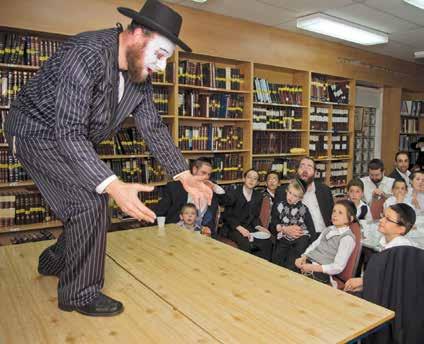
“I once spoke at a rabbi training course in Melbourne,” shares Rabbi Greenwald. “I explained that learning how to deal with a recalcitrant husband is like learning how to be a hostage negotiator. Sometimes, you have to be heavy-handed, and sometimes,
“If Torah feels alive and enjoyable, it becomes part of who we are.”
the lighter approach yields results.”
The non-observant Jews in Australia are generally more traditional, so even if they’re not frum , they often want – unlike Reform Jews in America – a kosher marriage and a kosher divorce.
“I try to encourage Reform rabbis to convince their constituents to give a get. I once thought of buying a Reform rabbi a fountain pen or a bottle of scotch to develop a relationship with him.”
Communal pressure is sometimes helpful in obtaining a get, but if the husband doesn’t belong to a shul, then it’s difficult.
Another case involved a woman who froze her husband’s assets as was her legal right. When her husband refused to give her a get, she used it as a bargaining tool. She promised she’d release the assets if he gave her the get. Baruch Hashem, that worked.
Rabbi Greenwald points out that sometimes it’s the woman who refuses to accept a get. Although this is
a little easier because of the heter Meah Rabbonim, it can still be time consuming and costly.
There was also an unpleasant case when an agitator in the larger Jewish community used social media to claim there was an agunah in the religious community. This was false, as the woman had only submitted the application for the get the day before. In divorce and get cases, the couple must be living separately for a while, and all the monetary matters have to be settled first. The agitator stirred up animosity before the financial affairs were resolved. Besides being a tremendous chillul Hashem, this created more ill will between the parties and made it harder for the rabbanim to see if there was any hope of reconciling the couple.
On a happier note, the beis din is also involved in conversions.
“We do over ten conversions a year,” says Rabbi Greenwald. “Some individuals come by themselves –which is the easiest in the sense that you can see there are no ulterior motives. Others come because they’re married to a Jewish partner. We have a two-year conversion program with Jewish study modules that both the individuals and their partners have to participate in to make sure they’re sincere. It’s a joint journey.”
He adds that a prerequisite to conversion is that they live in a frum community, within walking distance of an Orthodox synagogue.
Rabbi Greenwald admits that he often gets inspired by the converts.
“There were two geirim I learned Gemara with in preparation for them to go to yeshiva. Converts like them are inspiring to FFBs (frum from birth). They help us realize how precious our religion is. We even had a Black family from Sudan that converted. Their children are in yeshiva. They’re very sincere.”
After the Bar Mitzvah Years
Rabbi Greenwald shares that his new book, What
Happens After Your Bar Mitzvah?, focuses on the years after bar mitzvah, a stage that’s delicate and often confusing. He observes that parents and rabbeim are meant to guide their teenagers into adulthood. However, parents often find it uncomfortable to talk about certain topics with their teenage sons. Rabbi Greenwald wanted his book to be a springboard to help them. He includes the biological aspect as part of the discussion.
He stresses that every boy needs to understand we’re all human. A tzaddik falls seven times and gets up again. Rabbi Greenwald says it’s normal to fall, although the yetzer hara may try to trick the boy into thinking that becoming bar mitzvah means never sinning again. When he does stumble, the teen may feel he’s a failure and that Hashem hates him. Rabbi Greenwald teaches the opposite. The truth is to get back into the game, because Hashem loves you. That’s the message Rabbi Greenwald repeats throughout.
In the book, Rabbi Greenwald sets the stage by showing just how upside down the world today has become. He gives the example of visiting someone’s house and finding all the furniture turned upside down. The host insists it’s the latest style and invites you to sit on the upside-down couch and overturned chair. When you want to eat something, you’re offered “garbahj,” rat stew and sewage fare, praised as delicious and refined, when in truth it’s disgusting garbage. Rabbi Greenwald points out that behaviors and activities that were once considered clearly immoral by every segment of society are now hailed as good and upstanding. For children growing up in such a world, it’s vital to have a strong anchor, a strong sense of self, and strong support. His point is to let the young teen know clearly and unequivocally the Torah’s stand on kedusha. Rabbi Greenwald endearingly and beautifully speaks about our holy and pure neshama, a gift from Hashem, a spark of Hashem, and the privilege of every Jew to safeguard.
He shares the following true story as a mashal about a friend of his. Years ago, when his friend was a bochur, he received a free overseas ticket in exchange for carrying a small package. (It was all legitimate, with proper papers.) But he wasn’t told what was contained. On the flight, he checked the package a few times but didn’t think much more about it. At the airport, he was suddenly escorted by armed policemen into a private room, where an elderly Jew with a bodyguard asked him to hand it over. When he did, the man asked if he knew what it was. He said no. “It was twenty million dollars’ worth of diamonds,” he was told. The bochur later said that if he had known the value of what he was carrying, he would have guarded it with his life.
Rabbi Greenwald explains that the nimshal for the diamonds is our neshama, our true essence, eternal and priceless. However, since it’s invisible, people often don’t give it much thought. His goal in writing the book was to help boys see the neshama in a tangible way, as a character they can relate to, so they can feel how precious it is.
The book also includes pages on preventing abuse.
Rabbi Greenwald points out that tragically, abuse of teens does sometimes take place. It’s imperative to learn appropriate boundaries. Although it’s the job of parents to teach their young children the concept of physical and emotional boundaries, sometimes, parents find it hard to talk about. Unfortunately, when they don’t, the job can be left to others, and those others may sometimes be the very ones abusing boundaries, which makes it even more complicated.
Rabbi Greenwald shares, “I gave this book to two acquaintances who were abused as children. They both told me that if they’d had such a book when they were younger, it’s likely the abuse would have been prevented.”
He stresses that in our world today, these are essential conversations to have with our youngsters, whether parents feel comfortable discussing it or not.
He notes that, years ago, Disney movies were considered harmless, but today, Disney promotes values that oppose Torah. It’s everywhere and must be addressed with Torah hashkafa, the way Rav Miller used to speak. Rabbi Greenwald feels that if children are given clarity, they’ll know how to face the world without confusion.
His children’s book on waiting for Moshiach takes on a different theme. He explains that while it’s beyond his pay grade to offer reasons why Moshiach hasn’t yet arrived, he can at least offer a glimpse into the behavior of his revered mashgiach of BMG, Rav Wachtfogel, to get an idea of the ideal way to live with Moshiach.
“An Australian acquaintance of mine was planning a visit to America and reached out to the mashgiach to let him know so they could meet in Lakewood. Rav Wachtfogel told him it wasn’t going to work out because he would be in Eretz Yisroel then. When this fellow arrived in Lakewood, he didn’t bother going to see the Mashgiach. Nevertheless, he did mention his disappointment to some people in the BMG office, at which point,” says Rabbi Greenwald, “they all started laughing. ‘He always tells people that,’ they told him, ‘because he expects Moshiach to be here by then.’ In fact, the Mashgiach was in Lakewood, and he did get to meet with him.”
Everything that occurred was a sign to Rabbi Wachtfogel that Moshiach was coming.
“I would say to him,” shares Rabbi Greenwald, “‘You told me that last time.’ He would respond, ‘Yes, but this time he’s really coming.’
“There was a time when the administration found the Mashgiach a place to live on the block of the yeshiva so it would be easier for him to walk there. As he was getting older, this was considerably helpful. He told me he felt guilty because why was he bothering
to move, when any minute Moshiach would be here? He felt it was a lack of belief in the imminence of the coming of Moshiach.”
Something else Rabbi Greenwald learned from the Mashgiach was that we don’t need to be on a certain madreiga (high level) to merit Moshiach’s arrival. All we need to do is wait for him.
“That’s what I want to show children,” stresses Rabbi Greenwald.
Rabbi Greenwald explains that his mission in all his work is to make Torah enjoyable, using the gifts Hashem has given him. Rav Elyashiv, zt”l, he comments, would deliver shiurim with depth and clarity. Rabbi Greenwald’s way to teach is to use humor, visuals, and creative writing so that even those who don’t naturally enjoy learning can connect.
“If Torah feels alive and enjoyable,” he asserts, “it becomes part of who we are.”
Steven Hill, a TV and movie star who became a ba’al teshuva, once related in a speech that the same talents found in Hollywood can also be found in the frum community and can be used for its benefit. Rabbi Greenwald tells the story of the Chofetz Chaim, who once jumped off a moving wagon to show people that you can keep Torah and also be fit. In the same spirit, Rav Mendel Kaplan once jumped over a fence and climbed through a window. Both of them were showing that you don’t have to leave Yiddishkeit to be with it.
For Rabbi Greenwald, those images capture his mission. Torah is alive, joyful, and something every Jew can feel connected to. We don’t have to go to the outer world to find it. We can keep our talents in the frum world and make a true kiddush Hashem. His hope is that every story and every book plants joy in Torah and strengthens the bond between children, parents, and Hashem.

By Eliyahu RosEnBERg
When Mendy Reiner first met Molly Pomp — a 27-yearold Israeli mother of one in desperate need of a kidney — his heart broke.
“She was this young woman on dialysis. She had a seven-year-old daughter. And her husband, Aaron, was looking to donate his kidney to her, but he wasn’t a match,” Mendy recounts. “This was
around 10 years ago.”
Molly had been a shadow of her once-energetic self since kidney failure turned her life upside down. Robbed of all energy, she could barely see the world around her. Her life depended on a dialysis machine. She was barely alive.
So, after hearing about Renewal — a nonprofit that facilitates kidney transplants — Molly reached out to the orga-
i don’t think there’s a more rewarding job than knowing that you were involved in giving a young mother, a grandfather — or anyone — life.
We put up a lot of barriers between different communities. unfortunately, there’s politics between communities. But suddenly, when you have a need for a kidney, when you need to save a life, those barriers disappear.
i [believed that] if we do one transplant, the investment is worth it. if we do two transplants, it’s a homerun out of the park… Right before CoV iD, we were doing 125 transplants a year.
nization’s founder, Mendy Reiner. A few weeks later, she arrived in New York and was cleared for the procedure at Columbia Presbyterian. Eight weeks after that, thanks to a donor-recipient match made by Renewal, the young mother had herself a new kidney and, with it, a new life.
Mendy recalls visiting Molly on her final day of dialysis. There she was, sitting by the machine, penning a heartfelt letter to her anonymous kidney donor. She then sealed the letter and handed it to Mendy.
“Please give this to my donor,” she requested.
The next day, Mendy visited the man who gave up a kidney to save Molly’s life — a donor who chose anonymity because he didn’t want recognition for his unfathomable act of chessed. Nevertheless, Mendy handed Molly’s letter to him. The man unsealed the envelope. And as he read the note, tears started streaming down his face. Molly had addressed the letter to “Ha’malach sheli — my angel.”
“The letter starts with, ‘I have no idea who you are. I have no way of thanking you.’ And she finishes off the letter in a way that touched me very much. She wrote, ‘And hopefully, with your gift, I’ll be able to give my daughter the gift that she keeps asking for every time we light Shabbos candles: she wants a sibling.’ And that’s how she finished off her letter,” Mendy shares. “Fast
forward a couple of years, she not only gave her daughter a sister; she also gave her a brother.”
A few mornings after Molly’s transplant, the young mother — filled with life — rushed her daughter out the door just as the school bus arrived to pick her up. The seven-year-old ran out, dragging her coat over her shoulders.
“Why don’t you put your coat on? Aren’t you cold?” Molly called out to her daughter.
The young girl turned to her mother and smiled.
“Mommy, as long as you’re healthy, I’m warm.”
And with that, the young girl hopped on the bus and off she went to school
* * *
Renewal didn’t start with an ambitious dream or a grand vision. It began with a simple realization: many people need kidneys, but they have no way of getting them.
Mendy Reiner recalls the day he realized that.
It was around 20 years ago. Whenever his rav, the Erlauer Rav, zt”l, would visit the United States from Eretz Yisrael, Mendy would act as the tzaddik’s assistant, tending to the rebbe’s needs 24/7. One day, during that time, a man walked in, hoping to see the rebbe.
“He looked to be in his mid-40s. And he looked, he looked drunk. His eyes
were swollen. His face was full. And he wasn’t walking straight,” Mendy recalls. “And he sits down opposite me, and he tells me, ‘I used to have a grocery store, but I had to give up my job.’ I thought he came for a handout. I took out $40, thinking I’d send him on his way. And he said in Yiddish, ‘Young man, I don’t need your money. Just listen to my story.’”
The man, a father of five named Eli Cohen, explained that his kidneys were failing. He was on a dialysis machine, a machine that somewhat acts in the capacity of the kidneys, three times a week. His health was suffering. He couldn’t work. He couldn’t function.
“So, what do you need to get better?” Mendy asked.
“I need a new kidney,” Eli replied.
“Well, how do you get that?”
Eli explained the difficulty of finding a donor; how his only real option was to raise $250,000 to get a kidney — a potentially faulty kidney, mind you — off the black market.
“At the time, I was in real estate development, and I was a member of Hatzalah. I had absolutely nothing to do with kidneys,” Mendy explains. “And I told him, ‘Look, I’ll go home. I’ll discuss it with my wife, and we’ll take it from there.’ So, I came home, and I told my wife that I bumped into this father of five who needs a kidney — how can we help him? And she suggested I place an ad in the paper.
“That week, I placed a small 5x5 ad in the Jewish Press , the Hamodia, and some Yiddish papers: ‘Father of five, blood type O, in desperate need of a kidney.’ I put my phone number on the ad. Lo and behold, 20 to 30 people called me from these ads saying, ‘I’m willing to donate,’ ‘What does it take to donate?’ ‘Can you also help my family member who also needs a kidney?’ And I realized that there are people out there who are

willing to do this crazy act of chessed — to donate a kidney to a fellow Jew.”
Previously, Mendy barely knew what kidneys do (they remove waste from the body). But after his encounter with Eli Cohen and his subsequent realization that there are people who would donate a kidney to save a life, Mendy was inspired to start Renewal, an organization that facilitates kidney transplants, pairs recipients with donors, and supports everyone through the process. In December 2006, Renewal oversaw its first transplant. Backed by gedolim and top doctors, Renewal has, over the past 20 years, facilitated more than 1,200 successful kidney transplants, including 158 in 2024 alone.
“We don’t get involved in making decisions in terms of who is entitled to get a kidney. If you’re healthy enough to get a kidney and you’re healthy enough to get through the transplant process, we’re here to help you,” Mendy shares.
Before donating, potential donors undergo extensive screening. Donating is safe, the recovery time is fast, and life is virtually no different with one kidney instead of two.
Renewal’s oldest recipient was 86 years old.
“In the big world, they don’t find it important to give someone older than 70 a kidney. So, there is that benefit of Renewal. Even though he was 86, he was a very active person; he went to work every day, and he was healthy otherwise. Five years later, he came in from Eretz Yisrael for his great-grandchild’s wedding,” Mendy adds.
“We’ll help anyone in need of a kidney,” he declares. “We don’t turn anyone away from Renewal.”
27-year-old mother who received a kidney through Renewal — doesn’t end there.
That Pesach, Mendy hosted Molly and her husband, Aaron, as guests at his Seder. “Suddenly, during the Seder, Aaron says to me, ‘I’m not going back to Israel until I donate my kidney to someone else. Find me someone.’ He was so floored that someone gave a kidney to his wife that he decided to do it, too,” Mendy recalls.
So, Renewal connected Aaron to someone in need of a kidney. But then, a day before the transplant, Aaron told Mendy: “I’m not going to go through with it. I’m not donating my kidney.”
“OK, I understand. What happened?” Mendy replied.
“I’m not going to donate unless I can first say thank you to the man who gave my wife his kidney.”
Mendy called up Molly’s donor — a roofer named Fishy Karmel — and explained the problem.
“Well, if it’s that important to them, I’ll meet them,” Fishy replied.
As Mendy explains, the meeting was extraordinarily touching. Today, Fishy and the Pomp family are close friends. And, in the end, Aaron wound up donating his kidney to a Boro Park resident.
As for Molly’s daughter, she graduated a few years ago and is now thriving. According to Mendy, the girl dreams of becoming an English teacher.
Mendy has witnessed hundreds of donor-recipient meetings. But no matter how many meetings he experiences, they never cease to inspire him. They never get old.
“I’m glad to be part of this,” he enthuses. “Meeting people involved in saving lives, every single day, is something that no money in the world can buy. I don’t think there’s a more rewarding job than knowing that you were involved in giving a young mother, a grandfather — or anyone — life.”
The story of Molly Pomp — the

Moderated by Jennifer Mann, LCSW of The Navidaters

I appreciate your column. My family reads it every week. I didn’t think I would ever be the one to write in but here we are…
One of my first cousins was recently interviewed in a podcast. She opened up about severe mental health challenges. Ever since the podcast came out, my own shidduch suggestions have gone in the garbage. People don’t want to go out with me, and I have no idea why. Nobody was asked, before she went public with her story, whether it would be okay with the family if she shared it. Now I’m seeing the effects of what I think is from her sharing it, and I’m really upset.
I realize that what’s done is done, but I wanted to know if there’s anything I can do in this situation. People are so judgmental as it is with shidduchim, and to have this on top of everything makes it so much worse. What can I do now? Devora*

Dear Readers,
We want to offer YOU an opportunity to be part of the discussion! Please email us at MichelleMondShadchan@gmail.com, subject line “reader’s response,” if you would like to participate in the new “A Reader’s Response” columnist spot. We will send you a question and publish your answer in an upcoming Navidaters edition.
If you have a question you would like the Navidaters to answer, please reach out to this email as well.
Looking forward!
Michelle, the “Shadchan”
Rebbetzin Faigie Horowitz, M.S.
Devora, you may be experiencing a dry spell in shidduch suggestions rather than fallout from your cousin’s public disclosure. Maybe it’s a sign to reach out in new ways rather than the same old avenues
for shidduch ideas. Keep in mind that every family has issues, and our community is getting better and better about normalizing mental illness.
Nonetheless, it may be worth your while to reach out to those who have made suggestions for you. Tell them you are just reminding them that you are open to be fixed up. If the person is from your community and brings up the matter of your cousin, ad-

dress it directly. Say your immediate family has no history of mental illness whatsoever (if it is true). There is no need to bring up your cousin and her disclosure. That is her business and what is done is done.
Network and find opportunities to showcase your wide interests, strength of character, middos, and more. Do not make this into a brouhaha in the family. Move on.
Michelle Mond
I’m so sorry for what you’re going through. Before delving into my thoughts, I would like to highlight to our readers how important discretion and privacy should be within families. It is very important to take others into consideration when making public statements about things that may negatively impact others.
Having forces beyond your control neg-
Singles are often faced with “silent” phases for multiple reasons.
atively impact your shidduchim is heartbreaking. I would like you to know, though, that this will pass. It all seems raw now in the aftermath of your cousin’s podcast, but as soon as the next story comes out, your cousin will be old news. This kind of thing has a very short shelf life. It is also very possible that your recent lack of suggestions has nothing to do with the podcast. Every “no” should be looked at as a bracha. B”H, you don’t have to waste your time going out with unnecessary suggestions! Hashem is saving you from wasting your time and emotions. As long as you are doing proper hishtadlus, nothing can

stand in the way of your bashert being introduced to you. You can use this opportunity to reach out to new people, sign up for events, and visit other communities. This will open up a new pool of suggestions and hopefully give you more positive exposure as well.
Dr. Jeffrey Galler
My initial reaction was that your cousin has the right to tell her own story. But then, I realized that she may not have fully considered the ripple effect her decision could have on the rest of her family. As if shidduch dating isn’t already tough enough for you…
Now, I don’t know if some helpful thoughts will make you feel better, but here goes.
First – Questionable assumption
Right now, you are working with an assumption. You believe your cousin’s podcast appearance is the reason suggestions slowed down. Yes, this might be a contributing factor, but in shidduchim, there is often a natural ebb and flow of activity.
Singles are often faced with “silent” phases for multiple reasons. Perhaps the best suggestions are currently dating others; perhaps your shadchanim are currently focused elsewhere. A slowdown of shidduch activity rarely has a single cause.
Second
You should realize that this kind of attention usually dies quickly. Today, it’s your
The Navidaters
Dating and Relationship Coaches and Therapists
Dear Devora,
I’m really glad you wrote in, because this is one of those painful, quiet things that people experience…and then don’t say out loud. What you’re describing isn’t just frustration. It’s shame. It’s powerlessness. It’s that awful feeling of watching something shift in your life and not being able to prove why.
You feel like doors are closing…and no one will actually say the words. And the worst part may be that you didn’t choose this. Your cousin chose to tell her story. That was hers to tell. I actually believe very deeply that people should be allowed to speak about their mental health without shame
We live in a world, especially in shidduchim, where people don’t always separate “her story” from “the family file.” It’s unfair and it hurts (and it’s kind of ridiculous if you ask me).
story, but tomorrow, it will be someone else’s. Almost every family has some sort of issue. In a few months, they’ll be talking about someone else.
Give the situation time. Shidduch momentum often returns gradually, not suddenly.
Meanwhile, it’s very likely that most boys’ families will understand that your cousin’s problems should not necessarily reflect poorly on you. Good and thoughtful families will recognize this. The ones who don’t may not be the healthiest matches for you anyway.
The way you react to this unfortunate turn of events will speak volumes about your own qualities, character, and worth as an individual. You are being given an unexpected opportunity to show exactly what kind of amazing person you are.
If the subject about your cousin comes up, try not to act defensively and don’t try
Do you want someone who understands that families are made up of human beings, not medical charts?
to offer long explanations. Prepare a calm, one-sentence response, and say something like: “My cousin shared her personal struggles publicly. I respect her, but her experiences are her own, not mine.”
Please remember that the “right” person is not searching for a flawless family history. He is searching for someone who handles imperfect realities with grace.
You weren’t asked. You weren’t consulted. And now you’re feeling the social conse - quences.
That’s a real bind.
I want to gently say something that may be hard to hear but also grounding: If people are ruling you out because a cousin spoke publicly about her mental health struggles, that tells you something very important about them. Not about you. It tells you that their fear is bigger than their curiosity. That stigma is louder than nuance. That they are making sweeping assumptions instead of asking thoughtful questions.
And I know. I know that when suggestions slow down, it doesn’t feel philosophical. It feels personal. But let’s pause for a second. Do you want to build a life with someone whose first reaction to mental
health disclosure is to quietly step away? Or do you want someone who understands that families are made up of human beings, not medical charts?
There is also something deeper here that our community doesn’t talk about enough. We say we value growth. We say we value honesty. We say we value healing. You want to look out for people who live it. Talk is nice but you know what they say about it – it’s cheap.
But when someone actually stands up and says, “I struggled,” we treat it like a genetic warning label. That contradiction hurts everyone.
You asked what you can do now. You can clarify your own story. If it feels appropriate, you can gently tell a shadchan, “My cousin shared her journey. I’m proud of her courage. Her experience is not mine.” Simple. Calm. Not defensive. You can also decide not to absorb shame that doesn’t belong to you.
And if you have the kind of relationship where it’s possible, you might even speak to your cousin. Not to blame. Just to say, “I’m feeling some ripple effects, and it’s hard.” Sometimes, naming impact creates connec-
tion instead of distance.
I also want to leave readers with something to sit with. Because this isn’t just Devora’s issue.
• Why are we so afraid of mental health struggles — especially when they’re being treated?
• When did vulnerability become something that disqualifies a family?
• If someone hides their struggles, we call them deceptive. If they share them, we call them risky. What exactly are we asking of people?
• Are we looking for emotionally healthy partners…or spotless resumes?
• And what would happen to shidduchim if we normalized the idea that struggle and strength often live in the same person?
You are not your cousin’s podcast. You are your own person. The man who is right for you will not be scared of the fact that somewhere in your extended family, someone had the courage to speak.
He will be secure enough to understand the difference.
Warmly, Jennifer
please
In 1994, a young journalist named Elizabeth Wurtzel published a memoir called Prozac Nation. The book told the story of her depression and her experience taking the antidepressant Prozac. It struck a nerve. Not just because it was raw and honest, but because it captured a cultural moment. Antidepressants were becoming common. Therapy was becoming mainstream. The language of diagnosis was moving out of psychiatry offices and into living rooms, schools, and dinner table conversations.
The phrase “Prozac Nation” came to describe more than one woman’s story. It became shorthand for a society increasingly comfortable with labeling distress as disorder and treating it with medication.
There is much to celebrate in that shift. Mental illness is real. Depression, anxiety, bipolar disorder, obsessive compulsive disorder, and many other conditions cause profound suffering. Medication has saved lives. Therapy has restored families. Stigma has decreased. People speak openly about what once stayed hidden.
But alongside these gains, another trend has quietly grown. We have become quicker to pathologize behavior that deviates from what we consider normal. Sadness becomes depression.
By Rivka Kramer, PMHNP-BC

High energy becomes ADHD. Shyness becomes a social anxiety disorder. Moodiness becomes bipolar disorder. Grief becomes a chemical imbalance.
In our eagerness to help, we sometimes forget a crucial fact: the brain develops over time. Childhood, adolescence, and young adulthood are not miniature versions of adulthood. They are distinct stages with predictable turbulence, uneven skills, and dramatic emotional swings. When we overlook normal development, we risk turning ordinary human experiences into medical diagnoses.
The human brain does not reach full maturity at age 18. Research consistently shows that the prefrontal cortex, the area responsible for impulse control, planning, and long-term thinking, continues developing into the mid-twenties. Teenagers are biologically wired for heightened emotion, novelty seeking, and sensitivity to peer approval. That is not pathology. It is development.
Adolescents feel intensely because their emotional centers are highly active. They take risks because their reward systems are powerful. They argue because they are forming identity and independence. They can be inconsistent
because executive functioning skills are still under construction.
If we forget this, we may see every slammed door as oppositional defiant disorder, every late assignment as ADHD, every breakup meltdown as major depression.
This does not mean disorders do not exist in young people. They do. But diagnosis requires careful distinction between developmentally expected behavior and persistent, impairing patterns that go beyond what is typical for age and stage.
A thirteen-year-old who cries after a friendship conflict is not necessarily clinically depressed. A sixteen-year-old who feels self-conscious in social settings is not automatically socially anxious. A college student who questions the meaning of life is not necessarily experiencing a mood disorder.
Distress is part of growth. Identity formation is messy. Emotional volatility is common. Not every deviation from calm and productivity is a symptom.
The Problem With the Word “Normal”
One reason we pathologize quickly is our narrow definition of normal. In a culture that prizes productivity, happiness, and constant self-optimization, anything that slows us down or makes
us uncomfortable feels wrong.
We have come to expect children to sit still for hours, teens to maintain perfect grades while juggling extracurriculars, and adults to manage careers, parenting, social media presence, and fitness routines without visible strain.
When someone cannot keep up, the question becomes: what diagnosis explains this?
But perhaps the better question is: what context explains this?
Is the child bored in a classroom not designed for movement? Is the teen overwhelmed by unrealistic academic pressure? Is the adult exhausted from working two jobs while caring for aging parents? Is the college student grieving the loss of community after moving away from home?
Context matters. Environment matters. Trauma matters. Sleep matters. Nutrition matters. Family stress matters.
If we reduce all distress to brain chemistry, we risk ignoring the systems and pressures that contribute to suffering.
The Rise of Diagnostic Language
In the age of social media, psychiatric terms have entered everyday vocabulary. People casually describe
themselves as “so OCD” because they like neat desks. They say they are “traumatized” by a bad date. They refer to a moody friend as “bipolar.” Teens scroll through videos describing symptoms and begin to wonder whether normal personality traits are disorders.
Greater awareness has benefits. Many people who once suffered silently now seek help earlier. But self-diagnosis can also blur lines between normal variation and clinical illness.
The human personality spectrum is wide. Some people are introverted. Some are intense. Some are distractible. Some are highly sensitive. Some are impulsive. These traits can cause challenges, but they are not inherently pathological.
A diagnosis should be reserved for patterns that are persistent, pervasive, and significantly impairing across settings. It should not be shorthand for “this is hard” or “this is uncomfortable.”
Grief, Sadness, and the Medicalization of Emotion
One of the clearest examples of over-pathologizing is grief. Losing a loved one can shatter a person’s world. Sleep changes. Appetite changes. Concentration fades. Tears come unexpectedly. Energy drops.
These symptoms overlap with depression. Yet grief is not a disease. It is a natural response to loss.
If we expect people to bounce back within weeks, we risk labeling a normal mourning process as a disorder. We may prescribe medication when what is needed is time, support, and permission to hurt.
The same applies to other life transitions. Divorce. Job loss. Moving to a new city. Starting college. Becoming a parent. These events destabilize identity and routine. Anxiety and sadness are not surprising. They are human.
Medication can be helpful in some cases, especially when symptoms become severe or prolonged. But it should not be the first or only response to every wave of emotion.
Attention deficit hyperactivity disorder is real and often debilitating. Children with true ADHD struggle with sustained attention, impulse control, and organization in ways that significantly impair learning and relationships. However, childhood energy itself is not a disorder. Young children are
not designed to sit for six hours a day. They learn through movement and play. When educational systems demand prolonged stillness and uniform behavior, more children appear symptomatic.
We must ask: are we diagnosing children who truly have a neurodevelopmental condition, or are we medicating children who do not fit a rigid classroom model?
like Prozac do relieve suffering. Selective serotonin reuptake inhibitors have helped millions.
The problem is not medication itself. The problem is a cultural tendency to see medication as the primary answer to discomfort.
Pills are faster than therapy. They are more scalable than social reform. They do not require restructuring
When we overlook normal development, we risk turning ordinary human experiences into medical diagnoses.
The answer is not to dismiss ADHD. It is to refine our assessments. Comprehensive evaluations should include developmental history, cross setting observation, and careful rule out of sleep deprivation, anxiety, trauma, and learning differences.
A rushed checklist in a ten-minute appointment is not enough.
Teenagers are moody. Hormones fluctuate. Social hierarchies shift daily. Identity is fluid. Intense friendships form and fracture. It is common for teens to feel ecstatic one week and devastated the next.
Bipolar disorder is a serious psychiatric condition involving distinct episodes of mania or hypomania and depression. It is not simply moodiness.
When we equate normal adolescent ups and downs with bipolar disorder, we risk over-diagnosing and potentially exposing young people to powerful medications unnecessarily.
Careful history taking is critical. True mania involves sustained periods of decreased need for sleep, grandiosity, risky behavior, and significant impairment. It is not the same as staying up late to text friends or feeling unusually excited about a new relationship. We must respect the difference between developmental intensity and psychiatric episodes.
The Pharmaceutical Solution and Cultural Expectations
The story told in Prozac Nation resonated because medication offered relief. And for many people, antidepressants
schools or workplaces. They do not challenge unrealistic expectations.
But if the root problem is chronic sleep deprivation, family conflict, social isolation, digital overload, or trauma, medication alone will not fix it.
We need a “both-and” approach. Yes to evidence based medication when clearly indicated. Yes to therapy. Yes to lifestyle interventions. Yes to systemic change. Yes to patience with development.
Space for Becoming
Human development is not linear. It is uneven. A child may be advanced academically but immature emotionally. A teenager may be insightful about world issues but impulsive in relationships. A young adult may be competent at work but lost in identity.
These gaps are not defects. They are part of becoming.
If we rush to label every unevenness as disorder, we risk narrowing the range of acceptable humanity. We also risk sending a subtle message to young people: if you struggle, something is wrong with your brain.
Sometimes, something is wrong. Sometimes, there is a diagnosable, treatable condition. But sometimes, struggle is the furnace in which resilience forms.
Learning to tolerate frustration builds coping skills. Navigating heartbreak builds emotional depth. Working through academic difficulty builds persistence.
When we intervene too quickly with a medical solution, we may inadvertently deprive individuals of opportunities to grow through manageable adversity.
So what does balance look like?
First, we ground our assessments in development. We ask: what is typical for this age? How long has this been happening? Is it impairing functioning across settings? Has there been a significant change from baseline?
Second, we widen our lens beyond symptoms. We consider sleep, diet, exercise, screen time, family dynamics, school environment, trauma history, and cultural context.
Third, we use diagnosis carefully and thoughtfully. Labels can open doors to services and reduce shame. But they can also shape identity. We must ensure that a diagnosis serves the person, not defines them.
Fourth, we educate families and the public about the difference between distress and disorder. Feeling anxious before a test is normal. Feeling sad after rejection is normal. Being restless at age six is normal. We normalize these experiences without minimizing true suffering.
Finally, we remember humility. Psychiatry is a powerful field, but it does not have all the answers. The brain is complex. Development is complex. Human beings are complex.
We can hold two truths at once. Mental illness is real and deserves treatment. And not every deviation from an idealized version of normal is pathology.
The legacy of Prozac Nation should not be that we medicate every uncomfortable emotion. It should be that we listen seriously to suffering while respecting the full arc of human development.
We live in an age of extraordinary awareness about mental health. The next step is discernment. We must learn to distinguish between illness and growth, between disorder and development, between a brain that is broken and a brain that is simply still becoming.
If we can do that, we will move beyond being a Prozac Nation. We will become a society that understands both the power of medicine and the wisdom of patience.
Rivka Kramer is a Board Certified Psychiatric Nurse Practitioner. She has a psychiatric private practice based in Cedarhurst, NY. She serves as a member of the board of JANPPA, the Jewish American Nurse Practitioner Psychiatric Association. She can be reached at 516-945-9443.

By Aliza Beer MS, RD, CDN

Microplastics are tiny pieces of plastic, smaller than 5 millimeters, about the size of a sesame seed or smaller. Some are made small on purpose, while others form when larger plastic items like bottles, bags, and food packaging break down over time due to heat, sunlight, and wear. Since plastic is used everywhere in daily life, these tiny particles are now found throughout the environment, in water, soil, air, and increasingly, in the food we eat.
Microplastics enter the food supply in several ways:
• Through water: Plastic pollution in oceans, rivers, and lakes leads to contamination of fish and seafood.
• Through soil and air: Microplastics in the air settle onto crops, and contaminated soil and irrigation water expose fruits and vegetables.
• Through packaging and processing: Plastic food containers, packaging, and processing equipment can shed microplastics into food, especially when heated.
Microplastics have been found in a variety of foods and beverages. Seafood, including fish and shellfish, can contain microplastics because they are exposed to polluted water. Both bottled and tap water also contain microplastics, with bottled water often showing higher levels. Sea salt is another common source, and fruits and vegetables can be contaminated through soil, water, and air. Lastly, packaged and processed foods may also contain microplastics due to plastic packaging and food handling. Since microplastics are present in so many foods and drinks, the types of foods you eat and beverages you choose can directly influence how much microplastic enters your body. People who consume more seafood, packaged foods, or bottled beverages may take in more microplastics than those who eat more whole, fresh foods and drink filtered tap water. When microplastics are swallowed, some pass through the digestive system and leave the body. However, very small particles, especially nanoplastics, can
cross the gut lining and enter the bloodstream. Microplastics have already been found in human blood, lungs, the placenta, and breast milk, which means both adults and babies can be exposed.
Microplastics can affect the body in several ways. Firstly, they may irritate the lining of the digestive tract, causing mild inflammation and making the gut more “leaky,” which allows toxins to enter the bloodstream more easily and can disrupt digestion and immune function. In addition, plastics contain chemicals such as BPA, phthalates, and flame retardants, which can interfere with hormones and affect metabolism, appetite, insulin response, and fat storage. Microplastics can also carry harmful bacteria and toxic chemicals into the digestive system, adding to the body’s overall toxic load.
Health Effects Linked to Microplastic Exposure
While research is still ongoing, studies suggest microplastics may be linked
to several health concerns:
1. Gut Health and Nutrient Absorption
Damage to the gut lining can reduce the body’s ability to absorb vitamins, minerals, and beneficial plant compounds, even when a person eats a balanced diet.
2. Hormone and Metabolic Disruption
Plastic chemicals can interfere with hormone balance, which may increase the risk of weight gain and obesity, type 2 diabetes, thyroid problems, and reproductive issues.
3. Pregnancy and Child Development
Microplastics have been found in the placenta and breast milk. Animal studies suggest possible effects on fertility, fetal growth, and brain development. This makes reducing exposure especially important during pregnancy, breastfeeding, and early childhood.
4. Inflammation and Chronic Disease Risk
Microplastics are linked to increased inflammation and oxidative stress, which over time may contribute
to heart disease, cancer, autoimmune conditions, and neurological disorders.
Nutrition-Focused Strategies
While it’s impossible to completely avoid microplastics, you can take meaningful steps to reduce your exposure.
1. Eat More Whole, Fresh Foods: Whole foods like fruits, vegetables, whole grains, beans, nuts, seeds, and fresh meat usually have less plastic contact than packaged foods. For example, choose fresh chicken over frozen breaded nuggets and fresh fruit over fruit cups.
2. Choose Fresh and Local When Possible: Local and fresh foods often have less plastic packaging.
3. Reduce Plastic Use in Food Storage and Heating Reduce: Plastic can release more chemicals and particles when exposed to heat. Using glass, stainless steel, or ceramic containers, avoiding microwaving food in plastic, and choosing products packaged in glass, metal, or paper when possible can help lower exposure.
4. Filter Your Drinking Water: Water filters, especially those using activated carbon or reverse osmosis, can reduce microplastics in drinking water.
Drinking filtered tap water instead of bottled water and using a reusable water bottle can help lower exposure while reducing plastic waste.
5. Be Mindful With Seafood: Seafood is nutritious but is also a known source of microplastics. Eating a variety of protein sources such as beans, lentils, eggs, and poultry, and choosing seafood from trusted sources can help reduce exposure.
avocado, and fatty fish, as well as polyphenol-rich foods such as berries, green tea, and dark chocolate, can support overall health and resilience.
Organic foods may contain slightly fewer microplastics in some cases, but they are not microplastic-free. Micro -
Plastic can release more chemicals and particles when exposed to heat.
6. Eat an Anti-Inflammatory, Antioxidant-Rich Diet: While food cannot remove microplastics already in the body, a healthy diet can help reduce inflammation and support the body’s natural detox processes. Focusing on fruits and vegetables (especially colorful ones), whole grains and legumes, healthy fats like olive oil, nuts, seeds,

plastic exposure. The most effective ways to reduce microplastics remain choosing whole foods, limiting plastic packaging, and avoiding heating food in plastic.
Microplastics are tiny plastic particles that have become widespread in the environment and are now entering the foods we eat. They can be found in seafood, water, salt, produce, and packaged foods, making exposure difficult to avoid. Once in the body, microplastics may affect gut health, hormone balance, nutrient absorption, and longterm disease risk. While we cannot eliminate exposure completely, simple everyday choices, such as eating more whole food, reducing plastic use, filtering water, and choosing safer food storage, can significantly reduce risk.
plastics are now found in air, water, and soil, which means crops can be exposed no matter how they are grown. Even organic foods can come into contact with microplastics through irrigation water, air pollution, and packaging. Choosing organic foods can reduce exposure to pesticides and some chemicals, but it does not completely eliminate micro -
Aliza Beer is a registered dietitian with a master’s degree in nutrition. She has a private practice in Cedarhurst, NY. Patients’ success has been featured on the Dr. Oz show. Aliza can be reached at alizabeer@gmail. com, and you can follow her on Instagram at @alizabeer

By Sara Weissman
There’s a place where the temperature is always regulated and the ground always clear, where runners can run endlessly, free of obstacles and icy wind: the treadmill. Why leave behind the comfort of modern technology to face the harsh winter?
Spending time outdoors is important, regardless of how unappealing it seems. Studies have shown that when the weather is nice, running outdoors improves mood more than running indoors. I have found that this also applies to suboptimal conditions, and I’m sure many other runners would agree. Additionally, many people (myself included) report a lower perceived effort when running outdoors. This means less burnout, better training stimulus, and faster performances.
However, tread carefully: what you wear can make or break your run. Running in New York is tricky. The fall and spring are perfect. However, for three months in the year, you are running through the world’s largest and buggiest sauna. For another four months, you are running through the world’s largest walk-in freezer. Still, you don’t need to put away your running shoes for the season. There are plenty of ways to beat the cold conditions. By dressing strategically, you can turn the deep freeze into your winter-warrior wonderland.
In the winter, the ideal time to run is when the sun is at its peak. Unfortunately, that is not feasible for most people, and many runners find themselves running in the dark. Great for your #OnTheGrind vibes, not great for groggy drivers dodging you. Early morning or evening street runs in the winter require reflective gear. If you want to play it extra safe (like me), Amazon sells vests that flash lights in addition to being reflective.
Most people’s biggest running concern in the winter is the cold temperature. In a panic, you might put on a winter coat and heavy sweatpants the moment it dips below

40° F. However, if you are running at a high intensity or for a moderate distance, you will likely overheat. Running generates a lot of heat, so you are generally best off combining light layers of clothing. You might be cold for a few minutes, but you will be far more comfortable for the rest of your run.
Once the temperature drops below 50°F, I switch from shorts to leggings. I own a few pairs of thermal leggings, but I only use them when it is especially windy with a temperature below 30°F. Loose pants can cause chafing and are generally best left in the drawer.
Even if it is cold out, you will sweat. A cotton t-shirt will seem like a good idea until it gets wet and you are shivering all the way home. Many recommend wearing a merino wool base layer, which will keep you warm even if it gets sweaty. However, this is an expensive option, and I find longsleeve shirts made of synthetic materials (AKA Dri-Fits) to work great. Below 35°F, add a sweatshirt over the base layer. Instead of gloves or mittens, I prefer to wear an oversized hoodie and bunch my hands into the sleeves.
If you plan on running in wet conditions, a water repellent windbreaker can be a good investment. It acts to break up wind that can otherwise dissipate your heat and protect you from light rain or snow. A
traditional raincoat will offer better protection against heavy rain, but it will not be as breathable as a windbreaker.
Of course, everyone is different, and you may have to experiment to find the right combination of gear at different temperatures.
Accessories
I spent this past winter trying to convince everyone that running with a ski mask is cool, but it seems that more campaigning is needed. Here’s my pitch: imagine no irritation in your lungs from breathing in icy air, a nose that isn’t freezing off, and a neck protected from the wind. I assumed it would scare kids, but I actually once had some fascinated sevenyear-olds run after me (until their scared mother frantically stopped them). Is being unrecognizable a feature or a bug of the ski mask? That’s up to you to decide. If I successfully recruited you to the mask mob, make sure to get a thin one that is 100% polyester to avoid overheating. If it starts getting stuffy, it’s easy to pull it down around your neck.
We don’t think much about our ears until icy winds threaten to cut right through them. Blood vessels in the ear constrict in the cold, which can cause pain. Hats can help, but thick beanies might make you
overheat. It might seem like a good idea to use a hood in place of a hat, but even with strings, it can be hard to keep a hood in place. I find that fleece earbands work perfectly to keep my ears warm and are easy to carry if I decide to ditch them.
One cold morning, I dragged myself out for intervals. I could hardly bring myself out the door, but once I finished my last lap on the track, I didn’t want to leave. I lay on the field turf and absorbed the sun’s rays. Endorphins were coursing through my veins, and I smiled as I watched my breath turn into condensate. Although it was below freezing outside, the heat I built up under my hoodie allowed me to pretend that it was summer. The charade was up once the next gust of wind arrived, and I quickly escaped to shelter. Yet, this reminded me of why I run outdoors even though my survival instincts urge me to stay in my warm bed.
I admit that I exaggerate while complaining about running in the cold. The truth is that running through the snow-blanketed parks is quite pleasant. Sure, it’s annoying to try every public water fountain only to find out they are shut off once the fair weather ends. When the Queens College track was completely covered in snow, I probably looked odd running circles around the plowed quad. The ski mask and light-up vest didn’t help my cool factor, either. The challenges remind me of what I love about running: going on adventures and testing my grit.
The cycling of the seasons can’t be stopped, but with proper preparation and perseverance, we can learn to ride the wave as comfortably as we can. Plus, the frozen lakes and snowy trees make for epic Strava content.
Sara Weissman is a high school psychology teacher, biochemistry researcher, former adjunct professor of biology, and distance runner. Follow her running adventures on Strava @Sari Weissman. If you have feedback or suggestions for future articles, contact Sara at sara.lifshitz18@gmail.com.

By Etti Siegel
Q:Dear Etti,
After reading your recent column about hair-pulling, I finally felt brave enough to write about something similar that’s been worrying me for a long time.
My child constantly picks at the skin on her fingers. It’s not occasional. It’s daily and often to the point of bleeding. I’m sending bandages to school, we’re using creams at night, and I’m reminding her to stop, but nothing seems to help. Sometimes, it looks painful, and other times, it feels like she doesn’t even notice she is doing it.
Teachers have mentioned it, mostly out of concern. They see blood on worksheets or notice my child hiding her hands. My child is embarrassed and insists she “can’t help it.” I’m torn between wanting to protect her from embarrassment and wanting to protect her health.
Is this anxiety? A habit? A self-control issue? Am I supposed to intervene more – or less? And how do I help my child at school without making this into something bigger than it already feels?
- A Worried Mom
A:Dear Worried, Thank you for reaching out. Concerns like this are always worth discussing with your pediatrician, since there can be medical considerations alongside the emotional ones.
Skin picking, especially when it leads to bleeding, is one of those struggles that is easy to misunderstand and very hard for children to talk about.
While many people occasionally pick at a hangnail or blemish, skin picking becomes a clinical concern when it turns into a repetitive, habitual behavior that the child feels driven to do, even when it causes pain, embarrassment, or real consequences. Clinicians refer to this as excoriation disorder, a type of body-focused repetitive behavior (BFRB). It is not simply a bad habit, and it is not something a child can stop through willpower alone.
Skin picking is considered a disorder when it leads to repeated injury or scarring, causes distress or impairment in daily life, and continues despite repeated attempts to stop. Many parents are surprised to learn that excoriation disorder is closely related to anxiety disorders and obsessive-compulsive disorder and that it often emerges around puberty or adolescence, which is a time when school, social, and internal pressures increase sharply.
In school, this behavior often becomes visible in quiet moments: during independent work, listening time, or tests. Teachers may notice blood on papers, bandages on

fingers, or a child trying to hide their hands. While teachers usually raise concerns out of care, children often experience this attention as deeply embarrassing. As the article notes, there is tremendous shame associated with skin picking because the damage is visible and difficult to hide, particularly for adolescents who are already self-conscious.
The Child Mind Institute, a nationally recognized nonprofit dedicated to children’s mental health, highlights that skin picking can serve different psychological purposes, and understanding this matters. For some children, the behavior is what clinicians call functional, a form of compulsive perfectionism. The child notices a perceived imperfection, such as a rough cuticle or uneven skin, and feels driven to “fix” it. Unfortunately, with excoriation disorder, the behavior never resolves the discomfort. The picking continues until the skin is damaged, bleeding, or painful, and even then, it may not fully stop.
For other children, skin picking functions more as a compulsive coping strategy, used to manage anxiety, stress, or negative emotions. Dr. Jerry Bubrick of the Child Mind Institute describes this kind of picking as a way to tune out or self-soothe, something the child relies on when emotions feel overwhelming. Some children experience both types, and many are not fully aware of how much time they spend picking until afterward.
This explains why reminders to “stop,” frequent checking of fingers, or expressing alarm about bleeding rarely work. The behavior is compulsive, not deliberate, and often happens below conscious awareness. Public correction or repeated attention, especially in school, can increase shame and distress, which may actually intensify the behavior.
From a school perspective, this means skin picking should not be treated as a discipline issue or corrected in real time. Quiet, nonjudgmental support is far more appropriate. Teachers can help by avoiding drawing attention to the behavior, allowing discreet accommodations, and communicating with parents in a calm, collaborative way
rather than framing the issue as something the child is “doing wrong.”
At home, it is reasonable to focus on medical care without turning it into a daily battle: keeping wounds clean, preventing infection, and protecting open skin. What tends to be less helpful is constant monitoring, repeated questioning, or emotional reactions to the damage. While those responses come from worry, they can add pressure to a child who already feels embarrassed and stuck.
When skin picking causes repeated injury, interferes with school or social life, or becomes emotionally distressing, treatment is strongly recommended, particularly cognitive behavioral therapy (CBT) approaches. CBT helps children understand their triggers and learn alternative ways to respond to stress or discomfort. Other evidence-based approaches, such as response prevention, Acceptance and Commitment Therapy, and, in some cases, medication or supplements, may also be part of treatment depending on the child’s needs.
What stands out most in the research is this: children who engage in treatment and feel supported, rather than pressured, tend to do very well over time. Change is most successful when the child is ready and when the adults around them understand what the behavior is and what it is not.
Your child is not weak, immature, or lacking self-control. Skin picking is a learned coping behavior that can be unlearned with the right support. Your role is not to fix it alone but to make sure your child is met with understanding at home and at school and with appropriate help if needed.
It’s hard to watch your child suffer from the side, but this does not have to be something she deals with for the rest of her life.
I hope this information is helpful.
Hatzlacha, -
Etti
Mrs. Etti Siegel holds a MS in Teaching and Learning/Educational Leadership and brings sound teaching advice to her audiences culled from her over 35 years of teaching and administrative experience. Etti is an Adjunct at the College of Mount Saint Vincent/Sara Shenirer. She is a coach and educational consultant for Catapult Learning, FACTS Education Solutions, Brienza Academic Advantage, Yeled V’Yalda; is a sought-after mentor and workshop presenter around the country; and a popular presenter for Sayan (a teacher-mentoring program), Hidden Sparks, and the Consortium of Jewish Day Schools. She is a frequent contributor to Hamechanech magazine and The Journal for Jewish Day School Leaders and has a weekly column in The Jewish Home. She can be contacted for questions and comments at ettisiegel@gmail.com.
By Sara Rayvych, MSEd
Despite being a longtime fan of the concept, this was my first opportunity to see it in person. Only occurring once every other year meant that I often couldn’t get tickets before others had snatched them up. This time was going to be different! For the first time, I had a daughter in the show, and I knew I had to be in attendance.
I was already online and waiting at the exact moment the tickets would be released. Despite it being less than two minutes past the initial purchasing time, the tickets were nearly gone for the first of four shows. I never anticipated the anxiety that would occur in those frantic moments, but I scored my tickets!
There may still be tickets available for the later shows, but the first date was the only one we could all attend. My daughter had been attending rehearsal for weeks and had received her costume list and final information sheets. She was to be the most adorable pirate I have ever seen.
The big event is called Harmony and is appropriately named as it aims to unite all the girls (grades 5-8) of the community. Every community school was represented, including the Special Children’s Center. Nearly 800 girls tried out for this year’s production, and every girl was given a place on stage. I’d say that is a miracle, but I know it must have involved significant devotion from the staff. The girls joining the choir or many dances didn’t require any experience or proficiency before trying out. They had a group of devoted heads teaching each group, and a professional-grade staff attending to the many details needed.
The show is a professional production being performed on four dates. There were 14 different dances interspersed with choirs. Each dance was somewhat independent of the others, with its own music, dance choreography, costumes and stage background. Each dance ran for roughly two to three minutes and was under the leadership of three high school
girls who served as “heads.” There were over 50 girls in my daughter’s “Pirate” dance, all coordinated in their movements. The girls were divided up by grade, so each dance group was the same age. As a parent, I can testify to the girls’ hard work and excitement.
I have no greater personal familiarity with the show than any other parent, nor am I receiving anything in return for this article. I simply couldn’t resist the opportunity to take advantage of a real-life example showcasing a few of the concepts I’ve discussed in previous articles.
Achdus
The most obvious goal of the performance is the unity within our community. The girls came from a variety of schools and areas within our local Jewish region, yet they worked together to create a single production. The girls’ dances were separated by grades, but not by school, shul, or town. Children who might otherwise never meet were put together on equal terms. They practiced together, danced together – and most importantly – had lots of fun together.
These girls all had a common interest and that created a comfortable and natural environment for connecting. The enjoyment, laughter, and hours of practice encourage friendship and the dropping of artificial barriers.
The girls were also not separated by any other contrived dividers. The girls all wore the same costumes, makeup, and hairstyles as the other girls in their designated dance or choir. It was impossible to distinguish based on finances, hashkafa or previous experience.
On stage, it was impossible to differentiate the (seemingly) “haves” from the (seemingly) “have nots.” Designer labels, expensive shoes, and other items were irrelevant. The girls were all dressed in the same tzinius fashion. My daughter wore the same costume as every other pirate on stage, and watching from the back, the

girls were hard to tell apart as they flew across the stage.
While some did have previous gymnastics experience, most of the girls were unlikely to have any special training before the auditions. They were not expected to be any more talented than the usual bas Yisroel. All they needed to know was taught to them as they practiced in the weeks leading up to the big event.
Childhood is surprisingly competitive, and children can be ostracized without reason. There is a beauty in having a place where children don’t need to have this fear or be seen as different. They can all have fun together, sharing a similar interest and experience.
We all have latent talents and skills. Often, we don’t know our own capabilities until we’ve been tested and used them. Hundreds of girls in our community were able to see how they could learn to sing, dance and work together. They were able to see how much they could do with training and hard work.
Beyond recognizing their own capabilities, they were able to see the benefits of hard work and sticking with a program. In an age of immediate gratification, it’s easy to give up at the first sign of frustration. Seeing what you can accomplish by slowly taking each step and persevering is a lesson even adults can use.
Success breeds success. Recognizing what you can accomplish propels you to try the next challenge. You begin to believe in yourself and the self-fulfilling prophecy continues, leading you from one success into the next.
Baruch Hashem, we have a very talented group of young people. Often, we don’t know what we are capable of until we try, or perhaps we simply lack the opportunities. There are so many different skills that go into a production, providing
many diverse opportunities.
My daughter often mentioned her “heads.” “The heads are teaching us a new part of the dance tomorrow.” Have a problem? Ask the heads. Questions about costume? Speak to your head. I heard so much about these famous “heads.”. It wasn’t until the actual show when I found out that the all-knowing heads were high schoolers. In addition to their talent, these young women mentored and served as role models for their younger charges. The singing and dancing, song and choreography, teaching and guiding were all done by teenagers. The heads even performed in their own choir and dance. Backstage were more high schoolers performing the various functions for the running of the program. We can easily underestimate the capabilities of these young adults – many not yet able to drive.
While there is only one “Harmony,” there are so many ways we can take these lessons and incorporate them into other areas of our parenting. Often, it’s simply seeing the potential in a situation and recognizing how we can optimally apply the benefits.
I want to clarify that there is certainly a place for individuality. We are a nation built of unique individuals, each providing our own Divinely ordained gifts. There is even a place for competition that can be used appropriately to encourage us to do our best. Just as we enter the month of Adar, a time when we were defined as a nation that was separate, it is wonderful that we have the chance to show we are truly a nation united in harmony.
Sara Rayvych, MSEd, holds a master’s degree in general and special education. She has been homeschooling for over 15 years. Sara provides personalized parent mentoring services, addressing a variety of general and specific parenting concerns. She can be contacted at Sara.Rayvych@gmail.com with comments, questions or for private consultations.

By Mordechai Schmutter

So we bought a new minivan. Well, new to us. Newer than our old one. There wasn’t anything wrong with our old one, really. Basically, what happens is that you buy a minivan because you have a certain number of kids, and then one of those kids gets old enough to drive the minivan, and he destroys it. And then you’re like, “But he’s still living here! We still need a minivan!”
He didn’t destroy it personally. The insurance company is calling it an act of G-d. Basically, he parked the car in a lake. And his excuse was, “There was no lake there when I parked it. Just a parking lot.”
And then he drove it home. But now the van smells and the airbag computer was destroyed and other parts of our car might start falling off later, so we’ve been advised to total it. So my wife filled out a report. The insurance company sent her a picture of a van and said, “Circle where the damage is.”
Circle which part flooded?
So my wife circled the whole car.
“Total. It’s totaled.”
If you circle just one part, they get you on a technicality.
Ideally, we wanted to buy a new car. We’d gotten this one new, because we were sick of being on a first-name basis with our mechanic, Yossi. And it worked out pretty well for us. But new cars have gotten really expensive in the last 20
years. Even old cars cost more than the car we just totaled cost when it was new.
I mean, everyone loves saying as soon as you drive a new car off the lot, it loses 50% of its value. Oh, yeah? Then how come a 10-year-old used car is only about $5,000 less than a new car?
But we ended up finding this one minivan for a little more than $5,000 less, and it was the same type of van, so we took it. But it’s not exactly the same. There’s definitely a learning curve. Because even though the idea of “let’s buy a new car so we don’t have to replace it for 20 years” was nice in a lot of ways, it also meant we were driving around with 20-year-old car technology. The newest piece of technology in our minivan was the clip that held the phone on, sometimes. So I had no idea what kind of advanced car technology was going on in the cars of the people who replaced theirs every five years.
I’m sure that if we would buy a new minivan right now, then as soon as we got it, the rest of the world would start with driverless cars, and we’d be the only actual drivers on the road for at least a decade, wondering, “Where is everyone?” until our grandchild floods the car.
Why can cars still be flooded? That’s not the part of the technology they’re improving?
The good news is that this car is only ten years newer than our old car, so there’s
not as much to try to get used to while we’re operating heavy machinery on public roads. We did drive a newer car recently, when we borrowed my parents’ car for a week while Yossi was waiting for the water to drain out of our old van’s computer. And that took a lot of getting used to.
First of all, it was a hybrid. Which is nice for the environment and also noise pollution, because the whole time you’re in the car, you’re wondering, “Is the car on? Did I turn it on correctly?” You never know. You have to hit the gas and see if it moves. Cars are supposed to make noise. Even if they have to add in the noise artificially. I don’t understand why home air conditioners still have to make noise but a car does not. Because it’s electric? My air conditioner is electric, and it makes noise.
And don’t get me started on Keyless Start, which is another feature the car had. OK, I can turn the car on with the press of a button; that’s in the name. How do I turn the car off ? I had no idea. The car starts if the key is somewhere inside it, right? So I walk out with the key, and it should turn off! Then how come it’s not off? Am I supposed to walk away? Maybe I’m still too close. Should I walk farther away? How do I tell if it’s off from this distance if the car makes no noise?! So I put the key in my mailbox and walked back to the car. It was still on. I didn’t realize that you’re supposed to push Start to turn it off
also. Like an old computer! Who knew?
But our van has some stuff to get used to. For example, it has a backup camera. Which I, for one, am excited about, because as someone with lower back problems, I’m sick of turning around in my seat every time I want to go backwards. Currently, the way I back up is I rely heavily on the rear-view mirrors, and also I back up really slowly, hoping that anyone walking by can react faster than I’m moving, and then I hear a noise and hope it’s one of my garbage cans.
My wife doesn’t use the backup camera. You’re not supposed to rely on the backup camera, she says. That’s why it’s called a backup camera.
But I’m still getting used to it. It is not a new backup camera. It doesn’t always remember to turn on when I put the car in reverse. Sometimes, I have to turn the car off and on again.
I also have to get used to the distance on the screen. It looks like the car behind me is a mile away, and then I look in the mirror and WHOAit’srightthere. Then I finish backing up, and I shift to forward, and I’m still looking at the screen, and it’s like where did the road go?
“Oh, I have to go back to looking out the windshield now. Like a caveman.”
It used to be that when you got a new car, you could just get in and start driving it. Nowadays, you have to learn the
car. How do the seats work? How does the screen work?
OK, so tablets are intuitive. But after they installed tablets, car designers said, “Wait. Did we just install a touchscreen exactly where people used to find the buttons by feel? How are people supposed to push specific spots on a glass surface in a moving vehicle without looking down?”
So they said, “What if, instead of removing the screen, we put 100 buttons on the steering wheel?”
“What about the passenger?”
“He could use the touchscreen.”
“So, the touchscreen is for the passenger? Should we just get rid of it?”
“No, we need it for the backup camera.”
So we have to read the manual to find out what everything does. You can’t just drive around with a button you don’t
just buying a car – you’re also buying a tablet, and a video camera, and a heavy reclining chair with lumbar support, and seats that come out so you can put them in your living room if you invite too many people for Shabbos…
“I’m about to say a crazy vort. Put on your seatbelts!”
But it’s a bunch of things we didn’t know we needed. Like I had no idea I needed buttons on the steering wheel. I thought maybe there should be buttons for different honks, but I didn’t think there should be a button that I can pick up the phone and the phone should be LOUDER THAN ANYTHING ELSE IN THE CAR.
I also had no idea I needed sliding doors that open automatically at the push of a button, but no other doors that open automatically. Including the tailgate,


know and have every passenger ask what it does, and you say, “I don’t know. Don’t push it. We don’t push it.”
“Well, I’m going to push it.”
What, is it going to dismantle the car? Maybe.
When I was looking at new cars, I accidentally tapped a switch and a seat popped out of its track, and the salesman had to call over another employee to help figure out how to get it back in.
This is a new feature that minivans have now, apparently, that it’s super easy to take the middle seats out. Twenty years with the old van, we never once took out the middle seats. I’m not leaving my seats in the parking lot of Home Depot so I can carry home some lumber. But now all I want to do is take out the seats. Every opportunity, I offer, “We can take out the seats!” And my wife says, “And put them where?”
Maybe this is why cars are so expensive nowadays. It’s not just the car price that’s shot up, like everything else, it’s that cars have way more components that they didn’t used to have. You’re not
where I put all the things I’m carrying. And I definitely didn’t know that I also needed to control these sliding doors from the driver’s seat, in case I’m trying to let someone into the car who can’t figure out how to open doors but can buckle themselves in. Yet there are two buttons for the doors on the ceiling, near the lights. So sometimes, when you’re trying to turn on the lights in the dark on the side of the road so you can figure out how to use one of the car’s new features, you’ll bump that button, and then your child’s door will suddenly start opening behind you, in the dark. Which could be terrifying. Especially for me, who doesn’t like swiveling around.
Someone can just reach in and walk off with a seat.
I’m sure his wife will be thrilled.







By Miriam Liebermann, MSW
The Yalkut Shimoni presents us with a beautiful analogy. A gentleman is traveling on a long journey with no visible wares. His fellow travelers inquire, “Where is your merchandise?” He responds, “One day soon, you’ll see.” Sure enough, within days, pirates attack their ship and all items are stolen. But our gentleman reaches land intact, his prized possessions are still his. All others reach shore with no worldly goods. Our gentleman, however, makes his way directly to the local beis medrash and begins to teach Torah to his brethren.
This parable is an appropriate intro to the current exhibit in Amud Aish Memorial Museum, entitled “Precious Gift: Rescue and Shanghai.”
As the Mirrer scholars traveled to safety in Shanghai, they carried with them their immense Torah scholarship and values. These survivors became the nucleus of today’s major yeshivos and ensured the continuation of Torah Jewry, post Holocaust. There were other yeshivos in Shanghai, including Chabad and Chachmei Lublin. However, the Mir was unique; it was the only yeshiva that was transplanted, miraculously, almost in its entirety.
I would like to focus on one particular Mirrer talmid, Rabbi Mordechai Eliyahu (Mottel) Rabinowitz, z”l. Reb Mottel was born in Isabelin, a small town in Poland where his father was the rav. Reb Mottle learned in Baranovitch and then in the Mir, where he received semicha from Reb Leizer Yudel Finkel. Though his father moved to America, Reb Mottel and his younger brother Yitzchok (Itchi) remained behind in the yeshiva.
As the war engulfed Europe, Reb Mottel escaped with the Mir Yeshiva, traveling through Siberia, Japan, eventually reaching Shanghai. Reb Mottel’s father in America was able to procure visas for his two sons. Another Mirrer talmid, Reb
Shmuel Soroka, who had an uncle living in the U.S., also received his visa and happily joined the Rabinowitz brothers. (It is amazing to note that Reb Shmuel Soroka, z”l, was the grandfather of Shoshana Soroka, the editor of this very paper you are now reading!)
Their departure from Shanghai was a major cause for celebration among the bachurim as they all eagerly anticipated leaving Shanghai and rebuilding their lives on friendlier, more suitable shores.
The three of them boarded a boat heading towards the U.S. However, on December 7, 1941, while the boat was docked in Manila in the Philippines, the Japanese attacked Pearl Harbor and the U.S. bases in the Philippines. The Japanese then interned all whom they considered enemy civilians, including Reb Mottel and his brother, and Reb Shmuel Soroka, along with thousands of American citizens living in the Philippines.
A long 3½ years ensued until they were released and able to travel to the U.S. In the interim, Reb Mottel continued with his intense learning. He built himself a primitive hut to use as a beis medrash . Virtually all the internees were non-Jewish, and the few Jews were non-observant; Reb Mottel, his brother, and their friend Shmuel Soroka were greatly challenged in their goal of keeping mitzvos and maintaining their religious observance. They grew their own vegetables. They collected stray grains of rice, thus keeping themselves from starvation. The primitive conditions of the internment camp, combined with the tropical climate and lack of nutrition, certainly affected the inmates. Sadly, many succumbed to starvation and tropical diseases. The Japanese were brutal to the inmates, doing their utmost to wear them down, physically and emotionally.
Although during wartime there was minimal communication with his fami-
ly, the Red Cross did arrange for an occasional exchange of postcards. These were heavily censored so Reb Mottel sent a cryptic post to his rosh yeshiva, mentioning that he had Kitzur Shulchan Aruch , hoping it would be deciphered properly to indicate that there was a severe shortage of kosher food.
The food situation became even more dire. The few Jewish prisoners inquired from Reb Mottel as to whether it was possible, giving the difficult situation, to eat the non-kosher rations. Reb Mottel responded in the affirmative. But he would not partake of those rations. Why not? He answered, “I have no one to ask.” He held himself to a higher standard and demanded a great deal of himself.
Throughout the duration of his internment, Reb Mottel was determined to use all he had learned in yeshiva to fortify himself and keep his faith intact. He considered himself a Mirrer talmid until his very last day, carrying his semicha from Harav Leizer Yudel in his wallet his entire life. The words of the Mesilas Yesharim – which he knew by heart –echoed constantly. His lifelong mission was to follow the directive to clarify, “Mah chovaso b’olamo – what is a person’s duty in his world?”
Reb Mottel was able to produce a Jewish calendar. Due to the trying circumstances of their imprisonment, the Rabinowitz brothers and their friend Soroka were unable to observe the holidays properly, but this calendar assured that they would remember and perform whatever mitzvos they possibly could. Although they were incapable of resisting the Japanese physically, this calendar enabled them to demonstrate amazing spiritual resistance.
This calendar as well as other documents and artifacts that had belonged to Reb Mottel are currently displayed in the Amud Aish Memorial Museum. They
attest to his passion and love for yahadus and Torah; these items enabled Reb Mottel, Reb Itche and Reb Shmuel to keep their spirits up, despite the exceedingly difficult, wretched situation they were in.
Years later, on a visit to his revered, beloved Mashgiach, HaRav Chatzkel Levenstein, zt ”l, he shared with him his war experiences. Reb Chatzkel commented, “Ich bin dir mikaneh. Du bist shoin gepruft – I envy you; you have already been tested.”
During his years in the Philippines, Reb Mottel learned English and had informally completed high school. When he finally made it to the shores of America, Rabbi Shmuel Belkin, a distant relative and head of Yeshiva University, arranged for him to learn with American post-high school students who had never met with a European ben Torah. Rabbi Belkin further encouraged him to continue his studies in order to qualify as a principal in a yeshiva high school.
Throughout his life, as an ace mechanech , in New York and later in Montreal, Rabbi Rabinowitz would refer to the teachings of his beloved mentors. He would compare the impact of Reb Yeruchem’s influence to the strong scent of a luscious fruit orchard. Although the fruit is high above, one need not climb to the heights to enjoy the scent. Similarly, simply by being in the yeshiva, in the very presence of Reb Yeruchem, one already reaped benefits in the spiritual realm.
Rabbi Rabinowitz was well aware that this was an orphaned generation, having just experienced the churban of European Jewry. His ultimate goal was to ensure
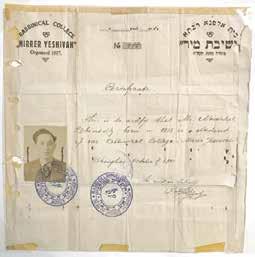
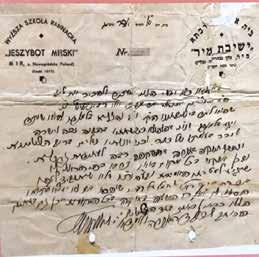
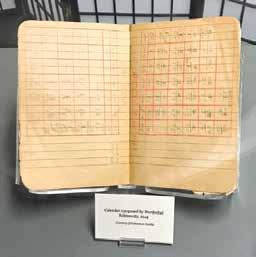
that every young man would benefit from our mesorah in order to ensure the continuity of Am Yisrael, the revival of Torah learning. He joined with HaRav Pinchas Hirschprung and HaRav Leib Baron in leading Yeshiva Mercaz Hatorah in Montreal. Originally, he held the position together with HaRav Zelig Epstein and HaRav Moshe Cohen. During his 30 years in the yeshiva, Rabbi Rabinowitz introduced material from Mesilas Yesharim and other mussar seforim into
the curriculum and spent time and effort inculcating in his students the ways of thinking, behaving and impacting others that the Mashgiach, Reb Yerucham, had exemplified.
Rabbi Rabinowitz was passionate about his teaching. He was on a most serious mission, to transmit the mesorah, the learning, the hashkafa and mussar that was so precious to him, his “precious gift.” Baruch Hashem, he accomplished his mission, as his many students have

testified. May his memory be a blessing.
The Amud Aish Memorial Museum is a Holocaust museum and archival center dedicated to preserving artifacts and original archival collections donated by frum survivors. We serve as a voice for the Kedoshim, enabling the next generation to connect to what mattered most to them—faith, spiritual resistance, and rebuilding Yiddishkeit after the war. To arrange a private tour of the Amud Aish
Memorial Museum, please contact Mrs. Chavi Felsenberg at 917-494-8689.
Note: Many of the details for the article above were taken from an article that appeared in Hamodia, March 13, 2013, written by M. Abir. To learn more about Reb Shmuel Soroka’s journey, read A Mirrer in Manila, A Mir Yeshiva Student’s Amazing Story of Escape and Survival, written by Dr. Mordachai Buchie Soroka, Reb Shmuel’s son, published by Feldheim.


By Noah Rothstein
Reviewing: “Hasdai Crescas: Collected Writings”
Edited by Roslyn Weiss
The Library of the Jewish People, an imprint of Koren Publishers Jerusalem (korenpub.com)
ISBN 978-1-61329-213-6, Hardcover, 1,500 pages. Published 2023
There is a line in Hasdai Crescas’s letter to the Jews of Avignon that stops you cold. He is describing the 1391 massacres in Spain, community by community, chronicling who died and who converted and who escaped. Then he reaches Barcelona, his birthplace, and writes: “Amongst the many who sanctified the Name of the L-rd was my only son, who was a bridegroom and whom I have offered as a faultless lamb for sacrifice; I submit to G-d’s justice and take comfort in the thought of his excellent portion and his delightful lot.”
That sentence captures something essential about Crescas. His son was murdered, his community decimated, the yeshiva where he studied destroyed, the scholars he knew slaughtered. One hundred fifty thousand Jews were forced to convert or killed within months. And through it all, he kept writing philosophy.
This volume, edited by Roslyn Weiss and published by The Library of the Jewish People, an imprint of Koren Publishers Jerusalem (korenpub.com), brings together everything Crescas wrote that survives. It is the first time all his works have appeared in English in a single collection. At fifteen hundred pages, it is not light reading, but it is necessary reading for anyone who wants to understand a crucial period in
Jewish thought and a crucial response to catastrophe.
Crescas was born around 1340 in Barcelona. He studied under Rabbi Nissim ben Reuben Gerondi, known as the Ran. He became Crown Rabbi of Aragon under King Joan I and Queen Violant de Bar. He counted among his friends Rabbi Isaac ben Sheshet and Rabbi Simeon ben Tzemah Duran. His student was Rabbi Joseph Albo, author of Sefer HaIkkarim. He was, in short, part of the elite circle of Spanish rabbinic leadership in the fourteenth century. Then, in a matter of months, that world ended.
The massacres began in Seville on the first of Tammuz. They spread to Cordova. On the seventeenth of Tammuz, they reached Toledo. Valencia fell on the seventh of Av. On the first of Elul, Mallorca was struck. On the following Shabbat, Barcelona. Crescas’s epistle to Avignon, written on October 19, 1391, reads like a war dispatch. Two hundred fifty killed in Valencia. Three hundred in Mallorca. Two hundred fifty in Barcelona. In every city, thousands more converted. In Valencia, the entire Jewish community disappeared except for one town called Murviedro. In Barcelona, Crescas writes, “there is none left today who still bears the name of Jew.”
The epistle, included here in Fritz

Kobler’s translation, is brief but devastating. There is work to do. Communities need to be rebuilt. The faith needs to be defended. That is what the rest of his writing does.
The second work in this volume is The Refutation of the Christian Principles , translated by Daniel Lasker. Crescas likely wrote it in Catalan, not Hebrew, so that both Jews and Christians could read it. The work systematically dismantles Christian theological claims: original sin, the Trinity, incarnation, the virgin birth, transubstantiation, baptism, the messiahship of J-. Crescas was writing for Jews under pressure to convert, who needed intellectual ammunition. The arguments are sharp, logical, and unapologetic. They assume a reader who knows both Jewish and Christian texts and can follow a sustained philosophical argument.
The third work is the Passover Sermon. In it, Crescas explores how human will and miracles affect faith in G-d and Torah. The first part is philosophical. The second part is a concise summary of the laws of Passover. It is the only halachic work of his that survives, though we know from other sources that he was a respected halakhic authority. The sermon gives us a glimpse of what his planned work, Lamp of the Commandment, might have looked like. He intend-
ed it as an alternative to Maimonides’s Mishneh Torah, one that would correct what he saw as deficiencies in Maimonides’s approach. That work was never written. Only the philosophical volume, Light of the L-rd, was completed. That philosophical volume is the major work in this collection. Crescas wrote it to challenge Maimonides’s Guide of the Perplexed. He believed Maimonides had gotten fundamental things wrong about Jewish belief, and he wanted to set the record straight. The work is dense, systematic, and ambitious. Crescas was not trying to simplify Maimonides or make him more accessible. He was trying to replace him.
Roslyn Weiss, who edited this volume and translated both the Passover Sermon and Light of the Lerd , has written introductions to each work that make the material accessible without dumbing it down. She explains the historical context, the philosophical stakes, and the structure of Crescas’s arguments. She does not hide the difficulty. She helps the reader see why it matters.
What makes Crescas important is not just that he challenged Maimonides. Others did that. What makes him important is that he wrote from within a community that was being destroyed and tried to give that community some -
thing to stand on. He was not writing philosophy in the abstract. He was writing to Jews who had watched their neighbors convert, who had buried their children, who were trying to figure out whether there was any reason to stay Jewish. Crescas’s answer was not sentimental. It was philosophical. Where Maimonides had placed intellectual perfection at the center of religious life, Crescas argued that love of G-d was the highest purpose. For Maimonides, knowledge was the goal. For Crescas, it was devotion. Crescas wanted a Judaism that could survive catastrophe because it was rooted in something deeper than intellectual assent.
Despite the power of these ideas, Crescas’s influence was limited. Spinoza read him. Some later thinkers engaged with him. But he never had the following that Maimonides did. Part of the reason is that his work is hard. Part of the reason is that the audience for whom he wrote was scattered, converted, or expelled.
This volume gives him a second chance. Weiss brought together texts that were scattered, got permissions from multiple publishers, and coordinated translators. The book is bilingual,
with Hebrew on one side and English on the other. Readers who can navigate the Hebrew can check the translation and see how Crescas’s arguments work in the original.
There are moments in reading Crescas when you feel the weight of what he
Crescas never says, “Look at what I’ve been through.” The epistle mentions his son’s death in a single sentence and moves on. The philosophical works do not reference the massacres at all. Yet you feel them underneath. This is philosophy written by someone who knows
He shows what it looks like to think clearly in the middle of catastrophe.
was carrying. He is writing Light of the L-rd in his sixties, after everything has fallen apart, and he is still trying to get the philosophy right. He is still arguing about whether will precedes intellect, whether love of G-d is a commandment or a consequence, whether miracles undermine or confirm faith. These are not idle questions. They are questions about what holds a community together when everything else is gone.

what it costs to stay Jewish.
The book is not for casual readers. It is dense and technical. It assumes familiarity with medieval Jewish and Christian thought. But for readers willing to engage with serious scholarship, it is worth it. Crescas is sharp, original, and brave. He took on Maimonides at a time when most scholars were still treating the Guide as untouchable. He defended Judaism against Christian ar -
guments when most Jewish intellectuals were converting. He tried to rebuild a community that had been shattered.
Roslyn Weiss calls Crescas “unjustly less well known today than he deserves to be.” This volume is a step toward correcting that. It gives English readers access to a thinker who mattered in his time and should matter now. Not because he provides easy answers, but because he shows what it looks like to think clearly in the middle of catastrophe.
The final paragraph of the epistle reads: “‘I am the man that hath seen affliction by the rod of His wrath,’ Hasdai son of Abraham son of Hasdai son of Judah Crescas, who writes here in Saragossa, on the 20th day of the month Marheshvan in the year 5152 of the creation.” He signs his name. He gives the date. He does not ask for pity. He just reports what happened and gets back to work.
That is the voice that runs through this entire volume. Clear-eyed, unflinching, and still engaged with the questions that matter. Crescas does not offer consolation. He offers clarity. And clarity, in moments of fracture, may be the most faithful response of all.



5.

4. 3.


By Nati Burnside
The Kosher Food & Wine Experience (KFWE) continued its new phase on Tuesday, February 3. This year’s event was the third in a row not open to the public despite hundreds (if not thousands) of people desperately wanting to get into the room.
It’s been a chaotic few cycles for one of the marquee events on the kosher calendar. KFWE was canceled in 2021 due to the COVID-19 pandemic. The 2022 version was held in the ballroom at the Hilton Meadowlands in East Rutherford, New Jersey, and had limited tickets available and a slightly scaled down format. That left a real appetite for KFWE 2023, and the event returned to its usual home of Chelsea Piers in Manhattan to massive crowds.
Looking back, that event seems to have been a oneoff, as the proprietors (Royal Wine Corp.) wanted to bring the focus of the event back to the wines and the industry itself. They decided to return to the Hilton Meadowlands (now known as the World of Blue Hotel) in recent years and allow only those in the trade itself (and the media) to attend.
With that said, even those in the industry can’t drink on empty stomachs. So if you weren’t allowed in the door, here’s a rundown of some of the best bites from KFWE 2026.
5. Mushroom Barley Soup - Manischewitz (Newark, NJ)
You can’t get this many Jews in one place and not have some kinda good shtick. And that’s where the people from Manischewitz came in. Sure, they had a booth with samples of various products including fare like hot dogs, potato knishes, and rugelach.
But they also had their food truck parked outside the door of the hotel so that everyone could grab a cup of steaming hot soup as they exited the show. With almost as many flavor options to choose from as it was degrees Fahrenheit outside, the soup was a welcome treat for everyone.
The Manischewitz food truck has been a big hit across social media this year. If you’re the kind of person who wants to find out where The Manischewitz Deli on Wheels (it’s full name) will be rolling to next, visit Manischewitz.com/foodtruck/ for the answers.
As for the soups, they come in jars and you just put them in a pot, put the pot on the stove, and you’ve got soup. The jars are available pretty easy to find in stores across the country.
4. Shawarma in Pita - Ha’misada (Howell, NJ)
This booth harkened people back to the days of KF-
WEs past as this was a formal restaurant booth like you would have seen five years ago. The big difference was that it was self-serve, something that would never work with the amount of patrons that used to attend this event in years past.
This was a full Israeli cuisine station with the works. Freshly toasted pita, fried falafel, Israeli salad, pickles, pink slaw, hummus, tehina, and even some good, old Israeli charif. But I chose to fill my pita with the shawarma and that proved to be the right choice.
The booth came courtesy of Ha’misada, a family-owned Israeli family restaurant in Howell, just outside of Lakewood. As the event was split up into two rooms with the Israeli wines on one side, Ma’misada had the Israeli room all to themselves. In fact, representation of Israeli food was the whole reason they were there.
“They wanted to have some Israeli food to go along with the wine,” said Motty Tessler of Ha’Misada. “We were happy to say yes, and we are happy to bring really authentic Israeli food to the Lakewood area today and for the past three years.”
3. Sweet Sesame Tempura Chicken - Diamond Kosher Caterers (Woodmere, NY)
The widest range of offerings for the night certainly goes to Diamond Kosher Caterers. They had an island station that was putting out three types of cholent (Mexican, pastrami, and lamb), several kugels, and some more heimish treats like gribenes and p’tcha.
But why stop there? There were also carving stations, meatballs, chicken lollipops, and more. Best of all was probably the idea to take some of the more bitesized options and have them passed around by staff to cut down on the lines.
The highlight for me was the chicken that was the perfect combination of crunch and sweetness. It was kind of like a lighter version of sesame chicken from a Chinese restaurant.
Showing off the wide array of options in the repertoire was a demonstration of what Chef Chaim Levy and his team can do for all types of events. I was assured that one of their specialties is also individual serving desserts.
Too bad we didn’t get to sample those.
2. Sushi Hand Roll - Bordeaux Wine and Steakhouse (Brooklyn, NY/Lakewood, NJ)
You can’t get this many Jews together in 2025 without offering them sushi. I’m not sure if that’s actually a law or just a recommendation to prevent angry mobs, but


either way, the situation was handled perfectly at KFWE. The interesting part was the provider of this sushi.
The answer? Bordeaux, as in Bordeaux Wine and Steakhouse. This confused me because I recently visited the new location in Lakewood and was blown away by several things, none of which were sushi related. And that’s not to say that the sushi was bad. It’s just that it didn’t exist.
Apparently, the restaurant has very recently decided to add a sushi section to their menu in both Brooklyn and Lakewood, and they thought that showing up to KFWE to publicize that would be a good idea.
Well, they were right. The sushi was a huge hit. From the fancy rolls that were laid out so nicely at the start of the night, to the continued restocking of many different types of rolls as people demolished the initial offerings, everyone was raving about the quality of the product.
Personally, I was able to get one of the hand rolls, which was a real treat. Obviously a little larger than the individual pieces, I didn’t mind taking on the portion size because I find sushi to be fairly light anyway. It was certainly worth it as the great combination of textures and flavors came together nicely.
Now, the next time you venture to one of their locations you’ll have even more difficult decisions to make about what to order.
1. Pulled Beef Pizza - Sizzle & Spice (Lakewood, NJ)
The biggest hit of the night was clearly the return of the meat pizzas from Sizzle & Spice. A division of Tessler Catering in Lakewood, this portable pizza par -

ty provider will basically show up anywhere and do anything you can think of.
“We are a true A-Z party planning company,” shared Yossi Endzweig, one of the managers for Tessler. “Our goal is for the host to tell us what he wants so that we can take care of everything, and he comes and goes like a regular guest.”
Sizzle & Spice brought a dozen types of meat pies, but they want you to know that they also do dairy pizzas. They went through around 500 pies (impressive for an event with around the same number of people) at KFWE, but they said it was worth it to really get their name out there.
Having been around for three years now, Sizzle & Spice is making a name for itself as a valuable part of the Tessler portfolio. The portable nature of their business is great for Tessler’s mission to provide whatever is needed, wherever it’s needed (anywhere in the USA).
Made in just a few minutes using an oven that runs hotter than what sits in your kitchen, the Pulled Beef Pizza had hot peppers and a drizzle of hot honey. The method led to a true crispy bottom and deliciousness on top.
Unsurprisingly, it was virtually impossible for the team behind the counter to put pizzas out faster than the crowd could eat them. Yet people were still willing to stand there and wait for pizza to come out of the oven and cool for a minute before getting to taste the next flavor.
Honorable mention goes to the Bacon & Pineapple Pizza which was probably the biggest hit of the night with the crowd. It was the innovative pies like that one that kept people coming back to this booth all night long.

Batya, before we talk about the cookbook, tell us about Batya’s Kitchen. How did it all begin?
Batya Kahan: Batya’s Kitchen began very organically. I started cooking for people the way I cooked for my own family — food that felt comforting, thoughtful, and elevated but still warm and familiar. Over time, I noticed that so many women wanted their yom tov tables to feel special, but they were overwhelmed by the pressure, the timing, and the logistics. What started small grew because there was a real need: food that could be trusted, prepared with care, and delivered in a way that made hosting feel lighter instead of heavier.
Batya’s Kitchen has become known for refined yet comforting yom tov food. How would you describe your culinary philosophy?
My philosophy is that food should feel intentional. It doesn’t need to be fussy, but it should be thought through. I believe in balance — flavors that complement each other, colors that belong together, and menus that make sense as a whole.
I also believe strongly in starting with the basics. Before serving anything fancy, you have to make sure your family — especially children — are actually fed. Most kids are picky, and yom tov is not the time to experiment at their expense. When children are satisfied and calm, the entire table feels different. Over the years, I’ve learned that true elegance doesn’t come from doing more — it comes from doing the right things well.
You’re releasing your first cookbook, Pesach Secrets from Batya’s Kitchen. Why Pesach — and why now?
Pesach is the most intense yom tov for so many women. It’s beautiful, but it can also be exhausting. I’ve watched women dread it, rush through it, or feel depleted before it even begins. After 18 years of preparing Pesach professionally, I felt I had something real to offer — not just recipes, but a system, a mindset, and reassurance that Pesach can be prepared calmly and meaningfully.
This book goes far beyond recipes. What problem were you trying to solve?
I wanted to solve the feeling of being overwhelmed. Women don’t just need food ideas — they need structure. They need to know when to shop, what to prepare early, what freezes well, and what actually matters. This book is meant to live on the kitchen counter and guide women through the process step by step, not just inspire them from afar.
One of the standout features of the cookbook is “The Batya Freeze Code.” Tell us about it.
Many women are genuinely afraid of freezing — there’s almost a freezer phobia. They worry food won’t taste good, won’t reheat well, or won’t be worth the effort. When freezing isn’t done properly, those fears are understandable.
The Batya Freeze Code is a clear, step-by-step method for cooling, wrapping, labeling, freezing, and reheating food so it actually tastes freshly made. Once women learn how to freeze correctly, they can plan earlier, pace themselves, and walk into yom tov calm instead of exhausted. Freezing isn’t about cutting corners — it’s about using wisdom so you can be present at the yom tov table.
The book also teaches readers how to navigate the Pesach supermarket. Why was that important?
Because confusion creates stress. Over the years, countless people have told me they mistakenly bought kitniyos simply because they purchased an item from a store or brand they trusted, assuming that meant it was suitable for their family’s minhag.
ordering certain items, women are looking for peace of mind, knowing they’re not settling on taste, quality, or kashrus.
Publishing with ArtScroll is a major milestone. What did that partnership mean to you?
It was deeply meaningful. ArtScroll represents Torah values, tradition, and longevity, and their reach is truly global — their books find their way into Jewish homes across continents. Knowing that this Pesach guide could reach families around the world was incredibly humbling. ArtScroll places a great deal of trust in the authors they choose, and the fact that they select only one Pesach cookbook per season made this opportunity especially significant. I felt entrusted to create a guide that would truly serve the Jewish home — not just for inspiration, but for real-life use.

Was there a moment when you realized this was bigger than a cookbook?
To address this properly, I drew on the work of Rabbi Zibell of Kosher Bein The Know, whose compilation reflects more than fifteen years of real-life shailos and hands-on Pesach guidance. His clarity helped shape how this information is presented. When women understand what they’re buying and why, shopping becomes empowering instead of intimidating — and that calm carries into yom tov.
You’ve served families nationwide for nearly two decades. What have you learned from your customers?
Women want reassurance. They want to know they’re doing enough. Today, many of my clients are incredibly busy professionals — doctors, lawyers, therapists — juggling demanding careers alongside family life. When you’re working, you have to plan wisely. Pesach doesn’t become easier by pushing harder; it becomes calmer by making thoughtful decisions early. Whether that means freezing, simplifying menus, or
There were so many moments of hashgacha pratis throughout the process — the timing, the people, the clarity that came exactly when it was needed. Every stage of preparing this book was deeply satisfying. The idea that I could help women around the world prepare for and elevate Pesach — the foundation of our emunah — was honestly mind-blowing. And knowing my children will have something tangible to hold onto forever makes it even more meaningful. This book isn’t just for now — it’s part of something lasting.
What do you hope a woman feels when she opens this book?
That her entire mindset toward Pesach will change — from something overwhelming to something she feels prepared, calm, and confident to embrace.
What’s one piece of advice you’d like to share with women preparing for Pesach this year?
Prepare with purpose. Know that you are the nucleus of your home — and that your energy is what powers both the spiritual and the physical within it.

By Batya Kahan
I got this recipe from Leba Schwebel — our beloved morah and role model in our “Chillers” Emunah group. She originally sent it with a few extra steps, but I simplified it and it’s still absolute heaven. Known for both her cooking and her teaching, Leba — founder of the Amatz Initiative, empowering our educators — brings heart and strength to everything she does.

Yield: 6-8 servings
Freezer Friendly
IngredI ents
▪ 1 (4 lb.) flanken roast
▪ ½ cup avocado oil
▪ 2 Spanish onions, sliced
▪ 5 whole garlic bulbs, tops sliced off to expose the cloves
▪ 10 frozen garlic cubes, thawed
▪ 1 (12 oz.) jar silan
▪ 12 oz water
▪ 1 Tbsp fine sea salt
▪ 1 Tbsp garlic powder
▪ 1 Tbsp onion powder
▪ 1 Tbsp paprika
▪ ½ Tbsp fine black pepper
Instruct Ions
Heat oven to 350°F.
Place a layer of onions into a large roasting pan; place flanken on top.
Nestle the whole garlic bulbs (tops sliced off) along the sides of the pan. They’ll roast slowly and turn soft, sweet, and spreadable.
Massage the meat with the crushed garlic, salt, garlic powder, onion powder, paprika, and black pepper.
Glaze with silan, then fill the jar with the water and pour along the side so it doesn’t wash off the glaze.
Cover tightly with foil; bake for 3½ hours.
Uncover for the last 10–15 minutes and baste for a glossy sheen (optional).
Batya’s tI ps
Those roasted garlic bulbs are pure gold. Squeeze the cloves right out of their skins and mix into mashed potatoes, cauliflower purée, or vegetables for a deep, caramelized flavor.
pa I r I ng & presentat Ion
Serve this roast alongside Golden Onion Lukshen Kugel (page 240) and a medley of Roasted Root Vegetable Sticks (page 278) — the flavors blend seamlessly with the silan’s deep sweetness.
c arve for the MoM ent
Bring the roast out whole, first removing the long bones and placing them alongside the meat for dramatic effect. Then slice the flanken at the table for a true wow factor. Spoon the glossy silanonion sauce generously over the slices before serving.
Serve it hearty and chunky, or purée until velvety smooth — the same recipe, two delicious finishes.


Yield: 10 quarts
Freezer Friendly
IngredI ents
▪ 4 Spanish onions, diced
▪ 7 carrots, diced
▪ 3 tsp fresh garlic, minced, or 3 frozen garlic cubes
▪ 8 Yukon Gold potatoes, cut into large dice (see note)
▪ 5 sweet potatoes, cut into large dice (see note)
▪ 3 zucchini, cut into large dice (see note)
▪ 4 oz tomato paste
▪ ½ cup extra-virgin olive oil
▪ 3½ Tbsp fine sea salt, to taste
▪ ½ tsp fine black pepper, divided
▪ 8 quarts water (add more as needed to cover vegetables)
Instruct Ions
In a 12–16-quart pot, heat oil over medium heat. Add onions, carrots, and ½ teaspoon salt; cook for 8–10 minutes, until lightly golden. Stir in garlic; cook for 1 additional minute.
Stir in Yukon Gold and sweet potatoes to coat; cook for 1–2 minutes. Add 6–8 quarts water. (The vegetables should be fully immersed). Bring to a boil; stir in tomato paste. Lower to a gentle simmer; simmer, partially covered, for 30 minutes.
Add zucchini; simmer for an additional 15–20 minutes, until all vegetables are tender.
Reduce heat to medium-low, cover, and simmer until potatoes are almost fully tender, 20–30 minutes.
Taste; add remaining salt and pepper to taste. For body, blend 2–4 cups of soup; return blended soup to the pot.
to serve
Hearty: Ladle as is for a rustic, chunky bowl.
Creamy: Purée until silky smooth.
note
Aim for ¾-1-inch cubes so veggies hold up well through reheating/freezing.
Yields: 20-22 pieces

By Naomi Nachman
With Rosh Chodesh this past week, Purim is on everyone’s mind. This recipe is a great idea for your Purim party. You can prep them ahead of time and fry them up fresh.
◦ 2 Tablespoons olive oil
◦ 2 onions, sliced
◦ 16 ounces shredded cabbage
◦ 1 teaspoon salt
◦ 2 cloves garlic, minced
◦ 1 inch fresh ginger, minced
◦ 1 box (3.5 ounces) shitake mushrooms, sliced
◦ 1 Tablespoon soy sauce
◦ ¼ cup fresh herbs (parsley or cilantro), finely chopped
◦ 2 cups shredded chicken (see note)
◦ Juice of a lime
◦ 20-22 spring roll wrappers
◦ Oil, for frying

1. Heat oil in a large, deep frying pan over medium heat. Add onions and cook for about 5 minutes, until softened.
2. Add cabbage, salt, garlic, ginger, mushrooms, soy sauce, and herbs. Continue to cook, stirring occasionally, for about 10 minutes. Add chicken and lime; stir to distribute throughout. Remove mixture from heat and cool.
3. Assemble spring rolls: place about ¼ cup mixture in a spring roll, and roll it around the filling, egg roll style. Seal the edge with a little bit of water and set aside.
4. Heat about 2 inches of oil in a deep frying pan. Fry spring rolls for 1-2 minutes per side, until golden.
Cook’s Tips: To make shredded chicken: place chicken in a net bag when cooking your chicken soup. Remove from soup, shred, and use in dishes such as this one.
Naomi Nachman, the owner of The Aussie Gourmet, caters weekly and Shabbat/ Yom Tov meals for families and individuals within The Five Towns and neighboring communities, with a specialty in Pesach catering. Naomi is a contributing editor to this paper and also produces and hosts her own weekly radio show on the Nachum Segal Network stream called “A Table for Two with Naomi Nachman.” Naomi gives cooking presentations for organizations and private groups throughout the New York/New Jersey Metropolitan area. In addition, Naomi has been a guest host on the QVC TV network and has been featured in cookbooks, magazines as well as other media covering topics related to cuisine preparation and personal chefs. To obtain additional recipes, join The Aussie Gourmet on Facebook or visit Naomi’s blog. Naomi can be reached through her website, www.theaussiegourmet.com or at (516) 295-9669.


Finally, NYC is coming to Islam. Dogs definitely have a place in society, just not as indoor pets. Like we’ve said all along, they are unclean.
- Tweet by Nerdeen Kiswani, a close ally of Democrat Socialist New York City Mayor Zohran Mamdani and leader of the 2024 pro-Hamas protests
If they force us to choose, the choice between dogs and Muslims is not a difficult one.
- Response tweet by Rep. Randy Fine (R-FLA)
One day, I get a phone call from the president in September, and he is so mad at me, and he’s yelling at me, and he’s angry at me… and he’s chewing me out for signing my name on Thomas Massie’s discharge petition to release the Epstein files. And I’m trying to tell him, “Mr. President, they say you did nothing wrong. This needs to come out.” And so we’re having this argument. And he tells me on this phone call, he’s like, “Marjorie, my friends will get hurt.”
- Former GOP congresswoman and now Trump-hater Marjorie Taylor Greene, on a recent podcast
The worst of the worst are not the immigrants. The worst of the worst, records show, are native-born Americans committing crimes that hurt our cities.
I hope I inspire people over there not only to be great in sports, but to be better in general in life. Hopefully, someday, I can make it over there.
- LeBron James when asked before the Allstar game about Israel and Deni Avdija who was the first Israeli to make the NBA Allstar game this year
They don’t want poor people to vote. They don’t want people of color to vote, because they often don’t vote for them.
- Sen. Minority Leader Chuck Schumer arguing against the Republicans’ push for voter ID laws, which are supported by more than 80% of Americans


- Rep. Steven Cohen (D-TN)

There are no light or gaps between President Trump and Bibi about what to do [about Iran] and how to do it. There are two lines in the water right now. One’s the diplomatic line, trying to find a way to end this regime diplomatically that will advance our national security interests. The other line is the military option. I think President Trump is looking for which line can catch the biggest fish. The bottom line is we’re into weeks, not months, in terms of decision-making.
- U.S. Senator Lindsey Graham (R-SC) speaking in Israel
They’re real, but I haven’t seen them.
- Former Pres. Barack Obama when asked about extraterrestrial aliens, in a recent podcast
This guy has Trump Derangement Syndrome!
- Attorney General Pam Bondi at a Congressional hearing during an argument with Trump-hater Rep. Thomas Massie (R-KY)



We are victors, not victims.
- AJ Edelman, a Boston native who is representing Israel in the bobsled competition, commenting on being in last place
It is the greatest thing in the world to see your country represented. What’s a better thing in the world to accomplish than that?
- ibid.
I blew it. I think it was definitely mental. Experiencing the Olympic atmosphere is crazy. It’s not like any other competition. It’s really different.
- American figure skater Ilia Malinin, who was expected to win gold but finished in eight place, in an interview with NBC
There was never any genocide in Gaza, absolutely, and there shouldn’t ever be any conditions for aid for Israel, because they were in an existential war.
- Sen. John Fetterman on Fox News
Why would you align yourself [with] raging antisemites and very pro-Hamas people like Hasan Piker? There’s a rot in my party standing with pro-Hamas people like that.
- ibid.
Why is [Alexandria Ocasio-Cortez] so eager to criticize and find a way to criticize Israel? But I don’t really recall them saying anything as Iran was executing thousands and thousands of their protesters.
- ibid.
There is a legitimate reason to have a debate about things like migration. It went too far. It’s been disruptive and destabilizing.
- Hillary Clinton at the Munich Security Conference

You have a president that refuses to give Bibi a pardon. I think that man should be ashamed of himself. He said that he would do it five different times, but I guess he’s afraid of losing his power. The people of Israel should shame him.
- Pres. Trump after meeting with Prime Minister Netanyahu excoriating Israeli Pres. Isaac Herzog
To clarify, the prime minister’s request is currently under review at the Israeli Justice Ministry for a legal opinion in accordance with the established procedures. Only upon completion of that process will President Herzog consider the request in accordance with the law, the best interests of the State of Israel, guided by his conscience, and without any influence from external or internal pressures of any kind.
- Pres. Herzog’s office, in response
The United Nations still has tremendous potential to be a tool for good in the world. But we cannot ignore that today, on the most pressing matters before us, it has no answers and has played virtually no role. It could not solve the war in Gaza. Instead, it was American leadership that freed captives from barbarians and brought about a fragile truce. It had not solved the war in Ukraine. It took American leadership and partnership with many of the countries here today just to bring the two sides to the table in search of a still-elusive peace.
– Secretary of State Marco Rubio at the Munich Security Conference, in a speech that warned Europe to change its ways before it’s too late and which was so on point and well-delivered that it garnered a standing ovation at the end
It was powerless to constrain the nuclear program of radical Shia clerics in Tehran. That required 14 bombs dropped with precision from American B-2 bombers. And it was unable to address the threat to our security from a narco-terrorist dictator in Venezuela. Instead, it took American Special Forces to bring this fugitive to justice.
– ibid.
We do not want allies to rationalize the broken status quo rather than reckon with what is necessary to fix it, for we in America have no interest in being polite and orderly caretakers of the West’s managed decline. We do not seek to separate but to revitalize an old friendship and renew the greatest civilization in human history. What we want is a reinvigorated alliance that recognizes that what has ailed our societies is not just a set of bad policies but a malaise of hopelessness and complacency. - ibid.
Um, you know, I think that I, uh, this is such a, you know, I think that this is a, um, this is of course, a, uh, very longstanding, um, policy of the United States.
- Congresswoman Alexandria Ocasio-Cortez (Dem/Socialist-NY) when asked at the Munich Security Conference whether the U.S. would defend Taiwan in the event of a Chinese invasion
You bring me on your show and show me the most uncomfortable 20 seconds of television that I’ve ever seen?!
- Vice President J.D. Vance on Fox News after the AOC clip was played
Gavin Newsom is historically illiterate.
- Sen. Ted Cruz on his podcast
Ted Cruz calling a dyslexic person illiterate is a new low, even for him.
- Gov. Gavin Newsom, who claims to be dyslexic, in response

I watched AOC answering questions in Munich. This was not a good look for the United States. I watched Gavin Newsom answering questions in Munich, and this was a bad look for our country. These two people are incompetent. And at least Hillary’s competent — she’s just Trumpderanged.
– Pres. Trump when asked about the Democrats’ performance at the Munich Security Conference


SBy David Ignatius
audi Arabia and the United Arab Emirates, the two drivers of modernization in the Middle East, should be rejoicing together these days. Iran is weak, its proxies are on the run, and an American armada approaches the Persian Gulf. But instead, they have stumbled into an epic feud that could polarize the region.
When the quarrel detonated in late December, it seemed like a fight over strategy for resolving the forever war in Yemen. But it has since escalated into a social media battle in which Saudis have attacked the UAE as “Israel’s Trojan horse” and denounced the Abraham Accords, joined by the UAE in 2020, as “a political military alliance dressed in the garb of religion.”
Emirati officials believe the Saudis are waging a deliberate incitement campaign centered on the UAE’s relationship with Israel. After Saudi Arabia bombed the UAE’s partner forces in Yemen on Dec. 30, Saudi posts criticizing Israel spiked dramatically, with 77 percent of the comments attacking the UAE as “Israel’s proxy executing Zionist plans to divide Arab states,” according to media research shared with me by an Arab official.
A second social media analysis by Orbis Operations, a national security consulting firm, found that social media influencers had falsely sought to link a UAE leader with Jeffrey Epstein, in addition to claiming that the UAE was funding an anti-Islam campaign in Europe and that the country was an extension of Israeli policy. I reviewed a copy of the report, which Orbis hasn’t made public.
For the Trump administration, which has close ties with both countries, the Saudi-UAE wrangle illustrates the difficulty of working with two headstrong regional
powers at once. The administration is said to have offered to mediate, but both sides have balked, according to several knowledgeable officials. Because of the intense personal feelings, one official told me, “This is not something you mediate.”
The dispute matters because President Donald Trump has placed big bets on both countries as he seeks to transform the Middle East. Trump needs unified gulf support as he threatens military action against Iran, tries to disarm Hamas in Gaza, and seeks to help expand Israel’s ties with the fragile nations of Syria and Lebanon.
“The Saudis want obedience, or at least alignment with their regional policies,” said John Gannon, a former senior CIA officer with decades of experience in the Middle East. “The Emiratis don’t want to be obedient. They want optionality.”
The tension is rooted in what had once been a close relationship between Saudi Crown Prince Mohammed bin Salman and UAE President Mohamed bin Zayed al-Nahyan, known by their initials “MBS” and “MBZ.” The Emirati leader mentored the young Saudi in 2015 and 2016 about how to modernize his conservative kingdom. Friends of both men describe the rivalrous relationship as somewhere between father and son and an older and younger sibling. No good deed goes unpunished, as the saying goes. As MBS succeeded in consolidating power, he began to chafe against UAE tutelage. The Saudi didn’t want instruction anymore from a smaller and less powerful country, and the Emiratis didn’t want to take orders from a regional hegemon in Riyadh. Like many family feuds, it was partly about money and power but also, at a deeper level, jealousy and resentment.

Saudi and Emirati policies began to diverge. They had joined forces in fighting the Houthis in Yemen in 2016, but three years later the Emiratis began allying with forces in South Yemen that had a quasi-separatist strategy. They backed different sides in a ruinous civil war in Sudan. Their agendas differed in Syria, Libya and Somalia, too. Often, the UAE complaint was that the Saudis were allied with Islamist forces that could destabilize the region.
MBS’s White House visit in November was a flashpoint. The Saudis say the crown prince asked Trump to sanction a Sudanese militia backed by the Emirates, known as the RSF. But Emirati officials believe that MBS sought sanctions on the UAE itself.
Despite Saudi denials, the situation quickly deteriorated. In early December, UAE-backed forces in Yemen launched an offensive in the southern region of Hadramawt; several weeks later, the Saudis bombed more than 80 vehicles and weapons that had been delivered to the UAE’s allies – and demanded that the Emiratis quit Yemen. The UAE withdrew. Officials from both sides told me they felt “stabbed in the back.”
Ali Shihabi, an MBS adviser, posted commentary January 1 that expressed Saudi frustration – and deepened UAE anger: He described a “structural imbalance” in the gulf between a big Saudi Arabia and smaller rivals. “As these smaller states acquire great wealth, they often begin to operate under the illusion that they are equal partners of the Kingdom.”
Shihabi’s dismissive tone angered Emiratis. But it was expressing out loud a tension that had been growing for several years. An example is plans for a rail and sea link, known as the “Middle East Corridor,”
that would connect India to Israel and Europe. An original 2023 map showed the rail potion starting at Jebel Ali in the UAE and then moving through Saudi Arabia. But a pro-Emirati writer recently posted what he claimed was a new Saudi plan to start the line in Oman and bypass the UAE.
The regional tension directly interfered with U.S. policy last March, when the Trump administration was assaulting Houthi rebels in Yemen who had been attacking Red Sea shipping. According to a senior former U.S. official, Trump called a top UAE official and asked him to help “mop up” the Houthis. The UAE leader said he could send 2,000 troops immediately and 5,000 more soon – but he asked for a Saudi pledge that it wouldn’t support a Yemeni Islamist militia known as Islah. The Saudis didn’t deliver that promise, and the campaign never happened, the former U.S. official said.
The tit-for-tat continues. Emirati officials believe that Saudi Arabia urged friendly Muslim countries, including Kazakhstan, Syria and Jordan, to stay away from the World Governments Summit held last week in Dubai. The UAE launched the summit in 2013 as a regional forum.
Family feuds come and go in the Middle East, as around the world. What concerns me about this quarrel is the growing attacks on the UAE because of its opening to Israel. No country has a bigger stake in stopping the spread of Islamic extremism than Saudi Arabia. In its seeming encouragement of vitriolic Saudi attacks on the UAE as a “Devil of the Arabs” that takes orders from Israel, the kingdom is playing with fire.

By Marc A. Thiessen

If President Donald Trump takes military action in Iran, he will need help from the Iranian people. The U.S. military can decapitate the regime from the air. But what happens on the ground will be up to Iranians, who bravely took to the streets this winter to demand their freedom – and are now waiting for the bombing to return and finish the job.
To play their part, they will need access to information they can trust about the U.S. military campaign and what is happening in their country. The regime knows this and will seek to deny Trump the ability to communicate directly with ordinary Iranians.
Unfortunately, Iran’s leaders have an unwitting ally inside the U.S. government – Kari Lake, the hapless acting
head of U.S. Agency for Global Media.
For a year, Lake has worked tirelessly to cripple the U.S.-backed “freedom radios” – including Voice of America and Radio Farda – that broadcast into Iran to counter regime propaganda. As an unpaid volunteer member of the board of Radio Free Europe/Radio Liberty, which operates Radio Farda, I have seen the chaos she’s unleashed up close.
To succeed, kinetic warfare must be accompanied by information warfare.
The United States needs a plan to surge news and messages into Iran through multiple means: medium wave AM radio broadcasts to reach Iranians in their cars and homes; shortwave radio broadcasts over multiple channels; satellite news transmissions; and virtual private networks and other tools that allow
Iranians to defeat the regime’s internet censorship and communicate with each other and the world safely through secure messaging. The goal should be to overwhelm the regime’s ability to keep people in the dark.
In an interview Wednesday, Lake told me: “We’re ready for whatever the president does in Iran, we are ready to tell that story.” Unfortunately, the facts speak otherwise. Instead of developing a plan to break the regime’s information blockade, Lake has done the opposite: She has undermined the ability of VOA and Radio Farda to reach the people of Iran. Here is the troubling timeline:
In March, Lake put all of VOA’s Persian service staff on administrative leave. That decision backfired three
months later, when in June the United States and Israel launched their military campaign to destroy Iran’s nuclear weapons program. Lake scrambled to recall roughly 40 terminated staff in the Persian division, but the damage was done. During Operation Midnight Hammer, Axios reported, VOA “broadcast just 75 minutes of content targeted to its audience in Iran over … 72 hours.” Before Lake’s arrival, VOA broadcast in Iran 24/7. “We may not be doing as many hours, but the hours we’re doing are impactful,” Lake said.
Radio Farda, which Lake was stopped from dismantling in court, helped fill the void – despite her withholding of congressionally appropriated funds that forced it to furlough half its staff.
In March, Lake abruptly cut off Ra-
dio Farda’s access to U.S.-owned transmission facilities in Kuwait – facilities Congress funded for decades specifically for this purpose – and then denied it permission to use appropriated funds to contract with private vendors for shortwave capacity.
Radio Farda still managed to broadcast via shortwave using non-grant funds. Its social media teams also flooded key channels with news, videos, and statements from Trump and reached millions of Iranians via Instagram –debunking Iran’s false narratives about Trump’s historic military operation, exposing regime propaganda and informing the Iranian people about America’s motives in striking Iran’s nuclear weapons program and personnel.
After undermining Trump during one of the most courageous moments of his presidency, Lake ought to have been chastened. Not so. When mass protests erupted across Iran, Radio Farda continued to be denied access to the U.S. transmitter in Kuwait. Despite that, it was able to broadcast statements from Trump on the internet. During the height of the protests. Radio Farda’s Instagram content was viewed at least 30 million times per day – until internet access was cut off by the regime.
After three weeks, Radio Farda was finally given access to one shortwave frequency from the Kuwait transmitter (multiple frequencies are needed to overcome jamming) but was still denied access to medium wave AM radio frequencies. But by then, the protests had died down.
In our conversation, Lake insisted that she did not deny Radio Farda access to the Kuwait transmitter. “The transmitting station has been shut down,” she said, “so it wasn’t like we’re blocking RFE/RL. As it’s been open, we’ve allowed them to use it.” Asked how many of the last 11 months it was not operating, she said, “It might have been 10 or whatever.” In July, however, USAGM officials told RFE/RL, “USAGM does not agree to the use of the tower or for grant funds to be used for this purpose.” At no point over the past 11 months did her agency inform RFE/RL that the transmitting station was down, and RFE/RL officials told me that the entire station has not been offline due to technical issues during Lake’s tenure. Lake promised to get back to me with specific dates the transmitter was supposedly down. But 24 hours later, she instead texted a statement that said, “Trying to recycle last year’s narrative is misleading, outdated, and grossly in-
accurate. USAGM is stronger and more efficient today than it was under the previous administration. VOA Persian has expanded operations and recently added an hour of programming, and Radio Farda is actively broadcasting through the USAGM transmitter in Kuwait.”
I also asked Lake about that single
most absurd thing I’ve ever heard,” she said. “If the State Department wants to give $10 million to OTF, I run this agency. Marco Rubio runs the State Department. … You need to be on the phone with them.” But OTF officials said that State Department officials met with USAGM on Monday to arrange transfer
Getting accurate information to the Iranian people could mean the difference between the success and failure of a military strike.
shortwave frequency for Radio Farda. Lake answered that she would be willing to give it more for a fee. “I’ve told my team that if they’re willing to pay the expense of it, to let them have access to it.” Let’s see if she follows through. Lake is also throttling the ability of Radio Farda to reach the Iranian people through virtual private networks supported by the Open Technology Fund (OTF), a U.S. nonprofit authorized and funded by Congress in 2021 to help America’s freedom radios overcome internet censorship.
Over 90 percent of Radio Farda’s Iranian audience get their content through OTF-supported VPNs. To help keep these critical channels open, Republican Sens. James Lankford (Oklahoma) and Lindsey Graham (South Carolina) recently worked with the State Department to identify $10 million in additional funds that could be transferred to support millions of VPN users in Iran. The State Department asked Lake to transfer the funds to OTF using a well established channel – an interagency agreement used for years to get resources to OTF.
But according to OTF officials, Lake would not accept the funds from State and insisted that OTF pay for Iran operations through an advance on its existing regular budget – which would require it to cut VPN access in China and Cuba to provide it in Iran. Without the additional money, OTF said it will have to start cutting off Iranian users this month.
Lake denies she is an impediment to giving OTF the money. “That is the
of the money, and Lake wouldn’t agree. An OTF official tells me Lake has made clear that they will have to find a way around her.
In Lake’s telling , the operational limits hamstringing these critical tools
have nothing to do with her. So I asked her to share her plan to surge information into Iran and get Trump’s message to the Iranian people. “We have been surging,” she insisted, but added, “I’m not in the Department of War.”
“We have given Radio Free Europe, Radio Liberty, Radio Free Asia, Middle East Broadcasting Network, as well as the Open Technology Fund, every single penny that was appropriated to them,” she said. “Every. Single. Penny.” She leaves out that this is only because she was forced to do so in court.
Getting accurate information to the Iranian people could mean the difference between the success and failure of a military strike. But if Kari Lake has her way, millions of Iranians will be left in an information vacuum and at the mercy of regime propaganda. If Trump decides to act, he might want a new director of U.S. Agency for Global Media who is serving his interests rather than unwittingly serving the interests of the regime he is trying to topple.
Perhaps Marco Rubio needs another job?
© 2026, Washington Post Writers Group

By Tariq Panja
MILAN — For the authorities charged with securing the Winter Olympics, which begin this week in northern Italy, a gold medal moment will come even before the competitions begin in earnest.
The opening ceremony Friday will draw billions of viewers and pack a phalanx of dignitaries into Milan’s San Siro stadium for the Games’ grand unveiling. It also makes for a grand target.
“If attackers want to alter the Games, to sabotage the Games, the opening ceremony is a way to go,” Franz Regul, who led cybersecurity efforts for the 2024 Summer Olympics in Paris, said in an interview.
The ceremony (scheduled to begin Friday at 2 p.m. ET) involves more than 1,000 performers who have spent hundreds of hours rehearsing and will act as Italy’s calling card to the world. Protecting the Games — which will also feature simultaneous events at Olympic sites in the mountains around Cortina and Livigno — requires one of the largest and most complex security operations in Italian history, involving 6,000 security personnel as well as a fleet of surveillance drones and robots to conduct inspections.
“We do train, we do prepare for the Games, and, in our case, during the opening ceremony, we have our own Olympics final,” Regul said.
The threats even before the ceremony were underscored Wednesday when Italian officials said they had thwarted an attempted cyberattack on some government and Olympics-related websites, including those belonging to hotels in Cortina. Foreign Minister Antonio Tajani told reporters the attacks were “Russian in origin.”
In 2018, a major cyberattack attributed to Russia led to the unprecedented disruption of the opening ceremony of the Winter Olympics in Pyeongchang, South Korea. The attack

took out internet access and telecasts, grounded drones that were supposed to be part of an elaborate set piece and shut down the Games’ website. It also prevented spectators from printing out tickets and attending the ceremony, resulting in an unusually high number of empty seats.
According to the British government, Russia had attempted to disguise that attack as one perpetrated by North Korea.
Russian actions have been a menace to the Olympics for more than a decade, since the exposure of a huge state-sponsored doping program led to international bans on Russian athletes representing their nation in major sporting events — prohibitions that have continued since Russia’s 2022 invasion of Ukraine. Russians may compete in the Milan Cortina Games only as neutral athletes, without carrying the national flag.
Russia’s attempts to undermine recent Games have included hacking events and even an elaborate disinformation campaign before the Paris Olympics that included a fake documentary featuring a voice purporting to be
that of actor Tom Cruise.
Daniel Byman, director of the Warfare, Irregular Threats and Terrorism Program at the Washington-based Center for Strategic and International Studies, said that Olympic organizers worry about state-based threats “because they tend to be more skilled and have more resources.”
But before Italian officials disclosed the thwarted Russian hack, it was security personnel from another nation — the United States — that had exercised many Italians.
The disclosure last week that agents from U.S. Immigration and Customs Enforcement would accompany U.S. officials to the Olympics has set off an outcry in Italy, with officials and protesters expressing anger at ICE agents’ conduct during the Trump administration’s aggressive immigration crackdown in Minnesota.
U.S. officials have sought to clarify that Italian authorities are responsible for all security operations. They have said the ICE contingent will not carry out immigration enforcement but will
come from its Homeland Security Investigations division, or HSI, which often works with international partners on security and public safety matters.
“HSI’s role at the Olympics will be strictly advisory and intelligence-based, with no patrolling or enforcement involvement,” Tilman J. Fertitta, the U.S. ambassador to Italy, said in a statement last week.
Still, ICE’s presence in Italy has led to the biggest pre-Games diplomatic flashpoint. The mayor of Milan has said the Italian government should block ICE, which he described as a militia engaged in “criminal acts.”
The backlash has been so severe that U.S. Olympic officials announced this week that “Ice House,” a hospitality space for American athletes at a Milan hotel, would be renamed “Winter House.” The venue “was designed to be a private space free of distractions,” the organizers said in a statement.
Byman, a former U.S. government intelligence analyst, said he had not known of the presence of ICE at any previous Games.
To secure the Paris Olympics, celebrated as one of the most successful in recent times, organizers blocked off large areas of the city to traffic and deployed thousands of uniformed military personnel. Still, before dawn on the day of the opening ceremony, a sabotage attack disrupted France’s high-speed rail network, stranding thousands of travelers and marring a moment of national glory. No group claimed responsibility.
The security plan at the Milan Cortina Games will also involve robots capable of inspecting hazardous or inaccessible areas and — like in Paris — a 24-hour cybersecurity command center that will monitor Olympic networks and key transport infrastructure.
By Adeel Hassan and Davaughnia Wilson
If only this were a game of musical chairs.
But in the competition for curbside parking after a blizzard, the rules aren’t as clearly defined, occasionally leading those who are left circling the block without a space to retaliate against the “winners.”
After the sprawling snowstorm last month, a brawl over a parking spot left a Philadelphia man in critical condition; another argument, this time in Pittsburgh, led to a police response and a car was buried in snow; and in Boston, a man was accused of stabbing two people over a disputed space.
Whether you call it “dibs” or “savesies,” many cities in the northern United States have unwritten rules after snowstorms: The parking space belongs to the shoveler. Those spots are often saved with household items — chairs, tables, garbage bins, mattresses, and sometimes more elaborate displays.
All over TikTok, videos of the snow parking wars and perceived violations had viewers commenting with gleeful schadenfreude as spot-stealers got their cars covered in snow or water that would soon ice over. Millions tuned in, including some from warm-weather states such as California and Texas and as far as Greece and Nigeria.
In Boston, space savers can remain in a shoveled spot for up to 48 hours after a city-declared snow emergency. In Chicago, personal property isn’t allowed on “public ways,” but “dibs” are a long-standing tradition there.
The practice is similarly prohibited in Baltimore, New York, Philadelphia and Pittsburgh, as public streets are government property. Philadelphia police officers began a “NoSavesies” campaign a decade ago, to mixed success. In Pittsburgh, the “parking chair” seems to reign.
Sanitation crews are often called upon to remove the space savers, and “dibs” won’t get a car owner far in a court of law.
“Don’t do it,” Baltimore Mayor Brandon Scott said in late January after the monster

snowstorm. “If I see your chair, it’s coming with me and going into the trash.”
But tradition leaves unwritten neighborhood etiquette often clashing with city codes.
After the storm, Torrie Kim, a pharmacist in Baltimore, said she shoveled out her
cled the block until finding a spot with a trash can. One of her passengers removed it, and she drove in. She woke the next morning to find feces smeared across the windshield of her white Mazda crossover SUV. It was also scooped and stuffed in her door handle.
Those spots are often saved with household items — chairs, tables, garbage bins, mattresses, and sometimes more elaborate displays.
car to be ready the next morning. When she left for her job at a hospital, she didn’t save the space.
“I don’t feel entitled to that spot just because we shoveled it out,” Kim said. “The whole neighborhood is first-come, firstserve. People come and go all the time.”
When she returned that night, she cir-
“I wasn’t trying to be malicious and take their spot and discredit all their hard work,” she said, “but I think smearing dog feces on someone’s car felt very extreme and unsettling.”
Kim posted the video of her car on TikTok.
“I just don’t think that using a chair or
a trash can on a public street guarantees a spot hours later,” she said. “I didn’t expect my spot to be open when I got back.”
For drivers unsure what to do, etiquette experts recommend following tradition.
“If you are new to the neighborhood and a snowstorm is coming, ask your neighbors what they do to prepare,” said Lizzie Post, the great-great-granddaughter of Emily Post, and the co-president of the Emily Post Institute, an etiquette firm in Waterbury, Vermont, run by descendants of the 20th-century doyenne of manners.
Post suggested adding a personal touch to help ward off any potentially combustible situation, like a sign that grants someone else permission to remove the space saver, and says when you’ll return.
“It could allow them to have more options with the situation,” she said, “where they end up not impeding on what you’re hoping to achieve, but still getting to use the space themselves.”
That’s precisely what Aeriel Burtley did in midtown Manhattan, of all places. Burtley, who works at a nonprofit, woke up early to shovel out her spot, which was occupied when she returned home from work that night.
When she needed a spot the next day, she took another well-shoveled spot. It was not saved, but she left a note on her car.
“Nothing elaborate, just a quick acknowledgment that I saw their work, an apology for taking their spot, and a promise to be out by 5:30 p.m.,” Burtley said. “It was the kind of gesture I wish I’d received when my spot was taken.”
She moved her unharmed car well before 5:30.
“It was such a small thing, a few sentences scribbled on paper, but in a city where winter parking can bring out the worst in neighbors, it felt like it mattered,” she said. “Sometimes, a little acknowledgment of someone else’s effort goes a long way.”

By Jonathan S. Tobin
It was the last thing observers ought to have expected to witness at a hearing of the U.S. Religious Liberty Commission in Washington, D.C. The discussion was supposed to highlight the Trump administration’s strong opposition to the surge of antisemitism that has spread around the country and across the globe since the Hamas-led Palestinian Arab terrorist attacks in southern Israel on Oct. 7, 2023. But what took place on Feb. 9 illustrated something else.
The meeting was hijacked by one of the commissioners, former “Miss California” Carrie Prejean Boller, who went on an extended rant of Jew-hatred. In so doing, the C-list, right-wing celebrity managed to highlight a growing problem that has perplexed the Jewish community as well as Republicans.
President Donald Trump has been successfully leveraging the power of the federal government to pressure a leftist dominated academic establishment to reject the antisemitism that has been mainstreamed since Oct. 7. But while he’s been doing that, a significant portion of his own electoral coalition is mimicking the same blood libels that pro-Hamas mobs and their enablers among the Democrats have been plugging for the past two years and more.
Boller’s performance created a brief firestorm that the administration quickly sought to put out. Her behavior, however, was a reminder not just of the virulence of Jew-hatred that is spreading. It also made clear that its adherents are not marginal figures confined to the fever swamps of the far right, but instead, have a firm foothold inside the Trump camp.
This has confounded the Jewish and pro-Israel communities, who were already having a hard enough time trying to focus
on the admittedly far greater threat of antisemitism on the left. And it provided yet another example of why the stakes in an increasingly bitter debate about what can be done about it are so high.
During the course of the hearing, Boller, who was wearing a pin with American and Palestinian flags, claimed that “Catholics do not embrace Zionism.” While the hearing was aimed at providing testimony about how Jewish students are being targeted by left-wing Israel-bashers and how anti-Zionism is indistinguishable from antisemitism, Boller seemed determined to speak up for the cause of the Jew-haters.
She declared that notorious antisemites like political commentators and podcasters Tucker Carlson and Candace Owens were merely opponents of Zionism and innocent of the prejudice that they regularly platform. She also demanded that a witness testifying about hatred and bigotry on college campuses “condemn” Israel for its war on Hamas in Gaza.
Her comments generated justified outrage—not only at her, but at the president for having the bad judgment to reward her for her support for his re-election with a post on the commission. Despite calls for her resignation from many on the right, Boller vowed that she would “never bend the knee to the State of Israel. Ever.” She also echoed Carlson’s vicious attacks on evangelicals and Christian Zionists, showcasing a twisted version of Catholicism in which Jews and Israel are depicted as enemies of American conservatives. That heretofore obscure sector of the right has been getting greater notice since Carlson hosted “groyper” neo-Nazi leader Nick Fuentes on his program—and then was defended by the otherwise pro-Israel and anti-antisemitic Heritage Foundation, including its president, Kevin Roberts.
Two days later, the commission’s chair-
man, Texas Lt. Gov. Dan Patrick, who had tried to rein in Boller at the hearing, announced that she had been removed from her post. That, in turn, set off a brushfire of criticism from the far right, including by Owens, claiming that the “Zionists” had exerted their nefarious influence and removed the former beauty queen and Trump supporter because she was a “Christian.”
It doesn’t really matter whether this is the last that we’ll hear from Boller, who is someone who has a talent for generating controversy. She was forced to give up her beauty-queen title. Since then, she has married a former NFL quarterback and gone on to become a loud opponent of gender ideology and supporter of Trump.
Vance’s Neutrality
What does matter is how the virus of Jew-hatred that is spreading on the right can be contained and rolled back. The seriousness of the problem was made even more obvious at the Turning Point USA America Fest in December. When Vice President JD Vance declared himself neutral in the debate about the spread of antisemitism that broke out between conservative commentator Ben Shapiro and Carlson, that not only signaled his sympathy for the latter. It also indicated a clear breach in the movement and among administration supporters over the question of whether there was room in their collective tent for antisemites.
And it’s far from clear whether anyone in the world of pro-Israel and Jewish activism has a handle on what to do about it.
This was brought into focus last month at the Second International Conference on Anti-Semitism in Jerusalem, when prominent author Yoram Hazony gave a speech that was interpreted by some as blaming the problem on the failures of

Jews and pro-Israel activists to sufficiently explain the issue to a broad cross-section of people on the right. It generated blowback not just toward Hazony for what seemed like a tone-deaf response to the situation, but to the entire idea of an alliance between Jews and the national conservative movement.
Hazony heads the Herzl Institute and the Edmund Burke Foundation, the latter of which has hosted a series of NatCon conferences where prominent conservatives like Vance have spoken. His ideas about the failure of liberalism and the reasons why nationalism is important to the defense of Western civilization and Jewish security, rather than an inherent threat to it, have rightly gained a wide audience in recent years. But the movement that he has helped found is now under fire for its alliance with a sector of the right, a significant portion of which is now showing itself hostile to Jews and the Jewish state.
Hazony condemned Carlson’s antisemitism. Still, he argues that the Jewish world has failed to reach people like Vance, as well as a rising generation of conservative activists who seem to be listening to Carlson and even Fuentes. That is undoubtedly true. But by focusing on the failures of what he called the “antisemitism-industrial complex”—a reference to Jewish establishment groups like the Anti-Defamation League— he seemed to be blaming the Jews, as opposed to those who target the Jews. That may not have been what he meant; regardless, the damage was done, and it has given
an opening for those who opposed his ideas all along to claim that recent events have discredited them.
I don’t agree. I think the focus of the Natcons on a more common-good version of conservatism—stressing the importance of faith, tradition, nationalism and opposing globalist economics—is entirely correct. But while I’ve been a vocal critic of the ADL, what has happened with Carlson and his supporters isn’t the organization’s fault. It’s a function of a revival of a particularly noxious brand of Jew-hatred that has a long history on the right, dating back to Father Charles Coughlin in the 1930s to Pat Buchanan in the 1990s. And, as is the case with left-wing antisemites like New York City Mayor Zohran Mamdani, there is no way to compromise with them or sweet-talk them into giving up their ideological obsessions with scapegoating Jews.
It may be that Vance will realize that his presidential ambitions—right now, he
tism is never caused by anything the Jews do. It is always a manifestation of the neuroses and the willingness of political factions to use hatred against this particular minority to gain power.
Opponents of antisemitism and supporters of Israel must seek to persuade a generation of young people to disdain the voices of the woke right. Those who haven’t been on trips to Israel—or who may have been influenced by far-right ideas and the pervasive woke leftism in the education system—must realize that they are making a mistake by going down the rabbit hole of antisemitism. They need to reach those being misled into believing that their Catholic faith is antithetical to support for Israel and Zionism—something that was made clear at the Religious Liberty Commission hearing. But just like the effort to roll back the woke tide on the left that Trump has championed, that won’t be accomplished by going easy on the haters.
A significant portion of his own electoral coalition is mimicking the same blood libels that pro-Hamas mobs and their enablers among the Democrats have been plugging for the past two years and more.
is the clear GOP frontrunner in the 2028 presidential race—are incompatible with a stance of neutrality or a lack of concern about right-wing antisemitism. If so, that will cause him to cut his ties with Carlson. Nor is there any reason why he or other prominent Republicans should turn on Israel the way Carlson has. Indeed, Vance has at times shown himself to be an advocate for the U.S.-Israel alliance.
But if he won’t disown Carlson, then it is incumbent on all decent people, including those who rightly see great merit in national conservatism and its defense of the West, to cut ties with him. The same must apply to anyone on the right who, like Carlson, opposes the idea of a Judeo-Christian heritage (something that is antithetical to national conservatism), and who makes common cause with leftist antisemites and anti-Zionists.
The focus on right-wing conservatism isn’t a plot against Vance, the Trump coalition or national conservatism. Antisemi-
Doing so may come at a political cost. Yet it shouldn’t break up the burgeoning national conservative coalition. That movement includes both American and European right-wingers who also reject the erasure of borders and the war on Western civilization that the woke left has been waging. Many of these people are natural allies of Israel and the Jewish people. But if it does, then so be it.
The hate speech of Carlson, Owens and Boller and the failure of some prominent figures on the right to condemn them must never be condoned, rationalized or excused. Those who would pull their punches in combating right-wing Jew-haters out of a concern for maintaining partisan alliances are just as profoundly wrong as liberals who do the same thing with erstwhile allies on the left.
Jonathan S. Tobin is editor-in-chief of

France Provence
France Provence 10 days
25 May 2026
Costa Rica 8 days 8 days
05 MAY 2026
A spectacular Atlantic coastline, dotted with classic and historic fishing villages; majestic mountain ranges and
vineyards in the Doro
and
Peru 9 days
Experience the breathtaking beauty of Machu Picchu, the rich history of Cusco and Lima, and the wildlife of the
02 AUG 2026
05 May 2026 20 Oct 2026 Portugal 9 days Ecuador & Galapagos 12 daysEcuador & Galapagos 12 days
05 Aug 2026 Guide: Mr. Avi Feldman 23 Dec 2026
Japan 10 days 10 days
A luxurious 12-day journey, including a 4-day cruise on the Galapagos Legend, exploring breathtaking volcanic landscapes, unique wildlife, and rich cultural heritage. Discover Ecuador's colonial cities, stunning cloud forests, and the legendary Galapagos Islands. Discover the perfect blend of ancient traditions and futuristic innovation as you explore Tokyo's bustling streets, Kyoto's historic temples, Hiroshima's moving memorials, and breathtaking natural landscapes. From samurai castles to hightech wonders, this journey through Japan is unforgettable!
10 Aug 2026 09 Nov 2026
Vietnam & Cambodia 1 days 14
20 Oct 2026
Australia and New Zealand 18 days
A
26 Oct 2026
days
Oct 2026
and
Arab Emirates
Argentina & Brazil 13 days Argentina & Brazil days 03 Nov
By Avi Heiligman
There have been times throughout military history when small units have made a big impact on the battlefield. Relying on superior training and advanced weapons, these units operate behind enemy lines, creating havoc against formations and installations while gathering much needed intelligence. During World War II, many Special Forces units emerged, such as the British SAS and the U.S. Army Rangers. Using these as a template, early Israeli commando units performed well. Often underequipped, these fledgling IDF units provided reconnaissance, counterintelligence, counterinsurgency, and other special tasks needed for the IDF to survive.
These early special forces units date back to the British Mandate. The Special Night Squads were organized by British officer Orde Wingate in the 1930s. During a meeting with a Jewish intelligence officer in the underground, Wingate exclaimed that there couldn’t be a Jewish state without the Jews knowing how to fight and win. Wingate selected and trained the recruits – a group that included Yigal Allon and Moshe Dayan. The British officer led most of the attacks which took place over the border and into Arab territories. Their biggest operation occurred at Dakumiyah, near Har Tavor, against one of the most problematic gangs in the area. The twohour battle was decisively won by the Special Night Squads, but Wingate himself was badly wounded. Later, Wingate became a general and gained fame for training and organizing the Chindits, who were highly successful operating deep behind Japanese lines during World War II.
Other Special Forces-style groups were deployed in the years leading up to the independence of Israel. The Palmach had a unit known as the “Arab Section” (Mista’arvim) who dressed as Arabs to move weapons and equipment and gather intelligence without raising suspicion. A force called the Palyam became experts in underwater demolitions and other covert maritime operations. In 1948, many of the Palyam members became the nucleus of the Shayetet 13, the Israeli Navy SEALs, under
the command of Yochai Bin-Nun.
When the Israeli War of Independence began, commanders realized the importance of mobility. Rapid strike elite mechanized units specialized in hit-and-run tactics and making the most with their limited resources. They played pivotal roles in key operations and after the war became the backbone of the IDF’s armored units. An Israeli paratrooper unit was established in September 1948 but was disbanded less than a year later. However, the need for airborne troops led to the paratroopers unit being reestablished. In the 1950s, they merged with another commando group to become an elite force. That group, Unit 101, which was led by Ariel Sharon, was tasked with reprisal operations and patrolling the borders against Arab infiltration.
Many units that were active during the Israeli War of Independence were deactivated in 1949. Aside from the paratroopers, only the naval commandos remained as dedicated special forces. This changed in the 1950s as threats evolved and more units formed. Better training and equipment allowed them to operate in an expanded capacity like counter-terrorism and search and rescue missions. Sayeret Matkal was established in 1957, and their focus encompasses a wide range of missions including intelligence gathering, clandestine operations, hostage rescue and long-range ground operations deep behind enemy lines.
Sayeret Matkal’s first significant mission took place in 1959 and was a reconnaissance operation of Syrian outposts in the Golan Heights area. The Israeli special forces had performed several missions prior to the Six Day War in 1967 but did not see any action during the war itself. That changed when they were used extensively during the War of Attrition.
Arab terrorism subsequently changed the way Special Forces trained and operated. Aircraft hijackings became a huge problem for the aviation industry, and Israeli and Jewish citizens were often targeted.
On May 8, 1972, four Palestinian terrorists hijacked Sabena flight 572, from Brussels, Belgium, to Tel Aviv. The terrorist leader,
who went by the name Captain Kamal Riffat, stormed the cockpit with a gun and another terrorist held a primed grenade, while the two women terrorists threatened to blow up the plane if the passengers did not cooperate. They demanded the release of 317 Arab prisoners who were being held in Israeli jails. The co-pilot managed to send a coded message to Israel alerting authorities to the hijacking,
After landing at Lod Airport at night, Sayeret Matkal commandos took positions under the plane and discreetly deflated the tires. This was done so that the tower could tell the terrorists that they needed to fix the plane before they could take off again. Sixteen members of Sayeret Matkal, led by future Prime Minister Ehud Barak and including current PM Benjamin Netanyahu in its ranks, stormed the plane. After a ten-second gunfight, it was over. The two male terrorists were dead. The two females were taken into custody; one was wounded by an Israeli bullet. All of the hostages were freed, with the exception of one female who stood up during the assault and was tragically killed during the crossfire. This operation, called Operation Isotope, led to the creation of antiterrorism units and their ability to rescue hijacked aircraft.
Early Special Forces units and their operations were vital to the safety and security of Israel. Future leaders, like Moshe Dayan, Ariel Sharon, Ehud Barak, and Benjamin Netanyahu, all had Special Forces backgrounds, and special operations continue to play important roles in many of the military’s operations today. While modern technology has allowed special operations to perform missions previously thought impossible, the daring missions performed by the early Special Forces units remain a cornerstone in the training and identity of special operators today.
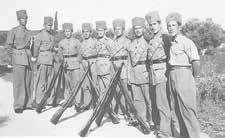
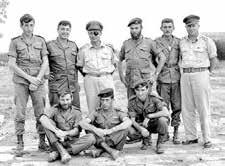

Avi Heiligman is a weekly contributor to The Jewish Home. He welcomes your comments and suggestions for future columns and can be reached at aviheiligman@gmail.com.


DU N DURT
Power & Soft Washing
We clean siding, stucco, decks, driveways, concrete, pool patios, pavers & sidewalks.
Say goodbye to grime, mold & allergens!
Call/WhatsApp: 718-688-2964
Email: dundurtny01@gmail.com
THE LEATHER SHOPPE
The spot for all your custom leather Judaica. Tallis/tefillin bags, lulav and esrog bags, havdallah sets, challah covers, shtenders, pesach sets, matzah/afikomen bags. WhatsApp: (732) 523-0007 or email: theleathershoppe732@gmail.com for a full catalog. We ship.
PEACEFUL PRESENCE STUDIO
Men’s private yoga, Licensed Massage & Holistic Health Guidance 436 Central Ave, Cedarhurst Info. & free video training www.peacefulpresence.com 516-371-3715
GERBER MOVING
Full Service Moving
Packing Moving Supplies
Local Long Distance. Licensed Insured 1000’S Of Happy Customers Call Shalom 347-276-7422
HANDYMAN AVAILABLE
For big or small jobs, Sheetrock, carpentry, painting, electrical, plumbing, install & repair appliances Call Ephraim at 347-593-4691
MANAGEMENT STAFF WILL ASSIST
you with: * Obtaining Medicaid and Pooled Income Trust
* In-home Assessments, Individual and Family Counseling
* Securing reliable home care assistance
* Case and Care Management services
Dr. S. Sasson, DSW, LCSW (718) 544- 0870 or (646) 284-6242
HAIR COURSE:
Learn how to wash & style hair & wigs.
Hair and wig cutting, wedding styling
Private lessons or in a group Call Chaya 718-715-9009
ZEVIZZ WOODTURNING JUDAICA
Challah knifes, batei mezuzah, besamim holder, kiddish cups, havdalah candle holders, yad for sefer torah, pens, stenders, bowls and more 952-356-2228
MY MOTTO IS DON’T WAIT TO buy real estate
Buy real estate and wait
Your realtor for life
516-784-0856 Alexandra at Realty Connect USA
REAL ESTATE MANAGEMENT
Services – Do Not Manage Your Properties Alone!
Contact Aliyah Suites for all your real estate management needs and affordable office space near you! (516) 366-1049
Management@aliyahsuites.com
Marc Jeret (MJ) Team Leader & Licensed Real Estate Agent




















classifieds@fivetownsjewishhome.com • text 443-929-4003
CEDARHURST
Prime Restaurant Location For Lease.
For more information: Call/Text/WhatsApp Owner: (516) 206-1100
5 TOWNS - OFFICES FOR LEASE
250SF to 500SF Offices in Inwood & Cedarhurst Utilities, Internet & Parking incl. with some Kosher kitchen - Minyan Next to LIRR - No broker fee Call/text/Whatsapp: 516-206-1100
Don’t Get Stuck With a Two Story House Ya Know, It’s One Story Before You Buy It But a Second Story After You Own It!
Call Dov Herman For An Accurate Unbiased Home Inspection InfraredTermite Inspection
Full Report All Included NYC 718-INSPECT
Long Island 516-INSPECT www.nyinspect.com
WANT TO WORK WITH A COMPANY that sells guitar accessories?
We need help boxing and shipping our gear, taking pictures and organizing our inventory.
If this sounds interesting, reach out!
Evan (516) 447-1018
DELIVERY PERSON NEEDED
to deliver this Newspaper every Thursday morning to locations in Brooklyn. Must have Mini van or SUVand availability to work Consistently every week. Good pay - Please email gabe@fivetownsjewishhome.com or call (917) 299-8082

BOOKKEEPER
A Five Towns Real Estate Company is seeking a full-time Bookkeeper. The right candidate must be proficient with QuickBooks and Excel. They must also be self-motivated, organized, detail oriented, reliable, and able to work independently or as a team player. Warm, frum office environment with excellent salary & benefits. Please email resume to HR@capsprop.com
BEHAVIOR TECHNICIAN
Pays up to $30 an hour.
Part-time: Late Afternoon (3-9 pm) M-F. ABA therapy support for child. Warm Jewish family environment. Garden City, Valley Stream NY Text: 718-304-6359 or email: talent@encoresupport.org to apply.
YESHIVAT KOL YAAKOV
In Great Neck, NY, is seeking general studies teachers for both the elementary and middle schools, for the upcoming academic year. Mon-Thur afternoons. Competitive salary, warm and supportive environment. Send resume to m.kalati@kolyaakov.org
For current school year, starting from end of January: Seeking assistant teacher for General Studies. Candidate should have skills to take over for teachers if needed. Far Rockaway area boys’ school, M-Th, PM hours, strong support. Excellent salary. Possibility to continue for next year. Send resume to teachersearch11@gmail.com







ARE YOU A DOULA?
Or have a passion to be? Come join our great referral group and get access to a vast new clientele through Medicaid. JUST CALL 347-668-7886
REGENTS EXPERT
Tutoring regents in Algebra and Geometry A Darchei Torah instructor. Guaranteed results Text 347-491-8045
WhatsApp 347-767-1755


5 Towns area Nursing Home management office seeking a Regional/Corporate level MDS Nurse to work in our office. Must be an RN. Regional experience preferred. 2-3 years MDS experience with good computer skills required. Position is Full Time but Part Time can be considered. Great Shomer Shabbos environment with some remote options as well. Email: officejob2019@gmail.com
A multi-tasker needed for general office work. The ideal candidate is someone who is detail-oriented, responsible, and can take ownership. Looking for someone who is eager to learn, and expand his/her skill set while possessing the ability to work independently and as part of a team. Experience with Excel required. Five Towns location. In-office position only, not remote. Please send resume to 5tpart.timecareer@gmail.com
HASHAVAS AVEIDA
Apple airpods found on Wednesday morning on the way to the Woodmere dock. To claim, 516-351-8105.
SHMIRAS HALASHON
Text 516-303-3868 with a time slot of your choice to be careful on lashon hara. Be a part of the 1,000 people for klal yisroel!
Chasdei Uvois Oshpitzin
Talmidei chachomim are willing to learn mishnayos, say kaddish and be the shliach tzibbur to daven for the umid on the yartzeit yom hashanah of your parents or close relatives or loved ones To arrange please call Rabbi Miller 917-445-6220











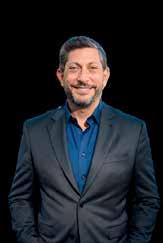











By Rivki D. Rosenwald Esq., LMFT, CLC, SDS

Ties — are they obsolete?
What about wristwatches? Home phones?
Are you one of the few people who is still holding on to these “relics” of the past?
OK, I don’t have a home phone, though I wish I did, since it doesn’t suddenly, independently hide itself. But I do love watches. I like to know the time.
People say, “Just look at your phone.” Excellent idea! I would, if I knew where it was! It seems it has to respond to a previous obligation to be somewhere else — where I am not! And I’m usually not privy to where that is.
Also, the cell phone battery lasts only a day, unlike my watch, which works for years at a time.
Many people cannot imagine needing a watch because their phone is an appendage to them, so they have no difficulty always knowing the time.
For me, the phone is my nemesis. I can’t find it. I get yelled at for not responding to it. It’s silent when I need it to ring.
And, of course, it’s ringing when I
need it to be silent — that, of course, is my embarrassing mazal.
Sometimes, luckily, I see it marching across the room. Thank goodness! Because as it vibrates in silent mode, it
office? Thankfully, it’s not in my domain, so I don’t need to grapple with it.
Will we one day be talking this way about cars that need a driver? For instance, “Do you still have one? What’s
What is a traffic cop going to do when he stops a self-driven car for an infraction?
begins to propel itself, in real time, across the surface it is on.
Ties aren’t my issue. I never wore them. Though, men did.
Do young people have any if they are not attending yeshiva? Is it still shul garb?
Certainly fewer and fewer men seem to be wearing them to work.
In fact, fewer and fewer people seem to be actually going to work!
Do you need to dress as formally for your computer meetings as you did for the
that like? Cops must love you! They can stop your vehicle and actually have a driver to talk to.?
I mean, what is a traffic cop going to do when he stops a self-driven car for an infraction? Who exactly is he ticketing?!
The world keeps changing. And it happens pretty quickly. But some of us like some of the good, old, dependables.
For instance, last week, my phone decided to update itself. On its own, of course! Now my search button is on the
bottom instead of the top. So, of course, I spend half my time searching for my search button now, since I am so used to it being where it was for years.
No one asked me if I wanted the change. It just happened!
I’m just praying that with all the advancements and changes, we humans still stay relevant.
I asked ChatGPT that actual question, and the answer was “very likely” yes.
I’m not sure that’s a completely comfortable answer.
Wait a minute — I’d like a clarification from ChatGPT as to what “very likely” means — but what did I just do with my phone?!
Rivki Rosenwald is a Licensed Marriage & Family Therapist working with both couples and individuals and is a certified relationship counselor. Rivki is a co-founder and creator of an effective Parent Management of Adolescent Years Program. She can be contacted at 917-705-2004 or at rivkirosenwald@gmail.com.