







Out Loud Brachos Bring Mitzvos and Smiles
Yeshiva Kol Torah Anniversary Dinner
Rav Ahron Lopiansky Uplifts
YOSS Motzei Shabbos Learning






When the Olympics come around, the pageantry can be breathtaking. Flags rise, anthems swell, uniforms gleam under stadium lights. It is the rare moment when billions of people are reminded that athletes are not only individuals chasing medals; they are also ambassadors carrying the weight of something larger than themselves.
This year, several competitors suggested that while they wore Team USA across their chests, they did not necessarily represent America or everything it stands for. President Donald Trump pushed back publicly: if you’re wearing the uniform, if you’re standing under the flag, then like it or not, you represent the United States. You can’t separate yourself from it at the very moment the world is watching.
As Jews, that idea should sound familiar to us.
We speak to our children constantly about kiddush Hashem – the responsibility to sanctify Hashem’s name through the way we act. A yarmulke in the grocery store, a modest outfit in the airport, a Jewish name on a business card: these are not just personal details. They are uniforms. They tell the world that we are part of something extraordinary and significant –proud and visible.
And yet, it is a lesson that can be hard to absorb. After all, I’m just me, a teenager might say. I didn’t sign up to represent millions of people. I only wanted to catch my flight, finish my shopping, live my life.
But representation doesn’t require consent. We know this because we do it ourselves all the time. One unpleasant encounter with
a stranger in a foreign land, and suddenly we decide, “Ah, that’s how they are.” One kind act from someone from a particular country, and we feel warmth toward an entire nation. Fair? Perhaps not. Human? Completely.
The world makes assumptions. It always has. It always will.
Which means that, as Jews, every interaction becomes powerful. The way we speak to a cashier. The patience we show in traffic. The courtesy we extend to a neighbor. The business transactions that are performed with honesty. People are forming impressions not only about us, but about the Torah we cherish, the people to whom we belong, and the G-d Who sustains us each and every day.
It is an extraordinary privilege and responsibility.
To wear the “uniform” of the Jewish nation is to be entrusted with influence. A smile can create admiration. Integrity in business can inspire respect. A small act of decency can echo far beyond what we ever imagine.
The athletes are right about one thing: no person can perfectly embody an entire country. But the moment you step onto the field draped in its colors, you are carrying its story.
So are we.
Every day, in every place we go, the flag of the Jewish nation travels with us. Let us hold it high, with distinction, proud of who we are and what we represent.
Wishing you a wonderful week, Shoshana

Yitzy Halpern, PUBLISHER publisher@fivetownsjewishhome.com
Yosef Feinerman, MANAGING EDITOR ads@fivetownsjewishhome.com
Shoshana Soroka, EDITOR editor@fivetownsjewishhome.com
Nate Davis
Editorial Assistant
Nechama Wein Copy Editor
Rachel Bergida
Shana Brecher
Lani White Design & Production
Gabe Solomon Distribution & Logistics
P.O. BOX 266
Lawrence, NY 11559
Phone | 516-734-0858
Fax | 516-734-0857
Classified Deadline: Monday 5:00PM classifieds@fivetownsjewishhome.com text 443-929-4003
PAYMENT VIA CREDIT CARD MUST BE SUBMITTED ALONG WITH CLASSIFIED ADS
The Jewish Home is an independent weekly magazine. Opinions expressed by writers are not necessarily the opinions of the publisher or editor. The Jewish Home is not responsible for typographical errors, or for the kashrus of any product or business advertised within. The Jewish Home contains words of Torah. Please treat accordingly.






Dear Editor,
I recently got insight into what ahavas Yisrael means. During shiurim of Rav Yoshiyahu Yosef Pinto, he often asks if anyone has questions. After someone asks, he refers to them as a “tzaddik” (i.e., good question, tzaddik). Every person is referred to as a tzaddik. In his world, “Dan es kol adam l’kaf zechut, judge everyone favorably” is not the standard, but tzikdus is.
Steven Genack
Dear Editor,
A few weeks ago, I was contacted via email by Dr. Claus Hamann. He requested that I meet him for lunch. He identified himself to be the nephew of Heinrich Hamann.
Heinrich Hamann was the Nazi who orchestrated the mass murder of the 881 Jews in Mszana Dolna, Poland, on August 19, 1942 (corresponding to Vav Elul). My grandparents, Leibe Feige, z”l, and Natan Stern, z”l, were among those who were shot on that day. My uncle Naftali, 18 years old at that time, along with the other young Jewish men from the town, were ordered to witness their family members being murdered and afterwards to cover the bodies with soil and collect their belongings. Even as the blood continued to ooze and several could still be heard moaning, Heinrich Hamann, together with Mayor Gelb and the other co-conspirators, celebrated with drinking, music and joyful dancing.
In 1966, when Heinrich Hamann was captured and tried for his crimes of murder in all the shtetels in Nowy Sacz, it was reported by witnesses of the executions that he loudly declared that he would not fail like the Biblical Haman had to kill all
the Jews. Although he was successful in murdering thousands of Jews, he was not sentenced to hanging. He was sentenced to life in prison. These events become vivid in my mind as Purim approaches and on the yahrtzeit Vav Elul.
I suffered for years from debilitating nightmares of standing unclothed at the edge of a pit waiting to be shot. Would I agree to lunch with the nephew of Heinrich Hamann?
After visiting the mass grave in Mszana Dolna in 2022 and meeting with Urszala and her family who faithfully tend to the upkeep of the matzeivah and the remnants of the 18th century Jewish cemetery, I was able finally able to reach a modicum of comfort. My grandparents were not forgotten. Did I now wish to bring all the gory details back to the forefront of my mind by meeting a relative of the Nazi murderer of my grandparents? How would my father and my grandparents, who are now at rest in Shamayim, react?
This was my conundrum. In his initial email, Claus wrote that he visited the grave site in Mszana Dolna and other mass graves in Nowy Sacz, During his visit to Mszana Dolna, he told Urszala that he would be interested in communicating with descendants of victims in the mass grave in an effort to seek reconciliation. I gave Urszala consent to share my contact information with Claus.
We conversed via email for a few weeks, and he related to me how he grew up in Canada basically ignorant about the Holocaust. Claus’s father (the brother of Heinrich Hamann) was a prisoner of war in Canada from 1934 when his submarine was captured by the Americans until the end of the war.
on page 12


Continued from page 10
Claus said that his father refused to speak about “the war.” This, we had in common. My father, who lived with survivor’s guilt, never spoke about his parents or his brother or what had happened to them. All that I knew was the yahrtzeit of my grandparents and the yahrtzeit of my uncle who reportedly died a few months later and the name of the Polish town Mszana Dolna. All that I came to learn was from my own research.
Claus, who lives in Boston, was in New York, visiting friends and offered to meet me in cafe in my neighborhood if I would agree. Having mixed feelings, I agreed. That is how I came to have lunch with Hamann.
I met Dr. and Mrs. Hamann in Sunflower Café, and we talked for a couple of hours. He told me about his visit to the crime scenes of his uncle. He needed to confront the reality of his uncle’s evil and come to terms with it. Claus told me that he met his uncle once in the nursing home where he lived out his life. “He appeared like any other old man walking with a cane, and he was not contrite.” Those were Claus’ words.
He was very emotional and seemed quite sincere. In fact, he cried many times. He thanked me profusely for meeting with him. To say the least, it was an extremely strange encounter, and of course, I let him pay for lunch.
Why did I agree to this get-together and what did I get out of our discussion? I find that I am now able to acknowledge that he (and maybe others) felt pain regarding the past. Nonetheless, his pain could never rise even close to the level of agony that I experience every time my nightmare recurs. However, I feel that it is of great significance that he was entrenched in facing the evil of his uncle and other Nazis. With the many Holocaust deniers and revisionists in the world, I met one German man who acknowledged the reality and the horrors of the Holocaust, and hopefully he will share this knowledge with many others.
One small mission accomplished.
L. S.
Dear Editor,
One evening, a wife sent her husband to the pharmacy to get meds for their daughter. As he left the store, he noticed an elderly lady sitting on the bench. He went over and asked if she needed anything. She was lost and wanted to get home. He called his wife and told her that he would be a little late. He is giving an elderly woman a lift home. The address that she gave him didn’t exist.
He looked around and asked her if she saw anything familiar. She said she lived near a big synagogue. He drove her to one synagogue and then another, to no avail. Finally, the man took her to the police station. The sergeant told him that he could go now and that they would take over. Someone would call for her no doubt soon. The man said, “No, my mom is about her age, and if she was lost or in trouble, I’d like to know that someone was with her.”
He stayed with her. He asked her if she was hungry and then went across the street and bought her yogurt, pastry, and coffee. She enjoyed the treats. He enjoyed the company. About one hour later, someone called the station and said he was looking for his lost mom.
Two days later, this man gets a call from his mom. She said, “You’re never going to believe what happened to me. It was dark outside, and I ran out of gas and I was in a bad neighborhood. Just then, two teenagers, who looked like gang members with tattoos on their arms, knocked on my window. I feared the worst. I was ready to hand over my purse.”
But instead of bothering her or causing harm to her, they asked her, “What is the problem?” She said very timidly that the car ran out of gas. They told her not to worry and that she would be fine. They proceeded to the gas station nearby and brought back gas. She was overwhelmed and appreciative. “What can I do for you?” she asked. One of the young teens replied, “We won’t accept money, lady. You just stay safe. If this happened to my mother, I’d want someone to help her.”
Could there be a connection between this man’s act of kindness and kindness done for this man’s mom?
You know what the difference between sympathy and empathy is? A boy fell into the well. He hollers, “Someone please help me!” One bystander says, “What a pity” “So sad” – that’s sympathy. The other bystander climbs down the well and fetches the boy – that’s empathy. Empathy is real. Sympathy is fake.
Was there a connection with the man’s act of kindness in helping the elderly lady and the kindness done for his mom trapped in a tough neighborhood? Could it be that when we help others some type of kindness really boomerangs back to us? You bet!
The darkness of night ends and morning begins when we start to notice and help others.
Israel Root



At least 31 people were killed on Friday when a terrorist opened fire at the gates of a Shiite Muslim mosque in Islamabad before setting off a suicide bomb. The attack was the deadliest of its kind in Pakistan’s capital in over a decade.
More than 170 others were wounded in the explosion, detonated after guards challenged the attacker as he made his way into the Khadija Tul Kubra Imambargah compound on the outskirts of the city.
The man blew “himself up in the last row of worshippers,” Defense Minister Khawaja Asif wrote on X.
He said the bomber had a history of traveling to Afghanistan and blamed neighboring India for sponsoring the assault, without providing evidence.
Afghanistan’s foreign ministry condemned the attack. Kabul has repeatedly denied charges that it provides safe haven to militants carrying out attacks in Pakistan.
Conflict monitor ACLED said the attack “bears the hallmarks of the Islamic State.”
Shiite Muslims are in the minority in the predominantly Sunni Muslim nation of Pakistan. They have been the targets of violence in the past, including attacks perpetrated by Islamic State and the Sunni Islamist group Tehreek-e-Taliban Pakistan.
Bombings are rare in the heavily guarded capital, although Pakistan has been hit by a rising wave of militancy in the past few years, particularly along the border with Afghanistan.
The capital was already on high alert on Friday for the visiting President of Uzbekistan, Shavkat Mirziyoyev, with roads around the capital blocked by checkpoints and security forces posted across the city.
The last major attack in Islamabad was a suicide bombing on November 11
that killed 12 people and wounded 27 others. Pakistan said it was carried out by an Afghan national. No group has claimed responsibility for that attack.

On Sunday, residential buildings in Tripoli, Libya, collapsed, killing at least 14 people. Rescuers were able to save at least eight people from the rubble.
The buildings in the northern city’s Bab al-Tabbaneh neighborhood consisted of two blocks, each containing six apartments. Residents estimated that 22 people were inside at the time of the collapse.
A number of aging residential buildings have collapsed in Tripoli, Lebanon’s second-largest city, in recent weeks, highlighting deteriorating infrastructure and years of neglect.
Mayor Abdel Hamid Karimeh stated, “We declare Tripoli a disaster-stricken city” due to unsafe buildings. “Thousands of our people in Tripoli are threatened due to years of neglect,” he said. “The situation is beyond the capabilities of the Tripoli municipality.”
After Sunday’s incident, the NNA reported that angry young men took to the streets on motorbikes, some heading “to the offices of some politicians” and vandalizing metal barriers there.
In January, the head of the higher relief authority, Bassam Nablusi, citing Tripoli municipality statistics, said 105 buildings required “immediate warning notices to their residents to evacuate.” Many buildings in the country – not just in Tripoli – are in dire need of repair.
Local media noted that the structure that collapsed on Sunday was not included in a list of buildings at imminent risk.
Just hours after walking free from more than eight months in detention,


Venezuelan opposition leader Juan Pablo Guanipa was reportedly taken away once again—this time by armed men in civilian clothing.
María Corina Machado, the exiled opposition figure and Nobel Peace Prize laureate, said the incident occurred late Sunday night in a residential neighborhood of Caracas. In a message posted to social media, she wrote that “heavily armed men, dressed in civilian clothes, arrived in four vehicles and took him
away by force.” She demanded his immediate release.
The account was echoed by Guanipa’s son, Ramón, who said roughly 10 men captured his father. At least three vehicles were involved, he added, calling it a kidnapping and pleading for proof that his father is alive.
Within hours, Venezuelan authorities released a statement saying they were seeking to place Guanipa under house arrest, alleging he had violated the terms of
tied to last year’s legislative elections, charges he repeatedly denied.
His release earlier Sunday had been viewed as part of a broader move by authorities to free dozens of political detainees amid mounting international pressure and discussion of a possible amnesty bill.

In remarks to reporters after regaining his freedom, Guanipa sounded hopeful. “I am convinced that our country has completely changed,” he said. “It is now up to all of us to focus on building a free and democratic country.”
By midnight, that hope had given way to renewed fear.
Rights advocates say they still do not know who has Guanipa or where he is.

Tehran has sentenced Nobel Peace Prize laureate Narges Mohammadi to seven more years in prison after she began a hunger strike. The sentence comes as Iran cracks down on all dissent following the protests that swept the country just weeks ago and Iran tries to negotiate with the U.S. over its nuclear program.
Mohammadi’s lawyer, Mostafa Nili, confirmed Mohammadi’s sentence on X, saying it had been handed down on Saturday by a court in the city of Mashhad.
his freedom. The Public Ministry did not clarify whether he had in fact been re-arrested or where he was being held.
The conflicting narratives only deepened the uncertainty surrounding the fate of one of the country’s most prominent critics of the regime.
Guanipa, a former governor and senior leader in the center-right Justice First party, had been imprisoned in the notorious El Helicoide facility. He was accused of involvement in a terrorist plot
“She has been sentenced to six years in prison for ‘gathering and collusion’ and one and a half years for propaganda and two-year travel ban,” he wrote. Mohammadi had received another two years of internal exile to the city of Khosf, about 460 miles south-east of the capital, Tehran, the lawyer added.
Supporters say Mohammadi has been on a hunger strike since February 2. She had been arrested in December at a memorial ceremony honoring Khosrow


Alikordi, a 46-year-old Iranian lawyer and human rights advocate who had been based in Mashhad. Footage from the demonstration showed her shouting, demanding justice for Alikordi and others.
Supporters had warned for months before her December arrest that Mohammadi, 53, was at risk of being put back into prison after she received a furlough in December 2024 over medical concerns. While that was to be only three weeks, her

António José Seguro, a center-left Socialist candidate, defeated his hard-right populist rival, André Ventura, in Portugal’s Sunday runoff presidential election, winning 66.7% of the vote while his competitor received 33.3%.
“Portugal’s voice for our shared European values remains strong,” wrote European Commission President Ursula von der Leyen, congratulating Seguro on his victory.
The election results indicate a national resistance to populism and rightwing, anti-immigration rhetoric. Though Ventura’s party won the second-highest number of seats in Parliament back in May, voters ultimately preferred Seguro, a self-described moderate who vowed to work with the center-right minority government.
The president of Portugal is largely a symbolic position, though it carries a few key powers. For example, the president can dissolve Parliament and call early elections. The office is limited to two fiveyear terms.
Ventura was particularly outspoken against immigration and the political establishment.
Next month, Seguro will be sworn in as president.
time out of prison lengthened, possibly as activists and western powers pushed Iran to keep her free. She remained out even during the 12-day war in June between Iran and Israel.
While free, Mohammadi continued to be vocal against the regime, attending public protests and media appearances, even demonstrating in front of the notorious Evin prison, where she had been held. She had been serving 13 years and nine months on charges of collusion
against state security and propaganda against Iran’s government.
Mohammadi suffered multiple heart attacks while imprisoned before undergoing emergency surgery in 2022. In late 2024, her lawyer revealed doctors had found she had a bone lesion that they feared could be cancerous, which was later removed.

According to reports, Iranian officials have arrested at least four members of the reformist movement as part of what appears to be a renewed assault on individuals seeking government reform. The crackdown comes in the wake of


22 major anti-government protests that recently swept the nation.
Narges Mohammadi, a Nobel Peace Prize laureate, was arrested and sentenced to another seven years in prison.
Iranian authorities also arrested Azar Mansouri, the leader of the Reformist Front, a coalition of several reformist factions; Mohsen Aminzadeh, a former diplomat who served in reformist President Mohammad Khatami’s administration; and Ebrahim Asgharzadeh, who headed the 1979 storming of the U.S. Embassy in Tehran, leading to the 444-day hostage crisis.
In January, a reformist statement demanded that Supreme Leader Ayatollah Ali Khamenei, 86, step down and allow a transitional governing council to lead Iran.
Others were summoned by authorities, according to the state-run IRNA news agency, which quoted officials accusing suspects of “organizing and leading ... activities aimed at disrupting the political and social situation in the country amid military threats from the United States and the Zionist regime.”
“Having bludgeoned the streets into silence with exemplary cruelty, the regime has shifted its attention inward, fixing its stare on its loyal opposition,” wrote Ali Vaez, an expert on Iran at the
International Crisis Group. “The reformists, sensing the ground move beneath them, had begun to drift — and power, ever paranoid, is now determined to cauterize dissent before it learns to walk.”
Whether reformists have the public’s support is unclear. Many protesters oppose the reformists.
Meanwhile, tensions have been rising between Iran and the United States, with U.S. President Donald Trump threatening an attack if the two countries fail to reach a deal. Last week, negotiators began discussing a potential nuclear agreement in Oman.

The conservative Bhumjaithai Party, led by Prime Minister Anutin Charnvirakul, won the most votes in Sunday’s

election, securing around 194 seats in Thailand’s 500-seat House of Representatives. Its chief rival, the progressive People’s Party, came in second with 116 seats.
Those results mean that Anutin’s party will, with the help of coalition partners, very likely maintain its majority in the House, with Anutin remaining prime minister.
Recent clashes between Thailand and Cambodia played a role in Anutin’s victory, with the incumbent depicting himself as a patriot defending his country. Though he has touted his relationship with Cambodian Prime Minister Hun Manet, Anutin has blamed Cambodia for the conflict and praised Thailand’s military.
Natthaphong Ruengpanyawut, the leader of the People’s Party, said his party would not join Bhumjaithai’s coalition but would instead keep the government accountable.
The People’s Party, which succeeded the dissolved Move Forward Party, failed to secure the support its predecessor won in 2023.
Anutin is a strong ally of Thailand’s royal family. He does not support reforms to lese-majeste laws, which prohibit individuals from criticizing the monarchy. The Move Forward Party was dissolved by the Constitutional Court in 2023 for campaigning against lese-majeste. Since then, the People’s Party has avoided the issue.
Though Thailand’s economy has been growing at a snail’s pace, Anutin’s economic agenda won him public support.
Thailand has long maintained an internationally neutral stance, refusing to side with either the United States or China.

Jimmy Lai, a Hong Kong media mogul with British citizenship, received a 20-year sentence on Monday in Hong Kong in his national security trial.
Lai, 78, founded the Apple Daily newspaper, which has since been shut down. The publication criticized the Chinese
Communist Party and its Hong Kong appointees. Lai was arrested in 2020, along with other prominent figures, under the 2020 National Security Law and was sentenced by Hong Kong’s Court of First Instance on three charges related to “endangering national security.” The arrests followed mass protests in the territory.
Eight others, including an activist, a paralegal, and six former senior Apple Daily staff members, received sentences ranging from six years and three months to 10 years.
Lai has been in jail for over five years on separate charges. Unless he is released earlier, he will likely remain in prison for the rest of his life.
The National Security Law has been used to target pro-democracy activists, journalists, legal workers, and former legislators in Hong Kong, which is supposed to maintain a separate and free system.
World leaders and international officials condemned the sentencing. U.S. President Donald Trump has asked his Chinese counterpart, Xi Jinping, to free Lai, citing his age and health. U.K. Prime Minister Keir Starmer also discussed Lai with Xi.
“The prosecution of Mr. Lai and his co-defendants has had a chilling effect on free speech in Hong Kong,” stated Australian Foreign Minister Penny Wong. “We continue to call on China to cease suppression of freedoms of expression, assembly, media, and civil society, consistent with U.N. Human Rights Committee recommendations, and to call for the repeal of the National Security Law in Hong Kong.”
The Taiwanese government also condemned the sentencing.

Lebanon, which sits atop one of the Middle East’s largest gold reserves, may begin selling its holdings to revive its struggling economy.
Since the 1960s, Beirut’s central bank has maintained a reserve of 286 tons of gold, the region’s second largest after Saudi Arabia.


In late 2019, Lebanon’s banks collapsed following an economic crisis exacerbated by corruption, waste, and abuse, wiping out citizens’ savings and pushing around half of the country — more than three million people — into poverty. Lebanon lost around $70 billion in its financial sector, as well as about $11 billion in costs incurred by Hezbollah’s war with Israel.
Gold prices world wide recently hit an all-time high of $5,354 per ounce, though
they are now below $5,000.
If Lebanon were to sell its gold, it could bail out banks and help recover depositors’ losses. However, a 1986 civil-warera law currently bans the government from selling its reserves. Any sale would require a vote by Parliament, though such a move is unlikely, as the idea is unpopular. Last week, Speaker Nabih Berri immediately rejected the notion, saying it is “not feasible.”
Many Lebanese citizens, distrustful of
mandate for her ambitious agenda just 110 days into her term. She secured an overwhelming victory, capturing a historic supermajority in the 465-member House of Representatives.
Before the snap election, her rightwing Liberal Democratic Party held 198 seats in the lower house. It now controls 316 seats. A Japanese political party has not won more than two-thirds of the chamber since World War II.
Takaichi, whose leadership has reversed years of misfortune for her party, told NHK, the public broadcaster, that she called the election because she believed “it would be wrong to simply drag things along without seeking a public mandate,” adding that she had “felt a sense of unease for a while” about her government’s legitimacy.

Her party will now find it far easier to enact its agenda, which includes an immigration crackdown and economic reforms. U.S. President Donald Trump endorsed Takaichi, congratulated her, and praised her “bold and wise decision to call for an Election.” In response, she wrote on X that “the potential of our Alliance is LIMITLESS.”
In November, Takaichi said Japan might become militarily involved if China invaded Taiwan. The statement drew condemnation from Beijing, as well as seafood import restrictions, limits on critical mineral exports, and other retaliatory measures.


the government and fearful of inflation, have purchased gold, relying on the metal as a more stable store of value.
Prime Minister Sanae Takaichi, Japan’s first female premier, held a snap election on Sunday, seeking a public
Voter turnout was around 56%, up two points from the 2024 House of Representatives election.
Other right-wing parties are also gaining traction, including Sanseito, a MAGA-esque movement that increased its representation from two seats to 15.
Saudi Arabia announced Saturday sweeping investments in Syria’s telecommunications, energy and aviation sectors, the latest sign of a deepening relationship between the two countries.
The deals represent a much-needed economic boost for the Syrian government, led by President Ahmad


whose rebel forces ousted the country’s longtime dictator, Bashar Assad, just over a year ago.
Since taking power, al-Sharaa has faced the daunting task of rebuilding a country devastated by a nearly 14-year civil war and an economy that was crippled by corruption and Western sanctions.
Syrian and Saudi officials announced the investment package at the presidential palace in Damascus, the Syrian capi-
tal. They said the deals included the creation of a joint airline; the rehabilitation of the international airport in Aleppo, one of Syria’s largest cities and an economic hub in the north; and a $1 billion investment to develop the country’s telecommunication network.
The project in Aleppo will “restore Syria’s leading industrial city to its pioneering role,” Talal al-Hilali, the head of Syria’s investment authority, said Saturday as he unveiled the deals alongside the
was closely allied with Iran and its Shiite theocracy, which was often at odds with the region’s Gulf countries. Now, under the largely Sunni Muslim government of al-Sharaa, Syria has pivoted away from Iran and toward the Gulf.

Saudi Arabia has emerged as a key backer of al-Sharaa and last year pledged $6.4 billion worth of investments in Syria, involving 47 agreements and more than 100 companies in sectors including infrastructure and telecommunications.
Al-Sharaa has made reviving Syria’s economy a priority, believing it will help stabilize the country. He has sought to charm world leaders as part of an effort to attract foreign investment and obtain sanctions relief. (© The New York Times)
Saudi investment minister, Khalid al-Falih.
Al-Hilali added that developing Syria’s telecommunications infrastructure “forms the foundation for building a modern economy.”
Saudi and Syrian officials did not disclose a total dollar amount for all the deals announced Saturday. But the investments underscore the shifting geopolitical landscape across the Middle East.
Under the Assad government, Syria

On Monday, the Israel Defense Forces said it had conducted an overnight operation from late Sunday into Monday in southern Lebanon, during which it killed two Hezbollah members and captured a senior terrorist from the al-Jama’a al-Islamiyya terror group.
Al-Jama’a al-Islamiyya, a Sunni faction of the Muslim Brotherhood, identified the captured terrorist as Atwi Atwi and claimed that he was taken from Habbariyeh, a town about five kilometers north of Lebanon’s border with Israel.
“The terrorist was detained and transferred for further interrogation within Israeli territory. In addition, weapons were located in the building where the terrorist was arrested,” the IDF said.


The IDF reportedly captured the terrorist rather than killing him so they could gain intelligence on the group’s operations in Syria and Lebanon.
After the capture, the IDF launched an airstrike in Yanouh, a southern Lebanese town, killing Hezbollah artillery commander Ahmad Ali Salami, who was responsible for several rocket attacks on Israel during the Jewish state’s 2023–2024 war with Hezbollah.
Lebanon’s Health Ministry claimed that three people were killed in the strike, including a child. In response, the Israeli military said it “regrets any harm to uninvolved civilians and operates to minimize harm as much as possible,” adding that “the incident is under review.”
In Ayta ash-Shab, another Hezbollah terrorist was eliminated by Israeli soldiers.
According to Israeli officials, al-Jama’a al-Islamiyya has “advanced throughout the war and continues to attempt to advance terror activities against the State of Israel and its citizens in the northern sector.”

Israel’s competition watchdog is claiming that El Al exploited its power during the war with Hamas and charged “excessive and unfair” fares. The airline is now facing NIS 121 million in fines.
The Israel Competition Authority said on Sunday that it notified El Al that it intends to impose the maximum sanction stipulated by law in the amount of up to NIS 121 million, which is around $39 million. The decision on the determination and imposition of the financial sanction is not final and is subject to a hearing where El Al will present its position.
When war broke out after the October 7, 2023 massacre, El Al essentially became the only airline operating many routes in and out of Israel after many foreign carriers canceled flights. During the two-year war, El Al raked in record profits as major foreign airlines repeatedly halted flight services to and from Israel, leaving travelers from Tel Aviv’s Ben Gurion
Airport almost entirely dependent on Israeli carriers.
“The security situation led to an extreme situation for the traveling public,” Israel Competition Authority head Michal Cohen said.
“The entire period was characterized by instability and a need for certainty in the ability to fly from place to place, and many consumers had no choice but to pay the prices charged by El Al for fear of flight cancellations [by foreign airlines], while others had no choice but to give up flying.”
The investigation by the competition regulator determined that El Al had a monopoly on most flights to and from Israel from the outbreak of war with Hamas on October 7, 2023, until the end of May 2024. During this period, El Al had a monopoly on at least 38 of the 53 routes it operated, including to major destinations such as London, New York, Paris, Bangkok, Tokyo and Los Angeles.
Based on an analysis of millions of airline tickets sold by El Al during the war period, compared to prices to the year before the fighting, the investigation showed that ticket prices rose by an average of about 16 percent, with some routes recording sharper increases of up to 31%. In addition, it was found that even on flights that were not fully booked in economy class, El Al hiked ticket prices by about 25%.
El Al pushed back against the charges.
“Even if the Israel Competition Authority’s position is accepted, according to which ticket prices rose by 16% on average for economy and premium classes (which is an incorrect figure in our opinion) during the war, there is no precedent for determining that such a price increase reflects excessive pricing,” El Al said. “El Al will present its full position at a hearing and in any appropriate legal forum and is convinced that its position will be accepted.”
The findings of the competition watchdog’s investigation showed that within a few days of the start of the Hamas war, El Al’s share of passengers to and from Israel rose from about 20% to more than 70%. During the first months of the war, El Al accounted for over 50% of all passengers flying to and from Israel.
Pearl Cohen law firm attorney Tal Rotman, who represents plaintiff Ilan Verednikov in a class action suit against El Al for alleged price gouging, said that “an official decision by the Competition Commissioner that El Al abused its monopolistic position would be prima facie evidence in the lawsuit we filed.
“It would pave the way for the lawsuit



to be approved as a class action, and for the award of significant compensation to El Al’s customers as well,” Rotman said.
In a move supporters are calling historic, Defense Minister Israel Katz and Finance Minister Bezalel Smotrich an-
nounced Sunday that the security cabinet approved sweeping steps to overhaul land registration and property acquisition rules in Judea and Samaria — changes designed to make it far easier for Jews to buy land and strengthen Israel’s presence in the territory.
The ministers said the decisions would “dramatically” reshape the real-estate landscape by dismantling decades-old restrictions and scrapping what they described as discriminatory laws dating
sue legal purchases.
The cabinet also repealed a provision that effectively prevented Jews from buying property privately. Under the old system, acquisitions often had to be routed through locally registered companies — a bureaucratic maze critics said discouraged legitimate transactions. The requirement for a special transaction license has now been replaced with standard professional criteria.
The new framework, the ministers said, will allow Jews to purchase land in Judea and Samaria just as they would in Tel Aviv or Jerusalem.

The cabinet further decided to increase Israeli oversight in areas related to water theft, environmental hazards, and damage to archaeological sites, including in Areas A and B.
Another major shift involves Hebron. Authority over building permits for the Jewish community — including at the Tomb of the Patriarchs, Judaism’s second-holiest site — will move from the Palestinian-run municipality to Israeli hands, streamlining a process that previously required multiple layers of approval.
A similar administrative mechanism will be established for the upkeep and maintenance of Kever Rochel.
Palestinian Authority officials blasted the measures and called for international intervention. Hamas responded with its familiar rhetoric, urging violence and demanding Arab and Muslim states sever ties with Israel.
Settlement leaders, however, hailed the move as long overdue. The Yesha Council said the government had taken one of the most consequential steps in decades, asserting that the decisions strengthen Israel’s rights in its historic heartland.
back to Jordan’s control of the area.
“These steps are intended to remove longstanding barriers, repeal discriminatory Jordanian legislation, and enable accelerated development of settlement on the ground,” the ministers said in a joint statement.
Among the most significant changes: land registries will now be made public. Until today, many records were classified, making it exceedingly difficult for potential buyers to identify ownership and pur-
Zubayar al-Bakoush, who is suspected to have participated in the deadly 2012

32 terrorist attack on a U.S. facility in Benghazi, Libya, in which four Americans were killed, has been brought to the United States.
Attorney General Pam Bondi announced his capture on Friday.
“Today, I’m proud to announce that the FBI has arrested one of the key participants behind the Benghazi attack,” Bondi said. “You can run, but you cannot hide.”

U.S. Ambassador to Libya Chris Stevens and three others — Sean Smith, Tyrone Woods, and Glen Doherty — were killed in the attack on a U.S. diplomatic compound and nearby CIA outpost by militants with the group Ansar al-Sharia on September 11, 2012. Jeanine Pirro, the U.S. attorney in Washington, said she informed the surviving family members of those who were killed of al-Bakoush’s capture ahead of time.
Prosecutors later unsealed a 13-page indictment in the U.S. District Court in Washington, D.C., charging al-Bakoush with seven counts, including murder, attempted murder, providing material support to terrorists and arson.
Prosecutors said that al-Bakoush was a member of Ansar al-Sharia. He was part of the group of armed militants who attacked the U.S. mission in Benghazi where Stevens and his security team were located.
During the attack, around 20 militants breached the main gate and set fire to the buildings, killing Stevens and Smith. Al-Bakoush allegedly entered the gate after the fires were set and “conducted surveillance activity” before trying to gain access to vehicles on the grounds of the compound.
A subsequent mortar attack on a CIA annex about a mile away from the U.S. mission killed Woods and Doherty, who were CIA contractors.
The State Department and CIA worked with the FBI to arrest al-Bakoush. The officials declined to give many details about how he was tracked down, except to say he was picked up “overseas.”
Pirro said there are more people out there responsible for the killings that day in 2012, and the federal government

won’t stop hunting for them.
“Let me be very clear — there are more of them out there,” Pirro said. “Time will not stop us from going after these predators, no matter how long it takes, in order to fulfill our obligation to those families who suffered horrific pain at the hands of these violent terrorists.”
Two others have been prosecuted in the U.S. for their roles in the attack.
In 2014, U.S. Special Forces captured Libyan national Ahmed Abu Khatallah, a purported leader of the attack. He was acquitted of murder charges in 2017 but was convicted on others and was initially sentenced to 22 years in prison. He was resentenced to 28 years behind bars in 2024, with a federal judge determining his initial sentence was too light.
In 2017, another Libyan, Mustafa alImam, was captured in a U.S. operation and brought to face charges. He was found guilty at trial in 2019 and was sentenced to 19 years in prison.

Grocery giant Kroger recently named Greg Foran, a former executive at top rival Walmart, as its next chief executive.
Kroger, the biggest grocer in the U.S. by sales after Walmart, had been searching for a permanent leader for almost a year after the departure of longtime CEO Rodney McMullen. Kroger executives had been looking for someone who could bring a fresh perspective to the company
Foran, 64 years old, joins Kroger while it tries to hold the line on food-price inflation and find new ways to expand its store footprint.
Known for his hands-on style as a leader, Foran oversaw a turnaround of Walmart’s U.S. business as CEO of that unit from 2014 to 2019. He focused on improving the behemoth’s fresh-food selection, as well as overall operation and appearance of stores during his time at the helm. After leaving Walmart, the New Zealand native became CEO of Air New Zealand, a role he held through the pandemic until last October.
Since McMullen resigned as Kroger’s CEO, the company has been led by its
chairman, Ron Sargent, the former CEO of office-supply retailer Staples.
Under Sargent, Kroger has been cutting costs across its operations, using the savings to try to lower prices and attract more cash-strapped shoppers to its stores. The company has cut roughly 1,000 corporate jobs, consolidated regional divisions, and closed underperforming stores and e-commerce fulfillment facilities over the past year.
Kroger reported $147 billion in revenue in its 2024 fiscal year.
Sargent has said that Kroger’s strategy has been to try to hold off on passing foodprice increases to customers and that it is rolling out more promotions, including the return of paper coupons. The chain has also been expanding its private-label products, including more protein-heavy items. Store-branded products are typically cheaper.
Foran is known to be a hands-on leader. For example, during his tenure at Walmart, on Saturday mornings, he would often take other executives on a company plane to visit stores around the country. He liked to inspect the quality of produce or meat and ask workers questions. He displayed a similar hands-on approach at Air New Zealand, sometimes working with cabin crew to serve drinks on flights.

San Francisco schools were closed on Tuesday as the city’s first teachers’ strike in nearly half a century stretched into a second day, keeping roughly 50,000 students out of classrooms.
The teachers walked out Monday after their union, United Educators of San Francisco, could not reach an agreement on raises and health care costs despite nearly a year of negotiations with the San Francisco Unified School District. The union represents about 6,000 teachers, librarians, social workers and nurses who work in more than 100 schools in the city.
The strike has no set end date. The last teachers’ strike in San Francisco, in 1979, lasted for nearly seven weeks.
District officials announced Monday


afternoon that schools would stay closed on Tuesday since negotiations with the teachers union were continuing.
San Francisco’s closure could be a harbinger in California, as teachers’ unions have made a concerted effort to pressure districts for more compensation in recent months. Besides the walkout in San Francisco, educators in Los Angeles, San Diego and two Sacramento-area school districts have authorized strikes as part of their ongoing contract negotiations.
In San Francisco, the local labor union said that rising health care premiums had driven many employees to leave the school district, California’s sixth largest, resulting in vacancies that hurt student instruction.
On Monday morning, Cassondra Curiel, the president of the union, the United Educators of San Francisco, led a rally on the steps of Mission High School, where dozens of teachers, dressed in red, rattled tambourines and hoisted signs calling for
come to an agreement,” she said.
San Francisco parents said they empathized with teachers struggling to make ends meet in one of the nation’s most expensive cities. But they were frustrated that the two sides couldn’t reach a deal — and that their children would pay the price. (© The New York Times)

On Tuesday, a group of Buddhist monks finally reached Washington, D.C. They crossed the bridge over the Potomac River single-file – a culmination of a 15-week walk from Texas advocating for peace.
The monks in their saffron robes have become fixtures on social media, along with their rescue dog Aloka. After spending Monday night at Marymount University in Arlington, Virginia, they crossed over the Chain Bridge into the District of Columbia shortly after 8 a.m. on Tuesday. Their trek began in late October, with some monks walking barefoot or in socks. As they walked through snow, they donned boots to protect their feet. As they marched along, thousands of people gathered along roadsides to watch their quiet procession. They spoke about mindfulness, a message that resonated with the thousands of people who followed their journey in person and online.
Large crowds are expected to greet them during their two-day stay in Washington. The Metropolitan Police Department issued a traffic advisory announcing there would be “rolling road closures” along the monks, route to ensure safety for them and spectators.
higher wages. Some brought their children, who were out of school for the day.
Curiel said she had been talking regularly with San Francisco’s mayor, Daniel Lurie, but ultimately rejected his request on Sunday to postpone the strike to allow more time to negotiate. The affordability crisis for educators needed to be addressed immediately, she said, adding that the union wouldn’t back down from any of its demands.
“The only way to call off a strike is to
“My hope is, when this walk ends, the people we met will continue practicing mindfulness and find peace,” said the Venerable Bhikkhu Pannakara, the group’s leader, who has taught about mindfulness at stops along the way.
The monks plan to mark the last days of their Walk for Peace with outdoor appearances at Washington National Cathedral on Tuesday and the Lincoln Memorial on Wednesday.
Nineteen monks began the 2,300-mile journey from the Huong Dao Vipassana

36 Bhavana Center in Fort Worth on October 26, 2025. They came from Theravada Buddhist monasteries around the globe, led by Pannakara, who is vice president of the Fort Worth temple.
While in the U.S. capital, they plan to submit a request to lawmakers to declare Vesak — Buddha’s birthday — a national holiday. Even so, Pannakara and others have emphasized that is not the goal of the walk.
Long Si Dong, a spokesperson for the temple, said the walk is neither a political movement nor is it focused on advocacy or legislation.
“It’s a spiritual offering, an invitation to live peace through everyday actions, mindful steps and open hearts,” he said. “We believe when peace is cultivated within, it naturally ripples outward into society.”
Tuesday marked 108 days of walking for the monks. That number is sacred in Buddhism, Hinduism and Jainism. It represents spiritual completion, cosmic order, and the wholeness of existence.
To return home, the monks will board buses, expecting to arrive in Fort Worth on Saturday, and will then walk together the six miles to the temple where their journey began four months ago.

New York City nurses have reached an agreement to end a strike at two major hospital systems.
About 10,500 nurses represented by New York State Nurses Association reached a deal early Monday with Montefiore Medical Center, Mount Sinai Hospital, Mount Sinai Morningside and Mount Sinai West. Members will vote on the contracts this week, and if ratified, are expected to return to work on Saturday, the union said.
“For four weeks, nearly 15,000 NYSNA members held the line in the cold and in the snow for safe patient care,” said Nancy Hagans, president of the New York State Nurses Association. “Now nurses at Montefiore and Mount Sinai systems are heading back to the bedside with our heads held high after winning fair tentative contracts.”
“This process has been difficult for all of us,” said Brendan Carr, chief executive of Mount Sinai. “While it has been amazing to once again see Mount Sinai do extraordinary things in order to serve our patients and community, it will take time to rebuild the momentum that we had in the alignment of our organization.”
Nurses went on strike on January 12, commencing the largest and longest nurses strike in New York City history.
Nurses are still striking at NewYork-Presbyterian/Columbia University Irving Medical Center. Staffing levels is the key sticking point in those contract discussions, it said.
NewYork-Presbyterian said it accepted a proposal presented by mediators on Sunday, which includes the same wage increases for all three hospitals. The proposal preserves the pension, maintains health benefits and includes increased staffing levels, it said.
“We look forward to bringing our nurses back to care for our patients,” NewYork-Presbyterian said.
The Montefiore and Mount Sinai nurses secured salary increases by more than 12% over the life of the proposed three-year contract. The proposed contract also provides protections against workplace violence and new rules about staffing levels.
“Nurses sacrificed their own pay and healthcare while on strike to defend patient care for all of New York,” said Pat Kane, executive director of the nurse’s union.

This week, Eddie Bauer announced that it declared bankruptcy – the third time the outdoor apparel company has filed for Chapter 11 protection from its debts.
The Bellevue, Washington-based company, which operates roughly 180 stores across the U.S. and Canada, said its retail locations will continue serving customers as the company starts winding down some stores. Its e-commerce and wholesale operations are not affected by the filing because they are operated sepa-
rately. The bankruptcy also doesn’t affect Eddie Bauer stores in markets outside the U.S. and Canada.
“This is not an easy decision,” Marc Rosen, CEO of Catalyst Brands, which holds the license to operate Eddie Bauer stores in the U.S. and Canada, said in a statement. “However, this restructuring is the best way to optimize value for the retail company’s stakeholders and also ensure Catalyst Brands remains profitable and with strong liquidity and cash flow.”
In recent years, the company has faced dwindling sales, supply-chain issues, and what Rosen on Monday cited as “ongoing tariff uncertainty.”
When Eddie Bauer was 21 years old, he opened up his first store in downtown Seattle called Eddie Bauer’s Tennis Shop. It was located in the back of a local hunting and fishing store. At first, he specialized in tennis rackets; he eventually branched out into golf clubs and fishing tackle and rebranded his store to Eddie Bauer’s Sport Shop. His store eventually became known for providing outerwear, including down jackets and sleeping bags, for the military during World War I. In 1963, Jim Whittaker wore the company’s clothing when he became the first American to climb Mount Everest.

On Saturday, shortly after the Washington Post laid off around one-third of its employees, the paper announced the departure of its publisher and CEO, Will Lewis.
“During my tenure, difficult decisions have been taken in order to ensure the sustainable future of The Post so it can, for many years ahead, publish high-quality nonpartisan news to millions of customers each day,” Lewis wrote in a public message to employees.
Lewis became the Washington Post’s CEO and publisher in 2023 during a financially troublesome time for the paper, replacing Fred Ryan. Before joining the Washington Post, Lewis was a Dow Jones chief executive and the Wall Street Journal’s publisher.
In the interim, the paper’s chief financial officer, Jeff D’Onofrio, will act as
publisher and CEO, the Washington Post announced. D’Onofrio, who previously worked for Google and Yahoo, joined the Post in June 2025. In an email to employees on Saturday, he wrote: “Customer data will drive our decisions, sharpening our edge in delivering what is most valuable to our audiences.”
The paper’s union said Lewis’s “exit is long overdue.”
“His legacy will be the attempted destruction of a great American journalism institution. But it’s not too late to save the Post. Jeff Bezos must immediately rescind these layoffs or sell the paper to someone willing to invest in its future,” the Washington Post Guild wrote, referencing billionaire tech CEO Jeff Bezos, who purchased the paper in 2013. Bezos framed the leadership change as an “extraordinary opportunity.”
“The Post has an essential journalistic mission and an extraordinary opportunity,” Bezos said. “Each and every day, our readers give us a roadmap to success.”
Under Lewis, the newspaper fired many employees, grappled with subscriber losses, and shifted toward a more libertarian viewpoint.

The Seattle Seahawks captured their second Super Bowl championship on Sunday, defeating the New England Patriots 29-13 in Super Bowl LX at Levi’s Stadium in Santa Clara, California. The victory was marked by a dominant defensive performance and strong contributions across Seattle’s roster, and fans now prepare for a massive celebration at home.
Seattle’s defense set the tone early, holding New England scoreless for much of the game and forcing turnovers that helped the Seahawks take control. Running back Kenneth Walker III, named Super Bowl MVP, rushed for 135 yards, becoming the first running back to win the honor since 1998. Quarterback Sam Darnold provided veteran leadership, completing 202 passing yards and a touchdown while avoiding costly mistakes.
“As long as you believe in yourself,

38 anything is possible,” Darnold said in a post-game interview at Disneyland Resort, where the team continued its celebration.
Walker, reflecting on his MVP performance, said the moment was especially meaningful because of the company he keeps in the sport’s history. “It meant a lot to me to be able to be on that list with those guys and, you know, the greats,” he told ABC News.
The game also drew a massive national audience: early estimates peg viewership at more than 130 million people across broadcast, cable, and streaming platforms, making Super Bowl LX one of the mostwatched broadcasts in U.S. history.
In Seattle, the celebration continues with the Seahawks World Champions Parade scheduled for Wednesday, February 11. City officials say they expect up to 1 million fans to line Fourth Avenue downtown for the procession and a victory ceremony featuring players, coaches, and the Vince Lombardi Trophy. Organizers are boosting transit service to accommodate the expected crowds and encourage fans to arrive early.
From the game’s opening kickoff to the streets of Seattle, Super Bowl LX showcased a complete Seahawks team — from defense to offense — and set the stage for days of hometown pride and celebration.
The CIA’s World Factbook, a cornerstone of global data relied upon for more than sixty years, was quietly shuttered last week, leaving educators, journalists, researchers, and government officials scrambling for a replacement. The Factbook, long prized for its reliability, offered
detailed statistics on everything from birth and death rates to major exports, serving as a go-to reference for both government operatives and the public.

First published in 1962 as the classified National Basic Intelligence Factbook, the collection aimed to provide American officials with a comprehensive overview of the world at the height of the Cold War. By 1971, an unclassified version appeared, and in 1981, it was renamed the World Factbook. With the advent of the internet in 1997, the CIA made it publicly accessible online, turning it into a free, widely used resource for anyone with a question about global populations, governments, economies, or geography.
For decades, the Factbook was regarded as an objective and trustworthy source, earning its own “Jeopardy!” category in 2020. Its disappearance, abrupt and unexplained by the CIA, leaves a gap in an information ecosystem increasingly dominated by conflicting or unreliable sources.
Not everyone mourns the closure. Beth Sanner, a former senior intelligence official, recalled her time in the 1980s working on the Factbook. Analysts painstakingly compiled and verified paragraphs, statistics, and political party details—a slow, exacting, and sometimes risky process. “When it started, it was important, because there was no such thing as the internet,” Sanner said. “Now it’s like, what’s the point?”
For generations, the World Factbook

was the quiet backbone of knowledge, a constant reference in a shifting world. Its absence underscores both the rapid pace of digital information and the fading of once-indispensable tools.

Last week, Ryan Routh, the man who tried to assassinate then-presidential candidate Donald Trump in 2024 at the president’s West Palm Beach golf club, was sentenced to life in prison plus seven years.
In September 2025, Routh was convicted on five federal criminal counts, including multiple firearms offenses, assaulting a federal officer, and attempting to assassinate a major presidential candidate.
Routh, 59, addressed the court, listing his own alleged good deeds for around 15 minutes before U.S. District Judge Aileen Cannon interrupted him and imposed the sentence.
Prosecutors wanted Routh to receive a life sentence. His attorney, Martin Roth, sought 20 years in addition to a mandatory seven-year sentence for the defendant’s gun conviction. Roth said that Routh “stands by his plea of not guilty” and objects “to any claim that he attempted to [commit] murder.”
“This would have been an easy kill. And the kill would have happened without [Secret Service] Agent Fercano,” Assistant U.S. Attorney John Shipley added. “This was intended to be a cold-blooded, concealed kill … to make sure the American people didn’t even have the chance to vote for him [Trump].”
“It would have taken less than an instant [for Routh] to pull the trigger, but the defendant did not,” Roth claimed. “At the moment of truth, he did not fire.”
After Cannon noted Routh’s criminal history, Roth admitted, “He’s a complex person, I’ll give the court that, but he has a very good core.”
“I never drank, never smoked, never did drugs,” the attempted assassin said during his speech. “I gave every ounce of myself to make America a better place.”
“Your plot to kill was deliberate and evil,” Cannon said before issuing the sentence. “You are not a peaceful man. And your criminal history shows it.” She sentenced him to life without parole in addition to seven years on a gun charge.
According to prosecutors, Routh plotted for weeks to assassinate Trump. When he attempted to carry out his plans on September 15, 2024, he was stopped by a Secret Service agent, who later testified at Routh’s trial.

A long-term study of around 132,000 healthy adults, published on Monday in the Journal of the American Medical Association, found that daily consumption of tea or caffeinated coffee may lower risk of dementia.
Researchers at Mass General Brigham, the Harvard T.H. Chan School of Public Health, and the Broad Institute of MIT and Harvard also analyzed two research datasets containing data from 1980 to 2023 on health professionals’ health and caffeine habits.
Participants reported their consumption of regular coffee, decaffeinated coffee, and tea through dietary questionnaires administered every two to four years. Over a median follow-up of almost 37 years, more than 11,000 participants were diagnosed with dementia.
Higher consumption of caffeinated coffee or tea was associated with a lower risk of developing dementia, with the association being stronger among individuals aged 75 and younger. Those with the highest intake of caffeinated coffee had an 18% lower risk compared with those with the lowest intake, while the highest tea consumers had a 14% lower risk relative to the lowest consumers.
Additionally, researchers identified the optimal intake, measured in 8-ounce servings, for each beverage. Compared with non-coffee or tea drinkers, individuals who consumed two to three cups of caffeinated coffee or one to two cups of tea per day had the lowest risk of dementia, equivalent to roughly 300 milligrams

of caffeine daily.
Notably, the inverse association between caffeinated coffee and tea consumption and dementia risk was also observed among individuals at higher risk of developing dementia, including carriers of the APOE4 gene, a major genetic risk factor for Alzheimer’s disease.
According to the World Health Organization, 57 million people were living with dementia worldwide in 2021. The condition particularly impacts women and usually comes in the form of Alzheimer’s.
Coffee consumption’s exact link to decreased dementia risk is unclear, though decaffeinated coffee has not been shown to have the same benefits. Researchers say more study is required to determine whether coffee and tea consumption actually cause a reduced dementia risk, as this particular study has some missing variables. For example, the study didn’t differentiate between caffeinated and decaffeinated tea, nor was it concerned with how the coffee was prepared (roast level, bean origin, brewing technique, etc.).

Snakes are not cute at any size, but this one, located in the Maros region of Indonesia, certainly takes the cake.
According to Guinness World Records, the reticulated python is the longest wild snake to be formally measured.
The female serpent measures a whopping 23 feet, 8 inches.
The snake is currently in the care of conservationist Budi Purwanto, licensed snake handler Diaz Nugraha and natural
history photographer Radu Frentiu. Nugraha and Frentiu said they went out in search of the impressively long snake after hearing of rumored sightings. They dubbed the serpent Ibu Baron, or “The Baroness.”
She weighs around 213 pounds. Reticulated pythons typically grow to an adult length ranging from 9 feet, 10 inches to 19 feet, 2 inches. Many of these snakes are killed as people are fearful of them when they venture into inhabited areas.
This one was lucky enough to be rescued by the three men.
And now she has really tipped the scales.

People living in Estonia are so cold that they have been driving across the sea.
The 12 1/2 -mile stretch of ocean linking two of the country’s main islands is frozen solid. Dubbed the “ice road,” the roadway connects the islands of Saaremaa and Hiiumaa, located in western Estonia between the Baltic Sea and the Gulf of Riga. It was officially opened on Sunday with a line of cars waiting to use it that afternoon.
Authorities decided to open the ice road after locals had spontaneously began driving across the frozen sea, exposing themselves to serious risks. Ferries had struggled to keep up regular service in the frozen sea following weeks of temperatures dropping to minus 10 degrees Celsius.
People living on the smaller island of Hiiumaa, with a population of 9,000, travel to Saaremaa, population 31,000, for shopping, a cup of coffee, or to drop off kids at school. Getting to the larger is-
land also ensures connection to mainland Estonia.
Hergo Tasuja, the mayor of Hiiumaa, says the ice road is part of Estonia’s “culture.”
“For generations and generations, local people who live here, especially those who live near the sea, swim and use boats in the summertime,” Tasuja said. “And in winter, it’s in their blood to go to the sea” and step out on the ice, he said.
Preparing the road for lines of cars isn’t easy. Workers have to measure ice thickness every 328 feet to determine the areas with more than 9 ½ inches of ice, the minimum required for safety. They also smooth over ridged ice and cracks. Weather conditions and the solidity of ice are monitored around the clock and the route amended accordingly.
Not all cars can cross. Vehicles can’t weigh more than 5,500 pounds. They also have to drive below 12 mph or between 25 to 43 mph. They’re not allowed to stop. And passengers can’t wear seatbelts and the doors need to be able to be opened easily – in case of an accident.
The last time the ice was thick enough for the cars to drive across was eight years ago.
In other words, don’t try this at home.

Last week, a Doberman pinscher took home the gold at the 150th Westminster Kennel Club Dog Show.
Penny, who hails from San Fernando Valley, won the contest in New York – an achievement not earned by her breed in nearly four decades.
Penny made her owners, Francis and Diana Sparagna, proud.
“When she came back and stood there like a statue and you could hear commentators from TV go, ‘That’s magnificent.’ If there was a moment where I thought she won, it was at that moment,” Francis said.
Penny’s handler was Andy Linton. Linton is also behind the victory of the last Doberman to win Westminster 37 years ago.
“I had some goals,” Linton said in a post-show interview. “And this was one.”
So proud of Penny.

On October 19, a gang of thieves broke into the Louvre’s Apollo Gallery and seized eight pieces of Napoleonic jewels. As they escaped through a window, the crown of Empress Eugénie slipped from their grasp. It was left battered on the Paris pavement below.
Commissioned by Napoleon III, the royal headdress was created for Empress Eugénie de Montijo and presented at the 1855 Paris Universal Exposition. Now, more than 100 days after the heist, the Louvre released images of the mangled crown as it begins to work to restore the head-covering’s former glory.
The item belongs to a rare collection of French crown jewels still held by the nation, after most were looted during the French Revolution beginning in 1789. The majority of what remained was auctioned off by the French state in a wave of republican sentiment almost a hundred years later.
Though never used for a coronation, it became a symbol of imperial power before entering the Louvre’s collection in 1988.
The crown is dazzling, with 1,354 diamonds and 56 emeralds. There are eight palmettes and gold eagles. One eagle is now missing. Half of the palmettes are detached.
While its shape has changed, nearly every component of the crown survives, allowing for a “complete restoration” without reconstruction or recreation, the museum noted. “It will simply involve reshaping its framework.”
It has retained all 56 of its emeralds and, of the 1,354 diamonds, only around ten small ones, from the perimeter of the base, are missing. Nine others were detached but preserved.
The museum is welcoming restorers to bid for the opportunity to repair the crown.
Let’s give it the royal treatment.

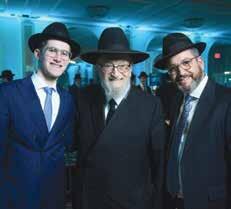
Chamisha Kolos: Celebrating Yeshiva Kol Torah’s
5th Year Anniversary Dinner




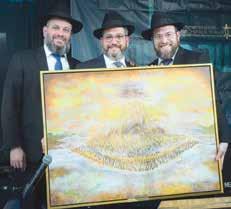





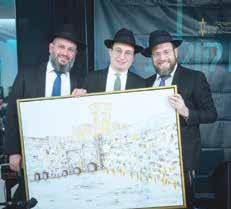

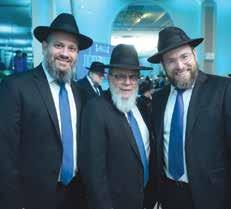













At the Village Board Meeting held on Monday, February 2, Cedarhurst Trustee Daniel Plaut presented a citation on behalf of the Incorporated Village of Cedarhurst recognizing Firefighter Robert “Bobby” Hicks of the Lawrence-Cedarhurst Fire Department for his bravery, dedication, and service to the community.
On December 20, 2025, while operating at a confirmed house fire at 215 Spring Street in North Lawrence in the critical nozzle position, Firefighter Hicks sustained serious burns to his leg. Despite the injury, he continued to perform his duties without hesitation, placing the safety of others ahead of his own. His actions demonstrated extraordinary courage, commitment, and selflessness in the face of danger.
Mayor Benjamin Weinstock reflected on the recognition, saying, “Our
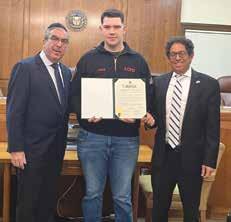
Board has had the privilege of knowing Bobby his entire life, and watching the person he has become has brought us great pride. His courage, integrity, and perseverance make us incredibly proud, and his willingness to put others before himself embodies the very best of public service.”
“Out of the Box” Play at Gan Chamesh
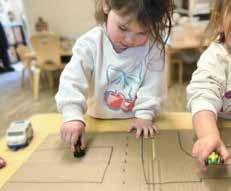
There was a definite air of excitement in the classrooms of Gan Chamesh, Chabad of the Five Towns Early Childhood Center, as the preschool began “Box Week.” Inspired by the holiday of Tu B’Shvat and the idea of taking care of Hashem’s beautiful world by recycling, Gan Chamesh instituted Box Week as a means of letting the children’s imaginations soar as they play and experiment with all different kinds of boxes. The children collected boxes of all shapes and sizes and proudly brought their collections to school. The regular classroom toys were set aside and the boxes took center stage. The children used the boxes to create massive towers, railroad stations, rocket ships and


The Out Loud Brachos contest, now in its 21th year, is being run in nine communities in the United States – the Five Towns, Queens, Great Neck, West Hempstead, Monsey, Passaic, Cleveland, Los Angeles and Chicago.

houses. Empty food boxes and canisters lined the shelves of the dramatic play and kitchen areas as well.
The box experience appealed to the children’s sense of engineering and architecture, as they judged which boxes work best as a foundation for their structures. Box Week provided a medium for problem solving and cooperation as the children devised their masterpieces together and participated in animated discussions about which boxes should be used to achieve a specific purpose. In light of the success of Box Week, many of the classrooms at Gan Chamesh will be extending the experience well into the next several weeks.
The Five Towns sponsors this year are Gourmet Glatt, Seasons Express, Kol Save, Chickies, Carlos & Gabby’s, and Pizza Pious.
The Queens sponsors are Queens Pita, Naomi’s Pizza and Aron’s Kissena Farms.
Please reach out to outloudbrachos@ gmail.com with any questions.

HAFTR Middle School proudly represented the school at the Yeshiva League Debate League competition, held this past week at Beth Sholom, delivering an outstanding performance against strong competition. The HAFTR team earned impressive individual and team honors, including second place Speaker to JJ Aron, and third place Team awarded to Natalie Touaf and Abby Stricker. In recognition of its overall excellence, HAFTR was named Best Overall School at the competition. These achievements reflect the students’ hard work, preparation, and commitment to thoughtful discourse, as well as the strength of HAFTR’s academic and extracurricular programming. Congratulations to our talented debaters and coaches on a remarkable showing. Kol hakavod, HAFTR!

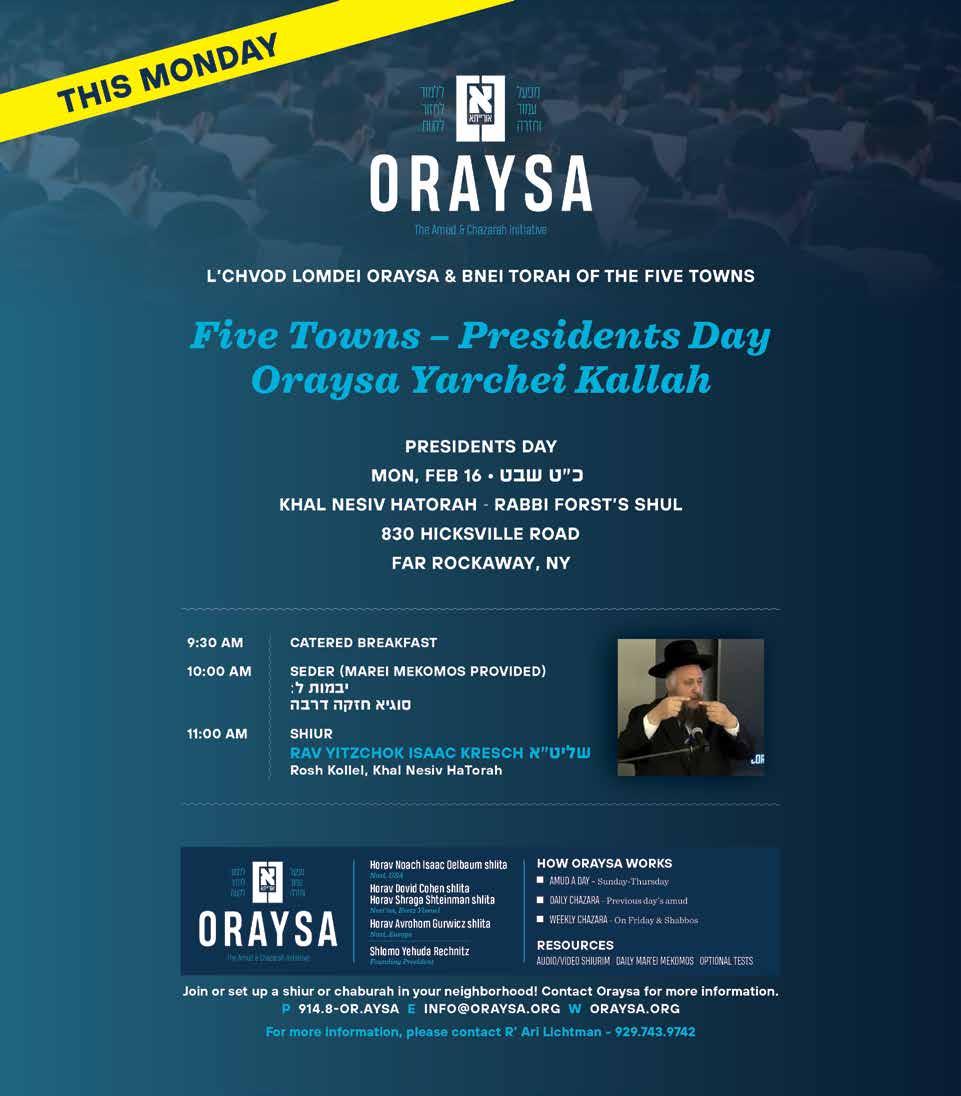

Rebbetzin Myrna Weinberger and Rebbetzin Chanie Wolowik at the Kinnus HaShlichos banquet on Sunday

The HAFTR Half-time Game Show was an exciting and energetic evening for our students and their families! The event took place on Google Meet, bringing everyone together for some friendly competition and school spirit. Participants enjoyed a lively football and Torah-themed Kahoot that was both fun and engaging. The questions kept everyone on their toes and sparked
lots of enthusiasm and teamwork. Over 60 teams competed in the gameshow with families hitting pause on their Superbowl festivities to inject some Torah into the night. Mazal tov to our winners, Team Eytan, Team Faska, and Team Isaac, who received gift cards to Central Avenue eateries! It was a wonderful night filled with laughter, learning, and community pride.


It was freezing cold outside, but in Bais Yaakov Five Towns, we were on fire as both fathers and daughters were captivated by an incredible magic show
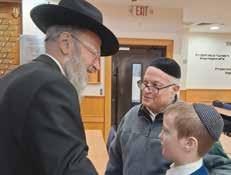
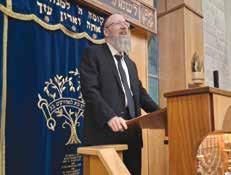

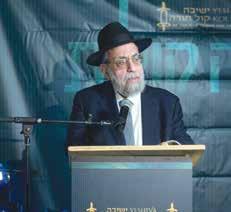
Congregation Anshei Chesed of Hewlett had the privilege of hosting Rav Ahron Lopiansky, shlit”a, Rosh Yeshiva of the Yeshiva of Greater Washington, this past Shabbos. Rav Lopiansky is the esteemed mechaber of several sefarim, including the highly acclaimed Ben Torah for Life and Ben Yeshiva, among others.
Rabbi Isaac Rice, Rav of Anshei Chesed, shares a warm relationship with the Rosh Yeshiva and recognized the tremendous benefit the community would gain from his presence over Shabbos. Rav Lopiansky spent Shabbos as a guest of the shul and addressed the kehilla multiple times. Both the shul’s members and the many visitors who walked in from afar, despite the unusually frigid temperatures, were inspired and uplifted by his drashos.
Throughout Shabbos, Rav Lopiansky delivered shiurim focusing on using Shabbos not merely as a day of rest, but as a transformative opportunity for
deepening one’s connection to ruchniyus. He also spoke about the importance of making balanced, thoughtful decisions grounded in intellect rather than extreme emotion.
A highlight of the visit was a Leil Shabbos Oneg and Q&A session hosted at the home of Michelle and Jon Newman, which drew a large and enthusiastic crowd. At seudas shelishis, Rav Lopiansky offered meaningful reflections on the life and enduring impact of the Alter of Slobodka.
The visit concluded on Motzei Shabbos at the Yeshiva of South Shore’s Father-Son Learning Program, where Rav Lopiansky was introduced by Rabbi Mordechai Kamenetzky. He delivered words of Torah and chizuk to an audience of over one hundred boys and their fathers. This Shabbos will be remembered by the shul and the broader community. The chizuk and divrei Torah that Rav Lopiansky shared left a profound impact and will continue to inspire for years to come.

By Sarah Sacks
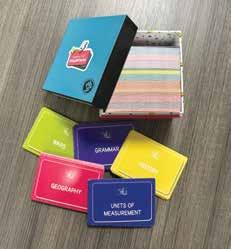
In homes across Far Rockaway and the Five Towns, little boxes full of knowledge have made their appearance. They look like a game. But in fact, these boxes are storehouses of information: cutting-edge education at its best.
A number of years ago, Dr. Golda Gross, grades 4-8 Curriculum Coordinator at BBY of Far Rockaway, created and copyrighted the Academic KID program. An acronym for Knowledge, Information, and Data, the program reinforced just that – the essential information that makes students more knowledgeable and worldly – in a direct, engaging way.
This year, BBY Junior High General Studies Principal Mrs. Surela Koenig reimagined the program for BBY, launching Academic KID 2.0: FlashFacts — a fresh, exciting update tailored to today’s students.
“If there’s one thing that trademarks BBY, it’s that we are constantly innovating,” says Rabbi Ephraim Blumenkrantz, Bnos Bais Yaakov’s executive director. “Instead of relying on copy-paste curricula, our in-house curriculum development team works in tandem with our principals, developing programs that will teach the students and engage and excite them.”
The team got to work. Mrs. Ahuva Buls, English Language Arts Coach and
fifth-grade teacher, updated and edited the original information for 2026 accuracy and relevancy. Then, Mrs. Koenig onboarded alumna Miss Adina Plotkin, graphic designer and junior high secretary, to give the program a brand-new look and format. She took it to the next level and created a most memorable year-long program, making it the ultimate success that it has become!
Academic KID 2.0 is a year-long program that’s swept up BBY’s junior high students in the pursuit of knowledge… and sometimes, their parents and siblings, too.
A few weeks before Chanukah, each BBY junior high student received an Academic KID FlashFacts box containing different color-coded categories of game-

style cards. The categories include practical but often-overlooked (or easily forgotten) topics such as acronyms, Roman numerals, communities and locations, math facts, etiquette, famous people, continents and oceans, literary terms and idioms, units of measurement, history, grammar rules, and more.
Every other week, students embark on a mission to study and memorize another category of cards. The cards themselves are fun to study from, but there’s more. Along with her FlashFacts box, each student received a charm bracelet, and for every quiz she passes, she earns a new charm relating to that category. To sweeten the deal further, high achievement secures students a place in the “Gold Member” listing on the FlashFacts screen in the hallway. (Along with the Gold Member list and the upcoming quiz date, the screen also plays a continuous slideshow of the week’s FlashFacts. Pass it during recess, and you’ll find girls gathered around testing each other!)
As one mother put it after seeing her daughter’s FlashFacts box at the dinner table, “I love it! The basic knowledge is so well thought-out and relevant. The formatting and graphics are attractive and appealing to the eye. So well executed!”
Another mother commented, “It takes learning with creativity and fun to a whole new level.”
And in the words of a teacher, “I love the video playing on loop in the hallway. In the morning and at recess, the kids were eagerly studying from their cards in the box. What an amazing program!”
But the best feedback of all has come directly from BBY students themselves… by way of their enthusiasm for the program. Learning in an entertaining and exciting way, they’re absorbing not only information, but a quest for knowledge, the ultimate goal of education – as they continue to grow into confident Academic KIDs.
This past Motzei Shabbos, Rambam Mesivta welcomed alumni back for its 3rd Annual Alumni 3-on-3 Basketball Tournament, an event that has quickly become a favorite tradition and continues to build on the spirit of Rambam’s legendary “February Madness” tournament.
The evening was marked by spirited competition and school pride, with multiple games running simultaneously throughout the night. Teams competed in a round-robin format before advancing to the playoff bracket, keeping the energy high from start to finish. Alumni representing graduating classes from 2001 through 2025 took part, with over 60 participants in attendance.
Midway through the evening, players

enjoyed a classic Rambam refreshment break featuring Snapple and Dunkin’ Donuts, providing an opportunity to reconnect with friends and recharge ahead of the playoffs. Assistant Principal Rabbi Avi Haar addressed the alumni with brief remarks, reflecting on the lasting impact of their Rambam years and emphasizing
the importance of staying connected to the school.
The tournament is part of Rambam’s growing slate of alumni engagement initiatives, which also includes Learning & Ball with Rabbi Avi Haar, the Alumni Short Story Club, the Alumni 501 Book Challenge, the Rabbinic Fellowship, and
Learning with Rabbi Dr. Andrew Sicklick.
With another successful tournament completed, alumni are already looking forward to continuing this growing Rambam tradition in the years ahead.

On a cold winter evening, the HANC Reinstein Family Educational Campus welcomed parents from HANC as well as families from the West Hempstead School District for an evening of meaningful learning focused on raising children with healthy self-esteem and strong self-efficacy. This joint parent education initiative, now in its second year, reflects a shared commitment to bringing expert voices to the West Hempstead community and equipping parents with practical tools to raise resilient children in today’s rapidly changing world.
Rabbi Ouriel Hazan, HANC Head of School N-8th, welcomed the guests in the school’s brand-new Beit Midrash and invited West Hempstead School Superintendent Mr. Dan Rehman to lead the audience in the Pledge of Allegiance.
This year’s featured speaker was Rabbi Shimmy Trencher, a respected Jewish educator and social worker who has spent more than three decades working with Jewish children and teens in a variety of educational and communal settings. Rabbi Trencher currently serves as the Executive Director of Community Engagement at the Maimonides School in Brookline, Massachusetts. He holds a Master’s Degree in Social Work from the University of Connecticut, with certification in mental health practice, and was trained as a parenting coach by the International Network of Children and Families.
Rabbi Trencher’s presentation focused on helping parents look beneath
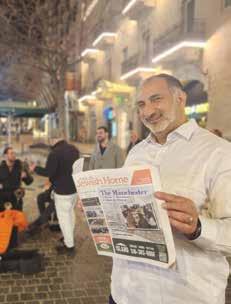

a child’s challenging behaviors to better understand what may be driving them. He emphasized the importance of responding in ways that build connection, promote responsibility, and lead to productive outcomes. Through the use of positive discipline, Rabbi Trencher explained, children are empowered to repair mistakes appropriately, develop stronger self-regulation skills, and work toward more positive behavior. Building self-esteem, self-efficacy, and a framework of positive discipline creates a powerful formula for both classroom success and a more peaceful home environment. The evening concluded with a strong sense of unity and shared purpose, as parents left feeling inspired and better equipped to support their children’s growth. HANC looks forward to continuing this important partnership with the West Hempstead School District and expanding future parent education opportunities that strengthen families, deepen community connections, and help ensure that every child has the support and confidence needed to thrive.
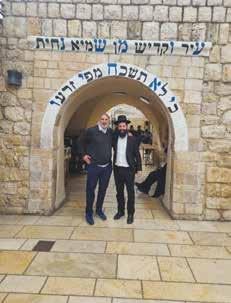
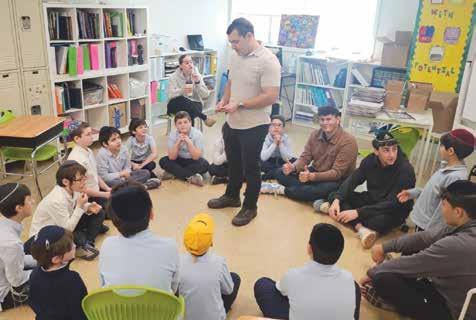
Each Wednesday at IVDU 5Ts, DRS boys visit our school to spend time integrating with our older classes. During their visits, they engage in a variety of sport activities and interactive games designed to strengthen teamwork, cooperation, and sportsmanship. The DRS boys serve as positive role models, demonstrating leadership and encour-
agement to the students. IVDU 5T students enjoy these visits and benefit from the strong connections formed each week, which strengthen their relationships with the DRS mentors. These meaningful bonds extend beyond the weekly visits, as the mentors also join us for special events and Chagigahs.
The Young Israel of Hewlett’s Youth Committee recently hosted a Winter Motzei Shabbos Family Learning Event sponsored by and in collaboration with Brandeis Hebrew Academy.
The event was led by Young Israel of Hewlett’s Youth Director Ariel Zaurov and Rabbi Aharon Bain of Brandeis Hebrew Academy and featured a special toddler program ran by Morah Nelly, early childhood educator from the Marion & Aaron Gural JCC.
Rabbi Bain joined Brandeis Hebrew Academy in 2025 as the School Rabbi. Rabbi Bain previously taught at Yeshiva Nishmas HaTorah High School in Inwood, NY, and studied at Yeshiva Darchei Torah in Far Rockaway.
The Family Learning Event had programming for all ages, from toddlers to young teens, along with their parents. The event included one-on-one par-
ent-child learning, a toddler shabbat art project, a middle school learning session led by Rabbi Bain, and a parsha question “game show” led by Young Israel of Hewlett’s Youth Director, Ariel Zaurov.
The Family Learning Event furthers the shared goal of the Young Israel of Hewlett and Brandeis Hebrew Academy, of bringing families together through learning Torah.
This event is part of a series of Winter Motzei Shabbat Family Learning programming hosted by the Young Israel of Hewlett’s Youth Committee and will be followed by another learning event scheduled for February 21, 2026, with the Young Israel’s annual Purim carnival scheduled for March 3, 2026. To find out all about our upcoming Youth Committee events and Shabbos programs, please reach out to the Youth Committee of the Young Israel of Hewlett at youthdept@ yihewlett.org

At the height of the COVID-19 pandemic, Tiffany and Moish Lehrer began seriously considering relocating their family of six. The Los Angeles–based couple — she, a teacher originally from New Jersey, and he, a marketing consultant originally from Montreal, Quebec — wanted to be closer to family, and Moish’s remote position enabled him to work from anywhere in the world. With two children entering sixth and fourth grade, and twins starting second grade, the Lehrers felt the timing was right.
“We were initially looking into Phoenix,” says Tiffany. “But my father had moved to West Hartford, Connecticut, and he encouraged us to explore it at the OU Savitsky Home Relocation Fair. I was already very familiar with the fair, as I had previously researched communities on the fair website.”
Launched in 2008 by former OU President Steve Savitsky, the biennial fair, geared toward singles and families of all ages, showcases affordable communities that combine the amenities of an Orthodox Jewish lifestyle with an enhanced quality of life. This year’s fair will take place on Sunday, February 22, 2026. Anyone considering relocation, now or in the future, is invited to register for free.
The Lehrers attended the fair in 2019 and, like Tiffany’s father, fell in love with West Hartford. They have been calling it home for the past four years.
“The community reminded me of the small town where I grew up,” Tiffany says. “I love the quaintness and intimacy of small towns, where you get to know everyone. I’ve lived in New York and Los Angeles, and you can get lost in the crowds.”
With travel and in-person hosting curtailed by the pandemic, Tiffany notes the fair made it far easier for their family to take the leap to West Hartford.
“Through the fair’s chat platforms, we were able to meet community members online when we couldn’t really travel or be hosted,” she says. “Ironically, one of Moish’s childhood neighbors lives in West Hartford, and he was on one of our chats. We also met Young Israel of West Hartford’s rabbi and the shul president at the time, among others.”
What began as a modest event has grown into a major virtual program, inspiring thousands to relocate to communities where they can strengthen Jewish life
while enjoying lower living costs. In 2022, the fair shifted to a virtual format, enabling access to participants worldwide. The platform also gives families with young children the freedom to participate without worrying about childcare, and offers discretion for those wishing to discuss sensitive matters, such as family members with special needs or recent unemployment.
In 2024, Steve and his wife, Genie, reaffirmed their commitment to Jewish communal development and long-term sustainability through a generous contribution to the Savitsky Communal Growth Initiative. The investment supported a variety of efforts, among them enhancements to the fair and its accompanying Community Guide, featuring communal amenities and services.
More than 2,000 people from 24 countries, including Argentina, China, Ethiopia, Finland, the Netherlands, and the UAE, registered for the fair in 2024. Among them were Morgan and Grant Hilsenrath of Manhattan. Parents to six-month-old Ezra, they were searching for a community close enough to the city, where Grant works as a CPA, and Morgan is a social worker specializing in geriatric and palliative care at a local hospital, in addition to maintaining a private practice.
“We knew that living in Manhattan and raising a family wasn’t for us, but we were struggling to find a place we could afford where we would both feel part of the community,” says Grant. “Someone mentioned that the OU fair takes place every other year. Luckily for us, 2024 was one of the ‘on’ years!”
Morgan was highly impressed by the breadth of the religious spectrum of communities – from Modern Orthodox to Yeshvish – represented at the fair.
“There were so many that I didn’t even know existed, and the fair really highlighted them well,” she says. “The virtual platform was incredibly easy to use. We were able to click on links to community websites for information, and most importantly, to filter by location. It made the process of narrowing down communities that much easier. I also loved being able to message community representatives directly; it felt so personal, and our questions were answered very quickly. As an added bonus, we were invited to community events, such as a brunch, to meet community members in person.”

After weighing the pros and cons of each community they explored, the couple chose Oceanside, New York, a 40-minute train ride from Manhattan.
“Being the accountant that I am, I put together a spreadsheet that tracked the things we cared about most when picking a community, such as price, size, distance to my parents, commute time to Manhattan, how friendly the people are, and how we’d fit in,” says Grant. “Once we had all that down, we narrowed down the list, visited a few communities, and ultimately landed on Oceanside.”
The 2026 fair will feature 50 communities from 20 U.S. states, including Arizona, Colorado, Indiana, Nebraska, and Oregon, as well as four communities in Israel: Carmei Hanadiv, Carmei Gat, Har Nof, and Sderot. Seven sponsors, including realtors and financial institutions, will also lead sessions and host booths.
OU Senior Director of the Savitsky Communal Growth and SPIRIT Retiree Initiatives Rebbetzin Judi Steinig oversees the fair and works closely with exhibitors before and after the event to ensure participants get the most out of the experience.
“In many ways, we act as a matchmaker, connecting people looking to move with communities eager to expand,” she says. “When our communities thrive, we all share in that success. We want to facilitate connections. Our support extends beyond the fair; it is always available to those considering relocation and the communities eager to grow.”
Participants may join the nine-hour virtual fair for as little or as long as they like. Attendees will enter a dynamic venue featuring moving escalators, a central lobby linking to an expo hall, an auditorium, and avatars representing the full spectrum of Orthodoxy.
Highlights of the fair will include short community introduction videos, downloadable e-brochures, discussion groups,
and private meetings with community representatives before, during, and after the event. Those unable to attend live may access all sessions on demand at ou.org/ fair, which also features up-to-date information on each community.
Lieba Abecassis of Jacksonville, Florida, is one of the founders of Grow Jax, a grassroots initiative launched by 12 community members from Chabad, Etz Chaim Synagogue, and The Shtiebel to help grow Jacksonville’s Orthodox community.
“Jacksonville currently has over 100 frum families, and we continue to host families considering relocation to our community,” says Abecassis. “Jacksonville has participated five times in the OU Savitsky Home Relocation Fair — this will be our sixth — and, Baruch Hashem, it has helped us to recruit a number of families over the years.”
Grow Jax committee member Breindy Lazor notes that the fair gives emerging communities a meaningful opportunity to showcase the best they have to offer.
“The fair opens the door for people at different life stages, and from diverse backgrounds within Orthodoxy, to discover communities outside the Tri-State Area,” she says. “That visibility was tremendously impactful for us. Being part of a fair that reflects our values has supported our community’s growth.”
Abecassis adds, “We are tremendously grateful to the Savitsky Communal Growth Initiative, former OU President Steve Savitsky, and Rebbetzin Judi Steinig for their dedication to out-of-town communities like Jacksonville. Their crucial work helps amplify the voices of communities like ours.”
To register for the OU Savitsky Home Relocation Fair and to order the 2026 Orthodox Jewish Community Guide, visit ou.org/fair.



Last semester, HALB seventh graders worked on a STEM project called Design Fab. Students had to use their knowledge of 3D printing and design to create a model of something that can be used for hiddur mitzvah. There were so many great ideas and projects! Some examples were a mezuzah case that buzzes as you walk past to remind you to kiss it, a plate with the bra-
cha acharona on it to remind you to say it, a memorial for the October 7th and Holocaust, Kiddush cups with the makkot painted on them for Arba Kosos on Pesach, a slingshot to help you throw the bread for Tashlich, a beautiful kosher cookbook and holder, and an Al Netilyat Yadayim cup that also holds your toothbrush.



At Shulamith School for Girls, educating the whole child has always meant more than academics alone. This year, the school introduced an exciting new initiative for the older grades called POP – Power of Presence, a program designed to encourage healthy and responsible technology habits. Recognizing the challenges that today’s students face in a digital world, the POP program was created to help girls develop greater awareness and balance in their use of devices. Participants commit to clear guidelines that include time limits on technology, appropriate content
usage, and handing in devices at night. The goal is simple but powerful – to help students be more present in their daily lives, with family, friends, and school.
The response has been overwhelmingly positive. Shulamith is proud that over 100 girls successfully kept to the POP guidelines throughout the first half of the year. Their dedication and commitment showed that with encouragement and structure, students are eager to make meaningful changes.
To celebrate this impressive accomplishment, the school rewarded these students with special grade trips during

the school day. Each group enjoyed a visit to Hot Spot Pottery in Lynbrook, where they participated in a fun, hands-on creative activity. The outing provided a wonderful opportunity for grade bonding as the girls painted pottery, talked, laughed, and enjoyed simply being present with one another.
Teachers and administrators were thrilled to see how much the students enjoyed engaging in a screen-free experience. Many commented on how refreshing it was to see the girls interacting face-to-face, using their creativity, and strengthening friendships.
Shulamith looks forward to continuing the POP program for the second half of the year and hopes to see even more students join the initiative. The Power of Presence program reflects the school’s ongoing commitment to teaching important life skills and helping students grow into thoughtful, balanced, and mindful young women.
With programs like POP, Shulamith is not only preparing students academically but also empowering them to navigate the modern world with confidence and purpose.

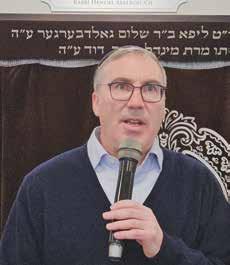
Mr. Nesanel Feller, longtime officer and past president of the White Shul, addressed the Yeshiva Darchei Torah middle school talmidim about his kidney donation and shared a message of mesiras nefesh and responsibility to others
On Sunday, February 8, TAL Academy welcomed prospective families for a well-attended Open House and Information Session. The event was presented to a full house and reflected the strong interest in TAL Academy’s mission and unique educational approach.
The program opened with remarks from Mrs. Sara Taib, principal of TAL Academy, who shared an overview of the school’s vision and commitment to meeting the academic, social, and emotional needs of every child. She was joined by Mrs. Kresch, Kriah Director, and Mrs. Gitlin, Director of Language, who each provided insight into their respective programs and highlighted the school’s structured, language-based approach to learning.

A highlight of the program was the parent panel, featuring a wonderful group of current and former TAL Academy parents. Panelists spoke candidly about their experiences, the growth they have seen in their children, and the supportive partnership between families and faculty. Their perspectives offered meaningful, firsthand insight into life at TAL Academy.
Following the presentations, guests enjoyed a guided tour of the building led by two current TAL Academy students.
Proud to represent their school, the students enthusiastically showed visitors the classrooms and learning spaces, bringing the TAL experience to life in a special and personal way.
The Open House was a true reflection of TAL Academy’s collaborative spirit, dedicated faculty, and vibrant school community. We are grateful to everyone who attended and helped make the morning such a success, and we look forward to welcoming new families to the TAL Academy community.
Last week, Mercaz Academy celebrated a cutting-edge upgrade to its technology program with the arrival of a Bambu Labs P2S 3D printer, now installed in the Mercaz Robotics Lab and Education Technology classroom. While 3D printing is typically introduced at the high school level, Mercaz students are gaining access years earlier, giving them a rare opportunity to work with advanced technology.
With AI-assisted monitoring, a multi-color filament system, and professional-grade performance, the printer has sparked strong excitement among students. “Our fifth and sixth grad-
ers are already designing, testing, and problem-solving with professional-level equipment,” said Education Technology teacher Lynda Last.
Sixth graders have begun free-designing original projects using Tinkercad, a 3D modeling and coding platform. Their designs range from fidget spinners and toys to personal items, including a custom eyeglasses holder created as a birthday gift for a parent. During their free time, students often rush to the lab to check on the printer’s progress.
Future projects are planned across grade levels. Fifth graders will use the printer as part of their state research re -
ports, designing and printing objects that represent their assigned states. Younger students may also participate through individual projects, such as creating custom game pieces for classroom activities.
The printer is also being used to meet practical needs within the school community. “Our Director of Admissions asked if we could make branded giveaways for prospective families, so I’m giving that assignment to our sixth graders,” Last said. “They’ll design and experiment to create items that represent Mercaz and show new families what our students are capable of.”
With creativity buzzing and colorful
This past Motzei Shabbos, HAFTR’s fifth grade girls gathered for an inspiring and joy-filled Melave Malka that beautifully blended Torah learning, music, and friendship. Filled with ruach and warmth, the evening reflected the heart of HAFTR and the values that shape our community.
The program opened with a spirited Havdalah by Rabbi Klein, Mashgiach Ruchani, setting the tone for a meaningful night ahead. Students then took part in a hands-on act of chesed, creating bracelets for students at the Special Children’s Center, immediately grounding the evening in kindness and care for others.
Building on that theme, students heard thoughtful reflections on the importance of chesed from Morah Bashi Kutai and their peers before exploring Torah sources and well-known parables that brought the value of compassion to life in relatable ways.
Following the learning, students enjoyed a delicious seudah, meaningful divrei Torah, and creative skits that highlighted the stories they had studied, reinforcing the messages in engaging and memorable ways.
The evening concluded with an energetic dance party led by iMoveWithNaz, as students joined together in song and celebration. It was a true HAFTR mo -

ment, where learning, ruach, and friendship come together to create lasting memories.
Thank you to Ms. Tova Zucker, as-

filaments rolling, the new printer is already reshaping how Mercaz students create, problem-solve, and bring their ideas to life.




YOSS Mechina celebrated its Tech-In-Check Superstars with a lively Breakfast Brouhaha, honoring their outstanding consistency and commitment
Photos by Yoel Hecht. More at Darchei.org/photos


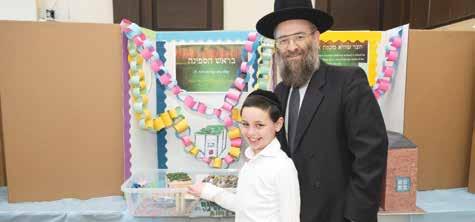
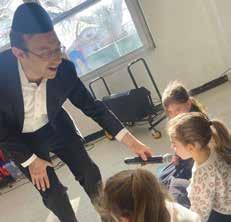

HAFTR High School is pleased to announce the appointment of Mr. Oren Iosepovici as its new Director of College & Academic Guidance, effective this summer. Mr. Iosepovici will succeed Mrs. Joan Parmet, who is retiring this June after many years of extraordinary dedication and service to the HAFTR community.
Following a thoughtful and comprehensive search process, HAFTR is excited to welcome an outstanding educational leader whose experience, values, and student-centered philosophy align deeply with the mission of the yeshiva.
Mr. Iosepovici brings more than three decades of experience in college counseling and student support to his new position. He joins HAFTR from Scarsdale High School, where he has served with distinction as Director of Counseling, leading a dynamic and multifaceted department dedicated to supporting students academically, socially, and emotionally throughout their high school years. In that role, he has overseen a comprehensive college counseling program, while also guiding initiatives centered on student wellness, faculty collaboration, and intentional departmental growth.
Known throughout his career for his deeply student-centered approach, Mr. Iosepovici is a thoughtful and collaborative leader who prioritizes strong relationships among students, families, faculty, and counselors. He has worked extensively with students across a wide range of academic profiles and aspirations, bringing a nuanced and compassionate understanding of the evolving college admissions landscape.

Mr. Iosepovici has remained actively engaged in professional organizations at both the local and national levels, including the National Association for College Admission Counseling (NACAC), the New York State Association for College Admission Counseling (NYSACAC), and the Westchester, Putnam, Rockland Counseling Association. He has also maintained close relationships with admissions professionals at colleges and universities across the country.
Born in Israel and raised on Long Island, Mr. Iosepovici is a lifelong learner who values the mission and religious philosophy of HAFTR. He has expressed genuine excitement about joining the school community and looks forward to partnering closely with HAFTR’s educational leaders, counselors, and faculty to support students as they navigate the college search and admissions process.
HAFTR is confident that Mr. Iosepovici’s expertise, warmth, and values will further enhance the student experience as he leads the College & Academic Guidance Department with clarity, compassion, and purpose. Please join us in congratulating Mr. Oren Iosepovici and welcoming him to the HAFTR community.



The Yeshiva of Central Queens (YCQ) hosted a beautiful Melave Malka this past Motzei Shabbat. This year’s event centered around the theme of tefillah. From the creative Asher Yatzar plaques to the inspirational story from Mrs. Amit Yaghouhi, the evening was filled with reflection and inspiration.
The program concluded with incredible performances by the fourth grade girls’ classes, led by Morah Tali Brody, Morah Friedman, and Morah Silverstein, making it a memorable experience for all.
At Yeshiva Darchei Torah’s Harriet Keilson Early Childhood Center, Morah Shulamis Kalish’s students decorated umbrellas while learning the letter U
The Ganger Early Childhood division of TAG continues to review healthy habits via our Talmidos Biriyos program. This week, we focused on brushing teeth! Each girl received her own toothbrush as a reminder of the importance of including toothbrushing into our daily routines. Of course, the toothbrush that Tali Talmidah uses is way too big for our mouths but fits perfectly into the mouth full of pretend teeth!



HAFTR High School was deeply honored to welcome Omer Wenkert, a hostage survivor of October 7, for a profoundly moving and meaningful conversation this past Friday. Moderated by HAFTR High School Rosh Yeshiva Rabbi Ira Wallach, the program offered students and faculty an opportunity to hear firsthand about resilience and faith.
Rabbi Wallach began by inviting Mr. Wenkert to share about his life before October 7, his upbringing, his brief service in the IDF, and his lifelong dream of becoming a restaurant owner. Omer spoke passionately about his love of food and his determination, describing how, at 22 years old, he became one of the youngest restaurant managers in Israel. In a single day, however, his life was irrevocably changed.
Omer recounted the early moments of that morning, explaining that the initial alerts did not feel unusual. It was only later, as the reality of the situation became clear, that he and those around him understood the severity of what was unfolding. He shared the terrifying real-

ization that terrorists had infiltrated the country.
Speaking with remarkable strength and clarity, Omer described being taken into captivity and held underground for an extended period of time, fully isolated from the world above and around. He reflected on the darkness and uncertainty he faced, and the moments when hope felt distant. Yet even in those conditions, Omer spoke about the power of connection: how forming a bond with another captive gave him renewed strength and purpose. The promise they made to each other not to give up became a lifeline.
After 505 days, Omer was finally freed. Reflecting on that moment, he
shared a line that resonated deeply with everyone in the room: “You don’t appreciate the light until you’re in the dark.”
During his time in captivity, Omer explained, his connection to Judaism grew stronger. He made a personal commitment to keep kosher, a promise he continues to uphold today. He shared that his greatest vision for the future, and what he considers a true victory, is the ability to raise a family in Israel. Omer also spoke about the healing power of sharing his story, noting that speaking openly about his experiences has enhanced his rehabilitation process and has helped him confront his trauma in a supportive environment. He concluded by leaving
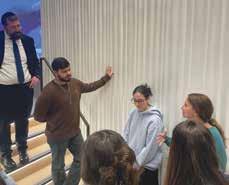
the HAFTR community with two powerful messages: to believe in humanity and to remain committed to unity.
As the program opened to questions from students and faculty, expressions of admiration, gratitude, and love filled the room. Emotion filled the room as the HAFTR community witnessed a powerful and personal account of courage and perseverance.
HAFTR is profoundly grateful for the opportunity to hear Omer Wenkert’s story and extends heartfelt thanks to the sponsors who made this meaningful program possible.
May we never forget, so that we always remember.

The spring semester brings an exciting schedule for the Yeshiva University High School for Girls (YUHSG), and it also means peak season for Wildcat academic clubs. On Monday, February 2, and Tuesday, February 3, YUHSG’s Model UN team competed at Yeshiva University’s 36th annual National Model UN Conference (YUNMUN). Led by faculty advisor and Humanities Department member Ms. Chevi Friedman and team captains and YUHSG seniors Michal Heimowitz, Aliyah Kahn, and Sarah Leah Sullivan, the Model UN team gives students a forum in which to actively learn about international diplomacy by serving as “delegates” to real UN member nations. YUHSG students were assigned to represent both China and India, requiring them to perform extensive research on the cultural, political, and economic landscape of these countries. In doing so, the students gained insight
into other cultures while enjoying the opportunity to collaborate with students from other schools. The event also gives students a chance to hone their critical thinking and oratory skills.
The YUHSG team continued last year’s success by bringing home another roster of honors: Aliyah Kahn won an Honorable Mention for the Counter-Terrorism Committee (CTC), Meira Husarsky won an Honorable Mention for UNICEF, and Sarah Leah Sullivan won Best Delegate of the Disarmament and International Security Committee (DISEC). Other team members include seniors Hannah Austin and Atara Feldman, juniors Nili Aharon, Bailey Rosenstock, and Orly Spinner, and sophomore Malky Reznik.
Other upcoming events for YUHSG’s academic teams: on Wednesday, February 5, the Central Mock Trial team won its first match of the season again Long

Island City High School at the Queens County Courthouse. On February 9, YUHSG College Bowl will attend its first match. And on February 11, YUHSG Torah Bowl will host Magen David, Barkai Yeshivah, and YDE at a tournament at its Holliswood campus. But the spring wouldn’t be complete without an opportunity for fun and bonding: on Thurs-
The Bach Jewish Center recently partnered with the Orthodox Union’s Yachad to host its annual Shabbaton filled with social, educational and spiritual activities in honor of Jewish Disabilities Awareness, Acceptance & Inclusion Month (JDAIM).
JDAIM, inaugurated in 2009, serves as the Jewish community’s organized celebration of North American Inclusion Month (NAIM), highlighting each individual’s unique abilities and strengths within the framework of Jewish faith and tradition. This year’s weekend retreat
emphasized the value of listening, empowering and including every member of the community, inspired by the weekly Torah reading of Parshat Yisro.
The event took place over Shabbos Yisro, February 6-7, 2026, offering community members and participants a meaningful opportunity to celebrate Shabbos together at the shul. The Shabbaton began with an inspiring Kabbalas Shabbos, filled with uplifting ruach, followed by a festive dinner and Oneg that nourished both body and spirit.
Rabbi Benny Berlin of BACH shared

day and Friday, February 12 and 13, YUHSG will host its very first schoolwide sleepover. And on March 7, Motzei Shabbos, YUHSG will hold its Annual Scholarship Dinner of Tribute at Great Neck Synagogue, giving the entire Wildcat community an opportunity to celebrate those who have made contributions to the school.

divrei Torah with the group, highlighting the lesson from Yisro, that just as Yisro empowered Moses by helping him share the responsibilities of leadership, every member of the community has a unique gift to contribute and every voice matters.
“Yisro taught Moses the value of empowering others, hearing their unique perspectives and creating systems that allow everyone to contribute according to their abilities,” Rabbi Berlin said during the Friday night Oneg. “In the same way, our communities are strongest when we recognize the talents and strengths of every individual, including those with
disabilities. Inclusion is not just a program or an event. It is a way of building a community where everyone belongs, everyone participates and everyone’s voice matters. By empowering each member, we strengthen the entire community and bring the Torah’s vision of justice and unity to life.”
On Shabbos morning, the group joined the BACH minyan, followed by a communal lunch. Shabbos concluded with a musical Havdalah led by Rabbi Berlin and the synagogue’s talented congregants, with Yachad members singing and dancing together in joyous celebration.

HAFTR Lower School was buzzing with ruach as students wrapped up an unforgettable Brachos Week: five days that brought learn ing, joy, and meaningful connection together in the very best way. Brachos Week transformed classrooms and hallways into spaces where Torah learning came alive through hands-on activities, daily challenges, and spirited collaboration. Designed to strengthen both knowledge and practice of reciting brachot, students participated in interactive games and experiences that built confidence
and deepened their understanding of the various brachot. The week culminated in the much-anticipated Bracha Bee, a high-energy celebration of learning that filled the building with excitement and school pride.
In the Bracha Bee, students competed in grade-level matchups: first and second graders, and then third through fifth graders, demonstrating their mastery of brachot rishonot and acharonot. With guidance from Lower School Mashgiach Ruchani, Rabbi Asher Klein, students thoughtfully identified the appropriate
brachot for a wide range of foods, from familiar favorites like cookies to more unexpected choices like mushrooms or quinoa.
The Bracha Bowl was an exciting display of competition and community. Students cheered on their classmates, supported one another, and celebrated shared growth in Torah learning. Bracha Week strengthened students’ connection to the mitzvah of saying brachot and left a lasting impact on our Lower School, reminding us that at HAFTR, learning is joyful and fully values-driven.
Anyone can have a vision. It takes a great person to bring it to life.
At the upcoming anniversary dinner on Monday, May 11, Mesivta Ateres Yaakov will proudly honor 25 years of Rabbi Mordechai Yaffe’s leadership, celebrating a vision patiently built, year by year, until it became reality.
From the moment Rabbi Yaffe assumed leadership in September 2000, he set out with a clear, intentional goal. He believed that a Yeshiva must be anchored in strong limud haTorah and education, while also fostering a healthy environment that nurtures a simchas hachaim.
His vision for his boys was not limited to success within the walls of the Yeshiva alone, but to shape young men who would grow into thoughtful husbands, dedicated fathers, committed ovdei Hashem,
and Bnei Torah who are integral to the community around them.
Working in partnership with the Rabbeim and Hanhalah, Rabbi Yaffe helped shape a thriving yeshiva where expectations are clear, relationships are genuine, and boys are inspired to achieve growth. He focused on cultivating an environment where values are absorbed, internalized, and ultimately owned.
Today, Mesivta Ateres Yaakov is a yeshiva where commitment to Torah stands proudly alongside education, responsibility, and personal development. The standards are high, guidance is personal, and consistency takes hold, as the boys feel trusted and rise to meet that trust.
Whether navigating new technologies, evolving challenges, or the realities students face beyond the classroom, the
Ezra Academy’s sophomore class spent an uplifting and memorable Shabbaton this past weekend in Woodmere, graciously hosted by the Congregation of Aish Kodesh and the broader Woodmere community. The Shabbaton offered students a meaningful blend of spiritual growth, community connection, and grade-wide bonding. The weekend began Friday night with inspiring divrei chizuk following Kabbalat Shabbat. Rabbi Weinberger emphasized that Ezra Academy serves as a powerful starting point for so many students, encouraging the sophomores to recognize and fully take advantage of the many opportunities available to them during their high school years.
Throughout Shabbat, students enjoyed beautifully hosted seudot—both as an entire grade on Friday night and in smaller groups with faculty and community members during the day. These meals, along with engaging oneg Shabbat gatherings hosted by local families, fostered warm connections and meaningful conversations between students, faculty, and hosts.
Shabbat concluded with a powerful shalosh seudot address by Charlie Harary, whose words reinforced a clear and resonant message: opportunities abound for Ezra’s tenth graders, and this stage of their journey is one of immense potential and growth.
The Shabbaton concluded on Motzei
yeshiva acts with a measured, innovative approach that encourages students to develop a personal commitment to values rather than simply complying with them.
After 25 years of steady leadership, Rabbi Yaffe’s vision stands clearly realized. It’s apparent in the culture of the Yeshiva, reflected in its talmidim, and recognized by parents and alumni who appreciate what Rabbi Yaffe set out to build.
The upcoming dinner marks this milestone and looks ahead to the continued growth of Mesivta Ateres Yaakov.
Join us in celebrating 25 years of Rabbi Yaffe’s leadership: a vision fully realized, firmly rooted, and ready to be carried forward. The dinner will take place on Monday, May 11 at The Sands Atlantic


Beach. For more information about the dinner or to place a tribute message in the journal, please visit AteresYaakov. com.

Shabbat with a lively melave malka featuring pizza, followed by a trip to Activate, an interactive gaming experience at Roosevelt Field Mall. The evening served as a true bonding experience for the grade, capping off a weekend filled with connection, inspiration, and joy.
Ezra Academy extends a heartfelt yasher koach and sincere thanks to the Woodmere community for opening their homes and hearts and for helping create such a meaningful and impactful Shabbaton for our sophomores.

By Avi Lax
Last week, the Meet the Author Book Club at Rambam traveled to the LIU Performing Arts Center, where students had the opportunity to hear from world-renowned author Malcolm Gladwell.
This visit marked the Book Club’s third Meet the Author trip of the year. Earlier in the year, students traveled to the 92nd Street Y to meet Scott Galloway, author of Notes on Being a Man and host of the Pivot podcast. The club also hosted a Zoom interview with Chuck Thompson, film producer and author of The Status Revolution.
Gladwell spoke about what he described as one of the most overlooked emotions: anger. He explained that anger itself does not define a person; rather, what truly defines someone is how they
behave when they are in a clear, balanced headspace.
He explored this idea through the lenses of criminology and history, noting that the majority of violent crime stems from anger rather than premeditated intent. Gladwell also discussed historical figures such as Elizabeth Cady Stanton and Frederick Douglass and their difficult journeys toward freedom. In addition, he spoke about Jackie Robinson and the challenges he faced with integration and anger.
In addition to hearing Gladwell’s talk, attendees enjoyed a brief conversation between Gladwell and former Congressman Steve Israel. Questions ranged from artificial intelligence to football, including which team Gladwell is supporting in the Super Bowl.
Following the event, students were fortunate to meet Malcolm Gladwell in
Another jam-packed week of JSL Winter 2026 by FM Home Loans featured high-scoring shootouts, overtime thrillers, lockdown defense, and standout performances across every division. From K/P action to Men’s League, the energy and competition continue to rise as teams battle it out week after week.
Yeled LI defeated Exclusive Cabinetry 13–6 behind tremendous hustle from Simcha and Levi Naiman, who were all over the floor on defense. Maidenbaum earned a big win over Smash House, powered by an electric performance from Yosef Buchbayew, who finished with 2 goals. Marciano PD rolled past MoldPro 13–5, led by Yitzy Lazar, who erupted for 6 goals. SD Shades defeated Demo & Cleanouts 8–4 behind a massive 5-goal effort from Shimmy Biegeleisen.
5 Towns Central picked up a big win over Sunflower Cafe, with Ezra Shimonov standing out through hustle, effort, and a goal. SR Whee and Arise Real Estate battled to a 0–0 draw, highlighted by strong defense, hustle, and teamwork on both sides.
Zlotowitz Law edged Chosson Central 10–9 in a high-scoring affair, led by Yaakov Gross, who netted 4 goals.

person, take photos, ask questions, and even receive autographs. Students also had the opportunity to purchase presigned copies of his books.
In past years, the Meet the Author Book Club has met with an impressive lineup of influential figures, including Dr. Jordan Peterson, Bill Gates, Neil deGrasse Tyson, Elie Wiesel, and Veronica
Roth, reflecting the club’s longstanding commitment to exposing students to diverse thinkers and ideas.
Thank you to LIU for hosting this incredible event, to Dr. Goldman and Naomi Rosenblum for organizing the trip, and to all the students who attended and made a true Kiddush Hashem.
Posh Home & Bath held off Tikva Fire 6–5, thanks to outstanding goaltending from Cheskel Rubin.
2nd/3rd
Remsen Auto defeated Newman Dental 5–2, with Abie Tennenberg scoring 2 sweet goals. Growtha earned an 8–4 win over TNB Architecture, led by Avi Eisenreich’s 2-goal performance. J Works Construction topped Styles Design Interiors 8–6, as Dovid Levitan proved to be the difference with 6 goals and 2 assists. Town Appliance knocked off Nate Builders 6–3, with Eliyahu Zauderer and Ezra Gruin combining for 5 goals to take sole possession of first place.
4th/5th Grade Hockey
SR Whee cruised to a 7–1 victory over BlueBird Insurance, with Mordechai Kirschner delivering an outstanding performance in net. Extreme Vent Cleaning edged Wieder Orthodontics 4–3 in overtime, as Shmuel Langer buried the OT game-winner.
1st Grade Basketball
The Shoppe hit a buzzer-beater in a wild finish to defeat Posh Home & Bath 8–6. Marciano PD earned a big win over Seasons, led by Noach Diamond, who poured in 18 points.
2nd Grade Basketball
5 Towns Landscaping defeated White Glove Concierge, powered by a huge game from Julius Berger, who scored 16 points. Wieder Orthodontics topped Ri-

ta’s 21–15, with Ezra Rubenstein playing extremely well and grabbing a gamehigh number of rebounds.
3rd Grade Basketball
Central Pizza Co. beat Elegant Lawns 16–8, highlighted by an excellent all-around effort from Chaim Zakutinsky, especially on the boards. Seasons Express edged Tikva Fire 15–14 in a tight contest, with Mordechai Rahmanan shining in an all-around performance.
4th/5th Grade Basketball
Newman Dental defeated Wieder Orthodontics 24–18, led by Mayer Heller, who came up clutch with 6 points. Zlotowitz Law edged Tal By Luxe 23–21
behind Dovi Seltzer’s strong scoring and playmaking.
6th/7th Grade Basketball
Maidenbaum rolled past Twillory 42–20, with David Putter leading the way and finishing with a game-high 12 points. Elegant Lawns defeated TNB Architecture, fueled by outstanding teamwide play and unselfish basketball. Men’s Basketball
In a Motzei Shabbos matchup, Emporio handed Town Appliance their first loss of the season, winning 64–56 behind Yitzy Wieder’s 25-point performance and Yoni Oratz’s 15 points.
Rabbi Anchelle Perl of Chabad of Mineola delivered the opening invocation at the Republican Statewide Nominating Convention, offering a message that combined civic gratitude, moral clarity, and spiritual perspective.
Addressing delegates gathered from across New York State, Rabbi Perl opened with a prayer emphasizing the sacred responsibility of leadership and the enduring American belief that rights are endowed by the Creator.
“We gather in gratitude for the freedom to assemble, deliberate, and choose leaders in dignity and peace,” Rabbi Perl said. “Today is more than a nomination; it is a reaffirmation that liberty is sacred, responsibility accompanies freedom, and leadership is a calling to serve.”
In his invocation, Rabbi Perl offered blessings for all candidates to be nominated and extended special recognition to Nassau County Executive Bruce Blakeman, who is currently serving as County Executive and is now running to be elect-
ed Governor of the State of New York.
Rabbi Perl prayed for strength, clarity, and courage in leadership for Mr. Blakeman and for all who seek to serve the public.
He also asked for Divine protection over police officers, firefighters, EMTs, paramedics, and first responders who serve on the front lines of public safety, as well as members of the armed forces.
The prayer concluded with a call for unity, principled leadership, and a renewed commitment to serving the people of New York.
Before entering the convention, Rabbi Perl reflected on an unexpected yet fitting symbol — the elephant, emblem of the Republican Party, positioned prominently outside the venue.
“In Torah thought, even the physical world becomes a teacher,” Rabbi Perl later shared. “An elephant represents strength — but true strength is not noise. It is disciplined power.”
Citing the teaching from Pirkei Avot,

“Who is mighty? One who conquers his inclination,” Rabbi Perl noted that leadership requires restraint as much as authority.
“An elephant that charges can cause destruction. An elephant that is guided builds,” he explained. “Power must be anchored in humility, and leadership must be rooted in responsibility.”
Rabbi Perl’s participation reflects Chabad of Mineola’s longstanding engagement in civic life throughout Nassau County and Long Island. As a community leader, he frequently offers invocations at public gatherings, emphasizing moral responsibility, unity, and the importance of faith in sustaining civil society.

“At moments of civic decision, prayer reminds us that leadership is not about entitlement but about service,” Rabbi Perl said. “A healthy democracy depends not only on institutions, but on character.”
The convention brought together party leaders and delegates from across the state to nominate candidates for upcoming elections.
Rabbi Perl concluded his remarks with a prayer for New York and the nation: “May this moment renew our commitment to life, liberty, and principled leadership. G-d bless the great State of New York, and may G-d bless the United States of America.”



Taking inspiration from Tu B’Shvat, the children of Gan Chamesh explored Hashem’s natural world. The young students experimented with soil, seeds, twigs, acorns and pinecones and created forests, replete with real tree stumps, leaves, branches and grass. The Sheva Minim came to life as the children
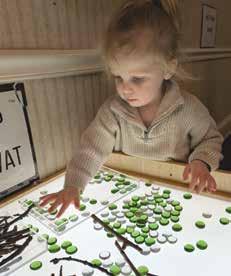
used magnifying glasses to examine every detail of the beautiful species of Eretz Yisroel. The children experienced pattern making with fruit kabobs and tree making at a light table, among other exciting activities. The children gained a deeper appreciation of Hashem’s beautiful natural world.


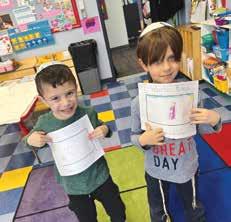
HAFTR K3 had their publishing party last week featuring stories on what they did this winter break


The seventh grade girls at Yeshiva Har Torah went on a Chessed trip to the JCCRP in Far Rockaway where they helped unload cases of food which will be packed up and delivered to people in need. The girls were helpful and enthusiastic. The staff at JCCRP were very grateful for the help they provided and were impressed by the students!




By Chaim Gold
“Anticipation.” Perhaps that one word is the optimal word to describe the way lomdei Torah from all over America and beyond are excitedly looking forward to the upcoming Dirshu Convention, the Shabbos Kinnus Olam HaTorah, that will be attended by thousands in Stamford Connecticut on Shabbos Parshas Terumah, 3-5 Adar/February 20-22. The Armon Hotel is not large enough to accommodate the tremendous desire for rooms, and Dirshu is already booking in the nearby Marriott Hotel which can accommodate hundreds more lomdei Dirshu and their wives. Similar to the previous Dirshu Convention two years ago, the sessions and seudos will only be held at the Armon.
In truth, the hotels are just the material, outer building to physically host the convention, but the spiritual edifice is what makes the Dirshu Convention Klal Yisrael’s premiere Torah Convention. Even the “currency” at the Dirshu convention is Torah and only Torah.
As, HaRav Yitzchok Zalman Gips, Rav of Khal Birchas Avrohom and a longtime Dirshu maggid shiur, said, “This is a convention where people fight to gain entry. Why? So that they can listen to drashos throughout Shabbos! Where else do we find such a thing?!”
International Delegation Led by HaGaon HaRav Chaim Mordechai Ausband, Shlita
At this year’s convention Dirshu will also have the privilege of hosting an international delegation from Eretz Yisrael and Europe. Heading the Eretz Yisrael delegation will be HaGaon HaRav Chaim Mordechai Ausband, shlita, Rosh Yeshiva at Yeshiva Ateres Shlomo, a leading Gadol B’Torah who represents Torah royalty.
On a personal level, Rav Ausband is no stranger to America. Born and raised in Cleveland, Rav Ausband is the youngest son of the former Rosh Yeshiva of Telshe, Rav Aizik Ausband and Rebbetzin Chaya Ausband, founder of the Yavne Seminary of Cleveland and a daughter of the Telsher Rav and Rosh Yeshiva, Rav Avrohom Yitzchok Bloch, hy”d.
He was a close talmid of his uncle, HaGaon HaRav Mordechai Gifter, zt”l. Later, at a relatively young age, Rav Chaim Mordechai went to learn in Eretz Yisrael at the Ponovezh Yeshiva, where he became a very close talmid of Maran HaGaon Rav Elozor Shach, zt”l, who displayed tremendous love for the young ilui and scion of Torah greatness. Rav Chaim Mordechai is married to a daughter of HaGaon HaRav Gavriel Knopfler, shlita, Rosh Yeshiva of Yeshiva Shaarei Torah of Manchester and also a longtime Ponovezher talmid.
Aside from being a gaon and baki in all areas of Torah, Rav Ausband brings with him the unique Torah oratory that characterized Telshe.
One of the major highlights of every Dirshu convention is the in-depth shiur given on Shabbos morning just after davening. Maarei mekomos are usually given in advance, providing the lomdim a window into the topics that the shiur will cover.
During the shiur, the massive, heated tent erected by Dirshu in the parking lot enabling the davening to be held in a serious, inspiring atmosphere, b’rov am, is full of lomdim who take such spiritual pleasure in listening to the shiur. It is not uncommon for lomdim to interject during the shiur with questions from all over Shas as a fiery Torah debate ensues, as the maggid shiur defends and explains his position. This year, the shiur will be given by Rav Chaim Mordechai Ausband,
and is certain to once again be a high point of the convention.
Another international guest will be HaGaon HaRav Nosson Binyomin Eckstein, shlita, of London. Rav Nosson Binyomin, a longtime Belzer Dayan in London, has led Dirshu in London for decades. The presence of a Posek and Rav of his stature will also add to the convention.
The Melava Malka: A Combination of Torah Inspiration and Song
The Dirshu convention brings inspiration and regesh not only to the brain but to the heart as well. Throughout Shabbos, zemiros and tefillos will be led by R’ Issac Honig, whose hartzige tefillos and booming voice that reverberates throughout the cavernous tent infuse the olam with inspiration.
And then there is the Motzoei Shabbos Melava Malka!
The Melava Malka features the convention’s keynote addresses, with timely messages delivered by leading Gedolei Yisrael.
Among the Gedolim to be in attendance this year are HaGaon HaRav Yeruchem Olshin, shlita, Rosh Yeshivas Lakewood, HaGaon HaRav Hillel David, shlita, Rav of Kehillas Yeshiva Shaarei Torah, Yoshev Rosh of the Vaad Roshei Yeshiva of Torah Umesorah, HaGaon HaRav Yechiel Michel Steinmetz, shlita, the Skverer Dayan of Boro Park and one of America’s most prominent Poskim, HaGaon HaRav Shlomo Feivel Schustal, shlita, Rosh Yeshivas Tiferes Yerachmiel, HaGaon HaRav Yitzchok Sorotzkin, shlita, Rosh Yeshivas Mesivta of Lakewood, HaGaon HaRav Dovid Goldberg, shlita, Rosh Yeshivas Telshe, and HaGaon HaRav Shlomo Eisenberger, shlita, Rosh Yeshivas Telshe.
A highlight of the Melave Malka is the singing and dancing that bring the up-
lifting Shabbos to a close. This year, the zemiros will be led by R’ Hershy Weinberger and R’ Avrumi Berko. In truth, it is possible to give over the main message of a drasha in an article, but one simply cannot, with dry ink and paper, describe the dancing after the melava malka. How can you depict thousands of lomdei Torah dancing with such elevation, such dveikus, deep into the wee hours of the morning? How can you possibly capture the contagious enthusiasm that permeates the hall? The dancing at the end of the Melave Malka is a rikud of simcha, of dveikus and of deep hakaras hatov to Dirshu and what it has done for them and their families.
“The ‘Simple Yungeleit ’ Here are Gedolei Torah!”
Perhaps, Rav Nissan Kaplan, Rosh Yeshivas Daas Aharon encapsulated what a Dirshu convention is most succinctly when he said, “Not long after I arrived at the convention, I went down to the lobby to participate in a bit of toameha. Turning to the Yid next to me whom I didn’t know, I said ‘shalom aleichem.’ We got to talking about learning and I realized that this Yid had been tested on all of Shas! ‘Wow!’ I thought, ‘I wish I had learned all of Shas!’ Then I began to speak to the person on the other side of me and found out that he had been tested on all of Shas with Tosafos!!
“The person across from me had been taking monthly tests on Mishnah Berurah for fourteen years and had already completed the Mishnah Berurah twice! I must admit, I felt like a nothing… I came here to this convention to give chizuk and I found that the ‘simple yungeleit’ siting around the table with me and eating kugel are Gedolei Torah who don’t even realize how great they are!
“This is the definition of being part of Dirshu!”

Tu B’Shvat was celebrated at Lev Chana and HALB with delicious fruit, planting activities, and,

thanks to the PTA, a fun chocolate fountain for the elementary school to dip fruit in!
Wellness Week at SHS is a multidimensional learning and awareness program that runs every other year. Each day highlights a specific element of wellness, addressing mental, physical, social, emotional, and spiritual health.
During this year’s Wellness Week, dozens of outside professionals presented throughout the week, giving interactive lectures or leading activities and clubs. From whole body wellness tips, to
tools for handling anxiety, to the science behind battling unhealthy habits, lots of different angles were targeted in order to reach all types of students (and faculty and parents) in attendance.
Highlights of the week included our fitness club period, Pink Day dance party, and the crowd favorite, the puppy pen. With all the new skills introduced this week, we hope our SHS students feel prepared and pumped to dive into the rest of the semester!

Rep. Laura Gillen visited Judaica Plus on Friday to purchase a mezuzah for her office.
She said, “It was a pleasure to visit Judaica Plus in Cedarhurst to purchase a new mezuzah for my office. Small businesses are the backbone of our communi-
ties, and I’m proud to support them. The mezuzah offers an important protection and blessing for our office and the work we do for our constituents, and it serves as a reminder to uphold the values of integrity and accountability.”





By Rabbi Yechiel Spero
Of Treats and Sweets
The days of the British Mandate are spoken about bitterly by the Yidden of Yerushalayim. Sure, on the outside the British soldiers seemed so prim and proper. But beneath the stiff uniforms and clipped English accents lay cold indifference to Jewish suffering. The British authorities turned a blind eye to riots, theft, and violence carried out by the bloodthirsty Arabs, while the city lived under constant tension.
Terror came from all sides. Underground groups struck the Arabs, the Arabs struck the Jews, and here and there British soldiers paid with their lives as well. It was a dizzying cycle of blood and fear that seemed endless, until the nations of the world finally declared that the Jewish people had a right to their homeland, to Eretz Yisrael.
And yet, even with all the terror and bloodshed, kindness and love filled the
streets as well.
On a cool autumn morning, piercing screams tore through the mist at the entrance to Yerushalayim, near Lifta. The cries were wild, frantic, almost inhuman. They echoed through the walls of the mental hospital that stood there, placed with strange irony at the gateway to the Holy City, as if to warn that from this point onward, tormented souls live alongside holy Yidden.
Meanwhile, three figures trekked together along the road. R’ Aryeh Levin — angelic, dignified, his long beard flowing — walked beside his two young sons. Raphael was eight years old. Simchah was six.
“Wait here,” R’ Aryeh told the boys, as he stepped into a small grocery store. He took a coin from his pocket and placed it in the shopkeeper’s hand, carefully filling a brown paper bag with cakes, candies, and colorful sweets. He added, as he always did, a piece of halva, something special.

“Where are we going, Abba?” the boys asked.
“To give a small, sweet gift to a relative,” he answered.
After twenty minutes of brisk walking, they stood before the mental hospital near Lifta. R’ Aryeh asked his sons to sit beneath a carob tree on the slope below. “I will return in ten minutes. In the meantime, review the Mishnayos of Maseches Shabbos. I will test you when I come back.”
This scene repeated itself for several years, always on Rosh Chodesh, the day in which the Etz Chaim Yeshivah, where R’ Aryeh served as mashgiach, let out at noon. He and his sons walked the same route: the grocery store, where he would buy sweets, and then the hospital. The boys reviewed Mishnayos beneath the carob tree while their father entered the building. They knew that inside lived people whose minds were not settled. They understood that one of them was a cousin their father loved and cared for, and that was enough.
In 1948, the State of Israel was declared. The British left. The War of Independence erupted, exacting an awful price. The mental hospital was evacuated. The patients were dispersed. Some did not survive the upheaval. R’ Aryeh no longer made the monthly journey, and Raphael and Simchah did not ask many questions. They assumed the relative had passed away, and the memory faded into the background of their lives.
Years later, when R’ Aryeh Levin passed away and his family sat shivah, a steady stream of visitors came, each one revealing another facet of their father’s boundless kindness. One day, an elderly man arrived, wearing a simple cap.
“My name is Avigdor,” he introduced himself. “You do not know me, but I knew your father well. I was a nurse at the mental hospital in Lifta. I would like to tell you a story.”
One morning, R’ Aryeh appeared at the hospital gate, troubled by the screams he had heard from outside. “Who is screaming like that?” he asked and went inside to investigate.
Inside the ward, R’ Aryeh immediately noticed a tall but stooped man, screaming incoherently, striking the concrete walls with his head.
I explained to your father how the hospital functioned under British

regulations. Only patients with relatives who showed interest and applied pressure were granted calming medication. That man, Gedaliah Budlevsky, had no one. He was a Holocaust survivor, alone in the world.
“Gedaliah Budlevsky?” R’ Aryeh exclaimed. “He is my relative!”
He ran to Gedaliah, embraced him, kissed him, placed candies in his hand, and demanded that the authorities provide him with medication. He even contributed his own money to ensure it.
After that, every Rosh Chodesh, R’ Aryeh came with a bag of sweets. He sat with Gedaliah, speaking soothingly while Gedaliah ate in silence, calmer than ever before. Before leaving, R’ Aryeh kissed him on the forehead and gave his blessings for a complete recovery.
Two days before the declaration of the State, during the evacuation of the hospital, Gedaliah suffered a heart attack. When he briefly regained consciousness, he motioned to me. “Relay my appreciation to the kind rabbi with the long beard. He is not my relative, and I had never met him before he came with the sweets. But because of him, I received medication. Because of him, I knew moments of peace after the horrors of the Holocaust. Tell him thank you. This is my last request.”
Now, Avigdor came to tell the family as well.
The greatest love can be expressed noiselessly, faithfully…with a paper bag of sweets and a piece of halva.
Reprinted from The Story Begins… by Rabbi Yechiel Spero, with permission from the copyright holder, ArtScroll Mesorah Publications.


By Rabbi Keevy Fried

There’s a particular kind of silence that comes with job loss, not the dramatic kind, not panic or chaos, but the quieter kind that settles in slowly and lingers, the kind that people carry quietly while trying to hold everything else together. It’s the kind of silence that doesn’t announce itself, but shows up in small ways, in shorter answers, in forced optimism, in conversations that trail off.
It’s the silence after a résumé that once opened doors suddenly doesn’t, after interviews that seem to go well but lead nowhere, after weeks turn into months and phrases like “overqualified” or “not quite the right fit” start showing up, without anyone ever saying what they really mean.
I’ve come to know that silence well, because more and more people in our community are living with it.
This isn’t about people who didn’t try hard enough or who lack skills. Quite the opposite. These are capable, accomplished professionals, often in their 40s and 50s, who did what they were supposed to do. They built careers, sup -
ported families, paid tuition, covered mortgages, showed up for their communities, and carried real responsibility, year after year.
And then something happened. A restructuring. A merger. A downturn.
A role eliminated. What had felt stable suddenly wasn’t, and almost overnight, they found themselves on the outside looking in.
Let me share one story.
I recently met someone, I’ll call him David, in his late 40s. For more than two decades, he worked steadily in his field, managing teams, handling real responsibility, and earning a salary that gave his family stability and dignity. When his company reorganized, his position disappeared, and at first, he wasn’t overly worried. With his background and experience, he assumed he’d land somewhere else fairly quickly.
So he updated his résumé, reached out to contacts, and applied broadly, doing all the things people are told to do.
Weeks passed. Then months.
Recruiters stopped returning calls. Interviews ended politely but vaguely.
One hiring manager told him he might be “too senior” for the role, while another mentioned that the team skewed “younger and more fast-paced.” No one said the word age, but it was there, hovering in the background, quietly shaping decisions.
Meanwhile, life didn’t pause. Tuition bills still came. The mortgage didn’t wait. And the emotional toll began to build. Confidence took a hit, and the sense of identity that comes from meaningful work slowly eroded. It wasn’t just about income anymore. It was about dignity, purpose, and the feeling of being needed.
David’s story isn’t unique. It’s becoming increasingly common.
Ageism in hiring is one of the most pervasive and least openly discussed biases in today’s workforce, and mid-career job loss hits very differently than it does earlier in life. At this stage, people aren’t just trying to get started. They’re trying to sustain lives they’ve already built, with families, obligations, and real financial responsibilities that don’t pause just because a job does. The
stakes are higher, the runway is shorter, and the margin for error is thin. What makes this even harder is how quiet it all is. There’s no headline. No public conversation. Just families tightening belts behind closed doors, talented people underemployed or sitting on the sidelines, and years of experience, judgment, and leadership going unused.
And the truth is, most of us already know someone going through this. He’s standing next to us at kiddush. She’s the familiar face you see regularly at the gym. A friend’s parent quietly figuring things out, trying to hold things together without drawing attention to what they’re dealing with.
Most of the time, we don’t know, because they’re not saying anything. And who can blame them? When work disappears, a person’s sense of identity often goes with it. For many people, what they do is deeply tied to who they are and losing that can be disorienting and painful.
This isn’t only an individual problem. It’s a communal one.
When experienced professionals can’t find appropriate work, the ripple
effects spread quickly. Families under strain lean more heavily on communal resources. Scholarship funds are stretched. Support systems feel added pressure. At the same time, we lose something less tangible but just as important. Leadership, wisdom, stability, and role models that come from people working at their proper level.
Strong salaries don’t just benefit individual households. They strengthen the entire ecosystem. They allow families to stand on their own, to give rather than receive, and to contribute with confidence and dignity.
Employment isn’t just a paycheck. It’s infrastructure. It’s part of what allows families, schools, and communities to function with strength and stability.
Judaism has always understood this. The Rambam teaches that the highest form of tzedakah, a level greater than which there is none, is helping someone stand on their own. In today’s world, that doesn’t only mean financial help. It means finding someone a job, helping them secure meaningful work, or doing whatever you can to move them closer to employment. It means access. Introductions. Advocacy. Someone willing to open a door, or at least hold it open long enough for
another person to walk through.
Over the past few years, many individuals and organizations across our community have stepped in to help people navigate unemployment through training, coaching, networking, and placement. Among them is Aim Hire, which focuses specifically on profes -
and “fit,” hiring managers recognizing that experience often brings judgment, steadiness, and leadership, not inflexibility, and those of us who are employed asking a real set of questions: Who do I know who could use an introduction? A recommendation? A real conversation. And on the other side, are there
What had felt stable suddenly wasn’t, and almost overnight, they found themselves on the outside looking in.
sionals over 40 who find themselves out of work, because this group so often falls through the cracks. Too experienced for entry-level roles, yet overlooked for senior ones.
But the truth is, no single organization, Aim Hire included, can solve this alone. This problem will only change if we, as a community, decide to lean in together. That means employers taking a harder look at assumptions around age

openings where I work, and can I help get someone’s résumé onto the desk of a hiring manager or HR director?
Sometimes, the most meaningful help isn’t a donation. It’s advocacy. It’s speaking up. It’s making the call. It’s saying, “Take a look at this person. You should really meet them.”
If you’re in a position to hire, consider what it might look like to bring someone seasoned onto your team. If you’re
connected, make the introduction. If you hear about an opening, share it. These may feel like small acts, but together they change lives.
David did eventually find his way back to work through relationships, persistence, and people who were willing to vouch for him, but it took far longer, and cost far more to him and to the community, than it should have.
There are many others still waiting in that quiet space.
This is not a problem we can afford to ignore, and it’s not one we can outsource. Helping capable people find meaningful work isn’t just an act of kindness. It’s an investment in the strength, dignity, and resilience of our community.
The solution isn’t complicated. But it does require us to do it together.
Rabbi Keevy Fried is the executive director of Aim Hire, a nonprofit that works closely with experienced professionals, particularly those over 40, to help them navigate unemployment and return to meaningful work with dignity. To lean in to help others, please visit aim-hire.org or email info@aim-hire.org.




“If I trained my whole life, I could be in the Olympics, too.” (Just because you were on your yeshiva basketball team does not mean Team USA missed out.)
“The judge totally blew that call!“ (You learned this sport existed 11 minutes ago.)
“I could do that. It doesn’t look that hard.” (You once threw out your back getting up from your couch to refill your bowl of ice cream.)
“The skier from Swaziland will for sure win the Alpine skiing.” (Bro, you are thinking of Switzerland; Swaziland is in southern African and has a tropical climate.)
“Why are the parents of the athlete squirming in the seats like that?!” (Ever see yourself when your fourth grader gets up to bat at JSL Little League?)
“This really doesn’t look very safe.” (Really, Captain Obvious? It doesn’t seem safe to fly down a windy half-pipe going 140 MPH?)
“That fall cost them the medal.” (Yes. Falling is generally bad.)
“I’m really disappointed that those guys didn’t win.” (Five minutes ago, you didn’t even know that their country existed.)
“I don’t understand why they’re emotional.” (You were emotional when your kid was the Twillory Plubo Umelo MVP!)
“That celebration feels excessive.” (You celebrate successfully parallel parking.)
What caused the Tower of Pisa to start leaning? It got Italicized.
What do you call an Italian with a rubber toe? Roberto.

1. Where are the 2026 Winter Olympics being held?
a. Italy
b. France
c. Switzerland
d. Latvia
2. Which country won the most gold medals at the 2022 Winter Olympics in Beijing?
a. Germany
b. United States
c. Norway
d. China
3. Approximately how many athletes are participating in the 2026 Winter Olympics?
a. 200
b. 750
c. 1,500
d. 3,000

4. What is the approximate dollar value of a 2026 Winter Olympics Gold Medal?
a. $2,400
b. $4,600
c. $17,300
d. $120,000
5. How much snow was generated for the 2026 Winter Olympics?
a. 200,000 pounds
b. 800,000 pounds
Winter Olympics?
a. About 50 miles
b. About 120 miles
c. About 180 miles
d. Nearly 300 miles

c. 2.4 million pounds
d. 1.6 billion pounds
6. Approximately how many miles apart are the farthest competition venues at the 2026
Wisdom Key:
5-6 correct: You are a Gold Medal winner!
2-4 correct: You get Silver.
0-1 correct: Go back to Swaziland and try another sport!
In the curling competition, Italy, Norway, and Japan each win one of the medals.
We know that:
1. Norway did not win gold.
2. Japan did not win bronze.
3. Italy finished ahead of Japan.
4. Italy did not win silver.
5. Norway finished ahead of Japan.
Which country won each medal?

Answer: Gold: Italy; Silver: Norway; Bronze: Japan

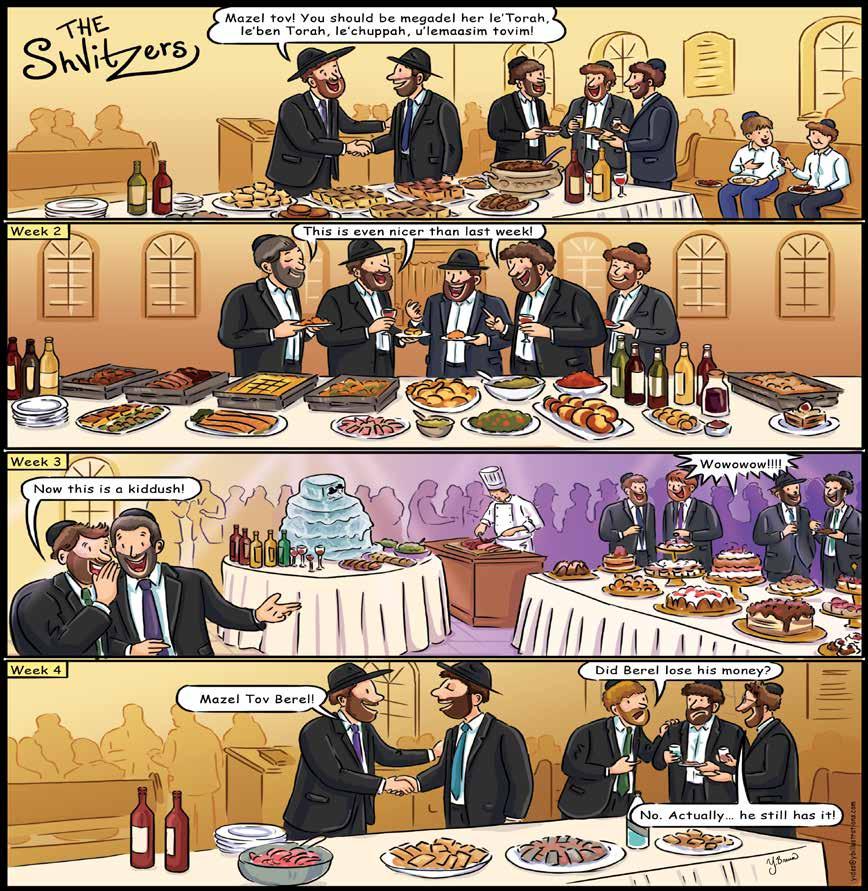
The Torah follows its exhilarating and inspirational description of the revelation at Mount Sinai with a rather dry and detailed set of various laws that are to be followed by the people of Israel. It is one thing to be inspired and thus acquire great ideals. It is another thing completely to be able to transfer those ideals and inspiration into everyday life on a regular basis.
We are all aware that the devil is always in the details. It is natural to agree that one should not steal or murder. But what is really the definition of stealing? Is taking something that originally did not belong to you always considered stealing? How about grabbing my neighbor’s rope and using it to save a drowning person? Is that also stealing? Is self-defense murder? Are court-imposed death penalties murder?
How do we deal with such complex moral issues? This is really the crux of all halacha, and this week’s parsha serves as our introduction to the con -

By Rabbi Berel Wein z”l

cepts of Jewish law. Without an understanding of the practice of halacha, the great ideals and inspiration of the Torah are almost rendered meaningless and unachievable.
The Torah concentrates not only on great ideas but on small details as well. From these small details spring forth the
and necessary continuity in the narrative flow of these two parshiyot of the Torah. I think that this idea is borne out by the famous statement of the Jewish people when asked if they wished to accept the Torah. In this week’s parsha, their answer is recorded as: “We will do, and we will listen.” All commentators and the
It is another thing completely to be able to transfer those ideals and inspiration into everyday life on a regular basis.
realization of great ideals and the ability to make them of practical value and use in everyday life. Hence the intimate connection between this week’s parsha and the revelation at Mount Sinai discussed in last week’s parsha. There is a natural
Talmud comments upon the apparently reverse order of this statement. People usually listen for instructions before they “do.” But the simple answer is that the people of Israel realized that listening alone will be insufficient.
The great and holy generalities of the Torah are valid only if they are clearly defined, detailed, and placed into everyday life activities. We have to “do” in order to be able to “listen” and understand the Torah’s guidance and wishes fully. The Talmud records that a non-Jew once told a rabbi that the Jews were a “hasty and impulsive people” in accepting the Torah without first checking out its contents. In reality, that holy hastiness of Israel was a considered and mature understanding that a Torah of ideas and inspiration alone without a practical guide to life would not last over the centuries of Jewish history.
Only those who are willing to “do” and who know what to “do” will eventually appreciate intellectually and emotionally the greatness of Torah. Only then will they be able to truly “listen” and appreciate the great gift that the L-rd has bestowed upon Israel – the eternal and holy Torah.
Shabbat shalom.


By Rav Moshe Weinberger
Adapted for publication by Binyomin Wolf
In Parshas Shekalim, the Torah says, “When you count [lit. ‘lift up’] the head of the Jewish people according to their counting” (Shemos 30:12). Commenting on this pasuk, the Midrash says, “By your life, just like you stand now and give them Parshas Shekalim and raise their heads, so too, every single year, when they read it before Me, it will be as if you are standing there just as you are standing today and raising their heads” (Tanchuma Ki Sisa 3). How does the mitzvah to give a half-shekel and the reading of Parshas Shekalim lift up our heads? What is the connection?
Also, why does Parshas Shekalim always serve as the transition into the month of Adar and the season of Purim?
As the first Mishna in Shekalim states, “On the first of Adar, we announce regarding the shekalim.” And the Gemara says, “It is revealed and known before the One who spoke and the world came into being, that in the future, Haman would pay shekalim for the Jewish people. Therefore, [Hashem] caused their shekalim to preempt his shekalim. That is why the Mishna says, ‘On the first of Adar…’” (Megillah 13b). How is the mitzvah of giving the half-shekel able to counteract the money Haman paid Achashveirosh to buy and ultimately destroy us? What is the connection? How is this one mitzvah able to both lift up our heads and defeat Haman’s shekalim?
The primary coin used in the Torah is called the shekel. What is the root meaning of this word? It means “weight” or “to weigh.” Something weighty, or heavy, is difficult to lift up, as the pasuk says “And the hands of Moshe were heavy” (Shemos 14:12) in the fight with Amalek. What happens when weighty matters are treated lightly? The prophet explains that when the time of Moshiach approaches,

“they shall behave with arrogance, the youth against the elder and the lightweight against the honorable, nechbad ” (Yeshayahu 3:5). The word for honorable comes from the root word meaning “heavy.” Those with no substance will treat sages and people with life experience without any respect. Young people often have no regard for older people, those with experience and wisdom. They feel they cannot daven in the same shul with them.
The Aramaic word for kavod, which simultaneously means “honor” and “weight” is “yakar,” which also means “precious” or “valuable,” as the pasuk says, “For the Jewish people, there was light, joy, gladness, and honor” (8:16). And Achashveirosh decreed that “all women must give honor to their husbands…” (1:20). Both of these pesukim use the word yakar for honor. When something is seen as weighty, valuable, or expensive, it is given honor. And con-
versely, calling something of light weight shows that it is cheap, expendable, and not worthy of respect. And what is the word for degradation and disrespect?
It is zilzul , which comes from the root word zol , meaning “cheap.” The prophet Yeshayahu uses the word “zalzalim” to refer to twigs (18:5), small branches blown around by the wind without any staying power.
Based on the above, we can see that any reference to the shekel means something which valuable and important. It is heavy and can therefore outweigh anything placed against it. That is why the Navi tells us that Hashem says, “My son Efrayim is precious [ yakir] to me” (Yirmiyahu 31:19). When this passuk was written, the tribe of Efrayim was not doing well spiritually. Yet Hashem wanted the prophet to tell us, “Efrayim, you are still My child. You are precious to Me.” Every Jew, regardless of how well he is doing, is important. He or she is a heavy-
weight and must recognize his or her own immense value.
Hashem demonstrated how the half-shekel was meant to look by taking a coin out from under His Throne of Glory (kavod ) (Rashi on Shmos 30:13; Tanchuma Ki Sisa 9). This coin is used to count the Jewish people, and, because it comes from under Hashem’s throne above, its very essence is a testament to every Jew’s value. We come from the upper world. We have unfathomable importance and worth. The half-shekel shows us that we can rise above all the details of this world. One of the things done with the half shekel is paying for the communal offerings in the Beis HaMikdash. We “count.” Even the “simplest” Jew is a heavy-weight, whose half-shekel is used to bring a korban that transcends this world, binding Heaven and Earth together.
The Gemara tells us that when Hashem gave us the Torah, He sent angels to place two crowns on our heads (Shabbos 88a). He wanted us to understand how precious and valuable we are. It was as if He was calling out to each one of us, “Precious Jew! My precious child, Efraim! Do you have any idea how valuable you are? How important? How honored and respected because of your incomprehensible worth?” When a Jew feels that he is worthless because of what he has done or what he has looked at, he must reach up and feel those crowns on his head in order to remember that he is connected to something much greater than himself. His life has infinite value and importance beyond what he can see in his everyday, pedestrian life.
Similarly, when a Jew reads the Torah and sees the “crowns” drawn over so many of the letters, they remind him that there is something much greater and deeper than what he can see with his eyes. And when a
Jew gives the half-shekel or reads Parshas Shekalim, it reminds him that even he has weight. He is part of a collective body, something larger than himself, part of a mission from G-d Himself. That is how the half-shekel lifts up his head.
This is related to the Arizal’s teaching that even though we lost our crowns after the sin of the Golden Calf, the pasuk which teaches us the mitzvah of the half-shekel shows us that these crowns are returned to us every Shabbos. The pasuk says, “When you count [lit. ‘lift up’] the head, rosh….” If one “lifts up,” i.e., takes the letter above each letter in the word rosh, it spells Shabbos. Throughout the week, a Jew feels scattered, cheap, and blown around by the winds of the world. But when Shabbos comes, he feels his crowns returning. He can once again access that sense of purpose – that feeling of being part of something larger than himself. He once again
are part of something much greater than ourselves. We are part of Him. And that makes us worthy. That gives us weight and immeasurable importance. They announce the half-shekel on the first of Adar because that is what counteracts the cheapness of Haman. Shabbos Shekalim reminds us that we still have our crowns. We are part of the “royal family,” as children of Hashem.
We need to be reminded of this all of the time. It once happened that the Rebbe Maharash from Lubavitch, zy”a, was taking one of his daily walks, deep in thought and not aware of his environment. Because of this, he inadvertently walked into a part of town Jews were not supposed to enter. A Russian guard yelled at him from across the street, but because he was contemplating so deeply, he did not hear the warning. Furious, the soldier ran over to the Rebbe and screamed in
The mitzvah of the half-shekel shows us that we are not worthless like our enemies claim and like we often see ourselves.
feels the weightiness of the holy shekel of which he is a part.
We can now understand how the half-shekel preempts Haman’s shekalim. What was the essence of Haman’s shekalim? Esther said, “For I and my nation have been sold to be destroyed, killed, and lost. If we had only been sold as manservants and maidservants, I would have remained silent…” (Esther 7:4). Haman’s payoff to Achashveirosh to bring about our genocide made us feel worthless, to the extent that we would not even have complained if we had only been sold as slaves. We felt that a little money was worth more than we were, like we were mere chattel. And while we were despised, Haman was lauded and honored wherever he went and Achashveirosh made him viceroy (ibid. 3:10).
But the mitzvah of the half-shekel shows us that we are not worthless like our enemies claim and like we often see ourselves. Hashem whispers to us, “Place Me like a seal on your heart, like a seal on your arm because love is as strong as death… If a man would give away all the wealth of his house for love, he would be despised” (Shir HaShirim 8:6-7). Yet Hashem is telling us that we are worth more than all the wealth in the world. We
his face, “Who are you? Where are you going? What are you doing here?” Not intimidated in the least, the Rebbe asked him, “How much do they pay you?” A bit taken aback that this Jew was talking back to him, the man answered honestly, “I am paid ten rubles per day.” The Rebbe responded, “I will pay you ten times ten rubles to come over to me every day and ask me what you did today, “Who are you? Where are you going? What are you doing here?”
We forget our value, we see ourselves as cheap and therefore cheapen ourselves only because we fail to think about the greatness we have inside. We forget who we are, who our Father is, where we come from and why we are here. We forget that we are heavy with the responsibility of being a kingdom of priests, a holy nation. May Shabbos Shekalim remind us of who we are and what we are doing. And may we merit to give the half-shekel once again with the rebuilding of the Beis HaMikdash, may it be soon in our days.
Rav Moshe Weinberger, shlita, is the founding Morah d’Asrah of Congreagation Aish Kodesh in Woodmere, NY, and serves as leader of the new mechina Emek HaMelech.

By Rabbi Avrohom Sebrow
The presidential autopen is a clever machine that helps the President manage the huge stack of documents requiring a signature each day. It uses a small, motorized arm holding a real pen to reproduce the President’s signature precisely, ensuring that bills, letters, and photos appear genuinely signed without tying up the President’s extraordinarily busy schedule. Legally, the signature it creates carries the same effect as the President’s own signature when a signature is required on bills. Recently, this device has been in the news: some have claimed that certain uses of the autopen were unauthorized, rendering the documents in question legally problematic.
An Ancient Autopen?
Although this sounds like a modern invention, an analogous “autopen” may have existed thousands of years ago. To see why, we begin with a passage in Menachos (30a). The Gemara there states that a special halacha applies specifically to the last eight pesukim of the Torah.
There is much disagreement about the exact nature of that halacha. Some say that all eight pesukim must be read in a single aliyah. Others suggest that for these pesukim a ba’al korei may not read aloud together with the oleh. Some assert that these pesukim do not even require a minyan. Perhaps the most conventional p’shat is that the honor of being called for these eight pesukim is reserved for the most accomplished scholar.
Rebbe Yehuda (or, according to some, Rebbe Nechemia) explains that the last eight pesukim are different from the rest of the Torah, which Moshe wrote himself. According to this view, Yehoshua completed the final eight pesukim that discuss the death of Moshe.
Rebbe Shimon takes strong exception. The Torah itself refers to Moshe Rabbeinu handing over a Sefer Torah.
The Sefer Torah was certainly complete. Rather, Rebbe Shimon maintains that Moshe Rabbeinu himself wrote the last eight pesukim, but he wrote those words with tears.
In either case, both opinions agree that something unique attaches to the final eight pesukim; hence the unique halacha.
The Problem:
Writing on Shabbos
Rav Sar Shalom Gaon held that the recitation of Tziduk HaDin (which, in Nusach Ashkenaz, begins with “ Tzidkascha Tzedek ”) after the Chazaras HaShatz of Mincha on Shabbos commemorates the passing of Moshe Rabbeinu. This was even marked by a custom to avoid scheduling public discourses during that period.
But Tosfos raises a difficulty: how could Moshe Rabbeinu have died on Shabbos? The Torah states, “I am 120 years old today.” Chazal interpret this as meaning that he completed his life and died that same day. If so, he would have
written that pasuk in the Sefer Torah on Shabbos.
Tosfos raises the possibility that he wrote that pasuk on Erev Shabbos. Yet Rebbe Shimon will not concede that the Torah can record a future handover of a complete Sefer Torah; he contends that events written in the Torah occurred or would occur that day. If Moshe died on Shabbos, then he wrote on Shabbos. How could he have violated Shabbos?
Tosfos therefore disagrees with Rav Sar Shalom Gaon and concludes that Moshe Rabbeinu died on Friday and was buried by Hashem on Shabbos.
The Shelah HaKadosh defends Rav Sar Shalom Gaon. Moshe did not write the Sefer Torah himself in the normal way; he used an “autopen” called hashbuas kulmus. Moshe Rabbeinu, versed in the hidden secrets of Torah and the forces of nature, employed miraculous means to cause the pen to write the words of the Sefer Torah.
Indeed, a Midrash states that Moshe wrote thirteen sifrei Torah on the day of his death. How else could he have man-
aged such a feat except by animating the pen through kabbalistic forces?
HaRav Asher Weiss observes that a Sefer Torah must be written by a person to be kosher. The writing produced by Moshe’s animating of the pen was, in that sense, considered to have come from Moshe Rabbeinu and yet was permitted on Shabbos.
One way to explain this is that writing performed through supernatural means counts as a shinui , an abnormal method, and therefore does not violate the Torah prohibition of writing on Shabbos while still producing a kosher Sefer Torah. By analogy, he notes that writing with the left hand is only rabbinically forbidden on Shabbos because it is not the normal way to write; nevertheless, a Sefer Torah written with the left hand is still kosher.
HaRav Daniel Alter, a (less-famous) son of the Pnei Menachem, raises a question about an apparent contradiction between the Shlah and a comment of the Moshav Zekeinim, a compilation of Baalei Tosfos’ remarks on Chumash.
The Torah says (Shemos 16:23): “He said to them, ‘This is what Hashem meant: Tomorrow is a day of rest, a holy Sabbath to Hashem. Bake what you will bake and boil what you will boil; and all that is left put aside to be kept until morning.’” These are instructions for the maan: the Bnei Yisrael were commanded to prepare the maan before Shabbos.
The Moshav Zekeinim asks: that prescription is understandable for ordinary food, but what preparation did the maan require? The maan responded to one’s thought; one merely imagined the flavor one wanted, and that was enough. What precisely were the people warned not to do on Shabbos but commanded to
do before Shabbos?
The Moshav Zekeinim answers that the maan required a verbal declaration, and that declaration prepared it. It was akin to making food edible on Shabbos. Therefore, declaring on Shabbos that the maan should taste like a particular food would be a Shabbos violation.
HaRav Alter points out that this seems to conflict with the Shlah’s position. If the Shlah permits Moshe’s use of supernatural forces to write the Torah, not a Shabbos violation, then how can invoking supernatural means to make maan edible be forbidden?
An answer based on Rav Alter’s resolution is as follows: what Moshe did to animate the pen qualified as a shinui , an abnormal act, and therefore was not
melacha on Shabbos with one’s body, but speaking is not classified as a melacha. That distinction, if accepted, leads to a very different practical result.
Applied to modern technology, can one speak to a computer or device on a Torah level and thereby have it perform melacha?
According to the Steipler’s approach, one may not, because using a computer is not a shinui; it is performing melacha in a normal way. According to Rav Chaim Kanievsky’s approach, however, one might be permitted at least on a Torah level, since speech itself is not the forbidden bodily act of melacha.
May one use supernatural means to perform melacha on Shabbos?
a Torah-level prohibition. By contrast, the mechanism built into the maan, the way it became edible when one made the verbal declaration, was the normal, intended way to prepare it. Using that mechanism on Shabbos would therefore be a Torah-level violation.
Practical Halacha: Supernatural Melacha
How do we pasken from these sources? May one use supernatural means to perform melacha on Shabbos? Surprisingly, this issue appears in the Shulchan Aruch and the Mishnah Berurah.
The Shulchan Aruch (Orach Chaim 328:45) rules that one may use an incantation to immobilize snakes and scorpions on Shabbos; this is not considered the biblical melacha of trapping. The Mishnah Berurah clarifies that in this case, there is only a chashash rechoka, a distant concern, that the creatures might inflict harm. Nonetheless, it is permitted because one is not trapping in a normal, natural way.
The Steipler explains, consistent with what was written above, that trapping by supernatural means is considered a shinui. Although generally the rabbanim forbade relying l’chatchila on a shinui, they did not enact that decree here.
The Steipler’s son, Rav Chaim Kanievsky, offered an alternate reason to permit trapping by uttering an incantation: the Torah forbids performing
Indeed, one well-known talmid chacham advised a doctor to purchase a self-driving car for use in Shabbos emergencies.
Even following the lenient approach, there may still be rabbinic issues when speaking to a computer, such as uvda d’chol (weekday-type activity) and v’daber davar, which could independently prohibit such use.
Finally, Rav Yitzchak Zilberstein relates that he once asked Rav Chaim Kanievsky whether, if one has ample time, there is any advantage to using a voice-activated telephone in an emergency on Shabbos rather than a regular telephone. Rav Chaim responded that he was unsure.
It is amazing how teachings and Midrashim from so many centuries ago can suddenly feel tailor-made for today’s newest technologies. The devices may be modern, but the Torah’s wisdom continues to speak directly to the questions of every generation.
Rabbi Avrohom Sebrow is a rebbe at Yeshiva Ateres Shimon in Far Rockaway. In addition, Rabbi Sebrow leads a daf yomi chaburah at Eitz Chayim of Dogwood Park in West Hempstead, NY. He can be contacted at ASebrow@gmail.com.


This week, New York City Mayor Zohran Mamdani, the city’s first Muslim mayor, was invited to attend the installation of Archbishop Ronald Hicks at St. Patrick’s Cathedral on February 6. He didn’t.
Critics called it “outrageous” and “wrong and frankly rude.” The Catholic League’s William Donohue accused him of “ghosting” the event. The Daily News editorial board pointed out that every mayor in recent memory has attended a new archbishop’s investiture.
There is something that they should keep in mind: Islam considers Catholicism, and Christianity in general, to be a form of idol worship — largely because of the Christian belief in the Trinity. For a devout Muslim, walking into a cathedral for a religious ceremony may pose a genuine religious problem. While Mayor Mamdani’s office didn’t cite religious reasons for his absence, the incident touches on a fascinating and ancient question that Judaism has grappled with for thousands of years: What are the rules about other religions and their places of worship?
By Rabbi Yair Hoffman

As it turns out, the Torah takes this issue very seriously — deadly seriously, in fact.
One of the absolute pillars of the entire Torah is to stay far, far away from worshipping any deity except for the true Hashem. This isn’t just a minor rule — it’s one of the “Big Three” sins (along with murder and certain forbidden relationships) for which a Jew must be willing to give up his or her life rather than violate. A Jew who willingly worships another god is considered as if he or she has violated the entire Torah, and that person loses many of his or her halachic (Jewish legal) privileges.
The Shulchan Aruch (Yoreh Deah 157:1) rules clearly: it is forbidden to worship another religion even to save one’s life. There is, however, one interesting exception: you are permitted to hide in a church or another religion’s house of worship if your life is in danger (Shulchan Aruch Y.D. 157:3, following the Rosh). Hiding is not the same as worshipping. It should be noted that the Rashba disagrees with the Rosh on this point, but the Shulchan Aruch follows
the Rosh’s more lenient view.
The Rambam (Maimonides), in his Laws of Avodah Zara (9:4), considers Christianity to be avodah zara (idol worship). Why? Because Christians believe in the Trinity — the idea that Hashem chas v’shalom is three-in-one — which is a deviation from monotheism.
What about Islam? The Rambam (Hilchos Maachalos Asuros 11:7) says Islam is not avodah zara, since Muslims believe in one G-d without any partners or Trinity. In one of his responsa, the Rambam further states that regarding the unity of G-d, Muslims “have absolutely no blemish in their faith and belief and they have no remnant of idolatry in their religion.” The Ritva (Pesachim 25b), however, disagrees and considers Islam to be avodah zara. This is also the view of the Ran. The Meiri (Avodah Zara 57a) quotes the Chachmei Sefarad (Sages of Spain) as also ruling that Islam is avodah zara.
Can a Jew Enter a Church?
Short answer: No.
The prohibition has very deep roots.
The Mishnah (Avodah Zara 1:4) prohibits one from even entering a city in which avodah zara is present. Since it is impossible for us, who live in exile, to adhere to this prohibition, we are considered anusim — under duress — in this regard. But entering an actual house of avodah zara is clearly forbidden.
Rav Moshe Feinstein, zt”l, (Igros Moshe, Yoreh Deah 3:129:6) writes that it is forbidden to enter a church, based on the Gemara in Avodah Zara 17a. He explains that it’s forbidden to go into a church even just to look at the artwork, because the artwork is considered a “decoration of avodah zara” (noy avodah zara), which is forbidden to benefit from. The Shach (commentary on Shulchan Aruch) likewise prohibits entering a church, quoting the Rambam as halacha. Hagaon Harav Chaim Palagi adds a remarkable dimension in his Responsa Chaim Be’Yad (Chapter 26): when a Jew enters a church, a spirit of heresy (ruach minus) immediately cleaves to him. Even if it does not cause one to sin outright, one impurifies himself just by
entering such a place. One who enters a house of avodah zara requires repentance and atonement.
The Birkei Yosef (149:2) and Rav Moshe Feinstein both say you can’t even enter the courtyard or lobby of a church. Why? Because of chashad, the suspicion that people might think you’re going there to worship. The Prisha goes even further: one cannot enter the courtyard of a church even to attend the coronation of a king, even though it is not a religious ceremony. While some poskim disagree and only forbid entering during times of worship, the majority view forbids entrance at all times.
The Rama (Y.D. 149:2) does permit walking through a church courtyard if it’s simply a shortcut to get somewhere else, but he notes that a pious person should avoid even that. The Shulchan Aruch (Y.D. 150:1) also rules that there is a mitzvah to distance oneself at least four amos (approximately 6.5 feet) from a path leading to avodah zara.
Can you cut through a church parking lot? When church services are being held, it is clearly forbidden, because a bystander might think you are heading to the services. When services are not being held, it is permitted to cut through. What about voting in a church on Election Day? This is quite problematic. Rav Moshe Sternbuch does say in a teshuva that b’shaas had’chak , under pressing circumstances, it may be permitted, but the general understanding is that one should not enter at any time if there is any other option. One should try to find an alternative polling place or vote by absentee ballot.
There is a fascinating ruling of the Shulchan Aruch (Y.D. 178:2) based on the Beis Yosef: a Jew who serves in government may, for the long-term purpose of hatzalas Yisrael, saving Jewish lives, enter places that would otherwise be forbidden. The reasoning is that sometimes the only way to save those in danger is through long-term involvement in politics, and if one is not close to the centers of power all the time, it will be impossible to become close when a need arises. The Taz and Levush limit this allowance to sins that are not explicit in the Torah — such as entering a church, which is a rabbinic prohibition. This rationale has historically been cited to explain why
some Chief Rabbis have attended state events held in church settings.
Here the poskim (halachic authorities) are split. Rav Ovadia Yosef (Yabia Omer, Y.D. 2:11 and 7:12) rules that while entering a church is absolutely forbidden, entering a mosque is permitted since Islam is monotheistic and doesn’t have the Trinity issue. The Avnei Yashfei (1:153) quotes Rav Yosef Shalom Elyashiv as ruling similarly — that it is not prohibited to enter a mosque. Rav Shlomo Zalman Auerbach and Rav Chaim Kanievsky are also cited among those who permit it. However, even those who permit entering a mosque note that there remains the issue of chashad: by entering, it may appear that one has become an adherent of Islam, which is certainly forbidden. Accordingly, entering a mosque is
What if you find yourself in a hospital room with a crucifix on the wall in the direction of Yerushalayim? The Rama (O.C. 94:8) rules that preferably one should not daven in the same room with avodah zara. Therefore, one should find a place to daven outside if possible. Only if there is nowhere else to daven undisturbed can one daven in the same room, and even then, it must be in an avodah zara-free corner.
The Mishna Brura (94:30), quoting the Chayei Adam (23:5), rules that if there is a crucifix in the direction of Eretz Yisrael, one should daven in the opposite direction, while in his heart directing his thoughts to the Holy of Holies in Yerushalayim.
The She’arim HaMetzuyanim B’Halacha (chapter 18:8) discusses a
One of the absolute pillars of the entire Torah is to stay far, far away from worshipping any deity except for the true Hashem.
only permitted when it is apparent to all that one is a mere tourist or one’s Jewish identity is hidden.
The Tzitz Eliezer (14:91) is stricter and holds that entering either a church or a mosque is forbidden. He even forbade entering the Heichal Yitzchak section of the Ma’aras HaMachpelah. Rav Hershel Schachter agrees with the Tzitz Eliezer that one may not enter a mosque. The Divrei Yatziv (O.C. 90, Y.D. 40) also takes this stricter position. The Ran (Sanhedrin 61b) provides the basis for this stricter view, arguing that even the leader of the Ishmaelites has the halachic status of avodah zara, since his followers bow to him as a human incarnation of their divinity.
But what if you’re an air conditioning repairman and a church asks you to fix their AC? Even if refusing the job would cost you a significant amount of money, you still shouldn’t enter the church yourself. The halachic workaround? You can hire a non-Jew to hire another non-Jew to go in and fix it.
Rav Moshe Feinstein, zt”l, in Mesores Moshe (vol. 1, p. 46), permitted praying in a non-denominational prayer room since it isn’t designated specifically for Christians.
one is not obligated to remove them.
Shade: The Shulchan Aruch (Y.D. 142:10) writes that it’s permitted to walk in the shade of a church building, but you can’t sit near the entrance. The Shach (142:22) explains that the building wasn’t built to provide shade on the outside, so the shade is fine — and he even permits sitting in the shade of a church.
Looking at artwork: It’s forbidden to look at artwork or decorations that are meant to beautify avodah zara (Rabbenu Yerucham 17:5, Shulchan Aruch Y.D. 142:15). This includes icons (Rivevos Ephraim 3:497, based on the Zohar). Rav Ephraim even wonders whether it’s permitted to look at a picture of an icon in a history book or encyclopedia.
However, religious artwork that was never actually meant to decorate an avodah zara and was never worshipped is not forbidden to look at (Shach 142:33).
hospital patient where there is a crucifix on the wall of every room. He quotes poskim who permit davening with one’s eyes shut in bed, even facing the avodah zara. In this situation, one should not bow in Shemoneh Esrei at all, and if possible, should tilt his head to another direction.
The Shulchan Aruch (O.C. 55:2) rules that one who sees a minyan from a distance can join and be counted. However, if avodah zara stands between a man and his minyan, he cannot be counted even if he hears the chazzan and sees the members. The Magen Avraham (55:15) holds that only the avodah zara object itself serves as a barrier, but many Acharonim — including the Levush (55:20), Elya Rabba (55:18), and Pri Megadim — hold that even an idol worshipper constitutes a barrier.
The Har Tzvi (O.C. I, 85) and Shevet HaLevi (II, 59:3) discuss the prohibition of inviting priests in full regalia to visit shuls, especially during davening. Nevertheless, one must act wisely so as not to arouse undue animosity. The Har Tzvi adds that in extenuating circumstances, if they entered on their own,
Music: It’s forbidden to listen to musical instruments that are played for religious avodah zara services (Shulchan Aruch Y.D. 142:15) and even to listen to people singing songs in honor of avodah zara (Beis Hillel 142:2). Playing music in front of avodah zara is forbidden too, even if you’re getting paid for it (Darkei Teshuva 142:29). Rav Moshe Feinstein and other contemporary poskim hold that it is forbidden to listen to recorded church music as well.
And a not-so-well-known halacha: there is actually a bracha one can recite upon seeing a house of avodah zara — a bracha that expresses dismay. However, the Rama (O.C. 224:1) writes that our minhag is not to recite this bracha nowadays since we see houses of avodah zara so often. The Mishna Brura (224:3) extends this — even if one hasn’t seen a house of avodah zara in thirty days, one still does not make the bracha.
Mayor Mamdani’s office has not publicly stated that his absence from Archbishop Hicks’s installation was for religious reasons. He congratulated the Archbishop on social media later that day, saying, “Welcome to New York City.” This article should
By Ra BB i Daniel Glatstein
After the Megillah is read, it is customary to recite Shoshanas Yaakov, which is the final stanza of the pizmon “Asher Heini.” This paragraph poetically describes many of the events within the Purim narrative. Each word of this pizmon was written with great precision and exactitude, and we have license to study the choice of each word that is employed. The stanza begins: “Shoshanas Yaakov tzahalah v’sameicha b’rosam yachad techeiles Mordechai, The rose of Yaakov was jubilant and glad when they jointly saw the techeiles of Mordechai.”
This line refers to Mordechai leaving the palace clothed in royal garments, as the pasuk states: “U’Mordechai yatzah m’lifnei ha’melech, b’levush malchus techeiles v’chur…” (Esther 8:15). Mordechai was wearing techeiles, turquoise wool, chur, white wool, ateres zahav gedolah, a large gold crown, tachris butz, a mantle of fine linen, and argaman, purple wool. We should ask why, out of these five royal garments, the techeiles is singled out in the pizmon. Furthermore, what was it specifically about the techeiles that made Klal Yisrael rejoice?
Rav David Cohen asks: why is emphasis placed on the fact that Klal Yisrael were together when they saw Mordechai? Why does the paytan go out of his way to note that this sight was beheld in a manner of b’rosam yachad? Had everyone observed him wearing the techeiles separately, would that not have stimulated the same simcha? Why did they all need to be gathered as one?
ParsHas sHekalim
The reading of Parshas Shekalim marks the beginning
of the month of Adar and heralds the upcoming yom tov of Purim. In Maseches Megillah, the reason behind this practice is revealed.
When the month of Nissan would begin, the korbanos would have to be brought from the newly donated shekalim. The daily korban tamid, which was offered on behalf of all of Klal Yisrael, was required be purchased with communal funds. The Torah employs the instruction “tishmiru,” indicating that each and every Jew has to be a partner in the korban tamid. The only way to fulfill this requirement is for each member of Klal Yisrael to contribute toward its purchase.
The korbanos in Nissan were to be purchased on behalf of and in partnership with every member of Klal Yisrael. To ensure that there were adequate funds donated prior to the onset of the month, the beis din would begin collecting the machatzis hashekel, a half-shekel, in Adar. Every adult member of the nation contributed a machatzis hashekel to the Beis HaMikdash. The korbanos tzibbur, communal offerings, were purchased with these funds. Thus, through this national collection, each member of Klal Yisrael had a share in the communal korbanos.
As it was necessary for each member of Klal Yisrael to have a chelek, portion, in each communal offering, every adult male gave money to augment the funds for purchasing korbanos tzibbur.
The Alshich HaKadosh wonders why the sum of money that each male adult had to donate was a machatzis hashekel. Whatever coin would be selected, they ought to have required the entire coin be donated to the Mikdash. Why was it specifically legislated that everyone should give only a half-shekel?
THe sHekalim saved klal Yisrael In Maseches Megillah, we find a connection between Purim and the shekel, which provides an additional ex-

planation as to why we read this parsha before Purim. When Haman presented his scheme to Achashveirosh, he declared: “ If it please the king, let it be recorded that they be destroyed; and I will pay ten thousand silver talents into the hands of those who perform the duties, for deposit in the king’s treasuries” (Esther 3:9). The Gemara quotes Reish Lakish, who explains that Hashem foresaw Haman offering money in the form of silver shekalim for permission to kill the Jews in Achashveirosh’s kingdom.
The mitzvah of donating shekalim to the Beis HaMikdash was given to Klal Yisrael so that there would be a sanctified use of the shekel that would preempt Haman’s offer. The zechus of the shekalim that the Jews donated to the korban-fund saved them from the shekalim offered by Haman. At the very beginning of the month in which Haman willingly offered a large sum of money for the right to kill the Jews, we proclaim the commencement of the collection: “B’echad b’Adar mashmi’in al ha’shekalim.”
Tosafos in Megillah offers an amazing allusion to this teaching. Haman offered ten thousand talents of silver, which is the exact amount of silver that would be contained in six hundred thousand machatzis hashekel coins, the number of coins needed for each adult male between twenty and sixty years of age who were redeemed from Egypt.
We begin to donate shekalim to the Mikdash on the first of Adar so that our donations precede Haman’s offer and provide a zechus to overcome his gezeirah. Nowadays, we read Parshas Shekalim before Purim as a zecher for that contribution.
We will explore why our monetary donation toward korbanos was able to provide the necessary zechus in order to triumph over Haman.
In the sefer Maasei Rokeach, Rav Eliezer of Amsterdam poses the following question: The Mishnayos of Maseches Shekalim discuss the halachos of the machatzis
hashekel that is collected annually to provide funding for the Beis HaMikdash.
The mitzvah is to give a machatzis hashekel, not a complete shekel. Why, then, is the masechta named Shekalim? “Maseches Machatzis HaShekel” would be a more accurate description and therefore a more appropriate choice. Throughout the entire masechta, why does Rebbi constantly refer to the mitzvah as shekalim? This seems misleading, since the mitzvah was performed with a half-shekel, not a complete one. It is, in fact, prohibited to donate a complete shekel, so why does the masechta never mention the actual coin that was obligated to be given? Why is the masechta titled with the coin that may not be given?
acHdUs
At the end of Parshas B’Shalach, we read, “Va’yomer ki yad al keis K-ah melchama l’Hashem b’Amalek m’dor dor, For the hand is on the Throne of G-d; Hashem maintains a war against Amalek, from generation to generation” (Shemos 17:16). Rashi points out that the word “kisei” in this pasuk is missing the aleph, and the Name of Hashem is abbreviated; in place of Yud Kei Vav Kei, it has been shortened to Yud Kei, K-ah. Rashi explains that Hashem swore that as long as Amalek continues to exist, His Name and Throne remain incomplete.
The Ben Ish Chai writes that Haman realized that the gematria of the two words as written — keis and K-ah — is ninety-five, the same as his name, Haman. He took this as a sign that he was capable of fighting against Hashem and Klal Yisrael, and he believed that his campaign would be successful.
The sefer Bris Kehunas Olam points out that adding the phrase “melchama l’Hashem” to keis and K-ah arrives at a total gematria of 274 (Hashem spelled out as Yud Kei Vav Kei, with a value of 26). This is the same as the gematria of Mordechai, who waged war to restore Hashem’s honor against Amalek.
Why is it so important to Hashem that we all get along? Why can’t I do mitzvos in my home and you in yours? Let every Jew observe all the mitzvos on his own and avoid violating any aveiros. Why is it necessary that we have a sense of unity and friendship?
Of course, Hashem loathes bickering and discord. But why would it not be sufficient for each of us to peacefully and amicably go our separate ways and live our individual lives? Why do we actively have to like each other?
We will demonstrate that Jewish unity, achdus, is much more than a nebulous warm feeling that comes from being together with others. There is something about achdus that is critical to the very essence of what it means to be a member of the Am Hashem. This attribute is an essential component of the makeup of the Jewish people.
The Mesilas Yesharim writes that it is impossible for Hashem’s honor to be amplified except through the redemption of the Jewish people and through their honor.
One of the most important concepts of the Torah is Achdus Hashem. There is only one G-d. This is articulated in Shema Yisrael, one of the first prayers a child is taught to say; it is often expressed in the final words of someone who is about to leave this world.
As Hashem’s ambassadors to the world, then, we must embody and reflect this idea, or we will not be able to portray Hashem’s Oneness to the world. Hashem’s being One, being Echad, is promulgated to the world when we display unity through peace, harmony, and friendship.
When the Jewish people are Am Echad, one cohesive nation, then the reality of Hashem being Echad is reflected.
We clearly state this idea in the Shemoneh Esrei of Mincha on Shabbos: “Atah echad v’Shimcha echad u’mi k’amcha Yisroel goy echad b’aretz.” This sentence begins by mentioning Hashem being One and His Name being One and then concludes that the same is true of the Jews — they, too, are one unified nation. What is the connection between Hashem’s Oneness and that of the Jewish people?

Thus, Haman, as a descendent of Amalek, caused a diminution in Hashem’s Name. Where do we see that this is true? Where in Megillas Esther, or even in Maseches Megillah, do we find Haman doing anything to abbreviate the Name of Hashem? Where do we find that he performed any act that rendered Hashem’s Throne incomplete?
Nowhere do we encounter anything that Haman did to fracture Hashem’s Name and reduce it to just the first two letters. We never find him chiseling away (literally or figuratively) at Hashem’s Throne and disposing of any part of the Kisei HaKavod. We likewise do not find any mention in the Torah of Amalek doing anything of this nature. What, then, is meant by the pasuk?
Achdus is one of the most fundamental principles in Judaism. It is of such paramount importance to the Ribbono shel Olam that its absence prompted the destruction of the Second Beis HaMikdash. However, as important as it is, it is a concept that is often misunderstood.
Only when Klal Yisrael is redeemed and recognized can Hashem’s honor be properly exalted and celebrated. The honor of the Jewish people and the kavod of Hashem are dependent on one another. G-d’s kavod is, kavayachol, reliant on ours, and vice versa.
The Jewish people are Hashem’s ambassadors, representing and reflecting His Name throughout the world. It is our duty to be the lens through which the rest of the world views Hashem. When the world looks at our nation, we are the prism through which they are looking at Hashem.
Whenever Klal Yisrael is in a low, downtrodden state, Hashem’s Honor is similarly lowered. When the Jews are worthy of kavod and respect, Hashem is also elevated to a position of honor.
This concept is manifest in many places in our tefillos. For example, three times a day we recite: “Atah kadosh v’Shimcha kadosh u’kedoshim b’chol yom yehalelucha selah.” Hashem and His Name are holy, and therefore the Jewish people are holy as well. We reflect the identity of G-d.
Clearly, since Hashem is One, so, too, are His ambassadors to the world. They reflect Hashem’s singularity through their unity and cohesiveness. Klal Yisrael’s achdus is therefore an integral component of the praise that is offered to the Ribbono shel Olam. When the Jews are at peace with one another, that proclaims to the world that Hashem is One.
When the Jews do not get along, when there is discord among them, Hashem is perceived as fragmented as well.
This gives new meaning to what we declare, in the Pesach Haggadah, in response to the challenge of the son who is labeled a rasha
When the second son challenges the rituals of the Pesach Seder, we turn to one another and bemoan the fact that this unfortunate son is undermining the entirety of Judaism: “L’fi she’hotzi es atzmos min ha’klal kafar b’ikkur.” By not participating together with everyone else, he is a kofer, a heretic! This is quite an extreme criticism. He is not questioning the existence of G-d or denying His Torah; why is he considered a heretic?
By the rasha excluding himself from the rest of the Klal, he is not only publicly displaying his lack of unity with the Jewish people, he is demonstrating that the term echad may not be applicable to Hashem Himself either. His separation from the Jewish community causes fragmentation that then impacts the Oneness of Hashem as well.
WHen We are One, HasHem is seen as One
The Ramchal writes that every Jew needs to know and recognize the fact that Hashem is One. Hashem’s illumination is strengthened only through the medium of another entity that coalesces into a single cohesive unit. Even though each member of Klal Yisrael has a distinct identity and personality, the Jews are still considered goy
echad, a single nation. Because they too are one, they are worthy that Hashem’s Oneness should be strengthened through them.
The only way Klal Yisrael can promulgate the Oneness of Hashem throughout the world is by having achdus. Jewish cohesiveness is not meant just for the betterment of our society, but much more importantly, it conveys Hashem’s identity to the world. Jewish achdus proclaims to the entire world that Hashem Echad!
The converse is also true. If there is discord and disparity among the Jews, then the message of Hashem’s being One is lost, and, chas v’shalom, a different message is conveyed. If there are multiple ambassadors, there must be multiple kings. This alternative message is heresy!
This is the fundamental nature of achdus among Klal Yisrael.
In a similar vein, the Vilna Gaon revolutionizes the meaning of the pasuk Shema Yisrael Shema Yisrael does not merely mean “Listen, Israel.” We are not telling people to “Listen up! There is only one G-d!”
When Shaul HaMelech wanted to muster the troops and galvanize them to fight against Amalek, the pasuk states, “Vayishama Shaul es ha’am, Shaul had all the people summoned” (I Shmuel 15:4). Shaul was gathering Klal Yisrael, urging them to unite and wage war against Amalek, and the word used to express this idea is Vayishama
When we recite Shema Yisrael, in trut,h we are saying that we are gathering and uniting with all the other Jews of the world. Then, because Shema Yisrael, because Klal Yisrael has gathered as one, what follows is the reflection of that: Hashem Elokeinu Hashem Echad – Hashem is One!
Shema Yisrael is not merely a declaration regarding Hashem’s singularity. Actions speak louder than words, and reciting Shema is an active demonstration of the achdus of Klal Yisrael. When we are together as one, the obvious message is that Hashem is One as well.
With this incredible idea, we can now answer the questions we posed earlier.
Haman sOUgHT TO redUce
THe sHem HasHem
Where in the Megillah do we see Haman chiseling away at the Name of Hashem? Here is what we find. When he came to Achashveirosh to state his case for ridding the world of the Jews, he stated: There is a certain people scattered abroad and dispersed among the people in all the provinces of your realm. Their laws are different from every other people’s and they do not observe the king’s laws; therefore, it is not befitting the king to tolerate them (Esther 3:8).
Rav Shlomo Alkabetz writes that Haman’s key point to Achashveirosh was that Klal Yisrael is “ scattered and dispersed .” He claimed that there is no achdus among the Jews, that they are a people of schism and discord. Haman asserted that he would be able to overcome the Jews because they have no sense of community and cohesiveness.
Haman knew that achdus and unity among Klal Yisrael reflects the Oneness of Hashem. He understood
that achdus would protect the Jews from his efforts to kill them. There is one G-d, one Torah, and one nation, therefore Hashem will protect his people. However, if there is discord and machlokes among Klal Yisrael, they can no longer claim the status of being am echad, and they will no longer be granted the protection of Hashem and the Torah.
Haman was causing a diminution in Hashem’s Name by fragmenting the Jews into many factions and separate components. Breaking apart the Jewish people is tantamount to breaking apart the Name of God as well. By establishing that the Jewish people are not a goy echad b’aretz, Hashem would no longer be viewed as Atah echad v’Shimcha echad. His Name would no longer be regarded as One.
This is how Haman followed in his ancestor’s footsteps and rendered Hashem’s Name incomplete.
The Kli Yakar points out that Amalek had taken the same approach when he attacked Klal Yisrael in Refidim. The letters in the name Refidim are the same as in the
the Megillah. The pasuk states, “U’sha’ar ha’Yehudim asher b’medinos ha’emelech nikhalu v’amod al nafsham, The rest of the Jews that were in the king’s province assembled and defended themselves” (Esther 9:16). Nikhalu, they assembled, is followed by v’amod, literally, “and he stood.” Why is this second word in the singular? The appropriate term should be “v’amdu, and they stood ” Why, asks Vilna Gaon, does the pasuk uses the word v’amod?
We find a similar use of the singular verb a few pesukim later. “V’kibel ha’Yehudim, The Jews undertook” (ibid. 9:23). Here, too, it seems that the plural would have been more correct. The pasuk ought to read “V’kiblu ha’Yehudim,” not “kibel.”
The Gra comments that there is a message contained in this seemingly odd choice of words. V’amod is teaching us that Klal Yisrael joined together b’achdus gemurah, in total harmony and complete unity. V’kibel is employed in place of v’kiblu because all of Klal Yisrael were acting in unison.
When the Jews are at peace with one another, that proclaims to the world that Hashem is One.
word “peridim,” separate and disparate. The Torah is alluding to the fact that when Amalek attacks Klal Yisrael, it is always when they are in a state of peridim, when they do not conduct themselves as a single unified entity.
Rav Yonasan Eibeschutz writes this same idea, adding that when Klal Yisrael are unified, no outside entity can dominate us. Haman recognized this reality and tried to capitalize on what he thought was a state of conflict and discord.
Rav Yonasan Eibeschutz and the Shelah HaKadosh write that Esther recognized that there was only one solution to counter Haman’s efforts. She therefore instructed Mordechai, “Leich kinos es kol ha’Yehudim, Go, assemble all the Jews” (Esther 4:16). There was no need to do anything more than to simply gather them together in an open and public display of achdus. The solution to triumph over Haman is to come together as a unified people. We need to act as one body, as a single entity. We can dress differently, speak differently, look different, and have different customs, but we must consider ourselves as members of one entity. Regardless of any differences that may exist between individuals or communities, all Jews need to identify as parts of one whole. Klal Yisrael needs to be goy echad b’aretz, which will, in turn, reflect Hashem as Atah echad v’Shimcha echad.
The Vilna Gaon makes two incredible observations in
The Jews were combatting Haman’s claim; the Megillah confirms here that they were, in fact, acting with achdus. They were the worthy ambassadors of Hashem, and as such, their state of unity indeed reflects the identity of Hashem. They took Esther’s message, “Leich kinos es kol ha’Yehudim” to heart and acted accordingly.
THe reasOn fOr misHlOacH manOs
The Maharal wonders why there is mitzvah of mishloach manos on Purim. Of all the festivals we celebrate, why is the mitzvah of mishloach manos mandated only on Purim?
The Maharal explains that the mitzvah of mishloach manos is a direct attack against Haman, against Amalek. Their self-proclaimed raison d’être is to fragment the Name of Hashem.
Klal Yisrael declares twice a day that Hashem is One and His Name is One. Klal Yisrael parallel Hashem and therefore is also a singular unit. Like Hashem, the Jewish people are one.
Purim is the day on which we celebrate our triumph over Amalek. We seek to publicize that we have the achdus necessary to overpower Haman. Our unity is testament to Hashem’s Oneness as well. This serves to weaken Haman, to render Amalek incapable of harming us. Thus, we support our indigent brethren and gift mishloach manos to other Jews to establish that we are all brothers, part of one entity.
Rav Shlomo Alkabetz, the great paytan and author of Lechah Dodi, wrote a commentary on the Megillah called Manos HaLevi as a form of mishloach manos He proposes the same idea, that this is the reason for the mitzvah of mishloach manos Our act of sending gifts to other people is a direct response to Haman’s argument that Klal Yisrael is mefuzar u’mefurad. We give mishloach manos to demonstrate our unity and oneness.
The Maharal and the Manos HaLevi are challenging to understand. Amalek seeks to fragment the Name of Hashem, not Klal Yisrael. While sending gifts can serve to bring people closer together and improve unity, it does nothing to counter Amalek’s efforts to tear Hashem’s Name apart.
Clearly, as we have presented, our state of being, our
level of achdus, directly reflects upon Hashem’s Oneness as well. Unifying the Jewish people through mishloach manos declares the Oneness of the Name of Hashem.
WHY OnlY give a Half-sHekel?
The Alshich HaKadosh addresses the curious practice we have of giving a machatzis hashekel, a half-shekel, to the Beis HaMikdash. Why not give an entire shekel? He quotes Rav Shlomo Alkabetz, who explains that giving only a half-shekel is testament to the fact that Klal Yisrael has achdus. We understand and believe that no Jew can stand alone. Without the other members of Klal Yisrael, we are not whole. As individuals, we are only half an entity, and we need the rest of the community to complete us. Giving only part of a shekel highlights that each person is a part of a whole. Every single member of Klal Yisrael plays a critical, irreplaceable role, and with the absence of any given individual, we are lacking.
The Maasei Rokeach writes that the word shekel has the same gematria as nefesh. A complete shekel is a complete soul. A half-shekel, on the other hand, reflects half of a soul.
Giving a machatzis hashekel shows that each individual person recognizes that he is not a complete being without his fellow Jew. We only become a nefesh, a whole soul, when we join together with one another. Only when we have achdus are we complete.
Rav Yitzchak Isaac Chaver points out that this message of the machatzis hashekel is further highlighted when we look at what it was used for in the time of the Mishkan.
When Klal Yisrael was in the Midbar and they constructed the Mishkan, the machatzis hashekel coins that were donated were melted down to form the adanim, the support sockets that held up the beams of the Mishkan.
Thus, the foundation of the edifice that was Hashem’s residence among the Jewish people was achdus. Clearly, then, the machatzis hashekel directly counters the efforts of Haman and Amalek.
We are now poised to understand why Klal Yisrael was filled with happiness and joy “b’rosam yachad techeiles Mordechai.” The Vilna Gaon explains that the techeiles referenced here is that which was contained in Mordechai’s tzitzis.
Maseches Chullin teaches why, of all colors, we are commanded to specifically add strings that are dyed the blue of techeiles. The color of the techeiles is similar to the color of the ocean. The ocean, in turn, is reminiscent of the color of the sky, which is similar to the color of the even sapir, the sapphire stone. The Kisei HaKavod, Hashem’s Throne, is the same color
as the sapphire, and therefore, the techeiles serves as a reminder of the Kisei HaKavod. It stirs us to envision Hashem, in all His glory, sitting on His heavenly Throne. When Mordechai was seen walking wearing techeiles, the Jews were overjoyed. This signaled to Klal Yisrael that Hashem’s Throne, the Kisei HaKavod, was being brought to completion. They understood that this monumental feat was accomplished with their achdus, which overpowered Haman’s claim of discord.

This is the import of the word yachad. Klal Yisrael was jubilant when, united as one single entity, they witnessed Mordechai wearing techeiles
Name, Yud Kei Vav Kei
The reason we do not bring a full shekel is to symbolize that while in galus, Hashem’s Name is not complete, and at present, it does not total twenty-six.
Thus, we have come full circle. The Maaseh Rokeach uses this principle to explain why in Shas the masechta that discusses the machatzis hashekel is named Shekalim, and not Machatzis HaShekel.
According to the Shach, the reason we give a half, incomplete shekel is because Hashem’s Name, symbolized by the shekel shaleim, full shekel, is not complete now. It stands to reason, then, that l’asid lavo, when Hashem’s Name will be complete and will once again total twenty-six, we will give a complete shekel.
The Maaseh Rokeach points out that this is, in fact, alluded to in the Torah. When instructing us in the mitzvah of machatzis hashekel, the Torah writes, “Machatzis ha’shekel b’shekel ha’kodesh, a half-shekel of the sacred shekel” (Shemos 30:13). The redundancy in the pasuk can be explained in the following way: The first clause, the machatzis ha’shekel, is what must be given in the era until the Final Redemption. Then, when Mashiach comes, we will be obligated in the second clause, b’shekel ha’kodesh, a complete shekel hakodesh.
Generally, the word “hakodesh” is spelled with a vav. In this pasuk, it is spelled without it. This is because the gematria of b’shekel ha’kodesh without the vav is the same as the phrase biyas Mashiach ben Dovid. The b’shekel ha’kodesh will be brought when Mashiach comes.
Further support for this electrifying idea is contained in the piyyutim that are recited in Mussaf on Shabbos Parshas Shekalim. Rav Eliezer HaKalir writes: “V’shekel esah b’bayis nachon v’nisa h, I will offer a complete shekel in the Beis HaMikdash.” Why does he not use the words machatzis ha’shekel? But as we have explained: When the Beis HaMikdash will be rebuilt, we will bring a complete, whole shekel.
Rebbe chose the name of Maseches Shekalim with an eye on the future, when the ideal form of the mitzvah will be performed. He titled it for a time when we will give a full, complete shekel.
Until then, we give a half-shekel, representative of the incomplete nature of Hashem’s Name.

The Shach al HaTorah provides another explanation as to why only a machatzis hashekel is given. There is a system of gematria that is known as A”t B”ash. In this scheme, the first letter of the aleph-beis, aleph, is exchanged with the last letter, tav. The second letter, beis, is swapped for the second to last letter, shin. This continues throughout the aleph-beis, with each subsequent letter changed to the letter that is the same distance from the end of the aleph-beis as this letter is from the beginning. Thus, a gimmel becomes a reish; a daled a kuf; and so on.
In A”t B”ash, the word shekel translates to beisdaled-chaf, which has a gematria of twenty-six. This is the precise value of the gematria of Hashem’s complete
website rabbidg.com, and other venues.
As we have learned, the diminution of Hashem’s Name is caused by a lack of achdus in Klal Yisrael. Therefore, we should contribute to the machatzis hashekel with the proper intention, with the recognition that without our friend, without another Jew, we are incomplete; we should contribute the half-shekel as a way of joining together with the entity of the Jewish people and work to achieve a state of goy echad b’aretz, to merit the realization of Atah echad v’Shimcha echad. Then, Hashem’s Singular Name will be recognized all over the world, and we will see the fulfillment of “b’yom ha’hu yehiyeh Hashem echad u’Shmo echad,” and we will rejoice when we all see b’yachad the techeiles of tzitzis that represent the complete and intact Kisei HaKavod.
When we planned our aliyah, it was always our thinking that we would return to the U.S. for visits with friends and family and to take care of our annual health checkups. Like many senior olim, we continued paying for our pretty expensive supplemental medical insurance.
Just in case!
When we came last year in February, we acknowledged our timing mistake as we froze in New York and Toronto; no more of this cold and ice, we said. Still, we again made our yearly appointments for March 2026 in the hope that we could beat the real cold while staying within our medical timetable.
“De mensch tracht un Gut lacht –man plans and G-d laughs.”
When I learned that our great-grandson Avi (named for Bob) was due in January and because my family wanted me to be here for his birth, brit milah and naming, I rescheduled my life and booked a ticket for January. That is why I find myself navigating this freezing tundra winter, staying mostly indoors and dining with longtime friends in almost every Five Towns restaurant multiple times.

By Barbara Deutsch

I am being encouraged to write restaurant reviews – no interest.
With or without my life-changing circumstances, it is always challenging to return to a former life. For many of us who are fulfilling a lifelong dream of moving to Israel, left behind if you are lucky are deep and strong personal and professional relationships that continue to tug at the emotional strings of your heart.
I have spent this crazy weather month layering sweaters and maneuvering icy patches. I did not allow a lack of car nor the treacherous outdoor conditions to deter me from enjoying quality time with our great-grandchildren, catching up with dear friends, and participating in life cycle events. I have paid shiva calls, celebrated four brit milahs, cried at a magnificent bar mitzvah and plan to dance at a dear cousin’s wedding.
For our great-grandchildren, I am no longer just a bobbing head on our pre-Shabbat weekly Zoom calls. I am the real person who Sari rode with on a New York City bus and visited the Museum of Natural History’s dinosaurs; this tiny girl was my guide. I spent Shabbat with Elly and Gab sleeping with the girls in
their home in Queens. I traveled to New Jersey to hold Yoav and Michal’s Avi, play with Moshe and to hear great-grandson Shmuel call me Grandma – a first for him and me. Almost daily, I listened to Ayelet and Daniel’s singing “The Wheels on the Bus” as his baby sister Sarah twinkled beside him.
Plus, I ate the best crisp and salty chocolate chip cookies everyone baked just for me.
These life’s gifts and opportunities would have been missed had I not pushed myself out of my comfort zone. Planning, I asked friends and family to consider spring/summer for special milestone occasions. The response was mostly rolled eyes. Just suggesting!
Despite numerous cautionary words of advice to peers, whenever I discuss something I could have or should have done to prevent bureaucratic grief, I still get mostly blank stares or “I don’t know,” when I share my latest tale of woe. I’ll keep trying.
Tamar, my daughter-in-law, has wisdom, patience and tenacity. While I have some wisdom, I lack patience and have zero tenacity when it comes to doing things I don’t want to or like to do – edit,
I have no wisdom. While married and in graduate school, instead of studying for a test or writing a paper, I chose cleaning cabinets or washing floors. During exam week, my apartment was always spotless.
Speaking to Social Security to change my banking information is the equivalent of chalk scraping on a blackboard; we don’t use chalk or write on blackboards anymore but the chills and scratchy memories linger forever. In October, I was told by a nasty rep (re there other kinds?) that the surviving spouse receives the benefits of the mate who earned the higher salary; just one check issued per couple. By law, there is a onetime payout of about $250 that closes the account. The second check becomes part of the Social Security’s general pool. Infuriating. In order for them to issue the $250, you need to sign an agreement form in acknowledgement. When I last did an in-person visit to my local Social Security office to register my complaint and comply despite my hesitation, I was told, “Go online. we don’t do that here.” I thought they were kidding – not!
To set up a Social Security account online, you need to verify that you are indeed you. This can be accomplished
with a scanned picture identification and a previously registered phone number. Big Brother at Social Security will call to verify that you are, in fact, you. Perhaps the phone number that you have registered with them is a landline, like for me and most seniors who probably used landline phone numbers because that’s what we had during the Dark Ages before mobile phones. My landline is long gone; I do remember the number but that does not help. That verifying option quickly dried up.
After two and half hours of frustrating attempts to prove that I am me, Tamar figured it out by using ID.me. She scanned my newly renewed license into my phone (you can use a computer) as I ranted as a creepy-looking representative appeared on the screen. The rep, wearing earphones and glasses, watches as you try to position your head, possibly creating the most unattractive image you can possibly have, and directs you to look into a camera that captures your image. When you have successfully fulfilled this task, a celestial voice booms, “Approve.”
And that is how I was finally able to get an online Social Security account and enable the change of my banking infor -
mation. Next on tap is the $250 payout request; I will get to that after I recover from this ordeal.
A collateral issue that keeps poking at my sensory system is dealing with banks;
Jonathan (kippah and payot) is the niceguy banker at Citibank.
Tamar (willingly) and I (reluctantly) spent hours contacting direct deposit accounts as we attempted to change the routing numbers. Hopefully, bills will be paid.
I did not allow a lack of car nor the treacherous outdoor conditions to deter
me from enjoying quality time with our great-grandchildren, catching up with dear friends, and participating in life cycle events.
confronting the myriad details that the surviving spouse has to figure out continues to confuse. Does the departed’s name ever get removed from a joint account? Will the joint account eventually be closed with or without warning? Pray for a compassionate banker who will walk you through the process and help you open a new account in your name;

Ironically, this week, I got a message from Discount Bank, my Israeli bank. It seems I have too much money in my checking account, and it is recommending that I review other investment options. When I reached out for guidance from my son-in-law Josh, he responded. “They like everyone who is positive in the account.”
This is my first attempt at paying tax-
es; luckily, I have excellent support from my friend/brother Lewis Wienerkur. Together, we already got locked out of one of the places that sent me a form he needs. It is my fault. I write down passwords – it doesn’t matter; I mix them up anyway. I have an appointment to reset one again. It’s been five months since we lost Bob; it feels like it was yesterday, but it’s been forever. I have made healing progress; in October, I felt like I was carrying metal weights on my body. To navigate this dark winter, both internal and external, I’m trying to shed as much as I can.
I will be back to enjoy nachat; for now, I look forward to being warm, walking on hills and not ice or snow. I am excited to reunite with my Israeli family, friends, grandchildren and especially baby Dovid; he now sports two tiny teeth. I am hoping that all of everyone’s hard work to become independent will bring me closer to the light.
Barbara Deutsch is the former associate principal at HANC, middle school principal at Kushner, and Dean of Students at Yeshiva of Flatbush. A not-retired educator, she is still trying to figure out life in Israel.



By Hershel Lieber

In the back of my mind, I have always wanted to spend time in the Canadian Rockies. I consoled myself that we had already been in Colorado, Montana, and Wyoming and experienced most of the breathtaking national parks that are located within its borders. I also felt comforted that we spent some time in the Swiss Alps and were treated to their unmatched scenic beauty. Yet, I

kept hearing from friend s and acquaintances that the Canadian Rockies should be a must on everyone’s bucket list. There were a number of organized tours a few years ago that featured both Banff and Jasper National Parks. They provided transportation, accommodation, kosher meals, entertainment and, of course, tours of the National Parks. They were also extremely expensive, and we would

be tied into group activities and tours. We generally like the freedom of traveling on our own, planning itineraries that cater to our interests and costs that are more reasonable. We give up the comfort of catered meals but gain the independence of making our own decisions.
After giving this destination a lot of thought and after viewing a number of travel videos about the Canadian Rockies,

we decided that we would make the trip. We determined that we did not need more than a week to see most of the natural sites at a relaxing pace. We made our airline reservations, booked hotel rooms in Canmore, which is about twenty minutes away from the busier and nosier town of Banff, and I prepared an itinerary. I also contacted Chabad of the Rockies, which is headquartered in Canmore during the





season, about minyanim, and I reserved Shabbos meals at their shul. They advised me to book a room at a nearby hotel for Shabbos to save considerable walking time, which I did. For dinners during the weekdays, we took along Meal Mart’s Amazing Meals, which are actually good though definitely not haute cuisine. For breakfast and lunch, cheese, tuna, crackers were our staples supplemented by vegetables and fruits.
We flew into Calgary, Alberta, on Sunday, July 17, picked up our rental car, and drove a bit over an hour to Canmore. As we headed north, we observed from the distance the towering Rockies. They were too far for us to feel their majesty, but we knew from prior experiences that as we would get closer, their grandeur would overwhelm us.
When we arrived, we checked into a small apartment at the Windtower Lodge and went out for some food shopping. We made an early night so that we would be refreshed for the next day’s activities. I went to Shacharis at Chabad at a building named Miners Hall, which was rented for daily Shacharis tefillos and for all Shabbosim. I met the Chabad shliach, Rabbi Dovid Pinson, whose warmth and enthusiasm was evident from our first encounter. I had previously spoken to his wife, Devorah, when I was making my arrangements but never met Rav Dovid before. We had a more than minyan every single day, which included the rabbi’s son and two bochurim who came to do kiruv
work over the summer.
Our main activity for that Monday was visiting the town of Banff. Yes, it is a busy town full of tourists and the establishments that cater to them, and yet, it was not the typical honky-tonky, noisy atmosphere with souvenir-laden shops and cheap fast food eateries. The town had much more class. There were shops with better goods and more upscale restaurants. We went to the tourist information bureau and bought tickets for some of the sights that we planned to see in the following days. When we returned, I went to Centennial Park, where we would have
The ride up was a short thrill, but the views from the mountaintop were spectacular.
our daily outdoor Mincha and Maariv tefillos. Rav Dovid said it was too expensive to rent the Miners Hall full time, so we davened in the park. We always had a minyan – many times up to fifteen people showed up.
Tuesday was probably our most beautiful day in the Rockies. After Shacharis and breakfast, we drove north of Banff to the entrance of Banff National Park. We left our car and boarded a bus that would take us first to Lake Louise and then to Lake Moraine. When we got off the bus at Lake Louise, we were not surprised that there were many other visitors already there. We were told to come early. We were happy that it was not overly crowded and that we were able to approach the lake with relative ease. As we got closer, the magnificence of the teal/aquamarine-colored lake against a background of mountains with tall pines in the fore -
ground overwhelmed us. We could not get enough of the spectacle and walked around the lakefront to get a view from every angle. We probably spent a good hour feasting our eyes.
From there, we reboarded the bus, which took us to nearby Lake Moraine. The imposing mountains and the adjacent tall pines were the same, but the color of the lake was completely different. The closest shade was a mint green, and the lake reflected the white clouds above. The lake was framed by two tall mountains with a glacier-peaked mountain in the center. They say one picture is worth a thousand words. Can one imagine the value of the nearly fifty photos that I took of these vistas on that Tuesday?
We left Lake Moraine with the intention to head to Jasper National Park, the main attraction being the Icefields. As we headed north, we made a stop at Bow Lake with its brilliant turquoise water fed by adjoining glaciers. Surrounded by dramatic mountain peaks and the Wapta Icefield, it was obviously less crowded than the popular Lake Louise and Lake Loraine. For us, that was a blessing. We found a picnic table and had our delayed lunch in the serenity and splendor that surrounded us. We decided to skip the Icefields and save three hours, as it was getting late in the day. We had seen much and experienced a lot that day, and we did not want to take a chance of losing what we gained. I still made Mincha and Maariv in the park and settled in for the night.
Wednesday, after davening and breakfast, we headed to the Banff Gondola, which ascends Sulphur Mountain. The ride up was a short thrill, but the views from the mountaintop were spectacular. We spent an hour on the mountaintop, which included a short film and taking photos from every vantage point. We took a bus into Banff and spent a few hours exploring the town. We stopped at a farmer’s market and then headed to the Cascade of Time Gardens. Stunning flo -




ra was interspersed throughout terraced gardens with ponds and wooded gazebos along the stone pathways. We then drove over to the Cave and Basin National Historic Site. The site is a special place for Indigenous Peoples for thousands of years. There are thermal springs and caves to explore and a museum with artifacts and historic data.
Thursday, we dedicated ourselves to touring the capital of Alberta, Calgary. I arranged for a three-hour guided walking tour starting at noon. We arrived a bit early, so we sat in the historic Fairmont Hotel getting ready for the long trek ahead. Except for the first hour where two women from Mongolia joined us, we were the only ones on that tour, and we had the guide for ourselves. The guide was excellent, and we got a smattering of the city’s history, culture, economy and architecture that gave us a taste of what Calgary and Alberta is all about. A feature that intrigued us was that many of the downtown buildings are connected by walkways spanning over the streets, which are very beneficial during the long winter months. We visited the ultra-modern central library where borrowing and returning of books is accomplished by computerized auto -

mation. The most famous building in the city is the Calgary Tower where one can enjoy a panoramic view of the city in its revolving observation tower. We did not go up. Nevertheless, our day was filled with excitement and meaning and was a complete success.
Friday was moving day. We moved from our apartment to a hotel two blocks away from Miners Hall where Chabad was conducting the Shabbos tefillos and seudos. Then, we went for a hike on the Grassi Lake Trail. The forested areas were shady and cool, but the uphill hike was demanding. After a half-hour,

we gave up and descended. Other than a short, twenty-minute walk along the Bow River, our day was mostly occupied with moving and getting ready for Shabbos. We also helped Rebbetzin Devorah Pinson and some volunteers in the kitch-
en preparing the food and tables for the Shabbos meals.
I was asked to daven kabbolas Shabbos, and we sat at the seudah with Rav Dovid. There were about thirty people who joined us, and the food, the zemiros and atmosphere were truly very Shabbosdik. The davening Shabbos morning and the seudos that followed were also very enjoyable, and we met new people and engaged in meaningful conversations. Reb Dovid asked me to talk about my experiences in the Soviet Union and my encounters with the KGB. We returned to the shul for Mincha and shalosh seudos and joined everyone for havdalah. Motzei Shabbos, we packed our luggage, and on Sunday after Shacharis – it was Rosh Chodesh Elul – we headed to the airport for our flight home. All in all, it was a very enjoyable trip.
Hershel Lieber has been involved in kiruv activities for over 30 years. As a founding member of the Vaad L’Hatzolas Nidchei Yisroel he has traveled with his wife, Pesi, to the Soviet Union during the harsh years of the Communist regimes to advance Yiddishkeit. He has spearheaded a yeshiva in the city of Kishinev that had 12 successful years with many students making Torah their way of life. In Poland, he lectured in the summers at the Ronald S. Lauder Foundation camp for nearly 30 years. He still travels to Warsaw every year – since 1979 – to be the chazzan for Rosh Hashana and Yom Kippur for the Jews there. Together with Pesi, he organized and led trips to Europe on behalf of Gateways and Aish Hatorah for college students finding their paths to Jewish identity. His passion for travel has taken them to many interesting places and afforded them unique experiences. Their open home gave them opportunities to meet and develop relationships with a variety of people. Hershel’s column will appear in The Jewish Home on a bi-weekly basis.



t was at the height of the Corona pandemic. The inhabitants of Planet Earth hunkered down in their homes, anxiously trying to avoid the dreaded disease. Families with young children grappled with the additional challenge of occupying their rambunctious youths in a (at least somewhat) wholesome way, while they were cooped up for days, and then weeks, on end. With few alternatives, many parents turned to “the electronic babysitter,” a.k.a. computers screens, for help. Frum families that did not want to expose their children to the wrong things needed something kosher which also appealed to kids. Just in time for this situation, a new storyteller began making his debut on TorahAnytime.com. With a twinkle in his eye that contained just a hint of mischief, Eli Scheller’s style captured children’s attention one by one, and his signature “One Time, One Time” quickly caught on, providing some of that elusive solution.
But where did this Eli Scheller suddenly appear from? Who is he? And does the storyteller have a story of his own? Turns out that, yes, Eli has a story. And a
By PinChoS FriEdlandEr
summer came, Eli went home, planning on returning to Israel after the summer. He was feeling kind of good about his new place and even recommended it to a friend. And then, Eli received a crushing slap in the face. He was informed by the administration of the yeshiva that he wasn’t wanted back. It turns out that the boy whom Eli had referred indeed planned to come, but then his mother found out that “the troublemaker Eli guy” was in the yeshiva, and she was having none of it. She called the yeshiva to tell them that Eli was a bad influence, and it was either him or her son, not both. The yeshiva wanted this new boy more than they wanted Eli, and so Eli was unceremoniously disinvited back. “That was probably the lowest moment of my life,” Eli recalls.
It began in mid-elementary school. The 10-year-old Eli was far from a star then. He was floundering. He did not find his rabbeim inspiring, and as a result, learning Gemara felt to him kind of like eating chalk. And when you don’t enjoy something too much, you usually don’t do well at it. Net result? The young Eli began a steep decline in his school career. It wasn’t long before he was labeled a troublemaker, hung out with the wrong friends, and worst of all, he himself began believing he was a dummy, a loser.
In high school, it only got worse. Eli quickly bounced around from yeshiva to yeshiva, and his poor father was a loss with what to do with his Eli. So, he put his darling son on a plane and shipped him off to Israel. Eli was hoping to go to a certain yeshiva there, but they wouldn’t accept him. “We have enough troublemakers,” they told him diplomatically. And so he found himself in a dirah in Israel, not sure where to go and what to do with himself.
But then things seemed to look up a bit. He found a baal korei. They asked Eli to It turned out to be the week of bar mitzvah parsha, so Eli did a good job. Being that they needed that baal korei badly, they decided to accept him into the yeshiva. When
One day, a despondent Eli was wandering the streets of Brooklyn, when he was approached by Rav Pinchas Wallerstein, who offered Eli to come join his yeshiva, known as Ohr Yitzchok. After so much rejection, Eli was kind of taken aback by his offer. You mean you want me in your yeshiva? It seemed too good to be true. But it was true. Eli didn’t really learn much at the yeshiva; he still had no taste for learning. But at least he had the proverbial roof over his head, a place to hang his hat, a bandage for his shredded ego. And then, something truly amazing happened. The senior Rabbi Wallerstein, Rav Pinchas’s father, suggested Eli join a certain yeshiva in Israel.
“I know the rosh yeshiva there,” Rabbi Zecharia Wallerstein assured Eli. Without further ado, he got on the phone with that rosh yeshiva and promised him that he would take responsibility for Eli. Eli couldn’t believe his ears. Take responsibility for him? He barely knew Eli.
But when Eli was indeed accepted to the yeshiva, one thing he knew was that Rav Wallerstein had trusted him, and he couldn’t let him down. Although he still didn’t go far in terms of learning, he did what he could to earn brownie points in the eyes of the yeshiva administration. The people there didn’t know what to make of this young man. He would be promptly on time for Shacharis every day…but then that was it. Not much more accomplishment to rack up from him.
Eli bumped along this way for another few months. When Pesach rolled around, he found himself alone in Israel. American yeshiva boys learning in Israel typically go home for Pesach, but Eli’s parents feared he wouldn’t
do very well at home and didn’t get him a ticket. This was another low moment for Eli. For some reason, though, his response was different this time. Rather than shrivel up inside once again, something prompted him to give learning just one more try. Maybe he could connect to the timeless words of Abaya and Rava after all. Eli sat down in a deserted bais medrash, pulled out a “Mesivta” edition Gemara, and read. And…he read some more. It went. That bitter dryness he’d felt all those years somehow wasn’t there. In fact, learning on his own, not having anything shoved down his throat, could even be sweet!
It was one of those moments that happen once, twice, maybe three times in a lifetime. Eli would never be the same again. Something pivotal had occurred.
From Failed Student to Star Rebbe
Eli soon settled down and got married. He learned in the kollel of Reb Yizchok Berkowitz in Yerushalayim, then moved to California to do kiruv.
Eventually, he moved to Baltimore and became a fifth grade cheder rebbe there. Ironically, he was teaching the very age of students at which he had begun sliding all those years ago. Perhaps his younger self needed him to almost go back in time and correct what had happened to him for other children.
Maybe it was his passion to reach every child, maybe it was just his personality, or maybe it was a combination of both. Eli developed a unique approach, a game-changer in the classroom.
He didn’t just teach Gemara. He would sing with the boys. He taught them to draw. He found the quiet kids and discovered their hidden talents. More importantly, he discovered their point of connection. He built rapport with each student, one by one.
“Once a kid knows you’re on his team,” he explains, “learning becomes natural.”
Eli shares a story of one boy who seemed removed, in his own world, unreachable. One afternoon, after Eli had taught the class a dance, the boy came over to him out of the blue and showed off how he’d mastered the dance. It was the first time he had come over to Eli for anything. But after that, he was a different kid. He wanted to learn, because he had a relationship with his rebbe.
But something inside Eli wasn’t sat isfied. It wasn’t enough to shine light in his little corner. He needed to share his method and message with the world – es pecially for other fifth graders. The way Eli sees it, this is a crucial age. Boys begin learning Gemara then, and at this point they can either connect to it well and “make it,” or…not so much…
And so, as word began to get out about the new master rebbe, and he was approached by TorahA nytime to record stories, Eli was eager to take it on. True to form, before going ahead, Eli consulted with his class. If he was to do this, it would be with their cooperation and involvement. He received their enthusiastic approval.
And then…Covid happened. And the rest, as they say, is history.
Eli is now a powerhouse of…well, it’s kind of hard to pin that down. He is an uber-popular storyteller, a choir leader, a video producer, a boys’ Sunday clubs director, and maggid shiur. The list of venues he’s appeared at or worked with is no less impressive – from schools around the country, to the Chofetz Chaim Heritage Foundation, to TorahAnytime and 24Six, to his own “One Time One Time” brand. It seems nothing is beyond that former failure of a child.
But most of all, Eli is an educator. His mission is to share his techniques with other rabbeim, storytellers and public speakers, so they can do better, too. As such, Eli has distilled his ideas into a method he calls The CAPTURE Method – as in “capturing your audience.”
It goes like this:
C – Concise Get to the point, and do it fast. That’s it.
A – Audience Know who you’re talking to and what they relate to. Then, speak their language.
P – Passion Be on fire. If you live it, you can transmit it.
T – Telling Stories Facts fade. Stories stay.
U – Uplift / Giving Your speech should not be about you. Give your listeners a real gift they will appreciate.
R – Repackage Say old truths in new ways—your way. You don’t need to do more than that.
E – Entertain Energy, voice, facial expression, and body language (Eli is very big on this. Watch him!) turn a speech into an experience. Especially with kids!
Work these steps long enough and something else emerges naturally: confidence.
“Confidence is a bank account,” he explains. “Every speech you give, every story you tell, deposits a little more. And once you have it, you walk into the room differently. You own it. And kids—or adults—feel that.”
Eli offers a paid course in which he teaches and coaches people in his method. I asked him why he isn’t concerned about giving away his secrets for free for readers of TJH. He just laughed. He’s not worried. “Information alone doesn’t change people,” he says. “Coaching does. Practice does. Feedback does. A course gives that. But giving away the ideas? Why not?”

For those who can do it on their own, Eli is happy to share his knowledge with them, on the house.
Eli is actually my neighbor. I see him often in shul. And after hearing his story, what strikes me about him is not only his current success, but even more so his light, his vivaciousness, his super wide smile. It’s as if all the happiness that was suppressed all those years has come gushing out now.
And what this means to me – and I think to Eli as well – is that education is not only about . It’s also about saying them
The boy Eli Scheller was taught all the right things. But he couldn’t connect with them. The adult Eli Scheller is now teaching those same ideas –the same Torah – but he’s making sure his audience connects. Just as, “one time, one time,” he was finally



By Eliyahu RosEnBERg
When Nissim Black started his podcast, he thought he’d steer clear of politics, current events, and miscellaneous gashmiyus Nissim reasoned that there was enough drama online, enough people voicing their political opinions, and enough divisive content to last a lifetime. He thought the world needed something different.
“I started The Nissim Black Show,
thinking ‘all ruchniyus.’ We’re going to stay ‘all ruchniyus,’ we’re only going to talk about that,” Nissim recalls. “I felt like, if we create more light, then it’ll snuff out the darkness.”
So, he interviewed inspirational Yidden, shared his remarkable journey to Judaism — as a Black convert and successful rapper/musician — and discussed the spiritual beauty he found years ago in Yiddishkeit.
since i became a yid, i’ve never before felt this much love in my life. i never felt so much acceptance or like i was part of something. i never felt that i had a family. Mi k’amcha yisroel! There’s nothing like the Jewish people. There’s no other nation like us.
i’ve experienced much more antisemitism than i have racism, by far. it’s not even comparable.
We learn ... from the way that hashem spoke to Eliyahu ha navi: hashem’s not in the thunder. he’s not in the earthquake. hashem’s voice is small and still.
But over the past few years, the world has changed, and it’s done so quite suddenly. Extremists have shed their moderate masks, revealing their unadulterated hatred for the Jewish people. Meanwhile, society has become increasingly tolerant of radicalism, working up an appetite for scapegoating and outrageous conspiracy theories.
Candace Owens is the perfect case study for this troubling phenomenon. Candace, a Black woman, started out as a conservative political commentator with a fresh perspective on race and feminism. She was a staunch Republican and a Trump supporter — a fairly sane, smart person, one might say — who confronted leftism. Candace, for example, challenged the notion that America is systemically racist. In 2021, she joined Ben Shapiro’s conservative network, The Daily Wire, after working for PragerU. And quickly, she gained popularity as a reliable voice for American conservatism.
It’s unclear what happened to Candace exactly, but she seemingly went from sane to insane from one day to the next. One day, she was promoting conventional, perhaps even center-right, talking points. The next, she was yapping about how the Jews control everything and are responsible for every bad thing that’s ever happened. Some antisemites hide their hatred, but Candace Owens isn’t one of them. More -
over, most people, even those with the nuttiest ideas, try to hide their insanity through self-censorship, for fear of social backlash. But not Candace. She’s gone full-blown tinfoil hat, obsessively promoting almost every antisemitic conspiracy theory under the sun. In 2024, she left The Daily Wire after promoting tweets that called for violence against the Jewish people.
As Nissim Black watched Candace’s downfall, he felt disappointed – to say the least – considering he once admired her as a source of truth. But beyond being disappointing, it was also downright scary. This is a woman with a growing fanbase — with millions of fans — whose outrageous content is actively being normalized by the masses.
Realizing that extremist rhetoric causes violence, Nissim felt that someone had to stand up to the likes of Candace Owens, Nick Fuentes, Tucker Carlson, and all the far-right and far-left antisemites fanning the flames of hate. So, he stepped up to the plate, using his voice to defend his Jewish brothers and sisters.
“Since I became a Yid, I’ve never before felt this much love in my life,” Nissim declares. “I never felt so much acceptance, or like I was part of something. I never felt that I had a family. Mi k’amcha Yisroel ! There’s nothing like the Jewish people. There’s no other nation like us. And so, when I saw
everything that was going on with Candace and others, I started to get very offended and defensive. And the reason why I’m defensive is because these people — they don’t know Yidden. They don’t know who we are. And I know, for a fact, that if they were to catch us, even on our worst day, they would be enamored. They would be enamored by the Jewish people.”
For Nissim, this isn’t about politics. It’s about fighting darkness, addressing society’s lack of moral clarity, and defending his people.
awakening his passion for the Bible. In ninth grade, however, he felt lost, as he tried balancing his love for hiphop with his need for spirituality. He recalls walking down the hallway in school, feeling as though the entire world around him had faded away. In his words, “Something inside of me was screaming: ‘You don’t belong here. You don’t belong here.” He didn’t understand what was wrong, though he tried resolving the tension by growing closer to Christianity.
crying to G-d. My eyes were bloodshot red, really looking for the truth, for the emes.”
“I was born and raised in Seattle. Both my mother and father sold drugs. I always say, like a good Jewish boy, I joined the family business very early,” Nissim half-jokes. “I was involved in gangs very early as a kid. But I was always very spiritual.”
In fact, his first experience with spirituality was at age six or seven, when his grandfather, a Sunni Muslim, showed him an intriguing documentary about the Prayer of Yabetz (which is from Divrei HaYamim).
“Then, when I was eight, shortly after he came to live with us, he taught me Islam. I prayed with him five times a day, and he would take me to the mosque with him on Fridays. And then, unfortunately, he ended up back in prison. So, that just led to me becoming a part of my environment, with the gangs and drugs,” Nissim recalls. “When I was 13, I got introduced to a hip-hop program at a Christian organization, which really saved my life.”
Nissim credits the program for

The years thereafter were filled with ups and downs. Nissim married his high school sweetheart, with whom he’s been since age 16. And then, he became a commercially successful rapper, which put him, in his words, “down a very, very dark path.” Shortly after he tragically lost his mother to an overdose, Nissim found himself in a deadly “rap beef.” To make a long story short, another rapper had threatened to kill him.
“After that, I started praying. And after those prayers — after finally putting an end to that squabble — I knew I couldn’t go back to that life. I didn’t know where I was going to go. Obviously, I went straight back to Christianity, reading the Bible. And I became obsessed more and more with the Bible,” Nissim shares. “I started learning and asking all these different questions. And I realized that I was a Muslim when I was a kid, and then I was a Christian. But I grew up in a Jewish neighborhood, as well. How do I not know anything about Judaism?
“So, I started learning all these different things. And I was sitting there for maybe eight hours a day. I was fasting, [studying] three hours at a time,
Soon thereafter, Nissim and his wife gravitated to Messianic Judaism (Jews for J—, a Christian sect that incorporates certain Jewish practices). Ironically, the congregation’s Jewish aspects piqued his interest and led him to learn more about Judaism through websites such as Chabad.org and Aish. From there, he started visiting a frum shul. And he very quickly fell in love with Yiddishkeit, leading him and his wife to convert.
Today, Nissim Black makes music as a form of shlichus — to fight darkness, bring people joy, and make Hashem proud.
“When we’re called the am ha’sefer, the people of the book, that’s the book. And I feel like there’s a major emunah peshutah that we don’t have because we’re not grounded in foundational Judaism, which leads me to speak of inyanim such as hisbodedus, crying and talking to Hashem. That’s Judaism 101. That’s what you see. When Moshe Rabbeinu was struggling, you never see him sitting down and opening up a Tosfos. That’s not what he did. He cried out to Hashem.”
As Nissim Black says, “Real Yiddishkeit is very simple.”
Once, Nissim heard someone ask a tzaddik, “Since the yetzer hara also knows Torah, how do I know whether a desire is coming from the side of emes or the side of sheker?”
Ten years ago, Nissim Black and his wife made Aliyah. They’ve since fallen in love with Eretz Yisrael. As Nissim explains, his love for the land stems from his passion for Tanach. It never ceases to amaze him — how he walks the same land as our forefathers.
“I feel like the biggest thing, right now, that the Jewish world could benefit from is the Tanach. I feel like we don’t learn it enough. I feel like people don’t have a desire to move to Eretz Yisrael because they’re not familiar with the holy scriptures of the Hebrew Bible,” Nissim says. “The greatest revelation, the closest revelation of Hashem, is the Tanach. And of course, the Gemara, Mishna, and Torah Sheba’al Peh are important. But I think there isn’t a big enough emphasis on Tanach from a spiritual standpoint.
The tzaddik answered: “Whenever the voice is loud and pressing — even if it seems like it’s telling you to do the right thing — it’s sheker.”
“We learn this from the way that Hashem spoke to Eliyahu HaNavi,” Nissim notes. “Hashem’s not in the thunder. He’s not in the earthquake. Hashem’s voice is small and still.”
And the same applies to truth in general. Lies are loud and sensationalized because they don’t have enough substance to otherwise be believable. But the truth, on the other hand, doesn’t need exaggeration or drama. The truth isn’t flashy. It isn’t loud or urgent. It’s peaceful, consistent, and quiet. Most of all, it’s eternal.
Indeed, in every generation, our enemies attack us with lies. But in the end, they’re always defeated, while we, the Jewish people, small and still, live forever.
Moderated by Jennifer Mann, LCSW of The Navidaters

I’m not sure what to do in my specific situation and would appreciate the panel’s advice.
I’ve been married for three years, and my husband has a brother a year older who is still in shidduchim. The problem is many people are asking me about my in-laws. They’re nice, but they treat us differently than their other married kids. It’s painful and a hard dynamic to navigate. It’s hard for me to be glowing about them.
What should I do if I don’t want to hurt my brother-in-law’s prospects but also don’t want to be dishonest?
Thank you,
Perel*
Dear Readers,
We want to offer YOU an opportunity to be part of the discussion!
Please email us at MichelleMondShadchan@gmail.com, subject line “reader’s response,” if you would like to participate in the new “A Reader’s Response” columnist spot. We will send you a question and publish your answer in an upcoming Navidaters edition.
If you have a question you would like the Navidaters to answer, please reach out to this email as well.
Looking forward!
Michelle, the “Shadchan”
Rebbetzin Faigie Horowitz, M.S.
Tell the people who ask you about your in-laws, “Don’t you know people should neither ask nor give information about close family?”
Michelle Mond
Firstly, I commend you for reaching out rather than giving in to what might have been your initial instinct to speak negatively. That shows a lot about your character.
It is super painful to be in the position you’re describing. Being treated unfairly by anyone is hard, whether it be a friend or a teacher – even more so your in-laws. Please remember that this is ultimately their issue to work through. You cannot control how other people act and decisions they make. What you can control is who you are in the situation. Continue being a good wife and a kind person. That is your responsibility, and it is enough.
When it comes to reference calls, keep it simple and factual. You are not obligated to gush. If they host guests for Shabbos, share that. If they are involved in chessed or community events, men-
tion that. You can also shift the focus to your brother-in-law himself and speak about his positive qualities. That is, after all, what the calls are really about. You do not have to be dishonest, and you also do not have to oversell. There is a middle ground, and it sounds like you are capable of finding it.
As a final thought, try not to let this dynamic define your outlook. It is disappointing when relationships do not look the way we imagined they would. With time and maturity, we learn that not every connection will feel balanced or fair. What you can take from this is clarity about the kind of family you want to build. You get to decide how you will treat your own children and daughters-in-law one day. That is real growth.
Dr. Jeffrey Galler
You are faced with two different issues here.
Issue #1 – How to respond to requests for information about your in-laws
Answering questions from your brother-in-law’s prospective dates should not be especially complicated. When people call, they are trying to determine whether this is a stable, normal, healthy family and whether there are any serious medical, psychological, or legal problems.
You can, and should, honestly respond that they are very nice people, who successfully raised an incredible son (your husband!), and that your brotherin-law seems like someone who would make a wonderful husband and father. Be completely honest about their strengths and good qualities. What you should not do is discuss personal disappointments or perceived slights. Those comments will inevitably get back to your in-laws and could seriously harm your own relationship with them, with your husband, and with his brother.
A shidduch inquiry is not the forum for settling family grievances. If something is bothering you, that is a private conversation to have with your husband, not a public commentary during reference calls.
Issue #2 – How to handle inlaws who show favoritism
The most important detail in your
A shidduch inquiry is not the forum for settling family grievances.
letter is that your in-laws treat both you and your husband differently than the other children. That matters, because it is not about singling you out. Why do they treat you and your husband differently than their other children? There are so many different possibilities here, but please consider that when parents treat their children

differently, it is not necessarily for negative reasons.
First, perhaps it is actually a compliment. Maybe they view you and your husband as competent, capable, and self-sufficient. Parents often give the most attention to the child who appears to need it most.
Second, if some of the siblings are still single, that may also explain the imbalance. Parents frequently pour extra emotional energy into children who are still navigating the shidduch process.
Third, you have only been married for three years. They may still be learning how to navigate this new
stage. Perhaps they are unsure how involved they should be and worry about appearing overly protective or not respecting your maturity and independence.
There are endless possibilities.
Meanwhile, if you help your brotherin-law’s prospects, you may soon have a brand-new sister-in-law sitting next to you at the Shabbos table. She can become your best ally and teammate. And, who knows? Today you are answering reference calls. Tomorrow, you may be planning Sheva Brachos together.
Relationship
Dear Perel, I want to slow this down, because what you’re describing is more layered than it first appears.
On the surface, it’s about what to say on a shidduch call. Underneath, it’s about this: If I protect him, do I silence myself? And if I tell the fuller truth, do I hurt him?
That’s the bind.
You’re holding two values that both matter deeply to you: integrity and loyalty. You don’t want to distort reality. And you don’t want to be the reason your brother-in-law loses an opportunity.
There’s also something even more tender here. When you say it’s painful and hard to “gloat,” I hear that you feel unseen, possibly less cherished than other married children, and being asked to publicly praise people who
privately disappoint you can feel like self-betrayal.
So the real con- flict may not be about dishonesty.
It may be about this: Can I speak fairly about people who have hurt me without feeling like I’m minimizing my own pain?
That’s very human.
Let me offer you a reframe. A shidduch reference is not a full psychological profile. It’s not a platform to process your hurt. It’s also not a requirement to perform enthusiasm you don’t feel.
It’s an opportunity to answer a narrower question: Are these fundamentally decent, stable, safe people?
If the answer to that is yes, you can say that honestly.
If there are no red flags, you can say
a dating or relationship question to the panel anonymously, please email
Rebbetzin Lisa Babich Kallah Teacher
Ithink the best way to approach this is by following the halachos of lashon hara. If your in-laws are not abusive, but simply not your cup of tea, it may not be to’eles to share that. Different people have different chemistries, and as you mentioned, they may treat you differently than others. It’s possible that this future prospect will experience them in a different way and have less difficulty.
If the brother is a good person who was raised in a stable environment, I don’t see a need to share negative information. At the same time, you don’t have to gush or exaggerate. You can
You can be fair without being fake.
that honestly.
You do not have to gush. You do not have to overcorrect. You do not have to erase your experience.
Your relationship with them is yours. A future daughter-in-law will have her own.
Before you decide what to say, I would gently invite you to sit with a few questions:
• If I take my hurt out of the equation for a moment, what is objectively true about their character?
• Am I being asked to lie, or am I being asked to speak selectively?
• What would feel aligned in my body after I hang up the phone?
• If this shidduch worked out and she later experienced dynamics similar to mine, would I feel that I had concealed something essential?
• Is my discomfort about protecting
keep your comments neutrally positive and truthful. There’s no need to fabricate closeness or claim you’re best friends.
It may be helpful to consult with a rabbi to find the right balance — a way to speak honestly without being harmful. From what you describe, it doesn’t sound like they are bad people, just perhaps not the in-laws of your dreams. While they may have room to grow in certain areas, that alone doesn’t seem like a reason to tarnish a shidduch.
him, or about not feeling protected myself?
That last question is important. Sometimes, these situations activate something deeper. A longing to be defended. A wish that someone would advocate for us the way we are being asked to advocate for others.
You are not responsible for orchestrating his marriage. You are responsible for speaking in a way that you can live with.
Stay in integrity. Speak to character. Avoid embellishment. Avoid venting. And tend to your own hurt in the right arena so these calls don’t feel like moral betrayals.
You can be fair without being fake. You can be kind without erasing yourself.
Sincerely, Jennifer


By Mordechai Schmutter

Every year, around Presidents’ Day, I take the opportunity to present fun facts about one of our nation’s presidents. This is important, because the only old-timey presidents that people know anything about are Washington, Jefferson, and Joe Biden. That’s all we know because of our nation’s educational system. And whose fault is that?
Not the presidents’.
This year, we’re up to the seventh president, who is… Hang on, I should know this… Andrew Jackson.
-Andrew Jackson is the only president that most people can’t name off the top of their head who is also on our currency.
-He’s on the 20.
-Unlike most of the previous presidents, I’ve been unable to find any fun facts linking Jackson to Yidden. Searching “Jews+Jackson” has yielded zero results.
-Andrew Jackson was a tall man with orange hair and a little bit of a temper. He was always fighting with people for one reason or other. One of those reasons was that he was a war general, but there were others.
-No one actually knows what state Jackson was born in. It was either North Carolina or South Carolina. All they know for sure was that it was in a log cabin. Currently, both states claim to be his birthplace.
-Jackson lacked a formal education as a child, but in his 20s, he moved out west to Tennessee, where he was a “selftaught frontier lawyer,” which mainly involved fighting bears.
-He was a strong lawyer but a horrible speller. He said, “It’s a poor mind that can find only one way to spell a word.” Sometimes, he spelled words multiple ways in the same paragraph.
-He also started a LOT of sentences with AND.
-Andrew was elected as a delegate to the Tennessee Constitutional Convention, and item #1 on the docket was naming the state. He’s credited with proposing the Indian name “Tennessee” –which he could not spell.
-Seriously, the Indians spelled it Tanasi
-According to what I read, “Jackson was involved in at least a dozen duels
and killed a man in one of them.” It turns out that, back then, murder was legal under certain circumstances, such as in turn-based duels where both parties agreed to maybe get murdered.
-Anyway, in 1806, Jackson got into a horse-racing argument, and the other guy’s son-in-law, Charles Dickinson, got involved. Charles Dickinson was a writer (not the one you’re thinking of), and he wrote in the newspaper that Jackson was a scoundrel, a coward, and a poltroon (which also means coward).
So Jackson challenged him to a duel, and Charles agreed, because he wanted to score points with the shver.
Mind you, both of these men were trained lawyers. But this is how they settled their argument.
As soon as the duel started, Dickinson shot Jackson square in the chest. Jackson stood his ground, covered the wound with his hand, and shot back at Dickinson, killing him.
I mean, it was his turn. Though I’d think if you’re shot, you’re out.
-As a general, the soldiers under Jackson called him “Old Hickory” be -
cause he smelled like Super Snacks.
-And also because he was the kind of guy you could shoot and he’ll just keep standing there. In 1813, Jackson got himself into another duel, in which he got shot in the shoulder. It’s said that as a result of all the bullets lodged in his body, Jackson’s body “rattled like a bag of marbles when he walked.” Which was why he eventually started walking with a cane, which was made of hickory.
-Maybe “old hickory” was the name of his cane.
-Jackson’s biggest victory came when he defeated the British in the Battle of New Orleans, which was lauded across the country at a time when the War of 1812 was going poorly, considering it was 1815.
-Jackson also fought a Native American tribe called the Red Sticks, which were like the Redcoats but without coats.
-In 1817, President Monroe tasked Jackson with protecting Georgia from invasion by the Seminole Indians in Spanish Florida, which was like nowadays Florida but with no Yeshiva Week. Due to a misunderstanding, Jackson
ended up being the first governor of Florida. But he resigned very soon after because of the humidity.
-Andrew and his wife, Rachel nee Donelson, had no kids of their own, but they did adopt some of her nieces and nephews. For example, one of Rachel’s brothers had a lot of kids and not a lot of money, and then he had twin boys, and Rachel said, “Aww, can we have one?” and the parents said, “You want both?” So the Jacksons took one off their hands, naming him Andrew Jackson Jr.
-The Jacksons also helped raise another nephew, named Andrew Jackson Donelson (they were all named Andrew Jackson), who ended up marrying their niece, Emily Tennessee Donelson Donelson – who was named after Tennessee.
-Jackson also adopted a Native American infant that he found on the battlefield during the War of 18121815. He asked around, but none of the remaining Natives claimed it, so he brought the baby home as a souvenir for his wife, and they named it Andrew Jackson Red.
-In 1824, Jackson ran for president against four other candidates. He won the popular vote, but no one won the majority electoral vote, which is something that someone should have realized ahead of time when there were five candidates going in.
House Speaker Henry Clay broke the tie by giving it to John Quincy Adams, which Jackson saw as a “corrupt bargain,” particularly since Adams immediately turned around and appointed Clay as his Secretary of State. So Jackson set about starting his own political party – one which would never have any corruption: The Democratic Party.
Which still exists today.
-Four years later, he ran against Adams again, and he won. Apparently, people liked that Jackson represented the common man: He was from nowhere, he had very little schooling, he was bad at spelling, and he was a little crazy.
-So to celebrate, over 20,000 commonfolk descended on the White House for the inauguration after-party, nearly destroying it. The unwashed masses ate all the food, stood on the couches, broke windows and china, spilled punch everywhere, and pocketed “souvenirs” including pieces of draperies and also furniture. And Andrew Jackson Red.
-Andrew was not in a very celebratory mood in the first place, because his wife had died sometime between the election and his inauguration. But
the commonfolk did not read the room, particularly since the rumor had been that he was the one who died.
-In fact, Andrew had already bought his wife a parrot to keep her company in Washington. Parrots are great pets, because they say what you want to hear, and they tend to outlive their owners.
-The duties of the First Lady during Jackson’s presidency were handled by his daughters-in-law, Emily Donelson Donelson and Sarah Jackson Jr., neither
a wife. Eventually, the cheese just becomes part of the scenery, and you’re like, “What cheese? Oh.”
The problem was that no matter how much he ate, he couldn’t put a dent in it. This is why he kept it in the foyer. He would ask dignitaries, “Can I convince you to take some cheese before you go?” “Nah.”
The farmer also sent along an 800lb. cheese for the vice president, which Jackson put in the basement and kept
The soldiers under Jackson called him “Old Hickory” because he smelled like Super Snacks.
of whom wanted the parrot.
-Jackson kept the parrot, which outlived him and even attended his funeral, but it had to be removed in middle for loud and persistent, um…fowl language.
-Jackson didn’t like anyone in his cabinet, so he had a smaller “kitchen cabinet” of people who left the others out of their texts. They met in his kitchen, I’m assuming.
-Jackson was the first president to survive an attempted assassination. That we know of.
In January 1835, Jackson (who was 67) was walking back from a funeral, when he was confronted by a house painter named Richard Lawrence. Lawrence pulled out a pistol and pulled the trigger, but the gun misfired. At which point Jackson said, “Not again!” and tackled him. It was then that Lawrence found out why you don’t try to assassinate someone with military training and a cane.
As Jackson wailed on him with Old Hickory, Lawrence took out a second pistol and pulled the trigger – this is why you bring a backup gun – but that misfired, too.
I think this is what happens when you hide your guns in the paint.
-But not everyone hated Jackson. That same year, a farmer in New York gifted the president a 1,400-pound wheel of cheese. No one knows why.
As soon as the farmer left, Jackson was like, “What on earth am I going to do with this?” So he left it in the entrance hall of the White House, where it sat for two years. This is the kind of thing that happens when you don’t have
forgetting to give him. Every time Van Buren left the White House, Jackson was like, “Oh, I forgot to give him his cheese.”
The big cheese, which was 4-feet in diameter, sat in the White House for two years and could reportedly be smelled
from blocks away. He kept it there to ward off assassins.
Eventually, the term was almost over, Van Buren was about to move into the White House, and he was like, “You’d better get rid of that thing.”
So Jackson had an idea: In honor of George Washington’s birthday, he invited the unwashed masses back in for a stinky cheese party.
The event was so crowded that people were climbing in through the windows. And within two hours, the cheese was gone, leaving only a weird, greasy stain on the carpet.
The smell is still there to this day.
When Van Buren moved in, he had to, quote, “air out the carpet for many days, rip out the curtains in the cheese room, and have the walls sanded.”
“Oh, by the way,” Jackson told him before he left, “yours is in the basement. Don’t worry; it’s only 800 pounds.”
Mordechai Schmutter is a freelance writer and a humor columnist for Hamodia and other magazines. He has also published eight books and does stand-up comedy. He can be contacted at mschmutter@gmail.com.

By Sara Rayvych, MSEd

As a homeschooler, I’ve often been asked how I transition from “Mom” to “teacher” and back again. My basic answer is that just as I’m not their “chef,” “chauffeur,” or “housekeeper” – even though I maintain all those roles. My role as their teacher is simply an extension of my role as Mommy. As their mother, it’s only natural that I will take the time to feed and care for them, as well as help with their learning.
As parents, we fulfill many roles in our child’s life. From the moment that child is ours, we are fully responsible for all their needs. It’s frightening that we have to learn on the job, making mistakes but hopefully getting even more right. As they grow, our role slowly changes and expands alongside their development.
I’ve become used to playing many roles over the course of my parenting career. A few months ago, I was unexpectedly hit with a new role, one that I had never previously encountered and was sure I couldn’t accomplish.
As a longtime homeschooler, I’ve had many years – decades, even – of interactions with the school district. Baruch Hashem, I usually know my con-
tacts in different departments and what needs to be done. I am no stranger to having to advocate for my children and their educational needs. I joke that I’ve learned so much from having to overcome the many different regulations and obstacles.
This year, we hit a brick wall. My children were legally mandated to receive a very necessary educational need. No matter how many people I contacted, or what I did, we were still refused.
I was advised to start an “impartial hearing.” For technical reasons, I had to open three separate hearings. I was naive and perhaps a bit misdirected going into this, assuming it was a simple task.
I thought I would simply be explaining the situation to a third-party who would clearly see my children’s needs.
Only after submitting the official hearing requests did I find out that a “hearing” is run like a “trial” and that it’s assumed parents will have an attorney or professional advocate working for them. It was probably around this point that I began to panic. I desperately tried without success to find an advocate or attorney that could help me. I had the prehearing conference coming up – not that I knew what that was – and decided
to quit if I didn’t find professional assistance by that point.
Around this time, Hashem sent shluchim who encouraged me to try anyway. My kids could only benefit if I won, and I assumed the case was a relatively simple one. I wasn’t even asking for anything that would cost the district additional money!
I had no prior experience with studying law, but I changed that quickly. I learned how to compile a witness list and mark my exhibits (evidence). Resolution meetings, prehearing conferences and documents for disclosure. Writing affidavits and getting them notarized, fighting motions to dismiss and jurisdiction. Opening and closing statements. I joked that I was taking the “learn to be a lawyer in 30 days program.” It was a lot of work, time-consuming, and stressful. At one point, my child said to me, “You may not even win.” I quickly replied, “And even if I don’t win, at least you know your mother will go to the nth degree to fight for you.”
In these types of situations, I definitely advise parents to get lawyers and not fight their own cases, but there will still be times we need to advocate for our children. It doesn’t need to be any-
thing as dramatic as a hearing; there are many times throughout our child’s life when we will be called upon to stand up for their needs. Perhaps a child is feeling sick but isn’t being taken seriously. Maybe it’s a call to the insurance company. I am not confrontational by nature, but even parents like myself need to put aside our hesitations and be there for our children. Children are young and vulnerable, and if we don’t advocate for them then nobody else will.
It’s hard to advocate for our children, and it can become quite emotional. We need to be mindful that others see us as Torah Jews, and our actions need to reflect that. We can make our points and be firm without resorting to anger, aggressive speech or name calling.
Advocating for our child doesn’t negate being sensitive to another’s feelings. In our righteous indignation, we can forget to not be hurtful. Ironically, the person getting the brunt of our frustrations often doesn’t have the authority to do what we need anyway.
It is wise to speak with others that are familiar with the need you are advocating for. I spoke with a professional
lawyer and someone familiar with the school district to make sure I was stressing the correct points and completing the paperwork correctly. Whether it’s medical, educational or any other area, it’s prudent to increase your knowledge first. Often, it’s a lack of an awareness of the nuances that prevents people from successfully arguing their case.
Parents are people, and we come with many different personalities, strengths and weaknesses. It’s easy to think we’re not equipped for a particular job. I don’t promise that any individual can accomplish any specific task. What I can say is that Hashem handpicked us to be our child’s parents. This is the greatest haskama and should be chizuk for each of us as we go through difficult parenting moments. Whatever we are is what our child needs.
On a practical note, paper and electronic tails are important. Keep track of emails – anything said verbally doesn’t exist.
The need to advocate has to be balanced with knowing when to step back and let our child advocate for them -
selves. We often want to step in and do it for them. We want to speak to their teacher, call their friend’s mother, or their baseball coach. It’s often best to step back in these day-to-day situations.
While we are often necessary for the major areas of advocacy, parents can unintentionally get in the way when it
ugly, very fast. For these types of situations, it’s best for parents to step away. It can be hard to see your child uncomfortable, but it’s part of growing up.
It’s OK for things to not go as our child likes. Dealing with the daily challenges and disappointments of life are part of healthy development. Disap -
I quickly replied, “And even if I don’t win, at least you know your mother will go to the nth degree to fight for you.”
comes to the normal bumps in childhood. Beyond the benefits of children learning to handle their own challenges, parents may inadvertently escalate the situation. For example, two little kids may get into an argument, call each other names and come home angry. If left alone, those two little ones will probably be best friends again the next day. If parents get involved, it can become very
pointment over a grade, not getting the preferred spot in the play or getting a spot lower down in the baseball lineup are all normal parts of childhood. We are not doing them any favors if we try to smooth every road before they take a step. Learning to cope and adjust when the stakes are lower is an excellent way to build those coping muscles for when the stakes are higher.
There are times when our child may need to get involved, and we can teach them how to advocate for themselves. We can help them understand what they should say, and we can listen as they practice their advocacy script.
The greatest challenge is understanding when to intervene personally, when to encourage a child to stand up for themselves, or when to simply step back and let the situation play out on its own. It’s a fine dance with the moves determined by the situation, along with our child’s personal needs and individual personality. Parenting involves much wisdom and role playing. And with lots of siyata dishmaya, parents can even win impartial hearings.
Sara Rayvych, MSEd, holds a master’s degree in general and special education. She has been homeschooling for over 15 years. Sara provides personalized parent mentoring services, addressing a variety of general and specific parenting concerns. She can be contacted at Sara.Rayvych@gmail.com with comments, questions or for private consultations.

By Etti Siegel
Q:Dear Etti,
I’m thankful we can write anonymously, because this is something I’m not sure how to talk about, especially with the school.
My daughter is in middle school, and recently, her teacher reached out to let me know she’s been noticing my daughter pulling at her hair during class. The teacher was kind and clearly concerned, but hearing it from her made it feel suddenly much bigger and scarier. At home, I’ve noticed it too, especially when she’s doing homework or sitting quietly and reading, but I didn’t realize it was happening during the school day, and I didn’t pay much attention to it until now.
My daughter is a good student. She’s responsible, sensitive, and very aware of what others think. When I gently mentioned what her teacher noticed, she immediately shut down. She said she didn’t even realize she was doing it and begged me not to tell anyone else. I could see how embarrassed she felt.
I don’t want school to think this is a discipline issue or a distraction, and I don’t want my daughter to feel like she’s being watched or judged. At the same time, I don’t want to ignore something that might be a sign she’s struggling.
Any advice?
- Concerned
A:Dear Concerned, First, let me say how important it is that both you and the teacher noticed – and noticed with care. That alone tells me your daughter is surrounded by adults who want to help, not label or punish. And that distinction matters more than you might realize.
Hair-pulling in children and adolescents, clinically referred to as trichotillomania, is often misunderstood in school settings. According to the Child Mind Institute, this behavior is not a discipline issue, not a sign of defiance, and not something a child is choosing to do. In middle school, especially, it tends to show up during moments that require sustained focus, emotional regulation, or internal pressure, listening to a long lesson, taking notes, working independently, or trying to manage anxiety quietly without drawing attention to oneself.
That last part is key. Middle schoolers often find themselves holding things together on the outside while unraveling internally.
For some students, hair-pulling functions as a

self-soothing or regulating behavior. It can help them manage stress, boredom, feeling overwhelmed, or even perfectionism. Some children are aware they’re doing it; many are not. By the time a teacher notices, the student is often already feeling ashamed, long before an adult ever says a word.
When hair-pulling is addressed publicly, corrected in the moment, or framed as a habit the student needs to “stop,” it can unintentionally increase anxiety and self-consciousness, both of which make the behavior more likely, not less. A well-meaning reminder across the desk or a quiet “hands down” can feel enormous to a child who already feels exposed.
Middle schoolers often find themselves holding things together on the outside while unraveling internally.
What does help is a shift in mindset from stopping the behavior to supporting the child’s regulation.
For teachers, this means recognizing hair-pulling as information, not misbehavior. It’s the body communicating, “This is hard right now.” A teacher who understands this can quietly support the student by allowing subtle tools that keep hands occupied, offering structured breaks when possible, or simply choosing not to draw attention to the behavior unless the student initiates the conversation.
For parents, the school connection can feel tricky. You want collaboration but not a spotlight. In situations like this, I often suggest a brief, proactive conversation with the teacher that frames the behavior accurately and protects your child’s dignity. Something along the lines of: “We’re aware that this is a stress response, not something she’s doing intentionally. Our priority is helping her feel safe and supported in class. Please don’t call attention to it, and let’s think together about quiet
supports that might help.”
That kind of language does two important things. It educates without accusing, and it shifts the focus from correcting to caring.
At home, your role remains what it has always been: anchor, not enforcer. Middle schoolers are exquisitely sensitive to being “different,” and many will go to great lengths to hide behaviors they can’t control. Letting your daughter know that her teacher noticed because she cares, not because your daughter did something wrong, helps preserve trust, both in school and in you.
It’s also important to know that trichotillomania is highly treatable, especially when addressed early. The Child Mind Institute highlights approaches like Habit Reversal Training, which help children become more aware of patterns and learn alternative ways to regulate stress, without shame, punishment, or pressure to be perfect. Seeking support is not an overreaction; it’s a form of prevention.
Most of all, remember this: your daughter is not falling apart. She is navigating a developmentally intense stage of life while trying to meet expectations, manage emotions, and belong. Her hair-pulling is a message, and it is wonderful that you are receiving it.
You are doing exactly what a thoughtful parent should do: noticing, asking, and choosing compassion over panic. With the right partnership between home and school, and a therapist who is familiar with trichotillomania, your daughter can feel supported rather than singled out, and that is what truly allows healing to begin.
Warmly, -
Etti
Mrs. Etti Siegel holds a MS in Teaching and Learning/Educational Leadership and brings sound teaching advice to her audiences culled from her over 35 years of teaching and administrative experience. Etti is an Adjunct at the College of Mount Saint Vincent/Sara Shenirer. She is a coach and educational consultant for Catapult Learning, FACTS Education Solutions, Brienza Academic Advantage, Yeled V’Yalda; is a sought-after mentor and workshop presenter around the country; and a popular presenter for Sayan (a teacher-mentoring program), Hidden Sparks, and the Consortium of Jewish Day Schools. She is a frequent contributor to Hamechanech magazine and The Journal for Jewish Day School Leaders and has a weekly column in The Jewish Home. She can be contacted for questions and comments at ettisiegel@gmail.com.

By Bassy Schwartz, LMFT
Most of us learned very early that being “nice” was a good thing. Nice meant being thoughtful. Nice meant being helpful. Nice meant noticing other people’s needs and making sure no one felt left out or uncomfortable. Nice meant being easy to be around. And for many of us, being nice wasn’t just encouraged; it was rewarded.
“She’s so nice,” people would say. And it felt like praise. Like confirmation that we were doing something right. But at some point, niceness stopped being a quality we had and became a role we were expected to play.
You probably know the moments I’m talking about. You feel a tightening in your chest when someone asks for something you don’t actually have the capacity to give. You hesitate, run through the consequences, and then say yes anyway. You tell yourself it’s fine, that you’re being generous, that it’s not a big deal. And everyone walks away comfortable – except you. Or maybe you don’t even have access to that whole play by play until you’re depleted the next day. Or maybe you get a response affirming how kind you are. How accommodating. How “nice.” And something about it just doesn’t feel aligned.
Nice has quietly come to mean being agreeable. Non-disruptive. The person who smooths things over, keeps the peace, and absorbs discomfort so no one else has to feel it. Worth becomes measured by how little friction you create.
Kindness matters. Compassion matters. But being nice, as many of us have learned to practice it, often has very little to do with either. It’s often an invisible Bandaid. Is it actually kind to keep supporting someone when you know they’re not doing the right thing? Is it gracious to nod along when something feels wrong, just to keep things calm? Is staying silent a virtue – or just the easier, more comfortable path?
So many of us confuse goodness with compliance. We’ve been taught (explicitly or subtly) that speaking up is rude, that boundaries are selfish, that disagreement

is unkind, that being “easy” is better than being honest. And so we override ourselves. We talk ourselves out of our own instincts. We minimize our reactions. We tell ourselves we’re overthinking, being dramatic, making a big deal out of nothing. We learn to live slightly
ary. When you stay in conversations that leave you feeling depleted or unseen because leaving would feel awkward. When you keep the peace at the expense of your own clarity.
Over time, this kind of niceness becomes exhausting. Not because caring
Over time, this kind of niceness becomes exhausting.
disconnected from what we actually feel, because acknowledging it might require us to disappoint someone.
There is a real difference between kindness and compliance. Kindness comes from care and presence. Compliance comes from anxiety – fear of conflict, fear of being disliked, fear of being labeled difficult or ungrateful. One expands your sense of self. The other slowly shrinks it.
You see it in small, everyday moments. When you answer a text right away even though you’re depleted. When you apologize for having a bound-
is tiring, but because performing goodness while suppressing yourself is.
The most confusing part? It often looks virtuous from the outside. You’re praised for your patience, your generosity, your flexibility. Meanwhile, resentment builds quietly underneath, or numbness sets in, or you start feeling disconnected from yourself and don’t know why.
This isn’t a call to be harsh or confrontational. Truth without compassion can wound. Strength without humility can harden. But compassion without truth isn’t actually loving – it just keeps
unhealthy patterns intact. Real graciousness isn’t about making everyone comfortable. It’s about staying honest while remaining respectful. It’s about caring enough to be real.
Sometimes, the most loving thing you can do is say no. Sometimes, the kindest response is a boundary. Sometimes, caring means allowing someone to be disappointed instead of rescuing them from discomfort. And yes, this often costs you something. You might be misunderstood. You might be seen as less agreeable, less “nice.” You might lose the easy approval that comes from being endlessly accommodating.
But you gain something else in return: self-respect. Inner clarity. A sense that your kindness is chosen, not forced. The people who are willing to disrupt unhealthy patterns are rarely celebrated in the moment. They’re not always described as “so nice.” But they’re often the ones who stop cycles from repeating, who create space for something more honest to emerge.
So maybe it’s time to stop asking who is the nicest person in the room. Maybe the better question is who can be kind without disappearing. Who can be compassionate without betraying themselves. Who can speak the truth, even when it makes things uncomfortable. Because goodness isn’t about being easy to be around. And grace isn’t about keeping everyone happy. Sometimes, the bravest thing you can do – for yourself and for others – is to stop being so nice.
Bassy Schwartz, LMFT is the founder of Core Relationships, a boutique therapy practice in the Five Towns offering individual, couples, and family therapy. Her work centers on helping clients build safer, more authentic connections by healing the patterns that block intimacy and trust. Bassy is trained in Emotionally Focused Therapy (EFT) and integrates trauma-informed care and relational insight in her approach. She believes therapy is not about “fixing” people — it’s about creating the safety to be fully human.
By Miriam Liebermann, MSW
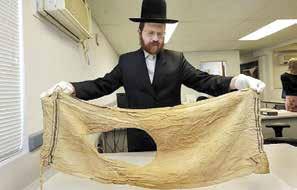
There is a major difference between the secular approach to Holocaust studies and the traditional Jewish approach. The secular approach views the Holocaust as another historical era to be studied. Our approach is vastly different, as discussed by Mrs. Libby Blum at a teachers’ seminar in May 2014. Mrs. Blum pointed out that our approach will ideally enable us to recognize and acknowledge the miracle of our national survival and the spiritual and physical rebuilding that followed. By studying the stories of our survivors and their faith, by witnessing how our Jewish brethren maintained their humanity despite the atrocities they personally witnessed and experienced themselves, we transmit to the next generation the essence of true faith.
Rabbi Yaakov Salomon emphasizes the imperative of familiarizing our children with the lessons of the Holocaust. “Protecting our kids with ‘feel good’ curriculum is unhealthy and unproductive. When the eyewitnesses are no longer, our knowledge base must increase. The alternative is forgetting…forever.”
Judge Schmidt will never forget. Neither will his children, nor any in -
dividual who had visited his office. In his office, stood a glass case, displaying a prisoner’s garb, the distinct, striped pants and shirt, worn by all concentration camp inmates. His own father had worn this very uniform in three different camps. Tattered and filthy as they were, he still held onto these garments as a reminder of where he had been and how far he had come since then. He taught his son well. His son had these garments professionally mounted in a glass case, displayed prominently in his office, a daily reminder of the horrors of the past but also a reminder of the miracle of the rebirth of our people, how far we have come. Judge Schmidt graciously donated this prison uniform to Amud Aish. Today, this prisoner’s garb is displayed prominently in the Amud Aish Memorial Museum, these lessons being transmitted even further.
The current display in Amud Aish includes also a pair of tzitzis donated by Reb Mendel Landau, z”l. Reb Mendel was born in 1922 in Oswiecim (Auschwitz), Poland, to a family of Bobover chassidim. The Jews of his hometown were expelled in April 1940, as construction of the infamous concentration camp began in an abandoned Polish
army barracks on the outskirts of the city. At the age of 18, Mendel was taken as a slave worker in the Annaberg and Greiditz labor camps. In early 1944, following years of starvation, bitter cold and hard labor, he was sent back to Auschwitz.
In Auschwitz, Mendel noticed a Hungarian Jew with tzitzis. He asked to borrow the tzitzis in order to make a blessing and fulfill the mitzvah. A guard saw Mendel in the tzitzis and beat him viciously, leaving him battered and bloody. The guard threw the nowbloody tzitzis near the camp fence. Later on, Mendel was successful in retrieving the tzitzis and tried to return the pair to the original owner, who no longer wanted them, after seeing the brutal punishment Mendel had received for wearing them. Mendel held onto these tzitzis whilst in Auschwitz, brought them along with him on a Death March, and had them with him when he was liberated from Dachau on April 28, 1945.
Reb Mendel immigrated to the United States in 1950. He married and rebuilt a chassidishe home, similar to that of his childhood. He died on Erev Rosh Hashana 5768, 2008. He had held onto this pair of tzitzis until his death. These
bloodied tzitzis remained a proud family legacy of their Zayde’s sacrifice for a mitzvah.
Today, these tzitzis are displayed in Amud Aish. Visiting groups of schoolchildren, as well as adults, are told this story of spiritual heroism, of incredible valor and bravery in the face of horrific cruelty and savagery. What lessons will these children take home? What inspiration will they glean from these objects? It is the legacy of Am Yisrael, the demonstration of love and devotion for Yahadus by those who were mighty as a lion to do the bidding of their Creator. It is the miracle of survival and rebirth. Powerful lessons indeed.
Our survivors are our heroes. Most of our survivors are now quite elderly. MJHS Hospice and Palliative Care (Metropolitan Jewish Health System) has stepped up to help us care for our beloved family members. A few years ago, MJHS sponsored a five-hour Holocaust education program for healthcare and social service professionals entitled, “Understanding the Impact of Early Life Trauma; Aging Holocaust Survivors Facing the End of Life.” I met with Mrs. Toby Weiss, the Director of Cultural Sensitivity and Jewish
Programming for MJHS, who shared with me the material discussed at this program. This same program had been offered in 2011 and 2012, but the number of Holocaust survivors facing end-of-life issues continues to rise. After having cared for over 700 survivors in the last five years, MJHS saw the need to repeat this program once again to an even larger audience. This program was held at the Jewish Heritage Museum and attracted over 170 professionals and clinicians.
MJHS published a Guidebook for Clinicians entitled “Caring for Holocaust Survivors With Sensitivity at End-of-Life.” This Guidebook was created and based on a lecture given by Dr. Irit Felsen, a clinical psychologist and trauma specialist. It was further informed by the clinical experiences of MJHS Hospice teams with hundreds of Holocaust survivors receiving hospice care. The material is quite intriguing. Is there really a special approach necessary for aging Holocaust survivors?
“Yes,” Mrs. Weiss states most emphatically. Understanding the trauma they had experienced during the Sho -
ah, and manifestations of the post-traumatic stress they may now be exhibiting, even decades later, is important. For example, survivors may present as numb or emotionally distant. Seen as remoteness or lack of engagement, this emotional constriction rather reflects depletion due to chronic states of phys -
transmitted to the children of Holocaust survivors, potentially adding complications to the caregiving process for the patient, the family member and the caregiving team.
Professional caregivers are educated about potential triggers that may give rise to reexperiencing of past trauma.
These bloodied tzitzis remained a proud family legacy of their Zayde’s sacrifice for a mitzvah.
iological and emotional hyper-arousal. This “survivor syndrome” may manifest as chronic anxiety, depression, guilt and sleep disturbances. It may manifest itself through hyper-vigilance, irritability, exaggerated startle responses, and micro-managerial behaviors. The unfortunate reality is that some of these very same symptoms may have been

As an example: for survivors, the seemingly simple act of taking a shower may be a trigger for an emotional outburst or change in otherwise pleasant behavior. Harsh, unpleasant smells may bring about flashbacks to earlier experiences in crowded cattle cars. ID bands worn on wrists may be reminders of the depersonalization that was part of the war
experience for many, being identified by number, rather than name. The list goes on and on. We must be extremely mindful and sensitive to their unique needs. Thank you to MJHS Hospice and Palliative Care and to Dr. Felsen for bringing this vital education to professionals who can apply the learning to the benefit of our precious loved ones. This valuable guidebook may be easily accessed: hospicenyc.org/holocaust-booklet.
The Amud Aish Memorial Museum is a Holocaust museum and archival center dedicated to preserving artifacts and original archival collections donated by frum survivors. We serve as a voice for the Kedoshim, enabling the next generation to connect to what mattered most to them—faith, spiritual resistance, and rebuilding Yiddishkeit after the war.
To arrange a private tour of the Amud Aish Memorial Museum, please contact Mrs. Chavi Felsenberg at 917-494-8689.


By Noah Rothstein
Reviewing: “The Jewish Journey Through Loss: From Death to Healing”
by Dr. Batya L. Ludman
and Gina Junger.
Maggid, ISBN 978-1-59264-685-2, Hardcover, 426 pages. Published 2025.
There are books that explain the halachot of aveilus. There are books that explain the psychology of grief. Until now, these have been two separate shelves. Dr. Batya Ludman and Gina Junger noticed that gap years ago and set out to bridge it. Their new book, “The Jewish Journey Through Loss,” published by Maggid Books under Koren Publishers Jerusalem (korenpub.com), brings together what has too long been kept apart: the wisdom of Torah and the insights of psychology, working side by side to help mourners heal.
Ludman is a clinical psychologist who has practiced in Israel for decades. She grew up watching her parents serve on the chevra kadisha and later joined it herself. Junger is a Jewish educator whose students, young and old, continue to shape her teaching. The two became chavrutot on the subject of death and grief, and their husbands marveled at how they could talk about it for hours. “With my psychological background and her perfect blend of Jewish understanding,” Ludman writes in the acknowledgments, “we seemed to complete each other’s ideas as well as sentences and make the sum of one and one so much greater than two.”
That partnership shows on every page. The book walks through the stages of mourning from illness through death, shiva, shloshim, the first year, and beyond. But it does not read like a halacha guide or a psychology textbook. It reads like a long conversation between two people who have thought deeply about loss and want to share what they have learned.
The central insight of the book is that the structure of Jewish mourning is itself therapeutic. “One of the most beautiful aspects of Judaism’s approach to death is its focus on ritual,” the authors write. “This prescribed structure, filled with incredible wisdom, lovingly embraces the mourner, moving you forward, step by step, through
your pain.” Shiva keeps the mourner home and surrounded by community during the first shock of loss. Shloshim begins to ease them back into the world. The year of aveilus allows grief to settle gradually. This is not news to anyone who has sat shiva, but the authors make the connection explicit: the halacha moves at the pace a person can absorb. It is not arbitrary. It is wise.
What sets this book apart is its attention to what mourners actually feel. The authors describe the guilt that surfaces unexpectedly, the exhaustion of telling the same story to every visitor, the moment months later when a smell or a song brings grief rushing back. They write about the disorientation of the first days, when everything you know has been turned upside down and the halacha gives you something to hold onto. They write about the strange relief some mourners feel, and the guilt that follows the relief. They write about anger at Hashem, and about the silence that sometimes says more than words.
The book is filled with vignettes drawn from the authors’ own lives and from the families they have worked with. A teenager who walks out of the room rather than hear the news about his mother. A young woman who never knows how to answer when someone asks how many siblings she has, because she lost a brother. A mourner who describes grief as a closet you learn to open and close, and over time it becomes a little easier. These are not case studies. They are moments of recognition. Reading them, you think: yes, that is what it is like. There are chapters on different kinds of loss. Losing a parent. Losing a spouse. Losing a child. Losing a sibling. Each one carries its own weight. The authors quote a teaching that with the death of a spouse you lose your present, with the death of a parent you lose your past, and with the death of a child you lose your future. They do not rush past these distinctions. They sit with them.
There are also chapters on harder topics. Suicide. What to tell children. The isolation of mourning during COVID, when shiva happened on Zoom and the community could not walk through the door. And there is a chapter on grief after terrorism, written before October 7 and then revised after the war began. One of the dedication pages memorializes David Schwartz, Hy”d, killed in battle on 27 Tevet 5784 defending Am Yisrael. The authors live in Israel and have watched their community absorb loss after loss. “Then along came COVID-19,” Ludman writes, “followed by the multiple losses experienced during and after a horrific war, and we suddenly had infinitely more we needed to say.”
That sentence captures something important about the book. It was not written from a distance. It was written from inside the experience, by two women who have accompanied mourners through the hardest days of their lives and who have faced loss themselves. Ludman thanks her patients “who allowed me to accompany them on their journey in both life and death, through loss and through healing.”
Junger prays that the book will be “a tool for people to find comfort in their grief.” You can feel that intention throughout.
The tone of the book is warm and honest. The authors do not pretend to have all the answers. “We ask for your forgiveness,” they write, “if we don’t always anticipate correctly just how you may be feeling.”
They know that grief is not predictable, that what helps one person may not help another, that feelings change quickly and without warning. They are not trying to fix anyone. They are trying to walk alongside.
For those who make shiva calls, the book offers practical wisdom. It explains why the halacha tells us to wait for the mourner to speak first and why presence often matters more than words. It describes what mourners wish visitors understood and what well-meaning people
sometimes get wrong. Reading those sections, I thought of visits I have made and wondered if I had helped or just added to the exhaustion.
For those who are grieving, the book offers something harder to name. Companionship, maybe. The sense that someone understands what you are going through, even the parts you have not said out loud. “While we are unable to take away your pain,” the authors write, “we sincerely hope that through this book we will ‘walk’ alongside you as you take your journey forward into the land of healing.”
The book also speaks to those who have not yet experienced major loss but want to be prepared. Ludman and Junger compare it to expecting a baby. You read books, you talk to friends, you think you know what to expect, but when it happens you discover how much you did not anticipate. Grief is similar. No one is fully ready. But some preparation helps.
One line near the end of the book stayed with me. “We don’t have a choice over the package that we each are given in life,” the authors write, “but we do have a choice as to what we do with that package.” That is the question the book keeps circling back to. Loss is not optional. But how we carry it, how we make meaning from it, how we let it shape us or not, those are choices. The halacha provides a framework. The rest is up to us.
I finished the book thinking about the two women who wrote it: a psychologist and an educator. A chavruta that became a partnership. Two voices woven together so closely that you cannot always tell where one ends and the other begins. They set out to bridge the gap between the psychological and the halakhic, and they succeeded. The result is a book that feels both deeply Jewish and deeply human.
It is not a book you want to need. But when you need it, you will be grateful it exists.


By Naomi Nachman

I’m currently in Israel visiting my children, and I wanted to make something special for Shabbat. I was so happy to discover @pickadeli, a butcher and fish shop where I found meat I’m used to cooking back home—exceptional quality, beautifully clean, and exactly the standard I look for. It made preparing for Shabbat feel familiar and special, even far from home.
◦ 6 strips flanken
◦ 3 Tablespoons brown sugar
◦ 2 Tablespoons cumin
◦ 1 Tablespoon garlic powder
◦ 1 teaspoon paprika
◦ 1½ teaspoons cinnamon
◦ 1 teaspoon rosemary
◦ ½ teaspoon salt
◦ ½ teaspoon black pepper
Sauce
◦ 2 cups barbecue sauce
◦ 1 cup red dry wine
◦ 2 Tablespoons soy sauce
1. Place meat into a large roasting pan; set aside. Heat a broiler or grill pan. You can also sear on an outdoor grill.
2. Prepare the spice rub: In a small bowl, combine brown sugar, cumin, garlic powder, paprika, cinnamon, rosemary, salt, and pepper. Rub over all surfaces of the flanken.
3. Broil or grill flanken on high for 2-3 minutes per side; set aside.
4. Preheat the oven to 325°F.
5. Prepare the sauce: Whisk together barbecue sauce and wine until smooth. Pour sauce over broiled flanken.
6. Cover pan tightly. Bake for 3 hours.
Cook’s Tips:
Don’t skip the broiling stage; it really boosts the flavor!
Double the spice rub and keep it in an airtight container in the freezer. You’ll find yourself making this recipe over and over!
Naomi Nachman, the owner of The Aussie Gourmet, caters weekly and Shabbat/ Yom Tov meals for families and individuals within The Five Towns and neighboring communities, with a specialty in Pesach catering. Naomi is a contributing editor to this paper and also produces and hosts her own weekly radio show on the Nachum Segal Network stream called “A Table for Two with Naomi Nachman.” Naomi gives cooking presentations for organizations and private groups throughout the New York/New Jersey Metropolitan area. In addition, Naomi has been a guest host on the QVC TV network and has been featured in cookbooks, magazines as well as other media covering topics related to cuisine preparation and personal chefs. To obtain additional recipes, join The Aussie Gourmet on Facebook or visit Naomi’s blog. Naomi can be reached through her website, www.theaussiegourmet.com or at (516) 295-9669.

It brings up mixed emotions to represent the U.S. right now, I think. It’s a little hard. There’s obviously a lot going on that I’m not the biggest fan of, and I think a lot of people aren’t.
- American Olympic skier Hunter Hess
I think, for me, it’s more I’m representing my friends and family back home, the people that represented it before me, all the things that I believe are good about the U.S. If it aligns with my moral values, I feel like I’m representing it. Just because I’m wearing the flag doesn’t mean I represent everything that’s going on in the U.S.
- ibid.
U.S. Olympic Skier, Hunter Hess, a real Loser, says he doesn’t represent his Country in the current Winter Olympics. If that’s the case, he shouldn’t have tried out for the Team, and it’s too bad he’s on it. Very hard to root for someone like this.
- President Trump responding on Truth Social
What you ski with that flag on your arm and run your mouth on the world stage?? Some of us wore that flag on our arm and buried our friends under it.
– Leader of a veterans’ group, Chad Caton, in a response tweet to Hess




This walk is very meaningful. This walk could change our life. How many of us are willing to walk to bring world peace?
– The leader of a group of Buddhist monks upon reaching Washington, D.C., after walking there from Texas for the past 15 weeks

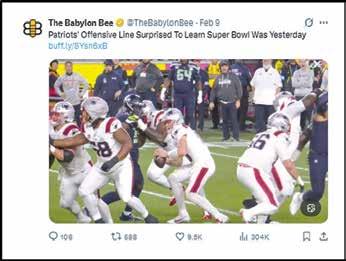


I don’t really feel that I completed my service, the way I see it. I served 10 months until I was kidnapped. Operationally, I had about two months. The rest of the time, I was in training or exercises and didn’t really do what I define as meaningful service.
- Freed hostage Nimrod Cohen explaining why he wants to return to the IDF, in an interview with Israel’s Channel 12
Can’t imagine a parent who wouldn’t sell little JD for Percocet if they knew he would turn out like this.
- New York Times columnist Jamelle Bouie in an online post about Vice President JD Vance, whose mother recently celebrated 10 years of sobriety, after being a drug addict while bringing up Vice Pres. JD Vance
To be a bit serious, one irony of Vance’s life is that he is also an addict: addicted to power and clearly willing to sell anything to get it.
- ibid.
Can you maintain some level of dignity?
- Treasury Secretary Scott Bessent at a Congressional hearing after Rep. Maxine Waters (D-CA) asked him to be quiet in a not nice way
There’s a lot of stuff that goes into representing Israel. But the great thing about representing Israel, and I think this is super important, is you learn to take a mindset that is one of a victor not a victim… If you’re a victor and you truly view yourself as on a good mission … then those moments, they don’t mean so much.
- Israeli bobsled captain AJ Edelman on Fox News talking about his response to the team being victims of burglary while in Italy at the Olympics


Nothing Says “I’m Crazy” More Than Rich, Gated-Community Libs Raging About ICE.
- Matt Vespa, Townhall
Yesterday, my Olympic dream did not finish the way I dreamt it would. It wasn’t a storybook ending or a fairytale; it was just life. I dared to dream and had worked so hard to achieve it.
- Olympic gold medalist skier Lindsey Vonn, 41, after a scary crash that ended her dream of being the oldest skier to win a gold medal
In Downhill ski racing, the difference between a strategic line and a catastrophic injury can be as small as 5 inches. I was simply 5 inches too tight on my line when my right arm hooked inside of the gate, twisting me and resulted in my crash. My ACL and past injuries had nothing to do with my crash whatsoever.
- ibid.
I am a student in your Sociology 2FF3 course and am wondering if I could get a short extension on this week’s reflection. I was competing in the Olympic Games yesterday and thought the reflection was due on Sunday, not Friday.
- Madeline Schizas, a Canadian Olympic figure skater and student at McMaster University in Ontario, sharing a message that she sent to her professor







When the justices are on recess – which is what we are doing right now – we really have an opportunity to go out into the community in various different ways.
- Supreme Court Justice Ketanji Brown Jackson on “The View” claiming that her attendance at the Grammy’s was essentially community outreach
Over the past decade, the [Washington] Post has been one of the leading culprits in the collapse of public trust in journalism.
- Davidd Harsanyi, writing about the mass layoffs at the Washington Post
The once-venerable outlet has spent the past 10 years participating in virtually every dishonest left-wing operation, including giving legitimacy to the Brett Kavanaugh…accusations, delegitimizing the Hunter Biden laptop story, spreading the Gaza “genocide” lie, covering up Joe Biden’s cognitive decline, sliming the Covington children, and countless others.
- ibid.
Don’t cry for The Washington Post. It helped destroy media.
- ibid.
I don’t sleep on planes. I don’t like sleeping on planes. You know. I like looking out the window, watching for missiles and enemies, actually.
- President Trump joking at the National Prayer Breakfast about why he doesn’t sleep much while on Air Force One

By Marc A. Thiessen

President Donald Trump faces a momentous decision: Does he deliver on his promise to strike Iran after the regime crossed his red line and killed thousands of innocent civilians? How he answers will do more than define his presidency; it will determine his place in American history.
Trump is right to carefully weigh the risks of military action, which must be taken seriously. But there are also risks to inaction, which are arguably far greater.
Start with the risk to America’s credibility. Trump told the Iranian regime in no uncertain terms that if it “violently kills peaceful protesters … the United States of America will come to their rescue,” adding: “We are locked and loaded and ready to go.” The regime ignored his threat and slaughtered thousands. He then urged the Iranian people: “KEEP PROTESTING – TAKE OVER YOUR INSTITUTIONS!!! Save the names of
the killers and abusers. They will pay a big price. … HELP IS ON ITS WAY.” Iranians listened to those words and took to the streets – and many paid with their lives.
Trump cannot allow Iran to defy his warnings with impunity. It would be one thing if he had never said these things. But he did. When the commander-in-chief delivers a warning like that, he cannot fail to follow through.
That is what President Barack Obama did when he failed to enforce the red line he drew in Syria against using chemical weapons against its own people. Trump had to bomb Syria twice to enforce it. It is what President Joe Biden did after terrorists killed 13 U.S. service members at the Abbey Gate during his disastrous withdrawal from Afghanistan. Biden warned: “We will not forgive. We will not forget. We will hunt you down and make you pay.” But
three years later, Biden left office having made no one pay. It took Trump about six weeks to deliver on Biden’s threat, capturing what he called a “top terrorist” responsible for the attack. If Trump now fails to deliver on his own solemn warnings to the terrorist regime in Tehran, he will be repeating Obama and Biden’s mistakes, sending a message of weakness that would reverberate across the world.
In his first year in office, Trump moved boldly to restore the credibility that Biden squandered on the world stage. He warned Houthi terrorists not to attack U.S. ships in the Gulf of Aden, then launched a campaign of “overwhelming lethal force” when they did not heed him. He warned Boko Haram terrorists in Nigeria that if they continued mass killings of Christians, he would send the U.S. military “guns-ablazing,” and he launched strikes when
they continued. He warned Venezuelan dictator Nicolás Maduro to relinquish power, then sent the U.S. military to bring him to justice. And when Iran ignored his deadline to reach a nuclear deal, he obliterated its nuclear enrichment facilities at Fordow and Natanz. All that hard-won credibility would be shattered if Trump now allows the same regime to get away with defying his warning not to massacre its citizens. Some are now urging Trump to negotiate a nuclear deal with Iran. That is precisely what Obama did to avoid enforcing his Syria red line. He negotiated an agreement, brokered by Russian dictator Vladimir Putin, for Syria to relinquish its chemical weapons – which the Assad regime violated. If Trump fails to enforce his own red line with Iran and negotiates a nuclear deal instead – a deal that Iran is certain to break – he would be repeating Obama’s display of weakness.

In fact, a nuclear deal now would be worse than simply failing to take military action. Any deal would necessarily involve some form of sanctions relief and would thus reward the Iranian regime financially for defying Trump and massacring its citizens. At a moment when the regime is weaker than it has ever been since the 1979 revolution, it would provide Iran’s leaders a lifeline, allowing them to recover and reconstitute themselves.
The best way for Trump to reach a nuclear deal with Iran is to take out its leadership and then negotiate with the transitional leadership that follows. Even if the regime does not fall, Trump will own its remnants – just like he has leverage over the remnants of the regime he toppled in Venezuela today. After removing Maduro, Trump warned his replacement, Delcy Rodríguez, that if she did not follow orders she would “pay a very big price, probably bigger than Maduro.” Today, she is utterly subservient to Trump. He can reach a nuclear deal with an Iranian transitional leader.
Finally, there is the risk of passing up a historic opportunity to rid the Middle East of the source of almost five decades
of violence and instability. The Iranian regime bedeviled seven U.S. presidents. It is responsible for the deaths of more Americans than any terrorist state on earth. It is the source of arms and funding for terrorist proxies that threaten the U.S. and its allies across the region. But now, thanks to Trump and Israeli Prime Minister Benjamin Netanyahu, the re -
ty of enduring peace and stability in the Middle East. If Trump seizes that opportunity, it would be the greatest foreign policy achievement of any president since the fall of the Berlin Wall.
Let’s be clear: There are risks to military action in Iran, just as there were risks to the military action in Venezuela. We take the success of the Venezuelan
Now, thanks to Trump and Israeli Prime Minister Benjamin Netanyahu, the regime is more vulnerable – politically, militarily and economically – than it has been in the 47 years since its founding.
gime is more vulnerable – politically, militarily and economically – than it has been in the 47 years since its founding. No other U.S. president has had this kind of chance to decisively end the threat posed by Iran and open up the possibili-

a bold and courageous decision. And deposing the Iranian regime by force will require similar presidential courage. Though a weakened Iran cannot stop the U.S. military, it could inflict damage on both the United States and Israel. In Venezuela, Trump concluded that the risks of inaction outweighed the risks of action. That is doubly true for Iran.
Trump faces a stark choice: He can either give the Iranian regime a lifeline, or put it on the path to destruction. He can repeat the mistakes of Biden and Obama, or take his place alongside Ronald Reagan and Franklin D. Roosevelt as one of the few U.S. presidents whose decisive leadership transformed the world.
operation for granted today, but it could easily have gone sideways: A helicopter could have crashed, Americans could have been killed, and U.S. forces could have failed to achieve their objective. Deposing the Maduro regime by force was
In his inaugural address, Trump said that he believed he was saved from an assassin’s bullet for a reason: to help America “reclaim its rightful place as the greatest, most powerful, most respected nation on earth.” Well, these are the decisions from which greatness is made. Providence has placed this opportunity in his hands. I trust him to make the courageous choice.
© 2026, Washington Post Writers Group


By Max Kim

SEOUL, South Korea — For years, Lee Kyong Min’s life revolved around shuttling her two daughters from school to cram schools to home.
It was a routine followed by nearly every other parent she knew, all sharing the same goal: making sure their children got into South Korea’s best universities. The decisive element was their choice of hagwons, or private cram schools where students take extracurricular classes in math, Korean and English to prepare for the country’s infamously competitive college admissions exam.
Lee, a former advertising professional, and her husband, who works in finance, had enrolled their children in the best they could find. Seven days a week, she waited for them late into the night at cafes packed with other parents doing the same. Sometimes, she saw little children with schedules so packed that they juggled homework and dinner in those cafes before hurrying off to their next class.
Extracurricular education, which ex-
panded alongside the demand for university degrees as the country shifted to a white-collar economy in the 1990s, is now omnipresent in South Korea. It is also at the center of long-running debates about the consequences of unchecked academic competition. Many parents wonder what alternatives, if any, exist.
When Lee’s daughters questioned why they had to spend so much time studying outside school, she told them it was necessary because academic achievement equaled opportunity, which meant a happy life.
But her belief in this idea began to fracture when her eldest, then around 8, asked: “Mom, were you a bad student?”
“I realized she saw me as unhappy,” said Lee, 46. “I felt like I’d been hit in the head.”
Now she wondered: What vision of life and happiness was she presenting to her daughters? It is a question more parents in South Korea are confronting.
Eighty percent of South Korean schoolaged students now receive some form of
private extracurricular education, according to government data. While the schooling-age population has been shrinking for decades, this market grew to a record $20.3 billion in 2024.
Children are entering cram schools at younger ages. In some districts in Seoul, the capital, children as young as 4 take entrance exams for English-language preschools. Others enter medical school prep tracks in elementary school.
Even in a country long inured to intense academic competition, these developments have provoked alarm. South Korea’s human rights commission has said that subjecting preschoolers to such high-stakes testing is a violation of their rights. Lawmakers, blaming hagwons for an adolescent mental health crisis, have vowed to intervene.
But the system that created them, as Lee would discover, is not so easy to change.
“Level Tests” For Lee, entering her children into the
grind of hagwon education came with conflicted feelings. She and her husband both attended mid-tier universities, a fact that, in their well-credentialed world, was a source of both defiant pride and smoldering insecurity. Part of her wanted their daughters to have an enriching humanities education and not be beholden to the college race. Another wanted them to be among its winners.
So in 2013, she enrolled her girls, then around 4 and 5 years old, in an English-language preschool. She declined to give specifics about her children, like their names, for privacy reasons.
But she said they attended numerous hagwons in Daechi, a wealthy neighborhood in the Gangnam district of Seoul regarded as the pacesetter of educational achievement in the country. Daechi is home to 1,200 hagwons spread across an area roughly the size of Central Park.
Surrounding them are the other trappings of its hyper-optimized path to academic success: “study cafes” that con-
fiscate students’ phones to promote focus and traditional medicine clinics that advertise brain-boosting treatments. There are even soundproofed enclosures on the street, called “Therapy Zone” boxes, where stressed-out students can study — or scream.
Lee grew up in Daechi and was no stranger to its reputation. Even so, she was struck by the endless loop of testing that awaited her daughters.
The most important were the “level tests,” or entrance exams held by hagwons for children as young as 4. Some, like those taken by third graders to enter Daechi’s most prestigious math hagwon, are so competitive that parents often send their children to another hagwon to study for it.
“The saying goes, if you want to send your child to medical school, you need to have them do six passes of the entire math curriculum to the high school level,” Lee said. Her eldest took the test but did not make the cut.
Recently, the authorities have urged hagwons to refrain from such competitive admissions for young children.
But little has changed. Anxiety persists around the college admissions exam, the Suneung, a do-or-die test whose scope and difficulty has far exceeded standard school curriculums.
“Students today are all essentially juggling two separate workloads: their school grades and preparation for the Suneung,” said Gu Bon-chang, a former hagwon teacher and now policy director for World Without Worries about Shadow Education, a nonprofit.
One teacher at a leading English hagwon franchise estimated that his elementary school-aged students spent at least 40 hours a week just on extracurricular classes. He asked not to be named for fear of retaliation from his employer.
He was struck by one essay he had recently graded. A 6-year-old, he said, wrote of her fear that her whole family would be unhappy if she did not excel academically.
Parents are also increasingly grappling with the consequences of the system.
Park Euna, a mother of three, said she got a wake-up call a few years ago, when a classmate of her eldest daughter, who was then in elementary school, died by suicide.
Park recalled the classmate as a savvy and charismatic child who loved to dance but lacked a head for academics. She had been trying to get into the elite math hagwon in Daechi but had fallen short.
The episode prompted her to reconsider
her children’s priorities.
“If they end up deciding they don’t want to go to college, I am fine with that,” she said.
Bad at Math
Peter Na, a psychiatrist at Yale University, cautioned against drawing a straight line from pressurized academic environments to hurting oneself, which can have complex causes.
watching at arm’s length. Many of the spousal conflicts Lee sees emerge from this tension, she said, as fathers of underperforming students question why their money is not producing results while mothers spiral in a constant state of anxiety.
The roots of such ratcheting competition run much deeper than merely overambitious parents.
A 6-year-old, he said, wrote of her fear that her whole family would be unhappy if she did not excel academically.
Even so, he is troubled by the rise of depression symptoms in South Korean children under 10, as is evident in government data.
“Depression under 10 years old is not something that’s common. I don’t think it’s isolated from what’s going on in the private sector,” he said, referring to hagwons.
As Lee’s daughters neared the end of middle school, her own concerns were growing because her eldest, whose gifts were in words but not numbers, was struggling.
“In the South Korean education system, if you aren’t good at math, you are seen as an idiot,” Lee said.
“The focus is always on what you’re bad at,” she added.
Fearful for her girls’ self-esteem, she and her husband pulled them from their multiple hagwons in 2024.
Lee herself also made a career change. Now a qualified psychologist, she works as a therapist near Daechi.
Many of her clients are mothers from the same competitive hagwon pipeline, with children reporting symptoms like self-harm.
Their intent, she said, is “to make their parents see them, to show them, ‘Look, I’m suffering.’”
But the mothers, she said, are no less unhappy.
In South Korea, mothers are primarily responsible for their children’s education, said Lee, whose doctoral thesis explored the effects this had on their mental health. Many women find themselves corralled into this role after discovering their careers are effectively over after they have children. They are expected to be the taskmasters who crack the whip, often with fathers
South Korea has one of the highest rates — 76% — of college enrollment in the world. But the economic insecurities that spurred this mass pursuit in the first place still persist: a weak national pension system, a shortage of high-quality blue collar jobs, limited upward mobility and yawning income disparity.
“There are no second chances in South
Korea,” said Soo-yong Byun, a Penn State University professor who studies the hagwon industry. “Not just where you go to college, but also the first job you get after that — all of these have huge impacts on your mobility as an adult.”
Arim So, a 39-year-old mother in Seoul, said she constantly teetered between anxiety and guilt toward her 11-year-old daughter, who recently asked her why her path always seemed to be decided for her.
“But I always realize there is just no other alternative in South Korea,” So said.
Those who can afford it have a rip cord: leaving the country. This was the path Lee ultimately settled on, enrolling her daughters in a private boarding school in the United States in 2024.
She was rueful, recognizing it was a privilege that few others have. “It feels like I no longer have the right to talk about the problems of this system,” she said.
Now her daughters are thriving at their new school. Her eldest is no longer seen as a slouch in math.
“Go to the U.S. after studying math in Daechi to the eighth grade level or so,” she said, with a bittersweet laugh. “People will call you a genius.”
© The New York Times

By Avi Heiligman


Known as the Silent Service, sailors serving on submarines played a vital role in the war effort during World War II. While comprising only 2% of the U.S. Navy’s personnel, submarines accounted for 55% of the Japanese shipping sunk during the war. Submariners volunteered for the service and went through a grueling selection process before being assigned to a boat. The danger onboard submarines was ever-present as they were subject to long periods underneath the ocean’s surface and if detected became prime targets for a depth-charging attack. Fifty-two American submarines never returned to base; most were sunk by enemy action although some were lost by their own malfunctioning torpedoes. The heroics of many submariners have been noted by their many medals and decorations, and their legacy remains in the silent efficiency that crippled Japan’s ability to wage war. American submarines were plagued with numerous problems, from torpedoes that failed to explode to captains employing outdated tactics. The USS Seahorse (SS-304), a Balao-class diesel submarine, serves as a prime example of the problems that many submarines faced. During her first patrol, the
commanding officer followed pre-war practices of not engaging targets with sonar and allowed several ships to pass unscathed. In addition to the lackluster effort by the skipper, the Seahorse fired eight torpedoes – a third of the submarine’s 24 torpedoes carried on a regular patrol – at a large tanker but failed to sink the enemy ship. After a refit, com-
marine officer from Cincinnati, Ohio, who was recognized with several prestigious medals and awards for gallantry and devotion to duty while on patrol. He was with the Naval Reserves, and after the United States entered World War II, he volunteered for submarine duty and graduated at the head of his class at the New London Submarine Base. Records
Savadkin helped another sailor clear the submarine and made the 180-foot ascent to the surface utilizing a huge air bubble.
mand passed to the executive officer, Slade Cutter, who was much more aggressive during the ship’s second patrol.
Under Cutter, the Seahorse sank three trawlers and five Japanese ships while patrolling in the East China Sea. The Torpedo and Gunnery Officer onboard the Seahorse was Lieutenant Ralph Pleatman who was noted for his “outstanding service in a submarine on war patrol.”
Ralph Pleatman was a Jewish sub -
show that he served on both the USS Pompano (SS-181) and the USS Seahorse for at least one patrol on each boat.
Twice awarded the Silver Star, Pleatman was also the recipient of the Navy and Marine Corps Medal for his actions during the Seahorse’s second patrol in December 1943. The citation states that while the submarine was patrolling in enemy-controlled waters, the crew had a surface encounter with an enemy patrol
vessel. A gun battle ensued with Pleatman dangerously exposed on the deck manning the 20mm anti-aircraft gun. He courageously remained at his station, engaging the Japanese who were firing from a machine gun at the submarine. Pleatman’s accurate fire overwhelmed the Japanese and resulted in the sinking of the enemy ship during the chaotic battle.
Before being sunk by its own malfunctioning torpedo, the USS Tang (SS306) became the most successful American submarine of the war. Throughout its five patrols, the Tang sunk a record of 33 ships totaling 116,454 tons. Under Commander Richard O’Kane, the Tang often used the cover of darkness and the boat’s low profile to slip past enemy destroyers. Once past the destroyer screen, O’Kane would order the torpedoes to be fired, and they would often hit with pinpoint accuracy. In addition to sinking Japanese cargo ships and oil tankers, the Tang participated in rescuing downed aviators. At Truk Lagoon, she picked up 22 stranded American flyers who were in danger of being captured or killed by the Japanese. Disaster struck the Tang on October 25, 1944 when her 24th and final torpedo suffered a circular run. The Tang sank almost immediately.


Incredibly, nine men emerged from the depths with some using an underwater breathing apparatus called the Momsen Lung. The nine sailors were picked up by the Japanese Navy, and they spent the rest of the war in harsh conditions as prisoners of war.
Among the survivors were O’Kane and Jewish Lieutenant Lawrence Savadkin of Forest Hills. Savadkin was the Assistant Approach Officer and was in the conning tower when the subma-
rine was sunk. Previously, he had been an engineering officer on a destroyer that had been attacked by German dive bombers and directed rescue and repair efforts despite being wounded. For his heroic efforts in saving the destroyer, Savadkin was awarded the Silver Star.
While on the Tang, Savadkin was instrumental in sinking many of the Japanese ships. Savadkin helped another sailor clear the submarine and made the 180-foot ascent to the surface uti -

lizing a huge air bubble. For his actions on the Tang, Savadkin was awarded the Navy Cross for saving a shipmate in addition to the POW Medal and the Purple Heart. O’Kane was awarded the Medal of Honor by President Truman following his release from the POW camp.
These submariners rightfully earned their decorations through incredible tenacity and perseverance. Their bravery was a major factor in the American effort to cripple the Japanese war ma -
chine. Although the Silent Service lives up to its name – their stories are rarely seen outside of old newspapers and military history books – these Forgotten Heroes deserve to be remembered.
Avi Heiligman is a weekly contributor to The Jewish Home. He welcomes your comments and suggestions for future columns and can be reached at aviheiligman@gmail.com.

DU N DURT
Power & Soft Washing
We clean siding, stucco, decks, driveways, concrete, pool patios, pavers & sidewalks.
Say goodbye to grime, mold & allergens!
Call/WhatsApp: 718-688-2964
Email: dundurtny01@gmail.com
THE LEATHER SHOPPE
The spot for all your custom leather Judaica. Tallis/tefillin bags, lulav and esrog bags, havdallah sets, challah covers, shtenders, pesach sets, matzah/afikomen bags. WhatsApp: (732) 523-0007 or email: theleathershoppe732@gmail.com for a full catalog. We ship.
PEACEFUL PRESENCE STUDIO
Men’s private yoga, Licensed Massage & Holistic Health Guidance 436 Central Ave, Cedarhurst Info. & free video training www.peacefulpresence.com 516-371-3715
GERBER MOVING
Full Service Moving Packing Moving Supplies
Local Long Distance. Licensed Insured 1000’S Of Happy Customers Call Shalom 347-276-7422
HANDYMAN AVAILABLE
For big or small jobs, Sheetrock, carpentry, painting, electrical, plumbing, install & repair appliances Call Ephraim at 347-593-4691
MANAGEMENT STAFF WILL ASSIST
you with: * Obtaining Medicaid and Pooled Income Trust
* In-home Assessments, Individual and Family Counseling
* Securing reliable home care assistance
* Case and Care Management services
Dr. S. Sasson, DSW, LCSW (718) 544- 0870 or (646) 284-6242
HAIR COURSE:
Learn how to wash & style hair & wigs. Hair and wig cutting, wedding styling
Private lessons or in a group Call Chaya 718-715-9009
ZEVIZZ WOODTURNING JUDAICA
Challah knifes, batei mezuzah, besamim holder, kiddish cups, havdalah candle holders, yad for sefer torah, pens, stenders, bowls and more 952-356-2228
MY MOTTO IS DON’T WAIT TO buy real estate
Buy real estate and wait
Your realtor for life
516-784-0856 Alexandra at Realty Connect USA
REAL ESTATE MANAGEMENT
Services – Do Not Manage Your Properties Alone! Contact Aliyah Suites for all your real estate management needs and affordable office space near you! (516) 366-1049
Management@aliyahsuites.com
Marc Jeret (MJ) Team Leader & Licensed Real Estate Agent




















classifieds@fivetownsjewishhome.com • text 443-929-4003
CEDARHURST
Prime Restaurant Location For Lease. For more information: Call/Text/WhatsApp Owner: (516) 206-1100
5 TOWNS - OFFICES FOR LEASE 250SF to 500SF Offices in Inwood & Cedarhurst Utilities, Internet & Parking incl. with some Kosher kitchen - Minyan Next to LIRR - No broker fee Call/text/Whatsapp: 516-206-1100
Don’t Get Stuck With a Two Story House Ya Know, It’s One Story Before You Buy It But a Second Story After You Own It!
Call Dov Herman For An Accurate Unbiased Home Inspection InfraredTermite Inspection
Full Report All Included NYC 718-INSPECT Long Island 516-INSPECT www.nyinspect.com
WANT TO WORK WITH A COMPANY that sells guitar accessories? We need help boxing and shipping our gear, taking pictures and organizing our inventory. If this sounds interesting, reach out! Evan (516) 447-1018
DELIVERY PERSON NEEDED to deliver this Newspaper every Thursday morning to locations in Brooklyn. Must have Mini van or SUVand availability to work Consistently every week. Good pay - Please email gabe@fivetownsjewishhome.com or call (917) 299-8082
MAKE A DIFFERENCE!
Be a Direct Support Professional F/T & P/T and flexible positions available Brooklyn, Queens and 5 Towns $18.05-$18.30 per hour 855-OHEL-JOB or resumes@ohelfamily.org

BOOKKEEPER
A Five Towns Real Estate Company is seeking a full-time Bookkeeper. The right candidate must be proficient with QuickBooks and Excel. They must also be self-motivated, organized, detail oriented, reliable, and able to work independently or as a team player. Warm, frum office environment with excellent salary & benefits. Please email resume to HR@capsprop.com
YESHIVA DARCHEI TORAH MIDDLE
School is now hiring teachers for the upcoming school year. The following positions are open: 5th grade, Monday-Thursday 1:20-4:30 6th grade ELA 7th grade Math 8th grade ELA & History Grades 6-8 position is Monday-Thursday, 4 periods- 2:30-5:30. Each period is 40 minutes. We offer a warm & collaborative working environment and competitive salary. Candidates should have prior teaching experience. Interviews are being held now. Please send resume to mleff@darchei.org
YESHIVAT KOL YAAKOV
In Great Neck, NY, is seeking general studies teachers for both the elementary and middle schools, for the upcoming academic year. Mon-Thur afternoons. Competitive salary, warm and supportive environment. Send resume to m.kalati@kolyaakov.org
SEEKING ELEMENTARY TEACHERS
For current school year, starting from end of January: Seeking assistant teacher for General Studies. Candidate should have skills to take over for teachers if needed. Far Rockaway area boys’ school, M-Th, PM hours, strong support. Excellent salary. Possibility to continue for next year. Send resume to teachersearch11@gmail.com

Licensed Real Estate Salesperson
Realty Connect USA 516-884-6530 (C) Lscheininger@realtyconnectusa.com @LeahScheininger_Realtor 24 Franklin Ave. Hewlett NY 11557







ARE YOU A DOULA?
Or have a passion to be? Come join our great referral group and get access to a vast new clientele through Medicaid. JUST CALL 347-668-7886
REGENTS EXPERT
Tutoring regents in Algebra and Geometry A Darchei Torah instructor. Guaranteed results Text 347-491-8045
WhatsApp 347-767-1755


REGIONAL NURSE
5 Towns area Nursing Home management office seeking a Regional/Corporate level MDS Nurse to work in our office. Must be an RN. Regional experience preferred. 2-3 years MDS experience with good computer skills required. Position is Full Time but Part Time can be considered. Great Shomer Shabbos environment with some remote options as well. Email: officejob2019@gmail.com
A multi-tasker needed for general office work. The ideal candidate is someone who is detail-oriented, responsible, and can take ownership. Looking for someone who is eager to learn, and expand his/her skill set while possessing the ability to work independently and as part of a team. Experience with Excel required. Five Towns location. In-office position only, not remote. Please send resume to 5tpart.timecareer@gmail.com
HASHAVAS AVEIDA
Apple airpods found on Wednesday morning on the way to the Woodmere dock. To claim, 516-351-8105.
SHMIRAS HALASHON
Text 516-303-3868 with a time slot of your choice to be careful on lashon hara. Be a part of the 1,000 people for klal yisroel!
BEIS HAMEDRASH CONG.
Chasdei Uvois Oshpitzin
Talmidei chachomim are willing to learn mishnayos, say kaddish and be the shliach tzibbur to daven for the umid on the yartzeit yom hashanah of your parents or close relatives or loved ones To arrange please call Rabbi Miller 917-445-6220






















By Rivki D. Rosenwald Esq., LMFT, CLC, SDS

What does “gehatchkes ” really mean?! And who cares anyway?
It’s just a good, expressive word.
I’m not exactly sure what it means, but I’m pretty sure I am freezing mine off!
ChatGPT says it refers to your guts or intestines. Whatever it is — no one wants a winter this cold.
After all, this is not the winter we signed up for. We are the “we like snow once in a blue moon” people. The “wow, look, it’s snowing” people. “Maybe we’ll get to sled a little” people. Or “build a snowman or create an igloo” people. Perhaps even one that’s bigger and more impressive than anyone else’s on the block!
But the “I’m buried in snow and frost” people — we are not!
Maybe in Chicago or Montreal they’re expecting, or at least tolerating, this kind of weather. But us? I don’t think so.
And this snow doesn’t even have that yummy consistency to build with or play in.
It isn’t wet enough to be packable. In fact, if it were, we probably would have packed it up and shipped it off to Chicago already!
Now Miami – that’s a whole different frost. There’s no snow in sight, and interestingly, the sun is shining brightly. But don’t take off your winter wear, because it’s cold outside.
It’s even cold inside! Residents are not prepared for this weather. Who even has a heater in Miami?
In Miami, I’d say the best place to head is the malls — especially since you probably need more layers.
The restaurants are still crowded, though. Unless you’re willing to sit outside. Then you own those reservations.
Whether you are in New York or you escaped to Miami, the weather is what we
In that vein, I think we can rebrand this weather as a “Big Chief” winter in the East.
Granted, it’s probably the easiest time ever to get a beach chair. But who wants it?
You might take the opportunity to bundle up and sit outside, imbibing the luxury of snagging one so easily — unless, of course, there’s no one to set you up because the beach attendants have run off to find themselves a sauna to warm up in.
refer to as unseasonably cold. And that’s an understatement. You can’t even get that sentence out without your lips chattering. Where’s global warming when you need it?!
If you’re heading south and thinking of packing your swim clothes, perhaps you should rethink it and trade them in for ski
clothes, just to be on the safe side. You’ve heard of an “Indian summer” in October. In that vein, I think we can rebrand this weather as a “Big Chief” winter in the East.
We all like surprises. But we mean good ones.
Who wanted ice on the roads and ice cubes on our beaches — unless, of course, they’re in our drinks?!
So now, we’re ready for a surprise turnaround in the weather. Maybe to a little unseasonably warm.
After all, hot chocolate is fun, but we’d rather have it as a luxury than a necessity.
In the meantime, hold on to your gehatchkes and enjoy the ride!
Rivki Rosenwald is a Licensed Marriage & Family Therapist working with both couples and individuals and is a certified relationship counselor. Rivki is a co-founder and creator of an effective Parent Management of Adolescent Years Program. She can be contacted at 917-705-2004 or at rivkirosenwald@gmail.com.