















There are mounds – mountains – of snow piled onto sidewalks and streets. It’s hard to think that spring is around the corner. But despite Punxsutawney Phil predicting a long winter (hello, Captain Obvious), Tu B’Shvat signals for us that our world is preparing for a rebirth, a time when the sap will begin to flow again and tiny shoots will begin to emerge from the ground.
The snow signifies that winter is still here – in fact, it almost feels that winter is here to stay. But the fruits on our tables in honor of Tu B’Shvat are a reminder that spring is about to peek through.
I was thinking about that phenomenon this week – but not when it comes to nature.
In the winter, the snows fall and the rains pour, and we’re left in a cold, dismal world. But Hashem, in His divine wisdom, has orchestrated the rebirth of the world in such a way that the rain and snow are the very items that are needed for the growth that comes in the spring. Now, living in the winter, we may not be able to understand that those very things that are perhaps causing us to feel cold and sad and claustrophobic are the very things needed for the sap to rise and the buds to begin to blossom.
I was thinking about how often we find ourselves in personal winters as well. Times when things feel frozen in place, when answers don’t come easily, when the world feels heavy and constricted. We may be doing all the right things – showing up, davening, trying – and yet
nothing seems to be moving. Like the ground beneath the snow, everything appears dormant. It’s easy, in those moments, to believe that nothing is happening at all.
But Tu B’Shvat reminds us that growth is not always visible. Beneath the surface, deep within the roots, something is stirring. The trees are not lifeless; they are conserving strength, drawing nourishment from the very elements that seem harsh and unwelcoming. The cold, the rain, the snow – none of it is wasted. Every drop has a purpose, even if we can’t yet see its impact.
And perhaps that is the message for us, too. The challenges we endure, the tears we shed, the waiting that tests our patience – these are not signs of abandonment. They are part of the process. Hashem is nurturing something within us and within our people, even when the landscape feels bleak. The fruits will come, but first the roots must be strengthened.
In the winter, in the darkest of times, Hashem is preparing the geulah. It’s those small acts that we do – the chessed, the thoughtfulness, the tefillos – that are the very things that will help to bring about our salvation. Each prayer, each kindness, each mitzvah is the sap that continues to rise from within. They are the life-giving force that will help to bring about the yeshuah for our nation.
May it come soon.
Wishing you a wonderful week, Shoshana

Yitzy Halpern, PUBLISHER publisher@fivetownsjewishhome.com
Yosef Feinerman, MANAGING EDITOR ads@fivetownsjewishhome.com
Shoshana Soroka, EDITOR editor@fivetownsjewishhome.com
Nate Davis
Editorial Assistant
Nechama Wein
Copy Editor
Rachel Bergida
Shana Brecher
Lani White
Design & Production
Gabe Solomon
Distribution & Logistics
P.O. BOX 266
Lawrence, NY 11559
Phone | 516-734-0858
Fax | 516-734-0857
Classified Deadline: Monday 5:00PM classifieds@fivetownsjewishhome.com text 443-929-4003
PAYMENT VIA CREDIT CARD MUST BE SUBMITTED ALONG WITH CLASSIFIED ADS
The Jewish Home is an independent weekly magazine. Opinions expressed by writers are not necessarily the opinions of the publisher or editor. The Jewish Home is not responsible for typographical errors, or for the kashrus of any product or business advertised within. The Jewish Home contains words of Torah. Please treat accordingly.






Dear Editor,
Singles today are exhausted. Dating has become time-consuming, expensive, and emotionally draining. Many of us are asking: is there another way?
I’d like to propose a simple, community-based shidduch initiative called “Lunch Your Hunch.” The idea is refreshingly old-fashioned: if you have a hunch that two people might be a good match— or at least worth a try—invite them for a Shabbat meal.
It doesn’t require professional matchmaking skills, endless résumés, or pressure – just being a caring friend, neighbor, or family member who notices people and wants to help. It can be one potential couple joining a family or a few singles coming together around a Shabbat table.
How many wonderful stories begin with, “We met at a Shabbat meal”? There is something organic, family-oriented, and human about sharing food, conversation, and community –without the weight of a “date.”
Pick Shabbat Mevorchim or any opportune time, trust your instincts, open your table, and Lunch your Hunch.
Sometimes, all it takes is a little hospitality and a lot of heart.
Sincerely, Miriam Chopp
Dear Editor,
It was a great and eye-opening article in this week’s issue about Shloime Dachs. I just want to add a small story showing what type of guy he is.
I had a son, Alexander Zisha, who had been in a horrific car accident nine years ago and was in a brain trauma unit in a rehab in Far Rockaway. He could not respond in any way, but he was aware what
was happening, and you could see his reactions in his face and eyes and slight movement of his toes. We saw that he loves music and reacted according to the way he liked the music that was being played. His brother tried to get volunteers to come and sing to him or play instruments, and Shloime Dachs, very kindly, came one night to sing to him. Among the songs he sang was his trademark Hamalach Hagoel. As he was singing, he heard one of the people standing around the bed mention to someone else that my son really loved Abie Rotenberg’s composition of that song. Shloime continued singing his tune, but as he got to the end, he seamlessly switched over the second half of the song “Vsheim Avosai” to the Abie Rotenberg tune. It was amazing how he did that – and did that only to please the patient.
Every time I tell the story over to anybody, they come back at me with another story of chessed that R’ Shloime did. Hashem should help him succeed in all his endeavors, with gezunt and nachas. Avrum Rosenblum
Dear Editor,
This past Shabbos, we unfortunately had a repeated incident of talking during the rabbi’s drasha, to which people were told to be quiet.
It’s bad enough that too many shuls have talking during davening. Sadly, mine seems like the only one I’ve attended where people shmooze when the rabbi talks, which is outright extremely disrespectful.
If you feel the need to talk during the drasha, please be a mature, respectful adult, and step outside. No shul should
Continued on page 16
ever have any talking, certainly when the rav orates.
A Reader
Dear Editor,
How can such a language of innocence be used for such a severe infraction, namely, how we flee from the Torah (Bamidbar 10:35) which we received in this week’s parsha.
Though excited to receive the Torah originally, we then fled from it, becoming fearful of its obligations. Nonetheless, the Gemara (Shabbos 88b) analogizes this flight from the weightiness of the Torah with light, soft, and plainspoken words: “k’tinok ha’boreach mi’beit hasefer, like a child who runs from school.”
Maybe that’s the point. The desired goal is for our acceptance of the Torah to be like that feeling of the child when he hears there’s no school. That freedom is the goal: to be carefree and take it on with an inspired heart.
Steven Genack
Dear Editor,
As a frequent reader of your weekly paper, I would like to address some inconsistencies in last week’s edition. In your Notable Quotes, it was once again
proven how untrustworthy The New York Times is, writing, “Hamas Hands Over Body of Ron Gvilli, Closing Chapter for Israel.” You cite other sources about that topic but the shock as always comes from the NYT. I’m confused why you would then print articles from that paper? Aryn Baker, Neil MacFarquhar, Christina Goldbaum are authors from that edition. Please stop printing articles from The New York Times! Liorah Berger
Dear Editor,
Everyone is reminded to immediately call their state senator and assemblymember and urge them to: please vote NO to the Assisted-Suicide Chapter Amendments S8835 and A9515, and any other legislation that advances Assisted Suicide in any way.
Call the switchboard, 9 am-5 pm: 518455-2800 (Senate) / 518-455-4100 (Assembly).
(If you don’t know your State Senator or Assemblymember’s name, they will be able to assist you, by using only your zip code.)
The only remaining way to stop Assisted Suicide legislation in NY is to defeat these Chapter Amendments – which serve to enable the Governor to sign the

initial Assisted Suicide bill passed in June, A136/ S138.
The bill is openly anti-religious – requiring health care providers who refuse to kill the patient to forward the patient’s medical records to the provider who is willing to assist in the murder of the patient.
This bill is deadly dangerous with many loopholes.
It is purposely absent of a non-severability clause (which would require “bot’la mikzt’osoh – bot’la kullah”).
This bill will endanger Jewish lives everywhere in New York.
Legalizing Assisted Suicide/Murder will present a terrible michshal of transgressing the most serious sin of committing murder, and being murdered, for Yidden who are not well versed in halacha especially, and even those who may be.
The seriously infirm, aged, special-needs, medically vulnerable, intellectually compromised, severely depressed, etc., and their family members, and doctors, will all be in danger of committing murder, and being murdered, R”L, Hashem Yishmareinu.
To receive an email of the psak from many Rabbonim across the Orthodox Jewish spectrum, email: torahjewsfordecency@gmail.com or view it online: https://daattorah.blogspot. com/2025/05/psak-halacha.html
We must act to save Yiddishe lives now!
The State Senate and State Assembly are scheduled to vote the first week in February. (For those readers that may be curious regarding the ambiguous deadline, due to the redefinement of the word “adjournment” in the NY State Constitution, the 30-day deadline was extended a week. If they decide to interpret the NY State Constitution to dis-include Sundays, which is absent in the text of the NY State Constitution, the deadline will fall out on Tues., February 10, 2026.)
Please call your State Senator and Assemblymember right away! The only information you need to give is your name and zip code.
When you save one life, it’s as if you save the entire world.
Thank you,
Mrs. H. Goldstein Monsey, NY
Dear Editor,
What a year it has been. While global headlines dominate our conversations, a quiet, profound struggle persists in the shadows of our own community.
Imagine the weight of the silence for couples waiting, davening, and exhaust-
ing every avenue of hishtadlus to hold a child of their own. For them, every trip to the supermarket or walk to shul is a reminder of what is missing. They often suffer in private, hesitant to speak to parents or friends, avoiding the “nebach” glances of those around them.
Who stands by them in these long, lonely hours? ATIME.
Founded by those who walked this difficult path when no support existed, ATIME provides delicate, essential services that transform a couple’s journey from isolation to hope.
We all want to help. This year, we are offering the greatest zechus possible: the merit of Torah. On Sunday, February 8, our community will join hundreds of lomdim to complete the entire Shas in a single day, under one roof.
Team Far Rockaway has been preparing for months, with each member mastering 10 blatt. These are your neighbors, your relatives, and your friends. They are learning for the couples surrounded by “too-clean” walls and “too-quiet” rooms. You can be a vital part of this yeshuah. By sponsoring a member of our team, you send a powerful message to these couples: You are not alone. Visit shasathon. org. Find a learner from our neighborhood team. Sponsor their learning to support ATIME’s mission. Your support fuels the dreams of families yet to be. Thank you for your generosity and for turning silence into hope.
Sincerely, Rabbi Moshe Shonek Member, Team Far Rockaway
Dear Editor,
It is known that LED lights are much better than fluorescent in every respect, and they use about half as much electricity. I had replaced all my regular bulbs with LED many years ago, but I still kept the long fluorescent tube lamps in the kitchen and basement because I did not know LED replacements existed. As it turns out, for the last decade there are LED replacements for these, so I replaced them without waiting till they break. Each standard 40 watt linear lamp costs about 1 cent per hour in NYC, so 4 such lamps cost $6-$9 per month. You can save about half of that. HaTorah chasa al mamonam shel Yisrael! LED light is also better and healthier for the eyes. In addition, these lamps last longer, sparing you the need for frequent replacements. Saving electricity also benefits everyone in conditions of constant electricity shortage. The only ones who lose out are manufacturers of old fluorescent lamps. Michael Rosen



The government of Spanish Prime Minister Pedro Sánchez has said it will grant legal status to approximately 500,000 illegal immigrants in Spain.
Foreigners without a criminal record who arrived before 2026 and can demonstrate that they have resided in Spain for five or more months will soon qualify for renewable one-year residence permits.
The move began as a proposal backed by approximately 700,000 people, as well as the Catholic Church and hundreds of other organizations.
Most immigrants in Spain already have legal status, but hundreds of thousands do not and therefore work informally. Sánchez has argued that mass legalization would boost Spain’s economy by increasing tax revenue, filling jobs, and strengthening the country’s social security system.
According to Jasmijn Slootjes, deputy director of the Migration Policy Institute Europe, the move was also intended to address concerns that Spain’s workforce cannot be sustained by the aging native-born population.
“If you look at the demographic decline, the fertility rate in Spain is the lowest in Europe—so it’s really, really low,” she said. “There are many skill shortages and labor shortages, and de facto, many irregular migrants are working, although in informal jobs. By regularizing them, you can, of course, generate more tax payments, and you also get better matching of skills, because people can actually work at their skill level. So it’s a very pragmatic approach.”
“That’s something that’s mentioned time and again—this link to the economy, maintaining social welfare access, and sustaining a healthy, competitive country,” Slootjes added. “That is really a core argument in all of this, and the evi-
dence is indeed pointing that way. I think one quote of [Sánchez’s] is very clear in clarifying their approach: he says, ‘Spain needs to choose between being an open and prosperous country, or a closed-off and poor country.’”
Currently, Spain is one of the few European countries actively encouraging immigration. Still, Sánchez’s critics have condemned the move as proof that the prime minister “hates” and wants to “replace” the Spanish people.

In 2023, British Columbia launched a drug decriminalization program, shielding people from arrest for possession of up to 2.5 grams of hard drugs. Now, the province is discontinuing the program.
“The intention was clear: to make it easier for people struggling with addiction to reach out for help without fear of being criminalized,” Health Minister Josie Osborne said on January 14. She noted that the program “has not delivered the results we hoped for.”
After the province announced the program’s expiration, Canadian media was filled with critics who said it had been mishandled.
Vancouver police chief Steven Rai said his force had been willing to support the plan, but “it quickly became evident that it just wasn’t working.”
Decriminalization “was not matched with sufficient investments in prevention, drug education, access to treatment, or support for appropriate enforcement,” he explained.
British Columbia’s experience mirrors that in the U.S. state of Oregon, which rolled back its pioneering drug decriminalization program in 2024 after a fouryear trial. Like in Oregon, BC’s program faced fierce criticism, with many saying public safety was threatened by a tolerance of open use.
A flashpoint moment in the western Canadian province was a 2024 incident where a person was filmed smoking what appeared to be a narcotic inside a Tim Hortons, the popular coffee shop chain


frequented by families across the country. Local politicians in Maple Ridge, BC, attributed the incident to a permissiveness about drugs ushered in by decriminalization.
More than 200 people were killed in a
mine collapse at the Rubaya coltan mine in eastern Democratic Republic of the Congo (DRC) last week.
The mine collapsed after a landslide in the area.
“More than 200 people were victims of this landslide, including miners, children and market women. Some people were rescued just in time and have serious injuries,” Lumumba Kambere Muyisa said, adding that about 20 injured people were being treated in health facilities.
pened and swept people away. Some were buried alive, and others are still trapped in the shafts,” Bolingo said on Friday. Rubaya produces about 15 percent of the world’s coltan, which is processed into tantalum, a heat-resistant metal that is in high demand by makers of mobile phones, computers, aerospace components and gas turbines.

The mine, where locals dig manually for a few dollars per day, has been under the control of the Rwanda-backed M23 rebel group since 2024, after previously changing hands between the DRC government and rebel groups. The heavily-armed M23 rebels, whose stated aim is to overthrow the DRC government in the capital Kinshasa, captured even more mineral-rich territory in the east of the country during a lightning advance last year.
The United Nations has accused M23 rebels of plundering Rubaya’s resources to help fund their rebellion, backed by Rwanda, an allegation that the government in Kigali denies.

“We are in the rainy season. The ground is fragile. It was the ground that gave way while the victims were in the hole,” he said.
Eraston Bahati Musanga, the governor of North Kivu province appointed by the M23 rebel group, said that some of the bodies have been recovered.
Franck Bolingo, an artisanal miner, related that people were believed to be still trapped inside the mine.
“It rained, then the landslide hap-
After a series of terrorist attacks in Pakistan’s Balochistan province in which 50 people were killed, Pakistani security forces killed 145 militants during a 40hour crackdown.
On Saturday, the Baloch Liberation Army (BLA), a banned separatist group, staged a series of coordinated gun attacks and bombings across the districts of Quetta, Gwadar, Mastung, and Noshki.
The assailants, dressed as civilians, targeted populated areas, including hospitals, schools, banks, and markets, according to Pakistan’s junior interior minister, Talal Chaudhry.

22
Sarfraz Bugti, the chief minister of Balochistan, reported 31 civilian deaths and 17 fatalities among law enforcement personnel. He said security forces killed 41 militants on Friday and 92 more on Saturday.
“We had intelligence reports that this kind of operation was being planned, and as a result, we began pre-operations a day earlier,” Bugti said.
Ethnic Baloch separatists have long sought independence for Balochistan. The BLA claimed responsibility for the attacks, saying it killed 84 security officials and kidnapped 18 others.
Pakistan accused its rival and neighbor India of sponsoring the attacks, an allegation New Delhi has strongly denied.
The United States, which designates the Baloch Liberation Army as a foreign terrorist organization, condemned the attacks and expressed support for Pakistan.
Turkey is seeking to broker negotiations between the United States and Iran in an effort to prevent military escalation, according to Turkish officials.
Two Turkish officials, speaking anonymously, said the proposed talks would involve U.S. special envoy Steve Witkoff and Iranian officials and could take place by the end of the week. Neither Washington nor Tehran has confirmed participation.

U.S. President Donald Trump recently threatened Iran with military action following the killing of thousands of protesters. The USS Abraham Lincoln and several guided-missile destroyers have also been deployed to the Middle East, though it remains unclear whether the U.S. intends to strike.
“I’d like to see a deal negotiated,” Trump said. “Right now, we’re talking to Iran, and if we can work something out, that would be great. If we can’t, probably bad things would happen.”
During a trip to Florida, Defense Secretary Pete Hegseth was asked whether “regime change” in Iran was possible. He responded, “Not right now.”
At the same time, Trump has indicated interest in securing a new nuclear agreement with Iran. Witkoff and Israeli Prime Minister Benjamin Netanyahu were scheduled to meet Tuesday.
On Monday, Iran summoned all European Union ambassadors after the E.U. designated Iran’s Revolutionary Guard as a terrorist organization—a largely symbolic but economically significant move.
On Sunday, Iran’s parliamentary speaker declared that Tehran now considers all E.U. militaries to be terrorist organizations.
According to the U.S.-based Human Rights Activists News Agency, at least 6,848 people were killed by Iranian authorities during protests, and 49,930 were detained. Iran’s official death toll, released January 21, was significantly lower, with the government claiming 3,117 deaths—2,427 of whom were civilians or security personnel—and labeling the remaining victims as “terrorists.”
Laura Fernández, a candidate handpicked by the departing president as his
successor, won Costa Rica’s presidential election on Sunday after running on a tough-on-crime platform, according to a preliminary count of the votes.
The 39-year-old political scientist is the second woman to become president in Costa Rica.

Fernández, capitalizing on President Rodrigo Chaves’ popularity, reached the threshold needed to win in the first round of voting, a feat no presidential candidate had achieved in more than a decade.
Early results showed she received nearly 50% of the votes, while her closest opponents, a technocrat and a former first lady, trailed significantly at 33% and about 5%, respectively. As of Sunday evening local time, about 85% of the country’s ballots had been processed.
The country’s electoral authority found last year that Chaves had used his power in office to campaign for Fernández, a tactic banned by the Constitution.





He was ineligible to seek a consecutive term but is considered likely to receive a chief position in the new Cabinet.
With her victory, Chaves’ populist movement, which has moved to dismantle many of the country’s institutions — including by overhauling the Supreme Court and obstructing the work of watchdog agencies — will remain in power for at least four more years.
Once the most peaceful nation in Central America, Costa Rica is now reckon-

The Russian military has recruited hundreds of Kenyans to fight on the front lines in Ukraine, according to a report by The Washington Post. Most of the recruits were conned into joining, promised a safe job in Russia, but ultimately forced into combat.
Young Kenyan men, driven by despair in an economy that doesn’t have enough jobs to support its population, have been forced to search for work abroad. In an elaborate recruitment scheme, many have been drawn to Russia after receiving desirable job offers. But upon arriving in the country, many have been forced to fight in Russia’s war in Ukraine.
According to Ukrainian Foreign Minister Andrii Sybiha, 1,436 citizens from 36 African countries are serving in Russia’s army.
“They are treated as second-rate, expendable human material,” Sybiha said, adding that most “do not survive more than a month.” Survivors, meanwhile, are captured and jailed, or injured and blocked from going home. Those who resisted going to war were threatened with arrest.
Unlike relatives of Russian soldiers, families of Russia’s deceased Kenyan soldiers are not compensated.
Five recruitment agencies are behind the scheme.
ing with an escalation of violence fueled by transnational drug trafficking. Since 2023, the country has recorded nearly 900 homicides every year, figures that are about 50% higher than before Chaves took office in 2022.
Beyond security, Fernández has leaned into a deeply conservative platform. She has courted evangelical leaders, promising them a decisive role in selecting the heads of her education and health ministries.
Fernández asked voters to give her party, Pueblo Soberano, a supermajority in her nation’s Legislative Assembly that would allow her party to appoint a slate of loyalist magistrates and push through constitutional amendments that would let presidents seek a consecutive term.
The final makeup of the legislature will become clear in the coming days as electoral officials continue counting votes. (© The New York Times)
Some recruits said they were paid, while most saw their bank accounts raised or frozen by recruiters. Many recruits were unable to communicate with the outside world, including their family. Some were forced into combat, despite having zero military experience or proficiency in the Russian language.
This week, German authorities detained five men accused of being part of a network that illegally exported goods to Russian defense companies after Russia invaded Ukraine.
The arrests took place in Lübeck in northern Germany and in nearby Lauenburg district, federal prosecutors said. The men are all German nationals. Two are also Russian citizens and another is also a Ukrainian citizen. They are suspected of membership in a criminal organization and of violating Germany’s foreign trade and payments act.

One of the arrested men, a German-Russian identified only as Nikita S., owns a trading company in Lübeck, prosecutors said. They alleged that, at least since the full-scale invasion of Ukraine began in 2022, he and the other suspects used the firm to procure goods for Russian companies and export them to Russia.
The men are accused of using at least one bogus firm in Lübeck and bogus customers in and outside of the European Union, as well as a Russian firm which Nikita S. was also involved with, to cover up the deals and get around EU sanctions. Russian state agencies are suspected to have been behind the network, and the end customers included at least 24 defense companies in Russia, prosecutors said.
Investigations so far show that the suspects arranged around 16,000 deliveries to Russia. The illicit deals were worth at least 30 million euros ($35.5 million), prosecutors said.

The Nipah virus, which boasts a high fatality rate, recently killed two people in West Bengal, India. As such, several countries, including Thailand and Nepal, have been carefully monitoring the virus. Indian health authorities have deployed an outbreak response team, and the Centers for Disease Control and Pre-

vention is in contact with local officials. The CDC said it is “monitoring” the situation.
Despite the virus’s high fatality rate, experts have said it’s very unlikely it will lead to a global emergency.
Nipah virus is a type of zoonotic disease, meaning it’s primarily found in animals and can spread between animals and people. It was first discovered in 1999 after a disease affected both pigs and people in Malaysia and Singapore, according
The virus is most often spread by fruit bats and can spread through direct or indirect contact. The virus can also spread from person to person by being in close contact or coming into contact with the bodily fluids of an infected person. Symptoms typically occur between four and 14 days after exposure. The most common symptom is fever followed by headache, cough, sore throat, difficulty breathing and vomiting. The virus can
lead to severe symptoms, including disorientation, drowsiness, seizures or encephalitis, which is inflammation of the brain. These can progress to a coma within 24 to 48 hours, according to the CDC.
Deaths range anywhere between 40% and 75% among all cases, the federal health agency said.
Currently, there are no specific treatments available for Nipah virus other than managing symptoms with supportive

care, including rest and fluids. There are treatments under development, including a monoclonal antibody treatment.
Want to visit Rome’s Trevi Fountain?
It’s going to cost you. As of Monday, visitors to the famed landmark will have to
pay 2 euros ($2.35) to view the iconic structure. The fee will help raise money and control crowds in the area.
Most tourists didn’t seem fazed by the fee.
“Before, there were problems accessing the fountain. There were a lot of people. Now, it’s very easy,” said Ilhan Musbah, a tourist from Morocco. “You can take photos, you feel good, you’re comfortable, and on top of that 2 euros is not much.”
maintenance costs of preserving all of Rome’s cultural heritage. Officials estimate it could net the city 6.5 million euros ($7.6 million) extra a year.

“I think tourists were shocked by the fact that the city of Rome is only asking for 2 euros for a site of this level,” Alessandro Onorato, Rome’s assessor of tourism, said Monday. “I believe that if the Trevi Fountain were in New York, they would have charged at least $100.”
The Pantheon in Rome is also charging tourists. Visitors to Venice are seeing a day-tripper tax. The Louvre Museum in Paris recently raised prices for non-European visitors to 32 euros.
The Trevi fee, which can be paid in advance online, enables tourists to get close to the fountain during primetime daylight hours. The view for those admiring the late Baroque masterpiece from the piazza above remains free, as well as up close after hours.
Most visitors toss a coin into Trevi Fountain, hoping for their wishes to come true.

China is targeting the car door handles that Tesla has popularized.
The tourist fee was rolled out in conjunction with a new 5-euro (nearly $6) tourist ticket fee for some city museums. In both cases, Rome residents are exempt from the fees, and the extra revenue will actually expand the number of city-run museums that are free for registered Roman residents.
The fees are all part of the Eternal City’s efforts to manage tourist flows in a particularly congested part of town, improve the experience, and offset the
The hidden door handles are a signature feature of Tesla’s vehicles. China’s ban comes as Elon Musk’s company reports declining worldwide sales and struggles with fierce competition in China, its second-biggest market.
On the outside, electric door handles sit flush against the side of the door, requiring a user to press down on the handle to release the lever; from the inside, riders press a button to open the door again.

Though Tesla is the company bestknown for this type of door handle, other electric vehicle makers in China have adopted similar designs, including some models by heavyweights Xiaomi and Aion.
The new policy, which does not single out any specific company, now requires all cars sold in China to have a mechanical release feature for both interior and exterior door handles.
In a statement released Monday, the Ministry of Industry and Information Technology cited “the inconvenience with operating the exterior door handles and their inability to open after an accident” and laid out specific requirements for how these handles should function. Exterior door handles should have enough space for a hand to operate its mechanical release from any angle. And interior handles should be “clearly visible from the corresponding occupant’s position,” it said.
The new rules come into effect on January 1, 2027.
Last September, Tesla said it was looking into redesigning the way to open its car doors in an emergency, after several accidents where passengers were reportedly killed or severely injured in burning vehicles because rescuers could
not open them. Other Tesla owners have reported having to break their own car windows after buckling their children in and then being unable to get in the car again, according to an investigation by the U.S. National Highway Traffic Safety Administration.
Similar problems have cropped up in China. Xiaomi saw its stock value tumble last year after a fatal crash involving its sedan killed three people in March – with local media and government-affiliated outlets reporting there had been issues unlocking the car door.
in northern Israel, finished seventh in All-Star voting with more than 2.2 million votes — placing him ahead of superstars LeBron James and Kevin Durant. While the selection was widely expected, it marked a watershed moment for Israeli basketball and for Avdija personally.

Portland Trail Blazers forward Deni Avdija reached a historic milestone this week, becoming the first Israeli player ever named an NBA All-Star. The 25-year-old was selected on Sunday as a Western Conference reserve, capping a breakout season that has propelled him into the league’s elite.
Avdija, a native of Kibbutz Beit Zera

In just his second season with Portland, Avdija has taken his game to another level. He is averaging 25.8 points, 6.8 assists, and 7.2 rebounds per game — all career highs. His scoring and playmaking numbers rank among the NBA’s best, and he has emerged as a leading contender for the league’s Most Improved Player award.
“Obviously, I couldn’t do it without my teammates and coaches,” Avdija said in an interview released by the Trail Blazers. “The whole crew that’s been with me this season — it’s been amazing. There’s still a long season to go, but as an individual accolade, this is special.”
Reflecting on his journey, Avdija added, “I started playing basketball without a dream, just to see where it would take me. To accomplish thing after thing — it’s emotional for me.”
For longtime followers of Israeli basketball, Avdija’s All-Star nod represents the culmination of years of promise. A teenage standout with Maccabi Tel Aviv, he became the first Israeli selected in the NBA Draft’s top ten and steadily carved out his place in the league.
“Deni Avdija being named an NBA All-Star reserve is an unbelievable achievement for every Israeli basketball fan,” wrote Moshe Halickman of The Sports Rabbi. “This is a dream that once felt impossible, and now feels inevitable.”
Oded Shalom, who coached Avdija in Maccabi Tel Aviv’s youth system, went even further. “Even though he’s only 25, I think he is Israel’s most successful athlete in history,” he said.
Avdija’s rise has unfolded amid the war in Gaza and a global surge in antisemitism, challenges he has acknowledged publicly.
“I’m an athlete. I don’t really get into politics, because it’s not my job,” Avdija told The Athletic. “I obviously stand for my country, because that’s where I’m from. It’s frustrating to see all the hate. Like, I have a good game or get All-Star
votes, and all the comments are people connecting me to politics. Like, why can’t I just be a good basketball player? Why does it matter if I’m from Israel, or wherever in the world, or what my race is? Just respect me as a basketball player.”
That respect will be on full display February 15, when Avdija takes the court at the NBA All-Star Game in Los Angeles — not just as a standout player, but as a trailblazer.

South Africa declared the top diplomat at Israel’s embassy persona non grata on Friday and ordered him out of the country within 72 hours, for what it called repeated violations of diplomatic norms, including insulting President Cyril Ramaphosa.
The South African Foreign Ministry accused embassy chargé d’affaires Ariel Seidman of “unacceptable violations of diplomatic norms and practice which pose a direct challenge to South Africa’s sovereignty.
“These violations include the repeated use of official Israeli social media platforms to launch insulting attacks” on Ramaphosa, as well as a “deliberate failure” to notify the South African authorities about visits by senior Israeli officials.
In a tit-for-tat, Prime Minister Benjamin Netanyahu and Foreign Minister Gideon Sa’ar decided on a reciprocal move, ordering South Africa’s ambassador in Ramallah, Shaun Edward Byneeldt, to “leave Israel” within 72 hours, and declaring him “persona non grata,” according to a Foreign Ministry statement.
South Africa has long been a vocal supporter of the Palestinian cause. It has not had an ambassador to Israel for years. It recently called Israel an “apartheid state” and in 2023 filed a charge of “genocide” at the International Court of Justice over Israel’s war against the Hamas terror group in Gaza. It has also warned its citizens who have fought in the IDF could be prosecuted if they return.

Because those records listed only age at death and not cause, they could misrepresent the genetic role in longevity. For instance, if one twin died young from an epidemic and the other lived to old age, the difference might wrongly be attributed to heredity rather than external causes.
The study used a mathematical model to adjust for extrinsic mortality, which Shenhar noted was far higher before antibiotics — about ten times today’s level — largely due to now-treatable infectious diseases. The researchers then tested their theory using newer Swedish twin data, including twins raised together and apart, and confirmed that as extrinsic mortality declines, the apparent heritability of lifespan increases.
Uri Alon, a Weismann Institute systems biologist and study senior author, noted: “Identical twins raised apart share their genes, but not their environment. This helps tease apart genetics from the environment, nature from nurture.”
“Previous twin studies used statistical methods that work well for other traits — height, blood pressure, personality traits, etc. These traits are not affected by extrinsic mortality,” Alon said. “But mean lifespan is the one special trait that is strongly affected by extrinsic mortality. Since cause of death was not recorded for the classical twin studies, it was not corrected for.”
Previously, researchers dedicated little effort to researching the link between genetics and longevity. However, these new findings may encourage further studies on the link.
New research suggests that genetics plays a larger role in longevity than previously thought.
Conducted by researchers at Israel’s Weizmann Institute of Science and published Thursday in the journal Science, the study found that, in determining
human lifespan, genes account for 50%, which is twice as much as what scientists previously estimated.
“Lifespan is undoubtedly shaped by many factors, including lifestyle, genes and, importantly, randomness — take, for example, genetically identical organisms raised in similar environments that die at different times,” said Ben Shenhar, a doctoral student in physics at the institute and the peer-reviewed study’s lead author. “In our work, we tried to give a han-
dle on the amount of variance between different people that can be attributed to genetics. Our study tried to partition the longevity factors into genetics and ‘everything else.’ The ‘everything else’ is around 50% of the pile.”
The new study reexamined earlier Swedish and Danish twin research, much of it from the 19th century, which failed to account for deaths caused by external factors (or “extrinsic mortality”) such as accidents, violence, or infectious disease.
“Low heritability estimates may have discouraged funding and research into the genetics of aging, suggesting it was largely random or environmental. Our work validates the search for genetic factors of longevity, showing that the genetic signal is strong but was previously hidden by ‘noise’ in the data,” Shenhar said.
“Many centenarians reach age 100 without any serious medical conditions,” Shenhar said. “It’s clear that these people have protective genes that guard against developing diseases that naturally occur with age. Some of these genes have been identified, although, like most complex traits, longevity is likely impacted by hundreds if not thousands of genes.”


On Monday, Israel’s High Court issued a conditional order ruling against the government’s decision to close Army Radio. For the closure to take effect, the government must submit proof by March 15 that shuttering the station is justified. The ruling was issued by Justices Daphne Barak-Erez, Alex Stein, and Yechiel Kasher.
In December 2025, Defense Minister Israel Katz unveiled a proposal to close Army Radio by March 1, 2026, arguing that the station “creates a fundamental difficulty for the IDF, stemming from the IDF’s involuntary involvement in political discourse,” and “harms the Israel Defense Forces, its soldiers, and its unity.” Katz’s
proposal was unanimously approved by the government.
Some coalition ministers, including Communications Minister Shlomo Karhi, called on the government to ignore the court’s order.
“The decision [to close Army Radio] must be implemented on March 1. Even if the High Court of Justice set a deadline for submitting responses to the conditional order after that date, this does not freeze or nullify a lawful government decision,” Karhi wrote in a post on X. “The timetable set by the High Court does not override the law or the government’s authority to govern.”
“As of March 1, any broadcast by Army Radio will be a broadcast in violation of the law and the government’s decision,” he added. “Therefore, beyond the need to treat an unlawful order with a ‘shrug’ and carry out government decisions as required by law, if G-d forbid this is not implemented for any reason, I hereby call on government ministers and members of Knesset: as of March 1, do not give interviews to Army Radio.”
National Security Minister Itamar Ben-Gvir also condemned the court, accusing it of political interference.
“Once again, the High Court of Justice is intervening in the decisions of an

elected government and acting as a political body rather than a judicial authority,” Ben-Gvir said. “A conditional order against the closure of Army Radio is another step on the dangerous path of trampling the will of the voters and turning the court into a judicial dictatorship. Government policy is determined at the ballot box, not in the halls of the High Court.”
Other right-wing lawmakers similarly urged the government to defy the court’s decision.
In several petitions, critics of the government accused it of seeking to shutter Army Radio in order “to harm media outlets seen as critical of the government” and to “economically benefit the owners of media outlets close to the government.”

Israel reopened the Rafah Border Crossing between Gaza and Egypt on Sunday for the first time since March 2025. The following day, a limited number of pedestrians were permitted to cross into and out of the Gaza Strip.
According to an anonymous Egyptian official, Palestinian security officers crossed the crossing into Gaza, joining a European Union mission tasked with supervising entry and exit. Additionally, ambulances passed through the Egyptian gate.
The crossing’s reopening is expected to allow entry for the National Committee for the Administration of Gaza (NCAG), the 15-member Palestinian technocratic body tasked with administering day-today governance in the Strip and supervised by U.S. President Donald Trump’s Board of Peace.
It is unclear when the NCAG would actually enter Gaza.
“The head of the committee was informed that Israel had approved the entry of the members into Gaza but has not yet set a date,” a committee member told the media. “We call on the mediators and the U.S. administration to accelerate operations at the crossing and increase the number of travelers.”
Fifty medical patients will be al-
lowed to leave Gaza each day, according to Prime Minister Benjamin Netanyahu, and around fifty will be allowed to return.
Gazans hoping to leave or enter the enclave will need approval from Egypt. Meanwhile, Egypt is supposed to send a list of approved names to the Shin Bet for clearance purposes.
Israel will oversee Gazans’ exits remotely. Aided by facial recognition software, Israeli officers will confirm, from a control room, that those leaving have been approved to do so, thus preventing terror leaders from leaving the Strip. To enter Gaza through the Rafah Crossing will require an Israeli security screening.

The shekel has been trading around a four-year high against the dollar and is close to hitting a historic 30-year peak. The rise has been fueled by continued gains in the local stock market, a bonanza of investment inflows into local tech and defense companies, and a weakening dollar globally. So far in 2026, the shekel has gained around three percent versus the dollar and about 18% over the past year.
A strong shekel lowers the cost of imports and industrial raw materials, as well as travel, and ultimately should contribute to reducing the cost of living.
But not everyone is happy. With exports making up as much as 40% of economic activity, exporters who sell primarily to the U.S. and Europe have been vocal about their diminishing competitiveness, especially as it coincided with a 15% tariff on Israeli goods entering the U.S. and a spike in the costs of payroll, fuel, electricity, and other living expenses. Exporters, high-tech, and multinational companies earn in dollars but pay workers, taxes, and other expenses in shekels.
“The appreciation of the shekel is seriously damaging industry and high-tech,” said Manufacturers’ Association of Israel (MAI) President Avraham (Novo) Novogrotzky. “Without emergency measures, this could lead to a wave of layoffs, significantly harm the industry in the periphery, and cause the economy to deteriorate into a deep recession.”


Novogrotzky and Alon Ben Zur, chairman of the Israeli High-Tech Association, have asked Knesset Finance Committee Chairman Hanoch Milwidsky to convene an urgent committee meeting, while calling on the government to formulate a national emergency plan.
Bank of Israel Governor Amir Yaron recently indicated that the central bank is not rushing to intervene in the foreign exchange market, and emphasized that it is the government’s responsibility to pro-
vide assistance to exporters affected by the local currency’s strength.
“This situation is eroding the economic viability of multinational and foreign companies to operate development centers in Israel,” said Novogrotzky. “Without a response, we expect a spike in brain drain and development centers moving abroad, which will seriously damage Israel’s brand as a startup nation, and incur huge losses in future tax revenues.”
inated Kevin Warsh to succeed him.
Investors reacted favorably to Trump’s pick, as Warsh, 55, is a seasoned former Federal Reserve official. He served as a Fed governor from 2006 to 2011, including during the 2008 financial crisis, a period that continues to shape debates over monetary policy and financial regulation.
“We view Warsh as a relatively solid choice,” analysts at Capital Economics wrote. “He is not coming directly from the administration—one of the main concerns surrounding the other frontrunner, Kevin Hassett—and his past hawkish positions should help ease fears that he would simply act as the president’s puppet.”

In recent years, Warsh has emerged as a vocal critic of the Federal Reserve. He has faulted the central bank for focusing too heavily on past data rather than future risks. In a November opinion piece in The Wall Street Journal, Warsh blamed much of Americans’ economic hardship on the Fed’s “bloated balance sheet,” arguing that Wall Street has it “too easy” when it comes to borrowing, while “credit on Main Street is too tight.”
Despite his hawkish stance on inflation, Warsh has expressed support for lowering interest rates. Trump has repeatedly urged the Fed to cut rates and criticized the central bank after it declined to do so following a meeting last Thursday.
If confirmed by the Senate, Warsh would succeed Powell, who became Fed chair in February 2018 during Trump’s first term. Since the start of Trump’s second term, the president has grown increasingly critical of Powell’s leadership and monetary policy decisions.
With Federal Reserve Chair Jerome Powell expected to leave his post in May 2026, President Donald Trump has nom-
Warsh’s nomination is expected to face close scrutiny on Capitol Hill, particularly regarding concerns over the Fed’s independence from political pressure. Lawmakers from both parties have emphasized the importance of maintaining a central bank that operates free from executive influence, an issue likely to feature prominently during Warsh’s confirmation hearings.
Warsh graduated from Stanford University and Harvard Law School. After practicing law, he worked in mergers and acquisitions at Morgan Stanley before joining the National Economic Council in


2002 under President George W. Bush. Four years later, he was appointed to the Federal Reserve Board of Governors.
Early Friday, the Lily Jean, a 72-foot commercial fishing vessel, sent out an alert to the U.S. Coast Guard around 25 miles off Cape Ann, Massachusetts. Soon thereafter, searchers found a debris field
near the site and an empty life raft.
Using aircraft, cutters, and small boats, rescuers spent over 24 hours searching around 1,000 square miles.
On Saturday, the Coast Guard ended the search after determining that it was no longer reasonable to locate the seven victims who presumably died aboard the sunken ship.
When the boat’s beacon alerted the Coast Guard, wind speeds were at around 27 mph, waves were around four feet
The ship sank on its way back to Gloucester, Massachusetts, the oldest fishing port in America.

Ricky Beal’s brother Paul Beal and nephew Paul Jr. were on board the vessel when it sank. “It’s just devastating. I can’t explain it,” Ricky said.
“I started fishing first, and Paul was, he used to come along with me, and then he worked on some of the party boats, the boats for hire,” he added. “The support from the community has been unbelievable.”

American gymnast Jordan Chiles’ bronze medal from the 2024 Paris Olympics was stripped after the Romanian Gymnastics Federation asserted that her coach submitted a scoring inquiry too late. Although later-released footage showed the inquiry was made within the permitted time limit, the Court of Arbitration for Sport (CAS) declined to reconsider the case, citing concerns over potential bias within the arbitration panel and claiming it lacked the authority to review the decision.
Last Thursday, however, Switzerland’s high court ruled in Chiles’ favor, ordering CAS to reconsider her case.
high, and water temperatures were at 39 degrees Fahrenheit, according to Jamie Frederick, the Coast Guard’s Sector Boston commander.
The cause of the sinking is under investigation.
“We are deep in sorrow, but we are a strong community, and we will rise, we will rise to this occasion,” said Bruce Tarr, a Republican state senator.
Extreme weather conditions made the search very difficult.
“In the highly exceptional circumstances of the case in question, it considers that there is a likelihood that the audio-visual recording of the final on 5 August 2024 will lead to a modification of the contested award in favor of the applicants,” the Swiss Federal Tribunal stated. The court noted that CAS could determine, based on the footage, that the verbal inquiry made on Chiles’ behalf occurred before the expiration of the regulatory one-minute time limit.

“We are delighted that the Swiss Federal Supreme Court has righted a wrong and given Jordan the chance she deserves to reclaim her bronze medal,” said Chiles’ attorney, Maurice Suh. “As the court recognized, there is conclusive video evidence that Jordan was the rightful winner of the bronze medal.”
“We also appreciate the court’s recognition that extraordinary time pressure and notification defects prevented Jordan from presenting this critical evidence in August 2024,” Suh added. “Jordan will now receive a full and fair opportunity to defend her bronze medal.”
Chiles and the ruling were praised by several organizations, including USA Gymnastics and the U.S. Olympic and Paralympic Committee.
It remains unclear when the new CAS hearing will be held.
The decision to strip Chiles of her medal sparked international backlash. Many critics argued that although Chiles earned the medal on merit, it was taken away due to procedural errors by the International Gymnastics Federation and CAS officials—renewing broader concerns about transparency, due process, and athlete protections in international sports arbitration.

Last week, Minnesota Rep. Ilhan Omar was sprayed with liquid while speaking at a town hall in Minneapolis. Anthony Kazmierczak, who sprayed Omar with a combination of apple cider vinegar and water, was arrested and is facing state and federal charges.
Omar, a Democrat, was calling for Immigration and Customs Enforcement to be abolished and for Homeland Security Secretary Kristi Noem to resign.
Kazmierczak was sitting in the audience and ran up to her, spraying her with a substance and yelling. The liquid stained Omar’s clothes and may have reached her eye.
“What happened to me is not OK, but they picked the wrong person,” Omar

said. “I am not one to be intimidated.”
Omar continued to speak and take questions at the town hall for almost 30 minutes after the incident.
The incident comes as U.S. Capitol Police report the number of threats they’re investigating against members of Congress, their families and staff is on the rise. There was a 58% increase in number of cases from 2024 to 2025.

The John F. Kennedy Center for the Performing Arts hosts more than 2,000 events a year. Last week, President Trump announced that the performing arts space will close for two years for renovations. The space had an operating budget of $269 million in 2024. Trump said that the construction would turn the venerated national cultural institution into a “new and spectacular Entertainment Complex.”
In 1958, Congress passed legislation establishing a national cultural center in Washington, laying the groundwork for what would eventually become the Kennedy Center.
The president said the Kennedy Center will close on July 4 of this year, a date that coincides with the country’s 250th birthday, and said that the financing for the renovation is “completed, and fully in place.”
“I have determined that The Trump Kennedy Center, if temporarily closed for Construction, Revitalization, and Complete Rebuilding, can be, without question, the finest Performing Arts Facility of its kind, anywhere in the World,” Trump wrote on Truth Social on Sunday evening.
The president said he debated keeping the center open during construction but argued that a complete closure would “produce a much faster and higher quality result.”
The closure is subject to approval by the Kennedy Center’s board, which is full of pro-Trump members. Last year, the president installed himself as the board’s chair. The board recently voted to rename the venue the Trump-Kennedy Center.
The announcement is not without its
detractors.
“Once again, Donald Trump has acted with total disregard for Congress,” Rep. Joyce Beatty (D., Ohio) said. “The Kennedy Center is congressionally funded, and Congress should have been consulted on any decision to shut down its operations or undertake major renovations, especially for a two-year period.”
Musicians and other artists have sought to distance themselves from the center since Trump began exerting more control over it. Composer Philip Glass last month withdrew his Symphony No. 15, titled “Lincoln,” from its world premiere at the Kennedy Center.
“Symphony No. 15 is a portrait of Abraham Lincoln, and the values of the Kennedy Center today are in direct conflict with the message of the Symphony,” Glass wrote on social media.

Democrat Taylor Rehmet flipped a reliably Republican state Senate district in Texas in Saturday’s special election.
Republican Lt. Gov. Dan Patrick called it “a wake-up call for Republicans across Texas,” where the GOP controls every statewide office.
“Our voters cannot take anything for granted,” Patrick wrote on X, while noting low-turnout special elections are always unpredictable. “I know the energy and strength the Republican grassroots in Texas possess. We will come out fighting with a new resolve, and we will take this seat back in November.”
Rehmet, a labor union leader and veteran, easily defeated Republican Leigh Wambsganss, a conservative activist, in the Fort Worth-area district, which Trump had won by 17 points in 2024. With almost all votes counted, Rehmet was leading by more than 14 percentage points — a more than 30-point swing.
“This win goes to everyday working people,” Rehmet told supporters.
Democrats have been overperforming in special elections recently. In March, they emerged victorious in a Pennsylvania legislative district made up of suburbanites and farmers that Democrats


hadn’t held in a century. In November, they dominated candidate and ballot contests from Maine to California.
Texas Democratic Party Chair Kendall Scudder said Rehmet won by standing with working people and talking to Texans about the future.
“This win shows what is possible in Texas with strong organizing, great candidates, and strategic investments,” he said in a statement. “People are noticing that Democrats have the workers’ backs and are delivering results.”
The Texas Senate seat was open because the four-term GOP incumbent, Kelly Hancock, resigned to take a statewide office. Hancock easily won election each time he ran for the office, and Republicans have held the seat for decades.
Rehmet’s victory allows him to serve until early January, and he will face Wambganss again in the November general election to try to keep the seat for a full four-year term. The Texas Legislature is
D’Amaro will succeed Bob Iger to become the ninth leader of Disney in its 102-year history. The CEO job requires not only running a sprawling empire but also serving as its high-profile, and highly scrutinized, public ambassador.

Dana Walden will be president and chief creative officer of the company.
A few years ago, Disney named Bob Chapek as its CEO, only to have to fire him and bring Iger back two years later.
Shareholders will now look to D’Amaro to lay out and execute a growth plan for the company, whose stock price is down by nearly half from its 2021 high and has been essentially stagnant for the past three years.
D’Amaro will take on the top job on March 18 and become a member of the company’s board. Iger will serve as senior adviser and member of Disney’s board through the end of his contract on December 31.
D’Amaro, 54, spent most of his 28 years at Disney working in the theme-parks business in the U.S. and overseas, including stints at California’s Disneyland and Florida’s Walt Disney World. Since 2020, he has been chairman of Disney’s experiences unit, which includes theme parks, cruise ships and consumer products.
His vision for Disney’s future includes giving videogames a bigger role at the company and integrating gaming technology throughout its creative processes. Disney is spending $60 billion to grow the theme-parks and cruise businesses in the decade ending in 2033, the biggest such investment in its history.
not set to reconvene until 2027, and the GOP still will have a comfortable majority.
Josh D’Amaro has been named Disney’s new chief executive officer, putting him in charge of the theme parks and cruise ships, which have become its biggest source of profits, atop America’s best-known entertainment brand.
A 13-year-old boy Down Under swam 2.5 miles to shore to rescue his family.
Austin Appelbee and his family were paddleboarding and kayaking on Friday off of the coast of Quindalup, Western Australia, when they were carried out to sea. The boy “decided to return to shore in fading light,” and paddled a short distance in his kayak before it took on water, leaving him to swim back and alert

44 authorities at around 6 p.m. local time, police said.
After Austin contacted police, they launched a search and rescue mission. Thankfully, they were able to find Austin’s mother, 12-year-old brother, and eight-year-old sister, who were clinging to a paddleboard.

Asked what kept Austin going as he swam so many miles to shore, he said, “I just said, ‘Alright. Not today, not today, not today. I had to keep on going.”
He added, “The waves were massive. I did breaststroke, I did freestyle, I did survival backstroke.”
When he finally reached dry land, he collapsed.
“I hit the bottom of the beach and I just collapsed and then after that I had to sprint two kilometers to go get to the phone,” he recalled.
The boy’s feat was a “superhuman effort,” Marine Rescue commander Paul Bresland said.
“Two hours without a life jacket on and yeah, he made it,” said Bresland.
Austin’s mother Joanne Appelbee said that all of her children have been swimming since they were young.
“I’m speechless at his efforts, but at the same time, I knew he could do it,” she said.
Swimming against the tide…

Leave it to Punxsutawney Phil to predict the obvious.
The cuddly groundhog emerged from his hole on Monday to forecast six more weeks of winter.
His annual prediction and announcement that he had seen his shadow was translated by his top hatwearing handlers in the Punxsutawney Groundhog Club at Gobbler’s Knob in western Pennsylvania.
The news was greeted with a mix of cheers and boos from the tens of thousands who braved temperatures in the single-digits Fahrenheit to await the annual prognostication. The extreme cold kept the crowd bundled up and helped keep people on the main stage dancing.
Usually, guests can come up on stage and take pictures of Phil after his prediction, but this year the announcer said it was too cold for that and his handlers were afraid to keep him out too long. Instead, the audience was asked to come to the stage, turn around and “do a selfie.”
In New York, the ceremony for Staten Island Chuck was streamed live but closed to the public because of the cold. Chuck was said to have also predicted six more weeks of winter.
The annual Groundhog Day ritual goes back more than a century, with ties to ancient farming traditions in Europe.
Phil isn’t the only animal being consulted for long-term weather forecasts. There are formal and informal Groundhog Day events in many places in the U.S., Canada, and beyond. Most predictions were split pretty evenly between an early spring and a long winter.
Agreeing with Punxsutawney Phil that more winter weather is on the way this year have been Buffalo Bert, a New York groundhog, and groundhog mascot Dover Doug in Pennsylvania. Also in the “more winter” camp were That Dog Named Gidget, a Havanese in New York, and possum Birmingham Jill in Alabama. Those predicting an early spring include groundhogs Buckeye Chuck in Ohio, Fig Newton in North Carolina and Shubenacadie Sam in Nova Scotia, along with Benny the Bass, a fish in Ohio, and Pennsylvania ferret Jessup Giuseppe.
A crowd cheered in Albertville, Alabama, when Sam Mountain Sam, a possum, was said to have predicted an early spring. Sam arrived for his annual forecast carried in a whiskey barrel pulled by
a convoy of wagons and horses.
We have one word for you: brrrr!

Beverly Hannett-Price may be 90 years old, but she is far from retiring.
“I have never left this building or any school building that I taught in ever wanting to do anything else with my life but to teach children. I love this school. This opportunity for an education, I love,” she said. “I’m ... not thinking of retiring.”
The beloved English school teacher from Michigan was recently awarded a Guinness World Record for her 67-year career in the classroom.
She was presented with her Guinness World Records certificate for the longest career as a language teacher (female) on Monday at a surprise assembly convened in her honor.
Her favorite part of the job is the faceto-face contact with the kids.
“I listen to their stories. I listen to their worries. I listen to their joys. I love being at a game and congratulate them in the classroom the next day,” she said.
The veteran teacher said she comes from a line of teachers in her family. She has a master’s degree in English and began her teaching career after graduating from Albion College in 1958.
Hannett-Price is one of Detroit Country Day School’s most respected educators, a “barrier-breaking leader,” serving as the school’s first female Upper School teacher, first female department chair, and first female Dean.
The school said she is known for her innovative and engaging teaching methods and creative assignments.
“Even after more than 67 years in the classroom, she continues to educate with the same enthusiasm and energy that defined the start of her career,” Detroit Country Day officials said.
Among those touting her record at the ceremony was granddaughter Charlotte Cook, a sophomore at the school.

It took Benjamin Klapper more than a month to assemble a towering structure consisting of 63,000 beer coasters. And it took one little girl just a few seconds to bring the whole house down.
The piece of art was erected in a shopping center in Cologne, Germany. The artist had been working on it in a bid to break a Guinness World Record.
Video of the collapse, which shows the structure tumbling like a house of cards, quickly spread like wildfire online. The image shows the girl carefully pulling a coaster from the tower before the entire structure cascades downward in seconds, prompting audible reactions from spectators.
However, the collapse was not as it initially appeared.
Klapper explained that the tower had partially collapsed under its own weight shortly before completion, preventing him from officially qualifying for the record. As a result, he then invited visitors to interact with the remaining structure.
“Each person took a turn removing a beer mat from the structure until it fell,” Klapper said. “The winner was the daughter of one of my helpers.”
“She brought ‘Inside’ down on her first attempt by pulling out one that was lying horizontally,” he added.
The current record for a massive beer coaster structure is held by Sven Goebel, also from Germany, who constructed a 9-foot-6-inch tower made from 70,000 beer coasters in 2004.
Despite not winning any award, Klapper sees the project as a personal milestone. He began building beer coaster structures as a child and has continued creating large-scale installations for decades.
Did you know?
“All my friends, they always talk to me about her. They always come up to me in the hallways and say how they said, ‘Hi’ to my grandma and said that ‘I’m friends with Charlotte.’ I think she’s just such a celebrity in school and outside of school,
“Gradually, the constructions became larger and larger,” he said. “I completed my first large project 33 years ago.”
He added, “Viewers aren’t only presented with a finished work of art. They can witness the creation process as well.”
Truly a house of cards.




This past Tuesday, January 27, nearly 300 girls from Torah Academy for Girls took part in a much-anticipated Midwinter Trip that brought together excitement, laughter, and friendship. Thanks to the generosity of parent and faculty sponsors, along with the hard work of TAG’s staff and volunteers, the day was truly one for the books.
The morning began at the TAG building, where each girl was greeted with a fresh pastry, thoughtfully distributed
by students from our own Machon Sarah High School. From there, the energy soared as buses headed out to Area 53 Ferox Ninja Park, the largest ninja-style adventure park on the East Coast. With its trampolines, obstacle courses, foam pits, and gym-style challenges, the park offered nonstop fun for every age. Smiles, cheers, and friendly competition filled the space as the girls made the most of every attraction. A hot pizza lunch at Ferox gave everyone a chance to recharge before jumping right back into the action.



The excitement didn’t end there. After returning to TAG, the girls gathered in the gym for a hilarious ventriloquist show that had everyone laughing and fully engaged, providing the perfect close to a fantastic day.
A special note of appreciation goes to the Machon Sarah High School girls and the MSHS Chessed team who served as chaperones and helpers throughout the trip. In a beautiful display of responsibility and care, more than 20 high school students willingly gave up their final day
of vacation to ensure the younger girls had a safe, enjoyable, and memorable experience.
TAG understands that midwinter breaks can be challenging for families, often requiring adjustments to work schedules and childcare plans. By offering this trip on the last day of vacation, TAG aimed to support parents while giving students a positive and meaningful way to wrap up their break.

EBy Shoshana Engelson
ver wonder how one domino hits another and another until they all fall down? This is one example of fun and interactive chain reactions. The fourth grade boys at Yeshiva of South Shore have recently been conducting several experiments with marbles and levers. They have seen how a ramp based on various angles causes a marble to roll down fast or slow and causes something else to happen. This chain reaction is fun to watch.
The boys worked in groups of two or three and enjoyed seeing the experiment come together. First, one boy folded, cut out and taped together the tube. Then, a cup was attached on one end of the tube. Sometimes, the experiment got a bit tricky, and the boys had to secure the cup with more or less tape depending on how adhesive their tube was.
Once this part was completed, a piece of paper was given to each group which

had two pencils taped to it. Between each pencil was a label called Zone 1, 2 or 3. The goal of the experiment was to have the marble land in Zone 3 but not fly off the table. For some students, it worked right away, while others had to work at it and felt that exhilarating excitement when it finally worked. The fourth grade boys are passionate and motivated. They collaborate nicely together and are a pleasure to teach.
“Starter
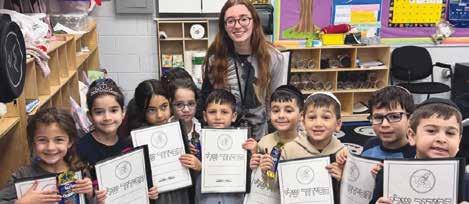
Last week, kindergarten students at YCQ reached a special milestone by receiving their very own “starter siddurim.” The siddurim serve as a foundational introduction to tefillah readiness, equipping students with the skills needed as they transition toward using a formal siddur. These siddurim will follow the students into first grade, where they will use them until they receive their siddurim at the Chagigat HaSiddur.
The starter siddur was a collaborative effort, compiled by Early Childhood Director Morah Shana Weiss, Judaic Studies Director Morah Mashie Kopelowitz, and the kindergarten morot. Their pri-


The preschool girls at BY5T enjoyed a Shivas Haminim-themed carnival in honor of Tu B’Shvat. It was a fun-filled day and a truly memorable experience!
mary objective was to instill a sense of kedushah and excitement about tefillah from an early age.
The siddur includes various tefillot paired with relevant illustrations for the students to color. This enables students to build a greater understanding and appreciation of the text as they engage with each page. Through this hands-on approach, students learn essential practical skills, such as how to correctly handle a siddur and which direction to open it, while discovering the spiritual significance of the words and pictures within.
May Hashem always hear their tefillot!
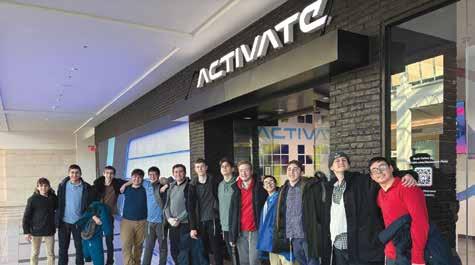
The Fall Semester Masmidim at Rambam Mesivta were recently recognized for their dedication to Torah learning at the school’s Annual January 1st Intergenerational LearnA-Thon, where they were honored with plaques in appreciation of their commitment.
Following the event, the Masmidim were treated to a special Traditions lunch and shiur led by Assistant Principal and Head of Masmidim, Rabbi Avi Haar. After the shiur, the talmidim received commemorative Masmidim swag winter hats.
To conclude the celebration, the students were taken on a special surprise trip to Activate. At Activate, they competed in dozens of challenges ranging
from laser dodging to a high-tech version of The Floor Is Lava. The state-of-the-art facility tested participants physically, intellectually, and mentally—challenges the Masmidim are well prepared for thanks to their dedication to extra learning.
The Masmidim program is made possible through the dedication and support of faculty and community members, including Rabbi Zev Meir Friedman, Rabbi Avi Herschman, Rabbi Avi Haar, Dr. Hillel Goldman, Rabbi Zev Cinamon, Rabbi Shai Fish, Aaron Friedman, Rabbi Moshe Koppel, Rabbi Yitzy Laster, Reb Yitz Milworn, Rabbi Ilan Schimmel, Rabbi Ariel Rosensweig, Rabbi Moshe Rosenthal, Rabbi Eli Weiss, and Rabbi Yossie Ziskind.


Aselect group of HALB eighth graders participated in Civic Spirit Day, held at the United States District Court for the Eastern District of New York in Brooklyn. Students spent the day hearing from and interacting with different professionals who make up our judicial branch and legal system. Along with 100 other middle schoolers from around the tri-state area,
they had the opportunity to practice key skills like respectful dialogue, working with others, and reflecting on what it means to be a citizen Students also had the very special opportunity to attend a naturalization ceremony for new citizens. The day ended with a mock trial, with several of our HALB students playing roles in the case!


Lev Chana students were very excited for their
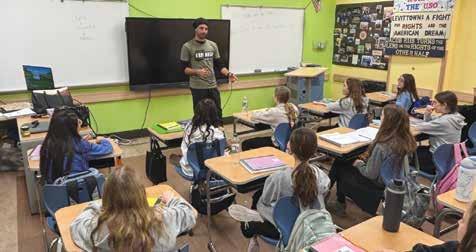
IDF Hero Adi Karni visited HALB last week. He shared his experiences as a chayal over the last two years and
shared words of encouragement and inspiration. He also spent some time playing basketball with the students!
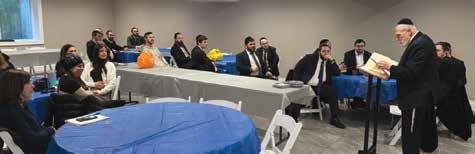
Zareinu recently hosted a comprehensive professional development day dedicated to enhancing classroom impact and student success. The morning session featured Rabbi Shmuel Strickman of Darchei, who addressed rebbeim, morahs, and assistants on the vital components of fostering both academic and social growth in a classroom setting. The afternoon session was for
teachers and assistants, led by Mrs. Suri Alter. Her presentation highlighted innovative strategies and interactive games designed to make mathematics more engaging and accessible for students who struggle with the subject. By investing in these high-level training sessions, Zareinu continues its mission to provide every student with a supportive and dynamic learning environment.

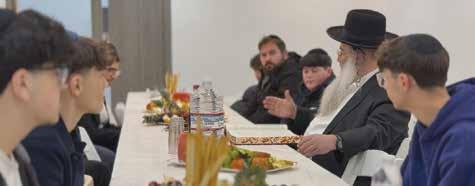
On Tu B’Shvat, the beis midrash of Yeshiva Ateres Eitz Chaim was filled with light, song, and gratitude as we gathered to give shevach to Hashem Yisborach for His beautiful and perfectly designed world.
Tu B’Shvat is the Rosh Hashana for the trees, yet it is celebrated in the heart of winter, when growth is hidden from the eye. This teaches us a powerful lesson in emunah: even when we do not see change, Hashem is bringing renewal. Beneath the surface, the trees are already beginning to grow.
The Torah compares a person to a tree—“Ki ha’adam etz hasadeh.” Just as a tree draws strength from its roots, a Jew draws life from Torah, emunah, and strong values. When our roots are deep,
we continue to grow through every season.
We reflected on how trees give so generously—fruit, shade, and beauty—reminding us of our own mission as “Adam,” created from the earth, to grow and to give. Every detail of creation points to Hashem’s wisdom and kindness, inviting us to pause and recognize His presence in our lives.
Tu B’Shvat reminds us that true growth often begins quietly. With patience and trust in Hashem, small seeds become lasting blessings. May the inspiration of this day strengthen us to grow in Torah, middos, and avodas Hashem, and may we merit to see the fruits of our efforts revealed at the right time.
Mercaz Academy celebrated Tu B’Shvat this week with a lively Israeli-style shuk, or market, that connected students directly to Eretz Yisrael while teaching important life skills. Tu B’Shvat, often called the “New Year of the Trees,” marks the beginning of the agricultural year in Israel and is traditionally celebrated by eating fruits of the land and reflecting on our responsibility to care for the natural world around us. Mercaz marked the holiday with an immersive Israeli experience.
Known for its energy, noise, and enthusiastic vendors calling out to customers in Hebrew, Machane Yehudah, Jerusalem’s famous open-air market, sells everything from fresh and dried fruits to spices, juices, cheeses, snacks, and more. To set the scene, the sights and sounds of the Jerusalem shuk were recreated on the Mercaz stage with decorations and music. The most Israeli part of the experience? All transactions had to be conducted in Hebrew only!
Ulpan teachers helped our sixth-grade students prepare for their leadership role in the shuk, designing Hebrew signs advertising their products and practicing key Hebrew phrases. Items for sale included Israeli imports such as Bissli, pick-

les, green olives, and fruit juice, alongside dried apricots and clementines. The sixth graders served as vendors – managing inventory, portioning servings, and taking payment – while students in grades K–5 played the role of customers, selecting items and making purchases. Each shopper received 30 “shekels” to spend. After shopping, teachers guided students in making the appropriate brachot, blessings, over their snacks.
The shuk was a meaningful, hands-on experience that combined Hebrew language, Jewish life skills, and a joyful celebration of Tu B’Shvat. Students got a taste not only of the fruits of Israel but also the unique hustle and bustle of the shuk experience, preparing them for many future visits to the home of the Jewish people.
Hundreds of participants from 11 countries will gather on Long Island next month as Touro Law Center hosts its third annual conference on disability rights and inclusion, addressing issues that touch every community.
The March 12-13 conference comes at a time when disability rights remain a pressing concern across employment, education, healthcare, and daily life. From workplace accommodations for neurodivergent employees to emergency preparedness for people with disabilities, the two-day event will tackle real-world challenges faced by millions of Americans and their families.
“We are honored to welcome distinguished speakers and panelists who are true experts in the field of disability rights,” said Samuel J. Levine, Professor of Law and Director of the Jewish Law Institute at Touro Law Center, who is organizing the conference. “This conference represents a global commitment to ad-
vancing disability rights and inclusion.”
Conference speakers include U.S. Circuit Judge Joseph F. Bianco, Michigan Supreme Court Justice Richard Bernstein, and John Elder Robison, the New York Times bestselling author of “Look Me in the Eye,” who will deliver the keynote address.
More than 30 sessions will cover topics ranging from employment discrimination and self-advocacy to religious perspectives on disability and the latest assistive technologies. Attendees will hear from self-advocates, legal experts, educators, healthcare professionals, and business leaders who are working to break down barriers and create more inclusive communities. One session will explore how major employers are modernizing recruitment to support neurodivergent workers. Another will examine disability rights in religious schools. Still others will address emergency preparedness, the role of film in changing cultural perceptions of disability, and legal strate-
gies for advancing inclusion.
The conference has become an annual tradition that participants say leaves them feeling both informed and inspired. Since its inception, the event has built a community of advocates, legal professionals, educators, and family members committed to advancing disability rights.
“Each year, participants and attendees walk away feeling empowered from the knowledge and connected to the community,” Levine said. “This conference is a continuation of that mission to create lasting change.”
The conference is open to both legal professionals and community members. Those interested can attend in person at Touro Law Center’s Central Islip campus or participate online via Zoom. Attorneys can earn continuing legal education credits.
Conference sponsors include Dr. Basil Guralnick Bernstein Tzedakah Fund, Walmart, Inc., Eyemmersive, Ira and Andy Raphaelson Charitable Fund, Cen-
Sam Levine, Director of the Jewish Law Institute at Touro Law Center and Disability Rights Conference organizer
ter for Community Inclusion, HD Sunflower USA Corp, Certilman Balin Adler & Hyman, LLP, TeachAbility Publishing, Touro Law’s Disabled & Allied Law Students Association (DALSA), and Touro Law Review.
For more information or to register, visit www.tourolaw.edu/academics/disability-rights-conference or contact tlccle@ touro.edu.

Neither rain, nor sleet, nor snow, nor ice will prevent Chaverim from helping a fellow Yid in need. That famous postal creed? Chaverim lives it — not for a paycheck, not for a pension, but for the simple, powerful reason that a neighbor picked up the phone and needed help.
This past week put that commitment to the ultimate test. The wind chill plunged well below zero. Temperatures hovered at a brutal ten degrees Fahrenheit. Roads turned into skating rinks. Pipes froze, locks seized shut, cars refused to start, and driveways disappeared beneath walls of snow and ice.
And through every frozen, howling, bone-rattling hour of it, the volunteers of Chaverim were out there — answering an astonishing 454 calls in a single week.
Four hundred and fifty-four.
Ninety-two members fanned out across the community in the worst weather the season has thrown at us, responding to stranded motorists, frozen lockouts, dead batteries, burst pipes, and families shivering in homes where the heating system had simply given up.
Twenty of those members handled ten or more calls each. And five extraordi-
nary individuals each responded to more than thirty calls apiece: One volunteer answered a staggering ninety-three calls; Let that number sink in. There were ninety two volunteers, with families and jobs of their own — each racing out into dangerous, sub-freezing conditions, many of them covered at least ten or more calls last week. That is not ordinary volunteerism. That is something closer to heroism.
Most people in the community know Chaverim as the organization you call when your car won’t start or your keys are locked inside. And that is certainly a major part of what they do. But the scope of Chaverim’s work extends far beyond the side of the road.
When pipes freeze and a family’s heating system fails, Chaverim doesn’t just offer sympathy. They show up with portable heaters — units the organization owns and maintains specifically for emergencies — and they set them up so the family can stay warm while repairs are arranged. They have done this dozens of times this winter alone.
And this is not only a cold-weather operation. In the sweltering summer months, when a homeowner’s air conditioning breaks down and the house be-

comes dangerously hot, Chaverim arrives with portable air conditioners to keep families cool and safe until the system is fixed. From the deepest freeze of January to the worst heat wave of August, Chaverim is there.
This past week tested that infrastructure with everything winter could throw at it, and Chaverim didn’t just hold up — it thrived. Ninety-two volunteers. Four hundred and fifty-four calls. Countless families left warmer, safer, and less alone because someone answered the phone and said, “I’m on my way.”
As the members of Chaverim head into a well-deserved Shabbos rest this weekend, they do so knowing something
On Thursday night, leading into Shabbos Shira, Niggun Chabura hosted a powerful and uplifting musical gathering that prepared the hearts and minds of attendees for a Shabbos defined by song, faith, and reflection. Featuring acclaimed artists Gelf and Yosef Gestetner, the evening wove Torah insight, personal meaning, and soul-stirring music into a seamless experience.
Reb Yirmi Ginsberg opened the night by exploring the meaning of Shabbos Shira, presenting three complementary explanations. The most familiar, of course, is that Shabbos Shira commemorates Az Yashir, the great song sung by Bnei Yisrael after the splitting of the Sea at Krias Yam Suf.
But Reb Yirmi offered a deeper lens as well: Shabbos itself is the shira. In Parshas Beshalach, Shabbos emerges as a central theme, and Shabbos becomes the space where life’s many sounds—joy, struggle, gratitude, and longing—resolve
into harmony.
Finally, Reb Yirmi guided the audience through the unfolding events of the parsha, showing how each moment carries its own song. Some are joyful and triumphant, others strong and resolute with emunah, and still others are quieter, even painful—yet still songs.
These ideas were brought to life musically throughout the evening. Gelf performed his moving new hit “Ani Maamin,” capturing the song of faith that Bnei Yisrael carried with them as they left Egypt. He then sang “Hoshea,” echoing the courage and trust of Nachshon ben Aminadav, who stepped into the sea until the waters reached his neck, fully believing in Hashem’s salvation.
Yoni Gestetner followed with his original “Hodu,” which Reb Yirmi connected directly to Az Yashir—a song of thanksgiving, acknowledgment, and hallel to Hashem for His constant presence and redemption. The evening also featured a stirring mashup of two Abie Rotenberg classics, “Memories” and “The Man from

the rest of us should take a moment to appreciate: when the worst of winter arrived, the best of this community went out to meet it.
As of this writing, this week Chaverim has responded to approximately 100 calls per day, at a pace that will surpass last week’s record.
Chaverim is a 501(c)(3) tax-exempt volunteer organization. One hundred percent of donated funds go directly to equipping volunteers and dispatchers to serve the community. To learn more, volunteer, or make a tax-deductible donation, contact 718-337-1800. https:// chaverim5t.org/donate/
Vilna,” bridging generations through timeless Jewish music.
Reb Yirmi highlighted how Parshas Beshalach is marked by dramatic highs and lows. The redemption from Egypt, the splitting of the sea, the falling of the mun, and the gift of Shabbos represent moments of spiritual elevation. On the flip side, the fear of the pursuing Egyptians, complaints over water, doubts, and the attack of Amalek reflect moments of struggle and descent.
From this, he shared a central insight: a true song can only exist with both high notes and low notes. That, he explained, is the shira of life itself. Every person’s journey includes moments of clarity and moments of confusion, peaks of faith and valleys of challenge. When one steps back on Shabbos, removed from the intensity of each individual event, the broader harmony becomes visible. That perspective—seeing life as a unified song—is the essence of Shabbos Shira.
The night concluded on a soaring note as Gelf and Gestetner joined together
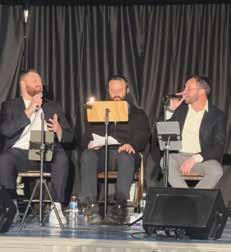
for their immensely popular hit “Shivti,” leaving the audience inspired, grounded, and ready to enter Shabbos with renewed song.
The Niggun Chabura blends soulful music with deep Torah insights to inspire and connect hearts. It was founded in 2023 by Reb Yirmi Ginsberg, a mashpia in Kehillas Aish Kodesh of Woodmere.



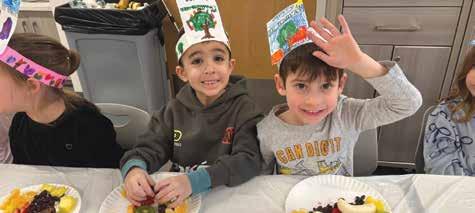
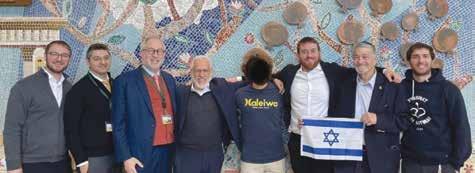
On Friday, January 30, students at the North Shore Hebrew Academy High School (NSHAHS) were deeply moved by a powerful and unforgettable talk delivered by Elnatan Mori, IDF commander and combat medic. With clarity, humility, and steadfast emunah, Elnatan shared firsthand experiences from October 7th and the weeks that followed. Accompanied by a compelling slideshow, he brought the reality of the war in Gaza vividly to life—highlighting moments from the battlefield and honoring officers and comrades who fell while defending the Jewish nation.
Elnatan spoke not only about the intensity of combat, but also about leadership under pressure, the weight of responsibility for others’ lives, and the moral clarity required in moments of chaos. The images and stories left a deep impression on the students, many of whom are beginning to think seriously about their own future roles in Am Yisrael. Many students remained afterward to continue the conversation and ask thoughtful questions.
Elnatan was joined throughout the visit by his father, Rav Boaz Mori, Rosh Yeshivat Lev HaTorah, creating a meaningful multigenerational moment for the
Great Neck and NSHA community. Rav Boaz, a graduate of NSHA Elementary and Middle Schools, also served as Youth Director of the Young Israel of Great Neck from 1987–1990, making the visit a powerful return to formative roots.
Following Elnatan’s Friday presentation at NSHA, Elnatan and Rav Boaz spent Shabbat Shira as Scholars-in-Residence at both the Great Neck Synagogue (GNS) and the Young Israel of Great Neck (YIGN), extending the conversation with the broader community through Divre Torah, shared learning and firsthand reflections with adults and youth, on leadership, faith and responsibility. This included a “Father & Son” Tisch on Shabbat night, at the home of Jonathan and Ilana Kroll & son Joey.
Over the years, many students from the Great Neck community have studied at Yeshivat Lev HaTorah, during their “gap year” and Shana Bet, further deepening the longstanding relationship between the community and the yeshiva. That connection continues today, as Great Neck’s Gavi Spinner, son of GNS Chazzan Yitzy Spinner, is currently a participant in the Lev LaChayal program, and is scheduled to draft into the IDF this March.


The spring semester at Rambam Mesivta is officially underway, bringing with it a mix of new initiatives and returning favorites. The Varsity Hockey team has clinched a spot in the playoffs, while the JV and Varsity Soccer teams recently held tryouts in preparation for the season ahead.
Academic and extracurricular programs are also gearing up. Mock Trial and Model UN teams are preparing for upcoming competitions, and the Rambam Rambots Robotics team has begun its work for the semester. Student literary life remains active, with the Writers’
Guild recently meeting and Book Chat and Tough Books Club scheduled to convene next week.
Additional clubs continue to expand, including the upcoming launch of the Volleyball team for Year II, Baseball tryouts taking place, and the first meetings of the new Law Club.
Looking ahead, students are excited for upcoming guest speakers, Torah Bowl, Club Hour programming, a Meet the Author Book Club trip featuring Malcolm Gladwell, and school-wide favorites such as February Madness and the Codenames Tournament.


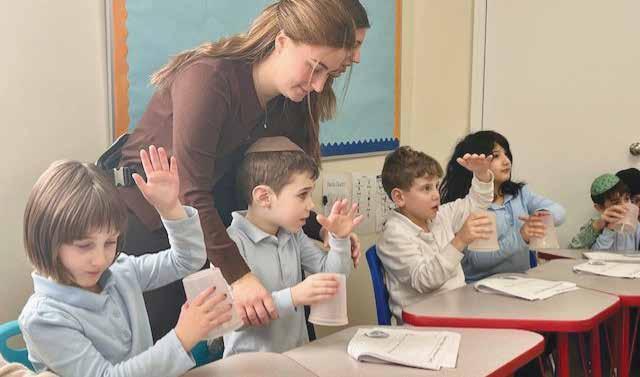
This week at IVDU, we celebrated Tu B’Shvat in a very special and meaningful way. Morah Shaindy, our music teacher, led the students in lively Tu B’Shvat songs, mixing familiar favorites with new tunes that everyone enjoyed learning and singing together. The music created a warm, joyful atmosphere and helped the students feel connected to the “birthday of the trees.”
Each class participated in its own
hands-on activities to bring the chag to life. Some classes learned about the planting cycle and created beautiful almond tree projects using various art materials, while others focused on appreciating the fruits and beauty of Eretz Yisrael. The day was fun-filled, engaging, and helped our students deepen their appreciation for nature, growth, and the special gift of our land.

MTA’s Varsity Hockey Senior Night was a powerful moment of gratitude, pride, and reflection, celebrating the seniors who have helped shape the hockey team over the past four years. Teammates, coaches, parents, and faculty gathered to recognize the commitment and heart these players brought to the team and to the yeshiva.
Rabbi Konigsberg opened the evening with heartfelt remarks, thanking the coaches Yitzy and Ezra Kopstick, players, athletic staff, and parents for their dedication and support. He spoke about the countless hours invested behind the scenes and the values learned through the team experience, emphasizing discipline, responsibility, respect, and team-
work as defining elements of MTA athletics.
Following the remarks, Rabbi Sonnenschein led the senior recognition ceremony. Each senior was called up individually and presented with a framed poster in their honor, a moment that allowed the community to pause and appreciate each player’s unique journey and contribution to the team. As each name was announced, the applause reflected not only the many wins and goals but years of effort, growth, and perseverance.
As these seniors prepare to take their next steps, they do so carrying the lessons and pride of representing MTA both on and off the court.
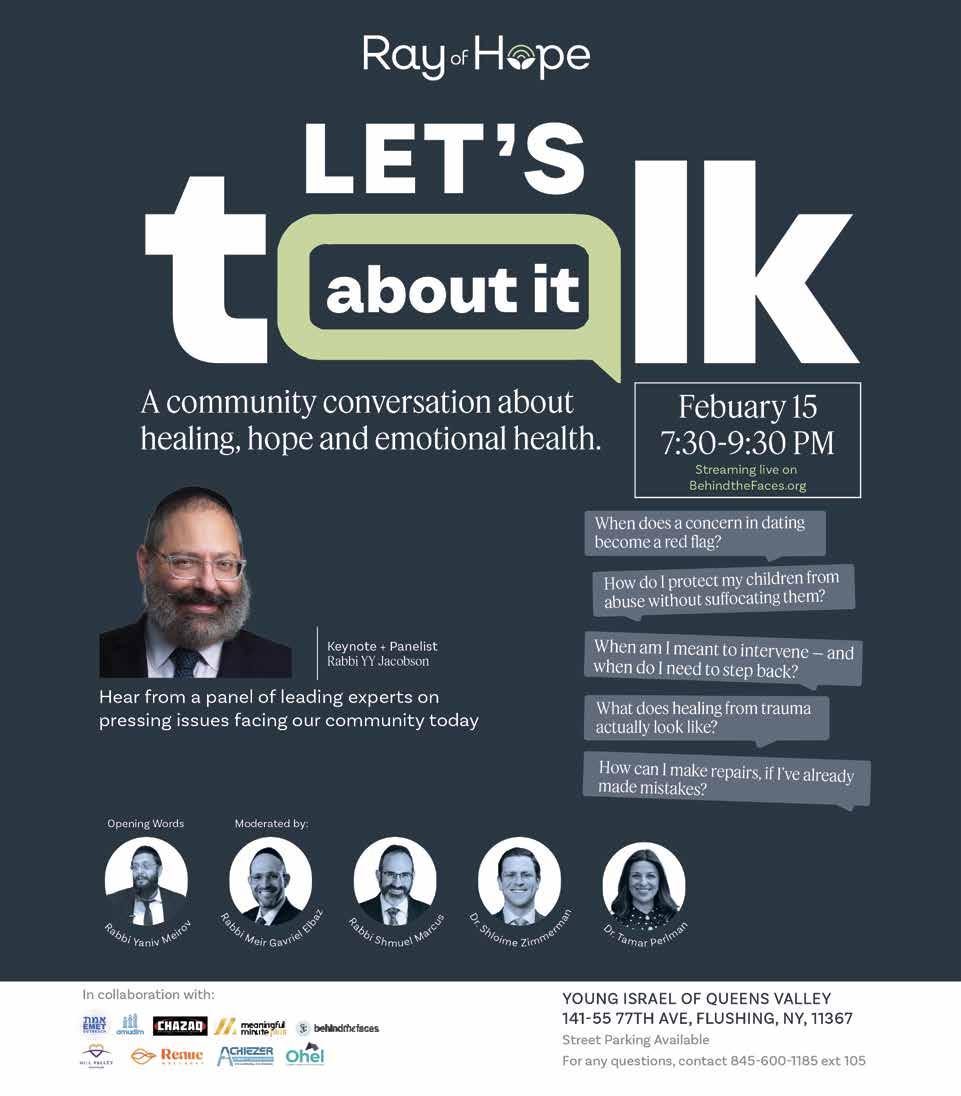
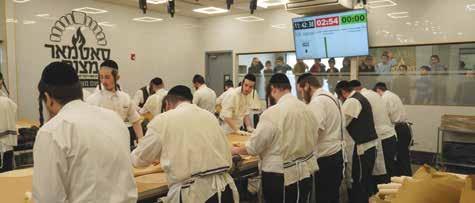
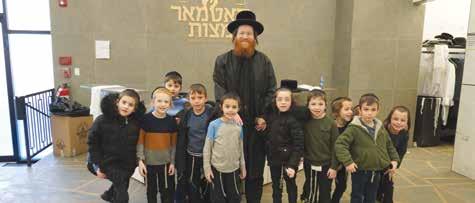
The second grade classes of Siach Yitzchok were privileged to visit the Satmar
In the heart of the Jewish home, there is a concept that transcends the mere balance of a checkbook: the principle of tzedakah. In our community, tTzedakah is not merely a gesture of kindness or a spontaneous act of charity; it is a fundamental pillar of our existence and a cornerstone of our communal identity. From the local Yeshivos and Kollelim that educate our children and provide the spiritual oxygen for our young men, to the chessed organizations that provide food for the hungry through Tomchei Shabbos or medical support for the sick, our institutions rely on the constant, quiet, and steadfast generosity of their members. We are a people built on the foundation of giving, yet we often forget that the most significant act of giving can happen at the moment when we are no longer here to personally hand over a check.
While many of us give generously during our lifetimes, seeing the immediate impact of our Ma’aser (tithe) on our local communities, an Estate Plan offers a unique and powerful opportunity to make what we call an “Eternal Investment.” This is a gift that continues to support these vital causes long after we have left this world, ensuring that our values and our commitment to Torah and Chessed continue to resonate for generations. Charitable giving through an estate plan can take many forms, ranging from a simple bequest in a Will to more complex and strategically advantageous structures like a Charitable Remainder Trust or a Donor-Advised Fund. Each of these tools allows a person to align their financial legacy with their spiritual priorities. Beyond the immense spiritual rewards associated with Pikuach Nefesh (saving a life) and supporting the study of Torah—rewards which the Gemara tells us accompany a person into the next world—there are significant financial and
tax advantages to charitable estate planning that every New York and New Jersey resident should consider. In our region, where estate and income taxes can be particularly high, strategic giving is not just a moral choice; it is a wise financial one. For example, many families do not realize that retirement accounts, such as traditional IRAs or 401(k)s, are often the most “tax-expensive” assets to leave to one’s children. Under recent changes to federal law, most non-spouse beneficiaries who inherit an IRA are required to withdraw the entire balance within ten years. Because these withdrawals are treated as ordinary income, the children are often pushed into a much higher tax bracket during their peak earning years. When you combine federal income tax with the high state taxes of New York or New Jersey, a child might see nearly half of their inheritance consumed by the IRS. However, if those same retirement assets are left directly to a registered 501(c) (3) charity, a Yeshiva, or a religious organization, the results are dramatically different. Because these organizations are tax-exempt, they pay zero tax on the distribution. This allows the full, 100% pre-tax value of the account to go directly toward the mitzvah. This is one of the few ways a person can legally and effectively “beat the IRS” while maximizing their impact on the community they love. By shifting “tax-heavy” assets to a charity and leaving “tax-light” assets—like a home or a stepped-up brokerage account—to the children, a parent can actually increase the total value of what they leave behind for both their family and their community.
Consider the story of Mrs. Goldberg, a widow who lived a quiet, modest, and dignified life in a small apartment in Brooklyn. Mrs. Goldberg did not consider herself a wealthy woman in the tradition-
al sense; she lived simply, focused on her children and grandchildren. However, over many years of careful saving and a small, well-managed inheritance from her late husband, she had accumulated a respectable IRA. She had three children who were all hardworking, self-sufficient, and raising families of their own. Mrs. Goldberg wanted to leave them something meaningful to help with the ever-rising costs of tuition and simchas, but she also felt a deep, lifelong pull toward a local yeshiva. This school had provided a sanctuary and a stellar education for her granddaughters during a particularly difficult time for the family, and she felt a profound sense of Hakaras HaTov (gratitude). She wanted to ensure that the school could continue to offer that same sanctuary to other families who might be struggling.
Mrs. Goldberg’s attorney helped her structure a “split-interest” plan that balanced these goals with precision and heart. Instead of leaving her IRA to be divided among her children—which would have triggered a massive tax bill for them—she named the yeshiva as the primary beneficiary of the account. To provide for her children, she named them as the beneficiaries of her home and her standard bank accounts. Because her children would receive the home with a “stepup in basis,” they could sell it or keep it with little to no tax liability, whereas they would have lost nearly half of the IRA to the government.
This single act provided the school with a transformative gift of nearly $250,000. These were funds that would have been significantly depleted by taxes if they had gone to her children, but in the hands of the school, every dollar was put to work. The school was able to use the gift to build a new, state-of-the-art library and media center, which they named in
Mrs. Goldberg’s memory. Her children were not only proud of their mother’s generosity; they were also deeply moved by the wisdom of her plan. They understood that by designating the “tax-heavy” asset to the school, their mother had ensured that the school received 100% of the gift rather than the government taking a large cut. They felt that their mother had made them partners in a great mitzvah rather than just recipients of a bank transfer. Mrs. Goldberg’s legacy is a testament to the fact that you do not need to be a billionaire or a famous philanthropist to leave a world-changing impact. She proved that with a bit of foresight and the right legal guidance, a modest estate can be transformed into a source of eternal blessing. She didn’t just leave money; she left a library where girls will learn Torah for decades, and she left her children a model of how to live—and give—with purpose. Proper estate planning allows all of us to ensure that our hard-earned assets are not lost to the bureaucracy of the state but are instead used to build the future of our people.
The “Eternal Investment” is the only investment that is guaranteed to never lose its value. It is the gold that we take with us, and the light that we leave behind for those who follow in our footsteps. By planning with a heart for the community and an eye for the future, we ensure that our impact on the world of Torah and chessed does not end when our physical journey does. It is the ultimate expression of our faith that our actions here have a permanent, holy resonance.
To learn how to protect you and your family visit www.haaszaltz.com or call 516-979-1060. You can also email them at info@haaszaltz.com.


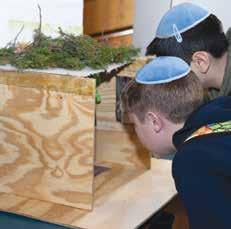


Students in Lev Chana recreated Kriyat Yam Suf by building models in their classrooms, and then they
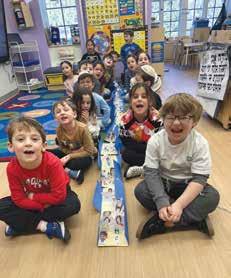
actually reenacted Kriyat Yam Suf as they walked and danced down the hallway with blue walls all around them!
HAFTR Middle School students are stepping into the world of finance and investing through the exciting Stock Market Game, where learning meets real-world action.
Through this interactive simulation, students receive a virtual $100,000 to invest in the stock market using the official Stock Market Game platform. With access to their own online portfolios, they research companies, track market trends, and make real-time decisions to buy and sell stocks like professional investors. As they build their strategies, they’re learning firsthand about saving, investing, risk, and long-term planning.
But what makes HAFTR’s experience even more meaningful is the con-
nection to the real world. Students will gain valuable insights from professionals in the investment industry, who help bring the market to life by sharing how financial decisions are made. Hearing from experts gives students a deeper understanding of how the concepts they’re learning play out in actual careers and global markets. Along the way, students develop critical thinking, teamwork, and financial literacy skills that will benefit them for years to come.
At HAFTR, learning goes beyond textbooks. Whether in Judaic studies, STEM, or finance, we believe in giving students opportunities to explore, think big, and build confidence in real-world skills, all while having fun.






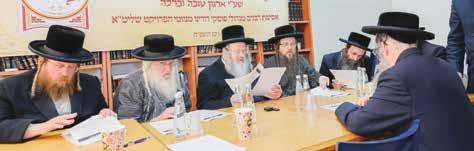
Anew economic model, known as The Parnassah Project, is taking hold across Israel and enabling yungerleit to earn substantial parnassah. In what many are calling a Parnassah Revolution, this system is designed to help yungeleit get trained, find jobs, and sustain a lucrative income without compromising their hashkafos. Including everything from learning to earning, the program offers a specialized on-site fast-track training program, person-

HAFTR LS students had a fun, engaging scavenger hunt exploring all the 7 species of Israel for Tu B’Shvat. They learned about all of them and enjoyed some tasty treats connected to them as well.
The Sixth Annual HAFTR Invitational Girls Varsity Basketball Tournament delivered an unforgettable weekend of high-energy basketball, fierce competition, and meaningful moments that reached far beyond the court. What began years ago as a local event has grown into one of the most anticipated tournaments in the Yeshiva League.
Teams from ten schools in Maryland, Florida, New York, and New Jersey came together for a weekend that was about more than chasing a championship. It was a gathering of passionate student-athletes united by love for the game, school pride, and the special camaraderie that defines Yeshiva League sports.
Before the first tip-off even took place, the tournament set a special tone with a new element of chesed. Led by HAFTR alum Mr. Yakir Wachstock, teams joined together for Boots for Israel, packing 350 pairs of boots for IDF soldiers. It was a moving reminder that while competition fuels the weekend, Jewish unity and responsibility come first. This initiative beautifully reflected that at HAFTR, athletics are not separate from values.
On the court, the action did not disappoint. The games were intense, the energy electric, and the level of play outstanding. Our very own HAFTR Hawks battled their way through the tournament, ultimately falling in a thrilling overtime game that showed the grit, resilience, and heart that define our team.
The championship game was the per-
fect finale: a fun, fast-paced, back-andforth battle between Berman and SKA that kept fans on the edge of their seats. In the end, Berman emerged victorious, capping off an exciting tournament filled with highlight plays, teamwork, and sportsmanship.
As always, the tournament’s impact went far beyond the scoreboard. From teams sharing a meaningful Shabbat to players cheering for one another after hard-fought games, the weekend highlighted the unique ability of sports to build friendships and strengthen community. It was a celebration of years of dedication, practice, and growth.
The success of the weekend would not have been possible without the leadership of Coaches Mr. Joey Hoenig and Ms. Ilona Diamond and the incredible support system behind the scenes: Mr. Leroy Samuel, Mr. Corey Spitzer, our host families, the dedicated maintenance crew, and the fans who brought nonstop energy to the stands.
As the final buzzer sounded, players and spectators left with memories, new friendships, a sense of unity, and the powerful reminder that at HAFTR, we compete with passion, we lead with heart, and we always carry our values with us.
The HAFTR Invitational Girls Varsity Basketball Tournament is fast becoming a tradition that represents the very best of what Jewish athletics can be.
See you on the court next year.
al guidance, job placement, debt-relief, and even funding for the first two years of employment to ensure yungeleit are able to stay afloat as they transition into the workforce. Working with rabbanim of all kehillos and vetted, kosher businesses, this initiative is effectively eliminating poverty at its root. With close to a thousand families already earning stable, respectable livelihoods, the community is witnessing a historic shift from dependency to true financial independence.

Shulamith ECC celebrated Tu’ B’Shvat by making wood collages


Rabbi Shmuel Rabi, of the Rischa D’Oraysa program, met with Rabbi Yaakov Bender and presented the program to Rabbi Halbertal’s seventh grade class in Yeshiva Darchei Torah





Shulamith students enjoyed a funfilled day celebrating Tu B’Shvat!
Grades 1-4 learned the meaning of the day, cut up fruit, and practiced the proper order of making brachot. Each girl carefully threaded her fruit onto a skewer in the correct brachot order, recited the brachot aloud, and enjoyed the tasty results. Grades 3 and 4 also began preparing for their Brachos Bee, combining learning with excitement.
Grades 5-8 held their own Tu B’Shvat seders, exploring the four shades of grape juice, making brachot, and tasting all Shivat Haminim. The pareve barley cholent was a special highlight!

All grades had a wonderful day learning about the importance of trees, fruit, and Tu B’Shvat. IYH, next year’s celebration will be in Yerushalayim for an even more meaningful experience.

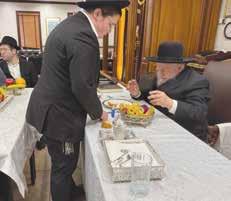
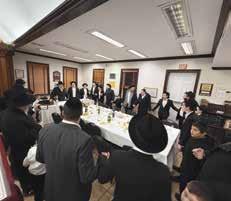
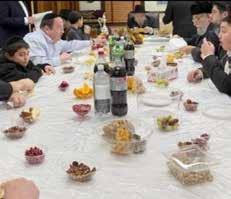

Another action-packed week of JSL Winter by FM Home Loans delivered overtime drama, clutch penalty shots, dominant goalie performances, and big-time basketball efforts across every division. From K/P all the way through Men’s League, the intensity continues to rise as teams battle week in and week out.
Smash House rolled past Exclusive Cabinetry 10–4 behind an unbelievable performance from Gabi Mayer, who found the back of the net 7 times. Marciano PD edged Yeled LI Panthers 7–6 in a back-and-forth thriller, with Jack Schlessel burying the game-winning goal. Demo & Cleanouts defeated MoldPro 6–4 thanks to spectacular play in net from Yoni Braun. In another instant classic, SD Shades knocked off Marciano PD 6–5 as Rafi Yachnes scored both the game-tying and game-winning goals.
K/P
SR Whee knocked off Sunflower Cafe, led by Meir Goldman, who found
the back of the net often. 5 Towns Central squeaked by Arise Real Estate 4–3, with JJ Rabinovicci shining in the tight win.
Posh Home & Bath defeated Zlotowitz Law 9–5 behind a huge game from Jerry Pasternak, who netted 4 goals. Chosson Central secured a 6–4 win over Tikva Fire, thanks to Sammy Hofstadder’s lategame effort, tallying 2 assists and 3 blocked shots in the final moments.
2nd/3rd Grade Hockey
Nate Builders shut out Growtha behind lights-out goaltending from Sam Smith. TNB Architecture edged Newman Dental 3–1, with Reuven Cooper’s lockdown defense proving to be the difference.
Remsen Auto took down J Works Construction 8–5, led by a strong all-around performance from Meir Gunsberg. In a tight defensive battle, Town Appliance defeated Styles Design Interiors 2–1, with Benny Yifat anchoring the defense and Aaron Blobstein standing tall in net.
4th/5th Grade Hockey

In overtime drama, SR Whee defeated Styles Design Interiors 4–3. Yechiel Gerstel tied the game late before Yitzchak Rosenthal buried the overtime winner.
Frank Kitchen & Bath edged BlueBird Insurance 4–3 in a shootout. Shlomo Greenspan was lights out in net, not allowing a single shootout goal, while Avi Flegmann sealed it with the game-winner.
Extreme Vent Cleaning knocked off Smash House 6–3 behind a stellar goaltending performance from Akiva Fogel. In a low-scoring battle, Wieder Orthodontics defeated J Works Construction 2–1, with Charlie Rosenblatt scoring both goals for his team.
Town Appliance defeated Sperling Productions 4–3 after Binyamin Flegmann drew a late penalty and converted the penalty-shot game winner. Wieder Orthodontics took down Emporio 4–2 in a tightly contested matchup, with Ben Parnes coming up huge in net. Twillory outlasted SD Shades 8–6 behind Gavriel Levin’s 2-goal effort.
The Shoppe defeated Marciano PD 12–4, anchored by Ahron Lifshitz’s lockdown defense. Seasons beat Posh Home & Bath 12–6, with Yisroel Meir Garfinkel leading the way with 8 points.
Rita’s defeated White Glove Concierge 17–8 behind an all-around offensive performance from Aaron Levine. Wieder Orthodontics edged 5 Towns Landscaping 13–8, with Yaakov Grossman’s 6 points proving pivotal.
Elegant Lawns knocked off Seasons Express 14–7, led by a strong all-around game from Moshe Loeb. Tikva Fire defeated Central Pizza Co. 10–6, with Meir

pulling down 12 rebounds.
Newman Dental defeated Zlotowitz Law behind a dominant all-around performance from Dovid Bauman. Wieder Orthodontics picked up a big win over Tal By Luxe, fueled by strong performances from Binyomin Gordon and Beneyahu Danierov.
Maidenbaum edged Elegant Lawns 24–22, as Itai Samuels stepped up late, knocking down clutch free throws. TNB Architecture defeated Twillory, with Avrumi Stein leading the charge by scoring 12 points while contributing on defense and as a playmaker.
Men’s Basketball
Kol Ve’or defeated Altbanq 66–57 behind Shimi David’s game-high 29 points. Emporio earned a blowout win over Smash House, led by Yoni Oratz, who poured in 23 points. Town Appliance edged Maidenbaum 68–57, with Shelby Rosenberg matching 23 points of his own. SR Whee defeated Twillory 52–44, as Zvi Roth and Yosef Rudansky combined for nearly 30 points.

By Chevy Carmel
It was a week filled with holiness, a week of getting my hands dirty, a week of learning, and most of all, it was a week of connection. This semester break, I didn’t hit a beach, a ski slope or even a restaurant. Instead, I headed to Israel with fellow Lander College for Women (LCW) students to contribute to the land and people who had lost so much over the last two years and to take in hot spots of another kind. While we didn’t stop to relax for a minute, we left restored and fulfilled.
When I first heard that LCW was partnering with Israel Free Spirit Birthright to organize a student chessed mission during midwinter intersession, I immediately knew I had to join. I had been in seminary in Jerusalem just last year, but I already missed Israel deeply—just like many other girls on our trip. The chance to give back while experiencing a different side of our Jewish homeland was exciting to all of us. Over the course of the trip, we took part in a wide range of volunteer opportunities—from farming in the south, to raising morale in nursing homes in the north, to spending time with children from troubled homes in the heart of Israel, Jerusalem.
“I liked that there were so many different things we could do to help other people,” my roommate, Elisheva Shalmiyev, an English major from Philadelphia, told me.
Besides the hands-on volunteering, we also had the zechut to hear from pas-

sionate and inspirational speakers, all of whom are contributing to Israeli society in their own ways, whether it’s on the political, educational or Torah fronts. It was an array of stars, including Dr. Neil Lazarus; Rabbi Zev Leff; Rabbi Dovid Gottlieb; Mrs. Batya Weinberg; and Holocaust survivor Rebbetzin Rena Quint.
We toured meaningful and unique sites around Israel, such as the Jerusalem Tunnels, the Golan Heights, the agricultural museum and farm known as the Salad Trail, and even the site of the Nova festival.
One of the highlights for me was volunteering at an after-school program for children from challenging home environments. I was nervous at first—worried about saying the wrong thing or that the kids might not want my attention—but four elementary-school boys welcomed us immediately. We learned about each other, played games, and worked on an art project together. When it was time to leave, I was genuinely sad. I said goodbye, and the boys thanked me and told me they would miss me. I was shocked. All I had done was play a few games and help one of them make a porcupine out

of a pinecone and sunflower seeds—yet somehow, that meant something to them. On the bus ride afterward, I kept thinking about how meaningful small gestures can be for children. Whether it’s offering a toy or saying something kind, these tiny acts can bring real joy. It made me appreciate how much my friends and I might have given them in such a short time.
The Touro-Birthright trip was an incredible experience that far exceeded my expectations. Each of us had meaningful, memorable moments that we will cherish forever. We learned more about old friends, made new friends, and gained a deeper understanding of everything it takes for Israel to be the beautiful country that it is. Most of all, knowing that we
were able to make even a small impact on Israel and its people was the best part of the trip. It still feels unreal that we accomplished so much and had so many new experiences in such a short amount of time.
I am so grateful for this opportunity and want to express my thanks to Lander College for Women Dean Dr. Marian Stoltz-Loike; Associate Dean Dr. Toba Singer; Racheli Elozory; Touro Israel Dean Shmuel Klammer; Touro LCW Guidance Counselor Dr. Ditza Berger; and, of course, Israel Free Spirit Birthright.
Chevy Carmel is a sophomore at Touro’s Lander College for Women where she is studying Mathematics.
Episcopal Health Services (EHS) has been awarded a $150,000 grant from the Mother Cabrini Health Foundation to continue providing free, individualized and culturally responsive support to pregnant women of color in the Rockaways, regardless of gestational age.
The initiative is designed to reduce persistent maternal health disparities in historically marginalized communities by addressing the systemic social, economic and environmental factors that influence pregnancy outcomes. Through this funding, EHS will provide comprehensive maternal health support to 120 participants, promoting improved longterm health for both mothers and their children.
Each participant will receive a personalized Individualized Care Plan (ICP) tailored to their medical, social and emotional needs. The program emphasizes
continuity of care, culturally competent engagement and community-based support — essential components in advancing maternal health equity and strengthening family stability.
“This grant allows us to advance our commitment to mothers who face disproportionate risks during pregnancy,” said Jacqueline M. Marecheau, MD, FACOG, Chair, Department of Obstetrics & Gynecology at EHS. “By addressing not only clinical needs but also the social conditions that influence health, we are creating a more equitable system of care for families on the Rockaway Peninsula and surrounding communities.”
This award marks the fourth grant Episcopal Health Services has received from the Mother Cabrini Health Foundation. Previous funding helped establish and expand maternal health programming, including St. John’s Episcopal Hospital’s pioneering Doula Program.
The continued partnership reflects a shared commitment to advancing health equity and improving outcomes for vulnerable New Yorkers.
“Our grantee partners are navigating an incredibly challenging landscape, and yet their commitment to serving their communities continues to deepen. These grants demonstrate our resolve to stand with them by addressing urgent needs today, while strengthening the systems and workforce that will support New Yorkers’ health for years to come,” said Msgr. Gregory Mustaciuolo, Chief Executive Officer of the Mother Cabrini Health Foundation.
This Maternal Social Determinants of Health Program is part of EHS’s broader strategy to expand women’s health services in the Rockaways and serve as a regional hub for advanced, comprehensive care.


Connecting with the world through chessed is central to life at the Yeshiva University High School for Girls. Over ten clubs dedicated to chessed exist at the school, and the month of December was designated as chessed month and dotted with volunteer trips and opportunities. Wildcats love to help others, and that counts for former Wildcats, as well. In early January, a group of twenty-five YUHSG alumnae traveled to Israel on a Birthright Israel Free Spirit Chessed Mission that combined meaningful chessed, learning, and reconnection.
“Seeing this mission come together was truly remarkable,” said YUHSG Associate Principal, Ms. Leah Moskovich, who traveled with the group. “Thank you to all alumnae who joined us, and thank you to Israel Free Spirit and Birthright for helping make this dream mission a reality for our Central community.” Together, the group represented over four decades of YUHSG graduates, a powerful testament to the enduring bonds that make the school community special.
Throughout the trip, alumnae engaged in a range of hands-on chessed activities, including making tzitzit for soldiers, working in agricultural settings, rebuilding with a high school in the North, and lending their time and energy wherever help was most needed. The trip also included moments of learning and reflection. The group heard from commentator and educator Neil Lazarus on Israeli politics and society. One particularly meaningful experience was a somber visit to the site of the Nova Music Festival, where the group came together to reflect, remember, and stand in solidarity.
Alongside structured programming, the alumnae spent meaningful time bonding with one another. For many, the trip was a chance to reconnect with old friends or form new connections. The mission also served as a special reunion for members of the Class of 2025, who attended a shiur and dinner, featuring alumna Rabbanit Shani Taragin (‘91), and many Central faculty members. The alumnae mission was a powerful
On January 27th, Holocaust Memorial Day, our HAFTR seventh graders took a trip to the Anne Frank exhibit at the Center for Jewish History, bringing Jewish memory, identity, and core HAFTR values to life in a deeply meaningful way.
In their Lashon classes, students have already been learning about Anne Frank and her diary as the voice of a
Jewish girl not so different from themselves. Through her words, they’ve explored hope, fear, courage, and the quiet strength of holding onto one’s identity even in the darkest times. Visiting the exhibit on this significant day allowed students to step beyond the page and into Anne’s world in a powerful, tangible way.
Seeing artifacts, images, and recreations of her story transformed learning from

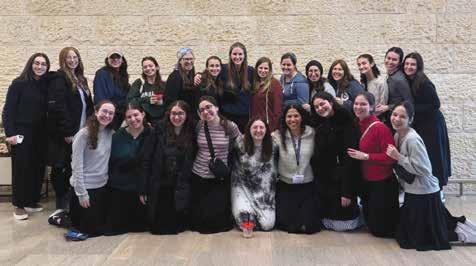
reminder that YUHSG’s commitment to chessed, community, and connection extends far beyond students’ four years in high school. Thank you to YUHSG Principal, Mrs. Aliza Gewirtz, and Student Activities Coordinator, Mrs. Sydney Yaros, who helped to initially coordinate the trip, and to Associate Principal, Ms. Leah Moskovich, Freshman Grade Dean and Judaic Studies faculty member, Mrs.
Karen Lavner, and Director of Religious Guidance and Judaic Studies faculty member, Mrs. Yael Axelrod, for accompanying the group on their travels. And the semester is just getting started: a full schedule of events, including YUHSG’s Annual Scholarship Dinner of Tribute, which is planned for Motzei Shabbos, March 7, 2026, is in the works.
something studied to something felt.
This experience reflects a core Jewish value: to remember. In Judaism, memory is active and sacred. We do not remember simply to look back; we remember to carry stories forward, to shape our character, and to guide how we live. Observing Holocaust Memorial Day in this way helped students understand the Holocaust as a human story that calls for empathy, responsibility, and moral awareness.
The trip also served as an important step in our students’ ongoing journey of Holocaust education. Next year, students will have the opportunity to participate in the Names, Not Numbers program. This exhibit provided a vital foundation, helping students build a more personal connection now so that future encounters with survivors’ stories will be approached with greater sensitivity, understanding, and respect for the dignity of every individual.
In addition, students will revisit this period in greater depth in Social Studies later this year. Those lessons will be layered with the emotional understanding that comes from having “met” Anne.

Just as important as what students learned is how they learned. Throughout the trip, our seventh graders showed maturity, thoughtfulness, and care for the material, for one another, and for the sacred responsibility of engaging with Jewish history. They asked meaningful questions, reflected deeply, and honored the space with the seriousness it deserved. Anne Frank’s diary is often described as a story of tragedy, but it is also a story of the enduring human spirit. HAFTR students are learning to remember, to feel, and to carry our people’s story forward with pride, empathy, and purpose.
This January, Chicago once again became the setting for an extraordinary outpouring of limud haTorah, as nearly 400 lomdim participated in the ChesedChicago’s 9th Annual Shas for Shidduchim initiative, learning together as a collective z’chus for singles throughout Klal Yisroel. The learning, which took place at Agudas Yisroel of West Rogers Park, also brought together over 200 children who participated in Shas for Shidduchim Jr., learning all of Shisha Sidrei Mishna, adding even more z’chusim to this tremendous undertaking of limud haTorah.
“What stood out most was the sense of achdus,” one participant noted. “People from many different backgrounds came together with a shared understanding that limud haTorah can truly be a z’chus for others.”
The impact of the initiative extended well beyond the walls of the beis medrash. This year alone, over 2,700 names were submitted through the Shas for Shidduchim website, each one a precious neshama in Klal Yisroel patiently awaiting his or her zivug.
The limud culminated in a grand Siyum HaShas held on Monday evening attended by hundreds of men and women. The program was guided by emcee Rabbi Yaakov Robinson, who addressed the tzibbur and framed the magnitude of what had been accomplished.
Divrei bracha were delivered by HaR-

av Zalmen Leib Eichenstein, the Zidichover Rebbe, followed by a keynote address from Rabbi Daniel Glatstein, who spoke about the koach of Torah learned on behalf of others and the responsibility carried by those who have the opportunity to learn for Klal Yisroel. The Siyum HaShas was completed by R’ Eliezer Hildeshaim, marking the completion of a monumental undertaking of limud haTorah.
The oilam was treated to special video messages from Eretz Yisroel from HaGoan HaRav Yitzchok Zilberstein and HaGaon HaRav Dovid Cohen. Rav Zilberstein emphasized, “Learning Torah on behalf of others is an especially elevated ma’alah; when people learn as a z’chus for those seeking their zivug, it becomes a powerful means through which the Ribbono Shel Olam brings about yeshuos.” Rav Cohen spoke at length about the unparalleled koach of limud haTorah, particularly when undertaken as a tzibbur and on behalf of others. Citing the words of Rav Chaim of Volozhin in Ruach Chaim, he stressed that there is no great-

er z’chus than Torah learning, explaining that even the greatest Gedolim relied on limud haTorah as the ultimate source of yeshuah.
Shas for Shidduchim Jr. held its own siyum, as the young lomdim completed Shisha Sidrei Mishnah, a remarkable achievement alongside the adults’ completion of Shas. The Hadran was recited by Rabbi Avrohom Shimon Moller. The children were recognized with a special presentation by Baruch Perlowitz, celebrating their dedication and accomplishment.
Through the combined koach of lim-
ud haTorah by adults and children alike, Shas for Shidduchim once again demonstrated the enduring power of Torah as a z’chus for shidduchim and a source of chizuk for all of Klal Yisroel.
ChesedChicago, founded by Dayan Shmuel Fuerst, is dedicated to assisting families in crisis throughout the Chicagoland area. Its 80+ programs provide essential goods, services, and financial support while upholding the dignity and integrity of every recipient.

By Chaim Gold
How do you explain the unique magic of a Dirshu Convention to someone who has never been to one? In truth, it is impossible! How can you describe the Torah atmosphere? The rarified feeling of being in the presence of many hundreds of talmidei chachomim and their wives whose lives literally revolve around limud haTorah?
You cannot describe it, but perhaps no words can better encapsulate Klal Yisrael’s preeminent Torah Convention than its official name of “Kinnus Olam HaTorah.” As Dirshu celebrates its 30th Anniversary, this year’s convention to be held over the weekend of Shabbos Parshas Terumah 3-5 Adar, February 20-22, at the Armon Hotel in Stamford, promises to be an unforgettable Torah event.
“We are Not in Stamford, Connecticut! We are in Dirshu!”
At a previous convention, Rav Moshe Benzion Weinberger said something profound that resonated, “You think you are in Stamford, Connecticut, but you are not! There is a law that an embassy of a country is considered that country’s sovereign territory. For example, if you are in the British Embassy in Washington, you are not in Washington. By law, it is considered as if you are in Britain. Similarly, we may think we are in Stamford, Connecticut, but really, we are in Dirshu! Dirshu is a different planet, a different atmosphere. If there is anything that I learned this Shabbos, it is that being in Dirshu is something not in this world. It is a hechere velt, an elevated world of Torah and a world of indescribable simcha!”
At this year’s convention, lomdei Dirshu will have the zechus of being in the proximity of and hearing divrei Torah from senior American Gedolei Yisrael and a guest Gadol from Eretz Yisrael.
Among the Gedolim who will grace the event will be luminaries such as HaGaon HaRav Yeruchem Olshin, shlita, Rosh Yeshivas Lakewood, HaGaon HaRav Hillel David, shlita, Rav of Kehillas Yeshiva Shaarei Torah, Yoshev Rosh of the Vaad Roshei Yeshiva of Torah Umesorah, HaGaon HaRav Yechiel Michel Steinmetz, shlita, the Skverer Dayan of Boro Park and one of America’s most prominent poskim, HaGaon HaRav Shlomo Feivel Schustal, shlita, Rosh Yeshivas
HaRav Yeruchem Olshin addressing a past Dirshu World Siyum
Tiferes Yerachmiel, HaGaon HaRav Yitzchok Sorotzkin, shlita, Rosh Yeshivas Mesivta of Lakewood, HaGaon HaRav Dovid Goldberg, shlita, Rosh Yeshivas Telshe, and HaGaon HaRav Shlomo Eisenberg, shlita, Rosh Yeshivas Telshe.
The special guest from Eretz Yisrael will be the Rosh Yeshiva and ilui, HaGaon HaRav Chaim Mordechai Ausband, shlita, Rosh Yeshivas Ateres Shlomo, who is slated to give this year’s famed iyun shiur after Shacharis on Shabbos for the entire assemblage.
In previous conventions, this shiur has been delivered by luminaries such as HaGaon HaRav Shmuel Yaakov Borenstein, Rosh Yeshivas, zt”l, Kiryas Melech and ybl”ch, HaGaon HaRav Berel Povarsky, shlita, Rosh Yeshivas Ponevezh, HaGaon HaRav Shlomo Miller, shlita, Rosh Kollel of Toronto, HaGaon HaRav Shlomo Feivel Schustal, shlita, HaGaon HaRav Yitzchok Sorotzkin, shlita.
One of the highlights of the shiur is the spirited give and take during these shiurim as lomdim ask questions in the middle and one can feel the fire of Torah pulsating in the atmosphere.
Just as it is impossible to describe the Torah atmosphere of a Dirshu Convention, it is impossible to encapsulate the feelings permeating the hearts of Lomdei Dirshu in anticipation of the biennial convention. Many have attested to the fact that the convention is like a breath of Torah oxygen in that it gives them the opportunity to meet like-minded “brothers and sisters in combat,” who set aside large portions of time daily to learn, chazer, learn and chazer again, learning the material for the comprehensive tests that every lomed Dirshu aspires to take suc-
cessfully.
These multitudes of talmidei chachamim come together with their counterparts, talking in learning and exchanging tips on how to enhance yedias haTorah and retention of the vast amounts of Torah that they learn. The chizuk they derive from realizing that they are a significant part of a massive global movement of yedias haTorah cannot be quantified. It doesn’t matter which program you are in, whether it is the Amud HaYomi, Daf HaYomi, Daf HaYomi B’Halacha, Kinyan Halacha or any other program, you are united by the same thing, Torah.
Phenomenal Women’s Program
For Nishei Dirshu
In addition, the wives of lomdei Dirshu walk away from Shabbos on a high. Not only are they deeply inspired by the special women’s programing but perhaps even more so, from meeting other distinguished wives and mothers who truly understand what it means to be part of Dirshu with the inherent thrill of witnessing the hatzlacha of their husbands and/or sons after a test; or upon completion of a masechta, recognizing how, through Dirshu, the entire family becomes elevated and closer to Hashem. This year, a unique women’s program is being planned with addresses by some of the most inspiring women speakers and role models as well as deeply moving entertainment.
This year, Dirshu will be privileged to have Rabbi Joey Haber address the Nishei Dirshu. The women will also have the privilege of hearing speeches and words of chizuk from Rebbetzin Slovie Jungreiss-Wolf and Rebbetzin Aviva Feiner. The programing for women promises to be a highlight for the Nishei Dirshu, who serve as the backbone behind the successful Torah learning of their husbands.
During the meals, discussions revolve around the intricacies of the masechta or as one Yid commented – so matter-of-factly that he did not even think it was remarkable – that all his mechutanim know that he does not schedule a chasunah of one of his children for the week of a Dirshu test because then there would be one night when he would not be able to attend sheva brachos… The Dirshu test comes before everything!
The personal stories spontaneously shared by lomdim about what Dirshu has done for them, their wives and families
leave participants amazed and inspired.
“How
The event, scheduled to be held at the Armon Hotel in Stamford, Connecticut, will bring together Lomdei Dirshu and Nishei Dirshu from all walks of life who are united by one thing, their commitment to accountable limud haTorah. It is this common denominator, this achdus, this joint sense of mission, that permeates every Dirshu convention. Yes, the lomdim may look different, with some wearing suits, others bekeshes, some wearing black hats and others shtreimlach, some with Sefardic pronunciation and some with Ashkenazic pronunciation, but they are bound together by the one thing that unites all of Klal Yisrael, the Torah along with their deep, abiding dedication to steady and accountable limud haTorah
This year, Dirshu will again be privileged to have the presence of gedolim and rabbanim who represent all of the different shevatim of Klal Yisrael. Among them, HaRav Shmuel Choeuka, shlita, Rav of Congregation Ohel Simha of Deal, NJ, HaRav Yehoshua Abba Busel, shlita, R”M at Beth Medrash Govoha of Lakewood and rav of the High Street Shul, HaRav Yitzchok Zalman Gips, shlita, Rav of Khal Birchas Avrohom and Rosh Yeshiva of Yeshiva Mevakshei Torah, HaRav Binyomin Eckstein, shlita, Belzer Dayan of London and Director of Dirshu Europe, HaRav Eitan Feiner, shlita, Rav of Khal Knesses Yisrael of Far Rockaway , HaRav Mordechai Ginsberg, shlita, R”M, Yeshivas Chochmas HaTorah, and HaRav Yisrael Moshe Olewski, shlita, Rosh Yeshivas Ger, and many others.
The zemiros and music will be led by R’ Isaac Honig and the Shira Choir. The Shabbos will culminate with a beautiful Melava Malka that is open to the general public where the Gedolim as well as the Nasi of Dirshu will give keynote addresses in honor of the lomdei Torah.
One prominent American Rosh Yeshiva put it succinctly, “How can I not participate in the Dirshu Convention?! This is an event with no agenda other than increasing limud haTorah - no political agenda, no fundraising. It is, simply put, a celebration of dedication to learning. We are just coming to celebrate with Yidden who have invested days and nights over many years to learn, chazer and be tested. How can I not come?!”




The TV Booth Analyst - “That was a blown coverage… They will exploit that matchup all night… They must have seen that scheme on film.” (Shush! Go get another burger and let me watch the game in peace!)
The Ref Analyst – “He was down by contact; ref blew that call.” (Uh, because the last time you ref-ed the Super Bowl YOU didn’t make any mistakes!)
The Momentum Guy – “I can’t believe Seattle won the coin toss! They have all the momentum now.” (OK, in that case, why don’t we all just call it a night?)
The Phone Watcher – Looks up only when everyone screams.
The Coach-from-the-Couch – “I would’ve called a run play here.” (You’d be frostbitten before they even finished the National Anthem – this coach has icicles coming out of his nose and you have the audacity to second-guess him?)

The Injury Overreactor – “That’s a season-ending injury” (Actually, it’s called a cramp.)
The One-Upper – “I watched a better game in ’98.” (Shame you didn’t record it on VHS. Had you done that, we could go to a pawn shop, buy a VCR, and watch it instead of this game!)
The Statistic Dropper – Quotes obscure stats with no relevance. (Yeah, we all have access to ChatGPT to make us all seem smart.)

The Volume Controller –“Hold on, guys, I want to hear what they are saying here.” (Dude, the thing has been on max volume for the past hour and a half!)
The Refs-Are-Rigging-It Person – “The refs are in the bag for the other team.” (OK, Roger Goodell, start your investigation.)
The Fantasy Addict – “I had him on my fantasy team three seasons ago, and he scored 47 points in week three.” (Guess what? We really don’t care about your fantasy team!)
The Injury Minimizer – “He’s fine. Walk it off.” (You’re one to talk. You have been complaining all night that you feel like you are going to croak because you ate too many wings for your Ozempic-sized stomach.)
The Fake Neutral – “I don’t care who wins” (You really can’t handle disappointment.)
The Timeout Beggar – “Call a time out! Call a time out!” (Well, you say that on every play, so there are no time outs left!)
The Altruist – “These people are mamish meshuga… beating each other up over a little ball.” (You are so right, yet you are sitting here riveted for four hours straight.)
1. How many times have the Seattle Seahawks and New England Patriots faced each other in the Super Bowl?
a. 0
b. 1
c. 2
d. 3
2. In Super Bowl XLIX (2015), the Patriots were ahead of the Seahawks 28-24. On the final drive of the game, with 26 seconds left, the Seahawks were at their own 1 year line, on second and goal. They had the best running back in the game, Marshawn Lynch. What happened on that play?
a. Lynch ran the ball in for an easy touchdown
b. Seahawks quarterback Russell Wilson was sacked
c. Lynch was stopped short of the goal line and ran it in on the next play
d. For some reason that nobody can figure out until today, the Seahawks called a pass
play, and it was intercepted by New England, sealing their victory.
3. Including the upcoming Super Bowl, how many times did the Patriots make it to the big game?
a. 5
b. 7
c. 9
d. 12
4. Which team was Seattle QB Sam Darnold drafted by in 2018?
a. NY Jets
b. Patriots
c. Green Bay Packers
d. Seattle
5. The Patriots had a perfect season in 2007. Who did they lose the Super Bowl to that year?
a. Seattle
b. Giants
c. Cowboys
d. Kansas City
and Seahawks?
a. $5 million
b. $6.5 million
c. $8 million
d. $10 million
7. According to the National Retail Federation, how much total Super Bowl-related purchase spending is expected in the U.S. for food, drinks, apparel, parties, and decorations this year?
A) $10 billion
B) $15 billion
C) $20.2 billion
D) More than $30 billion

6. How much are 30-second advertising spots reported to cost for Super Bowl LX between the Patriots
6-7 correct: You are gearing up and ready to analyze this game…. “Get the food out of my face – we have a game to win!”
2-5 correct: 60% wings/40% game
0-1 correct: All wings!
Each of the following clues refers to a word that begins with “ten.” For example, if the clue is “a game played with rackets,” the answer would be “TENnis.” Can you score a perfect TEN (I bet if you play close atTENtion, you can)?
1. Unsubstantial 2. Delicate or gentle
3. A sinew
4. Persistence and determination
5. Capable of being stretched 6. Between the bass and alto
7. Stretched tight (or stuck in traffic and late for a meeting)
8. Temporary dwelling
9. An opinion held to be true
10. Inclination

Tense; 8. Tent; 9. Tenet; 10. Tendency
Tensile; 6. Tenor;
Tendon; 4. Tenacity;
Tenuous; 2. Tender;
Answers:


The Torah teaches us important lessons about wealth and money in this week’s parsha. In fact, many of the Ten Commandments deal directly or indirectly with money and wealth. The commandment about the observance of Shabbos teaches us that money is not nearly everything in life.
The drive for wealth and the necessity of making a living in difficult times drove the immigrant generation in the United States, which was overwhelmingly traditional, to work on Shabbos. This has inevitably led to the great and tragic assimilation of a great many of Americans of Jewish descent and to a wave of crippling intermarriages. There are exceptions to this rule, but generally, it is true. Those who discarded the Sabbath in favor of wealth and seeming physical comfort are the unfortunate and unintentional progenitors of a generation of children, grandchildren and great-grandchildren who are no longer Jewish in any sense of the word. Wealth and money are necessary

By Rabbi Berel Wein z”l

parts of everyone’s life. But Shabbos trumps them – it is the most important element of Jewish life and the one guarantee of Jewish success and survival.
A more direct view on the problem of money and wealth lies in the commandment not to covet. Coveting the belong-
through the prism of the commandment not to covet what belongs to someone else. It is as simple as that.
Stealing comes in many forms and shapes and circumstances. From misleading advertising to Bernard Madoff, stealing is pretty much rife in the
Kosher money is harder to come by than is kosher food.
ings, the possessions, or the spouse of another is one of the prohibitions of the Ten Commandments. One could say it lies at the root of many of the other commandments. One cannot understand the commandment not to kill others and not to steal from them only
world. The rabbis of the Talmud stated that most people eventually are found guilty of having stolen something in their lives. The drive to acquire more for one’s own self, to be richer, and apparently more financially secure drives the person to steal in a myriad ways. The
drive for wealth forces moral and eventually legal compromises with the pure conscience that the Torah wished us to possess. The halacha even possesses within it the concept of stealing someone else’s mind and intent. One is not allowed to mislead other people in order to obtain financial reward for oneself. I knew a good person who, while selling his home, nevertheless informed the potential buyer of all of the hidden defects that existed in the house. Kosher money is harder to come by than is kosher food. The drive for wealth, if left unchecked and untamed, can also eventually lead to murder. Many a murder has occurred in human life because of money. King Solomon stated that money can answer all problems, but nevertheless, he was forced to admit in his own life that he was not exactly accurate in that assessment. It can answer many problems, but it is not all powerful. All money is fungible and impermanent. Don’t take my word for it; just look around at our current world.
Shabbat shalom.

It is agreed that the two primary disciples of Rav Avraham Yitzchak HaKohein Kook, zy”a, were Rav Yaakov Moshe Charlap, zt”l, and “the Nazir,” Rav Dovid Cohen, zt”l. The Nazir, in his monumental sefer called Kol HaNevuah – The Voice of Prophecy (p. 7), teaches us what he believes is the core characteristic necessary for a real and deep connection with G-d: “The sages of Israel open up the power of Binah – understanding – by unblocking their ears to hear the chain of tradition from all earlier generations, stretching back when our fathers heard G-d’s voice directly. ‘If they are not prophets, they are the students of prophets’ (Pesachim 66a).”
The key is listening.
The second Lubavitcher Rebbe, zy”a, known as the Mitteler Rebbe, in his work Kuntrus HaHispa’alus, concentrated this idea into a few impactful words: “One must hear deeply until the heart is moved.” Let

By Rav Moshe Weinberger
Adapted for publication by Binyomin Wolf
us understand the significance of the Mitteler Rebbe’s words.
We know that everything flows from the beginning (I Likutei Moharan 62:11).
Our entire way of life begins with the giving of the Torah in this week’s parsha. The first words of the parsha are, “And Yisro heard...” (Shemos 18:1). Hashem prefaced His giving of the Torah with the words (ibid. 19:5), “And now, if you will surely listen to My voice and observe My covenant, you shall be to Me a treasure among all the nations, for the entire earth is Mine.”
We see based on the opening words of our parsha and Hashem’s introduction to the Aseres Hadibros, the Ten Commandments, that listening is the necessary precondition to our receipt of the Torah.
Our parsha is named after Yisro, who is first mentioned at this point in connection with his ability to listen. What did he hear that caused him to come contempo -
raneously with the giving of the Torah? He learned about the miracles in Egypt and by the sea. But everyone in the world heard about these things as well. What differentiated Yisro? He “heard deeply until his heart was moved.” He stopped and paid attention to the significance of what he was hearing. He internalized the new landscape in the world. He took note of the meaning of everything he heard and realized that “the times they were a’changing.” A new era was dawning with the birth of the Jewish people as a nation and their exodus from Egypt. But he was not satisfied with his new understanding alone. He took action. He traveled to join the Jewish people.
Unfortunately, the masses, both in Yisro’s time and today, do not know how to listen. As one singer put it, the problem is “people hearing without listening.” One fundamental part of listening deeply is paying attention with an ear to under-
stand when things have changed and how they have changed. One must listen to the significance of what happens around him, acknowledge when there is a new reality, and then act with bravery like Yisro based on his new understanding.
Chazal (Shemos Rabah 27:6) teach that in the merit of “And Yisro heard, vayishmah,” he merited “And Moshe heard, vayishmah, the voice of his father-in-law [Yisro]...” (Shemos 18:24). When Chazal teach that two pesukim which use the same word have a deeper connection, this is called a gezeirah shavah. The Rama MiPano tells us that the word gezeirah in this phrase comes from the Hebrew root meaning “to cut away.” The idea is that when Chazal make a gezeirah shavah, they are cutting away all of the space between two pesukim to show that they are really one idea – that they are intimately connected. Yisro and Moshe seem to be two different
worlds, people on two incomparably different planes of existence. So Chazal cut away the gaping chasm between them to show that with all of their differences, they both share the ability to listen intensely, to internalize the significance of that which they hear in order to “hear deeply until the heart is moved.”
The halacha that teaches us the fundamental nature of one’s ability to hear is found in the following Gemara (Bava Kama 85b), “Rava says, ‘If one cuts off another’s hand, he gives him the value of his hand... If he breaks his leg, he gives him the value of his leg... If he blinds his eye, he gives him the value of his eye... If he makes him deaf, he gives him the value of his entire body.” The perpetrator does not merely pay the victim the value of his ear. He pays him the value of his entire body. This profound Gemara teaches us that one’s ability to hear defines his very humanity.
The ability to hear gives meaning and significance to whatever a person sees. That is why, as the Nazir says, learning Torah from a bearer of the oral tradition is a necessary prerequisite for any true understanding of Torah, Yiddishkeit, and Hashem’s will for us in the world. The written Torah, by itself, even with all of the seforim in the world to complement it,
can never replace hearing the Torah from one’s rebbe.
The Gemara itself makes this point in the story of the non-Jew who denied the veracity of the oral Torah and came to both Shamai and Hillel to convert (Shabbos 31a). Shamai threw him out because of the absurdity of his request. One cannot convert to Judaism if he denies the oral Torah on which all of Yiddishkeit is built.
you should also rely on me for [the accurate transmission of] the oral Torah!”
The letters that we read and all of written seforim in the world have no context or meaning for us at all without an oral tradition, passed from teacher to student, connecting us today to the oral Torah Moshe received at Sinai.
Our generation has largely lost the ability to hear the messages they receive
“One must hear deeply until the heart is moved.”
But Hillel agreed to teach this prospective convert the Hebrew alphabet, “Aleph, Beis, Gimmel, Daled...” When the nonJew came back to study with him the next day, he taught him the same letters, but in the reverse order, “Daled, Gimmel, Beis, Aleph.” The man said to Hillel, “But yesterday, this is not how you taught it to me!” Hillel then answered him, “If you relied on me yesterday [as a reliable transmitter of the correct order of the Hebrew alphabet],

from Heaven. They cannot focus on them or listen deeply to their significance because their eyes are constantly glued to those little devices in their hands. They never focus on anything very long before swiping on to the next one. So many people become more and more closed off within themselves. They become lost in the stories, pictures, and videos flashing before them and rarely listen to or think deeply about what is really happening in
the world or even in the lives of their children, husbands, wives, or friends.
The Gemara (Brachos 40a) says, “If you listen to the old, you will hear the new.” A Jew who listens to those who came before him, those who made themselves receptacles for the oral Torah, develops within himself the ability to hear deeply. He becomes able to listen to the point that his heart is affected. By training himself to listen in this way, he makes himself a vessel for new ideas, new messages, and an awareness of each new reality as it appears. One who listens intently, and does not always demand to be heard, develops the intellectual and emotional depth to become worthy of being heard as well.
May Hashem grant us the will and strength to listen to the wisdom of previous generations in order to “hear deeply until the heart is moved.” May we listen to the old so that the new reality of redemption, Moshiach, and the Beis HaMikdash will penetrate our hearts and reveal themselves in the world.
Rav Moshe Weinberger, shlita, is the founding Morah d’Asrah of Congreagation Aish Kodesh in Woodmere, NY, and serves as leader of the new mechina Emek HaMelech.


By Rabbi Shmuel Reichman
Ayoung boy once went to the circus and was astonished when he saw a giant elephant tethered to the ground by a thin rope. Curious, he walked over to the elephant trainer and asked, “How are you holding down such a huge elephant with such a tiny rope? The rope doesn’t look very strong. This elephant could break down a brick wall; why doesn’t he break free of this tiny rope?”
The trainer smiled at him and explained, “When this elephant was a baby, weighing just 250 pounds, we tied it up with this same rope. Every day, he tried to break free, but he couldn’t manage to do it. He tried and tried, but to no avail. After a few months, he finally gave up, convinced that it was impossible to escape. Now, he weighs eight thousand pounds and is strong enough to easily break free of these ropes. However, in his mind, he is still chained by an unbreakable rope, so he doesn’t even try to escape.”
Anochi Afar Va’efer
Avraham is famous for saying, “Anochi afar va’efer,” which literally means “I am but dust and ashes” (Bereishis 18:27). This is generally understood as a statement of extreme humility. While we previously began to discuss the deeper ideas embedded in these words, there is an even deeper layer that we have yet to fully develop.
In order to understand the deeper intimations of this important statement, we must return to Parashas Lech Lecha, in which Avraham has a perplexing encounter with Hashem. Hashem promises Avraham that he will become the father of an immeasurably populous nation, to which Avraham seems to voice his doubts. He challenges Hashem, claiming that not only is he currently childless, the mazalos

(constellations) say that he will never have a child. How then, he asks Hashem, can You promise that I will be the father of a great nation? Hashem responds by taking Avraham “ha’chutzah” – outside (Bereishis 15:5). Rashi explains this to mean that Hashem took Avraham “above the stars.”
This entire episode is peculiar. Avraham argues with Hashem, using what he saw in the constellations as his evidence. What does it mean that Avraham saw in the stars that he was not destined to have a child? And how can Avraham argue with Hashem about what will happen? If Hashem tells Avraham that he will have a child, how can Avraham even think of suggesting otherwise? And finally, what does it mean that Hashem took Avraham “above the stars”?
The Mazalos Chazal (Shabbos 156a) explain that the world has a natural course, referred to as mazal (literally translated as a Divine “flow”). Just as a scientist can study
an apple seed and see the exact apple tree that will eventually grow forth from it, astrologists can study the stars and see which events Hashem has designed to come to pass in the world. Therefore, Avraham had a valid question: on the one hand, Hashem had just promised him a child. On the other hand, Hashem created the mazalos , which are telling Avraham the exact opposite, that he will not have a child.
In response to Avraham’s question, Hashem takes him “above the stars.” The Gemara explains that Hashem was teaching Avraham a very deep principle: “Ein mazal l’Yisrael” — the Jews are not bound by nature. The stars may say one thing, but the stars themselves are controlled by Hashem. When you are connected to the Source of reality, Hashem, you can transcend the stars, you can overcome any mazal. Thus, as long as Avraham lived within the limits of nature, he could not have any children, but once he transcended the natural, anything was possible.
One question remains: If the events in this world emanate from the mazalos, how can we reconcile the fact that they foretold that Avraham would not have children? Chazal do not claim that the mazal changed, only that Avraham transcended it. How did this work?
The answer is profound. At this point, Avraham’s name was still Avram. The mazalos told the truth: Avram would not have a child. But once Avram realized that he wasn’t bound by nature, he transcended his current state and transformed himself. Two perakim later, Avram’s name was changed to Avraham. “Avram” wasn’t destined to have a child, but “Avraham” was! Rashi explains that as soon as Avram became Avraham, he was able to father Yitzchak (Bereishis 25:19). In Jewish thought, a name reflects essence. (The Hebrew word for name, shem, shares the same root as the word for soul, neshama, because a person’s name reflects their very essence.) Therefore, changing one’s name reflects a much deeper change, a change at the very root level of the self. In other words, Avraham’s change in name resulted in a complete metamorphosis; it was his way of transcending his mazal and tapping into a plane above nature.
Now we can understand Avraham’s famous statement, “Anochi afar va’efer,” on an even deeper level. To briefly review, ashes represent an elemental breakdown, the most basic particles of an object. Dirt is the starting point of growth, the place where seeds are planted and given life. In a deeper sense, Avraham was saying that every day he would “ash” himself, breaking his “self” down into its elemental, root form, and he would then plant
himself anew. In other words, Avraham would recreate himself every single day. The most amazing part of this famous statement is its placement. When does Avraham say this phrase? Right after his name is changed from Avram to Avraham! Only once Avraham realized that his potential is limitless and that he can transcend his mazal did he also realize that he could endlessly develop himself further, “ashing” and planting himself anew every single day.
Now we can return to our opening story. What happens when the elephant dis-
es because we created the lock. Opening the lock is simple; it requires only that we make a new decision — that we change our identity, that we believe it is possible. History is being read, but it’s also being written today by people with courage and imagination. We need to imagine a greater future, a greater version of ourselves. We need to close our eyes and picture an ideal future, then open our eyes and make that our reality.
This is the actualization of ein mazal l’Yisrael; there truly are no limits. When we are in touch with our best and higher selves and are connected to Hashem, the Source of all self, anything is possible. Let us be in-
The stars may say one thing, but the stars themselves are controlled by Hashem.
covers that the rope isn’t strong enough to hold him down?
A fire once broke out in the circus, and during the ensuing chaos, the circus tent fell down. After the dust settled, the trainers began searching for the elephant. To their amazement, they couldn’t find the elephant anywhere. Finally, a few hours later, they found him wandering in the nearby forest. During the fire, the elephant had been overcome with fear and adrenaline; in his panic, he easily broke free of his ropes. When they tied him down again, the elephant escaped just moments later. They tried again, but the elephant broke loose once more. It was clear that once the elephant realized that the ropes couldn’t hold him, he wouldn’t be held back by these “chains” any longer. While at one point he thought these ropes controlled him, he now realized that the only thing holding him back was himself! The trainers had no choice; they had to get a new elephant for the circus. Does this idea ring true for you? How often do we create mental cages of our own? How often do we allow other people’s opinions of us to shape our reality? We allow people to tell us what we can or cannot do. Sometimes, it’s a friend or loved one. But worst of all, it’s usually our own inner voice that is the cause of our self-doubt. We convince ourselves that “we can’t” – we’re not smart enough, good-looking enough, or funny enough. We’re too old or too young, too short or too tall. But here’s the key: we are the only ones who hold the key to our mental cag-
spired to follow in Avraham’s footsteps and journey beyond the stars. There is a famous saying: “Let’s shoot for the moon, for even if we miss, we’ll land amongst the stars.” I say, let’s land above the stars.
Rabbi Shmuel Reichman is an international speaker, bestselling author, business coach, the CEO of SMA, and a TED Talk Speaker. His online content reaches millions of people every month, and he lectures internationally on topics of Torah thought, psychology, leadership, and business – uniquely blending many areas of Torah and wisdom together. His bestselling book, The Journey to Your Ultimate Self, serves as an inspiring gateway into deeper Torah thought. After receiving his BA from Yeshiva University and Semicha from Yeshiva University’s RIETS, Rabbi Reichman received a Masters degree in Philosophy and Religion from the University of Chicago. As part of his Masters Degree at the University of Chicago, Rabbi Reichman received an Ivy Plus Scholarship to Harvard where he spent a year studying Religious Philosophy and Literature as an Ivy Scholar. Additionally, he received a Masters degree in Educational Psychology from Azrieli Graduate School and a Masters degree in Jewish Thought from Yeshiva University’s Bernard Revel Graduate School. As a business and leadership coach, Rabbi Reichman provides a unique 1-on-1 coaching program where he helps high-achievers, coaches, and business owners achieve their financial and personal goals. To learn more or to get in contact with Rabbi Reichman, visit his website: ShmuelReichman.com

By Rabbi Avrohom Sebrow
As the French army retreated from the frozen outskirts of Moscow in 1812, Napoleon Bonaparte, the man who had once rearranged the map of Europe, was reduced to a fugitive. In the tiny village of Mogilev, a Jew named Reb Yosef Luria found himself face-to-face with a weary rider who claimed to be the Emperor himself.
Reb Yosef showed the rider the utmost hospitality, feeding him and guiding him through the treacherous forest paths to safety. In a gesture of profound gratitude (and perhaps also to rid himself of a garment that made him an easy target for Russian snipers), Napoleon handed Reb Yosef his magnificent royal cloak, a masterpiece of velvet, gold trimmings, and intricate embroidery.
On his journey home, Reb Yosef was accosted by robbers. He appeased them by giving them the gold buttons and trimmings of the cloak. Upon returning home, Reb Yosef realized he could not keep the cloak openly, for fear the Russians would discover it and declare him a traitor. Eventually, he sent the cloak to Eretz Yisrael.
Decades later, that very cloak was fashioned into a paroches in Yerushalayim.
Apparently, there is some corroborating evidence that at least parts of this story are true.
The pressing halachic question, one that might cause us to pause over the plausibility of this account, is the following: can a garment worn by a French emperor be repurposed into a paroches?
The Gemara in Menachos (22b) records a dispute as to whether previously used wood may be used to burn korbanos on the Mizbeach. For example, if one demolished his house, may the scrap wood be used for the Mizbeach? Rabbi

Elazar ben Shamua rules that it may not.
The Gemara challenges his opinion based on an apparently explicit pasuk in Shmuel II (24:22), in which Dovid HaMelech accepted wooden threshing tools as fuel on the Mizbeach. The Gemara answers that although the tools had been fashioned for threshing, they were never actually used. Therefore, they were permitted for use on the Mizbeach.
The Agudah applies this principle to tashmishei kedushah : one should not use previously used items for a Sefer Torah, as it is disrespectful; such items should be new. The Chavos Yair disagrees and, based on various proofs, rules that used clothing may indeed be repurposed as a Sefer Torah cover.
Nevertheless, the Rama (Orach Chaim 147:1) and the Shulchan Aruch (153:21) rule in accordance with the Agudah. One should not make a mantle for a Sefer Torah out of “old things” that were previously used by a common-
er. If one offers an old velvet sofa cover or even a high-end designer jacket, the Rama’s initial stance is essentially: “Thanks, but no thanks.” Items used for mitzvos should be dedicated to that purpose from the moment of their creation.
The Darchei Moshe takes this a step further. Even if the used jacket is significantly nicer than a simple new Torah cover, we still prefer the new, simpler one. However, the Mishnah Berurah suggests that perhaps bedi’eved one may rely on the Chavos Yair. Certainly, he adds, if an old jacket was already used as a Sefer Torah cover, it may not revert to its former mundane use.
As a side point, the Sha’ar HaTziyun notes that perhaps everyone would agree that one may use a used kittel as a Sefer Torah cover, since it was originally designated for a mitzvah purpose. As proof, the Dirshu edition notes that the custom is not to wear one’s kittel into the bathroom.
The Magen Avraham (147:5), however, introduces a crucial leniency. He argues that the prohibition applies only if the item remains exactly as it was. If its form is changed, it becomes a “new” entity.
His proof is the kiyor in the Mishkan. As is well known, it was fashioned from the copper mirrors donated by the righteous women in Mitzrayim. If those mirrors had been used for mundane purposes, how could they become part of the Mishkan?
According to the Magen Avraham, the very act of affixing the mirrors to the kiyor, or restructuring them into a vessel, constituted a sufficient change of form.
The Chasam Sofer (Orach Chaim 42) disagrees. He suggests that the mirrors were melted down and recast entirely. Once the metal was melted, their prior “commoner” status evaporated altogether.
The Mishnah Berurah cites the Magen Avraham’s logic and notes that while some remain machmir, the common practice is to be lenient. As long as the garment is physically changed into something else, such as a paroches, it is considered permissible.
This, precisely, is what the Luria family did. They transformed the cloak, embroidered it, and changed its shape entirely.
Rabbi Avrohom Sebrow is a rebbe at Yeshiva Ateres Shimon in Far Rockaway. In addition, Rabbi Sebrow leads a daf yomi chaburah at Eitz Chayim of Dogwood Park in West Hempstead, NY. He can be contacted at ASebrow@gmail.com.

By Rabbi Yair Hoffman

After traveling nearly 10,000 kilometers across the frozen breadth of the Soviet Union—from the western border near Lithuania, through Moscow, and across Siberia—the students of the Mir Yeshiva finally arrived in Vladivostok in late 1940 and early 1941.
They had crossed eight time zones on the Trans-Siberian Railway, endured days of uncertainty, hunger, and fear, and yet throughout the journey, they continued learning Torah. Ki heim chayeinu, for they are our life. Even as refugees, Torah remained their lifeline.
Now they stood at the last stop of the longest railway line on earth. Japan—freedom—lay only two or three days by sea away. And yet, Vladivostok would prove one of the most terrifying places they would ever wait.
The Last Soviet Barrier
Vladivostok was the Soviet Union’s eastern terminus: a closed military port, heavily monitored by the NKVD, and, ominously, a major transit point for prisoners being shipped to the Gulag camps of the Far East. The same docks from which ships carried thousands of convicts toward Kolyma were the docks from which the Mir students hoped to escape. By 1940, the city was under extreme security. With war looming between Japan
and the Soviet Union, civilian shipping was scarce, schedules were unreliable, and permission to leave the USSR could be revoked at any moment. Foreigners—and especially Jewish refugees—were under constant surveillance.
For the Mir talmidim, Vladivostok represented a cruel paradox: it was the closest they had ever been to freedom, and at the same time, a place where everything could collapse instantly.
Intourist, the Soviet state travel monopoly, housed the refugees in monitored hotels while they waited for a ship. These were not ordinary lodgings. Conversations could be overheard, movements tracked, and documents re-examined without warning.
The students knew what had happened only months earlier, in June 1940, when tens of thousands of Jewish refugees who refused Soviet citizenship were deported to labor camps in Kazakhstan and Siberia. The fear was constant: one decision by the authorities, one policy shift, and they could vanish into the Soviet interior like so many others.
Some groups waited weeks. Others waited more than two months.
Winter deepened. The harbor began to freeze.
The danger was not theoretical. Fifteen Mir students were arrested by Russian police in Vladivostok, sending shockwaves through the entire group. Their detention threatened to unravel the entire escape.
Desperate cables were sent to Rabbi Abraham Kalmanowitz in New York, who had been coordinating rescue efforts and raising funds. Additional money was secured and discreetly deployed. Miraculously, the arrested students were released.
The message was unmistakable: even with visas, even with tickets, nothing was secure.
Eventually, the refugees reached a collective decision. Comfort no longer mattered. They would board any vessel that could take them out of the Soviet Union.
Salvation arrived in the form of small Japanese cargo ships pressed into service for refugee transport. These vessels were no passenger liners. Rabbi Dovid Kviat, zt”l, who made the voyage, recalled the conditions vividly decades later: “When we went on the voyage, there was no beds. There was no chair to even to sit. There was a floor. So we lay down on the floor. A head to head, a foot to foot.”
The ship that carried Rabbi Kviat’s group displaced only two and a half
thousand tons—a small vessel for such a voyage across the Sea of Japan. The refugees were transported in several groups, roughly twenty-five to thirty-five passengers per voyage, across to Tsuruga. The process took several weeks as group after group made the crossing.
In total, several thousand Jewish refugees escaped via this route, among them the entire Mir Yeshiva, the only major European yeshiva to survive the Holocaust intact.
Even boarding the ship was not the end of the fear.
The NKVD conducted exhaustive inspections on the frozen pier. Refugees stood in line as Soviet officers scrutinized every document, searched every bag, and confiscated currency. Many of the visas—especially those issued by Chiune Sugihara—were technically irregular. Everyone knew it.
A single refusal, a single stamp deemed insufficient, could mean being pulled from the line and sent back inland, possibly forever.
Only when the gangway was crossed did the students allow themselves to breathe, yet even then the tension did not break.
As the ship pulled away from Vladivostok, Soviet officials remained aboard. A Russian Coast Guard vessel followed in escort. No one spoke. The Mir students— young men accustomed to the thunder of Torah debate—sat in silence, watching the gray Soviet coastline recede.
Rabbi Kviat, zt”l, remembered the moment when everything changed: “When the little ship went out a few miles away from Vladivostok to the borders, a Russian ship came alongside. It took the officer off the ship. Right then, we knew we are free.”
And then—spontaneous, irrepressible— the students erupted. “Then we started to sing and dance,” Rabbi Kviat recalled. One of the older bochurim, R’ Harkover, began to sing, and the others joined. For the first time in months, perhaps years, they could breathe.
But the celebration was short-lived. Almost immediately, the sea turned against them.
“The ship started to jump back and forth,” Rabbi Kviat remembered. “It became a storm. We didn’t know what kind of storm it is. I went up on the deck. I saw
one side, the water was sky-high. The other way, it was down. In a minute, it was the opposite.”
The passengers quickly realized this was no ordinary rough weather.
“The sailors started to also get sick—not only we. We saw the sailors also getting seasickness. We knew this is something unusual, because sailors are used to the sea.”
Most of the refugees were incapacitated, lying on the floor where they had been placed, unable to move. Only two young bochurim seemed immune to the sickness. They moved among their stricken friends, bringing water to those who could not help themselves.
“It was supposed to take two days,”
Rabbi Kviat recalled. “It took four days because it was a big storm and a little ship.”
Yet even as the vessel pitched and rolled, even as the students lay ill on the bare floor, they continued to sing zemiros. Torah sustained them still.
The Mir students’ escape was a matter not only of courage but of timing. The window was closing even as they passed through it.
Rabbi Kviat witnessed how narrow that window truly was: “When the last group

came to Vladivostok, the Russians stopped allowing ships for traveling. Why? They felt that the Germans would attack them. They had a million soldiers stationed against Japan. They started to move the million soldiers to Europe. So no more trains.”
The Trans-Siberian Railway, which had carried the refugees across the vast Soviet empire, was suddenly converted to military use. The final voyage groups barely made it through. After them, the route was sealed.
Had the Mir students delayed even a few weeks, they would have been trapped inside the Soviet Union, likely forever.
When the ship reached Tsuruga, the contrast was overwhelming. After months under Soviet suspicion, the refugees encountered kindness. Local residents brought food. Bathhouses were opened to them without charge. Doctors refused payment. Members of the Jewish community of Kobe met each ship, guiding the refugees onward and ensuring their care.
For Rabbi Kviat and his fellow talmidim, this was not merely a geographical transition—it was a psychological rebirth.
From Japan, the Mir Yeshiva would
continue to Shanghai, where it survived the war years intact. After the war, the yeshiva re-established itself in Jerusalem and America, becoming a cornerstone of postwar Torah life.
The young men who waited in fear in Vladivostok, who boarded a cargo ship not knowing if they would be allowed to leave, who lay head to foot on a bare floor as a storm raged around them, they became the builders of a renewed Torah world.
Their escape hinged on a fragile chain of unlikely decisions—by diplomats, rescuers, officials, and the students themselves. Had any link failed, had they arrived even weeks later, the Mir would have shared the fate of countless other destroyed institutions.
Instead, Torah survived.
And every beis midrash that traces its lineage to the Mir still carries an echo of that frozen port, that long wait, that terrible storm, and that narrow passage to freedom.
This article should be viewed as a halachic discussion and not practical advice. The author can be reached at yairhoffman2@gmail.com.

Ihave always loved stuff but was not a fan of paying full price; a good bargain has always been my weakness.
Through a world filled with influencers and Instagram, I have come to learn about “dupes” – this was not a thing in the old days. If you wanted to buy a luxury item, you paid serious money or shopped in a discount store. Loehmann’s was a chain of stores where you could sift through racks of ugly to locate your affordable “find.”
Regrettably, Loehmann’s is long gone, and there are few brick and mortar discount stores with “bargains” for those like me who have expensive taste but small budgets. Because of the end of winter (really) timing of this trip, I am hitting a lot of 50 percent off sales at many Central Ave stores (no car) sprinkled with Anthropologie, my online favorite.
In the olden days (side bar here, a student once asked me if I had ever met George Washington?), I worked as the Dean of Student Activities in the Yeshivah of Flatbush in Brooklyn. The middle school students would raise tzedakah for classmates whose family could not afford to make a bar/bat mitzvah celebration for them.
The kids would host yearly fashion

By Barbara Deutsch

shows to raise the money for the event.
Many of the Yeshivah of Flatbush parents owned retail clothing stores (shmatta business), and they would generously sponsor the clothing. For the “fancier” accessories, the student committee and I would venture by subway down to Canal Street and search out the back of the store markets that dealt with “genuine” items, as opposed to the street vendor “knockoffs” of designer bags and jewelry that fill Manhattan street corners.
In order to gain access to these secret stores, you needed to know someone who knew someone. In these hidden-away markets, you could find a “real” Chanel bag for $100; the kids knew where to shop and how to spot the “real deal.” Everything about these bags looked genuine.
The Yeshivah of Flatbush Student Fashion Show was legendary.
Today, Zara, the behemoth retail chain which makes no excuses for its legitimate knockoffs, is the universally acknowledged fashion king of dupes. Zara has pushed Target (Israel’s Saks Fifth Avenue) out of its first place shopping destination for Israelis. At this point, you can go anywhere in the world, and someone will be carrying a Zara shopping bag. The
Zara clothes, while never perfect, offer the trending look that everyone seems to want – a lot of bargains that fill landfills year after year.
Trader Joe’s, another fun place, is filled with stuff that is not available in Israel. When I am in America, I try to get the goodies that I don’t really miss at home; I don’t have four duffel bags of stuff for no reason.
As I was scrolling on my phone, entertaining myself while keeping my head away from dark mind spaces, I happened upon an influencer sharing a list of Trader Joe’s makeup and cream dupes; a moisturizer that is a dupe for Clinique Moisture Surge and a Honey Scrub that’s for something I forgot. I didn’t need either, but a bargain is a bargain.
What really caught my attention was the dupe for Baccarat 800, the yummy-smelling perfume that sells for a lot of money – a lot. The cream is called Ca Cay, comes packaged in a white jar with a turquoise lid, and sells for $6.99 for a nice size.
I have a Baccarat cologne dupe that I got for $30 from Amazon. It smells just about the same but lasts less time. My Israeli granddaughters own the real thing
so I can smell the difference. Though I usually wear my childhood favorite, Blue Grass, or a light grapefruit scent, the smoky, heavier Baccarat better reflects my present state of mind.
On a mission to find the Ca Cay cream, I went in search. Neither the Trader Joe’s on the West Side nor the one in Hewlett had it in stock so I turned to the Trader Joe’s website to see if I could find Ca Cay there. With my Trader Joe’s basket filled (of course, I found more stuff), I proceeded to check out. That is when I learned that the website is a dupe for a shopping LIST.
Instead of ringing me up, the checkout banner proclaimed, “Here is your shopping list. Take it to your local Trader Joe’s.” This must be a joke, I thought. It is no joke!
I turned to trusty Amazon, the marketplace for everything you don’t need. Yay, I found the cream. It was listed as the authentic Trader Joe’s Ca Cay Cream for $19.99 plus $6.99 shipping and there is no Prime. Ca Cay, an authentic dupe, for over three times the price.
Frustrated but resourceful, I went back to the Trader Joe’s website, located customer service, followed the prompts
and wrote them a nice note explaining my journey. I also listed my phone number.
Less than an hour later, I got a call from a Trader Joe’s representative. In a warm and concerned voice, he validated my concern and informed me that a Ca Cay shipment was expected that night, and he would put aside as many as I needed in the office. All he needed was my name and how many.
The representative went on to explain that popular products are often scooped up by Amazon resellers and sold for a steep profit. There is not much that Trader Joe’s can do to prevent it.
And so it was that for $14.00 plus tax I
ing. Often, these guesses are incorrect, resulting in “hallucinated” responses being sent back to the user. Maybe the response sounds like it could be accurate –AI would rather give you an answer than not provide any answer at all.
I am familiar with an instance where a dvar Torah was prepared by my grandson Noam with the help of ChatGPT. After fact checking, it turned out that the computer-generated dvar Torah quoted sources that did not exist. Noam, prompted by his parents, chose to compose an original one of his own.
As luck would have it, the assignment had been double dipped, and a different
For the “fancier” accessories, the student committee and I would venture by subway down to Canal Street and search out the back of the store markets that dealt with “genuine” items.
purchased two Ca Cay creams; with a small amount of effort, I had scored my bargain.
Many purchase Costco dupes, Bob’s favorite store to shop for food and clothing. He rarely bought anything for himself and refused to pay full retail if he could avoid it. As a young boy, the only child of survivors, his mom shopped for him at exclusive stores like Jimmy’s on Kings Highway or at Barney’s.
As a mature adult, when he “fahrgened” (allowed) or needed something for himself, he would buy his Lululemon knockoffs at Costco.
Professionally, Bob hated the idea of kids turning in papers that were generated by Artificial Intelligence, Chat GPT, the ultimate dupe.
I am not one of those educators who thinks that AI is the big bad wolf knocking down our doors. I believe that there is a place for its strengths and potential; it’s unrealistic and foolish to believe that AI will go away. It is the future.
To understand what AI actually does, I turned to two computer geek grandsons, cousins Jakob and Judah, for clarification. They both consulted AI.
AI generates information by processing its input data, given to it by humans, then generating its best guess for what to produce in response based on its train-
classmate friend, working on his own, sourced the rejected ChatGPT one that Noam was going to use.
One has to wonder if anyone factchecked, knew the difference, or cared?
At a thank you ceremony for volunteer service, a special plaque was presented to a family friend. It quoted a Mishna found in Pirkei Avot; our friend learns Pirkei Avot every summer between Mincha and Maariv and was well aware that the claim was false.
If it gets the job done, does it really matter if it’s not the real thing? I have to say it does; there is nothing like the real thing.
There are some things that cannot be duped: quality time with friends and family, an expression of gratitude to the ones who love and support you, a fulfilling career that gives your life purpose, a connection with Hashem (tefillah), doing mitzvot, living in Israel … things like that.
All of which takes work.
Barbara Deutsch is the former associate principal at HANC, middle school principal at Kushner, and Dean of Students at Yeshiva of Flatbush. A not-retired educator, she is trying to figure out life in Israel through reflections on navigating the dream of aliyah as a wife, mother, grandmother, great-grandmother and friend.

By Ch A y A F INKEL
“Chabura-style learning creates deeper connections. I don’t just teach, I witness. Week after week, we gather to learn, to share, and to grow. With each session, we leave a little more alive, a little more developed, and a little more connected.”
- Rebbetzin Miriam Rubenstein

t started with a name I couldn’t place. I’ve been living in Woodmere for 14 years, and when I heard a friend casual ly mention that she had attended a class at “the Manchester,” my curiosity was piqued.
The Manchester? What was that?
Soon after, I began noticing flyers circulating on neighborhood chats, all featuring an iconic house logo. The programs sounded intriguing: an immersive Elul workshop, a kumzitz with Bracha Jaffe, a Gua Sha demo by a doctor of Chinese medicine, and shiurim and chaburos for women of all ages. But I couldn’t quite place it. Where was this Manchester? Who was behind it? And what, exactly, was it all about?
Life got busy, and I filed those questions away, until one morning last May.
I was walking along Woodmere Boulevard when I noticed 40 women filing out of a house near the train tracks. The home caught my eye. With its white cedar shingles, soft blue shutters and door, and New England coastal charm, it felt both elegant and inviting. Set back from the street, framed by hedges and pink tulips, the house exuded warmth and quiet grace.
The women gathered on the wide circular driveway, chatting easily and introducing themselves. It was a diverse group, spanning different ages and life stages, some pushing baby carriages. I recognized a few familiar faces from around the Five Towns/Far Rockaway community, but many were new to me.
Curious, I approached one woman and asked what the gathering was about. That’s when it clicked: this was the Manchester. The women were there for a Wednesday morning manchmachesMr, heading out on a group walk to the Woodmere Docks while listening, through AirPods or headphones, to a live Torah talk facilitated in real time. That was also when I noticed the black baseball caps some women were wearing, emblazoned with a bright yellow logo reading “SoulCircle.” I joined the SoulCircle WhatsApp chat, determined to finally make time to attend a class or two.
When I attended my first chabura at the Manchester, the first thing that struck me was the space itself.
The initial room felt like an old-world library: deep red walls, a black-and-white checkered tile floor, antique furniture, and a cozy window bench. Bookshelf wallpaper added to the illusion of stepping into another century, yet the room still felt fresh and current.
The main event space was equally striking. Sunlight streamed through bright windows, illuminating sage green walls accented with botanical wallpaper. Built-in shelving held vintage knickknacks, and round tables with wooden chairs softened the clean lines. It felt like a small island of calm, a gentle pause from everyday life.
The first program I attended was a three-part chabura facilitated by Rebbetzin Miriam Rubenstein of Congregation Aish Kodesh, focusing on bitachon, trust in G-d. Our group included about a dozen women of varying backgrounds and ages.
I had long wanted to explore this topic more deeply, but what surprised me was how quickly the learning fostered connection. The shared experience of studying together created trust and mutual support. We weren’t just learning ideas, we were learning each other.
So when the chabura continued with another three-part series the following semester, I didn’t hesitate to sign up again, this time alongside my newfound chabura-mates.
I sat down with founders Mrs. Daniella Wolfson and Chavi Mandelbaum, along with SoulCircle program director Mrs. Maidy Zakutinsky, to learn more. We met on the third floor of the Manchester, where a former attic had been transformed into a cozy office space.
Daniella and Chavi, both Lawrence residents in their upper thirties, are a dynamic duo with unmistakable chemistry. When
I asked about their relationship, they laughed.
“We started off as friends,” they said, “and now we’re sisters.”
The backstory explains why.
Chavi grew up in Toronto and, shortly after moving to the Five Towns, lost her mother to illness. Around the same time, Daniella, originally from South Africa, lost her father. Daniella reached out with words of comfort, and a friendship was born.
A year later, they set up their surviving parents, who are now married to each other.
“That was hashem’s way of showing us this partnership was meant to be,” Daniella added with a smile.
At the time, both women were deeply involved in chessed efforts with the local Bikur Cholim organization. Together with Mrs. Marilyn Wolowitz, they ran a pre-yom tov pop-up shop that allowed women in need to choose brand-new clothing at no cost. What began as a modest project quickly expanded, reaching more women as donations increased.
“The operation became unwieldy,” Daniella explained. “We didn’t have space to store or display everything. That’s when an idea emerged: what if we had our own space?”
Around the same time, the two were searching for a meaningful way to honor their parents’ memories. Chavi noticed that cities like Toronto and Los Angeles offered regular programming for senior women. “We thought, why don’t we have that here?” she said. They began hosting a monthly Bikur Cholim brunch, Ladies and Lattes, at Chavi’s home. Attendance quickly rose from six to over a hundred invited attendees.
“My house was bursting at the seams,” Chavi laughed. “That’s when the idea of a dedicated space became urgent.”
“And that,” Daniella said, in her charming South African accent, “is when the concept of the Manchester was born.” With their husbands’ wholehearted backing and support, they dreamed of a house with an event space on the main floor and a “store” on the upper floor with shelving and hanging racks. They knew that once they had their own space they could open their own 501c3, and the sky would be the limit.
The synergy between these two was remarkable, and Maidy must have read my mind when she commented, “Chavi and Daniella are a match made in heaven. They really complement each other’s skill sets, too.”

Daniella agreed. “ yes, Chavi is the dreamer. She envisions big things, and they actually happen! I’m the practical one, handling logistics and details, and bringing Chavi back to Earth when needed. I also want to emphasize that without our husbands’ enthusiastic, unwavering support, we couldn’t have taken even the first steps in our early chessed initiatives.”
Chavi nodded. “Absolutely, I couldn’t agree more.”
Sitting in the very house they had once dreamed up felt slightly surreal.
“So you found the house of your dreams, and had some fun with the interior design,” I said.
“Oh yes, that was definitely the fun part,” Chavi replied. “We went all out, choosing whimsical, eye-catching elements. Our friend Dalia helped us source the botanical wallpaper, but our main goal was for the space to feel like home. We wanted women to walk in and immediately feel at ease – welcomed, comfortable, and calm.”
“Well, you certainly accomplished that,” I said. “But one thing has been bothering me from the beginning: why the name the Manchester? It suits the house, but it’s not a typical organizational name.”
“Wait until you hear this one!” Maidy said excitedly. “The name incorporates the people in whose memory the house was created. Daniella’s father was Manny, and Chavi’s mother was Esther. Put them together and you get MAN-ch-ESThER.”
It was powerful, and not something I’d quickly forget. Still, I felt I was missing a piece of the puzzle.
“You mentioned wanting your own space to fill needs in the community. But what needs, specifically? If someone asked you, ‘What is the Manchester?’ what would you say?”
Chavi paused. “For a long time, we avoided a clear definition. We wanted the space to grow into what it was meant to be, and we worried that a one-line explanation might limit it. What we did know was that we wanted a space for women. Men have built-in places for connection: a shul, a beis medrash. Women don’t always have that. We envisioned a place women could return to again and again, where you’re known and feel a sense of belonging, a community within a community.”
Daniella nodded. “Women today are incredibly busy, and every stage of life brings its own challenges. Single years, motherhood, careers, empty nesting. Across all demographics, women can feel lonely or disconnected. There’s a concept called the ‘third space’: a place outside home and work where people build relationships and community. Studies show it reduces stress and improves quality of life. Just as we go to the gym for physical health, we need a place to strengthen our minds and souls. We imagined a space where women could learn, connect, and give back.”

“We opened the house about two and a half years ago with the pop-up shop fully functioning upstairs, just as we hoped,” Chavi continued. “Today, a dedicated team of post-seminary girls helps to run the logistics of the shop. (Special shout out to Tzivi, Nechama and Mimi!) Downstairs, we began with weekly programs for senior women, which we named the Manchester Ladies Society. Our signature program was, and still is, Ladies and Lattes, a monthly lun-

L-R: Maidy Zakutinsky, SoulCircle director and chabura leader; founders Daniella Wolfson and Chavi Mandelbaum; Rebbetzin Miriam Rubenstein, chabura leader; and Aliza Mammon, content creator and hostess
“The early days” of Ladies and Lattes at Chavi’s house


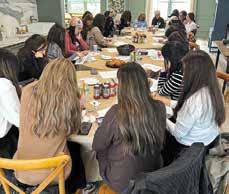

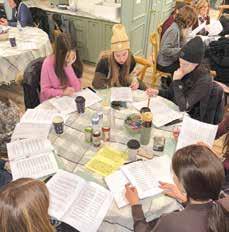

“Unlike men, who have tefillah b’tzibbur, talmud Torah, and rebbeim, many women lack structured opportunities for growth and developing a sense of belonging. As with Sarah Schenirer a century ago, today’s thoughtful and creative minds must take measures to halt the erosion of adult women’s commitment to Torah and mitzvos.”
- Rabbi Moshe Bane
cheon with a meaningful or fun program. We also offer a monthly music class, a book club, yoga, wellness programming, and cultural outings to museums and exhibits. We loved hosting senior women in such a beautiful space, but in terms of reaching women in other life stages, we were waiting for hashem to guide us.”
Daniella said with a smile, “And apparently, hashem loves us, because a few months in, he sent Maidy to join our team.”
I had been wondering how Maidy Zakutinsky, SoulCircle director, came into the picture. Along with assistant director and content creator Aliza Mammon, Maidy had become a familiar presence at the Manchester, setting up programs, welcoming women, introducing classes, and connecting with attendees as they left. Their warmth and accessibility as the house’s “hostesses” put everyone at ease. Maidy also facilitates chaburos and teaches classes each semester.
She shared her story.
“I moved to Far Rockaway about two and a half years ago. I grew up in Toronto, where community involvement runs in my family. Over the years, from Toronto, to Jerusalem, to Dallas, and now the Five Towns, I’ve started and led programs for Jewish women of all ages and backgrounds, and I’ve seen how powerful it is when women come together with purpose. Most recently in Dallas, I launched a women’s initiative focused on learning and connection and discovered a deep love for teaching Torah in a way that feels meaningful and relevant.
“When we arrived in New york, my husband became Rosh Kollel of the Woodmere Community Kollel, and I dreamed of creating something for women. When I heard about a house dedicated to women’s programming, I knew I had to meet the founders. Being invited to join them felt like clear hashgacha pratis. What were the chances that just as I moved here, a women’s center like this would be waiting for me?”
Daniella added, “There’s no way we’d be where we are today, with Manchester’s reach and scope, without the dedication and talent of our SoulCircle director.”
“I couldn’t do it without Aliza, she makes it all possible,” said Maidy. “And my husband and kids deserve credit for putting up with my crazy work hours. It all comes from pure passion. I’ve long felt it’s time for the frum community to focus on women. Women shape the next generation and pass down yiddishkeit. Torah needs to feel alive. how can I share it with my children if I feel stagnated or disengaged? The good news is, communities are noticing: women’s programs like ours are popping up everywhere, from Monsey to Baltimore to Ramat Beit Shemesh. I’ve even had calls from Boro Park and Toronto.”
“That really is fascinating. It seems there’s a larger trend,” I said.
“Exactly,” Maidy continued. “A December 2024 Mishpacha article by Rabbi Moshe Bane, former president of the OU, called ‘The Next Frontier in Religious Growth,’ notes a gap: across communities, sufficient focus on the ongoing growth in avodas Hashem of adult frum women is lacking. After reading it, I met Rabbi Bane in his home in Lawrence. he gave our work his blessing and support.
I still wanted to understand SoulCircle itself. Chavi explained, “The name was inspired by SoulCycle – catchy and cute – but it’s grown into something deeper.”
Maidy added, “SoulCircle fits perfectly because it combines
my two loves: teaching Torah and bringing women together. Learning Torah connects us to our ‘Soul,’ our chelek Eloka mima’al, the part of us that is holy and unstoppable. ‘Circle’ represents the deep connections forged when learning with other women, which then deepens our connection to hashem. My mentor, Mrs. Aliza Bulow, director of CORE, often says, ‘Our aim is to help women connect more deeply with themselves, others, and hashem.’ That’s SoulCircle’s mission.”
“SoulCircle encompasses all our learning and growth programs and has become a main focus of the Manchester,” Daniella explained. “Classes and events are curated to increase engagement with Torah and connection with like-minded women. Women of all ages attend, and chaburas fill quickly. We’re clearly meeting a real need in the community.”
Maidy continued, “We also run life-stage specific programs, like LearnUp for post-seminary girls, and TMC: Torah, Mentorship, Camaraderie, for young married women ages 20-35. Each TMC Chabura hosts twelve women per night with a handpicked mentor, providing camaraderie and guidance at this stage of life.”
Chavi pointed out, “Women’s lives are full, so we run classes and chaburas in 3-4 week ‘semesters,’ six per year. Women register according to availability. One-off events, like Free ‘n Fabulous Wednesdays, occur during semesters, but our main focus is chabura-style learning. Groups are kept small: 12 to 20 participants, so women can learn, contribute, and form connections. Many continue across semesters, and several women have told us SoulCircle has changed their lives.”
“Our clientele is diverse, and each person connects differently,” Daniella reflected. “That’s why we keep offerings varied and welcome suggestions. Recently, a musical hallel on Chanukah was deeply moving. The music, singing, and davening opened hearts, and I felt I discovered my ‘why’ for creating this space.”
“The diversity is one of my favorite aspects of the Manchester,” said Maidy. “Something so beautiful about the Five Towns and Far Rockaway is that there are so many growth-oriented, thoughtful women here, from all segments of the community. I also love the Manchester membership app we’ve softlaunched. It’s a tool you can download to find and connect with like-minded local women beyond the time spent at the Manchester and continue to gain inspiration from our chabura leaders and each other.”
“Definitely,” Chavi responded. “Beyond the colorful flyers and fresh muffins, our goal is to provide meaning, connection, and belonging, one woman at a time. I love hearing from women discovering community here: a newcomer grateful for connections, someone slowing down from full-time work finding friendship, or a baalas teshuva appreciating the nonjudgmental environment. It’s inclusive, warm, and welcoming.”
Maidy added, “We really feel hashem’s hand guiding us. Each of us is grateful to play a part in this initiative, which is redefining how women engage with Torah, themselves, and each other.”
Voices drifted up from downstairs. Chairs scraped into place for the 11:00 AM Tefillah Chabura, and our conversation drew to a close.
As the team headed down to greet the chabura participants, Chavi turned to me. “Thank you for taking the time to meet with us today. Do you feel that you have a better understanding of what the Manchester is?’”
I smiled.
“yes. And I’m glad I asked.”


By Eliyahu RosEnBERg
For years, Rabbi Aaron Kotler taught at Aish HaTorah under the guidance of Rav Noach Weinberg, zt”l, the institution’s founder and then-rosh yeshiva.
During his time at Aish, Rabbi Kotler — the son of Rav Shneur Kotler, zt”l, and the grandson of Rav Aharon Kotler, zt”l — amassed more students than he could count: young adults who admired him, credited their growth in Torah to
his mentorship, and revered him as their rebbi.
But there was just one problem: Rabbi Kotler “acted” like a rebbi, he “sounded” like a rebbi, and he “looked” like a rebbi, but when he’d look at himself in the mirror, he didn’t see a rebbi. He saw someone who, as he puts it, “didn’t know anything.”
“Teaching is a very intense experience. First of all, you have to know your stuff,” Rabbi Kotler shares. “But also,
Torah belongs to the Jewish people. it’s our connection to Torah that carries us. That’s what distinguishes us. What makes us great is not our nobel Prize winners, not israeli technology; it’s not all the Jewish mathematicians or scientists or philosophers. it’s our connection to Torah that distinguishes us.
When you’re listening to someone, really listen. Don’t pretend you’re listening. Don’t just wait for your turn to speak next. Really listen.
We, the Jewish people, have always been — and especially now — in a mortal battle for our survival. o ur survival depends entirely on our connection to hashem, which is expressed through Torah, tefillah, and chessed
you have to really connect to the people. And it gets very taxing. And it’s also humbling. And after teaching for about a year, the feeling that I had was that I really didn’t know anything.”
Maybe it was imposter syndrome. Or maybe it was just humility. But either way, Rabbi Kotler’s insecurity compelled him, on several occasions, to attempt to quit.
“I’ve got to quit this. I can’t. I can’t teach. I don’t know anything,” he’d tell Rav Noach.
Inevitably, Rav Noach would reject Rabbi Kotler’s resignation. “He’d get mad at me. And he didn’t want to accept it,” he recalls. “But I really had the sense that I just didn’t know anything. And I said, ‘OK, so I better do something about it.’
“So, I went to Rav Noach, for one of the last times, and I said to him, ‘Rosh Yeshiva, I’m going to quit, and I’m going to learn in kollel.’ And Rav Noach — he was this massive personality, brilliantly insightful in every way, with an incisive wit — says to me, ‘Do you think you’re smart?’”
“Yeah, I think I’m smart,” Rabbi Kotler hesitantly responded.
“In the years you’ve been here at Aish, did you learn a lot?” Rav Noach asked.
“Yes, of course, I’ve learned a lot here,” Rabbi Kotler replied.
And then, Rav Noach combined the two questions together.
“Do you think you learned a lot be -
cause you’re smart?”
Rabbi Kotler offered a humble, albeit generic answer.
“Well, you know, not really. It’s all from Hashem,” he replied.
As Rabbi Kotler recalls, at that moment, Rav Noach got upset at him. He stared at the young teacher and, in his passionate way, rebuked him.
“What are you talking about?” Rav Noach said. “Hashem works on middah k’neged middah! The way you act is the way Hashem and Heaven act with you. Don’t you know that?”
“Yes, I know that.”
“You learned everything you learned because you were teaching Hashem’s children. Middah k’neged middah, He let you learn! Everything you learned was not because you were smart or because you’re capable or because you were in the right circumstances. It’s because you taught Hashem’s children that He let you learn!” Rav Noach declared.
“And then he says, ‘If you stop teaching Hashem’s children, you will not have that zechus of middah k’neged middah.’ And that really scared me,” Rabbi Kotler recalls.
Like Rabbi Kotler’s grandfather — the gadol and founder of BMG, Rav Aharon Kotler, zt”l — Rav Noach’s kiruv efforts were driven by a sense of indignation, by outrage over the state of world Jewry. In Rav Noach’s mind, it wasn’t that unaffiliated Jews weren’t connected to Torah; it was that they had been robbed of their Yiddishkeit.
“Someone, somewhere along the way, misled these people and took their Torah education away from them,” Rabbi Kotler explains. “It’s unnatural and upsetting. It’s frustrating, and you should do something about that. And Rav Aharon was ready to do something about it; his whole life was doing something about it. And Rav Noach was ready to do something about it.”
So, naturally, Rav Noach viewed Torah educators as soldiers on the frontlines of our nation’s fight for survival. For Rabbi Kotler to leave his teaching position behind would perhaps be akin to a soldier’s desertion. But still, Rabbi Kotler couldn’t help but feel as though he hadn’t even scratched the surface of Talmud Torah. Sure, he’d learned a few masechtos in yeshiva. But the Torah is as endless as the sea. Why not do a little diving?
So, Rabbi Aaron Kotler cautiously left Aish. He, his wife, and their two children moved from Israel to South Fallsburg, in the Catskills. And for a while, he learned in Kollel. And even though Rabbi Kotler left Aish, Rav Noach’s message always stuck with him. While learning in Kollel, Rabbi Kotler did a great deal of kiruv work in the Catskills. Although he left Aish, he never left teaching.
Rabbi Aaron Kotler grew up in a very different Lakewood from the one we know today. Back then, the New Jersey township’s frum community was tiny.
“It was certainly out of town,” Rabbi Kotler admits. “I had two shomer Shabbos classmates. And then, one moved to California, so then I had one shomer Shabbos classmate.”
But despite, or perhaps because of, its size, the community had a tremendous sense of familiarity and warmth.

Everyone knew each other. At the center of the community was Rabbi Kotler’s childhood home, which had a strict open-door policy. It wasn’t out of the ordinary for yeshiva students to walk through his door, head to the freezer, and grab ice cream and a snack.
“It wasn’t really that I remember us as a distinctive family. It was that we were a very distinctive community. And what was distinctive about it, really, was the warmth and familiarity. I think every bachur and kollel yungerman in yeshiva felt that my father, Rav Shneur, was their best friend, and that he loved them and cared about them. There was a tremendous sense of closeness and warmth,” Rabbi Kotler remembers.
“And for my mother, the same. Thinking of the shidduchim she made and the cholim she took care of — she was Bikur Cholim, Tomchei Shabbos, the shadchan, the psychologist, the rebbetzin, the person who raised money. There were probably hundreds of people who called her Tanta Rishel.”
He always felt that Lakewood was his home, even when he lived in Eretz Yisrael and the Catskills. In 1995, around four or five years after relocating to South Fallsburg, Rabbi Kotler moved back to Lakewood, along with his wife and five kids. From there, he set his sights on strengthening the community, becoming the CEO and President of Beis Medrash Govoha (BMG), the yeshiva his grandfather founded. Twenty-seven years later, in 2021, he retired from his position.
“Torah belongs to the Jewish people. It’s our connection to Torah that carries us. That’s what distinguishes us,” Rabbi Kotler says. “What makes us great is not our Nobel Prize winners, not Israeli technology; it’s not all the Jewish mathematicians or scientists or philosophers.
It’s our connection to Torah that distinguishes us.”
Under Rabbi Aaron Kotler’s leadership, Lakewood’s Jewish community has developed significantly, both in terms of population and infrastructure. Rabbi Kotler remembers a woman from Lakewood who, every morning, would stand by her window and cry tears of joy as she watched Jewish children getting off the cheder bus. We take for granted how unprecedented it is for frumkeit to be the norm; how, in relatively recent history, we had to hide to survive; we lived in constant fear, without religious freedom. Our ancestors couldn’t possibly have dreamed of the amenities we take for granted: countless kosher stores, myriad yeshivas and shuls, the freedom our religion to practice openly and proudly. No, life isn’t perfect. There’s still terrible antisemitism. There’s still division. But we have a lot to be grateful for.
“Some people might not agree with this – and they’re welcome to disagree – but when I go through Lakewood, and I see traffic, that’s joy. This is a Jewish community. This is a vibrant, thriving, flourishing community. So, to see Jews together, to walk into a store and see frum Yidden; to see a frum Yid behind the counter, serving pizza, and they have a smile, and there’s a tzedakah box on the counter, and you can get 90 different flavors of kosher pizza — more flavors than Baskin-Robbins — how can you not have joy?” Rabbi Aaron Kotler declares. “So what, there’s no parking spots in the parking lot? Thank G-d, there’s no parking spots! Do you know how many cities there are that don’t even have enough Jews to support a kosher pizza shop?
“If you walk into a kosher restaurant, and you have to wait in line to be seated, you are, truly, among the luckiest Jews in Jewish history.”
This article is based on a podcast, “Inspiration For the Nation,” hosted by Yaakov Langer. To catch more of this conversation, you can watch it on LivingLchaim.com or YouTube.com/LivingLchaim or listen wherever you listen to podcasts (just search for “Inspiration For The Nation”) or call our free hotline: 605-477-2100


By David Brummer

Jacob Schwebel didn’t grow up with plans to study in a yeshiva in Jerusalem or to make aliyah. Like many Jewish teens in Marietta, Georgia, he was part of a Conservative community—attending Hebrew school, High Holiday services, and spending summers at Camp Barney Medintz in Cleveland, Georgia.
“I was brought up that way, so I’m very thankful for the foundations it gave me,” Jacob says. “The main focus was on learning the fundamentals of holidays, not as much a push toward more observance.”
After his bar mitzvah, like many kids in his community, his Jewish education came to a pause.
It wasn’t until last year, during his senior year at the University of West Georgia, that things started to shift for the better. A family friend was learning Torah with Rabbi Netanel Friedman in Dunwoody, and during a chance encounter at a restaurant, “I asked him to connect me,” Jacob recalls.
“Rabbi Friedman introduced me to something called the Podcast Fellowship, where I’d watch shiurim and then discuss them over Zoom with other Jewish students at different colleges.”
Jacob adds, “He would host sushi and shiur on Tuesdays, or pizza and shiur on Wednesdays. And then I slowly started getting pulled more into the community events.”
The rabbi eventually invited him for Shabbat, where Jacob had his first Shabbat meal in the Dunwoody community.
“It was pretty cool. He was just a friendly rabbi and super accommodating.”
Jacob started trying to keep Shabbat in his fraternity house, which created an interesting dynamic and changed something fundamental within him. The typical college social calendar meant events on Thursday and Saturday nights, with Friday nights usually quiet. Jacob realized he was missing the whole point of Friday night in Judaism: being with other people, sharing Torah, and learning together.
“At that point, I had no idea what Shabbat was,” he admits. “So I impro -
into my lifestyle,” he says simply.
After graduating in May, Jacob went to Israel on July 7 and arrived at Aish on August 25. His family has been supportive, happy that he’s found something meaningful.
“Growing up, Shabbat wasn’t really observed in my house. And as far as kashrut was concerned, we didn’t do anything; my grandparents would ship us stone crabs once a year. My Conservative community focused more on Jewish identity than on halachic details, but
“I’d watch Friday night services from Central Synagogue in New York on YouTube. Then I would try not to drive, not to spend money, and not to use technology.”
vised. I bought Shabbat candles, started making challah, and I would grab food from the dining hall beforehand (carefully separating meat and dairy, which I’d only recently started doing). I’d watch Friday night services from Central Synagogue in New York on YouTube. Then I would try not to drive, not to spend money, and not to use technology.
“I was slowly implementing Shabbat
I’m forever thankful because it helped shape me into who I am today.”
He’s also learned to be more understanding of others that aren’t on the same journey as him. “Since the beginning of my time at yeshiva, I’ve gradually learned to be less intense,” he laughs.
“At first, I would tell my parents, ‘You need to keep Shabbat. You need to have a Friday night Shabbat dinner.’”
His parents encouraged him to slow down and take things step by step. His local rabbi was surprised when Jacob’s father called, asking for a letter confirming his Judaism for aliyah purposes. Jacob had always been one of the less involved kids in Hebrew school.
The hardest part about yeshiva, Jacob says, isn’t the social adjustment or even the new religious obligations; it’s learning Talmud, which is completely different from years of Hebrew school. Beyond the intellectual challenge, there’s the spiritual one: “Learning to really have a connection with G-d is way more difficult, because that just wasn’t anything I was focused on while going to High Holiday services.”
Jacob decided to make aliyah about three months ago, around the same time he committed to studying in yeshiva. The two decisions happened together, one feeding into the other.
“I sometimes think about what I would say to my younger self on the cusp of my bar mitzvah and about to drift away from Jewish learning. I would tell him to be serious in whatever education you’re going for and to firmly know the WHY behind any future decision you make in your life,” Jacob says.
He’s still figuring out what that purpose looks like, working through Talmud passages that don’t come easily, growing healthy relationships, and connecting to something he only vaguely understood growing up. But at least now he’s asking the questions, and unlike in Hebrew school, this time he’s actually interested in the answers.

Moderated by Jennifer Mann, LCSW of The Navidaters

Dear Navidaters,
I love your panel and appreciate the opportunity.
I’m the oldest in a very large family (13 kids). I love my family dearly, and my parents are great. But after a lot of soul searching in seminary and thinking about what I want, I think that’s not particularly the family structure I want. I’ve been dating and I keep thinking about this as a potential question for the guys I date, but I chicken out before ever getting to it.
The thing is, I want to make sure it’s an appropriate question to ask, and if so, when is the appropriate time to ask it?
Thanks so much,
Tehilla*
Dear Readers,
We want to offer YOU an opportunity to be part of the discussion! Please email us at MichelleMondShadchan@gmail.com, subject line “reader’s response,” if you would like to participate in the new “A Reader’s Response” columnist spot. We will send you a question and publish your answer in an upcoming Navidaters edition.
If you have a question you would like the Navidaters to answer, please reach out to this email as well.
Looking forward!
Michelle, the “Shadchan”
Rebbetzin Faigie Horowitz, M.S.
Tehilla, the context in which you can bring this subject up is pretty straightforward. When you talk about your families at the point at which you feel secure enough to be vulnerable, that is the time to
talk about your vision for your future family. Many young people talk about their own families and then what they would like that will be similar and/or different. Obviously, this means that the young man and woman have reached a level of closeness and trust.
Then you can share personal information. Achieving this level of comfort with one another happens at different points for different couples. No one will say to you:

open up about this on the third date or the fifth date. It’s a matter of whether you have reached a deeper level of connection and you see that some of your present and future priorities are aligned. You will know when the time is ripe for the discussion about family size.
Michelle Mond
Dear Tehilla,
It is completely valid to recognize that the family type you grew up in is not necessarily the one you want for yourself. That does not take away from your love for your family or from the good you experienced growing up. It simply means you’ve thought carefully about what you want your own future to look like.
The good news is that you do not need
The reason you hesitate is not because it is wrong but because it feels personal.
to worry about bringing this up until you are serious with someone. This is not a topic that belongs early on in dating, because at that point, it simply is not anyone’s business.
Once you are at a more serious stage in a relationship, conversations naturally become deeper. You will start talking more about your upbringing and family life. As the oldest of thirteen, it is very likely that he will ask you questions about your experience growing up, and that can serve as

a natural opening to share how you think about this topic.
Usually, discussions about the future and expectations will come naturally, later on in the dating process. Until then, your focus should be on getting to know him. Pay attention: do you genuinely like and respect him? Does he treat you well? The more serious stuff can be discussed later on, when your relationship has earned that level of openness.
Dr. Jeffrey Galler
Family size is not a trivial question. It is a lot more significant than asking if someone prefers mountains or beaches.
On your very first phone conversation, or very first date, it’s probably not advisable to say, “Hi. My name is Tehilla, I just got back from seminary, I’m studying to be a speech therapist, and I do not plan on having thirteen children.”
Instead, this is the sort
of conversation you would have after a couple of dates, when you discuss values, like family, work, materialism, etc. During those talks, you can easily work into the conversation that your parents chose to have 13 children, and that even though you had a very happy and loving childhood, you would probably prefer a smaller family.
You may find that most young men will be surprisingly relieved to hear that!
Here’s a suggestion for you:
When my daughters were younger, they loved reading, “The Story of Mimmy and Simmy,” by Yaffa Ganz (available on Amazon). The story is about two best friends. Mimmy comes from a large family, and Simmy is an only child. Both girls romanticized what they did not have.
Mimmy is jealous of Simmy because she gets a lot of only-child attention and enjoys peace and quiet in her home. Simmy is jealous of Mimmy because she is always surrounded by siblings and playmates and is never lonely. They decide to switch places for one Shabbos, with very interesting results. They learn that it is not about which family size is better but that every struc-
The Navidaters
Dating and Relationship Coaches and Therapists
Dear Tehilla,
This is such an honest question. And it makes a lot of sense coming from someone who grew up as the oldest in a very large family.
You can love your family deeply and still know that you do not want to recreate the same structure for yourself. That is not a rejection of your parents or your upbringing. It is self-awareness. Growing up where you did gave you a real understanding of what that life asks of a person, especially of the old-
ture carries blessings and burdens.
You can use that story as a starting point for a heartfelt conversation about what kind of family life you fantasize about building together. This is not about rejecting your childhood. It is about responsibly planning your future grocery bill, your sanity, and the size of your dining room table.
Sholom P.
Dear Tehilla,
I am so happy to hear that you had a positive experience growing up in a large family and that you have a good relationship with your parents. I, too, grew up in a large family (12 kids) and know the pros and cons that come along with being part of a large family. Your feelings are very valid, and I think many people who grow up with a lot of siblings can resonate with your perspective.
Dating is a process, and as you get more comfortable, this is definitely a normal and important thing to discuss with a potential spouse. You should not feel insecure or uncomfortable asking this question. A person’s perspective on family planning often is influenced by their life experiences and values. As one experiences life, their values and perspectives may change, and that is true for a married couple as well.
There is not a specific point in dating
Once you are at a more serious stage in a relationship, conversations naturally become deeper.
that you can or should bring this topic up. This type of conversation can be brought up organically or you can even just ask it straight out. As a guy, I would not be offended or uncomfortable being asked this question. In fact, my wife and I discussed this topic when we were dating and had very different perspectives. I wanted 17 kids, and she didn’t (being that she is sane). As I grew wiser and had kids, my perspective has changed significantly.
If you take anything away from my uneducated perspective, just know that your question is very normal and probably every couple discusses it at some point. Don’t get stuck in your head thinking about it. Just relax, and the time will come for the conversation. If you are super stressed, you can always be super awkward and just ask him on the first date – that way you don’t have to stress about it on any other dates.
Hope this was helpful!
est child. You are allowed to take that seriously.
Many people from big families hold this quietly. Gratitude and exhaustion often live side by side, and it can feel scary to admit that what you came from is not what you want to build. That does not make you ungrateful. It makes you thoughtful.
Yes, this is an appropriate thing to ask. The reason you hesitate is not because it is wrong, but because it feels
personal. You are sharing something real about your limits and your future, and that takes courage.
This is not a first date question, and it does not need to be asked in a blunt or technical way. It usually fits naturally a few dates in, once there is already some comfort and you are talking more about values, family, or life goals.
It often helps to share first rather than ask outright. You might say something like: “I grew up in a very large family, and I love it. At the same time, I
have realized that I do not think that is the family structure I want for myself. I am curious how you think about that.” That opens a conversation instead of putting someone on the spot. What matters is not just his answer but how he responds to you saying something honest and a little vulnerable. You are allowed to want what you want. The right person will not be scared by this question. He will respect it.
Sincerely, Jennifer

By Rivka Kramer, PMHNP-BC
Psychiatry has come a long way. We now have advanced medications, genetic research and detailed diagnostic manuals. These tools have helped millions of people. They have reduced stigma and saved lives. But for all this progress, one powerful force still does not get the attention it deserves: trauma.
Trauma is often treated like a side topic. It may be mentioned in a history and then quietly placed in the background while treatment focuses on diagnoses and medications. But for many people, trauma is not just part of the story. It is the story. It shapes how the brain reacts, how emotions are regulated, how relationships feel, and how the body responds to stress.
When trauma is overlooked, psychiatry may treat the symptoms while missing the deeper cause. The result can be years of treatment that helps a little but never quite gets to the root of the issues.
When people hear the word trauma, they often think of extreme events like war, violent assault, or major accidents. Those are real and serious. But trauma is also much quieter and more common.
Trauma can be growing up with emotional neglect, constant criticism, bullying, a chronically stressed home, a parent with addiction, unpredictable caregiving, medical trauma or feeling unsafe to express emotions. Trauma is not only about what happened. It is about how alone, frightened, or overwhelmed a person felt while it was happening.
Two people can go through similar events, and only one may be traumatized. That is because trauma is about the nervous system. It is about whether the body learned that the world is safe enough or dangerous. It is about whether connection feels soothing or threatening.

Trauma lives in the body, not just in memory. It shows up in startle responses, muscle tension, breathing patterns, sleep problems, and emotional reactions that seem bigger than the situation at hand.
There are several reasons trauma often takes a backseat in psychiatry.
First, the medical model focuses on biology. Neurotransmitters and brain circuits are easier to measure than emotional pain. A prescription can be written in minutes. Exploring trauma takes time, trust, and emotional presence. In busy systems, time is limited.
Second, trauma does not fit neatly into categories. It can look like many different disorders depending on the person. That makes it harder to study and harder to standardize.
Third, trauma stories can be hard to hear. They force clinicians and systems to face abuse, neglect, and betrayal in places that were supposed to be safe. That can be emotionally heavy and uncomfortable.
Finally, many training programs still
treat trauma as a specialty rather than a basic lens for understanding patients. As a result, trauma may be referred out instead of integrated into everyday psychiatric thinking.
One of the biggest reasons trauma is underrated is because it often hides behind other diagnoses.
Depression may be an emotional shutdown after years of feeling unseen or powerless. What looks like a low mood may actually be a nervous system that learned to conserve energy to survive. Anxiety may be a body that learns to stay on high alert. Panic and worry are not just thoughts. They are physical survival responses.
Attention problems may be trauma-based. A nervous system scanning for danger has trouble focusing on school or work. What looks like ADHD in some people may be hypervigilance in disguise. Mood swings may reflect trauma-related emotional overload. Stress and relationship triggers can cause rapid shifts that look like a mood disorder.
Relationship chaos and intense
emotions often labeled as personality problems are frequently rooted in early attachment trauma. These are not character flaws. They are survival strategies learned in unsafe emotional environments.
Even hearing critical voices or feeling watched can in some people be linked to trauma memories and internalized abusive voices.
This does not mean trauma explains everything. Biology matters. Genetics matter. But trauma is often a major piece of the puzzle that is too easily missed.
Trauma changes the body. This is not just psychological. It is biological.
The stress system can become overactive. The brain alarm center can become more sensitive. Areas involved in calming and thinking clearly may become less effective under stress.
In real life, this looks like chronic pain, headaches, stomach problems fatigue, pelvic pain and autoimmune-like symptoms. Many people go from doctor to doctor with real physical symptoms that have no clear structural cause. A trauma-informed view recognizes that a nervous system stuck in survival mode can create real physical suffering.
Sleep is another major clue. Many trauma survivors have trouble falling asleep, staying asleep, or having restful sleep. The body may not fully relax because in the past sleep was not safe. Insomnia in this context is not just a sleep problem. It is a learned survival pattern.
Trauma shows up clearly in relationships.
If early caregivers were inconsistent, frightening, or emotionally unavailable, the nervous system learns powerful lessons about closeness.
Some people learn that needing oth-
ers leads to pain so they become distant and overly self-reliant. Others learn that connection is unpredictable so they become anxious, clingy, or highly sensitive to rejection. Many people swing between both.
In adult psychiatry, these patterns often get labeled as personality traits or interpersonal problems. From a trauma lens, they make deep sense. They are nervous system strategies built to protect connection and safety.
Medications can be life-saving and life-changing. The issue is not medication. The issue is using medication without understanding trauma.
When trauma is not recognized, people may be labeled treatment resistant. They may try many medications with partial relief while core patterns of fear, numbness, or relational distress remain.
Some medications may even worsen trauma-related symptoms like emotional blunting dissociation or sleep disruption. Without a trauma lens, this can be misread as illness severity instead of a mismatch between treatment and root cause.
Trauma-informed psychiatry does not mean digging into trauma in every session. It means keeping trauma in mind when understanding symptoms. It means asking not only what is
rectly address trauma when appropriate such as IFS, somatic therapies, trauma-focused therapy and attachment-based approaches.
It also means teamwork across medicine therapy and body-based care. Healing trauma often requires helping
When trauma is overlooked, psychiatry may treat the symptoms while missing the deeper cause.
wrong but what happened to you.
It means seeing behaviors as adaptations not defects. Avoiding emotional shutdown and resistance often protected someone at one time.
It means building safety and trust in the clinical relationship. Clear explanations, predictable plans ,and respecting emotional pacing all matter.
It means using therapies that di -
the nervous system learn safety again, not just changing thoughts.
When trauma is overlooked, patients often feel misunderstood and blamed. They may cycle through diagnoses and treatments without feeling truly seen. They may believe they are broken. When trauma is recognized, symp -
toms begin to make sense. The story becomes clearer. The shame often lifts. Hope grows because the nervous system learns these patterns to survive and can also learn new ones.
Psychiatry does not have to choose between biology and trauma. The brain and life experience shape each other. Trauma is not a footnote. For many patients, it is the main chapter. Bringing trauma to the center of psychiatric thinking makes care more accurate, more compassionate, and more effective. Until trauma is fully embraced as a core force in mental health, it will remain one of the most powerful and most underestimated drivers of human suffering and healing.
Rivka Kramer is a Board Certified Psychiatric Nurse Practitioner. She has a psychiatric private practice based in Cedarhurst, NY. She serves as a member of the board of JANPPA, the Jewish American Nurse Practitioner Psychiatric Association. She can be reached at 516-945-9443.


By Aliza Beer MS, RD, CDN

The flu is a highly contagious respiratory illness caused by influenza viruses, and it can leave someone feeling weak, achy, and exhausted. While vaccines and proper hygiene are the biggest factors for prevention, nutrition also plays an important role in supporting the immune system and helping the body recover more efficiently. Eating the right foods can help diminish symptoms, prevent complications, and speed up recovery.
Before diving into what to eat when someone has the flu, it’s important to consider prevention. A strong immune system can reduce the chances of catching the virus or may make the illness less severe. Key nutritional strategies for flu prevention include:
1. Fruits and Vegetables: These are rich in vitamins, minerals, and antioxidants that support immune function. Vitamin C, found in citrus fruits like oranges and grapefruits, strengthens white blood cells, which are crucial for fighting infections. Dark leafy greens,
bell peppers, and broccoli also provide immune-supporting nutrients.
2. Protein-Rich Foods: Lean meats, poultry, fish, eggs, legumes, and tofu supply amino acids, which are essential for producing antibodies. Adequate protein intake is vital for maintaining immunity.
3. Healthy Fats: Omega-3 fatty acids, found in fatty fish (salmon, sardines) and flaxseeds, have anti-inflammatory properties that may reduce the risk of severe flu symptoms.
4. Whole Grains: Foods like oats, brown rice, and whole-wheat products supply B vitamins, which support energy production and overall immune health.
5. Hydration: Water, herbal teas, and broths are essential for preventing dehydration, which can impair immune function.
When someone has the flu, the body requires extra support. Symptoms like fever, fatigue, congestion, nausea, and body aches can make eating and drinking difficult. The goal is to consume foods that are
gentle on the stomach, easy to digest, and packed with nutrients that boost immunity and help the body repair itself.
1. Chicken Soup
A classic for a reason, chicken soup provides warmth, hydration, and electrolytes. It also contains amino acids like cysteine, which may help thin mucus in the lungs, easing congestion. The steam from hot soup can soothe sore throats and clear nasal passages.
2. Citrus Fruits (Oranges, Grapefruit, Lemons)
Rich in vitamin C, these fruits support the production of white blood cells, helping your body fight the infection. Fresh juice or segments can also provide fluids and natural sugars to maintain energy. Diet tip: whenever you feel a cold coming on, bombard yourself with citrus fruits and maybe even vitamin C supplements. It usually halts the cold in its tracks or minimizes symptoms!
3. Garlic Garlic has natural antiviral and an-
tibacterial properties thanks to compounds like allicin. Incorporating garlic into soups, teas, or soft foods can provide immune support.
4. Ginger
Ginger has anti-inflammatory properties and can ease nausea, a common flu symptom. Fresh ginger tea or grated ginger in soups can soothe the stomach and reduce inflammation.
5. Yogurt and Probiotics
Probiotics, found in yogurt, kefir, and fermented foods, support gut health, which is closely linked to immune function. Choose plain, unsweetened yogurt to avoid added sugars that may impair immunity.
6. Honey
Honey is soothing for sore throats and coughs. A spoonful in warm tea or water can provide a gentle antimicrobial effect while keeping the throat moist. Avoid giving honey to children under one year due to the risk of botulism.
7. Leafy Greens and Soft Cooked Vegetables
Spinach, kale, carrots, and zucchini are rich in vitamins A, C, and K, antiox-
idants, and minerals like iron. Lightly steaming or cooking and pureeing vegetables into a soup makes them easier to digest during illness.
8. Oatmeal
Oatmeal is gentle on the stomach, provides energy through complex carbohydrates, and contains beta-glucans—fiber compounds that may enhance immune function. Add honey or soft fruits for extra nutrients.
9. Bananas
Bananas are easy to digest, provide potassium to help maintain electrolyte balance, and offer quick energy. They’re particularly helpful if fever or diarrhea accompanies the flu.
10. Herbal Teas
Teas made from chamomile, peppermint, or licorice root can soothe the throat, reduce inflammation, and keep you hydrated. Warm fluids also help relieve congestion.
When someone has the flu, appetite is often low, and many people struggle to tolerate heavier foods, especially protein. It is completely normal and OK to be consuming mainly bland, carbohydrate-based food and minimum protein for a short period of time, and it will not
harm recovery. Bland foods include toast, crackers, plain rice, applesauce, plain oatmeal, and mashed potatoes. If tolerated, you can gently “sneak in” protein by adding chicken to soup, eating yogurt, or spreading peanut butter on toast. However, the most important goal is hydration and getting whatever nourishment you can. Even small amounts of food combined with fluids like soups, teas, and broths provide valuable support while your body heals.
nutrient intake.
• Stay Hydrated: Water, electrolyte drinks, and broths help prevent dehydration from fever and sweating.
• Avoid Heavy, Greasy Foods: Fried foods or overly processed items can be hard to digest and may worsen nausea.
• Focus on Soft and Warm Foods: Soups, stews, smoothies, and
While vaccines and hygiene practices remain critical, the foods one chooses can influence the severity and duration of symptoms. During illness, focusing on hydration, gentle, nutrient-dense foods, and immune-supporting ingredients can help the body fight the virus, reduce discomfort, and promote faster recovery. Chicken soup, citrus fruits, garlic, ginger, yogurt, honey, leafy greens, oatmeal, bananas, and herbal teas are excellent options that combine comfort, nutrition, and symptom relief.
Focusing on hydration, gentle, nutrient-dense foods, and immune-supporting ingredients can help the body fight the virus.
By paying attention to what you eat before and during the flu, you give your immune system the support it needs to help you feel better faster. It is important to remember that nutrition isn’t a cure for influenza, but it is one of the most effective ways to empower your body while it does the hard work of healing.
During the Flu
• Small, Frequent Meals: Appetite may be low, so eating small portions throughout the day ensures consistent

cooked vegetables are easier on a sensitive digestive system.
• Include Immune-Boosting Spices: Turmeric, cinnamon, and black pepper have anti-inflammatory and antioxidant properties that may support recovery.
Nutrition is a powerful tool in both preventing and recovering from the flu.
Aliza Beer is a registered dietitian with a master’s degree in nutrition. She has a private practice in Cedarhurst, NY. Patients’ success has been featured on the Dr. Oz show. Aliza can be reached at alizabeer@gmail.com, and you can follow her on Instagram at @alizabeer

By Sara Weissman

“There’s a lot of misinformation out there,” says every fitness YouTuber (sometimes even before they themselves distribute new misinformation). Those YouTubers are correct, though; there is a lot of misinformation out there. Let’s dive into and debunk some of the most ridiculous and dangerous myths about running.
Myth #1: You don’t need to propel yourself forward as much on a treadmill.
I’ve heard this one so often that I think physics should be mandated in high school. We can all agree that when you run on a treadmill, you are staying in place while the treadmill belt is moving. Some think that because the belt pulls you backward, you rely more on lifting and placing your feet to keep up instead of mechanically propelling yourself forward. This is an illusion.
I think the best way to explain why the treadmill does not propel you forward is through a quick lesson in momentum. Objects in motion stay in motion. Think about an airplane moving
at a constant speed of 600 MPH. As long as the plane isn’t slowing down or speeding up, walking to the front or back of the plane takes the same effort. If you jump, you don’t get blasted backwards at 600 MPH because your momentum keeps you moving with the plane. However, if you hop on a moving treadmill (very bad idea), you will go flying off of it. Your momentum is carrying you backwards at the speed of the treadmill, so you need to propel yourself forward at the speed of the treadmill.
I’ve had one too many treadmill accidents to know that on a treadmill going 7 MPH, if you stop running, you will fly backwards at 7 MPH. That means that you need to propel yourself forward at 7 MPH to stay on the treadmill. That is equivalent to what would be required to run outdoors at 7 MPH, where you would also need to propel yourself forward at 7 MPH. Side note: if you don’t enjoy slamming into walls, make sure the back of your treadmill isn’t against a wall. The force needed to stay in place on a treadmill is the same as the force needed to move forward on the road.
If you find the treadmill to be easier
than running outdoors, it could be for a few other reasons. Pacing is automated, you have control of temperature and elevation, and there is no wind resistance. However, I’d argue that running outdoors is easier. There is fresh air, engaging scenery, runners to smile at, and a near-zero percent chance of slamming into a wall. If you always assumed that the treadmill is easier, I suggest taking a shot at running in the great outdoors.
Myth #2: Running will destroy your knees.
“My friend has arthritis in her knees, and the doctor said it’s because she used to run,” my grandmother lovingly scolds me before every run. Osteoarthritis is a painful disease where bones rub directly against each other due to the wearing down of cartilage between them. Over 50% of adults 75 years and older suffer from arthritis, with the knees and hips being the most commonly affected joints. It sounds obvious that pounding the pavement will wear down knee cartilage, so when a runner develops osteoarthritis, running gets the blame.
If I believed that I was barreling towards osteoarthritis, I would sprint away from running. However, I think that the data can actually provide optimism for people who are worried about developing the disease. A 2017 meta-analysis published in the Journal of Orthopaedic & Sports Physical Therapy showed that recreational runners have 3x lower rates of knee and hip osteoarthritis than non-runners. What is it that’s protecting runners? It is hard to be entirely sure about such a complex system, but there is a plausible theory. Osteoarthritis was traditionally blamed solely on “wear and tear” of cartilage, but scientists are now increasingly pointing to inflammation as primarily responsible for the degeneration of cartilage. Regular exercise decreases inflammation, which can protect cartilage. However, more running isn’t always better for osteoarthritis. Competitive runners have a slightly higher risk of developing osteoarthritis than non-runners, likely because of extreme training loads and training through injury. Running while injured or at extreme volumes makes the development of osteoarthritis more likely. Listen to your
body and don’t exercise through worsening pain. Doing so makes you a fool, not a hero.
Myth #3: Running will age your face.
There’s a belief that, over time, distance running causes your skin to sag, wrinkle, and get leathery. The rationale is that repetitive bouncing gradually stretches your skin down.
Perhaps this does happen to some runners, but I don’t think that running is the true culprit. Instead, I suspect sun damage and low body fat. Runners (many of whom hate the “dreadmill”) spend loads of time soaking up the sun. Without proper sun protection, they can develop the cursed runner’s face. The stereotypical runner is also thin. As many have seen with “Ozempic face,” low body fat can contribute to a gaunt, aged appearance.
Be sure to protect yourself from harmful UV rays and eat enough to maintain a healthy weight. Doing so will protect you from accelerated aging. Regardless of aesthetics, these tips will protect you from skin cancer, osteoporosis, and many other complications that are miles worse than a saggy face.
Myth #4: Carbs are evil, and runners should just eat salads.
This myth genuinely worries me, and not because I can’t digest kale. From recreational runners to professionals training with Nike, many have tragically hurt themselves by chasing a dangerous calorie deficit in hopes of getting
became perpetually fatigued, and quit running for years.
Carbohydrates have been called evil for some time now, but endurance athletes suffer without them. Glucose is the primary energy source during a hard workout, and the most efficient way to replace that glucose is by eating carbohydrates. Immediately after a
Immediately after a workout, it is particularly important for the recovery of your muscles to eat carbohydrates.
faster. In the book The Happy Runner, Dr. Megan Roche shares her personal dieting experience while on the Duke track team. Assuming that losing weight would make her faster, she changed her daily diet to just consist of three salads with bits of protein. Initially, she did get faster. However, soon after, her body broke down. She fractured bones,
workout, it is particularly important for the recovery of your muscles to eat carbohydrates. I don’t recommend eating a dozen donuts in one sitting, but without proper nutrition, your training and health will suffer. Pasta, bread, and even some junk foods can help you recover after long and intense runs.
The risk of injury and developing os -
teoporosis (weak bones) increases with low muscle mass. Having a super lean “runner’s body” isn’t ideal for everyone, including myself. I gained seven pounds since beginning my running journey, but far more importantly, I am faster, stronger, and more resilient than ever. If you are within a healthy weight range, focus on your fitness, not your weight. To quote former surgeon general Vivek Murthy, “misinformation is a public health crisis.” While a preference for the treadmill is harmless, the other myths can prevent you from moving and fueling, endangering your health. When done right, running will add years and quality to your life. In training, speed and skepticism make the perfect pair.
Sara Weissman is a high school psychology teacher, biochemistry researcher, former adjunct professor of biology, and distance runner. Follow her running adventures on Strava @Sari Weissman. If you have feedback or suggestions for future articles, contact Sara at sara.lifshitz18@gmail.com.

By Etti Siegel
Q:Dear Etti,
My younger elementary school-age son is much bigger than the other children in his class. He is taller, broader, and looks older than his peers, even though he is very much the same age on the inside.
Because of this, adults in his life, especially teachers, expect more from him. They assume he should be more mature, more self-controlled, and more responsible simply because of his size. At recess, if there is any kind of altercation, he is immediately blamed. Even when another child grabs something from him or provokes him, the moment my son reacts, often just by grabbing the item back, he is the one accused of hurting someone “smaller.”
The truth is, he is the gentlest child in the world.
At home, he cries and says, “It’s not fair. I’m always blamed.” At first, I wondered if this was just his perception. But I’ve started watching more carefully, and I see it. I’ve seen other children provoke him, and I’ve seen him get in trouble simply because he is bigger.
I worry about what this is doing to him. I don’t want him to feel ashamed of his body or to think that being big means being bad. How do I help him navigate this?
-Mom of Big Kid
A:Dear Mom,
What your son is experiencing hurts. And I want to say that it hurts, because too often, children in his position are told, directly or indirectly, that they’re being “too sensitive” or that they need to try harder to control themselves. But research and lived experience both tell us that children who are bigger or look older than their peers are often held to higher expectations and judged more harshly, especially during unstructured times like recess. Adults tend to assume more maturity, more intent, and sometimes more aggression simply based on size. When your son says, “It’s not fair,” he isn’t wrong, and the fact that you’ve now seen it with your own eyes matters.
The problem isn’t that your son is too big. The problem is that his size has changed the way people see him. When another child provokes him or grabs something from him, and your son reacts in a developmentally typical way, grabbing the item back or defending his space, his reaction is interpreted differently because of how he looks. That’s a heavy burden for a child who is gentle by nature and still very much his chronological age on the inside.

One of the most helpful things you can give your son right now is language. In the moment, when emotions are high, children don’t respond with calm responses; they default to whatever their brains already know. That means your son needs scripts that you practice with him at home, when everyone is calm. These scripts help him advocate for himself without escalating the situation. He needs short, clear phrases he can rely on when things feel unfair or overwhelming. Phrases like, “Please stop. I don’t like that,” or “I was getting my things back,” or “I need an adult to help,” give him a way to stand up for himself without escalating the situation. When you role-play these moments with him by switching roles, practicing tone, even making it a little playful, you’re helping his body remember what to do before frustration takes over.
Instead of framing his size as something he has to apologize for, help him see it as something he can be proud of.
At the same time, it’s important to work on the story your son is telling himself about his body. Right now, the unspoken message he’s receiving is that being bigger is a liability, that it makes him wrong, dangerous, or always at fault. He probably hears, “You have to be careful because you’re bigger” from adults around him. We want to replace that message with a better one. Being bigger is not a problem; it is a form of strength. And strength, when guided well, is a leadership quality. Instead of framing his size as something he has to apologize for, help him see it as something he can be proud of. You might tell him that leaders are often the ones who stand out, the ones people notice, and that leadership means using words first, walking away when needed, and asking for help instead of reacting physically. When restraint is framed as power
rather than punishment, it builds pride instead of shame. Children need to know that being different doesn’t mean being defective. Some kids are built to blend in; others are built to be noticeable. Your son’s job isn’t to shrink himself; it’s to learn how to use what he has with confidence and care. Remind him that his strength can be used to protect others, to model calm, and to do the right thing even when it’s hard. It’s also reasonable and important to loop in the school. A thoughtful conversation about how your son’s size may be influencing adult perceptions can go a long way. Saying, “My son is often perceived as older or more aggressive because of his size, even when his behavior is the same as his peers. We’re working on scripts he can use, and I’d love to work as a team with the school to make sure incidents are looked at carefully and fairly, and he is not automatically assumed to be the aggressor.” When educators slow down, look carefully at the full interaction, and recognize unconscious bias, children like your son are far more likely to be treated fairly.
Above all, make sure your son hears this message at home, clearly and often: he is not bad for being big, and he is not wrong for being different. He is gifted. He can help others. He is learning how to use his strength, and that is a life skill, not a problem. With the right words, the right framing, and the knowledge that he is seen and believed, your son will grow into his size and proudly stand tall.
May you see great things from him!
- Etti
Mrs. Etti Siegel holds a MS in Teaching and Learning/Educational Leadership and brings sound teaching advice to her audiences culled from her over 35 years of teaching and administrative experience. Etti is an Adjunct at the College of Mount Saint Vincent/Sara Shenirer. She is a coach and educational consultant for Catapult Learning, FACTS Education Solutions, Brienza Academic Advantage, Yeled V’Yalda; is a sought-after mentor and workshop presenter around the country; and a popular presenter for Sayan (a teacher-mentoring program), Hidden Sparks, and the Consortium of Jewish Day Schools. She is a frequent contributor to Hamechanech magazine and The Journal for Jewish Day School Leaders and has a weekly column in The Jewish Home. She can be contacted for questions and comments at ettisiegel@gmail.com.
By Sara Rayvych, MSEd
We have how we wish things were, and then we have reality right there in front of us. We would love to have hours to sit with our children, talk to them, spend time together and connect. It would be great if we had endless time to laugh, speak and bond with our precious children. The reality is far from that. We rush to get our day started, get everyone where they’re going, and then we finally reconnect only to finish off the day tired and ready for bedtime. We have the l’chatchila we want for our parenting day, and then we have the bedieved of our parenting reality.
I try to keep in mind these two different paths when writing articles and speaking with families. I want parents to know the ideal, along with what to aim for, while still acknowledging the real-life experience for many families. It’s important to understand what we would like to accomplish if we could but to also have a way of accurately matching our parenting to the current reality.
The bridge between these two often very different points is to maximize what we have in our current situation. There are many things that may limit us from meeting our ideal, but we can maximize what we do have to make the most of our current reality.
We can be black-and-white thinkers and see everything as “all or none.” Either I can do it the way I want, or I can’t do it at all. It’s normal to feel this way, but it can be frustrating and limit us in our options. Breaking away from this line of thinking and seeing how we can maximize the gifts we currently have can be the most effective way to meet our family’s needs.
We all have our own biases. Sometimes that makes us see ourselves as less capable than we really are, and at other times, we fail to recognize our own limitations. We
may think we can’t do anything or, conversely, that we can do everything. Both are inaccurate. We all have incredible Divinely ordained capabilities, but we also have limitations. Honestly ascertaining our upper and lower limits permits us to accurately assess our current capabilities. Our capabilities will change and shift over time. As we go through the year, different times in our life and our daily ups and downs, we will find a continuous shifting. We need to be honest with ourselves of where we are currently holding. For example, the days before Pesach, the first weeks after birth or a time period during personal challenges are all going to be when we need to set our sights lower because we are otherwise occupied by important events.
We all have time limitations. We have so much to do each day, and much of it is directly or indirectly about our children. Work, errands, and upkeep of the home are all about fulfilling our children’s basic, physical needs. As human beings, we also need time to sleep, eat, and fulfill other personal tasks. Theoretically, we all have 24 hours in our day, but the reality is that we have far fewer than that available.
As human beings, we have physical limitations. Whether it’s obvious or not, we all have limits to what we are physically capable of doing. We may attempt to do it all and run ourselves ragged, but that’s not ideal, nor is it sustainable. As tempting as it is, we can’t ignore the limits of our physical bodies.
Understanding our emotional limitations may be the hardest. Emotional needs are not physically visible to others – or even ourselves. They’re easy to ignore, yet we truly feel it when we don’t take these needs into account. It’s too tempting to stretch ourselves thin, hoping it will workout anyway. We need to be honest in recognizing our emotional limitations and working with what we realistically have.

We also may be limited in what our child is capable of accepting. For example, toddlers will more quickly welcome a hug than a teen will, but a teen may benefit from a meaningful conversation more than a toddler. There are times when children are naturally more emotionally open and times when they are closed or hesitant. We need to acknowledge their current reality when we ascertain their ever-changing needs.
Nearly every parenting skill comes with built-in options or levels for parents to do. The key is to recognize those different levels and pick the best option for the current situation. This may be best understood from examples. In the following paragraphs, I’ll try to provide a few situations and some of the options in each one.
It’s important for children to have quality time with their parents. Ideally, parents would set aside meaningful, oneon-one bonding time with their children on all, or most, days. Unfortunately, for many adults, this is unrealistic with their daily time constraints. Some parents are able to carve out a five- or ten-minute time slot each day, perhaps at bedtime or when the other kids are not around. Parents can consciously take advantage of downtime, perhaps catching a child during a quiet moment as it pops up. Children can accompany parents on errands or sit close by during housework. It’s important to note that toddlers really enjoy matching and folding socks. A child resistant to one-on-one time with their parents may
be comfortable with their loving adult simply sitting next to them while they each do their own task (for example, reading a book or doing homework).
The parent-child bond is crucial. In addition to spending time with our child, there are many other ways to connect, such as open communication and physical affection. Ideally, we would do all of them, but that’s not always possible. Open conversation can be difficult for some parents and children. Playing games together or just “hanging out” can still create some closeness and openings for communication. Making a point of welcoming a child after they arrive from school is a bridge to communication. A child that resists hugs or is touch averse may still be comfortable with fist bumps, shoulder taps, or big smiles from their adult.
Often, we can’t change our specific circumstances. We can’t add more time to our day. We can’t create on-demand emotional or physical strength that isn’t present. We can’t force our child to be someone whom they are not. What we can control is how we respond to our limitations and how we maximize each limited moment we have.
Sara Rayvych, MSEd, holds a master’s degree in general and special education. She has been homeschooling for over 15 years. Sara provides personalized parent mentoring services, addressing a variety of general and specific parenting concerns. She can be contacted at Sara.Rayvych@gmail.com with comments, questions or for private consultations.

By Mordechai Schmutter
Everyone’s always trying to figure out how to make their food taste better. It’s one of the main reasons we go to people for meals.
“What’s your secret?” we ask. “I must have that recipe! Is it a patchke?”
“But it’s Shabbos!” the host says. “Can we continue what we were talking about a minute ago?”
“No! We have to make plans as to how I could get this recipe from you after Shabbos! What if I come over a second time, but it’s during the week?”
But as it turns out, a lot of times you can improve your food with minimal effort. As a person who is involved with a lot of the food prep in my house, I’ve been slowly figuring out tips, mostly through trial and error and observing those around me, as to how you can make your food taste vastly better. These tips will not cost you one penny extra and will give your guests a story that they can use when they have guests and so on. (“She had us eat the kugel standing up, right after kiddush, and it tasted so much better!”)
So here are the tips, compiled mostly by me, but with help from some of my readers, all of whom go by code names, apparently, in case the tips aren’t universally acclaimed:
-Potato kugel tastes better standing up. That’s why at a kiddush or on a Friday afternoon you can polish off several pieces, but at the Shabbos seudah, it’s like one piece, tops.
-Chicken on the bone tastes better if you eat it over the garbage. In fact, I would say to set chairs around the garbage to make it a little less hobo-ish, but I think you might have to be standing over the garbage.
-Hot tea tastes better if you’re sitting on the couch. A recliner might be even better, but then you have to have someone bring it to you, because there’s no way you can sit down and get the feet up without spilling your tea, even if you put

the cup down on a nearby table.
-Some people believe that hot tea tastes better if you drink it with the teabag string hanging out the side of your cup, like it’s going to keep adding flavor. That last sip must be the most flavorful sip ever. Albeit cold.
-Pie tastes better, apparently, if you leave it on the windowsill to cool, but only if the local wildlife doesn’t get to it before you. Or so I hear. I have one windowsill in my kitchen, and I am not going to leave a pie on it just so it can sit next to all my smelly sponges and fall into the sink.
-Orange juice tastes better if you stand and drink it in front of the open fridge. It just hits different. Some people might say that’s not menschlech, so don’t do it in front of those people.
-Yerushalmi kugel tastes better if you announce beforehand that you don’t normally eat Yerushalmi kugel.
-The tip of the pizza slice is the best part of the pizza by far and the only part worth eating if you’re on a diet. But if you eat the slice backwards and save
the tip for last, it’s not as good. Probably because you’ve been touching it for ten minutes.
-Grilled food tastes better if you never properly clean your grill. You know why grilled chicken tastes so good if all you put on it is salt and pepper? You’re getting burger flavors in there.
-Certain foods taste their best if you eat them while you’re making it (exception: kugel). That’s why the experts say to keep tasting as you cook. You’re going to be serving it at the table, and everyone’s going to be picking at it, and you’ll say, “You should have tasted it while I was making it, like me! It was amazing!” Maybe you can get the guests to make it next time. Tell them to show up earlier on Friday.
-Cholent from oval crockpots tastes better than cholent from rectangular crockpots. Know this when you’re buying crockpots.
-Apparently soda tastes better if, while you drink it standing up, you hold onto the soda bottle for support with your other hand. People will say,
“I’d like some soda. Are you done?” and you’ll say, “Just a minute. I need to finish drinking mine first, and then you can have the bottle to lean on.”
-Ice cream tastes better off a wooden spoon. That’s why they even put one in the middle of ice cream bars.
-The best part of a pizza bagel is that cheesy glob in the middle.
-Cereal tastes better after midnight.
-The best way to eat a burger is to take that first bite – which will have zero meat because the meat will retreat toward the back of the sandwich – and then to come around to the back and take a bite that is 90% meat. Then come back around to the front and start again, working your way to the middle – the opposite of how you would eat pizza. If this is not a suitable way to eat in whatever public space you’re in, work out with the person sitting across from you that you take a bite from the front, and they take a bite from the back, and so on, playing hockey with the patty until it’s gone. Then you start on their burger.
-The best way to eat French fries is off someone else’s plate. The person will usually not mind, because they don’t want all their French fries anyway, because to them, it’s their own plate.
-Most dips are good only on Shabbos. If you eat them during the week and they don’t taste like you were hoping, keep them around for the next Shabbos and they may come back for Techiyas Hameisim.
-Cake tastes better after a Shabbos nap. Have a piece before and a piece after, and you’ll see. On a short Shabbos, you may want to start Seudah Shlishis with a piece of cake as an appetizer to get rid of what the foodies call “nap mouth.”
-Coffee tastes better in a cup with a lid. No one knows why. Maybe you’re not supposed to see it. It’s an ayin hara or something.
-Almost all cake tastes better in coffee, but only coffee without a lid. You
can’t just put it in and pop the lid on. You have to make a choice: do I want good cake or good coffee?
-Pulling food out of the pan with your fingers tastes better than using a utensil. But that doesn’t mean you should do it.
-Foods you don’t like that much taste better if someone else walked in eating them and you heard them chewing and you kind of smelled them and now suddenly you’re craving them.
-The first spoon of potato salad tastes infinitely better than the second. Unless you eat it so fast that you’re not thinking about it.
-Food that you didn’t make yourself automatically tastes better than food you made yourself. But that only holds true if you normally make food yourself. If you don’t usually make food yourself, then the food you make yourself tastes better.
-Banana muffins taste 50 times better than banana bread. Maybe it’s the paper.
-Hot dogs taste better with the grill marks going perpendicular, even though if you put them on the grill so they’re parallel and they’re less likely to fall off.
-Cholent is all about when you eat it. Most amazing to least amazing, it goes
as follows: Shabbos morning kiddush, Friday night, Friday afternoon, Thursday night, Shabbos day seudah, Sunday night, Monday night, Tuesday night. That’s it. Note that Wednesday is not on this list. Nor is Motzei Shabbos. Nor is breakfast on a weekday.
-Peanut butter sandwiches, if you’re eating them on square bread, taste better cut into triangles. (@Gutgezugt) No
It’s just not a meal food. We try to force it onto challah, but it needs crackers.
-Apple cake is OK, but it tastes way better if you put it next to the meat and call it “apple kugel.” Same with carrot cake/carrot kugel. Maybe we should start serving chocolate kugel. (@LeviYKL)
-Fruit roll tastes better if you put it on your fingers first. Same goes for black olives. (@thisisrosen)
Pie tastes better, apparently, if you leave it on the windowsill to cool, but only if the local wildlife doesn’t get to it before you.
other sandwich can you say that with. Like tuna tastes about the same.
-Plain cold cuts taste better folded in half. (@Gutgezugt) As does American cheese. Get some cheese on that cheese!
-Herring at a kiddush is always better than herring at a meal. (@Ish_medaber)

- As an adult, mac and cheese tastes better in your pajamas. (@nomdemessy) So does Tradition Soup, despite everyone mainly eating it when they’re out somewhere.
-Jelly donuts taste better if you hold them with one fingertip and thumb
while leaning forward. (@YankyNotYankee) You want to be far enough from the donut while you’re eating it that it doesn’t get you. Burgers retreat, but jelly comes right at you.
- Tea tastes better if after every sip you whisper, “Ahhhhhhhhhhhh.” (@thepoetsplight) This does not improve the flavor of soup, though. That you have to slurp. The louder you slurp, the better the soup tastes. (@BeardedBalabos)
-Potato chips taste better in the car on the way home from fthe store. (@ raf_silb) Other foods that taste better in the car: pistachios, Slurpees, boba drinks, iced coffee, and Tradition Soup in your pajamas. (Just some information in case you’re hosting people in your car, like you’re giving someone a ride.) Foods that taste worse in the car: tea, black olives, herring, pie, arbis, and potato salad.
You’re welcome.
Mordechai Schmutter is a freelance writer and a humor columnist for Hamodia and other magazines. He has also published eight books and does stand-up comedy. He can be contacted at mschmutter@gmail.com.

by Miriam Liebermann
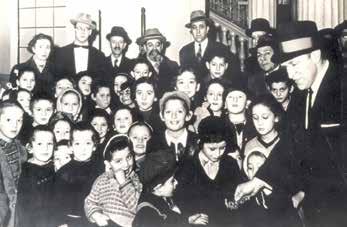
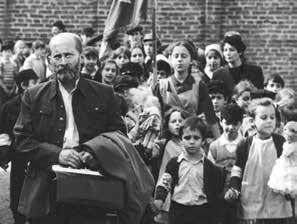
Yanusz Korczak, the pen name of Dr. Henrick Goldszmit, may be one of the most intriguing historical personalities I have ever encountered in my readings of this era. A major educator in Poland before the war, a pediatrician and author of children’s books, and a secular Jew, he ran a popular radio program discussing his unique educational methods and approach to child rearing.
But that is not what intrigues me so. There is more. Yanusz Korczak ran an orphanage in the Warsaw Ghetto for Jewish orphans. He dealt with the authorities and did his utmost to provide a “normal” life for his children. As a beloved national figure, he had many opportunities to escape the ghetto. However, totally devoted to his young charges, he elected to accompany his beloved children to Treblinka and perished there.
Mrs. Gutta Sternbuch, a”h, my beloved, adopted Tante Gutta, of the famed family renowned for their efforts to save European Jewry, worked together with Dr. Korczak in his orphanage. A devoted, caring teacher, and loving mother figure, she, too, became very attached to her charges. Upon Dr. Korczak’s urging, she
would say Shema with them in the morning and evening, providing a semblance of a reassuring routine and the assurance that there is a caring G-d in this world. Dr. Korczak, a wise man indeed, understood that spiritual sustenance is crucial. We need G-d in our lives.
and taught his children, to enable them to transcend their pain: “Thank you, Merciful L-rd, for having arranged to provide flowers with fragrance, glow worms with their glow, and stars in the sky that sparkle.”
Interspersed with the horrors of
Totally devoted to his young charges, he elected to accompany his beloved children to Treblinka and perished there.
Dr. Korczak appears in the contemporary film “The Zookeeper’s Wife,” the true story of a young Polish couple, Jan and Antonina Zabinski, who hid several hundred of our people in their zoo, which was situated close to the Warsaw Ghetto. After seeing the film, I purchased the book, eager to learn more details of their incredible rescue mission. The book shares with us a prayer that Dr. Korczak had composed
those years are also the heartwarming stories of incredible bravery and heroism; heroism on many different levels, playing itself out in many different ways.
Avner Gold, master of Jewish historical fiction, in “The Long Road to Freedom” (ArtScroll/Mesorah), shares with us an eloquent definition of heroism. “The world measures heroism by feats of valor on the battlefield and other
acts of a similar nature. But … there is nothing more heroic than the devotion of our people to the Al-mighty and His Torah despite all the persecution we have suffered….”
That is our focus at Amud Aish. And that must be our approach in teaching the next generation. Dwelling on the pain and terror, especially when teaching children, is not advisable. Rather focus on the many stories of immense courage and spiritual heroism.
Rabbi A. Leib Scheinbaum in his “Peninim ahl haTorah” shares a moving scene as recounted by Rabbi Yissachar Frand. It was the Shabbos of Parshas Ki Savo. The setting: a small shul in Williamsburg, its membership consisting of survivors. It was time to read the tochacha , containing the dreadful curses to befall Klal Yisrael when our mitzvos are chalila not observed properly. The tradition is to read this section quickly and quietly, which is what the Baal Korei began to do. The Klausenberger Rebbe, who rebuilt the Torah community in America after the war, called out to the Baal Korei, “Louder!” But it was not loud enough. “Louder!” again was heard throughout the shul. The Baal Korei began to read the tochacha in his normal voice. Later, the
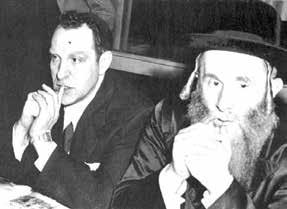
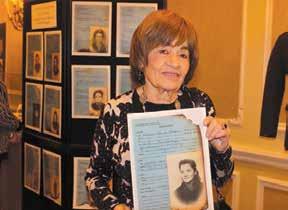
Rebbe explained, “In the past, we read this quietly, for these curses were distant images, tragedies to which we could not relate… Our generation, though, has lived through these curses. We know exactly what they are… We have managed to survive them… We are entitled to read the tochacha out loud.”
Writes Rabbi Scheinbaum, “The Rebbe obviously viewed his Holocaust experience and survival as a badge of honor, a source of pride… This idea applies equally to us, descendants of that generation…. They planted the seeds of Torah in this country… We have continued their work... Therefore, we share in their badge of honor, in their sense of pride.” Basically, we are all heroes, holding our banner high, keeping the faith, and marching onward.
Rabbi Ezriel Tauber in his monumental Darkness Before Dawn provides the Torah approach to those terribly dark days. “The most noble resistance the Jews offered in the Holocaust was spiritual resistance. They did not allow the Nazis to strip them of their identity – and destruction of Jewish identity was exactly what the Nazis were after… They wanted the Jewish soul.”
Amud Aish provides us with exhibits of incredible heroes, chief among them Reb Elimelech Gavriel, zt”l, familiarly known as Mike, Tress. Reb Elimelech, as a young man, was tremendously impacted by the words of Rav Elchanan Wasserman, zt”l, who visited America in 1937.
Rav Wasserman encouraged him to leave behind the business world and work for the Klal. “The future of Torah in America is in your hands.” Reb Elimelech took his words to heart and devoted his entire life to the Klal.
Reb Elimelech was instrumental in building up Orthodox Jewish life in America. As head of Agudath Israel of America, he established Shmiras Shabbos campaigns, set up schools, shuls, youth groups and summer camps, tending to the physical needs as well as spiritual and emotional needs, of the individuals and the community. When the war began, he immersed himself in hatzalas nefashos , crucial rescue operations that took precedence over absolutely everything. In fact, Rav Ahron Kotler, zt”l, paskened that Reb Elimelech did not have to daven with a minyan. Given the essential work he was doing, literally saving lives, he was absolved from all other responsibilities. He lobbied government officials in Washington to increase Jewish immigration to America, even traveling on Shabbos, with Rabbinical permission, to do so. He organized affidavits so that European Jews could enter America. He arranged employment for them, as well as housing. He was in contact with Jewish servicemen who were sent to battle in Europe, providing them with kosher food products, and through government intervention, enabling them to observe Shabbos even when in active service. When funding was needed, he sold off his own bonds and stocks. He mortgaged his home three times, to provide for his fellow Jews.
In 1945, Germany surrendered. Mike Tress then galvanized the Jewish community in America to provide for the immense needs of the survivors, spiritual and material.
In the uniform of the American Army, he visited the DP camps. In 1948, he initiated the Save a Child foundation, working tirelessly to rescue children who had been hidden in orphanages
and monasteries or adopted by Christian families.
Given our particular set of community challenges today, it has been pointed out that whilst the emphasis in our contemporary world is on Talmudic scholarship, those years, given the dire circumstances, there was an emphasis on political activism and active “shtadlanus.” All skill sets were needed and put to good use. Every Jew counted, contributing in his own way to the public good. Young boys packed food packages to send to Europe; others typed out affidavits to enable our brethren to immigrate to America. Some raised money – serious money – for major hatzalah efforts. Yet others, sat and learnt our holy Torah, whilst others were engrossed in prayer for the welfare of all. Each person felt intimately connected to the Jewish world. Each had a vital role to play. No one felt disenfranchised.
Today, whilst still living in an imperfect world, the Jewish community would still benefit from similar collective efforts. Activism comes in all shapes and sizes. Each Jew, young and old, has a role to play in our community and is precious in G-d’s eyes.
Entering Amud Aish’s main gallery, the first item encountered is the file cabinet that belonged to Mike Tress, that had sat in his office at 616 Bedford, a building renowned for the activism and chesesd that reverberated through every inch of its premises. Within are thousands of cards, each marked with the pertinent details of children who had been hidden during the Holocaust or had been living with Christian families, as well as details of adults who had suffered terribly through those years. Mike Tress did his utmost to help these thousands, both during the war and afterwards.
To redeem these children, the rescuers would put themselves at risk. They dared not fail at this holy mission. As activist Moshe Swerdloff stated, “We have missed the boat once; that is beyond repair. Let it not be said a second time that for lack of foresight, courage and finances, the call of our people went unheeded, unanswered.”
Reb Elimelech’s sensitive heart could no longer contain all the suffering he witnessed. Tragically, he passed away at the young age of 57, on the 2 nd of Tammuz, 1967. Reb Elimelech, a hero in every respect, had given his all to our community. He fought the apathy and indifference encountered on many fronts. His dedication must continue to inspire and galvanize us to action. Yehi nishmaso tzrura b’tzror hachaim
Amud Aish Memorial Museum is a Holocaust museum and archival center dedicated to preserving artifacts and original archival collections donated by frum survivors. We serve as a voice for the kedoshim, helping the next generation connect to what mattered most to them—faith, spiritual resistance, and rebuilding Yiddishkeit after the war. Alongside our educational exhibitions for schools, yeshivos, families (and non-Jewish groups), the core of our work is the professional preservation of rare, original, and irreplaceable archival materials entrusted to us by families. Our holdings include major collections such as Tress, Rosenheim, Lewin, Sternbuch, Steinfeld, Vaad Harabanim, Kuhl and multiple private family archives. Visit https://www. amudaish.org/ or call 718-759-6200


ABy Nati Burnside
s I recently found myself in Chicago for literally one night, I asked around about which place was worth a trip. Friends and strangers alike narrowed my list to a few places, most of which could be properly represented and sampled as lunch choices.
But not Yoko. Having opened just a year and a half ago, Yoko is trying to stand out in the Chicago kosher restaurant scene. Whether it’s the small things like being open later and having more music to increase the vibe, or the bigger things like having a bar with fancy cocktails and advanced presentation on some dishes, Yoko is on its own in a lot of ways.
When I was invited to Yoko, I intended to start with sushi as I usually do. And while Yoko had plenty of rolls to choose from, the raw fish appetizers were what really caught my eye. First up was the Yoko Pani Puri. This trio of (large) bite-size crispy baskets of sushi ingredients can be ordered with a base of salmon or tuna (I chose salmon). With a trio of avocado, jalapeño, and cilantro topping the tuna and a light dressing to pull everything together, these first bites of the night may have actually been my favorites. The mixture of flavors blended really well together, and the crunchy outer shell was perfect to contain the ingredients but not too thick so as to overshadow them.
Next up, I had to try the Crispy Nori Bites. Once again, this plate was composed of three pieces that were just small enough to be eaten in one bite. Triangular nori crisps were topped with spicy tuna, avocado, a sweet sriracha, an imitation eel sauce and some crispy leeks. The nori provided a salty base for the mostly spicy ingredients, but the heat wasn’t over the top in any way as the leek finished each bite with an earthy tone and a secondary crunch. I can’t say enough about both of these two appetizers. Not only were they crafted with extreme care (from the ingredients to the perfect size of each bite), they were also legitimately interesting
even for a kosher restaurant columnist from the tristate area.
Moving on to the fleishig appetizers, I got many recommendations from my sources that I had to get the Confit Rib Eye Cigar. Once again, my fellow foodies were on target. This was a single, giant handrolled beef cigar, with the outer crust being a thinner and crispier casing than at most places where it is usually thicker and crunchy. But the casing, great as it was, wasn’t the highlight. That said, I’m not sure if the highlight was the rib eye filling or the pickled lemon aioli and harissa that came as dipping options. The beef was tender and tasty to the point where I don’t think a dipping sauce was even needed. But with that attitude, we wouldn’t have this wonderfully bright pickled lemon aioli that elevated the whole plate. Add to that the harissa (which you could mix into the aioli if you wanted it to have more of a kick), and now you’ve got something really special.
But when it comes to special, I think everyone would agree that the main attraction on Yoko’s app menu is the Hot Stone Wagyu. Your server brings you a plate with slices of raw, thinly sliced wagyu beef, a plate containing two large crostinis topped with fried caper aioli, and a board featuring a hot stone and three bowls of toppings (Himalayan salt, garlic confit, and ponzu sauce). They then use a wet sponge to activate the stone, and the sizzling starts even before the wagyu goes on and cooks in mere seconds before your eyes. Once the wagyu is grilled, your server takes the slices and the enhancers and tops the crostinis. It’s quite the show for a minute or two, and afterwards you’ve got these two… amazing open-faced sandwiches on toast? Whatever it is, it tasted amazing. The wagyu is so thin that it melts in your mouth, and it absorbs the enhancers willingly. The fried caper aioli is kinda the secret weapon here as the flavor and creaminess work perfectly with the meat.
I know what you’re thinking at this point: “This sounds like the kind of restaurant that I might want to go to and just or-



der a bunch of interesting appetizers and skip out on main dishes.” And you might be right. You certainly could do that. But before you go that direction, it’s my responsibility to point out that there are great entrées on the menu as well. For instance, I absolutely loved the Chicken Pad Thai. Not only was it some great pad thai (not the easiest thing to accomplish), but pad thai is pretty hard to find in the kosher restaurant world in the first place. I also liked that they provided me with a cup of Thai garlic chili sauce on the side that I happily emptied into my bowl to increase the heat. There were plenty of peanuts for crunch, lime for punch, and the serving size was large enough for leftovers for lunch.
If you have your eyes focused on something a bit more beefy, go with the Korean BBQ Short Ribs. It’s a full rack of ribs, so it’s either a really substantial portion for one person, or shareable for a couple of people. It comes with some smooth mashed potatoes that are good on their



own but get even better when you mix in some of the excess Korean BBQ sauce from the ribs. If you’ve read this column before, you know I love some good ribs. These weren’t too fatty, they didn’t fall off the bone completely, they weren’t just slathered in sauce – they were just right. If you love ribs, go get some.
Whether you are visiting Chicago on business or pleasure, whether you are there for just one night or many, or maybe you even live there and haven’t given Yoko a chance, I suggest you go try it out. With all the effort put into creating a unique restaurant for the community, you can tell as soon as you walk in. There’s nice ambiance, a full bar that’ll make an interesting cocktail (or mocktail!), and the food is high quality, tasty, and inventive.
Whatever your feelings are towards the slightly more famous Yoko, you gotta give this Yoko a shot.


By Naomi Nachman

With the arrival of bitter cold days, there is nothing more comforting than a steaming bowl of homemade soup. In Jewish homes, soup has always been more than just food—it is nourishment, tradition, and love ladled straight from the pot. This particular soup has become a winter staple in my kitchen: light, nourishing, and surprisingly satisfying. Made almost entirely from vegetables and broth, it is virtually calorie-free, yet full of flavor and warmth. Best of all, it freezes beautifully, making it perfect for preparing in advance and pulling out on those nights when the chill settles deep and comfort is needed most. One spoonful, and you are reminded why soup season is something to look forward to all year long.
Ingredients
◦ 1 tablespoon canola oil
◦ 3 onions, diced
◦ 6 medium zucchini, chunked
◦ 2 bags frozen cauliflower
◦ 2 can chickpeas, drained
◦ 4 cups water
◦ 1 teaspoon kosher salt, plus more for taste
1. Sauté the onions until light brown with a teaspoon of salt.
2. Once the onions are browned, add in the zucchinis till they have some color.
3. Add in two bags of cauliflower and chickpeas (you can also use broccoli).
4. Add four cups of water – make sure you add water one inch below the top of the vegetables.
5. Cover and simmer on low for one hour. The vegetables should be fork-tender.
6. Using an immersion blender, blend the vegetables until smooth and creamy. Add salt to taste. And enjoy this (almost) calorie-free recipe!
Naomi Nachman, the owner of The Aussie Gourmet, caters weekly and Shabbat/ Yom Tov meals for families and individuals within The Five Towns and neighboring communities, with a specialty in Pesach catering. Naomi is a contributing editor to this paper and also produces and hosts her own weekly radio show on the Nachum Segal Network stream called “A Table for Two with Naomi Nachman.” Naomi gives cooking presentations for organizations and private groups throughout the New York/New Jersey Metropolitan area. In addition, Naomi has been a guest host on the QVC TV network and has been featured in cookbooks, magazines as well as other media covering topics related to cuisine preparation and personal chefs. To obtain additional recipes, join The Aussie Gourmet on Facebook or visit Naomi’s blog. Naomi can be reached through her website, www.theaussiegourmet.com or at (516) 295-9669.


To those with an honest and open mind, the week’s roller coaster ride illustrated how Trump’s fondness for talking about America’s military might is often purposeful sword-rattling. The bluster, this time and often, serves as an invitation to negotiations or is so persuasive that he gets most of what he wants without having to fire a shot.
- Michael Goodwin, The New York Post
I want to say one thing clearly about this farce called the Netanyahu trial: I think it’s crazy that the prime minister has to deal with meetings at night until 2 a.m. I sit there with him and then when I tell him let’s go home — he tells me, “No, I’m going to prepare for the trial.” It’s crazy, it’s not normal. I hope President Trump will put an end to this farce. President Trump should intervene and put an end to this abuse of the prime minister.
- Israel’s National Security Minister Itamar Ben Gvir calling on President Donald Trump to intervene in Prime Minister Benjamin Netanyahu’s ongoing corruption trial
Don’t compare ICE to Nazis. That’s an unfair comparison. The Nazis were willing to show their faces.
- Late Show host Stephen Colbert (who is going off the air in May because he is not funny)
What’s Behind the Staggering Drop in the Murder Rate? No One Knows for Sure
- Headline of a New York Times article about the decline in murder and other serious crimes over the past year and positing that nobody knows the reason
Actually, I think there are a lot of people that have a really good idea: It turns out that if you actually go after criminal aliens and you deport them and enforce the law, the crime rate starts goes down dramatically.
- Charlie Hurt, Fox News


You have to understand they’re children. When they are out there, they look like adults, but they are actually children. They don’t really have a background that everybody else does. They’re frightened, insecure, they’re really worried about fitting in. So even though they will dress like a rebel, they will embrace any slogan because deep down they fear that their deficiencies will be exposed. They are basketcases. Every person in there is a basketcase worried about their imposter syndrome, and wondering when their luck will run out. So what they do, it’s amazing because everybody thinks of them as stand-out celebrities, they will do anything to fit in.
- Greg Gutfeld talking about Hollywood celebrities


You cannot simultaneously believe that (1) all borders are fake and should not be policed, and (2) that land can be “stolen.” This is one of the most braindead beliefs a person can hold.
- Tweet by Colin Wright in response to a Hollywood award show in which several speakers decried ICE enforcing the border and protested that America is stolen land
Governor Tim Walz – whatever he says, believe the opposite. I’m sorry, the man learned to lie before he learned to talk. He’s just a less masculine version of Hillary Clinton.
- Sen. John Kennedy (R-LA) on Fox News
After the episode Wednesday night, young men and boys crowded around the building. A teenager who gave his name as Yechi Hamelech, 15, had been inside when he heard the crash. “And we go look, and the police said, ‘You got to get out.’”
- From a New York Times report about the car-ramming incident at 770 last week (great job, Yechi Hamelech!)
Let’s just take Tucker Carlson… I worked with him for 6.5 years at Fox News in New York. Suddenly, in a very short period of time, a switch is split, and he has a completely different worldview, and his ideological base has completely changed. That’s not normal for someone in his 50s. It just isn’t.
– U.S. Ambassador to Israel Mike Huckabee at a recent conference
What happened? I don’t know. Is it that it is more profitable for him to do what he’s doing now than what he was doing when he was at Fox News? He wouldn’t be doing it if it wasn’t. – ibid.

I don’t know if you’ve noticed, but there haven’t been boats sunk recently because we can’t find any boats to sink.
- Secretary of War Pete Hegseth
[Antisemitism is the] most prevalent in social media. This is the new battlefield, and this is where we must counter with our own weapons. We’re late in the game, but we will win this battle, too, as we won on the battlefield.
- Prime Minister Benjamin Netanyahu

The attacks on American citizens by masked hoodlums – if you were attacked by a masked person, you might think you were being kidnapped. You’d be justified in shooting the person to protect yourself.
- Rep. Jerry Nadler (D-NY) talking about ICE agents and encouraging people to shoot them
I’m not here because the federal government has carried its mission out perfectly. We are not surrendering our mission at all. We are just doing it smarter.
- Border Czar Tom Homan at a press conference in Minnesota
I don’t understand it. I mean, I was with him every day. If he’s not a first-ballot Hall of Famer, there’s really no coach that should ever be a firstballot Hall of Fame.
- Tom Brady responding to his longtime coach Bill Belichick not getting into the NFL Hall of Fame in the first round
So far, in New York City under the new mayor, homeless deaths have reached 16 and counting. Zohran has killed so many drifters that serial killers are considering a career in politics.
- Greg Gutfeld, Fox News
It’s strange how it works—if you want to save lives, you’re the bad guy. But let ‘em die, and you’re the compassionate one.
- ibid.



President Donald Trump has offered Minnesota a reasonable compromise: He will scale back ICE operations in the state if Minnesota officials agree to “turn over all incarcerated or active warrant criminal illegal aliens” and “assist federal authorities in detaining criminal illegal aliens wanted for crimes.”
Nothing doing, says Minneapolis Mayor Jacob Frey (D). “Minneapolis does not and will not enforce federal immigration laws,” he said on X after meeting with White House border czar Tom Homan. After Trump warned he was “PLAYING WITH FIRE,” Frey doubled down, declaring that “the job of our police is to keep people safe, not enforce fed immigration laws.”
In fact, his sanctuary policies have done the exact opposite – contributing to the deaths of two protesters, Renée Good and Alex Pretti, who would almost certainly be alive today were it not for Frey and Minnesota Gov. Tim Walz’s (D) refusal to cooperate with Immigration and Customs Enforcement agents in targeting illegal migrants with criminal records.
When Trump took office a year ago, Homan made clear that the administration’s intention was not to carry out “a mass sweep of neighborhoods” but rather to “prioritize public safety threats” by detaining and deporting “the worst of the worst” – those charged with or convicted of serious crimes.
Trump was elected with a mandate to do that. In a New York Times-Ipsos poll just before his inauguration, an 87 percent supermajority said they supported removing all migrants “who are here illegally and have criminal records.” Indeed, 63 percent said they wanted Trump to go further and deport all migrants “who are here illegally and arrived over the last four years” under President Joe Biden, while 55 percent wanted to deport “all immigrants who are here illegally” – period.
By Marc A. Thiessen

Over the past year, Homan has been true to his word: Nearly 70 percent ICE arrests nationwide have involved illegal migrants convicted or charged with crimes, according to the Department of Homeland Security. In states where local officials work with ICE, these arrests have taken place without chaos. For example, there have been more than 88,000 ICE arrests in Texas – the most in the country – largely without incident. But in Minnesota, there have been 10 times fewer arrests but far more violent confrontations.
Why? Because when state and local officials won’t help federal immigration officers target those with criminal records, they have no choice but to go into communities to get them. Since Trump took office, DHS reports that Minnesota has released nearly 470 illegal migrants charged with or convicted of crimes back onto the streets - including those charged with [certain] offenses against a child, lewd or lascivious acts with a minor, domestic violence, drug trafficking, vehicular homicide, burglary, first-degree aggravated robbery and larceny. In all, DHS says Minnesota officials are refusing to honor
more than 1,360 ICE detainers.
That has required ICE to carry out large sweeps resulting in collateral arrests of illegal migrants without criminal records – the very people Frey and Walz are purporting to protect with their sanctuary policies – because, as Homan has made clear, while ICE is focused primarily on those with criminal records, they will arrest anyone they find who is here illegally.
Sanctuary policies have also endangered Minnesotans by contributing to deadly confrontations with protesters. As Homan has explained, “when you go in the community and find them, it puts ICE officers at greater risk, it puts a community at greater risk, it puts the alien at greater risk.”
Instead of cooperating, Frey and Waltz have urged Minnesotans to take to the streets and protest ICE. Walz has poured gasoline on the fire by comparing ICE agents to the Nazis who hunted down Anne Frank and are committing “atrocities against Minnesotans,” while Frey had demanded that ICE “get the … out of Minneapolis.” Moreover, because they have ordered
state and local law enforcement not to support deportations, ICE has been forced to rely on U.S. Border Patrol to protect them as they carry out enforcement operations – and those officers are not trained in crowd control and de-escalation techniques. Frey and Waltz stood by as organized networks have engaged in the coordinated tracking and doxing ICE agents, surrounding and trashing hotels where they are staying, and provoking confrontations that have turned deadly. Meanwhile, on Capitol Hill, Democrats are preparing to shut down part of the government (again!) to block Congress from passing the DHS appropriations bill. They are overplaying their hand. Last year, Trump secured funding for ICE through 2029 as part of his One Big Beautiful Bill – which means that blocking the DHS spending bill will not affect ICE but will cut funding for the Federal Emergency Management Agency and the Transportation Security Administration. Just a few months ago, Democrats shut down the government over Obamacare subsides and were forced to capitulate. Insanity is doing the same thing over and over and expecting a different result.
Democrats are misreading the politics of illegal immigration. Yes, polls show that majorities of Americans think Trump’s implementation of his deportation polices has been “too tough.” But a majority supports the deportations themselves, especially for illegal migrants with criminal records. They just want them to be carried out humanely.
If Democrats resist Trump’s offer to do so, they will pay a political price. And for the party responsible for the worst border crisis in American history to block funding for the department responsible for securing the border would be the height of political malpractice.

By Abdi Latif Dahir and Leily Nikounazar

One was a 23-year-old budding fashion designer, another a prospective engineering student bound for Tehran. There was also a mother, father and son who had once considered emigrating as a family in hopes of a better life.
All were killed in the protests that convulsed Iran for weeks starting in late December, according to their families and human rights groups. The demonstrations began over economic malaise but swelled into a nationwide anti-government movement that posed the most serious threat to the regime in years.
The government violently quelled the protests, and authorities imposed a stringent internet and communication blackout that has made it difficult to know the magnitude of the crackdown and the death toll. Rights groups say thousands have been killed.
The New York Times has been able to piece together some of the stories of
those who have been killed in recent weeks, through interviews with their family members outside the country and reports by human rights groups. Not all of the details could be independently verified.
Some of those family members had recently left Iran, while others said they had managed to receive international phone calls from relatives in Iran this month, during a brief respite from the blackout.
The families said that their loved ones were motivated to join the protests by a desire for change in Iran.
The Iranian government did not respond to a request for comment regarding any of the cases detailed in this story.
Iran says the protests began as legitimate demonstrations by people expressing their economic grievances but quickly escalated into riots organized by foreign infiltrators. Iranian authorities
have accused the United States and Israel of being behind the violence.
The protesters’ families, however, offer sharply different accounts.
“He went out for freedom,” Ensieh Raoufi said of her cousin, Sorena Golgoon, 18, who she said was killed in early January while protesting in his hometown, the coastal city of Tonekabon. Raoufi said she spoke to both of Golgoon’s parents after his death.
The Hengaw Organization for Human Rights, which is based in Norway and monitored the unrest in Iran, reported that Golgoon had been killed during the protests.
The group said in a statement on social media that Golgoon was “killed by direct fire from Iranian government forces” and that his family was “under intense pressure from government authorities to falsely claim that he was killed by protesters.”
In a phone interview, Raoufi, who
lives in France, described her cousin as a kind and generous person. Weeks before his death, she said, he had given his jacket to a homeless person amid a winter chill. Raoufi said that Golgoon’s dream of working for an international car manufacturer led him to pursue studies in mechanical engineering in the capital, Tehran.
The loss had left the family in profound sorrow, Raoufi said. “Their grief is endless.”
Robina Aminian, a 23-year-old fashion student, had just finished a college exam in early January when she decided to join the protests in Tehran, according to her aunt, Hali Nouri, who lives in Norway.
Nouri said that she was told by her sister, Ameneh Nouri, who identified Aminian’s body, that Aminian was shot in the head. Iran Human Rights, a Norway-based advocacy organization, published a report on Aminian’s death,
saying that a shooting occurred on the night of Jan. 8 after she left the Shariati Technical and Vocational College for Girls, where she was a student.
The youngest in her family, Aminian was an avid guitarist and had a creative and kind spirit, Hali Nouri said. She was also known for weaving traditional Iranian elements into her designs. “She knew what she wanted in life,” Nouri said. “She wanted to be free, to live unrestrained.”
Nouri said her sister and six other relatives told her that authorities in Marivan, a city in western Iran, had disrupted Aminian’s memorial service. She said that it was canceled after security officers, stationed outside the home of a family member, prevented some relatives from paying their respects.
The Marivan governor’s office did not respond to a request for comment.
Mahmood Amiry-Moghaddam, the director of Iran Human Rights, said the group has documented several cases in Iran’s recent protests, including Aminian’s, in which authorities imposed tight security measures on funerals to prevent such gatherings from turning into anti-government protests.
Iranian authorities have put the official death toll at 3,117, a figure that rights groups say vastly underestimates the toll.
According to Human Rights Activists in Iran, a Washington-based organization, more than 6,200 people were killed, most of them protesters. Iran Human Rights, based in Norway, esti-
spoke to the Times said the family was shot in the city. They said that another son, Davoud Mostafavi, 27, was injured.
The relatives were Michael Askari, who lives in Turkey and said he is Bani-Amerian’s cousin, and Abbas, who left Iran earlier this month. Abbas requested that only his first name be used and did not want to publicize his
“She knew what she wanted in life. She wanted to be free, to live unrestrained.”
mated the toll at more than 3,400.
In one case, several members of one family were killed.
Zahra Bani-Amerian, her husband, Bijan Mostafavi; and their son, Danial Mostafavi, were shot in their car by government forces during protests in Karaj, west of Tehran, earlier this month, according to a report by Hengaw, the rights group.
Two relatives of the family who

relationship to the deceased for fear of retribution.
Askari said that Bani-Amerian had sent him a text message just days before her death, saying that the government was killing people “one by one.” In a screenshot of the message shared with the Times, Bani-Amerian said that she felt other countries were failing to help Iranians amid the crackdown.
Bani-Amerian, 48, was a retired em-
ployee of Iran’s Social Security Organization, and was curious, humorous and loved singing, Askari said. Her husband, Mostafavi, 56, had for years been a beloved teacher in Sonqor in western Iran, according to the two relatives.
Their son, Danial, 19, was cheerful and loved video games. At one point, the family considered leaving Iran for Turkey, but Mostafavi hesitated, saying emigrating and starting over at his age wasn’t easy, Askari added.
Abbas said that, before leaving Iran earlier this month, he had been involved in arrangements for the family’s funeral in Sonqor.
Authorities imposed restrictions on the service, he said, and compelled them to bury their loved ones before sunrise. The Hengaw rights group said in a statement that the family was buried under tight security measures.
Askari said that he was determined to find ways to preserve the memory of the family.
“I will not let them be forgotten in silence,” he said.
© The New York Times

By Sui-Lee Wee
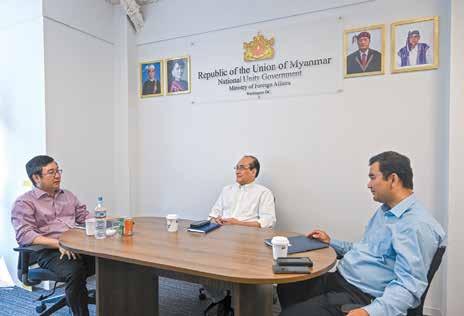
After the Myanmar military overthrew the elected government five years ago, politicians and civic leaders opposed to the junta formed a pro-democracy group that they hoped would be the country’s sole legitimate representative on the global stage.
They set up offices in places such as Washington and London and in some restive parts of Myanmar. They raised millions and pledged to field an army comprising various ethnic and rebel groups. They called themselves a shadow government and set up ministries. They chose a name that reflected their ambitions: the National Unity Government of Myanmar.
But this diffuse shadow government, with most of its members in exile, has had few major successes. It has failed to reverse international apathy toward the military’s brutal crackdown, which has left at least 7,700 dead since the junta usurped power on Feb. 1, 2021. It does not
have full control of the local rebel groups and ethnic armies on the battlefield, where the resistance has made significant gains against the military government.
Now, as the junta is poised to put up what it calls a civilian government after a stage-managed election, the National Unity Government is looking increasingly irrelevant.
Kyee Myint, one of Myanmar’s most prominent human rights lawyers, said the shadow government operated more like a civil society organization than a revolutionary one.
“They are disconnected from what the people actually want,” said Kyee Myint, 80.
The military, which has ruled Myanmar for most of its postcolonial history, remains ensconced in cities and controls just about half of the nation’s territory. Last year, the leader, Senior Gen. Min Aung Hlaing, announced that the military government would hold elections. But
most opposition politicians, including the ones the junta deposed, are jailed, remain barred from politics or are in hiding.
The elections were held in three phases, only in areas under military control, and concluded January 25. They were widely derided as a sham and are expected to produce as the winner a political party that is a proxy for the junta.
The shadow government, which has been deemed illegal by the military, called for a boycott of the vote.
Voter turnout was 54.1%, according to the military, the lowest in decades. The NUG said actual turnout in urban centers such as Yangon and Mandalay was most likely closer to 20%.
David Scott Mathieson, an independent analyst on Myanmar, said the military had used the election to successfully shift the political ground and create a new reality that the shadow government failed to counter effectively.
Despite the polls being a “farcical process,” the regime established a semblance of procedure that allowed it to dictate the political agenda, Mathieson said. It bet on “widespread apathy” in urban areas, understanding that many exhausted civilians will vote simply so officials will leave them alone, he added.
“The NUG literally couldn’t see that the ground was shifting beneath its feet,” Mathieson said.
Detractors say there is virtually no leadership within the shadow government, which is helmed by an acting president, Lashi La, and prime minister, Win Khaing Than. Meetings are held over Zoom to discuss issues like responding to an election they call a sham but have few answers to.
Globally, the government in exile has at least 11 “representative offices,” but Myanmar’s biggest neighbors — China, India and Thailand — do not recognize it.
Like many others, Kyee Myint was an early supporter of the group.
It had proposed a fundamental reset of Myanmar’s society by ending the dominance of the Bamar-majority ethnic group. It said it wanted to include a diverse set of ethnic leaders to create a truly inclusive state. It notched some early wins when it raised tens of millions of dollars to fund its war efforts.
Now Kyee Myint is one of the shadow government’s most outspoken critics. Chief among his list of complaints is what he says is its lack of financial transparency, which he says prevents resources from reaching fighters on the ground.
He pointed to a case in November when the permanent secretary of the prime minister’s office was accused of nepotism, corruption and misuse of authority. She was suspended, but the results of the investigation have not been disclosed.
Zin Mar Aung, the shadow government’s foreign minister, said the group was trying its best. “We started from zero,” she said, speaking by telephone from an undisclosed location.
Criticism, she said, should be constructive, to “support and encourage us to move forward.”
“We really understand the suffering of
our people,” she added.
But in parts of Myanmar, where the fighting is most intense, rebels say they are not getting the funds that they need from the National Unity Government.
A battalion commander for the People’s Defense Forces, a group of civilians who
“You can’t change the country from outside the country,” he said.
Nay Phone Latt, a spokesperson for the shadow government, said it was in discussions with other revolutionary forces, including the ethnic armed groups, to come together under a new alliance.
The shadow government operated more like a civil society organization than a revolutionary one.
took up arms after the coup and is based in Mandalay, said his troops were surviving by relying on donations.
Tint Zaw Hein, who founded a group to raise funds for doctors and teachers who have joined nonviolent protests, said he had met some fighters throughout central Myanmar who say that they have only 50 to 100 bullets left.
He criticized the shadow government as failing to see how long the civil war would take.

Nay Phone Latt acknowledged that the National Unity Government could not fully equip everyone with weapons, “but it is not the case that we have abandoned them without any support,” he said.
He added, “While it is true that we have not achieved 100% success, it would be an exaggeration to say that nothing has been achieved.”
Last year, Tayzar San, one of Myanmar’s most prominent pro-democracy activists, set off a furor when he wrote on
social media that he was “completely dissatisfied with the NUG’s performance.”
A physician who is often described as Myanmar’s most wanted man for his opposition to the junta, Tayzar San said the shadow government needed stronger leadership and that it was time for the group to accelerate its efforts for reform.
In December, in response to growing criticism, the National Unity Government reduced the number of ministries from 17 to 12. But Tayzar San said the people of Myanmar were “still waiting for more effective, practical changes” such as the strengthening of local governments in the Sagaing, Mandalay and Magway regions, the epicenter of the armed struggle against the junta.
Still, Tayzar San said it was not practical to fully replace the shadow government, which is active in defense, education and health in much of central Myanmar. He cautioned that toppling one of the world’s most entrenched military dictatorships would take time.
“It’s not that the NUG isn’t working at all,” Tayzar San said. “It’s just not meeting the people’s expectations.”
©
The New York Times


By Jonathan S. Tobin

President Donald Trump was re-elected to the presidency to drain the swamp in Washington, push back the tide of illegal immigration, and roll back the dead hand of toxic woke leftism in American government and society. He wasn’t returned to the White House to enact regime change in Iran or anywhere else. Those two basic truths are the foundation of any argument on behalf of the United States not getting actively involved in the effort to topple the Islamists theocrats in Tehran. Still, there’s another angle from which to consider that question. Whatever else was on his agenda or that of his voters, it is equally true that the second Trump administration was not summoned into existence to re-enact the failed foreign policy of former President Barack Obama. And that’s the main thing for the president and his team to remember as they engage in
negotiations this week with Iran.
The Islamist regime is sending senior officials to Turkey, where they plan to meet with the president’s special envoy to the Middle East, Steve Witkoff, as well as his son-in-law and informal adviser, Jared Kushner. The United States says that a whole range of issues, including Iran’s nuclear program, missiles and terrorism, is on the table. The Iranians say they want only to discuss the nuclear issue.
But that is a formula for Iran to do what it has always done with Western, and especially American, envoys who are desperate for a deal with the mullahs: prevaricate and string the diplomats along until they give up or give in to Tehran’s demands.
That’s what happened to Obama’s Secretary of State John Kerry, who ar -
rived at talks with Iran in 2013 with a strong hand backed by global sanctions that had shaken a regime that was tottering due to domestic unrest. Over the course of the next two years, Kerry abandoned Obama’s demands and campaign promises to end Iran’s nuclear program and to end its role as the world’s leading state sponsor of terror. The result was the 2015 Iran nuclear deal that actually guaranteed that the country would eventually get a nuclear weapon, rather than preventing it from building or acquiring one.
It rescued the Islamist theocrats from the predicament that they had created at home and flooded it with billions in cash used to suppress dissent at home and spread terror around the Middle East.
That’s exactly what Iranian Supreme Leader Ayatollah Ali Khamenei is hoping will happen again in talks
with Trump’s team. It comes at a time when his government has been shaken by massive protests in the past few weeks, which have been suppressed by the murder of as many as 30,000 protesters. Khamenei knows he needs a lifeline. He knows that a repeat of last summer’s joint Israeli-American air campaign aimed at weakening the regime’s ability to project terror abroad might be the spark that finally blows up the Islamist government. A deal right now with Washington will ensure that it survives and lives to fight the “great Satan”—ironically, the United States, the same entity that may give it a lifeline—and Israel, the “little Satan. That would be bad enough. But the spectacle of repeating the pattern of Obama’s appeasement of Iran by repudiating his promises to the Iranian people that “help is on the way” would be a disaster for Trump’s foreign policy and
A “Red Line” Precedent
It would also seem to be a repeat of another Obama fiasco. Obama backed off on his 2012 threat to Syrian President Bashar Assad, saying if the despot were to use chemical weapons against his own people, then it would cross a “red line” and ensure a U.S. military response. Nothing came of that; it was another milepost on the road to American decline. By punting on the threat and offshoring the job of dealing with the problem to Russia, Obama threw away American credibility, handing Tehran and its allies a huge and undeserved victory for its plans for regional hegemony.
For the same thing to happen to Trump would be an even greater disaster since his foreign-policy successes have been based on the fact that foreign adversaries and allies have been reluctant to test his mettle in a confrontation. If, under pressure from critics on the far right and far left who oppose a strong stance against Iran, Trump wilts, then no one will or should take his threats seriously again.
It’s entirely true that Trump and the American people would prefer to avoid using military force against Iran, as well as have zero interest in fighting a land war there or engaging in “nation-building.” Washington won’t repeat President George W. Bush’s mistaken policies that landed America and its troops in an Iraqi quagmire. But neither can Trump afford to demonstrate weakness just at the moment when he needs to project strength if he is to deal with this and other ongoing difficulties, like ending the war in Ukraine.
Witkoff and Kushner’s Hubris
The dilemma here is partly the trap that talking with an insincere negotiating partner always provides. Trump, Witkoff and Kushner all believe themselves to be master negotiators because of their past work in real estate, coupled with the administration’s successes during the president’s first term, such as brokering the Abraham Accords between Israel and four Muslim-majority countries.
Yet they have already signaled that, like Kerry, they are far too eager for a deal with a regime that is at its best and most lethal when it is pretending to be reaching an agreement with the United States.
The problem, however, transcends
the hubris that Witkoff and Kushner will pack in the bags they take to Istanbul. It is also about how to define the Trump approach to foreign policy.
“America First” means viewing the world through a realist prism rather than one determined by fantasies about a rapprochement with people
tually every other deal the regime has signed since the Islamist movement toppled the Shah of Iran in 1979.
So, if Trump backs down on anything less than a change in the fundamental character of the Iranian regime
“America First” means viewing the world through a realist prism rather than one determined by fantasies about a rapprochement with people whose main goal is to destroy the West.
whose main goal is to destroy the West. It also means overturning the conventional wisdom of the D.C. establishment about the value of appeasing the Islamist terror regime and ensuring that it is not allowed to use its oil wealth, nuclear program or its terrorist forces to destabilize the Mideast. And it means helping those who are aiding American foreign-policy goals without necessarily doing all the fighting for them.
Far from an isolationist creed, Trump’s vision is one that is essentially about projecting and embodying American strength abroad. That’s in direct contrast with the sort of weakness that led to the outbreak of wars in the Middle East and Ukraine in the four years Biden was warming Trump’s seat in the Oval Office.
That’s why Trump joined Israel’s attack on Iran’s nuclear program last June and inflicted the sort of damage that makes it unlikely that they will be able to use it to achieve their dream of regional hegemony.
And it’s also why Trump ought not to fall into the trap of negotiations with Iran just at the moment when a decisive push against them, both via sanctions and strategic strikes, might enable the Iranian people to overthrow the regime that has murdered and oppressed them for the last 47 years.
It’s not just that everyone knows that no deal with Iran could be verified by independent monitors of either its media or that the regime could be trusted to keep. They’ve cheated on the nuclear pact they made with Obama and vir -
and its transformation into a reasonable neighbor rather than the home base for terrorism, the damage he’ll be doing to himself will be as great as it is to the Iranian people’s hopes for a governmental alternative.
Few presidents have more at stake in maintaining their reputations than those who can’t be trifled with or bested in a negotiation. Surrendering to Iran will inevitably lead to surrendering to Hamas in Gaza. It would also end any hope of concluding Russia’s war with Ukraine on terms the West can live with or deterring global power grabs by an empowered China. It would also impair his ability to act for the rest of his term in office, which is still three full years.
We can’t know what the ultimate outcome of a U.S. or a joint U.S.-Israel attack on Iran looks like or what all the consequences of such a policy would be. But we do know that failing to follow through on his threats would make Trump a lame duck on foreign policy and pin on him the responsibility for future massacres of Iranians by their Islamist tyrants. That’s a price the president simply cannot afford.
Jonathan S. Tobin is editor-in-chief of JNS (Jewish News Syndicate).

By Avi Heiligman

Five years after the end of World War II, the United States was fighting another large-scale battle across oceans. Since 1945, Korea had been divided by the 38 th Parallel, with the Soviet Union occupying the north and the United States occupying the south. Within a short period of time, local governments emerged – communist in the north and democratic in the south – and any hope for a peaceful unification of the Korean Peninsula disappeared. On June 25, 1950, North Korean forces crossed the 38 th Parallel and captured Seoul in just three days. UN forces, led by the United States, intervened, and bitter fighting ensued. The war lasted until July 27, 1953, with the signing of the Korean Armistice Agreement.
Approximately 150,000 Jewish American servicemen and women served in the military during the Korean War. Many brought prior battle experience from World War II and were recognized for their bravery and courage during the conflict.
Colonel Melvin Garten from New York City was a highly decorated veteran of three wars. During World War II, he was with the 11th Airborne Division and saw a lot of action fighting the Japanese in the Pacific Theater of Operations. He earned a Silver Star while fighting in the Philippines and was part of the rescue team that rescued over 2,100 troops and
civilians from the Los Banos Internment Camp in 1945.
During the Korean War, Garten served in the 31 st Infantry Regiment, 7 th Infantry Division and was awarded the Distinguished Service Cross for actions near Surang-Ni, Korea. After observing that the assault troops of two other companies were pinned down on a hill, he went alone to assess the situation. Garten found the men in dire conditions as many had been wounded and the force lacked leadership. Taking control of the units, Garten distributed machine guns, grenades and ammunition to eight men that were still capable of fighting. “Employing the principle of fire and maneuver,” Garten led the small group as they “stormed enemy trenches and bunkers with such tenacity that the foe was completely routed and the objective secured.” Then he organized a defensive stand and held off the enemy until reinforcements arrived. For this action, Garten was awarded the prestigious Distinguished Service Cross and was recommended for the Medal of Honor.
With regards to air power, the Korean War saw the widespread use of fighter jets for the first time in history. The Lockheed F-80 Shooting Star, America’s first operational jet fighter, was the workhorse of the air force until the superior swept-wing F-86 Sabre became operational later in the war to counter
the Soviet MiG-15. Jewish Lieutenant Leonard Levin of New York City was an F-80 pilot and was flying as wingman for Lieutenant Roscoe Anderson on a low-level strafing mission over North Korea. When Anderson’s jet was damaged by ground fire, causing its engine to overheat and his visibility to diminish, Levin took command of the situation. He gave him precise instructions over the radio on how to navigate the treacherous terrain ahead. Without the instructions, Anderson would have probably hit a mountainside; in fact, the damaged jet was flying so low that it scraped the treetops three times. The damaged aircraft ran out of fuel while in enemy territory, but Anderson avoided capture and made it back to base. Anderson credited his survival entirely to the guidance from Levin. Tragically, Levin was killed in a training accident later in the war while transitioning to fly the F-86.
Captain Richard Cohen from Philadelphia served with the 1 st Cavalry Division during the war. He was awarded several medals including the Silver Star for “conspicuous gallantry and intrepidity in action against the enemy.” While the citation does not give more details on the action, Cohen showed extraordinary leadership and bravery while operating in enemy territory. Soldiers from two companies had been cut off from the rest of the American lines for
three days. Cohen led the 200 men while they hacked their way back to friendly lines. Cohen helped carry eight wounded soldiers during the trek. The companies eventually reached a hill where they set up a radio that was found on a wrecked tank. Jewish Private First Class Herbert Lubelski from Brooklyn picked up the signals and passed on their location to headquarters. In less than an hour, a plane was circling above the group and dropped desperately needed food to the isolated companies. Instructions were given to Cohen over the radio, and soon the men reached friendly lines. Both Cohen and Lubelski were wounded later in the war but survived.
The signing of the Korean Armistice Agreement ended the fighting in Korea, although no formal peace agreement was ever signed between the two countries. There were many stories of bravery on the battlefields of Korea. The many heroes of the war will be remembered for the countless lives that they saved and the courage they displayed in the conflict early on in the Cold War.
Avi Heiligman is a weekly contributor to The Jewish Home. He welcomes your comments and suggestions for future columns and can be reached at aviheiligman@gmail.com.

DU N DURT
Power & Soft Washing
We clean siding, stucco, decks, driveways, concrete, pool patios, pavers & sidewalks.
Say goodbye to grime, mold & allergens!
Call/WhatsApp: 718-688-2964
Email: dundurtny01@gmail.com
THE LEATHER SHOPPE
The spot for all your custom leather Judaica. Tallis/tefillin bags, lulav and esrog bags, havdallah sets, challah covers, shtenders, pesach sets, matzah/afikomen bags. WhatsApp: (732) 523-0007 or email: theleathershoppe732@gmail.com for a full catalog. We ship.
PEACEFUL PRESENCE STUDIO
Men’s private yoga, Licensed Massage & Holistic Health Guidance 436 Central Ave, Cedarhurst Info. & free video training www.peacefulpresence.com 516-371-3715
GERBER MOVING
Full Service Moving Packing Moving Supplies
Local Long Distance. Licensed Insured 1000’S Of Happy Customers Call Shalom 347-276-7422
HANDYMAN AVAILABLE
For big or small jobs, Sheetrock, carpentry, painting, electrical, plumbing, install & repair appliances Call Ephraim at 347-593-4691
MANAGEMENT STAFF WILL ASSIST
you with: * Obtaining Medicaid and Pooled Income Trust
* In-home Assessments, Individual and Family Counseling
* Securing reliable home care assistance
* Case and Care Management services
Dr. S. Sasson, DSW, LCSW (718) 544- 0870 or (646) 284-6242
HAIR COURSE:
Learn how to wash & style hair & wigs.
Hair and wig cutting, wedding styling
Private lessons or in a group Call Chaya 718-715-9009
ZEVIZZ WOODTURNING JUDAICA
Challah knifes, batei mezuzah, besamim holder, kiddish cups, havdalah candle holders, yad for sefer torah, pens, stenders, bowls and more 952-356-2228
MY MOTTO IS DON’T WAIT TO buy real estate
Buy real estate and wait
Your realtor for life
516-784-0856 Alexandra at Realty Connect USA
REAL ESTATE MANAGEMENT
Services – Do Not Manage Your Properties Alone!
Contact Aliyah Suites for all your real estate management needs and affordable office space near you! (516) 366-1049
Management@aliyahsuites.com
Marc Jeret (MJ)
Team Leader &
Licensed Real Estate Agent




















classifieds@fivetownsjewishhome.com • text 443-929-4003
CEDARHURST
Prime Restaurant Location For Lease. For more information: Call/Text/WhatsApp Owner: (516) 206-1100
5 TOWNS - OFFICES FOR LEASE
250SF to 500SF Offices in Inwood & Cedarhurst Utilities, Internet & Parking incl. with some Kosher kitchen - Minyan Next to LIRR - No broker fee Call/text/Whatsapp: 516-206-1100
Don’t Get Stuck With a Two Story House Ya Know, It’s One Story Before You Buy It But a Second Story After You Own It!
Call Dov Herman For An Accurate Unbiased Home Inspection InfraredTermite Inspection
Full Report All Included NYC 718-INSPECT Long Island 516-INSPECT www.nyinspect.com
ROCKAWAY PARK – INVESTMENT
10-Unit Free Market Multifamily
Fully Rented | Strong Cash Flow Approx. $295K NOI Offered at $3.75M Principals Only Call/Text Sam - 929-334-7601
DELIVERY PERSON NEEDED to deliver this Newspaper every Thursday morning to locations in Brooklyn. Must have Mini van or SUVand availability to work Consistently every week. Good pay - Please email gabe@fivetownsjewishhome.com or call (917) 299-8082
MAKE A DIFFERENCE! Be a Direct Support Professional F/T & P/T and flexible positions available Brooklyn, Queens and 5 Towns $18.05-$18.30 per hour 855-OHEL-JOB or resumes@ohelfamily.org
YESHIVA DARCHEI TORAH MIDDLE
School is now hiring teachers for the upcoming school year. The following positions are open: 5th grade, Monday-Thursday 1:20-4:30 6th grade ELA
7th grade Math
8th grade ELA & History Grades 6-8 position is Monday-Thursday, 4 periods- 2:30-5:30. Each period is 40 minutes. We offer a warm & collaborative working environment and competitive salary. Candidates should have prior teaching experience. Interviews are being held now. Please send resume to mleff@darchei.org
BOOKKEEPER
A Five Towns Real Estate Company is seeking a full-time Bookkeeper. The right candidate must be proficient with QuickBooks and Excel. They must also be self-motivated, organized, detail oriented, reliable, and able to work independently or as a team player. Warm, frum office environment with excellent salary & benefits. Please email resume to HR@capsprop.com
YESHIVAT KOL YAAKOV
In Great Neck, NY, is seeking general studies teachers for both the elementary and middle schools, for the upcoming academic year. Mon-Thur afternoons. Competitive salary, warm and supportive environment. Send resume to m.kalati@kolyaakov.org
For current school year, starting from end of January: Seeking assistant teacher for General Studies. Candidate should have skills to take over for teachers if needed. Far Rockaway area boys’ school, M-Th, PM hours, strong support. Excellent salary. Possibility to continue for next year. Send resume to teachersearch11@gmail.com






classifieds@fivetownsjewishhome.com • text 443-929-4003
ARE YOU A DOULA?
Or have a passion to be? Come join our great referral group and get access to a vast new clientele through Medicaid.
JUST CALL 347-668-7886
REGENTS EXPERT
Tutoring regents in Algebra and Geometry A Darchei Torah instructor. Guaranteed results Text 347-491-8045
WhatsApp 347-767-1755


MDS REGIONAL NURSE
5 Towns area Nursing Home management office seeking a Regional/Corporate level MDS Nurse to work in our office. Must be an RN. Regional experience preferred. 2-3 years MDS experience with good computer skills required. Position is Full Time but Part Time can be considered. Great Shomer Shabbos environment with some remote options as well. Email: officejob2019@gmail.com
A multi-tasker needed for general office work. The ideal candidate is someone who is detail-oriented, responsible, and can take ownership. Looking for someone who is eager to learn, and expand his/her skill set while possessing the ability to work independently and as part of a team. Experience with Excel required. Five Towns location. In-office position only, not remote. Please send resume to 5tpart.timecareer@gmail.com
HASHAVAS AVEIDA
Apple airpods found on Wednesday morning on the way to the Woodmere dock. To claim, 516-351-8105.
SHMIRAS HALASHON
Text 516-303-3868 with a time slot of your choice to be careful on lashon hara. Be a part of the 1,000 people for klal yisroel!
BEIS HAMEDRASH CONG.
Chasdei Uvois Oshpitzin
Talmidei chachomim are willing to learn mishnayos, say kaddish and be the shliach tzibbur to daven for the umid on the yartzeit yom hashanah of your parents or close relatives or loved ones To arrange please call Rabbi Miller 917-445-6220





















Are we safe anywhere? And I’m not even talking about crime, politics, or the world situation. I’m literally talking about kids at play.
What do I mean? Something as simple as biking. Have you ever tried to figure out whether it’s better to ride with traffic or against it, so you can see the cars coming toward you?
I’m not talking about main roads. I mean quiet, suburban streets.
I think the rule is to stay with the traffic. But I’ve never liked that. I don’t have eyes in the back of my head. I’d rather see my challenge and face it head-on than have it sneak up behind me. How about you?
And I’m not even really talking about bikes. That’s not the biggest confusion these days. Today, it’s more like scooters.
And it’s not the scooterer I’m concerned about. It’s the scooteree, the person who is the subject of the scooterer’s whims and follies—or, more accurately, at the mercy of them.
The scooterer usually, very nonchalantly, rides along the sidewalk where everyone else just happens to be walk-
By Rivki D. Rosenwald Esq., LMFT, CLC, SDS

ing. And that rider is not usually thinking much about the space allotted. They are just going.
Furthermore, there is very little scooter etiquette in play, for instance, shouting out “on your right” or “on your left” as they swoosh by.
scooters, riding along sidewalks too, no less.
Do they really think people expect a vehicle—admittedly much thinner than a car—to be racing down the sidewalk next to them?
And let’s not forget that sometimes
They zip past, thankfully miss you, and are carefree a block or two away— while you’re still checking your cardiac condition after the scare.
They haven’t even thought to install horns or bells like bike riders use—as if they believe everyone just expects them to be there and will somehow know to move aside. Do they think they’re sending telepathic signals?
And worse—now there are motorized
they take to the road. But there doesn’t seem to be any law guiding them. It’s like the Wild West. They can pop out from anywhere, on either side of the pathway, speeding by without a care in the world while you’re walking or crossing innocently in the street.
They zip past, thankfully miss you, and are carefree a block or two away— while you’re still checking your cardiac condition after the scare.
The craze is at fever pitch in Florida, though it seems to be picking up in New York as well.
Thankfully, the snow is a present-day deterrent. But then again, icy conditions seem to be giving everyone an equal run for their money.
So where, exactly, are we safe these days?
Maybe under a blanket, cuddled up with a good book.
On second thought, even under the blanket, keep one eye open for things swooshing by.
Rivki Rosenwald is a Licensed Marriage & Family Therapist working with both couples and individuals and is a certified relationship counselor. Rivki is a co-founder and creator of an effective Parent Management of Adolescent Years Program. She can be contacted at 917-705-2004 or at rivkirosenwald@gmail.com.