H A
C
A
E
I
C
R
Chai Line
The Newsletter for Chai Care — a concierge professional care management program for individuals ages 65+ A program of the Jewish Community Foundation of Broward County
FEBRUARY/MARCH 2018 | VOL. 1, ISSUE 4
Proudly sponsored by
NEW SERVICE! OF BROWARD COUNTY
MAR
2
FRIDAY
MAR
8
THURSDAY
MAR
17 SATURDAY
MAR
20 TUESDAY
MAR 30 THROUGH
APR 7
E
A
R
OFFICE
HOURS with Amy
6:00 p.m. Signature Grand, Davie
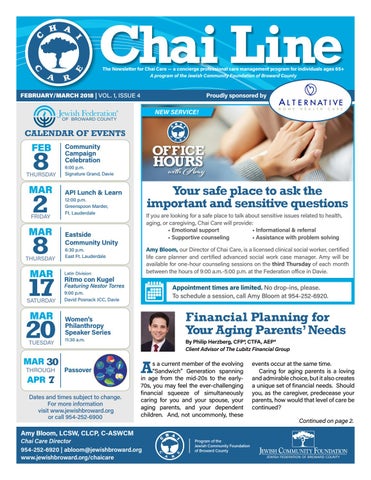
Your safe place to ask the important and sensitive questions
API Lunch & Learn 12:00 p.m. Greenspoon Marder, Ft. Lauderdale
If you are looking for a safe place to talk about sensitive issues related to health, aging, or caregiving, Chai Care will provide: • Emotional support • Informational & referral • Supportive counseling • Assistance with problem solving
Eastside Community Unity
Amy Bloom, our Director of Chai Care, is a licensed clinical social worker, certified life care planner and certified advanced social work case manager. Amy will be available for one-hour counseling sessions on the third Thursday of each month between the hours of 9:00 a.m.-5:00 p.m. at the Federation office in Davie.
6:30 p.m. East Ft. Lauderdale Latin Division
Ritmo con Kugel
Featuring Nestor Torres
Appointment times are limited. No drop-ins, please. To schedule a session, call Amy Bloom at 954-252-6920.
9:00 p.m. David Posnack JCC, Davie
Financial Planning for Your Aging Parents’ Needs
Women’s Philanthropy Speaker Series 11:30 a.m.
Passover
Dates and times subject to change. For more information visit www.jewishbroward.org or call 954-252-6900
Amy Bloom, LCSW, CLCP, C-ASWCM
By Philip Herzberg, CFP®, CTFA, AEP® Client Advisor of The Lubitz Financial Group
A
s a current member of the evolving “Sandwich” Generation spanning in age from the mid-20s to the early70s, you may feel the ever-challenging financial squeeze of simultaneously caring for you and your spouse, your aging parents, and your dependent children. And, not uncommonly, these H A
I
C
C
Chai Care Director 954-252-6920 | abloom@jewishbroward.org www.jewishbroward.org/chaicare
A
E
THURSDAY
Community Campaign Celebration
I
8
C
CALENDAR OF EVENTS
FEB
H A
C
R
Program of the Jewish Community Foundation of Broward County
events occur at the same time. Caring for aging parents is a loving and admirable choice, but it also creates a unique set of financial needs. Should you, as the caregiver, predecease your parents, how would that level of care be continued? Continued on page 2.
Financial Planning for Your Aging Parents’ Needs Continued from cover.
You can take your elderly parents into your own home to provide care. Alternatively, you may find suitable residential care options for your aging parents. Many times tackling this challenging situation may mean taking on a more hands-on approach to managing your parents’ financial affairs. Facing the unprecedented task of planning and balancing your own financial needs with the diverse considerations of your family, you can certainly initiate an actionable strategy to help your loved ones with their estate and financial planning.
Basic Planning Steps Whether a planning problem is simple or complicated, the same following basic steps apply: 1. Define the goal (or goals). What is it you are trying to accomplish? As early as possible, you should identify your senior parents’ core values and proactively integrate them into your family’s financial objectives. You may have to prioritize amongst competing goals. 2. What resources are available? This could be time, money, and the personal efforts of you and other family members. Are governmental resources, such as Medicare and Medicaid, available? How about resources in the South Florida area? Look into Chai Care, a program of the Jewish Community Foundation of Broward County, if you need a safe place to discuss sensitive issues relevant to your loved ones’ health, aging, or caregiving. 3. Develop a plan. List the steps needed to achieve each goal, and then carry them out. As your parent ages, health problems can become overwhelming to the point where your senior parents are no longer to live a full and independent life due to physical restrictions or mental impairment. Planning ahead facilitates this transfer of temporary or permanent responsibility from a parent to an adult child. Deciding when to intervene, what needs to be done, and who will be responsible are pivotal issues.
2 | CHAI LINE
Assess Long-Term Care Strategies With the chances that your parents will live longer, you also need to look at the possibility that they may need long-term care, which often begins with home care and transitions to a nursing home. If your parents have a long-term care insurance policy, be sure to find out the policy’s terms, such as when the policy pay benefits and how much in benefits are provided. You should also take time now to look at supportive housing arrangements, such as an assisted living facility or continuing care retirement community, for your parents in the event you are not able to take care of your parents by themselves. Evaluate the cost affordability and overall feasibility of a life care facility, as fees vary considerably by location and community size. Understand that as your parents age, they may experience a reduction in their capacities and require additional services over time that were not needed when they entered the community.
Be mindful that most medical insurance, including Medicare, does not provide any reimbursement for assisted living. This care may be incorporated into many longterm care insurance policies, which may cover costs associated with room and board and other assisted living needs. Consider engaging a professional Geriatric Care Manager (GCM) for your aging parent in planning for the necessary kind and quality of elder care.
Start your day
in a positive way
By Rose Boyarsky
Do not let the extra wrinkle and another pain Discourage you, what you like to do today. Oh, what a beautiful morning. It’s time to get up and start running. Soon you get a hearty good morning So it makes pleasant the running. Your mind relaxes, things are So much easier, what to do today? But first start with a healthy breakfast, As there is so much to choose, But think what is best for you. Then you discover you have an Appointment to see the doctor today. “Oy vay” which doctor? I forgot. So, maybe I’ll see him some other day, I have so much rather to do today. Besides, what can he do to ease my pains? Another “tap, kvetch” or another pill? So let me rather enjoy today. Remember, a good deed each day, Keeps the doctor away. No, do not put off what you Can do today for tomorrow.
The Value of Working with an Aging Life Care Professional® FINDINGS
97
% of Responsible Party respondents felt that engaging an Aging Life Care Manager had a positive overall effect on the client.
99
% said that engaging Aging Life Care Manager Services had a positive effect on their own lives.
ALCA is excited to release new findings from research conducted by the Florida Chapter of the Aging Life Care Association. Florida researchers first studied how care recipients valued the services provided by Aging Life Care Professionals. The results from the second phase considered the value of services as viewed by the “responsible party” authorized to pay for Aging Life Care™ services on behalf of an individual. The value of Aging Life Care Professional services is evident. With the increasing aging population and the emphasis on continuity of care, Aging Life Care Professionals are poised to play a larger role in coming years.
Why and How the Aging Life Care Professional was Chosen
Overwhelmingly, the survey indicated that engaging Aging Life Care Professionals had positive effects for the responsible parties and the clients served. Among the most common benefits cited were:
• family did not live near the client so that they needed a local contact for care, • concerned about changes in the client’s status, • client was experiencing a crisis at the time professional services were sought, • seeking a professional assessment to explore options for the client’s care.
Getting an objective assessment of a client’s needs, Knowing the client has a medical advocate, Simply contributing to peace of mind. While 7 out of 10 adults are expected to need assistance as they age, scholars in the aging field perceive it is unrealistic to continue to rely so heavily on family caregivers because of their declining future numbers, the complexity of the healthcare system, and competing responsibilities for modern families (Bragg, 2015; Redfoot, 2013).
Responsible Parties cited keeping them informed about the client’s status as the most common Care Manager function, followed by emergency management and medical management. All these services work together to set the Responsible Parties’ minds at ease.
Most respondents reported they engaged the professional because:
“Other” situations that led to engaging care: • caregiver had a crisis, • needed guidance navigating options for dementia/Alzheimer’s care, • family dissension. The responsible parties’ perceptions can be valuable in the field of elder care, by showing which professional services are most important to informal caregivers – in this case, often family members who live at a distance from the older adult. Since Aging Life Care Professionals may be experienced in one or more of several fields – including social work, nursing, gerontology or psychology – they can assist with a broad range of services (ALCA, 2016). The ways responsible parties use and value the Aging Life Care Professionals’ services can have a significant impact on the older clients and their families, as well as on service providers. An unexpected finding was the extent to which Aging Life Care Professionals work outside the client’s home — in an assisted living facility or nursing homes. According to our survey responses, many families depend on Aging Life Care Professionals even after the client has left home for a facility. In fact, almost half the respondents (47%) said the clients with whom they are associated do not live at home. Continued on page 4
“Aging Life Care Professionals” (sometimes called care managers) – have emerged as resources for families – they are able to relieve the caregiver burden, are often engaged by families separated by distance, and understand the complexity of the healthcare system.
FEBRUARY/MARCH 2018 | 3
Why and How Aging Life Care Professional was Chosen Continued from page 3
Services Most Valuable to Responsible Parties
Services Most Valuable to the clients
Providing me peace of mind
Monitoring/advocating for medical needs
Assessing client’s needs
Providing peace of mind by being on call
Preventing/managing crises
Coordinating/monitoring service providers
Advocating for medical needs with providers
Providing counseling and emotional support
Preserving client’s independence
Preserving client’s independence
Navigating/recommending community resources
Enhancing social and quality-of-life activities
Managing residential transition
Making/recommending home safety changes
Mediating/resolving conflicts
Providing memory care/support
Providing memory care/support
Coordinating government assistance, insurance or other benefits
Most Common Services Performed by Aging Life Care Professionals • Assessing, monitoring and updating responsible party on client’s needs. • Managing crises, safety concerns or conflicts in the client’s life. • Advocating and coordinating for the client’s medical concerns. • Providing support and services that preserve the client’s independence. • Offering activities that enhance the client’s social support and quality of life. Survey Respondents • Providing impaired memory support & services. 3%
5%
5%
5%
82%
Survey Respondents Proffesional Guardian FamilyTrust Officer Members Attorney Trust Officer Attorney Professional Guardian Other
• •
Family Members
•
••
Phase Two study results - How responsible parties value Aging Life Care Professionals’ services by Mary Ann Horne, MHA & Judith Ortiz, PhD, MBA – were published in the Journal of Aging Life Care, Vol. 27, Special Edition, March 2017. Phase One study results – The Role and Contributions of Geriatric Care Managers: Care Recipients’ Views – were published in Professional Case Management, Vol. 18, No. 6, pages 286-292, in November/December 2013.
WE ONLY PROVIDE W-2 CAREGIVERS INSURED
BONDED
SUPERVISED
For worker’s compensation, unemployment and liability.
Allows for client’s personal property protection if needed.
All caregivers are overseen by, and report to a supervisor.
BROWARD
MIAMI DADE
954.622.0588 Lic. # HHA299991246
305.652.0066 Lic. # HHHA299992273
PALM BEACH
561.921.9031 Lic. # HHA299993391
WWW.ALTERNATIVEHOMEHEALTH.COM | TOLL FREE: 855.622.0588 4 | CHAI LINE
FEBRUARY/MARCH 2018
Other