H A
C
A
E
I
C
R
Chai Line The Newsletter for Chai Care, a program of the Jewish Community Foundation of Broward County
DECEMBER 2017/JANUARY 2018 | VOL. 1, ISSUE 3
Proudly sponsored by
OF BROWARD COUNTY
CALENDAR OF EVENTS
7
THURSDAY
DEC
12 TUESDAY
JAN
14 SUNDAY
The Event
A Celebration of Women
First Night of Chanukah
Super Sunday Phone-A-Thon
10:00 a.m. – 4:00 p.m. David Posnack JCC, Davie Northern Trust Speaker Series
WEDNESDAY
5:30 p.m. Northern Trust, Ft. Lauderdale
FEB
8
THURSDAY
MAR
17 SATURDAY
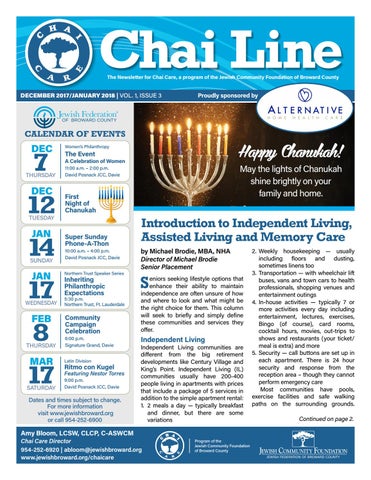
May the lights of Chanukah shine brightly on your family and home.
11:00 a.m. – 2:00 p.m. David Posnack JCC, Davie
JAN
17
Happy Chanukah!
Women’s Philanthropy
Inheriting Philanthropic Expectations Community Campaign Celebration
6:00 p.m. Signature Grand, Davie Latin Division
Ritmo con Kugel
Featuring Nestor Torres 9:00 p.m. David Posnack JCC, Davie
Dates and times subject to change. For more information visit www.jewishbroward.org or call 954-252-6900
Amy Bloom, LCSW, CLCP, C-ASWCM
Introduction to Independent Living, Assisted Living and Memory Care by Michael Brodie, MBA, NHA Director of Michael Brodie Senior Placement
S
eniors seeking lifestyle options that enhance their ability to maintain independence are often unsure of how and where to look and what might be the right choice for them. This column will seek to briefly and simply define these communities and services they offer.
Independent Living
Independent Living communities are different from the big retirement developments like Century Village and King’s Point. Independent Living (IL) communities usually have 200-400 people living in apartments with prices that include a package of 5 services in addition to the simple apartment rental: 1. 2 meals a day — typically breakfast and dinner, but there are some variations H A
I
C
C
Chai Care Director 954-252-6920 | abloom@jewishbroward.org www.jewishbroward.org/chaicare
A
E
DEC
R
Program of the Jewish Community Foundation of Broward County
2. Weekly housekeeping — usually including floors and dusting, sometimes linens too 3. Transportation — with wheelchair lift buses, vans and town cars to health professionals, shopping venues and entertainment outings 4. In-house activities — typically 7 or more activities every day including entertainment, lectures, exercises, Bingo (of course), card rooms, cocktail hours, movies, out-trips to shows and restaurants (your ticket/ meal is extra) and more 5. Security — call buttons are set up in each apartment. There is 24 hour security and response from the reception area – though they cannot perform emergency care Most communities have pools, exercise facilities and safe walking paths on the surrounding grounds. Continued on page 2.
Introduction to Independent Living, Assisted Living and Memory Care Continued from cover. There are in-house clinics, with primary physicians, podiatrists and some specialists. Usually there is also a home care office, so persons can stay on even if they need some additional personal care. The average age of residents is in the mid-80s, ranging from some youngsters in their 70s or less, and always a few centenarians. Independent living rental costs range from $2500-$5000+ per month for a private apartment, with the cost varying based on location, size of the apartment and the amenities, activities and meals included. Most independent living communities also have an assisted living facility on the campus — but at a higher price.
Assisted Living Communities
Assisted living communities provide the same basic services as independent living, but add on personal care and medical services as needed. They provide 3 meals per day, and assistance with bathing and dressing, medical care coordination and medication supervision, even assistance with ambulation, toileting, night time checks and general supervision. Unlike independent living, assisted living communities are licensed by the State of Florida, and surveyed at least every two years. While independent living communities are quite similar, there is wide variation in assisted living models. They range in size from 6 beds up to 200 beds. Some are on multi-level campuses, but most are free-standing. They range in cost from $2000-$7500, with the lower end being for persons with shared rooms, and the upper extreme for luxury apartments and all services. Some assisted living communities are similar to independent living — with full size apartments, entertainment, activities and transportation. Others have few public amenities and focus much more on personal care. Figuring out which type of community best fits your needs can be a challenge. Generally speaking, smaller communities may have greater capacity for personal care, while larger communities have resources to provide better amenities like
2 | CHAI LINE
transportation, high level activities and large lobby and activity spaces. When it comes to amenities, the rule is “you get what you pay for”, but when it comes to personal service, the State sets minimum requirements for care needs. It is important to note that Florida requires an assisted living contract, showing specifically which services are covered by monthly rent, and which cost extra. Typically, assisted living communities charge a one time entrance fee, a monthly base room & board fee and and additional monthly fee based on the level of care or services received by the resident. Residents may give 30 days notice to end their lease, without cause or penalty. The community can also terminate a contract, if they are unable to care for a resident’s needs, but must try to help find another option or community prior to discharge.
Memory Care Some assisted living communities are specifically designed to care for people with Alzheimer’s dementia or other short
term memory loss. Many cognitively frail residents live successfully in both independent and assisted living, but for persons who are most confused, a memory loss community or wing is supportive and beneficial. Usually these are secured communities, so that persons who might be at risk for wandering can be safe, without anyone hovering over them all the time. Spaces are smaller and easily observable, activities are simpler, and they get more care, redirection and staff support.
Rose’s Corner
The Chanukah candles had a fight on the last Chanukah night. The 1st candle said: I bring happiness to young and old. The 2nd candle said in anger, no! My candle shines so bright. The 3rd candle said with pride, my flame shines also outside. The 4th candle said: I’m so adored, I bring joy, not to be bored. The 5th candle, got very jealous, if she could, she would shut them off. The 6th candle can not relax, thinking what to do next? Oh, the 7th candle smiles and is asking, why should we fight? We’re are all being blessed the same. The 8th candle believing in fame, points to the Shamash who is standing tall, he who lights the flame on all. So, let’s join him and start singing, the Chanukah songs, that joy is bringing!
By Rose Boyarsky
C
trustee, bank) Most insurance companies, residential housing communities, and home care companies assess activities of daily living (ADLs) and instrumental activities of daily living (IADLs) when determining level of care and services needed of an individual (see tables below). After understanding a person’s current situation better, it becomes easier to determine what their needs are. A good exercise is to write down the person’s identified issues you have
C
ging can create obstacles in living a quality life and receiving quality care. Sometimes it is difficult to know what is needed to reach these goals. The assessment process is one of acquiring the understanding of a problem, what caused it, and what can be changed to minimize or resolve it. Assessment determines a person’s readiness for change, identifies the person’s strengths and problem areas that may affect the process of obtaining appropriate care, and engages the person in making care related decisions. Assessment of an aging person can be broken down into the following domains: • Medical • Physical • Behavioral • Psychological • Emotional • Environmental • Financial Aging always impacts these areas of one’s life. Assessment is sometimes just common sense. Following is a brief list of issues to look at: • Recent changes in personality and/or behavior • Awareness of situation • Support system • Living conditions • Environmental barriers • Durable medical equipment needs (i.e. walker, wheelchair, shower chair, hand held shower, etc.) • Disposable medical equipment needs (i.e. diapers, etc.) • Appearance • Diagnosis and age of onset • Addiction history • Psychiatric history • Visual and auditory functioning • Dental concerns • Diet • Continence • Sleep patterns • Falls • Medications, dosage and frequency • Advanced planning documents (i.e. health care surrogate/medical proxy, power of attorney, living will) • List of physicians • Professionals and their specialty (i.e. accountant, attorney, financial planner,
A
E
abloom@jewishbroward.org | 954-252-6920
Assess Your Loved Ones’ Needs Like a Pro
A
H A I
From the desk of Amy Bloom, LCSW, CLCP, C-ASWCM Chai Care Director
R
recognized from your assessment: what is the person missing? What does he/she need assistance with? What would help him/her make life easier? What would improve his/her quality of life? Make the list according to actual needs, not what you think is available in the community. Try to be honest; it is understandable that recognizing your loved one’s potentially negative issues can be upsetting. But honesty will help identify appropriate supportive services that can create Continued on page 4
ADLs (activities of daily living) ADL
Independent
Verbal Cues
Assistance
Contact Guard
Total Care
Ambulation Bathing Dressing Toileting Transferring Feeding NOTE: verbal cues = he/she can perform the activity if someone is telling them what to do along the way. Contact guard = he/she can perform the activity with someone standing close by in the event that he/she requires help.
IADLs (instrumental activities of daily living) ACTIVITY
I = Independent
A = Assistance
D = Dependent
Shopping
Able to care for all shopping with transportation provided
Able to shop but not alone
Unable to shop
Medication
Able to take meds at right time, right dose
Able to take meds with reminders or set up
Unable to manage meds
Phone
Able to look up numbers, Able to answer the dial and receive calls phone, unable to make without help calls without help
Unable to use phone
Travel
Able to drive car, go on bus, take taxi alone
Unable to travel
Meal Prep
Able to plan and cook full Able to prepare light meals foods, but not full meals
Unable to prepare meals
Money Management
Able to manage money, write checks, pay bills
Able to manage daily buying needs, but requires help paying bills and managing checkbook
Unable to manage money
Housekeeping
Able to perform heavy housekeeping
Able to perform light housekeeping
Unable to perform any housekeeping
Able to travel but not alone
DECEMBER 2017/JANUARY 2018 | 3
C
C
quality of life. Financial situation becomes the second largest aspect of assessment. Can the person afford what he/she needs? What is his/her monthly income, assets, what insurance does the person have? Your loved one may have difficult identifying and articulating their wishes, values and preferences. Assessment encourages them to openly communicate about complex issues, while empowering them to make difficult decisions. Assessment information will help you come up with an organized, concise plan for current and future needs associated with costs. The plan guides the provision for personal, medical and rehabilitative care for your loved one. After assessment, you should have a lot of the information you need to search for care options such as community resources, services, entitlements, organizations, residential options and funding sources for your loved one.
H A
I
Continued from page 3
A
E
Assessing Needs
R
COMING SOON!
OFFICE HOURS
with Amy
Amy Bloom, our Director of Chai Care, is a licensed clinical social worker, certified life care planner and certified advanced social work case manager. If you are looking for a safe place to talk about sensitive issues related to health, aging, or caregiving, Amy will provide: • Emotional support • Informational & referral • Supportive counseling • Assistance with problem solving For more information contact Amy at abloom@jewishbroward.org
WE ONLY PROVIDE W-2 CAREGIVERS INSURED
BONDED
SUPERVISED
For worker’s compensation, unemployment and liability.
Allows for client’s personal property protection if needed.
All caregivers are overseen by, and report to a supervisor.
BROWARD
MIAMI DADE
954.622.0588 Lic. # HHA299991246
305.652.0066 Lic. # HHHA299992273
PALM BEACH
561.921.9031 Lic. # HHA299993391
WWW.ALTERNATIVEHOMEHEALTH.COM | TOLL FREE: 855.622.0588 4 | CHAI LINE
DECEMBER 2017/JANUARY 2018