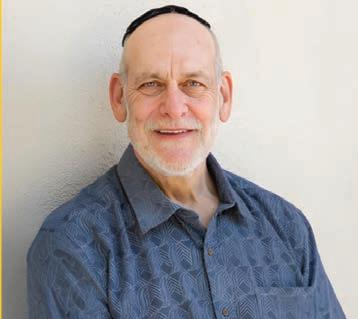
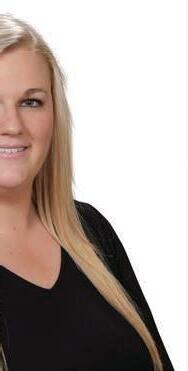
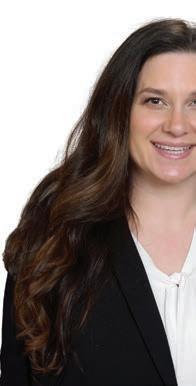
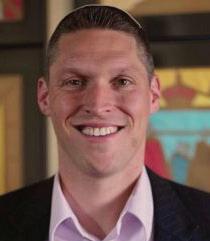
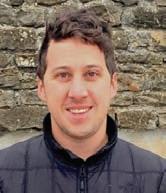
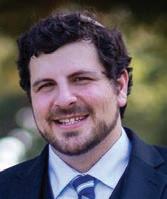
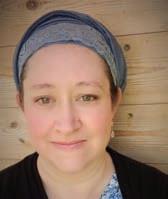
Chabad Rabbi Shneur Wolfman is growing the Jewish community in Moon Valley
‘He made me who I am:’ Rabbi B. Charles Herring remembered for a lifetime of teaching
MALA BLOMQUIST | MANAGING EDITOR
R
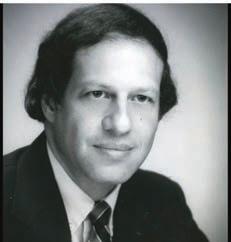
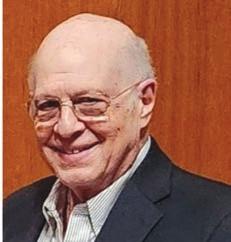
abbi B. Charles Herring told Jewish News in 2013, “To grow with a family through its generations is ... wonderful for a rabbi.” Herring died on Jan. 5, 2026, at 87, and the loss is felt by those families he grew with throughout the Jewish community.
Known to most simply as “Chuck,” Herring served the Phoenix area for more than five decades. He was assistant rabbi at Temple Beth Israel (now Congregation Beth Israel in Scottsdale) from 1968 to 1988 and the founding rabbi of Temple Kol Ami (TKA) in Scottsdale, which he led from 1988 until his retirement in 2004. In 2009, Herring returned to serve as TKA’s part-time rabbi during a challenging period for the congregation. In recognition of his dedication and leadership, TKA has, since 2012, presented the “Rabbi B. Charles Herring TKA Volunteer of the Year” award in his honor.
“When I interviewed at Temple Kol Ami 16 years ago, I felt it right away — this was a place that felt like home,” said Rabbi Jeremy Schneider, TKA’s spiritual leader. “The culture Rabbi Herring had built, especially his deep commitment to youth and families, was exactly what I was looking for.”
Born Jan. 26, 1939, in McKeesport, Pennsylvania, to Lucille and Abe Herring, Herring grew up in the Pittsburgh area and attended the University of Pittsburgh before continuing to Hebrew Union College–Jewish Institute of Religion in Cincinnati, Ohio, where he was ordained on May 28, 1965, at Plum Street Synagogue (now the Isaac M. Wise Temple).
SEE RABBI, PAGE 2
SENIOR PULL-OUT
A Holocaust survivor shares her story and a rabbi adventures to Morocco
Israeli Consul General Bachar deepens Arizona–Israel partnership during state visit
In the middle of January, Consul General of Israel to the Pacific Southwest, Israel Bachar, arrived in Arizona on his third trip to the state to further cement the relationship between the two regions.
Bachar, who is based in Los Angeles and oversees Israel’s diplomatic engagement with seven states in the Pacific Southwest, was invited to Arizona by Republican State Rep. Tony Rivero to attend the opening of the 2026 legislative session.
During his three-day visit, Bachar met with lawmakers, faith-based representatives, community members and business leaders, including heads of Jewish and nonJewish organizations and leadership from the Center for Jewish Philanthropy of Greater Phoenix.
Bachar also said he made it a point to meet with Arizona’s previous governor, Doug Ducey, to express his thanks and tell him, “We don’t forget his friendship, his help to Israel.” Bachar has met Gov. Katie Hobbs in the past but did not see her on this trip.
Bachar explained that his visit had three main objectives. The first was showing appreciation for Arizona’s ongoing support for the State of Israel. “Arizona, historically, in the last 20 years, has been very supportive of Israel,” said Bachar. “They were one of the first ones to fight the BDS (Boycott, Divestment and Sanctions). It was Florida and Arizona.” Bachar said being invited by Rivero was meaningful because he is the House Committee on International Trade chairman and that Arizona has an economic trade office in Israel. SEE
Arizona Bach Festival presents the Arizona premiere of Lidarti’s Oratorio Esther
The Salvation of Israel at the Hands of Esther
Valley of the Sun Jewish Community Center
Purim – March 1, 2026 at 3:00 pm
Purim performance
On March 1, the Arizona Bach Festival will present the Arizona premiere of Lidarti’s oratorio “Esther,” a work of Hebrew music from the 18th century that was nearly lost to history. See page 18.
MALA BLOMQUIST | MANAGING EDITOR
CONSUL, PAGE 3
PHOTO COURTESY OF ARIZONA BACH FESTIVAL
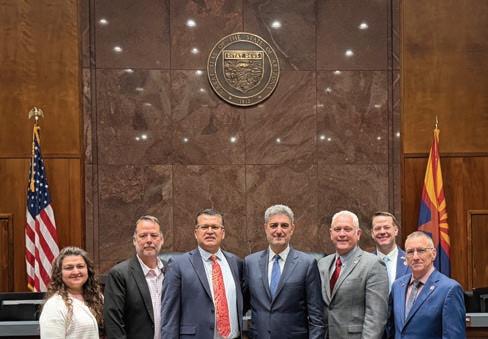
Consul General of Israel to the Pacific Southwest, Israel Bachar, fourth from left, with State Rep. Tony Rivero, on his right, and other members of the Arizona legislature.
His rabbinate began with pulpits across the country, followed by service as a U.S. Air Force chaplain stationed in Japan. He ministered to Jewish service members across East Asia and led a group up Mount Fuji, planting a flag for the Jewish Welfare Board.
After completing military service, he visited Arizona and, as stated in the obituary posted by Sinai Mortuary, “he shared a beer with Rabbi Albert Plotkin at Reata Pass, watched the sun set and knew he had found home.” He arrived in Phoenix in 1968 to work as assistant rabbi at Temple Beth Israel, where he built Temple Beth Israel Youth (BITY), authored original Purim spiels and spent summers as rabbi-inresidence at Camp Charles Pearlstein, now Camp Daisy and Harry Stein.
2023 Phoenix Jewish News
said Jon Meyers, director of ADDPC.
said Jon Meyers, director of ADDPC.
“Our hope is to create and promote opportunities for people to be embraced, become part of the community and find equitable opportunities wherever they
“Our hope is to create and promote opportunities for people to be embraced, become part of the community and find equitable opportunities wherever they might live,” he said.
Meyers first came to know Stern through her mother, Amy Silverman, who read her personal essays about raising a daughter with Down syndrome on KJZZ, National Public Radio’s Phoenix affiliate station.
Meyers first came to know Stern through her mother, Amy Silverman, who read her personal essays about raising a daughter with Down syndrome on KJZZ, National Public Radio’s Phoenix affiliate station.
about her Judaism with her fellow council members and speaking out for her rights and beliefs.
2023 Phoenix Jewish News Print Dates
a teacher,” said Rosenthal. “Through his stories and mentorship, he challenged you to reach your own understanding of being Jewish, to use your own heart and intellect to make the world a better place. I’ve always said, he made me who I am.”
Meyers was so captivated by the essays that he reached out to Silverman, and the two became friends.
Meyers was so captivated by the essays that he reached out to Silverman, and the two became friends.
That’s how Stern first learned of the open council seat, but there’s no doubt she earned her position, Meyers said.
January 6
January 20
January 6
February 3
January 20
February 17
February 3
When Herring originally retired in 2004, after 36 years as a full-time pulpit rabbi, he admitted that stepping away was not easy. “It took two full years to realize that I didn’t have the huge burden of the obligations I had been tending to for all those years,” he told Jewish News at the time. “It took two years to understand that I could sleep in.”
March 10
August 25
September 1
August 25
September 8
September 1 September 8
Barbara Rothman, also a founding member, recalled how teenagers “followed him like a Pied Piper.” Youth group friendships he fostered decades ago remain strong today, with former teens still gathering across the country.
That’s how Stern first learned of the open council seat, but there’s no doubt she earned her position, Meyers said.
To become a council member, Stern had to apply and demonstrate that she had something valuable to contribute, he said.
March 24
February 17
March 10
March 31
Longtime TKA member MaryAnn Lieb, along with her husband, Bobby, fondly remembered Herring as always being there for their family.
March 24
April 7
March 31
April 21
April 7
May 5
April 21
May 19
June 9
May 5
May 19
July 14
June 9
August 4
July 14
August 18*
August 4
August 18*
September 15
October 6
September 15 October 6 October 13** October 20
October 13**
November 3
“He married us. He was there for our family’s biggest moments: celebrating our son’s bar mitzvah and later helping us say goodbye to our father,” she said. “Through it all, he guided us with care and reminded us, even in hard moments, of how much life we still had in front of us. We will miss him so much, and we are incredibly grateful that he is etched into our family’s life.”
October 20
November 10
November 3
November 17
November 10
December 1
November 17
December 15
December 1
Founding member Michael Rosenthal, who also served as TKA’s first executive director, noticed that many of the reactions and stories about Herring’s passing on social media ended with the same phrase: “He made me who I am.”
“Rabbi Herring wasn’t a preacher; he was
December 15 *Best of Magazine **Annual Directory
“She’s on the council because she deserves to be on the council,” he said.
“To this day, whenever my sons, either one of them, come to town, they live in New York and New Jersey, they call people and they all meet,” she said. “One of my sons did some work in L.A. and he sent a message on Facebook, ‘I’m going to be in town. Who wants to meet me for dinner?’ and there were 56 people meeting him for dinner in L.A. All of them became friends in a youth group with Chuck Herring.”
To become a council member, Stern had to apply and demonstrate that she had something valuable to contribute, he said.
Stern is creating a life and career as a member of her community, which makes her a great addition.
“She’s on the council because she deserves to be on the council,” he said. Stern is creating a life and career as a member of her community, which makes her a great addition.
Ron Israel also met the rabbi when he was part of youth group and described Herring as “a pivotal important force in my life from that point forward.” Israel also joined Herring at then-Camp Pearlstein where the rabbi affectionately referred to Israel as “Mr. Music” when they would do the evening tefillah.
Stern graduated from McClintock High School in Tempe last year and now attends Glendale Community College, with a focus on dance. She is a regular performer at Detour Company Theatre, a Scottsdale theatre company for adults with intellectual, developmental and physical disabilities.
Stern graduated from McClintock High School in Tempe last year and now attends Glendale Community College, with a focus on dance. She is a regular performer at Detour Company Theatre, a Scottsdale theatre company for adults with intellectual, developmental and physical disabilities.
In fact, when Stern attended her first council meeting in January, she couldn’t wait to tell people of her involvement with Detour and share information about its upcoming shows.
“When I was about 14, he saw me playing the guitar with some of the other kids. I was just learning how to play, and he drew me into his contemporary worship service,” he said. “Pretty much every Reform synagogue
about her Judaism with her fellow council members and speaking out for her rights and beliefs.
She already has some practice at advocating for herself.
“One time, I was in class and someone called me the R-word and I told him not to. The teacher was in the hallway and another student repeated the word,” she said. Rather than letting the situation go, she told her theater teacher, who was able to intervene.
She already has some practice at advocating for herself.
“One time, I was in class and someone called me the R-word and I told him not to. The teacher was in the hallway and another student repeated the word,” she said. Rather than letting the situation go, she told her theater teacher, who was able to intervene.
“If someone has a disability, saying the R-word is like saying the F-word,” Stern said.
today has guitars in their services, but back in the ‘70s, that was a new thing. I played the guitar alongside him for decades after that.” Israel has since moved to California, but he returned to play guitar at Herring’s memorial service.
“If someone has a disability, saying the R-word is like saying the F-word,” Stern said.
While performing in the musical “Hairspray,” she had another occasion to tangle with the offensive word, which appears in the script.
Herring was also involved with social action. He advocated for Soviet Jewry, stood with migrant farmworkers, raised thousands of dollars for food banks and worked with Rabbi David Saperstein and the late Al Vorspan, both with the Religious Action Center of Reform Judaism. He helped establish Mitzvah Corps — which later became Camp Swift — bringing lowincome children to Jewish summer camp, often providing clothing, meals and care through volunteer-run efforts. After 9/11, he reached out to the Muslim community in Greater Phoenix, insisting on dialogue and mutual respect.
2026 Phoenix
While performing in the musical “Hairspray,” she had another occasion to tangle with the offensive word, which appears in the script.
“That’s really bad and my friend said it on stage. I was not OK with that, so I went to the director and told her it was a bad word for people with disabilities, but she wouldn’t take it out,” Stern said.
“That’s really bad and my friend said it on stage. I was not OK with that, so I went to the director and told her it was a bad word for people with disabilities, but she wouldn’t take it out,” Stern said.
She let her mother know about the conflict and they were able to convince the director of the need to remove the word from the script.
She let her mother know about the conflict and they were able to convince the director of the need to remove the word from the script.
“My friend Al was next to me when I told the director and he gave me the biggest hug ever and said that he loved me so much,” Stern said. Sadly, Al died in a car crash on Oct. 24, 2021.
Heart Can’t Even Believe It: A Story of Science, Love and Down Syndrome,” Silverman’s book about her daughter. When Gesher’s speakers’ bureau, Damon Brooks & Associates, was asked to find a speaker about Down syndrome for an event this spring, Hummell first asked Silverman to speak, thinking Stern might be too young.
In fact, when Stern attended her first council meeting in January, she couldn’t wait to tell people of her involvement with Detour and share information about its upcoming shows.
“There’s no question that she is going to thrive,” Meyers said. “She’s very gregarious and passionate about the things that matter to her.”
Stern looks forward to sharing insights
“There’s no question that she is going to thrive,” Meyers said. “She’s very gregarious and passionate about the things that matter to her.”
Stern looks forward to sharing insights
“My friend Al was next to me when I told the director and he gave me the biggest hug ever and said that he loved me so much,” Stern said. Sadly, Al died in a car crash on Oct. 24, 2021.
After Rabbi Moshe Tutnauer died (the spiritual leader of Beth El Phoenix from 1962 to 1972) in 2010, Herring told Jewish News that when the farm workers’ union leader César Chávez made the public announcement that he was ending a 24-day fast to protest a farm-labor law passed by the State Legislature, a Catholic Mass was held as part of the event. “They asked me if I would be kind enough to help serve communion,” Herring said. “So, I was carrying my basket full of bread, when somebody bumps into me and I turn around and it was Moshe Tutnauer,” also distributing communion.
“That was hard; it’s very hard to get emotions out and I was very, very upset,” she said.
“That was hard; it’s very hard to get emotions out and I was very, very upset,” she said.
On the recent anniversary of his death, Stern made a cake and took it to the crash site.
Heart Can’t Even Believe It: A Story of Science, Love and Down Syndrome,” Silverman’s book about her daughter. When Gesher’s speakers’ bureau, Damon Brooks & Associates, was asked to find a speaker about Down syndrome for an event this spring, Hummell first asked Silverman to speak, thinking Stern might be too young.
They decided instead that Stern should tell her own story; it’s a real bonus that she is not afraid of public speaking.
“It’s not the same when someone tries to tell a person’s story for them,” Hummell said.
They decided instead that Stern should tell her own story; it’s a real bonus that she is not afraid of public speaking.
“It’s not the same when someone tries to tell a person’s story for them,” Hummell said.
“I don’t know how I did it without crying. I’m so proud of myself,” she said.
On the recent anniversary of his death, Stern made a cake and took it to the crash site.
“I don’t know how I did it without crying. I’m so proud of myself,” she said.
Amy Hummell, executive director of Gesher Disability Resources, agreed that Stern is a good fit for ADDPC because of her ability to self-advocate.
Additionally, helping people with disabilities find jobs was one of the reasons for acquiring the bureau. Unemployment in the disability community is upwards of 75% and of that percentage, 75% are ready, willing and able to work — but haven’t been given the opportunity, Hummell said.
Directory
Amy Hummell, executive director of Gesher Disability Resources, agreed that Stern is a good fit for ADDPC because of her ability to self-advocate.
Hummell co-hosted a book event with Meyers a few years ago for “My
Hummell co-hosted a book event with Meyers a few years ago for “My
N. Scottsdale Road, Suite 201, Scottsdale, AZ 85254 Phone: 602.870.9470 | Fax: 602.870.0426 | editor@jewishaz.com | advertising@jewishaz.com subscriptions@jewishaz.com | www.jewishaz.com
Additionally, helping people with disabilities find jobs was one of the reasons for acquiring the bureau. Unemployment in the disability community is upwards of 75% and of that percentage, 75% are ready, willing and able to work — but haven’t been given the opportunity, Hummell said.
“People have it in them to speak up but don’t know how, and often they’re not cheered on. Sophie has family support
“People have it in them to speak up but don’t know how, and often they’re not cheered on. Sophie has family support
GENERAL MANAGER Rich Solomon | 602.639.5861 rsolomon@jewishaz.com
SUBSCRIPTIONS 602.870.9470 x 1 subscriptions@jewishaz.com
SUBSCRIPTIONS 602.870.9470 x 1 subscriptions@jewishaz.com
GRAPHIC DESIGNER Ebony Brown | 410.902.2333 ads_phoenixjn@midatlanticmedia.com
GRAPHIC DESIGNER Ebony Brown | 410.902.2333 ads_phoenixjn@midatlanticmedia.com
GRAPHIC DESIGNER Ricki Urban | 602.870.9470 X 2 advertising@jewishaz.com
Sophie Stern at her high school
Sophie Stern at her high school graduation in 2022
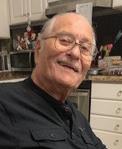
Photos shared by Rabbi Jeremy Schneider when announcing the rabbi’s passing on Temple Kol Ami’s Facebook. COURTESY OF TEMPLE KOL AMI
“I give them credit that they maintain it and make sure that there is an ongoing economic relationship between Israel and America,” he said. “Of course, there is more interest right now in the defense industry and the cooperation between Israel, America and Arizona.”
The third issue is building relationships with other faith-based communities.
“We did a project together; we sent a delegation of Hispanic pastors to Israel. So, we met them and it was very, very moving,” he said. The group from Arizona joined 1,000 other pastors from around the globe in Israel.
Bachar asked the group what the most impactful moment of their trip was. They mentioned two locations over and over. One was visiting the kibbutzim impacted by the attacks of Oct. 7 and the other was Jerusalem, the location of Jesus Christ’s ministry, crucifixion and resurrection, central to their Christian faith.
He met with other faith leaders from The Church of Jesus Christ of Latter-day Saints and encouraged their congregations to visit Israel. “The more that we convince churchgoers here to go to Israel, the better. The more you do that, the tighter the connection gets and the smaller the distance gets,” he said.
Bachar had dinner with 16 state representatives, many of whom have been to Israel, and he wanted to make sure that when they support Israel, it’s not being taken for granted.
“Sometimes it’s not easy for them, with their opponents or their followers, there is pressure out there,” he said. “We don’t take it for granted, and it’s ongoing work. It needs to be done. And we do have many representatives that are very pro-Israel and make it very well known to everyone.”
They also talked about education and antisemitism and Bachar recognized Arizona’s universities for fighting antisemitism on campuses and taking care of their Jewish students. “They’re the future leaders of the community,” he said.
“He believed making the world better happens through small, everyday acts,” said Schneider. “That belief has shaped this community in lasting ways.”
At home, Rabbi Herring lived the values he taught. He was married to his wife, Barbara, for 64 years. They met when they were 16, and Barbara shared the details of their first date.
“We went to Cinerama and I wore a blue wool dress, piped in navy satin,” she recalled. “I had on pearls and wore blue suede shoes. I walked down the steps and there he was standing at the bottom, and the rest is history.”
She added, “I still expect him to walk through the door. He was one of the most caring, gentle, loving husbands, fathers, friends you ever wanted to meet in your life.” Together, they raised three daughters — Laura, Wendy and Deborah — and
Bachar brought up the fact that Arizona is a purple state, and it has influential groups on the left and the right. He also mentioned that Arizona has elections this year, as does Israel. Politics aside, Bachar said that he thinks that Arizonans and Israelis have a lot in common.
“There are a lot of projects we can do together for the benefit of the Arizona economy and the Israeli economy,” he said. “Defense is one area, but it’s not the only area.”
Still, Arizona’s defense industry is very much connected to the Israeli defense establishment through Raytheon, Tucson’s largest private-sector employer and a major aerospace and defense company.
Bachar also spoke with the trade committee about semiconductor technology. According to the Arizona Commerce Authority, Arizona is the number one state for semiconductors, with the TSMC Arizona plant in the Northwest Valley employing more than 3,000 employees.
“The revolution of the semiconductors happening right now in Arizona started in Israel with Intel’s investment 30 years ago,” he said. “Now there is a second wave in Israel because NVIDIA decided last month to open major R&D centers there.” Bachar is referring to the artificial intelligence company’s planned $1.5 billion investment to build in Kiryat Tivon, Israel.
cherished their role as grandparents.
In retirement, Herring led services at Westminster Village, where the couple lived, teaching Judaic history and welcoming Jewish and non-Jewish residents alike.
“Chuck did services with Cantor Raina Sinclair on the last Friday of every month, and he also did Rosh Hashanah, Yom Kippur and Chanukah services,” said Barbara.
Sinclair became TKA’s first cantorial soloist in 1994, and she retired at the end of 2014. Sinclair will continue to hold services at Westminster, and Barbara said she will continue attending them.
Barbara said that she and Herring made challah every week to share after services.
“That’s just what we did, that’s how I was raised and he loved it. That’s my joy. For the rest of my life, that’s my joy.”
She shared that he is always with her
He mentioned that aside from the boon to both Arizona’s and Israel’s economies that these technologies bring, we also share some of the same problems. “Energy, water, climate, it’s pretty much the same,” he said. “So, we can share a lot of our knowledge.”
Bachar believes sharing knowledge, growing partnerships and maintaining relationships are paramount to his mission.
He came to his post five weeks prior to Oct. 7. So, his tenure has been defined by the war after Oct. 7 and the ongoing antisemitism.
“I never forget where I came from and who I am,” he said. “First of all, I’m a Jew and an Israeli Zionist and I’m married to an American. So, that’s the order.”
He explained that he’s “putting a lot of effort into creating new alliances, trying to forge long-term projects with different communities and institutions to make the relationships deeper and longer lasting.”
Again, he reiterated that he doesn’t take any of these relationships for granted and he realized that, at the end of the day, these leaders in politics and business have many issues on their plates.
“Israel is just one of the issues,” he said. “For me, it’s the issue.” JN
Jewish News is published by the Jewish Community Foundation of Greater Phoenix, a component of the Center for Jewish Philanthropy of Greater Phoenix.
and will never leave. “I still reach out in bed to hold his hand to go to sleep and it’s not there, but I’m going to get through this,” she said. “The outpouring from this community of love for my husband in the form of stories, messages and calls ... I don’t know how I’m ever going to thank people.” JN
Rabbi B. Charles Herring, left, officiated the wedding of MaryAnn and Bobby Lieb on Nov. 15, 1986. COURTESY OF MARYANN LIEB
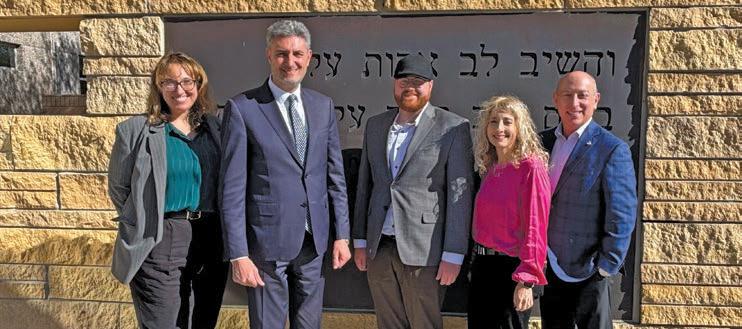
Consul General of Israel to the Pacific Southwest, Israel Bachar, with leadership from the Center for Jewish Philanthropy of Greater Phoenix. From left, Charlene Green, vice president, community engagement; Bachar; Amichai Stout, senior director of combating antisemitism; Sheryl Quen, vice president, community impact; and Richard Kasper, CEO.
Temple Emanuel hosts Mussar Shabbaton with Alan Morinis
MALA BLOMQUIST | MANAGING EDITOR
Dr. Alan Morinis, founder of The Mussar Institute, will join the Jewish community across the Valley for several events at the beginning of February.
One event is “The Shabbat Effect with Mussar Institute’s Alan Morinis,” held over Friday and Saturday, Feb. 6 and 7, at Temple Emanuel of Tempe. Morinis is the author of “The Shabbat Effect: Jewish Wisdom for Growth and Transformation” and will hold book talks at Temple Chai in Phoenix on Feb. 8 and a hybrid event (in-person and online) at Beth El Phoenix with Valley Beit Midrash.
some community partnership to make it happen.”
Robbins reached out to Dr. Stanley Mirvis, associate professor of history in the School of Historical, Philosophical and Religious Studies and the Harold and Jean Grossman Chair of Jewish Studies at Arizona State University; Rabbi Emily Langowitz, executive director, Women’s Leadership Institute (WLI); and the Center for Jewish Philanthropy’s small grants program for support.
Morinis is widely credited with the modern revival of the study of Mussar, a Jewish spiritual movement that blends study, introspection and practical exercises to guide practitioners on a journey of reflection. Within this spiritual curriculum, Mussar defines various “soul traits,” such as “humility,” “gratitude,” “patience” and many others. The practice of Mussar allows each person to refine these traits and embrace deeper personal and spiritual growth. Morinis is also the author of “Climbing Jacob’s Ladder” (2002), “Everyday Holiness” (2007), “With Heart in Mind” (2014).
The event in Tempe is part of Emanuel’s Jubilee celebrations, which they are holding this year in honor of the temple’s 50th anniversary.
One of the temple’s congregants, Toby Schmich, is a certified Mussar instructor who has led courses in the past, so when Morinis reached out to Emanuel Rabbi Steven Folberg suggesting a Shabbaton, he contacted Schmich.
“Toby contacted Alan, and then reached out to me because my role with the board is to coordinate adult education,” said Kerri Robbins, who is overseeing the event. “We were excited to have the opportunity, but needed
“I was delighted at how eager everyone was to have Alan with us and to support the programming,” she said.
Robbins is an alumna of the WLI’s leadership cohort program. WLI engages a diverse group of women throughout the Greater Phoenix community and through one-on-one mentor/mentee meetings and group learning sessions, participants develop leadership skills and social service initiatives for the local Jewish community.
After participating as a mentee, Robbins, who works as a high school teacher in the East Valley, became a teacher in the cohort program and started serving on the board of Emanuel, while also chairing the adult education committee.
“When Kerri had the opportunity to bring Dr. Morinis to Temple Emanuel to teach, she saw it as an opportunity not just to advance the learning of her congregation, but as a way to reach out to provide a true communitywide event,” said Langowitz.
Courtney Griggs, another alumna of WLI who also sits on the Emanuel board, presented information about the Shabbaton to the current cohort of mentees and mentors at WLI’s Community Night in October, inspiring current mentor and WLI alumna Meghan Jalowiec to use her skills and join the planning of the event.
“As the executive director of the WLI,
I am lucky every day to teach, connect and engage with incredible Jewish women from across our community. These are women who, like those who come to Mussar practice, are seeking to grow, refine their skills and become their best selves,” said Langowitz. Robbins also reached out to WLI leadership to see if they could partner to sponsor a special piece of the program, geared toward the current cohort and alumnae. With that partnership, the Saturday afternoon leadership learning session was created.
Morinis will be teaching “The Mussar of Leadership,” and he said that “Mussar itself is very focused on character, so a Mussar approach to leadership naturally focuses on character as a determinant of leadership in a Jewish perspective.”
Taking the middah, or trait, of humility as an example, Morinis noted that Mussar has the power to help us see traditional ideas about leadership in new ways.
“I think the middah of humility makes a good case in point for a number of reasons, not least how scarce it is among current high-profile leaders,” he said. “I would understand if someone said that humility is the last thing a leader needs, but the Torah tells us that our paragon of leadership, Moses, was exceptionally humble and if we respect Jewish sources, that forces us to consider the gap between present exemplars and the Jewish ideal.”
This is just an example of the learning that will take place over the weekend of Feb. 6 and 7.
“Providing opportunities to grow in your leadership through a Jewish lens is at the heart of what WLI does,” said Langowitz. “When we help poise women to lead, when we give them the tools, skills and connections to deepen their engagement, and when we encourage women to bring their ideas to life, our entire community benefits.” JN
For more information, visit emanueloftempe.org/ event/MussarFeb2026.
Dr. Alan Morinis COURTESY OF THE MUSSAR INSTITUTE
Using an ancient law to guide modern environmentalism
JOSH BOOTZIN | CONTRIBUTING WRITER
Valley Beit Midrash (VBM) invited Rabbi David Seidenberg to host its final class of 2025: “Bal Tashchit: How to Turn an Ancient Law into a Force for Earth’s Care.”
Creator of neohasid.org and author of “Kabbalah and Ecology: God’s Image in the More-Than-Human World,” Seidenberg engaged the VBM attendees via Zoom from Northampton, Massachusetts.
Seidenberg first cited Rabbi Yonatan Neril’s perspective of Bal Tashchit — the mitzvah to not waste or destroy anything — as the basic understanding of the law for most of the Jewish environmental movement. Neril is the founder and current director of the Interfaith Center for Sustainable Development, a nonprofit organization based in Jerusalem.
Since wasting contributes to the degradation of the planet and not wasting can help improve people’s physical and spiritual lives, Jewish tradition has widely forbidden wasteful acts, and Bal Tashchit has long been considered central to a Jewish environmental ethic.
Rabbi Samson Raphael Hirsch, the 19th-century rabbi who shaped a modern Orthodox community by bridging traditional practice and enlightenment thinking, went even further to consider Bal Tashchit a foundational principle for understanding all of Judaism.
“‘Do not destroy anything’ is the first and most general call of God,” Hirsch wrote. “If you destroy, if you ruin, at that moment you are not a human but an animal and have no right to the things around you.”
Seidenberg acknowledged that this was a unique perspective. “(Hirsch) defines (Bal Tashchit) as a fundamental principle that makes you human, to be able to choose not to waste.”
Rather than an all-encompassing environmental ethic, as Hirsch believed, Seidenberg referred to Bal Tashchit as closer to a conservationist principle, since it can be difficult to derive any rules of practice from the notion to avoid destroying anything.
“Ethics doesn’t necessarily need to be based on a set of rules that you follow. It can be based on what is seen as virtuous,” Seidenberg said. “You use the rules not
because they tell you what to do, but because they teach you what kind of human being you should become.”
As an example, Seidenberg referenced the Torah portion Devarim (Deuteronomy 20:19-20), which states that during a time of war, you’re not allowed to cut down a fruitful tree, even though it may help you win the war as lumber for a ramp or battering ram.
If God forbids the destruction of a fruitful tree even in the direst circumstances, rabbis have taken that to mean humans should not destroy anything at all, including inanimate objects.
However, the next part of Devarim states that one should cut down a barren tree, one that does not or has stopped bearing fruit, before cutting down a fruitful tree, but if the fruitful tree is the only option, it can be cut down.
“Once you say that, there’s not really much value for Bal Tashchit as an environmental law anymore, because if it means that you should not cut down a fruit tree first, you’re often in a situation where you could probably cut down a fruit tree,” Seidenberg said.
“In the time of climate change, people have said, particularly in the Jewish environmental movement, that all trees bear fruit because all trees give off oxygen and take up carbon dioxide,” Seidenberg continued. “The fruit is the reality of being able to have a stable climate, which we have to have to survive.”
Maimonides, a rabbi and philosopher from the 12th century, went a step further to determine that any non-fruit-bearing tree can be cut down for any reason. Similarly, a fruit-bearing tree that does not yield enough fruit to warrant taking care of it can also be cut down.
An exception to the general rule of Bal Tashchit is that if the barren tree is worth more in lumber than the fruitful tree is worth for its fruit, one is allowed to cut down the fruitful tree first.
“What this tells us is that … the measurement of what’s worth saving is based on monetary value, not on the idea that fruit trees are beautiful, not on the idea that sustainability matters, but on the idea that what things are worth is how you measure whether a tree is worth
saving or not,” Seidenberg said.
This idea that a tree’s worth is based on monetary value, rather than intrinsic value, contradicts Hirsch’s interpretation, that everything has intrinsic value and if one destroys anything, they also destroy their own intrinsic value.
“If we want this to be an environmental law, we want to find some basis for thinking that intrinsic value is what matters,” Seidenberg said.
He posed that the tree could provide
a habitat or shade for animals to survive. Then it has worth beyond its yield of fruit.
Seidenberg moved on to a discussion of how Bal Tashchit is interpreted when considering the survival of a species, if one were to decide on cutting down the last tree of its kind and considering whether it’s permissible to cut down a tree that one does not own.
Most importantly, Seidenberg opined that the first step in updating an ancient Jewish law to be relevant in modern times is to recognize that there is a problem in the world worth fixing.
“The framework for what we need to create is there, but we need the will and the consensus, and we need to think it matters,” Seidenberg concluded. “If we have those things in place, I see Judaism and Jewish environmental law developing in a useful direction. If we don’t have those things in place, Jewish environmental law will not help us reach sustainability.” JN
For more information, visit valleybeitmidrash.org.
Josh Bootzin is a writer based in Yuma.
Rabbi David Seidenberg COURTESY OF RABBI DAVID SEIDENBERG
RABBI DAVID SEIDENBERG
Committee
B
Brandeis National Committee Phoenix Chapter Book & Author 2026
Phoenix’s Premier Author Event
NY Times Bestselling Authors Luncheon • Boutiques
Building a Jewish community in Moon Valley
LEISAH WOLDOFF | CONTRIBUTING WRITER
MGreater Phoenix’s Premier Author Event
ichele Graff first found out about Chabad of Moon Valley when she was driving through the neighborhood and saw Rabbi Shneur Wolfman walking with his son.
Greater Phoenix’s Premier Author Event 5 NY Times Bestselling Authors Luncheon • Boutiques
5 NY Times Bestselling Authors Luncheon • Boutiques
Author Event Bestselling Authors • Boutiques February 23, 2026
Monday, February 23, 2026 9:00 am ~ 3:30 pm
Monday, February 23, 2026 9:00 am ~ 3:30 pm
Monday, February 23, 2026 9:00 am ~ 3:30 pm
Monday, February 23, 2026 9:00 am ~ 3:30 pm Westin
“I was so excited that as soon as I got home, I told my husband, ‘I think a rabbi just moved into the neighborhood!’” (She recognized he was a rabbi by the way he was dressed.)
The next day, her husband contacted the Wolfmans to invite them to the Graffs’ home.
“Not long after, Rabbi Wolfman came by, we talked and before we knew it, we were invited to the first Shabbat dinner they were hosting.” She decided to get involved because, from that very first moment, the rabbi and his wife, Esther, welcomed them like family.
Chabad of Moon Valley’s first event was a Chanukah event at Moon Valley Park in December 2023, which has become an annual tradition. Many people who attended that first year were surprised to discover that there were so many other Jewish families living in the neighborhood, said Wolfman, who notes that he is in touch with about 200 Jewish families that live in the area.
Moon Valley is a residential neighborhood in North Phoenix, between Thunderbird and Bell Roads near the Phoenix Mountains Preserve, that Wolfman describes as a great neighborhood for families with children.
Since the Moon Valley Chabad opened, there’s a real feeling of togetherness, Graff wrote in an email. “Holidays, milestones and even the difficult times are shared with people who genuinely show up for you,” she said. “It feels like a close-knit Jewish family where all of us matter, and no one ever feels alone.”
David Dietz, who has attended Moon Valley programs since the start, also appreciates the community that has formed within the neighborhood and the relationships that have developed. “We support each other,” he said.
Arin Greenberg was introduced to Chabad of Moon Valley at the first Chanukah event and said she “finally found a home where I feel welcomed and supported.” She especially enjoys the Jewish Women’s Circle of Moon Valley, a group run by Rebbetzin Wolfman that offers women a place to socialize and learn. Past women’s programs included making doughnuts for Chanukah and round challah for the High Holidays, as
well as a monthly Rosh Chodesh class. The group will celebrate Tu B’Shevat, the Jewish New Year for Trees, with a Wood Burning Workshop on Feb. 2.
Other regular community holiday programs include a Passover seder and a Rosh Hashanah dinner.
One of the newest programs is The Shabbat Experience, where members of the community are invited for a Shabbat morning of prayer, Torah learning and lunch. Other current programs include Coffee with Rabbi and adult education courses “The Jewish Course of Why” and “Lift Your Life,” a seven-part journey through practical Kabbalah for everyday living. In the weeks leading up to Passover, Wolfman will teach a class on reading Hebrew to help students “lead the Passover seder confidently and like a pro” and a “Decoding the Talmud” class is scheduled to start in April.
Chabad also has a Jewish Kids Club, a monthly children’s event that often connects families to local businesses. For instance, on Jan. 25, Chabad of Moon Valley will host a pre-Tu B’Shevat event at Moon Valley Nurseries, where children will decorate a pot and plant their own succulent, take a nursery tour and learn about the holiday. For Chanukah, families met at the local Home Depot to make a wooden menorah.
In the fall, the Wolfmans, who have a young son and an infant, plan to launch The Neighborhood Hebrew School.
The couple moved to Moon Valley in August 2023 from Flagstaff, where they worked with Chabad of Flagstaff at the
Molly Blank Jewish Community Center. Rabbi Wolfman is originally from Chicago, and Esther grew up in the Bondi Beach neighborhood of Sydney, Australia. To Graff, Chabad of Moon Valley is where her “Jewish life feels at home.” “The rabbi and his wife greet us like family every time we have walked through their door, and that kindness and warmth has really deepened both my personal connection to Judaism and my sense of belonging to the Chabad of Moon Valley community.” JN
For more information, visit jewishmoonvalley.com. Leisah Woldoff is a freelance writer in Phoenix.
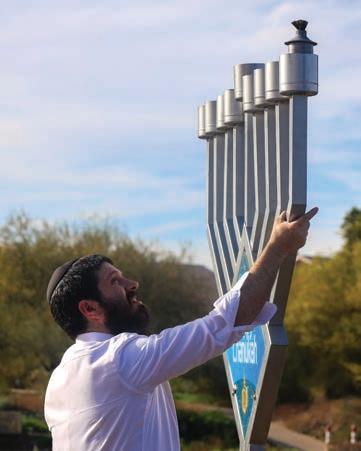
Rabbi Shneur Wolfman lights the menorah at Chabad of Moon Valley’s Chanukah celebration at Moon Valley Park on Dec. 14, 2025.
COURTESY OF KAYLENE MCCANNON
Rabbi Shneur Wolfman helps Councilmember Debra Stark prepare to light the menorah at Chabad of Moon Valley’s Chanukah celebration at Moon Valley Park on Dec. 14, 2025. COURTESY OF KAYLENE MCCANNON
Anthem community rallies after antisemitic graffiti discovered
MALA BLOMQUIST | MANAGING EDITOR
On Jan. 12, Rabbi Yossi Friedman of Chabad of Anthem and the North Valley was made aware of antisemitic graffiti discovered at the Anthem Park and Ride off North Daisy Mountain Drive in Anthem, north of Phoenix.
“Someone saw the graffiti and posted on Facebook asking what they can do about it,” said Friedman in an email to Jewish News.
Friedman said that many people reached out wanting to know how they could help and that it was heartening to see the positive responses.
“Our beautiful neighborhood has been targeted by hate,” said Friedman in a statement sent out after the discovery. “We know that the people here are loving and will not allow this to destroy our community.”
Friedman shared the message on Facebook and invited the community to gather that evening to paint over the graffiti. He stated that the event “is open to everyone, Jewish and non-Jewish alike,
who wish to stand in solidarity against hate and show support for the affected community.”
The two photos he shared of the vandalism were of a swastika painted with red paint and the wording “Jew’s killing kids” with a Star of David inside a circle with a line drawn through it.
Friedman contacted the sheriff’s office and was assured that they would do everything possible to stop this kind of activity and asked that if anything like this happens in the future, to report it immediately.
Soon after Friedman posted on social media, a group gathered at the site. Once at the location, they found other examples of antisemitic graffiti.
Friedman told Jewish News he was touched to see the community come together and show support for each other, and to stand up and not back down in the face of fear.
“For me, it was deeply moving. Jews and non-Jews standing together. Neighbors
supporting neighbors. A community choosing care over fear,” said Friedman in a statement.
He also mentioned that one of the “brightest lights of all” was a man who identified himself as Mike, who came down right away to clean up the graffiti. In his words, he said, “I’ve seen hate, and I want to do everything I can to eradicate hate.”
In an email to followers on Jan. 16, Friedman started it with “This week in Anthem began on a dark note.”
He then shared the Chassidic teaching that says: The light that comes from darkness is even greater than ordinary light. “This week, we saw that teaching come alive,” he said.
He also quoted a Chabad Rebbe who once said, “We are day workers. Our job is to bring light.”
Friedman stated that right now, that calling has never been clearer.
“As Jews, we are taught that fighting evil is mainly through light. And I thought
the response from the community very much reflected that,” he told Jewish News. “And I hope we all get inspired to try even harder to bring light to ourselves, our families, our communities and the world.” JN
For more information, visit jewishanthem.com.
Two examples of the antisemitic graffiti found at the Anthem Park and Ride. COURTESY OF CHABAD OF ANTHEM
AI and Yitro
YITRO: EXODUS 18:1 - 20:23
AI has become a powerful tool, and many of us enjoy using it in a variety of ways. It can be a tremendous help. However, this week’s parshah offers an important lesson from Yitro that gives us reason to pause and reflect.
We know that Yitro, in his desire to help the Jewish people, merited that an entire parshah be named after him forever. Chazal explain that he caused an addition to the Torah, which is why his name is Yitro — related to yoser, meaning “extra.” But what was so special about Yitro that he warranted an entire parshah?
From the very beginning, we learn in the Midrash (Sotah 11a; Shemot Rabbah 1:9) that Yitro was one of the three advisers to Pharaoh who initially collaborated regarding the enslavement of the Jewish people. The three advisers were Bilaam, Yitro and Iyov. Yitro objected to Pharaoh’s plan and refused to take part in it. As a result, he fled to Midian, willingly giving up his prestige and position. This shows that Yitro truly believed the Jewish people should not be enslaved and was prepared to sacrifice his status for what he knew was right.
We see this same character trait later in Yitro’s life. After leaving Egypt, he settled in Midian for many years and rose to become one of its leaders and the High Priest. Yet he left all of that behind to join the Jewish people in the Midbar and ultimately chose to convert — meaning he had to start from the very beginning.
Imagine someone leaving a position like the Pope and starting to learn Gemara from scratch; it is not easy. Yitro gave up comfort, prestige and wealth for the sake of truth.
We see this again in this week’s parshah. When Yitro arrived in the Midbar, he observed Moshe judging the people alone, with long lines and great strain on both Moshe and the nation. Yitro did not believe this was the correct system. Even though he was new and could have simply accepted the situation, he felt it was not appropriate for the Jewish community. He voiced his concern and offered a better plan. Moshe listened and changed the system. This, too, stemmed from Yitro’s deep commitment to truth.
We all know the virtue of speaking truthfully and honestly. Yitro teaches us a higher level: one must be willing to give things up for the truth.
7 - 6:43 P.M.
14 - 6:49 P.M.
This idea is very relevant to our use of AI today. AI can be a wonderful resource — I am not referring to AI used as a tool for editing, research or programming. I am referring to “fake AI,” such as generating altered images that completely change how a person looks or place them in a different location within seconds. Are we not creating false realities? Should we not distance ourselves from falsehood, as the pasuk says:
“Midvar sheker tirchak — Keep yourself far from a false matter” (Shemot 23:7). May Yitro’s example guide us to use new technologies with integrity, honesty and a deep commitment to truth. JN
My 4-year-old says the most precious thing in our home is our passports. She gets it.
RABBI YAACOV BEHRMAN | JTA
We are living in uncertain times, with the rise of antisemitism and the normalization of things that were once universally condemned. Swastikas in Jewish neighborhoods, on trains, in parks, even in the snow, have become routine. Just last night, a driver intentionally rammed his car into Chabad Headquarters in my neighborhood in Brooklyn. While the motive remains under investigation, the incident underscores the very real dangers facing Jewish communities across the country.
My 4-year-old brings home a two-page class newsletter each week with highlights tied to the Torah, holidays, songs and things that happened in school. The teacher also asks each child a question and prints all their answers.
Last week: “What’s something noisy in your house?” The plague of frogs was noisy.
This week: “What’s a treasure or something special in your home?” Most students said jewelry, toys or coins.
My daughter Sarah answered, “Passports.”
Friday night, reading the newsletter at the Sabbath table, I asked her why.
She said, “Because we keep them hidden in the safe and they let us travel if we ever have to leave.”
Sarah is only 4 and has no idea how true her words are. Her mother’s grandparents didn’t have passports after World War II and were stateless for years. My grandmother and her siblings escaped Berlin largely because they had the papers necessary to leave and got out in time.
Recently, we made passports for each of our kids, even our 7-month-old, at my wife’s urging. We decided it was something every child should have, just in case.
This generation prides itself on not cowering or being afraid. Jews should stand tall and proud. But strength doesn’t mean naiveté. It means being prepared, able to defend yourself, and also able to leave if you ever have to.
History taught us that antisemitism is deeply rooted in society and never fully disappears. In the past, the strategy supported by major Jewish organizations and leaders was to meet with community
leadership and hope that change would trickle down. If the leaders got along, everyone would.
Today, the challenge is different. Much of the hate isn’t coming from leaders. It’s coming from young voices on social media. Everyone has a megaphone. Anyone can spread poison in seconds.
Just days after influencers in a Miami Beach nightclub were filmed singing the Y song “Heil Hitler,” a video that quickly went viral, more than 65 swastikas were painted over two nights in a children’s park in heavily Jewish Borough Park. I have no evidence the two incidents are directly connected, but it’s hard to ignore the timing. At the very least, the influencers are normalizing and celebrating this kind of behavior.
A new strategy is clearly needed. Simply shouting “antisemitism” isn’t enough. It may generate clicks or fundraising emails, but it doesn’t change minds.
We should continue meeting people and building bridges, but much of this fight now starts closer to home. The real responsibility begins with parents and
educators. Children need the tools to recognize hate and refuse to fall prey to it. No organization can replace the role of parents and teachers. If they don’t step up, we risk raising a generation in a more dangerous and hateful America.
In the meantime, preparedness can look as simple as what my 4-year-old already understands: “Passports.” JN
The views and opinions expressed in this article are those of the author and do not necessarily reflect the views of JTA or its parent company, 70 Faces Media.
Rabbi Gavriel Goetz is the head of school at Yeshiva High School of Arizona.
Find
Rabbi Gavriel Goetz COURTESY OF RABBI GAVRIEL GOETZ
For many, passports are a symbol of being prepared.
SeniorLIFESTYLE
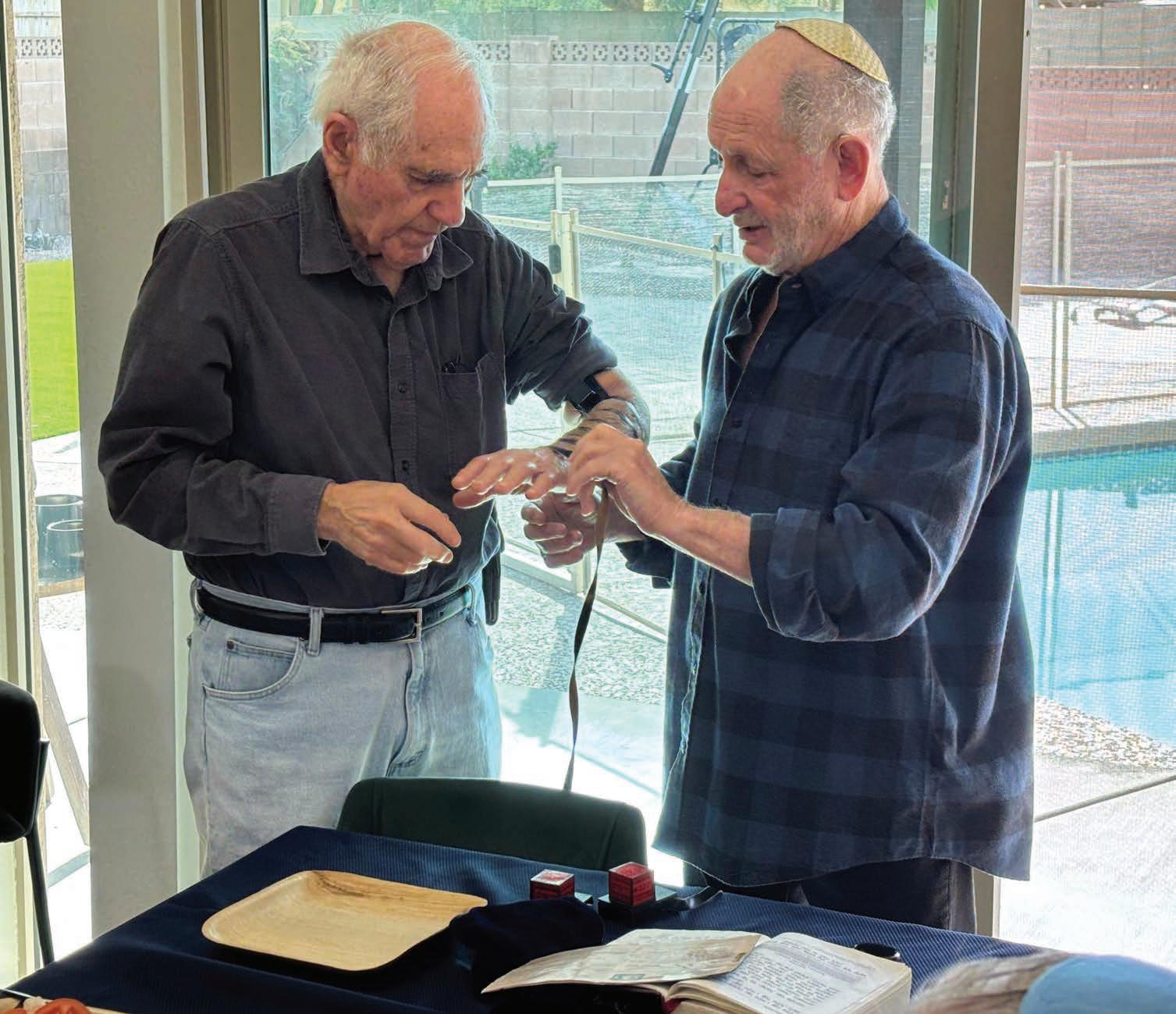
Isy Lifshitz, right, helps Len Ledet put on tefillin at the Smile On Seniors BLT (Bagels, Lox and Tefillin) Men’s Social.
PHOTO COURTESY
Maravilla Scottsdale is expanding!
Maravilla Scottsdale, a retirement resort community nestled between the Champions Golf Course at TPC Scottsdale and the world-renowned Fairmont Scottsdale Princess, is expanding to o er even more high-end services and amenities.
SRG Senior Living announced the final phase of Maravilla Scottsdale is currently under construction with 47 new casitas and 115 new lodge homes, available for move-in now. Each home is meticulously designed to cater to residents who seek elegance and comfort in a vibrant, active community.
Maravilla Scottsdale is more than just a place to live — it’s a lifestyle. The community features an impressive array of amenities that make every day feel like a getaway. Residents enjoy the grand clubhouse, a central hub of activity and relaxation, complete with an indoor pool and resort-style locker rooms. Maravilla Scottsdale o ers exceptional dining at the elegant Ironwood Grill and the casual Café del Sol. A new restaurant called Fore with expansive views of the TPC golf course will debut Summer 2026. Residents of Maravilla Scottsdale indulge in pampering at the full-service Sage & Citrus Spa or stay active with a variety of fitness classes and putting greens coming soon.
In addition to its remarkable o erings, Maravilla Scottsdale fosters a warm and engaging atmosphere where neighbors become friends through thoughtfully curated social events, lifelong learning opportunities, and cultural experiences tailored to residents’ interests. Whether discovering new passions in creative arts studios, participating in volunteer initiatives, or simply enjoying tranquil walks amid beautifully landscaped grounds, residents find countless ways to enrich their days and embrace a vibrant, fulfilling lifestyle at the heart of this extraordinary community.
Step into the world of Maravilla Scottsdale — where luxury, comfort and community come together. Private Casita Model Tours are available, and residents can move in and start living the Maravilla lifestyle. To learn more, visit MoreMaravillaScottsdale.com or call 480-269-1952.
Helga Melmed shares her Holocaust story with Chandler audience
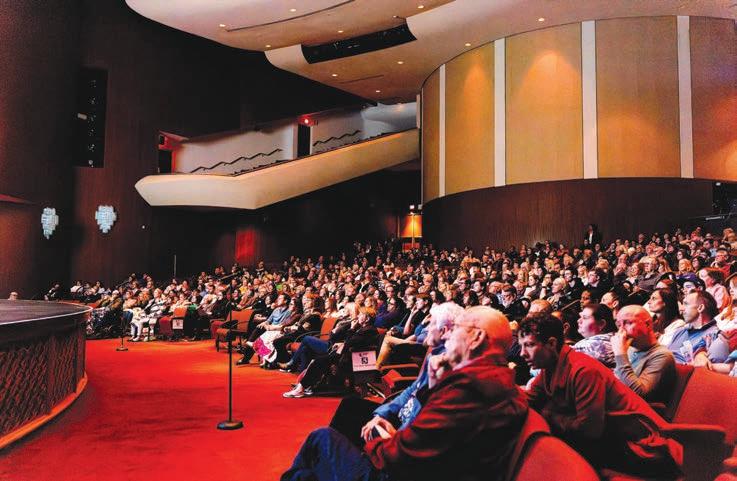
More than 120 students were in the crowd that filled the Chandler Center for the Arts on Jan. 8 as 97-yearold Holocaust survivor Helga Melmed took the stage. The evening, hosted by the Chabad of the East Valley and Pollack Chabad Center for Jewish Life and other community partners, combined music, reflection and testimony.
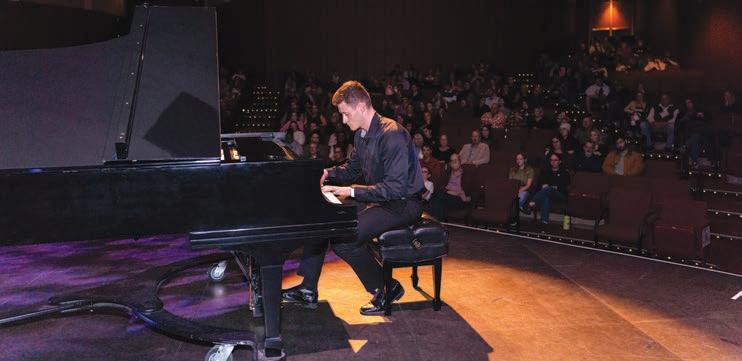
The program opened with a piano performance by local musician Tomer Ben Ezer, who selected three works he felt reflected the evening’s tone. Introducing the pieces, he explained that Tchaikovsky’s “October” reflected the heaviness of receiving devastating news, while Rachmaninoff’s “Prelude in C-Sharp Minor” conveyed deep sorrow. He concluded with “Moment Musicaux No. 4,” also by Rachmaninoff.
“I thought the last piece should be something a bit more powerful. It’s very intense and a difficult piece to play, not just physically or technically, but also emotionally,” he said. “It’s supposed to resemble how we should, even though we have pain in us, push through and continue on.”
Rabbi Mendy Deitsch, director of Chabad of the East Valley and Pollack Chabad Center for Jewish Life, welcomed the audience and shared the importance of hearing testimony directly from a survivor. “We are living in the best of times, but also the most challenging of times,” he said.
Deitsch shared a recent story from Sydney, Australia, where a mother illuminated a Jewish symbol in her front
yard following the Oct. 7 attacks in Israel. When her children begged her to turn it off after 15 Jews were killed in an attack at Bondi Beach, she did. Then a neighbor saw the light off and was upset and said, “They turned off the light. They turned off the pride. They turned off good over evil.”
“My friends, this is the challenge that we face every day,” said Deitsch. “In a time of darkness, we have to bring light. In a time when the world is fearful, we bring positivity, unity, holiness and greatness into the world around us.”
The focal point of the evening was the testimony of Melmed, who was born in Berlin in 1927 and survived Auschwitz, forced labor camps and a death march before liberation.
MALA BLOMQUIST | MANAGING EDITOR
It was a full house at the Chandler Center for the Arts to hear Helga Melmed. COURTESY OF CHABAD OF THE EAST VALLEY
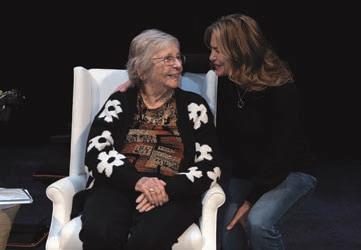
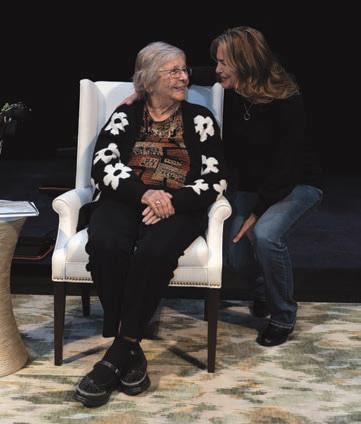
Holocaust survivor Helga Melmed, with a guest from the event, shared her story in Chandler on Jan. 8. COURTESY OF CHABAD OF THE EAST VALLEY
hid the true fate of the items and told her daughter they were lost or discarded.
She recalled being beaten by a teacher at age 5 and labeled a “dirty Jew” before she even understood what the word meant. “I went home crying to my mother,” she said. “I had taken a bath. My hair was washed. I had nice clothes on. Why am I a dirty Jew?”
It was difficult for her mother to explain what the phrase meant, so she told her to ignore it. She lasted only one semester at that school before her parents put her in a private Jewish day school.
As antisemitic laws tightened in Germany, the Nazis demanded Jews turn in their valuables. The family lost their radio, silverware and jewelry. Melmed’s mother
One morning, as she arrived at school, all her friends were standing around a big pit with smoldering black coal.
“They were taking things out of our classrooms. They were burning all our books, all our homework and everything that was around the school,” she said.
Eventually, all Jewish schools were burned, and teachers and parents would take small groups of children into their basements to teach them in hiding.
One night, Melmed’s family was awoken by a knock on the door. German soldiers told them to hurry up, that they were taking them to a better place.
“What could be better than home? The place I have lived ever since I was born,” she recalled.
The family was taken to what they called a “gathering station,” an old slaughterhouse. People who stepped out of line or said the wrong thing were hanged immediately.
“My parents took me to the center of the crowd, so I could not see what was going on, but I could hear the screams of the people, I could smell the blood and I could see the blood running on the floor,” she remembered.
They were only there for a short time before everyone was forced into cattle cars. Melmed said they traveled for days, finally arriving at the Lodz Ghetto in Poland.
the ghetto was liquidated and the children were deported to Auschwitz.
At Auschwitz, Melmed described the constant selections, the smell of burning flesh and the terror of watching children led away to the gas chambers. She and the other girls were shaved, humiliated and marched naked past laughing guards. Afterward, they were led to “the chambers,” and Melmed thought that was the end.
“We held each other’s hands tight. As we walked in, we sang and prayed,” she said. But when the spigots turned on, water came out, not gas. “Then they threw some clothing to us that they had gotten from the people that they had killed. They had a smell. We didn’t get any shoes or anything for our feet.”
Again, Melmed and the others were loaded onto cattle cars and arrived at Dessauer Ufer labor camp in Hamburg. There, she was forced to haul rubble from bombed buildings, surviving on small pieces of bread and watery soup. When bombing increased in Hamburg, the Nazis gathered everyone into trucks.
Everyone thought that they were being taken to another work camp, but the Germans stopped the trucks and demanded that everyone get out.
While in the ghetto, she and her mother worked in a factory while her father did hard labor. During the day, he was able to scrounge potato peels and coffee grounds that her mother would fry with a little mineral oil on a small stove.
“I used to say to my mother, ‘It would be so nice to put a little onion in there,’” said Melmed. “But we didn’t have an onion. So, we ate it without and went to bed so we could work again when the sun came up.”
One day, as her father headed to work, the Nazis took him, and others, out in the marketplace and shot them for target practice.
Her mother was devastated after her father’s death and grew weaker until she was unable to work. Melmed would try to feed her when she got home, but she always refused, insisting that her daughter eat what little they had.
On Melmed’s birthday, her mother told her she had a present for her. “She handed me this beautiful onion. It was too late because Dad didn’t bring the potato peels and the coffee grounds anymore. But it was still a beautiful present. It was the best present I ever got in all my life,” she remembered.
When Melmed woke up the next morning, her mother was dead.
Melmed was eventually taken in with other orphaned children under the supervision of one of the ghetto’s Jewish elders. The man took in four boys and four girls; those girls became Melmed’s “camp sisters.” That stability ended when
“They made us walk and walk and walk for more than 90 miles,” she said. “It was a death march. If anyone walked out of line, they were shot.”
Liberation came at the last possible moment. British and American soldiers found her barely alive. At 16, she weighed just 46 pounds.
Recovery began in Sweden, where she was taken in by a family who treated her as their own. Soon her aunt, her mother’s sister, found her through the World Jewish Congress. She wanted her to come live with her in America.
“I had $90 in Swedish money and a small suitcase with my belongings,” she said. “I came to America and saw the Statue of Liberty and we all cheered. We felt very fortunate to be coming to this country and to be free.”
Melmed learned English, graduated high school, became a nurse and built a life defined not by hate, but by resilience. She married, raised four children, and today is the grandmother of four collegeeducated grandchildren.
“And that’s what happened out of those terrible, terrible years,” she said.
“And it shows that people can respect and love each other, and that’s what we need to do. We need to respect all people, all religions, all colors, all everything, because we are all human beings. We all have red blood, and we need to love and respect each other because violence and hate will destroy the world. So, I hope that everybody, especially the children, will try and make it a better world.” JN
For more information, visit chabadcenter.com.
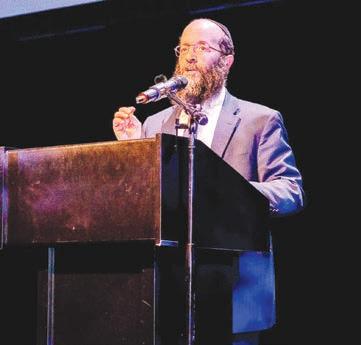
Rabbi Mendy Deitsch addressed the crowd before Helga Melmed spoke. COURTESY OF CHABAD OF THE EAST VALLEY
Pianist Tomer Ben Ezer played pieces he believed reflected the evening’s somber tone.
CHABAD
West Valley rabbi explores Morocco’s 2,000-year Jewish history
MALA BLOMQUIST | MANAGING EDITOR
I
n November, Temple Beth Shalom of the West Valley (TBSWV) Rabbi Dana Evan Kaplan traveled to Morocco with 25 Reform rabbis, all members of the Central Conference of American Rabbis, plus a few cantors and one Conservative rabbi. The trip was organized by Ayelet Tours and led by the only Jewish tour guide in Morocco, Raphael David Elmaleh. Elmaleh is the co-author of “Jews Under Moroccan Skies: Two Thousand Years of Jewish Life” and was instrumental in transporting artifacts to the Museum of Moroccan Judaism.
Kaplan taught “Jews and Judaism in Morocco” in December at TBSWV, which covered both the Berber Jews who arrived in Morocco more than 2,000 years ago, before the beginning of Islam, as well as the refugees who were expelled from Spain in 1492 and from Portugal in 1497.
In the following Q&A, Kaplan shared his insights, stories and reflections with Jewish News from his recent journey through Morocco’s historic Jewish sites.
Was this your first time visiting Morocco, and if so, what were your initial impressions?
Yes, this was my first time to Morocco, and my first time to an Arab country. What was truly amazing was to realize that the Jewish community of Morocco predates the destruction of the Second Temple in 70 CE. That means that there have been Jews in Morocco for more than 2,000 years!
My first impression was very positive. The Jewish community in Casablanca was very warm and welcoming. We visited a number of Jewish community institutions in Casablanca, Marrakesh and elsewhere. Since 1997, the Foundation of Moroccan Jewish Heritage has preserved dozens of synagogues around Morocco and created the only Jewish museum in the Arab world, the Museum of Moroccan Judaism. More than 167 Jewish cemeteries and shrines throughout the country have been restored. In 2020, in the port city of Essaouira,
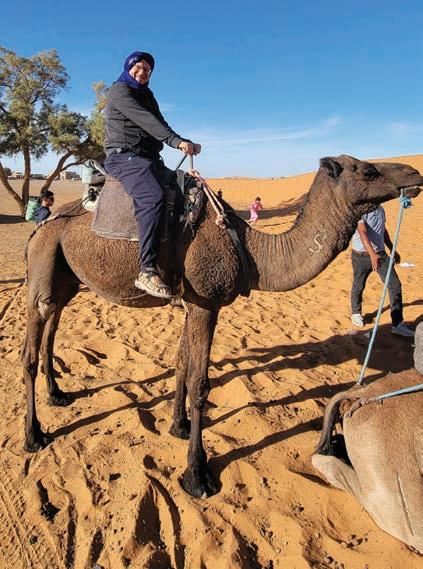
Rabbi Dana Evan Kaplan’s exploration in Morocco included a camel ride. COURTESY OF RABBI DANA EVAN KAPLAN
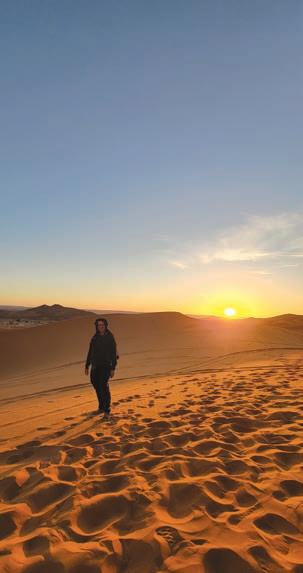
Rabbi Dana Evan Kaplan in the Sahara Desert. COURTESY OF RABBI DANA EVAN KAPLAN
SENIOR
King Mohammed VI inaugurated Bayt Dakira (The House of Memory), a center dedicated to the historic coexistence between Jews and Muslims in Morocco. Furthermore, to support the preservation of Moroccan Jewish cultural heritage, the king launched a conservation plan for the former Jewish quarters of several cities. This plan has included the rehabilitation and renovation of Jewish sites, as well as the restoration of Jewish names to the streets of the quarters.
How long were you there, and what synagogues, cemeteries or other Jewish heritage sites of Morocco did you visit?
The Jewish study tour lasted 10 days, and then I went on a private Sahara tour for another six days.
With the Ayelet Tour, we visited Casablanca, Essaouira, Marrakesh, Fez, Meknes and Rabat.
In Casablanca, we visited Neve Shalom School and Temple Beth-El, the synagogue that many consider the center of Judaism in Casablanca. It was built in 1949 by Algerian Jews who had come to Casablanca and wanted their own synagogue. At the time, it was outside of the Jewish quarter but now it’s in the heart of the Jewish neighborhood.
In Marrakesh, we went to Slat Al Azama Synagogue (Synagogue of the Exiles), established around 1492 by Jews who were expelled or fled from Catholic persecution in Spain and Portugal.
The Jewish cemetery in Marrakesh has been recently restored after years of neglect. Here, we saw monuments and graves commemorating children who perished during the epidemics in the 17th century. We learned about the great rabbis and kabbalists of Marrakesh and how Jews from around the world make pilgrimages to their graves.
Fez, for centuries, was home to a thriving Jewish community and has one of the oldest mellahs (Jewish quarters) in the country.
The Al Fassiyine Synagogue is one of the few synagogues where the non-Sephardic rituals of Toshavim (indigenous Moroccan Jews) persisted until the 20th century.
In the Jewish cemetery in Fez, Rabbi Yehudah Ibn Atar (1656-1733) has a large grave under a roof. Atar is remembered as a “sacred man of God” with stories of miracles attributed to him. He authored a famous book on divorce, and legend states that he forced a man beating his wife to either stop or divorce her. He was accused of trying to poison the king and was thrown into a lion’s den for three days. After three days, they found the lion studying Torah!
There was also a plaque commemorating Sol Hachuel, a 17-year-old girl of French Jewish background who refused to convert to Islam to marry the king and was subsequently beheaded. Our tour guide pointed out that Queen Esther joined the king’s harem and later helped her people, whereas Hachuel’s story is the exact opposite.
The House of Maimonides in Fez, Morocco, is a popular name for the Dar al-Magana building. While the legend claims the famous Jewish philosopher Maimonides once lived there, this is not historically confirmed and indeed the building had not yet been constructed when he was living in Fez. Unfortunately, we were not taken there. Rather, we were shown a nearby Chinese restaurant named “Chez Maimonide” that displays portraits of the philosopher!
Despite the humorous misunderstanding, I was thrilled to be so close to where he had lived and studied. The atmosphere of the Mellah of Fez fits the environment I imagined of the place where Maimonides would have come to maturity.
What did you learn about Morocco’s Jewish past and its community today?
In medieval times, Moroccan Jews enjoyed better conditions than Jews living in certain other Arabic-speaking countries. Jews were obliged to live in mellahs and were therefore separated from the Muslim population. The mellah was close to the king or sultan for protection. Many of these mellahs still exist.
Only 1,300 to 2,000 Jews still live in Morocco, mainly in Casablanca, from a Jewish population of approximately 275,000 in 1948. The community today is warm and welcoming and feels relatively secure in the country. Nevertheless, their children tend to study abroad and seldom return. In that regard, it is not that different from many smaller Jewish communities throughout the United States.
How would you describe the relationship between Jews and Muslims in Morocco today?
I did not meet what you might call “typical” Moroccans. Most of the people I interacted with were either working in the tourism industry, connected to the Jewish community or, at the very least, able to speak English or Spanish.
That said, there seems to be a great respect for Jews and Judaism throughout the country. At almost every tourist stop, there would be a reference to the Jewish history of the location. There are diplomatic relations with Israel, and Israel and Israelis seem to be respected.
How did this journey affect your own sense of Jewish identity?
There are many positive things to say about the history of the Jews in Morocco. Every Moroccan Jew is familiar with the story of how King Mohammed V saved the Jews of the country from the Nazis. The king is an oversized presence here. There are pictures of him everywhere. Everyone says how wonderful he is and I guess that he is the primary reason the country has been so much more stable and successful than its neighbors.
According to the tour guide, during World War II, King Mohammed al-Khamis bin Yusef bin Hassan al-Alawi, known simply as King Mohammed V, refused to allow the Vichy French and the Germans to put Jews in concentration camps.
The current king, Muhammad VI, the grandson of Mohammad V, wants Moroccan Jews in Israel, France, Canada and elsewhere to continue to feel a connection to the country.
What moment of the trip stands out most vividly in your memory?
Visiting Bayt Dakira in Essaouira. The interfaith center there was established to highlight the historical coexistence of Jewish and Muslim communities. It features a collection of objects, photographs and historical materials
that tell the story of the city’s Jewish community. It also includes a research center. When we arrived, we saw an interfaith program, being conducted in French, talking about Jews and Muslims in Morocco.
It is also one of the places Moroccan Jews visit on pilgrimage. Moroccans, including those with Moroccan heritage living abroad, regularly go on pilgrimages called “hiloula” to pray at the graves of great rabbis known as “tzadikim” in Morocco. These pilgrimages, which can draw tens of thousands of Jewish pilgrims, involve prayers and celebrations at the tombs of figures such as Rabbi Haim (Chaim) Pinto. Pinto is remembered as a man whose prayers were received in heaven in such a way that miracles resulted. These pilgrimages are often supported by the Moroccan government, with local officials participating and the events serve as a way to honor and publicize the Jewish heritage of Morocco.
A Jewish journalist whose family came from another North African country remarked how Morocco tries to preserve and enhance Jewish sites, whereas some of the other North African countries try to obscure and erase the Jewish presence. JN For more information, visit tbsaz.org.
The ArtsJewish News Special Section
From galleys to the stage: Inside Brandeis’ Book & Author Event
MALA BLOMQUIST | MANAGING EDITOR
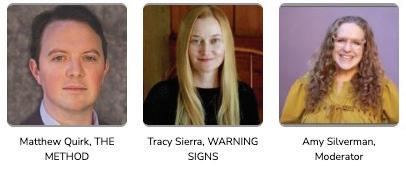
On Feb. 23, hundreds of Valley bibliophiles will gather at The Westin Kierland Resort and Spa in Scottsdale for the Brandeis National Committee Phoenix Chapter’s Book & Author Event. Now in its 36th year, the annual program drew nearly 800 attendees last
year. Amy Silverman, executive producer of “The Show” on Arizona NPR, returns to moderate.
Planning for who will be featured at the event begins months before, with a small group who pore over galleys, read SEE BRANDEIS, PAGE 20
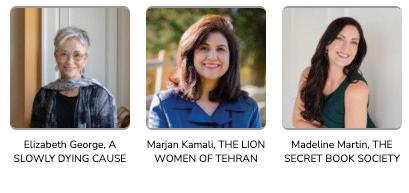
Some of the authors featured at this year’s Book and Author event.
A lost Purim story finds its voice in Scottsdale
MALA BLOMQUIST | MANAGING EDITOR
On the day before Purim, as Jews in the Valley prepare to share the heroic tale of Queen Esther, an audience in Scottsdale will have the opportunity to hear that story unfold in a way few have ever experienced.
On Sunday, March 1, at 3 p.m., at the Ina Levine Jewish Community Campus, the Arizona Bach Festival will present the Arizona premiere of Lidarti’s oratorio “Esther,” a piece by Austrianborn composer Cristiano Giuseppe Lidarti. Sung entirely in Hebrew, the work is widely regarded by scholars as the largest and most significant work of Hebrew music from the 18th century — and one that was nearly lost to history. In 1997, a scholar at Cambridge University discovered the 200-year-old piece, which had long been considered lost. The history of the piece is as
incredible as its discovery.
The composer, Cristiano Giuseppe Lidarti, was an Austrian who spent his life working in Venice. The Portuguese Jewish community in Amsterdam commissioned him to write the oratorio based on the heroine of Purim, Esther. The libretto, or text for the work, was created by Rabbi Jacob Raphael ben Simah Judah Saraval in Hebrew and was based on the Esther Scroll. The work was further influenced by the 1689 play by Jean Racine and Handel’s 1732 libretto, both of which tell the Esther story. The full title of Saraval’s libretto is “The Salvation of Israel by the Hands of Esther.” The work was authenticated by Israel Adler, a musicologist of Jerusalem’s Hebrew University.
“This piece may be a little late for our period,” said Scott Youngs, artistic director and founder of the Arizona Bach Festival. “We do Bach and his contemporaries, so 1685 to 1750. This is 1774, almost 25 years after Bach died. But this piece is in that in-between period between the Baroque and Classical periods, called the Galant style.”
Youngs explained that the Galant style is simpler, yet highly emotional, rather
than slightly reserved like Baroque.
For Youngs, discovering “Esther” was a revelation. Although he had seen references to the work in academic journals, he had never heard it performed in full until about a year and a half ago, when he came across a recording of its modern premiere in Israel in 2000.
“It was a completely new experience for us to discover. The solo writing is absolutely spectacular. It’s as florid as you’d expect from the period, but it’s completely charged with the emotional storyline that’s so captivating,” he said. “It ended up being such a foundational piece of Jewish history that I was completely taken aback.”
Youngs explained that the Amsterdam Jewish community at the time the oratorio was written was made up largely of Jews who had fled Portugal and Spain, where they had lived as secret Jews, outwardly practicing Christianity.
“When they arrived in Amsterdam, they were finally able to live openly as Jews,” he said. “There’s a clear parallel to Esther’s story — marrying into the Persian court, hiding her identity and then revealing it at the moment when it
could save her people.”
The oratorio is written in three acts for six soloists, a three-part chorus and orchestra. It will be performed entirely in Hebrew, with an English translation both projected and in the program.
Scottsdale-based mezzo-soprano Chen Holtzman translated the entire storyline and trained the cast, including soprano Josefien Stoppelenburg, who plays Esther, in proper Hebrew pronunciation.
“Singers are trained to be very versatile in language, and it’s been fun to watch Chen talk in technical language to them about how each vowel and consonant is pronounced,” said Youngs. “She’s been my resource, my guru, for all things Hebrew.”
Like all oratorios, “Esther” is performed without full staging, sets or costumes, distinguishing it from an opera. Still, Youngs said each character will wear something symbolic, such as a crown for King Ahasveros, a tallit for Mordecai and a tiara for Esther.
Youngs explained that the characters will be in constant dialogue. “They will interact in arias and recitatives. They will expand on the text with solo arias,”
Arizona Musicfest Continues To Celebrate 35 Years With Star-Studded Concert Line-Up
Arizona Musicfest continues its milestone 35th Anniversary Season for 2025–2026, featuring an exciting lineup of Grammy, Tony and Oscar Award winners, and a wide array of world-class musicians.
“From its humble beginnings as a small chamber music festival, Arizona Musicfest has grown into a major cultural destination, drawing top-tier performers and enthusiastic audiences from across the Valley and beyond,” says Allan Naplan, executive and producing director, CEO.
The 2025–26 season is continuing with the return of Musicfest favorite Michael Feinstein and his all-new show “Big Band Broadway” with The Carnegie Hall Big Band. Broadway legend and three-time Tony Award winner Patti LuPone will take the stage on February 16. In April, six-time Grammy Award-winning jazz sensation, Samara Joy, will make her Musicfest debut.
Other season favorites include international vocal sensation Il Divo, Jazz at Lincoln Center Presents “The Great American Crooners,” Grammy-nominated violinist Philippe Quint in a multimedia experience called “Charlie Chaplin’s SMILE,” piano and tap-dance phenoms Conrad Tao and Caleb Teicher unite in their intimate performance, “Counterpoint,” and a diverse lineup of jazz ensembles, nostalgic rock, and classic tribute acts continue. The acclaimed Festival Orchestra Week, led by Maestro Robert Moody, returns with a special tribute to America’s 250th birthday and performances of works by Holst, Mozart, Tchaikovsky, Brahms and more.
The 35th season ends in a spectacular finale with a full-scale production of the modern musical classic, “Ragtime,” bringing current and past Broadway stars to the Herberger Theater stage with a live 30-piece orchestra from April 24-26.
Scott Youngs, artistic director and founder of the Arizona Bach Festival.
Advertorial
“WE
QUALITY OF WRITING, AND WE THINK ABOUT WHAT OUR AUDIENCE MIGHT WANT TO READ.”
lots of books and then get together to discuss what might resonate most with their audience.
“We start in about May,” said Jytte Methmann, who is on the book selection committee for the second year. “We have a few long-standing relationships with publishers, and they send us lists of what they have coming out during the period of October through the beginning of February.”
The committee, which also includes Gayle McKenna and first-year member Geri Gould, each read many books before they met to discuss them.
“We look for the quality of writing, and we think about what our audience might want to read,” said Methmann. The process is deliberately collaborative. Each committee member reads at
least one book in full, while others read portions, before coming together to discuss whether a title belongs in the “maybe,” “no” or “must-have” pile.
While the committee members admit they have different genre preferences, they were surprised by how often their tastes overlapped.
“The thing I think is so fascinating is that among the three of us, we have very different favorites in genres,” said Gould. And yet the books we selected were so compelling to all of us that we just assume the audience, no matter what kinds of books they normally are driven toward, would find all of these books as interesting, exciting and readable as we have.”
Each member had favorites among this year’s selections. For Methmann, Madeline Martin’s “The Secret Book Society” stood out, though she emphasized, “I liked all of them. I liked every
single one of them.”
Gould highlighted “The Lion Women of Tehran” by Marjan Kamali, noting its unexpected relevance. “We didn’t know that when we picked it, that there would be so many news headlines about Tehran,” she said. “This book is about the friendship of women over the years against the political backdrop of changes that were made in Tehran since the ’70s. It was very timely — and coincidental.”
McKenna, meanwhile, found herself captivated by Tracy Sierra’s psychological thriller “Warning Signs,” a departure from her favorite genre of historical fiction.
“It’s not something that I normally go after,” she said, “but it just drew me in, and I kept going and going.” Told from the perspective of a 12-year-old boy struggling to earn his father’s love, the novel blends family dynamics with mounting suspense. “There was tremendous psychological drama,” McKenna said, “and even a hint of something creepy out there in the mountains.”
The committee also selected “The Method” by Matthew Quirk, which Methmann described as “such a pageturner,” as well as a new installment in Elizabeth George’s long-running Inspector Lynley series, “A Slowly Dying Cause.”
“She’s written some 25 novels,” Gould said of George. “Many of them have been adapted for television, and they take place in England. I thought she was British, but she’s actually American.”
Gould said she’s eager to ask George how she became so knowledgeable about all things British, particularly about British architecture. “She describes the homes and the apartments, or wherever she goes in the books, with such detail that it seems to me she has tremendous knowledge of many areas.”
Meetings early in the process took place every couple of weeks, with members dividing up publishers to contact and reporting back on promising finds. As summer wore on, the list narrowed.
“There was a lot of reading during the summer,” Gould said with a laugh. “But Arizona in the summer — there’s not much else to do but stay inside.”
By early October, the committee had finalized its selections and sent personal
invitations to the authors.
“Hopefully they accept,” Gould said.
“These five accepted. We were very happy.” She said she feels a connection with the authors they all work with for the event. Over the years, the number of authors has varied from three to seven. The committee decided on five this year to give the authors enough time for their presentations.
Beyond the books and authors, what keeps the committee excited year after year is the event’s atmosphere.
“There’s a real sense of energy,” McKenna said. “Last year, we had just under 800 people. This year might be even more.” With 14 boutiques planned alongside the authors’ presentations, the event offers something for everyone.
Many attendees belong to book clubs, a fact McKenna believes directly benefits the authors. “People become interested, they recommend the books and sales go up,” she said.
Still, the highlight for all three women is hearing directly from the authors.
“That’s my favorite part,” Methmann said.
“They’re so engaging when they speak,” McKenna added. “Sometimes they’ll speak about their life experience, sometimes it’s their process, sometimes it’s an inspiration. I find the whole thing totally fascinating. You really get a sense of their personalities.”
After attending as a guest twice, Gould became a member herself. “It took two Book and Author events,” she said. “And then I joined.”
All the committee members hope all who attend enjoy their picks and maybe discover a new genre themselves.
“I hardly ever read mysteries, and yet so many of these are in the mystery genre,” said Gould. “I loved them and couldn’t put them down.”
McKenna echoed the sentiment and admitted she was surprised, at 78, to be so drawn into a psychological thriller.
“How nice that we have expanded the vast opportunities of what we now have to read,” she said. “It’s a whole new world.” JN
For more information, visit brandeisphoenix. org/ba2026.
Some of the authors featured at this year’s Book and Author event with moderator Amy Silverman. COURTESY OF BRANDEIS NATIONAL COMMITTEE PHOENIX
parts, reiterating the ‘Hallelujahs’ and the ‘Go kill them’ and ‘Save them.’”
He admitted this has been one of the biggest challenges they have taken on with the festival and he won’t be able to fully exhale until he is on stage with the orchestra in front of him.
“When you do a ‘Messiah,’ everybody’s done a ‘Messiah,’ it’s a known work,” he explained. “When you do something that’s completely unknown, it’s a different kind of challenge because you don’t have the automatic expectations of people.”
He is excited to showcase the piece with the Purim storyline right before the holiday and appreciates its uniqueness.
“It’s an unusual collaboration between a Christian and a Jew, with Saraval, a rabbi, writing the text and Lidarti, the Italian Austrian, doing the music. And now you have a Christian conducting,” he said. “It’s a wonderful bringing together of all kinds of people.” JN
he said. “Then the chorus is in the background, hammering home specific issues and topics, highlighting the good
For more information, visit arizonabachfestival. org/2026-festival.
The concert is sponsored in part by the Center for Jewish Philanthropy of Greater Phoenix, the Molly Blank Fund and a consortium of Jewish donors from across the Valley. Jewish News is published by the Jewish Community Foundation of Greater Phoenix, a component of the Center for Jewish Philanthropy of Greater Phoenix.
Arizona Broadway Theatre Takes Center Stage in the Valley
There’s nothing like being part of a live theatre experience. The moment the lights dim and the curtains open, audiences are transported to another time and place, pulled away from constantly buzzing phones, relentless news cycles and stressful to-do lists.
For more than two decades, Arizona Broadway Theatre has been an integral part of the arts and culture community in the Valley. The 466-seat theatre, located in the heart of the growing P83 entertainment district in Peoria, provides a total entertainment experience.
Perfect for audiences of all ages, Arizona Broadway Theatre combines an awardwinning, state-of-the-art theatre that highlights locally and nationally acclaimed artists, with a uniquely curated drink and food menu to enhance every production.
Each year, Arizona Broadway Theatre entertains audiences from across the Valley with full-scale musical productions. The theatre’s 21st season of shows is the largest lineup in the theatre’s history, with 10 musicals. The season runs from October 2025 through September 2026 with productions ranging from classics like “42nd Street” to award-winning musicals like “CATS” and “Avenue Q.” The season also features regional premieres of “Pretty Woman,” “Cher” and “Grumpy Old Men.”
“We are enormously grateful for the years of support our community has given us, especially as we celebrate our 21st season together,” said Kiel Klaphake, Arizona Broadway Theatre founder and CEO. “It feels like yesterday we opened our first production in a tent at the Peoria Sports Complex. We have come a long way since then and are excited about the future.”
The Arizona Broadway Theatre Performing Arts Association, Inc. is a 501(c)(3) nonprofit organization. Without support from the community, Arizona Broadway Theatre could not produce top-quality performing arts programming that Valley audiences have come to know, expect and deserve.
For more information about Arizona Broadway Theatre, visit azbroadway.org or call 623-776-8400.
Arizona Bach Festival presents the Arizona premiere of Lidarti’s Oratorio Esther
The Salvation of Israel at the Hands of Esther Valley of the Sun Jewish Community Center Purim – March
poster for the Arizona Bach Festival performance on March 1.
Featured Event
THURSDAY, FEB. 12
30th Anniversary Opening Night:
7-9 p.m. Scottsdale Center for the Performing Arts, 7380 E. Second St., Scottsdale. Join the Greater Phoenix Jewish Film Festival to celebrate its 30th year opening night with the U.S. premiere of “Heaven and Earth” followed by a post-film discussion with Hila Saada, Ruby Doaniass and Assi Azar. The film festival runs Feb. 12 through March 1 with film screenings in Chandler, Peoria and Scottsdale. For more information, visit gpjff.org.
Events
SUNDAY, FEB. 8
World Wide Wrap: 8:30 a.m. at Temple Beth Sholom of the East Valley, 3400 N. Dobson Road, Chandler; 9 a.m. at Beth El Phoenix, 1118 W. Glendale Ave., Phoenix. All are welcome to join in the mitzvah of wrapping tefillin. For more information, visit wrap.fjmc.org.
Kosher Kickoff Football Potluck: 4 p.m. Beth El Phoenix, 1118 W. Glendale Ave., Phoenix. Join Beth El to watch the game and enjoy a dairy potluck. Bring a vegetarian/dairy dish to share. Football square fundraiser for $5 a square. For more information, visit bethelphoenix.com/ event/super-bowl.
TUESDAY, FEB. 10
CAREaVAN 2026 Information Session: 6:15-7 p.m. Ina Levine Jewish Community Campus, 12701 N. Scottsdale Road. Join the Bureau of Jewish Education of Greater Phoenix’s Hebrew High to learn more about this travel and service experience for Jewish teens. For more information, visit bjephoenix.org/hebrew-high.
SATURDAY, FEB. 14
Music Through the Decades: 5-8 p.m. Temple Beth Shalom of the West Valley, 12202 N. 101st Ave., Sun City. Join TBSWV for an evening of music, dancing, food, dessert bake-off contest and more. Cost: $25 per person; register by Feb. 11. For more information, visit tbsaz.org.
SUNDAY, FEB. 15
Café Europa: 1 p.m. Congregation Beth Israel, 10460 N. 56th St., Scottsdale. Join the Phoenix Holocaust Association for an afternoon of socializing for Holocaust survivors, their families and friends. For more information, visit phxha.com/ connect.
TUESDAY, FEB. 17
An Evening with Comedian Pamela Schuller: 7:30-8:30 p.m. Location provided upon registration. Join NowGen, a program of the Center for Jewish Philanthropy of Greater Phoenix, and Gesher Disability Resources for an evening of comedy with Pamela Schuller, who has Tourette syndrome. This show is in honor of Jewish Disability Awareness Acceptance and Inclusion Month (JDAIM). Cost: $18 per person. For more information, visit phoenixcjp.regfox.com/ pamela-rae-schuller.
THURSDAY, FEB. 19
The Power of the Pivot: 4:30-6:30 p.m. Location provided upon registration. Join Women IN Philanthropy, a program of the Center for Jewish Philanthropy of Greater Phoenix, for a discussion and hands-on workshop led by the author of “Unruly,” Lauren Wittenberg Weiner, moderated by Alicia Haygood, owner and publisher of Scottsdale City Lifestyle Magazine. For more information, visit phoenixcjp.regfox.com/ unruly-the-power-of-the-pivot.
FRIDAY, FEB. 20
Community Luncheon and Agency Update:
1 p.m. Ina Levine Jewish Community Campus, 12701 N. Scottsdale Road, Scottsdale. Join
Gesher Disability Resources for their annual lunch with guest speaker and comedy storyteller Pamela Schuller. For more information, visit gesherdr.org.
Meetings, Lectures & Classes
SUNDAYS
Finding Meaning and Hope: 11 a.m.-12:30 p.m. Nov. 23-March 8. Temple Chai, 4645 E. Marilyn Road, Phoenix. Join Temple Chai for this support group for family caregivers caring for someone with memory loss, dementia or other cognitive impairment. Cost: Free; registration required. For more information, visit templechai.com.
Jewish War Veterans Post 210: 10 a.m. the first Sunday of the month in Central Phoenix. Any veterans, friends of veterans or if you just want to meet a vet, all are welcome. For more information, contact Michael at c365michael@yahoo.com.
MONDAYS
Heaven and Hell Series: 10-11:30 a.m. Feb. 2, 9 and 23. Temple Beth Shalom of the West Valley, 12202 N. 101st Ave., Sun City. Join TBSWV Rabbi Dana Evan Kaplan as he explores Judaism’s boldest and mysterious teachings about the afterlife, drawing from biblical texts, rabbinic debates, medieval philosophy and Jewish mysticism. Cost: $20 for members; $35 for nonmembers. Registration deadline is Jan. 29. For more information, visit tbsaz.org.
Pomegranate Guild of Judaic Needlework, Desert Cactus Chapter: 10 a.m. The Oasis at Sagewood, 4555 E. Mayo Blvd., Phoenix. The guild meets the third Monday of the month, adjusted when necessary to accommodate Jewish holidays. For more information, visit pomegranateguild.org.
Mahjong: 1:30-3:30 p.m. East Valley Jewish Community Center, 908 N. Alma School Road, Chandler. Come play mahjong each week. For all levels. Cost: Free; registration required at evjcc. org/mahjong.
Single Parent Zoom: 8 p.m. First and third Monday of every month. Join The Bureau of Jewish Education’s Family University single parents’ group for those looking to form friendships and build their support system with like-minded people. For more information or to register, visit bjephoenix.org/family-university.
TUESDAYS
Grief Support Group: 4 p.m. Beth Emeth Congregation of the West Valley, 13702 W. Meeker Blvd., Sun City West. All are welcome to this support group for anyone experiencing grief or any kind of loss. Cost: Free. For more information, call 623-584-7210 weekdays 9 a.m. to 12 p.m.
Maintaining an Upbeat Attitude: 7 p.m. Online. A class exclusively for people in their 20s and 30s, learn how Jewish Mysticism can help with your attitude with Rabbi Shlomy Levertov. Use this link: JewishParadiseValley.com/YJPclass. Cost: Free. For more information, visit chabadaz.com.
WEDNESDAYS
My Baby and Me: 9-10 a.m. Temple Chai Early Childhood Center, 4645 E. Marilyn Road, Phoenix. Join Temple Chai ECC for a weekly gathering for families with babies up to 12 months. Cost: Free. For more information, visit tcaz.shulcloud. com/event/my-baby-and-me-playgroup.html.
Torah Study with Temple Beth Shalom of the West Valley: 11 a.m.-12:30 p.m. Online. Weekly study group explores that week’s portion and studies different perspectives and debates the merits of various arguments. Intended for adults, Torah study is open to students of all levels. For more information, contact the TBS office at 623-977-3240.
Happiness Hour: 11:30 a.m. Online. Class taught by Rabbi Pinchas Allouche that delves into texts and references culled from our traditions to address a relevant topic. For more information, visit BethTefillahAZ.org.
Grief Support Group: 5-6 p.m. Online via Zoom. Therapist Susan Charney MSW, LCSW, leads a grief support group every first and third
Louis P. Borenstein
In loving memory of Louis P. Borenstein, who was born March 3, 1932, and passed away Jan. 25, 2026.
His leadership, warmth and unwavering devotion to family and community left an indelible mark on all who knew him.
A co-founder of Chompie’s Restaurant, he helped bring authentic New York tradition to the Valley in 1979. Lou, the “Borenstein Patriarch,” is now reunited with his beloved wife, Renee “Lovey” Borenstein, and leaves behind his three cherished children, six grandchildren and five great-grandchildren.
Wednesday of the month virtually for individuals experiencing the loss of an adult child or sibling. In lieu of any fees for these sessions, donations to Temple Solel are appreciated. For more information, contact susancharneycounseling@gmail.com.
JACS: 7:30-8:30 p.m. Online. Zoom support group for Jewish alcoholics, addicts and their friends and family on the first and third Wednesdays of the month. Cost: Free. For more information, email jacsarizona@gmail.com or call 602-692-1004.
THURSDAYS
Famous Jewish American Women: 10-11:30 a.m. Feb. 5, 12 and 19. Temple Beth Shalom of the West Valley, 12202 N. 101st Ave., Sun City. Join TBSWV Rabbi Dana Evan Kaplan as he leads a three-part interfaith course exploring how Henrietta Szold, Emma Goldman and Golda Meir challenged the limits placed on Jewish women, and how their lives reflected competing visions of what it meant to be Jewish, American and modern. Cost: $20 for members; $35 for nonmembers. Registration deadline is Feb. 2. For more information, visit tbsaz.org.
Ladies Torah & Tea: 10:30 a.m. Online. Learn about the women of the Torah with Mrs. Leah Levertov. Use this link: ourjewishcenter.com/ virtual. Cost: Free. For more information, visit chabadaz.com.
Weekly Mahjong: 1-3 p.m. Temple Solel, 6805 E. McDonald Drive, Paradise Valley. Join Temple Solel each Thursday afternoon for mahjong. Lessons available for beginners. Cost: Free. RSVP via email to dottiebefore@gmail.com so they know how many tables to set up.
SATURDAYS
Book Discussion: 1:30-2:30 p.m. Online. Join Or Adam Congregation for Humanistic Judaism on the third Saturday of every month for a book discussion. For more information and to register, contact oradaminfo@gmail.com. JN
Cemetery Plot for Sale @ Mt. Sinai Cemetery in Phoenix (Solomon Section)
Please text 310 403-9339 if interested.
Mt. Sinai: What happened to whom, and when?
Dr. Jonnie Schnytzer
The
Avraham: What is the source of his faith?
Rabbanit Batya Hefter
Thursday, November 7, 2024@ 10 am MT
Board Members
Board Members
Shanah Tovah from Rabbi Shmuly and the VBM Board & Staff!!
Board Members
The Shankbone Redemption: The Inside Story of Passover
Staff
Members
Members
We hope this year will be a time of renewal and growth and that we will experience many joyful moments together in the year ahead. Board Members
March 18th, 2026 | 7:00 - 8:30 pm PST
ABOUT THE EVENT:
Tovah from Rabbi Shmuly and the VBM Board & Staff!!
and action.
Here’s how you can plug into our work this year: with us at our upcoming classes. We have multiple pluralistic o erings each week and options for both virtual or in-person learning. with us and volunteer with Arizona Jews for Justice to help uplift the most vulnerable members of our community.
Reach out if you are looking for internship or fellowship opportunities for teens and young adults. We would be thrilled to tell you more about our leadership development programs.
Rabbi Ed Feinstein
Become a Legacy donor. By joining the Jewish Education Legacy Society of Valley Beit Midrash you will ensure VBM has the ability to provide engaging learning opportunities and save lives in our communities for many years to come.
a
a
Valley Beit Midrash wishes everyone a shana tovah, a happy new year filled with joy and love. We invite you to join us in pursuit of improving lives in our communities through transformative learning and action. Here’s how you can plug into our work this year: with us at our upcoming classes. We have multiple pluralistic o erings each week and options for both virtual or in-person learning. with us and volunteer with Arizona Jews for Justice to help uplift the most vulnerable internship or fellowship opportunities for teens and young adults. We would be thrilled to tell you more about our leadership development programs. Become a Legacy donor. By joining the Jewish Education Legacy Society of Valley Beit Midrash you will ensure VBM has the ability to provide engaging learning opportunities and save lives in our communities for many years to come. We hope this year will be a time of renewal and growth and that we will experience many joyful
Valley Beit Midrash wishes everyone a shana tovah, a happy new year filled with joy and love. We invite you to join us in pursuit of improving lives in our communities through transformative learning and action. Here’s how you can plug into our work this year: with us at our upcoming classes. We have multiple pluralistic o erings each week and options for both virtual or in-person learning. with us and volunteer with Arizona Jews for Justice to help uplift the most vulnerable
Members Shanah Tovah from Rabbi Shmuly and the VBM Board & Staff!!
We hope this year will be a time of renewal and growth and that we will experience many joyful moments together in the year ahead.
tovah, a happy new year filled with joy and love. We invite you to join us in pursuit of improving lives in our communities through transformative learning and action. Here’s how you can plug into our work this year: with us at our upcoming classes. We have multiple pluralistic o erings each week and options for both virtual or in-person learning. with us and volunteer with Arizona Jews for Justice to help uplift the most vulnerable members of our community. Reach out if you are looking for internship or fellowship opportunities for teens and young adults. We would be thrilled to tell you more about our leadership development programs. Become a Legacy donor. By joining the Jewish Education Legacy Society of Valley Beit Midrash you will ensure VBM has the ability to provide engaging learning opportunities and save lives in our communities for many years to come.
Valley Beit Midrash wishes everyone a shana tovah, a happy new year filled with joy and love. We invite you to join us in pursuit of improving lives in our communities through transformative learning and action. Here’s how you can plug into our work this year: with us at our upcoming classes. We have multiple pluralistic o erings each week and options for both virtual or in-person learning. with us and volunteer with Arizona Jews for Justice to help uplift the most vulnerable members of our community.
Here’s how you can plug into our work this year: with us at our upcoming classes. We have multiple pluralistic o erings each week and options for both virtual or in-person learning. with us and volunteer with Arizona Jews for Justice to help uplift the most vulnerable members of our community.
We hope this year will be a time of renewal and growth and that we will experience many joyful moments together in the year ahead. Board Members Staff Members
Valley Beit Midrash wishes everyone a shana tovah, a happy new year filled with joy and love. We invite you to join us in pursuit of improving lives in our communities through transformative learning and action.
a happy new year filled with joy and love. We invite to join us in pursuit of improving lives in our communities through transformative learning and action.
ABOUT THE SPEAKER:
We hope this year will be a time of renewal growth and that we will experience many joyful moments together in the year ahead. Board Members Staff Members
Each year we recite the story — with Pharaoh and Moses, frogs here frogs there, and the splitting sea. It is our story — the foundation of our faith and vision of history. Buried in the story, beneath the songs and symbols of the holiday, is a message about the human condition and our mission in the world. Join us as we discover that message and its meaning for our generation.
Valley Beit Midrash wishes everyone a shana tovah, a happy new year filled with joy and love. We invite you to join us in pursuit of improving lives in our communities through transformative learning and action. Here’s you can plug into our work this year: with us at our upcoming classes. We have multiple pluralistic o erings each week and options for both virtual or in-person learning. with us and volunteer with Arizona Jews for Justice to help uplift the most vulnerable members of our community.
@ 10 am MT
Here’s how you can plug into our work this year: with us at our upcoming classes. We have multiple pluralistic o erings each week and options for both virtual or in-person learning. with us and volunteer with Arizona Jews for Justice to help uplift the most vulnerable members of our community. Reach out if you are looking for internship or fellowship opportunities for teens and young adults. We would be thrilled to tell you more about our leadership development programs. Become a Legacy donor. By joining the Jewish Education Legacy Society of Valley Beit Midrash you will ensure VBM has the ability to provide engaging learning opportunities and save lives in our communities for many years to come.
Valley Beit Midrash wishes everyone a tovah, a happy new year filled with joy and love. We invite you to join us in pursuit of improving lives in our communities through transformative learning and action. Here’s how you can plug into our work this year: with us at our upcoming classes. We have multiple pluralistic o erings each week and options for both virtual or in-person learning. with us and volunteer with Arizona Jews for Justice to help uplift the most vulnerable members of our community.
Valley Beit Midrash wishes everyone a shana tovah, a happy new year filled with joy and love. We invite you to join us in pursuit of improving lives in our communities through transformative learning and action. Here’s how you can plug into our work this year: with us at our upcoming classes. We have multiple pluralistic o erings each week and options for both virtual or in-person learning. with us and volunteer with Arizona Jews for Justice to help uplift the most vulnerable members of our community.
Reach out if you are looking for internship or fellowship opportunities for teens and young adults. We would be thrilled to tell you more about our leadership development programs. Become a Legacy donor. By joining the Jewish Education Legacy Society of Valley Beit Midrash you will ensure VBM has the ability to provide engaging learning opportunities and save lives in our communities for many years to come.
Valley Beit Midrash wishes everyone a shana tovah, a happy new year filled with joy and love. We invite you to join us in pursuit of improving lives in our communities through transformative learning and action. Here’s how you can plug into our work this year: with us at our upcoming classes. We have multiple pluralistic o erings each week and options for both virtual or in-person learning. with us and volunteer with Arizona Jews for Justice to help uplift the most vulnerable members of our community. Reach out if you are looking for internship or fellowship opportunities for teens and young adults. We would be thrilled to tell you more about our leadership development programs. Become a Legacy donor. By joining the Jewish Education Legacy Society of Valley Beit Midrash you will ensure VBM has the ability to provide engaging learning opportunities and save lives in our communities for many years to come.
Valley Beit Midrash wishes everyone a shana tovah, a happy new year filled with joy and love. We invite you to join us in pursuit of improving lives in our communities through transformative learning and action. Here’s how you can plug into our work this year: with us at our upcoming classes. We have multiple pluralistic o erings each week and options for both virtual or in-person learning. with us and volunteer with Arizona Jews for Justice to help uplift the most vulnerable members of our community.
Reach out if you are looking for internship or fellowship opportunities for teens and young adults. We would be thrilled to tell you more about our leadership development programs. Become a Legacy donor. By joining the Jewish Education Legacy Society of Valley Beit Midrash you will ensure VBM has the ability to provide engaging learning opportunities and save lives in our communities for many years to come.
Reach out if you are looking for internship or fellowship opportunities for teens and young adults. We would be thrilled to tell you more about our leadership development programs. Become a Legacy donor. By joining the Jewish Education Legacy Society of Valley Beit Midrash you will ensure VBM has the ability to provide engaging learning opportunities and save lives in our communities for many years to come.
Reach out if you are looking for internship or fellowship opportunities for teens and young adults. We would be thrilled to tell you more about our leadership development programs. Become a Legacy donor. By joining the Jewish Education Legacy Society of Valley Beit Midrash you will ensure VBM has the ability to provide engaging learning opportunities and save lives in our communities for many years to come.
Reach out if you are looking for internship or fellowship opportunities for teens and young adults. We would be thrilled to tell you more about our leadership development programs.
Reach out if you are looking for internship or fellowship opportunities for teens and young adults. We would be thrilled to tell you more about our leadership development programs.
Become a Legacy donor. By joining the Jewish Education Legacy Society of Valley Beit Midrash you will ensure VBM has the ability to provide engaging learning opportunities and save lives in our communities for many years to come.
Become a Legacy donor. By joining the Jewish Education Legacy Society of Valley Beit Midrash you will ensure VBM has the ability to provide engaging learning opportunities and save lives in our communities for many years to come.
Reach out if you are looking for internship or fellowship opportunities for teens and young adults. We would be thrilled to tell you more about our leadership development programs. Become a Legacy donor. By joining the Jewish Education Legacy Society of Valley Beit Midrash you will ensure VBM has the ability to provide engaging learning opportunities and save lives in our communities for many years to come.
We hope this year will be a time of renewal and growth and that we will experience many joyful moments together in the year ahead.
We hope this year will be a time of renewal and growth and that we will experience many joyful moments together in the year ahead.
We hope this year will be a time of renewal and growth and that we will experience many joyful moments together in the year ahead.
We hope this year will be a time of renewal and growth and that we will experience many joyful moments together in the year ahead.
We hope this year will be a time of renewal and growth and that we will experience many joyful moments together in the year ahead.
We hope this year will be a time of renewal and growth and that we will experience many joyful moments together in the year ahead.
We hope this year will be a time of renewal and growth and that we will experience many joyful moments together in the year ahead.
Rabbi Feinstein serves the Valley Beth Shalom community as a teacher, pastor and visionary leader. He also serves on the faculty of the Ziegler Rabbinical School of the American Jewish University, the Wexner Heritage Program, the Shalom Hartman Institute in Jerusalem and lectures widely across the United States. He is the author of several books, including: Tough Questions Jews Ask – A Young Adult’s Guide to Building a Jewish Life, (Jewish Lights, 2003), Jews and Judaism in the Twenty-First Century: Human Responsibility, the Presence of God and the Future of the Covenant (Jewish Lights, 2007), Capturing the Moon (Behrman House, 2008) and most recently, Chutzpah Imperative! - Empowering Today’s Jews for a Life that Matters (Jewish Lights, 2014).
Rabbi Feinstein was raised in the back of his parents’ bakery on the frontiers of the West San Fernando Valley. He graduated with honors from the University of California at Santa Cruz, the University of Judaism, Columbia University Teachers College, and the Jewish Theological Seminary of America, where he was ordained a rabbi in 1981. Most recently, he received his Doctorate in Education from the Jewish Theological Seminary (JTS) at Park Avenue Synagogue in New York for his dissertation: Rabbi Harold Schulweis and the Reinvention of the American Rabbinate
An engaging lecturer and storyteller, Rabbi Feinstein unites the ancient Jewish love of ideas with the warmth of Jewish humor.
Location: Congregation Or Tzion Cost: $18/Free for Members Register: www.valleybeitmidrash.org/class/
Steve Shobin Carole Zeichick
Dr. Noah SnyderMackler Founding Chair: Stan Hammerman
Chair: David Lieberman
HAMMERMAN FAMILY co-sponsored by The Hammerman Family.
Chair: Dr. Gary Friedlander
Carole Zeichick
Secretary: Dr. Noah SnyderMackler
Founding Chair: Stan Hammerman Past Chair: David Lieberman
Alix Cramer
Brandon Nahsonhoya
Shulamit Monina
Ben Mazur, R.J.E.
Chair:
Dr. Gary Friedlander
Carole Zeichick
Dr. Noah SnyderMackler
Founding Chair: Stan Hammerman David Lieberman
Dr. Gary Friedlander
Carole Zeichick
Secretary: Dr. Noah SnyderMackler
Founding Chair: Stan Hammerman Past Chair: David Lieberman
Isaac Blumenthal
Carole Zeichick Secretary: Dr. Noah SnyderMackler
Founding Chair: Stan Hammerman Past Chair: David Lieberman
Alix Cramer
Brandon Nahsonhoya
Jewish
Rabbi Marc Gitler
Karri Bernstein
Associate: Shulamit Monina
Ben Mazur, R.J.E.
Cody Fitzpatrick
Rabbi Dr. Shmuly
Carole Zeichick Secretary: Dr. Noah SnyderMackler
Founding Chair: Stan Hammerman Past Chair: David Lieberman
Alix Cramer
Brandon Nahsonhoya
Marc Gitler
Shulamit Monina
Ben Mazur,
Dr. Gary Friedlander
Carole Zeichick Secretary: Dr. Noah SnyderMackler Founding Chair: Stan Hammerman
Chair: David Lieberman
Dr. Gary Friedlander
Carole Zeichick Secretary: Dr. Noah SnyderMackler
Founding Chair: Stan Hammerman Past Chair: David Lieberman
Alix Cramer
Carole Zeichick Secretary: Dr. Noah SnyderMackler
Founding Chair: Stan Hammerman Past Chair: David Lieberman