GLENMORANGΠSINGLE MALT SCOTCH WHISKY
NOW CERTIFIED OU KOSHER
high l and s in g l e mal t
SCOTCH WHISKY o
■
r i g i n a l
’-Wïilir >w«newIH,I ily worldoverS* !
;f.
1*in?io¿i«(;whisky<"
Italy ongio-'i si««
i f pgGÙENMOR4NGÌE i oisniim^ co. rXiN roj'
2010 San Francisco World Spirits Competition I Please Drink Responsibly. f , •Gtenmarfsngie slftgle'Pigbtaftd M ail Scotch Whisky, 4 3 % A f ci V o l. Gienmorangie Sk gie
/ Highiaric! Malt Scotch Whisk,y,,4&% Ait.A /ol. Gletimorangie StngjpHighland Malt Scotch; Whisky, 5 7 .1% Aid./Vol. ©2010 Imported by Wfoèt Hennessy USA , 'Inc., New York, NY
FEATURES SPECIAL SECTION: Healthy Living 14 Kidney Doctor as Kidney Donor Meyer D. Lifschitz 18
Kidney Donation in Jewish Law: A Testimony to the Progress o f Science and Medical Halachah Edward Reichman
20 A Wake-Up Call for Our Community: Take Control o f Your Health Now! Zev Schostak 23 A Kiddush Conundrum Shira Isenberg
66 Nachama Soloveichik: A Passion for Politics Toby Bulman Katz
DEPARTMENTS 2
LETTERS
6
PRESIDENT’S MESSAGE Restoring Spirituality to Shul Life Stephen 1 Savitsky
8
CHAIRMAN’S MESSAGE Gerald M.Schreck
10
FROM THE DESK OF RABBI STEVEN WEIL, EXECUTIVE VICE PRESIDENT Tefillah: A Unique Method o f Communicating with God
24 Taking Chanukah to Heart Shira Isenberg 26 Variations on the Chanukah Theme Norman Lamm
30 PROFILE: A Tribute to the Bostoner Rebbe on his First Yahrtzeit Hillel Goldberg
COVER STORY: 37 Preserving Our Mesorah:
INSIDE THE OU 68 Meet the Gontowniks Bayla Sheva Brenner
A SYMPOSIUM
38 42 46 52
Hershel Schächter Emanuel Feldman Tzvi Hersh Weinreb Immanuel Bernstein
54 Torah Comes to Silicon Valley Chana Staler
70 Youth Professionals Conference —A Smashing Success! 71
OU Helps Obtain Homeland Security Grants for Jewish Institutions Bayla Sheva Brenner
72
New Books from OU Press
74
ISRAEL On and Off the Beaten Track in... the House o f Dona Gracia Peter Abelow
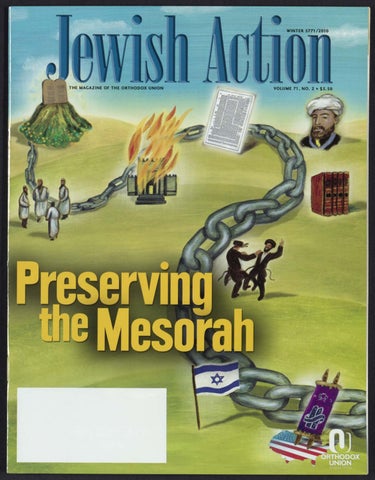
74 THE CHEF’S TABLE Chanukah Delights Norene Gilletz 83 Reviews in Brief Matis Greenblatt 80 BOOKS Religious Compulsions and Fears By Avigdor Bonchek Reviewed by Rivkah Rabinowitz 86 LASTING IMPRESSIONS As the Dreidel Falters Isaac Steven Herschkopf Cover design: Yocheved Lefkovits About the Cover The cover illustration depicts the mesorah, represented by a chain, with some significant moments in Jewish history that have affected our tradition. From the upper-left-hand comer, events are 'Revelation at Sinai (Jewish y e a r2448) Men o f the Great Assembly (Second Temple period) Destruction o f the Second Temple (70 CE) Redaction o f the Talmud (sixth century CE) Codification ofHalachah, Exemplified by the Publication o f Rambam’s Mishneh Torah (twelfth century) and Rabbi YosefKaro’s Shulchan Aruch (sixteenth century) Rise o f Hasidism (eighteenth century) Establishment o f Israel (1948) Post-Holocaust Revival o f Torah in America
SPECIAL SECTION: Leaders on the Hill 60 At Home in the House: Zahava Goldman Barbara Bensoussan 64 Irv Lowenberg: A Mentsch in City Hall Ben Ehrenkranz Jewish Action seeks to provide a forum for a diversity of legitimate opinions within the spectrum of Orthodox Judaism. Therefore, opinions expressed do not necessarily reflect the policy or opinion of the Orthodox Union. Jewish Action is published by the Orthodox Union • 11 Broadway, New York, NY 10004 212.563.4000 Printed Quarterly - Winter, Spring, Summer, Fall, plus Special Passover issue. ISSN No. 0447-7049. Subscription: $16.00 per year; Canadian, $20.00; Overseas, $60.00. Periodicals postage paid at New York, NY, and additional offices. POSTMASTER: Send address changes to Jewish Action, 11 Broadway, New York, NY 10004. W in ter 5771/2010 JE W IS H A CTIO N | 1
Jewish Action
T H E M A G A ZI N E O F T H E O RT H O D O X U N IO N
www.ou.org/jewish_action E di t o r
N echama Carmel car m eln @ o u.o rg
Lit e ra ry Edi t o r
M atis Greenblatt A ssis t a n t E di t o r
Anna Socher
Gre etin gs from Jerusale m ■ OU President Stephen J. Savitsky’s praise of Rabbi Hershel Schachter in the spring 2010 issue (“Building a Bridge to Achdus, One Article at a Time”) caught my eye. In the spring of 1991, members of my Shabbat afternoon study group in Los Angeles went to hear Rabbi Schachter deliver a discourse on the mitzvah of making aliyah. None of us had ever heard about this mitzvah before. By July, my wife, Susan, and I were on a two-week pilot trip to Israel. By October 1, we started disposing of our household items, and packing what we would need to establish our new lives in Eretz Yisrael. By October 31, we-Susan and I and our seven-year-old twin daughters, Elisheva and Sarah-had arrived in Israel. The past nineteen years flew by so fast. We often wonder, how did Beverly Hills ever prepare us for the opportunity to watch our daughters marry former IDF soldiers, give birth to Sabras, and settle in Kibbutz Shluchot and in the settlement of Kida? Despite the difficult experiences we underwent during the early years of our aliyah, we were quickly compensated with many, many blessings. Did we make the right decision by taking Jewish Action so fast? Rav Hershel Schachter—thank you! GEO RGE ROTH
Jerusalem, Israel
C oncerned A b o ut Kitniyot ■ In “Curious About Kitniyot/'(spring 2010), Rabbi Yaakov Luban and Rabbi 2
JE W IS H A CTIO N W in ter 5771/2010
Eli Gersten support the authority of minhag by appealing to “the Torah of your mother” (Mishlei 1:8). However, many aspects of the minhag of kitniyot, as presented by the authors, do not "remind me of my mother, or my grandparents, or they way Judaism has been observed for hundreds of years. For example, the authors report that although Maharsham permitted oils of kitniyot, this leniency is “not widely accepted.” But I remember when stores sold peanut oil. How did the minhag change? The authors quote Rabbi Moshe Feinstein’s pesak permitting peanuts on Pesach, and then in deference to those who regard peanuts as kitniyot, state, “one is unlikely to find certified kosher-for-Pesach peanut products.” Similarly, the authors cite reasons to forbid quinoa, although clearly Rav Moshe would permit it. Since the rabbis remain divided, the OU does not recommend quinoa. Alas, the older generation is gone, and I have no one to ask about foods my family permitted on Pesach. I do not remember these foods, in part, because when I went to yeshivah, I learned from my rabbis that our minhag does not permit kitniyot at all, prepared in any way. It took me years to notice how bizarre it was to learn from my rabbis not to trust the minhag of my mother. The OU seems to take the stringent position on nearly every issue. Despite the principle that a doubtful case of Torah law should be decided strictly and a doubtful case of rabbinic law leniently, here we have doubtful cases of custom, nearly all of which are decided
C o n trib u t in g Ed i t o rs
Rabbi Yitzch ok Adlerstein Dr. Judith Bleich Rabbi Emanuel Feldman Rabbi Hillel Goldberg Rabbi Joseph Grunblatt Rabbi Sol Rotb '* Rabbi Jacob J. Schacter Rabbi Berel Wein A d v e r t isin g D irec t o r
Carrie R. Beylus • 212.613.8226 b e y l u sc @ o u . o r g
A d v e r t isin g Co o rd in a t o r
Malka Braun b ra u n m @ p u.o rg
Isr a e l A d v e r t isin g Re p r ese n t a t iv e
Lisa Rubin • 972.54.721.1968 Su bscri p t io ns
Eva Holczer • 212.613.8137 D esig n
KZ Creative
ORTHODOX
UNION
Ex ecu t iv e V ic e Pr esi d e n t
Rabbi Steven Weil E x e cu t iv e V ic e Pr esi d e n t, E m e ri t us
Rabbi Dr. Tzvi Hersh Wein re b Se n i o r C o m m u n ica t io ns O f f ice r
David Olivestone
Pr esi d e n t
Stephen J. Savitsky C h air m a n o f t h e Bo ard
Harvey Blitz C h a ir m a n , Bo ard o f G o v e rn o rs
M ark Bane P u b lica ti o ns C o m m issi o n
Gerald M. Schreck, Chairman Joel M. Schreiber, Chairman Emeritus :
' ^ C o p y r i g h t 2 0 1 0 by t h e O rt h o d o x U n io n. El eve n Br o a d w ay, N e w York, NY, 1 0 0 0 4 . Te le p h o n e 2 1 2 .5 6 3 .4 0 0 0 * w w w .o u .o rg Pe ri o d icals Po st a g e Paid, N e w York, NY, an d a t a d dit io nal m aili n g o f f ices.
Printed in Canada
I
Bring the holiness of Jerusalem into your project Je r u sa le m S t o n e D e sig n s f o r R e lig io u s P r o je c ts M amiteliTO, Supply, Shipping & Ojstorn Made JefusaBam Stoiw for Ye w PtmmA
O rder O ur N ew Je w ish inst it u t es Pr o g ra m Now! usaüjgsw -gröup.cöm
EUmuocf $&fm S ymgoguB,
fmgmXm mm Mads
■ ¡■ w1i
hrml OrmnpmOml
www.jgsw-group.Oom < Beif-Shemesli, 990ÖÖ Israel iofo#jgsw-group.Com; 1 Tel: *97 2 2 9922 113 US: {846} 834 1800
mow, USA
Torsi Er m t Synagogue, OH, U S A
stringently. Either the rabbis rule stringently, and instruct us not to eat a certain food, or they do not rule at all, so that no such item can get uhechsher, effectively endorsing the strict opinion without issuing a ruling. Over time, our fidelity to purported minhag has introduced customs which our grandparents would not have recognized. EU EZER FIN KELM A N Southfield, Michigan .
Rab bis Yaakov Luban and Eli G erste n Respond ■ Eliezer Finkelman raises some excellent points, and, on one level, we agree with his arguments. Minhagim should be observed the same way they were in previous generations. Nonetheless, while individuals should remain loyal to family minhagim, the OU, as a communal organization, attempts to be inclusive of the wide range of halachic positions whenever possible. When there are conflicting minhagim, the OU seeks to avoid favoring one tradition over another and to maintain a position of neutrality. You might ask, as Mr. Finkelman does, why doesn’t the OU just adopt the lenient position? By adopting a stringent position (such as not supervising corn oil for Pesach), isn’t the OU being just as exclusionary as it would be by adopting a lenient stance? Not really. Not granting certification (to corn oil, for example) is not tantamount to taking a stand. The OU is not saying, “Don’t eat this product if there is no OU symbol on the label.” However, certifying a product whose status is subject to debate would be interpreted as a solid endorsement of that product. It is simply not feasible to write the following note on a label: “OU certified for those individuals whose family customs conform to the lenient position on which this supervision is based.” Respecting the validity of conflicting viewpoints, the OU follows the dictum of “shev ve’al ta’aseh odif,”which is to say that, at times, abstention is the best course of action. We would, however, like to make one clarification. In our article, we wrote, “Since OU posekim are divided 4 | JE W ISH A CTIO N W in ter 5771/2010
on this issue, the OU does not recommend using quinoa on Pesach.” By stating “does not recommend,” we meant that the OU takes a neutral position and does not offer direction to the public with regard to the use of quinoa on Pesach. We did not mean to imply that we oppose using quinoa, and apologize for being imprecise. Still, Mr. Finkelman is correct that, de facto, the absence of an OU symbol on certain items, such as peanut products for Pesach, creates the impression that eating peanuts on Pesach is not acceptable. Yet it is precisely for this reason that our article is important. In the article, we made it clear that there are different opinions about peanuts, quinoa, and oils of legumes, and that those who have family minhagim should adhere to those traditions.
major later authorities is inviolable,” echo those of Rav Moshe, and Rabbi Broyde’s source- proof is unfounded. (In the most recent edition of Jewish Action, this omission is detailed and attributed to an inadvertent editing error. Be that as it may, the citation validates Rabbi Feldman’s words rather than disproves them.) Furthermore, the citation of the pertinent passage by Rav Moshe contains a serious error. Rabbi Broyde’s translation reads:,;“. .. But in cases of great need, and certainly in serious matters regarding the ending of marriages as is this case, we are certainly obligated to rule [leniently] even if we merely deem it plausible to be lenient, and it is forbidden for us to be among the humble.. The true translation of Rav Moshe’s words is: “.,. but in cases of great need Rabbi Yaakov Luban is executive rabbinic ... we are certainly obligated to rule coordinator; OUKosher. [leniently], only if it appears to us to be Rabbi Eli Gersten is the recorder ofOU pesak permitted [emphasis added], and it is andpolicy. forbidden for us to be among the humble ... ” Nowhere is there an implicaW h a t Did Rav M oshe Really Say? tion that plausibility, as opposed to ■ In the summer 2010 issue of Jewish honest conviction, is sufficient basis to Action, Rabbi Michael Broyde wrote a overrule the rulings of previous generletter in response to a statement by ations concerning Torah prohibitions. Rabbi Aharon Feldman in his new Furthermore, Rabbi Broyde repeatbook, The Eye o f the Storm. Rabbi Feld- edly presents Rav Moshe’s opinion as man wrote: “Halacha is determined by that in times of great need contempothe cumulative decisions of the genera- rary Torah scholars can argue with Ristions of commentaries and decisors. honim. In his words: “[When] all other Thus an opinion of the Rishonim, authorities, including Rishonim, diswhen codified by the major later auagree.” The implication is that this apthorities, is inviolable.” plies to any single Rishon or to any Rabbi Broyde disagrees with this number of them. This, however is an view and attempts to prove that Torah inaccurate depiction of Rav Moshe’s scholars are free, under certain circum- words, which are: “And even if our unstances, to disagree with the great auderstanding will differ with the opinthorities of previous times. ion of some great scholars from among As his source, he cites Rabbi Moshe our masters, the Acharonim, what of it? Feinstein who defends his right to rule Even we are certainly permitted to disleniently on an issue which earlier agree with the Acharonim, and even at Acharonim had dealt with more strintimes with some Rishonim, when there gently. However, the citation has an are proper proofs and, more imporomission of several lines (indicated by tantly, proper logic...” Rav Moshe an ellipsis) in which Rav Moshe adds a writes clearly that one is permitted, caveat: “We are certainly permitted to with the proper proofs and logic, to argue... assuming it is not counter the argue only with “some Rishonim.” opinions of the renowned decisors, the Finally, Rabbi Broyde’s understandauthors of the ShulchanAruch, which ing of Rav Moshe that it is “the role of were accepted in all our lands... ?’ every Torah scholar to step forward” According to this caveat, Rabbi and not “show deference to greater Feldman’s words, that “an opinion of posekim” is plainly limited to those the Rishonim, when codified by the who have reached an appropriately
high level of mastery of Torah. It would be absurd to apply Rav Moshe’s approach to halachic decision-making to “every Torah scholar." One should bear in mind that the same line in the Talmud (Sotah 22A) criticizing scholars who have reached the level of higi’a Vhora’ah (the ability to rule) for not willing to rule also criti-r cizes those who have not reached that level and nevertheless rule. Y O SEF W IEN ER Baltimore, Maryland
Rabbi M ichael Broyde Responds Rabbi Yosef Weiner misunderstands my letter. I have no interest in disagreeing with Rabbi Aharon Feldman or Rabbi Aharon Lichtenstein regarding when one can argue with Rishonim. Both of them are far greater scholars of Torah than I. I merely wrote to point out that Rav Moshe disagreed with both of their views. One who looks at the quote from Iggerot Moshe sees clearly that Rav Moshe is of the opinion that the unanimous view of the Rishonim is binding only when it is codified without dispute in the Shulchan Aruch and its commentators. That is a far cry from what Rabbi Feldman wrote. Rabbi Weiner also questions my translation of a section of Rav Moshe’s teshuvah, which was in Hebrew. “Aval bemakom tzorech gadol... vadai mechuvin gam anachnu lehorot im rak nire’eh lanu lehatir, veassur lanu lehiyot meiha’anavim.” Rabbi Weiner insists the translation is, “But in cases of great need... we are certainly obligated to rule [leniently], only if it appears to us to be permitted, and it is forbidden for us to be among the humble..." This translation is wrong. “Rak im" is not the same as “im rak" The former means “only if," the latter, “if it is only." Rav Moshe is not saying that we are obligated to rule leniently only if we think it is permitted. Would anyone entertain the idea that Rav Moshe is correcting those who would rule leniently despite the fact that they thought it not permitted? Moreover, the phrase “nire’eh lanu lehatir;" is a reference to the fact that one is not 100 percent cer-
tain-nire’eh being a classical rabbinic word to denote “less than 100 percent certain." My translation: “But in cases of great need... we are certainly obligated to rule [leniently], even if we merely deem it plausible to be lenient, and it is forbidden for us to be among the humble..." is correct. Rav Moshe means that in cases of urgent need, a posek can adopt an understanding of the halachah that he genuinely thinks is reasonable, even if he himself recognizes that other understandings of the Talmudic sources can be just as correct; he can prove his view as a plausible read of the sources, but not the exclusively correct understanding. This is a common situation in Jewish law. Rav Moshe wrote these words in 1934, when he was a young man and certainly not considered a Torah giant by the gedolim of that era. Rav Moshe was addressing the question of whether a woman may immerse in a mikvah using earplugs; she would not immerse without them, and that would lead to this couple getting divorced. Rav Moshe wrote a total of six teshuvot (Iggerot Moshe, YD 98-103) on this issue. These teshuvot represent the longest collection of teshuvot on a single topic in all of Iggerot Moshe. Rav Moshe presents a novel analysis of the question, and permitted the woman to immerse in this manner so as to avoid divorce. One respondent asked Rav Moshe whether it is proper to rely on Rav Moshe’s understanding of halachah, since it reaches a novel conclusion and all other authorities (including some Rishonim) disagree. That is the question he is answering in the excerpt above. After stating his view that one may argue with Rishonim when one has proof, Rav Moshe concludes as follows (after the word “humble" quoted above): and cause Jewish women to remain unable to marry, or causefellow Jews to stumble in prohibited activities, or even simply cause a Jew's financial loss—see Gittin 56, which states, “Because of the humility of Rabbi Zecharya benAvkulas, the Beit Hamikdash was destroyed"; why does it say “his humility" and what does that incident have to do with humility?
See the comments ofMaharatz Chayot therefor a correct interpretation— This, indeed, is what results [from these types of failures to act], and we are compelled to rule [leniently] even for practical application when we deem it appropriate with evidence and clear understanding, and particularly in a serious matter of leaving a woman without a husband or avoiding a severe temptation. Rav Moshe’s citation of the Maharatz Chayot is central to understanding his view. The Talmud tells us that Rabbi Zecharya ben Avkulas could have prevented the destruction of the Second Beit Hamikdash, since he had a halachic basis for permitting one to bring an invalid sacrifice under certain circumstances. This could have avoided insulting the Roman emperor who sent an invalid animal as a sacrifice. The Maharatz Chayot (Gittin 56a) states: We seefrom this that the rabbis thought that the manner of Rabbi Zecharya was not proper, as hefelt that such sacrifices could be brought [and he should have so stated]... However, because of his great modesty, he did not have the strength to act according to his views halachah lema’aseh [and save the Jewish people]; rather, he was afraid that other rabbis would accuse him of permitting activity prohibited by halachah, and he did not think of himselfas a great enough sage to permit people to act according to his understanding of the halachah. He thought that these types of decisions were left only to the wisest of the generation (gedolei hador) [when infact, he should have acted]. Rav Moshe’s view thus is that in a time of urgent need—such as to avoid a divorce—one should not defer to the gedolei hador of the generation, but each Torah scholar should put forward his view of the correct understanding of the halachah in order to avoid a tragedy. Our community should be blessed to have more scholars like Rav Moshe; his vision, breadth, knowledge and wisdom are missed in this time of terrible need. Rabbi Michael J. Broyde isprofessor of law at Emory University School ofLaw in Atlanta, Georgia, and a dayan of the Beth Din of America. W in ter 5771/2010 JE W ISH A CTIO N | 5
ORTHODOX UNION NATIONAL CONVENTION
m m m m sm m FO R
;
P R E S ID E N T S A N D S Y N A G O G U E D ELE G A T E S
Spend a very special Shabbat, together with OU national leadership, as a delegate from your shul. Help set the agenda of the Orthodox Union for the years ahead.
AT O U -M EM B ER C O N GREG A TIO N K ETER T ORA H IN TEA N EC K, N
Visit www.ou.org/convention or call 212.613.8188 for details
d
Ask your OU-member shul about becoming a delegate. OU-member synagogues may H
designate up to eight delegates (subject to
B
size of congregation). Hotel and travel
J costs for delegates are tax-deductible in K
accordance with IRS rules.
The Hilton at W ooddiff Lake W ooddiff Lake, NJ n " did d nbma nuno nam
FREE A D M ISS IO N F O R A LI
Martin Luther King Weekend Friday, January 14 Sunday, January 16,2011
Visit the OU LISTENING ROOM and share
jjjs l g f l
what's on your mind with OU leadership.
H EA R & LEA R N FR O M T H E S E
INFORMATION BOOTHS
U jlJ S g M D I ■ felWVilSiiMP
OU Kosher; NCSY; Birthright Israel;
a n d D lS C U SS IO n
OU Press; OU Israel;
fo rth e Entire
Yachad; OU Job Board; Community and
Community
A jam-packed day of shiurim , classes, seminars and workshops that will touch upon every aspect of your Jewish life, led by a stellar faculty of Rabbanim, scholars and professionals.
C H O O S E FR O M O VER 2 5 S E SS IO N S IN T H REE TRA CK S:
Torah Life | Synagogue Life | Com munity Life
P L U S, P LEN A RY S E SSIO N S O N : The Mesorah The Orthodox Role in the Jewish community of Tomorrow
Registration: $36 including buffet luncheon
H owie Beig elm an • Rabbi H ershel Bille t
Synagogue Services;
H arvey Blitz • Rab bi Steven Burg
Koren Books; & more.
M argy-Ruth D avis • N athan D iam ent Rabbi Shlo m o Einh orn • Rab bi M oshe Elefant • Rabbi D aniel Feld m an * Rabbi D avid Fohrm an • Rabbi Bunni Free d m an Rab bi M enachem G e nack * Rab bi Efrem G old b erg • Dr. Scott G old b erg • Rab bi llan H ab er • C h arles H arary • Lin d a Klo nsky • Dr. Je ffre y Lichtm an • M aury
§111
US-ISRAEL RELATIONS
Litw ack • Rachel Pill • W illiam Rapfogel
GALA DINNER
Rabbi Dr. Ed w ard Reichm an • Rabbi
Invited Keynote S pea ker
Shaul Ro binson • Pro f. Sm ad ar
Senator Joseph Ueberman
Rosensweig • Rabbi Dr. Jaco b J. Schacter Rabbi H ershel Schächter • Dr. M arcy Sch affer • Dr. Sylvan Schaffer Dr. M arvin Schick • N achum Segal
Hershel Schächter
Je rry Silverm an • Bret Stephens Rabbi Steven W eil • Yael W eil • Dr. Shira W eiss • Rabbi Dr. Tzvi H ersh W einre b See www.ou.org/convention for the latest updates.
See full details and register online today at:
.
A
www.ou.org/tonvention Q
RESOLUTIONS & ELECTIONS OF
OU Officers and Board
ORTHODOX U N I O N rm?Kn En h a n cin g Je w ish Life
President’sMessage
By Stephen J. Savitsky
Restoring Spirituality to Shul Life
D
espite the dire predictions of half a century ago, Orthodox Jewry is today the fastest growing stream in Judaism. No doubt, we have much to be thankful for. And yet, in spite of our successes, there are many areas in which we, as a community, need to improve. Throughout my travels to Jewish communities, both large and small, I oftentimes hear shul rabbis lament the lack of spirituality in their shuls. Since the OU is a synagogue-based organization, we are deeply concerned about every issue that affects synagogue life. Through our Pepa and Rabbi Joseph Karasick Department of Synagogue Services, we provide support and resources to hundreds of OU shuls throughout North America. Thus, we asked ourselves, how can we inspire our synagogues to become true mikdashei me’at? How can we help shul members make the time they spend in shul more meaningful and spiritually uplifting? Many of our OU synagogues have various minyanim—the hashkamah minyan, the regular minyan, the young couples minyan, the nusach Ashkenaz minyan and the nusach Sefard minyan. I often hear complaints from shul lay leaders and rabbis about the dwindling minyan in the main sanctuary because of all of the “side minyanim .” But one surefire way to enhance the spirituality of the shul experience is to make certain that individuals feel comfortable 8 | JE W ISH A CTIO N W in ter 5771/2010
mm
and at home in their venue of tefillah. When it comes to minyanim, one size does not fit all. All of us are looking for individual paths to the Almighty. The more choices, the better. Far too often, shul administrators dictate what they want without listening to what their members need. If my Shabbat is enhanced by an eight o’clock minyan followed by two hours of Torah learning, why not try to accommodate me? Shouldn’t a shul try to cater to the various needs of its members? Perhaps there should even be a special minyan to accommodate those who tend to arrive somewhat late on Shabbat morning. Were shuls to use a customized approach to tefillah, many of us would get more out of the shul experience. What else can we do to enhance the spirituality of the synagogue experience? We at the OU are involved in many initiatives designed to enhance the spirituality of our shuls. We have, for instance, organized symposiums on “Making Our Tefillot More Meaningful and Personal” ih numerous communities. The response to these
events has been overwhelmingly positive, and we have plans to organize future such symposiums in new and exciting locations. Engagingin kiruv is another excellent way to recharge one’s spiritual batteries. In our tefillot every day we ask God to give us the ability to learn, lilmod, and to teach, u’lelamed. Not all of us are teachers. Why do we ask God to give us the ability to teach? Because when one learns Torah, one is inspired to share its beautiful secrets. There is perhaps no better way to strengthen one’s own connection to Torah than by teaching it to someone who is learning it for the first time. Teaching a newcomer to Judaism challenges you to rethink ideas and concepts you learned as a child. Invariably, you begin to see Yiddishkeit through the eyes of your student, viewing it with a fresh perspective and a newfound appreciation. Many of you are familiar with an organization called Partners in Torah, which partners knowledgeable frum Jews with less informed Jews for the purpose of learning together—in person or on the phone—for an hour each week. This program, and others like it, enables both the beginner and the “already frum”partner to deepen their understanding and appreciation of our magnificent heritage. If we want to enhance the spirituality of the synagogue, we must turn our synagogues into outreach centers.
This past Rosh Hashanah, Rabbi Steven Weil, executive vice president of the OU, led a wonderfully effective outreach initiative at Congregation Keter Torah in Teaneck, New Jersey. Entitled the “I Wish I Understood Everything I Was Saying Service,” the minyan attracted Jews on all levels of observance. To help those new to the shul experience feel more comfortable, “greeters” were appointed to meet each beginner. Additionally, each beginner was seated next to a seasoned shul-goer. The service, which fostered a wonderful camaraderie among the participants, was received with much enthusiasm. In parashat Shelach, Moshe sends out spies to scout Eretz Yisrael, and tells them to report back on their mission. He asks them to observe the following: “Are [the inhabitants] many or are there few; are they strong or are they weak?” Rashi gives us an incredible insight into Moshe’s message, informing us that if the inhabitants have open fields, that’s a sign that they are strong, and if they live in fortified cities, that’s a sign that they’re weak. Rabbi Lord Jonathan Sacks points out that one would think the reverse is true—open fields are indicative of a weak population and fortified cities are indicative of a strong population. But the Torah is, in fact, teaching us that by being open you exhibit tremendous strength. If we open up our synagogues and our communities to our non-religious brethren, it will only make us stronger, notweaker. It is also important for large communities to realize they could learn much from smaller ones. Shuls in large metropolitan areas should, for example, try to replicate the
Stay Connected
WORLDWIDE in t e r n a t i o n a l W ir eless & D a t a Re n t al Solutions®
Traveling Abroad? R e n t 1 G e t 1 Fre e! Stay O nlin e A ny w h ere Per m an e n t N u m b er in Israel Local U S . & Toll Free N u m b ers Free Pick u p in Brookiyn /Lakewood / Tororito Chica g o /Los A n g eles & More
St u d e n t Sp ecial: Fr e e P h o n e Traveling short or long term Anywhere in t he world? TravefCell has the Newest Phones at the Best Rates!
SIM Cards
^ ^ B B
USB M ode m Black b erry USA Phone; GPS Re n t als — -------*
8 7 7 .C ELL.P H O N E ! t r a v e ic e ll.c o m 1981 CONEY ISLAND AVENUE BROOKLYN,NY
Engaging in k ir u v is an excellent way to recharge one’s own spiritual batteries.
cohesiveness and spirituality often found in shuls in smaller, Jewish communities. When one lives in a place where frum life is not taken for granted and where one must play an active role in order for it to flourish, he feels a greater sense of pride in the shul, and in the community and all its accomplishments. All shuls should strive to instill this sense of pride and feeling of communal responsibility among their congregants. Over the last few years, the OU has invited smaller Jewish communities from across North America to participate in a communities’ fair in New York in the hope of encouraging young Orthodox families to relocate. These fairs have been remarkably successful. However, we will have achieved true success only when a delegation of shul officers and directors visits these smaller communities in order to learn from their successes. A final suggestion: in order to heighten the spirituality of our shuls, we must heighten the spirituality of Shabbat, In parashat Vayeshev; after Yosef tells his brothers and his father about his dreams foretelling his royal future, the Torah
tells us, ((Vayikanu bo echav, v’aviv shamar et hadavar” “So his brothers envied him, but his father awaited the matter.” Rashi explains that the word shamar in this context means “await.” While Yosef’s brothers were wary of the dreams, Yaakov was quietly anticipating their fulfillment. Similarly, to be shomer Shabbat doesn’t simply mean to keep Shabbat, it means to anticipate and to eagerly await the arrival of Shabbat, week after week. In other words, we must make Shabbat the spiritual centerpiece of the week, Shabbat is a day spent away from the daily grind, a day dedicated to prayer, learning Torah and pursuing kedushah. What better way to tap into the transcendence of Shabbat than by delving into the parashah or the haftarah or by taking a class in Kuzari or Mesillat Yesharim? Imagine if every shul were to offer a myriad of Torah classes and shiurim on Shabbat, on all levels, so that every member could fulfill his or her learning needs. Wouldn’t this go a long way in helping transform our shuls into true mikdashei me’at? It is my hope and prayer that we succeed in infusing greater spirituality into synagogue life and, by doing so, bring all of Klal Yisrael closer to being true ovdei Hashem. ■ W in ter 5771/2010 JE W ISH A CTIO N | 9
Chäirman'sMessage
I
n 1919, a wave of anti-Semitic pogroms, led by Polish peasants and soldiers, took place in Jewish towns throughout Western Galicia. A New York Times article, dated May 23,1919, reported that in Kolbuszowa, “Ten persons were killed and 100 wounded.” My great-grandfather, Pesach Lichtman, was among the murdered. My grandparents, along with the entire family, left Poland soon thereafter. Growing up, I heard the story countless times about how my greatgrandfather was thrown down a well by a ruthless mob and left to die. But only recently have I begun to learn more about who he was and how he lived. After my father passed away in March 2009 (5 Nissan 5769), I spent some time sorting through and organizing his belongings. My father was a simple man; I did not expect to find too many things of value in his Brooklyn apartment since he had already passed along many items to me during his final years. I put these items in a corner of a room, only focusing on them after shivah. When the shivah was over, I discovered the most wonderful treasures my father left me. Buried among his myriad possessions were faded photo10 I JE W ISH A CTIO N W in ter 5771/2010
By Gerald M. Schreck
graphs of relatives from the “alte heim,” This special issue of Jewish Action yellowing newspaper clippings and features a critically important sympodocuments, and handwritten letters sium where several prominent talmidei and postcards, all of which, when chachamim define and analyze pieced together, tell an extraordinary mesorah, a concept that begs for clarififamily history. cation in these trying times. While I found an old but still legible copy each contributor explains a different of the Kolbuszowa Memorial Book, a facet of this multi-dimensional conremarkable publication that pays tribcept, all agree that mesorah is our link ute to the Jews in the town where my to the past, our tradition that keeps us great-grandfather and his landsman distinct and defines us as Torah Jews. lived. With much nostalgia and Similarly, all of the contributors assert, warmth, the book recounts how some in one way or another, that despite the 2,000 Jews worked, lived and worvoices of modernity clamoring for shipped before the Nazis invaded the change and innovation, we must hold town. I think of my great-grandfather steadfast on to mesorah, the glue that when peeling through the book’s binds us as a people, and as a nation. crumbling pages. Aside from the symposium—which Other treasures I found: footage of I believe is required reading—the issue my father—in his twenties—and family members attending an event in the late includes an extensive section on healthy living with articles on living ‘30s to raise funds for the Jews of Kolkidney donation (which is, baruch buszowa; postcards in German from Hashem, becoming increasingly more aunts—sent sometime after the invasion of Poland in 1939—written in code common in the frum community), nuto bypass the censors; grainy blacktrition, and the importance of having a and-white photographs of relatives’ halachic living will. Readers will also weddings; marriage records, birth cerenjoy our moving tribute to the Botificates, and on and on. stoner Rebbe, whose first yahrtzeit will I am awed by this treasure trove of be observed on 18 Kislev. family history. At the same time, I feel This issue also features the first the need to preserve these priceless ar- part of a two-part series on the new ticles. And so my two oldest grandgeneration of young^rum political daughters, Leah Knopfler and Mindy leaders. In recent years, we’ve seen a Schreck, and I are in the process of diggrowing number of American Orthoitizing every photo, every letter and dox Jews either running for elected ofevery document in order to preserve fice or working as staff for elected our family’s past for future generations. officials. In the pages ahead, we profile I believe that this is the most signifisome of these young men and women cant gift I can give to my children and who make an extraordinary kiddush grandchildren. Hashem upholding Torah law while Why do I bring up this very perworking in places such as Washington sonal story? Because preserving the or City Hall. past is not only a concern on an indiAs always, we include an array of vidual level; it is, especially in contemarticles on halachah, Israel, kosher porary times, a concern on the national cooking, book reviews and more. level. What do I mean by preserving our Please continue to send us your national past? I mean preserving feedback, and best wishes for a our mesorah. Happy Chanukah! ■
Seventy years ago a group of American visionaries dreamed of forming a support organization for Magen David Adorn as their way of. helping to build our national homeland and save lives
Today, American Friends of Magen David Adorn is celebrating 70 Years of Saving Lives in Is r a e l. . . $
Donating thousands of ambulances and other emergency vehicles to Magen David Adorn.
$
Building and renovating MDA Emergency Medical Stations and the MDA Israel National Blood Services Center.
$
Supplying MDA with vital equipment, urgently needed medical supplies, emergency gear and much more.
$
Earning the trust of our donors by ensuring their wishes are honored.
$
Providing unwavering support for Magen David Adorn and Israel’s people since 1940 as MDA’s primary and strongest supporter in the world. / [T N
A m e r ic a n F r ie n d s o f m a g e n D a v id A d o m
Xs —
A R MD I
352 Seventh Avenue, Suite 400 New York, NY 10001 (866) 632-2763 • info@ afm da.org SUPPORT AFM DA AS WE
To DONATE please go to
w w w .a f m d a .o r g
BEGIN OUR 8TH DECADE
70 YEARS OF
SAVING LIVES IN ISRAEL 1940 -2 010
From the Desk of RABBI STEVEN WEIL, Executive Vice President
Tefillah:A Unique Method o f Communicating with God judge or to analyze oneself. Self-evaluation and begging are very different enterprises with the former being a much more arduous, intellectual and constructive activity. Authentic Jewish prayer requires one to take a long, hard and honest look at himself in the shadow of God’s Presence where nothing can be hidden or denied. Have I been living up to my potential? Have I used the gifts that God has given me properly? Are there things that should be more important to me or less important to me? Haphazardly begging for e pray three times each day but whatever we want is, quite frankly, how often do we think about spoiled, childish behavior. But through what prayer is or how it works? sincere self-examination we will hopeThe exercise of prayer is fundamental fully be able to discern between that in Judaism^it is, according to Chazal, which we want and that which we “worship of the heart” and one of the pillars upon which the world rests. The need, and truly have our priorities in order as we stand before God. Jewish concept of prayer is also ex-
W
tremely different from the universal notion of prayer. Throughout Tanach, there are many sources that teach us about Jewish prayer. Let us look at five such examples that Chazal have analyzed. In each of these cases, prayer is given a different appellation, each illuminating a different aspect of acceptable and appropriate ways to approach God. Each appellation gives us an insight into what the proper mindset for prayer should be, and delineates for us what the real goals and expectations are when confronting the Ribbono Shel Olam.
The prayer of Avraham is called amidah (ibid.) and the prayer of Yitzchak is called sichah (ibid.). These terms reflect the dual nature of our relationship with Hakadosh Baruch Hu when we call out to Him in prayer. On the one hand, amidah requires that one know before Whom he stands, “da lifnei mi atah omeid.”This preamble to prayer reminds us that we are not just participating in any run-of-the-mill conversation. We are standing in the presence of the Creator of the World. This necessitates a state of awe, fear, and reverence. Standing in the Presence of God should humble us and help us recognize our own insignificance. Our whole perspecThe prayer of Pinchas is the source tive shifts when we realize that a mere for the term tefillah (Berachot 26b). speck of a being can approach Divinity. The English word “prayer” is derived Yet, on the other hand, we have sichah, from the Latin term for prayer, which a quiet dialogue, an invitation to speak literally means “to beg.” Begging God to God privately, exclusively and intito fulfill our needs and desires, unconmately. God is a loving father, a trusttrollably, in confusion, without worthy confidant, an encouraging and thought, rhyme or reason is not tefillah. loyal friend. Our challenge when we Tefillah is derived from the Hebrew daven is to maintain word “piled,” which means to judge, and the act of engaging in tefillah is de- a healthy balance between these polar opposites. scribed in the reflexive “lehitpaleil”to
I
12 | JE W ISH A CTIO N W in ter 5771/2010
We say “Baruch Atah Hashem,” addressing God as “You” in the very familiar second person, and in the same breath, we say “Elokeinu Melech haolam,” Our God, King of the universe, recognizing that there is a much bigger picture of which we are a miniscule representation. We say Aviriu, our Father, but we temper it with Malkeinu, our King. We must acknowledge that Hashem is Awesome and Omniscient, so that our prayer can be offered with a proper sense of respect, dignity and humility and that we can fully realize that we are not the axis around which the universe rotates. But we must also recognize that Hashem is as close as a father and a friend, so that our prayer can be intimate and personal, and we can attempt to close the gap between the finite and the Infinite.
4
The fourth term for prayer, describing Yaakov’s prayer, is “pegiah” (ibid.), which means a confrontation. We are able to confront God by appealing to His middat harachamim—attribute of mercy. To explain middat harachamim versus the middat hadin, attribute of justice, allow me to use an analogy. If a person has a camera and it stops working, he has two choices. He can throw it out since it no longer functions in the way it was created to function. This is middat hadin, strict justice. The other option is to have it repaired. True, it no longer works as it is supposed to, but perhaps there is a part that can be fixed or replaced so that it can once again perform its function. This is middat harachamim. When we confront Hashem through prayer, we admit that we are broken, that we have not been functioning in the way we were created to function. We ask God not to discard us but rather to give us a chance to self-diagnose and make the necessary changes. We confront Hashem with the alternate plans that show our sin-
cerity and desire to rectify and perfect ourselves. For example, there are many things that we want and pray for: health, wisdom, peace, wealth, et cetera. Our job is to soul-search, and to confront Hakadosh Baruch Hu with the right reasons for wanting these blessings. We ask for health, not just because we don’t like pain or doctors, but because if we are in good health, we are better able to keep the mitzvot. We ask for wisdom, not because we want to impress people with our high IQs, but because the greater our wisdom, the deeper our understanding of the knowledge of God. Channah, the trailblazer of authentic prayer, taught us about pegiah when she confronted God about the pain of her infertility. She asked God for the child she so desperately wanted, but she perfected herself by recognizing that the child could play a more important role than just satisfying her maternal instincts. He could be raised to serve Hashem and Am Yisrael. Hashem accepted her plan, and Shmuel Hanavi was born. The pious scholars of antiquities (Chassidim Harishonim—Mishnah Berachot, chap. 5) would prepare an entire hour before beginning their prayers. It was during those long, quiet stretches of time that they would contemplate ways in which the very desires they were about to ask for could be used to fulfill a higher spiritual objective. Through middat harachamim, Hashem allows us to confront Him with our own rationally devised plan for effecting change within ourselves, and for elevating our sense of worth and purpose in our own eyes, and in His.
5
The fifth term used to describe prayer is Moshe’s “ve’etchanan” (Devarim 3:23), which Rashi explains is closely related to the word “chinam” free. Moshe taught us that whatever we pray for, we should view it as a “matnat chinam” a very generous gift that we have neither earned nor deserve. Moshe Rabbeinu spent the last forty years of his life taking care of the Jewish people. Every need, big or small, was his responsibility. Freeing the Jews from slavery, giving them the Torah, listening to their numerous complaints, defending and condemning them when they erred, Moshe was the teacher, the tour guide, the caterer, the judge, and the parent. Yet, despite everything he sacrificed for Klal Yisrael, when Moshe requested permission to enter the Land of Israel, he did not ask because he felt it was something he deserved or was owed. He asked for a gift. Likewise, this should be our attitude when we approach Hashem, to stand in His Presence with the realization that He owes us nothing, and that anything He gives us is due to His unfathomable magnanimity. With the understanding of these five appellations of Jewish prayer, we gain a deeper appreciation of what makes Jewish prayer unique. We need prayer because prayer is the great means through which we speak with Hashem and feel the comfort of His closeness (sichah), attempt to appreciate and marvel at Hashem’s greatness (amidah, ve’etchanari), do the hard work of judging ourselves (tefillaK), and the even harder work of transforming and perfecting ourselves (pegiah). “Baruch Atah Hashem, shomeah tefillah—You, Hashem, are the Source of all blessing, Who listens to prayers.” ■
Rent a phone for y o u r t r ip t o Isr a e l! '
CELLP H O N ES
& mo r e f o r ISRAEL
Stay connected! Rent a phone with an Is ra e lii US number you're always easy
1
2
A BC
4
GHi
5
j k l
y
P Q RS
8
TU V
*
+
0
3
œ F
@ M N O
Q w xY a
#
J
w w w .talk nsave.n et
1 -866-T A LK N SA VE Now offering US & Israel anywhere m in u tes -s a v e more! W in ter 5771/2010 JE W ISH A CTIO N | 13
HealthyLiving
By Meyer D. Lifschitz
W
o one looks forward to having surgery, but five and a half years ago, I actually did. I, a kidney doctor, was about to become a kidney donor. In the 1970s, shortly after I graduated medical school, kidney transplantation was still in its infancy and the five-year success rate was not that encouraging. My sister was expecting at the time. During the pregnancy, her doctor observed that she had protein in her urine, which could indicate signs of kidney damage. Although she was significantly overweight, the medical community was not yet aware of the relationship between obesity and kidney damage. | mentioned to my sister in passing that if she needed a kidney donor in the future, she should ask me. Neither of us, however, really thought that that would ever be necessary. Dr. Meyer D. Lifschitz was a nephrologist in San Antonio, Texas, for thirty years and has been associated with Shaare Zedek Medical Center in Jerusalem for the past few years. His wife, Elizabeth, and he made a li y a h seven years ago to join their children. This essay is adapted from an article that first appeared in a medical journal.
14
JE W ISH A CTIO N Winter 5771/ 2010
was about it for our Jewish education. However, since my wife and I had moved to San Antonio, Texas, after I finished medical school, we had evolved Jewishly. The local rabbi, Rabbi Aryeh Scheinberg and his wonderful family had gradually educated us. We eventually became frum—our three boys attended yeshivah and we were quite active in Rodfei Sholom, Rabbi Scheinberg’s shul. So before getting too involved in the discussion of transplantation with my sister, I sought my rabbi's advice. Rabbi Scheinberg indicated that if I wanted to go ahead with it, it was halachically permitted for me to be a donor for my sister. However, he suggested that I discuss the issue with a well-known posek who was a frequent visitor to San Antonio. I met with him, and after reviewing the situation—my sister's need for a transplant to save her life and the improving statistics for kidney transplant success in recent years—he indicated that it was certainly permissible for me to donate a kidney and might even be a chiyuv, an obligation. I was committed to donating my kidney to my sister. As a doctor, I am very familiar with the potential risks of surgery—especially for someone in my age group (I was sixty-one at the time of the surgery). But the idea of
Unfortunately, twenty years later, her urinary protein excretion had gradually increased to a level that indicated serious kidney damage. Although she was started on appropriate therapy, over the next few years her kidney function gradually decreased, and the possibility of her needing dialysis or a kidney transplant became very real. My sister, who lives in Philadelphia, traveled to the Mayo Clinic in Rochester, Minnesota, where she was told that transplantation was a much A t the age o f sixty-one, Dr. Meyer better option than chronic dialysis. But Lifschitz donated his kidney to the two transplant programs in his sister. Philadelphia that would consider her wanted her to lose fifty pounds before accepting her for a transplant. By this time the results of transplantation had considerably improved; many studies showed that the patient survival rate was higher with transplantation than with dialysis and that having a transplant before starting dialysis also greatly improved one's chances or survival. My sister and I had grown up in a non-observant family in Patchogue, New York. As kids, we attended afternoon Hebrew school and celebrated Rosh Hashanah and Yom Kippur. That
being able to help my sister was a strong impetus to go forward with the procedure. My sons, all grown and married, agreed that I should have the surgery. My wife, however, was quite worried about the potential risks. It took several serious discussions before she finally relented. My sister, who has always looked up to her “big brother/’ was very ambivalent about asking for or accepting such an enormous “gift.” “How could I possibly repay you for such a gift? It’s impossible,” she kept saying. The transplant program found no major incompatibilities between my sister and me; this was a tremendous relief since there were few other family members who could be donors.* Moreover, since my sister was already fifty-seven, it was unlikely that she could receive a kidney from someone who had recently died since there
were many younger patients in need of a kidney in Philadelphia. Shortly before I retired as a nephrologist in 2003,1 asked one of my colleagues who regularly did kidney donor evaluations to examine me. My colleague foimd me to be generally healthy, but pointed out that at my age, after the removal of one kidney, I could not expect my remaining kidney to increase in size and function as a younger kidney would. My colleague’s evaluation was sent to the Philadelphia transplantation program. I was asked to meet with their doctors, which I did shortly before my wife and I made aliyah in June of that year.
My sister had not yet been accepted by a transplant program for the operation—primarily due to her weight. We made aliyah fully aware that I would probably return to the States soon to become a kidney donor. Once in Israel, I spent my mornings studying at Ohr Somayach and my afternoons working at Shaare Zedek Medical Center. I wanted to be in excellent health before undergoing the procedure so I began walking sixty minutes a day. I lost about fifteen pounds, and my blood pressure—which had been somewhat high—came under control. Over the next two years my sister’s kidney function continued to deterio-
*Since the number ofpatients in need o f a kidney is much greater than the number o f kidneys available for transplant , there has been considerable discussion in the general and medical press concerning the possibility o f paying donors. Currently, in America, such compensation is illegal. Israel has recently instituted a national plan that does not pay kidney donors, but does offer certain perks including compensation to cover the cost o f certain expenses related to the donation as well as the cost o f future health insurance.
M e e t t h e K id n e y M a tc h m a k e r By Bayla Sh e va Bre n n er Ever sin ce C h aya Lipsch u tz, cre a t or of kid n e ym itz a h.c o m , a n sw ere d an ad to d o nate a kid n ey to a m o th er of tw o in N e w Je r sey, sh e's been b usy linking th ose in need of kid n eys w ith o th ers w illin g to d o nate t h e irs—and a p tly livin g up to h er na m e, " C h aya," H e bre w for " life-giver." Lipsch u tz, w h o h ails fro m Bro oklyn, began her m issio n by re ntin g a booth at the 2 0 0 5 Je w ish M ark e t p lace Exp o, held at th e Jac o b Ja vits C o nventio n C e n t er in N e w York, to pro m ote kid ney d o natio n. She co ntinu e d to sprea d th e w ord ab o ut the pressin g need for d o n ors thro ugh p ostin gs on vario us Interne t lists, sp e akin g e n g a g e m e nts and in t ervie ws on NPR, w ith th e N ew York D aily N ews and th e Jerusa lem Post, and w ith oth er m e dia o utlets. From across th e globe, d o nors and th ose ne e d ing kid n eys starte d turnin g to Lipsch u tz for assista n c e . H er kid ney m a tch m akin g ve n ture q uickly to o k off. O n e of Lipsc h u tz's first su c c ess st ories involve d her brother, Yosef, w h o in 2 0 0 7 , at th e age of fifty, d o nate d one of his kid n eys to a grateful recip ie nt. In 2 0 0 9 , w ith the aim of drawin g w id er in terest, sh e la u nche d kid n e ym itzva h.c o m . Since t h e site's in- gj ce p tio n, sh e has m a d e eight kid ney m a tch es, i Jjg A cc ord in g to the US D e p artm e n t of H e alth and H u m a n Servic es, m ore than 8 6 ,0 0 0 p eo ple na tio n w id e are w aitin g for a h e althy kid ney as of this writin g. Last year, m oré th an 4 ,6 0 0 lost th e ir fight for life w hile w aitin g.
Finding th e rig ht m a tch often re q uires m ore than a little d e term in a tio n. Rab bi Ep hraim Sim o n, c o - d irector of Frie n ds of Lu b avitch of Berg en C o u n ty in Te an eck, N e w Jerse y, a fortyo n e-year-old fa th er of nine, resp o nd e d to a m ass e-m ail fro m Lipsch u tz an n o uncin g th e need for a kid n ey d onor for a tw elve ye ar-old girl. So on after, sh e inform e d him th at a d o nor had been fo und. "I felt like I did n't act fast enough," sa ys Rabbi Sim o n. "I k n e w right th e n and th ere th a t if so m e b o d y else w as in ne e d, I w as g oing to be th e one to save his life." H e insiste d th a t Lipsc h u tz c o n tin u e to kee p his n a m e on file for o th ers in nee d. Eve n tu ally, he d o nate d his kid n ey to a Sa t m ar C h assid, a fa th er of te n fro m th e W illia m sb u rg se ctio n of Bro o klyn. " Th ere is no gre a ter fe elin g than kn owin g you brought life to an o th er h u m an being," sa ys Rabbi Sim o n. "It has tru ly been an a m azin g exp erie nc e th at ra'nks right up there w ith th e birth of m y children." " A lm ost e very w e e k, p e o ple are c allin g m e, be gging m e to fin d a kid n ey donor," sa ys Lipsc h u tz, " not o nly for H t h e m se lv es, but for fa m ily m e m b ers, frie n ds and o th ers in t h e ir c o m m u nity. Pe o ple on d ia lysis are sufferin g terrib ly." Lip sc h u tz d o esn't a c ce p t a p e nny for her w ork. "Just like m y kidney d o natio n w a s a ltru istic—so is m y kid n ey m a tch m akin g . M y goal is to help sa v e lives."
¡6 Bayla S heva Brenner is senior writer in the O i l Com m unications a nd M arketing D ep a rtm ent
Chaya Lipschutz at the 2005 Jewish Marketplace Expo.
W in ter 5771/2010 JE W IS H A CTIO N | 15
rate. But by this time, my sister had lost almost fifty pounds through a strict regimen of diet and exercise, and she was accepted into the program. As it happened, the only opening for surgery was the week before Pesach. My wife and I flew to Philadel-
Kiddush in the bentcher and he proceeded to recite it flawlessly—much to the surprise of his wife and daughter. Apparently, my brother-in-law, who was born in Lodz, Poland, and survived World War II, had learned to read Hebrew as a child and still remembered
"How could 1possibly re p a y you fo r su ch a g ift? It's im possible," s h e k e p t saying. phia in April 2005.1 once again sought advice, now from my rav in Israel, Rabbi Chaim Walkin. My son asked if he could be the donor in my place, but both Rabbi Walkin and I insisted that I be the donor. I had explained to Rabbi Walkin that with any operation, there is always a risk of death. Rabbi Walkin stated that since my wife and I had married off all of our children, and our sons all had young children of their own, it was better if I took the risk, small as it was. From a medical standpoint, I would also be a better match than my son since my sister and I shared two parents, while my son was one generation removed. My sister and her family belong to a Reform shul and do not live within walking distance of an Orthodox minyan. When I asked Rabbi Walkin how my wife and I should spend the Shabbat before the operation, he suggested that rather than leave my sister and her family in order to daven with an Orthodox minyan in Philadelphia, we should spend Shabbat with them. In retrospect, it was wonderful advice. My wife and brother-in-law went shopping for kosher food, and we set up the home for Shabbat (we had to explain a few things, such as no using electricity, et cetera). On Friday night my wife lit candles while I davened Kabbalat Shabbat and Maariv. The five of us—my sister, her husband, their daughter and my wife and I—gathered around the Shabbat table. I sang Shalom Aleichem and Aishet Chayil I had brought NCSY bentchers along so that my sister and her family would be able to follow along. To be respectful, I asked my brother-in-law if he wanted to recite Kiddush. Somewhat unexpectedly, he said yes. I showed him where to find 16
JE W IS H A C TIO N W in ter 5771/2010
how to do so. The seudot that Shabbat were wonderful and set the right tone for the events of the week ahead. On Tuesday, the following week, my left kidney was removed and transplanted into my sister’s pelvis. The Zohar says that the right kidney gives good advice. After our operations, I was left with only a right kidney. My sister had two right kidneys and one left kidney, but only my donated kidney, on her right side, actually functioned. Thus, we both had a preponderance of right kidneys to give us good advice. My sons were scheduled to daven at the Kotel during the operation. Although I was quite familiar with the details of surgery—I was in the operating room many times as a student and for certain specific patient-related issues subsequently—meeting with an anesthesiologist prior to being put to sleep, and knowing that for the next few hours things would be happening to my body over which I had no control, was disconcerting. Similarly, although I had seen many patients awaken from surgery with many tubes coming out their bodies, it was unsettling to experience it myself. I awoke from the surgery late in the afternoon with my wife at my side. I was happy to be awake and aware that any dangers from the surgery were over. The next two days were filled with visits and phone calls from family and friends. My wife and children were relieved that the surgery had gone well, but even more so, they were happy for my sister, since the transplant would allow her to avoid dialysis and continue to live an active, healthy life. My sister’s new kidney worked in the operating
room, and within a day, her kidney function was approaching normal. Except for one rejection episode during the first month, she has had stable kidney function since the operation. My sister commented that within days of the transplant she noted that her mind seemed clearer than it had been for many months. While we didn’t realize this at the time, the progressive kidney failure had caused subtle changes in her mental awareness that were only obvious once the successful transplant allowed her mind to become clearer. This is probably because toxic substaftces accumulate in the body of a patient with progressive kidney failure, and a successful kidney transplant removes these toxins. In the days following the surgery, I had no pain since I was on painkillers. By Friday I was discharged. My wife and I had arranged to spend the coming Shabbat and first days of Pesach in Passaic, New Jersey, with a close friend. He lives about two blocks from shul, and I was able to walk there and back Friday night and Shabbat day with little difficulty. It felt very good to daven with a minyan after several days of being in hospital and davening on my own. After the first days of Pesach were over, we flew back to Israel. It took several weeks before my strength returned completely, but after that I went back to my daily routine including my sixty minutes of walking. My sister is doing well, baruch Hashem, and since this experience, she has greater admiration for those living a Torah lifestyle. She knows that my religious observance played a role in helping me give her the gift of my kidney. Now, more than five years later, I am completely unaware of my missing kidney, and my scar is almost invisible. My kidney function is slightly reduced from before the surgery, as was expected, but is well within the range for a person my age and in no way alters my regular activities. As a kidney doctor, I am involved in saving patients’ lives every week if not every day. Yet to have donated my kidney and thus saved my sister’s life was an extraordinary experience and continues to be a source of immense personal satisfaction. ■
TO URO 's LA N DER C O LLEGES
Salute the
Orthodox Union and NCSY! We are proud o f o ur h ist o ric rela tio nsh ip w it h NCSYf an d o f t h e t h o usa n ds o f N CSYers fro m thro u g h o u t N orth A m erica, w h o h av e a t t e n d e d o ur u n d erg ra d u a te
LA N DER C O LLEG ES a n d TO URO C O LLEG E in LA a n d M IA M I
La n d e r C o ll e g e o f A r ts a n d Scie n ces Fia t b ush Se p a r a t e M e n's a n d W o m e n's D iv isi o ns
La n d e r C o ll e g e f o r W o m e n The A n n a Ru t h a n d M ar k H ast e n Sch o o l M anhattan
For more inform ation a bout educational opportunities a t our L ander Colleges Contact: The O ffice o f A d m issio ns/LAS TOURO COLLEGE/1602 A ve n u e J Bro o kly n, NY 11230
Phone: 718-252-7800, e x ts. 299,320 Email: lasa d m it @ to uro.e d u Or visit our website: w w w .to uro .e d u La n d e r C o ll e g e f o r M e n K e w G a r d e ns H ills Touro Colle ge is an equal o p p ortunity institutio n.
Touro C o lle g e So u th, 305-535-1066 e xt. 55400, to uroso u th @ to uro.e d u Touro C o lle g e Los A n g e les, 323-822-9700 e xt. 85155, to uro la.a d m issio ns @ to uro.e d u
HealthyLiving
By Edward Reichman
the*donor. As with all medical halachic matters, however, updating the information is essential. Living organ donation is now commonplace; the donor risk has been well studied and quantified, and the success rate has significantly improved and is well within the halachically accepted risk category. In fact, no posek today forbids live kidney donation, and many, though stopping short of declaring it obligatory, encourage donation and consider it to be an extraordinary mitzvah. Today, we rarely come across a Jewnouncement remains elusive, the The genesis of this essay began ish periodical without an ad seeking a with an inquiry by the Jewish Ac- anatomical and physiological functions kidney donor, and there are organization editors as to whether there is of the kidney are well established in tions devoted to encouraging living modern medicine. The treatment of enough novel or substantive material kidney donation. (See sidebar on page about the halachic issues of living kidkidney failure has evolved, with the 15.) The current halachic state of kidney donation to merit an article. first artificial kidney (dialysis) machine ney donation is most beautifully re“It seems clear that kidney donation invented in the 1940s and the first kidflected in a sefer aptly titled Klayot is permitted, though not obligatory. Is ney transplant occurring in 1950. Yoatzot (The Kidneys Give Advice), there anything else to discuss?” it was Posekim began discussions about which describes the following case: A queried. While this assessment is tech- living kidney transplants shortly there- man was told by his physician that he nically absolutely correct, it is perhaps after. The major halachic issue adwas in need of a kidney transplant. instructive to place this halachic ruling dressed was the nature of risk involved Upon returning home, one of his many in historical and halachic context to for the donor. While the verse in the sons was there to receive the news. The gain an appreciation as to how we have Torah “Do not stand idly by as the son immediately rushed to the hospital come to take for granted the halachic blood of your brother is shed” obligates to begin the process of donor testing. permissibility of surgically removing a us to save the life of one in danger, how Upon his return from the hospital, he vital organ from one human being and much risk can one assume in order to was met by his brothers, all of whom transplanting it into another. save another? In the case of kidney dolikewise wished to be tested and all laid The Talmud states that the kidneys nation, there is both the immediate risk claim to the privilege of being their fagive advice (Berachot 60a). While the of the surgical procedure, as well as the ther’s kidney donor. How would they exact meaning of this Talmudic prolong-term risk of living with only one determine which son would serve as a donor for their father? They were unremaining kidney. The analyses of the posekim reable to resolve the dispute and thus apDr. Edward Reichman is an associate professor o f emergency medicine and associate pro- volved around risk assessment. In the proached a prominent posek. The fessor in the Division o f Education and entire sefer is an analysis of the havery early days of kidney transplantaBioethics at the Albert Einstein College o f tion, a number of rabbinic authorities, " lachic issues relevant to the resolution Medicine ofYeshiva University. He received of this question. including Rabbi Eliezer Waldenberg his rabbinic ordination from the Rabbi Isaac Aside from kidneys, other organs and Rabbi Yitzchak Weiss, forbade one Elchanan Theological Seminary and writes can also be donated from living to serve as a living kidney donor due to and lectures internationally in the field of donors, such as bone marrow, a lobe of the intolerable level of risk involved for Jewish medical ethics.
W o èÈssM ée h œ
18
JE W ISH A CTIO N W in ter 5771/2010
the lung, and a lobe of the liver. From a halachic point of view, there are many questions related to living organ donation that require detailed analysis, including: 1. Is it permissible to receive compensation for kidney or bone marrow donation? If so, in what form, and how much? 2. Can one travel to other countries to receive organs when the circumstances surrounding the organ donor and harvest are somewhat dubious? 3. Can one harvest a kidney from a katan (minor) who is unable to consent to the procedure? 4. Can one demand the return of one’s kidney after the transplant has occurred? 5. Are bone marrow, liver or lung donations halachically comparable to kidney donation? 6. If one is found to be a bone marrow match to an anonymous recipient;" is one halachically obligated to serve as a donor? These questions and many others are addressed in halachic literature. As human kidney transplantation has evolved since its inception some sixty years ago, we have also witnessed advances in medicine and science that may soon render human organ transplantation obsolete. Both xenotransplantation (the transplantation of animal organs into humans) and stem cell research have made limited strides, in different ways, in addressing the need for organs. Neither requires the involvement of, and attendant risk to, a human donor. The chapter in the Jewish medical ethics textbook on living kidney donation may soon be excised and relocated to the volume on the history of Jewish medical ethics. Living organ donation is a truly unparalleled act of chesed. I am confident that such individuals who would consider donating their organs will, im yirtzeh Hashem, find other ways to channel their desire to help Klal Yisrael. But for now, as living kidney donation in the Jewish community is on the rise, if the kidneys’ advisory powers are transferred to the organ recipient, then we will doubtless continue to see an increase in extraordinary acts of true chesed and hatzalat nefashot in the world. ■
enence. Nefesh B’Nefesh provides support and guidance to help ensure a successfiil transition to your new life in Israel. Aliyah Flights • Financial Assistance * Employment Resources Expedited Government Processing • Aliyah Guidance
Applications and information is available at w w w .nbn.ore.il or 1-866-4-A LIY A H in cooperation with:
I S f S j Ministry of immigrant | | 'Æ m Absorption;
M
p r h
in cooperation with:
cr 1.
Æ Æ ) h i v <yix1)imn*n nuaion
e fe sh
JewishAgencyforIsrael W in ter 5771/2010 JE W IS H A CTIO N | 19
Doctors Versus Patients: Who Decides Right-to-Life? In the fall of 2007, eighty-four-year-old Samuel Golubchuk, an Orthodox Jew, was admitted to the ICU unit of Grace Hospital in Winnipeg with pneumonia. Not long after, physicians told Golubchuk’s family that his chances of recovery were nil, and there was no point in maintaining him on a respirator and feeding tube. They advised the family to stop life-support. When the family refused on religious grounds, the doctors insisted that they planned to unhook him anyway. Rabbi Zev Schostak is the director o f pastoral care at the Gurwin Jewish Nursing and Rehabilitation Center in Commack, Long Island. He is the founder and chair ofGurwin’S Ethics Panel and is affiliated with the Center for Medical Humanities, Compassionate Care, and Bioethics at the State University of New York at Stony Brook, where he lectures on bioethics in the medical school Rabbi Schostak speaks and writes extensively on end-of-life bioethics and on issues o f aging in halachah.
20
JE W ISH A CTIO N W in ter 5771/2010
In Texas, the Advance Directives Act (1999) allows hospitals and physicians, under certain conditions, to unilaterally discontinue life-sustaining treatment they deem to be medically futile against the wishes of a patient or guardian. In March 2005, a Texas case garnered national attention when physicians in a Houston hospital withdrew life-support from six-month-old Sun Hudson, born with a fatal congenital defect—against the wishes of his mother. The infant’s doctors maintained that continuing such treatment would be futile. The Hudson case was precedent setting. Doctors may decide what constitutes “quality of life” for their patients and deny life-saving treatments to those they feel have no quality of life. Laura Hershey, a national advocate for the rights of the handicapped, in an oped (“Handicap Is Not a Death Sentence and Should Not Be Treated as One,” U.S. News 8t World Report [August 2009]), makes a cogent case against this life-threatening form of discrimiTheir position was supported by a nation. Hershey, herself a severely statement of the College of Physicians handicapped woman who relies pn a and Surgeons of Manitoba on “Withventilator for breathing and personal holding and Withdrawing Life- Suscare assistants to bathe, dress, and feed taining Treatment/’ which declares her, writes: that “physicians have the authority to Terrie Lincoln, a disability rights acmake medical decisions to withhold or tivist, broke her neck 12 years ago in a withdraw life-sustaining treatment car accident Doctors urged her mother from a patient without the consent of to < ( p ull the plug/’ because her disability the patient or the patient’s family.’’ would supposedly deprive Lincoln of inGolubchuk’s family took the case to dependence and pleasure. Sherry Lincourt. In February 2008, a Manitoba coln Sturm refused. Five months later, judge ruled in their favor and extended her daughter was released from rehabilian interim injunction, which prevented tation. She had a significant disability doctors from withdrawing care until a but was alive and happy. She now has a full trial could be heard in September. full-time advocacyjob and is earning a While awaiting trial, three of Mr. Golmaster’s degree in social work. ubchuk’s physicians announced that, ... the University of Wisconsin Hosethically, they could no longer justify pital denied antibiotics to two developtreating him and withdrew from the mentally disabled people admitted with case. In June, 2008, after seven and a pneumonia. They needed life-saving half months on life-support, Samuel treatment, which was withheld, causing Golubchuk died of natural causes. the death o f one man. The other finally The Golubchuk story is not an isolated incident. In a number of notewor- did receive treatment, at the insistence thy cases, physicians have succeeded in o f his family, and survived... These cases and others like them turning off life-support against the have created shockwaves that reverwishes of patients and family.
berate across the religious and bioethical communities. When physicians, in the name of medical futility or quality oflife, stop life-sustaining treatments against the wishes of patients or their proxies, they trample on long-standing principles and standards of medicine, bioethics, and halachah. To wit: In American law and medical practice, an individual who has sustained irreversible cessation of circulatory and respiratory functions, or irreversible cessation of all functions of the entire brain, including the brain stem, is considered dead. Medically, and according to some halachic opinions, the patient is dead once the brain ceases to function and stops regulatingbreathing; according to other halachic authorities, the patient is still alive until after both the heart and the lungs stop functioning (cardiopulmonary death). According to any of these definitions, Samuel Golubchuk was alive medically and halachically when his physicians wanted to stop his life-support. Dr. Leon Zacharowicz, a New York neurologist who advised the Golubchuk family, reported in court affidavits that Grace Hospital wanted to cut off life-support based on its claim
termine his or her mode of medical treatment or to reject it. Patient autonomy declares that patients with the capacity to make their own decisions may solely determine the course of their medical treatment—not their family, friends, or physicians. What Drives Physicians* Treatment Decisions? A major force driving hospitals and physicians to make end-of-life medical decisions against the wishes of patients and their families is economic: In 2008, according a report on 60 Minutes (“The Cost of Dying: End-Of-Life Care,” November 22,2009), “Medicare paid $55 billion just for doctor and hospital bills
on their own, and feeding tubes be installed when they can no longer eat? Doctors witness the seemingly endless suffering of patients who return to the hospital with repeated infections, critical drug reactions, and decline in mental status, frequently accompanied by persistent pain and depression. But, sadly, too often, physicians are compelled to make their patients’ end of life medical decisions by default—it is estimated that no more than one-third o f Americans have advance directives such as living wills or healthcare proxies. As Orthodox Jews, we have a major stake in preparing our own advance directives; halachah offers us much guidance in medical decision-making. Halachah teaches that every moment of life, every breath, is infinitely precious, and must be preserved—even at the expense of desecrating Shabbat. Yet, at the same time, Jewish law is exquisitely sensitive to the belief that life is not an absolute value: we may not need to initiate or continue aggressive medical interventions when the pain and suffering of a terminal illness makes living unbearable. These medical decisions are truly matters of life
In a n u m b e r of n o te w o rth y cases, p h y sician s h av e su cceed e d in tu rn in g off life-su p p o rt a g a in st th e w is h e s of p a tie n ts a n d family. that Mr. Golubchuk had only limited brain function—even though he had never been evaluated by a neurologist or received such essential diagnostic tests as an EEG or CAT scan. Indeed, at one point, after the court had issued a temporary injunction, Samuel Golubchuk was described as “awake, alert, sitting up in a chair at times, more interactive and shaking hands purposively” (Jonathan Rosenblum, “A Warning from Canada to Those Who Value Life,” [Jewish World Review, July 14,2008]). Physicians who unilaterally make life-and-death medical decisions for their patients violate one of the cardinal principles of contemporary medical ethics—patient autonomy. Patient autonomy is the right of a patient to de-
during the last two months of patients’ lives. That is more than the annual budget for the Department of Homeland Security or the Department of Education. And it has been estimated that 20 to 30 percent of these medical expenses had no meaningful impact.” Many physicians and hospitals are understandably reluctant to maintain a patient in a $10,000 a day ICU unit when—in their opinion—his or her chances of returning to any meaningful quality of life are virtually nil. To be sure, physicians face serious ethical dilemmas in end-of-life care: When patients are end-stage terminally ill and experience poor quality of life, should CPR be initiated when their hearts stop? Should ventilators be attached when they can’t breathe
and death, which require consultation with a rav who is both an expert in this area of halachah and clinically knowledgeable. Caution: Hospitals—Use in Emergency Only! Which choice is more critical-choosing your personal physician or your hospital? Medical experts advise healthcare consumers to select a highly rated area hospital before choosing their primary doctor. According to a major study, one in five deaths that occur in the ICU were misdiagnosed, and correct diagnosis would have resulted in different treatment in approximately half of these cases (“Study Reveals Misdiagnosis in One Out of Five Deaths,” American College of Winter 5771/ 2010 JE W ISH A CTIO N
21
Chest Physicians news release, February 15,2001). In hospitals today, too many individuals are admitted for routine diagnostic workups or surgical procedures and are then subjected to life-threatening conditions resulting from misdiagnoses, medication and treatment errors, and, perhaps, worst of all, virulent hospital-based infections such as MRSA and C. diff. Taking Charge o f Our Healthcare Our lives are too precious to allow just anyone to make life-and-death medical decisions on our behalf. With all that’s happening in healthcare today, we need to ask ourselves some hard questions: Who will advocate for us in hospitals? Who will fight for us should physicians attempt to stop life support against our wishes and halachic sensitivities? Who will coordinate and monitor our medical care in hospitals? How do we take charge of our healthcare? We need to prepare advance directives now (ideally, in consultation with a rabbinic authority in these matters), and appoint a healthcare proxy, while we are still able to do so. Advance di-
directives, bitter family conflicts ensue over what course of treatment their loved one would have wanted. To help one prepare advance directives according to halachah, the Rabbinical Council of America has produced a healthcare proxy and guidelines for end-of-life medical decision-making available at www.rabbis.org. Agudath Israel of America offers a different version of a halachic living will, available online at www.jlaw.com, under “halachic forms.” The OU, through its Department of Community Services, has launched a major campaign to educate the public about the why’s and how’s of making halachic healthcare proxies/living wills. Additionally, in partnership with the New York Regal Assistance Group (NYLAG), the OU offers free online registration of one’s halachic healthcare proxy/living will. The Registry maintains a copy of one’s halachic proxy/living will on a secure web site that can be accessed instantly by any healthcare facility. Registration is vital because in many cases, a patient has to be rushed to the hospital and the family cannot locate the halachic healthcare proxy/living will. The Online Registry ensures that one’s healthcare wishes will be respected. You can get more information about this OU initiative at http://www.ou.org/community_services/pg/C1620.
specifically, which drugs you are taking, their dosage, and why they were prescribed. Most importantly, your advocate needs to closely monitor your medical care at a healthcare facility from admission through discharge. He or she should represent your interests by working closely with your doctors to assure that you receive the best possible care. Whenever I hear what appear to be legitimate complaints about medical care, I urge family members to speak up. I tell them that by speaking out on behalf of their loved ones, they also give voice to those patients who, unfortunately, don’t have family or friends to advocate for them. I believe it is a mitzvah to advocate as strongly as possible for the best possible healthcare. Pikuach nefesh—saving lives, means we have zero tolerance for substandard medical care. And when it comes to pikuach nefesh, we’ve got to get it right the first time: there may not be another chance! Giving It Your All The Torah cautions us to take especially good care of our health: “Only guard yourself and guard your soul me’od, greatly... and, in a subsequent verse, “Guard your souls greatly...” (Deuteronomy 4 :9; 15). The key word in these verses is me’od, “greatly” I suggest that in the former verse, me’od should not be translated as “very” or
Halachah teaches that every moment of life, every breath, is infinitely precious, and must be preserved-even at the expense of desecrating Shabbat. rectives, which generally include both a living will and the appointment of a healthcare proxy, provide healthcare professionals with critical information about our medical treatment preferences, in the event that we are incapacitated and unable to make our own decisions. Without advance directives, we burden family members with making life-and-death decisions for us— even though they may not be aware of our wishes. Often, when there is no designated healthcare proxy or clear 22
JE W ISH A CTIO N W in ter 5771/2010
Appointing a healthcare proxy is a critical step in taking charge of your healthcare. But, it is only the first step. Empowering a personal healthcare advocate to monitor your medical care and speak vigorously on your behalf should the need arise may be even more important. In fact, your personal advocate may very well be your healthcare proxy. Your advocate should be thoroughly familiar with your medical history and your current medications,
“greatly,” but as it is in the beginning of Shema: 'You shall love God with all your heart, and with all your soul, and with all your might [me’odecha] ” The Torah teaches us that loving God with all your heart and all your soul is not enough. We must also love Him with all our might, by dedicating all our resources—our unique talents and abilities, our wealth and a healthy body—to His service. God gave us the great gift of life. We must safeguard it with all of our might. ■
HealthyLiving
By Shira Isenberg
A Kiddush Conundrum Q
l a m a l w a ys a t a l o ss t r y i n g t o fin d so m e t h i n g r e aso n a b ly h e a l t h y t o e a t a t o u r sh u l's w e e k ly k id d ush . W h a t d o y o u su g g est t o im p r o v e k id d ush f a r e ?
A
When I think of a typical kiddush, the first thing that comes to mind is the color brown: cholent, potato kugel, chopped liver, chocolate cookies, and, of course, bourbon. Sure, a pickle sneaks its way in, and the cake frosting adds a bit of color. But overall, foods at most kiddushim are monotonously colored—and far from nutritious. In the nutrition world, we talk about color in foods as a sign of nutrients. Dull brown foods don’t typically carry the range of nutrients we need. Vibrant colors, particularly those found in fruits and vegetables, are key sources of critical vitamins, minerals, phytonutrients (other nutrients found in plants, like lycopene), and fiber. Shira Isenberg is a registered dietitian and writer. She has a master's degree in public health nutrition from Hunter College in New York.
Lack of color is just one problem with kiddushim. Many shuls have a kiddush every Shabbat (not counting the pre-kiddush (iKiddush Club,” which, by the way, the OU condemns). Adding a hefty amount of calories and saturated fat on a regular basis in a communal setting is simply not a healthy thing to do. Many of us will indulge at the kiddush and then go home to enjoy an oversized meal. It’s no wonder we need that Shabbat nap! What kind of message are we sending to our children when, just after coming together to connect with Hashem, we insert large amounts of unhealthy foods into the bodies He gave us? People generally want to make healthier choices, even at kiddushim. If healthy options are available, people will eat them. For example, whenever salads are served at a kiddush, they’re always finished quickly. With that in mind, here’s how you can make over some typical kiddush foods. You can request these modifications from your caterer or, if you’re in
charge of the cooking, implement them yourself: Cholent: Beans and barley are actually good for you, with their fiber, protein, and folate. But when you take fatty meats, add oil, a hefty dose of some type of sugar (ketchup, brown sugar, honey, et cetera), the health benefits get lost. Unfortunately, leaner cuts of meat tend to dry out during the long, slow cooking of cholent, according to Susie Fishbein, author of a variety of popular kosher cookbooks. She recommends cutting the fat and calories by either using dark meat chicken for the cholent or going vegetarian. Kugels: You probably can’t take the kugel away from the kiddush, but you can soften the nutritional blow. Stick with vegetable kugels; say no to challah or noodle kugels and certainly to cranberry-crunch or apple kugels—sorry, they’re dessert. Use egg whites or reduced-fat mayonnaise as a binder in the kugel—you don’t need both. Use only heart-healthy olive or canola oil. Skip the pie crust—you can make a deW in ter 5771/2010 JE W ISH A CTIO N | 23
licious broccoli or cauliflower kugel without a crust. If you want to add a little crunch, sprinkle cornflake crumbs on the bottom of the pan before baking. Crackers and chopped liver: Though a good source of iron, liver is high in fat, especially when prepared with eggs and fried onions. You can opt for vegetarian “mock liver” (made out of peas, onions and hardboiled eggs), but my choice would be to switch to other dips for your crackers (whole wheat, of course). How about protein-rich hum-
mus or vegetable-packed Moroccan matbucha? Even pickled herring is a decent choice—as long as you watch portion size. You’re not likely to change your shul in a week—but gradual changes will give shul members time to adjust. Also, people are less likely to notice small changes over time, but they probably will complain if you suddenly take away all their favorite foods. Here are five quick fixes you can implement quickly and easily:
T a k in g C h a n u k a h t o H e a r t
Q
ln lig h t o f all t h e o il y f o od I'll b e co nsu m in g o v er C h a n u k a h , can y o u e x p lain h o w o ils ca n b e h e a lt h y if t h e y co n t ain so m uch f a t?
A
Ah, Chanukah, the Festival of Oil—I mean, Light. Because oil and light are intertwined in this holiday, many of us feel duty-bound to partake of the oily goodies presented to us from Rosh Chodesh Kislev and onward. In truth, oils can be very healthy. Most oils are a good source of
2 4 | JE W ISH A CTIO N Winter 5771/2010
unsaturated fat, which is the type of fat that can help improve cholesterol levels. There are two types of unsaturated fats: Polyunsaturated fats: These fats lower total cholesterol, LDL cholesterol (the bad kind) and triglycerides (another type of fat found in your blood). The catch is these fats tend to lower HDL (good cholesterol) levels as well. Despite this, they have an overall protective effect against heart disease.
• Cut foods into smaller pieces— people will eat less. • Put out only small plates—again, this encourages smaller portions. • Include a pitcher of fresh water with the other caloric beverages. Add a few slices of lemon to make it look more enticing. • Baby carrots and grape tomatoes are excellent finger foods that require no prep before serving. Place these vegetables in small bowls on the tables. • Ask the rabbi to talk about healthy eating in his derashah.
Monounsaturated fats: These fats lower LDL cholesterol and triglyceride levels without lowering HDL levels. This is why they’re often emphasized in heart-healthy diets. Monounsaturated fats may also help prevent blood clots, and in patients with type 2 diabetes, they improve insulin resistance if used instead of polyunsaturated fats. Other types of fat can be very unhealthy for your heart. Both saturated fats (found in animal foods like butter, whole milk, and meat) and trans fat (found in margarines, fried foods and commercial baked goods) increase risk of heart disease and should be minimized in a heart-healthy diet.
Oils actually contain a combination of fats, but one type will predominate. For example, olive, canola, and peanut oil are rich in monounsaturated fat, while corn, cottonseed, and soybean oils are mainly polyunsaturated fat. And although the majority of oils are mostly unsaturated, a handful of oils—including palm kernel oil and coconut oil—contain saturated fat. It’s a good idea to limit your intake of the latter oils. However, despite their heartening benefits, oils do have calories—a lot of calories. One tablespoon of any oil has roughly 120 calories. When you use oil liberally in cooking, it's easy for those calories to add up fast—which can create a weight-control problem. For a balance of calorie control and health benefits, the American Heart Association recommends that less than 25 to 35 percent of your total calories per day come from fat—and most of that should be from unsaturated fats. Saturated fat should account for less than 7 percent of your calories, while trans fat should comprise less than 1 percent. For a 2,000-calorie-per-day diet, that amounts to 55 to 78 grams of total fat per day, with no more than 15 grams of saturated fat and 2 grams of trans fat. You’ll probably be eating latkes, sufganiyot and many othef fried foods during the chag, so please be aware that the process of frying food in vegetable oil at a high temperature creates trans fat too. The good news is that normal kitchen cooking is likely to produce only a small amount of trans fat, but if you reuse the oil over and over (which you might do if you are deep-frying), that trans fat will build up to unhealthy levels. So change your cooking oil often and, in general, minimize frying. Our discussion would be incomplete without mentioning fish oils. Though not part of the Chanukah tradition, fish oils hold potential health benefits because they contain a specific unsaturated fat: omega-3 fats. While omega-3s don’t impact cholesterol levels as much, they have other effects that may lower risk of heart disease, such as reducing triglyceride levels and slowing the growth of plaques in the arteries. The American Heart Association recommends two servings (31/2 ounces each) of fatty fish (e.g., salmon, herring, albacore tuna) per week. You can also take fish oil supplements but check with your healthcare provider first. This Chanukah, be kind to your heart. Enjoy your sufganiyot—but in moderation! ■
I arran g e sim chas and In d ivid u al an d gro up to urs In Israel fo r like yo u. W hatever yo u r nu m b ers, w h a tever yo ur n eeds, w hatever yo ur d re a m .. * A m azing g uid es for all ag es * H otel acco m m o d atio ns * Photo grap h er/vid eo grap her * Chesed activities * Th e m e d and floral centerp ieces * M usicians and a lo t m ore. >. C o ntact m e to day and HI take care o f it a ll All yo u have to d o is e njoy yo urselves!
^Authentic
ISR A SL “fL-»,
Lisa Ru b in Event Planner and Tour Coordinator lisa @ auth enticisrael.co m USA: 718-701-3158 • Isra e l: + 972-50-720-8024
Winter 5771/ 2010 JE W ISH A CTIO N | 25
Variations on the Chanukah Theme I I re he served as rabbi for nearly two i a forthcoming collection o f Rabbi Lamm's m the Jewis Holidays, to be published by OU Press and University Library on the Lamm Heritage
®§P mmediately after Shabbat is over, ■ we shall be confronted with the Wk observance of two precious mitzvot: the kindling of the Chanukah candles and Havdalah, which marks the end of Shabbat. The question of which shall be performed first is one that engaged the attention of some of Rabbi Dr. Norman Lamm is the chancellor and form er president ofYeshiva University and is r o sh h a y esh i v a h o f its affiliated Rabbi Isaac Elchanan Theological Seminary. A prolific author in the field o f Jewish philosophy and law, he is one o f the most gifted and profound thinkers o f the Jewish community today.
26
JE W ISH A CTIO N W in ter 5 7 7 11010
the most illustrious latter-day Talmudic sages, and the solution most Jews have accepted is one which, implicitly and indirectly, expresses a great idea in Jewish ethics and moral philosophy. The ShulchanAruch (Orach Chaim 681) and Rema (Rabbi Moshe Isserles, the chief commentator on the Shulchan ArucK) record with approval the custom of kindling the Chanukah candles first, and then reciting the Havdalah. Many authorities, such as the Taz, emphatically disagree. They insist that we should recite Havdalah first and only afterwards light the Chanukah candles. While the controversy involves a large number of proofs and counter-
proofs of halachic dialectic, which is too involved to present completely at this time, it will, however, be worth our while to examine the basic ideas involved in this controversy. The ShulchanAruch, the Rema, and all those who insist upon the precedence of Chanukah candles over Havdalah, base their verdict largely upon the principle of pirsumei nissa, the “publicizing of the miracle.” The Chanukah candles, after all, are reminders of the miracles God performed for our ancestors ubayamim hahem bazeman hazeh”-^“m those days, at this time”: The cruse of oil that lasted eight days, the victory of the
sainted few over the diabolical many and so on. Basic to the mitzvah of ner Chanukah is this concept ofpirsumei nissa— to make the Divine miracle known amongst all peoples. That is why we are to place the Chanukah candles in a conspicuous place—windows, doorway, et cetera. Therefore, since pirsumei nissa is basic to the whole festival of Chanukah, it requires of us to proclaim the miracle of Chanukah as soon as the holiday begins—before any other activity, sacred or profane, is undertaken. Before eating or drinking, or even Havdalah, we are to light the Chanukah candles, and by this act of performing this mitzvah before any other, we achieve pirsumei nissa. We let everyone know the greatness of the miracle, one which causes us to hurry to perform the commandment. The Taz and other posekim, however, require Havdalah before kindling the Chanukah candles because they make use of a different and, they maintain, more fundamental principle, and that is the Talmudic rule: “tadir veshe’eino tadir; tadir kodem.” If I have before me two mitzvot to perform, one is a frequent mitzvah, it is tadir, constant (it is salient, observed regularly and periodically at set intervals), and the other is eino tadir (an irregular mitzvah, one which is performed infrequently, at only rare times), then tadir kodem—the usual, regular, more frequent mitzvah comes first. Hence, since Havdalah is tadir, as it is observed every single week of the year, whereas kindling the Chanukah candles is eino tadir, for it is observed only during the eight-day period of the year, Havdalah takes priority over ner Chanukah. Reduced to its essentials then, this halachic controversy is based upon a clash of two principles: pirsumei nissa, the dramatization and publication of the unusual, the supernatural; or tadir kodem, the precedence of the regular, the constant, the usual, and the well-known. It is remarkable that in our current practice we reflect both contradictory opinions. Raced with these two opposing decisions, the great majority of observant Jews have reconciled the two views by distinguishing between the synagogue and the home. In the synagogue we follow the practice of ShulchanAruch and Rema, and we light the Chanukah lights first, thus emphasizing the principle of pirsumei nissa; and at home we usually follow the verdict of the Taz, making Havdalah first, and thus giving greater weight to the rule of tadir veshe’eino tadir, tadir kodem. It is amazing how in deciding between two technical halachic opinions, the Jewish masses of men, women, and children have indirectly and perhaps unconsciously expressed a whole view of life, a substantial philosophy of Judaism in its public and its private aspects. For the concepts of pirsumei nissa and tadir kodem are two fundamental approaches to life—on the one hand, the need for pirsum, for publicizing, for the demonstration of the unusual, the dramatic and the record-shattering; and, on the other hand, the transcendent importance of constancy, of tadir, of the prosaic, regular, and bland routine of the religious life. What our people did by its reconciliation of these two opposing views is to say that each one is valid, each one has
I miss my
le were m a rrie d husband 47 years and that time he Harry took ca of me. Knowing so m u ch. th Ms soulis benefitting ---greatly from Torah Yartzeit and thatK addish said for him every gives me great comfort. I difference to his I use the services to And Mourning departed husb a nd. M.
Boca
Services we provide:
• KÂDDISH • YIZKOR • SURRO GATE MiSHNAH STUDY
8 88-6-K A D D IS H Je w ish D e a t h A n d M o u rn in g .o rg Winter 5771/ 2010 JE W IS H A CTIO N | 27
28
its importance, but each has its own place: in the synagogue, in the public domain, in the open arena of Jewish life, there we kindle Chanukah lights before Havdalah; there we recognize the value of pirsumei nissa, of emphasizing the dramatic, the unusual, the
miraculous. In order to influence the broad masses you must resort to the striking, the dramatic. Public relations is a neutral technique that can be cheap and vulgar, but pressed into dignified service for religious truth, it can be noble and worthy. The Hakhel— the great mass gathering at the end of the shemittah year, served the purpose of dramatizing allegiance to Torah. The pageantry surrounding the harvesting and the offering of the Omer in Temple days dramatically attracted attention to the debt man owes God for the bounties of nature. A public newspaper highlights not the everyday humdrum of living—both its noble and ignoble features—but rather pirsumei nissa, the sensational and the outstanding. We do not call mass rallies for the observance of kashrut or kibbud av vaem. We do so for bonds helping the miracle called Israel, and for UJA for saving human lives all over the world. This pirsumei nissa is emphasized in the synagogue, in public, and
outstanding, the miraculous. But at home, betzinah, in the privacy of one’s hearth and family, while pirsum is recognized as important, the value of tadir is far more significant and necessary. There we must first be sure that our daily lives, in both ritual and ethicsbein adam laMakom and bein adam I’chavero-iare regulated by the Divine word through the wisdom of Torah. There we need not and ought not to play up the spectacular and the dramatic; that can wait for later. First, one must be a good Jew in the daily, ordinary, and therefore realistic and reliable sense. There is no doubt that pirsumei nissa has an honored place in life; and in the public arena of communal Jewish life it has priority. No one doubts the value of the dramatic, the strikingly esthetic, the unusual and the
the media—and that is as it should be. It serves a high educational and noble purpose. But it is a grievous error for anyone to imagine that what holds true for the stage is true for the quotidian routines of daily Jewish living, that techniques invented to capture the attention of the public are proper for the quiet privacy of the home. That is decidedly not so. Jji the home we make Havdalah before kindling Chanukah candles. In the home we give priority to the tadir, the regular and constant actions, over the pirsumei nissa. In the home—that is where the great work of solid, basic training in Godliness must go on without flash and flourish. When God first gave the Torah to Israel, it was in a most dramatic setting—thunder and lightning, then universal silence, and then the loud boom
JE W ISH A CTIO N Winter 5771/ 2010
of the First Commandment. More than 600,000 people gathered about the smoking Mount Sinai. But while the drama of Matan Torah is appropriate to a large public, the slow and hard labor of kiyyum haTorah, the observance of the Torah life in all the nooks and crannies, must go on incessantly and without fanfare in the private life of each individual Jew. It was because Jews forgot this that the Tablets were broken and Moses had to ascend Mount Sinai a second time—but now without any theophany, without an admiring yet stunned audience, and without the dramatic sound-and-light effects. It was the soft, ongoing labor of tadir, not the celebratory flourish of pirsum. Ordinary Jews then learned how Torah must be observed punctiliously, in their own lives, and that is why these Tablets were not destroyed. The Prophet Elijah also had to learn this lesson. Remember his challenge to the priests of the Ba’al atop Mount Carmel (I Kings 18)? What powerful drama—with the bearded, mantled prophet of God appearing out of the desert to take on hundreds of idolatrous priests, challenging them to invoke the Ba’al to bring fire down and consume the sacrificial flesh! How thrillingly miraculous was the prayer of Elijah as the multitude gasped at the sudden bolt of fire out of the Heavens, the consuming of the sacrifice, the prostration of the masses as they called out “Hashem Hu h aE lokim God performed the miracle before all the people because it was didactically necessary, an opportunity for an educational experience. It deflected them from Ba’al-worship and brought them to Torah. Pirsumei nissa belongs to the assembled public’in front of the masses, in the crowded synagogue. But do you recall what happens immediately afterwards to Elijah, in the chapter that follows in the end of the First and the beginning of the Second Book of Kings? He flees from the evil king and queen, Ahab and Jezebel, and hides out in the desert—alone, solitary, no other human in sight. “I am alone here,” he complains to God (I Kings 19:10). Elijah had been overly impressed and thus spoiled by the pirsumei nissa, the histrionic, the
admiring crowds and the mass demonstrations. He could no longer be satisfied with the tadir, the ongoing uneventful task of prophecy without the crisis-to-crisis living, the daily grind, the regular and grueling task of serving God alone, in privacy. That is why God shows the prophet the whole panorama of dramatic, mighty natural phenomena—the mighty winds, the powerful thunder and the fire. To each of these, God proclaims to Elijah, “Not in fire is God to be found” and the same for the stormy winds and the thunder (I Kings 19:11-12). Not in the spectacular can God always be found. Where then? In the kol demama dakkah (19:12), in the still, steady, quiet, simple, regular labor of character-building, of living honorably and honestly, and perceiving the will of God in prosaic daily life, the worship of God in the mode of tadir. When the audience has gone home and the klieg lights are dimmed, when the noise has petered out and silence reigns, and all that can be heard is the kol demama dakkah of one’s heartbeat and the pulse of his conscience—that is when we leave pirsumei nissa and dedi-
Chanukah teaches us by taking second place to Havdalah in our homes. It reminds us that we ought not feel disappointed if we do not experience the kind of unusual sensation or uplift at home that we do when we attend rallies. It encourages us to continue on our modest paths of tadir, quietly observing God’s Torah, of developing nobility of character, of building a family and serving one’s fellow man, of bringing even a little light into the lives of our loved ones and into the heart of the stranger. It reminds us that if we dedicate ourselves to the sacred pattern of the Torah’s mitzvot, then surely the pirsumei nissa will come eventually, for there is a heroism in this modesty of daily Jewish life, a heroism and a poetry and a dramatic quality that makes itself felt not in a momentary clap of thunder, not as an extraordinary revelation, but as a long and slow but beautiful symphony that we first begin to appreciate as we go on with the accumulation of years of such harmonious living tadir in service of God and man. Then, when Havdalah gives way to Chanukah, does the miracle of the commonplace become evident,
cate ourselves to the tadir, the regular and the unpretentious. That is when we give preference to Havdalah, to first distinguishing good from evil, sacred from profane, noble from vulgar, so that every year and every month and every day and every minute must be consecrated to God and His Torah-either by studying it or by living it with fealty and dignity. This is a rewarding thought that
then do we realize that there is a heroism in modesty, that the ordinary possesses its own kind of extraordinary music of the soul, and that silence can be more meaningful than the most persuasive oratory. “Not by power nor by might, but by the spirit, saith the Lord of Hosts,” (Zechariah 4:6). Then we discover that Havdalah ultimately yields to Chanukah. ■ Winter 5771/ 2010 JE W ISH A CTIO N | 29
A
Rebbe daven, especially on the Yamim Noraim, Rosh very long and productive life Chodesh and Shabbat. That way, too, he built bridges—not came to an end last Decemberlong not just because the Bostoner only between himself and people, but more so, between people and their Creator. Rebbe died at the age of eightyMainly, though, the Rebbe reached people through his eight (18 Kislev 5770), but because intuition. He grasped people instantly and saw through the of what he packed into each day. issue that was presented to the real one. He had a way of The Rebbe, Rabbi Levi Yitzchak Horowitz, occupied a being clear and being subtle, of being lofty and wise, and unique place in Jewish life. A Boston-raised American down-to-earth and direct, all at once. This personal capacsteeped in the accent and the habits of New England, a ity aided him especially in reaching out to college students. Meah Shearim-educated Torah student immersed in the A typical Shabbat table at the Rebbe's might find a couple ways of the pre-Zionist Orthodox community in the Holy Land, a self-educated medical expert about whom a Harvard of students from MIT or Harvard with no knowledge of Hebrew or Jewish practices, a visiting professor of cardiology said, “the Torah scholar from Jerusalem Rebbe has earned his MD by dedecked out in traditional black fault,” a staunch proponent of traA typical Shabbat table at the kapota and hat, a couple linked by ditional Jewish life, a beloved Rebbe's might find a couple o f the Rebbe to Boston medical cenfigure among countless physicians students from MIT or Harvard ters for fertility treatment, a family and secular Jew s... a ... a ... the from the community, a charity colparadoxes mount and a complete w ith no knowledge of Helector from New York and, from picture of the Rebbe becomes imbrew or Jewish practices,»time to time, a writer for the Boston possible. We might sum up his life visiting Torah scholar from Globe, Jewish Advocate or New this way: He was the ultimate Yorker checking out the scene. bridge builder. Jerusalem decked out in tradiThe Rebbe ducked no issue and This meant people—people in tional black k a p o t a and hat, a no personal problem. Whatever his home. People in his study. Peocouple linked by the Rebbe to came his way he embraced, no matple at his Shabbat table. Week in ter the personal price in time, angst and week out, year in and year out, Boston medical centers for or money. One couple's marriage the Rebbe and his unforgettable fertility treatm ent, a fam ily was in trouble, another person's helpmate, Rebbetzin Raichel, from th e community, an d . . . child had a potentially fatal heart hosted twenty to forty people each defect and a third person's liveliShabbat. They bought a house with a writer f o r ... th e N e w hood had collapsed. If a single many floors just to be able to host Y ork er checking out word animated the Rebbe's apall these people for Shabbat—and th e scene. proach, it would be responsibility. to host charity collectors, medical Never was this clearer than in patients, passers-through. All were the last twenty years or so of the welcome in their home and with Rebbe's life when he suffered seeach one the Rebbe built a bridge. The high and the mighty came—the politicians and the emi- vere heart ailments. They would have felled a lesser person, nent Torah scholars—as did the lowly and the downtrodden. who would have had ample reason to beg off any further inWith each one, without distinction, the Rebbe built a bridge. volvement in other people's lives. Somehow, even after his The Rebbe had no formula for reaching out and touching first rebbetzin passed away, the Rebbe's Shabbat table remained full; the scores of congratulations letters to new people. He spoke very well, but he davened even better than brides and grooms—personally signed—still went out. Most he spoke and touched many people through the example of amazing of all, until the last year or two of his life, the Rebbe his prayers. It was inspiring beyond measure to listen to the still commuted between Boston and Jerusalem, so that he could minister to his flocks on each continent. Rabbi Hillel Goldberg; executive editor of the Intermountain JewResponsibility: As the flow of college students tapered off ish News, is a contributing editor of Jewish Action. continued on 36 W in ter 5771/2010 JE W IS H A CTIO N | 31
t G n d n ess Is Con t a g ious By Rabbi Hillel Goldberg The Rebbe once said: “You’re driving a car. You’re in a rush. The first car won’t let you pass, the second car won’t let you pass, and the third car won’t let you pass. Then there’s a nice fellow and he lets you pass him. Then someone drives up next to you and he wants to pass. Are you going to be so brazen not to let that other guy pass? A few minutes ago you were in that position and there was a nice fellow who let you pass. Chesed. He showed you kindness. He let you by. You’re not going to say: I won't let him pass. You won’t have the nerve. No way.” The contagiousness of kindness. That was the Rebbe’s bottom line. “When you do an act of chesed, you succeed, you can’t fail and it comes through. Chesed is contagious.” And elongated. Multi-generational.
32
JE W ISH A CTIO N W in ter 5771/2010
Especially if you embody chesed... When we lived in Boston, the Rebbe and the Rebbetzin extended themselves for an infertile couple whose treatments took weeks, then months, and longer. They took them into their own home, the ground floor of which was the shul. When my wife and I came to shul every Shabbat, we saw this couple. Nineteen years later, at our daughter’s high school graduation, we had the opportunity to meet all of the outof-town parents of our daughter’s friends. One couple looked vaguely familiar. But not their daughter—she was very familiar. She had been in our home many times, as she and our daughter were friends. Suddenly, it hit us—this was the couple the Rebbe and Rebbetzin had taken in! This lovely young lady—our daughter’s friend—was the result of that fertility treatment almost two decades earlier. The chesed of the Rebbe enabled this couple to reside in Boston for a year, while the daily encouragement of the Rebbetzin kept up their spirits. Because the Rebbe and Rebbetzin embodied chesed, it proved to be contagious not only “horizontally,” to one’s peers, but “vertically” down through the generations.
$ *tg **g fln est faculties
Rabhi c l
—
sjablon@ T0Ura h aac^ ™ iM en a'><
w - Ä ^ Z
l T
^ Z
r 7
^
'
° n ,in e o r ‘
i n the Rebbe's V oice Rabbi Hillel and Elaine Goldberg spent the f ir s t three years o f their marriage in Boston. While there, they become close to the Rebbe. Rabbi Goldberg took notes o f the Rebbe’s interaction with a wide diversity o f groups. This is one example o f the Rebbe’s voice.
B ec a use I C a n't H a ve C h ild ren? Recently, I [the Rebbe] had an unusual case: A young man of thirty-two, whose lawyer friend called me, wanted a mi sheberach—a prayer for the ill I said [to the friend]: “Sure. Give me the name” The friend responded: “I don't know whether you Want to recite a mi sheberach for this person” “Why would I not want to recite a mi sheberach for this person?” The friend said, “He’s an AIDS victim, and he’s dying.” “Give me the name!”I said. Well, the young man, who was very intelligent, was told we made a mi sheberach, and he said he wanted to talk to me. He was sick. He would talk to me on the phone. He said he knows his condition. He knows he’s going to die. However, he doesn’t know why it is—he understands God is punishing him [for his homosexual lifestyle]—but he doesn’t know how God can punish him if He created him that way. We talked and talked. And then he said: “Is there a way for me to do teshuvah? Can I still come back so that I will be accepted by God?” So I told him: “Maimonides says that if you do teshuvah a second before you pass on, if you really do teshuvah, you reallyfeel that what you’ve done is wrong, and you won’t do it again—if you make a resolution of this nature—then you are accepted. We believe Torah directs us, gives us a way o f life. God does not ask of us to do the impossible”
3 4 | JE W IS H A CTIO N W in ter 5771/2010
In fact, until he was twenty-eight ...h e lived what you call more or less the normal lifestyle. It was only the last few years that he “came to grips with his situation”and “realized,”according to what the [therapists] were telling him—which is another tzarah—that this is what he is and this is what he is to do. His situation, as far as health was concerned, could not be changed, but we gave him the support. He called me back—I didn’t know what kind of effect we had had on him, telling him he was not destined to do that—he was very excited about the conversation and wanted to have more. He wanted to know what he could do to rectify his past. I suggested that he do two things. First, put down notes about the times he made his decisions, put down where he made the wrong move— that the decision he made was not really necessary, so that others in the same position could benefit, could avoid falling into the same trap he fell into. He said this was very difficult. Second, establish a keren hachnasat kallah, afund for poor brides. And he asked me: “Is it because of the fact that I can’t have any children?” I said: “No. It’s because o f the fact you took away the privileges of all those girls who could have benefited from people such as yourself” He couldn’t get over it. That’s the thing that g o t to him.
continuedfrom 31 Toras Chaim. All were touched and uplifted. The Rebbe was somewhat at the end of the 1970s, the Rebbe did not relax. He redoubled his efforts on behalf of the ill through ROFEH the ultimate bridge builder. The Rebbe left behind long lines of children, grandchil(Reaching Out, Furnishing Emergency Healthcare). He and dren, and great-grandchildren, in the United States and Ishis rebbetzin had always taken in the sick, but now he hired a rael, as well as institutions that carry on his legacy. Each of staff and raised funds to buy apartments so that more peohis three sons has become the Bostoner Rebbe, one in Boston, ple, for longer periods of time, could afford to stay in Boston one in Jerusalem, and one in Boro Park. In his spirit and in to receive medical treatment. his aftermath, there are no struggles over succession. Mostly, He galvanized volunteers—this one, a driver, that one, a however, the Rebbe left behind thousands of people in tears, translator, another one, a medical contact person. This free grieving his loss, confounded and bereft. Above all, the Rebbe service was (and remains) for Jews, observant and non-obwas a father and missing is his unique voice, his capacity for servant, as well as for non-Jews. The mitzvah is to save a life, friendship, his penetrating counsel, his illumination during anybody’s life, the Rebbe said. the personal darkness in which all of us sometimes find ourThe Rebbe accomplished all this while remaining true to selves. Never shall we see his like again— but, we may at least his beliefs and his traditions. Chassidic life generally calls for hope, we have gained and grown from his example and can a very strict level of observance, and the Rebbe sustained share at least something ofhis spirit with others. ■ this with the same zest that he put into helping college stu-
Levi Yitzchak Horowitz was the first American-born English-speaking issidic leader. The Rebbe’s father, Rabbi Pinchas Dovid Horowitz, the original Bostoner Rebbe, began the Boston Chassidic sect in 1915 when he Palestine to Boston. In 1939, Rav Dovid, his family and followers moved sburg, New York. After Rav Dovid passed away, Rabbi Levi Yitzchak, at the ity-three, returned to Boston to reestablish the Chassidic kehillah. He was one age ot rabbis to engage in outreach among unaffiliated college youth. In 1984, the of the began splitting his time between Boston and Israel after establishing a center for Bostoner Chassidim in Har Nof, Jerusalem, in 1984. He passed away at the age of eightyeight on 18 Kislev 5770.
dents and the medically needy. The Rebbe remained active in Agudath Israel of America—this was his ideology— , J “g even as he had a way of speaking to Jewish leaders across the religious spectrum. When he first began his community in Jerusalem in 1984, he became the only Orthodox Jewish religious leader in the city to enjoy a gen- .¿Mm uine friendship with the city’s mayor, J j | | Teddy Kollek. When my wife and I brought the •j j jl f Rebbe to Denver in 1987 for a multi- a H faceted visit and Shabbaton, he spoke to the leadership of the Allied Jewish Federation and to the medical personnel at a local Catholic hospital, St. Joseph. The Rebbe davened at a Modem Ortho- i dox shul and a Chassidic shul.He also spoke at a melavah malkah at the Lakewood-affiliated yeshivah, J
3 6 I JE W IS H A CTIO N W in ter 5771/2010
■ I■ p iiffijy r' -
P re s e rv in g O ur
{
I
{
L
s
^
s
(
in Changingo Ti:
i ....................... ...........
f»
mm m %
,r
n t a time when all branches of Orthodoxy claim fealty to the ancient and are making concerted efforts to preserve it, it is worthwhile to examine the meaning of In an attempt to sharpen our understanding of this fundamental concept, Jewish Action asked several prominent Orthodox rabbis, writers and thinkers to respond to the following questions: How do you define esorah?Does it have a framework and if so, how do we delineate what is and m what not within that framework? Are change and innovation possible within the framework of rah? Here are their insights.
W h at is M esorah?
Mesorah is not primarily a corpus of knowledge to master but a process of accessing a chain of student-teacher relationships that reaches back to Sinai. Moshe received the Torah and transmitted it to his student, Yehoshua, who in turn taught it to his students and so on, continuing through today.1The nature of transmission of the mesorah is instruction from a rebbe to his student. We connect to the mesorah, to the sacred structure of laws, beliefs and attitudes, through our teachers.2 The Torah commands that ki yipalei mimcha davar (Devarim 17:8), when you are uncertain of a halachah, you must go to the Beit Din HaGadol, the Central Rabbinic Court. This obligation is not just because the Beit Din HaGadol is appointed as a central authority but because it consists of gedolei hador, the greatest Torah scholars of the generation. A gadol hador is halachically considered a rebbe muvhak, a primary teacher, of every Jew.3This rule of consulting with the Beit Din HaGadol is based on the principle of receiving guidance Rabbi Hershel Schachter is rosh yeshivah and rosh kollel at Yeshiva University's Rabbi Isaac Elchanan Theological Seminary. His latest book is Divrei HaRav (OU Mesorah Commission, 5771). This article was prepared for publication by Rabbi Gil Student, managing editor ofOU Press. 3 8 I JE W ISH A CTIO N W in ter 5771/2010
Copyright Yeshiva University, 2010
from one’s rebbe muvhak, which applies even today when there is no Central Rabbinic Court. If one is unsure of a matter of halachah or hashkafah, one should ask his rebbe muvhak, the special mentor who has transformed him into a Torah personality. While one is obligated to respect anyone who teaches him Torah, he is further commanded to treat his rebbe muvhak with awe.4 This rebbe muvhak serves as his source for guidance. One cannot simply search the Internet or sefarim for appealing views but must ask his rebbe muvhak. People often have more than one rebbe
muvhak,5perhaps including their rebbe in yeshivah and their synagogue rabbi, their umara d’atra.” Gedolei hador also have the status of rebbe muvhak. All of these teachers are appropriate sources of guidance in matters of halachah and hashkafah. Commitment to mesorah means following one's rebbe muvhak’s views, whether lenient or strict. Even if he is no longer alive, one must still try to determine the guidance his rebbe muvhak would have offered. One must use all the tools at his disposal in this task, including inquiring of other students who were close with his rebbe, and he is then required to follow his best estimation of his mentor's views. We see examples in the Talmud of following a rabbi's unique halachic positions even long after he has died. For example, Rabbi Yossi HaGelili's community would eat fowl with milk, and Rabbi Eliezer's community would violate the laws of Shabbat in preparation for a circumcision, all in accordance with their deceased mentors'positions.6 Different Jews may have somewhat varying traditions. God gave the Torah to the entire nation of Israel but allowed for a variety of attitudes. Each tribe has its own approach and there can even be differences within a tribe. The Tanya (1:27) quotes the Tikkunei Zohar which explains that Yitzchak asked Eisav to make him several types
of food—“aseih li matamim” (Bereishit 27:4)—because people enjoy variety. Similarly, God wishes to have a variety of different kinds of people. Each mesorah, though, traces its history back to Sinai and conforms to core halachic and hashkafic attitudes.7^ D oes M esorah A llow fo r C hanges?
Despite this emphasis on tradition, Judaism is not frozen in place.8Minor practices, such as the design or color of a synagogue’s parochet, can change easily. Rules that are more rigid must also respond appropriately to changed circumstances. Someone committed to the mesorah must inquire of his rebbe muvhak to learn when and how to change practices while remaining within traditional attitudes and patterns of behavior. Just like science progresses, so too halachah advances. The midrash states, “There is no day in which God does not innovate a halachah in the Heavenly court.”9Similarly, Yalkut Shimoni10explains the verse i(Yivchar elohim
proper motivation and, if done with the wrong intentions, is spiritually poisonous because the practitioner biases his judgment toward his personal desires. The Netziv continues that this applies not only to new interpretations but also to innovations in practice. When one performs a mitzvah, even with improper motivation, he has at least performed an incontrovertible mitzvah act. When one creates a new practice, however, if his intention is not entirely proper then there is nothing by which to establish the practice as a mitzvah. It is not a mitzvah act but a subterfuge for an agenda. W ho Is A u th o rize d to In s titu te C hange?
Changes in practice require delicate evaluations that only a master Torah scholar, a gadol baTorah, can properly conduct. Only someone with a broad knowledge and a deep understanding of the corpus of halachah, with an intimate familiarity with both the letter and the spirit of the law, with a mas-
J u d a is m a llo w s f o r chiddush, in n o v a tio n , b u t n o t shinuy, c h a n g e .
chadashim, they chose new gods” (Judges 5:8) as uYivchar Elokim chadashim, God chooses new,” that God appreciates Torah innovations. The Rav would often say that Judaism allows for chiddush, innovation^ but not shinuy, change.11 Not every chiddush, however, is acceptable. Tosafot12note a contradiction between two Talmudic passages. The gemara in Pesachim (50b) states that one should learn Torah even without the proper motivation, because from doing so he will eventually arrive at the proper motivation. In contrast, the gemara in Berachot (17a) states that he who studies Torah with the wrong motivation would have been better off never having been born. The Netziv13 resolves this contradiction by explaining that learning extant Torah without issuing a new ruling or an innovative interpretation is certainly permissible, even a mitzvah, regardless of motivation. After all, he is learning Torah. However, chiddushei Torah, creating new interpretations, requires the
tery of both the rules and the attitudes of the mesorah, can determine when a change is acceptable or even required. The more wide-reaching the proposed change, the greater the expertise required to approve it. The evaluator must not only be a master of the mesorah, but he must also be able to consider new practices based solely on values internal to the mesorah, removing external influences from the deliberation.14 The gemara (Berachot 28b) tells us that Shimon HaPakoli established the order of the eighteen blessings in the Amidah under the supervision of Rabban Gamliel in Yavneh. Rabban Gamliel asked the sages present, “Does anyone know how to establish a blessing about the sectarians?” In response to this query, only Shmuel HaKatan accepted the task and completed it. The commentators ask why none of the other sages were capable of the seemingly simple task of writing a blessing that denounces sectarians. Rav Soloveitchik explained, in the name of Rabbi Avra-
ham Yitzchak HaKohen Kook and Rabbi Yaakov Lifschitz of Kalisch, that those who institute new practices must perform the entire process with only the purest of intentions. The sages who were asked to author a blessing condemning sectarians were concerned that they might be partially motivated by selfish interests, namely to remedy their own conflicts with sectarians. That is why they needed Shmuel HaKatan, who would frequently say “Do not rejoice when your enemy falls” (Avot 2:19), and in whom they had faith that if he had any personal motivation, he would have excused himself from this task.15 Rabbi Shlomo Eiger16rules that a proper custom that was instituted by a non-observant person may not be followed. This position can be explained based on two conditions required to establish a new practice: 1. Just like “everything that the rabbis instituted is patterned after a Biblical practice,”17so too customs must be established in the format of an existing Biblical or rabbinic practice.18A custom that lacks such a basis is not authoritative and is called a “minhag shtut” (senseless custom).19Verifying that a new practice is truly in the spirit of Torah requires great breadth of knowledge and depth of understanding of halachah. 2. The motivation of those who institute the custom must be pure. This is why many posekim20require customs to be those of vatikin, God-fearing scholars whose every action is done for the sake of Heaven. It is, therefore, perfectly understandable why we may not follow an otherwise proper custom that was instituted by someone unqualified. While the practice is itself commendable and therefore meets the first condition, it fails the second because we cannot conclusively say that it was instituted with the requisite proper intentions. Therefore, as per the responsum of the Netziv, we may not adopt such a practice. There were many expert talmidei chachamim throughout pre-War Europe who were eminently qualified to rule on matters in all four sections of ShulchanAruch. When a question regarding a new practice arose, however, W in ter 5771/2010 JE W IS H A CTIO N | 39
I
such as stunning animals before slaughter, they would always consult with their colleagues in order to ensure that the practice be established by vatikin.21This was done for the above two reasons. Today, however, everything is backwards and upside down. Questions on the four sections of ShulchanAruch are sent to the leading scholars to decide, while issues of establishing new practices are not brought to gedolei Torah for review and consultation. This is the exact opposite of how it should be done.
dition to the general prohibition against following gentile practices, the Torah further prohibits performing mitzvot in a way similar to gentile religious practices.25This was the reason that Rav Soloveitchik opposed mixed seating in the synagogue so stridently, to the extent that he publicized his ruling that one may not enter such a synagogue even to hear the blowing of the shofar on Rosh Hashanah. As he explained, family seating was a Christian innovation and is therefore Biblically prohibited.26 4, The Mishnah (Chullin 41a) states: “One may not slaughter [an animal and C o n tem p o rary Issu es let the blood flow] into seas or into The considerations an authority must rivers... one may not slaughter into a take into account today when evaluatpit at all... one may not do so in the ing a proposed innovation are numermarketplace, so as not to confirm the ous and complex. In addition to the sectarians.” Tosafot explain that the technical halachic issues, there are issue of not slaughtering into a pit in many far-reaching concerns. The folthe marketplace is one of marit ayin, lowing are some of the more relevant that onlookers might think that one asglobal considerations: sociates with the deviant sect that al1. Rav Soloveitchik insisted that weways slaughters in that unusual way. not apologize for Jewish tradition. We Innovations, even if otherwise approlive in a misguided society, and if its priate, are rendered improper if they values sometimes conflict with our give the appearance of following the mesorah, the society is mistaken. Our agenda of sectarians, of non-Orthodox mesorah teaches how an ideal society movements. Rav Soloveitchik emphaoperates and we must embrace that sized that any practice, even if othertradition, not apologize embarrassedly wise permissible, that serves as a for it. We may not imply, by word or symbol of a counter-halachic agenda action, that either the Torah or the is forbidden.27 Sages were unfair or otherwise 5. Acharonim have ruled extremely morally deficient.22 strictly about synagogue customs. Just 2. The Torah (Devarim 22:5) pro- like we are forbidden to enact a hibits a man from wearing women’s change in the Beit HaMikdash, a proclothes and vice versa. Chazal23extend hibition the Gemara (Sukkah 51b) dethat beyond clothing to more general rived from the Bible (I Divrei acts that are gender-specific, such as HaYamim 28:19), we are similarly fordyeing hair color and acquiring specific bidden to change a synagogue practice hair styles.24The Torah’s intent with because that verse applies equally to a this prohibition mandating differentia- mikdash me’at, a synagogue. The Imrei Yosher28states that we also learn from tion between the genders is to prevent licentiousness, indicated by the end of this verse an obligation to preserve the verse “For it is an abomination to the synagogue’s customs. God.” In our day, when modesty is a All of these considerations inform rarity and promiscuity abounds, we the analysis of a gadol baTorah in detercannot allow practices that breach the mining whether a practice is consistent boundaries of modesty by abandoning with the mesorah he has received from behavioral differences between men his teachers and transmits to his stuand women. dents. Someone committed to that 3. The Ramban (Devarim 12:30) exmesorah will make sure to remain plains that the Torah forbids our worwithin the chain of Jewish tradition shipping God in the same way that and not deviate beyond the letter and gentiles observe their religions. In adspirit of our received teachings. ■
4 0 I JE W ISH A CTIO N W in ter 5771/2010
N otes
1. Avot 1:1. 2. For a more extensive discussion of mesorah, see Nefesh HaRav, pp. 3458 and Beikvei HaTzon, pp. 21-37. 3. ShulchanAruch, YorehDeah 244:10. 4. Tosafot, Bava Kamma 41b, s.v. lerabot. 5. See ShulchanAruch, YorehDeah 242:4. 6. Shabbat 130a. The Chazon Ish (Yoreh DeaK) applies this to contemporary times. 7. See Divrei HaRav, p. 270. 8. See Halakhic Man, Part Two. 9. Bereishit Rabbah 49:2. 10. Shoftim 49. 11. See Halakhic Mind, n. 98; And From There You Shall Seek, p. 108. 12. Pesachim 50b, s.v. ve’kam. 13. Meishiv Davar 1:46 and in other places. 14. See Halakhic Mind, n. 98. 15. See the Dor Revi’i on Chullin, page 3b of the introduction regarding ulterior motives in pesak halachah. 16. GilyonMaharsha, YorehDeah 246 on Shach, no. 8. 17. See Pesachim 30b. 18. See MiPninei HaRav, p. 11. 19. Rabbeinu Tam, cited in Shiltei HaGibborim on the Mordechai at the end of Gittin and in many later works, notes that the letters spelling “min/iag” can be rearranged to spell “gehenom!?1 See also Tosafot and Mordechai at the beginning of Bava Batra. 20. See Magen Avraham, 690:22 and in many responsa of the Acharonim. 21. See Responsa Chatam Sofer, 6:86, p. 28b, s.v.vehineh hamechaber hazeh; Seridei Eish, Yoreh Deah, no. 4. 22. See Divrei HaRav, p. 159. 23. Nazir 58b. 24. See Makkot 20b; Tosefta, Sotah 2:8; Tosafot, Sotah 23b, s.v. mah bein ish le’ishah. 25. See Nefesh HaRav, p. 231. 26. See Sanctity of the Synagogue, p. 116. 27. See Beikvei HaTzon, pp. 34-35. 28. No. 178.
I
(Q e a eh ln g
'Joqeifaejr
Invite Women to Rejuvenate and Re-energize».» Join Women from Around the World for an: Action Packed and Inspirational
Trip to Eretz Yisrael Sun Feb» 13 - Wed Feb» 23, 2011 . 9 - 1 9 Adar 1 5771 W alk in f o o tst e ps o f o ur A ncest o rs Visit hist oric an d H oly Sit es In t eract wit h p e o p le m a kin g a dif f ere nce t o Klal Yisrael Visit p laces o ff t h e b e a t e n pa th Sp ecial Shiurim an d Tan ach Tours
Stay in t h e h ear t o f Yerushalayim a t t h e Pri ma Kin gs H otel En jo y t h e N orth a t Kib b u t z Lavi G u est H o use Full Sh a b b os Program!
$1699 land only + $1065 ELAL round trip Limited Space available, register early! For more information contact Mrs. Rivka Segal Email: rsegal@ouisrael.org Tel: 410-504-6206 tinder the Rabbinic Guidance of Rav Zev Leff Shlita All meals will be Glatt Mehadrin
Photography; Goldie Einhorn
Fu n a n d leisure activities
The questions posed by Jewish Action do not lend themselves easily to sequential answers, but will be addressed within the comments below.
T h e S to ry o f th e R obe
When I first arrived in Atlanta, Georgia, in the fifties, the president of the shul immediately suggested that I wear a black robe on the pulpit on Friday nights and Shabbos. Why? He was open about it. Ours was a small Orthodox shul, we needed to grow; the local Conservative rabbi wore a black robe, and he had a huge congregation; ergo, it followed that if I followed suit, we too would attract many members (we had only forty at the time). His logic was hardly impeccable, but this was not the only reason I resisted. One did not have to be a gadol/posek to realize instinctively that this was the beginning of a slippery slope: whatever the non-Orthodox were doing—beyond their vestments—would eventually be expected of me. I never wore the robe, although my well-meaning president asked the inevitable question: Where is it written that a rav may not wear a robe on Shabbos? I was hard-pressed to give an intelligent answer, though perhaps a case could have been made concerning Rabbi Emanuel Feldman served as rabbi in Atlanta for forty years, is the former editor of Tradition magazine, and is an op-ed columnist for the Jerusalem Post. He has taught at Emory University and atBar-Ilan University, and is the author of nine books, most recent of which is Tales Out of Jerusalem (Jerusalem, 2010).
42
JE W ISH A CTIO N W in ter 5771/2010
Photo: Vosamo Photography
i(uvechukoteihem lo teilechu,” "thou shalt not walk in [non-Jewish] ways” (Vayikra 18:3). But I tried to explain that not every jot and tittle of life is covered by the ShulchanAruch, that there are certain behaviors that are so obviously off track—what we call muvan me’eilav, and lawyers call "res ipsa loquitur,” something that speaks for itself and is self-evident—that it need not be recorded in a code of law. The robe incident was my first encounter with that amorphous and indefinable framework (about which more below) that focuses on the spirit and intent of the law. That framework serves as an invisible security fence that preserves the integrity of the Torah, even in those areas not explicitly covered by the halachah itself, and
helps guide us as to what is and what is not appropriate behavior. We call that framework umesorah,” a tradition handed down through the ages that helps keep inviolate the sanctity of the Torah and mitzvot, protecting them from the inroads of hoOstile surroundings. (The fence analogy is not inapt: he who breaks through certain religious boundaries is known in halachah as a poretzgeder, one who "breaches the fence”) To have worn the black robe would not have been a cardinal offense; no one would have revoked my semichah. But—particularly because of the rationale behind it—it represented something foreign and out of sync with classical Yiddishkeit For me, it was a small breach in the fence of the mesorah that somehow made one sensitive to actions that were in essence questionably Jewish. D efining M esorah
We know what mesorah does. But what it actually is defies definition, because it is multi-dimensional, much misunderstood and misused, and requires several thick volumes of analysis. Literally, it stems from the root msr, to give over or to transmit. What does it transmit? A number of things, one of which is a way of looking at the Torah, a way of approaching halachah. For example, when the great classic decisors dis-
agree about a certain issue, there is a mesorah, a tradition that guides our decision-making. But there is more to mesprah than this: based in antiquity, it deals not only with the externals of the Torah, but primarily with its “within/’ It helps determine the spirit and intent of Torah and mitzvot. Mesorah—itself unwritten but transmitted from teacher to disciple—overlays the written text, and helps apply it to everchanging circumstances. Where certain behaviors are not covered by explicit laws, mesorah offers a glimpse of what lies between the lines of the Torah, a kind of compass and road map that helps determine what is, or is not, within the bounds of Torah. Mesorah is not to be found in a special “Book of Mesorah,” but it is nevertheless the handmaiden of Torah, mitzvot and halachah. It is not only a security fence, but also a great, overarching tent that hovers over the halachah and sets the tone and framework for appropriate service of God. T h e P assio n fo r F ash io n
The mesorah’s guidelines are of special importance in our time, which suffers from a centuries-old Jewish malaise that has become toxic in the twentyfirst century. This might be called “Imitatio Goyi,” Imitation of the Gentiles, and is a powerful force in much of contemporary Jewish religious behavior. In fact, the Vilna Gaon, in his Beurei HaGra (Berachot IX, p. 27a), states that this desire to be accepted and to behave like the surrounding culturek’chol hagoyim—is the single most overriding temptation besetting our people. Specifically: in the robe incident, why was the Conservative rabbi wearing it? Because the Reform rabbi was doing so. Why was the Reform rabbi doing so? Because the Episcopalian minister down the street was doing so. This was Exhibit A of the trickle-down theory of Jewish practice. Why are so many people these days eagerly testing the outer edges of the mesorah? Why, for example, the very need for this symposium? Is the Zeitgeist seeping into our Orthodox Jewish lives and affecting our religious behavior? Of course it is. We all know first-
hand the pressures to be accepted and au courant, to be “with it,” to be up to date, to show a passion for fashion, and to reject ideas that could be seen as reactionary, or hidebound, or obscurantist. To float along with the stream is only natural. And so even halachicallyloyal Jews push against the mesorah fence to see if perhaps there is some elbow room to express our avant-garde selves—occasionally forgetting that one way to determine if a fish is kosher is to see if it has a backbone and is not fearful of strong currents (Sukkah 18a). W h ere Is I t F o rb id d en ?
The question of the fifties president is still being asked today, albeit in different articulations. Rabbi, what is wrong with a woman wearing a tallit? Where is it forbidden? Why should not a woman wear tefiUin if she wants to reach out to God? Why should not a man immerse in a mikvah once a month, in honor of his wife? Why should not a single woman immerse herself in a mikvah if she wants to? Why should not a woman read a parallel English reading to the sheva beraehot under the wedding canopy? Where is it forbidden? Why should the groom not encircle his bride, just as she encircles him? Why not a double-ring ceremony? Why should not the husband light candles on Friday night together with—or instead of—his wife? And inevitably, why should there not be female rabbis and chazzanim (chazzanoi)? Where is it forbidden for a woman to lead a synagogue chant? Such questions lose sight of the fact that even if something is not expressly forbidden in the Torah or Codes; it can still be completely out of bounds—because it is not in the spirit of the Torah and thus threatens to weaken the fabric of Jewish life. That which is not specifically forbidden is not necessarily permitted. Having defined mesorah and its function, and having seen how it can help determine the appropriateness of certain behaviors, one question nevertheless rears its curious head: Because of the very amorphous nature of mesorah, it is quite possible that one man’s mesorah might be another man’s breach in the wall. This could
lead to communal chaos. Who makes the determination? Gadol an d Posek In the absence of a Sanhedrin, faithful Jews have always consulted with the <(shofet asheryihyeh bayamim ha’hem,” “the judge who will exist in those future days” (Devarim 17:9). That is, by consulting with universally acknowledged senior rabbinic decisors— gedolim/posekim—whose wisdom, experience, knowledge, and profound Torah learning are indisputable, one can determine what is or is not within the spirit of Jewish law. A gadol/posek is not simply one who teaches Talmud, or writes well, or lectures in a university, or is a fine pulpit rabbi. Rather, he is that rare individual who, through a lifelong, sacrificial dedication to Torah learning, has developed a profound, universally recognized perception and vision about the present and the future of Klal Yisrael. His is a life permeated by Torah; his entire being is fine-tuned to what is and what is not within the spirit and parameters of Torah. In a word, he is at
W in ter 5771/2010 JE W ISH A CTIO N | 4 3
once the recipient and the transmitter of the mesorah of Israel. Despite the verbal hyper-inflation of our day, not everyone is a gaon or a gadol or a posek. There is no special gadol diploma, and no posek license that one earns after publishing a book or two. Instead, 2l gadol/posek is one who—because he is steeped in every nook and cranny of Torah and is a person of impeccable integrity—has earned the trust and confidence of Klal Yisrael across the board, and is universally recognized by the Torah-committed and Torah-studying community. In our time, Rabbi Moshe Feinstein was such a person. As were, to cite a representative few (alphabetically), Rabbi Yitzchok Hutner, Rabbi Yaakov Kaminetsky, Rabbi Aharon Kotler, Rabbi Yaakov Yitzchok Ruderman, Rabbi Joseph B. Soloveitchik—as well as others. They were not concerned with attracting members or impressing
and posekim of the time. (Space does not permit the citation of Ramban’s words on the issue of consultation, at Devarim 17:11, but they are crucial and worthy of study.) What, then, is mesorah? It is, in sum, an overarching tent, a security fence, a sacred tradition, a framework, the handmaiden of Torah, a compass and a road map of the spirit of Torah: all these things, and much more. In n o v a tio n s
The phrase “change and innovations in mesorah" is a contradiction in terms. Just as the words “a new tradition” are risible, so are the words “a new mesorah.” For at the very moment we innovate, it ceases to be mesorah—that which is handed down from generation to generation—but instead becomes something concocted this morning. It may be interesting or provocative, but mesorah it is not.
edicts, suffice it to say that such edicts had limited parameters and scope, and were not instituted casually but with prayerful fear and trembling. They were not promulgated by your friendly neighborhood Orthodox rabbi or by professors of Jewish studies or by writers in Jewish periodicals, but by people like Hillel the Sage, who were universally recognized for their saintly, unadulterated devotion to God and Torah. I have no bias against rabbis or professors or authors—been there, done that—but to assume the mantle of a Hillel or a Rabbeinu Gershon Meor HaGolah, or even of a Rav Moshe Feinstein, or a Rav Kotler, or a Rav Soloveitchik, and to make sweeping, far-reaching innovations heralded by “spin” and well-timed press releases— but without consultation with universally acknowledged posekim/gedolim—is hardly a sign of fear and trembling. Even to hint that
Why was the Conservative rabbi wearing it? Because the Reform rabbi was doing so. Why was the Reform rabbi doing so? Because the Episcopalian minister down the street was doing so.
their current supporters. They had no personal agendas, no self-interest in certain outcomes, and were not concerned with headlines. They knew not the meaning of terms like PR or “spin,” nor were they influenced by evanescent buzzwords. They all shared one goal: the preservation of the integrity of the Torah and of the Jewish people. It is such giants of Torah scholarship who are the embodiment of the mesorah. And it is people such as they whom one consults in order to determine if certain actions are within the spirit and intent of Jewish law. Not every innovation in Jewish practice is necessarily a break with the mesorah. But every proposed innovation requires careful thought, deliberation, and consultation with the great sages
4 4 I JE W IS H A CTIO N W in ter 5771/2010
Now, there have been certain adjustments in Jewish practice over the centuries. Hillel’s prozbul comes to mind, as does Cherem Rabbeinu Gershon on marriage and divorce, and other such modifications. These were not changes in the mesorah; rather, they were special edicts promulgated by the great sages of the day in order to preserve the integrity and the spirit of the Torah, in fulfillment of the mishmarti in Vayikra 8:35: “you shall protect that which protects [my Torah].” (See Yevamot 21a and Moed Katan 5a.) They were instituted because of particularly crucial changes in Jewish life that, in the considered view of these sages, warranted the adjustments. Although it would take us far afield to discuss the concept and role of special
we have the stature to institute adjustments as did the giants of the past is as ludicrous as comparing a sixth-grade science teacher to Albert Einstein. This element of consultation cannot be over-emphasized. Just as we do not entrust life-saving brain surgery to our general practitioner, but instead consult an experienced surgeon who is acknowledged by his peers as an expert in his field, so is it with matters of what is and what is not within the mesorah framework: only universally acknowledged gedolim/posekim will do, because no less than the future of Jewish life is at stake. That old suggestion to don a black robe was an innocent one. The fifties president had no idea that he was decades ahead of his time. ■
This Chanukah, give the gift of
Inspirin g rit e Je wish Fu ture
a life-changing .s u m m e r
¡T h ese progr a m s w ere excellent. Both fny girls not only e n jo y e d th e m se lv es tre m en dously, bu t gre w perso n a lly a nd feligiously. They ca m e b a ck more in touch I vlth th em selves, m ore m ore go a l-orien ted.’' -Michlelet and SEG p p t f lf G s,„ pjjpll N CSY M ichlele t runs a carnival for u n d erp rivile g e d Ethio p ian Je w ish child re n in Israel.
NCSY Summer Programs: G fvE. | | i JOLT, Kotei. 1111111 Cam p Sp o ils, SEG . T JJ, m i l l Nagee'a, M acnane Dror Shakespeare in .Jerusalem!
W W W IM C J O T i i l i l i i l i :
S
he Jew who arrives early to the daily synagogue service will soon hear these words chanted: “Ashreinu__ Happy are we, how good is our portion, How lovely our fate, how beautiful our heritage.” With these words, we express not only our allegiance to our tradition, but our enthusiasm for it. We do not only adhere to our mesorah, our heritage, but we cherish it. Whereas the term “mesorah” can be defined narrowly, it has taken on a much broader definition over the course of Jewish history. In some ways, mesorah is almost synonymous with Torah. “Moses received the Torah at Sinai and [‘mesarah’] handed it on to Joshua.” Mesorah here refers to the core of our religion, that which was revealed at Sinai. But the term mesorah has come to mean so much more, and it is this broader meaning that the siddur has in mind with those exultant words. “Our portion, our fate, our heritage.” These words refer not only to the laws which are central to our religion, be they of Biblical or rabbinic orijRabbi Dr. Tzvi Hersh Weinreb is OU executive vice president, emeritus.
4 6 | JE W ISH A CTIO N W in ter 5771/2010
gin, but to the entire corpus of Jewish practice: halachah, customs, both major and minor, mores, synagogue music, folklore, and gender relations. In its broadest definition, mesorah comprises our entire lifestyle. It is thus possible to distinguish between core mesorah and peripheral mesorah, although it would be difficult, indeed, to reach consensus on what is core and what is peripheral. But both aspects are cherished components of a very ancient tradition whose roots trace back to a distant past. From time to time, this tradition is challenged. All of it, most of it, or fragments of it come to be seen as obsolete, out of date, no longer relevant, perhaps even misguided. Can it be modified? Can mesorah be changed?
The tension between an unchanging tradition, with its hold over our sentimental natures on the one hand, and alluring innovations on the other, is an ancient one. Some would find the roots of this tension in the Biblical story of Korach. Perhaps it does go back that far. But only in the last two centuries, since the Enlightenment, has this tension become the central theme of the Jewish religious experience. The continuity of mesorah and the degree to which it can be modified is a vast topic upon which volumes have been written. This brief essay will refer to the positions of two great rabbinic leaders. Tw o R abbis, Tw o A p p ro ach es
Rabbi Moshe Sofer, known by the title of his masterwork, Chatam Sofer, struggled with this tension in the early nineteenth century. Similarly, Rabbi Avraham Yitzchak HaKohen Kook, first chief rabbi of the Land of Israel, faced this tension much later, when it took on an entirely new form. The Chatam Sofer confronted the growing strength of the Reform movement. He was faced with those who demanded relatively minor modifications in religious observance, as well as those who were ready to abandon much
more essential Jewish practices. His strategy in preserving the mesorah was a simple one: no compromise whatsoever. Borrowing a phrase from a specific halachic context, he asserted, “Chadash assur min haTorah; All that is new is prohibited.” He opposed modernization in all its forms. The Chatam Sofer’s approach reflected his deep mistrust of the historical developments of his time that originated in non-Jewish sources. To him, all values had to stem from impeccably Jewish origins. Every deviation, no matter how slight, was to be vigorously opposed. Every proposed innovation, however innocuous it might seem, had idolatrous roots and would lead to serious transgressions. For the Chatam Sofer, not one iota of mesorah could be sacrificed. He used to say, “Let one thousand of my opponents be lost, but let not one jot or tittle of Jewish custom be dislodged from its place,” and, “Anyone who
and found a Jewish state. The “modernity” of the early nineteenth century was replaced by twentieth-century concepts and values: the power of science and technology to affect the future of mankind; the theory of evolution and its implications for belief in God; psychoanalysis and its view of human nature; the political philosophies of nationalism, communism, socialism, and liberal democracy. How could these forces for change be confronted and accommodated? Rav Kook coined his own slogan to epitomize his approach: i(Hachadash yiskadesh, vehakadoshyischadesh; The new will become sacred, and the sacred will be renewed.” Rav Kook accepted some of the new developments. He passionately embraced the pioneers whose return to the Holy Land was motivated by a thoroughly secular nationalism. He was open to Western art, literature and philosophy. He was not averse to adopting modern administra-
sponsa are also well aware of his ability to be astoundingly lenient in his halachic decisions. Rav Kook, for all his openness to novelty and for all his tolerance-some would even say excessive tolerance-of modernity, was vigorous in his defense of mesorah In a letter he addressed to the “Jewish communities and individuals in the United States of America and Canada,” in 1923, he refers to those “who are ready to destroy God’s vineyard and to forsake the Lord and His true teachings.” He speaks of the changes within the structure of communal life in general and in the traditional form of service. He calls modifications of “hallowed customs and usages handed down to us by generations gone” evil, and is concerned that “one bad step leads to another.” Rav Kook draws from his wideranging erudition to quote numerous sources, confirming his position that “customs adopted by our forefathers
From time to time, m e so r a h is challenged. All of it, most of it, or fragments of it come to be seen as obsolete, out of date, no longer relevant, perhaps even misguided... Can m e so r a h be changed?
questions our norms and customs is suspect [of heresy].” Was the Chatam Sofer correct in his approach? Was his strategy effective? Can ((Chadash assur min haTorah”be applied to other historical circumstances? For the answers to these questions, some look to the conduct of a rabbi who lived exactly a century later. Rav Kook faced a very different set of challenges in the early twentieth century, in what was then Palestine, the Holy Land. By that time, the ideas and principles of the Enlightenment were no longer new. Reform Judaism was an established movement. The challenge then was nationalist Zionism—the call to Jews to migrate to the Land of Israel
tive techniques in running his rabbinic office. His openness to innovation is even evident in his poetic writing style. It would be naive and overly simplistic, however, to see the Chatam Sofer as a rigid rejectionist and Rav Kook as a liberal humanist. In fact, the Chatam Sofer also wrote poetry. Every student of his magisterial and voluminous responsa knows full well how exquisitely sensitive he was to the needs of those in difficulty, irrespective of their level of religious observance. He raised funds for diverse charities of which all sorts of Jews were beneficiaries, without discrimination. And his support for settling the Land of Israel, in the limited form it took in his day, is legendary. Those familiar with his re-
are to be considered integral parts of our Torah laws.” He concludes, “There is no ground whatsoever to treat lightly the customs of our sacred forefathers, and certainly not in matters of public conduct that are founded on the basic sanctity of the Jewish people.” Mesorah’s In trin s ic V alue
The contemporary Orthodox Jew faces today—perhaps in an unprecedented way—the conflict between living a life adhering to the mesorah and living a life adhering to a modern, or even post-modern, worldview and lifestyle. How is he or she to reconcile this conflict? To answer this question, I would like make some observations. W in ter 5771/2010 JE W ISH A CTIO N | 47
Firstly, there is intrinsic value to continuity and to tradition. The traditions of our ancestors helped guarantee that they would survive the vicissitudes of Jewish history. The complex combination of adhering to practical habits, maintaining attitudes of hope, clinging to a community, gaining inspiration from worship, and finding meaning in a consistent daily regimen is known as mesorah. And it is precisely those elements of Jewish life that have resulted in each and every one of us being here today. Mesorah, whatever else it may be, has proven to be of immense practical value to the Jewish people. It should not be frivolously rejected. The fashions and fads of the passing moment hardly possess the promise of ensuring a Jewish future for posterity. Secondly, mesorah is not just a cultural hodgepodge of practices accumulated over the ages in a variety of Diaspora settings. Rather, every important component of mesorah reflects some basic Jewish value. There are overarching concepts in our religion
48
JE W ISH A CTIO N W in ter 5771/2010
under which specific halachot and minhagim are subsumed. The custom of keeping yom tov sheni, for example, in spite of our contemporary certainty regarding the accuracy of our calendar, underscores the fundamental distinction between the Holy Land and the lands of the Diaspora, upon which our religion insists. Every halachic practice, every minor custom, expresses, in some way, a meta-principle of our faith. Even playing dreidel, it has been argued, is part of our mesorah. On Chanukah we celebrate the Divine Providence that acts independent of the odds that favor the mighty and the many over the'weak and the few. In dreidel play, we enact a contrasting view of life, one that prevails when we are left to our own devices without God’s hashgachah—life as a game of chance, in which blind odds rule and randomness prevails. One way to view mesorah is as an intricate network of behaviors expressing the higher values of our faith. Sometimes these behaviors convey these values in explicit and very obvi-
ous ways. Other times they only do so implicitly. Sometimes a custom directly reflects an eternal value, and sometimes it only does so symbolically Viewed this way, mesorah is so much more than a system of traditional practices that can be easily modified. Rather, mesorah is the exquisitely nuanced, intricately complex system through which the loftiest values of our religion can find expression. The Chatam Sofer knew this; hence his ardent opposition to all that was new. Rav Kook knew this too, but he strove to see how the new behaviors of which he was skeptical might nevertheless express ultimate Jewish values. But he, too, knew full well that every Jewish custom, particularly in community and in synagogue life, was of cosmic religious significance and far too important to be tampered with arbitrarily. These considerations are among those which must be taken into account today, as we cope with attempts to “improve” or “advance” our mesorah. ■
This year one magazine raises the bar of Jewish publications and takes a giant leap towards bringing our nation together. ' w as I
taking place... Readers throughout the Orthodox w orld felt th at the article w as a positive &am
t a u a u e d Im m b a c k
aS o n e fam itir»
-Excerpted,from ‘B uilding a B ridge to A didas, One A rticle a t a Tim e,’ by StevenJ. Savitsky, President o f the O rthodox Union, in theJew ish A ction
issue.
■TTaTf-a;
■.p u
Under th e editorial leadership of Rabbi Yitzchok and Rechy Frankfurter, debuting on new sstands and honmes in November 2010.
718 53 4 8 8 0 0
• subseriptions@amimagazine.org
i
71 ffesorah and innovation: a contradiction in terms? To understand how these two concepts can coexist, we must first define them. The term mesorah means a number of things. In its broadest sense, it describes the transmission of Judaism from one generation to the next, all the way back to the Revelation at Sinai. At the core of the mesorah—and the element most likely to clash with innovation and creativity—is the transmission of the content and methodology of halachah. It would seem that the most accurate definition of this aspect of the mesorah may be obtained by observing the mesorah itself, i.e., how each generation related to the halachot handed down to it that had been formulated and codified in earlier times. The picture that emerges from this analysis is that the mitzvot—of both Biblical and rabbinic origin—are immutable and binding for all generations. Their mandate, meaning and value are constant, and as such, outside o f their own parameters they are not subject to change due to shifting conditions or circumstances. This understanding is axiomatic in every page of Talmud, Codes and Responsa relevant to this topic, barring willful distortion or unwitting contortion. (Cf. Rambam,
7
Rabbi Immanuel Bernstein teaches at Machon Yaakov and at Michlalah Jerusalem College. He is the author o/Devar Mikra, a commentary on Chumash and Bircas Yitzchak, a collection o f novellae on Gemara. 5 0 I JE W ISH A CTIO N W in ter 5771/2010
Hilchot Mamrim, and loc. cit. chap. 2 for a discussion of special cases where a specified reason was incorporated into the initial formulation of the halachic enactment.) But the question beckons: What room is there for creativity and innovation in the face of laws that are unvarying and not subject to change? Additionally, were there not historical cases of halachic innovations in response to certain needs and situations, the classic example being Hillel’s enactment ofprozbul to ensure availability of loans during the shemittah year? Rabbi Joseph B. Soloveitchik once gave the following answer to this question: Toward the end of the Second World War, the Nazis seemed dangerously close to developing the atom bomb. This led to an intensified effort on the part of the Allies to reach that breakthrough first, which they did, and the results ended the war. One could
say, therefore, that it was the notion of the Nazis winning the war that led to the invention of the atom bomb. Of course everyone understands that that notion did not itself invent the bomb, rather it provided the impetus for scientists to discover the for- % mula within the rules of nuclear physics. Similarly, explained the Rav, many societal changes and needs have indeed led to halachic innovations, but those needs themselves cannot create the innovation, rather the innovation must be found within the parameters of the relevant halachah (Nefesh Harav, p. 12-13). The closest analogy to a halachic innovation, therefore, lies in the scientific realm, where there is ample room for creativity. In the scientific arena, innovation consists not of changing laws, but of trying to fathom their essence, unlock their secrets, and apply them to answer the needs of the time. The venture of air travel would have been short lived, indeed, had the Wright brothers tried to accomplish their goal by emending the laws of gravity, constraining though they may have seemed. A breakthrough was only possible working within those laws; halachic breakthroughs, e.g., prozbul, heter iska and mechirat chametz, to name a few classic examples, are no different. We usually understand creativity within halachah as referring to halachah’s response to technological and societal changes. In light of a new in-
vention or circumstance, the relevant halachah needs to be examined, which may result in an innovative way of fulfilling the halachah (assuming the invention is halachically endorsed). A timely example would be the acceptability of using an electric menorah on Chanukah. To determine whether it’s acceptable, many issues need to be examined. Among them: Does a light bulb qualify as a “ner” candle? Is electricity sufficiently analogous to oil so as to provide an appropriate commemoration of the miracle in the Beit Hamikdash? Is every coil in the filament considered an additional light? Virtually all areas of halachah include such new questions, from machine-baked matzot to surrogate motherhood, and everything in between. I would like to draw attention, however, to a lesser-known creative process that takes place within halachah but has nothing to do with societal or technological changes. By this, I mean the ongoing dialogue of halachah throughout the ages. Posekim engage in an ongoing analysis of halachah in an endeavor to fathom the conceptual makeup of various laws, with each generation yielding new insight from the sources. For example: The halachah stipulates where the Chanukah menorah should be placed, ideally by the doorpost or, should that prove unfeasible, inside the house on the table. The question arises, what is the relationship between the menorah and the house? Is the house merely the setting wherein one fulfills the mitzvah of lighting the menorah? Or is the menorah perhaps an accessory to the house—just as a Jewish house requires a mezuzah every day, it requires a lit menorah during the eight days of Chanukah? This question has a practical application: what about the individual who is not spending the night in a house during one of the nights of Chanukah, e.g., one traveling through the night. Since he has no home for the night, does he still have an obligation to light a menorah? Discussions of this question are to be found in the Aruch HaShulchan, and in writings of posekim as recent as Rav Soloveitchik and the Tzitz Eliezer.
Two contemporary posekim who have made enormous contributions to the ongoing dialogue of halachah are Rabbi Shlomo Zalman Auerbach and Rabbi Moshe Feinstein. Anyone familiar with the vastness and scope of the contributions of these two Torah giants will readily concur that that there is barely a corner of halachah which they did not illuminate with new insight. Oftentimes when people pose the opening question to this article—is there room for creativity within halachah? —their question reflects an underlying notion: in a confrontation between halachah and a shift in personal or societal need, halachah should find a way to adapt itself to the need, and not vice versa. This attitude holds sway to varying degrees in different Orthodox circles. While it is understandable why so many subscribe to this view—it is, after all, a natural tendency for people to try and seek a path of less resistance—one must be honest with oneself when addressing the issue of innovation and halachah. Ultimately, one’s attitude toward a conflict between a certain value and changing conditions is indicative of one’s orientation and relationship to that value: what needs to be brought in line with what? (It is a curious fact that in discussions dealing with questions of halachah and innovation, "innovation” tends to equal "leniency.” Any suggestion of an innovative stringency tends to bring out people’s traditionalist side.) To illustrate: Imagine someone proposing that in today’s competitive corporate climate, the halachot against theft are somewhat anachronistic and should be changed to allow for various forms of corporate fraud. A person for whom the prohibition against stealing is sacrosanct will consider this categorically unacceptable. He will respond by strengthening his resolve to remain faithful to his principles, and by striving to achieve financial success without compromising his values. Similarly, imagine a person suggesting that in light of the promiscuity of contemporary society, the strict fidelity required by traditional marriage is no longer realistic, and should be officially changed to allow for an occasional indiscretion. Anyone to whom
marriage is sacred will be repulsed by such an idea and will work to invest more energy in strengthening his or her own marriage. Likewise, those who understand that halachah is immutable will respond to the challenges of keeping it in its authentic form by delving into its essence and drawing on its timeless meaning and message. Notwithstanding the infatuation with all things novel, many have come to the realization that not every new development represents progress. The concept of newness—chadashi—in halachah is vital not only in the sphere of innovation, but also in that of renewal— ^ hitchadshut. Indeed, the very changes that define our age could result in an even deeper appreciation of halachah’s eternal meaning and message. If the word mesorah can itself be defined, it is the process which endeavors to link future generations back to Sinai. It is a faithful connection to that experience which will help ensure Torah living in all of life’s circumstances, and through all of its challenges. ■
O ne Packag e G iv es Y o n : • Fail Accounting System: • General Ledger • Receivables • Billing • Payables Sc Check Writing • Budget • Database, Mail Merge Sc Labels, E-mail • Yahrzeits Sc Integrated Jewish Calendar • High Holiday Seating • Mishloach Manot • Resource Scheduler • Children/Schooi Functions • Security/Audit Option
M any N ew Fe a tures in the L a test V ersion!
Transparent Software, Inc.
(559) 226-5147 rakefet (§>rakefet.com www.rakefet.com C o ll/ foryour d e m o - to d a y !
W in ter 5771/2010 JE W ISH A CTIO N
51
By Chana Stoler
TORAH COMES TO SILICON VALLEY
S OM ET HIN G STRANGE IS H AP P EN IN G IN SILICON VALLEY. A growing number of Jews living at high-tech industry’s doorstep are dramatically changing their surfing habits. They’ve been clicking away from Google, Facebook and Twitter and onto Rashi, Rambam and Tosafot. The spiritual upgrade is not only changingtheir online habits, it’s changing their lives. "There are hundreds of people involved in learning—in classes and chavrutot,” says Rabbi Joey Felsen, executive director of the Palo Alto kollel, also known as the Jewish Study Network (JSN), one of the catalysts of this Torah fervor. "The religious infrastructure here has really taken off,” Rabbi Felsen says. Due to an influx of dynamic Torah educators, many residents of the San Chana Stoler is a writer living in Brooklyn, New York.
52 | JE W ISH A CTIO N W in ter 5771/2010
Francisco Bay area, long bereft of Jewish resources, are getting excited about their Judaism. Palo Alto, located thirtyfive miles south of San Francisco, serves as "the center of all this Torah excitement,” according to Rabbi Yitzchok Feldman of Palo Alto’s Congregation Emek Beracha. The city currently boasts a cohesive community, a nearby day school, a thriving kollel, two kosher eateries and an eruv. Amid the material and academic wealth of Silicon Valley, there’s a hunger for meaning. "The kids [in the Silicon Valley region] respond to something more intellectual, more philosophical than your average kid,” says Rabbi Effie Goldberg, executive director of West Coast NCSY. "It’s part of the culture here.” Taking more classes is actually considered "cool” among Silicon Valley kids, according to Rabbi Avi Stewart, program director of JSN. "[The
Inspiring the Jewish Future students] are open to it,” he says. "As it says in Pirkei Avot, it’s like writing on a fresh piece of paper. They just want to learn.” According to the 2004 Jewish Community Federation Survey (JCF), some 400,000 Jews live in the San Francisco Bay region, making it an area with the third-largest Jewish population in the US (falling in right behind New York and Los Angeles). This explosion in the Jewish population in the Bay area is most evident in the South Peninsula, which includes San Jose, Sunnyvale and Palo Alto,
where the number of Jews has increased by 250 percent since the JCF survey in 1986, the last survey conducted prior to the one in 2004. “The raw number of Jews in the San Francisco Bay area is staggering,” says Rabbi Steven Burg, OU managing director and international director of NCSY.
A mid t h e m a t e ria l an d aca d e m ic w e a l t h of S ilic o n O il V a ll e y , t h e r e 's a h u n g er OilCMifor m e a nin g. i 00i “You had huge numbers of Jewish students who knew zero [about Judaism], yet there was very little in the way of educational resources for teens,” recalls Rabbi Burg, who recently hired Rabbi Baruch Noy to start an NCSY chapter in Palo Alto. Rabbi Noy, who moved from Israel with his family, has been working round-the-clock to create cutting-edge social and recreational programs that appeal to teens and promote Jewish identity. Rabbi Steven Weil, executive vice president of the OU, sees the Palo Alto chapter as an opportunity to reach hundreds of thousands of students who have virtually no exposure to anything Jewish. “NCSY’s quality programming is giving many of these kids their first meaningful Jewish experience,” he says. “We’re looking at the future of Jewish America.”
■ ■ ■ I «■■■■■y
|§
1 »
It h urts 11111
a b u se
WHm h
wH
It h u rts n o t To * AJ _
It f e e ls b e t t e r ju st t o ta lk a b o u t it. T h a t's w h y w e 're h ere. O u r sta ff is m a d e u p o f carin g a n d se nsitiv e in divid u als. To gether, w e ca n h elp yo u e x plore y o u r o p tio ns. W e ca n re fer yo u t o reco g n ize d p ro fessio n als f o r co u nse lin g , le g al a d vice o r h elp in fin d in g a sa f e e n viro n m e n t. W e ca n a lso p u t y o u in t o u ch w it h so m e v e ry sp e cia l R a b b is. Bu t in o rd er f o r us to re ach o u t t o y o u , y o u m ust first re ach o u t t o us.
C o n f i d e n t ia l H o t lin e CMtr 1ft*
Kids are drawn toward NCSY's cutting-edge social and recreational programs that promote Jewish identity. “In every school I walk into to try to recruit kids, I find students who are totally disconnected from Judaism,” says Rabbi Noy, who is currently launching “Latte and Learning” programs throughout the area. The program draws high school students to coffee houses with an offer of free coffee and stimulating conversation.
7 18 888
3 3 7* 3 7 0 0 883 2323
(Toll Free)
D o it f o r y o urself. D o it f o r y o u r child re n.
W in ter 5771/2010 JE W ISH A CTIO N | 53
001A1C0MMUNITY00IS10B0RN01 The Jewish roots of Palo Alto date back to the 1960s, when some Torah-observant pioneers, mostly Stanford University graduates, established a Shabbat morning service at the campus Hillel. Over time, the “Stanford Hillel Orthodox Minyan” grew into the “Palo Alto Orthodox Minyan,” which met in various temporary facilities. In 1995, the minyan
Congregation Emek Beracha, an OU-member shul in Palo Alto, enjoys a membership of 150 families, and a steady stream of newcomers. Courtesy of Congregation EmekBeracha hired Rabbi Feldman, its first full-time rav. In 1998, the minyan became “Congregation Emek Beracha” Today, the shul enjoys a membership of 150 families, and a steady stream of newcomers. Tagging itself as “the Orthodox shul for everyone,” Congregation Emek Beracha, an OU-member shul, opens its doors to every type of Jew. “We have a happy mix of backgrounds,” says Rabbi Feldman, a native of Chicago, who received semichah from Mercaz HaTorah in Israel. According to Rabbi Feldman, the Bay area “has a lot of Jews,
5 4 I JE W ISH A CTIO N W in ter 5771/2010
life. “San Francisco had a thriving Jewish community until shortly after World War II, but it never took off,” he says. “Chinuch wasn’t addressed as robustly here as it was in Los Angeles. Over the years, when the population wanted to open Orthodox schools in LA, [the community’s response] was 'whatever floats your boat,’ while day schools in the San Francisco area faced open hostility. In the late '60s and early 70s, the Federation didn’t want to give the [schools] funding. Its members were part of the assimilationist ethic and they saw the day school as un-American. Ironically, the day school model has now been embraced by some of the same people who originally
treasy new recipes 10 0 fu n la rg e foil-color photo featured with every reetpe Creative p a rty themes fo r young adults
Icons indicate vegan, nut-free, dairy-free, g-gluten-free recipes
Conip^h&wiivc in to oa«v cross-referencing
Yom gpeeph s tu d e n ts,
M
fund themmtif
.
llilfiiilll
|| ¡111 j | -i |||||
sff f1st prise
www.artscroH.com
20-Somethings
NCSY reaches more than 35,000 teens in more than 200 cities throughout North America.
Currently, the Palo Alto area does boast a Jewish day school—the South Peninsula Hebrew Day School. Based in Sunnyvale, the school serves 243 students who come from Palo Alto and its surrounding communities. Boris Feldman (no relation to the rabbi), fifty-four, a twenty-four-year resident of Palo Alto and a head partner in one of Silicon Valley’s top law firms, made the switch from a Conservative shul to Congregation Emek Beracha. His daughter, Talya, started walking to shul and taking Torah classes with her mother. The Feldman family’s entry into the Torah community began with a phone call from Rabbi Feldman requesting the lawyer’s help in attaining the rights to put up a community eruv. “They’d been trying for seven years and the city had denied it,” says Feldman [Boris]. “It took us four more years, but we got an eruv.” In the process, he befriended the Orthodox community and discovered a penchant for learning Torah. “I’ve gone to [non-Orthodox] shuls my whole life, but [the rabbis] never really talked about the Talmud,” says Feldman, the son of Holocaust survivors. “How many Bar and Bat Mitzvah celebrations have you gone to where they actually talk about what’s i n ... this week’s parashah?... We have one of the world’s richest troves of thought, knowledge, and debate, goingback centuries. I never had this until I was in my fifties, [yet, I feel] a freshness and a joy from learning that other Jews get when they are in their teens or twenties. I feel lucky I found it.” Congregation Emek Beracha sometimes hosts community-wide events with the original kiruv couple in town, Rabbi Yosef and Dina Levin, of Chabad, who arrived in the early ‘80s. The Levins run the Chabad of Greater South Bay, and offer services including a teen club, Bar/Bat Mitzvah 5 6 | JE W ISH A CTIO N W in ter 5771/2010
instruction, holiday awareness programs and many other community events.
0 1 1 R A IS IN G O 0 1 T H E 0 L E V E L O 1 O F 1 0 1 1 0 0 J E W IS H 0 1 1 L IT E R AC Y 0 0 1 0 0 1 1 Another powerful boost to the community arrived in 2001. Rabbi Felsen, a Toronto native and graduate of the Mir Yeshiva in Yerushalayim, was “looking to make some kind of impact.” “My wife and I wanted to start with targeting adult education,” says Rabbi Felsen. He spoke with Moishe Bane, chairman of the QU Board of Governors, who has a keen understanding of the outreach needs of various communities. Mr. Bane urged him to bring his kollel to the Bay area. “With the presence of Stanford University, among other universities, the population tends to be highly sophisticated,” says Bane. “My impression was that they were ripe for someone of [Joey’s] talents.” NCSY students made bracelets with their Hebrew names proclaiming their Jewish pride.
Rabbi Michael Broyde
Rabbi Marc Dratch
R a b b i M o sh e T e n d ie r
Rabbi Nachum Rabinovich
Ra b bi K. Bra n d er
Ra b bi Sh m u el G oldin
Ra b bi Yose f A dler
Ra b bi T. B la n ch a r d
Organ Donor Card
Organ Donor Card
Organ Donor Card
Organ Donor Card
Ra b bi A aro n A dler
Ra b bi B. Freu n d e t
Organ Donor Card
Organ Donor Card
| p G
Ra b bi D, Sp e r b er
Ra b bi M. La m m
Organ Donor Card
Organ Donor Card
Ra b bi A. Sc h w a r t z
Ra b bi B e n n y La u
Ra b bi J . R a d insk y
Organ Donor Card
Organ Donor Card
Organ Donor Card
Ra b bi B. W alfish
Ra b bi A d a m Mint z
Organ Donor Card
Organ Donor Card
Ra b bi M. Lic h t e nst e in
Ra b bi Tzvi Lesh e m
Ra b bi Y. W arhaf tig
Ra b bi Yu val Sh e rl o w m
Organ Donor Card
Organ Donor Card
Organ Donor Card
Organ Donor Card n
Ra b bi Eu g e n e K orn
Ra b bi D. Tra p p er
Ra b bi Dov Lin z e r
Ra b bi M arc A n g el
Organ Donor Card
Organ Donor Card
Organ Donor Card
Organ Donor Card
Ra b bi Y. M eshi Z ah av
Ra b bi N or man La m m
Ra b bi A vra h a m Ra v it z
F o u n d e r & Director,
C h a n ce ll o r of
Member of Knesset
ZAKA
If
Ra b bi H. Lo o kst ein
Organ Donor Card
Yesh iv a U niversit y
HOD Society Organ Donor Card
HOD Society j Organ Donor Card | |
HOD Society { Organ Donor Card
HOD Society Organ Donor Card
j Ra b bi P y n c h as Bre n er
| Ra b bi M. Sc h u d rich
Ra b bi S. Y. Co he n
Ra b bi S. A vin er
Chie f Rab bi of Haifa
Ch ie f Ra b bi o f B e t El
Ch ie f Ra b bi of Poland
C h ie f Ra b bi of V e n e zu ela
92,000 people are waiting for organsdying needless 9ir lives by donating your organs when you no longer need
;
■
¡ter o n-lin e a t w w w .ih o d s.o r g o r if yo u h a v e a n y q u estio ns a b o u t Je w ish Lavv a n d o rg a n d o n atio n, p le ase ca ll 212-213-5087.
ÉBlglBP
ièiÊÊÈm
The H a l a ch ic O rg a n D o n o r S o c ie t y is a n o n -p ro f it 501 c 3 org a n iz a tio n. Fin a nci a l d o n a t io ns m a y b e se n t t o H O D S o c ie t y , 4 9 W est 4 5 t h S t re e t, 10th F loor, N e w York, N Y 10036. Em a il: a d m in @ h o ds.org V ^, , '' r ' * » ^ ’ ¡¡ P ^ ; if t a r
r
i,
r
p
l¡¡¡¡¡|; 212-213-5087 www.hods.org
I
msm
•
•
•
J
r
I
i n
r
J
I d o n a teI » jg g ||
N ew Y o rk O rg a n D o n o r
B U SSI
N e tw o rk
AConsteUfeOraaitavon
^
is
T
É É a r k
i g
m sa v in g liv e s th r o u g h o rg a n a n d tis s u e d o n a tio n
Israel Organ Donation (+972-03-695-7369) www.health.gov.il/transplant
646-291-4444 www.donatelifeny.org/ m
1 Ü
1-800-SHARE-NJ www.sharenj.org/
1
i I I
Rabbi Felsen promptly arranged to bring six families from Eretz Yisrael to form the Jewish Study Network with the aim of “raising the level of Jewish literacy.” Through its innovative programming, JSN provides entryways to Yiddishkeit that appeal to Jews at any stage. “Operation Maccabim,” for example, has JSN rabbis go Chanukah-party hopping from home to home, delivering thought-provoking derashot. “We had eight hundred fifty people exposed to some meaningful Chanukah content that they would never have had otherwise,” says Rabbi Felsen. “It’s all about networking; that's how the Silicon Valley works.” If not for the significant changes taking place in the Bay area, Stanley Sussman's retirement would probably have looked very different. Sussman, an original member of the Stanford Hillel Orthodox Minyan and a co-founder of the South Peninsula Hebrew Day School, arises each morning at 5:30 a.m. to learn the daf with the rosh kollel, and then he attends various shiurim. “Between the shul, the kollel and Chabad, there's a lot of learning [going on here],” he says. “It's a beautiful place to live.” Seeking to grow, the frum community in Palo Alto does face significant obstacles. Jews primarily flock to the area for Stanford University degrees, making for a highly transient population. Furthermore, Silicon Valley's prohibitive real estate prices deter families from settling in Palo Alto. “I think it's our biggest issue,” says Jacqueline Bocian, a Palo Alto resident for twenty-two years whose family left the Conservative synagogue to join Congregation Emek Beracha. “The homes here cost between one and four million dollars; that's a real barrier to bringing more frum Jews here. [Otherwise], the area is idyllic. I think the Jewish community would expand by leaps and bounds if housing prices were normalized. There are not many communities—with
o
The newly launched NCSY chapter in Palo Alto aims at changing the way hundreds of teens relate to their Jewish roots.
different strands of Yiddishkeit arid different levels—that work together the way we do.” Still, Rabbi Feldman sees Palo Alto as an emerging Torah community. Intent on securing the community's spiritual gains for the next generation, JSN is gearing up to start a girls' high school by the fall of 2011. Rabbi Feldman views this as the community's most important development and hopes that a high school for boys will soon follow. “People call me from the East Coast saying they have a job offer at Google, Yahoo, Hewlett-Packard or any one of the high-tech companies and want to know if there's kosher food available, a shul, a day school and an eruv,” says Rabbi Feldman. “Palo Alto can answer yes to all those questions.” ■
Is y o ur so n or d a u g h t er g oing a w a y to co lle g e? T h e O r t h o d o x U n io n c a r e s a b o u t J e w is h s t u d e n ts! W e w ill provide a su bscrip tio n to Jew ish A ctio n fre e of charg e to colleg e stu d ents livin g aw ay:from hom e (in the U S).
5 8 I JE W IS H A CTIO N W in ter 5771/2010
O
ur Sages had a realistic and skeptical view toward politics. In PirkeiAvot, we are taught to be "wary of the government” and that those in positions of power have little use for others "except when they need something.” Nonetheless, over the centuries great Jews have served in positions of leadership and power; * both within Am Yisrael and in the ruling institutions of the many places Jews found themselves i | in Diaspora. For most of history, having Jews serve in political roles was necessary to protect and preserve the welfare of a Jewish community in exile. But in more recent times, especially in the United States, Jews have served in positions of leadership and power on the same terms as any Other citizen arid in the service of divèrse values and interests, i:.^‘iTm|S^it should ftot be surprising that nowadays so many Jews, both Orthodox and non-Orthbdoxjwork in politics and policy. While politics is often derided, it is in fact a noble calling. Politics is the realm in which ideas of the good-what is good for people’s health or education or welfare, what is good for America’s environment or economy, what is good for other nations, including Israel-are thought about, debated and implemented. At the end of the day, politics is applied philosophy. CThe q j j s institute for Public Affairs (IPA) represents the interests and advance the values j of the Orthodox Jewish community in the political and policy arena. To achieve this, the IPA engages ^ ith elected officials and their staffers from an array of backgrounds as diverse as :H | America itself. ^In recent years, we have been proud to witness more and more American Orthodox Jews taking up*careers of service in this realm-either by running for elected office or by working as staff for elected officials. In the pages ahead, we present the first part of a two-part series on the new crop of young American Orthodox political leaders—all under forty-five—who ate working to better our society.
Director, IPA
W in ter 5771/2010 JE W ISH A CTIO N | 59
V
V
Senior Legislative Aide Zahava Goldman Brings Her Talents to Rep. Henry Waxman’s Office
U
I ealth care reform, economic ■ H IB sanctions, unemployment benefits, bailouts... the daily headlines trumpet the accomplishments of our country’s lawmaking bodies. What is less apparent, however, to the casual headline-scanner is that behind these developments there’s a small army of hardworking Congressional staffers, those dedicated to making a difference in people’s lives. "I have a passion for tikkun olam,” says Zahava Goldman, thirty-four, who has served as a legislative aide to Rep. Henry Waxman (D-CA) for the past eleven years. "I was drawn into political life because I realized there was so much I could accomplish.” Goldman’s activism began early— seventh grade, to be precise. “I was raised in the Soviet Jewry movement,” Barbara Bensoussan has worked as a university instructor and a social worker; and currently writes for Jewish newspapers and magazines. Her most recent novel is A New Song (Southfield, Michigan, 2007).
6 0 I JE W ISH A CTIO N W in ter 5771/2010
she says. "For me, that was political activism. I went on my first march when I was twelve, and in high school I was a volunteer tutor and helped feed the homeless.” Her father, Rabbi Marvin Goldman, was a rabbi in Philadelphia and served as president of the Philadelphia Board of Rabbis. As a child, Goldman saw the mayor come to her house, while local Congressmen and City Councilmen often spoke in the shul where her father served as rabbi. "My father couldn’t be partisan, given his job,” Goldman says, "but he emphasized the importance of being politically aware.” Goldman’s mother, Judy, was a teacher and social worker who helped resettle Russian Jews and navigate the complex maze of government-assistance programs. "Our family was always involved with public service, and Zahava always champi-, oned the underdog,” says Goldman’s brother, Yossi. "We all have a strong streak of American patriotism. Our grandparents survived the Holocaust
and came to the US with their three children, and rebuilt their lives. They were people who had American flags in their home and were proud to pay taxes—they always felt deeply grateful to this country.” Between being a rabbi’s daughter and attending Jewish day schools in Philadelphia, Goldman grew up firmly rooted in Jewish values. Following her graduation from high school, she spent a year studying Torah at Midreshet Lindenbaum Seminary in Jerusalem before attending Barnard College in New York City. In 1996, during her sophomore year at Barnard, Goldman decided to apply to the Washington internship program run by the OU’s Institute for Public Affairs (IPA). She was assigned to the office of Rep. Alcee Hastings of Florida. One of the more memorable moments during that internship, she says, was when the Congressman offered her a seat in the House gallery to hear Prime Minister Netanyahu address a joint session of Congress.
That summer left Goldman bitten by the politics bug. The following fall found Goldman working as a legislative intern for Rep. Carolyn Maloney (D-NY), writing letters and focusing on immigration and quality-of-life issues.
OFFICIAL OPENING BOYS CAMP JULY 2011
OFFICIAL OPENING GIRLS CAMP AUGUST 2011 K C ha vrusa pro gra ms
Zahava Golman and Ohad Cohen, commercial attaché at the Israeli Embassy in Washington, at a recent event in Washington.
This was followed by internships in media and public affairs at the Consulate General of Israel in New York and at Edelman Public Relations Worldwide. After completing an MA in international and public affairs at Columbia University, she grabbed the opportunity to be a Congressional aide. “It’s not so easy to get a job on the Hill/’ Goldman remarks. Rep. Henry Waxman is best known for his work as the chairman of the Energy and Commerce Committee and as one of the authors of the Waxman-Hatch bill, which brought generic drugs to the market. Waxman is the most senior Jewish member of Congress, with thirty-six years of service. “Congressman Waxman is terrific,” Goldman says. “There are people who have been working in his office for thirty years.” While not Orthodox himself, Waxman is a regular synagogue attendee and leaves the office early on Friday afternoons. “My first assignment for the Congressman was to help draft a response to a bill that came before a Congressional committee,” Goldman remembers. The bill, introduced by Rep. Helen Chenoweth (R-ID), proposed instituting a kind of Day of Atonement [a day of solemn prayer and fasting] in response to the many instances of gun violence that had plagued the nation that year (1999). Goldman remembers Rep. Waxman calling her into his office and saying, “Zahava! Go look up the haftarah of Yom Eippur for me!” Waxman then chose to quote verses from Isaiah that speak of the futility of people fasting, from God’s point of view, when they do little to help the poor and downtrodden.
Because it’s the first-of-its-kind fully integrated camp that draws together campers of ALL abilities. Because it offers exhilaratin g programs tailored to suit every ca m p er’s ne e ds and ab ilities. Because it’s a state-of-the art cam p in a beautiful se ttin g with un parallele d sp ortin g and outdoor facilities. An equal num ber o f ty p ically developing ca m p ers with no disa bilities and ca m p ers with develo pm ental d isa bili ties enjoy everythin g a great cam p h as to offer to gether - and more! Because it’s an exce p tio nally unique cam ping exp erience nurtu rin g se nsitiv ity and o p p ortunities to develop se lf- a w are n ess and p ersonal growth. Because children of all ab ilities d eserve the b est environm ent th at p h ysically and em otionally allows them to reach th eir full potential! Because a carin g and well su p ervise d team o f professio nal st a ff are co m mitted to e nsurin g a sa fe and fun environm ent where
our cam pers thrive.
Sh iu ri m 8t p a rsh a st u d y Te n nis Swi m m in g A rts Be Cra f ts C o n ce rts Rock Clim bing Sa ilin g Yoga Field Trips G o-carting H ockey M usic C ar n iv als N at ure H ik es B ask e t b all M achan ayim M ou nt ain eerin g Z um b a Hiking B ase b all Kara t e
jjjjj
Cyclin g So cc er D ancin g K u m sit z & Bo n-fires
■ Zip Lining
f o r t h e bìr d 's p e c ia l !
see Video & Photos at
CAM PKAVUE.O RG
Mfflil You®
* *. ^ CAMP KAYLIE • www.CampKaylie.org 1-800-603 -0H E L • info@campkaylie.org
W inter 5771/2010 JE W ISH A CTIO N
61
“The debate was an eye-opener for me,” Goldman says. “It centered on whether it’s permissible to include religious-type rituals in secular government. Because of the US separation of church and state, the bill was deemed inappropriate.” Jewish issues are always a high priority in Congressman Waxman’s office.
tics, there is a deep respect for religion, with forums for people of all religions,” she says. “I set firm parameters, letting people know when I am not available, in the same way that people who are in the business world work around their religious schedules. There are Congressmen who stay late for votes on Fridays and walk home—Senator
Goldman remembers Rep. Waxman calling her into his office and saying, “Zahava! Go look up the h a f t a r a h of Yom Kippur for me!” “There’s no formal Jewish caucus in Congress, but the Jewish members will come together on Israeli-US issues,” she says. She has coordinated the Congressman’s work as a founding co-chair of the Democratic Israel Working Group, as co-chair of the Bipartisan Congressional Taskforce on Anti-Semitism, and as a member of the US Holocaust Museum’s Memorial Council. As part of her informal duties, she also coordinates meetings between Jewish members of Congress and visiting Israeli dignitaries, including Ehud Barak, Ariel Sharon, Shimon Peres, Ehud Olmert, Tzipi Livni and Benjamin Netanyahu. “Because of my name, these guests always think I’m Israeli,” Goldman laughs, “and I have to warn them that I understand Hebrew better than I speak it!” But the most significant VIP she has met through her job was a young lawyer named Michael Hurwitz. They met in a most unlikely venue for two young Jews: a briefing about Saudi Arabia. They married in 2003. The couple set up a home in Silver Spring, Maryland, where they belong to Congregation Ohev Shalom, an OU-member shul and a good choice for political types. “The shul is technically in DC,” Goldman says, “just one block into Maryland. People call it the 'National Synagogue/” Being shomer Shabbat has not, thus far, been an obstacle in her profession. “Here in the cradle of American poli-
62 I JE W ISH A CTIO N W in ter 5771/2010
Lieberman is known for that—but I’ve never been put in that kind of position. I don’t go abroad much, because it would get very complicated between [keeping] Shabbat and finding kosher food.” She laughs. “Finding food is a big challenge here on the Hill! Most of us just brown-bag it every day.” : Life on the Hill has its tense moments—as when the flotilla incident happened in Israel last summer, while Congress was in recess, “Foreign policy never sleeps” Goldman says. “Congressman Waxman was away, and we had to reach him overseas.” It also has frustrating moments: “The Congressman was one of the architects of the health care bill,” Goldman relates, “and so it was really frustrating when the Senate held it up.” There are also moments of fun, like meeting groups of high school students who come to see the government in action; and inspirational moments, as when Goldman left her office on May 15,2005 and walked to the Israel rally, encountering staffers, constituents and friends amidst a sea of thousands of fellow Jews. Goldman claims to have no philosophical differences with her boss. “I was always a Democrat,” she says. “There was no soul-searching there. And Congressman Waxman is an
inspiration to me in the way he uses government to help people.” Goldman is not interested in running for public office. “To be a Congressman, you need to be a generalist who covers many areas simultaneously. I prefer to remain a specialist, investigating specific issues. My job is to be Congressman Waxman’s eyes and ears on issues he’s interested in, but has no time to focus on legislatively/’ Nowadays; Goldman says her biggest challenges have little to do with policy or with her unique position as an Orthodox Jewish woman working on the Hill. “I have a four-year-old daughter, Libby, and a two-year-old son, Nathaniel,” she says, with a Jewish mother’s unabashed pride. “Fm lucky in that the House of Representatives daycare is only a block and a half away. But sometimes the House only begins to vote around 6:30 in the evening, right about the time when I need to leave and start being a Mommy. Thank God for Blackberrys!” Goldman’s enthusiasm and sincerity garner her as much praise as the nuts-and-bolts policy work she does. “Everybody Zahava works with loves her,” states her brother Yossi. “Her job isn’t only about tikkun olam, about making the world a better place. By being such a wonderful Jewish person who is identifiably Orthodox, she [also] creates a tremendous Kiddush Hashem.” ■
W ORDS OF VALUE r ^ - I N BOOKS TO TREASURE « IIÜ ÍH H I-... PARS HA WITH CHIEF RABBI SACKS TV ’
• Conversation
LEARN THE PARS HA WITH RAB BI SHMUEL GO LD IN ^
s a
g
^Unlocking I the Torah Text ¡¡III ,
t-\S\ E.\ \NT £'
S S E R S A T IO N Íl t . «*»» Ü m
Wm Winner of the 2009 , National Jewish Book Award, this multi- ; volume collection of Chief Rabbi Lord Jonathan Sacks'immensely popular P & m sh a t H & S fm m a commentaries allows readers to experience his sophisticated approach to Jewish life. The eloquent and erudite essays relate the weekly Torah reading to past and present, to moment and eternity. These intersections frame Jewish consciousness love* responsibility, identity; and destiny, in an ongoing dialogue with die Torah,
STUDY THE OF THE RAY
_Iprose and direct language allow readers of all backgrounds to share in the serious and thought-provoking discussions ■-? j reading, Inquiry into philosophical themes •apply the Torah's ideas to daily life. The . t r f t d f if e h s :a i ^ o t h e f
probed with an eye towards determining the lessons to be learned from the lives of these groat personalities,
Ju st P u b lish e d !
1 !
Shiurei HaRav B erach o t, Yoreh D eah, C h allah, Tish a B ’Av & A veilu t, Gittin
The Mind of die Mourner
that | offer new insights on the Talmud based I leading R osheífehíva of the twentieth , | ndow into the lectures of a Ihim udic g iant Habhi Menaehem Genack, CEO of the Orthodox Union’s Kashrut Division, and Rabbi Hershel Sehachter, Bosh tí Kollel at th e ;; Rabbi Isptc Elchanan Theologicalf
and commentaries of the \ Iis dear
The Mind of the Mourner: Individual and Community in Jewish Mourning | Dr. Joel B.
I Wolowelsky I a sensitive exploration ^of the extensive array of Jewish mourning observances. With cam and compassion, Dc W o l^ ^ demonstrates how the Jewish tradition ' understanding and compassion.
OUPRESS
Available at your local Judaica store or visit www.OUPre$$,org.
W
hen the phone rings on Shabbat in Irv “Moishe” Lowenberg’s home, it’s very likely to be the Southfield, Michigan fire or police department relaying something that’s happened of which city officials should be aware. While enjoying time with his family and the scrumptious meal his wife, Chai, has prepared for the family and guests, Lowenberg listens to the update on the answering machine. As the treasurer, Lowenberg is one of two popularly elected officials involved with the city’s day-today operations. Lowenberg, forty-one, has a somewhat unlikely background for a political figure helping to oversee a major Midwest commercial center. He grew up on New York’s Lower East Side and in Brooklyn, where he attended Yeshivas Zichron Melech and the Mirrer Yeshiva. Lowenberg went on to attend Baruch College while learning at Mesivta Tiferes Yerushalayim (MTJ), under the auspices of Rabbi Dovid Feinstein. At the time Lowenberg was Ben Ehrenkranz is a graduate student at Yeshiva University in New York City. 6 4 | JE W ISH A CTIO N W in te r 5 7 7 1 /2 0 1 0
one of just two students shuttling between college and MTJ. Lowenberg takes pride in having grown up on the Lower East Side, the neighborhood of the world-renowned posek Rav Moshe Feinstein. Another figure Lowenberg recalls fondly from the neighborhood is Sheldon Silver, the current speaker of the New York State Assembly who has represented Lower Manhattan for the past few decades. “It was nice to see a Jewish person in leadership, being active.” In Baruch, Lowenberg was active in student government. He remembers following politics closely from a young age, reading the newspaper daily and delighting especially in the movements of Jewish politicians like former New York City Mayor Ed Koch and former Israeli Prime Minister Menachem Begin. After college, Lowenberg married. Business became Lowenberg’s primary focus while working on Wall Street as an investment banker. A few years after marrying, the Lowenbergs went to visit Chai’s sister, who had moved to Southfield. They were immediately impressed with the friendly and
close-knit community. The price of admission didn’t hurt, either. “What you got for the money was phenomenal,” Lowenberg remembers about the city’s housing market. Though Lowenberg did not have a job lined up yet, he and his wife left Brooklyn in 1995 to join the Southfield community. Lowenberg eventually got into the mortgage business, but some ten years later another opportunity arose that combined tkhe three things Lowenberg loves most: business, politics, and helping people through community-geared activity Sidney Lantz, the city’s previous treasurer, was retiring after thirtytwo years in the position. Lantz’s children attend Lowenberg’s synagogue, and Lantz encouraged the latter to run for the job. “He took me under his wing,” Lowenberg says, noting how the two shared hopes for Southfield’s future. “Everyone likes to sit and complain about how things are run in a municipality. No one wants to step up. This was an opportunity.” Lantz, who still serves on the City Council, remembers meeting Lowenberg and being impressed with his knowledge and common sense. “He’s a smart man in finance. So I took to him,” he says. Lowenberg began working on his first political campaign for the 2005 election. A staple of his campaign was promising lower taxes; Southfield had one of the highest property tax rates in the state of Michigan. At first he had signs printed boldly proclaiming the promise, with his name placed in a lower corner. In the course of campaigning, he encountered an elderly Jewish woman who said, “You know, if you take the 'Lowenberg’ and put it over the lower taxes it will sound much better.” To which Lowenberg responded, “I owe you my campaign.” The “Lowenberg for Lower Taxes” slogan stuck, and he won by a 10-percent margin (last year he was re-elected with 65 percent of the vote). And he was true to his word: since Lowenberg took office, Southfield’s residential property taxes have fallen more than 30 percent.
Jim Scharret, Southfield’s chief administrator and a veteran of the city’s day-to-day management team, remembers Lowenberg’s excitement from the very beginning of his assuming the position of treasurer. “He was enthusiastic, had a lot of new ideas, and wanted to have a good relationship with the administrative staff because he knew we had challenges and he wanted to be a full participant in solving the problems,” Scharret says. With twenty-six million square feet of office space, Southfield is a major commercial center for the metropolitan Detroit area. Lowenberg’s business background would prove helpful in managingthe city’s finances. He oversees about $430 million in funds and pension systems, in addition to Southfield’s $150 million annual budget. Lowenberg’s predecessor certainly approves of his work. “He has done very well for us,” Lantz says. “His investments are good. He has the intuition [to know] where to put money for our people and our city. He’s already made us a fortune, and I think he’s accomplished a reputation.” Lantz also commends Lowenberg’s stature as a politician. “Irv is one of the best public servants that I have ever met,” Lantz says, after reflecting on his own decades in government. “He understands the feelings of people. He understands what the whole recession is all about, and the foreclosures. He has ideas and he tries to help. He’s brought forward many, many decisions that have helped people.” As an Orthodox Jew, Lowenberg occasionally has to juggle additional challenges than do most of his government colleagues. When some at the office point out that he doesn’t ever come in on Saturdays, he tells them he often has to work harder on Saturdays than during the rest of the week, fielding com-
plaints from members of his shul about goings-on in the city, ranging from sewer issues to kids scribbling their names in pavement the city recently put down. “You know how people are on Shabbos. That’s their chance to get it off their chest, for the most p a rt... I become the one-stop shop. I become their customer-service center.” But Lowenberg doesn’t mind. “The most important thing is that people feel represented and there is someone looking out for them.” Lowenberg also enjoys being involved in his shul, Shomrey Emunah. So much so that he became gabbai and a vice president of the board two years after moving to Southfield. Then, in 2000, he became president. W hether it’s at shul or City Hall, he finds success in politics boils down to being able to deal effectively with different types of personalities.
"I have to live up to a higher standard than the average politician." Lowenberg’s political position also provides him with some unique opportunities to interact with other Jews. Recently, he was the only treasurer in the state to endorse a candidate for treasurer of Oakland County (of which Southfield comprises 10 percent). The candidate is a Jew who also happened to be in the process of becoming more observant. During election night, they were together until four o’clock in the morning reciting Tehillim as the results came in (he won). Lowenberg says he appreciates that his position allows him to practice tikkun olam, to help make his community a better place. He gets much satisfaction from overseeing funds for one
of the region’s few municipality human services departments that provide counseling and other community services, for instance. Lowenberg, who always wears a yarmulke and whose three daughters attend Bais Yaakov Detroit, says he sees no conflict between any of his political stances and his Orthodoxy. To the contrary, he tries his best to harmonize them. “I want to be able to sleep at night knowing that I’m doing the right thing ...” He is mindful, however, not to impose views on others. He says his Orthodox views are mostly in the background and that people are respectful of his religious needs. While he sometimes runs into logistical challenges—like having to bring his own kosher meals to meetings—he finds these relatively easy to manage in light of the personal satisfaction the position provides. Being Jewish, he says, offers him a tremendous opportunity to make a Kiddush Hashem. “I feel I’m representative of the community, that people look at me and say, “That’s what a Jew is all about.” I have to live up to a higher standard than the average politician. I have to watch everything that comes out of my mouth and that every act that I do should be for good and not be a Chillul Hashem.” Scharret, the city administrator, thinks that Lowenberg’s Judaism is an asset at City Hall. “I think it’s very helpful because we are a diverse community and he brings a perspective that’s important,” he says. “He has an in-depth knowledge of an important part of our population—and hopefully an expanding part.” Even if it means he’ll have to work a bit harder on Saturdays, any more Jews headed for Southfield would probably delight the city’s treasurer. ■
ÊÈÈÈÈKÈÈË
p im W in te r 5 7 7 1 /2 0 1 0 JE W IS H A CTIO N | 6 5
By Toby Bulman Katz
O
ne of the many conservative figures making headlines this year is the Catholic politician Pat Toomey running for the Senate for the state of Pennsylvania. At this point, readers may be asking the perennial question: “Is it good for the Jews?” Ask Nachama Soloveichik, the brilliant and engaging thirty-year-old who is the communications director for Toomey’s Senate campaign. She is also an observant Jew, and scion of one of the most distinguished Orthodox families in America. Undoubtedly, her answer to the question would be, “Certainly!” Some years ago, Toomey and other conservative intellectuals founded a philosophically pro-free market think tank called the Club for Growth. Soloveichik, who already had some experience in conservative politics, became a writer and spokeswoman for the group. In 2009, Arlen Spector, one of the most liberal Republicans in the Senate, wanted to avoid a primary challenge from Toomey in 2010. Attracting national attention, Spector changed parties and become a Democrat. Spector lost the Democratic priToby Bulman Katz is an educator,; writer and politicaljunkie. She lives with her husband and children in North Miami Beach. 6 6 | JE W ISH A CTIO N W in te r 5 1 1 1 /2 0 1 0
mary, bringing his Senate career to an end. Toomey, the Republican nominee, lured Soloveichik away from the Club for Growth and put her on his Senate campaign team. When you read these words, you will most likely know the outcome, but as of this writing it was not yet known whether there will be a Senator Toomey from Pennsylvania when the Senate convenes in 2011. Irrespective of the outcome, Soloveichik has a very bright future in conservative politics. In Toomey’s campaign, she is the person who deals with the media, who writes press releases and position papers, who crisscrosses the state of Pennsylvania with the Republican nominee and his entourage on his campaign swings. Toomey pilots his own small propeller plane and Soloveichik—in addition to her other dutiesHtakes it upon herself to say Tefillat Haderech, the Traveler’s Prayer, on each trip. “Ever since I can remember, Nachama has been involved in politics,” says Chana Wiznitzer, a friend of Soloveichik’s from Chicago. “She was always writing political columns [in college]... Nachama is very driven, very focused,” says Wiznitzer. “She doesn’t wait for things to happen; she makes them happen.” Soloveichik is also known to excel
at multi-tasking. “She could be watching TV and ghostwriting a book at the same time,” says Wiznitzer. Although many conservatives view the mainstream media as the enemy, Soloveichik, who is a gifted writer herself, gets along well with the press corps. She respects them as professionals, and apparently the respect is mutual; she seems to be able to get her candidate’s message out without stirring up the rancor of the journalists who cover Pennsylvania politics. Soloveichik, the second-eldest of seven siblings, bears a famous name in American Jewry. Her great-uncle, Rabbi Yosef Dov Soloveitchik of Yeshiva University (whom she did not know), was one of the greatest Torah scholars of his generation. Her grandfather was Rabbi Ahron Soloveichik (he spelled his name without the “t ”), another great Torah scholar, who took over the teaching duties of his older brother later in his life. She recalls that her grandfather used to commute regularly from his home in Chicago to Yeshiva University in New York in order to give his shiurim in Talmud. Soloveichik grew up in Chicago and was very close to her grandparents. She remembers her grandfather well.
I He had had a stroke before she was born, and walking was painful for him, but he never let that slow him down. He maintained a schedule of teaching in two cities that would have been daunting to a younger man, and this is what Soloveichik talks about with love and pride—her grandfather’s devotion to his mission despite his constant pain. Soloveichik’s own education gave her a variety of perspectives that helped her become the multi-faceted person she is now. For reasons of geographic convenience, she attended a Lubavitch elementary school, which left her with
“Where do you see yourself in ten years?” her immediate response is, “In the White House!” Does Soloveichik’s observance conflict with the hectic pace of a 24/7 Senate campaign? She says that she has never had any problems and that Toomey and everyone on his staff respect her religious principles and willingly accommodate her special requirements. They know that she is simply unavailable on Shabbat and Jewish holidays, and that she cannot share the food they eat in a restaurant or at campaign stops.
"She is a genuine KiddushHashem... She represents OrthodoxJudaismto many people who have neverbeen exposedto it, andshe manages to maintainher fidelity to Orthodoxy while also demystifying its practice."
I
knowledge of Yiddish and an appreciation for Chabad, although she did not become a “Lubavitcher.” She then attended Hanna Sacks Bais Yaakov High School in Chicago, followed by Stern College for Women in New York City. In Stern she studied Gemara for the first time—a subject which she found “intellectually stimulating and challenging.” 'You find out that the world is so much bigger than you ever imagined,” says Soloveichik. Y ou learn Yevamot, and it’s mind-altering.” Soloveichik completed her education with a master’s in public policy from the University of Chicago. Soloveichik is socially conservative, and says, matter-offactly, “The fact that I’m pro-life has a lot to do with the home I grew up in.” But her area of special interest seems to be the economic issues in which the Club for Growth specializes. She has written extensively on trade and energy policy and tax policy. She advocates a voucher system whereby education funding would be equally available to all children, without discriminating against those who attend religious schools. Soloveichik’s favorite writers are Norman Podhoretz and Whittaker Chambers. The former is a distinguished Jewish author and editor, an intellectual giant—but little known among the younger generation. The latter was one of the greatest writers of the twentieth century, a once controversial figure whose name now languishes in obscurity. “Nachama is strength personified,” says her college friend Rebecca Feldman. “She is fierce, intense, extremely sharp and quick-witted. She relishes the opportunity to debate the issues that are important to her.” “Politics is her calling/’ says Wiznitzer. “I think she really feels this is her way of contributing to the world.” Soloveichik is more interested in the nitty-gritty of a campaign than most private citizens might be—the tactics, the polling, the logistics—but her intelligence and idealism shine through in conversation. When asked how she got into politics, Soloveichik replies that she originally wanted to be a journalist, but, she says, she is “antsy and needs a lot of action.” If she had not gone into politics, she says, with a hint of a smile, she would have become a professional basketball player. When asked
The night that the primary results came in (leading to Toomey’s primary victory) was Shavuot, and Soloveichik admits that it was hard for her to be away from the scene of all the action, not knowing the outcome and being incommunicado with her co-workers on the campaign. However, it was not a question: Shavuot is sacrosanct. A friendly colleague did come over later that night to tell her the outcome of the primary election. “She represents Orthodox Judaism to many people who have never been exposed to it,” says Feldman, “and she manages to maintain her fidelity to Orthodoxy while also demystifying its practice. She is a genuine Kiddush Hashem.” ■
D O N A TE Y O U R V E H IC LE
P erform th e G REA TES T M IT Z V A H !
Provide Burial for a Poor Jew IRSTax Deduction asAllowable by Law FREE TOWING
^ 'H eb rew \
Free Burial ASSOCIATION
phone: 212.239.1662 email: info@hebrewfreeburial.org web: www.hebrewfreeburial.org W in te r 5 7 7 1 /2 0 1 0 JE W ISH A CTIO N | 67
Inside the OU
New Jersey's "Go-To" Couple
[ erry and Anne Gontownik of EnI glewood, New Jersey, easily exem1 plify the motto, "you are what you dor For close to three decades and running, this tireless duo has not only taken their nonstop concern about Jews and the Jewish future to heart, they’ve taken it to Washington, to Jerusalem, as well as to Senators, Congressman, and always-to the hilt "The [Gontowniks] are what the community would call the 'go-to’ people,” says Dr. Ben Chouake, president of NORPAC (National Organization for Political Action Committee), the largest and most politically active PAC (Political Action Committee) in America working to strengthen the US-Israel relationship. "You just call upon Jerry and Anne, and they’re in.” Fostering positive relations between the United States and Israel and making Jewish education affordable are on the top of their to-do list, and they’ve invested the bulk of their time and energy promoting these interests. "There are people who go to meetings and just sit and listen,” says Fred Ehrman, an OU national vice president. "Jerry is a person who stands up and articulately defends Israel against any criticism.” Bayla Sheva Brenner is senior writer in the OU Communications and Marketing Department.
6 8 I JE W ISH A CTIO N W inter 5771/2010
A former OU board member, Jerry, who has been involved in real estate for three decades, chaired several OU lobbying missions to Washington, DC. During his frequent trips there, he forged strong relationships with Senators and Congressmen, and made a connection with AIPAC. In more recent years, Jerry began serving as vice president of the Englewood-based NORPAC. In this role, he helped organize numerous missions to Washington, galvanizing participants from the New Jersey area. NORPAC’s annual mission numbered 850 participants in 2009, and its most recent boasted 1,000-its largest to date. Jerry also recently launched EdPac of New Jersey, a PAC with the goal of influencing members of the state legislature to support programs and funding that would assist families who want to send their children to non-public schools. Tuition at special education yeshivot can cost more than $40,000 per student annually. One of EdPac’s goals is to obtain state funding for special education in parochial schools. "We as a community give hundreds of millions of dollars in state property taxes and state income taxes, but we don’t receive the benefit of those funds,” says Jerry. "It is incumbent upon the state to provide as good an education as possi-
ble—for everyone. As I look at my children, who are now grown and beginning to have their own children, I wonder how they are goingto afford the tuitions.” Similar to her husband, Anne is determined to make a difference. When her five sons were young, she served as a board member of Moriah, the Bergen County yeshivah her children attended. When her sons went on to high school, she assumed the presidency of the parents association at The Frisch School in Paramus, New Jersey. “From the beginning it was clear she was an absolute powerhouse*” says Dr. Kalman Stein, principal. Anne is currently on the executive committee of the school board. “She’s a constant source of terrific ideas and has the willingness to put in the work to make them happen. One of the most important things that she accomplished is making sure that the parents association is very supportive of the school and its needs.” ;
tive of the community. When you’re in the frontier, you take a more active role.” At twenty-one, Jerry learned the importance of cultivating connections. He attended his first OU national dinner, where he met the two movers and shakers who would give him entry to the world of Jewish advocacy: Harold Jacobs, the then president of the OU, and Congressman Harold Ford, one of the honorees. Jacobs played an instrumental role in Jerry’s acceptance to NYU Law School, and helped him meet his future wife, while Ford offered him a position as an intern, which he held for two consecutive summers in his hometown. Soon after, Jerry went on to serve as chairman of the Oil’s Institute for Public Affairs’ Congressional Internship. “He was always a leader,” says Dr. Mandell I. Ganchrow, a former OU president. “He’s the kind of person, if you ask him to get involved in a task or campaign for any good cause,
i f being seveii years old
Ml!— —
wm
Anne also pioneered a unique mentoring program, arranging for alumni currently attending college to meet with the eleventh graders to fill them in on the details of Orthodox life on campus. Currently, the school maintains files in its college guidance office with information on various campuses such as estimated number of observant students, the average number of students who show up for Shacharit, and the accessibility of kosher food and shiurim. “The program has been invaluable,” says Dr. Stein. “I can’t imagine a lay leader having a more direct and positive impact on a school.”
The Memphis Advocacy Prep-School Using the right channels to make things happen was a message Jerry learned while growing up. After World War II, his parents, Holocaust survivors, were in a DP camp in Germany, awaiting their turn to leave to America, but their names were on a long list of survivors slated to immigrate. Jerry’s great uncle, a furrier in Little Rock, Arkansas, received a visit from the governor’s wife, requesting a special fur for her husband’s upcoming inauguration. He asked if her husband would write a letter to the secretary of state to move his cousins to the top of the list. The governor wrote the letter, his wife got the fur, and Jerry’s parents were on the first boat of Jewish refugees out of Germany, “f saw the good politics can do,” he says. “I thought it was worth spending time on.” Jerry says growing up in Memphis, Tennessee, also inspired him to become a leader. “There were so few Jews in the South compared to the New York area,” Jerry says. “Everything is done for our kids here; the shuls and schools are established; you don’t have to have input into creating the kind of Jewish life you want; it’s all set up. In Memphis, every individual viewed himself as a representa-
he’ll accept-and you know it’s not just lip service; you can count on him. Jerry picks up the ball and runs with it.” Anne, who grew up in Brooklyn, also learned the value of activism at home. In 1984, her father, Robert Jacobs, a real estate developer and champion of Jewish causes, arranged for Jesse Helms, the then Senator of North Carolina who was infamous for his anti-Israel voting record, to join him on a group visit to Israel. Subsequently, the Senator became one of Israel’s staunchest supporters. “I grew up in an environment that made me realize that individuals can make a difference,” Anne says. “I was inspired to try to continue that legacy.”
Inspiring the Next Generation The Gontowniks’ nonstop community action couldn’t help but rub off on their sons. When Zev, who is now twentyfive, became a Bar Mitzvah, he spent the money he received to purchase hundreds of toys for Emunah’s children’s homes in Israel. “Our opinions were always valued at home,” says Ari, twenty-six, the eldest son. “I have vivid memories of being seven years old and going down to Washington to lobby.” By the time Ari reached the fifth grade, he was briefing bus participants on a mission to Washington. “I had a month to research the various Congressmen they were planning to speak with,” says Ari. With their sights toward a robust Jewish future, the Gontowniks feel most at home on the “frontier” of what still needs to be done for the community. “There was never a point in time that our parents were not deeply involved in something having to do with the Jewish community,” says Ari. “How the community was doing was something intimately related to how our family was doing.” ■
W inter 5771/2010 JE W ISH A CTIO N | 69
OU Youth Professionals Conference -A Smashing Success!
T
his past summer, dozens of youth professionals from across North America attended the highly successful OU National Youth Professionals Conference for a day of learning, sharing information and networking. Held in Connecticut, the conference, organized by the OU’s Pepa and Rabbi Joseph Karasick Department of Synagogue Services, aimed to assist youth professionals in providing meaningful educational and spiritual experiences for youth. “Very few synagogue youth directors serve the position fulltime,” says Rabbi Steven Burg, OU managing director and international director of NCSY. “They therefore tend to feel limited in their resources to network and develop programming. The OU Department of Synagogue Services acts as the network for these professionals to share their best practices with each other.”
Led by seasoned educators and skilled youth directors, sessions included topics such as “How to Grow Your Youth Program,” “Out-of-the Box Youth Programming,” and “Teens: Mission Possible.” Speakers included Rabbi Steven Weil, OU executive vice president; Rabbi Shlomo Einhorn, of the West Side Institutional Synagogue; Rabbi Eli Ciner, assistant principal of The Frisch School; and Rabbi Chaim Hagler, principal of Yeshivat Noam, among others. “Often an individual’s connection to religion stems from experiences he had in his youth,” says Laya Pelzner, associate director of the OU Department of Synagogue Services. “Our department is the resource for synagogue youth professionals to improve their youth departments. Our goal is to help promote positive religious experiences for Jewish youth so that they will stay
The Orthodox.Union
connected and inspired throughout their lives.” , Building on the success of the conference, the OU Department of Synagogue Services hosted a webcast on “How to Maximize Support of the Rabbi.and Synagogue Leadership” this past October. Another recent initiative spearheaded by the department is the creation of a synagogue consulting group aiming to help shuls optimize their potential in all areas and “make synagogues the best they can be.” Headed by Rabbi Einhorn, the initiative, known as WINGS (We Inspire New Growth Synagogues), offers synagogues access to experts in fundraising, membership growth, executive director training and other fields. Become an OU shul today! Call 212.613.8225.
pay tribute to
D r. B ern a rd L a n d er z f ’l a t tiie 1 5 th A n n u a l
National Scholarship SUNDAY, JANUARY 30, 2011 | BOHEMIAN NATIONAL HALL |
3 2 ! EAST 7 3 1 0 STREET, NEW YORK, NY
W e will also c e le b ra te a h alf ce n tu ry erf su stain ed in v o lv em en t w ith NCSY b y lo u r 1961 NCSY’ers:
RiVKAH RABBI ZEVLEFF
I Inside the Oll
Ezra Ben-Zion Lightman Memorial Award
VIVIAN8. DAVIDLUCHINS
Sarah Rivkah &. Dr. Bernard Lander Memorial Award
BRENDA 8 . DR. HOWARD ROSENTHAL Enid &. Harold H. Boxer M emorial Award
AARON HORN East Windsor, N)
JESSICA RUSSAR HOFFMAN Sea ttle, W A
7 0 I JE W IS H A CTIO N W inter 5771/2010
NOACH KLEIN D etroit, Ml
RABBI MICHOEL ROV1NSKY St. Louis, M O
y Bayla Sheva Brenne
OU Helps Obtain Homeland Security Grants for Jewish Institutions
T
try. The IPA office assists the institutions, guiding them through the application process, which includes a comprehensive security assessment. “Post 9/11, Jewish communities are INSTITUTE FOR PUBLIC AFFAIRS learning to take security more seritions identified by the Department of ously,” says Beigelman. Homeland Security as 'high-risk urban Rosenbaum Yeshiva of North Jerareas/ If there is a day school in Tulsa, sey, in River Edge, New Jersey, will be Oklahoma, and it doesn’t fall into that receiving the maximum grant amount list of areas, it cannot have access to this year. Allen Pfeiffer, chairman of the funds.” the school board, is grateful. “We have Th the aftermath of 9/11, through 1,000 students here, some of whom atthe support of key politicians, such as tend Riverdale Jewish Center, the tarSenators Barbara Mikulski (D-MD) get of a failed bomb plot in 2009,” he and Arlen Specter (D-PA), Homeland says. “We’ve doubled in size over the Security grants were made available to last ten years and have three different religious and other non-profit institubuildings with multiple entrances. We tions most vulnerable to attack. looked into what it would cost to have “Across the globe, if there are vioa proper security system where the office can see who’s coming in and out, and where the doors are locked and alarmed properly, but given our budget, we weren’t able to pull it off” The grant will now make these security enhancements possible. “If it wasn’t for the OU, we would never have gotten the application,” says Chanoch Kanovsky, president of the OU-member shul Woodside Synagogue Ahavas Torah in Silver Spring, Maryland. The shul was the target of arson in 1986. For more than two OU-member shul Beth Jacob Congregation in Oakland, California, recently received a security decades the shul couldn’t afford to implement essential security improvegrant from the Department of Homeland Security thanks to the efforts of the IPA. ments. With the grant money it will Courtesy o f Beth Jacob Congregation receive, it will now be able to install a lent repercussions to events in the basic alarm system, reinforced metal and an arsonist attempted to burn Mideast or elsewhere, all too often, it is doors with electromagnetic locks and down the building in 2002. The grant Jewish institutions, and the men, window wraps to prevent shattering in will be put toward the installation of a women and children who pray, study, ' the event of a blast. security fence, among other measures. and visit them, who are targets,” says “The OU is in the business of find“Washington sees Jewish instituHowie Beigelman, IPA deputy director ing serious solutions to immediate tions as being high risk,” says Nathan of public policy. “Sadly, we've seen it in communal problems,” says Maury Diament, IPA director. “Unfortunately, Turkey, Argentina, on the high seas Litwack, IPA deputy director of fedthe grants are only available in locaand here in the United States.” eral affairs. “This funding is one eleEach year, as soon as Congress apment of our ongoing state and federal Bayla Sheva Brenner is senior writer propriates the funding, IPA informs in the OU Communications and work to facilitate policy which adshuls and day schools across the counMarketing Department dresses criticial needs.” H
hanks, in part, to the aggressive efforts of the OU’s Institute for Public Affairs (IPA), the US Department of Homeland Security awarded $19 million in security grants to nonprofit institutions this year. Of the 271 that received the grant, 254 are Jewish. “Every synagogue is a potential target,” says Rabbi Judah Dardik of Beth Jacob Congregation in Oakland, California, whose shul was approved to receive a grant. “We are a prominent Orthodox synagogue located on a main thoroughfare. We certainly represent Judaism in the area,” says Rabbi Dardik. The OU-member shul has had its security cameras stolen three times
W inter 5771/2010 JE W ISH A CTIO N | 71
NEW BOOKS o j FROM OUPRESS D ivreiH aRav By Rabbi Herschel Schachter M esorah Commission o f the Orthodox Union
In s id e t h e O U
"O abbi Hershel Schachter is a brilliant -“-^Talmudic scholar, a leading halachic decisor and a highly respected rosh yeshivah and rosh kollel at Yeshiva University’s Rabbi Isaac Elchanan Theological Seminary (RIETS). This accomplished scholar and beloved student of Rabbi Joseph B. Soloveitchik (“the Rav”) has devoted great effort to promoting his mentor’s Torah insights. More than fifteen years ago, as a tribute to his teacher, Rabbi Schachter published Nefesh HaRav, which contains topical presentations of the Rav’s halachic thought, an extensive collection of the Rav’s rulings and practices ordered on the Shulchan Aruch, and a compilation of his insights into the weekly Torah Reading. The book presents a stunning picture of the Rav’s halachic legacy. Each point, each ruling and insight, offers us an additional perspective of the Rav’s multifaceted character. Seven years later, Rabbi Schachter published a sequel, MiPninei HaRav. Following the format of the previous volume, this book includes Yiddish summaries of some of the Rav’s lectures translated into Hebrew. These two volumes were enthusiastically received and adorn the bookshelves of thousands of the Rav’s students and admirers. This year, Rabbi Schachter published a third volume, Divrei HaRav. The first part of Divrei HaRav is a collection of several of the Rav’s famous public addresses. The second is a continuation of the previous volumes, with explanations of the Rav’s halachic rulings and practices, following the order of the Shulchan Aruch. In the third part, Rabbi Schachter assembles additional accounts and descriptions of the Rav’s practices and rulings. A fourth part includes Rabbi Schachter’s address on the Rav’s tenth yahrtzeit, in which he analyzes the Rav’s approach I to issuing halachic rulings. In particular, Rabbi Schachter focuses on the meaning of various conflicting accounts of the J Rav’s positions. A fifth part contains insights into the weekly Torah portion. The book concludes with an index for all I three volumes. The entire series is a service to the community, helping a new generation that did not have the privilege of experiencing the Rav in person learn from his profound genius and grow from his inspiring thoughts.
72 I JE W ISH A CTIO N W inter 5771/2010
Koren Mesorat HaRav Siddur OU Press/Koren Publishers Jerusalem
, ,* H 1m ‘****'i* J§*
' TT)rayer is a perplexing devotional act. How can frail and flawed man, imper>. fect flesh and blood, dare to ask anything W, 1 of the Creator without first perfectly ful¡glll!!!81lll!!i ■ j? filling one’s obligations? Why would God respond to the requests of a sinner, someone who has breached the covenant with the Almighty? The Rav explained that, in truth, there is no logical basis for prayer. The only justification for prayer is historical precedent. We pray not because it is rational, but because we follow in the footsteps of our forebears. Only by following their example, by using the words and adhering to the model established by our Sages, are we justified in petitioning God for our needs. It is, therefore, essential to understand not only the meaning of our prayers but their underlying concepts. The laws of prayer take on new meaning as we perceive them as not just technical regulations but as the profound structure through which we approach our Maker. In this sphere, the Rav’s conceptual approach to learning Torah and use of the “Brisker” method are particularly helpful. In lectures throughout the years, the Rav analyzed and dissected the themes of prayer and its procedures, revealing layers of depth and meaning in the familiar texts. Rabbi Menachem Genack, chief executive officer of OU Kosher and general editor of OU Press, has just made an important stride in transferring some of these teachings of the Rav from memories and notes to the wider public. Shiurei HaRav on Milei DiBerachot, the fifth volume in the Shiurei HaRav series, is a treasure trove of the Rav’s insights into the laws of prayer. Rabbi Genack, devoted student of the Rav, summarizes the Rav’s Talmudic lectures on the topics of Shema, prayer, blessings and the Torah Reading. Written in rabbinic Hebrew, the book takes students through lecture after lecture in classic “Brisker” style, dramatically capturing the give-and-take between apparently contradicting sources and the Rav’s brilliant flashes of insight that reconcile them. Each essay is an exhilarating journey toward greater understanding of the role of prayer in religious life. Another milestone in the dissemination of the Rav’s thoughts on prayer is the forthcoming publication of the Koren Mesorat HaRav Siddur. This new edition of the siddur features an extensive commentary culled from the Rav’s writings and teachings on prayer and is further adorned by Rabbi Lord Jonathan Sacks’ acclaimed English translation and the esthetic beauty of the Koren siddurim. Profound, uplifting comments elevate the prayer service to a new level of meaning. Philosophical musings and halachic definitions shed light on the significance and structure of the prayers. Devotees of the Ray and satisfied users of the Koren Sacks Siddur should rejoice. ■
P R FWrmkf l wÇì j r ÇhwiP M A m e ric a ’s
Larg est
||§f|||l|f|
in d e p e n d e n t
J e w is h
W e e k ly
9M H |
A SPECIA L LIMITED TIME O F F E R S 1
Su b scrib e n o w t o T h e Je w ish P ress f o r 9 U 7 o O f f t h e re g u la r p rice . Ju st fill o u t t h e co u p o n b e lo w a n d m a il It b a c k w it h y o u r p a y m e n t. M a i l t h e c o u p o n w i t h y o u r p a y m e n t t o : T h e Je wish Press, Att: Su bscrip tion Dep t
338 3rd A venue, Brooklyn NY 11215 Y e s. I w a n t to o rd e r a n e w * su b scrip tio n a n d p a y 5 0 % o ff t h e re g u la r su b scrip tio n p ric e
In N Y, N J, P A , C T , F L : A ll o t h e r S t a t e s:
CM Year $ 35 ^ 6
2 Y e a rs $ 6 0 .0 0
$ 2 0 .0 0 1 Y e a r $ 4 0 .0 0
$ 3 2 .5 0 2 Y e a rs $ 6 5 :0 0
Name Address □ Check Enclosed □
Visa □
MC □
Amex □
Discover □
Signature *A n e w su b scrib e r is o n e w h o h as n e v er su b scrib e d b e fore o r w h o h as n o t su b scrib e d f o r a t le ast o n e y e a n T h is o ffer e x p ires D ece m b er 3 1 ,2 0 1 0 . C a n n o t be co m b in e d w ith a n y o th er offer. O ffer a v aila b le in U S o nly. Pro u d sp o n so r o f T h e O U C o n v e n tio n
Photos: www.sasson-photos.com A cultural center; hotel and museum all rolled into one, the House ofDona Gracia, complete with renaissance-style décor and elaborately dressed actors, transports visitors back to the sixteenth century.
■
cultural center, hotel and museum all rolled into one, Tiberias’ House of Dona Gracia, replete with renaissance-style décor and elaborately dressed actors, transports visitors back to the sixteenth century. The story of Dona Gracia—beautifully commemorated in this one-of-a-kind museum-hotel— will not only give you much insight into a turbulent period in Jewish history, but will also leave you inspired and uplifted. Dona Gracia Mendes is one of the most fascinating and influential Jewish personalities to emerge from the dark period of the Spanish Inquisition in the fifteenth and sixteenth centuries. The story of her life weaves together power and guile, wealth and statesmanship, determination and Zionist commitment. PeterAbelow is a licensed tour guide and the associate director ofKeshet: The Centerfor Educational Tourism in Israel. Keshet specializes in creatingand running inspiringfamily and group tours that make Israel come alive “Jewishly.”He can be reached at 011.972.2.671.3518 or atpeter@keshetisrael.co.il. 74
JE W IS H A CTIO N W in te r 5 7 7 1 /2 0 1 0
Beatrice de Luna, who eventually became known as Dona Gracia, was born in Lisbon, Portugal, in 1510 to a family that had fled from the Spanish Inquisition. When the King of Portugal married the daughter of Isabella and Ferdinand—the monarchs who had expelled the Jews from Spain—the Inquisition came to Portugal, and Dona Gracia grew up as a first-generation Marrano (secret Jew). In 1528, the young Dona Gracia married a wealthy spice merchant and financier named Francisco Mendes, who was also a Marrano. The wedding ceremony was outwardly Catholic but secretly Jewish, complete with the signing of a ketubah. When Francisco Mendes died in 1538, Dona Gracia moved to Antwerp to join her brother-in-law, Diogo, who operated a branch of the family bank there. Upon Diogo’s death in 1542, Dona Gracia assumed the management and sole ownership of the Mendes family commercial empire, which was substantial, and became a very successful businesswoman. In her capacity as head of one of the world’s wealthiest banks in the sixteenth century, Dona Gracia met with both political and reli-
gious leaders including Henry II of France, Henry VIII of England, Charles V of Spain and Popes Paul III and Paul IV. But the Inquisition was relentless, and Dona Gracia was forced to flee to Venice in 1544. In Venice, Dona Gracia was betrayed and arrested. Only the intervention of the sultan of the Ottoman Empire saved her from the fate that so many other Jews suffered. She moved to Istanbul, then known as Kushta. In 1554, Dona Gracia, now one of the wealthiest and most influential women in the world, entered the Ottoman capital accompanied by forty mounted horsemen and four carriages. For many decades Dona Gracia had used her wealth and her wisdom to avoid the traps that political and religious leaders had tried to set for her. Now, in the safety of the Ottoman Empire, Dona Gracia (it was here that she abandoned “Beatrice,” her Christian name) was able to live, for the first time, openly Jewish. Dona Gracia’s name was admired all over Europe and especially in the clandestine escape routes that Jews were using to avoid the Inquisition.
A tour ofthe House ofDona Gracia begins in the lobby ofthe hotel *n rooms designed to resemble sixteenth-century Lisbon, Antwerp andKushta. Under her guidance, hundreds of agents operated all over Europe to assist Jews in escaping to Greece (Salonika) and Turkey' a rescue operation not unlike that of the Haganah in the aftermath of the Shoah. In Kushta, Dona Gracia supported the study of Judaism and the printing of Jewish books. She hosted great rabbis, scholars and Jewish leaders. She built synagogues and paid the salaries of teachers and rabbis. Dona Gracia saw all this as a step towards something more—the revival of a Jewish presence in the Land of Israel. This final dream was realized when Sultan Suleiman the Magnificent, who was indebted to Dona Gracia, offered her land in the cities of Tzefat and Tiberias. And so, 300 years before Theodor Herzl stood on the podium at the First Zionist Congress in Basel, Switzerland, Dona Gracia Mendes was determined to establish a refuge for her people who survived the worst anti-Semitism the world had yet known by rebuilding the city of Tiberias. One of the four holy cities of Eretz Yisrael, Tiberias is where the Sanhedrin had sat 1,000 years earlier as its members compiled the Talmud Yerushalmi. Dona Gracia used her wealth and power to try and fulfill her ultimate dream of building a safe home for her fellow Jews in our ancient homeland. Unfortunately, she passed away in 1569, when workers had only finished building the southern city wall of Tiberias. As I set out to write this article, I wanted to suggest an interesting place to visit during one of the rainy winter days in Israel, when tourists have to scramble to find a worthwhile indoor attraction. As it turned out, I happened to visit the House of Dona Gracia on a scorching August day. Once inside the museum, however, I realized that the story of this remarkable woman and her accomplishments is so compelling that visitors should consider a stop at the museum irrespective of the weather! A tour of the House of Dona Gracia begins in the lobby of the hotel, in rooms designed to resemble sixteenth-century Lisbon, Antwerp and Kushta. A guide in era-appropriate attire leads visitors from room to room and relates the story of this extraordinary and influential woman. On the second floor, a series of exhibits, featuring miniature models, depict scenes of Dona Gracia’s life. Explanatory signs are in Hebrew as well as in English. A visit to the museum requires advance reservations (Tel.: 972.4.670.0930 from outside Israel, 04.670.0930 within Israel, web site at www.donagracia.cohi. ■
W e will h elp y o u e v ery st e p o f t h e w a y G uid an ce and a ss is tan c e w ith the legal process and m o rtg ag e ♦ P ro p erty m an ag em en t 4*9 72-2-56116 11
w w w . c o I o n y . c o . i i
G o! R E A i
SST A T 1
PR O FESSIO N A LS
W in te r 5 7 7 1 /2 0 1 0 JE W IS H A CTIO N
75
TheChef sTable
In honor of Chanukah, it is traditional to eat foods fried in oil, including luscious latkes and sufganiyot (Israeli-style donuts traditionally filled with jam). Dairy dishes, especially those made with cheese, are also customary because the Jewish heroine Yehudit killed Holofernes, the Assyrian general, after feeding him cheese and wine.
The challenge for today’s kosher health-conscious cook is to find a way to use just a little oil and make it go a long way. Mini veggie latkes use only a little bit o f oil. For an even lighter dish, try my baked variation.
MINI VEGGIE LATKES W ITH SMOKED SALMON n u n
dS ijfcJb t ! A J
TJL "Æ 7mZimtm i TJL" £7a*& TJLCJb f\gJL T
Makes 4 dozen miniature latkes 1 medium onion, cut in chunks 1 Idaho (russet) potato, cut in chunks 1 medium sweet potato, cut in chunks 1 carrot, cut in chunks 1 medium zucchini, cut in chunks 1 red pepper, cut in chunks 2 eggs (or 1 egg plus 2 egg whites) Norene Gilletz is a cookbook author and culinary consultant in Toronto. She is the author of seven cookbooks. For more information, visit her web site at www.gourmania.com.
76
JE W IS H A CTIO N W in te r 5 7 7 1 /2 0 1 0
1/3 cup matzah meal or dried bread crumbs (preferably whole wheat) 1/2 teaspoon salt (or to taste) Freshly ground black pepper 2 tablespoons fresh dill 3 tablespoons olive oilfor frying (plus more as needed) 1 cup Two-Way Tzatziki (below) 1/4 pound smoked salmon, cut in bite-sized pieces Additional dill, for garnish In a food processor fitted with the steel blade, process the vegetables in batches until finely minced, about 8 to 10 seconds for each batch. Transfer the minced vegetables to a large mixing bowl and add the eggs, matzah meal, salt, pepper, and dill; mix well. Spray a large nonstick skillet with cooking spray. Add 1 tablespoon oil and heat over medium high heat. Drop the mixture from a teaspoon into the hot oil to form latkes (pancakes). Flatten each latke slightly with the back of the spoon. Reduce heat to medium and brown well on both sides, about 2 minutes each side. Remove latkes from the pan when they are ready and drain on paper towels. Add
additional oil to the pan as needed and stir batter before cooking each new batch of latkes. When ready to serve, arrange the latkes on a platter and top each one with a dollop of tzatziki, smoked salmon, and a sprig of dill.
Place cucumber in a strainer and press gently to drain excess liquid. In a medium bowl, combine the cucumber, green onions, garlic, dill, sour cream, and salt and pepper to taste; mix well. Cover and refrigerate until ready to use. Serve chilled.
Note: Keeps 2 days in the refrigerator; reheats well. Freezes well for up to a month.
Note: Leftovers will keep 3 to 4 days in the refrigerator. Don’t freeze.
Variation for Baked M ini Latkes: Place oven racks on the lowest and middle position in the oven, and preheat oven to 450°F. Drop the latke mixture by teaspoonfuls onto welloiled baking sheets; flatten slightly. Bake for 10 minutes or until the bottoms are browned and crispy. Turn the latkes over and transfer the pan from the upper rack to the lower rack and vice versa. Bake for another 8 to 10 minutes.
Variation: Dairy-Free Tzatziki: Instead of sour cream, substitute 1 tub (12 ounces) imitation sour cream.
TWO-WAY TZATZIKI
Makes 12 servings (about 1/4 cup each)
This makes a delicious dip for raw vegetables or pita bread wedges. Fresh mint adds an authentic Middle Eastern flavor. 1 medium English cucumber;peeled and grated 6 green onions, finely chopped 3 cloves garlic (about 1 tablespoon minced) 1/4 cup minced fresh dill or mint 11/2 cups light sour cream Salt and freshly ground black pepper
SNAPPER BALSAMICO W ITH GRAPE TOMATOES AND MUSHROOMS Makes 6 servings These snapper fillets are so scrumptious, they’ll get snapped up in a minute! This potassium-packed dish is also delicious made with tilapia, sole, or any other mild-flavored fish fillet. 6 red snapper fillets (about 8 ounces each) 1 container grape or cherry tomatoes (about 2 cups) 1/2 pound mushrooms, coarsely chopped (about 21/2 cups) 6 to 8 cloves garlic, peeled and sliced 1 tablespoon dried or fresh thyme Salt and freshly ground black pepper 2 tablespoons chopped fresh basil, for garnish
Mini Veggie Latkes with Smoked Salmon and Tzatziki
I
Photo: Douglas Gilletz
W in te r 5 7 7 1 /2 0 1 0 JE W ISH A CTIO N | 77
Q o lis
yJo ld rs;
’Sp Q M QyjUN G fjg g W k 1'.S1 V U
G o ld s
s o n M o y JU f*6
* . » * ' » * i%lbi ^s®^Ese
srnX \
S O Q M O V JU N S W|S k M S
.F a t • n o c h o l e s t e R® C I O WJO O S *» rF ui luL uL B O D — IES «-.. ^ —,v*'
b o r s c h t
DUCK SAUCE
JU g m u c E ^ ^ S iE W f ®
i q t;
WTJO02.(2838)
Met'Vlft if m i^-%
G o ld P u r e F o o d P r o d u c ts C o ., In c.
mm» mmnm,
: 8813« « faOS !*8Btycg *§»« » »*.-g K EE P « S F W G ^ C
1 B r o o k ly n R o a d , H e m p st e a d , N Y 1 1 5 5 0
iiirRS
JU tAXJ.cS. V v lJH
(M ild, • Saucy Ril Saucy < • Ketchup i • Barbeque with h< • Steak Sau • Deli Musi • Diion Mu
Marinade: 1/4 cup balsamic vinegar 2 tablespoons olive oil 1 to 2 tablespoons honey or maple syrup 1 tablespoon lemon juice (preferably fresh) Line a large baking tray with foil and spray with cooking spray. Arrange the fillets in a single layer on the prepared baking sheet. Scatter the tomatoes, mushrooms, and garlic around the fish. Season with thyme, salt, and pepper to taste. In a measuring cup, combine the vinegar, oil, honey, and lemon juice; mix well. Drizzle the mixture over the fish and vegetables until all are well coated. Marinate for 30 to 60 minutes. Preheat the oven to 425°F. Bake the fish and vegetables, uncovered, for 12 to 15 minutes. The fish is done when it just flakes when gently pressed with a fork. Garnish with basil and serve immediately. Note: Keeps for up to 2 days in the refrigerator; reheats well. Don’t freeze: if frozen, vegetables will be watery when thawed.
PASTA PINWHEELS Makes 24 pinwheels 1pound lasagna noodles 2 slices whole-wheat bread 1 clove garlic, crushed 10-ounce package frozen spinach, cooked, drained and squeezed dry 1pound part-skim ricotta or cottage cheese 1/2 cup grated Parmesan cheese 2 tablespoons fresh basil, minced ori teaspoon dried 1/4 cup skim milk Dash o f salt and pepper 2 cups vegetarian spaghetti sauce (bottled or homemade) 2/4 cup grated low-fat mozzarella cheese Cook lasagna noodles according to package directions. Drain and rinse well. Lay flat on a clean towel and pat dry. If you use large sheets of fresh lasagna (regular, spinach or whole-wheat), cook thè pasta for 5 minutes. Meanwhile, prepare the filling. In the food processor, process bread until soft crumbs are formed, about 20 seconds. Add spinach, ricotta and Parmesan cheeses, basil, milk, salt and pepper. Mix well. Pour half of the spaghetti sauce into the bottom of a lightly sprayed 9 x 13-inch baking dish. Gut noodles in half crosswise. (Omit this step if using large sheets of fresh pasta.) Spread a heaping tablespoon of filling in a thin layer on each noodle, spreading it right to the edges. Roll up tightly to make a pinwheel. Repeat with remaining noodles and filling. Arrange pinwheels cut-side up in baking dish. Pour remaining sauce over pinwheels.
8 0 | JE W ISH A CTIO N W inter 5771/2010
Sprinkle lightly with mozzarella cheese. (Can be prepared in advance and refrigerated for up to 24 hours. They can be frozen; defrost them overnight in the refrigerator before continuing with the recipe.) Preheat oven to 375°F. Bake pasta for 25 to 30 minutes, until golden and bubbling. Note: Allow 2 to 3 pinwheels per serving. Freezes and/or reheats well.
CHANUKAH GELT DOUBLE FUDGE CHOCOLATE LAYER CAKE Marcy Goldman, renowned pastry chef, baker and cookbook author, shared the recipe for her magnificent cake from her latest cookbook: A Treasury o f Jewish Holiday Baking, The 10thAnniversary Edition (Whitecap). Makes 12 to 16 servings CAKE 2 cups granulated sugar 11/4 cups vegetable oil 3 eggs 2 teaspoons vanilla extract 21/2 cups all-purpose flour 1/2 teaspoon salt 11/2 teaspoons baking soda 11/2 teaspoons baking powder 1/4 teaspoon ground cinnamon 1 cup unsweetened cocoa powder, sifted 11/2 cups warm, flat cola soda CHOCOLATE ICING 1/2 cup chocolate chips, melted and cooled 2 tablespoons vegetable shortening 2/4 cup (11/2 sticks) unsalted butter or unsalted margarine 1 teaspoon vanilla extract 3/4 cup unsweetened cocoa powder, sifted 3-4 cups confectioners’sugar, sifted 1/2 cup water, cola, or half and half TOPPING Colored sprinkles 20-30 gold-colored chocolate coins Miniature decorative plastic dreidels Preheat the oven to 350°F. Lightly grease two 9-inch layer pans and line them with parchment paper circles. In a large mixing bowl, blend the sugar and oil. Add the eggs and vanilla and combine until the mixture is well blended. In a separate bowl, stir together the dry ingredients. Fold them into the wet, and mix, drizzling in the cola as the mixture blends. If using an electric mixer, use the slow speed and mix for about 3 minutes, scraping the sides
and bottom once to incorporate all the ingredients. This is a thin batter. Bake on the middle rack of the preheated oven for 35 to 40 minutes, until the cake springs back when lightly touched. CHOCOLATE ICING: In a bowl, cream together the melted chocolate, shortening, butter, and vanilla with the cocoa and 1 cup of the confectioners’ sugar. Add the remaining confectioners’ sugar and whip on high speed, adding a bit of water, cola, or half and half to get a light, fluffy consistency. If you’re not frosting the cake right away, rewhip before using, adding additional warm water, a tablespoon at a time, to achieve the right consistency. TO DECORATE: Place one layer on a cardboard circle. Ice it with about 1/2 inch of frosting. Cover with the second layer and ice the sides first, then the top. Coat the sides with colored sprinkles. Garnish the bottom edge with gold-covered coins. Garnish the top with gold-colored coins, making any arrangement you want, placing the coins either flat on top of the cake or standing up, sticking them in the icing to hold. (You may even cut some of the coins in half to garnish the border of the top layer.) Place a couple of miniature dreidels in the center if you wish, or Chanukah candles, ■
y o u fo r y o u r C o n tm u td p a tr o m c ji jp
| | | i
tl
(jmr:
O ur u m n tS l u jfy tf to y o u
A ndu o u r
Iip ifit|
duringi i i l l
¡J j of
Jtftiv ë bejtytf.
m SUPERMARKETS
S to re # l o c a t e d I n C T , M À , N I L N Y , P A A VT«
t o find «t location near you, please visit www.pf icedMppcr.com.
;
Chanukah Gelt Double Fudge Chocolate Layer Cake Photo: Ryan Szulc 181B
wm
X ,
■Æ
WÊ
wÊbt
■ ü
msgm
Wk K
m
W in te r 5 7 7 1 /2 0 1 0 JE W IS H A CTIO N
81
a c tic e
«ÖVENANff W Æ & s a t io n
Rabbi Jonathan Sacks
Yeshiva University
C ovenant & Co nversation
Mitokh Ha-Ohel
A Weekly Reading of the Jewish Bible Rabbi Lord Jonathan Sacks fuses Jewish tradition,
Essays on the Weekly Parashah from the Rabbis and Professors of Yeshiva University
Western philosophy, and literature to present a
This volum e endeavors to display the breadth and
highly developed understanding o f the human
depth of the "tent" of Yeshiva University by bringing
condition under God's sovereignty.
together its multi-faceted voices, as represented by
frît,
our rabbis and professors, in a collection of essays that address all of theparasft/yyof ofthe Humash. G e n es i s : isb n 9 7 8 1 5 9 2 6 4 0 2 0 1 E x o d u s : i sb n 9 7 8 1 5 9 2 6 4 0 218
Rabbi Adin Steinsaitz The Thirtee n Petalled Rose A Discourse on the Essence of Jewish Existence This classic work of Jewish mystical thought is the
9781592643240
Enya Tamar Keshet In Her Voice
f t,'~' v>-“' v An Illuminated Book of Prayers for Jewish Women
?vi
This magnificent collection of 28 prayers, recited
first in the Collected Works in English by Rabbi Adin
exclusively by w omen, has been created by
Steinsaitz. Projected to be approximatley 15 volumes,
contemporary Israeli artist, Enya Tamar Keshet,
this brings the opus of this pivotal thinker to a new
whose colorful work adorns the Hebrew, Ladino
generation.
and Yiddish texts.
ISBN 9781592643011
Rabbi Dr. Binyamin Lau
Rabbi Berel Wein
The Sa g es
Vision & Valor
V o lt The Second Temple Period
This b e au tiful, illustra te d history lo vin g ly
Rabbi Or. Binyamin Lau examines the sages'unique
portrays the fascinating story of the scholars who
contributions and lasting philosophical messages in
fashioned the Talmud in the great academies of ;
this first of a three-volum e series. The Sages offers
Jew ish learning from the third to the sixth
fresh perspectives on the sages' individual char
centuries. This is a m ust-have book for every
acters, the historical contexts in which they lived,
Jewish home, school and library.
and the creativity they brought to the pursuit of iow ish wisdom. isb n 9 7 8 1 5 9 2 6 4 24 5 8
w w w.koren p u b.co m A v a ila b le a t a ll Je w ish B o o k Se lle rs
By M atis Greenblatt
There Are N o Basketball Courts In Heaven
By Dovid Landesman The Jewish Educational Workshop Pennsylvania, 2010 176 pages
m
M i l l TBIP
W H k abbi Dovid Landesman’s volI v ume of essays on Jewish themes mm m iis funny, serious and always relevant. In this thought-provoking book, he asks, for example, why do young students frequently complain that Torah studies are boring? This is not because students are rebellious. Rabbi Landesman says. "Rather the source is the home, primarily the father who rarely attends minyan during the week, only occasionally participates in serious Torah learning, and has little respect for those who do. If this is the level of the father, what hope is there for the child?” Rabbi Landesman, who currently lives in Ramat Beit Shemesh, has held a number of senior positions in Jewish education. To give you a sense of his wit, chapter headings include "The Neshamah Does Not Speak English Fluently”; "They Were Never on the D e r e c h “Baruch Hashem, Nothing Has Changed (There Was Sinat Chinam 2,000 years Ago, and It Still Exists Today”). An incisive and enlighteningbook, it is recommended to readers of all ages.
• Pre m iu m K o sh e r D e sse r ts & P ast ries • D airy a n d P a re v e • F u ll-Siz e C a k e s • In divid ual Po rtio ns • B it e -Siz e M inis • All Pro d ucts a re Certifie d ® o r © • W e sh ip to all 50 st a t es
Talas Out o f Jerusalem By Emanuel Feldman Feldheim Publishers Jerusalem, 2010 398 pages
I
n the aftermath of the Six-Day War, Rabbi Emanuel Feldman wrote a powerful and moving book that captured the spiritual essence of that unique event. Since then Rabbi Feldman, who served as rabbi of Atlanta’s Beth Jacob Congregation for forty years and as editor of Tradition, the journal of the Rabbinical Council of America, has written eight other volumes revolving around Jewish life and thought in America and Israel. His latest book, entitled Tales out o f Jerusalem, is a hefty work of 398 pages encompassing the pathos, the power and intense seriousness of Israeli life. Rabbi Feldman is always to the point, especially when he describes Israeli political leaders who almost never admit their mistakes. Somewhere between Chareidi and Modern Orthodox, Rabbi Feldman is refreshingly open-minded and cannot be pigeonholed. This book, which includes poetry, humor and satire, reflects this openness. ■ Matis Greenblatt is literary editor of Jewish Action.
Q ld Style Ca ea 4
T
8
7
h e
7
-
C
a k e
8
6
6
S t y
-
9
l i s t s
7
0
0
www.OldStyleDesserts.com W in te r 5 7 7 1 /2 0 1 0 JE W ISH A CTIO N
83
Religious Compulsions and Fears By Avigdor Bonchek Feldheim Publishers Jerusalem, 2009 198 pages
Reviewed by Rivkah Rabinowitz It is often difficult to distinguish between “normal” meticulousness and behavior that is indicative of a problem. This is especially true among Orthodox jew s whose daily lives are regimented by the minutiae of halachah. In the Orthodox community, compulsive behavior may manifest in the guise of “ultra-jrum” behavior. Determining whether one’s behavior is problematic is a challenge for both those who suffer from Obsessive Compulsive Disorder (OCD) and those around them. It is to both the sufferer and his family and friends that Dr. Avigdor Bonchek, a well-known clinical psychologist and a recognized talmid chacham, addresses his new book, Religious Compulsions and Fears—A Guide to Treatment. Dr. Bonchek introduces the lay reader to OCD and explains the two components of this devastating disorder: obsessive thinking and compulsive behaviors, with the former triggering the latter. Dr. Bonchek discusses different therapeutic techniques helpful in treating the two components. While self-help is definitely not the treatment course of choice when dealing with OCD, it is possible for a person with limited background in psychological disorders to use this book as a guide to recognizingproblems and seeking appropriate professional help. Throughout the book, Dr. Bonchek offers helpful insights from halachic and hashkafic perspectives. However, what makes this book unique is its Rivkah Rabinowitz is afamily therapist practicing in Jerusalem. She also is a popular speaker and teacher. 8 4 I JE W ISH A CTIO N W in te r 5 7 7 1 /2 0 1 0
focus on the religious manifestations of A large part of the book is dedithe disorder. Dr. Bonchek gives a clear cated to a discussion of available treatdescription of how to distinguish bements for OCD. Dr. Bonchek’s method tween mitzvah performance and of choice is Cognitive Behavior Thermitzvah distortion: apy (CBT), where the patient learns to When OCD becomes related to recognize negative thoughts which the performance o f mitzvos, the trigger problematic behaviors, and mitzvos take on a weighty burden works on changing his thinking. CBT o f anxiety; which not only inflicts requires significant ongoing motivamuch psychological pain on the in- tion and work on the patient’s part, dividual, it also causes him/her to much of which takes place outside of distort the performance o f the the professional’s office. It is for this mitzvah (p. 25). reason that Dr. Bonchek encourages OCD manifests differently in the use of a partner or a “buddy” to acpeople. Dr. Bonchek states that company the sufferer throughout the many sufferers are compulsive healing process. As the Sages teach: “A about cleanliness—they may enprisoner cannot free himself from his gage in excessive hand washing or exown prison.” hibit extreme germ-consciousness, The book includes a brief discusfor example. sion of the medications available for Hand washing is also a vital part of OCD and their possible effectiveness. religious life. For a sufferer of OCD, At times, the combination of drugs and however, hand washing, which can be a highly trained CBT therapist is most completed by most people within a few conducive to healing. Other times, parseconds, becomes a prolonged ritual, ticularly with a highly motivated indiaccompanied by anxiety and fear of vidual, CBT alone can suffice. Each transgression. Imagined acts, visions individual case needs to be evaluated and smells may accompany the routine, by a professional. along with repetitive checking. RepetiThe section on CBT, which is tion until it’s done “right” can be both clear and concise, can be helpful to physically and mentally painful, as well any friend or family member of an as time-consuming. And the overlay of OCD sufferer. fear of transgression makes it impossiWhile Dr. Bonchek’s book is quite ble for the sufferer to stop these acts. informative, some questions I had A sufferer may also be overly while reading it were left unanswered. concerned about not violating the For example: Is there a way for parents halachot of kashrut. He may, for exam- and teachers to recognize behavior patple, experience intense fear about terns that could indicate a predisposihaving touched a dairy utensil while tion to OCD? Does OCD manifest the eating meat. same for all ages? Is there an age limit Discerning the difference between when children are expected to outgrow compulsive behavior and piety is possi- certain behaviors? Are there times ble, according to Dr. Bonchek. To the when it is counterproductive to draw OCD sufferer, religious observance, inattention to OCD thought patterns and stead of adding to the joy and sense of behaviors? Can behavior patterns that wellbeing of the person, injects pain are ingrained over many years be and suffering. changed? Is it worth the effort? PerRecovery is a process requiring haps Dr. Bonchek will address these hard work. True recovery, Dr. Bonchek questions in a sequel to Religious Comasserts, enables an individual to live a pulsions and Fears. life free of anxiety and to truly feel “ess Overall, this book is a valuable coniz gut tzu zein a yid,” “it’s good to be a tribution to the Jewish library, and Dr. Jew” and udiracheha darchei noam,” Bonchek’s advice and analysis are use“the ways of Hashem are sweet.” ful to all. ■
1 low subscription price will last for O issues of Jewish Action Magazine!
Ih ats either 2 separate one-year subscriptions* or 1 two-year subscription
forjust $ 1 6 . 0 0 Published quarterly by the OU, Jewish Action celebrates and interprets Jewish living in America, Israel and around the world through dynamic and sophisticated articles, interviews and editorials for the whole family to enjoy. *Gift subscriptions will be introduced by a personalized gift card to the recipient.
O RTH O D O X U N IO N iiiiyn i
www.ou.org/ja_offer or call 212.613.8137
W hat do all these world-class institutions have in common?
Lower E ast Side Bais Yaakov B ruriah H igh School for Girls Boston University - JU C C reedm oor Psychiatric C enter Rutgers University - J liC H ebrew Academ y o f Lung B each Joseph K ushner H ebrew Academ y M anhattan H igh School for Girls Rabbi Jacob Joseph Yeshiva Shulam ith School for G irls Yeshiva University M aim onides School Colum bia Law School Bialystoker Synagogue Aish H aT orah - Passaic Fuchs M izrachi School
They’ve hosted a world-class expert on kashrus from OU Kosher
Y )u C a n B e N e x t! You can bring a one o f the Mashgichim and O rthodox Union—to to share his expertise.
©
K O SH ER CERTIFICA TIO N SER V ICE
Go to www.oukosher.org for all o f your kashrut information. A project of the Henriette ami Gustave Jacobs Chair .in Kashrut Education.
Purchase a. set o f O il Kosher educational DVDs for your school For more information, contact Rabbi Eiiyahti Safran at saifane@ou.org
world-classon o f the your
P o p u la r t o p ics in c lu d e :
Ingredient Panels: Unraveling the Mysteries • Kosher Birds—Who Are They? • A Bonus for Mezonot: Certifying Cakes and Cookies • Kosher Ice Cream: Cold Facts about a Hot Topic • The Kashrut of Fish: O f Fins and Scales and Tuna Tales . . . and we will be happy to address any topic of interest to
Orthodox: Uaton, Eleven Broadway, New York, N Y 10004 *
www.otxkosher.oxg
LAY PRESIDENT
OF T H E
CHAIRMAN OFTHE BOARD
CHAIRMAN, BOARD
HONORARYVICE CHAIRMEN,
o f g o ver n o rs
boa r d o f direc t o rs
Harvey Blitz
ORTHODOX
Mark Bane
UN I O N
Seymour J. Abrams Morry Weiss
HONORARYVICE CHAIRMAN, BOARD OF GOVERNORS
Dr. Mark Hasten Jay L. Schottenstein
!
!
Stephen J. Savitsky
LEADERSHIP
SENIORVICE PRESIDENTS
NATIONALVICE PRESIDENTS
Emanuel J. Adler' Allen I. Fagin Yitzchak Fund Dr. Steven Katz Dr. David Luchins Martin Nachimson Henry Rothman Joseph Stechler
Fred Ehrman Dr. Michael J. Elman Martin Fineberg Charles Harary Aaron C. Kinderlehrer
ASSOCIATEVICE PRESIDENTS
Max Berlin Behnam Dayanim Stanley Hillelsohn Gary Litke Jonathan Melt Paul Pinkus
Rabbi Moshe D. Krupka Gerald Schreck Dr. Shimmy Y. Tennenbaum Michael C. Wimpfheimer David Zeffren
TREASURER
SECRETARY
Roy Spiewak
Stanley Weinstein
HONORARYPRESIDENTS
HONORARYCHAIRMEN,
Julius Berman Harold M. Jacobs* Moses I. Feuerstein* Joseph Karasick Mandell I. Ganchrow, MD Prof. Shimon Kwestel Sheldon Rudoff
„ B0ARC! p 0VERN(?RS * m i w h ' arce e er
HONORARYVICE PRESIDENTS
Howard Tzvi Friedman Elliot P. Gibber Gus Jacobs Dr. Bernard Lander*
Joseph Macy Donald Press Joel Schreiber Harvey Wolinetz
BOARD OF DIRECT ORS
Seymour Adler Mitchel R.Aeder Susan Alter** Yitz Applebaum Hyman Arbesfeld Terrence Augenbraun Joseph Bensmihen (South Florida)*** Hon. Daniel Butler (Central East)*** Adam Charney Daniel Chill Dr. Ben Chouake Cindy Darrison Elizabeth Diamond
Dennis Eisenberg Dr. Stanley Frohlinger Ari Fuchs (New Jersey) *** Eli Genauer (Northwest) *** David Gerstley Alan Gindi Marvin Herskowitz Lorraine Hoffman** Rabbi Emanuel Holzer Dr. David Hurwitz Mordecai Katz
Seymour Kraut Dr. Benzion Krupka Cheryl Leon Morey Levovitz Dr. Marian Stoltz-Loike Vivian Luchins Irwin Nachimson (West Coast) *** David Nagel Avery E. Neumark Isabelle Novak** Steve Orlow Stuart Panish Dr. Harry B. Peled Josh Penn
Barry Ray Stanley Rosenberg Steven Rosenberg Dr. Howard Rosenthal Eric Rothner ZviSand (Israel)*** Rabbi Fabian Schonfeld Dr. Howard Shapiro Miriam Shapiro (NCSY National President) Steven H. Sholk Barbara Lehmann Siegel** Steven W. Tabak William Tenenblatt Jacob Weichholz
Gary Weiss HeshyWengrow (Chicago) *** Esther W illiams** (Long Island) *** Jerry Wolasky (Atlantic Seaboard) *** Howard J. Wolf Larry Zeifman (Canada) *** David Zimble (New England) ***
Rabbi Ralph Pelcovitz William Rapfogel Dr. Marcel Reischer Julius Rosenzweig Kurt Rothschild David Rubin Lee Samson Rabbi Jacob J. Schacter Eli W. Schlossberg
Rabbi Max N. Schreier Rabbi Allen Schwartz Dr. Israel Singer Franklyn Snitow Dr. Edward L. Steinberg Dr. Chaim M. Wasserman Rabbi Berel Wein ZevWolfson David Woolf
BOARD OF GOVERNORS
Daisy Berman Marvin Bienenfeld Rabbi Hershel Billet Larry Brown Donald B. Butler Laurie Cooper Pace Cooper Leon Eisenberg Dr. Abraham Freilich
David Fund Eugen Gluck Rabbi Joseph Grunblatt Rabbi Marvin Hier Malcolm Hoenlein Richard M. Joel Rabbi Zev Left Gerald F. Lerman Nathan Lewin
Alan Lipman Rabbi Haskel Lookstein Moses Marx Mrs. Joseph K. Miller Rabbi Michael Miller Jack M. Nagel Rabbi Sheftel M. Neuberger David Novak Terry Novetsky
Enhan cing Jewish Life *Deceased ** Executive Committee *** Regional Representatives W in te r 5771 /2010 JE W ISH A CTIO N | 87
T H E BERM A N ED ITIO N
This long-awaited Siddur brings to light Rabbi Soloveitchik's brilliant commentary on the traditional Siddur liturgy. Adapted from his writings, public lectures, and classes, the com mentary encompasses the weekday as well as Shabbat and seasonal prayers. Includes the eloquent English translation by Rabbi Lord Jonathan Sacks, as well as a compendium of unique practices of the Rav. Available February, 2011 isbn 978 9653012769
The OU Koren Series of Siddurim
«
OUPRESS
w w w .k ore n p u b.co m w w w .6 u p ress.o rg
T h e K o re h Sacks Sid d ur
Th e Koren Talp io t Sid d ur
Translation & Commentary by Rabbi Jonathan Sacks
Hebrew text, English instructions
Th e Koren
The Koren Sh ab b at H u m ash
M esorat H aRav Kinot
Humash, Haftarot, Shabbat Tefillot. Hebrew, English instructions.
Tisha B'Av Service, Kinot. Commentary by the Rav
ELZ 7JÆ L7 M ITS NOT JUST AN AIRLINE. ITS ISRAEL
IN TRO D UCIN G E C Z V / lL T M
S '
VACATIONS
• * • " S iW —
O
This year brings exciting news for us at EL AL. W e’re introducing EL AL Vacations, the most affordable way to experience Israel. It’s the perfect guide to customize your special trip to our homeland. W e ’re using our expertise and insider connections to get you deals on airfare, hotel, c ar rental, tours and much more. Your visit to Israel begins the moment you board EL AL, the national airline of Israel. For more de tails and to s t a r t planning your vacation, v isit w w w .elal.com
TH E M OST N O NSTOP FLIG H TS TO TEL AVIV FLIG H TS FRO M LO S A N G ELES, IN N O NSTOP
SkyWordsWithELAL.com
f
FRO M N EW YO RK (JFK / N EW A RK) ADDITIO N TO N O NSTOP FLIG H TS
EL AL Israel Airlines USA
H | ELALUSA
A N D TH E O NLY FRO M TORO NTO
www.elal.com