


TRIBUTE
The Dispositive Word: A Tribute to Rabbi Julius Berman
By Rabbi Menachem Genack
A Friend, a Scholar, a Life Remembered
By Joel M. Schreiber
JEWISH WORLD
Under Fire, They Came Home: How War Is Drawing Ukraine’s Jews Back to Jewish Life
By Carol Ungar
A Legacy Rekindled in Kharkiv: An OU Kiruv Initiative That Impacted Generations By
Carol Ungar
The Bread of Affliction That Also Brings Hope
By Carol Ungar
COVER STORY
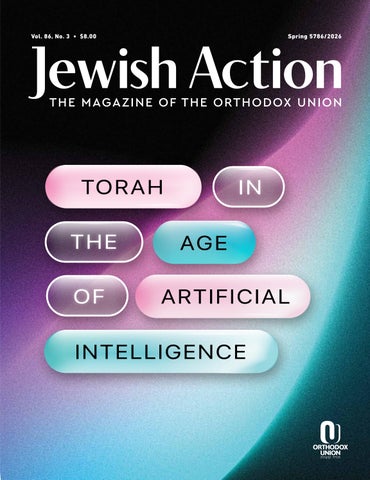
Torah in the Age of Artificial Intelligence
Is AI the Printing Press of the Twenty-First Century?
A discussion about whether the Jewish community is ready for AI Excerpted from the 18Forty and American Security Foundation summit with Dr. Moshe Koppel, Dr. Malka Simkovich, Tikvah Wiener and Rabbi Dovid Bashevkin
How to Use AI (And How Not to Use It)
By Dr. Moshe Koppel
Can AI Make Better Teachers?
Rabbi Gil Student speaks with Chavie Kahn, principal of the Marilyn and Sheldon David IVDU Upper Boys School

50 52 60 62 66 2 8 72
When Rabbis Meet AI
For many rabbis, the question is not whether to use AI but how By Rachel Schwartzberg
AI in Medicine: Halachic Reflections on Emerging Challenges
By Rabbi Dr. Jason Weiner
Spotify for Shiurim? The OU’s AIPowered App Provides Customized Torah Learning By Sandy Eller
The Mashgiach’s Algorithm: Is the Future of Kosher Supervision Smarter with AI?
By Rabbi Gavriel Price
ISRAEL
The Grit Economy: How Israelis Rebuild with Faith and Strength
By Howard Blas
KOSHERKOPY
MENSCH MANAGEMENT
Chochmah Is Not Artificial: Why Employees Are Turning to AI—and What Leaders Are Missing
By Rabbi Dr. Josh Joseph
JUST BETWEEN US
The Power of “Yet”: Why No Child Is a Finished Product
By
Richard Altabe
Jewish Action is published by the Orthodox Union • 40 Rector Street, 4th Floor, New York, NY 10006, 212.563.4000. Printed Quarterly—Winter, Spring, Summer, Fall, plus Special Passover issue. ISSN No. 0447-7049. Periodical’s postage paid at New York, NY, and additional ofces. POSTMASTER: Send address changes to Jewish Action, 40 Rector Street, New York, NY 10006. Jewish Action seeks to provide a forum for a diversity of legitimate opinions within the spectrum of Orthodox Judaism. Therefore, opinions expressed do not necessarily refect the policy or opinion of the Orthodox Union. Cover Design: Bacio Design & Marketing, Inc. 30
When “Obviously Kosher” Isn’t Why beer—and other foods you’d never suspect—requires kosher certification
LEGAL-EASE
What’s the Truth about . . . Delaying a Brit Milah for Medical Reasons? By Rabbi Dr. Ari Z. Zivotofsky
THE CHEF’S TABLE Vegging Out at the Seder By Naomi Ross
NEW FROM OU PRESS
Aggadot HaRav: The Lectures of Rabbi Joseph B. Soloveitchik on Aggadah, Stephen Neuwirth Edition Edited by Rabbi Yaakov Hoffman
BOOKS
Kisvei HaRambam: The Writings of Rabbi Moshe ben Maimon— The Rambam, Translated, Annotated and Elucidated By Rabbi Yehuda Meir Keilson Reviewed by Rabbi Moshe Maimon
Contemporary Halakhic Problems, Vol. VIII By Rabbi Dr. J. David Bleich Reviewed by Rabbi Betzalel Sochaczewski
Attached: Connecting to Our Creator—A Jewish Psychological Approach By Rabbi Yakov Danishefsky Reviewed by Rabbi Micah Greenland
REVIEWS IN BRIEF By Rabbi Gil Student
LASTING IMPRESSIONS
The Long Walk to Moving On By Efraim Jaffe
THE MAGAZINE OF THE ORTHODOX UNION
jewishaction.com
THE MAGAZINE OF THE ORTHODOX UNION jewishaction.com
Editor in Chief Nechama Carmel carmeln@ou.org
Editor in Chief Nechama Carmel carmeln@ou.org
Associate Editor Sarah Dyckman
Assistant Editor Sara Olson
Associate Digital Editor Rachelly Eisenberger
Literary Editor Emeritus Matis Greenblatt
Rabbinic Advisor
I was pleased to read the recent article by Dr. Sharon Grossman, “Weighing In: Ozempic and Jewish Law” (winter 2025). I have been eagerly waiting for this sort of article to appear. Dr. Grossman obviously did extensive research and reported the findings with great eloquence.
Rabbi Yitzchak Breitowitz
Book Editor Rabbi Gil Student
Book Editor
Contributing Editors
Rabbi Yitzchok Adlerstein • Dr. Judith Bleich
Rabbi Eliyahu Krakowski
Rabbi Emanuel Feldman • Rabbi Hillel Goldberg
Rabbi Sol Roth • Rabbi Jacob J. Schacter
Contributing Editors
Rabbi Berel Wein
Rabbi Yitzchok Adlerstein • Moishe Bane • Dr. Judith Bleich
Rabbi Emanuel Feldman • Rabbi Dr. Hillel Goldberg
Editorial Committee
David Olivestone • Rabbi Sol Roth • Rabbi Jacob J. Schacter
Rabbi Dovid Bashevkin • Rabbi Binyamin Ehrenkranz
Rabbi Avrohom Gordimer • David Olivestone
Editorial Committee
Gerald M. Schreck • Rabbi Gil Student
Moishe Bane • Rabbi Dovid Bashevkin • Rabbi Yaakov Glasser
Rabbi Dr. Tzvi Hersh Weinreb
David Olivestone • Gerald M. Schreck • Dr. Rosalyn Sherman
There seems to be an epidemic in our community, which bears discussion. I’ve attended simchahs recently and have seen friends and colleagues who are getting thinner and thinner as a result of using these weight-loss medications. I worry. Yes, these weight-loss medications are seemingly miraculous for those who are obese or struggling with serious medical issues. But many people are using them for cosmetic reasons, hoping to lose ten to twenty pounds before their next simchah. There seems to be an addictive quality. Once they start, they just cannot stop. Or perhaps they know that once they discontinue the meds, the pounds will creep back up again.
Design 14Minds
Rebbetzin Dr. Adina Shmidman • Rabbi Dr. Tzvi Hersh Weinreb
Copy Editor Hindy Mandel
Advertising Sales Joseph Jacobs Advertising • 201.591.1713 arosenfeld@josephjacobs.org
Design
Subscriptions 212.613.8140
Bacio Design & Marketing, Inc.
ORTHODOX UNION
Advertising Sales
I worry about eating disorders. With adults abusing these drugs, I am concerned about the impact on our teens. What exactly are we role modeling for young people when we willingly starve ourselves?
President Mark (Moishe) Bane
Joseph Jacobs Advertising • 201.591.1713 arosenfeld@josephjacobs.org
Chairman of the Board
Howard Tzvi Friedman
ORTHODOX UNION
Vice Chairman of the Board Mordecai D. Katz
President Mitchel R. Aeder
Chairman, Board of Governors Henry I. Rothman
Chairman, Board of Directors Yehuda Neuberger
Vice Chairman, Board of Governors Gerald M. Schreck
Vice Chairman, Board of Directors Morris Smith
Executive Vice President/Chief Professional Officer Allen I. Fagin
G-d created each of us differently—different traits, different personalities, different bodies. Every individual is beautiful in his or her own way. Let us learn to cherish our bodies for what they do, rather than how they look. Our bodies work well? Terrific. Our legs enable us to dance, to stroll along the boardwalk on a glorious, sunny day—how can we not love our legs? Our hips hold our babies, our children, and our grandchildren. How can we not appreciate our hips?
To use these medications for cosmetic purposes appears to be problematic on many levels, as Dr. Grossman points out. There are healthier and more wholesome ways to take off those ten to twenty pounds. Consider the long and short term effects of taking these medications. Let’s be wary.
May all be healthy and well!
Chief Institutional Advancement Officer Arnold Gerson
Chairman, Board of Governors Henry Orlinsky
Senior Managing Director Rabbi Steven Weil
Vice Chairman, Board of Governors Jerry Wolasky
Miriam Liebermann, MSW
Lawrence, New York
Executive Vice President, Emeritus Rabbi Dr. Tzvi Hersh Weinreb
Executive Vice President Rabbi Moshe Hauer, zt”l
Chief Financial Officer/Chief Administrative Officer Shlomo Schwartz
Executive Vice President & Chief Operating Officer
Rabbi Josh Joseph, Ed.D.
Chief Human Resources Officer
Rabbi Lenny Bessler
Executive Vice President, Emeritus Rabbi Dr. Tzvi Hersh Weinreb
Chief Information Officer Samuel Davidovics
Managing Director, Communal Engagement
Rabbi Yaakov Glasser
Chief Innovation Officer
Rabbi Dave Felsenthal
Director, Jewish Media, Publications and Editorial Communications
Rabbi Gil Student
Director of Marketing and Communications Gary Magder
Jewish Action Committee
Jewish Action Committee
Dr. Rosalyn Sherman, Chair
Gerald M. Schreck, Chairman
Gerald M. Schreck, Co-Chair
Joel M. Schreiber, Chairman Emeritus
Joel M. Schreiber, Chairman Emeritus
©Copyright 2018 by the Orthodox Union
©Copyright 2026 by the Orthodox Union
Eleven Broadway, New York, NY 10004
40 Rector Street, 4th Floor, New York, NY 10006
Telephone 212.563.4000 • www.ou.org
Telephone 212.563.4000 • www.ou.org
Facebook: Jewish Action Magazine
Twitter: Jewish_Action Linkedln: Jewish Action Instagram: jewishaction_magazine
WHERE THE GERMAN CUSTOM COMES FROM I enjoyed your excellent (as usual) recent issue. I wanted to comment on the article, “What’s the Truth about . . . Waiting Between Meat and Dairy?” (winter 2025), which was very useful in providing a comprehensive survey of the sources.
The author, Rabbi Dr. Ari Z. Zivotofsky, noted the German Jewish custom of waiting three hours and correctly states that “there is no early clear source for this practice.”
While I do not have a source for this, it seems to me that there is a clear source for the practice that is, in fact, cited in the article as the time between meals.
Rambam (Ma’achalot Assurot 9:28) understood that Mar Ukva was saying that one must wait the typical time between meals, which Rambam defines as “kemo sheish sha’ot—approximately six hours.” The Meiri on Chullin (105a) says the waiting period is “no less than the time between meals, which is six hours or close to it,” while in Magen Avot (9; p. 58 in 5718 ed.) the Meiri says that one
My research helps make digital solutions a lasting and valuable part of aging with dignity and connection.
Dr. Soohyoung Rain Lee,
Ph.D. Assistant Professor, Wurzweiler School of Social Work
Wurzweiler School of Social Work is consistently recognized among the nation’s top programs, attracting students committed to creating meaningful change. With on-campus, live virtual classroom and fully online options, plus full-time and part-time tracks, Wurzweiler ofers the flexibility to fit your life. Our renowned faculty are practitioners, researchers and policy makers whose expertise keeps Wurzweiler at the forefront of the profession.

must wait “six hours or five, the time between meals.”
It is clear to me that the “typical time between meals” was different in Eastern Europe, Spain and Egypt of Rambam’s time and Western Europe and Germany.
In the former, there were typically only two meals a day, except on Shabbat, when we had the luxury of shalosh seudot People ate a meal in the morning and in the evening, which was generally at least six hours apart. However, in Germany, they typically had three meals a day, similar to our custom now, and the “typical time between meals” was considerably less than six hours, more likely closer to three.
Because of this, I believe that the custom of three hours developed based on the Rambam cited above. I am thus perfectly comfortable following my minhag avot as based on legitimate sources.
Yehuda Leonard Oppenheimer
Afula Ilit, Israel
In 1980, I asked Rabbi Shimon Schwab, zt”l, for the source of German Jews waiting three hours between eating meat and milk. He wrote in response: “The Rema brings a widespread minhag Ashkenaz to wait only one hour after meat, which is based on the Zohar. I presume that the three hours are a chumrah that the German Jews took upon
themselves over and above the one hour. Besides this, it was customary in Germany to have a meal every three hours: early morning, midmorning, dinner, vesper in the afternoon, and supper, and since the separation of milchig from the meat meal meant to wait ‘from one meal to the other,’ the obvious time would be three hours. However, none of the poskim mention the three hours.”
Joel B. Wolowelsky Jerusalem, Israel
I appreciated Shalom Goodman’s analysis of the Orthodox middle class struggling with debt (“Crushed by the Costs,” winter 2025).
The article quotes a study that found that “even families with annual incomes of $250,000 to $300,000 feel financially strained. Even among those earning more than $300,000 annually, 30 percent of those who responded reported they feel as if they were struggling.”
The quality of a person’s livelihood depends on his or her trust in the Creator. Through emunah, one attains trust in the Creator. Consequently, concentrated efforts to reinforce emunah and trust in Him are capable of improving one’s livelihood.

I study modifiable brain mechanisms and psychological functions that protect against cognitive and physical decline in aging.
Dr. Roee Holtzer
Distinguished Professor, Yeshiva University Professor, Ferkauf Graduate School of Psychology
For over 60 years, Ferkauf Graduate School of Psychology has been a trailblazer in psychology and counseling education, consistently ranked among the nation’s top institutions. We proudly attract a diverse, global student body, all drawn to our commitment to excellence. With a distinguished faculty and a supportive administration, we provide an exceptional private education designed to empower students and ensure their success in the field.
Emunah teaches us that the Creator sustains all His creations, from the one-celled amoeba to magnificent galaxies, from the whale and the elephant to human beings, who are the crown of Creation. Our sages say that He Who gives life also gives livelihood. In other words, if one believes that the Creator is the life-giving Creator, one should also believe that He sustains His creations.
Naftali Rubin Jerusalem, Israel
The financial struggle described in the article, “Crushed by the Costs,” is a struggle we live every day, and we are likely more fortunate than many. What isn’t mentioned is how much of Jewish life and connection is tied to financial means. The ability to create social connection over Shabbos and yom tov through hosting meals, which is a reciprocal endeavor, bottoms out when you can’t afford to host. It impacts your life and your children’s social lives. It also impacts your psyche to be reliant on communal funds to provide basic things for your family.
Natan Cohen Teaneck, New Jersey

• Available in Black or White
• Modular & Expandable - Choose the configuration you need
• 4-Plate Starter Set with cord - Expandable up to 20 Platas
• Platas Connect by Direct Plug on Multiple Sides
• High-Tech 90W Heating Element in each Plata at 270°F / 130° C
• Easy-Clean Tempered Glass Surface
• Lightweight - Stackable and Easy to Store in a drawer
• Travel-Friendly....take just the Starter Plata with Cord to go
To send a letter to Jewish Action, e-mail ja@ou.org. Letters may be edited for clarity.
Transliterations in the magazine are based on Sephardic pronunciation, unless an author is known to use Ashkenazic pronunciation. Thus, the inconsistencies in transliterations in the magazine are due to authors’ or interviewees’ preferences.
This magazine contains divrei Torah and should therefore be disposed of respectfully by either double-wrapping prior to disposal or placing in a recycling bin.

• Great for Home, Bufets, Catering, Housewarming, Kallah Gifts & more
• Approved by Mishmeret HaShabbat of Bnei Brak for Shabbos Use


* Food should be placed on hot plate prior to Shabbos.

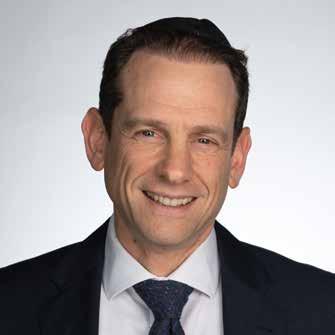
By Rabbi Dr. Josh Joseph
Artificial intelligence has an antonym problem. Its opposites are not technical terms, but human ones: natural, real, genuine, authentic. But perhaps those antonyms are dated now that AI’s most popular uses are no longer about writing code or editing documents, but about therapy, companionship, organizing one’s life and finding purpose.
Recent analyses of generative AI use in 2025, including widely cited industry and management research, paint a striking picture. As predicted, AI has fully entered the workplace and daily life. But it has not entered primarily as a task assistant. Instead, it has entered as a friend and mentor. People are turning to AI to help them cope, reflect and find clarity. That reality should give us pause because it raises a deeper question: What kind of intelligence are people actually seeking?
This is not a new question.
When Shlomo Hamelech was presented with that genie-in-a-bottleesque opportunity to ask for anything at all, he asked for chochmah. Not wealth, not power, not security, but chochmah. But what does chochmah mean? Though it is often translated as wisdom, Tanach presents his request in distinct ways across Sefer Melachim, Divrei Hayamim and Mishlei. Chochmah refers to discernment, the ability to judge situations and people wisely, and an internal moral compass shaped by yirat Shamayim. In Chassidic thought, chochmah is seen as being made up of two words—“ko’ach mah,” or abstract potential. What the Chassidic masters mean is that chochmah is not about the result; rather, it is a journey—from abstraction through nurture, and ultimately toward insight. What is consistent in all these Biblical examples is that chochmah refers to a process.
AI has the ability to hold complexity, to integrate intellect and emotion, and to make decisions that honor both truth and people. It is still learning, but it is gaining experience at lightning speed, making it powerful, accessible and increasingly intuitive. As a tool, it can help people think through problems, organize priorities and reflect on their own behavior. However, it is precisely because it is so powerful and so quick that it cannot provide the magical experience of processing through deliberation, inspiration and most importantly, through human companionship and its inherent meaning.
Recently, a mentee presented to me the results of an AI prompt—“What should I do with my life?” Since he had interacted with AI extensively, the results reflected a deep and intimate
knowledge of this young man and provided excellent advice. When I think back to the mentors I had and the conversations we shared, I cannot always recall what they told me. What I do remember is the warmth I felt in their presence and the confidence I received from them believing in me. Is that something AI can and should replace?
In the Hadran text we recite upon completing a tractate of Talmud, we describe how “we toil and receive reward.” The Chafetz Chaim explains that this is a unique feature of spirituality: that the process is just as meaningful as the result. The efforts of one who tries to build a chair but fails translate into nothing, but one who toils over a page of Talmud and never understands it has acquired a portion of eternity. This value in process is not limited to Torah study; it is true for all spiritual endeavors, and by extension, all human interactions. People are feeling overwhelmed, uncertain of their priorities, and unsure whether their work truly matters.
They are turning to AI not because it is powerful but because it is available, patient and nonjudgmental. It listens. It responds. It helps them sort through the noise. In many cases, AI is filling a vacuum. But by turning to AI, they are missing out. They miss out on the experience, on the give and take with a friend, mentor or manager who pauses in an argument and says, “You’re right!”
Rabbi Dr. Josh Joseph is executive vice president/ chief operating ofcer of the Orthodox Union.
Perhaps they do not have a human being who truly cares about them or who comforts them when they fail—a person they respect who believes in their potential. Those turning to AI for therapy and companionship may get a quicker reply, but without the process, something integral is lost.
The emergence of “finding purpose” as a mainstream AI use case should be sobering. Purpose is not a technical challenge to be solved by better prompts. It is shaped through relationships, responsibility and contribution. In Judaism, meaning comes from knowing that one’s actions matter. Should an algorithm generate meaning?
If people are asking AI to help them find purpose, leaders must ask themselves a difficult question: Do our organizations clearly communicate why the work matters and how each person’s role contributes to the mission? Or have we become so focused on inputs and outputs that we have neglected the soul that drives our employees?
This is where management and menschlichkeit meet. Good leadership is not only about strategy and execution. It is about presence. It is about noticing when a team member is drifting, when morale is thinning or when a role has lost its sense of purpose. AI can offer reassurance, but it cannot offer responsibility. It can simulate empathy, but it cannot truly see another human being. It can answer questions quickly and efficiently, but it cannot be there for the ride.
None of this is an argument against using AI (indeed, I even used AI to help me refine this piece!). Thoughtful leaders should be asking how to integrate it responsibly. AI can help managers prepare, reflect and plan. It can free up time for the work that requires human presence: listening, mentoring, teaching and exercising judgment. The danger lies in confusing assistance with authority. AI should support judgment, not replace it. It can help you think, but it should never be the place where values are decided.
Pirkei Avot teaches, “Aseh lecha rav, u’kneh lecha chaver—Make for yourself a teacher, and acquire for yourself a friend.” Wisdom and support come through relationship. That is not a nostalgic idea; it is a management principle. People grow when they are guided by those who know them, challenge them and care about their development.
For those entrusted with leading Jewish organizations, this moment calls for honest reflection. If people are turning to AI for clarity, comfort and purpose, it is not an indictment of technology; it is an invitation to leadership. Our task is not to outpace machines, but to offer what they cannot: real presence and a clear sense that the work we ask of people matters. When leaders create structures that respect human limits and cultures that nurture meaning, AI can remain what it should be: a helpful tool, not a surrogate for wisdom.
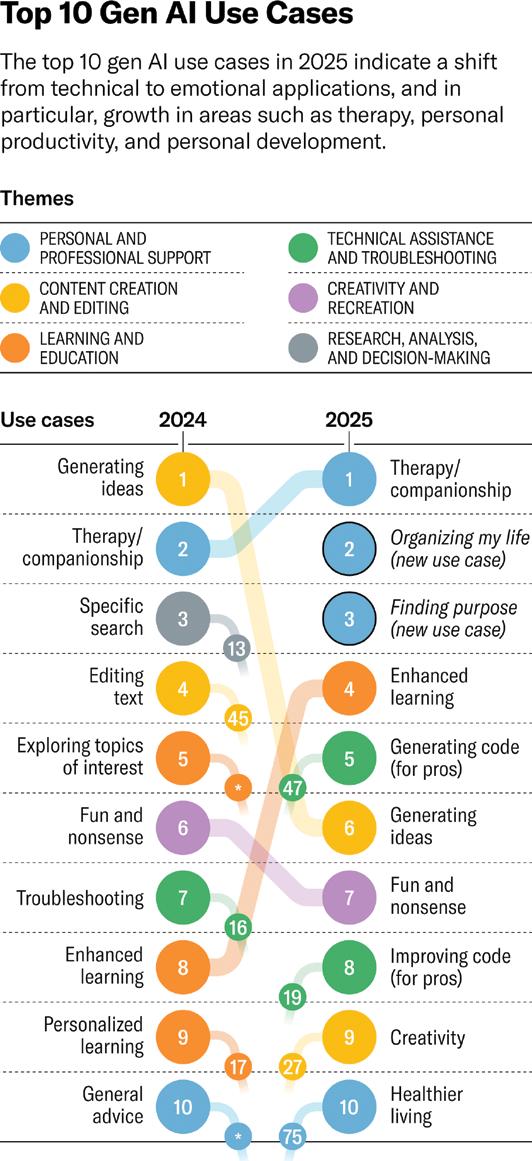
Reprinted with permission from Harvard Business Publishing: Marc Zao-Sanders, “How People Are Really Using Gen AI in 2025,” Harvard Business Review, April 9, 2025, hbr.org.
Source: Filtered.com
Copyright 2025 by Harvard Business Publishing; all rights reserved.


























Touro University is all in on one mission—your excellence. We’re here to help you become exceptional: highly successful, purpose-driven, and ready to make a meaningful impact. The first step? Choose Touro. We’ll take you where you want to go.



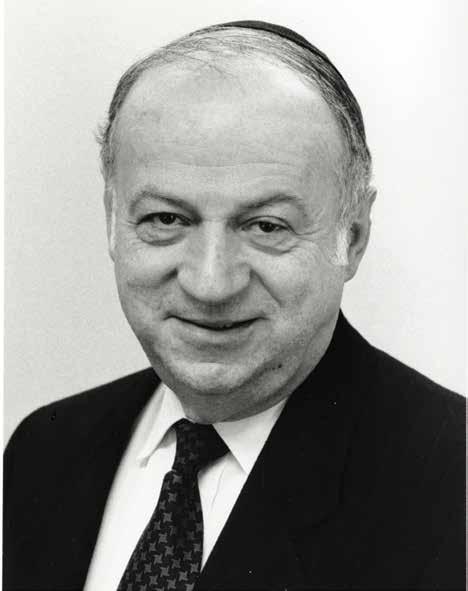
By Rabbi Menachem Genack
The world of American Jewry is often defined by its institutions, but those institutions are defined by the giants who lead them. With the passing of Rabbi Julius “Julie” Berman, we have lost not only a titan of leadership but also a pioneer of a distinctive and dignified synthesis: an unapologetic Orthodox Jew who commanded the respect of the entire Jewish world.
Julie was a man of firsts. Notably, he was one of the first Orthodox Jews to serve as chairman of the Conference of Presidents of Major American Jewish Organizations. In an era when the Orthodox community was often viewed as insular or peripheral to the broader American Jewish agenda, Julie stepped into the breach. His profound legal mind and unshakable integrity made him the natural choice to represent the collective interests of our people.
Julie’s intellectual pedigree was unmatched. He graduated first in his class at New York University Law School, and that sharp, analytical mind informed every communal role he occupied. Nowhere was this more evident than in his work with the Orthodox Union.
Julie served as OU president from 1978 to 1984, where he launched a number of important initiatives, including Yachad, a pioneering program to enhance the lives of Jews with developmental disabilities. As chairman of the OU Kashrus Commission, Julie presided over the Joint Kashrus
Rabbi Menachem Genack is CEO and rabbinic administrator of OU Kosher.
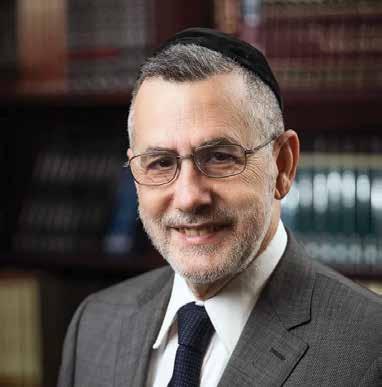
You have been an extraordinary communal leader and friend of Touro University since Dr. Bernard Lander invited you to join the nascent Touro Kollel well over five decades ago and have served as cherished confidant to him as well as to current Touro President Dr. Alan Kadish.






During your historic tenure at the Orthodox Union, you have revolutionized Kashruth supervision around the globe and created OU Press, which has helped widely disseminate the teachings of your revered mentor, the Rav
We are proud of all you have achieved at the Orthodox Union, all you have done for Touro as our board member and all your efforts on behalf of the Jewish community at large as an articulate voice for Torah values in the halls of power.
We wish you and Rebbitzen Sarah continued good health and boundless nachas from your wonderful family.


DR. ALAN KADISH M.D., PRESIDENT
ZVI RYZMAN, CHAIRMAN, TOURO UNIVERSITY BOARD OF TRUSTEES
RABBI DONIEL LANDER, ROSH HAYESHIVA, YESHIVAS OHR HACHAIM
RABBI MOSHE D. KRUPKA, EXECUTIVE VICE PRESIDENT
DR. PATRICIA SALKIN, SENIOR VP OF ACADEMIC AFFAIRS
Commission—a body composed of OU lay leaders and rabbis from the Rabbinical Council of America (RCA). These meetings could often be contentious, dealing with complex halachic and logistical issues. Yet, in every room Julie entered, his word was dispositive. It wasn’t because he sought power, but because everyone—from the most seasoned poskim to the most pragmatic laymen—held him in such high regard.
Perhaps the most telling testament to Julie’s character was his relationship with his rebbi, Rabbi Joseph B. Soloveitchik, the Rav. It is well known that the Rav held Julie in the highest esteem. In fact, the Rav once remarked to me personally that he believed Julie should have been president of Yeshiva University. In a fitting closing of the circle, Julie’s nephew, Rabbi Dr. Ari Berman, today holds that very office.
Julie served as the Rav’s legal counsel for many years, handling all of his personal and professional legal matters. The Rav, ever sensitive to the time and effort of others, insisted on paying for these services. Julie, out of a profound sense of kavod harav, steadfastly refused. In a gesture of deep appreciation for his loyalty and friendship, the Rav gifted Julie a portrait of himself—a rare, deeply personal token of their bond.
Their relationship was also marked by a shared sense of humor and a mutual understanding of the world’s absurdities. I recall a story from the aftermath of the Sabra
and Shatila massacre. A newspaper claimed that the Rav had called Prime Minister of Israel Menachem Begin on Yom Kippur to urge him to appoint an investigative commission. The Rav, rightfully indignant at such a ridiculous libel, wanted to sue the paper. Julie, with his characteristic wit, told him: “Rebbi, in order to sue for libel, the claim has to be credible. No one in the world would believe that Menachem Begin would pick up the phone on Yom Kippur!” The Rav couldn’t help but concede the point.
Julie’s commitment to the Rav extended far beyond legal advice; he was the primary engine behind the preservation of the Rav’s intellectual legacy. As chairman of both OU Press and the Toras HoRav Foundation, Julie spearheaded the publication of the Rav’s sefarim. He was particularly enthusiastic about publishing the Rav’s derashot in their original Yiddish. OU Press published an English translation of the Rav’s derashot delivered at the Mizrachi conventions, but in addition to the English translation, Julie insisted that we also publish the derashot in their original Yiddish, which we did in a separate volume. (Both volumes were sponsored by Julie, and their covers bear the Rav’s portrait—the one the Rav had given him as a gift.) I remember the Rav’s daughter, Dr. Tovah Lichtenstein, asking why we were putting so much effort into publishing the Rav’s Mizrachi derashot in Yiddish. I answered her quite simply: “For Satmar.” The real answer was that Julie was adamant about preserving the Rav’s majestic Yiddish oratory in its original form, even if there were few left to appreciate it.
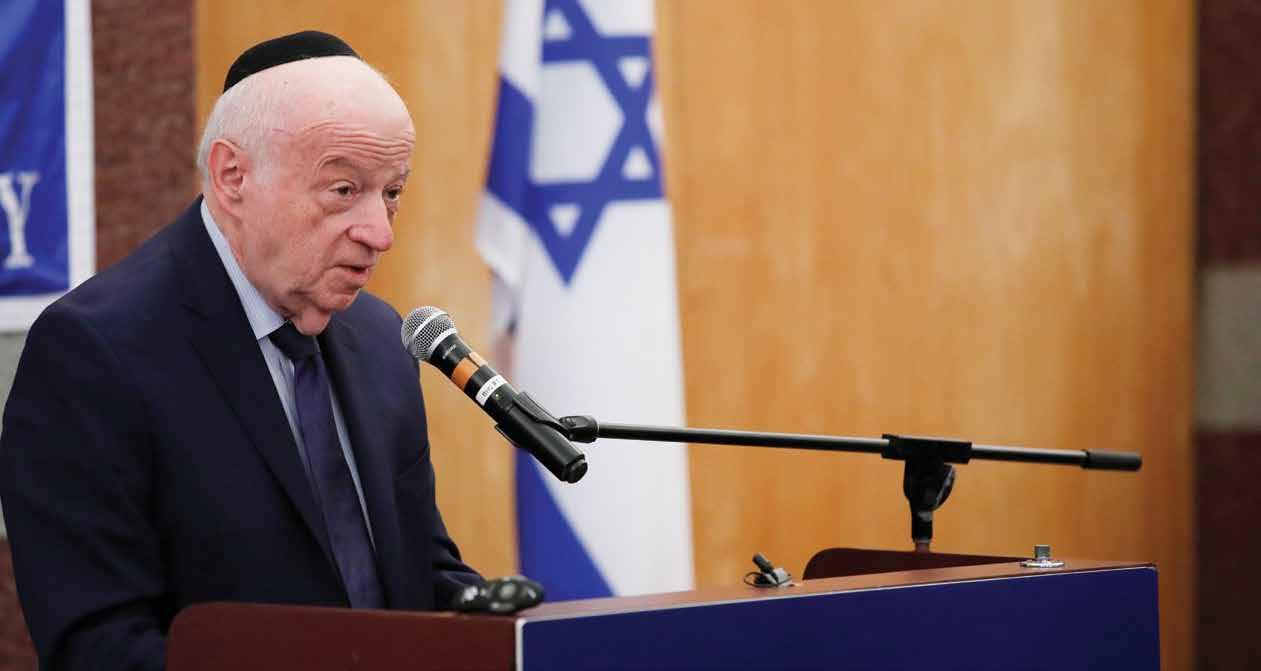
He moved in the highest circles of power . . . yet he remained a humble servant of the Jewish people and a loyal student of his rebbi.




What’s your goal? At Touro’s Lander Colleges you’re part of a welcoming community committed to making your professional dreams a reality. You’ll find an outstanding education, unwavering support, and personalized attention in an environment that’s in sync with your Jewish values. From undergrad to professional school, see how Touro Takes You There.
Julie’s heart was also deeply rooted in the halls of Yeshivat Har Etzion. He shared a lifelong friendship with Rabbi Aharon Lichtenstein, zt”l, dating back to their days as classmates at YU. Whenever Rav Aharon would visit America, the Berman home was his home; he stayed with Julie and his wonderful wife, Dorothy.
The Bermans’ role went well beyond hospitality; they were partners in the yeshivah’s mission. Dorothy continues to
serve as president of the American Friends of Yeshivat Har Etzion, a role she has filled with distinction. This connection was emblematic of Julie’s worldview: a bridge between the American Torah center and the flourishing world of the Israeli hesder yeshivot
Rabbi Berman was a man of the law, but he was governed by Torat Emet. He moved in the highest circles of power— meeting with presidents and prime ministers—yet he remained a humble servant of the Jewish people and a loyal student of his rebbi. He taught us how an Orthodox Jew can lead with excellence, serve with humility and leave a legacy that will speak for generations to come.
May his memory be a blessing.
By Joel M. Schreiber
To realize that my beloved friend of seventy years, Rabbi Julius Berman, has left this world, is extremely painful.
Just six months ago—when I celebrated my big birthday at the annual siyum at Yeshiva University—Julie surprised me by appearing—in his wheelchair—and we danced together with all the young men.
Julie, my brilliant chavrusa, is no longer here; he is gone, but what remains are the memories of a lifetime more than well lived. He was a quiet giant who accomplished more than most men I know.
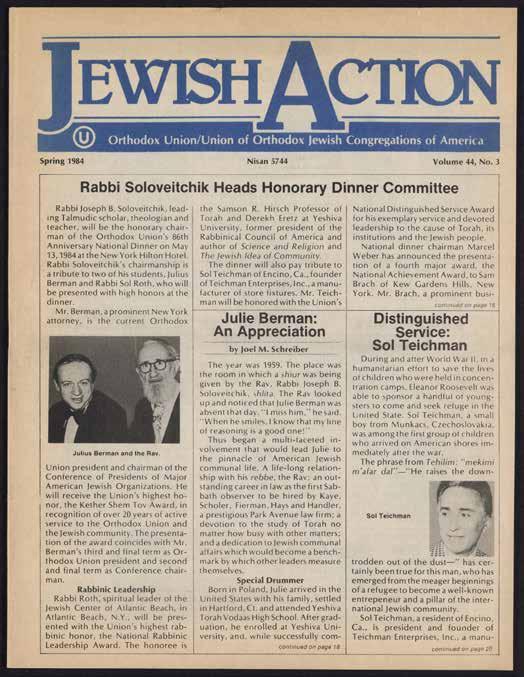
Curiously, just recently, I found an old copy of Jewish Action in my home from before it became a full-color, glossy magazine—dated 1984. An organizational newsletter, it featured the news that Julius Berman was to receive the Keser Shem Tov Award from the OU—its highest honor. There was a picture of Julie and Rav Yosef Ber Soloveitchik, zt”l, and next to the photo: a tribute to him from Joel Schreiber. It seems I have been doing this for quite some time!
I remember clearly the first day I left the shiur by the Rav, entered the beis midrash, and saw Julie sitting with Stanley Rosenberg, a”h. I asked whether I could join them. Julie said, “of course,” and thus began a friendship that lasted the rest of our lives.
Julie was a talmid chacham in the finest sense of the word—a talmid muvchar as well as a talmid ne’eman of the Rav. Whenever he spoke of the Rav—or remembered being with him—tears would come to his eyes! That closeness was beautiful.
An example: Julie told me that one day—when he returned to his office at the law firm Kaye Scholer—his secretary told him that the Rav had called. Julie ran to the phone, called the Rav, and asked if there was something awry. The Rav said, “Calm down—did you ever just feel like talking to someone?”
Again, one day—during shiur—the Rav realized that Julie was not present. He said, “I miss him. When he smiles, I know my line of reasoning is good.”
Julie’s list of accomplishments is staggering. Somehow, while working full time as a top lawyer, he did the following (not a complete list):
• Was a founder of the National Jewish Commission on Law and Public Affairs (COLPA)
• Was president of the Orthodox Union
• Chaired the Conference of Presidents of Major American Jewish Organizations
• Chaired the Conference on Jewish Material Claims Against Germany
• Chaired the American Zionist Youth Foundation (AZYF)
• Chaired the Jewish Telegraphic Association (JTA)
The thought has passed through my mind that when he appears before the Yeshivah Shel Ma’alah and presents his
Joel M. Schreiber is chairman emeritus and co-founder of Jewish Action
This article is adapted from Mr. Schreiber’s hesped delivered at Rabbi Berman’s levayah
accomplishments, they may look at him and say: “Here is another lawyer with a bloated time sheet! How could he have done all that in one lifetime?”
His days in the beis midrash were unusual, for after graduating from Yeshiva University with honors, he enrolled in the NYU School of Law at night and in the semichah program at Rabbeinu Isaac Elchanan Theological Seminary by day! Quickly making Law Review, he graduated first in his class at NYU. His unusual ability to reduce the Rav’s shiurim to key sentences, coupled with a devotion to academic endeavors, yielded both semichah and a law degree at the same time.
During those years, Julie developed the talents of a scribe—in addition to the voluminous notes required for law school, he committed each of the Rav’s shiurim to writing. Many were the talmidim who sought after those notes!
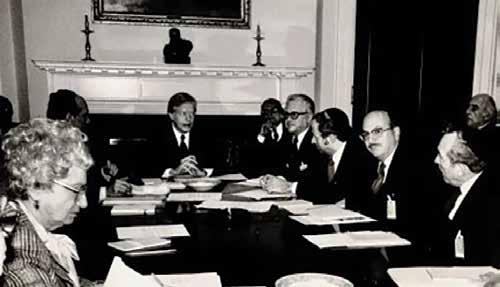
Rabbi Julius Berman with US President Jimmy Carter as part of a delegation of the World Jewish Congress-North America, in 1978. From left around the table: Freida Weiss, president of Hadassah, the Women’s Zionist Organization of America; Rabbi Arthur Scheiner, president of WJC-NA; President Carter; unidentified; Herb Berman, officer of WJC-NA; Rabbi Berman, president of the OU at the time; Rabbi Joseph Karasick, OU chairman of the Board and former OU president; and Rabbi Joseph Shern.
Courtesy of Mark Karasick
Here is another lawyer with a bloated time sheet!
How could he have done all that in one lifetime?
I remember clearly sitting and learning together on a Sunday morning in the beis midrash. We began discussing dates we had had the evening before. He told me about someone he had dated for the first time. Her name was Dorothy Gewirtz—he was quite complimentary—and this turned out to be the best “acquisition” he ever made in his lifetime. In one swoop, he had a wonderful wife, a full-time driver, an accountant and an investment counselor!
In a sense, Julie shaped the world I became involved in. Not only the daily learning we engaged in, the many weekends we spent at yeshivah reviewing shiurim, but also the organizational work I became involved in.
I remember celebrating his ascendancy to the presidency of the OU under the guidance and inspiration of the Rav. Julie called me the next day: “Joel, you are joining me as vice president.” He also nominated me for board membership of RIETS and to ultimately serve as its chairman.
Would any of this have happened if not for my friend Julie?
I loved Julie, and I feel now as King David felt upon losing Yehonasan: “vayishku ish es re’eihu, vayivku ish es re’eihu . . . leich leshalom—and they kissed one another and wept with one another . . . ‘Go in peace’” (I Samuel 20:41–42). Julie, I will never forget you.
A copy of Jewish Action—when it was an organizational newsletter—dated 1984 featured the news that Rabbi Berman was to receive the Keser Shem Tov Award from the OU and included a photo of Rabbi Berman and the Rav.
By Carol Ungar
came
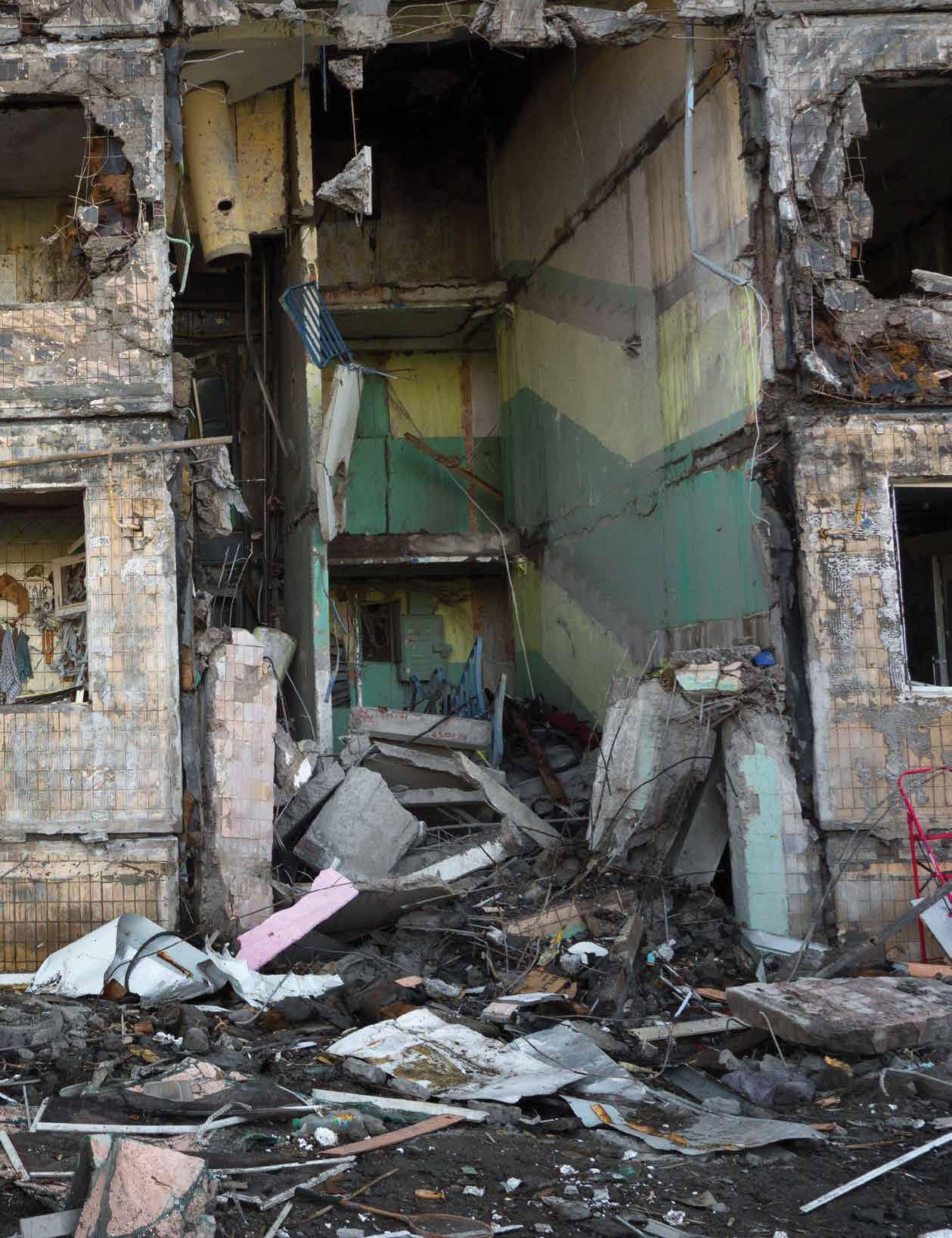
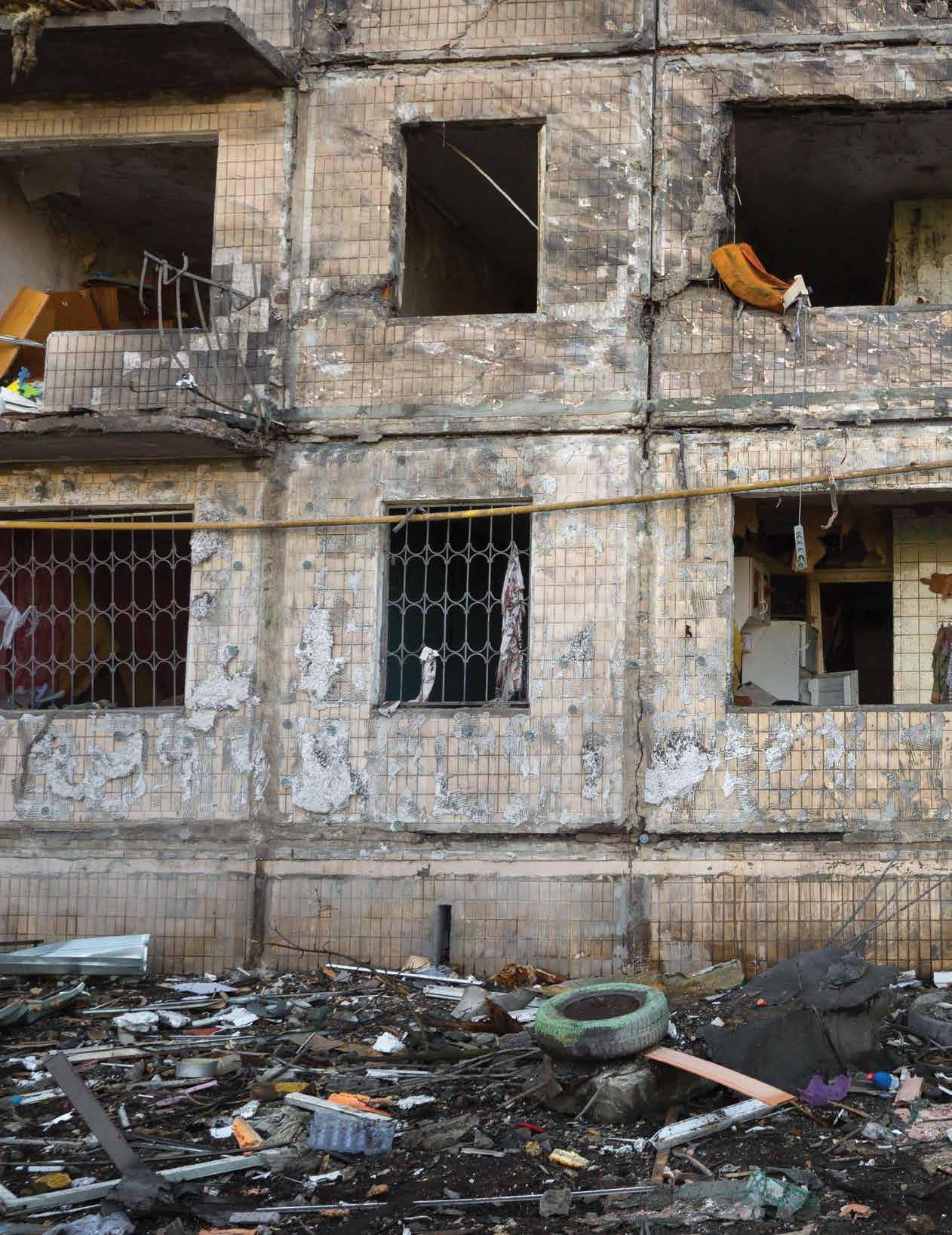
Russia’s ongoing war in Ukraine continues to leave widespread destruction.
It was Friday night at Kharkiv’s Beis Menachem, the only operating shul in Ukraine’s second-largest city. About a hundred people, mostly parents with children, had gathered to celebrate Shabbat. To break the ice, Miriam Moskovitz, the shul’s Australianborn Chabad rebbetzin, posed a question.
“What do you associate with the word kehillah?” she asked.
“Family,” everyone responded in unison.
For many of the roughly 150,000 Jews (according to various Jewish sources) remaining in the war-torn country, the Jewish community—and the shul—has become their closest kin. Each week, more new faces appear, signaling that Ukraine’s Jews are reconnecting with their roots. The pull to Judaism is not new. A teshuvah movement began in the 1990s with the fall of the former Soviet Union. Many of that first generation of ba’alei teshuvah left for Israel or the West, but some remained.
“We are dealing with the grandchildren of people we knew as teens,” says Rebbetzin Sarah Bald.
A former Brooklynite, she and her husband, Rabbi Mordechai Shlomo Bald, the chief rabbi of Lviv, have spent thirty-three years serving as emissaries of the Karlin-Stolin Rebbe in the Western Ukrainian city of Lviv, formerly known as Lemberg. The present war has surprisingly accelerated this process.
Today, thousands of Ukrainians, some halachically Jewish and others Jewish according to the Israeli Law of Return, have affiliated with the Jewish
community, most for the first time in their lives. “People who have never entered a synagogue come to us,” says Rebbetzin Moskovitz. Some come to learn about Judaism. Most lack even the most basic information. Judaism—and in fact all religions—were illegal from 1922 to 1991, when Ukraine was part of the Soviet Union.
Others come for lack of other options. In war-torn areas, gyms, restaurants, community centers and clubs are closed. In those areas, the shul often serves as the only social outlet. “They come seeking connection,” says Rebbetzin Moskovitz. “Suddenly, these Jews realize that no one else cares about them except the Jewish community,” notes Rabbi Daniel Gordon of Jewish Relief Network Ukraine (JRNU), a Chabad humanitarian organization providing aid to Jewish communities in Ukraine.
Many are internal refugees who have abandoned conflict zones for other supposedly safer parts of Ukraine. They have moved from Eastern Ukraine to central or western regions. “Some communities have even tripled in size because of this internal migration,” says JRNU’s COO Judi Garrett. Rebbetzin Bald says that her community, located in the relatively safer Western Ukraine on the Polish border, has doubled in size, increasing from 1,000 to 2,000 members since the war began. “Some come from here, from Kherson, others from Kyiv, Odesa, Zaporizhzhia, or Dnipro. Many stay in Lviv,” she says. “Others go on to Hungary, England, Israel or the US.”
Some people have lost their homes. “In East Ukraine, Donetsk and Mariupol, the Jewish communities
Suddenly, these Jews realize that no one else cares about them except the Jewish community.
no longer exist,” says Rabbi Gordon. Rebbetzin Moskovitz estimates that Kharkiv’s Jewish community of 10,000 is now roughly half its prewar size. Internal migration isn’t just a Jewish phenomenon. A UN study estimates that as many as 3.7 million Ukrainians have relocated within the country. Jewish internal migrants have an advantage—the shul is the place to go for help.
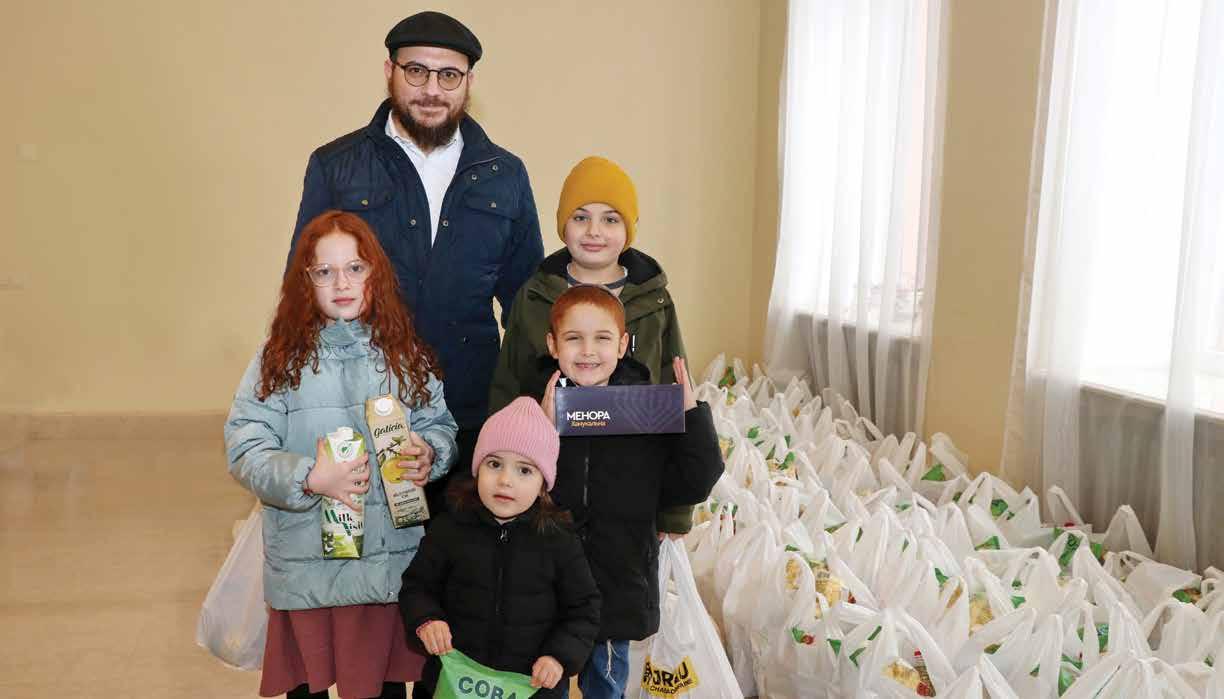
“Previously, these people had never entered a synagogue. Now they are here looking for food, medicine they can’t afford, or assistance with burying a relative,” says Rebbetzin Moskovitz. The shul distributes 1,000 packages of basic
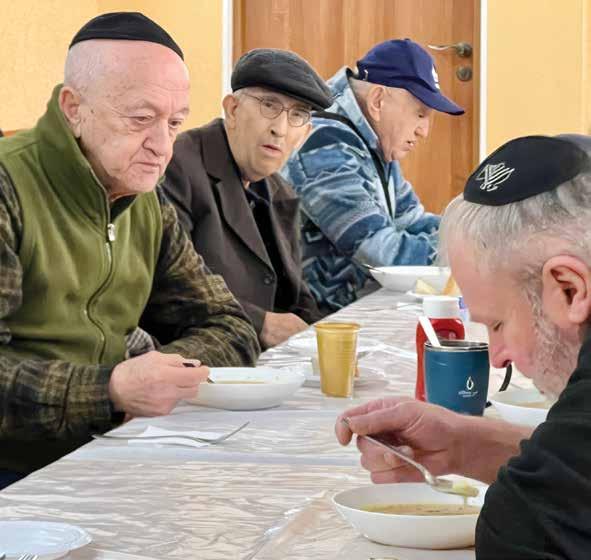
throughout
for help. Seen
foodstuffs, such as oil, eggs and canned goods, every month.
JRNU has distributed 400,000 pairs of glasses, as well as thousands of reflector bands for people to wear around their wrists or waists when they go out at night. “Because of martial law, which imposes curfews and frequent power cuts, it’s pitch black outside at night. The reflector bands help pedestrians remain visible to drivers,” Rebbetzin Moskovitz explains. But it’s not just about material aid.
“The shuls help these people fill an emotional and spiritual need for connection,” says Garrett. She points to high attendance at shul events like Sukkot meals or Chanukah candle lighting.
“Our community has become very close-knit,” says Rebbetzin Moskovitz. Just before this past Rosh Hashanah, the community celebrated Shabbat together in a forest two hours outside of Kharkiv. One of the highlights was the communal recitation of Selichot. “For the past three years, because of the 11:00 PM curfew, we could never say
Selichot on time, but in this space we were able to,” says the rebbetzin. “We blew the shofar. We prayed for peace here and in Israel. There were programs for adults and for the children, and a lot of bonding.”
Some community members were inspired to lean into their Judaism in the most tangible way. Rebbetzin Moskovitz recently posted a video showing a group of middle-aged men celebrating the occasion of their circumcisions. And it’s not only adults. Garrett also points to a half-dozen teens who voluntarily underwent circumcision at their Chabad-sponsored religious summer camp.
Still, always in the background is the constant rumble of war. “We can have alarms all day long. It’s like Sderot,” says Rebbetzin Moskovitz, comparing Kharkiv to the Southern Israeli city that endured two long decades of missile attacks. The shul has had its windows blown out due to attacks. But it has its own generators to continue operating during the frequent power outages. In 2023, due to the Russian attacks
on power stations and other critical infrastructure, the OU helped purchase and distribute thirty-five high-powered generators, each costing up to $50,000, to community centers and shuls in twenty cities around the country. But the bombing continues.
“Everyday life means going in and out of bomb shelters,” says Garrett. For kids, that means attending school underground. “Kids may spend the entire day in basement classrooms,” she says. JRNU has raised money to retrofit these underground classrooms. Even so, the psychological toll is severe. “There is constant fear. Where is my family? Where did they go when the sirens went off? How will I get to a safe space?” says Garrett.
“Ninety-nine percent of these attacks occur in the middle of the night. That means we don’t have day or night,” says Rebbetzin Bald. And the situation is getting worse.
Over the past few months, the Russians have stepped up their attacks, sending waves of Iranianmanufactured, self-destructing attack
Previously, these people had never entered a synagogue. Now they are here looking for food [and] medicine they can’t afford . . .
drones that fly below the radar and most often at night. The deadly drones are notoriously hard to intercept. While a New York Times report quoted Ukrainian sources that claimed to intercept 88 percent of those attacks, that may not be the complete truth.
“The Ukrainians downplay the numbers to avoid causing panic, and they don’t want to let the Russians know how successful they were,” says Rebbetzin Bald. A New York Times report estimated that 80 percent of the war’s casualties have been the result of drone attacks.
When missiles or drones hit the city, people run to safety in underground parking lots, subway stations, basements and stairwells. Unlike Israel, purposebuilt shelters and safe rooms in apartments or buildings do not exist in Ukraine. It’s hard. “In the freezing cold and boiling summer, thousands squeeze into one underground car park,” says Rebbetzin Bald.
For as many as half of all Ukrainians, there is no safe place to go. “Some people spend entire nights walking the streets, figuring they are safer outdoors than in a building that could collapse on
them,” says Rebbetzin Bald. In addition to causing injury and death, the drones and missiles have wrecked apartment buildings, energy infrastructure buildings and even aid distribution sites. Working throughout Ukraine, JRNU has helped thousands of Ukrainian Jews to either repair their damaged homes or find other places to live.
With prices shooting up and salaries remaining at low prewar levels, another major problem is food insecurity. “At the moment, the biggest challenge is poverty,” says Rabbi Gordon. “People are losing hope. They are finding it difficult to support themselves, and they are not seeing an end to this,” he says.
Ukraine has always been a poor country, he notes, but because of the war, many people are living in situations beyond what most people in the West could imagine. Rabbi Gordon describes his visit to Jewish orphans in Zhytomyr in Western Ukraine. “It was snowing, the house had no heat—just a tiny oven to cook on and an outhouse.” People living in the cities are faring a bit better. “There is food in the shops,” says Rebbetzin
Continued on p. 28

By Carol Ungar
Most of us recognize Kharkiv—or its old Russian name, Kharkov—from the headlines. Located just nineteen miles from Russia’s border, Ukraine’s second-largest city has been the scene of fierce fighting in the still-ongoing war.
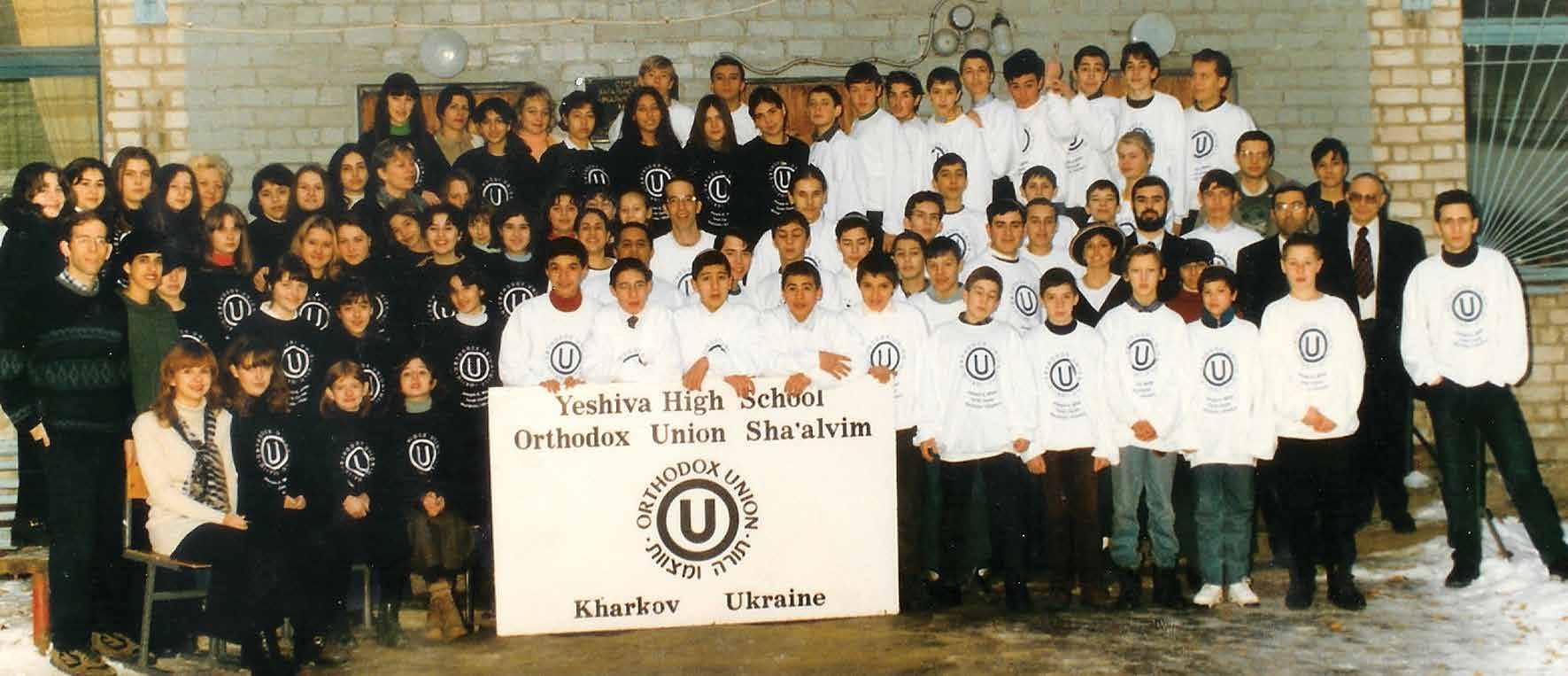
But Kharkiv has another story—a quieter, more hopeful one. Beginning in 1990, the city became home to a unique OU-funded kiruv initiative that spanned nearly two decades and ultimately shaped the Jewish futures of hundreds of young people.
The OU-sponsored Joseph K. Miller Torah Center, along with the Sha’alvim school and summer camp, are no longer operating. But in the years following the fall of communism, they were vibrant, bustling institutions where young Jews
experienced authentic Jewish life for the first time.
“It [the OU’s programs] changed my whole life,” says thirty-eight-yearold alumna Esther Lavie. “Without it, I would have stayed in Ukraine and intermarried.” Now living in Tel Aviv, Lavie—a special education teacher and mother—didn’t know she was Jewish until age eleven. Today, her husband is learning in a kollel.
The OU’s Kharkiv story dates back to 1990, when then–OU president Professor Shimon Kwestel joined lay leader Joe Alpert, Rabbi Raphael Butler—then NCSY’s national director— and singer Shlomo Carlebach on a mission to what was then the Soviet Union. Along with visits to major cities and concerts by Shlomo Carlebach, they installed a Torah scroll—written
in memory of Joseph K. Miller—at the Kharkiv synagogue. An active OU board member, Miller had been deeply involved in the cause of Soviet Jewry before he was killed in the 1988 bombing of Pan Am Flight 103 over Lockerbie, Scotland.
“Thousands of people turned up [to the Torah dedication],” recalls Kwestel. “I saw that we needed to do something.” That “something” became a kiruv camp, which opened its doors in the summer of 1991.
One of the great rabbanim of the late twentieth century is reported to have said that “every generation will be judged by a singular event. Our generation will be judged by how we dealt with Soviet Jewry.”
The OU took that mandate to heart. Located in the countryside near
Every generation will be judged by a singular event. Our generation will be judged by how we dealt with Soviet Jewry.
Kharkiv, the camp was far from luxurious—there were swamps and mosquitoes—but it gave participants a genuine spiritual high. “The OU shipped in food and sent a mashgiach to make sure it was properly prepared,” recalls Kwestel.
Counselors were recruited from among American teenagers in NCSY’s Jewish Overseas Leadership Training (JOLT) program and Israeli yeshivah students from Sha’alvim. Sha’alvim’s Diaspora program was led at the time by Rabbi Mallen Galinsky, who became the OU’s key partner in Kharkiv.
Neither campers nor staff were deterred by the modest accommodations.
The two-week camp, which attracted approximately 500 participants each summer, ages twelve to twenty-six, was an overwhelming success.
“There was so much love. We wanted to spend as much time with the staff as possible,” recalls Ariel Tarafula, who grew up in Kharkiv. Now an IT engineer raising a Jewish family in the United States, Tarafula continued attending the camp even after aging out. “There was a special atmosphere,” recalls former counselor Oshrit Moti, a mother of six and a coordinator for Israeli National Service girls, who spent five summers there. “The kids didn’t know anything. They ate non-kosher food. Most of their fathers weren’t Jewish,” she recalls. “We stood on tables and taught them Jewish songs and prayers.”
For Tarafula, the camp was also where he formally cast his lot with the Jewish people by undergoing a brit milah. “The counselors held my hand and supported me. Everyone was so kind,” he recalls.
Following the camp’s success, the OU expanded its presence in the area, purchasing and renovating several apartments in Kharkiv to establish the Joseph K. Miller Torah Center. The OU recruited Rabbi Shlomo Asraf from Israel to lead the programs. A Sephardic Jew from Netanya, Rav Shlomo—as he was known—had a natural gift for kiruv. Though he spoke neither Yiddish nor Russian, he had already founded a synagogue and kiruv center in Moscow. He proved to be exactly the right man for the job. “Rav Shlomo lived and breathed Kharkiv,” recalls Kwestel.
“Rav Shlomo brought with him the spirit of Eretz Yisrael and Torat Yisrael,” recalls Moti.
It wasn’t long before Rav Shlomo became fluent in Russian. Under his
leadership, the Torah Center operated nearly around the clock. “There were Shabbat services, classes for university students, and Pesach Seders so large that we needed to rent an auditorium,” recalls Kwestel. Rav Shlomo remembers packed Rosh Hashanah services and a Chanukah concert that drew more than 1,000 people.
He also established a day school. “We started with fifty students,” he recalls. “At its peak, we had 250 kids from grades one through eleven.” The school’s goal, he explains, was to prepare students for aliyah—and it succeeded. Nearly 600 graduates eventually made aliyah, assisted by the OU Israel Center in Jerusalem. “[Today], our graduates live all over Israel. Many became religious and established religious families,” says Rav Shlomo.
Today, the Torah Center, camp and school stand empty, as many of Kharkiv’s Jews have emigrated—most notably to Israel. Yet the legacy endures. “I am still in touch with many of them,” says Rav Shlomo. Several months ago, he officiated at a wedding. “The mother had been one of our graduates. Now I was officiating at the chuppah for her daughter.”
“This is success,” observes Alan Miller, a former OU CFO and Joseph K. Miller’s son.
“One generation later,” he adds, “students, shelichim, counselors on JOLT, and even individuals like myself still feel the kiruv effectiveness and impact left by Rav Shlomo.”
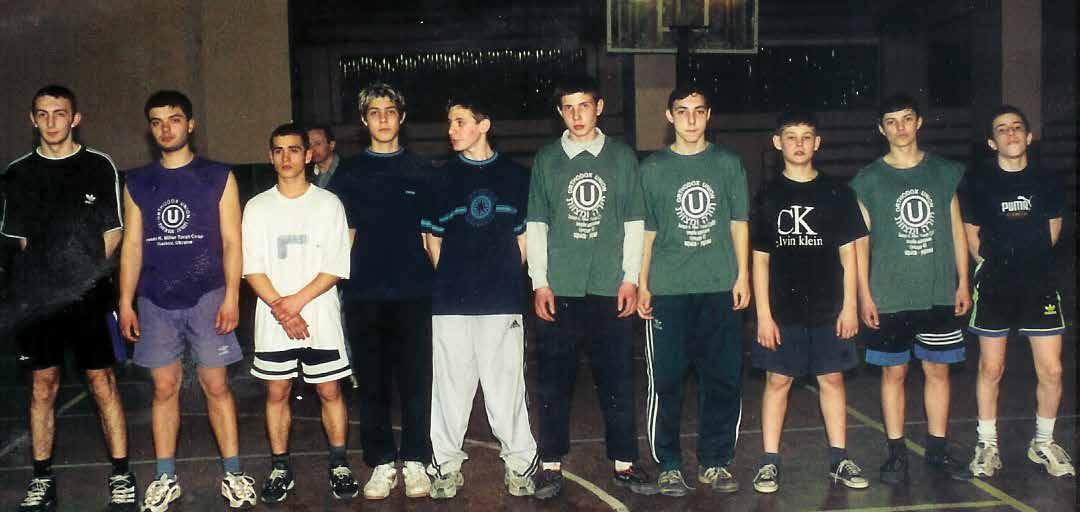
Beginning in 1990, Kharkiv became home to a unique OU-funded kiruv initiative that spanned nearly two decades and ultimately shaped the Jewish futures of hundreds of young people.
Bald, “but you need money to buy it. Money is scarce.”
“Businesses have broken apart, and people are not investing in Ukraine. We see former business people without money, food or jobs,” she says. They often turn up at her husband’s shul asking for help.
Though their stories are wrenching, fundraising for Ukraine’s Jewish community is not easy. Potential donors are tired of this war. Since October 7, many have shifted their giving to Israel. This is because they don’t understand the situation. “They [potential donors] say the Jews should leave just like they left Nazi Germany,” says Garrett.
So why don’t they? Why doesn’t the community just make aliyah? Some have tried. When the war broke out in 2022, thousands left. However, many of them have returned. “As wonderful as Israel is, it’s a different language and culture,” says Garrett. And many of these Jews identify as Ukrainians. “A lot of people feel a deep connection to the country,” she explains.
President Zelensky is popular among Ukrainian Jews. “He has come to visit our schools and has been very supportive of the Jewish community,” says Garrett. Though he himself is intermarried and unaffiliated, Zelensky’s parents are part of the Jewish community in their hometown of Kryvyi Rih in Central Ukraine. Some people do not leave because they refuse to abandon elderly parents who cannot travel. Others have husbands or sons who are in the army. Some have both. Some people are intensely patriotic. Others are terrified.
The draft is a very sticky issue.
According to Ukrainian law, all men aged eighteen to sixty-two with fewer

than three children must serve in the military. Enforcement is strict. Not only are men of draft age barred from leaving the country, but they can also be pulled off the street and forcibly drafted. “Some men hide at home or change residences to avoid being called up,” says Rebbetzin Bald. She tells of one of her congregants who was snatched into the army as he was leaving davening. “He was beaten up, his teeth were knocked out, and he was taken.”
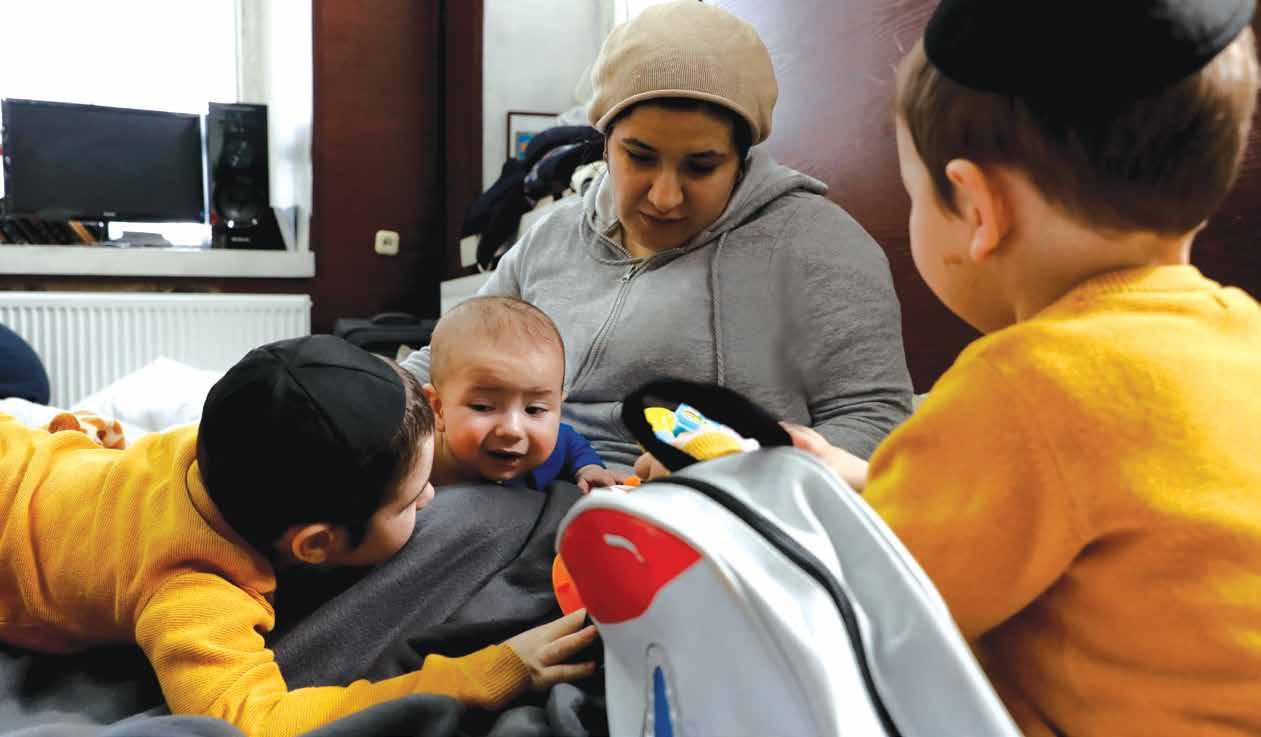
The war has negatively impacted family life. “In many homes the father is gone,” says Garrett. That leaves mothers alone to raise the children, work, and, in many cases, care for elderly parents or in-laws. Army service is dangerous— hundreds of thousands have been killed since the war began.
PTSD is rampant. And the war’s extreme demands have strained the army’s ability to attend to soldiers’ needs for health care or battle rations. “Once you are in, you are in,” says Garrett. “It’s not like they are sending people home while the war is on; it’s a huge problem.”
As hard as it is, army service is part of life, and the Jewish communities extend their support to Jews who are part of the Ukrainian military. “In shul, we say a prayer for all Jewish soldiers who are fighting. We sent arba minim, food and siddurim to keep them encouraged, and we keep in touch with them,” says Rebbetzin Moskovitz. Rebbetzin Bald recalls the soldier who
Maybe this is why the war broke out—to return us and our children to our roots.
showed up to her Pesach Seder. “He got off, and he took those few precious moments to join our second-night Seder. We were in awe of this guy, who, after months in the army, comes home to see his only child for a few hours, yet it was important to him to participate in a Seder, eat matzah and drink grape juice—his Yiddishe neshamah bright as ever.”
Rebbetzin Bald isn’t surprised. After more than three decades of living with them, she believes Ukrainian Jews possess an inner strength. “They are not so fragile, because they went through a lot even before this war. Culturally, they have the stamina. I learn so much from them.” Rabbi Mendel Gottlieb, the Chabad shaliach in Lviv, demonstrates this with the story of twenty-threeyear-old Yura Urshansky, a new ba’al teshuvah who joined the army willingly.
Several months into his service, Yura’s father passed away. “Yura wanted to know what he could do for his father,” recalls Rabbi Gottlieb. “‘Say Kaddish,’ I told him.” Even under the rigorous conditions of army service, Yura tried his best. Tragically, four days after their conversation, Yura was killed. “Now our congregation recites Kaddish for both Yura and his father,” says the rabbi. These days, Ukraine has many Jews like Yura. “People are searching for meaning and hope,” says Rabbi Gottlieb. He quotes another one of his congregants, Olena Yurchin, a mother of two whose Jewish identity was awakened as a result of the war. “Maybe this is why the war broke out,” she said. “To return us and our children to our roots.”


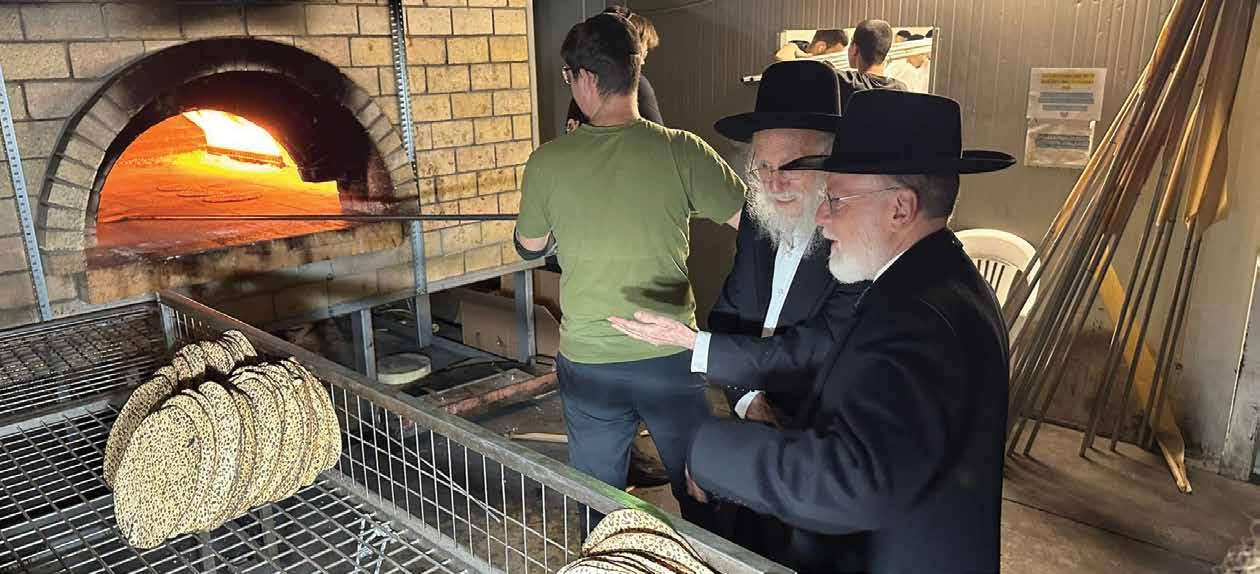
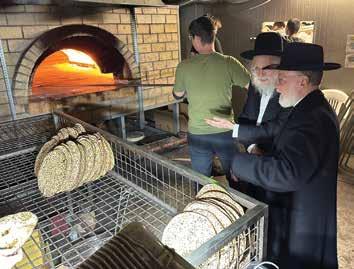
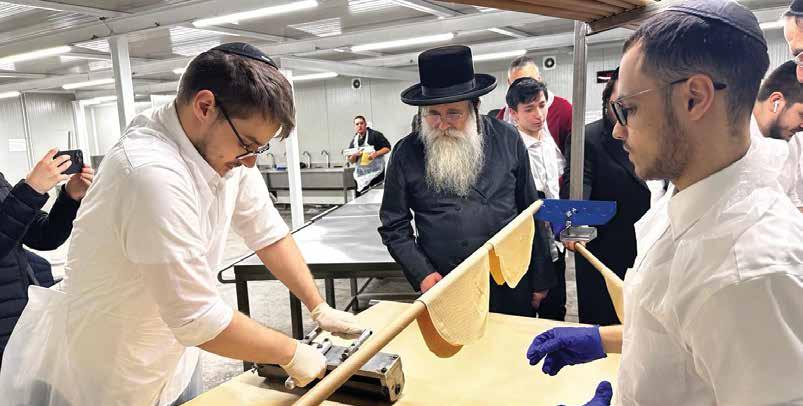
A matzah bakery in Bucharest, Romania, provides essential employment to refugees forced to flee Odesa during the Russian bombardments of Ukraine.
By Carol Ungar
For the refugees of Ukraine, hope is now found in a box of matzah.
For the displaced Jewish community of Ukraine’s Tikva Children’s Home, a new brand of handmade shemurah matzah—Ateres HaMatzos / Matzos Bucharest—is more than a kosher staple; it is a vital lifeline. This year, as the matzah takes its place on grocery shelves, it is also providing essential employment to the very people who were forced to flee Odesa during the Russian bombardments of Ukraine.
“It’s really meaningful to buy these
matzos because they support an entire community,” says Zevy Wolman, an OU Board member who has been helping to bring the matzah to the US market.
The 1,200-member Tikva community grew out of the Tikva Children’s Home, founded by Rabbi Shlomo Baksht. In 1996, newly arrived in Odesa, Rabbi Baksht discovered that hundreds of Jewish children were living in government-run institutions or surviving on the streets. Many had been abandoned by parents struggling with addiction, mental illness or the sheer inability to care for them. Their futures seemed bleak.
To change that trajectory, Rabbi Baksht established Tikva—which means hope—giving these children a chance for a new and better life.
Over time, Tikva evolved into a comprehensive school system with dormitories that have provided schooling and a home to hundreds of children from Ukraine, Belarus and Moldova.
In March 2022, as Russian bombardments intensified, Tikva’s CEO, Rabbi Refael Kruskal, concluded that Odesa was no longer safe. Under his leadership, the entire Tikva

community—including former students, teachers and 250 orphans—evacuated by bus to Romania.
Today, Tikva is based in Bucharest, where it continues to care for roughly 300 orphans.
“It’s a unique community, the only real Orthodox community that left Ukraine and stayed together,” says Tikva volunteer Menachem Siegal.
But for community members, making a living is a huge challenge. “There isn’t enough employment in Bucharest. Not having work makes people depressed. We didn’t want that to happen. We wanted our people to be able to support themselves,” says Rabbi Kruskal.
This is why the matzah bakery— providing up to seven months of steady work each year—has become essential.
Housed in an 8,000-square-foot warehouse in Bucharest, the bakery, opened three years ago, currently employs forty adults, helping them earn a living wage that offsets basic expenses.
“This gives people the ability to feel independent; even if it’s 30 to 40 percent of what they need to live for a year, it’s better than being completely dependent on tzedakah,” says Wolman.
Israeli mashgichim trained community members in matzah production. The matzah is supervised under the Kedassia certification—a stringent kosher certification in the UK—and by the US-based Minchas Chinuch-Tartikov. Today, the bakery produces around 600 pounds of matzah a day. With the help of Network for Kindness—an association of US-based Tomchei Shabbos organizations and food pantries—in partnership with the OU, the bakery is exporting more than 60,000 pounds of matzah to the US for the first time. Network for Kindness and the OU have leveraged their institutional reach to ensure that the matzah makes its way onto the shelves of kosher grocery stores, into food pantries, and into Tomchei Shabbos packages—creating a vital market for the bakery’s work.
The bakery also sells some 20,000 pounds to Jewish communities in England, Vienna, France, Belgium and other countries. But this is the first year the matzah is being marketed in a major way. “It’s a much bigger operation this year,” says Siegal. The goal, he explains,
is to keep the bakery open year-round and employ community members throughout the year.
“There is no one making money on this matzah. It’s a nonprofit—the entire motive is to support the community,” says Siegal.
Back in 2022, the evacuation to Romania was an urgent necessity; the community’s rabbi ruled that it was pikuach nefesh “They left on Shabbos in the middle of the night,” recalls Rabbi Shlomo Noach Mandel, executive director of the Shema Yisrael school network, of which Tikva is a part.
“Getting them into Romania wasn’t easy,” he says. There were many bureaucratic hurdles, as many of the children were officially registered as Ukrainian wards of the state.
While aliyah might have seemed like the natural solution, Tikva’s administration ruled it out. “We wanted the orphanage and the community to stay together. In Israel, that would have been impossible,” says Rabbi Kruskal.
In Bucharest, community members live, study and work side by side in one small neighborhood, recreating the warm atmosphere that characterized Tikva in Ukraine. Though Tikva’s mission is not formally kiruv, many children—most from nonreligious, single-parent homes— find their way back to Jewish life through the care, stability and Torah environment Tikva provides.
Since the evacuation from Odesa,
the OU’s Relief Missions department, headed by Rabbi Ethan Katz, has been sending volunteers from the US and Israel to bring joy and connection to the Tikva children. High school students, college-age youth and young professionals arrive brimming with energy. They run carnivals, lead craft projects, organize spirited Shabbat meals, and—most importantly—build genuine relationships.
“It’s the highlight of these kids’ lives,” says Rabbi Katz, a much-beloved figure among the Tikva youth, who has organized more than a dozen volunteer missions to the orphanage.
“The children at Tikva are surrounded by care, stability and genuine love every day,” says Rabbi Katz. “Many come from backgrounds where their natural homes could not provide that and the war only intensified their trauma. When people travel from around the world on relief missions to see them, it adds an extra and powerful dimension of love and affirmation—something they did not experience in their early lives. Many of these children are carrying significant PTSD, and knowing that the world sees them, values them and cares deeply about them makes a profound difference.”
As difficult as the upheaval has been for the children, the transition has often been even harder for the adults. Few speak Romanian; meaningful employment is scarce; and what was expected to be a short relocation has stretched into years, leaving the Children’s Home under severe financial strain.
“Everyone there is a refugee,” says Rabbi Katz. “When you buy this matzah, you are literally buying hope,” he says.

Artificial intelligence is no longer a distant abstraction or a theoretical debate; it is already shaping how we write, teach, learn and make decisions. Its presence is felt in our classrooms, institutions, shuls and homes. This cover story explores AI’s emerging impact on education, health care, the rabbinate, kashrut, Torah study, and more, and asks a question we are only beginning to confront: How will AI shape our lives and the lives of our children?


A discussion about whether the Jewish community is ready for AI

Excerpted and edited for length from the 18Forty and American Security Foundation summit on Artificial Intelligence held this past September. The summit featured a panel discussion— moderated by Rabbi Dovid Bashevkin, host of the 18Forty Podcast—with Dr. Moshe Koppel, Dr. Malka Simkovich and Tikvah Wiener.
Moderating the conversation, Rabbi Dovid Bashevkin framed AI as a communal challenge, akin to the advent of the printing press in the fifteenth century, and pressed the question of how the Jewish people should respond.
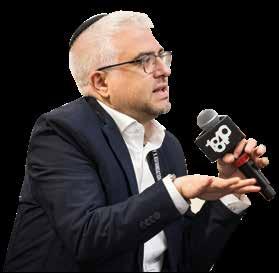

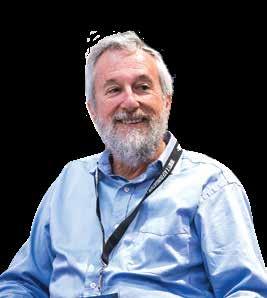

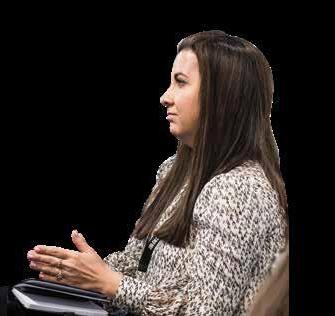

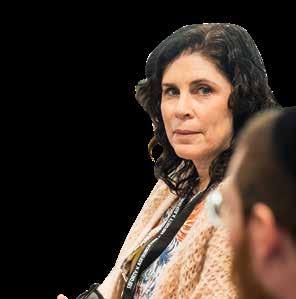
Dr. Moshe Koppel is a computer scientist, Talmud scholar and political activist. He is a professor emeritus of computer science at Bar-Ilan University and a prolific author of academic articles and books on Jewish thought, computer science, economics, political science and other disciplines. He is the founding director of Kohelet, a conservative-libertarian think tank in Israel, and he advises members of the Knesset on legislative matters.
Dr. Malka Simkovich is the director and editor-in-chief of the Jewish Publication Society and previously served as the Crown-Ryan Chair of Jewish Studies and director of the Catholic-Jewish Studies program at Catholic Theological Union in Chicago. She earned a master’s degree in Hebrew Bible from Harvard University and a doctoral degree in Second Temple and Rabbinic Judaism from Brandeis University.
Tikvah Wiener is the CEO of Kadima Coaching, a professional development organization in student-centered learning. Previously, she founded and co-directed The Idea Institute, which, since 2014, has trained close to 2,000 educators in project-based learning and innovative pedagogies. From 2018 through 2023, she was also the head of school of The Idea School, a Jewish, project-based learning high school in Tenafly, New Jersey.
Rabbi Dovid Bashevkin: AI is slowly but surely becoming a part of most of our daily lives, and undoubtedly all of us are wondering: Where does this take us next? How will artificial intelligence shape the future of our lives and the lives of our children? We are often described as the People of the Book, and our tradition has long been shaped by how we engage with and interpret the written word. At the same time, Judaism makes a unique distinction between the Written Torah and the Oral Torah. So when the printing press emerged in fifteenth-century Europe, it raised a very real and practical question: What does it mean to speak of an Oral Torah when suddenly anything we say can be written down and passed along to future generations? How to understand and respond to the printing press became a major debate in Jewish law.
The Rema Mi’Fano, Rabbi Menachem Azariah da Fano, a kabbalist, was probably the first to weigh in on this, but the debate lasted for centuries: Does “printing” legally qualify as “writing”? This distinction was critical for a get (divorce document) as well as for sifrei Torah, tefillin, and mezuzos, all of which the Torah explicitly requires to be “written.”
Mechkarim BeSifrut HaTeshuvos— a collection of responsa published in 1973, which addressed questions facing the Jewish people over time
cites from the responsa of Rabbi Zvi Hirsch Chajes (19th responsum), where he acknowledges the fact that technological innovation is disruptive. Rabbi Chajes writes that every generation faces its own struggle to adhere to our mesorah while determining how new technological advancements should be understood and integrated.
There are times when there are bursts of innovation, and he says, “ve’ein lecha davar she’ein lo zeman u’makom—there’s nothing that doesn’t have its time and place”: everything is given its time to disrupt the world, and the Jewish people need to figure out how that aligns with Yiddishkeit. Do we retreat, do we move forward, or do we integrate? Throughout history, we’ve had different responses to these challenges. I would like to start the conversation by asking how your work and life have been affected by the advent of AI.
Dr. Malka Simkovich: There’s a huge panic in academia right now, as well as a stagnancy, as a psychological response to what’s happening with AI. A colleague of mine put in the following to ChatGPT: “Use my own scholarship (and he put in his name) to write a new article on a topic that I am an expert on, in the voice of Malcolm Gladwell.” What ChatGPT put out was so outstanding, so intriguing and well-written with such a good introductory hook that



my friend said, “I’m done; I am never writing again. I’ll teach and I’ll engage with my community, but I will not write anymore. It is simply not worth my time. The algorithm has exceeded my own creative capacity.” And he hasn’t written anything since. This was some months ago.
On the other extreme, you have older generation academics refusing to use AI, and that’s myopic. It’s unrealistic to think they can get through the next few decades of their careers and just ignore AI. The big question is going to be what happens to those of us in the middle who want to use AI as a tool but also want to believe that we have
the capacity for our own creative ideas and that we have something unique to contribute.
I ask myself this question very often, and I’ve tricked myself into thinking that I do have something unique to contribute. And if you sincerely believe that, then you must work outside of AI before you turn to it as a tool.
Tikvah Wiener: For the past ten years, I’ve been focused on studentcentered learning, an approach that seeks to change education so that students have greater agency in the classroom. It involves many different components; it’s not one single method
or philosophy.
In my work, I am already seeing just how artificial intelligence can simplify this process. Work that took so long without it can now be done quickly, making student-centered learning easier and giving students greater agency.
If you’re any kind of educator, general or Jewish, you can see how differentiating lessons can be made much easier using AI tools. If you go to Khanmigo, Khan Academy’s AI platform, for example, or Magic School, you will find numerous tools available to educators. So one thing that’s already become de rigueur in our workshops is asking how participants are using AI tools for their own work. And then, of course, the conversation shifts to how the kids are using AI tools themselves.
I remember when everyone flooded schools with iPads, and in many cases, the iPads just ended up in a drawer. Now we know that the iPads were not the best idea—because there was no plan. So how do we go into this new technology with a plan? For example, consider a teacher who really doesn’t want to use it. You’re the administrator. Formulate a comprehensive plan for the school. When you ban cell phones, that’s freedom from. What’s freedom to? How do you develop a proactive plan that moves everyone along with you? That’s what I would love to see happen in the field of Jewish education today.
Jewish Action is the Orthodox Union's quarterly magazine, bringing readers intelligent, relevant, and thoughtful essays from leading voices across the Orthodox world.

Fresh, new voices
Monthly digital newsletter
Access to our archive
Broad range of perspectives
Get Jewish Action by becoming an OU member
After June 30, 2026, Jewish Action will be available only through OU membership. Standalone subscriptions will no longer be ofered. We will honor all current subscriptions through their expiration dates.
ou.org/membership | jewishaction.com | Questions? ja@ou.org

For those people, and that is most people, who find meaning through the creative work they do, AI is going to be an absolute catastrophe.


Rabbi Bashevkin: Moshe, I was wondering if you could speak about the genuine panic, almost like the fear of watching a computer do what you have spent your entire life distinguishing yourself by. What is your position on the angst that people feel when they see the magnitude of what is coming?
Dr. Moshe Koppel: I think that angst is completely justified. For those people, and that is most people, who find meaning through the creative work they do, AI is going to be an absolute catastrophe.
There are many potential dangers from AI, but I’m not a crazy “doomer.” The one issue that I think is very frightening is the fact that most people will have absolutely nothing to do with themselves. And I’m not talking about people whose jobs are drudgery in the first place—people who would be perfectly happy to be relieved of them.
I’m talking about people who are doing creative and interesting work and find satisfaction in it. Young people will not be in those professions—whether it’s law, computer programming, medicine, education, all the white-collar jobs. It’s not that the current employees are going to get fired; it’s that the people who are up and coming and learning those things now are not going to get hired. And I’m not talking about the economic effects of this, which I think are minor. The real effects are psychological, in terms of people’s sense of purpose and meaning in life.
This is going to be an absolute catastrophe.
Rabbi Bashevkin: How do you personally use AI in your work?
Dr. Koppel: I use AI essentially in the same way that I used Google until now, except it’s better. Instead of putting a search term into Google, I ask a question to Claude and get back a much better answer. But for the most part, I find that, for me, AI does more harm than good.
I used to just sit down and write an essay—and I was pretty good at it. Now, I write something between an outline and the full text, quickly and informally.
Then, I’ll throw it into ChatGPT and say, “clean this up.” I iterate because it often doesn’t sound like me, so I repeat the process a number of times. By the time I’m finished iterating, A) it has taken me more time than if I had just thought it through more carefully and written it myself, and B) it still doesn’t sound like me. That’s one of the main ways I use it, and it’s bad. It actually is harmful. It saves me nothing, and it makes things worse.
Rabbi Bashevkin: When internet use first began to spread, there was a large gathering within the Chareidi/ Chassidic community known as the asifah about the dangers of the internet. If you were to imagine an asifah for the broader Jewish community about the advent of AI—one that fills a baseball stadium with Jews from every stripe and background who are concerned about this question—what should the messaging be?
Tikvah Wiener: If I were to attend the asifah, I would say this: I hear what Moshe is saying, and I hear others who say that AI can be harmful, but I’m a big acolyte of Rabbi Jonathan Sacks, zt”l
And Rabbi Sacks was not a person who spent time in despair. He talked about having hope (which also happens to be my name). Hope is an action verb. Aside from the dangers of AI, we are all living, post–October 7, in very challenging times. I don’t think it’s helpful to live in fear.
Moreover, when we make decisions out of fear, we tend to make bad decisions. So I think if I were gathering the Jewish people, I would remind them that we’ve been in moments before that challenged our notion of what it means to be human. Imagine being a Jew when Charles Darwin published On the Origin of Species. You would have been thinking: What about Bereishit, the story of Creation? But now we have responses to that.
I love this discussion because it’s proactive. And we have an important role to play—to say clearly that we have the Torah, and that everything we do is filtered through that lens.
If I were convening a gathering of the broader Jewish community, I would
remind everyone of that and urge us not to live in the darkness.
Rabbi Bashevkin: I really appreciated that response. Malka, I’m curious specifically about historical precedents from your vantage point as a historian how Jewish communities have responded to moments of disruption.
Dr. Simkovich: In ancient times, when writing first appeared, it threw the world into upheaval and eventually changed society in fundamental ways. (Many view writing as a form of technology). But in my view, the second great technological development in this early history is more important, and that is the advent of mail.
The Persians introduced mail at the end of the sixth century BCE and into the fifth century BCE when they built roads for the emperor’s postal system. When the Persians built those highways and used them specifically to dispatch edicts and official statements of the emperor, suddenly people were held accountable to a higher voice than their local homes, neighborhoods and immediate communities. They had to think about a world beyond their immediate reality. Of course, this is way before there was any social media, but the mail of that time was the social media of its day.
This caused people to contend with very big questions about human freedom and accountability and whether they had a unique contribution to make, knowing that there was a higher authority they had to answer to in a much more immediate way. Of course, there were always rulers and emperors, but with the mail system, there was closer connectivity and a sense of more immediate obligation to the host country under which people were living. Also, the concept of mail led people to think about others that they would never have direct connection with. Maybe they’re producing something that threatens us. Or maybe they’re producing something that perfectly aligns with us, and therefore we no longer have anything new to contribute.
Now, there must have been some panic when mail started to show up, but the Jews living under Persian rule
The algorithm has exceeded my own creative capacity.

used it as an incredible opportunity. Certainly, Jews responded right away to this technology by producing their own writings and disseminating those writings. The end of the Book of Esther is a great example of this, but it’s one of many examples of Jews writing, dispatching, transposing, sharing and translating. It’s not a mistake that the end of the Book of Esther provides a lot of detail about this dissemination and the reaches and the extent to which these letters made their way through this vast empire.
This is what Jews have done for centuries. They have faced massive changes with resilience and creativity. And I don’t want to be too optimistic—it would be against my nature—but the willingness of the Jewish community under Persian rule to adopt this technology and then incorporate it into their own frameworks of thinking really ensured their survival and their unity.
Rabbi Bashevkin: That’s absolutely fascinating. I’ve been thinking about how the human body adapts when it loses one of its senses. G-d forbid, when someone loses sight, their sense of hearing is often sharpened. As AI begins to reshape writing and other creative work, what kinds of training or skills do we need to cultivate in a world where certain forms of thinking and writing are no longer giving people the same opportunities for exercise?
Tikvah Wiener: If you’re standing in front of a classroom and suddenly ChatGPT can provide the information more effectively, then you have a problem. But one of the things we do a lot in our schools is teach the
Socratic seminar, which is a student-led discussion in which participants use open-ended questions, close reading and evidence-based dialogue to deepen understanding of a text or idea. It’s an approach guided by thoughtful questioning rather than direct instruction.
We’re Jews, so we like to talk and discuss. When you give students agency, and you teach them how to have conversations, that is actually the antidote to social media and even the antidote to AI, because students have to engage with texts in evidence-based, text-centered ways. So you’re teaching them how to do the research. You have to show them that they have to come to a conversation with both knowledge and skills, and then they have to discuss and take on someone else’s perspective. So having students collaborate, communicate and be creative with each other is the perfect antidote to AI, which says, essentially, just let me do it all for you. And you as a teacher can now say, “Actually, I need you students to be in this room and present and bring all of you to this conversation.”
Rabbi Bashevkin: Moshe, I’m curious as to which human skills you think are most at risk?
Dr. Koppel: Thousands of years ago, communities consisted of just a few hundred people, and altruism was enough to keep those communities functioning reasonably well. Once you had things like mail and roads and other forms of infrastructure, the size of the community became much larger. And there’s what’s called the Dunbar number. According to British anthropologist Robin Dunbar, people can “handle” up to about 150 relationships. Once

you’re in a group that has more than the Dunbar number of about 150, altruism no longer functions sufficiently to keep a society together. At that point, you need to develop social norms—particularly norms regarding commerce and so forth—that make it possible for people who don’t have any kind of kinship relationship with each other to function as a society. In fact, everything that we call social norms developed as a result of communities getting bigger because of transportation and communication.
What’s happening now is that transportation and communication are becoming much more refined, so that essentially you can interact with billions of people. As a result, the communities we have now are generally divided along other lines than we were accustomed to. Once it was proximity. Now people are dividing up into virtual communities— you can be in a community of lefthanded knitters, for example.
We need to start developing new social norms that are appropriate for billions of people. And I don’t think it’s possible for those norms to develop
very slowly. The speed with which these changes are happening is on a completely different scale than the scale at which norms generally evolve.
Aside from all this, social skills are getting worse. If people are interacting mostly virtually, walking around with their faces in their phones all day, this leads to really poor social skills. Intellectual skills are also going to get worse—we are growing lazy. Instead of thinking things through, we outsource our thinking to AI. And when that happens, it’s like what happened when we got Waze. Nowadays, even when I drive to the corner, I turn on Waze. I can’t get anywhere without it.
The same thing is going to happen with our intellectual abilities, because we’re farming them out. We’re losing essential skills, and at the same time we’re fundamentally changing the way we interact with people. We’re going to have to evolve norms that regulate the way we do these things so that they don’t end up catastrophically—and I don’t think we’re going to be able to do that in time.
Dr. Simkovich: One thing that AI doesn’t do well right now is express doubt and humility. When you ask AI a question, it might invite you to refine the question, but what the chatbot will ultimately give you is a highly confident answer that leaves you with a sense that it has reached the objective threshold of truth. AI, in that sense, is very unhuman-like, because when we’re in dialogue with another individual, you can gauge, even if you’re speaking over Zoom, facial expressions, body language, intonations, hesitation, doubt and also all those infinite gradations of humility. And then you have many more tools of discernment to assess critically whether you’re going to accept the information you have received.
AI right now is not very insecure. Over time it could become more humanized and say, “I’m not sure this is my answer, but I advise you to go to Claude and Grok.” But that’s not where it is right now.
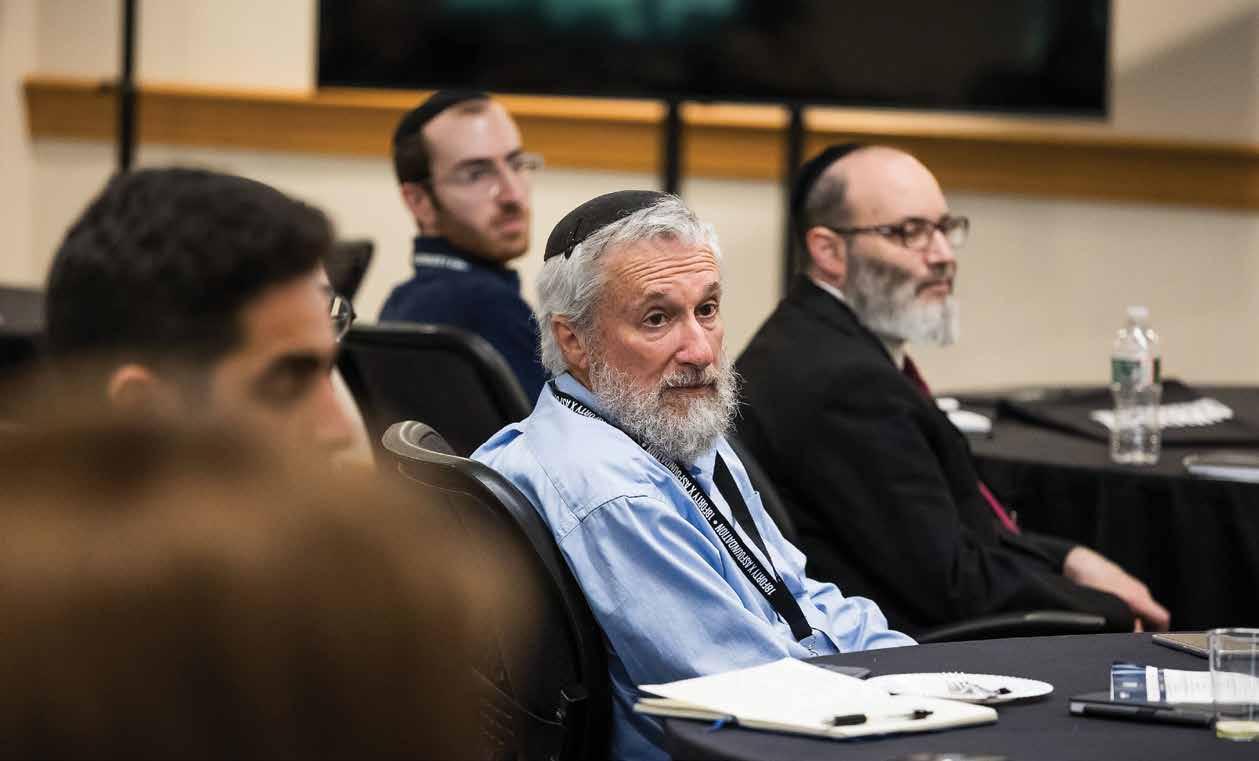
Panelist Dr. Moshe Koppel warned that once AI becomes a part of daily life, “most people will have nothing to do with themselves.”
Pictured, Dr. Koppel seated next to Rabbi Gil Student, OU director of Jewish Media, Publications and Editorial Communications.


undeniably awesome. We have even parties. My morning to cupcakes and cake waiting for them. Interestingly, when we first introduce Shabbos when my kids are young, they react with resistance. Shabbos. I’ve had conversations with every one of my children, asking, “Why are you scared coming?” And it’s always the same answer: “We don’t get to watch TV.” So I ask, “What do you erently? Am I ever on my computer? Am I ever at work?” And we really put in a great deal of our parenting energy into Shabbos not just into a fun and exciting time, but
is just one example of how Jews have already developed tools for dealing with the coming crisis well before that crisis ever existed. Here
One of the things I’m worried about, as I mentioned earlier, is intellectual outsourcing. Conveniently, we actually have a tradition of arguing, as in the and Beit between the Amoraim Shmuel. We also embrace the idea that learning for its own sake is a value; we think about moral dilemmas, et cetera, and all of this serves us well. We have a tradition of dealing with moral dilemmas, arguing about them, and pondering them. Even with the concerns of outsourcing our moral and intellectual thought, we are in a very
I also mentioned earlier that we won’t have anything to do, and we won’t find meaning in our jobs. But it so happens that there is a Jewish . The really does anticipate a society in which there is so much leisure that people won’t find meaning through their professions but will instead find lishmah. It is an institution that will serve us very well. If we adapt the Shabbat Torah learning model, and model, we will mitigate a lot of the problems we are facing with AI.
Dr. Simkovich: A lot of what we’re talking about right now concerns the need to create real community. Across religious faiths, people agree that it is very hard or impossible to build genuine, authentic communities through a screen. AI can present a false sense of community, but really it’s narcissism when you’re engaging with a robot.
A recent New Yorker article discussed how hundreds of thousands of people are now in the process of “marrying” their chatbots, and millions more report being in “romantic relationships” with them. They’re able to curate the chatbot’s personality to correspond exactly to what they would imagine would be an ideal partner. But that really is narcissism because you can’t get beyond your own preferences, your own projections and your own imagination. Jewish tradition understands that community is not built based on monolithic ideas. It is built through relationship and dialogue. There’s a shared higher purpose. Judaism doesn’t tolerate monolithic ideas; it demands tension, discussion and debate. And that shared higher purpose is what keeps us together. And for reasons I can’t fully articulate, in-person gatherings that happen on Shabbos take us even further in terms of community building, far beyond what we can accomplish on a screen.
Public Shabbos observance is really the fabric that ties together the Orthodox Jewish community across the board— whether in the Chassidic community or in the Modern Orthodox community. As an Orthodox Jew, I wish there were greater pride in the fact that we have sustained public Shabbos observance— not in a triumphalist way, but in a gracious, suggestive, curious way. How can we share with the rest of the world the wisdom we have accrued through Shabbos observance?
Shabbos is a vehicle for selfacceptance, for familial acceptance, for communal acceptance, for learning to spend time without changing, just being. It is a skill we so desperately need to rediscover.
Although AI has many applications, for most people it refers to large language models (LLMs) such as GPT, Claude or Gemini. These models respond to “prompts” formulated by users, asking them to answer questions, perform tasks like translation and editing, or even solve difficult problems in science, mathematics or Torah.
Although most users barely scratch the surface of these tools’ abilities, anyone can appreciate their benefits. They put information at our fingertips and remove the drudgery from necessary but boring tasks.
Still, we need to be cognizant of the price we pay for this convenience. To understand what that price is, consider another commonly used AI app: the navigation tool Waze.
Waze is so terrific that nobody who uses it can imagine living without it. Which, in a sense, is exactly the problem. To put it bluntly, as a result of Waze, many of us have become tourists in our own cities. We follow the blue line and arrive on time, but if the battery dies, we are lost. We may

By Dr. Moshe Koppel
have reached our destination, but we never learned the way.
LLMs are Waze for the mind. They solve all kinds of problems quickly. But if we use them without discipline, the muscles we need to think—to work through a difficulty and actually own the answer—begin to atrophy.
Can we use AI to get to our destination without forgetting how to navigate?
For clarity, let’s focus on two common uses of AI: summarizing and explaining difficult texts, and writing up our own thoughts on a topic.
If you’ve spent decades cracking your teeth on difficult texts before ChatGPT existed, you are probably fine. You already learned how to think the hard way. For you, AI is a convenience. You are using a crutch, but you have functional legs; you’re just resting them.
The real concern is the next generation. A student who never has to sweat over a Tosafot isn’t just saving
time; he is skipping the very process that makes the material his. When the answer arrives before the question has even fully formed in his mind, he remains a consumer of Torah rather than an owner.
These tools are useful, and the walls of the beit midrash have always been porous. But they must be disciplined. AI should be treated as a shamash servant who handles logistics—not as a rav. The shamash isn’t the teacher. He’s the one who unlocks the door, arranges the benches and sets out the books. That is the proper role for AI.
Dr. Moshe Koppel is a computer scientist, Talmud scholar and political activist. He is a professor emeritus of computer science at Bar-Ilan University and a prolific author of academic articles and books on Jewish thought, computer science, economics, political science and other disciplines. He is the founding director of Kohelet, a conservativelibertarian think tank in Israel, and he advises members of the Knesset on legislative matters.




When the answer arrives before the question has even fully formed in his mind, he remains a consumer of Torah rather than an owner.
Nobody gets credit for wasting an hour on a hard abbreviation. If you are stuck on a sugya in Gemara because you can’t decipher an acronym or translate an obscure Aramaic term, use whatever tools are available. Clear the technical obstacles out of the way so you can actually learn.
AI is very good at giving you the big picture. It has read everything, which means it knows who is arguing with whom. Ask it, “Who disagrees with Rashi here?” or “What are the standard approaches to timers on Shabbat?” It will map out the positions, distinguish the strict from the lenient, and identify the fault lines. That can save hours of hunting. You are free to contemplate the arguments rather than search for them.
In short, use the machine to find the sources. Then close the laptop and read them.
The problem with AI is that it can be too smooth. It produces confident summaries that hide the mess. But Torah is the mess—the arguments, the contradictions, the tensions that do not resolve neatly.
We learned this the hard way at Dicta, my AI group in Jerusalem. We built a tool that functions like a halachic answering machine: You ask a question in plain language, and the system processes the literature and generates a response. It is technically very clever— and it is a mistake.
It became clear that many users treated the tool like a vending machine—insert coin (question), receive product (answer). Too often, they weren’t looking at the sources at all. They were outsourcing understanding.
As a result, we removed the conclusion from the next version. The new system assembles the applicable sources, links directly to the relevant passages, highlights the key lines, and stops. The judgment is yours.
We made that change for a reason that goes beyond interface design. It’s about the nature of pesak. There is a temptation to ask these models for a ruling because they’re so capable. In many cases, AI can make a reasonable guess at what Rabbi Moshe Feinstein might say because it has, effectively, digested the responsa of Iggerot Moshe.
But a pesak isn’t a statistical prediction. A computer can tell you that a ruling hinges on whether the pot was hot or the food was solid. It can’t see the family standing in the kitchen or weigh the financial loss against the spiritual cost in that particular home. It has no skin in the game.
Real scholars rely on shimush (apprenticeship). A posek brings a lifetime of watching how his own teachers navigated the gap between the text and lived reality. You get that from serving a master, not from processing data.
And even if most of us are never going to be issuing halachic rulings ourselves, we won’t learn how to be good Jews solely from a one-size-fits-all oracle. We learn from teachers, from our community and from wrestling with the texts on our own.
If a machine writes your devar Torah, you haven’t acquired Torah; you’ve rented it.
This principle extends beyond Torah. We live in an age in which generating fluent, persuasive text is essentially free. This makes it very easy to be lazy. Using AI to draft emails, summarize news, or plan your finances often saves time—and is almost inevitable. But be careful not to let the machine take over your thinking. If you have an LLM help you draft a text, you need to then question every assumption, verify every claim and ensure it hasn’t misrepresented your views—by which time you might discover that you’d have been better off just drafting the whole thing from scratch yourself in the first place.
In short, treat AI output like a rumor in shul: possibly true and possibly useful, but you better think twice before you pass it on. Use it to turn an outline into a draft, then edit ruthlessly. If you can’t spot the errors in the output, you aren’t competent to use the tool for that task.
We are moving from an era of searching to an era of generating. Fluent answers are now a keystroke away, and it’s tempting to skip the slow parts. But the slow parts are where you actually form and test your own thoughts. That only happens if you do the work.
Let AI speed up the drudgery. The learning is on you.



To some educators, AI is a genuine game changer: a tool that can personalize learning and free teachers from the administrative grind. To others, it simply robs students of the deep thinking, productive struggle, and slow, disciplined work that real learning requires.
As educators are discovering, the truth is rarely that simple. AI can explain a math problem step-by-step or function as a kind of always-available tutor. AI can help explain a Rashi or generate Chumash worksheets tailored to a student’s needs. Used thoughtfully, it has the potential to help students learn at their own level—even in large classrooms. But educators and schools are still struggling with this technology and trying to figure it all out. Does AI belong in Jewish classrooms? If so, how? At the IVDU network of schools, those questions are already being tested. IVDU, part of the OU’s Yachad network, serves students with mild-to-moderate learning, social and developmental delays. Before the school
year began, IVDU Head of School
Rabbi Michoel Druin invited Rabbi Gil Student, OU director of Jewish Media, Publications and Editorial Communications, to train faculty and staff in the thoughtful use of AI as an educational tool. After several months of experience, Chavie Kahn, principal of the Marilyn and Sheldon David IVDU Upper Boys School in Brooklyn, New York, spoke with Rabbi Student about how AI is being introduced in practice at the school.
Rabbi Gil Student: How has AI been working in the IVDU schools? How are teachers and students responding to it?
Chavie Kahn: Working with AI has generated tremendous enthusiasm among staff across all levels. Before the AI training we had some months ago, we had some staff members who were already using it, some staff members who were intrigued, and some staff members who were totally disinterested. Since the training,
everyone has gotten on board. Everyone is coming to the realization that AI is a tool that, when used correctly, could really do what the staff is doing in a better, richer and more efficient way.
RGS: What have you been seeing and hearing about how teachers are using AI? Are they using it to save time on lesson preparation? And is it effective in helping them do their job better?
CK: My teachers are innovators. You give them the platform, and they invest time in learning how to bring it to the classroom in a way that will improve their teaching and their efficiency. Every month, they’re using it more and more in different, greater ways. They’re definitely using it to save time and help with lesson preparation, but they’re also using it to do a better job with the lesson execution. It’s helping them differentiate more and create more opportunities using multiple modalities in the lesson. For staff members who are great with breaking down instruction but are less creative,
they’re using AI to help them bring more creativity into the classroom. And vice versa, for the staff who are very creative but less grounded, they’re using it to ground the instruction.
RGS: You referred to differentiated instruction. Can you explain what that is?
CK: Sure. Differentiation is a teaching approach where you tailor instruction, content and assessment to meet students’ needs. For example, in one class, the students were reading a book, and one of the students in the class has strong comprehension skills but struggles with decoding. For this student’s homework, the teacher was able to generate a similar text to the text that the students were reading, but this was on a lower reading level, so the student was able to complete the homework independently.
RGS: Wow. Have staff created classroom visuals and games using AI?
CK: Yes. My teachers use AI to create educational games, interactive activities, quizzes and even “Escape the Room” activities.
RGS: In what way has AI not worked well? Can you recall any failures or frustrations that teachers have encountered?
CK: I wouldn’t say there are frustrations, but I do think teachers grapple with the question of how we are really going to teach our students to use AI responsibly. We’re using AI in the school quite a lot. The students are learning how to use it to brainstorm ideas and for pre-writing drafts when they’re working on an independent project, et cetera. On the one hand, we want to give our students with disabilities the ability to do things that would have taken them a very, very long time to do without the support of AI. We view AI as a calculator; it’s a tool. They need to learn how to use a calculator.
On the other hand, we want to help them use it responsibly. And that’s
Some of them don’t view AI as a tool; they view it as a way of cheating . . . . It was interesting to hear their perspective on it.
something that we feel is our achrayut, to give them that chinuch on how to use AI al pi Torah
In terms of failures, we saw pretty quickly that AI can’t be relied on completely and that it can be very flawed. Our staff has learned to look at an AI output carefully. Recently, we were looking for a transliterated Kiddush Levanah. We asked AI to produce it, and it was completely incorrect. We ended up finding it in an online siddur and using that instead. So we’re using it to make our jobs easier, but we’re not relying on it. You need an intelligent human to make sure that it represents the views of the teacher and the views of the school—because it will make mistakes. Additionally, you should be consulting your rabbi rather than attempting to rely on AI for halachic pesak or Torah guidance.
RGS: How do kids respond to AI?
CK: I was covering for a class one day, and I asked the students to write an essay using AI about something that happened in history, as if they were writing from the perspective of a character who was living at that time. Interestingly, the students were really opposed to using AI for this task. My

assumption was that my high school students would be very pro-AI. I was surprised to see that the class was split in half, and some of them don’t view AI as a tool; they view it as a way of cheating, which is really not the way I view it. It was interesting to hear their perspective on it.
RGS: That’s something to be proud of, that the students are evaluating technology, not just running toward it.
CK: True.
RGS: So what are your overall thoughts about AI in a school environment?
CK: In IVDU, we’re using AI thoughtfully. And we’re lucky to work for the OU, which enables us to bring these tools into our school setting. As long as there’s no issue with security or safety, and students are using it responsibly, we learn and we implement. It’s incumbent upon our students and ourselves to keep learning because AI is rapidly changing, so I think the only limitation is ourselves and our level of knowledge.


I use AI a lot. My students are in a special education program and need very specific texts—highinterest but highly decodable. A nine-year-old with dyslexia isn’t going to be engaged by Cat in the Hat. So I’ll go to ChatGPT and ask it to create a short, highly decodable story on a topic I know the student loves, like space travel.
YEHUDIT
Reading teacher
Monsey, New York

For years, the Gruss Foundation provided computers to teach math and reading at a student’s own level. With AI, you have that advantage as well . . . learning through AI is almost like having a personalized teacher.
DOVID TEITELBAUM
STEAM director and teacher
Marilyn and Sheldon David IVDU Upper Boys School Brooklyn, New York
One night before a big Chumash test, one of my students uploaded her Bamidbar review sheet into NotebookLM. Within minutes, she had a narrated video overview of her notes, a full set of flashcards and even a short quiz to test herself.
The next morning, she told me, beaming: “Rabbi, the video helped me finally understand how Bamidbar fits together better than I ever understood in class.”
RABBI TZVI PITTINSKY
Director of educational technology, The Frisch School Paramus, New Jersey
We use a program called Flint, which is a school-based AI system designed with built-in guardrails for our students. Because all our classes are recorded, I can take a transcript of the day’s lesson and upload it to Flint to create a review of the previous class.
The program also makes diferentiation much easier, allowing each student to work at his own pace and level. Our students come from diverse backgrounds with varying levels of Jewish education, and Flint can walk them through the material to ensure everyone stays on track.
RABBI DR. DAVID SHABTAI
Educator, Jewish Leadership Academy Miami, Florida
I use AI to add vowels to Hebrew text, which is very tedious to do manually. I also use it to provide translations for some texts. I would not rely on the AI; I take its translation and check it closely, fixing any errors. This can be very risky if the teacher does not know what the proper translation or nikud should be.
RABBI DANIEL FREITAG
Judaic studies teacher
Atlanta Jewish Academy
Middle School
Atlanta, Georgia
Because of a method I’ve developed over more than seventeen years of teaching twelfth-grade English Language Arts, I’ve been less afected by AI than many of my colleagues. All essay assignments are written in class, over two or three periods. I photocopy the students’ handwritten drafts and return them, while keeping one myself. Students then take the essays home and type them. Because the original work is done in class, it’s much harder for students to rely on AI, and I always have the original for comparison.
I also remind my students that when it comes time for the New York State English Language Arts Regents, AI won’t be available. They’ll be on their own.
SHARI WEISS
Educator
Queens, New York
When we outsource thinking to machines, we don’t make learning more efcient—we make it shallower. Real learning depends on efort, struggle and human connection, all of which are weakened when AI replaces the cognitive work students must do themselves, especially in the early years.
DR. DORAN KATZ
Senior director of Jewish day school strategies and dean of Truman Scholars Program, Tikvah Fund

I use AI to create images to support my teaching—I teach Mishlei using visuals. For example, for the pasuk “Nezem zahav be’af chazir . . .—like a golden ring in the snout of a pig,” I asked AI to generate an image of a large pig in a dress. That strong visual helped the students remember the pasuk.
On a test, I used AI-created images and asked students to identify and explain the pasuk associated with each image.
Educator, Valley Torah Girls High School Los Angeles, California
Since educators are using AI behind the scenes, primarily as a planning aid, my students notice this. And they ask a fair question: If teachers can use it, why can’t we?
AHUVAH
Teacher
Brooklyn, New York
I use AI for ideas. I’ll say: “I have four seven-year-olds with diferent learning disabilities— how can I make a lesson on Yetziat Mitzrayim interactive, multisensory, and engaging?” It comes back with six fantastic ideas.
SARAH
Teacher Teaneck, New Jersey
With students, we’ve done a lot with AI. We started using AI to help build things; for example, using 3-D modeling and 3-D printing, we created Chanukah menorahs. For the boys who do coding for robotics, we use AI to help write the code.
DOVID TEITELBAUM
STEAM director and teacher
Marilyn and Sheldon David IVDU Upper Boys School Brooklyn, New York
What worries me the most is that kids won’t learn how to write or express their ideas. If they use AI for their writing assignments, they’ll never have to think of a creative idea in their lives again. And they’ll get no practice writing.
ABBY SCHNEIDER
Teacher Chicago, Illinois
Before Yom Kippur, I uploaded two complete machzorim—Ashkenaz and Eidot Hamizrach—both freely available on www.Sefaria.org.
NotebookLM compared the texts and produced a set of flashcards and quizzes highlighting diferences between the two liturgies.
A flashcard asked: “Which custom, listed in the Eidot Hamizrach machzor, involves symbolic lashes before Yom Kippur begins?”
A quiz question explored: “Which prayer associated with Eliyahu HaNavi appears in the Eidot Hamizrach Shacharit but not in the Ashkenaz version?”
In minutes, the class had a full interactive review built from authentic sources.
RABBI TZVI PITTINSKY
Director of educational technology, The Frisch School Paramus, New Jersey
I don’t use AI because it feels disingenuous to tell my students not to use it if I am using it myself. It certainly makes my life more difcult, but it also feels more honest. I believe AI has its place—I just don’t think that place is in the school.
SHARI WEISS
Educator Queens, New York
What most schools have not addressed yet is putting AI in the hands of the actual students.
And that’s where we have to be extremely cautious. However, schools need to recognize that by not introducing AI to students, they are also not teaching them important skills: how to be transparent with AI use, how to spot bias, and how to understand when and how to use it responsibly.
RIVKAH SCHACK
Senior director of educational technology and digital strategy
The Jewish Education Project New York
For many rabbis, the question is not whether to use AI, but how

By Rachel Schwartzberg
Rabbi Dr. Jason Weiner has been very pleased with his newest chavruta. Its name is ChatGPT.
“It’s always beneficial to work with any sort of partner, and that’s the main thing I use AI for,” explains Rabbi Weiner, rabbi of Knesset Israel Congregation of Beverlywood and the senior rabbi and executive director of the Spiritual Care Department at Cedars-Sinai Medical Center in Los Angeles, California. “It’s like having a chavruta who is always available to talk things through. It helps me formulate my ideas. And it’s great for asking for feedback.”
Rabbi Weiner isn’t alone. As the use of artificial intelligence apps and tools becomes more mainstream, many congregational rabbis are exploring how the emerging technology can
support their work—though not without a good measure of caution.
Rabbi Yitzi Genack of Shaare Torah in Pittsburgh, Pennsylvania, shares a telling experience. “I asked AI to prepare a source sheet for a class I was going to give,” he recalls. “It gave me an Iggerot Moshe, quoting a paragraph with an exact citation. To be safe, I took the sefer off my shelf and looked it up—and it wasn’t there. The source was entirely fabricated.”
While prudence is important, most rabbis interviewed emphasized that the question is not whether to use AI, but how.
Rabbi Genack, undeterred, has continued using AI regularly for various tasks—“some more successfully than others”—but never to prepare derashot or divrei Torah
Rabbi Weiner is similarly


“reluctant to use AI for Torah study” because of its widely acknowledged tendency to “hallucinate,” or give inaccurate or misleading information. “That’s not its place. But if I’m working on a derashah, I might ask AI for help finding a contemporary anecdote or a thought experiment that illustrates a point.” However, he always asks ChatGPT to provide links, and he verifies every source before using it.
“Like anything else, we need to know what it can do and what it can’t do,” says Rabbi Menachem Penner, executive vice president of the Rabbinical Council of America (RCA).
“It’s well known that AI hallucinates incredibly well for Jewish sources. If you ask it for help writing a devar Torah or a shiur, it will find excellent sources and quote them all in the original Hebrew . . . except they often don’t exist.”
“Even when its sources are accurate, AI produces low-level Torah content,” Rabbi Genack says. “It gives you random ideas that might be cute or interesting, but not real substance.” He notes that as technology continues to improve, there will be serious questions about how AI might impact true Torah scholarship.
The halachic encounter with AI is the latest chapter in a long history of rabbis wrestling with the tools of their time. Each technological leap has triggered a battery of practical questions. The printing press forced authorities to grapple with whether machine-printed books possess kedushah and whether mass production leads to more textual errors. Later, the matzah-baking machine sparked a fierce debate: Is an act through a machine considered as if it is done lishmah (with intention), and does the heat from its mechanical rollers accidentally leaven the dough?
The telephone likewise forced a re-evaluation of human presence: Does a voice converted into electrical pulses still count as a human voice for a mitzvah, and can one fulfill an obligation while listening over the wire? Today, AI presents new challenges, but it’s simply the latest tool raising questions similar to those prompted by earlier innovations.
Rabbis are, however, approaching it proactively. Indeed, at the last annual RCA convention, Rabbi Gil Student, OU director of Media, Publications and Editorial Communications, gave a seminar on “Rabbis and AI,” which helped spark ongoing conversations about how rabbis are using AI in their own work. Unfortunately, he says, “every conversation about AI begins with people complaining about hallucinations. That’s the real barrier for us.” He believes rabbis can learn to give better prompts to avoid getting false information, or make use of AI in ways where hallucinations are less of an issue, such as for administrative tasks.
Other practical ways rabbis are using AI include creating source sheets, translating and transcribing. “I’m not asking AI to pull my sources,” says Rabbi Weiner, “but I can put in the sources I want to include, and it will make it look outstanding and bring it to life.”
better job than most rabbis!”
Rabbi Student finds that AI is very helpful in translating German Torah scholarship, for example, into English. “AI is also pretty good at adding vowels to Hebrew,” he says. “It might even do a
AI can be especially helpful for a rabbi in a smaller shul without a lot of administrative support. For Rabbi Genack, who does not have an executive assistant, AI has proven to be very useful for “office work” and “writing that is not creative,” like formal letters to clients in his role on the Pittsburgh Vaad Harabonim.
“It helps me to churn out something quickly, if I know what I want to say, but I don’t have an hour to write it,” he says.
“AI can handle the tasks a rabbi does that aren’t particularly rabbinic,” says Rabbi Weiner. “As an example, I send out the zemanim for the week to my shul email list. You don’t need to be a rabbi to do that job, but the rabbi gladly does it for his congregants. It’s great to find a way to have AI automate that email.”
AI can also be helpful with planning the logistics of travel. “I had to visit four cities in eight days when I was in aveilut,” Rabbi Penner recalls. “AI found minyanim in every city—it even reminded me to say Tefillat Haderech.”
As society as a whole is grappling with questions of where to draw the line when it comes to using AI, rabbis are figuring out when it might make sense to use a shortcut—and when it may not.
There is definitely a risk in overusing AI tools, says Rabbi Penner. “Shortcuts can lead you the wrong way,” he says. “There is one basic question to ask about anything that is a time saver: What does it give you more time to do?” By that calculation, most would agree that having more time for Torah learning and doing mitzvot is a net benefit.
“The value of a rabbi in 2026 is to be with his congregants,” says Rabbi Penner. “[Congregants] can find a thousand shiurim to listen to online,
but no one else can sit and be with them in their time of need. That’s the rabbi’s most essential function.” If a rabbi can make use of AI tools to do his desk jobs more efficiently and thereby spend more time away from the computer and with his congregants, that’s ideal.
Rabbi Penner shares a scenario that could be all-too-familiar to any shul rabbi: “He has to run to the hospital to be with someone in crisis, but he had planned to use that time to prepare a devar Torah for sheva berachot that evening. So he should use AI to get started on the devar Torah and get over to the hospital. Yes, he’ll still have to fine-tune the devar Torah and check every source, but he’ll be able to be where he is needed.”
“Shul rabbis undertake an enormous number of varied tasks,” says Rabbi Penner. “The rabbi wants to teach and to be there for everyone, but we need to be realistic about how many things he can stay on top of. At the end of the day, with the help of AI, we can be better rabbis.”
Rabbi Penner and Rabbi Student are working together to build a series of AI prompts to help rabbis keep up with their long-term pastoral care responsibilities. Using Gemini, for example, one could automate reminders for common situations.
“Let’s say Mr. Schwartz is sitting shivah this week,” Rabbi Student explains. “AI tools can mark your calendar with reminders to arrange a daily Shacharit minyan at his house, call him every other day, and reach out to him in advance of the sheloshim.”
Despite the adoption of new technology tools by their clergy, Rabbi Student says that no one need be concerned that their rabbi will be replaced by AI. Not only is much of their work done on Shabbat and yom tov, but their pastoral role—comforting, guiding and celebrating—cannot be automated. “AI cannot replace a human being,” he says. “And it certainly cannot replace a rabbi.”


By Rabbi Dr. Jason Weiner
AI’s potential in healthcare is vast. It can improve detection and diagnosis, increase efficiency and access to care by minimizing geographic, economic and time barriers, reduce medical errors that lead to accidental deaths and injuries, and alleviate administrative burden and clinician burnout. It may even enable the generation of new scientific knowledge and discoveries.
Given the seemingly boundless promise of AI in healthcare, it is imperative to ask whether halachah discourages, encourages or possibly even obligates its use. Jewish law obligates healthcare professionals to save lives, provide the best possible care to their patients, and not stand idly by when they have potentially lifesaving information. If AI enhances healthcare providers’ ability to deliver care and improve patient outcomes, one might argue that its responsible use may itself be halachically required. Such an obligation would also entail a corresponding duty to mitigate the
ethical concerns associated with AI in healthcare.
Indeed, such use of AI has been met with resistance from healthcare professionals. Their concerns include confidentiality, data security and privacy; patient autonomy and informed consent; misinformation and liability when mistakes occur; overreliance leading to diminished critical thinking skills; an increased generational divide among providers; and bias and equity concerns. Moreover, some AI companies have been accused of cutting ethical corners in their haste to release new products. Taken together, these promises, potential obligations and ongoing concerns highlight the need to explicitly consider what Jewish law has to say about healthcare-related uses of AI, and whether such uses raise unique religious concerns, in order to help ensure that these emerging technologies develop in alignment with halachah.
This article will focus on the role that values play in medical practice, how
this becomes particularly significant when AI is used for medical predictions and decision-making, the implications for end-of-life care and surrogate decision-making on behalf of patients who lack capacity, and rabbinic precedents that may help navigate this rapidly evolving field.
To appreciate the challenges that AI can pose in clinical decision-making, it is helpful to begin with the role that values play in medical decision-making more broadly. Although concerns about bias
Rabbi Dr. Jason Weiner, BCC, serves as senior rabbi of CedarsSinai Medical Center in Los Angeles and rabbi of Knesset Israel Congregation of Beverlywood. He also serves as senior consultant to Ematai, which educates Jewish individuals and families about end-of-life issues.

in AI are frequently raised, typically due to biased clinical data in which some populations are not well represented, there are also concerns about valuesbased bias. As with human decisionmaking, AI-supported decision-making is not value-neutral. What may appear to be objective, computerized output can in fact embed particular assumptions and priorities reflecting the values of certain groups rather than those of the individual patient.
When making even the simplest medical decisions, a multiplicity of values comes into play, reflecting various social norms, professional commitments, institutional and economic considerations, and personal beliefs and perspectives, such as definitions of “healthy,” societal “importance,” or assumptions about quality of life. These values may not always align with the patient’s own values, potentially imposing standards upon patients who do not share those values.
Patients may have a legitimate concern about what values underlie AI systems and whether the systems’ primary focus is on the patient’s best interests alone. Given the soaring costs of healthcare, it is reasonable to presume that some healthcare systems will be motivated to utilize AI support systems to reduce costs or improve reimbursement or profitability, rather than focus solely on what is most clinically beneficial for the patient. We hope our physicians always have their patients’ best interests in mind and will be transparent with their patients, but they might not even be aware of what factors are taken into account in AI decisions. Although certain decisions, such as a surgical AI
determining the optimal placement of a prosthetic knee or recommending a specific chemotherapy regimen, appear purely clinical or technical, they may nonetheless be shaped by underlying value assumptions. For instance, an AI developer might prioritize maximizing revenue or operational efficiency over what is best for the patient. In one case, a large language model (LLM), GPT-4, generated opposite medical recommendations depending on whether it was prompted as a physician or as an insurance reviewer. Although the patient and clinical facts were identical, the AI’s moral and clinical judgment shifted based on the assigned role.1
This situation can be especially concerning for observant Jews, who base major life decisions on Jewish law and hold specific views regarding crucial issues such as the sanctity of life. While AI provides significant medical benefits through decision support and outcome prediction, values-based bias is a significant ethical concern and potential source of conflict for people with distinctive religious values, such as those inherent in Jewish tradition.
This issue is exacerbated by the fact that AI algorithms are not always intelligible or transparent. Such a system is often referred to as a “black box,” in which patients and even healthcare providers have little access to details of how its decisions are made, hindering the ability of anyone to scrutinize the output of such systems. AI could therefore undermine patients’ ability to receive care aligned with their own values and preferences, as well as their meaningful participation in shared decision-making. This could


Some AI companies have been accused of cutting ethical corners in their haste to release new products.
also undermine patients’ willingness to accept AI decision-making and erode public trust in the healthcare system more broadly.
The desire to make medical decisions in accordance with one’s own values heightens the need for transparency and explanation. This need becomes even more acute when AI is involved in medical decision-making, as people tend to overtrust and overrely on computer systems and AI decisionsupport systems, a tendency known as “automation bias.”
The role of values in medical decisionmaking has previously arisen in rabbinic literature, such as in the context of determining the definition of death. Although many assume that it is the physician’s role to define what it means to be deceased, Jewish law recognizes that death is more than a medical or scientific issue. Death is a process, and the point at which a human being no longer retains the status of a living entity is the subject of ongoing complex religious, philosophical and moral debate. Modern medicine has articulated its own definitions of death, and medical tests have been designed to help determine when a patient’s condition meets those criteria. However, this definition itself represents a choice of a particular point in the dying process that medical tests can isolate and assess.
There is no purely “scientific” justification to choose that point in the process. Even the medical establishment must rely on metascientific considerations, whether ethical, social, philosophical or some combination thereof, to justify its position. The medical tests are valid, but only insofar as they determine whether specific criteria corresponding to a predefined definition have been satisfied.
Religious values establish the foundational definition, while the clinician’s role is to identify and assess the criteria that satisfy that definition. While the implementation of criteria
and appropriate tests to determine death is best done by physicians based on contemporary science and technology, when it comes to religiously oriented patients and their families, the process of determining death cannot end there. Rather, decisions about patients in such liminal states should be made in consultation with the patient’s family and should be facilitated by the patient’s spiritual care providers to ensure that they are made in accordance with their values and worldview.
While much of what has been discussed above can relate to any healthcare activity, not just AI, AI is developing capabilities that further accentuate these issues. For example, AI can provide predictive tools, sometimes referred to as “outcome prediction models” (OPMs), that help generate clinical predictions and assist in decision-making by offering personalized assessments of how a given patient is likely to fare. To the extent that this reduces
better-informed decision-making and alleviating some of the burdensome tasks placed on physicians so that they can focus on providing good patient care, such systems can be very beneficial. However, they also raise significant concerns.
Some experts caution that AI outcome predictions could lead to a “self-fulfilling prophecy” by steering clinicians toward one treatment path over another without adequately considering the individual patient’s goals, values and preferences. While this is true of non-AI decision-making as well, the concern with AI is that clinicians may feel compelled to follow the decisions or recommendations of the system due to automation bias, as discussed above.3 For example, if a model predicts a very poor prognosis for a patient, clinicians may overly rely on that prediction and decide that it is therefore appropriate to limit life-sustaining interventions and focus only on comfort measures. Suggestions that an AI model makes may be very accurate, but they can thus also cause harm when such predictions are trusted and followed without question. A patient whose life could have been saved may be allowed to die as a result. A similar issue was raised years ago by rabbinic bioethicists. Although Jewish law sometimes permits a Do Not

While the impact of prayer on patient outcomes is complex and nuanced, it is a central factor in Jewish thought, one that predictive AI models do not account for.
approved such orders emphasized that even if resuscitation is not required in the event of cardiac arrest, all routine care must still be provided at all other times. They cautioned that a DNR must never become a “DNT” (Do Not Treat).4 Although healthcare providers typically strive to avoid equating DNR with DNT, some studies have unfortunately shown that clinicians may sometimes subconsciously interpret DNR orders as indicating a desire to reduce the intensity of care provided to these patients.5 This issue is thus not a new one, but with the excitement surrounding the integration of AI into all aspects of healthcare, it may become especially acute and pervasive as a result of these predictive models and the realities of automation bias and selffulfilling prophecies.
There are also particularly salient concerns for those who follow Jewish law. For example, hospitals could benefit significantly from AI assistance in triage and resource allocation by using predictive tools that estimate mortality rates and the effectiveness of interventions, though these predictions are highly influenced by value judgments, such as prioritizing patients based on age or assumptions about quality of life. Predictive data about various patients’ survival may be taken into account by rabbinic authorities, but value judgments about the worth of different individuals’ lives—or decisions to withdraw life-sustaining interventions based on such predictive models—are not. Furthermore, algorithms make predictions that can give us a sense of what is likely to occur, but humans are dynamic and unpredictable. Thus, algorithms are most valuable not for predicting inevitable outcomes, but rather for guiding people toward changes that can help prevent worst-case scenarios. Additionally, from a traditional Jewish perspective, the future is not considered entirely predetermined,6 which raises theological concerns about making absolute predictions. Notwithstanding Divine foreknowledge, Judaism affirms that prayer and repentance can influence outcomes. For example, the Talmud teaches that even if a sharpened sword
is on one’s neck, one should not despair of G-d’s mercy.7 Similarly, the Talmud states elsewhere that if two patients have identical conditions but only one recovers, the differences can be attributed to prayer.8 While the impact of prayer on patient outcomes is complex and nuanced, it is a central factor in Jewish thought, one that predictive AI models do not account for.

Finally, end-of-life care in Judaism is governed by highly specific guidelines. Predictions of a patient’s mortality could be beneficial if they encourage conversations that facilitate the implementation of practices mandated by Jewish law, such as advance care and estate planning as well as the recitation of end-of-life prayers. However, Jewish law also addresses how much detail a fragile patient should be told, whether they should be told such information at all, and how it should be shared, all of which must be handled cautiously and respectfully.9
An increased emphasis on predicting patient outcomes could have a significant impact on these aspects and should therefore be approached with appropriate religious and cultural sensitivities.
Another emerging AI capability is decision support (sometimes referred to as “Clinical Decision Support” or CDS), which can assist with weighing risks, potential benefits, and burdens of a given intervention to help inform medical recommendations. However, this raises significant concerns for patients who lack decision-making capacity and whose preferences are unknown in a given situation.
An AI algorithm designed to predict patient preferences seeks to determine what a patient would likely want in various situations by extracting values from available data. This may include demographic information, social media activity, electronic communications, charitable donations, organizational affiliations,
and recordings of past interactions with healthcare providers collected using ambient AI documentation. Using this data, the model aims to infer the patient’s values and predict the decisions the patient would make.10 While there are valid concerns about which data should be used and how it is interpreted, some studies suggest that, given the vast amount of information available, these models may actually predict patient preferences more accurately than the patient’s own family. (In an as-yet unpublished study conducted at the University of Florida College of Medicine, family members acting as surrogate decision-makers demonstrated an accuracy rate of approximately 40 percent, whereas an AI system achieved an accuracy rate of about 75 percent!)
The current standard for making these decisions is to consult, when possible, with the patient’s family to determine what the patient would prefer (the “Substituted Judgment Standard”). In Jewish law, the role of the family in making these decisions is a matter of some dispute. Some rabbinic authorities contend that the family does not have any independent status as decisionmakers, and that the healthcare team should simply decide what is the best course of action for a given patient, based on the clinical realities and whatever is known about the patient’s own goals, values and preferences.11 If that is the case, and AI is able to make the most accurate prediction of what a patient would prefer, then it seems clear that it should indeed be consulted to help inform the decision.
By contrast, Rabbi Shlomo Zalman Auerbach suggests that the reason the family is asked is because they are presumed to be able to best determine what the patient would have
preferred.12 According to this view, if the family is unable to determine the patient’s wishes, their input regarding treatment may carry less weight.13 In such cases, consulting an AI that can reliably predict the patient’s preferences could be beneficial. It would follow, then, that the AI’s recommendation could override the family’s judgment in cases where the AI’s predictions are more accurate than the family’s presumed knowledge of the patient’s wishes.
However, Rabbi Moshe Feinstein implies that the primary reason the family makes decisions for the patient is because it can be assumed that the patient would want what their family suggests, since they have the patient’s best interests at heart.14 According to this approach, the input of the patient’s family (or close friends) is valuable even if they do not know what the patient would have preferred.15 It would therefore seem that the family’s perspective should take precedence over an AI prediction model, regardless of its accuracy. This is because, from this standpoint, the central factor is the love and commitment inherent in these relationships, not merely the precision of any predictions.
This becomes especially significant given that, as previously discussed, we cannot guarantee that an AI will prioritize the patient’s best interests. Furthermore, the accuracy of such predictive models typically depends on collecting data from large populations and assessing how closely those data align with the AI’s predictions. Given the unique values of observant Jews discussed above, effectively using such predictive models may prove particularly challenging for our community. Additionally, engaging family members in meaningful dialogue during the decision-making process often has intrinsic value for familial relationships, something that relying solely on AI predictions might preclude. Although consulting an AI algorithm can indeed serve as a helpful aid in decision-making, and its insights can certainly be taken into account, the final decision, when all of the above
rabbinic rationales are considered, should remain with those closest to the patient.16
There have been numerous suggestions for how to address these issues. Ideally, AI systems should be transparent and as explainable as possible to those who use them, particularly when it comes to how they reach their conclusions and which values inform those decisions. Although some advanced AI systems are inherently difficult to explain, we can either advocate for the use of simpler models when appropriate, especially when we know they align with our values, or push for more complex models to be adapted so that their reasoning can be meaningfully evaluated, if not by all users, then at least by qualified experts.
Ethical considerations are sometimes ignored when they conflict with profit or speed of development. Just as a good clinician is expected to be able to explain why they arrived at a particular recommendation was reached, AI should be able to describe its core values and reasoning. This ability would make AI accountable and is essential for an observant Jew. In fact, such capabilities could give AI decisionmaking an advantage over human decision-making, since so many human biases remain unconscious and are very difficult to explain. Nevertheless, this may not be fully practical or possible with AI either.
Clinicians may be uncertain about whether they can trust AI-generated recommendations in the same way they trust their colleagues or peerreviewed studies. As a result, some have proposed subjecting AI programs to clinical trials and publishing their results in the medical literature before integrating them into practice,17 along with conducting periodic audits of AI performance and its impacts on clinical decision-making and health outcomes.18 This approach might also help us better understand how these models function, which leads to another approach: human oversight.
In the Orthodox community, in order to permit the use of artificial reproductive technologies (ART), many rabbis required the safeguard of specially trained (female) religious supervisors (mashgichot) to oversee the IVF process before permitting ART in their communities.19 Here too, there may be a need for specially trained individuals who have both religious and AI expertise to understand how a given AI is being utilized in relation to a given patient’s own value system. These individuals can serve as patient advocates and liaisons for rabbis when AI is utilized in values-based medical decisions. Indeed, it is generally wise to keep humans in the loop to provide oversight, guarding against unforeseen consequences and addressing concerns as they arise.
The use of AI in healthcare raises numerous ethical concerns, which

can be particularly acute for religious individuals who adhere to distinct value systems. Many of these ethical challenges are not entirely new, and Jewish tradition can offer valuable guidance. Nevertheless, these issues are evolving rapidly and may become significantly more pronounced with AI than in the past, making careful thought and proactive preparation essential as we adapt to this changing reality. Regardless of the strategies employed to address these concerns, it is increasingly important for clinicians to guide families with humility and with an awareness of the multiple biases that can influence decision-making. Clinicians should receive training to avoid overreliance on AI predictions and to prevent such predictions from becoming self-fulfilling prophecies. While we should utilize AI to enhance healthcare, we must simultaneously strive to preserve patients’ human relationships—with their loved ones and healthcare providers—to ensure that healthcare remains as effective, compassionate and appropriate as possible for all patients.
Notes
1. Olivia Farrar, “AI Is Making Medical Decisions — But For Whom?” Harvard Medical School Department of Biomedical Informatics, Harvard Magazine, May 23, 2025. https://dbmi.hms.harvard.edu/ news/ai-making-medical-decisions-whom.
2. James L. Bernat, Charles M. Culver, and Bernard Gert, “On the Definition and Criterion of Death,” Annals of Internal Medicine 94, no. 3 (1981): 389–94.
3. Charles Binkley and Tyler Loftus, Encoding Bioethics (California: University of California Press, 2024), 29.
4. Nishmat Avraham, YD (English ed.), 325.
5. Patricia A. Kelly, et al., “Original Research: Nurses’ Perspectives on Caring for Patients with Do-Not-Resuscitate Orders.” American Journal of Nursing 121, no. 1 (2021): 32; Fuchs, et al., “Quantifying the Mortality Impact of Do-Not-Resuscitate Orders in the ICU,” Critical Care Medicine 45, no. 6 (2017): 1019–27.
6. See, for example, Rambam, Shemoneh Perakim, 8.
7. Berachot 10a.
8. Rosh Hashanah 18a.
9. See Rabbi Dr. Jason Weiner, Jewish Guide
to Practical Medical Decision-Making (Jerusalem/New York: Urim Publications, 2017), chap. 1C.
10. Teva D. Brender, Alexander K. Smith and Brian L. Block, “Can artificial intelligence speak for incapacitated patients at the end of life?” JAMA Internal Medicine 9 (2024): 1005.
11. Rabbi David Zvi Hoffman, Melamed Leho’il 2:104. This approach is endorsed by Rabbi Zalman Nechemia Goldberg (Jewish Medical Ethics, vol. 2, 346) and Rabbi Hershel Schachter ( HaTzon [“Eilav Hu Nosei et Nafsho”] 228).
12. Rabbi Shlomo Zalman Auerbach, Shulchan Shlomo: Erchei Refuah 75.
13. She’eilot Uteshuvot Minchat Asher (3).
14. Iggerot Moshe, CM 2:74 (5). See also Rabbi Eliyahu Bakshi-Doron, Refuah BeHalachah, 40.
15. She’eilot U’teshuvot Minchat Asher (3).
16. Personal conversation with Rabbi Asher Weiss.
17. Encoding Bioethics, 29.
18. Kristin M. Kostick-Quenet, “A caution against customized AI in healthcare,” Digital Medicine 8, no. 13 (2025): 3.
19. Rabbi Shlomo Zalman Auerbach and Rabbi Yosef Shalom Elyashiv ( Avraham, Even Ha’ezer 1:6 [2] [1:13 (29) in 3rd ed.]); Yabia Omer 2, Even Ha’ezer 1 (13).

People tend to overtrust and overrely on computer systems and AI decision support.

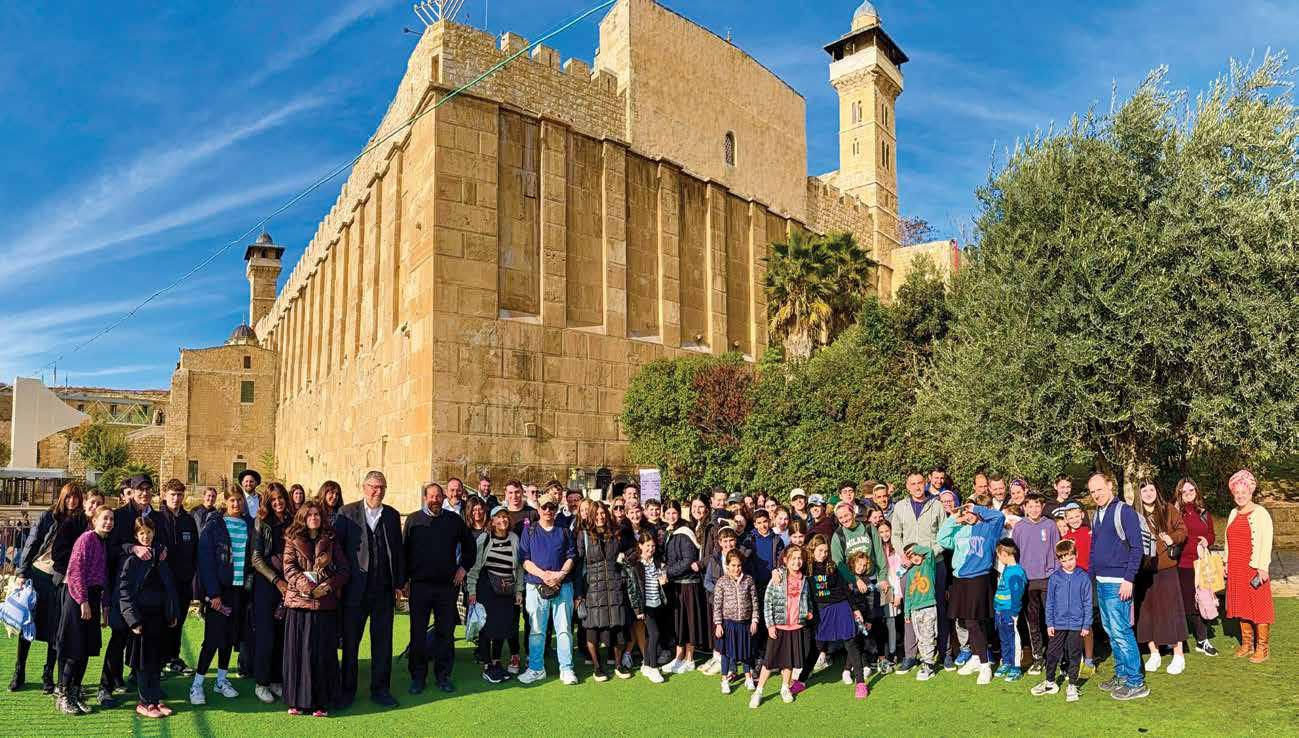



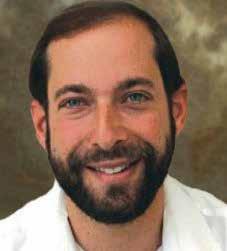

By Sandy Eller
Like it or not, artificial intelligence is here to stay. And believe it or not, that isn’t necessarily a bad thing.
Sure, we’ve all heard the horror stories of deepfake videos being used to manipulate public opinion, and students passing off reports written by ChatGPT as original work. But AI’s tremendous power has incredible potential, as evidenced by Ohrbit, a new OU app that harnesses cutting-edge machine learning to create a platform offering a wide variety of Torah topics that are accessible, customizable, approachable and, best of all, free.
“We built what I call a ‘Spotify for shiurim,’” explains Rabbi Gil Student, OU director of Jewish Media, Publications and Editorial Communications. “The app learns your preferences, both by what you tell it


and through your behavior—what do you listen to for a long time and what do you listen to for only a short time— giving you more of what you like and the Torah you want to learn.”
The idea for Ohrbit was born approximately a year ago, when Executive Vice President Rabbi Moshe Hauer, zt”l, convened a group of rabbis and technology experts, professionals and lay leaders, to develop a project that would use AI for Torah purposes. Numerous conversations were held to identify the best way to harness artificial intelligence to promote Torah study. Rabbi Hauer believed strongly in bringing talented individuals together for this project to make sure that the app was carefully planned, with guidance from top experts in the field.
In keeping with its mission, Ohrbit’s name blends Torah and technology, with “ohr” meaning light and “bit” referring to the smallest measurement of data in the computer world. While the app may be AI-powered, its content comes exclusively from trusted sources, including the OU’s massive library of shiurim, the Rabbi Sacks Legacy Trust, OpenDor Media and England’s United Synagogue, among others in the rapidly growing list of partners. Ohrbit’s goal is simple and straightforward: getting people who don’t know what they want to learn hooked on learning that resonates with them.
“Users can engage with the app however they choose,” observes Rabbi Simon Taylor, OU national director of Community Engagement. “Some may want a quick dose of daily inspiration, while others may prefer to explore specific topics in depth or learn on a more advanced level. It really depends on what kind of learning they’re seeking.”
But what makes Ohrbit truly one of a kind is its ability to learn its users’ preferences. Like Spotify and Amazon, which tailor items presented to users based on their previous selections, Ohrbit offers users options based on their prior viewing and listening habits. The app has a fun side as well, offering daily challenges à la Duolingo that give users opportunities to extend their daily learning streaks or expand their learning habits to new teachers or topics.
“We’re trying to engage people,” says Rabbi Student. “We don’t want people addicted to anything, but if they’re addicted to something, it should be Torah.”
Ohrbit also draws people in by giving them tremendous flexibility in customizing their learning experience.
When setting up their accounts, users can let the app know if they prefer to learn by reading articles, watching videos or listening to lectures. Similarly, they can choose which topics interest them from a list that includes Tanach, Gemara, halachah, Jewish history, hashkafah and inspiration, with an array of presenters that spans the gamut of Orthodoxy.
Ohrbit’s chatbot is designed to handle questions from users about their learning, albeit with specific guidelines in place. While the app can draw on its library of some 150,000 shiurim and several thousand sefarim to come up with the proper answer, there is one thing it won’t do.
“We want Ohrbit helping people learn Torah rather than offering definitive answers to halachic questions,” noted Rabbi Student. “The app is programmed to explain to people why they need to ask practical questions to their rabbi, and to note the limitations


of AI. Additionally, this is the only AI chatbot of which I am aware that will voluntarily admit when it does not have a source for something rather than make up a source.”
The OU is hoping that Ohrbit will particularly appeal to those with a limited Jewish education who are looking to increase their knowledge. It also gives users the comfort of being able to learn at their own pace, on their own schedule, serving as a virtual onramp to Judaism. Additionally, having that content delivered by an app, instead of in person, may be a good starting point for those who may be intimidated by rabbinical figures.
“There are so many people who are thirsty for Torah, especially now after October 7, who want to know more, and we’re trying to find ways to help them by using technology in a way that can promote Torah study without diluting Torah content,” explains Rabbi Student.
And while yes, AI can be a double-
edged sword, it can also be a valuable support tool with virtually endless potential, when used responsibly.
“If we can figure out how to get technology to provide a really trustworthy and wholesome experience that can inspire so many more people to learn Torah, it’s a tragedy if we don’t pursue the opportunity,” concludes Rabbi Student. “Shame on us if we don’t figure out a way to harness AI to help fellow Jews.”
“Just as light flows into the streets and meets anyone who passes by, the ‘ohr’ of Ohrbit brings Torah directly to the learner, wherever they are,” adds Rabbi Dr. Josh Joseph, OU executive vice president and chief operating officer. “That is its gift: to reach those seeking it, and even those not yet seeking, and spread the light of Torah farther than ever before.”


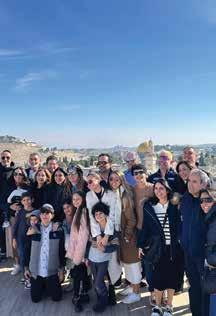


Is the
Rabbi Gavriel Price
Q: What are some of the ways OU mashgichim in the field are using AI?
A: Mashgichim often leverage AI to analyze, digest and distill complex information that would otherwise be difficult—or even impossible—to gather.
Consider this example: Rabbi Mordechai Tarkieltaub, an OU field representative in Chicago, was assigned to supervise a special production run at a hard candy manufacturer. The equipment had already been kashered, and the ingredients—including sugar and flavors—had been reviewed by the OU office. Before his visit, Rabbi Tarkieltaub asked AI: “What is the most expensive ingredient in hard candy production?” The answer: sugar. While sugar seems straightforward, in food production even sugar can be tricky.
He followed up with another question: “How does a hard candy
company save money on sugar?” Answers included using flavors for sweetness or adding fiber. The third answer caught his attention: recovering candy from a previous batch that didn’t meet quality specifications, purifying it, and reincorporating the recovered material into production. This process, known as rework, allows a company to reuse partially processed—or fully cooked—products instead of discarding them, reducing waste and salvaging imperfect batches.
With this in mind, Rabbi Tarkieltaub asked the plant manager, “How are you recovering your sugar?” The answer was revealing: The facility had equipment to purify imperfect candy and to isolate the sugar for reuse. In this case, the reworked candy had been dairy, so the recovered sugar was dairy as well. The OU ensured the final product was labeled correctly as dairy.

Another example: Mashgichim frequently work with highly sophisticated industrial machinery, such as beverage pasteurization systems used to eliminate bacteria in juice, soda or milk. They must determine how—and whether—these systems can be kashered. AI helps by providing precise, structured explanations of both the conceptual logic and technical mechanics of the equipment, making it easier to identify which parts require kashering
Q: How is OU Kosher headquarters planning to capitalize on AI resources?
A: OU Kosher maintains a vast repository of decades’ worth of reports, memos and correspondences, created by everyone from rabbinic field representatives (RFRs) to headquarters staff and poskim, covering virtually every issue in the food industry. After every plant visit, a mashgiach or RFR files electronic reports documenting problems encountered. These reports are reviewed by the Rabbinic Coordinator (RC) back at OU Kosher headquarters, and together, they solve whatever problems arose. Over time, these reports create a comprehensive storehouse of institutional knowledge.
The challenge is that much of this information, while stored, is not easily accessible to other mashgichim and RCs when similar situations arise elsewhere. A large language model can organize and summarize existing records, making it easier for mashgichim to find relevant information when needed.
For example, whenever we certify a new plant, we want to equip the field representative with an understanding of what we call the critical control points—stages in the process that require special attention because they present potential vulnerabilities to the kashrus of the product.
Rabbi Gavriel Price is a rabbinic coordinator at the OU and, as a member of the Ingredients Department, conducts research in ingredients manufacturing.



Let us say, for example, that we are setting up a certification at a hard candy manufacturer that produces both pareve and dairy candies. The possibility of recovering already used sugar—the issue of rework we discussed earlier— should be flagged as a potential critical control point for the administrator of this account to consider.
Years ago, I was the RC responsible for managing the kashrus of a company that produced OU-certified grain vinegar. The company also operated a separate production line for non-kosher red wine vinegar. The two lines were entirely separate—or so it seemed.
At one point, we discovered that environmental regulations required the manufacturer to capture vapors released during the vinegar production process. Those vapors had to be collected, diluted and then disposed of in some way. The company devised what it considered an elegant solution: adding the diluted vapor-water back into the grain vinegar. We, of course, had to address this immediately and require a reconfiguration of the system to ensure that wine vapors could not be introduced into the kosher product.
The entire episode was documented in reports and correspondence. For years afterward, I reminded anyone working with kosher and non-kosher vinegar facilities that vapor recovery is a critical control point. By digging into OU Kosher’s vast repository of such cases, AI can help identify these critical control points—the stages of a process most vulnerable to crosscontamination.
As another example, the OU has an Ingredients Department, one of
whose responsibilities is determining which ingredients are considered innocuous—meaning an OU-certified company may purchase them even if they are not formally certified. I work in this department. We maintain a listing for an ingredient called guar gum, a plant derivative that must undergo processing before it is usable. What kinds of kashrus processing of guar gum? Our database includes reports from who have described these processes in different contexts. Being able to access and synthesize those reports to assess potential risks is invaluable. AI can pull together years of scattered documentation and summarize the findings, saving both time and e Beyond offers practical administrative benefits. With nearly 1,000 worldwide and thousands of weekly visits, OU Kosher can use AI to optimize RFR routing by mapping locations against accounts, quickly identifying whether current routes make sense or if another could cover a visit more efficiently.

Consider a full-time mashgiach in Belgium, a part-timer in Spain, and a plant in Portugal that needs a visit—who should go? Routing decisions cannot be based on geography or cost alone. Some mashgichim bring specialized technical expertise that may justify a less obvious choice. AI can take all the variables into account and provide clear, constructive guidance that facilitates smarter decisions overall.
Q: Is AI forcing the OU to consider when technology can replace the need for a mashgiach?
A: Questions about technology replacing a mashgiach long predate AI. Certain tasks can be performed by automated systems as well—or even more effectively—than a mashgiach. For example, facilities that process whole eggs often use robotic detection machines to identify blood spots and remove them immediately. Given operations that handle over a million eggs per day, a mashgiach

kosher cheese production: Halachah requires mashgiach oversight, and video monitoring has been proposed as a substitute for on-site supervision. Rabbi Yisroel Belsky, zt”l, former OU Kosher senior halachic consultant, maintained that an OU representative must be physically present. Similarly, the OU still requires mashgichim at restaurants despite monitoring technologies that could theoretically replace on-site supervision.
Rabbi Moshe Feinstein addresses a related case in a teshuvah (Iggeros Moshe, YD 1:35) concerning insect infestation in sauerkraut. In Europe at the time, cabbage was heavily infested. In the United States, however, pesticides were demonstrably effective in reducing infestation to a level at which the cabbage could be considered acceptable even without further checking. Rav Moshe was asked whether the use of pesticides could be relied upon—meaning, assumed to have been used and to have been effective—without additional inspection. He concludes that, technically, for the
We should not allow our own analytical skills to atrophy.

and not rely solely on presumptions. This teshuvah illustrates a key principle: There may be sound technical grounds for relying on technology, but the OU, in certifying a product, must take responsibility to ensure that all systems are functioning properly.
Q: Still, would you not agree that AI, in its capacity to learn and develop, is a new paradigm?
A: Yes. But the more pressing question is not whether AI could replace a mashgiach—it’s what is irreplaceable
mashgiach
The answer may seem obvious but is
There is an intangible—but nevertheless very real—advantage to a mashgiach. Among other things, he is able to assess an entire situation as a whole. Over time, he develops a sense of whether something is amiss or whether a new development warrants closer mashgichim have followed an instinct that led them to probe more deeply into a situation, only to discover that their concern was well founded. Sometimes the trigger is something seemingly minor, such as the body language of a production operator—for example, avoiding expected eye contact when . I would (insight) that mashgichim We all want someone with that sensitivity visiting our companies.
Q: What are some pointers on how not to use AI?
A: OU Kosher staff regularly work with proprietary information. The OU AI Committee has issued a best-practices guide stressing that large language models may incorporate uploaded data into their learning models, potentially compromising confidentiality. Staff must be mindful of this risk.
Another issue—common across professions—is the risk of laziness. At times, using AI will result in people
relying on superficial searches or quoting responses without verifying the source. We should not allow our own analytical skills to atrophy or dull.
Q: How is the OU using AI to help consumers?
A: All departments at the OU, including OU Kosher, are working with a consultant who is providing introductory and advanced sessions on meaningful AI use.
We are currently focused on using AI to help the kosher consumer, starting with making our product search— oukosher.org/product-search—smarter and more intuitive. The site already offers the most up-to-date list of thousands of OU-certified products, but our goal is to make searching faster, more precise and genuinely helpful. With AI, a search for “dairy-free” could surface oatmeal or soy milk—even if those words don’t appear in the product name. In other words, the system doesn’t just match keywords; it understands what people are actually looking for. We are also exploring several other ways AI can assist kosher consumers.
At the same time, we are mindful of AI’s limits. Baruch Hashem, we have a staff of professionals with real intelligence and expertise. Ultimately, any suggestions from AI must be reviewed and validated by senior OU Kosher staff before implementation. AI is a powerful tool—but at the end of the day, it’s just a tool, and nothing more.



Breakstone’s butter delivers rich, creamy flavor for holiday desserts. Tradition starts with quality ingredients— trust Breakstone’s for unforgettable baking.


By Howard Blas

The hidden economic cost miluim—and the resilience that carried Israeli families through

ast May, Miriam, originally from Cleveland, Ohio, walked away from her role as vice president of marketing at a start-up with offices across Israel. With her husband, Natan, thirty-seven, serving more than 450 days in Gaza since October 7, the demands of work became impossible to balance with raising their three children under seven on her own. “I made the decision very quickly,” she says. “I was spread too thin.”
The choice came during months of sleepless nights, when sirens sent her racing down four flights of stairs to the building’s miklat (safe room), neighbors grabbing her half-asleep children as they ran. The shelter was stifling, airless, crowded. “We were dripping with sweat, completely exhausted,” she recalls. “It was an incredibly intense time.”
In recent months, Natan, who has been away from home for up to six months at a time, was assigned a better army schedule, and so Miriam recently found a new job. For now, she is focused on keeping daily life manageable.
Miriam is not alone.
While a ceasefire has been in effect since the fall of 2025, thousands of miluimnikim (Israeli reservists) and their families spent two long years under sustained financial strain as the conflict upended daily life and household income. An underreported aspect of the war is how Israelis, from recent olim to veteran immigrants to Sabras, navigated these pressures while also dealing with the emotional and logistical toll of a conflict that seemed to stretch endlessly forward.
Yet, in a pattern familiar to anyone who has lived in Israel long enough, many responded with creativity, faith and resolve. They drew on fortitude to keep their families afloat—paying bills, caring for children and elderly parents, and serving their country all at once.
Remarkably, and in ways that defy easy explanation, despite the war and a surge of global anti-Israel sentiment, Israel’s economy has demonstrated striking resilience. As of this writing in mid-2025, the Israeli stock market has posted strong gains, reflecting investor confidence.
But national indicators, however encouraging, obscure the human cost beneath them.
These numbers do not fully capture how individual families actually lived through the war—how income was lost, careers stalled and routines dismantled.
Natan, an attorney by training, made aliyah from Toronto in 2006. Miriam proudly refers to her husband
Howard Blas is a social worker, special education teacher and inclusion specialist. He frequently leads Birthright Israel trips for people with disabilities and is the author of a recent book on b’nai mitzvah and disabilities. He recently made aliyah and lives in Tel Aviv.
as a “front-line soldier,” though she is quick to acknowledge the reality behind the phrase. For much of the war, he was, as she puts it, “very absent”—from his job and from his family.
Before the war, Natan worked at a large Israeli law firm before moving to an in-house counsel position, a shift he hoped would bring greater predictability. “The new job had the promise of better, family-friendly hours,” Miriam notes wryly. Instead, since October 7, he was rarely at work. Fortunately, his employer continued to pay his salary while he served in miluim.
What no employer could compensate for, however, was his absence from home.
“For the majority of his time in miluim, he had no cell phone, and we had no real conversations,” Miriam says. Only in recent months has some measure of routine returned. “He has a set schedule: ten days in, five days home, ten days in, five days home. And it is the first time he has had his phone.”
For salaried employees in larger firms, the economic safety net—though stretched—largely held.
In the case of miluimnikim working in high tech, finance, law and other large organizations, employees generally continued to receive their regular salaries during long periods of reserve duty, even when absent from work for months at a time.
For the self-employed, however, there was no such bu
Self-employed workers (known as atzmaim, or freelancers) entered the war without the institutional protections of payroll continuity. They faced the financial consequences of reserve duty directly.
Shlomo Wiesen grew up in New Rochelle, New York, watching siblings and fellow congregants from the Young Israel of New Rochelle serve in
A self-employed digital marketing professional, Shlomo Wiesen did not have the benefit of an employer continuing his paycheck while he served in miluim Courtesy of Shlomo Wiesen
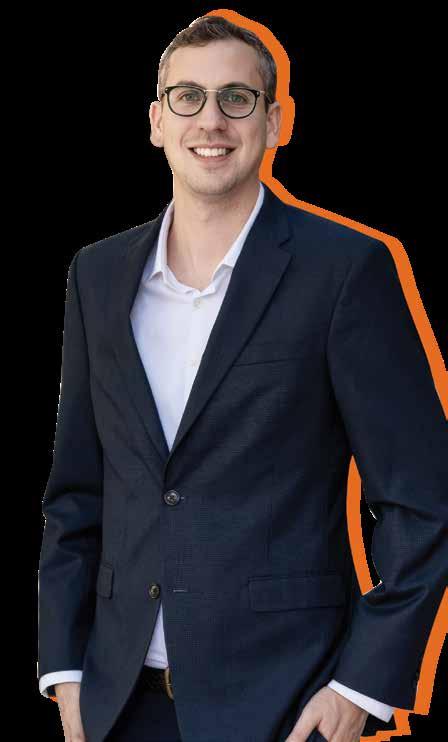


As a freelancer, it was very difficult; there was no paycheck waiting for me when I came home.
the IDF. He joined the army at age twenty-five and has been serving in miluim for the past twelve years. A self-employed digital marketing professional, Wiesen did not have the benefit of an employer continuing his paycheck. “As a freelancer, it was very difficult; there was no paycheck waiting for me when I came home,” he says. While he does not have children to support, the Tel Aviv resident served extended stints in southern Hebron. “It was impossible to get any work done in the first month of the war. There was just too much going on.”
And yet professional obligations did not simply disappear. Both Wiesen’s Jewish and non-Jewish clients in the United States were understanding and supportive, though expectations remained. “I told the non-Jewish clients I was on pause, out of commission,” he says. While Wiesen managed to make ends meet, and is grateful for that, he recounts stories of fellow soldiers in his unit who did not fare as well, including a psychologist in private practice who was forced to close his office and work instead in a public clinic.
Wiesen describes the amount of responsibility he and fellow soldiers faced early in the war, as well as the “very spotty internet on the base,” which made it nearly impossible to get any work done. As he began getting short leaves, he was “checking in” and “looking at my sites,” though he wasn’t doing any “real work.”
Gradually, amid the instability, a routine emerged. Wiesen’s schedule became more regular. “Work picked up,” he says, “and I could more aggressively pursue new clients.”
Wiesen was pleased that the army began giving freelancers priority in choosing days off so that they could “go home and do work.” This flexibility made it possible for some to remain professionally afloat. He reports that he and other religious soldiers would request to go home during the week so that they could do their computer work and other tasks. “As painful as it was to not go home for Shabbat, we needed to be home on a day when we could use the computer.”
Wiesen is grateful to his clients for their understanding and notes that one Jewish client insisted on paying him even while he was in miluim and not working. “I definitely appreciated that.”
While the war disrupted Wiesen’s professional life, it deepened his spiritual one.
Serving in miluim strengthened his faith. “The religious guys in the army would go out of their way to make a minyan—three times a day. You’d even see nonreligious soldiers helping to make minyan, especially during Chanukah with candle lighting.” He describes singing “Shalom Aleichem” together on Friday night, eating Shabbat meals huddled indoors, and praying in makeshift spaces. “There was a strong sense of spiritual community,” he says.
Looking back on his months of service, Wiesen speaks with quiet pride. “I am grateful that I had the opportunity to do something so important.”
Professor Manuel Trajtenberg, professor emeritus of economics at Tel Aviv University and senior faculty at the Mandel Leadership Institute, describes Israelis as “incredibly resilient,” recounting stories of reservists in Gaza “with laptops who keep running their start-ups.”
Professor Trajtenberg, who has held diverse positions in the Israeli government, including chairman of the National Economic Council at the Prime Minister’s Office and chairman of the Planning and Budgeting Committee of the Council for Higher Education, is also careful to note the limits of that resilience. Israel, he says, cannot sustain a prolonged war, in large part because more than two-thirds of its army is made up of miluimnikim. “They are not a marginal addition to a standing army.”
He emphasizes that miluimnikim like Natan and Wiesen “are the best of the workforce—twenty-five- to forty-five-year-olds who are in their prime working years.” Those in combat units, intelligence units and the air force, he adds, “are the very highest-quality people in the workforce.” Mobilizing them for extended periods, he says plainly, “is a serious blow to the economy.”
Chaim Jacobson describes his life in high tech as “good.” Still, he was uneasy about long-term stability. Jacobson, forty-one, of Tel Aviv, began his career as a computer engineer in Israel’s famed high-tech industry. When he later encountered an opportunity to open retail stores, he took a calculated risk. Aware of highly profitable makolets in Jerusalem, he thought the approach could be replicated in Tel Aviv. “I realized that if owning a store worked, I could make a comfortable salary,” he says. “I thought, why not? I could open a bunch, maybe even a reshet (chain), and then exit. I took a chance.”
Five years later, Jacobson owns two makolets and a café in Tel Aviv. He attributes his success partly to the affluence of the surrounding community, but just as much to relationships. “You need a real connection with the community,” he says. Known for his friendliness, he emphasizes service and quality—and recounts going out of his way to secure basic products like milk during shortages, even when it meant no profit. “Sometimes I don’t make a penny,” he says, “but people need what they need.”
Jacobson himself has not been called up for reserve duty. “I guess I’m not relevant anymore,” he jokes. His business, however, has not been spared the effects of the war. Several of his employees were called to miluim, forcing him to scramble. For small business owners, this created immediate staffing challenges.
“You have to find replacements,” he explains. “When they were gone for months, we hired new employees.”
The logistical burden was compounded by bureaucracy. At the start of the war, employers were required to continue paying the salaries of employees serving in miluim, with reimbursement from the government coming later. “We didn’t know how much or when,” Jacobson says. “For months, we were paying double salaries.” Eventually, Bituach Leumi (the National Insurance Institute) reimbursed him and later shifted to paying reservists directly. “It worked out,” he says simply. “But it wasn’t easy.”
Professor Trajtenberg notes that the government has generally been “very generous in supporting miluimnikim.” At the same time, he corroborates Jacobson’s experience, noting that “owners of small businesses were affected” in a range of ways. Some, like those who own businesses in the north of Israel and had been evacuated, suffered. Others, like Jacobson, are doing well but dealing with all the red tape.

Some sectors, Professor Trajtenberg explains, actually performed well during the war. With fewer Israelis traveling abroad and more consuming locally, supermarkets flourished, as did banks. Defense-related industries prospered too.
Not all sectors, however, were able to adapt. Tourism was hit especially hard during the war. Tour guides, hostel owners and zimmer (private guesthouse) operators found themselves with little or no work for months at a time. Having barely recovered from the economic toll of the Covid-19 pandemic, Israel’s tour guides were once again among the first to feel the ground shift beneath them.
“Tourism has always been a volatile profession,” says Shulie Mishkin of Alon Shvut, a thirty-year resident of Israel and a tour guide for two decades. “Over the past five years, we’ve been knocked down over and over again.” While Mishkin found “guiding-adjacent” teaching work during both the pandemic and the war, others temporarily switched fields.
Patrick Amar, a tour guide who made aliyah from Montreal to Modi’in twenty years ago, was forced to reinvent himself. Before October 7, his calendar was full. “I plan my schedule a year in advance,” he says. When flights stopped and tours were canceled, the work vanished overnight.
After spending several months in the United States visiting family and speaking to communities, Amar returned to Israel and confronted reality. With guiding opportunities scarce, he enrolled in cooking school, then spent four months running a local burger restaurant with a friend.
Still, Amar, a father of five children ages twelve to eighteen, insists that guiding remains his calling. What sustained him—beyond adaptability—was faith. “I lost 90 percent of my income. I am a man of faith. I have emunah, especially when it comes to making a living. I grew up in a Sephardic business community where

If you’re a businessman without emunah, you won’t survive!
Patrick Amar, a tour guide who lives in Modi’in, was forced to reinvent himself, as Israel’s tour guides were among the first to feel the economic shock of wartime. Courtesy of Patrick Amar
people have faith. If you’re a businessman without emunah, you won’t survive!”
By late December, Amar reported that guiding work had resumed. “Thank G-d, I’ve been busy since the end of the holidays. It’s quiet now, but 2026 is already filling up.”
The Taub Center for Social Policy Studies in Israel reports that the largest employment gains during the war were in the health, welfare and social services sector, as well as in education, while the steepest declines occurred in hospitality and food services and in information and communication services. The high-tech sector continued to grow, albeit at a slower pace; according to the Taub Center, fewer than 2,000 high-tech jobs were added during the war, compared with roughly 14,000 during equivalent periods in previous years.
Much of Israel’s economic strength is anchored in its high-tech industry. The sector accounts for roughly 14 percent of the economy, making it not only a central driver of growth but also a critical contributor to government revenues.
Professor Trajtenberg offers a playful perspective on the role of high tech in Israel’s economy. “Israel’s economy is very easy to describe—we sell brains and we buy everything else! Fifty percent of the economy is high tech.” Even agriculture, he notes, is deeply intertwined with
greatly, Israel’s “brain economy” proved more resilient than industrial economies dependent on physical infrastructure.
Unquestionably, however, the war impacted reservists’ career trajectories. In fact, Professor Trajtenberg’s main concern is the war’s negative effect on “human infrastructure.”
Ahuva Ross Cohen understands this firsthand. Her husband, Meir, who works in venture capital, served extensive periods in miluim. “After seven months,” she says, “from the company’s perspective, you’re not here.” While they managed financially, she worries about missed opportunities and long-term career impact.
Cohen compares the situation of miluimnikim returning to work to new mothers returning to work from maternity leave. “It can feel challenging to return and quickly get up to speed. There’s an inherent pressure to be fully reintegrated and productive within the next few months. Even though you may physically be back, the mental switch from war zone to high tech is a hard context switch.”
Cohen works for the global high-tech firm, monday.com. Given her husband’s extensive miluim service and the need to care for her children, ages four and one, she has been affected at work. She praises monday.com. “They were amazing,” she says, citing grants, gifts and sustained attention to families of reservists.
By this past winter, her husband had served over 200 days. “We’re managing,” she says, “but the war isn’t really over,” as many of the men are still serving in reserves. Their faith, she explains, was central. “It carried us emotionally.” So much so that they named their daughter, born in September 2024, Lielle Emunah. “Our faith has given us both comfort and confidence in knowing our role throughout this war, that our fight is a moral one and that Hashem will perform miracles if we do our hishtadlut.”
While the war strained Israelis across every sector, those interviewed for this article share a common determination: to continue building lives in Israel, despite uncertainty and cost.
Miriam and Natan insist they “are grateful to live in Israel and to raise our children here.” Miriam currently works in real estate, and Natan has returned to his role as in-house counsel—though another miluim date looms ahead. They feel a deep sense of gratitude that they have been able to continue making ends meet during these cult times.
“We really believe in this,” Miriam says. “It comes with a price. But we want to live in Israel, and we’re doing it for the Jewish people.”
Her husband puts it more plainly. “Every generation pays a price,” he says. “This one has to be paid. It’s the only real option for the survival of the Jewish people.”
Ahuva Ross Cohen compares the situation of miluimnikim like her husband, Meir, returning to work to new mothers returning to work from maternity leave. Courtesy of Ahuva Ross Cohen

Readers are invited to use this forum to express personal views and address issues of concern to fellow Jews. Send submissions to ja@ou.org.
By Richard Altabe
The memory will last forever.
Eight hundred students of the Hebrew Academy of Long Beach (HALB) elementary school on New York’s Long Island gathered in the gym on the last Monday of the school year to surprise me with an adorable song they had created in my honor. The love they showered upon me was hard to fathom. Looking back, I often wonder what, in my nine years at HALB, had led to such a moment.
Perhaps a clue could be found in one of the verses of the song they sang: “Students come to see you anytime you’re free, Wednesday bentching, Laffy Taffy just for me!”
Was it just the Laffy Taffy I handed out as a reward? Or was it something deeper—about a school culture where even the youngest children felt noticed and welcome? (Though I imagine the candy didn’t hurt.)
I spent my time disciplining students, as any principal must. I set rules for teachers and curriculum standards that needed to be met. There were plenty of days when students—and parents—were
unhappy with me. Yet even months after my retirement, when I see children in New York’s Five Towns, where I live, they often run up to hug me or give me a high five. As one parent wrote to me: “Thank you for believing in my son and not giving up.” That line meant more to me than any formal praise.
This mindset guided my nearlyfour-decade career in education. I was fortunate to learn from two giants of chinuch: Rabbi David Eliach, z”l, and yibadel lechaim aruchim, Rabbi Yaakov Bender, shlita. Brooklyn’s Yeshivah of Flatbush High School, which I joined in 1984, had a culture of high academic performance shaped by Rabbi Eliach’s dedication to helping every student strive for excellence. When I shared success with my students, Rabbi Eliach encouraged me to reach higher. “They can do it if you expect it of them,” he would say. Kids rise—or fall—to expectations.
In 1988, I moved to Yeshiva Darchei Torah in Far Rockaway as a young general studies principal. There, I had the zechut of working for Rabbi Bender, who believes that all children
can succeed when given the right environment and support. I recall a sixth-grade student who arrived from a Chassidic yeshivah with minimal preparation in reading and math. I asked Rabbi Bender how to integrate him among peers years ahead. His answer: “You’ll figure it out.” That was all he said—and that was the point. With support from the Gruss Foundation–sponsored computer labs and one-on-one resource help, the student reached grade level within two years. Today he is a successful nursing home administrator.
Another story: A boy arrived at our school diagnosed with dyslexia
Richard Altabe is currently serving as the chief education ofcer at the JIEM Education Initiative Foundation, working as a consultant to various yeshivahs across the US. Mr. Altabe also currently serves on the Blue Ribbon Commission of the New York State Education Department, working on graduation standards for all students in the State of New York.
Don’t confuse accommodation with limitation. I need glasses to drive, but that doesn’t mean I shouldn’t learn how to drive.
and was unable to read until the third grade. Recognizing his mathematical gifts, we allowed him to take Advanced Placement (AP) Computer Science by ninth grade—a bold decision that raised eyebrows but paid off when he scored a perfect 5. Later, he gained the confidence to tackle AP European History, a course requiring extensive reading skills that had once seemed impossible for him. He passed that exam as well. Today he holds a PhD from Yale University and develops computer models for theoretical physics.
I gravitated toward research on motivation theory because it helped put words to what I had already seen work with students, day in and day out. Carol Dweck’s mindset theory taught me the importance of the word “yet”— that a child who hasn’t succeeded yet still can. I’m also a fan of Angela Duckworth. Her research showed that success isn’t driven by IQ alone, but by grit—the ability to persevere through challenges. The question was: How does one develop grit? My answer: Parents, teachers and rebbeim must communicate belief in a child. When a child knows you believe in them, you
help build resilience—and grit follows. I recall a student who struggled greatly in school despite multiple interventions. Though our team exhausted every tool we had, we recognized that he needed a different environment to flourish. When we helped transition him to a school better suited to his needs, I made sure he knew something crucial: I believed he had the capacity to succeed—we simply hadn’t found the right key yet. Years later, he called to share his success in his new school, and when he asked me to donate to that school, I knew he had found his place. That taught me that while I may not have the solution for every child, I must believe the solution exists.
I applied these ideas at Yeshivat Shaare Torah Boys High School in Brooklyn, where I served as principal from 2011 to 2016. My staff and I helped students understand that their abilities were not fixed and that setbacks were simply part of the process. One case stands out: A senior was devastated after failing the English Language Arts Regents Exam because that failure meant he couldn’t participate in his planned gap-year learning in yeshivah in Israel. I showed him Angela Duckworth’s TED Talk on grit, and we spoke about what it means to keep going when things don’t work out the first time. I told him what I genuinely believed: that he could pass, though it would take real effort.
He passed with a 75, which opened the door to his Israel experience. Years later, when I met Duckworth at a conference, she was so moved by the story that she sent him a signed copy of her book. These moments confirm what Chazal teach: that anyone who withholds teaching from a child is as if they stole from him. Low expectations are a form of loss. Every child should be pushed to learn as much as he or she can.
Children with learning differences can be just as successful in a school setting as their peers. It’s not about lowering expectations; it’s about changing how a child accesses the material. If a child is a visual learner, present it visually. If a child needs questions laid out differently, then lay them out differently. But don’t confuse
accommodation with limitation. I need glasses to drive, but that doesn’t mean I shouldn’t learn how to drive. Everyone can learn the material; they may just need different lenses.
In 2016, I became the principal of HALB, an institution I had attended as a child. As a student there, HALB not only helped me grow into a frum Jew but helped my entire family grow in frumkeit as well. I have unbelievable hakarat hatov to the school. My work there was a labor of love, and my goal was to create programming that would help all learners succeed, including those with differing abilities.
A. was one such child. He was a non-reader in early grades, struggling with both English and Hebrew reading. Instead of pulling him out of his class for remedial services, we created a program so that there are two teachers in the classroom—one with expertise in special education who can work more closely with kids like A. Slowly but surely over time, he developed the skills to read and ended up graduating with an A average in middle school. But ultimately, A. learned how to overcome his disability because we taught him how to believe in himself.
I left HALB after nine meaningful years. On that final Monday, when all 800 children gathered to sing, I shared the most important lesson I had learned: “I believe in you—and if you believe in yourself, you can achieve anything you set your mind to.”
I have spent almost forty years in chinuch, teaching children who grow up to be remarkable adults. There’s no greater honor than that. As I have often said, some people make money; I try to help make people.



Why beer—and other foods you’d never suspect—requires kosher certification
Q: Beer never used to require kosher certification. What changed?
A: Historically, many beers were considered acceptable without kosher certification. However, that is no longer reliably the case. Due to the growth of craft beers, flavored varieties, barrelaged products and shared equipment, OU Kosher has updated its beer policy for all OU establishments and certified events. Beginning in 2026, only beers with reliable kosher certification may be served in OU-certified restaurants and at OU-certified catered events.
The OU is joined by the OK and Star-K, along with several local kosher supervision agencies, in adopting this policy to maintain consistent and reliable kosher standards across the industry.
A list of nearly 1,000 currently certified beers and breweries is available at oukosher.org/kosher-beer-list. The list includes products from major brands like Coors and Budweiser.
Q: Why are beer policies changing now?
A: The long-standing assumption that beer did not require kosher certification was based on the idea that it contained only four basic ingredients—grain, water, hops and yeast—all of which are inherently kosher. Government regulations also reinforced this assumption. For example, US law requires added flavorings to be disclosed on packaging.
However, the explosion of craft breweries—small, independent manufacturers—has significantly changed beer production. These breweries now produce sours, stouts, flavored beers and barrel-aged products and account for nearly 14 percent of US beer sales by volume.
According to OU Kosher’s COO, Rabbi Moshe Elefant, the introduction of additives creates concerns even for beers that appear “plain” because breweries often use the same vats for multiple recipes. While equipment is cleaned between batches, cleaning is not the same as kashering, and therefore new kashrus issues have arisen that did not exist in the past.
Q: What kinds of beer flavorings can be problematic?
A: Rabbinic inspectors may encounter unexpected non-kosher ingredients in breweries, including oyster broth, clam juice, wine and milk products.
Some beers contain dairy ingredients, which add a subtle creaminess and opacity. Without realizing it, you could be drinking a beer that contains lactose. This, of course, has very serious kosher ramifications.
“The good, old-fashioned beer everybody would drink was simple,” says Rabbi Elefant. “Now, to give them an edge, manufacturers enhance the beer by adding all sorts of flavors.”
While the OU seeks to make kosher food widely available and accessible, these developments in the beer industry are concerning. “We’re not looking to be onerous,” explains Rabbi Elefant. “But when we tell someone they can consume a product, we need to be fully confident that it is kosher without question.”
Q: What other products look like they wouldn’t need a hechsher but actually do?
A: Many foods that appear inherently kosher should not be consumed without certification. Common examples include ice cream, bread and coffee.
Q: Isn’t ice cream just milk and sugar? Why does ice cream need kosher certification?
A: Ice cream was once considered a straightforward dairy product, made from simple ingredients such as fresh cream, sugar and natural flavorings like vanilla, cocoa or fruit. Today, however, ice cream often contains processed ingredients—such as emulsifiers, stabilizers and artificial flavorings— that may be derived from non-kosher animals. Even the cream can come from a non-kosher source. One common issue is whey cream: A byproduct of the cheese-manufacturing production, whey cream can be non-kosher.
Emulsifiers are a particularly serious kashrus concern. For example, diglycerides—emulsifying agents made from fatty acids and glycerol—may be derived from animal sources and therefore require kosher certification. In addition, manufacturing equipment is frequently shared with non-kosher products, creating a risk of crosscontamination. Dried dairy ingredients such as powdered milk, lactose or whey are spray dried and therefore require hashgachah to ensure that the spray drier (a heated chamber) was properly kashered before use.
For these reasons, ice cream requires reliable and careful kosher supervision.
Q: What if the brand of ice cream is kosher, but the shop itself is not kosher-certified?
A: If a non-certified establishment sells kosher-certified ice cream, one may only purchase it if the original carton bears a visible hechsher, and the scoop used is clean and has not been used for non-kosher products. This precaution is necessary to avoid cross-contamination.
Q: What could be the concern with purchasing bread from a noncertified bakery?
A: At first glance, bread may seem simple enough. But without kosher
certification, there are a few issues that aren’t always visible to the consumer. Bakeries can bake breads that contain non-kosher cheese, non-kosher raisin juice or even animal fats on the same pans and in the same ovens. The shortening used in the bread requires kosher certification. Even if it is an all-vegetable shortening, it may be produced in a facility that processes both animal and vegetable fats, which can compromise its kosher status.
In a situation where the ingredients panel for a bread does not list oil, it is still possible that oil was used to grease the pans to prevent sticking. The oil is not viewed as an ingredient in the bread but rather as a processing aid, and the FDA does not require processing aids to appear on ingredient labels, so they may be present even when they are not listed.
Finally, if a bakery is Jewish-owned, challah must be separated. Without kosher supervision, there is no way to ensure that this requirement has been fulfilled.
Q: Can one buy a cup of coffee anywhere—such as at a rest stop— without kosher certification?
A: Plain black coffee may be purchased as long as it is served in a paper cup, which avoids the use of utensils that may have been used with non-kosher foods or washed together with non-kosher dishes.
Other coffee drinks—such as lattes and cappuccinos—use frothed milk, which introduces concerns about shared equipment: The steam wand and the metal cup used to froth milk may have also been used for non-kosher beverages or may have been washed in a non-kosher dishwasher, and one should ensure this is not the case before ordering.
Flavored coffee should not be purchased without kosher certification, as flavoring ingredients may be derived from non-kosher sources.
Q: What does a “K” on a product mean?
A: Quite simply, it may mean nothing at all. Unless you know who stands behind that “K,” it offers no real assurance of kosher supervision. In some states, a manufacturer can place a “K” on a label even if there is no supervision whatsoever. The letter “K” is meant
to stand for “kosher,” but it is not a protected symbol; anyone can use it. By contrast, the OU is a registered trademark. No company may place an OU on a product without authorization and ongoing supervision.
Rabbi Yaakov Luban, a recently retired OU Kosher rabbinic coordinator who served in that capacity for decades, often illustrated this point with a story.
An OU-certified company once asked whether it could use breadcrumbs from another manufacturer whose product bore a “K.” To clarify, Rabbi Luban contacted the breadcrumb company and asked a simple question: “Who is the rabbi behind the ‘K’?”
They provided a name. Rabbi Luban didn’t recognize it, so he called a colleague who lived in the same community. “Do you know this rabbi?” he asked. “Of course,” the colleague replied. “He passed away five years ago.”
When Rabbi Luban relayed this information back to the company, there was a long pause. Finally, the person on the line said, “Oh—that explains why we haven’t seen him in so long.”
The lesson is straightforward: A “K” on a label does not necessarily mean there is a rabbi—or any supervision— behind the product.

By Rabbi Dr. Ari Z. Zivotofsky
MISCONCEPTION: (1) When a brit milah is delayed for medical reasons, it may be done as soon as the infant recovers, and (2) once it is delayed, there is no rush and it may be pushed off until a convenient time, such as Sunday in the US or Friday in Israel.1
FACT: If an infant had a localized medical issue that precluded a brit on day eight, he should be circumcised as soon as medically acceptable. If he had a systemic ailment, following his recovery (even before day eight)— even if there are no medical contraindications—there is a mandatory complete seven-day waiting period until the circumcision may be performed, at which point it should be done without delay.
Background: The Torah twice states (Bereishit 17:12; Vayikra 12:3) that a brit milah, circumcision, should take place on the eighth day2 after birth. This rule is so inviolable that when the eighth day is Shabbat, a yom tov or even Yom Kippur, the brit nonetheless takes place on that day (Shabbat 132a).3 However, because of the concern for the life of the newborn, the Mishnah in Shabbat (19:5 [137a]) gives a major exception to eighth-day circumcision and states: “An infant who is sick is not circumcised until he recovers.” This is the source for delaying the brit milah of a sick infant.4
A powerful, emotional rationale for this principle is offered by Rambam (Hilchot Milah 1:18; cited in Tur and Shulchan Aruch, YD 263:1): “We only
circumcise a child who has absolutely no illness, because the danger to life takes precedence over everything. And circumcision can be performed at a later date, while it is impossible to ever restore a single Jewish life.”5
The Amora Shmuel, commenting on the mishnah (ibid.), says that if a baby had a high fever, then once the fever has subsided, the circumcision is delayed seven days6 to allow for his body to further strengthen. These seven days are seven twenty-four-hour periods (Yevamot 71a–b), and thus, a child declared healthy from his fever at noon on Tuesday is not supposed to be circumcised before noon the following Tuesday,7 and it is then done as soon as possible.
Shmuel’s statement mentioned only fever. Rambam views fever as an example and adds (Hilchot Milah 1:16): “recovers from fever or from a similar illness.” Rav Papa discussed
(Yevamot 71b) an ailment for which the brit can take place as soon as the infant is healthy. This has led to a distinction (Shulchan Aruch, YD 262:2) between two categories of ailments: choli shebechol haguf (“systemic disease”) or only be’echad me’eivarav (“local illness”). In the former, there is a mandatory seven-day wait, while in the latter the brit should be performed as soon as the infant recovers—in other words, if he is deemed “healthy” at 4:00 PM, the brit should be done that afternoon.
Then there is the Thursday/Friday conundrum: Once it is halachically and medically permitted to perform the brit, it is forbidden to delay the brit for even one day (Rema, YD 261:1; Magen Avraham 249:5; Chochmat Adam 149:2), for example, to a day more convenient for the guests (Gilyon Maharsha 262:2).8 Nonetheless, in order that the second or third post-op day—the most difficult days for the child (Maggid Mishnah, Shabbat 2:14)—not fall on Shabbat (which might necessitate violating Shabbat for necessary medical treatment), some authorities prohibit doing a delayed brit on Thursday9 or Friday (Taz 262:3). This position received support among Sephardic poskim (Knesset HaGedolah and Birkei Yosef cited in Kaf HaChaim 331:31; Yabia Omer 5, YD 23). On the other hand, Ashkenazic poskim in general ruled that once the baby is ready for the brit, it should be done even on Thursday or Friday and not delayed further (Shach

266:18 and Nekudot HaKesef 262:3; Gilyon Maharsha 262:2; Mishnah Berurah 331:33).10
Determining whether a particular medical condition warrants postponing a milah, and if so into which category it fits—local or systemic—is not always obvious. The Aruch HaShulchan says that one should consult a doctor and the doctor can be relied upon (YD 262:18).11
Modern authorities have expressed opinions on some examples.12 Regarding the Talmudic example, Rabbi Shlomo Zalman Auerbach ruled that if the fever was above 38 degrees Celsius (100.4 degrees Fahrenheit), then after it returned to normal there should be a seven-day wait (Nishmat Avraham, YD 262:6:4). In 1964, Rabbi Moshe Feinstein ruled that a full-term infant who needed to be placed in an incubator gets the seven-day wait after being taken out of the incubator (Iggerot Moshe, YD 2:121; cf. Tzitz Eliezer 13:82:4). Rabbi Auerbach opined that the circumcision of an infant on antibiotics is delayed seven days from the time he is asymptomatic, not from the end of the course of antibiotics, which often continues longer (quoted in Nishmat Avraham, YD 262:6:5). On the other hand, Nishmat Avraham quotes opinions that a forceps delivery, a broken leg due to birth trauma, a cleft lip or a cleft palate likely should not delay the brit at all, but if they do, the delay is only until the infant is deemed healthy and there is no seven-day wait (Nishmat Avraham, YD 262:8, 10).
In the course of a long discussion on delaying a brit on account of eye ailments (which are often taken very
seriously—see YD 262:2 and Nimukei Yosef to Yevamot 71a; Rabbi Avraham Yitzchak HaKohen Kook, Da’at Kohen 137), Rabbi Chaim Pinchas Scheinberg (Am HaTorah, Mahadurah 2, vol. 4 [5742]: 22–28) says that regarding an infant covered with pus-free pimples over his whole body that are considered normal,13 if the doctors say he is not suffering and will not be harmed from the milah, the brit may be on time.
An interesting topic that has merited much discussion is that of a “yellow baby.”14 The Gemara (Shabbat 134a) and Shulchan Aruch (YD 263:1) say that the brit of a baby that is yarok15 is postponed. Is that referring to neonatal jaundice, a relatively common condition in which there is a yellow tone to the infant’s skin and possibly to the sclerae and mucous membranes?
There are two broad categories of jaundice in newborns. The less common is “pathologic jaundice,” which indicates an underlying medical issue in the infant and would be treated as choli shebechol haguf.
In contrast, the overwhelming majority of cases involve “physiologic jaundice.” Although it results in elevated levels of bilirubin, a yellowish byproduct resulting from the breakdown of red blood cells that causes the yellow appearance, the infant is usually otherwise healthy. In a healthy newborn, this may be due in part to the newborn’s natural high hemoglobin level and an immature liver that has not yet fully developed the capacity to effectively metabolize and clear bilirubin from the bloodstream.

Jewish Action is taking the c beyond the magazine with o new podcast.
Listen in as our host a i sits down with leading voic explore ideas shaping our c tream where er ou get o o casts
Scan here to listen






Most doctors would assert that physiologic jaundice is usually not an impediment to circumcision. Yet, if the “yellow baby” in the Talmud refers to jaundice, halachah mandates delaying the brit milah until after the skin color returns to normal, possibly with a seven-day delay. Contemporary authorities have weighed the conflicting issues: There is a strong prohibition to unnecessarily delay a brit; the Talmud says to delay a brit of a baby who is “yarok”; and modern medicine does not view physiologic jaundice as a reason to delay circumcision. Should the brit of an otherwise healthy jaundiced baby be delayed, and if yes, is there a need for a seven-day wait? And does treatment of an infant with bili lights [special blue lights used to treat newborn jaundice at higher levels] affect the halachah regarding when to perform the brit?
Some authorities (e.g., Chochmat Adam 149:4; Aruch HaShulchan 263:2) say the milah should be done as soon as the yellow subsides, while others (e.g., Tuv Ta’am Vada’at, YD 1:220; Shu”t Beit Yitzchak, YD 2:91) treat it as systemic and require a seven-day wait.
Rabbi Dr. Moshe Dovid Tendler (in the Yeshiva University journal Beit Yitzchak, vol. 27 [1995]: 112) felt that with non-dangerous physiologic jaundice (he writes—with a bilirubin level of less than 20 milligrams per deciliter on day eight), the brit can be done on the eighth day. On the other hand, Minchat Yitzchak (3:145, 6:92, 8:88) and Moadim u’Zemanim (3:205) ruled to follow the halachah literally and postpone the brit for even mild jaundice, even if the doctors said that the brit could be done earlier. Rabbi Eliezer Waldenberg (Tzitz Eliezer 13:81, 83) was uncomfortable ignoring the Gemara and thus ruled to delay the brit, but in deference to modern medicine felt that we could rely on the opinions that do not require a seven-day wait.
Rabbi Auerbach is quoted (Nishmat Avraham 263:1:1) as saying that for intermediate bilirubin levels (11 to 18) one should wait until the yellow has subsided, while for higher levels one should wait seven days after it returns to 12. Yet he is also cited (ibid.) as permitting a brit on day eight in a particular case of an infant whose bilirubin level had been 19 on day three but was 13 by day five.
When to do the brit of a jaundiced baby is still the source of much discussion and disagreement, and like everything regarding the proper timing of a brit, a mohel should be consulted in conjunction with competent rabbinic and medical authorities.
Brit milah is a sign of the eternal covenant between G-d and the Jewish people. As a surgical procedure, it is one of two mitzvot that inherently contain risk16, the other being milchemet mitzvah (an obligatory war).17
The Midrash (Bereishit Rabbah 46:9; see Bereishit 17:7–11) links the two by noting that G-d states that if the Jews keep the mitzvah of circumcision, they will merit entering the Land. Conquering the Land, is, of course, a milchement mitzvah. Nonetheless, in both of those mitzvot we are obligated to minimize the risk; accordingly, the milah of a sick infant is delayed but only
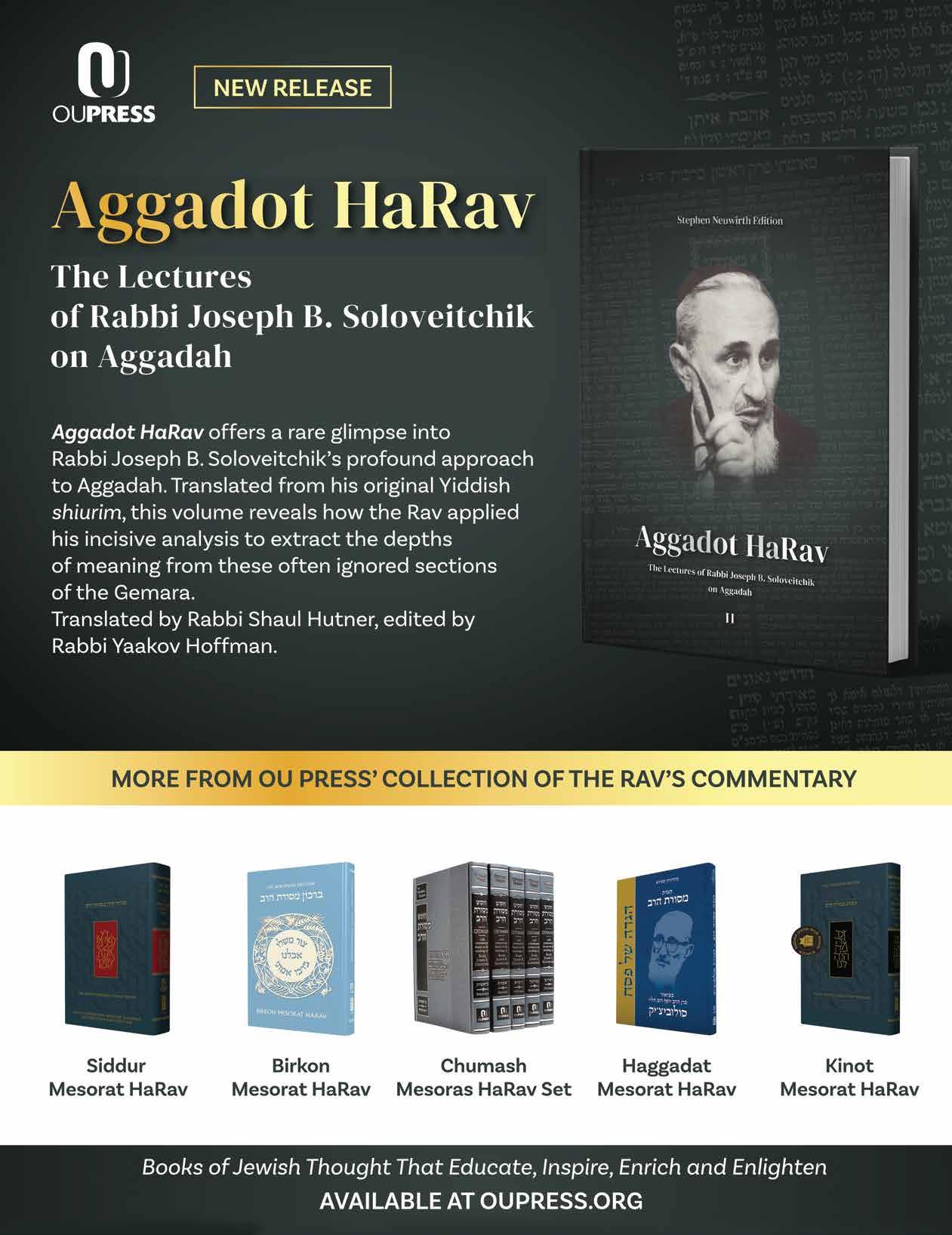
to the extent medically and halachically required. During that period, it should not be done (and performing the brit is not a chumrah); once that period has passed, it should be done as soon as possible.
Notes
1. For specific cases, halachic and medical authorities should be consulted.
2. All britot, eighth day or delayed, must be in the daytime (Shulchan Aruch, YD 262:1).
3. The Talmud (Shabbat 132a) suggests three derivations for why circumcision, which involves drawing blood—an activity generally prohibited on Shabbat—is nonetheless performed on Shabbat or yom tov. There are important exceptions to this. For example, the milah for babies born via Caesarian section (Shulchan Aruch, YD 266:10) or during twilight Friday afternoon/before chag or Shabbat/chag twilight, is postponed until the next available weekday. Also, non-eighth-day britot are not done on Shabbat or a chag. Modern poskim discuss whether a child conceived via intrauterine insemination (IUI) or in vitro fertilization (IVF) may be circumcised on Shabbat.
4. Usually at the brit milah ceremony, in addition to the surgical circumcision, the infant is named. However, if the circumcision will be significantly delayed, there is a preference to name the child before the brit, both to aid in parental bonding and to have a name for prayers for his welfare (Rabbi Dr. Avraham Steinberg, ed., Sefer Assia, vol. 4 (5743): 234–44).
5. The Chochmat Adam (149:4) quotes Rambam and then reports that he witnessed a case in which the midwife greenlighted the milah of a sick infant who then died that day. He writes that he likes the custom in Prague that the mohel goes to check the health of the infant the day before the brit.
6. The Yerushalmi (Shabbat 19:5, Yevamot 8:1) says thirty days; all codifiers follow the Bavli’s version.
7. Rabbi Yaakov Ettlinger (Binyan Tzion 1:87; Aruch LaNer, Yevamot 71b) suggests that this seven-day waiting period is of Biblical origin, a suggestion that Rabbi Shlomo Zalman Auerbach finds surprising—he says it is a rabbinic caution to avoid a danger to the child (Nishmat Avraham, YD 262:4) and adds that it applies to an adult circumcision as well. Thus, for example, according to Rabbi
Auerbach, an adult convert should not be circumcised within seven full days of a fever or other systemic condition. Minchat Yitzchak (6:92:3) says that one should wait seven days even if the doctors are encouraging doing the milah earlier, but if it is done within the seven-day waiting period, it is kosher. Note that a brit of a healthy boy done before day eight is post facto valid according to the Rema (YD 262:1), but the Shach (262:2) disagrees and requires hatafat dam on day eight (or later if not done on day eight).
8. Pitchei Teshuvah (YD 262:2) quotes an extreme case in which a brit was delayed for health reasons and the father decided to delay it until erev Pesach so the firstborns could eat at the meal. The Noda B’Yehudah thought this abhorrent and ruled that if erev Pesach arrived and the brit had not yet been done, they should not do the brit so as not to set a precedent.
9. See Shach 266:18, Nekudat HaKesef, and Rabbi Akiva Eiger 262 that maybe Thursday is a problem but Friday is okay.
10. Similarly, and based on the halachot (Shulchan Aruch, OC 248) regarding when one may set sail, contemporary authorities discuss the permissibility of elective surgery on Thursday and Friday (Shemirat Shabbat Kehilchatah, 32:33; Tzitz Eliezer 12:43; Emet LeYa’akov, OC 331:3—who specifically mentions not electively inducing labor on Thursday or Friday).
11. A doctor is relied upon for categorizing the medical condition but not for authorizing a brit against an explicit halachah. For example, Rabbi Moshe Feinstein says (Iggerot Moshe, YD 2:121) that a “blue baby” who had a blood transfusion is certainly considered choleh bechol haguf and thus must wait seven days after he is better even if the doctors opine that he can be circumcised sooner. Rabbi Chaim Pinchas Scheinberg (Am HaTorah, Mahadurah 2, vol. 4 [5742]: 26) and Minchat Yitzchak (3:145, 6:92, 8:88) expressed similar views.
12. Two important references with lists of medical conditions are Rabbi Dr. Avraham Steinberg, “Brit Milah—Medical and Halachic Aspects,” Techumin 2 (1981): 306–24 and Avraham-Sofer Abraham, Nishmat Avraham (5774), YD 262–63. Note that some of these halachic decisions were proffered decades ago and medical opinions, which affect the halachah, may have changed. Also note that many mohalim will want an infant to reach a certain weight, often about 2.5 kg (5.5 pounds), before circumcising him.
13. Rabbi Scheinberg might be referring to either erythema toxicum or transient neonatal pustular melanosis.
14. An issue that seems to have not merited sufficient discussion is that of an otherwise healthy premature baby who spends time in the NICU (neonatal intensive care unit). Certainly, a seven-day wait is warranted, but when should the count start? From the last desaturation or bradycardia or temperature instability, etc., or from the discharge itself?
15. “Yarok” in modern Hebrew means green. In the Talmud, there are fewer words for colors and “yarok” was used to refer to green, yellow-green, indigo (blue-green) and pale green, depending on context. The Mishnah (Niddah 2:6 [19a]) refers to “yarok” blood, which Meiri understood as green blood, while Tosafot (Niddah 19b) said it is yellowish like a ripe etrog. See Tosafot, Sukkah 31b, s.v. hayarok kekarti, where they struggle to identify the color yarok. When used to describe an animal’s lung, yarok can be the color, for example, of an egg yolk and not kosher (YD 38:1) or green and permissible (38:4). Yarok is also used to describe non-kosher milk (Avodah Zarah 35b) and the face of a man after death (Avodah Zarah 20b; Ketubot 103b), where it most likely means a pale green (see Julius Preuss, Biblical and Talmudic Medicine, trans. Fred Rosner [New York 1978], 164–67). On “yarok,” see Nadav Shinrav, Techumin 23 (5763): 509–11, 514. In the context of milah, it is unlikely that they were referring to a green baby, while a yellow baby (jaundice) is a relatively common occurrence.
16. Chatam Sofer (Shu”t YD 245), based on Rashi to Gittin 57b, suggests that milah on the eighth day is actually much more dangerous than it seems, and that the fatality rate is as low as it is only because the merit of the mitzvah is protective.
17. See Rabbi Dr. Ari Z. Zivotofsky, “What’s the Truth about . . . Milchemet Mitzvah?” Jewish Action 85:1 (fall 2024): 90–92, https://jewishaction.com/religion/ jewish-law/whats-the-truth-aboutmilchemet-mitzvah/.
$1,000,000 +
Drs. Felix A”h and Miriam Glaubach
The Kohelet Foundation
Jewish National Fund - USA
The Marcus Foundation Inc.
$500,000 - $999,999
Becky and Avi Katz
Mordecai A”h and Monique Katz
The Jewish Federation of Greater Los Angeles
UJA-Federation of New York
$250,000 - $499,999
Dr. Shmuel and Evelyn Katz
Mayberg Foundation
Olami Launch
World Mizrachi
$100,000 - $249,999
Andrew and Corey Morris-Singer Foundation
Hyman A”h and Ann Arbesfeld
The Associated Jewish Community Federation of Baltimore
Irving and Melody Boime Dailygiving.org
Diamond Foundation
Gershon and Aviva Distenfeld
Mitchell and Annette Eichen
Jack and Harriet Feintuch
Fieldgate Cares Foundation Foundation for Jewish Day Schools, Greater Philadelphia
Elliot P. and Deborah Gibber
Alan and Barbara Gindi
Amir and Stacey Goldman
Joseph and Ellen Goldstein
Lance and Rivkie Hirt
In Memory of Anne Samson A”h
Jewish Federation of Broward County
Jewish Federation of Greater Philadelphia
The Jewish Federation of Metropolitan Chicago
The Jewish Federations of North America
The Jewish Federation of Northern New Jersey
Natalie and Davidi Jonas
Benefactor Circle members are part of a devoted community of visionaries whose leadership and philanthropy make it possible for the OU to serve and uplift Jews at every stage of life. With heartfelt appreciation, we recognize the individuals whose generosity during Fiscal Year 2025 - 2026* reflects a deep commitment to this mission.
We are honored to celebrate all members of the Benefactor Circle—those listed by name and those who choose to remain anonymous—for the impact they create through their steadfast partnership.
We invite you to join them in making a diference.
To learn more about the OU Benefactor Circle or to become a member, please contact Chaya Schechter at Chaya.schechter@ou.org.
* Donors are recognized based on date of donation payment.
Dr. Ezra and Lauren Kest
Edward and Inna Kholodenko
Harry and Esther Lebovic
Michael and Andrea Leven
Marc Levine
The Margaret and Daniel Loeb Foundation
The Meyer and Idelle Weinstock
Charitable Foundation
Eitan and Debra Milgram
Vivian and David Luchins
Yehuda and Anne Neuberger
Raphael and Rivka Egozi Nissel
Ralla Klepak Foundation for Education in the Performing Arts
Jef Rubenstein
Genie and Steve Savitsky
Mark and Barbara Silber
Daniel and Ellie Stone
Moris and Lillian Tabacinic
Berry and Raizy Weiss
Drs. Yechiel and Suri Zagelbaum
$50,000 - $99,999
Raanan and Nicole Agus
Martin and Barbara Ast
Lewis and Lauri Barbanel
Jefrey Barr
Bart Baum
Saby and Rosi Behar
Phil and Connie Beinhaker
Hillel and Charlotte A”h Brachfeld
The Cayre Family
Charles Crane Family Foundation
Crain-Maling Foundation
Tzippy and Daniel Cohen
The Conduit Foundation
Isaac Dabah
The Dan-Hytman Family Foundation
Robert and Michelle Diener
Grant and Jennifer Dinner
Jonathan Ditinis
Eisenreich Family Foundation
Brett and Alana Fine
Ezra and Racheli Friedberg
Bentzion Friedman
The George Weinberger Music Program
Goldring Family Foundation
Joseph Goldstein
Dr. Ephraim and Rita Greenfield
Shaul and Tammy Greenwald
Robyn and Shukie Grossman
Moshe and Tira Gubin
Hahn Family Foundation
Klein, Jafa, and Halpern Families
The Hidden Sparks Fund
Lior and Janet Hod
Ed and Robyn Hofman/Hofman Catering
Thomas Hofstedter
Dr. Allan and Sandy Jacob
Chavi and Paul Jacobs
Jewish Community Federation of San Francisco
Jewish Federation of St. Louis
Howard and Debbie Jonas
Warren and Debbie Kimel
Jonathan and Mindy Kolatch
L&D Charitable Foundation
Joshua and Erica Legum
Daniel and Elana Lowy
Iris and Shalom Maidenbaum
Chuck and Allegra Mamiye
Ezra and Lauren Merkin
Minneapolis Jewish Federation
Gabriel and Beth Nechamkin
Gil and Shani Orbach
Drs. Jay and Susan Pepose
Gabe and Yara Plotkin
Ian and Carol Ratner
George and Martha Rich Foundation
George and Pamela Rohr
David and Adeena Rosen
Eric and Gale A”h Rothner
David and Gail A”h Rubin
Moshe and Helen Sassover
Bryan Schon
Enoch and Leah Schulgasser
Scott and Sharon Seligsohn
The Shamah Family
Les and Andi Silver
Jonathan and Michelle Spetner
The Staenberg Family Foundation
Alan A”h and Ina Tafet
Toronto Gaming Charitable Association
Jefrey and Sharona Weinberg
Michael and Arianne Weinberger
The Weiss Family, Cleveland, Ohio
Jerry and Sora Wolasky
Wynn Family Charitable Foundation
Daniel and Alicia Yacoby
Ben Zussman
David and Becky Zwillinger
$25,000 - $49,999
Aaron Laub Memorial Foundation
Emanuel and Helen Adler
Jef Aeder
Mitch and Lita Aeder
Scott and Sally Alpert
Lior and Drora Arussy
Sue and Bill Auerbach
Mark and Joanne Bane
Saby and Rosi A”h Behar
Max and Elana Berlin
Brian and Dafna Berman
Judi and Jason Berman
The Blackman Foundation
Maxx and Liraz Blank
Julie and Paul Candau
Vivian and Daniel Chill
Drs. Benjamin and Esther Chouake
Jef and Helena Cohen
Combined Jewish Philanthropies
Eli and Chasi Davis
Shimon and Chaya Eckstein
Jefrey and Shira Eisenberg
Linda and Michael Elman
Jonathan and Ariella Eltes
Ezra Erani
Ariela and Benito Esquenazi in Honor of The Mendel Balk Yachad Community Center
Seth and Nealy Fischer
Matthew and Julia Fleisher
Murray and Frimmit Forman
Sheara Fredman
Gerald A”h and Miriam Friedkin
Howard Tzvi and Chaya Friedman
David and Kathleen Gamzeh
Steven and Gail Gerzof
Raymond and Elizabeth Gindi
Yaacov and Monique Ginsburg
Murray and Batsheva Goldberg
Dan and Annie Goldish
Jerry and Anne Gontownik
Barnard A”h and Rachel Gottstein
Seth and Orit Gribetz
Ari and Estee Gross
The Gryfe Family
James and Amy A”h Haber
Marc and Ruki Halpert
Robert and Debbie Hartman
Heitner Charitable Foundation
The Herbert Smilowitz Foundation
David and Lorraine Hoppenstein Charitable Fund of the Dallas Jewish Community Foundation
Alissa and Shimmie Horn
Ira Waldbaum Family Foundation
J. Samuel Harwit and Manya Harwit-Aviv Charitable Trust
Jay and Diane Zidell Charitable Foundation
Jerry & Helen Stern Grandchildren’s Fund
Jewish Federation and Family Services of Orange County
Jewish Federation of Greater Atlanta
Jewish Federation of Greater Washington
Jewish Federation of San Antonio
Dr. Julie and Rabbi Dr. Josh Joseph
Chaim and Suri Kahn
David and Michal Kahan
Benyamin and Esti Kaminetzky
Rabbi Mark and Linda Karasick
Jack Albert Kassin
Michael and Elissa Katz
Laizer and Jessica Kornwasser
Michelle Kuhl
Marc and Rena Kwestel
Albert Laboz
Jon and Dina Leader
Lisa and Michael Lefell Family Foundation
Kenneth and Libby Lehmann
Bruce and Cheryl Leon
Eli and Raizy Levitin
Howard and Elayne Levkowitz
Shlomo and Racheli Lobell
M. B. Glassman Foundation
Lynn and Joel Mael
Steven and Aliza Major
Malcmacher & Meystel Families
Azi and Rachel Mandel
Elliott and Chavi Mandelbaum
Mrs. Fegi Mauer
Stephen and Eve Milstein
Yale and Gail Miller
Steven and Sarah Morgan
Mosaic United
Jason and Jessica Muss
Martin and Elizabeth Nachimson
Sharona A”h and Irwin Nachimson
Nathan and Louise Schwartz Tzedaka Fund
Steven and Martine Newman
NOF Foundation Inc
Michael and Naomi Nudell
Scott and Grace Ofen
The Oved Family
Ethan Penner
David and Elana Pollack
Moishe and Nicole Posner
Drs. Nathan and Rachel Rabinovitch
Heschel and Adinah Raskas
Yaron and Lisa Reich
Jason and Shani Reitberger
Mel and Karen Rom
Henry and Vivian Rosenberg
Yossi and Simi Rosengarten
Karen and Shawn Rosenthal
Rowan Family Foundation, Inc.
Rabbi Daniel and Elisheva Rubenstein
Gabriela Saiewich
Robert and Tamar Scharf
Dr. Josef Schenker
Menachem and Rena Schnaidman
Joe and Jessica Schwartz
Dr. Allan Seidenfeld
Yaakov and Sari Sheinfeld
The Martin Silk Foundation
Meyer and Baila Silverberg
Jeremy and Dahlia Simons
Michael and Jessica Singer
Silver Family Foundation
Stephanie and David Sokol
Alex and Sandy Solomon
David Sonenstein
Ed Sonshine
Daniel and Diana Sragowicz
Avi and Deena Stein
Jonathan and Rachel Strauss
David and Randi Sultan
Adam and Tali Tantlef Travel Insurance Israel
Daniel and Zahavah Uretsky
Alan Wecker
Richard and Diane Weinberg
Dovid and Gila Weinstein
Ari and Caroline Weisman
Gary and Hildee Weiss
Moshe and Dr. Ilana Wertenteil
Joyce and Jeremy Wertheimer
Howard and Batia Wiesenfeld
Esther and Jerry Williams
Daniel and Becky Wolf
Shimon and Hennie Wolf
Yaad Yisrael - Israel Destination
Leon Zekaria
Maurice and Michelle Zekaria
$18,000 - $24,999
Craig and Yael Ackermann
Jonathan and Leah Adler
Art Harris Foundation
Isaac Ash
Ezra and Isaac Ashkenazi
Beker Foundation
Dr. Moshe and Bryndie Benarroch
Benjamin and Deena Berkowitz
David and Shira Berkowitz
Dennis and Debra Berman
Andrea Bier
Marc Bistricer
Rabbi Glenn and Hennie Black
B’nai Sholom and Beth El Foundation
Kalman and Esme Jennifer Bookman
APH HE Ltd
Jefrey Brown
Jon and Sima Burstein
Comerica Wealth Management
Dahan Family Philanthropies
Dov and Tamar Deutsch
Alan and Judi Eisenman
Yisroel Epstein
Bari and Daniel Erber
Federation CJA
Joseph and Dana Feldman
Sam and Jessica Farber
Jefrey and Sharon Fishman
Joshua and Shifra Fox
Isaac Franco
Allen and Rachel Friedman
Seth Gerszberg
Don and Marina Ghermezian
David and Sara Gibber
Joseph and Laura Goldman
Ezra and Lilly Gontownik
Nelson and Esther Goodman
Gottesman Family
Greater Miami Jewish Federation
David and Shira Greenberg
Dr. Alan and Miriam Greenspan
Harvey Greenstein
Adam and Claudine Grossman
Yoseph and Yael Gurevich
H and R Rothenberg Family Foundation
Dr. Barry and Shira Hahn
David and Ava Hamburger
Harri Hofmann Family Foundation
Harvey L. Miller Family Foundation
Steven Heller
Joan and Peter Hofman
Dr. Shalom and Lori Huberfeld
The Jack Weinbaum Family Foundation
Joseph and Esther Jerome
Jewish Community Federation of Richmond
Jewish Federation of Greater Houston
Steven and Pesh Katz
Ranon and Stacy Kent
Jonathan Kier
Etta Brandman Klaristenfeld and Harry Klaristenfeld
David and Sara Knee
Kenneth and Bev Kraft
Lawrence and Evelyn Kraut
Harry Kramer Memorial Fund
Jack Landsmanas
Meyer and Sheila Last
Jonathan and Shari Lauer
Reuven and Rivky Levitin
Shari and Nathan J Lindenbaum
Liuna Community Foundation
Jonathan Mael
Dr. Menachem and Judy Marcus
Yigal and Caryn Marcus
Yaacov and Esther Mashiach
Michael and Aliza Mermelstein
Daniel and Elana Miller
Gershon and Tamara Miskin
Marshall and Jean Mizrahi
Michael and Michelle Nachmani
Cal and Janine Nathan
Eli and Talia Neuberg
Avishai and Elisheva Neuman
Isabelle and David Novak
Ronie and Julie Ovadia
Adam and Arielle Parkof
Gil and Melissa Perl
Yossi Rabinowitz
Jona and Rachel Rechnitz
David Reichmann
Roby Brachfeld c/o H.B.S Diamonds Inc
RIK Enterprises
Jonatan and Warren Rosenblum
Eliyahu Rosenthal
Marc and Alissa Rossman
Idelle Rudman
David and Diana Safier
James and Fancy Saka
Samis Foundation
Sarah Shamah Foundation
Bruce and Jill Schanzer
Lisa and Jonathan Schechter
Jonathan and Brigitte Schoen
Cyrus and Sarra Schwartz
Mauricio and Joan Schwarz
Robert and Erica Schwartz
Joseph Shamie
Amos and Barbara Shamir
Benjamin and Mor Shapiro
Sharon Shapiro
Joseph Chaim and Nina Shenker
Tzvi Simpson
Mendy and Susan Sokol
Max and Irina Stesel
Adam and Stephanie Summers
Marilyn Rabhan Swedarsky and Dr. Robert Swedarsky
Victor and Alice Tawil
Gary and Malke Torgow
Lizzy and Josh Trump
Kirill and Mary Vorobeychik
Marcus and Carole Weinstein
Aryeh and Yael Wielgus
Wilf Family Foundation
Dr. Moshe and Rachel Yudkowsky
Zalik Family Foundation
Atta and Henry Zieleniec
Uri and Efe Zisblatt
Elie Zrihen
$10,000 - $17,999
Ora and Maury Aaron
Chanan Ben-Abraham
Jason and Lisa Ablin
Avi Adelsberg
Daniel and Liora Adler
Ari and Rebecca Adlerstein
Zev and Tali Aeder
AEG Contracting, Inc.
Ahavas Yisroel Charity Fund
Michael Aingorn
Lorraine Allen and Rita Mae Allen Family Foundation
Patrick and Leah Amar
American Unity Fund
Mark Applebaum
Sol and Nicole Appleman
Ariel Tours, Inc.
Ateret Marjsn
Mendel Balk Yachad Adult Community Center
Richard and Maureen Axelbaum
AYS Tzedakah Foundation
Yaacov Azrad
Ralph Azrak
Bryan Badzin
Rachel and Avrumi Bak
Balanof Foundation
Yale and Ann Baron
Gershon Bassman
David and Natalie Batalion
Jonathan and Beth Bennett
Abbey and Helene Berkowitz
Ashley and Lisa Berman
Yvonne Berman
Mrs. Rochel Leah Bernstein
Saul and Leslie Bernstein Family Foundation Inc
Stanley and Vivian Bernstein
Carol Lasek and Howard Bienenfeld
Yehuda and Faige Bienstock
Tomer and Jennifer Bitton
Michael Bixon
Aaron and Eileen Bleeman
Steven and Daniele Bleier
Zev and Vivian Blumenfrucht
Ian and Sarah Boczko
Kenny Bodenstein
Michael and Darlene Bokor
Alyssa and Joseph Boris
Yossi and Dalia Brandman
Lee and Aliza Braverman
Mr. Ludwig Bravmann
David and Nancy Brent
Keith and Lauren Breslauer & family
Yishai and Bluma Broner
Joshua and Amy Buchsbayew
Buckingham Pavilion Nursing and Rehabilitation
Barry and Ellen Carron
Center for Jewish Philanthropy of Greater Phoenix (CJP)
Vanessa and Raymond Chalme
David and Tamara Charnowitz
Jouky Chehebar
Igor and Galina Chernizer
Elliot and Elana Chovev
Donny and Freyda Cohen
Uriel and Yael Cohen
Gobbie and Shayna Cohn
Eduardo Cojab
David and Kathleen Colburn
Contra Costa Jewish Community Center
Ari and Yael Cukier
Shlomo Dalezman
Daniel and Vera Rubinstein Charitable Foundation
The David and Barbara B. Hirschhorn Foundation, Inc.
John Davison
Tabitha and Brian Dror
Esty Edell
Fred and Suzan Ehrman
Yechiel and Nechy Eisenstadt
Noah and Lisa Elbogen
David and Devora Elkouby
Leon Elmaleh
EMT Action Fund
Benjamin and Yael Englander
Danny and Binah Englander
The F&R Hauer Charitable Foundation
Patricia Falus
Gloria Feldman
Alex Fenigstein
Martin and Leora Fineberg
David and Sharon Fishel
Nancy and Eric Fremed
Ernest and Regina Frenkel
Natalio and Anne Fridman
Akiva and Mimi Friend
Mark and Tamara Friedman
Nathan and Beth Fruchter
Joseph and Stephanie Gabbay
Paul and Diane Gallant
Joshua Ganjei
Mordechai and Zipporah Gasner
Pierre and Reyna Gentin
Eli and Shoshana Ghoori
Gibson, Dunn & Crutcher
IG Gindi
Isaac Gindi
Jack and Marjorie Gindi
Jefrey and Debbi Gindi
The Gisela and Daniel Ades Foundation
Jillian Gliksberg
Zev Glina
Brian and Gila Gluck
Mark Goldberg
Barry and Judy Goldgrab
Mark and Anne Goldin
Yonatan and Bellene Gontownik
Rabbi Daniel and Judith Goodman
Tomas and Aviva Gorny
Elisha and Daniella Graf
Daniel and Tova Green
Rabbi Micah and Rivkie Greenland
Philip and Aviva Greenland
Seymour and Penny Greenstein
Aryeh and Goldie Gross
Ethan and Yael Gross
Daniel and Chana Grove
Dr. Daniel and Tsipora Gurell
Gustave & Carol Jacobs Center for Kashrut Education
Abe and Ronit Gutnicki
Moshe Hager
Marc and Vivian Hammerman
David and Chaya Tova Hartman
Rabbi Moshe A”h and Mindi Hauer
The Helen and Irving Spatz Foundation
Joseph and Daniella Hellerstein
Chaim and Ariella Herman
Steve and Raquel Herz
Larry and Kimberly Ende Heyman
Yisrael and Shira Hochberg
Cathy and David Hofman
George Hofstedter
Jason Ingber
Fred Isaac
Isaac H. Taylor Endowment Fund
Rabbi Moshe and Devora Isenberg
Mike and Nava Izak
Michael and Batya Jacob
Joshua Jacobs
The Jacoby Family
Jacobson Jewish Community Foundation
Jewish Federation and Family Services
Jewish Federation of Greater Kansas City
Jefrey and Ellie Kagan
Miriam Kahn
Dr. Bernard and Melanie Kaminetsky
Dr. Eliezer and Dr. Ilana Kanal
George and Denise Karasick
Joel and Darcie Kassewitz
Yitzy and Gila Katz
Barak Kaufman
Joseph and Esther Kazarnovsky
Aaron and Tobi Keller
Karmela A”h and Jerry Klasner
Robin and Brad Klatt
Gary Klein
Michael and Naomi Klein
Nachum Klugman
Daniel and Eugenie Kohanchi
Dana and Jefrey Korbman
David and Cyndilee Koslof
Marcel and Esther Kremer
Scott and Aviva Krieger
Josh and Daniella Kuhl
Steven and Danielle Kupferman
Chana and Josh Kutin
Ira and Sara Landsman
Aaron and Pamela Lauchheimer
Adam and Dania Lauer
Shloimy and Yita Lazar
Mark and Eta Levenson
Emily Levine
Paul and Linda Lewis
Richard and Leora Linhart
Dovid Meir and Faige Loeb
Josef Loefer
Lucius N Littauer Foundation
The Lubin-Green Foundation
Michelle Mankof
Daniel and Cindy Mann
Joseph and Meryl Mark
Alex Markowitz
Yechiel and Malkie Mashiach
Morris and Caroline Massel
Eli Mechlovitz
Shmuel and Pamela Melamed
Pinchas and Michal Mikhli
Mordechai and Tova Milch
Joshua and Melissa Mitgang
Marcus and Aimee Mizrachi
Samuel and Debbie Moed
Michael Mondrow
Maurice and Sharleen Moradof
Dr. Zev and Susan Munk
Avi and Debra Naider
Elliot and Cara Neumann
Bernice Novick
Daniel Laifer and Amanda Nussbaum
Howard and Jaclyn Oppenheimer
Russel and Charlene Orelowitz
Drew and Careena Parker
Hillel and Amanda Parness
Prof. Martin Patt
Allen and Miriam Pfeifer
Michael Pinewski
Pepperdine University
Israel and Nechama Polak
Rabbi Yakov and Frumie Polatsek
Moshe and Yafa Popack
Adir and Hindi Posy
Michael Potack
Yitzie and Nancy Pretter
Dr. Steven and Belinda Raikin
Jonathan and Anne Rand
Adam and Ilana Rauzman
Dr. Azriel and Ilana Rauzman
Eli Reinhard
Shlomo and Jessica Ressler
Alex and Rachel Rindner
Mel and Karen Rom
Todd Rones
Debbie Rosalimsky
Malki and J. Philip Rosen
David Rosengarten
Aaron Rosenson
Jonathan and Nechama Rosenstein
James and Loren Rosenzweig
Mark and Natalie Rosovsky
Yechiel and Nomi Rotblat
Joshua and Lisa Rothstein
Joel and Lisa Rubinstein
Eileen Ruby
Chaim Rutman
Andrew and Rachel Saka
Allen and Esther Samson
Judah and Bayla Samter
Stephen and Jessica Samuel
David and Shira Sandel
George and Irina Schaefer
Ilan and Diana Scharf
Joshua A”h and Eileen Schein
Kenny and Naomi Schif
Steven and Elisheva Schlam
Marc and Ronnie Schlussel
Jordan Schnitzer
Justin and Alyssa Schussheim
Heshe and Harriet Seif
Andrew and Stephani Serotta
David Shabsels
Asher and Cheryl Shafran
Hyman and Liza Shamah
Robert and Mara Shlachter
Myra Shulkes
Aaron Siebzener
Brian Siegel
Helen and Gerald Silver
Hillel and Saritte Silvera
Barry and Joy Sklar
Ivan and Marilyn Soclof
Jared and Aliza Solomon
Michael and Fran Sosnowik
Jewish Federation of South Palm
Beach County
Jonathan and Anat Stein
Estate of Melvin and Mirele Steinig
Peter and Elizabeth Steinlauf
Marvin and Debra Sternberg
Daniel and Mira Stokar
Sullivan and Cromwell
Elliot and Laurie Sutton
Joshua and Beth Sydney
Eli Tabaria
Tell Construction and Projects, LLC
Dr. and Mrs. Shimmy Tennenbaum
Jonathan and Rachel Tiger
Fred and Susan Toczek
Tree of Knowledge
Julius and Stephanie Trump
Shlomo and Ronni Troodler
Daniel Turkel
UJA Federation of Greater Toronto
Shuli and Marc Tropp
Charles and Rachel Wagner
Samuel and Tami Wald
Weil, Gotshal & Manges
Barbara and Howard Weiner
The Weininger Foundation Inc.
Dr. Neal and Bonnie Weinreb
Adam and Jodi Weinstein
Mark and Lois Weintrub
Lyle Weisman
Shlomo and Blimy Weiss
Marc and Cindy Weisskopf
Adam and Ava Weisstuch
George and Joni White
Eli and Rhona Wilamowsky
Aron Wolf
Rabbi Shabsai and Debbie Wolfe
Morris and Arielle Wolfson
Zev A”h and Nechama Wolfson
Jonathan Wornick
Alan and Lori Zekelman
Alan and Lenore Zelinger
Mark and Jessica Zitter
Abraham Zonana
Shlomo and Ariela Zuller
$5,000 - $9,999
Brian and Lynn Abrams
Zev Abramson
Leon and Sofia Achar
Gershi and Aliza Adler
ADM/ROI
Leor and Evelyn Alon
Charles and Myrna Alpert
David Altbaum
Jeremy and Rebecca Amster
Eric N. and Heather Andron
Yakira and Jeremy Apfel
Ari and Naomi Klein Charitable Trust
Alan and Roberta Aronof Arnold & Porter
Jack and Regine Ashkenazie
Prof Michael and Dr Daphna Atar
Richard and Sharon Auman
David Azar
Natan and Tzippy Bane
Shai and Lori Barnea
Lowell and Lisa Baron
Jonathan and Sara Barzideh
Martin and Mayann Baumrind
Don and Miryam Benovitz
Avi and Liba Benus
Samuel and Deborah Beran
Sabrina Bercovitch
Daniel Berger
Jack Berger
Dr. and Mrs. Yitzhak and Ellen Berger
Betzalel Berkman
Ari Berkowitz
Barry and Erica Berkowitz
Jordan Berman
Craig and Jan Berne
Avromi Bernstein
Michael Betesh
Leora and Jules Bienenfeld
Binah Charitable Foundation
Donald and Aliza Bixon
Yehuda and Roni Blinder
Harvey and Judy Blitz
Ben and Tamar Blumenthal
David and Barbara Blumenthal
Doris Blumkin and Mark Blumkin A”h
Sandy and Shoshana Bodzin
Enid and Harold H. Boxer Endowment
David and Renee Braha
Avrumi and Sarah Bram
Chesky Braunstein
Susan Braverman
Igor and Olga Braylovskiy
Kevin Brown
Jonah and Jo Bruck
Yonah and Sonya Budd
The Burning Bush Foundation
Yerachmiel and Bracha Caine
Lorein Cassab
Eddie Chabbott
Daniel and Devorah Chefitz
Josef Chehebar
Chelm Family Foundation
Isaac Chera
Thechesedfund.Com
Adam and Ilana Chill
Gerald and Michelle Cohen
Yoni and Tzivia Cohen
Ethan and Amy Corey
Rick and Marcy Cornfeld
Mark and Andrea Coronel
David Cutler
Jason and Rachel Cyrulnik
Yosef Dancykier
DAAT Charitable Foundation
Erica and Michael Dachs
Benjamin Dahan
Eliana Dahan
David Daniel
Shimon Danieli
Anthony Daniels
Susan Danziger
David and Inez Myers Foundation
Melvin David
Deloitte & Touche
Den Labor Law
Charles and Naomi Ruth Deutsch
David and Debra Diamond
Kayla Diamond
Jared and Ilana Dinkes
Dorothy Philips Michaud Charitable Trust
Sari and Shlomo Drazin
Jared Dubin
Dr. Caryn Borger and Mark Dunec
Ezra and Adena Dyckman
Ari and Nechama Eckman
Daniel Eckstein
Eric and Yvette Edidin
Leah Edidin
Yossi Eisenberger
Gary and Karen Eisenberg
Michael and Shelley Eizelman
Dov and Nina Elman
The Ember Foundation
Alan and Rachel Engel
Ari Erlichman
Sherri Esformes
Jefrey and Linda Esses
Lorne and Yafa Factor
Melvin Farber
Seth and Zahava Farbman
Paul and Lorraine Fein
Dennis and Amy Feit
Joseph and Sarah Felsen
Jonty and Juli-Ann Felsher
Brian Ferber
Naftali and Pnina Fessel
Hillel and Shani Feuerman
Zev and Laurie Finkel
Aryeh and Dorit Fischer
David Fishel
Nussin and Pamela Fogel
Joseph and Rachel Fox
Joseph and Raquel Franco
Dovid and Adina Frankel
Aaron and Miriam Frankel
Dr. Ben and Cara Freedman
Jeeremy and Dana Frenkel
Marc and Gitty Freund
Daniel and Ariella Freundlich
Rabbi Yitzchak and Debbie Fund
Joey Gabay
Paul and Diane Gallant
Ehud Gaon
Shai and Tova Gerson
David and Rachel Gerstley
Risa and Zev Gewurz
Nechemia and Dr. Chanie Ginsburg
Sheldon and Fran Gittleson
Robert and Leah Gladstein
Ari and Abigail Glass
Lenny Glass
Yoel and Yehudit Goldberg
Mr. and Mrs. Ernie Goldberger
Diego and Sandy Goldfarb
Michael and Rena Goldman
Gadi and Shira Goldress
Daniel and Tova Goldring
Allen A”h and Shulamith Goldstein
Ben and Aviva Gonsher
Hillel Gontownik
Rafi and Alyson Goodman
Daniel and Aviva Gordon
David and Naomi Graber
Neil and Rachel Grafstein
Noah and Nava Greenfield
Heshy and Chaya Gross
Noah and Rivka Gross
Solomon and Ahuva Gurwitz
Cheryl Haas
Steven and Jodi Halper
Lee and Frumie Hanover
George and Barbara Hanus
Leon Harari
Robert and Jan Hardcastle
Steve Harris
Rabbi Yechezkel Hartman
HC Stafng and Payroll Solutions
Bobby Hedaya
Andrew and Terri Herenstein
Chani and Daniel Herrmann
Ronald and Michelle Herzlinger
Orin and Esther Hirschman
Gary and Cheryl Hoberman
Adam and Sarah Hofstetter
Norma Holzer
Akiva and Chana Horowitz
Richard and Beverly Horowitz
Dr. David and Barbara Hurwitz
Jon Hurewitz
I.Rice & Co., Inc.
Jay and Yael Idler
In Memory of Dovid Ben Reb Yosef
Weinberg A”h
In Memory of Stan Jaspan Z”l
Gilon and Barbara Irwin
Moshe and Devora Isenberg
Benjamin and Yehudis Esther Israel
Deborah Laub Israel
Ovadiah and Leila Jacob
Howard and Rosalyn Jacobson
Vladimir Jafe
Nouri Jaradeh
Norman Jemal
Jewish Community Foundation of Greater Kansas City
The Jewish Education Project - Board of Jewish Education
Jewish Federation of Las Vegas
Jewish Federation of Metropolitan Detroit
Jewish Federation of Northeastern New York
Jewish Legacy Charitable Foundation
Jewish Women’s Foundation of South Palm Beach County
JG Funding Corp
Tzvi and Miriam Juskowicz
Mark Kahan
Alexandra and David Kahn
Allan and Nechama Kahn
Michael and Judith Kaiser
John and Julie Kaplan
Michael Kaplan
George Kaplan Memorial Foundation
Dr. Jodi Wenger and Stuart Karon
Max and Nina Karpel
Aaron Kasper
Ari and Shari Katz
Gary and Shelley Katz
Jacob Katz
Lance Katz
Stuart and Carol Katz
Steven and Marjorie Kellner
Benjamin Kellogg
Dov and Amy Kesselman
Chaim and Bayla Kifel
Mitchell and Anne Kirschner
Shmuel Klahr
Elli and Ashley Klapper
Benjamin and Samantha Klein
Nancy I. Klein
Reuven and Leah Klein
Robert A”h and Ita Klein
Daniel Klugman
Jonathan and Marian Koblenzer
Richard and Susan Kofof
Jefrey and Leeann Kole
Avi and Ravital Korn
Samuel and Maxine Kosofsky
Allen Koss
Harry Kotler
David and Deborah Kramer
Daniel and Rachel Kraus
Rachel Kraut
Kranzberg Foundation
Kroll LLC
Edy and Jacob Kupietzky
Robert Kushner
Ophir and Sharron Joan Laizerovich
Joseph and Rena Landes
Benzion Lasker
Armand and Esther Lasky
Eliot and Marilyn Lauer
Pinchus and Deborah Schick Laufer
Shlomo Lazar
Robert and Jennifer Lebovits
In Memory of Judy Lefovits
Nathan Lefovitz
Hugo Leibovitch
Gerald and Tsipi Lerman
Tova and Seth Levine
Reuven and Ilana Levinson
Zachary Levovitz
Adam Lewis
Andrew and Leah Lewis
Daniel Lewis
Ilana Lewis
Alexander and Sherry Libin
Netanel and Aviva Lichtenstein
Jason and Miriam Lieber
Joe and Shira Lieberman
Hylton and Leah Lightman
Ari and Mindi Lind
Bradley Lipman
Shabsa and Susan Lis
Michael and Leslie Litwack
Jeremy and Tamar Lustman
Matthew Luterman
Elijah Magerman
Lawrence and Milagro Magid
Michael Mann
Shimon Margoline
Shari and Yaakov Markovitz
Aaron and Lisa Martin
Rena Krasnow and Robert Marx
Shmuel and Talia Mashiach
Leonard and Beatrice Mauskopf
Pesach and Nancy Mehlman
Moises Meichor
Gershon and Tzipporah Meisel
Tzachi and Elisheva Meisel
Benay and Ira Meisels
Adam and Francine Mermelstein
Barbara Merzel-osband
Avi and Adina Metchik
Avraham Metta
Dror and Jennifer Michaelson
Miller Families
David and Desi Miller
Victor and Susan Mindlin
Daniel and Jessica Minkof
Meyer and Lisa Mintz
Etan and Valerie Mirwis and Family
Dr. Daniel and Stephanie Mishkin
Isaac and Laurie Mitrani
Jonathan and Shoshana Mizrachi
Randy and Rebecca Modell
David and Jill Mogil
Aryeh and Mirlana Morris
David A”h and Candace Muhlrad
Adam and Karen J. Myers
David A”h and Naomi Myers
Shulamis Nadler
Rabbi Yaakov and Sara Nagel
Edward and Devorah Neiger
Harry and Dorit Nelson
Adam Nesenof
Ira Neuberg
Zachary Neugut
Terry and Gail Novetsky
Mark and Rena Nussbaum
Lee Omer
Aaron and Ahuva Orlofsky
Leslie and Josh Ostrin and Family
Joe Oved
Debra Panitch
Ari and Cheryl Pearl
Bella Picciotto
Louis and Lynne Pillemer
Shimshon and Naomi Pitterman
Isaac and Bonnie Pollak
David and Deborah Popper
Dov and Naomi Prero
Donald and Esther A”h Press
Mitchell and Katia Raab
Isaac and Susan Rabinowicz
Nachum and Chava Rabinowitz
Meir and Sara Raskas
Michael and Arianne Rauchman
Georgia Ravitz
Anne Read
Andrew Rechtschafen
Max and Susan Reichenthal
Drs. Craig and Jackie Reiss
Remark Foundation
Lonnie Richardson
Gail and Binyamin Rieder
Ralph and Leah Rieder
The Rita J and Stanley H Kaplan Family
Foundation
Michael Ritzer
Dr. Jay and Marjorie Robinow
Nathaniel and Devora Rogof
Ben Rogowski
Donny and Arielle Rosenberg
Jacob Rosenberg
Marcos and Dalia Rosenberg
Phillip Rosenberg
David and Miriam Rosenwasser
Yechiel and Margo Rosman
Abie Rosow
Brian and Naomi Ross
Eli and Racheli Roth
Henry and Golda Reena Rothman
Michoel and Selina A”h Rovinsky
Richard Rubenstein
Ronald Rutman
Shlomo and Tamar Rydzinski
Rafi and Elimor Ryzman
Joseph Sabbagh
Milton and Shirley Sabin
Kenneth and Mindy Saibel
Noam and Aliza Salamon
Marvin and Roz Samuels
Sapphire Wealth Advisory Group
Zev and Shuly Safran
Adam and Dana Sasouness
Avi and Cheryl Savitsky
Schachter Family Trust
Joseph Scharf
Robert and Andrea Schechter
Dr. Josef and Debra Schenker
Yaniv and Michal Schiller
Arnold and Sheri Schlesinger
Steven and Rhonda Schottenstein
Debra Schreck
Miki Jona and Shmuel Schreiber
David and Ruthie Schwartz
Joseph Schwartz
David and Debra Segal
Mark Segal
Ari and Shoshana Shabat
Howard and Alissa Shams
Mazyar K. Shamshoni
Tamar and Aaron Shefey
David and Sima Sherman
Neil Shore
Kenneth and Bonnie Sicklick
Moishe and Deena Siebzener
Leigh and Sicily Silver
Tuvia and Miriam Silverstein
Mark and Jennifer Smith
Mordecai and Vivienne Solof
Jacob and Yosepha Solomon
S. Jan and Marsha Spector
Jonathan and Dodi Spielman
Gil and Elysa Stein
David Steiner
Jack S. and Ianna Sterenfeld
Gary Stern
Rachelle and Zev Stern
Tom Stern
Daniel and Joyce Straus
Joseph and Diana Straus
Moshael and Zahava Straus
Ted and Linda Struhl
Josh Sultan
Richard and Alison Sutton
Swieca Children Foundation
Kalman and Chaya Tabak
Morris and Rachel Tabush
Bruce and Michelle Taragin
Maurice Tempelsman
Joshua Ternyak
Traditions
Sam and Tzipi Tramiel
Jonathan and Irit Tratt
Jay and Peggy Umansky
United Congregation Mesorah
Steven and Murielle Uretsky
Eliana Vidan
Avner and Lisa Vider
Ephraim and Aviva Vilenski
Danny and Tirtza Vizel
Avi and Aviva Vogel
Bonnie Vozar
Adina Wagman
David and Rachel Warschawski
Chaim and Aviva Wealcatch
Janet Weinberg
Lee and Liora Weinberg
Avrum and D’vorah Weinfeld
Joshua and Ariel Weiner
Tova and Howard Weiser
Howard and Rita Weiss
The Wengrowsky Family
Michael and Jennifer Wiederkehr
Jefrey and Rita Wilder
Alan and Denise Wildes
Zev Wolf
James and Caryn Wolfe
Lorne Wolfe
Norman Wolk
David Wolkinson
Herschel and Debbie Wrotslavsky
Rafael Zakinov
Ari Zaltz
Ron and Sarah Zanger
Cheryl and Marc Zefren
Ariel and Beth Zell
Erez Zevulunov
Danny and Dawn Zouber
Yechiel and Aliza Zucker
This list is updated regularly, and the most up-to-date version can be found at OU.org/Benefactor/. We apologize for any omissions. If you wish to be acknowledged or your name is listed incorrectly, please email Chaya Schechter at Chaya.Schechter@ou.org.
By Naomi Ross
Kosher products have come a long way since the canned macaroons and jarred gefilte fish of my youth. Having a large variety of kosher l’Pesach products available on the market today is certainly a blessing we ought not take for granted. While modern manufacturing and kosher supervision have made our holiday cooking so much easier, it has become increasingly challenging to eat healthy throughout a week of heavy foods. By the end of the week, it is not uncommon to feel bloated and weighed down. Toward that effort, my goal is to keep my Pesach cooking healthy and clean, maximizing fresh produce and minimizing how many convenience products end up in my food. Stay simple and pure in ingredients, eat moderately, rely less on processed carbs, and your body will enjoy Pesach that much more!
Yields 4–6 servings
Sheet-pan roasting on high temperatures in an even layer is your answer to flavorful, evenly-cooked vegetables.
4 small zucchinis, scrubbed, trimmed and cut into half-moons (¼ inch thick)
1 pint grape tomatoes, rinsed
2 large cloves garlic, minced or crushed
½–1 teaspoon Kosher Salt (or more to taste)
¼ teaspoon black pepper
½ teaspoon dried oregano
1–2 tablespoons olive oil
Preheat oven to 450°F. Line sheet pan with foil or parchment. Arrange oven racks in the upper third of the oven. Combine all ingredients in a very large mixing bowl; toss to coat.
Spread out in an even layer on baking sheet.
Roast for about 8 minutes; give vegetables a quick stir and roast for another 2–4 minutes or until all vegetables are tender and tomatoes are starting to split or burst.
Yields 4–6 servings
A roasted lamb is not permitted at the Pesach Seder (Shulchan Aruch, OC 476:1–2), and many Ashkenazim avoid any roasted meat at the Seder, but braised lamb is a wonderful option as a holiday entrée. This super savory and homey lamb stew is cooked low and slow for satisfyingly tender results.
2 tablespoons olive or avocado oil
5–6 meaty lamb shanks
2 onions, thinly sliced
3 large carrots, peeled and cut in 1-inch chunks
1 fennel bulb,* fronds and stalks discarded, halved and sliced crosswise
2 celery stalks, sliced
1 medium potato, peeled and cut into 1-inch chunks
2 small parsnips, peeled and cut into 1-inch chunks
3 cloves garlic, minced
1½ teaspoons Kosher salt or more to taste
½ teaspoon ground black pepper or more to taste
1½ teaspoons dried rosemary
1½ teaspoons dried thyme
3 tablespoons tomato paste
¼ cup orange juice
2 cups dry white wine (like Chablis)
2 tablespoons potato starch
½ cup water
½ teaspoon grated orange zest (optional)
*Can be omitted if your custom is not to eat fennel on Pesach.
Naomi Ross is a cooking instructor and food writer based in Woodmere, New York. She teaches classes throughout the country and writes articles connecting good cooking and Jewish inspiration. She is the author of The Giving Table (New York, 2022).

Heat oil in a Dutch oven or large soup pot over high heat. Sear the shanks on all sides until golden brown—you may need to do this in batches. Transfer to a plate and set aside. Reduce heat to medium; add the onion, carrots, fennel, celery, potato, parsnips, garlic and spices. Cook, stirring often, until vegetables begin to soften, about 10 minutes. Stir in the tomato paste; cook for 1–2 minutes. Add orange juice and wine, mixing and scraping the bottom to loosen any browned bits. Bring mixture back to a simmer. Mix potato starch and water together in a separate cup until dissolved, then add to the pot and stir to blend. Add optional orange zest. Return the shanks to the pot, arranging them to fit comfortably in the pot. Bring back to a simmer, then reduce heat to low. Cook covered for 1½ –2 hours or until lamb is tender and starts pulling away from the bone. Skim off excess fat from the surface if necessary. Season braising liquid to taste, adding salt or pepper as needed.
Yields 6–8 servings
Glazed sweet and sour cauliflower is a simple and healthy side dish any time of year.
4–5 tablespoons olive oil (depending on size of cauliflower head)
3 tablespoons balsamic vinegar
2–3 teaspoons brown sugar or honey
¾ teaspoons garlic powder
1 teaspoon salt
Freshly ground black pepper, to taste
2 heads cauliflower, cores removed and florets cut into bite size pieces (Fresh cauliflower should be checked for insects.
See The OU Guide to Checking Produce and More at http://oukosher.org/ouguide-to-checking-produce-and-more.)
Preheat oven to 450°F. Line a sheet pan with aluminum foil or parchment paper.
Combine the olive oil, balsamic vinegar, brown sugar/honey, garlic powder, salt and pepper in a large bowl; whisk to blend. Add the cauliflower and toss to coat; spread the mixture into an even layer on the lined baking sheet. Roast in the preheated oven, stirring occasionally, until glazed and tender, about 20–25 minutes.
Yields 6 servings
The richness of red wine infused with sweet spices makes for a luxuriously rich dessert. . . . Who would ever believe it’s fat-free?!
2¼ cups dry red wine (like cabernet or merlot)
½ cup honey
½ cup water or orange juice
1 teaspoon orange zest
1 cinnamon stick
6 whole cloves
3 green cardamom pods (optional)
6 bosc or anjou pears
In a large pot, combine wine, honey, water or orange juice, zest and spices. Place over medium heat and bring to a boil; reduce heat and simmer for 5 minutes.
While liquid is simmering, peel pears, leaving stem intact and slice ¼ inch off the bottom of the pears to create a flat bottom. Gently place pears in poaching liquid, adding additional water as needed for liquid to come up at least halfway on the pears. Cover and simmer for 30–40 minutes, using tongs to turn pears every 8–10 minutes to ensure even color and cooking. Pears will take on a gorgeous purple hue and should be cooked through and tender but still firm. Carefully transfer pears from liquid to a separate dish to cool. Meanwhile, continue simmering liquid uncovered over a medium-high flame until reduced
by half, about 10–15 minutes, and until liquid is thickened and slightly syrupy. Remove from flame; drizzle each pear generously with syrup and serve warm.
Chef’s Note
This is a great “make-ahead” dish—it can be made up to one week in advance and stored in the refrigerator.

Edited by Rabbi Yaakov Hofman
Rabbi Joseph B. Soloveitchik— known as the Rav—is renowned for explicating the philosophy of the Halachic Man, the archetype figure who views all of reality through the prism of halachah. This new volume, Aggadot HaRav, containing shiurim delivered by the Rav in the Moriah Synagogue on the Upper West Side during the 1950s and 60s, displays another facet of the Rav: as a master interpreter of Aggadah, the non-legal sections of the Talmud.
The shiurim in this volume were skillfully translated from Yiddish by Rabbi Shaul Hutner and thoroughly edited by Rabbi Yaakov Hofman to maintain the Rav’s oratorical power. Covering the Aggadic portions of Masechet Berachot, folios 10a through 20a, these shiurim reveal the Rav’s method of interpretation. As noted by Rabbi Menachem Genack in his Publisher’s Preface, while many roshei yeshivah traditionally confined their analyses to the “classic” legal tractates of Nashim and Nezikin, the Rav knew no such boundaries. He applied the same piercing lomdus—the search for precise definitions and conceptual categories—to the stories and ethical maxims of the Talmud as he did to the laws of torts or sacrifices. Aggadot HaRav demonstrates the rich body of ethical teachings and Jewish philosophy to be found in the Aggadic passages which are too often glossed over.
A striking example is the Rav’s analysis of the verses in Psalms 103 and 104, based on the Gemara in Berachot 10a. The Rav distinguishes between two fundamental types of song: praise (shevach) and thanksgiving (hoda’ah). While praise is an aesthetic reaction to the grandeur of creation and the order of nature (din), thanksgiving is an ethical response to G-d’s kindness (chesed) and personal intervention. The Rav proceeds to explain not only the Gemara at hand but also the overall Jewish approach to these two fundamental concepts and their interrelationship.
In another chapter, the Rav addresses the philosophy of Jewish history, triggered by the dialogue between Beruriah and a heretic regarding the verse “Sing, O barren one” (Isaiah 54:1).
A certain Sadducee said to Beruriah: “It is written: ‘Sing, O barren one, who has not given birth.’ Because she has not given birth, is she to sing?”
She replied to him: “You fool! Go down to the end of the verse, where it is written: ‘For the children of the desolate one are more numerous than the children of the inhabited one, said the Lord.’ But what then is the meaning of ‘O barren one, who has not given birth’? Sing, O Congregation of Israel, who resembles a barren woman, in that she has not given birth to children destined for Gehinnom, as you” (Berachot 10a).
In the Rav’s hands, a cryptic exchange becomes a treatise on Jewish demographic destiny. He argues that the “barrenness” of the Jewish people—their historically small numbers—is not a curse but a Divine strategy to preserve the purity of the Torah. The Rav posits that had Judaism become a universal religion of the masses, it would have inevitably been diluted and compromised. (Today, this everpresent phenomenon is sometimes referred to as “audience capture.”) By remaining the “fewest of all peoples,” the Jewish nation could maintain the absolute, uncompromising ethical demands of the Torah.
In contrast to the Rav’s shiurim on halachic topics, his shiurim on Aggadeta are peppered with personal reflections, childhood memories, and observations about American Jewish life. One small anecdote that the Rav relates illustrates the relationship between mitzvah observance and enjoyment of this world:
This is the story that is told about Rabbi Alexander Ziskind, author of Yesod VeShoresh HaAvodah. Others say it was told about Rabbi Yaakov Meir Padwa, rabbi of Brisk. He was once walking on the street when an earl from the city passed by. That gentleman happened to be fat. The rabbi commented: Okay, I’m fat; that’s because I pray a delicious Shemoneh Esrei! But how is the nobleman fat?
That is a joke that people tell, but it actually expresses a great principle. A Jew who is not rooted in Judaism, who does not observe Judaism and does not learn, is an unhappy Jew. . . . When we observe and learn Torah, we are doing a favor not only to the good inclination, but to the evil one, as well. There is simply no greater happiness—I don’t mean metaphysical happiness but simple peace of mind and thisworldly happiness—that a Jew can experience.
This volume will be part of a series which will contain Rav Soloveitchik’s shiurim on Aggadah, constituting a monumental contribution to the library of Jewish thought. Aggadot HaRav is a must-read for all who are interested in discovering the Aggadah’s subterranean layers of meaning, as revealed by a master interpreter.
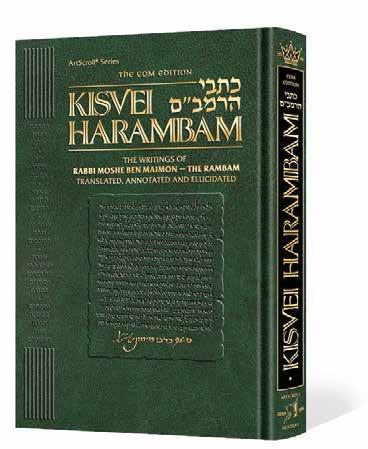
By Rabbi Yehuda Meir Keilson
ArtScroll
Mesorah Publications
New Jersey, Vol. 1, 2023; Vol. 2, 2024 Vol. 1, 500 pages; Vol. 2, 654 pages
Reviewed by Rabbi Moshe Maimon
The two recently published volumes of ArtScroll’s Kisvei HaRambam are a remarkable tour de force that offer scholars and laymen alike a profound wealth of insight into the Rambam’s writings and worldview.1 Whereas the first volume focuses on the Rambam’s introduction to Perek Cheilek and other writings of his on the fundamentals of Judaism, the second volume is dedicated to an exposition of the master’s writings on ethics and character perfection.
Both volumes stand out for their clear elucidation of often complex material and are immeasurably enhanced by the section entitled “Insights”—the author’s scholarly essays that expand on issues
raised in the notes to the texts. These essays—which are substantial enough to form a full-length sefer of their own—seek to position the Rambam firmly within the continuum of rabbinic thought as it has evolved over the ages, while addressing the very issues he himself confronted.
From a broader perspective, the publication appears to reflect a significant shift in the intellectual climate of the English-speaking yeshivah world, where the Rambam’s writings have become the focus of renewed scholarly and rabbinic scrutiny.
The Rambam’s works have long been foundational texts in Jewish law and thought. Every facet of our tradition— our laws and customs, our theological frameworks—bears the indelible imprint of the Rambam’s creative genius. Orthodox life as we know it would not only be diminished without him—it would be unrecognizable.
The Rambam’s Legal, Theological and Philosophical Influence Consider the Rambam’s legal writings. The very concept of a binding legal code of halachah—now taken for granted— was pioneered by the Rambam with the publication of Mishneh Torah. More significantly, an estimated 60 to 80 percent of the Shulchan Aruch consists of direct citations from the Rambam, meaning that much of the practical halachah observed by Orthodox Jewry today is rooted in his rulings.
In the realm of theology as well, our conception of the Almighty owes its character to the Rambam’s lifelong campaign against anthropomorphism. Likewise, his Thirteen Principles of Faith
have profoundly shaped Jewish belief; the daily declaration of these articles of faith reflects Orthodoxy’s adoption of these principles in determining an individual’s standing within the community.
Yet, it is perhaps his philosophical writings that have had the most enduring effect on Jewish thought. Every major intellectual movement in Jewish history—whether adopting or reacting against Maimonidean thought—owes its emergence, in one way or another, to him.
The Rambam’s philosophical influence persisted well beyond the medieval period. The Rema (Toras Ha’Olah), Ramchal (Da’as Tevunos2) and other spiritual giants engaged deeply with Moreh Nevuchim, and, later, the intellectual currents of the Enlightenment era were shaped by his rationalism. While Rambam’s legal works continue to be diligently studied today, interest in his philosophical writings within yeshivah circles has weakened over time. The publication of Kisvei HaRambam may signal that the pendulum is swinging back and that engagement with Maimonidean thought among English-speaking yeshivah students is becoming increasingly prevalent.
Rabbi Moshe Maimon, editor of a recent two-volume edition of Peirush Rabbeinu Avraham ben HaRambam al HaTorah, is a beis midrash rebbi and a general editor for Machon Aleh Zayis. He lives with his wife and children in Jackson, New Jersey, where he serves as a rav of Khal Chasidim D’Jackson.
The obvious question, then, is what has changed? Has the yeshivah world grown more open to the Maimonidean tradition, or has the Rambam been repackaged in a framework more palatable to this audience?
To explore this question, I examined Kisvei HaRambam’s treatment of several instances in which the Rambam’s views diverge from the mainstream yeshivah perspective. In every case, the editors have presented his views faithfully, with candor and sensitivity, mitigating the claim that the Rambam’s approach has been adapted to align with contemporary yeshivah views.
Notably, the volume includes an appendix featuring the Ritva’s staunch defense of the Rambam, in which he acknowledges his own adherence to the Ramban’s Kabbalistic worldview, while simultaneously affirming that the Rambam’s non-Kabbalistic perspectives, as expressed in Moreh Nevuchim, deserve full scholarly consideration and honor.
Conspicuous in the Vilna Gaon’s critique of the Rambam3 is his position that philosophical leanings led the Rambam to reject supernatural occurrences described in the Gemara, such as those involving demons and witchcraft. In the Rambam’s defense, a strong case can be made that for the most part he was not formulating these views independently but was instead following Geonic precedent.4
Still, the Rambam was unique in developing a worldview in which a firm boundary separates the physical from the metaphysical, with the sole point of intersection occurring in the realm of seichel (human intellect). Thus, a person who attains a high level of spiritual and intellectual refinement can receive prophetic communication through a malach (angel) with the experience itself being internal, occurring within the mind rather than through an embodied creature.
In keeping with this perspective, and in contrast to contemporary Chareidi and Chassidic thought, which is far more mystically inclined, the
Rambam consistently argued for a narrow interpretation of supernatural references in the Torah and Talmud. He viewed such passages as allegorical, symbolic or the product of mystical visions rather than literal occurrences. He applied this approach even to openly miraculous events, seeking to understand them within the framework of natural order rather than as occurring outside the laws of nature.
Various aspects of this approach are explored by the Rambam in his Letter on Resurrection and in his Letter on Astrology; Kisvei HaRambam treats these texts with scholarly rigor, addressing their themes with intellectual honesty and sensitivity.
“Accept the truth from whoever says it”
One of the most striking elements of the Rambam’s worldview is his openness to integrating truths derived from nonJewish sources. In Shemoneh Perakim5 (Vol. 2, pp. 6–7) we encounter his famous declaration:
Know that the matters that I will discuss in these introductory
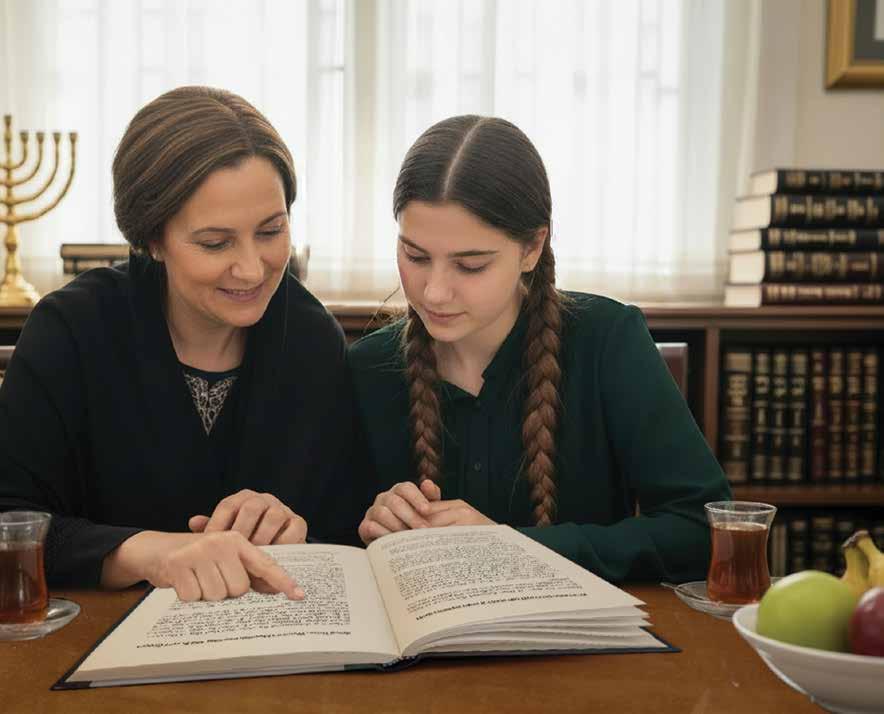

Orthodox life as we know it would not only be diminished without the Rambam—it would be unrecognizable.
chapters—as well as what will be said in the commentary to the mishnayos of this tractate—are not ideas that I conceived of on my own, nor are they explanations that I innovated; rather they are ideas that I have gleaned from the words of the sages in the Midrashim and the Talmud, and other works of theirs, and also from the words of the non-Jewish philosophers, both early and more contemporary. Do not be surprised that I utilize the teachings of non-Jewish scholars, because these teachings that I utilize are true, and the rule is that one should accept the truth from whoever says it. Throughout history, some have sought to downplay this statement, arguing that it was merely a concession to an audience steeped in philosophy. Today, as well, Chareidi sensitivities dictate that only authors within the Orthodox tradition are cited in Torah scholarship, a policy adhered to by ArtScroll (including in Kisvei HaRambam). Yet, as Kisvei HaRambam itself notes, the approach that wisdom and truth can be found in non-Jewish sources is a theme that runs throughout all of the Rambam’s writings, and “although Rambam concedes that some readers might have qualms about some of his sources, he gives no impression that he shares those qualms” (162).
A fascinating historical parallel— only vaguely referenced in Kisvei HaRambam—can be found in an account by Rabbi Yosef ibn Aqnin (a protégé of the Rambam whose own commentary on Pirkei Avos is cited frequently in Kisvei HaRambam) concerning Rabbi Hai Gaon, who instructed a student to seek a linguistic interpretation of a verse in Tehillim from a Christian cleric, emphasizing that wisdom can be gained from any source.6
The issue that perhaps presents the sharpest contrast between the Rambam’s ideology and contemporary Chareidi thought is one that touches the very core of its sociological foundations—the Rambam’s strong censure of those who rely on financial support for Torah study.
Acknowledging that his viewpoint ran counter to the rabbinic society of his time, the Rambam asserts that Torah study is a personal duty that should not become a profession sustained by public funds. Basing himself on the mishnah in Avos (4:5), the Rambam criticizes those who make Torah study their profession and depend on public funds, arguing that this diminishes the Torah’s dignity. His ideological outlook emphasizes personal responsibility, self-sufficiency and a clear separation between Torah and material dependency.
In contrast, Chareidi ideology views the financial support of Torah learners as a collective obligation essential to ensuring the endurance of Torah scholarship for future generations. This approach treats Torah study as a communal responsibility, where sustaining Torah scholars is considered a merit for the broader Jewish people. Accordingly, much of the contemporary Chareidi world embraces and institutionalizes full-time Torah study supported by communal funds, government subsidies and private philanthropy. This model, particularly dominant in Israel, is rooted in later rabbinic justifications—particularly those of the Shulchan Aruch, the Chasam Sofer and the Chazon Ish. In its treatment of these texts, Kisvei HaRambam treads carefully, showing sensitivity to contemporary Chareidi norms while simultaneously exploring the full scope of the Rambam’s viewpoint, placing it within the broader framework of rabbinic discourse.
With the publication of Kisvei HaRambam, ArtScroll and Rabbi Keilson have produced an outstanding work of scholarship that not only makes the Rambam’s writings accessible to the English-speaking public but also offers a depth of analysis that meets the highest standards of rigorous study.
This edition strikes a rare balance, offering clarity for newcomers while maintaining the intellectual richness that serious scholars demand. A significant contribution to the study of the Rambam, it reflects a noteworthy shift in contemporary Torah scholarship on the writings and worldview of the great master, one that may continue to influence the study of Torah for generations to come.
1. In the interests of full disclosure, I acknowledge my modest involvement in this project. I had the opportunity to discuss aspects of its preparation with its primary editor-author, Rabbi Yehuda Meir Keilson, and was honored to review an addendum comprising a newly edited chapter from Rabbeinu Avraham ben HaRambam’s sefer, HaMaspik L’Ovdei Hashem. However, I hope that my observations will be evaluated on their own merit rather than through the lens of my involvement.
2. Compare to Rabbi Avraham Shoshana’s introduction to Mesillas Yesharim (Machon Ofek, 2019, p. 20 at n. 8).
3. See Biur HaGra, YD 179 and 246.
4. Especially Rabbi Saadiah Gaon. Compare also to the sources referenced in my annotated edition of the Rambam’s grandson Rabbi David HaNagid’s commentary to Parashas Va’era in Mechilta, vol. 4, pp. 197ff.
5. ArtScroll’s spelling follows the popular pronunciation, though grammatically speaking the “peh” in the second word, coming on the heels of the “heh” in Shemoneh, should be soft; hence: Shemoneh Ferakim
6. A full treatment of this account, along with an English translation of the Judeo-Arabic original manuscript, can be found in Yosaif M. Dubovick, “‘Oil, which shall not quit my head’: Jewish-Christian Interaction in Eleventh-century Baghdad,” Entangled Religions 6 (2018): 95–123.
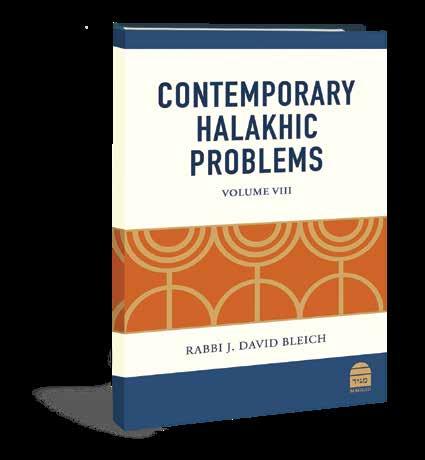
By Rabbi Dr. J. David Bleich Maggid Books
Jerusalem, 2024
648 pages
Reviewed by Rabbi Betzalel Sochaczewski
Writing on Judaism in October 1978, David Novak noted that “[o]ne of the happier signs of the intellectual maturity of the American Jewish community is the growing publication of halachic literature in English.” Thus he began his review of the new work Contemporary Halakhic Problems, which had emerged the previous year from “[o]ne of the foremost Jewish thinkers in this area . . . the Orthodox cleric and professor of Talmud at Yeshiva University, Dr. J. David Bleich.”
Fast forward nearly half a century and one would be hard pressed to identify an individual other than Rabbi Dr. J. David Bleich—still an Orthodox cleric, yet more commonly titled rosh yeshivah and rosh kollel le’hora’ah at the Rabbi Isaac Elchanan Theological Seminary (RIETS), professor of law at Cardozo School of Law, and Herbert and Florence Tenzer
professor of law and ethics at Yeshiva University—who is more closely associated with the genre of English-language halachic literature. In what can indeed be an indication of the intellectual maturity of the American Jewish community, that initial volume has grown into a series by the same name, most recently expanded by its eighth volume. Suffice it to say that these works—primarily culled from Rabbi Bleich’s regular installments (now numbering over 150 since 1967) of “Survey of Recent Halakhic Periodical Literature” in the Rabbinical Council of America’s periodical, Tradition—have become staples of an advanced Anglo Judaica library.
This newest addition to Rabbi Bleich’s oeuvre hews closely to its predecessors: exhaustive aerial tours of some thirty complex contemporary halachic landscapes, populated by meticulously sourced footnotes, enriched by parallels from a broad background in secular law, medicine and ethics, and presented with his signature precision of exposition, graceful expression, and flourishes of good humor. And despite the passage of time, Rabbi Bleich’s writing has not mellowed; it continues to eschew the “pop halachah” format in favor of the dense, academic style. (I imagine that I am not alone in wondering if thinning out some of that density would not be beneficial in making these essays more accessible to those not equipped with a mental machete.) Make no mistake: This is not company for the post-cholent visit to the couch.
True to its title, the current volume surveys halachic applications to matters born of the modern age. Some are “vintage” topics of the genre, such as the relationship of the laws of Shabbos to refrigerators, instant soups, internet sales and diabetes management; or the permissibility of Shema recitation in a foreign language. Others, while also not of recent provenance, have generated controversy as of late, such as the kashrus of pineapple; yet others have recently
come into the spotlight due to shifting social and legal attitudes, such as the status of cannabis.
But perhaps the issues likely to generate the most interest are those on the cutting edge of science and technology. The classic philosophical dilemma of the “Trolley Problem” receives a modern twist in the moral challenges relating to self-driving automobiles. And the seemingly inexhaustible subject of in vitro fertilization (IVF) is addressed once again, this time regarding the disposition—or ownership—of fertilized ova.
The most noteworthy section of this volume relates to that singular experience of our lifetime, the Covid-19 pandemic. The unprecedented (for modern times) circumstances that it produced in the realms of physical and mental health, medicine, relationships, education, economics, communication, society and religion generated a stream of fresh halachic challenges, many of which needed to be addressed in real time by Klal Yisrael’s dedicated senior poskim. The result was a veritable new subsection of halachic literature—“Hilchos Corona” or “Hilchos Pandemic”—with entire volumes dedicated to its treatment. Indeed, it is difficult to think of another modern phenomenon which achieved such a distinction with such expeditiousness.
As all of this unfolded, Rabbi Bleich was on site. Readers of his columns in Tradition thus traversed the pandemic with his digests of the freshly printed halachic literature—collated, analyzed and appraised—held up against the backdrop of the emerging and everamorphous medical and legal data. In
Rabbi Betzalel Sochaczewski is a freelance writer, editor and translator, residing in Lakewood, New Jersey. His original work has appeared in Hakirah, and includes a forthcoming English-language adaptation of Toldos Yaakov Yosef. He is also the host of the parashah podcast Der Pshat in Posuk
this first collection of this material, we are transported back to the world of masks and gloves, of porch minyanim and social distancing. What to do about a missed bar mitzvah? Missed Kerias haTorah? Is there an obligation to follow through with tuition payments if schools are shuttered? Rabbi Bleich’s positions on these and other issues renders this section an important resource (one hopes, only theoretical—lehagdil Torah uleha’adirah).
As in the previous volumes of the series, this one is headed by an introductory essay on a broader theme of the halachic process, in this case, primarily, the methodology of pesak (halachic decision-making). While the veteran reader will recognize various arguments and anecdotes from previous such essays, this is seemingly the author’s fullest expression of his halachic philosophy. Utilizing a threefold division into halachah’s “substantive, adjudicative, and prophylactic” components, Rabbi Bleich pointedly and unapologetically limns what constitutes authentic, traditional and responsible pesak—and what does not.
There are, of course, some points which are open to dispute. For example, Rabbi Bleich writes (p. 5) that “the halakhic
system regards elucidation of the law by legitimate exponents to be infallible. Since such interpretation was licensed by G-d, it could not possibly be erroneous.” While this idea is possibly reflected in classical sources, namely the Kuzari (3:41) and Ramban (Devarim 17:11), it would seem to be belied by the very institution of the par he’elem davar shel tzibbur, the sacrifice prescribed to atone for mass sinning due to an error in halachic judgement by the Great Sanhedrin (Vayikra 4:13–21; Horiyos, chap. 1).1
Yet another is Rabbi Bleich’s firm endorsement of Rabbi Joseph B. Soloveitchik’s marginalization of the halachic value of literary latecomers, such as Meiri. Meiri’s writings were (for the most part) discovered in the twentieth century in the Biblioteca Palatina of Parma (not the Cairo Genizah, as Rabbi Bleich states [pp. 10, 51]) and have since become a staple of Talmudic analysis. While acknowledging their value in abstract learning, Rabbi Bleich asserts that Meiri’s writings are of minimal halachic value due to their absence from the historical halachic process. “Applied halakhic decisionmaking is also subject to masorah. Me’iri is not part of that tradition” (p. 50). While the esteemed author
is certainly entitled to his approach, perhaps it would have been appropriate to take note of the dissenting view, that of halachic greats such as the Mishnah Berurah, who did take Meiri’s positions into account in their halachic analyses.2 The same could be said for Rabbi Bleich’s wholesale rejection of the halachic value of the Cairo Genizah (p. 51)—this is by no means a universal position.3
In sum, Contemporary Halakhic Problems, Vol. VIII, may deservedly take its place alongside its well-thumbed predecessors in gracing the bookshelves of serious students of halachah—while leaving space for, it is hoped, many others to follow.
Notes
1. See Rabbi Rephael Yosef Hazan, Shut Chikrei Lev (Jerusalem, 1998), YD 1:84 , p. 418.
2. See, for example, Shut Divrei Yatziv, OC 132, regarding the late publication of Maharam Halavah’s novellae on Pesachim.
3. Rabbi Uri Tieger, in his comprehensive survey of Chazon Ish’s halachic methodology, Derech Ish (Jerusalem, 2009), pp. 25–26, concludes that he was not averse to making use of new sources—including Meiri and Genizah material—in matters of halachic import, so long as he was convinced of their authenticity.

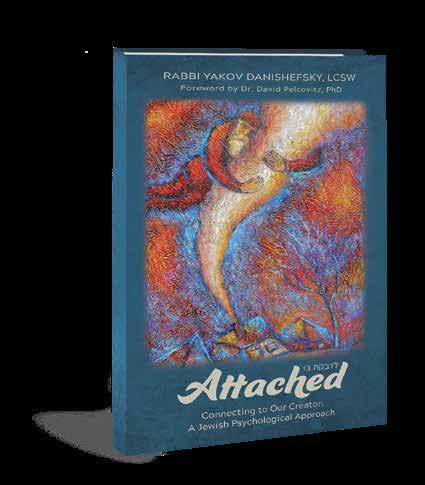
By Rabbi Yakov Danishefsky Mosaica Press
Beit Shemesh, Israel, 2023 166 pages
Reviewed by Rabbi Micah Greenland
At its heart, Judaism is about relationships. In my own work, I am constantly reminded of how much we invest in strengthening our ties with family, with community and with ourselves. We devote effort to learning how to communicate better, to forgive, to nurture love, and to extend kindness not only to others but also inwardly. Yet while we invest great energy into these areas, we often leave underexplored the question of how to build and sustain our relationship with G-d. This is so despite our knowing, as David Hamelech reminds us, that “kirvat Elokim li tov—closeness to G-d is the very definition of good” (Tehillim 73:28). Few pursuits, then, are more valuable than developing an authentic, enduring connection with our Creator.
In Attached: Connecting to Our
Creator—A Jewish Psychological Approach, Rabbi Yakov Danishefsky takes this challenge head-on. A rabbi and clinical social worker, he draws from relationship psychology and attachment theory—an approach developed by British psychologist John Bowlby that explains how early bonds shape emotional security in relationships—to provide a paradigm for connecting with G-d that is both practical and deeply resonant. Just as human relationships require trust, communication, forgiveness and steady investment, so too does our relationship with the Divine.
This comparison is what makes Attached stand out. Rabbi Danishefsky does not simply borrow psychological jargon; he uses the insights of experts in human intimacy to illuminate our spiritual lives. For example, renowned psychologists and researchers Drs. John and Julie Gottman encourage couples to ask: “When I’m with this person, how do I feel about myself?” Rabbi Danishefsky applies the same question to our relationship with G-d. “How do you feel about yourself,” writes Rabbi Danishefsky, “in the relationship with the G-d you currently engage? Do you feel loved, accepted, wanted, able to make and own mistakes, confident enough and motivated to expand beyond your comfort zone, and happy being in your own skin? Do you feel that you can be you—without putting on an act?” To whatever extent we struggle with our answers, it is likely that our relationship with G-d needs further careful reflection and intentional work.
Classic Jewish sources echo this relational model. Rav Tzadok HaKohen of Lublin teaches that our national bond with G-d began with a dramatic moment of inspiration as we left Egypt, but it matured only through steady, deliberate growth. Rabbi Danishefsky, who is coming out with an “Attached Haggadah”
shortly, develops this theme, offering guidance for those times when the initial spark seems to fade. What do we do when we feel distant, when we fear we have angered G-d, or when the intensity of connection wanes? Just as couples or friends must learn to navigate conflict, repair trust, and rekindle love, so too must we bring those same skills into our avodat Hashem.
The result is a book that is as honest and practical as it is hopeful. Rabbi Danishefsky acknowledges the reality of anger, doubt and estrangement in our spiritual lives rather than glossing over them. Rabbi Levi Yitzchak of Berditchev was famous for channeling his feelings of anger and exasperation with G-d into opportunities to turn more intentionally toward Him, rather than allowing them to lead to estrangement. Rabbi Danishefsky quotes the story of Rabbi Levi Yitzchak pausing in contemplation for many minutes during a Pesach Seder before asking the Mah Nishtanah.
“Master of the World! I don’t have four questions . . . I have four million questions! How could You take our neighbor’s husband and leave little children without a father? How could You give this one such an illness and this one such bitterness and this one such poverty?” He was exasperated with holy anger, but ultimately concluded, “as long as I know that it’s all in Your name, that it’s all for You, I can live and continue to live in Your Name.”
Rabbi Danishefsky insists that such feelings of anger or estrangement are not signs of failure but invitations to deepen the relationship with G-d in new ways. Elsewhere, drawing on bestselling author Dr. Gary Chapman’s “love languages” framework, Rabbi Danishefsky similarly posits that there are four “spiritual
Rabbi Micah Greenland is international director of NCSY.
love languages” into which Jewish practices can be categorized: words of affirmation, quality time, gifts and acts of service (combined as one category in Rabbi Danishefsky’s framing, whereas Dr. Chapman treats them as two), and physical touch. Each of these has a particular set of mitzvot to which it relates, serving as an additional channel through which to strengthen our relationship. When we feel unloved by G-d, it is likely that we are neglecting to nurture this vital spiritual relationship in one or more of those ways. Choosing one of them to focus on will invariably help us feel closer. Additionally, Rabbi Danishefsky suggests, “just as a good marital therapist will help a couple find their love languages even if it doesn’t come easily, genuine teachers, rabbis, and conveyors of Judaism will help you find your love language with G-d, even if it doesn’t come easily.” His tone throughout is compassionate and concrete, guiding readers with examples and exercises that make the work of spiritual growth tangible.
Rabbi Danishefsky also puts into words what I see every day in NCSY: how much authentic relationships matter, especially for Jewish teens. Many teens struggle not only with questions of belief, but with whether Judaism feels safe enough, personal enough and real enough to sustain them. A recent report by the OU’s Center for Communal Research reinforces this reality. The study shows that belonging, emotional security, and authenticity are essential for meaningful Jewish engagement, noting that “Jewish meaning deepens when it is layered onto environments that already meet teens’ developmental and emotional needs.” This resonates deeply with our work. In NCSY—an organization devoted to teens’ spiritual growth and their human relationships—we work to help teens build real connections with mentors, friends and community, and through them, with G-d Himself, so that these relationships strengthen one another rather than compete.
I am also struck by how a growing relationship with G-d can quietly reshape a person’s human relationships. One recent NCSY alumna comes to mind. She had been estranged from her father for several years and had come to believe that his flaws made reconciliation impossible. Her spiritual journey began in high school, and today she is fully observant and feels deeply connected to G-d. That connection brought her a sense of calm and inner stability and, unexpectedly, the courage to reach out to her father. Despite his imperfections, she rebuilt the relationship. Today, she speaks with him regularly and feels genuinely grateful to have him back in her life. She sees her relationship with G-d as the framework that made that reconciliation with her father possible.
What Attached demonstrates is that the very skills that make for healthy human relationships—listening, consistency, empathy and forgiveness—are also the skills that can draw us closer to G-d. For our teens, this message is invaluable, but it is equally relevant for adults of all ages who seek to make their religious lives more real and more personal.
In a cultural moment where many are searching for authenticity and depth, Attached bridges the world of psychology and Torah to show that our relationship with G-d can be nurtured with the same intentionality we bring to our human relationships. It neither oversimplifies nor overintellectualizes. Instead, it provides tools—drawn from both clinical practice and Torah wisdom—that can help us sustain closeness with G-d through joy, through struggle and through the ordinary rhythms of life.
Ultimately, Attached left me—as I believe it will leave many readers—with a powerful challenge: to treat our relationship with G-d with at least the seriousness we treat our human relationships. That means asking ourselves not only whether we believe or how we observe, but also whether we feel loved, understood and strengthened in G-d’s presence. With warmth, clarity and practical wisdom, Rabbi Danishefsky shows us how to answer that question in the affirmative. For anyone seeking to make their religious life more authentic, more grounded and more connected, Attached is an invaluable guide.
Just as human relationships require trust, communication, forgiveness and steady investment, so too does our relationship with the Divine.
Publication No. 005-239. 3. Filing Date: October 1, 2025. 4. Issue Frequency: Quarterly and Passover. 5. No. of Issues Published Annually: Five. 6. Annual Subscription Price: $16.00. 7. Complete Mailing Address of Known Offce of Publication: Orthodox Union, 40 Rector Street, 4th Floor, NY, NY, 10006. Contact Person: Anthony Lugo. Telephone: 212.613.8163. 8. Complete Mailing Address of Headquarters or General Business Offce of Publisher: Same. 9. Full Names and Complete Mailing Addresses of Publisher, Editor and Managing Editor: Publisher: Orthodox Union, 40 Rector Street, 4th Floor, NY, NY, 10006. Editor: Nechama Carmel, same address; Managing Editor: Rabbi Gil Student, same address. 10. Owner: Orthodox Union, 40 Rector Street, 4th Floor, NY, NY, 10006. 11. Known Bondholders, Mortgagees, and Other Security Holders Owning or Holding 1 Percent or More of Total Amount of Bonds: None. 12. Tax Status (For completion by nonproft organizations authorized to mail at
By Rabbi Moshe Walter Feldheim Publishers
New York, 2025
313 pages
We often take for granted the content of the siddur, the repository of our personal and communal prayers, because we grew up using it. We don’t realize that it is the result of thousands of years of evolution. Understanding the journey our prayers took gives us insight into what we say and why we say it. However, the story of the siddur easily becomes a complex and boring tale that alienates lay readers. Rabbi Moshe Walter, in his The Making of the Siddur: The History, Development, and Halachos of the Siddur, makes the history accessible with a number of delightful literary tactics.
One way Rabbi Walter, rav of Woodside Synagogue Ahavas Torah in Silver Spring, Maryland, and the executive director of the Rabbinical Council of Greater Washington, keeps the textual history lively is by focusing on controversy, which always
By Rabbi Gil Student
captures the reader’s attention. The second and third chapters of the book are titled “ Nusach Sefarad ” and “ Nusach HaGra .” Rabbi Walter not only tempts the reader who is naturally curious about these different prayer versions popular among Chassidim and their detractors, but he delivers with a faithful discussion of their origins and a lively description of their controversies. For Nusach Sefarad , the debate between the Chatam Sofer and the Divrei Chaim , and their students, was over the propriety of an Ashkenazi praying in this relatively new prayer text. For Nusach HaGra , it is the long challenge and debate over what exactly the Vilna Gaon’s siddur contained. Particularly since most people are used to praying the way they were taught, the examples of differences are fascinating and help everyone think more about their own prayers.
The bulk of the book focuses on specific prayer sections of weekday, Shabbat and yom tov services, explaining their origins and purpose. There is a progression in the prayer service, an overall structure designed to guide the individual and community through a process of praise and prayer. Rabbi Walter shows the reader the concepts underlying the prayers with sweeping reviews of the sources and varying customs, along with “takeaways” that simplify and summarize each chapter.
While the text remains accessible to the layperson, the scholar will find valuable sources and references. The Making of the Siddur serves as an introduction to the prayers while also contributing to the scholarly literature on the subject. Thanks to the author’s accessible style, the book can be used equally for light reading in small sections on Shabbat afternoon or as a textbook for a class on prayer.
By Dr. Yaakov Freedman and Rabbi Akiva Dershowitz Adir Press New York, 2025 190 pages
Ifind myself wondering why Dr. Yaakov Freedman’s stories of psychotherapy are so compelling. He is an accomplished storyteller but hardly the only one. And yet, I read his accounts with greater interest than other such books. Perhaps there is an element of voyeurism, seeing a brief glimpse of other people’s private struggles. Perhaps there is also a quiet sense of relief when encountering challenges I do not personally face. Given the wide range of cases and treatments described, nearly every reader will recognize both unfamiliar problems and familiar emotions.
More importantly, however, Dr. Freedman, a board-certified psychiatrist practicing medicine who maintains a private practice in
Rabbi Gil Student serves as OU director of Jewish Media, Publications and Editorial Communications.
“Torah is a commentary on life, and life is a commentary on Torah.”
RABBI LORD JONATHAN SACKS
from korenpub.com or
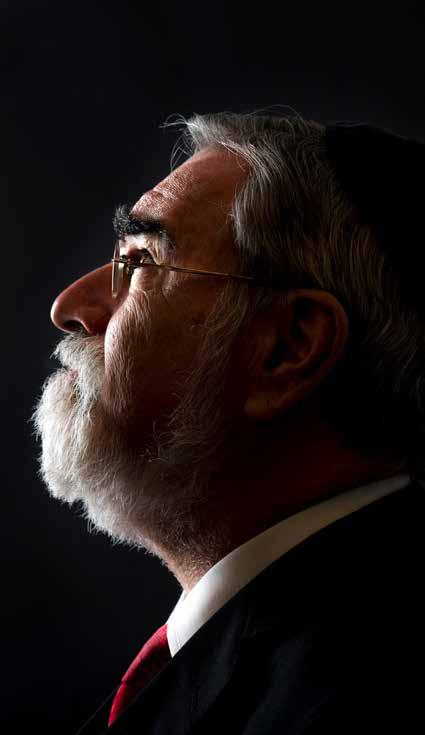
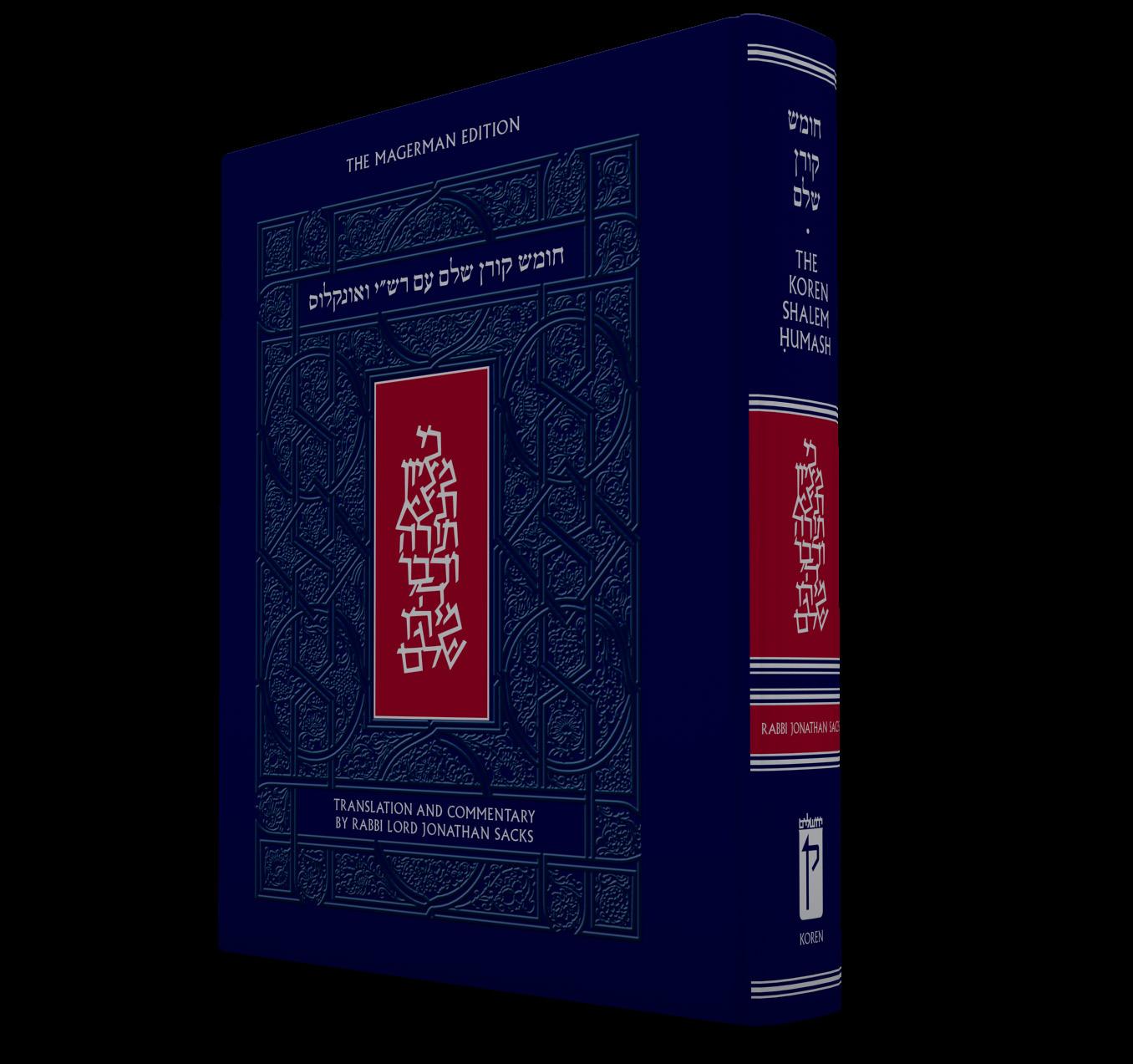


Jerusalem, portrays the frum community as it actually is: a community of sincere, striving people living complicated lives. Idealized visions of perfect families and perfect communities do not exist. Yet that realism does not diminish the beauty of Torah life. On the contrary, it reinforces a crucial truth: The Torah is not meant to eliminate all human struggle. It provides a framework to live meaningful lives dedicated to Hashem, even as we go about our mundane activities and struggle with our human frailties. The Torah refines us; it does not render us flawless.
In Stories & Halachah from the Psychiatrist’s Couch, Dr. Freedman presents thirty case studies drawn from his psychiatric practice, not all of which conclude with neat or happy endings. Some patients grapple primarily with chemical or neurological conditions, while others confront emotional or psychological turmoil. Across these varied stories, a consistent theme emerges: the courage required simply to seek help, followed by the sustained effort demanded by treatment itself. Improvement, when it comes, is rarely quick or easy. Dr. Freedman depicts patients who struggle honestly and persist with dignity, often over long periods of time.
The reader would be mistaken to conclude that Dr. Freedman is the hero in these stories. While he diagnoses, prescribes and guides the patients, the real labor belongs to the patient who wants to live a better life. A recurring element in that effort is faith, not as a substitute for professional care, but as a source of motivation and resilience. Dr. Freedman recognizes the centrality of faith and knows how to respect it, support it and integrate it into treatment as appropriate.
This is where the unique structure of the book proves especially effective. Each chapter concludes with a brief halachic reflection by Rabbi Akiva Dershowitz. At first glance, the combination of psychiatric case studies and halachic analysis might seem incongruous. In practice, it underscores the book’s deeper message. The halachic discussions highlight that faith
sustains both patient and practitioner through the inevitable setbacks and uncertainties. In that sense, every reader is Dr. Freedman’s patient who can benefit from his faith-affirming practice.
Va’Achabda Shimcha: Gilyonot Ve’Alonim B’Halachah
By Rabbi Moshe Shimon Bineth 2024
316 pages
One of the unusual features of the Orthodox Jewish community is the continued proliferation of paper publications in this increasingly digital world. Because Shabbat remains digital-free, Orthodox Jews still consume books, magazines and weekly newsletters even while the broader world moves away from print. Among the benefits of this religious phenomenon is the preservation, at least one day a week, of the classical culture of reading rather than the contemporary replacement of viewing and swiping. But print culture also brings its own challenges.
Already in the sixteenth century, about a century after Gutenberg
popularized his printing press, halachic authorities struggled with the challenge of an overabundance of sacred writings. How do we respectfully dispose of these books so that they do not overrun our homes? In Va’Achabda Shimcha: Gilyonot Ve’Alonim B’Halachah (“And I Will Honor Your Name”: Sheets and Pamphlets in Halachah), Rabbi Moshe Shimon Bineth offers a survey of the four approaches that have been proposed over the ages for disposing of sacred writings: burning, respectful placement in the garbage, burial and recycling. This full-length halachic work focuses primarily on Torah newsletters, addressing with impressive thoroughness the many questions they raise. May they include advertisements? May they be placed atop sacred books? Does a newspaper with a minority of Torah content retain any sanctity? Following the now-familiar model of halachic compendia, Rabbi Bineth presents clear rulings in the main text while using extensive footnotes to survey earlier authorities and apply their views to modern cases. Because the subject is so narrowly defined, the book explores virtually every conceivable angle, including unusual scenarios such as whether a litigant in a beit din may swear an oath on a Torah newsletter rather than on a traditional sacred text.
The creativity of the book’s organization and the care with which its halachic insights are developed are evident throughout. Yet, what may be most striking is not any single ruling but the very existence of a halachic monograph devoted to Torah newsletters. As much as this volume contributes to halachic literature, it also documents a significant aspect of Orthodox Jewish culture in the first half of the twenty-first century: a community so committed to Torah handouts that it must now confront its own abundance.
The Torah is not meant to eliminate all human struggle. . . . The Torah refines us; it does not render us flawless.

Meet OHRBIT, the AI companion that turns your curiosity into clarity. Explore any Jewish topic with confdence through a personalized learning path that is tailored to your interests and life.
Tell OHRBIT what inspires you and get a curated stream of videos, audio, and articles about philosophy, halacha, parsha, history, and more.


Your Personal AI:
Ask anything—from life’s big questions to help with a Dvar Torah for the family table. Get instant insights drawing from a library of 100,000+ trusted Torah sources.
By Efraim Jaffe
So, that’s it,” the rabbi says. “You’ll be gone; you won’t be coming back. I already told my wife. I figured you’d move on. I mean, we’ll miss you and Susan on Friday nights, but I told my wife that Efraim is the most easygoing person; he can move on. Sometimes I feel like I should move on too. I don’t blame you. You’ll stay in Great Neck. It’s nice there. Right? There’s space there—why wouldn’t you move on?”
We are at a wedding together, alone in the quiet of the hall where a chuppah will soon take place. The rabbi is dressed in black, his reddish beard turning white, the two of us next-door neighbors of thirty-five years, looking back and looking forward. I had just told him that I was selling the house. I’d received a good offer, unsolicited, to sell the 100-plusyear-old house as is—no hassles, no open houses, no tire kickers or bargainers to contend with. I took a month to think about it, to live with the idea.
The morning after I agreed to sell, I started looking through my drawers for items to discard. The first thing I grabbed was a prescription bottle with fading print: “Klonopin, 30 pills,” dated 03/02/2023, the day before Esther died. That mind-numbing prescription, a daily part of her diet for twenty-five years, stood as a kind of shrine to a long decline, sealed in a plastic bottle.
Even as I tell myself I am moving on, my three adult children want to organize a final Shabbat get-together on Waverly Place. They are surprisingly nostalgic about letting go. “Abba, it makes sense. The house is just going to fall apart if you’re not there to keep an eye on it.”
Oh boy, I feel the tears coming.
“Yes, I think we need to have a last get-together,” my daughter messages from Israel.
That house is their childhood—they call it “the museum of our lives.” Letting the house go feels like letting their
mother go. Her voice is still ringing in the walls. My kids tell me they hear her voice at times. “Why don’t you get married, Ely?” But she died before he got married. “Why don’t you have a baby, Manny?” But she died before he had his first baby; now the second is expected soon.
And I have been letting go in stages, even though I am remarried to Susan and have moved on. Still, one scene doesn’t cut to the next like in a movie. One scene fades while another phases in, a gray overlap of love, anguish, loneliness, shared lives and dissolution in a messy mélange of hopes and dreams, battered lives and renewal.
Moving on . . .
I tell myself that it’s okay to move on. A perimeter of guilt surrounds the decision like an electric fence designed to gently shock the dog into remaining on the property. You can’t see that fence. But a time comes to turn off the electricity and let the dog run wild. The little voice asks me: “What justice is it that Esther lies in the cold ground and you galivant to warm destinations and laugh and share deep conversations because you can and a few years ago you couldn’t?”
I guess you could call it survivor’s guilt. Living with a child of survivors for so long, I absorbed some of the survivors’ malaise.
Time to move on . . .
I think about the four-mile round-trip walk to shul in Great Neck, New York, that I originally said I would never do. But now the walk is the thing I look forward to all week, rain or shine, cold or hot. I leave at 7:15 AM, the streets deserted and quiet on Shabbat morning. The first mile takes me into town through Kings Point, landscaped and serene. The second stretches along Middle Neck Road, the commercial drag of little shops and stately apartment buildings, past the white Persian shuls along the way, the kosher French bakery, CVS and all
the kosher take-out places closed for Shabbat—Bistro Burger, Elite Pizza, Grill Time Express, Bagel Mentch, La Pizzeria, Amal Catering, Cho-Sen Village, Middle Neck Glatt and 27 Dressings. I cut through the JFK School shortcut across the soccer field, the hypotenuse of a triangle shortening the walk by a minute or two. Sometimes I pause to read the headlines of a New York Times or Wall Street Journal wrapped in plastic on a driveway, but mostly I think about the magic of a new life.
I focus on moving on as a template for my adult children as they approach middle age. Now I feel that they look to me as a role model. Not so much when they were growing up or as young adults.
I’ve been thinking about this idea of “moving on,” internally as well as externally, on my peaceful Shabbat morning walks. As I approach my seventieth birthday next year, I’m aware that despite my best efforts, things eventually fall apart. Will I still be able to do this walk in five years? In ten? Someday, I will look back on this walk fondly. In my old neighborhood of Passaic, New Jersey, the shul is around the corner. For almost thirty years, I made that walk every Shabbat.
When I first moved to Great Neck, I felt like I was in a dream. I pictured Esther’s grave back in Clifton, my sons in Teaneck and Los Angeles, and my daughter in Israel, and I felt I had stepped out of a family photograph and walked away into a picture without a frame on an Island that was Long, into a house that was not really mine, like I was a guest in somebody else’s dream, waiting for something. Waiting. Until a voice came from somewhere deep within me: Time to move on.
Efraim Jafe is an independent certified financial planner. He lives in Great Neck, New York.




Kevura in Yerushalayim is the highest honor, yet can be fraught with a web of impossible logistics: negotiating for a scarce plot, transport from America, and Shiva overseas are common challenges.
Sha’ar is now building two new magnificent cemeteries to a standard of construction and aesthetic unmatched in Israeli burials. Beyond a beautiful plot, their unparalleled service ensures that with one single call, every essential detail is expertly managed.
With Sha’ar, you’re not just getting a plot; you’re gaining a plan.
Our beautiful new cemeteries will be developed on private land: an exclusive extension of Har HaMenuchot, and the last available land for development on Har HaZeitim
Planned to the highest Mehadrin standards of design and Halacha
Exceptional access, including ample pathways and parking
Complete handholding from Tahara through Shiva
Exclusively at Sha’ar HaMenuchot: Wheelchair accessibility
Large elevators to fit the niftar and a minyan