


For eight days each year, we make an even bigger point than usual to remember the Exodus and the miracles that G-d performed for us. Passover is a holiday of sweetness and bitterness — charoset and maror — and hopefully one of unity for us, our friends and our families.
A whopping 2.3 years of The Chronicle’s 106-year-long history have been during Passover. These 848 days and their significance have yielded countless editorials, recipes and plague-themed jokes in the pages of The Chronicle, and this Passover issue is no different.
In addition to standard community
news, this week’s Chronicle has Passover-specific content including special editorials from rabbis and more. We wish you a happy, healthy and meaningful Passover.
Sincerely,

Sam Kricsfeld, editor
By Michael Sudhalter Special to The Chronicle
Lacey Storer, assistant editor
P.S. Sorry about the frog infestation!

The following are the holiday times for Overland Park, Kansas, as per Chabad.org. Wednesday,
Matzah ball soup, short ribs braised in onion soup, potato kugel and braised mustard greens with a horseradish demi-glace, followed by Manischewitz chocolate chip macaroons with whipped cream and charoset — it’s the kind of meal that evokes memories of phenomenal Passover dinners from past generations. The chances of having it in a restaurant, especially in the Kansas City area, are nearly non-existent.
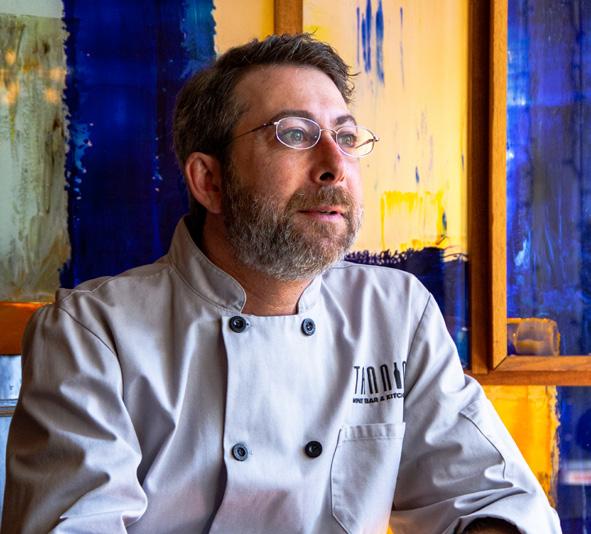
That was until Chef Brian Aaron of Overland Park, Kansas, decided to highlight his Jewish heritage from a culinary standpoint.

Before his time at Tannin, Aaron would host an annual Passover Seder at midnight at a previous restaurant.
Wednesday, April 8: Passover Night 8 candlelighting........................................8:30 p.m.
Thursday, April 9: Passover ends..........................................................................8:31 p.m.

Take a look inside Village Shalom to see our remarkable Assisted Living and Memory Care communities. Maintenance-free, private apartments and specialized care from caring staff give peace of mind to you and your loved ones. Learn more at VillageShalom.org or call Justine Ogdon at 913-317-2600 to tour our welcoming senior living community. We look forward to showing you what peace of mind looks like. Welcome to The Village.

“Judaism is about tradition, history and culture,” Aaron said. “With my culinary training, I’ve traveled all over the world (France, Italy, the Mediterranean and coastal South America) and tasted different cuisines. I’ve enjoyed so many of them, but with my Jewish background, this type of food is a specialty.”
Aaron, 48, has worked as the executive chef at Tannin Wine Bar & Kitchen in Kansas City, Missouri’s Crossroads neighborhood since it opened 15 years ago. He’s also the chef at The Mineral Lounge: Mediterranean Restaurant and Wine Bar in Kansas City, Missouri.
For the past five or six years, he’s created menus for Hanukkah and Passover, as well as “a pop-up Jewish deli menu” a couple times per year. This year’s Passover menu will be served from April 1-9 at Tannin.
“It started with me making matzah ball soup, and guests would ask for more,” Aaron said. “I’ve got the matzah balls close to softball size, but now, they’re more like larger baseballs.”
Although Aaron has drawn the Jewish community to these menus, the cuisine has also become quite popular with his largely non-Jewish customer base.
“We have a lot of regulars who are like, ‘What do you mean Passover doesn’t last for two weeks?’” Aaron said. “‘I want matzah ball soup now.’ It doesn’t seem like there’s anyone else doing this. Each year, I’m creative with the recipes. My favorite thing to make is lox and eggs and onions.”
Aaron’s Hanukkah-themed menu is also popular and was featured on KSHB-TV in December 2024.
“The Hanukkah menu lasts for all eight days and nights, and we light a Menorah each night,” Aaron said.
“Forty or 50 people would attend, and we’d have a different menu every year,” Aaron said. “We’d focus on a different Jewish diaspora. We did Morocco, Spain and Eastern Europe.”
Aaron, the son of Arnie and Sami Aaron of Kansas City, Missouri, grew up attending Hebrew school at the former Congregation Ohev Sholom. Arnie Aaron worked for a local kosher distributor in Kansas City. His wife, Sami, noticed Brian’s culinary talent at an early age.
“My mother’s favorite story is about me cooking at 5 or 6 years old,” Aaron said. “She came into the kitchen and asked, ‘What would you like for breakfast, kiddo?’ I said ‘eggs.’ She asked, ‘How would you like them?’ I said, ‘My way,’ and pushed a chair over to the stove. My mom had to hold on the back of my pants so I wouldn’t fall into the stove.”
Over the years, Aaron remembers attending large family gatherings, including Passover at his Aunt Gloria’s house. The strong tradition of the food and its cultural origins had an impact on him to this day.
The family wasn’t one to “write down recipes,” but Aaron has captured the essence of age-old traditions through his delicacies over the years.
Becoming a chef was Aaron’s destiny, even if “everyone else knew before I knew.”
Aaron became a bar mitzvah at Ohev Sholom in 1991, was active in BBYO, traveled to Washington, D.C. to compete in the Maccabi Games in track and field and participated in the March of The Living in Poland. Aaron has traveled to Israel three times and has relatives in the city of Netanya. While attending Shawnee Mission South High School in the mid-1990s,
continued on next page
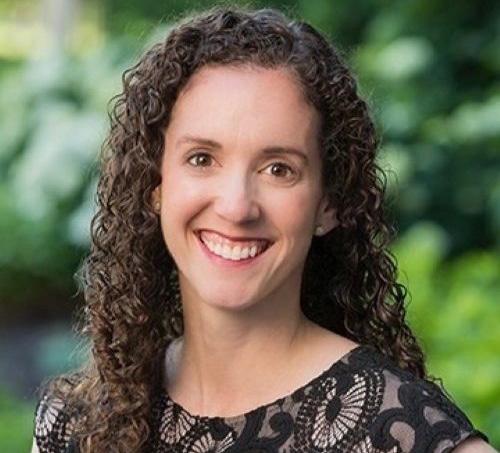
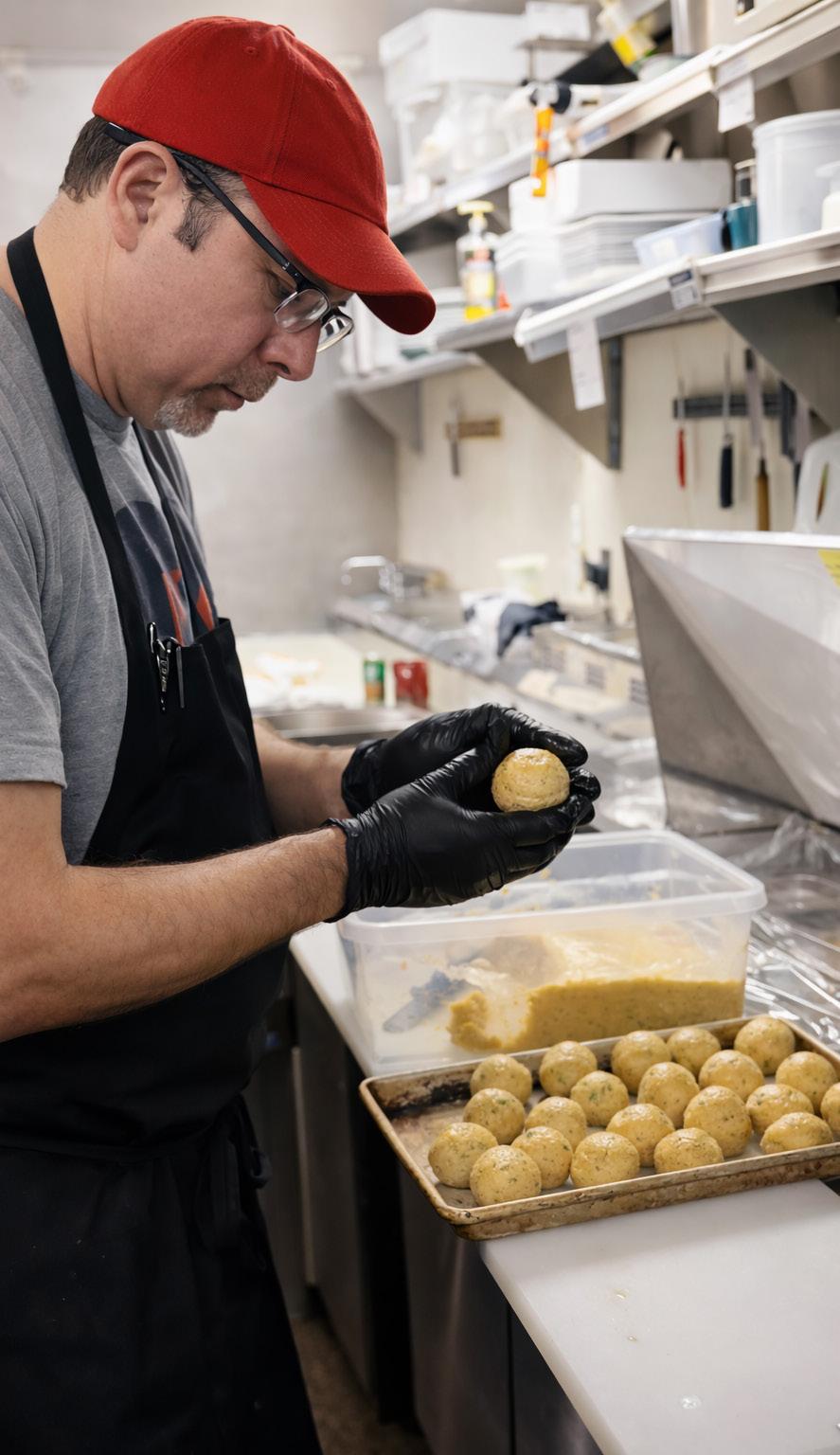
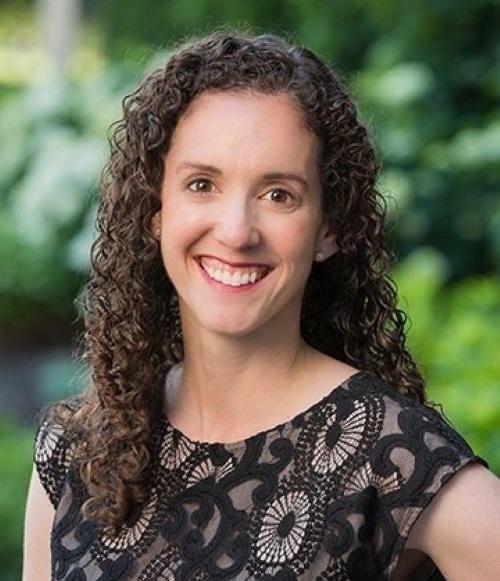
The board of directors of the Menorah Heritage Foundation (MHF) has announced that Amy Gale will become the organization’s new chief executive officer on April 1. Outgoing CEO Rita Cortes, who will retire in June, will work with Gale to ensure a smooth transition.
Gale brings more than two decades of experience in philanthropy, education and nonprofit management to the role. Following an extensive search process, Gale was selected by the board’s search committee, which considered candidates from across the region.
“Amy’s philanthropic expertise, deep commitment to collaboration and strong roots in the Jewish and broader Kansas City communities make her well-suited to lead the Foundation,” MHF Board President Barbara MacArthur said. “Her strategic vision, relational leadership and connection to our
continued from previous page
Aaron worked at an Overland Park restaurant called Sahara Café, owned by a Palestinian family.
“We liked to think of ourselves as the peace process in action,” Aaron said of the restaurant, which closed about 20 years ago. “I had a chance to meet the owner’s family when I traveled to Israel. They took me around the Arabic Quarter in Jerusalem and met a lot of really sweet people who loved and supported everybody.”
After graduating from Shawnee Mission South High School in 1996, Aaron went to Colorado, where he earned a degree in restaurant management from Colorado State University in Fort Collins and later received culinary training at Johnson & Wales University’s Denver campus. He’s been back in the Kansas City area since 2003.
mission will serve our community and our grantees exceptionally well."
“It is a profound honor to be selected to lead the Menorah Heritage Foundation,” Gale said. “Guided by the principle of tikkun olam (repairing the world), I am committed to building on the Foundation’s legacy of meaningful community impact and advancing its mission with integrity, collaboration and purpose”
Gale joins MHF from the Kansas City Royals, where she served as senior director of community impact and executive director of The Kansas City Royals Foundation. In that role, she oversaw charitable community investments and increased foundation revenue by 63% over two years. Prior to that, she spent nine years at the Ewing Marion Kauffman Foundation, rising to senior program officer and managing a large grants portfolio. Her
career began in education, including service as a Teach for America corps member and lead arts educator with Chicago Public Schools.
Gale holds a master’s degree from Dominican University and a bachelor’s degree from Northwestern University.
Her community involvement includes board service with City Year Kansas City, Kansas City Young Audiences and MHF. She lives in Kansas City, Missouri, with her husband, Jewish Federation of Kansas City Vice President and Chief Operating Officer Derek Gale, and their 10-year-old son and 8-yearold daughter.
MHF is a supporting organization of the Jewish Community Foundation of Greater Kansas City. It was formed through the 2016 merger of the Jewish Heritage Foundation and the Menorah Legacy Foundation, both of which trace their origins to Menorah Medical Center. The Foundation’s mission is to enhance health and human services within the greater Kansas City community, with a priority to serve the Kansas City Jewish community.
More information about MHF is available at mhfkc.org.
The annual Yom HaShoah Commemoration and State of Kansas Holocaust Commemoration are scheduled for April 12 and 20, respectively. The two events will honor the memory of the six million Jews murdered during the Holocaust and the legacy of survivors. They are supported by the Midwest Center for Holocaust Education (MCHE).
Yom HaShoah Commemoration
The Yom HaShoah Commemoration will take place at 1:30 p.m. on April 12 at The White Theatre at The J (5801 W. 115th St., Overland Park, KS 66211). This year the commemoration is chaired by Geri Crain, daughter of Holocaust survivor Alice Kern, continued on next page



The following are the deadlines for articles, celebration announcements, Spotlight pictures, advertisements and editorials for upcoming Chronicle print issues. If you have any questions, please contact Sam Kricsfeld at samk@jewishkc.org. April 9 issue....March 30 noon deadline (because of Passover) April 23 issue.......................................April 16 noon deadline
To submit news to The Chronicle, go to kcjc.com/chronicle-submissions!


continued from previous page
a survivor from Sighet, Romania, who was interned in AuschwitzBirkenau and Bergen-Belsen. The commemoration will feature a special tribute to the survivors with the children and grandchildren of Holocaust survivors — the second and third generation — singing “Zog Nit Keynmol” with the Hyman Brand Hebrew Academy choir.
Reflecting on the importance of Yom Hashoah, Kern said, “Elie Wiesel, Holocaust survivor and Nobel Laureate, wrote, ‘Because I remember, I despair. Because I remember, I have the duty to reject despair.’ My mother and Elie knew one another in Sighet, Romania, before they were deported. Yom Hashoah is a time to honor those who did not survive, and it is also a moment to come together — to reject despair in their memory and to affirm hope for generations to come.”
The Yom Hashoah commemoration is open to the public. Anyone unable to attend in person is invited to watch the livestream on the MCHE Kansas City YouTube channel.
The commemoration is organized
by The J, Jewish Community Relations Bureau | American Jewish Committee and MCHE. Supporting organizations include Congregation Beth Shalom, Hyman Brand Hebrew Academy, Jewish Community Foundation, Jewish Family Services, Jewish Vocational Services, KU Hillel, Lawrence Jewish Community Center, Kehilath Israel Synagogue, The New Reform Temple and The Temple, Congregation B’nai Jehudah.
The Kansas Holocaust Commemoration will take place at 1 p.m. on April 20 at the Topeka Civic Theater (3028 S.W. 8th Ave., Topeka, KS 66606).
Governor Laura Kelly will present the Kansas Proclamation for the Days of Remembrance which includes that “the people of the State of Kansas should always remember the terrible

events of the Holocaust and remain vigilant against hatred, persecution and tyranny…”
Dr. Judy Jacobs, a Hungarian survivor from Budapest, will deliver the keynote address. Dr. Jacobs left Hungary on the Kastner train and survived incarceration at Bergen-Belsen before reaching safety in Switzerland.
Kansas clergy, political leaders and students will participate in the program. Holocaust survivors, World War II veterans, and second-generation sons and daughters will be recognized. The commemoration is open to the public and to school audiences.
Registration is requested at mchekc.org/kansas-holocaustcommemoration. A video of the commemoration will be available on the MCHE Kansas City YouTube channel in the days following the program.
Yom HaShoah Commemoration
Sunday, April 12, at 1:30 p.m.
The White Theatre, 5801 W. 115th St., Overland Park, KS 66211
State of Kansas Holocaust Commemoration
Monday, April 20, at 1 p.m.
Topeka Civic Theatre, 3028 S.W. 8th Ave., Topeka, KS 66606
The Lewis & Shirley White Theatre at The J will host “The Prince of Egypt Sing-Along” on Monday, April 6 at 6:30 p.m., inviting Kansas City community members to gather for a Passover-themed event centered on music and storytelling. Framed as the “Kansas City community’s third Seder,” the event offers an immersive screening of the award-winning animated musical “The Prince of Egypt” and encourages audience participation through singing.
“We were inspired to create the ‘Kansas City community’s third Seder’ as a joyful extension of the Passover tradition, a way to gather beyond the home and celebrate this beautiful story together as a broader community,” said Jonah Greene, director of Arts & Culture at The J.
Tickets and pricing information for the “The Prince of Egypt Sing-Along” is available at thewhitetheatre.org.
Designed as an immersive, participatory experience, the sing-along invites audiences to actively engage with the film rather than simply watch it. Guests are encouraged to sing along to

songs such as “When You Believe,” “Deliver Us” and “Through Heaven’s Eyes” while enjoying themed décor, photo opportunities and a pre-show interactive lobby. Each ticket includes a curated goodie bag with kosher-for-Passover treats, interactive props and other surprises. Costumes are encouraged, with a prize offered to those who come dressed for the occasion.
Organizers say “The Prince of Egypt” is a particularly meaningful film to feature during Passover, as it captures the emotional and spiritual core of the Exodus story through themes of freedom, faith and hope.
Its storytelling and music make an ancient narrative accessible across generations, inviting both children and adults to connect with the story in a shared, memorable way.
Greene said the event reflects The J’s broader mission to bring people together through meaningful, inclusive programming that celebrates Jewish tradition while welcoming the wider community.
“Passover is about freedom, identity and coming together as a community,” said Molly Hess, director of Jewish Experiences at The J. “This sing-along offers a modern, welcoming way for people to connect with those themes and experience the holiday in a shared, joyful setting.”
The film has a running time of 1 hour, 39 minutes. The White Theatre offers sensory-friendly resources, including assistive listening devices and noise-canceling

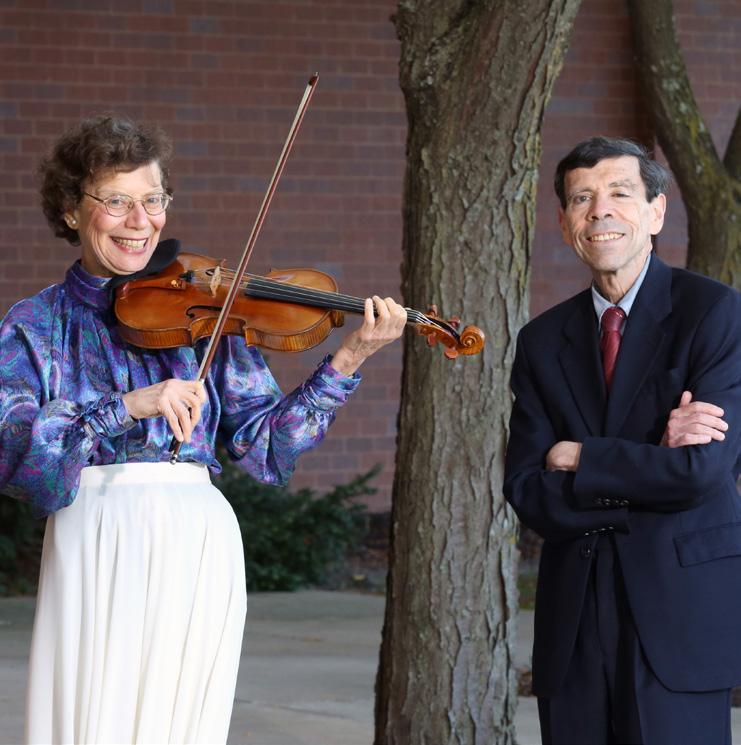
The Goldenberg Duo, consisting of siblings Susan and William Goldenberg, will present a series of free recital performances in April.
Susan Goldenberg has been a violinist with the Kansas City Symphony for more than 40 years and performs in the Kinnor Philharmonic at The J. William Goldenberg is a distinguished professor of piano at Northern Illinois University. The sibling duo have performed concerts for more than 43 years across the United States and the world.
The duo will perform works by George Handel, Aaron Copland, Dmitri Shostakovich, Florence Price, Antonin Dvorak, Maurice Ravel, Joaquin Turina and Scott Joplin.
They have six free shows scheduled:
• Wednesday, Apr. 1, at 11:30 a.m. at Baker University in McKibben Hall (518 Eighth St., Baldwin City, KS 66006)
• Thursday, Apr. 2, at 12 p.m. at the Lawrence Public Library as part of its “Music for Maundy Thursday” (707 Vermont Ave., Lawrence, KS 66044)
• Monday, Apr. 6, at 2:30 p.m. at Village Shalom as part of its Helen Bettinger Music Series (5500 W. 123rd St., Overland Park, KS 66209) Tuesday, Apr. 7, at 7 p.m. at Diastole UMKC (2501 Holmes Rd., Kansas City, MO 64108)
• Friday, Apr. 10, at 3 p.m. at Bishop Spencer Place (4301 Madison Ave., Kansas City, MO 64111)
• Saturday, Apr. 11, at 3 p.m. at Shawnee Presbyterian Church as part of Community Concerts at Shawnee (6837 Nieman Rd., Shawnee, KS 66203)
headphones available for checkout during the screening. The fully accessible theater features step-free access from the parking lot to all seating.
The Prince of Egypt Sing-Along Monday, April 6, at 6:30 p.m.
On Tuesday, April 14, from 5:30 to 7 p.m., the Jewish Community Foundation (JCF) will hold the B’nai Tzedek Shuk, its annual youth philanthropy fair. The B’nai Tzedek program introduces teens to tzedakah by inviting them to establish their own personal charitable giving accounts at the Foundation. Once a year, B’nai Tzedek fundholders may donate 10% of their funds to a Jewish charity, either locally or in Israel.
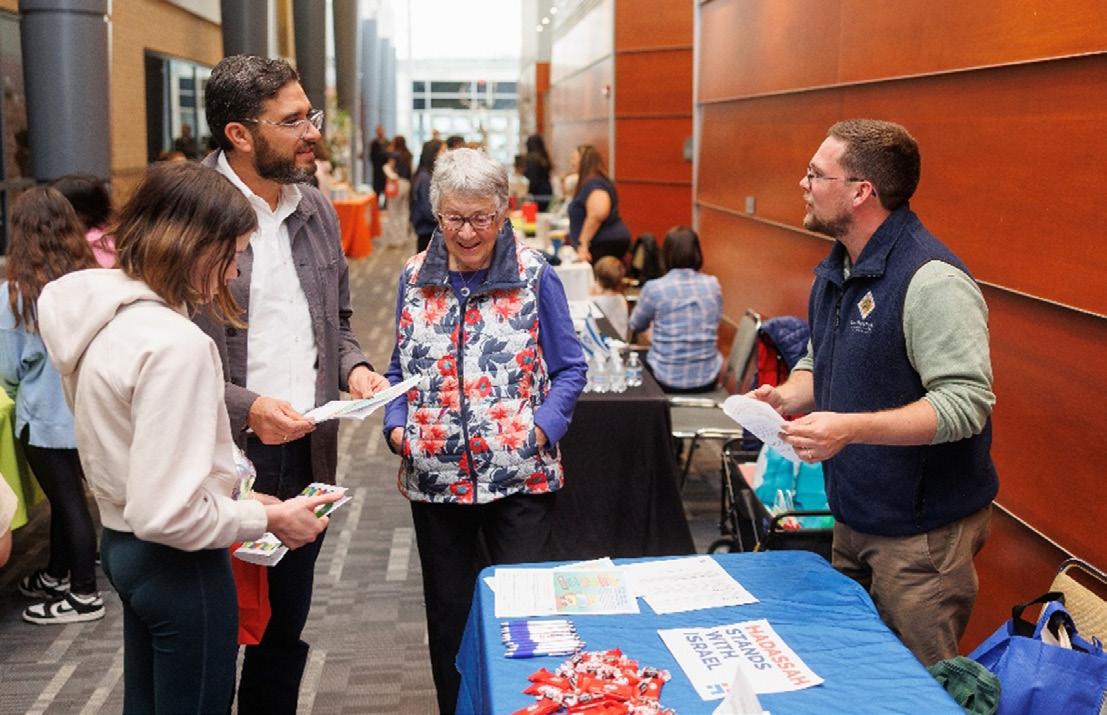
2025.
booths with other teens and you even get Dippin’ Dots.”
The Shuk gives fundholders the opportunity to learn about the missions of community organizations and how their donations can make a positive impact. In many instances, the Shuk is the first time teens are introduced to the wide array of diverse organizations working in the community.
The Shuk is planned by the B’nai Tzedek Youth Council, a cadre of teens who work together to engage their peers in philanthropy. The council chose the theme “2026 Philanthropy World Cup” based on the upcoming FIFA World Cup and Maccabi Games in Kansas City. The theme was also chosen to reinforce core Jewish values like collective responsibility and empower teens to take an active role in repairing the world.
“The Shuk is the perfect place to learn about charitable giving and how you can do your part to support the community,” said Leora Stein, B’nai Tzedek Youth Council member. “It is a lot of fun visiting the organization's
B’nai Tzedek Shuk
Fellow Youth Council member Shefer Rudnick agreed, saying, “I love the Shuk because it allows kids to understand the important causes they are donating to. I think our World Cup theme is a fun choice to get more people involved in not just donating, but being excited to help worthy causes.”
After visiting with communal representatives, guests will be invited to socialize and enjoy a complimentary Vaad-supervised and kid-approved light dinner. Dippin’ Dots, a kosher ice cream treat, will also be available. Anyone who wants to learn more about this program is welcome to attend, and as an added incentive, there will be a drawing to win a free B’nai Tzedek account. All current B’nai Tzedek fundholders who RSVP in advance will be given the chance to win a $50 Amazon gift card.
Those interested in more information or to RSVP can visit jcfkc.org/shuk or contact Suzanne Galblum Dicken at (913) 327-8286 or sdicken@jcfkc.org.
Support for the B’nai Tzedek program is provided by the Lowenstein Family Supporting Foundation.
Tuesday, April 14, 5:30 to 7 p.m.
The J, 5801 W. 115th St., Overland Park, KS 66211
Eighteen high school students from the Jewish Community Relations Bureau | American Jewish Committee (JCRB|AJC) Kansas City’s Leaders for Tomorrow (LFT) cohort recently traveled to Washington, D.C. to participate in the Susan & Bart Lewis Family Leaders for Tomorrow Advocacy Summit. The summit is a national leadership program that equips Jewish teens with the knowledge and skills to advocate for the Jewish people and Israel.
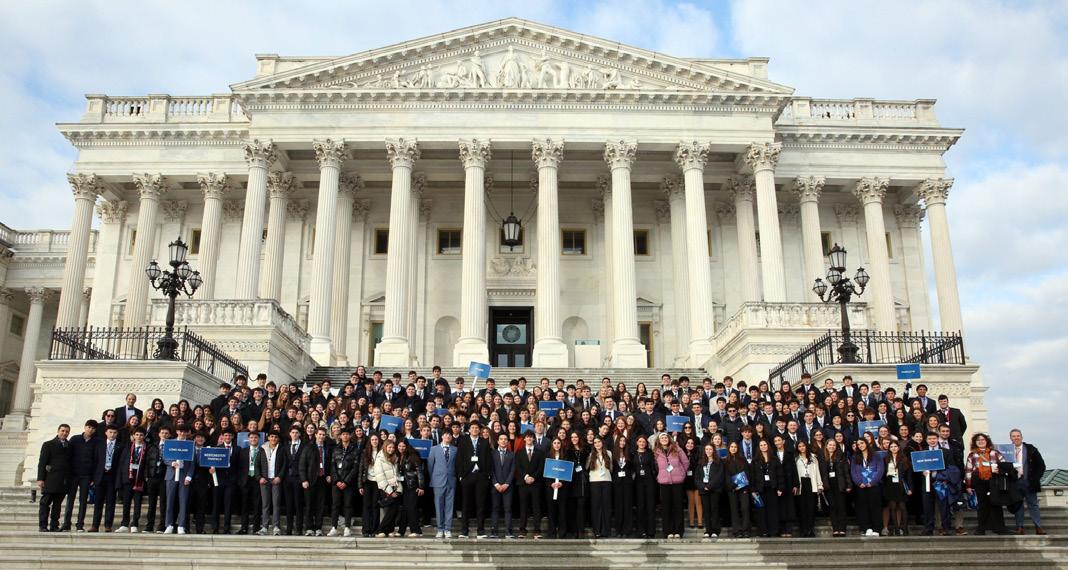
of Argentina, policy briefings at The Washington Institute for Near East Policy, reflections on Holocaust education at the United States Holocaust Memorial Museum and meetings with diplomats at the Embassy of Israel.
Held in early February, the threeday summit brought together student leaders from across the country for an immersive experience focused on civic engagement, Jewish identity and advocacy. The Kansas City delegation joined peers from other communities in workshops, discussions and policy briefings designed to prepare the next generation of Jewish leaders.
Throughout the summit, students heard from prominent speakers and policy experts, including former White House speechwriter and author Sarah Hurwitz and American Jewish Committee CEO Ted Deutch. Sessions explored topics such as confronting antisemitism, strengthening interfaith relationships, Jewish values in public life and effective advocacy in today’s political landscape.
Students also participated in “DC Field Labs,” visiting leading institutions and engaging directly with experts in diplomacy, history and policy. These visits included discussions on Jewish leadership on campus at American University, conversations on global diplomacy at the Embassy
March 8
500 Series:
Brian Wright 694 (201 246 247)
Zachariah Archie 629 (179 195 255)
Hunter Thomas 618 (220 184 214)
Joe Ravnikar 594 (197 215 182)
Chris Eldredge 556 (182 171 203)
Bill Sloan 547 (162 148 237)
Adam Russo 545 (202 160 183)
Steve Baraban 543 (201 184 158)
Michael Altman 534 (220 183 131)
Michael Sokol 529 (196 163 170)
The following bowlers achieved high scores in the Sunday Kansas City B’nai B’rith Men’s Bowling League at Ward Parkway Lanes on March 8 and 15. If you are interested in bowling during the ‘25-’26 season for
Willie Jones 527 (178 167 182)
Bruce Singer 523 (152 188 183)
Mark Newton 522 (182 156 184)
Steve Greenberg 516 (157 179 180)
Steve Eisman 504 (192 123 189)
Steve Thomas 502 (172 175 155)
170 Game:
Morty Rock 209
Tom Balke 199
Alan Abramovitz 181
Jerry Shapiro 179
Rick Hansen 171
15
500 Series:
Hunter Thomas 724 (230 247 247)
Brian Wright 585 (185 206 194)
Willie Jones 583 (165 184 234)
Joe Ravnikar 582 (235 156 191)
Ryan Thomas 579 (187 200 192)
Stuart Pollack 579 (175 147 257)
Mark Newton 577 (197 206 174)
Chris Eldredge 576 (172 187 217)
Morty Rock 573 (205 224 144)
Bill Sloan 565 (203 147 215)
Jerry Shapiro 540 (166 174 200)
Tom Balke at (913) 244-7010 or balketw@yahoo.com or Stuart
Michael Sokol 534 (165 200 169)
Adam Russo 531 (154 186 191) Nick Meyers 513 (163 207 143)
Bruce Parker 512 (169 164 179)
Archie 505 (183 139 183)
Altman 501 (139 173 189)
170 Game: Steve Baraban 191
or skp28@aol.com.
The summit culminated with Capitol Hill advocacy meetings, where the Kansas City cohort had the opportunity to meet with U.S. Senator Roger Marshall and a member of his staff. During the meeting, students shared their perspectives on issues affecting the Jewish community and asked questions about public policy and leadership.
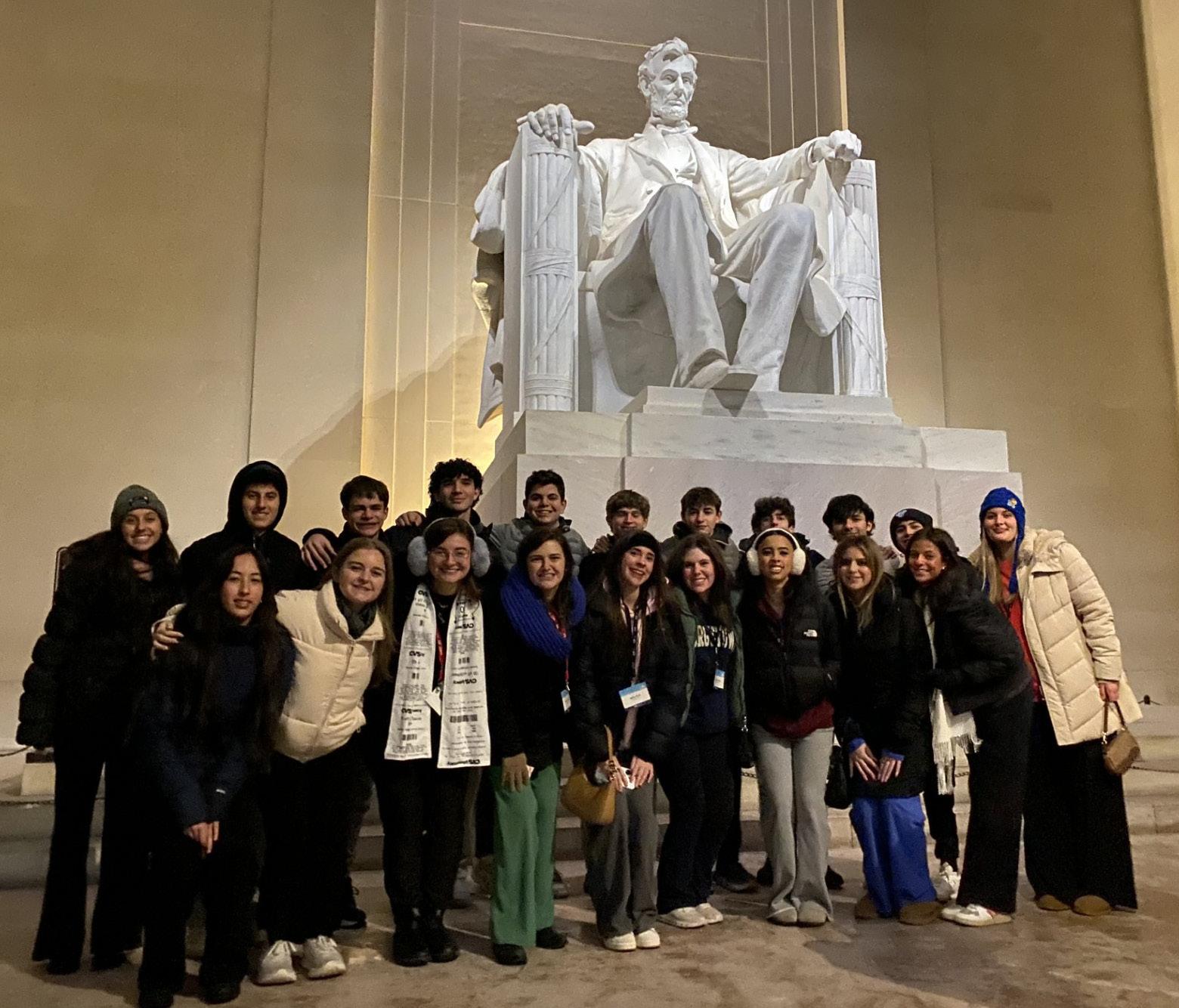
In addition to the educational programming, the summit is intended to foster connections among Jewish teens from across the country. Students participated in group reflections, networking sessions and a nighttime monuments tour, sharing experiences with peers who are similarly committed to Jewish advocacy and leadership.
“I’m really grateful for everything I learned and experienced throughout the program,” said one Kansas City student participant. “My favorite part was getting to meet with leaders and see how advocacy actually works in real life — it made everything we learn during LFT sessions feel much more real and impactful. I also really enjoyed connecting with other students and hearing different perspectives.”
LFT is the flagship high school advocacy program of the American Jewish Committee that works to empower students to speak up for Israel, combat antisemitism and engage confidently in civic life. The participation of the Kansas City cohort was made possible through the Dave and Carol Porter Fund for Advocacy at the Jewish Community Foundation of Greater Kansas City.
Applications for next year’s LFT cohort will open soon for incoming high school sophomores, juniors and seniors. Anyone interested should contact Rachel Kaseff at rachelk@ jewishkc.org.
See the Spotlight page for more picturesofLFTstudentsinWashington.
Local Jewish playwright Sarah Aptilon’s newest play, “The Signer,” will debut next month. Commissioned by Spinning Tree Theatre and produced in partnership with SevenDays, the play will premiere from April 17-26 at the Johnson County Arts & Heritage Center (8788 Metcalf Ave., Overland Park, KS 66212).
“The Signer” is an intergenerational drama about memory, legacy and listening. Spinning Tree Theatre commissioned the play as part of its commitment to developing new work and “amplifying stories of connection and empathy.” SevenDays’ involvement ties to its mission to overcome hate by promoting kindness and understanding through education and dialogue.
“At its heart, ‘The Signer’ is about listening — to the past, to one another and to the quiet voices that guide us forward,” said Michael Grayman-Parkhurst, the play’s director and producing artistic director of Spinning Tree Theatre. “Sarah Aptilon has written a beautiful and deeply human play, and we’re honored to bring its world premiere to

Kansas City audiences in partnership with SevenDays.”
The play follows the story of a teenage dancer, who, after the sudden loss of her mother, travels with her father to clear out a mysterious family home by the sea. When she discovers a hidden journal belonging to a young ancestor, the past begins to unfold alongside her own story. As their journeys intertwine, she must




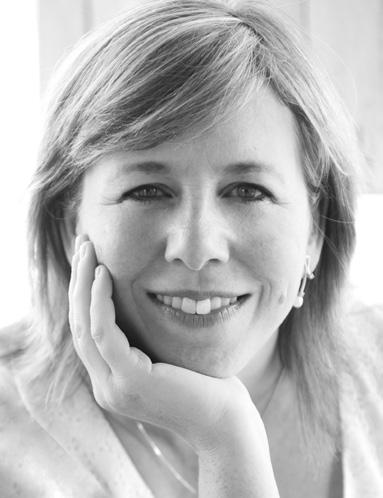
decide whether to walk away from what she loves or listen to the voice calling her forward.
Aptilon told The Chronicle that there is a “small but important Jewish dimension to the play, which is set in both present day and 1781. A young Jewish character during the Revolutionary War speaks about the founding structures of this nation — the idea of justice and the rule of law — having their origins in the Torah.”
The production features professional actors Matt Rapport, Lynn King and Doug Weaver alongside young artists Molly Affleck, Carl Brock, Maggie Cain, Leo Covitz, Mia Hauschild, Sophia Payton and Cristian Sorto-Salinas.
Performance dates include Fridays, April 17 and 24 at 7 p.m.; Saturday, April 18, at 7 p.m.; Sundays, April 19 and 26 at 2 p.m.; and Saturday, April 25, at 2 p.m. The April 17 and 25 shows will include American Sign Language interpretation. Tickets and more information are available at spinningtreetheatre. com.
Temple Beth Sholom of Topeka, Kansas, will hold its 61st annual Blintze Brunch featuring food, entertainment and more. The brunch will be held on April 26 from 9 a.m. to 1:30 p.m.
Early bird tickets at reduced price are available at tbs.convertri.com/ tbs-bb-early-bird-sales until March 31. Children under 4 years old are free, and children between 5 and 12 years old get discounted tickets. Tickets can also be bought at the synagogue (4200 S.W. Munson Ave., Topeka, Kansas 66604) or at Einstein's Outdoor Outfitters (1820 S.W. 10th Ave., Topeka, KS 66604).
In addition to the brunch, there will be a bake sale featuring challah, rugelach, hamentaschen, coffee cakes, black-and-white cookies and more.
More information is available at tbsgiving.com.
61st Annual Blintze Brunch
Sunday, April 26, from 9 a.m. to 1:30 p.m.
4200
Last year, Village Shalom introduced the ToverCare program, featuring the Tovertafel, an interactive projection system designed specifically for individuals living with dementia. Using motion-activated light games projected onto a table — or even onto the floor — the technology invites residents to engage physically, cognitively and socially in a way that feels natural and joyful. Residents can play virtual ball games using their feet or enjoy calming, sensory-based experiences like watching koi swim or catching butterflies.
Since its introduction, the Tovertafel has become a favorite for memory support residents. Staff have seen residents become more alert, engaged and connected — not only to the activity, but to one another.
Village Shalom staff report that several residents who previously preferred to remain in their rooms during activity times now come out more regularly to participate, particularly enjoying the puzzle-based games. These
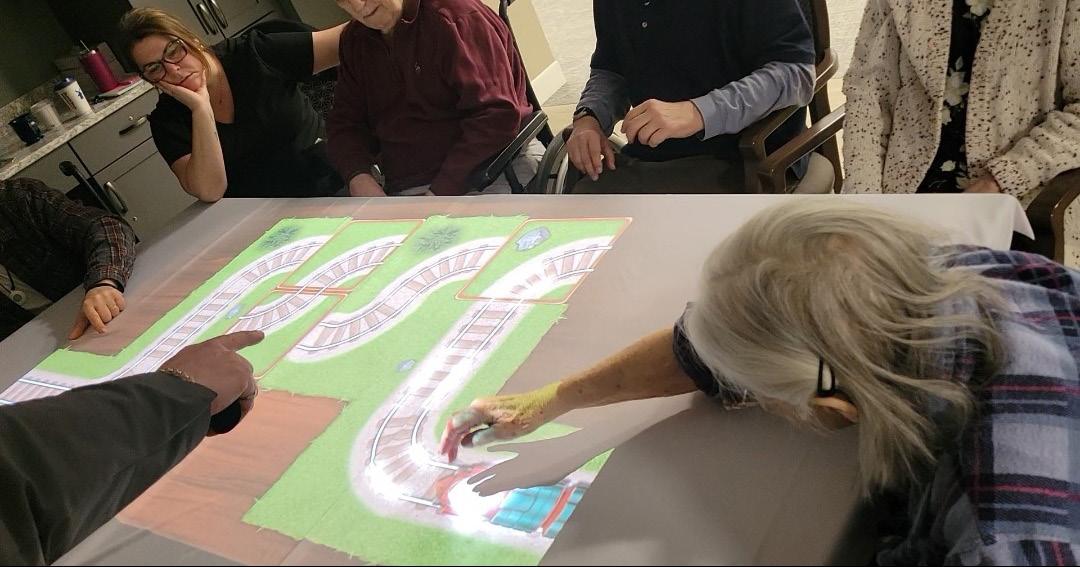
moments foster increased socialization, connection and overall well-being. The program has also created meaningful opportunities for families. One resident’s family, who visits often with their great-grandchildren, shared how the Tovertafel allows everyone to participate together. In a setting where it can be challenging to keep younger children engaged, the interactive games create a shared experience where multiple generations can play, laugh and connect.
The ToverCare program is supported by the Community Legacy Fund through the Jewish Community Foundation of Greater Kansas City, and a contribution from individual donor Karen Pack.
By Alexis Greenberg Special to The Chronicle
Since January 2026, Mitzvah Garden KC (MGKC) has been working with individuals with disabilities in the Blue Valley School District 18-21 program to get plants ready for spring.
“Two differently-abled individuals for two days a week for two hours a day are making a difference for their community that most people couldn’t even dream of,” Nick Smith, Mitzvah Garden KC’s farm manager, said. “The pride that the students show when people come to the greenhouse and their jaws drop is amazing.”
Blue Valley School District’s 18-21 program supports individuals with disabilities ages 18 to 21 who have met all of the district’s high school graduation requirements. Students in the program receive most of their instruction in community-based settings, bringing them the skills and resources needed to live and work as independently as possible.
The district explains the program as “more than just a school — we’re a vibrant community committed to cultivating lifelong learners prepared to navigate their future with purpose.”
their plants in the ground before the semester is finished,” Smith said. “What the students start from seed, they will harvest and bring back to their own food pantry, giving them a look at the entire food supply chain. The pictures simply don’t do what they’ve done justice. It’s a commercial operation at this point.”

“I’m most excited for them to see and unique.

The newly-opened Chabad Center for Jewish Life at the University of Kansas (KU Chabad) has been drawing students and community members alike, with students flowing in and out throughout the day. KU Chabad offers space for those studying between classes, relaxing with friends or simply spending time in the building.
“It’s become my go-to place on campus,” KU student Ethan Ackerman said. “I’ll come in to study for an hour and end up staying much longer because of the atmosphere. It’s not just a building, it’s a space where you feel comfortable being yourself.”
The increased accessibility and design of the center have led to a surge in student engagement, according to KU Chabad staff. Lounges, open study areas and gathering spaces were designed to create an environment where students feel at ease walking in, opening a laptop or striking up a conversation.
Alongside the informal daily activity, staff report that participation in educational programming has grown significantly. Torah classes, leadership programs and discussion-based learning opportunities are attracting larger and more diverse groups of students.
Smaller, targeted programs have also expanded, such as men’s and women’s gatherings, mentorship opportunities and peer-led discussions intended to create space for more personal connection and growth. Women’s programming, in particular, has
seen notable growth.
“Before this building, it sometimes felt like you had to plan to come,” KU student Brenna Gross said. “Now it’s just part of your day. You walk in, you see people you know, and you instantly feel like you belong.”
Religious accessibility for Shabbat and holiday celebrations has increased with the new building. With the addition of on-site guest accommodations, some students now stay over in what has become known as the “Challah-Day Inn,” remaining from candle lighting through Havdalah and experiencing the full rhythm of Shabbat in a communal setting.
Outdoors, the serenity garden, dedicated in memory of Kansas City native Sarah Milgrim, features a fire pit and flowing waterfall. Students can often be found there or in the nearby wellness lounge.
Beyond student life, the broader Lawrence and Kansas Jewish communities also engage with the center. Staff said visitors regularly schedule tours to see firsthand the new space.
The increased capacity in the new building allows larger groups of students and community members to attend Shabbat dinners, weekly programs, and holiday experiences.
The new building has amplified KU Chabad’s goal to create a place where every student feels welcome, valued and connected — to create a home for Jewish life on campus.
By the middle of February, this partnership had already seeded enough starts to provide over 36,000 servings (about 6,200 lb.) of produce. The produce these seedlings yield will eventually be distributed at the Blue Valley Food Pantry by the same students, giving them a full circle moment to see how their hard work pays off for peers in need.
Smith estimates that during the 2026 season, this partnership will seed 74% of all plants the Mitzvah Garden will plant and 84% of all food produced.
Smith told The Chronicle that he’s seen firsthand the ways in which agriculture has been therapeutic for many people. Getting involved in a growth project where you can see the fruits of your labor can be a transformative experience, especially when the work one does is personal

“One student is growing their favorite vegetable, a green bean, that they planted the first day we were together, and beans are starting to form. The other student has an internship at a farm and is starting a home garden,” Smith said.
The entire community is invited to volunteer at Mitzvah Garden KC throughout the season, March to November, on Sunday mornings from 8 a.m. to 12 p.m.
Those interested in more information about MGKC or joining its email list can email Ken Sonnenschein at kensonnenscheinmd@gmail.com.
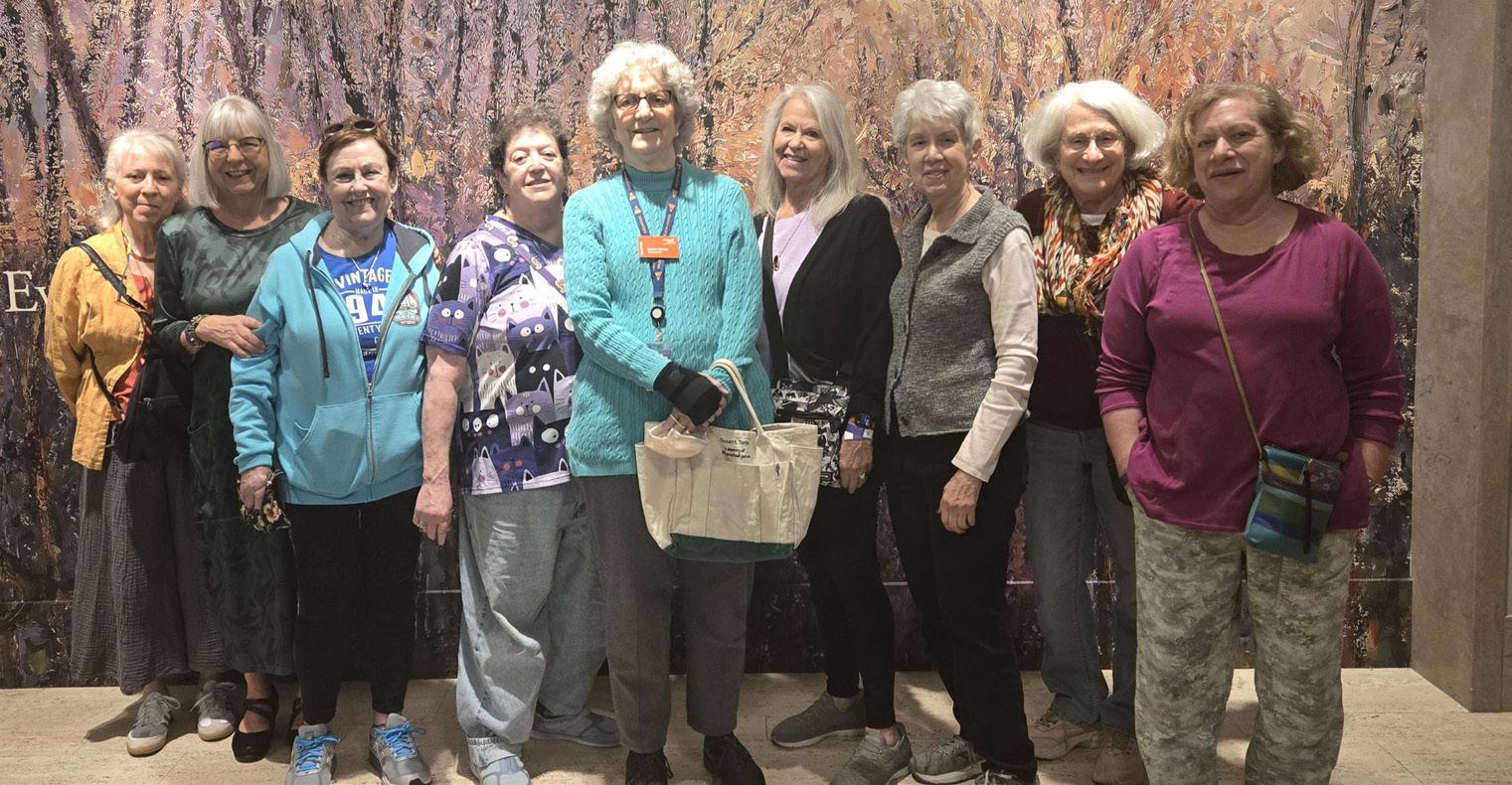
The Kansas City Section of the National Council of Jewish Women hosts the “Jewish Union of ‘Retired’ Ladies, Intelligent, Energetic and Sexy!” (JULIES), a cohort of retirees that meets monthly for conversations as well as periodic social outings.
JULIES (not to be confused with the JULIETS, another Jewish women’s group that meets monthly) recently toured the Nelson-Atkins Museum of Art for a “favorites” tour led by its own resident docent, Jo Ann Kinney.
Barbie Rogoff, co-leader of the group, said, “We had a great, great
time at Nelson Atkins Museum. This is such an amazing group of women.”
JULIES meets at 11 a.m. on the third Friday of the month at the Leawood Pioneer Library (4700 Town Center Dr., Leawood, KS 66211) in the small conference room. Attendees are invited to bring their own food and drink and “be prepared for some lively conversation.” Any retired members of NCJW or potential members are welcome to join. Questions can be directed to ncjwofkc@gmail.com, and more information is available at kansascity. section.ncjw.org.
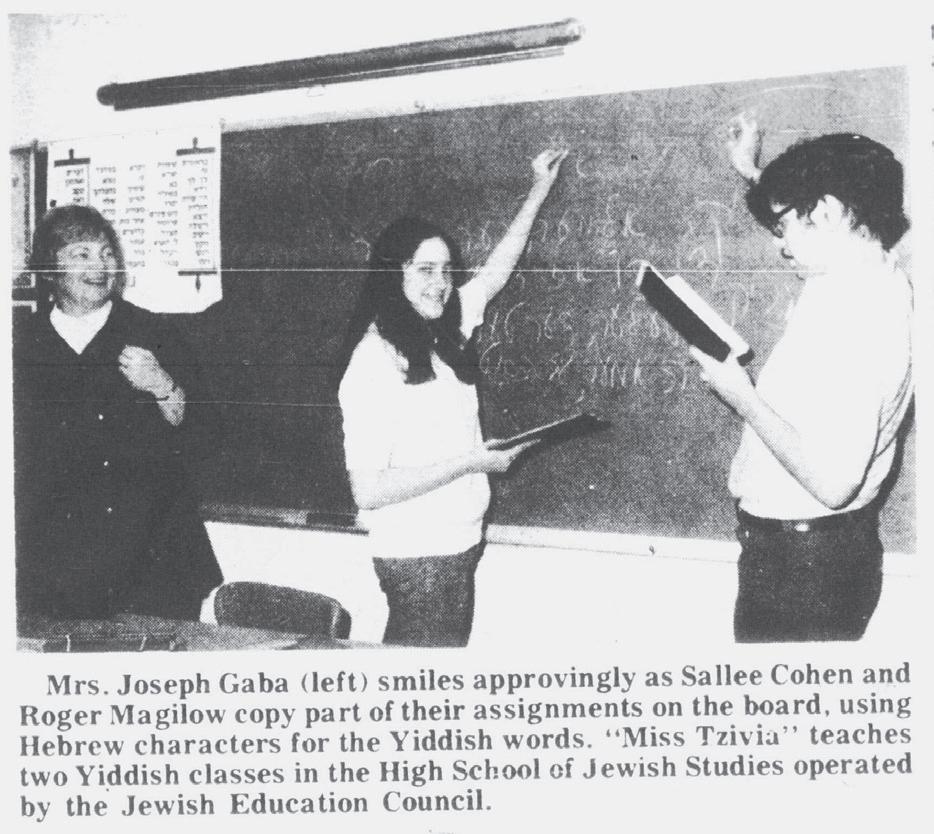
Find more community history at kcjc.com/archive.

Using The Chronicle’s archives and community submissions, here are some recipes for you to try out. Email samk@ jewishkc.org with a recipe, and it might be published here!
Betty
Kalikow
Ingredients
• 7 eggs, separated
• 1 cup sugar
• 1 cup mashed bananas
• ¾ cup cake meal
• ¼ cup potato flour
• ½ cup nuts, chopped fine
Instructions
1. Heat oven to 350 degrees


ADVOCACYSUMMIT AMYGALE BLINTZEBRUNCH
Advocacy Summit (pg. 5)
• KU Hillel (pg. 10)
BNAITZEDEKSHUK CHEFBRIANAARON COMMEMORATIONS
Amy Gale (pg. 3)
• Goldenberg Duo (pg. 4)
• Mitzvah Garden KC (pg. 7)
2. Mix sugar and egg yolks until thick and creamy, then add bananas, cake meal and potato flour
3. Mix nuts in by hand
4. Beat egg whites until stiff, then fold into mix
5. Mix well
6. Pour into ungreased tube ban
7. Bake for 20 minutes
8. Reduce oven heat to 325 degrees and bake for 20 more minutes or until done
9. Turn over to cool
the QR code below or go to kcjc.com/subscribe for more information.

Blintze Brunch (pg. 6)
• B’nai Tzedek Shuk (pg. 5)
• Chef Brian Aaron (pg. 2)
• Commemorations (pg. 3)
• Happy Passover! (pg. 2)
GOLDENBERGDUO HAPPYPASSOVER JULIES KCSUPERSTAR
• JULIES (pg. 7)
• KC SuperStar (pg. 11)
• KU Chabad (pg. 7)
• Next Year in Jerusalem (pg. 1)
• “The Prince of Egypt” (pg. 4)
• “The Signer” (pg. 6)
• Tovertafel (pg. 6)
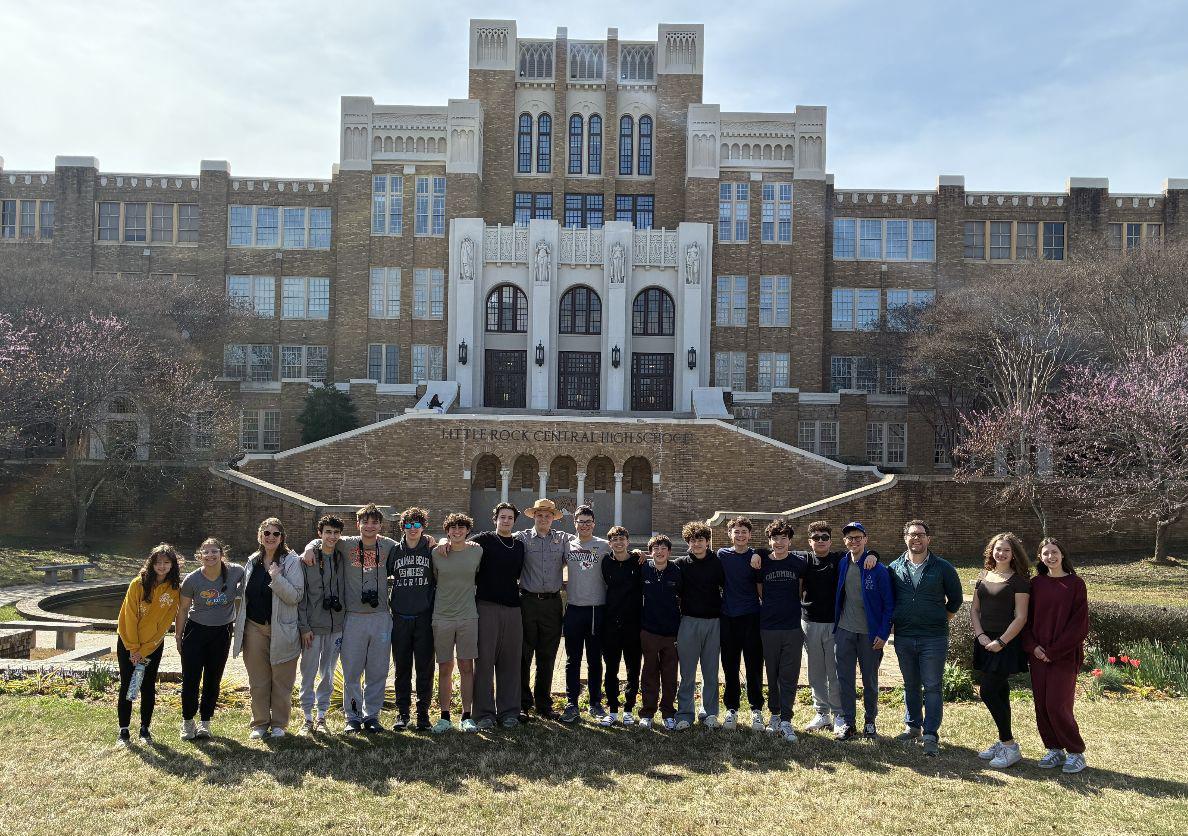
Ninth- and tenth-graders from Hyman Brand Hebrew Academy visited the American South on HBHA’s annual Civil Rights Trip. They journeyed through Arkansas and Mississippi, engaging with the history and legacy of the Civil Rights Movement. They are pictured in front of Little Rock Central High School.


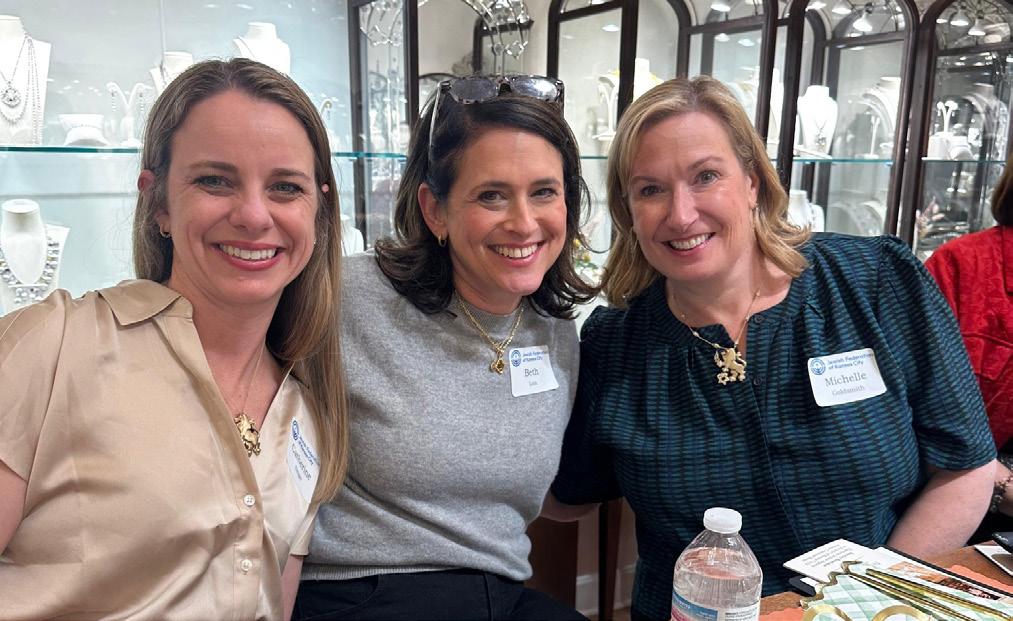
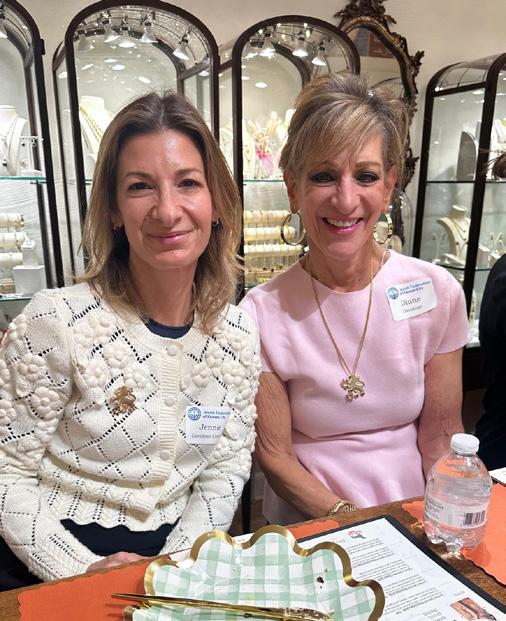
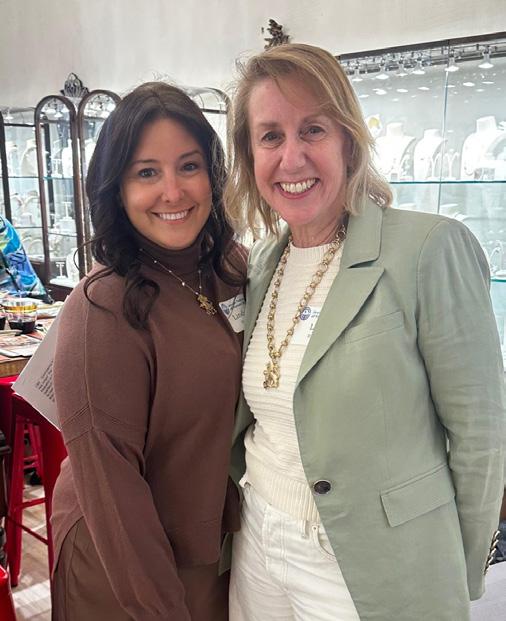
Jewish Federation’s Lions of Judah gathered at DelBrenna Jewelry for an evening of wine tasting and jewelry shopping. Pictured are (top) Catherine Singer, Beth Liss and Michelle Goldsmith; (above) Jennie Davidner Cattano and Diane Davidner; and Lindsay Fineman and Lisa Ruben.
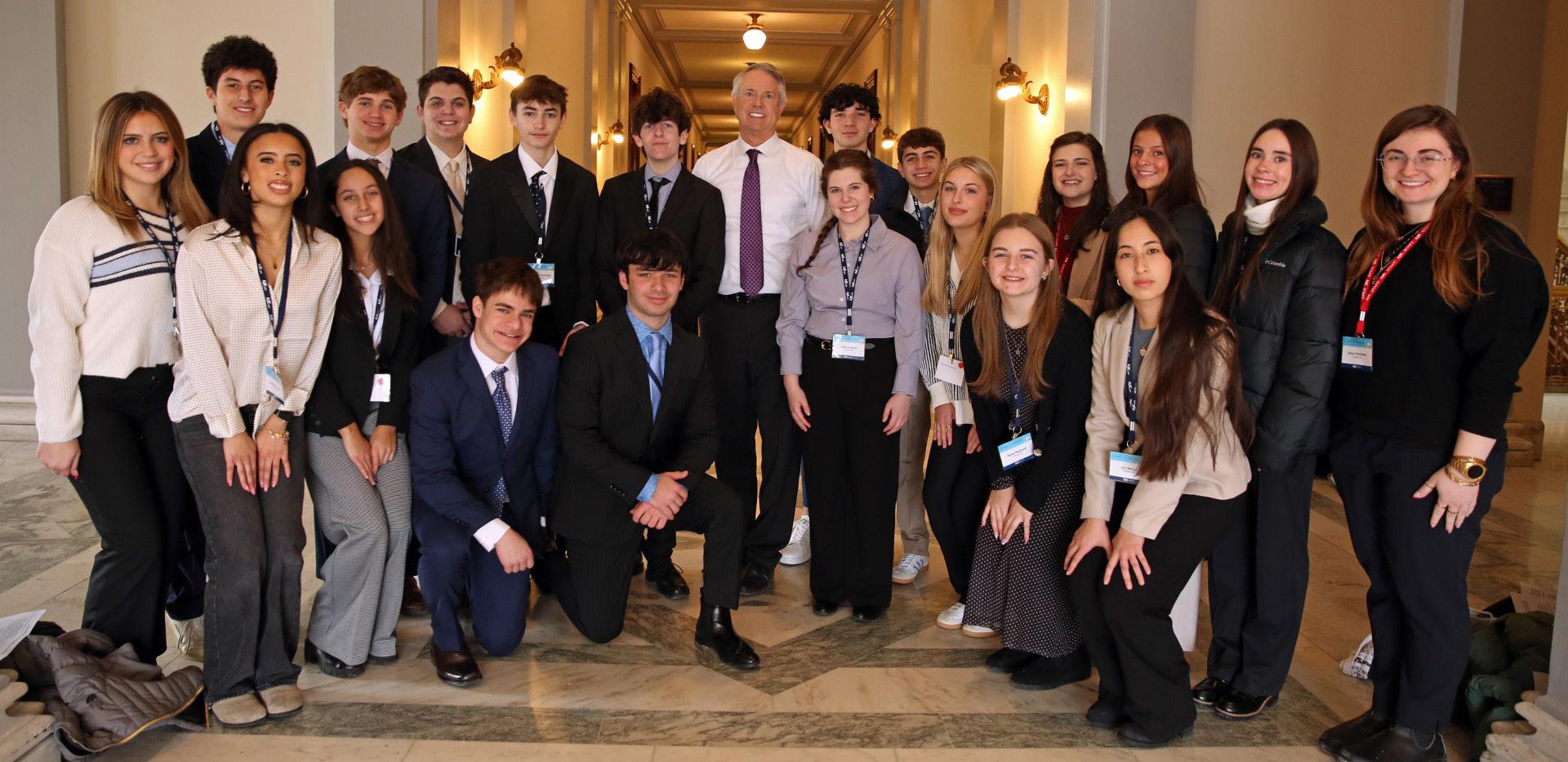
Through the support of the Dave and Carol Porter Advocacy Fund of JCF, 18 JCRB|AJC Leaders for Tomorrow students attended AJC’s Advocacy Summit in Washington, D.C. Pictured are:
Top: (Back row, left to right) Maya Finkle, Gavin Greenwood, Dylan Freiden, Micah Reif, Sam Cohen, Jacob Palan, Ethan Kucherovsky, Josh Snitz, Zach Reif, Jake Sosland, Vivien Krause, (bottom, left to right) Ivy Weiss, Rylee Rothwell, LFT Facilitator Alexa Summers, LFT Facilitator Rachel Kaseff, Bella Kroll, Chloe Hersch, Caroline Simpson, Ali Luetje and Kyra Nussbaum.
Above: (Back row, left to right) Luetje, Greenwood, Palan, Cohen, Kucherovsky, Snitz, Senator Roger Marshall, Micah Reif, Sosland, Kaseff, Nussbaum, Kroll, Summers, (bottom, left to right) Simpson, Finkle, Dylan Freiden, Zach Reif, Hersch, Krause, Rothwell and Weiss.
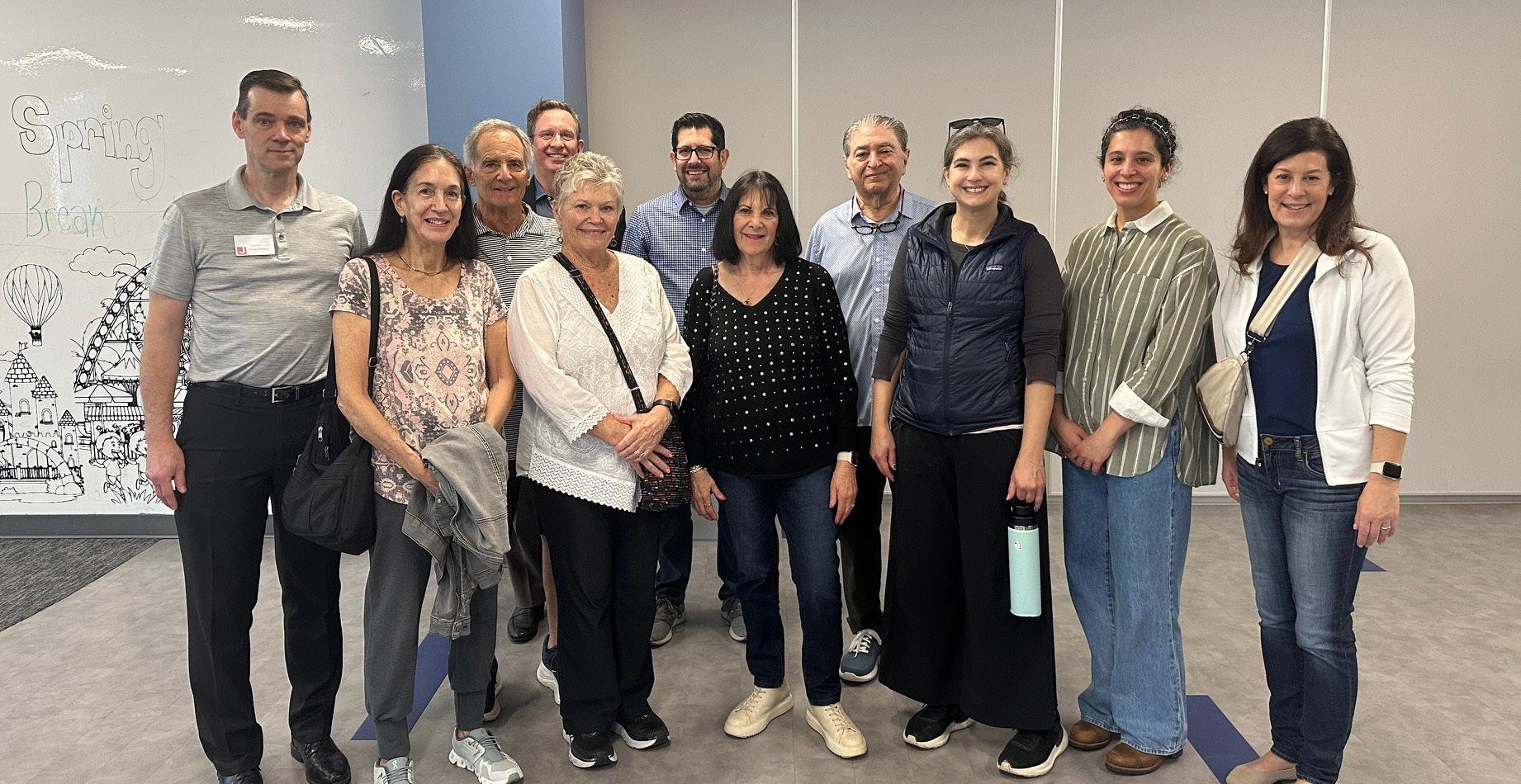
Above: Jewish Community Foundation fundholders recently visited The J. The visit was part of JCF Connecting Our Giving Community series, where fundholders get behind-the-scenes tours of local nonprofits. Pictured (from left) are Jim Sluyter, Linda Lyon, Gary Weinberg, David Spizman, Gail Weinberg, Josh Stein, Danielle Levine, Sam Levine, Ilana Silverstein, Suzanne Galblum Dicken and Lisa Schifman.
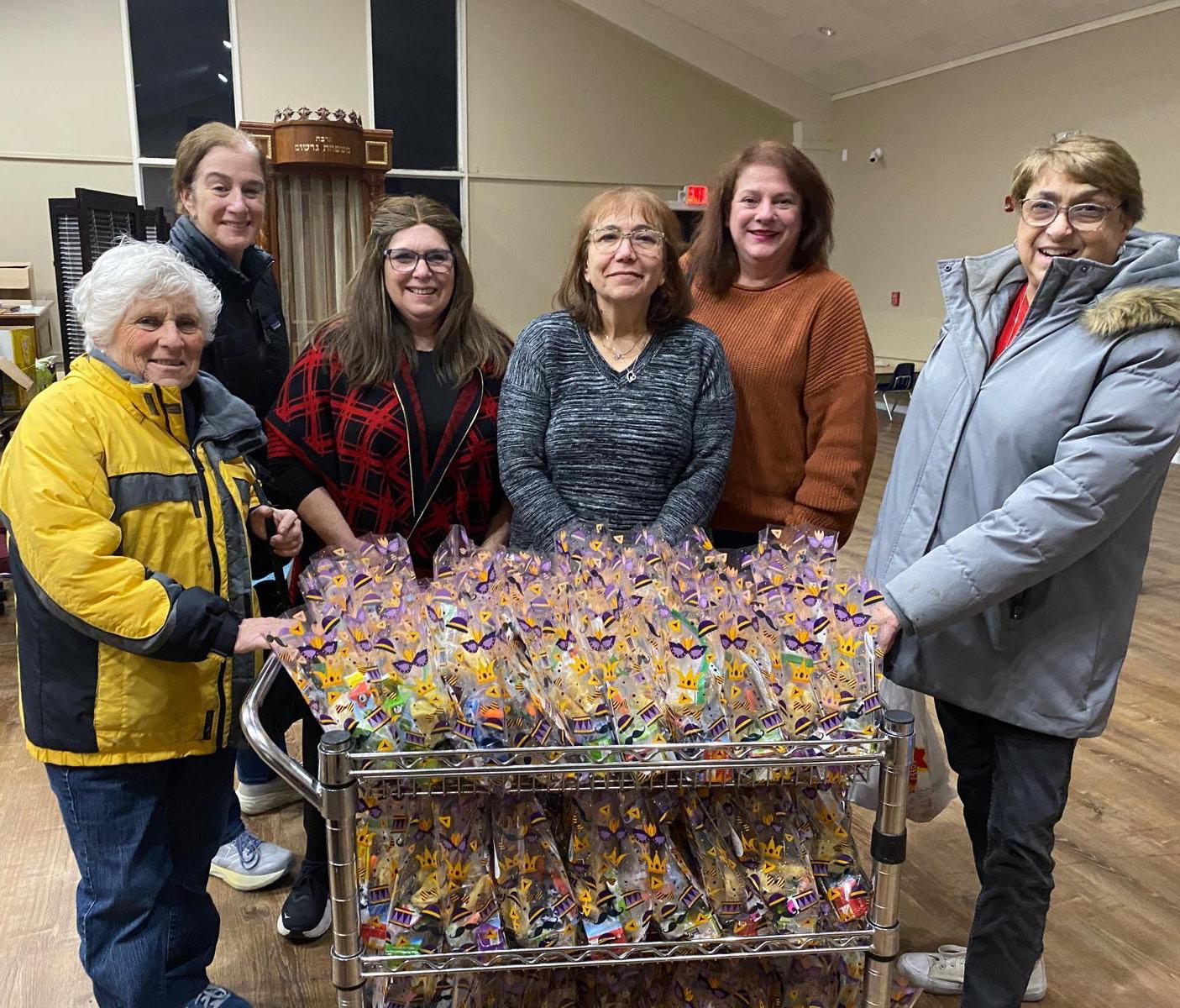
Right: Simcha Gift volunteers packed Purim bags to distribute to Jewish residents in nursing homes and retirement centers and in their own homes. Pictured are Susan Erenberg, Dini Freed, Pam Reiz, Diana Bright, Marcee Davidson and Marsie Borenstein.
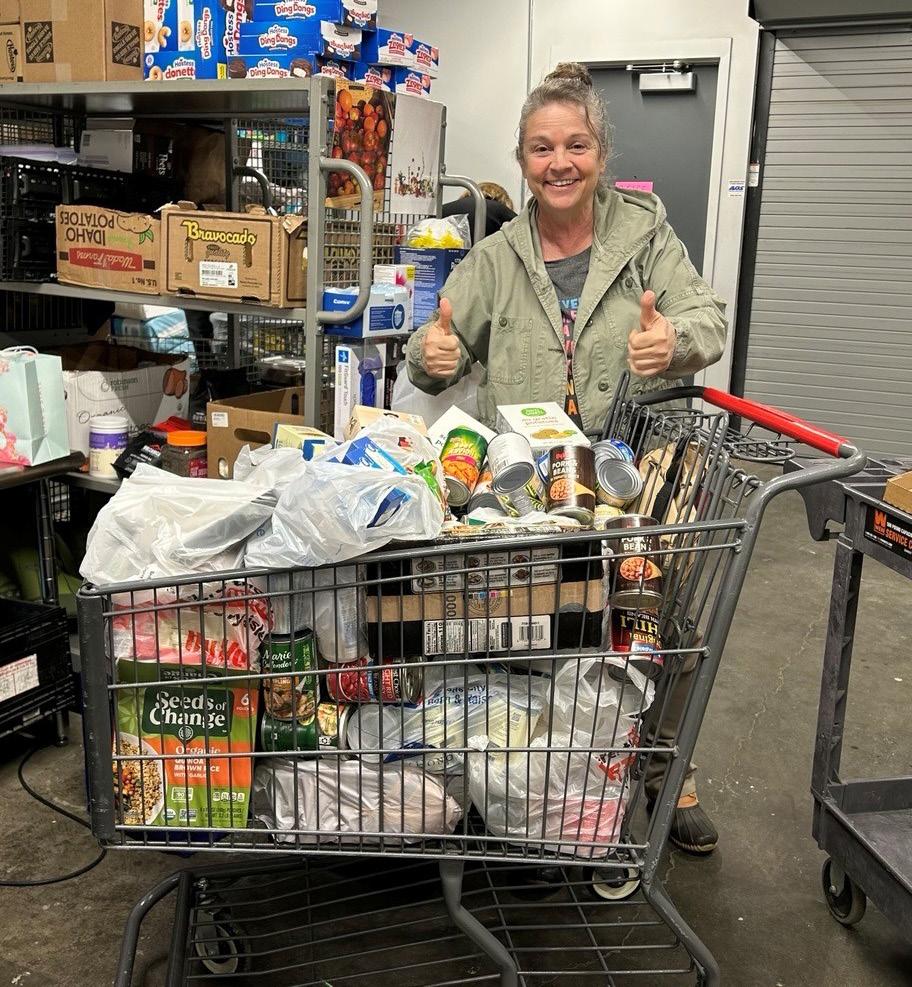
Left: JFS Pantry staff member Debbie Powell pushes a cart filled with items that were donated at a recent Big 5 Trivia event.
Through an interactive first-night Seder, planned by students alongside staff, and with daily gatherings, KU Hillel will provide Passover opportunities for students at the University of Kansas. All students are welcome to join the Seder.
“Before I started at KU, Passover was something I did because it was an expectation of me. Now that I’m in college, it’s a personal choice,” said Olivia Brooks, KU junior and social media and marketing intern. “Choosing to celebrate Passover allows me to reconnect with my Jewish identity, and I’m very grateful that Hillel helps me do that.”
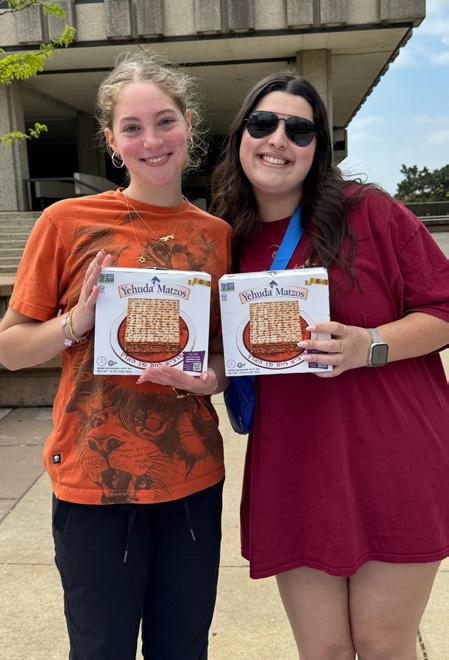
KU students Ariana Shalinsky and Rachel Gadd help hand out boxes of matzah before Passover during KU Hillel tabling on campus.
impact on KU Hillel because of Jenny and John Isenberg, who have agreed to match all gifts made to KU Hillel for Passover up to $5,000.
“Inspired by the student stories, we have committed to matching every gift supporting KU Hillel’s Passover Seders and programs,” the Isenbergs said. “We hope you’ll join us in ensuring every Jewish student who wants a seat at the Seder table has one.”

By Ellie Holsten
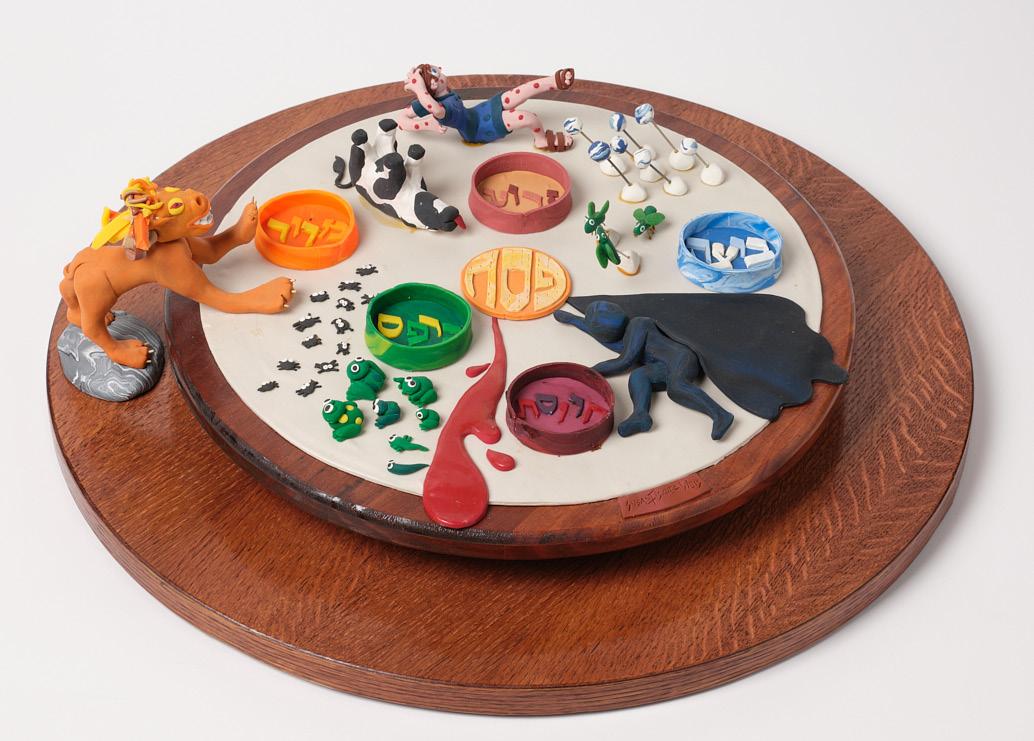
A whimsical take on a graphic portion of the Passover story is depicted in Sculpey clay on this Seder plate. Each of the Ten Plagues of Egypt is represented with a cartoonish clay sculpture, from blood and frogs to

darkness and death of the firstborn. Small dishes hold each of the seder components.
This piece was a finalist for the 1996 Phillip and Sylvia Spertus Judaica Prize, an American award for contemporary works of Jewish art. Its creator, Susan Fisher Weis, teaches art in a Jewish day school and describes her work as an attempt to incorporate Jewish history, Jewish customs and artistic creativity.
More information about the Michael Klein Collection at the Temple, Congregation B’nai Jehudah can be found at kleincollection.org or by calling (913) 663-4050 to schedule a tour.
Throughout the week, students can get kosher-for-Passover lunches each day, and matzah-pizza ingredients and a pantry stocked with kosher-for-Passover snacks will be available.
This year, Passover will have a larger
In addition, Friday, April 3, marks Rock Chalk Day, a day hosted by the University to welcome new and potential Jayhawks to campus. Anyone visiting that day is invited to join for a kosher-for-Passover Shabbat.
More information on KU Hillel, its Passover options and donations is available at kuhillel.org/events or by contacting admin@kuhillel.org.

At Tallgrass Creek,® the weather won’t hold you back! Everything you need is under one roof.
• Experience freedom from house repairs.
• Feel safe and secure, no matter the weather.
• Gain peace of mind with on-site health care
“The whole community is safe and connected. You can get anywhere inside because of the climate-controlled walkways.”
Overland Park TallgrassCreek.com
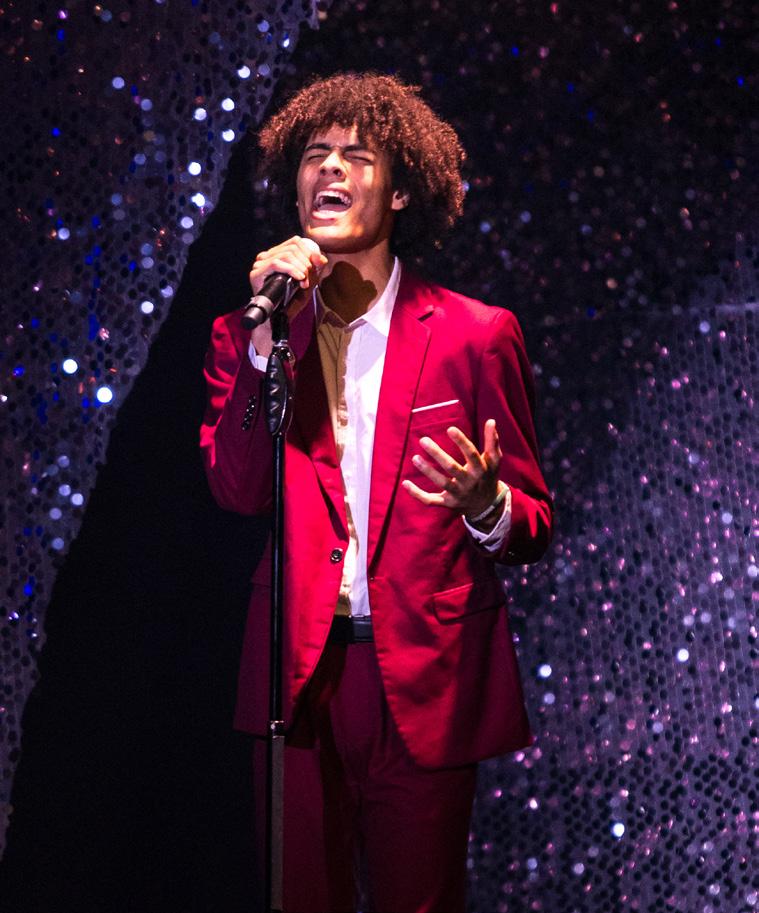
A total of 22 high school singers were selected as semifinalists for KC SuperStar, The J’s annual high school singing competition and fundraiser. Now in its 17th year, the “American Idol”-style event is produced by The J and serves as the organization’s largest fundraiser.
The KC SuperStar committee reached out to 155 different high schools and performing arts centers, including dance studios, voice teachers and youth theaters to ensure the opportunity was presented to as many eligible students as possible. Audition sign-ups represented 47 different schools and four homeschooled students.
“Imagine yourself at 15 to 18, getting up in front of four strangers and singing without any music behind you,” said Tammy Ruder, KC SuperStar producer. “That is not easy at any age. Even if they don’t move on to the next round, having the courage to put yourself out there is a growing experience and not something I think I could have done at that age.”
At the initial audition, competitors sing a cappella and are judged on vocal performance and stage presence. The judges do not know the competitors’ names or ages, only the school they attend and the song they are going to sing. After the final day of auditions, judges tally their scores to determine the semifinalists.
The KC SuperStar semifinals will take place at 7 p.m. on Thursday, June 4, in The Lewis & Shirley White Theatre at The J (5801 W. 115th St., Overland Park, KS 66211). The public is invited to attend this free event.
Rich Linden, a Kansas City DJ and entertainer, will serve as the emcee for the semifinals. A panel of judges from the entertainment industry will select the top 10 singers to advance to the KC SuperStar finals on Sunday, Aug. 30, at the Midwest Trust Center at Johnson County Community College.
Contestants are competing for a $15,000 scholarship, with more than $30,000 in total scholarships awarded to the top 10 finalists. Over the years, hundreds of teen singers from across the region have participated in KC SuperStar, and several have gone on to perform professionally.
“KC SuperStar is a fundraiser for The J, but it is also an opportunity to bring students together from all over the metropolitan area to share their differences, to grow as individuals, and have the opportunity to win $15,000,” Ruder said.
Broadway star Micaela Diamond will serve as the celebrity host and performer at this year’s final event. Diamond is known for her acclaimed Broadway performances, including
her Tony and Grammy Award nominated role as Lucille Frank in “Parade.” She has also appeared in “The Cher Show” and Stephen Sondheim’s final
musical, “Here We Are.”
As The J’s major fundraising event, KC SuperStar also helps provide financial assistance for community members to access programs and services, with a portion of funds supporting The Reat Griffin Underwood Rising Stars Fund for youth performing arts education.
Serving as co-chairs this year are J members and community volunteers Alana Muller and Marc Hammer.
Additional details about the competition and scholarships are available at kcsuperstar.org or by emailing Tammy Ruder at tammyr@thejkc.org.
KC SuperStar Semifinalists are:
• Aashrita Kambhampat – Overland Park, Kansas
• Addy Gardner – Lee’s Summit, Missouri
• Ava DeAngelo – Lenexa, Kansas
• Brenda Benitez – Overland Park, Kansas
• Brock Addison – Overland Park, Kansas
• Cameron James Ritchie – Kansas City, Missouri
• Chace Curtis – Liberty, Missouri
• Corbin Newberry – Kansas City, Missouri
• Desmond Walker III – Independence, Missouri
• Emily Colbert – Blue Springs, Missouri
• Jada Strother – Kansas City, Missouri
• Jaxon Hendrix – Lenexa, Kansas
• Jocelyn Salter – Overland Park, Kansas
• Jordan Naseem – Kansas City, Missouri
• Karen Jallad – Overland Park, Kansas
• Kiera Basel – Shawnee, Kansas
• Matthew Brun – Overland Park, Kansas
• Miles McKinzy – Overland Park, Kansas
• Molly Sheeley – Kansas City, Missouri
• Sabine Federlein – Kansas City, Missouri
• Sutton Claycamp – Overland Park, Kansas
• Teagan Sullivan – Roeland Park, Kansas




Editorials express the view of the writer and are not necessarily representative of the views of The Kansas City Jewish Chronicle staff, the Jewish Federation of Kansas City, or the Kansas City Jewish Community as a whole.
Jewish people are told that in every generation, we must see ourselves as if we personally left Egypt. If Jewish journalists saw themselves in the midst of the Exodus story, what angle about the story should they report on? The Chronicle asked community rabbis, and the following had some advice:
Rabbi Elizabeth Bonney-Cohen
Hyman Brand Hebrew Academy
A reporter standing in Egypt at the time of the Exodus might capture the plagues, the political drama, even the spectacle of a sea splitting. But, in focusing on the physical experience, they would likely miss the inner geography of the story: its narrowness. While we know the setting as Egypt, the Torah calls it Mitzrayim, echoing the Hebrew term meitzarim, meaning “tight places, constriction.” And, the people were the Mitzrim, literally “the narrow people.” They come to represent a mindset of constriction, felt most palpably by the image of Pharaoh’s heart hardening.
When we are narrow, it takes very little to justify cruelty. We stop seeing others as complex, divine beings — with stories, relationships and inner lives — and instead cast them in fixed roles in our own narrative, easily used and abused however suits us. This is the warning embodied in the Mitzrim: God-forbid we become like them, unable to see one another as sacred vessels to be understood, celebrated and supported.
Rather, the message at the heart of the Exodus comes in the climactic
image of the parting sea. Unlike the Mitzrim, the Israelites make their way through a kind of collective birth canal, a narrow channel that leads towards the expanse that awaits them on the other side.
This physical transformation is ultimately a spiritual calling to look inward at our own narrow places: Where am I unable to see expansively? When do I miss the fullness of another standing in front of me, because of my prejudice, my fear, my haste, my hate? What restricts the possibilities that surround me?
When we move through this narrowness, sacred expanse awaits. The deepest truth of the Exodus is that liberation begins when we learn to see more widely, to encounter others (and ourselves) with depth, dignity and divine image.
Rabbi David Levinsky, Ph.D., New Reform Temple
We are taught in the Haggadah that “in every generation, a person must see themselves as if they personally left Egypt.” Imagine, however, that a reporter had actually been present in Egypt during the events of the Exodus. What would they have seen? Most likely, they would have reported a dramatic political story: a powerful empire shaken by disasters, a stubborn ruler confronting a prophetic leader and a large population of slaves suddenly leaving the country. It would have looked like a geopolitical crisis or a mass migration.
But one of the most important

dimensions of the story would likely escape them. What an outside observer might miss is the inner transformation taking place within the Israelites themselves. Slavery is not only a physical condition; it shapes the human spirit. People who have lived under oppression for generations often internalize fear and dependency. The Exodus, therefore, is not only the defeat of Pharaoh. It is the beginning of a long psychological and spiritual awakening.
If I were advising that reporter, I would tell them to look beyond the spectacle. Do not focus only on the plagues or the confrontation with Pharaoh. Watch how the people begin to change — how slaves slowly begin to imagine themselves as free. Because the deepest story of the Exodus is not simply that Israel left Egypt, but that they began learning what freedom truly means.
Rabbi Linda Steigman
If I were sending a reporter to cover the Exodus, I would send her first to Egypt, to understand the conditions from which the Hebrews were escaping — the living conditions, the hard labor and Pharaoh’s stubbornness at not letting us leave. I’d suggest she first contact Miriam, and ask for women our reporter might befriend and follow through the Exodus. Even though Miriam is not mentioned in the struggle for freedom, she is very close to her brothers, Moses and Aaron, and is most likely to know what is happening.
When the word comes to pack up
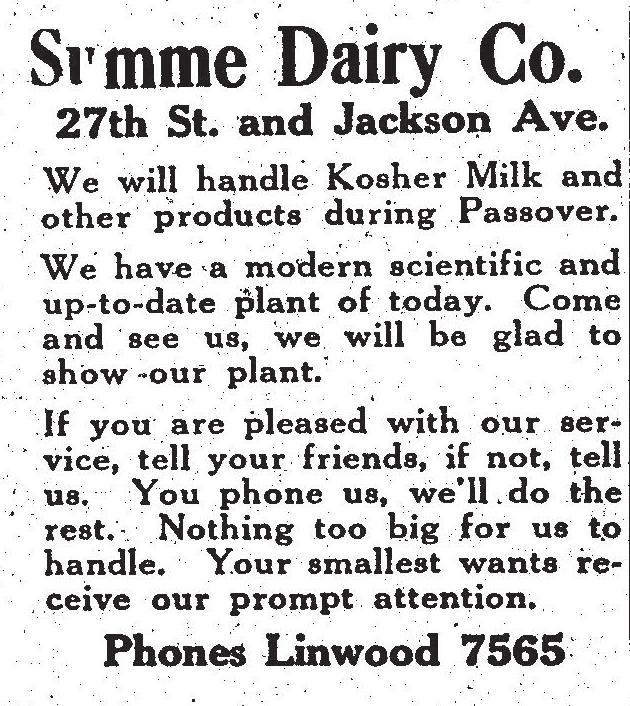
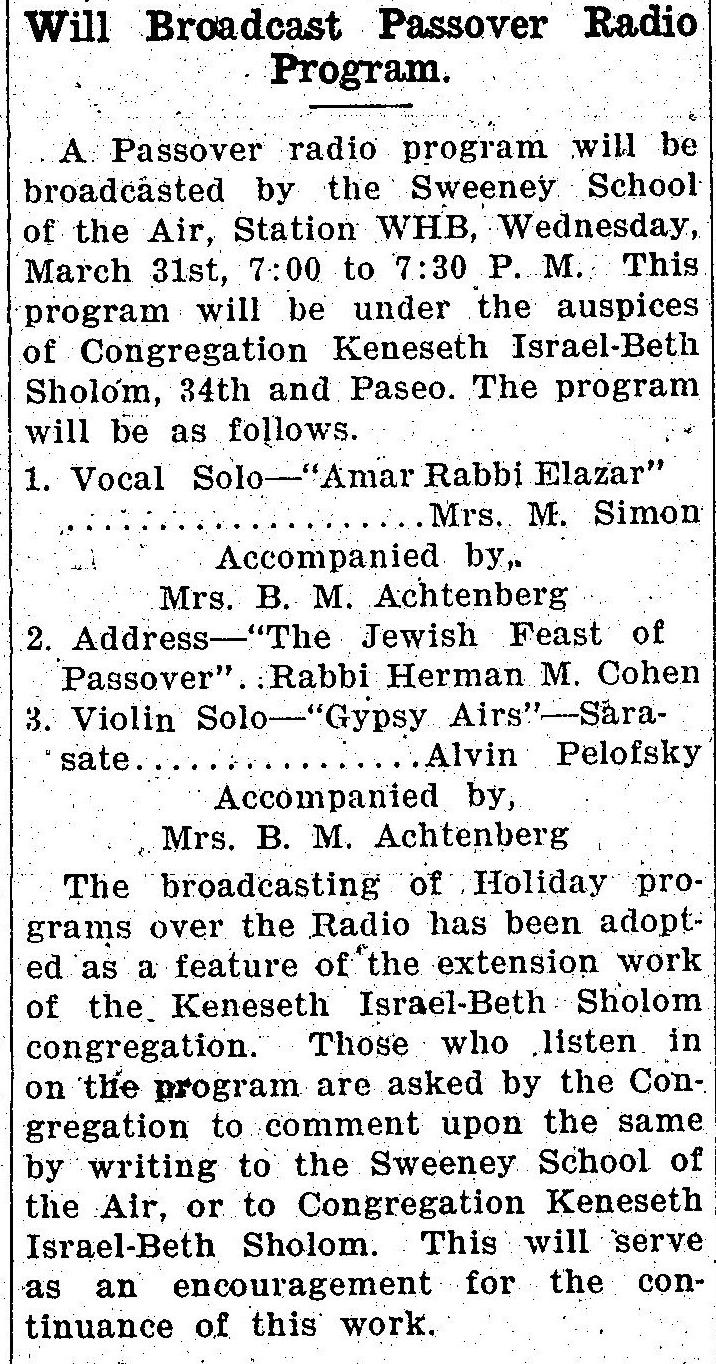
These Passover snippets come from The Chronicle’s 1926 Passover issue. Pictured are (left) two examples of businesses explicitly offering kosher-for-Passover foods; (below) B’nai Jehudah recommending children who have the day off of school to come to its children’s Seder; and (right) information about a Passover radio broadcast including music and a sermon that aired with the help of K.I.B.S. synagogue, which later became Congregation Beth Shalom.
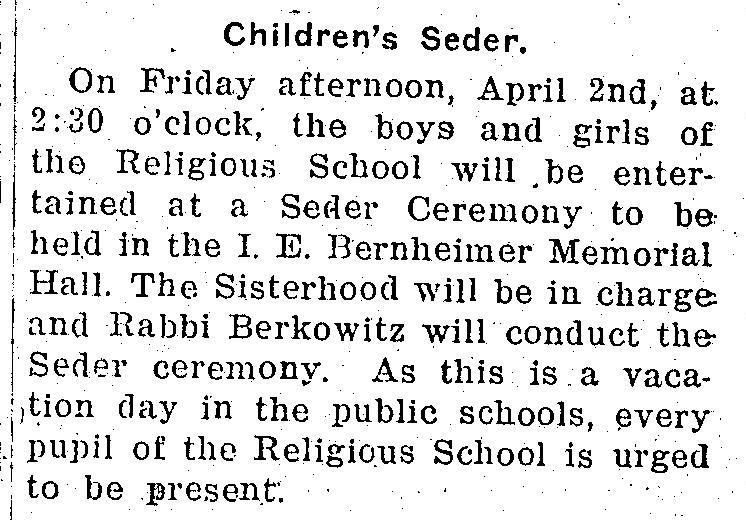
and leave, we hear about the men sacrificing a lamb, but it is most likely the women doing the cooking and cleaning up, in addition to packing up whatever meager household goods, medical supplies, and clothing they can take. They have to prepare the children for the unknown and make sure everyone has sandals that will withstand the journey. It is the women who prepare the dough that will turn into matzah and gather any other rations that they can take with them.
While it is Moses who will lead them, there are probably other men detailed with pulling things together. Six-hundred-thousand people, so the text tells us, is a big crowd to manage, especially on the move. Yet it is the women who feed the family, ensure the safety of the children, nurse the babies and tend to blisters and other injuries. They are the ones who urge their children through the Sea of Reeds, making sure they don’t get lost in the surge of people.
And at the end, while Moses and the men sing the “Song of the Sea” (Exodus, Chapter 15), it is Miriam leading the women in celebration.
Our text says (Exodus 15:20-21), “Then Miriam the prophet, Aaron’s sister, picked up a hand-drum, and all the women went out after her in dance with hand-drums. And Miriam chanted for them: And Miriam chanted for them: Sing to GOD, who has triumphed gloriously; Horse and driver have been hurled into the sea.”
I would urge your reporter to grab a drum and join in the dancing, to feel her feet touching the soil of freedom and to rejoice with her sisters as their journey begins.
Editorials express the view of the writer and are not necessarily representative of the views of The Kansas City Jewish Chronicle staff, the Jewish Federation of Kansas City, or the Kansas City Jewish Community as a whole.
By Sam Kricsfeld Editor and Busi ness Manager
er, we all sing “Dayenu” and list what been enough for G-d to do, then rev el in the fact that He did more. This gratitude for G-d’s miracles, “outstretched arm” and “mighty hand” is a central theme of the Seder. We are thankful that G-d saved us, and now we are safe and sound, out of Egypt and free.

By Rabbi Stephanie Kramer Senior Rabbi, The Temple, Congregation B’nai Jehudah
The following is an abridged Passover sermon.
I have always been fascinated by museums, by the quiet decisions behind them. Who curates them? What stories do they choose to elevate, and which details do they place at eye level to shape what a visitor will carry home?
included? Whose courage will become part of the national story, and who will be erased by the passing of time?
But a few days after we left Egypt, after the main narrative of the Seder ended, it seems as though the Israelites didn’t think ten plagues and an escape from Pharaoh were enough. The gratitude ran out instantly on the banks of the Sea of Reeds.
Although clearly meant to be taken seriously, the following passage, which takes place at the edge of the Sea of Reeds, reads to me like a Larry David skit.
“The Israelites cried out to G-d, and they said to Moses, ‘Was it for want of graves in Egypt that you brought us to die in the wilderness? What have you done to us, taking us out of Egypt? Is this not the very thing we told you in Egypt, saying, ‘Let us be, and we will serve the Egyptians, for it is better for us to serve the Egyptians than to die in the wilderness?’” (Exodus 14:11-12)
It is one of the most Seinfeld-esque things the Jews could say, the most stereotypically kvetchy thing you could imagine. Moses leads an entire people out of slavery with G-d’s help, and in return, when the going gets tough, they essentially say, “Why did we waste our time leaving Egypt? Now I guess we’ll just die here instead. Told you so.” Even after G-d split the Sea of Reeds, the Israelites would complain about the life-saving manna not long after.
In a way, I find these details make the story of Passover more relatable, more human. It shows the Israelites using their voice for the first time after being freed, even if they used it to kvetch. It shows that we Jews have never been perfect, and perhaps always have been a bit difficult.
There’s a fine line between thankfulness and ungratefulness that we have to walk as Jews. Life can be fantastic, thank G-d, but it can also be tragic. Part of being Jewish is balancing the ups and downs, thanking G-d and then questioning His decisions. We are a “stiff-necked” people, after all.
So during this Passover, if you’re
On our congregational Civil Rights trip to the South, we walked through museums and memorials that refuse to let suffering dissolve into memory. We stood before names and photographs of people who were lynched, and we traced the courage of those who marched across bridges, who sat in at lunch counters, who faced dogs and fire hoses and the blunt force of “state power” — and still insisted on human dignity. Museums, at their best, teach us how to remember.
And stories — told with care — move us in a way that facts alone sometimes cannot. Stories awaken empathy, provoke moral imagination and shake loose deep feelings.
Lately, as I watch the news and feel that familiar tightening in my chest, I keep thinking: what story are we writing right now? And then, I picture a museum that will one day be built to explain this chapter of American life.
I imagine a future exhibit, a room filled with artifacts that speak of how power is wielded: headlines and slogans, policies and orders, images of families separated, maps of raids and detentions, and the chilling banality of paperwork.
I also imagine an adjacent room: an exhibit on resistance, perhaps with a photograph of clergy — rabbis among them — standing between demonstrators and armed forces, not as a performance but as a form of pikuach nefesh, the protection of life.
When I imagine this museum, I wonder: whose names will be
frustrated that the Seder is too long or the matzah ball soup too cold, remember that it’s okay to not be thankful all the time. Your ancestors saw the greatest miracles in history and still kvetched.
Just remember that G-d might have patience for your kvetching, but if you want to be invited to next year’s Seder, at least pretend to like the soup.
We know, as Jews, how fragile memory can be — and how sacred. We also know how much history depends on the “ordinary” people whose names do not always make it into textbooks. You cannot tell the story of President Truman and the founding of Israel without speaking of Eddie Jacobson. You cannot fully tell the story of desegregation without speaking about Brown v. Board of Education and the local forerunners who helped lay that groundwork long before the case reached the Supreme Court. Kansas, too, is not a footnote in the American moral narrative; we have always been part of the story.
As we plan our Seders, we already know what story will be told around the table. The heart of the Seder is Maggid: the retelling of the Exodus. The Haggadah insists on something radical: not that our ancestors were slaves in Egypt, but that we were slaves. We tell the story in the first person because freedom is meant to become a present-tense obligation.
Passover does not allow us to romanticize redemption. The Torah is honest about the suffering that preceded liberation, and the tradition is equally honest about what freedom requires after the sea splits: responsibility, law, compassion and community.
That is why, alongside “Love your neighbor as yourself,” the Torah repeats an even harder commandment: love the stranger.
“When a stranger resides with you… you shall love them as yourself, for you were strangers in the land of Egypt.” (Leviticus 19:33–34)
Rabbi Lord Jonathan Sacks (of blessed memory) wrote that he once thought the Torah’s most important line was “Love your neighbor as yourself,” until he realized that it is often easier to love the neighbor who is like you. What is hard — and therefore what the Torah emphasizes — is to love the stranger, “one whose color, culture or creed is different from yours.” That is why the call to love the stranger “resonates so often throughout the Bible,” and why, he said, it is “summoning us now.”
This is not abstract theology. It is a demand placed on us by our own sacred story.
So what does it mean to live Jewish values in the world as it is today — especially when many in our wider community feel afraid, targeted or uncertain of what tomorrow may bring?
First, it means we do not let fear
shrink our moral universe. Jews have learned that when one minority group is scapegoated, the circle rarely stays small. Injustice does not remain contained.
Second, it means we practice a holy combination of clarity and care:
• Clarity about what our tradition asks of us: to pursue justice, protect the vulnerable, resist dehumanization, and love the stranger because we know the stranger’s heart.
• Care in how we respond: with wisdom, attention to safety, the discipline of nonviolence, and a commitment to act in ways that help rather than inflame.
In recent trainings with security professionals, one of the recurring themes has been situational awareness — knowing our surroundings, reporting concerns through appropriate channels, and documenting what we see. In a sense, we are living in a time when memory itself is contested. Jewish tradition answers contested memory with witness: we tell the truth, we keep records, we refuse to let human stories disappear.
And that brings me back to the museum.
One day, a curator will decide what to place behind glass. They will choose which images become “history” and which people become “statistics.” The question Passover asks us is: What will we contribute to the stories told to our future generations?
At the Seder, we open the door for Elijah — not because we are naïve about the world, but because hope is a Jewish discipline. We practice hope both by acting as if redemption is possible, and by doing the work that makes it more possible.
Passover begins with bread of affliction and ends with the possibility of song. That movement — from constriction to spaciousness — has shaped the Jewish soul for millennia. The Exodus story does not promise that the world will always be kind. It promises that we are not powerless, and that God’s call can still reach us in the narrow places: Do not oppress the stranger. Love the stranger. Remember who you are.
“It is not upon us to finish the work, but we are not free to ignore it.”
(Mishna, Ethics, 2:21)
May our Seders this year be places where memory becomes moral courage. May our community be a shelter of compassion and a source of steady strength. And may the “museum” that the future builds have reason to tell a story not only of fear and fracture, but of people who refused to look away and who chose the path of justice and human dignity.
Editorials express the view of the writer and are not necessarily representative of the views of The Kansas City Jewish Chronicle staff, the Jewish Federation of Kansas City, or the Kansas City Jewish Community as a whole.
By Rabbi Mark H. Levin, DHL Founding Rabbi of Congregation Beth Torah
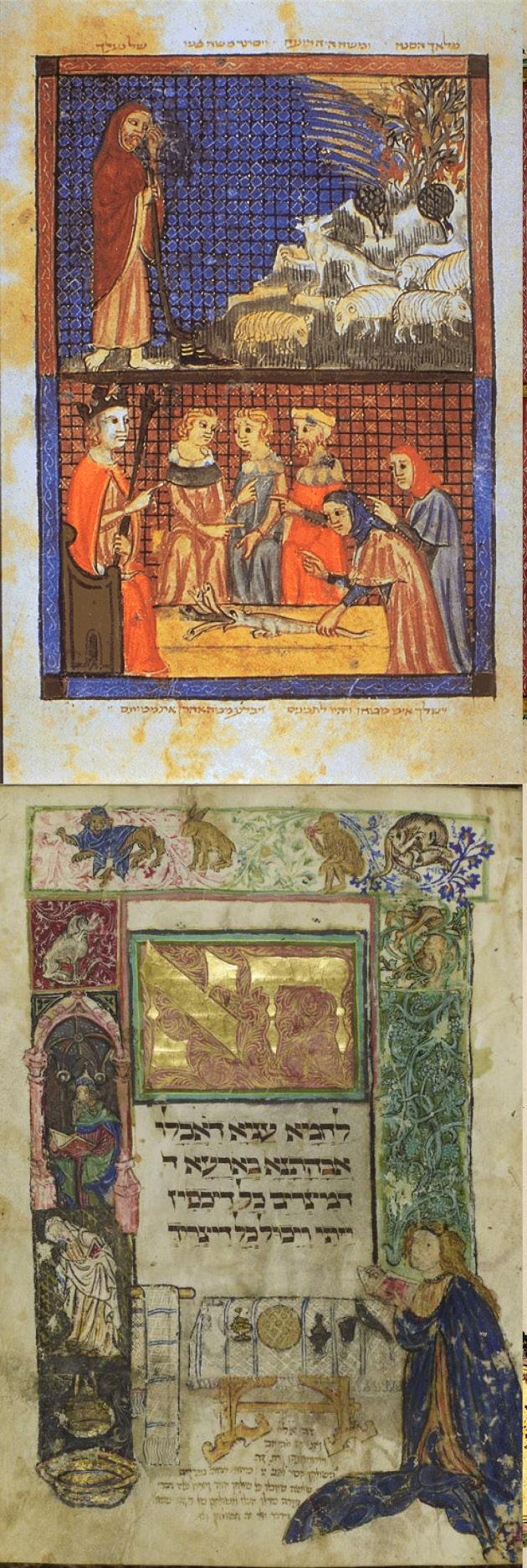
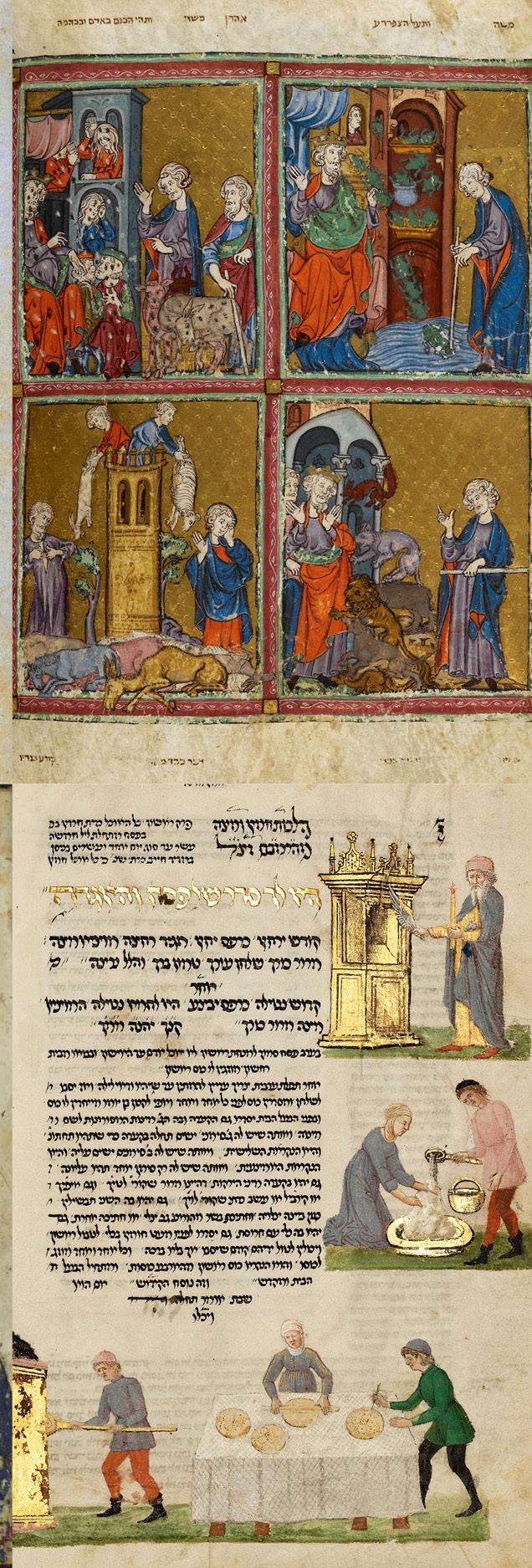
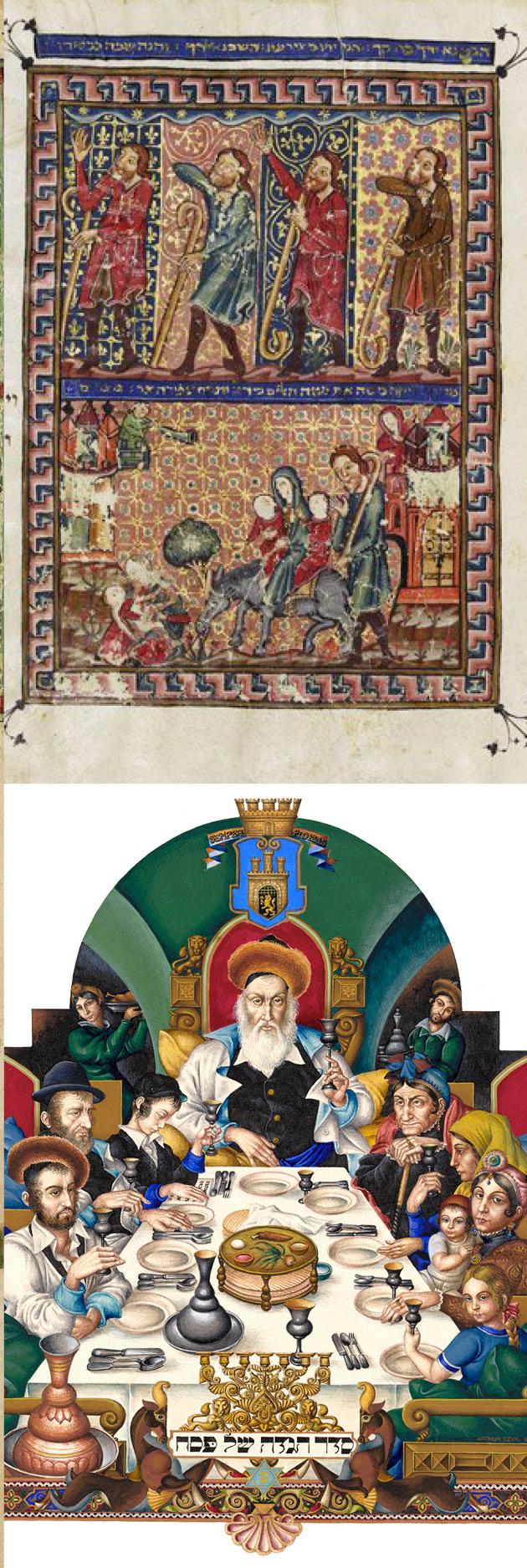
With the exception of the Chumash (the Five Book of Moses with haftarah and often commentary), the Haggadah is likely the most opened book in the pantheon of Jewish literature.
For more than 2,000 years, Jews have written sacred texts, centralizing reading and study as the beating heart of Jewish life. Textual study, performing myriad mitzvot and reciting prayers replaced the sacrificial system that lasted 1,000 years.
Among Jewish books, for many people the Haggadah ranks as the most opened, most illustrated and most beloved. Children recite sections by heart; all Jews know the four questions and can sing Dayenu. No story is more central to Jewish life than the Exodus from Egypt, and Seder presents the principle ritual which focuses on explanations to children. Prayer and study sustain our souls. Seder transmits our heritage to the next generation.
For seven centuries, Jews have commissioned illustrated Haggadahs to add another dimension to Passover celebration. Early Sefardi Haggadahs preceded the prayers and text with Biblical scene illustrations, most notably in famously illuminated volumes like the Sarajevo, Golden or Rylands Haggadahs. Early Ashkenazi Haggadahs, like the so-called Ashkenazi Haggadah or the Rothschild Miscellany, utilized illustrations to visualize procedures found on the page, like cleaning the house before Passover or making matzah. But other illustrations also explain the Exodus story or messianically predict the coming of a future Redemption for the Jewish people. Just as we were once redeemed from Egypt, so God will provide a permanent future peace for the world.
Modern Haggadahs by genius artists like Lodz’s Arthur Szyk in the 1930s or Israel’s contemporary artist David Moss capture the haggadah’s history by including all 15 traditional parts of the Seder alongside modern illustrative interpretations. Szyk’s Haggadah clearly portrays Israeli pioneers (halutzim) as heroes and Nazi persecutors as ancient Egyptians. Moss’ paper cuts, micrography and extensive research reflect contemporary adaptations of traditional Jewish art in modern forms. The Haggadah is an ever developing literary and artistic creation.
Just before the meal, the Haggadah informs us of the central lesson, “In every generation, each person is obligated to see him/herself as though s/he had come out of Egypt.” Here is expressed the great genius of the Seder ritual: to inculcate, particularly by appealing directly to children, that just as God saved us from Egyptian bondage so will God redeem the Jewish people in the future. Each of us has been saved from Egypt: historically, perpetually, in our own lives, even today.
Passover and the Seder express not only the glorious past of the Jewish people and the core of Jewish belief, but the future restoration of a paradisal vision in which all of humanity lives at peace.
Pictured are illustrations from (from top) the Sarajevo Haggadah (15th-century Spain), Golden Haggadah (14th-century Spain), Rylands Haggadah (14th-century Spain), Ashkenazi Haggadah (15th-century Germany), Rothschild Miscellany (15th-century Italy) and Arthur Szyk Haggadah (20th-century Poland).


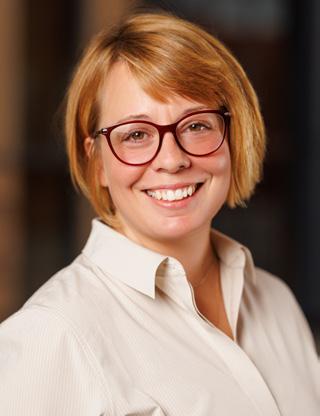
By Bridey Stangler PJ Library
Modern Jew that I am, my religious practice requires extensive use of the internet. I just Googled: “Could the Israelites see the moon when they fled from Egypt?”
The results range from quoted Torah verse in italics to ancient weather reports so, in true Jewish tradition, “Reb Google” essentially just shrugged at me and said “maybe yes, maybe no.” Things really get rabbinical, though, when I query: “Could the Israelites see the FULL moon when they fled from Egypt?”
Tradition (and probably the Chumash that I don’t have handy just now) tells us that within mere hours of the final plague, the Israelites were on the move – the 15th of Nissan, which would have begun at sundown the night before.
My next internet query is this: “When does the full moon rise over my home?”
It feels like a riddle, but it’s not. The answer is 9:11 p.m on Wednesday, April 1. This is important because, after the extra horseradish is spooned back into the jar and after the final verse of “Chad Gadya” is sung, but before the little ones are trundled off to bed, I want to take them outside.
I want to wrap my sleepy children in blankets and sit them in my lap in the grass and point to the sky in the east (I Googled it — another zen koan-esque query) and say “that moon — the full, silver moon right there — is the very same moon that lit our path as we crossed between pyramids and over the sands and toward the sea.
“That is the light that God made sure shone so that we were less lost and less afraid. It’s that very moon.”
Never during our ever-spinning Jewish year do I feel closer to my ancestors than I do on the first night of Pesach.
I’m always surprised to hear that people don’t enjoy the laboriousness of a long and droning Seder, maybe because as a child, my family’s Seders were never laborious long or droning. They always felt just right.
But they also felt — and still feel

— like something we do because we have to. It’s commanded. We remember, we re-enact, we teach our children, we talk and talk and talk and then eat food that no one’s that crazy about. The Passover Seder, with its pre-ordained and definitive order, with its fancy silverware, is something we do because it has kept us and will continue to keep us Jewish. We must, after all, remember where we came from.
The Seder, to me, is for the head. Certainly, kavana (intention, feeling) is found in any Seder worth its salt, hence all that marvelous singing, all that symbolic wine. I feel it in my soul when we recall the Exodus in the first-person plural: WE groaned under slavery, WE crossed the Sea of Reeds. “All that the Lord has spoken, WE will do.” Plenty of ink and air are dedicated to making us feel the Seder. Still, the Seder is for the head. The moon? That is for the heart. Wherever we are, we can dig our bare feet into the Earth while our eyes lift to the heavens.
“Just imagine,” we can say to our children, “just imagine how a desert of sand might glimmer under such a big, bright, full moon.”
Because isn’t “imagine” just another way of saying “remember?” Egypt is never far away and, sometimes, it feels painfully, frightfully close. But on April 1 at 9:11 p.m., I can hold my children close and whisper:
“How blessed we are, that of all the nights to be set loose in the dark, God made sure we had that to light our way.”


In the March 12 edition of this publication, Sara Nicole Glass wrote a charming piece entitled, “How Do You Feel About Gefilte Fish?” referring to the fish-shaped emblem on the back of her car emblazoned with the word GEFILTE.

Her question about responses to that humorous symbol made me wonder about reactions to the actual, edible variety. Delicious or disgusting seem to be the most common opposing opinions expressed about this classic Jewish food. The writer Rachel Ringler even subtitled her My Jewish Learning article on the history of gefilte fish, “The life and times of this divisive dish.”
Few Jewish foods come with such strongly-held stances as this traditional Ashkenazic fare. Personally, I love the stuff. Give me a hunk of fish topped with a dab of horseradish — definitely the purple kind — and I’m in food heaven. Yes, I know many Jews don’t believe in the afterlife, but even the Talmud claims that in the world to come the righteous will be rewarded with a banquet feast.
But for many people, the thought of consuming the dish is considered pure hell. One friend can’t stand to be in the same room with a plate of it, complaining that the smell makes her nauseous. When I hosted Shabbos dinners, I would often serve ping-pong-sized gefilte fish balls as an appetizer. For my non-Jewish guests who might not be familiar with the offering, I would issue the following warning: “People tend to either love or hate this. If you don’t like it, here’s some paper napkins.”
Several guests availed themselves of this disposal option after one bite.
Gefilte fish is not the only traditional Jewish food that evokes antithetical reactions. Chopped liver and herring are either loved or loathed by many. Tongue never gets past the tongue of some, with the mere thought being cringeworthy.
Growing up, my sister and I would hold our noses and make exaggerated gagging noises when kasha varnishkes were passed to us. The chastisement we inevitably received from our mom was

worth the laugh we shared over our dread of the dish.
My late husband, who was not born Jewish, earned the esteemed title of “good eater” from my Jewish caterer mother because he enjoyed every Jewish dish she prepared.
However, one traditional dish that he couldn’t stomach did cause a bit of embarrassment at a friend’s dinner party. Once the guests had all arrived, the hostess told us, “I hope you all don’t mind. I had a busy day today so we’re just having soup for dinner.”
“No problem. That sounds great,” we all responded.
“I’ll eat any kind of soup,” my beloved husband added. “As long as it’s not borscht.”
Guess what soup she served!
Swimming back to the topic of fish, the word “gefilte” derives from the Yiddish word for “stuffed,” referring to its method of preparation. Depending on the culture and location, different ingredients were traditionally added to ground fish. According to Ringler, Jews from the Ukraine preferred sweetened fish, Lithuanian Jews were heavy on the pepper, while Russian and Belarus Jews added beets.
We’ve all heard tales of pulling a live carp out of the bathtub to make it, but now most of us simply grab a jar from the shelf at the grocery store. According to Sheila Fasbinder, a retired kosher food broker, it is primarily alta kackers (old people – my phrase, not hers) who buy the jarred variety. Young people and/or those up on gourmet trends head for the frozen food aisle where loaves can be purchased to boil at home. Along with the original variety are low- or sugar-free options. A salmon gefilte fish is also available which, according to Fasbinder “is absolutely to die for.”
Which I’ll bet some people would rather do than try it.
Nancy Kalikow Maxwell is a Kansas City native and award-winning author. Her book, Typically Jewish, is available through the Jewish Publication Society or Amazon. Her website is kaliwellinc.com and email is nancykalikowmaxwell@gmail.com.
Editorials express the view of the writer and are not necessarily representative of the views of The Kansas City Jewish Chronicle staff, the Jewish Federation of Kansas City, or the Kansas City Jewish Community as a whole.
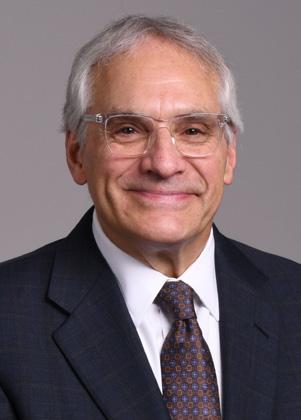
By Alan Edelman
Kol ha-kavod to Sasone on its 30 years of service to the children and families of the Kansas City Jewish Community!
I was privileged to be serving as associate executive director of Jewish Federation of Greater Kansas City when Sasone was established. Federation had just concluded a major community strategic planning process. The rabbis, executive directors and board chairs of congregations and agencies, in addition to a few at-large leaders, worked diligently to identify the needs of the community. One of the four areas of focus was Jewish engagement.
The 1990 National Jewish Population Survey confirmed what many of us were already experiencing — a decrease in congregational membership, an increase in interfaith marriages, a decline in Jewish philanthropic giving and a general lack of interest in things Jewish. If we were to reverse this course, it would be necessary to identify what the people wanted.
Focus groups and town hall meetings revealed that community members were, indeed, looking for a different kind of engagement and were ready to provide input and leadership. Initiatives such as PJ Library, increasing the number of students who attend overnight summer camps and Israel programs, Melton adult learning and changes in the way many congregations offered a variety of worship experiences began to turn things around and see an increase in participation.
The leadership of the then-Jewish Heritage Foundation (JHF) was focused on supporting programming related to health and human services. In learning about the Jewish community’s focus on meeting unmet needs as a way of increasing Jewish engagement, Steve Israelite, executive director of the JHF, and his leadership raised the issue of children with neurodiverse learning styles. Initial interviews with the leadership of Jewish preschools, congregational schools and Hyman Brand Hebrew Academy revealed that our educational institutions did not have the resources necessary to meet the needs of these children, and that most of these children were “counseled” out of our Jewish schools.
An outside consultant was hired with funding from the JHF to conduct intensive meetings and gather as much information as possible from school officials, community leaders and parents. Research indicated that 10% of children have neurodivergent learn-
ing styles, and, at the time, there were approximately 2,000 children enrolled in our schools. This meant that there might be as many as 200 Jewish children not receiving a Jewish education and families that often felt abandoned.
The consultant presented her findings to a group of rabbis, educators and volunteer leaders. Indeed, there were approximately 200 students who could not access a Jewish education in our community. A task force composed of school directors, teachers, parents and volunteer leaders with experience in the field created a program which would provide the human and technical support for these students so they could receive the same Jewish education as other children.
Sandy and Steve Passer agreed to serve as chair people for this new initiative of Federation. Their experience with and commitment to this important population made them most suitable for the position. The committee created a structure whereby each school would have a consultant to help identify children who required additional support in the classroom. A program director would support the consultants and work with the schools to provide maximum accommodation. When necessary, a paraprofessional would be assigned to students who needed that extra one-on-one attention so they would be productive in the classroom. An important feature of the program would be that these children would learn together with their peers and celebrate holidays and life cycle events with other families.
The leadership selected Sasone, the Hebrew word for joy, as the name of the program. They believed that the initiative would bring greater joy to students, families and the community knowing that we were committed to a Jewish education for every child.
Today, Sasone offers inclusion grants, professional development, onsite coaching and strategic consultation to early childhood centers, congregational schools, Hyman Brand Hebrew Academy and J Camp. Rooted in Jewish values and guided by a multi-year strategic plan, Sasone works to support educators, clergy, communal professionals and families in creating a culture of belonging for individuals with disabilities of all ages. Our vision is to create a more inclusive and accessible Jewish community for individuals with disabilities and their families. Rooted in Jewish values, our mission is to help build a community where individuals with disabilities can learn, celebrate and thrive together in Jewish life.
Here’s to the next 30 years!
Dr. Melvin Nathan Abend
Dr. Melvin Nathan Abend, 86, passed away on March 3, surrounded by family.
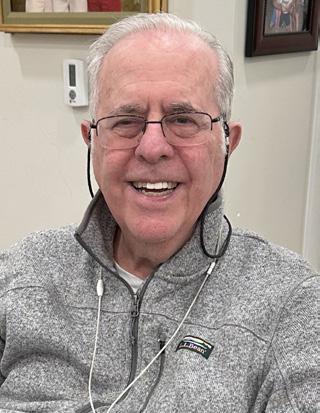
Mel was born on Aug. 5, 1939, in Kansas City, Missouri, to Irving and Martha (Maltzman) Abend. He graduated from Southwest High School in 1957, then attended the University of Oklahoma, where he met his first wife, Sama Sanditen Hoffman, and graduated in 1961. He then went on to earn his M.D. at the University of Missouri Columbia School of Medicine in 1965.
To continue his medical training, he moved to Tulsa, Oklahoma, to complete an internship at St. John’s Hospital, then served in the United States Public Health Service. From there, he went on to Tulane University to spend five years as a general surgery resident and two years as a plastic surgery resident. Finally, he completed his medical training with a prestigious hand fellowship in Louisville, Kentucky.
In 1975, Mel moved his family back to his hometown of Kansas City to support his recently widowed sister and start his private practice. He quickly became a very well-respected surgeon who was always the first to volunteer to help someone in need. He made a significant impact on his community and a lasting difference in his patients’ lives during his time in private practice.
In 1985, he tragically developed a significant illness that prevented him from returning to clinical practice. However, after his miraculous recovery, he was able to continue his enjoyment of medicine by working at the Missouri Board of Healing Arts for many decades. Despite having to give up clinical practice, he found great joy working so closely with other doctors and staff for the betterment of the medical world and retired at the age of 82.
Even outside of his career, Mel loved learning. His sisters always said that as a child, his favorite book was the encyclopedia. He carried his curiosity for the rest of his life, always reading, researching and learning other people’s stories. He loved lunch with the guys, cheering on the Chiefs, getting new gadgets, joking with his sisters and spending time with his children and grandchildren. He was known for his charm, brilliance, charisma, resilience and ability to make others smile. He never met a stranger and was funny, playful and often described as the life of the party. Mel carried his joviality with him until the end, even being dubbed the mayor of Meadowbrook Senior Living
Mel has a large extended family that was very important to him. He was particularly proud of his daughters and grandchildren. He was the most doting and involved grandfather who never
failed to show up for his grandchildren. Mel was incredibly adored by his family and will be deeply missed. He will forever be remembered as their playful, smiley, indulgent and loving Gramps.
He is preceded in death by his daughter Nicole Abend Nenon; his parents; and his sisters, Ruth Krigel Tivol and Marsha Goldman.
Mel is survived by his daughters Denise Chamblee (Gary Tanner), Janna Pinsky (Steve) and Melanie Leeves (Jason); son-in-law Chris Nenon; grandchildren, Jordan, Devon and Cole Nenon, Gillian and Kendall Pinsky and Mason, MacKennon and Maddox Leeves; great-grandson, Graham Woodard; first wife, Sama Sanditen Hoffman; nieces and nephews, Merilyn Berenbom (Loren), Kathy Krigel Hawley, James Krigel (Felicia), Joel Goldman (Hildy) and Susan Tivol (Tom); cousins Steve Abend (Barbara) and Yigal Rotman (Miriam), and many other extended family members and friends.
The family extends their deepest appreciation to his caretaker Jackie, and Oscar and all the staff at Meadowbrook Senior Living for their care and compassion over the last few years.
A private graveside service was held on March 5 at Rose Hill Cemetery, and a celebration of life will be planned over the coming months. Those wishing to honor Mel’s life can donate to the Nicole Nenon Fund at the Jewish Community Foundation (jcfkc.org/ nicole-nenon-fund.html) or a charity of their choice. Condolences may be shared at louismemorialchapel.com.
Janis Luke Koike, 82, formerly of Kansas City, passed away on March 5 in Springfield, Virginia, of complications related to cancer.
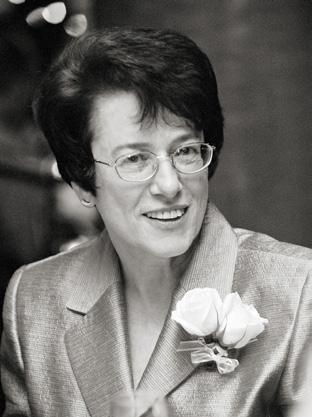
Born in Los Angeles, California, she grew up in Kansas City, Missouri, before graduating from Indiana University (Bloomington) with a bachelor’s degree with high distinction in linguistics in 1965. As part of her time in college, she was also elected to the Phi Beta Kappa and Alpha Lambda Delta honor societies.
She later received a master’s degree in linguistics from the University of Illinois (Urbana-Champaign) and ultimately earned a prestigious merit-based Fulbright Scholarship to continue her studies in Barcelona, Spain, where she embraced the culture and language of Catalan. She also spent a year studying in Peru.
In 1969, while in Barcelona, she met and married her husband of 45 years, Dr. Masuo John “Matt” Koike, who died on Nov. 18, 2014.
In the early 1970s, Dr. Masuo and Janis Koike returned to the United States
and lived in New York City and Los Angeles, where their daughter and son, respectively, were born. In 1979, they moved to Winter Haven, Florida, where Janis Koike taught at Polk Community College and took night classes in accounting and computer programming. She later transitioned into a career as a systems and data processing analyst at several companies before finishing her career at The Mosaic Company. While embracing this new career, she traveled and worked in Chicago, Illinois; South America; and Canada. She loved new adventures and learning.
She and her family were one of the first members of Winter Haven’s Temple Beth Shalom in the early 1980s. She was the original religious school director, taught for many years at the Sunday school and served on the temple’s board of directors and as president.
She had many hobbies, including knitting (which she learned during summers with her grandfather in Chicago), reading, playing card games and completing word puzzles. After her move to Florida, she loved the beach and spent many summers and weekends at the family’s condo in Ormond Beach walking, collecting shells and enjoying the sunrises.
After retirement, she became a Polk County court advocate for at-risk children and volunteered at the Friends of Winter Haven Library Book Store.
In 2022, she moved to Springfield to be closer to her daughter and her family. She is survived by her children, Sara Abiusi (Derek) of Arlington, Virginia, and Michael Koike (Rebecca) of Scarsdale, New York; five grandchildren, Alexandra, Adam, Caroline, Lauren and Zoe; and her sister Debra Singer (Mark) of Olathe, Kansas. She was preceded in death by her parents, Yudell and Laverne Luke; and her sisters Molly Kaufman and Linda Gurin.

The world lost one of its brightest lights on March 9 when Gracie Ellen Pack Meiggs passed away at the age of 37. Tragically, she was a passenger in a car hit by a drunk driver. She left behind two beautiful daughters, a loving family and a life that was in many ways just getting started.
Gracie had a gift that most people spend a lifetime hoping for: she never met a stranger. She had the uncanny ability to make everyone around her feel like her dearest friend. Her energy was unique, the kind that fills a room before she even walks through the continued on next page
We are specifically looking for recollections of construction, architecture, which congregations occupied the buildings and the eventual sale of the buildings.
If you have any photographs or memories of these buildings, please reach out to Editor Sam Kricsfeld at samk@jewishkc.org.
26th and Benton 1923-1948
Tiphereth Sphorad, Ohave Israel
34th and The Paseo 1927-1969
Keneseth Israel, K.I.B.S./Beth Shalom
43rd and Prospect 1929-1950
Tiphereth Israel,Atereth Israel, Tiphereth Sphorad, Kehilath Israel
83rd and Holmes 1959-1994 BIAV
Admiral and Tracy 1920-1947
Tiphereth Israel
Linwood and Flora 1908-1957
B’nai Jehudah
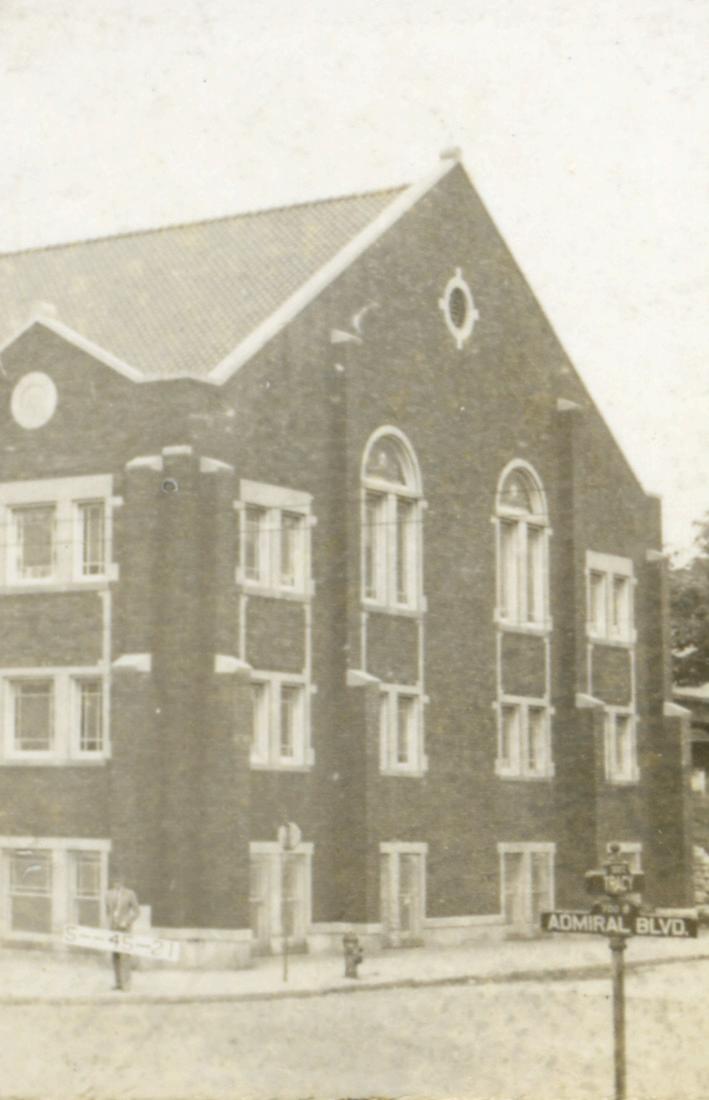
Linwood and Montgall 1930-1946
Ohave Torah Anshi Polin, Beth Jacob and S.I.D.B.J.
Rockhill and E. Meyer 1950-1983
Kehilath Israel
75th and Nall (Prairie Village) 1962-2022
Ohev Sholom
83rd and Lamar (Overland Park) 1981-1989
Beth El
94th and Nall (Overland Park) 1963-1981
Beth El
continued from previous page
door. Her laugh was filled with the kind of joy that makes you laugh even when you don’t know what’s funny.
Truly, there was no one like Gracie. Knowing Gracie was knowing what it meant to be larger than life. Texas has nothing on the size of the hole her loss has left in her family’s hearts.
At the center of Gracie’s universe were her two daughters, Stella and Lela. They were her greatest joy, her fiercest motivation and her proudest accomplishment. She treated motherhood and aunt-hood with the same wholehearted enthusiasm she brought to everything she loved. Whether horseback riding with Lela, tumbling with Stella or taking her nieces and nephew on secret adventures, Gracie always brought the fun. She taught by example what it means to be brave, to be kind and to persevere.
Gracie had recently celebrated one full year of sobriety, a milestone she wore with pride. Her journey was a testament to her strength and her deep commitment to being her best self for her girls and for everyone who loved her. Those who walked alongside her through that chapter know the courage it took and the woman it revealed.
Gracie was a woman of many passions, each one pursued with characteristic intensity. Her zeal for fitness encouraged her students and classmates. On the golf course, she was a natural, talented, competitive and endlessly fun to play alongside. She was a traveler at heart, drawn to new places, new people and new experiences with an open spirit that made every trip an adventure. She spent six weeks in Israel when she was 17 and a week in Hong Kong in her early 20s, and her travels included Machu Picchu, Africa and many countries in Europe. Gracie’s love of art history motivated her sense of exploration, bringing her to countries all over the world.
Gracie Ellen Pack Meiggs loved fiercely, laughed freely and moved through this world like someone who understood, better than most, that life is short and connection is everything. She is survived by her two beloved daughters Stella and Lela Meiggs; her husband, Wyatt Meiggs; her parents, Ruthie and Jay Pack; her sister and brother-in-law, Lucy and Kyle Schanzer; her nieces, Nora and Sloane Schanzer; nephew, Avery Schanzer; along with the many, many people who, hav-

ing known Gracie, will spend the rest of their lives a little richer for it.
A funeral service was held on March 18 at Temple Emanu-el in Dallas, Texas, followed by a burial service and reception. Friends and family are welcome to attend. In lieu of flowers, donations can be made to the Gracie Pack fund at the Nelson Art Museum in Kansas City; First Tee – Monterey County (firstteemontereycounty.org); Temple Emanu-el in Dallas; or the charity of your choice.
where he completed residency at L.A. County General Hospital. In 1962, they moved to Ft. Leonard Wood, Missouri, where he served for two years as a radiologist and Captain in the U.S. Army Reserve Medical Corps at a full-service hospital.
Avram earned Board Certification in Radiology in 1963. In 1964, he established a private practice in Los Angeles. He became Board Certified in radiation oncology in 1973. In 1974, Avram became head of the Radiology Oncology Department at St. John Hospital in Tulsa, Oklahoma.
Village at Gleannloch Farms in Spring, his 24/7 caregivers from Innovative Home Services, Erin Mansour of Heart to Heart Hospice, Rabbi Jonathan Siger of Congregation Jewish Community North in Spring and Rabbi Edwin C. Goldberg of Congregation Beth Shalom in The Woodlands.
Avram’s cremains will be combined with Martha’s when the time arrives, and they will be interred together at Floral Haven in Broken Arrow, Oklahoma.
Avram lived a purposeful, productive, meaningful and fulfilling life. He is deeply missed.
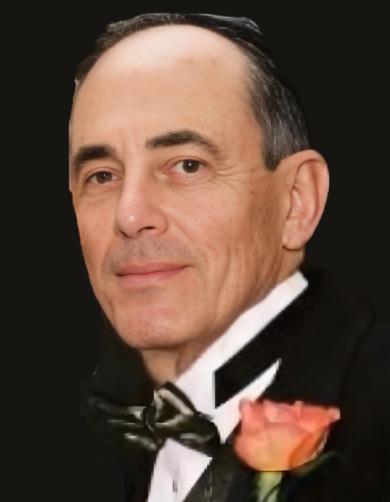
Avram E. Rosenthal passed away peacefully at home in Spring, Texas, on Feb. 5. He was 92 years old. Avram was a first-generation American who was a steady and generous provider and mentor, and a dedicated and loving husband, father, stepfather, grandfather, great-grandfather, brother, uncle and cousin.
He was born May 21, 1933, in St. Joseph, Missouri, to William J. and Ida Rosenthal. Avram lived his early childhood in St. Joe, where his paternal grandparents operated the Rosenthal Furniture & Carpet Co. and his paternal grandfather helped found Shaare Sholem Congregation (1895), the Talmud Torah Hebrew School (1900) and the Knynishiner Unterstitzung Verein (incorporated in 1914), an organization that lent money interest-free to families in need. The values they lived by guided his own and influenced his pursuits and his parenting.
In 1944, Avram’s family moved to Kansas City. He became a bar mitzvah and was confirmed at Congregation Keneseth Israel-Beth Sholom and graduated from Paseo High School, where he was an honor roll student; president of the Juntos Club, which fostered unity and cultural awareness among students; and a member of the Chemistry Club.
Avram earned a Bachelor of Arts in biology and chemistry from The University of Kansas City (now UMKC) in 1954. He attended the University of Kansas Medical School from 1954 to 1958, when he graduated as a Doctor of Medicine. He was an elected member of Phi Beta Kappa.
Following medical school, Avram and his first wife moved to Los Angeles,

Avram was a member of the American Medical Association and the American Society for Therapeutic Radiology and Oncology and elected to the Silver Pin Club. He served on the Board of Directors of Tulsa Radiology Associates. The Board of Regents at the University of Oklahoma Tulsa Medical College awarded him the rank of Clinical Assistant Professor.
In 1985, he married Martha R. Homan, the love of his life and unwavering partner. After retiring at 60, Avram continued to stay current on medical news. In 1996, they moved to Lake Conroe, Texas, and he returned to work for a few years to fill in for vacationing doctors in Oklahoma and Texas. Avram remained active into his 80s. His passions included fishing, sailing, chess, running, tennis, golf, gardening, bridge and quality time with children and grandchildren and their families. Avram prioritized hard work and education and encouraged his family to do the same. He planned family trips to national parks and monuments, museums and Israel, and treated his children to meaningful trips separately. He wrote that one of his and Martha’s greatest pleasures was to provide opportunities that would allow their children and grandchildren to pursue their interests and enhance the quality of their lives.
He was a member of the KU Alumni Association, B’nai B’rith International, Temple Brotherhood, and a member and volunteer at Temple Ramat Zion in Northridge and Congregation B’nai Emunah and Temple Israel in Tulsa.
Avram was preceded in death by his parents; sisters, Mildred Oelbaum, Jacobah Lazarus and Ranore L. Davison; brother, Mortimer W. Rosenthal; and two of his five children, Sheryl Ann Rosenthal (Nathan Appel) and Baby Boy Rosenthal.
He is survived by his wife of 40 years, Martha Rae Rosenthal of Oklahoma City; sons Howard N. Rosenthal (Aaris Sherin) of Nyack, New York, and Michael L. Rosenthal (Danni) of Littleton, Colorado; daughter Wendy J. Rosenthal of Salinas, California; stepdaughter, Deborah L. Thompson of Nichols Hills, Oklahoma; six grandchildren; eight great-grandchildren; and nieces and nephews.
The family wishes to thank the many friends and staff members at The
Susan Lynn Wolkow, known affectionately as Susie by her friends and family, passed away on March 17. Born on Nov. 8, 1952, in Wichita, Kansas, she was an intelligent, loving, adventurous and generous woman whose life was defined by her kind spirit and unwavering love for her family.
Susan was a lifelong learner, having studied archaeology in college and maintaining a passion for it throughout her life. This adventurous spirit was mirrored in her love for reading, photography, arts and crafts, and her unique collection of glass works of art. Professionally, Susan put her intelligence and organizational skills to good use as an administrator in the pharmaceutical field, where she made significant contributions. She was part of the team that got adriamycin, a chemotherapy drug, approved by the FDA, a feat that continues to benefit patients battling breast cancer and lymphoma. She later worked for Battelle, a global research and development organization, as a database administrator.
Her generosity shone through her effusive praise and her ability to see the best in everyone. She leaves behind a legacy of love, embodied by her family who meant the most to her. She is survived by her daughters, Emily Desmond and Christina Lowery; her grandchildren, Gwen, Aria, Elaine, Leah and Liam; and her sisters, Julie Wolfe and Dina Schaeffer. She was preceded in death by her parents, Bernard and Betty Wolkow.
A graveside service will be held on Friday, March 20, at Rose Hill Cemetery in Kansas City, Missouri. A memorial service will be held at Temple Beth Shalom in Columbus, Ohio, at a later date.
Please visit Susan’s memorial page at louismemorialchapel.com.
Art credits