


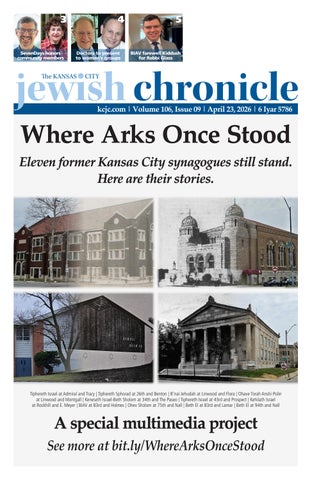


“Where Arks Once Stood” is an ongoing, months-long, multimedia endeavor of The Chronicle to compile the histories and photos of former synagogue buildings still existing today. These buildings were community hubs, places where the highs and lows of Kansas City Jewry occurred during some of the most tumultuous times in modern Jewish history.
The multimedia aspect is an interactive website in which each building below has its own page dedicated to its history. We’ve worked to honor and document them, with each webpage containing in-depth research, recent photographs, news-
paper clippings and sources, and, when available, vintage images.
The information in this issue is just a fraction of what we’ve gathered and made available online for the Kansas City Jewish community.
This is not the end of the project; in our next print issue, we will include community-submitted information and recollections about some of these synagogues. That information will also go on the website. The Chronicle also plans to work with the Kansas City Jewish Community Digital Archive to provide this information for future projects.
In April 1908, Congregation Tiphereth Israel purchased a former Lutheran church at Admiral and Tracy, moving from a room above a drug store. By 1920, the growing congregation, which was touted as the only one in the city holding services three times a day, tore down the old church to build a $150,000 (about $2.3 million today) synagogue designed by architect Herman F. Simon.
The new shul, dedicated in 1920, seated 1,500 people and featured modern electric lighting and ventilation. Its facade included stone circles engraved with
Stars of David and a plaque reading “Congregation Tiphereth Israel, Year 5680” in Hebrew.
Tiphereth Israel remained at Admiral and Tracy until 1947, when it relocated to Armour and Paseo.
Through a series of mergers in the 1950s and 1960s, the congregation eventually became part of BIAV.
The building later housed the Kansas City School of Watchmaking and the marionette company Hazelle, Inc., leading to its placement on the National Register of Historic Places. The only major structural change since the congregation departed was
the extension of the sanctuary’s balcony to form more secondoor space in 1947.
Signi cant original features remain, including the wooden bimah, Stars of David in the vaulted plaster ceilings and exterior stone plaques. As of 2026, despite some gra ti and broken windows, the facade still displays the original cornerstone, stone insert and stone circles containing Stars of David.


In May 1906, B’nai Jehudah purchased property at Linwood and Flora for a new synagogue. The synagogue had an estimated construction cost around $125,000 ($4.1 million today), and the building committee and architects toured modern Jewish temples in Detroit, Cleveland, Cincinnati and Louisville for design inspiration.
Architect William Cutler


designed the structure in a pure Greek Doric style, emphasizing a digni ed and re ned appearance; it became his nal work. The design featured a portico with Grecian columns and a 40-foot-tall auditorium with large windows, an organ and an ark. Special focus was also placed on the building’s acoustics.
The cornerstone was laid on Nov. 3, 1907, and included a copper time capsule. During construction that December, a crane broke and the building’s ve-ton capstone fell 40 feet through three oors. A worker was injured, but the walls withstood the shock. Rabbi H.H. Mayer also persuaded renowned artist John
LaFarge to design the windows, marking LaFarge’s only work for a synagogue.
Dedicated on Sept. 11, 1908, the Linwood Temple was B’nai Jehudah’s home during an era of rapid growth. Over the next 50 years, membership grew from 200 to over 1,300 families, eventually leading the congregation to move to 69th and Holmes in 1957. The Linwood building was sold to the Scottish Rite that November and later became a multi-purpose center.
Today, the exterior remains largely unchanged, with the original cornerstone still displaying the Hebrew and secular years alongside the Shema prayer.
The Lewis & Shirley White Theatre at The J will present “It Don’t Mean A Thing If It Ain’t Got That … Sving,” celebrating the legacy of Jewish big band leaders and musicians in the golden era of swing and big band jazz. It will feature music by legendary artists such as Benny Goodman, Artie Shaw and Willie Smith.
The event is part of The White Theatre’s 2025-2026 Concert Series on Saturday, April 25, at 7:30 p.m., and Sunday, April 26, at 3 p.m. Tickets are available for purchase at The White Theatre’s box office and at TheWhiteTheatre.org.
“This concert felt special to program because it celebrates the iconic music of the big band era while shining a light on the often-overlooked Jewish musicians who helped shape it,” said

Jonah Greene, director of Arts & Culture at The J. “By highlighting figures like Benny Goodman and Artie Shaw, we hope the concert entertains people while bringing greater recognition to the lasting influence of these Jewish artists on American music.”
Under the leadership of Ron Ernst, the Moonlight Serenade Orchestra

of Kansas City will perform the big band music. Audiences will learn more about the Jewish composers and bandleaders who influenced the sound of swing.
“Big Band music is so enduring because it makes you want to dance and sing along,” Ernst said.
The performance is intended to reflect The J’s mission of celebrating Jewish culture and history through the arts by showing how Jewish artists helped shape mainstream American culture in an engaging, accessible and entertaining way.
The show is recommended for ages 12 and older.
KS 66211
SevenDays, a nonprofit organization that works to overcome hate by promoting kindness and understanding, is honoring Jewish community members Dr. Ken Sonnenschein and Sonia Warshawski with its annual Ripple of Kindness Award. The award was created to “recognize people whose impact on our community is apparent, but with no expectation of reward or return.” Dr. Sonnenschein and Warshawski were two of eight winners chosen through public nominations. Dr. Sonnenschein is a psychiatrist with a passion for sustainability and the environment. He has been involved in several nonprofit endeavors including the Mitzvah Garden KC, a
community garden that brings people of diverse backgrounds together to grow more than 10,000 pounds of food for area food pantries.
Sonia Warshawski is a 100-year-old great-grandmother, businesswoman and Holocaust survivor. Known as “Big Sonia” and subject of the documentary of the same name, she has spent years speaking about her experiences and sharing the importance of kindness to students and adults.
The other recipients are Matt and Sara Bloomfield, founders of the Olivia Bloomfield Foundation; David Kennedy, Advent Health Mid-America
continued on next page
The following are the deadlines for articles, celebration announcements, Spotlight pictures, advertisements and editorials for upcoming Chronicle print issues. If you have any questions, please contact Sam Kricsfeld at samk@jewishkc.org.
May 7 issue.........................................April 30 noon deadline May 21 issue........................................May 14 noon deadline June 4 issue........................................May 28 noon deadline
To submit news to The Chronicle, go to kcjc.com/chronicle-submissions!


Community Blood Center (CBC), the primary provider of blood to more than hospitals across Kansas and Missouri, will host a blood drive on Sunday, April 26, at The Temple, Congregation B’nai Jehudah.
For more than 65 years, CBC has served the region by providing over 150,000 lifesaving blood products annually to more than 70 hospitals, EMS, and healthcare partners.
“A strong, consistent blood supply is the backbone of patient care in our community,” said Chelsea Tibbetts, executive director at Community Blood Center. “We are deeply grateful to our blood drive hosts for stepping up to help save lives and support patients in our local hospitals.”
To make an appointment at this drive, potential donors can visit savealifenow.org/group and enter group code “UP,” or call (1-877) 468-6844.
Sunday, April 26
Kricsfeld Editor and businessmanager


continued from previous page
Region vice president of mission and ministry; Marci Langhofer, founder of Do Good For Erin; Mike Meyer, a Vietnam veteran who has led endeavors to help veterans, children and disaster victims; and Cynthia Newsome, founder of Awesome Ambitions and KSHB news reporter.
Recipients were honored on April 23 at the SevenDays Ripple of Kindness Breakfast at Resurrection – A United Methodist Church. Jewish community member, kindness activist and educator Barbara Unell was the breakfast’s honorary chair.
Hyman Brand Hebrew Academy sophomore Shefer Rudnick was named a winner of SevenDays’ art competition for her sticker for its “Love” day. Jewish community teenagers Bea Colbert, Dani Glickman, Mia Mondry, Sam Sandler, Drew Squire, Josh Stein and Leora Stein are among the members of the SevenDays 2026 Kindness Youth Leadership Team.


Hyman Brand Hebrew Academy sophomore Shefer Rudnick was named a winner of SevenDays’ art competition for her sticker for its “Love” day.
SevenDays was established following the April 2014 hate crime murders of 14-year-old Reat Griffin Underwood and his grandfather Dr. William Corporon on the grounds of the Jewish Community Campus and Terri LaManno in the parking lot of Village Shalom. SevenDays was created by Mindy Corporon (Underwood's mother and Dr. Corporon’s daughter), Jim LaManno (LaManno’s widow) and family and friends to dispel the hate in the world through kindness. More information about SevenDays is available at sevendays.org.
The 86th annual Matzo Ball Dance returned last Saturday, April 18, coinciding with the 100th anniversary of BBYO’s Nordaunian AZA #22.
The dance took place at the Overland Park Arboretum & Botanical Gardens. Hosted annually by Nordaunian, the Matzo Ball remains one of the oldest Jewish dances in Kansas City. This year’s event was held in honor of the chapter’s current queen, Norah Pabst.
“For the second year in a row, it is our great honor to bring back an 86-year tradition that has been a centerpiece of the BBYO and Kansas City community calendar,” said junior Naftali Tilove, the chapter’s president.
The Matzo Ball, which first began in 1936, originally served as a benefit dance to raise funds for underprivileged Jewish families by providing Passover Seder food baskets. Over the decades, it evolved into one of the largest and most anticipated Jewish social events in Kansas City.
“This year’s Matzo Ball is especially important because it falls on Nordaunian’s 100th birthday,” Tilove said. “On April 18, 1926, teens gathered for the first-ever meeting of their new chapter, and now 100 years later, the chapter is thriving more than ever. We want to welcome you to celebrate with us
on the special day to crown the next Matzo Ball Queen and celebrate over 100 years of tradition, connection and brotherhood.”
In 1936, Nordaunian held its first annual Matzo Ball. Ruth (Greenbaum) Kern was the first “hostess,” an honor that later became known as the “Matzo Ball Queen.” The inaugural dance was held at the Plaza Hall at 47th Street and Broadway, where couples paid 75 cents to enjoy an evening of ballroom music performed by Al Vin and His Orchestra.
Over its 100-year history, Nordaunian has produced multiple international board members, earned numerous Henry Monsky Chapter Excellence Awards and captured the 1999 international AZA basketball championship.
The chapter currently has 41 members and is advised by Brayden Cardozo. At BBYO’s International Convention in February, Tilove was elected to the International Board as the 38th Grand Aleph Shaliach.
The Matzo Ball Dance is open to the community. Those interested in more information about Kansas City BBYO, the Matzo Ball or supporting Nordaunian AZA can contact Amy Ravis Furey at aravisfurey@bbyo.org or (917) 690-6946.
Dr. Richard Hellman, board certified endocrinologist and internal medicine physician, will speak to the Jewish Unforgettable Ladies Interested in Eating Together (JULIETs) about osteoporosis in seniors.

The event will be held on Sunday, April 26, at 12:30 p.m. Location will be provided upon reservation, which can be done by emailing Susie Klinock at Juliets.KC@gmail. com by Thursday, April 23.
Dr. Hellman’s career includes private practice for 41 years as well as teaching. He developed programs for medical students and residents, and he has done research in the field of diabetes. He has also done volunteer
work as a physician. He has won many awards in teaching and was a clinical professor at the Kansas City School of Medicine. He has spoken many times both locally and internationally. His awards include the Outstanding Endocrinology Lifetime Achievement Award from the Kansas City Medical Society and Outstanding Clinical Endocrinologist Award from the American Association of Clinical Endocrinologists.
All Jewish women (and women of other faiths who have a Jewish spouse) are invited to this free event. No synagogue affiliation is required to attend, and attendees should arrive 15 minutes early.
Osteoporosis in seniors
Sunday, April 26, at 12:30 p.m.
Location provided upon registration

Hadassah Greater Kansas City will host an educational program with Dr. Michael Sokol to teach about the prevention and treatment of diabetes. “A Path to Better Health: Diabetes Prevention and Treatment” is presented in honor of the life, legacy and leadership of Jackye Greenberg Goldberg (z”l).
The event will be held on Sunday, May 3, at 2 p.m. in Overland Park, Kansas. The exact address will be provided only after registration, which can be done by contacting Hadassah at (847) 205-1900 or midwest@hadassah.org.
Dr. Sokol, a graduate of the Northeastern Ohio Universities College of Medicine and former dual-resident at
Brown University, currently practices at the Statland Clinic. He is board-certified in internal medicine, psychiatry and endocrinology, and is a faculty member for the Internal Medicine Residency of HCA Midwest. He is also affiliated with Menorah Medical Center.
At the event, Dr. Sokol will discuss the latest news in diabetes prevention as well as modern care strategies. A dedicated Q&A session will follow. Light refreshments will be offered. No walk-ins will be allowed, and all attendees will be required to sign a Hadassah Event Participation Release. Questions can be directed to (847) 205-1900 or midwest@hadassah.org.
A Path to Better Health: Diabetes Prevention and Treatment
Sunday, May 3, at 2 p.m.
Location provided upon registration


Congregation Beth Israel Abraham and Voliner (BIAV) invites the community to an appreciation and farewell Kiddush honoring Rabbi Mark and Dr. Ruthy Glass and family. The Kiddush will be held at the shul on Saturday, May 2, at 12 p.m., following 9 a.m. morning services.
After six years at BIAV, Rabbi Glass and his family are preparing to take leave of the congregation. Glass began his tenure in Overland Park in August 2020, stepping into the pulpit in the middle of the COVID pandemic. Since then, his rabbinate has extended beyond BIAV’s walls, with leadership roles across the Overland Park Eruv, the Kansas City Vaad HaKashruth, Hyman Brand Hebrew Academy and
recent presidency of the Rabbinical Association of Greater Kansas City.
Closer to home, his shiurim (study sessions), Day of Discovery presentations and blog, “Words of Myrrh,” have drawn a devoted following and engaged learners across the community.

Rabbi Glass is a native of Manchester, England, and received his BA in
philosophy, MA in Jewish philosophy, and rabbinic ordination at Yeshiva University in New York City. Prior to moving to Kansas, he was the rabbi of the Adams Street Shul in Newton, Massachusetts, from 2017–2020, and a Judaic studies teacher at Maimonides School in Brookline, Massachusetts, both the middle and high school.
Appreciation and Farewell Kiddush for Rabbi Glass
Saturday, May 2, at 12 p.m.
Congregation BIAV, 9900 Antioch Rd., Overland Park, KS 66212
BBYO chapter Two’s AZA is set to host its Fourth Annual Marty Awards on Saturday, May 9, at The J. The Oscar-style awards ceremony and fundraiser will celebrate the achievements of current BBYO members while honoring the chapter’s legacy.
In addition to celebrating current members, the event will pay tribute to the individuals who helped shape the chapter’s enduring legacy. The evening will feature the induction of the 2026 class into the Mnookin Memorial AZA #2 Hall of Fame. This year’s honorees include Arnold Caviar, former CEO of Liberty Fruit Company, as well as the late Jacob “Jack” Brown and Dr. Henry Brown.
The Marty Awards will also feature the crowning of the chapter’s new Sweetheart. This year’s candidates are Julia Goldstein, Ella Jerwick, Lila Singer, Ruby Sokol and Orli Zigler. The current Sweetheart is Ariel Palan.
“My favorite part of the Marty Awards is seeing our entire local Jewish community come together to celebrate the incredible people and achievements of both the past year and the generations before us,” said Jason Persky, a Marty Awards chairperson. “It’s a night that brings together Jewish families, alumni and community members to celebrate the amazing teen movement that BBYO is.”
This year’s program will celebrate the chapter’s 102nd birthday. The chapter officially received its charter on May 10, 1924.
The Marty Awards, the vision of former Two’s president Miller Brown, is open to the entire community.
“The fourth annual awards show promises to be a memorable evening
for all who attend,”
Two’s adviser David Wexler said. “Community members are encouraged to join in celebrating the achievements of today’s leaders while honoring the legacy of those who came before them.”

Last year, more than 160 tickets were sold for the event. The chapter hopes to exceed those totals this year.
“Having attended all three previous Marty’s Awards, I have seen it grow into something truly amazing,” Two’s AZA President Will Widman said. “This year’s show will feature a variety of activities designed to make the evening fun and entertaining for everyone.”
This year’s award nominees are:
• Underclassman of the Year: Zach Reif, Lila Singer, Rex Hebberd, Ethan Kucherovsky, Emma Furey
Senior of the Year: Bea Colbert, Max
Goldstein, Sam Nussbaum, Ariel Palan, Denah Thomas
• Mensch of the Year: Rhys Pabst, Betsy Erenberg, Shia Kolb, Maya Nathan, Elliot Spizman
• Mentor of the Year: Michael Furey, Ruby Sokol, Shaefer Spizman, Will Widman, Orli Zigler
• Program of the Year: Two’s on the Town (Negros Leagues Baseball Museum & original Arthur Bryant’s); Saadia/Nordau Haunted House; Nordaunian LEGOLAND/SEA LIFE Aquarium; Two’s on the Lake; Nordaunian/ Heart of America Chopped Night
• BBG of the Year: Cleo Federlein, Norah Pabst, Julia Goldstein, Chloe
Congregation Beth Shalom will be hosting a cantorial concert, Shir Joy 5786, on Tuesday, May 5.

Led by Hazzan Tahl Ben-Yehuda, Shir Joy will be an evening of Broadway music featuring appearances from cantors and other performers from across the country. Music from “West Side Story,” “Sweeney Todd,” “Les Miserables” and more will be performed.
Tickets must be purchased before the event at tinyurl.com/2u6dacnn. Doors will open at 6:45 p.m., and the concert will begin at 7:15 p.m. in the synagogue’s sanctuary.
Desserts and beverages are included and will be available after the concert.
This event is sponsored by the Polsky Family Foundation.
Shir Joy
Tuesday, May 5, at 7:15 p.m.
Beth Shalom, 14200 Lamar Ave, Overland Park, KS 66223
Hersch, Naama Reem
• Aleph of the Year: Sam Cohen, Naftali Tilove, Jason Persky, Micah Kramer, Judah Bassin
Doors open at 7 p.m., with drinks, gourmet desserts and preshow activities available before the program begins, including the annual red carpet pre-show event. The show will start at 8 p.m.
For more information about the Marty Awards, to purchase tickets, or to make a donation in support of Jewish teen leadership in Kansas City, those interested can visit twosaza. com/martyawards.
Fourth Annual Marty Awards
Saturday, May 9, at 8 p.m.
The J KC, 5801 W. 115th St., Overland Park, KS 66211
The following bowlers achieved high scores in the Sunday Kansas City B’nai B’rith
April 5 500
April 12 500

Visitors to Village Shalom now have a unique opportunity to experience centuries of Jewish history through a special Haggadah exhibit owned by Rabbi Mark Levin, a founding spiritual leader of Congregation Beth Torah.
The collection is currently on display on the first floor in the cases outside the Gerson Social Hall. It features more than 19 Haggadahs collected by Rabbi Levin over the years. The books reflect a wide range of traditions, styles and time periods, offering a glimpse into how the Passover story has been shared across generations and around the world through art.
The majority of the Haggadahs in the collection are exact facsimile reproductions of much older texts, including examples that date back to the early 14th century, offering a window into early versions of the Passover narrative.
David Spizman, who helped bring the exhibit to Village Shalom, said, “We’re delighted that Rabbi Levin is sharing a portion of his extensive Haggadah collection for residents and the broader community to review and enjoy. His longstanding involvement with Village Shalom makes it especially meaningful that he can bring his passion and expertise to the community in this engaging and educational way.”
The exhibit is open to residents, families and visitors during regular hours.
The Greater Kansas City Section of the National Council of Jewish Women (NCJW) is celebrating the graduation of three scholarship recipients who have completed their college education.
Originally receiving their scholarships as graduating high school seniors, these students received financial support from NCJW throughout their four years of college. In addition, ten current recipients remain eligible to continue receiving scholarship funding as they pursue their degrees.
“For more than 80 years, our scholarship program has been about more than financial assistance — it’s about believing in students and supporting them on their journey,” said Ellen Portnoy, chair of the Scholarship Program. “Watching these students graduate from college is incredibly meaningful for the scholarship donors, our organization and our members.”
NCJW administers the Scholarship Program, which reflects the organization’s mission to improve the quality of life for women, children and families by expanding access to education and opportunity. Through its donors, volunteers and supporters, NCJW continues to invest in students who demonstrate both need and promise.


WHEREARKSONCESTOOD BIGBANDMUSIC SEVENDAYS
• Big band music (pg. 3)
• Marty Awards (pg. 5)
BLOODDRIVE DRRICHARDHELLMAN DRMICHAELSOKOL
MATZOBALL MARTYAWARDS RABBIMARKGLASS
• Blood drive (pg. 3)
• Matzo Ball (pg. 4)
SHIRJOY RAREHAGGADAHS NCJWSCHOLARSHIPS
• Cafe Shalom (pg. 7)
CAFESHALOM WALLSCONCE KARAKAHNBUSH KOLAMISEDER JUSTICEMELISSASTANDRIDGE
• Dr. Michael Sokol (pg. 4)
• Dr. Richard Hellman (pg. 4)
• Justice Melissa Standridge (pg. 10)
• Kara Kahn Bush (pg. 9)
• Kol Ami Seder (pg. 9)
• NCJW scholarships (pg. 6)
• Rabbi Mark Glass (pg. 5)
• Rare Haggadahs (pg. 6)
• SevenDays (pg. 3)
• Shir Joy (pg. 5)
• Wall sconce (pg. 7)
• Where Arks Once Stood (pg. 1)
“These graduates represent the future of our community,” Portnoy said. “We are honored to have played a small part in their success and are excited to see all they will accomplish next.”
Applications for the 2026–2027 school year closed on
April 15. New awardees will be notified this summer. More information about NCJW and its programs is available at kansascity.section.ncjw.org. Those interested in donating to the Scholarship Program can contact the NCJW office at ncjwofkc@gmail.com.

Kansas City, Missouri, Mayor Quinton Lucas visited Hyman Brand Hebrew Academy recently. He met with AP Government students to discuss leadership and civic responsibility before joining a student-led tour of the school.
are Golda Megerman, Maddy Sokol, Havi Slusky, Mayor Quinton Lucas, HBHA alumna Ilana Chilton and Head of School Annie Glickman.

More than $3,000 was granted to communal organizations by teen philanthropists at Jewish Community Foundation's annual B’nai Tzedek Shuk. The event was planned by B’nai Tzedek Youth Council members (back, from left) Drew Liss, Norah Pabst, (front) Gabbie Sosland, Ruby Sokol and Jonah Stein.


KU Hillel and KU Jewish Studies collaborated to bring Mimouna celebrations to campus. Pictured making muffuletta are (from left) KC community shalicha Dahyna, Omri Senderowicz and Lindsay Shiller.
Café Ohev, begun over 20 years ago as a Sunday morning breakfast and speaker program at the former Congregation Ohev Sholom, is continuing at Congregation Beth Shalom under the new name of Café Shalom. Since the start of this Jewish year, 5786, two programs have occurred.


Audrey Asher with Café Shalom presenter Amy Tranin in November 2025; and presenters Sharon and Peter Loftspring on March 29.
Amy Tranin, a registered nurse whose career focused on cancer genetics, spends some of her retirement time volunteering for Heart to Heart International. This past Nov. 2, Tranin spoke at Café Shalom and described her work when she was deployed both nationally and internationally as part of a disaster relief team. Tranin described the conditions of the areas where she was deployed; hardships victims of disaster face, both expected and unexpected; and the very rugged accommodations that volunteers willingly accept so they can provide help. The audience learned of other opportunities to help Heart to Heart in its work that do not involve actual deployment.
On March 29, Sharon and Peter Loftspring spoke of their recent trip to Cuba that focused on Jewish life there. Through photos and stories, they described the Cuban Jewish community today. The Jewish population dates from 1492 and, over
the centuries, grew to a peak of about 24,000. It diminished significantly after the Communist Revolution in 1959. Today, about 1,500 Jews and one synagogue remain. The travel photos showed Cuba as a land of contrasts with beautiful art museums but pervasive poverty. The Loftsprings were part of an Ayelet Jewish tour and were able to bring the Jewish community medicine and religious objects that the community needed. During their visit, they enjoyed the beautiful parts of the island, observed the culture that continues and noted the racial and religious tolerance, as well as very little crime.
Both these events, which were followed by brunch, are part of a series of four talks each year on a broad array of topics. These programs are open to the public. Anyone with a suggestion for a talk can contact Audrey Asher through Congregation Beth Shalom.


By Ellie Holsten
The Bezalel Academy of Art in Jerusalem was established in 1906 by Boris Schatz with the goal of developing a unique Jewish identity of art. Many of the most prominent Jewish artists of the 20th century were trained, taught or both at the Bezalel Academy. Tourists to Ottoman Palestine in the early 20th century were often drawn to souvenirs from the Bezalel Academy for its connections to the Jewish community and its references to the land and

its holy sites.
Typical for a Bezalel Academy piece, this wall sconce from circa 1915 is decorated with a relief of a holy site in Eretz Israel: the Tomb of Rachel. Other burial sites and ruins feature prominently on Jewish art from Ottoman Palestine in this time period.
Another connection to the land is found in the sconce’s main body. Some of the seven species of Israel, the agricultural products native to the region, are found on its backplate.
More information about the Michael Klein Collection at the Temple, Congregation B’nai Jehudah can be found at kleincollection.org or by calling(913)663-4050toscheduleatour.

Community member Edith Shaw celebrated her 101st birthday on April 21.
“I was born in Pittston, Pennsylvania, and in 1950, I visited my brother who lived in Kansas City,” she said. “[There] I met my husband, Robert Shaw, and we were married for 49 years. I have a son, a daughter, a sonin-law, a granddaughter and her husband and two great-grandchildren.”

Renana and Michael Abrams of Overland Park, Kansas, announce the engagement of their daughter, Moriah Abrams, to Maxwell Sandler, son of Stacy and Noah Sandler of San Francisco, California.
Moriah, a resident of Chicago, Illinois, is the granddaughter of Rabbi Raphael and Jeannette Miller of Delray Beach, Florida, and Erwin and Phyllis Abrams of Leawood, Kansas. A graduate of Tulane University in New Orleans, Louisiana, Moriah has a bachelor’s degree in management. She currently works at The Trade Desk.
Maxwell, also a resident of Chicago, is the grandson of Ruth Sandler of Commack, New York, and the late Melvin Sandler; and the late Carol and Irwin Shenker. He holds a bachelor’s degree in cellular and molecular biology from Tulane University and a master’s degree in biotechnology from Johns Hopkins University. He currently works at Tempus.
a local animal rescue program.

Hudson Reed Einstein, son of Rachel and Claude Einstein, will become a bar mitzvah on Saturday, May 2, at The Temple, Congregation B’nai Jehudah.
Hudson is the grandson of Diane Davidner of Prairie Village, Kansas (and the late Dr. Mark Davidner), and Sam and Adelle Einstein of Boca Raton, Florida. He has an older brother, Ari.
Some of Hudson’s favorite activities are playing basketball and soccer, spending time with friends and making memories at Camp Sabra.
For his mitzvah project, Hudson volunteered at Kanbe’s Market, a local nonprofit organization that provides fresh fruits and vegetables to underserved neighborhoods.

Olivia Mae Ross, daughter of Ashley and Nathan Ross, will become a bat mitzvah on Saturday, May 2, at Congregation Beth Shalom.
Olivia is the granddaughter of Sally and Miles Ross, Margaret and Chuck Vandenburg of Overland Park, Kansas, and Pam and Tom Mohr of Pleasantville, Iowa. Her younger sisters are Luna and Margot.
A student at Indian Hills Middle School, Olivia enjoys time with family and friends, playing pick-up games of volleyball and basketball, summers at Herzl Camp, sleepovers and being a fun role model to her sisters (and parents). She excels at drawing and interior design.
For her mitzvah project, Olivia will participate in tikkun olam, supporting
Family and friends are invited to worship with the family and to attend the Kiddush luncheon following the service.

Theodore (Teddy) Gene Dieker, son of Alyson and Joseph Dieker of Overland Park, Kansas, was born March 6. Teddy has two older brothers, Tommy and Louie. He is the grandson of Jody (Gottlieb) and Dennis Ervin of Overland Park, Kansas; Mike Cotlar of Kansas City, Missouri; and Denis Dieker of Olathe, Kansas and the late Shirley Dieker. He is the great-grandson of Sandy Cotlar of St. Louis, Missouri; and Neomia Clegg of Wichita,
Kansas; and the late Pearl and Sam Gottlieb and Stanley Cotlar.
Teddy is named after his maternal great-grandmother, Pearl Gottlieb, and paternal grandmother, Shirley Dieker.

Sasha Ruth Lalonde, daughter of Gabrielle (“Gabs”) Baker Lalonde and Dylan Lalonde of Golden, Colorado, was born on Feb. 9.
Sasha is the granddaughter of Janet and Bruce Baker of Leawood, Kansas, and Kristine Kribs of Detroit, Michigan. She is the great-granddaughter of Janet Kribs of Windsor, Ontario, and the late Ruth and Harry Baker of Overland Park, Kansas. The middle names of Sasha and her brother, Solomon, are in honor of the Bakers.

Take a look inside Village Shalom to see our remarkable Assisted Living and Memory Care communities. Maintenance-free, private apartments and specialized care from caring staff give peace of mind to you and your loved ones. Learn more at VillageShalom.org or call Justine Ogdon at 913-317-2600 to tour our welcoming senior living community. We look forward to showing you what peace of mind looks like. Welcome to The Village.

The Jewish Community Foundation (JCF) has hired Kara Kahn Bush as director of its new Bushman Legacy Initiative, a renewed community-wide effort to strengthen and sustain the Jewish community through a focus on planned giving. The position and program have been funded through a multi-million-dollar grant from the Stanley J. Bushman Supporting Foundation, which will build upon the success of the Bushman Community Endowment (BCE) program which ran from 2008-2016. BCE put planned giving at the forefront of the communal agenda and raised millions of dollars in realized and future funding for Jewish agencies and synagogues.

“Our board enthusiastically believes that Kara’s professional experience, involvement in the Jewish community, engaging personality and belief in the mission will result in great success for the Bushman Legacy Initiative,” said Charles Helzberg, president of the Stanley J. Bushman Charitable Supporting Foundation.
Those interested in welcoming Bush or wanting more information about the Bushman Legacy Initiative can email to kbush@jcfkc.org or call (913) 327-8120.
Congregation Kol Ami marked Passover this year with a community Seder rooted in a message that stretched well beyond the holiday itself: that the ancient story of liberation from bondage speaks directly to the struggles of immigrants and refugees navigating the present day.

“Our Passover story is everyone’s story,” said Rabbi Doug Alpert, who leads the congregation, restating a theme that shaped the evening’s
readings, reflections and table conversations.
The April 2 Seder drew both longtime members and first-time guests who heard deliberate connections continued on next page
Bush will oversee the development and implementation of the program, through which JCF will provide communal organizations with professional and lay leader training, prospect identification and cultivation, comprehensive marketing resources, access to stewardship events, and ongoing education and development support. The program will include substantial financial incentives to motivate best practices for securing legacy gifts and for donors to help realize their ability to make an impact. In addition to planned giving, Bush will promote JCF’s resources for the “Philanthropic Life Journey,” which includes educational touchpoints along life’s milestones such as marriage, starting a family, making an impact through tax-smart giving in peak earning years, and retirement planning.
“What drew me to this position was the chance to support impactful work across many different agencies,” Bush said. “I’m hopeful this initiative will continue to strengthen the Kansas City Jewish community that means so much to me and create lasting impact beyond it.”
Bush comes to JCF with a strong background in development and program management, having served most recently as the director of development at the Kansas City Girls Preparatory Academy. She is a graduate of Hyman Brand Hebrew Academy (HBHA) and the University of Kansas, where she was active in KU Hillel. Those experiences at HBHA and KU Hillel were both impactful in Bush’s life and, in addition to inspiring her to make this move into working at JCF, have engaged her as a volunteer for KU Hillel, Jewish Federation of Kansas City and other local causes.

continued from previous page
drawn between the Exodus narrative and the modern immigrant experience. The parallels were not treated as metaphor alone by Kol Ami. Leaders of the congregation spoke plainly about “the dignity owed to those who, like the Israelites in Egypt, find themselves strangers in a land that does not yet feel like home.”
Rabbi Alpert said the energy in the room reflected something central to Kol Ami's identity.
“The ruach — the spirit — was palpable,” he said. “Many people mentioned how much it meant to have a Seder to come home to.”
The theme of immigrant rights carries weight at Kol Ami, a congregation that describes itself as an “open tent” community that is welcoming to anyone on their Jewish journey, as well as to the family members and friends who stand alongside them. That welcomeness, leaders say, is inseparable from the synagogue’s broader social justice work.
Kol Ami, the name of which means “the voice of my people” in Hebrew, has worked to build a presence in the wider community through partnerships with organizations working toward what its members describe as a more just world. The Passover table, they say, is one expression of that commitment — a place where the question of who belongs is answered the same way it has been for thousands of years: everyone is invited to tell the story, and everyone’s voice matters.
Following the Seder, the congregation extended a standing invitation to newcomers to explore its worship services, music programs and community events. Rabbi Alpert is available to meet individually with anyone interested in learning more about the congregation.
Those who attended were encouraged to complete a brief survey shared by the synagogue to offer feedback on the evening and share what would make them feel most welcome at future events.
Editorials express the view of the writer and are not necessarily representative of the views of The Kansas City Jewish Chronicle staff, the Jewish Federation of Kansas City, or the Kansas City Jewish Community as a whole.
By Jonah Stein SevenDays Kindness Youth Leadership Team
After a deadly hate crime shooting in 2014 at the Jewish Community Center in Overland Park, Kansas, our community was devastated. From this act of pure hatred, a silver lining emerged. Mindy Corporon, whose father and son were tragically killed, sprang into action, becoming an activist, turning her grief into a sense of purpose. Though Mindy and her family are not Jewish, she recognized that they were victims of antisemitic hate simply through participating in an event at a Jewish facility. She founded SevenDays, an organization committed to honoring the victims with the mission of spreading kindness and understanding within our diverse community through volunteerism, social justice and meaningful dialogue. This evil act led to a powerful movement, which I believe is able to have a large impact on our community.

Jonah Stein and Mia Mondry, members of the SevenDays Kindness Youth Leadership Team, taking flowers and gifts to Holocaust survivor Sonia Warshawski on the occasion of her 100th birthday. Warshawski is one of this year’s SevenDays Ripple of Kindness honorees.

Kansas Supreme Court Justice Melissa Standridge speaking to NCJW.
On April 12, the Greater Kansas City Section of the National Council of Jewish Women (NCJW) hosted Kansas Supreme Court Justice Melissa Standridge for a discussion and presentation, “How the Kansas Supreme Court Works — and Why It Matters.”
Justice Standridge reminded attendees that there are three branches of government — the legislative branch makes the laws, the executive branch enforces the laws and the judicial branch interprets the laws. Those in the judicial branch pledge to not be swayed by politics, news, special interests or their own opinions.
Justice Standridge also discussed how the selection process works for Kansas Supreme Court judges. Each of the four congressional districts has one lawyer and one non-lawyer. The lawyers are elected by their peers, and non-lawyers are appointed by the governor. There is an additional lawyer that chairs the commission who is elected by the lawyers statewide. This group reviews all the nominations, and they select three candidates. The governor then selects the judge.
Kansans also have a retention vote. Kansas Supreme Court Justices must stand for retention every six years.
“The program was informative, engaging and thought-provoking,” said Carla Oppenheimer, president of NCJW.
I serve on the executive board of SevenDays’ Kindness Youth Leadership Team, a group of 48 diverse teens from around the Kansas City metro area. We organize community service efforts, initiate programs within schools, promote understanding of diverse traditions through attending religious and cultural events and create safe spaces for dialogue. SevenDays has evolved to have a substantial impact on our community.
One of the largest impacts of
SevenDays for me is being able to express my Jewish identity and connect with others of different backgrounds. For the past two years, one of the most impactful events I was able to participate in was attending a community Iftar put on by the Dialogue Institute of Kansas City. It allowed me to connect with those of the Muslim faith from all backgrounds, as well as community leaders in public service. As I entered the Iftar, the aroma of cumin, cardamom and coriander wafting through the air increased my
continued on page 12


Karen B. Gerson
Mental illness does not discriminate. It touches every family, every community and every corner of our lives — often quietly, and too often alone.
That is why we honor mental health. Awareness gives us an opportunity to stand with our community and affirm that no one facing mental health challenges should struggle alone. By sharing lived experiences, learning from one another and building strong connections, we can challenge stigma and create spaces where people feel supported, understood and able to heal.
Mental illness — also referred to as a mental health disorder — is not a weakness or a choice. It is a medically recognized and diagnosable condition, just like heart disease or diabetes. It affects brain function, influencing mood, thinking, behavior and even physical well-being. Licensed professionals use established clinical criteria to diagnose conditions such as anxiety, depression, PTSD and OCD. A diagnosis can provide clarity, validation and a path toward effective treatment and support.
I live with mental illness. I have been diagnosed with obsessive-compulsive disorder (OCD), post-traumatic stress disorder (PTSD) and depression. In November, I shared my journey publicly through my memoir, “I Should Not Be Here: My Journey with OCD, PTSD, Depression and What Kept Me Above Water.” I chose to tell my story for one reason: to remind others — whether diagnosed or not — that they are not alone.
“This book is not just my story. It’s a map. A mirror. A message. You are not alone. You are not broken. You are still here. And that means there is still time for healing.”
My story is not only about personal struggle — it is also about the people who walk alongside those living with mental illness. For every one person impacted, many others are affected as well, often carrying their own quiet fears and questions.
As a community, we have both an opportunity and a responsibility to support all who are impacted. Every time a story is shared, silence is replaced with connection — and
Get yourself, your family and your friends subscriptions to The Chronicle!
connection is where healing begins. Each of us can play a role by listening, showing empathy and helping create meaningful change.
Despite growing awareness, stigma still exists. And stigma often leads to silence — a silence that can feel isolating and overwhelming. Mental Health Awareness Month in May offers a powerful starting point for reflection and action. How can each of us become a change agent in our own community?
My hope is that through greater awareness and a willingness to truly listen, we can help de-stigmatize mental illness. If you are unfamiliar with these conditions or unsure how to support someone, start by learning. Ask questions. Listen with intention. Sometimes, simply being present is the most meaningful support we can offer.
Our Jewish community is taking important steps by prioritizing Mental Health Awareness Month. A mental health column will appear regularly in The Kansas City Jewish Chronicle, featuring perspectives from local professionals to help guide and educate our community.
We also invite you to join a community conversation on Tuesday, May 12, at 7 p.m. at the Heritage Center at The J. This panel will bring together local experts, advocates and resources to support individuals and families navigating mental health challenges. Together, we can continue building a more compassionate, informed and connected community.
You and your family are not alone. Our community is fortunate to have dedicated and compassionate professionals at Jewish Family Services who are here to meet you where you are and provide the support you need. There are also many other community resources available — places where you can explore, ask questions and take the next step when you feel ready.
If you are unsure where to begin, I am here as well. Whether it’s listening, meeting for coffee or helping connect you with trusted resources, I am committed to supporting you or your loved one as you begin your journey toward healing.
Karen Gerson is a community volunteer/philanthropist, author and mental health advocate.

Scan the QR code below or go to kcjc.com/subscribe for more information.


By Bridey Stangler PJ Library
Welcome to Senior Spring. That’s what my heart feels, even if my head hasn’t caught up.

The azaleas are in bloom, the wind gusts through the open windows, and my legs are exposed regardless of the temperature at the Jewish Federation office (IFYKYK, as the kids say). Baseball is always on in the background, and if it’s not baseball, it’s golf, and if it’s not golf, it’s the distant hum of someone’s lawnmower. The air is sweet, and I can’t get enough of it, even if it makes me sneeze – and it does.
The season is intoxicating, and I relish the need to do nothing but lie on a blanket under a canopy of young leaves against an endless blue sky.
But, Senior Spring – that magical two months after the acceptance letter and before graduation, when expectations for performance have all been met – is not a thing for 40-year-old parents of three with two jobs, two dogs and a house. Contrary to every natural inclination to languish and bask and soak in the sun, the “Parental Spring” is one of over-commitment. It’s a time for final band concerts, classroom parties, field days, and graduations from 12th, 8th, 6th grade and below.
Tell me, is this what the wise King Solomon envisioned when he wrote his Song of Songs? Scan the first two chapters of this regal poetry and tell me, are the true words actually “Behold! The winter is past/The rains are over and gone/ Now pile into the chariot so we can pick up a bag of Sun Chips to bring to the 4th grade potluck…”
I think not. But, boy, I’d love nothing more than to exude the same glowing insouciance as one who says simply saying “arise, my love,” kumilachrayati, as opposed to “Your alarm wet off 30 minutes ago — and if you forget your xylophone before the spring concert, I’m not going to be the one to drive it up to school!”
Yes, the pace of life has picked up a bit since the Poet King was setting pen to paper. It feels that even royalty would not have a schedule that rivals that of the American parent in the springtime. Rarely have

I felt such fellowship with a New York Times writer than when I read Rachel Feintzig’s plea, “Parents, Consider Underachieving.”
“I see you, parents who have been killing it this school year,” she wrote. “…Now it is spring, and while I admire your continued enthusiasm, I, for one, have very little spirit left. I am asking for your support. I am proposing that we all just give up, together.”
Yes, please.
I think back to my own (actual) Senior Spring, those many years ago (22 to be exact) when the perfect afternoon included a blanket in a field, a battery-operated CD player, sandwiches from Planet Sub and my closest friends.
That still sounds pretty perfect, actually – but add my children to the scene: a baby napping (she’s good at that), a toddler rolling in the mud (he’s good at that, too), and a tween playing basketball down the way. Not because he’s on a team; he just likes it.
Do you think we can agree that that sounds lovely? Can we agree that maybe, just maybe, the best thing for our children and ourselves is to enjoy the boredom and beauty of making ourselves at home in the shade, with cedars as “the beams of our house,” and “cypresses the rafters?”
If King Solomon was good at one thing (besides building temples, I guess), I would say that it was appreciating beauty. His Song of Songs, poetry that transcends faith and culture, is testament to the loveliness of place and time, the human body and tenderness. This isn’t the column to talk about the juiciness of that particular work, sexy as it is, but as parents, we can certainly appreciate its call to action: “Let us go early to the vineyards; Let us see if the vine has flowered…”
Let’s forget “Parental Spring” and show our kids what Senior Spring looks like, if even for one afternoon. They’ll still go to middle school if we phone it in on the end-of-year cupcakes, and they’ll still go to college if we don’t volunteer at their field day.
But the flower on the vine is fleeting. And so is the moment when they’ll tolerate laying on a blanket for the afternoon.
But first, I need to go make gluten-free brownies for the bake sale.


The moment I accepted the invitation, I regretted it. Why, oh why, had I just told my machatainista (daughter’s mother-inlaw) that I would attend the annual Seder at her Catholic Church when I came to town for Passover?

As we Jews are well aware, many churches have begun holding Seders that infuse Jesus Christ into the service. Some reimagine the cups of wine as the blood of Jesus and the matzah perforations as his wounds. The three matzahs are said to represent the father, the son and the holy ghost, and searching for the afikomen is likened to hunting for his resurrected body.
Many Jews and Christian leaders find this practice repugnant and have implored churches to abandon the practice. Lutheran Pastor Michael Frick wrote in the Christian Century, “Reimagining or co-opting the Seder is not a good way for Christians to honor Jesus’ Jewish identity.” Episcopal Diocese of Missouri Bishop Deon Johnson published an open letter online beseeching churches to stop holding Seders that he called “offensive” and “deeply problematic.” The Evangelical Lutheran Church in America warned its congregations that “taking a tradition that does not belong to us and practicing it in our congregations …is not welcomed at best and very offensive at worst.”
Yet I had just agreed to attend one. Making matters worse, I had announced that I would write a column about the experience. Oy. I began hoping my flight would be cancelled.
But the plane was right on time. And so, with tremendous trepidation, my daughter and I found our table in Saint Anne’s social hall, two Jews joining more than one hundred Catholics, Methodists and Presbyterians who had gathered for a Passover church Seder.
The priest, whom everyone called Father Ron, began by welcoming everyone to the 25th year of this church tradition.
“Please open the book in front of you, which is called a Haggadah,” he instructed. I reluctantly turned to the first page.
“You will notice that this book
was produced under the auspices of the Anti-Defamation League,” Father Ron continued. “There will be no Christianizing of this seder.”
I relaxed, sighed with relief, and gave my daughter a thumbs-up.
What followed was a ceremony any Bubbe or Zayde would recognize — or even envy, because this one had a guitar accompaniment. Everyone sang and participated in the traditional rituals. Children asked the Four Questions and searched for the afikomen that Father Ron had surreptitiously hidden.
The only aspect of the evening that was a bit off-key was the food. Attendees had been assigned recipes for what were supposedly traditional Jewish Passover items. Several of the dishes were spot on; the brisket and salmon would have made any Jewish cook proud. But among the assignments had been potato latkes with applesauce, which would have been perfect for Hanukkah, but not Passover. As I told my daughter’s inlaws, that was like bringing a fruitcake to Easter dinner.
Also on the menu was chicken divan, which mixes chicken with sour cream or creamed soup, violating the prohibition against combining meat and dairy. Lasagna was another unusual Passover dish because it is made from wheat flour, which cannot be consumed during the holiday.
However, as we were leaving, my daughter noticed that the lasagna recipe actually called for matzah meal instead of flour. That meant the preparer had gone to the trouble to purchase an uncommon ingredient for this occasion. I was so appreciative of that, as I was that all these Christians had come to learn about a Jewish Passover Seder.
Father Ron’s concluding words added a special touch to the gathering. “Be nice to people.” I loved that ending and the entire evening. I was delighted I had been invited.
Nancy Kalikow Maxwell is a Kansas City native and award-winning author. Her book, Typically Jewish, is available through the Jewish Publication Society or Amazon. Her website is kaliwellinc.com and email is nancykalikowmaxwell@gmail.com.
Editorials express the view of the writer and are not necessarily representative of the views of The Kansas City Jewish Chronicle staff, the Jewish Federation of Kansas City, or the Kansas City Jewish Community as a whole.
continued from page 10
appetite. I wanted to grab a plate only to realize that I had eaten lunch while others around me had been fasting since dawn. My first Iftar dinner was remarkably similar to traditions of my own. By taking time to connect with others, learn about their cultures and find common ground, I established a meaningful understanding of how our different backgrounds are more similar than any of us had previously realized. Experiences like this through SevenDays Kindness Youth Leadership Team provided exposure to other cultures, which is one of the main reasons why I chose to participate in the cohort.
Through SevenDays, I helped raise awareness of my Jewish heritage and culture, bridging divides and building community. We do this through creating spaces for respectful dialogue and spaces of learning on many different topics of background and differences that we share. Through our ability to speak freely and understand each other, we have
developed deep personal respect and friendships within the cohort.
I currently serve on the executive board as outreach committee chair, a position focused on creating partnerships with local businesses and leaders to help gain partners who will spread the messages of SevenDays. I previously served on the public speaking committee, speaking to schools and media outlets to share the message of the important work that SevenDays does.
Through the Seven Days Kindness Youth Leadership Team, I’ve learned how to lead in diverse environments. By engaging with others’ religious and cultural events, like an Iftar celebration, I developed a greater appreciation for the beauty of our differences while recognizing our common values. I worked to create safe spaces where teens could engage in respectful, meaningful dialogue. The leadership skills and community SevenDays has provided me with have been such an influential part of my high school journey, and everyone should learn and engage with this amazing organization.
Betty L. Barnett

Betty L. Barnett, 97, passed away on April 6 in her home in the loving company of her family. The daughter of Lesley M. Lyon and Beth Ripley Lyon, she was born on May 30, 1928, in Kansas City, Missouri, and was a lifelong resident of the Greater Kansas City area.
She was predeceased by her first husband, Clayton Wallace Barnett, with whom she had three children: Thomas Clayton Barnett (Carol) of Stilwell, Kansas (and former spouse Janet); Andrew Lyon Barnett (Jessica) of Marblehead, Massachusetts; and Lynn Beth Barnett (Gina) of Prairie Village, Kansas.
She was also predeceased by her second husband, Glenn Albert Haynes, and her brother, Lee Lyon.
Betty’s seven grandchildren and their spouses include Jami Barnett and Brian Gallagher (Berwyn, Pennsylvania), Jeremy and Kendra Barnett (Rochester Hills, Michigan),
Nick Barnett and Ben Alton (Seattle, Washington), Amber Barnett and Michael Pigg (Salina, Colorado), Samantha and David Barnett (Arlington, Virginia), Isaac Barnett (Prairie Village, Kansas) and Alex and Angela Barnett (Lenexa, Kansas).
Betty also had nine great-grandchildren.
She graduated from Southwest High School and earned a bachelor’s degree in occupational therapy from Mills College in California in 1949.
Betty was a recognized trailblazer, working outside the home well before it became typical and working as a passionate advocate for children.
When public community pools opened in the 1960s, she was the first paid Red Cross Certified Swimming Instructor at the Fairway Pool.
Betty was a registered radiological technologist and served as director of Radiological Services at Menorah Medical Center from 1970-1975. She became the first woman sales representative of CGR Medical Corporation in 1975 and the top sales continued on next page
continued from previous page
representative in the United States.
As a volunteer, she served as a board member of Menorah Medical Center, a life member of the National Council of Jewish Women and former board member, a Jackson County Court Appointed Special Advocate (CASA), a key founder and advisory board member of the Johnson County CASA program, and the honored recipient of the CASA/NCJW Founders Award. She was instrumental in formulating divorce/ custody and supervisee visitation programs as well as The Child in Need of Care Programs.
Betty also served as the chair of the Kansas Children’s Service League’s Healthy Families Program. She was a former board member of the Kansas City Writer’s Group and two other writing groups. She was involved in Whispering Prairie Press and was a former board member of Kansas City Youth Jazz.
While in her 80s, she began writing five historic and personal novels, including “Jazz Town,” “Adam’s Needle,” “Hitchhiker,” “This Borrowed Land” and “The Lyons’ Den,” a history of her family. Online, she wrote “Beth’s Everything Blog.” A special work was her personal ethical will, which she titled “You Don’t Know Where You’re Going Until You Know Where You’ve Been,” a favorite Maya Angelou quote.
She also maintained membership in the Sierra Club and served as the former chairperson for Kansas of the National Nature Conservancy, reflecting her love of nature. She and Clayton owned a 40-acre farm on the Sac River in partnership with Eleanor and Dr. Joseph Borenstein in western Missouri which provided the opportunity for Betty to raise and board horses.
Highlights of her nine-decade life included caddying for American pro-golfer Byron Nelson (considered the greatest golfer of his time), meeting Fidel Castro while traveling in Cuba, and considering a run for Congress.
Her children, grandchildren and great-grandchildren cherish her commitment to providing each individual an ideal childhood that continues to inspire and guide their lives and values.
Guided by the right thing to do, she worked to “be on the right side of history,” being ahead of her time as “a recognized force of nature” and as a champion of social justice.
A private graveside service was held on April 10, followed by an open house in the home where Betty lived from 1951 until her passing.
In lieu of flowers, donations can be made to CASA at casajwc.org, National Public Radio at npr.org, or to the charity of your choice.
Online condolences for the family may be left at louismemorialchapel. com.
nephews and cousins.

JoAnn Oppenheimer Gore, 91, passed away peacefully at home in Ft. Lauderdale, Florida, leaving behind a legacy of love, resilience, leadership and connection. She was the devoted mother of Adrian Hershman Dubow (Ken) and Brent Lon Hershman (z”l) (Deborah).
Originally from Kansas City, Missouri, and Leawood, Kansas, JoAnn graduated from the University of Missouri–Kansas City with a degree in education and began her career as a teacher. Her passion for people and connection guided her extraordinary 65-year professional life. She founded Jolynn Remembering Service, later JoAnn and Associates, and went on to build a successful 30-year career in real estate in Las Vegas, Nevada. She was also a published author.
At 50, JoAnn began a new chapter in Newport Beach, California, before settling in Las Vegas. She retired at 85 and spent her final years in Fort Lauderdale, Florida, where she created “Schmooze with JoAnn,” a group devoted to friendship, storytelling and connection.
JoAnn was deeply committed to leadership and community service. She served for 25 years on the University of Missouri Kansas Alumni Board and founded and led the Southern California Alumni Club. In Las Vegas, she was appointed by the governor of Nevada to serve 12 years on the State Board of Architecture, Interior and Residential Design. She was a charter member of the Women’s Chamber of Commerce and The Entrepreneur Club and an active member of the Nevada National Association of Realtors.
JoAnn was always committed to her Jewish Community and a member of Congregation Beth Shalom in Kansas City for 50 years. In Las Vegas, she served on the board of Women’s Philanthropy of the Jewish Federation, the Jewish Community Center and Jewish National Fund. JoAnn attended Shabbat services up until her final weeks. She loved her Judaism.
JoAnn was predeceased by her parents, Rebecca and Harry Oppenheimer; her siblings, Herb Oppenheimer (Blanche), Robert Oppenheimer, Irene Kish, Alvin Oppenheimer and Barbara Krigel (Ed); her beloved son, Brent Lon Hershman; and her husband, Ken Gore.
She is survived by her loving daughter and son-in-law, Adrian Hershman Dubow and Ken Dubow; her grandchildren, Rachel Dubow Levine (Daniel), Brian Dubow, Ariel Hershman Brown (Justin), and Hannah Hershman; and her great-grandchildren, Charlotte, Saylor, and Shiloh Brown. She also survived by loving nieces,
JoAnn will be remembered for her warmth, generosity, optimism and the joy she brought to all who knew her. Her family and community will forever cherish her spirit and carry forward her light.
Online condolences for the family may be left at louismemorialchapel. com.
Arlene Joyce Hart, age 93, passed away on April 17 following a short illness.

Born on Aug. 28, 1932, in Omaha, Nebraska, to Rhea (Nackenoff) and Abe Meyer, she was raised in Manilla, Iowa, where her father owned a grocery store. Her family returned to Omaha when she was a teenager, and she attended and graduated from Central High School. Her college years were spent studying elementary education, initially at the University of Iowa, then graduating from the University of Minnesota with a B.S. degree. She taught school in Omaha briefly before marriage to her beloved husband, Charles, in 1956. They made their home initially in Kansas City, then Overland Park, Kansas, where he practiced dentistry and they welcomed two children, Richard and Robyn.
Eventually returning to her love of education, in the early 1970s she sought and earned a master’s degree at the University of Missouri-Kansas City in reading education and learning disabilities. This led to a 20+ year career tutoring children with special needs, including the newly recognized disorder of dyslexia. She took great pride in watching her students reach their full potential and become productive members of society.
Love of cooking and especially baking kept her busy and her family and friends well-fed. She rarely met a stranger and enjoyed volunteering with many Jewish women’s organizations, including her WD-39 group and Brandeis University National Women’s Committee. She enjoyed active involvement with the Sigma Delta Tau alumnae chapter in Kansas City. She was a past member of Meadowbrook Country Club and a member of The Temple, Congregation B’nai Jehudah since the late 1950s. Arlene loved a fun and competitive game of mahjongg and enjoyed guiding her granddaughter Alex in learning the game. She remained interested in politics and current events and never missed an opportunity to share her thoughts and opinions.
She was especially proud of her children, her two grandchildren and her 20-month-old great-
granddaughter. She continued to enjoy life after the loss of her husband in 2006, and eventually moved to Town Village of Leawood in 2017. There, she quickly became reacquainted with old friends, made new friends and especially enjoyed the various activities. She was always so welcoming to new residents, making sure they had a place at the dining table and a friend with whom to talk.
She was predeceased by her parents, as well as her husband, Dr. Charles Hart, and a brother, Gerald Meyer. She is survived by her son, Dr. Richard Hart; daughter, Robyn Katsorelos (Tony); grandchildren, Alexandra McAndrew (Michael) and Austin Katsorelos (Kelsey); great-granddaughter, Hadley Katsorelos; as well as many friends at Town Village, throughout Kansas City and elsewhere.
Graveside services were held on April 20 at Rose Hill Cemetery.
She will be greatly missed by all who knew and loved her. Please omit flowers. If desired, contributions may be made to The Temple, Congregation B’nai Jehudah, or a charity dear to your heart.
Online condolences for the family may be left at louismemorialchapel. com.

Marsha Renee Levey, 78, passed away peacefully on April 13, surrounded by her loving family. A woman of profound warmth and kindness, Marsha dedicated her life to her family, her students and her community.
Born on Oct. 16, 1947, in Easton, Pennsylvania, Marsha was the daughter of the late Julius and Ruby Berman. She eventually moved to the Kansas City area, where she became a cornerstone of early childhood education for nearly 30 years. As a preschool teacher at Kehilath Israel Synagogue and The Temple, Congregation B’nai Jehudah, her gentle guidance and patience shaped the lives of countless children, leaving an indelible mark on generations of families.
Marsha’s greatest joy was her family. She is survived by her devoted husband of 58 years, Chuck Levey, and her sister, Janice Feinberg (Frank). She was the beloved mother of Kim Borjas (Brian), Kristi Pinnick and Jonathan Levey. She was also the proud grandmother of Michael, Landon, Sydney and Lacey, and the cherished great-grandmother of Ryleigh.
The family would like to extend their deepest gratitude to the caregivers at
continued on next page
continued from previous page
Helping Hands Senior Care and Jemi Home Care for the compassionate care and support they provided to Marsha.
Funeral services were held on April 15 at the Louis Memorial Chapel. Interment followed at Rose Hill Cemetery.
In lieu of flowers, the family requests donations be made to the Parkinson’s Foundation at parkinson.org.
Online condolences for the family may be left at louismemorialchapel. com.
When he enrolled at the University of Kansas School of Law, he approached it the same way he had approached everything else: with complete commitment and, eventually, the highest distinction.
Steve never stopped being a creative person just because he had become a lawyer. He wrote sketches and full productions for his law practice and for family events, bringing the same theatrical instincts trained in graduate school to whatever room he was delighting. People who attended those occasions did not forget them.
He made his family life in Leawood, Kansas, and leaves behind a community and a family grateful and more joyful for having had him in it.
Funeral services were held on April 17 at Louis Memorial Chapel, followed by burial at Mt. Carmel Cemetery.
In lieu of flowers, contributions in Steve’s memory may be directed to Sasone, a program of the Jewish Federation of Kansas City, at Sasone@JewishKC.org; or Mazon – a Jewish Response to Hunger at mazon.org.
visited those who could no longer get out and about, whether at their homes or at hospitals or senior centers. She made sure they knew they were loved. When she could no longer get out and about herself, her internal sparkle kept the love flowing to those around her. When you were with her, she paid attention to you and cared about whatever you cared about. Her sense of humor was effervescent. Never was a woman so aptly named: Joie, Joy.

Steven L. Passer, a Kansas City attorney whose life was shaped in equal measure by intellect, deep faith, mischief and an enduring love of performance — on stage, in his law practice and at every family gathering that was lucky enough to have him — died peacefully in hospice on April 15. He was 68.
The range of what Steve accomplished in a single lifetime was great and varied; he was a true Renaissance man. He was a fencer and a valedictorian, professional actor and law review editor, motivational speaker, certified special education hearing officer and, with his wife Sandy, co-founder of Sasone, a program that has quietly transformed Jewish education in Kansas City by opening the doors to children with disabilities. That he managed all this while also maintaining a wonderful sense of humor is perhaps the detail that best captures who he was.
Born on June 27, 1957, in Council Bluffs, Iowa, Steve grew up in Overland Park, Kansas, before making his way to New York City, where he earned a Bachelor of Arts summa cum laude in theater and communications from Yeshiva University, competing on the varsity fencing team as well as graduating valedictorian from the James Striar School of Jewish Studies. He then headed to the University of Iowa, where he completed a Master of Fine Arts in acting in 1981, serving along the way as an instructor in theater and directing.
For a decade after graduate school, he worked as a professional actor and director. He was great at it. But the theater was not where the story ended. It was where it began.

In 1995, Steve and Sandy, along with Alan Edelman, founded Sasone (the Hebrew word for joy) a program within the Jewish Federation of Kansas City. The premise was simple: that every child seeking a Jewish education deserved access alongside their peers, regardless of disability. Over 30 years the program grew from a call to action into one of the most comprehensive Jewish disability inclusion initiatives in the country, offering grants, professional development, on-site coaching and strategic consultation to all Jewish educational schools, congregational schools, Hyman Brand Hebrew Academy and J Camps.
He was a man of serious and sustaining Jewish spiritual conviction, and he understood Sasone as an expression of gemilut chasadim, acts of loving kindness. He believed, simply and without question, that no door to Jewish life should be closed to anyone.
He shared his Jewish learning and ruach by being a b’nai mitzvah tutor to many that still remember his teaching to this day, as do the lucky dozen who had the privilege to attend his most wonderful and entertaining Passover Seders. Those that attended Rosh Hashanah services at Congregation Ohev Sholom over the past several decades may have been lucky enough to witness his record-breaking and awe-inspiring shofar blowing.
Steve is survived by his wife of many years, Sandy Passer, who was his partner in every sense of the word; his daughter, Emily Passer, and her husband Peter; his son, Sam Passer; his cherished grandchildren, Zoey and Jo, who knew him as Saba; his mother, Jean Parelman; and his brothers Kevin, Mike and Danny. He adored them. They adored him back. Anyone who spent time with the Passer family understood that this was not a polite formality. It was heartfelt.

Online condolences may be left for the family at louismemorialchapel. com.
Read this entire obituary at kcjc. com/obituaries.
Most of all, Joie loved being surrounded by her children, grandchildren, great-grandchildren, nieces and nephews. She never wanted to miss a party… and a party was any occasion with more than one person in attendance.

Jo Leatrice Kritzler Tenenbaum — Joie, to everyone who knew her — died on April 10 at her home at Village Shalom in Overland Park, Kansas. She was surrounded by her family, who loved her immensely.
Joie was the daughter of Sigmond and Celia Pelofsky Kritzler of Kansas City, Kansas. They and her brother, Marvin, all predeceased her. Joie earned a bachelor’s degree from the University of Missouri-Columbia and later a master’s in speech pathology from the University of Kansas. She worked for 20 years as a speech therapist for the Kansas City Missouri School District. She was a lifelong member of Congregation Ohev Sholom, where she was in the first confirmation class taught by Rabbi Marshall Miller.
Joie was married to the love of her life, Harold, for almost 54 years until he passed away in 2002. She had three children within three years and loved being a mother to Mara (Mimi), Julie and Joe. She regarded her thriving family as her most important achievement. In the early 1960s, in response to an article in The Chronicle about a young boy who needed a temporary home, she and Harold eagerly added David Richard Bursten to the family.
Joie lived a full life with many interests and passions, including photography, water skiing, baking, cake decorating, running, tennis, entertaining at home and at restaurants, traveling, writing, performing and dancing. She danced with the Dazzlers, a senior tap dancing troupe, at nursing homes and senior centers all over the city. Ballroom dancing was another passion — she attended every dance she could find.
Like her mother before her, Joie made friends easily. She was steadfast in her commitment to her many close girlfriends. In her later years, as long as she was able to, she called and
The family thanks the caring staff of Village Shalom, with special appreciation to Winnie, Rachelle, Peggy, Tia, Lavonne and Val. They thank the staff of Monarch Hospice — Brooke, Reanna, Amanda and Sierra — who took care of Joie with expertise, compassion and grace in her final months. We could not have imagined the excellent level of care they offered to all of us. They also thank Sherry Price for her many kindnesses to Joie. Her weekly visits, filled with laughter and ice cream, meant so much to her. It took a lot of doing to include her in the monthly outings to see her speech therapy friends, but Sherry managed it.
Joie is survived by her devoted children, Mara Balke (Tom) of Overland Park, Kansas; Julie Tenenbaum (Kristopher) of Kansas City, Missouri; and Joseph Tenenbaum (Nancy) of Zikhron Ya’acov, Israel, and Springfield, New Jersey; as well as grandchildren Aaron Bretton of Overland Park; Michael Bretton (Shelby) of Overland Park; Allison Tenenbaum Shisgal (Etaiy) of Washington, D.C.; and Stephanie Tenenbaum Daon (Barak) of Zikhron Ya’acov. She also leaves her great-grandchildren, Addison Bretton of Emporia, Kansas; Jacob Bretton of Overland Park; Shaked, Noga, Adar and Gefen Daon, all of Zikhron Ya’acov; her nieces Marcia Egeland (Gabe) of Sturgeon Bay, Wisconsin; Marlene Kritzler of Chandler, Arizona; Marian Kritzler and her daughter, Michelle Kritzler, both of Lakewood, Colorado; Norma Hein of Olathe, Kansas; as well as other nieces and nephews. She also leaves David Richard Bursten, her foster son, who still remembers and treasures the love he received when he lived with the Tenenbaum family.
Services were held on April 13 at Louis Memorial Chapel. Interment followed at Mount Carmel Cemetery.
In lieu of flowers, donations may be made to Village Shalom, the United States Holocaust Memorial Museum, the American Civil Liberties Union, the Southern Poverty Law Center or a charity of your choice.
Online condolences may be left for the family louismemorialchapel.com.
Keneseth Israel, 1922-1927
K.I.B.S./Beth Shalom, 1927-1969

On Aug. 6, 1922, Keneseth Israel dedicated the cornerstone for a new synagogue at 34th and Paseo. Though the original plans featured a Grecian-style facade reminiscent of the Parthenon, nancial di culties resulted in only a basement being constructed. In 1924, Keneseth Israel merged with Beth Sholom to form Keneseth Israel-Beth Sholom (K.I.B.S.), which resumed construction in 1926. The original plans were replaced with a grand Byzantine-style design by architect Samuel Greenebaum.
The building featured two distinctive terracotta domes with tile incrustations, Italian

marble stairways, walnut trim and a gold-decorated ark. In 1928, Greenebaum received a gold medal for the design, which was named the city’s outstanding architectural work of the year.
Despite the $400,000 (nearly $7.5 million today) construction cost and the 1929 stock market crash, the congregation ourished, later renaming itself to Beth Shalom in 1950. As members moved southwest, the congregation transitioned to a new site at 95th and Wornall, vacating the Paseo building in December 1969. Now home to Victorious Life Church, the structure was added to the National Register of Historic
Tiphereth Israel (branch), 1929-1933
Atereth Israel, 1933
Tiphereth Sphorad, 1933-1945
Kehilath Israel, 1945-1950


In 1929, Tiphereth Israel purchased a former Presbyterian church at 43rd and Prospect to become the Orthodox congregation’s southern branch.
A er brie y becoming independent as Atereth Israel in 1933, the congregation merged with Tiphereth Sphorad, whose members ceremoniously marched Torahs to the site. In 1945, a merger with She’erith Israel d’Lubavitz-Beth Jacob formed Kehilath Israel.
Following K.I.’s 1950 relocation, the 43rd St. building housed various churches and now houses the Greater Metropolitan Church of Christ.
Today, small stained-glass menorahs near the entryway remain the only external evidence of the building’s synagogue history.


Places in 1982. The exterior remains largely unchanged; the terracotta domes still feature Stars of David and the facade retains a carving of the Ten Commandments above the original cornerstone.
Ohave Torah Anshi Polin / Beth Jacob, 1930-1938
S.I.D.B.J., 1938-1945
Kehilath Israel (branch), 1945-1950


In March 1930, Ohave Torah Anshi Polin purchased a house at Linwood and Montgall, replacing it with a new synagogue by August. The structure featured progressive main- oor seating for women and an ark replicating that of Poland’s Bytom Synagogue.
Reorganized as Beth Jacob in 1933, the congregation merged into She’erith Israel d’LubavitzBeth Jacob in 1938, remodeling the interior for a joint Hebrew school. By 1945, it became a branch of Kehilath Israel until being sold in 1950.
The building later became a church with a redone columnated facade, and it now sits in disrepair with boarded-up windows, bearing little resemblance to its original history as a synagogue.
Tiphereth Sphorad, 1923-1933
Ohave Israel, 1934-1948


In July 1923, the Orthodox congregation Tiphereth Sphorad purchased property at 2539 Benton Boulevard for a new synagogue. The modest building was completed shortly a er its cornerstone was laid that August. A decade later, in 1933, the congregation merged with Atereth Israel and moved. Another congregation, Ohave Israel, began renting the site in 1934, purchasing it for $3,500 in 1938. A er a 1948 merger with Voliner Anshe Sphorad, the building was sold.
Today, it houses Sacred Mission Baptist Church. Though painted white, the original cornerstone and two stones carved with Stars of David remain visible on the front of the former synagogue.
Beth Israel Abraham and Voliner, 1960-1994


In 1955, Beth Israel purchased land at 83rd and Holmes for a Jewish cultural center. A er merging with Beth Abraham to form Beth Israel Abraham, construction began in 1958 on a Leon Maslan-designed facility featuring a 1,000-seat expandable sanctuary, kosher kitchens, and a school wing. Incorporating a cornerstone from Jerusalem, the synagogue was dedicated in 1960 before the congregation merged with Voliner Anshe Sforad to become Beth Israel Abraham and Voliner.
The congregation relocated to Overland Park in the 1990s, selling the property in 1996. Currently the Apostolic Church of Jesus Christ, the building retains no exterior signs of its synagogue history.
In 1946, Kehilath Israel purchased property at Meyer Boulevard and Rockhill Road to construct a modern synagogue for the Orthodox community.
The groundbreaking for the north wing, designed by architectural rm Kivett and Myers, took place in October 1949, when soil from Israel’s Negev
Desert and Mt. Carmel was mixed into the site. Dedicated in May 1951, this three-level section housed a school, library and auditorium.
The south wing, primarily containing the sanctuary, was designed by Manuel Morris and Associates; its cornerstone was laid in 1958, and the wing was completed the following year.

In January 1960, the synagogue drew international attention a er a neo-Nazi bombing caused $12,000 in damage. Though no one was injured, the blast shattered 51 windows and twisted metal door frames.
The congregation remained at this location until 1983, when many of its congregants had moved into the Kansas suburbs. A er utilizing temporary locations, it moved to its current home at 105th and Conser in 1986.
The building now houses A To Z Theatrical Supply and Service. While most exterior Jewish iconography has
been removed, the original 1958 cornerstone remains, inscribed with the synagogue’s name in both English and Hebrew.


Ohev Sholom, the oldest Jewish congregation in Kansas, relocated as its members moved south from Kansas City, Kansas, to Prairie Village in the mid-1950s. A er utilizing a makeshi house for its growing Hebrew school, the congregation broke ground on a permanent home at 75th and Nall in October 1960. Designed
by architect Robert Bloomgarten, the initial building was dedicated in 1962 and featured a community hall which served as a temporary sanctuary and extra classroom space.
In 1964, the congregation sold itsformer building and launched a campaign for a grand addition. Architect Manuel Morris designed a 600-seat,

Star-of-David-shaped sanctuary featuring a 53-foot-tall conical tower. Groundbreaking occurred in 1967, and the nished structure utilized conventional materials in innovative ways, creating a sweeping roof and ceiling designed to resemble prayer shawls and tents. Dedicated in May 1970, the $450,000 (about $4.4 million today) sanctuary’s design ensured no congregant was far from the bimah. The expansion also provided space for Hyman Brand Hebrew Academy.
Ohev Sholom remained there for
more than 50 years before merging with Beth Shalom in 2022. Today, the building houses a preschool, though the striking exterior of the star-shaped chapel and the original religious school wing remain unchanged.


On May 12, 1963, Temple Beth El, a Reform congregation sponsored by B’nai Jehudah to serve Jews in Johnson County, Kansas, broke ground on its rst permanent home. Led by Rabbi William A. Greenebaum II, the congregation previously utilized rented spaces and the Jewish Community Center. The new two-story building featured a rabbi’s study, library, classrooms and a main hall.
Dedicated in October 1963 with

a multi-denominational ceremony, the synagogue served as a successful home for 18 years. It also hosted the JCC preschool as Jewish families moved to Overland Park. A er the congregation relocated, the property was sold in 1983 to a vocational training school. Since 1993, the building has housed the Central Korean Global Methodist Church. Today, no exterior features indicate the structure’s original history as a synagogue

In 1981, Temple Beth El purchased the closed Sequoyah Elementary School for $400,900 (about $1.4 million today). The 40,000-square-foot building allowed the congregation to host community organizations like the Community Religious School. Relocation was completed that November. By 1989, neighborhood complaints regarding building disrepair and parking issues led the Planning Commission to mandate repairs,

though the congregation faced nancial constraints a er recent roof work.
On June 1, 1990, Beth El merged into B’nai Jehudah. The property was sold that November to Heartland Community Church; proceeds from its sale went to B’nai Jehudah. Since 2009, the building has housed Vineyard Community Church. There are no exterior indications of the structure’s former use as a synagogue.