


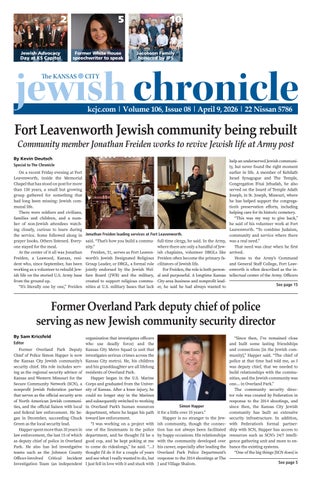
Community member Jonathan Freiden works to revive Jewish life at Army post
By Kevin Deutsch
Special to The Chronicle
On a recent Friday evening at Fort Leavenworth, inside the Memorial Chapel that has stood on post for more than 150 years, a small but growing group gathered for something that had long been missing: Jewish communal life.
There were soldiers and civilians, families and children, and a number of non-Jewish attendees watching closely, curious to learn during the service. Some followed along in prayer books. Others listened. Everyone stayed for the meal.
At the center of it all was Jonathan Freiden, a Leawood, Kansas, resident who, since September, has been working as a volunteer to rebuild Jewish life on the storied U.S. Army base from the ground up.
“It’s literally one by one,” Freiden


said. “That’s how you build a community.”
Freiden, 51, serves as Fort Leavenworth’s Jewish Designated Religious Group Leader, or DRGL, a formal role jointly endorsed by the Jewish Welfare Board (JWB) and the military, created to support religious communities at U.S. military bases that lack
full-time clergy, he said. In the Army, where there are only a handful of Jewish chaplains, volunteer DRGLs like Freiden often become the primary facilitators of Jewish life.
For Freiden, the role is both personal and purposeful. A longtime Kansas City-area business and nonprofit leader, he said he had always wanted to
help an underserved Jewish community, but never found the right moment earlier in life. A member of Kehilath Israel Synagogue and The Temple, Congregation B’nai Jehudah, he also served on the board of Temple Adath Joseph, in St. Joseph, Missouri, where he has helped support the congregation’s preservation efforts, including helping care for its historic cemetery.
“This was my way to give back,” he said of his volunteer work at Fort Leavenworth. “To combine Judaism, community and service where there was a real need.”
That need was clear when he first arrived.
Home to the Army’s Command and General Staff College, Fort Leavenworth is often described as the intellectual center of the Army. Officers
See page 15
By Sam Kricsfeld Editor
Former Overland Park Deputy Chief
of Police Simon Happer is now the Kansas City Jewish community’s security chief. His role includes serving as the regional security advisor of Kansas and Western Missouri for the Secure Community Network (SCN), a nonprofit Jewish Federation partner that serves as the official security arm of North American Jewish communities, and the official liaison with local and federal law enforcement. He began in December, succeeding Chuck Green as the local security lead.
Happer spent more than 35 years in law enforcement, the last 15 of which as deputy chief of police in Overland Park. He also has led investigative teams such as the Johnson County Officer-Involved Critical Incident Investigation Team (an independent
organization that investigates officers who use deadly force) and the Kansas City Metro Squad (a unit that investigates serious crimes across the Kansas City metro). He, his children and his granddaughter are all lifelong residents of Overland Park.
Happer began in the U.S. Marine Corps and graduated from the University of Kansas. After a knee injury, he could no longer stay in the Marines and subsequently switched to working in Overland Park’s human resources department, where he began his path toward law enforcement.
“I was working on a project with one of the lieutenants in the police department, and he thought I’d be a good cop, and he kept poking at me to come do ridealongs,” he said. “...I thought I’d do it for a couple of years and see what I really wanted to do, but I just fell in love with it and stuck with

it for a little over 35 years.”
Happer is no stranger to the Jewish community, though the connection has not always been facilitated by happy occasions. His relationships with the community developed over his career, especially after leading the Overland Park Police Department’s response to the 2014 shootings at The J and Village Shalom.
“Since then, I’ve remained close and built some lasting friendships and connections [in the Jewish community],” Happer said. “The chief of police at that time had told me, as I was deputy chief, that we needed to build relationships with the communities, and the Jewish community was one… in Overland Park.”
The community security director role was created by Federation in response to the 2014 shootings, and since then, the Kansas City Jewish community has built an extensive security infrastructure. In addition, with Federation’s formal partnership with SCN, Happer has access to resources such as SCN’s 24/7 intelligence gathering unit and more to enhance the existing systems.
“One of the big things [SCN does] is
Community members, Jewish leaders and elected officials gathered at the Kansas State Capitol on March 3 for Kansas Jewish Advocacy Day, a day focused on civic engagement, education and strengthening relationships between the Jewish community and state leaders.
Hosted by the Jewish Community Relations Bureau | American Jewish Committee (JCRB|AJC), the program brought together approximately 20 community leaders and nearly 30 Kansas legislators for a day of dialogue and learning about issues impacting the Jewish community.
The program provided opportunities for attendees to meet directly with legislators, discuss key findings from AJC’s 2025 State of Antisemitism Report (SOAR) and share more about the work of JCRB|AJC. Participants also heard from key leaders, including Sen. Ethan Corson and Rep. Dan Osman, who shared insights on serving as Jewish lawmakers and emphasized the importance of collaboration between community members and policymakers.

“Jewish Advocacy Day is about ensuring that our community’s voice is heard while strengthening relationships with the leaders who shape our state’s future,” said

Take a look inside Village Shalom to see our remarkable Assisted Living and Memory Care communities. Maintenance-free, private apartments and specialized care from caring staff give peace of mind to you and your loved ones. Learn more at VillageShalom.org or call Justine Ogdon at 913-317-2600 to tour our welcoming senior living community. We look forward to showing you what peace of mind looks like. Welcome to The Village.

Neta Meltzer, executive director of JCRB|AJC. “When community members and elected officials come together for meaningful conversation, it builds understanding, trust and a stronger Kansas for everyone.”
The event highlighted JCRB|AJC’s longstanding commitment to civic engagement and bipartisan relationship-building. More information about JCRB|AJC and its advocacy initiatives is available at jcrbajc.org.
The Yom HaShoah Commemoration will take place at 1:30 p.m. on April 12 at The White Theatre at The J (5801 W. 115th St., Overland Park, KS 66211).
This year the commemoration is chaired by Geri Crain, daughter of Holocaust survivor Alice Kern, a survivor from Sighet, Romania, who was interned in Auschwitz-Birkenau and Bergen-Belsen. The commemoration will feature a special tribute to the survivors with the children and grandchildren of Holocaust survivors — the second and third generation — singing “Zog Nit Keynmol” with the Hyman Brand Hebrew Academy choir.
The Yom Hashoah commemoration is open to the public. Anyone unable to attend in person is invited to watch the livestream on the MCHE Kansas City YouTube channel.
The commemoration is organized by The J, Jewish Community Relations Bureau | American Jewish Committee and MCHE. Supporting organizations include Congregation Beth Shalom, Hyman Brand Hebrew Academy, Jewish Community Foundation, Jewish Family Services, Jewish Vocational Services, KU Hillel, Lawrence Jewish Community Center, Kehilath Israel Synagogue, The New Reform Temple and The Temple, Congregation B’nai Jehudah.
Reflecting on the importance of Yom Hashoah, Kern said, “Elie Wiesel, Holocaust survivor and Nobel Laureate, wrote, ‘Because I remember, I despair. Because I remember, I have the duty to reject despair.’ My mother and Elie knew one another in Sighet, Romania, before they were deported. Yom Hashoah is a time to honor those who did not survive, and it is also a moment to come together — to reject despair in their memory and to affirm hope for generations to come.”

Yom HaShoah Commemoration Sunday, April
Organizers for the 2026 JCC Maccabi Games are inviting members of the Kansas City Jewish community to audition to perform the national anthems at the event’s opening ceremony, which will take place Aug. 3.

Auditions to perform the United States, Canadian and Israeli national anthems are open now through April 30 and are available to Jewish vocalists and instrumentalists of all ages and experience levels connected to the Kansas City Jewish community. Individuals, groups and ensembles are encouraged to apply.
“We are so excited to present such a fun and engaging opportunity for our community to be involved in the upcoming JCC Maccabi Games,” said Samantha Hammontree, co-chair for the opening ceremony committee. “We’re looking for performers of all levels to share their talents with Kansas City and with the Maccabi community in August.”
Applicants must submit a one-totwo-minute video audition by April 30. The video should feature the performer singing the full anthem a cappella. Vocal performances will be performed without instrumental accompaniment. Videos do not need to be professionally produced, and phone recordings are welcome. Applicants are encouraged to record in a quiet space with good lighting. Both landscape and por-
trait orientations are acceptable, and groups or ensembles may submit one video together.
Application videos for singing the U.S., Canadian or Israeli national anthems must include the applicant’s name and connection to the Kansas City community at the beginning. The video should be uploaded to YouTube or shared via Google Drive and then shared via link to anthemmaccabikc@ gmail.com.
Applicants may indicate interest in performing one, two or all three anthems.
Selected singers or instrumentalists will receive coaching and preparation from POP Project KC ahead of the performance. Participation is a volunteer and unpaid opportunity, and applicants do not need to be professional singers or have prior performance experience.
More information is available at jcckcmaccabi.org/nationalanthems or by contacting Tammy Ruder at tammyr@thejkc.org or (913) 981-8878.
Performers must be available for a required rehearsal on Sunday, Aug. 2, as well as the opening ceremony on the evening of Monday, Aug. 3.
The following are the deadlines for articles, celebration announcements, Spotlight pictures, advertisements and editorials for upcoming Chronicle print issues. If you have any questions, please contact Sam Kricsfeld at samk@jewishkc.org.
April 23 issue......................................April 16 noon deadline May 7 issue.........................................April 30 noon deadline
To submit news to The Chronicle, go to kcjc.com/chronicle-submissions
The State of Kansas will memorialize the victims of the Holocaust at its annual official state observance, the Kansas Holocaust Commemoration, on April 20 at 1 p.m. at the Topeka Civic Theatre (3028 S.W. 8th Ave., Topeka, KS).

Gov. Laura Kelly’s final Kansas Holocaust Commemoration as governor will include her presenting the Kansas Proclamation for the Days of Remembrance, which includes the following: “...the people of the State of Kansas should always remember the terrible events of the Holocaust and remain vigilant against hatred, persecution and tyranny.”
The theme of this year’s program is the life of Dr. Judy Jacobs, a child Holocaust survivor. Jacobs and her family were from Hungary.
Kansas clergy, political leaders and students will participate in the program. Holocaust survivors, World
War II veterans and second-generation sons and daughters will be recognized. The program, which will last for about an hour, is hosted by the Kansas Holocaust Commission. Commission members are appointed by the governor of Kansas for the purpose of organizing the annual commemoration.
The event is free and open to the public. Registration is available at mchekc.org/kansas-holocaustcommemoration.
For those unable to attend, the program will be available on the Midwest Center for Holocaust Education YouTube channel after the event.
State of Kansas Holocaust Commemoration Monday, April 20, at 1 p.m. Topeka Civic Theatre, 3028 S.W. 8th Ave., Topeka, KS 66606


Kehilath Israel Synagogue (K.I.) will host a screening of the 2025 film “Nuremberg” for Yom HaShoah. The event, to be held on Tuesday, April 14, at 6:45 p.m., is open to the community and will be at K.I. (10501 Conser, Overland Park, KS 66212).
The event is free, but all attendees must RSVP for security purposes at kisyn.eventsmart.com/yomhashoah.
“Nuremberg” is about an American psychiatrist, Douglas Kelly (played by Rami Malek), evaluating Nazi leaders before the Nuremberg Trials. He grows increasingly obsessed with understanding evil as he forms a disturbing bond with Hermann Göring (played by Russell Crowe). The film uses archival concentration camp footage and discussion of the Holocaust, so viewer discretion is advised.
“My wife Becca and I watched the movie ‘Nuremberg’ on Netflix and were very moved by it,” K.I. Rabbi Moshe Grussgott said. “It contains some graphic scenes of the concentration camps, but I grew up with such scenes, and I actually find it important to expose ourselves to them from time to time.”
Memorializing Yom HaShoah at K.I. is important to Rabbi Grussgott.
“It’s unfortunate that Yom HaShoah is not more widely observed,” he said. “In my own Orthodox community,

Rami Malek (left) as American psychiatrist Douglas Kelly and Russell Crowe as Nazi Hermann Göring in “Nuremberg,” to be shown for Yom
at K.I.
the more traditionalist view is that we don’t have the right to invent new holidays, and so the Holocaust should be commemorated on Tisha B’Av in the summer, which is already there to commemorate all Jewish tragedies. However, I think we ought to do both. It was actually Rabbi Tibor Stern, the last Orthodox chief rabbi of Kansas City in the 1950s, who made one of the earliest Orthodox cases for observing Yom HaShoah separately from Tisha B’Av.”
More information is available at kisyn.eventsmart.com/yomhashoah or by emailing Henri Gaeddert at henri@kisyn.org.
“Nuremberg” screening
Tuesday, April 14, at 6:45 p.m.
Kehilath Israel Synagogue, 10501 Conser, Overland Park, KS 66212
The Hyman Brand Hebrew Academy (HBHA) Upper School will present the romantic comedy “Father of the Bride” with two showings open to the community.
The shows will be at The Lewis and Shirley White Theatre at The J (5801 W. 115th St., Overland Park, KS 66211) at 7 p.m. on Wednesday, May 6, and Thursday, May 7. The play tells the story of a middle-aged man, Stanley Banks, whose life begins to spiral out of control as the planning for his daughter’s upcoming wedding grows increasingly complex and costly.

directed by Micah Margolies.
“Father of the Bride” has gone through many iterations over the years. It began as a 1949 novel by Edward Streeter and has since been adapted into two separate films: a 1950 version starring Spencer Tracy and a 1991 version starring Steve Martin. It was also adapted into a stage production, written by Caroline Francke, which the HBHA cast will perform.
The cast is composed of HBHA students Elia Ellis, Eric Fine, Lia Friedman, Shai Friedman, Simon Granoff, Ethan Hobbs, Naama Reem, Eliezer Rich, Shua Rich, Ruby Sokol, Gabrielle Sosland, Jake Sosland, Naftali Tilove and David Wasserman. It is stage managed by Avital Mullokandova and
Community Blood Center (CBC) is again partnering with SevenDays to encourage the community to give blood or platelets between April 20 and 28 as part of the annual SevenDays week of kindness. SevenDays is a Kansas City-based nonprofit dedicated to overcoming hate by promoting kindness and understanding via education and dialogue. Their annual week of kindness honors the lives of Reat Underwood, his grandfather Dr. William Corporon, and Terri LaManno, who were killed outside Jewish facilities in 2014. In the 12 years since the tragedy, nearly 35,000 blood donations have been

given in their memory during the SevenDays week of kindness.
“Kindness is more than a word — it’s action,” said Mindy Corporon,
co-founder of SevenDays. “Through this partnership with Community Blood Center, we turn compassion into something tangible. Every blood donation represents hope and healing for someone in need.”
“The legacy of SevenDays continues through blood donors who choose to help others,” said Chelsea Tibbetts, vice president of Blood Operations at Community Blood Center. “Patients in our community rely on blood every day for trauma care, cancer treatment, surgeries and chronic illnesses. Blood donation is a simple way to make a lasting impact.”
“It’s a wonderful play,” Margolies said. “It’s just a fun, wholesome show that everybody in the family can enjoy, about mix-ups and madness and family squabbles, but in the end, everybody ends up happy, and the father of the bride can finally relax. It’s got hilarious characters and something that everybody can relate to — especially if they’ve ever been involved with the zaniness of planning a wedding before.”
“I play a butler named Reginald who sometimes gets worked up over very small details,” HBHA junior Eliezer Rich said. “It’s really fun being able to go from calm to extremely upset in such a short amount of time. I think everyone will enjoy the show because it’s fun, funny and warm-hearted.”
Tickets can be reserved in advance or purchased at the door. Ticket prices and reservation details are available by emailing Margolies at mmargolies@ hbha.edu.
of the Bride”
Wednesday, May 6, and Thursday, May 7, at 7 p.m.
The White Theatre, 5801 W. 115th St., Overland Park, KS 66211
Community members can donate blood at any CBC donor center or mobile blood drive during SevenDays (April 20–28). Appointments are encouraged, and donor center locations include:
• Kansas City, Missouri – 4040 Main St.
• Overland Park, Kansas – 10568 Metcalf Ave.
• Blue Springs, Missouri – 1124 West 40 Hwy.
• Lee’s Summit, Missouri – 1551 N.E. Douglas
• Gladstone, Missouri – 7265 N. Oak Trfy.
• Topeka, Kansas – 6220 S.W. 29th St.
• St. Joseph, Missouri – 3122 Frederick Ave.
• Olathe, Kansas – 16465 W. 119th St.
Author and former White House speechwriter Sarah Hurwitz will visit Kansas City to speak about Jewish identity and her experience in politics. The discussion will center on her latest book, “As a Jew: Reclaiming Our Story from Those Who Blame, Shame, and Try to Erase Us.”
The event, “An Evening with Sarah Hurwitz,” will take place on May 18 at 7 p.m. at Congregation Beth Shalom (14200 Lamar Ave., Overland Park, KS 66223). Jewish Experiences, a collaboration of Jewish Federation and The J, together with the Jewish Community Relations Bureau | American Jewish Committee (JCRB|AJC), will host Hurwitz. She will be in conversation with Neta Meltzer, executive director of JCRB|AJC.
Hurwitz served as a White House speechwriter from 2009 to 2017, first as a senior speechwriter for former President Barack Obama and later as head speechwriter for former first lady Michelle Obama. Prior to her time in
the White House, Hurwitz worked on several presidential campaigns. She served as chief speechwriter for Hillary Clinton during her 2008 presidential campaign and as deputy chief speechwriter for Sen. John Kerry (D.Mass.) in 2004 and Gen. Wesley Clark in 2003.
“I’m so excited to come to Kansas City to discuss some of the most important issues facing the Jewish people today,” Hurwitz said. “From the challenge of antisemitism to the importance of embracing Jewish tradition, community, wisdom and joy, I know this is going to be a wonderful event.”
Registration and payment is required in advance at thejkc.org/sarahhurwitz. Tickets are available with or without a copy of Hurwitz’s book. A book signing will follow the conversation at 8:30 p.m.
This program is presented in partnership with The Temple, Congregation B’nai Jehudah; Congregation

Beth Torah; New Reform Temple; and Hyman Brand Hebrew Academy. It is funded by Bill and Robin Carr.
“Sarah Hurwitz brings a powerful and deeply personal perspective to the conversation about Jewish identity today,” Meltzer said. “In ‘As a Jew: Reclaiming Our Story from Those Who Blame, Shame, and Try to Erase Us,’
she reminds us of the strength that comes from understanding our tradition and telling our own story. I’m looking forward to a thoughtful conversation about identity, leadership and why Jewish learning matters so much in this moment.”
Hurwitz is also the author of “Here All Along,” in which she documents her search for a deeper understanding of Judaism and reflects on rediscovering Jewish tradition as an adult. Through the book, she explores Jewish holidays, ethics and belief systems, offering readers a framework to engage with Jewish identity, history and practice in a modern context.
More information and registration details are available at thejkc.org/sarahhurwitz or by contacting Jewish Experiences at jex@thejkc.org or (913) 327-8163.
An Evening with Sarah Hurwitz
Monday, May 18, at 7 p.m.
Congregation Beth Shalom, 14200 Lamar Ave., Overland Park, KS 66223
The Greater Kansas City Section of the National Council of Jewish Women (NCJW) will host a fundraiser at Hamburger Mary’s featuring drinks, food, bingo and a raffle. The event will be on Wednesday, May 6, with Bingo between 7 and 9 p.m.
Any new member who joins at the event will get five free raffle tickets, and their annual membership will run through June 2027. One of the raffle prizes is a free membership through June 2027 as well. The

Wednesday, May 6, 7 to 9
500 Series:
500 Series:
raffle and bingo are cash-only.
Early reservations are encouraged at NCJW’s Facebook page (facebook.com/ncjwofkc) or at the Hamburger Mary’s website (hamburgermarys.com/kc).
Questions can be directed to the NCJW office at ncjwofkc@ gmail.com or (913) 6480747.
The following bowlers achieved high scores in the Sunday Kansas City B’nai B’rith Men’s Bowling League at Ward Parkway Lanes on March 22 and 29. If you are interested in bowling during the ‘25-’26
social atmosphere, you can contact Tom Balke at (913) 244-7010 or balketw@yahoo.com or Stuart Pollack at (913) 957-3716 or skp28@aol.com.
continued from page 1
training, so they offer built training programs for the community,” Happer said. “That’s one of my roles, to present this training.”
There are three core trainings, Happer said – one is “Stop the Bleed,” which teaches how to treat an injured person who is bleeding; one is for situational awareness in public; and one is for countering active threat training. Happer strongly believes in the importance of training and is working on outreach to synagogues and schools to train and advise on security and protection.
“Everybody… is responsible for their own security first, and it’s having that knowledge of what to do in a situation that’s really what I want to [share],” he said. “It’s not only if they’re here, at [the Campus], at their synagogue, or at a Jewish event… These are all things that are just common practices you can use anywhere.”
Those interested in learning more about the community security initiatives or scheduling a training can contact Happer at whapper@ securecommunitynetwork.org or (872) 273-9658. Those needing to report a security incident can do so at jewishkansascity.org/incidentreporting.
70 years ago

Find more community history at kcjc.com/archive.

Using The Chronicle’s archives and community submissions, here are some recipes for you to try out. Email samk@ jewishkc.org with a recipe, and it might be published here!
KCJC, 1938
Ingredients
• 3 eggs
• ¼ cup cold water
• 2 tsp. baking powder
• 1 cup sugar
• 1 cup cake flour
• 1 tsp. vanilla
• ½ cup maraschino cherries
• ½ cup chopped nuts
• Frosting
• Orange marmalade
Instructions
1. Set oven to 425 degrees
2. Beat eggs until light
3. Add sugar and continue to beat, then add water
4. Sift flour and baking powder together, then slowly add to mix
5. Add vanilla
6. Place on greased sheet cake pan and bake for 15 minutes
7. Turn the pan out on a tea towel
8. Spread cake with orange marmalade, then add frosting
9. Decorate with cherries and nuts


Get yourself, your family and your friends subscriptions to The Chronicle!
Scan the QR code or go to kcjc.com/subscribe for more information.

• Blood donations (pg. 4)
• Jacobs Family (pg. 9)
FORTLEAVENWORTH JONATHANFREIDEN SIMONHAPPER JEWISHADVOCACYDAY COMMEMORATIONS JCCMACCABIGAMES FILMSCREENING FATHEROFTHEBRIDE BLOODDONATIONS
• Luneville Torah (pg. 9)
• Commemorations (pg. 2, 3)
• Jacobson Family (pg. 10)
• “The Marranos” (pg. 8)
• “Father of the Bride” (pg. 4)
• Janet Kuemmerlein (pg. 8)
SARAHHURWITZ NCJWFUNDRAISER THEMARRANOS
• NCJW fundraiser (pg. 5)
• Film screening (pg. 4)
• Jewish Advocacy Day (pg. 2)
JANETKUEMMERLEIN JACOBSFAMILY JACOBSONFAMILY
• Sarah Hurwitz (pg. 5)
LUNEVILLETORAH JEWISHU
• Fort Leavenworth (pg. 1)
• JCC Maccabi Games (pg. 3)
• JewishU (pg. 11)
• Jonathan Freiden (pg. 1)
• Simon Happer (pg. 1)


More than 90 members of Jewish Federation’s Young Adults Division gathered at different houses on March 31 for the annual Seder Shuffle, where members host other young adults for a Seder. There were nine different Seders across the metro.
Pictured from three Seders are (top left, from left) Elliot and Kylie Levine, Becca Graham, hosts Everett and Maya Gorup, YAD Committee Member Amalia Newman, YAD Engagement Associate Julia Osburn, Andre Platzman, Lauren Ruben and Jacob Halpern; (above, back row) Devorah Klein, Ariel Cohen, Sarah Hellman, host Margo Hellman, Zoe Stoddard, Osburn, (front row) Newman, Mackenzie Zeitlin, Gabrielle Mouritzen and Nina Geller; and (bottom left) Osburn, Josh Winick, Elana Berger, Daniel and Brooke Moreira, Sydney Stack, Mason Boime, hosts Jack and Sarah Schreiber (with their dog, Ruby) and Newman.


B’nai Mitzvah

Ezra Irvin and Noa Leah Maker, children of Shannon and Joshua Maker, will become b’nai mitzvah on Saturday, Apr. 18, at The Temple, Congregation B’nai Jehudah.
Ezra and Noa are the grandchildren of Jill and Eddie Ginsburg of Louisville, Kentucky, and Pauline and Larry Maker of Toronto, Ontario. They are the siblings of Asa (21), Eli (20) and Hannah (8).
Among Ezra’s hobbies are running, playing basketball and enjoying the NBA and NFL. Noa enjoys all things theater, acting, singing and dancing. Both attend Camp Sabra during the summers and will participate in the 2026 Maccabi Games in Kansas City.
For their mitzvah project, Ezra and Noa volunteered with Hearts to Hands KC, helping pack weekend “BackSNack” bags with foods provided by Harvesters for children who may not have enough to eat over the weekend.
Nadav Isaac White, son of Aurite Werman and Benjamin White of Brooklyn, New York, was born on Jan. 24.
Nadav’s grandparents are Roni and Helen Werman of Hewlett, New York, and Rabbi Scott and Civia White of Kansas City, Missouri. He is the great-grandson of Helen Ainspan of Albany, New York.
The Epsten Gallery at Village Shalom presents the work of acclaimed fiber artist Janet Kuemmerlein in an exhibition on view through June 1.
A nationally and internationally recognized artist — and a current resident of Village Shalom’s Assisted Living — Kuemmerlein has spent decades redefining the possibilities of textile art, transforming fabric into intricate, dimensional works.
Born in 1932 in Detroit, Michigan, Kuemmerlein was the daughter of immigrants from southern Poland. Her artistic journey began early, taking childhood art classes before continuing her studies at the College for Creative Studies and the Cranbrook Academy of Art. There, she developed a multidisciplinary foundation in drawing, painting, metalsmithing and sculpture, eventually discovering fabric as her primary medium.
Kuemmerlein emerged as a pioneer in fiber art at a time when textiles were rarely considered a serious artistic medium. Through innovative techniques and sensitivity to color, texture and form, she used fabric for complex visual expression. Her work gained attention from architects and

designers seeking large-scale, commissioned installations that could serve as focal points in public and private spaces.
In 1969, her growing reputation led to inclusion in the landmark “Objects: USA” exhibition at the Smithsonian Institution — an exhibition that traveled extensively across the United States and Europe, introducing her work to an international audience.
Over the course of her career, Kuemmerlein’s work has been exhibited in institutions including the Smithsonian National Collection of Fine Arts, the Art Institute of Chicago, the Nelson-Atkins Museum

“The Marranos”
By Ellie Holsten
“The Marranos” by Eastern European artist Moshe Maiman depicts a family holding a Passover Seder in

of Art, and the Museum of Art and Design in New York, among many others. Her pieces are held in both public and private collections across the country, including major corporations, universities and cultural institutions.
Drawing inspiration from natural forms and landscapes, her work reflects an ongoing exploration of texture, symbolism and structure, often inviting viewers into a tactile and immersive visual experience.
This exhibition is intended to continue to inspire — now within the community she calls home. This exhibition offers an opportunity not only to experience Kuemmerlein’s artistic legacy, but also to celebrate the talent and life stories of residents in Village Shalom.
Located within Village Shalom, the Epsten Gallery’s mission is to bring meaningful, accessible art experiences to residents and the broader community. Admission is free, and the gallery is open daily from 10 a.m. to 6 p.m.
This exhibition is supported by the Polsky Family Supporting Foundation and the Epsten Gallery, whose commitment helps ensure that artistic programming remains a part of life at Village Shalom.

secret, interrupted by agents of the Spanish Inquisition. During the time period when Judaism was prohibited in Spain, Jews secretly holding onto their religion were referred to by the derogatory term “marranos.” Today, such communities are typically referred to as crypto-Jews.
The Spanish Inquisition existed to identify heretics, those who claimed to be Catholic but were following another religion in secret. Suspected heretics would be taken into custody and tried, with the majority of trials ending in a conviction. Those convicted would be fined, sent to forced labor or killed.
While there are a few records of Inquisition raids on Jewish holiday
celebrations like the scene depicted here, almost all crypto-Jews brought to Inquisition trials were accused based on a set of vague criteria to identify Jews. A painting like this can imply there was safety in practicing Judaism in small ways as long as large celebrations were avoided, but that was not the case. Despite the dangers, cryptoJews maintained their faith and their heritage, with most practices kept up by women since their devotions were traditionally confined to the home. MoreinformationabouttheMichael KleinCollectionattheTemple,Congregation B’nai Jehudah can be found at kleincollection.org or by calling (913) 663-4050 to schedule a tour.
The Jacobs family made a donation to Hyman Brand Hebrew Academy’s Jewish Heritage Trip in memory of their parents and grandparents, Dr. Bela and Anna Ilona Gondos (z”l).

The Gondoses grew up and were married in Hungary, and their daughter, Judy, was born there. The family survived Bergen-Belsen concentration camp when Judy was just seven years old. They came to the United States after the war and successfully rebuilt their lives.
Dr. Bela and Anna Ilona Gondos (z”l)
Anna Ilona was an artist, and Bela was a lifelong student of Judaica, medicine, history and everything else that crossed his path. He became a Zionist while in secondary school. The Gondoses were committed to Jewish education, recognizing it as the strongest factor in the sur-

vival of the Jewish people. For many years, Bela gave lectures about the Holocaust, and Judy continues to do so in Kansas City.
Grandsons of the Gondoses attended HBHA, as did their local great-grandchildren.
The Jewish Heritage Trip is open to any Jewish juniors or seniors in the Kansas City community, not just HBHA students. The trip includes time in Israel, Bulgaria, Poland and Germany, tracing modern Jewish history from before and during the Holocaust up to modern day.
“The Jewish Heritage Trip is not something we take for granted, and everyone in both the 11-12th grades and the HBHA community are extremely grateful for the opportunity,” HBHA student Norah Pabst said.


This Torah was found in a destroyed synagogue in Lunéville, France, by Rabbi David Max Eichhorn. Rabbi Eichhorn was from Columbia, Pennsylvania, and was assigned to serve in combat units in France and Germany during WWII, from 1943 to 1945. Rabbi Eichhorn was ordered to travel to Lunéville and lead Yom Kippur services for the troops on Sept. 26-27, 1944. Upon arrival, he discovered a synagogue sealed up, and inside it was a mess. The Nazis had broken up and torn down everything they could. Rabbi Eichhorn gathered what could be salvaged, and we can only assume this Torah was salvaged that day. He went on to lead more than 350 battle-grimed Jewish fighters for Kol Nidre. Somehow, this Torah found its way
to Kansas City. It was shipped by an unknown American, possibly a resident of Kansas City, to Rabbi Maurice Solomon of Kehilath Israel Synagogue. Eventually the synagogue donated this Torah to our museum project.
What remains a mystery are the initials M.T. embroidered on the Torah mantle. Contributions to the JWV display at the Jewish Community Campus are being accepteduntilApril15,afterwhichthe cases will be going through a remodel. If you wish to contribute military memorabilia with emphasis on the VietnamWar era and beyond, you can email jwvpost605@outlook.com for more information. The organization hopes to incorporate donations into thecaseswheneverpossible,butspace islimited.Oncedonated,memorabilia becomesthepropertyofJWV.


By Jewish Family Services
For Jewish Family Services’ (JFS) 125th Anniversary Celebration, Ro and Howard Jacobson and their family were chosen to serve as its honorary family. JFS is one of nearly 100 organizations to which the Jacobson family has provided hands-on volunteerism.
The Jacobsons’ years of volunteering in the Kansas City community are extensive. While Howard has supported many organizations, The J and its continental affiliate, the Jewish Community Center Association of North America (JCCANA), are the ones closest to his heart.
“The most important aspect is that it helps strengthen the Jewish community across North America and gives our members a sense of identity,” said Jacobson, who served as board president here in Kansas City from 1993 to 1995 and on the national JCCANA board from 1994 to 2002 and from 2009 to today.
His joy in The J comes from knowing he is helping so many people daily.
“It serves everyone in the community, from almost birth to people 100 years or older. The entire spectrum,” he said. “It is important to me to help everyone. And it touches so many lives. Additionally, for people who do not belong to a congregation, this is their one strong link to the Jewish community.”
Ro has also contributed greatly to the Kansas City community, both as a teacher in the Shawnee Mission and Center school districts and as a dedicated volunteer. She was active in school PTAs and served on the boards of several organizations, including Starlight and Friends of the Zoo. She chaired the Richard Bloch Cancer Hotline, served as community care chair of the United Way and was a docent for the Nerman Museum of Contemporary Art. Ro has also volunteered for Safehome and the Nelson-Atkins Museum of Art.
The Jacobsons have many “one-off” philanthropic actions that have significantly changed lives, such as the Irena Sendler story called “Life in a Jar,” involving Fort Scott, Kansas, students who discovered Sendlers’s heroism in saving 2,500 Jewish orphans during WWII. Howard raised funds to send the three students to meet Sendler several times. He unselfishly took further steps to invest in the students’ college education and for Sendler and the others in her nursing home to live more

comfortably.
Serving decades as a key advisor for the Abe & Anna Bograd Memorial Trust & Grants, Howard has been one of JFS’ 30 most significant benefactors. Now, Sherri Jacobs is an advisor with him, as well as neighbor Michael Berenbom. In addition, the Jacobsons also give generous personal financial support to JFS. That spirit of giving has been passed down to their family.
The family values of tzedakah and tikkun olam were taught to Ro and Howard Jacobson by their own grandparents and parents, Rosalyn M. and Abe H. Jacobson and Jennette and Jerome Cohen.
“We both contributed part of our allowance to the ‘Blue Box’ of the Jewish National Fund (JNF) to help plant trees in Israel,” they said.
Both grandfathers were officers in their synagogues, and their fathers served as presidents of their respective congregations. These memories stick in Howard’s mind, as well as his early involvement as a 5-year-old camper at the Jewish Community Center and then learning leadership skills as a teenager through BBYO.
The Jacobsons have been married for 62 years. Their secret to their long marriage, Howard said, is that “We talk out our differences. We don’t go to bed mad, and I let Ro know that she’s always right.”
Ro continued, “Family is important. From when our children were little, we included them in our community activities. Richard and Sherri went with me when I drove clients who were visually impaired to their appointments. When the kids were in high school, our family adopted a Russian family,
whom we still keep in contact [with].”
The Jacobsons take pride in seeing their family take leadership roles in the community. Sherri Jacobs is currently on the board at The J and Congregation Beth Israel Abraham and Voliner. Richard Jacobson has been on The J’s board as well as many others. Each of Ro and Howard’s six grandchildren, Ariel, Avi, Jaden, Jackson, Eza and Rachel, already have resumes for their leadership roles and volunteer endeavors. Some organizations, such as JFS, The J, and Boy and Girl Scouts have had at least three or four generations of Jacobson involvement.
The Jacobsons established funds for each of their grandchildren at JCF, in which the grandchildren decide what charities to support. Grandson Ariel Brudoley took months to research where he would make his first “big” gift
He announced, “I’m going to make my gift to JFS because they help people with basic, social service needs, like providing food. JFS serves many people who are both Jewish and non-Jewish. Grandpa taught me to take care of my family and my Jewish community.”
When asked what legacy they want to leave the community and their family, Ro said, “We strive to transmit the values our parents and grandparents transmitted to us, a lifelong model for hard work, service and giving back to the community so that their children, grandchildren and great-grandchildren will continue helping repair the world.”
“Too many members of a community donate money to charity and feel
they have done their part,” Howard said. “I feel there are three parts to participating in charity. The 3 ‘Ts’ are defined as time, treasure and talent. I work to get people involved in organizations on a deeper level than just writing a check.”
All six grandchildren presented Howard with a plaque committing to each volunteer 84 hours in honor of his 84th birthday. They also made a 125th Anniversary Partner Sponsorship gift in honor of Ro and Howard. Additionally, for this occasion, the Jacobson family remembers Rosalyn M. and Abe H. Jacobson and Jennette and Jerome Cohen, all of blessed memory.
The business world has been Howard Jacobson’s domain, where he has spent his long professional career. In 1998, Howard founded Paragon Capital Management, LLC, and was named one of the “Best Personal Wealth Managers in Kansas City” by KC Magazine for five years. Prior to starting Paragon, he held positions with E.F. Hutton & Co. and UMB Bank. He also served as president and chairman of Electronic Business Equipment, Inc. and Dynamic Computer Solutions, Inc. He met with multiple U.S. Presidents including Harry Truman, Dwight Eisenhower, John F. Kennedy, Lyndon B. Johnson and Jimmy Carter.
He also finds great joy investing in others to help them achieve their full potential. During his many mentoring sessions, Howard has been known for dispensing his share of sage advice.
JFS is not alone in honoring the Jacobsons for their tireless efforts. They’ve received several awards, including the 2017 Star Award from Starlight Theatre. In 2012, Howard was the first person in five years to receive the Earl Tranin Distinguished Leader Award from the Jewish Federation. He was named the Buck O'Neil Legacy Seat honoree in 2021, honoring The J. The Jacobson Family will be honored at JFS’ 125th Anniversary Celebration on Thursday, May 7, from 6 to 8:30 p.m. at Fiorella’s Event Space. Jack Stack’s barbecue, along with other delicious bites and cocktails, all VAAD kosher-certified, will be available as JFS raises funds to support community programs. The event is nearly sold out. Reservations can be made at jfskc. org/jfs125.
JFS’ 125th Anniversary Celebration
Thursday, May 7, from 6 to 8:30 p.m.
Fiorella’s Event Space, 9000 W. 137th St., Overland Park, KS 66221
JewishU is KU Chabad’s flagship educational initiative, providing a range of discussion-based courses that explore Jewish thought, ethics, relationships, mental health and practical living. Courses such as “Living Jewish,” “Soul Mates” and “Letters for Life” give students the opportunity to explore timeless Jewish wisdom in a way that is relevant to their modern lives.

Each semester, dozens of students dedicate time to participate in these classes.
“I am very grateful for everything that JewishU offers us,” said Ryan Diamond, a KU student from Houston, Texas. “These classes give me a space to think, grow and reconnect with what really matters.”
Shayna Weinstein, a student from
Chicago, Illinois, echoed that sentiment, adding that JewishU has helped her rediscover a sense of meaning and belonging during her college experience.
Rabbi Zalman Tiechtel, who co-directs KU Chabad together with his wife Nechama, explains that the goal is to meet students where they are.
“We seek to foster a sense of Jewish
continued on page 15
Editorials express the view of the writer and are not necessarily representative of the views of The Kansas City Jewish Chronicle staff, the Jewish Federation of Kansas City, or the Kansas City Jewish Community as a whole.
By Rabbi Mark H. Levin, DHL Founding Rabbi of Congregation Beth Torah

Before the Enlightenment and modernity (circa 1800), Jews never had equal political rights anywhere. We were physically persecuted at the will of the government. Sometimes things went well for us; sometimes we were murdered in cold blood. It depended on the whim of the government, the Church or our neighbors.
The vision and goal of Theodor Herzl’s Political Zionism (circa 1900) was to establish a geographically-based nation for Jews that would guarantee political autonomy, removing inequality imposed simply because we were Jews. What better place than the historic homeland of the Jewish people, Israel?
America’s founders based their vision of human equality, enshrined in the Declaration of Independence (1776) and the American Constitution (1787), largely on the philosophical
writings of Enlightenment philosopher John Locke (1632–1704). Later, influences would come from JeanJacques Rousseau (1712–1778) and Immanuel Kant (1724–1804). Jews began being afforded political equality for the first time in 1800 years with the American and French revolutions of 1776 and 1789.
The rise of Christian Nationalism in the United States, alongside Islamism that rules over some nations in the Muslim world, is returning the world to premodern prejudices and proves the continued necessity of a Jewish state as refuge: a nation in which Jews cannot be persecuted just for being Jews.
Rabbi Dr. Daniel Hartman of the Hartman Institute in Jerusalem recently commented on the hardship of knowing that another nation’s theological salvation depends upon his death. Both Hamas and the Iranian regime hold the death of Israel and Jews generally to be necessary goals of their existence. If you doubt that, Google continued on next page

“This will all be yours”
By Bridey Stangler PJ Library

There’s a silly little cartoon I’ve seen a few times. An older man, one arm around his son, the other in a grand sweep before him, says, “Someday, son, this will all be yours!”
And what is “this all” but a twocar garage, boxes piled to the ceiling, a broken-down lawn mower, an old sewing mannequin (why is there always a mannequin?) and junk that would make even the Antiques Roadshow eye the exit.
This is not some veiled accusation of my own parents; they lived through it themselves: the tedious and painful process of purging the once-loved belongings of those we love. My grandparents, when they downsized, left their share of mid-century Tupperware, grocery store flower vases and back-dated magazines. All these things had to be lovingly dealt with. But that’s all it was: things to be dealt with – lovingly, only because we love those who loved the things.
Ever since then, my parents have swept through their own home seasonally, so as not to leave my sister and me with the same laborious and, frankly, depressing task.
This was the third year that I hosted my family’s Passover Seder, and I asked each person to bring a bag with whatever they felt they would need to bring with them out of Egypt (shout-out to the mother of Molly Hess, director of Jewish Experiences at The J, for that great idea!) What are the timeless items and souvenirs that you would take with you if you and your families had to leave today – right now?
Well, I think, of what am I the keeper? Are there shtetl-old candle sticks? A Haggadah with the names of my ancestors? My grandfather’s tallis? No, no and no – whether through the patterns of human migration, or the fury and fire of history, or even by simple misfortune, mine is not a family with a great number of heirlooms.
And those I do have – do they pass muster?

If I were to flee now, would I really take the glass platter monogrammed with my grandmother’s initials? I love it. Since inheriting it, though, I’ve used it thrice. And, no, not for a moment would I consider taking it into the Exodus. It weighs, like, ten pounds without a single rugelach upon it.
What I would bring, though, are my Shabbat candlesticks, the ones I picked out before McKay and I got married. I don’t think I would pick them again today, but they have brought light to the darkness for 15 years. I would bring the kiddush cup that I bought on Etsy. I was heartbroken when I broke the one I received from the Israeli counselors during my last summer as The J’s camp director, but at least this one matches the candlesticks. I would bring my Artscroll Siddur, which makes me look like a more serious Jew than I am. But the Omer has just started, and I love that the spine of this prayer book is cracked to open to the right page every time.
The rest of it, I think, I carry in my heart. I do not require my mother’s wedding china to remind me of the Passover Seder when my Great-Grandma Ray answered “mah nishtanah halilah hazeh” with “pass the salt.” I do not need the record player on which my Grandma Dot played “Rudolph the Red Nosed Reindeer” at Rosh HaShanah dinner.
I am not from a family with many physical heirlooms. My mother would insist, here, that I mention that almost nothing survived the fire that consumed my grandparents’ home before I was born. I am sure that is a source of sadness my family lives with in ways I do not see, but I feel no poorer for the lack of lovely old things in my life. The traditions embodied in the plates, the stories in the wimples, the songs in the candlesticks, all live in the traditions I keep with my children. Their eyes, blue from their Irish grandmother, shine with the Shabbos candles, regardless of the silver that holds them.
I will tell my children, “someday, my darlings, this warmth and light each Friday night – this will all be yours.”


Now that Passover has passed over, it’s time to drag those good dishes back into storage. What? You never schlepped them up from the basement this year? Just like you failed to do last year? Or the year before? If you’re honest, you know you won’t use them in the future. Isn’t it time to finally get rid of them?
I know, I know. That would be so painful. Each soup bowl and coffee cup is filled to the brim with memories. Take my Rosenthal gold-trimmed china set, which reminds me of Aunt Sara. She was so proud that her son could afford to have them sent from Germany. The silver-outlined set was Grandma’s, who couldn’t afford gold ones like her sister.
A friend who inherited eight sets of dishes can rattle off the deceased relatives and occasions associated with each. “These were the fleishig (meat) and milchig (dairy) dishes Bubbe used every day. These were Mom’s Shabbat meat and milk dishes. And these were Aunt Miriam’s four sets: two for Passover week and two for the Shabbat during Passover.”
At one time, I also owned the set of good dishes I registered for in the 1970s when I got engaged to my first husband. We divorced a few years later, and I was happy to jettison both that husband and those dishes.
Messie Condo, author of “Nobody Wants Your Sh*t,” would applaud my action, claiming you don’t need to hang on to an item just because it’s part of your personal history. “A thing is not a memory. It’s just a thing.”
The truth is, many of our china set “things” have become obsolete. Pieces containing metal can’t be put in the microwave. Some bone china is too fragile to be put in the dishwasher. And, since Bubbe’s day, we have outstanding choices for disposables. Elegant plates have been created that resemble fine china. Much of the tableware is both sustainable and recyclable. For child-centered Seders, paper plates are available shaped like matzah. Others have funny illustrations of the ten plagues, but would you really want to spend the Seder looking at boils and frogs? Even if you get ruthless

and decide to dispose of your collections, you might find it isn’t easy. For all the aforementioned reasons, your kids won’t want them. You can try donating them to thrift stores, but because of their overflowing inventory, some only accept “vintage” items. Whatever that means.
So, you will need to get creative about repurposing them. My eight-set-owning friend could keep one place setting from each, then recycle the rest. The eclectic table she sets with each guest having a different style would provide a perfect conversation starter.
An artist friend broke hers into shards, creating mosaic stepping-stones and bird feeders. Broken plates can become an attractive kitchen backsplash or refrigerator magnets. Fragments can also turn into jewelry: on a chain transformed into a necklace or with a pin a fancy brooch.
If the set includes cream and sugar containers, they can be repurposed for Havdalah. Affixing three wicks to the creamer makes it a Havdalah candle, while the sugar bowl can become a spice box.
Less artsy-craftsy folks could simply put the shards into a glass jar for the mantle. I, myself, would find this unnerving, reminding me too much of cremated remains.
If none of these work for you, just leave them in storage, promising yourself, “Next year in eBay.”
Nancy Kalikow Maxwell is a Kansas City native and awardwinning author. Her book, Typically Jewish, is available through the Jewish Publication Society or Amazon. Her website is kaliwellinc.com and email is nancykalikowmaxwell@gmail. com.
Editorials express the view of the writer and are not necessarily representative of the views of The Kansas City Jewish Chronicle staff, the Jewish Federation of Kansas City, or the Kansas City Jewish Community as a whole.
continued from previous page Hamas’ 1988 and 2017 Charters. It’s plainly written, although for political purposes, it’s a bit convoluted in the 2017 Charter.
Both Iran and Hamas, in other words, state that fundamental to their existence is the destruction of Israel and Jews. In the case of Hamas, that was most evident recently in the Oct. 7, 2023, attack on kibbutzim in the Gaza Envelope area of Israel. Iran, shortly after its founding in 1979, began developing proxies to destroy Israel and kill Jews, beginning with Hezbollah in Lebanon. Subsequently, it surrounded Israel with military foes: Hamas in Gaza and the Houthis in Yemen.
Tragically, the renewal and rise of premodern religious bigotries and messianic hatreds necessitates a political state dedicated to the protection of Jews and the Jewish people.
While these historic facts irrevocably justify a Jewish State, they do not guarantee the righteousness of the actions of that State, either in governmental structure or in waging war. But disagreement with governing policies or criticism of war strategies of a sovereign State does not delegitimate the nation. They only provide grounds to debate the actions of the government, just as in any other country. Israel acts according to the vision of their elected governing bodies, just as the U.S. or any other democracy.
My life, now closing in on the end
of its eighth decade, has witnessed the post-WWII rise of the middle class, the ‘60s movements for equal rights, the Reagan revolution’s triumph of Conservatism and now the Trump era. The post-WWII belief in infinite human progress has nearly died.
As a result of modernity’s view of human equality, Reform Judaism transformed Passover’s messianic promise of redemption for the Jewish people into the redemption of all people. The Seder has been reenvisioned to celebrate liberty for all of humanity.
Our modern Seders conclude with the statement typically translated as “Next year in Jerusalem.” But that’s a mistranslation. The actual translation of “L’shanah haba’ah biRushalyim” is “by next year, may we all be in Jerusalem.” The meaning is a messianic wish that by the next Passover, the messiah will have arrived, the world will be perfected, and all will live in peace. It’s a statement filled with hope, that God intends for all peoples to live together peacefully, without national animosities and in mutual acceptance.
Our religious understanding is that it is our obligation to live our lives to bring on that redemption, when all of humanity will live in peace. May that be God’s will, and may we guide our actions in the coming year to do our part in bringing that divine vision to reality. That is the vision of Passover, that the Redemption from Egypt can be universalized to all humankind.
By Sam Devinki
I write in response to the Feb. 12 article in The Chronicle, “Minneapolis and ICE.” This is America, and the writer has the right to express his opinions. Sometimes, opinions do not always match the facts. I do not like letters to the editor; however, I felt compelled to respond to this article, as it only tells one side of the story. The writer fails to mention the dozens of innocent people who have been murdered by illegal aliens. The writer fails to mention the hundreds of lives that have been destroyed by illegal aliens.
Any comparison of ICE to events that happened in the Holocaust is always inappropriate. My parents were immigrants. They came to this country legally. They applied for exit visas and waited three years before they
were allowed to come to the United States. When they got here, they did not commit crimes. They did not kill people. They did not riot against the government, and they did not expect the government to take care of them. The writer asks us to love our neighbors. I do love my neighbors, and I love this country. I do not love the criminals or people who take everything this country has to offer, and in return, hate this country. We live in the greatest country in the world. I pray that we can keep it that way.
Sam Devinki is vice president and honorary president for life of Kehilath Israel Synagogue. He serves on the United States Holocaust Memorial Council and received the Wings of Memory Leadership Award for the Midwest Region by the United States Holocaust Memorial Museum.

Sandra (Sandi) Miriam Lerner, age 86, of Overland Park, Kansas, passed away peacefully on March 25 at Village Shalom surrounded by her husband and children. She was born on Nov. 13, 1939, in Chicago, Illinois, to Daniel (z”l) and Ruth Davis (z”l).
Sandi was the beloved wife of Kenneth Lerner, with whom she shared a dedicated marriage of 67 years. Sandi and Kenny met through a mutual friend in the summer of 1956 and were married on May 11, 1958, building a life centered on family, community and service.
She was the devoted mother of daughter and son-in-law Lisa and Steve Siegel of Overland Park, Kansas; and sons and daughters-in-law Jordan and Kathryn Lerner of Seattle, Washington, and Craig Lerner and Yael Cohen of Los Angeles, California. She was a proud and loving grandmother to Rochelle Hoover (Matt) of Overland Park; Daniel Siegel (Elissa Madonia, partner) of Denver, Colorado; Andrew Siegel (Shannon James) of New Glasgow, Nova Scotia; Kid Lerner and Emma Lerner of Brooklyn, New York; and Greta and Irie Lerner of Northridge, California. She was also blessed with great-grandchildren Izzy Haarhoff and Barrett Hoover, both of Overland Park.
Sandi is also survived by her brother and sister-in-law Michael and Ronda Davis of Des Moines, Iowa; her sisterin-law Tina Chapman; nieces, a nephew, great-nieces and a great-nephew; and many dear friends and extended family members.
She was preceded in death by her parents, Daniel and Ruth Davis, and her brother-in-law, Alan Chapman (z”l).
Sandi graduated from Southwest High School and worked for more than 40 years as a medical secretary in several specialties. She was especially proud of typing a medical dictionary for Dr. Charlie Poser. Later, she enjoyed working as an in-store demonstrator for Cuisinart, Rowenta and other brands, where her warmth and enthusiasm made her a favorite with customers.
Service to others was the center of Sandi’s life. She grew up at Congregation Beth Shalom, where she was confirmed and married. There, she served as co-chair of the Lechem Committee and was treasurer of the Sisterhood Torah Fund. Later, she joined her daughter’s family at Congregation Ohev Sholom, where she helped cater for her grandsons’ bar mitzvah celebrations.
She was an avid volunteer throughout her life. She was active for many years in B’nai B’rith Girls, from her
youth through adult leadership. She was a life member of the American Medical Center at Denver and Hadassah. She also gave her time to SevenDays, the Interfaith Council, ORT and Village Shalom, where she volunteered in Memory Care, coordinated Kabbalat Shabbat services, taught mahjongg and bridge, led discussion groups and was a one-woman welcome committee. Her dedication to volunteerism was recognized with the Kansas Volunteer of the Year award and the Ages of Excellence Award from Village Shalom.
Sandi loved animals, especially the dog of her heart, Lord Beau of Lamar — affectionately called “Beau Beau” — and her daughter’s turtle, VanGo, whom she adored. She often dogsat for the pups that lived at Village Shalom.
Graveside services were held on March 29 at Mt. Carmel Cemetery. In lieu of flowers, memorial contributions may be made to the Sandi Lerner Program Enrichment Fund at Village Shalom (5500 W. 123rd St., Overland Park, KS 66209) or Kansas City Hospice (12000 Wornall Rd., Kansas City, MO 64145).
Sandi will be remembered for her kindness, humor, generosity and tireless devotion to her family and community. Her life was a blessing to all who knew her, and her memory will forever remain in the hearts of those she loved.
Online condolences for the family may be left at louismemorialchapel. com.
enrolled at Hebrew Union College in Cincinnati, Ohio, embracing Reform Judaism’s commitment to social justice. A proud patriot, he backed up his values with action, serving as a U.S. Army chaplain. That commitment extended beyond the pulpit: he marched in Washington with Martin Luther King Jr. and Abraham Joshua Heschel. Later, with his wife Marlyn, they advocated for Soviet Jewry and the enduring necessity of a Jewish homeland.
Inspired by his father’s tin pan alley songwriting and his own love of folk music, Rabbi Levenson became known as “The Singing Rabbi,” entertaining Jewish souls by blending melody with message. He delighted congregations from Killeen, Texas, to Brookline, Massachusetts, New Brunswick, New Jersey, and ultimately to the heart of America, Kansas City (Temple Beth El), where he raised his family and created the city’s first Jewish Folk Festival at Crown Center. He also taught the Old Testament at Rockhurst College, a Jesuit institution – a reflection of his belief that faith could and should build bridges. A counselor as well as a spiritual leader, he earned a master’s degree in transactional analysis from UMKC, deepening his ability to guide others through life’s most complex moments.
Returning back to Boston, he
became known as the “Rabbi of Hospital Row,” comforting the sick and dying with prayer, song and often laughter. As Hillel Rabbi at Northeastern University, in addition to teaching, he also became the coach for Northeastern University’s Lacrosse team inspiring generations of students. His commitment to ethical responsibility extended into the scientific community, where for decades he served as a trusted clergy voice reviewing research protocols for ethical concerns. In recognition of his integrity and dedication, the Massachusetts Society for Medical Research established the Rabbi Paul Levenson Award, which is now given annually.
Later, as head rabbi of Temple Chayai Shalom in Easton, Massachusetts, the community bestowed him with the honor of being their rabbi emeritus.
Beyond his rabbinical work, Rabbi Levenson lived a full life, running more than a dozen marathons including Kansas City’s Hospital Hill Run and the Boston Marathon. He also enjoyed going to and watching Celtics and Red Sox games with his sons. Sailing was a lifelong passion as well, often sailing solo as well as taking others along for the ride. His
continued on next page

Rabbi Paul H. Levenson – beloved “Singing Rabbi,” gifted orator and lifelong builder of communities – died peacefully in his sleep in Rockville, Maryland, just two weeks shy of his 94th birthday. For more than six decades, he brought people together through a passionate commitment to Judaism – delivered through song, inspiring sermons and humor. Whether on a pulpit, at a hospital bedside or with a guitar in hand, he believed deeply in Judaism not just as a tradition, but as a living, breathing force for connection, social justice and healing.
Born in Queens, New York, in 1932, Paul’s path to the rabbinate began when his father became president of Temple Israel in Lawrence, Long Island. There, he witnessed the profound impact a rabbi could have on a community and decided early he would devote his life to that calling. After graduating from Hobart College, where he played lacrosse, he

We are specifically looking for recollections of construction, architecture, which congregations occupied the buildings and the eventual sale of the buildings.
If you have any photographs or memories of these buildings, please reach out to Editor Sam Kricsfeld at samk@jewishkc.org.
26th and Benton 1923-1948
Tiphereth Sphorad, Ohave Israel
34th and The Paseo 1927-1969
Keneseth Israel, K.I.B.S./Beth Shalom
43rd and Prospect 1929-1950
Tiphereth Israel,Atereth Israel, Tiphereth Sphorad, Kehilath Israel
83rd and Holmes 1959-1994 BIAV
Admiral and Tracy 1920-1947
Tiphereth Israel
Linwood and Flora 1908-1957
B’nai Jehudah
Linwood and Montgall 1930-1946
Ohave Torah Anshi Polin, Beth Jacob and S.I.D.B.J.
Rockhill and E. Meyer
1950-1983 Kehilath Israel
75th and Nall (Prairie Village) 1962-2022
Ohev Sholom
83rd and Lamar (Overland Park)
1981-1989
Beth El
94th and Nall (Overland Park) 1963-1981
Beth El
continued from previous page
love of sailing endured into his later years, where he wound up serving as chaplain of Boston’s Port Norfolk Yacht Club.
He officiated at countless weddings, funerals, brisses and baby namings, marking the full arc of Jewish life with compassion and care. Above all, he believed in bringing Jews together and devoted his life to that worthy cause. There were countless others whose lives were touched by his music, wisdom and unwavering belief in the power of community.
He was married for more than 50 years to the late Marlyn Katz Levenson (z”l), a devoted educator and late president of the Massachusetts Association of Teachers of English to Speakers of Other Languages (MATSOL), sharing her passion for helping new émigrés find their place in the world. Together they raised four children.
Rabbi Paul is survived by his sister Judith Clapp (Lewis (z”l)) of Lexington, Massachusetts; his children Yonah Levenson, Robert Levenson, Dode Levenson and Ilana Katz Katz (Warren Katz); and his grandchildren, Burton Hirschman (Menuchah), Shoshana, Sydney and Isabel “Izzy” Levenson.
His legacy lives on in the voices he lifted, the people he comforted and the communities he helped bring a little closer together. Rabbi Levenson will be missed by many. Baruch Dayan Emet. May his memory be for a blessing.
Elizabeth Nussbaum
Elizabeth Nussbaum of Overland Park, Kansas, passed away on March 17 at the age of 98.

She was born on Aug. 3, 1927, raised in Szerencz, Hungary, and lived a happy life with her parents, Moshe and Rahel Weiss, and six brothers and sisters until the Nazis invaded her town.
In 1944, on the day after Passover, she, along with her family and the entire Jewish population of Szerencz (numbering about 200 families), were interned for three weeks in the local synagogue. Thereafter, the entire

community was herded into cattle cars and transported, standing and without food or water, for three days to the Auschwitz concentration camp. She was immediately separated from her family, all of whom were murdered in the gas chambers, leaving her at age 16 as the sole survivor of her family. She survived the horrors of the Auschwitz and Dachau concentration camps as well as a death march from Dachau and was freed by Allied forces late in the winter of 1945.
After being sent to a displaced persons (DP) camp in Munich, she ended up in a DP camp in Santa Maria Al Bagno, on the tip of the heel of Italy’s boot, where she met her future husband, Sam Nussbaum (z”l).
Sam, originally from Przemsyl, Poland, had survived eight labor and concentration camps from 1939-1945 and was also the sole survivor of his family.
Sam and Elizabeth married in November 1945, and their oldest son, Larry (z”l), was born in the DP camp in November 1946. They waited three years for a visa to immigrate to the U.S. and arrived by ship in New York Harbor on March 18, 1948 — exactly 78 years to the day before Elizabeth was buried. With no surviving family members, no resources and no one to sponsor their settlement in New York, the Jewish Federation sent them to Kansas City, Missouri, for resettlement. Sam, trained as a plumber in Poland before the war, was able to gain employment and eventually formed Tip Top Plumbing and Heating while Elizabeth stayed home to raise their growing family.
They were lifelong active members of Congregation Beth Israel Abraham and Voliner and the Kansas City Jewish community as well as supporters of many organizations, among them the Jewish National Fund, Israel Bonds, Yeshivot Bnei Akiva and Friends of the Israel Defense Forces (IDF). Elizabeth spent her life giving back to her community by volunteering for Mizrachi (Amit), the local mikvah and Chevra Kadisha and giving her time to numerous organizations whenever called upon. She never said “no.”
Elizabeth was preceded in death by her husband, Sam, in 2002 and her son, Larry, in 2024. She is survived by her children Mel, David (Sara Gittie) of Denver, Colorado, and Bonnie Mannis

(Russell) of Scarsdale, New York. They had 20 grandchildren and more than 70 great-grandchildren. Sam often said his family was the greatest revenge to Hitler.
Online condolences for the family may be left at louismemorialchapel. com.
his already generous heart expanded even further. Caring for Amy became a powerful expression of his compassion, deepening the empathy and gentleness he offered so freely to everyone around him. Their time together remained one of the most meaningful chapters of his life.

Sagan Alister Zavelo, born on March 4, 1987, lived 39 years filled with kindness, curiosity and a remarkable ability to make others feel valued. His warmth, humor and steady presence brought light into every room, and his life was defined far more by the love he shared than by any role he held.
Raised in Overland Park, Kansas, Sagan grew up surrounded by family, tradition and community. His connection to Judaism deepened during a transformative trip to Israel, where he celebrated his bar mitzvah and later returned to live for several years. Israel became a place where he felt deeply alive — hiking, exploring, building friendships and even playing in the Israeli Football League.
Sagan’s love for sports was woven into every chapter of his life. A devoted Kansas City Chiefs and Royals fan and a proud Jayhawk at heart, he carried his hometown teams with him wherever he went. Whether cheering from a stadium, a living room or halfway around the world, his enthusiasm was contagious — a reflection of the deep connection he felt to home, to family and to the people he loved.
In 2015, Sagan returned to the United States to be closer to the people he loved most. His first stop was with his sister Zaley and her family, where he spent precious time reconnecting and fully immersing himself in life with his nieces. During this period, his bond with Zaley’s children, Ada and Torunn, deepened in a way that would remain one of the great joys of his life. Their laughter, curiosity and energy filled his days, and Sagan embraced every moment with them.
After a brief stay in Michigan, he returned to Kansas City before going on to make new homes in San Diego and Austin. In every place he lived, Sagan built community with natural ease with his openness, positivity and the genuine care he brought to every relationship.
In 2020, Sagan met his fiancée, Amy Slotin, and the two shared a beautiful pandemic romance rooted in tenderness, humor and deep connection. When Amy received a cancer diagnosis, Sagan devoted himself completely to her care. Through that experience,
Losing Amy reshaped Sagan’s world in ways words can barely describe. In the months that followed, he moved through grief with honesty and courage, allowing himself the space to hurt, to reflect and, slowly, to heal. He leaned on family and close friends, and he worked hard to care for his mental and emotional wellbeing. Through that process, he rediscovered parts of himself — his hopefulness, his capacity for joy and the quiet belief that love would find him again when his heart was ready. It was this healing, grounded in resilience and the support of those who loved him, that opened the door to the next chapter of his life.
Sagan met Samantha in September 2022 and formed an immediate, undeniable connection. They quickly bonded over a shared love of sports, golf, cooking and travel, building a relationship rooted in adventure and joy. Together, they explored the world — spending time at their home in Austin, visiting family in Kansas City and traveling abroad to the UK and Belgium, where Sagan once surprised Samantha with an entire restaurant in Brussels singing happy birthday. Their journeys also took them to Lake Tahoe, where they conquered Mount Tallac and the Van Sickle Rim Trail; to New England to revisit Samantha’s hometown and watch the Red Sox and Yankees play; to the Philippines to experience its rich culture and cuisine; and to Palo Duro Canyon. Their final trip together was to Hawaii, where they found peace on the beach and played golf overlooking the Pacific Ocean.
Samantha had hoped for a lifetime more of adventures together, but she remains deeply grateful for every memory, every laugh and every moment they shared.
He is preceded in death by his fiancée, Amy Slotin, and is survived by his partner, Samantha Williams; his parents, Michael Scott Zavelo and Kimberly Campbell Zavelo; his sister, Zaley Zavelo Nelson; her husband, Beau; and his adored nieces, Ada and Torunn, who were constant sources of joy in his life.
Sagan leaves behind a legacy of compassion, generosity and light. His memory lives on in every person he touched, and the love he shared continues to ripple outward.
Online condolences for the family may be left at louismemorialchapel. com.
continued from page 1
from across the U.S. and allied nations come to study there — Israelis have done so previously — creating a dynamic, talented and constantly rotating population.
The post was established in 1827 by Colonel Henry Leavenworth. Located on the Missouri River, it was originally created to protect settlers and traders on the Santa Fe Trail. Today, according to recorded estimates, the base’s population includes around 3,700 active-duty personnel, about 2,800 civilian personnel and more than 1,000 students, along with personnel from the on-site U.S. Disciplinary Barracks.
The amount of Jewish community activities at Fort Leavenworth has ebbed and flowed historically, but in recent decades, the little Jewish programming there has gradually faded.
There are more than 15,000 Jews currently believed to be serving across all branches of the U.S. armed forces. Freiden estimates there may be 75 or more Jewish soldiers and family members stationed in and around Fort Leavenworth, about two dozen of whom he has connected with directly.
“When I got there, there was really nothing [for Jewish personnel],” Freiden said. “If you wanted services or community, you had to go to Kansas City.”
For some, that meant driving nearly an hour to attend synagogue in Overland Park, Kansas. For others, especially younger personnel or those without transportation, it meant attending services online — or not attending at all.
Freiden began his new mission just before the High Holidays last year, organizing an initial Rosh Hashanah gathering without knowing whether anyone would attend. People did. Then more followed.
Since then, Jewish programming has steadily expanded. There have been Shabbat services, Hanukkah and Purim celebrations, a weekly Judaism class and family-oriented gatherings, including children’s programming. A community Passover Seder held this month was also a success, with attendees commemorating the liberation of the Israelites from slavery in Egypt.
Food has become central to the experience, both as tradition and as a way to bring people together. Meals are often prepared collaboratively, with participants cooking, sharing recipes and learning from one another. Chicken, latkes and Middle Eastern dishes are among the favorites.
Just as notable as the growth in participation has been the diversity of attendees. Many who come are not Jewish.
“We’ve had a lot of people who just want to learn,” Freiden said. “Families,

chaplains, international officers — they’re curious, and they’re engaged.”
That openness has stood out to base leadership. Chaplain Lt. Col. Eric Bryan, the garrison chaplain at Fort Leavenworth, said Freiden’s work has had a meaningful impact both practically and symbolically.
“Jonathan’s help to invigorate Jewish gatherings has been a huge success,” Bryan said. “Our Army takes seriously our First Amendment rights to the freedom of exercise of religion, and know our soldiers and families are stronger when they have a thriving faith community. We are thrilled to have a Jewish community on Fort Leavenworth.
“What I admire most is the collegiality, friendship and mutual support our Christian chaplains and Jewish leaders have shown to one another,” he added. “After attending our first gatherings, the Jewish 101 class, Hanukkah and Purim feasts, I couldn’t help but notice several Christian chaplains and community members who care deeply about our Jewish friends. Jonathan has been a positive part of that process by the kind, helpful and team-centered way he approaches ministry. Jonathan is like a fellow soldier — he joins our weekly staff meetings and contributes new insightful ideas. In years past, I think we were missing a leader who could take the initiative to organize Jewish gatherings. Jonathan’s example
I hope encourages us all. People rally around willing leaders.”
Freiden said reaching more Jews has required persistence, outreach through base communications and social posts and word of mouth.
“People don’t always RSVP,” he said. “They just show up. And that’s part of how it grows.”
The rebuilding effort has also been physical. When Freiden first opened an old Jewish ark in one of the chapels, it contained only decorative remnants of Torah scrolls that had long since been removed. Today, through donations of Jewish ritual items from Temple Adath Joseph and communities across the country, the Fort Leavenworth community now has multiple Torah scrolls, along with prayer books, menorahs and other ritual items. Some of those items carry histories of their own, donated by congregations and people who wanted them to continue serving a Jewish community.
“These things were sitting somewhere, and now they’re being used again in this beautiful way at Fort Leavenworth,” Freiden said. “It’s incredible.”
Looking ahead, Freiden hopes to deepen the educational dimension of Jewish life on the base. Among his goals is securing a historic Czech Holocaust Torah scroll dating to the 17th century, part of the Memorial Scrolls Trust, for the Command and General Staff College and the Post Jewish community. The scroll has been set aside by Memorial Scrolls Trust, which cares for some 1,400 Torahs rescued from Jewish communities destroyed during the Holocaust, and places them with congregations and institutions around the world, Freiden said. He hopes to use the scroll as a teaching tool at the Command and General Staff College, helping introduce future military leaders to Jewish history, the Holocaust and broader
questions of faith and resilience.
“It would be a powerful way to integrate that history into what is already an educational environment,” he said.
For now, the work continues in small, steady steps. Another service. Another class. Another family walking through the door.
“You show up,” Freiden said. “You create something, and you let it grow.”
Readers who wish to make a charitable contribution to help bring this historic Czech Holocaust Torah scroll to Fort Leavenworth can contact Freiden at (913) 963-2646 or jfreiden@me.com.
continued from page 11
identity and belonging by engaging students at their own pace in a warm and non-judgmental environment,” he said. “We’ve found that one of the most powerful ways to strengthen identity is through meaningful Jewish learning.”
Beyond the classroom, JewishU also creates community. Students gather both to study and to connect with one another.
Another unique aspect of the program is its accessibility. Students can choose to convert their participation into scholarship funds, which many use to support future Jewish experiences or donate to causes.
As the semester comes to a close, interest in JewishU is high. With registration already open for the next round of courses, KU Chabad is preparing to welcome more students to the program.
The JewishU program is supported by Jewish Federation of Kansas City along with donors, including key benefactors Irv and Ellen Robinson.


