
By Kevin Deutsch Special to The Chronicle
Across Greater Kansas City, Jewish life is not defined only by where synagogues, schools and community centers stand. Families live north of the river, in Midtown, in Olathe, in eastern Jackson County and far beyond the neighborhoods most closely associated with Jewish communal life. For many of them, distance shapes crucial decisions about Jewish living — how often they attend services, where their children learn Hebrew and whether Jewish community feels accessible at all.
The question facing Kansas City’s Jewish institutions is not only where Jews live but also how to reach them.
Rabbis, educators and organizers across the metro are building a web of outreach that depends less on buildings and more on relationships, less on
affiliation and more on presence. Many are organizing informal gatherings and low-pressure programs designed to reach Jews in neighborhoods where they live and work, especially as demand for connection intensifies post-Oct. 7.
Many Jewish leaders doing outreach work begin by identifying Jews who may want to get more involved in community events or Jewish practice, then connecting with them in unobtrusive ways. Some focus on reaching young professionals, while others strive to build ties with seniors living alone or

A map showing the distribution of Jewish households in the Kansas City metro. (2022 Kansas City Jewish Community Study)
families with young children. Unaffiliated, Reform, Conservative and Orthodox community members — some living in far-flung parts of the metro —
have all been brought deeper into the fold through outreach programming.
“We’ve sort of made it our mission to reach people wherever they are,” said Bridey Stangler, who leads the PJ Library family engagement program through Jewish Federation of Kansas City. “Judaism doesn’t just happen in one part of town.”
Several community members in the Northland lauded PJ Library — a program of the Harold Grinspoon Foundation that sends free Jewish children’s books
See page 2
By The Chronicle staff
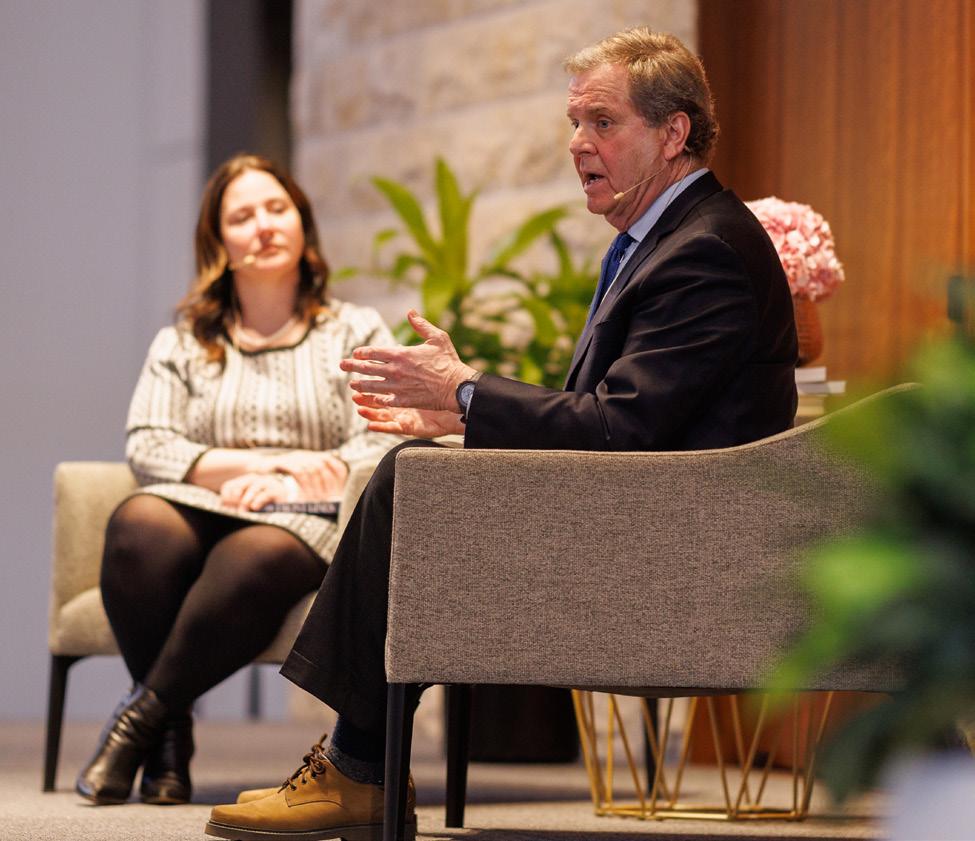
Jewish advocate David Harris will speak to the Kansas City community for the first time since 2024 in a series of events this coming March. The Jewish community will have four opportunities to hear from him between March 4 and 6.
Harris is the current executive vice chair for the Institute for the Study of Global Antisemitism and Policy (ISGAP) and former CEO of the American Jewish Community (AJC), which he led from 1990 to 2022. Harris was described by late Israeli Prime Minister Shimon Peres as “the foreign minister of the Jewish people.” He is the most decorated Jewish organizational leader in U.S. history.
prescriptive,” Harris told The Chronicle. “...My many meetings in the Kansas City area will use the book as a starting point for discussion. At the end of the day, though, in every session my goal is the same — to mobilize good people to take a stand, speak up, act. This is sure as heck no time for bystanders, business as usual or complacency.”
Harris last visited Kansas City in November 2024, speaking in front of approximately 300 people at The Temple, Congregation B’nai Jehudah.
antisemitism since his last visit to Kansas City.
“The situation has gotten worse,” he said. “Every day brings new reports of antisemitic acts, including the fatal attack in Sydney, Australia… targeting of synagogues, assaults on Jews, boycotts of Jewish-owned businesses, blood libels against Israel… Plus, the 2025 election of an anti-Israel radical, Zohran Mamdani, as mayor of the city with the largest Jewish population outside Israel and an urban center with countless links to Israel [New York City], underscores the radical shift in American politics.”
This visit comes on the heels of the
publication of his recent book, “Antisemitism: What Everyone Needs to Know.”
“Tragically, [my book] is needed now more than ever in recent history. The book is both descriptive and
For security purposes, The Chronicle is not publishing locations and times; those interested in hearing Harris speak can contact admin@ kcrabbi.org for details.
The Chronicle asked Harris for his perspective on the state of global
“Further, the rise of antisemitism in a wing of the Republican Party triggers concerns about what lies ahead for the post-Trump GOP,” he continued. “Antisemitism used to be taboo in postwar,
continued from page 1
every month to around 1,000 local children — saying it helps keep them connected to Judaism.
“There’s no test here. If your life is made more rich Jewishly by subscribing to these books, then you’re able to receive them,” Stangler said, adding that the books support Jewish practice and Jewish identity in the home.
feel alone.”
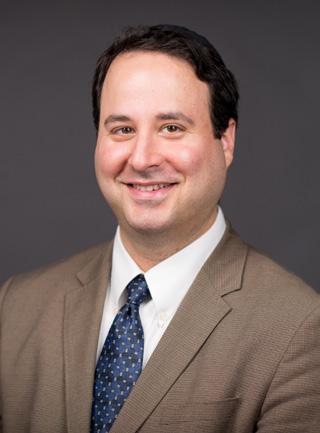
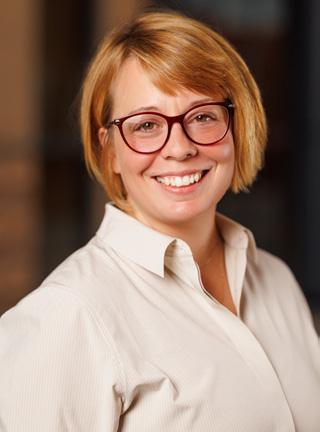
Bridey Stangler
What Stangler sees in enrollment patterns reflects what community studies have shown: Jewish families are far more spread out across the metro than many people realize, including in Midtown, downtown, eastern Jackson County and southern Johnson County.
To reach them, PJ Library has focused on informal neighborhood gatherings in secular spaces such as parks, splash pads and libraries.
“The goal there is to help people see there are Jews living right there in their part of town,” Stangler said. “And gradually, those relationships develop into something where people are getting Jewish community together outside of the purview of PJ Library and the Jewish Federation.”
Post Oct. 7, “I think that people are looking for more Jewish fellowship,” Stangler said. “People really need the community and they don’t want to
At Kehilath Israel Synagogue in Overland Park, Rabbi Moshe Grussgott said his congregation draws families from downtown Kansas City and Olathe. One reason is a program that quietly removes one of the biggest barriers to synagogue engagement: tuition.
“Our Hebrew school is free,” Rabbi Grussgott said. “A lot of people don’t know that.”
The school meets Sunday mornings and Wednesdays and is open even to non-members.
“Sometimes people just want to do the Hebrew school, and they don’t necessarily want to become a member, but it has been a nice way of getting people involved on Shabbat also,” he said. “We have a couple of young families who grew up here and now live downtown, and when they do come to shul, they come out here.”
At Torah Learning Center (TLC)
in Overland Park, Co-Director Esther Friedman said the institution hosts programs designed to attract people from across the metro.
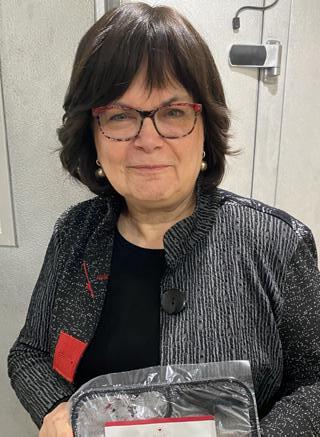
One such program, Gather KC, holds popular events like an annual backyard Sukkot party at TLC, featuring plentiful portions of traditional foods, handcrafted cocktails and lots of community-building connections.
“We have people participating from all over the area,” Friedman said.
The center’s kosher pizza nights, she said, also regularly bring in families from far outside Overland Park.
Beyond food and family programming, Friedman said TLC’s outreach stretches across the region through its kosher Meals on Wheels operation and volunteer cooking programs.
On certain Sundays, families come to cook meals for others.
“People who volunteer for that come from all over the city,” Friedman said.
Friedman said TLC has long tried to reach Jews where they are, including through public holiday programs in areas without established Jewish institutions. TLC remains eager to expand programming in areas where Jewish families may not be able to travel easily.
“If they’re not coming here, we’ll go there,” Friedman said. “We’ll absolutely go and offer a Purim program, a Megillah reading, or get them to come to us.”
Their aim, she said, is simple.
“Our goal is to get more people involved in Yiddishkeit [Jewish way of life],” Friedman said, “whichever way it can be done.”
In Olathe, Rabbi Mendel Wenger of Chabad saw that many Jews were not traveling to participate in Jewish life, so he moved Jewish life to them.
“We moved to Olathe in November 2024 and settled here to get a feel for being part of the city,” said Rabbi Wenger, the city’s first resident rabbi. “People see over time that you’re




See page 4

“Black and Jewish America: An Interwoven History,” a new four-part documentary series, will be broadcast for four consecutive Tuesdays on Kansas City PBS and PBS stations around the country.
“Black and Jewish America” is hosted, produced and written by Dr. Henry Louis Gates, Jr. — known for his PBS television show “Finding Your Roots” as well as being a professor, historian and literary critic. It was made to explore the complex relationship between Black and Jewish Americans.
Drawn together by entrenched racism and antisemitism, Black and Jewish Americans have a long connection through civic partnerships, artistic collaborations and fighting for civil rights.
More recently, the connections have been affected by each group’s unique struggles in an increasingly fragmented social and political landscape.
“This is a deeply personal subject for me,” Gates told PBS. “It’s connected to my own coming of age during the heroic days of the civil rights struggle and is an urgent response to the violent forces I’ve seen reawakened in our society over the last decade. By tracing the long arc of Black and Jewish history in America, I hope we can see each other more clearly, more honestly, and find hope in our mutual stories of survival, resilience and solidarity. But this series is not only about the past. It is about us — and how, together, we can prevail over the forces of hatred that seek to divide us.”
Among the interviewees are Billy Crystal, Tony Kushner, Anna Deavere Smith, Al Sharpton, David Remnick, and the children of noted civil rights figures Rev. Ralph Abernathy, Rabbi Abraham Joshua Heschel, Rabbi Israel Dresner, and more.
“As directors, it was a dream to explore a story so layered and endlessly fascinating, with countless echoes and lessons for today,” directors Phil Bertelsen, Julie Marchesi and Sara Wolitzky told PBS. “The Black-Jewish connection is complicated and was never inevitable. Our struggles overlap, but our experiences in America are distinct. And yet, the times these communities have come together, however imperfectly, produced defining art and civil rights gains in America. We were determined to tell the unvarnished story, in all its glory and messiness/complication.”
The four-episode series will air as follows:
“Let My People Go” — Tuesday, Feb. 3 at 8 p.m. — exploring the core differences at the start of the Black and Jewish American stories, as well as overlapping struggle, faith, resilience and early civic partnerships by the 1920s.
“Strange Fruit” — Tuesday, Feb. 10 at 8 p.m. — spotlighting how Black and Jewish communities collaborated in the early 20th century on music, movies and the universal fight against fascism, navigating tensions while shaping culture, confronting injustice and leaving a lasting social impact.
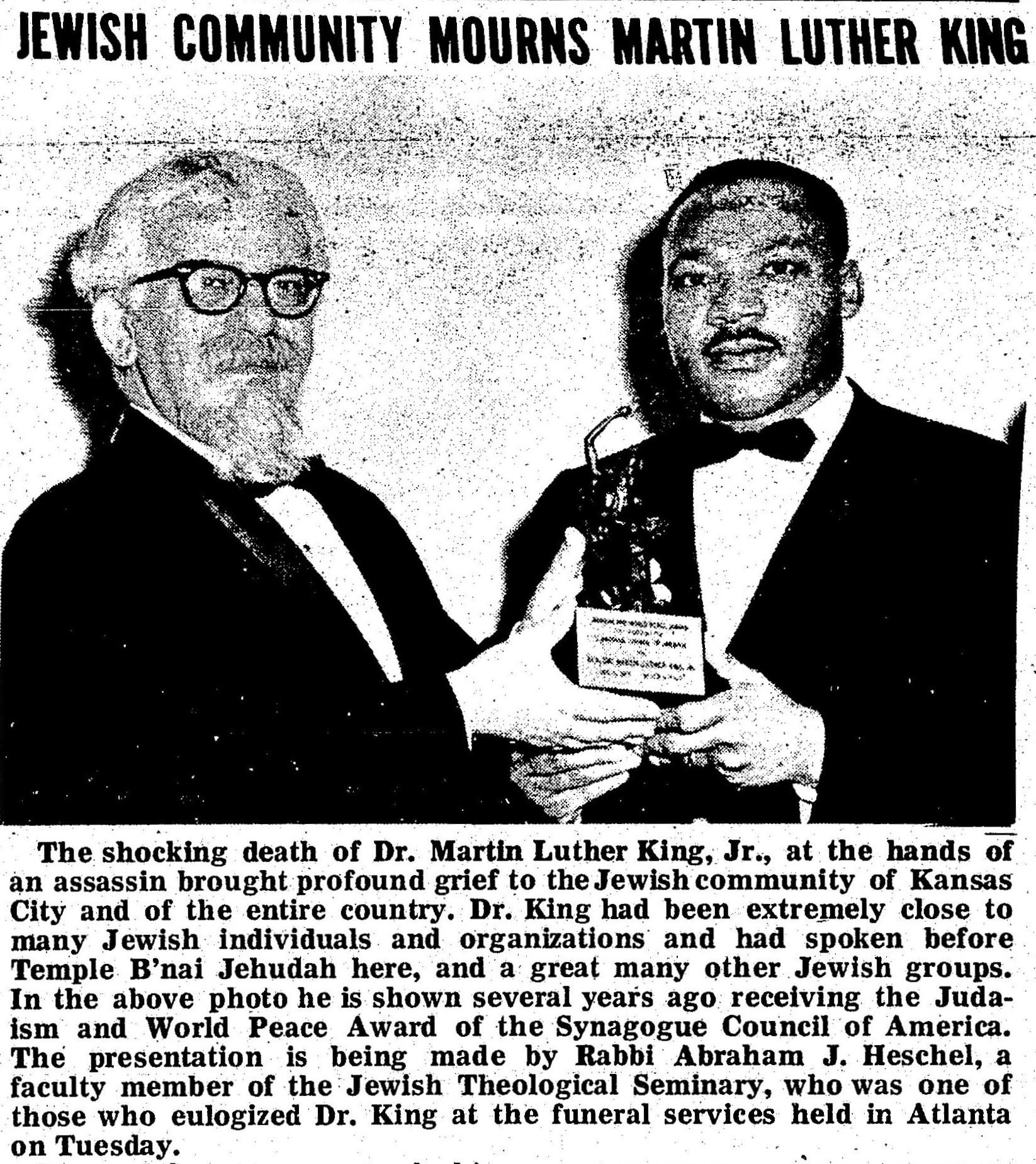
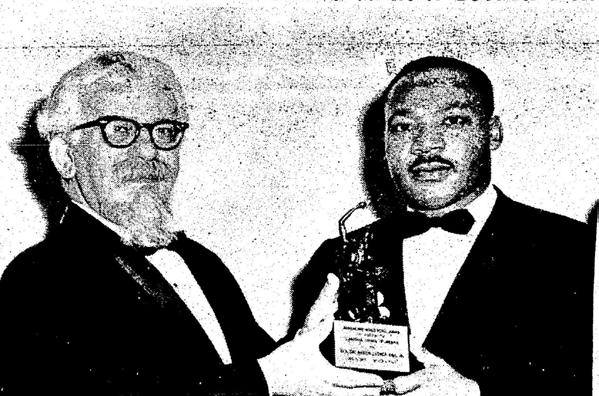
A clipping from the April 12, 1968, issue of The Chronicle after the assassination of Martin Luther King, Jr. The featured photo includes Rabbi Abraham Heschel, whose relationship with the Civil Rights Movement is covered in PBS’ “Black and Jewish America: An Interwoven History.”
“The ‘Grand Alliance’” — Tuesday, Feb. 17 at 8 p.m. — tracing the 1960s’ “Grand Alliance” as Black and Jewish communities fought for civil rights in an interracial coalition and the imbalances that quickly tested their alliance.
“Crossroads” — Tuesday, Feb. 24 at 8 p.m. — examining the shifting Black and Jewish relationship from the 1970s onward, exploring political gains, global tensions, rising hate and the enduring lessons of coalition building and solidarity.
The Jewish Community Foundation is currently accepting scholarship applications for teen and young adult Jewish summer programming. Three different JCF funds offer support.
The Karen and Ed Porter Jewish Experience Award Fund provides onetime aid for programs or Jewish travel experiences that foster leadership development, spiritual development, community development or personal Jewish enrichment. Priority is given
to high school or college students marginally connected to the Jewish community or questioning their Jewish identity. Awards are based upon merit. Financial need may be taken into consideration.
The E. David Soltz Israel Scholarship Fund is a need-based scholarship intended to assist high school or college students seeking to attain a deeper understanding of Judaism while studying in Israel.
The Allen and Janet Agron Camp Ramah Scholarship Fund is intended to help students attending Camp Ramah in Wisconsin. Allen Agron fondly remembered his years as a camper there and wanted to share that joy with others. Scholarships of up to $1,000 for four-week camp sessions and scholarships of up to $2,000 for eight-week camp sessions are available. Decisions will be based on merit and financial need relative to the total expense of
The following are the deadlines for articles, celebration announcements, Spotlight pictures, advertisements and editorials for upcoming Chronicle print issues. If you have any questions, please contact Sam Kricsfeld at samk@jewishkc.org.
Feb. 12
Feb. 26
the camp session attended.
Application forms may be found at JCF’s website at jcfkc.org/scholarships. Applications and letters of recommendation are due by Saturday, Feb. 28.
More information is available by emailing Beatrice Fine at bfine@jcfkc. org or calling (913) 327-4618.
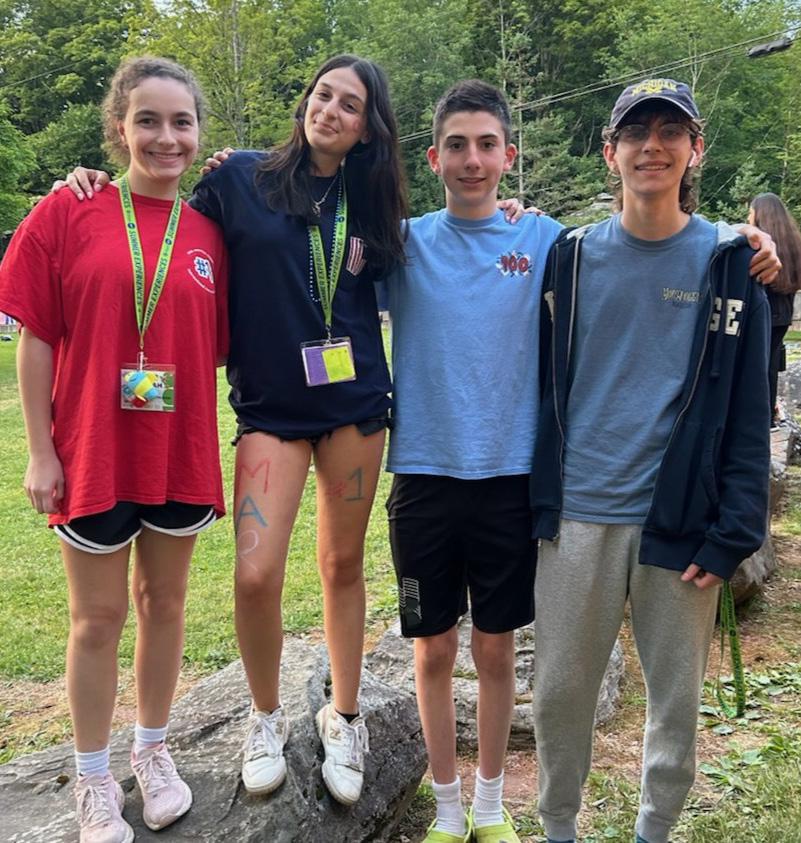
Jewish Family Services (JFS) has announced leadership team changes, with promotions made to help it “continue delivering outstanding service built on a strong organizational culture and solid operations.”
“I am truly grateful to lead alongside such a talented and dedicated group,” said Angela DeWilde, JFS executive director and CEO. “Organizational success often comes from having the ‘right people in the right seats,’ and these changes affirm that truth for JFS. With this team in place, the future of JFS is bright, and I couldn’t be more excited for what lies ahead.”

Melanie Hayden has been promoted to chief advancement officer. In this role, Hayden will oversee all aspects of development and external affairs, including fundraising, marketing and volunteer engagement. A member
of the JFS team for nearly six years, Hayden has grown into leadership roles, becoming a key strategic voice for JFS. According to JFS, her ability to think ahead, build strong relationships and execute with precision has made her an integral leader.
Jodie Cottrell has been promoted to chief financial officer and director of human resources. Cottrell first joined JFS in March 2025 as controller during
a time of significant organizational transition. Since then, Cottrell has been instrumental in strengthening JFS’ financial health and transparency. According to JFS, her leadership in building the 2026 organizational budget showcased her strategic vision and collaborative style. Cottrell is deeply committed to excellence and works closely with the entire team to gather diverse perspectives when making financial decisions.
Other JFS leadership team updates include:
• Chief Gifts Officer Debbie Bass (formerly chief development officer) — According to JFS, Bass’ expertise and energy for working with donors and stakeholders has made a tremendous impact over her four years with the organization.
• Chief Operations Officer Dayton Isbell (formerly chief technology officer) — Isbell’s title change reflects his expanded responsibilities in facilities, fleet management and organizational compliance. Nearing his fifth anniversary at JFS, Isbell has played a role in building and optimizing the systems that keep the organization running smoothly behind the scenes.
• Chief Program Officer Maggie Haghirian — Haghirian continues her leadership in her fourth year as CPO. Haghirian has been at JFS for over seven years, guiding program growth and supporting staff and community partners through times of transition.
• Director of Program Monitoring and Evaluation Hayden Rand — Rand has been a JFS staff member for nearly six years and joined the leadership team in May 2025. Rand combines a data-driven approach with a commitment to understanding the human side of impact.
continued from page 2
dedicated to the city, and they feel a lot more looked out for.”
Over the past year, Wenger estimates he has met and interacted with more than 100 Jews in and around Olathe. Much of his outreach happens one-on-one, long before people attend formal programs.
“I still go to people’s houses, people’s offices,” he said. “We bring them challah and things like that, and those interactions help people realize that [Jewish] part of themselves that they have always had, but was never a priority.”
Echoing other metro Jewish leaders, Rabbi Wenger said many Jews appreciate the personal connection they build with him through his outreach work. Those relationships help community members connect to Jewish life, “but doesn’t feel overwhelming to them as they start to get more in touch with their Jewishness,” he said.
Chabad of Olathe’s programming has grown organically: a weekly “brunch and learn,” holiday barbecues in the park, Friday night dinners and a men’s gathering called “Brisket and Bourbon.”
“It’s to get young professionals away from the house, away from work, just to get them out a little and in tune with
their Jewish identity,” Rabbi Wenger said.
This past Hanukkah, Wenger helped organize what he believes was the first public menorah lighting in Olathe’s history.
“We had a seven-foot menorah outside,” he said. “We made the blessing and spoke about Hanukkah and sang songs, then we went back inside to have some brisket.”
He is now working to reach Jewish seniors living in assisted-living facilities across the city.
“These are people in their 80s living in Olathe, sometimes the only Jews in their building,” Rabbi Wenger said. “They really appreciate Jewish life coming to them. It’s also a great opportunity to get others from Olathe involved by volunteering to bring Jewish joy to seniors.”
In Midtown and downtown Kansas City, another model is emerging that deliberately separates community-building from synagogue membership — a potential monetary barrier that can also be intimidating for more secular-minded Jews. For some, hesitation stems from concerns about aligning with a synagogue or rabbi’s political or cultural views; from the feeling that formal membership can be rigid or intimidating; or from the sense that joining means being locked into a major
commitment.
In October, Julia Patterson, who works with Congregation Kol Ami through a Menorah Heritage Foundation Radical Inclusion Grant, launched the Kansas City Metro Jewish Collective, a grassroots group aimed at Jews living north of the southern Johnson County corridor.
“Some people are intimidated when they hear a synagogue is connected to something,” Patterson said. “They think, ‘If I go, they’re going to expect me to join.’ We don’t want people to feel like that.”
The group hosts game mornings, coffee meetups and holiday dinners in neighborhood spaces and local restaurants. A recent gathering at Tannin Wine Bar in the Crossroads District drew participants from different parts of the metro.
“People just want community,” Patterson said. “They want friendships. They want to belong.”
Patterson, who is in the process of converting to Judaism and raising a Jewish family, said many people she meets are simply looking for a low-pressure way to connect.
“We’re trying to create a community that feels open and flexible,” she said. “People can come, they can eat something, they can do something fun, and there aren’t any strings attached.”
She said outreach in a spread-out
metro area often depends less on formal lists and more on personal connections.
“The Jewish community here is amazing at connecting people,” Patterson said. “Once you make one friend, your whole web grows.”
For Stangler, one of the most important parts of outreach is easing the hesitation many unaffiliated Jews feel about approaching institutions at all.
“Sometimes a person who is not affiliated gets wary when they hear that a congregation’s rabbi will be in attendance, because they say, ‘Well, I’m not a member,’” she said. “But our rabbis here are so community minded and so eager to engage people in their Judaism in any way.”
She said what distinguishes Kansas City is how broadly that attitude is shared.
“It’s a very holistic view that rabbis have taken of the Kansas City community,” Stangler said. “Very few cities come together the way ours do, to include everybody.”
As Jewish families continue to settle across the metro, that willingness to meet people where they are may shape the future of Jewish life here more than any single building ever could.
Thisisthelastofatwo-partseries.
In partnership with the Kansas City Ballet, The Ben Rubin Parkinson’s Wellness Program at The J is expanding its offerings with the addition of a new dance class designed for individuals living with Parkinson’s disease. The program works to foster connection and overall wellbeing through accessible, engaging programming.
Fully funded through a grant from the Missouri Arts Council, the new class marks the program’s first dancebased offering and its 15th total class. The Ben Rubin Parkinson’s Wellness Program currently serves 85 participants through 14 classes.
Taught by professionals from the Kansas City Ballet, the one-hour class offers gentle, guided movement designed to support balance, coordination, flexibility and memory. Participants may move seated or standing and follow simple prompts and choreography. No prior dance experience is required.
Classes are taking place until May 20 on Mondays and Wednesdays at 1 p.m. at The J. For more information or to express interest in the class, people can contact Dawn Aronoff at dawna@
thejkc.org or (913) 327-8028.
As The Ben Rubin Parkinson’s Wellness Program continues to grow, new offerings like this one align with its long-term goal of serving as a community hub for Parkinson’s wellness resources. Past partnerships have included art therapy programming with Saint Luke’s. The current collaboration with Kansas City Ballet expands the program’s emphasis on movement and music-based engagement.
While designed for existing Parkinson’s Wellness Program participants, the dance class is open to the community. Attendance is capped at 12 participants to support small-group engagement, with instruction paced to meet individual needs.
In addition to the new dance class, The Ben Rubin Parkinson’s Wellness Program offers a range of group fitness options designed to support individuals living with Parkinson’s disease at varying stages. Classes vary in intensity and include fast-paced formats with floor work, as well as seated options, with safety being the program’s top priority. Programming is designed to be both challenging and
engaging while remaining accessible to participants at all levels.
Movement is a central component of the program’s approach. According to the Parkinson’s Foundation Parkinson’s Outcomes Project, increasing physical activity to at least 2.5 hours per week can slow the decline in quality of life for individuals living with Parkinson’s disease. Research has also shown that aerobic exercise can enhance cognitive functioning, including learning, memory and problem solving.
“What makes our program unique is the way we combine fitness, community and ongoing support,” said Aronoff, the supervisor for Parkinson’s Programming at The J. “In addition to classes for people at different stages of Parkinson’s, we offer a monthly ‘Chat and Share’ meeting and a weekly gentle yoga class for care partners. During classes, care partners often gather informally, creating a welcoming and supportive community of their own.”
Additional program details and resources are available at thejkc.org/ parkinsons.
continued from page 1
mainstream democratic societies. No longer.”
When asked if there are historical precedents for governmental responses to recent antisemitic incidents (such as the burning of Beth Israel Congregation in Jackson, Mississippi and the shooting on Bondi Beach in Australia), Harris answered that for too long, antisemitism has been “underestimated, rationalized or neglected.” He said that the “avowedly pro-Palestinian stance” of Australia, as well as Britain, Canada, France, Ireland and Spain, causes “collateral damage to the Jewish community [through] relentless criticism of Israel and, essentially, embrace of the Palestinian narrative.”
The anti-Zionist narrative, Harris said, is embedded among journalists and editors at mainstream news agencies such as the BBC, The Guardian and The New York Times.
“But the biggest question,” he said, “is how to overcome the impact of social media lies and distortions repeated daily and reaching millions, if not billions, of people worldwide — and
especially young people who are often ill-equipped to distinguish fact from fiction.”
Harris’ call to action for Jews in Kansas City and around the world remains the same as in 2024: to intensify Jewish identity with “no fear. No apology. No trembling knees… educating young Jews to feel proud, knowledgeable, and confident, including, centrally, forming a deep connection to Zionism
and Israel.”
He also underlined the importance of advocacy organizations such as ISGAP, which Harris joined in 2022, to grasp “the seismic changes at hand in a post-Oct. 7 world,” as well as finding allies who understand the threats of antisemitism.
More information about Harris is available at isgap.org/david-harrisexecutive-vice-chair-isgap.
The Temple, Congregation B’nai Jehudah, in partnership with Taglit Birthright Israel and organizations Israel Outdoors and Amplify Israel, is offering a Birthright Israel Volunteer experience for Reform Jewish adults ages 26-50. Kansas City will be one of multiple communities participating.
The trip, spearheaded by B’nai Jehudah’s Rabbi Stephanie Kramer, will be a Tel Aviv-based volunteer program from July 7 through 16. Created by the Stephen Wise Free Synagogue’s Amplify Israel initiative, the trip was created in response to Oct. 7 and the need for volunteer support in Israel.
Attendees will volunteer fourto-six hours per day on projects such as supporting farmers who lost their workforce, assisting in rebuilding efforts in communities impacted by the Israel-Hamas War and providing other logistical and community support where it is needed most. Evenings and weekends will be generally open for personal exploration.
The free program includes shared accommodations, staff support and medical insurance. A $50 registration fee is required, and optional group flights are available.
“Early Bird” preregistration is open until Feb. 15 at israeloutdoors. com/reform by choosing the Kansas City option. After preregistration, applicants will be contacted for an interview and next steps.
More information is available at israeloutdoors.com/reform.
The following bowlers achieved high scores in the Sunday Kansas City B’nai B’rith Men’s Bowling League at Ward Parkway Lanes on Jan. 18.
500 Series: Brian Wright 733 (278 245 210)
Ryan Thomas 657 (205 222 230)
Hunter Thomas 650 (190 259 201)
Zachariah Archie 634 (247 196 191)
Mark Newton 619 (170 222 227)
Chase Lee 618 (192 222 204)
Steve Thomas 617 (232 186 199)
Adam Russo 554 (222 168 164)
Kent Verden 544 (193 192 159)
Eldredge 521 (131 178 212)
Pollack 519 (157 203 159)
Jones 519 (151 179 189)
Eisman 501 (152 191 158)
Game:
Morty Rock 533 (161 170 202) Steve Baraban 524 (185 172 167)
Katzif 176
J Allen 173
If you are interested in bowling during the ‘25-’26 season for a competitive, fun, social atmosphere, you can contact Tom Balke at (913) 244-7010 or balketw@yahoo.com or Stuart Pollack at (913) 957-3716 or skp28@aol.com.
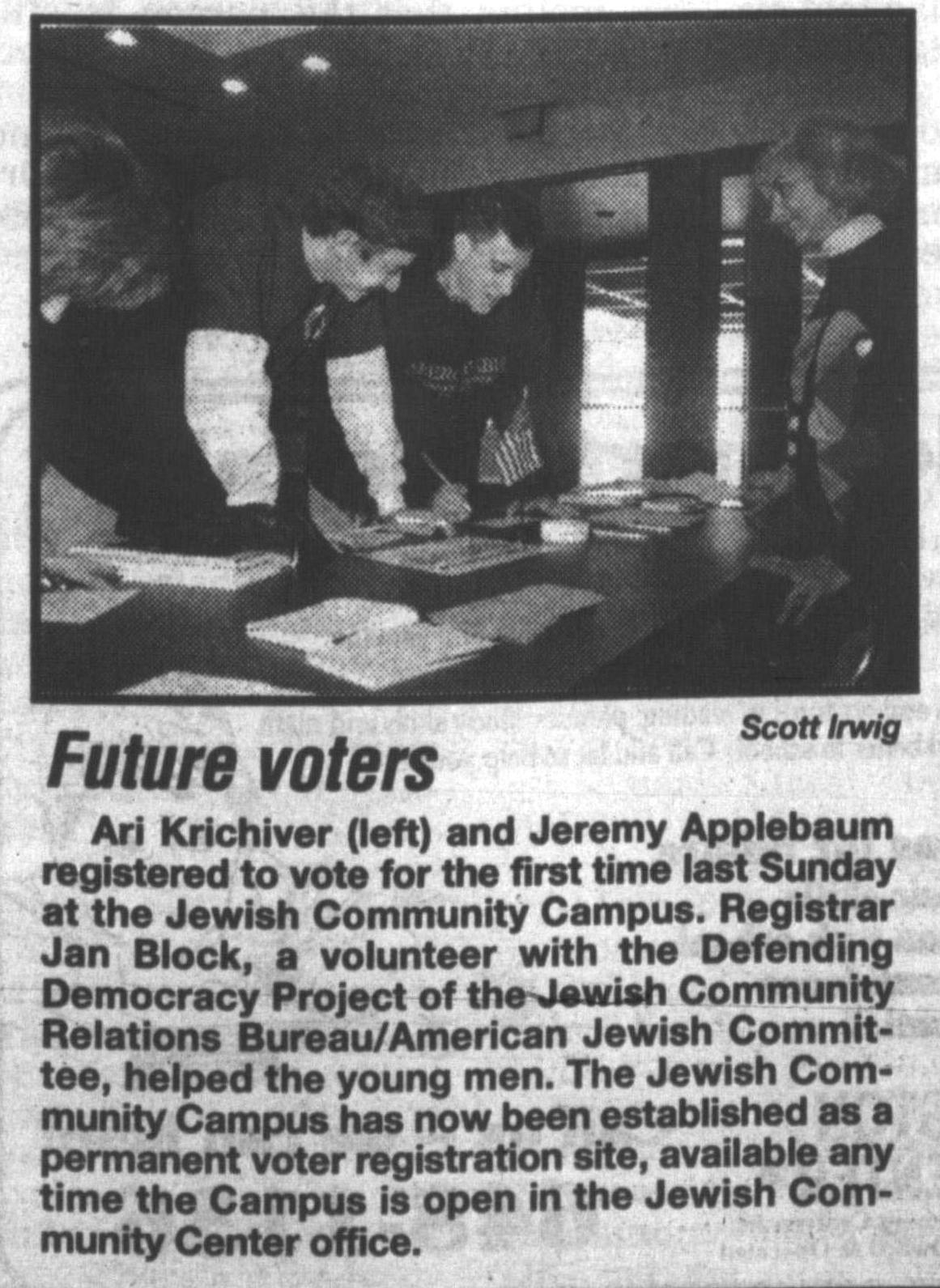
Find more community history at kcjc.com/archive.

Using The Chronicle’s archives and community submissions, here are some recipes for you to try out. Email samk@jewishkc.org with a recipe, and it might be published here!
French Pancakes (a.k.a Crepes)
KCJC, 1931
Ingredients
• 1 cup flour
• 2 tsp. baking powder
• ½ tsp. salt
• 2 eggs
• 1 tbsp. sugar
• 2 cups milk
• ½ cup cream
• Jam
• Powdered sugar
Instructions
1. Sift together flour, baking powder and salt
2. Beat eggs, sugar, milk and cream, then add to powders (batter should be very thin)
3. Heat small frying pan in which a little butter has been melted
4. Pour in sufficient batter to cover bottom of pan
5. Cook over hot fire, then flip and brown the other side
6. Spread with jam and roll up
7. Sprinkle with powdered sugar and serve hot
Get yourself, your family and your friends subscriptions to The Chronicle!
Scan the QR code below or go to kcjc.com/subscribe for more information.


• “Black and Jewish America” (pg. 3)
• Camp scholarships (pg. 3)
METRODIASPORA DAVIDHARRIS BLACKANDJEWISHAMERICA CAMPSCHOLARSHIPS JFSLEADERSHIP DANCECLASS VOLUNTEERISRAELTRIP THEPLAYTHATGOESWRONG WOODBLOCKPRINT PEOPLEARELIKE RABBIZEDEK WHITETHEATRE THANKYOUALEXIS
• Dance class (pg. 5)
• David Harris (pg. 1)
• JFS leadership (pg. 4)
• Metro diaspora (pg. 1)
• “People Are Like...” (pg. 9)
• “The Play That Goes Wrong” (pg. 8)
• Rabbi Zedek (pg. 9)
• Volunteer Israel trip (pg. 5)
• White Theatre (pg. 8)
• Woodblock print (pg. 8)
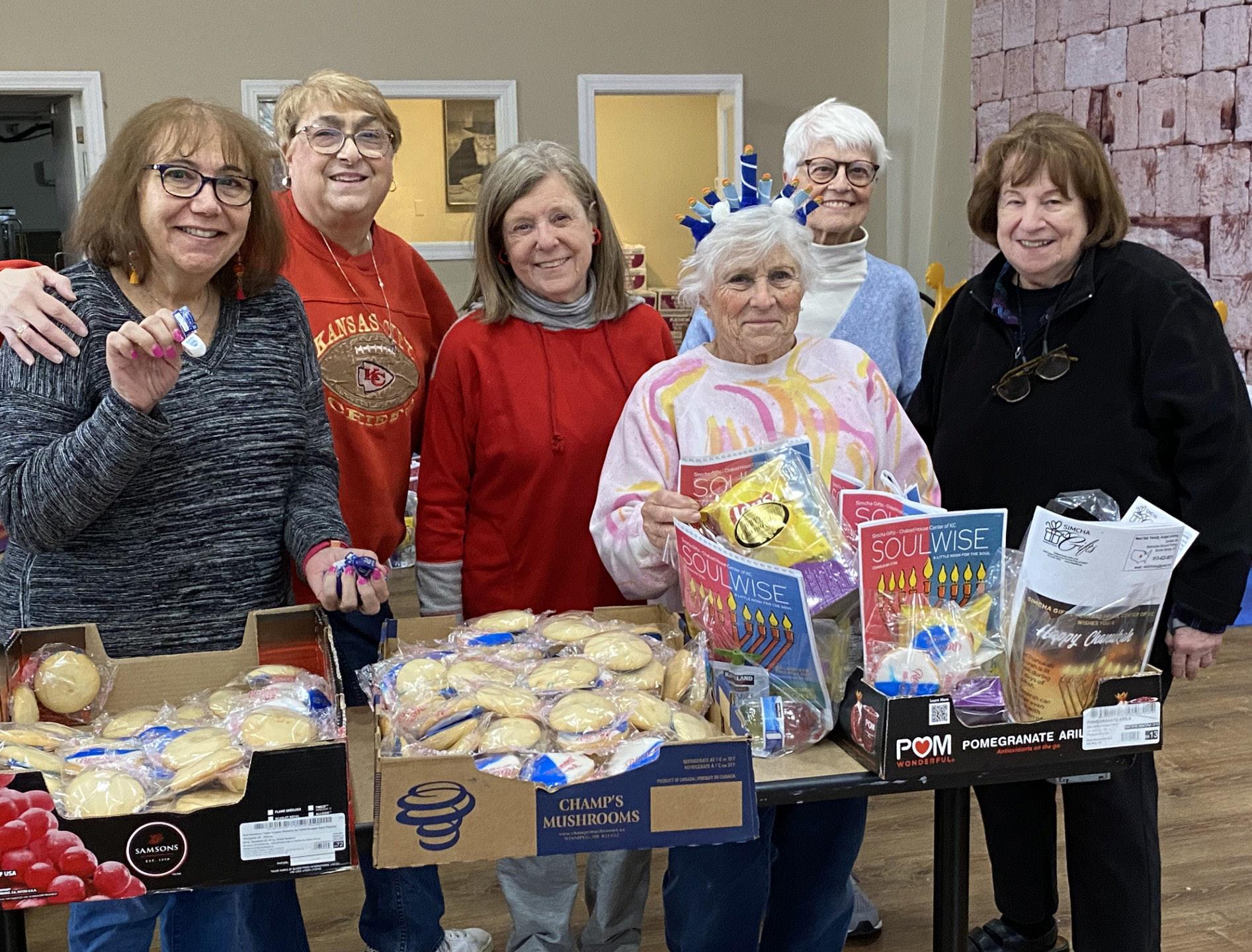
Simcha Gifts distributed 1,004 holiday packages to senior communities and people in their homes for Hanukkah. Committee members and volunteers from across the community helped plan, pack and deliver the gifts. Pictured are (from left) Diana Bright, Marsie Bornstein, Jean Zeldin, Susan Erenberg, Shirley Unell and Barbara Frager.
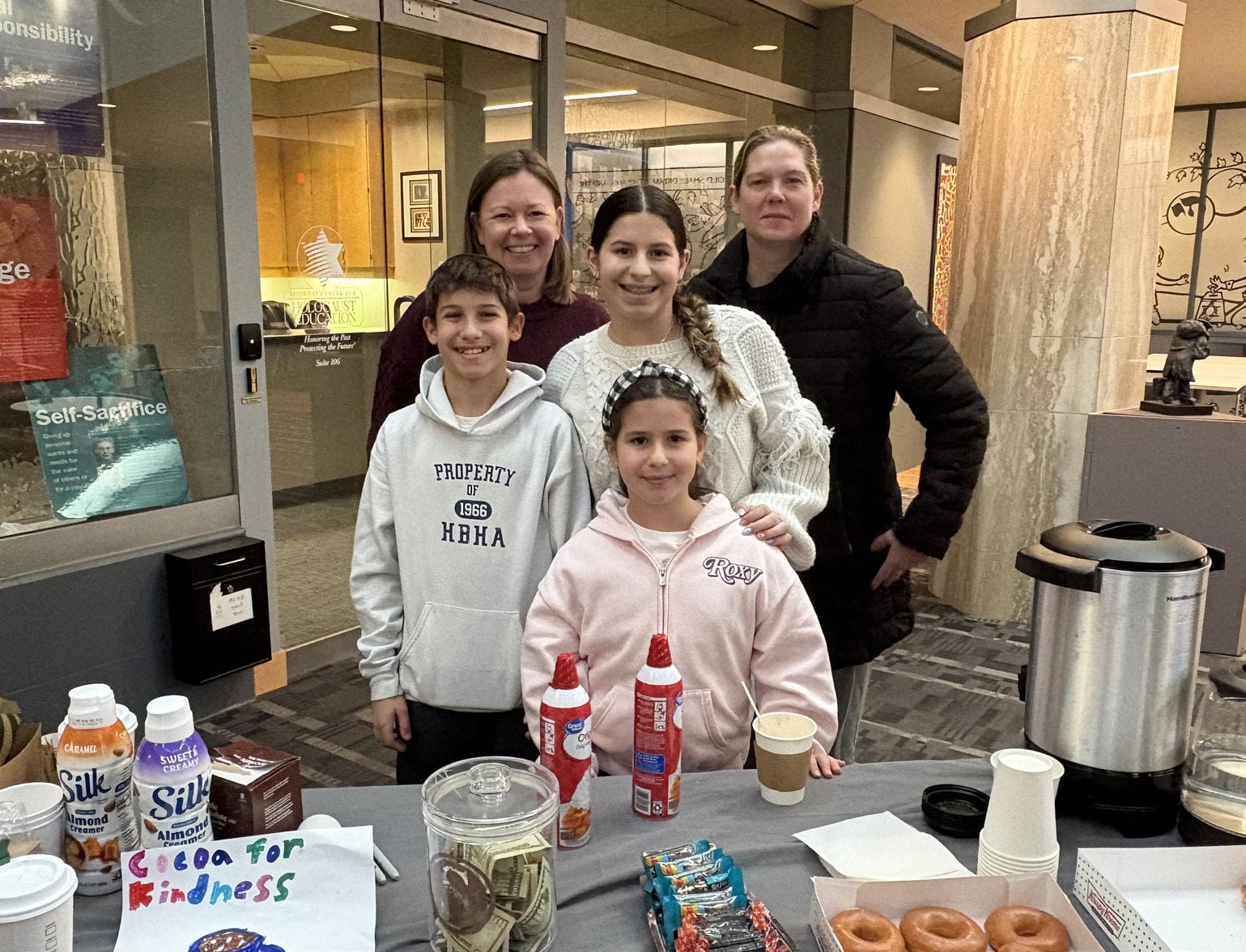
Noah and Danielle
Rockhold
for
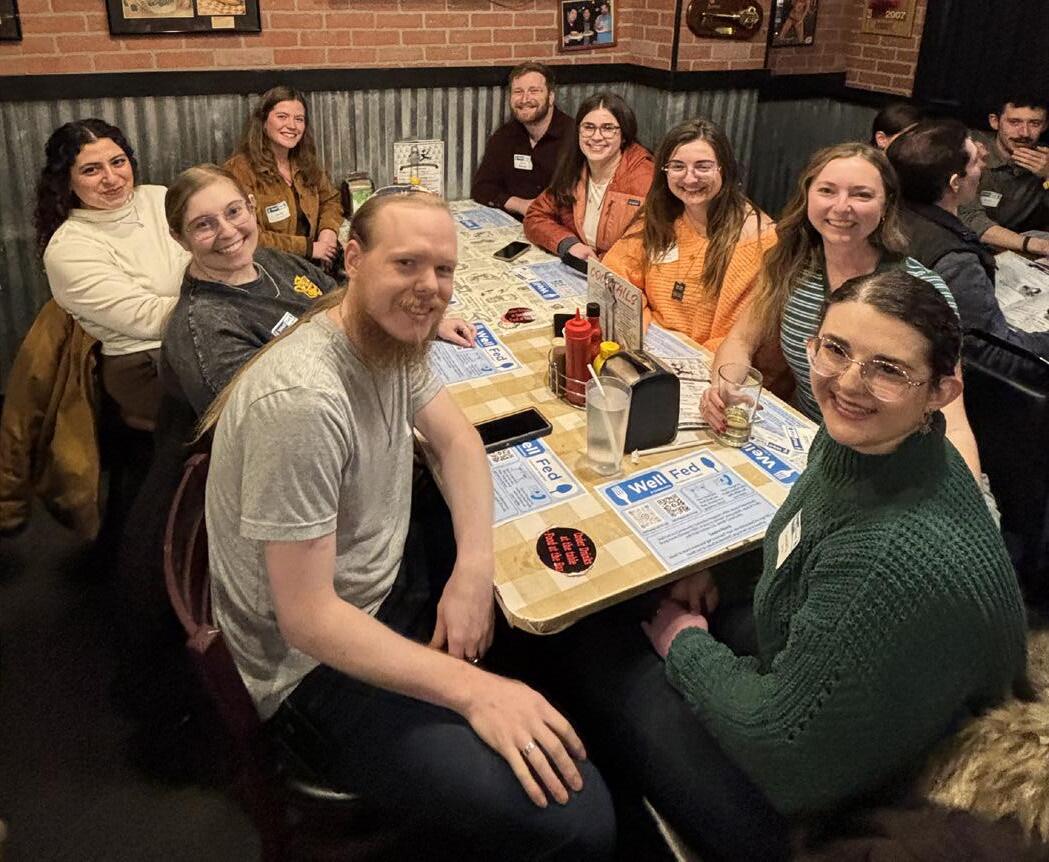
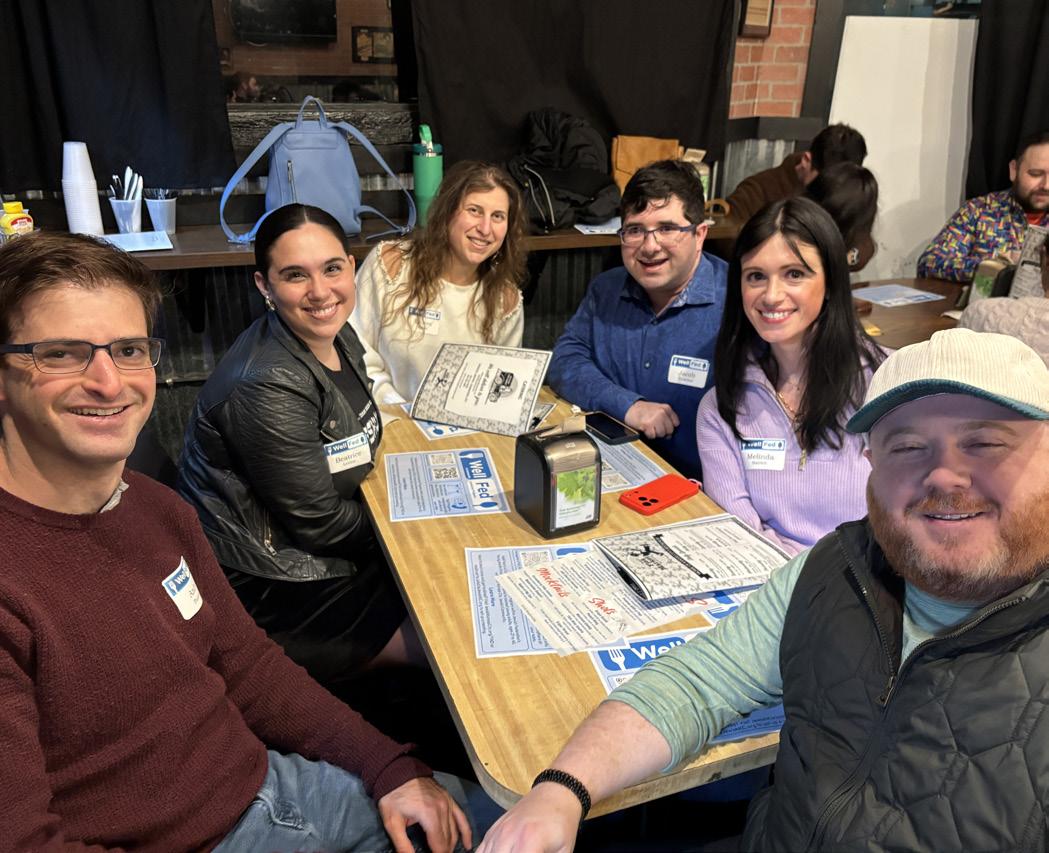
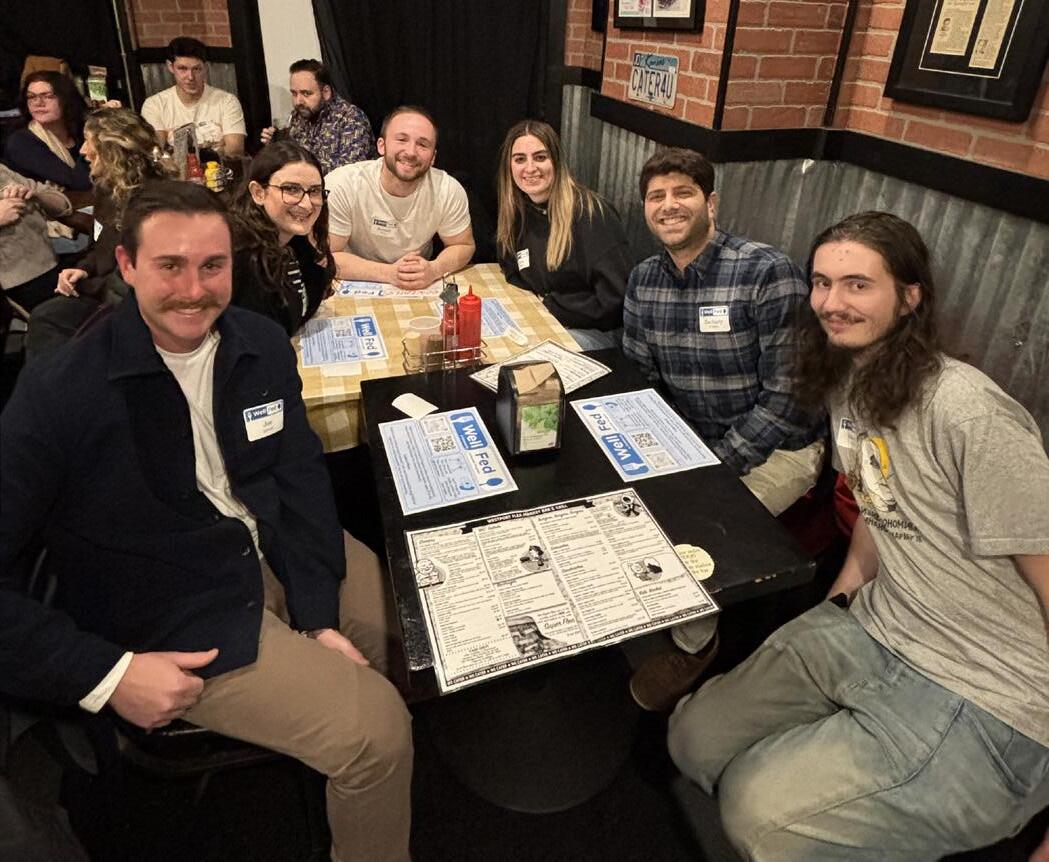
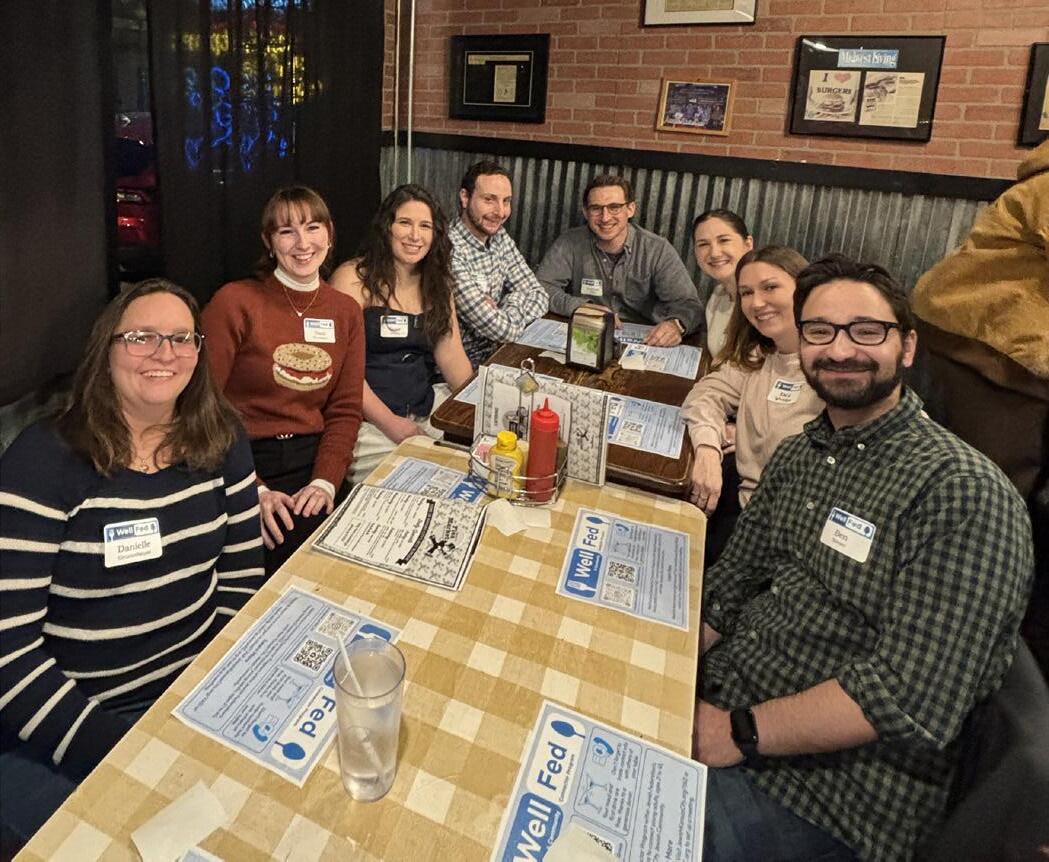
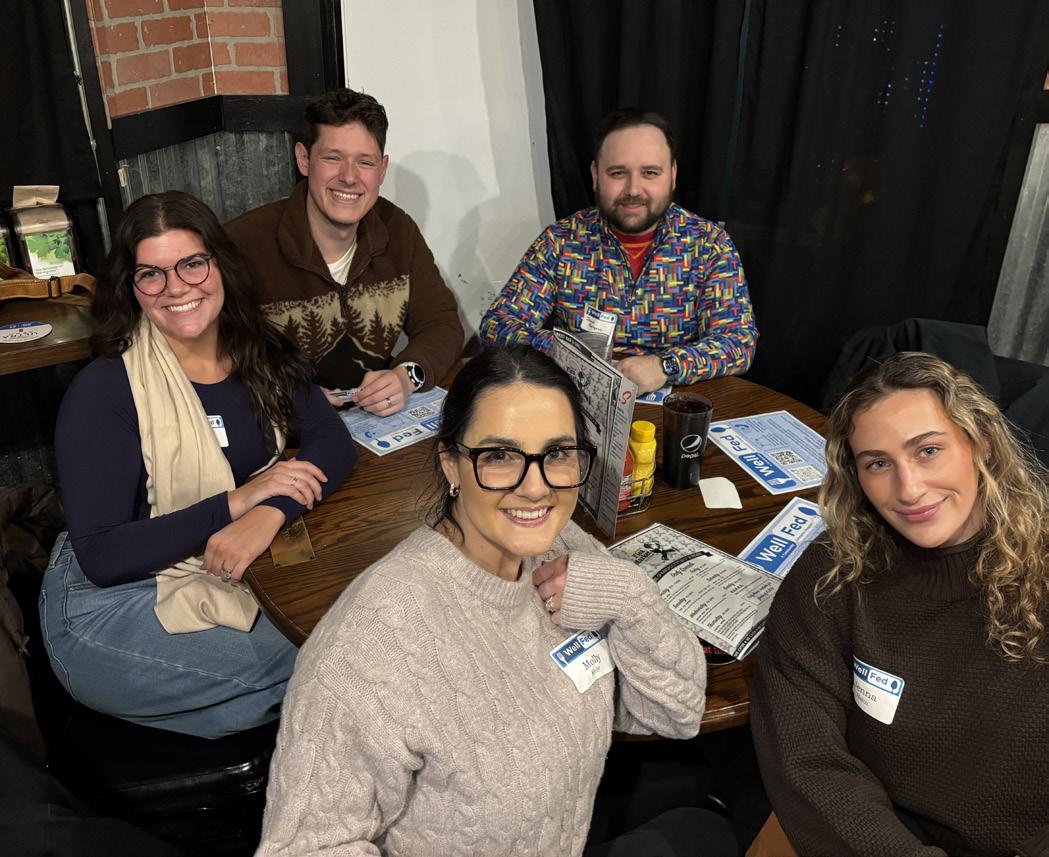
Jewish Federation’s Young Adults Division (YAD) hosted its January Well Fed dinner at Jewish-owned restaurant Westport Flea Market. Pictured (top row, from left) are Andre Platzman, Beatrice Levine, Lauren Ruben, Jacob Elyachar, Melinda Barrett and Jay Gilman; Danielle Gruenebaum, Dani Thompson, Grace Dorman, Jacob Halpern, Greyson Rubin, Paige Holmes, Katie Whiston and Ben Novorr; (clockwise) J. Purkaple, Amalia Newman, Dahnya K., Abby Fincher, Jack Harte, Leslie Liebenau, Alexa Summers, Julia Osburn and Danielle Rope; (bottom row, from left) Joe Lernor, Shaina Falk, Roman Katz, Alexa Feldman, Zach Ruben and Matvey Tabakh; (clockwise) Molly Kiely, Brooke and Daniel Moreira, Jason Kotlyarov and Jenna Haith.

Eleanor Rose Meer, daughter of Shayna and Aaron Meer of Aurora, Colorado, was born on Sept. 20.
Eleanor’s grandparents are Dr. Mitchell and Lisa Hamburg of Leawood, Kansas; Lisa Weiss of Denver, Colorado; and Larry Meer of Doral, Florida. She is the great-granddaughter of Audrey Held of Denver.

Desiree and Jaime Mahnke of Leavenworth, Kansas, celebrated their sixth wedding anniversary on Jan. 15.
The Olivier Award-winning comedy “The Play That Goes Wrong,” part of The J’s 2025–26 Theatre Series, will be performed at The Lewis & Shirley White Theatre in March.
Tickets are available now at thewhitetheatre.org. Performance dates and times include Saturdays, March 14, 21 and 28 at 7:30 p.m.; Sundays, March 15, 22 and 29 at 2 p.m.; and Thursdays, March 19 and 26 at 7:30 p.m.
“The Play That Goes Wrong” is a farce that follows the well-meaning but ill-fated Cornley Polytechnic Drama Society as it attempts to stage a classic murder mystery, only for everything to unravel. Collapsing sets, missed cues, forgotten lines and misplaced props send the production into chaos as the actors grow increasingly desperate to keep the show on track.
“The physical comedy in this production is unlike anything you find in most shows,” said Heather Ives, who plays Chris. “It requires a cast that is willing to play, explore and fully com-


mit to the physical opportunities written into the script. That dedication to the comedy is one of the reasons ‘The Play That Goes Wrong’ is one of my favorite pieces of theatre.”
Featuring performers who stumble over everything, including their lines, and a corpse that cannot stay dead, the production has been praised as “a riotous explosion of comedy” by the Daily Beast and “tons of fun for all ages” by HuffPost. Audiences and critics alike have embraced the show’s fast-paced humor, with Cindy Adams of the New York Post offering a one-word review: “GO!”
Written by Henry Lewis, Jonathan

“Simchat
By Ellie Holsten
Ukrainian-born American artist Ilya Schor was known for his charming depictions of shtetl communities. This woodblock print shows a Simchat Torah celebration in a synagogue with figures dressed in attire consistent with an Eastern European Jewish community of the late 19th century.
Shtetl narratives in American Jewish art and literature in the early 20th century served two main purposes. On one hand, they created nostalgia and provided an anchoring narrative for immigrants and diaspora. On the other hand, shtetl stories could validate immigration by showing the negative conditions immigrants had left, including violence, poverty and rural
Sayer and Henry Shields, “The Play That Goes Wrong” is directed by David Martin at The Lewis & Shirley White Theatre. The production is recommended for ages 8 and up, runs approximately two hours and includes a 15-minute intermission.
“At its core, it’s about people doing their best while everything goes wrong, something everyone understands,” said Jason Shipps, who plays Dennis. “The humor is physical, fast and visual, so you don’t need any theater experience.”
More information about the cast and play is available at thewhitetheatre.org.
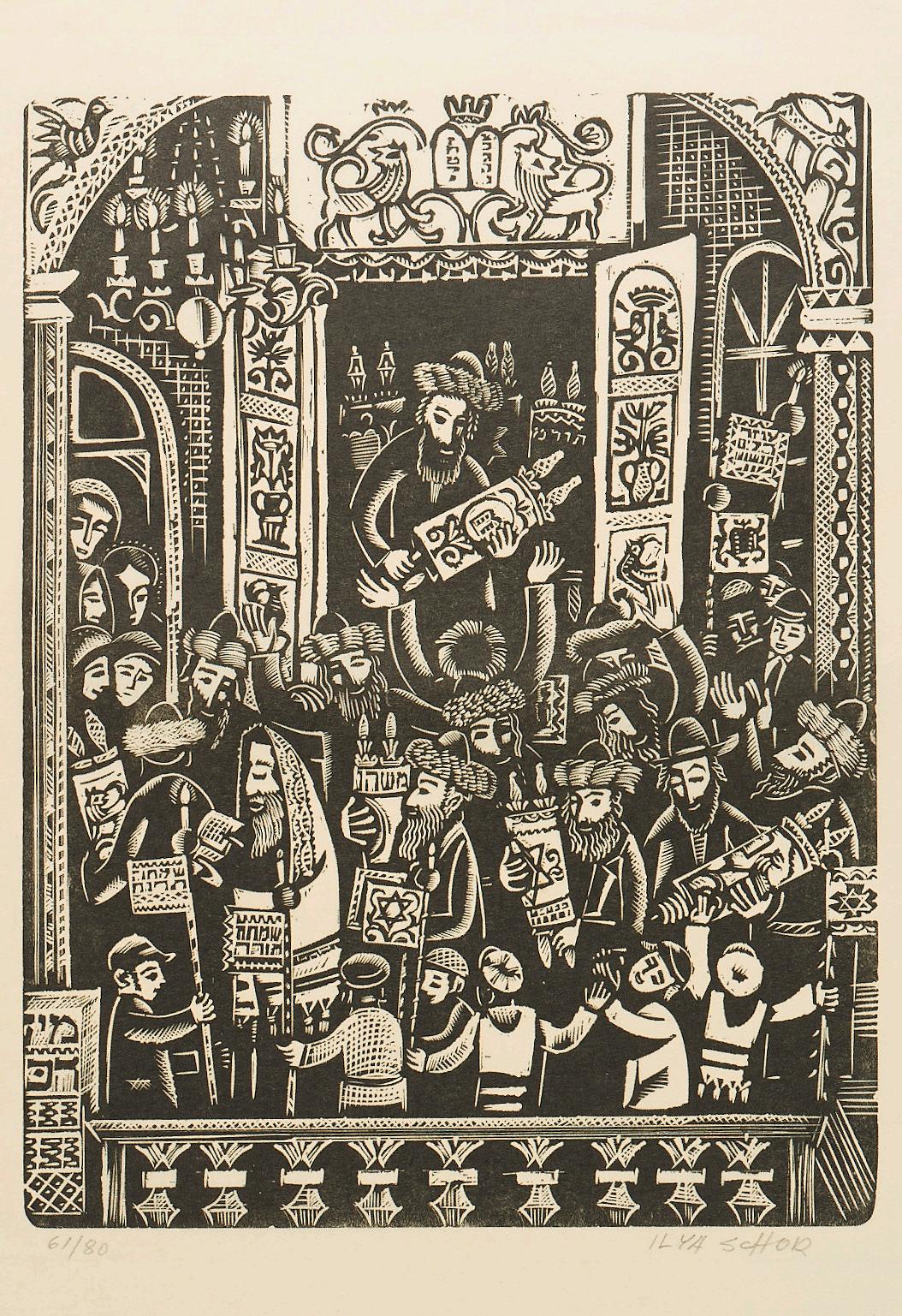
isolation.
As visible from the joyfulness and warmth in this woodblock print, Ilya Schor was an artist who enjoyed depicting the romanticized version of the shtetl. Though he made work dealing with the brutal realities of violence in Europe, he is best known for these loving portrayals of the communities of his ancestors.
More information about the Michael Klein Collection at the Temple, Congregation B’nai Jehudah can be found at kleincollection.org or by calling (913) 663-4050 to schedule a tour.

Rabbi Michael Zedek, rabbi emeritus of both The Temple, Congregation B’nai Jehudah and Chicago’s Emanuel Congregation, has released his first children’s book, “People Are Like… Stories for Young Readers and Readers Who Wish to Stay Young.” All proceeds from the book will go to scholarship programs for students in need.
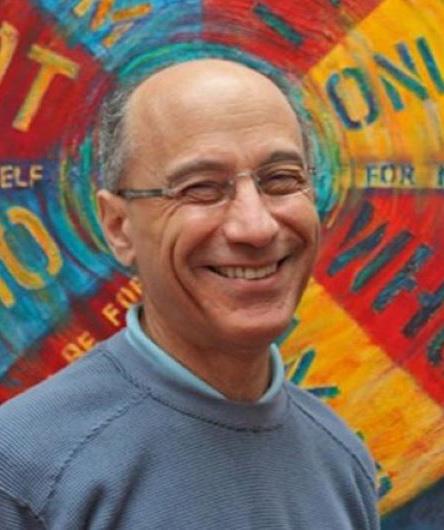
Rabbi Michael Zedek
“People Are Like…” is a compilation of nine short stories accompanied by illustrations by Isabel Cristina Tejada Carrasco. These stories each contain life-lessons and are intended for children ages 4-12 years old.
“People Are Like…” is Rabbi Zedek’s second book, following 2024’s “Taking Miracles Seriously: A Journey to Everyday Spirituality.”
“Stories have an ability to remind us of what we need to do, and they sometimes even have the capacity to outflank our resistance to doing it,” Rabbi Zedek said. “...All of the stories are meant to try to generate cross-generational conversation and convey a notion of empathy and compassion. I don’t think it’s a great leap to recognize that those are items in short supply nowadays, and we need them desperately.”
Though none of the stories are intended for a strictly Jewish audience — Rabbi Zedek doesn’t even use the title “rabbi” as the listed author — some of them trace back to Jewish roots, and all of them are “implicitly Jewish in that they teach values,” he said.
The oldest of the nine stories, “Harry the Hippo,” traces its roots back to 1974, when Rabbi Zedek was
the assistant rabbi at B’nai Jehudah and was tasked with giving the Rosh Hashanah sermon at the children’s service. “Diamond in the Rough” is based on a 1700s parable by the Maggid of Dubno, Rabbi Yaakov Kranz, about a king desperate to repair his damaged diamond.
The last story in the book, “Inside Out,” was inspired by a quote that Rabbi Zedek overheard from a little child decades ago at B’nai Jehudah on 69th and Holmes. He remembers the little girl saying, “Mommy, if God is bigger than we are and God lives in us, wouldn’t God show through?” From this, Rabbi Zedek shares about how many people have a joy and wonder that make the world special, and that everyone can try to act kind and help others.
The book has garnered praise from U.S. Rep. Emanuel Cleaver II; community member and philanthropist Shirley Bush Helzberg; Church of the Resurrection Senior Pastor Adam Hamilton; and children’s author and musician Jim Cosgrove.
“One of the reasons why I’m so excited about this book is that I’m not going to make a penny from it,” Rabbi Zedek said. “A generous person in our community met the cost of publishing so that we could make any proceeds benefit scholarships for needy kids. That’s precious to me.”
In addition to Amazon, “People Are Like…” is available at Turn The Page (at MCI Airport), Rainy Day Books, The Learning Tree, Unique Finds –Overland Park, Revocup Town Center and Made in Kansas City stores.

r a n d p a r e n t S h a b b a t
G a t h e r f o r c o f f e e a n d i d e a s o n J e w i s h
g r a n d p a r e n t i n g ! F e b r u a r y ’ s t o p i c i s
“ D o c u m e n t i n g J e w i s h M o m e n t s a n d S t o r i e s ”
h o s t e d b y R a b b i R a c h e l R o t h s t e i n
M A R C H 7 | 7 : 1 5 P M
P J L i b r a r y M o m ’ s N i g h t O u t
J o i n y o u r f e l l o w P J L i b r a r y m o m s f o r a
r e l a x i n g a n d s o c i a l n i g h t o u t , c o m p l e t e
w i t h D I Y p a t c h p r o j e c t s a n d d e s s e r t !
M A R C H 8 | 1 P M
P J O u r W a y a t C a r d b o a r d C a f e
2 n d t h r o u g h 6 t h g r a d e r s a r e i n v i t e d t o
g a t h e r a n d g a m e a t C a r d b o a r d C a f e w i t h P J
O u r W a y a n d o u r p a r t n e r o r g a n i z a t i o n s !
Editorials express the view of the writer and are not necessarily representative of the views of The Kansas City Jewish Chronicle staff, the Jewish Federation of Greater Kansas City, or the Kansas City Jewish Community as a whole.
By Suzanne Galblum Dicken JCF Director of Philanthropy
The new year is a natural time to reflect on your charitable goals and clarify how you want to make an impact. With a bit of thoughtful planning now, your charitable giving in 2026 can feel more intentional and aligned with the results you’d like to achieve. Below are some meaningful steps you can take early in the year to bring clarity and confidence to your philanthropy.
Review your 2025 giving
Taking time to review your charitable contributions from 2025 can reveal valuable insights: the causes that resonated most deeply, the organizations you supported consistently and the ways your giving made a difference. This reflection can also highlight patterns in how and where you gave and help identify new
opportunities you’d like to explore.
Set your philanthropic goals for 2026
Intentional giving begins with clear goals. Whether you’re passionate about supporting Jewish education, helping vulnerable populations or responding to emerging community needs, defining your priorities can make your philanthropy more focused.
As you plan for the year ahead, consider questions such as:
• Which values guide my giving?
• What community needs feel most urgent right now?
• Do I want to support immediate relief, long-term change or both?
• How and when do I want to distribute my charitable dollars throughout the year?
The Jewish Community Foundation team can help you explore causes aligned with your values, identify communal giving opportunities, plan the timing of your giving and consider strategies that amplify your impact.



Charitable giving is closely tied to tax and estate planning. Early year conversations with your professional advisors may help you take advantage of new or updated tax laws, plan gifts strategically for maximum tax benefit and review your estate plans and beneficiary designations. Many people choose to include charitable gifts in wills, trusts or retirement accounts to create a lasting philanthropic legacy.
The Foundation offers easy, creative ways to make a significant impact with your giving. Whether you’d like to
memorialize a loved one, support a community organization in perpetuity or simply streamline your charitable giving, JCF can help you achieve your philanthropic goals. When you open a new JCF donor advised fund (charitable giving account), the Foundation will match one donation to the charity of your choice — up to $1,000. Please reach out to the Jewish Community Foundation anytime to discuss your ideas, ask questions or explore opportunities for the year ahead. We are honored to partner with you in turning generosity into lasting impact, for today, for 2026 and for generations to come. I may be reached at sdicken@jcfkc.org or (913) 327-8286.
By Sara Glass Director of the Weiner Religious School at Congregation Beth Torah
Happy (secular) New Year in 2026!
Only in Judaism do we get four New Years to celebrate. The ancient Jewish calendar organized time around the spiritual, agricultural, legal and ritual rhythms of life. Instead of expecting one date to do all the heavy lifting, our tradition created four “start lines” to mark four different kinds of beginnings:
1. Rosh Hashanah (1 Tishrei), the birthday of the world and our spiritual reset.
2. Tu B’Shvat (15 Shevat—coming up Feb. 2), the “New Year of the Trees.”
3. 1 Nisan, the New Year for kings and festivals and the gateway to Passover.
4. 1 Elul, the New Year for animal tithes — and today, a soulful warmup for the High Holy Days.
These New Years made sense in a world shaped by farming, harvest cycles and Temple offerings. Just like we now have a school year, fiscal year and calendar year, ancient Jews needed multiple “beginnings” to keep life organized. Now, since many also celebrate Jan. 1 as a new year, American Jews get five New Years — which, if you ask me, is five reasons to celebrate at the Weiner Religious School (WRS).
As we moved through the flurry (or glorious downtime) of winter break, the halls of Congregation Beth Torah continue to glow with laughter and learning. Hanukkah brought its usual spirit of resilience and renewal, and we saw that shine through in our students each week. Our young learners continue to grow in class as thinkers, friends and emerging Jewish leaders. Our teachers also stretched their skills — experimenting with new Hebrew continued on next page
continued from previous page techniques for the second semester and deepening their work with Torah, holidays, values and Jewish culture. We remain deeply grateful for our WRS families, whose creativity, partnership and feedback help shape everything we do.
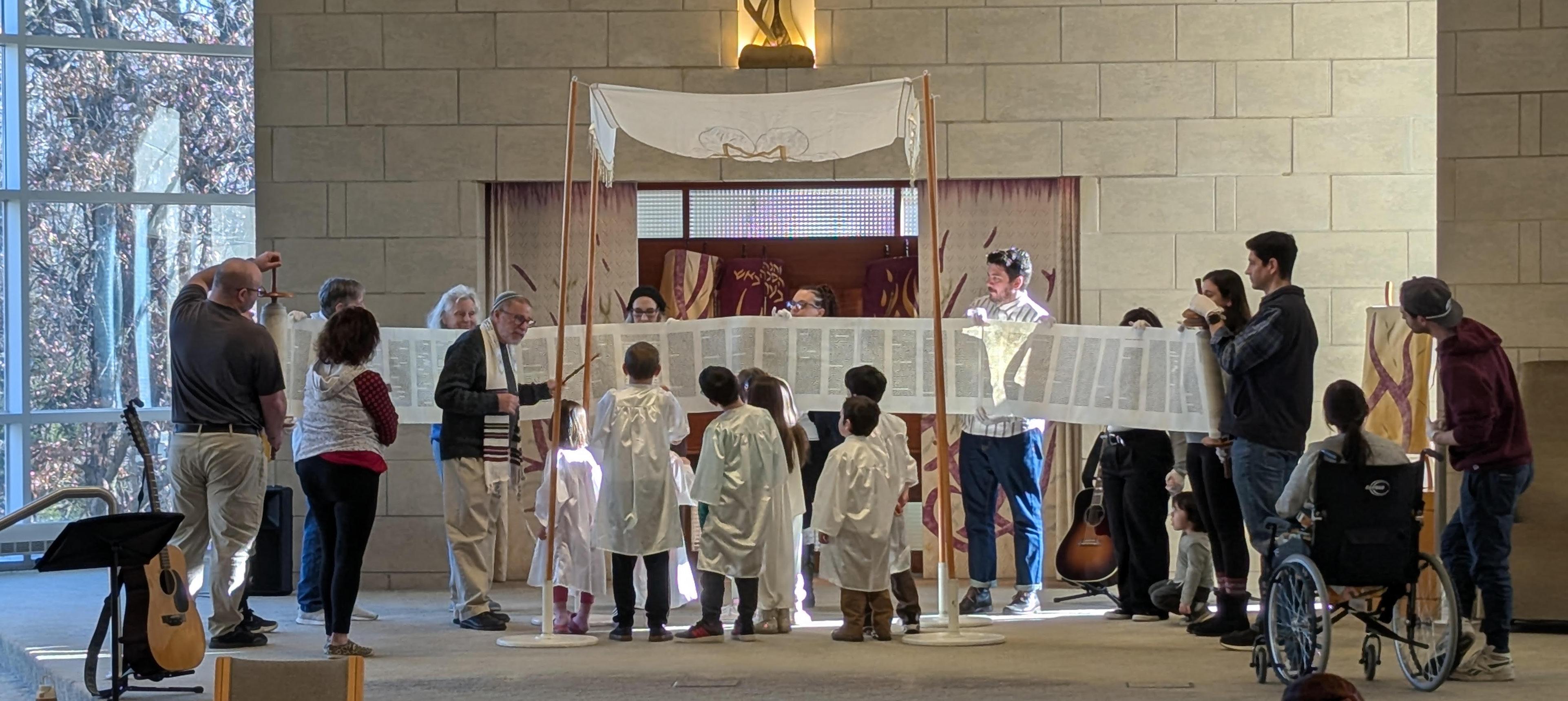
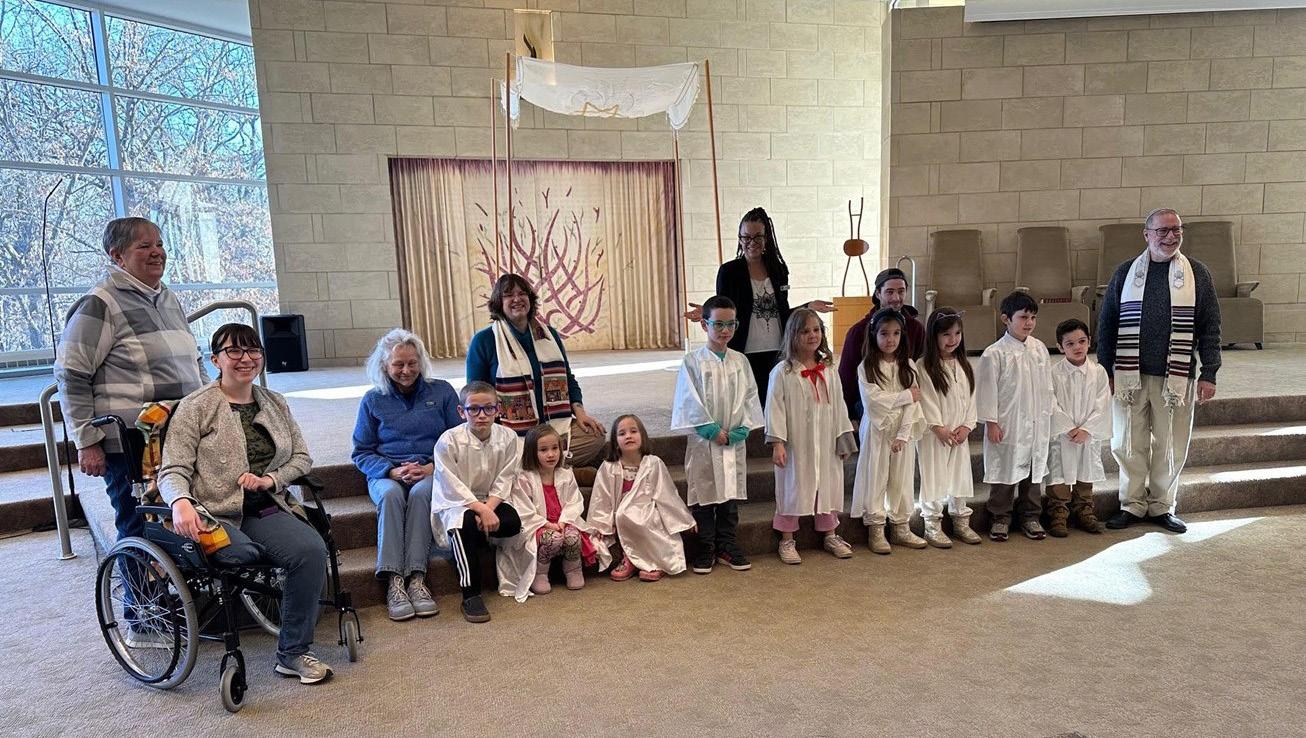
One of the brightest moments of the year was our beautiful consecration ceremony on Jan. 11 during “Shavua Tov T’filah” with Rabbi-in-Residence Steve Burnstein and Music Director Lezlie Zucker. Consecrants gathered beneath our chuppah on the bima as parents and children stood before the Torah. In this moving ritual, parents wrapped their children in a symbolic Torah while the congregation recited the Shema and other prayers. Consecration marks the beginning of a child’s lifelong Jewish journey — toward b’nai
mitzvah, confirmation and a lifetime of Torah. We are so proud.
Our values came alive again through tzedakah when Beth Torah partnered with Repair the World, the CBT Social Justice Committee and Harvesters for our “Birthday in a Box” mitzvah project. Thanks to the generosity of our community, we collected cake mixes, frosting, candles, balloons and other party supplies to bring birthday joy to dozens of families.
As we step into spring, we carry the warmth of Hanukkah and the promise of Tu B’Shvat with us — reminders that our roots grow deeper when we nurture one another, and our light shines brightest when shared. Whatever milestone or New Year you’re celebrating, remember: Judaism teaches that life has many beginnings, and each one deserves its own blessing.
Ethel Ardow
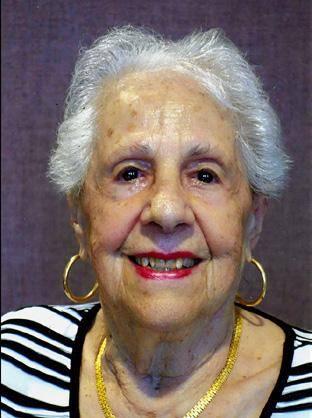
Ethel Ardow, born on June 22, 1928, in Będzin, Poland, passed away peacefully on Jan. 20. She was one of six children born to Cyvia and Henoch Obornik and lived a life defined by resilience, devotion to family and a deep love for people.
Ethel was a Holocaust survivor whose courage and strength shaped everything that followed. She outlived most of the people who tried to murder her and carried that survival forward with grace, gratitude and an unshakable spirit.
She married Elias “Luscha” Ardow of Stockholm, Sweden, and devoted herself to caring for him throughout his life. She continued working for as long as she was able so she could provide for and take care of her beloved husband.
Ethel worked for 40 years at the New York Bakery and Delicatessen, where she became a beloved fixture in the community. People would stop her wherever she went to say, “You used to make me the best sandwiches!” She delighted in seeing her grandchildren and familiar faces come to visit her at the bakery, always welcoming them with warmth and joy.
Ethel always had a smile on her face and a positive word of encouragement for everyone she met. She loved going to The J for water aerobics and massages, and she took great joy in cooking and baking for those she loved. Saturday nights were often spent hosting lively card games, a tradition she cherished.
lives she touched. Her warmth, humor, resilience and generous spirit will be deeply missed and forever remembered.
She is survived by her children, Sylvia Agard (James (z”l)) and Edward Ardow of Stockholm, Sweden.
Her grandchildren are Michael Agard of Fukuoka, Japan; Alyssa Agard of Prairie Village, Kansas; and Anja Folkman (Trevor Lyall), Erik Bääth Ardow (Christoffer Svensson) and Isabella Bääth Ardow, all of Sweden. Her great-grandchildren include Laura Folkman Lyall and Katrina Folkman Lyall of Sweden. She is also survived by her nieces and nephews.
In lieu of flowers, the family suggests contributions to the Midwest Center for Holocaust Education, Kansas City Hospice or a charity of one’s choice.
Graveside services were held on Jan. 22 at Mt. Carmel Cemetery.
Online condolences for the family may be left at louismemorialchapel. com.
Ronnie Baker
Ronnie Baker, 83, passed away on Jan. 10.
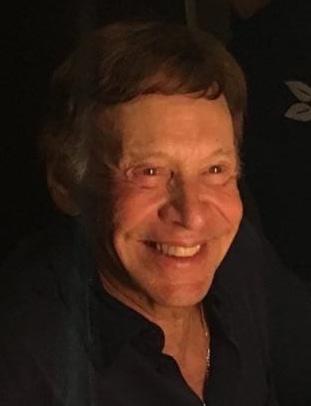
Ronnie was born on Feb. 15, 1942, in Kansas City, Missouri, to Harry and Ruth Baker. He graduated from Shawnee Mission East High School and went on to start college at the University of Oklahoma, finishing his B.A. in sociology and government business at the University of Missouri. Ronnie moved back to Kansas City to work for his father and uncle, Lou Bak-
Above all, Ethel delighted in her family and the many people whose continued on next page

By Bridey Stangler PJ Library
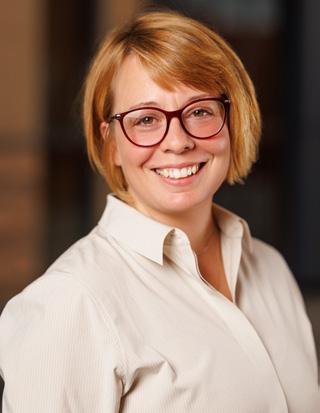
See me at 20, charging through my college campus with hand-painted signs, writing letters, following megaphones, clapping, chanting, calling for justice for fillin-the-blank. I was full of the just fire of youth.
Married with children whatfeels-like a lifetime later, I have come to value little more than a peaceful and simple environment in which to raise my children. I want quiet. I want bicycles, tire swings and friendly police officers. I even wrote in these pages just days before the election that we should all calm down — more eloquently, of course.
In recent months, though, my desire for placidity has started to rub up against a basic sense of what is right. Don’t worry — this isn’t about politics. This isn’t even about the death of a woman in Minnesota, whose Good name is now the point of such contention.
This isn’t about politics.
This is about teaching our children to deal loyally and compassionately with one another regardless of origin and not oppress the stranger, even if we’re not quite sure how they came to be here (Zechariah 7:9-10).
This is about instilling in children kindness toward those who seek refuge under God’s wings (Ruth 2:12) — or really that we act with kindness toward everyone.
This is about proving that we do not stand idly by while our neighbor bleeds (Leviticus 19:16) — or has his door broken in, or keeps his children from playing outside, or is pulled over to show his papers.
This is about showing our children that even the governance of the people is subject to the dictates of human compassion; even our laws must be exercised and enforced with a sense of humanity.
Because I have grown to value
calm and measured responses to all things, I have bristled at comparisons of our current state to Nazi Germany. I have found them hyperbolic, distasteful and even a bit offensive. But what else does one think of when watching a video of men in uniform — with no warrant, according to the AP — beating down the door of a house with the butt of an assault rifle? When a woman can be heard asking again and again for a warrant, and another telling children to bar themselves in a bedroom? When a man in handcuffs is shoved through the wreckage of the front door and face-first into the snow?
This isn’t about whether or not that family belongs here. As the 18th-century Rabbi Simchah Bunim of Pshimcha says, even the pursuit of justice must employ only just means.
As Jews, we are commanded 36 times in the Torah to welcome the stranger. This isn’t about politics or politicians or immigration policy. This is about the humanity with which we treat each other and the humanity we demand of those who govern us. This is about generational memory, which whispers in the ear of every American who ever sat in a history class and every Jew, whose grandparents came here from virtually anywhere.
I am no longer the crusader with posters and loudspeakers — much power and respect to those who are. But I’m also no longer the parent who seeks only peace for my child. I want my son to see me at 40, taking a stand for the humane treatment of every person. I want him to relay, years from now, how he learned to balance righteous anger with a desire for peace. I want him to know when the most measured and reasonable response is to act for what is right.
Tzedek, tzedek tirdof: justice, justice you shall pursue (Deuteronomy 16:20).


As the unveiling ceremony for a friend of mine approaches, I wonder which name the family will choose for her headstone: her real name or the one she made up. As she told me years ago, when her life hit a particularly rocky patch, she invented a new first and last name for herself. “It was kind of a do-over,” she explained.
I know several others who have done the same. One friend changed her first name three times until she found one that fit. I heard tell of someone taking the surname of “Goodlife” because that’s what she wanted the rest of her life to be.
As it turns out, assuming a new moniker is a “typically Jewish” practice. A relative of mine attempted to save her dying husband with the name-changing maneuver known as sinui shem. According to this Talmudic strategy, substituting a new name for a gravely ill person will fool the angel of death and prevent their demise. Unfortunately, no angels were tricked in this case. Her husband died shortly thereafter.
Name-changing happens frequently in the Hebrew Bible. Abram becomes Abraham, his wife goes from Sarai to Sarah. Jacob gets renamed as Israel, Hosea becomes Joshua and Gideon is renamed Jerubaal.
Each new name reflected a change in status, identity or destiny. In the case of Abram/Abraham and Sarai/Sarah, altering just a few letters is all it took. I wonder if anything dramatic happened to my great-grandfather, who lost an “e” from his last name — going from Stolove to Stolov. Years later, balancing out the alphabetical universe, my mother reclaimed the discarded letter by adding an “e” to her first name, going from Betty to Bettye for several years. When I asked her why she did this, she replied, “I liked the way it looked.”
But for many Jews, names do more than just appear attractive on paper. They help identify fellow Jews. Or, at least they used to. As far back as 1942, researchers began compiling a list of what they called Distinctive Jewish Names (DJN) to conduct Jewish population studies. The Jewish community demographer Ira Sheskin later reduced the original list of 35 names to just 29. (Is yours on the list below?)
Sheskin admits the technique doesn’t work on a one-by-one basis. As he told the Jewish News of Northern California, “If a person’s name is Richard Miller, they could be Jewish, you never know.”
Likewise, I know a man named Jeffrey Cohen who is not Jewish. “It messes with people’s minds when they find out,” he told me. And, I know of two men with the first name Chris who are Jewish.
Then there’s the mixed-up moniker of the South Florida clergy of blessed memory: Rabbi Yaakov Thompson.
In my own case, I hesitated assuming the last name Maxwell upon marriage because it didn’t sound Jewish. I relented after our daughter was born so our last names would be the same, but continued to use my maiden name of Kalikow as my middle name to signal my ethnic affiliation.
Now, I’m officially known as Nancy Kalikow Maxwell. So, family — please note. That’s what should be engraved on my headstone.
Berman
Caplan
Cohen
Epstein
Feldman
Freedman
Friedman
Goldberg
Goldman
Goldstein
Greenberg Grossman
Jaffe Kahn
Kaplan
Katz
Kohn
Levin
Levine
Levinson
Levy
Lieberman
Rosen
Rubin
Schwartz
Shapiro
Siegel
Silverman
Weinstein
Compiled by Ira Sheskin, as reported by Asaf Elia-Shalev, “How These 29 Last Names Became a Cheat Code for Researchers Surveying American Jews,” Jewish News of NorthernCalifornia,April3,2024.
NancyKalikowMaxwellisaKansas City native and award-winning author. Her book, “Typically Jewish,” is available through the Jewish Publication Society or Amazon. Her website is kaliwellinc.com and email is nancykalikowmaxwell@ gmail.com.
continued from previous page
er, in the window cleaning business his grandfather, Morris Baker, started in the early 1920s. He married and had two sons, Kevin and Corey.
When Harry and Lou sold their business, Ronnie and his brother-inlaw, Ron Goldsmith, formed their own cleaning business. From a modest goal of cleaning ten buildings to support their families, over the next 35 years their company BG Service Solutions added security services and employed up to 6,000 people with offices in 10 states. While at BG Service Solutions, Ronnie served as president of Building Service Contractors Association International (BSCAI).
Ronnie married the love of his life, Dierdre Christensen, in 1994 and raised her daughter, Kendra, as his own. Outside of business, Ronnie’s passions were boating and skiing, which he was able to do on family vacations every year.
Ronnie generously gave back to his community through philanthropy and leadership. He truly wanted the best for his community and took a special interest in making sure aging adults had somewhere to reside in dignity, serving as a board member and chair of Village Shalom in Overland Park, Kansas. He served as president of the Jewish Community Center of Greater Kansas City and served on the board of the Flo Harris Foundation, where he took great care to ensure each grant would benefit those in need. In the Vail, Colorado, community, he was on the board of Bravo Vail, which brings
symphonies and musical performances to the Vail community. He was also involved in and on the board of B’nai Vail Congregation and supported charities in the Cabo, Mexico, area.
In retirement, Ronnie and Dierdre divided their time enjoying great friendships and boating and skiing between Vail, the Lake of the Ozarks and Cabo.
Ronnie and Dierdre spent 31 years lovingly married. He was a beloved father and overjoyed with the special bond he had with his grandson, Hillman. Ronnie will be remembered for his great sense of humor, compassion and genuine caring for the people in his life. He had a knack for not only connecting with people but also never losing touch with anyone he met.
Ronnie is survived by his wife, Dierdre; children, Dr. Kendra Perkins (Chase), Corey Baker and Kevin Baker; grandson, Hillman Perkins; siblings, Susan Goldsmith and Bruce Baker (Janet); nephews and nieces, Jeff Goldsmith (Jessica), Michelle Goldsmith, Austin Baker and Gabrielle (“Gabs”) Lalonde (Dylan); great niece, Violet Goldsmith; great nephews, Miles Goldsmith and Solomon Lalonde; and many first cousins.
Donations in Ronnie’s memory may be made to B’nai Vail Congregation, Village Shalom and Congregation Beth Shalom.
Online condolences may be left at louismemorialchapel.com.
continued on next page
continued from previous page
Irene Biederman Ellis, 84, completed her beautiful life on Jan. 14, surrounded by love.
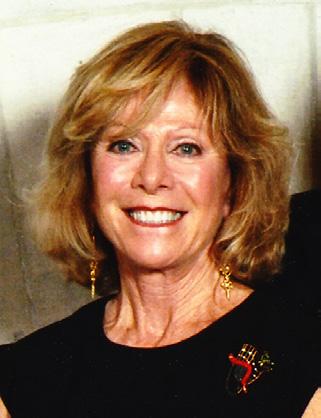
She was born on Oct. 5, 1941, to Reeva and Harry Biederman in Kansas City. She graduated from Southwest High School and attended University of Missouri - Columbia.
Irene was a force. She took charge with a rare blend of strength and kindness. She showed up not just for celebrations but also for challenges. She had a sense that life could change at any moment, and instead of living in fear of that, she made sure to celebrate milestones, offer support during tough times and not miss anything in between.
She had a gift for making people feel welcome and valued. If she loved you, you knew it through her words, gifts and thoughtful gestures. Her easy laugh made her everyone’s favorite audience for a good joke. Witty and quick on her feet, she received compliments with humility, often turning them into a shared laugh.
Irene’s life centered on family. She and husband Saul had two wonderful sons that she loved fiercely, and they gifted her with five adored grandchildren. Extended family dinners were
never complete without more than enough food, spirited political debate and lots of laughter. She didn’t shy away from voicing her views, but she knew exactly how to cut tension and move the group onto other topics. Serving as the family’s central hub, she was the organizer, planner, decorator, communicator and steady presence during life’s big and small moments.
She and her husband, Saul, built a thriving home building/development business, with Irene modifying architectural drawings (always more closets), decorating show models and personally serving as foreman on more than 150 homes as well as 433 Ward Parkway, a mid-rise luxury condo building on the Plaza. Despite it being a male-dominated industry at the time, she garnered respect from the construction crews who appreciated her direct and decisive approach.
She and Saul were fortunate to travel all over the world. They also shared a love of art. Irene had an eye for it, often seeking pieces from young new talent who years later became wellknown artists. Her favorite artist, however, was Saul, who crafted many fine pieces displayed throughout their home.
She was a history buff, Bridge Life Master and tennis player into her 80s. Over the years, she and Saul quietly donated funds to countless organizations in the community. Irene was accomplished in many ways, but her favorite titles were wife, mom, sister, “nana” and friend.
She was preceded in death by her parents, Reeva Biederman Brown and Harry Biederman; and stepfather Paul Brown.
Irene is survived by her husband of 62 years, Saul Ellis; sons James Ellis (Shelley Collins) and Michael (Jessica) Ellis; Mindi Ellis; sister and best friend Phyllis (Shel) Roufa; grandchildren Hersh, Shayna, Jo, Reece and Eliza Ellis, Kassandra (John) Binning, James Jensen (of blessed memory) and Sabrina Collins; sisters-in-law Cynthia Ellis (David Ellis, of blessed memory) and Rita Goldman (Sanford Goldman, of blessed memory); nieces/nephews Gregory Roufa, Brian (Sarah) Roufa, Jonathan Ellis, Elizabeth Ellis (Scott Martin), Rabbi Yehoshua (Raissa) Ellis, Linda Cherwitz, Howard Goldman, Maureen (Larry) Goldstein and Maxine (Roark) Weil; extended family; and lifelong friends that she loved like family.
Funeral service was held on Jan. 16 Louis Memorial Chapel followed by burial at Mt. Carmel Cemetery. In lieu of flowers, the family welcomes donations to Lewy Body Dementia Association, Michael J. Fox Parkinson’s Foundation or a charity of your choice.
The family would like to thank devoted caregivers LaTonia/Chelle Nolen and Shannon Manning, who gently and steadfastly accompanied Irene through her final two years.
Online condolences for the family may be left at louismemorialchapel. com.

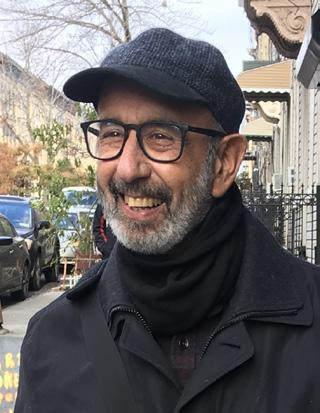
Michael Ginsberg, Ph.D., of Overland Park, Kansas, passed away peacefully from heart disease on Dec. 20. He was born on Nov. 12, 1948, in Brooklyn, New York; lived many places, including Louisville, Kentucky, for 37 cumulative years; and moved to Kansas in 2022 to be close to family.
Michael earned his bachelor’s degree from SUNY Buffalo, master’s degree from the University of Louisville and Ph.D. from Indiana University. After working across the country as a reporter, he found his true calling as a professor at Jefferson Community & Technical College in Louisville. Whether mentoring one of his students, his Little Brother Dennis (matched through Big Brothers Big Sisters) or a stranger he just met, Michael used his humor, intellect and generosity to help others feel loved and empowered. He spent much of his time writing and telling stories. He loved movies, the Mets and Dodgers and the New York Times.
Michael made lasting friendships everywhere he lived. His most cherished friends and memories were from his Teacher Corps service in Louisville in the early 1970s. After retirement, he was a proud member of the Grumpy
continued on next page
continued from previous page
Old Men Club.
As a former chair of the Tikkun Olam committee and co-chair of the education committee, Michael was an active member of Temple Shalom in Louisville. He wrote numerous stories centered around Jewish holidays and was known as Temple Shalom’s maggid. Starting in his children’s public schools, Michael impersonated Hershel and told the story of “Herschel and the Hanukkah Goblins.” Upon his passing, numerous students from many years ago expressed their appreciation and memories of his story telling.
Michael will be deeply missed by his loving wife of 38 years, Jeri Swinton; his children, Perry Swinton-Ginsberg (Aiden McLuckie) and William Swinton-Ginsberg; and his grandson, Kieran McLuckie. Michael is preceded in death by his parents, Percy and Ethel Ginsberg, and his sisters, Karen and Judith.
A memorial service was held at Congregation Beth Torah in Overland Park and at Temple Shalom. As a final act of generosity, Michael willed his body to the University of Kansas School of Medicine. In lieu of flowers, Michael requested donations be made to Big Brothers Big Sisters of Kentuckiana and Doctors Without Borders.
high school activities. Rod also enjoyed his many years in the Boy Scouts and was a very proud Eagle Scout.
After graduating from high school in 1953, Rod moved to New York City, where he attended New York University. He returned to Wichita in 1955 and graduated from Wichita State University. He then relocated to Kansas City in 1957, where he spent his remaining years.
Throughout his life, Rod was a proud Navy veteran. He enlisted in the United States Navy Reserve at age 17 and served eight years. Later in life, he joined MO-KAN Post 605 of the Jewish War Veterans.
Rod met the love of his life, Gerre Lipoff, in 1956. They quickly fell deeply in love and spent 66 wonderful years together. They raised their three daughters, Carole, Lisa and Debbie, in a loving home with their dog, Ginger.
In 1960, Rod joined the field of public accounting and subsequently became a CPA and partner at Deloitte & Touche LLP. After 13 years in the industry, Rod decided to make a career change and left public accounting. He began his career in commercial real estate with Roger L. Cohen & Co., eventually leaving the firm to fulfill his dream of owning his own company, founding Minkin Real Estate Company in 1978.
of 66 years, Gerre; their daughters and their families, Carole (Jeff (z”l)) Rosen, Lisa (Steve) Ruben and Debbie Minkin; and seven grandchildren, Daniel (Deanna) Rosen and Samuel Rosen, Jonathan Ruben, Ashley Ruben and Julia Ruben, and Katie Goldstein and Jessie Goldstein. He is also survived by his sister-in-law and brother-in-law, Judy and Andy Hilvitz, along with many nieces, nephews and cousins.
Rod lived a meaningful and full life, and he will be deeply missed by all who knew and loved him. In lieu of flowers, contributions may be made to Congregation Beth Shalom or Village Shalom.
Funeral services were held on Jan. 18 at Louis Memorial Chapel, followed by burial at Mt. Carmel Cemetery.
Online condolences for the family may be left at louismemorialchapel. com.
Joel was born on Dec. 24, 1938, in Kansas City to Marian Alpert (Zitron) and Samuel Zitron. He graduated high school from Pembroke Country Day, where he played on multiple sports teams. He attended the University of Missouri and completed his BA at William Jewell College. He was married to Yalene Kusnetzky and maintained a deep friendship with her after their divorce. Joel and Yalene had three children together: Isaac David Zitron, Elizabeth Zitron and Aaron Zitron. Joel was married to Barbara Gross and they had one child together, Meredith Adler.
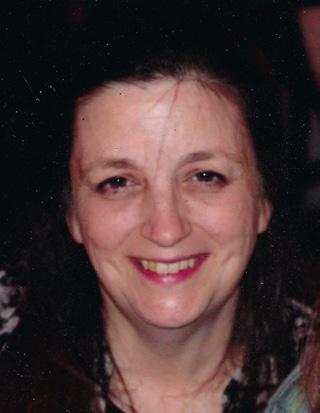
Rivka Tiri Weber, 65, of Overland Park, Kansas, passed away on Jan. 18. Graveside services were held on Jan. 21 at Kehilath Israel Blue Ridge Cemetery.
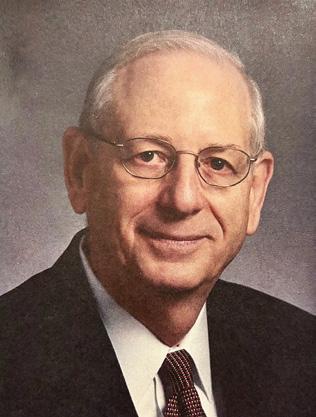
Rodney T. (Rod) Minkin passed away surrounded by his family on Jan. 16 at Menorah Medical Center, where he was born and later served as chairman of its board. Rod was a pillar of the community and a loving father and grandfather. His kindness knew no bounds. His warmth and generosity leave a lasting impact on all who knew him. Rod had a unique gift for making each person he met feel special and valued.
Rod was born in 1935 at Menorah Medical Center, the only child of Carl and Sylvia Minkin. In 1940, his family moved to Wichita, Kansas. His father died in 1952 when Rod was only 16 years old. He cherished his years in Wichita and was very active in several

Rod was deeply involved in the leadership of several organizations, spanning all aspects of his life, both personal and professional. He was president of the Jewish Heritage Foundation of Greater Kansas City, chairman of the Board of Directors of Menorah Medical Center and chairman of the Board of Directors of Village Shalom.
Rod served in leadership positions as a member of the boards of directors of numerous organizations, including Congregation Beth Shalom; Health Midwest; Jewish Community Archives of Greater Kansas City; Jewish Community Center of Greater Kansas City; Jewish Community Relations Bureau | American Jewish Committee; Jewish Federation of Greater Kansas City; Menorah Medical Center Foundation; Overland Park Regional Medical Center; and Vaad Hakashrut of Greater Kansas City.
He loved attending lunch every Friday with his fellow members of the ROMEOs.
Rod is survived by his loving wife

Rivka was born on Aug. 6, 1960, in North Kansas City, Missouri, to Joe and Patricia (Haylan) Meachum. She was married for 24 years until her divorce, and she owned and operated the Shop ‘N Pawn in Independence, Missouri, for 39 years. Rivka was also a member of Congregation Beth Israel Abraham and Voliner.
She was preceded in death by her parents and one brother, Fred. Rivka is survived by her two children, Yosef Weber and his wife Dina and Amalya Weber; her five siblings, Jennifer, Joe, Jean, Tina and James; and her two grandchildren, Netanel Simcha and Chana Leah.
Online condolences may be left for the family at louismemorialchapel. com.
Joel, an Army veteran, was a lifelong lover of athletics. He was a basketball and volleyball coach and a classroom educator. Coach Z, as he was affectionately known, impacted thousands of young people through his love of basketball. Joel was most at home on the court, playing in his younger years then coaching for over four decades. He coached for multiple high schools, universities, colleges and leagues. He mentored countless players, even coaching generations from the same family. Many of his players went on to coach themselves. He kept track of their games and lent his time and expertise to their teams. He rarely missed one of his grandchildren’s games and coached them from the sidelines. Joel had strong opinions about how the game should be played that he never hesitated to share. It was his way of showing love for the players and the game. He never truly retired from coaching.
Baseball was also Joel’s deep love. He was a Royals season ticket holder, even when they were losing. He loved taking young people to games to introduce them to his passion. He was such good friends with the scalpers that his kids thought of them as honorary uncles when they were young. He visited baseball parks whenever possible and would strike up a conversation with anyone wearing MLB fan gear. He was a regular caller to many of the local sports talk radio shows.

Joel Lynn Zitron of Overland Park, Kansas, passed away at home on Jan. 22 with loved ones. Graveside services were held on Jan. 23 at Sheffield Cemetery. Kindly omit flowers. The family requests donations to the Sheffield Cemetery Fund at Congregation Beth Israel Abraham and Voliner, for which he was a passionate advocate and fund-raiser.
Joel also cared about his Jewish community. He served as a shomer at Louis Memorial Chapel, raised funds for multiple local Jewish cemeteries and volunteered his time at multiple synagogues. Joel never liked to be still for too long and always found a cause or project to keep him busy.
Joel is survived by his son Isaac David Zitron; daughter Elizabeth Zitron and son-in-law Paul F. Chapman; son Aaron Zitron and daughter-in-law Bekah Schwimmer Zitron; daughter Meredith Adler and son-in-law Michael Adler; as well as grandchildren Teddy Zitron, Gus Zitron, Asher Tou and Marley Adler. He is preceded in death by his parents, Samuel Zitron and Marian Alpert.



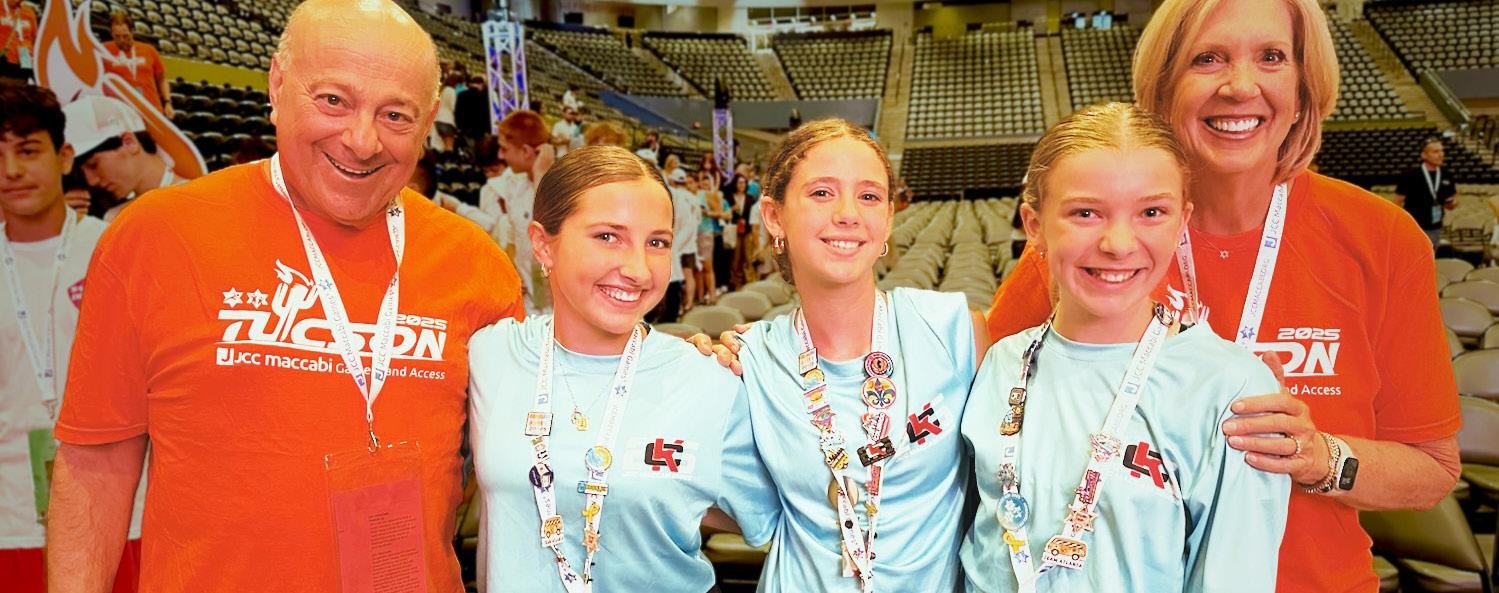
Kansas City is getting ready to host the JCC Maccabi Games, and we need your help! 900 visiting athletes are coming to compete in the Games and need a place to stay. As a host family, you will provide visiting teens with a Jewish “home away from home.” Build unforgettable memories and have the opportunity to create a special bond with these athletes that will extend well beyond the week of the Games.
Hosting is easy, fun, and rewarding. Join the HOME team and register as a host family today!



Families who register within the first 75% of host sign-ups will be entered into a drawing to win a free two-night stay in Branson, MO.
Myth: I don’t have enough room.
Fact: Every athlete doesn’t need their own room; each athlete just needs their own bed or pullout couch. The J will even provide you with an air mattress.

Scan to read the rest of our