THE JESUAN
Developments at West Court revealed • Creative prizes
Community action • Sporting success • College snapshots
Meet two of our new Fellows • Student travel summaries
Our donors’ report • Explore alumni benefits and events
Developments at West Court revealed • Creative prizes
Community action • Sporting success • College snapshots
Meet two of our new Fellows • Student travel summaries
Our donors’ report • Explore alumni benefits and events
Dear Jesuan,
In a world that can often feel demanding, uncertain and fast moving, the value of friends, family and College becomes ever clearer. These are the things that steady us and give us strength. Sometimes that sense of renewal comes from the simplest moments: walking through College and noticing sculptures and artwork you may have passed a thousand times before, or spotting the first spring flowers bravely poking through the winter soil. At other times, it comes from conversation – catching up with friends, swapping stories and remembering that we’re part of something larger than our own inboxes and to-do lists.
Over recent months, it has been particularly heartening to see so many alumni returning to College for reunion events. There is something magical about watching groups of friends arrive together, years after they last lived here, and immediately slip back into conversation as though no time has passed. Thank you to those who invited me for breakfast during your visits – it’s always a pleasure to hear your stories of College life, and occasionally to be reminded that the concept of ‘sleeping in’ is not universally appreciated.
This year, rather than setting a traditional New Year’s resolution, I found myself drawn to a phrase. Last year it was ‘personal joy’. This year it is ‘get on with it’. I like the flexibility and simplicity of the phrase.
‘It’ doesn’t need to be precisely defined. On one day, ‘it’ might mean tidying your desk, sorting through notes, or finally writing that list you’ve been avoiding since last spring. On another day, ‘it’ might be starting a novel, writing a short story, or bravely attempting a new adventure in learning: aka a hobby.
‘It’ might also involve something physical. It might mean heading out for a jog, committing to regular exercise, or –like so many Jesuans this year – taking part in the Cambridge Half Marathon. It’s been wonderful to see staff, students and Fellows all getting involved, supporting one another through training, and reminding us that even a small step is better than standing still.
For me, ‘get on with it’ is about momentum. It’s about stepping into a problem rather than circling around it and recognising that things often begin to shift once we take that first step. Action, however small, has a way of creating movement.
I am in my seventh year as Master, and I continue to enjoy the full richness of the College experience. That richness comes from the people, of course, but also from the extraordinary range of clubs and societies, talks and cultural events, conferences, alumni gatherings and the spaces in which all of this happens. Our College encourages curiosity and connection, and I find that no two days are ever the same.
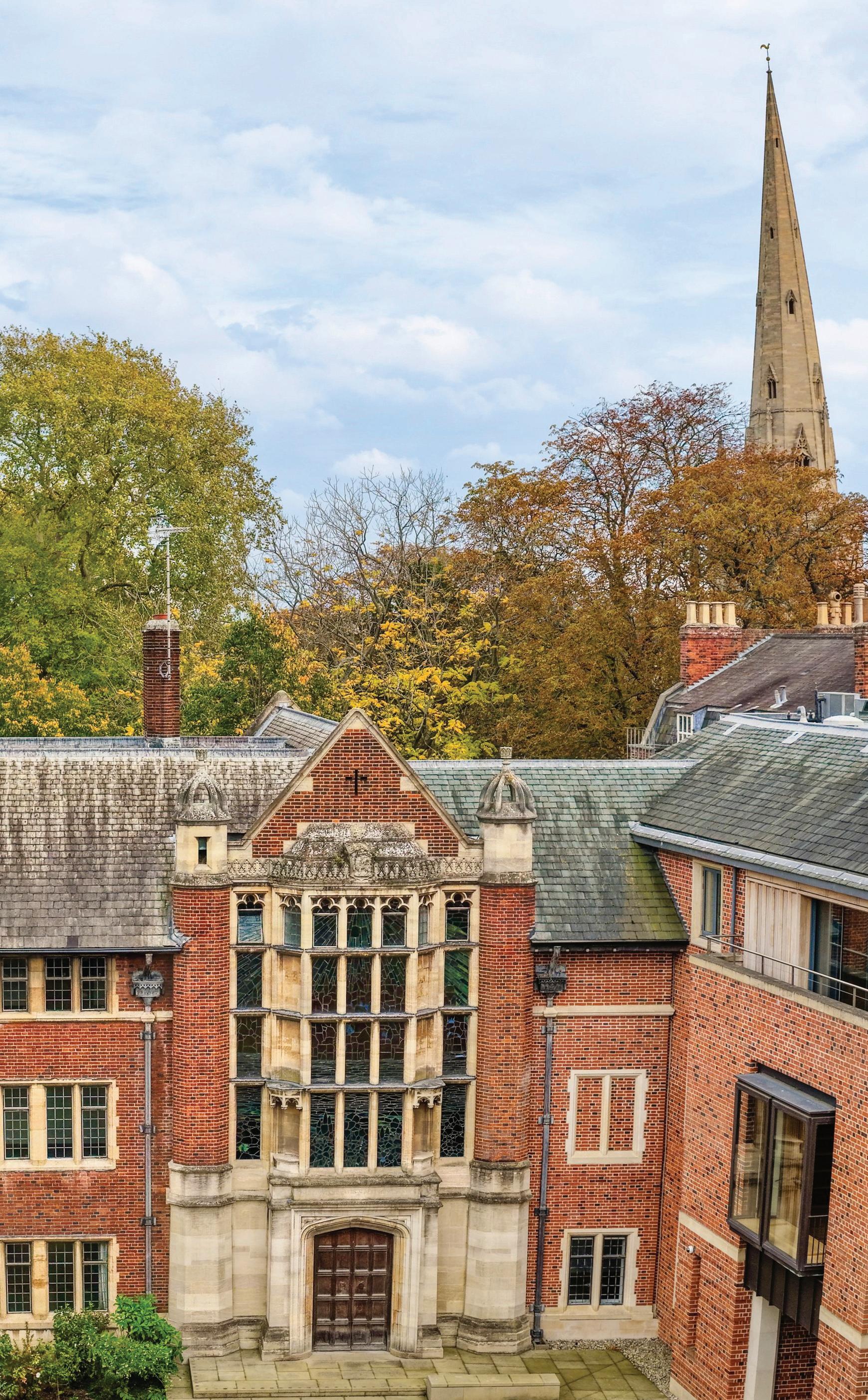
The physical footprint of the College continues to evolve too. Jesus College now stretches from the ADC Theatre to Victoria Avenue, and our expanded West Court includes Wesley House Chapel which is being transformed into a spectacular new archive centre. I recently attended one of my first meetings in the newly opened Laurence Sterne Room –a fitting space for our energetic Gardens Committee, whose work spans paths and planting, wildlife and biodiversity and the thoughtful planning of new green spaces across College. Quiet reminders that carefully tended environments support both people and ideas. There is always something happening at Jesus, and always something new taking shape. I hope this issue of The Jesuan captures some of that energy, celebrates our community in all its forms, and perhaps offers a gentle nudge to get on with it –whatever ‘it’ happens to be for you. Even if ‘it’ is finally clearing your inbox, one email at a time.
Sonita Alleyne, OBE
Edited by Kate Coghlan
Designed by Nikki Williams
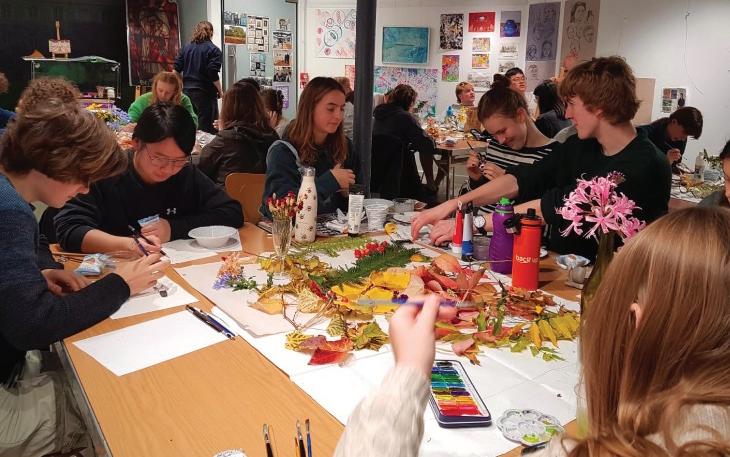
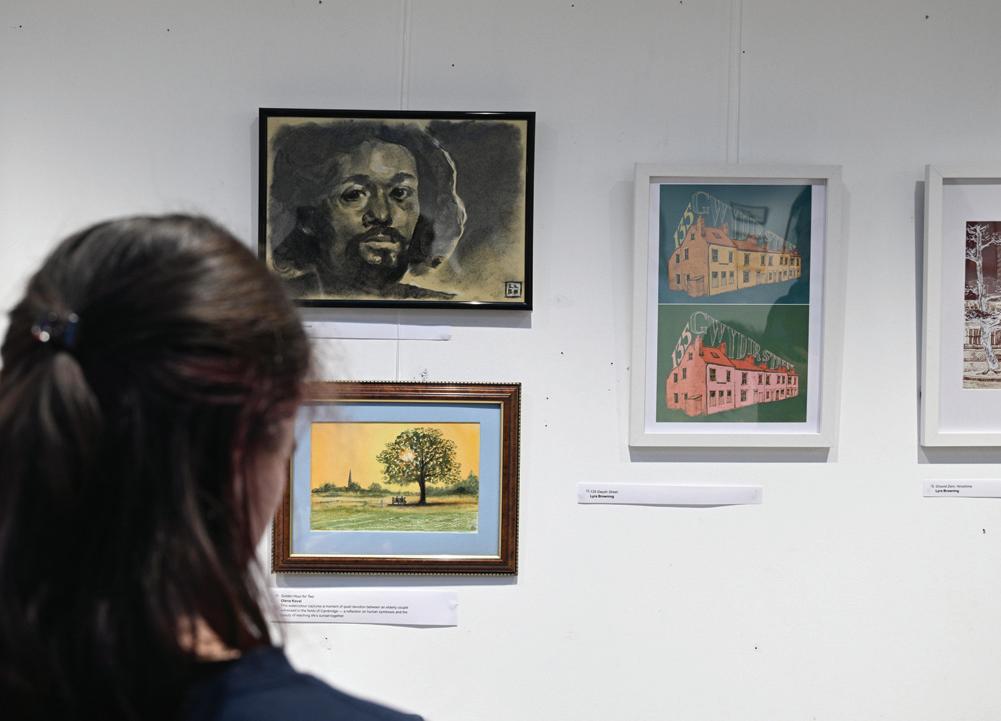
On 28 November 2025, the Art Club hosted an end-of-term exhibition preview for College members. The theme for this exhibition was ‘Wish You Were Here’. The exhibition was also open to the public on Saturday 29 November and Sunday 30 November. The varied programme this term has included lino printing, life drawing, pumpkin carving, sketching sessions in the Chapel and watercolour botanicals in collaboration with the Green Society (pictured below).
The latest winners of the Hook, Line and Lyric songwriting competition have been announced. The initiative, launched in 2023 with the University’s Centre for Music Performance, aims to showcase emerging student songwriters. First prize went to Tom Neale (Wolfson College) for Inner Space Blues, second prize to Anoushka Tiger Mohan Sharma (King’s College) for See You Again, and third prize to Éireann Attridge (Wolfson College) for Anonymous. Entries were judged by Sonita Alleyne, Jesus Master and Chair of the Centre for Music Performance; Benjamin Walton, Professor of Music History at Jesus College; and Alex Hall, Performance Administrator at the Centre for Music Performance.
This year’s John Hughes Arts Festival was themed ‘Symbiosis’. Run annually by the Art Club, the event takes place in memory of The Rev’d John Hughes. The festival, which ran from 13-20 March, brought together artists in and around Jesus College for various events including a public exhibition in the art room (photo credit: Kit Nugent).
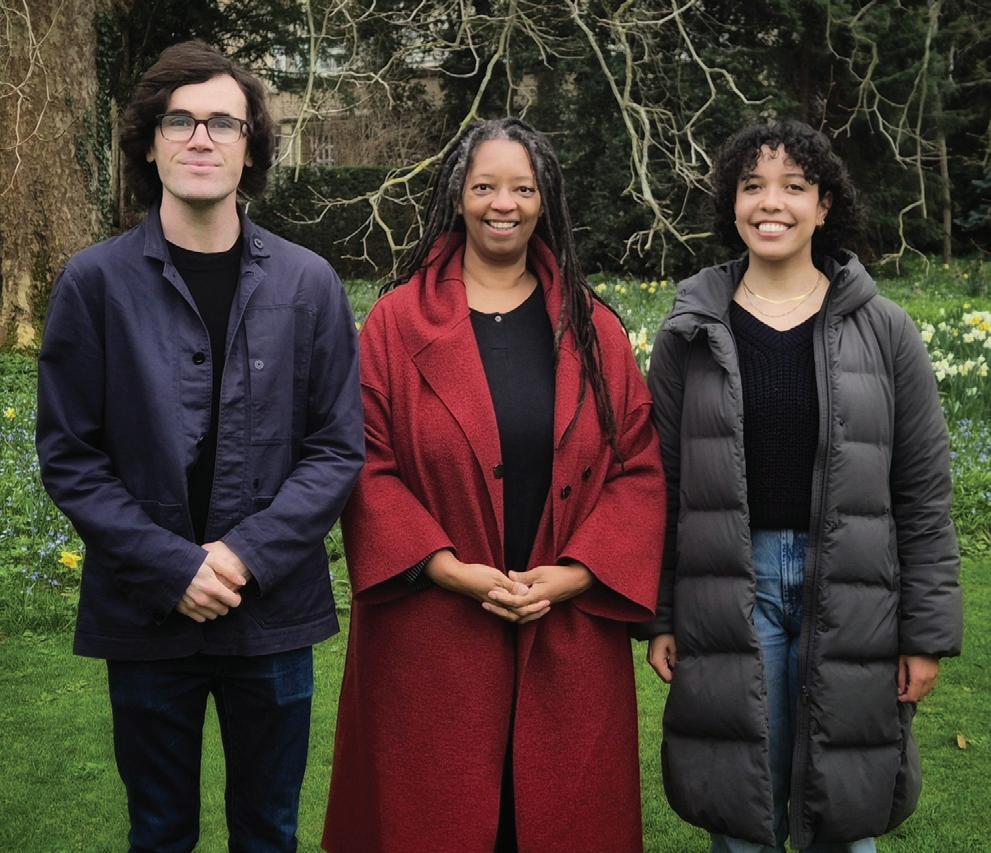
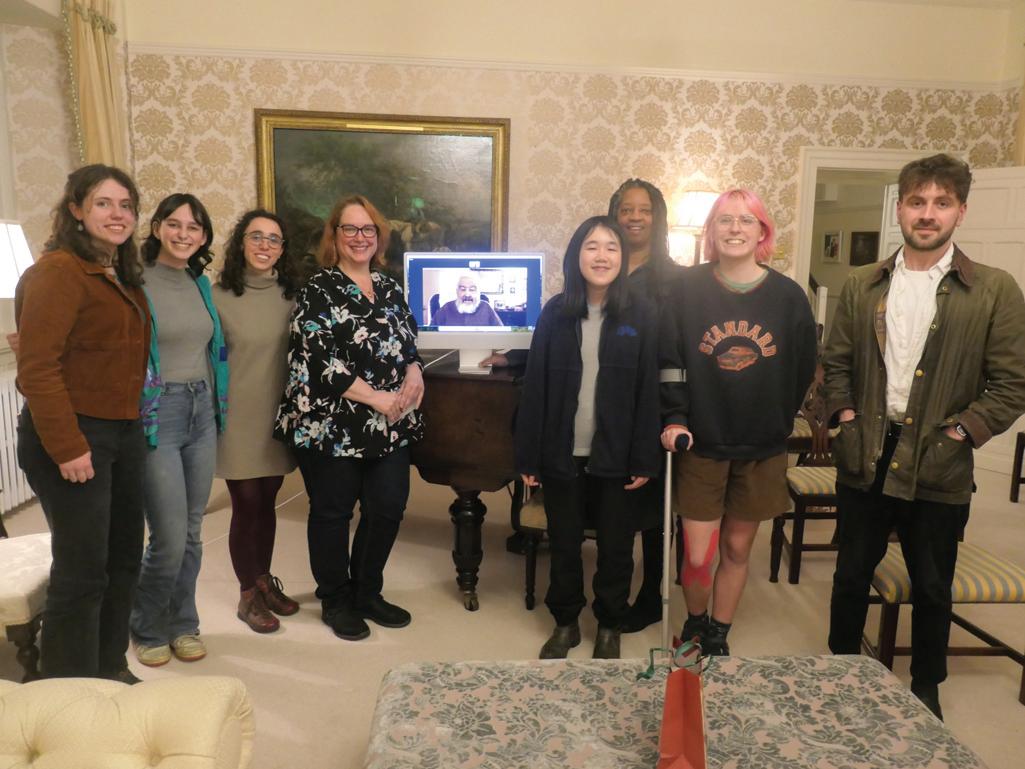
Winners of this year’s College short story competition were announced on 17 March 2026 at a prize-giving hosted at the Master’s Lodge. Judges Emily Winslow and Menna van Praag selected eight winning entries from 23 submissions, judged anonymously, across the College community. Prizes were awarded to Ruby Bloom, Aisling Rogers, Sophia Pasalis, Bethan Soanes, Flaminia Zane, Jonathan Ball, Smiley Chan and Maria Ruigomez Eraso. This year’s theme was ‘art’. The judges praised the range and quality of the work, noting the diversity of perspectives, from artist and viewer to the artworks themselves. Emeritus Fellow David Hanke, who has supported the competition since its launch in 2019, was also recognised at the event.
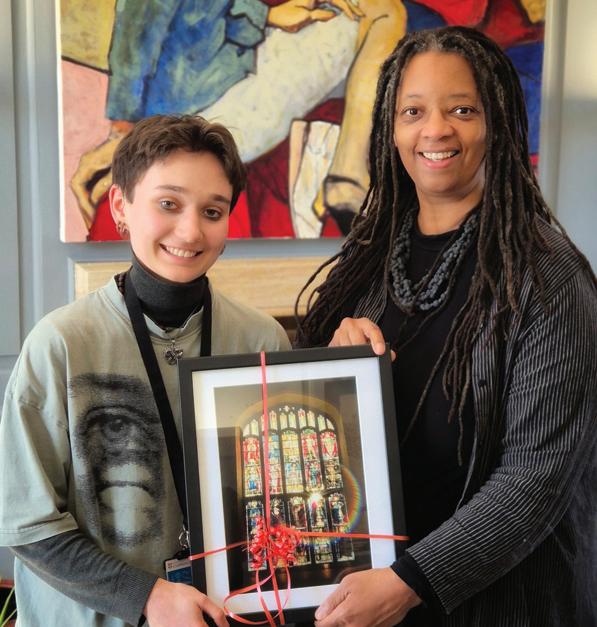
Congratulations to architecture undergraduate Jagoda Zuk (pictured left), whose photograph Competent was selected by the judges as the winning image in this year’s College photography competition which focused on the theme of portraiture. They praised the image’s strong composition and “the way it captured an enigmatic moment between the sitter and photographer”. The competition attracted entries from across the College community and organisers thanked both the judging panel and everyone who took part.
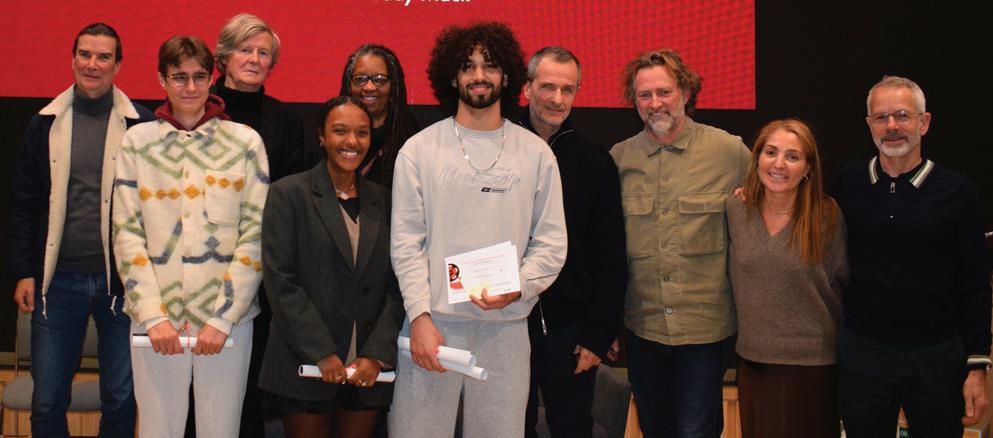
In November 2025, Jesus College hosted Cambridge’s first 48-Hour Film Challenge, a weekend competition in which sixth form, college and university students wrote, shot and edited five-minute films on the theme ‘Out of the Blue’. Entries were judged by Sir David Hare, David Heyman, James McCarthy and Piers Leigh. The top prize went to Project Blue, a mockumentary by Amari Rose Leigh (Hughes Hall), Munir Sharif (Clare Hall), Elena Savvas (Hughes Hall) and Kai Moreno-Momiejo (Hughes Hall). The Envelope placed second and Blue Funk third. Teams from Anglia Ruskin and local sixth forms took part, with the event concluding in a public screening and awards ceremony (winners and judges pictured above).

Global Cultures at Jesus College is an initiative produced by Panorama under the direction of Matthew Webb. Designed to enrich Cambridge’s public life by presenting a diverse series of events and collaborations that bring global cultural voices to the city and College community, this has so far included documentary film days with Q&As and first Cambridge screenings, family-friendly music performances and events, and an annual Cambridge Japan Fest with premieres and visiting directors in collaboration with the Japan Foundation. Talks have included National Geographic explorers and artists. Workshops have featured traditional crafts such as Noh mask-making and Shimenawa weaving. Sessions have featured global arts and food cultures, drawing on Webb’s international network. Most events are held in West Court at Jesus College and
The Tom Parkinson Travel Writing Bursary offers funded travel opportunities to Jesus College alumni within five years of graduation. Read interviews on our website with some of the first recipients of the Travel Writing Bursary. In March 2026, the ninth alumni award was given to Alex Haydn-Williams (2019, English) for a trip planned during April 2026.
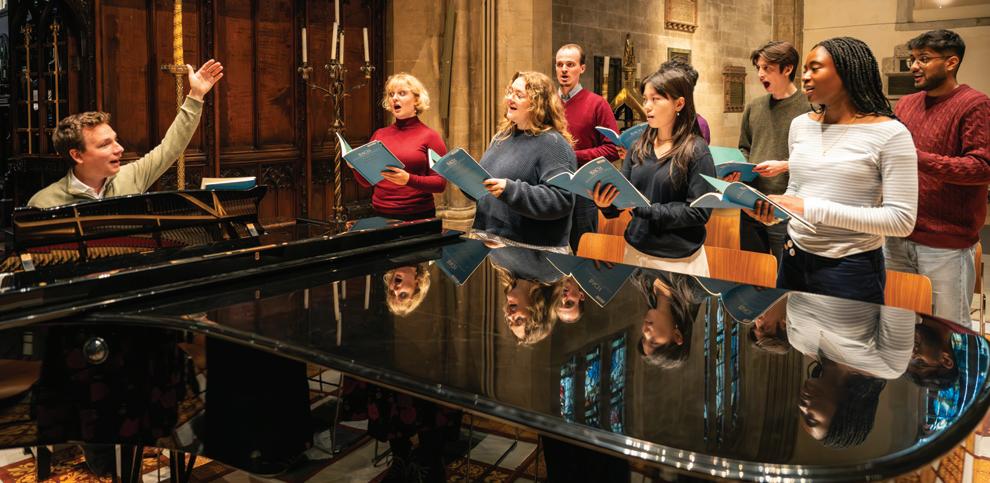
In the 2025 Hadfield Composition Competition for young composers, Michael D’Avanzo was named overall winner for his setting of Evelyn Underhill’s text, with his carol So May It Be Alway! chosen from a record number of entries. Two further submissions received high commendations: Tabby Hopper, a third-year Music student at Merton College, Oxford, and Luke Sitaraman, a Lay Clerk at Christ Church Cathedral and Assistant Leader for the London Youth Choirs. Entries were judged anonymously by celebrated composer Cecilia McDowall and Jesus College’s Director of Music, Benjamin Sheen (pictured below with the College Choir © Andrew Wilkinson).
Jesus College provided the backdrop for a film adaptation of H Is for Hawk, the award-winning memoir by Honorary Fellow Helen Macdonald. Helen was a Research Fellow at the College (2004-2007), when they bought and trained a goshawk in an attempt to deal with their father’s death, and flew the hawk in the College grounds. The film showed in January 2026, starring Claire Foy as Helen and Brendan Gleeson as their father, Alisdair. Image credit: Lionsgate
are open to all. To stay informed about future programming and book tickets, people can visit the Panorama website linked from the College’s Global Cultures page
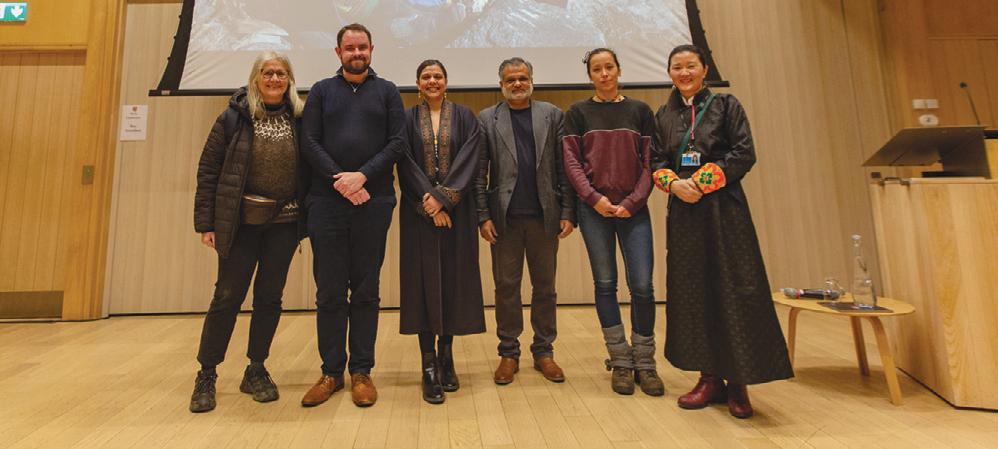
The 2025/2026 academic year has seen the JCSU return to the heart of student life. The current 2026 committee is dedicated to using the strong foundations left by its predecessors to keep the College community flourishing. To start, we have expanded the size of our committee: we are now delighted to welcome a Sports and Societies Officer and a Food and Bar Officer to our ranks. Following a by-election in January, we are also now the first committee in a number of years to have every committee position filled. Our hope is that, with a larger committee, and especially with a Sports and Societies Officer, we can provide for students better.
We are working to make students feel better connected to Jesus’ sports and societies. We have set up a shared calendar and a weekly timetable of sports and societies events to encourage greater participation – and exploration – with Jesus’ rich sports and societies community. We are also working with local businesses and charities to get our societies access to new sources of funding.
As part of our community initiative, we are also revising College spaces: we are currently working to move a pool table to our Second Court JCR, and to set up a separate space for societies to gather; we are also in talks with the conferencing department about refurnishing the Brewery Room space, to make the space more inviting. Our initiatives are already beginning to bear fruit: our Ordinary General Meeting and recent JBar bops have been very well-attended (pictured opposite).
We have really enjoyed the past year at the JCSU and are really looking forward to all the coming year has to give!
Ben Luca Atassi Quinton, JCSU President
This year we welcomed nearly 180 new postgraduate freshers to Jesus College. Our MCR Social Secretaries organised an impressive 46 events over the course of Freshers’ Fortnight, ranging from BOPs and international potlucks to trips to Grantchester. Freshers’ Fortnight was followed by sports week, which featured nine sporting events coordinated by our MCR Sports Officer. Both new and returning students took part in taster sessions across a wide variety of activities, including yoga, tennis, squash, football, cricket, running and rowing. The MCR remains committed to supporting sustainability within the College. Our Environmental
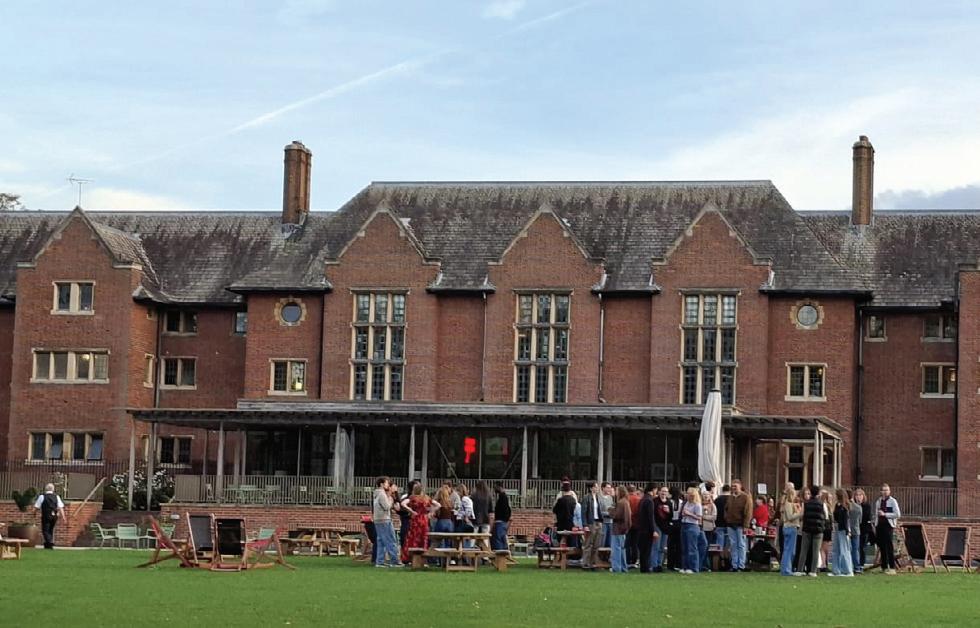
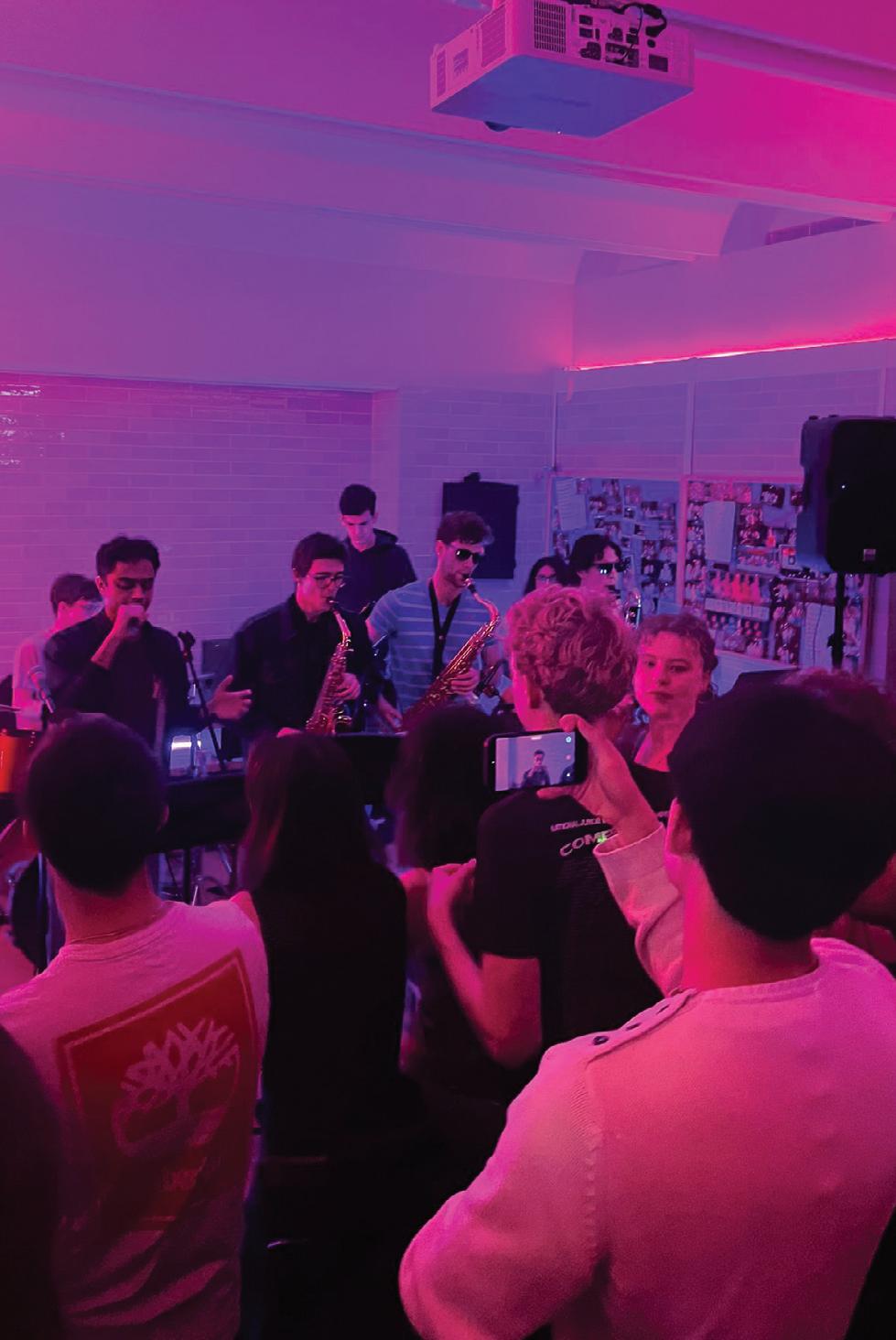
and Ethical Affairs Officer organised a clothing swap and a second life scheme, which collected and redistributed kitchenware and other usable items from departing students to new arrivals. Moreover, the MCR Secretary and MCR Treasurer coordinated the purchase and sale of MCR gowns to promote re-use and accessibility. We have continued to keep students engaged throughout Michaelmas Term and Lent Term with themed BOPS and bar nights. There has also been a growing focus on arts and culture, with theatre trips and museum visits organised by our committee.
The MCR Welfare Team continues to offer a warm and welcoming space for all postgraduate students by hosting regular brunches, welfare teas and MCR yoga sessions.
Academic highlights in Lent Term include a three-minute thesis Hall and the MCR academic graduate conference, an annual event which showcases and celebrates the research undertaken by postgraduate students at Jesus College.
I can speak on behalf of the entire MCR in thanking the whole College community for their continued support in enabling us to facilitate these activities.
Fabienne dos Santos Sousa, MCR President
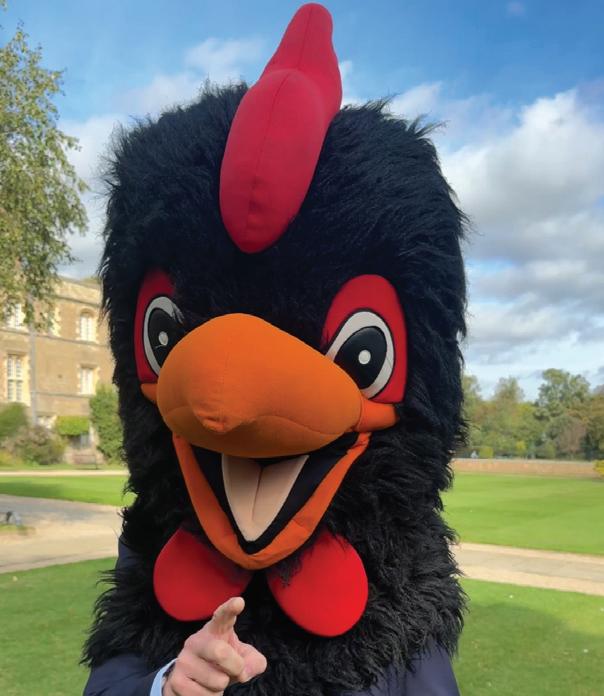
Summer 2025 saw the relaunch of the Choir Patrons scheme, offering scaled opportunities for Choir donors, which has raised £15,000+ so far. In October, we were overwhelmed by the response on Giving Day, with 172 of you making a gift to support our areas of greatest need. Collectively, your donations delivered £150,000+ – making the Bursar smile inside his cockerel costume. In other avian news, our new ‘Cockerel of the month’ feature showcases the contents of the Brittain Room, which houses hundreds of donated statuettes of the College’s symbolic bird. Support from donors has launched new postgraduate scholarships in Engineering, Biological Sciences and Children’s Health, and funded building work within the new Archives Centre. As we look forward to alumni events in Hong Kong and Singapore, as well as a busy schedule of reunions and anniversaries – some of which already have waiting lists – we remain ever grateful for the generosity and enthusiasm of the Jesus community.
The Development and Alumni Relations team
The team have created new planting schemes and redesigned several areas within the grounds and gardens. They have lifted and divided existing beds and introduced a variety of bulbs and new species. Plants produced in the greenhouses are ever increasing, grown by propagation such as seed sowing and hard/softwood cuttings. Hot, drought-tolerant, edible and cut flower borders have been introduced. The aim is not only to create eye-catching displays, but also to show how planting can support wellbeing and biodiversity. As you walk through the College, you might brush against plants that release a subtle fragrant scent or feel the tenderness of the foliage. Pots have been positioned near the archways to achieve this. The wildflower meadow at Library Court produced an impressive display and introduced a wide variety of biodiversity. Coming into its third year, the team are intrigued to see which new plant species, colours and wildlife will appear.
Lee de Grammont, Head of Grounds and Gardens
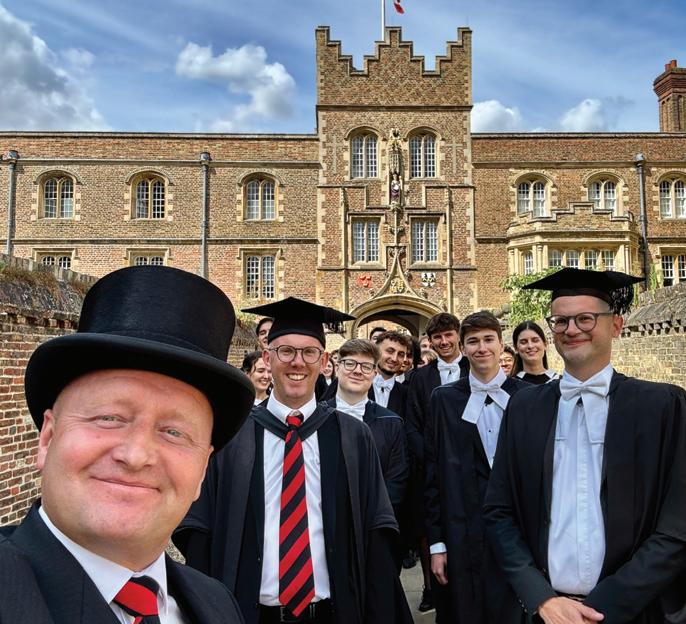
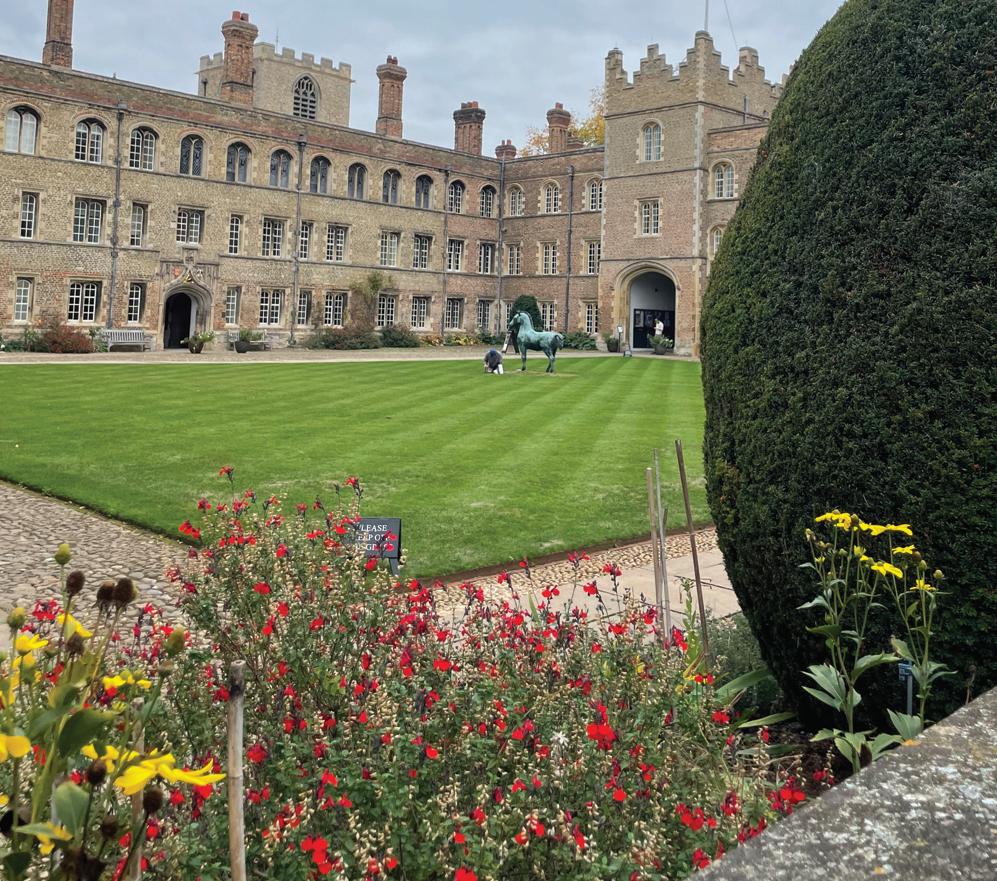
After another eventful year at Jesus, we have continued to support and welcome thousands of students, Fellows, guests and visitors through the Porters’ Lodge. Alongside other departments, we have worked hard throughout 2025, helping the College introduce new facilities, including the takeover of Wesley House and the subsequent realisation of West Court 6, 7 and 8, as well as a new postgraduate property on Maids Causeway.
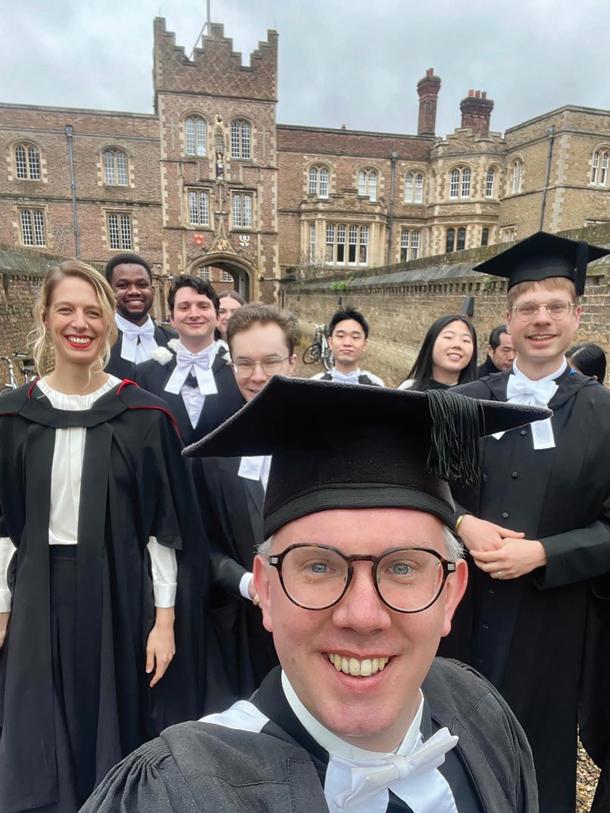
We have also made time to celebrate together, enjoying a social gathering at Newmarket Racecourse in August 2025. We were fortunate to have fabulous weather for last year’s Graduation Day, one of the proudest moments in the College calendar. It is always a privilege to see our students graduate and witness what the fruition of their hard work means to them and their families. I take great pride in the obligatory Head Porter selfie!
Simon Durrant, Head Porter
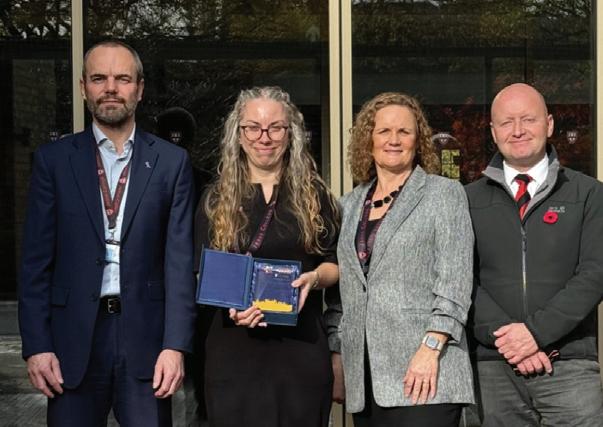
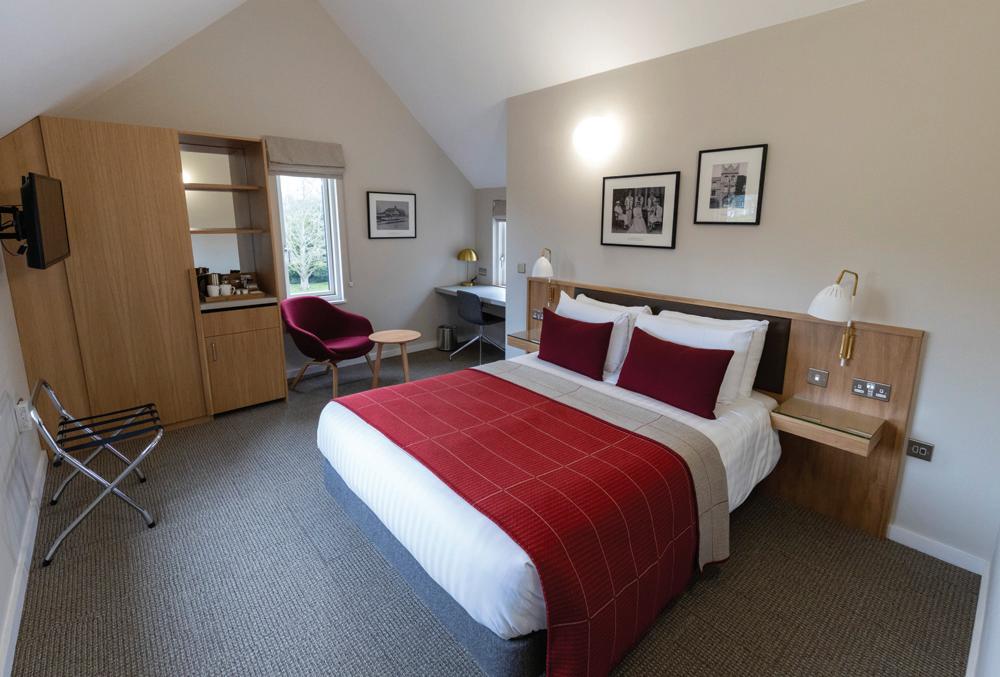
Jesus College’s West Court B&B has been recognised for outstanding customer service in this year’s Cambridge BID (Business Improvement District) Awards, winning the ‘Best Overall Customer Experience’ in the overnight accommodation category following a mystery shopper visit. The assessment highlighted the quality of the online booking process, the welcome on arrival, checkout, room cleanliness and presentation, room service and shared spaces. West Court was shortlisted for the mystery visit by Storecheckers after scoring highly in Cambridge BID’s customer satisfaction survey earlier this year, with the final award going to the business achieving the highest score during the visit. The reviewer also noted the team’s consistently positive and helpful attitude, observing that staff appeared to genuinely enjoy working there.
Alexis Moreau, Head of Conference and Catering
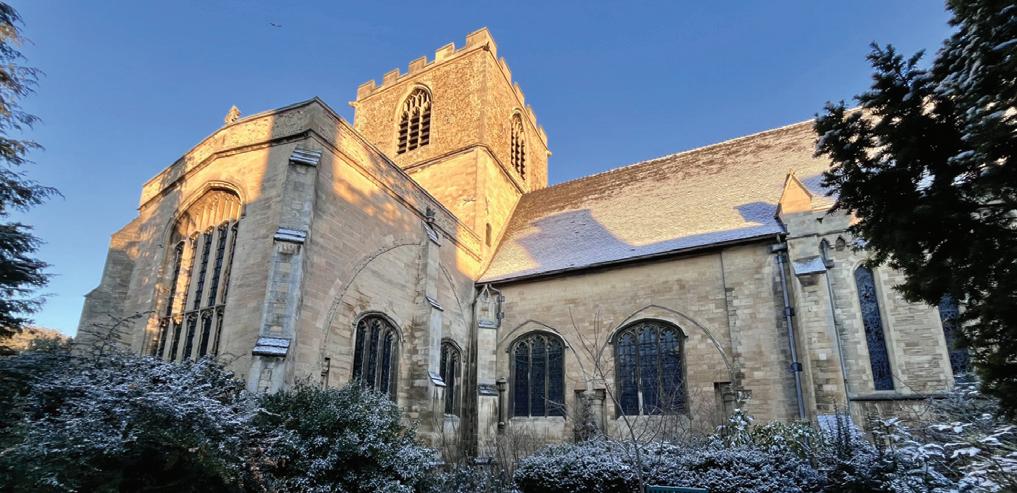
Chapel provides space for reflection, inspiration and formation amidst College life. In Michaelmas, our Sunday addresses spoke to the challenges faced in seeking to build a more peaceful and just world, with perspectives from development, the arts, conflict resilience and reparative theory. In Lent, we heard from guest speakers about people whose life, thought and activism offer witness to the deepest concerns of the human spirit – including poets, artists, contemplatives, educationalists and footballers. ‘Food and Faith’ discussions brought the chance to chew over central ideas and texts at the heart of Christian thinking. Key moments have included the orchestral Requiem service for All Souls’, a Vigil for the Transgender Day of Remembrance, the popular Advent and Christmas services, as well as the annual Inter-faith Dinner and,
In September, the Choir year began for the choristers with a joint Eucharist with the choristers of Great St Mary’s Church in the Market Square, a collaboration that we hope to continue going forward. Highlights of the Michaelmas Term for the choirs included another memorable performance of Gabriel Fauré’s Requiem for All Souls’ Day with the East Anglian Chamber Orchestra, and a performance of Handel’s beloved Messiah with the Orchestra of the Age of Enlightenment Education Scheme, featuring talented soloists from the Royal Academy of Music. The annual Advent and Christmas services were all sung to a packed Chapel, and in between the College Choir gave a concert at St Mary’s Church, Cavendish, one of the College’s living parishes.
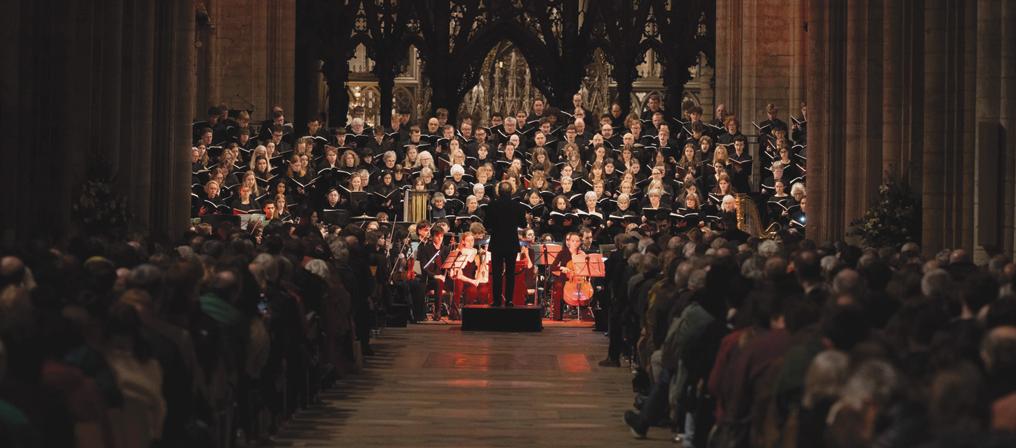
The Jesus College Music Society (JCMS) continues to thrive as one of the University’s most active and diverse music societies, continuing the twice-weekly recitals on a Wednesday and Saturday. The termly orchestral concerts have also continued to grow, filling the Chapel to capacity to hear the talented students conducting the Jesus College Orchestra. In Lent Term, both the choristers and College Choir joined forces in a performance of Benjamin Britten’s War Requiem in Ely Cathedral in late January (pictured above), as part of a massed choirs project that involved the choirs of Selwyn, Caius, Clare and Jesus with the University orchestra and chorus, conducted by Ludovic Morlot. The Lent Term will conclude with a concert performance of Eleanor Daley’s beautiful Requiem, before the Chapel Choir heads off on tour to Puglia, Italy in early April.
Benjamin Sheen, Director of Music
finally, a Chapel Away Day to Clare Priory in Suffolk, with space and focus for reflection at the end of a packed term.
The Rev’d Dr James Crockford, Dean of Chapel
Michaelmas Term offered a rich programme of speakers and career insights. The In the Business of… series welcomed Liverpool FC’s Chief Data Scientist Laurie Shaw (2003), Olympian turned entrepreneur Tom Bursumato, economists Ian Harwood (1974) and Eve Colson Sihra, and broadcasting specialists Finn Ranson (2017), Nicholas Philps (2024) and Visiting Fellow Eliane Glaser. Joshua Bambrick (2013) and Alexander Schurer (2021) discussed AI’s expanding role in life science research, while Cyrus Mewawalla (1985) explored global technology trends. Entrepreneurship was a strong theme, with alumni Steve Pope (1990), Jonathan Wills (2000) and Jonathan Grundy (1998) sharing their experiences, alongside Entrepreneurial Clinics led by Bradley Hardiman. Raj Sidhu from the Careers Service also delivered an interactive session on internships.
Lent Term featured Met Police behavioural analysts Lucy Pilling (2018) and Elle Prince (2014), The Guardian’s Tami Hoffman (1990), senior civil servants Victoria Spencer (2004) and Elizabeth Mitchell (2017), and aerospace specialists Jeremy Soper (2014) and Samiksha Ravi. Mohan Yogendran (1982) returned for LinkedIn and CV reviews, and the term closed with an entrepreneurship workshop co-hosted with IE Cambridge.
Sarah Richey, Careers Mentor
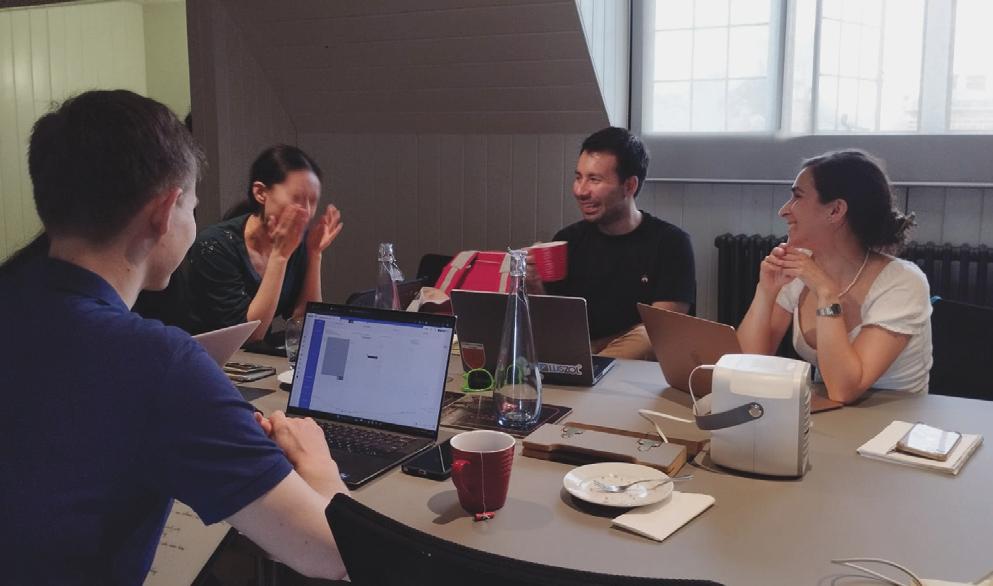
The Housing department spent the summer of 2025 preparing the new student areas of West Court and 32 Jesus Lane for arrivals in September. These rooms have been a great addition to the stock and residents have settled in well. In October 2025 we purchased a new HMO on Maids Causeway, adjacent to an existing College house, consisting of five bedrooms and one partner flat. This was renovated ready for students to move in in January 2026. We have also just finished the conversion of the former Principal’s Lodge for Wesley House into an eight-bedroom HMO. These projects have created a further 30 bedrooms and one partner flat for our graduate community. Isabel Harrison, Housing and Property Manager
The Tutorial Office went through another period of recruitment with two new members joining the team: Rhiannon Jones, Access and Outreach Officer and Becky Williams, Senior Postgraduate Administrator. The team have pulled together and delivered another year of exceptional work and support for all of our students from admissions, through yearly exams to graduation. One of our favourite roles within the department is managing Congregations. Lydia Marshall (Tutorial Administrator – Admissions & Events) has helped organise the graduation of over 300 postgraduate and undergraduate students this year. Graduating students are invited to proceed from College in academic dress to the Senate House to receive their degree from the University, and then, once the ceremony is complete, they will return to College to enjoy a lunch or tea with friends and family to mark the occasion. Graduations are a special time for any student and helping them to celebrate with their family and friends is the final task we have here in Tutorial before they become alumni. As we look forward to welcoming the next cohort of students, the work continues.
Jenny Jenyon, Tutorial Manager
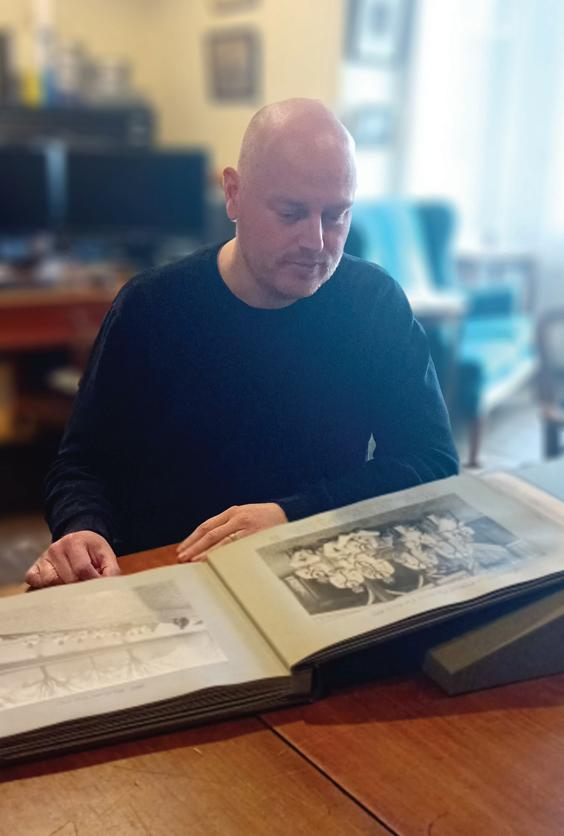
In March 2025 I joined Jesus as the new Assistant Archivist responsible primarily for the cataloguing and management of the College estates collections. After over 17 years in academic publishing, mainly in the areas of digital asset management and web development, in 2020 I decided to pursue an entirely new career as an Archivist. A year later I began studying part-time with the University of Dundee, alongside my full-time job and a half-day’s volunteering, initially with the Cambridgeshire Archives in Ely and later Pembroke College, graduating and becoming fully qualified in early 2024. I’ve been fortunate to join the College at an exciting time for the Archives, with our upcoming move to Wesley House and the challenges this entails. This has provided me with the opportunity to expand beyond my main estates responsibilities and become involved in all aspects of our day-to-day operation. After a period with one foot still planted in my former career with Cambridge University Press, in December 2025 I joined Sidney Sussex as their new Archivist, and now split my time between both Colleges. I’m immensely grateful to Jesus College for giving me the chance to enter a profession I’d dreamt of for many years, and very much look forward to our next chapter in West Court.
Duncan
Rule, Assistant Archivist
The Library marked its thirtieth anniversary this year. Having moved into the building on 13 November 1995, it was officially opened on 8 March 1996 by Queen Elizabeth II.
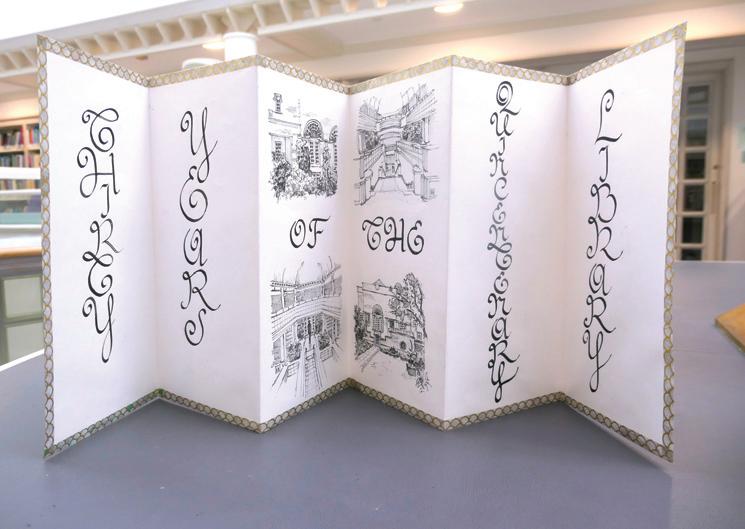
To commemorate the occasion, the Art Club created a beautiful leporello, which was displayed in November 2025. In March 2026, the Library also reprised and updated its twenty-first exhibition, using the opportunity to reflect on the changes and developments of the past three decades.
Over thirty years, the physical library has evolved significantly. Early computer catalogues and self-service borrowing machines have given way to a broader role that now includes support for academic skills and wellbeing initiatives. The book stock has tripled in size, and access to electronic resources has become an integral part of the service.
Despite these changes, the core purpose of the library remains unchanged: to help people find the most appropriate information in the most appropriate way.
Rhona Watson, Quincentenary Librarian
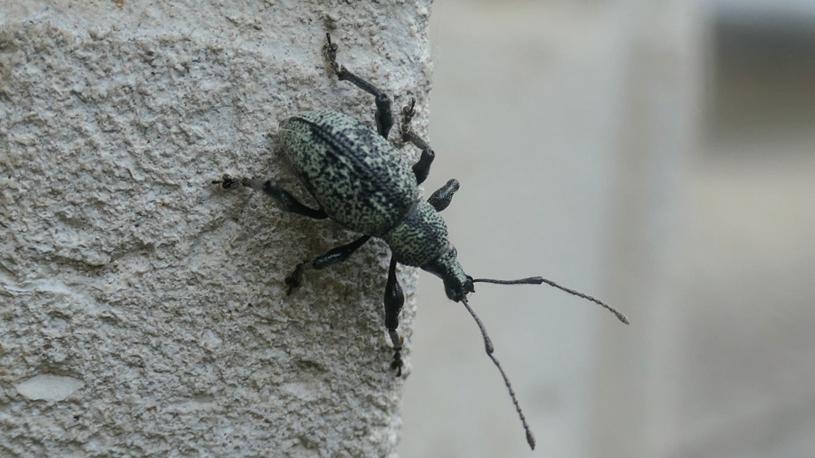
Quincentenary Librarian Rhona Watson recorded a new species of weevil for the UK last summer, called Otiorhynchus corruptor. It is a harmless Mediterranean species with a distribution spanning Europe and North Africa. This beetle was found on the card scanner at the Jesus Lane exit gates on 20 August 2025 and a second record was made on 5 September when one was found on the window of the Library Office.
Following last year’s announcement of a landmark partnership between Jesus College, the University of Cambridge and Suzano, the College welcomed its first Suzano Scholar. Pedro, a Brazilian postgraduate student, has begun his studies at Jesus. This marks an important milestone in the development of the programme. Funded through Suzano’s £10 million donation, the initiative supports Brazilian nationals undertaking postgraduate study in areas related to the environment, ecology and conservation, while also advancing research into the interaction between human and natural systems at Cambridge’s Conservation Research Institute.
Pedro recently joined a College lunch alongside three Brazilian students visiting through an exchange programme with the Faculty of Education, further strengthening links between the College and Brazil.
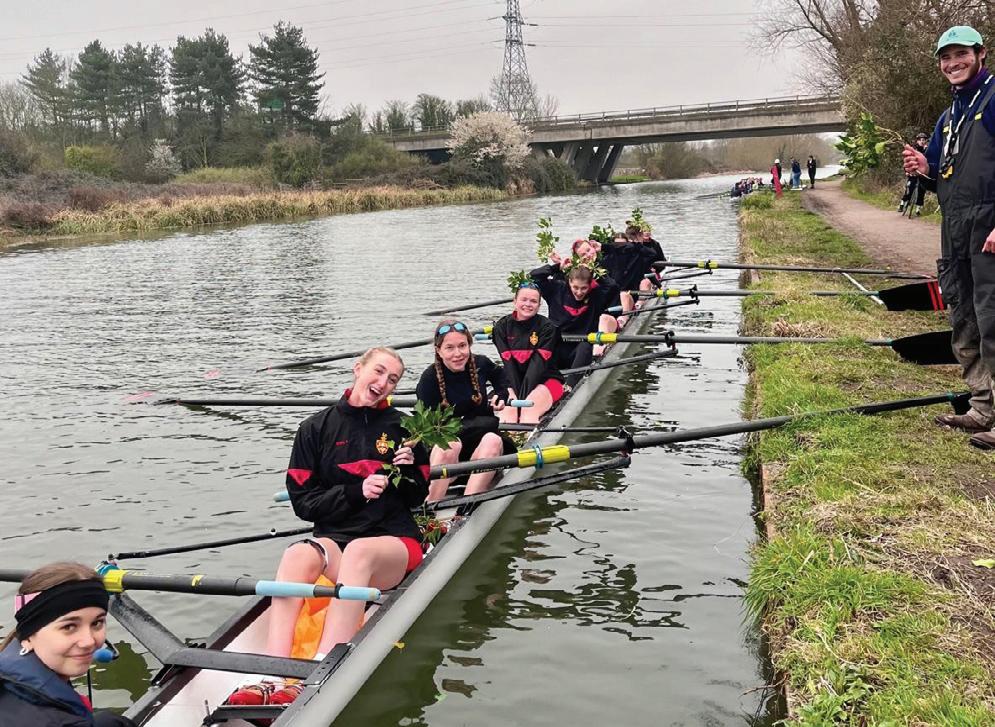
Our rowers gave a fantastic performance in the Lent Bumps 2026. Overall, the crews finished 10 places higher than they started, with our women’s first crew (pictured) retaining the Head of the River title.
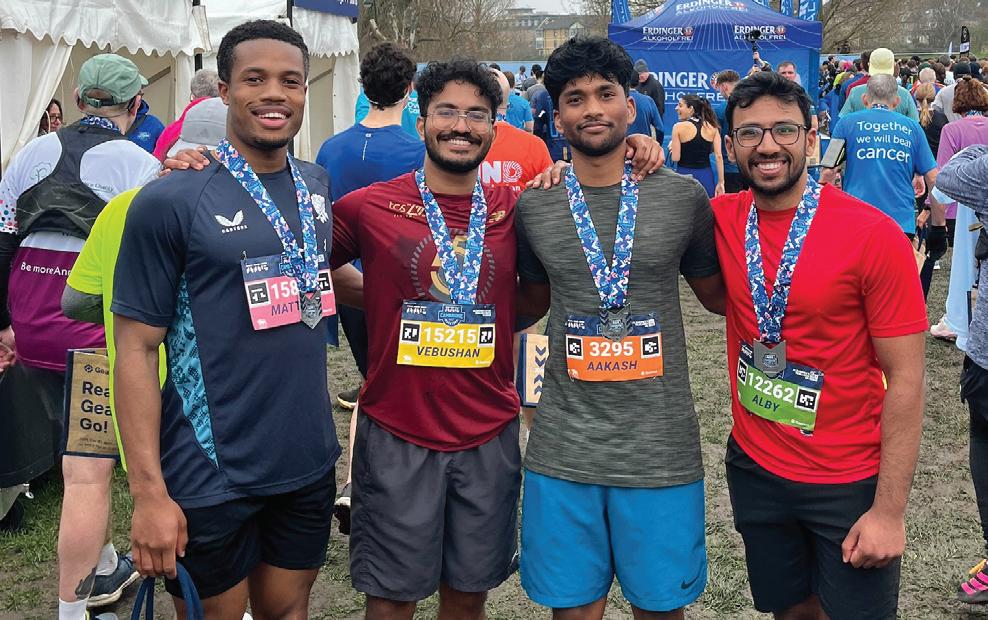
The College saw a strong turnout for the Cambridge Half Marathon, with 77 students, 10 members of staff and six Fellows signing up to take part in the popular event, which passed through its grounds. The race not only brought the community together but also provided an opportunity to support a local cause. More than half of those participating pledged to raise funds for the College’s charity partner, The Red Hen Project, which works with children and families in the north of the city.

This year, four students and two members of staff chose to grow and groom a moustache throughout the month of November in support of men’s health charities, raising a total of £455.
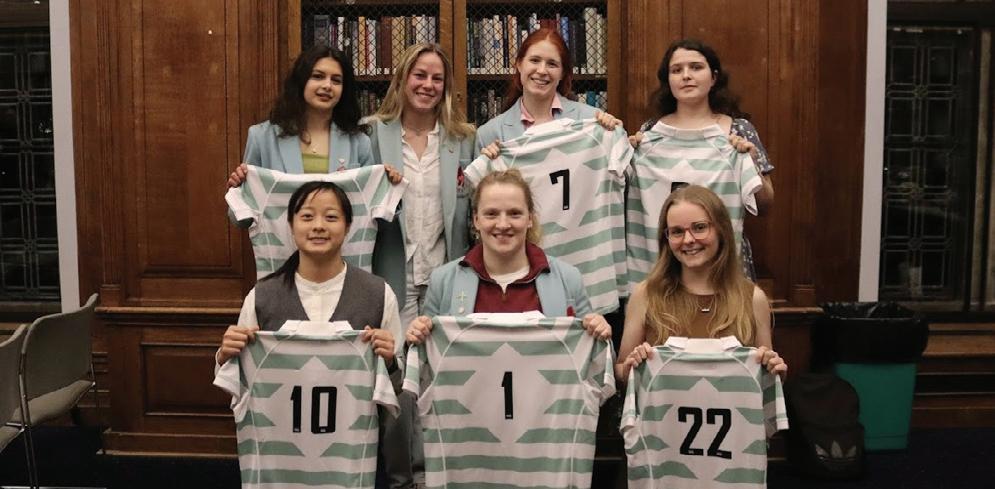
The College was well represented at the Varsity Matches on 28 February with six students in the women’s Cambridge University Rugby Union Football Club squad and one in the men’s (a record for this College in Varsity rugby). While the matches didn’t go their way, it was a proud moment for the College to have so many Jesuans on the squad and competing at this level.
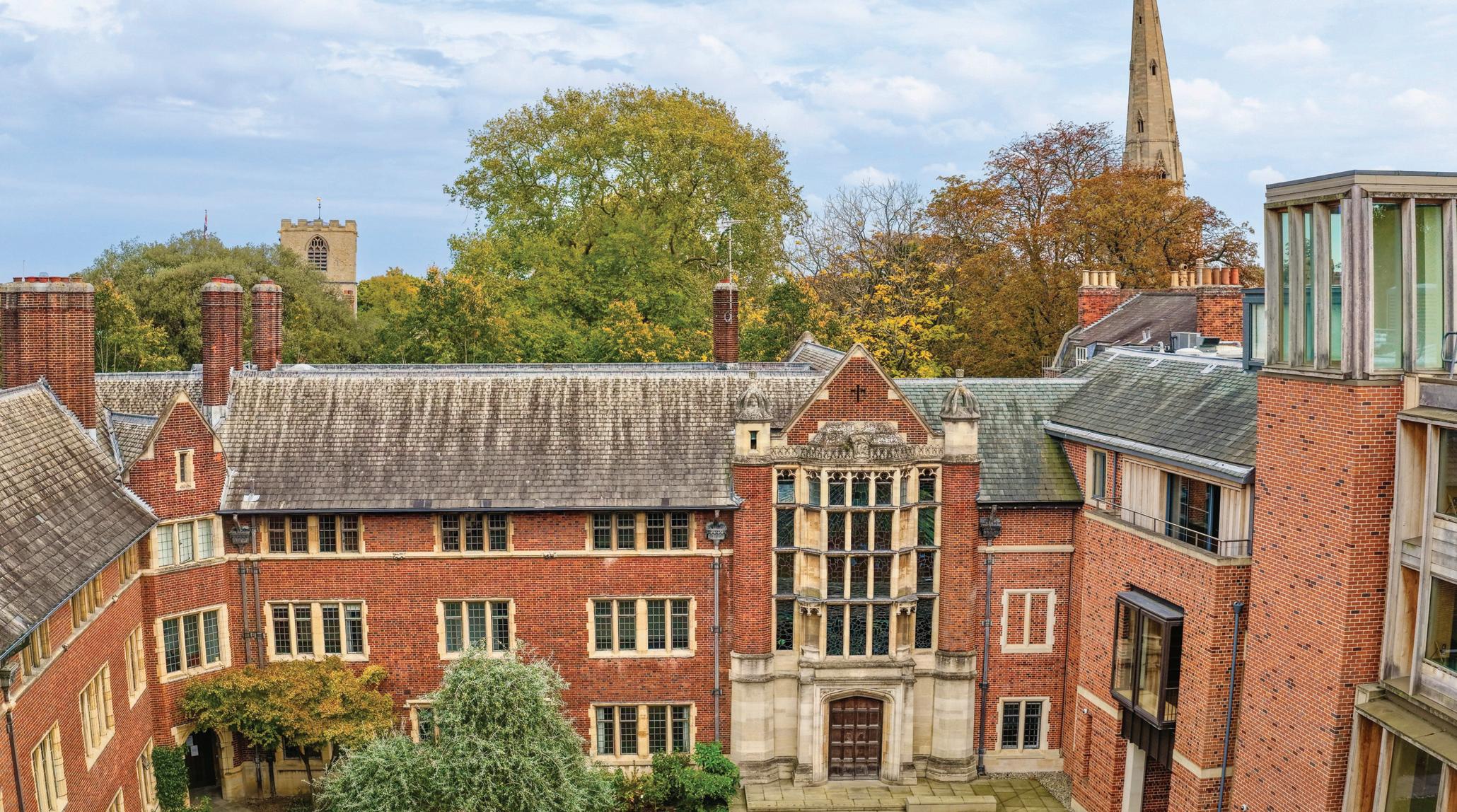
Described by staff as “the opportunity of a career” and “the big project of summer 2025”, the return of the east side of West Court from longstanding tenants, Wesley House, has dominated the past year for several departments across the College.
“If you acquired a 48-room mansion, what would you do with it?” asked Domestic Bursar Stuart Websdale. “We were given a year’s notice of the buildings’ return to Jesus College, which allowed us time to think carefully about the opportunity. Alongside appointing external consultants, we set up a cross-departmental working party, bringing together experts from across the College with knowledge of architecture, history, buildings, interior design, grounds management and project oversight. That collective expertise helped us explore the options and work out how best to deliver the project.”
The proposed purpose-designed Archives Centre will establish Jesus College Archives as a leading facility in the Collegiate University, bringing together purpose-built storage, research and support spaces in one accessible location. All areas are on the ground floor or served by lifts, ensuring that everyone can use the facilities. Together, the new centre supports the College’s five-year aim to achieve archive accreditation from the National Archives of England and Wales, the recognised UK standard for archive services.
The plan is for the former Wesley House Chapel to become the main archive store. It offers the right size and setting for a modern archive while allowing the building’s historic character to be preserved. Archive materials will be brought together in one secure space, using bespoke two-tier moveable racking that does not affect the structure of the Chapel. Environmental controls, enhanced fire protection and improved security will better safeguard the College’s records. The design meets key British Standards for archive storage and preservation. Increased capacity allows materials to be stored correctly, including flat storage for maps and plans. Space for future growth has been built in, supporting new donations and acquisitions.
A reading room, which also houses the Archives Office, will be the main point of contact for visitors. Located centrally on the ground floor, it is where researchers will be welcomed and supported by the College Archivist. Materials retrieved from the Chapel store will be consulted here at a purpose-designed reading table. Before opening fully, this room will be used to clean and conserve records. Students will be trained to assist with this work, gaining practical experience while helping to prepare the collection for long-term storage.
A treasures room will hold the College’s most valuable and oldest records. Already equipped with environmental controls and a fire-suppression system, it offers a secure and contained space on the first floor. This room will receive its first records in Easter Term 2026.
A digitisation suite is planned in the next phase and will enable the College to create high-quality digital copies of archive and library materials in-house. This reduces cost, avoids the risks of transporting fragile items and supports wider access to the College’s collections and history.
College Archivist Dr Robin Payne was involved from the project’s outset. He said: “The College has long hoped to bring its archives together under one roof. At present, our nunnery records, College Charter, Governance Papers, maps and plans, records of College clubs and societies, photographs and other treasured objects are spread across seven different spaces around the College. Consolidating the collection will ensure all records of the College’s long history are kept in the optimum environmental conditions to preserve them for use by future generations.
“The collection grows by around 30-40 boxes each year through the annual accessioning of student and governance records, as well as generous donations from alumni. The move will give us enough space to continue expanding for another 30-50 years. It will also make a significant difference to the service we can provide, with a dedicated reading room for visiting students, alumni and researchers. It will be easier to share our archives and to display them to the public.”
The archives have been in a state of movement and change for several months. Rob and Archives Assistant, Duncan Rule, currently work at desks surrounded by boxes. “One advantage is that I know the College records much better now”, Rob said. “Archive spaces evolve over time, and this is a once-in-a-career opportunity to start from scratch and plan the locations strategically.”
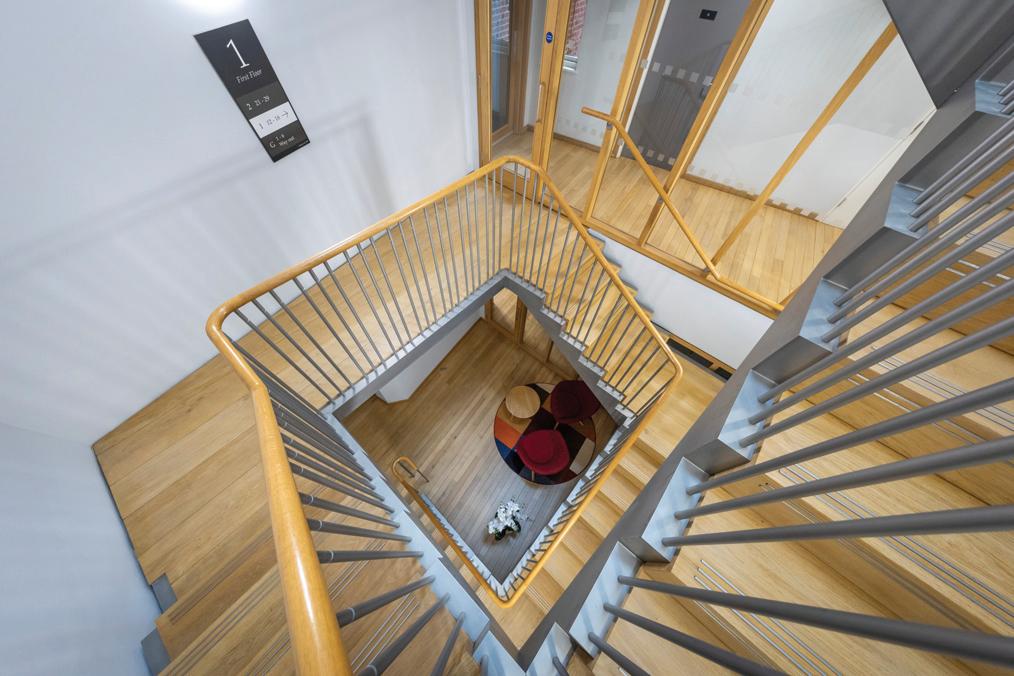
Wesley House already contained 42 student bedrooms, many of them en-suite. Staircase 1 and 32 Jesus Lane were occupied by postgraduate students in mid-September 2025 and an eager queue is forming already for the recently refurbished former Principal’s Lodge. MCR President, Fabienne Dos Santos Souza, said, “Given how well-appointed and located these rooms are, they must be some of the best postgraduate accommodation available in Cambridge!”
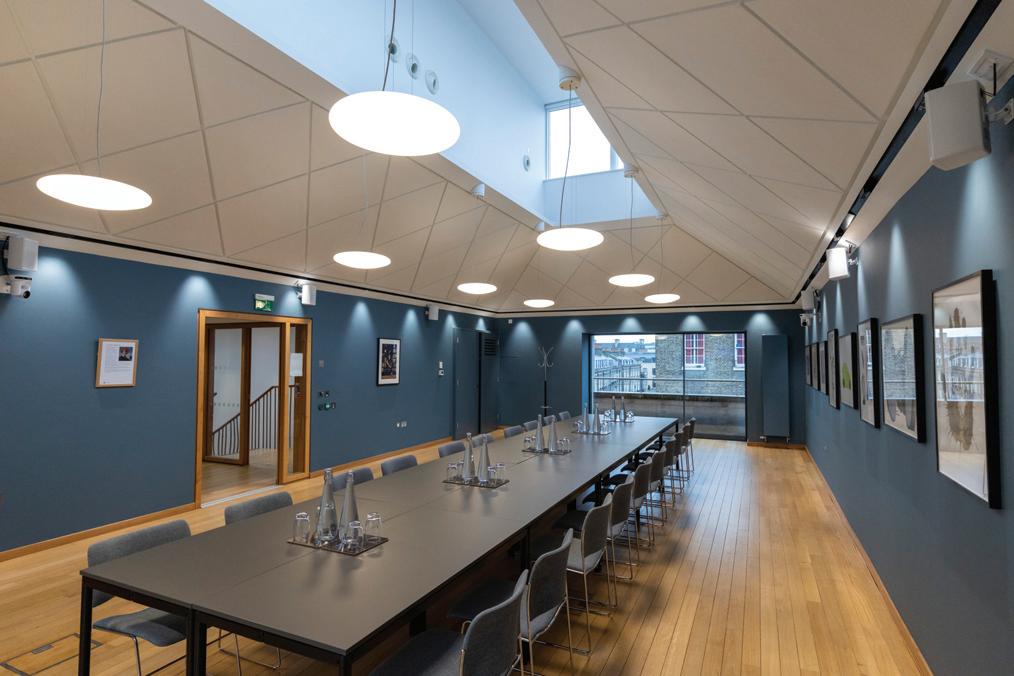
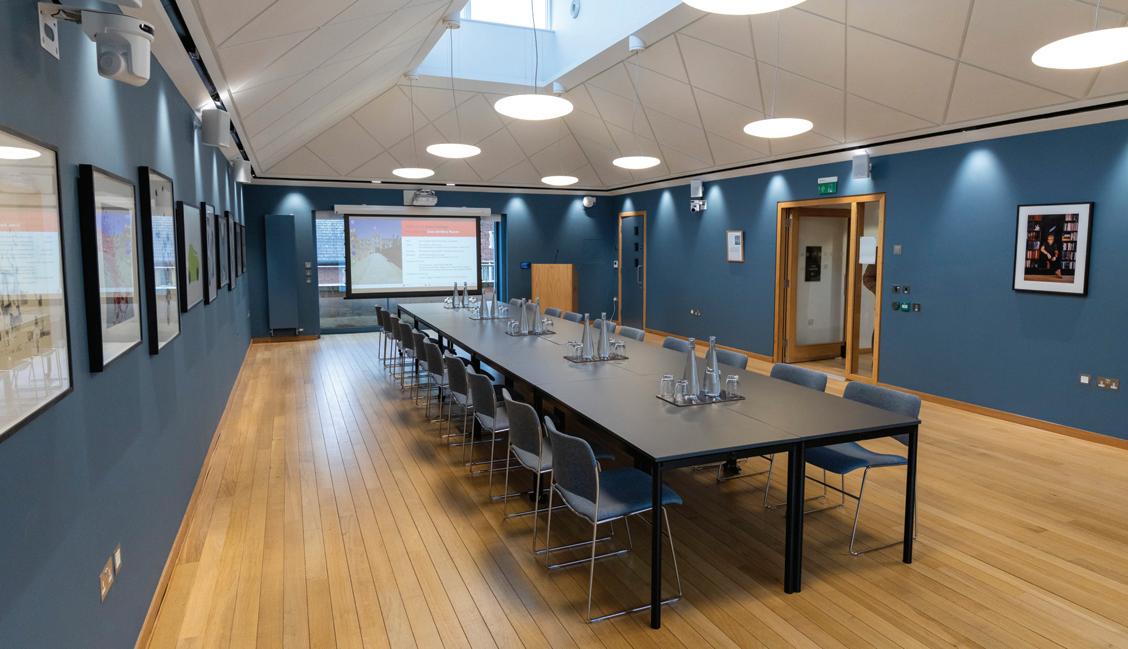
Also crying out for additional accommodation and meeting rooms was the conference team, led by Head of Conference and Catering, Alexis Moreau. He said, “The new accommodation means that we can now offer 56 comfortable and stylish hotel-quality bedrooms (44 with en-suite facilities) all year round in West Court, perfectly suited to conference guests who want to be close to the meeting and dining spaces. We now have 14 versatile meeting rooms, with a total capacity for 450 people. The new meeting rooms are ideal for events
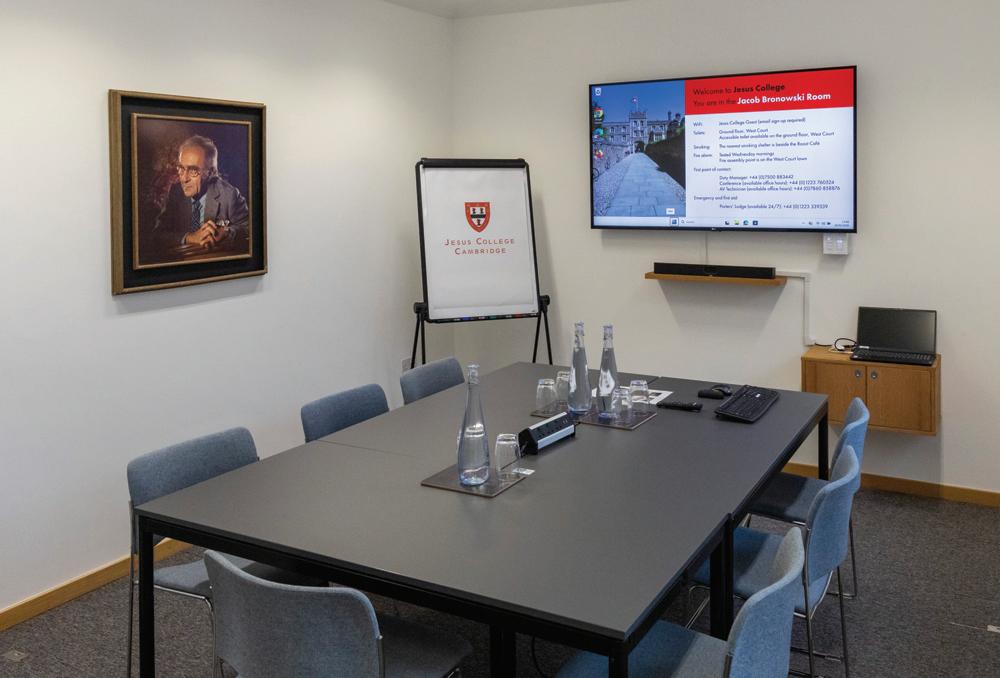
for up to 30 people or can be booked together in pairs and clusters for breakout meetings. This conference space is also available to book as exclusive use for those conference organisers who are looking for privacy.”
Isabel Harrison is Housing and Property Manager and was part of the working party. She said, “The new spaces that have been created in West Court and 32 Jesus Lane are great. Thanks to the rooms in the existing properties, and the conversion of the Principal’s Lodge to multiple occupancy housing, more of our postgraduate community can live within College rather than having to rent privately. Being involved in the legalities of Wesley surrendering their lease was extremely interesting. The process was challenging but it was good to work with lawyers and surveyors to get to a resolution on some very complex issues. I was lucky to be able to be involved in both the legal side and the operational side, working through multiple plans for the buildings to come up with the best use for all of the spaces. It was a real team project across multiple departments with everyone working together to achieve an outcome that we can all be proud of.”
Stuart said, “People have been blown away by the speed at which this project has progressed, and that’s testament to strong collaboration and teamwork across the College. It has been an amazing learning experience for everyone involved, and it really is a shared achievement.”
Dr Richard Anthony, the Bursar, who chaired the working party and led on the financial and legal aspects of the buildings’ return to the College, commented, “This is a historic moment for the College, the reintegration of the last major section of the historic Jesus College site. A project that involved the whole resident College community – staff, students and Fellows. Something we can all be proud of.”
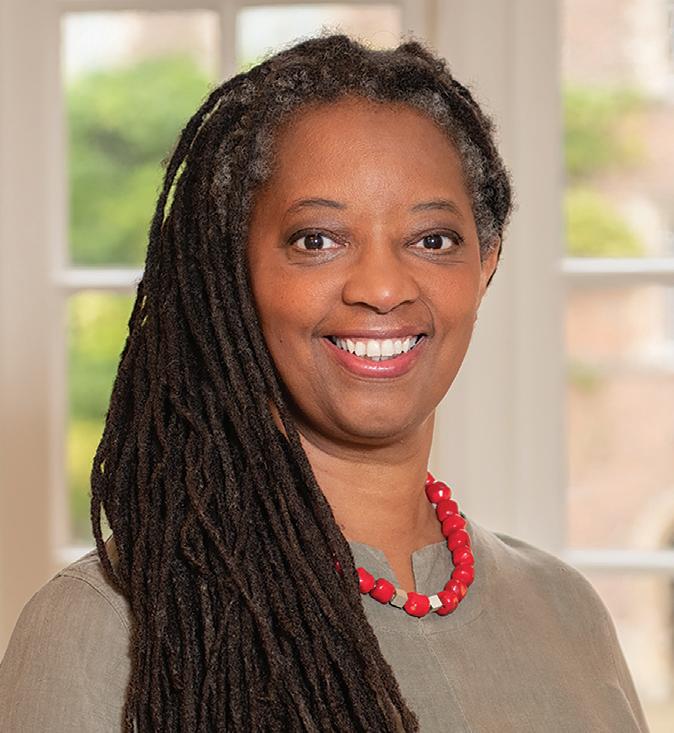
Professor Mia Bay is a scholar of American and African American intellectual, cultural and social history. Her recent publications focus on black women’s thought, African American approaches to citizenship and the history of race and transportation.

How long have you been in Cambridge and how are you finding it?
I have been in Cambridge for just over a year, and I am gradually settling into life here. I’ve mostly lived in big cities like Toronto, New York and Philadelphia, so Cambridge is noticeably smaller and quieter. At the same time, it’s very navigable and I enjoy that. I haven’t learned how to ride a bike in Britain yet, because it feels a bit scary, but I walk everywhere and that suits me well.
What does it mean to join Jesus College as a Fellow?
Joining Jesus College as a Fellow has been especially important for me because I’d never lived in Britain before. I wanted a ready-made intellectual and social community, and that’s exactly what the College has provided. It feels like a second home. I’ve enjoyed attending Society meetings and the Intellectual Forum, and I’ve been involved in undergraduate admissions, which has given me a real sense of the rhythms of College life and the student experience. Overall, it’s been a welcoming and intellectually lively place to land.
How did you first become interested in American and African American intellectual, cultural and social history?
I’ve always liked history. In high school, I studied British history, the kings and queens. At the University of Toronto, a small group taught American history, which really drew me in. My family is from the United States, and my mother was African American, so there was a personal connection. I started looking more
closely at American history and became fascinated by it, particularly by the areas of slavery and freedom. We studied the Somerset case which focused on when slavery ended in Britain, and I became interested in how those big questions played out in an American context. African American history made those questions especially visible and urgent, and that’s what kept me there
area fascinates you most currently?
I’ve been writing about the history of segregated transportation, including Jim Crow railway cars and the experience of sitting at the back of the bus. I’m also working on a book about Black ideas about Thomas Jefferson. Jefferson is interesting to African Americans because he represented both the good and the bad of America. He was a slaveholder, and during his own lifetime there were suspicions that he had a slave mistress. At the same time, he articulated ideals about democracy and equality, and sometimes even expressed anti-slavery ideas. For many Black thinkers, Jefferson came to represent American values as they were, which is to say promising, but never fully realised. Thinking about Jefferson became a way of thinking about democracy, the presidency and what America claimed to stand for.
African American history has changed a great deal over the course of my career. Over time, it has become much more prominent, with more scholars, more students, and more PhDs being awarded. Currently, things feel more uncertain. The United States has become very conservative in certain ways, and there is active opposition in some quarters to looking closely at the darker parts of the American past. That said, I think this has made people working in African American history even more committed to preserving it and recording it. Studying this history prepares you for moments when the ground shifts beneath you politically. It reminds you that this is not the first time there has been a backlash against progress. I often think about the founding of the civil rights organisation, the NAACP, in 1909 during a period of intense racial violence and injustice. It took a long time for that work to bear fruit, but people still did it.
My main way of decompressing and getting to know Cambridge is to walk my toy poodle, Greer. I would like to join a pool and start swimming again. I’ve swum in cold places before, including the North Atlantic and Norway, so I think I could manage Jesus Green Lido! I read a lot of fiction; I recently enjoyed The Emperor of Gladness by Ocean Vuong, Dream Count by Chimamanda Ngozi Adichie and Blue Sisters by Coco Mellors.
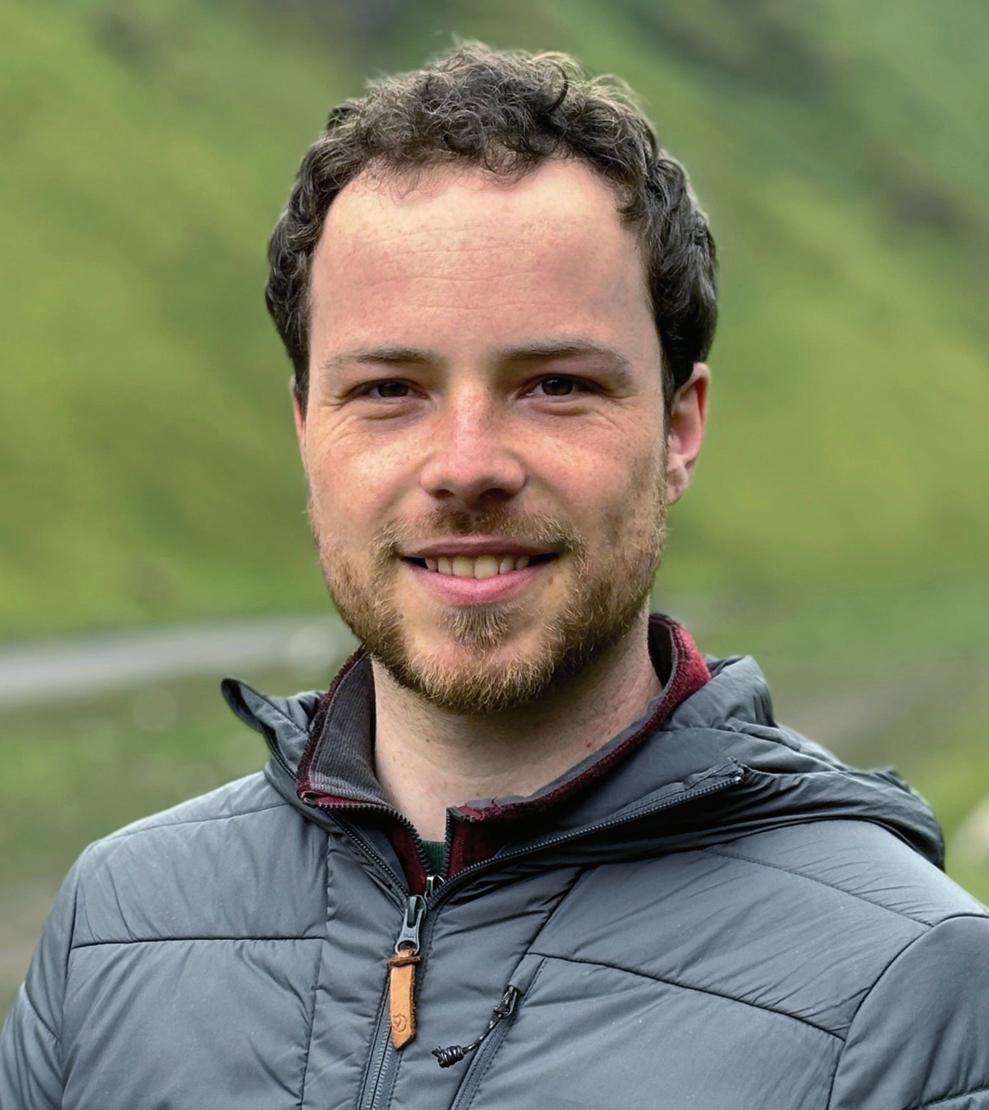
Dr Yorick Veenma is a Research Fellow working in sedimentary geology, who uses fieldwork to reconstruct ancient environments and evolutionary events.
How long have you been in Cambridge and how are you finding it?
I arrived in Cambridge in 2021 as a PhD student at Wolfson College, which meant I was immediately placed into a social framework with other people who were starting their time in Cambridge, even if they are in completely different fields. That showed me how good the College system can be, especially if you are coming from abroad. It gives you a sense of community very quickly.
What does it mean to join Jesus College as a Fellow?
It has been great so far. Everyone has been incredibly friendly. I live in College and being surrounded by beautiful buildings and all that history is really great. It is also convenient because I can now walk to work every day. It is the shortest commute I have ever had, and I find that this makes it all the easier to work hard. There is something quite motivating about that.
How did you first become interested in geology?
It was not something I was interested in early on. If you grow up in the Netherlands, especially in the northern part where I am from, geology does not really cross your mind because it is very flat and there are not a lot of rocks around. I was interested in the natural sciences in general, but geology specifically was not on my radar.
What appealed to me about Earth Sciences was that you do not have to specialise straight away. You can explore different areas and narrow things down as you go. Over time, sedimentary geology just fit me best. I liked working with sedimentary rocks as physical evidence from the ancient Earth, especially when I realised that they are really just fossil landscapes.
Fieldwork made a huge difference as well. Trips to Spain during my undergraduate degree really brought geological concepts to life, and my Master’s research in Alaska was unforgettable. Spending days driving to remote places and being completely immersed in the landscape is when geology really clicked for me.
Which area fascinates you most currently?
My main research focus is understanding how the rock record works. I am interested in how it is produced, how complete it is, and what that means for how we interpret Earth’s history. The big question for me is completeness. Sedimentary geology is often thought of as an archive recording millions or billions of years. That is true at a large scale. But when you zoom in, you often find rocks that formed over seconds, hours or days.
I studied a fossil forest in Ireland a couple of years ago, where ancient trees still stand where they grew, preserved by sediment that piled up in an abandoned river channel. You can see how
roots grew into the soil and how plants changed the local ecosystem. Sites like that show the rock record can capture incredibly detailed snapshots of past environments, even if they existed 360 million years ago.
I think the biggest shift is that we are thinking differently about what the rock record represents. Instead of one long, continuous story, it is more like a collection of short stories, all very old but formed over short timescales. That reframing brings geological time closer to human timescales. Rocks are no longer just abstract data points from deep time. They are records of events we can relate to, such as storms, floods and ecosystem change. Understanding the structure of the rock record helps us better understand topics such as evolution and climate change, because it helps us distinguish between long-term trends and rapid shifts.
do you unwind outside of work?
I enjoy walking a lot, both in Cambridge and further afield. I think that comes naturally when you work in geology, as this makes landscapes all the more interesting. Places like the Alaskan mountains, the deserts of the American south-west and Snowdonia in Wales are all spectacular but also very different. This is why I think geology is such a powerful tool for understanding the world. I also like playing chess. I’m not as gifted as I’d like, but I enjoy the strategic side of it.
Emily Bugden is a PhD Geography candidate, researching alternatives to carbon markets. Here she writes about the Max Hadfield Creativity Award, which supported her participation in an artist-researcher voyage aboard a sailing vessel in the Hebrides.
Creative Ecologies is a week-long artist residency hosted by Sail Britain, an organisation that explores the interconnections between art, environment and maritime life. As oceans become the next frontier in the financialisation of nature through ‘blue carbon’ markets, I wanted to explore more imaginative and embodied ways of understanding these transformations.
We sailed from Oban through the Inner Hebrides, anchoring in sheltered bays and mooring at small islands. Our days began with facilitated discussions on the environment, the ocean and the entanglements between human and non-human life. We foraged for seaweed and edible coastal plants, slept in bunks barely wider than our shoulders and lived in close quarters – a lesson in humility, patience and shared vulnerability. Our route had to change twice: first because of a major storm system stretching from Scotland to Iceland and again when the ship’s engine failed. These interruptions became part of the learning. Sailing demanded constant attunement to weather, tides and one another: a profound reminder of human fragility and the awe-inspiring power of nature.
Imagination and creativity are essential to navigating our interlocking ecological and social crises. Creativity offers a way to reclaim that imaginative space, not only to envision change, but to enact it prefiguratively, through experimental and relational practices. My initial plan was to make sound recordings and produce small paintings or collages, but as the week unfolded, I was increasingly drawn towards macrophotography – a long-standing personal interest. I began documenting the minute textures of marine life: algae, seaweeds, oysters, limpets and coastal lichens (photo of lichen below).
This experience deepened my thinking around what I call mossy and algal futures, a way of learning from the quiet resilience and adaptability of non-human life forms. Mosses and lichens and algae model what might be described as collaborative survival. Lichens are an intimate symbiosis between fungi and algae, suggesting that nature is not defined only by competition, but also by collaboration, interdependence and reciprocity.

From memory to hope in Monserrat Miranda Fitzpatrick received a Tom Parkinson Travel Writing Bursary to attend a conference in Montserrat, a small Caribbean island and British Overseas Territory.
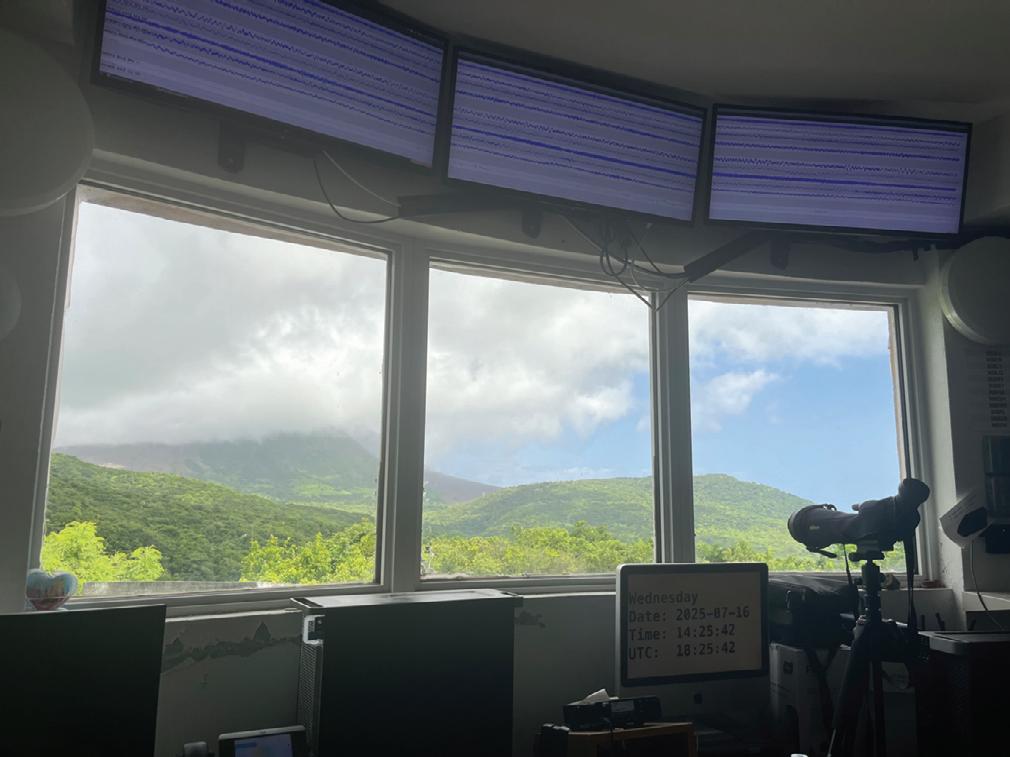
I arrived in Montserrat on 18 July, the 30th anniversary of the 1995 Soufrière Hills volcanic eruption, in which two thirds of the island became an exclusion zone and over half of the population left the island. My fellow travellers were Montserratians, scientists and policymakers, reflecting on what had been lost and what lay ahead.
The journey itself was memorable. I flew from Antigua on a tiny eight-seat plane, seated by weight, close enough to watch the pilot flick switches mid-flight and even shut off the engine before landing. From above, I had expected a grey, barren landscape, but instead I saw lush, rolling green hills.
That evening, I was immersed in the island’s story through music. The Emerald Community Singers traced life before, during and after the eruption. Songs captured fear, uncertainty, resilience and faith, and often called out to those who had left. I was struck by how creativity had become a way of understanding and remembering. While the island has materially changed, its spirit remains strong, though locals told me they do not dwell on the word “resilient”. Survival was simply necessary.
I later entered the exclusion zone, where the former capital Plymouth still stands, buried under ash. Crossing into Zone V with a guide, I saw a place frozen in time: dining tables still set, shoes on shop shelves, a chalkboard in a classroom. It felt intrusive to look too closely. The landscape itself had shifted; buildings once near the sea now stood far inland, partly submerged by volcanic deposits. The air carried a sulphurous smell, and black sand beaches met clear blue water. The volcano felt both awe-inspiring and unsettling.
At the Soufrière Hills Volcano Conference, many scientists who had flown in to assist during the crisis returned to the island for the first time. Alongside local Montserratians, they shared memories and reflected on their experiences, with discussions moving beyond science to focus on communication, trust and community. Despite everything, there was a shared determination to rebuild Montserrat as a place of opportunity, identity and home. Thirty years on, the volcano has left its mark, but the island’s spirit endures.
At Jesus College, our College Post-doctoral Associates (CPDAs) play a distinctive role in enriching the intellectual and educational life of the College. Designed for early-career researchers who are in post-doctoral positions at the University of Cambridge or a related institution, the CPDA role bridges academic research, community engagement and College life. Appointments typically run for up to three years and are open to scholars from all disciplines, as reflected in the wide range of subjects represented in the 2025 intake.
CPDAs bring fresh perspectives to the College while strengthening its connections with early-career scholars across Cambridge. They contribute to research activities and seminars, advise research students, take part in undergraduate teaching through supervisions, and support outreach and widening participation initiatives. Some also collaborate with the Development and Alumni Relations Office, delivering lectures or writing about their research for College publications. For the associates themselves, the role provides valuable opportunities to broaden their networks and gain teaching, engagement and communication experience beyond their home departments.
Dr Ioakeim (Makis) Ampartzidis is a developmental biologist specialising in early embryo development and stem cells. He brings expertise in combining microfluidics with stem cell biology to investigate how mammalian embryos establish their body axis, with particular interest in planar cell polarity signalling pathways. His research trajectory includes work in leading labs across Cambridge and Europe, along with recognised awards such as the Pete Coffey Award at the 2025 UK Stem Cell Network Conference.
Dr Ana Luiza Arruda is a statistical geneticist whose research focuses on the genetic architecture underpinning reproductive health and complex metabolic traits. Working within the MRC Epidemiology Unit at the University of Cambridge, she aims to unravel the genetic etiology of menopause and related health conditions, contributing to better understanding of disease mechanisms and potential interventions. Ana’s work spans statistical genomics and translational research, incorporating large-scale genetic data to illuminate health across the lifespan.
Dr Robin Brown is a clinician-scientist in stroke medicine, cerebrovascular disease and clinical neuroscience. His research, funded by the Stroke Association, aims to investigate how inflammatory processes in the brain arise in patients with cerebrovascular conditions and whether they can be targeted to slow disease progression. Robin completed a BA (Hons) in Neuroscience and a PhD at the University of
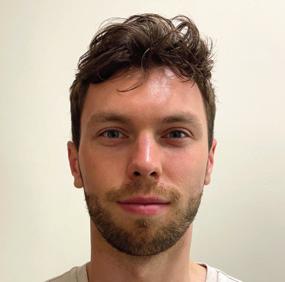
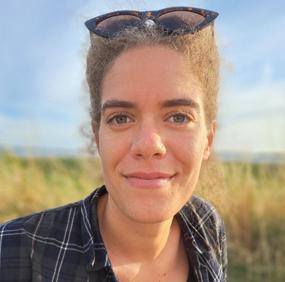
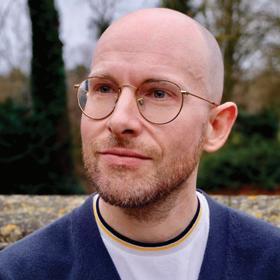
Cambridge, alongside an MB BChir from Cambridge and MRCP qualification from the Royal College of Physicians.
Dr Dîlan Canan Çakir is a German literary scholar who has researched, written and taught on a wide range of issues including literary activism, the cultural and political role of authors, popular theatre, digital humanities, digital literature and games and canon formations. Her postdoctoral studies are funded by a Feodor Lynen Research Fellowship from the Alexander von Humboldt Foundation.
Dr Gregory Cooke is a theoretical astrophysicist working with Professor Nikku Madhusudhan on hycean worlds. His PhD used advanced 3D simulations to study Earth’s atmospheric history over 2.4 billion years, including the evolution of the ozone layer, and to model Earth-like exoplanets around different stars. His current research explores the atmospheric and surface conditions of hycean worlds and their potential habitability. He chairs the Work-Life Balance Focus Group and co-chairs the Women’s Network at the Institute of Astronomy.
Dr Timothy Cooper is an anthropologist of ethics, religion and media infrastructures. His book Moral Atmospheres: Islam and Media in a Pakistani Marketplace (Columbia University Press, 2024) has been described as a ground-breaking intervention in global media studies. His postdoctoral research at POLIS, University of Cambridge, is based on ethnographic work in Gilgit-Baltistan, Pakistan, examining how energy shortages and internet censorship shape social life. He is Reviews Editor of the Cambridge Journal of Anthropology and editor of Camthropod: The Cambridge Anthropology Podcast.
Dr Parth Deshpande is a Research Associate in Engineering working with the Centre for Sustainable Road Freight, investigating the in-operation roll-out of electric heavy goods vehicles to support logistics companies’ transition to EVs. He is a Board Member of the International Forum for Heavy Vehicle Transport and Technology, a peer reviewer for international journals and conferences, and advises national committees developing Electric Road Systems policies.
Dr Ntombizodwa Makuyana is a neuroimmunologist studying communication along the gut-lung-brain axis. Based at the MRC Laboratory of Molecular Biology, her work uses cutting-edge techniques in immunology and neurobiology to understand how multi-organ mechanisms drive disease progression and respiratory immune responses. She is also a Gates Cambridge scholar and recipient of a Rising Talent Fellowship in 2025.
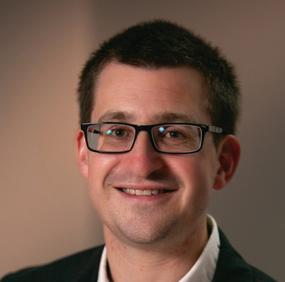


From the enduring legacies of slavery to anti-Kremlin protest art and curbing corruption in electoral politics, this year has seen a packed schedule of talks at the Intellectual Forum (IF). Speakers explored the role of art and culture in resisting authoritarianism, how eating mangoes might prevent children from developing sleep apnoea – and many more highlights.
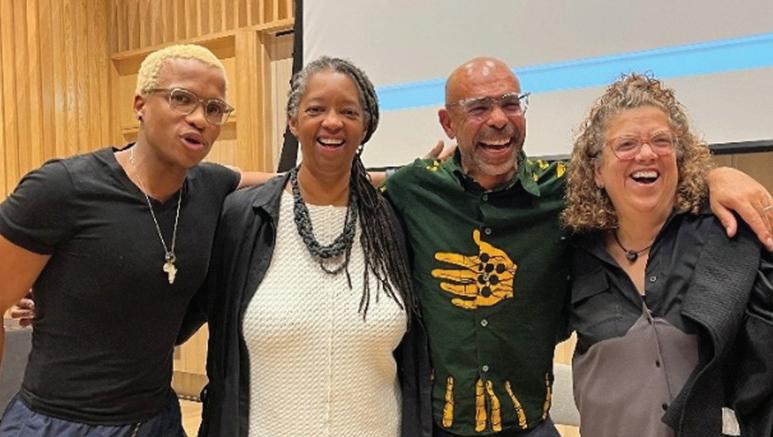
23 October: Tracing legacies of slavery with Keme Nzerem
Growing up, journalist Keme Nzerem proudly navigated several identities: mixed heritage, Black British, American, Nigerian. But he was forced to confront them all after discovering his ancestors’ involvement in the transatlantic trafficking of enslaved Africans.
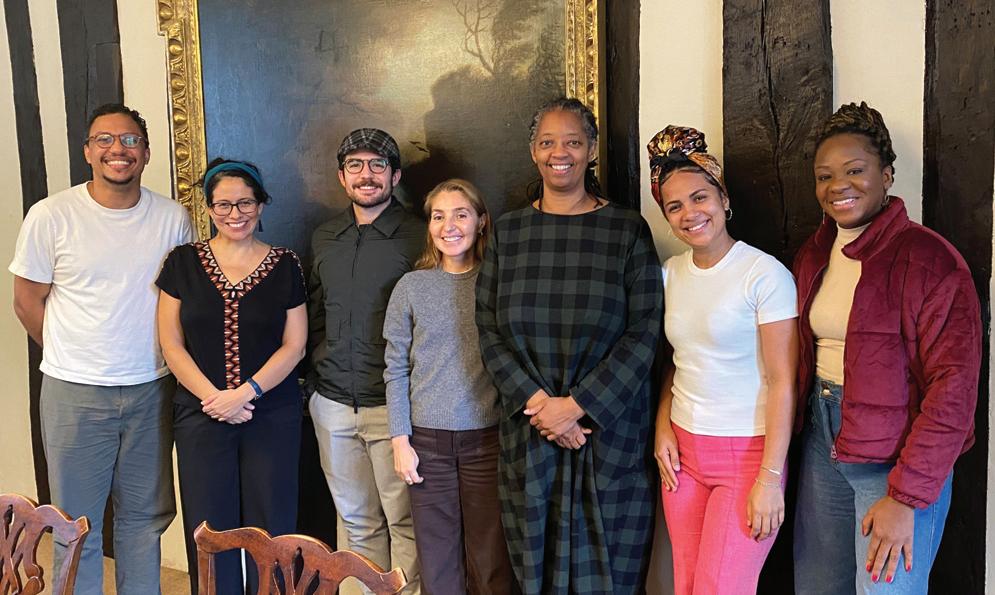
Long Juju is a feature documentary in progress tracking Keme’s global journey to try and find, and connect with, descendants of the people his ancestors had enslaved. Keme joined Jesus College Fellow Professor Mia Bay, Jamila Smith, Bernice Bennett, Evelyn Osuagwu and Adaeze Nzerem at the IF in October 2025 to discuss what the film means for contemporary British identities. Attendees reflected on the “brilliant discussion”, which explored the challenges of historical accountability, reconciliation and the complex legacies of slavery.
28 October: Artists Against the Kremlin brought dissident Russian protest art to the Frankopan Hall
The IF hosted the launch of a groundbreaking exhibition catalogue of anti-Kremlin protest art in October 2025. Artists Against the Kremlin brought together over 100 works by dissident Russian artists. Exhibition curator Vladimir Shalamov and Moscow Times publisher Alexander Gubsky shared the story of assembling the exhibition in the face of censorship, surveillance and political repression. Vladimir gave a richly illustrated lecture on the history of protest art in Russia from the Tsarist Empire to the present day, leading the audience through a hundred-year history of censorship, imprisonment and artistic resistance.
30 October: Is democracy for sale?
As concerns around corruption in UK and US elections become ever more relevant, the IF’s panel on money and politics felt especially timely. Jeff Clements, co-founder and CEO of American Promise, shared insights from his work campaigning for a US constitutional amendment to set common-sense limits on spending. He was joined by Dr Sue Hawley, CEO of the UK Spotlight on Corruption and Dr Parth Patel, Associate Director for Democracy and Politics at the Institute for Public Policy Research (IPPR). Discussion ranged from election campaigns to the impact
of income inequality on democracy and the outsize role of wealthy third parties in influencing voters.
4 November: Art and authoritarianism with Professor Sarah Colvin
Extending the IF’s focus on art as a form of resistance to authoritarianism, Jesus College Fellow Professor Sarah Colvin launched her latest book Literature and Epistemic Injustice: Power and Resistance in the Contemporary Novel at the IF in November. Professor Colvin introduced attendees to a wide range of contemporary novels and asked how literature might help challenge injustice in a post-truth age. In a political climate where disinformation and ‘alternative truths’ are increasingly normalised, Professor Colvin drew attention to the ways that novels can highlight flawed thinking and offer narratives of resistance.
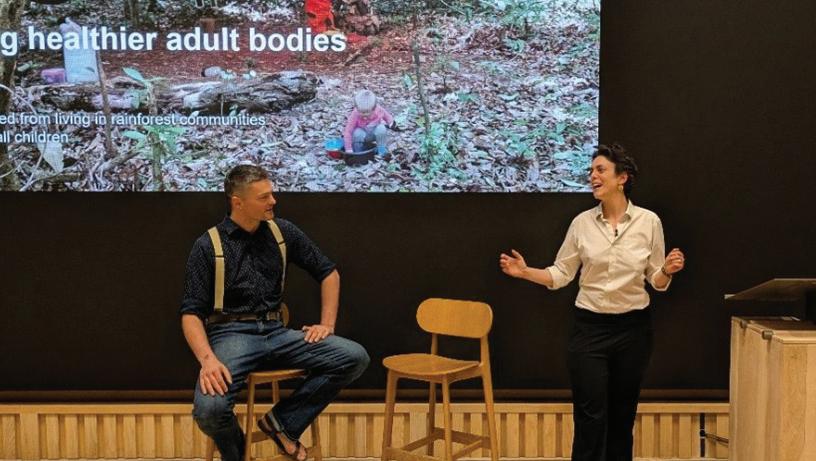
2 December: Dr Guen Bradbury shared her lessons from rainforest communities
After a year spent living and researching in traditional communities across South America and Africa, Jesus College alumna Dr Guen Bradbury and her partner Greg Dickens returned to Cambridge to share their many insights and stories with the IF’s audience. From rescuing lost fishing gear in piranha-infested waters to dealing with parasites, making fires and bartering with coconuts, adjusting to life raising three young children in remote rainforests was certainly a challenge! Guen shared findings from her research exploring how traditional childrearing practices might help address challenges in modern developmental science, from bone development to stress resilience and immunity.
Last year’s IF Summer interns, Clare Mulrooney and Bethany Taylor, spoke to Jesus College students about their projects over a slice at the IF’s Lent Term Pizza Forum. Clare’s project focused on safeguarding school pupils against image-based abuse and AI-generated deepfakes and led to a resource pack which she published in the TES. Bethany produced a creative-critical response to online culture: a video essay about video essays. Students also had the opportunity to learn more about applying for this year’s summer internship scheme, and get advice on crafting their own project proposals.
This is just a snapshot of the many things going on at the IF over the year. Curious to learn more? Watch recordings of our past events and find out what’s coming up on our website.
2025 DONORS’ REPORT
Fiscal year 1 July 2024 to 30 June 2025
Total donated: £3,319,950
What it is used for
Unrestricted 10.34%
£343,237.35
Restricted* 89.6% £2,976,713
*This includes £2,327,043 for Student Financial Support among other priorities such as Teaching and Outreach and Widening Participation
Total number of donors: 1,403
Who the donors were
1,087 Undergraduate alumni Participation rate for all alumni 11.28%
136 Postgraduate alumni
4 Other alumni
175 Non-alumni
College Bursaries Largest gift secured: £7,850,000 Donation funds for bursaries: £289,596 Bursaries funded: £ 60% of bursaries funded by donations 26% of donation income in the last five years was from legacy gifts 89 (received over the next five years for postgraduate students)
Return on investment
Total raised: £250,832 Legacies 14:1
£14.43 received for every £1 spent on fundraising











Being part of the Jesus College alumni community is much more than holding a degree; it is about belonging to a vibrant, global network of over 10,000 people that continues to enrich lives long after graduation. From social and professional opportunities to lifelong access to Cambridge’s intellectual and cultural life, staying connected offers many tangible and intangible benefits. Whether alumni live locally, elsewhere in the UK, or overseas, there are meaningful ways to stay in touch, return to College for events and contribute to its future.
The Development and Alumni Relations office regularly seeks input and advice from the alumni community on how they want to reconnect with friends, forge new relationships and renew a sense of belonging to their College. For example, feedback gathered from our 2024 alumni survey helped to shape our events programme, resulting in changes to the scope and timing of several celebrations. For the first time, the 50, 60 and 70 Years On celebrations were moved from November to May, allowing alumni to enjoy the College in spring. The change proved popular: the 70 Years On Lunch, celebrating those who matriculated in 1955, achieved its highest ever attendance. The College also moved the 50 Years On event from a lunch to a dinner, creating a more relaxed and sociable evening. Together, these gatherings were a powerful reminder of the enduring bonds forged at Jesus.
The Jesus College Cambridge Society (JCCS) was founded in 1903 to promote social connections between Jesuans of every generation and between Jesuans and the College. All alumni who paid their lifelong subscription as a student are members of the JCCS. The Development and Alumni Relations office
organises annual JCCS events including the Annual Dinner in College, and other events both formal and informal, at a range of prices, mostly in London or Cambridge.
Welcoming alumni back to College for reunion and anniversary events is always a highlight of the College calendar. In 2025, Reunion Dinners were held for matriculants from 2009, 2010 and 2011, as well as those from 1978 to 1981, while an Anniversary Dinner brought together alumni who matriculated in 1985, 1995, 2005 and 2015.
Thanks to the support of enthusiastic alumni volunteers, opportunities to connect now extend beyond Cambridge and London. A regional event in Oxford, organised by Verity Armstrong (2002, Geography) on behalf of the JCCS, brought together local Jesuans, while a reception at the New York City home of Andrew Solomon (1985, English) drew alumni from across the East Coast. These occasions highlight the truly global nature of the Jesus community and the many ways alumni help sustain it.
Now in its second year, the Volunteer of the Year Award recognises members of the Jesuan community who have made an outstanding contribution to the development of the College, had a meaningful impact on the Jesuan community and demonstrated a strong commitment to volunteering in support of the College and its mission. Nominations for 2026 close on 31 May 2026 with the winner formally announced at the Donors’ Garden Party on Saturday 4 July 2026. If you (or someone you know) have volunteered for the College over the past year, please consider submitting a nomination via the website.
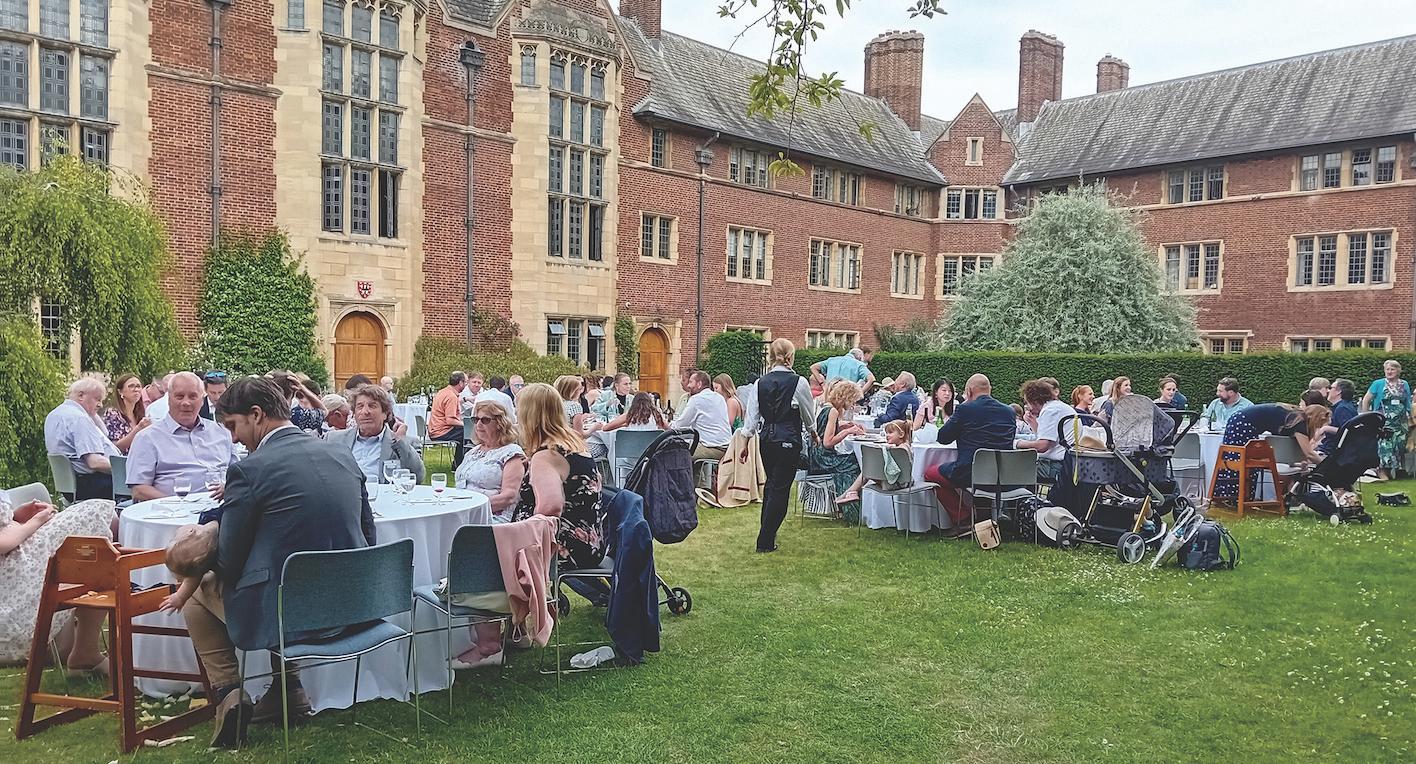
The Donors’ Garden Party has become a much-loved fixture in the College calendar. Last year’s event was particularly joyful, with families and children enjoying the sunshine and a newly inaugurated College-wide treasure hunt, complementing talks from academic Fellows and students. The event reflected the inclusive and intergenerational spirit of the alumni community, celebrating both generosity and shared enjoyment of the College.
Professional connection is another important aspect of alumni life. In 2024, we launched a new Finance and Investment networking event in London, bringing together alumni working in the sector with current Jesus students. Hosted by alumna Lingling Wu (2011, MBA) at Bullseye Financial, the evening was a great success and demonstrated the value of alumni-led initiatives. Building on this momentum, a larger follow-up event, City Drinks, took place in November 2025.
Beyond events, alumni regularly share how much they value engaging intellectually and culturally through lectures, concerts,
Jesus May Ball Networking Dinner – Saturday 25 April
1496 Society Lunch – Wednesday 6 May
Annual Engineering Society Dinner – Saturday 16 May
60 Years On Lunch (1966) – Wednesday 20 May
50 Years On Dinner (1976) – Friday 22 May
70 Years On Lunch (1956) – Wednesday 27 May
Newcastle Reception – Thursday 11 June
JCCS Annual Buffet Lunch – Saturday 20 June
Society of St Radegund Annual Dinner – Monday 29 June
Donors’ Garden Party – Saturday 4 July
Chapel services and talks, as well as by supporting students through mentoring, careers advice and networking. Contributions of time, expertise and financial support all play a vital role in sustaining the College’s mission and ensuring future generations can thrive.
Emily Williams, Director of Development and Alumni Relations at Jesus College, said: “Our alumni are an extraordinary reflection of the College’s values in action. By staying connected, attending events, and contributing in ways big and small, Jesuans collectively shape the College’s present and future. The strength of this community lies not only in shared memories, but in the support and inspiration it continues to offer throughout life.”
Staying in touch with Jesus College means remaining part of a living, evolving community. Whether through returning for an event, supporting students, or reconnecting with fellow alumni around the world, there are countless ways to remain involved and ensure that the Jesuan experience continues well beyond graduation.
Centennial Celebration of Harvard-Cambridge Scholarships – Friday 18 to Sunday 20 September
Cambridge University Alumni Festival – Friday 18 to Sunday 20 September
Telephone Campaign – Friday 18 to Sunday 27 September
JCCS Annual Dinner – Saturday 19 September
Financial Services Drinks Reception (London) – Wednesday 21 October
JCCS Drinks Reception (London) – Tuesday 17 November
Further details, including information on how to book, can be found on the College website
If you have any questions please do not hesitate to get in touch with us.
Professor Lee Burns, a distinguished academic from UCLA, was a familiar and warmly regarded presence in Cambridge. Though his academic home was in Los Angeles, his professional and personal ties to the University and association with several Colleges – Jesus among them – became a defining feature of his later life. Spending decades as a research scholar and 10 years as a lecturer in the Department of Land Economy, he developed enduring friendships and a deep affection for the Cambridge community.
His passion for music first brought him into the life of Jesus College. He was close friends with successive Directors of Music, Mark Williams and Richard Pinel, and through them became an enthusiastic supporter of the College Choir. He generously funded Choir activities including the 2018 tour to South Africa, and in recognition of the scale of his support he was awarded lifetime membership of the Choir Patrons.
Dividing his time between the US and UK, when in Cambridge Lee found that his flat on Thompsons Lane was ideally located just a short walk from Jesus College, allowing him to attend concerts and Evensong, accept invitations to donor events and reciprocate by hosting coffee meetings on his balcony overlooking the river. When Lee died in 2021 at the age of 87, it was a profound loss for all who knew him in College and across Cambridge.
In a final act of remarkable generosity, Lee left his Cambridge flat to Jesus College in his Will. In July 2017, reflecting on the future of the property, he wrote to the then-Development Director, Richard Dennis:
“I am excited about the possibility of Jesus College making use of the property because it is so well situated, with a large deck overlooking the Cam and facing Magdalene’s Fellows’ garden, and its proximity to Jesus College, only a ten‑minute walk via the back gate.”
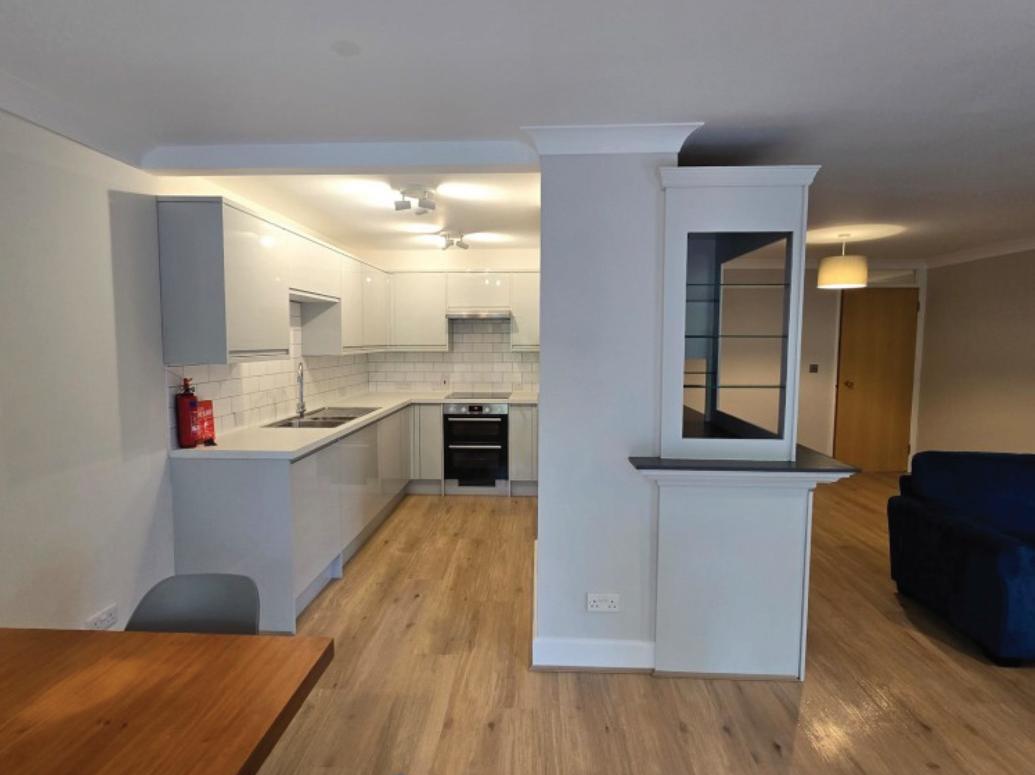
When the College acquired the property in 2023 it was full of character, and underwent sensitive refurbishment, including a
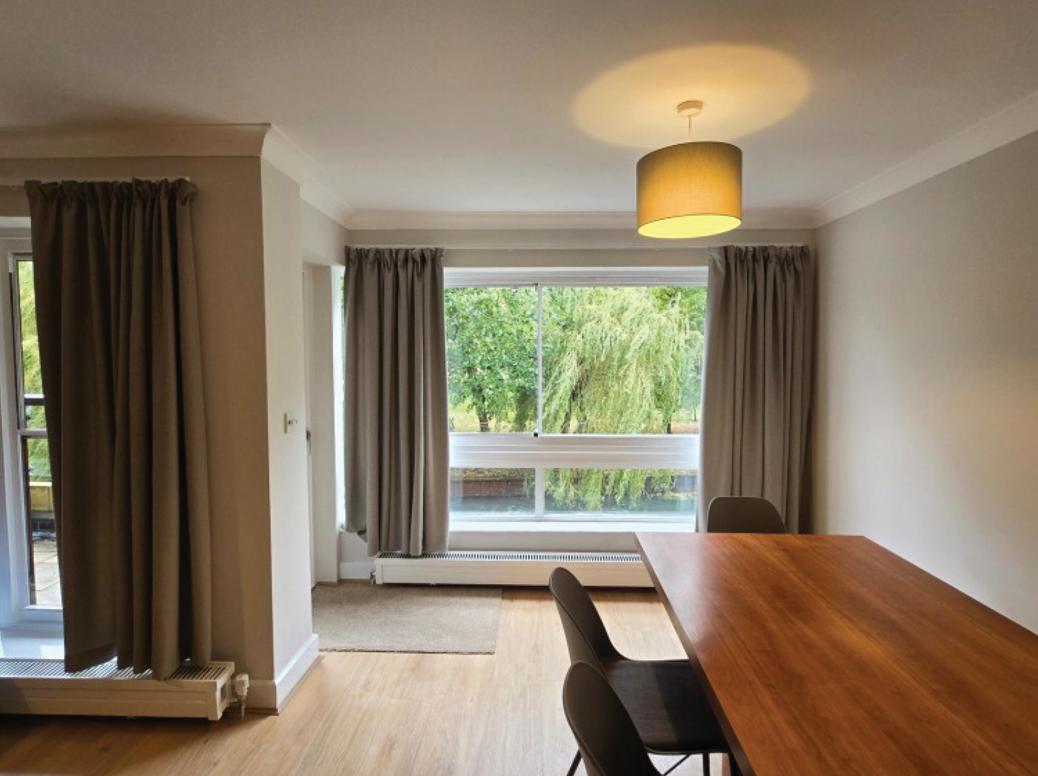
brand-new kitchen and bathroom, to meet modern rental standards.
Now – home to a Visiting Fellow for the last two academic years – the flat is proving an extraordinarily valuable asset to the College. Its river-facing position, dual‑aspect balcony, rare central Cambridge parking space and close proximity to Jesus make it especially attractive to new Fellows.
The College has been the grateful recipient of other properties gifted in Wills, as some donors find that leaving their property to a registered charity is beneficial for their tax position. Such properties must be gifted outright, leaving it for the College to decide whether to retain or sell. In the case of Lee’s flat, its location makes it an ideal property for a College member to live in, and means our in‑house team can carry out any required maintenance, reducing management costs.
“The gift from Professor Burns is a spectacular property. Living so close to College and the centre of the city but in relative peace is rare in Cambridge, and we are very privileged to have this flat to offer to those moving to join our community. Housing is so important to academics when new to Jesus, providing a welcoming environment when moving from elsewhere in the UK or the world and enabling them to live alongside their partner or family, whilst being an active member of the Jesus community. This gift really will have a profound impact, allowing us to recruit the highest calibre of Fellows, in turn meaning our students also benefit. For anyone considering leaving the College a gift of property, particularly in Cambridge, please know that it would be deeply valued.” – Isabel Harrison, Housing and Property Manager, Jesus College
Through this extremely generous bequest, Lee continues to support the life of the College he cared for so deeply. His legacy lives on – not only in the beautiful space he has gifted, but in the friendships, music and memories he leaves behind.
Legacy giving is one of the most powerful ways you can shape the future of Jesus College. In the last year, we received gifts from 12 supporters – 11 alumni, and one parent – whose belief in the College’s mission inspired them to include a charitable gift in their Will. Nine of those donors have preserved their position at Jesus College in perpetuity with unrestricted gifts left to general purposes, gifting us stability by strengthening the endowment. Meanwhile, two donors chose to make their mark by leaving legacies with a preference for mental health and wellbeing initiatives, and financial support for students. Beyond monetary gifts, two donors also entrusted the College with a valuable artwork and a collection of books. We value all our legacy donors, with gifts of all types and sizes helping to secure a vibrant future for every student who calls Jesus College home.
Crucially, because five of those donors shared their legacy intentions with us, we were able to thank them – and demonstrate the impact of their planned gift – by welcoming them into the 1496 Society. Membership benefits include a letter of thanks from the Master, a special membership pin, and invitations to the 1496 Society Lunch and Donors’ Garden Party every year. We are very grateful to the 215 members of the Jesus community who have told us about their future gift: Read
P A Johnson (1951)
W B Page (1951)
S J Robinson (1951)
R Carr (1953)
M A Ludgate (1953)
J A Williams (1953)
D A Wright (1953)
E P Beck (1954)
N D Durand (1954)
I H C Waters (1954)
Anonymous (1954)
W H Theakstone (1955)
K M Treves-Brown (1955)
Anonymous (1955)
B Landy (1956)
J D Rimington (1956)
A J Saddler (1956)
Anonymous (1956)
P Dawson (1957)
T P Francis (1957)
M Jarman (1958)
P J P Mulhall (1958)
B A Noble (1958)
C H Reeson (1958)
M Reupke (1958)
P M Slotkin (1958)
A Stillmark (1958)
C G Dean (1959)
G N Harby (1959)
T G Barker (1960)
N J Campbell-White (1960)
P A Oppenheim (1960)
D E Wilson (1960)
Anonymous [3] (1960)
T M Southern (1961)
Anonymous [2] (1961)
C V Anson (1962)
B N Buckley (1962)
J A Hudson (1962)
Anonymous (1962)
B A Fireman (1963)
J B Spittle (1963)
A R Amy (1964)
D A Bieda (1964)
R A Dorkings (1964)
N A Nagler (1964)
S J Barton (1965)
S B Crooks (1965)
J F Drinkwater (1965)
M P W Lance (1965)
D J McCollum (1965)
K M Southern (1965)
A Sutton (1965)
G J White (1965)
Anonymous [2] (1965)
R Bower (1966)
R J Kenrick (1966)
Anonymous (1966)
P Burnham (1967)
P F Coe (1967)
S I Fitzgerald (1967)
R G Gutman (1967)
G G Oxley (1967)
K S Richards (1967)
R C Shrimplin (1967)
S R Tilsley (1967)
M J Allchin (1968)
P I Day (1968)
J L Gordon (1968)
M C W Hunter (1968)
M Liddle (1968)
F S Ruttonshaw (1968)
Anonymous [2] (1968)
C I Kirker (1969)
I F Perry (1969)
D J Warnes (1969)
A J Waywell (1969)
C M Ellis (1970)
R J C Turner (1970)
Anonymous (1970)
R W Allen (1971)
P M Cannell (1971)
A A Chalkley (1971)
P Crook (1971)
C A Fiddian-Green (1971)
D A Fok (1971)
A R C Kershaw (1971)
N P Ready (1971)
J Winchester (1971)
A W C Yuen (1971)
Anonymous (1971)
N S Hoult (1972)
J P Wotton (1972)
Anonymous (1972)
T C Holtz (1973)
C M Lewis (1973)
N R Minogue (1973)
Anonymous (1973)
R N Higham (1974)
C P Hughes (1974)
J Jenkins (1974)
J Y Randall (1974)
C K Roberts (1974)
J F Warren (1974)
M A Clarke (1975)
A P Levinson (1975)
L S Mallinson (1975)
J Sinyor (1975)
W O A Coales (1976)
R A Collins (1976)
A W Kirby (1976)
J K B Withrington (1976)
Anonymous (1976)
R M Gibson (1977)
J P Halsey (1977)
S N Hillson (1977)
M R Sheridan (1977)
A M Teague (1978)
Anonymous (1978)
J F Davis (1979)
S R Davis (1979)
D W Scott (1979)
M D D Chaloner (1980)

N D R Goddard (1980)
A P Harrison (1980)
J C Healy (1980)
M J Oliver-Trotter (1980)
J M Pexton (1980)
J K Teague (1980)
A J Wheelhouse (1980)
A T M Wyles (1980)
E McMeikan (1981)
A W Davison (1982)
P M Gilliver (1982)
S E Knowles (1982)
Anonymous [2] (1982)
I Paterson (1983)
K F Fox (1984)
Anonymous [2] (1984)
M D Bartlett (1985)
R B Findlay (1985)
J G Whitehead (1985)
P M Day (1986)
M J Page (1986)
G A S C Wilson (1986)
Anonymous [2] (1986)
H J Cordell (1987)
F H Marshall (1987)
D H Martin (1987)
Anonymous (1987)
Anonymous [2] (1988)
D S R Bould (1989)
S S P Quay (1989)
J J Watson (1990)
Anonymous [2] (1990)
M M Arnot (1992)
T H Wong (1992)
A K Fyfe (1993)
G N Barrand (1994)
G F Hart (1994)
E J Warwick (1994)
J Arrastia (1995)
H M Berry (1995)
D R D Oppenheim (1995)
T G Warwick (1995)
H E Coates (1996)
A Hollingsworth (1996)
L M Northwood (1996)
P A Smith (1997)
J B Murray (1999)
A B Stone (2000)
H C Fenton Griffin (2001)
G M Pradella (2001)
T A S Austin (2002)
I R McCracken (2005)
A S O'Brien (2005)
G M Patton (2005)
K E Slade (2005)
A J Leach (2006)
J M Miller (2008)
C Ouellet-Plamondon (2008)
P K Sood (2008)
R J Mair (2011)
N A Tubbs (2014)
S Bryant
W A Chetwin
R Cheung
G M Drinkwater
E M Fitzgerald
M Gaine
D Gordon
C Harris
C Hughes
D Jones
P Langley
D S Maitland-March
E Marksteiner
H J Spurrier
D C Stewartby
R Wyles
Anonymous [5]
To discuss leaving your own legacy at Jesus, please contact Maisy Smyth – Senior Development Officer for Legacies and Stewardship m.smyth@jesus.cam.ac.uk or +44 (0)1223 339301
Bring your event to College
Host your meeting, conference or special event in one of Cambridge’s most beautiful College settings and give your guests a truly memorable experience. We regularly deliver outstanding events for organisations including Judge Business School, AstraZeneca and Microsoft Research, as well as public sector bodies, University departments, societies and associations.
Newly renovated conference spaces
Be among the first to host a meeting in our two newly refurbished conference rooms within the historic Wesley House buildings. Stay in College
Guests can enjoy beautifully refurbished bedrooms on site, available throughout the year in the heart of the College grounds. For conference and event enquiries please email conference@jesus.cam.ac.uk
Luxury accommodation in central Cambridge
Our West Court development offers a range of luxury rooms for visitors. To book accommodation please call +44 (0)1223 760571 or email reception@jesus.cam.ac.uk
Alumni receive a 10% booking discount for accommodation and events.
With events hosted at iconic venues all across Cambridge, there’s something for everyone – whether you’re seeking intellectual stimulation, nostalgic moments or simply a great weekend away.
As part of the programme of events, we are delighted to host a talk at Jesus College on Saturday 19 September with Postdoctoral Associate Dr Hanane Hadj-Moussa on how metabolic rewiring can promote healthspan and longevity. With environments becoming more extreme, a look at how animals have evolved to overcome these stressors can provide us with insights into possible adaptive strategies. One strategy, metabolic rate depression, involves a severe reduction in heart rate, brain activity and breathing that allows animals to enter suspended animation until conditions improve. Dr Hadj-Moussa’s work has characterised key molecular regulators that coordinate this response and she now investigates how these altered metabolic states can promote healthspan, the period of life free of morbidities. Indeed, while life expectancy has increased dramatically over the past 100 years, not all gained years are healthy.
See a full list of upcoming alumni events on page 27
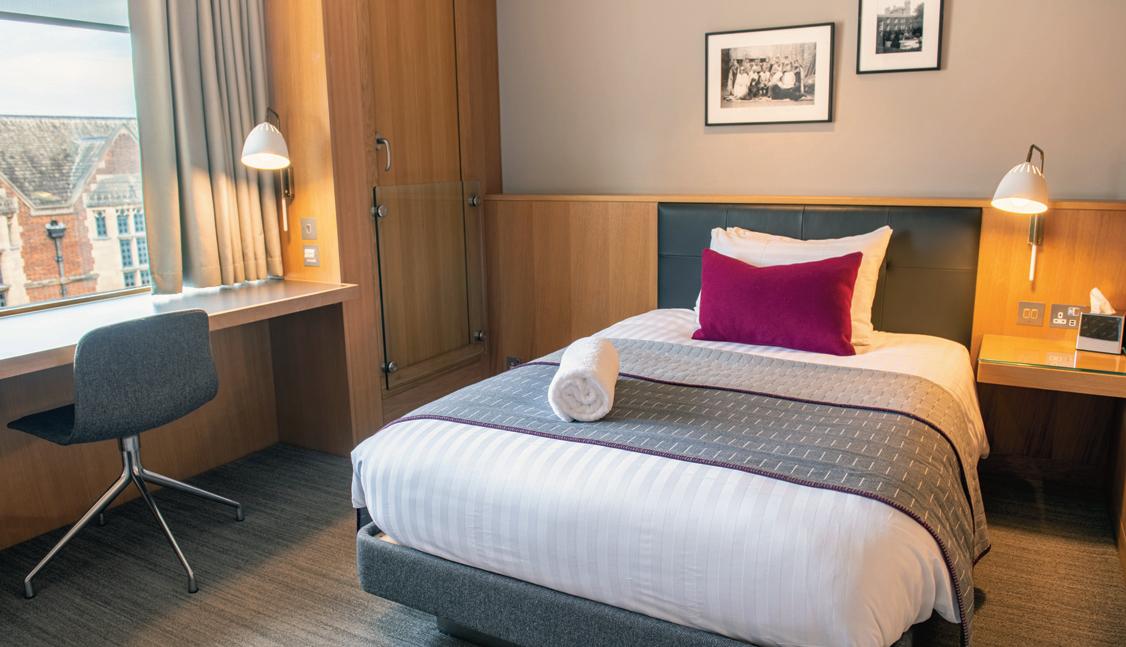
We offer a wide range of gifts both on our online shop and in our Porters’ Lodge. These include cufflinks, silk ties and bow ties, silver pins, tote bags, paperweights, playing cards, tea towels, prints and books, cuddly teddy bears, embossed Moleskine notebooks, wall hangings, the College flag and CD recordings of the Choirs of Jesus College –and more! We also have gift ideas to support the visual arts at the College, including Art for Tomorrow, a specially curated portfolio of 10 original prints by internationally renowned artists, and a limited-edition silk square scarf designed by Stephen Chambers RA and printed by Armani’s silk printers, Maver of Como. Also available is Thirty Years of Contemporary Art: Jesus College, Cambridge 1988-2018 by Emeritus Fellows Jean Bacon and Jim Roseblade, a richly illustrated photographic memoir of three decades of Sculpture in the Close and the development of the permanent collection Visit our online shop: www.jesus.cam.ac.uk/alumni/gift-shop