THE MAGAZINE OF THE NEW JERSEY JAZZ SOCIETY
MIDDLESEX COUNT Y JAZZ FESTIVAL
THE BIG BANDS
SEPTEMBER 2026 VOLUME 54 ISSUE 08
IN THIS ISSUE ARTICLES/REVIEWS 09
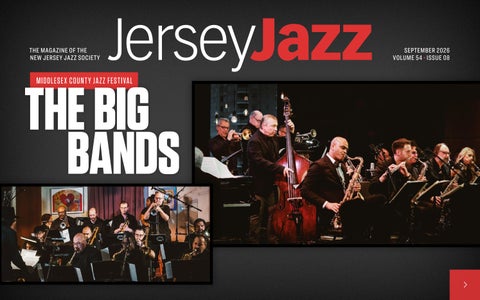
O N T H E COVE R _ Top, Charles Mingus Big Band; Bottom, Lance Bryant & SHOUT.
Mingus Big Band Photo courtesy of Episode 1, Let My Children Hear Mingus
NJJS.ORG
Jazz on a Sunday Afternoon: Nat Adderley, Jr.
10
Jazz at SOPAC: Cyrille Aimée
16
West Orange Jazz Festival: Joe Locke
22
Middlesex County Jazz Festival: Lance Bryant & SHOUT
27
Middlesex County Jazz Festival: Charles Mingus Big Band
32
Rising Star: Jacob Chung
37
Book Review: Cool Heat: Anita O’Day
39
Album Review: The Classic Oscar Peterson Trio Sessions
42
Other Views
47
Big Band in the Sky
COLUMNS 03
All That’s Jazz
05
Editor’s Choice
35
Pelote’s Place
50
Not Without You
JERSEY JAZZ
SEPTEMBER 2026
02
ALL THAT’S JAZZ BY CY DNE Y HA LPIN
In what seems like the “blink of an eye,” summer has come and gone, kids of all ages are going back to school, and the start of fall is upon us…and the holidays will be here before we know it!
P
lease join us Sunday, October 4th for a very special Jersey Jazz LIVE! Event: The 2026 Juried Scholarship Competition Winners Showcase. This concert will feature the six winners alongside industry professionals in a joyous celebration of talent that proves jazz is alive and well, and that the next generation of musicians is a fine one! Once again, saxophonist and educator Don Braden will be the Music Director for this event. Jersey Jazz LIVE! Is held at Madison Community Arts Center, 10 Kings Road, Madison, NJ. There is FREE street parking. $15 NJJS Members, $20 Non-Members, $5 Child/Student w/ID.
NJJS.ORG
Doors open at 2:30PM. LIVE! events are well attended, please plan accordingly. For advance ticket sales: events.ticketleap.com/tickets/new-jersey-jazz-society/jerseyjazz-live-2026-njjs-scholarshipwinners-showcase-200216411 The Competition produced 15 student entries, with the category breakdown as follows: Instrumental Performance - 7, Vocal Performance - 5, Original Composition - 3. The entries breakdown by college was: William Paterson University - 7, Princeton - 4, Rutgers - 1, Montclair State University - 1, Michigan State University - 2. The Competition awarded a $1000 and a $500 prize in all three categories: Jazz Performance, Jazz Vocal Performance, and Jazz Composition. In the Instrumental Performance category the $1000 winner is pianist Jasper Zimmerman from Princeton University and the $500 winner is guitarist Sally Shupe
from William Paterson University. In the Vocal Performance category the $1000 winner is Allison Jiang from Princeton, and the $500 winner is Kyra Cioffi from WPU. In the Composition category the $1000 winner is Nicholas Thorpe from Rutgers University and the $500 winner is Simon Bahadoran fromWPU. Congratulations to the winners! Congratulations to department heads Mitch Butler (WPU), Rudresh Mahanthappa (Princeton), Conrad Herwig (Rutgers) and voice teacher Michelle Lordi (Princeton) for supporting this program and encouraging their students to participate. Along with the cash award, winners receive guidance, mentorship and the opportunity to perform with industry professionals at our Jersey Jazz LIVE! Winners Showcase concert, and coverage in Jersey Jazz. For more detailed information on the winners, please see the archived June
issue: njjs.org/magazine/june-2026 While the competition ultimately produced 6 winners, it was a very competitive field, and the board and I would like to acknowledge and congratulate the other applicants whose submissions have proven that jazz is competently in the hands of this generation. The Instrumental Performance applicants were: Nick Mikhail/ WPU/trumpet, Bryan Castillo/WPU/ trombone, Jacob Tolentino/Michigan State/trumpet, Laura-Simone Martin/Michigan State/bass, and Maria Kolesnik/WPU/drums. The Vocal Performance applicants were Ammy Zea/Montclair State University, Sophia Varughese/Princeton, Lilia Burton Patel/Princeton. The third Composition applicant was: Eli Leder/WPU. Learn these musicians’ names as there’s no doubt you’ll be seeing these cats in the years to come. So many life skills are developed
JERSEY JAZZ
SEPTEMBER 2026
03
ALL THAT’S JAZZ through the discipline of music. Thank you and congratulations to all the teachers and mentors of these winners and applicants for your dedication and training. The art of jazz takes a village and each of you has a vital role in the personal and professional lives of these fine young musicians. This competition was judged by our prestigious panel of professional musicians, educators and industry leaders comprised of: » Don Braden: World class tenor saxophonist, flutist, composer and educator » Champian Fulton: Pianist, vocalist, bandleader, side-woman, and educator » Ted Chubb: Princeton University Lecturer of Music - Jazz Trumpet, composer, educator, and arts administrator » Jason Olaine: Vice President of Programming, Jazz at Lincoln Center
NJJS.ORG
Our deepest gratitude to judges Don, Ted, Champian, and Jason for their dedication and expertise, and for their input and advice as we continue to nurture and shape this competition. We’re exceedingly grateful to Nan Hughes Poole for her generous multi-year donations in support of this initiative, and to NJJS Board Members Cynthia Feketie, Mike Katz, and Jackie Wetcher for their additional generous support of this Competition. And thank you to all the NJJS members and non-members who’ve donated to this initiative. If you’d like to make a donation to further support and expand the 2027 competition prizes, you can do so at njjs.org via the red “Donate” button on the homepage, or by check payable to NJJS, 382 Springfield Ave., Suite 217, Summit, NJ 07091. Please note “Scholarship.” Don’t hesitate to contact me at pres@ njjs.org if you have any questions.
P
lease join me in thanking Board Members Jay Dougherty, James Pansulla, Paul Flexner, and Sandy Josephson for a job well done at the Montclair Jazz Festival held this past August. Once again, NJJS had a booth selling used records, CDs, and books, the proceeds supporting the Juried Scholarship Competition. Given that the merchandise sold is generously donated, the event grossed $1650 in support of this initiation. Gentlemen, this festival is hard work and you are rock stars! If you have gently used jazz records, CDs, and books that you’d like to donate to NJJS, please contact Jay Dougherty at info@njjs.org or James Pansulla at jazzeducation@ njjs.org to discuss pickup/delivery.
T
he New Jersey Jazz Society would like to thank the Morris Museum and Jess Van Nostrand, Director of Public Engagement and Curatorial
Strategies,, Laurel Smith - Manager, Bickford Theater, Lewis Perlmutter Technical Director Bickford Theater, Jimmy Warren - Assistant Technical Director, and all the other staff and volunteers who made “Jazz on the Back Deck” 2026 another smash season! We’re grateful for their hard work and commitment to providing jazz programming in a fun environment for the seventh summer in a row! Don’t miss the last jazz show of the season: Blanc Après Labor Day with Mike Davis and the New Wonders, Thursday, September 10, at 7:30pm. We look forward to the upcoming indoor season and thank all involved in advance for supporting and showcasing jazz! For more information and tickets visit morrismuseum.org/performances & film. “Autumn is full of pleasing sounds … yes, the season is an orchestra of magic.” — Mom Soul Soothers
JERSEY JAZZ
SEPTEMBER 2026
04
EDITOR’S CHOICE BY SA NFO RD JOS EPHSON
September Kicks Off a Vibrant Fall of Great Jazz in New Jersey
I
n recent years, September has been filled with jazz festivals in New Jersey. The September 2024 issue of Jersey Jazz, with the headline “FESTIVAL FEAST”, contained previews of seven different events. That has now changed with the moves by the Montclair Jazz Festival and the Morristown Jazz & Blues Festival back to August and the demise of the Central Jersey Jazz Festival and Kean University’s Roots. The good news is that the West Orange Jazz Festival, aka OSPAC Jazz Fest, and the Middlesex County Jazz Festival—in Woodbridge, Carteret, New Brunswick, and Metuchen—are alive and well. And, the even better news is that, unlike Montclair and Morristown, they are not on the same date. West Orange is on Saturday, September19; and Middlesex stretches
NJJS.ORG
over four days, from Thursday, September 24 to Sunday, September 27. Both are previewed in this issue. On page 16, vibraphonist Joe Locke talks about the solo concert he’ll be presenting at OSPAC, paying tribute to two of his musical heroes, Roy Hargrove and Billy Strayhorn. The Middlesex Festival will include two big band concerts: Lance Bryant & Shout in Carteret and the Charles Mingus Big Band in Metuchen. See our interviews with Bryant and bassist Boris Kozlov, who is the Mingus Band’s Musical Director, on pages 22 and 27, respectively. But September jazz in New Jersey isn’t restricted to these two festivals. Patty Slezak, Reference Librarian at the Wayne Public Library, recently released the schedule for concerts at the library and Wayne’s Our Lady of Con-
solation Church. One of the highlights takes place on Thursday night, September 24, featuring keyboardist Leonieke Scheuble’s Three Generations of Jazz with jazz legend Bill Crow on bass and her father, Nick Scheuble on drums. The special attraction will be the addition of tenor saxophonist Harry Allen, making it a quartet. Another quartet in the Wayne series will perform on November 12 when tenor saxophonist Dr. David Demsey, who is retired Coordinator of Jazz Studies at William Paterson University, will lead a quartet with Tomoko Ohno on piano, Marcus McLaurine on bass, and Nick Scheuble on drums. On Sunday, November 4, The Jazzwomen, our March cover story, will take the stage at the Consolation Church, with a group featuring Jenny Hill on tenor saxophone, Roberta Piket on piano, Jennifer Vincent on bass, and leader/drummer Kim Peralta. The library concerts are held at
7 p.m. on Thursday nights, and the church performances are at 4 p.m. on Sundays. Here’s the rest of the schedule: » September 13, The Next Wave Jazz Orchestra, led by pianist Caelan Cardello and trumpeter Jonny Gittings (church). » October 15, trombonist Caleb Rumley and vocalist Allison Rumley, leading a quintet (library). » October 18, Brazilian drummer Vanderlei Pereira & Blindfold Test (church). Some other shoutouts: pianists James Austin, Jr. and Ellie Lee at the Patricia M. Kuran Cultural Arts Center in Fanwood at 7 p.m. on Saturday, September 12; the Nat Adderley, Jr. Quartet at 3 p.m. on Sunday, September 13 at the Jay and Linda Grunin Center for the Arts in Toms River (see page 9), and two William Paterson Jazz Series concerts: trombonist Vincent Gardner on September 20 and bassist Todd Coolman’s Miles Davis Centennial Celebration on September 27.
JERSEY JAZZ
SEPTEMBER 2026
05
ABOUT NJJS
F
ounded in 1972, The New Jersey Jazz Society has diligently maintained its mission to promote and preserve America’s great art form—jazz. To accomplish our mission, we produce a monthly magazine, Jersey Jazz; sponsor live jazz events; and provide scholarships to New Jersey college students studying jazz. Through our outreach program Generations of Jazz, we provide interactive programs focused on the history of jazz. The Society is run by a board of directors who meet monthly to conduct Society business. NJJS membership is comprised of jazz devotees from all parts of the state, the country and the world.
MEMBER BENEFITS
JOIN NJJS
You become an integral part of the NJJS community, and the history and future of jazz
Family/Individual $45 (Family includes to 2 Adults and 2 children under 18 years of age) Family/Individual 3-Year $115 Musician Member $45 / 3-Year $90 (one time only, renewal at standard basic membership level.) Youth $15 - For people under 21 years of age. Date of Birth Required. Give-A-Gift $25 - Members in good standing may purchase unlimited gift memberships. Applies to New Memberships only. Fan $75 - $99 Jazzer $100 - $249 Sideman $250 - $499 Bandleader $500+ Corporate Membership $1000
Access to 11 Digital Issues of our Award Winning Jersey Jazz Magazine — Featuring Articles, Interviews, Reviews, Events and More Discounts to our Jersey Jazz LIVE! Sunday Concerts Discounts at NJJS Sponsored Concerts & Events. MUSICIAN MEMBERS
FREE Listing on NJJS.org “Musicians List” with Individual Website Link FREE Gig Advertising in our Monthly eBlast THE RECORD BIN
Visit www.njjs.org or email info@njjs.org for more information on our programs and services NJJS.ORG
A collection of used CD’s & LP’s available at reduced prices at specific events and through mail order njjs.org/shop
Members at Bandleader level and above and Corporate Memberships receive special benefits. Please contact Membership@njjs.org for details. The New Jersey Jazz Society is qualified as a tax exempt cultural organization under section 501(c)(3) of the Internal Revenue Code, Federal ID 23-7229339. Your contribution is tax-deductible to the full extent allowed by law. For more Information or to join, visit www.njjs.org
JERSEY JAZZ
SEPTEMBER 2026
06
Magazine of the New Jersey Jazz Society VO LU M E 54 • I SSUE 08
NJJS org
Editorial Staff
New Jersey Jazz Society, Officers 2026
EDITOR
PRESIDENT
Sanford Josephson, editor@njjs.org
Cydney Halpin, pres@njjs.org
ART DIRECTOR
EXECUTIVE VP
Michael Bessire, art@njjs.org
vicepresident@njjs.org
CONTRIBUTING EDITORS
TREASURER
Joe Lang, Vincent Pelote, Andrew Schinder, Jay Sweet
Mike Katz, treasurer@njjs.org
CONTRIBUTING PHOTOGRAPHERS
membership@njjs.org
John Abbott, Jenny Anderson, Edward Berger, Lia Chang, Richard Conde, Rob Davidson, Chris Drukker, Viktor Hlavatovic WEBMASTER
VP, MEMBERSHIP
VP, PUBLICITY
Sanford Josephson, sanford.josephson@gmail.com
VP, MUSIC PROGRAMMING
music@njjs.org
Christine Vaindirlis
RECORDING SECRETARY
WEBSITE DESIGN
Irene Miller
Prism Digital
CO -FOUNDER
Jack Stine
IMMEDIATE PAST PRESIDENT
Advertising Jersey Jazz (ISSN 07405928) is published monthly for members of The New Jersey Jazz Society
382 Springfield Ave., Suite 217, Summit, NJ 07901 973-229-0543 • info@njjs.org Membership fee is $45/year. All material in Jersey Jazz, except where another copyright holder is explicitly acknowledged, is copyright ©New Jersey Jazz Society 2026. All rights reserved. Use of this material is strictly prohibited without the written consent of the NJJS.
NJJS.ORG
Mike Katz
DIRECTOR OF ADVERTISING
Cydney Halpin, advertising@njjs.org ADVERTISING RATES
Full Page: 135, Half Page: 90, 1/3 Page: $60, 1/4 Page: $30 $
$
For reservations, technical information and deadlines contact advertising@njjs.org or visit njjs.org/Magazine/Advertise. Make a payment online at njjs.org/advertise via the red Submit Payment button, or via check made payable to NJJS, 382 Springfield Ave., Suite 217, Summit, NJ 07901.
DIRECTORS
Jay Dougherty, Cynthia Feketie, Paul Flexner, Pete Grice, Carrie Jackson, Caryl Anne McBride, Robert McGee, James Pansulla, Stew Schiffer, Elliott Tyson, Jackie Wetcher ADVISORS
Don Braden, Mariel Bildsten, Ted Chubb, Al Kuehn, Jason Olaine
JERSEY JAZZ
SEPTEMBER 2026
07
JerseyJazz LIVE! NJJS SCHOLARSHIP WINNERS SUNDAY, OCTOBER 4 3 : 00 P M
Madison Community Arts Center 10 KINGS ROAD, MADISON, NJ FREE STREET PARKING ON KINGS ROAD $
15 MEMBERS | $20 NON-MEMBERS $
Made possible by funds from the New Jersey State Council on the Arts, a partner agency of The National Endowment for the Arts.
5 CHILD/STUDENTS (WITH VALID I.D.)
JAZZ ON A SUNDAY AFTERNOON
His Album, Took So Long, Soared to the Top of the JazzWeek Charts
N
at Adderley, Jr. spent 25 years as the Music Director for rhythm and blues singer Luther Vandross, but after Vandross passed away in 2005, Adderley, Jr., the son of trumpeter Nat Adderley and nephew of alto saxophonist Julian “Cannonball” Adderley, returned to his roots as a jazz pianist, mixing hard bop with R&B. In October 2025, Adderley released his first jazz album as a leader, Took So Long. The album soared to the top of the JazzWeek charts, spending six weeks at Number 1. DownBeat Magazine’s Joshua Myers called it “a near perfect mixture of standard jazz
NJJS.ORG
tunes and popular musical mainstays.” On Sunday afternoon September 13, at the Jay and Linda Grunin Center for the Arts in Toms River, NJ, Adderley, Jr., will be performing selections from Took So Long. In addition to his
original title tune, you’ll hear such songs as Bronislaw Kaper’s “Green Dolphin Street”, Dizzy Gillespie’s “Con Alma”, Burton Lane’s “Old Devil Moon”, and “Superstar”, written by Leon Russell for The Carpenters, but memorably recorded by Luther Vandross. In the DownBeat review, Joshua Myers reminded his readers that, “It is simply cool to hear once again how interpretations of sounds made famous by Stevie Wonder, The Stylistics, and Aretha Franklin beautifully coexist alongside those written by Billie Holiday and Dizzy Gillespie. Masters of the piano format have gamely plumbed these associations before. But in the hands of Nat Adderley, Jr., we get yet another fresh look.” The New York City Jazz Record’s Scott Yanow found “Nat Adderley, Jr.’s credible jazz playing on Took So Long a bit of a revelation ... sounds like a veteran modern mainstream player.”
Took So Long was selected as WBGO Radio’s “New Day, New Play” album in October 2025. The station’s morning host, Gary Walker, pointed out that, “There are reimagined standards, an original, and a fabulous recollection of his dear friend Luther Vandross on ‘Superstar’. It might have taken so long, but it has been well worth it.” : The Nat Adderley, Jr. concert will be presented at 3 p.m. in the Grunin Center’s Prima Studio Theatre. The Jazz on a Sunday Afternoon series is sponsored by the Wintrode Family Foundation and supported by the New Jersey Jazz Society. The Jay and Linda Grunin Center for the Arts is located at College Drive on the campus of Ocean County College in Toms River. For more information or to order tickets, log onto grunincenter.org or call (731) 255-0500.
JERSEY JAZZ
SEPTEMBER 2026
09
PHOTO BY LIA CH ANG
Nat Adderley, Jr. Brings a Mixture of Hard Bop and R&B to Toms River’s Grunin Center
PH OTO BY V IKTOR HL AVATOV IC
JAZZ AT SOPAC Cyrille Aimée: A Mix of Jazz, Standards, Multilingual Vocal Pieces, and Original Compositions “I’m Pushing Myself to Write More, Because My Goal as an Artist is to Get Out of My Comfort Zone” BY A N D REW SC H IN D ER
F
rance holds a special place in jazz history. Throughout the 20th century and beyond, it offered American jazz musicians a respite from the racism, drugs, and economic adversity that was a reality for so many iconic jazz figures. French jazz fans welcomed these musicians with open arms, and together they created a jazz scene in France that continues to this day and rivals any scene in the world. Singer Cyrille Aimée was raised in France aware of none of this. Instead, Aimée forged her own unique path to falling in love with music
NJJS.ORG
and making it her life’s work. Given the diversity and sophistication of her music, this is not surprising. She eventually became a huge jazz fan, to be sure, but not before developing her own unique musical identity. Aimée grew up in the small town of Samois-sur-Seine, about 60 kilometers (37 miles) southeast of Paris. The town is famous for its annual Django Reinhardt Festival, named in honor of the legendary Belgian/ Romani guitarist, who lived there during retirement and died in nearby Fontainebleau. During her childhood,
JERSEY JAZZ
SEPTEMBER 2026
10
JAZZ AT SOPAC Aimée’s musical journey began with her parents—a Dominican mother and French father – as well as the groups of Gypsies who often gathered in her town. Aimée befriended them and adopted their love of music. “My mom really liked to dance,” Aimée began. “So, my first relationship to music was through dancing.
She’s from the Dominican Republic, and so we listened to very Caribbean rhythms—salsa, merengue, bachata. She would put on music, and she loved to throw parties; and so for me, music was for dancing. And then I grew up in the little village where Django Reinhardt used to live. He was a Gypsy guitar player. There’s a festival in his
Aimée made two albums with Brazilian guitarist Diego Figueiredo.
NJJS.ORG
honor. I became friends with the Gypsies, and that’s how I started singing. And then I just followed the music. “I fell in love with the music that Gypsies were playing,” she continued. “Improvised music. I didn’t have any training, but the instrument I had on me was the voice. So that’s what I used to participate in their music-making. It’s not at all an academic way of entering music. It was just because it was part of the community and part of everyday life, and it just was a way to share and to give, and so that’s why I started singing. It has nothing to do with the technique or the interest in singing specifically. It was the interest in community.” Aimée’s global, multiethnic, culturally diverse upbringing shaped both her musical personality and sense of self generally. Her recorded output, consisting of nine studio albums and three live albums, reflects that multifaceted background. Sure, her oeuvre
includes renditions of jazz and Great American Songbook standards, as well as pop classics, but she also tackles multilingual vocal pieces and original compositions that truly distinguish her in the modern vocal idiom. She will bring that uniqueness to the South Orange Performing Arts Center (SOPAC) on Thursday, September 10. Aimée’s worldliness began immediately after birth. “I was born in France, but two weeks later my parents moved to Cameroon, Africa,” she explained. “Then we moved to America where my sister was born, then back to France. At some point my family lived in Singapore and lived in Mexico and, and so, it’s not that I didn’t feel French, it’s just that I didn’t have as much in common with the people who were French from generations and whose whole family lived here, and grew up here; and I always had a kind of a boundary-breaking kind of spirit. “When you’re a mixed person, you
JERSEY JAZZ
SEPTEMBER 2026
11
JAZZ AT SOPAC get put in a box. When I met the Gypsies, I felt like I had something in common with them because they are people who have not chosen a land. They travel everywhere, they take their community with them, and they just follow the wind. I felt very akin to that.” Like Aimée’s upbringing generally, her introduction to jazz was fairly non-traditional. “It’s called Gypsy jazz,” she explained. “It kind of falls in the category of jazz, but in America no one takes it seriously because it’s French, so it’s from a different
country. But it’s jazz music, and it’s improvised. It’s just like bebop but with guitar. The thing is that the instruments are mostly guitar, violin, and clarinet because that’s what fit in the caravans. You couldn’t fit a drum set or piano. So, it’s the same spirit of that music, of jazz music, except it’s different instrumentation. “One day, someone gave me a fourCD box set of Ella Fitzgerald, and when I heard that I was like, ‘I want go where that comes from!’ I want to go to New York and learn the American
“ IT’S CALLED GYPSY JAZZ …
IT’S JUST LIKE BEBOP, BUT WITH A GUITAR.” NJJS.ORG
Cyrille Aimée at the 2012 Sarah Vaughan International Vocal Competition Awards, which she won.
songbook, learn these songs, and learn how to do that. I think that’s when it went from, ‘Oh, this is fun to do’ to ‘I’m hungry and thirsty for only this.’” Aimée enrolled at SUNY Purchase in 2005 and immediately began performing in New York City. She had a regular date at the Cupping Room Café in SoHo and built up a sizeable following, which led to more gigs and eventually a self-released album, Smile in 2009, the first of two duo albums with Brazilian guitarist
Diego Figueiredo (the second, Just the Two of Us on Venus Records, came out in 2010). From there, she remained a prolific recording artist. A memorable early date at the seminal New York jazz club, Smalls, featured the late, legendary Roy Hargrove (who performed spectacularly despite being sick at the time), memorialized in her Live at Smalls album (SmallsLIVE: 2010). “It was just one night,” she said. “He didn’t know what we were going to play. He just showed up, and we called the tunes, and he just took one chorus on the songs, and it was always perfect. And that’s it. That was it.” Aimée continued to hone her craft throughout the next decade, with each album and performance increasing her notoriety, enlarging her fanbase, and cementing her as one of music’s finest modern vocalists. She participated in, and always
JERSEY JAZZ
SEPTEMBER 2026
12
JAZZ AT SOPAC excelled at, various major vocal competitions, including the New Jersey Performing Arts Center’s prestigious Sarah Vaughan International Jazz Vocal Competition (aka the SASSY Awards), the inaugural edition of which she won in 2012. “I’m going on a discovery every time,” Aimée added. “I feel like I’m an explorer, and I’m just exploring new colors and new sounds and shapes and, in the music, I’m just trying to get lost. I’m taking a little route I’ve never taken before, and my goal every time that I’m improvising is to feel like it’s the first time. I don’t have anything mapped out.” Aimée received significant critical acclaim for her album of covers of songs by musical theater master Stephen Sondheim, entitled Move On: A Sondheim Adventure (Mack Avenue, 2019). Indeed, she received her first Grammy Award nomination in 2019 (for Best Arrangement, Instruments
NJJS.ORG
à Fleur de Peau received a Grammy nomination in 2024 for Best Traditonal Pop Vocal Album.
and Vocals) for the album’s version of “Marry Me A Little” (originally from Sondheim’s groundbreaking musical Company). Sondheim’s work certainly has no shortage of interpretations, and tackling it risks igniting the ire of the composer’s passionate fanbase. Yet, Aimée brought a unique and distinctive perspective to the beloved
songs that was celebrated, not the least because she wasn’t familiar with them before embarking on the project. “I tackled the project because I had no idea about Stephen Sondheim!” she explained. “I think if I had known, I would have not tackled it. So, I was lucky. Ignorance is bliss. Growing up in France, you don’t know Stephen Sondheim. And then I came to America and was deep in the jazz world, and I discovered Stephen Sondheim super late. And actually, right before doing this record, I performed in a Stephen Sondheim tribute, and that’s when I discovered Stephen Sondheim. It was with Bernadette Peters and Encores. So, I just started to dig into all his songs. I was reading his charts, just reading the lyrics, and I picked the songs where the lyrics spoke to me. And then I went to listen, and I picked the songs where I liked the melody.” Aimée’s most recent album, à Fleur de Peau (Whirlwind Recordings,
2024), represents a bit of a departure from her more traditional arrangements, eschewing jazz standards and the Great American Songbook for original compositions, studio effects, and modern pop experimentation. Nonetheless, the music establishment hailed à Fleur de Peau as well, with Aimée receiving another Grammy nomination (for Best Traditional Pop Vocal Album) in 2024. Never one to be satisfied or sit still, she plans to continue developing her sound and expanding herself artistically. “I feel like my comfort zone is standards,” Aimée said. “That’s why I’m pushing myself to write more, because my goal as an artist is to get out of my comfort zone.” Pointing out that, “à Fleur de Peau is my most different album,” she added that, “I’ve put out a lot of albums, you know? So compared to all the other ones, it kind of stood out, because first of all, it was mostly original songs, and it, doesn’t fit in any kind of box. It’s hard
JERSEY JAZZ
SEPTEMBER 2026
13
JAZZ AT SOPAC to describe. My other albums, I can totally put them in the jazz box, but this one I wouldn’t. This one is the most me. The most personal and vulnerable. “I wrote a lot of these songs in the jungle, close to nature—nature inspires a lot of songs in me. I wrote them on the guitar or ukulele. I didn’t have a vision for these songs. They’re just songs—melodies and chords, and that’s it. And Jake Sherman, the producer, fell in love with my songs, which was at first a huge surprise for me because as a jazz singer, I was very self-conscious about my writing. And then we got in the studio, and I just played the guitar, and he played the bass, and then I put on the voice, and then the songs were created in a kind of vertical way with stacking, stacking the drums on top, and then all the little details that we hear. All of this was hours and hours of me and Jake in the studio looking for the perfect
NJJS.ORG
sound at that particular moment.” Currently, Aimée is busy with a different project—her 18-monthold son. She recorded an album of French songs with pianist Mathis Picard while pregnant and is awaiting its release. After that, while still frequently performing live, Aimée sees herself at a bit of a crossroads. “I don’t see myself in jazz anymore,” she said. “I mean, jazz was the school that took me here, to have music as a career. It’s still part of me, but I think of myself as an artist, not just a jazz singer. Being a jazz singer is where I come from. What I have been seeing is that there are a lot of young jazz singers coming out these days, and it’s inspiring. It feels good. It makes me feel like, ‘Okay, I’ll have a job for a few more years because kids are liking this.’ So, the jazz vocal world is in good hands. But I feel like I’ve passed the torch.”
JERSEY JAZZ
SEPTEMBER 2026
14
Wed, Sept 23 | 7:00 – 9:30pm | WOODBRIDGE Parker Press Park, 400 Rahway Ave. Shayna Steele Quintet Eli Yamin Jazz & Blues Band Woodbridge HS Jazz Choir
Thu, Sept 24 | 5:30 – 8:30pm | NEW BRUNSWICK Liberty Square Park, 150 Neilson St. Camille Thurman with the Darrell Green Quartet Cocomama
Fri, Sept 25 | 7:00 – 8:45pm | CARTERET Performing Arts Center, 46 Washington St. Lance Bryant & Shout! Big Band Jeff Levine
Sat, Sept 26 | 5:30 – 9:45pm | METUCHEN Metuchen High School, 400 Grove Ave Mingus Big Band Dave Schumacher & Cubeye
Metuchen High School (MHS) Jazz Ensemble and MHS Orchestra • Metuchen Dance Centre
FREE
SEPT 23 – 26, 2026 middlesexcountyjazzfestival.org
Grant funding has been provided by the Middlesex County Board of County Commissioners through a grant award from the Middlesex County Cultural and Arts Trust Fund.
Niladri Kumaar The Space Between the Notes Fri, Nov 6 @ 7:30PM
nov 6 – 22 christian mcbride jesse cook
Miles @ 100 with Jon Faddis & Friends Celebrating Kind of Blue and Birth of the Cool Nov 12 @ 7:30PM Gregory Porter with special guest Madeleine Peyroux Fri, Nov 13 @ 8PM
gregory porter
Jesse Cook Forever Live Sat, Nov 14 @ 8PM
charles lloyd
ben vereen
Charles Lloyd Quartet Sat, Nov 21 @ 3PM Ben Vereen’s 80th Birthday Concert Sat, Nov 21 @ 8PM Wallace Roney Jr. Quartet Dorthaan’s Place Jazz Brunch Sun, Nov 22 @ 11:30AM & 1:30PM Sarah Vaughan International Jazz Vocal Competition Sun, Nov 22 @ 3PM
Bruce Hornsby with Christian McBride One on One Sun, Nov 15 @ 3PM The American Song series at NJPAC is presented, in part, through the generous support of the Blanche and Irving Laurie Foundation, the David S. Steiner and Sylvia Steiner Charitable Trust, the Joan and Allen Bildner Family Fund, the Smart Family Foundation/David S. Stone, Esq., Stone & Magnanini
@NJPAC • njpac.org • 1.888.MY.NJPAC • 1 Center St., Newark
WEST ORANGE JAZZ FESTIVAL Joe Locke’s Solo Vibraphone Set Will Pay Tribute to Roy Hargrove and Billy Strayhorn
“It’s Important for Me to Acknowledge Important People in My Life and in the Life of the Music”
T
he late WBGO Radio personality Michael Bourne hosted an annual “Jazz on the Mountain” festival at the Mohonk Mountain House in New Paltz, NY, for 22 years. In 2013, he asked vibraphonist Joe Locke to perform a solo vibe concert. “Michael Bourne,” Locke recalled, “threw the gauntlet down. He kind of challenged me to do a set of solo vibraphone. At first, I said, ‘Absolutely not. I can’t do a whole set of solo vibraphone.’ I did it, and I ended up really enjoying it, and so did the audience.” On Saturday, September 19, at the
NJJS.ORG
West Orange Jazz Festival, aka OSPAC Jazz Fest, Locke will once again present a solo vibraphone performance, entitled “Songs and Stories.” He believes it will work as a counterpoint “in between more powerful sets of music by bands really swinging and grooving hard (in this case, the Montclair State Jazz Ensemble and trumpeter Freddie Hendrix’s Experience and Fellowship band). Locke is planning to do “a set of pieces that all have narratives attached. There’s a piece that I composed on one of my albums for Roy Hargrove (“Raise Heaven” on the 2023
JERSEY JAZZ
SEPTEMBER 2026
16
PHOTO BY JO HN AB BOTT
BY SANFORD JOS E P HSON
Circle 9 album, Makram). I have a few things to say about Roy, so I’ll speak about Roy and my feelings about him. Whether I’m playing with an orchestra or a big band or my own quartet or playing solo vibraphone, it’s important for me to acknowledge important people in my life and in the life of the music; and Roy was one of those.” The last track on Makram is a solo version of Billy Strayhorn’s “Lush Life.” The reason Locke did that: “In the climate we’re in today in this country, I thought it was really im-
portant to acknowledge Billy Strayhorn—not only for his work as an artist but for his work as a civil rights activist and his relationship with Medgar Evers. If he never composed a note of music, I would think he was a great American. So, playing ‘Lush Life’ gives me an opportunity to do that.” The rest of the West Orange program was still being developed at the time of our interview, “but I may open with something that just feels good and brings the folks into a narrative of what the songs are about.”
“ MORE THAN 30 YEARS AGO LOCKE
RELEASED AN ALBUM OF MUSIC COMPOSED BY HENRY MANCINI.” NJJS.ORG
AllAboutJazz’s Neil Duggan called Makram “an eclectic mix of the comforting, the challenging, and the familiar.” It included seven original compositions by Locke or members of his rhythm section and two standards, “Lush Life” and Cole Porter’s “Love for Sale.” Pointing out that the pacing of the material on the album “makes it compelling and engaging to listen to,” Duggan added that Locke “shows great sensitivity in the tender moments and great drive when needed.” More than 30 years ago, Locke
released an album of music composed by Henry Mancini (Moment to Moment, Milestone/Fantasy: 1994). Reviewing it for AllMusic, Ken Dryden wrote that Locke, “offers a fresh look at Henry Mancini on this release. His dramatic and spacious treatment of one of Mancini’s most beloved works, ‘Moon River’, gives the oft-recorded song a very new sound, while another frequently played number, ‘Days of Wine and Roses’, begins with a dreamy introduction before progressing into a head-shaking hard bop arrangement.”
JERSEY JAZZ
SEPTEMBER 2026
17
PHOTO BY RIC HARD CO NDE
WEST ORANGE JAZZ FESTIVAL
WEST ORANGE JAZZ FESTIVAL When asked about Mancini, Locke responded that “I always enjoy getting to delve into his catalog,” and he did it again 16 years after Moment to Moment in a collaboration with vocalist Kenny Washington. “I met Kenny Washington in California,” he recalled, “and it sort of resuscitated all those Mancini arrangements I had done because I
got to do them again, with lyrics.” On For the Love of You, his 2010 Lionsgate Canada album with Washington, pianist Geoffrey Keezer, bassist George Mraz, and drummer Clarence Penn, Locke paid tribute to Mancini with a new interpretation of Mancini’s “Two for the Road” (lyrics by Leslie Bricusse). Other standards on that recording include Johnny Mandel and Paul Francis Webster’s “The Shadow of Your Smile”, and Burton Lane and Yip Harburg’s “Old Devil Moon”. In a review of the album, AllAboutJazz’s John Kelman described the treatment of “Two for the Road” as an, “elegant, smoky version of
Locke with Geoffrey Keezer, the pianist on Makram, For the Love of You, and Moment to Moment.
“ ‘BAGS’ TOOK THE LANGUAGE OF BIRD
AND DIZZY AND REALLY SUCCESSFULLY TRANSFERRED IT TO THE VIBES.”
Mancini’s and Bricusse’s classic. It not only highlights Washington’s soulful delivery, but also the empathic relationship between the vibraphonist and pianist Geoffrey Keezer, with whom Locke goes back many years.” As the 67-year-old Locke looks back on his career, some of the strongest memories include playing with pianist Cecil Taylor, and saxophonists Bob Berg, and Jackie McLean. “I did a tour with Cecil Taylor,” he recalled. “It was a deep end of the pool I had no business being in, but Cecil was an absolutely fascinating
human being. All of them (Taylor, Berg, McLean) are unique artists unto themselves and have a stamp of identity, which I hope has rubbed off on me. I’m so grateful to have had the opportunity to know some of my heroes.” McLean “really knocked me out. He was my hero for a long time.” Locke’s biggest vibraphonist influences from the past were Milt ‘Bags’ Jackson and Bobby Hutcherson. Recalling “the poetry of their playing” he added that, “The big thing to me about both of them is that the vibraphone is sort of a cold instrument. It’s an in-
JERSEY JAZZ
SEPTEMBER 2026
18
WEST ORANGE JAZZ FESTIVAL strument that you’re removed from by these mallets. ‘Bags’ took the language of Bird and Dizzy and really successfully transferred it to the vibes. And, Bobby did the same thing with the post-Coltrane language. They were of their time but remained timeless.” Locke grew up in Rochester,
NY, first learning to play piano and drums at age 8 before switching to the vibes as a 13-year-old. He started out performing with rock bands but then switched to jazz during his high school years. “A week out of high school, I went on the road with (tenor saxophonist) Spyder Mar-
West Orange Jazz Festival Schedule Saturday, September 19
1-1:45 PM » NJPAC Jazz for Teens, directed by Mark Gross 2-2:45 PM » Montclair State Jazz Ensemble, directed by Oscar Perez 3-3:45 PM » Vibraphonist Joe Locke, “Songs and Stories” 4-4:45 PM » Trumpeter Freddie Hendrix and his
Experience and Fellowship Band 5-5:45 PM » Saxophonist Jaleel Shaw, leading a trio 6-6:45 PM » Vocalist Antoinette Montague and Experience 7-7:45 PM
NJJS.ORG
» Drummer Dion Parson & his 21st Century Band
tin and got to work with (drummer) Billy Hart and (baritone saxophonist) Pepper Adams. I learned to play the vibes by the seat of my pants.” As for his solo playing, Locke said, “The challenge is to find my own way to express what I want to express, just being myself with the instrument. Michael Bourne opened the door for me to embrace the challenge.” Pianist Fred Hersch was the Artistic Director at Mohonk Mountain the year that Bourne issued his challenge, and Locke played with him and (guitarist) John Scofield as well as doing the solo concert.
Montclair Jazz Ensemble: Big Band Music from Ellington, Basie, and Thad Jones-Mel Lewis
W
hen I interviewed pianist Dr. Oscar Perez, Coordinator of Jazz Studies at Montclair State’s John J. Cali School of Music, it
was very early in the school year. So, he didn’t know the lineup of players who would be performing in the Montclair Jazz Ensemble at the West Orange Festival. But he did know that, “We will be playing some great modern big band charts from faculty member (and trombonist) Alan Ferber. And, one of my composition teachers was (pianist) Jim McNeely, so we will dedicate something to him. (McNeely passed away in September 2025 at the age of 76). No big band concert, Perez emphasized, would be complete without music from Duke Ellington, Count Basie, and the Thad JonesMel Lewis Orchestra. “And we’ll be playing some Latin jazz from people like Tito Puente and Chico O’Farrill or something from Dizzy Gillespie’s Latin period.” Montclair State has an annual week-long Immersive Residency
JERSEY JAZZ
SEPTEMBER 2026
19
WEST ORANGE JAZZ FESTIVAL
NAT ADDERLEY JR.
Sunday, September 13 Oscar Perez, left, and Paquito D’Rivera at the 2025-26 Immersive Residency.
NJJS.ORG
: The West Orange Jazz Festival is held at the Oskar Schindler Performing Arts Center (OSPAC), located at 4 Boland Drive. WBGO Founding Member and NEA Jazz Master Dorthaan Kirk will receive the inaugural OSPAC Jazz Fest Spirit Award for “her tireless dedication to preserving, presenting, and growing America’s national treasure, jazz”. To order tickets, log onto: Events.ticketleap.com/ tickets/pvpospac/ospac-westorange-jazz-fest
JERSEY JAZZ
SEPTEMBER 2026
20
JOHN PIZZARELLI
Friday, October 2
Click on the QR code to purchase tickets or visit grunincenter.org PHOTO BY ROB DAV IDSON
program that offers students the opportunity to collaborate with professional artists. The jazz Immersive Residency artist for 2026-27, Perez said, will be seventime Grammy Award-winning trumpeter and composer Terence Blanchard, who is Executive Artistic Director of the SF Jazz Collective and a National Endowment for the Arts Jazz Master. Last year’s jazz Immersive Artists were vocalist Jazzmeia Horn and saxophonist/ clarinetist Paquito D’Rivera.
For the complete performance schedule, visit grunincenter.org. Grunin Center Box Office Hours Tuesday-Friday Noon-5:00pm by phone only 732-255-0500 College Drive ✦ Toms River, NJ Contact the Box Office four weeks prior to any show to arrange for disability and accessibility services.
Contact the Box Office four weeks prior to any show to arrange for disability and accessibility services.
Sun, October 4 at 7pm
IC K E TS N O
!
732-246-SHOW (7469) New Brunswick, NJ
T ET
W
Get Tickets: STNJ.org
G
Samara Joy has emerged as one of the most captivating new voices in jazz, bringing a fresh perspective to a beloved tradition. With a sound that feels both rooted in history and uniquely her own, she has quickly drawn the attention of audiences and critics alike. Experience the artistry, warmth, and unmistakable brilliance of a true rising icon—live and in person.
ST
NJ.ORG
MIDDLESEX COUNTY JAZZ FESTIVAL Lance Bryant’s SHOUT Big Band Will Bring a ‘Spiritual’ Flavor to Carteret “The Band Has Allowed Me to Realize My Artistic Voice ... I Love Writing Music”
NJJS.ORG
I
n April of 2022, tenor saxophonist Lance Bryant decided to create his own big band. He reached out to musicians to see who might be available and then he needed a venue. He found the perfect place at Clements Place on the Rutgers-Newark campus. “We were lucky to develop a good relationship with Wayne Winbourne (Executive Director of Rutgers’ Institute of Jazz Studies),” he said. The band, Lance Bryant & SHOUT, is still going strong. It continues to play one Monday night a month at Clements Place and is expanding to other performance sites in the New Jersey-New York area. One of them, on Friday, September 25, will be the Carteret Performing Arts Center, as part of the Middlesex County Jazz Festival. Last month, SHOUT performed in the Morris Museum’s Jazz on the Back Deck series, and the band has also played
JERSEY JAZZ
SEPTEMBER 2026
22
Lance Bryant
MIDDLESEX COUNTY JAZZ FESTIVAL at the Jersey City Jazz Festival and at the Jazz House Kids’ program at New York City’s Trinity Church. The band members, Bryant said, “are pretty much the same corps we started with.” The saxophonists in Carteret will be Bryant on lead tenor sax, Rodrigo Romero also on tenor, Zoe Obadia on alto saxophone and David Schumacher on baritone sax. The trombones are Jason Jackson, Peter Lin, Clarence Davis, and James Borowski. “The first trumpet chair’s been al-
ternating a lot,” Bryant said, “because of people’s schedules. The lineup in Carteret will be Alex Norris on lead trumpet, along with Eddie Allen, Ted Chubb, and Freddie Hendrix. When we started out, we had Bill Mobley on fourth trumpet. He was one of the main inspirations for me starting the band because of his writing. Now, sometimes, we have a young trumpet player, Myles Twitty, who’s in the graduate program at Montclair State.” The regular rhythm section is Oscar Perez on piano, Bryant’s daughter
“ I’VE BEEN REVIVING SOME
ORIGINALS I WROTE FOR MY FIRST CD, PSALM. ” NJJS.ORG
Caylen Bryant on bass (and vocals), and Jarrett Walser on drums. In Carteret, Roberta Piket will sub for Perez who will be at the Northampton, MA, Jazz Festival; and Tom DiCarlo will replace Caylen, who will be out on tour with pianist/vocalist Kandace Springs. “When we started,” Bryant said, “I had my fingers crossed. It’s kind of a
tough thing to keep a big band going.” At presstime, Bryant was still working on the set list for Carteret. “I’ve been reviving some originals I wrote for my first CD, Psalm, writing big band versions.” That album, released in 2002 on the Testimony Records label, consisted of several Bryant originals as well as jazz interpretations of hymns and
JERSEY JAZZ
SEPTEMBER 2026
23
Two younger members of SHOUT are alto saxophonist Zoe Obadia and tenor saxophonist Rodrigo Romero.
spirituals. As for the rest of the repertoire, Bryant said, “We like to do compositions written by people around my age (65),” and that will likely include a strong mixture of jazz combined with rhythm & blues and gospel. “The band,” Bryant said, “has al-
NJJS.ORG
lowed me to realize my artistic voice. When I listen to music, I listen to the whole spectrum—all the textures and sounds. I love writing music. That’s why I started the band and put it together. And, to hear really good musicians playing it back—that’s really great.”
Many of the musicians are people that Bryant has played with for years, but, he pointed out, “there is a good mix of ages. The demographic is wide—different races, different genders.” One of the younger members is Romero, a 26-year-old Peruvian ten-
or saxophonist who joined SHOUT in 2025. “As a saxophonist,” he said, “I get inspired by the love, dedication, and seriousness that is poured by Mr. Bryant on each performance. Lance is one of the most relaxed, professional and upfront bandleaders I have encountered in my career. He delivers clear messages to the band while being understanding of our energy levels and making us feel like one big family.” Romero received his Masters Degree in Jazz Performance from Montclair State’s John J. Cali School of Music in 2024. Obadia, who’s been with the band since its inception, was featured as a Rising Star in the September 2022 issue of Jersey Jazz. The 30-year-old alto saxophonist from Glen Ridge, NJ, has a Masters Degree from Juilliard, is currently on the Jazz House Kids faculty, and soloed with the JHK Faculty Big Band on John Coltrane’s “Mr. P.C.” at last month’s Montclair Jazz Festival.
JERSEY JAZZ
SEPTEMBER 2026
24
ZOE OBAD IA PHOTO BY C HRI S D RUK KE R
MIDDLESEX COUNTY JAZZ FESTIVAL
MIDDLESEX COUNTY JAZZ FESTIVAL Bryant’s 32-year-old daughter, Caylen, began playing the cello when she was seven years old. She started playing jazz bass at Oberlin Conservatory where she studied with bassists Peter Dominguez and Gerald Cannon. After receiving her Bachelor of Music in Jazz Bass Performance at Oberlin, she earned a Masters Degree at Juilliard. Lance Bryant came to New York in the mid-1980s after graduating from the Berklee College of Music in Boston. He studied privately with former Count Basie Music Director, saxophonist Frank Foster, and in 1990 joined the Lionel Hampton Orchestra, eventually becoming its Music Director and principal arranger. He is also a jazz educator, working with students in the New Jersey Youth Symphony Jazz Orchestra and teaching at Montclair State. “At Montclair State, I teach a
class that’s a jazz history class,” he said, “but it’s called Jazz Styles and Culture. It focuses, not just on the facts about jazz history but the culture and the life around the people that made it. We just go from decade to decade and examine what was going on in the world and the people who created this music.” In February 2024, Bryant led a trio at the New Jersey Jazz Society’s Jersey Jazz LIVE! concert in Madison, taking his audience on a “Journey Through Black History.” The trio, which included bassist Tom DiCarlo and pianist James Austin, Jr., played a variety of pieces important in Black history, such as the African-American spiritual, “Hold On” (aka “Keep Your Hand on the Plow”), Lil Hardin Armstrong’s “Struttin’ With Some Barbeque”, and Edgar Sampson’s “Stompin’ at the Savoy.” —SANFORD JOSEPHSON
NJJS.ORG
JERSEY JAZZ
SEPTEMBER 2026
25
6
C O M I N G O C TO B E R 4 T H
Do wn to wn Pl ai nfi el d
SHOP · DINE · JAM
@DOWNTOWNPLAINFIED
@CENTRALJERSEYJAZZFESTIVAL
VISIT US ONLINE FOR LINEUP | VENDOR INFO | AND MORE!
WWW.CENTRALJERSEYJAZZFESTIVAL.COM
MIDDLESEX COUNTY JAZZ FESTIVAL
The Charles Mingus Big Band: A ‘Spontaneous’ Celebration of the Legendary Bassist/Composer’s Music “Every Single Person in the Band Will be Featured, and It’ll be Very Uplifting and Exciting” BY JAY SW E E T
NJJS.ORG
JERSEY JAZZ
SEPTEMBER 2026
27
PHOTO COU RT ESY O F EP ISO DE 1, L ET MY CH I L DR E N H E A R MI N GUS
T
here are jazz composers whose music is unmistakable, and that is certainly true of Charles Mingus. More than four decades after his death, Mingus’ music continues to inspire and remains remarkably contemporary. His compositions draw from the blues, gospel, swing, bebop, and modern classical music, yet leave enough room for musicians to improvise and bring their own personalities to the music. The Mingus Big Band will bring that music to Metuchen, NJ, as part of the Middlesex County Jazz Festival, on Saturday, September 26, under the musical direction of bassist Boris Kozlov For Kozlov, the goal is not to recreate Mingus’ music exactly as it existed decades ago. In a recent interview, he made it clear that attempting to imitate Mingus would run counter to the composer’s entire philosophy. “It’s absolutely fruitless to try to mim-
MIDDLESEX COUNTY JAZZ FESTIVAL ic Mingus, or try to mimic how he did things,” Kozlov told me. “That idea— honoring Mingus without imitating him—may be the key to understanding both the Mingus Big Band and why this music continues to thrive.” The Middlesex audience, Kozlov said, should expect precisely that kind of spontaneity. “Every single person in the band will be featured, and it’ll be very uplifting and exciting, I hope.” The band will likely draw material from the recent Charles Mingus Centennial Sessions recordings (Jazz Workshop, Inc. and Candid Records), but even Kozlov does not necessarily know exactly what will be played until the musicians come together. The Mingus book contains around 150 compositions and arrangements, giving the band an extraordinary amount of music from which to choose. Sometimes older pieces return to the rotation simply because a musician
NJJS.ORG
feels strongly about playing one. “Sometimes people have this burning desire” to perform something, Kozlov explained. “We always honor that, because if there’s a desire to play something, that’s like a holy feeling.” The personalities in the band therefore help determine the music rather than being forced into a predetermined recreation of Mingus’s recordings. The Mingus Big Band was established by Mingus’ wife, Sue Mingus, in 1991, building upon the Mingus Dynasty septet she had formed following Charles Mingus’ death in 1979. Today the Mingus legacy includes three primary ensembles: the 14-piece Mingus Big Band, seven-piece Mingus Dynasty, and the Mingus Orchestra. Kozlov may serve as the most frequent current Musical Director, but he does not view himself as replacing either Charles or Sue Mingus. “Mingus is the leader of the band. Sue Mingus was
Charles and Sue Mingus
at one point the leader of the band,” he told me. “My role as an MD, I kind of feel it to the point when the band starts wanting a leader. From that point, you take over.” Kozlov describes the ensemble as essentially a collective charged with interpreting what Mingus himself might have wanted. Kozlov’s own path to Mingus is particularly fascinating because he
encountered Mingus’ compositions before he really knew his recordings. Growing up in the Soviet Union, access to American jazz recordings was extremely limited. Musicians copied whatever records they could obtain and shared music among themselves. Kozlov found the Mingus composition “Pussy Cat Dues” in photocopied Real Book material and began playing
JERSEY JAZZ
SEPTEMBER 2026
28
MIDDLESEX COUNTY JAZZ FESTIVAL it without ever having heard Mingus’ recording. Only after coming to New York did the recordings begin catching up with the compositions. While playing with saxophonist Jake Collins as a street musician, Kozlov was told he needed to know “Better Git It in Your Soul.” He took the advice seriously, went to Fulton Street in Brooklyn and bought a cassette of Mingus Ah Um (Columbia Records: 1959). The experience was transformative. “When I heard Mingus Ah Um, I realized it’s such a perfect recording on so many levels,” Kozlov said. “You can almost put it in the capsule and shoot it into space for potential representation of...that’s what human jazz is.” His relationship with the music changed dramatically in 1998 when a friend of Kozlov’s, helped connect him with the Mingus Big Band. The ensemble suddenly needed a substitute bassist, and Kozlov prepared as
NJJS.ORG
much of the music as possible and played the gig, although Sue Mingus was not there that night. When she called and asked him to return the following week, he was understandably confused. “Ms. Mingus, you haven’t heard me yet,” he told her. Sue’s response was memorable: “I didn’t have to; I made 14 phone
Boris Kozlov
calls.” The response from the other musicians had apparently been enough. Kozlov returned the following week, beginning an association with the Mingus organizations that has now lasted nearly three decades. What happened next says even more about the early confidence Sue Mingus quickly placed in him. Trying to better learn the enormous Mingus repertoire, Kozlov asked if there was an Aebersold-style playalong book of Mingus compositions that he could use for study. Sue told him there wasn’t one and essentially responded: ‘Why don’t you make one?’ “Week two in the band,” Kozlov recalled, “she puts me in charge of producing a play-along.” The project eventually became the Hal Leonard publication Charles Mingus: More Than a Play-Along. Within two weeks of entering the band as a substitute, Kozlov had been given responsibility
for a project designed to help other musicians study and understand Mingus’ music. (Aebersold play-along books are educational music toolkits created by jazz saxophonist and educator Jamey Aebersold to help musicians learn how to improvise jazz). For Kozlov, there is also the unavoidable connection of being a bassist interpreting the work of one of the most important bassists in jazz history. “The main attribute of his playing that impressed me is the immediacy of delivery,” Kozlov said. “The intent is huge. Like, it has to be played right now, right here, this way.” Kozlov believes that “Mingus’ immediacy of delivery is where no one can touch him.” Yet after extensively studying his playing, Kozlov came to an important conclusion: “I can never sound like Mingus.” Instead, he embraced the lesson passed along by musicians such as trombonist Britt
JERSEY JAZZ
SEPTEMBER 2026
29
MIDDLESEX COUNTY JAZZ FESTIVAL Woodman and saxophonist John Stubblefield, who told him Mingus demanded that musicians develop their own voices. Kozlov decided to, “Let me become better myself rather than trying to emulate Mingus.” Sue Mingus eventually gave Kozlov an extraordinary physical connection to Mingus as well—Mingus’ 1927 Roth bass, which Kozlov kept and played for approximately 12 years. “I sound nothing like him even with the bass,” Kozlov joked. The instrument nevertheless had enormous musical and spiritual significance for him. “The bass itself kind of was teaching me,” he recalled, adding humorously that if he tried too hard to emulate Mingus, he felt he might be “struck by lightning or something” in retaliation. Any discussion of the survival of Mingus’ legacy bands inevitably leads back to Sue Mingus. She did not simply preserve manuscripts and record-
NJJS.ORG
“ CHARLES MINGUS MAY HAVE LEFT THE WORLD
IN 1979, BUT HIS SPIRIT AND HIS MUSIC DIDN’T.”
ings; she created working ensembles in which the compositions could continue developing. Kozlov said the band has around 150 pieces in its book from a Mingus catalog of approximately 279 compositions, with additional material still waiting to be explored. “It’s an embarrassment of riches, as Sue used to say.” Sue also made certain that the musicians did not ignore Mingus’ more ambitious extended compositions, particularly works combining jazz and classical aesthetics. One of Sue Mingus’s greatest accomplishments was making her husband’s music part of the living
fabric of New York jazz. The Mingus Big Band’s residency tradition began with Thursday nights at Fez beneath the Time Cafe in 1991, followed by periods at Joe’s Pub, City Hall, and Iridium before reaching what became perhaps its most celebrated home, the Jazz Standard. There, Mingus Mondays became a New York jazz institution and provided a regular laboratory where musicians could continually revisit and reshape the repertoire. When the Jazz Standard closed during the pandemic, the residency tradition survived. The band eventually established a new home at DROM,
and in 2026 Mingus Mondays moved to The Pocket Jazz Club in Manhattan, continuing a New York residency tradition now in its fourth decade. Sue Mingus’ death in 2022 inevitably raised questions about whether the Mingus organizations could continue without the person who had driven them for decades. Kozlov said he never seriously believed the bands would disappear. Sue’s withdrawal from daily operations had been gradual, and she made certain knowledgeable people were prepared to continue the work. For Kozlov, however, her death was far more personal. “We lost not only the
JERSEY JAZZ
SEPTEMBER 2026
30
Middlesex County Jazz Festival Schedule
Camille Thurman
Shayna Steele
WEDNESDAY, SEP. 23, Woodbridge, Parker Press Park, 400 Rahway Ave. In the event of inclement weather, the concerts will move indoors to the Acacia Youth Center at 95 Port Reading Ave.
7:00-7:45 PM » Keyboardist Jeff Levine
7:00-7:15 PM » Woodbridge High School Jazz Choir
7:45-8:45 PM » Lance Bryant & SHOUT! Big Band
7:30-8:20 PM » Pianist Eli Yamin’s Jazz
SATURDAY, SEP. 26, Metuchen, Metuchen High School, 400 Grove Ave.
& Blues Band
FRIDAY, SEP. 25, Carteret, Carteret Performing Arts Performing Arts Center, 46 Washington St.
8:40-9:30 PM » Vocalist Shayna Steele’s Quintet
5:30-6:00 PM » Metuchen Dance Center
THURSDAY, SEP. 24, New Brunswick, Liberty Square Park, 150 Neilson St.(rain or shine)
6:00-6:45 PM » Metuchen High School Jazz
5:30-6:40 PM » Latin Jazz Group Cocomama 7:00-8:30 PM » Tenor saxophonist/vocalist
Camille Thurman with drummer Darrell Green’s Quartet
NJJS.ORG
Celebrating Jazz Tap
leader, but a friend,” he said. Kozlov lived close to Sue’s office and remembered her door being almost perpetually open. He could stop by to research Mingus’ files or compare several versions of a composition while preparing an arrangement. That relationship demonstrates why the Mingus organization is more than a traditional repertory band. There is a direct human connection running from Charles Mingus through Sue Mingus, through musicians who actually played with Mingus, and into musicians such as Boris Kozlov who perform and interpret the music today. Charles Mingus may have left the world in 1979, but his spirit and his music didn’t.
Ensemble & Orchestra 7:00-8:00 PM » Baritone saxophonist
Dave Schumacher & Cubeye 8:15-9:45 PM » Charles Mingus Big Band
: All concerts are free. For more information, log onto middlesexcounty jazzfestival.org or the Middlesex County Jazz Festival Facebook page.
JERSEY JAZZ
SEPTEMBER 2026
31
SHAYNA STE EL E PHOTO BY J ENNY ANDE RSO N
MIDDLESEX COUNTY JAZZ FESTIVAL
RISING STAR Jacob Chung: ‘A Combination of Talent, Hard Work, and Humility’ “One of the Greatest Tenor Saxophonists to Come Out of Canada in Recent Years.” BY SA NFO RD JOS EPH SON
G
rowing up in Toronto, Jacob Chung was introduced to jazz by his grandfather. “He had a record player,” Chung recalled, “and he had Dave Brubeck’s Time Out album. He also liked Duke Ellington and Ben Webster.” Chung was playing classical piano when he entered middle school, “and they started giving you wind instruments. I was into baseball, and I had a few concussions and tore the meniscus in my knee, so I had to quit sports for a while. All of a sudden, I had this time on my hands, and I took up the saxophone. I picked up the
NJJS.ORG
saxophone at about 15 or 16. It was like an obsession. I couldn’t stop.” It helped that Toronto’s Humber College had a weekend program offering instruction to high school students by several of its jazz faculty members: saxophonists Luis Gonzalez Deniz and Kirk MacDonald and guitarist Lorne Lofsky. Later, while majoring in music at the University of Toronto, Chung gigged at such local spots as The Rex and the Jazz Bistro. In 2022, he moved to New York City to attend the Jazz Arts program at the Manhattan School of Music from which he
JERSEY JAZZ
SEPTEMBER 2026
32
RISING STAR received his Master of Music degree. At MSM, Chung studied with alto saxophonist Vincent Herring who introduced him to saxophonist Cory Weeds, Founder of the Cellar Music Group independent jazz label. His first Cellar album, The Sage, was released in 2024, and it featured Herring, drummer Joe Farnsworth, pianist Tyler Henderson, and bassist Caleb Tobocman. Reviewing it for AllAboutJazz, Jack Bowers wrote that, “Chung is a rising star whose light promises to become even brighter and more decisive as his mastery and assurance evolve. With The Sage, he proves that he is not only on the right track but has a running start ... Chung is a splendid composer and arranger, and every number on The Sage is admirable and worth hearing.” The album was named one of the best Canadian jazz recordings of 2024 by the Ottawa Citizen’s Peter
NJJS.ORG
Chung, second from right, with his rhythm section for Live at Frankies Jazz Club. From left, Hank Allen-Barfield, Caleb Tobocman, and Tyler Henderson
Hum, and Chung was named an “Outstanding Soloist” in DownBeat Magazine’s 2024 Student Music edition. The 26-year-old Chung released his second Cellar album, Live at Frankies Jazz Club, last year. He was joined by Henderson, Tobocman, and drummer Hank Allen-Barfield. Reviewing it for Jersey Jazz, Joe Lang wrote that, “It is a pleasure to hear a young tenor
saxophonist whose influences reach back beyond the seemingly all-pervasive effect that John Coltrane has upon so many players currently on the scene. Jacob Chung is one who has obviously listened to many of the pre-Coltrane masters ... Keep an eye out for opportunities to catch a Chung gig, as he is now based in New York City.” While at MSM, Chung also at-
tended tenor saxophonist Grant Stewart’s Tribeca Jazz Institute, a program that focuses on private instruction and mentorship. According to Stewart, Chung “is a fantastic young player. He came to the Tribeca Jazz Institute already playing at a very high level, and we were able to help him in a couple of areas that pushed him up to the next level. Jacob’s playing over the last few years has really taken off, mainly because he’s a combination of talent, hard work, and humility. I also have a soft spot for Jacob because he’s a fellow Canuck, and we’re both from the same part of Toronto.” During his time at the Tribeca Jazz Institute, Chung had the opportunity to work with the late tenor saxophonist/clarinetist Ken Peplowski. “He invited me out to come play with him at the Oregon Coast Jazz Party. He was so supportive and
JERSEY JAZZ
SEPTEMBER 2026
33
RISING STAR left a remarkable impact on my musicianship as well as on my peers.” Chung’s early teachers at Humber College have followed his career and are enthusiastic about his success. “I feel extremely proud and pleased to see the saxophonist that Jacob has become,” said Deniz. “I can say, without hesitation, that Jacob Chung has become one of the greatest tenor saxophonists to come out of Canada in recent years. Keep an eye out for this great player as I’m sure he’ll continue to make waves.” Added MacDonald: “Jacob Chung is an exceptional young saxophon-
ist with a deep understanding of the tenor saxophone tradition and the jazz canon. It has been a pleasure to watch Jacob’s rapid development and artistic growth and to hear him continue to evolve as a musician.” Chung’s saxophone hero of the past is Charlie Parker. “I try to listen to him every day,” he said. “It keeps me healthy.” As for current saxophonists, “It’s Eric Alexander, Grant Stewart, and Chris Byars. Those are my favorite saxophone players right now.” This month will be a busy one for Chung. He will be releasing the single—Tadd Dameron’s classic bebop
“ JACOB CHUNG IS AN EXCEPTIONAL YOUNG SAXOPHONIST WITH
A DEEP UNDERSTANDING OF THE TENOR SAXOPHONE TRADITION.”
NJJS.ORG
tune, “Jahbero”—for his next Cellar album, A Secret Place. He’ll also be performing in the Sonny Rollins Colossus on September 10 at Dizzy’s Club with pianist Luther Allison and tenor saxophonists Chris Lewis, Melissa Aldana, and Jerry Weldon. He’ll be playing in the late-night time slot during Dizzy’s Coltrane Centennial Celebration from September 22-27. And, in October, there will be a weekend engagement at Smalls. As he looks back at his early days playing saxophone in middle school, Chung believes “that kind of grit you develop in sports when you’re playing on a team—it’s really useful as a musician.” He also remembers one of the best pieces of advice he received from Vincent Herring. “He told me my only responsibility in this music is to play the saxophone the way I want to hear it played.”
JERSEY JAZZ
SEPTEMBER 2026
34
PELOTE’S PLACE
T
his month’s column celebrates the 50-year anniversary of the return of the King to the recording studio. I’m not referring to Elvis, but to alto saxophonist/trumpeter/arranger/composer/bandleader Benny Carter. Why is Carter the King? The nickname was bestowed upon him by Ben Webster. Carter was probably more respected by other musicians for his musical knowledge than any other, so whenever there was an argument over a musical point, the musicians would seek out Carter, and he would settle the argument every time. The alto saxophonist’s last recording as a leader before his 10-year hiatus from the studios was for the album Additions to Further Definitions for Impulse on March 2 and 4,1966. After that, he showed up on recordings as a sideman exclusively in live and studio recordings. Legendary jazz impresario and record producer
NJJS.ORG
Long Live the King! Benny Carter
Norman Granz was very familiar with Benny Carter’s music. Their musical collaboration went back to the 1950s. Granz used Carter on his live Jazz at the Philharmonic (JATP) tours, and he recorded him in the studio for his Clef, Norgran and Verve labels as both leader and sideman. Granz’s most critically acclaimed studio jam session saw Carter as part
of an alto saxophone triumvirate that included fellow alto giants, Johnny Hodges and Charlie Parker. Other albums saw him in a session with Art Tatum and Louie Bellson where he held his own with pianist Tatum, known to overpower lesser talents with his prodigious technique. Other albums included Cosmopolite (Norgran: 1956), New Jazz Sounds (Norgran: 1955,w/ Dizzy Gillespie), and Urbane Jazz with Roy Eldridge and Benny Carter (Verve: 1955). In 1973 Granz launched his new label, Pablo, named after his pal the artist, Pablo Picasso, even utilizing a Picasso line drawing for its logo. He saw an opportunity to return Carter to the studio as a leader of his own sessions and on February 11, 1976, Carter made his much-anticipated return to the Los Angeles studio accompanied by Milt Jackson on vibraphone, Joe Pass on guitar, Tommy Flanagan
JERSEY JAZZ
SEPTEMBER 2026
35
PHOTO BY EDWAR D B ERG ER
BY V IN C ENT PELOT E
PELOTE’S PLACE on piano, John B. Williams on bass, and Jake Hanna on drums. The liner notes were written by a longtime friend Leonard Feather who Carter had known as far back as the 1930s. The album was titled appropriately The King (Pablo 2310-786) and re-introduced some of Carter’s compositions that only previously existed in obscure versions (“Green Wine,” and “My Kind of Trouble is You”) as well as new interpretations of earlier classics (“A Walkin’ Thing,” “Easy Money,” “Blue Star,” “I Still Love Him So,” and “Malibu,” which he first recorded in
1945 with his big band for Capitol). At the age of 68, Carter’s playing showed no diminution of his improvisational prowess, and this album was the first of three that he would record as a leader for Granz’s new label. The second album he made for Pablo was a reunion with his friend and former sideman Dizzy Gillespie. Gillespie played trumpet in a small group that Carter led in the 1940s. According to discographer/biographer Edward Berger in his 2001 book Benny Carter: A Life in American Music (The Scarecrow Press, Inc), Carter deferred
“ AT THE AGE OF 68, CARTER’S PLAYING
SHOWED NO DIMINUTION OF HIS IMPROVISATIONAL PROWESS.” NJJS.ORG
to Gillespie to set the tempos and choose the repertoire for the session, which took place in Los Angeles on April 27, 1976, and also included bassist Al McKibbon and drummer Mickey Roker. The album was titled Carter, Gillespie, Inc. (Pablo 2310-781). Both leads were in top form and Carter even introduced a new composition, “The Courtship” that would become a staple in his repertoire. The final album from 1976 was recorded in New York on November 30. Carter’s session mates included trumpeter Harry “Sweets” Edison, tenor saxophonist Eddie “Lockjaw” Davis, pianist Ray Bryant, bassist Milt Hinton, and drummer Grady Tate. Benny was to be featured on both alto saxophone and trumpet, Carter’s second instrument which he was often played during the ‘30s and ‘40s but hadn’t recorded on since 1962. Unfortunately, when the album titled Wonderland (Pablo 2310-922) was issued, the num-
bers that featured Benny’s trumpet “Body and Soul” (in two takes) were not included and another number titled “Editation” was issued with Carter’s trumpet solo edited out at the behest of perfectionist Carter, although his trumpet can be heard alongside Edison’s in the tune’s out chorus. While Carter was obviously not satisfied with his performances on his beloved second instrument, I found his solos highly enjoyable. For anyone interested in hearing those performances they are included in the Institute of Jazz Studies Digital Collections which can be accessed by going to ijsresearch.libraries.rutgers. edu and requesting an account. Fifty years ago, the real King returned to the studio and continued recording throughout the ‘70s, ‘80s, and most of the ‘90s. Carter passed away at the ripe old age of 95 in 2003, but his recordings will live on for generations to savor. Long live the King!
JERSEY JAZZ
SEPTEMBER 2026
36
BOOK REVIEW Cool Heat: Anita O’Day and Her Dangerous Jazz Life BY JAME S G AV I N, E QUI N OX, SHEF F IEL D, UK, BRISTO L , CT, 2 24 PAG ES , 2026
BY JOE L A N G
W
hen considering the great female jazz singers, one of the first names to come to mind is Anita O’Day, not only an exceptional singer, but an equally exceptional character. Her story is told in great detail by James Gavin in Cool Heat: Anita O’Day and Her Dangerous Jazz Life. It is all there, her dysfunctional childhood, her emergence as a vocalist, her unique personality, her personal demons, and her survivalist mentality. Anita O’Day was born in Kansas City on October 18, 1919, to a mother who had tried to abort her and an alcoholic father who moved the family
NJJS.ORG
to Chicago shortly after O’Day’s birth. When she was seven, O’Day’s mother kicked her womanizing, hard-drinking husband out of their apartment. From then on, her mother, frustrated at how her life had evolved, took out her frustrations on Anita. A love of dancing led O’Day to the world of marathon dancing. At one contest, she was called upon to sing a song. Her performance resulted in her being showered with coins. From then on, only one thing became her primary interest, earning money as a singer. Already having been introduced to marijuana by an early dance partner, pot and
alcohol became essential parts of her life as she found singing opportunities. She fell for a drummer named Don Carter and agreed to marry him only to learn that he was a member of a cult that eschewed sex; so her marriage remained unconsummated. Carter eventually left for New York, promising to send for her, a promise that never became a reality. As she gigged about Chicago, she fell once
again, this time for a trumpet player. She became pregnant and had the first of an unknown number of abortions. O’Day’s big break came when Gene Krupa heard her and promised to call her when his current female vocalist left the band. She joined Krupa in 1941 and remained with the band until Krupa was arrested in 1943 for marijuana possession and had to disband his group. While with Krupa, she had a few chart hits, notably her duet with trumpeter Roy Eldridge, “Let Me Off Uptown.” Following a brief unhappy stint with Woody Herman, she went onto a band that seemed an unlikely hire, that of Stan Kenton. It was indeed a misfit, but she did record a chart hit with Kenton, “And Her Tears Flowed Like Wine.” Their association lasted less than a year. This started O’Day on her career as a soloist, with a short reunion with
JERSEY JAZZ
SEPTEMBER 2026
37
BOOK REVIEW the Krupa band resulting in a couple of successful singles, “Boogie Blues” and “Chickery Chick.” O’Day soon had a nervous breakdown that interrupted her second stint with Krupa. In 1943, O’Day had married a man named Carl Hoff, and they had an off and on relationship that ended in divorce in 1952. Starting in 1947, O’Day recorded for several smaller labels, developing an affinity for bebop. Among the successful singles she recorded were “Ace in the Hole” and “Hi Ho Trailus Boot Whip.” Once O’Day signed with producer Norman Granz, she was on the road to wider recognition. She recorded for his Clef and Norgran labels before signing with his Verve label. Her association with Granz from 1952 through 1964 resulted in 13 albums containing some of the finest jazz vocalizing ever recorded.
NJJS.ORG
In the middle of this period, O’Day’s performance at the 1958 Newport Jazz Festival was captured on film and part of it appeared in the documentary Jazz on a Summer’s Day, released in 1959. Her section was one of the most acclaimed performances in the documentary and put her once again in the spotlight. Her addiction to heroin began in the early 1950s when she was in-
troduced to it by her drummer, John Poole. Her heroin addiction continued until she almost died of an overdose in 1966. This scare convinced her that she had to break her habit, and she did so by going cold turkey in Hawaii. O’Day continued to perform and record into the early 2000s. One highlight was her 1985 concert at Carnegie Hall celebrating her 50 years as a singer. She performed in both small group and big band settings to a large and enthusiastic audience. Her final recording in 2004, Indestructible! (Kayo Stereophonics) had a title that described her approach to life, but unfortunately was a musically inadequate collection that would probably have been best left unreleased. She died of cardiac arrest on November 23, 2006, following a stay in the hospital recovering from pneumonia. It is remarkable
that she made it to the age of 87. There are countless interesting interludes related throughout Gavin’s narrative. O’Day’s life was an adventure of highs and lows, artistically and personally. Her remarkable strength despite her many personal flaws makes for a story of contradictions with her unique artistry shining through the darkness that often enveloped her trip through what Gavin’s subtitle alludes to, her dangerous jazz life. Gavin has done a remarkable job of research for this fascinating examination of O’Day’s life, including many interviews with people who played a part in her life. Gavin relates this all in a highly readable manner that engages the reader from start to finish. It will certainly induce the reader to get onto YouTube or some streaming service to check out the many recordings made by the exceptional Anita O’Day.
JERSEY JAZZ
SEPTEMBER 2026
38
ALBUM REVIEW The Classic Oscar Peterson Trio Sessions with Ray Brown and Ed Thigpen BY JOE L A N G
O
scar Peterson is not only among the most acclaimed jazz pianists ever to bless the scene, but was possibly the most prolific of them all, having been the leader on more than 200 albums and a sideman on more than 300 additional releases. The Classic Oscar Peterson Trio Sessions with Ray Brown and Ed Thigpen (Mosaic - MD8-2850) is a wonderful representation of why he is among the giants of jazz. While Peterson recorded in many settings, he is most recognized as the leader of a trio, the format where his genius shines through most effectively.
NJJS.ORG
He was introduced by Norman Granz at Jazz at the Philharmonic concerts and in recordings for Granz’s labels, to a public far beyond his Montreal home base. Peterson led trios, initially in a piano/bass/guitar format with Ray Brown on bass and Barney Kessel or Herb Ellis on guitar. The format featured on this eight-disc set has Brown on bass and Ed Thigpen on drums. This set does not include all of the recordings on which the trio appeared during their time together but is limited to the trio’s studio recordings. Disc I contains A Jazz Portrait of Frank Sinatra, a collection of songs
recorded by Sinatra. This is a highly listenable collection, but the trio is confined to relatively short takes on the dozen tunes and does not begin to tap the expansive creativity that marked their later work. These sessions feature several tunes not part of the Peterson Songbook series on Verve Records.. The balance of Disc 1 includes six selections from a terrific album titled The Jazz Soul of Oscar Peterson: “Liza (All the Clouds Roll By),” Con Alma,” “Close Your Eyes,” “Maidens of Cadiz,” “My Heart Stood Still”, and “Woody ’n You.” Here the trio stretches out with
the opener and closer bookending the program with some up-tempo flare that contrasts with the more measured approaches to the other tunes. There have been many jazz recording of the music from Porgy and Bess. The 10-song program on the Peterson album has been organized to keep the music flowing. Peterson uses the Strawberry Woman’s “O, Dey’s So Fresh and Fine” as a brief interlude between the opening trio of selections, “I Got Plenty O’ Nuttin’,” “I Wants to Stay Here”, and “Summertime.” These are followed by “Lawd I’m on My Way,” “It Ain’t Necessarily So,” “There’s a Boat Dat’s Leavin’ Soon for New York”, , and “Oh Bess, Where’s My Bess.” There follows another brief vendor’s cry, “Here Comes De Honey Man,” the conclusion with a touching rendition of “Bess You is My Woman Now.” Eight additional tunes were recorded on this session, and they are included on Disc II.
JERSEY JAZZ
SEPTEMBER 2026
39
ALBUM REVIEW The third disc contains another two albums based on the scores from Broadway musicals, Fiorello! and West Side Story. While it ran on Broadway for almost 800 performances, Fiorello did not produce any hit songs, but “When Did I Fall in Love,” “’Til Tomorrow” and “Where Do I Go From Here” all had some life outside own the show with recordings by Peggy Lee, Robert Goulet, and Audra McDonald, among others. Peterson makes the songs appealing, possibly causing the listener to seek out the original cast recording with lyrics. West Side Story, on the other hand, is a score replete with familiar tunes, and the score has been recorded by many jazz artists including Stan Kenton, Andre Previn, and Dave Brubeck. The Peterson recording only includes six selections: “Something’s Coming,” “Somewhere,” “Jet Song,” “Tonight,” “Maria”,and “I Feel Pretty,” plus a clos-
NJJS.ORG
ing medley. This is a recording that nicely illustrates the way in which Peterson, Brown and Thigpen demonstrate the unique interaction that set them apart as a fully integral unit. The album Night Train covers all of Disc IV. This album is considered by many to be the finest released by this Trio. The original vinyl album had 11 tunes, with an emphasis on material from Duke Ellington and Count Basie. “Night Train,” credited to Jimmy Forrest is based on “Happy-Go-Local-Local” from the Ellingtonia oeuvre. “C Jam Blues,” “Things Ain’t What They Used to Be,” “I Got It Bad (and That Ain’t Good)”,and “Band Call” are from the Ellington book. The nods to Basie are “Moten Swing” and “Easy Does It.” The other tunes are “Georgia on My Mind,” “The Honeydripper” and Peterson’s “Hymn to Freedom.” Peterson, Brown and Thigpen are at their empathetic
Oscar Peterson and Norman Granz
peak throughout. If you are seeking an album by Peterson with which to start a collection of his music, Night Train would be a good place to start. The two albums on Disc V were recorded immediately before and after Night Train. They are Affinity and The Oscar Peterson Trio Plays. Affinity finds the Trio cruising along at a bright tempo. The program
opens with “Waltz for Debby” with Peterson taking at a more extroverted tempo than the original recording by its composer, Bill Evans. The pace stays up for “Tangerine,” Ray Brown’s “Gravy Waltz,” “This Could Be the Start of Something,” “Baubles, Bangles and Beads”, and Oliver Nelson’s Six and Four.” The sole ballad is a a haunting take on “I’m a Fool
JERSEY JAZZ
SEPTEMBER 2026
40
ALBUM REVIEW
to Want You.” The conclusion is a swinging “Yours Is My Heart Alone.” There are nine selections on The Oscar Peterson Trio Plays, including Peterson’s “The Strut,” “Let’s Fall in Love,” “Satin Doll,” and “Little Right Foot.” Peterson’s dexterity is a hallmark of his playing, but he is also capable of sensitive balladry as exhibited on “This Nearly Was
NJJS.ORG
Mine,”, sandwiched between “Fly Me to the Moon” and Shiny Stockings.” Just when you think that he has given it his all, he goes into a new gear as he closes with “You Stepped Out of a Dream,” a song that could have been titled “You Blasted Out of a Dream” for this version. Disc VI opens with an impressive undertaking, Canadiana Suite, Peterson’s celebration of his beloved homeland. It was released on the Limelight label, a subsidiary of Mercury Records that had acquired the Verve label. There are eight compositions forming the suite. This set highlights Peterson’s artistry as a composer and led to his undertaking more extended compositions. Best of all, it is a wonderful illustration of the ability of the Trio to make material unfamiliar to the listener sound welcoming and memorable. The fifth disc is completed with We Get Requests, the final album re-
leased under Peterson’s name on the Verve label. These are not necessarily tunes frequently requested in clubs, but a collection of standards such as “The Days of Wine and Roses,” and “My One and Only Love;” a couple of Jobim songs, “Corcovado” and “The Girl from Ipanema;” some jazz tunes such as, “D. & E.” by John Lewis” and “Time and Again” by Stuff Smith; and “Goodbye J.D.”, a Peterson original dedicated to his long-time producer, Jim Davis. This program offered Peterson another opportunity to address his creative genius on a variety of pieces The disc is supplemented with “Coney Island, U.S.A..” a tune from the show I Had a Ball that was included on an album of songs from the show, I/We Had a Ball performed by a variety of Verve jazz artists. Between 1963 and 1968, Peterson recorded several concerts before small audiences at the home
of Hans Georg Brunner-Schwer in Villingen, Germany. The material recorded by the Peterson/Brown/ Thigpen trio was eventually released on Brunner-Schwer’s MPS label, and is on Discs VII and VIII. What makes the music on these two discs special is the fact that the trio is given plenty of space to stretch out. The shortest track is “Gravy Waltz” which clocks in at 3:19, while the longest track, “Tenderly,” is 11:07, with most of the rest over five minutes long. You get a true picture of the improvisatory genius of Peterson. As is typical of the sets released by Mosaic, the sound is magnificent. There is no label that does a better job of remastering the material that they release. The Classic Oscar Peterson Trio Studio Sessions with Ray Brown and Ed Thigpen provides many hours of listening pleasure that you will find yourself revisiting many times.
JERSEY JAZZ
SEPTEMBER 2026
41
OTHER VIEWS BY JOE L A N G
Return TWO Paradise (North Texas Jazz - 222602) is a12-tune program of selections by the Two O’Clock Lab Band, one of the student bands at the University of North Texas. Five of the selections are by the 2005 version and seven by the 2026 version, both directed by Rob Parton. Five of the songs were written and arranged by students. Five other songs— “You’ve Got a Friend in Me” and “When She Loved Me,” both written by Randy Newman, “Return to Paradise”, “The Man I Love,” and Bob Brookmeyer’s “Make Me Smile”— were arranged by students; and two selections from West Side Story, “Cool” and “Tonight” were arranged by Richard DeRosa and Parton. The bands play the charts with spirit and precision, and there are many fine solo interludes. The two vocalists, Ava Ramsey and Georgia Barge, contribute two selections
NJJS.ORG
each. The quality of the music produced by these young jazz players provides fine examples of why jazz has a bright future thanks to Jazz Studies programs like those present at UNT. amazon.com Sometimes artists are inspired by events in their lives. Migiwa Miyajima, who survived the devastating 2011 Great East Japan Earthquake that struck the area where she lived, was determined to capture the event and its aftermath as it affected the people who lived through the destruction. She has done so effectively on Unbreakable Hope & Resilience (Soundspore - 20260), performed by her 17-piece Miggy Augmented Orchestra. It’s a suite based on her life story and those of the several other survivors, captured by the title of the album. Interwoven with the music are words writ-
ten by her and taken from a series of interviews with those survivors. The music is well-conceived and full of the emotion that is a natural element in such a project. She has enlisted a first-rate aggregation of excellent New York City area musicians to execute her charts with precision, allowing ample space for creative soloing. This is an album best enjoyed as a intense listening experience. Migiwa Miyajima has achieved a special expression of the power of creativity and emotional commitment. miggymigiwa.net Bassist Carlos Henriquez has undertaken a challenging task on Monk Con Clave (self-produced) in creating a big band album inspired by the music of Thelonious Monk and arranged with an Afro-Caribbean rhythmic approach. To execute his inspiration, he has a gathered a
big band that includes several members of the Jazz at Lincoln Center Orchestra of which he is the bassist. Seven of the 10 tracks have piano by Gonzalo Rubalcaba, Osmany Paredes or Robert Rodriguez. Henriquez selected a program of eight Monk tunes—“‘Round Midnight,” “I Mean You,” “Ugly Beauty, “Four and One,” “Raise Four,” “Green Chimney,” “Who Knows” and “Blue Monk—plus
JERSEY JAZZ
SEPTEMBER 2026
42
OTHER VIEWS three of his original compositions, “El Son De Tea,” “San Juan Hill” and “Elena Azul.” There are vocals added on five of the selections. It is rare to hear Monk’s music played by large ensembles, the most noted being the few recordings that Monk did with big bands and the remarkable album by the Bill Holman Band, Brilliant Corners. Henriquez has created an interesting reimagining of Monk’s singular music. His band is spot on in playing the demanding charts, and the solo interludes are unfailingly interesting. Kudos to Henriquez for taking Monk’s music on a new and fascinating path. Available as a download at amazon.com Chicago has always had outstanding big bands as part of its musical scene. Among those currently active is The Dana Legg Stage Band. Leader/trombonist Legg asked
NJJS.ORG
some of the top arrangers around the country to write jazz charts of songs from the realm of pop/rock for the 19-piece band. The result is an exciting 13-song collection, Scoopin’ the Loop (Summit - 846) that gives an impressive alternate life to these songs. Among the songs are: “Yo, Dude, Y Got the Time,” “New York State of Mind,” “Heavy Cloud, No Rain,” “Overjoyed.” “Superstar,” and “Lady Madonna.” You might not be familiar with all of them, but the magic on this album is that the arrangers made no attempt to incorporate the original contexts of the songs, instead using the melodies as jumping off points to create swinging big band arrangements. For those who are, like this writer, oriented toward jazz as our predominant musical interest, you will find that this collection is just right for your ears. summitrecords.com
Tuesday Morning Feeling (OA2 Records - 22251) by the Ben Markley Big Band has a dynamic 11-piece program of original compositions and arrangements by leader/pianist Markley. This 18-piece aggregation executes Markley/’s creative charts with precision. The band comprises a matching of top-tier Colorado musicians with an impressive group of nationally known artists such as trumpeters Terell Stafford and Bjorn Watson, trombonist Steve Davis, vibraphonist Steve Nelson, bassist David Wong, and drummer Kyle Swan. Along with saxophonists Will Swindler, Remy Le Boeuf, Peter Sommer and Jared Cathey; trumpeter Gabriel Mervine, pianist Markley and guitarist Steve Kovalcheck, they are given space to exhibit their solo talents. Markley has done an impressive job of creating a band that has a con-
temporary feeling with a swing underpinning. originalarts.com The Joe Syrian Motor City Jazz Octet provides plenty of excitement on A Blue Time (Circle 9 Records - 90016). Drummer Syrian is joined by pianist Adam Birnbaum, guitarist Paul Bollenback, bassists Lorin Cohen or Boris Kozlov, trumpeter/flugelhornist Nick Marechione, trombonist Doug Beavers and reedists Carl Maraghi, Tim Ries, and Dave Riekenberg for a 10-song program mixing standards, pop tunes and jazz classics. The selections include “Jordu,” “Ague Beber,” “Teach Me Tonight” (featuring a hip vocal by Lucy Yeghiazaryan), “Norwegian Wood,” and “Black Magic Woman.” The charts, by Birnbaum, Beavers, John Fedchock, Brian Stark and Rich DeRosa, give this group the feeling of a much larger band. Solo interludes are consistently engaging.
JERSEY JAZZ
SEPTEMBER 2026
43
OTHER VIEWS The program offers ample variety, creating interesting changes in mood and tempos. circle9records.com Jelly Roll Morton has been an inspiration to many jazz players who followed him. Stomp Your Stuff (Turtle Bay - 26007) by Oliver-Smith Incomparables has a program of 12 tunes selected from the catalog of the Melrose Brothers, the firm that published much of Morton’s work from the mid-late 1920s, and compositions by many other songwriters, several of which Morton recorded. The group is named after one of Morton’s early combos, “Jelly Roll Morton’s Incomparables.” The personnel here are: Andrew Oliver on piano, Hal Smith on drums, Colin Hancock on cornet and alto sax, Andy Schumm on clarinet and cornet, T.J. Müller on trombone, cornet and vocals, Jacob Alspach
NJJS.ORG
on guitar and banjo, and Dan Anderson on string bass and tuba. The musicians on this album have a romping, stomping good time playing a selection of tunes that are obscure in this day and age, but provide the players with material perfect for the musical ambience they are capturing. The notes by Oliver and Smith detail the background of each song. The musicianship is excellent with all of the players performing exciting solos. Once again, Turtle Bay Records has brought back to life early jazz that is worth reviving. turtlebayrecords.com Bassist Ben Wolfe is joined by Joel Ross on vibes, Chris Lewis on tenor sax, Sullivan Fortner on piano, and Aaron Kimmel on drums for Any Time After Now (Resident Arts Records - 4930), a 10-tune program of Wolfe originals. From the first
between Ross and Fortner. Lewis has a smooth tone on his tenor sax and an imaginative approach to soloing. Wolfe and Kimmel provide steady rhythmic support. Wolfe covers a lot of ground with an interesting mix of ballads, blues-influenced selections, some natural swingers, and even touches of Latin influences like tumbao rhythms and bossa nova. All in all, Any Time After Now is satisfying any time. benwolfe.com notes of the opener, “Any Time After Now,” it is evident that the listener is in for some nicely accessible straight-ahead jazz. Wolfe has a talent for composing tunes easily absorbed by listeners who might tend to be skeptical of all-original albums. Making his music work so nicely is the empathetic relationship among the band members. This is particularly true of the interplay
It is always a pleasure to have new music from the hard swinging pianist Mike Jones. On Mike Jones with Strings (Capri - 74178), the strings are provided by guitarist Graham Dechter and bassist Alex Frank. For just under an hour, these gentlemen address an eight-tune program that includes “Oh, Lady Be Good,” “Gone with the Wind,” “Autumn Leaves,”, and Oscar Peterson’s “Kelly’s Blues.”
JERSEY JAZZ
SEPTEMBER 2026
44
OTHER VIEWS Recorded live at Vic’s in Las Vegas, the set is effervescent from start to finish. Jones has chops and imagination to spare; Dechter is an exciting guitarist, and Frank is a bass player whose presence is always evident whether providing a solid rhythmic foundation or stepping into the solo spotlight. When three musicians connect like this trio, the sparks fly, and the music lifts the listener up to musical heaven. caprirecords.com In 1983, guitarist Joshua Breakstone made his first recording as a leader with The Joshua Breakstone Quartet on Wonderful! (Capri - 71006). The album—out of print for almost 40 years—featured Breakstone with pianist Barry Harris, bassist Earl Sauls, and drummer Leroy Williams playing a seven-song program.. Listening to this music, recently released on CD for the first time, it is
NJJS.ORG
evident that Breakstone was already a guitarist of immense talent. The tune selection is electric: a couple of standards, “S’Wonderful” and “Time on my Hands;” some jazz tunes, Tadd Dameron’s “Soul Train,” Lennie Tristano’s “Two Not One” and “Django Reinhardt’s “Django’s Castle;” plus two Breakstone originals, “Sevens-Up” and “This Is It!” Breakstone’s fluent playing is wonderfully complemented by Harris, a mentor to many young musicians; and they receive rock solid support from Sauls and Williams. Capri has given jazz enthusiasts a wonderful treat with this reissue. caprirecords.com On Soliloquy (SBM Records), vocalist Sylvia Brooks captures the vicissitudes of life through the words of Mal Waldron—“Soul Eyes,” Sting, “Fragile,” Tom Waits, “Temptation” and Don George, “I Was Telling Him
About You;” There are also four original songs with lyrics by Brooks and music by her pianist/arranger Christian Jacob: “Talks a Good Game,” “A Letter to Sophie,” “Lizzie’s Dance” and “Instinct of Love.” In addition to Jacob, the instrumental support comes from Farzin Farhadi on saxophone, Grant Geissman on guitar, Kevin Axt on bass, and Kevin Winard on drums and percussion. Brooks used specific situations as the basis for her well-crafted lyrics, her observation of a man seducing a woman in a bar, a goodbye letter that she saw in an exhibit, seeing a girl with Down Syndrome in a dance recital, and a 1920s relationship “between a British Socialite and an adventurous American.” Her vocalizing is warm and superbly controlled. The band handles Jacob’s charts with aplomb. Brooks has conceived and artfully executed an album that
delves deeply into relationships, life and romance. sylviabrooks.com The wisdom of pairing pianist Yoko Miwa with vocalist Mikayla Shirley is evident throughout The Midnight Hour (Cupcakes & Muffins -26150. They explore 13 selections with sensitivity and good taste. They include standards such standards as “Alfie,” “On the Street Where You Live,” and
JERSEY JAZZ
SEPTEMBER 2026
45
OTHER VIEWS “I Loves You, Porgy;” some Brazilian tunes, “Garota de Ipanema (Girl from Ipanema),” “Love Dance” and “Modinha;” a couple of pop tune, “God Only Knows” and “Song of Joy;” plus a jazz classic, “Centerpiece.” Yoko, an exceptional jazz pianist, proves to be a sensitive accompanist, complementing Shirley’s impressive vocals. Shirley has a superb jazz feeling and reads lyrics with deep understanding. The Midnight Hour is welcome at any time of day. amazon.com Dallas-based vocalist Carolyn Lee Jones has released her sixth album, Eklektika (Cat’round Sound). For her nine-song lineup, she is supported by a various combinations of musicians chosen from a roster of three pianists, four bassists, two guitarists, two saxophonists, a drummer, and a percussionist. Jones has a warm and welcoming voice, a
NJJS.ORG
strong jazz sensitivity in her phrasing and treats each lyric with respect, clearly conveying the messages of the lyricists. Her choice of tunes is tasteful and mostly stays away from songs that seem to appear on too many other albums. There are standards like “Skylark,” “Detour Ahead,” “Embraceable You” and “Out of Nowhere;” a few songs that have mostly stayed under the radar, “Tell Me About It” and “Heart’s Desire;” a couple of obscure songs, “Take Me Where the Moon Lives” and “That’s What Being in Love Is All About;” and a song with lyrics by Jones and music by George Gagliardi, “Morning in Crown Heights.” This all makes for interesting listening from a singer who deserves wider recognition. carolynleejones.com : Please check the “Latest News” section on njjs.org for additional reviews during September.
JERSEY JAZZ
SEPTEMBER 2026
46
JERSEY JAZZ
SEPTEMBER 2026
46
BIG BAND IN THE SKY Jeanie Bryson: Jazz Vocalist and Dizzy Gillespie’s Daughter
Pianist Kenny Barron Helped Her Develop Her Skills and Confidence as a Jazz Singer BY SA NFO RD JOS EPH SON
I
met the vocalist Jeanie Bryson in 2007 when she transformed the cafeteria at Metuchen High School into a cabaret in order to perform her project, “The Dizzy Gillespie Songbook.” I was updating an article I had written in 1981 about Gillespie for a chapter in my book, Jazz Notes: Interviews Across the Generations (Praeger/ABC-Clio: 2009). Bryson, who passed away at the age of 68 on June 19, 2026, at Memorial Sloan Kettering Hospital in New York, was Dizzy Gilles-
NJJS.ORG
pie’s daughter. Her mother was the songwriter, Connie Bryson. The Metuchen High performance was one of several concerts Bryson gave to celebrate what would have been her father’s 90th birthday in 2008. (He died of pancreatic cancer in January 1993 at the age of 75). Singing his music, she told me, was something of a challenge because much of Gillespie’s music did not include lyrics. At Metuchen, she performed some standards that he liked to play but didn’t write such as “Umbrella Man”, “Lover Man”, and “I
JERSEY JAZZ
SEPTEMBER 2026
47
BIG BAND IN THE SKY Can’t Get Started” as well as Gillespie compositions such as “A Night in Tunisia” and “Birk’s Works.” I don’t remember who all the band members were, but I do recall that Ted Brancato was on piano and Ray Vega played the trumpet. When she was a little girl, Bryson would see Gillespie perform “all the time.” She knew he was her father (from an extramarital affair), and she knew not to tell anybody. In the mid-’70s, she spent a lot of time seeing him perform in New York. “I was old enough to take the bus (from East Brunswick, NJ) into the city myself,” she told me. “He used to play a lot then at the Top of the Gate in Greenwich Village. He always had everyone around him, and he talked to everyone. He would never turn anyone away.” Writing about Bryson for JazzTimes shortly after she died, James Gavin described her singing style as “a stylistic daughter of Shirley Horn
NJJS.ORG
and Peggy Lee.” Reviewing her 1993 debut album, I Love Being Here with You on the Telarc label, the Chicago Reader’s Neil Tesser wrote of “the dreamlike trance that she can elicit from (or transfer to) a song.” Bryson was married to guitarist/songwriter Coleman Mellett, who died in a plane crash near Buffalo, NY, (along with saxophonist Gerry Niewood) in 2009. After that, she never sang publicly again. While earning a degree in anthropology at Rutgers, Bryson also took a lot of music electives, and she told me the jazz department -- particularly pianist Kenny Barron -- helped her develop her skills and confidence as a jazz singer. “When Kenny was my teacher,” she said, “he kept looking at me kind of funny for weeks. Finally, we had a moment alone, and I kind of confessed to him that maybe I could solve his confusion about who I was.”
Plas Johnson, Composer of the ‘Pink Panther’ Theme
Henry Mancini: “Plas Had the Sound and the Style I Wanted”
I
n 1961, saxophonist Plas Johnson, one of the few Black musicians working in the Los Angeles studio scene, recorded Henry Mancini’s ‘The Pink Panther’ theme.” Johnson, who died July 15, 2026, at the age of 94, would often play “The Pink Panther” in nightclub appearances. In 2005, he told The Long Beach (CA) Press-Telegram that, “I sometimes get people coming up and telling me that I sound just like the original version, and their eyes get real big when I tell them that was me on the original.” Plas John Johnson, Jr. was born on July 21, 1931, in Donaldsville, LA, just west of New Orleans. His name, which rhymes with “jazz” came from the French word, “plaisant”, meaning pleasant or agreeable. According to The New York Times’ Matt Schudel, Johnson’s father bought him a soprano saxophone when Plas was 12, but he
JERSEY JAZZ
SEPTEMBER 2026
48
BIG BAND IN THE SKY soon progressed to alto, tenor and baritone saxes as well as clarinet and flute. As a teenager, Johnson performed in New Orleans where, Schudel wrote, “he excelled at the intricate fast-paced bebop style pioneered by Charlie Parker in the 1940s.” After his discharge from the Army following World War II, Johnson settled in Los Angeles and was working as a studio musician when Mancini was composing “The Pink Panther.” Mancini and Johnson had previously worked together on the music for
the TV series, Peter Gunn, resulting in the first-ever Grammy Award for Album of the Year, The Music From Peter Gunn, released in January 1959. Apparently, Mancini wrote “The Pink Panther” with Johnson in mind. “I nearly always precast my players and write for them and around them, and Plas had the sound and the style I wanted,” Mancini said in his book, Did They Mention the Music? (Contemporary Books: 1989), written with Gene Lees. In 2007, Johnson told The Modesto Bee that, “We only did two
“ HE EXCELLED AT THE INTRICATE
FAST-PACED BEBOP STYLE PIONEERED BY CHARLIE PARKER IN THE 1940S.” NJJS.ORG
takes, I think. When we finished, everyone applauded, even the string players. And, that’s saying something. They never applaud for anything.” Johnson was part of studio bands that recorded TV theme songs for such programs as Mannix and The Odd Couple. He backed vocalists such as Ella Fitzgerald, Frank Sinatra, and Barbra Streisand, and was the flute solo on Nicolette Larson’s 1979 hit, “Lotta Love.” He played mainstream jazz with small groups in L.A. jazz clubs, spent 15 years in the band of the Merv Griffin TV show, and recorded a new version of “The Pink Panther” theme song for the 2006 remake of the film starring Steve Martin. Survivors include: sons, Eric Johnson, David Johnson, and Philip Nunn; daughters, Stephanie Oliver, Cheryl Johnson, and Denise Hurley; eight grandchildren and 12 great-grandchildren.
JERSEY JAZZ
JUNE 2026
49
SandySasso.com for more Sandy info
NOT WITHOUT YOU! Your membership is vital to NJJS’s mission to promote and preserve America’s great art form— JAZZ!
THANK YOU and welcome
to all who have recently joined or renewed their memberships. We can’t do what we do without you!
NJJS org
NEW MEMBERS Christopher Hale
Joe Traina Music
WESTFIELD, NJ
UNION, NJ
John Reichart
Janae Yates
MORRIS PLAINS, NJ
JACKSONVILLE, FL
RENEWAL MEMBERS Judi Ayre
Lorelei Harris
SPRINGFIELD, NJ
MORRISTOWN, NJ
John Banger
Mike Katz & Jackie Wetcher
HIGH BRIDGE, NJ
Ed Berryman MADISON, NJ
CHATHAM, NJ
Theodore D. Kaufman SOUTH ORANGE, NJ
Basecamp Studio & Gallery
Cheryl Levy
METUCHEN, NJ
BASKING RIDGE, NJ
Robert Fick
Thomas Salvas
TANEYTOWN, MD
CHATHAM, NJ
Sandy Fink
Lorenzo Sandi
FORT LEE, NJ
Elizabeth Schwartz
Stephen Gruber MILLINGTON, NJ
Efren Gonzalez CHATHAM, NJ
WEST ORANGE, NJ
Lee Smith HASKELL, NJ