
BY SANFORD JOSEPHSON

BY SANFORD JOSEPHSON
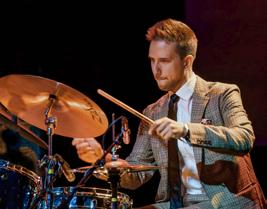
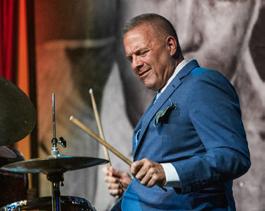
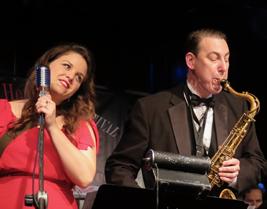
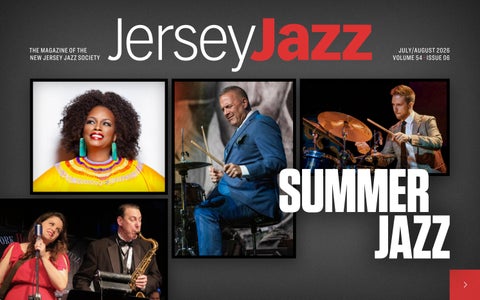
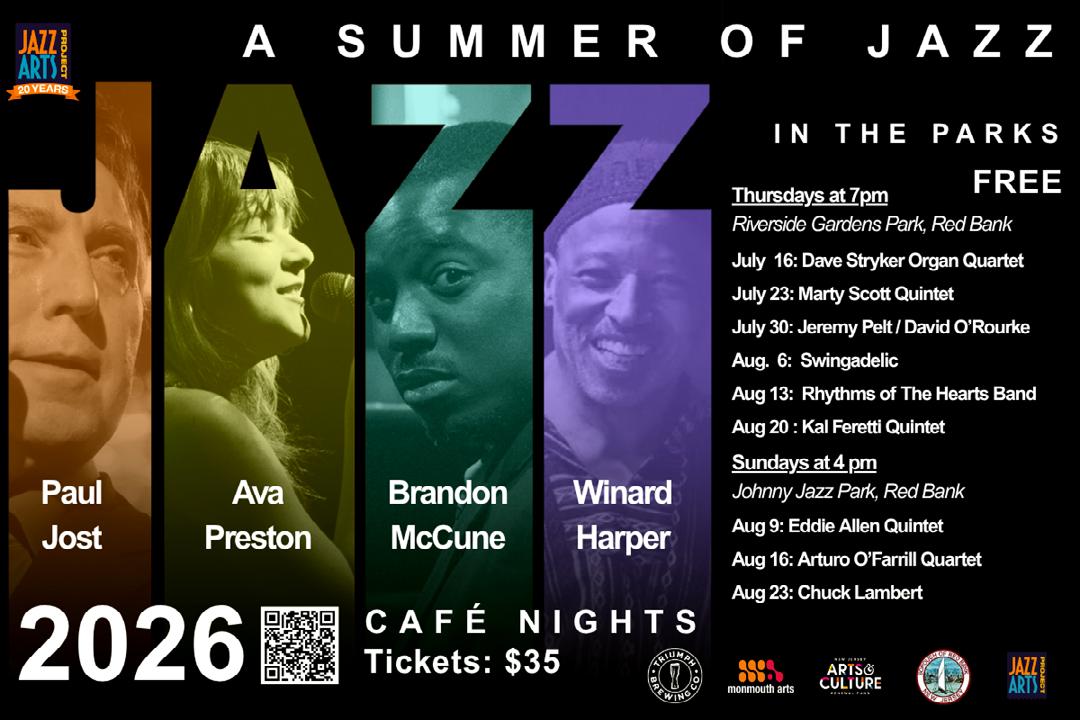
The summer schedule of jazz in New Jersey and the surrounding area is overflowing with live music. In this issue, we are previewing several of the venues. You can see music free at the Montclair Jazz Festival, the Morristown Jazz & Blues Festival and in two Red Bank locations—Riverside Park on Thursday nights and Johnny Jazz Park on Sunday afternoons.
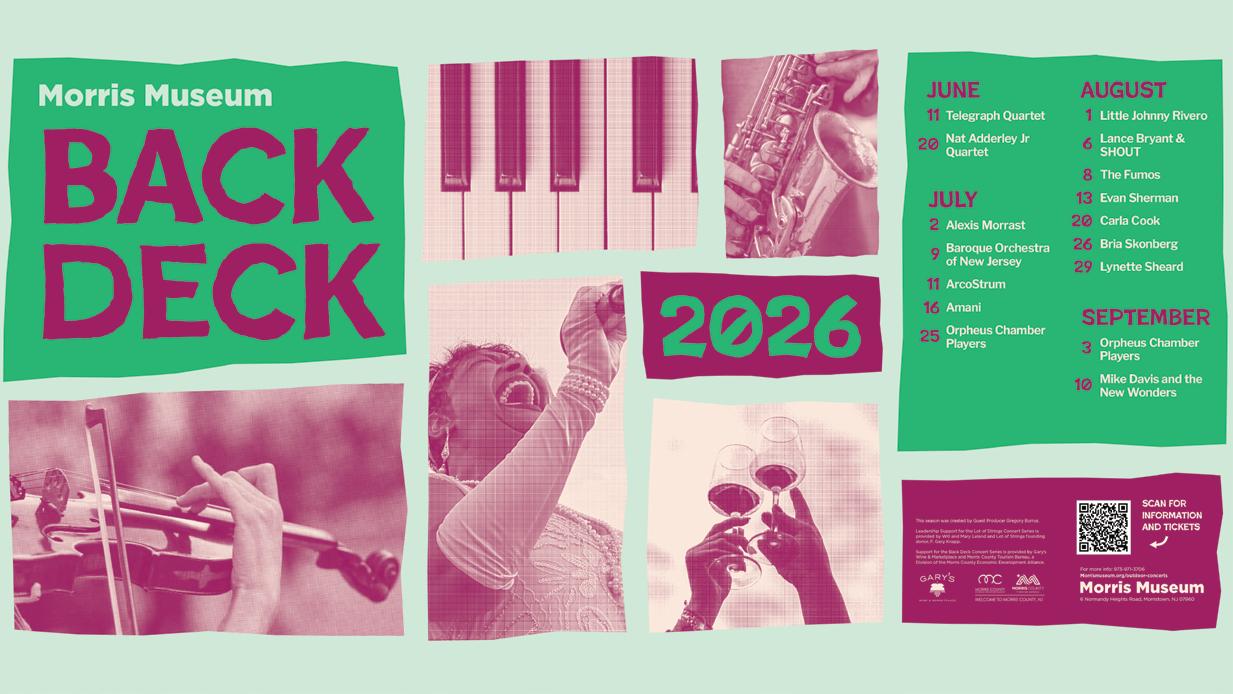
Ticketed events described in the following pages include: Jazz on the Back Deck at the Morris Museum in Morristown; Nyack, NY’s Jazz in the Garden; the Jazz Arts Project’s Summer Jazz Cafe at the Triumph Brewery and Two River Theatre in Red Bank; Broadway vocalists Kelli O’Hara and Sutton Foster singing with the Count Basie Orchestra, also in Red Bank; and the William Paterson Summer Jazz
performances in Wayne. But, in addition to these major events, there is lots of other summer music in the Tri-State area. Here are some of the highlights:
» Sweet Sounds Downtown Westfield. Tuesday and Thursday nights from 6-9 p.m. Among the jazz artists featured are: saxophonist Bradford Hayes, vocalist Carrie Jackson, the Swingadelic big band, bassist Jack Breslin, and guitarist Michele Fiorindo. This is a free series. For more information, log onto downtown.westfield.gov.
» Summer Sounds Cranford. Tuesday and Thursday nights from 6-8 p.m. Jazz artists include vocalists Lynette Sheard and Laurie Vega and drummer Richard Baratta. Free. downtowncranford.org.
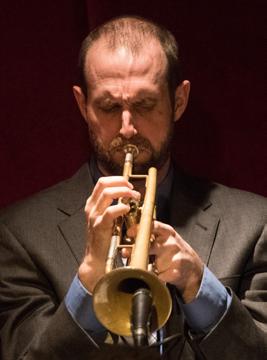
» Triumph Brewery, Red Bank and Princeton. Friday and Saturday nights, 6- 9 p.m. Among those appearing in July are vibraphonist Behn Gillece and trumpeters Parker Cheek
and Andrew Wagner. For more information or to make reservations, log onto triumphbrewing.com
» Jazz Forum Arts, Westchester County, NY. Pierson Park, Tarrytown, Fridays; Waterfront Park, Dobbs Ferry, Wednesdays; Matthiessen Park, Irvington, Thursdays; Henry Gourdine Park, Ossining, Mondays. Some of those performing include saxophonist Birsa Chatterjee, pianist Caili O’Doherty, bassist Adi Meyerson, pianist Donald Vega, and trumpeter Mark Morganelli and the Jazz Forum All-Stars. All concerts are free and begin at 6:30 p.m. jazzforumarts.org
» Saint Peter’s Church, Jazz on the Plaza, 619 Lexington Ave. at 54th St., NYC. Fridays at 12:30 p.m., featuring vocalist April Varner, trumpeter/vocalist Benny Benack III, saxophonist/ vocalist Camille Thurman, and keyboardist Leonieke Scheuble, among others. Free. saintpeterschurch.org.
Founded in 1972, The New Jersey Jazz Society has diligently maintained its mission to promote and preserve America’s great art form—jazz. To accomplish our mission, we produce a monthly magazine, Jersey Jazz ; sponsor live jazz events; and provide scholarships to New Jersey college students studying jazz. Through our outreach program Generations of Jazz, we provide interactive programs focused on the history of jazz. The Society is run by a board of directors who meet monthly to conduct Society business. NJJS membership is comprised of jazz devotees from all parts of the state, the country and the world.
You become an integral part of the NJJS community, and the history and future of jazz
Access to 11 Digital Issues of our Award Winning Jersey Jazz Magazine — Featuring Articles, Interviews, Reviews, Events and More
Discounts to our Jersey Jazz LIVE! Sunday Concerts
Discounts at NJJS Sponsored Concerts & Events.
MUSICIAN MEMBERS
FREE Listing on NJJS.org “Musicians List” with Individual Website Link
FREE Gig Advertising in our Monthly eBlast
THE RECORD BIN
Visit www.njjs.org or email info@njjs.org for more information on our programs and services
A collection of used CD’s & LP’s available at reduced prices at specific events and through mail order njjs.org/shop
JOIN NJJS
Family/Individual $45
(Family includes to 2 Adults and 2 children under 18 years of age)
Family/Individual 3-Year $115
Musician Member $45 / 3-Year $90 (one time only, renewal at standard basic membership level.)
Youth $15 - For people under 21 years of age. Date of Birth Required.
Give-A-Gift $25 - Members in good standing may purchase unlimited gift memberships. Applies to New Memberships only.
Fan $75 - $99
Jazzer $100 - $249
Sideman $250 - $499
Bandleader $500+
Corporate Membership $1000
Members at Bandleader level and above and Corporate Memberships receive special benefits. Please contact Membership@njjs.org for details. The New Jersey Jazz Society is qualified as a tax exempt cultural organization under section 501(c)(3) of the Internal Revenue Code, Federal ID 23-7229339. Your contribution is tax-deductible to the full extent allowed by law. For more Information or to join, visit www.njjs.org
Magazine of the New Jersey Jazz Society
VOLUME 54 • ISSUE 06
Jersey Jazz (ISSN 07405928)
is published monthly for members of The New Jersey Jazz Society
382 Springfield Ave., Suite 217, Summit, NJ 07901 973-229-0543 • info@njjs.org
Membership fee is $45/year.
All material in Jersey Jazz, except where another copyright holder is explicitly acknowledged, is copyright ©New Jersey Jazz Society 2026. All rights reserved. Use of this material is strictly prohibited without the written consent of the NJJS.
EDITOR
Sanford Josephson, editor@njjs.org
ART DIRECTOR
Michael Bessire, art@njjs.org
CONTRIBUTING EDITORS
Schaen Fox, Joe Lang, Vincent Pelote, Gilda Rogers, Andrew Schinder, Jay Sweet
CONTRIBUTING PHOTOGRAPHERS
Richard Conde, Israel Corona,
Jack Grassa, Marguerite LaFountaine, Shervin Lainez, Jerris Madison, Udo Salters, Mark Seliger, Neal Siegel
WEBMASTER
Christine Vaindirlis
WEBSITE DESIGN
Prism Digital
DIRECTOR OF ADVERTISING
Cydney Halpin, advertising@njjs.org
ADVERTISING RATES
Full Page: $135, Half Page: $90, 1/3
Page: $60, 1/4 Page: $30
For reservations, technical information and deadlines contact advertising@njjs.org or visit njjs.org/Magazine/Advertise . Make a payment online at njjs.org/advertise via the red Submit Payment button, or via check made payable to NJJS, 382 Springfield Ave., Suite 217, Summit, NJ 07901.
New Jersey Jazz Society, Officers 2026
PRESIDENT
Cydney Halpin, pres@njjs.org
EXECUTIVE VP
Elizabeth Kavlakian, vicepresident@njjs.org
TREASURER
Mike Katz, treasurer@njjs.org
VP, MEMBERSHIP membership@njjs.org
VP, PUBLICITY
Sanford Josephson, sanford.josephson@gmail.com
VP, MUSIC PROGRAMMING music@njjs.org
RECORDING SECRETARY
Irene Miller
CO-FOUNDER
Jack Stine
IMMEDIATE PAST PRESIDENT
Mike Katz
DIRECTORS
Jay Dougherty, Cynthia Feketie, Paul Flexner, Pete Grice, Carrie Jackson, Caryl Anne McBride, Robert McGee, James Pansulla, Stew Schiffer, Elliott Tyson, Jackie Wetcher
ADVISORS
Don Braden, Mariel Bildsten, Ted Chubb, Al Kuehn, Jason Olaine
“I Always Wanted a Jazzman with Me. Having Jazzmen with Me Means I Never Get Stale”
BY SANFORD JOSEPHSON
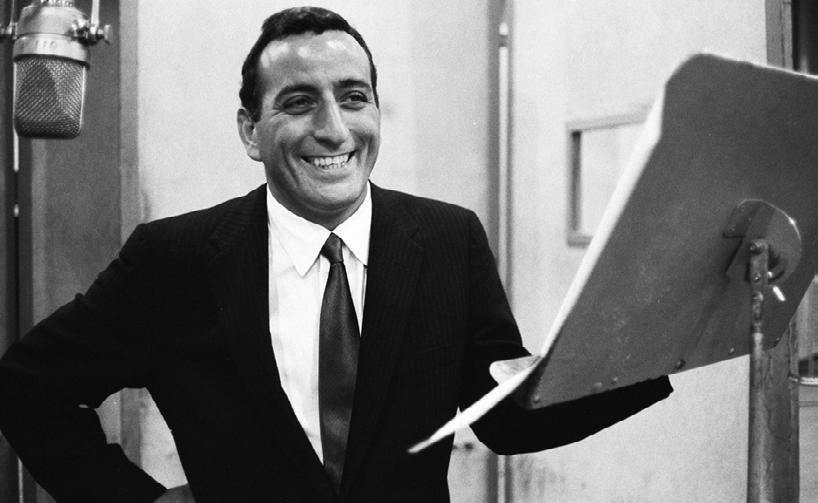
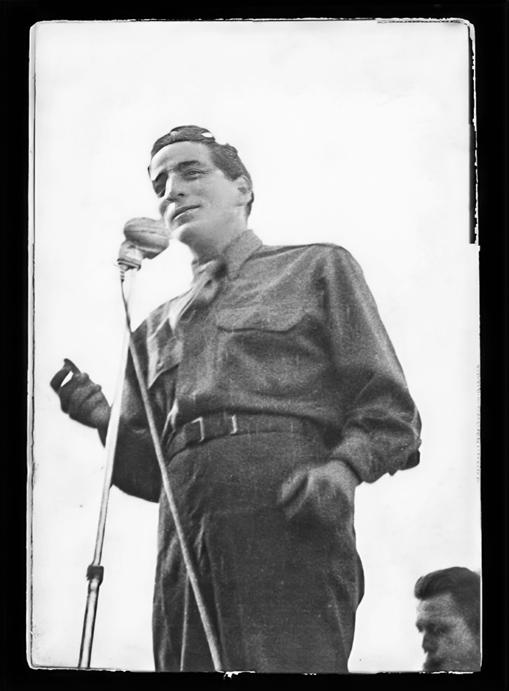
On July 22, 2023, the day after Tony Bennett died at age 96, pianist Bill Charlap sent me this email: “Tony Bennett was American popular song. His interpretations were definitive. The depth of his choices, the level of taste, the way he told the story of the song, the nuance of his phrasing. All of it was iconic, original, and definitive.”
Bennett, who would have celebrated his centennial birthday on August 3, won 19 Grammy Awards. His first best-selling hit record was “Because of You”, released in 1951. His final album, Love for Sale (Columbia/Interscope), with Lady Gaga, was released 70 years later, in 2021. Reviewing Love for Sale for The Guardian, John Fordham described it as “infectiously good fun.” He acknowledged that “Bennett’s vocals are clearly those of an older man,” adding that, “he was always a full-voiced sing-
er, and the amount of power he still can muster is pretty remarkable. And if his condition (Alzheimer’s) affected the chemistry between them (Bennett and Lady Gaga) in the studio, you wouldn’t know it on the evidence of ‘I Get a Kick Out of You’ or ‘You’re the Top.”
In an interview with DownBeat Magazine’s Dom Cerulli in 1958, Bennett said, “I always wanted a jazzman with me. For me, having jazzmen with me means I never get stale.” Music historian John Edward Hasse, Curator Emeritus of American Music at the Smithsonian’s National Museum of American History, described Bennett as having “a jazz musician’s phrasing and sense of timing, as well as a feeling for spontaneity. These are classic, timeless aesthetic values that he personifies.”
The song Bennett was most closely identified with— “I Left My Heart in San Francisco” (Douglas Cross/
George Cory)— was not projected to become a hit. In 1961, Bennett’s pianist, Ralph Sharon, proposed it as the B side of Charles Strouse and Lee Adams’ “Once Upon a Time.” But it became one of the best-selling records of 1962, earning Bennett his first Grammy Awards— Record of the Year and Best Male Solo Vocal Performance.
After Bennett left Columbia and formed his own company, Improv Records, in the mid-1970s, he recorded two albums with legendary jazz pianist Bill Evans. They were not big sellers but were well received in the jazz community. Both recordings were reissued by Universal/Fantasy as a double album in 2009. AllAbout Jazz’s Chris May called the recordings “a great package. There is an intriguing juxtaposition of opposites running through the music—Bennett the expansive, heart on sleeve, vibrato man, Evans the inward looking
aesthete— which makes for charged listening, if charged is an adjective which can be applied to something so relaxed. And the projects were genuinely collaborative, with the artists on an equal footing: Evans solos wonderfully throughout and Together Again actually starts with a solo piano piece, ‘The Bad and The Beautiful,’ put there at Bennett’s suggestion to emphasize that this was not just a vocalist-with-accompanist affair.”
Bennett returned to Columbia Records in 1986 and released more than a dozen albums in the 1990s including a centennial birthday tribute to Duke Ellington, Bennett Sings Ellington, Hot & Cool. Reviewing it for All Music, William Ruhlmann described it as “Tony Bennett’s practically inevitable commemoration of the Duke Ellington centenary ... an appropriately blue-chip affair, with a big band and orchestra.” It included such classics
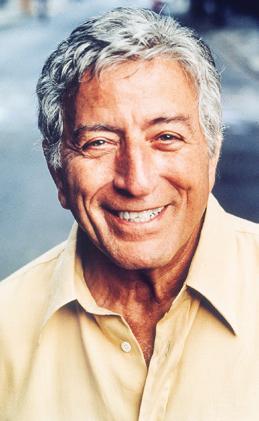
Bennett in 1998
as “Mood Indigo” and “Sophisticated Lady.” Equally impressive, Ruhlmann said, “are the less familiar tunes, such as ‘Azure’ and ‘Day Dream’.”
Sometime during the ‘90s, according to The Washington Post’s Matt Schudel, Bennett “became something of an avuncular emissary to a generation that never heard of Cole
Porter but who admired Mr. Bennett’s cool nonchalance and his refusal to follow other people’s trends.”
Bennett won Grammys for a 1992 tribute to Frank Sinatra, Perfectly
Frank; a 1993 tribute to Fred Astaire, Steppin Out; and, most surprisingly, for MTV Unplugged, spotlighting the Great American Songbook with guest appearances by Elvis Costello and k.d. lang. It won a Grammy for Album of the Year in 1995, beating out recordings by Eric Clapton, Bonnie Raitt, Seal, and the Four Tenors.
According to Rolling Stones’ Andy Greene: “Bennett looked genuinely stunned when his name was read that night. ‘I don’t believe this,’ he said. ‘I really don’t believe it. This is the greatest moment in my whole musical career, and the greatest moment in my life.’” To put it into perspective, Greene pointed out that the album “was put into rotation on the network as a video. Bennett was 68 years old at this point. This was a cover of an Irving Berlin song from 1948 (‘Steppin’ Out with My Baby’). Little effort was made to mod-
“
WON A GRAMMY FOR ALBUM OF THE YEAR IN 1995. ”
ernize it for a young audience. And, yet there it was, playing alongside videos for Weezer’s ‘Undone (The Sweater Song),’ Green Day’s ‘Basket Case’, and Sheryl Crow’s ‘All I Wanna Do’.”
In 2005, Bennett received a Kennedy Center Honor, and, in 2006, he was named a National Endowment for the Arts Jazz Master.
The best-known recording of Bennett with Count Basie was probably an album called Count Basie Swings/Tony Bennett Sings, originally released by Blue Note in 1959 and reissued several times, as recently as 2021. AllMusic’s Richard Ginell called it “a band singer’s paradise, with the Basie band caught at a robust and swinging peak and Bennett never sounding happier or looser in front of the microphone.”
Charlap and Bennett recorded The Silver Lining: The Songs of Jerome Kern on the RPM/Columbia
label in 2015. Reviewing it for The New York Times, Nate Chinen compared “its voice-and-piano intimacy” to the previous Tony Bennett/ Bill Evans albums. “Jerome Kern,” he pointed out, “turns out to be the ideal touchstone for Mr. Bennett. He was a suave melodist who married classical form with jazz inflection, and many of his tunes have long been standards.”
The album won a Grammy Award in 2016 for Best Traditional Pop Album. Bennett lived in Englewood, NJ, from 1957-1971. He was born in Astoria, Queens, as Anthony Dominick Benedetto on August 3, 1926. He sang at family gatherings, and, as a teenager, listened closely to Frank Sinatra and Bing Crosby before joining the Army during World War II. After leaving the Army, he was invited by Bob Hope to be his opening act at New York’s Paramount Theater. Benedetto was using the stage name, Joe Bari,
but Hope asked him his real name. Before Benedetto could tell him, Hope added, “We’ll call you Tony Bennett.”
In addition to his career as a vocalist, Bennett was an accomplished visual artist. “I’ve always done the two things that I love to do, which is sing and paint,” he told Reuters at an exhibit of his work in 2017. He signed his paintings, which have been displayed around the world, with his birth name, Anthony Benedetto.
A political activist and advocate for civil rights, Bennett campaigned for John F. Kennedy in 1960 and participated in Martin Luther King, Jr.’s 1965 march from Selma to Montgomery, AL.
The first of Bennett’s two ‘Duet’ albums featuring duos with a variety of singers from various segments of the music world was recorded in 2006. Simply titled Duets: An American Classic (Columbia) it featured him singing with Billy Joel (“The Good

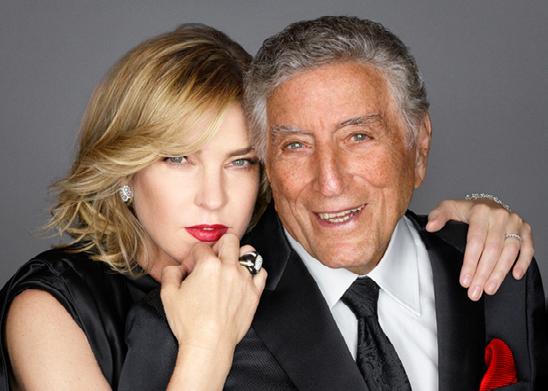
Life”), Barbra Streisand (“Smile”), and James Taylor (“Put on a Happy Face”), among many others. That was followed in 2011 by Duets II, including Lady Gaga (“The Lady is a Tramp”), Norah Jones, (“Speak Low”), and Amy Winehouse (“Body and Soul”). In 2018, he recorded a duet album with Diana Krall (who was also on Duets) called Our Love is Here to Stay.
Bennett was diagnosed with Alzheimer’s in 2016, and that was revealed in August 2021 by his wife, Susan, on the AARP website. That month, he gave two farewell concerts at New York’s Radio City Music Hall with Lady Gaga to celebrate his 95th birthday. In an article on northjersey.com by Jim Beckerman, John Schreiber, President and CEO of the New Jersey Performing Arts Center recalled a concert by Bennett at NJPAC in 2018 when Alzheimer’s was beginning to take its toll. “I was standing backstage with him and his wife, Susan,” Schreiber said, “and he was standing still, expressionless. When it came time to go on, and he heard, ‘Ladies and Gentlemen, Tony Bennett,’ he sort of lit up. His wife gave him a hug, and he went out there and twirled around, put his arms in the air, danced. He was totally Tony Bennett.”

“We Wanted to Focus on Some Music They Played Together”
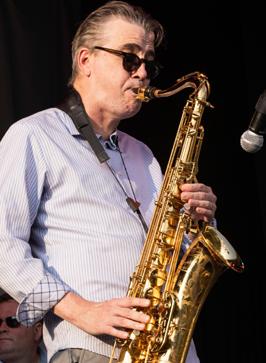
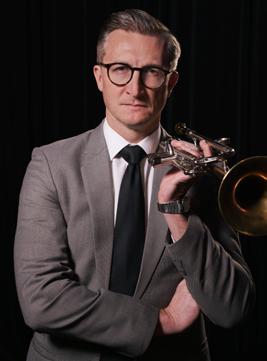
In a June 2011 article, JazzTimes’ Mick Carlon described a scene in Greenwich Village in the summer of 1956. “As you stroll down lower Fifth Avenue,” he wrote, “Dodgers, Giants, and Yankees games float out of radios perched on darkened windowsills. As you cut across Washington Square and approach the Café Bohemia on Barrow Street, you see a crowd already lined up on the sidewalk. The marquee announces the musicians responsible for the crowd: Miles Davis on trumpet; John Coltrane on tenor saxophone; Red Garland on piano; Paul Chambers on bass; “Philly” Joe Jones on drums. You join the crowd and are eventually ushered into a long, narrow, street-level nightclub to hear one of the finest small bands in jazz history: The classic 1955-56 Miles Davis Quintet.” Both Davis and Coltrane would be celebrating centennial birthdays this year, and the Jazz House Kids
The one limitation to doing that, he added, is that “Davis’ band never played any of Coltrane’s original music, “and we wanted that to be a piece of it as well. So, the concert is going to be a mix of those two things, but probably most of it will be from that mid to late ‘50s time period, finding ways to incorporate music from both of them. We are planning to focus on original arrangements that come from the music of the 1959 seminal albums, Giant Steps and Kind of Blue” .
of JHK’s Summer Workshop faculty.
“This year with the festival moved back to August (from September),” Eklund explained, “it’s now linked in with our Summer Workshop. So, many instructors in the Collective who’ve worked with our students will also be leading student ensembles on stage.” Among them, in addition to Eklund, will be Lee, Lakunza, saxophonist Ed Palermo, and vocalist Dylan Pramuk. More than 150 Summer Workshop students, alumni, and emerging artists will perform from noon until 8 p.m.
Jazz Collective Big Band will salute them on the Montclair Jazz Festival’s second stage at its August 15th Downtown Jamboree. “The catalog of both Davis and Coltrane is so enormous,” explained trumpeter Nathan Eklund, Dianne Reeves and Branford Marsalis will release a John Coltrane tribute album in September.
the Jazz Collective Band Director. As a result, he said, “We wanted to focus on some music they played together, so, obviously, that means the midto-late ‘50s time period when Coltrane was playing in Miles’ group.”
The Jazz House Kids Collective Big Band members are JHK faculty or alumni. The complete roster for the Downtown Jamboree performance could not be confirmed at presstime, but Eklund said some of the other band members will be trumpeter Ted Chubb, tenor saxophonist Mike Lee, trombonist Juanga Lakunza, bassist Andy McKee, and drummer Darrell Smith, all members
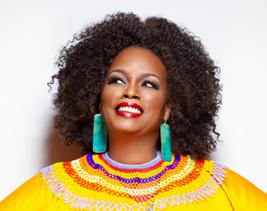
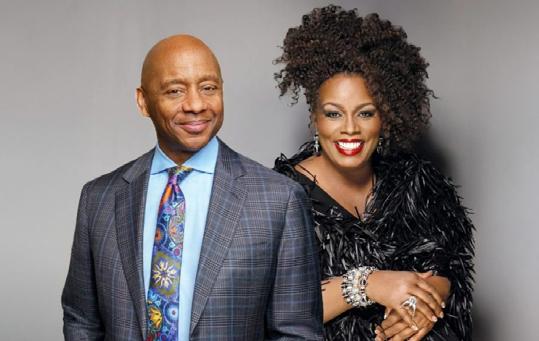
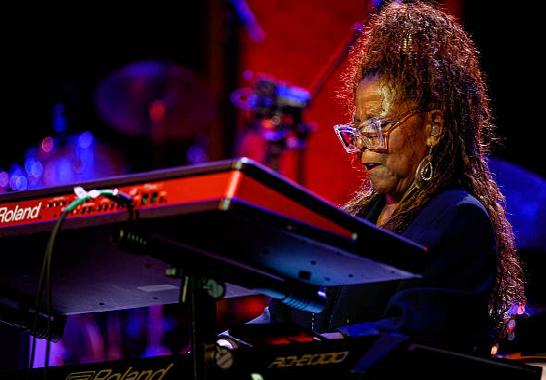
Two of the headliners on the Downtown Jamboree’s main stage will be vocalist Dianne Reeves and vocalist/pianist Patrice Rushen. Reeves has two new recordings on the horizon: A John Coltrane tribute album with the Branford Marsalis Quartet to be released on Blue Note in September and an album of du-
ets with guitarist Romero Lubambo called Us, whose release date hadn’t yet been announced at presstime.
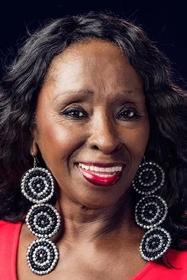
In our May 2025 cover story, Reeves told Jersey Jazz’s Gilda Rogers that jazz, to her, “is music that is always evolving and sits firmly in the American Songbook.” Although she was shaped by rhythm & blues singers of the late 1960s and ‘70s like Marvin Gaye and Aretha Franklin, she added, “The first time I saw Ella Fitzgerald, that opened me up to the freedom of jazz.”
Reeves’ big break came in 1973 when she was discovered by trumpeter Clark Terry in Chicago at the National Association of Jazz Educators Conference. Terry invited her to perform at an engagement with him in Colorado Springs, CO. That, she said, “was like going to a living school.”
In 1981, Reeves recorded her debut album, Welcome to My Love, on Palo Alto Records. Her career soared after that, resulting in five Grammy Awards for Best Jazz Vocal Album: In the Moment - Live in Concert (Blue
“
Note Records: 2000); The Calling (Blue Note: 2001); A Little Moonlight (Blue Note: 2003); Good Night, and Good Luck (Concord Records: 2005); and Beautiful Life (Concord: 2013). In 2018, she was named a National Endowment for the Arts Jazz Master.
Thom Jurek, in an AllMusic review of Beautiful Life, pointed out that, “Throughout her career, Dianne Reeves has, perhaps more than any other vocalist, blurred the
line that separates jazz from pop and contemporary R&B, extending the boundaries of each.” Beautiful Life, he added, “not only blurs genre lines, but erases them. The end result is glorious, accessible R&Bdrenched contemporary jazz that is as sophisticated as it is honest.”
Rushen was named an NEA Jazz Master this year. In the April issue of Jersey Jazz, she told Andrew Schinder she considers it “a tremen-
dous honor and recognition. For me, being recognized among people I consider heroes and sheroes in this music is the most important part.”
Discovered at a 1972 Monterey Jazz Festival when she was performing with her high school jazz combo, Rushen won first place in the high school competition and got to appear on the main stage. Her singing skills propelled her into mainstream pop stardom, but, according to Schinder, “she never abandoned her roots in the jazz or classical idioms.”
Her classic album was Straight from the Heart (Elektra: 1982), described by Schinder as “one of the definitive early 1980s pop/R&B masterpieces. It contains Rushen’s signature hit, ‘Forget Me Nots’, which was revived in 1997 as the theme song of the Will Smith movie, Men in Black.”
Rushen was the first woman to serve as Musical Director for the
Grammy Awards; she was the first woman in 43 years to serve as Head Composer/Musical Director for the Emmy Awards; and she was the first woman Musical Director of the NAACP Image Awards. “I know I stand on the shoulders of a lot of people who did not have the same opportunities that I did, based on their gender or their race, and that created a ceiling,” she told Schinder.
In May, Rushen played piano with 2024 NEA Jazz Master, saxophonist Gary Bartz, at the Jazz Foundation of America’s 2026 Great Night Gala. “Jazz,” she said in the April Jersey Jazz article, “is always progressing. And, in its progression, you hope that it is being allowed to be pushed forward by people who have an understanding and a mastery of the tradition as part of their aesthetic of moving it forward, not just people jumping on trends.”
The Montclair Jazz Festival encompasses several Soundcheck events leading up to the Downtown Jamboree on Saturday, August 15. All events are free.
SOUNDCHECK SERIES Wellmont Arts Plaza, 6-10 p.m
JUL 01 » Alvin Ailey Dance Company, “Swing Dance Lesson”, Count Basie Orchestra
JUL 14 » Orrin Evans Trio, Michele Rosewoman and Quintessence
JUL 28 » Vibraphonist Joel Ross
AUG 04 » Rebirth Brass Band
DOWNTOWN JAMBOREE Lackawanna Station, two stages, Noon-8 p.m.
Dianne Reeves; Take Me To The River New Orleans; Christian McBride Big Band with Bilal; Patrice Rushen; Jazz House Collective Celebrates Miles Davis and John Coltrane; Spanish Harlem Orchestra; Alphonso Horne and the Gotham Kings; Jazz House All Stars; Jazz House Emerging Artists
BLOCK PARTY Hosted by DJ Prince Hakim, 8-10 p.m.
“I Feel Very Grateful to Play the Music We Do from Composers Such as Billy Strayhorn, Thelonious Monk, Benny Golson”
BY SANFORD JOSEPHSON
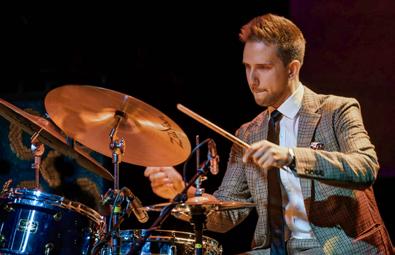
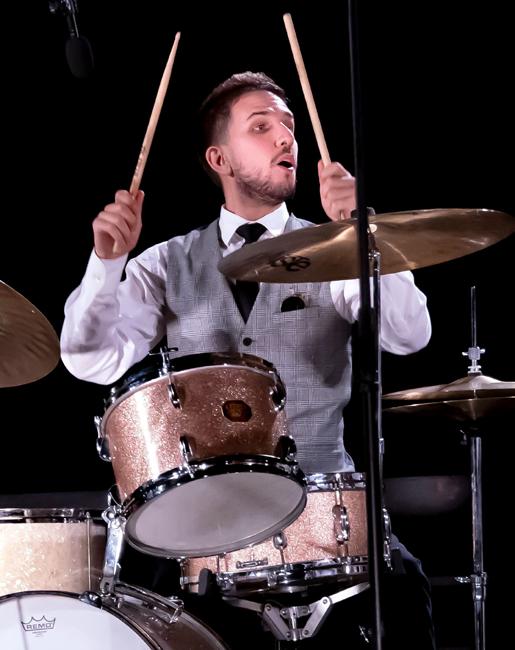
Drummer Evan Sherman was Jersey Jazz Magazine’s first Rising Star, in March/April 2020. He told me how, as a nineyear-old from Millburn, NJ, he saw drummer Charlie Watts at New York’s Blue Note jazz club; and that changed his life and convinced him to switch from rock ‘n roll to jazz.
For the last four years, Sherman has been the principal drummer for Grammy Award-winning vocalist Samara Joy, traveling all over the world and appearing at internation-
al jazz festivals as well as performing with symphony orchestras.
The good news for New Jersey jazz fans is that the 32-year-old Sherman will be able to take a short break from his travels on Thursday, August 13, to lead a quartet at The Morris Museum’s Jazz on the Back Deck series. The identity of his bandmates was not known at presstime, but he guaranteed the concert will be “a rich musical experience with the best possible group of folks who are in town on that
date.” Last summer at the Morris Museum, he was accompanied by trombonist Steve Davis, pianist Jeb Patton, and bassist David Williams.
In 2025, Sherman traveled to five continents with Joy, and this July they’ll be performing at 13 festivals in Europe including three in France—Juan-Les-Pins in Antibes, Jazz a Vienne, in Aix-En-Provence, and Jazz in Marciac. Sherman is particularly excited about returning to Jazz a Vienne. “You can see videos of Betty Carter, Roy Hargrove, Ray Brown. There are handprints on the tiles of all the great jazz musi-
cians—Elvin Jones, Clark Terry, Ray Charles. It’s like the Hollywood Walk of Fame for the great jazz musicians.”
This spring, when Sherman and Joy finished a U.S. tour in Los Angeles, he got to see “the great drummer Roy McCurdy, who’s 89 years young now.” Sherman met McCurdy on a previous tour with Joy, “and he invited me to his house after our set. He told me, ‘This is a great opportunity for you to keep growing as a musician.’ It was a highlight for me to share that energy with him.”
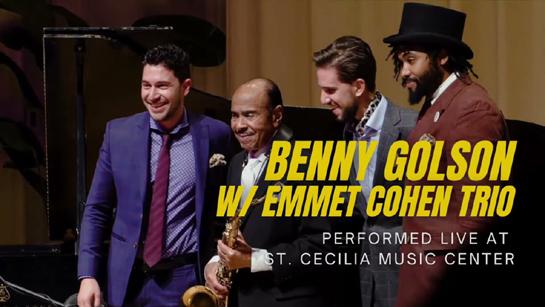
Early in his career, Sherman, as part of the Emmet Cohen Trio, had
“ I WAS ALWAYS ATTRACTED TO SEEING THE OLD GUYS PLAY. ”
a chance to play with the legendary saxophonist/composer Benny Golson—at the 2018 Montreal Jazz Festival and in early 2020 on a Midwestern tour. JAZZIS Magazine, reporting on Golson’s appearance with Cohen and Sherman in Montreal, said, “On stage they’ve created the kind of intergenerational jazz exchange that used to be the lifeblood of jazz music. Their set, full of melodic elegance and loping swing, proved that while this kind of jazz mentorship may have lost its ubiquity, it can still create magic on the bandstand.”
Sherman has always learned from
and admired jazz giants of the past. When I interviewed him in 2020, he recalled the first time he went to Dizzy’s Club. “I was 14,” he said, “and I saw Roy Haynes play. I was always attracted to seeing the old guys play— James Moody, Cedar Walton. At the Village Vanguard, Cedar Walton would walk by me and say, ‘There’s the student of the week.’ Emmet and I used to see Cedar Walton together, and we would learn his songs together. Talking to Benny Golson is something I cherish. It had always been a dream to play with these guys.”
Performing with Joy has presented Sherman with the opportunity to play the music he loves. “When I look at the set list,” he said, “I feel very grateful to play the music we do from composers such as Billy Strayhorn, Thelonious Monk, Benny Golson.” His performance on The Morris Museum’s Back Deck will be a change in pace for him and “a nice way to communicate with the people in New Jersey.”
Another jazz artist returning to the Jazz on the Back Deck series is trumpeter/vocalist Bria Skonberg, the subject of our July/ August 2025 cover story. In March, Skonberg released an instrumental album on the Cellar Music Group label called Brass. At presstime, it was Number 9 on the JazzWeek chart.
Shortly after its release, the album was selected as WBGO Radio’s “New Day New Play” featured recording. On the station website, “Daybreak” Host Gary Walker said: “With pianist and organist Luther Allison,
bassist Eric Wheeler, drummer Darrian Douglas, and a spirited exchange with trumpeter Kellin Hanas on Frank Loesser’s ‘Brotherhood of Man’, Bria shows an appealing knack for composing, and with her bandmates
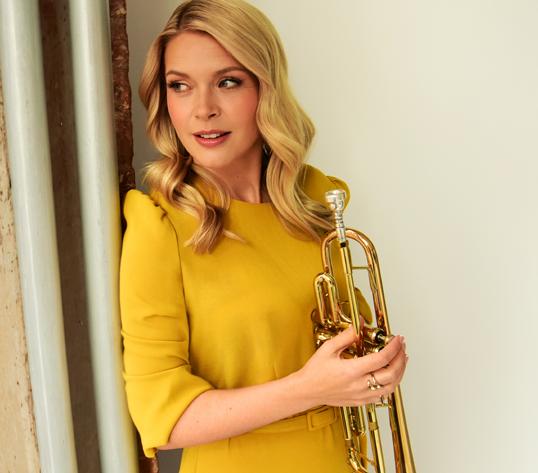
gives us a taste of Jelly Roll Morton and some Argentine tango on ‘Choclo’ by Angel Villoldo, which later became the hit ‘Kiss Of Fire’ in the early ‘50s.”
Reviewing Brass for DownBeat, Michael J. West wrote that Skonberg has “certainly developed a unique voice, one that combines the dry-champagne tone of Miles Davis with a healthy cache of brio and technique. The technique is most evident when she uses mutes, as in her boisterous plunger growl on Jelly Roll Morton’s ‘New Orleans Bump’ and remarkably high-spirited Harmon on ‘Between the Devil and the Deep Blue Sea.’”
On July 3, Skonberg will release an all-new vocal album, Indigo, also on the Cellar Music Group label. Among the selections are: Michel Legrand’s “Watch What Happens”, Duke Ellington and Barney Bigard’s “Mood Indigo”, and Sting’s “Fragile”(See review on page 43).
Morris Museum
Jazz on the Back Deck
The Morris Museum is located at 6 Normandy Heights Road in Morristown, NJ. All Jazz on the Back Deck concerts begin at 7:30 p.m. For more information or to order tickets, log onto morrismuseum.org or call (973) 971-3700.
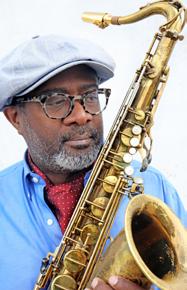
JUL 02 » Vocalist Alexis Morrast
JUL 16 » Amani: The Music of Burt Bacharach
AUG 01 » Little Johnny Rivero & His Giants
AUG 06 » Tenor Saxophonist Lance Bryant and SHOUT
AUG 08 » The Fumos
AUG 13 » Drummer Evan Sherman
AUG 20 » Vocalist Carla Cook
AUG 26 » Trumpeter/Vocalist Bria Skonberg
AUG 29 » Vocalist Lynette Sheard & Bassist John Lee
SEP 10 » Trumpeter Mike Davis and the New Wonders
“We Play Them Like Jazz Tunes. We Take Solos. We Crack Them Open. And It’s a Tremendous Amount of Fun”
BY ANDREW SCHINDER
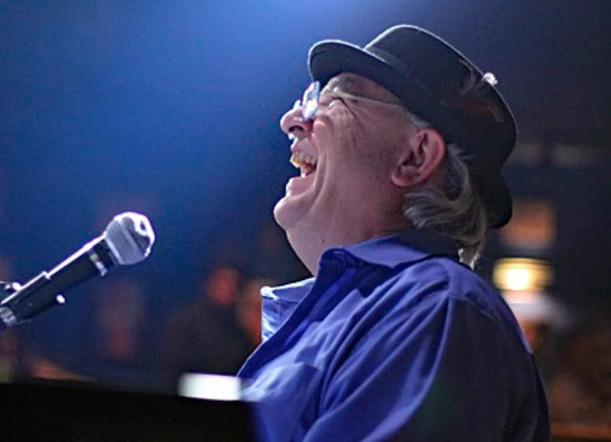
MEd Alstrom: “Larry Young is my guy. He is the Alpha and Omega of jazz organ.”
aster organist Ed Alstrom is a musical multi-disciplinarian who does not let the artificial constraints of style or genre limit his artistic output. He is probably most famous for his role as Yankee Stadium’s weekend organist, but the classically trained Alstrom is a serious musician, his output spanning jazz, classical, blues, pop, Broadway, and even sacred music.
One of Alstrom’s many musical endeavors is his role as the organist in the Wonder Trio, an organ group that explores the iconic music of Stevie Wonder, ranging from Wonder’s most popular hits to his deeper cuts. On the Wonder Trio, Alstrom is joined by Al Orlo on guitar and Bobby Deitch on drums, and they will at the Jazz in the Garden series at the Edward Hopper House in Nyack, NY, on July 9.
The trio “came about very randomly,” said Alstrom. “I got a call
from Bobby Deitch, who I didn’t know. Bobby saw me on YouTube during Covid—I would sit in my basement and record videos of myself playing organ with drum machines. He said he saw me playing some Stevie Wonder tunes, and he wanted to see if we could put together an organ trio playing Stevie Wonder stuff. So, it was really Bobby’s idea.”
“And then we landed Al Orlo on guitar, who I knew from Broadway. We got together and worked up a selection of Stevie tunes. Some of them we play very much like the record. Some of them we try to turn upside down and make as different as we can.
“You don’t need a singer,” Alstrom continued. “They’re impeccably written, amazingly melodic songs that everybody knows the words to in their head. So, you play the songs without any vocals, people are singing them in their head. They’re all
magnificent tunes. And they all lend themselves to different treatments. We play them like jazz tunes. We take solos. We crack them open. And it’s a tremendous amount of fun.”
Born and raised in North Jersey and currently living in Montville, Alstrom began playing the organ at a mere five years old. “That’s what we had in my house,” said Alstrom. “We didn’t have a piano. We had an organ and an accordion. My dad was a plumber, but he played recreationally. He was quite a good player.”
Regarding the organ, “I like the four-limbed aspect of it, the fact that you have to use your arms and legs. You have to do a little with your feet, with the piano, with the pedals, but it’s nothing like actually playing lines on bass pedals on an organ.”
As a teenager Alstrom became a church organist, but at the same time also caught the jazz bug. “Lar-
ry Young is my guy,” he said. “He is the Alpha and Omega of jazz organ. Everybody else was the same, but Larry was so different.”
Alstrom attended Westminster Choir College in Lawrenceville, NJ, where he received a stellar classical organ education. But the school basically ignored any other type of music. “They basically disavowed the existence of any music after 1950. It didn’t exist. They taught none of it, they mentioned none of it, and I said, ‘I’ll have to learn this on my own.’”
He took as many gigs as he could after college, with all different types of people, playing all different types of music. Alstrom performed regularly with the Vivino brothers (including Jimmy Vivino, who became the leader of Conan O’Brien’s band).
He eventually took a job with Casio, which provided stability and the ability to meet and play with many
iconic musicians, including Herbie Hancock, Larry Coryell, and Stanley Jordan. He also kept up as a church organist. He retired from Central Presbyterian Church in Montclair last year, but continues to play with Temple Ner Tamid in Bloomfield.
Arguably Alstrom’s most famous gig came about when longtime Yankee Stadium organist Eddie Layton retired after the 2003 season. Alstrom was immediately intrigued at the prospect of taking over the iconic keys. “I’ve been a baseball fan
The Jazz in the Garden summer music program features eight Thursday evening concerts from 7-9 p.m. on the Garden Stage of the Edward Hopper House Museum, located at 82 North Broadway in Nyack, NY. For more information or to order tickets, log onto edwardhopperhouse.org or call (845) 358-0774.
John
since I was seven years old,” he said. “My dad took me to my first games. I was always intrigued by the baseball organ, and I longed for the opportunity to do it, but didn’t know how that was ever going to materialize.
jazz roots creep through as well.
JUL 09 » The Wonder Trio
JUL 16 » Richie Morales Quintet
JUL 23 » Saxophonist/Vocalist Herve Alexandre
JUL 30 » Mike Davis Group
AUG 06 » Bobby Sanabria & Sexteto Ibiano
AUG 13 » Annette St. John & Journie
AUG 20 » A Musical Homage to John D. Anthony
AUG 27 » Gala - Cameron Brown Birthday Tribute
“There was nothing in the want ads, there was no rumor that the job is open, and I figured Layton’s got protégés lined up at the door; and they’re going to get the job. So, my wife makes a phone call—one phone call!—and gets through to the head of marketing at Yankee Stadium, who puts her through to the head of scoreboard operations.”
Alstrom auditioned and eventually got the coveted role of weekend organist beginning in April 2004, which he has held ever since. While his repertoire at Yankee Stadium, of course, includes classics such as “Take Me Out to the Ball Game,” Alstrom makes sure that his
“I play some jazz tunes every now and then, and I play a whole bunch of jazz during the game, because I have to play little 10-second bumpers to get players off the field after the third out’s made. Those are always jazz tunes. I have a list of Miles and Monk and Sonny Rollins and Trane and stuff, and the ‘A’ section of any bebop tune is the perfect length. There’s a lot of latitude for me to play different kinds of material. So, I have to stay on headset and keep watching the game. It’s a childhood dream. I love it.”
Alstrom also found the time in the past two years to record and release two blues-oriented albums, Flee Through None Pursue and This Idea of Humanity, both well-received and available on streaming services. He continues to gig regularly in the Caldwell area, including upcoming dates at Sushi Café and Cloverleaf Tavern.
“I Always Adored the Way the Trombone Sounds Like a Human Voice”
BY GILDA ROGERS
Growing up on Long Island, Marty Scott listened to Earth Wind & Fire and Stevie Wonder. He played the upright bass until as a 14-year-old, he met trombonist Wycliffe Gordon, and that’s when picked up the trombone and never looked back. “He was my inspiration,” Scott said. “I always adored the way the trombone sounds like a human voice.”
After graduating from high school, Scott majored in Jazz Studies at SUNY Purchase where one of
his key mentors was trumpeter Jon Faddis. “I was fairly new to the nuances of improvisation, and I learned a lot from him,” Scott recalled. Faddis often invited Scott to play gigs with him, and last December invited Scott and his quintet to be part of the program at the Jazz Arts Project’s fundraiser, Legends and Lions.
After graduating from Purchase, Scott moved on to the Manhattan School of Music where he received a Master’s Degree in 2024. There
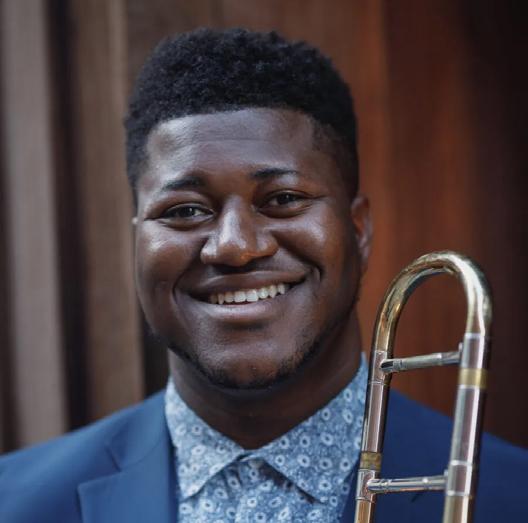
he studied with trombonist Steve Turre who “helped me a lot.” Other trombone influences include Steve Davis and the late Al Grey, “for giving the trombone a prominent sound with the aid of a plunger.”
On Thursday night July 23, Scott will lead his MSQ quintet—playing a mix of hard bop, bebop. Latin jazz and funk—at Jazz In The Park at Riverside Gardens in Red Bank. “I formed MSQ in 2022,” he said. The other four members vary based on availability but they include: trumpeter Austin Ford; pianists Eric Stern, Leon Hsu, and Tommaso Perazzo; bassist Julian Wittich; drummers William Smith, Caleb Tobocman, and David Clapp; and saxophonists Jacob Chung, Brendan Mark, and Awan Rashad. MSQ has appeared at such venues as New York’s The Django and Winnie’s Jazz Room and Bruvsh Cultur3 in Teaneck, NJ.
TRUMPETER KAL FERRETTI, A JERSEY JAZZ RISING STAR
in May 2025 and vocalist Ava Preston, last month’s Rising Star, are part of the Red Bank summer lineup. Ferretti will be performing Thursday night, August 20 in Red Bank’s Riverside Gardens, leading a quintet that will include tenor saxophonist David Hodgson, pianist Noam Avnon, bassist Zach Walgren, and drummer George Greenhill. She will also be part of the Trumpet Summit at Jazz at Lincoln Center’s Kenny Dorham Festival, to be held at Dizzy’s Club from August 27-29 and will be leading her own big band on September 17 as part of the Festival of New Trumpet Music at New York’s Jazz Gallery. When she was interviewed in Jersey Jazz last year, she said, “I love the trumpet, and I love this music so much. It’s my life honor to study
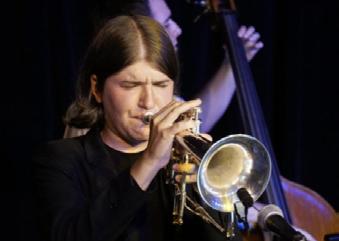

people like Kenny Dorham and Clifford Brown and Freddie Hubbard. Those are my guys.”
Preston was the winner of this year’s Blues Alley Ella Fitzgerald Competition. “I love jazz, and I want to keep doing this for the rest of my life,” she told Jersey Jazz.
“I Was Raised on This Music (Jazz) in My Maternal Grandparents’ Home”
The Count Basie Center for the Arts is gearing up for a free community block party in honor of its namesake, “The Kid from Red Bank,” William “Count” Basie on his birthday, Friday August 21, at 4 p.m. The celebration continues all weekend with the legendary Count Basie Orchestra, founded by Basie in 1937, performing on August 22 at 7 p.m. for a whopping $19.26—digits that represent the year the Carlton Theater, now known as the Count Basie Center for the Arts, opened—a
celebration of its 100th Anniversary.
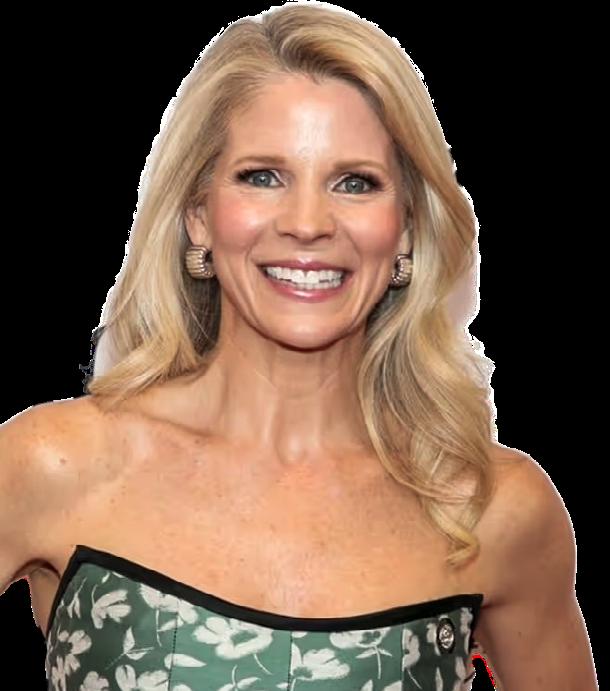
The festivities end with two multi-talented Tony Award winning actresses and Grammy nominated singers, Kelli O’Hara and Sutton Foster, on Sunday, August 23, at 7 p.m., along with the Count Basie Orchestra. With a continuing flow of nostalgia, Foster and O’Hara are taking their cue from a performance Julie Andrews and Carol Burnett, both of whom are living legends, gave at Carnegie Hall. Their medley of songs will honor Andrews and Burnett.
Leading up to the showcase, O’Hara took time from her busy schedule to do an email interview about her upcoming performance and how a girl from Oklahoma found her way to New York City.
“This is an enormous honor for me as I was raised on this music (jazz) in my maternal grandparents’ home, said O’Hara. “Now, I find myself with a son who is an incredible, budding jazz pianist who has reawakened this love in me. It gives me a bit of ‘street cred”’ with this almost-17-
year-old to say I’m performing there.”
Born in Tulsa, OK, O’Hara grew up in Elk City, where her love of music and performance started back in high school. She credited her parents for planting the seed that set her site on New York City.
“My parents raised me on black and white films and movie musicals, but instead of Hollywood, I dreamed of the stage. Always. Still do. When I was a kid, it sometimes felt like I had been there before (New York) and was just trying to get back.”
While in college O’Hara parlayed an audition for an agency through a lead from Kristin Chenoweth and from there her star has continued to rise. She was in the 2015 revival of the musical The King and I, for which she won a Tony Award for Best Actress in a Musical. If you missed her on Broadway, you may have seen her in the wildly popular HBO series The Gilded Age, a period production that takes place before the turn of the 20th Century. It glistens with drama, and
Fifth Avenue fashions, which are fan favorites. “I love being an actor and a singer in order to learn, surprise myself, risk, and feel,” she said. Then there was the series Accidental Wolf, a thriller that she starred in, and the antithesis of The Gilded Age, demonstrating her risk taking as a working actress. “I am certain it makes me a better mother, friend, and wife. If it brings a laugh or a bit of understanding or recognition in someone else, that is even better.”
JAZZ ARTS PROJECT’S SUMMER JAZZ CAFE
All Summer Jazz Cafe performances begin at 7 p.m and all but one are held at Triumph Brewery, One Bridge Ave. in Red Bank The final show, on Saturday, August 1, will be at the Two River Theater, 21 Bridge Ave. For more information or to order tickets, log onto jazzartsproject.org or call (732) 784-3350.
JUL 10-11 » Vocalist Paul Jost
JUL 17-18 » Vocalist Ava Preston
JUL 24-25 » Pianist Brandon McCune
JUL 31-AUG 1 » Drummer Winard Harper & Jeli Posse
JAP’S JAZZ IN THE PARK AT RIVERSIDE GARDENS
The park is located at 42 West Front St. Performances, which are free, begin at 7 p.m.
JUL 16 » Dave Stryker Organ Quartet
JUL 23 » Marty Scott Quintet
JUL 30 » Jeremy Pelt/David O’Rourke Quintet
AUG 06 » Swingadelic
AUG 13 » The Rhythms of the Hearts Band
AUG 20 » Kal Ferretti Quintet
JAP’S WEST SIDE JAZZ CONCERTS AT JOHNNY JAZZ PARK
Sunday afternoon concerts begin at 4 p.m., and are free. Johnny Jazz Park is located at the intersection of Shrewsbury Ave. and Drs James Parker Blvd.
AUG 09 » Eddie Allen Quartet
AUG 16 » Arturo O’Farrill Quartet
AUG 23 » Chuck Lambert
The Count Basie Center for the Arts is located at 99 Monmouth St. Performance begins at 7 p.m. For more information or to order tickets, log onto thebasie.org or call (732) 842-9000.
AUG 23 » Sutton Foster and Kelli O’Hara performing with The Count Basie Orchestra
O’Hara’s love for the arts was loud and clear even through email. “The arts are vital to me. They are vital to any human being, especially right now,” she said, commenting on what feels like a political firestorm engulfing the nation, with artists speaking out, from Bruce Springsteen to Robert DeNiro.
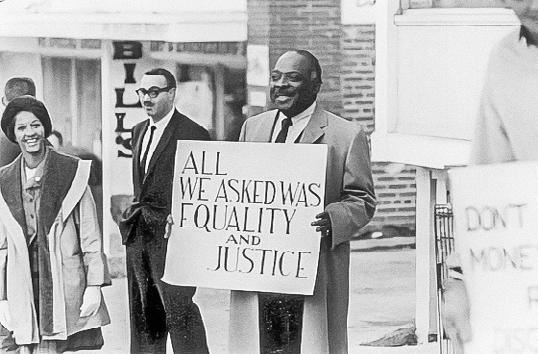
However, it was in 1963, during the Civil Rights Movement when Count Basie joined the student protesters at Florida State University. They were fighting for integration at an eatery near campus. After performing the night before at the University, Basie was refused service at the Mecca, a dining Hall across from the gates of FSU.
“Art is something that belongs to all of us, especially when we learn from it, use it, and allow it,” said O’Hara. “Art takes many forms, and there are no rules. Art’s only promise is that, when embraced, it will heal.”—gilda rogers
BY JAY SWEET
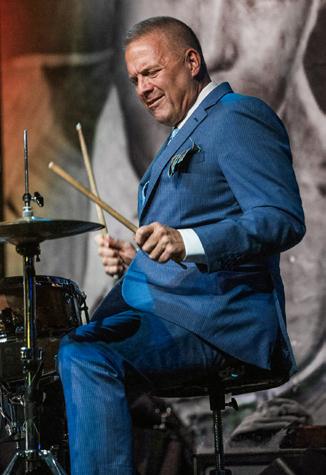
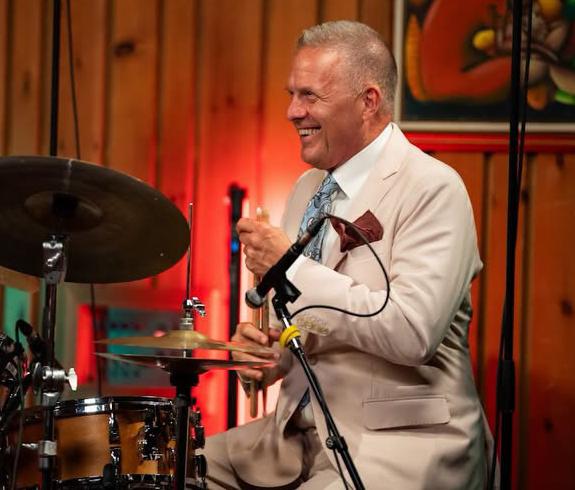
For more than three decades, Joe Farnsworth has been one of the most admired drummers in modern jazz, revered for his superb technique, driving swing, and unwavering commitment to the jazz tradition. A Massachusetts native mentored by legendary drummers Alan Dawson, Arthur Taylor, and Jimmy Lovelace, Farnsworth has appeared on nearly 400 recordings and performed with an astonishing array of jazz masters, including McCoy Tyner, Benny Gol-
son, Pharoah Sanders, Cedar Walton, Harold Mabern, and Wynton Marsalis. He is also a founding member of the acclaimed hard bop collective, One for All, alongside longtime musical associates tenor saxophonist Eric Alexander, trombonist Steve Davis, the late trumpeter Jim Rotondi, and pianist David Hazeltine.
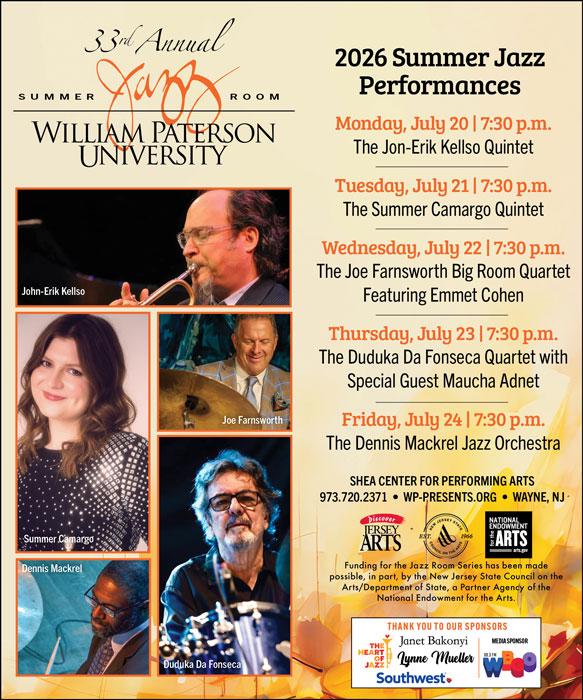
As part of the William Paterson University Summer Jazz Series, Farnsworth returns to familiar territory when he brings his The Big
Room Quartet to Shea Center for the Performing Arts on Wednesday, July 22, featuring special guests such as pianist Emmet Cohen and alto saxophonist Sarah Hanahan. For Farnsworth, the performance represents something of a homecoming. A graduate of William Paterson University’s renowned Jazz Studies program—and now a member of its faculty—he has often spoken about the profound influence the school had on his musical development. Farnsworth frequently cites one of the greatest advantages of music school as being surrounded by highly motivated young musicians whose relentless practicing and pursuit of excellence inspired one another to greater heights. Equally important was William Paterson’s proximity to New York City, allowing students to spend their days studying and their evenings immersed
in the music itself, hearing masters in clubs, attending jam sessions, and experiencing firsthand the vibrant jazz scene of Manhattan.
Among Farnsworth’s classmates were future jazz luminaries such as Alexander, who would later become one of his closest collaborators, and drummer Bill Stewart whose constant dedication to practice inspired Farnsworth to work even
The Shea Center for the Performing Arts is located at 300 Pompton Road on the WPU campus in Wayne, NJ. All concerts begin at 7:30 p.m. For more information or to order tickets log onto wpunj.org or call (973) 720-2371.
JUL 20 » Jon-Erik Kellso Quintet
JUL 21 » Summer Camargo Quintet
JUL 22 » Joe Farnsworth Big Room Quartet
JUL 23 » Duduka Da Fonseca Quartet
JUL 24 » Dennis Mackrel Jazz Orchestra
harder as a student. The friendships and musical relationships formed during those years would prove enduring, inspiring Farnsworth to eventually return to the university to mentor the next generation of aspiring musicians. Perhaps no relationship born of William Paterson proved more influential than Farnsworth’s bond with pianist Harold Mabern. The two forged a deep personal and musical connection, recording and touring extensively together over many years. Farnsworth has often described Mabern as a mentor whose joyous spirit, wisdom, and profound understanding of swing left a strong imprint on his own musicianship and development. That influence can still be heard in Farnsworth’s playing today.
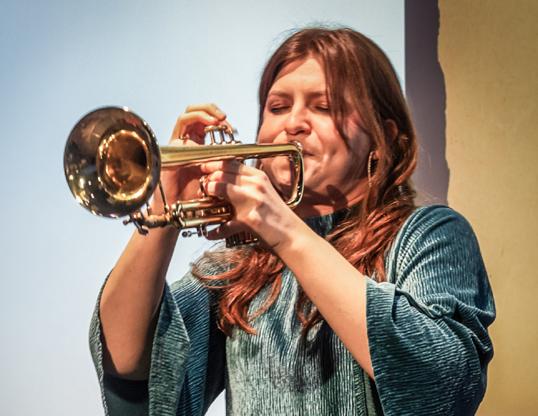
Farnsworth’s appearance is only one highlight of a remarkable week of performances, sponsored by WBGO 88.3 FM. The series begins on Monday, July 20, with the Jon-Erik Kellso Quintet, featuring the highly individual trumpet artistry that has made Kellso one of the foremost interpreters of classic jazz. Other performers are trumpeter Summer Camargo; Brazilian master drummer Duduka Da Fonseca, joined by special guest vocalist Mau-
cha Adnet, celebrating the rich traditions of Brazilian jazz; and the powerful Dennis Mackrel Jazz Orchestra, led by the former Count Basie Orchestra Musical Director and drummer who now leads one of the most exciting big bands on today’s scene.
Camargo, featured as a Jersey Jazz Rising Star in May 2021 while still a student at Juil-
liard, is a member of the Saturday Night Live band and is currently performing in the band for the Broadway production of Just in Time. At WPU, she will be joined by saxophonist Veronica Leahy (a JJ Rising Star in November 2024), pianist William Schwartzman, bassist Raul Reyes, and drummer Varun Das.
“My
Biggest Contemporary Influences Were the Two Kens—Peplowski and Davern”
BY SANFORD JOSEPHSON
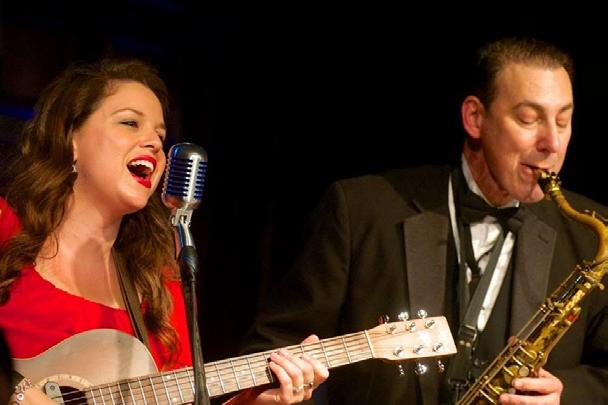
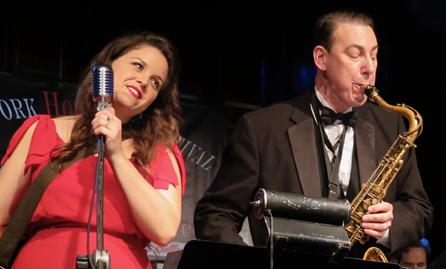
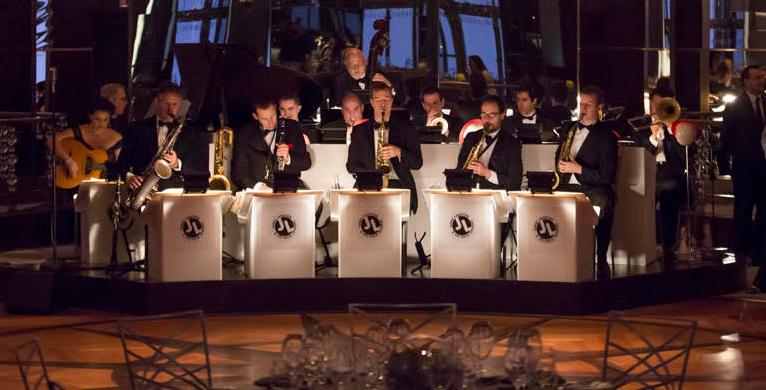
When clarinetist Dan Levinson takes the stage with the James Langton All-Star New York Big Band on Saturday, August 15, at the Morristown Jazz & Blues Festival, it will be his first appearance with the band since he underwent jaw surgery in February.
“I’ve had to learn to play clarinet all over again,” Levinson said. “The day I blew into my instrument in April and sound came out was really one of the greatest things in my life. I’ve built up some chops, and I just have to increase my endurance.”
Levinson’s first “paid gig” since the surgery was on May 17 at Central Park Swings, the live music program at King Jagiello Plaza on East 79th Street in Central Park. Prior to that, he sat in at Arthur’s Tavern in Greenwich Village, and played at a couple of private events.
The James Langton All-Star Big
Band was co-founded by Levinson and Langton in 2008, “originally to do a Benny Goodman show at the Somerset County Vo-Tech in Bridgewater, NJ. We did some follow-up concerts at the same place and now we focus on the big band era, the swing era, going into the ‘40s. We sometimes do some Sinatra stuff, which includes the ‘50s and ‘60s.
“The difference between us and other bands,” he continued, “is that James has gone to the libraries that housed the original arrangements played by these bands, and he copied the arrangements and then entered them into music software. So, they’re not transcriptions, which is when somebody listens to the recording and tries to interpret whatever they were playing.”
The Langton band’s repertoire includes “the music of Artie Shaw and all of the big bands—Glenn
Miller, Tommy Dorsey, Duke Ellington, Count Basie. So, at Morristown, we’ll probably do kind of a ‘best of’.” The roster, in addition to Levinson on clarinet, bass clarinet and baritone saxophone and Langton on tenor sax and vocals, will include: trumpeters Brian Pareschi (lead trumpet), Joe Boga, and Charlie Caranicas; reedists Mark Lopeman on lead alto, Matt Kozo, and Ricky Alexander; trombonists Jim Fryer and Harvey Tibbs; and a rhythm section of Conal Fowkes on piano, Levinson’s wife Molly on guitar and vocals; Tal Ronen on bass, and Kevin Dorn on drums.
When Levinson started to play clarinet professionally in the late 1980s, “My biggest contemporary influences were the two Kens—Peplowski and Davern. Of course, I also listened to Benny Goodman, Jimmy Noone, and Irving Pazo-
la, but the two living clarinetists who inspired me the most were the two Kens. I still can’t process that we’re in a world without Ken Peplowski.” (Peplowski passed away on February 2 at the age of 66).
Levinson first heard Peplowski in 1985 “at a club called Lola’s. I
knew (trombonist) Dan Barrett, who was sort of a mentor to me, and he said, ‘I’m playing at this club tonight, and you really ought to come check out the clarinetist. I had just started playing the clarinet. I did not have the ears I have now, but I could tell he was something special. A couple
of years later, after I had learned to play some scales and things, I went to Ken and asked him to give me lessons. He had just started recording for Concord. He wasn’t yet an internationally recognized star, but he was as technically good as anyone I’ve heard before or since.” (For
more on Ken Peplowski, see Guest Column by Schaen Fox on page 38).
On July 18, Levinson and Ryan will be leading the New York Hot Jazz Faculty All-Stars at the Tilles Jazz Fest at the Tilles Center for the Performing Arts in Brookville (L.I.), NY. October dates include another Central Park Swings performance and an appearance at the Hungarian House on East 82nd St. in Manhattan.
Late last year, before his surgery, Levinson recorded a new album on the Turtle Bay label. “It’s still in post-production,” he said, “and we don’t have a release date yet.” Another recent project is One Step to Chicago The Legend of Frank Teschemacher and the Austin High Gang on Riverside Records. The album contains music recorded in 1992 with pianist Dick Hyman—“my first recorded session ever—and produced by the late George Avakian. It’s a tribute to “the
early Chicago jazz pioneers” and, in addition to Levinson and Hyman, features cornetist Peter Ecklund, Peplowski on tenor saxophone, Barrett on trombone, banjoist Marty Grosz, bassist Bob Haggart, drummer Arnie Kinsella, and trumpeters Richard Sudhalter and Jon-Erik Kellso.
Since 2015, Ryan has been Co-Director, with trumpeter/vocalist
Bria Skonberg, of the New York Hot Jazz Camp. The camp, Ryan said, is looking for a new venue, as the previous one has been sold, but she’s hopeful everything will be settled in time for a summer 2027 date.
Ryan’s latest album is Sweeping the Blues Away, also on the Turtle Bay label. It features 11 songs that, in the words of Jersey Jazz’s Joe Lang “share her penchant for older tunes that are not played to death.” They have, he added, “a freshness that sounds just right.”

The Festival, which is free, will be held on Saturday, August 15, on the Morristown Green, located at 10 North Park Place in the center of Morristown
NOON » James Langton’s All-Star New York Big Band
2:00 PM » Richard Baratta Gotham City Latin/Jazz Septet
4:00 PM » LaBamba and the Hubcaps
6:00 PM » Vocalist Daryl Triplett
8:00 PM » Guitarist/Vocalist Christone ‘Kingfish’ Ingram
Jay
Thatte
“For
the First Time in the History of the Nine-Year Contest, Two Students Scored the Top Prize”
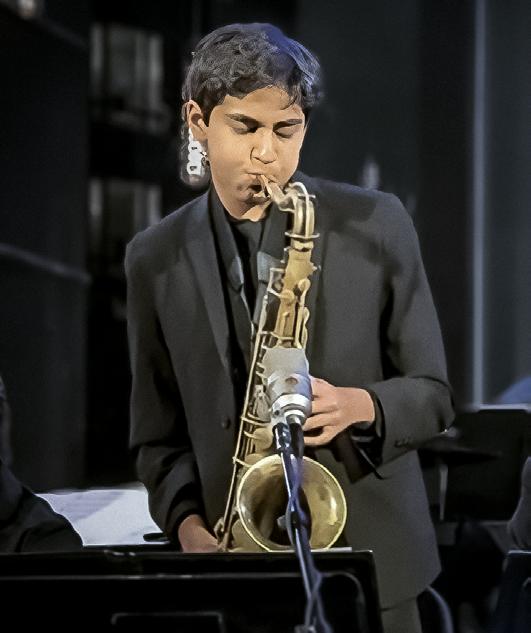
Jay Thatte has been playing music since he was seven years old, starting out on classical piano. In the sixth grade at Newark Academy, a coeducational private day school in Livingston, NJ, where he lives, he was exposed to jazz by Julius Tolentino, the Director of Bands. “He introduced me to clarinet and saxophone,” Thatte recalled. “I’ve been taking lessons from him since then. I didn’t go to Newark Academy for music, but it was like a stroke of luck. I loved it.”
When Tristan Connolly was 11 or 12, growing up in Fairfield, CT, he was listening to some music on Spotify. “I came across this playlist entitled Jazz,” he said, “and I took a listen. I heard this song, ‘On the Sunny Side of the Street’ which featured Sonny Stitt, Sonny Rollins, and Dizzy Gillespie, and, in that moment, I fell in love with jazz. I just wanted to be able to play what they did.”
Thatte and Connolly, both entering their junior years in high school in the fall, are the Grand Prize Win-
ners in the 2026 Gerry Mulligan Jazz Challenge, sponsored by The Gerry and Franca Mulligan Foundation. “For the first time in the history of the nine-year contest,” said Mia Toschi, GFMF Executive Director, “two students scored the top prize, and each will be awarded a new Conn Selmer saxophone.”
To enter this year’s contest, student musicians were asked to upload a solo performance video of Mulligan’s “Outback of the Barn,” a composition that was first played by his New Sextet in 1976.
Newark Academy won Jazz at Lincoln Center’s Essentially Ellington competition in 2024 and was a finalist in 2025, Thatte’s freshman year in high school. Thatte was part of the competing band and won Honorable Mention as a soloist. He participates in JALC’s year-round Youth Orchestra, directed by To-
lentino; will be attending its Jazz Academy this summer; and has been invited to be a member of the Monterey Jazz Festival’s Next Generation Jazz Band, which selects 21 student musicians from across the country.
“The reason I like Gerry Mulligan,” he said, “is his warm and huge sound. Also, the fact that he was a very melodic player.” Thatte’s main instrument is tenor saxophone, and his two favorite players are Dexter Gordon and John Coltrane. Among current saxophonists, he would choose Joshua Redman.
What the 16-year-old Thatte loves most about jazz is “that it’s a community art form. Improvising is like a conversation with other people. It’s a type of music that really brings people together in a special way.
I’ve also learned about its heritage, where it comes from, the influences on it from many parts of the world.”
While attending Tomlinson Mid-
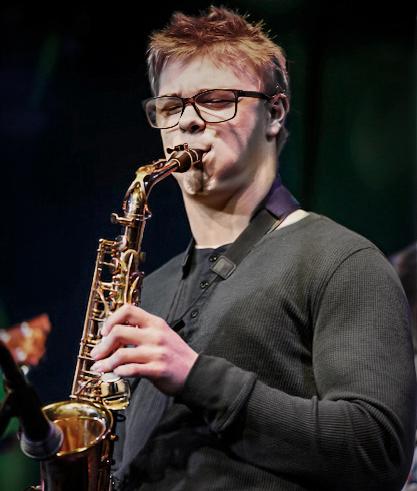
dle School in Fairfield, Connolly was “fortunate to have a great jazz teacher, Tim Lewis, who supported me.” Connolly played baritone saxophonist in the middle school band for three years, and Lewis recalled “teaching him one-on-one lessons in the eighth grade. As a middle school teacher, I find my main focus is to inspire my students to listen and copy what they hear on the records. Tristan took real ownership of his learning in this way. He has a very intuitive ear and feel for music in general. He would come into his lessons with new things he checked out, mainly showing me transcriptions of his favorite artists. Gerry Mulligan was a major influence on him. Others would include Bird, Stitt, and, if memory serves, some Art Pepper. His enthusiasm for the music is infectious, and it has been a real joy for me to see him taking big steps forward!”
“
BEEN ABLE TO WORK WITH. ”
Like Thatte, the 15-year-old Connolly, who attends Fairfield Warde High School, participates in JALC’s Youth Orchestra. This summer he will be attending the Litchfield, CT, Jazz Camp on a full scholarship, having won its Talent Search, which was held in March. “I’ve always been a big fan of Gerry Mulligan,” he said. “I fell in love with his sound and his melodic playing. He was one of my big inspirations. I think playing and listening to jazz helps me relax. It makes me motivated. It’s a great part of my life.”
As a jazz musician and educator, Tolentino gets to work with “so many talented young musicians; and Jay and Tristan are some of the brightest and talented students I’ve been able to work with. It was probably around two or three years ago when I realized that Jay was going to be a monster player on the saxophone. He is very dedicated and loves jazz music.
“I first heard Tristan on an online audition for Jazz at Lincoln Center. I could hear his love for Sonny Stitt—one of my favorites—in his
playing right away. He has also grown so much in the short time I’ve gotten to know him at JALC and in the New York All State Jazz Band. They are both deserving of this award from the Mulligan Foundation!”
The other finalists in this year’s Gerry Mulligan Challenge are Robert Jefferson of Burlington, NC, who will receive a $500 cash award, and Jenna Marx of Westlake Village, CA, and Kalman Leviton of Chevy Chase, MD, who will each receive $250.— SANFORD JOSEPHSON
BY SCHAEN FOX
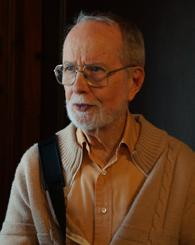
Iknew him for many years, first as a fan, and then as a friend— which I’m sure, was true of so many of his countless fans. I loved his humor nearly as much as his phenomenal musicianship. Today, many of the top musicians find some financial security teaching in academia. Ken taught privately and occasionally, but not at an institution. He really lived the classic life of a jazz musician, gigging to pay the bills. Then the Covid pandemic struck and was followed immediately by his blood cancer treatments both especially hard physically, financially and emotionally. He couldn’t work for a painfully long time.
His good friend, guitarist Frank Vignola, had begun a GoFundMe project that raised $140,000 for Ken. Then, Frank booked him on his outdoor gig when Ken started playing again. When that was over, I helped carry some of his gear to his waiting car. We had to cut through the audience that was spread out before the bandshell. He went first, and I followed. As we went, there were near-constant calls like “Great job Ken”, “Ken, great to see you again,” and so on. As we reached the end of the crowd, he said, “This is why I do what I do.”
The Jazz Cruise was important for similar reasons. It provided
a significant portion of his yearly income, and it was a week-long party with many of his musician friends and 2,000 adoring fans.
A few months before this last cruise, I had tried to interview him for an article, but he was unavailable. Somehow that bothered him, and when I saw him on the Cruise, he was apologetic and perhaps made himself extra available all week. He looked and sounded good and whenever we were together, fans were regularly saying so. (His illness had cost him around 80 pounds which he did not have to spare.)
In addition to playing, some musicians would do informal talks
on the cruise. Ken had one with Anat Cohen that final day (“Coffee Talk” from 9:45–10:30 a.m.). They chatted about their careers and instruments then answered questions from the audience. It was a pleasant relaxed get together, nothing more.
We stayed around afterwards to hang briefly with them. Then we parted. My wife and I wanted to prepare for lunch, and Ken was going to his room. He had a quartet concert scheduled for 4:30 and wanted to nap first. We left, but I remembered that I had wanted to question him about an article I was working on. (In addition to everything else, he was a jazz historian).
I went back to him, and we walked, talked, and joked toward the elevators. When we got there, Ken said that he preferred to walk up the two levels to his room, which we did. We continued to talk, and I
“ IT WAS A WEEK-LONG PARTY WITH MANY OF HIS MUSICIAN FRIENDS AND 2,000 ADORING FANS. ”
saw nothing amiss as we climbed the steps. He looked better than he had since Covid. As we said goodbye he gave me a hug, turned and disappeared down the hall to his room. That was at about 11:00 a.m..
The rest of our day was normal. At 8:30, we went to see John Clayton lead the big band with Kurt Elling and Veronica Swift. At starting time, Michael Lazaroff, overseer of the Jazz Cruise, came out and announced that when Ken had
not appeared for his 4:30 gig, they checked and found him dead in his stateroom. The shock momentarily sucked the air from the theater. That concert never touched me. I was numb to it. They did a number of Basie “New Testament” classics, but all I could wonder was that the music sounded so perfect yet those musicians were far closer to Ken than we were. How could they play so well when their shock must have been far stronger than ours?
Later, Anat Cohen pointed out to me that Ken had enjoyed a great week with many of his best friends, playing the music he cherished, and surrounded by avid fans. That was a great way to exit the main stage.
: Schaen Fox is a retired Contributing Editor to Jersey Jazz. His last “Talking Jazz” interview was with alto saxophonist Alex Tarantino, the cover story in the March 2023 issue of the magazine.
BY JOE LANG
Many NJJS members are familiar with drummer/ composer/arranger Rich DeRosa, who is now a Professor of Music at the University of North Texas where he directs Jazz Composition and Arranging. He was previously at William Paterson University and Manhattan School of Music, as well as appearing as a drummer with many NYC-based musicians. Wisdom (North Texas Jazz - 222601) is a collection of charts written for the student big bands, One O’Clock Lab Band in 20172025, and Two O’Clock Lab Band 2025. The breadth of DeRosa’s music is impressive. His reimagining of Gershwin’s “I Got Rhythm” as “AI-GoRhythm” is the opening track and lays the groundwork for the many pleasant surprises that follow, concluding with a tribute to one of his early inspirations, composer, arranger and publisher Bob Curnow, “Fanfare for an Uncommon Man.” The quality of musicianship demonstrated on this album through-
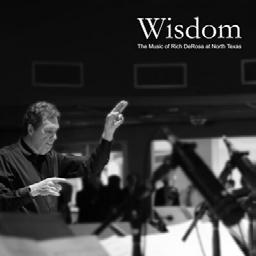
out the bands is a tribute to the quality of the jazz education program at UNT, the school that was home to the first college level jazz studies program. It is also a tribute to the remarkable talent of Rich DeRosa. amazon.com
The name of Kenny Dorham seems to get lost when the great trumpet players in jazz are discussed. Give a listen to The Complete ‘Round About Midnight at the Cafe Bohemia (Blue Note), and you will hear precisely how special he was. Having earlier played in big bands led by Lionel Hampton, Billy Eckstine and Dizzy Gillespie,
he replaced Miles Davis in the Charlie Parker Quintet, was an original member of the Jazz Messengers led by Art Blakey, and eventually became a leader as well as a much in demand sideman. This material was originally released on a single LP in 1957 and on two additional LPs in 1984. This two-disc set, also available on vinyl as a three-LP set, brings this magnificent music back into circulation.
Joining Dorham were tenor saxophonist J.R. Montrose, guitarist Kenny Burrell, pianist Bobby Timmons, bassist Sam Jones, and drummer Arthur Edgehill. This was one of the most significant additions to the evolution from bebop to hard bop that was extensively documented on the Blue Note label. Dorham was never a showy player, rather one with a beautiful tone who was a wondrously subtle improvisor. The sextet is consistently empathetic, with Burrell’s guitar adding a new dimension to the harmonies that had been
created by the typical hard bop trumpet/tenor sax/piano/bass/drums format. The program is a mixture of standards, “Autumn in New York,” “Who Cares” and “My Heart Stood Still;” jazz classics, “‘Round About Midnight” and “Night in Tunisia;” and Dorham originals, “Monaco,” “Mexico City,” “Hill’s Edge,” “K.D. ’s Blues,” “Royal Roost,” “The Prophet,” “Riffin’,” and “New York Theme,” Dorham’s take on Thelonious Monk’s “52nd Street Theme.” The tunes cover a full spectrum of tempos, from up numbers like “Riffin’” to a lush reading of “Autumn in New York.” There are four alternate takes that illustrate the ways in which jazz musicians always have new ideas as they readdress a melody. Mostly, it serves as a fine introduction to Kenny Dorham for those who have not centered attention on him. store.bluenote.com/ products/kenny-dorham-the-complete-round-about-midnight-at-thecafe-bohemia-tone-poet-vinyl-series
Monk Live in Paris, 1967 - Volume
One (Rhythm-A-Ning Entertainment - 0001) is the first of a proposed series of live performances by Thelonious Monk to be made available by the Monk estate. Many of the performances have been previously released as unauthorized bootleg recordings. However, this series will be carefully remastered to capture the best possible sound for each recording. Monk often supplemented his basic quartet—himself on piano, Charlie Rouse on tenor sax, Larry Gales on bass and Ben Riley on drums—with occasional guests. On this 1967 recording, Phil Woods is on alto sax, Johnny Griffin is on tenor sax, Jimmy Cleveland is on trombone, and Ray Copeland is on trumpet for “Epistrophy” and “Evidence.” The basic quartet performs “Ruby My Dear,” and Copeland rejoins the scene for “We See.” Those familiar with the Monk output are well aware that
his approach to the same tune could vary widely from performance to performance, thus making each recording unique and interesting in its own way. The selections here are all familiar Monk tunes, but are always given fresh new life each time that Monk plays them. He was truly one of the geniuses of the music, and this is a nice sampling of why this designation is valid. Available on vinyl and as a download at amazon.com
Tenor saxophonist Jeff Rupert, Director of Jazz Studies at the University of Central Florida, has been preforming with his quartet—pianist Richard Drexler, bassist Ben Kramer and drummer Marty Morell—for almost two decades. On their new release, Sea Spell (Rupe Media - 041526), their tight partnership shines through. Rupert has a pure tone reminiscent of the lightness that one heard in the playing of Stan
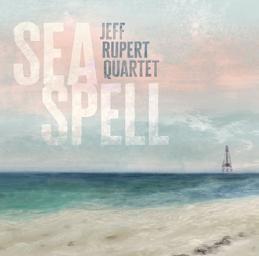
Getz. In addition to his proficiency on his horn, the six selections that he composed for the nine-song program, “Blue Steel,” “Sea Spell,” “Look Who’s Calling,” “A Breeze Through the Keys,” “Orca-Stration” and “Wednesday’s News,” show that he is also a fine composer. The program is filled out with “Spring Can Really Hang You Up the Most,” “Mambo Inn” and ‘Polka Dots and Moonbeams.” The album has a variety of tempos, but underneath is always a persistent swing abetted by the rhythm section. Drexler’s solo interludes are in sit up and take notice time. When listening
to the 46-minute program is completed, the first impulse is to hit the replay button and enjoy this marvelous music once again. amazon.com
Matching a couple of nonagenarian jazz masters, drummer Steve Little and bassist Bill Crow, with a pair of younger sure to be masters, pianist Charles Chen and guitarist Felix Lemerle proves to be a wise decision as their playing on Chen’s third album, The Long Way Home (Cellar Music040126), shows. They address Oscar Pettiford’s “Laverne Walk,” “You Turned the Tables on Me,” “Dream Dancing,” Johnny Hodges’ “Squatty Roo,” “On the Alamo,” “You Send Me,” an Ellington medley of “Prelude to a Kiss,” “I Got It Bad (and That Ain’t Good)” and “Sophisticated Lady,” “Yours Is My Heart Alone” and “Poor Butterfly.” This music will set your toes to tapping from the get-go. Chen has chops to spare and a flu-
id imagination, and Lemerle makes his strings dance, while Little and Crow lay down a rhythmic bed that is all a musician could desire. As an added bonus, there are extended interviews with Little and Crow that give listeners a deep glance into their extensive careers. Put it all together and you have about an hour and a quarter of engaging entertainment, great for your musical side and interesting for those who love digging into jazz history. cellarlive.com
For his latest album, Universal Truth (Mack Avenue - 1242) pianist Emmet Cohen turned his attention to the music of two jazz legends, Miles Davis and John Coltrane. He is joined by Joe Farnsworth on drums and either Ron Carter or Yasushi Nakamura on bass, with occasional contributions from trumpeter Jeremy Pelt, and tenor saxophonists George Coleman and Tivon Pennicott. On the Davis side
of things, Cohen and his bandmates play “Budo,” “Well You Needn’t,” “My Funny Valentine’ and “Gingerbread Boy.” Then, inspired by Coltrane’s quest for “universal truth” Cohen has composed three original pieces, “Eternal Glimpse,” “Compassion” and “Universal Truth,” a threesome of tunes that capture the emotions experienced on the journey. He closes with the classic “Blue Train.” These tracks provide ample proof of why Cohen has risen to the upper echelon of jazz pianists. His impressive command of the keyboard is matched by his improvisatory genius and his ways of creating his own approach to material that has already achieved legendary status. On his originals, he displays another aspect of his talent, composing material that offers fascinating new vehicles for others to explore. Here, Cohen presents his own version of universal truth, musically speaking. mackavenue.com
A relative newcomer to the New York City scene after spending over 20 years in Toronto, Serbian-born guitarist Vladimir Redzic has finally released his initial album as a leader, First Time Around (self-produced). He has opted to record in two settings, as a quartet with pianist Steve Ash, bassist Jonathan Meyer, and drummer Steve Little for the first five selections, “I’ve Got a Crush on You,” “With a Song in My Heart,” “Blue Gardenia,” Redzic’s “Bishop’s Gambit” and “These Foolish Things” with a fine vocal by Ale Nuñez; and a trio with Ash and bassist Neal Miner for the final five tunes, Charlie Parker’s “Chasin’ the Bird,” “How Long Has This Been Going On,” “Thou Swell,” “I’m in the Mood for Love” and “I Didn’t Know What Time It Was.” Citing Kenny Burrell and Grant Green as his primary influences, Redzic has developed an appealing approach of his
own, playing swinging single-note lines and providing superb rhythm guitar support for pianist Ash, a keyboardist from the New York City area scene deserving of national recognition. The bassists are both strong players, and it is a pleasure to hear the nonagenarian Little still going strong. Redzic’s debut album is one that should lead to many more in the future. vladimirredzic.bandcamp.com/album/first-time-around)
Record producer and concert presenter, Susan Waldowski, has a talent for conceiving albums that offer a variety of vocalists singing a program of vintage pop tunes. The latest is Accentuate the Positive (Songbook Ink), a two-disc collection that contains 21 tracks of familiar tunes that will bring back many memories. Most of the selections feature vocalists, but the opener is an instrumental, “Moonlight Sere-
nade” featuring the clarinet of Felix Peikli, setting the mood for these songs from the ‘30s and ‘40s. There are several piano trios led by Philip Granley, Konrad Paszkudzki, Champian Fulton, Robbie Lee, and Brian Reeder. Among the guest musicians are Peikli, Harry Allen on tenor sax. Byron Stripling on trumpet, Klas Lindquist on alto sax, and Peikli and Ken Peplowski on clarinet. Some of the many singers are: Kate Kortum (“Stomping at the Savoy” and “It Had to Be You”), Jane Monheit (“Look for the Silver Lining”), Nicki Parrott (“Our Love Is Here to Stay”), and Lucy Wijnands (“That’s All”). All in all, this is a collection of tunes that will not only create feelings of nostalgia for those of a certain age, but will introduce many fine vocalists who might be new to you. A nice trip back to yesterday! songbook-ink.com/products/accentuate-the-positive-compact-disc
Chuck Bergeron has performed with many vocalists during his 40-year career as a jazz bassist. During a brief time living in Seattle, he worked with vocalist Kendra Shank, and during their gigs, they always did a song with just voice and bass that Shank referred to as their “bass and face” moment. This led Bergeron to his latest undertaking, an album titled Bass & Face (Summit852), a program of 12 tracks with many jazz vocalists, including Janis Siegel (“An Occasional Man” and “When I Drink”), Pete McGuinness (“Emily”), Kevin Mahogany (“Two Degrees East, Three Degrees West” and “Duke Ellington’s Sound of Love”), Sheila Jordan (“Fair Weather”), and Roseanna Vitro (“Take the Wrinkles Out of Your Birthday Suit”). There are a variety of instrumentalists including percussionist Richie Bravo on the Siegel tracks, guitarist John Hart on the Jordan track, saxophonist Charles Pillow, pianist Phil Strange and drummer John Riley
on Mahogany’s “Two Degrees East, Three Degrees West,” and Strange on “Duke Ellington’s Sound of Love.” It is interesting to hear the different styles of each vocalist, all jazz-influenced in different ways. Bergeron took on a unique project and the results are fascinating. summitrecords.com
Trumpeter/vocalist Bria Skonberg has been developing the vocal side of her talent to a point where it is equal to her standing as a top tier mainstream trumpet player. On Indigo (Cellar Music - 030126), the primary focus is on her singing. Her instrumental support is provided by arranger Gil Goldstein on piano and accordion, Kathleen Master on alto flute, Charles Pillow on bass clarinet, Eric Wheeler on bass, Darrian Douglas on drums and a string quartet of Antoine Silverman and Etch Todorov on violins, Yuko Naito-Gotay on viola and Emily Brausa on cello.. The nine-song program
includes “Watch What Happens,” “I’m Glad There Is You,” “Mood Indigo,” “Between the Devil and the Deep Blue Sea,” “If You Go Away,” “Fragile,” “So It Goes,” a Skonberg original, “Tell Him I Said Hello” and “We’ll Be Together Again.” Her voice is rangy, her jazzy phrasing a reflection of her many years of jazz trumpet work and she does a marvelous job of rendering the lyrics with understanding. Goldstein’s charts provide perfect settings for Skonberg’s vocalizing with her trumpet interludes reminding the listener of that aspect of her artistry. Indigo is an uplifting pleasure! cellarlive.com
For more than 40 years, pianist/vocalist Eliane Elias has been a major presence on the jazz and Latin jazz scenes. Born in Sao Paulo, Brazil, Elias moved to New York City where she studied classical piano at Juilliard. She soon turned to jazz and has become renowned for her artistry as
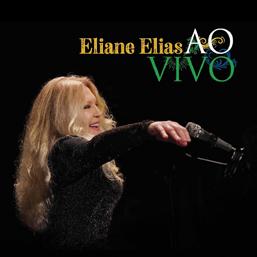
both pianist and vocal interpreter of jazz and Brazilian jazz tunes. She has recorded more than 30 albums with her most recent being AO VIVO (Candid - 3396), a 10-song program recorded on October 21, 2023, at the SF JAZZ Center in San Francisco, with guitarist Leandro Pellegrino, bassist Marc Johnson and drummer Rafael Barata. The selections focus on Brazilian jazz songs that have appeared on several of her studio albums, and
include “Brasil (Aquaria do Brasil),” “Você,” “Sambou Sambou,” “Você e Eu (You and I),” “Eu Sambo Mesmo (I Really Samba),” “Bahia Medley: “Saudade de Bahia”/“Você Já For à Bahia,” “Este Tarde Vi Llover,” “At First Sight,” “A Felicidade” and Só Danço Samba.”
This spirited live performance finds Elias in prime voice, and her dynamic pianism is wonderfully complemented by her bandmates. Capturing Elias in live performance at a venue with superb acoustics is a treat indeed candidrecords.shop.musictoday.com
Note: In the March issue The Magic of Marilyn Maye: Live at Jazz at Lincoln Center was reviewed. At the time, it was only available as a download. It is now available on CD at store.jazz.org/collections/music/products/marilyn-maye.
Watch the Latest News section of njjs.org for more album reviews during the summer.
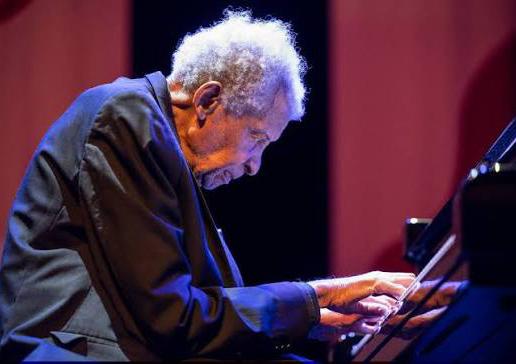
His Intimacy ‘Could Turn a Nightclub into a Living Room’
Sometimes the highlight of an (Abdullah) Ibrahim concert,” wrote National Public Radio’s Martin Johnson, “was less the dazzle of his technique as much as it was the qualities of some of his originals and playing. There was a ruminative quality that could turn a concert hall into an intimate setting and a nightclub into a living room.”
Abdullah Ibrahim, aka Dollar Brand, was playing professionally in South Africa at the age of 15. In his 20s, he led a jazz group, the Jazz Epistles, that included the trumpeter, Hugh Masekela.
Ibrahim, who passed away on June 15, 2026, at the age of 91, moved to Europe in the early 1960s, and his future
wife, Sathima Bea Benjamin, a vocalist, introduced him to Duke Ellington, who produced an album, Duke Ellington Presents the Dollar Brand Trio.
In 1965, Ibrahim moved to the United States and played at the Newport Jazz Festival. A year later, he subbed for Ellington, leading the Duke Ellington Orchestra at five U.S. concerts. He received a Rockefeller Foundation grant in 1967, enabling him to study at Juilliard. Among his closest musical friends were drummer Max Roach, saxophonist Ornette Coleman, and pianist Cecil Taylor. He converted to Islam in 1968, changing his name from Dollar Brand to Abdullah Ibrahim.
The pianist Vijay Iyer told NPR’s Johnson he was influenced by Ibra-
him early in his career. “I tried to compose music like Ibrahim’s,” Iyer said, “and tried to create these novel structures and dissonant forms.”
Pianist Kenny Barron heard Ibrahim at New York’s Sweet Basil in the late 1980s, performing duets with saxophonist Carlos Ward. The performance inspired Barron to write “Song for Abdullah.” On a 1989 program of “Fresh Air”, hosted by NPR’s Terry Gross, Barron said, “The music they produced was so beautiful and
prayerful. It was like being in a temple or church, very lyrical and blissful.”
In 2018, Ibrahim received a National Endowment for the Arts Jazz Masters Fellowship. A year later, in an interview with the Wall Street Journal’s Larry Blumenfeld, he talked about Ellington’s influence on him. “Duke,” he said, “showed me the importance of presenting old and new material side by side and of performing the older songs as if they were new and the newer ones as if they were familiar.”
“Clive
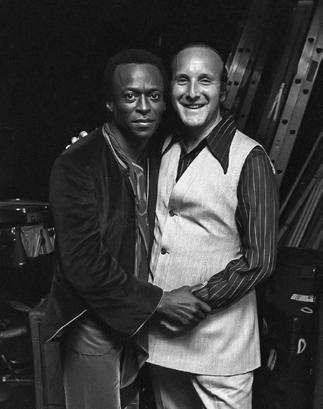
Although he was best known for his work in boosting the careers of major popular music superstars like Whitney Houston, Barry Manilow, and Aretha Franklin, Clive Davis also impacted the career of Miles Davis.
Clive Davis, who passed away on June 22, 2026, at the age of 94, was credited with convincing Miles in the late 1960s to cross over to younger audiences by moving toward jazz-rock fusion with such recordings as Bitches Brew (Columbia: 1970) and On the Corner (Columbia: 1972). Then President of Columbia Records, Clive Davis booked Miles into rock venues including Fillmore East in New York
and Los Angeles’ Ahmanson Theater.
On Facebook, the Family of Miles Davis posted this: “For decades, Clive championed artists across jazz, soul, R&B, rock and pop, helping bring groundbreaking music to audiences around the world ... As president of Columbia Records, Clive Davis played a monumental role in the commercial revival of Miles Davis. Recognizing that young rock artists were profiting from jazz-derived styles, Clive en couraged Miles to adapt his sound.”

An attorney, Clive Davis joined Columbia Records as an in-house lawyer in 1956 and was named President in 1967. After being fired by Columbia in 1973, he took over the Bell label in 1974, renamed it Arista and achieved a Number 1 hit, “Mandy” for Manilow. The 19-year-old Houston signed with Arista in 1983 and continued to be connected with Davis throughout her career.

BY JOE LANG
On May 24, we lost a great jazz pianist, John Eaton, five days short of his 92nd birthday. His passing affected me personally as we had become good friends.
Eaton was a graduate of Yale University with a degree in English. He intended to become a teacher, starting graduate school at Georgetown University. However, his love for music led him to drop out of school to pursue a career as a jazz pianist. From 1968-1971 he led the house trio at Blues Alley where he had the opportunity to support a wide variety of jazz stars such as tenor saxophonist Zoot Sims, trumpeter Clark
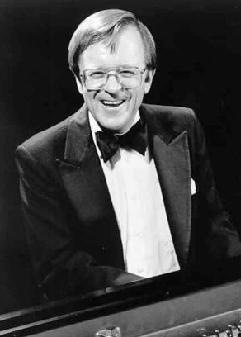
Terry and vocalist Maxine Sullivan.
Beginning in 1978, Eaton presented a series of concerts at the Smithsonian which covered many aspects of classic American popular music. In many ways, they were more seminars or classes, for he provided not only the music but also in-depth information about the subject of each session. These events were always sold out, and many were nationally broadcast.
I met John while in Washington, DC for the first of many business trips to that city around 1980. Following my first day of sales calls, I returned to my hotel and went to the lounge where a pianist played during the cocktail hour. When I spoke to him after his set had ended, he recommended that I head over to the Jockey Club at the Ritz-Carlton Hotel to hear John Eaton, a name new to me at the time. Well, I did
make the Jockey Club scene and was awed by the talent and personality of John Eaton. His playing was magnificent and his between song commentary was informative and witty. One particularly fascinating aspect of his playing was his formation of either composer-based or themebased medleys that were inventive and well-conceived. He was open to taking requests from the audience, and I made some a few times. I returned each night during my week in Washington and on the second night, he came over to my table to introduce himself and get my contact information. We immediately connected over our common love of the Great American Songbook, and a solid friendship was established. Over the next several years, I spent each evening while in Washington at the Jockey Club absorbing John’s always impressive pianism.
Being a record collector, I acquired the albums that John had done for Chiaroscuro Records and did some research to find other albums on which he appeared. One was a live set by trumpeter Wallace Davenport on which one of the tunes was “Just a Closer Walk with Thee.” I asked John to play it one evening, and during the following break, I told him why I had requested it. Most of the subsequent times that I saw him in a club after that,
he would play it without my asking.
In 1982, at the suggestion of his friend Dick Wellstood, John was engaged to play at Hanratty’s on the Upper East Side of Manhattan where Wellstood was the regular pianist. I went to John’s opening night. The first game of the World Series was also that evening. Appropriately, he opened his first set with “Take Me Out to the Ballgame.” During that set, George Shearing and his wife joined the audience. Following the set, John
went to Shearing’s table and visited with them. When he returned to the piano, his first selection was “Lullaby of Birdland,” Shearing’s most famous number. I later discovered that John and George were good friends and that he would stay at George’s apartment when John had gigs in the city.
In 1983, as part of a New Jersey Jazz Society Waterloo Village event, John was among the pianists on the Piano Spectacular set. Many years later when I was serving as the Music Committee chair for NJJS, I hired himto be one of the pianists as part of a Piano Spectacular at the Community Theater (now Mayo Performing Arts Center) in Morristown. On both occasions, his playing was memorable.
Once the Covid mania took over, my only contact with John was through emails and phone conversations. It was always fun to speak
with him as we always found new aspects of our mutual love for music to explore and he was full of the wit for which he was renowned.
For the past year, he was no longer answering his phone nor responding to messages left on the voicemail or follow-up emails. Through contacts with his frequent bass player, Tommy Cecil, I was able to learn that although his mind was still sharp, John’s health was deteriorating, so the news of his passing came as sad but not unexpected news. He was a special individual and his passing leaves a void in the lives of all his friends, but the music and memories remain.
: Following is a link to an interview with John on National Public Radio by pianist Judy Carmichael: jazzinspired.com/browse-shows/ john-eaton?rq=john eaton .