FEATURE REPORT: DEVELOPMENTS IN COMMUNITY CARE – SEE PAGE 18
VOL. 31, NO. 6
SEPTEMBER 2026
INSIDE: FOCUS REPORT:
START-UPS PAGE 10 AI apps for home care The VHA home healthcare organization is testing and developing AI systems. The apps include a solution that enables review of all nursing charts, instead of auditing samples. Page 4
Strength in numbers A group of hospitals in Eastern Ontario is developing a regional AI governance collaborative. It will save time and effort through sharing expertise and creating common principles. Page 8
PHOTO: JERRY ZEIDENBERG
Publications Mail Agreement #40018238
CANADA’S MAGAZINE FOR MANAGERS AND USERS OF INFORMATION SYSTEMS IN HEALTHCARE
Upgrading CTs in Niagara Niagara Health is acquiring seven top-flight CT scanners from Canon Medical. Along with investments on hospital infrastructure, the organization is spending $16 million. Already, it has seen improvements, including faster scanning. Page 14
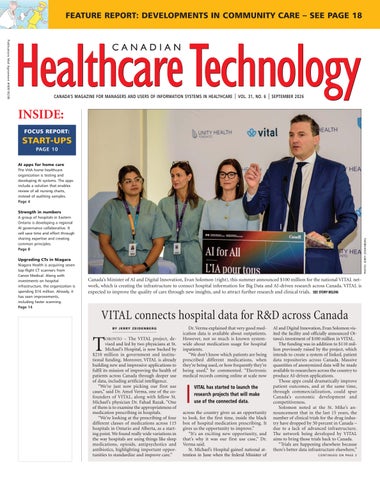
Canada’s Minister of AI and Digital Innovation, Evan Solomon (right), this summer announced $100 million for the national VITAL network, which is creating the infrastructure to connect hospital information for Big Data and AI-driven research across Canada. VITAL is expected to improve the quality of care through new insights, and to attract further research and clinical trials. SEE STORY BELOW.
VITAL connects hospital data for R&D across Canada BY J E R R Y Z E I D E N B E R G
T
ORONTO – The VITAL project, de-
vised and led by two physicians at St. Michael’s Hospital, is now backed by $210 million in government and institutional funding. Moreover, VITAL is already building new and impressive applications to fulfil its mission of improving the health of patients across Canada through deeper use of data, including artificial intelligence. “We’re just now picking our first use cases,” said Dr. Amol Verma, one of the cofounders of VITAL, along with fellow St. Michael’s physician Dr. Fahad Razak. “One of them is to examine the appropriateness of medication prescribing in hospitals. “We’re looking at the prescribing of four different classes of medications across 115 hospitals in Ontario and Alberta, as a starting point. We found really wide variations in the way hospitals are using things like sleep medications, opioids, antipsychotics and antibiotics, highlighting important opportunities to standardize and improve care.”
Dr. Verma explained that very good medication data is available about outpatients. However, not so much is known systemwide about medication usage for hospital inpatients. “We don’t know which patients are being prescribed different medications, when they’re being used, or how frequently they’re being used,” he commented. “Electronic medical records coming online at scale now
VITAL has started to launch the research projects that will make use of the connected data. across the country gives us an opportunity to look, for the first time, inside the black box of hospital medication prescribing. It gives us the opportunity to improve.” “It’s an exciting new opportunity, and that’s why it was our first use case,” Dr. Verma said. St. Michael’s Hospital gained national attention in June when the federal Minister of
AI and Digital Innovation, Evan Solomon visited the facility and officially announced Ottawa’s investment of $100 million in VITAL. The funding was in addition to $110 million previously raised by the project, which intends to create a system of linked, patient data repositories across Canada. Massive quantities of anonymized data will be made available to researchers across the country to produce AI-driven applications. Those apps could dramatically improve patient outcomes, and at the same time, through commercialization, could spur Canada’s economic development and competitiveness. Solomon noted at the St. Mike’s announcement that in the last 15 years, the number of clinical trials for the drug industry have dropped by 50 percent in Canada – due to a lack of advanced infrastructure. The network being developed by VITAL aims to bring those trials back to Canada. “Trials are happening elsewhere because there’s better data infrastructure elsewhere,” C O N T I N U E D O N PA G E 2
VITAL connects data for research and development across Canada C O N T I N U E D F R O M PA G E 1
said Solomon. “Others are getting innovation first. Why should Canadians wait?” The thinking behind the project is that Canada’s hospitals produce large amounts of data about patients, problems, visits and outcomes. If the information could be better analyzed and used to create new, computerized solutions, patient care could be dramatically enhanced, and Canada might very well become an AI-powerhouse in the healthcare sector. Additionally, more clinical trials are expected to take place, providing Canadians with leading-edge therapies. Interestingly, even the patients receiving placebos during clinical trials are found to receive a higher level of care, as they’re more closely monitored by nurses and allied professionals. In June, Dr. Razak and Dr. Verma explained their vision to some 250 healthcare and political luminaries, including Unity Health Toronto CEO Altaf Stationwala and fellow hospital CEOs from the Greater Toronto Area like Sunnybrook’s Dr. Andy Smith, UHN’s Dr. Kevin Smith and Trillium Health Partners’ Karli Farrow.
It’s well-known that to create effective AI applications, huge quantities of data are needed. But the data must also be highquality and reflect the variations found in the population. By collecting data from hospitals across the country, and with such an ethnically mixed population as Canada’s, the VITAL repositories promise to become an excellent laboratory for data scientists to work with. The project began a few years ago in Ontario and was called GEMINI. It linked 45 provincial hospitals, with data from 3 million patient visits – that alone made it the largest repository of hospital research data in the country. Dr. Razak commented at the June meeting that GEMINI established the framework for data networking and collaboration. It showed how improvement in patient care – and cost reductions – could be made by interpreting data from a wide range of hospital partners. “By taking the data out of silos and providing analysis back to physicians and hospital executives, we’ve reduced hospital stays by about one day on average at hospitals with the longest length of stay,” said
Unity Health’s Dr. Fahad Razak and Dr. Amol Verma.
Dr. Razak. “That’s one extra day with their families instead of waiting in the ER on a stretcher. Over a one-year period, this has saved the province more than 40,000 days, with a cost of about $50 million.” Dr. Razak noted, “That’s just through simple use of data when you’re connected across the system. Now, AI is bringing an exciting new frontier to these kinds of opportunities.” He expects that artificial intelligence will greatly amplify the gains to be made. “But these are new technologies, and we
Coming up in CHT Issue Date
Feature Report
Focus Report
October
Virtual Care
Surgical Technologies
Nov/Dec
AI/Analytics
Cardiology
February 2027
Medical Imaging
Physician IT
March 2027
Artificial Intelligence
Interoperability
April 2027
Mobile Solutions
Long-Term Care
For advertising or editorial inquiries, contact Jerry Zeidenberg, Publisher, jerryz@canhealth.com
www.canhealth.com
CANADA’S MAGAZINE FOR MANAGERS AND USERS OF INFORMATION TECHNOLOGY IN HEALTHCARE
Volume 31, Number 6 September 2026 Address all correspondence to Canadian Healthcare Technology, P.O. Box 907, 183 Promenade Circle, Thornhill ON L4J 8G7 Canada. Telephone: (905) 709-2330. Internet: www.canhealth.com. E-mail: info2@canhealth.com. Canadian Healthcare Technology will publish eight issues in 2026. Feature schedule and advertising kits available upon request. Canadian Healthcare Technology is sent free of charge to physicians and managers in hospitals, clinics and nursing homes. All others: $67.80 per year ($60 + $7.80 HST). Registration number 899059430 RT. ©2026 by Canadian Healthcare Technology. The content of Canadian Healthcare Technology is subject to copyright. Reproduction in whole or in part without prior written permission is strictly prohibited. Send all requests for permission to Jerry Zeidenberg, Publisher. Publications Mail Agreement No. 40018238. Return undeliverable Canadian addresses to Canadian Healthcare Technology, P.O. Box 907, 183 Promenade Funded by the Government of Canada Circle, Thornhill ON L4J 8G7. E-mail: jerryz@canhealth.com. ISSN 1486-7133.
2
C A N A D I A N H E A LT H C A R E T E C H N O L O G Y S E P T E M B E R 2 0 2 6
need to make sure they’re safe and effective, that they work well for everyone, and that they don’t propagate biases.” For that reason, VITAL aims to develop infrastructure that rigorously tests and carefully develops new tools. Dr. Razak has frequently spoken about the need to ensure that AI-powered solutions are not only used in urban centres with large, research hospitals. For the sake of equity, they must also benefit patients in rural and remote areas. In June, he said, “I often tell the story of my parents … in Windsor. It’s not a small town, but very little of this kind of innovation reaches them. We need to make sure it gets to all Canadians.” Importantly, Alberta and Quebec recently joined the VITAL network, boosting the number of partner hospitals to 160, and now, with its new moniker of VITAL and the latest federal government investment, the project is expanding across the country. “The specific funding announcement says that five additional provinces and territories will join,” said Dr. Verma, who asserted that eventually, he hopes all Canadian jurisdictions will participate. The latest investment of $100 million will be used for infrastructure, to set up secure repositories in the partner provinces that will collect, link and safeguard the deidentified data. Governance is also high on the agenda, with policies to make data sets readily available to researchers so they’re not required to spend an inordinate amount of time on permissions. Strong governance will also ensure that the provincial partners feel their data sets are secure and remain within their control; in this way, they will be eager to participate, Dr. Verma said. Interoperability of data has always been a challenge for healthcare IT, and this project will depend on linking hospital information – in near real-time – to provincial repositories, and to enable researchers to access the data sets through a portal. Luckily, there have been advances in connecting research data, and VITAL is using a system called OMOP, a common data model that aligns different data standards in healthcare, harmonizing them so they can be linked. Importantly, VITAL is going to start linking to diagnostic imaging repositories, greatly expanding the size and scope of the data available to researchers. High on the priority list is connecting to OCInet, Ontario’s province-wide repositories of diagnostic images. OCInet is currently the world’s largest DI repository, with some 200 million images relating to more than 10 million patients.
Publisher & Editor Jerry Zeidenberg
Contributing Editors Dianne Daniel
Art Director Walter Caniparoli
jerryz@canhealth.com
dianne.l.daniel@gmail.com
art@canhealth.com
Office Manager Neil Zeidenberg neilz@canhealth.com
Will Falk will@wfalk.ca
Dr. Sunny Malhotra
Digital Media Specialist Rebecca Downer rebecca@canhealth.com
Twitter: @drsunnymalhotra
Norm Tollinsky tollinskyn@gmail.com
w w w. c a n h e a l t h . c o m
More than an image. The big picture. Work connected. Work confident. Work in balance. AGFA HealthCare’s Enterprise Imaging Platform brings everything together — blazing-fast streaming, smart orchestration, embedded AI, deep clinical integrations, and flexible deployment in the cloud or on-premises. Built for precision, personalization, and simplicity, it creates a connected ecosystem where radiologists stay focused, IT teams cut complexity, and care teams collaborate with clarity. Whether reading on-site or remotely, managing growing imaging volumes, or expanding across specialties, Enterprise Imaging adapts to your environment — and evolves with you.
Discover what imaging looks like when everything just works. agfahealthcare.com/enterpriseimaging
That’s life in flow.
F O C U S
O N
C O M M U N I T Y
C A R E
Hypercare plays increasing role in connecting community providers BY N O R M T O L L I N S KY
I
t wasn’t too long ago that healthcare service providers on community teams in Ontario’s Wellington County performed their duties without a secure means of communication to share patient information. Team members worked for multiple agencies and organizations that used different systems for documentation and communication. Hospital staff used Meditech, staff associated with family health teams used an EMR, Ontario Health atHome used the Client Health and Related Information System (CHRIS) and workers associated with various human and social service agencies used Caseworks. Lacking a common, secure communication system, team members had to rely on non-PHIPA-compliant texting platforms, phone, fax and email to update each other about the care they were providing and their patients’ condition. That changed in July 2024 when the Ontario Centre for Innovation’s Innovating Digital Health Solutions program funded six Ontario Health Teams (OHTs) to acquire Hypercare, a PHIPA-compliant clinical communication, coordination and scheduling system that outreach workers could access on their smartphones or desktops. Today, the Guelph-Wellington Ontario Health Team is one of 14 OHTs in the province using Hypercare. Use cases vary, but the Guelph-Wellington OHT stands out as the organization with the most users – 800 and counting, according to Venus Lee, Hypercare’s head of customer success. All 800 healthcare workers in the Guelph-Wellington OHT are searchable and can be messaged through Hypercare, “so if I need to reach somebody at Guelph General Hospital, I can just start typing their name,” said Elsa Mann, manager of team and program development with the Mount Forest Family Health Team.
Hypercare is widely used in hospitals both as an alternative to pagers and as an on-call schedule that both hospital staff and outreach providers in the community can access for an emergency consult with a specialist. Mann, who participates in these integrated teams, credits Hypercare for keeping occupational therapists, physiotherapists, wound care specialists, mental health workers and paramedics up-to-date on their patients’ condition and needs. They primarily use the application for updates and short messages to team members – not for extensive documentation, but an observation or detail of importance in a message can always be added by a team member to their EMR or other medical record system. “We work closely with our outreach teams and community partners to pull services together from different healthcare disciplines, so Hypercare has become our go-to tool for communicating who is going out, what challenges we’re experiencing and how to mitigate them in real-time,” said Mann. “One of the things we used to hear from the complex patients we serve was, ‘Don’t you people talk to each other? I’ve already told you this. Why do I have to tell you again?’” That’s less of a problem now. In addition to sending an individual message to someone, Hypercare allows users to create patient-centric niche groups for clients with multiple team members. That’s how conversations are kept separate. Team members can also be added and removed from these groups as team membership changes over time. Phone, fax and email are still used from time to time but “in terms of time-sensitive communication, Hypercare has been a real benefit,” said Mann. In the past, using non-PHIPA-compliant communication required outreach workers to use the patient’s initials or ID number to avoid a privacy infraction.
In contrast, “Using Hypercare, we can now identify the patient by name,” said Mann, “so everyone knows who we’re talking about. It’s secure and allows us to coordinate care in a way that is more seamless for the patient.” The Guelph-Wellington OHT is also one of seven OHTs in the province selected to deliver community care using the Integrated Patient Care Team (IPCT) model, which also relies on Hypercare for team communication. Instead of multiple care coordinators managing the care of rostered patients and
Elsa Mann, manager, team and program development, Mount Forest Family Health Team.
outreach teams with providers from multiple service provider organizations, the IPCT model has one Ontario Health atHome care co-ordinator managing a team of in-home care providers from a single organization. Instead of each provider in the traditional model having a distinct care plan, in the IPCT model there is one shared care plan accessible to the entire team. The Guelph-Wellington OHT has seven IPCT teams affiliated with rural and urban family health teams. The Mount Forest FHT and MintoMapleton FHTs IPCT teams have approximately 300 complex care patients rostered. New use cases for Hypercare keep mate-
rializing and increasing the number of users in Guelph-Wellington. One new addition, for example, is a police and mental health team that makes calls in tandem to ensure the presence of someone with mental health training. Patient concerns can also be relayed through Hypercare. For example, if a patient has an appointment in Mount Forest or Guelph and doesn’t have transportation – a common problem in rural Wellington County – an outreach team member can share that information with the team, using Hypercare, to find a solution. Hypercare has several features and capabilities that enhance communication effectiveness. For example, there is an urgent alert feature that allows users to prioritize emergency messages by overriding smartphone silent and do not disturb settings. Message delivery and read receipt are available to let outreach staff know if a message has been successfully sent and seen by the recipient. Community workers can use Hypercare to take a photograph of a patient’s wound and share it with a wound care specialist. The imaging capability can also be used by outreach workers to document a hazard in the patient’s home that poses a risk both to the patient and outreach workers, said Mann. Photos taken through the Hypercare app use the smartphone’s camera, but the actual images aren’t saved in the user’s personal camera roll. According to a Guelph-Wellington OHT survey and evaluation of Hypercare for fiscal year 2025-26, 90.4 percent of respondents either agreed or strongly agreed that Hypercare enables efficient and effective sharing of patient health information. “Most participants indicated they would recommend Hypercare to colleagues and see themselves continuing to use it, showing strong overall satisfaction and willingness to adopt the platform.”
The right AI tools: One home care organization is paving the way BY A L I S TA I R F O R S Y T H A N D S A N D R A M C K AY, P h D
A
rtificial intelligence (AI) is rapidly becoming a foundational capability across healthcare. As workforce shortages, increasing service demands, and financial pressures continue to challenge providers, organizations must move beyond experimentation and identify practical opportunities to deploy AI in ways that improve care delivery, enhance workforce experience, and strengthen operational performance. The rapidly evolving AI technology space offers healthcare organizations myriad options to address their AI needs, but organizations often struggle to select the right tool for the job. As with other digital technologies, organizations are confronted with the “build” or “buy” conundrum. Generalpurpose AI models are capable of performing a wide range of tasks, providing
4
flexibility across many business use cases. However, for highly specialized workflows or domain-specific data, these models may not consistently deliver the level of accuracy, context or performance required. In these situations, organizations may need to customize, fine-tune, or develop AI solutions that are better aligned to their unique requirements. To choose the most appropriate AI tool, there are three different approaches organizations can take: purchase an “out of the box” existing program, partner with vendors to trial software as part of a selection process, or build a solution in-house. At VHA Home HealthCare (VHA), a trusted not-for-profit provider of highquality, compassionate home care in Ontario for more than a century, we view artificial intelligence as a strategic opportunity to improve healthcare delivery and organizational effectiveness. Rather than taking a wait-and-see approach, VHA has established a focused
C A N A D I A N H E A LT H C A R E T E C H N O L O G Y S E P T E M B E R 2 0 2 6
program to identify, evaluate and rapidly implement AI solutions that can deliver meaningful value for our clients, families, care providers and employees. While we are moving with urgency to
Alistair Forsyth
Sandra McKay
realize the benefits of these emerging technologies, we are doing so within a robust governance framework that emphasizes privacy, security, transparency, fairness and accountability. This balanced approach enables VHA
to innovate confidently, scale successful solutions, and ensure AI is adopted responsibly, in a manner consistent with our purpose and values. Here are three of VHA’s AI initiatives, each of which has been selected using a different approach. • Adopting an “out-of-the-box” AI model to better review and evaluate employment candidates: Like many recruitment departments, VHA’s team often receives a high volume of applications for certain positions. In some cases, more than 1,000 applications are submitted for a single job posting, many from candidates who do not meet the required qualifications. Reviewing applications, assessing whether candidates meet the requirements of the role and scheduling interviews, can be a time-consuming process, which may delay hiring for critical positions. To improve the efficiency of this C O N T I N U E D O N PA G E 2 2
w w w. c a n h e a l t h . c o m
The future of connected care isn’t coming. It’s already here. Up to 97% of healthcare data goes unused. Put it to work, with CareIntelligence.
CareIntelligence, a CareInMotion solution from Altera Digital Health is the intelligent data foundation that makes connected care possible. Canada’s healthcare system is moving toward common standards faster than legacy infrastructure can adapt. CareIntelligence creates a single trusted near-real-time record, so healthcare teams, planners and leaders can work from the same complete picture and make better decisions, faster. To learn more, visit go.alterahealth.com/careintelligence
N E W S
A N D
T R E N D S
Vancouver Coastal Health’s cloud modernization enables faster access
E
very day, clinicians across Vancouver Coastal Health (VCH) document patient care in notes that are rich with clinical detail. Those narratives often capture the circumstances, contributing factors, and clinical context that never appear in traditional structured data fields. The details are important. They can reveal why a patient presented to the emergency department or what influenced their course in hospital. A patient may arrive intoxicated but leave with a different primary diagnosis code. An e-scooter injury may be recorded under a broad trauma category. The coded record remains useful, but the narrative often tells a fuller story. For years, VCH’s on-premises data warehouse could only analyze structured data fields; the technology to extract and interpret free text at scale simply did not exist within the legacy platform. That paradigm shifted when the VCH Data and Analytics team modernized its data foundation through a cloud-based analytics solution using the Databricks Data Intelligence Platform. This platform introduced advanced analytics and artificial intelligence (AI) capabilities designed specifically to read plainlanguage free text clinical notes. Under what is now established as the “Emergency Department Provider Notes” pipeline, the team deployed a large language model (LLM) classifier to scan 19 million Emergency Department notes. The AI successfully identified seven times more
alcohol related ED visits than using tradi- foundation in the cloud, guided by Data tional, structured discharge diagnostic Mesh principles: domain ownership, data coding and increased the case detection as a product, self-serve infrastructure, and rate from a baseline of roughly one percent federated governance. to eight percent. A semantic, reusable data foundation Today, the team is scaling AI across was built from source-system data objects, more than 10 active use cases and estab- creating a critical mass of trusted data that lishing cross-organizational data federa- analytics initiatives and AI models could tions, showing what becomes possible draw upon without rebuilding from when cloud modernization unlocks data scratch. Rather than delivering project-byand AI unlocks its potential. A platform that couldn’t keep pace: Serving 1.25 million people across the traditional territories of the Musqueam, Squamish, and Tsleil-Waututh Nations, VCH generates a large volume of clinical documentation through its Oracle Health electronic health record. The challenge was not a lack of information, but the technological limitations of an aging on-premises infrastructure that struggled to keep pace. Queries were slow. Running AI workloads on aging archiVancouver Coastal Health’s cloud modernization team. tecture simply was not realistic. The team could not query freetext at scale, could not prototype new mod- project data solutions, the Data & Analytels, and could not share data across organi- ics team established a strategic enterprise zations without unneeded data movement. asset that continues to accelerate innovaSupporting the next generation of analytics tion and scale new analytics and AI use and AI required modernizing the infra- cases across the organization. structure while building a data foundation This foundation was reinforced by rodesigned to scale for years to come. bust governance, metadata management, The solution – Cloud-native, governed, and data lineage, while seven analyst workreusable foundation: To support future spaces opened up independent prototypanalytics and AI needs, VCH Data and An- ing for the first time. alytics established a modern, scalable data The human side of modernization mat-
tered just as much. Executive sponsors cleared barriers, directors acted as change sponsors, managers as change leaders, and subject matter experts as super users and local champions who made AI adoption stick. The culture prioritized momentum and ownership over perfection, transforming the department into active AI adopters. Scalable natural language processing (NLP) and the modular architecture philosophy: The platform’s value showed up fast. The Emergency Department Provider Notes NLP pipeline project established more than just clinical insight, it established a repeatable framework where future use cases required no more than a prompt change to get moving. Previously, validating the true burden of alcohol use would have taken months and dedicated research assistants. Any condition buried in free text but missed by structured coding became a candidate for discovery. However, it was not technology alone that made this possible. Clinicians, data scientists, and engineers worked together to define patient populations, review model outputs, incorporate clinical feedback, and establish performance thresholds that ensured reliable results. This collaboration enabled a modular “build once, deploy many” approach that reduced new use case development to just one or two days. The pipeline could process millions of records in 30 to 90 minutes, followed by approximately one day of focused review and validation to generate actionable insights.
Fraser Health’s CAADSI uses AI to enhance quality and patient safety BY D I M P L E P R A K A S H , M D AND CASPER SHYR, PhD
A
t the heart of every healthcare decision lies a commitment to ensuring the best possible outcomes for patients. Delivering the “right care, at the right time, for the right patient” is more than a guiding principle – it is a collective responsibility that drives quality, safety, and excellence across the healthcare continuum. This focus supports the prevention of harm, reduces adverse events, and fosters a culture where patient safety and high-quality care remain paramount. At the Fraser Health Centre for Advanced Analytics, Data Science and Innovation (CAADSI), we are applying advanced analytics, machine learning, and artificial intelligence across the patient care continuum, shifting from a reactive model of care to one that is proactive, predictive, and learning-oriented. Predicting risk before harm happens: Using machine learning-based predictive models, CAADSI identifies patients who may be at increased risk of adverse events, enabling care teams to intervene earlier and more effectively. These predictive insights support clinicians throughout a patient’s journey from admission through the inpatient stay toward discharge. This
6
end-to-end view is important because quality and safety are shaped by a sequence of decisions, handoffs, interventions, and changing patient conditions over time. By connecting risk intelligence across these touchpoints, Fraser Health can better anticipate where harm may occur, prioritize patients who need additional attention, and support timely clinical action before adverse events happen. Bringing AI to the point of care: The true value of AI lies not only in its predictions but in its ability to influence clinical action. To ensure predictive insights are accessible when and where they are needed most, Fraser Health has embedded AI directly into clinical workflows. An innovative browser extension displays patient risk predictions within the electronic patient chart at the moment it is opened. This seamless integration places actionable intelligence directly in front of clinicians, eliminating the need to navigate separate systems or dashboards. By augmenting clinical expertise with real-time risk intelligence, healthcare providers can make more informed decisions, prioritize high-risk patients, and intervene earlier to prevent adverse outcomes. Learning from every safety event: Preventing harm is only part of the
C A N A D I A N H E A LT H C A R E T E C H N O L O G Y S E P T E M B E R 2 0 2 6
story. Fraser Health is also leveraging Natural Language Processing (NLP) and advanced text analytics to learn from patient safety events after they occur. By analyzing narratives captured in the Patient Safety Learning System (PSLS), AI can identify recurring themes, contributing factors, and emerging risks across events ranging from near misses to serious safety incidents. These insights help clinical and operational teams im-
Dr. Dimple Prakash
Casper Shyr, PhD
plement targeted improvements and strengthen patient safety practices across the organization. This creates a closed learning loop: safety events are not only reviewed after they occur, but translated into intelligence that can inform prevention, strengthen clinical and operational practices, and guide future quality and safety
priorities. Over time, this helps Fraser Health move from episodic event review toward a more proactive, continuously improving system. Creating a learning health system: At the centre of these efforts is an enterprise-wide quality and patient safety intelligence platform that integrates prediction, monitoring, reporting, and continuous learning. At Fraser Health, patient safety begins with the anticipation and prevention of harm rather than simply responding to adverse events. The learning cycle continues after safety events occur. Through NLP and advanced text analytics, Fraser Health can analyze patient safety event narratives to identify common themes, contributing factors, and potential actions for improvement. These insights help transform Fraser Health into a data-driven learning health system, one that continuously learns from patient safety events, harm events, care experiences, and improvement actions to support the delivery of safe, high-quality, patient-centred care. Dr. Dimple Prakash, MD, MBA, is interim executive director, the Centre for Advanced Analytics, Data Science and Innovation (CAADSI). Casper Shyr, PhD, is senior director, CAADSI, at the Fraser Health Authority.
w w w. c a n h e a l t h . c o m
N E W S
A N D
T R E N D S
Community hospitals building a regional AI governance collaborative
A
rtificial intelligence has quickly moved from the periphery of healthcare innovation to the centre of clinical, operational and administrative transformation. Ambient clinical documentation, predictive analytics, imaging support, scheduling optimization and administrative automation are no longer future possibilities – they are today’s procurement decisions. While AI adoption is accelerating, governance has not kept pace. Across Canada, hospitals are independently evaluating the same AI vendors, conducting duplicate privacy and cybersecurity assessments, creating separate policies, and asking identical ethical questions. This fragmented approach consumes scarce resources, produces inconsistent standards and leaves smaller organizations struggling to access the expertise required to evaluate increasingly sophisticated technologies. Recognizing this challenge, a group of hospitals across Ontario’s Champlain region are coming together to build a Regional AI Governance Collaborative – an innovative model to enable responsible AI adoption through shared expertise, common governance principles and collective evaluation. This initiative is co-lead by Lindsay Wyers, VP, digital transformation and CIO from Queensway Carleton Hospital, and Scott Coombes, VP and CFO from Pembroke Regional Hospital. The goal is simple: collaborate on governance so hospitals can remain autonomous in implementation. The problem with everyone working alone: Healthcare organizations face growing expectations from clinicians, patients and regulators to ensure AI systems are
safe, equitable, transparent and trustworthy. Every new AI solution requires review from multiple disciplines including privacy, cybersecurity, legal, clinical operations, ethics and information technology. For many organizations, particularly medium-sized and community hospitals, assembling this expertise for every procurement is becoming increasingly difficult. Without collaboration, organizations often duplicate the same work: • Privacy impact assessments • Threat risk assessments • Vendor due diligence • Clinical safety reviews • Policy development • Ethical assessments • Procurement evaluations The result is rising governance costs, inconsistent standards across organizations and slower implementation of technologies that could improve patient care. Rather than asking every hospital to build identical governance capabilities independently, the Collaborative asks a different question: What governance work can be done once and shared many times? A new model for shared governance: Unlike a traditional committee or community of practice, the Regional AI Governance Collaborative has a clearly defined mandate. The Collaborative will not decide which AI products individual hospitals must implement. Nor will it become an approval body or replace organizational decisionmaking. Instead, it will develop the foundational governance infrastructure that every organization requires. This includes shared AI principles, governance frameworks, risk classifica-
tion methodologies, evaluation templates, procurement guidance and reusable documentation. Member organizations will bring forward AI products or initiatives for evaluation, allowing expert working groups to perform structured assessments that can be leveraged across participating hospitals. Each organization retains full authority over procurement, implementation and operational oversight. This distinction is critical. Regional collaboration creates consistency where consistency matters, while
Scott Coombes
Lindsay Wyers
preserving organizational autonomy where local context matters most. Building trust through expertise: One of the first questions organizations ask is straightforward: Who should evaluate AI? The Collaborative recognizes that trustworthy AI cannot be assessed from a single perspective. Evaluations require multidisciplinary expertise spanning clinical practice, privacy, cybersecurity, legal, ethics, procurement, information technology and operational leadership. To support the development of a prac-
tical and sustainable governance model, the Collaborative has engaged external expertise from Info-Tech Research Group. Through the guidance and support of Krizia Francisco and Justin St-Maurice, the initiative is leveraging evidence-informed approaches, industry experience and structured methodologies to help shape AI governance practices that are scalable for healthcare organizations. The Collaborative is also partnering with academic expertise to strengthen the ethical foundations of AI decision-making. Through collaboration with the University of Ottawa, PhD student Amanda Maria Kutenski will support the development of an ethical AI framework and decision-making tool. This work will help organizations evaluate AI solutions through critical considerations including transparency, accountability, fairness, privacy, safety, human oversight and patient impact. Together, these partnerships ensure the Collaborative is grounded not only in operational realities but also in emerging best practices for responsible AI adoption. Rather than relying on individual opinions, assessments will be conducted using standardized evaluation frameworks grounded in eight foundational principles co-developed by participating organizations. These principles emphasize accountability, patient safety, fairness, transparency, human oversight, technical robustness, patient autonomy and fiscal responsibility. Collectively, they establish consistent expectations regardless of which organization is considering an AI solution. The Collaborative is also exploring C O N T I N U E D O N PA G E 2 2
The future of digital health is analog, with people powering change BY S H E L A G H M A LO N E Y
I
t sounds like a contradiction. At a time when artificial intelligence, virtual care, automation, and data are transforming healthcare delivery, why would I argue that the future of digital health is analog? Because technology doesn’t transform healthcare – people do. The most meaningful ideas, the strongest partnerships, and the boldest innovations don’t begin with software. They begin with conversations, relationships, trust, and a willingness to solve problems together. As digital health continues to evolve, these human connections are becoming more, not less, important. This reality was on display in June when the digital health community gathered in Halifax for the 26th annual e-Health Conference and Trade Show – the first time in the conference’s history that it was held in Atlantic Canada. As conference organizers, taking a risk on a new location gave us pause. When e-Health attendance drives both impact and financial sustainability, the
8
old if it ain’t broke, don’t fix it adage can be hard to ignore. Hindsight being 20/20, we needn’t have worried. e-Health26 had good vibes, great energy, and our highest registration numbers to date. Was the location the secret? Halifax always feels friendly and welcoming, but the high energy of e-Health26 wasn’t just fueled by lobster and sea breezes (though they certainly helped) – it was the people. Everywhere I looked, relationships were being built or strengthened. Conversations that might otherwise have stretched across weeks of emails happened in minutes over coffee. Hallway introductions became future collaborations. Students met mentors, colleagues reconnected, and strangers discovered shared challenges and common purpose. I took selfies with people I hadn’t seen in years! I think we are experiencing an increasing desire for human connection. We spend our days immersed in online meetings, with overflowing inboxes and an endless stream of digital content to digest. Meeting in person offers something increasingly rare: the opportunity to be fully present with one another.
C A N A D I A N H E A LT H C A R E T E C H N O L O G Y S E P T E M B E R 2 0 2 6
Face-to-face conversations carry a depth that technology still can’t replicate. We remember the setting, the context, and the moments between the words. These seemingly small interactions build trust, reduce misunderstandings, and create the relationships that ultimately move our work – and our healthcare system – forward. That’s why the future of digital health is analog, and why Digital Health Canada is focused on supporting the people transforming healthcare delivery. Shelagh Maloney Growing and connecting the Canadian digital health community is a key focus of Digital Health Canada’s 20262030 strategic plan, titled Shaping the Future of Digital Health – Together. Our new plan, developed after the most comprehensive member consultation in Digital Health Canada history, recognizes that Canada’s healthcare sys-
tem is at a pivotal moment. Digital health is no longer a supporting function, it is a defining force shaping how care is delivered, experienced, and improved. The opportunity ahead is profound: to build a more connected, intelligent, and human-centred health system for all Canadians. Digital Health Canada’s role is to help make that future real. As the national convener, connector, and catalyst for Canada’s digital health community, we bring together clinicians, innovators, policy makers, researchers, and industry leaders to drive meaningful change. The new Strategic Plan has distinct areas of focus: shaping the national conversation, growing a connected community, and developing the workforce of the future, while ensuring that the association has the organizational capacity to remain agile, resilient, and positioned to deliver sustainable value in a rapidly evolving environment. Shape the national conversation: Canada needs a clear, trusted voice in digital health. Digital Health Canada will be amplifying leading practices and C O N T I N U E D O N PA G E 2 2
w w w. c a n h e a l t h . c o m
2 0 + Y E A R S O F C O N N E C T I N G C A R E N AT I O N W I D E
Canada’s Trusted Digital Health Partner Proven Across Health Systems With multi-provincial deployments and long-standing public sector partnerships, Orion Health is helping unify data, providers, and people across Canada.
Today, we’re delivering measurable impact by enabling better access, stronger system performance, and more connected care. Supporting clinicians and empowering Canadians at every step of their journey.
Canada-tested. Canada-trusted. Built for what comes next. Learn more at orionhealth.com/ca
F O C U S
O N
S T A R T - U P S
The doctor as innovator: what’s in store for the physician/inventor? BY J E R R Y Z E I D E N B E R G
W
hat does it take for a physician to develop and launch a medical device company? Dr. Brian Courtney – a clinician scientist and interventional cardiologist at Sunnybrook Health Sciences – says first and foremost, starting and running a company isn’t a one-person job. The doctor-inventor may have a great idea, but transforming a novel concept into a product is time-consuming and takes a wide range of expertise. “You need complimentary skills to make these things move forward, no one can do it on their own,” he said. Dr. Courtney should know. He has devised many medical technologies but is perhaps best known as the creative force behind Conavi Medical, a Canadian producer of a catheter system that provides two kinds of imaging of lesions in coronary arteries – optical coherence tomography and ultrasound. The idea is to give clinicians more information about a lesion, which leads to a better treatment – such as improved stent sizing. As cardiology becomes increasingly non-invasive, catheter-based technologies like Conavi’s ‘Novasight Hybrid System’ are becoming increasingly important. “We were the first to do a combined ultrasound and optical system,” said Dr. Courtney, speaking at the INOVAIT Medventions conference at Sunnybrook in June. “It’s kind of like the PET/MRI of interventional cardiology, because you can see something well with ultrasound, and something else well with optical, and sometimes one augments the other.” Toronto-based Conavi Medical was founded in 2007 and was listed on the TSX Venture Exchange in 2024. The technology has been approved in Canada, the U.S. and Japan and has over 30 US patents. Speaking about physician founders of companies, Dr. Courtney quipped that the acronym MD is sometimes said to be short for ‘management dysfunction’, but on a more serious note, added that managerial abilities will vary from one person to another.
Dr. Brian Courtney, an interventional cardiologist at Sunnybrook Health Sciences, is also an inventor and expert on the art and science of innovation.
It’s very important, he said, to have a variety of skills in the company. He mentioned the Apple Computer founders, Steve Jobs and Steve Wozniak, noting that one supplied the sales and marketing brains while the other was the technological wizard. If a doctor is also in charge of sales, he observed, in presentations he or she might focus only on the technology and the clinical aspects and forget about the business opportunity. “By having a non-expert in the group when you’re presenting, you can change the tone of the discussion to more of a business focus. And that’s important when you’re doing the fundraising,” said Dr. Courtney. Overall, physicians must be wary “to avoid the land of unchallenged assumptions,” he said. Having other people providing input can help validate the usefulness of a product idea. Experts are needed to search and discover whether the idea is unique as intellectual property, and they can also identify new features that are needed through research and development. At the same time, it’s important to de-
velop the right corporate culture, said Dr. Courtney. In hospitals and other medical settings, people are used to deferring to physicians. That’s why it’s incumbent upon physician-founders to encourage other views. “If you don’t actively invite them, it won’t happen. People will be afraid to say things if you’re a sort of asymmetric power or authority,” he cautioned. Being part of a hospital system is very useful, as the hospital will often help spread the word about the work that’s being done. “You can get some good publicity tailwinds in this way, with support that can help move the innovation forward.” Interestingly, when it comes to sales, a physician may have success initially. But Dr. Courtney said, “Sales is such a heavy, intense activity in terms of time and complexity, and in terms of bureaucracy, that it’s best left to other people as soon as possible. “But you can certainly have a strong influence on early customer adoption.” He said that manufacturing, and the choice of product components, follows a similar pattern. The clinician can provide a
lot of useful suggestions, but it’s best left to people with experience in this area. Understanding regulatory environments is another big challenge. “This requires a lot of input from experts, especially in the U.S., and that is the market that matters most,” he said. If the doctor-innovator can put all these elements together, said Dr. Courtney, it can be extremely satisfying. “I really enjoyed when I was having team meetings at Conavi, and we had a clean room in the back,” said Dr. Courtney. “I used to say that for every 300 catheters that get built out of that clean room, we’re probably saving a life. And for every four out of 100 being built, they’re probably stopping a future admission or heart attack.” That sense of helping others also resonates with employees and is a reason why they want to work at medical companies, he averred. “That kind of culture is why they’re there,” said Dr. Courtney. “It’s why they stay there and why, when it gets difficult, they might be a bit stickier than they might otherwise be.”
Healthcare’s underutilized strategic asset can solve your problems BY G R A C E G O M A S H I E
H
ealthcare organizations face no shortage of challenges: staffing pressures, communication barriers, operational inefficiencies, equipment management issues, diagnostic bottlenecks, and growing demand for care. Yet many organizations overlook a resource that can help address these challenges: their local startup incubator. While startup incubators are commonly associated with entrepreneurs building new companies, they offer far more than support for founders. They bring together researchers, students, clinicians, industry partners, and innovation networks around a common goal: solving real-world problems.
10
For healthcare organizations, they can serve as a gateway to expertise, talent, and innovation that would otherwise be difficult to access. In spring of 2026, the National Health-Tech Innovation Conference, coled by Velocity – the University of Waterloo’s flagship startup incubator – and the CHEO Research Institute, brought together clinicians, healthcare leaders, founders, researchers, and funders from across Canada. One theme emerged repeatedly: meaningful innovation happens when healthcare organizations, researchers, and innovators work together to solve clearly defined problems. Incubators are uniquely positioned to facilitate those connections. What an incubator actually does: A
C A N A D I A N H E A LT H C A R E T E C H N O L O G Y S E P T E M B E R 2 0 2 6
university-backed incubator like Velocity offers a useful example. Supporting startup founders as they tackle industry challenges is at the core of Velocity’s mission. Significant resources are required to help health-technology companies succeed as they create value for healthcare organizations and the communities they serve. Through Velocity, Grace Gomashie healthcare organizations can access a broader innovation ecosystem that includes faculty expertise, student talent, research infrastructure, industry part-
ners, regulatory guidance, and emerging technologies. A workforce challenge may become a student capstone project. An operational bottleneck may attract expertise from engineering or computer science researchers. A clinical challenge may inspire a pilot involving a startup, healthcare provider, and academic partner working together toward a solution. Bringing a health technology from concept to real-world use requires far more than a good idea. Founders often need support navigating regulatory pathways, validating technology, securing funding and partnerships, and demonstrating value in clinical settings. The role of an incubator is to help companies access these resources so that C O N T I N U E D O N PA G E 1 2
w w w. c a n h e a l t h . c o m
#dhc2026
Turning Technology into Time Creating Capacity in the Community October 1 & 2, Automotive Building at Exhibition Place Keynote speakers:
Alika Lafontaine, MD Indigenous Advisorin-Residence, Canadian Medical Association, Rural Anesthesiologist, and the author of The Outrage Cure
Nandini Gupta, MD Cardiologist, Mackenzie Health, Assistant Clinical Professor, TMU, Founder & CEO, Art in Medicine (AiM)
Mike Evans, MD Physician, educator, former Apple staffer, and health innovator transforming the way health information is communicated
Chandi Chandrasena, MD Chief Medical Officer, OntarioMD, family physician, advisor to provincial and national clinician advisory groups
Why you should attend • • • •
Stay ahead of the curve on AI, cybersecurity and EMR workflows Explore the latest in health technology at the Vendor Showcase and Start-up Zone Learn from thought-provoking keynotes, given by leaders in digital health Earn continuing medical education (CME credits)
Open to all clinicians and practice staff. Group pricing is available for further discounts. Scan the QR code to learn more and register!
OntarioMD is a wholly owned subsidiary of the Ontario Medical Association and receives funding from the Province of Ontario. The views expressed are the views of OntarioMD and do not necessarily reflect those of the Province.
F O C U S
O N
S T A R T - U P S
Emerging companies are shaping Canada’s digital health ecosystem BY D A M I A N A L I
F
rom AI and workflow automation to patient engagement and clinical decision support, start-ups are developing solutions that aim to improve care delivery, increase efficiency, and support healthcare teams across the country. At e-Health26 in Halifax, several innovators had the opportunity to showcase their technologies and exchange ideas with industry partners. The following highlights those emerging companies and their impact in digital health, offering a glimpse into the diverse innovations shaping the future of the sector in Canada. Start-up: Cabot Technology Solutions Leadership: Venkatesh Thyagarajan (Co-founder, CEO), Shibu Basheer (Co-founder, CTO) Profile: Cabot Technology Solutions is an AI-first product engineering company specializing in healthcare solutions. With 16 years of experience, they deliver AIpowered products that enhance patient engagement, automate clinical workflows, and improve outcomes. Their global team ensures scalable, secure, and innovative solutions that transform healthcare delivery. Start-up: DT Health AI Leadership: Peter Dat Thang Nguyen (Founder and Project Lead) Profile: DT Health AI empowers hospitals, academic medical centers, and life sciences organizations to accelerate innovation without compromising security, compliance, or patient trust. By combining advanced AI/ML expertise with deep healthcare cybersecurity and data governance capabilities, DT Health AI delivers solutions that enable healthcare institutions to innovate responsibly in the most sensitive environments.
Start-up: EmergConnect Leadership: Ron Galaev, Founder and CEO Profile: EmergConnect is a Canadian health-tech company reinventing hospital operations and patient experience. They believe that patients should be active participants in their own care from the moment they arrive, freeing clinicians from endless data entry so they can focus on what they were trained to do: taking care of their patients.
Start-up: Learnroll LLC Leadership: Sushmita Chatterjee, Founder, CEO, and CTO Profile: Learnroll is a U.S.-based health technology company focused on building XR- and AI-enabled platforms that help clinicians, students, and communities develop practical healthcare skills – efficiently, responsibly, and at scale. Their goal is to save time while enhancing the human skills that matter most in patient care.
Start-up: INTEGRAiTE Leadership: Sheazin Premji, CEO Profile: INTEGRAiTE is comprised of experts in health system transformation and applied AI, with a proven record of designing, implementing, and scaling advanced analytics solutions in one of Canada’s largest healthcare systems. Through knowledge transfer and agentic consultant AI solutions, they aim to democratize governance and AI playbooks so organizations scale confidently and remain in control. At their e-Health Startup Kiosk, INTEGRAiTE had the opportunity to discuss how organizations of all sizes can accelerate responsible AI adoption while building long-term organizational capability. Many smaller organizations shared that they wanted access to enterprise grade AI capabilities but lacked the infrastructure or specialized expertise to build them internally. Demonstrating secure, accessible AI orchestration using examples such as governance agents and healthcare AI workforce assistants helped shift mindsets from individual AI tools to connected intelligence that supports enterprise-wide operations. Discussions focused on practical implementation, reducing future rework, and building sustainable AI capabilities from the outset rather than layering disconnected point solutions over time.
Start-up: PulseStack AI Leadership: Uzair Salim, Founder and CTO Profile: PulseStack AI is an Ontario health tech startup that aims to empower small clinics with personalized AI solutions. While many clinics feel neglected by enterprise solutions, their products and services have been built to support small clinics.
At e-Health in Halifax, innovators had the opportunity to showcase their technologies and ideas. Start-up: Red Rover Health Leadership: Adam Frederick (Co-founder, COO), David Deas (Co-founder, CTO) Profile: Red Rover Health’s interoperability platform simplifies how applications connect with the world’s leading EHR platforms. Powered by secure, RESTful APIs, the platform enables seamless connectivity between third-party applications and major EHR systems – helping healthcare organizations enhance their existing infrastructure and scale next-generation digital health solutions. Start-up: Rocket Doctor Leadership: Dr. William Cherniak (Founder, CEO), Harry Cherniak
(Co-founder, COO and Privacy Officer) Profile: Rocket Doctor is a digital health platform and marketplace enabling physicians to deliver virtual and hybridized inperson care. Our AI-enhanced software and systems coordinate services, intelligently match doctors and patients, and have supported 300+ MDs with 750,000+ patient visits across North America, including underserved populations in need. Start-up: Strongest Families Institute Leadership: Dr. Patricia Lingley-Pottie, President and CEO Profile: Strongest Families Institute (SFI) is an award-winning charity grounded in 23 years of social science research. Their evidence-based, bilingual mental health services are available for children/youth, adults, and their families – when and where they need it. Start-up: TalkToMedi Leadership: Kino Song and Alvin Cheng, co-founders Profile: Care starts with every call. TalkToMedi ensures patients never wait on hold, with an AI voice agent that books, triages, and follows up instantly. Clinics improve access, reduce administrative strain, and deliver a smoother patient experience without changing existing workflows or asking patients to adopt new tools. For TalkToMedi, those conversations reinforced the importance of building patient access automation that is clear, practical, and grounded in clinic operations. The start-ups share a common goal: developing solutions that respond to the evolving needs of patients, providers, and healthcare organizations. As these companies continue to grow, their contributions will help shape the next chapter of digital health innovation in Canada.
Healthcare’s underutilized strategic asset can solve your problems C O N T I N U E D F R O M PA G E 1 0
promising solutions are not only innovative, but also practical, scalable, and ready for implementation. Because incubators like Velocity sit at the intersection of academia, industry, and healthcare, they are uniquely positioned to convene the expertise needed to address complex challenges. They offer healthcare organizations a collaborative environment where problems can be explored before they become procurement exercises. From problem to solution: Two Waterloo-based companies supported through Velocity illustrate what can happen when healthcare organizations engage with an innovation ecosystem. PatientCompanion developed an alternative to the traditional hospital call bell. Its platform allows patients to communicate requests through icons, text, or voice in multiple languages while automatically prioritizing requests according to urgency. Through partnerships facilitated by Ve-
12
locity and the CAN Health Network, the company worked with Waterloo Regional Health Network and Brightshores Health System to evaluate the technology in clinical settings. Following a successful evaluation, Brightshores adopted the technology. Technology Trace addressed a different challenge: the time and resources lost locating mobile medical equipment. Its platform, trevii, enables real-time asset tracking with no IT infrastructure or integration required. With support from OBIO, the company completed a year-long evaluation with St. Joseph’s Healthcare Hamilton that delivered a 100 percent reconciliation rate for tracked assets. Following demonstrated results, the hospital adopted the technology, with the deployment later featured nationally. The technologies were different. The healthcare challenges were different. Yet both examples highlight the same lesson: when healthcare organizations engage early with innovation ecosystems, better solutions emerge.
C A N A D I A N H E A LT H C A R E T E C H N O L O G Y S E P T E M B E R 2 0 2 6
Problems are better defined, technologies are shaped by real-world needs, and organizations gain access to expertise that extends beyond any individual company. An incubator on speed dial: For healthcare organizations, the practical implication is straightforward: every health system, community care organization, and seniors’ living provider
Incubators like Velocity sit at the intersection of academia, industry and healthcare, sharing expertise with all. should have a relationship with its local incubator before it needs one. When an organization encounters a challenge – whether related to patient communication, staffing, diagnostics, workflow efficiency, equipment management, or another operational issue – engaging its local startup incubator can be one pathway to finding a solution.
That is where startup incubators like Velocity can provide unique value. They connect healthcare organizations to researchers, students, faculty experts, industry partners, and emerging technologies within a trusted environment built around learning, experimentation, and collaboration. They provide access to a broader innovation ecosystem that most organizations could not easily assemble on their own. Healthcare organizations are under constant pressure to improve care, increase efficiency, and do more with limited resources. Startup incubators represent an often-underutilized strategic asset in meeting those demands. More than startup hubs, they are conveners, connectors, and problem-solving partners that help transform challenges into opportunities for innovation. Grace Gomashie is Entrepreneurship & Industry Relations Manager, at Velocity – University of Waterloo.
w w w. c a n h e a l t h . c o m
E D U C A T I O N
A N D
T R A I N I N G
Scaling Canadian mental health education through AI and lived experiences BY D R . S A N J E E V S O C K A L I N G A M
T
he Centre for Addiction and Mental Health (CAMH), Canada’s largest mental health teaching hospital and one of the world’s leading research centres in its field, launched the Global Learning Academy that represents a new model for mental health education. By combining AI-powered technology, simulation-based training and lived experience, this platform is rapidly closing critical gaps in this sector’s education and workforce readiness. CAMH built the Global Learning Academy with Docebo, a leading AI-powered enterprise learning platform, creating an initial hub of more than 370 courses spanning mental healthcare training needs, including addiction, crisis intervention, and recovery. The platform is designed to reach beyond clinicians to students, other professionals, caregivers, and the general public across geographies and levels of expertise to provide practical, actionable education. The results have been overwhelmingly positive. In its first month alone, the academy reached 6,500 users in 25 countries. This kind of immediate global uptake signals something more important. There is a significant desire for quality mental health education, and when barriers to access are removed, people show up. Dr. Sanjeev Sockalingam One of the academy’s major innovations is how it prepares early-career clinicians for the critical moments. It’s one thing to read about a suicidal patient or an opioid overdose, but nothing can fully prepare people for that moment until they’re in it. The academy aims to address this with immersive, scenario-based simulations. Rather than just learning about suicide risk assessment or overdose response, clinicians can now practice those encounters by navigating realistic, highstakes scenarios in a safe AI-supported environment where mistakes become learning opportunities. The goal is to build both competence and confidence before clinicians face these situations in real life. This has implications beyond just Canada. Mental health workforce shortages are a worldwide issue, and AI-powered simulation training offers a way to accelerate clinician readiness without cutting corners. This platform gives people more opportunities to practice the decisions that matter most. One of the biggest shifts in CAMH’s approach is philosophical, not technological. For most of the history of mental healthcare, knowledge flowed one way: from expert to patient. People living with mental illness were expected to comply with care, not partner in it. That model is increasingly understood to be both incomplete and harmful, excluding the most direct knowledge of what recovery actually looks and feels like. CAMH is actively dismantling it through the Collaborative Learning Colw w w. c a n h e a l t h . c o m
lege (CLC), where every course is co-developed and co-facilitated by people with lived experience of mental health or addiction challenges. Not consulted, but co-built, from the ground up, by both people who know these issues and those providing mental health support. It is
transformative education that integrates experience and expertise. The impact is measurable: 97 percent of CLC students report feeling more hopeful after completing courses. When education is built by people who have been through it, it lands differently.
Dr. Sanjeev Sockalingam is the senior vice president, education; the chief medical officer; and a senior scientist at the Centre for Addiction and Mental Health (CAMH) in Toronto. He is also a professor in the Department of Psychiatry at the University of Toronto.
100% of surveyed clinicians would recommend Heidi to a colleague. Here's what they got back: 13 mins
25,098 hrs
$2.51M
of capacity released per visit
returned to patient care
in estimated clinical time savings
One visit becomes a clean note and every downstream document. No IT project, no new infrastructure, works across any EHR.
Download Giving time back to care, Heidi's Canadian Impact Report
S E P T E M B E R 2 0 2 6 C A N A D I A N H E A LT H C A R E T E C H N O L O G Y
13
M E D I C A L
I M A G I N G
Niagara Health deploys fleet of next-generation Canon CT scanners
S
T. CATHARINES, ONT. – Niagara Health has installed new CT technology at its St. Catharines, Niagara Falls and Welland sites, becoming the first hospital in Canada to deploy a fleet of nextgeneration CT scanners from Canon Medical Systems across multiple locations. “This project represents one of the most significant investments Niagara Health has made in medical imaging,” said Lynn Guerriero, president and CEO of Niagara Health. The hospital will invest $16 million to acquire the advanced CT scanners from Canon, and to prepare hospital infrastructure for them, said medical imaging director Janice Feather at an official announcement in St. Catharines last week. Four systems have now been deployed, and another three will be acquired in 2028, when a new Niagara Health hospital opens. Four CT scanners, three sites, 12 months and 34 project team members – the scale of this project reflects the extraordinary collaboration and dedication behind its success. The new scanners provide clearer, more detailed images that support clinical decision-making, while faster exams and improved reliability help improve patient flow across the system. Since the scanners went live during phased implementation beginning last September, more than 56,000 patients have received care on the new CT systems, helping drive a 10 percent increase in patient scan volumes even before the project was complete. “This modernization effort has had a meaningful impact on both clinical care and operational efficiency,” said Simon Akinsulie, executive vice-president, prac-
tice, clinical support and chief nursing executive. “It enables our teams to move patients through the imaging process more quickly, improving both access to care and the overall patient experience.” From planning to implementation, this initiative was made possible through the combined efforts of Niagara Health’s medical imaging and project teams, the resilience of frontline staff and care teams, the patience of our patients and the support of community partners and donors. While supporting the implementation of this large-scale initiative, Niagara Health’s CT team completed 13,675 more outpatient scans in 2025/26 compared to the previous year. Patients are receiving immediate benefits of decreased wait times following the scanner replacements. Early July data suggests that semi-urgent CT wait times have decreased by 30 percent and routine (nonurgent) CT wait times have decreased by 37 percent. Throughout installation at Marotta Family, Niagara Falls and Welland hospitals, teams ensured continuity of care by leveraging mobile CT units, working with regional partners and coordinating across sites to minimize disruptions to patients. “Many of our previous scanners served our patients well for years but were becoming increasingly unreliable with age,” said Donna Vanleeuwen, charge technologist. “The difference with the new equipment is remarkable, allowing our teams to focus more on patient care and less on equipment downtime.” Canon Medical Systems played a key role in delivering the next-generation CT technology at the centre of this transformation. “We are proud of our partnership with
Niagara Health,” said Jens Dettmann, president of Canon Medical Systems Canada. “The new Aquilion ONE/INSIGHT Edition, representing our latest generation CT, provides a better experience for patients and outstanding image quality with our AI solutions that support clinicians in providing exceptional care.” This investment will deliver benefits for years to come. When Niagara Falls Hospi-
Janice Feather, medical imaging director.
tal closes in 2028, the CT scanner currently installed at the site will be relocated to the Marotta Family Hospital in St. Catharines, where it will replace an older CT scanner that supports interventional radiology services. Looking ahead, the South Niagara Hospital will open with three next-gen Canon CT scanners, strengthening diagnostic imaging capacity and supporting timely access to advanced care across the region.
With clinical teams already trained on the new technology and a strong partnership with Canon Medical Systems in place, Niagara Health is well positioned to provide a seamless experience for patients and care providers alike. The success of this undertaking also deeply reflects the vital support of the Niagara Health Foundation and its generous donors. “This achievement demonstrates the incredible impact of community support,” said Andrea Scott, president and CEO of the Niagara Health Foundation. “The generosity of our donors enables Niagara Health to bring leading-edge technology to our hospitals and invest in the future of care.” The project also reflects the contributions of Niagara Health physicians, Dr. Labh Mehta and Dr. Amit Mehta, whose combined efforts have helped advance medical imaging services in the region for more than five decades. From helping bring Niagara’s first CT scanner to the region in 1984 to championing major imaging investments over the decades that followed, their leadership helped pave the way for this incredible new technology at Niagara Health. Dr. Julian Dobranowski, chief of medical imaging at Niagara Health and chair in the Department of Radiology at McMaster University, noted that a research program is in the works for DI professionals at Niagara Health. “We’re building up a culture of academic thinking. So, we’ve started fellowship training programmes as the first step on the educational front, and on the second front will consist of actual research within our department.”
Lawson Research acquires high-powered PET/MR imaging technology
L
ONDON, ONT. – Researchers are seeing the human body more clearly than ever, thanks to a transformative new imaging technology at Lawson Research Institute of St. Joseph’s Health Care London. This first-in-Canada Siemens BIOGRAPH One PET/MRI scanner combines two imaging technologies with more detection power and sensitivity than any previous machine (PET is short for positron emission tomography, and MRI is magnetic resonance imaging – both the gold standard in advanced imaging). This $8-million machine enables discovery that, until now, has been the domain of science-fiction writers and dreamers. “We are going to combine MRI and PET in never-before-seen ways to transform how we diagnose and treat patients,” said St. Joseph’s Lawson scientist Jean Théberge, PhD, certified clinical medical physicist specialized in MRI. Lawson was first in Canada, in 2012, to embrace PET/MRI technology at St. Joseph’s Hospital. This new-generation,
14
research-dedicated machine enables a higher sensitivity for the radioactive tracers – contrast agents that bind with receptors on cells to show where specific metabolism is occurring and with what intensity – used in imaging, allowing researchers to see smaller things at a higher resolution. In medicine, early detection is often key for treatment and better patient outcomes. The new PET/MRI can pinpoint, with unparalleled accuracy, issues in the human body that are too small to detect conventionally. Imagine the advancements – and the potential new treatment pathways – if diagnosticians knew of microbleeds in the brain after a stroke, or very early metastasizing of cancer, or even the chemical process in the brain that distinguishes depression from a mood disorder. The ability to see deeper and more clearly into the human body opens researchers up to learn more about how we function and how disease, pain and injury affect the body. As a research tool, the PET/MRI allows for faster, more accurate understanding and diagnoses of:
C A N A D I A N H E A LT H C A R E T E C H N O L O G Y S E P T E M B E R 2 0 2 6
• Chronic pain and musculoskeletal Injury • Mental health and brain-behaviour pathways • Cardiovascular disease • Inflammation and neuroinflammation diseases • Cancer The PET portion of the machine detects gamma rays, or light, from a radio-
“We’re going to combine MRI and PET in never-before seen ways to transform how we diagnose and treat patients.” tracer administered to the patient. These rays intersect, pinpointing specific areas in the body as hot spots. The more light emitted from specific areas, the higher the metabolic activity. This allows researchers to see biochemical changes happening in the body, whether cancer, brain activity or inflammation, making visible what was once invisible. At the same time, the MRI scanner is building detailed images of the soft tis-
sue in the body. Working together, the PET and MRI give researchers a comprehensive view of both the functional and structural activity in your body. St. Joseph’s is a world leader in imaging research and discovery, with numerous healthcare “firsts”. As Canada’s first centre of excellence in molecular imaging and theranostics, it has the technology, expertise, training and scientific research support that sparks innovation and translates to improved patient care. “The human cost of workplace injury is enormous,” says Jeff Lang, WSIB President and CEO. “We’re proud to invest in research that transforms how we diagnose and treat workplace injuries and illness for Ontarians – and this PET/MRI enables some of that game-changing work to take place.” Acquiring the BIOGRAPH One PET/MRI was made possible through a $65.75-million investment from the Workplace Safety and Insurance Board (WSIB), in partnership with the WorkSafe Ontario Fund. The landmark investment launched Lawson’s gamechanging Workplace Injury Research Network.
w w w. c a n h e a l t h . c o m
M E D I C A L
I M A G I N G
Diagnostic imaging has a connectivity problem, not just a capacity problem BY V O LO D Y M Y R K R AV C H U K
A
cross hospitals, clinics, repositories, and physician networks, imaging workflows frequently remain fragmented between disconnected RIS, PACS, repository, and workflow environments. Prior studies may not always be immediately accessible. Administrative teams may still rely on manual requests, CDs, or delayed retrieval processes between organizations. Individually, these delays may appear relatively minor. At scale, however, they create significant workflow friction across the healthcare system. As noted by Melanie Vicente, director of operations, Ontario Medical Reporting Inc: “In imaging operations, even relatively small delays in accessing prior studies or coordinating information between organizations can create significant inefficiencies over time. As imaging volumes continue growing, operational connectivity is becoming increasingly important not only for efficiency, but also for continuity of patient care.” When imaging information does not move efficiently, healthcare organizations often compensate by repeating work that may already exist elsewhere in the system. Not every repeat scan is unnecessary. In many situations, follow-up imaging is clinically appropriate and essential to patient care. But avoidable duplication Volodymyr Kravchuk is different. It occurs when prior imaging exists somewhere within the healthcare system yet cannot be accessed quickly enough or efficiently enough when needed. Many healthcare professionals have encountered some version of this challenge firsthand: a patient arrives with imaging already completed elsewhere, but historical studies are delayed, difficult to retrieve, or unavailable within the workflow at the moment they are needed. Under workflow pressure, the system often defaults toward the same outcome: repeating the exam. Research published by ICES Ontario examining repeated diagnostic imaging found that 12.8 percent of selected imaging tests in Ontario were repeated within 90 days. The same study reported that repeat cross-sectional imaging rates were approximately 13 percent lower in a Southwestern Ontario region using a diagnostic imaging health information exchange system compared with the rest of the province. The implications extend far beyond imaging appointments themselves. Duplicate imaging consumes already limited imaging capacity, increases administrative workload, delays continuity of care, and contributes to longer wait times across already strained imaging systems. In modalities involving ionizing radiation, unnecessary repeat exams may also expose patients to radiation that could potentially have been avoided if prior studies were more readily accessible. For imaging clinics already operating w w w. c a n h e a l t h . c o m
near capacity, even relatively small workflow delays can compound quickly throughout the day – affecting scheduling efficiency, reporting turnaround times, physician access, and overall patient flow. Access to prior studies is also essential for accurate comparison and interpreta-
tion, particularly in complex or longitudinal cases. Importantly, these inefficiencies rarely appear dramatic in isolation. They often emerge through repeated workflow interruptions: radiologists searching for historical exams across multiple sys-
tems, technologists waiting for outside imaging records, physicians attempting to retrieve prior studies, or administrative staff coordinating manual transfers between organizations. Repeated thousands of times across a C O N T I N U E D O N PA G E 2 3
Your clinical communication workflows shouldn’t break under pressure Hypercare helps hospitals coordinate care, escalate faster, and reduce risk with one unified system.
hypercare.com
S E P T E M B E R 2 0 2 6 C A N A D I A N H E A LT H C A R E T E C H N O L O G Y
15
V I E W P O I N T
Doing it for themselves: GenAI is the front door to a personalized health system As a safety measure, and for transparency, AI systems should be identifying their sources. BY W I L L FA L K , W I T H A I A S S I S TA N C E
P
atients are doing it for themselves, and generative AI is becoming their front door to the health system. The question is how the formal system can help them get good information, or at least not get in the way. Patient use of generative AI is very high and still climbing. In January, OpenAI reported that 230 million people ask ChatGPT health questions every week, 40 million of them daily, and that seven in ten of those conversations happen outside clinic hours. The same report counted nearly 600,000 messages a week from US “hospital deserts,” locations more than a 30-minute drive from a hospital. By last week the count was 300 million. Let me briefly review what we now know. Microsoft’s health team has published a four-part series on Copilot use. An April paper in Nature Health classified 617,827 health conversations into a clinician-validated taxonomy. By day, the machine serves the clerk and the researcher; by night, the worried patient. One user in seven is asking not for themselves but for a child or an aging parent. The system closes at five. Worry does not. July’s installment (also in Nature Health) extends the analysis to 1.7 million de-identified conversations across 109 countries. Two key findings. Where people distrust hospitals, they ask the machine more. Where the state has built a structured system, they ask it differently: universal health coverage is the strongest predictor in the analysis, and what it predicts is paperwork queries. Volume measures confidence lost, as people turn to AI when they can’t get answers; content measures structure built, as users
A proto-RAG prompt. Swap in your own province’s lists. 16
C A N A D I A N H E A LT H C A R E T E C H N O L O G Y S E P T E M B E R 2 0 2 6
shift from clinical questions to navigational and bureaucratic ones. OpenAI and Anthropic have published parallel work; all three labs now run usage epidemiology on their own platforms. All of it is vendor-produced, but credit those who publish, especially in peer-reviewed journals. Most of the best data is American. We need good Canadian data, now. The closest we have is a CMA survey: 48 percent of Canadians have used AI for health information; only 27 percent trust it. Given the decline in trust in US public health, this should be of immediate concern. We can no longer rely on a search of US assets like the CDC and academic centres to give us trustworthy, Canadian-relevant answers. And this is no longer just usage data. On July 23, OpenAI launched ChatGPT Health for every American adult: it con- Will Falk nects Apple Health and pulls medical records directly from Epic and Oracle Health patient portals. The mini personal health record early adopters were building by hand is now a product feature. It is US-only; no Canadian launch has been announced. There will be edge cases: A July report from the UN’s Independent International Scientific Panel on AI put patient safety back on the table. It treats chatbots as emerging health infrastructure and lists the possible harms, with almost no usage data behind them. That is frustrating: the harms cited are mostly qualitative or anecdotal, which is no basis for quality control and measurement. But the underlying point
stands. The UN is right to point at the edge cases and to ask how we will monitor the quality of the machine. As a reality check, any machine used hundreds of millions of times a week will have edge cases. Cars are widely used and routinely injurious to users and bystanders alike. As an adult, I once almost killed myself at a parking garage gate. It still gives me nightmares, and I always put my vehicle in park now. You should too. With a technology less than four years old, the number of errors may be meaningful. How high, we are still trying to get our arms around, and it is not an easy question. The leading foundation models already beat human performance on exam questions such as the US medical licensing exam. But exams were always a bad way to measure performance, and even an AI that scores 95 percent may not be good enough at these volumes. People will approach a question from an unexpected path, as I did with the parking gate. Even at 99.99 percent “performance” (however defined) OpenAI’s post-launch numbers imply roughly 30,000 “bad” answers a week on that platform alone. That is a lot of bad answers for some system to be liable for. The first lawsuit, over a chatbot’s suggestion not to consult a doctor, was filed the day before ChatGPT Health launched. The really uncomfortable part: we do not know how to measure performance, or safety, or bias, for consumer health AI. And nobody measures routinely. The closest thing is OpenAI’s HealthBench; credit the vendor for publishing, but a vendor-run bench is not independent quality control. Someone in Canada should run every new model against our own bank of a thousand synthetic consumer health queries – limited to trusted sources, provincially aware, bilingual, validated against clinical guidelines – and publish rated answers, at least to a Consumer Reports level. Should we just stop? No. And we could not if we tried. These models are filling a real need; that is why the usage is widespread. Can we make the models better? A surprisingly difficult question. Most people think better means safer, but whenever I unpack that word in discussions, safer usually means not answering certain questions. Guardrails of that kind degrade performance: we make a model safe by making it less honest and less good. That works for bioterrorism and nuclear secrets. But do I really want a model that is less good on purpose because it is “safer” for my healthcare needs? Another personal and very practical example. As a 60-plus male with minor cardiac issues, I regularly use Claude and ChatGPT to discuss my blood pressure, medications, diet and exercise. That also affects my damaged foot, back and nerve issues, all of which affects my yoga and pickleball. GenAI advice is incredibly useful to me. Many colleagues and friends have similar stories, dropping their information in to build that mini personal health record by hand. Last time I was in my NP’s office I grabbed a screenshot of my OLIS record and rebuilt my lab trends for the last 17 years. For the record, no, I am not adjusting a dosage without talking to my MD and NP first. But is this OK at a society level? You will not get anything close to 99.99 percent safety on cardiac medication conversations with 60-plus Canadian C O N T I N U E D O N PA G E 2 3
w w w. c a n h e a l t h . c o m
V I E W P O I N T
From fragmented to governed: The future of healthcare data in Canada BY J O H N L E E - B A R T L E T T, E V P A LT E R A C A N A D A
H
ealthcare doesn’t have a data creation problem, as an estimated 140 petabytes of healthcare data are generated daily in Canada. The real issue? A staggering 97 percent of that data goes unused due to usability challenges. This isn’t just random data, it’s patient data, health history and critical clinical details that should support every clinical decision. The question isn’t whether the data exists. It’s whether organizations can build a trusted data foundation that makes data usable and trusted that unlocks a multiplier effect that turns one investment into value across multiple use cases. Canada has historically experienced limited interoperability between the acute, community and public health information systems used across the provinces and territories. Canada Health Infoway estimates improved interoperability could save the health system $2.4 billion annually, largely by eliminating duplicate testing, manual chart chasing and disconnected records from systems that don’t talk to each other. The Canadian Institute for Health Information reported more than 16.1 million unscheduled emergency department visits in 2024John Lee-Bartlett 25. What’s more staggering is that half of admitted patients spent more than 16 hours waiting for a bed, with one in 10 waiting more than 48 hours. The 75 percent problem: For most health authorities today, roughly 75 percent of data effort still goes into locating, cleaning and validating information just to confirm it’s usable, leaving only a quarter for the analytics and applications that actually improve care. That ratio shows up everywhere care crosses a boundary: hospital to community provider, acute care to long-term care, one province to another. Every new initiative – whether it’s a quality report, a care coordination program or a patient engagement tool – inherits the same data problems. Analytics become unreliable, users lose confidence, and the potential multiplier effect of reusable, governed data only spreads risk faster. So how do we fix this? It starts with real-time governance. Real-time, AI-powered data governance: Leveraging a modern intelligence platform using real-time data governance enables continuous monitoring and quality assessment. Machine learning improves data quality, mapping accuracy and anomaly detection at scale. A data ingestion layer acts as a bridge collecting, validating and routing data from diverse sources such as clinical records, claims, social determinants of health and even unstructured documents. From there, AI-powered mapping converts varied terminology into standardized w w w. c a n h e a l t h . c o m
code sets, creating harmonization and consistency across the board. The result is a trusted data foundation with full transparency-trust scores, data lineage tracking and the ability to exclude low-quality data feeds. This creates a single source of truth with real-time processing and enables up
to 70 percent data reusability across multiple use cases. That reusability is the multiplier effect in action. Organizations shift from spending 75 percent of their effort on “data plumbing” and instead can focus on highvalue analytics and AI applications that ac-
tually deliver for clinicians and patients. That matters more in Canada now than it has in years. The Pan-Canadian Interoperability Roadmap, the CA Core+ FHIR profile and the PS-CA patient summary specification are pushing organizations toward C O N T I N U E D O N PA G E 2 3
S E P T E M B E R 2 0 2 6 C A N A D I A N H E A LT H C A R E T E C H N O L O G Y
17
R E P O R T
Community care-providers require smoother communication
18
BY N O R M T O L L I N S KY
E
mergency departments are overflowing. Hospital beds are full. Wait lists continue to grow. Across Canada, health systems are responding by investing in hospital@Home programs, community paramedicine, integrated palliative care, and other models that shift care out of hospitals and into the community. But these new models expose a fundamental problem: while organizations are expected to work together, the technology they rely on was never designed for shared care. Hospitals, primary care, community agencies, social services, patients, and families often operate from different systems with no shared view of the plan. That’s where new technology like Careteam comes in. When Renfrew County in Eastern Ontario was approved for a Homelessness and Addiction Recovery Treatment (HART) Hub in April 2025, it brought together the healthcare, housing, mental health, addiction and other community partners that would participate in caring for the program’s clients. Frontline staff were quick to identify collaboration and communication as a priority that had to be addressed, said Renfrew County HART Hub lead Molly Fulton. The partner organizations, including hospitals in Renfrew and Pembroke, community paramedics, and various addiction, housing and support agencies all used different documentation systems and none of them talked to each other. The solution they came up with was a collaboration platform called Careteam, a PHIPA compliant, AI-enabled application that replaces phone, fax and email communications frontline staff in the community traditionally relied on. Vancouver-based Careteam Technologies was launched in October 2017 by Dr. Alexandra T. Greenhill, Jeremy Smith and Rob Attwell and is now used by healthcare teams supporting a wide variety of patients receiving community care through Ontario Health Teams, HART Hubs and hospital-based atHome programs. Careteam is also used by many different integrated care and complex chronic condition programs, spanning heart failure, COPD, palliative care, pediatric diabetes and eating disorders. Teams connect community service providers caring for individual clients and can also include patients, family members and caregivers so everyone is on the same page. Team members can message each other, check the schedule for patient encounters, review to-do lists and access educational material. Patients and families can invite a family doctor, a pharmacist, a neighbour or anyone else to join either on a view-only basis or as a participant. “Every patient has a loved one somewhere who is worried and involved in their care,” said Dr. Greenhill, Careteam’s CEO and chief medical officer, a family physician who was in the past an occupational therapist and an ER doc. “In the absence of
C A N A D I A N H E A LT H C A R E T E C H N O L O G Y S E P T E M B E R 2 0 2 6
Careteam, there’s no visibility of what’s going on and how to help, whereas we enable both families and friends to be fully informed and aware, while being role-based access to protect privacy, so they can help to the maximum of their ability.” If a family member knows there’s an upcoming appointment for their loved one at a primary care clinic or hospital, they can offer or reserve a ride, and if an outreach nurse needs to update a patient’s four adult children, one group message in Careteam is much more efficient than making four phone calls. “Some clinicians don’t want families involved, fearing they’ll message them all the time, but we have years of experience with more than 25,000 patients and that’s not the case,” said Dr. Greenhill. When patients and families understand what the plan is, she added, they don’t bother the clinical team and the number of phone calls from family members drops
because the care plan and all the instructions are on the Careteam platform for them to see.” One Careteam user taking advantage of the ability to include patients and family members is the Bruyère@Home program in Ottawa. Offering rehabilitation, complex care, palliative care and transitional care, Bruyère Health launched its @Home program in November 2022. Patients discharged from Bruyère are offered an 8-week or 16-week bundle of home care services. “Following an initial phase of operation, we did an evaluation and some of the feedback we got from both family caregivers and community providers was that we needed to find a way to collaborate from a digital perspective so there would be clear communication flow and more clarity about who was on a client’s team,” said Natasha Poushinsky, Bruyère Health’s director of strategy and planning. Prior to using Careteam, community outreach providers communicated with each other using phone, fax and email, despite the Ontario Privacy Commissioner’s counsel that fax is not a secure
method for healthcare communication. Searching through multiple emails to pick up the thread of what happened over a period of time was inefficient and neither was communication via phone ideal if the recipient wasn’t available or was otherwise occupied. “We’re at a time in healthcare where we have to find efficiencies for our frontline staff,” said Poushinsky. “Playing phone tag for days with someone is not an efficient use of staff time.” Bruyère Health trialed Careteam in January 2025 through a commercialization project with the CAN Health Network that also introduced the technology to two additional Health atHome programs in Ontario. Impressed with its performance, the hospital procured the Careteam platform in March 2026 which means that it’s now available without the need to go through procurement from any of the CAN Health Networks members. Before discharging patients from hospital, the Bruyère@Home program coordinator assembles a care team from community outreach services that may include occupational therapists, physiotherapists, rehabilitation assistants, personal support workers and homemakers. Equipment rentals and Meals on Wheels service are also ordered as required. The program co-ordinator sets up Careteam, invites the community providers to join, introduces the application to the patient and family members, and populates it with the care plan and educational materials so it’s ready to use as soon as the patient is home. Having all this information available to patients and caregivers in Careteam is important, explained Poushinsky, because “we overwhelm them with pamphlets, brochures and schedules prior to discharge. It’s a very stressful time.” If all the information they’re given on paper and verbally in the hospital is embedded in Careteam, they have it at their fingertips. “One of the things we learned after our six-month evaluation was that almost no one was aware of the 1-800 number they could call to reach their community provider after hours – not because they weren’t given the information at the time of discharge, but because it wasn’t assimilated,” said Poushinsky. The Renfrew County HART Hub’s Careteam app isn’t client-facing just yet by design, explained program lead Fulton. “Because we’re working with so many partners, we wanted to get it right before we added clients. It’s also hit and miss as to whether they have cell phones. We might see them for five days straight, then they’re gone.” The program is one of 29 HART Hubs in Ontario and covers the entire county from Arnprior to Deep River. There’s an intake centre in Pembroke with 20 recliners, a transitional housing location and a supportive motel program. Some facilities have computw w w. c a n h e a l t h . c o m
ILLUSTRATION: LINDA WEISS
F E A T U R E
Systems like Careteam enable different players in the healthcare continuum to collaborate more effectively.
C O M M U N I T Y
ers that clients can use to check email or access Careteam in the future. Team members, including health, housing, mental health and addiction personnel, can use Careteam to locate a client, access their care plan, and review recent encounters. In addition to facilitating communication, Careteam streamlines reporting of individuals served and other metrics for Ontario Health. Prior to the use of Careteam, the required information had to be pulled from multiple systems, often resulting in duplication. Additionally, and just as important, “Clients are no longer required to repeatedly share their stories or re-explain their needs each time they connect with a different service provider,” said Fulton. Careteam doesn’t duplicate charting in EMRs, hospital information systems and other documentation tools used by community providers, according to Dean Henderson, Careteam’s director, integrated care. Instead, it provides the shared care infrastructure that connects people, workflows, and information across organizations so everyone can work from the same care plan. “We don’t do any of the things an EMR does,” he insists. “I support implementations, so I get this question a lot from clinicians. What Careteam is replacing is all of the stuff that happens outside the EMR: the faxing, the telephoning. No one’s putting a SOAP note in Careteam. Instead you’re sharing status updates that would be helpful for the other organizations, team members and families to know.” Some health data is exchanged when needed, acknowledged Henderson, citing the example of an integrated palliative care program that will share an updated palliative performance scale assessment. “That number will go in Careteam so everyone on the team can see it. That will allow everyone to make more informed decisions.” Also available for review by team members are key elements of a patient’s discharge summary. The information accessible on Bruyère@Home’s Careteam application includes “contact information, scheduled appointments, patient goals and quick notes so other members of the team across organizations know if there’s anything that needs to be followed up,” said Poushinsky.
on the list, so they used the Careteam platform to create a self-management pathway. That allowed the program to see the patients who really needed assistance and directed everyone else to the self-management path, so there was no wait list!” As organizations compare pathways and outcomes across programs, they become continuously improving learning health systems rather than collections of
isolated services. Body Brave programs using different pathways can be compared and those with better outcomes can be emulated to mirror that success. And, if there’s a new video about eating disorders that has been well received in one location, everyone else can be invited to watch it and it goes on their to-do list. “That’s population health at scale,” said Dr. Greenhill. Careteam supports integrations through
C A R E
its API and SMART on FHIR capability with EMRs, hospital information systems and other software, including Caredove, a referral management platform for home care, mental health and community support services. It can also integrate with Ocean MD for referrals to specialists and ISAAC, Cancer Care Ontario’s Integrated Symptom Assessment and Collection platC O N T I N U E D O N PA G E 2 3
C
areteam can also be used to distribute surveys to groups of patients, not just individually, added Dr. Greenhill. “The resulting data allows organizations to see patterns across the population of patients and caregivers and how they’re doing. For example, if caregivers of palliative care patients are burning out, they can send them a survey to confirm it and follow up with mass messaging to invite them to a get-together. They get it as an addition to their to-do list, so it’s not lost in an email.” During COVID, organizations used it to send notifications telling patients their appointments were now virtual or new rules were to attend masked. Such group action messaging can also be used to inform patients if there’s a guideline change or a new treatment available. One use case for Body Brave, the largest eating disorder program in Ontario, illustrates how Careteam can positively impact long wait lists. During COVID, the number of people on the wait list tripled, said Dr. Greenhill. “There were 3,000 patients w w w. c a n h e a l t h . c o m
S E P T E M B E R 2 0 2 6 C A N A D I A N H E A LT H C A R E T E C H N O L O G Y
19
C O M M U N I T Y
C A R E
Project AMPLIFI model connects acute care centres and LTC facilities BY S A R A H C U L G I N
P
roject AMPLIFI, led by St. Joseph’s Healthcare Hamilton (St. Joe’s), has helped overcome vendor fragmentation barriers to Ontario’s vision of a single, cross-sector digital patient chart by connecting 106 hospital systems with 586 long-term care (LTC) facilities. The network enables real-time sharing of discrete data and searchable continuity of care documents, supporting more than 165,000 bidirectional patient transfers thus far. The technical architecture required to bridge this divide was a significant milestone. PointClickCare (PCC), used by almost 90 percent of Ontario’s LTC facilities at the project start in 2021, won the competitive RFP as the core data integration solution provider. Using its Post Acute Care Network Management solution, PCC partnered with AMPLIFI to create three technical pathways across hospital networks dominated by Epic, Oracle Health, and Meditech. Because only Epic had inherent exchange functionality through Care Everywhere, AMPLIFI created two new Health Information Exchanges, the Ontario eHub and Traverse Exchange Canada, that now also enable bidirectional hospital-to-hospital record exchange. Still, the province-wide expansion was driven not by technology alone, but by cross-sector governance, trust engineering, and benefits realization. Engineering trust: At e-Health 2026, AMPLIFI leaders explained that trust was explicitly engineered through a neutral convening authority under a public man-
date, reducing concerns about vendor bias or product dominance. Open communication about constraints and funding enabled co-design. Carina Andreatta, director of digital solutions at SJHH, stated: “From an operational perspective, it was not about control but about the speed of decisions at a provincial scale,” with executive sponsorship, implementation oversight, and functional working groups resolving issues at the right level.” Cheryl Dieterle of PointClickCare noted that the framework “anchored the crosssector relationship in shared healthcare outcomes rather than static contracts.” To ensure clinical legitimacy, clinicians were embedded in advisory committees. Dr. Dan Perri, CMIO at SJHH, emphasized: “From a clinical perspective, the governance was designed to ensure interoperability served care, not the other way around, meaning clinical representation at multiple governance levels ensured decisions weren’t abstract but were grounded in how care is delivered, allowing connectivity to move to meaningful use.” Dr. Perri added, “When hospital sites make unilateral, institution-specific decisions that do not include clinicians, such as limited functionality (view-only or unidirectional data), small pilot rollouts, and trust barriers regarding data sources, it compromises the solution’s utility.” Change management and training (CMAT) lead, Raneel Dhillon, noted that “Training completion scores directly correlate with adoption; inconsistent training caused poor utilization.” Disjointed rollouts, minimal CMAT activities, and restricted access (by unit or
role), were all very impactful. This experience echoes current evidence that infrastructure alone is insufficient without thoughtful implementation and widespread use. A living blueprint: AMPLIFI serves as a real-world pilot for Canada’s Connected Care Trust Framework (CCTF), a national federated approach to standardized health data exchange led by Canada Health Infoway. A major bottleneck in large-scale health IT is the friction created when sites perform independent legal, security, and procureSarah Culgin ment assessments. AMPLIFI addressed this through standardized Interoperability Agreements that reflect the CCTF philosophy: replacing fragmented local compliance work with a unified federated trust foundation. To date, AMPLIFI has streamlined more than 70 hospital system agreements and more than 250 LTC home agreements. Balancing efficiency and systemic effectiveness: This governance groundwork helped unlock measurable returns. Clinical end-user survey responses indicate that the integrated workflow recovers 60 minutes of clinical time per transfer. Weighted by salary scales and actual use, this yields more than $3.7 million in annual cost avoidance and human resources capacity release across Ontario. However, AMPLIFI leaders cautioned that evaluating provincial infrastructure
solely through workflow time savings can understate value because sustainment and vendor software costs remain ongoing. By applying a conservative, literaturebased 2 percent reduction in hospital readmissions when eliminating critical pointof-transfer data gaps, the connected AMPLIFI network could unlock as much as $5.1 million in additional systemic cost avoidance annually. A coded data analysis is underway to quantify AMPLIFI’s specific impact on readmission rates, length of stay, and mortality. By moving the lens to a combined model that values both workflow speed and patient outcomes, the entire financial profile of connected care is transformed. Under this broader model, AMPLIFI moves from appearing cost-heavy to delivering a positive combined return on investment of 48 percent across the five-year implementation timeline. The last mile: AMPLIFI has built the foundational highway for connected care across Ontario, turning a technology expense into an active healthcare asset. However, as senior project manager Robert Steele noted, the final last mile is code set and data standardization. Varying vendor-based code sets still create workflow friction when data fields do not map discretely between hospital systems and community electronic records. Resolving this variation will support automated clinical record reconciliation without extra clicks or manual transcription. Sarah Culgin, MSc, is Research Manager, Research Institute of St. Joseph’s Healthcare, Hamilton, Ont.
How purpose-built technology eases the work of nurses BY B O Y E D E S O B I TA N
T
o deliver high-quality, safe, and efficient care, frontline teams require a technological infrastructure that supports them without adding to their cognitive load. Forward-thinking hospitals are discovering how purpose-built clinical mobility, IoT, and data capture solutions can empower their frontline clinicians. Equipping nurses and physicians with enterprise-grade rugged devices and real-time connectivity helps eliminate communication silos, streamline clinical workflows, and ensure accurate patient identity management at the bedside. Hospital IT departments often feel the temptation to deploy less expensive, consumer-grade smartphones. The realities of the hospital floor, however, reveal the hidden costs of such decisions. Consumer devices, with their various cases and crevices, create hiding places for bacteria and germs, presenting a direct liability issue for hospital-acquired infections. These devices require harsh chemicals for proper disinfection, yet their plastics may not withstand repeated cleanings.
20
When a battery dies mid-shift, the clinician must take the entire device out of commission to charge it. An enterprise device, by contrast, allows a simple battery swap in seconds, ensuring continuous operation. Orchestrating complex workflows: The days of carrying multiple devices for different tasks have passed. Frontline professionals now require the convergence of key clinical workflows into a single, powerful tool. They want an allin-one device that functions as a phone, pager, camera, and scanner, enabling them to work effectively at the bedside. This consolidation prevents the need to run to a workstation, grab a different tablet, or find a separate scanner. With a single purpose-built device, a clinician administering medication can scan the patient’s wristband, the medication, and their own badge, with the information automatically populating the electronic health record (EHR). This single action eliminates the need for the clinician to later find a computer to document the event, saving critical time. Reducing the burden: At times, some technology can introduce new friction. Clinicians may interact with upwards of
C A N A D I A N H E A LT H C A R E T E C H N O L O G Y S E P T E M B E R 2 0 2 6
13 different fragmented systems during a shift, leading to a significant technology burden. This constant switching pulls their attention away from the patient. Nurses entered their profession to provide compassionate care, not to become data-entry specialists. Ambient clinical documentation solutions running on high-performance mobile devices offer a powerful way to
Mobile technology should never function as an afterthought; it must serve as a fundamental instrument. reduce this burden. Using just their voices, clinicians can document assessments in real-time while remaining focused on the patient. This approach improves the timeliness of documentation, with observations entering the EHR in minutes instead of an hour or more later. Organizations see their data latency decrease by 80 percent, feeding critical AI-powered predictive models with near real-time information to keep patients safe.
Patient safety: Positive patient identification remains fundamental to safety. Advanced scanning engines built into enterprise devices mitigate the highestrisk errors, even in fast-paced emergency scenarios. These powerful scanners can read multiple barcodes at once, even those that may appear degraded or sit on a curved surface. For example, a blood bag contains several pieces of information that traditionally required a nurse to cover parts of the label to scan each code separately. An intelligent scan engine with blood bag parsing capabilities understands which piece of information to scan at what time, entering it directly into the correct field in the EHR. This capability ensures accuracy and saves precious seconds at the point-of-care. Mobile technology should never function as an afterthought; it must serve as a fundamental clinical instrument. Hospital leadership can view this investment in enterprise-grade mobility as an investment in their most valuable asset: their frontline staff. Boyede Sobitan is global healthcare vertical strategy lead, Zebra Technologies.
w w w. c a n h e a l t h . c o m
C O M M U N I T Y
C A R E
Clinical reasoning, education, and community partnership are the future BY D R . PA U L F O R M A N
I
am a family physician and two years ago, when the first wave of ambient AI scribes started to appear, I made a decision that surprised some people: I chose to build my own clinical decision support system called Alifor. Not because transcription is dangerous – it isn’t. And not because I’m opposed to artificial intelligence – I’m not. What concerned me was something more subtle: the risk of clinical reasoning gradually drifting away from clinicians, and the opportunity we might lose to use AI not simply to automate healthcare, but to strengthen clinical judgement and improve the way our healthcare system works together. My responsibility is to my patients, my colleagues, and my profession. I didn’t want to reach a point where the boundaries of how I practise medicine were being shaped elsewhere – however well-intentioned – without clinical ownership at the centre. That philosophy became the foundation of Alifor. From the beginning, Alifor was never intended to replace physicians or make autonomous clinical decisions. It was designed around deliberately conservative principles: AI can reason, but it does not act. It supports clinical judgement; it never replaces it. It makes thinking more transparent, evidence-based, and auditable. Above all, the clinician remains visible, accountable, and in control. Medicine is not a consumer application. Speed is not our primary metric – patient safety is. If artificial intelligence is going to earn a lasting place in healthcare, it must strengthen clinical agency rather than quietly erode it. But I have come to believe that the greatest opportunity for AI extends far beyond today’s practising physicians. It lies in educating tomorrow’s clinicians. Medical knowledge is expanding at a pace that no student – or physician – can realistically memorize. New guidelines, research, therapies, and standards of care continue to evolve across every discipline. Rather than expecting learners to simply accumulate more information, we have an opportunity to teach them how to critically evaluate evidence, understand clinical reasoning, and thoughtfully integrate AI into safe patient care. The goal should never be to create physicians who depend on artificial intelligence. The goal should be to create physicians whose clinical reasoning is strengthened because they understand how to question, validate, and appropriately apply AI-generated insights. That is where I believe Alifor can make its greatest contribution. This vision is no longer theoretical. It has already begun. Working under the leadership of Alexander Piatkowski, a renowned epidemiologist with expertise in implementation science, clinical research, and health system innovation, we have begun engaging medical students in conversations about how AI can responsibly support clinical education while w w w. c a n h e a l t h . c o m
preserving professional judgement and evidence-based medicine. The enthusiasm has been remarkable. Students recognize that artificial intelligence is becoming part of modern healthcare. What they are looking for is not software that replaces learning, but technology that helps them become better clinicians. Our vision is to develop a structured educational pathway that begins during undergraduate and postgraduate medical education and continues throughout professional practice. Beginning with pilot initiatives involving medical students and university programs in British Columbia, Alberta, and Ontario, we believe it is possible to evaluate how AI can support clinical reasoning, evidence-based decision-making, and patientcentred care while maintaining physician accountability at every stage of training. Importantly, this is not simply about introducing another technology into healthcare. It is about building a collaborative model for the future. True transformation will require partnerships between governments, universi-
ties, medical students, family physicians, healthcare organizations, researchers, and technology innovators. Governments can help establish policy, governance, and evaluation frameworks. Universities can integrate responsible AI education into medical curricula. Family physicians provide the clinical mentorship and real-world experience essential for training future clinicians. Students bring curiosity, innovation, and the willingness to shape Dr. Paul Forman the future of medicine responsibly. Technology alone cannot solve healthcare’s challenges. People working together can. The same philosophy extends into community healthcare. Primary care has become increasingly complex. Family physicians are expected to coordinate care across specialists, home care, mental health services, allied health
professionals, community organizations, public health programs, and hospital systems. Too often, these services remain fragmented despite everyone sharing the same goal of improving patient outcomes. This is where Alifor represents more than clinical decision support. Its broader vision is to help intelligently connect physician practices with the wider community healthcare ecosystem, enabling clinicians to identify appropriate resources, support smoother transitions of care, strengthen interdisciplinary collaboration, and improve continuity for patients. Rather than replacing existing relationships, AI should help strengthen them by ensuring the right information reaches the right healthcare professionals at the right time. When clinicians spend less time searching for information and navigating disconnected systems, they gain more time for what matters most – listening to patients, exercising sound clinical judgement, and delivering compassionate care. Healthcare has always evolved through partnership. The next chapter should be no different. Dr. Paul Forman is founder and CEO of Alifor.
Passive sensor monitoring proves highly effective BY N E I L Z E I D E N B E R G
I
n Canada, senior living communities operate under the constant pressure of workforce shortages and rising staffing costs. Moreover, there’s limited visibility into a residents’ changing needs before small health issues become life changing. Now, AI-powered smart software and passive sensors can detect changes in residents living in long-term care residences. They can alert staff when appropriate, making care more efficient and dramatically improving the health of residents. In 2023, Tiffany Village and Kenny’s Pond – two retirement living facilities in St. John’s, Nfld. – partnered with Amba (https://amba.co), a company with a growing presence and local support in Canada, to pilot its passive monitoring platform with the goal of improving visibility, strengthening care planning and helping teams work more effectively. Amba uses discreet, passive sensors with multiple layers of AI in each resident’s room to continuously monitor sleep, movement, heart rate, and activity patterns – all without cameras or audio. Within a short period of time, Amba learns each resident’s normal patterns: how they sleep, how they move around the room, their normal heart rate and how often they get up. Utilizing machine learning, “We can measure change against a person’s own baseline – not a generic threshold,” said Stuart Hamilton, founder and CEO of Amba. “Health issues rarely happen without warning,” he said. “Take for example, a UTI. Sleep quality declines over several nights, night-time bathroom visits increase and resting heart rate creeps up. On its own, none of
those signals are alarming and traditionally it goes unnoticed until a resident feels unwell or falls.” Amba identifies these subtle changes and flags the resident for attention. Amba’s AI assistant, HeyAmba, provides a conversational AI layer allowing caregivers to ask direct questions like “Who should I check first?” or “What changed overnight?” HeyAmba will summarize resident insights, prioritize alerts and recommend where caregivers should focus their attention. “That’s the whole idea – getting the right caregiver to the right door at the right time. Before an incident rather than after,” said Hamilton. Kristen Parsons, president of Tiffany Village and Kenny’s Pond Retirement Community, added, “By analyzing Stuart Hamilton changes from a resident’s normal patterns, caregivers can prioritize care and identify early signs of health changes. It supports a proactive approach to care, removing reactivity and task-based care from the regimen.” The pilot is now fully implemented across Tiffany Village and Kenny’s Pond. With over two years of real-world data, the organization is achieving measurable gains in clinical outcomes, workforce performance, census stability and net operating income. The pilot from 2023 included 150 residents in assisted living across Tiffany Village and Kenny’s Pond with measurable outcomes over one to three years.
Key results include: • 95 percent fewer hospitalizations lasting three-days or longer; • 78 percent fewer medication incidents; • 78 percent reduction in missed nighttime checks; • 40 percent reduction in care labour, and • 89 percent reduction in falls. In 2024, the study moved to Independent Living and showed a 22 percent reduction in resident turnover, and an 88 percent increase in medication compliance with the use of a Karie medication system. Amba is currently operating in nearly 500 senior living communities across North America and the UK, in Independent Living, Assisted Living and Memory Care Centres. They have recently started supporting clients living in their own homes. “Presently, we don’t have any plans to expand our platform into hospitals,” said Hamilton. “Our focus is on expanding our senior living footprint and growing our home care business. We would rather do those things exceptionally well than spread ourselves thin across further settings.” For Stuart Hamilton, patient safety for seniors is quite personal. In 2017, his father entered an Assisted Living community, and he wanted to stay more connected when he couldn’t be there. “The technology was fragmented and unreliable, focused on single issues rather than the whole person,” said Hamilton. “Those same challenges happened when caring for my mother. That’s why Amba was created. It was my attempt to bring technology into the service of better care.”
S E P T E M B E R 2 0 2 6 C A N A D I A N H E A LT H C A R E T E C H N O L O G Y
21
The right AI tools C O N T I N U E D F R O M PA G E 4
work, VHA’s HR team implemented a conversational AI platform to help match applicant qualifications with job requirements and automate parts of the screening process. The selected solution leverages Paradox, a Workday-owned platform that integrates directly with the human resources and finance systems VHA already uses. This integration allows VHA to streamline recruitment activities while maintaining a consistent and secure user experience. One of the most significant risks associated with AI tools used in recruitment is the potential for bias in algorithmic outputs. As a result, a key consideration in the product selection process was ensuring that the platform complied with VHA’s Artificial Intelligence Policy, including requirements related to bias management, monitoring and reporting. “What excites us most about our Paradox implementation is its ability to connect qualified candidates with opportunities faster and more efficiently,” said Ernesto Sequera, VHA’s director, workforce strategy, safety & labour relations. • Piloting and evaluating three AI scribe options: There is growing interest in AI scribes in healthcare as clinicians look for ways to reduce time spent on administrative tasks – like documentation – so they can spend more time providing direct client care. However, limited data is available on the effectiveness of AI scribe technology within a homecare practice environment, so VHA is conducting a structured evaluation of three leading solutions to identify the platform most capable of supporting safe and effective implementation at scale. This carefully monitored, real-world pilot provides an opportunity both to understand how well these tools work for
The future is analog C O N T I N U E D F R O M PA G E 8
convening the conversations that matter, helping to inform policy, guide decision-making, and accelerate progress across the system. Grow a connected community: Digital Health Canada will be expanding and activating our vibrant, diverse digital health community. To complement the e-Health Conference and build on the relationships that were nurtured there, in the upcoming months we will host regional conferences and meetups across the country. • WIN26 Winnipeg Breakfast: Sep 25, 2026; Winnipeg, MB • ATL26 Atlantic Region Conference: Oct 7, 2026; Hotel Halifax, Halifax, NS • MTL26 Montreal Breakfast: Oct 27, 2026; Montreal, QC • SK26 Saskatchewan Region Conference: Nov 4, 2026; Delta Hotels by Marriott Regina, Regina, SK • AB27 Alberta Region Conference: Feb 2, 2027; Hotel Arts, Calgary, AB • BC27 BC Region Conference: Feb 4, 2027; TBD • ON27 Ontario Region Conference: Feb 24, 2027; MTCC South Building, Toronto, ON • e-Health27:
22
homecare providers and to check for concerns that have been raised in other practice contexts, including monitoring and auditing for potential inaccuracies in AIcreated notes. Built into VHA’s pilot are multiple proactive controls, including a required review and authorization of the draft note by the clinician prior to submission into the electronic medical record. This process also addresses a new clinical competency for team members, building confidence in diligently reviewing AI. “By piloting a few different solutions, we’re able to compare how they perform in our unique home care environment, get feedback from our point-of-care providers and make a confident decision before moving forward with one platform,” commented Jordan D’Souza, head of innovation at VHA. • Building a unique solution for better charting and documentation: The review of nursing charts by clinical leaders is standard practice in healthcare organizations to ensure quality of care and patient safety. It can be a labour-intensive process, but it is crucial for driving improvements to documentation quality. Traditionally, this repetitive process has been performed
manually, allowing only a small sample of available charts to be reviewed. In the absence of existing solutions in the market, VHA partnered with a developer to build a customized AI-based nursing documentation review program. The development process to create a chart review system that would reflect VHA’s standards was driven by internal guidance and oversight from nurses and clinical leaders. The resulting software, ChartCoach, enables VHA to move from auditing a sam-
ChartCoach is enabling VHA to review all nursing charts instead of only auditing a sample of them. pling to reviewing all nursing charts in a fraction of the time it took previously. This reduces costs significantly and allows prompt feedback to be provided to our nurses, supporting better documentation and client care. Adopting AI responsibly through effective oversight: The three initiatives highlighted in this article demonstrate
that successful AI adoption is about selecting the right solution for the right problem. In each case, VHA identified a specific operational challenge and chose the most appropriate path forward, either implementing an existing solution, collaborating with a vendor to tailor a product, or customizing a tool to address unique organizational needs. These experiences reinforced an important lesson, that there is no single blueprint for AI adoption. As organizations move to incorporate AI into their operations, strong governance is essential. At VHA, oversight is provided through three complementary bodies: an AI Governance Committee, Ethics Committee, and Data Governance Committee. Together, these groups help ensure that AI solutions and the data behind them are evaluated and implemented in a manner that is responsible, secure, transparent, and aligned with our organizational values. Alistair Forsyth is VP, digital health and chief information officer at VHA Home HealthCare. Sandra McKay, PhD is VP, research & innovation and chief scientific officer at VHA Home HealthCare.
Hospitals building a regional AI governance collaborative C O N T I N U E D F R O M PA G E 8
skills-based participation, ensuring evaluations are completed by individuals with relevant expertise rather than organizational title alone. Rotating representation will broaden participation while maintaining consistency in decisionmaking. Moving beyond principles to deliverables: The Collaborative has intentionally focused on producing reusable assets May 16–18, 2027; Vancouver Plus: expect a greater number of inperson sessions in smaller settings, offering more convenient and intimate opportunities for engagement within the digital health community. Because the more digital our work becomes, the more valuable genuine human connection is. Power the workforce of the future: The future of healthcare depends on people.
Digital Health Canada is convening the conversations that matter, helping to inform policy and decisions. Digital Health Canada is laying the foundation for a strong, adaptable, and future-ready digital health workforce by updating our health informatics competencies, mapping career pathways, and building tools that will equip professionals with the skills needed for AI, data-enabled care, and more. Some of these initiatives are already underway, while others will take shape over the coming months and years. Shelagh Maloney is the CEO of Digital Health Canada.
C A N A D I A N H E A LT H C A R E T E C H N O L O G Y S E P T E M B E R 2 0 2 6
rather than discussion papers. Planned deliverables include: • Standardized AI governance policies • Risk assessment methodologies • Vendor evaluation scorecards • AI intake and review processes • Shared procurement guidance • AI inventories • Governance documentation • A curated catalogue of evaluated AI solutions • Ethical AI assessment tools to support responsible decision-making Hospitals will be able to leverage these resources immediately, dramatically reducing duplicated effort while improving the quality and consistency of governance decisions. Rather than beginning every AI evaluation from scratch, organizations will have access to structured, evidence-informed assessments that can be adapted to local needs. Early progress: The initiative has already brought together more than 20 leaders from across participating organizations, representing physicians, patients, privacy, finance, information technology, clinical operations and executive leadership. Through a structured series of collaborative design sessions, participants have already developed: • Eight foundational AI principles • Draft governance boundaries • A proposed governance model • Initial charter concepts • Regional governance roadmap • Shared understanding of roles and responsibilities The Collaborative has also established partnerships with external experts and academic contributors to strengthen the framework and ensure it reflects both healthcare realities and emerging expectations for ethical AI. Importantly, the group has clearly defined what belongs at the regional level versus what remains the responsibility of individual organizations. For example, while the Collaborative will develop governance frameworks and
evaluation methodologies, hospitals will continue to own implementation decisions, operational monitoring and procurement authority. A roadmap that grows with AI: Rather than attempting to govern every AI application immediately, the Collaborative is taking an iterative approach. The initial phase focuses on establishing governance structures, completing an inventory of AI currently deployed across member organizations and applying standardized risk assessments to the highestpriority tools. Future phases will introduce formal AI intake processes, governance workflows and monitoring approaches for higherrisk technologies, while continuously
Although the Collaborative pertains to the Champlain region, its potential extends further afield. adapting governance practices as AI capabilities evolve. This recognizes an important reality: AI governance is not a onetime project but an ongoing capability. Creating value beyond the region: Although the Collaborative is being established within the Champlain region, its potential extends well beyond participating organizations. The governance frameworks, evaluation methodologies and reusable documentation being developed are intentionally designed to be scalable. As hospitals across Canada face similar challenges, shared governance models may offer an alternative to each organization independently building AI oversight capabilities. Regional collaboration also strengthens the collective voice of healthcare organizations when engaging vendors, encouraging greater transparency around privacy, cybersecurity, clinical evidence and model performance. w w w. c a n h e a l t h . c o m
Generative AI is the front door to a personalized healthcare system C O N T I N U E D F R O M PA G E 1 6
men on the current GenAI platforms. I would be surprised if the error rate were not closer to 5 or 10 percent, and this is non-trivial advice. There is no easy way for a health system to take responsibility and liability at that error rate. So, if asked, we would likely stop the machine from answering my questions. That is the wrong answer. It is a nanny state answer. My answer is caveat emptor: consumers need to exercise discretion. People need to act like adults and not do silly things with new GenAI tools, and we need to find ways to help them. Can it be made safer for me? Yes. The simple idea is harnesses that raise the quality of what the AI draws on rather than shrink what it will discuss: source control and citations. Eventually these harnesses will become elaborate and may become medical devices. ChatGPT Health is the first commercial harness at scale, though its terms still say it
Future of health data C O N T I N U E D F R O M PA G E 1 7
common data standards faster than most legacy infrastructure can keep pace with. Bill S-5 signals that interoperability is moving from aspiration to legislative expectation. A platform that’s FHIR-native and built to align with emerging standards, including the International Patient Summary, is going to be necessary for whatever Canada’s next interoperability mandate requires. What governed data looks like in practice: Picture a patient discharged from an acute care bed into a home care program. Under a fragmented model, the home-care team starts from a summary and a phone call, reconstructing medication changes and follow-up instructions from whatever made it into the discharge paperwork. Under a governed model, the same record that started in the hospital is already waiting for them, current and
A connectivity problem C O N T I N U E D F R O M PA G E 1 5
provincial healthcare system, these interruptions become a meaningful operational burden. For many providers, the consequences of disconnected imaging infrastructure become easiest to understand within daily clinical workflows. At Canadian Diagnostic Network (CDN), a multi-facility diagnostic imaging provider serving patients across Ontario, access to prior imaging studies across institutions became an increasingly important operational challenge as patient volumes continued growing. One of the most significant workflow improvements came through integration with regional imaging repositories that allowed radiologists, technologists, and referring physicians to access prior studies more efficiently across healthcare organizations.
w w w. c a n h e a l t h . c o m
is not intended for diagnosis or treatment. For the moment, much of this can be do-it-yourself with better prompts. The figure shows the skeleton of a proto-RAG prompt: which types of website to trust, in
Better to understand the quality of what the AI system draws on rather than shrink what it will discuss. what order, with citations required and 811 as the escalation. Paste it into any major AI and the machine changes character. Add the institutions you want checked, or ask your AI to suggest local sites relevant to your condition. Here is the scaffolding. Who should publish the lists, and fuller prompts like this? My doctor. Disease societies such as Heart & Stroke and Diabetes Canada. Caregiver groups like the Ontario Caregivers Organization. Universities and academic health centres. Governments, provincial first, because health informatrusted, before the patient arrives. None of that requires a new record every time care changes hands. It requires the same record, reliably, everywhere care happens. That’s the actual definition of continuum of care: not a patient handed off between systems that do not recognize each other, but one governed record that follows them the whole way from the hospital bed to the home or community care and back, with the same trust intact at every step. The organizations that get this right will not be the ones generating the most data. They will be the ones that ensured their existing data was governed and trusted to use everywhere. It is the foundation everything else gets built on: better outcomes, lower operational costs, care that follows the patient instead of stopping at every door. John Lee-Bartlett is EVP of Altera Canada. Contact Altera Canada to discuss how to transform fragmented data into your organization’s most strategic asset. “Previously, we often had to burn CDs or send examinations by courier between institutions,” said Denis Pototsky, a member of the management team at Canadian Diagnostic Network (CDN). “Integration made previous exams much more readily available for both radiologists and technologists.” The impact extended beyond convenience alone. “In many situations, having prior studies more readily accessible through repository integration helped reduce delays associated with retrieving historical imaging between organizations,” Pototsky added. Historically, interoperability was often viewed primarily as a technical IT initiative. Today, many healthcare providers are beginning to view connectivity as a workflow and capacity strategy directly tied to physician access, continuity of care, and utilization of existing imaging infrastructure. Artificial intelligence continues dominating discussions across diagnostic
tion is local: services, coverage and referral paths differ by province. Every public institution has the counterpart obligation: make your information RAG-ready. Make it structured, citable and machine-retrievable. Chatbots are already a front door, running an order of magnitude beyond 811. If patients are doing it for themselves, the least the system can do is publish the sources and the prompts that make the machine safer. This space will move fast in the next 12 to 18 months. Patient-side scribes are already emerging. The language translation opportunities are a huge potential equity gain for our multicultural society. As an individual, consider keeping your own set of health and wellness prompts.
DIY and RAG-ready will supplement, not replace, testing and reporting on both foundation models and harnesses. The Americans just got their records wired into the machine. Canada should answer our way: published sources, published prompts, and an independent bench keeping score. Want one built for you? Drop this article into Claude Code or OpenAI Codex, or even just plain Claude or ChatGPT, and ask the AI to build a version of the prompt for you and your conditions. Try it (caveat emptor). My GenAI is the front door to My Health System. Will Falk is a policy fellow at the CSA Public Policy Group, the C.D. Howe Institute, Rotman, and WiHV.
Smoother communication is required C O N T I N U E D F R O M PA G E 1 9
form used by patients to securely submit details about their pain, symptoms and quality of life. This enables single sign-on capability for Careteam users accessing Caredove and other integrated software platforms. FHIR compliant interoperability allows Careteam AI to integrate data from both internal and external-connected sources, including “EHRs and EMRs, labs, devices, pa-
“Transformation happens when intention, action and funding all come together,” says Dr. Alexandra Greenhill. tient reported information and other systems, subject to appropriate permissions and governance,” said Dr. Greenhill. Careteam’s AI “turns insights into action,” she added. “That longitudinal dataset becomes incredibly powerful because it allows organizations to move beyond isolated clinical events and begin understanding what actually drives positive and negative imaging, with healthcare systems investing heavily in AI-assisted diagnostics, workflow orchestration, structured reporting, and imaging analytics. AI may improve diagnostic workflows. But it cannot fully compensate for disconnected infrastructure underneath.
AI may improve diagnostic workflows, but it cannot fully compensate for disconnected infrastructure below. The future of diagnostic imaging depends not only on expanding imaging capacity, but also on how effectively healthcare systems can connect the capacity that already exists. Organizations are increasingly looking for imaging platforms that bring RIS, PACS, physician access, patient engagement, and repository connectivity together within a single workflow envi-
outcomes across the full continuum of care.” Dr. Greenhill expects AI to play a role in improving the delivery of home and community care. “Healthcare is moving toward community-wide models where hospitals, primary care, home and community care, long-term care, mental health, social services and other organizations work together around shared patient populations,” she predicts. “One of the things we’re most proud of is that a lot of our growth comes from referrals. Clients like Bruyère Health, for example, was one of our first users and is now a huge champion. We literally used to send people home with a binder after being discharged from hospital. We’ve replaced the binder and we’ve grown since then.” According to Dr. Greenhill, Careteam’s largest customer base is currently in Ontario, reflecting the province’s investment in integrated care initiatives. She believes the company’s experience points to a broader lesson about healthcare innovation: “Transformation happens when intention, action, and funding all come together. Without all three, even the best ideas can struggle to move from concept into practice.” ronment. Rather than relying on multiple disconnected systems, integrated imaging ecosystems can help improve access to prior studies, streamline communication, and reduce operational friction across the imaging journey. One example is Velox Imaging, which helps imaging providers create greater operational visibility across the imaging journey. By connecting workflows that have traditionally operated in separate systems, organizations can improve access to information, reduce manual coordination, and support more efficient use of existing imaging capacity. As imaging volumes continue growing across Canada, healthcare leaders are recognizing that the future of diagnostic imaging depends not only on expanding capacity – but also on how effectively imaging information moves across the healthcare system itself. Volodymyr Kravchuk is a healthcare technology researcher and marketing strategist.
S E P T E M B E R 2 0 2 6 C A N A D I A N H E A LT H C A R E T E C H N O L O G Y
23