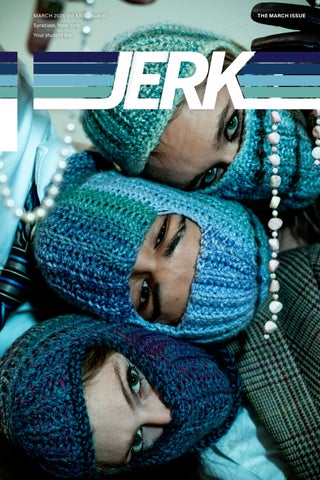
PHOTOGRAPHERS: Rebecca Beckas, Maddy Cox, Shane Grates, Nathaniel Harnedy, Andrea Hernandez, Alicia Hoppes, Brynne Hurt, Celeste Jenkins-O'Reilly, Christine Kao, Maddie Kim, Molly Mellinger, Soren Moos, Chloe Pusey, Alexandra Rice, Owen Sellers, Ailani Wong
Harriet Brown ADVISOR
Through its content, Jerk is dedicated to enhancing insight through communication by providing an informal platform for the freedom of expression. The writing contained within this publication expresses the opinions of the individual writers. The opinions expressed herein are not those of Syracuse University, the Office of Student Activities, the Student Association, or the student body. Additionally, the ideas presented in this publication do not necessarily reflect the opinions of the Jerk Editorial Board. Furthermore, Jerk will not be held responsible for the individual opinions expressed within. Submissions, suggestions, and opinions are welcomed and may be printed without contacting the writer. Jerk reserves the right to edit or refuse submissions at the discretion of its editors. Jerk Magazine is published monthly during the Syracuse University academic year. All contents of the publication are copyright 2024 by their respective creators. No content may be reproduced without the expressed written consent of the Jerk Editorial Board.
LETTER FROM THE EDITOR
In times when the world around you seems nightmarish and entirely impossible to comprehend, it makes sense to retreat into the internal. We channel our global frustrations into our own petty drama or the unrest in our communities. Is there any other way to make sense of such large-scale uncertainty?
Not to be one of those obnoxious study abroad students, but this issue’s focus on reveling in the uncomfortable really does remind me of an art history assignment I had in London last spring.
Students were to pick a painting in the city and visit it at least six times, culminating in an essay on the artwork. A rainy Monday morning brought me to the National Portrait Gallery, where Maggi Hambling’s Self Portrait hung next to a swoopy-stroked, pastel portrait of Sir Paul McCartney. Our design team would kill me if I made them include an actual picture of the painting on this page, but please Google “Maggi Hambling Self Portrait.”
Painted when her life was “in a muddle” (so British), a kaleidoscope of seemingly unrelated objects surround Hambling, who sits disheveled at the center with three arms holding her “three essentials of life: a cigarette, a drink and a paintbrush.”
Truth be told, I loved schlepping to Trafalgar Square twice a week to look at Hambling and all the weird shit occupying her brain back in 1978, like the tiny Concorde careening towards the front of the canvas or the bulbous fish sinking to the bottom. But I also kind of hated it. I hated that I didn’t really get why that stupid fish was there or why it didn’t look like it had a tail or who that couple in the black and white photograph in the corner were. And I hated that for all of the painting’s vulnerability, Hambling didn’t seem like she wanted me to know any more than I already did. I dreaded having to actually write the essay.
That is, until I began to see the whole painting as a sort of ode to sitting with discomfort.
I’m sure Hambling ultimately got her muddle sorted. And I’m sure one day we all will wade through our own muddles, whatever they may be. But I also think an underrated step in dealing with a problem— or a whole cyclone of problems—is appraising and maybe even appreciating the mess you’ve found yourself in for what it is. Sometimes all you can do is sit with the chaos—pour it a drink, light it a cigarette or turn it into an oil painting (or a magazine).
In this issue, Jerk invites you to interrogate and embrace your own (hot) messiness. Linger in the uneasiness of big feelings with our package on emotion—from reluctant catharsis at the local rage room on page 64 to channeling radical joy into activism on page 57. Find comfort in pandemonium with our analog media-themed photoessay on page 35 and our profile of an aspirationally overscheduled local celebrity on page 39. Remain steadfastly unembarrassed to be seen trying in all facets of life (as discussed on page 15)—even if it means being the freak posted up for an hour next to a surrealist portrait of the second-best Beatle.
As always, thank you to Jerk ’s incredible staff for the hard work, collaboration and creativity each of you have channeled into this issue. It’s actually quite easy sitting in this mess with all of you.
With love,
Sophie Davis Editor In Chief
Fei
Package:
Janai
Matlock, Brenne Sheehan, Hannah Peters
Renovator
Joelle
Closet
Julia
Camden
JERK ON THE INTERNET
Jerk Magazine is exploring new ways to compliment our print mag. Find additional content on social media @jerkmagazine and our website jerkmagazine.net.
HIT
What we love
Words by Karli Coskun
MORRISSEY’S MAKE-UP IS A LIE
MARCH 6
ST. PATRICK’S DAY
MARCH 17
The only reason that little leprechaun exists is to tell us to keep drinking, and this year, they’re practically begging us to because the holiday happens while we’re on campus. Everyone at Jerk is very excited to see people of all backgrounds celebrate how great it is to be Irish. We love you, Paul Mescal.
THE DRAMA
APRIL 3
The release of The Drama is very important—it’s the first cool Zendaya movie post- Challengers . This film has HUGE shoes to fill. Does anybody know if it’s about a threesome?
THAT ONE RANDOM WARM DAY IN MARCH
This is proof that brighter days are ahead. We can see it now—everyone on the quad, students actually smiling, not a care in the world. We cannot wait until our pants are free from salt and snow stains and we can walk freely without some ugly-ass snow boots. It’s the little things—#hopecore.
WOMEN'S MARCH MADNESS
2026
With big teams to look out for like the University of Connecticut, the University of South Carolina and the University of California, Los Angeles, suddenly, the most boring month of the year might be quite entertaining. Since the tournament takes place during Women’s History Month, why are we even airing the men’s season?
Just because The Smiths occasionally go viral on TikTok does not mean Morrissey should. Gen Z loves to bring the ‘80s and ‘90s back, but let's leave Morrissey in the past with smoking, diet culture and casual workplace sexism.
MICHAEL JACKSON MOVIE
APRIL 24
“Wow, another biopic,” we all say in monotone unison. It’s obvious that Hollywood is running out of Oscar-winning ideas, so they’re throwing another biopic at us. With a questionable character like Michael Jackson, it’s hard to see this playing out well.
MEN’S MARCH MADNESS
MARCH 15
Ugh, boring. As stated previously, why are we airing MEN’s March Madness during WOMEN’s History Month? That seems cancellable.
EUPHORIA SEASON 3
APRIL 12
Without half of the main cast, what do we even have to look forward to? How are we supposed to watch a whole season of Sydney Sweeney being insufferable without cute filler scenes of Angus Cloud (rest in peace, King)? The trailer was mid and the only thing that might not flop is Trisha Paytas’ acting debut. Well, it might.
You may be the first sign in the zodiac, but you’re the last to leave your ex alone. We’re on to better and BIGGER things, Aries. See you at the finish line.
TAURUS
ARIES GEMINI
May 20 - Jun. 20
Now, I don’t know if you knew this, Taurus, but you actually can’t afford the 20-step skincare routine you saved on TikTok. Hightail it to CVS, pick up some makeup wipes and CHILL OUT.
CANCER
Remember your New Year’s Resolution, Cancer? Barnes is emptier now! Pop in your AirPods, get on the stairmaster and give it a good five minutes.
Can you hear me? Or am I another one of your 258 unread texts? Gemini, your friends haven’t heard from you in weeks. Take a deep breath and make a FaceTime call.
LEO VIRGO
Leo, Leo, Leo. You may feel like you’re in a rut, but maybe if you broke your addiction to Instagram reels, you’d feel the weight of the world lift off your shoulders. It really is that damn phone.
Aug. 23 - Sep. 22
Did someone say overspending? Virgo, those $7 coffees are ruining your life. Make an Excel spreadsheet and invest in an espresso machine.
Boy, do I have breaking news for you. Nobody cares about you as much as you do! Let’s take our anxiety meds and stop worrying about what the person behind you at the Dunkin’ line is thinking about you. I’ll tell you a secret... it’s nothing at all!
23 - Nov. 21
LIBRA SCORPIO SAGITTARIUS
Some drama is festering in your life. It’s important to know when to pick your battles. Let’s protect our peace this year. Guess what? It’s not your circus, so stay wise, Scorpio.
Nov. 22 - Dec. 21
Sagittarius, let’s bring it up. You’re being boring. Boo. Get wild, you need something going for you. Enough said.
Hey! Maybe let’s stop falling asleep to TikTok edits and try going outside for once. Get your ass out the door and touch some grass.
CAPRICORN AQUARIUS PISCES
Feb. 19 - Mar. 20
Oh, Aquarius, you’re our favorite group of freaks. We’re gonna need you to lock in, though. This year’s been off to a wild start. Pick up the wallet you left at the bar last week. Grab your inhaler, let’s take a breather.
Words by Laura Lemgruber | Art By Sara McConnell
We want to see you rage. This month is for bar fights, buying that spontaneous ticket to Europe and making your friends just a little concerned you’re going off the deep end.
A HARD PILL TO SWALLOW
With birth control misinformation running rampant on TikTok, it is harder than ever for young people to determine fact from fiction
Words by Kelly Matlock | Art by Sophia Chen | Designed by Alexa Lakeman
Instead of learning about birth control options from an OB-GYN about to crank you open in a sterile white room as God intended, young people are now being educated by pseudo-doctors spreading misinformation online. This digital fearmongering makes contraceptive health seem murky and confusing, so we here at Jerk want to set the record straight.
Over the past few years there has been a marked increase in contraceptive misinformation. A 2025 study in “Perspectives on Sexual and Reproductive Health” analyzed birth control content with more than five billion views and found that over half of the content disparaged hormonal birth control and over a third expressed distrust in medical professionals. Seriously, people?!
First, the basics. Hormonal birth control refers to the pill, the patch, the implant, most Intrauterine Devices and the injection. It uses synthetic estrogen and progestin to prevent the body processes that make pregnancy possible. Non-hormonal birth control just means tracking your cycle and using the four phases of menstruation to predict when you are most fertile. Cycle tracking can be used as a ballpark measure of fertility, but it is far less effective for preventing pregnancy than hormonal options.
Crouse Hospital nurse practitioner Maria Giggante-Baggett said she encounters misconceptions about hormonal birth control all the time, especially about the pill and the IUD.
“People think that hormones in general are just bad for people. And in most cases, when you ask someone, they can't give you a definite answer as to why,” she said. “There's a lot of misinformation out there, and I think a lot of that has to do with social media.”
Giggante-Baggett said hormones aren’t inherently bad for the body. Some hormones, in fact, like those in certain IUDs and birth control pills, have been linked to lower chances of cervical cancer. Us Jerks who take birth control pills find this very comforting.
Influencers online are sharing horror stories about hormonal birth control’s side effects and painting cycle tracking as the wellness-focused, healthy alternative. They claim that hormonal birth control affects every area of your life and turns you into someone you’re not—Jekyll and Hyde style.
TikTok influencer @amanda pac blamed the pill for her unpleasant feelings and claimed that now that uses cycle tracking, she “can’t remember the last time she felt really sad.” Yes, hormonal birth control can have side effects (like sadness, apparently), but it’s still a great option for many people, whether to avoid pregnancy or treat conditions like polycystic ovary syndrome and endometriosis, Giggante-Baggett said.
Misconceptions about types of birth control range from moderate to insane. Giggante-Baggett said she hears frequent outlandish claims about IUDs specifically.
“People think that when you have an IUD, every month you are giving yourself an abortion,” Giggante-Baggett said. “That’s just simply not true.”
Clubs like Planned Parenthood Generation Action (PPGen) at Syracuse University are attempting to close the information gap and help students understand these confusing concepts. Nicole Donahue, president of SU’s chapter of PPGen, organizes outreach on and off campus via legal advocacy work, phone banking and local volunteering.
Donahue said birth control options can be very confusing because women’s health is underresearched and stigmatized. Many people don’t like talking about the subject, she said.
Giggante-Baggett echoed Donahue’s sentiments. She believes women’s health is stigmatized across one's lifespan, not just during reproductive years. This has resulted in a lack of research on women’s health as a whole (news that surprises absolutely no one).
“There are some things that are definitely misrepresented when it comes to women's health care,” Giggante-Baggett said. “There's not enough conversations around it.”
Historically, Donahue said, the introduction of contraception and family planning improved women's rights substantially, because women with control over their bodies are able to pursue careers
on their own timelines and choose when to have children. Female autonomy on a health level goes hand in hand with autonomy in the world at large.
We’re no conspiracy theorists, but the combination of birth control confusion with Trump administration ideology does not bode well for contraceptive access in the United States. It’s more important than ever to know your facts and be prepared—both to protect yourself from misinformation and to argue with the lame condom-hating guy you meet at the bar.
“I think having control and having autonomy is the most important thing for just a person. It doesn't even need to be a woman. It can be a man, it can be someone who's trans, it can be a non-binary person, anyone,” Donahue said. “We're taking steps backwards in women's health, and I think it’s really scary.”
THAT'S SEW SOUP
How this student artist stitches sustainability and style
Words by Isabella Perrotta | Photo by Owen Sellers
For as long as they can remember, the Syracuse University student artist known as Soup has been drawn to creating things.
The earliest memories of this passion could be traced back to their elementary years, when they would transform old socks into the latest fashion for their dolls. This hobby was only amplified when they were given access to their mother’s sewing machine and began to alter discarded pieces of fabric into wearable garments.
“I was like, this is crazy—I can make toys for myself and I can make clothing,” Soup said.
Soup maintained the desire to create throughout middle and high school. They attended a performing arts school, which fostered the same creative learning environment their parents did
have all these ideas, that’s the place I wanted to continue being in,” Soup said.
Their passion for art became their future, now with aspirations of becoming an art professor to continue to be immersed in the world of artistry.
Much of Soup’s work draws directly from their own life experiences.
“My work is about creating a holistic picture of Black and queer life. I want to capture what it feels like to be queer besides the glamorous or the weird notions people have,” Soup said. Through their work, they aim to emphasize that emotions are universal, experienced just as deeply by queer people as anyone else.
For Soup, the act of creating is an introspective and meditative process. They describe the hum of the sewing machine as grounding, locking them into their work as they watch their artwork gratifyingly come alive, piece by piece.
At Syracuse, Soup’s days are split between academic classes and the Comstock Art Facility studio. Their classes encourage creative independence, leading them to learn new skills.
“Right now we’re in class where there’s no prompts for what we have to do, so it really gives us agency to create whatever we want,” Soup said.
In a world driven by fast labor and fitting in, Soup’s work fosters what is lacking through color, creativity, meaning and deep care for their work. With every stitch, they leave nothing less than a beautiful piece of art behind.
“There is no automated way to make a shirt or a pair of pants. So every piece of clothing we have, there's labor that goes into it,” Soup said. “So when I'm sourcing my materials or even buying clothes, I'm thinking about how someone had to make this and therefore everything has value.”
JERK OR BITCH?
The Ultimate Rage Cup Recipe
Words by Caroline Erskine
Photo by Molly Mellinger
It's official: we’re living through a house party revival. And with house parties come that delightful can’t-see-straight-do-I-have-to-throw-up-maybe-I-need-another-drink feeling. And what better way to get to that point? Play a drinking game! Of course, that all blows up in your face if you have to drink the bitch cup, or does it? Modern-day bitch cups barely deserve the name anymore, so we here at Jerk have finally perfected the recipe to make sure that whoever drinks this toxic concoction will regret it for the rest of the weekend.
INGREDIENTS
• ¼ mango Beatbox
• 1/2 espresso martini Buzz Ball
• 2 shots grape vodka
• 1 shot fireball
• 1 ounce milk
• Tajìn rim
PROCEDURE
1. Find the oldest, dirtiest red solo cup you can. It should have been used to play this game at least twice already
2. Use a paper plate and milk to put a tajìn rim on the cup
3. Pour in the Beatbox, Buzz Ball and vodka—measure with your heart, not a glass
4. Add the Fireball and milk at the same time for maximum curdling effect
5. Mix with your finger, and serve to your blissfully ignorant friends
CARING IS COOL
Never let ‘em see you sweat (except for when you do)
Words by Caroline Erskine
Art by Marina Lee | Designed by Cole Kaneshiro
It's Tuesday night in a dorm room somewhere on campus. A student sits cross-legged on their bed, crochet hook moving through yarn while a halffinished assignment glows on their laptop screen. Their phone buzzes with TikTok notifications. They ignore it.
Across campus, another student scrolls through Instagram reels for the third hour straight. The contrast is stark—and increasingly rare.
We're in class, but not really there. Assignments get fed into Claude or ChatGPT. Readings are completely ignored, and theses and capstone projects—the culmination of four years and thousands of dollars—get treated like inconveniences.
The time we save by cheating on our assignments isn’t even put to good use, it’s spent on our phones. This isn't just about academic dishonesty or phone addiction, it's about something scarier: the death of intellectual engagement itself. We've created a culture where trying is embarrassing. Reading in public gets labeled "performative" and having a hobby that isn't doomscrolling is growing obsolete.
The performative label serves a purpose—it lets us rationalize our own disengagement by suggesting that anyone who does engage is just showing off. The thing is, that’s not true. Caring is cool.
Charlie Hynes, a Syracuse University sophomore, is an active member of the indoor climbing club and goes climbing multiple times a week. Some days he has to convince himself it's worth the walk to the gym, but once he’s there, he never feels regret.
Hynes describes climbing as both an individual and community sport. While he’s on the wall, the team is showing one another different ways to attempt the climb. He sees what works and what doesn't, while building friendship and camaraderie.
"It's less of a ‘I'm by myself doing this,’ and more of a ‘I'm doing this myself, but I'm being encouraged by others to do it,’" Hynes said.
This kind of community built around active engagement rather than consumption stands in contrast to the isolating act of doomscrolling.
This isn't unique to climbing. Across campus, students are rediscovering the satisfaction of making things with their hands.
Maya Collins, an SU sophomore, estimates that she spends about two hours a week on crafts during the school year—sewing, drawing and most of all crocheting. During the summer, when work and school pressures ease, that number jumps to around 10 hours.
Even during the busy school year, Collins has developed strategies to protect her craft time. She multitasks when possible, crocheting while reviewing flashcards or watching lecture videos.
Sometimes she gets caught doomscrolling through craft videos, trying to decide what to make next. But she's found a workaround— replacing short-form content with TV shows that don't fry her attention span. She watches and crochets simultaneously.
'I do feel happier at the end of the day if I crochet something, rather than just spending a day doomscrolling,' Collins said. “It doesn’t feel like I wasted my time.”
Being part of the crochet club gives her permission to step away from academic pressure. It provides an excuse to just have two good hours to crochet and chat with people. It's an opportunity to
do the craft she likes while socializing—something increasingly rare in a generation that socializes primarily through screens.
Engaging with the world around us goes further than having a physical hobby, it extends into activism and civic engagement.
Melissa Martin-Neubert, secretary for a Michigan chapter of Indivisible, a pro-democracy activist organization, has spent the past year deeply involved in both political organizing and ecological activism. She educates people about native plants, fights for human rights and shows up to protests. When asked if she considers this work, her answer is immediately yes.
Martin-Neubert's activism requires the same kind of sustained engagement that Collins brings to crochet or Hynes brings to climbing. But while their hobbies build personal fulfillment, her work builds community resilience.
She describes various forms of labor involved: emotional, physical and intellectual. Sometimes the weather is uncooperative. Sometimes you yell and chant and end up with a sore throat for days.
Perhaps most importantly, there's the intellectual work.
She recalls learning media literacy in school— how to recognize when a piece only presents one perspective, identify credible sources and evaluate information critically. These skills require sustained attention and intellectual engagement, exactly what our current culture undermines.
"If you want to be heard and taken seriously, you have to know what you're talking about," MartinNeubert said.
At protests, Martin-Neubert noticed something unexpected. The crowd skews much older than she expected. She describes seeing elderly veterans sitting in wheelie scooters at demonstrations, older people who are mad they have to re-fight battles they thought were already won.
Where are the young people? Martin-Neubert sees the problem clearly.
"If we don't start working both groups together, the older and the younger crowd, then
the people who need to be able to pass the torch down, they're not going to be there to grab it," Martin-Neubert said.
The tragedy isn't just that we're cheating ourselves out of an education, it's that we're training ourselves out of the capacity for deep thought. Every time we let AI write our papers, answer our questions or do our thinking, we reinforce the habit of intellectual passivity.
The antidote to this isn't complicated, but it does require effort. It requires showing up physically, mentally and intellectually.
For Hynes, climbing provides benefits that extend beyond physical fitness. The sport pushes your mobility and strength at the same time because it's often really technical. It requires concentration, planning and active problem-solving.
"You are planning almost five steps ahead. Every single move you do, you have to be able to not just make the one move. You have to be able to make that move and then the next to get the top," Hynes said.
The same kind of sustained attention applies to Martin-Neubert's activism. She finds that being in a room full of people who appreciate her perspective helps ease the stress that doomscrolling creates. Active engagement soothes where passive consumption inflames.
We're at an inflection point. The infrastructure of disengagement is firmly established, but it's not inevitable.
Every time we choose the wall over the scroll, the book over the feed or the class discussion over ChatGPT, we push back. As Martin-Neubert asks, if you're not standing up for people in your community, why bother having a community? Why be in a society altogether if we're not looking out for people?
We need to reclaim our attention, our curiosity and our capacity for sustained thought. We need to stop being embarrassed about trying. The work starts now. Put down your phone and pick up literally anything else.
MAXXED OUT
How the looksmaxxing movement is draining our confidence
Words by Jerry Morris
Art by Sara McConnell | Desgined by Caroline Connerton
Self-esteem is something we all strive to achieve. Developing confidence and self-worth is a unique journey for everyone. Whether it’s working out, dressing well or developing hobbies, it’s important to become confident in who we are and develop our self-esteem.
But what if we could just buy it?
The process of looksmaxxing first came to be in the early 2010s. According to looksmaxxing.com, the definition of the term is “the process of optimizing your physical appearance through strategies like skincare, grooming, fitness and styling. It’s a structured approach to becoming more attractive, confident and socially effective.”
At first glance, there doesn’t appear to be anything abnormal about this. Practices like working out and finding your sense of style not only build confidence, but are generally things that lead to a healthy lifestyle. Authors, coaches and other creators have written and spoken ad nauseam about becoming the best version of yourself. However, looksmaxxing deviates from this behavior with an unhealthy and obsessive approach to self-improvement.
It gained its popularity through chat forums, on websites like looksmax.org, the Reddit thread r/looksmaxxing and 4chan, where people— particularly young men—would discuss either their discomfort with feeling unattractive or the methods they were using to achieve their most physically attractive state. While its earliest philosophies were mostly pure, with most of the users relaying normal and healthy advice to other users, the culture in these forums quickly became radicalized.
Much of modern looksmaxxing draws several parallels to “incel culture,” where young men blame society or women for their inability to find a sexual partner. This culture typically paints heterosexual women as shallow and vapid, only caring about the physical appearance of their male partner. If
being a self proclaimed “incel” is the problem, then looksmaxxing and achieving a peak physical form is the solution. This reinforces sexist stereotypes that women are shallow, and that one’s only currency in this world is their looks.
Some of these practices include bonesmashing (hitting heavy objects on your jawline to create a more defined look), taking intense and unnecessary supplements like steroids and appetite suppressors, forgoing eating for long periods of time (starvemaxxing) and promoting plastic surgery. All of this combined leads to the possibility of developing body dysmorphia and a lost sense of self.
For many college students, looksmaxxing first entered their radar as a punchline last year.
"Most people who are aware of it are aware of it because it's a joke on Instagram or TikTok," Owen Ormes, a Syracuse University senior, said. "It's more of an ironic internet meme than a legitimate practice in my opinion."
Charlie Aubitz, another SU senior, agreed that the line between self-improvement and absurdity is clear.
"I think it's fine if you want to be more attractive," Aubitz said, "but some of the things are a little ridiculous, like bonesmashing."
These TikToks also became the place where the slang used to describe looksmaxxing was popularized. Unique terms like “mogging,” “mewing,” “gigachad” and "ascending" became commonly used terminology. Influencers like Clavicular, who has accrued over 1 million followers on his socials, have exploded in popularity over the past few months with their divisive and polarizing looksmaxxing lifestyles. His use of steroids, his endorsement of plastic surgery and even meth usage to reduce hunger has propelled him to become the face of the looksmaxxing movement.
A common theme with influencers like Clavicular is that their accounts feature links to their “coaching” websites. Clavicular has “The Clavicular System,” where he charges his mentees upwards of thousands of dollars to learn about how he "evolved a data-driven framework using experimental methods to genetic potential.” The website claims to have over 1,000 paid subscribers, all of whom want to learn how to “ascend” physically.
This is where the creator-consumer relationship becomes predatory. While plenty of social media users interact with creators like Clavicular because of his wild, entertaining content, others truly connect with the core messaging. Edits from these creators show before and after photos with visible change, essentially saying, “if it can work for me, it can work for you.”
This messaging is deliberate. The young men who desire physical changes and relate to the “before” pictures in these edits will do anything to escape the feeling of inadequacy. Looksmaxxing
creators double down on this insecurity in their messaging, saying they should feel shame for their appearance—that if you’re not trying every method to achieve peak attractiveness, you’re basically subhuman. The demeaning and vain messaging force-fed to users who have trouble feeling confident in their looks is what drives sales and gets views, and according to Ormes, for those who take it seriously, the result can lead to "unrealistic body standards, body dysmorphia and a negative body image."
Looksmaxxing's inherent evil lies in its business model: it manufactures and amplifies the very anxieties it claims to solve, then profits from the desperation it created.
This predatory model isn't unique to looksmaxxing. It is eerily similar to the marketing strategy that has long been used in women’s spaces. The beauty and wellness industries have perfected the formula of creating impossible standards, then selling the "fix." From anti-aging creams to diet cultures that take part in triggering eating disorders, women have been the target of this kind of exploitative advertising for decades.
What makes looksmaxxing particularly gross is how it repackages these same exploitative plans as “male self-improvement,” building on a predatory industry that now profits from convincing people of all genders that they're defective and need to purchase their way to worth.
These influencers profit from a lie they need you to believe: that authenticity is a weakness, that your natural self is something to be ashamed of and that transformation is the only way to have value in this world.
However, the only truth that matters is that self-acceptance can't be bought. It can’t be surgically implanted or swallowed down in pill form, no matter how much r/looksmaxxing tries to convince you otherwise.
INCLUSIVE WHO?
Spotlighting campus accessibility efforts, since Syracuse won’t
Words by Mollie Kuritzky | Art by Sam Arrowood | Designed by Megan Radakovich
When Alison Gilmore was selected as a Syracuse University Senior Senior Marshall for the class of 2025, she found that she was unable to get on the very stage where she was expected to be honored for her achievement. The reason: there were no railings along the stairs leading to the stage.
Gilmore speaks of her experience at SU as a disabled student as a mostly positive one, though not without its challenges.
“I had an advisor and friends and other people that I worked with that were incredibly supportive,” Gilmore said. “With the buildings themselves, I personally had some issues in terms of just navigating certain auditoriums and other buildings.”
Inaccessibility is not just an inconvenience— it can send a powerful message that certain demographics are not a priority or outside the norm. According to state data, there are 544 SU students with physical disabilities. If they feel like outliers, there is an issue with the university, not the population.
Professor Donald Carr, who teaches at the School of Design in the College of Visual and Performing Arts, believes that design elements can carry more meaning than what meets the eye.
“When you have historic buildings, if you're a wheelchair user, you may feel like you're being asked to go in the back door, which sends a signal,” Carr said.
Working within the confines of historical buildings can present challenges, and it may not be possible to strike a perfect balance. But there are still small improvements to be made that can drastically improve people’s quality of life and ensure that disabled students, faculty and staff feel like a part of the campus community.
A way to ensure design elements don’t make students feel ostracized is to prioritize dignity and independence. An accessible entrance placed in a completely different area does accomplish that,
and even a “technically” accessible passageway that requires a little help from a good Samaritan can be demoralizing.
“I kind of made it known that it was not an ideal situation, because even if someone wanted to offer me their arm, it’s not something I'd be interested in doing,” Gilmore said. “It's a little bit humiliating from that perspective, and I know other people might not think of it as that, but I just want dignity in that situation.”
The onus should not be on students to advocate for their needs. Students’ needs should be considered in the earliest stages of development, and not simply remembered after the fact. Thankfully, collaboration with disabled individuals when making design choices is slowly becoming the norm in the field, according to Carr.
“If you continually do this as able-bodied people, thinking you know better or you know best for others, you may be right, but you're very possibly going to be wrong,” Carr said. “And that's a loop that continually repeats itself.”
Syracuse University is a place that advocates for other educational institutions to prioritize inclusivity. SU is home to InclusiveU, a program through which students with intellectual and developmental disabilities can have a full college experience. In 1994, SU also became the first university in the United States to establish a disability studies program. These commitments to inclusivity are impressive and significant, but ensuring a physically accessible campus for everyone is equally important. Though strides have been made, there’s more to be done.
Collaboration with disabled individuals goes hand-in-hand with integrating disabled students and their support groups with the rest of the campus. Most students are aware of InclusiveU, but not many know of the other organizations and forums focused on supporting disabled students. For students to develop an understanding of
accessibility in their campus environment, they must first become more conscious of the students who share the same campus. That emphasis on awareness has to come from the top down—it takes the university recognizing and sharing the contributions of disabled students and their organizations for others to take notice.
“I see a need for improvement in terms of amplifying work that the Disability Cultural Center does, from the perspective of university leadership,” Gilmore said.
The Disability Cultural Center organizes social and educational activities having to do with disability issues, involving students with and without disabilities. It is also housed within a student affairs organization, not within the disability office, which is very unique for a university program of its kind. Even with this extra step to be more inclusive, much of the SU community remains unaware of this organization and others like it.
SU is also proud of its online interactive map of the campus, which allows users to filter for Americans with Disabilities Act compliant accessibility and, within that, to filter for either accessible entrances and/ or accessible bathrooms. Once selected, the map lights up with the universal blue signs, portraying Syracuse campus as a sea of accessibility.
We here at Jerk do not dispute that this is the reality, we simply question if students who stand to benefit from these adaptations are made aware of them.
“If these accessible options exist, there needs to be appropriate signage so that people are aware that they exist,” Gilmore said.
ventures like the Burton Blatt Institute—a research center with the aim of advancing social and economic participation by disabled people—means inclusivity is not just practiced but also preached. Professor Carr believes Syracuse has lived up to its responsibilities.
SU is literally a school on a hill, which makes its attempts at accessibility ever more critical.
“I want to say we're leaders because beyond where we started the conversation with issues of access around a hilly campus, there’s the impact we’re trying to have on the greater world,” Carr said.
Many of the issues regarding accessibility tie back to involvement of disabled students and faculty. By implementing changes and not properly alerting people to those changes, real action is wasted, made simply for appearance.
Much of SU’s marketing promotes campus as ahead of the curve when it comes to inclusivity. In some ways this is true, but it also means they have an obligation to fulfill that promise.
This influence is more than the design of the built environment, it is amplified by the law school’s involvement with accessibility. The presence of the law school, with professors and students seeking to concentrate in disability law, means many on campus care about accessibility advocacy. This, combined with the existence of legal and sociology
It must also be noted that there is no singular way to experience being a disabled student at SU. Every person is different and has different needs and all students’ wishes—whether it’s needing an alternative entrance or more inclusive cultural spaces—must be heard and honored by the university.
Change is slow; SU should aim to not only be ahead of the curve, but to be the school to set it.
THIS GUY AGAIN? OBITCHUARY:
Hollywood’s recent proclivity for casting the same actors in just about everything
Words by Colette Leto
Art by Audrie Malmstrom | Designed by Claire Arveson
Just imagine: you turn on a movie and suddenly Jacob Elordi lumbers into the scene or Sydney Sweeney performs a mumbled monologue. There’s no escape; the faces of over-cast actors are burned into everyone’s retinas. Seriously, who’s gonna tell all these casting directors that they have more than five performers to choose from?
It’s not only annoying and lazy, it’s also problematic. Wuthering Heights by Emily Brontë masterfully touches on themes of racism, domestic abuse and gender roles. That’s what makes it all the more offensive to cast the white, Australian Jacob Elordi as the dark, brooding Heathcliff, who is widely interpreted as a man of color.
But at least they cast someone good for Heathcliff’s 18-year-old counterpart Cathy Earnshaw, right? Wrong. Margot Robbie, a woman in her mid30s, was given the role. Was there really nobody better suited for the part? These casting directors worked incredibly hard to bastardize an adaptation of one of the finest pieces of literature, making it into a crass piece of softcore garbage.
On that note, we all know Sydney Sweeney, actress and eugenics extraordinaire. Wherever you
seems like an especially egregious missed opportunity to have given some attention to one of the many extraordinarily talented queer actresses out there. With Christy being a box office flop, it’s a shame that Martin’s story will remain unknown by many.
Now, though it pains me to add him to this list, I must: Timothée Chalamet. With both Dune movies, Marty Supreme, Wonka and A Complete Unknown? Give the poor kid some days off. Opportunities to give young actors their big break have been continuously handed to Chalamet, and while we can’t deny his popularity and talent, can’t we save some roles for all the other gangly white guys out there?
Similarly, if you’ve ever seen a flashback scene from the 2010s, you know who McKenna Grace is. She played the younger version of every white woman in Hollywood. Were there other kids that would have also given stellar performances? Yes, of course, but this again seems like laziness on the part of casting directors. Now a young woman, she’s moved on from juvenile roles, starting off her adult acting career questionably by starring in , a movie adaptation of the Colleen Hoover book. For Grace, it seems like an opportune time to step back and reevaluate where her
What the film industry needs more than anything right now is a lineup of fresh faces, like Heated Rivalry, with its cast of relatively unknown actors. Hopefully the casting directors of Hollywood take a page out of their book and provide audiences with a carefully cast set of individuals for future projects.
CENTERING STUDENT HEALTH AND WELLNESS
Comparing the Barnes Center’s standards with the reality for patients
Words by Kiran Hubbard
Art by Marina Lee | Designed by Abigail Aggarwala
A tour guide leading prospective students through Syracuse University’s campus will undoubtedly stop at the Barnes Center at the Arch. This spot on the tour features some variation of this spiel: The wellness center offers great resources, same-day counseling appointments and group therapy. You can even get checked out in the medical center, then come right downstairs and pick up your prescription—or so goes the script.
Opposite the basketball courts, weight rooms and S-shaped hot tub, the health and wellness section of Barnes includes a pharmacy, therapy services and other health care. The center achieved high standards for student-focused care this year, earning recognition by the Accreditation Association for Ambulatory Health Care (AAAHC) and the Princeton Review’s Mental Health Services Honor Roll.
But not all trips to the wellness center are created equal. While some students reap the benefits of an award-winning campus care provider, others are left disappointed and under-served.
Greta Freed, an SU senior, visited Barnes several times during her first year on campus. Around finals season that year, she went in with what she assumed was a sinus infection. It hadn’t
been seven days yet, so the wellness team couldn’t confirm her diagnosis—but they still offered her an antibiotic for “peace of mind,” although they didn’t think she needed it.
Taking unnecessary antibiotics can contribute to antibiotic resistance, a public health issue where bacteria build defenses against drugs.
“The doctors are nice there, I just, I’ve looked at them in a different way ever since,” Freed said. “[I’d choose] anywhere but the Barnes Center. I choose urgent care, the ER, the hospital, Upstate Golisano. Like anywhere.”
Freed also works as a tour guide and gives the pre-written speech about the Barnes Center despite feeling a disconnect with the words.
“I kind of feel like I’m lying while I say it, cause I’m like, ‘They’re awful,’” Freed said. “I’m just saying what’s on the script. Other people have had good experiences, it just wasn’t me. So I’m only slightly lying, maybe.”
Freed has valid health care in New York, so she has the choice of external care providers. So, when she transitioned to being a part-time student for the spring semester and was no longer automatically charged the Student Health and Wellness Fee, her copay for going somewhere off campus was
significantly less expensive than the $445 fee for the Barnes Center.
For some students, this is not an option. SU senior Mikayla Melo relied on the Barnes Center for health care for three years, since care providers instate didn’t accept her insurance from California. She used the center for general issues like flu medication and birth control, and even when she had appendicitis at the end of her sophomore year. Barnes recognized the appendix issue, communicated with her school regarding final exams and handled her prescription for antibiotics. She was sent to Upstate and ultimately flew home for surgery, but she said Barnes was “really great” about the experience as a whole.
Melo went part-time for the spring, and said her and her family decided paying the fee wasn’t worth one semester of coverage. If an issue arises, they’ll figure it out as they go.
“At least before when I didn’t have normal health care coverage, I had that backup. Now I really have nothing. So, that’s a little concerning to think about,” Melo said. “But it’s only a few months, so, what’s the worst that can happen?”
From diagnosing her appendicitis to delivering medication to her apartment, the physical wellness portion of Barnes was good to Melo.
“[I’m] Going to miss them,” she said.
The Barnes Center offers specific women’s health services as well. Rachel Feuchtwanger, a
freshman at SU, made an appointment to discuss options for birth control at Barnes before deciding on an IUD. Everything was highly professional, the IUD was explained thoroughly and the center accommodated a last-minute date change to the actual procedure—she just wasn’t allowed to bring anyone with her for moral support.
“[The doctor] was very sweet during that whole process, she made it as comfortable as I could be,” Feuchtwanger said.
Feuchtwanger liked her experience, from the patient portal check-in process to the information provided about aftercare. She felt that the women’s health professionals genuinely cared about her wellbeing. She also noted the doctors at Barnes understood that treating college students meant explaining which medications shouldn’t be taken with alcohol or drugs (instead of simply suggesting students abstain).
“For women’s health specifically, I think I would keep going there until I graduate,” Feuchtwanger said. “They’re very good with routine check-ups. And I feel like no one knows about that. I was telling my friends that I got my IUD at Barnes and they were like, ‘Wait, they do that?’”
Separate from physical wellness, Barnes is infamous on campus for its mental health services. When Melo had a consultation to get set up for long-term care, she was told the center was booked for months. This made her decide against going at
all. She said these services can help students who don’t have insurance and don’t want to involve their parents—but when the center is understaffed or overbooked, it’s rendered unhelpful.
Recent SU graduate Abby Haffner looked into starting therapy at Barnes her sophomore year. After browsing a list of counselors with their biographies and specializations, she selected the best-seeming fit and was placed on a waiting list. She waited for at least three months.
“It was definitely frustrating, because you’re obviously going through all these different changes and you’re feeling all these things and you don’t know what to do with them,” Haffner said. “And essentially [they] are telling you to put your feelings on hold, and they’ll get back to you when they have an opening.”
Long waitlists reflect a community-wide and potentially nationwide issue of access to therapy services, Claire Currado, licensed therapist at CNY Therapy Solutions, said.
“It’s very very challenging to find mental health services, especially quality mental health services. But I certainly think it’s a systemic issue,” Currado said.
According to Ashley Williams, a licensed therapist and founder of Cardinal Hope Mental Health Counseling, Syracuse’s demand for therapy outweighs the supply of qualified providers. This is complicated by insurance regulations, which can
make it even more challenging to access care.
Once Haffner was eventually connected with a therapist, she had an overwhelmingly positive experience at Barnes. Her counselor was able to help her with struggles across her life, including switching her major and post-grad planning.
When her therapist left SU for another job, Haffner ended therapy, which she said was ultimately for the best. But before then, her counselor would end sessions by asking if she felt ready to “graduate therapy,” saying one day her issues would be solved and she’d have less to talk about on the couch.
While short-term treatment is best in some circumstances, that’s not the case for everyone.
“Things don’t have to be doom and gloom for you to be in therapy,” Williams said. “Life is still lifeing as you’re in therapy, and things change, so you might want to reassess things.”
Psychology Today, Liberty Resources and Helio Health provide mental health resources for those in need. Many community practices offer free consultations to find a good fit. Just off campus, Peck Hall houses the Couple and Family Therapy Center.
These all exist as alternatives to on-campus care at the Barnes Center.
“Unstable is what I wanna call [care at Barnes]. I’m not sure what it is, but it’s not right,” Freed said.
CAN I GET YOUR BEER BUDDY?
What hyperpersonalized tracking apps are telling us about ourselves and each other
Words by Sophie Davis
Art by Meredith Rogers | Designed by Abigail Aggarwala
We here at Jerk can neither confirm nor deny that on a frigid night many years ago, after a member of our team—who has chosen to remain anonymous to preserve her dignity—was making out with a man who shall also remain nameless, said man took out his phone and logged that he felt “happy and excited” on a new emotion-tracking social media platform called “How We Feel.”
Even more egregiously, when the guy filled out the field asking who he was with at that moment, he selected the option “friend.”
Wow, we hope she eventually channeled all that pain into something beautiful, like a well-received private story post or a 1,200 word feature article on the quantified self years down the line... whoever she is.
As much as Jerk would like to promise that the above anecdote was just a vivid nightmare or a one-off incident, it points to a broader trend of apps that track specific behaviors and consumption habits seeping into our daily lives.
The platforms range from the media-oriented mainstream, like Letterboxd for logging movies and Goodreads for logging books, to the eccentrically crass, such as Beer Buddy for logging beverages and Poop Map for logging, well, poop. It seems like new versions of these hyperspecific apps pop up every week, finding an audience regardless of the specificity of their missions.
A tweet by X user @thisone0verhere reads “A dating app but it's just one picture of someone's bookshelves, one of their usual grocery haul, one of their pets, and one their thermostat.” The tweet has over 1.1 million views and 31,000 likes.
This interest in surrounding oneself with people of similar consumption habits and personal tastes
is far from new. Since the founding of Goodreads in 2007, the past two decades have led to an even greater onslaught in what present-day technological philosophers refer to as the “quantified self,” or the idea of using technology to gain as much personal data as possible, in an effort to achieve a healthier or more productive life. With so much access to information about ourselves, it’s human nature to want to know this much about others.
But, does any of this actually work? Has anyone ever met their soulmate through the top Spotify artists feature on Tinder, or is it just a catalyst for mansplained lectures on Nirvana?
Syracuse University junior Tara Binte Sharil might have the answer. Sitting beneath Friends and Paul McCartney posters, she told Jerk about how she first downloaded Letterboxd in seventh grade and has since grown disillusioned with the social side of the app. For Sharil, curated top four movie lists and an increase in one-liner reviews—as opposed to actual film analysis—has led to greater segmentation among users and a loss of the exploration she first downloaded the app for.
“It definitely does create an echo chamber,” Sharil said. “I have specific genres that I like, but I’m also trying to expand what I watch.”
Now, she tries to use the app more as a personal tracker than as an indicator of status as a movie buff. For Sharil, having conversations about film offline makes her feel less limited and more focused on the actual quality of the films.
“If it’s less digitized and we’re more in a space where we can talk about movies in person, we’re able to expand what we watch and have conversations,” Sharil said.
Sharil cited her friend Joel Pelachik—whose Letterboxd top four consists of Goodfellas, The Shining, Oppenheimer and Interstellar—as an example. She admits that the film bro-y line up might have caused her to write Pelachik off had she only known him through his profile. Luckily, the two first talked about movies offline.
“He turned out to be a really great person and a really great friend. He has a great taste profile,” Sharil said.
A few days later, Pelachik, a junior at SU, excitedly gushed to Jerk about seeing Interstellar in 80 millimeter last summer and was thrilled to hear that his interviewer had seen Borat. He was willing to admit to his film bro tendencies. But, like Sharil, he assured Jerk that there’s more to his taste than his Letterboxd suggests.
When asked if he’d be friends with Sharil based on her Letterboxd profile alone, he felt similarly.
“I wouldn’t dislike her, but I don’t know if we’d be super tight,” Pelachik said. “We’ve had some great conversations, even about stuff we didn’t agree with.”
If these hyperspecific, hypercurated apps are stifling actual connection on these topics, why is everybody still sipping on Beer Buddy and scrobbling on Last.fm?
Sarah Appedu, a Ph.D. candidate in SU’s School of Information Studies (iSchool) traces a focus on these contained platforms for topics like beer, books and music back to the dawn of personal computing. In the 1960s, programmers had to understand each tiny segment of code individually before exploring how they impacted one another. In the digital age, we have come to understand each other in a similar way—separating our interests and affinities into neat little packages.
More broadly, questions about how much we are entitled to know about each other—and how much companies are entitled to know about
us—date back to the Enlightenment, according to Appedu.
“‘What does it mean to have privacy?’ is something we’ve wrestled with for a long time,” Appedu said. “But these technologies are new and are introducing some really important new problems.”
At face value, it might seem harmless or even beneficial to log all the movies you watch or keep close track of your musical rotation.
“A lot of what we’re seeing with this increase of these data-driven tools is around this belief that the more data we get, the better society will be,” Appedu said. “But then there’s this question of if these companies have all the data, is it really helping us and society, or is it just helping these companies with whatever it is they’re trying to do?”
For SU senior Braden Kletz, niche tracking apps like Beer Buddy and Letterboxd aren’t so much insidious as they are superfluous and slightly amusing.
“Over the summer I was at a friend’s birthday get together and I had never heard of Beer Buddy and I just thought it was really dumb,” Kletz said.
He may not be a fan, but less-than-upfront data collection practices aren’t necessarily what dissuade Kletz from using these apps.
“It’s awful—the predatory nature of selling this data to insurance—but I think whatever is out there is out there. That isn't necessarily a deterrent for me,” Kletz said.
When Appedu teaches IST 343: Data and Society, though, she warns students that even seemingly unassuming information can be useful to companies seeking out personal data. The movie you watched on a random Wednesday in your dorm might not seem that telling of who you are, but when merged with another piece of data— like what drink you had later that night or what music you were listening to earlier that day—it
could provide companies with a clearer picture of you as a consumer.
“When it comes to health self-tracking, the ethical implications are really obvious, but when you think about something like tracking your beer intake or your movie watching, it doesn’t seem as consequential,” Appedu said. “But in this data-fied type of platform, it can have similar consequences to even something like our medical data.”
Appedu also warns that too much focus on data from tracking apps can cause users to prioritize numbers and overlook the broader context of their data.
“It can cause us to overlook things that can’t be data-fied, like our emotions, and our
relationships and our internal experience,” Appedu said.
Nadia Odunayo always liked tracking things, so much so that she created a companion app to Goodreads as a personal side project in 2019. That project has since evolved into The Storygraph, an Amazon-free alternative to Goodreads that fills the human-sized gap that data often fails to address. The app suggests books to users depending on their mood, allows them to record thoughts in a reading journal and live react to books without spoiling them for their followers.
“I remember having this vision of being like, ‘Wouldn’t it be so awesome if you had this best friend that knew everything about you and your
preferences and your current mood, but also knew about all the books in the world?’" Odunayo said.
Now, her ultimate goal is to address data privacy concerns like Appedu’s while facilitating exploration and connections like Sharil and Pelachik’s.
“Something that I’ve always been wary of is brainlessly following recommendations by tech,” Odunayo said. “I was wary of building an app that just used tech to say ‘read this next, read this next,’ because then we just lose our agency."
Odunayo and the Storygraph team maintain users’ trust by asking them to complete surveys to decide what they want to read next—as opposed to outright telling them—as well as using their own private AI model to learn readers’ tastes without the
risk of that data being shared with other companies.
“It’s about striking that balance between making the user feel safe, protecting the user’s data, but still trying to give this personalized experience,” Odunayo said.
So, next time you log onto the newest niche social media platform to track and check up on everyone’s sneeze count, free snack consumption activity or podcast listening stats—consider whether or not these activities are making you feel more connected with yourself and others. And if you’re going to inadvertently skirt around the “what are we?” conversation by logging the answer in a mental health tracking app, maybe just turn off your location settings first.
IN CASE OF ICE
ICE has made its presence known in Syracuse. Here’s what to do if federal agents come to campus
Words by Brenne Sheehan
Art by Soren Moos | Designed by
As United States Immigration and Customs Enforcement has eviscerated its way across the country in recent raids appointed by the Trump Administration, the once hard line between law enforcement and Fourth Amendment rights has been blurred.
The country opened the new year with jarring, violent exposure to ICE raids in St. Paul and Minneapolis, Minnesota. News coverage erupted with tales of ICE home raids without judicial warrants, detaining immigrants with legal status and exerting harm onto protesters—sometimes fatally.
ICE has also made itself known, to an extent, in Syracuse. Since the beginning of 2025 as of publication, ICE has arrested 162 people in Onondaga county.
They’ve even detained two union workers at SUNY Upstate Medical University, only a few streets off of Syracuse University’s campus. Months later, and most recently, ICE detained more people off of University Avenue and Harrison Street.
Since the beginning of Trump’s second term, ICE has not arrived on or immediately near campus, according to SU’s Department of Public
Safety. While a few false reports of ICE sightings have circulated on the anonymous social media app YikYak, DPS Chief Michael Bunker maintained at February’s University Senate open forum that the university has yet to see federal immigration officers arrive.
But it begs the question: what happens if ICE does arrive on campus?
After all, they’ve made it to other university campuses, including Columbia University, Santa Barbara City College in California and Augsburg University in Minneapolis.
While the university hasn’t publicly released any protocol for students if ICE agents make their way onto campus, community organizations like the Syracuse Immigration and Refugee Defense Network (SIRDN) have provided grassroots resources to help those who may come in contact with federal agents.
And while DPS did not respond to Jerk’s request for comment about campus protocol regarding ICE, it’s important for SU students to understand their rights if and when they may be approached by federal agents. That’s why Jerk has compiled a guide to reporting ICE sightings and knowing your rights on campus.
REPORTING ICE
If you think you see ICE on or near campus, the most important thing to do is stay calm. This may seem easier said than done, but it’s the first point SIRDN makes in its ICE-reporting protocol.
Federal agents rarely communicate with local law enforcement, including DPS, about their whereabouts.
• So, if you see an ICE officer, you should contact DPS .
• Then, consider reporting the sighting to SIRDN’s ICE hotline at 315-400-0920.
• The group then usually posts confirmed or investigative sightings on its Instagram, @sidrn315 .
DO NOT:
• Rush or approach federal officers to ask them to identify themselves (they typically won’t)
• Post unconfirmed sightings on social media
While SIRDN’s community-informed tools are useful for communicating ICE sightings, it’s important to err on the side of caution. False reports are always possible. But, it’s best to stay safe, not sorry.
KNOWING YOUR RIGHTS
Different constitutional rights apply depending on where you are on campus—regardless of immigration status.
Without a warrant, ICE can legally enter:
• Public buildings where ID/swipe access isn’t necessary
• Streets surrounding campus
• Quads
They cannot, however, legally enter private areas of campus, such as:
• Dorm buildings
• Swipe access buildings (i.e. Dineen Hall, the S.I. Newhouse School of Public Communications)
• University Neighborhood residences
Unless they have a signed, judicial warrant.
If you encounter a federal agent on campus, you have the right to remain silent under the Fifth Amendment. If you ever come in contact with an agent, SU tells students not to engage and to defer them to DPS right away.
Agents may say they have a warrant that allows them to enter private areas. Make sure that:
• The warrant is signed by a judge, also called a “judicial warrant”
• The warrant is not an “administrative warrant”—an internal ICE document that agents often present as an actual warrant
And while it’s important to stand your ground when asserting your rights, remain calm. ICE agents may escalate situations when people are uneasy and afraid. Exercise your right to remain silent and leave the situation as quickly as possible to report the incident to DPS.
According to most educational ICE guidelines, students should never lie to an ICE officer, present fake information or admit to anything incriminating. While you, as a student and individual, have these distinguished constitutional rights, it’s important to understand that ICE may even violate such rights without many repercussions. Elaina Aghayeva at Columbia University was recently detained and arrested after ICE agents misrepresented themselves to break into her dorm.
Want to help protect other students from potential ICE raids? The best thing to do is stay informed, per SIRDN. While little information has been provided to professors and students about SU campus-specific protocol, documents circulated by SU’s chapter of the American Association of University professionals have helped guide professors when dealing with potential ICE in the classroom.
Words by Adelaide Larson
Photos by Alexandra Rice and Soren Moos | Designed by Megan Radakovich
When walking through a history museum, there are centuries worth of art and personality—overall proof of human existence—displayed for our admiration.
As we move further into the digital age, we need to start thinking about what we want to leave behind. Will everything attached to our name be wrapped up in an electronic block when we die?
Whether it be books, music, typewriters or any other bizarre interests, we all have our own niches outside the internet. Engaging with analog media can also take the form of exercising creative expression through hobbies like painting, photography or needlework.
Syracuse University student Brayden Cirman, an English and education major, finds expression outside of his field of study through film photography.
“I am by no means a good photographer, but that's not the point,” Cirman said. “To me, photography and art is a way to show other people how I see the world.”
For SU senior Tristan Riley, drawing and painting for even just an hour per week helps her maintain the creative side of her brain.
“My art is all mine, it's whatever I feel like doing and there are no expectations at all,” Riley said. “Learning to approach creativity with a complete lack of rules has turned out to be one of the best things I could do for myself.”
Plus, there is something really special about holding a tangible object in your own two hands. While clutching physical media tight to our chests—much like you may be doing with this copy of Jerk—we experience feelings of nostalgia, pride and creativity. We learn to practice consumption of media at a much slower rate, which we need more of today.
Start collecting and creating doodles, newspapers or film prints to mark your existence. Or, so you can take them to the grave—Egyptian pharaoh style. Get creative with it!
GRAVITY MAN
Brandon Kim defies explanation, but his effect is undeniable
Words by Miguel Rodriguez | Designed by Megan Radakovich
It’s 1:47 p.m. on a Tuesday, and Brandon Kim is telling Jerk about his recently acquired vaping addiction. In between words, Kim takes long pauses to furrow his eyebrows, look at the ceiling and consider his next thought. Oftentimes, he does so for a full minute. Sometimes two.
“I would just play along and hit it, because at first it’s just funny,” said Kim. “But literally a week into it, I was a fiend and trying to learn vape tricks in my room.”
Brandon Kim, a fourth-year film student at Syracuse University and award-winning music video director, is the type of person that, somehow, everyone knows. At 5-foot-6, he struts around campus with runway confidence, greeting a new person after each stretch of sidewalk— every 10 feet, it seems.
Outside the Schine Student Center, Kim tells Jerk about the busy weekend he spent working on a film set for his friend Mickey Maroulis’ thesis project. Kim is a hot commodity when it comes to projects like Marouilis'.
“Brandon Kim, for me, is one of the very rare occurrences where I would compare a human to gravity,” said Maroulis. “Everyone wants to be close to Brandon; they want his help, his input, they want him .”
Kim, the film’s executive producer, worked Friday to Sunday, 6 a.m. to 7 p.m., without fail. Despite the long workdays, Kim would often stay up until 2 a.m. the night before. His mind requires at least two hours a night to decompress and assess all the thoughts he has throughout the day.
Following his late afternoon class, Kim walks home to a scheduled video editing session with student DJ Samara Vachani. Afterward, he has plans to have his measurements taken by Kieran Romano, a fashion design student who plans to feature Kim in his senior showcase. Poor scheduling results in the meetings overlapping. Kim assures his colleagues that this was meant to happen.
The collaborators stay a few hours past the end of their tasks, chatting the night away.
"I can't recall the specific moment I met Brandon. It almost seems like he was always there," said Vachani. “I just know that he's always had a very good energy around him, a very welcoming, a very present, a very thoughtful energy.”
It’s 10:42 p.m., and Brandon Kim is not going to bed for another two hours; he needs to process all of this.
DISCOVERY SYR:
COMB AND GET IT
DeWitt’s family-owned bakery that keeps customers coming back
Fei Chan
Nathaniel Harnedy | Designed by Claire Arveson
Home is where the heart is for Honeycomb Bakery owner Kayla Brandt. After traveling the country with her husband, Brandt moved back home to Syracuse in 2020 and opened the bakery with her father that November during a time of transition.
“My dad was just like, ‘For the next while, until I retire, I want to run a bakery with my daughter,’” Brandt said. “I was ready to start baking again after traveling, and kind of just wanted to share everything I had learned with people.”
A love for food and cooking runs in Brandt’s family—with both of her parents having worked in the food industry—but Brandt’s passion was always baking. While her father handles savory treats like quiche, pot pies and cheese rolls, Brandt’s specialty is in sweets. Brandt recalls that growing up, she would make dessert while her father cooked dinner.
Currently on Nottingham Road in DeWitt, Honeycomb offers a variety of European-inspired pastries, cakes, pies and anything else its bakers conjure up. Stop by on the right day, and there might be a Boston cream croissant or a new flavored muffin.
“We'll have our staples, but then we'll always have a different flavor of something for the day,” Brandt said.
But Honeycomb is best known for its croissants. They feature eight to nine staple flavors, including butter, chocolate, almond, pistachio and savory options, too. Customers also love their lemon raspberry and sweet potato donuts.
To switch things up, Honeycomb’s bakers create different-flavored croissants that correlate with holidays and seasons. Jerks, look out for a corned beef and sauerkraut croissant, or try a pumpkin spice one next winter holiday season.
“I like to keep things seasonal so your food and your ingredients are as fresh as you can find them,” Brandt said.
Brandt’s favorite part about running Honeycomb is the customers, most of whom are regulars. From families who stop in with their kids after soccer games to teachers who buy treats for their students, neighbors return again and again.
“They come in and they get so excited about different things to try, and it just brings the community together,” Brandt said. “That's what food does—it's a conversation piece, it's cultural.”
Meeting new people, seeing familiar faces while still getting to be creative every day and making something beloved by many keeps Brandt fulfilled.
“People don't really get upset when you give them a cookie,” Brandt said.
HEISTS & HIJINKS
Photos by Alicia Hoppes and Collin Snyder
Designed by Ailani Wong
gawk photoessay
spread 2
photoessay
gawk photoessay
photoessay spread 4
FREAK IN THE SHEETS
To the shirts that will never see the light of day
Words by Blaire Brown
Photos by Becca Beckas and Maddy Cox | Designed by Julia Yezukevich
After a long day of walking up and down the quad, there is no greater feeling than taking off your salt-stained clothes and hopping into your sheets. Waiting for you lies a t-shirt that borders on comical and offensive—a shirt a little too bold to wear casually. Haunted by your mother's judgement, you sport this shirt only to bed where you can wear it proudly.
You don't find the sleep shirt; the sleep shirt finds you.
According to Heddels, a news publication dedicated to sustainable shopping practices, t-shirts have been around since the 1800s, when English factory workers took their long johns or long underwear and cut off the bottom half. By the 1900s, companies started selling the first modern t-shirts. The graphic tee followed soon after, originating during World War II when soldiers engaged creatively with their shirts,
applying paint and stencils to create their own unique designs. When they returned from war, their creations catalyzed a movement that would outlast even themselves.
Sleep shirts give graphic tees a new life and purpose. Relegating a well-loved tee to sleep shirt status limits the amount of clothes that end up in landfills along with the unnecessary consumption of pajamas produced through fast fashion. Brands like Victoria’s Secret not only use synthetic materials for their jammies, but they churn out products at a rapid pace, contributing to the trend of poor and environmentally damaging labor practices.
Pricing becomes a factor too. Sets from Kim Kardashian’s pajama and loungewear brand Skims can cost well over $100. Somebody tell Kim that a simple tee will suffice.
Your bed is supposed to be the one place
where you don't feel restricted. The sleep shirt serves that purpose.
“I like a nice set here and there, but I think something about a sleep shirt is very comforting,” Syracuse University freshman Alex Raymond said. Her sleep shirt was a gift from her mother. She said its loose fit allows her to feel free as she heads off to bed.
In a sense, sleep shirts are intimate, similar to lingerie. They’re not for the public eye—they’re a conversation between you and the sheets. It’s truly a sacred experience.
Your shirt can have a multitude of past lives hiding right under your nose. Maybe it’s a shirt you won at a carnival, a shirt you bought off the side of the road or even your grandma's high school gym uniform. Whatever it may be, the sleep shirt is a symbol of evolution. Your sleep shirt might
physically change as it gets worn and reworn, but its meaning actively changes too. What the shirt meant to the last owner isn't likely to coincide with how you feel about it.
SU freshman Eden Selassie finds a certain freedom in her favorite sleep shirt, a tee that shows a wolf with smoke coming out of its eyes sitting on top of an arrowhead in the forest.
“When you’re going to bed, the performance is done. You're off the stage. It's fun to wear clothes just to wear clothes and not have to look like anything,” Selassie said.
In the end, the sleep shirt will continue to live on. Tonight as you get ready for bed, slap on that disgustingly hilarious, ill-fitting t-shirt. Forget about looking put-together or sexy. It’s nobody’s business.
FORM AND FUNCTION: How to dress like...
A BANANA SUIT RENOVATOR
Upcycling? We’ll drink to that!
Words by Joelle de Poto
Photos by Shane Grates
Queen
In the frozen tundra that is Syracuse, you’d have to be out of your mind to let any tropical fruit go to waste. So why throw out a perfectly good banana suit? If you bought your luxurious yellow suit solely for Lineleap’s Banana Bar Crawl back in October, you might as well fashion it into something more a-peeling, grab a bunch of friends and take it back to the bars for a banana daiquiri or two!
ORANGE GARNISH: Orange you glad we didn’t say banana?
BEER MUG: You’re gonna want a hefty cup for when you inevitably run into your ex-situationship. This shit’s about to get BANANAS—B-A-N-A-N-A-S!
BANANA SUIT CROP TOP:
How you decide to upcycle your suit is what elevates your fit from a mere yellow crop-top to top banana. Are you gonna handsew an elegant corset or craft a patchwork t-shirt? Whatever you choose, you’re sure to get extra brownie points if you feature the “67” your class crush scribbled.
BLUE JEANS: Sure, you could deck yourself out in head-totoe yellow, but why not stick to a tried-and-true classic when picking out your pants? Just don’t attempt the splits!
BEAT-UP SNEAKS: Trust us, worn-out shoes are ripe for the job. You never know when you might slip on a banana peel!
Modeling by Ruby
MAKE IT MAKE SCENTS
The signature fragrances of Syracuse students
Words by Julia Yezukevich
Photos by Andrea Hernandez
A spritz on each wrist, then dab them together. Two taps on each side of your neck, one on your chest. Mist the air, then walk through it. Scents tell a story, and these students have given us a look into theirs.
Sophomore Ava Lydotes says that the musky scent of her perfume, The Wooden by Neqi, makes her feel confident and reminds her of nights out with her friends.
“I like scents and perfumes because I have a very sensitive nose, so I love anything that makes the world smell better,” Lydotes said.
Maude Terwilliger, another sophomore, likes to pair Glossier You with Blonde Barry by Henry Rose. Glossier You is a comfort scent of hers, and Henry Rose is a brand close to her heart, since it’s one of her mother’s favorites. She recommends the brand for its all-natural ingredients and long-lasting wear.
“It feels so innately human that we can smell something and immediately associate it with a memory or a person,” Terwilliger said. “Having a specific scent associated with a person feels so intimate; it almost feels like being let in on their expression of self.”
Freshman Emmanuel Cabrera uses Myself by YSL for his everyday scent—thanks to his girlfriend, who gifted it to him for Christmas.
“I really love how scents can enhance the way people present themselves. The right scent helps you feel more confident or polished, at least for me,” Cabrera said.
Whether your signature scent reminds you of your friends, family or significant other, we here at Jerk encourage you to expand your range of scents until you find one that feels like you. Even though our mascot’s name is Stinky, we don’t want you to be!
MORE THAN JUST FUN AND GAMES
Playing along with Syracuse University’s Gaming Club
Words by Fei Chan
Photos by Ailani Wong and Brynne Hurt | Designed by Ailani Wong
Every Friday, the lights in the basement of Hinds Hall glow late into the night. Huddled around tables occupying several rooms is Syracuse University’s Gaming Club.
The club boasts 582 members on Discord, welcoming staff, faculty and alumni, with 60 registered on ‘Cuse Activities. About 30 to 50 members show up weekly to unplug after a long school week.
Jiaying Wang originally discovered the club after attending SU’s annual Involvement Fair with their friends and just kept showing up to meetings. From there, they applied for the club’s executive board, and were asked by the then-president to be vice president. Now a senior, Wang serves as the club’s president.
“I know [the club] has been around for a really long time, I think this outdates most other clubs on campus,” Wang said. “I think at first it was just kind of a small gathering of friends who like to play board games, but now it's kind of gotten a little bigger and gotten to be a more proper thing.”
Unlike most other clubs, Gaming Club’s meetings are simply a social gathering—there is no structure and members can come and go when they want. Starting at 7 p.m. every Friday, members slowly trickle into rooms and by 8:30 p.m. most tables are filled, with spare chairs brought in from the surrounding computer labs.
Meetings are supposed to end at midnight, but members often stay until 1 or 2 a.m. to finish the games they started hours prior. Members can choose from any of the estimated 100 games kept in the club’s designated cabinet and play for as long as they want.
Tables stay filled with varying numbers of people, from small groups to large groups and even as little as pairs. Members bring snacks and candy to share, and explain on the spot how to play different games.
But the club isn’t just about the fun. It’s also a necessary outlet for stress relief.
“We have a couple members with really intense majors that need a lot of focus time during the week. We have a lot of architecture, a lot of biology, hardcore multiple-hour work weeks. So I think this is a really good way to just kind of let go,” Wang said. “So we see some members just on their laptops doing their homework. We see people not touch a board game at all and just talk the whole time.”
With that said, we at Jerk know the club has developed a reputation for being somewhat underground and mysterious. The club’s Instagram page isn’t active, so it relies on the Involvement Fair and word of mouth to maintain its dedicated membership.
“Every week, it's more or less the same people and you start learning their names and you start recognizing their faces,” Wang said. “Most of them do say they're from the Involvement Fair, but the first week of school we got a couple of surprise ‘Cuse Activities page scrollers that we almost never get.”
And, funnily enough, the Instagram inactivity is unintentional. The club doesn’t have a social media coordinator, but no matter, because word of mouth has been just as effective.
Sophomore Kenae Taylor (They/He) is Gaming Club’s events head and initially found out about the
club from a friend. They enjoyed it so much that they just kept going, calling it the “ultimate point” of their week.
Because of the club, Taylor was able to make new friends, including their current roommate.
“It's one of the most positive things in my life, and this is the thing I do every week. I go, ‘Guys, I can’t, I have Gaming Club,’ and everybody's like, ‘We understand. Go, have fun,’” Taylor said.
From being on e-board, meeting new people and introducing others to the club, Taylor said the environment is what keeps them coming back every week. While other clubs require more concrete commitment, Gaming Club remains about the people who show up, regardless of how often they come.
“If you come once and then don't come again for a year, somebody will go, ‘Hey, how have you been?’ So, it's just really nice,” Taylor said.
Senior Kai Blunt joined his freshman year, but decided to dedicate himself to going every week
his junior year after transitioning from housing in a Living Learning Community to living on South Campus. The friendships he formed through Gaming Club are ones he was still able to maintain during and after his semester abroad.
Even while in London, the impact of Gaming Club followed Blunt, taking him across the city to play a board game at the university where he studied.
The Gaming Club welcomes both undergraduate and graduate students and has members from all over, some of whom are international students curious about the American versions of their hometown favorites.
“Even if English is not their first language, they're still playing,” Blunt said. “I ran a game of 'Werewolf' in Chinese with some people.”
Werewolf is a “social deduction” game, meaning that each player has to uncover the other players’ agendas and allegiances using a combination of logic, process of elimination and inquisition. These
kinds of games often run late into the night, and are also the best ways to learn names and get to know new people.
One of Taylor’s favorite memories from the club is playing Blood on the Clocktower, another social deduction game.
“As we've been playing it a lot more now, people have stopped trusting me in a fun way of like, ‘I go in the games and then I'm evil, [and] ‘You were my friend, you betrayed me,’” Taylor said. “It's really fun to go out there and play the game to the best of your ability and lose or win in a big way.”
Another key trait of the club is its sense of acceptance. The games it facilitates break down the barrier of having conversations and asking questions that may seem intimidating or scary at first.
“We've had multiple people that come out, and people are immediately, like, on it with new pronouns and new names—this group is just always really good for that,” Blunt said.
Gaming Club also hosts game nights with other organizations on campus. Every fall, they host a game night in collaboration with Pride Union. They’ve also been able to collaborate with the esports department. Currently, Taylor is working on coordinating an event with the Society of Physics Students.
“There’s always such a good turnout because the club has such a strong member following,” Brenna McNamara, Pride Union’s social media manager, said. “The org is extremely easy to connect with and they bring a really nice, relaxing vibe to the space.”
What may seem like a ragtag group of students is really more of a family—one that adopts more and more people as time goes on.
“We just pull random people in who have no idea what this is. And they were like, ‘Well, I'm new to the place, and I need to meet new friends,” Blunt said. “Come play a board game. Be brave."
POCKETFUL OF SUNSHINE
"Good Vibes Only"—Is it a path to activism?
Words by Janai Berrocal | Art by Max Weinstein | Designed by Julia Yezukevich
Picture yourself at your happiest. You might be hanging out with friends, laughing so hard your stomach hurts or quietly enjoying a novel in bed. To others, it might not look revolutionary—but to you, it feels like relief. You can finally exhale.
Historically, systems of oppression have worked to convince people they are not worthy of feeling joy. This is not an accident. Hopelessness weakens people’s motivation to fight for better, making them easier to control. But history has told a different story. In movements across the world, people have found joy and used it to survive terrible moments in their lives.
Feminist poet Audre Lorde describes this idea in her 1978 essay, The Uses of the Erotic, when she argues that joy can be a form of resistance because it is “energy for change,” counteracting oppression in a non-violent way.
The Singing Revolution is a prime example. From 1987 to 1991, non-violent protests against Soviet control broke out across the Baltic states.
But these were not your normal demonstrations, they were gatherings of hundreds of thousands of people to sing banned patriotic songs, eventually leading to the nations regaining independence, said Nancy Joseph, the Director of Editorial Communications at the University of Washington, in a 2013 article.
Similarly, more historical evidence reveals how enslaved women in the American South would find joy despite the brutality they endured daily by going into the woods to host dance parties. Amidst anger and fear, these acts of joy functioned as a means of survival and resistance in the face of oppression.
Dr. Srividya “Srivi” Ramasubramanian, a professor at Syracuse University’s S. I. Newhouse School of Public Communications, said this practice can be observed even in the country’s lowest moments.
“People came up with songs of solidarity and used quilting as a means to build community, find meaning and express themselves,”
She details the United States’ long history of “finding joyful moments to create movement,” whether that be through art, singing or dancing.
We also can’t discuss joy as activism without mentioning queer joy. For decades, the LGBTQIA+ community has rooted its movement in celebration and unapologetic happiness. Take pride parades—“pride” is literally in the name, signifying a joyful expression of activism in spaces where people are expected to express anger over limited progress in gender and sexual equality and diversity.
But should joy be a form of protest?
Joyful moments can feel increasingly rare in today’s political climate. With the endless cycle of bad news, trying to find joy in times like these might leave you feeling guilt or shame. But joy is not the same thing as toxic positivity or ignoring injustices happening in our world—it is a mechanism of survival in trying times.
Finding joy doesn’t have to be a performance or grand gesture. It’s not having a constant smile on your face. True joy is found within, almost as if it is human nature.
“Joy is our very nature, but we live in an extremely stressful world filled with violence, aggression and hate,” Ramasubramanian said. “It is an everyday practice and an everyday form of resistance to come back to our true nature.”
We can feel happiness while also feeling pain, grief and anger towards the troubled world around us.
Erica Watts, a junior studying Television, Radio and Film, said overcoming burnout is really hard, as it sometimes leaves her feeling like there is nothing she can do to make a difference.
With the constant flow of information online, Watts often finds herself doomscrolling on social media. Rather than letting the negativity bring her mood down, she has channeled her energy into finding support in her community, whether it be putting her phone down to take a walk or making music with friends.
“We can’t fix everything,” Watts said. “But what we can do is take actionable steps to do what is in our power, like voting or attending a protest.”
So today, we at Jerk encourage you to find your outlet. Join a club. Pick up a new hobby. Whether that be watching sports documentaries, learning a new language or even hula-hooping, almost anything can act as a form of resistance. In times of extreme burnout, allow yourself a chance to regain the resilience and energy you need to continue fighting for what is right.
And remember, joy is contagious. When we finally allow ourselves to embrace it, we inspire others to do the same.
OWNERS OF A
and are matched together to find their campus “soulmates.” It’s everything but going out and actually talking to someone, of course.
SU junior Hannah Sottile helped orchestrate Syracuse’s Marriage Pact, and she realized the underwhelming number of male participants.
“Around 3,000 students filled out the survey, and only one-third of them were men,” Sottile said. “It’s sad really—they were given this opportunity and they turned away from it.”
Overwhelmed by choice and terrified of rejection, the internet seems to be much more welcoming than the tender, loving arms of a potential romantic partner. Gaming servers, Reddit threads and Discord channels all offer the same benefit: connection without the risk of rejection. In these spaces, you don’t have to be charming, vulnerable or even yourself.
Calvin Wood, an SU freshman and small digital influencer, sees male loneliness from inside the online landscape.
“I find that if I cater to lonely men in my reels, they do perform well with a large number of people relating to the content,” Wood said.
For some young men, an early lack of social skills and isolation can lead them into the murky territory that is the incel community.
a very vulnerable time for men, usually as boys, and can really affect them later on as adults.”
Mark Schmeller, a professor at SU’s Maxwell School of Citizenship, teaches a course that focuses on the loneliness epidemic in the United States. Schmeller agrees that the pervasive incel stereotype has left men far more susceptible to loneliness.
“Boys are raised to celebrate individual achievement instead of collaborative efforts and are less inclined to even identify loneliness as a problem,” Schmeller said.
Seeing as men can't often identify that they're lonely, it makes it harder for them to fix the issue themselves. It creates a vicious cycle in which lonely men are one of the few groups that it is still socially acceptable to mock and make fun of outright.
We may not be able to fix a national health crisis overnight, but we can start by logging off. Boys, go on that awkward coffee date and tell that one girl she’s pretty even if nothing comes of it. Be spontaneous! The cure to loneliness won’t be found through a screen, but through real connection with one another.
Go touch that grass.
SONGS FOR A LONG WALK HOME
The only silver lining of seasonal depression is listening to depressing music.
Words by Kelly Matlock
Art by Addison Pavone and Andrea Hernandez | Designed by Abigail Aggarwala
We asked our beloved Jerk readers and staff to submit their picks for the angstiest, saddest, most gutwrenching song in the world. You’re welcome. From Radiohead to Phoebe Bridgers, we’ve collected the best of the best for your next breakdown.
“Night Shift” by Lucy Dacus
Lucy Dacus rewired our collective brain chemistry with this song and changed how we look at corporate America forever. Step back, Dolly Parton. Nine-to-fives belong to Lucy now.
“Nutshell (Live)” by Alice in Chains
The “(Live)” here is not optional. Listening to long-haired men sing about suicidal ideation hits on an entirely different level when you can hear the audience cheering them on in the background.
“Bruno is Orange” by Hop Along and Queen Ansleis
The female vocalists in this song have happy, chipper, delightful voices and somehow they combine to create the saddest song you’ve heard all week. Pure genius.
“Comic Life” by Matt Maltese
You may know Matt Maltese from his hit “As The World Caves In,” but if you stop there, you’re missing out on the rest of his heartbreaking discography—like this song, which will put you on Prozac.
Our freshman year experiences would have been very different (and, perhaps, happier) if we hadn’t had Adrianne Lenker singing in our headphones every free moment. Big Thief will break your heart, guaranteed.
“When She Loved Me” by Sarah McLachlan
If the Toy Story movies can’t make you shed a tear, I don’t think anything can. This song from the Toy Story 2 soundtrack is a killer.
“Moon Song” by Phoebe Bridgers
“How to Disappear Completely” by Radiohead
Radiohead has been the soundtrack to our angstiest, mopiest moments since middle school. This song is absolutely essential for depressed Radiohead listening.
“Last Words of a Shooting Star” by Mitski
Mitski is the undisputed queen of day-ruining, life-altering tragic music and this is her worst (best) song of that genre.
“Strangers” by Ethel Cain
If Mitski is the queen of sad music, Ethel Cain is the princess. Her sound is mournful, tragic and perfectly designed for Syracuse winter.
This song was a submission from former Jerk and Syracuse University alum Margo Moran. She said the song has seen her through different sadnesses throughout her life and hits just as hard at 24 as it did at 20. So true, Margo.
“Never Grow Up” by Taylor Swift
Ms. Swift is a master of multiple genres and no stranger to heartbreaking ballads. This song, especially the original version from when she was a teenager, will ruin your day. In a good way.
“Seigfried” by Frank Ocean
Frank Ocean, you sick, twisted man. His album Blonde was a personal attack on our mental stability and we have not recovered, even 10 years later.
“Both Sides Now” by Joni Mitchell
Joni Mitchell is our spiritual guide and her songs are like Bible verses. She has never been wrong a single time, which is why her sad songs feel like warnings of impending doom.
HELLO, LOVE!
2026 will be hell. Here’s a love letter to myself, the world and my friends.
Words by Brenne Sheehan
Photo by Collin Snyder | Designed by Abigail Aggarwala
I don’t know if y’all heard, but it’s a new(ish) year. And after 20 months of Newhouse student burnout, seven drunken meltdowns and a crummy, devastating ex-boyfriend—I am happy to announce that I’m finally falling in love again.
And in the feature film that is my 2026—the love interest is none other than myself.
This year, I have one goal: to fall back in love with myself. The concept, on paper, lends itself to corniness, vanity and a half-witted promise. After all, how often do we preach “you can’t love someone else until you love yourself!” and then spend our Federal Work Study paychecks on seatbelt-flavored Geek bars?
But let the record show I have a plan—a list of affirmations, stories and principles to guide my journey to self love. Since we’re talking about our emotions this issue, I thought I’d share three ways I’m learning to love myself this year.
1. I’m forgiving myself and others
As you can tell from this issue, everyone is a hot mess right now. From militant, Orwellian government violence posed on us each day to doomscrolling through videos getting yelled at by AI groceries, many are just doing what they can to get by.
That’s why this year, I’m giving grace. I’m messing up. And I’m not letting guilt consume me for just being a person navigating a turbulent time. Instead, I’m prioritizing accountability, learning from my mistakes and using said grace as a vehicle for self-improvement.
And as I extend this personal luxury, I’m also extending it to others. I’m remembering that—with the exception of a few obvious supervillains— people mean well and deserve the same time and space to improve as I have set for myself.
I’m not giving people too many chances, though. There’s a point where everyone needs to draw a hard line.
2. I’m loving people first
It’s as simple as that. Instead of taking my roommates off of my close friends story because they left one too many dirty dishes in the sink (again), I’m prioritizing communication and the sanctity of friendship.
I’m remembering that I didn’t become friends with someone because I just LOVED the way they got comfortable interrupting me every time we had a conversation two years into a college friendship. I started loving those around me because of hours of inside jokes, mutual media hyperfixations and other escapades.
And while there’s no room in my life for other’s dirty habits and newfound insufferable traits, I’m learning to guide my friends to righteousness instead of learning to hate them. I’m learning to love. them. first.
3. I’m doing something about it!
Gone are the days I let my laundry pile grow until I can’t get away with finding a non-deodorantstained top. I’m saying goodbye to sleeping in tubing mascara and drugstore foundation that turn pimples into chemical burns. I’m finally letting go of eating microwaved bags of peas with parmesan cheese for dinner.
As bell hooks famously wrote, “love is a verb.” It’s movement, a devotion. Anxiety, burnout and succumbing to sleeping on a mattress pad is ambition without action.
This year, I’m learning to love doing love! I’m doing things for me that don’t involve spending $300 on DoorDash. I’m enthusiastically going to the grocery store. I’m making paper crafts. I’m rewatching Desperate Housewives and mending the holes in my socks.
So, Jerks, I hope this year you, too, can say hello to love. Thanks for letting me shout from my soapbox once again.
ALL THE RAGE
I went to a rage room and all I got was this lousy article
Words by Hannah Peters
Photos by Celeste Jenkins-O'Reilly | Designed by Abigail Aggarwala
My parents used to say I had a scream like a pterodactyl. Everything angered me as a kid. Eventually, I learned to cope and keep it in. I think getting a dog helped, maybe growing up in general.
My dear Jerks, let me get vulnerable. When I get angry, and I often don’t anymore, I get the urge to hit something. This is a scary thing to admit. People might not want to be around me if they knew, so I don't tell them.
Anger is a weird, stigmatized emotion we're expected to lock away. For happiness you can smile, for sadness you can cry—but what do you do when you're really angry? How do you express it in a healthy, non-violent way?
I set out to explore this at one of Syracuse's finest establishments: the iSmash rage room. They provide safety gear, things to smash and a room to do it in. It's kind of pricey—$25 for 20 minutes of smashing—and gives off the same vibes as a trampoline park.
I felt sort of stupid being there. Paying for the ability to express my emotions felt like confronting the ultra-consumer-late-stagecapitalist final boss. There was a bin full of Michelob Ultra bottles—ironically my beer of choice. Rage rooms are kind of a metaphor for anger in general; you can only show it behind closed doors.
I wasn't presently angry about anything when I walked in which felt lame. I'll just swing this bat at these bottles, I guess. It shattered into a million shards.
Something in me awoke. I still wasn't angry, but a tension began to release in my body. I threw a mug against the wall. Then another. I was smashing everything in sight at an alarming pace and smiling.
All the force behind each throw freed a tiny bit of tension. Before I knew it, I was out of things to break. The timer went off. I stood breathing heavily, surrounded by smashed glass, ceramic, wood and electronic pieces.
Did smashing shit solve my anger issues? No. Do I suddenly have a healthy relationship with my rage? Also no. But for 20 minutes, I got to express something I've been taught to suppress my entire life. I got to be violent—break things without being crazy.
Maybe that's worth the price of admission. Or maybe it's just capitalism figuring out how to monetize our emotions and sell them back in a safe, Instagram-friendly package. Probably both.
Either way, I'm definitely going back. That pterodactyl scream has been quiet for too long.
ADA: A NEW SPIN ON WHITE GIRL POP
The band blends Taylor Swift and Sabrina Carpenter songs with multi-genre originals
Words by Cam Cyr
Photos by Chloe Pusey
When pop quartet Ada performed at Funk ‘n Waffles in April 2024, it felt like their most professional gig yet. The crowd was full of middleaged adults who complimented the band’s sound despite their young age.
“That really solidified that we were all really meant to be in the right place at the right time,” said Syracuse University senior Ada Setlik, the band’s lead vocalist and rhythm guitarist.
The band features Setlik alongside sophomores Ben Gross on drums, Jobi Arcila on bass and Liam Morrisey on lead guitar.
The band came together last fall, after Setlik mentored Gross, Arcila and Morrisey in SU’s marching band.
“They were my cymbal rookies last year, so that’s how I got to know them,” Setlik said. “I was like, ‘Oh man, you guys are really good at your actual instruments.’”
The band has two original songs currently available: “Woodstock,” which leans toward a country-pop sound, and “Magic Show,” which
takes on a more pop-folk feel. At their sets, these songs are played alongside hits that include a mix of Taylor Swift and Sabrina Carpenter, or what they call “white girl pop.”
“I like that we aim to reach the inner white girl in everybody's heart,” Gross said jokingly.
The band is currently working on an upcoming album as part of Setlik’s senior capstone in sound recording technology, which requires recording 20 minutes of original music. The two singles are already out, and are expected to appear on the album’s tracklist. Though the nine-track album does not yet have a title, the group is documenting the recording process through videos on their YouTube channel.
For Setlik, the band has shaped the last two years of her college life.
“The first two years when I was trying to put something together, I was like, ‘Oh, maybe college is not the time for me to be doing this,’ but it has really made me feel like I have a purpose and a way to be super creative and fun,” Setlik said.
IF IT AIN’T BROKE(BACK),
DON’T FIX IT
Two decades after Brokeback Mountain’s release, it remains a pinnacle of what queer love stories can be.
Words by Kaila Hu | Art by Sophia Chen
Nearly 20 years after its release, Brokeback Mountain still hits different.
Ang Lee’s 2005 film told a raw, emotional story at a time when LGBTQ+ narratives were far less common or accepted in the media. The film was so devastating and deeply human that it pushed boundaries in a way that felt dangerous.
You could even say it moved mountains. Sorry, had to.
The film follows two Wyoming cowboys, Ennis Del Mar and Jack Twist, played by Heath Ledger and Jake Gyllenhaal, respectively, who fall in love after herding sheep together in the summer of 1963. What begins as an affair turns into a decades-long relationship marked by secrecy and repression. Both men deny their sexuality and attempt to conform to societal expectations.
Upon its release, Brokeback Mountain was both critically acclaimed and controversial—grossing over $175 million and winning three Academy Awards—but also facing intense criticism, boycotts and accusations from religious groups that it was “morally offensive.”
At its core, Brokeback Mountain tells a story we instantly recognize today—forbidden love stretched across decades of longing, denial and yearning. Sound familiar? (Ahem... Heated Rivalry).
Brokeback served as a catalyst for change in queer media, even though that progress still
feels unfinished. Today, stories with high-stakes queer relationships are stronger and more visible than ever.
Sophomore Kendall Soviero shared her journey of struggle and acceptance and the role LGBTQ+ media played in it. She said watching the movie Bottoms at 17 was a serious turning point in her identity and how she viewed herself as a queer woman.
“After watching these movies, I felt that being gay was such a beautiful thing that I didn’t need to grapple with, and was just something I had to live through to learn,” she said.
Soviero loves Brokeback Mountain because she believes there is something “so pure” about Jack and Ennis continuing their love, despite every aspect of their lives telling them not to. She notes how, although heterosexual relationships have long faced barriers rooted in class, race and religion, queer couples have faced hardship solely due to their sexualities.
She says that Brokeback was such a beautifully heartbreaking love story for its time, and now Heated Rivalry has become a meaningful show she and her friends watch together, since most of them are queer and can relate to its characters.
“The LGBTQ+ community is such a beautiful one with a history that inspires me every day to lead the life I love and honor those who fought for us to be here,” Soviero said. “More queer media!”