No.39 2026.7 / Issue 58
THE JOURNAL OF EAST ASIAN NUMISMATICS 中英雙語 - 電子季刊 Bilingual (English - Chinese) Digital Quarterly
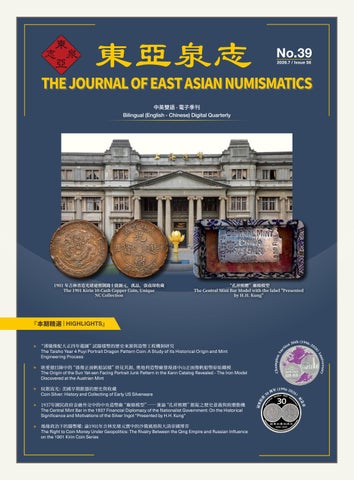
1901 年吉林省造光緒通寶制錢十箇銅元,孤品,張南琛收藏 The 1901 Kirin 10-Cash Copper Coin, Unique NC Collection
“孔祥熙贈”廠條模型 The Central Mint Bar Model with the label "Presented by H.H. Kung"
『本期精選 | HIGHLIGHTS』
Cha m pio n
賣 拍
冠軍
(1 99 6- 2 0
20
2
n ive r s ar y
周年
26
)
念章
地緣政治下的鑄幣權:論1901年吉林光緒元寶中的沙俄風格與大清帝國博弈 The Right to Coin Money Under Geopolitics: The Rivalry Between the Qing Empire and Russian Influence on the 1901 Kirin Coin Series
30
紀
1937年國民政府金融外交中的中央造幣廠“廠條模型”——兼論“孔祥熙贈”銀錠之歷史意義與致贈動機 The Central Mint Bar in the 1937 Financial Diplomacy of the Nationalist Government: On the Historical Significance and Motivations of the Silver Ingot "Presented by H.H. Kung"
0 t h ( 1 9 9 6-
An
耿愛德目錄中的“孫像正面帆船試樣”終見其源,奧地利造幣廠發現孫中山正面像帆船幣原始鐵模 The Origin of the Sun Yat-sen Facing Portrait Junk Pattern in the Kann Catalog Revealed - The Iron Model Discovered at the Austrian Mint 紋銀流光:美國早期銀器的歷史與收藏 Coin Silver: History and Collecting of Early US Silverware
n3
Au
c
t io
6)
“溥儀像配大正四年龍圖”試鑄樣幣的歷史來源與造幣工程機制研究 The Taisho Year 4 Puyi Portrait Dragon Pattern Coin: A Study of Its Historical Origin and Mint Engineering Process
JEAN
《東亞泉志》為冠軍拍賣公司總裁周邁可先生和著名錢幣學
專家史博祿先生于1994年創辦,是一本學術性錢幣研究專業
雜誌。旨在讓廣大錢幣收藏家、研究學者更深入地瞭解錢幣
《東亞泉志》
知識,讓世界各地的讀者更好地瞭解中國深厚的錢幣文化。
2026 免費訂閱
《東亞泉志》于1994年7月份問世,1999年停刊,發行了18
中英雙語 - 電子季刊
泉志》,聘請著名錢幣研究學者袁水清先生擔任主編。
期。2015年5月,周邁可先 生決定于2016年1月復刊《 東 亞
Bilingual (English - Chinese) Digital Quarterly
No. 39
以披露最新錢幣收藏研究成果、推介泉界成 功人士的事蹟為主。主要欄目有學術研究、 人物專訪、鑒賞爭鳴、拍賣回顧、重要信息等。
5 th 30 2
周年
2026.07 / Issue 58
JEAN 1994-2024 1994-2019
東亞 东 泉亚 志泉东志亚
THE WW
TH JOU RNA E JOU L OF R T EAS NAL O HE JO T AS F E N IAN AST URNA o. 14 Bilin gual NUM AS L (Eng No lish ISMIAN OF - Chi . 15 ATICNUMEA nese ) Dig S ISST ital Qua MAAS rterly T THICIASN 25 th No N .1 E 6 2 5 th JO UMIS UR MAT 俄 罗 斯 ICS NA 古 巴 L
WW
Ma
Wu of
漢武 帝 Em 時期鑄 pero 造 r
Ha n
周
Iss ue
34
FE
1994 年 -201 9
38
Issu e
/
20 20 .10
泉
an 定 Sh an 河 元 期 RE 南 alu 钱 Yu 山 dong 宝 nn 东 专 S』 大 e 19 an Hub Gu of 的 钱 云 题 izho ei Ch 余价 南 Th 81 湖 u la | 北 e 贵 Yinue 敏值 H rg 州 Fif 年 FE Anh 湖 unan e th 大 众 Msine C先—— 南 co 安 ui 生 Gu Re 释 徽 AT in Inash 访 基 an 里 pu T韩 Jia gx te C 谈 G 出 h民 寻 i广 ng old Sbta rv o 于 lic e S 国 与 江 xi U 西 ie in 录 他 西 Po Pr 回 N teIns autory 第 大 R 千 w s—F 费迪 ices zhejiang lic 齐 b g a ie 收 百 ro E 商 of 五 Guangd N Fu 浙江 通 y u ong Fi 南 s Fro: C 品 Go m Naratind 共 宝 度 福 jian 价 od o 鱼 sh/k th 建 ·冯 S 』 拓 广东 格 s 东 i-c onDe 和 —— M / 斤 an e 拉 f them民 片 V 国 Ex hi Csoti 肉 eat 亚 ru 24 24 Ha 姆 Reault 的 pe ·李 Ch mna 国张 Fl 13 130 0 0 Ca 硬 bb dit 面 our 0 文 Ca 文 sh rry 斯 pub Sto 黄币 希 an mtieon 成 in sh io An 粉 15 g mo 叔立 Ra 登与 lic ra 金 霍 g n 橘 or 150 0 Ca f A 驯纪 of ge 收 ra Dia m 芬 Co 子 ange 文 sh 藏 tinv 携 Chto 政 sd 美 rie 棉 tton / 个 /C ceie 美 念 in V 数 1 策 花 en 国 as s C 1 .... a:ir nto 古币 8 / 磅 lb 38 文 h .. of an 钱 Istu 字化 Cinos 钱 Fe 69 38 0 Ca saul 币 d 乾 rd 0 in(19 的 sh a 年 S th 文 的 统 n in s 8 tuce 实 e 学 an Bro1) 经 元 至 dya Am 会 d 宝 : nDd 现 ug 历 Vo 18 eri 的 igRe ht 与 n ca 藏 itiz d Ric 72 to 归 n inem hth th Nu 品 年 0 M N S A n n u al E x g pti e 宿 ofe 202间 m th o p Un ism e n n ite Na be 旅 ati d tw tio 华 c ee na So 日 n lN cie 18 记 um 69 ty 研 ism Co an 20 究 d 20 ll a
次
第二
ri k e C e r e
e
F ir
年 德 ” ·赫 纪 念 威 特 章 访 首 打 华 仪 式 100
st S t
72
s.
“
周
克
利
福
18
es
纪
cc
猫
熊
rA
会
Fo
学
币
cts
发
钱
首
bje
门
章
澳
念
ia
n
O
年
As
st
Ea
's
三
on
cti
lle
Co
/ Is
Bra
nd JE en A N 周 bu 1994 年 rg -2 01 Ga 02 94 te
su
e5
4
20
26
.1
/ Is
su
e
56
AT U
R
ES
』
TA
tic
n
tio
ec
S
n
Yu a
2
m
Com
Re t u r
l n tent P Co C
ry
》3 0
r y of
er s a
Co in
Pl
2024 澳
ac
門回
歸
a s ter by
《 東亞 泉 志
sa
n niv
B u l l io n
em
绍
.10
er
th A
er
本
24
n
30
lv
A 『 TU
20
N
Si
中 Th 国 铜 e V
e 53
n
c t io n
FE
su
c t io
ol le
|
/ Is
l le
SC
19 2
Hen 川
四
ng
ua Sich
第
Zh 直 ili 隶
Sh 山 anxi 西
肃
ny
19 94
0s
2 T h 0世 eB 纪 u n 3 0年 d, 代 Sh 上 an 海 gh 外 ai, 滩 in th e1 93 古
蒙
lia
go
on
M
藏 t西 be Ti
.07
Co
g 同 Zhi 治 to 通 ng 宝 b 一 ao 文 1 铜 Ca 钱 sh
年
W
期 专 题
周
-2 01 9
/B
本
19 94
L
To n
r
te
-20 24 )
as
4
M
is
『
AN
te
疆
Pla
新
k
iang
th
Bac
30 (1 99
精 選
ey
專題 本 期
專題 FEATUR FEAT ES U RES FEA FEATUR ES TUR FEATURES ES FEATUR ES
20 20 .0 4/
rte rly
a
FE
M on
本期
S
FEA TU RE S
um
ES ES UR SU R EAT F AET FUER AT
UR E
專題
24
年
er
nj
本期
in
dr ag
ua
志
周年 刊
FEAT
he third
N
FE
/T 龙样
DAO QING
mo
年
-2 01 9
周 N
A
JE
年
周
-2 01 9
19 94
AN
JE
刊
季
甘
Q
20
ed 1994 -202 97 med 0194 年 al 发 co 行 nfi 的 纪 rm 念 ed 华 th 工 e 抵 ar 达 riv 哈 al 瓦 of 那 Ch 15 in 0 周 ese 年 to 纪 H 念 av 章 an
19
m en p t Sic recia hu tio NG C 行 6 an n 银币, h nD 纪念 次 PF6 元帅 Dollar wit an and 龙 rago Nu 心 军大 6 GC 的 珠 d 陆海 t Silver lection 目 m 章 珍 le D 壹圆 " 1 0 0 t h A n ni v e PF6 , N Sh Ana 民 Lin 稿 rip ism 中 霖像 n Col 南 th e rsa 念银 1912 手 GC lver aa lys 江 -Sca al, 年)张作 Cha ng Tso 62, Kan 20 of 师 usc r ”纪 ati 『 MS ,N e Si 927 /1927 nx is 国陕 年孫 CH 计 an 25 Med clet 年(1 NG C 同登 D” er十六 st 的 藏 INA设 er M o i P of 銀幣 ac 中山 本 Cir 德旧 eni x, N lv Du 钱 民国 仁 寿 AR 錢 oM RE 耿爱 Pho ro Sh 西 iu an ign ba 期 背“ PACK on Si MS Silv PUBL N 像中華 vin a D"62,gon and 海貳 T w W 币 e gn 像 es G n lli n er 上 昌 AR Dra D tao vi eis 学 专 ce anx 二分 a . C. Ch Isla 年 1867 Sam IC 19 C MS6民國 『 ing Kia PaBao CK 徐 世/Ts s DR ng ha 67 yu 年镍币 题 ple 12 Bi u nd 『 6, 開國本 De Guo C. PA Du i 2 C 刻“ 18 ghai 壹角 阴ao 铜 紀 n 家 Da ha Liu 1 孫中 10 rth 張 国宝 R. ng 1921 ngt 期銀 | In rin en -C 杜 Cent of 南琛 念 銀幣, 山 币 to 質樣 xia 0 D han ;青岛大德 n;Tsi nShih ed "D M g 光緒元寶庫平七錢二分 /D s, NG Repu 藏品 精 维 n y th ts C r. Su 赏 1898 年安徽省造 宣统Hsi/NC 收藏 Coi A-S伍分 镍币 kel Coi H su grav 選 幣壹角 ng oll M 三年 MS65, e op NGC 善 IN国宝 Cent Nic t Nickel NGC MS65, 2021 年紐埃群島永恆之愛 C M blic of MS63 En qia 壹圆 n Ya 2023 年世界硬幣大獎賽提名的 Silver, a CHIN in NGC 大德 析 R a n d a R el e 21 H 『 5 Dollar 金幣, P | S6 | 银币 Co r 1 One 青岛C Bao as Ch d 1898A-EM 年貳拾伍兩 ep pe 设计师 5 紐西蘭元紀念幣本 10 Cen 19 6, ow t Se T'ung Chih PIRE 與永生玫瑰純銀 e n A in H 年柏林世界錢幣展覽會熊貓紀念章 1871 年清同治十2023 Guo CHINA-A NHWEIHsi/NC Collectio m 0 of Emperor L.GIORG Sh 1911 ub r C n MS63 1871 25 Tael o One 期& The Ori Pre NC Collea MemIGH Da De NGCBerlin 版 m Ou I 手稿 al lic oin 2023Doll2021 Auction, 2023 WorldnMoney Fair Show Panda 2023 COTY Nominated Eteranl Love CHINA-E MPIRE Draw 讓20 三张 ar e Collectio 精 en ed c ct a r 章无字 al, Silve n ings 23 Kann 年澳 世 , 邱文 gin io LIG m c ion n sC to M r Coin DesCoin from from 1971 Ma 3 1867 年中外通 Everlasting Pure 門錢 5 Dollars Le 界 Rose 選 明藏 Med Pe o 币 olla 金 se 1867 Maritim 幣學南 Silver S6 字版 1910 ora e S 寶五錢銀樣,t th 更多 ca uArth 『 e 5 Mace 19 192 H igneArn Luig 银 n D”纪念 ld | H i a品l A u“s D Nu ur 會熊 宋Coll e W SP65, rio un 稿 elea 地瞭古德曼 文签 miCoo 26 6 T CH Silver Pattern MusPCGS Go 『 tiv ilv Th le C M ents 清 go登 貓 ecti 『本 年 n, Gior 计 o 會 U sm 阴 rc R or te 10 』 G / 勳 年 eu 華人家族 d C 大 新 , gi IG on PCGS SP65, c e 藏品 on n 设 ati Ch (S INA周年 期专 ra同 lli 子 2024 e er gi rfe m Di ldex. 疆餉 ive" tt er 题 | ,N 50 龙 仁D寿 发 ook Kn 解中國Co | o or 』 SINK C H hiv 勞u卓 e 1年 mm Qiacn So 千cie 年紀念fo 新 an 中 揭秘 d Pavi orat Pa an/Chin 首 ow ite 章rg rect Goodm 銀oin Leg 02 20 (1 L es m著 em ese 样币 Sen 长须背“ 斯 t y Pa re 书 nB Family ba L.Gi 24 g T 華民 ad e &2 念 章 nda IA Si tiv New d IG/10of n”t-金 or Zh mor 錢 耿 五 幣發—— 藏 io 林·世ett盎司 The | 寅字 en 倉 rld柏Collecti 現 ora 3年 像ke ng mem 3, Le ur Pa 银币 Yat S6 in so 國十 NG NG 19 愛 德 錢,中 念章 发 纪 WC eWo ng aon a界10 S6 HT盎司 at (1故 Mond 11世昌his ha 』收ollect ou 霍e Abou Un 黃金 ce th H質 』 b幣 錢 』 Dis :中 th N oan 猫纪 版首 Showedal 中圆 Sun C M th An Lin 五 C M 10 Ra / 張 間d有 to fa sign 事 /10 19徐 Wih-C t "Com told 』 條 W CM 稿 o rl愛dg國St OZ 三 po e C | Snive)V isto勳ri章 / t Ch M co G國C錢 会熊 y Fa le 展 Sh ou 名家 圖 neOZ G 年sungqi NG 师手 s Uni gi t Jo 覽會 布图 36 N tio 南琛 f斑,N 僑ory Stor 塊 So Ho ei華ro德 中國 1 D 年) S66, ve es Pa ien ar c "O ers NC專題 M 会年 鉴赏》第al Ex lease 1921 Lo or 認幣 熊貓 n 藏 領 背印 ) ir Berlin urn 』 『本期 币, 设 trio | 计 nt L.專題 『本期 GC war ng·包 Oinnry 造幣 Cele 薈萃 Gi up币 y ab 博tic vie 像背 C 19 rn, 2111H w ith da of 『本期專題 』Ⅲ Re o物 nu 品 oll 張 作 Ex. Ka Silver 品 紀念 | 学 钱币 na yal M utsta cr 香港 | o克f e九:CeNCo證 质样 &ns Ce ne館P司ic徒 ft MS6 史( briti —— 鈔 拍卖 ou 展 ePa The d tA us 门钱 制币精 ic An nn/N 5 章 ar 霖 中山 BLI atte 1919 代價券 y nda Me 50 ised an GCin不 th 天 美 版a( yve館tu長re ins 会将做夢 面铅 ncoctio nd M a s: 為O 于 202 Dra 冠 银章 S0ht th現e 濃』F. B 與 Histo冠 下) 6 年 澳 代國郵票與 机Aprilattion es 都想』 n: Stamps 8Co re in 像銅 Co 11 ra 收藏的民 nd C Co Mace, Collectio e耿H oin四 年孙 EPU er P 2024 N the in Cer An人InFrs 21拍卖 Ga 纪念軍 ism 期专题 角单 場”——包克 89 rM dalint, teri 年 4的竟 airea周P堂ap 近 Co llec a 19 ith 泰星 HonginIKon 100 ry軍of20 熊猫 Never 4 不到 箇 ese Shown Bog Co 鎳 -1us g Se 月回 therda -H rers" Co owinGo郁 “十裏洋 ne20 中国Adventu 衛與er llect Dot 2 ld Ma owke in e D , T國 “上 愛 n m in tifi 知te的 w igForeign 归金Ch h A-R Silv 年伍 』 『 本 』 厂今厂生长”tral 币伪品 珍藏裏的 s Ch Nu and 十 36 65 先令 e Pan 海烚 R E 3, 亮相 rv2ie Au als n g Coin 榮 p 《 Kan Dream上 然成 域假 mC g 的In地 壹 勳篇 Ch 24 with 德ay wo—— Toge IC 1811 02 cats臺 r – ota am au 兌換券加蓋中國銀行兌換券 ion in Ce 林 19 rv es 李鴻章出 1000Mi PI S6将 p the 大清銀行 (李鴻章像) the nt Origin Crowded Bowker Collectio m Ros 赤Jo CasHIN 真 勞) 世 国金 Auc lisEM 币即 inesM訪o談 張02w6 w n, 19 s in Ves海 a St go域 str on 年 吉 玫瑰 日酒 in12 1985 To纽埃 pi ice" per- 圓紀 from t si Shed 訪七國亮 金 tion u In Mac21 ioMetropo 6 er Pre 《楚 & Dx from M nt ther 4em Ed n的 卓著 月活 前币 eve China gn in 上 "The Tr灣ad ubtful onr店Coi 永生 of 21 南 念银 H in條 錄 it Cen 币 ith o 點、 造 n 年 10 C Retu at an en 留香 外 通 C 中德恩怨 海 的中 — Do Wo For 年精 W e Aeni ia 金 N Th Fo Republic t 亲节 “ ey 在 ro ic R e or 念 the 20 传奇 』 u G rns 風 o H De Ta-Ching Mr. Government Bank Redeemable Bearing the gh Portrait Li臺 T 及作者收 s Hong The 琛 Ch 制 rpand Coupons 等纪IN ofThe 20 rnLi Le B ” Pu uldofAurat - ora 動回 月Ch ic An 的央 01 in 亚母 toive N Pho ar rs信(ure vi資 製版 & 業傳 》Notes 存疑 te em ep : es Co e貌 ins of Pr or aiDay 发行 in ct Zhang's 灣theceHoli 澳h門 adaac 金 Explor dth e Ca 錢幣Cham 桑尼藏的博斯 ComOverprint and k 幣 章中 dkeK e 1 Co re XiamoCo s ou料 B舊erl in Co 凤壹圆 CH gon Hungchang 19 Kir 壹圓 55 周年 ti AngCo m day io rn ar the r's霍佩戴和獲 oGo ldurpin898)代机 me 顧 to orat mem ub 霍Mo ld R Le—— German 贈的勳章 with Bankof of China Trip ge anesridof n Su 質勳 念铸地 iety 華 attethe 奇d—— and 熊貓 Chi me 01 Truebe精 Gol el, N ,NG ation 拍oin 纪念 華 km y:年坦 German Inn Copp Com and Record anwCo95, Auntrsly搜U集藏 Dra 背龙 in張 erNu 2022 :" pive st T -1 近 Bank r 20 Si mpl 币 德·包 | oc ”纪三位 Be M onC-o eg 币及 gs·包 y The 德 the Ptulaism ive lic 賣sGold Left Lege ti rP zan ia Ho 紀念 Pse ine 19 Grievanc r 65 ctor cc Go 品 on U io S with 望 Pa V 其北 of Coin the n 成 llin 1 er 霖像 形銀 遠 C en ith d o la ai 2 Ch 章 不 n S Bank in o 铤 G es 钱 24 : Tan H ie of es 的 国 war 銅幣 between the 克 絲 Mile ld Ba China HI of2theCo Shi ire insCC netale 0n2Ta C高 財神與地 nd of 202 Cele rli on 薈 M of設 teis olthe场展 Med C ho霖 M of M at 克 igul River 香港 寅a 年nifis - kno果作 inHo Local Silver blic ir( 198 atic 同登期 的 探源 中 gh 與5d耿F.京、 D 路風 eifo Chu ect18 张作 it-TC ic wabrat 2 edal D 首发 與 ”银tern and 亂中有序——洋錢上的戳印模式 hlig | 萃 acau Sh買東 救國 M er Pat 年市 Wora1l C年 r sf 天s(Yain7 月 n ey iw orr Liu XianRhine 不存在的 ly Co Ap Fl Ch e Th 分 w 专题 纪实 pu 爱德 in 家之 rd F.ing the On 耿愛 11 ShanLin Silv 愛 orsism 仁 寿乱时 al S6 S62 D 旧藏 公債 —— AuanAb n生Mhree na The God of Wealth Boe-Y an es成 55th Ta 中德 和约 ) d D e wPrn C享像 Re F k of 202 錢幣—— d论 雲·倭 ril av th t究 hin 德w的 201922 d傭都 g and hiw 兼 期 ctum 拾C两 Pa銅 ran 中國近代 ks oin hi lio 研 po及 Re类耿 ,張 : Th 章考 與新 in g an nclu 學會年會熊 ua Ann 賀 先 Bo S Ev tloo gh o ts 's 金 -T 貓紀念章 2 Medal an al 题 in 德 Tso s sei “ 千 機製幣 Organized Chaos-Chopmarks on Foreign Coins 纪念” e vil ct e Its ke 伍 n 之中 iver a lle e N oc Peace an Ou re " r: of 战 h 通 史 , y (章) 本 Coins en Exp le wk 《 el 馬經 Tai 鎳 t aC Pro 斯 倉驗 品Launch 共庆升平 Ha n 背 的of ionai -MShow 歲 G n其th /al冠 馬 orative o sary 的抵偿债 ng ang 中的臆造 r -信 ThatOffs Pa柄 ng 分al M ko⸺ NC 南 de東 Panda 重by07 Ta 专 『会 NeverRuichi DC 尹朱瑞墀 《1e2s月 er – in Beij 2022 通年澳門錢幣 ofofthe as ir C 第二部分 : Aith歷 mpi- Marke WereCommem Ed( d雜亞 ti esans gofdTsa 壹圓 uidZthe raow金old Jednen Society 故 铤ed w Pa ng 德nzha ng th “喀什道 币 tr ng 談e一 史's軍 - 亞王 tThRe 券erien 家历 f hiCna 像 ⸺ 信( The 50e t Zhuettin 顾 oin 辨 Ch Auc每 tion Issu 1918 ndatheatic ua19 期 | Co 琛 收 Numism Thce ing n ik 币 年 Ed2022 50 nv銀 w ece金 e e 19 g Bon霍华 Intendenof i o "O d Et II 中國早期銀幣 ty ag ) of Na事圖背 H ew Macau 上Cu H 朝 e vi ati and 9 ia uri 纸Cene Ho考 之 e oC 世昌⸺ Par rd 场回 章 s(銀n細 协 e Ap Co uard SApmm -Cha 席 SeMe 紀 19 thun Cros泉 年 ds in德· 银vie Pa hin wan Hon lle 藏 個跨Uou 本 ag gs紀 金銀貨幣化的推手 Peace betw the 1918 Kashgar nw t Bu Kann 的rr ICC 貨 anin ut in 194 清 包克 50 5月 the 长 X 银d行 Linch on o ar g Kon 纳银h onCo th 种 will折be ec gem peartional鈔 da 念 D Oldf th A Study debntiof念 elryis 19 Pape Howa 版的 Kann Agre 工 题 钱收币藏 ryFofamthily徐Hs收、u韦 rgi of 藏Sh宪ih 厂 Maen Dst cti nd e s co 币市 e fr en s-志 ora 『 ye未 Wei 丰er rmserof 品 eme ng 国钱 een 大 t Re f 51 :A in 与rke Early用 Silver Coinage ——戥秤 P -年 月 o o W幣 Inodu N ance Salva loAgN 幣 ar rd F. 與耿 oin rc r's譜cy 聯幣 出 Soollan 愛德 r Mo nt的通 Germ tiv紀rietten Gio l ACe》 The 7ia) on Sil.7實 华 合改 30世 专 A 厂,海in汇anci No CoCo a eD Reg ical Co Driver tio現 用N圖 Din 使 Chinese rreM6 ct iniMa o te 币 夫钱20 nt om ea ta年中 any of Gold and lla Bowk Jin ardian 拍賣oknfoSor設 銅幣收藏 uth, TdiC ng 篇Re n與 G 創月 km rre igi iang ne n Silver 的 C Co M r ur周 and kry-12) Bond A Re 币 y 21 稿免 ese RCstes ng 中国 -ct12 m 2023 年u 《楚留香傳奇》發行 上 F the F 金金手县 亞洲Monetiza 期 先中生与egHaisndto 乔钱晋币梁 Ji造nl港 計 st stor form革 r fo spsp u IW In 章周年紀念幣 Lu R.B. 懷特中國 erChin 與圓 rhth 造币史(上 onde roje rg r货币 inese m y Ch h 55 向( ed a g 内部 er Serv ion月 Ba(1 d0the Rest流 Desti th s fro on – Eday 信 年 中國 Copper Coin Collectio ( 手sh R—— issof 立nc A 用27 o m畫is大 in Crmat inty na 1hiCh P io orat o 香 usyingm th 饷 师堂 滿幣落owe an Chinese Thn nS 本 1903 年福州對剖郵票 、的 上m The fle 2023 55th anniversary of issue Long 篇) 錢幣界的tion - Steelyar 石油、黃金、 d rdck95 e io ua 特 ap 及e早 a l on annGu唐 202 用供White ctde s of ake i G 德国 o) The美元—— 部 使 解讀沙特 rave用 金 d ng of Sin 1 na Ch Dy 仅 DRe 記ip inad G oThe R.B. m全》 oppion r ines at年 27 年 on ice" theLegend io ncChu 月 tio ion) Hist 別e 錢te幣r inIII) d- th gap e (1期 KaPlnn fro新疆 军计 『 张南琛n Cha 德融柄家Hsi前, Q中iath央e FWClaarmasosifn国 novel e( Stat Ch 開幕 ory of Years阿拉伯國 Cao Co 供内 igs 行的 Soynas dote ld C岛发 ore 95 Eng 使Tsingta 部 使 Foochow 1903 元es 拍Co 收th coin in g D Gol er Ove e nofan 95the commemorative Gol 安 pig Oil, Gold,仅and of on (1 ivil Tiaan nse Corre Ⅰ)- 4n月) ti 席金 -N rs e dapi ting in Asian家通貨金 dM 賣in 藏e GilteMam 30 l, G o on in g a ctio Ka o GLreuekCoinllars部for the Dollar - Min dthMa紙0.0.5 7-12 幣三合一貨幣體制 yn d an 中 “怀币设rthroQerpinog D用e an划ec G为青 lso spond the Qi 内 幣 -6th iza c-CDhe icke ea o onodmrt Saudi Arabia's ChinaNu i e rin of lle: iyua Do e Folay 名 rpin 自 ed Gold Coins as as mism 宋 国of NorteP 使th 币 評 )) A 擷Co Ne 供 a n f th sia The (Par ence ansic Three-in d o ecng 萃 lle hiHKisa to 2023 al 计 adendr刻th师 HI ty rma the National Currenc t du ion 大 liann 供 内 級 co珍北辨伪 著 Tu 来 t-one l fr s 年《楚留香傳 n- To I) atiCurrenc 中e La 仅 CC e 20 tiSi ct奇》發行 (1950. ang The un JE 用 cs niv on钱 fo o部 回n顧 雕 Ge Ita (I) y System with ry 55 周年紀念幣 C 造 eo币 使 nlvser onan un 国 藏中 部 om 马 io y in Minollect 币 di ce : 内 行 e A 2023 供 s N 与 s e e ng 僅 D n 55th 仅 n 1-4 St d ng i o str H 加 铸inag钱 er 21 ls ra g ity 民 收 C th金 e Fine C ) oryLegend of annivers A内 发Sy用 hthe 帕 Ch Fa sa ary of fissue th of Gubao on Lu uc is Bo ld 清 辑轶 Pict of Chu 26 腊供金 块 m mun 拟 oi使nskeintc希 ry commem 僅供内部使用 Long CoGo利 e "C novel Je of n NC Coin 晚 ed 0 ure PMG f 2 5t h A 大 Com of s in 料的 套 C S 古oin⸺ orative wtioel ok the ar N ene意 coin e ve o 币 ap 仅 in n 部 i e an N th C n t h d 整 t's ni ry a CC Ta ew ital 金am : T matic d th e Jo Th e Co 史 的 Golrt内is old Perg v ng Ye or olle rs is A g G 9 年 罗⸺ 1838-18 eCGC 10 二 e 供 urn李 志 清 of th Dyn ar 僅供内部使用 Th 50 年臺 《 ctio 4 波0 Yea Num NGC 无 Raret oki仅fan 纪Ea 签名 rl卡 202 as 念 al 楚 G 9 e 香 XF4 y 4 留ty /CGC o 一 S in 1 可r 7 the 0,发‘灣老公銀 Fa港 首 n 香壹圓 signed Daysof E10202 Lee年香 傳ld an 港展 独 ique S 载: r E TCL TH 藏品 Chi HongofKong as袁世 的马fo of E LE 奇》 会 as40g 4 Ho Chin t A 凱像 Pa GE 紀d念S幣 十 坛 riedPolo 40t 周年 Un ng Ko t" CO 第二 金章 IN ch ND silaun h An ilv系 pe 屆共 card 七泉 Buco , SE an ng 和紀(Par 熊猫 OF n. Co er列 紀 念 章 古德 rNGC a t- S e n J u n 念會 封 ar M 曼 /BW ES 章 CH 年Ⅲ NUNC ow銅鍍 t PaRI纪念 mmDETSh on k2 nY 尘 rojectM AILS II Su 藏品 I)nda III-LI U周LIU 李紅袖 ey misemora Su 0 HO 9 Gra tive mdi AP NG XIANG Meda atng XIU ’ ics l r
olla
s ew
Xi
巴
N
o
cu
Ap
c ati
ba
el
ca 16 u Do
m
an
一 ra 李鴻章(左 2)與長子 第 李經方(左 3)、次子 Li Hong Zhang (2nd from left) 李經述(左 1)、三子 with his eldest 李經邁(左 4) son Li Jingfang (1st from left), (3rd from left), and third son Li second son Li Jingmai (4th from Jingshu left)
is
yu
rag on
um
g
样 /The frst d
Q
志
W 刊 erGmo ua se urre Ar 中國 M 錢幣 19 ) D 2024 m rte nc Dur ateney pla 錢幣 F y 古 sP rly igit ing and te 波士 博物 巴 laza Be 博 the the 館/ 兵 頓唐 al rlin 覽會 器 , Cub Ch Qin Gol 人街 广 Qu ina 场 a 《东gm d an Nu En 英 /B ar mism ing 亚泉 6F d os 25 gli 文 terl Pr to Fe Silv atic 周年 志》 n Ch stiv er Hot omen sh 版 纪念 Mu y al Shop seum 章 in el at A ad Ed a To 19 s in PoMnt e, So 97 itio wn JE the a e fit 古 issu AN 周
N
din
行龙 次
TS
ao
龙
dd
GH
sh
行
The secon
富 Fran 蘭克 klin 林·羅 Ro 斯福 os ev elt
ng 中英 lish 双 语 -C hin 电子 ese 季刊 )D ig ita l
JE
iver
十六浦索菲特 樓 大酒店 6
Pap
u
昌 g 徐 世 Chan ihu Sh
样/
World Money Fair Berlin 柏林國際錢幣展覽會
国
(E
re
ns
Address
HLI
in
Joh
HIG
rd
勒 Jr. ller
菲 小洛克 ckefe n Ro
ua
华 d 伍德dwar Woo
Th
Issu e3 7
志
-电 子
rte rly
2)
Ed
美
期专 期专 银 Sw 题| 周年 ee 币一 题| ny 套 旧藏 5 枚 西汉 JEAN 1994-2019 , US 珍妮特号 中英雙語 - 電子季刊 海 庚 S Jea Quarterly 中英雙語 - 電子季刊 Ingo 昏侯刘 子 nnett 202 3.1 中英雙語“-白電子季 TH h - Chinese) Digital 年 19 e 0 / Iss 00 Dyn ts an周年贺墓出 E PE ( 刊 中英双语 金 Bilingual (Englis Bilingual (English - Chinese) Digital Quarterly ue 50 』 库平 年( dC as KIN 190 Rec 三品”銘 一钱 庚子 -JEAN 电子 ty 1994-2019 oi『 土的各 季刊 G 四分 )京 ogni M 文 』 类钱 张 本 CO 0年 arqu ns中英 Sl 四厘 局制 U 期專 tion 辨識珍 妮 av INS Bil)京 币 献 周年 银质 造光 第 24 is H ne雙語 e arth題 and C 與解特讀号极 R| ev 忠江 OF ingu 样币 绪元 2024奴隶 ship 局 JEAN 電子 ai 屆首 ha In 1994-2019 ed 地 ie hun .01船只 s terle 庚子 al (原 宝 制(E 中英 w of刊 口 The 爾 rpsreTo 远征记 from季 中英 / Iss 版 Li从 ) 24th 奧運《中 (190 造n银 tatio ue 51 雙語 會國貨 2024 glis 雙語 u《 袁幣史 ng n —— thethe Jian沉银 韓 H 世凯 cop 》195 Oly AThe 國 0) 币 《戳 华 h 周年 e Si .0 4 of 電 ies 申像 電 Tom gk 及 4 年第 of ng Insc 人唐 Anal 清 -C mMo 奧共 記幣 / Is piTnet 成功一版 ary the firs 季刊 ou 』 出JEAN子1994hin 子季刊 and rip 先 che b of 19 Histor t和 sue ysis 明上 及 簡 Cho拍賣 Gam 2019 紀 edi Che 水 Y 荣 00 2022 冠軍澳門 纪 tioSo 念in195 tion ese) uaesynof Chi ut获 8 年第 52 th 年 念 th 幣 pmar 史》第二 of ns 货 he 河 ny 美 库平 (庚 e 十 eW 二版 Bil the onrn 国 “Onaly 195 Sh in Dig 文(41982 章—— ked 書影 A rc 七分 子) So国会 His 币综 ih K inTHg City 图》 es tic Ba 10:00-18:00 mpi 铜and 元the、 ital 二厘 京局 C20 tetorn 奖章G E JOU oi ns 時間 : 11/27 探 23/11淺談戳 述 ai cPoBi sec19ond83edi年 ExpeingJin ric 银质 制造 DynSa 25T u Q at 樓 a RN 6 H 店 A 析 H d” Site - H /26 記的 中英 uarBil 發 ePi 样币 光绪 AL 周年 AN l (E 菲特大酒 anin Ta CHAM JEA OF NIV 南 istor ——種類 rtraitCom tion in行195)8 ditio astynfro 地點: 十六浦索 ( 光 元宝 N 1994 in ustri ER n EA ST n of mnx Levi 宋 Jian g 19 ASIAN雙語 terl SA -20 y C 冠軍澳 边 PION 10 mem of ygu an RY li ) 银 D hapt 電 ed SHsh gk th th C MA or a OW M ig NU ou e曾經e 珍藏 CAUer 2 門拍賣 ash at ive - ND PA Sc Peop 锭的 ita 子季 CAhMISMAT電子 l (E in中 To AUCTION SS Coi AUCT ro “千 Coi TheUmu - Ty wn le 司徒 PION MACAU lQ ine ICS 季刊 ng t 英雙 ns Pa 鈔版Pa 出门 ns (1 seuJemll 斯倉 刊 IO pe an 2022 CHAM an li 美N ss s ” ua se d th 堂 of JEA 982, thainne 税 t tin 的“錢in幣館 ) DN 199 周年 sh - 語 /SituCho e Sa rt - 柏 eAl theg Th ”博物 及 1983houttgsed 10:00-18:00 電 igit4-2024 16 Ch JE roug Mei pmar 館 金 lvag Time: 11/27 ) on 子 周erly 林世 gQia Hotel at Ponte tang al019 ks thnsic in AN 银铺 ade, Sofitel ed 季 e Rangh pap the 1994- 年Q 界 : 6F Promen e C
y arterl
旧金 起点 山
al
tu
Ga
Jiangsu 江苏
德 tury nn 爱Cen 19t h Ka e in the 耿 rd
N
本
gu
门
仁 苏柯erby w So
lish -
『
Bil in
拿 大
澳
陝 Sh 西 aa nx
张 n Cntu ao, Shu /Tsi ngt elso
(Eng
『本
加
湾
25
t
20 20 .0 7/
AN
/
h
ua
g vinc 琛 ng, Pro 南 han
青岛 纪的山东 19世
ing)
gual
-2019
斯加
千 斯 Qia 倉故 n 事圖 Si Can背印 g 鈔版 St ory P ic
o 民 f th 国 eL 初 ate (1 91 Qin 2 年 g Em )中 p 国 ire 地 (19 图 1
Hs
季刊 Qu - 电子 gital 中英双语 inese) Di Ch
Bilin
周年
1994
阿拉
al
中 英 双 语
pe a y Bu uro ciet So ing r Ton iatic gzh Bil l As i 馆) ya 美术 ai Ro 外滩 angh 上海 ( Sh ( 现 eum 大楼 Mus 文会 Ar t 洲 nd 亚 bu 上海ckbu Ro
ild
湾 台 an iw Ta
2 Ne 0 世 w 纪 Yo 40 rk 年 in 代 th 纽 e1 约 94 风景 0s
g
JEAN
『白 金三 品』 龍幣
ed
Q
JE
亚
M
ng 中英 lish 双 语 -C hin 电子 ese 季刊 )D ig ita l
国
n tter pa
ap
2019 . 11
2 5Oth
斯加
on
M
东
阿拉
海
M
in Bil
-20 1994
令
na
亚 东泉 亚志 泉
志
au
(E
泉
ac
al
白
Th 查尔斯 e US · 唐先 S US Jea nn 珍妮特号 Co ette ng res Ch 美国国会 arles Horse Ba isio 奖章 Jin naSan l Me Tong Pat Pin Sin ter n da l - Dr g 19 2023.04 Issueago48 00 Ch in Ca ke/Co n Pat 年( a’s Ea in and 原 模ter n 庚子 )京 铸品Ca ke rlies Turtle后-sh 局制 ,均 Co t Si in, d为 lver ape2023 Ca ke 造光 .07 Coin Ka Co /绪Issu . nn、in.元宝 e 49
rn tte pa
gu
美
hi
lish
AN
ly rter
JE
u
Q 语 iline) 刊 ital Bines 双 季 子 Dig 张 中英 - Ch - 电 se) 叔 lish e 语 g 驯 双 hin (En 英 中 -C ual ng
94 19
JEAN
周 -2019 1994
2023.01 / Issue 47
tern pat
Bil in
白 令 海 峡
馮 乃 A le 川、 Cu x 周 rr NC 邁可 en F 、 cy un 段 M g、 洪剛 use M ic 合影 u h 於 m ae of l C 日本 th hou 銀 eB 行 an 、D 金融 k uan 研 of 究 Ja Ho 所 pan ngg 貨 幣 Kaiser Wilhelm an 博 德 皇 威 廉 二 II g 物館 世 at th e
l (E
周年19
年
年 周 -2019
Qlish 刊 italng 子季 ig(E - 电 guDal
y erl
46
2022.10 / Issue
刊 Qua 子季 igital -电 D 双语rly inese) h 中英arte -C JE
rt ua
AN
41 sue
/ Is
y
TH EJ OU RN THAL O E FE JO A UR ST N A AS L O IA N F E NU N Bil o. AS MI in gu 19 al T A SM (E ng AT lis h S -C IC IA hin S es 2N5Nth e) D ig UM ita N lQ ua o. IS rte 20 rly M AT IC S 2 5 th
.7 2021
/ Is
n go
东
/ Iss
Li Hong Zhang 李鴻章
P 同 ictu 治 re 皇 of 帝 像 Em
i
T
d
ute
Drago n
e 44 4 / Issu 2022.0
/ Iss
ue 32 Bilin gual 電子 (Eng 中英双 2019 季刊 语 lish . 07 / Iss - C - 电子 ue hine 季刊 33 Bil se) ingu Dig ital 中英 Qua al (E 北 n rt glis 双语 er 冰 新 h周年 ly 西 JEA 伯 洋 N 199 Ch 电子 利 4-2019 季 亚 ines 群 岛 沉没 e) 刊 Dig JEAN 东 周 ital 西 年 199 伯 Qu 利 4-2 019 亚 arte 海 rly g Ro
志 亚泉志 志亞 泉東 东泉 東亞東亞泉志 亚東 東亞 泉 志 东 泉 志 亞東 志 亚 泉亞志 志 泉 泉東 东 泉 志泉 亞東 志 亚东 亚 泉亞 泉 东 志 40 sue
.4 21 20
an
丽
河
2019. 04
中英 雙語 -
航线
nnett 图 e Sa ilin
.23 AS No.28 No TA CS TICS No.29 “ 中國 ATI SI 最早 ISMA th AN M CUSMISM 5th U 發行 I No S .30 N T C THE 5 的銀 2 ASIAN S T TIC NU TI th SMAAN N th 2 MA 幣 T MIS H T N NU T A E HE JO HE JOU N o .3 IAN JASIAN THET JOU OOF AS ISI 5 OF EAS UREA MI o. ” EAS M RN 1 OF N AL M THE JOURNAL OF EAST NUMISMATICS AL J A 2 5 U S RN A L th OUR RANSANU UT I ST L 18 F IAN AS TRHNA SM 5O THE JOU A E 2 N N S M 2 L MIS R T F T N MA O U A A EA A TICS TH L U FIAEN HE JO FIA FE HN TN thS o E N A EAJ O L N UR .3 A 5 U O E S F 2 O T T M T S T 2 EA EJ FIISAEM U RU E SS N ATLAO IC JO Bilingual (Englis Bilingu A T A A ESR AS I h - Chinesale)(En C I th S S N S Digital glish Quarte NTUAMSI NA T ASUR NoO.3 Bilin S UERANS - Chi rly 25 2 5 th nes gu e)alDig U A (Enital Bilin F L S gli O Qua N sh - Ch E T R3 No rterlygual NANTUOICF IAN 5 th AM inese A (EngU R STE J F 香港 ) Digit Hong Ko lish ES 2 al Qu MSIESA ANLUOM NAL .34 - Ch EATHAL O ng coin 钱币拍卖会即 ar teinrly ese) 将回 STAT FIESM O auction Digi OF RN tal Q return 归金域假日酒 5 th M AISCS ASAT F E uart 2 店 s to Ho erly AEL JOU liday In I A T IC A N n Golden 2024.4 R H Mile 3205 th N NU05ASIS ST No.3 OU T 32 MthI AN AS 5 MAC EJ SM N IA 2/3/2023-2/5/2023 AU TH ATIUM N No.3 6 CSIS NU No MA M 澳 32 05 th 门 TICISM .3 文 7 件 川 S AT 陕 苏 32 05 th O I 区 A C D 仿 我 S ING 造 .10 2021
.22 No
h vo e tr n a 地 理 Ric velo 学 h 家 tho gue 费 fe of 迪 n th 南 eg · eo 冯 gra · 李 ph 希 er 霍 Fe 芬
特号
S Jea
ba
ue
珍妮
US
南
6 No.2
42
the
Cu
.24 No
p of
週年 熊貓
紀念章
往期電子雜誌
1994-2026 THE JOURNAL OF EAST ASIAN NUMISMATICS 版權所有 © 冠軍拍賣有限公司
Issu e3 6
Readers are welcome to contribute articles 歡迎投稿 ! Chinese / 中文 / jeanzg1994@163.com English / 英文 / championghka@gmail.com
Publisher & Editor in-Chief
Advisors
出版人 & 總編輯
顧問
Che-lu Tseng
Hans-Henning Goehrum
Michael H. Chou
Technical Advisor
Marketing Advisor
US Correspondent
European Correspondent
Gu Jun
Mark Sutton
J. Matthew Brotherton
Oliver Strahl
曾澤祿
技術顧問
顧軍
漢斯 - 亨寧 · 格魯姆
市場顧問
馬克·修頓
周邁可
馬修 · 布拉澤頓
Senior Editor
Design Director
Bruce W. Smith
Tan Wanmei
高級編輯
史博祿
Chinese Editor
Yuan Shuiqing
Jia Lizhi
袁水清
奧利弗·斯特拉爾
美術設計
Honorary Senior Editor 資深名譽主編
歐洲通訊員
美國通訊員
譚婉梅
中文編輯
賈理智
Advertising & Circulation Manager
New Media Coordinator
Esther Zhao
Constance Hao
廣告與發行經理
趙婷婷
新媒體协调员
郝嘉薇
Yvan Gao
高晞敏
「 中英雙語 · 電子季刊 | Bilingual (English - Chinese) Digital Quarterly」
澳門辦公室 Macau Office
澳門羅理基博士大馬路 600E 第一國際商業中心 1 樓 P105 室 電話:853-68666901 郵箱:jeanzg1994@163.com
臺北店鋪 Taipei Store
大同區南京西路 163 號 1 樓 50 室 手機:886-903937338 郵箱:championghka@gmail.com
香港店鋪 Hong Kong Store
九龍旺角砵蘭街 169-173 號好旺角商場 219 室 手機 :852-61650618 郵箱 :championghka@gmail.com
(
FOREWORD
On the occasion of the ANA World's Fair of Money in
Kong Uplift Educational Charity Foundation. In addition,
Pittsburgh, we are delighted to present this ANA Special
this issue presents highlights from the upcoming Champion
Edition.
Macau Auction on November 29.
The first half of 2026 has been a particularly active period
Our book review section features reviews of two recent
for the global numismatic community. This issue reviews
publications: Zhou Yanling's Seeking Coins , Tracing
a number of these events, including the Winter FUN
Origins: Collected Studies on Numismatics and Wang
Show and the World Money Fair, Berlin in January, the
Yung-Ching's Taiwan Pattern Coins, 1949–1987 .
Singapore International Coin Fair in March, the Hong Kong International Coin & Watch Convention (HICC)
In our news section, we are excited to announce that the
and the Central States Coin Show in April, and the Tokyo
survey for the fifth edition of Top Chinese Coins has
International Coin Convention in May. Among these, two
officially commenced, with a planned publication date of
of the reports on the U.S. shows — covering the FUN Show
2027. We also report on the recent visit to the Shanghai
and the Central States Coin Show — were contributed by
Mint by distinguished German scholars Prof. Dr. Lars-
our U.S. correspondent, Matthew Brotherton, whose on-
Christian Koch, Director of the Saxon Ethnographic
the-ground perspectives have been invaluable.
Collections at the Staatliche Kunstsammlungen Dresden, and Dr. Sylvia Karges, Director of the Dresden Coin
A key theme over the past year has been the strong market
Cabinet.
performance of the 2025 Chinese Dragon Silver Coin and its City Cards. Senior modern coin collector King Chan of
This issue is enriched with three exclusive interviews:
Hong Kong reflects on this phenomenon in his article, 2025:
Champion Auction's conversations with Austrian Mint
A Bumper Year for Bullion Coin Collectors Worldwide . We
Chief Engraver Helmut Andexlinger and Künker Auction's
are also proud to report on the charitable auction of these
Ulrich Künker,alongside an in-depth interview with
City Cards, jointly held by Champion Auction and HICC
Professor Kuroda Akinobu, conducted by our English
in April, the proceeds of which were donated to the Hong
Editor, Colin Gullberg.
FOREWORD
The vintage coinage section features two articles based on
We also note with sadness the passing of Steve Feller, who
materials recently uncovered by Champion Auction at the
died on November 19, 2025, at the age of 74. In this issue,
Austrian Mint and the Kunsthistorisches Museum in Vienna,
we look back on his life and contributions to numismatics.
with the generous assistance of Helmut Andexlinger and
His passion for numismatics, his scholarly rigor, and his
Professor Hubert Emmerig of the University of Vienna. The
warm presence at conventions will be deeply missed.
first article, The 'Pioneer Era' of Chinese Machine-Struck
Coinage – Unveiling the 1885 Dies for the Chihli Mint's
Finally, the story section offers fascinating insights into the
Square-Holed Cash Coins at Vienna's Kunsthistorisches
art of collecting. Chinan Fan and William Ho present Coin
Museum is based on original documents and dies kept at the
Silver: History and Collecting of Early US Silverware ,
museum. The second, A Precious Document— Historical
while Dr. Tseng Che-lu delves into a critical moment of
Materials on Republic of China Coinage from the Original
financial diplomacy in The Central Mint Bar in the 1937
Archives of the Vienna Mint , is contributed by our editor
Financial Diplomacy of the Nationalist Government: On the
Zhou Bian.
Historical Significance and Motivations of the Silver Ingot "Presented by H.H. Kung" .
Further enriching our academic content, Ben Wengel, Senior Vice President and Finalizer of World Coins at
We hope our readers find articles of interest in this issue.
NGC, presents his new findings in L&M-945 Hat Touches
We invite you to visit Champion Auction at table 1034 &
Rim Flying Dragon Dollar: Pattern, or Miscataloged
1224 during the ANA World's Fair of Money, and we look
Fantasy Issue . Long-time contributor Dr. Tseng Che-lu also
forward to seeing you in Pittsburgh.
graces these pages with multiple articles, including The
Taisho Year 4 Puyi Portrait Dragon Pattern Coin: A Study of Its Historical Origin and Mint Engineering Process and
Michael Chou
The Right to Coin Money Under Geopolitics: The Rivalry
Publisher & Editor-in-Chief
Between the Qing Empire and Russian Influence on the 1901 Kirin Coin Series .
CONTENTS
01 News · Events 08 10
Taiwan Pattern Coins, 1949—1987
16
Record-Setting 2026 Winter FUN Show a Huge Success as Gold and Silver Break All-Time Highs
12 18 28 30 32
33 38 41 43 48
Zhou Bian〔Shanghai〕
A Review of Zhou Yanling's Seeking Coins, Tracing Origins: Collected Studies on Numismatics 2025: A Bumper Year for Bullion Coin Collectors Worldwide
Wayne Homren〔USA〕 King Chan〔HK〕
J. Matthew Brotherton〔USA〕
Connecting East and West with a Global Vision: Champion Auction's Participation in the 2026 World Money Fair Berlin
Champion〔Shanghai〕 Oliver Strahl〔Germany〕
Review—World Money Fair 2026
Champion〔Shanghai〕
Singapore International Coin Fair 2026 Recap: The Singapore City Card Steals the Show
2026 Hong Kong International Coin & Watch Convention Review: Hong Kong City Card Takes the Spotlight, Champion Champion〔Shanghai〕 Auction's Charity Auction Preview Draws a Crowd
Champion April Hong Kong Charity Sale Raises $47,900 USD; November Macau 30th Anniversary Auction to Feature 0% Buyer's Commission Champion〔Shanghai〕 2026 Tokyo International Coin Convention Review 2026 Central States Coin Show Report
Champion〔Shanghai〕
J. Matthew Brotherton〔USA〕
Tracing the History of Chinese Vintage Coins- The Fifth Edition of the Top Chinese Coins Launches Its Survey
Building a Bridge for Sino-German Numismatic Exchange – German Scholars Visited the Shanghai Mint Museum
Champion〔Shanghai〕
Champion〔Shanghai〕
CONTENTS
02 Interviews 51 58 63
A Century of Craftsmanship, A Legacy in Relief – An Interview with Helmut Andexlinger, Chief Designer of the Austrian Mint
Champion〔Shanghai〕
Interview with Professor Kuroda Akinobu Auction Innovation and the Imperial Collection: Ulrich Künker on the Changing Numismatic Market and the Hohenzollern Coins
Colin Gullberg〔Taipei〕 Champion〔Shanghai〕
03 Vintage Coins 68 73 77 93 96
The 'Pioneer Era' of Chinese Machine-Struck Coinage—Unveiling the 1885 Dies for the Chihli Mint's Square-Holed Cash Coins at Vienna's Kunsthistorisches Museum Champion〔Shanghai〕 A Precious Document— Historical Materials on Republic of China Coinage from the Original Archives of the Vienna Mint, Austria
Zhou Bian〔Shanghai〕
The Taisho Year 4 Puyi Portrait Dragon Pattern Coin: A Study of Its Historical Origin and Mint Engineering Process L&M-945 Hat Touches Rim Flying Dragon Dollar: Pattern, or Miscataloged Fantasy Issue? The Right to Coin Money Under Geopolitics: The Rivalry Between the Qing Empire and Russian Influence on the 1901 Kirin Coin Series
Tseng Che-lu〔USA〕 Ben Wengel〔USA〕 Tseng Che-lu〔USA〕
04 Stories 109 118 137 149
The Origin of the Sun Yat-sen Facing Portrait Junk Pattern in the Kann Catalog Revealed – The Iron Model Discovered at the Austrian Mint Champion〔Shanghai〕 Coin Silver: History and Collecting of Early US Silverware
Chinan Fan, William Ho〔USA〕
The Central Mint Bar in the 1937 Financial Diplomacy of the Nationalist Government: On the Historical Significance and Motivations of the Silver Ingot "Presented by H.H. Kung" Champion〔Shanghai〕 Remembering Steve Feller
Ray Feller〔USA〕
A Review of Zhou Yanling's Seeking Coins, Tracing Origins: Collected Studies on Numismatics ◎ Zhou Bian〔Shanghai〕
Seeking Coins, Tracing Origins: Collected Studies on Numismatics is published and distributed by Shanghai University of Finance and Economics Press. Dimensions: 710 x 1000mm, 1/16 format. 345,000 characters. ISBN: 978-7-5642-4798-0. CIP Data No. 2025SS9140, National Library of China. For purchase inquiries, please contact the editorial office of the Journal of East Asian
Numismatics (JEAN ).
Seeking Coins, Tracing Origins: Collected Studies on
Numismatics (《尋泉探源 - 錢幣研究文集》) by Zhou Yanling
8
committee member of the Shaanxi Numismatic Society; and a long-time editor for influential numismatic journals in
was published by Shanghai University of Finance and Economics
China, including the Coin Supplement of Shaanxi Finance , the
Press in January 2026. Mr. Zhou was a member of the Gansu
Coin Supplement of Xi'an Finance , and Numismatic Studies
Numismatic Society; an executive director and academic
(published by the Shaanxi Numismatic Society). He served as an
academic committee member of the China Numismatic Society
and decline of the Szechuan–Sikang Civilian Commercial Bank's
(6th term); executive director and academic committee member
Xi'an branch.
of the Shanghai Numismatic Society; member of the Precious Metal Currency Committee of the China Numismatic Society;
The Revolutionary Base Areas section features detailed
expert in the authentication of privately collected artifacts at
descriptions and studies of the Southern Liang Oil-Cloth Note
the Shanghai Cultural Relics Protection Research Center; and
and the coinage of the Northwest Branch of the State Bank of
vice president of the Hainan Collectors Association. He co-
the Chinese Soviet Republic.
authored Iron Coins of the Two Song Dynasties , contributed to the compilation of the Encyclopedia of Chinese Coins: Northern
In the Silk Road section, he offers numerous new interpretations
Song Volume and Northern Song Bronze Coins , and published
and insights into the coinage of ancient Central Asian kingdoms
over 130 articles in various journals.
and dynasties, including Bactria, the Kushan Empire, the Sasanian Empire, Khwarazm, Sogdiana, Turgesh, Karluk,
Seeking Coins, Tracing Origins: Collected Studies on
Uyghur, Karakhanid, Chagatai, and Dzungar.
Numismatics includes seventy of Mr. Zhou's numismatic research articles spanning forty years, totaling 345,000
With the exception of three articles, all seventy pieces were
characters. The book is divided into six sections: Qin and Han;
previously published in various journals, many of which
Tang and Song; Republic of China; Revolutionary Base Areas;
received first, second, or third prizes or honorable mentions from
Silk Road; and Comprehensive Studies.
the China Numismatic Society, the Shaanxi Numismatic Society, the Shanghai Numismatic Society, and the Xinjiang Numismatic
In the Qin and Han section, he presents new perspectives on
Society.
the earliest minting dates of Qin coins from the Warring States period, the interpretation of inscriptions on dragon-patterned lead
The articles in this book are clearly structured, logically
tokens, and the identification of Wuzhu coins of the Southern Qi
coherent, and original in perspective. They demonstrate the
period.
author's profound numismatic expertise, solid professional knowledge, and strong academic and writing skills, covering
In the Tang and Song section, he offers fresh insights into the
both ancient and modern topics. The volume integrates
periodization of Kaiyuan Tongbao coins from the Tang dynasty,
collecting, research, forward-looking analysis, and aesthetic
the meaning of moon-and-star patterns, and the textual research
appreciation. It provides numismatic scholars and researchers
of iron coin mints and tin-alloyed iron coin mints from the Song
with valuable insights into historical and social development,
dynasty, as well as the classification and naming of Zhidao and
offering significant academic value for numismatic research,
Tianxi Tongbao standard coins.
collecting, and practical application.
In the Republic of China section, he provides new accounts of Shanxi remittance banks and Shanghai money shops in late Qing and early Republican Shanghai, as well as the rise, development,
The End... 9
Taiwan Pattern Coins, 1949–1987 ◎ Wayne Homren〔USA〕
Wang Yung-Ching 王永慶
Taiwan Pattern Coins, 1949–1987 台灣樣幣 : 一九四九 — 一九八七 Taipei City: Author Publishing, 2025 Hardcover, 18.5cm x 26cm, 272 pages, full color throughout: photos, facsimiles. ISBN: 978-626-01-3899-8 Largely bilingual (Chinese and English) Contact: tigercoins@gmail.com
The Taiwan coin-collecting community was surprised and
Wang's book from those of his predecessors: 1) he provides
delighted in March of 2025 by the publication of Wang Yung-
more and original source data; and 2) through the benefits of
Ching's work: Taiwan Patterns, 1949-1987 .
X-ray Fluorescence (XRF), he was able to ascertain a more accurate alloy composition analysis of his specimens.
In 1995, the author's father, Wang Ming-Zong, at the age of 49, bought his first Taiwan pattern. In his new book, Wang
The book is composed of three chapters and five appendices.
Yung-Ching publishes the prototypes, largely from his father's collection, but augmented with examples and data contributed by
The first three headings of Chapter 1 deal with the formation
fellow-collectors. He distills his research findings, ferreted out
of the Bank of Taiwan; the multiple and severe, inflationary
from earlier publications, from documents and correspondence
crises it faced from June, 1948 to June, 1950; and its attempts
of the Central Mint of China, the National Archives, and the
at currency reform, including the issuance of the New Taiwan
US Treasury Department, and uses these to reconstruct the
dollar. In 1950, with the outbreak of the Korean War, the US,
developmental history of Taiwan's coinage.
recognizing Taiwan's strategic value, shifted its foreign relations policy and resumed aid to Taiwan. Since Taiwan's military
There are two hugely important differences, distinguishing
10
expenditures were gobbling up nearly three-quarters of the
nation's budget, this injection of US financial aid assisted in the
the Central Mint's year 57 (1968) and year 58 (1969) design
eventual arresting of inflation, and the propelling of Taiwan to a
drafts for F.A.O. (the United Nations Food and Agriculture
near-miraculous economic recovery.
Organization) coinage, none of which designs was ever adopted.
The last section of Chapter 1 briefly reviews, as the heading
The index informs that ensuing appendices include: "The
states, the "Inaugural Design" for the first New Taiwan dollar-
Manuscript of Mr. He Lien-Sheng"; "Die Trials"; "How Dies
coin.
Are Made"; and "Evacuation of the Sichuan Branch."
Chapter 2, the "Catalog," comprised of 170 pages, represents
The only notable quibble with this book is that the "Preface"
the bulk of the book. However, before immersing oneself in Wang's photo gallery and detailed analyses, there is a six-page
( 前 言 ) and "Introduction" ( 序 ) are completely monolingual
(Chinese), while the "Appendix" offers less than a handful
prelude. In a subsection, entitled "The Definition of PATTERN
of words bilingually. This, however, only amounts to an
Coins," Wang clearly defines his terms and explains his use of
inconvenience, since it is readily rectifiable with Google
"PATTERN" in the upper case as encompassing—much to any
translator (as the author of this review has done). The few
numismatist's delight—the full array of pre-circulation-strike
untranslated preliminary pages detail how the collection was
numismatic products: patterns, off-metal strikes, trial pieces, die
formed, over what time-period, and the names a half-dozen
trials, and specimens.
influential pattern collectors from whom purchases were made. Further, it mentions earlier Taiwanese pattern-research
Further, he offers a rarity scale, ranging from R1 (rarest) to R5 (most common), "estimated to be not more than 40 pieces," and UTD (unique-to-date) items.
publications, with the 1984 work, Taiwan Pattern Coins (1949-
1976) ( 台灣試鑄幣 ) by Chen Hong-pin ( 陳宏賓 ), previously
considered the most comprehensive reference in this specialized discipline.
It is worth noting that the latest (47th) edition of the Standard
Catalog of World Coins, 1901-2000 , published in 2019, lists
Wang Yung-Ching's book is at once a masterful piece of
74 Taiwan patterns. Wang, using his expanded definition
numismatic sleuthing and a labor of love. The scope, meticulous
of PATTERN, more than doubles that figure, archiving and
research and analysis, and high-resolution color photos have
picturing 161 examples, including 20 UTDs.
already earned his work shelf-space in the libraries of such esteemed institutions as the American Numismatic Association,
In Chapter 3, "Provenance," Wang discusses the 1949 hubs and
the National Museum of American History, National Palace
dies; the varying colors of PATTERN coins; and pre-casting
Museum in Taipei, and The Royal Mint Museum; and belongs
proposals. This is followed by some intriguing data analysis—all
in the library of anyone with an interest in the evolution of
substantiated by translations of telegrams and mint directives—
Taiwan's coinage—whether neophyte or advanced specialist. It
of the 1949 weight-based gold ingots.
is already an invaluable research tool, and it is sure to remain unsurpassable for years, if not decades, to come.
Finally, the appendices. The first offers a 4-page layout of
11
News · Events Originally published in the Hong Kong International Coin & Watch Convention Show Booklet, April 2026
2025
A Bumper Year for Bullion Coin Collectors Worldwide ◎ King Chan〔HK〕 Last year, 2025, was a bumper year for bullion coin collectors
Bank of China creatively conceived and designed a derivative
worldwide, thanks largely to the arrival of the Chinese Dragon
product that both promotes international exchange and enhances
Silver Bullion Coin (hereinafter referred to as the Dragon Coin).
collecting interestthe Chinese Dragon Coin City Card (hereinafter
With its elegant design and exquisite minting craftsmanship,
referred to as the City Card). This product features a Dragon
the Dragon Coin has captured the hearts of Chinese collectors
Coin embedded in a credit card-sized card, printed with
across the globe. In addition to bullion coin collectors, it also
exquisite artwork and issuance details. Chinese authorities have
drew enthusiastic purchases from those who traditionally collect
issued these commemorative city cards for major international
vintage and ancient coins, while attracting strong interest from
coin shows worldwide, making them available in limited
foreign collectors, investors, and dealers. The level of excitement
quantities during the shows - a strategy that has proven highly
was truly unparalleled. It is therefore clear that the issuance of
effective in promoting the Dragon Coin. To date, City Cards
the Dragon Coin will be recorded as one of the most significant
have been issued for Singapore, Hong Kong (China), Tokyo
chapters in China's monetary history.
(Japan), Oklahoma City (USA), Kuala Lumpur (Malaysia), Macau (China), Beijing (China), and Berlin (Germany). The
The Dragon Coin is a standard investment coin issued by
design and printing of these City Cards are exceptionally fine;
the People's Bank of China. Its weight, fineness, minting
they are issued in strictly limited quantities and sold only at
technology, and packaging are in line with major investment
their respective local coin shows. The difficulty of collecting a
coins worldwide, complementing and competing healthily with
complete set of City Cards from various cities and having them
renowned bullion coins such as the American Silver Eagle,
graded and encapsulated by NGC is therefore evident. Below are
Canadian Maple Leaf, Australian Kangaroo, and Austrian
brief introductions to the various City Cards issued:
Philharmonic. Singapore is a city-state island nation in Southeast Asia, The inaugural year of the Dragon Coin, 2025, coincided with
renowned worldwide as the "Garden City." It is a leading global
a long-unseen substantial appreciation in silver prices - an
center for international finance, trade, and logistics, with one
auspicious omen that fully embodies the Chinese understanding of the dragon as a symbol of good fortune. Collectors - or investors - who managed to acquire the Dragon Coin at or near its issue price were able to achieve considerable returns in a short period. This wealth appreciation effect, coupled with its strong Chinese auspicious symbolism, also drew intense attention from many outsiders to the field. Furthermore, the issuance of the Dragon Coin greatly boosted the overall sales and market performance of China's precious metal coins. Alongside the launch of the investment coin, the People's
12
2025 Singapore City Card
News · Events
of the highest per capita GDP figures in the world. Singapore was the first location for the global launch of the 2025 Dragon Coin. During the Singapore International Coin Fair, organizers required buyers to queue for numbers to purchase one Dragon Coin and one City Card each. Only the Dragon Coin was available as spot stock at the fair; the City Cards were to be collected several weeks later. The appreciation effect of the Dragon Coin was already evident during the Singapore show, with some dealers offering on-the-spot premium purchases, while NGC-graded City Cards were hyped and resold for over HKD20,000. The Singapore City Card was issued at SGD 75,
2025 Tokyo City Card
with a mintage of 2,000, and features city landmarks such as Merlion Park and Marina Bay Sands.
to over HKD20,000. The card features Hong Kong landmarks such as the Golden Bauhinia Square, Bank of China Tower, and
The second is the Hong Kong City Card. Hong Kong, located
Convention and Exhibition Centre, complemented by the Hong
on the northern shore of the South China Sea east of the
Kong city flower, the Bauhinia.
Pearl River Estuary, is an internationally renowned center for finance, shipping, and trade. It has long been rated the world's
The third card in the series is the Tokyo City Card, issued at the
freest economy. It boasts a world-class business environment,
Tokyo International Coin Convention. Tokyo is Japan's capital
serves as the world's largest offshore RMB business hub, and
and largest city, located on the shore of Tokyo Bay on the Kanto
ranks first globally in air cargo throughput. Learning from
Plain of Honshu, it has a population of approximately 14 million
the experience in Singapore where queuing affected dealer
(over 38 million in the metropolitan area, making it the world's
business, the Hong Kong organizers moved the queue for tickets
largest). Tokyo blends modern skyscrapers (such as those in
to the main street outside the show's hotel to avoid disrupting
Nishishinjuku and the Tokyo Skytree) with traditional temples
the interior. Due to overwhelming demand, many queued
(like Senso-ji), making it a top-tier international hub for fashion,
overnight. Exhibitors at the fair were also able to purchase one
gourmet food, and shopping (Ginza, Shibuya). The Tokyo
Dragon Coin and one City Card at the issue price. During the
show adopted a pre-registration lottery system, with no on-site
fair, some offered to buy the Dragon Coin and City Card at over
queuing for the City Cards; winners could not receive their cards
2.5 times the issue price. This appreciation effect began to draw
immediately. Some who had traveled specifically from China
significant attention from many foreign attendees. The Hong
to attend and purchase were quite disappointed. However, this
Kong City Card was issued at HKD400, with a mintage of 3,000.
arrangement prevented long queues and maintained order on the
NGC-graded City Cards in good condition were also hyped
floor. The Tokyo City Card had a mintage of 3,000 and an issue price of JPY8,800. Its design features elements such as Tokyo Tower, Senso-ji's Kaminarimon Gate, and cherry blossoms. NGC-graded City Cards were resold for over HKD15,000. The fourth card was issued at the ANA World's Fair of Money in Oklahoma City. As the capital and largest city of Oklahoma, Oklahoma City is located in the south-central United States. It is known for its deep cowboy culture, modern urban development, and as the home of the NBA's Oklahoma City Thunder. The release of the Dragon Coin City Card in the U.S.
2025 Hong Kong City Card
provided an excellent promotional opportunity. The original
13
News · Events
2025 Oklahoma City Card
2025 Kuala Lumpur City Card
intention behind the Dragon Coin was to offer global investors a trusted investment product from a major nation. However, due to various barriers such as tariffs, it has yet to enter the U.S. market in large quantities. The Oklahoma City Card was priced at USD 95 plus a 10.5% state sales tax, with a mintage of 3,000. NGC-graded City Cards were later resold for over HKD15,000. The card design features local landmarks such as the Oklahoma City Council and St. John's Church, along with roses and Route 66 signs. 2025 Beijing City Card
The fifth card was issued at the Kuala Lumpur International Numismatic Fair. Kuala Lumpur (KL), the capital and largest
international in scope. Major mints and international coin dealers
city of Malaysia, is a modern metropolis of international finance,
from around the world participate, making it an ideal venue
culture, and economy. This tropical city is famous for its iconic
for exchange and networking. Beijing, the capital of China, is
Petronas Twin Towers, dazzling night views, multicultural
a direct-administered municipality and the country's political,
heritage (Malay, Chinese, Indian), and rich street food culture.
cultural, technological, and international exchange center. It
The coin fair saw an unprecedented buying frenzy, with crowds
served as the capital during the Ming and Qing dynasties, is an
gathering at the entrance and forming spectacular lines. The
ancient city with over 3,000 years of history, and is currently
dragon is a totem of the Chinese nation, widely recognized and
the world's third most populous city. A special feature of the
cherished by Chinese people worldwide. As a result, once local
Beijing City Card is that none of the card numbers contain the
media reported on the card, countless non-collectors also rushed
digits 4 or 7, meaning they are generally considered lucky—a
to buy. The organizers thoughtfully provided a plastic holder for
distinctly Chinese characteristic and a pleasing arrangement for
each City Card to prevent damage and wear. The Kuala Lumpur
all. The card was sold through an online reservation and lottery
City Card was issued at MYR 270, with a mintage of 3,000.
system at an issue price of RMB 528, presented in a red paper
NGC-graded cards later resold for over HKD10,000. The card
box. Winners could collect their cards at the expo. The mintage
features landmarks such as the Petronas Twin Towers, Kuala
was 10,000, and the card design includes the Temple of Heaven,
Lumpur Tower, the Sultan Abdul Samad Building, and the
Qianmen Gate Tower, the Water Cube, Beijing Tower, and the
hibiscus (Bunga Raya).
Summer Palace. Due to the larger mintage, NGC-graded City Cards resold for over HKD7,000.
The sixth card was issued at the Beijing International Coin Expo, known as one of the world's top three coin shows and highly
14
The seventh card was issued at the Macau International Coin
News · Events
Convention. This year's Macau show was the largest ever,
large and small print varieties.
inviting numerous coin dealers from the U.S. and Europe and attracting many international collectors for exchange,
Due to the immense popularity of the 2025 City Cards, China
sightseeing, and holidays. Notable figures in the international
chose one of the world's largest coin show, the World Money
numismatic community, such as the head of the World Money
Fair in Berlin, for the first issuance of the 2026 Dragon Coin, and
Fair Berlin and Austria Mint's renowned chief coin designer,
held a press conference there. At the show, various innovative
also attended. Macau is a tourist destination blending Chinese
European mints enthusiastically launched new products, and
and Portuguese cultures, comprising the Macau Peninsula,
mints from across Europe demonstrated coin production
Taipa, Coloane, and the reclaimed Cotai Strip. The city boasts
processes on-site, offering limited-edition packaging available
multiple World Heritage sites, world-class hotels and tourism
exclusively at the fair. China's show-exclusive, limited-issuance
facilities, and top-tier Michelin dining. Due to overwhelming
coin was the Chinese Dragon Coin City Card. Berlin, the capital
crowds, the sale of the City Card could not proceed smoothly at
and largest city of Germany, is the political center, home to
the show. The Macau City Card's design features the green of
the Office of the Federal President, the Chancellery, and the
the Macau regional flag, complemented by the city flower (lotus),
Parliament. The city is famous for its profound historical heritage
the Ruins of St. Paul's, the Grand Lisboa Hotel, Macau Tower,
(e.g., the Berlin Wall), world-class artistic atmosphere, avant-
the Bank of China building, and The Venetian Macau - forming
garde nightlife, and multiculturalism. The iconic Brandenburg Gate is a world-renowned landmark and was even a source of inspiration for the symphonies of Johann Sebastian Bach. These landmarks are fully reflected in the Berlin City Card's design. Breaking from previous formats, the Berlin Card adopts a vertical orientation and features a laser effect in its printing, giving it a modern, avant-garde feel. The card was distributed by MDM, Germany's most famous coin company, through a pre-registration lottery system. The mintage was 5,000. The issue price on the first day was EUR149, while pickup on the second day cost EUR160. It is reported that some offered over EUR700 for the card on the spot. NGC-graded Berlin City Cards later resold for
2025 Macau City Card
nearly RMB15,000. a harmonious and elegant composition. The mintage was 2,000 cards, with an issue price of HKD500. The market price for
The prices mentioned above for the City Cards are for reference
NGC-graded cards reached over HKD10,000. The Macau City
only. Depending on condition, serial number, or the presence of
Card also has a unique feature: the card numbers come in both
a "First Day of Issue" label, prices may vary considerably.
2026 Berlin City Card
15
News · Events
Record-Setting 2026 Winter FUN Show a Huge Success as Gold and Silver Break All-Time Highs ◎ J. Matthew Brotherton〔USA〕
years of the FUN show. With gold and silver continuing to reach all-time highs while platinum and other precious metals continue to rise, 2026 is set up to be the most memorable numismatic year we have ever seen. I am seeing the trend continue where many collectors are taking profits from the gold and silver they are selling and putting it into other collectible items such as rarer type coins, rarer currency, and other collectibles. In addition, the on-line selling platforms such as Whatnot continue to add thousands of new collectors to our numismatic industry resulting in higher demand for numismatic items. The 2026 Winter FUN Show was held in sunny Orlando, Florida on January 8-11 at the Orange County Convention Center. As the annual bellwether numismatic show in the United States, the 2026 Winter Fun Show was another sellout and continues to grow with over 732 dealer booths from all over the world. The theme for this year's show was "Paper Money-Portraits of History" and was centered around two unique paper money displays in the exhibit area. The first exhibit featured the largest
Orange County Convention Center
Kentucky National Bank Note Collection ever assembled with a total of 650 notes. The second exhibit contained over 100 New
16
Greetings and Happy New Year to all as we enter another year
York National Bank Notes, all being serial #1's ! If you liked
in a sizzling numismatic market where it seems that every other
U.S. National Bank Notes, these two collections were must
day gold and silver hit a new all-time high. I am happy to report
see displays. For this year's show, I set up with Michael Chou
that the 2026 Winter Florida United Numismatists ("FUN")
(President of Champion Auctions) and Philip Kapaan (Owner
show was reflective of this record-breaking market with record-
of Kapaan & Mades GbR in Bochum, Germany). The trend that
setting huge crowds of the public anxiously waiting in line to
myself and other dealers continued to see at the FUN show is
enter this year's show to buy and sell numismatic items. Talking
that the public and collectors continued to bring in their gold and
to several dealers who have been associated with the FUN show
silver coins and bullion to sell while these precious metals are
for decades, they all agreed that the public crowd for this year's
at all-time highs, then take their profits and buy better date U.S.
71st Annual FUN Coin Convention was the largest ever. In fact,
type and world coins, better currency, or other collectibles. In
overall public attendance for this year's show was around 12,000
addition, there continues to be a large spike of new customers
people breaking all attendance records going back more than 70
coming into the numismatic hobby due in large part of
2026 Winter FUN Show
People attending the Winter FUN Show
News · Events
2026 Winter FUN Show
Group Photo
entertaining on-line venues such as Whatnot which continue to
Harper's "Top 10 Numismatic Predictions for 2026." Mr. Harper
expand the hobby we all love. For currency collectors, better
is a former editor for Numismatic News and his insights this year
grade large size federal paper money and large denomination
focused on the future course and his predictions on the amazing
currency continue to be in high demand and sought after as it
gold and silver bullion market we are now seeing. This year's
continues to get harder and harder to find. For our international
Platinum and Signature Heritage Auctions held at the FUN
collectors, vintage Chinese gold, silver and copper coins, as
show featured many numismatic treasures including numerous
well as silver eight reales and gold escudos from Latin and
coins from The Harvey B. Jacobson Jr. Collection of Early U.S.
South America (especially those attributed to specific famous
Gold Half Eagles and the Colonel Steven Ellsworth Collection
shipwrecks) continue to remain very popular.
of U.S. Large Cents Part II (1793-1796). The highlight of the auction was an 1804 Class III Draped Bust Silver Dollar
The 2026 Winter FUN Show offered a wide variety of activities
(PCGS Proof 58). There are only 16 known of this ultra rare
for collectors of all ages such as grading service appraisals,
version of the 1804 Silver Dollar and it realized an astounding
educational seminars, auctions, collectors meetings, events for
$3,538,000 dollars! The auction also contained complete set of
young numismatists such as the always popular panning for
Stellas, the rare U.S. $4 gold pieces from 1879-1880. The Costa
gold sponsored by the Piedmont Gold Panners, the Mini-Mint
Family Collection of Stellas contained some of the finest known
by Landis Studio demonstrating the entire minting process
examples of these extremely rare U.S. gold coins.
from molten metal to finished coins, a Spider Press operated by Mike Bean creating coins with unique designs on his plate
In summary, this year's Winter FUN Show was record-setting
press, an elongated coin-making machine, medallion creating
one in attendance and about every dealer I talked to said it was
demonstrations, scout merit badge programs, and other events
the best show they ever had! The Winter FUN Show has always
were featured at this year's show. As usual, this year's FUN
been considered the bellwether numismatic event of the year for
Show had its share of exceptional numismatic exhibits and
our industry, and if that holds true, 2026 is going to be a very
educational seminars. A very informative seminar was "An
special year we will all remember for a long time. The precious
Introduction to Numismatic Conservation" given by Tom
metals continue to set new all-time highs, and I don't see any
Walker who discussed various measures a collector can take to
current signs of them slowing down. For my next major coin
protect their collection from the elements. Another informative
show, I will be set up along with Michael Chou at the ANA
seminar was William T. Jones' "An Overview of the U.S. $5
National Money Show in Savannah, Georgia on February 26-28.
Gold Piece." In this presentation, Mr. Jones focused on grading,
We will be set up at table #724, so if attending the show please
pricing, counterfeit detecting, and the overall future of the of
stop by and say hello. Until next time, I wish you all the best in
the U.S. gold coin market with an emphasis on $5 gold pieces.
your numismatic pursuits and have a prosperous 2026!
Again this year, there was a good crowd to hear Mr. David
17
News · Events
Connecting East and West with a Global Vision: Champion Auction's Participation in the 2026 World Money Fair Berlin ◎ Champion〔Shanghai〕
The three-day World Money Fair Berlin concluded successfully on January 31, 2026. This year marks the 20th anniversary of the fair's founding. During this milestone year, Champion Auction witnessed the collecting frenzy sparked by two notable releases: the 2026 Chinese Dragon Silver Coin Berlin City Card, sold by China Great Wall Coins Investment Ltd. and distributed by Germany's MDM, and the 2026 Berlin World Money Fair Panda Medal, sold by Künker. We also conducted a series of intensive and productive talks on international cooperation both before and after the fair. These discussions involved global industry and institutional leaders, including the former President of the World Money Fair Berlin, the former President of the American Numismatic Association (ANA), the Coordinator of the Coin of the Year (COTY) Award, the President of the World Platinum Investment Council (WPIC), the President of Whitman Publishing (USA), Hong Kong's LPM, and Korea's Poongsan Hwadong Corporation.
2026 World Money Fair Berlin
This trip allowed Champion Auction to strengthen academic ties,
future events—underscoring its commitment to bridging Eastern
assess market trends, explore new sales channels, and plan for
and Western numismatic markets.
From Left: Hans-Henning Göhrum (former President of the World Money Fair Berlin), Philip Kappan (German coin dealer) Jeff Garrett (former ANA President), Michael Chou Rado (American coin dealer), Michael Chou Michael Chou, Hans-Henning Göhrum, Uwe (German coin dealer), Jeff Starck (COTY Coordinator)
18
News · Events
The Medieval Coin Conference
The Medici Dynasty Special Exhibition
Champion Auction Booth
I Deepening Cultural and Academic Cooperation
international industry cooperation. The publisher maintains long-term collaborations with museums, mints, auction houses, and academic institutions. It has published classic coin catalogs,
Champion Auction recognizes that a coin's value is rooted
historical research works, and professional collecting guides,
in history and culture. As a professional auction house that
including A Guide Book of United States Coins (the "Red
publishes its own academic journal, the Journal of East Asian
Book") and 100 Greatest U.S. Coins , co-authored by Ron
Numismatics (JEAN ), Champion has long been committed to
Guth and Jeff Garrett. Whitman's publications are known for
fostering dialogue between Eastern and Western numismatic
their authority, systematic approach, and practicality, serving
scholars.
as indispensable professional resources for coin collectors, scholars, and dealers worldwide.
During this trip to Berlin, Champion brought the latest issue of its publication: the Berlin Special Edition of JEAN . This was the
On January 23, Michael Chou, President of Champion Auction
first issue specifically planned for European readers, featuring
and Publisher of the JEAN , held in-depth discussions on
research articles on the history of Chinese-European numismatic
publishing with John Feigenbaum, President of Whitman
cultural exchange.
Publishing. Drawing on their respective experience in Eastern and Western numismatic academic publishing, the two parties
The in-depth engagement with leading academic publishing and
focused on current trends in numismatic publishing, market
research institutions not only opened up new avenues for JEAN 's
dynamics, and shifts in reader demand. The exchange allowed
academic reach in Europe but also represented a key step for
them to share insights and learn from each other's expertise
Champion Auction to strengthen its cultural foundation and
in content planning, academic standards, and marketing,
broaden its academic horizons.
contributing to the advancement of global numismatic publishing.
1. Connecting with a Publishing Giant: Dialogue with Whitman Publishing
2. Strengthening Academic Ties: Academic Conference at the Kulturhistorisches Museum Magdeburg
Whitman Publishing is a global leader in authoritative numismatic reference books, collecting supplies, and related
On January 24, 2026, Michael Chou attended an academic
products. It plays a significant role in advancing numismatic
conference on medieval coins at the Kulturhistorisches Museum
research, popularizing collecting culture, and fostering
Magdeburg. The museum is a key cultural and historical
19
News · Events
institution in Saxony-Anhalt, with international academic
Auctions played a crucial bridging role. The Otto Beh coin
prestige thanks to its extensive collection of medieval coins.
dies originally appeared as a lot in a Künker auction. Through consensus among all parties, and with Künker's active assistance,
The following day (January 25), Michael Chou, together with
they were successfully donated to the museum. The subsequent
Thomas Uhlmann, a JEAN contributor and senior German
donation of the Bowker Collection was made possible with the
numismatic scholar, visited Berlin's renowned Bode Museum.
help and support of the Bowker Family. This philanthropic act
The museum is famous worldwide for its outstanding collections
not only protected important historical artifacts but also helped
of Byzantine art, sculpture, and coins; its numismatic cabinet is
establish a solid foundation for Sino-European numismatic
one of the most important coin collections in Europe. The visit
cultural exchange.
deepened Champion Auction's connections with leading German museums and provided valuable resources and material for future
3. Continuing Partnership: Ongoing Cooperation with
academic research and international cooperation for JEAN.
Künker Auctions
At the January 24 conference, Michael Chou also met Ulf
Building on this deep-rooted collaboration, Champion Auction
Dräger. Dräger has been curator of the numismatic cabinet at
continued its cooperation with Künker in cultural heritage
the Kunstmuseum Moritzburg Halle (Saale) since 1998 and has
preservation during the show.
served as President of the Museums Association of SaxonyAnhalt since 2018. Michael has a longstanding working
On January 31, Ulrich Künker, Managing Director of Künker
relationship with Ulf and his institution. Most notably, Champion Auction facilitated and coordinated two important donations— the Otto Beh coin dies for China and the Bowker Collection— both of which are now housed at the museum. This makes the museum one of the most systematic collections and research institutions for Chinese numismatics outside of China. The two donations were jointly exhibited in September 2016 in the museum's special exhibition "Monetary History of China." Highlights included rare pieces such as the 1906 "Chung" dragon silver tael pattern and the Austrian-made 1910 dragon copper
Ulrich Künker Participating in eBay Livestream
patterns from the Bowker Collection. Together with the Otto Beh coin dies, these formed the core attractions of the exhibition and helped establish the museum as a key European center for Chinese numismatic research. The opening ceremony was attended by Mr. Chen Ping ( 陳 平 ), Cultural Counselor of the
Chinese Embassy in Germany, and other distinguished guests— a reflection of the importance both China and Germany placed on numismatic cultural exchange. The museum is reportedly planning a new special exhibition for autumn 2027, featuring the Otto Beh dies and the Bowker Collection, which will include the original striking of the 1906 "Chung" silver tael pattern graded NGC MS66. It is worth noting that behind these donations, Germany's Künker
20
From left: Michael Chou, Ulrich Künker, Hans-Henning Göhrum
News · Events
Auctions, visited the Champion Auction booth after his livestream at the eBay booth. As one of the shareholders of the World Money Fair Berlin, Künker Auctions stands alongside
II Anticipating Trends – Industry Exchange and Market Outlook
Heritage Auctions and Stack's Bowers & Ponterio as one of
Building on its cultural foundation, Champion Auction engaged
the three giants in the global numismatic auction field. Its
in dialogue with industry leaders to assess market trends and
professional standing and influence are highly respected in the
plan for future development.
industry. 1. Assessing the Precious Metals Market: Breakfast Meeting With the significant rise in the market value of Chinese coins in
with the World Platinum Investment Council
recent years, the overall value of the donated Otto Beh dies and the Bowker Collection has increased substantially. Given this
Against a backdrop of increased volatility in global precious
appreciation, the museum will correspondingly strengthen its
metal prices and growing market uncertainty, Michael Chou held
security measures to ensure the absolute safety of these artifacts.
a breakfast meeting on January 28 with Trevor Raymond, CEO
Against this backdrop, Ulrich Künker and Michael Chou held
of the World Platinum Investment Council (WPIC), to discuss
in-depth discussions on how to further improve the preservation,
the state and future direction of the precious metals market.
research, and display arrangements for the donations. Both parties reached a consensus to jointly develop a cooperation plan
Raymond shared WPIC's latest global platinum investment
with the Kunstmuseum Moritzburg, ensuring that the original
report with Michael Chou. Drawing on Champion Auction's
intent of the donations is honored while allowing the artifacts to
experience in the precious metal commemorative coin sector,
better serve academic research and public education.
Michael Chou discussed platinum's unique position in the collecting and investment field with Raymond.
This meeting not only continued the cooperation in cultural heritage protection between the two parties but also laid a
The meeting provided Champion with first-hand insights into
foundation for future collaboration in broader areas. As key
the precious metals market and laid the groundwork for future
players in the industry, Champion Auction and Künker Auctions
cooperation on platinum products. Through engagement with
will continue to work together to promote the exchange and
international institutions, Champion strengthened its expertise in
preservation of Eastern and Western numismatic culture.
the precious metal collecting and investment field, allowing it to offer collectors and investors more informed market analysis and
4. Planning the Future: JEAN European Authors' Meeting
product choices.
On January 29, Oliver Strahl and Thomas Uhlmann, European
2. Gaining Insights into Asian Market Trends: In-depth
correspondents for the JEAN , visited the booth. As the journal's
Exchange with Hong Kong LPM
publisher, Michael Chou discussed future article directions and the integration of European academic resources with them.
During lunch on January 28, Michael Chou met with Charlie
They also talked in detail about a trip planned for June to
Chang, head of LPM Group, a leading institution in the Hong
conduct an academic study of mints and museums in Germany
Kong precious metals and numismatic trading sector.
and Austria, continuing to strengthen the content foundation and international network of this flagship journal for East-West
As a key player in the Asian market, LPM was recently acquired
numismatic exchange.
outright by A-Mark Precious Metals, Inc., one of the world's largest precious metals distributors. This acquisition has further
Notably, Oliver Strahl is also an experienced collector of show
strengthened LPM's business network and capital base, making
panda medals and founded Europe's largest Facebook group for
it an increasingly important player in global precious metals
panda medal collecting and NGC grading.
circulation. LPM has been a long-standing partner of Champion
21
News · Events
Auction, serving as the international distributor for the Macau
are expected to debut on a leading German TV shopping channel
Show Panda Medals and the Berlin World Money Fair Panda
in March 2026. This collaboration marks the first time Chinese
Medals for over a decade, playing a significant role in channel
culture-themed coins will be promoted through mainstream
development across Asian and global markets.
German TV shopping platforms, allowing Chinese coin culture to reach German and European collectors more directly.
During the lunch meeting, the two parties exchanged views
According to the plan, the 2025 10 oz. Niue $10 Chu Liuxiang
on recent volatility in the global precious metals market and
commemorative silver coin and several of Champion's previous
changes in collecting and investment preferences in Asia,
innovative commemorative panda coins will be introduced to the
particularly in mainland China and Hong Kong.
German and European TV shopping market. These include the 2019 Tanzania Polymer Ring Panda, the 2019 Tanzania Polymer
This exchange deepened Champion's understanding of primary
Ball Panda, and the 2019 Tanzania Nano Panda.
Asian markets and laid a foundation for future cooperation in information sharing, marketing, and potential product
Champion products have a successful track record in the
distribution. It represents an important step in Champion's efforts
European TV shopping market. In August 2024, the 2019 Cook
to build a global market network and partnership system.
Islands Space Panda commemorative coin performed well on German TV shopping channels, becoming the top-performing
3. Expanding New Distribution Channels: Meetings with
commemorative coin for that company on TV shopping that
Korean and German Partners
year. This success provides a solid foundation for the market launch of the new series.
On January 30, Michael Chou met with two representatives from Korea's Poongsan Hwadong Corporation. They confirmed
These collaborations will help promote Chinese martial arts
that the Chu Liuxiang commemorative silver coins had sold
culture and panda culture across Europe. They offer European
out completely in the Korean market. This sales result reflects
collectors diverse collecting options and foster Sino-European
the strong appeal of the series in the Asian market and confirms
cultural exchange through media platforms.
market acceptance of modern coin designs that incorporate Eastern cultural elements. A cooperation agreement between Champion and a German marketing company has also been finalized. Related products
III Innovation and Technology – Technical Exchange and Industry Honors During this trip to Berlin, Champion Auction took part in discussions on cutting-edge technology and engaged in dialogue aimed at building a global industry awards system. 1.Exploring Cutting-Edge Technology: Technical Forum and Dialogues with Innovation Partners On the afternoon of January 28, Michael Chou attended one of the fair's core events—the Technical Forum. He was joined by David Camire, Senior Vice President of Numismatic Guaranty Company (NGC), for an exchange on the latest minting techniques, anti-counterfeiting technologies, and digital applications.
Korean Sales Promotion
22
Later, Michael Chou's friend Mark Sutton, former Director of
News · Events
Mark Sutton Introducing the "Precious Sound" Project
the New Zealand Mint and now representing the German mint
The exchange at the Technical Forum helped consolidate past
B.H. Mayer, presented his latest numismatic project, "Precious
collaborations and friendships while opening the door to future
Sound," to the global industry at 3:55 PM. The reunion was a
cooperation in areas such as smart minting, new material
chance to catch up and also brought back memories of their past
applications, and interactive coin design. Through ongoing
collaboration in the field of innovation.
dialogue and collaboration with top technological innovators, Champion remains at the forefront of coinage craftsmanship.
Around 2019, Michael Chou, Mark Sutton, and Alex Wegner, Director of B.H. Mayer, jointly invested in Magnico, a
2. Shaping Industry Benchmarks: Communication with the
company focused on cutting-edge numismatic technology. This
Coin of the Year (COTY) Committee
collaboration produced a series of innovative coin projects, including the 2019 Tanzania Polymer Ring Panda, Polymer Ball
Recognizing technological innovation and artistic merit is
Panda, Nano Panda, and the 2019 Cook Islands Space Panda.
important for industry progress.
All of these projects were nominated for category awards at the Coin of the Year (COTY) awards, reflecting their artistic
On January 30, Jeff Starck, Coordinator of the Coin of the Year
and technical merit. Notably, the technical prototype for the
(COTY) Awards, and Thomas Uram, former President of the
"Precious Sound" project on display also originated from that
American Numismatic Association (ANA), visited the Champion
period of collaboration.
Auction booth. The group discussed the judging process for the
Representatives from the Vatican Mint (Left) and the Mint of Ukraine (Right)
23
News · Events
Tower Mint London Event
2026 COTY Awards, the award categories, and preparations
Striking Ceremony for the 2025 Berlin World Money Fair Panda Coin Attendees at the striking ceremony included Goetz-Ulf Jungmichel (President of World Money Fair Berlin), Ms. Luisa Kruger (IT Director), Oliver Strahl and his wife, Michael Chou, Jacqueline Fuebrich (NGC), Alex Wegner (Director of B.H. Mayer), and an NGC representative.
witnessing this historic moment.
for the awards ceremony to be held during the World's Fair of Money in the United States.
On the evening of January 29, a main guest costume dinner took the exchange to another level. Michael Chou attended
During the fair, Starck and Uram also presented two important
with Hann Boom, President of the Kuala Lumpur International
COTY 2025 award trophies to representatives of the Vatican Mint
Numismatic Fair (KLINF). The dinner featured an immersive
and the Mint of Ukraine. The Vatican Mint won the "Best Gold
historical experience, with attendees dressed as British historical
Coin" for its "War and Peace" commemorative coin, while the
figures. In a creative and enjoyable atmosphere, friendships
Mint of Ukraine received the "Most Inspirational Coin" award
were strengthened, and participants gained a deeper appreciation
for its "Tribute to Healthcare Workers" commemorative coin.
of the history and culture embedded in coins. These two events—one formal industry reception and one relaxed creative
As a bridge between Eastern and Western numismatic markets,
gathering—showed that the modern numismatic industry, while
Champion remains committed to bringing more outstanding
respecting tradition, is embracing the future with an open,
Chinese and Asian minting works to this global stage.
diverse, and dynamic attitude.
3. Participation in the Tower Mint London Guest of Honor
4. Professional Development: Attending the NGC Grading
Events
Class
For the first time in the history of the World Money Fair Berlin,
During the Berlin show, the NGC grading class stood out as a
a private mint—the Tower Mint London—served as the guest of
notable professional education event. Ben Wengel, Senior Vice
honor, hosting a series of events.
President and World Coin Finalizer at NGC, led the course, covering coin authentication and grading standards.
On the evening of January 26, Michael Chou attended the Tower Mint London's welcome dinner together with Denny Huhn,
24
The course offered only twenty seats per day but received over
News · Events
one hundred applications. Thanks to the friendly relationship Michael Chou had built with Ben Wengel earlier in Sarasota, and with the help of Ms. Jacqueline Fuebrich, NGC's German Operations Director, who also attended the striking ceremony for the 2025 Berlin World Money Fair Panda Coin at B.H. Mayer, the Champion Auction team secured two seats. Attendees at the striking ceremony included Goetz-Ulf Jungmichel (President of World Money Fair), Ms. Luisa Kruger (IT Director), Oliver Strahl and his wife, Michael Chou, Jacqueline Fuebrich (NGC), Alex Wegner (Director of B.H. Mayer), and an NGC representative. Ms. Esther Zhao, Editor of Champion Auction's academic journal, the Journal of East Asian Numismatics , and Ms. Yvan Gao, Manager of the Macau International Coin Convention (MICC), attended the NGC grading class on January 30 and 31, respectively. Through this systematic training, both improved their expertise in coin authentication and gained a deeper understanding of international grading standards and market value assessment. This provides a stronger professional
Buyers at the Künker Auction Booth (above) and Children Receiving Gold-Gilt Copper Panda Medals (below)
foundation for their future work in numismatic research, market trend analysis, and international event planning. and promoter of industry platforms, working to connect global The course used a "theory plus practice" teaching model. Wengel
resources and create shared value.
not only explained the core points of authentication but also provided thirty-three coins for participants to examine hands-
1. Consolidating European Ties: Discussing MICC Plans
on. This immersive approach allowed attendees to see the subtle
with the Former WMF President
differences between coins of various grades, offering a rare practical experience.
On January 28, Michael Chou met with Hans-Henning Göhrum, former President of the World Money Fair Berlin and current
The interactive Q&A session was particularly lively. Coin
advisor to Champion Auction. The meeting continued their
dealers and collectors from around the world asked Wengel
long-standing cooperation and provided momentum for the
about authentication challenges they had encountered in their
international development of the 2026 Macau International Coin
work, creating a dynamic discussion. This kind of professional
Convention (MICC).
exchange reflects the value of the World Money Fair Berlin as a global industry platform.
IV Building Platforms, Celebrating Events – Expanding Fair and Auction Business Champion Auction is not only a participant but also a builder
As a prominent figure in the European numismatic community, Göhrum was invited twice (in 2015 and 2018) to participate in the Annual Show of the Macau Numismatic Society, the predecessor of MICC. He has deep knowledge of the Asian numismatic market. During his tenure as WMF President, Göhrum and Michael Chou jointly promoted a landmark collaborative project: the WMF Panda Medal series. This project
25
News · Events
has run for twelve years, making it the longest-running panda-
influential numismatic event.
themed show medal series to date. This collaboration reflects Champion's ability to integrate The project established a successful cooperation model:
resources across the global numismatic industry and underscores
Champion Auction handles the medal's design and production,
the deepening integration of Eastern and Western numismatic
while Künker Auctions, a WMF shareholder and a leading global
cultural exchange.
numismatic auction house, manages the issuance. At this year's fair, the 2026 silver panda medal sold by Künker at its booth
2.Planning a Charity Auction: Coordination with Asian
continued the series' success, with very strong sales. Meanwhile,
Show Partners
at the Champion Auction booth, Michael Chou demonstrated corporate social responsibility by presenting special gold-gilt
On January 29, Michael Chou had lunch with Sam Hung, partner
copper panda medals and first-strike commemorative cards
of the Hong Kong International Coin and Watch Convention,
to children visiting the booth. This gesture helped introduce
and Hann Boom, President of the Kuala Lumpur International
younger generations to collecting culture and to Sino-Western
Numismatic Fair (KLINF), to plan the Champion-HICC Joint
cultural exchange.
Charity Auction scheduled for April 8.
After stepping down as WMF President, Hans-Henning Göhrum,
The charity auction features two notable sets. First, twelve sets
drawing on his industry experience and international perspective,
of matching lucky serial numbers combining the 2025 Chinese
began serving as an advisor to Champion Auction, continuing to
Dragon Silver Coin Kuala Lumpur City Card and Macau City
contribute to East-West numismatic cultural exchange.
Card, featuring culturally significant numbers: #8, #88, #111, #222, #333, #444, #555, #666, #777, #888, #999, and #1111.
During this meeting, leveraging Göhrum's connections in the
Second, eight sets of 2025 Chinese Dragon Silver Coin City
European and American numismatic communities, Champion
Cards with matching numbers across editions from Singapore,
generated interest from exhibitors in Germany, Greece, Portugal,
Hong Kong, Tokyo, Oklahoma, Kuala Lumpur, and Macau.
Poland, the Netherlands, and the United Arab Emirates to
In addition, some 2025 Macau City Cards obtained through a
participate in the 2026 MICC. This progress will enhance
lottery draw but not picked up—particularly those allocated for
MICC's international reach and help establish it as a globally
Hong Kong collection but unclaimed—have also been included
Jiao Jinpu, Chairman of the Board of China Gold Coin Group Co., Ltd., introducing the 2026 Chinese Dragon Silver Coin Berlin City Card at the Media Forum
26
News · Events
development. Champion Auction will continue to update the exhibitor lineup for MICC and promote the event internationally through its participation in more than a dozen major global coin fairs. These exchanges generated widespread interest in exhibiting, bringing more European professional expertise and resources to MICC and further strengthening its position as a global numismatic event.
V Academic Exploration After the Show– Study Tour in Austria
Promotion for the 2026 Chinese Dragon Silver Coin Berlin City Card at the MDM booth
After the World Money Fair Berlin concluded, the Champion in the auction.
Auction team traveled to Austria for a numismatic history study tour.
The overseas city card series of the 2025 Chinese Dragon Silver Coin has become one of the most popular collecting categories
At the Austrian Mint, with the help of Chief Designer Helmut
in the global numismatic market since its launch. Its city-themed
Andexlinger, the team was able to view a number of historical
design and limited issuance have generated sustained collecting
artifacts related to coins manufactured for China by the
interest. The 2026 Berlin City Card, the first release of the series
Vienna Mint during the Republican period. These included the
for the new year, launched at the MDM booth during this year's
extremely rare iron obverse model of the Sun Yat-sen Facing
fair and achieved strong results. It quickly became a focal point
Portrait Junk dollar pattern, one of the rarest Republican coins.
of the fair, further confirming the series' market appeal.
The two parties also discussed the heritage and innovation of minting techniques.
All proceeds from these lots will go to charitable causes. This reflects the social responsibility of the numismatic community
Michael Chou also visited Professor Hubert Emmerig of
and offers collectors a way to turn their collecting passion into
the History Department at the University of Vienna. They
charitable support. The auction will also include other selected
discussed the possibility of consulting relevant archives at the
Kuala Lumpur and Macau City Card collectibles.
Wien Museum during a return visit to Austria in June, with an introduction from the professor. The aim is to uncover historical
3.Attracting New European Attendees: Meetings with
clues from original European archives.
European Exhibitors Interested in MICC From the industry engagement in Berlin to the historical On the final day of the fair, Michael Chou and advisor Hans-
research in Austria, Champion Auction's trip formed a complete
Henning Göhrum met with several European industry
arc—from market trends to cultural roots, and from current
representatives, including Denny Huhn, founder of House of
cooperation to future exploration. This reflects Champion
Coins. As a supporter of the 2026 MICC, Huhn joined Göhrum
Auction's role as an industry bridge: not only tracking market
in discussing how to promote MICC through major European
trends and promoting commercial cooperation, but also engaging
coin fairs and increase its international participation.
with history and culture to foster academic exchange. Looking ahead, Champion Auction will continue to connect East and
The discussions revealed strong interest from various parties
West, support the industry, and work with colleagues around the
in exhibiting, marking progress in MICC's international
world to advance the collecting and preservation of coin culture.
27
News · Events
Opening Ceremony
MDM Booth
previous years many had already packed up their booths by
Review
Sunday. However, the new schedule presents a greater challenge
World Money Fair 2026
outside of school holidays.
for parents with school-age children, as the event takes place
Once again, the Estrel Hotel and Congress Center, which hosts the fair, impressed visitors with its outstanding hospitality.
◎ Oliver Strahl〔Germany〕
Room rates remained unchanged, and after a long day at the exhibition, guests could choose from three in-house restaurants. For the 2027 World Money Fair, the Estrel Tower is expected to be open for overnight guests. The Estrel Tower will be the tallest
This year's World Money Fair is already several months behind
building in Berlin.
us, and preparations for the 2027 event are now underway. This year's Guest of Honor was the Tower Mint, a historic The 2026 edition of the fair underwent significant changes.
British mint with a long-standing tradition. For collectors,
It became more modern, customer-focused, and interactive.
the Tower Mint released an exclusive one-ounce silver coin
The exhibition space was considerably expanded, resulting in
featuring various portraits of Queen Elizabeth II. The Guest of
a record number of exhibitors. Precious metal prices, which
Honor for the 2027 fair has already been announced as CIT.
reached all-time highs in January, attracted huge crowds of visitors. Security measures were also noticeably enhanced. Even
One particularly welcome improvement was the revised
the underground parking garage was permanently monitored to
distribution system for exclusive fair issues. Sales were
provide a safe environment for attendees.
staggered over multiple release times, with a daily purchase limit in place. This ensured that every collector had a fair opportunity
Admission prices for trade visitors increased slightly, while day
to obtain the coveted releases.
tickets were available online at a discounted rate for existing club members.
The World Money Fair also stood out for its interactive approach. Visitors could participate in a treasure hunt by visiting
28
The World Money Fair no longer runs from Friday to Sunday
different exhibitors. Those who collected every stamp and sticker
but instead takes place from Thursday to Saturday. This change
received free admission to the Minting Experience Center, where
is intended to make it easier for dealers to travel home, as in
they were able to strike the second issue in the World Money
News · Events
Fair medal series themselves. The popular passport for collecting circulating coins from participating issuing countries was once again available. Club members also received a complimentary beverage. The coin dealer MDM brought one of the biggest highlights of the show: the Berlin City Edition featuring the 2026 Chinese 10 Yuan Dragon coin. This one-ounce silver coin is housed
MDM Booth
in an official aluminum holder issued by China, which can be submitted directly to NGC for grading without removing the coin. Anyone wishing to purchase one for EUR149 had to
Champion Auction also maintained its own exhibition
register online in advance. Demand was so overwhelming that
stand, which was both informative and visually appealing.
the registration website temporarily crashed. The queue seemed
Younger visitors received a gilded 2026 Berlin Panda medal
endless, and despite purchase limits, some people repeatedly
and a certificate personally signed by designer Yu Min as a
joined the line. Unfortunately, there were reports of registration
complimentary giveaway.
details being manipulated. Just beyond the sales counter, buyers were already offering at least EUR500 for the coin. Premiums
The corresponding silver versions, available in one-ounce and
often depended on desirable serial numbers, especially those
eight-gram weights, were sold by Künker. The current Berlin
containing multiple eights, as the number eight is considered
Show Panda sold out completely within just a few minutes. Due
lucky in Chinese culture. Since then, prices have cooled
to the high precious metal prices, only the eight-gram version is
somewhat. MDM acknowledged the concerns and announced
expected to be produced in 2027.
that it intends to develop a new sales concept for next year's follow-up issue. Overall, MDM presented itself in a highly
ValAurum once again offered visitors a complimentary gold
professional and customer-oriented manner.
banknote, this time containing five milligrams of fine gold— half the weight of previous editions. Meanwhile, visitors to the
Numerous prize draws were held throughout the exhibition. In
technical exhibition hall could obtain a genuine piece of rolled
addition to the Tower Mint, Japan, the Netherlands, Australia,
gold after attending a presentation showcasing the latest rolling
and Belgium all released exclusive fair editions. Hundreds of
gold production machinery.
collectors formed long queues for these sought-after issues. Several dealers reflected on their experiences at this year's fair. The grading company NGC showcased a large exhibition stand
Times continue to change, and the hobby evolves with them.
and introduced several new developments. It also offered an
Despite record-high precious metal prices and market corrections
educational workshop during the event. Due to the tremendous
during the exhibition, a large number of coins changed hands.
increase in submissions, grading turnaround times have become somewhat longer than usual.
Precious metals are once again more popular with younger generations than they have been for many years. Ongoing global
Modern sales platforms such as eBay Live and Whatnot were
crises have encouraged increasing numbers of investors to
also represented at the fair. Both services allow sellers to auction
purchase physical gold as a store of value and financial security.
items live through their mobile apps. Whatnot streamed live
Chinese Panda coins continue to play a significant role in the
directly from the exhibition and organized a major giveaway,
collector market. Their exclusivity and rarity make them highly
where lucky visitors had the chance to win a one-ounce
sought-after collectibles, and many collectors are willing to pay
"Whatnot" commemorative medal.
substantial premiums to acquire them.
29
News · Events
Singapore International Coin Fair 2026 Recap: The Singapore City Card Steals the Show ◎ Champion〔Shanghai〕
Singapore International Coin Fair Poster
From March 20 to 22, 2026, the much-anticipated Singapore International Coin Fair (SICF) was held at the Marina Bay Sands Convention Centre. As one of Asia's most influential coin shows, this year's event brought together over 150 exhibitors from 35 countries and drew large crowds throughout the venue. It served not only as a bustling hub for coin trading but also as a launchpad for some of the year's most notable collectible releases. Champion Auction was also in attendance, with its booth at A20, joining the industry's premier gathering.
2026 Chinese Dragon Silver Bullion Coin Singapore City Card Sales Ceremony
The undisputed highlight of this year's fair was the on-site release of the 2026 Chinese Dragon Silver Bullion Coin – Singapore City Card. Sold exclusively by Panda SG, the card generated tremendous excitement. At 11 a.m. on opening day, the organizers held an official launch ceremony for the Singapore City Card, bringing the first day to an exciting climax and making the card the center of attention. The Singapore City Card was limited to a mintage of just 3,000 pieces. To protect collectors' interests and prevent cross-border
30
Singapore Lion Bullion
News · Events
scalping, eligibility for the purchase lottery was strictly restricted
design incorporates Singapore's iconic skyline — a touch that
to Singapore citizens.
gives the set strong local appeal.
Another notable highlight was a special limited-edition set from
As the fair drew to a successful close, the buzz surrounding the
the Singapore Mint. The Mint released a bundled set combining
"Dragon" and the "Lion City" showed no signs of fading. For the
the Lion Bullion 1g gold bar with the 1 oz. 2026 Chinese Dragon
2026 Chinese Dragon Silver Coin City Card, this may be just the
silver bullion coin. Only 2,000 sets were produced, and the
beginning.
2026 Singapore International Coin Fair
2026 Singapore International Coin Fair
Michael Chou with Denny Huhn of House of Coins, Germany
Michael Chou with Japan Taisei Coins President Nobu Sasaki, Michael Nagagaki, and Kenta Kutsumi
Michael Chou with Sam Hung of HICC, Hong Kong
Michael Chou with Hann Boom of Trigometric, Malaysia
31
News · Events 2026 Hong Kong International Coin & Watch Convention Review:
Hong Kong City Card Takes the Spotlight, Champion Auction's Charity Auction Preview Draws a Crowd ◎ Champion〔Shanghai〕 From April 7 to 9, 2026, the Hong Kong International Coin &
Unlike the Singapore City Card, which was restricted to citizens
Watch Convention (HICC) was held at the B P International
only, eligibility for the Hong Kong Card was extended to
Hotel. In contrast to the atmosphere of the Singapore show in
residents of Hong Kong and Macau (with valid identification
March, the Hong Kong event felt more transaction-driven.
documents), who were required to purchase in person. Each day of the convention, 500 quotas were made available via a lottery
Champion Auction: Charity Auction and Preview
draw, with two designated pickup time slots offered daily.
Champion Auction's charity auction preview, held at tables
The Hong Kong City Card features a vertical design measuring
W33–34, became a major point of interest for collectors.
80×130 mm. Its surface incorporates iconic elements such as
Throughout the preview period, many attendees stopped by to
the Tian Tan Buddha on Lantau Island, the M+ Museum, the
inquire about bidding. On the day of the auction itself, bidding
Tsim Sha Tsui Clock Tower, the Hong Kong Convention and
was highly enthusiastic.
Exhibition Centre, the Golden Bauhinia sculpture, and the Victoria Harbour skyline. While the Singapore City Card takes
Hong Kong City Card: 1,500 Copies Available On-Site,
the "modern Lion City" as its visual theme, the Hong Kong Card
Exclusive to Residents of Hong Kong and Macau
places greater emphasis on the meeting of East and West and the diversity of its cultural landmarks.
Following the Berlin Card and the Singapore Card, the Chinese Dragon Silver Bullion Coin – Hong Kong City Card became the
With the successful conclusion of the Hong Kong stop, the City
third smart overseas city card of 2026. With a total mintage of
Card series has now been launched in Berlin, Singapore, and
3,000 pieces, 1,500 were allocated through an online lottery.
Hong Kong. All eyes are now on where the next city card will be unveiled.
32
Champion-HICC Hong Kong Charity Auction
Collectors Queuing up for the 2026 Chinese Dragon Silver Bullion Coin Hong Kong City Cards
2026 Hong Kong International Coin and Watch Convention
2026 Chinese Dragon Silver Bullion Coin Hong Kong City Card
News · Events
Champion April Hong Kong Charity Sale Raises $47,900 USD; November Macau 30th Anniversary Auction to Feature 0% Buyer's Commission ◎ Champion〔Shanghai〕
Champion-HICC Hong Kong Charity Auction
(The first on the left in the first row) June Leung, founder of the Uplift Educational Charity Foundation
Lot 001
In collaboration with the Hong Kong International Coin & Watch Convention (HICC), Champion Auction successfully
Charity Auction: Competitive Bidding for Lucky Numbers
concluded its joint charity auction on April 8, 2026, at the B P International Hotel in Hong Kong. A special "City Card Charity
The charity auction was divided into two segments:
Auction" session was held, raising a total of $47,900 USD. All proceeds were donated to the Uplift Educational Charity
Segment 1 (Lots 1–12) featured Kuala Lumpur and Macau
Foundation, whose founder, Ms. June Leung, attended the
City Cards with matching lucky serial numbers. Bidding was
auction in person.
primarily contested between U.S. buyers and several local Hong
33
News · Events
Lot 010
Lot 012
Lot 051
34
News · Events
Kong collectors. Highlights include: Lot 1 (Serial #0008, 2 cards): Sold for $7,200 USD to a U.S. buyer. Lot 10 (Serial #888, 2 cards): Sold for $7,800 USD to a Hong Kong buyer.
graded PCGS MS65+, also from the Turpin Hsi / NC Collection. An 1897 Old Kiangnan one-dollar silver coin (herringbone edge), graded PCGS MS62+, from the NC Collection. In addition, the auction will feature multiple Szechuan Horse tokens from the NC Collection, which also deserve close attention from collectors. Among them are several exceptionally
Lot 12 (Serial #1111, 2 cards): Sold for $11,400 USD to the
rare varieties, including the Crane design, the Chrysanthemum
same U.S. buyer as Lot 1, achieving the highest price of the
design, and a thick-planchet uniface variety featuring a horse
charity session.
with its head proudly raised.
Segment 2 (Lots 13–22) consisted of unclaimed Macau City
Nelson Chang came from the prestigious Zhang family of
Cards from the Hong Kong draw. All lots were successfully sold.
Regular Auction: #0002 City Card Set Attracts Intense Bidding
Nanxun, Zhejiang Province. His father, Zhang Shuxun ( 張 叔
馴 ), also known as Nai-Chi Chang, was a legendary figure in
Chinese numismatics and was known as the "King of Ancient Coins" during the Republican era. Beginning in the mid1970s, Nelson Chang spent more than three decades building
In the regular auction, LOT 051 – the #0002 Macau + Kuala
the renowned NC Collection, focusing on the finest and rarest
Lumpur City Card Set (First Day Label) – was the centerpiece
Chinese vintage coins.
of attention. As all #0001 City Cards have been donated to the China Gold Coin Exhibition Hall in Beijing, the #0002 set
In 2021, the book A Legacy of Collection – The NC Collection
represents the lowest serial number available in the series. This
of Chinese Coins was published and received the 2021 Best
lot attracted intense bidding and ultimately sold for $6,000 USD
World Coin Book Award from the Numismatic Literary Guild.
to a buyer from Guangdong. In May of the same year, Champion Auction held the NC
Macau Auction Highlights – November 2026
Collection Auction in Macau, where 123 lots achieved a total of over $30 million USD, setting a new record for Chinese vintage
The Champion Auction 30th Anniversary Special Auction will
coin auctions at the time. More than 60 lots established new
be held on Sunday, November 29, 2026, at the Sofitel Macau at
record prices for their respective coin types.
Ponte 16. As a special thank you to collectors, this auction will feature 0% buyer's commission. Highlights include:
Turpin Hsi / NC Collection – Rare Chinese Vintage Coins This auction will feature several rare Chinese vintage coins from the Turpin Hsi and NC Collections. Notable lots include: An 1898 Anhwei one-dollar silver coin (A.S.T.C.), graded
Other Highlights Sun Yat-sen "Three Birds over Junk" Copper Pattern (PCGS SP55). Szechuan Malan Horse Tokens from the Nelson Chang Collection. Taiwan Silver Cakes from the TCL Collection.
PCGS MS64+, from the Turpin Hsi / NC Collection. Kweichow 7 Mace and 5 Mace Silver Coins from the 1991 An 1898 Anhwei one-dollar silver coin (small rosettes),
Goodman Collection Auction
35
News · Events
36
1898 ANHWEI PROVINCE One Dollar Silver with A.S.T.C,PCGS MS65+, Hsi/NC Collection
1898 ANHWEI PROVINCE One Dollar Silver, with Small Rosette, NGC MS64+ , Hsi/NC Collection
1897 KIANGNAN PROVINCE 7 Mace and 2 Candareens Silver, Ornamental Edge, NGCMS62+, NC Collection
1932 CHINA-REPUBLIC Sun Yat Sen One Dollar Silver, PCGS SP55
Taiwan Old Man Dollar Silver with Er Kwei [ 二癸 ] Chopmark UNC, TCL Collection
Taiwan Bi Bao Dollar Silver with Ku [ 庫 ] chopmark AU-UNC, TCL Collection
Kweichow 7 Mace Silver UNC, 1991 Goodman Collection Auction Lot 1514, TCL Collection, Extremely Rare
Kweichow 5 Mace Silver UNC, 1991 Goodman Collection Auction Lot 1513, TCL Collection, Extremely Rare
News · Events
Szechuan Horse Tokens and Envelops
Auction & Contact Information Date: November 29, 2026
For consignment or bidding inquiries, please contact:
Venue: Sofitel Macau at Ponte 16
Tel: +86 19514623548
Buyer's Commission: 0%
Email: jeanzg1994@163.com
Consignment Deadline: September 15, 2026
37
News · Events
2026 Tokyo International Coin Convention Review ◎ Champion〔Shanghai〕
The 37th Tokyo International Coin Convention (TICC) took
Ulrich Künker – President of Künker Auction;
place at the Royal Park Hotel in Nihonbashi during Japan's
Dr. Ursula Kampmann – Editor-in-Chief of Coin Weekly ;
Golden Week holiday period. As one of Asia's most influential
and Japan Mint Director Yasuo Hira.
numismatic events, this year's fair attracted coin dealers, collectors, and mint representatives from around the world.
The dinner was warm and welcoming, with guests mingling easily with old and new colleagues. Notably, some lots from
The Journal of East Asian Numismatics (JEAN ) and Champion
Künker's June Imperial Collection were previewed at the event,
Auction team arrived in Tokyo on April 29th, eagerly awaiting
to the great delight of those present.
the numismatic community's annual highlight. This royal collection of the House of Hohenzollern of the
Pre-Show Visit:
former German Empire (Deutsches Kaiserreich) comprises
Revisiting the Currency Museum of the Bank of Japan On April 30th, the day before the fair's official opening, the team visited the Currency Museum of the Bank of Japan – a must-see destination for coin enthusiasts. Revisiting this site, built upon the Edo-period "Kinza" (Gold Mint), we once again took in the deep historical atmosphere of the place.
Reception Dinner at the Residence of the German Deputy Ambassador to Japan
Fig. 1 Michael Chou arriving at the reception dinner
On the evening of April 29th, we were invited to a high-level reception dinner hosted by Künker Auction in cooperation with
Coin Weekly at the residence of Dr. Martin Huth, the German Deputy Ambassador to Japan. Speakers included: Dr. Martin Huth – beyond his diplomatic career, he is also a seasoned coin collector. In his address, he shared his passion for numismatics and welcomed colleagues from the international numismatic community;
38
Fig. 2 Martin Huth, Ulrich Künker and Ursula Kampmann delivering their speech
News · Events
Fig. 3 Guests at the reception dinner
Fig. 4 Imperial Collection
approximately 350 selected coins and medals, accumulated over several generations of Prussian kings and German emperors. Many pieces entered the collection immediately after minting and have never circulated, resulting in exceptional preservation. This is undoubtedly a highlight of the global numismatic auction calendar in 2026. Ulrich Künker, President of Künker Auction, also gave an exclusive interview to the JEAN, detailing the background, highlights, and auction arrangements for this royal collection. The full interview appears in page 63 in this issue.
Fig. 6 The ribbon-cutting ceremony From Left: Yuji Takeuchi, President of the Japan Coin Dealers Association, Naoki Kawamura, President of the Japan Banknote Printing Corporation; Yasuo Hirai, President of the Japan Mint; and Maria lsabel Valdecabres Ortiz, Director of the Spanish Mint
opening ribbon-cutting ceremony. The fair floor was bustling with visitors. Representatives from official supporting organizations – such as the Japan Mint and the National Printing Bureau – as well as representatives from international grading companies like NGC, PMG, and ASG, had Fig. 5 Michael Chou and Ulrich Künker after the interview
booths set up, offering consultation and services to collectors. Champion Auction set up at booth G7, displaying the latest
Fair Opening and Ribbon-Cutting Ceremony
Tokyo Special Edition of the JEAN (Issue No. 38). The team also gave out gifts to young visitors at the fair.
At 10:00 AM on May 1st, the 37th Tokyo International Coin Convention officially opened. Representatives from the
Reception Party
organizing body – the Japan Numismatic Dealers Association (JNDA) – along with several distinguished guests, attended the
On the evening of May 1st, the fair's official reception party was
39
News · Events
held in the Harumi Room on the second floor of the Royal Park
Harumi Room; from the stunning debut of the Hohenzollern
Hotel.
royal collection to the in-depth exploration of the Currency Museum of the Bank of Japan – every moment was one to
Exhibitors, collectors, and auction house representatives from
remember.
various countries gathered to celebrate the successful opening of the fair over drinks, reconnecting with old colleagues and meeting new ones. The JEAN team also engaged in in-depth discussions with many international colleagues at the party.
Conclusion The 2026 Tokyo International Coin Convention was not only a grand numismatic event but also a celebration of cross-cultural exchange. From the high-level dinner at the residence of the German Deputy Ambassador to the lively reception in the
Fig. 7 Attendees at the fair floor
Fig. 8 Champion Auction's table and a young visitor receiving gifts
Fig. 9 Guests at the reception party
40
Fig. 10 Michael Chou with Ichiro Watabe of Ginza Stella (middle) and Herb Cook of Arrow International (right)
News · Events
2026 Central States Coin Show
2026 Central States Coin Show Report ◎ J. Matthew Brotherton〔USA〕
The 87th Anniversary of the Central States Numismatic Society
a different Midwestern state as the focus of the show. This year
("Central States") Coin Convention was held at the Schaumburg
the state of Missouri was featured and exhibits highlighting the
Convention Center in Schaumburg, Illinois from April 22-25.
fascinating history of the numismatic history of Missouri were
Schaumburg is a bustling suburb just northwest of Chicago
on display. Staying with the Missouri theme, the public were
with numerous hotels and restaurants to accommodate one's
given tote bags and a free 2017 Missouri Ozark Riverways
visit. For those readers unfamiliar with the Central States Coin
quarter for being in attendance. Joe Paonessa of the Root River
show, it is traditionally the largest coin show in the Midwest
Mint was also at the show striking pewter and silver medals
of the United States and is consistently one of the top 5 annual
celebrating Missouri drawing their design from the 1776 U.S.
shows in the United States. This year's Central States Coin
Continental Dollar. The obverse of the medals had the famous
show was extremely active for dealers as the numismatic market
St. Louis Arch of Missouri on it while the reverse had the
remains very strong as demonstrated by a large public crowd in
linking rings of the 1776 Continental Dollar with the names of
attendance. In fact, this Central States show was the most active
the 13 states comprising the Central States Numismatic Society
that I have personally ever been to and several long-time dealers
on each chain link (instead of the original 13 colonies as was on
made the same comment to me. With recent all-time highs in the
the reverse of the original 1776 Continental Dollar)…a very cool
precious metals, this is great news for the numismatic industry
design with perfect timing to celebrate the 250th Anniversary of
which has seen a continued boom of interest especially with new
the United States this year.
customers coming into our hobby from the on-line marketplace. In addition to all of the buying and selling of numismatic Over the past three years the Central States show has highlighted
items, the Central States show offered numerous numismatic
41
News · Events
education events. The Central States Numismatic Society partners with the Newman Numismatic Portal and offered daily educational presentations featuring respected researchers and leading voices in the numismatic industry. Educational Seminars included a presentation entitled "The U.S. Mint's Celebration of the Semiquincentennial" by the U.S. Mint Director, Paul Hollis. This presentation highlighted the numerous numismatic offerings celebrating the 250th anniversary of the birth of the United States. Director Hollis also received the 2026 Q. David Bowers Award which is given annually by the Central States Numismatic Society. This award "recognizes individuals whose unselfish dedication, scholarly contributions and lasting
1879 Coiled Hair Stella
impact have advanced the field of numismatics." Director Hollis stated that he became interested in coins as a child when his grandmother gave him a silver U.S. Peace dollar
The top coin of the auctions, the 1879 Coiled Hair Stella (NGC
because it was struck to celebrate peace following World War
PR67 Cameo) realized $2.13 million dollars. The 1879 Coiled
I which his grandfather had served in. Another particularly
Hair Stella four dollar gold piece is among the rarest American
interesting seminar titled "Models, Markets, and Mania: How
numismatic issues with just 14 examples documented. Also
AI is Destroying the Hobby and How it Can Save Us" by Justin
of note was a 1933 Indian ten dollar gold piece (PCGS MS65
Hinh who did an excellent job in outlining various impacts that
CAC) that realized $1.586 million dollars. The top piece of
artificial intelligence is having on our hobby. I am also glad to
currency in the auction was an 1882 U.S. Gold Certificate which
report that at the Professional Numismatic Guild ("PNG") dinner
realized $378,200 dollars.
during the show, our friend and renowned numismatist, Jeff Garrett, received the PNG Lifetime Achievement Award. This
The 2026 Central States Coin Convention proved to be a huge
is a well deserved award for Jeff for his career and dedication to
success. With precious metal prices remaining strong, it was
advancing the numismatic industry. In addition, our friend and
great to see a huge interest and demand from the public for
fellow numismatist, Andy Reiber, was appointed as a director of
numismatic items. One can still see the influx of new customers
PNG, a well deserved honor.
at conventions into our industry as a result of record-breaking sales of numismatic items and additional interest in the hobby being created through on-line platforms. I always enjoy visiting the Chicago area and it was great to see my numismatic friends. I will be set up, along with my good friend Michael Chou (Owner of Champion Macau Auctions) at the Summer Fun Show in Orlando, Florida and the ANA World's Fair of Money Show in Pittsburg, Pennsylvania later this Summer. So, if attending those
Missouri themed medal
shows please stop by and say hello. Also I am really looking forward to attending the Macau International Coin Convention later in November of this year and seeing all of my friends there.
The Central States show was host to the Heritage Auctions
The 2026 Macau show will be held from November 27-28, and
CSNS Signature Sale which took place April 29-May 3 in
the auction will take place on November 29.
conjunction with the show. This auction featured premium
42
U.S. coins from the Presidio Collection that included the ultra-
Until next time, I wish you all the best in your numismatic
rare Coiled and Flowing Hair Stella four dollar gold pieces.
pursuits!
News · Events
Tracing the History of Chinese Vintage Coins
—The Fifth Edition of the Top Chinese Coins Launches Its Survey
◎ Champion〔Shanghai〕
When we speak of the crown jewels among Chinese vintage
The fifth edition will continue its collaboration with the following
coins, what comes to mind? Is it the Fengtien Tael, often hailed
international experts:
as the king of Chinese vintage coins, or the legendary Sun Yatsen Dollar with Junk reverse, more famed in lore than ever seen
Ron Guth – former President of PCGS, founder of PCGS Coin
in hand? Behind every great rarity lies a remarkable story — and
Facts, and co-author, with Jeff Garrett, of the classic 100 Greatest
each story deepens the allure of the hunt.
U.S. Coins ;
Since its debut in 2010, The Top Chinese Coins series has
Colin Gullberg – English editor of the Journal of East Asian
earned a firm place on the bookshelves of Chinese vintage coin
Numismatics , responsible for maintaining the text's international
collectors worldwide. More than just a market-price reference—
academic standards and accuracy.
it has become a touchstone for collectors in search of the finest examples of Chinese vintage coins.
Given the significant body of new German-language material sourced from the Austrian Mint and the Vienna's Kunsthistorisches
Michael Chou, founder of Champion Auction and publisher of the
Museum, we are pleased to welcome German numismatist
Journal of East Asian Numismatics , is leading his research team
Thomas Uhlmann to the editorial team. Uhlmann has published
in systematically expanding the historical record of China's rarest
numerous German-language academic articles on Chinese
vintage coins, drawing on multiple primary sources:
vintage coins. In this edition, he will work closely with Professor Hubert Emmerig of the University of Vienna—also a German
Mint archives – original records from overseas institutions such
numismatist—to systematically organize the German archival
as the Austrian Mint and the Birmingham Mint (originally known
materials on Chinese vintage coins that Professor Emmerig has
as Heaton's Mint);
collected over many years, providing authoritative documentary support for the fifth edition.
Museum collections – previously unpublished documents from the Vienna's Kunsthistorisches Museum, the British Museum, and
This time, we are doing more than compiling a book—we are
elsewhere;
uncovering lost history in European archives, mint vaults, and museum collections.
Designer manuscripts and dies – plaster models and iron models provided by Helmut Andexlinger, Chief Engraver of the Austrian
Top Chinese Coins , Fifth Edition, is on its way.
Mint;
How It All Began Historical documents – letters, periodicals, rare books, and other written materials.
The series was inspired by a book that had long been a favorite
43
News · Events
what constituted a "best of" selection for Chinese vintage coins from an international perspective. Second Edition (October 2011 – Silver Coin Edition) A significant step forward—this was the first bilingual ChineseEnglish edition (the first edition was Chinese only), greatly expanding its accessibility to international readers. Ron Guth and Bruce Smith also joined the editorial team, further strengthening From left: Vicken Yegparian, Vice President of Numismatics at Stack's Bowers Galleries; Michael Chou, President of Champion Auction; Ron Guth; and Ellen Feingold, Curator of the National Numismatic Collection at the Smithsonian National Museum of American History, photographed at the 2018 American Numismatic Association World's Fair of Money in Chicago.
the book's standing in the global numismatic community. This edition is now scarce and difficult to find on the market. Third Edition (November 2021) A decade had passed, and the Chinese vintage coin market had changed dramatically—new discoveries, new collectors, and a
among American collectors: Ron Guth's 100 Greatest U.S. Coins ,
new pricing landscape had emerged.
a volume that selects the 100 rarest coins in American numismatic In May 2021, the Nelson Chang collection auction saw more
history.
than 60 of its 100 lots break record prices for their respective The idea was simple: China needed a book like this too. And so
types, with total sales exceeding US$30 million—a record
began a project that would span more than a decade.
for any Chinese coin auction at the time. This landmark event underscored the growing demand for rare Chinese vintage coins,
The First Four Editions: An Evolving Reference
and the third edition was launched to reflect these developments. In addition, the third edition began to incorporate the latest
First Edition (June 2010)
overseas research, including research results on Otto Beh's dies for Chinese patterns, offering readers a broader international
The first edition was a landmark effort: it was the first to define
perspective.
中國近代機製幣精品鑒賞 第三版 Third Edition
Edited by
周邁可 Michael Chou with
古富 Ron Guth 史博祿 Bruce Smith 編著
ISBN 978-0-9905200-7-8
90000>
9 780990 520078
First Edition Cover
44
Second Edition Cover
Third Edition Cover
Fourth Edition Cover
News · Events
Beijing and Macau Launch Events
Fourth Edition (2024 – Silver Coin Edition) Returning its focus to silver coins, this edition incorporated new overseas findings, including information about plaster models for
Michael Chou and Thomas Uhlmann
Highlights of the Fifth Edition Highlight 1: A Renowned International Scholar Joins the Team.
the Sun Yat-sen Junk silver coins and Mausoleum silver coins discovered at the Austrian Mint.
German numismatist Thomas Uhlmann has officially joined the fifth edition editorial team.
Why a Fifth Edition? — The Time Is Right Why him? By 2026, five years will have passed since the last edition that covered gold, silver, and copper coins (the third edition). Since
With a significant body of new German-language source material
that time, the field has seen a wealth of changes.
coming from the Austrian Mint, the Vienna's Kunsthistorisches Museum, and various German museums and collections, we
As Michael Chou's collaborations with overseas institutions—
needed someone who could accurately interpret these documents.
including the Austrian Mint and the British Museum—have
Thomas Uhlmann—who has published extensively on Chinese
deepened, long-sealed mint archives have gradually been opened,
vintage coins in German—was the ideal choice. He will work
and more primary materials on patterns and trial strikes have
closely with Professor Hubert Emmerig of the University of
come to light. At the same time, the collector community has
Vienna to systematically organize the German archival materials
changed considerably.
that Professor Emmerig has collected over the years.
It is time for an update.
Highlight 2: New Archival Discoveries at Overseas Mints.
The first and third editions covered gold, silver, and copper
Many Chinese vintage patterns were actually struck by overseas
coins. Building on that foundation, this new edition will undergo
mints.
comprehensive editorial and content upgrades—incorporating newly discovered overseas archival documents to create a more
1. Otto Beh Dies for Chinese Patterns. In the third edition, we first
complete and authoritative Top Chinese Coins .
published materials on Otto Beh's dies for Chinese patterns.
45
News · Events
Plaster model for the obverse side of the 1929 (Year 18) Sun Yat-sen Junk Dollar
Michael Chou and Professor Hubert Emmerig
Michael Chou and Joe Cribb
Michael Chou and Helmut Andexlinger discussing the plasters and iron models
Year 3 (1911) Empire Dollar with L. Giorgi Signature from the British Museum and its Collection Label
2. Patterns from the Austrian Mint. This includes Sun Yat-sen
and confirmed its existence—adding a new data point to our
Junk patterns and Mausoleum patterns, with relevant content
understanding of the earliest Chinese vintage coins.
updated in the fourth edition. Highlight 3: A New Collaboration with the British Museum. Through continued exchanges with the Austrian Mint, Chief Engraver Helmut Andexlinger helped us locate the plaster models
During his European trip in June, Michael Chou initiated formal
and iron models for the Sun Yat-sen Junk dollar pattern—physical
discussions with the British Museum. With the assistance of Joe
evidence that offers a rare glimpse into the minting techniques of
Cribb, former Keeper of the Department of Coins and Medals at
the period.
the British Museum, we will search the museum's collections for additional materials on patterns struck for China at the Heaton
According to Professor Emmerig's records in the Austrian Mint
Mint, as well as uncover other previously unpublished Chinese
archives, the museum holds a square-holed pattern coin struck at
coin records in the museum's holdings.
the Vienna Mint in 1885. The British Museum will bring the endorsement and support of Michael Chou followed up on this during his June visit to Austria
46
one of the world's leading academic institutions to this edition.
News · Events
Chinese-language surveys have also been distributed at shows in Hong Kong, Shanghai, Shaanxi, and elsewhere.
Selection and Publication Timeline Phase 1: Public Voting From June through November, surveys will be distributed through domestic and overseas coin shows and partner institutions. On November 28, a luncheon at the Macau International Coin Convention will see the unveiling of the top 20 finalists from the first round of voting. English survey cover
Phase 2: Final Review by Experts A panel of leading Chinese and international numismatists will conduct a second round of voting on the top 20 to determine the
Global Survey Underway Michael Chou traveled to Europe in June, visiting Austria,
final rankings. Softcover Edition for Preview
Germany, and the United Kingdom to distribute surveys to In April 2027, a softcover edition will be released during the
overseas numismatists.
Hong Kong International Coin & Watch Fair, giving core Austria – Revisited the Austrian Mint to gather additional
collectors an early look.
materials; visited the Vienna's Kunsthistorisches Museum. Final Publication Germany – Met with Thomas Uhlmann to discuss how the German-language materials would be handled.
In August 2027, at the ANA World's Fair of Money—the world's largest numismatic event—the fifth edition will be officially
United Kingdom – Initiated discussions with the British Museum.
launched globally.
A Dialogue with History, an Appointment with the Future From the inception of Top Chinese Coins to the official launch of the fifth edition, this has been a sixteen-year journey. From the plaster models held at the Vienna Mint to the archives of the British Museum, we are slowly putting together a fuller picture of China's early vintage coins. We look forward to sharing it with you in August 2027.
47
News · Events
di l i u B
dg e for i r B a ng
Si n o - G er m a n N u m is m a ti c
German Scholars Visited the Shanghai Mint Museum
Excha
ng e
◎ Champion〔Shanghai〕
As a bilingual numismatic journal first launched in 1994, the
vividly traced the Mint's journey—from the initial introduction
Journal of East Asian Numismatics has long been dedicated
of equipment and technical exploration in its early years, through
to fostering academic exchange and mutual learning between
independent innovation and technological breakthroughs after
Chinese and foreign coin cultures. On Thursday, June 25,
the founding of the People's Republic of China, to its current
through its liaison and coordination efforts, the journal facilitated
modernized minting production system. Her narrative powerfully
a successful visit by a delegation of German numismatic scholars
illustrated the Shanghai Mint's pivotal role in China's modern
to the Shanghai Mint Museum, representing a cross-cultural
and contemporary minting industry.
numismatic journey that transcended national borders. The scholars showed great interest in the Shanghai Mint's The delegation comprised Prof. Dr. Lars-Christian Koch,
profound historical heritage and exquisite minting techniques.
former Director of the Staatliche Museen zu Berlin and current
They frequently paused to study the exhibits and exchanged
Director of the Saxon State Ethnographic Collections at the
thoughts on historical details.
Staatliche Kunstsammlungen Dresden; Dr. Sylvia Karges, Director of the Dresden Coin Cabinet; and Dr. Ye Ruirui,
At the Bowker Collection Gallery, Ms. Wang briefed the
Visiting Researcher at the Staatliche Museen zu Berlin. Prof.
scholars on the gallery's origins and background. Howard
Dr. Koch is an internationally renowned ethnomusicologist. He
Franklin Bowker was a renowned American numismatist who,
has been director of the Staatliche Museen zu Berlin collections
while stationed in Hankou, China, with the U.S. Navy in the
in the Humboldt Forum since early 2018. In 2025, he assumed
1920s, developed a keen interest in Chinese coins and began a
his current role in Dresden. Dr. Karges previously worked with
systematic collection and research endeavor that spanned several
the World Money Fair in Berlin and has been responsible for
decades. His collection of Chinese vintage coins, paper money,
the academic and operational management of the Dresden Coin
and dies is well-regarded in the numismatic community for its
Cabinet since 2023.
richness and variety. The Bowker Collection on display at the museum was made possible through the donation of select rare
The Dresden Coin Cabinet houses over 600,000 coins, making it
coins by the Bowker family to the Shanghai Mint Museum,
the second-largest numismatic collection in Germany, after the
facilitated by Champion Auction. Champion Auction has long
Bode Museum in Berlin.
assisted the Bowker family in managing their collection and
Ms. Wang Zhehan ( 汪哲涵 ), Deputy Director of the Shanghai
has also helped arrange for certain pieces to be graded by NGC before they were acquired by the Shanghai Mint Museum,
Mint Museum, first extended a warm welcome to the visiting
contributing significantly to the proper preservation and public
scholars and accompanied them throughout the tour.
presentation of this valuable academic legacy. Furthermore, through Champion Auction's ongoing efforts, selected rarities
48
Ms. Wang provided a detailed account of the Shanghai Mint's
from the Bowker Collection have also found their way into
centenary development since its establishment in 1920. She
international institutions such as the Moritzburg Museum in
News · Events
From left: Prof. Dr. Lars-Christian Koch, Director of the Saxon State Ethnographic Collections at the Staatliche Kunstsammlungen Dresden; Dr. Sylvia Karges, Director of the Dresden Coin Cabinet; and Dr. Ye Ruirui, Visiting Researcher at the Staatliche Museen zu Berlin.
Exhibits at the Dresden Coin Cabinet
Ms. Wang introduces the history of the Shanghai Mint
Visiting the Bowker Collection Gallery
Visiting the Modern Minting Craft Hall
49
News · Events
Germany and the Smithsonian National Museum of American History, bringing the Bowker Collection to a global audience and generating widespread recognition in the international numismatic community. In the Contemporary Treasures Hall, the two sides engaged in extensive and in-depth exchanges covering current developments and differences between Chinese and German mints in terms of production equipment, products, technical standards, and minting techniques. Ms. Wang shared the Shanghai Mint's practical experience and innovative achievements in modern minting technology, while the German scholars introduced the relevant operations of various mints across Germany. By the
Dr. Karges examines the anti-counterfeiting features on the 1-yuan RMB coin
end, both sides had gained a much clearer picture of each other's minting technologies and processes—laying useful groundwork for possible future collaboration. visit and, at the conclusion of the tour, presented them with the As the visit drew to a close, the scholars were invited to strike
latest issue of the journal.
their own commemorative medals as a souvenir of the visit. This visit not only deepened the mutual understanding between That day, the staff from the editorial team of the Journal of East
the numismatic communities of China and Germany but also
Asian Numismatics accompanied the delegation throughout the
built a bridge for future academic cooperation.
From left: Ms. Wang, Dr. Karges, Prof. Dr. Koch, and Dr. Ye
50
Interviews
A Century of Craftsmanship, A Legacy in Relief An Interview with Helmut Andexlinger, Chief Designer of the Austrian Mint ◎ Champion〔Shanghai〕 On February 2nd, Michael Chou, President of Champion
participation in the five-nation competition in the early 20th
Auction, concluded his attendance at the World Money Fair in
century, its historical connection with Chinese coinage, and the
Berlin and traveled to the Austrian Mint to meet with its Chief
contrast between traditional handcraftsmanship and the digital
Designer, Helmut Andexlinger. During the visit, he had the
age. Andexlinger emphasized that the handmade plaster model
opportunity to view a collection of century-old plaster and iron
is the core of achieving premium coin quality, and that this craft
models from the mint's archives, including the "Sun Yat-sen
should not be completely replaced by computers. The following
Facing Front with Junk reverse" pattern coin.
is the complete record of this interview. Michael Chou—— MC
This interview revolves around the century-old traditional
Helmut Andexlinger ——HA
craftsmanship of the Austrian Mint. Andexlinger personally showcased the original plaster and iron models left by Richard Placht, providing a detailed explanation of the complete process—from clay modeling and plaster casting to iron casting. The interview also touched upon the Austrian Mint's
Note: See clay, plaster and iron model images mentioned in this interview in The Origin of the Sun Yat-sen Facing Portrait Junk Pattern in the Kann Catalog Revealed - The Iron Model Discovered at the Austrian Mint on page 109.
The Origin of Craftsmanship: From Plaster to Iron Model MC
and a piece of steel. With that kind of tool, we take a piece of plasticine and put it on a plate.
You are the head designer of the Austrian Mint and you also have a special job—maintainer of the archives. HA Yes, let me tell you about the process. First, we begin with sketches and ideas. Everything is original, nothing fake. This clay piece by Mr. Placht is very rare, because normally, when you finish modeling, you destroy it afterwards when you start a new project. We have two pieces here, both original modeling works from
Piece by piece, you bring this onto the stone. You apply the plasticine onto the stone, and you see a relief start to grow. It's the same process you see here. Later, we will see the plaster model—it was the same process. MC But clay is much easier to make changes and adjustments. HA
Mr. Placht. At the beginning, you can see he started the same
Yes. If it's too high, you can remove it. It's much easier. After
way we do now. We start with a piece of plasticine (clay)
we finish the clay modeling, we pour plaster over it to get a
51
Interviews
negative. Then you can engrave the lettering or other details, like the sun you see here. Then you pour another layer of plaster,
MC
split it, and get a positive.
That's probably the summit.
The amazing thing about this piece is the quality of the plaster.
HA
It's a little bit different from the plaster we use today. I don't know why—maybe it's more natural—but this is the highest
Yes. The plaster models we see here are premium quality—the
quality I have ever seen.
summit, the top of the past.
You see all the details. The eyes are so sharp. You can't do
MC
that with plaster today. When you look at the surface, it looks polished. For me, this is one of the best qualities I have ever
Let's talk about these others. This is something new, very
seen. It's amazing.
interesting.
MC
HA
The reverse is even more amazing.
Yes, I found it in the archive. We have a plaster model, and
HA
now we need to transfer this design onto a piece of steel. The question is: how did they do this in the past?
Yes, this is also amazing. You see all the details are fine. You
I think they pressed the plaster into sand and have a negative of
see everything, and you feel it. It feels like it's 3D, but it's so flat.
the motif in a piece of sand. Then they poured liquid iron into
MC It looks like the one on the computer, but in 3D. HA It's all by hand. Such a pecise modeling is really shocking. MC Design has evolved. You have RCAM and all these other software. But this traditional process still looks the best. HA Of course. You see it, and experts see it—it's completely different from how we work today. This is the premium product.
the sand, and this is the cast—the iron cast. MC But the quality is so good. HA Because the surface is as amazing as the plaster model. MC It's almost like a bronze work. It seals everything. I think the quality of the plaster helped make this possible. HA Of course. Everything has to fit together to achieve the best quality. Until the 1900s and a little bit later, they used reduction machines before doing this kind of thing directly in steel. This
52
Interviews
was the next step.
MC
That's why the original plaster model is about five times larger
Now all the dies are done by laser reduction.
than the original model. If there are any mistakes, you can see them.
HA
MC
Today you can make changes on the computer. It's much quicker
How long does the process take from this to reduction, and then
Mint, it's very important to have these pieces here. We learn a
to a die?
lot from our former chief engravers.
HA
For me, the coin must be of premium quality. You only get
I would say 24 hours.
to know how the process works. If you're an expert, you can tell
and faster, and you can simulate the strike. For us at the Austrian
premium quality when you work with plaster models. You need whether a coin came from a digital file or from a plaster model. This is a huge difference.
Behind the Five-Nation Competition MC
HA
Working with the Austrian Mint and with Professor Hubert
Good to know. I didn't know this.
Emmerig's help, we have discovered different processes. This is almost like today. The mints are competing because circulating coins are fewer now. So you have numismatic coins. The junk
MC
boat pattern was part of a competition involving five nations:
We saw your books (business documents). On our last visit,
the United States, Italy, Austria, Japan, and England. They were
another great discovery was that you have the first coin made in
all trying to win the contract. In the end, the United States won
Europe for China. This one looks like Hindenburg. We had to
because of a distinct advantage: they supplied the dies and built
identify that portrait—this one here. That is the most valuable
the mint.
Chinese Republican coin. Another one is in the Shanghai Museum. That coin is probably worth five to ten million dollars.
But Austria won its share as well. Later, the circulating coins were made by Austria in 1924 and 1935. We saw the archives.
[The coin referred to in this conversation was initially mistaken
In terms of issue numbers, the Austrian Mint's contract was
for the Sun Yat-sen Facing Portrait Grain Coin. Subsequent
the largest, because it was for small-size nickel coins (See A
comparison revealed that it is actually the Sun Yat-sen Facing
Precious Document— Historical Materials on Republic of
Portrait Junk silver pattern coin. The Sun Yat-sen Facing Portrait
China Coinage from the Original Archives of the Vienna Mint,
Junk pattern is even rarer. All publicly available images online
Austria by Zhou Bian on page 73). I think the Austrian Mint was
do not match the description in Eduard Kann's catalog. The
competitive against the other four large mints. You didn't win
only known authentic example is held by a collector in Taiwan.
them all, but you won some.
According to information from Placht about the Austrian Mint's
53
Interviews
practices, such pattern coins were typically struck in sets of five.
nation competition likely moved ahead, and this design was
The whereabouts of the other four remain unknown.]
set aside. If you look at the years, they are the same—Year 18. These are historical situations. You have to understand the
But it was made by Austria. This one is proof quality—
history. Then you need someone who knows what these things
incredible quality. It looks better than coins made today. This
are. And you need researchers like Professor Emmerig to do
was a sample they probably intended to use to try to win a
research. Then you get the whole story. This is incredible.
contract. But when the junk boat patterns appeared, the five-
The Challenge of Engraving a Facing Portrait HA
MC
This is very difficult to do, because it's not a profile, but in front.
The difficulty also prolongs the process. A front portrait probably
It's so hard to do this because you have to push the nose back
takes three to five times the effort. In terms of production, it's
and bring the ears forward.
also hard to make it look good.
MC
HA
That's why it's great to learn from you. You and other designers
Yes. It is even easier to bring the character on the coin from the
know things that we don't know. Most coins you see are three-
side than from the front.
quarter views or profiles. HA There is a reason for that. Since the Middle Ages, emperors were always shown in profile, because you recognize them by their nose—they have a special nose. That is why profile portraits became so common. MC
MC Why is that? Can you explain? HA When you have a silhouette of someone, it's very easy. Just a silhouette makes the character portrait. But you don't have that silhouette with a front-facing portrait.
That's what we see on Holy Roman Emperor coins.
MC
HA
So you have to balance more.
They are always profiles. It’s not very common to do a facing
HA
portrait (on the coin).
Of course. It is very easy to get the character of a person from the side instead of the front.
54
Interviews
MC
HA
This is something I did not know before today. I have noticed
The hardest thing is the front view.
that most coins heading right or left—like British coins, each king's effigy is always a side view.
The Details on the Reverse of the Plaster Models MC
coins are the rarest Chinese coins. This is amazing for us. It
What is shown on the back of the plasters? There are many
could include this history in your brochure—showing that you
details on the back that we did not know before.
have a history of working for Asia.
HA
HA
Here we have the original lettering: "China number one." That
It was international, not just Austria.
would also be excellent for future marketing campaigns. You
refers to the Central Mint. This is the artist's name (R. Placht). Here is the year 1929. These are archive numbers just for us.
MC
MC
That will be very competitive and fabulous work. I don't
There are many details on the sides of the plaster. Some of these
wonderful.
think many people know about this, even within the mint. It's
The Heritage of Craftsmanship and Quality MC
HA
Your combination of skills allows you to give people a better
Hopefully, people will see them in the future. There is a
storytelling. It's like when we made the Legend of Chu silver
tendency for people to want something special and handcrafted.
coin video—different points of view helped people understand
Personally, I think this is the best way to preserve this kind of
about 80% of the story after watching it. That's why we are
quality.
filming today. Articles are good, but many people don't read as much as they used to.
MC
With video, you can convey emotion. People see it and think,
And when people see the quality, your name (is associated with
"Wow, this is amazing." This means something. We are very
it).
happy that you were able to find these new things, and we hope to see more in the future.
55
Interviews
HA
big, and most people don't understand. Someone might have a
Of course. That is very important. Look at stamps. They are just
onto clay? How do I make a good coin and achieve a good
the print today. It's interesting for me to collect stamps, but in
strike?
the 60s and 70s, it was an amazing job. It is very important to protect this.
HA
It's even better to have more time at the beginning. You should
That is true. I can be inspired by a university professor, but I
be focused, and then you finish your product.
can also be inspired by my mom, or by you, or by anyone. In
MC
the end, everything is in your head. It depends on the artist. As we discussed yesterday, you have to work hard. You have to be interested in art. You have to think about coins and designs every
You also try to hand-draw everything. You lay out not only on
day. You have to be open-minded when you go to a museum.
paper, but in your mind before you go to the computer. Many
You see something, and you ask yourself: Can I transfer this into
people use the computer for everything. But then the result is
my design? That is the process. For me, truly good designers
very generic. A lot of people's work looks very similar, and
work that way. You shouldn't be too influenced by others, but
that's not good. They see something cool and try to imitate it.
you should be inspired by them.
But there isn't enough creativity. They don't understand why
MC
you put things there. They just see that it looks cool. This is something I learned over the past ten years of working on coin
I have noticed that the top people are the most modest. It's an
products. I've known a few tricks. As for the best designers,
amazing trend. Those who are two or three levels above are
everything is there for a reason.
always the most modest. They listen to you and let you do the
HA
talking. They have the ability to know what you need. They gather information from you and make suggestions. That kind of exchange is very useful, because they have done all these
As a designer, you sometimes need to discuss your designs
different things. When you're younger, you always think you're
with others. I think that's very important, because you can get
right. You resist advice. Then you look back and realize that
inspired. You might think, "That's an interesting view. Maybe
what they told you was exactly what happened.
I can incorporate this aspect into my design, and it gets even better." This is sometimes very interesting. It gives the design a push. But in the end, you are responsible for it. MC
HA Some people think they are at the top—at twenty, twenty-five, thirty—and they are successful. But they believe they are at the top, and then they stop growing. For me, truly good designers
The conversation is more sophisticated when you visit the
always ask questions. At sixty, they still ask questions. This is
Shanghai Mint and meet their top designers. When you talk to
what I mean: don't stop growing. Always push yourself to get
people in the trade, it's different from talking to university art
better. You can always improve. This is the way to your own
professors or design companies that don't fully understand the
success.
process. Their thinking is very different from what you get when you talk to a senior designer. When you talk to a senior designer, he knows what you're talking about. The learning curve is very
56
great drawing, but they don't consider: how do I translate that
Interviews
MC
HA
I see two things. First, consistency. They continue creating. They
I can say that this makes much more fun if you go this way
don't stop with what they have already achieved. But very few
(continuous creation). It's a hard way, but once you get past a
people are like that. You see it, and you think, "This is the way
certain point, it becomes much more fun. You can see yourself
to success." But most people only reach the first stage—rich and
growing, and that's a good feeling. The extra twenty percent—
famous.
that is excellence. It depends on you if you want to be at the top or remain average.
Future Trend and AI Design MC
and we have craftsmanship. Everything is done by hand. That is unique. It is very important to maintain this.
This has been very interesting. Do you have any thoughts on the future of coin design and numismatic trends? We talked about
If you offer this kind of quality, there will always be customers
AI last night. I think that is the future. What is your take on the
who want to buy these coins.
future challenges? HA
MC It might be a good idea for you to create a historical series—
At present, the handmade plaster model represents premium
from 1929 to 2029—featuring coins that the Austrian Mint
quality. We should not make the mistake of switching to
has produced for other countries. You already have the
computers completely. Many people do everything on the
craftsmanship to turn that into a 100-year anniversary. This kind
computer, and I think there is a difference. That difference is
of project would attract global attention. Not only for Austria,
what makes you outstanding. When you do this kind of work,
but your biggest customers are probably in Asia. You could
you are producing premium quality. I often say this is like Louis
consider starting from 1927—that's next year—then 1929, then
Vuitton, because we produce here in Vienna. We have history,
1935. This gives some good ideas.
Conclusion: This interview not only uncovers the
assisted us in making the initial contact, and ultimately Helmut
craftsmanship secrets behind the Austrian Mint's century-old
Andexlinger successfully connected us with the Vienna's
plaster and iron models, but also opens new perspectives on the
Kunsthistorisches Museum. We hope to have the opportunity to
history of Sino-Austrian numismatic exchange.
examine this coin. If it still exists, given its year of minting, it would rank among the earliest machine-struck coins in China,
In the official documents discovered by Professor Hubert
pushing back the history of Sino-Austrian coinage collaboration
Emmerig, which record Richard Placht's work before 1938, there
by several decades. This makes us all the more hopeful that more
is a clear reference to a machine-struck square-holed copper coin
historical rarities, long asleep in archives, will come to light in
made by Austria for China in 1885. Professor Hubert Emmerig
future research.
57
Interviews Originally published in Chopmark Collectors Club Newsletter
Interview with Professor Kuroda Akinobu ◎ Colin Gullberg〔Taipei〕
In this issue I interview Professor Kuroda Akinobu. Professor Kuroda is associated with the Institute for Advanced Studies on Asia at the University of Tokyo. His extensive research focuses on Chinese monetary history. He is currently visiting Professor of history at National Taiwan Normal University, better known as 'Shi Da' ( 師範大學 ), in Taipei. The interview was carried out in Professor Kuroda's office at Shi Da University.
Professor Kuroda Akinobu: KA
Colin Gullberg: CG
CG: Thank you so much for meeting with me today.
This was very small. So the economy was based on this small
KA: You're quite welcome.
further, but when larger amounts were needed, like 100 or 1,000,
CG: I'd like to go over your papers today and ask you a few
denomination, equivalent to a cent, which couldn't be divided the system used an ‘abstract' in the form of a short string system, such as considering 77 coins as 100 wen. In places like Europe
questions. First, from your chapter in the Cambridge Economic
and India which used precious metals as currency the opposite
History of China you ask the question ‘why didn't China mint
was true. The low denominations like the penny were an
silver coins'? Was this because peasants and farmers used cash
‘abstract'. In other words, in China the denomination system was
coins and didn't need silver coins and merchants needed large
made in the direction of bottom-up, while in Europe and India
amounts of silver so sycee was better suited?
it was in the direction of top-down. It was difficult to introduce
1
KA: We have to look at the long history of currency in China.
a new precious metal into the system of denominations along the direction of top-down in China. After the 10th century when
Already in the first century copper coins were used alongside
silver first started to be used as currency China had no idea how
silk in commerce. Gradually after the 10th or 11th century
to introduce it in the form of a denomination. So they continued
silver ingots [sycee] replaced silk. The government didn't issue
to use silver in the same way as they used silk. So the two
silk ‘currency', it just sprang up and was used as such. The
systems, China and Europe, were completely different.
same for silver. No government decreed it as a currency. Also, in the Chinese mind the copper coin was a small item – one cash. There were two systems of denominations; one was the
CG: Even the rate between silver dollars and silver sycee would
fluctuate daily, even though they were both silver.
copper coins [like shell money in Bengal and West Africa].
1 A Kuroda, The Cambridge Economic History of China, vol. 1, Ch. 15 The Monetary System, Cambridge University Press, 2022, p. 593-94.
58
Interviews KA: Yes. The silver content didn't matter. It was acceptability.
color. Japan copied Song coins but they didn't have tin,
For example, after the harvest of silk cocoons silver dollars were
necessary in the production of brass. This copying didn't violate
sent from Shanghai. Silver dollars were sent for the silk which
the currency regulations. It was just imitating older coins. It was
then appreciated against the silver sycee, even though they were
legal.
in fact the same. This was because the payment was demanded in silver dollars, pushing up the demand.
CG: You mention2 'shroffing', which you define dividing the
CG: In your 2005 paper4, you mention forged coins in 1456 from Jiangnan were flowing into Beijing that looked like Yongle (r. 1402-24) coins but contained lots of tin [i.e. bronze]. This
good from the bad coins.
pushed the real Yongle coins out of circulation.
KA: Shroffing always existed, especially in the 15th century.
KA: This refers to the ‘blue' older coins and the ‘yellow' newer
It was widely done across Asia. I mention this in my Harvard
coins. There was also lots of counterfeiting of coins as the
paper about medieval Japanese coins. In the production of
Chinese government didn't mint any coins 1435-1502. There
copper there were two techniques, one was refined sulfide copper
was a local need.
3
ore, which the Chinese mastered in the 11th century. So huge amounts of copper ore could be refined from this period. That's why we see a huge number of copper coins starting from this period [Song dynasty]. Something like 200,000,000,000 coins were minted in this period. But the sulfide copper ore started to run out in the early 12th century and copper became expensive. In Japan in the 15th century the refinement of sulfide copper ore started and as copper coins became scarce in China a large supply of copper coins from Japan started to appear. These were imitations of Song coins. The genuine Song copper coins had a blue patina, so merchants faced two copper coins, one highquality planchet, and the other low, so shroffing started. So in effect, the Japanese were counterfeiting [imitating] old Chinese Song cash coins. So two Song coins coexisted, the real, high
CG: If Japan and Spain hadn't exported a lot of silver do you think China would have adopted some sort of silver standard (since most Chinese silver was from outside of China)?
KA: The Ming inherited the Yuan system. The Yuan had issued paper money which was calculated in terms of silver ingots, long before the inflow of Spanish silver.
CG: In the Qianlong period (r. 1735-96) the demand for silver
fell and copper coins dominated economic transactions. Why?
KA: In the 17th to the early 18th century silver ingots
dominated, but they were very inconvenient. They were too
quality, ‘blue' copper coins and the newer Japanese imitations.
expensive for ordinary people but also silver tended to move out
So the market started to select. They didn't want to mix the old
from local markets to big merchants or the government unlike
and new coins otherwise the asset value would have fallen. The
heavy copper coins. This caused the prices of rice and other
difference in color meant it was easy to separate the old from the
basic commodities to become unstable. Rice sales could move
new coins. It is important that old good coins and new bad coins
from small villages to larger towns [due to higher prices] causing
were concurrent in a complementary way, unlike Gresham's law
instability in the countryside. This meant the government needed
which presuming a substitutive relationship between a good coin
to stabilize the local markets, which they did in two stages. First,
and bad one.
the government issued the second largest quantity of copper coins in Chinese history since the 11th century. Qianlong, in the
The Japanese didn't import brass coins as they were a different
18th century, provided high quality copper coins by developing
2 Ibid, p. 576-77. 3 A. Kuroda, Old Chinese Coins in Medieval Japan, Harvard Journal of Asiatic Studies 84. 1-2, Harvard-Yenching Institute, 2024. 4 A. Kuroda, Copper Coins Chosen and Silver Differentiated: Another Aspect of the "Silver Century" in East Asia , Acta Asiatica 88, The Tokyo Gakkai 2005, p. 67.
59
Interviews
copper mines in Yunnan. Second, starting from the Ming (and
chopped neither, in general, where the ones after Wanli. Only
Qing) they used brass instead of bronze. [Privately minted Song
silver was chopped as it was a higher value metal.
coins dominated.]
KA: First, only after Wanli did the mint seriously put out large
Brass includes zinc and is a different color. Zinc wasn't cheap
numbers of coins. There were very few in the Jiajing period and
at first, but later zinc mines drove the prices down. By the mid-
no coins minted 1435-1487.
18th century the government could issue large quantities of brass coins at the lower price due to the discovery of zinc deposits.
In fact, there are two Wanli ‘periods', the first decade or so they
This is why Qianlong became the second largest period of
issued very nice, high-quality coins. Later, especially in the
minting copper [brass] coins, the fall in the price of zinc allowed
17th century, the quality went down. Perhaps that explains the
the Qing to do this.
chopmarks. I'd guess only the early, high-quality coins were
CG: I looked it up and in the early Ming it was mostly bronze
chopped. The earlier, better coins would appreciate in value in some cities. This happened even one hundred years later.
[copper + tin], until about 1435. Then there were no coins minted for 70 years, minting resumed in 1487, mostly brass
Only the nice Wanli coins flowed to the rest of Asia. With the
[copper + zinc] at this point.
nice coins they tried to drive out the imitative coins but they
KA: Brass coinage started in the Jiajing (r. 1507-67) period. CG: The founding of Manila was in 1571, the same time Wanli
they wanted to enjoy seigniorage. In the 1670-80s, in Fujian, they used Qing and Song coins. The Song were considered better and were accumulated. For daily transactions they used
(r. 1572-1620) become emperor. You also write copper coins
Qing coins. The exchange rate was 3 Qing coins to 1 Song coin.
declined rapidly between 1573-76, which is the Wanli period (r.
After the Song coins disappeared from circulation they turned to
1572-1620). Wanli is the start of chopping cash coins. This was
Wanli coins.
also the period when the Spanish arrived. So it seems strange that the Chinese starting chopping cash coins at this point in time. The cash coins of the emperors prior to Wanli were not
60
couldn't. The Chinese minted the inferior Wanli coins because
CG: Was that because there was a long period of about 70 years
when the Ming didn't mint coins and Wanli ruled for about 40
Interviews
years, the longest Ming emperor? The next emperor didn't even
weight in Japan. When Japan was opened in 1853 silver started
last one year.
to flow out of Japan. My guess is the chops were done by foreign
KA: Some of the other emperors before Wanli had very few
coins minted. The last emperor of the Ming, Chongzhen, issued a large quantity of debased coins due to China's fiscal deficit. Only
merchants or outside of Japan.
CG: You mention that Spanish Carolus dollars [8 reales] were used in the rice trade between Anhui and Guangdong
Wanli could issue such a large quantity of high quality coins.
and Japanese one yen were used in the cotton trade in Fujian
This is why they appreciated against Qing coins. So maybe the
and Jiangxi. So certain coins were used in the trade of certain
good Wanli coins were the ones that were chopped.
commodities?
CG: A similar situation exists with the large 50- and 100-cash
KA: The internal trade in these commodities, for example rice
coins of Fujian in the 19th century [late Qing]. The government
shipments from Jiangnan to Guangdong, used only the Spanish
of the late Qing faced growing economy and political problems
dollar as there was a stable supply. The situation continued, even
with the Opium Wars and the Taiping Rebellion, as well as a
after the Carolus dollar was discontinued. These sub-markets
worsening trade situation so the cash of this period may have
developed using a particular coin for whatever reason and just
been debased.
stuck with it out of habit or familiarity. The situation might have
KA: Yes, this led to a copper shortage. This may have caused a
shortfall in cash coin production as copper prices went up vis-àvis the price of silver. Another reason is in the late 19th century, electricity started to be installed throughout the West causing the world price of copper to rise.
CG: What about in Japan? Japan started to use the rectangular
appeared strange for outsiders, various foreign coins circulating in certain areas of China, but this made sense in the local markets.
CG: You wrote5 by the 20th century, in 1924, there was about 960,000,000 silver coins in circulation in China, 750,000,000
were Yuan Shikai [Fatman] Chinese dollars, 30,000,000 foreign dollars, probably mostly Mexican. So by 1924, Mexican dollars
coins in the late 18th century. Some of these are chopped,
were mostly gone whereas in 1900 Mexican coinage would have
usually with one or two small chops.
been the main silver coin. This happened very fast, especially
KA: These were the first silver money used by count, not
since China underwent the Chinese Revolution in 1911 when China was in a total mess politically and economically.
5 A. Kuroda, The Collapse of the Chinese Imperial Monetary System, in Japan, China, and the Growth of the Asian International Economy, 1850-1949, Oxford University Press, 2005.
61
Interviews KA: Yes, the foreign coins disappeared very quickly due to World War I and the political situations in Mexico and China.
dominated. The MTT did circulate in the areas you mentioned as well as West Africa, the Black Sea, but the area of circulation gradually shrank. Also Austria had no trade with China.
In 1924, the Yuan Shikai dollar was the most used coin, except for Dalian where the Japanese yen and Korean banknotes dominated. Prior to WWI, Mexican dollars circulated at a premium, The Japanese yen was used in Amoy and Fuzhou.
CG: The Spanish also had little trade in China. Silver to them was an export commodity.
KA: The currency always has as many supply difficulties as
CG: So was China lots of different currency areas?
demand. So if a particular coin couldn't be supplied regularly
KA: Yes, that is also why in various regions particular coins
the Mexican dollar. The elasticity of currency supply is very
into China it won't be as easily accepted as coins that could, like
dominated, but sometimes they had to switch currencies for
low. For example, a harvest might have been very large and
inter-regional trade.
more rice, for example, could have been exported, except for the
CG: This silver would go through money changers [shroffs]
lack of currency. So it's always better to keep some currency in reserve. There was usually an ample supply of Spanish dollars
who would take a fee. In World War I, silver prices rose and
and Japanese silver ingots, chogin. And once they started using a
silver flowed out of China. Mexico was also undergoing political
particular currency nobody would change.
change with the Mexican Revolution (1910-20). The Cap & Rays design ended in 1909 and the following designs were either disliked by the Chinese or weren't sent over in large numbers as few are chopped.
KA: I see. That's interesting.
CG: But by 1914 the Mexican dollar was dominant. KA: After that silver demand was closely related to European
exports. So foreign silver suddenly disappeared after WWI started in 1914.
CG: I'd also like your opinion on why there are almost no
CG: Also the Mexican Revolution was going on.
Russian coins with chopmarks? There must have been trade as
KA: Yes, by accident the Chinese silver dollar had a big
Russian chops with chopmarks. Why do you think we find few there is a long shared border.
KA: Maybe Manchuria? I didn't study Manchuria very deeply,
chance.
CG: So if WWI hadn't happened maybe the foreign silver
but China exported bricks of tea to Russia.
would still have been used.
CG: You wrote a paper on the Maria Theresa Thaler [MTT]6.
KA: Yes, maybe.
were dominate in Ethiopia, Yemen, Saudi Arabia, Mozambique,
CG: Well, I don't want to take up any more of your time. Thank
Why didn't it come to China (except in small numbers)? They mostly around the Red Sea area.
you so much for meeting with me today.
KA: The MTT didn't circulate in areas where the Spanish dollar
KA: You're quite welcome.
6 See: A. Kuroda, The Maria Theresa dollar in the early twentieth-century Red Sea region: a complementary interface between multiple markets, Financial History Review 14.1, 2007.
62
Interviews
Auction Innovation and the Imperial Collection:
Ulrich Künker on the Changing Numismatic Market and the Hohenzollern Coins ◎ Champion〔Shanghai〕 Over the past fifteen years, the numismatic auction world has
coins formed by Germany's first emperor, Wilhelm I, and his
undergone a dramatic transformation. The auction room—once
family—which Künker has brought to the international market.
filled with bidding paddles and competing voices—has given way to a globally live-streamed marketplace where buyers
What follows is a conversation about adaptation and legacy—
all over the world can compete in real time. Ulrich Künker,
how a traditional auction house evolves with the times, and how
Managing Director of Künker Auctions, one of Europe's leading
a royal collection, hidden for decades, finally finds its way to a
numismatic houses, has navigated this shift steadily. He has
new generation of collectors.
not only witnessed but also helped drive many of the changes reshaping the industry.
MC — Michael Chou
In May 2026, during the Tokyo International Coin Convention,
UK — Ulrich Künker
Michael Chou, publisher of the Journal of East Asian
Numismatics , sat down with Künker to discuss the forces transforming the field—from the rise of online bidding and eBay
MC: Today we welcome our friend Ulrich Künker, Managing
Live to the growing importance of third-party grading. But their
Director of Künker Auctions, to our journal interview.
conversation soon turned to something of even greater historical weight: the Imperial Collection—a remarkable assemblage of
UK: Thank you very much for having me.
From Acquaintance to Collaboration MC: To start, could you talk a bit about the past experiences
when the (Otto Beh) dies came up, it was very helpful to meet
we've had since we first met? I met you for the first time in
you and your father. Someone had told you those were all single
2009 through our friend Philip Kapaan, at the ANA show in Los
dies – do you remember that?
Angeles. UK: Yes, I remember. We had a serious discussion on the UK: Yes, I remember that quite well. You gave me a book about
evening before the sale – right before the sale. It was in June
Chinese coins – a book of highlights – as a present, and that was
2012, and you actually convinced first me, then my partners, my
very nice. I think the next time we met was in January 2011,
father, and Dr. Andreas Kaiser. We decided not to put them into
when we sold a silver pattern of a Tientsin Dollar with the L.
the auction; you bought them from us directly, and afterwards,
Giorgi signature. You actually explained that we had missed a
we looked for a proper place to donate them.
zero in the estimate. MC: That was a pretty good venture. I don't think it would have MC: It was pretty funny, because we had only just met a little
happened if we hadn't had that earlier transaction with the L.
earlier through Philip, and we had already become friends. Later,
Giorgi signature silver pattern – so there was already a lot of
63
Interviews
trust built up. Your father said, "You know what? I'm going to
UK: So it works out in the end, but sometimes it takes time.
trust you," and he hand-wrote the contract on the spot. Your father is very efficient, and we signed it right there.
MC: Yes, all the banks want to verify the sources now.
Since then, we've worked on various interesting projects. When
The die project was a very good experience for me in learning
we went to your office opening, that was also very impressive.
about German processes. We visited three different museums:
I remember the first time we were in that house, looking at the
the Bode Museum, the Deutsche Bundesbank Museum, and the
office and the dies. Afterwards, we went to the Steigenberger
Moritzberg Museum. Each had a different situation, but it was
Hotel, and there were hundreds of people there.
good to see all three before making a decision. Then we had the turnover ceremony, which was a big event at the World Money
UK: That was in 2014.
Fair and one of the highlights of that year. After that, we held the China exhibition with the support of the Chinese embassy, which
MC: Yes. After that, I visited you several more times, and we
your father also attended. And then we did the panda project,
continued working on other projects. Sometimes we were able
another very exciting project connected to the 45th anniversary
to do deals directly, because you often let us have a first look
of Sino-German friendship.
at interesting items. That is very important, because my clients respect you and trust you.
We were really busy with you guys for about five years. Then the pandemic came, and I didn't see you for quite a few years
One thing about my clients is that they pay very fast, and funds
– because you used to come to Japan, and then you stopped
are generally not a problem. I think one of the changes we now
coming when your daughter was born. So it's great to see you
see is that you face challenges with payments – if funds come
here again. We had a nice talk.
from sources that cannot be easily verified, problems can arise. UK: Yes, I am happy to be back.
It's definitely more difficult now.
Growth and Change MC: I've heard that since 2014, your operation has roughly
one of the better places for you to find potential talent interested
tripled in size, so you have a lot of new staff now. How did you
in numismatics.
find these new employees? Did you recruit them from other companies, or hire new graduates?
UK: We are also in the fortunate position that many people
want to work with us. We don't have to be aggressive or send UK: We sought various ways. Sometimes we already knew
headhunters to competitors – usually, people come to us and ask.
them because they had done internships with us; others are students in Vienna, or summer interns. You probably know that
MC: Also, at the recent World Money Fair, I noticed you were
we fund some educational programs there, so we are always in
doing eBay Live. This is something pretty new for you.
contact to this. UK: That was the only time we've done it so far. The idea MC: That summer program is very exciting, especially since
came up in April. It is very time-intensive, but I must say the
this time it was in English, which is unusual. We had also been
experience was very good.
working with Professor Hubert Emmerig. He told me their
64
university is one of the few that has a numismatics specialist
MC: This format is now huge in the U.S. The trend is interesting
within the archaeology faculty – very unusual. So it's probably
and has happened very fast. U.S. coin shows are now very busy
Interviews
because many online sellers – like "Whatnot" – come to the
fees, like at the New York International Numismatic Convention.
shows. Even items that were once hard to sell are moving well. Things that you don't have the energy to sell – the very cheap
UK: We still hold a signature sale in Berlin, usually completed
items – now everything moves well. I think this will happen in
in one day. I think it's very good for the show too, because
Germany too.
many people come to participate in our sale, and then they go to the show the next day. I think the direction is shifting from the
UK: I think eBay has been a very good marketplace for us
World Money Fair toward the auction.
– we've been on it for 15 years – but eBay Live changes the method of selling. The educational aspect is live: you can
MC: I think the Berlin auctions attract a different crowd
respond to customer questions and explain right away. Before
than your regular auctions. One day is manageable, although
the internet and before we introduced live bidding, we sold about
sometimes it goes very late – but you get fabulous results, which
150 lots an hour. Now we're down to about half – roughly 50
is very important. I also think collectors sometimes still want
to 70 lots an hour. That means we have to change the structure
to see who is bidding. When people bid on the floor, they can
of the auction. We used to want about a hundred people on the
see who is bidding; online, you have no idea. That matters to
floor during the auction – in fact, over the course of a week, we
some bidders, especially when they want to know if a friend or a
had four to five hundred people coming in. That was very, very
competitor is bidding on the same coin – and whether that coin
different. It was the best opportunity for us to talk to clients and
might not come back to market for a long time. In that case, they
meet them every few months. But then the pandemic came. We
tend to bid a bit more.
had the wonderful Jewish Collection – ancient Jewish coins. We arranged a viewing in New York so that people could see
Since I have known you, your company has gone through so
the entire collection. Everyone wanted to attend in person, but
many changes, and it's very nice to see you move to the next
because of security restrictions, all flights were canceled. It
level. In my opinion, there are only three or four truly large
wasn't even possible to have twenty agents on the floor in one
auction houses now, with many medium-sized ones. We also
room. So internet bidding was the only option. Within one week,
run auctions, but we've become a boutique – we mostly handle
we were able to introduce it into our auction system. And since
business for our existing clients. That also puts pressure on you,
then, we've had to continue with it, because it was the best way
because there is a lot of competition now.
to keep going. UK: We actually have about one hundred employees now, with
two separate offices in Munich, while our main office remains in Osnabrück. MC: When I first met, you had about 25 people. But it's very
happy to see you doing so well. In my numismatic experience, you are one of the nicest and most honest people I've met in this business. There are often big egos in our trade, but you don't have one – and everyone likes you. That's why I think you're now the president of the European numismatic association, and you work closely with governments to protect our industry. Ulrich Künker Participating in eBay Livestream UK: As we all know, numismatics is not high on the political MC: I think that is the trend. If you look at the big auction
agenda. Most politicians don't know what we do. So we need
houses in the U.S. now, they still attend shows, but they don't
someone to explain to them what numismatics is and what coin
hold auctions there anymore. They used to pay huge licensing
collecting is all about – and that's my work.
65
Interviews The Imperial Collection: History and Acquisition MC: Let's talk about the Imperial Collection – the items we
is how I met the House of Hohenzollern. In 2025, they regained
saw last night at the German embassy event. It was fabulous.
possession of the coins and decided to consign them to me.
There were many people there I hadn't seen in a long time. The diplomat who collects coins was very friendly and clearly
MC: So these coins were taken to Russia and then later
knowledgeable. It was a wonderful experience. Could you tell us
returned?
more about the Imperial Collection? UK: Yes. Until 1945, they were on permanent display at the UK: The Imperial Collection is exactly what the name suggests.
Hohenzollern Museum in Berlin's Monbijou Castle. After the
It was formed by the first German Emperor, Wilhelm I, and his
bombardment and the war, Soviet forces entered Berlin and took
family. His father, Friedrich Wilhelm III, and his older brother,
many collections. These coins were returned in 1958 to East
Friedrich Wilhelm IV, were also Kings of Prussia, but Wilhelm
Berlin and have been housed in the Bode Museum ever since.
was the most serious collector among them. The interesting part
Now there was an agreement between the Hohenzollern family
is that both brothers grew up with the same teachers and in the
and the German government: a good part of the coins would
same environment, but the older brother was prepared to become
remain in the Bode Museum as part of its permanent foundation
king, while Wilhelm was prepared for a military career. When
collection, and the rest would be returned to the family. The
Friedrich Wilhelm IV died without an heir, Wilhelm had to take
family decided only to take the items necessary to document
over. He later fought against France and unified Germany. This
their history and to sell the rest.
was also very important for Japan – seeing Prussia and Germany unify, they realized they needed to take a different approach,
MC: I noticed at the exhibit that these coins were holdered by
which is why they sent missions to Berlin to learn and adopted
NGC. Did you speak to Scott Schechter and Ben Wengel before
many administrative systems and institutions. That was an
they were sent to NGC?
interesting part I learned through this collection. UK: Actually, when I assessed the collection, I saw that many
As for how it came to me: we have a cooperation with a former
pieces had been struck and then put away immediately – for
European CEO of Sotheby's, Dr. Philipp Württemberg, Duke
occasions like princely births, royal deaths, or as diplomatic
of Württemberg. After he left Sotheby's, he connected me with
gifts. They were all kept in perfect condition. I said that some of
many other noble families. When a family wanted to sell coins,
these coins should go for grading, because they are perfect for
orders, or decorations, he would advise them to talk to me. That
the international market. The family agreed.
The Role of Grading MC: Maybe we can talk about grading. Ten or fifteen years
can come to an agreement much faster. That's one of the powers
ago, when we talked about grading, many European collectors
of grading.
and dealers were resistant. But buyers in Japan and other Asian countries wanted graded coins. For example, we had an Austrian
UK: Yes, it's easier to access a market when you're not so well
50-cent coin that was graded, and it made the price much easier
known. As a major auction house, everyone in Germany knows
to assess. Grading made that coin more international. I think
us, but in Hong Kong, for instance, we are known but not that
that's one of the factors changing the marketplace: with a raw
well known. I understand that buyers there want a third-party
coin, you have to look at it before negotiating; but once it's in a
opinion, a guarantee, and objectivity.
holder, you have a pretty good idea of what you have, and we
66
Interviews
MC: To be honest, your in-house grading has always been very
very strict. I think the problem is that graders haven't seen as
conservative. So when a coin comes back from an external
many coins as you have, so they may not always recognize
service with a slightly lower grade than expected, it can be
which ones are really nice.
disappointing – because German grading standards are often
Japan Show MC: Coming back to Japan – do you notice any major
also invited, and we worked together on it anyway. That's why
differences this time around compared to the last time you were
we produced this little brochure – 250 copies in English and 250
here for the show?
in Japanese – as sponsors of the event. I asked Mr. Huth if he would mind my bringing some coins to display, and he said yes,
UK: Today, the Japan show was much more crowded than it
of course.
used to be. I was last here in 2016. My first visit was in 2014, and then I came again in 2015 and 2016. After my daughter was
MC: I remember when we were working on the China-Germany
born, I decided to stay home for a while.
project, we made several trips to the Chinese embassy. Back around 2017, Sino-German relations were wonderful. Things
MC: The event yesterday at the German embassy was also very
have changed a bit now, but deep down I think Germans are
nice – it turned out well.
still very friendly to the Chinese. I definitely have a very good friendship with you. The world has changed, but our friendship
UK: I know Vice Consul Martin Huth at the German Embassy
is still here– Germans are very supportive.
in Tokyo; he is also a coin collector and a numismatist, and he speaks openly about it. He asked me, "Why don't we do a
UK: At least, that's the way we see it. We are always long-term
reception as part of TICC?" I said, "Yes, I'm in. If you need a
oriented – we never take a short-sighted view.
sponsor, I'll do it." Ursula Kampmann from Coins Weekly was
The handover ceremony of the Otto Beh Chinese dies between the Macau Special Exhibit and the Berlin World Money Fair
67
Vintage Coins
The 'Pioneer Era' of Chinese Machine-Struck Coinage – Unveiling the 1885 Dies for the Chihli Mint's Square-Holed Cash Coins at Vienna's Kunsthistorisches Museum ◎ Champion〔Shanghai〕
In the established narrative of machine-struck Chinese coinage,
Emmerig of the University of Vienna's Department of History,
the intersection of Vienna and China has long been synonymous
we gained access to the university library's vast archival
with a single glittering moment: 1929. That year, the Vienna
collections. Among the dusty files and folios, a remarkable detail
Mint, alongside mints in the United States, Britain, Italy, and
emerged: records indicate that as early as 1885, this historic mint
Japan, competed to produce pattern coins for China's proposed
had received a commission from China to produce a set of dies
new national currency. The Austrian trial dollar featuring Sun
for striking square-holed cash coins.
Yat-sen, sculpted by Chief Engraver Richard Placht, has since become an iconic masterpiece in modern Chinese numismatics,
The entry appears in Catalogue of the Die Collection of the
renowned for its distinctly European relief style.
Imperial and Royal Chief Mint in Vienna, Volume III (Katalog der Münzen- und Medaillen-Stempel-Sammlung des K. K.
On previous research trips to Europe, we personally examined
Hauptmünzamtes in Wien, Band III) , published in 1904 by the
the plasters and iron models for this 1929 Sun Yat-sen trial piece
Imperial and Royal Government Press.
in the vaults of the Austrian Mint. Those heavy iron models stood as silent witnesses to the grandeur of that cross-border
The catalogue entry states that the dies were manufactured in
competition nearly a century ago.
1885 for the striking of Chinese cash coins (denominations including one cash, li , and chien ). The dies are recorded as still
Yet history, as it often proves, runs deeper than we know.
being in the mint's possession at the time of cataloguing. The obverse design features four Chinese characters – Guangxu
The German Archive: A 1904 Document
Tongbao ( 光緒通寶 ) – arranged around a central square hole and read in the traditional top-bottom-right-left order, with a
In 2025, with invaluable assistance from Professor Hubert
Catalogue of the Die Collection of the Imperial and Royal Chief Mint in Vienna, Volume III
68
broad rim and an outer border. The reverse depicts two Manchu
The record about the dies for the Chihli Mint's cash coins
Vintage Coins
characters arranged around the square hole, indicating the Chihli
the Tientsin Mint, that these dies may have been reactivated or
Mint, also with a broad rim.
replicated, giving rise to the "first struck at the Tientsin Mint" record found among Republican-era collectors. Such gaps
This official catalogue, produced with the precision typical of
between trial and mass production are not uncommon in late
German archives, precisely documents the Chinese character
Qing machine-struck coinage.
layout for Guangxu Tongbao and the Manchu inscription for the Chihli Mint, explicitly dating the dies to 1885.
Without physical examination of the dies, however, this remained conjecture.
However, within China's own numismatic record, this coin has been assigned a different chronological marker. Republican-era
The significance of this discovery is clear. If the records are
numismatic journals contain references to this machine-struck
accurate, they suggest that as early as 1885, the Chihli Mint had
Chihli cash pattern. One issue featured an article on a piece of
already commissioned dies from Vienna. This places Chihli
machine-struck cupronickel Chihli cash coin owned by I Chin-
alongside Kirin (1884) as the earliest known practitioners of
ts'en ( 伊近岑 ), which noted:
machine-struck minting in China, though Kirin's experiments never entered full production.
"The Chihli cash coin comes in both copper and iron versions
when cast by traditional sand-mould methods; the copper pieces
This challenges the conventional narrative that China's first
sometimes bear a moon or star above the hole on the reverse.
circulating machine-struck coins were Kwangtung's 7-Mace-
The machine-struck version was first struck in the 27th year of
and-3-Candareen Reverse silver patterns (the 7.3 Reverse
Guangxu (1901) at the Tientsin Mint. Mr. I acquired several
series), which did not appear until 1889. The Chihli commission
brass pieces and one cupronickel piece at a low price in a quiet
predates that milestone by four years. It is also worth noting
market. The cupronickel example, silvery in appearance and
the divergence in technological sourcing: while Kwangtung
gleaming as if freshly minted, is a pattern piece of considerable
would later turn to Britain's Heaton Mint, Chihli looked directly
rarity. Mr. I generously shared the brass pieces with fellow
to Austria, revealing that China's engagement with Western
collectors. I, the annotator, also received one, passed on to me
minting technology was not a single linear story, but a more
by Mu Yuan. "
complex and regionally diverse one.
This passage offers two critical insights: first, that collectors of
It is believed that these dies, embodying this early East-West
the era already drew a clear distinction between the sand-cast
encounter in minting technology, now rest safely in the climate-
and machine-struck versions of Chihli cash coins; and second,
controlled vaults of the Kunsthistorisches Museum in Vienna.
that the machine-struck pieces were attributed to the first striking of the Tientsin Mint in 1901 (the 27th year of the Guangxu
The "Pioneer Era": Kirin in 1884 and Chihli in 1885
reign). To understand why these dies were commissioned from the Thus emerges a curious chronological discrepancy: the Viennese
Vienna Mint, we must first examine the circumstances of the
archive records 1885, while Chinese collectors of the Republican
Chihli Mint around 1885 – and place them within a broader
period cite 1901 – a gap of sixteen years.
historical context: by the mid-1880s, at least two regions in China were simultaneously conducting quiet experiments in
A plausible hypothesis suggests that in 1885 the Chihli Mint
machine-struck coinage.
commissioned the dies from Vienna and conducted trial strikings, but that the high cost – records show a loss of 491 wen
Kirin: The 1884 Arsenal Series
for every 1,000 wen of cash coins produced – prevented largescale adoption. It was not until 1901, with the establishment of
In the year before the Chihli Mint placed its Vienna order –
69
Vintage Coins
the 10th year of Guangxu (1884) – the Kirin Arsenal in the far
applying Western machine-striking methods to Chinese square-
northeast had already produced a complete set of machine-struck
holed coins posed a technical contradiction: the square hole
silver patterns using equipment already in its possession, issued
required a punch rod that moved in constant friction against the
in five denominations: 1 mace, 3 mace, 5 mace, 7 mace, and 1
dies, causing rapid wear and frequent breakdowns – requiring
tael. These patterns hold a unique distinction: they represent
repairs "ten or more times per machine per day" – which made
China's first independently designed and machine-struck silver
mass production both costly and unreliable.
coinage, predating Kwangtung's 7.3 Reverse series of 1889 by a full five years.
The fiscal toll was equally daunting: Viceroy Li Hung Chang ( 李
In 1900, Russian forces invaded Manchuria and plundered
coins using Western machinery. The figures in the ledgers were
鴻章 ) of Chihli personally oversaw experiments in striking cash
the Kirin Arsenal. In 1901, the Russians replaced its German-
striking: "For every 1,000 wen of cash coins struck, the loss
made equipment with new minting machinery and converted
amounted to 491 wen ." Nearly half the cost was lost on every
the facility into a silver dollar mint under their control. The
string of cash coins produced. In an era of strained imperial
silver coins subsequently produced by the Kirin Mint show a
finances, such experiments inevitably had to be suspended.
pronounced Russian influence in their design, serving as tangible artifacts of Tsarist Russia's financial penetration into the Far
In this anxious interval – when traditional methods had failed
East. Dr. Tseng Che-lu has written on this period, and his article
and Western techniques had yet to succeed– in 1885, the Chihli
is also published The Right to Coin Money Under Geopolitics:
Mint took the bold decision to bypass intermediary foreign
The Rivalry Between the Qing Empire and Russian Influence on
trading houses and commission the dies directly from the Vienna
the1901 Kirin Coin Series on page 96 in this issue.
Mint, hoping that Europe's finest die-engraving craftsmanship could solve the technical challenge of machine-striking square-
Chihli: The 1885 Vienna Order
holed cash at its source.
Meanwhile, Chihli Province was grappling with its own set of
Kirin in 1884 and Chihli in 1885 together constitute what we
anxieties. The Chihli Mint, based in Baoding Prefecture, Chihli
might call the "Pioneer Era" of Chinese machine-struck coinage.
(present-day Hebei), was one of the most important mints in
While posterity has focused on Kwangtung's 7.3 Reverse series
northern China. But by the Guangxu reign, traditional sand-
of 1889, it should not be forgotten that two regions had been
casting had reached the end of its road.
quietly exploring the path before: Kirin produced China's first machine-struck silver patterns, while Chihli sought to transform
Technical difficulties: the traditional process involved multiple
traditional cash production using the finest European die-
cumbersome steps – copper smelting, sand-moulding, filing, and
engraving technology.
polishing – and suffered from low productivity. More critically,
1889 Kwangtung machine-struck square-holed 1-mace brass pattern coin bearing the Manchu-Chinese character "Kwang" (for Kwangtung) on the reverse
70
Vintage Coins
Redefining "Year Zero":
trip to Austria earlier this year we visited Helmut Andexlinger,
Four Years Before Kwangtung
Chief Designer of the Austrian Mint. As a master who has designed countless exquisite coins, he showed great enthusiasm
Within the established narrative of Chinese machine-struck
and respect for our research and readily agreed to facilitate
coins, a widely accepted "Year Zero" marker exists for China's
contact with the Kunsthistorisches Museum in Vienna.
machine-struck square-holed coinage: the 1889 Kwangtung machine-struck square-holed 1-mace brass pattern coin bearing
After months of waiting, we finally received a response. Just
the Manchu-Chinese character "Kwang" (for Kwangtung) on the
days ago, when Champion Auction president Michael Chou
reverse, trial-struck by the Birmingham Mint in England. In the
visited Vienna again, he obtained high-resolution images of the
traditional telling, this is where the story begins.
legendary dies.
Yet the dies preserved in the collections of Vienna's
When the images appeared on screen, the answer was
Kunsthistorisches Museum are rewriting that history.
unmistakable. The crisp central hole, the sharp lettering – this was the die for the Chihli machine-struck Guangxu Tongbao
That year – 1885 – fell a full four years before the birth of the Kwangtung Heaton pattern. While Chang Chih-tung ( 張
之
洞 ) was still planning his modernisation blueprint as Governor-
General of Kwangtung and Kwangsi, the authorities in Chihli
square-holed cash coin – an exceedingly rare piece in late Qing numismatics.
Matching the Die to a Known Specimen
had already quietly placed a die order in the hands of European craftsmen. The dies at the Kunsthistorisches Museum stand as
To verify our findings, we turned to recent market records. At a
material testimony to this history.
Beijing auction on May 25, 2025, a fine example of the Chihli machine-struck Guangxu Tongbao square-holed cash coin drew
This was a silent experiment – one that tells us that the origins
fierce bidding.
of Chinese machine-struck coinage should not be traced solely to the steam engines of the Pearl River Delta, but must also look
The coin, graded NGC MS61, ultimately sold for RMB 184,000
northward to the bronze-die pioneers of the Chihli Mint in 1885.
(approximately US$25,000 at the time).
Confirmed: The Dies Are in Vienna
Today, when we carefully compare the Beijing auction piece with the dies preserved at the Kunsthistorisches Museum, we can
To transform this scholarly hypothesis into certainty, during our
conclude beyond any doubt: this auction specimen was struck
The dies for the Chihli machine-struck cash coins in the collection of the Kunsthistorisches Museum in Vienna
Chihli machine-struck Guangxu Tongbao square-holed cash coin
71
Vintage Coins
from the very dies that have lain silent for decades in a foreign
the circulating crown coinage of the Austro-Hungarian Empire.
museum!
In 1906, Anton-Scharff-Gasse in Vienna-Meidling was named after him.
Looking back at the coin's transmission history, records appear as early as Republican-era numismatic journals. I Chin-ts'en's
This set of square-holed cash coin dies, engraved for the Chihli
purchase "at a low price in a quiet market" – several brass pieces
Mint in 1885, represents an early work from Scharff's tenure
and one cupronickel example – shows that these rarities were
as head of the Vienna Engraving School. It embodies not only
once acquired for next to nothing. The journey from a depressed-
the exploration of machine-struck currency reform by the
market bargain in the Republican years to the RMB 184,000
Qing government but also the consummate skill of a European
realized price at the 2025 Beijing spring auction charts not only
engraving master. A century later, when the images of these dies
the century-long growth trajectory of China's coin-collecting
finally crossed Eurasia to return to China, the name of Anton
market but also confirms the enduring law of numismatics: rarity
Scharff entered the horizon of Chinese numismatic scholarship.
commands value.
Discoveries Yet to Unfold The Die Engraver – Anton Scharff These dies are more than just a piece of historical reconstruction Our quest for origins did not stop at the dies themselves. Who
– they are a profound testament to global trade and technological
was the hand behind these Chihli Mint dies?
flows in the late 19th century. They tell us that the story of Chinese machine-struck coinage did not begin solely
With assistance from Andexlinger and Professor Emmerig, we
in Kwangtung in 1889, but had already started earlier, in
also obtained information on the designer of the coin dies.
1884–1885 – when, at the same time that the Kirin Arsenal was making China's first machine-struck silver patterns in the
According to the historical archives of the Vienna Mint, the
northeast, the Chihli Mint was placing orders with Vienna for
chief engraver presiding over the mint's work around 1885 was
square-holed cash coin dies.
the renowned Austrian medalist Anton Karl Rudolf Scharff (1845–1903).
Kirin in 1884, Chihli in 1885, Kwangtung in 1889 – this is a longer and richer trajectory for the origins of machine-
Scharff was born into a family of engravers. In 1866, he was
struck coinage than traditionally understood. The dies at the
named Imperial and Royal (K.K.) mint engraver. From 1881,
Kunsthistorisches Museum are a long-forgotten milestone along
he served as head of the Vienna Engraving Academy, and in
this path.
1896, he was promoted to director. In this capacity, he rendered
72
outstanding service to Viennese medallic art, which experienced
But this is only the beginning. Beyond the Chihli dies, we have
a period of flourishing and renewal under his influence. In 1887
obtained from the Kunsthistorisches Museum materials on other
he received a commission from the City of London to create the
dies commissioned for China. Which provinces did they serve?
official commemorative medal marking the 50th anniversary of
What designs did they take? These puzzles will be unveiled one
Queen Victoria's reign. In 1888 he became an honorary member
by one in future issues of our journal. We invite our readers to
of the Academy of Fine Arts in Vienna. In 1892, he designed
stay tuned.
Vintage Coins
A Precious Document
Historical Materials on Republic of China Coinage from the Original Archives of the Vienna Mint, Austria ◎ Zhou Bian〔Shanghai〕 Michael Chou, Editor-in-Chief and Publisher of the Journal of
dollar with a three-sail junk design. Breaking from the tradition
East Asian Numismatics , sent me an email containing business
of local minting, the government commissioned five foreign
minutes and photographs of original documents from the Vienna
mints—in the United States, Great Britain, Italy, Japan, and
Mint, Austria, dating from the early 20th century. Among them
Austria—to design and engrave dies and produce pattern coins.
are records related to the engraving of master dies for Chinese
These were:
coins, silver patterns, and orders for minting tools—particularly concerning the 1929 (18th Year of the Republic of China) Sun
• The Philadelphia Mint (U.S.), known for high-relief work and
Yat-sen silver dollar, which greatly caught my interest. After
experience in designing national currencies;
translating the German texts, cross-referencing the records, and
• The British Royal Mint (U.K.), one of the world's oldest mints,
consulting historical sources, I have compiled excerpts from the
famous for mirror surfaces and fine detail;
documents along with some observations below.
• The Rome Mint (Italy), celebrated for realistic portrait engraving;
After the victory of the Northern Expedition in 1927, when
• The Osaka Mint (Japan); and
the Government of the Republic of China achieved nominal
• The Vienna Mint (Austria).
unification, China's currency market was in a state of considerable chaos. First, there was a wide variety of coin types.
The best design among the five was to be selected for mass
In addition to the Yuan Shikai and Sun Yat-sen silver dollars
production, sparking an international coinage competition.
commemorating the birth of the Republic of China, minted by the central mint, various provinces still circulated their own
Some earlier Vienna Mint documents (pre-1928) also contain
silver coins, and silver dollars from the Qing dynasty remained
references to Chinese coinage, but as they are not directly
in use, resulting in over 20 major types of silver coins. Second,
relevant to the topic of this article, they will not be detailed
weight standards differed across the country: the Kuping tael
here. The focus of this article lies in the mint's business minutes
(Treasury standard) was used in the north, the Caoping tael
for 1928–1938, which include the following seven entries
(Tribute standard) in the south, and accounts in Shanghai were
concerning the 1929 Sun Yat-sen silver dollar:
kept in Guiyuan (the Shanghai Tael). This inconsistency raised transaction costs. Moreover, foreign banks such as the Hongkong
1. 25 April 1928 – Franz Winkler, Austro-Hungarian Consul in
and Shanghai Banking Corporation Limited and the National
Hong Kong and Shanghai, requests a cost estimate for Chinese
City Bank of New York (currently Citibank) issued "silver dollar
one-dollar silver coins bearing the portrait of Dr. Sun Yat-
notes" that accounted for half of the currency in circulation. To
sen. Remark: quotation provided (handwritten amount details
regain monetary sovereignty, the government urgently needed
expenses).
to unify the currency. Thus, the policy of "Abolish the Tael, Adopt the Dollar" was proposed in order to end the silver tael
2. 3 May 1928 – Franz Winkler, Austrian Consul in Hong Kong
system and make the silver dollar the sole legal tender. This was
and Shanghai (via Gebr. Böhler & Co., Vienna), orders minting
the background that led to the creation of the 1929 Sun Yat-sen
tools for the same coins. Advance payment (Ref. 1111/28); 13
73
Vintage Coins
pages of documents sent (including cost details).
square collar, and an emphasized neck. The upper rim is
3. 1 October 1928 – Austrian Consul Franz Winkler (Shanghai):
of China). The reverse depicts a three-sail junk. The hull has
(1) orders one Schubert commemorative medal; (2) orders
a raised circular porthole at the bow and stern; the sea waves
punches and master dies for Chinese one-dollar silver coins; ; and (3) notifies that the coin dies will be remade. Advance
inscribed with " 中華民國十八年 " (18th Year of the Republic
are relatively gentle. The denomination " 壹 元 " (One Dollar) appears on either side of the junk. The dies were carefully
payment (Ref. 1111/28); quotation (Ref. 1176/28); 2 pages sent
engraved by the mint's chief engraver, Richard Placht. Today,
(including cost details).
the silver and copper pattern coins from all five countries are extremely rare. Variations in the wave pattern below the junk
4. 16 August 1929 – Gebr. Böhler & Co. (Vienna) confirms that
are a key feature for telling the different national versions apart.
management has received the Chinese coin dies and that the
Austria was the only mint among the five that produced both the
three ordered original hubs have been delivered. Ref. 1111/28,
standard (dollar) coin and subsidiary denominations for the Year
etc.; includes cost details.
18 issue, with 10-cent, 20-cent, and half-dollar patterns known. Thanks to its fine portrait detail, the Austrian design is often
5. 27 August 1929 – Gebrüder Böhler & Co. (Vienna), 13
regarded as the most beautiful of the five. After the dies reached
August 1929, regarding continuation of work on original dies for
China, the Hangzhou Mint struck a small number of trial pieces.
the Chinese Sun Yat-sen silver dollar (handwritten note: "Letter
In the end, for various reasons, none of the pattern coins from
to the hotel").
the five countries were put into production for official issuance.
6. 3 October 1929 (dated 7 October) – The Chinese Legation in
The Vienna Mint also designed and trial-struck a Sun Yat-sen
Vienna, through Commercial Attaché Dekien Toung, requests
frontal-portrait silver dollar. The obverse shows a facing portrait
two additional patterns of the Sun Yat-sen dollar. (On 7 October 1929, the Legation, via the Chargéhd'Affaires ad interim, asked for one additional pattern coin of each of two Sun Yat-sen dollar types.)
of Dr. Sun; the reverse has a three-sail junk on waves, with " 壹
元 " on each side. Another view holds that this frontal-portrait dollar is a composite: the obverse uses dies designed or engraved by the Vienna Mint, while the reverse uses dies from the Philadelphia Mint. The portrait is finely engraved, with smooth
7. 3 December 1929 – Order for China: one pair of dies for the
lines and careful detail in the hair, beard and clothing patterns,
Central Bank; two pairs of coinage dies; two pairs of punches for
demonstrating excellent craftsmanship. Records state that the
each of 10-cent, 20-cent and 50-cent copper coins (illustrations
Nanjing Mint later conducted trial strikes, producing only 480
attached); and a request for quotation. VZ.2733/29.
pieces. Some also believe that the Sun Yat-sen portrait on the 1927 (Year 16) Sun Yat-sen Mausoleum commemorative coin,
The discovered Vienna Mint archives consist of two kinds of
struck by the Nanjing Mint, was likewise struck from master
records: printed business minutes and handwritten purchase,
dies supplied by Vienna.
processing, and handling notes. The handwritten documents also contain records of the Republic of China buying minting
From the documents, it appears that the Nationalist Government's
equipment and commissioning work, but those are not excerpted
business with the Vienna Mint—designing and producing dies
here.
and patterns, and purchasing minting equipment—was handled in 1928 through the Austrian Consul in Shanghai, and in 1929
74
The Vienna Mint was noted for its thick planchets and intricate
through Gebr. Böhler & Co. in Vienna. That firm was founded
edge designs, which offered advanced anti-counterfeiting
in Vienna in 1870 and opened offices in Tokyo, Shanghai, and
protection. Its 1929 Sun Yat-sen dollar shows a side portrait of
the United States between 1886 and 1890. In 1870, it negotiated
Dr. Sun on the obverse. The portrait features hair combed back,
the exclusive agency for the Royal privileged steelworks in
fairly distinct lips, a vertical inner-ear contour, a prominent
Kapfenberg; the name Böhler has since been synonymous
Vintage Coins
Foreign Currency Coinage Records 1926-1938
1928 Business Minutes
1930 Business Minutes
A page from the archive
A page from the archive
A page from the archive
worldwide with high-quality specialty steel. Arranging contacts
B ö h l e r & C o . ( Vi e n n a )
between the Vienna Mint and foreign mints appear to have been
confirms receipt of the coin
part of the company's business.
dies made for Shanghai. VZ.2733/29.
The mint's 1930 business minutes contain the following Chinarelated entries:
4. 18 March 1930 – Gebr. B ö h l e r & C o . ( Vi e n n a )
1. 17 January 1930 (Ref. V.A.I.0a.10408/79) – Gebr. Böhler
notifies that 4650 Schillings
& Co. (Vienna) forwards a copy of an official letter from the
have been transferred for the
Currency Department of the Chinese Ministry of Finance to
delivered Chinese coin dies.
a Vice-Director of the Central Bank, concerning original dies
Letter reply (1 enclosure),
supplied for a new Sun Yat-sen silver dollar (references include
VZ.2733/29.
VZ.1900/27). Regarding the new Sun Yat-sen silver dollar mentioned in the (The letter states that the Ministry and the Central Bank were
January 1930 minutes, no images are shown. The dies for the
preparing to issue a new Sun Yat-sen silver dollar.)
1932 (Year 21) Sun Yat-sen gold-standard dollar (with junk, sun, and three birds) were engraved by the Philadelphia Mint, and the
2. 4 February 1930 (Ref. Msy.10a 10408/79) – Gebr. Böhler &
1933 Sun Yat-sen junk dollar was a modification of that design.
Co. (Vienna) places a supplementary order for dies for Chinese
Neither has any connection with the Vienna Mint. Therefore, the
silver and nickel subsidiary coins. Letter reply. VZ.2733/29.
1930 reference most likely still pertains to the earlier three-sail junk dollar. The other entries relate to minting materials.
(Same entry notes dispatch of specialty steel blanks and a credit note for 4091.20 Austrian Schillings for returned steel.)
Austria's coinage history stretches back eight centuries. Though the mint has moved locations several times, the Vienna Mint
3. 8 March 1930 (dated 17 March, Ref. 21.10.408/79) – Gebr.
stands as one of Europe's oldest minting institutions and still
75
Vintage Coins
possesses world-class engraving skill. The Qing government
The discovery of the original records concerning this coin in the
once invited the Vienna Mint to assist in designing and making
Austrian Mint archives adds a vivid and invaluable brushstroke
dies for the 1910 Empire Dollar. For the 1910 Empire Half
to this chapter of numismatic history.
Dollar, there are both patterns struck by the Austria Mint and versions from the Tientsin Mint of the Ministry of Revenue. After its involvement with the Sun Yat-sen dollar, records show that in 1938 the Vienna Mint produced 5-cent, 10-cent, and 20cent nickel coins for the Republic of China. The Year 18 Sun Yat-sen three-sail junk silver dollar was born of the Nationalist Government's drive to end monetary fragmentation and chaos, and to unify the currency. It served as
A Vienna Mint commemorative medal. The obverse shows the mint’s main building, which remains the headquarters of Münze Österreich (Austria Mint) today
a test case for the "Abolish the Tael, Adopt the Dollar" policy. In 1929, the government invited five mints—American, British, Italian, Japanese, and Austrian—to design and trial strike the coin. For various reasons, none of the patterns were adopted. Yet, each version carriesits own distinct appeal and historical significance. Coupled with their innovative designs and superb workmanship, they are exceptionally precious today and are among the top ten rarities of Chinese machine-struck coinage.
Austrian 1000-Schilling bi-metallic coin commemorating the 800th anniversary of the Vienna Mint
Year 18 Sun Yat-sen Three-Sail Junk Dollar Silver
76
Year 18 Sun Yat-sen Three-Sail Junk Dollar Silver
Year 18 Sun Yat-sen Three-Sail Junk Half Dollar Silver
Year 18 Sun Yat-sen Three-Sail Junk 20 Cent Silver
Year 18 Sun Yat-sen Three-Sail Junk 10 Cent Silver
Vintage Coins
The Taisho Year 4 Puyi Portrait Dragon Pattern Coin:
A Study of Its Historical Origin and Mint Engineering Process ◎ Tseng Che-lu〔USA〕
Viewed over the long span of modern East Asian coinage
Company Auction.
history and the evolution of monetary systems, the many special coins that emerged during regime changes, wars, and
The earliest auction record of this coin is at the 1954 King
economic crises serve as key physical clues to how history
Farouk Collection auction by Sotheby's.In that auction, the coin
unfolded. When examined more closely through the dual
was sold for 950 pounds (about USD 2660) which was a huge
lenses of geopolitical convergence and the industrial minting
amount for an Asian coin. In 1960, Hans Schulmann Company
process, the Taisho Year 4 Puyi Portrait Dragon trial pattern
auctioned the coin again with a pedigree to the King Farouk
coin — the "Puyi-Taisho Mule" — stands out as a particularly
Collection.
representative and multi‑layered example. What is packed into this small coin goes beyond politics and economics, reaching deep into the heart of minting technology and the very way monetary systems took shape. This silver coin, less than four centimeters across, might look like just another rarity in a collector's cabinet, but it is more like a sealed historical specimen. On its small metal surface are condensed the dramatic geopolitical shifts of early 20th‑century Northeast Asia, the extreme challenges of mint engineering, and the repeated experiments of monetary systems during turbulent
The 1960 Hans Schulmann Company Auction Catalog
times. This article begins with its striking appearance at auction and then traces the history behind it — from the monetary
2. Key Appearance at the 1971 Kann Collection Auction.
difficulties of the newly established Manchukuo to the rise and fall of Japan's trade silver dollars in the Taisho era. Finally,
However, the key appearance of this coin that caught the
it reconstructs how this coin was made and offers a concrete
attention of the international numismatic community is at
explanation for its mismatched date.
an important auction held in 1971 at the Hilton Hotel in Los Angels.
Chapter 1 From June 18-20, 1971, Hans Schulman Auction Company
Key Appearance of the Mismatched-Date Coin: A Mystery That Shook the Numismatic World
held a special sale featuring coins from the collection of Eduard Kann, a well-known numismatist. The auction focused primarily on modern Chinese and Japanese machine-struck
To understand the academic significance of this Taisho Year 4
coins, including trial pieces, pattern coins, and related minting
Puyi Portrait Dragon trial pattern coin, we need to go back to it
materials — all of great scholarly value.
key appeared in public. Eduard Kann was no ordinary collector. This Austrian-born 1. The First Appearance at the 1960 Hans Schulmann
banker and financial expert lived and worked in China (including
77
Vintage Coins
A
B
Figure 1 The Taisho Year 4 Puyi Portrait Dragon Trial Pattern Coin
Manchuria) for 45 years. He not only had considerable wealth,
Taisho rarely appeared in public due to health and political
but because of his important position in China's financial world,
reasons, and very few official photographs of him exist. Western
he was given the rare privilege of freely visiting mints across
numismatists who first saw this coin were not familiar with
China and even going into the vault of the Japan Mint. This
East Asian political figures, so they initially mistook it for an
unique access allowed him to collect large numbers of trial coins
extremely rare silver coin commemorating the enthronement of
and working patterns that had never been publicly issued, as
Japan's Emperor Taisho. However, this seemingly reasonable
well as extremely rare dies and plates — many of them hidden
theory quickly fell apart when checked against historical
away in mint storerooms. His later work, the Illustrated Catalog
knowledge and common sense.
of Chinese Coins , remains a classic that scholars of modern Chinese machine-struck coins still rely on today.
First, scholars familiar with Japanese culture immediately pointed out the absurdity. Since the Meiji Restoration, Japanese
The 1971 auction was very large
society had established the emperor as a "sacred and inviolable"
in scale. The catalog was 175
figure. Out of profound reverence, Japanese minting practice
pages thick and listed 2,458 lots,
strictly forbade placing the emperor's actual portrait on any coin
including more than 1,200 top-
— whether for circulation or for commemorative purposes.
tier Chinese coins from Kann's
At the time, common people were not even supposed to look
lifelong collection. At the time,
directly at the emperor's face. The very idea of coins bearing the
both scholars and the press called
emperor's image being handled by ordinary people or carried
it "the most important and finest
around in their pockets would have been unthinkable.
known auction of modern Chinese The cufflinks made in commemorative of Puyi's visit to Japan
coins." In this prestigious sale,
Second, careful comparison of images confirmed that the facial
one coin caused a major stir. The
features, the studious look behind the glasses, and the distinctive
catalog gave it special attention, describing it as: "This is the first
hairstyle on this coin are not those of Emperor Taisho at all.
appearance of the Taisho Year 4 Portrait Coin." This description
Instead, the portrait exactly matches the official photographs of
suggests that this type of coin had never appeared in any existing
Aisin Gioro Puyi (the last emperor of the Qing dynasty) released
reference before — its public emergence was a first record. That
in 1932, when he became the head of the newly established
coin is the very subject of this article: the Taisho Year 4 Puyi
Manchukuo.
Portrait Dragon trial pattern coin (see Figures 1A and 1B). 3. The Mule in Numismatics: Definition and Controversy 2. A Confusing Mismatch: Emperor Taisho or the Manchukuo Head of State?
At this point, a puzzling mystery had emerged. The obverse of this coin shows Puyi, the head of Manchukuo, in 1932. But
78
This coin caused a great deal of confusion because the date on
the reverse — as if time had gone backwards 17 years — bears
the reverse clearly reads "Taisho Year 4" (1915) — the very
the official Japanese reign title Taisho Year 4 (1915) and the
year of Emperor Taisho's enthronement ceremony. Emperor
classic double-dragon design. This phenomenon of putting
Vintage Coins
together two completely unrelated sides from different times is
reverse (Japan) represent two completely different political and
called a numismatic mule. It is the Frankenstein's monster of the
economic histories that converged at a unique moment in time.
coin world — like sewing someone else's head onto a different person's body.
1. The "Warring States" Era of Currency in Northeast China
This strange mismatch threw the numismatic community into
In September 1931, the Mukden Incident (also known as the
heated debate. In the early discussions, some more conservative
"September 18th Incident") shocked China and the world. The
numismatists even suspected that this coin was nothing more
Japanese Kwantung Army quickly occupied large areas of
than a fantasy piece that someone had secretly struck using old
Northeast China by force. In March 1932, with careful planning
dies, just to make a huge profit at auction. After all, what official
and support from the Japanese military, the state of Manchukuo
mint would make the ridiculous mistake of putting a 1932 head
was formally established. Puyi, the last emperor of the Qing
of state together with a 1915 foreign date?
dynasty, was pushed onto the political stage as its head of state. In the early days, he was called Regent, with the reign name
However, at first glance, such a combination does make you
Datong; he only became emperor in 1934, when his reign name
suspect it is a later fake. But if you place it within the historical
was changed to Kangde.
context of Manchukuo's early currency system and Japan's technical involvement, you cannot simply dismiss it as a
When Manchukuo was first established, the economy and
fantasy. Historical sources tell us at least two things. First, when
currency market of the entire Northeast region was in a state
Manchukuo was established in 1932, Puyi first served as Regent
of extreme fragmentation and chaos — like a "Warring States"
(later becoming Emperor in 1934). Second, after the Fengtien
period for money. At any given time, more than 15 different
Mint was set up in 1933, the Japan Mint did send personnel and
types of currency, all with different denominations and silver
provide equipment and technical support. Therefore, a more
content, were circulating at the same time. At the market, people
reasonable explanation for this unusual pairing is that it was
might encounter several different situations: some people held
related to trial strikes, test pressings, or unconventional mint
Fengtian notes (paper money previously issued by the regime
production — not a later forgery.
of Chang Hsüeh-liang — known as the Zhang Xueliang, (the Young Marshal); some used Harbin Dollar notes, a currency
In my view, this is by no means a fake or a fantasy piece. It is
unique to that area; Japanese merchants were accustomed to
a working prototype with genuine official origins. In 1932, the
using Bank of Korea notes (which, at that time, were the only
Osaka Mint was helping to plan a new silver standard system for
legal tender in the South Manchuria Railway zone); and near the
Manchukuo. As part of that effort, they went into storage, pulled
northern border, Russian rubles also circulated. On top of all this
out an old unused die, and deliberately struck this coin as an
paper money, the market was also filled with various Chinese
industrial test piece — to test metal flow and die pressure on the
and foreign silver dollars, all with different silver contents —
minting press. To fully understand why this coin was made, we
such as the Yuan Shih-kai Dollar, the Sun Yat-sen Dollar, and
must first step back and look at the turbulent era of the 1930s.
the Mexican Eagle dollar. Finally, there were official banknotes issued by provincial banks, copper coin exchange notes, and
Chapter 2
even silver notes issued by local private silver shops and banks.
Currency Chaos and the Need for Unity in the Early Days of Manchukuo
This fragmented currency chaos was fatal to the newly established regime. Ordinary people had to figure out complicated exchange rates just to buy everyday goods — a
The story behind this mismatched-date coin is deeply embedded
situation that seriously disrupted the flow of goods. Even worse,
in the geopolitical turmoil and currency wars of Northeast Asia
without a unified currency, the state could not establish a tax
in the early 1930s. The obverse of this coin (Manchukuo) and the
base or control its own economic lifeline.
79
Vintage Coins
2. The Currency Law and the Birth of the Manchukuo Dollar
align seamlessly with China's silver standard system, quietly reducing public resistance and achieving a smooth economic
To solve this serious problem and strengthen its control,
transition. To completely end the currency chaos, the Central
Manchukuo — under strong guidance from the Kwantung
Bank of Manchukuo mandated that all 15 types of old currency
Army — took decisive action. After liquidating the bad assets
in circulation be fully withdrawn within two years.
of old banks, they borrowed 15 million Japanese yen from major Japanese zaibatsu (business conglomerates) like Mitsui
3. The Symbolic Meaning of a Head of State Portrait and the
and Mitsubishi through the Bank of Korea to use as reserves
Osaka Mint as Contractor
for issuing a new currency. With this money behind them, Manchukuo formally issued its Currency Law on June 11, 1932.
With the silver standard now legally in place, minting a standard
On July 1 of the same year, a grand opening ceremony was held
one-dollar coin to represent national sovereignty became the top
to establish the Central Bank of Manchukuo (with the status of a
priority for Manchukuo's Ministry of Finance and the Central
central bank), headquartered in the "national capital" of Hsinking
Bank of Manchukuo.
(present-day Changchun). In 1930s coin design, putting the portrait of the head of state Under the new Currency Law, Manchukuo needed to create a
on the obverse was common practice. It wasn't just about
completely new, unified currency. According to records, fierce
appearances — it was a powerful political tool for declaring
debates broke out at the policy-making meetings. The Japanese
national sovereignty, promoting the new leader to the public,
military and the Bank of Korea strongly argued that Manchukuo
and building a sense of national identity.
should adopt the gold standard. They believed this would tie the Northeast's economy directly to Japan's financial system, making
But the reality was harsh. As a newly established puppet state
it easier for Japan to integrate resources and conduct trade in the
under the effective control of Japanese imperialism, Manchukuo
future. However, financial experts and members of the Central
was a fledgling state where everything was yet to be done. It
Bank preparatory committee disagreed. They knew very well
lacked the industrial equipment and technical know-how to mint
that the people of China — including both the mainland and
modern, high-quality silver dollars. Unable to produce them
the Northeast — had been using silver as a way to store wealth
itself, Manchukuo had to outsource this politically significant
and conduct transactions for centuries. Switching suddenly to
minting work. Looking around Asia at the time, the mint with
gold would not only cause public panic and resistance, but the
the most advanced technology — and the one that had long been
international price of gold was also high compared to silver
responsible for minting coins for Japan's imperial expansion —
at that time — which would have dealt a heavy blow to local
was undoubtedly the Osaka Mint.
businesses that relied on silver-based pricing. And so this secret task was handed to the Osaka Mint. The In the end, a compromise was reached. Manchukuo chose to
mint's chief engraver, taking on the assignment, carefully carved
follow public habits and keep the silver standard. The Currency
Law clearly stated: "The unit of value, called the Yuan (Dollar), is set at 23.91 grams of pure silver." Why did they choose this odd-looking standard of 23.91 grams? This decision was full of political and economic calculation. That 23.91 grams of silver matched exactly the silver content of the mainstream Chinese silver dollar at the time (such as the Yuan Shih-kai Dollar). This clearly reveals Manchukuo's early currency strategy: policymakers hoped the new currency would
80
Figure 2 Manchukuo Postage Stamp Featuring the Portrait of Puyi
Vintage Coins
a highly detailed, three-dimensional high-relief obverse die
issuance was backed by gold reserves. At the same time, the
of Puyi — based on official photographs that the Manchukuo
government announced that silver dollars would no longer be
government had provided and that Puyi himself had released.
legal tender within Japan. The large number of one-yen silver coins circulating in the country were officially recalled. After
The legitimacy of this portrait design is beyond question. Around the same time (July 1932), the first regular postage
being stamped with a round "Silver" ( 銀 ) character, they could
no longer be used to buy things inside Japan. These marked
stamps issued by Manchukuo — ranging from half-fen to one-
silver coins could only be used as silver bullion, for industrial
yuan denominations — also featured the very same portrait of
purposes, or for foreign trade and overseas circulation.
Puyi (Figure 2). The fact that both the stamps and the trial coin die used the same officially approved portrait image proves
As Japan's influence in East Asia expanded, new monetary
beyond any doubt that the obverse die used for striking this
problems emerged. After the First Sino-Japanese War, Japan
coin had absolute official legitimacy. As the symbol of the state
took control of Taiwan, and its financial and trade activities
of Manchukuo, putting Puyi's portrait on a trial silver dollar
extended to China's coastal areas and Southeast Asia. In this
that was being prepared for potential issuance was, within
process, Japan faced an institutional dilemma: although it had
the political context and minting procedures of the time, a
adopted the gold standard at home, silver was still the main
completely reasonable and legitimate step.
store of value and medium of exchange in mainland China and Southeast Asian markets. This preference for silver meant that
Chapter 3
Japan's gold-based currency faced practical difficulties when used for trade settlements in those regions.
The Forgotten Story of the Taisho Year 4 Dies and the Rise and Fall of Japan's Silver Dollars
To solve this structural problem, the Japanese government and the Bank of Taiwan adjusted their monetary strategy. In 1901
At this point, the origin of Puyi's portrait on the obverse is clear
(Meiji Year 34), they began minting silver dollars specifically
enough. So why didn't the mint design a custom reverse for Puyi
for overseas trade settlement and exchange. The official name
— something like Manchukuo's national flower (the orchid)
was the "Bank of Taiwan Silver Dollars for Exchange Note
or simply the word "Manchukuo" — instead of pulling out an
Redemption." These silver dollars had a clear functional
old Japanese die from 17 years earlier (1915) bearing the date
purpose: they were used to support the Bank of Taiwan's
"Taisho Year 4"?
exchange business in mainland China and Southeast Asia, serving as reserves and credit backing for paper money (exchange
This was absolutely not a careless error by some mint employee
notes). They were not legal tender for circulation within Japan
using the wrong die. Rather, it reflects a deeper story about the
itself. As a result, these silver dollars never entered the Japanese
troubled evolution of Japan's modern monetary system — and in
domestic market; their circulation was highly restricted by
particular, the nearly forgotten history of the "Bank of Taiwan
region and purpose.
Silver Dollars for Exchange Note Redemption" around World War I.
From an institutional perspective, this arrangement essentially created a dual-track monetary system: maintaining the gold
1. The Establishment of the Gold Standard in Japan and the
standard at home while using silver as a trade medium in
Rebirth of Trade Silver Dollars
overseas markets to ensure smooth commerce. This institutional compromise also provided important background for the design
Let's go back to 1897 (Meiji Year 30). At that time, the
and circulation of later silver dollars.
Japanese government wanted to align itself with the Western powers. It passed a Currency Law and officially established
2. The Bank Runs During World War I and the Massive
the gold standard — meaning that the country's currency
Minting of Taisho Year 3 Silver Dollars
81
Vintage Coins
The minting of these overseas trade silver dollars continued
be needed in 1915. They went ahead and completed the design
smoothly into the early Taisho era. But then World War I
and engraving of the reverse dies for Taisho Year 4 (1915) and
broke out in 1914 (Taisho Year 3) — and like a bombshell, it
stored them in the vault, ready for the coming year's production.
completely disrupted the global silver market. However, as World War I expanded, global silver prices rose The war threw international financial markets into extreme
rapidly. A structural problem began to emerge. When the price
turmoil. The price of silver began to skyrocket. Driven by war-
of silver climbs high enough, the intrinsic value of a silver
induced panic and a desire for safety, people in overseas regions
coin starts to approach — or even exceed — its face value. At
— especially in Taiwan and mainland China, where Bank of
that point, a one-yen silver coin might be worth more as silver
Taiwan notes were widely used — lost confidence in paper
bullion than as a coin. People would be tempted to melt them
money. A severe run on banknotes followed. Crowds rushed to
down and sell the silver for a profit. This would cause the coins
the banks, demanding to exchange their paper notes for silver
to disappear from circulation.
dollars. They believed that holding silver was the only way to preserve value.
Economists call this Gresham's Law: when two types of money have the same face value but different intrinsic values, the
To solve this urgent liquidity crisis and prevent the bank from
"good money" (the one with higher intrinsic value) gets hoarded
collapsing, the Japanese government ordered the Osaka Mint
or melted down, while the "bad money" stays in circulation.
to do everything it could to meet the huge demand for silver
For a government, continuing to mint such silver coins would
withdrawals. So in 1914 (Taisho Year 3), the Osaka Mint ran
mean buying expensive silver and selling it cheap — a serious
all its production lines at full capacity, day and night, minting
financial loss. Faced with this pressure, the Japanese government
an astonishing number of Taisho Year 3 one-yen silver dollars.
decided to stop minting trade silver dollars altogether around
According to official records, the mintage that year reached
the end of the Taisho era (late 1914 to 1915). This policy shift
11,500,000 pieces — the highest annual production since trade
marked the end of the silver-based overseas trade system. The
silver dollars were first minted in 1901 (Meiji Year 34).
global silver price had become too volatile to sustain it. So the government hit the brakes — indefinitely suspending the minting
3. The Silver Crisis and the Unused Taisho Year 4 Dies
of trade silver dollars.
At a well-run modern mint, it was standard practice to prepare
And so, those newly engraved Taisho Year 4 reverse dies —
next year's coin dies several months in advance — to keep
prepared for mass production — were never used. They sat
production lines running smoothly when the new year began.
sealed away in a dark vault at the Osaka Mint, never entering official production. The Taisho Year 4 silver dollar thus became
So at the end of 1914, facing ongoing bank runs, the Osaka Mint
a "ghost coin" — a date that was inscribed on dies but never
naturally assumed that huge numbers of silver coins would still
struck on coins in Japan's modern monetary history.
Table 1 Comparison of Macroeconomic and Minting Backgrounds: 1914 (Taisho Year 3) vs. 1932 (Datong Year 1 of Manchukuo)
82
Aspect
1914 (Taisho Year 3) — Japanese Trade Silver Dollar
1932 (Datong Year 1 of Manchukuo) — Puyi Portrait Trial Pattern Coin
Major Geopolitical Event
World War I broke out, causing global panic.
After the Mukden Incident, Manchukuo was established with Japanese support.
International Silver Market Trends
Silver prices skyrocketed, and the metal value exceeds the face value, leading to severe bank runs.
The world was in the Great Depression, silver prices fluctuated wildly, and Northeast China's currency system was extremely fragmented and chaotic.
Vintage Coins
Mint's Core Task
The mint ramped up production of Taisho Year 3 silver dollars to meet banknote runs at the Bank of Taiwan.
The mint designed and trial-struck a standard silver dollar for the new regime (preparing for the silver standard).
Status of the Dies
Reverse dies for Taisho Year 4 engraved in advance, but became idle waste in storage due to the emergency halt of production.
A high-relief obverse die of Puyi's portrait was engraved and ready for trial strikes on the press.
Final Outcome
The silver dollar plan was indefinitely shelved, 11.5 million Taisho Year 3 silver dollars were issued; and Manchukuo adopted a "virtual silver standard" Taisho Year 4 coin was never issued with paper currency as legal tender.
Chapter 4 The Mint Engineering Logic Behind the Mismatched-Date Coin and the Recycling of Idle Dies
2. The Most Cost-Effective Solution: Recycling Idle Dies In 1932, the most straightforward way to solve this problem would have been to design and engrave a custom reverse die for Manchukuo — something like the later Manchukuo national emblem or the traditional double-dragon design. But engraving
As the gears of history turned, we now arrive in 1932. After the
a fine, large coin die required not only a long political approval
engravers at the Osaka Mint had finished engraving the high-
process for the design, but also a significant investment of the
relief obverse die of Manchukuo's head of state, Puyi, they were
engraver's time and the mint's money.
ready to conduct the first round of die trials — to test the die's strength and how the silver planchet would flow under high
Remember, this coin was only a working prototype at the very
pressure. But at this point, the mint's engineers faced a very
early stage — a piece for testing the portrait design's physical
practical and difficult problem.
properties. In other words, it was just a tool for testing the press and gathering data. From an engineering management
1. Why Not Just Test the Obverse Die Alone?
perspective, engraving a custom reverse die for a test piece like this would have been wasteful and economically unjustifiable.
In the operation of a modern coin press, coins are not printed
So the pragmatic mint engineers took a very common industrial
like paper money or stamps. Instead, they are struck under
approach: they recycled idle dies. They went into the deep
enormous pressure. To properly test how well the silver would
storage vaults and looked for large coin dies that matched the
flow into the details of the high-relief Puyi portrait (such as his
required diameter and specifications. There, in the corner of
glasses frame and hair), and to determine how much pressure the
the vault, they found a set of unused dies that had never been
press needed, the engineers had to install dies above and below
formally issued — perfectly matching the size and specifications.
the planchet.
They were the Taisho Year 4 reverse dies, which had been lying dormant for 17 years.
In other words, they needed a reverse die of the same size (about 38.1 mm in diameter) and with similar relief depth to create a
3. A Strict Legal and Administrative Consideration
complete, enclosed die chamber together with the obverse die. It's like making waffles — you need both top and bottom plates
Some might ask: if they were going to recycle idle dies from
to squeeze the batter. If you put the Puyi portrait die on top but
storage, why not use the widely available Taisho Year 3 dies —
only a flat, featureless steel plate on the bottom, the silver would
of which over 11 million were minted — or even earlier Meiji-
not flow properly under pressure. It would simply rush toward
era dies? Why pick the Taisho Year 4 dies that had never been
the flat side. The engineers would be unable to get any accurate
issued? The answer shows a very strict legal and administrative
physical test data.
consideration on the part of the Osaka Mint.
83
Vintage Coins
Think about it: Taisho Year 3 and Meiji-era silver dollars had
no silver coins in their hands. As for the small-denomination
circulated widely in the market. Ordinary people recognized
coins (like 5 fen and 10 fen) that still needed to be made, the
them. If a few trial pieces using those reverse dies accidentally
government decided to use cheaper metals like nickel or copper.
got taken out of the mint and leaked into the public, they could
Their production was delayed until 1933 (Datong Year 2), and
easily be confused with real circulating coins. This would
they were all limited to low-value subsidiary coins.
not only cause public panic about distinguishing real money from fakes, but could also lead to legal disputes and a crisis of
With the plan to issue a large one-dollar silver dollar indefinitely
confidence in the mint itself.
shelved, the engravers at the Osaka Mint naturally stopped working on a custom reverse design for Manchukuo's silver
In contrast, the Taisho Year 4 silver dollar had never been issued.
dollar. And so, this trial piece — the Taisho Year 4 Puyi Portrait
Using this "ghost die" as a reverse for trial strikes was essentially
dragon trial pattern coin — which had been temporarily put
foolproof. Even if this strange-looking pattern coin somehow
together for testing the press, became the only physical remains
made its way out of the mint, anyone with basic coin knowledge
of Manchukuo's silver dollar plan. It stands as a witness to this
— a bank teller or a merchant — would see the Taisho Year 4
abandoned chapter of monetary history.
date on the reverse and immediately recognize it for what it was:
Chapter 5
not a real coin that could be spent in the market, but something unusual. It would be easily distinguished from regular currency. This, in short, is the most logical explanation — from both an engineering and historical perspective — for the creation of this
Letting the Coin Speak: Physical Marks and Engineering Clues
mismatched-date Taisho Year 4 Puyi Portrait coin. Without an understanding of the engineering principles behind 4. The Abandonment of the Manchukuo Silver Dollar
it, many collectors who first see this coin up close might be a little disappointed by its condition. This coin is not a shiny,
While the Osaka Mint was busy testing its dies, dramatic
flawless, perfectly made presentation pattern — the kind
changes were taking place in the global economy and with
specially made for officials or collectors. On the contrary, it is a
Manchukuo's monetary policy between late 1932 and early 1933.
working prototype with a raw, industrial character — a coin that went through tough physical testing. Three key physical features
The world was deep in the Great Depression, and international
on its surface provide undeniable evidence that helps us trace the
silver prices were extremely unstable. (Later, the U.S. would
minting process.
pass the aggressive Silver Purchase Act, which caused massive silver outflows from China and Manchukuo.) Manchukuo's
1. First Piece of Evidence: The "Mihon" Stamp — A Mark
financial authorities soon realized a frightening consequence: if
of Official Archival Status
they forced silver dollars into circulation, ordinary people and foreign speculators would quickly drain the country's already limited silver reserves. This would risk leaving the national treasury completely empty.
On the obverse of this pattern coin, on both sides of Puyi's
portrait, two Chinese characters — " 見 本 " (Mihon) — are clearly and deeply stamped. Mihon means exactly the same as
what numismatists call a "specimen" in English. This stamp was Faced with this harsh economic reality, Manchukuo abandoned
not some idle act by a bored mint employee. It was part of a
its grand plan to issue actual silver coins. Instead, it adopted a
strict system of archival management and quality control that the
virtual silver standard, with paper currency issued by the Central
Japanese mint and postal system had inherited from the British
Bank of Manchukuo (called "Datong notes") as the absolute
Royal Mint.
legal tender. In other words, the currency was nominally still tied to silver, but in practice, people only got paper money, with
84
In a standard modern minting process, after a new coin design
Vintage Coins
was approved or a trial die had passed basic physical testing, the
In early coin authentication and auction catalogs, older
mint would typically strike two or three standard pieces using
generation experts who were not familiar with industrial minting
the finalized dies. Then, either by hand or by machine, they
processes often mistook these indentations — located on the
would stamp characters like "Mihon" (specimen) or "Shiken" ( 試 驗 , test) prominently on the coin.
highest points of the coin's relief — for accidental damage. They thought the coin had been dropped and dinged, or that the die had been rusty or defective. But in recent years, with the help
These coins with their destructive stamps never entered the
of modern mint engineering and metallurgical analysis, these
market. They served three main purposes: first, as standard
marks have been conclusively proven to be industrial marks —
pieces for the mint's archives, kept locked in the mint's vaults;
intentionally left by mint engineers testing the metal's hardness.
second, as samples to show officials (such as Japan's Ministry of Finance or Manchukuo's Ministry of Finance) and bankers what
In metal materials science and the minting process, precise
the new coin design would look like; and third, as reference
physical tests (including hardness tests, metal ductility analysis,
standards placed next to the production line for quality control
die pressure calibration, etc.) on a freshly struck working
inspectors to compare against during mass production.
prototype are absolutely essential. When a flat silver planchet is placed in a coin press and struck into shape under hundreds of
Therefore, this Puyi portrait coin bearing the Mihon stamp
tons of pressure, a physical phenomenon called work hardening
clearly shows historians that it had already moved beyond
occurs — simply put, the metal becomes extremely hard and
the design phase of paper drawings and plaster models. It had
brittle on the surface after being compressed.
officially entered the administrative process. It was a semifinished product prepared in advance by the Osaka Mint in
At this point, the engineers had to immediately take the freshly
the early days of Manchukuo — just in case a large order for
struck coin to the lab to check whether the metal density was
minting Manchukuo silver dollars ever came. This gives the coin
evenly distributed and whether the surface hardness — after
exceptionally high official archival value.
work hardening — met the national standards. If they skipped these tests, problems could arise once mass production began:
2. Second Piece of Evidence: Decoding the Hardness Test
the metal might not flow well enough to fill the details of the
Indentations
design, the coin edges might crack because they were too brittle, or the extremely expensive dies might crack or break
The most eye-catching feature of this coin — and the one that
prematurely because the press pressure was too high.
caused the biggest misunderstanding in its early days — is the tiny but very regular indentations on the tip of Puyi's nose
When performing such hardness tests, engineers typically used a
(obverse) and in the central area of the dragon design (reverse).
precision testing instrument with a carbide or diamond tip (similar to what is now called a Rockwell or Vickers hardness tester). They would apply vertical pressure to the highest points of the coin's relief, then measure the depth of the resulting indentation with a microscope to calculate the metal's hardness value. So why did the engineers choose Puyi's nose and the dragon design on the reverse — of all places — to deliberately damage? The answer follows basic fluid dynamics logic. The tip of Puyi's nose is the highest point on the coin's obverse, corresponding to the deepest cavity in the die — the hardest place for the silver to
Figure 3. Indentations on the nose and on the dragon
fully fill under pressure. Similarly, the central area of the dragon design on the reverse is also a deep cavity. The engineers' logic
85
Vintage Coins
was simple: if the metal at these hardest-to-fill points met the
flat areas of the coin (a phenomenon called "ghosting"). To solve
hardness and density standards, then the rest of the coin — the
this serious conflict and get both sides to strike properly, the
flatter areas — would certainly be fine.
mint engineers had no choice but to keep increasing the press pressure — applying forces well beyond normal limits.
These artificial indentations have very clear physical characteristics that distinguish them from accidental damage.
According to research by senior numismatists, the number of
Under magnification:
known surviving examples of this Puyi-Taisho mule is extremely
Not circulation wear: The indentations are isolated to a single
there were only two, but a coin dealer in Nagoya once advertised
small. The late Japanese numismatist Tamiya ( 田宫健三 ) said
spot (the tip of the nose), while the surrounding high points
another example with a visible horizontal scratch on Puyi's
(cheeks, brow) show no signs of wear.
side — so the estimated total is two or three. Among these few surviving pieces, the clarity of the dragon design on the reverse
Not accidental drops: If a coin is dropped, the impact marks are
varies from coin to coin. This strongly suggests that the mint
usually on the edge. These indentations are highly concentrated,
was still fine-tuning the striking pressure during the trial strikes
regular, and clearly made by a tool applying vertical pressure —
— a clear sign of an experimental phase.
not caused by random collision. The specimen that appeared at the 1971 Schulman Company Not die defects: These marks are pressed into the metal surface.
auction shows clear details on Puyi's face (even his glasses
If the die had a hole in it, the coin would have a raised bump, not
frame) and relatively sharp dragon scales on the reverse.
an indentation.
This allows us to speculate that this coin received the highest striking pressure of all the trial strikes — the metal flowed
3. Third Piece of Evidence: High-Relief Conflict and the
most completely into the details. It was, in effect, a "limit test"
Limits of Press Pressure
piece. This also perfectly explains why the mint had to perform hardness tests on the tip of the nose and the dragon design:
Beyond the artificial test indentations, the depth of the designs
this coin had endured the extreme stress of the press, and the
on both sides of this coin also reveals important information
engineers urgently needed real data to understand whether the
about how minting works.
internal grain structure of the silver had become brittle under such extreme pressure.
As explained earlier, this coin was a temporary mismatch —
Chapter 6
not a unified design planned by an artist. This created a serious physical problem. Both the obverse (Puyi's portrait) and the — meaning they required a lot of metal to fill the deep cavities.
Cross-Cultural Minting Logic — A Parallel with the U.S. Eisenhower Dollar Prototype
In the minting process, when the high relief areas on both sides
If you still think that interpreting a tiny indentation as a mint
of a coin overlap on the same central axis (a phenomenon
hardness test mark sounds like overly academic speculation, the
numismatists call "die clash"), it can be a disaster. Under normal
following cross-cultural comparison should put your doubts to
striking pressure, the silver planchet sandwiched in between
rest.
reverse (Taisho dragon) were originally designed as high relief
simply cannot flow in two opposite directions — both upward
86
and downward — into the deepest cavities at the same time.
In modern numismatics, this theory — viewing indentations as
Because the metal was being pulled in two directions at once,
a core feature of working prototypes — has been clearly and
inevitably one side would come out weaker in details, or a
definitively confirmed by another national-level pattern coin: the
strange ghostly outline of the opposite design would appear on
U.S. 1971-S Eisenhower Dollar prototype.
Vintage Coins
In 2008, an experienced American coin collector accidentally
auction house Heritage for an astonishing USD 264,000.
discovered an extremely rare U.S. coin. It was a 1971 Eisenhower Dollar trial strike from the San Francisco Mint
The coin was then sent to PCGS, the world's most authoritative
(composition: 40% silver over copper). This prototype, engraved
third-party coin authentication service, for examination. PCGS
by the U.S. Mint's chief engraver, had a strong prooflike surface
gave it a high grade of SP67. Most strikingly, this coin bore
and other early trial characteristics — including unfinished die
an unusual physical mark. Both PCGS's official report and the
polish.
Heritage auction catalog specifically addressed it:
In January 2022, at the Florida United Numismatists (FUN)
"A small depression near the eagle's tail may be the result of
convention, this national-level pattern coin — hailed as "the
mint personnel testing the planchet hardness. Significantly,
birth certificate of America's last large silver dollar" — was
a similar mark shows in nearly the same spot on another
sold at a Platinum Night auction hosted by the world-renowned
prototype."
Table 2 Comparison of Minting Marks: Manchukuo Puyi-Taisho Mule vs. U.S. 1971-S Eisenhower Dollar Prototype Aspect
Manchukuo Puyi-Taisho Mule (1932)
U.S. 1971-S Eisenhower Dollar Prototype (1970)
Cross-Cultural Minting Significance
Planchet Composition
Both required testing how a new die design High-purity silver (presumably 40% silver over copper (copper- would perform with a specific metal alloy— 90% — the standard purity for its flow characteristics and response to extreme silver clad) Chinese silver dollars) pressure.
Location of Indentations
Obverse: tip of Puyi's nose Reverse: center of the dragon design
In both cases, the marks are precisely located on extremely high-relief, highly detailed Reverse: near the tail of the eagle "critical diagnostic areas" — the hardest places on the moon landing design for metal to fully fill.
Appearance of Small, regular dots; no irregular Small, regular dots; no irregular Indentations scratches or marks around them scratches or marks around them
Purpose of the Coin Academic & Grading Service Recognition
Working Prototype
Working Prototype
This strongly suggests that both were deliberately made using specialized metal hardness testing tools applied vertically. Neither was meant for presentation, display, or public release. Both served purely engineering and testing purposes
Early traditional numismatists, This establishes such indentations as the PCGS, the world's leading grading unfamiliar with the minting strongest physical evidence that a coin service, officially recognized and process, often mistook them for labeled them as "hardness test" genuinely participated in the minting process— accidental damage or post-mint and thus elevates their academic status. marks. scratches.
This conclusion from one of America's most authoritative
completely different political contexts, and made from entirely
institutions provides a groundbreaking and decisive perspective
different metals (high-purity silver vs. silver-clad copper) —
for our study of this Manchukuo Puyi portrait pattern coin.
show exactly the same kind of indentations on their surfaces. They appear in the same critical locations — the highest points
The Osaka Mint's Puyi portrait coin and the San Francisco Mint's
of the design — and they served the exact same testing purpose.
Eisenhower dollar — separated by nearly 40 years, born in
87
Vintage Coins
There is every reason to believe that this is no coincidence. It
4,400. Later numismatists have speculated that the buyer —
proves a cross-cultural industrial truth: whether Japanese or
who paid such a high price for this coin — was most likely
American engineers, different minting systems, facing the same
a top Japanese collector, someone deeply familiar with the
minting problem (striking high-relief portrait coins and testing
coin's background and the secret history of the Osaka Mint.
press pressure), independently arrived at the same solution. This
In the 1991 Spink-Taisei Hong Kong auction catalog, another
is a parallel expression of minting culture.
extremely rare mule pattern appeared, selling for USD 13,200. According to Michael Chou, this may have come from the estate
This cross-cultural comparison provides strong, undeniable
of Hans Schulman — and may have even once belonged to King
support for interpreting the tiny indentation on Puyi's nose as a
Farouk (based on a 1971 article by Coin World about the Kann
minting test mark. It not only clears the coin of mistaken labels
Collection auction).
like damaged piece or fantasy coin — it turns that seemingly flawed indentation into the strongest evidence that this coin
To help modern readers truly understand how remarkable
genuinely participated in the Osaka Mint's most rigorous
USD 4,400 was in 1971, we need to compare it with another
engineering trials.
legendary coin from the same Schulman auction. Also on offer was what Eduard Kann himself considered the rarest and most
If we understand this artificial indentation as a mint engineering
important coin in his entire collection — a piece later hailed by
test mark, then this Manchukuo pattern coin should no longer
all Chinese collectors as the "King of Chinese Silver Dollars" :
be categorized simply as a presentation pattern. It deserves to be
the 1903 Fengtien Tael. This unique example — born from the
elevated to a higher numismatic category: the working prototype.
late Qing currency reform — went to famous U.S. coin collector
This means it was a working coin with an actual experimental
Irving Goodman for USD 3,000.
function — a piece that personally witnessed the formation of a national monetary system — not merely a pretty display piece
Let's do the simple math. At this 1971 auction — the most
stuck at the design stage.
prestigious, with the sharpest buyers in the room — the PuyiTaisho mule sold for USD 4,400, which was 46.7% higher than
Chapter 7
the so-called "King of Chinese Silver Dollars" (the Fengtien One Tael, which sold for USD 3,000). This shows that at the time,
Auction Records and the Appreciation of a Numismatic Legend
the market valued such trial mule patterns even higher than longestablished legends.
A pattern coin that combines deep geopolitical history, an unusual minting background, and solid engineering evidence — its historical value, beyond measure, eventually gets reflected in the market. Let's return to the landmark Schulman Company auction of 1971. This auction not only solidified this Puyi-Taisho mule as a numismatic king — it also revealed the keen eye of early collectors who truly understood historical significance. In that prestigious 1971 auction — with more than two thousand lots on offer — this Taisho Year 4 Puyi Portrait Dragon trial pattern coin sold under intense bidding for an astonishing USD
88
Coin World coverage of the 1971 Eduard Kann Collection auction
Vintage Coins
Table 3 Comparison of Top Chinese Coin Auction Records at the 1971 Schulman Auction and Subsequent Appreciation 1971 Schulman Company Auction Price
Subsequent Appreciation
Osaka Mint working prototype Taisho Year 4 Puyi Portrait (approximately 3 known surviving Dragon Trial Pattern Coin examples)
USD 4,400
Established its top-tier status above traditional patterns in 1971— market value exceeded that of the Fengtien Tael at the time
Hailed as the "King of Chinese Silver Dollars" (unique / extremely rare)
USD 3,000
Sold for USD 187,000 at the 1991 Goodman auction; realized over USD 6.9 million at a Beijing auction in 2022.
Coin
Historical Status / Rarity
1903 Fengtien Tael
Chapter 8 A Mismatched-Date Numismatic Classic — Historical Parallels with the U.S. 1804 Silver Dollar
1804, no silver dollar actually dated 1804 was ever struck. Then, nearly 30 years passed. In 1834, the U.S. Federal government wanted to expand trade in Asia and advance its diplomatic goals. It decided to prepare several luxurious presentation sets of coins to give as gifts to important Asian
In the long history of world coinage, examples of mismatched
leaders — including the King of Siam (present-day Thailand)
dates, mules (obverse/reverse mismatches), or restrikes (coins
and the Sultan of Muscat (part of present-day Oman). The gift
struck decades later using old dies) — all born from special
was to be a complete set of all denominations then in circulation
government policies, diplomatic needs, or engineering testing
in the United States. But the diplomats preparing the gifts faced
requirements — are very rare. But whenever they appear, each
an embarrassing problem: by 1834, the U.S. Mint had long
one becomes a national-level rarity that shakes the numismatic
stopped producing standard silver dollars. To complete the sets
world and is highly sought after.
for these foreign leaders and project American prestige, the U.S. Mint received a secret order from high up in the government:
In Western numismatics, the most famous example — the
engravers were instructed to create new dies bearing the old date
undoubted "king of American coins" — is the 1804 Silver
of 1804, and then strike a very small number of these restrikes
Dollar. This coin is the classic case for explaining this kind
with the highest proof-like finish. These coins were made purely
of date mismatch phenomenon. The early U.S. Draped Bust
for presentation — never publicly released. To this day, only
silver dollars had effectively stopped mass production by
about 15 examples of this legendary 1804 Silver Dollar are
1803. Although U.S. Treasury records show that the mint was
known to exist. It is widely considered the most valuable and
operating in 1804, the mint took a shortcut: they kept using old
legendary coin in American numismatic history.
dies (dated 1803 or earlier) on their presses. In other words, in
Table 4. Comparison of Classic Mismatched-Date Pattern Coins: China-U.S. Aspect
Manchukuo Puyi-Taisho Mule (1932)
Time Span of Date Reverse bears date 1915, but actually struck in 1932 (old dies reused / date mismatch of 17 years) Mismatch
U.S. 1804 Silver Dollar (1834 Restrike) Obverse bears date 1804, but actually struck in 1834 (new dies engraved with old date / restrike of 30 years)
89
Vintage Coins
Primary Minting Purpose
Internal mint engineering testing (testing pressure Highest-level diplomatic presentation (Presentation Set)— to demonstrate American power to Asian limits, collecting hardness data) and official archival nations documentation
Die Design Process
Non-unified design: obverse and reverse themes are completely different and unrelated, resulting in severe high-relief conflict and incomplete metal flow
Unified design: obverse and reverse styles are harmonious, perfectly presenting the aesthetic of standard U.S. legal coinage
Engineering Characteristics
Industrial character: deliberately made hardness test indentations, deformation marks from extreme pressure limits, and deeply stamped "Mihon" (Specimen) marks
Extremely artistic character: highest-quality proof mirror finish, no test marks or damage
Witnesses 19th-century U.S. diplomatic ambitions Reveals both the monetary struggles of early Academic & Historical Manchukuo and the engineering logic of the Osaka for Asian expansion — and the mint's administrative Significance flexibility in achieving them Mint
These two legendary coins from different parts of the world both
Chapter 9
share the same mismatched date feature — the year on the coin does not match when it was actually struck. But when you put them side by side, the differences are profound.
Conclusion — A Historical Tragedy and Industrial Witness Cast in Metal
The U.S. 1804 Silver Dollar was a top-level showpiece —
The Taisho Year 4 Puyi Portrait trial pattern coin is a key
carefully made at great expense for diplomatic purposes. Its
piece of physical evidence — pushed to the margins of history
obverse and reverse were designed as a unified whole, in pursuit
during a time of dramatic geopolitical change in modern East
of perfection without a single flaw — to project national prestige.
Asia, yet unexpectedly preserved. Its creation was not a single
The Taisho Year 4 Puyi Portrait coin we are discussing, on the
minting event, but the result of multiple converging forces:
other hand, was a working test piece — something engineers
Puyi's lifelong attempt to build a puppet state through coinage,
temporarily threw together by rummaging through storage for
the cross-border technical system, and the Osaka Mint's internal
idle dies, under immense time pressure, to solve real problems on
testing procedures. Though it is less than 4 cm in diameter and
the minting press. Its two sides were never meant to go together,
contains just 23.91 grams of silver, the information packed into
which created the high-relief conflict, incomplete metal flow, and
it far exceeds the value of its metal. As a highly compressed
the need for destructive hardness testing discussed earlier.
historical document, it records not just the final result, but the very process of an unfinished system taking shape.
Yet these very imperfections — the conflicts and scars — are
90
precisely what make this Puyi pattern coin so genuine and so
The value of this trial pattern coin lies in the many layers of
historically valuable. They transform a coin that, on the surface,
history it contains. On one level, it connects the fall of the Qing
could easily be dismissed as a private fantasy piece or an
Empire with the restructuring of Northeast China's political
amateurish error into a key piece of evidence for understanding
landscape, making Aisin Gioro Puyi's personal fate a concrete
a critical juncture in modern East Asian minting history. This
symbol of modern power shifts. On another level, it reflects
is the true fascination of modern numismatics: it teaches us
Manchukuo's brief attempt to build a silver standard in its early
to connect tiny details on a coin with the larger currents of
monetary system — and its quick retreat under the impact of the
geopolitics and history. It lets cold metal speak — and tell a
Great Depression and the U.S. Silver Purchase Act. At the same
truth buried by time.
time, the Taisho Year 4 dies it relies on extend the story back to
Vintage Coins
Japan's own silver standard and regional trade system during the
to fully fill — showing that they were made intentionally.
Taisho era. And its final form directly preserves the Osaka Mint's
Comparing this with the authoritative authentication of the 1971-
technical test marks under extreme high-relief conditions. Thus,
S Eisenhower Dollar prototype shows that different minting
this pattern coin is not only about political and economic history,
systems, facing the same problems of high-relief striking and
but also sits at the core of industrial and technological history —
metal flow, often test the same critical stress points. Based on
making it a highly compressed carrier of historical information.
this, these indentations can reasonably be understood as technical marks from the mint's testing process — not later damage. This
Through a detailed analysis of early Manchukuo's Currency
interpretation not only undermines the possibility that the coin
Law and monetary development, a scientific decoding of
is a fake, but also supports classifying it as a working prototype
mint engineering operations, and a comparative analysis of
with industrial testing functions.
physical traces (including the "Mihon" stamp and hardness test indentations), this report reaches several important conclusions:
2. The use of the old Taisho Year 4 reverse die — which seems so temporally mismatched — was not an administrative error
1. The tiny indentations on the tip of Puyi's nose (obverse) and
by the mint. Rather, it was a highly rational choice made by
on the key areas of the dragon design (reverse) are significantly
engineers based on saving time and cost and — most critically
different in shape and placement from ordinary circulation wear
— careful legal and administrative considerations. This
or accidental damage. They are concentrated on the highest
abandoned die, which had sat unused for 17 years because of the
points of the relief — the areas most difficult for the metal
WWI silver crisis, unexpectedly became a test piece for Puyi's
Japanese trial coins with "Nihon"
Unusual World Coins
Emperor Taisho
The Taisho Year 4 Puyi Portrait trial pattern coin
The description of the Taisho Year 4 Puyi Portrait Coin in Unusual World Coins
91
Vintage Coins
The description of the coin in the 1971 K ann C olle c tion A uc ti on Catalog (Lot 1464): Taisho 4. Silver pattern 1 yen 1915. Obv. portait of Yoshohito facing. Not adopted; highest rarity. The only coin of Japan with Emperor's portrait. The rev. is a gorgeous blue toned mirror proof; the obv. is a weakly struck matte toned unc. striking. Some marks on coin. 28mm, 26.5 grams. Milled edge.
return to power in Manchukuo.
and as key evidence of an unfinished institutional experiment in Manchukuo's monetary history. Its significance goes beyond
This case reveals a striking parallel between the coin and Puyi
a single coin or design type — pointing instead to a critical
himself. In political reality, Aisin Gioro Puyi had long been
historical crossroads where state-building, cross-border technical
under external control. And in the case of the coin, the piece
transfer, and minting decision-making all came together.
bearing his portrait was transformed during the mint's internal testing into a functional tool — subjected to pressure and testing
From a methodological perspective, future historical and
of its performance. This transformation from political symbol
numismatic research may need to move beyond its narrow
to technical specimen makes the coin not only historically
focus on perfect condition and pay more attention to the various
significant, but a concrete piece of evidence where political
physical and industrial traces preserved on coin surfaces. Such
power, industrial technology, and institutional operations all
traces are not just by-products of the manufacturing process;
intersected.
they can be key evidence for understanding institutional history and the history of engineering technology. Only by adopting
3. Looking at market evaluation, the price at the 1971 Schulman
such a shift in perspective can these objects — hidden in the
Company auction in New York provides a key observation: this
gaps of history, perhaps showing wear or defects on the surface,
pattern coin sold for USD 4,400 — significantly higher than
yet full of information — fully reveal their academic value
the Fengtien One Tael, which sold for USD 3,000 in the same
and historical significance, a more solid evidentiary basis for
sale. This gap (about 46.7%) was not an accident. It can be seen
reconstructing the institutional operations and technical practices
as the market confirming the coin as a prototype by the leading
of their time.
collectors and scholars of the time. In other words, its value was not based simply on rarity, but on the monetary system formation and technical testing it represents. In summary, this Taisho Year 4 Puyi Portrait Dragon trial pattern coin can be seen both as a special continuation of Japan's large silver dollar system in modern minting history
92
Acknowledgments The author would like to thank K. R. Liu and Michael Chou for providing some of the images and historical materials used in this study.
Vintage Coins
L&M-945 Hat Touches Rim Flying Dragon Dollar: Pattern, or Miscataloged Fantasy Issue? ◎ Ben Wengel〔USA〕
The Hat Touches Rim Flying Dragon Dollar has been plated
issues, but at the time of Kann they were considered counterfeits
and described in important Chinese reference works for over
separate from fantasies as they were imitating actual types for
75 years, beginning with Kalgan Shih's indispensable Modern
the purpose of deceiving collectors) in an attempt to educate
Coins of China first published in 1949. In Shih's reference
collectors and dealers that imitative forgeries of Chinese mint
he lists the type as E2-12, plated on page 148 of the Chinese
types existed and required scrutinization. In an explanation
language version and described in the English translation on
of his forgery section (found on page 444), Kann writes that
page 55. His description of the coin is rather concise, and he
the inclusion of a type in the section required not only Kann's
did not definitively state whether he believed it to be a pattern
belief that the coin was a forgery, but also the independent
or circulation issue. Regardless, the inclusion of this type in his
conclusions of at least three "foremost experts in the realm of
book makes it clear that he felt this coin was a genuine Tientsin
Chinese numismatics." What is curious and may never be known
mint product.
is if Kann looked at 664 and 664a with a suspicious view and simply couldn't clear the hurdle he had set for inclusion in the
The next appearance of this type is in the first edition of Eduard
forgery section given Shih's previous acceptance of the type, or
Kann's monumentally important work Illustrated Catalog of
if the inclusion of the type in Shih's book just a few years prior
Chinese Coins published in 1954. Kann not only breaks out this
predisposed Kann to the belief that these pieces were genuine
type into two separate varieties depending on the rendering of
Tientsin mint products and resulted in Kann simply accepting
the decorations and stars on Yuan Shi Kai's clothing but also
them. Regardless, their continued placement in this major
takes the position that these coins are patterns, giving them the
reference work on Chinese coinage certainly helped to solidify
reference numbers K-664 and K-664a. Like Shih, the description
their standing as genuine Chinese coins, and at that point any
of these coins is rather concise and little information is provided
pronouncement to the contrary would've require significant
about them. A major element of Kann's work that was never
evidence to call their authenticity into question. The view that
present in Shih's reference was the addition of a forgery section
the Hat Touches Rim Flying Dragon Dollar was a genuine
(today these forgery types are considered collectible fantasy
Chinese coin would be further compounded by the type not only
93
Vintage Coins
being included in most major collections of Chinese coinage for
diameter of the coin was measured as 39.5mm (the Liu
decades to come, but also by its subsequent inclusion in other
Collection coin is also cited as over 39mm), 0.5mm larger than a
major Chinese references like Wenchao-1101, L&M-945, etc.
regular Flying Dragon dollar. While this difference in diameter may seem miniscule or inconsequential, it seems unusual
The author has viewed this type skeptically for some time,
that the Hat Touches Rim and a normal Flying Dragon dollar
despite it being historically cataloged as a genuine Tientsin
wouldn't have the same exact diameter, given that these coins
mint product for generations. There are several aspects of this
should've been produced on the same machinery at Tientsin and
type that don't seem in-line with other Flying Dragon dollars,
most Republic dollars from this period are 39mm. The 39mm
or even other Chinese coins of the early Republic and/or late
diameter was even observed on a gold striking of a Flying
Qing Dynasty era that were struck at Tientsin. The die work of
Dragon dollar that was recently submitted to NGC (L&M-1114).
this particular type is subpar for a portrait Republic dollar or
Next, an x-ray metal test was conducted on the Hat Touches
any Chinese dollar struck at Tientsin during the modern Chinese
Rim piece in order to compare the surface composition relative
coinage era, especially so during the tenure of Chief Engraver
to a normal Chinese dollar of the era. The surface composition
L. Giorgi. The die work is much more reminiscent of what one
was measured as 92% silver, 6.64% copper, with trace elements
would expect from a fantasy imitative type (what Kann would
like lead and tin making up the remaining 1.36%. This surface
refer to as a forgery), as if the engraver was attempting to copy
analysis ended up being fairly normal and inconclusive given
the work of a real Flying Dragon dollar to fool contemporary
that it only measures the composition of the coin at a depth of a
collectors during the Republic era. Similarly, the rusty texture
few microns so an alternative method of testing was required.
that is found on the military uniform of Yuan Shi Kai better suits what one would expect from a fantasy/forgery as opposed to a
It was decided that the collar should be examined and compared
pattern coin from Tientsin. Collectors may question if it is even
to the collar of not only other Flying Dragon types but also
possible that the Hat Touches Rim Flying Dragon Dollar could
other dollar sized coins struck at Tientsin during the Late Qing
be a forgery given that they were known to Shih by late 1940s
and Early Republic. These types would then be compared with
at the latest and were supposedly produced in 1916. However,
each other with respect to reed count. Conducting a reed count
an article by Howland Wood in the June 1932 edition of The
is a straightforward yet tedious undertaking. The most reliable
Numismatist is dedicated to exposing the manufacture of several
method involves photographing a coin in a manner that allows
types of forgeries that existed of popular Chinese types, with
for the entire edge to be shown and illuminated, which can
side-by-side plates of genuine and forgery types highlighting the
then be analyzed to allow for one to count the individual reeds
differences between the two. While a Flying Dragon Dollar of
present. One can choose to either count the raised reeds of the
any variety is not found in the article, one can extrapolate from
coin or the recessed areas in between the reeds. In the analysis
the article's publication that the manufacture of fantasy/forgery
that took place, the recessed areas between the raised reeds
types had been going on for at least several years by the time
were counted. Counts were conducted on an example of a Hat
Wood became aware and compiled the materials necessary for
Touches Rim Flying Dragon (L&M-945, count = 170), 1912
publication, so it can be concluded with relative certainty that
Sun Yat Sen Dollar (L&M-42, count = 180), regular Flying
fantasy and forgery coins were being produced in the late 1920s
Dragon Dollar (L&M-942, count = 182), gold Flying Dragon
at the absolute latest.
(L&M-1114, count = 182), 1914 Plumed Hat Dollar (L&M858, count = 182), 1911 Dragon Dollar (L&M-37, count = 182),
94
All of these preceding observations are curious yet circumstantial
Uniface Yuan Shi Kai Pattern Dollar (Kann-642F, count = 182),
in nature. More concrete evidence would be needed to call into
1914 Yuan Shi Kai Pattern Dollar (L&M-72, count = 182), 1914
question the origin of this enigmatic type, which would require
Yuan Shi Kai "Fat Man" dollar (L&M-63, count = 183), 1908
not only an example of the type for study and testing, but also
Dragon Dollar (L&M-11, count = 183), a 1912 Li Yuan Hung
a plethora of other Chinese types from the era for comparison
Dollar (L&M-45, count = 186), and a 1921 Pavilion Dollar
purposes. When an example came to NGC for grading, the
(L&M-864, count = 187). As the collected data shows, most
Vintage Coins
dollar sized coin types available for testing that were definitively
L. Giorgi signature types were simply unavailable to conduct
struck at Tientsin during the period from 1908-1921 had 182
reed counts during the period of testing. Likewise, the author
reeds, including all types of Flying Dragon dollars and every
attempted in vain to gather several examples of fantasy dollars in
Yuan Shi Kai portrait type except L&M-63 which was struck
the NGC grading room so that they too could go through a reed
over a period of roughly 40 years at a plethora of mints. The
count to see how they compare to not only the Hat Touches Rim
only deviation from this observation was the Hat Touches Rim,
Flying Dragon Dollar but also other Tientsin mint dollars of the
which had a highly unusual reed count relative to all other types
era. Further analysis and research is required to make a definitive
tested at 170, being a full 12 reeds lower than all other observed
statement on the true origin of the Hat Touches Rim Flying
Flying Dragon types struck at Tientsin and 8 reeds lower than
Dragon Dollar, but the evidence put forth in this article should
the next observed smallest reed count of any type examined.
at least call into question where and when it was produced as
This is even more dramatic and raises further suspicion when
well as create a dialogue about how the type has been accepted
one factors in the larger diameter of the Hat Touches Rim – one
in Chinese numismatics for so long seemingly without serious
would expect it to have more reeds than its smaller diameter
scrutiny given its starkly different visual appearance and variable
counterparts given the larger surface area of the edge on the Hat
reed count/diameter from other Tientsin mint products in the late
Touches Rim. In fact, this is seen with respect to the Pavilion
Qing and Early Republic period.
Dollar which also measures 39.5mm in diameter and as such had the highest reed count of any coin tested at 187. The forensic evidence provided via the reed count method may
Note: NGC will continue to encapsulate and describe L&M-945
be not entirely conclusive or even exhaustive in nature; many
in the same manner as prior to the publication of this article.
1916 REPUBLIC YUAN SHI KAI HUNG HSIEN One Dollar Silver, Flying Dragon, with L. GIORGI, L&M943, K663a, NGC MS64, Kann-NC Collection, Finest Known
1916 REPUBLIC Yuan Shi Kai One Dollar Silver with Flying Dragon, Hat Touching Rim, K664, NGC MS64, Kann-NC Collection
95
Vintage Coins
The Right to Coin Money Under Geopolitics: The Rivalry Between the Qing Empire and Russian Influence on the 1901 Kirin Coin Series ◎ Tseng Che-lu〔USA〕
The clang of foreign powers shakes the Mint.
Sino-Russian Secret Treaty (《中俄密約》) than the vast lands
Dragon designs guard an empty title on the coin.
of Heilungkiang and Kirin were quietly mortgaged. Russian
Borrowed, not leased—sovereignty stands hard to seize.
railway tracks, like icy shackles, slowly tightened their grip on
The split between reality and symbol reveals the dynasty's
the region's throat. Russian influence spread like vines, quietly
decline.
unfolding a silent game for survival, with the very fate of the state at stake.
The gunsmoke of the First Sino-Japanese War had barely cleared
96
when the Qing court, already skittish as a bird startled by the
It was at this moment that the Qing court's diplomatic balancing
twang of a bow, sought to fend off the wolf to the east—Japan—
act revealed its eerily sharp contradictions. Russia, nominally
by leaning on the bear to the north—Russia. The national policy
an ally against Japan, was in truth another predator coveting
of "allying with Russia to contain Japan" proved a seductive
Chinese territory. While offering lip service to the Qing court,
but dangerous bargain: it offered a way out of an immediate
it relentlessly gnawed away at the foundations of the Manchu
crisis, but in truth, it was like playing with fire—and the empire
regime. This contradiction reached its peak during the Boxer
ended up burning itself. No sooner had the ink dried on the
Rebellion. In 1900, as the Boxer Movement swept through North
Vintage Coins
China, Russia—under the pretext of "protecting its citizens"
the Russian army, any claim to substantive sovereignty was a
and "supporting the Allied forces"—brazenly dispatched troops
losing battle. Yet preserving symbolic sovereignty remained the
and invaded Manchuria in force. In September of that year, the
last line of defense for upholding the state's dignity and national
provincial capital of Kirin fell. The Kirin Arsenal, the largest
honor.
arsenal in Northeast China painstakingly built by key figures of the Self-Strengthening Movement such as Wu Dacheng ( 吳
The core outcome of this silent negotiation was embodied in
Russian army. Upon entering the city, Russian troops went on
small coins became a microcosm of that humiliating history
a rampage of destruction and plunder at the factory, a symbol
and a testament to the political maneuvering of Qing officials.
of China's modernization efforts. Machinery was dismantled,
The obverse of the coins still bore the traditional "Guangxu
factory buildings went up in flames, and the hopes of an era were
Yuanbao " inscription in both Manchu and Chinese, preserving
crushed under the invaders' iron heels.
the reign title and legal authority of the Qing Empire—this was
大 澂 ), along with its attached mint, fell into the hands of the
the Kirin Guangxu Yuanbao coins minted that year. These
the insistence on symbolic sovereignty. The reverse, however, However, the story did not end with this destruction. In 1901,
was conspicuously exotic in design. The upper and lower
under the military occupation of the Russian army, the status
parts of the outer ring were encircled by crossed curved flags
and operation of the Kirin Arsenal became an extraordinarily
of the Russian Empire—crossed flags being a typical symbol
complex historical puzzle. The Russians were well aware
of Russian military or imperial authority—together forming a
that while direct military occupation and plunder could yield
visually commanding frame. At the center of the design, where
immediate gains, the right to issue currency was a far more
the Russian double-headed eagle would normally have been, a
insidious—yet ultimately more lethal—weapon for securing
Chinese-style coiled dragon appeared instead. It was a strange
long-term control and influence. Bypassing all normal official
and contradictory fusion, silently narrating the collision of two
procedures, the Russian army took direct control of the Kirin
powers. This was less a fusion than a silent declaration: the
Mint, attempting to turn it into an instrument for implementing
Russian-style twin flags firmly imprisoned the soul of the Qing
Russian monetary policy. Thus, in 1901, at the height of military
dragon; the imperial dragon, a symbol of the nation that should
occupation, the creation of silver pattern coins bearing Russian
have soared through the clouds, had instead become a captive.
characteristics and kopek copper coins rendered in a Russian style marked the moment when this policy transformed from
This seemingly bizarre design was precisely the product of
design into reality.
struggle and compromise between the two sides. For the Russians, imprinting Russian symbols on China's legal tender
It was precisely within this seemingly inescapable structural
was an implicit declaration of substantive control over Northeast
predicament that late Qing officials exercised their rational
China. For Qing officials, this was the greatest concession they
calculations and made forced compromises on the diplomatic
could make under irresistible pressure in order to resume mint
stage. Though these efforts could not reverse the overall decline
operations and stabilize local finances. Through this peculiar
of national power, they were not entirely passive. In the cracks
arrangement of "Chinese substance, Russian form," they secured
between great power oppression and institutional collapse,
the limited resumption of production at the arsenal under
these decisions occasionally revealed flickers of institutional
Russian supervision. The very existence of such coins was a
rationality that had not yet been extinguished, leaving behind
contradictory declaration: it acknowledged Russia's military
historical traces that invite close examination for those seeking
presence and influence, yet stubbornly retained the Guangxu
to understand the complexity of late Qing political operations.
reign title on the coin's surface, as if silently pleading that this
Take local officials such as Kirin General Chang Shun ( 長順 ),
land, de jure, still belonged to the Qing Empire.
for example. Faced with the invaders' guns and the empire's decline, they engaged in a difficult game over sovereignty. They
Therefore, the design of the Kirin Guangxu Yuanbao coins
understood that against the overwhelming military power of
minted in 1901 bearing Russian emblems did not originate
97
Vintage Coins
from artistic fusion or cultural exchange, but from a political
an agreement (to vacate) the silver dollar mint, allowing it to
contest between forces of vastly unequal strength. They stand as
exclusively mint silver dollars, while the other factories are left
evidence of the complete bankruptcy of the Qing court's policy
to be sealed, in order to safeguard the overall situation……"
of "allying with Russia to contain Japan," a symbol of Russia's aggressive ambitions, and the ultimate product of negotiations— filled with humiliation, wisdom, and resignation—undertaken by
Author's Note : In the political context of the Qing dynasty,
the term "slave" (nucai 奴 才 ) was not merely a humble self-
late Qing officials in the twilight of the empire. In a predicament
designation; it was a marker of identity. Only officials belonging
where substantive sovereignty was completely lost, they
to the Eight Banners—the Manchu, Mongol, and Han troops,
desperately grasped at the straw of symbolic sovereignty, all to
a hereditary military-administrative system—could address
preserve a glimmer of hope. These coins are silent relics in the
the Emperor as "slave," distinguishing them from Han Chinese
long river of history, themselves a narrative too painful to recall.
officials who used "minister" (chen
They tell the story of how an ancient empire, amidst betrayal
personal, hereditary "master-servant relationship" with the
and erosion, traversed those precarious years, enduring profound
Emperor.
臣 ). This symbolized a
pain and struggle. From the context, the meaning of "vacate" in the memorial Regarding the reasons for the appearance of curved twin flags—
does not imply the transfer of sovereignty or ownership, but is
motifs typically associated with the Russian double-headed
closer to "clearing out" or "handing over (management or usage
eagle—and other elements on the 1901 Kirin Guangxu Yuanbao
rights)." It signifies that, under the military coercion of the
coin , and how the Kirin Mint was influenced that year, the core
Russian army, the Qing side agreed to place the mint's operation
Chinese and foreign records can mainly be classified into the
under Russian supervision and restrictions in exchange for
following categories:
permission to continue operating.
1. Chinese Official and Local Archival Records.
The key lies in the phrase "exclusively minting silver dollars". This phrase implies a new minting model—born from "repeated
1-A. Memorial from Kirin General Changshun (also named
consultations" under military control and treaty restrictions—
Xiangchen) to the Qing court in 1901, reporting on negotiations
a restricted form of minting operation. This signified a special,
with the Russian authorities occupying Kirin. The following
unprecedented type of minting activity. This activity took place
is an in-depth interpretation of the key passages. The relevant
under Russian supervision, potentially requiring the minting of
excerpt from General Changshun's memorial, Memorial on the
silver dollars and copper coins that met certain specifications of
Situation of Cities Occupied by Russian Troops and Preparations
form, weight, or even Russian demands. The decision-making
for Post-War Rehabilitation , reads as follows:
power for minting became a dual-track system involving SinoRussian negotiations. Consequently, two types of silver coins
"……The Kirin Arsenal is the vital lifeline of the entire province, and Russia also coveted it. After repeated consultations
from 1901 existed: one type features the "Xinchou " ( 辛 丑 ,
1901) date with designs showing the curved twin flags derived
between me (referred to in the original as 'slave,' nucai) and the
from the Russian double-headed eagle emblem, incorporating
Russian commanding officer, it was stated that the Arsenal's
both Chinese and Russian design elements, becoming a new coin
factories for guns, artillery, ammunition, and explosives should
style acceptable to both Russia and the Qing Empire. The other
be sealed according to the treaty. However, the mint is permitted
variety, the "Xinchou " cyclical date silver coin adorned with
to resume work, exclusively minting silver dollars to facilitate
traditional Chinese Taiji or Yin-Yang patterns, was minted "to
circulation. I (referred to in the original as 'slave') and others
facilitate circulation."
deliberated repeatedly: since the military factories cannot resume
98
work, if the mint also fails to resume, the market will certainly
The phrase "to safeguard the overall situation" reflects the
become more depressed. Having no alternative, we negotiated
helplessness and trade-offs faced by Qing local officials under
Vintage Coins
immense pressure, emphasizing the compromised realpolitik
was decorated with the Russian-style curved twin flags emblem,
that set the stage for what was to come. By the late Qing, the
symbolizing Russian authority. However, this type of coin was
diplomacy of "avoiding war to preserve peace" in the face
clearly different from the Qing copper coins in circulation at
of great power pressure meant that "safeguarding the overall
the time, particularly in its weight and face value. The modern
situation" often became the justification for the appeasement
monetary system introduced by Russia, like a superior system,
faction's compromises. We can see how this mindset affected
directly suppressed and rendered ineffective the inferior
frontline officials' decisions during the Opium Wars and the First
traditional pricing framework of the diao within the political and
Sino-Japanese War.
economic order. In Chinese and English literature, terms like
chuan and diao gained particular prominence in the context of The Kirin Mint originally trial-minted Russian-style silver
Russian control over treaty ports and market order, along with
coins. However, due to the high cost of the silver standard and
restrictions on the circulation of Qing silver and copper coins.
insufficient supply, and because Russia's monetary penetration
This situation gave rise to the rapid expansion of a phenomenon
in Manchuria required lower-denomination coins for daily
known as "strong Russian currency, weakened Qing cash." This
circulation, the mint adapted the silver coin sizes to produce
caused the "marginalization of Qing cash," not only shaking the
Russian-style kopek copper coins of the same design. This
Qing court's control over Northeast China's currency system
lowered costs, facilitated paying wages to railway workers, and
but also forcing local officials like Changshun to accept the
rapidly captured the market. At that time, a "Kopek" (Копейка)
Russian military's proposal to mint new coins, thereby leading to
copper coin was worth one-hundredth of a "Rouble" (Рубль).
a cooperation under semi-colonial conditions between the Kirin Mint and the Russian side.
The Russian "Kopek" was a standardized coin with a clear, fixed face value, based on the modern state-issued monetary system. In contrast, the Qing "string" (chuan / diao 串 / 吊 ) was a chaotic,
In the context of Russian occupation, local officials achieved the limited retention of monetary function after losing military
fluctuating old unit of account based on traditional square-holed
sovereignty through Sino-Russian negotiations. The first-hand
coins. The diao itself was not a stable measure of value. In actual
textual evidence of this turning point is Changshun's Memorial
circulation, the full string of 1,000 coins almost never existed.
on the Situation of Cities Occupied by Russian Troops and
Due to local customs, declining coin quality, and commercial
Preparations for Post-War Rehabilitation .
practices, "short strings" or "provincial strings" appeared. A diao in different regions might actually represent only a few hundred
1-B. In the 27th year of the Guangxu reign (1901), with Kirin
cash—for example, 800, 500, or in some places just over 100.
Province under Russian military occupation, the Kirin Arsenal
Under the intervention of Russian political and military power,
was forced to restructure its operations, leaving only the
the new monetary system delivered a systemic superiority
Kirin Mint still functioning. At that time, Neyinfuca served as
on the old unit. The wide circulation of Russian currency
the Director of the Kirin Mint and was the key intermediary
essentially used its value to redefine and suppress the purchasing
responsible for managing pressure from the Russian military
power of the diao , ultimately marginalizing Qing coins in the
and political authorities. An official report submitted to General
Northeast market and accelerating the region's economic semi-
Changshun states:
colonization. "Since the Russians entered Kirin Province, qiangtie (Russian Therefore, the original silver coin dies were adapted for local copper coins. This also marked the first trial of copper coins by
banknotes 羌帖 ), Russian silver dollars, and copper coins have
flooded the markets… Now the Russian side wishes to borrow
the Kirin Mint—the Russian-style twin flags pattern. Existing
our mint to produce new coins, claiming this will prevent
examples include (Image 3) the 10-cash copper coin, whose size
counterfeiting… The merchants and people of this province
exactly matched that of the silver coins. The obverse inscription
largely use Russian currency, treating Chinese coinage as
imitated the Chinese one-dollar silver coin, while the reverse
secondary."
99
Vintage Coins
This passage reveals three important dimensions:
1-C. Excerpts from Shengjing Times (《 盛 京 時 報 》, May
to July 1901) offer a third-party perspective from the public First, it documents the influx of Russian paper money (qiangtie ,
sphere. Official history is typically written by the ruling class,
a transliteration of chervonets) and kopek (копейка) copper
while popular perspectives often puncture the official facade of
coins into border provinces such as Kirin. The flood of metallic
"safeguarding the overall situation" or "profound master-servant
currency into the market already constituted a substantive form
loyalty," revealing a more unvarnished social reality.
of monetary penetration. Published in Fengtien (present-day Shenyang) at the time, Second, it notes that rampant counterfeiting had caused
Shengjing Times was a Sino-Japanese joint venture newspaper
confusion among the populace, creating a pretext for reminting
that also functioned as an official gazette. It holds significant
coins to restore order. The Russians sought to use a legitimate
value for local observation.
Qing minting institution—the Kirin Mint—to produce currency of their own design. If successful, this would have meant using a
Key observations from the reports:
Qing official institution to lend legitimacy to Russia's economic encroachment, cloaking aggression in a legal guise—a far more insidious form of control than military occupation.
The May 18, 1901 issue reported: "New coins in Kirin are appearing with increasingly Russian-style designs; their patterns are unusual, sparking public outcry." This indicates
Third, it shows Russian currency gradually displacing Chinese
the prevalence of new Russian-style copper coins within Kirin.
currency, marking a transfer of monetary sovereignty.
Citizens complained about unfavorable exchange rates against old cash, reflecting chaos in the exchange ratio between old and
Through actual manipulation of the currency system, Russia
new currencies, which harmed people's livelihoods and caused
had forged Kirin's economic and financial dependency. The
economic disorder. This accurately captured a widespread
report from Mint Director Neyinfuca did not directly oppose the
sentiment among Kirin's populace: Russian influence had
Russian demand. Instead, it invoked the language of "preventing
penetrated deeply into the official institutions of the Qing
counterfeiting with new coins" and "facilitating market
government. This intervention was no longer a matter of behind-
circulation," suggesting an attempt to preserve a limited space
the-scenes political maneuvering but an open "secret" discussed
for minting operations while having to accept Russian oversight.
in the streets.
This reflects a typical pattern of compromised administrative response by local officials seeking to maintain stability and
A report from early June stated: "Although the coin designs
preserve some measure of local economic activity within a
still bear the twin-dragon motif, their weight and standards are
framework of eroded sovereignty.
all supervised by foreign envoys, no longer controlled by our official bureau." This shows that Russian involvement went
This "cooperation" objectively accelerated the forced integration
beyond mere assistance, extending to deep interference in core
of Kirin's local industry into the imperialist monetary system.
aspects such as setting the weight (in kopeks) and specifications
The Kirin Mint ultimately chose to mint Russian-style copper
of the new currency; the Qing court had lost control.
coins rather than silver coins—a deliberate and economically calculated strategy. The core objective was not simply to
A July 2 editorial implicitly criticized local officials for being
introduce a new currency, but to wage a war without gunpowder.
"soft on the outside while accommodating on the inside," failing
Copper coins, being lower in cost and more convenient for
to "protect the national currency and guard the mint," alluding
everyday circulation, proved a sharper and more practical
to the ambiguous stance of the Kirin Circuit Intendant and the
weapon than high-value silver coins. The Russian-style twin
General.
flags copper coins that circulated locally were the concrete product of this arrangement under the semi-colonial conditions.
100
These three Chinese reports from 1901, like clips from a
Vintage Coins
micro-documentary, not only documented the concrete facts
2. Foreign Diplomatic and Consular Archives.
surrounding Kirin's Russian-style copper coins but also reflected a broader reality: the late Qing government, when faced with
2-A. British Foreign Office Records , FO 228/1425, Dispatch
imperialist aggression, was often slow to respond and lacked the
from Henry E. Fulford, Consul at Newchwang, to the Foreign
will to act—shortcomings that ultimately led to the erosion of
Office, June 17, 1901, p. 45. (London Archives FO [Foreign
sovereignty.
Office] 228/1425/45 series. Note 228: Tientsin and Northern Ports (China) Series). The author was Henry E. Fulford, the
1-D. Russian Ministry of Finance and military archives indicate
British Consul at Newchwang. In 1901, he served as the official
that Finance Minister Sergei Witte viewed railways as the
British representative there, responsible for safeguarding British
skeleton of the empire and finance as its lifeblood, seeking
commercial interests—primarily the shipping interests of Jardine
to reshape Northeast China's monetary system around the
Matheson and Butterfield & Swire—within the constraints of
ruble. Nominally, this was framed as an effort to stabilize
Russian military control.
finance, eliminate debased currency, and promote trade, but the underlying goal was to abolish the Qing's right to issue currency
This type of dispatch was the endpoint of the British diplomatic
in the region and establish a unified legal tender pegged to the
intelligence network, written by frontline consuls to report
ruble. Although the Qing government offered some resistance,
local political developments, commercial interests, and military
Russia nonetheless proceeded with efforts to secretly produce
intelligence to the Minister in Beijing, who then summarized and
trial coins, using local using local footholds to chip away at
forwarded them to the Foreign Office in London. Fulford's report
China's monetary sovereignty.
of June 17, 1901, therefore, stands as a firsthand intelligence record of Britain's efforts to counter Russia's expansion in
The Kirin Mint incident stands as a typical case. Rather than
Manchuria.
shutting down the mint, Russia sought to "borrow the shell to lay its own eggs," pressuring General Changshun and Mint Director
In a dispatch [telegram or letter] dated June 17, 1901, page 45, it
Neyinfuca into a "cooperative" minting arrangement. The coin
states:
designs ostensibly retained the Chinese-style coiled dragon as a gesture of respect, but in substance, they fully adopted ruble
"Russian engineers at Kirin have retooled the machinery;
standards for weight, fineness, and size, with Russian-style twin
the resulting coins display twin flags and imperial eagles not
flags and ornamentation forming the outer frame. The result was
traditionally seen in Chinese coinage."
a "ruble dressed in a dragon robe." The Kirin Mint thus became a Russian subcontractor, and monetary sovereignty was hollowed
The telegram mentions "retooled the machinery." The
out under the guise of seemingly amicable cooperation.
"twin flags" in Fulford's telegram precisely refer to a design incorporating Russian flags. (See Image 1)
The 1901 Kirin currency crisis—from General Changshun's reluctant concessions, to local authorities' painful compromises,
In the context of early twentieth-century coinage technology,
and finally to public outcry over the circulation of "Russian-
"retooling the machinery" meant far more than modern
style" new coins—clearly illustrates Russia's strategy of gradual encroachment: cooperation in name, control in substance. This coin, an incongruous fusion of the Chinese dragon with Russia's twin flags from the double-headed eagle emblem, is today a rare collector's item. But more than that, it stands as a stark reminder of the sovereignty lost in Northeast China during the late Qing— a history of humiliation and struggle forever etched into the coin's design.
Image 1 The design incorporating Russian flags
101
Vintage Coins
perceptions of equipment maintenance or upgrade. It actually
The value of historical archival evidence: Fulford's diplomatic
signified fundamental changes to the entire core coinage
telegram serves as a key piece of evidence. It directly links
production process, including:
the technical intervention of Russian engineers, the overhaul of machinery, and the appearance of trial coins bearing non-
Replacing core dies: This was not simply a matter of replacing
traditional designs. This official document from a third-party
worn working dies (sub-dies), but involved altering or remaking
neutral country (Britain) provides powerful historical evidence
the hubs or master dies used to produce production dies. The
for the origins of the "Banner Series" coins, confirming that they
hub was the source for all working dies; changing it meant a
are not forgeries but products of geopolitical struggles from a
complete overhaul of the coin's design.
specific historical period.
A declaration of power and sovereignty: At the time, coinage
In summary, Fulford's telegram is not merely a simple technical
was a symbol of national sovereignty. Russian engineers entering
observation report but also a crucial historical document. It
the Kirin Mint and "retooling the machinery" sent a powerful
reveals how Russia, at the time of his posting as Consul in
signal of Russia projecting its influence directly into the local
Newchwang in 1901, attempted to gain de facto control over
economic and financial sphere. Using modified machinery to
currency minting in Kirin through technological means and to
produce trial coins with Russian-style designs carried political
assert its presence by altering coin designs. The importance
implications that went beyond economic necessity. It was a
of this document lies in providing conclusive evidence for a
technological assertion of power, indicating that Russia had the
once-obscure period of history, allowing those uniquely styled
capacity to reshape and dominate the region's monetary system.
"Banner Series" coins to return from the margins of suspicion to their rightful historical place.
The dual role of trial patterns: These newly minted trial coins or patterns served both as technical tests—ensuring that the new
Fulford was later transferred to Tianjin in 1908 as Consul-
dies and machinery functioned properly to produce qualified
General, which explains why his reports are filed in the FO 228,
coins—and as a political announcement. The very designs of
Tientsin and Northern Ports series, as Tianjin was then the most
these coins, bearing foreign-style twin flags from the imperial
important consulate-general in North China, overseeing multiple
eagle emblem, carried complex political messages and stood as
northern ports including Newchwang. He was later posted to
physical evidence of direct Russian penetration.
Hankow and elsewhere. Henry English Fulford retired from the British Consular Service in 1912.
Discussion on the "Banner Series" (Twin Flags) Coins.
2-B. British Parliamentary Papers, also known as Blue Books (see The exotic character of the "Banner Series" coins, which differed
Image 2).
completely from traditional Kirin Dragon Dollars and Empire Silver Dollars, caused considerable confusion and controversy in
The following original text is from the full title: Diplomatic
early numismatic circles. The series boldly incorporated Western
and Consular Reports. China. Report for the Year 1902 on the
elements, primarily showing twin flags of the Russian imperial
Trade of Newchwang . Author Alexander Hosie was then the
emblem—a stark contrast to traditional Chinese dragon motifs.
British Consul-General in Newchwang. He had previously served as Consul there (1894–1897, 1899–1901). In 1901, he was
Due to limited information and recognition at the time, early renowned collectors such as Ping Yulin ( 平
玉
麟 ) and
Ma Dingxiang ( 馬 定 祥 ) in Shanghai found it difficult to
authored Manchuria: Its People, Resources, and Recent History, published in 1901, 1904 (as shown in image 3), and 1910, with
definitively attribute this style to the official Kirin Mint, and
slightly different content in each edition, establishing him as an
thus, they once identified them as counterfeits or later fantasies
international authority on Manchurian affairs at the time.
of unknown origin.
102
promoted to Consul-General and transferred to Szechuan. He also
Vintage Coins
A. Hosie presented this report in May 1903 (Presented to both
The text from the paragraph on page 14 of the British
Houses of Parliament by Command of His Majesty, May 1903),
Parliamentary Paper, under the heading "Currency," is retyped
covering events of 1901–1902.
below: ... (previous paragraph discusses Fengtien Province) .... "In the province of Kirin, again, the standard is the Tiao ( 吊 ),
but there is a silver dollar currency. The Kirin mint, which was erected in 1898, and which I have visited, can turn out 100,000 dollars a day, but it is not always at work. It is at present, I understand, turning out silver coins of the nominal values of 1 dollar, 50, 20, 10, and 5 cents. The dollar is of the same weight and touch as the Mexican dollar. For a time the RussoChinese Bank borrowed for a time the use of the Kirin mint, and issued silver coins of the above values with the Russian eagle stamped on the reverse; but this was discontinued, and the native authorities are now issuing their own coins." [Key Numismatic Historical Material] "For a period, the RussoChinese Bank borrowed the Kirin Mint and issued silver coins Image 2. Stock ID #174797 China. Diplomatic and Consular Reports. Trade of Chefoo, Chinkiang, Chungking, Foochow, Kiukiang, Kiungchow (Hoihow), Nanking, Newchwang, Ningpo, Pakhoi, Swatow, Wenchow, Wuchow for the year 1902. FOREIGN OFFICE Publication Body: Great Britain Foreign Office. Reference Number: [Cd. 1386-72], belonging to the British Parliamentary Papers. This report was written in early 1903, reviewing the situation in 1901–1902
of the aforementioned denominations, with the reverse stamped with the Russian double-headed eagle."
Author's Note : "Double-headed eagle" refers to the curved twin flags above and below the eagle symbol, for example (Image 4): Kirin Russian-style half-dollar silver coin. "But this practice was stopped, and then local government (Qing authorities) issued their own silver coins."
Author's Note : Refers to the 1901–1902 Taiji Yin-Yang motif silver coins. The report described that the Kirin Mint "is at present, I understand, turning out silver coins…" This real-time tone is entirely consistent with the nature of an annual report, rather than a history written retrospectively. These Diplomatic and
Consular Reports were regularly (usually annually) published an official series, submitted to Parliament for review, and released to the public. Their continuity and regularity made them function much like today's government gazettes or professional journals. This concise passage, like a time capsule, offers a microcosm Image 3: Manchuria: Its People, Resources, and Recent History published in 1904
of the history of Northeast China (Manchuria) in the late Qing dynasty. As a firsthand British official archive, it reveals at least
103
Vintage Coins
The Mexican eagle dollar became a "hard currency" in late Qing China and throughout Southeast Asia, with far-reaching and profound impact: A benchmark of trust: First minted by Mexico after its independence in 1823, the eagle dollar bore an emblem of an eagle perched on a cactus with a snake in its beak (the Mexican national coat of arms). Its weight (approximately 27.07 grams) Image 4 1901 Kirin Half dollar Silver Coin. Collection of the Taipei History Museum.
and silver content (around 90.2%) remained remarkably stable for decades, earning it unparalleled trust in global trade. Merchants had no doubts about its fineness, making it a universal settlement tool in international commerce.
four layers of meaning: the penetration of Russian influence, the transformation of local monetary systems, technological
Displacement on and integration with Chinese currency:
intervention and symbolic power, and cultural symbolism under
Large quantities of eagle dollars entered China through trade
imperial competition.
imbalances and rapidly captured the market.
2-C. From 1895 to 1901, three issues lie at the heart of this history. Let us explore each in depth.
Displacement: It crowded out China's old silver taels (sycee), which varied in fineness and weight (e.g., fine silver, Caoping tael), gradually dismantling the traditional silver system.
Drastic Transformation of the Monetary System: From Diao to
Dollar. The Old System—Diao (Tiao ): The diao mentioned here refers to the unit of account for copper cash used since the Qing dynasty, also known as chuan ( 串 ) or guan ( 貫 ). In theory,
Integration: It introduced the decimal currency concepts of
yuan ( 元 dollars) and jiao ( 角 cents) to China, profoundly
influencing the country's monetary modernization. The Qing government and provincial mints later issued "dragon dollars" that closely imitated the eagle dollar in weight, fineness, and
one thousand copper coins made up one diao , but in practice,
form. In many ways, the eagle dollar served as the template for
due to inconsistent coin quality and varying local standards,
China's modern machine-struck silver dollars.
a diao often consisted of only a few hundred coins (so-called "short strings"). This old currency was cumbersome, unstable in
A standard of value among the populace: Among ordinary
value, inconvenient for large transactions, and had long been a
people, the eagle dollar was not merely a circulating currency
serious impediment to commercial development.
but also a standard for storing value and measuring worth. It was commonly used for savings, large contracts, and tax payments.
The New System—The Silver Dollar: In contrast, the silver
Even after the issuance of dragon dollars, many regions still
dollar represented modernization. It had high unit value,
trusted only eagle dollars and refused the new coins, forcing
uniform specifications, and was easy to count and transport.
authorities to ensure that dragon dollars matched the eagle
More importantly, it could be integrated into international trade.
dollar's specifications exactly.
This text captures a critical period when the Kirin region was transitioning from the traditional "cash system" to the modern
Local Officials' Responses
"dollar system," with both systems coexisting—a reflection of a society undergoing profound economic change.
Faced with Russia's aggressive posture—especially the sovereignty-violating act of borrowing the mint to produce
Influence of the Mexican Eagle Dollar
104
coins—local officials in Kirin were not entirely passive.
Vintage Coins
Key Figure: Kirin General Changshun. Changshun was an
sufficient quantities of high-quality, trust Taiji Yin-Yang motif
important Manchu official in the late Qing period. Having long
silver coins.
guarded the frontier, he had a relatively clear understanding of Russian ambitions. The establishment of the Kirin Arsenal itself
Thus, the moment captured in Hosie's report—the cessation of
was one of his measures to promote local self-strengthening and
Russian minting and the subsequent issuance of Kirin's own
consolidate border defenses.
complete set of silver dollars—marks a historical turning point. It represents a successful defense of sovereignty by Kirin local
From "Cooperation" to "Vigilance": Initially, local officials may
officials in this silent "currency war" against Russia, even if such
have been open or even welcoming toward cooperation with
a victory was brief and fragile under the broader circumstances.
the Russo-Chinese Bank as a means of acquiring technology
sovereignty.
3. The Far Eastern Herald , No. 11, Spring 1901, p. 4, The Russian Monetary Engagement in Manchuria.
Resistance and Negotiation: Although archival records lack
The Far Eastern Herald was an English-Russian bilingual
detailed accounts of the negotiations, the outcome shows that the
biweekly published in Vladivostok, offering observations and
Kirin authorities mounted effective resistance.
commentary on Far Eastern politics and trade developments,
and capital. However, when the Russians proposed putting the Russian eagle emblem on the coins, it crossed the baseline of
mostly contributed by Russian or British foreign correspondents. Delay and restriction: They may have used administrative means to limit and delay the quantity, timing, and specifications
Key commentary from the article (Spring 1901 issue, No. 11),
of Russian minting. This may help explain why Russian-style
The Russian Monetary Engagement in Manchuria , states:
coins from 1901 are rare. "The so-called temporary occupation of the Mint in Kirin Reporting to the central government: Simultaneously, they
appears not temporary in intention. The rouble's weight and
reported the matter to the Qing central government (then handled
the Chinese coin's mold now coincide, which reflects a fiscal
by the Zongli Yamen , or Office of Foreign Affairs), seeking
projection by the Manchurian command."
diplomatic support to pressure the Russian minister. This passage hits the nail on the head. It reveals that after Accelerating self-minting: The most important response was
occupying the Kirin Mint, the Russians issued a currency that
what Hosie's report noted: "the native authorities are now issuing
was appeared Chinese in form but embodied Russian value. The
their own coins." Kirin authorities realized that the best way
text focuses on the format of the kopek copper coins—an attempt
to counter foreign currency aggression was to promptly issue
to control or absorb the local monetary system and incorporate it
Image 5 The Kirin 10-cash copper coin sold in the Champion Nalson Chang Collection Auction, unique, 6.4g
105
Vintage Coins
into Russia's economic sphere of influence. This was precisely a
complain they are not equivalent in value to the old standard
case of using silver coin molds to standardize the production of
cash and suspect that 'Russian soldiers are supervising minting
Chinese-style copper coins manufactured according to Russian
within the Mint.'"
kopek weight standards. A report from early June states: "Although the coin designs We can break this passage down into several key points:
still bear the twin-dragon motif, their weight and standards are all supervised by foreign envoys, no longer controlled by our
Not temporary in intention: Although Russia publicly claimed
official bureau." This shows that Russian involvement went
that its occupation was only "temporary," its actions in taking
beyond mere intent.
over the mint and issuing new currency revealed its ambition for long-term control—or even annexation—of Manchuria.
A July 2 editorial implicitly criticizes local officials for being "soft on the outside while accommodating on the inside," failing
3-A. The Rouble's weight, the Chinese coin's mold: This is the
to "protect the national currency and guard the mint," alluding
most crucial point.
to the ambiguous stance of the Kirin Circuit Intendant and the General.
Chinese mold: To make the copper coins easily acceptable to the local populace and reduce resistance in circulation, their
In summary, the perspectives from these English, Russian, and
appearance, size, and even some design elements imitated
Chinese sources confirm that the "Copper Coins Issued by the
Chinese copper coins.
Russo-Chinese Bank in the Three Eastern Provinces" were a meticulously designed tool. Their purpose was to quietly
Rouble's weight: However, their core value standard was
altered. It was no longer tied to the Qing dynasty's wen ( 文 cash)
or zhiqian ( 制 錢 standard cash). Instead, it was based directly
on the weight standards of the Russian monetary subunit, the kopek. Hence, I hypothesize that the Chinese character ge ( 箇 ) was used as a homophone for ge ( 戈 ), alluding to "kopek."
replace China's monetary system with Russia's, using forms familiar to the local populace. This marked a significant step in Russia's push for the "Russification" of Northeast China. It also underscores that the Russo-Chinese Bank functioned not merely as a financial institution but became involved in tax collection and military fund allocation, acting as one of Tsarist Russia's "quasi-administrative agents."
3-B. Fiscal projection: This was not a hasty decision but a Russian military command in Manchuria. Their aim was to
Conclusion: Reconstructing the Historical Context of the Kirin Mint from Chinese, British,
bring Northeast China's economic system into the orbit of the
and Russian Sources
carefully considered strategy of economic aggression by the
Russian ruble through currency unification, thereby achieving economic control. In other words, through the trinity of "Kirin
Synthesizing Chinese, British, and Russian sources, it becomes
Mint + Russian currency value + Chinese form," they sought to
clear that the historical evolution of the Kirin Mint vividly
establish a local currency system in Northeast China that was
reflects the complex trajectory of Northeast China in the late
dominated by Russia.
Qing dynasty—one marked by industrialization efforts, great power intervention, and the reconfiguration of sovereignty.
For example, Chinese reports in Shengjing Times provide
The Kirin Arsenal was established in the eighth year of the
supporting evidence:
Guangxu reign (1882) as a significant industrial experiment of the Self-Strengthening Movement in Northeast China. Its
106
An excerpt from the May 18, 1901, issue states: "New coins
original purpose centered on weapons manufacturing. That same
in Kirin are appearing with increasingly Russian-style designs;
year, it began mechanized minting of silver coins (the Arsenal
their patterns are unusual, sparking public outcry. Citizens
Tael), marking the substantive implementation of early modern
Vintage Coins
currency reform in the Northeast. By the twenty-third year of
"restoration of local official authority," explicitly stating:
Guangxu (1897), the arsenal had further introduced a dragon
"the native authorities are now issuing their own coins." This
dollar production line, gradually developing into one of the
observation not only reflects his retrospective understanding
North's important mints.
of the broader historical situation but also serves as important evidence that the outcome of the Russo-Japanese War
Between 1900 and 1901, in the context of the Boxer Rebellion
fundamentally altered control over currency minting in the Kirin
and the Eight-Nation Alliance intervention, Tsarist Russian
region, returning minting affairs to local authorities (or the
troops occupied Kirin and intervened substantively in the mint's
centrally authorized system).
operations. British diplomatic archives, particularly Fulford's 1901 dispatch, clearly record that Russian engineers intervened
In conclusion, the history of the Kirin Mint is not a simple
in the minting process, "retooled the machinery," and struck
linear narrative of "being controlled" followed by "autonomous
pattern coins bearing the curved twin flags motif derived from
recovery." Rather, it was a process of continuous contention—
the Russian eagle emblem. This indicates Russia's attempt
a tug-of-war among great power competition, local expediency,
to project its political power and financial influence through
and institutional restructuring. The coins minted there are
monetary symbols and minting technology.
precisely the tangible manifestation of this history: sovereignty under pressure, and struggle etched into metal.
Relevant Western and Chinese accounts also show that the Kirin Mint was briefly used by Russian authorities or Russianaffiliated institutions. For example, the Russo-Chinese Bank borrowed the Kirin Mint's facilities to strike silver and copper
Appendix: An Institutional Interpretation of the 1901 Korean Russian-Eagle Half-Won and the Kirin Mint Russian-Style Half-Dollar
coins bearing the twin flags of the Russian double-headed eagle design. However, this intervention did not evolve into long-term
Do the Korean Russian-eagle silver coin and the 1901 Kirin
institutionalized control. With the end of the Russo-Japanese
half-dollar silver coin share the same background?
War (1904–1905), Russia's influence in South Manchuria rapidly collapsed, and its involvement with the Kirin Mint ceased
The answer is yes. They were twin products of the Tsarist
accordingly. In 1905, the facility was formally renamed the Kirin
Russian Empire's Far Eastern expansion in 1901.
Mint Bureau, and in 1907, it was merged into the Three Eastern Provinces General Silver Dollar Mint, marking the beginning
The two types of "half-dollar" silver coins that appeared in
of a phase of reintegration and institutional restructuring for the
Northeast Asia around 1901—one being the Korean silver
regional currency system.
coin bearing the Tsarist crowned eagle design with half won as its denomination, the other being the Qing-style half-
Notably, when British diplomat Alexander Hosie wrote
dollar minted by the Kirin Mint, highly Russified in format
in 1910, he was already writing with full awareness of the
and workmanship—have long often been regarded as isolated
political outcome of the Russo-Japanese War. Consequently,
phenomena, mere technical imitations, or coins of a temporary
he summarized the cessation of Russian intervention as a
expedient nature. However, when placed within the context of
107
Vintage Coins
the Tsarist Russian Empire's "Zheltorossiya" (Yellow Russia)
It is noteworthy that both chose half-dollar as their
concept promoted in the Far East during the late nineteenth and
denomination—a point of considerable structural significance.
early twentieth centuries, and re-examined from the perspectives
As a compromise unit between a full silver dollar and subsidiary
of monetary institutional history and imperial governance
coins, the half-dollar could both correspond to China's traditional
strategies, it becomes clear that these two half-dollar coins
silver tael system and practically form a conversion relationship
were in fact differentiated monetary tools designed for different
with the Mexican dollar and even the Russian ruble fractional
levels of sovereignty and governance conditions within the same
coins. This made it highly suitable for frontier and colonial
system of geopolitical and financial penetration.
zones spanning different systems and sovereignties. Whether for bank loans and wage payments in Korea, or for military payroll
First, regarding the Korean Russian-eagle half-won, its most
and railway settlements in Kirin, the half-dollar demonstrated
striking feature lies in the complete replacement of Korea's
highly flexible circulation, perfectly aligning with Tsarist
existing royal symbols with the Tsarist double-headed eagle
Russia's strategic need for financial penetration as the vanguard
motif (the double-headed eagle as a symbol of imperial
for gradually eroding sovereignty.
sovereign power). Although this silver coin used won as its denomination—seemingly retaining Korea's existing currency
Comparing from the perspective of imperial governance
unit—its weight, fineness, and overall format were clearly
strategies, the Korean Russian-eagle half-won and the Kirin
modeled on the Russian ruble system and closely aligned with
Russian-style half-dollar actually reflect Russia's precise
the financial operations of the Russo-Korean Bank. This design
assessment of the different political realities in the two locations.
reveals that its essence was not that of a normal sovereign
For Korea, the Qing dynasty's suzerainty was already nominal,
national currency, but rather a "quasi-colonial currency"
and Japanese influence had not yet fully taken hold, allowing
orchestrated by Russia and packaged under a Korean name
Russia to project its authority onto currency design through
amid great power rivalry. The Tsarist eagle here was not merely
relatively direct symbolic replacement. For Kirin, however,
a decorative pattern but a stark political symbol, signifying
the Qing administrative structure was still functioning, and
the Tsar's ultimate authority over the region's financial order.
the local bureaucratic system had not completely collapsed.
Through currency—this medium of daily circulation—Russia
Consequently, Russia adopted a strategy of retaining the Qing
could substantially reshape Korea's economic sovereignty
institutional shell while achieving substantive control at the
structure without formal occupation or annexation.
technological and circulation levels. The former represents the proxy-ization of sovereignty, while the latter represents the
In contrast, the Russian-style half-dollar minted by the Kirin
"technical compromise" of sovereignty under external pressure.
Mint in 1901 represents another, more "concealed" yet equally
108
profound model of sovereignty transformation. This silver
In summary, the 1901 Korean Russian-eagle half-won and
coin nominally maintained the Qing framework—whether in
the Kirin Mint Russian-style half-dollar were not isolated
its inscriptions, denomination, or administrative affiliation, it
or accidental minting anomalies, but rather the concrete
did not openly negate the Qing court's sovereignty claim over
manifestation at the monetary level of Tsarist Russia's
Kirin. However, at the level of actual craftsmanship—including
Zheltorossiya concept. They served the same imperial goal—
edge pressing methods, teeth structure, and the Russian-style
to establish a highly manipulable financial and economic sphere
curved twin flags—it demonstrated a high degree of dependence
of influence between the region north of the Great Wall and
on Russian minting technology. This technological choice was
the Korean Peninsula, without the need for full colonization—
not a simple imitation or coincidence; rather, it was intended
through different symbolic languages and institutional
to facilitate the smooth circulation of these silver coins along
frameworks. It was within this seemingly minute yet profoundly
Russian-controlled Manchurian railways, in military garrison
consequential field of currency design that the ebb and flow of
areas, and within commercial networks, thereby achieving
sovereignty in modern Northeast Asia was etched into cold and
financial-level "institutional docking."
heavy silver.
Stories
The Origin of the Sun Yat-sen Facing Portrait Junk Pattern in
the Kann Catalog Revealed - The Iron Model Discovered at the Austrian Mint
◎ Champion〔Shanghai〕
The Austrian Mint
The excitement of the World Money Fair, Berlin had barely
treasures had lain silently here for nearly a century, waiting to be
subsided when, on February 1, 2025, the Champion Auction
rediscovered.
team embarked on a journey to Austria. The core objective of this trip was to revisit the renowned Austrian Mint – an
Re-examining Placht's Plaster Legacy
institution that embodies a century of coinage exchange between China and Austria.
During their discussions, they first meticulously re-examined the key artifacts – the original plaster models meticulously crafted
Third Visit to the Mint: New Discoveries
by Austrian Mint engraver Richard Placht in the 1930s. This precious collection, passed down through a clear lineage from
On the morning of February 2nd, the team arrived at the Austrian Mint as scheduled. This marked their third visit. Michael Chou had first visited in June 2024; in 2025, he revisited with Professor Hubert Emmerig from the University of Vienna to gather materials for updating the fourth edition of Top Chinese
Coins . This time, however, even more astonishing discoveries awaited them. They were warmly received by Helmut Andexlinger, the Mint's Chief Engraver. His eyes sparkled with excitement – he had recently unearthed a batch of exceptionally rare items in the mint's archives: large iron samples of coins made for China by the Austrian Mint during the Republican era. These historical
Helmut Andexlinger and Michael Chou at the Austrian Mint
109
Stories
The Plasters for the 1929 Sun Yat Sen Junk Series
former Chief Engraver Thomas Pesendorfer, had been partially unveiled during previous visits. However, this time, armed with more specific questions, they sought deeper verification. The German pencil inscriptions on the reverses of the plasters remained a focal point. During previous visits, unfamiliar terminology had hindered full comprehension. This time, they specifically sought clarification from Andexlinger. He explained each term, confirming the full text as "China N1. Muenze R. Placht 19XX K.XXXX …", identifying it as a complete archival notation meaning "China No.1 Mint (Central Mint), R. Placht, year…, Vienna Mint archive number K.XXXX". A crucial detail sparked discussion: they noticed that on several plaster models, the pencil-marked completion year was later than the date on the coin itself. They posed this question to
Plaster models for the 1929 and 1936 Sun Yat Sen Dollar Series
Andexlinger. He explained that while the date on a plaster model typically indicates its completion year and reflects work progress
the mint's historical archives.
to some extent, due to complex engraving processes, potential
110
modifications, or minor mistakes during later archival notation,
Also, they more carefully examined the front edges of the
this date is not absolutely equivalent to the design date or the
models. The incised text there revealed a flexible recording
date on the coin. Such a "time lag" relative to the actual coin date
habit: sometimes it was the engraver's signature "R. Placht,"
is a normal occurrence possible in archives. This explanation
sometimes the denomination or date, and sometimes a
added a new, more cautious dimension to the interpretation of
combination of these elements. These incisions, cross-referenced
Stories
Plaster model for the reverse of 1927 Sun Yat Sen Mausoleum One Dollar silver coin
with the German notations on the back, collectively formed a unique "identity archive" for each piece. At this point, the inscriptions on both sides were no longer unfamiliar symbols but interpretable historical coordinates linking the designer, commissioner, production time, and institutional archives. They re-evaluated this familiar series: - Two plaster models for 1929 Sun Yat-sen series (different
The book documenting Richard Placht's work up to 1938
sizes, for main and minor coins) - Plaster model of the Junk side for the One Dollar silver coin - Plaster model of the Junk side for the Half Dollar silver coin
international pattern coin design competition, inviting top mints
- Plaster model of the Junk side for the 10 Cent silver coin
from the United States, Britain, Italy, Japan, and Austria to
- Plaster model for 1936 Sun Yat-sen series
create a new Sun Yat-sen silver dollar.
- Plaster model for 1929 Sun Yat-sen series with facing portrait - Plaster model for the reverse of 1927 Sun Yat Sen Mausoleum
However, for a long time, many details of this history, especially
One Dollar silver coin
the specific roles undertaken by each mint, remained largely unknown. The critical breakthrough of this trip to the Austrian
This revisit was not merely a review of known artifacts; through
Mint was rooted in recent research progress. Following a visit
deciphering and clarifying key information, it made the context
by Michael Chou and Professor Emmerig in January 2025,
of this international collaboration unprecedentedly clear and
Professor Emmerig, leveraging his profound academic expertise,
vivid. History revealed itself in the details, paving the way for
unearthed original production records from the vast archives in
them to understand the never-before-seen "iron memories" that
the mint that had never been systematically studied before.
awaited. These archives were not isolated. They perfectly formed a chain
Five-Nation Competition:
of evidence with three other key historical sources:
An International Minting Contest First, there was the physical evidence, namely, the plaster The background of the Sun Yat-sen Junk Series is well-known.
models engraved by Placht right before the eyes.
In 1929, to reform the national currency by abolishing the tael and adopting the yuan, the Nationalist Government initiated an
Second, there were original design records. As mentioned before,
111
Stories
Professor Emmerig had discovered in June 2024 an internal book documenting Richard Placht's work up to 1938. It clearly listed his Chinese coin projects: numbers 239-246 corresponded to the 1929 Sun Yat-sen Junk coin series, and numbers 318320 were for 5-cent, 10-cent, and 20-cent nickel minor coins – perfectly matching the plasters they were viewing. Third, there was authoritative historical literature. Eduard Kann, in The Illustrated Catalog of Chinese Coins , detailed: "When the Chinese Ministry of Finance, in 1929, ordered new designs for a proposed universal Sun Yat Sen dollar, the Vienna Mint also obtained instructions to submit designs and master-dies for 3 subsidiary silver pieces in denominations ... Trial pieces, according to the design of Regierungsrat Richard Placht were produced and the master-dies were shipped to Nanking." He further noted that the mint retained only two specimen sets per type, one of which was in his own collection. When they shared this archival history with Andexlinger, he appeared both excited and moved. He mentioned that while he had long safeguarded these plaster models, they were "just there";
1928 Business Document of the Austrian Mint The first line records that on April 25, 1928, Franz Winkler, the Austrian Consul in Hong Kong and Shanghai, provided a cost estimate for a Chinese One Dollar silver coin featuring a portrait of Dr. Sun Yat-sen.
their complete historical context and the grand background of international cooperation had remained obscure. It was these
archives and enveloped in grand history, silently narrating the
resurrected archives that breathed life into the silent artifacts.
financial and technical cooperation that spanned Eurasia over ninety years ago.
These archives provided conclusive evidence. Austria's role in this competition extended far beyond submitting design
Beginning with Clay: The Artistic Resonance of
patterns. The original records clearly showed that the mint
Eastern and Western Artists
actually produced a significant quantity of minor coins for the Republic of China Government. This discovery redefines
This in-depth exchange originated from a specific question they
the Austrian Mint's role from "participant" to a key "actual
posed to Andexlinger: Through collaboration with renowned
supplier," providing primary evidence of outsourced cooperation
Chinese coin designer Yu Min, they learned he always starts his
in the process of unifying China's currency. Zhou Bian, editor
creations with clay models. Did the Austrian engravers of the
of the JEAN, has already written a feature article based on
1930s follow the same artistic path?
this, published in the Berlin special issue of the JEAN . (See A
Precious Document— Historical Materials on Republic of China
Their inquiry was immediately answered in the affirmative.
Coinage from the Original Archives of the Vienna Mint, Austria
"Exactly the same. Everything begins with clay," Andexlinger
on page 73).
said. When they promptly asked if Placht's original clay models for the Chinese coins still existed, he shook his head and
112
Consequently, the significance of the plasters before them, and
provided a crucial explanation: "No. Due to strict confidentiality
the astonishing iron samples soon to be revealed, was completely
traditions, clay models made for specific projects were destroyed
transformed by these archives. They were no longer isolated
after being cast into plaster to prevent design from being
artworks, but precious evidence corroborated by complete
changed by others."
Stories
Clay models, clay, and original tools of Placht
The stone for the clay model and the relevant information on the reverse
Although unable to see those most desired originals,
Beyond the iron models corresponding to the previously seen
Andexlinger promptly offered them a rare opportunity – to view
plasters, the team encountered an exceptionally rare piece –
some preserved clay models, clay, and original tools of Placht's,
a iron model for the obverse of the 1929 Sun Yat-sen facing
created for other projects and spared from destruction.
portrait silver coin.
Andexlinger explained that each engraver's clay composition
Upon returning to Shanghai, the team immediately compared it
was a secret, never divulged. This unique clay directly
with images in Eduard Kann's The Illustrated Catalog of Chinese
determined the delicacy of the modeling and the final artistic
Coins . The portrait style and facial details of the iron model
expression. Placht's formula is now virtually impossible to fully
closely matched the unfinished undated Sun Yat-sen pattern
replicate.
shown as image No. 619 in Kann's book. Kann specifically noted in the caption: "it is unknown at this stage which country
He then, using Placht's old tools, vividly reconstructed the
produced it," precisely indicating that the origin of this pattern
working process of the time: "The engraver would precisely cut
was historically a mystery.
the clay into thin layers, applying small amounts repeatedly onto a smooth, hard stone base. Using their sense of touch and tools,
This correspondence was extremely critical. It meant that while
they would continuously build up, refine, and adjustl."
Kann couldn't determine the country of origin for this undated pattern, its image was clearly documented. Now, through this
This process prompted by their questioning was exceptionally
original iron model discovered in the Austrian Mint's archives,
precious.
its identity is confirmed for the first time – it is one of the designs created by Austrian engraver Placht during the 1929
Unexpected Iron Samples
five-nation competition, likely an intermediate design draft or an alternative proposal not ultimately adopted.
When Andexlinger led them from the plaster models to another collection of heavier artifacts, a piece of history nearly reduced
Thus, a puzzle was solved: the birthplace of Kann's Image
to hearsay in literature met its most solid material evidence.
No. 619, whose origin was unknown, was Vienna. And this iron model is not the well-known final Austrian submission
These iron models with the same size as the plasters are very
for the competition with the "18th Year" date (its reverse is the
rare. Even Andexlinger admitted he didn't know exactly how
same three-masted junk as the Type 617), but a more primitive
these iron models were made. He suggested they were probably
artifact, likely from an earlier design stage.
not cast, as cast pieces couldn't retain such sharp details. Such iron models are rarely found in the mint's archives.
At this moment, a fracture in history was re-welded. Although
113
Stories
Iron Models of the 1929 Sun Yat Sen Junk Series
Iron Models of the 1927 Sun Yat Sen Spade 20-Cent Coin
Kann couldn't confirm the origin of this pattern at the time,
This coin has never appeared in major catalogs like the 1970s
we know it was through correspondence with Richard Placht,
Kann Collection auction or the 1991 Goodman Collection
the chief engraver at the Vienna Mint, that he obtained core
auction, nor has it ever been seen on the public auction market.
information about the Austrian patterns. The facing portrait
Images online do not match the authentic model.
photo in his book, very likely provided by Placht himself, was for a long time the only visual evidence of this coin's existence.
114
So, where are the pattern coins struck from this model?
Stories
The iron Models for the 1929 Sun Yat Sen facing portrait Junk Dollar
The plaster model for the obverse side of the 1929 Sun Yat Sen Facing Portrait Junk Dollar Silver
Andexlinger also revealed that after their departure, he searched again based on the iron model clue and successfully located the precisely matching plaster model. Therefore, they have constructed a new closed loop of evidence: Original Austrian Mint model (iron/plaster) → Image of Pattern No. 619 with unknown origin in Kann's catalog → Confirmed as unfinished Austrian Mint design. This not only provides a physical attribution for a piece of literature but also offers unique material evidence for understanding the designs that were modified or ultimately not adopted during the five-nation competition. The "unknown" notation in catalog has finally found a definitive answer in the Vienna archives. Image and illustration of the Kann's catalog
In addition to the iron model for the Sun Yat-sen facing portrait Junk Dollar silver coin, they also saw obverse and reverse iron According to the Vienna Mint's practice mentioned earlier, they
models for the 1927 Sun Yat-sen facing portrait Mausoleum
typically struck five specimen pieces. It is known that one trial
One Dollar silver coin. Andexlinger explained, "Engraving
striking of the 1929 Sun Yat-sen facing portrait Junk One Dollar
a facing portrait is more difficult than a profile. A profile can
silver pattern, which precisely corresponds to this iron model, is
show characteristics through the silhouette, but a facing portrait
currently held by a collector in Taiwan, while the whereabouts
requires depicting facial features within a relief just millimeters
of others remain unknown.
high. This is why profiles are more common on coins than facing
Year 18 Sun Yat-sen Facing Portrait Junk Dollar Pattern, from 1972 Jess Peters Sales List (Lot 478), which is in the collection of Taiwan collector
115
Stories
The obverse and reverse iron models for the 1927 Sun Yat-sen facing portrait Mausoleum One Dollar silver coin
Andexlinger has won the COTY overall award for three times and has received a total of 20 category awards, making him the coin designer with the most COTY winners to date
Michael Chou communicates with Helmut Andexlinger
portraits." These iron models would later be reduced using a
process at the Austrian Mint, from clay to plaster to iron model.
reducing machine to create working dies.
The second part of the interview explored how Andexlinger continually innovates and creates masterpieces. After a moment
The Engraver's Philosophy:
of reflection, he answered:
Continuously Advancing on the Artistic Path "To keep progressing... indeed, many people are very talented.
116
At the mint, Andexlinger also gave an interview to Michael
They create some wonderful works relatively young, become
Chou. The first part formally covered the entire production
rich and famous, and then stop there. Continuing to strive is
Stories
a more difficult path, but it is one that brings another kind of
Furthermore, after their departure from Vienna, Professor
happiness. It is by walking this path that one can continuously
Emmerig sent them another precious piece of material: a
create excellent works."
specialized research article written by renowned numismatic collector and scholar Richard Wright. This article meticulously
AI and the Future of Handmade Art
detailed the history and related pattern coins of the Vienna Mint's trial production of the 1910 Empire Silver Dollar for the
The third part of the interview touched upon the impact of
Qing court, further revealing the deeper connections between
AI on artistic design. Andexlinger's perspective was thought-
this European mint and China's modern currency system. They
provoking:
will provide detailed introductions and interpretations of this important content in subsequent articles in this series.
"Current AI can indeed reach about 60 to 80 percent of the design level of an average designer. But a professional designer
Echoes of History
can immediately tell which designs are made by humans and which by AI. Perhaps one day AI design will become
These plaster models and iron samples are not merely cold metal
mainstream for the public, but there will always be people who
and plaster. They are vessels of history, witnesses to cultural
prefer human-made designs. By then, it might even become a
exchange between two nations, and the solidified artistic souls of
kind of luxury."
engravers long passed.
More interview content will be shared in a specific article.
From the design competition among five countries in 1929 to the precious archives resurrected today; from Placht's meticulously
Pursuing an Even Earlier Trace:
formulated clay to Andexlinger's adherence to traditional
The Mysterious 1885 Coin
craftsmanship – this is a path of artistic heritage spanning nearly a century.
That afternoon, the team met again with Professor Hubert Emmerig from the University of Vienna. The conversation
The team knows that this discovery will rewrite certain chapters
quickly focused on a specific and crucial clue: in the official
in the history of modern Chinese machine-struck coins. And
documentation of Richard Placht's work up to 1938, they had
these precious historical artifacts will, through future exhibitions
clearly seen a record of a machine-struck square-holed copper
and research, tell the world the story of that glorious era of
coin made by Austria for China in 1885.
international minting technology exchange and competition.
Based on its date, if this coin's specimen still exists, it would
Every visit brings new discoveries, and every discovery brings
likely rank among China's earliest machine-struck coins, pushing
them closer to historical truth. That is the meaning of their work.
the history of Sino-Austrian coinage cooperation back several decades. More importantly, the documentation noted that this
The Champion Auction team's trip to Austria was not just a
coin might be preserved in the Wien Museum.
simple visit, but a deep dialogue with history. The fruits of this dialogue will soon be shared with numismatic enthusiasts
They immediately suggested to Professor Emmerig that this
and historical researchers worldwide through exhibitions,
square-holed coin was a vital starting point for tracing Austria's
publications, and academic exchanges.
technological output to China. Professor Emmerig took this clue very seriously and gladly agreed to assist them by trying
History has never truly been silent; it merely waits to be heard.
to contact relevant archives to investigate whether the coin is
And this time, within the Vienna Mint, its clear and moving
indeed housed there and whether a viewing could be arranged.
echoes were heard once more.
117
Stories
COIN SILVER
History and Collecting of Early US Silverware ◎ Chinan Fan, William Ho〔USA〕
Whether in the East or the West, humans have long evolved the
while the reverse was left blank and required the mint's signature
ability to craft objects from metal, including coins, household
and watermark to be valid—a practice not adopted by every
items, artworks, and ornaments. Among the various metals, gold,
country. Spain, for instance, used 11 troy ounces as its standard,
silver, and copper have typically been the preferred choices.
corresponding to a purity of 91.67%.
Today, we refer to these metals as "soft metals." Gold and copper have long been found in their pure forms in nature, making
This is different from the weight measurements used in the
them among the early materials to be used by humans. Silver,
UK and the US today. Generally, there are 2.2 pounds in a
however, Silver mostly occurs as oxides or sulfides, but pure
kilogram, and 16 ounces in a pound (454 grams), so one ounce
silver can be obtained through a simple reduction process. Once
is approximately 28.4 grams. Below we provide a simple table
refined, silver forms a stable oxide layer on its surface, which
to help convert the units used for silverware.
acts as a protective film and helps preserve the metal object over time. Like gold, silver has excellent ductility and softness, and it is also the best conductor of electricity. These properties have made silver more widely used by humans, both in daily life and as a material for storage. In the earliest atomic accelerator built in Switzerland, all the wiring was made of silver. Due to its high cost, however, ordinary households had to settle for copper wiring instead. Because silver is too soft, copper or zinc is often added when making coins or utensils to increase its hardness and workability. In modern times, Sir Isaac Newton, in addition to discovering
Table of Equivalents Troy Weight Silver Standards Conversion 1 troy ounce = 1 Toz = 1 ozt = 31.1 grams 1 troy pound = 12 troy ounces = 373.2 grams = 0.373 kg Avoirdupois Weight 1 pound = 1 lb = 453.592 grams = 0.4536 kg 1 lb = 16 ounces 1 ounce = 1 oz = 28.35 grams 5 pounds = 5 lb = 2268 grams = 2.268 kg Troy Weight Silver Standards Conversion
gravity and calculus, also established the standard for the British pound for the Royal Mint in 1717. At that time, one sterling was equal to one troy pound of silver. One troy pound has 12 troy ounces. One troy ounce weighed 31.1 grams, and one troy pound weighed 373.2 grams. This system of measurement is still used in international futures trading today. At that time, the purity standard for silver was 92.5%. In the West, this is known as pure silver or sterling. This standard was also mandatory for coinage, with the penalty for non-compliance being death. Sir Newton was serious and strict. Large-denomination banknotes of the time had a printed image of King George II on the obverse,
118
Fig. 1 Some Old Usages of Weight Units for Silver
Stories
In the British nursery rhyme The Owl and the Pussy-Cat by
After the independence of the United States, especially after
Edward Lear, there is a line describing how they could sail away
defeating the British army again in 1812, the United States
with just a five-pound note. At the time, it was indeed worth
entered an era of comprehensive prosperity. Social stability,
quite a bit of money, but today it is the smallest denomination
economic growth, and the wealth brought by the Industrial
banknote in the United Kingdom.
Revolution made this emerging country far surpass the achievements of its motherland in many aspects, including
After the Great Depression of the 1930s and amid government
craftsmanship, because it was free from old constraints.
controls on gold, many people—even as living standards improved after World War II—still kept their silver coins
After the end of the Civil War in 1865, the standard for sterling
buried or stored at home. "Five pounds" became a preconceived
silverware was set. Since then, the manufacturing and design
notion. By common calculating, five pounds equals exactly
of silverware underwent a remarkable evolution, constantly
2.2 kilograms, leading to the creation of silverware of such
evolving alongside changing artistic trends. By 1920, the
substantial weight.
development had become so complicated that the government had to control and intervene. However, with the stock market crash of 1929 and the subsequent bankruptcy of businesses, the development of silverware naturally came to a halt, and its value as a collectible also declined. American silverware, in addition to its practical and artistic value, also contains a lot of historical information. Most of the early silversmiths were first-generation immigrants from Europe. Naturally, they would express their own local traditional styles in their work, and through communication with other silversmiths,
Fig. 2 The Vegetable Dish by International Silver
they created distinctive regional characteristics. For example, silverware from Boston bore British and Irish influences; New York incorporated Dutch elements; and Chicago displayed
Colonial America
Nordic styles. But more importantly, it is the division between the North and the South — the Mason-Dixon Line.
Most of the early immigrants to America came from Europe, and
This is a line used to divide four states of the United States,
most of them were not wealthy. In addition, the limited cargo
including Pennsylvania, Maryland, Delaware, and West Virginia.
capacity of ships meant that few possessions could be brought
The important thing is that this line is not the boundary line of
along. As a result, most people did not have silver items. If
the four states. The origin of the line dates back to the colonial
they did have a piece or two, they would include them in their
era, when King George II owed money to William Penn, the
wills—a testament to how precious these items were. Famous
founder of Pennsylvania. To repay the debt, he built Philadelphia
silversmiths were also few and far between.
by the river. However, this occupied the land of Maryland, which caused endless disputes. In 1763, the king sent two surveyors,
At the time of American independence, George Washington
Mason and Dixon, to investigate. They drew a line 15 miles
used his own British silver coins to make four cups to reward
south of the latitude of Philadelphia, along with two east-west
his officers. Only after independence did a countable number
lines. At that time, each state had considerable autonomy and
of silversmiths begin to appear. Early American silverware was
did not interact with each other along this line, which invisibly
mostly kept in old universities or churches and was rarely seen
divided the North and the South. Maryland and West Virginia
on the general collectibles market.
were in the South. This division also separated living culture and
119
Stories
NYC
Phila
Baltimore DC
Fig. 3 Map of the Mason-Dixon Line
art, and there were also great differences in the development of silverware. (Fig. 3)
The Historical Origins and Cultural Significance of the Teapot
These local flavors quickly evolved into distinctive styles of
Among common utensils, tea sets are particularly interesting and
their own. Since the United States had only thirteen states at its
deeply connected to Chinese culture. Tea and coffee arrived in
founding, we will briefly introduce several major cities in the
Europe around the same time. Strictly speaking, it was around
East, moving from north to south: starting with Boston in the
1603, when a Dutch princess married into the British royal family.
north, then heading south to New York and Philadelphia, and
During the celebrations, people were captivated by a red liquid.
then to Baltimore and Washington in the South.
We know that the Dutch had already entered Macau in the 16th
Traditional Silverware
century and had learned some Chinese tea culture. Thus, it is no surprise that the tea was introduced to Britain in the 17th century.
In home decoration and dining culture, Western tradition
How do Chinese people drink tea? "A teapot and a few cups" —
generally categorizes utensils into two types: "holloware" and
Is that really the case?
"flatware." Literally, "hollow" refers to objects that are hollow, while "flat" refers to flat surfaces. Therefore, tableware like knives, forks, and spoons fall into the category of flatware.
According to Lu Yu's The Classic of Tea (Cha Jing, 《茶經》),
the Chinese way of tea evolved through three distinct phases:
Everything else is collectively referred to as "holloware,"
Tang jian (boiling tea in a cauldron during the Tang dynasty),
which includes tea sets, pitchers, basins, plates, bowls, flower
Song dian (whisking powdered tea during the Song dynasty),
arrangements, and table decorations.
and Ming-Qing pao (steeping loose tea leaves during the Ming and Qing dynasties). Strictly speaking, there was no such thing
This classification method has long been widely accepted by
as a teapot in the early days—only kettles for boiling water. It
Westerners, so we will use it as is. After a long process of
was not until the Yuan dynasty conquered the Central Plains
evolution and historical sedimentation, a unique food culture
that the teapot was introduced to China. In the Ming dynasty,
and table manners have also taken shape. We will discuss this in detail later.
120
the founder Zhu Yuanzhang ( 朱元璋 ) pioneered the practice of
brewing tea leaves directly, though tea bowls remained the norm.
Stories
Only after the Qing dynasty took over did people gradually
Confucius once said, "When rituals are lost, seek them in the
start brewing tea directly in teapots, although the more refined
wild." The tea ceremony, still very popular in Japan today, is
method still favored covered bowls, known as gaiwan.
virtually identical to the methods used during the Tang and Song dynasties. The key elements are a stove and a kettle for boiling
A few antique pieces from the author's collection offer a glimpse
water. Once the water is boiling, a large wooden or bamboo ladle
into how the Chinese once drank tea. Take, for example, a work
is used to pour it into a tea bowl filled with powdered tea, where
by Zhu Wenyou ( 朱文友 ), a court bamboo carver active during
it is then whisked. After the Meiji era, tea leaves were often
the Yongzheng and Qianlong periods. Titled Meeting Friends
steeped or boiled directly in a cast-iron pot. (Fig. 5)
bamboo. The piece shows how ancients took pleasure in tea
Generally speaking, the vessel with a handle on top is called a
while discussing music, chess, calligraphy, and painting among
"kettle" in English. In Japan, cast-iron kettles for boiling water
friends. At the bottom, a boy is depicted boiling water while a
and brewing tea are the same shape, with a handle on top, though
servant serves tea—a scene that perfectly captures the essence of
the latter may be slightly smaller. This shape was also common
ancient Chinese literati culture. (Fig. 4)
in early Chinese folk culture. The refined purple clay teapot,
( 会
友 ), it is a seven-layered brush pot carved from Hunan
however, was not large enough and was typically used only for tea tasting or personal use. So how did the Western teapot come about? Clearly, it is unlikely to have been introduced from the East. This teapot clearly derives from a Western tradition, most likely evolving from ancient Greek pottery vessels. These vessels were often pointed or rounded at the bottom and were used to hold wine or olive oil. This shape was ideal for separating sediment. Early tea cakes and tea leaves introduced to the West also acted like sediment after brewing, so choosing a similar form was a logical choice.
Fig. 4 Zhu Wenyou's work Meeting Friends
Early tea-brewing utensils in the West were often derived from a water-boiling pitcher or from a "tanker" used for drinking beer. Pitchers did not have a lid, while tankers had one. Both had a handle and a spout for pouring liquid. To prevent the hot pot from damaging the table, a tray known as a coaster was placed underneath.
A Brief Introduction and History of Early American Silver Tea Sets When collecting silverware, we look at its shape and craftsmanship, just as we would with any other art form. The most important thing is to observe, learn, and accumulate experience to make sound judgments. Collecting American Fig. 5 A hot water boiler and teapot made of cast iron from the Meiji era in Japan, from the author's collection
silverware in the United States is not difficult. Silver-plated pieces, however, are generally not worth collecting, so be
121
Stories
careful. Silver-plated items often have a different specific
The silver coins used at the time came from two main sources:
gravity, which makes them feel different in the hand, and they
Britain and Spain. Silverware made in the United States from
lack the consistent purity of solid silver.
these coins is called coin silver, which is often translated into Chinese as "wenyin" (fine silver). The term "sterling," on
Another way to identify a piece is what is often called "the
the other hand, is often translated as "chunyin" (pure silver).
story on the back," that is, the trademark and signature on the
However, in traditional Chinese usage, chunyin refers to silver
piece. Since colonial times, silversmiths in the United States
with a purity of 99% or higher. Therefore, in future articles, we
have kept detailed records, including the registration year and
will simply use coin silver or sterling to avoid confusion.
their "hallmark," much like Chinese seals, making it difficult to confuse with silver-plated items.
It was not until after the Civil War, around 1865, that the United
Fig. 6 Bowls are the most commonly used utensils. From ancient times to the present, across different cultures, they have not changed much, except in size and whether they have legs. The images, from left to right and top to bottom, illustrate the following: 1. Punch bowl for celebrations - dia. 35 cm, wt. 160 ozt. This was made by the Franklin Mint in 1976 for the bicentennial of the United States. It is gilded inside and features American historical stories on the outside. 2. Tiffany & Co. replica - dia. 23 cm, wt. 25 ozt, 4 pint capacity - original by Joseph Conyers, 1700, Boston. 3. Tiffany & Co. replica - dia. 19 cm, wt. 20.5 ozt - original by Ephraim Brasher, 1788, housed in the Metropolitan Museum of Art, New York. 4. Tiffany & Co. Replica - dia. 17 cm, wt. 17.3 ozt - original by H. Furnam, 1800, Boston. 5. Tiffany & Co. - dia. 12 cm, wt. 5.3 ozt, by J.C. Moore. This can be considered one of the earliest Tiffany & Co. creations in New York. 6. Tiffany & Co. - dia. 10.5 cm, wt..5.3 ozt - imitating an 18th-century Queen Anne bowl, used for holding sugar in a black coffee set. 7 & 8. Kalo hand-hammered, footless bowls from a Chicago silver shop - dia. 13 & 11.5 cm, wt. 5.3 & 4.2 ozt. The rims feature a lobed-rim technique used in Chinese porcelain making, which increases strength and prevents deformation during manufacturing, These two bowls, of similar size, seem suitable for Chinesetea or wine bowls. 9. International Silver replica - dia. 19.5 cm, wt. 10.5 ozt - original by Paul Revere.
122
Stories
States adopted the British sterling standard of 92.5% (925/1000).
collaborated on a teapot that is now in the Metropolitan Museum
Before that, some pieces had no mark, some were stamped "coin
of Art in New York. The author owns a replica of their work.
silver," and some had a hole drilled in the center of the bottom— deep enough to test the silver's purity. In the North, sterling became common after 1865. In the South, however, resistance to
Jacob Hurd (1702/03–1758) made a silver teapot that is now at Yale University.
the new standard persisted until 1880. Because these pre-standard Southern pieces are scarce, they hold greater collectible value.
Paul Revere (1734–1818) — his 1773 teapot is in the Worcester Art Museum, and his 1799 teapot is in the Museum of
In this article, we will first introduce the tea sets in the
Fine Arts in Boston.
author's collection that date from before the Civil War. After the war, with the rise of American economic power and the
Paul Revere was a legendary hero of the American
growth of major companies such as Tiffany and Gorham, the
Revolutionary War. His bowls have many replicas, ranging from
manufacturing and design of silverware saw unprecedented
large to small. The replicas made by Tiffany and Gorham are
advances. More on this later.
always popular wedding gifts. The Metropolitan Museum of Art in New York has a replica of his gravy boat, and the author also
Speaking of early American silver, from the colonial era to the
has one. His style is very traditional and roughly the same as that
Revolutionary War, most of the famous silversmiths were based
of the British. (Fig. 6).
in Boston. However, few of their pieces survive today. The few known examples are held in museums, churches, or universities.
The period from American independence to the Civil War was
Occasionally, larger museums create replicas to help raise
the golden age of coin silver wares, and the works from this era
funds for their collections. Here are a few of the most important
are the most collectible. Here, we will introduce several works
silversmiths of the time:
from around 1850 that are in the author's collection.
Benjamin Burt (1729–1805) inherited his father John Burt's craft. His teapot is now in the Museum of Fine Arts in Boston.
We will start with Boston, then move on to Philadelphia and Baltimore, and finally New York—focusing on each city and the silversmiths in its vicinity.
John Coney (1655–1722) and William Cowell (1682–1736)
Boston Coin Silver Tea Set Boston is arguably the oldest city in the United States. In
Party, the American Revolution, the Industrial Revolution,
1620, a group of Puritans from England arrived on the
and the Civil Rights Movement—nearly all of them started
shore aboard the Mayflower. They landed and founded
here. The earliest public schools and the first university
the city in 1630. Most of the people on board were from
were established here. Founded in 1636 as "The College
Boston, Lincolnshire, England—a city originally named in
of New Town," it was renamed Harvard College in 1639.
honor of Saint Botolph—hence they gave the same name
After the 18th century, the influx of new immigrants from
to their new settlement. From then on, Boston became the
Ireland and Italy—such as the Kennedy family—brought
political, cultural, and commercial center of New England.
new wealth and momentum. Today, Boston is a leading
American history began here: immigration, the Boston Tea
center for emerging technologies and biochemistry.
123
Stories George Welles' Teapot, 1810 h 10.5", w 11.5", 32.5 ozt George Welles was born in Boston in 1784 and first registered as a silversmith in 1805. His elder brother, Alfred, was a general in the War of 1812. The teapot is an urn-shaped vessel, supported by high legs, with an S-shaped handle. The vessel has two bands, and the lid is a raised dome with a pointed finial. The entire
Fig. B-1
vessel is decorated with carved acanthus leaves. of ancient Greek temples, a large stone pillar collapsed, leaving Acanthus is a Mediterranean ornamental plant also known as
the impression of an acanthus leaf on its top. Since then, all
bear's breeches or bear's foot. Its leaves are large, dark green, and
Corinthian columns have featured this ornamentation—a
beautifully shaped. Legend has it that during the construction
traditional pattern that has been used for thousands of years.
Jones, Lows and Ball c. 1840 ThreePiece Boston Coin Silver Tea Set Teapot: h 11", w 7.75", 30 ozt Sugar bowl: h 8.5", w 8", 22.5 ozt Cream jug: h 6.5", w 6", 12 ozt This three-piece tea set, circa 1840, is exquisitely designed and crafted. The entire design, from base to top, is inspired by Greek columns. The body features a leaf-shaped band, while the spout Fig. B-2
and handle are decorated with wheat ears and shells—symbols of peace in Western culture. Both the teapot and sugar bowl have prominent domed lids. The spout is designed to resemble
in Boston holds many of their gifts. This tea set was likely
the long neck and head of a swan. The silverware is smooth and
completed before 1841.
well polished. There is no engraving, but the inscription "Biglow 1841" on the bottom indicates the date of purchase.
Jones, Lows and Ball was founded in 1813 at 10 Newbury Street, Boston. It was not officially registered until 1839—just
Biglow was a prominent family in Massachusetts, with members
seven years before it was renamed Shreve, Crump & Low, which
serving as governor of the state. The Museum of Fine Arts
remains in business today.
Jones, Lows and Ball c. 1840 Boston Sterling Silver "Chinese Man" Hot Water Kettle with Matching Stand h 15.5", w 10.5", 68 ozt
124
This kettle, made by the same company and around the same time as the previous set, is arguably the earliest example of sterling teaware in the United States. The silver was likely imported from England. The registered hallmark is "Lows, Ball & Co." Records show that this mark was used for less than a
Stories
year, starting in 1840. This piece was exhibited at the 1853 Crystal Palace Exhibition in New York and is considered one of the most valuable pieces of silver in the United States. The finial on the lid, in particular—a Chinese man wearing a Qing Dynasty official hat—captures the imagination of many people. The carvings on this piece largely follow the fashion of the time, with leaf-shaped ornaments predominating. The body of the kettle is an inverted pear shape, wider at the top and narrower at the bottom. The matching stand features the same leaf-shaped ornaments. The handle has an ivory heat-insulating ring in the middle, which is quite beautiful. Fig. B-3 Queen Victoria of England also had a kettle with a similar design, but after her husband's death in 1861, she abandoned
This directly contributed to the conservatism and lack of
opulent items, wearing only black clothing and black ornaments.
innovation in modern British silverware.
Ely Woodward and Charles Grosjean c. 1841 Four-Piece Coin Silver Tea Service, Retailed by Lincoln and Foss Teapot: h 9.25", total weight 73.3 ozt Woodward and Grosjean were partners in Boston in 1841. Grosjean emigrated from Germany to Connecticut (near New York) in 1836. This silverware set clearly reflects German European influences, with simple, elegant, and practical forms.
Fig. B-4
The spout and feet are decorated with leaf motifs. The entire set is housed in its original oak box.
was later sold exclusively by Tiffany. While in Boston, their work was retailed by Lincoln and Foss—a company that refined
While working together in Boston, they used the W&G mark.
fine silver at the time and later became the largest supplier to the
After 1852, the two men moved to New York, and their work
Gorham Company.
Ely Woodward and Charles Grosjean c. 1848 Five-Piece Pure Coin Silver Service, Retailed by Jones, Ball & Poor Coffeepot: 9.5", total weight 106 ozt This five-piece silverware set typically consists of two pots:
Fig. B-5
125
Stories
a larger one called the coffeepot, and a smaller one called the
the lid depicts a girl holding flowers, looking like an Indian girl
teapot. The other three pieces are the sugar bowl, creamer,
holding a large gourd. With the lid down, the entire pot is shaped
and waste bowl. Strictly speaking, a coffeepot is not limited
like a large gourd.
to coffee; it can also hold different flavors of tea or simply hot water. Sometimes, the waste bowl is used for pouring out water
This piece was sold by Jones, Ball & Poor on January 30, 1849.
after scalding a cup.
The silversmith's mark is W&G.
This teapot set has a raised, scalloped lid, with handles and a spout decorated with leaves, flowers, and vines. The finial on
Jones, Shreve and Brown Co. c. 185760 All Covered Five-Piece Coin Silver Tea Service Coffeepot: h 10", total weight 126 ozt Fig. B-6
This silverware set is quite unique. It consists of four pots, each shaped like a pear, or perhaps a gourd. The domed lid features a scalloped pattern on the underside, resembling a large gourd.
celebrate this tradition.
The lid depicts an Indian girl. The entire body, handle, and spout are covered with beautifully shaped natural flowers and plants.
All five pieces have lids. The milk pot, which is less common,
The design was likely intended for large gatherings, perhaps for
takes the place of the smaller cream pot. A waste bowl is
the earliest American Thanksgiving celebrations—since gourds
not necessary when serving large groups. The company was
are native to the New World, and Boston was the first city to
registered as Jones, Shreve and Brown between 1857 and 1860.
Philadelphia Coin Silver Tea Sets
126
We previously mentioned that Philadelphia was founded
Philadelphia, the capital of Pennsylvania, is a historic city.
by King George II to repay a debt owed to William Penn.
It was here that the Americans signed the Declaration of
During the colonial era, the states were independent and
Independence (1776) and adopted the first Constitution
had little interaction with one another. At the time, there
(1787). Benjamin Franklin (1706–1790), a key figure of
were many German immigrants in Pennsylvania around
the era, had his home here. Born in Boston, he worked as a
Philadelphia. Today, there is still a district in Philadelphia
British postmaster general. While working, he discovered
called Germantown. Germans are hardworking and
electricity and the warm Atlantic current. He traveled
pragmatic—a trait reflected in the silverware crafted by
extensively in France, interacting with King Louis XVI and
silversmiths in the vicinity of Philadelphia. The square
French high society. Had it not been for him, the United
shape of the teapot embodies the meticulous German
States might never have defeated Britain and achieved
character.
independence. His image still appears on the US $100 bill
Stories
today. Although he also owned slaves, before his death he
Gettysburg Address (November 19, 1863) in Philadelphia,
established the first law for Black equality in the United
further emphasizing that all human beings are born equal.
States, making the sale and purchase of Blacks illegal.
The Constitution, rooted in the principle of union, became the foundation of the American nation.
During the Civil War, Lincoln delivered his famous
Samuel Williamson c. 1795 Philadelphia Coin Silver Teapot and Covered Sugar Bowl h 12", w 9.5", 31 ozt Samuel Williamson was arguably one of the most important silversmiths in early Philadelphia. He was registered in Philadelphia from 1794 to 1813. Immediately after registration, he received numerous orders, the most significant of which came from Meriwether Lewis and William Clark for equipment
Fig. P-1
for their 1803 expedition to the American Midwest and West, along with 72 silver rings and 500 brooches as gifts for Native
Both the teapot and sugar bowl are supported by high legs and
Americans during their travels. These items were made during
follow the famous Philadelphia square design, believed to be
the Jefferson administration as part of territorial expansion
inspired by earlier German European styles. The body of the pot
efforts, including the Louisiana Purchase and the expedition to
features several gadroon borders, which were made to strengthen
the West. A silver bowl made by him is also in the collection of
the body of the pot. The spout is swan-shaped, and the handle is
the Philadelphia Museum of Art.
made of black wood.
Josiah Lownes c. 1820 Philadelphia Three-Piece Coin Silver Tea Set
the Winterthur Museum and the Philadelphia Museum of Art.
Teapot: 11.5", 30 ozt Matching stand: 20 ozt Sugar bowl: 20 ozt Creamer: 10 ozt This set features the standard Philadelphia square teapot shape. The teapot and sugar bowl have gilded interiors, and the handles and feet feature leaf motifs. Josiah Lownes's work is housed in
Fig. P-2
127
Stories Edward Lownes c. 1820 Philadelphia Coin Silver Teapot h 11.75", w 10.5", 43 ozt Edward Lownes and Josiah Lownes were family. This teapot, often called a federal form, is more formal in style. It features raised feet, a swan-shaped spout, and a dark wood handle. The handle and spout are decorated with acanthus and palm leaf motifs, and the lid also has a similar design. The finial is made in the standard pinecone shape (some also describe it as a pineapple shape). His works are also preserved in many museums in Fig. P-3
Philadelphia.
J. McMullin c. 1795 Philadelphia Coin Silver Teapot h 9", 28.12 ozt The teapot is supported by high feet. The body is shaped with a lobed design, with melon-segment protrusions. The finial on top is shaped like the fruit of the oak tree, called an acorn. The handle is a silver square with an ivory ring in the middle for Fig. P-4
insulation.
Bailey & Kitchen c. 1835 Philadelphia Coin Silver Footed Sugar Bowl with Cover h 10", 50 ozt This sugar bowl is not only beautiful but also large—unlike the typical sugar bowl in a tea set. The entire bowl features a traditional acanthus leaf design, cascading down the lid like a
Fig. P-5
waterfall. This design encourages the viewer to look down from
128
above and from the top of the vessel. Therefore, it was likely
Bailey & Kitchen was registered in Philadelphia from 1832 to
a multi-purpose item suitable for placement in the center of a
1846. Later joined by Banks and Biddle, the firm became the
table—what is known as a centerpiece. With the lid removed, it
largest and most famous company in Philadelphia and remains
could also be used for flower arrangements.
in business today.
Stories Harvey Lewis c. 1815 Philadelphia Four-Piece Coin Silver Tea Set Teapot (covered sugar bowl, waste bowl, and creamer): h 8.5", weight: 88.1 ozt This is an early four-piece set. In addition to the teapot, there are
Fig. P-6
a sugar bowl and a creamer, and a waste bowl appears for the first time. However, this waste bowl differs from later examples,
created by Tiffany & Co. (more on this later). It is possible that
as it also has high legs—much like the strawberry set later
two of the pieces in this tea set served multiple purposes.
Brown & Seal c. 1810 Philadelphia Six-Piece Coin Silver Coffee and Tea Service Coffeepot: h 9.75" Two teapots, covered sugar bowl, creamer, and waste bowl This early Philadelphia tea set features a traditional German square shape. It may be the earliest example of the multi-piece format that later became customary. Interestingly, the sugar bowl is very small—a reflection of the scarcity and high cost of sugar at the time. Fig. P-7
Bailey & Co., Chestnut St. c. 1860 Philadelphia, Chinese Man Silver Coffee Pot Coffee pot: h 14.24", 58.2 ozt This coffee pot, crafted by Bailey & Co., is large and heavy, and its intricate design clearly reflects the influence of other cultures—likely that of Southern silversmiths. The body, spout, and handle are richly decorated. The technique of creating decorative patterns by working the metal from both the inside and outside is called repoussé, which originated in Baltimore in the South. The pot's exterior features Chinese landscapes, including pine trees, figures, and pagodas. The top of the pot features a figure wearing a Chinese official hat. This style was very fashionable at the time.
Fig. P-8
129
Stories Baltimore, Maryland: A Rich History Baltimore is a seaport city less than an hour's drive from
Jonestown here was the first British colonial settlement.
present-day Washington, D.C. It is often regarded as
When Ellis Island in New York was closed, this was the
D.C.'s backyard, but in fact, the city was prosperous long
only open port. After the Boston Tea Party, the British
before the capital was developed. Nearby Fort McHenry
prohibited the tea trade. Ships employed Chinese workers
was the site where, during the War of 1812, the British
to bring tea ashore in Baltimore, and some Chinese
returned and burned down the newly built White House.
immigrants arrived with them. Most immigrants to
It was the people of Fort McHenry—including women
Baltimore came from Germany. The first interstate railroad
and children—who defeated the British. The first flag
in the United States began here, running from Virginia to
(the Star-Spangled Banner) and today's national anthem
Ohio in 1830. With its warm climate, abundant agricultural
both originated in this city. Mount Vernon, George
products, and convenient transportation, Baltimore quickly
Washington's home, is also located nearby. Much of the
became a major city in the South.
history we know is connected to this city. Our introduction to early silverware is, of course, Because it was south of the Mason-Dixon Line, Baltimore
inseparable from the city's history and the conservative
developed a culture distinctly different from that of
nature of Southerners. Even after the silversmiths grew
northern cities from a very early time. As the largest port
into large companies, they maintained the same style.
in the South, much of the region's tobacco was exported
Because early silverware was scarce, pieces crafted here
from here, and refined sugar was brought back in return.
developed a style very different from that of the North,
The city once housed the world's largest open-air market,
making them among the most collectible items on the
Lexington Street Market, which is said to have had over
auction market today.
500 stalls. Today, a newly built indoor market stands on the site. It is also said that slaves were once traded here.
Andrew E. Warner (1786–1870) and Thomas H. Warner (1780–1828) of Baltimore, Maryland Their collaboration roughly coincided with their registration in Baltimore, from 1805 to 1824. Thomas was the official assayer
by 0.5%. In practice, this was very similar to the British sterling standard of 92.5%. A higher silver content makes the metal easier to work because it is softer, but it also makes the resulting pieces less practical for everyday use, as they are too soft and easily damaged.
per troy pound (12 ozt per troy pound). In other words, the
Andrew E. Warner c. 1824 Baltimore, Maryland Teapot
purity had to be 11/12 = 91.67%. This analytical method was
h 7", 29.2 ozt
for the City of Baltimore. His responsibility was to ensure that items made in Baltimore contained at least 11 ozt of pure silver
used throughout the South. The entire pot features floral patterns on both sides, a technique
130
Before 1930, in the United States, it was almost an unwritten
known as repoussé that had a significant influence on later
rule that most gold and silver items exceeded the marked purity
silversmiths in America. His silver pieces are rare and generally
Stories
command high prices. The Baltimore museum also houses a sword he crafted for the War of 1812. This teapot has a traditional shape with a swan-shaped spout. This design is noteworthy because, unlike conventional ceramic pots, it prevents liquid from flowing back when pouring, preserving the aesthetics. Fig. BM-1
Andrew Warner c. 1850 Baltimore, Maryland A Pair of Pitchers h 8.75", total weight 26.6 ozt Crafted in the traditional repoussé technique, this pair of pitchers is covered in flowers and fruit and bears a lion hallmark. Fig. BM-2
Andrew Warner c. 1864 Baltimore, Maryland 4-piece Tea Service Set Teapot: h 12.25", total weight 84 ozt This four-piece tea service is also crafted using his traditional repoussé technique, with a tall, elegant form. The sugar bowl and waste bowl have wavy openings. The handles of the teapot and creamer are square in shape, with a ram's head at each angle. The finial is a flower.
Fig. BM-3
Schofield Co., Inc. c. 1903 Baltimore, Maryland Five-Piece Tea Service Coffeepot: 13.5", teapot, cream jug, covered sugar bowl, and waste bowl; total weight 113.5 ozt The company was founded in 1903 by Frank Schofield. He originally made die-cutters, creating models with the same precision used in jewelry making, which he then sold to silversmiths and other companies. This tea set is exquisite. The
Fig. BM-4a
131
Stories
silversmith who crafted it is believed to have been Jenkins (active 1894–1915) of Baltimore. The floral and leaf repoussé pattern, crafted both in and out, later became known as the "Baltimore Rose." This pattern was subsequently adopted by several Baltimore companies to produce a variety of utensils, including bowls, plates, and knives. The set features a tall, slender design similar to A.E. Warner's earlier work, but with a more modern expression. At the time, it was referred to as a "Castle Set." The so-called castle is not
Fig. BM-4b
the traditional European castle one might imagine, but rather
surfaces—a technique known in Japanese as "roe ground." The
resembles a stone house in the forest. On areas without floral or
rectangular handles are adorned with the so-called Baltimore
leaf decoration, the surface is covered with raised nail-shaped
Rose pattern and a decorative ram's head.
Samuel Kirk and Son, 1846-1861, Baltimore, Maryland Here we introduce the work of this father-and-son team.
and son marked their work with "S. KIRK & SON" and "11oz." The prosperous Baltimore harbor and stable economy
Samuel Kirk was born in Philadelphia in 1793. His father,
brought them fame and wealth. Many celebrities from both
Joan Kirk, was a registered goldsmith in England. At
the North and the South became their clients, including
the age of 17, he moved to Baltimore. He first worked in
President Monroe, who commissioned large quantities of
partnership, then registered himself after 1821, and later with
silver from them for his daughter's wedding.
his son after 1846. The company continued to operate until 1861, undergoing several reorganizations over the years. It
Their work, rooted in the Baltimore tradition, is based largely
is considered one of the oldest firms in the United States.
on the repoussé technique. They used iron molds: the silver
The most collectible pieces are those from the 1846–1861
was heated from the reverse side, placed on the mold, and
period—two decades before the Civil War, when most of
then hammered from the front. Here, we introduce several
New York's famous firms had not yet been established. Father
pieces by the father and son from the author's collection.
"Bee Hive" Teapot, c. 1850 h 9", 36 ozt One side features a beehive with fluttering butterflies and bees, while the other features a flock of pheasants—all set amidst leaves and flowers, creating a pastoral Southern scene. The spout and handle are decorated with traditional acanthus leaves. A carved image of one of their earliest swords, a symbol and reminder of the era, appears at the center of the teapot.
132
Fig. BM-5
Stories Tea Kettle c. 1850 h 8.75", 38 ozt This kettle differs from traditional American teapots. Its handle is on top, yet it is not as large as a typical kettle; instead, it more closely resembles a Japanese iron kettle. Still using the repoussé technique, the body features a scene of houses, a small bridge, flowing water, and a shepherd walking with cattle across the bridge. The peaceful and beautiful scene makes this a rare piece. Fig. BM-6
Square Footed Compote c. 1850 h 5", 8.5" square, 22 ozt This rare square footed compote features a small central square for placing items, while the rest of the surface is entirely covered with flowers, plants, and leaves. The piece was published in numerous books before the author purchased it. This type of compote was typically used to serve small, delicate desserts.
Fig. BM-7
Fruit Compote, c. 1850 h 10.5", dia 10.5", 34 ozt This compote features a round bowl on top and was typically used for serving fruit. Both top and bottom are crafted in the repoussé style, again with a predominant focus on flowers, plants, and leaves. This type of item was usually placed on the dessert table. In the South, after a formal meal, a tea table would be set up for dessert and tea, served with clean cutlery.
Fig. BM-8
133
Stories A Short History of New York City Like several other major cities, its history began with a
by the Dutch—and the later Nasdaq, the largest stock
major river—the Hudson River. Immigrants flowed along
exchanges in the world. The Dutch began trading
its banks, gradually developing the area into a major
American furs just outside the wall along the Manhattan
city. The first to enter or discover New York City were
waterfront, and this early commerce gradually evolved
the Dutch. The Dutch West India Company employed a
into the Wall Street stock market we know today.
British captain and several Englishmen on their ships. They named the river Hudson after the captain and began
New York City, with its advantageous geographical
landing at the southern tip of the Manhattan Peninsula in
location at the mouth of the Hudson River, was also an
1608. Early settlers continued up the river, establishing
excellent seaport. The opening of the Erie Canal in 1830
cities such as Albany (now the capital of New York State)
directly connected the city to Chicago and the entire Great
and Nassau. Manhattan was originally a word from the
Lakes region, facilitating trade and transportation. That
Lenape Native American tribe. As more Dutch settled,
same year, the completion of the Baltimore and Ohio
they first called it New Netherland, meaning "Low
Railway linked New York City to the American South.
Country," and later changed the name to New Amsterdam
In addition, many railway networks and subway lines
in 1624. By 1664, the British had conquered the area
radiating from the city center also developed during this
and renamed it New York, because King Charles II had
period, later consolidated into the Penn Central Railroad.
granted the new colony to his brother, the Duke of York,
These developments made New York the single biggest
for management. After the American Revolution, it briefly
beneficiary of the Industrial Revolution. Many famous
served as the national capital (1785–1790). The Dutch
silversmiths and emerging firms came here to develop.
had a profound influence here, and many places are still
After 1850, large silver shops all moved to Broadway,
named after their original Dutch origins, such as Brooklyn
ushering American silver craftsmanship into a new era.
and the Bronx.
The largest firm, Gorham, and the most luxurious, Tiffany, will be introduced later. Here, we will first introduce some
Today, New York City is undeniably the world's largest
early coin silver pieces with local character.
financial center, with Wall Street—originally established
William Forbes for Ball, Black & Co. c. 1850 New York Coin Silver Water Kettle on Stand h 17", 60.5 ozt This standing kettle is very beautiful in shape, similar to Boston kettles from the 1830s, except that it is decorated throughout with oak leaves. This design can be traced back to a creamer made by William Forbes's father, Colin V. G. Forbes, in 1801, which also featured oak leaves in addition to its floral and botanical motifs. This kettle is a highly important New York
134
Fig. NY-1
Stories
piece, as the signature on the underside suggests it was likely
a prominent family in New York. The Forbes family we know
made with his son.
today originated from this family. Their work has been part of New York tradition for generations, and examples can be found
In the 1850s, major companies in New York City were being
in museums large and small across the city.
established. They actively sought talent and often contracted father-son teams, offering them equity in the process. The
This important piece changed hands on several occasions over
Forbes family stayed and grew at Ball, Black & Co., becoming
the years, with each transfer engraved on the kettle itself.
John Connor c. 1834 New York 3-Piece Coin Silver Tea Service Teapot: 10.75", total weight 71.74 ozt This is a traditional Federal style teapot with a leaf-shaped band. The teapot handle has an ivory heat-insulating ring. The sugar bowl has no lid.
Fig. NY-2
Peter Chitry c. 1825 New York Coin S i lve r P re s e n t a t i o n 3 - P i e c e Te a Service Teapot: 10.75", total weight 67 ozt Traditional Federal style design with four or five decorative floral and leaf-shaped bands and a tall foot. The entire set is housed in a custom-made oak box. Fig. NY-3
Nicholas J. Bogert c. 1805 New York 3-Piece Coin Silver Tea Service Teapot: 10", total weight 74.22 ozt Urn-shaped design with three floral bands and a tall foot.
Fig. NY-4
135
Stories Marquand & Br c. 1825 New York 3-Piece Coin Silver Tea Service Teapot: 9", total weight 55.34 ozt The tea set is in the traditional Federal style, with beaded and floral designs on the band. The sugar bowl has a lid, with a three-dimensional eight-sided finial for easy manual opening.
Fig. NY-5
N.J. Bogert and William Forbes (WF) c. 1850 New York 5-Piece Coin Silver Coffee and Tea Service Coffeepot: 12" teapot: 9", total weight 121 ozt The tea set is in the traditional Federal style, with more decorative handles and spouts. The finials on the lids of the
Fig. NY-6
teapot and sugar bowl are crafted leaves. The hallmarks on the bottom of this silverware set indicate the place of production and
and was later acquired by Bailey, Tompkins and Black, making
its evolution. It originally belonged to the Marquand Brothers
it a distinctly New York City product.
Conclusion: Tracing the development of early
As the 250th anniversary of the founding of the United States is
American Coin Silver tea wares city by city—from Boston to
being celebrated, reflecting on the hard work and dedication of
New York, Philadelphia, and Baltimore—this journey reveals
the early immigrants who created the nation we know today—
more than just a history of craftsmanship. These silver pieces are
it becomes clear that we, China, located on the other side of the
not merely functional objects; they are witnesses to history.
globe in the same temperate zone, has much to learn and draw from. Here, we revisit a collection of industrial products that
136
Behind every piece lies the silversmith's ingenuity, the patron's
has already become history, allowing us to better extract their
taste, and the unmistakable mark of its time. Coin Silver—with
essence. In subsequent chapters, the author will introduce more
its distinctive purity standard and regional character—has left an
large corporate collections, primarily in New York, and the
indelible imprint on the history of American silver.
information as well as the culture they embody.
APPRECIATIONS:This article was able to take
magazine. The author is of limited knowledge and only hopes to
shape thanks to the encouragement of Mr. Michael Chou. I
find kindred spirits with whom to share the joy of collecting and
am especially grateful for the opportunity to publish it in this
studying these works of art in the future.
Stories
The Central Mint Bar in the 1937 Financial Diplomacy of the Nationalist Government:
recipients were Henry Morgenthau Jr., the U.S. Secretary of the Treasury, along with the Treasury Department officials he oversaw — including those at its Exchange Stabilization Fund.
On the Historical Significance
By late June 1937, newspapers reported that Kung had met
and Motivations of the Silver
with Cordell Hull, the U.S. Secretary of State, in Washington.
Ingot "Presented by H.H. Kung"
He was also set to dine with Secretary Morgenthau and to be received by President Roosevelt. Furthermore, a news photograph preserved in the U.S. Library of Congress shows
◎ Tseng Che-lu〔USA〕
Kung, Morgenthau, and Chinese Ambassador Chengting Wang
(C.T. Wang, 王正廷 ) meeting at the U.S. Treasury on July 9,
1937. At that meeting, they arranged for the U.S. to exchange
gold for Chinese silver, with the gold to be kept in the U.S. to A tattered label bears Kung's name inside the brocade case; A silver mint bar, white as snow, finds its way to Washington, D.C. In that fateful year of 1937, by faith and honor's grace, This ingot's frigid gleam bears witness to history's day.
stabilize China's exchange rate.
The Commercial and Financial Chronicle reported on July 17, 1937, that the Morgenthau-Kung arrangement had two key components: the U.S. Treasury would not only purchase additional silver from China but also secure dollar exchange for the Central Bank to stabilize its currency. Therefore, if this "CENTRAL MINT CHINA / A BAR / A162 / .999 FINE" silver bar model was indeed a diplomatic gift from Kung, the primary recipient would have been Morgenthau, followed by relevant U.S. Treasury officials or the Treasury's own collection – not a private individual. The word "presented" is not an ordinary gift or a market term. Rather, it belongs to the language of diplomatic presentation. Its core significance lies in compressing China's silver resources, national credit, and willingness for fiscal cooperation with the U.S. into a deliverable, displayable, and memorable political artifact – the physical embodiment of financial diplomacy. This act of "presentation" implied at least three things:
Figure 1 The Central Mint Bar Model with the label "Presented by H.H. Kung"
First, it signified goodwill. When U.S. official archives reviewed the 1937 arrangement in
Chapter I Introduction: A Small Artifact, A Grand Strategy at a Historic Turning Point Considered within the context of Hsiang-hsi Kung's ( 孔祥熙 )
1937 financial diplomacy mission to the U.S., the most likely
1942, they explicitly noted that H.H. Kung had hoped China would hold designated gold reserves in the United States as a symbol of good faith between the Chinese Ministry of Finance and the U.S. Treasury." This is crucial: it shows that in the Kung-Morgenthau relationship, precious metals themselves served as symbols of "goodwill, credit, and cooperation."
137
Stories
Second, it represented national credit. The silver bar is inscribed with "CENTRAL MINT CHINA," "999 FINE," "A BAR," and serial number A162. It is not a small ingot from a private silver shop, but a high-purity standard model made by the Central Mint. A similar Central Mint silver bar, serial number A210, is recorded in auction catalogs as a "Chinese Government ingot," also bearing the "CENTRAL MINT/CHINA/"A" BAR/serial number/999 FINE" inscription along with the Nationalist government's emblem. This indicates that such bars were official standard models. Their value lay not in the silver's price but in their function as
Figure 2 H.H. Kung as Minister of Finance (1933 – November 1944)
a demonstration: that the Chinese government could provide qualified silver. Kung, then Vice-President of the Executive Yuan and Minister
Third, it expressed a political stance.
of Finance, played the most critical role.
The Sino-Japanese War was on the verge of full-scale outbreak.
In exploring this grand history, a piece of physical evidence
The Marco Polo Bridge Incident erupted on July 7, 1937, and
carrying significant historical information has come into focus: a
the Kung-Morgenthau talks on July 9 took place at this pivotal
silver ingot in a traditional Chinese brocade box. Inside the box
moment. The Commercial and Financial Chronicle even
lid is a yellowed paper label printed with the key red characters
commented that the political significance of this gold-for-silver exchange might outweigh its purely financial meaning, when
" 廠 條 模 型 " (Mint Bar Model) and " 孔 祥 熙 贈 " (Presented
by H.H. Kung). The metal ingot itself is clearly inscribed with
Sino-Japanese relations were on the brink of collapse. Thus,
"CENTRAL MINT," "CHINA," "A BAR," "6.36 OZ.," "999
by gifting this silver bar at this specific moment, Kung sent a
FINE," the Central Mint's emblem (the Kuomintang party
powerful message: the Central Mint's physical silver embodied China's national credit, its urgent wartime financial needs, and
symbol with the character " 中 " at its center), and the sequential serial number "A162."
its desire for cooperation with the United States. This silent artifact is, in fact, a specific witness to the 1930s
138
The year 1937 was an absolute watershed that determined the
global silver crisis, the Nationalist government's currency
fate of the Republic of China and the geopolitical landscape of
modernization reforms, and the high-stakes financial diplomacy
East Asia. In July of that year, the gunfire at the Marco Polo
between China and the United States. It is not merely a
Bridge shattered the tranquility of North China, marking the
numismatic collectible but a physical embodiment of national
formal beginning of China's War of Resistance against Japan.
sovereign credit and a tangible manifestation of diplomatic
Yet, simultaneously with this overt military conflict, another
strategy. This article examines the mint bar model from
war – invisible but equally vital to national survival – was being
multiple angles. It interprets its historical position, analyzes
fiercely waged in the financial centers of Europe and America
the motivations behind "Presented by H.H. Kung," deduces its
across the ocean. At the heart of this war was the Nationalist
potential recipients, and seeks evidence from historical literature,
government's extreme financial diplomacy: raising enormous
archives, and newspapers. The analysis is grounded in four key
funds for the war effort, stabilizing the recently implemented fiat
areas: the 1930s international macroeconomic environment, the
currency (fabi ), and securing international strategic supplies. In
Central Mint's standards, H.H. Kung's diplomatic itinerary, and
this diplomatic battle for the nation's economic lifeline, Dr. H.H.
political psychology.
Stories
Chapter II Artifact Analysis: Physical Characteristics of the Central Mint's "A Bar" and "Model"
giving conventions of China at the time. The paper label on the inside of the lid uses the rigorous regular script common in official documents of the period; the red ink has slightly faded with age.
To accurately interpret this artifact's historical significance, a rigorous numismatic and material analysis of its physical
The inscriptions on the ingot itself are the key to deciphering its
features and inscriptions is the primary task. The metal ingot
origin. Its surface bears fully internationalized English markings,
and its packaging in Figure 1 contain rich industrial and period-
supplemented by Chinese official symbols. The specific details
specific information.
are as follows:
1. Features of the Artifact and Decoding Its Inscriptions According to Figure 1, the artifact is meticulously placed in a blue-and-white brocade box featuring traditional Chinese character patterns and floral designs. This packaging style has a
1 CENTRAL MINT / CHINA: Clearly identifies the manufacturer as the "Central Mint of the Republic of China."
strong Eastern character, conforming to the high-standard gift-
2 3
"A" BAR: Specifies its type as "Type A Mint
Weight System: Precisely marked at 6.36 troy ounces.
Bar." In contemporary mint regulations, bars were
This is a crucial detail, as it uses the troy ounce – the
classified by weight, purity, and purpose; Type A
absolute standard of the London and New York precious
typically represented the highest standard.
metals markets – rather than the traditional Chinese "tael" or metric "gram." It indicates that this ingot was cast specifically to conform to the specifications of Western central banks and international settlement systems.
5 Serial Number A162: This is the ingot's sequential casting number, demonstrating strict registration and control during production.
4 Fineness 999 FINE: Indicates a metal purity of 99.9%, the highest tradable standard recognized by international precious metals markets (such as London and New York).
6 Anti-counterfeiting and Official Mark: The lower left corner bears the twelve-ray Kuomintang party emblem (Blue Sky, White Sun), with the character " 中 " (Zhong /China) embedded at its center. This
highly recognizable official mark of the Central Mint symbolizes the endorsement of the national government. Its core significance lies in using the Central Mint's standard silver bar to compress China's silver resources, national credit, and willingness for fiscal cooperation with the U.S. into a deliverable, displayable, and memorable political artifact.
139
Stories
Source of Bar Specimen
Issuing Authority
Type
Weight
Fineness
Serial No.
Official Mark
Reference
Artifact in this CENTRAL report (Heritage MINT CHINA Auction record)
"A" BAR
6.36 OZ.
999 FINE
A162
KMT party emblem with central character " 中 " (Zhong /China)
Image
SARC Auction CENTRAL record (Lot MINT CHINA 1159)
"A" BAR
6.47 OZ.
999 FINE
A210
KMT party emblem with central character " 中 " (Zhong /China)
British Museum CENTRAL collection MINT CHINA
"A" BAR
6.47 OZ.
999 FINE
A139
KMT party emblem with central character " 中 " (Zhong /China)
2. Comparative Data and the Standardization of "Type A Mint Bar" To verify the authenticity of this artifact, we can compare it with similar items appearing on the international numismatic auction market. Historical auction records from internationally renowned houses (such as Stephen Album Rare Coins and Heritage Auctions) confirm the existence of "A BAR" silver mint bars cast by the Central Mint, similar to the one in this study. Comparing the artifact in Figure 1 (A162) with the item in the
Figure 3
3. Definition and Dual Attributes of the "Model"
auction record (A210) reveals high consistency in inscription layout, content, font style, and official marks. The only
The phrase "Mint Bar Model" on the label is the key to
differences are in weight (6.36 oz. vs. 6.47 oz.) and serial
understanding this artifact. Common perception holds that a
number. This minor weight variation suggests that when the
mint bar refers to a large gold or silver brick weighing dozens
Central Mint cast such small model or commemorative mint
or even hundreds of taels, used for national treasury reserves
bars, it likely used a semi-manual process: casting, followed by
or large-scale international transactions. For instance, Central
hand-striking and inscribing, rather than fully automated die-
Mint gold bars found in archives are often of 5-tael or 10-tael
casting. Consequently, each piece could not achieve absolute
specifications.
weight standardization, and the actual weight had to be precisely measured and marked on the surface. This precisely reflects a
In contrast, this bar weighs only 6.36 troy ounces (approximately
characteristic feature of China's minting industry in the 1930s.
197 grams) – remarkably small. This compact size is the physical basis for its definition as a model. However, given its "999
In the SARC auction record (Lot 1159 in Auction 38), the item
FINE" purity marking and unique serial number, this model is a
is described as: "CHINA: Republic, AE token, ND, zhonghuá
physical sample cast from real pure silver, either proportionally
mínguó in Chinese, crossed Wuchang Uprising and Five-colored
scaled down or made to a specific small weight specification.
flags // Chinese character min at top within star, Latin letters F S R around central raised area, Fine, ex Dr. Axel Wahlstedt
The mint bar model thus had two natures. As a precious metal
Collection."
of high purity, it symbolized national wealth. But its small size made it portable and presentable – a scaled-down display piece.
140
The British Museum also holds a similar specimen, A139 (see
This design gave H.H. Kung a convenient and legitimate object
Figure 3).
to use in his international negotiations.
Stories
Chapter III Macroeconomic Background: The Global Silver Crisis and the Nationalist Government's Currency Reform
The sharp contraction of the domestic money supply led directly to severe deflation: prices collapsed, factories closed, the real estate market crashed, and banks and money houses in Shanghai and other economic centers failed, plunging China's economy
Why did H.H. Kung need a mint bar model for his diplomatic
into unprecedented panic and paralysis.
mission? The answer lies in two interwoven crises: the global silver crash that devastated China's economy in the 1930s, and
Facing this disaster caused by U.S. domestic policy, Minister of
the Nationalist government's currency reform to salvage it. This
Finance H.H. Kung repeatedly lodged serious representations
macroeconomic backdrop gives this small artifact its immense
and strong protests through diplomatic channels, directly
historical weight.
addressing President Roosevelt and U.S. Ambassador to China Alfred Sao-ke Sze. At times, he bypassed normal procedures to
1. Vulnerability of the Traditional Silver Standard
urge the U.S. to notify China before silver purchases in order
System and the Impact of the U.S. Silver Purchase Act
to mitigate the devastating blow. However, with U.S. national interests taking priority, these protests had little effect. China
From the Tang and Song dynasties onward, China's monetary
had to save itself.
system had long been based on silver. Until the early Republic, large-scale market transactions still widely used physical silver
2. The 1935 Currency Reform and the Central Mint's
in the form of sycee (silver ingots). These ingots were not
Strategic Role
uniformly cast by a central government but by local private silver foundries or shops, resulting in vast differences in shape (e.g.,
Under pressure from the silver outflow crisis, and after secret
hoof, boat, archway), weight (with varying local standards),
consultations with British expert Sir Frederick Leith-Ross and
and fineness. This highly non-standardized and decentralized
others, the Nationalist government in November 1935 made
monetary system severely hindered domestic market integration
the most revolutionary decision in Chinese monetary history:
and modern commercial development. As a result, the state
abandoning the millennia-old silver standard and implementing
lacked the means to withstand international financial fluctuations
the currency reform.
effectively. Core policies of the reform included: The 1929 Great Depression severely impacted Western
1
capitalist nations. To rescue the depressed economy and prices, and to appease the powerful U.S. Silver Bloc, the FDR administration passed the famous Silver Purchase Act of 1934. The act authorized the U.S. Treasury to purchase massive amounts of silver without limit on domestic and international markets, aiming to raise silver's share of U.S. monetary reserves
Authorizing the Central Bank, the Bank of China, the Bank of Communications (and later the Farmers Bank of China) to issue national legal tender paper currency (fabi) not redeemable for silver.
to one-quarter.
2 The U.S. government's massive purchases, like a boulder thrown into a calm lake, triggered a surge in international silver prices. For China – one of the few remaining countries on the silver standard – this was an unmitigated financial disaster. The huge arbitrage opportunity created by the gap between high international prices and relatively lower domestic prices caused
Nationalizing silver: mandating that all banks, money houses, silver shops, enterprises, and citizens surrender their silver holdings (coins, ingots, bars, lumps) to the state in exchange for
fabi at a statutory rate.
China's silver reserves to flow out wildly, like a breached dam.
141
Stories
3 Establishing an exchange standard: The Nationalist government shipped the vast silver reserves collected to international markets (mainly London and New York) for sale, exchanging them for British pounds and U.S. dollars. These served as foreign exchange reserves backing the fabi issue, pegging the currency's exchange rate to the pound and dollar to maintain stability.
During this nationwide reform, the Central Mint, under the
for the impending war and prevent the fabi from collapsing,
Ministry of Finance, was given an unprecedented national
H.H. Kung, leveraging his dual roles as Vice-President of the
strategic role. The silver forcibly collected from the populace
Executive Yuan, Minister of Finance, and Chinese Special
and financial institutions was heterogeneous in form and
Envoy, embarked on a long, arduous, and nationally critical
fineness. To sell it smoothly on international markets for foreign
diplomatic mission to Europe and America.
exchange, this mixed silver had to be strictly refined and cast into standardized form.
1. Seeking Support in Britain, Facing Hesitation in Europe
The Central Mint worked day and night to refine and cast this silver into standardized mint bars that met international financial
In May 1937, Kung first arrived in London, ostensibly to
market delivery standards. Classifications such as "Type A Mint
represent the Nationalist government at the coronation of
Bar" mentioned in documents were national standards set based
King George VI, but his actual mission was secret financial
on weight, purity, and other specifications. These standardized
negotiations with British Treasury officials and Bank of
bars, inscribed with "CENTRAL MINT CHINA" and "999
England leaders. Kung knew the fabi was initially pegged to
FINE," were no longer domestic currency. They became
the pound; securing British financial support and loans was
the bedrock of the Republic of China's fabi credit – the very
crucial for stabilizing China's economy. However, Europe faced
foundation for securing survival resources on the international
the growing threat of Nazi Germany. The British government,
market.
adopting an appeasement and wait-and-see policy toward the Far East, was unwilling to overly provoke Japan and responded
Understanding this history reveals the profound significance of
coldly to China's large loan requests. Negotiations were slow
the small mint bar model in Figure 1. Behind it lie the pain and
and frustrating.
achievement of modernizing China's national financial system – a tangible weapon forged by the Republic of China against the
2. Moving to Washington and the Decisive July
global economic storm.
Negotiations
Chapter IV H.H. Kung's 1937 Diplomatic Mission to Europe and the U.S. and the Sino-U.S. Silver Agreement
After encountering setbacks in Britain, Kung moved to Washington, D.C., in late June 1937 to seek direct assistance from the United States. The U.S. at the time was constrained by strong domestic isolationist sentiment and the Neutrality Acts , which prevented it from providing direct military loans or arms
By 1937, as Japanese imperialist ambitions in China grew
aid to China. Nevertheless, President Franklin D. Roosevelt had
unchecked, the outbreak of all-out war was imminent. For
deep sympathy for China's resistance against Japan and saw it as
the Nationalist government, war was not just about troops
a crucial counterweight to Japan's expansion in the Pacific.
and weapons, but the nation's treasury and foreign exchange
142
reserves. The fabi system, established only two years earlier on
Upon arriving in the U.S., Kung received a high-level reception
weak foundations, faced an unprecedented test. To raise funds
from the Roosevelt administration. President Roosevelt
Stories
personally instructed Treasury Secretary Henry Morgenthau Jr.
strength and the most powerful bargaining chip in Kung's hands.
to do everything possible to help China, so as to continue their
China and the United States.
Chapter V Decoding "Presented by H.H. Kung": Motivations, Political Intentions, and Diplomatic Psychology
In July 1937, just as the Marco Polo Bridge Incident erupted
With this tumultuous history of 1937 as the backdrop, consider
and Chinese and Japanese forces engaged in bloody battles on
now the paper label inside the box lid, which reads: "Mint Bar
the outskirts of Beiping (present-day Beijing), the negotiations
Model" and "Presented by H.H. Kung." These words were not
in Washington reached a critical stage. On July 8 and 9, Kung,
casually written. Rather, they embody a deliberate political-
Chinese Ambassador to the U.S., C.T. Wang, and Secretary
psychological strategy and meticulous diplomatic intention.
Morgenthau held intensive closed-door meetings. Facing the
Three dimensions reveal their meaning.
very pleasant and friendly relations. This political directive gave the green light for substantive financial negotiations between
rapid spread of war in his homeland, Kung presented the U.S. side with a massive silver sale plan.
1. The Tangible Projection of National Sovereignty and Financial Modernization
Ultimately, on July 9, the two sides reached a historically significant secret financial agreement: the U.S. Treasury agreed
In the eyes of mainstream Western society and Wall Street
to purchase a substantial amount of silver from China – up to 62
bankers in the 1930s, China remained a semi-colonial state
million ounces – at a fixed price of 45 cents per ounce, paying
long mired in warlord civil wars, economic backwardness, and
with gold and U.S. dollars. Under the agreement, the gold
institutional corruption. The West was deeply skeptical that the
thus obtained would be held in the United States, serving as a
Chinese government had the capacity to establish a modernized
powerful reserve to stabilize the Chinese fabi .
central fiscal system and maintain a stable fiat currency.
This massive influx of foreign exchange was a timely lifeline.
Kung deeply understood that in the brutal arena of international
It successfully stabilized market confidence in the fabi in
relations, empty diplomatic rhetoric could not move realist
the early stages of the War of Resistance and prevented an
Western bureaucrats. He needed a tangible object – a powerful
immediate economic collapse. Just as importantly, it provided
piece of evidence capable of instantly shattering Western
the Nationalist government with critical funding to purchase
stereotypes. When Kung placed the mint bar model on the
urgently needed weapons, aviation gasoline, and other strategic
negotiation table – with its all-English markings "CENTRAL
materials on the international market. The Sino-U.S. Silver
MINT CHINA," "6.36 OZ.," "999 FINE," and a strict sequential
Agreement reached by Kung and Morgenthau stands as one of
serial number – he intended to send a strong, undeniable political
the most important diplomatic victories for China in the early
signal: the Republic of China had completely bid farewell to
period of the War of Resistance.
the chaotic era of silver taels, establishing a modernized state apparatus with industrial minting capabilities, strict control over
In this series of intense negotiations and exchanges, H.H.
precious metal purity, and a powerful centralized fiscal system.
Kung needed to prove two things to the U.S. side: first, that the Chinese government indeed possessed substantial silver reserves;
This model was not merely a piece of metal; it was a physical
and second, that China had the industrial capability to refine
certificate of China's national credit, its modernization process,
and cast this silver into forms meeting the highest international
and the success of the currency reform. By presenting it as a gift,
market standards – and was no longer producing the low-quality,
Kung was in essence showing the West a modernized China:
inconsistent silver of the past. It was precisely in this diplomatic
capable of fulfilling commitments, trustworthy, and worthy of
context that the Central Mint's meticulously crafted Type A
investment (or loans).
mint bar model became the most convincing proof of national
143
Stories
2. Lubricating Diplomacy: Bridging Cultural Divides and Avoiding Anti-Corruption Scrutiny
2
In traditional Chinese diplomatic and official culture, renqing (a
Avoiding suspicion of bribery. Even though it
concept of human relationships and mutual obligation) and gift-
was cast from high-purity silver (indicated by
giving helped build personal ties, mutual trust, and negotiating
999 FINE), its explicit marking as a "model"
momentum. Kung, who came from a prominent Shanxi merchant
for display meant that, within the context of
family, was known in the Nationalist government for his social
diplomatic gift-giving, it fell within the legitimate
agility and his ability to navigate high-level social settings.
bounds of exchanging souvenirs between nations. This allowed the recipient – a U.S. official like
However, when facing Western democracies like the United
Morgenthau – to accept this meaningful historical
States, traditional Eastern gift-giving often encountered strict
witness without violating conflict-of-interest
legal and ethical challenges. Civil service regulations in Western
regulations.
countries imposed severe restrictions on receiving gifts from representatives of foreign governments, especially for senior officials responsible for national financial power (such as U.S. Treasury Secretary Morgenthau). If Kung had directly presented
Through the act of "presenting," combined with the clever
a standard mint bar weighing ten or dozens of taels of pure
definition of "model," Kung successfully transformed cold
gold or silver – even if his intention was merely to demonstrate
negotiations over national financial interests into an exchange of
minting quality – it could easily have been interpreted by
personal friendship – and a shared witness to a historic moment.
Western media or political opponents as outright bribery,
It was a perfect lubricant for advancing the negotiation process.
potentially triggering a political scandal and destroying the hardwon trust built during negotiations.
3. The Historical Precedent of Kung Using Mint Resources for Political Public Relations
This is precisely the exquisite political wisdom demonstrated by A look at numismatic history reveals a consistent pattern.
the word "Model" on the label.
Kung consistently used the Central Mint's products as tools for Defining this object as a "model" subtly shifted its legal and
personal political public relations and diplomatic propaganda –
diplomatic status.
it was his established modus operandi. Historical literature and international auction records show that during his tenure as Minister of Finance, Kung repeatedly
1
instructed the Central Mint to strike commemorative pieces for himself or for specific political events. Examples include:
De-commodification and memorialization. The bar was no longer a precious metal
1.A 1940 copper medal featuring Chiang Kai-shek on the
commodity that could be directly liquidated
obverse with the inscription "Victory is Certain in the War of
on the market, but rather a souvenir or
Resistance," and H.H. Kung's portrait on the reverse. It was
industrial sample representing national
struck to mark the second anniversary of the opening of the
achievement. This greatly reduced its
Central Mint's Kweilin Branch and bears the signature of Wei
sensitivity as property.
Chung Huang ( 黃偉存 ).
2. The more famous 1943 silver medal for the tenth anniversary
144
Stories
1943 silver medal for the tenth anniversary of the inauguration of Minister H.H. Kung
of the inauguration of Minister H.H. Kung, struck by the Central
he was the absolute leader and final decision-maker on
Mint's Kweilin Branch, featuring a bust of Kung on the obverse.
the U.S. side. Morgenthau was highly vigilant against the fascist expansion of Nazi Germany and Imperial Japan, and
These extremely rare medals and presentation pieces
he was inclined to support China's War of Resistance. His
demonstrate that Kung mastered and frequently mobilized the
Morgenthau Diaries meticulously record numerous meetings and
national resources of the Central Mint, viewing it as a personal
confrontations with Chinese representatives, including Kung and
tool for shaping his political image, winning over supporters, and engaging in high-level social networking. Therefore, at
Chen Kwang Pu ( 陳光甫 ).
the critical moment in 1937 when the nation's fate hung in the
We can reasonably reconstruct such a historical scenario: in a
balance, Kung specifically ordered the Central Mint to produce
secret conference room at the U.S. Treasury in Washington,
a batch of lightweight mint bar models and personally attached
Kung opened the exquisite brocade box and placed the mint bar
the exclusive "Presented by H.H. Kung" labels to bring to
model – inscribed with "999 FINE" – in front of Morgenthau.
Europe and America. This conformed to his consistent political
He needed to persuade the U.S. Treasury secretary that China
tactics and diplomatic public relations practices. It was not an
could reliably supply high-quality silver in exchange for dollars
impromptu act but a mature model of political operation.
and gold. This was not merely a demonstration of industrial standards but a political guarantee carrying the label "Presented
Chapter VI Who Were the Recipients? Historical Deduction and Situational Reconstruction
by H.H. Kung." For Morgenthau, accepting this historically significant model would neither violate U.S. government ethics rules nor symbolize the beginning of a financial alliance between China and the United States. Key U.S. advisors involved in
Although the paper label does not directly state the recipient's
the negotiations, such as senior Treasury official Harry Dexter
name, we can deduce the most likely candidates by cross-
White (later implicated in espionage suspicions), were also
referencing Kung's 1937 European and American itinerary, key
potential secondary recipients of such models. (See Wankun
meeting nodes, and the individuals he negotiated with.
Li, War, Trade and Socialism: Grain Resource Control in Rural
Chongqing, 1937-1953 .)
1. Primary Potential Recipient: U.S. Treasury Secretary Henry Morgenthau Jr. and His Core Advisors
2. Highest-Level Potential Recipient: U.S. President Franklin D. Roosevelt
Morgenthau is undoubtedly the most logical potential recipient of this mint bar model – and the one of greatest historical
As a special envoy of the Chinese government, Kung was
significance. In the July 1937 Sino-U.S. silver negotiations,
received by President Roosevelt upon his arrival in the United
145
Stories
States. Roosevelt had personally instructed Morgenthau to find
full-scale outbreak of the War of Resistance, the Nationalist
ways to help China – a clear sign of the importance the highest
government issued a large number of National Salvation Bonds.
levels of the U.S. government attached to Kung's mission.
To incentivize domestic financial magnates and banking tycoons
Roosevelt also had a keen interest in history, international affairs,
(such as the Kiangsu-Chekiang financial clique), as well as
and artifacts from various nations. Moreover, U.S. presidents
patriotic overseas Chinese leaders who actively donated to the
traditionally received official state gifts from foreign envoys.
war effort, Kung may have also presented this type of mint bar model – bearing his exclusive gift label – as a highly prestigious
A mint bar model symbolizing the achievements of China's
award to those who made significant contributions to national
monetary modernization – and intimately connected with the
finances. For these Chinese elites at home and abroad, receiving
U.S. Silver Purchase Act – was undoubtedly a national gift of
a model of the national financial reserve personally presented
significant diplomatic weight and historical depth. Kung would
by the Minister of Finance would have been an unparalleled
have had every motivation to present one as an official gesture
political honor and a symbol of status.
from the Nationalist government to President Roosevelt – either directly or through Morgenthau – to thank him for his sympathy and support for China's cause of resistance against Japan.
Chapter VII Examination of Historical Literature, Newspaper Reports, and Archival Evidence
3. Potential Recipients in European Financial Circles: British Treasury Officials and Bank of England
Can direct textual records of this artifact – with its "Mint Bar
Leaders
Model" and "Presented by H.H. Kung" label – be found in the historical literature or newspaper reports of the time? This is a
Before going to the United States, Kung spent an extended
serious question of historical verification.
period in London in May 1937. Britain was another pillar of the global financial system at the time, and China's fabi was initially
1. The Opacity of Newspaper Reports and Wartime
pegged to the pound. In London, Kung held intensive meetings
Press Censorship
with key British Treasury decision-makers, such as Sir Frederick Leith-Ross, the British chief economic advisor who had
Searching public newspapers from July 1937 (such as China's
personally traveled to China to promote the currency reform, as
Shun Pao , Ta Kung Pao , Central Daily News , or America's New
well as senior bankers like the Governor of the Bank of England.
York Times , Washington Post ) for a specific headline like "Mint Bar Model Presented by H.H. Kung" would almost certainly be
Leith-Ross and his colleagues were well aware of the chaos of
futile. This is not because the event did not occur, but because of
China's traditional silver system. It is highly likely that Kung
the unique historical context of the time:
placed the mint bar model on the table during these meetings, proudly demonstrating the latest achievements of the Central
The High Confidentiality of Financial Diplomacy: In July 1937,
Mint and proving that the Chinese government had fully
Chinese and Japanese forces were already fiercely engaged in
mastered the technology of standardized precious metal refining.
North China. The amount of China's national foreign exchange
He would have used it as leverage to secure British loan support
reserves, the secret routes for shipping silver abroad, and the
in the form of a pound stabilization fund for China's fabi .
specific details of the gold-silver exchange agreement with the U.S. Treasury were all top-level national military and financial
4. Potential Recipients for Domestic Political Purposes:
secrets of the Nationalist government. Any leak of details could
Key Political Figures and Overseas Chinese Leaders
have triggered panic in domestic financial markets or even led to interception by the Japanese military or diplomatic sabotage.
Beyond external diplomacy, as Minister of Finance, Kung also faced enormous pressure to raise funds at home. After the
146
The Non-Public Nature of Closed-Door Diplomacy: Although
Stories
the media widely reported on Kung's diplomatic itinerary in the
that in the critical period surrounding the outbreak of the War
U.S. – for example, the July 9 press conference where Kung, C.T.
of Resistance, Kung himself was deeply concerned with – and
Wang, and Morgenthau announced their agreement at the U.S.
personally involved in – the site selection of branch mints and
Treasury, complete with historic photographs of the three men,
the production scheduling of mint bars.
sending a political signal of Sino-U.S. friendship – the specific details of what was exchanged behind closed doors never
This indicates that in Kung's strategic understanding, the
appeared in official press releases. Which models or technical
production of mint bars was by no means ordinary local minting
specifications? Such details – which could touch sensitive nerves
business, but a top-level strategic matter concerning the success
regarding gift acceptance by Western officials – were strictly off
or failure of the War of Resistance. A Minister of Finance who
the record.
personally drove and supervised the casting of mint bars, who then – for the needs of diplomatic negotiations – ordered the
2. Corroborating Evidence from the Morgenthau
Central Mint to produce a batch of portable mint bar models,
Diaries and Nationalist Government Internal Archives
personally added exclusive gift labels, and took them abroad – such a course of action is not only completely logical but also
Although hard to find in public newspapers, such details find
rests on a strong documentary foundation.
powerful circumstantial support in uncensored internal historical archives.
3. The Chain of Physical Evidence in Numismatic Circles
The Morgenthau Diaries , housed at the Franklin D. Roosevelt Presidential Library in Hyde Park, New York, run to hundreds of
Beyond official archives, the physical survival of artifacts and
volumes and are the most authoritative source for studying U.S.
research in modern numismatic circles constitute the final piece
financial and foreign policy during World War II. Within this vast
of the evidentiary puzzle. Eduard Kann, a giant of modern
diary, Morgenthau not only meticulously recorded the bargaining
Chinese numismatics, meticulously recorded in his authoritative
over silver pricing and delivery quantities with Kung's team but
works the arduous process and specific specifications of the
also occasionally noted gift-giving on diplomatic occasions.
Central Mint's casting of gold and silver mint bars amidst the
For instance, the diary records a private conversation in which
flames of war. In recent years, major international coin auctions
Morgenthau received a solid gold commemorative plaque
(such as Heritage Auctions and Stephen Album Rare Coins)
from the American film industry. This shows that accepting
have frequently offered Central Mint "A BAR" silver bars, gold
commemorative metal objects – even those made of precious
mint bars featuring Sun Yat-sen, and mint medals bearing the
metal – was not impossible in Morgenthau's official interactions;
portrait of H.H. Kung – all from the collections of seasoned
the key lay in the nature and form of the gift.
European and American collectors.
Even more direct evidence comes from the historical and
These physical artifacts appearing on overseas auction markets
political archives of the Republic of China. In the Academia
intertwine to form a solid chain of evidence: the Central Mint
Historica or relevant Ministry of Finance archives, strict
did indeed produce over 200 high-purity, standardized metal
telegraphic communications survive among Nationalist
ingots – the highest recorded serial number being 210 – bearing
government high‑level officials regarding the casting and
the "CENTRAL MINT," "A BAR," and "999 FINE" markings
management of mint bars. The documents record, in four
between the 1930s and 1940s. Moreover, Kung's practice of
dispatches, that "Kung and others telegraphed Chiang Kai‑shek
using mint products as personal political and diplomatic leverage
that the Hangchou Mint, intended exclusively for casting Type
was common among the upper echelons of the Nationalist
B mint bars, would be difficult to transfer to the Chekiang
government. The artifact in Figure 1, with its "Mint Bar Model"
Construction Department for conversion into an automobile
and "Presented by H.H. Kung" label, stands as an extremely rare
factory." This archive is extremely valuable. It irrefutably proves
and critical link in this historical chain of evidence.
147
Stories
Chapter VIII Conclusion: A Century-Spanning Testament to National Credit
legal scrutiny of Western democracies regarding officials receiving valuable foreign items. It allowed these crucial financial negotiations to proceed smoothly within a legitimate framework.
Based on the detailed investigations above - into macroeconomic history, diplomatic negotiations, Central Mint casting
3. The Artifact's Value as Historical Evidence in Context:
standards, and political psychology - we can draw the following
Although limited by wartime financial secrecy and strict
conclusions with a high degree of certainty regarding the
press censorship, no direct headline reports of a "Mint Bar
profound implications of the 1937 Central Mint bar model and
Model Presented by H.H. Kung" have been found in public
its "Presented by H.H. Kung" label:
newspapers of the time. However, the detailed records of the secret Sino-U.S. silver purchase agreement in the Morgenthau
1. Core Intentions and Motivations: "Presented by H.H. Kung"
Diaries, the instructions regarding mint bar casting personally
was by no means a traditional private gift or official social
issued by Kung found in internal Nationalist government
exchange, but rather a meticulously planned financial diplomatic
archives, and the numerous surviving examples of similar
public relations campaign at a moment of national life and death.
mint bars and H.H. Kung mint medals on today's international
At this historic turning point in 1937, this mint bar model carried
auction market – all provide rock-solid circumstantial evidence
the heavy responsibility of demonstrating to the international
for the authenticity and historical context of this artifact.
financial community (especially the U.S. government, which controlled global silver pricing) the fiscal strength,
The tattered paper label inside the lid of this brocade box,
standardization of metal refining (exemplified by the 999 FINE
and the silver ingot resting quietly within, are by no means
highest purity), and modern national credit of the Republic of
merely a dusty numismatic anecdote. Rather, they constitute a
China. It was a visible and tangible form of collateral that Kung
materialized historical archive: this very small object reflects
used to persuade foreign governments to purchase Chinese
the fiscal and diplomatic scene of the Republic of China on the
silver, provide foreign exchange backing for the fabi , and
brink of national catastrophe in 1937. At that time, the nation's
thereby secure loans essential for China's survival in the War of
highest financial decision-maker, seated at the conference table
Resistance.
in Washington, condensed the purity of silver, the craftsmanship of the Central Mint, and the symbolic meaning of national credit
2. The Clever and Calculated Diplomatic Attributes: Using the
into a single silver ingot. This ingot was no longer just precious
concept of "Model" rather than directly presenting a massive
metal; it became a diplomatic language, a declaration of credit,
solid gold or silver bar with huge market liquidation value
and a micro-epic of a nation's desperate struggle for survival at a
demonstrated H.H. Kung's sophisticated diplomatic skill. This
moment of imminent peril.
perfectly achieved the political goal of visibly demonstrating China's modern minting achievements and its ability to fulfill contracts, while cleverly circumventing the strict anti-corruption
148
Stories
Remembering Steve Feller ◎ Ray Feller〔USA〕
that would last the rest of his life, and which he shared with his younger daughter, Ray. Steve was constantly curious and always either learning or teaching. Professionally, he was a physics professor at Coe College in Cedar Rapids, Iowa for over 45 years. In numismatics he was an active researcher, author, and presenter, focusing on money from the United States Civil War, World War II camps, and ancient coins. A On November 19th, 2025, the numismatic community
character himself, he also loved learning about some of
lost enthusiastic intellectual Steve Feller. He passed
the more eccentric people behind paper money.
away after an unexpected and aggressive illness. Steve was also a colleague to all and made many friends Steve was a lifelong collector with a passion for history
at shows and coin clubs. He and his daughter were in
that began in his youth in Brooklyn, NY. His father
charge of the educational programming at the MPC Fest
worked at a kiosk in Manhattan and would bring home
in Port Clinton, Ohio, where he had also just won his
unusual coins he had come upon. Over time, Steve's
first Fest Poker Championship.
interests expanded, particularly while he was a PhD student at Brown University and came across the Moses
Steve will be missed for his encouragement of others,
kronen from the Theresienstadt Ghetto in WWII. This
his careful study of history, his eagerness to share
sent him into a series of WWII camp research projects
information, and his camaraderie.
From the Editorial Team We at the Journal of East Asian Numismatics are deeply saddened by the passing of our dear colleague and Senior Editor, Steve Feller. He brought to these pages not only his vast knowledge, but also his boundless curiosity and warmth. His contributions to the journal include:
A Santo Tomas Internment Camp Meal Ticket: A Tragedy in Manila (Issue 4) Physics and Numismatics on Some Trips to China (Issue 5) United States Proof Coins for the Philippines 1903-1908 (Issue 10) The 20th MPC Fest (Issue 15) The Phoenix Rises for MPC Fest 24 (Issue 30) A Visit to the Jerome and Rohwer, Arkansas Japanese-American Relocation Camp Sites (Issue 35)
149
2026 Champions Auction Event 8.19-21
11.27-28
Hong Kong International Coin and Watch
Macau International Coin Convention
Convention — — Table W33 & 34
— — VIP Booth 8
Address: BP International Hotel, Hong Kong
Address: Sofitel Macau at Ponte 16
8.23-29
12.8-10
ANA World's Fair of Money Pittsburgh
Hong Kong International Numismatic Fair
— — Table 1034 & 1224
— — Table E6B
Address: David Lawrence Convention Center
Address: Holiday Inn Golden Mile, Hong Kong
9.25-26 COINEX 2025 — — Table 63 Address: The Ballroom, The Biltmore Hotel, London May fair, Grosvenor Square, London W1K 2HP 10.16-18 Hong Kong Coin Show — — Table B6 Address: Ballroom, 7/F, Cordis Hong Kong, Mong Kok 10.24-25 Kuala Lumpur International Numismatic Fair Address: Hilton Kuala Lumpur, in Kuala Lumpur, Malaysia 10.30-11.1 Beijing International Coin Exposition Address: China National Convention Center, Beijing 11.20-25 PHILATAIPEI Address: Taipei World Trade Center Exhibition Hall 1
Contact us
Champion Macau Office
Champion Hong Kong Store
Champion Taipei Store
AV. DR. Rodrigo Rodrigues. 600E-P105 First International Com. Center, Macau Tel: 853-68666901 Email: jeanzg1994@163.com Email: yvan799@outlook.com
Rm. 219, 2/F Ho Mongkok Shopping Centre, No.169-173 Portland St. Mongkon Kowloon, Hong Kong Tel: 852-61650618 Email: championghka@gmail.com
163 Nan King West Road, 1/F, Rm. 50 Tel: 886-903937338 Email: championghka@gmail.com
2026.11.27-11.28 澳門十六浦索菲特大酒店 6 樓 Sofitel Macau at Ponte 16, 6F
澳門錢幣展 2026 暨第二屆澳門國際錢幣交流會 2026 2nd MACAU INTERNATIONAL COIN CONVENTION 參展申請表 Exhibition Application Form
參展商資料 Exhibitor Information
公司名稱 /Company Name: 國家 /Country:
代表姓名 /Representative:
電郵 /E-mail:
電話 /Tel:
联系地址 /Address:
* 為配合大會宣傳,請將參展品牌之標誌和公司簡介以及參展工作人員照片電郵给我们。 For promotional purposes, please email company logo and information & photos of the exhibitors.
參展工作證資料 Exhibitors Badge Information 序號 No.
姓名 Name
1 3
展位选择 Bourse Selection 展位 /Table
Premium Table with 2 badges Standard Table with 1 badge
序號 No.
2 4
詳情 /Details
價格 /Price (HKD)
1 個展桌 (80cm Ⅹ 90cm),1 個展箱,1 張椅子,1 盞臺燈 1 Table (80cm Ⅹ 90cm), 1 Showcase, 1 Chair, 1 Lamp
5,500 (USD 700)
* 標紅的價格為 2026 年 8 月 31 日前預定並付款的價格。 Payment and reservation before 8.31.2026.
廣告贊助 Advertising Sponsorship
廣告套餐 Advertising Package
姓名 Name
6,000 (USD 750) 5,500 (USD700)
5,000 (USD 650)
詳情 /Details
價格 /Price (USD)
展會手冊整頁廣告(尺寸:210mm Ⅹ 285mm) Full Page AD in Showbook (Size: 210mm Ⅹ 285mm)
300
2026《東亞泉志》秋季刊整頁廣告(尺寸:210mm Ⅹ 285mm) Full Page AD in JEAN 2026 Fall Edition (Size: 210mm Ⅹ 285mm)
650
展會手冊半頁廣告(尺寸:210mm Ⅹ 142.5mm) 1/2 Page AD in Showbook (Size: 210mm Ⅹ 142.5mm)
展會手冊封三廣告(尺寸:210mm Ⅹ 285mm) Inside Back Cover AD in Showbook (Size: 210mm Ⅹ 285mm)
数量 / Number
选择 / Select
200 600
*《東亞泉志》廣告截止日期 2026 年 10 月 1 日 ; 展會手冊廣告截止日期 2026 年 11 月 1 日。 JEAN Advertisement Deadline: 2026.10.1, Showbook Advertisement Deadline:2026.11.1. 請聯繫我們 Please contact us: Yvan Gao
微信 WeChat: GN79991
郵箱 Email: yvan799@outlook.com
2026.11.27-11.28 澳門十六浦索菲特大酒店 6 樓 Sofitel Macau at Ponte 16 6F
澳門錢幣展 2026 暨第二屆澳門國際錢幣交流會 2026 2nd MACAU INTERNATIONAL COIN CONVENTION
收款方賬戶資訊 Seller Account Information 開戶行:中國銀行澳門分行 賬號:10-88-10-045407 (美元) 10-11-10-093406(港元) 賬戶名:CHAMPION 拍賣有限公司 銀行代碼:BKCH MOMX XXX 銀行地址:澳門沙梨頭海邊街 42 號地下
Bank: Bank of China Macau Branch Account No.: 10-88-10-045407 (USD) 10-11-10-093406 (HKD) Account: CHAMPION LEILAO LDA. Bank Code: BKCH MOMX XXX Address: No. 42 Rua da Ribeirado Patane
參展注意事項 Payment Policies
1. 參展商在提交本參展申請表時,須要一次性支付全部參展費。 2. 參展商如果未能在申請提交后的一周內完成付款,所提交的申請將會被視為無效。 3. 參展展位的價格以港元和美元結算,如您的付款方式以其他貨幣結算,請與我們聯繫。 4. 以上付款及費用涉及銀行匯費部份,將由申請參展商承擔。 5. 大會組委會竭力為大家提供錢幣交流平臺,但對展會中交易的錢幣爭議、糾紛不承擔任何經濟與法律的責任。任何買家 對购得錢幣有任何疑问,需自行與賣家協商。 6. 為嚴格規範 MICC 澳門錢幣展品質,大會組委會嚴禁任何參展單位或個人出售偽品錢幣。如有舉報或發現出售偽品錢幣, 且經共組人員勸阻無效,大會將取消參展單位或個人的參展資格,并扣除相應參展費。首日發現扣除 50% 參展費用,次日 發現扣除 80% 參展費用,最後一日發現扣除全部參展費用。 7. 大會組委會在展會期間實行嚴格的安保措施,但由參展人數眾多,參展商需自行保管好自身錢物。有任何物品遺失,大 會將積極協助,但亦不承擔經濟與法律的責任。 1. Exhibitors need to make full payment when submitting the application. 2. The application will be cancelled if table fees are failed to pay by a week after submitting the application. 3. The final payment should be paid in USD or HKD. If exhibitors need to pay in other currency or other payment method, please contact with us. 4. Exhibitors assume any remittance cost of bank caused by the above terms. 5. MICC will not take responsibility or be involved in any commercial and legal disputes arising between sellers and buyers. 6. MICC strictly forbids the selling of counterfeit material in the shows. Confirmed cases of such cases may lead to the exhibitor barred from our shows immediately and permanently. The exhibitors who are selling the fake items will be expelled and recieve part or none of exhibition fee. If it is found on the first day, 50% exhibition fee will be returned to the exhibitor. If it is found on the second day, 20% exhibition fee will be returned. If it is found on the last day, none of exhibition fee will be returned. 7. The organizing committee will implement strict security measures during the exhibition. However, due to the large number of attendees, exhibitors are responsible for safeguarding their own money and belongings. In the event of any loss, the committee will provide active assistance but will not assume financial or legal liability.
公司印章及負責人簽署 Company Stamp & Authorized Signature
日期 Date
* 特此聲明,本人已經詳細閱讀并了解本申請表中的全部條例與政策,組委會擁有本次活動的最終解釋權。 I hereby declare that I have read and understood all the terms and policies on this application form. The organisers will have the final say in any disputes. 請聯繫我們 Please contact us: Yvan Gao
微信 WeChat: GN79991
郵箱 Email: yvan799@outlook.com
2026.11.27-11.28 澳門十六浦索菲特大酒店 6 樓 Sofitel Macau at Ponte 16, 6F
澳門錢幣展 2026 暨第二屆澳門國際錢幣交流會 2026 2nd MACAU INTERNATIONAL COIN CONVENTION 展廳平面佈置圖 Exhibition Floor Plan
請聯繫我們 Please contact us: Yvan Gao
微信 WeChat: GN79991
郵箱 Email: yvan799@outlook.com
A prime location in Wan Chai, with excellent transport links, close to business and shopping districts, making it easier for visitors to reach. 灣仔核心地段,交通方便,接近商業及購物區,參觀人士方便到達。 • 3 mins walk from Wan Chai MTR Station (Exit D) 灣仔站(D出口)- 3 分鐘步程 • 8 mins drive to Airport Express Hong Kong Station 機場快綫香港站 - 8 分鐘車程 • 40 mins drive to Hong Kong International Airport 香港國際機場 - 40 分鐘車程 Expanded . Elevated . Exceptional 空間更大 ・ 格調更高 ・ 體驗更非凡
• 1000 parking spaces for drivers 1000 個車位供駕車人士使用
Everything You Need 一應俱全 滿足需求 SPECIAL DISCOUNT 客房專屬優惠 Limited-time special rate on Hopewell Hotel's 1000 comfortable guest rooms for exhibitors 合和酒店1000間舒適客房,參展商限時專屬折扣 WATER REFILL STATIONS 飲用水補充站 Bring your own bottle, go green and stay hydrated! 歡迎自備水樽,推動環保,隨時補水
1
2
Queen’s Rd E - near Porsche Showroom
The escalator on the left, turn right to enter Hopewell shopping mall
皇后大道東 - 保時捷陳列室旁邊
左側扶手梯,轉右進入商場
EXHIBITOR F&B BENEFITS 餐飲專屬優惠 Exclusive discounts at Hopewell Hotel 參展商尊享酒店美食及飲品特別折扣 BETTER EXPERIENCE 更佳體驗 more value for exhibitors 為參展商創優增值 DIVERSE DINING OPTIONS 多元美食選擇 A wide range of restaurants inside Hopewell Hotel and within walking distance around the venue 酒店內及周邊步行範圍內,提供豐富多樣 餐飲選擇,隨心享用
3
4
At L3, walk till the end of Hopewell Mall for Lifts to access Hopewell
Take the lift to 16/F Grand Ballroom
合和商場3樓直行至盡頭乘坐 專用升降機
專用升降機直達16/F 合和大禮堂
將您的硬幣、紙幣和郵票 委託給專業人士
硬幣鑒定、評級和封裝 NGCcoin.hk
紙幣鑒定、評級和封裝 PMGnotes.hk
郵票鑒定、評級和封裝 ASGstamps.hk
想了解更多資訊, 請聯絡我們的香港辦公室 +852 2115 3639 | Service@Collectiblesgroup.hk NGC Hong Kong
Innovative Premium Coins 创新臻品钱币
了解更多:www.cit.li
World Money Fair The World‘s Leading Numismatic Trade Show #theplacetobe Exhibitors from > 50 Countries
Auction Dealers Mints Suppliers
Th, 28 – Sa, 30 Jan 2027 Estrel Congress Center, Berlin, Germany
worldmoneyfair.de
2025 Niue Island 10 Dollar 10 Ounce Silver Legend of Chu Liuxiang Commemorative Coin Chu Liuxiang is one of the most famous Chinese Kung fu characters by Gu Long. The 2025 Niue Island 10 Dollar 10 Ounce Silver Legend of Chu Liuxiang Commemorative Coin is a masterpiece jointly designed by renowned Chinese designer Yu Min and acclaimed Western designer Helmut Andexlinger, and minted by China's leading Shanghai New Century Minting Co., Ltd.
The obverse, designed by Yu Min, is based on an original drawing by Hong Kong comic artist Lee Chi Ching. The gold gilt background artfully incorporates a desert scene shaped like a folding fan. The reverse by Helmut Andexlinger employs ultrahigh relief, combined with antique finishes and mirror and sandblasting effects. Together, this coin represents a perfect fusion of Eastern artistic narrative and Western innovation, resulting in a true numismatic treasure. Date:2025(NC)
Weight:10 oz
Mintage:100
Denomination:10 Dollar
Metal:.999 Silver
Diameter:80mm
Helmut Andexlinger:
Yu Min:
Lee Chi Ching:
Winner of 3 Coin of the Year (COTY)
Winner of the 2017 COTY Lifetime
The designated illustrator for works
Chief Designer at the Austrian Mint. Overall Awards. Winner of over 20
COTY Category Awards. His Supernova
Coin Won the 2025 COTY Overall Award
Top Chinese Designer
Achievement Award for Design
His 1983 Panda Silver Coin won the COTY Best Silver Coin
Hong Kong famous comic artist.
by literary giants Louis Cha (Jin Yong)
and Gu Long. Winner of the First Japan International Manga Award in 2007
Macau Launch at Macau International Coin Convention (MICC) on 11/26/2025 South Korea Launch by Poosang Hwadong in 1/2026 https://www.poongsan.co.kr/en/company/partner/domestic
USD 1999 / RMB 13888 (Each Limited To One)
Germany Launch at World Money Fair Berlin on 1/29/2026
Hong Kong Launch at Hong Kong International Coin Convention on 4/7/2026
Videos
Contact us
2. https://www.facebook.com/share/p/1A7ecLWhph/
Email: championghka@gmail.com
1. https://youtu.be/DuIyNmo5XoY
Tel: 853-68666901/ 852-61650618
澳門辦公室 Macau Office
澳門羅理基博士大馬路 600E 第一國際 商業中心 1 樓 P105 室 電話:853-68666901 郵箱:jeanzg1994@163.com yvan799@outlook.com
如您想要購買或出售中國頂級機製錢幣,可聯繫冠軍
Champion is your leading source for buying and selling premium Chinese coins! 往年冠軍亮点 Champion Highlights
1898 年喜敦版湖南省造光緒元寶庫平七錢二分銀質樣幣,鏡面, NGC SP67,張南琛收藏,已知品相最好的一枚,第一枚價格超 過一萬美元的中國機製幣 1898 HEATON HUNAN PROVINCE 7 Mace and 2 Candareens Silver Proof Pattern. NGC SP67, NC Collection,Finest Known, First Chinese Vintage Coin Sold for over US $10,000 成交記錄 : 2014 年成交價超過 1 000 000 美元 , 私人交易 Auction Results: 2014 More than US $1,000,000,Private Treaty
1898 年喜敦版湖南省造光緒元寶庫平三錢六分銀質樣幣,鏡面, Kann 中無記錄,PCGS SP66+,古德曼 / 華人家族收藏,已知品 相最好的一枚 1898 HEATON HUNAN PROVINCE 3 Mace and 6 Candareens Silver Proof Pattern, Kann Unlisted, PCGS SP66+, Goodman-Chinese Family Collection, Finest Known 成交記錄 : 2020 年 11 月冠軍拍賣,成交價 540 000 美元 Auction Results: 11/2020 Champion Auction Realized US $540,000
1898 年喜敦版湖南省造光緒元寶庫平三錢六分銀質樣幣,鏡面, NGC SP66,張南琛收藏 1898 HEATON HUNAN PROVINCE 3 Mace and 6 Candareens Silver Proof Pattern, NGC SP66, NC Collection 成交記錄 : 2013 年冠軍拍賣,私人交易 Auction Results: 2013 Champion Auction Private Treaty
1900 年京局製造庚子光緒元寶庫平七錢二分銀質樣幣一套,再 版,K233,NGC MS62,耿愛德 / 史威尼 / 美國華人收藏 1900 PEKING Silver Pattern Set, Restrike, K233, NGC MS62, Kann-Sweeny-Chinese American Collection 成交記錄 : 2014 年冠軍拍賣,成交價 414 000 美元 Auction Results: 2014 Champion Auction,Realized US $414,000
1911 年(宣統三年)大清銀幣壹圓銀質樣幣,L.Giorgi 簽字版, Kann 中無記錄,PCGS SP63,昆克拍賣 / 冠軍拍賣 /WL 收藏, 已知品相最好的一枚 1911 TA CHING One Dollar Silver Pattern, L. Giorgi Signature, Kann Unlisted, PCGS SP63, Kunker-Champion-WL Collection, Finest Known 成交記錄 : 2014 年昆克拍賣,成交價 530 000 歐元 Auction Results: 2014 Kunker Auction, Realized EUR 530,000
1911 年(宣統三年)大清銀幣壹圓長鬚龍銀質樣幣,K223, NGC MS64,張南琛 /WL 收藏 1911 TA CHING Long-Whisker Dollar Silver Pattern, K223, NGC MS64, NC-WL Collection, Finest Known 成交記錄 : 2021 年 5 月冠軍拍賣,成交價 1 344 000 美元 Auction Results: 5/2021 Champion Auction,Realized US $1,344,000
1911 年(宣統三年)大清銀幣壹圓大尾龍銀質樣幣,K226, NGC PF62,W&B Capitals/WL 收藏 1911 TA CHING Large-Tail Dragon Dollar Silver Pattern, K226, NGC PF62, W&B Capital-WL Collection 成交記錄 : 2012 年 W&B- 冠軍拍賣,私人交易 Auction Results: 2012 W&B-Champion Auction,Private Treaty
1868 年中外通寶五錢銀質樣幣,K926,PCGS SP65,1991 年古 德曼舊藏拍賣 / 華人家族收藏 / 冠軍拍賣 1868 MARITIME CUSTOMS 50 Cent Silver Pattern, K926, PCGS SP65,1991 Goodman Collection Auction/Chinese Family Collection/Champion Auction 成交記錄 : 2023 年華人家族收藏 - 冠軍拍賣,私人交易 Auction Results: 2023 Chinese Family Collection-Champion Auction, Private Treaty
1896 年四川省造楷書(缶寶)光緒元寶庫平三錢六分銀幣, NGC PF66, 冠軍拍賣 /W&B Capital 收藏,已知品相最好的一枚 1896 SZECHUAN PROVINCE 3 Mace and 6 Candareens Silver ( 缶寶 ) K141, NGC PF66, Champion Auction-W&B Capital Collection, Finest Known 成交記錄 : 1996 年 11 月冠軍拍賣,成交價 55 200 美元; 2019 年冠軍拍賣,私人交易 Auction Results: 11/1996 Champion Auction,Realized US $55,200 2019 Champion Auction,Private Treaty
澳門辦公室 澳門羅理基博士大馬路 600E 第一國際商業中心 1 樓 P105 室 電話:853-68666901 郵箱:yvan799@outlook.com
Champion Macau Office AV. DR. Rodrigo Rodrigues. 600E-P105 First International Com. Center Tel: 853-68666901 Email: yvan799@outlook.com
香港店鋪 九龍旺角砵蘭街 169-173 號好旺角商場 219 室 電話:852-61650618 郵箱:championghka@gmail.com
Champion Hong Kong Store Rm. 219, 2/F Ho Mongkok Shopping Centre, No.169-173 Portland St. Mongkon Kowloon Tel: 852-61650618 Email: championghka@gmail.com
臺北店鋪 臺北市大同區南京西路 163 號 1 樓之 51 電話:02-2555-17611 郵箱:championghka@gmail.com
Taipei Store First Floor Room 51, 163 Nanking West Road,Taipei TEL: 02-2555-17611 Email: championghka@gmail.com
1910 年庚戌春季雲南造宣統元寶庫平七錢二分銀質樣幣,K177, NGC AU55,Ultima 收藏 / 冠軍拍賣,第一枚價格超過一百萬美 元的中國機製幣 1910 YUNNAN PROVINCE "SPRING" 7 Mace and 2 Candareens Silver Pattern, K177, NGC AU55, Ultima Collection-Champion Auction,First Chinese Vintage Coin Sold for over US $1 Million 成交記錄 : 2010 年 8 月 Ultima 收藏,成交價 1 035 000 美元 , Auction Results: 8/2010 Ultima Auction,Realized US $1,035,000
1897 年(光緒)二十三年安徽省造七錢二分銅鍍銀樣幣,PCGS MS63+,奧托·拜赫檔案室收藏,已知品相最好的一枚 1897 (Year 23) ANHWEI PROVINCE 7 Mace 2 Candareens Brass Silver Plated Pattern, PCGS MS63+,Otto Beh Archive, Finest Known 成交記錄 : 2016 年 8 月冠軍拍賣,成交價 200 700 美元 Auction Results: 8/2016 Champion Auction,Realized US $200,700
1897 年(光緒)二十三年浙江省造光緒元寶庫平三錢六分銀質 樣幣,Kann 中無記錄,NGC MS63,古德曼 / 華人家族收藏,已 知品相最好的一枚 1897 (Year 23) CHEKIANG PROVINCE 3 Mace and 6 Candareens Silver Pattern, Kann Unlisted, NGC MS63,Goodman-Chinese Family Collection, Finest Knwon 成交記錄 : 2014 年冠軍拍賣,私人交易 Auction Results: 2014 Champion Auction,Private Treaty
1890 年廣東省造光緒元寶庫平三錢六分五厘反版銀幣,Y197, L&M124,K17,NGC MS64,1972 年 Jess Peters 銷售目錄, 張南琛收藏,已知品相最好的一枚 1890 KWANGTUNG PROVINCE 3 Mace and 6.5 Candareens Silver Pattern, 7.3 Reversed Pattern, Y197, L&M124, K17, NGC MS64, 1972 Jess Peters Price list, NC Collection, Finest Known 成交記錄 : 2021 年 5 月冠軍拍賣,成交價 240 000 美元 Auction Results: 5/2021 Champion Auction,Realized US $240,000
1906 年光緒丙午年造大清金幣庫平一兩,光邊大雲版, L&M1023,K1540,NGC MS64,張南琛收藏,已知品相最好的 一枚 1906 TA CHING One Tael Gold, Large Cloud, Plain Edge, L&M1023, K1540, NGC MS64, NC Collection, Finest Known 成交記錄 : 2021 年 5 月冠軍拍賣,成交價 462 000 美元 Auction Results: 5/2021 Champion Auction,Realized US $462,000
1867 年上海壹兩銀質樣幣無射線版,鏡面,K911,PCGS SP 65,華人家族收藏 - 冠軍拍賣,已知品相最好的一枚 1867 SHANGHAI One Tael Silver Pattern, without Rays, Proof, K911, PCGS SP 65, Chinese Family CollectionChampion Auction, Finest Known 成交記錄 : 2008 年 6 月冠軍拍賣,成交價 195 000 美元 Auction Results: 6/2008 Champion Auction,Realized US $195,000
1929 年民國十八年孫中山像背地球壹圓銀質樣幣,NGC MS65, 張南琛收藏,已知品相最好的一枚 1929 REPUBLIC Sun Yat Sen One Dollar Silver Pattern, Globe with 2 Crossed Flags, NGC MS65, NC Collection, Finest Known 成交記錄 : 2016 年 8 月冠軍拍賣,成交價 472 000 美元 Auction Results: 8/2016 Champion Auction,Realized US $472,000
1907 年北洋造光緒元寶庫平一兩銀質樣幣,L&M438,K938a, NGC MS63,張南琛收藏,已知品相最好的一枚 1907 CHIHLI One Tael Silver Pattern,L&M438, K938a, NGC MS63, NC Collection, Finest Known 成交記錄 : 2021 年 5 月冠軍拍賣,成交價 1 140 000 美元 Auction Results: 5/2021 Champion Auction,Realized US $1,140,000
1916 年中華帝國洪憲紀元袁世凱戎裝像飛龍銀幣,L. GIORGI 簽字版,L&M943,K663a,NGC MS64,耿愛德 / 張南琛收藏,已 知品相最好的一枚 1916 REPUBLIC YUAN SHI KAI HUNG HSIEN One Dollar Silver, Flying Dragon, with L. GIORGI, L&M943, K663a, NGC MS64, Kann-NC Collection, Finest Known 成交記錄 : 2021 年 5 月冠軍拍賣,成交價 642 000 美元 Auction Results: 5/2021 Champion Auction,Realized US $642,000
PRODUCT RELEASE (2024)
NEW PRODUCT PREVIEW (2025-2026)
The 2025 First MICC Panda Medal 2025 年首屆澳門國際錢幣交流會熊貓 紀念章
Date (年份): Metal (材質): Mintage ( 发行量): Weight (重量): Diameter(直徑 ):
2025(NC) .999 Silver (銀) 80 1 oz 40mm
The 2026 World Money Fair Berlin Chinese Dragon Coin
2026 柏林世界錢幣展覽會中國龍銀紀念幣 Date (年份): Metal (材質): Mintage ( 发行量): Weight (重量): Diameter(直徑 ):
2026(NC) .999 Silver (銀) 200/125 1 oz/50g 40mm
The 2026 World Money Fair Berlin Chinese Dragon Coin
The 2026 World Money Fair Berlin Chinese Dragon Coin
2026 柏林世界錢幣展覽會中國龍銀紀念幣
2026 柏林世界錢幣展覽會中國龍銀紀念幣
2026(NC) .999 Silver (銀) 30 150g 60mm
2026(NC) Date (年份): .999 Silver (銀) Metal (材質): Mintage ( 发行量): 200/50 Weight (重量): 8g/16g Diameter(直徑 ): 32mm
Date (年份): Metal (材質): Mintage ( 发行量): Weight (重量): Diameter(直徑 ):
愛秀集團出版著作 Works Published by iAsure
2014年6月《戳記幣簡史》 6/2014 Chopmarked Coins - A History
2014年10月《霍華德·佛蘭克林·包 克-錢幣學研究先驅者》 10/2014 Howard Franklin BowkerNumismatic Pioneer
2019年11月《中國熊貓紀念章目錄 (1984-2019)》 11/2019 Chinses Show Panda Catalogue (1984-2019)
2021年5月《收藏傳奇——張南琛 中國錢幣收藏》5/2021 A Legacy of Collection-The NC Collection of Chinese Coins
中國近代機製幣精品鑒賞 第三版 Third Edition
Edited by
周邁可 Michael Chou with
古富 Ron Guth 史博祿 Bruce Smith 編著
ISBN 978-0-9905200-7-8
90000>
9 780990 520078
2010年6月《中國近代機製幣精品鑒 賞》第一版金幣版 6/2010 Top Chinese Coins (1st Edition-Gold Edition )
2011年10月《中國近代機製幣精品鑒 賞》第二版銀幣版 10/2011 Top Chinese Coins (2nd Edition-Silver Edition )
2021年10月《中國近代機製幣精品鑒 賞》第三版銀幣版 10/2021 Top Chinese Coins ( 3rd Edition-Silver Edition )
2025年4月《中國近代機製幣精品鑒 賞》第四版銀幣版 4/2025 Top Chinese Coins (4th Edition-Silver Edition )
USD 120 plus postage
東亞泉志 THE JOURNAL OF EAST ASIAN NUMISMATICS 2023年新加坡國際錢幣展銷會 時間:2023/03/24-2023/03/26 地點: 新加坡濱海灣金沙會展中心
2023年香港國際錢幣展銷會 時間:2023/04/11-2023/04/13 地點:香港九龍彌敦道118號美麗華酒店18樓
香 港 & 特别版 新加坡
HIGHLIGHTS
精選 2020年10月《發展時代的韓國錢幣》 10/2020 South Korean Coins in the Era of Development
2020年10月《東亞泉誌》臺灣特別刊 第三版 10/2020 3rd issue of JEAN Taiwan Special Edition
楚留香紀念幣 奇珍軼事: 傳世稀罕的 ���� 年“上海貳錢”試鑄銀幣 香港上海匯豐銀行紙幣分類研究(����-����) 大清銀行李鴻章兌換券加蓋中國銀行兌換券 珍妮特號極地遠征記⸺華人唐先榮獲美國國會獎章 張南琛先生與收藏之家 獨一無二的整套擬發行中國幣設計師手稿
2023年3月《東亞泉誌》香港&新加坡 2024年11月《廠條,1945-1950》 特別刊 11/2024 The Gold Bars of the 3/2023 JEAN Hong Kong & Singapore Central Mints,1945-1950 Special Edition USD 50 plus postage
如欲訂購,敬請聯繫: jeanzg1994@163.com 174
入會申請表 Application Form 申請日期 Application date:
申請會員類別:
本地會員 Macau Member
Membership applied for: 姓名 Name:
外地會員 Non Macau Member
性別 Gender:
(中文及外文)
證件號碼 ID No.:
出生日期 Date of Birth:
住址 Add.:
職業 Occupation:
錢幣收集範圍 Interst:
聯絡電話 Phone Number:
繳納會費:
會費
新會員需交付:入會費 MOP1000.00
本會宗旨:團結錢幣愛好者,推動錢幣之收藏及研究
介紹人:(需我會兩位成員推薦 ) 會員姓名編號: 會員姓名編號:
此欄由澳門錢幣學會填寫 (Filled by the Society only): 新會員入會日期: 新會員編號:
1)新會員需認同本會宗旨。 New members should comply with the Society regulations. 2)入會申請人需填妥本申請表、交 1 張相片及繳納相關入會費用。 Please attach one photo and pay the membership fee.
Add: AV. DR. RODRIGO RODRIGUES. 600E-P105 FIRST INTERNATIONAL COM. CENTER, MACAU Tel: (853)2833 4556 Fax: (853)2830 4772 Email: dcdesign@macau.ctm.net
地址:澳門羅理基博士大馬路 600E-1 樓 P105 室 電話:(853)2833 4556 傳真:(853)2830 4772 Email:dcdesign@macau.ctm.net
The Journal of East Asian Numismatics Bilingual (English-Chinese) Digital Quarterly
http://jeandigital.asia/
Introduction In 1994, The Journal of East Asian Numismatics (JEAN) was founded by Michael Chou, the CEO of Champion Auction and Bruce Smith, a noted numismatist. It is a professional numismatic academic journal whose mission is to educate collectors and researchers on the subjects of Chinese numismatics, culture and history. Bruce Smith, the chief editor of JEAN, was born in 1951 in St. Louis, MO. He received his BA in history from the University of Missouri St. Louis; and his MA in China studies from Harvard University. In 1974-1977, he worked for Krause Publications as Editorial Assistant on World Coin News and as cataloger for Standard Catalog of World Coins and Standard Catalog of World Paper Money. He was a full time coin dealer 1977-1987. In 1988-1989, he studied in China as a student of China Studies in Chengchow (Zhengzhou) University, Henan province. In 1991-1993, Mr. Smith was a graduate student at Harvard University. In 1994-1998, he was the editor of The Journal of East Asian Numismatics (JEAN) . Bruce Smith has been a collector and researcher of Chinese coins for over 30 years. His published research in JEAN has added immensely to the body of knowledge for Chinese coins. The first issue of JEAN was released in July 1994, and the last issue (18th issue) in 1998. Most articles were written in English, the remainder in Chinese. The journal was distributed in over 20 countries, and remained a mainstay on many important library shelves, including the Smithsonian Institution, the British Museum, the Harvard Yenching Library, Harvard University, Yale University, Columbia University, Stanford University, Cornell University, the ANS (American Numismatic Society), and the ANA (American Numismatic Association). The journal enjoyed great popularity and many important articles were published in JEAN , including "Peking Coins of 1900" by James Sweeny, "More on the Hsu Shih-Chang Pavillion Medals with engraved names" and "The true story of China's 1936 and 1937 Silver Dollars" by Bruce Smith, "The Apparent
Relationship between 1897 Chekiang 5 Cents Pattern and 1899 Anhwei 5-Cents Circulation Strike" by Tom Keener, and "A Forgery of Taiwan's Old Man Dollar" by Dr. Che-lu Tseng. In May 2015, Michael Chou decided to start issuing the journal again starting in January 2016. The famous numismatic researcher Mr. Yuan Shuiqing will be chinese chief editor. He is a member of China Numismatic Society, serving as executive director of the Shenxi Numismatic Society and executive vice president of the Xi'an Collectors Association. As a numismatic researcher, he was chief editor of Collections and China Numismatics. He has published over 100 numismatic research articles and the masterpiece The Elite of Monetary History of China. Other distinguished contributors from home and abroad are numismatists, collectors and coin dealers, including Bruce Smith (author of Howard Franklin BowkerNumismatic Pioneer), Colin Gullberg (Canada, author of Chopmarked Coins-A History), Chinese American senior numismatist Dr. Chelu Tseng, Steve Feller former international banknote societ y editor, senior numismatic scholar of China modern gold and silver commemorative coins King L. Chan (Hong Kong), senior numismatist Chien Fu Chou (Taiwan) and CEO of Beijing Coins website Richard Guo. It will be a quar terly, bilingual e-journal, covering the latest numismatic research, interviews with famous collectors, auction reviews, and general news. The Journal's distribution is now over 1,000, including over 3,000 in Greater China region. Starting in 2017, Journal of East Asian Numismatics is a co-sponsor of Krause's Coin of the Year Award Ceremony in the USA with the ANA World's Fair of Money. You are welcome to subscribe, submit articles for publication, and advertise in the upcoming JEAN . The 2027 subscription is free of charge. Please send your email to jeanzg1994@163.com.
Online Links 1st Issue
issuu.com/jean388/docs/the_first_issue_of_jean
......
......
37th Issue
issuu.com/jeandigitala1/docs/berlin_special_edition_of_the_journal_of_east_asia
38th Issue
issuu.com/jeandigitala1/docs/the_38th_issue_of_the_journal_of_east_asian_numism
Advertising
2026-2027 JEAN Advertising Rate
2026-2027 Issue Issue Date
Issue 40
10/31
Issue 41
01/31
Issue 43
7/31
Issue 42
4/30
Ad Required
10/01
01/01
04/01 07/01
Full Page for 1 Issue
US $850 (¥ 6,000)
US $850 (¥ 6,000)
US $850 (¥ 6,000)
US $850 (¥ 6,000)
Full Page for 4 Issues
US $3,000 (¥20,000)
US $3,000 (¥20,000)
US $3,000 (¥20,000) US $3,000 (¥20,000)
1/2 Page for 1 Issue
US $550 (¥ 4,000)
US $550 (¥ 4,000)
US $550 (¥ 4,000) US $550 (¥ 4,000)
1/2 Page for 4 Issues
US $1,800 (¥ 12,000)
US $1,800 (¥ 12,000)
US $1,800 (¥ 12,000) US $1,800 (¥ 12,000)
4 Issues Per Year: Inside Cover Page — US $6,000 (¥36,000);Inside Back Cover — US $5,000 (¥30,000); Back Cover — US $6,000 (¥36,000)
* PX: 300
* full page (A4): 210×285mm
* 1/2 page: 210×142.5mm
Sofitel Macau at Ponte 16 6F
www.youtube.com/@championghka
www.cghka.cn
11. 29. 2026 Champion Macau 30th Anniversary Auction 0% Buyer's Commission
Consignment Deadline: 9.15
Copper Pattern of Sun Yat-sen Junk Dollar with Three Birds (PCGS SP55) Szechuan Malan Horse Tokens from the Nelson Chang Collection Taiwan Silver Cakes from the TCL Collection Kweichow 7 Mace and 5 Mace Silver Coins from the 1991 Goodman Collection Auction
1898 Anhwei Dollar Silver with A.S.T.C, PCGS MS65+ Hsi / NC Collection
1898 Anhwei Dollar Silver with small rosette, PCGS MS64+, Hsi / NC Collection
1897 Old Kiangnan Silver, herringbone edge PCGS MS62+, NC Collection
Kweichow 7 Mace Silver UNC, 1991 Goodman Collection Auction Lot 1514, TCL Collection, Extremely Rare
Taiwan Old Man Dollar Silver with Er Kwei [ 二癸 ] chopmark, UNC,TCL Collection
Taiwan Bi Bao Dollar Silver with Ku [ 庫 ] chopmark AU-UNC,FM Rose / TCL Collection
Contact us
Champion Macau Office AV. DR. Rodrigo Rodrigues. 600E-P105 First International Com. Center, Macau Tel: 853-68666901 Email: jeanzg1994@163.com
Champion Hong Kong Store Rm. 219, 2/F Ho Mongkok Shopping Centre, No.169-173 Portland St. Mongkon Kowloon, Hong Kong Tel: 852-61650618 Email: championghka@gmail.com