םיימש םשל
Community Discourse on International Relations
Every dispute that is for the sake of Heaven will be constructive.
Pirkei Avot 5:20
Community Discourse on International Relations
Every dispute that is for the sake of Heaven will be constructive.
Pirkei Avot 5:20
Leshem shamayim is a periodic opinion journal featuring the writing of Barrack students, alumni, and faculty. Our goal is to provide interested individuals with a forum in which to express their diverse views, while fostering greater understanding in the community of the critical issues that face us as Americans, as Jews, and as supporters of Israel.
Spring 2026
JACK M. BARRACK HEBREW ACADEMY

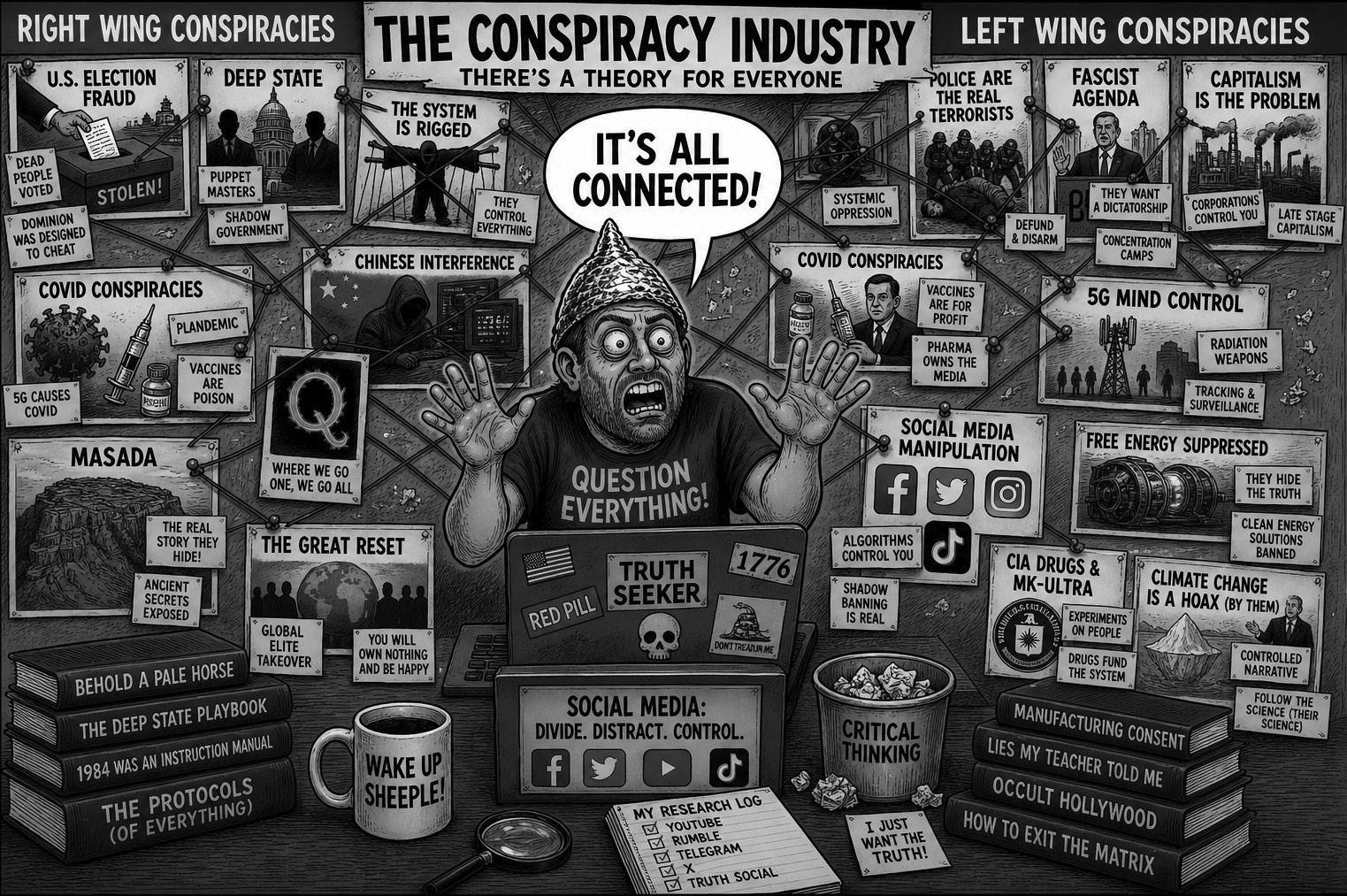
An illustrative political cartoon capturing some of the prevailing conspiracy theories on both sides of the aisle. Neither Jack M. Barrack Hebrew Academy nor the editors of Leshem Shamayim endorse any of the narratives depicted. Likewise, responsible readers should always remember to carefully weigh the claims they encounter.
Generated by ChatGPT
Jillian Shweky, ’26 & Odelia Krasner-Friedman, ’26, Editors-in-Chief
Flynn S. Goldstein, ’27, Layout Editor Joshua Weinstein, Faculty Advisor
Layout by Flynn S. Goldstein, ’27
In honor of those bold enough to question the lies
Lying speech is an abomination to the LORD, but those who act faithfully please Him.*
*Based on JPS, 1985 translation
Proverbs 12:22
The editors of םיימש םשלwould like to honor:
• Mr. Joshua Weinstein for taking up the mantle of faculty advisor to the Journal; and
• Mrs. Rachel Scheinmann for her support of this project as History Department Chair.

Jillian Shweky, ’26

With the powerful influence of social media, many people seek the quickest possible explanation rather than carefully evaluating information. This “skimmers, not divers” mentality encourages audiences to accept political claims at face value, particularly during highly publicized events such as presidential debates. It is easy to assume that a debate watched by tens of millions of viewers would contain only accurate information. However, that assumption is increasingly unrealistic. Candidates frequently make exaggerated or misleading statements in order to persuade voters, and these claims can spread rapidly across news outlets and social media platforms before they are fully examined. Because misinformation spreads quickly through modern media and is reinforced by psychological biases, it not only shapes voters’ perceptions but also distorts the outcomes of democratic elections.
Misinformation in American elections is not a new phenomenon, though the actors responsible for spreading it have changed over time. Early American presidents frequently dealt with partisan newspapers and misleading claims. Although partisan media is often viewed as a modern problem, readers in the eighteenth and early nineteenth centuries widely understood that newspapers openly supported political factions.1 For example, during the Revolutionary War, George Washington encountered a forged letter claiming that continuing the war was a mistake; he later investigated and disproved the document. Early presidential campaigns were also filled with rumors and personal attacks.2 During the election of Andrew Jackson, false accusations circulated about his wife, Rachel Jackson, illustrating how misinformation already functioned as a political weapon.3 However, because communication technologies were limited, false stories spread much more slowly and could not “go viral” in the way modern misinformation does.4
up to the election.8 This widespread exposure demonstrates how accessible and influential online misinformation has become. Social media platforms also use algorithms that shape what information users see, often reinforcing existing political views.9 Research has found that Republican voters were more likely than Democratic voters to receive news from pro-Trump sources through these systems.10 In recent years, the spread of misinformation has increasingly involved political leaders themselves.11 As a result, misinformation can circulate rapidly among audiences, especially when media literacy is limited, making fake news a significant challenge for modern democratic elections.
If voters cannot reliably distinguish fact from fiction, how can democratic elections truly reflect the informed will of the people?
This difficulty in distinguishing truth from misinformation not only affects individual understanding, but also shapes how political parties communicate and operate within the electorate. Research shows that the amount of misinformation political parties can spread affects the strategies they use and the policies they support.12 When parties are able to misrepresent issues, including their own policy positions, they can tailor different messages to different groups of voters.13 They may spread false information to voters who rely on biased sources while still supporting policies that appeal to well-informed voters who understand the real situation.14 However, when parties cannot misrepresent their own positions, they must present one message to all voters.15 This can push them to support policies that match the false information they have shared in order to keep the support of misinformed voters.16 This situation can increase political polarization, especially when there is a mix of informed and misinformed voters in the electorate.17 In these cases, one party may rely more on fake news to influence its supporters while the other party focuses on appealing to informed voters.18 This dynamic can widen the gap between parties and intensify political divisions.
By the late nineteenth century, journalism in the United States began to professionalize, placing greater emphasis on objectivity and factual reporting.5 Despite this shift, research suggests that many Americans still struggle to distinguish between reliable information and false or misleading news.6
In the modern era, misinformation spreads far more rapidly because of the internet and social media, which allow political messages to reach massive audiences almost instantly.7 Prior to the 2016 United States presidential election, studies estimated that roughly one in four Americans visited a fake news website in the weeks leading
These broader patterns of misinformation and political strategy became especially visible during the 2020 United States presidential election, where false claims played a central role in shaping public discourse. During the campaign, Donald Trump frequently focused on the past business dealings of Hunter Biden, the son of his opponent Joe Biden.19 Studies found that Trump was responsible for about 56 percent of the misinformed comments identified during the campaign.20 In addition, the term “Hunter Biden” became the most common misinformation-related topic on Twitter for four of the six weeks between the first presidential debate and Election Day.21 This highlights how quickly misleading claims can spread on social media and shows the significant influence of online misinformation on political discussions during an election. Furthermore, Donald Trump repeatedly made claims questioning the integrity of the 2020 United States presidential election.22 Statements suggesting that the election was rigged and that mail-in ballots were “fake” became the two most widely spread categories of false claims.23 These messages contributed to undermining
public trust in the election process as a whole. While most talking points only received short-lived attention after the election, false claims and personal attacks targeting Joe Biden continued to generate high levels of publicity.24 The persistent spread of these narratives demonstrates how misinformation can maintain influence over public perception even after the election has concluded.
Later, during a 2024 debate for the previous presidential election, Trump disseminated false statements about the Haitian community of Ohio, stating “They’re eating the dogs. They’re eating the cats. They’re eating the pets of the people that live there.”25 His anti-immigrant rhetoric projected amplified rumors that lacked credible evidence.26 Members of the Haitian community reported feeling unsafe at school and work.27 Although debate moderators stated mid-debate that the claims were untrue, the damage had already been done.
In response to the growing impact of such misinformation, efforts to directly challenge false claims during political events have become more prominent. During a 2024 presidential debate hosted by ABC News, moderators David Muir and Linsey Davis introduced live fact-checking, correcting false statements from candidates in real time.28 This approach differed from earlier debates, such as the one hosted by CNN in June, where moderators chose not to challenge misleading claims during the event itself. During the debate, the moderators corrected several statements made by Donald Trump, including his claim that Democrats support late-term abortion or the “execution” of babies after birth, where Davis clarified that no state allows killing a baby after it is born.29 Muir also questioned Trump about comments suggesting he lost the 2020 election by only a “whisker,” noting that he still does not acknowledge the result.30 After the debate, CNN fact-checker Daniel Dale reported that Trump made at least 33 false claims, significantly more than his opponent, Kamala Harris.31 While the live fact-checking was criticized by some of Trump’s allies and conservative media outlets who argued the moderators were unfairly targeting him, polls show that more than two-thirds of Americans (including 81 percent of Democrats and 67 percent of Republicans) believe moderators should correct false statements during debates.32 However, the controversy surrounding these corrections reveals an important issue: even when misinformation is immediately challenged, it does not necessarily stop people from believing or repeating it.
Instead, reactions to fact-checking itself often become politicized, showing that people interpret information through their existing beliefs and loyalties. This suggests that the persistence of fake news cannot be explained solely by a lack of accurate information, but also by psychological factors that influence how individuals process and remember claims, even after they have been proven false.
The spread and persistence of misinformation can be better understood through psychological mechanisms that influence how people evaluate information. One important concept is the illusory truth effect, which suggests that
repeated exposure to a statement increases the likelihood that people will believe it to be true. When individuals hear the same claim multiple times, it becomes easier for their brains to process, creating a sense of familiarity.33 Because people often associate familiarity with accuracy, repeated information can feel more credible even when it is false.34 In experimental studies, participants were asked to judge the truthfulness of both accurate and inaccurate statements across several sessions.35 Researchers found that participants increasingly rated repeated statements as truthful each time they encountered them, regardless of whether the statements were objectively correct.36 This demonstrates how misinformation can gain legitimacy through repetition alone. When false claims are circulated in political speeches, media coverage, or online platforms, repeated exposure can gradually normalize the message and make it appear more believable to the public.
Cognitive biases further contribute to the persistence of misinformation by shaping how individuals interpret new information. Research examining political belief formation during the 2016 U.S. presidential election identified two key biases that affect how people update their views: confirmation bias and desirability bias.37 Confirmation bias occurs when individuals give greater weight to evidence that aligns with their existing beliefs.38 However, the study found even stronger support for desirability bias, meaning that people were more likely to accept information that supported outcomes they wanted to be true.39 In an experiment with 900 participants, individuals adjusted their beliefs more readily when presented with evidence that aligned with their preferred political conclusions, even if it contradicted what they previously believed.40 This suggests that emotional and motivational factors play a major role in the spread of misinformation. When false claims reinforce political loyalties or personal attitudes, individuals may be more willing to accept them without critically evaluating their accuracy, allowing misinformation to spread and persist within public discourse.
Misinformation has evolved from slow-spreading rumors in early American elections to a powerful force amplified by modern media and social platforms. Psychological effects such as repetition and cognitive bias allow false claims to persist even when they are publicly corrected, making misinformation especially difficult to combat during highly visible events like presidential debates. If voters cannot reliably distinguish fact from fiction, how can democratic elections truly reflect the informed will of the people?
1 Lindsay Chervinsky, “The History of Fake News from George Washington to Donald Trump,” Dec. 8, 2021, https:// www.governing.com/context/the-history-of-fake-news-fromgeorge-washington-to-donald-trump
2 Lindsay Chervinsky, “The History of Fake News from George Washington to Donald Trump.”
3 Lindsay Chervinsky, “The History of Fake News from George Washington to Donald Trump.”
4 Lindsay Chervinsky, “The History of Fake News from George Washington to Donald Trump.”
5 Lindsay Chervinsky, “The History of Fake News from George Washington to Donald Trump.”
6 Gene M. Grossman and Elhanan Helpman, “Electoral Competition with Fake News,” Science Direct, Mar. 2023, https://www.sciencedirect.com/science/article/abs/pii/ S0176268022001185.
7 Gene M. Grossman and Elhanan Helpman, “Electoral Competition with Fake News.”
8 Gene M. Grossman and Elhanan Helpman, “Electoral Competition with Fake News.”
9 Gene M. Grossman and Elhanan Helpman, “Electoral Competition with Fake News.”
10 Gene M. Grossman and Elhanan Helpman, “Electoral Competition with Fake News.”
11 Lindsay Chervinsky “The History of Fake News from George Washington to Donald Trump.”
12 Gene M. Grossman and Elhanan Helpman, “Electoral Competition with Fake News.”
13 Gene M. Grossman and Elhanan Helpman, “Electoral Competition with Fake News.”
14 Gene M. Grossman and Elhanan Helpman, “Electoral Competition with Fake News.”
15 Gene M. Grossman and Elhanan Helpman, “Electoral Competition with Fake News.”
16 Gene M. Grossman and Elhanan Helpman, “Electoral Competition with Fake News.”
17 Gene M. Grossman and Elhanan Helpman, “Electoral Competition with Fake News.”
18 Gene M. Grossman and Elhanan Helpman, “Electoral Competition with Fake News.”
19 “Research Note: Lies and presidential debates: How Political Misinformation Spread Across Media Streams During the 2020 Election,” Misinformation Review, Dec. 17 2021, https://misinforeview.hks.harvard.edu/article/research-notelies-and-presidential-debates-how-political-misinformationspread-across-media-streams-during-the-2020-election/?.
20 “Research Note: Lies and Presidential Debates: How Political Misinformation Spread Across Media Streams During the 2020 Election.”
21 “Research Note: Lies and Presidential Debates: How Political Misinformation Spread Across Media Streams During the 2020 Election.”
22 “Research Note: Lies and Presidential Debates: How Political Misinformation Spread Across Media Streams During the 2020 Election.”
23 “Research Note: Lies and Presidential Debates: How Political Misinformation Spread Across Media Streams During the 2020 Election.”
24 “Research Note: Lies and Presidential Debates: How Political Misinformation Spread Across Media Streams During the 2020 Election.”
25 Bruce Shipkowski, “WATCH: Trump Amplifies False Racist Rumor about Ohio’s Haitian Immigrants in Debate,” PBS, Sept. 11, 2024,
https://www.pbs.org/newshour/politics/watch-trump-amplifiesfalse-racist-rumor-about-ohios-haitian-immigrants-in-debate.
26 Bruce Shipkowski, “WATCH: Trump Amplifies False Racist Rumor about Ohio’s Haitian Immigrants in Debate.”
27 Bruce Shipkowski, “WATCH: Trump Amplifies False Racist Rumor about Ohio’s Haitian Immigrants in Debate.”
28 Hadas Gold, “ABC Debate Moderators Live Fact-Checked Trump’s False Claims from the Stage,” WRAL News, Sept. 11, 2024, https://www.wral.com/story/abc-debate-moderators-live-factchecked-trump-s-false-claims-from-the-stage/21619242/
29 Hadas Gold, “ABC Debate Moderators Live Fact-Checked Trump’s False Claims from the Stage.”
30 Hadas Gold, “ABC Debate Moderators Live FactChecked Trump’s False Claims from the Stage.”
31 Hadas Gold, “ABC Debate Moderators Live Fact-Checked Trump’s False Claims from the Stage.”
32 “Moderators should point out factual errors in real time, Americans say in poll on eve of presidential debate,” Boston University College Of Communication, June 20, 2024, https:// www.bu.edu/com/articles/moderators-should-point-out-factualerrors-in-real-time-americans-say-in-poll-on-eve-of-presidentialdebate/?
33 “The Illusory Truth Effect Leads to the Spread of Misinformation,” National Library of Medicine, Mar. 3, 2023, “https://pmc.ncbi.nlm.nih.gov/articles/PMC10636596/
34 “The Illusory Truth Effect Leads to the Spread of Misinformation.”
35 “The Illusory Truth Effect Leads to the Spread of Misinformation.”
36 “The Illusory Truth Effect Leads to the Spread of Misinformation.”
37 “The Heart Trumps the Head: Desirability Bias in Political Belief Revision,” National Library of Medicine, May 29, 2017, https://pmc.ncbi.nlm.nih.gov/articles/PMC5536309/
38 “The Heart Trumps the Head: Desirability Bias in Political Belief Revision.”
39 “The Heart Trumps the Head: Desirability Bias in Political Belief Revision.”
40 “The Heart Trumps the Head: Desirability Bias in Political Belief Revision.”
Odelia Krasner-Friedman, ’26

The outlandish claims are far too familiar: Jews have horns and space lasers, Jews control the media and the banks and the weather and the world. The Jewish people have lived through accusations of killing Jesus, starting plagues, being disloyal to our native countries, and generally being scapegoated for every societal problem. For as long as there have been Jews, there have been Jew haters. In every generation, antisemitism rears its ugly head in a new form, and it is not going anywhere. Unlike other forms of bigotry, antisemitism is not just hateful and untrue. Antisemitism is a conspiracy theory, so the most effective ways to combat it are through education, strengthening communal Jewish life, and deepening connections and engaging in dialogue with non-Jewish partners.
Antisemitism is a series of conspiracy theories that have changed over time to suit the contemporaneous society. Merriam-Webster defines a conspiracy theory as “a theory that explains an event or set of circumstances as the result of a secret plot by usually powerful conspirators.”1 This perfectly describes antisemitism. Jews make up about 0.2% of the world’s population, but people believe that Jews hold disproportionate power, controlling the media, banks, government, Hollywood, and even the weather.2 Furthermore, this perceived Jewish cabal is blamed for every problem society faces, and these accusations often contradict each other. Antisemitism surges in times of social unrest or conflict, further showing that Jews are used as simple scapegoats for the world’s complex problems.3 As society evolves and new issues emerge, antisemitism is adapted to match the fears and values of society.4 Antizionism is the most recent manifestation of antisemitism, equating Israel and Jews with social injustice.5 Today, Americans are taught to fight against oppression and inequality, which is an important call to action. Just as patriots of any country challenge their government to build a more just society, Zionists, too, have a responsibility to push Israel toward greater equality. However, applying the framework of race and colonization to Israel, while ignoring the rich history of the Jewish people’s connection to the land and the existence of Black and Middle Eastern Jews, is both antizionist and antisemitic.
this hatred escalates to genocide. However, this pattern has played out for millennia. For example, in the Purim story, Haman tells King Achashverosh, “There is a certain people, scattered and dispersed among the other peoples in all the provinces of your realm, whose laws are different from those of any other people and who do not obey the king’s laws; and it is not in Your Majesty’s interest to tolerate them.”6 As Yehuda Kurtzer explains in the Hartman Institute podcast Identity/Crisis, Haman is casting the Jewish people in the familiar role of nefarious outsiders. Remaining a unified people in diaspora is a strength of the Jewish people, but through lying that the Jews were disobedient, Haman turns this strength into a threat, compelling Achashverosh to fear this unity.7
Strengthening Jewish institutions does not mean closing the door on the outside world; it means ensuring no one is left out in the cold.
Antisemitism has appealed to people throughout history because Jews have always been outsiders, making them an easy scapegoat. The most well-known version of this story is the Holocaust: Germany is struggling after WWI; Hitler gains popularity partly by blaming the Jews for Germany’s issues;
This pattern of societal Jewish scapegoating has played out over and over again throughout history, reinforcing the conspiracy theory of antisemitism. Since the destruction of the Second Temple, the Jewish people have uniquely maintained a unified identity without a shared homeland, preserving religious and cultural traditions that often contrast with the dominant values of the societies in which they reside. Customs like keeping kosher or having a day of rest on Saturday set Jews apart in terms of lifestyle, often making them seem alien or elitist to non-Jews. People naturally fear the unfamiliar, and fear often turns into hate. Furthermore, Judaism has often been perceived as threatening because its core beliefs challenge systems of power: its teaching that all people are equal under one God undermines tyranny; its emphasis on literacy, questioning, and debate runs counter to religious institutions that depended on the ignorance of believers; and its belief that a covenant with God demands responsibility and hard work rejects the idea that salvation can be attained merely through conversion. Therefore, the perception of Jews as both a threat to dominant systems and as cultural outsiders made them particularly vulnerable to scapegoating in moments of political, economic, or social instability. As conspiracy theories have proliferated through modern mass media, antisemitism has intensified, frequently taking the form of antizionism. Lies, particularly conspiracy theories, spread faster online than the truth, instilling lies into the fabric of people’s deepest convictions.8 Bret Stephens argues, “[t]he idea that modern politics amounts to a malicious scheme organized by an insidious cabal of deepstate insiders and globalists at the expense of ordinary people is now received wisdom on the right, paralleling far-left convictions about the purported evils of Zionists and their billionaire backers.”9 Compounded by antisemitism’s preexisting attractiveness to people searching for a scapegoat, this widespread consumption of conspiracy theories has ingrained antisemitism into American thought patterns on the right and the left. It is especially easy for antisemitism to take root in a world where the crises are never-ending, people search for explanations and someone to blame, and wild
conspiracy theories are widely accepted as truth. “A bigotry for morons — a.k.a., “The Jews did it” — will always be political gold in a world of morons.”10 When people are used to believing what they see and polarization makes the most extreme voices the loudest ones, it is no wonder antisemites’ voices have become some of the loudest.
While eradicating antisemitism is most likely impossible, addressing it is possible through a three-pronged approach, firstly through education. Post-October 7th, the world has been caught up in a war in the media that Hamas is winning. For much of the political left, being antizionist has become synonymous with being moral, and for much of the political right, popular policies and Christian values bleed into antisemitism; for everyone, being antisemitic makes people more popular.11 It has become clear in recent years that being educated often does not stop people from believing conspiracy theories; conspiracy theories have become mainstream, and people as influential as President Trump have promoted conspiracy theories on the public stage.12 While many highly educated and otherwise smart people believe conspiracy theories, there are also many people who have never met a Jewish person or do not know anything about Jews, so they simply believe the hateful conspiracies they consume online. Furthermore, many people only know about Jews through Holocaust education, so their only perception of Jews is as victims, and they believe that anything less than Nazism or genocide is not antisemitic. For this reason, while Holocaust education is crucial, it cannot stand alone. Through educating people, especially children, about the Jewish people’s rich history, tradition, and values, and the complexity and diversity of our community, it is possible to nip belief in the conspiracy theory of antisemitism at the bud.
Secondly, it is crucial for the Jewish people to unify and thrive as a global community. Antisemitism has existed and will continue to exist for as long as Jews exist, and the most important way to overcome the impact that this hatred could have on the global Jewish community is to thrive as a people. The beauty of Judaism is that Jews are all one people, and yet being Jewish looks different for each person, creating space for discourse and interpretation. However, the beauty is lost when our differences divide us instead of enriching our Jewish lives. Furthermore, the Jewish community is weakened by division and infighting. While the issues being protested in the streets are contentious and important, at the end of the day we are one people. We share a history and must build our future together. Jews have never agreed on everything and never will, therefore it is crucial to listen to one another, find common ground, and work together. “The goal of Jewish life is Jewish thriving.”13 Antisemitism will always exist, so instead of pouring efforts into eradicating it, more of those resources should be used to strengthen Jewish institutions so the Jewish community can thrive even in a hostile world. Robust Jewish life “has been fading for decades, starting when American Jews began to treat their Jewishness as the most disposable part of their identity.”14 To make Judaism central to American Jews’
lives again, the Jewish community must invest in making Jewish day schools and summer camps more widespread and affordable, strengthen Jewish cultural, religious, and learning institutions, support Jewish media and publishers, and prioritize communal life in its philanthropic vision. However, it is crucial that this strength does not lead to the Jewish community becoming increasingly isolated. Therefore, the third prong of this approach to addressing antisemitism is to strengthen connections between the Jewish community and other communities. It is crucial to foster dialogue through interfaith programs, learning about other communities, and telling the Jewish story. By listening to others, learning from them, and enabling them to learn from Judaism, the Jewish community can build invaluable connections with others. In addition to building relationships, the Jewish community has a responsibility to contribute to society. Strengthening Jewish institutions does not mean closing the door on the outside world; it means ensuring no one is left out in the cold. While October 7th revealed the rampant antisemitism lurking beneath the surface worldwide, it also revealed allies: church preschoolers who wrote supportive letters after antisemitic attacks, nonJewish politicians who spoke up for the hostages, friends and neighbors who were there for emotional support.15 It is the Jewish community’s duty to engage with and reciprocate this support, to be engaged citizens of the world who build relationships with others, seek mutual understanding, and support other communities in their times of need. Widespread antisemitism makes the world feel lonely and hostile for Jews, but it is crucial to remember that the Jewish community is supported, and to work to build a world where no community is isolated.
To effectively combat antisemitism, it must be addressed as what it is: a conspiracy theory. While antisemitism will never be fully eradicated, the Jewish community can counter its effects through a three-pronged approach that includes education, strengthening Jewish communal life, and building relationships with other communities. Education, dialogue, partnership, unity, and pride remain the most powerful tools against hate, and the Jewish community has the capability and obligation to use them to promote understanding.
1 “Conspiracy Theory Definition & Meaning,” MerriamWebster, accessed March 3, 2026, https://www.merriam-webster. com/dictionary/conspiracy%20theory.
2 “Myth – Jews Have Too Much Power,” Antisemitism Uncovered, February 27, 2026, https://antisemitism.adl.org/ power/.
3 “A Guide to Old Myths in a New Era,” Antisemitism Uncovered, March 20, 2024, https://antisemitism.adl.org/.
4 “A Guide to Old Myths.”
5 “1:12:34” October 8, directed by Wendy Sachs. (2025; Briarcliff Entertainment), Amazon Prime Video
6 “Esther 3:8,” Sefaria.org, accessed March 24, 2026, https:// www.sefaria.org/Esther.3.8?lang=bi.
7 Yehuda Kurtzer, host, Identity/Crisis, podcast, episode 267, “Purim and Diaspora Power – with Barbara Spectre,” Shalom Hartman Institute, March 3, 2026.
8 Soroush Vosoughi, Deb Roy, and Sinan Aral, “The Spread of True and False News Online,” Science.org, March 9, 2018,
https://www.science.org/doi/10.1126/science.aap9559.
9 Bret Stephens, “Meet the New Antisemites, Same as the Old Antisemites,” The New York Times, November 11, 2025, https:// www.nytimes.com/2025/11/11/opinion/antisemitic-politicscarlson-fuentes.html.
10 Bret Stephens, “Meet the New”.
11 Bret Stephens, “Meet the New.”
12 Micah Issitt and Heather Newton, “Conspiracy Theories: Overview,” ebsco.com, 2023, https://www.ebsco.com/researchstarters/psychology/conspiracy-theories-overview.
13 Bret Stephens, guest.
14 Bret Stephens, guest.
15 October 8, Wendy Sachs. (2025; Briarcliff Entertainment), Amazon Prime Video.

On March 14, 2025, U.S. President Donald J. Trump signed a rather innocuous executive order “continuing the reduction of federal bureaucracy.”1 Under the justification of safeguarding America’s coffers, the Trump Administration suspended the operations of the United States Agency for Global Media, which once operated Voice of America (“VOA”), an influential international broadcaster disseminating news from the American perspective along with its attendant values and belief system.2
VOA once served as a powerful tool for spreading American influence and democratic values, especially to citizens under repressive regimes bent on the destruction of their own peoples like Iran and China.3 As Trump and his sycophantic cabinet interrupted the valuable flow of American propaganda to China, Chinese authorities continued to dispatch their own narratives in the opposite direction with the goal of disrupting global politics, vilifying the U.S., and ultimately upending a democratic world order in favor of an authoritarian paradigm anchored in constant surveillance and the erosion of personal autonomy.4
China’s actions since at least 2023 exemplify this disconcerting pattern. In the lead-up to the January 2024 Taiwanese elections, Chinese actors flooded the internet and social media platforms with 28,216 fake accounts in 2024 and an estimated 2.159 million disparate items of disinformation, according to the Taipei Times. 5 To disseminate this volume of disinformation, China mobilized a multitude of sources and tools, including but not limited to “bot networks,”6 generative AI technology,7 and the labor of Chinese student associations.8 The Chinese government even enlisted certain influencers to produce scripted videos supporting pro-China candidates.9
Luckily for democracy and U.S. interests, the proindependence William Lai of the Democratic Progressive Party came out on top. Nevertheless, the sheer magnitude of China’s coordinated influence operation in the region still reflects a larger concern that the Chinese government is actively working to control Taiwanese popular sentiment
and manipulate it in its own geopolitical favor.
The Chinese Communist Party (“CCP”) keenly understands the precariousness of all-out war. China’s leaders could turn to boots-on-the-ground warfare, a manifestation of the “hard-power” approach to international relations, but they well understood that any deliberate offensive attack on Taiwan would implicate the United States’s commitment to defend the little island.10 War would immediately destroy all of Taiwan’s existing commercial infrastructure and deprive it of any economic viability for years.11 Simply put, war and its attendant destruction would nullify China’s raison d’être reappropriating Taiwan’s economic success for itself.
As such, China has strategically relied on alternate, and perhaps more effective, methods like propaganda to gain political control of Taiwan, a highly desirable island for economic and political reasons. One such method is electronic disinformation, or what the Security Bureau of Taiwan appropriately termed “cognitive warfare.”12 Chinese actors deliberately targeted Taiwanese society during an election, creating deep fissures rooted in hot-button issues.
Even though China failed to successfully influence the result of the 2024 election, its messaging still attempted to polarize the people of Taiwan with the intent of encouraging Taiwanese submission to China—of its own accord (the soft-power approach).13 Seemingly surrounded by enemies on all flanks and betrayed by its long-term Western partner, the U.S., China envisaged Taiwanese society, increasingly more amicable to the Chinese cause, turning to it for succor amidst a severe lack of social cohesion.
China’s use of soft-power marked a calculated geopolitical maneuver intended to serve its immediate colonialist goals while also forging diplomatic goodwill. Accordingly, China wants to position itself as the forthcoming savior of the proverbial damsel in distress and plans to flaunt lofty and noble ideals such as “unification” in addition to feigning concern for the people of Taiwan. Avoiding direct conflagration and shunning conflict would build up China’s global perception, as a benevolent power, against the previous dominant notion of China as a militaristic power.
This posture would sway diplomatic favor toward strategic alliances between China and new allies, in opposition to the previously dominant Western world order. Yet in truth, the discerning student of history realizes that China’s ostensibly peaceful actions are merely a guise for something more sinister. At the domestic level, China only aspires to reappropriate Taiwan’s economic success borne out of the semiconductor mecca.14 Internationally, China’s use of propaganda and social media to spread chosen narratives underlies its true authoritarian designs to achieve political stability by crushing dissent and herald a new world order sanctioning repression.15 Newfound allies of China would only be pawns in a greater scheme until their allegiance would backfire and result in their own subjugation.
China leveraged similar tactics prior to the 2024 U.S.
presidential election, employing a similar destabilizing approach to exert political influence. By engaging operatives to impersonate U.S. citizens, China set out to create similar social fissures, again with the help of generative artificial intelligence. In a 2023 report, Facebook’s parent company, Meta, linked this operation, nicknamed “Spamouflage,” to Chinese law enforcement.16
Unlike China’s efforts in Taiwan’s 2024 elections, Spamouflage did not support a specific candidate. Accounts supported both then-incumbent President Joseph R. Biden and former President Donald J. Trump. In a similar vein, certain accounts were decidedly anti-Israel, posting antiSemitic vitriol, while others posted Islamophobic content. Moreover, some accounts supported reparations for the American black community while others vehemently opposed it, intimating that whites were the “true victims” of racism perpetrated by blacks.17 Instead of choosing specific sides, indicative of a specific desired Chinese outcome, the network as a whole took self-contradictory and paradoxical positions with the intent to—above all else—create discord in the American public square.
In light of this evidence, experts overwhelmingly highlight the dissociative power of Spamouflage. China cannot be said to have been preferential to either presidential contender—and this is no surprise given the fragile ChinaU.S. relationships under both Presidents Trump and Biden. Nevertheless, the conversations Spamouflage joined, namely about the U.S.–Ukraine relationship, U.S. support for Israel,18 racism, guns, and LGBT rights, as well as the contradictory positions it assumed, reveal a meaningful Chinese desire to stir up chaos and disrupt any homogeneity in the American public sphere.19 According to Jack Stubbs of Graphika, a social media analytics firm,20 by harping on “‘hyper-sensitive social rifts,’” China typified its inherent stratagem to stoke popular division in order to portray the U.S.—its staunchest international foe—“as [a] declining global power with weak political leadership and a failing system of governance.”21 China correctly assumed that public discord would only erode confidence in the continuity, power, and influence of U.S. leadership.22
Within a presently Western-centric global order, these narratives could prompt U.S. partners to reconsider their alliances—at which point defection to China’s umbrella could seem tantalizing. Nevertheless, an alliance with an authoritarian regime (like the CCP) comes at a price— “undermin[ing] democracy…and extend[ing] Beijing’s influence” while consequently, undercutting America’s international pull.23 This would be highly undesirable for Americans at-large, and contrary to American best interests.
More recently, China has employed the same playbook in the South China Sea, against the Philippines. In a dispute over a maritime boundary, China has consistently refused to accept an international arbitration court’s ruling, instead choosing to bypass the judgement, snatching up nearby reefs
and constructing artificial islands. In support of its activity, deemed illegal by a 500-page ruling of an international arbitral tribunal, China has taken to social media to spread its official narratives.
Posts—Chinese in origin—characteristically bemoan the U.S. presence in the Asia Pacific, praise China’s navy, and uplift individuals who support China’s presence in the region. They also have been known to attack the Philippine government and its leaders while portraying them as war-hungry or degenerate, thus undermining Filipinos’ confidence in their current regime. In one instance, Chinese operatives circulated a deepfake audio recording of the Philippine president, Ferdinand Marcos, Jr. calling on Filipino soldiers to fight against China, and other deepfake videos have depicted him taking illicit drugs.
Furthermore, Chinese authorities have tapped Filipinos to be harbingers of pro-China narratives, just as they paid influencers to influence the 2024 Taiwanese elections. The Chinese idioms for these practices—“borrowing a mouth to speak” and “borrowing a boat to sail to the sea”—are appropriate, but the Chinese government remains unfazed by cultural moral teachings. These folk sayings, unfortunately, have not deterred Chinese officials from doing precisely what the idioms warn against.24
Moreover, China’s illegal activity is partially emboldened by the tension it engenders since creating a fissure in the substance of homogeneity necessitates that certain Filipinos will ultimately support (willingly or not) Chinese objectives. In other words, perpetuating Chinese lies is bound to have some effect—precisely what the CCP desires, mirroring the path it took vis-à-vis the Taiwanese elections.
go beyond simply elevating its chosen narratives on social media. That has been one tool in the Philippine context, but China, a naturally repressive regime, also uses external intimidation through military displays of power. Certain topics, like the maritime dispute with the Philippines around the South China Sea, the domestic economy, and China’s international engagements, or any information contrary to official propaganda are carefully controlled to suppress dissent.26
Although China’s surveillance technologies are largely constrained to its own geographic borders, the policy of cyberspace sovereignty would sanction the same practice globally. The panopticon, originally a novel prison design for maximum surveillance conceived of by English political philosopher Jeremy Bentham in the late 18th century, is an apt metaphor for China’s actions.27 Constant supervision has the immediate effect of shaping desired submissive conduct, just as Bentham intended.28 Paired with the looming threat of violence—a card the CCP is careful to play, however— China could be unstoppable.
The fundamental danger of this dystopian reality is that China could control the very availability of information globally, arguably a right for all humans. Foreign governments, academia, and the public would be subservient to CCP censors and carefully curated narratives. Truth would be but illusory.
In addition to merely disseminating lies and propaganda through social media, China has also relied on intimidation, both in digital and physical spaces. President Marcos, at one point, called out China’s “harassment and intimidation” of the Philippine Coast, Philippine Navy vessels, and private fishermen, underscoring China’s new approach to foreign policy of blending the looming threat of military conflict (physical intimidation) with soft-power manifested through social media influence (in a virtual space).
Filipino journalist Marites Dañguilan Vitug argues that China’s efforts are tailored to lead to one end: conversation with the (more powerful and apparently merciful) Chinese government, which is simply code for appeasement. China would again successfully reach geopolitical aims (controlling a greater tranche of the Asia Pacific) without having fired a bullet. China would otherwise turn to military measures save for the fact that these political maneuvers build up China’s international image, which builds China’s political diplomatic capital for use later down the line.25
Viewed in this light, China’s political machinations with the Philippines attest that China is eagerly willing to
In contrast to the United States’ vision of an open, globally connected system, with minimal government oversight or control, China supports a world where individual countries hold complete and final control over the operations of their cyberspaces.29 Digital authoritarianism is the Chinese government’s prerogative, building a world bereft of individual privacy and autonomy30—a right assiduously defended by U.S. Supreme Court Justice Louis D. Brandeis31—and more explicitly, a world in which Communist China would reign supreme.
China’s attempt to dress up its geopolitical image is just that—an attempt to obfuscate the truth. Any olive branch it may extend to current U.S. allies in its attractive finery of geopolitical merit is simply a knife dressed up appealingly to stab diplomatic players in the back. China is not—and never will be—committed to lofty ideals, only the continuity of its grip over its citizens manifested through constant repression and damnatio memoriae, the controlled destruction of memory.
China’s interference in foreign elections and pursuit of territorial expansion is at best, unethical; at worst, immoral. The Chinese government will expect complete submission from inferior partners that will only become proxies in the final analysis. Hence, countries joining the Chinese authoritarian bandwagon and dispensing Chinese technology are only more receptive to Beijing’s censorship requests.32
Furthermore, the Chinese government has attempted to co-opt individuals by pressuring figures in the international community to be conduits and vehicles of Chinese propaganda. The fundamental danger of this dystopian reality is that China could control the very availability of
information globally, arguably a right for all humans. Foreign governments, academia, and the public would be subservient to CCP censors and carefully curated narratives.33 Truth would be but illusory.
The evidence presented here is crystal clear: President Trump’s decision to cut funding from VOA was brash in the face of ruthless Chinese opposition. In a world where authoritarian actors seek to control the very information humans interact with, there must be a foil to China’s selfserving narratives. Since 1942, VOA has done just that.34 Without it, America, its allies, and democracy as a whole could falter any day. China—in service to its authoritarian goals—will continue to perpetuate lies, vilify the United States and its founding ideals, and sanction a new world order built entirely on surveillance that will benefit those in power. There is one way to cure the ailment: respond accordingly.
1 “Continuing the Reduction of the Federal Bureaucracy,” The White House, March 15, 2025, accessed March 2, 2026, https://www.whitehouse.gov/presidential-actions/2025/03/ continuing-the-reduction-of-the-federal-bureaucracy/.
2 Ibid.
3 “USAGM-VOA-OneSheet-11-06-24,” U.S. Agency for Global Media, November 6, 2024, accessed March 2, 2026, https://www.usagm.gov/wp-content/uploads/2024/12/USAGMVOA-OneSheet-11-06-24.pdf.
4 “How the People’s Republic of China Seeks to Reshape the Global Information Environment,” State.gov, accessed March 2, 2026, https://2021-2025.state.gov/wp-content/uploads/2023/10/ how-the-peoples-republic-of-china-seeks-to-reshape-the-globalinformation-environment_508.pdf.
5 “Chinese Online Manipulation Soars: NSB,” (Taipei Times, January 11, 2026), accessed March 2, 2026, https://www. taipeitimes.com/News/front/archives/2026/01/12/2003850442.
6 Yen-ting Lin, “‘War without Harm’: China’s Hybrid Warfare Playbook against Taiwan,” Geopolitical Monitor, September 16, 2025, accessed March 2, 2026 https://www.geopoliticalmonitor. com/war-without-harm-chinas-hybrid-warfare-playbook-againsttaiwan/.
7 Ibid.
8 “Annual Threat Assessment of the U.S. Intelligence Community,” Office of the Director of National Intelligence, February 4, 2024, accessed March 2, 2026 https://www.odni. gov/files/ODNI/documents/assessments/ATA-2024-UnclassifiedReport.pdf.
9 Shannon Bond, “China’s Influence Operations against the U.S. Are Bigger than TikTok” (NPR, April 26, 2024), accessed March 2, 2026, https://www.npr.org/2024/04/26/1247347363/ china-tiktok-national-security.
10 David Brunnstrom and Trevor Hunnicutt, “Biden Says U.S. Forces Would Defend Taiwan in the Event of a Chinese Invasion,” Reuters, September 19, 2022, sec. World, accessed March 2, 2026, https://www.reuters.com/world/biden-says-usforces-would-defend-taiwan-event-chinese-invasion-2022-09-18/.
11 S.B. Asthana, “A Losing Proposition,” Indo-Pacific Defense Forum, October 20, 2025, accessed March 17, 2026, https://ipdefenseforum.com/2025/10/what-cost-is-china-willingto-bear-to-invade-taiwan/.
12 “Taiwan Says China Using Generative AI to Ramp up Disinformation and ‘Divide’ the Island.”
13 “Annual Threat Assessment of the U.S. Intelligence Community.”
14 David Brown, “China and Taiwan: A Really Simple Guide,” BBC, January 7, 2024, accessed March 17, 2026, https://
www.bbc.com/news/world-asia-china-59900139.
15 “Annual Threat Assessment of the U.S. Intelligence Community.”
16 Bond, “China’s Influence Operations against the U.S. Are Bigger than TikTok.”
17 Elise Thomas, “Pro-CCP Spamouflage Campaign Experiments with New Tactics Targeting the US,” Institute for Strategic Dialogue, February 13, 2026, accessed March 17, 2026, https://www.isdglobal.org/digital-dispatch/pro-ccp-spamouflagecampaign-experiments-with-new-tactics-targeting-the-us/.
18 Bond, “China Is Pushing Divisive Political Messages Online Using Fake U.S. Voters.”
19 Thomas.
20 “Graphika Homepage,” Graphika.com, 2024, accessed March 19, 2026, https://www.graphika.com/.
21 Bond, “China Is Pushing Divisive Political Messages Online Using Fake U.S. Voters.”
22 For a meditation on the salience of homogeneity in service to national goals, see Mason Lindemann’s essay “Masada and Yavneh: The Historical Case for Pragmatism” also published herein.
23 “Annual Threat Assessment of the U.S. Intelligence Community.”
24 Marites Dañguilan Vitug, “China’s Disinformation Narratives in the Philippines,” Perry World House (University of Pennsylvania, April 25, 2025), accessed March 2, 2026, https://perryworldhouse.upenn.edu/news-and-insight/chinasdisinformation-narratives-in-the-philippines/.
25 Ibid.
26 Ibid.
27 “Ethics Explainer: The Panopticon - What Is the Panopticon Effect?,” The Ethics Centre, July 18, 2017, accessed March 19, 2026, https://ethics.org.au/ethics-explainerpanopticon-what-is-the-panopticon-effect/. Also, see Margaret Atwood’s The Handmaid’s Tale (Toronto: McClelland & Stewart, 1985) exemplifying this metaphorical paradigm.
28 “The Panopticon,” UCL Faculty of Laws, 2025, accessed March 19, 2026, https://www.ucl.ac.uk/laws/research/researchprojects/bentham-project/about-jeremy-bentham/panopticon.
29 “How the People’s Republic of China Seeks to Reshape the Global Information Environment.”
30 Ibid.
31 See Samuel D. Warren and Louis D. Brandeis, “The Right to Privacy,” Harvard Law Review 4, no. 5 (December 15, 1890): 193–220, https://doi.org/10.2307/1321160.
32 “How the People’s Republic of China Seeks to Reshape the Global Information Environment.”
33 Ibid.
34 “History of VOA,” VOA, 2016, accessed March 2, 2026, https://www.insidevoa.com/p/5829.html.

As COVID-19 spread across the globe, anti-Asian hate crimes and xenophobic statements rose in the United States by almost 80 percent, exposing the consequences of the pandemic. Although uncertainty remains about the exact origins of SARS-CoV-2, the politicization of its origins, through President Trump’s promotion of the lab leak theory as well as naming China as the geographical origin, fueled antiAsian racism, distorted the public’s understanding of the virus, and intensified global economic tensions.
Severe acute respiratory syndrome coronavirus 2 (SARS-CoV-2), also known as COVID-19, had 551 million confirmed cases by July 10, 2022; by January 2026, that number was closer to 780 million worldwide. As of November 2019, COVID-19 was recognized as the third fatal bat-related disease to arise. Bats, particularly horseshoe bats, are natural hosts of a wide diversity of viruses, many of which are genetically similar to SARS-CoV-2, because they can transfer diseases easily between species.
While COVID-19 was spreading around the globe, misinformation and conspiracy theories were also circulating across the United States. In April of 2025, the White House announced on its website that COVID-19 originated in a lab in Wuhan, China, sparking controversy over political considerations that appeared to influence scientific findings and contradicting the World Health Organization’s findings. When political leaders dispute scientific institutions and investigations into the origins of this virus, it fosters mistrust and wariness among the public.3 The most widely supported theory for the origins of COVID-19, or SARS-CoV-2, is the natural spillover hypothesis, which holds that the virus originated in animals and spread to humans through live animal markets or close contact.
Another theory that has gained popularity due to its unconventional and extreme nature is the “Lab-leak theory,” which proposes that a variant of the CoV virus might have escaped the Wuhan Institute of Virology (WIV) during research on SARS-CoV. This claim shifted public attention from the new virus’s health risks to the political controversies surrounding it, intensifying public suspicion and framing the virus as foreign wrongdoing rather than a global health crisis.
Although uncertainty remains about the exact origins of SARS-CoV-2, the politicization of its origins fueled anti-Asian racism, distorted the public’s understanding of the virus, and intensified global economic tensions.
While bats are known carriers and sources of CoV viruses, the final spread of CoV from bats to humans has not been fully established; it is more likely that CoV spreads through an intermediate host.1 Animal-to-human transmission of viruses is not uncommon, and it is expected as zoonotic diseases spread.
SARS-CoV-2 was named after SARS-CoV, a genetically similar virus which caused a near pandemic in 2002-2003, killing 813 of the 8809 infected and has not been seen since.2 The SARS-CoV virus first existed in cats found in eastern Asia, and raccoon dogs. Antibodies to the virus were later found at China’s Shenzhen live animal market and were suspected of being the source of human infection.
SARS-CoV and SARS-CoV-2 share obvious genetic similarities, and both have roots connected to the sale of live wild animals and related species in markets. These genetic similarities reinforce the natural spillover hypothesis. According to an epidemiological study, the Huanan market in Wuhan was the epicenter of the outbreak. 28% of all cases reported in December 2019 were directly related to the market, and 55% of the cases had contact with other live markets in Wuhan.
These statistics link many of the first COVID-19 cases to live markets, strengthening the theory that COVID originated from a natural spillover. Additionally, there is clear geographic clustering in the virus’s early outbreaks, consistent with patterns seen in other zoonotic diseases, further supporting the conclusion that COVID-19 did not originate in a laboratory.
In January 2021, the World Health Organization (WHO) established a team of scientists from 10 nations to investigate the origins of the virus in China, concluding that a lab leak was unlikely. This theory was developed based on circumstantial evidence, such as early symptoms among the researchers at WIV; however, the viruses WIV and its researchers were studying were physically or genetically incomplete and could not replicate and spread as infectious viruses.4 Furthermore, there is no indication that WIV studied or collected viruses consistent with SARS-CoV-2 or any other similarly modified or mutated CoV virus, and the viruses lack markers of lab manipulation at the gene level.
This theory has also drawn from the possibility that a lab leak could have occurred during animal testing at the WIV labs. However, subsequent tests on wild mice, a commonly used animal in lab tests, failed to infect them, suggesting a different theory.5
The third theory was that the Chinese government intentionally developed the virus as a biological weapon; however, this theory lacks scientific credibility and logical grounding, as China would have created a vaccine for its own people, for it to be a successful biological weapon. This theory materialized when the U.S. Department of State summoned the Chinese ambassador in March 2022. The Ambassador was called to refute the statements of a Chinese spokesperson that the virus was brought to Wuhan by the US military as an alleged bioweapon. Subsequently, a U.S. senator suggested that the virus was a failed Chinese bioweapon, prompting other countries to claim COVID-19 was a bioweapon intended to harm their enemies.
U.S. officials were concerned that China was censoring the results of their research, as it would not be the first time in history.6 This theory quickly spread through social media and was difficult to contain. While the second and third theories lack the much-needed evidence, they cannot be dismissed entirely as conspiracy theories due to how much remains unknown and undiscovered about the origins of COVID-19. With these theories arising, many without sufficient evidence or information, it shapes the public’s view and reactions, fostering new feelings of xenophobia and hatred toward others.
On March 16, 2020, President Trump referred to the Coronavirus as the “Chinese virus,” contradicting international health officials’ efforts to avoid assigning a geographic origin to the virus to avoid casting blame. In February 2020, the World Health Organization wrote, “Don’t attach locations or ethnicity to the disease; this is not a ‘Wuhan Virus,’ ‘Chinese Virus,’ or ‘Asian Virus.’” This association of a virus with a nationality reinforces harmful stereotypes and creates a target for the public’s anger.
President Trump repeatedly shamed the WHO, calling it the public relations agency for China.7 These public statements once again intensified the message that China is at fault for this virus, along with all its people, completely misunderstanding the origins of the disease and causing harm to many individuals. After instances where President Trump used the phrasing “Chinese virus,” an increase in anti-Asian hashtags and a rise in hate crimes towards Asian Americans occurred.
These public statements by the figurehead of the United States helped spark anti-Asian Twitter content and helped fuel the hate and racist attitudes that had begun to grow, furthering the harm done by the conspiracy theories that pointed blame at China and its labs.
After President Trump’s use of the phrase “Chinese virus,” there was a spike in anti-Asian attitudes both online and in person; 20% of hashtags associated with #COVID-19 showed anti-Asian sentiment in comparison to 50% of hashtags with #Chinesevirus. The drastic difference between these two hashtags demonstrates the public framing of the virus and the xenophobic statements that greatly affected Asian American communities around the world, and the understanding of the Coronavirus and its origins.8
During the COVID-19 Pandemic, hate crimes and crimes against Asian Americans specifically surged, causing a rise of almost 80% nationwide. Asian American women were 2.3 times more likely to experience a hate crime fueled by racism than Asian American men. On March 16, 2021, there was a shooting at an Atlanta spa that killed eight victims, six of them being Asian American women.
As the World Health Organization suspected, giving the disease a geographical center created xenophobic ideas in the public that manifested themselves in violent ways.9 Racial discrimination against Asian Americans became more violent during the Pandemic and led to harmful effects on the mental and physical health of its victims. These tragedies illustrate how online statements and hashtags can translate
into real-life violence affecting individuals physically as well as mentally.
During lockdown, racist microaggressions shifted to more overt forms of racism, including online harassment and verbal attacks. More than half of respondents in a study done at the Epidemiology Asian Women’s Action for Resilience and Empowerment (Epi AWARE) reported that they experienced either direct or vicarious racial discrimination during COVID-19, the most common of these attacks being verbal attacks in public spaces; racial slurs were shouted, individuals were told to go back to their country or were wrongfully accused of being sick or “dirty.”
Other acts of racism included distancing more than the recommended amount, lingering stares, and hurtful online jokes, showing how the virus turned a public health crisis into a justification for discrimination and racist attitudes.10 COVID-19-related racial discrimination contributed to mental distress, including anxiety, depression, fear, and hopelessness. For others, it created a sense of solidarity and a need to do more for one another, or a heightened awareness of one’s racial identity, especially in public spaces.
In the past, Asian Americans have faced similar types of systematic and overt racial discrimination, including verbal and physical attacks, with COVID-19 fitting into the longer pattern of anti-Asian discrimination in American history. The Chinese Exclusion Acts of 1882 and the internment of Japanese Americans during WWII are two examples in history where these forms of racial discrimination occurred.11 Through the historical lens, it is clear that in moments of uncertainty, people look for someone to blame, often reviving racial predispositions to create feelings of control in an otherwise disorderly world.
Due to the spike in violence and racist attitudes toward Asian Americans, restaurants and small businesses run or owned by Asian Americans that sell ethnic goods were impacted. Asian restaurants experienced a drop in visits from non-Asian customers, compared with non-Asian restaurants. Asian restaurants saw an 18.4% decrease in traffic, resulting in a loss of around $7.42 billion in revenue.
Areas that supported President Trump more during the election had a larger reduction in customers visiting Asian restaurants than areas with less support.12 This impact on Asian restaurants’ earnings points to a connection between political figures’ rhetoric on issues and economic behavior, language, and statements from people in power, which can translate into financial consequences.
The debate around COVID-19’s scientific origin extended beyond just science, but to xenophobia in the United States and trade politics in the East. After entering lockdown, China implemented a “Zero-COVID” policy, a strict set of pandemic control measures aimed at preventing the spread of COVID-19. It was implemented in 2021 and continued throughout 2022. In November of 2022, China abolished the Zero COVID policy, which consequently led to a peak in new cases and a drop in economic activities.
These strict health measures negatively impacted China’s economic growth. Since the late 1970s, China’s
annual growth has been in the range of 9 to 10 percent; this began to slow between 2012 and 2019, and economic growth dropped from 6 percent to 3.3 percent after the outbreak of COVID-19.13 There was a 32 percent decline in offline consumption after the outbreak of the virus, resulting in a loss of 1.2 trillion RMB, the Chinese currency, or about 1.2 percent of China’s 2019 Gross Domestic Product (GDP).14
Uncertainty surrounding the virus’s origins and the global trade environment has aggravated the trade war between the United States and China, and the debate over COVID-19’s origins has had lasting consequences in the geopolitical and economic spheres.
The debate over COVID-19’s origins became more than a scientific investigation; it was politicized and used to turn people against their own neighbors. The existence of unanswered questions about the virus’s source allowed political opinions to be presented as fact and to take root in the public’s minds. False statements from a political leader in power transformed the dialogue surrounding COVID from a health crisis to something more hostile, causing physical and financial harm to many Asian Americans living in the United States.
In the future, political figures should not contradict health organizations’ guidelines and should not share racist opinions as fact, for fear of spiking a rise in violence toward a specific group of individuals.
1 Hao, Ying-Jian, et al. “The Origins of COVID-19 Pandemic: A Brief Overview.”
2 Morens, David M, et al. “The Origin of Covid-19 and Why It Matters.”
3 “On the Controversies Surrounding the Lab-Leak Theory of COVID-19.”
4 “Where Did Covid-19 Come From?”
5 Hao, Ying-Jian, et al
6 Knight, Dacre. “Covid-19 Pandemic Origins: Bioweapons and the History of Laboratory Leaks.”
7 Reja, Mishal. “Trump’s ‘Chinese Virus’ Tweet Helped Lead to Rise in Racist Anti-Asian Twitter Content:Study.”
8 Reja, Mishal.
9 Lee, Mina, et al. “Covid-19-Related Racial Discrimination during Lockdown and Its Impact on Asian American Women.”
10 Reja, Mishal.
11 Lee, Mina, et al
12 Huang, Justin T., et al. “The Cost of Anti-Asian Racism during the COVID-19 Pandemic.”
13 Li, Dr. Haizheng, et al. “The COVID-19 Pandemic’s Impact on the Chinese Economy.”
14 “The Impact of Covid-19 on China’s Consumption.”.
Laura Julie, ’27

Social media has become one of the main ways people get news and information. Platforms like YouTube, TikTok, Facebook, Instagram, and X (formerly known as Twitter) use algorithms to determine what users see. These algorithms are designed to keep people online for as long as possible. Conspiracy theories can now spread wider and faster than ever before, and the algorithms on these platforms enable them to do so. Social media algorithms make conspiracy theories addictive by constantly recommending emotional and dramatic content, keeping users hooked.
To understand this issue, it is important to understand how algorithms function. Social media algorithms are computer systems that track which posts users click, like, comment on, and spend more time with. This information lets the algorithms predict which content to show users in order to get the most engagement, and it shows them more of it. These systems prioritize engagement, meaning that they promote content that gets a stronger reaction out of its audience. The goal of these algorithms is not to present the most accurate information, only to keep the users hooked on the platforms and scrolling for as long as possible.1
Research has shown that false or misleading content, on average, gets spread faster online than truthful information. False stories feel newer to the audience, which causes users to share them more often, so the algorithm promotes them. Algorithms reward the content that has strong reactions, including saves and shares, causing conspiracy theory content to be pushed to users more often.2
YouTube has been especially criticized for this problem with its algorithms. A study from Harvard Kennedy School’s Misinformation Review found that YouTube’s video recommendation system has helped conspiracy theories gain popularity by suggesting related content to users. When a user clicks on and watches one video on a topic, the platform may recommend more extreme videos on that topic to the user. This creates what is referred to as a “rabbit hole” effect. While recently YouTube has claimed to reduce recommending harmful videos to its users, researchers still see that recommendations can amplify misleading ideas.3
Conspiracy theories are especially effective on platforms that use this kind of algorithm because they are emotionally powerful. They often create fear, anger, and shock in the audience, which increases the likelihood that users will interact with the content. Interactions with the content signal to the algorithm that the content is valuable and should continue to be promoted to other users. Social
media platforms often have extreme or conspiratorial content because it pushes the user to interact with it. The more dramatic the content, the more likely it is to spread.4
Psychology also plays an important role. Humans naturally look for explanations of everything around them, as well as for patterns. Conspiracy theories offer simple explanations to complex problems, which can initially bring viewers comfort. They can also give users a sense of identity and belonging, even when such does not exist. Researchers explain that online echo chambers reinforce shared beliefs. This means pushing content to viewers that the algorithm predicts they will agree with. When algorithms consistently show users their existing viewpoints on issues, it becomes less likely that users will encounter opposing views and evidence. Over time, this can strengthen their inaccurate beliefs, including those related to conspiracy theories.5
The way these algorithms function can create an addictive loop that keeps users on their devices and on these platforms. First, a user watches one conspiratorial post. The algorithm records this behavior and begins to recommend similar content. The user then sees more of the same ideas, which can make a conspiracy theory appear more common and believable. As this cycle continues, users get more immersed in incorrect worldviews. Researchers at Northwestern University explain that algorithms exploit the way that humans learn by reinforcing repeated exposure to specific topics and similar content that they have positive reactions to, which keeps the user engaged.6
this. Some platforms claim that they have adjusted their algorithms to prevent the promotion of harmful content. Pew Research Center reports that many Americans support greater regulations in these platforms and more transparency about how the algorithms work and manage false information.11 However, these changes in these platforms might not be enough. Since engagement is the main goal of these companies, emotionally dramatic content continues to have an advantage in being promoted to users.
If society wants to reduce the influence of conspiracy theories, it must address the algorithmic systems that billions of people interact with every day.
The design of social media platforms plays a significant role in making conspiracy theories addictive. While individuals are responsible for what they believe about what they see, companies have built systems that reward the most emotionally intense content. If algorithms were designed to prioritize credibility over engagement, conspiracy theories would be less likely to spread so widely. It could also be important to educate users about how algorithms work. If more users understood that their feeds on social media are designed to maximize their attention but not the accuracy of the content they see, they may think more critically about what to believe.
Sometimes users may choose extreme content on their own, and the algorithms simply respond to these choices. However, research suggests that algorithms speed up this process by narrowing down the content that users see and reinforcing similar viewpoints.7 Studies of YouTube’s recommendation system also show that users who even slightly engage with conspiratorial content are often recommended extreme content over time.8 Even if a user begins with genuine curiosity, the platforms can push them towards more extreme content because that material generates a stronger reaction and longer watch time.9
The consequences of this pattern can be serious. Conspiracy theories can make people lose trust in the Government and in proven scientific concepts. During the COVID-19 pandemic, vaccine-related conspiracy theories spread widely online and influenced public health decisions, potentially slowing down the pandemic’s end. Theories that the earth is not round, humans have never been to outer space, and other ideas that have been proven have been spread on the internet and genuinely convinced people not to trust scientists. Studies show that repeated exposure increases perceived accuracy, so the more creators a user sees agreeing with content, the more easily they will begin to agree with it as well. This means seeing more posts agreeing with conspiracy theories, even if they are untrue, can make them feel true.10
Social media companies have started to respond to
Social media algorithms are not neutral tools. They are designed to maximize engagement, and this design benefits conspiracy theories. Because false and dramatic content spreads wider and faster, algorithm-run platforms amplify misleading ideas. The result of this is a cycle in which users are continuously exposed to incorrect beliefs about the world, which influences them to believe it. If society wants to reduce the influence of conspiracy theories, it must address the algorithmic systems that billions of people interact with every day.
1 Pew Research Center. 2022. “Mixed Views about Social Media Companies Using Algorithms to Find False Information.” https://www.pewresearch.org/internet/2022/03/17/mixed-viewsabout-social-media- companies-using-algorithms-to-find-falseinformation/
2 Vosoughi, Soroush, Deb Roy, and Sinan Aral. 2018. “The Spread of True and False News Online.” Science 359 (6380): 1146–1151. https://www.science.org/doi/YouTube’sHarvardits forthem10.1126/science.aap9559t
3 Faddoul, Marc, Guillaume Chaslot, and Hany Farid. 2020. “A Longitudinal Analysis of YouTube’s Promotion of Conspiracy Videos.” Harvard Kennedy School Misinformation Review. https://misinforeview.hks.harvard.edu/article/where-conspiracytheories-flourish-a-study-of-youtube-comments-and-bill-gatesconspiracy-theories/
4 Center for Countering Digital Hate. 2021. Failure to Act: How Tech Giants Continue to Defy Calls to Rein in Vaccine Misinformation. https://www.counterhate.com/research/failureto-act
5 Cinelli, Matteo, Walter Quattrociocchi, Alessandro Galeazzi, et al. 2021. “The Echo Chamber Effect on Social Media.” Proceedings of the National Academy of Sciences 118 (9). https://www.pnas.org/doi/10.1073/pnas.2023301118
6 Northwestern University. 2023. “Social Media Algorithms Exploit How Humans Learn from Their Peers.” https://news.northwestern.edu/stories/2023/08/social-mediaalgorithms-exploit-how-humans-learn-from-their-peers
7 Cinelli, Matteo, Walter Quattrociocchi, Alessandro Galeazzi, et al.
8 Faddoul, Marc, Guillaume Chaslot, and Hany Farid.
9 Vosoughi, Soroush, Deb Roy, and Sinan Aral.
10 Vosoughi, Soroush, Deb Roy, and Sinan Aral.
11 Pew Research Center.
Margaux Kanter, ‘28

The Merriam-Webster Dictionary defines spying as “to watch secretly, usually for hostile purposes.” Hacking, tapping, spyware, tracking apps, and information stealers are all spying techniques used worldwide to obtain information from an iPhone user. But how likely is it that tech companies or the government are spying on you using your phone? And what legal rights do they have to your digital information? In all, the answer is no; tech companies and your government are not spying on you through your phone. While some individuals may still believe they are being spied on, data shows that, technically, the government and big tech companies cannot spy on people through their phones. Still, they do have a lot of information about iPhone users accessible to them. The amount of legal access tech companies have to your digital information depends on the country you live in, and users should be aware of their rights, how much of their data is being collected, and what they can do if they are uncomfortable with the amount of personal data available to tech companies and/or their government.
As of March 2023, a study on the surveillance state of America reported that 60% of Americans believe their phone is listening to them.1 In China, digital social surveillance is a fact of everyday life. As long as companies in the U.S. disclose their policies, they are allowed to track locations, collect browsing behavior, create targeted advertisements, and sell or share anonymized data. Snapchat can track users’ locations anytime they’re using the app through a feature called “Snap Map.” 104.52 million Americans use Snapchat, meaning that 104.52 million Americans give Snapchat Inc. access to their location.2 Millions of Americans are having their location tracked by fellow users and Snapchat Inc. because they quickly clicked “agree” to the privacy policy when signing up for Snapchat without reading the fine print, which can make people feel like they’re getting spied on. When Americans click “agree” while signing up for platforms like TikTok, Google, Meta, and Apple, they are allowing those companies to collect their personal data, analyze their behavior, use their data for advertising, and sometimes share their data with partners. This is not spying because American iPhone users have given their explicit permission, but most of the time, they do not read the terms of service and privacy policies of companies. That is why over half of iPhone users in America believe their phone is listening to them. They see targeted ads and assume their phone is spying on them, when in reality, they simply do
not understand the rights they sign away to tech platforms. In reality, iPhone users in America can protect their data, but studies by the Pew Research Center have shown that only 13% of American adults read the privacy policies all the way through.3 This is why understanding one’s rights to their data privacy is crucial to protecting their data from tech companies and avoiding superstitious beliefs about the iPhone.
In the U.S., legal regulations on tech companies’ rights to users’ data are much more complex because there are no federal data privacy laws like there are in China. The U.S. does have sector-specific laws that establish limitations on user data in order to protect children under 13, the Health Insurance Portability and Accountability Act, and credit data. Other than that, companies generally have autonomy, unless a state law restricts them. Multiple states have begun implementing new regulations on tech companies to ensure more rights for consumers. For example, the California Consumer Privacy Act (CCPA) gives California consumers rights similar to those of Chinese citizens: the ability to correct inaccurate data, opt out of data sales, know what data is being collected, and request the deletion of specific data. Similar initiatives are being created in other states, like Virginia, Colorado, and Texas. This enables consumers to have much more control over their private data, but many citizens are not utilizing these resources. Most Americans do not read the privacy policies of apps before they sign away their rights and data. That is why only 14% of Americans trust companies with their information, but if more Americans understood their rights depending on the state they live in and the rights of tech companies, they would utilize things like the CCPA act.4
companies have the right to challenge government orders related to data, which ensures that the government performs lawful and constitutional acquisition of private online data. On the other hand, in China, there is no independent court system that can block the government from collecting data. There is limited transparency regarding data surveillance, and no concise definition of national security, so the Chinese government can extract data from companies using national security as an excuse. China prioritizes government access, control, and security over its citizens’ online data, whereas the U.S works to balance government surveillance of data with individuals’ constitutional rights. But what are these governments using this private data for?
Social media users should be aware of their rights, how much of their data is being collected, and what they can do if they are uncomfortable.
However, in China, digital social surveillance is a fact of everyday life. There are many heavier government regulations on tech companies’ rights to customers’ digital data. Since the Chinese government passed the Personal Information Protection Law (PIPL) in 2021, companies are required to receive informed consent before collecting personal data, clearly state why they are collecting said data, allow users access to their data, give users the ability to edit and correct their data, and protect users’ data from leaks.5 It is illegal for tech companies to collect excessive data, use data for unstated purposes, and share data without the user’s consent. Thorough national regulations protect Chinese citizens’ data, so there are not many steps for Chinese citizens to take when it comes to protecting their data, but it is still important for them to stay educated so that they know what parts of their data are being collected by tech companies.
Although most U.S. citizens have fewer rights over their digital data than Chinese citizens, the U.S. government has less legal authority and direct access to citizens’ data than the Chinese government. The U.S. government must either present a warrant or a court order or use national security tools, like the USA Patriot Act, to obtain access to private data.6 Courts may deny the government’s access to data, and
The U.S. still has legal access to a large amount of its citizens’ private data, and they claim they use it for national security, cybersecurity, criminal intelligence, and counterintelligence. Evidence shows that they mostly keep their word, but debates on whether or not they should be able to conduct bulk media collection persist.7 Bulk media collection gives the government access to phone records, so who called whom, when, and for how long. When they collect bulk media, they are not directly reading every message, but they still have access to all of them. Bulk media collection is ruled unlawful in some cases, and the government can use it for alternative purposes, like surveillance of protest groups (in rare cases). If U.S. citizens knew that the government was using their data for national security, cybersecurity, criminal intelligence, and counterintelligence, there would be less paranoia about the government spying on people. Notwithstanding, it is also important for them to be aware of bulk media collection and any ways their government is abusing this data collection.
The Chinese government states that it uses personal data collected for national security, social stability, crime prevention, economic development, and public health and safety. From their claims, they seem to prioritize collective stability and state authority over individual privacy. Research shows that they do use the data they collect for these purposes, but they also use data to monitor political dissent, ethnic monitoring, censorship enforcement, social management systems, and predictive policing.8 This ensures that their systematic censorship and political control are maintained and intensified. Chinese citizens must know what rights their government has to their private data and how they use it because the censorship and political control of the government affect their daily lives.
Are big tech companies or the government spying on you through your phone? No, technically not. The definition of spying clarifies that the person being spied on does not know that someone is obtaining information on them, but the rights of tech consumers are clarified and available to users in the privacy terms of tech companies and the government. Tech companies in the U.S. have broad rights, whereas in China, tech companies have clear restrictions. The process the U.S.
government has to go through in order to get private data reflects its focus on individuals’ privacy and constitutional rights, and they mostly use the data they collect for disclosed purposes. China, on the other hand, prioritizes censorship, stability, control, and central authority. Although tech companies and the government are not technically spying on you through your phone, this raises an important question: Is the trade-off in privacy worth it?
Tech companies and the government are not spying on you through your phone, but does that imply that your privacy trade-off is worth it?
1 Sophia Naughton, “Surveillance State: 60% of Americans Think Government Tracks Their Data,” Study Finds, March 20, 2023, https://studyfinds.org/government-tracking-datasurveillance/.
2 Daniel Ruby, “Snapchat Users 2022: How Many People Use Snapchat?,” Demandsage, November 2, 2022, https://www. demandsage.com/snapchat-users/.
3 Auxier, Brooke, Lee Rainie, Monica Anderson, Andrew Perrin, Madhu Kumar, and Erica Turner. 2019. “Americans’ attitudes and experiences with privacy policies and laws.” Pew Research Center. https://www.pewresearch.org/ internet/2019/11/15/americans-attitudes-and-experiences-withprivacy-policies-and-laws/.
4 Hailey Reissman, “Americans Don’t Understand What Companies Can Do With Their Personal Data — and That’s a Problem.” University of Pennsylvania. https://www.asc. upenn.edu/news-events/news/americans-dont-understand-whatcompanies-can-do-their-personal-data-and-thats-problem.
5 “Personal Information Protection Law of the PRC.” 2021. China Law Translate. https://www.chinalawtranslate.com/en/pipldraft-2/.
6 “Life and Liberty Archive.” n.d. Justice.gov. Accessed March 17, 2026. https://www.justice.gov/archive/ll/archive.htm.
7 Tokson, Matthew. 2023. “When The Government Buys Sensitive Personal Data.” LawFare. https://www.lawfaremedia. org/article/when-the-government-buys-sensitive-personal-data.
8 Qiang, Xiao. n.d. “The Road to Digital Unfreedom: President Xi’s Surveillance State.” Journal of Democracy. Accessed March 17, 2026. https://www.journalofdemocracy.org/ articles/the-road-to-digital-unfreedom-president-xis-surveillancestate/.

On November 4, 1995, Israeli Prime Minister Yitzchak Rabin was assassinated by an Israeli extremist. This event, coupled with a suicide bombing campaign by Palestinian extremists, effectively ended the Oslo Accords, which seemed to be a major turning point towards the resolution of the decades-long IsraeliPalestinian conflict.1Aperiod of turbulence in Israeli society ensued amid escalations in conflict and vehement debates regarding the future of the country. Today, after two decades of harrowing developments on both sides and the pivotal attack on October 7th, Israelis have grown skeptical of any lasting peace. Polarization and tensions within the Israeli state have only exacerbated the issues. Now, Israelis doubt the possibility of peace, and only about half believe that the government is committed to peace at all.2
The recent war rallied Israelis enough to focus on more immediate issues. Yet, now that the hostages have been returned and the war in Gaza has de-escalated, the question that has been looming since the beginning of the war is now being forced: what comes next? This question, of course, is not easily answered, nor will its answer ever be simple or unanimous. Yet, the competing legacies of Masada and Yavneh, dual Jewish responses to Roman conquest, reveal a central truth of Jewish history: while extremism and martyrdom may offer symbolic strength in moments of crisis, they ultimately undermine survival, whereas pragmatic adaptation and compromise have ensured continuity, making a Yavneh-oriented approach essential for Israel’s future.
Though both relevant events regarding Masada and Yavneh occurred in the aftermath of the Roman destruction of Jerusalem, their messages diverge sharply and continue to manifest within Israeli society today: resistance versus adaptation. By exploring these historical events and the socio-political narratives that shape their meaning, we can gain a clearer understanding of the conflict, enriched by their timeless relevance, demonstrating that while Masada represents destructive absolutism, Yavneh offers a sustainable model of pragmatic survival.
Since the modern movement’s inception, Masada has been a key symbol in Zionist ideology and identity, serving as an archetypal tale of European nationalist historiography fitted for Jewish use. However, its meaning has never been static. In fact, as the Israeli psyche shifted at key turning points, so did the memory of Masada and its connection to Jewish identity. In early Zionist circles, Masada was looked at as a prime symbol of Jewish courage and strength in the face of adversity. This easily played into the conception of the “New Jew,” an ideal individual who has overcome the passivity and perceived weakness of the diaspora—a Jew in control of his own destiny. Moreover,
the men who fought and died at Masada were thus viewed as heroes, and their suicide was mostly ignored.3
Following the conclusion of the Yom Kippur War, a sense of vulnerability arose among the public, and Masada became a symbol of the continuous persecution of Jews. It was now aligned with other tragedies rather than triumphs. Here, not only was the suicide rejected, but the situation itself. These two views combined to create the classic rallying phrase, “Masada shall not fall again!”4
Professor Nacman Ben-Yehuda challenged these conventional narratives and sought to develop one more closely aligned with the only historical source on the matter, the Roman Jewish historian Flavius Josephus. Josephus says that the men who defended Masada were Sicarii. In his work The War of the Jews, Josephus describes the Sicarii as a “sort of robbers in Jerusalem…who slew men in the daytime,” noting their use of concealed daggers to assassinate enemies. It should be noted that the first victim of these extremists was a fellow Jew, Jonathan the High Priest.5
Parallels can be drawn here to more contemporary political violence, such as the assassination of Rabin. Josephus portrays the Sicarii as wicked extremists who terrorized all and antagonized any hope of peaceful relations with Rome. While Josephus’s works may not be the most accurate, on account of his unique relationship to the conflict with Rome as a former Jewish general and Jewish apologist, his views are somewhat echoed in the Rabbinic account in the Talmud. Tractate Gittin 56a explains that these men would not allow a peace to be made.6 They even burned the storehouses in Jerusalem7 to eliminate the possibility of waiting through a siege and make a last stand at Masada. Once again, they sabotaged their fellow Jews.
there. This was done by having observers record and take notes on the tour guides’ lessons and by interviewing each tour guide. They each stressed different things, but many presented the counternarrative against the zealots. When they were interviewed, they each expressed their own takes on the stories they tell, including doubts regarding certain historical notions, ideological obligations when telling the story to tourists, and personal doubts regarding the course of action of the extremists, especially after the death of Rabin and the religious fanaticism of Osama Bin Laden. This study is particularly important for tracking the evolution of Jewish collective memory of Masada, as it points to the different ways people are thinking about their history and how it relates to their current reality, the experience in Israel on the ground. 11
While extremism and martyrdom may offer symbolic strength in moments of crisis, they ultimately undermine survival, whereas pragmatic adaptation and compromise have ensured continuity.
Like Josephus, Ben-Yehuda argues that the men who defended Masada were not valiant heroes but unreasonable fanatics who sabotaged their people by drawing them into an impossible war with Rome. He instead offers a different hero—Rabbi Yochanan Ben Zakkai.8
During the siege of Jerusalem, Ben Zakkai was smuggled out of the city in a coffin in order to speak with Vespasian. He foretold Vespasian that he would become emperor and asked that he be permitted to establish a Rabbinic school in Yavneh. It was there that the Sanhedrin came to reside, and the final canon of the Tanakh was fixed. Indeed, Rabbinic Judaism, as it is today, survived only because of Rabbi Yochanan Ben Zakkai and his school in Yavneh. Early Zionists saw Ben Zakkai’s compromise as a weakness and submission to the enemy9, while BenYehuda sees it as a realistic and successful negotiation that ensured at least some remnant of the people would survive.10
The gradual implementation of this Yavneh-oriented narrative was documented in a 2008 study that was conducted by Theodore Sasson and Shaul Kelner of Brandeis University. The purpose was to observe the collective memory of Masada by recording the different narratives tour guides used
According to the study, in the years since Oslo, the use of the counter-narrative has grown due to its implications for infighting, political violence, and radicalism. This change stems from the breakdown of peace and the factionalism that has engulfed Israeli society up through the present day, as the issues of judicial reform and Orthodox conscription continue to ignite debate. It has thus been demonstrated that the collective Israeli consciousness regarding Masada and Yavneh has changed over the course of its history, especially at key political turning points (e.g., the Yom Kippur War, the Oslo Accords, etc.).12 The very nature of collective memory is to change over time to better suit a people’s self-image.13 So, if the end of Oslo brought about more pragmatic ideas, or at least, antiextremist and maximalist views on Masada, how is it that the Israeli public has largely lost hope in the pragmatic approach to peace?
Jerusalem Post columnist Zvika Klein cites the tremendous impact of the October 7th attack and subsequent war that convinced many Israelis that there would be no peace if Hamas retained any power. Yet, this has seemingly extended to Palestinian sovereignty in general. Klein, who wrote his article in February of 2025, suggested that Israelis had no choice in wartime but to shift to the right, and that it was “not because Israelis have become extremists, but because they have woken up.” He also references polling that shows that support for Palestinian statehood among Israelis has declined significantly, while support for Israeli sovereignty over Judea and Samaria has increased.14
However, this view is problematic as it is unrealistic. Not only would policies oriented in these hegemonic ideas be met with fierce resistance from the Palestinians, but Israel would lose almost all international support it has left. After a preliminary Knesset vote on the matter, President Donald Trump said that Israel would lose “all support” from the United States if it moved to annex the West Bank.15
Now that the war in Gaza has largely halted for the timebeing, and mere survival is not the primary focus, Israelis once again can look toward the future. Amid ongoing
internal debates, they must decide whether to proceed in the manner of the Sicarii of Masada or of Ben Zakkai of Yavneh.
To determine which approach was more advisable, Masada or Yavneh, one can look immediately at their respective results. Masada ended with 960 dead Jews and a victorious, albeit unnerved, Roman army, not to mention the effects of the Sicarii escalation of the war itself and their withdrawal from Jerusalem.16 Yavneh’s legacy is that of the continuation of the Jewish faith, not its suicide. One represents zealous fanaticism, extremism, and martyrdom; the other pragmatic method and a value of life. The Sicarii sabotage their own brethren and the peace that would have benefitted all of them because of their radical fervor. In the same way, extremists brought down the Oslo Accords.
Many would oppose the pragmatic approach, arguing that it has been tried and has never worked. But in every instance of a compromise nearly being reached and ultimately failing, the culprits have been radicals who stepped in to ensure it did not. This has been demonstrated by the Rabin assassination, the suicide bombings, and even Hamas’s attack on October 7th to stop the Saudi deal.17 The bane of pragmatism is often the loud minority that ruins things for the majority. If Israel truly values its own continuation, it will not allow these groups to tear it apart; nor can it step into their views. The Sicarii burned the storehouses of Jerusalem, sealing the fates of their compatriots, and retreated to die dramatically at Masada. Both contemporary accounts of the period, Josephus’s and the Talmud’s, paint them as reckless fanatics. Not only did they heedlessly attack Rome, but their own fellow Jews were not safe from their convictions. They were the saboteurs of peace of their own day, and were it not for the wise calculations of one Rabbi, they would have guaranteed the death of the Jewish people 2,000 years ago. The Jewish people, and the State of Israel, cannot fall prey to this again. The conflict is not a zerosum game, nor will it be. Neither population is going anywhere. Therefore, the maximalist approach must be relinquished. There is no clear solution, but there can at least be a generally established approach. It will not be easy to transform the cultural conscience of Israelis and Palestinians to accept this view entirely, especially after the incredibly damaging effects of the war, but this must occur for peace to happen, and it can. Trust must be built, and policies must be put in place to foster that trust organically. It is up to this generation to see this through. Israel cannot remain enveloped in disunity, nor can it pick a hill to die on, as the Sicarii did, but it must work to bring about the pragmatist vision. Though this is an incredibly arduous task, it is the path forward, and, as in Yochanan Ben Zakkai’s day, the continuity of Jewish sovereignty may depend on it.
1 Fred Frommer, “Assassination of Yitzhak Rabin | Israeli Prime Minister, Peace Deal, & Oslo Accords,” Encyclopaedia Britannica, April 30, 2024, https://www.britannica.com/topic/ assassination-of-Yitzhak-Rabin.
2 Smerkovich, Maria, et al. “Israeli Public Increasingly Skeptical about Lasting Peace.” Pew Research Center, Pew Research Center, 3 June 2025, www.pewresearch.org/
global/2025/06/03/israeli-public-is-increasingly-skeptical-aboutlasting-peace/.
3 Theodore Sasson and Shaul Kelner, “From Shrine to Forum: Masada and the Politics of Jewish Extremism,” Israel Studies 13, no. 2 (2008): 146–63, http://www.jstor.org/stable/30245689.
4 Theodore Sasson, Shaul Kelner, and Ted Sasson, “From Shrine to Forum: Masada and the Politics of Jewish Extremism,” Israel Studies 13, no. 2 (2008): 146–63, http://www.jstor.org/ stable/30245689.
5 Flavius Josephus, The War of the Jews 2.13.3, trans. William Whiston, Sefaria, accessed April 26, 2026, The War of the Jews 2.13.3.
6 Babylonian Talmud, Gittin 56a, trans. Adin Even-Israel Steinsaltz, William Davidson Talmud, Sefaria, accessed April 26, 2026, https://www.sefaria.org/Gittin.56a.1?lang=bi.
7 Gittin 56a.
8 Sasson and Kelner, “From Shrine to Forum,” 148-49.
9 Meir Y. Soloveichik, “What Zionism Owes Yavneh,” Commentary, January 2022, https://www.commentary.org/ articles/meir-soloveichik/what-zionism-owes-yavneh/.
10 Judah Goldin, “Johanan ben Zakkai,” Encyclopaedia Britannica, accessed April 26, 2026, https://www.britannica.com/ biography/Johanan-ben-Zakkai.
11 Sasson and Kelner, “From Shrine to Forum,” 151-58.
12 Sasson and Kelner, “From Shrine to Forum,” 147.
13 Amos Funkenstein, “Collective Memory and Historical Consciousness,” History and Memory 1, no. 1 (1989): 5–26, https://www.jstor.org/stable/25618571.
14 Zvika Klein, “The two-state delusion is dead: Israel knows it, the world must accept it,” The Jerusalem Post, February 4, 2025, https://www.jpost.com/israel-news/article-840648.
15 Lazar Berman, “Israel Would Lose ‘All Support’ from the US If It Annexes West Bank, Trump Warns,” The Times of Israel, February 23, 2026, https://jewishchronicle.timesofisrael.com/ israel-would-lose-all-support-from-the-us-if-it-annexes-westbank-trump-warns/.
16 Tony Bunting, “Siege of Masada (73 CE),” Encyclopaedia Britannica, accessed April 26, 2026, https://www.britannica.com/ event/Siege-of-Masada.
17 Marcus Walker and Summer Said, “Exclusive | Hamas Wanted to Torpedo Israel-Saudi Deal with Oct. 7 Attacks, Documents Reveal,” The Wall Street Journal, May 18, 2025, https://www.wsj.com/world/middle-east/hamas-wanted-totorpedo-israel-saudi-deal-with-oct-7-attacks-documents-reveala70ec560.