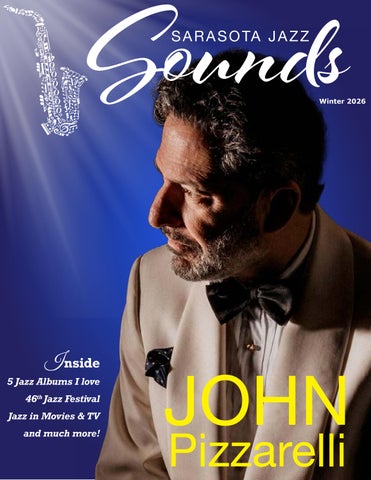
Sounds S A R A S O TA J A Z Z
Winter 2026
Inside
5 Jazz Albums I love
46th Jazz Festival Jazz in Movies & TV and much more!
JOHN Pizzarelli
CONTENTS
03 FOOTPRINTS: 05 HISTORICAL The Making of a Jazz Club Presidents Note by Ed Linehan
by Hal Davis
14
5 Jazz Albums I love
17
46th Annual Sarasota Jazz Festival: Schedule
18
46th Annual Sarasota Jazz Festival: Musicians
20
Jazz in Movies and Television
26 31
by Paul Gavin
by Joseph Petito
Impressions Of Some Jazz Players I Met by Jeff Carstens
Rising Star: Nathaniel Willford by Sanford Josephson
Staff
Jane Doernberg - Office Manager Danielle La Senna - Director of Development Susan Leavis - Marketing, Sounds Editor Carline Ash* - Special Projects Michael Ross - Scholarship Committee Chair Brad LoRicco - Media Support Carol LoRicco - Club Photographer Chris Angermann - Sounds
Board of Directors Ed Linehan - President George McLain Vice President - Legal Affairs TBD - Secretary Paul Toliver - Treasurer
Directors
Peter Anderson Brian Callahan Perette DeJean-Cannady Rosemary Heller John Hill Ron Kushner Carlos Pagån Fred Nowicki Charley Rich Nancy Roucher*, Music Committee Chair Nik Walker
Honorary Board Members Dick Hyman Bob Seymour* *Life Members
Like us on Facebook www.facebook.com/Edjazzclub Follow us on Instagram at jazzclubsarasota 2000 Webber Street, Suite 140 Sarasota FL 34239 941.260.9951 www.jazzclubsarasota.org 941.260.9951 • www.jazzclubsarasota.org
From the President of The Jazz Club Ed Linehan Here in Sarasota, the New Year arrives the way our jazz community always does—listening deeply, swinging boldly, and improvising a future we build together. Over the past year, the Jazz Club of Sarasota has reaffirmed its role as one of the region’s most vital cultural anchors. Through thoughtfully curated programming and a renewed commitment to artistic excellence, the Club has broadened its reach while deepening its connection with longtime supporters. Signature concerts attracted enthusiastic audiences, featuring both nationally recognized artists and exceptional local talent. Educational initiatives—including workshops, student performances, and partnerships with area schools—have nurtured the next generation of jazz musicians, ensuring the music’s legacy remains vibrant and accessible.
continued
WINTER 2026
3
President's Note continued
Membership has grown steadily, reflecting the community’s trust in the Club’s vision and appreciation for high-quality events. In a bold step, the Club hired its first Development Director to enhance member services and engagement. Collaborations with regional arts organizations have further amplified jazz’s presence across Sarasota’s cultural landscape. From intimate club nights to large-scale festival performances, each program has demonstrated the Club’s ability to balance tradition with innovation. Most importantly, The Jazz Club of Sarasota continues to serve as a gathering place—a space where listeners, musicians, and supporters unite to celebrate creativity, spontaneity, and the shared joy of live music. This past year has reaffirmed that jazz is not only an art form but a community, with the Club at its heart. Looking ahead, the coming year promises to build on these achievements and introduce new initiatives. The Board is developing a new five-year plan to propel the Club toward even greater success in fulfilling its mission: preserving and promoting jazz, America’s original musical art form. Sincerely,
Ed Linehan, President
Don't miss out! Become a Member and save on most events be a part of this special, active community. Become a Jazz Club plus Help make Jazz an even more vital part of Member today! life in Sarasota. The Jazz Club of Sarasota has over 850 Members and is Growing!
MEMBER BENEFITS INCLUDE: • Up to $500+ savings in reduced TICKETS • Weekly Eblasts of Jazz Events • Issues of "Sarasota Jazz Sounds” Magazine • Member Support from JCS Office • Opportunities to serve on committees to plan, promote and manage events • Free Luxury Bus Transportation to and from The Jazz Cruise 4
WINTER 2026
Lifetime $1000
Individual $80
One time payment No annual renewal One discounted ticket for most events Jazz at Two Free
Annual renewal 12 full months One discounted ticket for most events Jazz at Two 25% disc
Couples $140
Student $15
Annual renewal 12 full months Two discounted tickets for most events Two people in same household Jazz at Two 25% disc
Annual renewal 12 full months For HS or College students up to 22 yrs One discounted ticket for most events Jazz at Two Free
Musician $45
Annual renewal 12 full months
Working musicians
One discounted ticket for most events Jazz at Two 25% disc
Click to renew or become a member.
HISTORICAL FOOTPRINTS: The Making of a Jazz Club by Hal Davis
Hal Davis
This article, written in 1989 by Sarasota Jazz Club founder Hal Davis, was published in Gene Lees' Jazzletter about the beginnings, growth, and success of the Jazz Club at a time when others had failed. Lees (1928-2010) was a Canadian music critic, biographer, lyricist, and journalist who wrote liner notes for almost a hundred albums. His Jazzletter included interviews and articles sent to him by musicians, publishers, songwriters, and others in the entertainment industry. This piece was brought to the SOUND’s attention by Brad LoRicco who saw it posted online by author Donald Clarke, who has written extensively about music, including The Penguin Guide to Popular Music. continued
5
Dick and Maddie Gibson of Denver, Colorado pointed the way. Before they started their first jazz party, twentyseven years ago, a few not-for-profit jazz clubs were already in existence. But it was the Gibsons, putting individuallyhired musicians together in different contexts, who saved the careers of countless jazz instrumentalists. Now, a quarter century later, this format, the jazz party, has evolved into a circuit across the country, replacing vaudeville and movie theaters (where bands used to play), nightclubs and hotels, as places for musicians to play – and get paid. For those not familiar with the concept, the jazz party is an event staged, usually over a weekend, by an individual enthusiast or a small club of them. A fee is charged for the entire event. Since the money has been paid in advance, there is no desperate insecurity about last-minute ticket sales. Usually, the jazz party differs from the jazz festival, particularly in that its purpose is not to attract huge impersonal crowds in great outdoor arenas, but smaller crowds, perhaps five or six hundred people, who hear the music indoors in ballrooms or other suitable locales in comparative intimacy. No longer does a musician have to sneak into town for the dubious pleasure of playing for a promoter who may, or may not, be able to pay the freight of that evening. Today the musician attending a jazz party, or festival, is hailed as a star with admirers meeting him or her at the airport and driven in style to a motel, hotel or private home. Every reasonable request is granted by those throwing the party. The money is always there, and so is the crowd, pre-conditioned to cheering each instrumentalist and singer. The jazz parties constitute an underground industry that has grown dramatically in the last ten years. Playing jazz has become a different game. 6
From the biggest spectacle, The Sacramento Dixieland Festival, which has a two-million-dollar budget and books a hundred and thirty bands, to the smallest jazz party (and nobody knows which one it is), grass-roots' support of jazz has grown to astounding proportions. Billy Taylor has noted that jazz really has a large audience, despite its standing as a relatively small segment of the music business. The members of that audience are more and more likely to belong to a local jazz club or society, paying annual
Billy Taylor
dues and attending a consistent program of concerts presented by the club, and as often as not culminating in an annual jazz party or festival. The American Federation of Jazz Societies is currently making a study of the economic impact of jazz on a community. Some surprising figures have already come to light. The University of South Florida, a few years ago, made a study of the economic effect of the arts on Sarasota. It gave the arts a sevento-one value in dollars. That is, for every dollar expended in support of the arts, Sarasota received seven in return, spent in restaurants, hotels, service stations, and other local businesses. That is a whopping profit.
More studies are needed, and the AFJS is undertaking them. I can perhaps put matters into perspective by focusing not on the country as a whole, but on one city, and one jazz club, the club I know most about, due to my involvement in it: Sarasota. At the end of 1978 I retired from Grey Advertising after twenty-two years in advertising and public relations and an extensive involvement with music, as a publicist for Columbia Records and later for individual jazz artists. January, 1987, found my wife Evelyn looking for an apartment in Sarasota at the urging of a friend who lived near our summer home in a very rural part of the Catskill Mountains in New York State. She called me in New York to say she'd found the ideal apartment, and we bought into a new community named Pelican Cove.
Heisman Trophy and was familiar to me through The National Sculpture Society. The circle of friends and acquaintances in Sarasota grew. By the end of that year, we had become aware that something important to all of us was missing from our Sarasota world: jazz. Evelyn and I began inviting neighbors to our apartment to listen to records. And then Jerry Jerome surfaced. This hard-swinging tenor man divided his
Sarasota was an unknown to us. Soon after our arrival, we went to the opera at the Asolo, a charming eighteenth-century opera house brought here complete from Asolo, Italy. The orchestra comprised two pianos, but the production was very good. And the cover of its program bore the familiar signature of graphic artist Alex Steinweiss. “I know him,” I told Evelyn excitedly. “He was at Columbia with me before the war. He's a genius.” Alex, I have noted in a previous Jazzletter, invented the album cover with an attractive design, as opposed to mere print. I also discovered I knew the president of the opera society that staged this production, Leo Rogers. In New York, Leo had operated an engraving shop that worked on Revlon, among other accounts. We'd met when I was doing some temporary work on the Revlon account. I found I had more friends in Sarasota. Composer and conductor Sid Bass turned up next. Sid had played piano in a band when we were teenagers. Then I found sculptor Frank Eliscu, who had designed the
Jerry Jerome
year between Long Island, where we had first met, and Sarasota. Jerry attended one of our early record sessions, and gave a demonstration of how the clarinet and saxophone are played. We soon overflowed the apartment so we rented a recreation hall. In February 1980, convinced that there was a market for jazz in this community, we organized The Jazz Club of Sarasota. Our neighbor Stan Hendricks, a lawyer who loves to play alto and soprano saxophones and worships jazz musicians, volunteered his law services to obtain our non-profit charter. Almost immediately, we had well over a hundred annual members. We moved
continued
7
into a community room at the Fortune Bank. It seemed time for a live concert. Our first was at David Cohen Hall, a small room in the Florida West Coast Symphony building. Our first guests were Bucky Pizzarelli and his son John, who volunteered to get us off to a good start and charged nothing but their expenses. [John Pizzarelli will be performing at the 2026 Jazz Festival.] When 280 persons, paying five dollars each, overflowed the room, whose capacity was 250, we knew we had arrived. Bucky and John played their brilliant duets in the first half of the concert; for the second half, we added two local musicians, Len Wyatt on bass and Gary Pike on drums. This appearance gave Len, who had played with Jerry Wald before World War Il and then given up music for retailing, a fast start back into the business. The concert was a tremendous success.
Bucky and John Pizzarelli
Our second major project was the first Sarasota Jazz Festival. And my first disappointment came when I made a case for joint promotion to both the New College String Quartet and The Florida West Coast Symphony. Both boards threw me out, saying in effect that we should make it on our own — and then come back. Fair enough. We determined to do it. We set about organizing our first festival, which was a success, and then the second. We drew enough attendance (at fifteen dollars a ticket) to have the fire department tell us we just couldn’t have that many people in Lola Mundy Hall. We moved into Van Wezel Hall. which is much larger. In consultation with us, bassist Jack Lesberg lined up a fine cadre of musicians. Alex Steinweiss designed a superb logo, poster, and program cover; Sid Bass worked on committees; and Leo Rogers gave us the support of The Opera Society. We were startled by the response. We had tapped a market from Tampa to Fort Myers and beyond. This market was older, affluent, and nostalgic, and not very knowing about jazz and its practitioners. But they were open-minded
Alex Steinweiss
8
were to spread the word of jazz in the community and give jazz a higher visibility and status than it had enjoyed prior to the establishment of our society. We found that in the early 1970s, Sarasota had a Suncoast Jazz Club, headed by a prominent lawyer. It failed and folded. We went to the officers of that dub and asked what went wrong. With their advice in mind, we programmed our own club meetings.
and eager to learn. We started to wean them away from the belief that a whistler doing In the Mood was great jazz. Our membership kept growing. We instituted live concerts monthly, flying down from New York many of the same musicians who played our festivals. Through these concerts, our club members began to educate themselves on the fine points of quality performances by classic sidemen, young and old. We set up clinics in the high schools during the festivals. We began using local musicians for free community concerts, and others held to benefit local charities. We started our Library Gift Program, donating records and books about jazz to the Sarasota County and Manatee public libraries. We joined the Professional Alliance of Performing Arts, which included the opera and symphony, the New College Quartet, the Sarasota Concert Orchestra, and two theater groups. Our objectives
By the end of our first year, our membership had risen from over a hundred to over a thousand members. We held special ceremonies, displayed for the first time a Sarasota Jazz Club flag, and celebrated. Today we have from thirteen to fourteen hundred members who pay $30 annual dues, or $50 for couples, in return for which they get seven concerts a year by top jazz men and women, a bimonthly newsletter, discounts on various jazz events, a Jazz on the Water cruise (which costs extra), a dance (also extra), and various other benefits and activities. We have given away thousands of dollars at the high school level, helped sponsor an Air Force Reserve band at Van Wezel field, started an annual outdoor presentation of top local bands
By the end of our first year, our membership had risen from over a hundred to over a thousand members. called Jazz in the Park – a free concert that drew more than 5,000 people this year – produced a holiday show for Van Wezel which this year will play at the new Naples/Marcos Philharmonic Hall and then our own hall, sold several banks on extending our monthly concerts by producing a commercial presentation the continued
9
John Clayton Jr was the music director of our last festival – the ninth. A big band played John's charts, and brother Jeff Clayton played reeds. Both did well with a clinic for high school musicians. a show for black youngsters up to the fifth grade from Booker Elementary School, and a clinic by Brian Torff and John Clayton for young bassists from the symphony.
Frank Eliscu Sculptor day after, and managed to stage from thirty-five to forty-five free concerts for good causes each year. That includes the only jam session held in the area. Our Saturday afternoon Jazz Club Jams offer three hours of music to a capacity audience, and provides a chance for new professional musicians to meet and impress others so that they may start working in the area. At monthly concerts, we’ve presented people from Howard Alden through Wilt Hinton to Glenn Zottola. We’ve had Marcus Roberts on piano with the Moffett Brothers on bass and drums, flutist Jan Rosemund with her trio, Scott Robinson, Michelle Hendricks, Lillette Jenkins, Carrie Smith, Lyn Roberts, Ricky Ford, Daniel Ponce, Kirk Lightsey, Grady Tate, Roland Hanna with Terri Lynne Carrington and Clint Houston, etc. Dick Hyman and Derek Smith, very big names here, sell a lot of tickets. Oh yes, one other thing we did. We put former Benny Goodman's drummer Mousey Alexander on the road to play inspirational sessions at stroke and heart clinics. Despite his own heart problem, Mousey kept it up until he died last year. 10
in 1989.
We have established The Satchmo Award, sculpted by Frank Eliscu, to be presented to outstanding names in jazz. George Wein received the first one. Ella Fitzgerald received the award in 1988, and Milt Hinton
In 1985, we gave Milt his own festival, a tribute to this remarkable man, our special favorite. Milt’s autobiography, Bass Line, which is filled with his striking photography, is, in a sense, his greatest tribute; but we gave him ours, in the conviction that Milt is the story of jazz in America, as well as being the most enthusiastic advocate of this art form.
Milt Hinton receiving Satchmo Award 1989
The Jazz Club of Sarasota has one paid part-time employee. Our office is in the opera house. Our activities are funded by dues, ticket sales, private donations, some corporate help, and, most recently, our first grant from The National Endowment for the Arts. On the urging of State Senator Bob Johnson and Jim Smith, head of the department of state government that deals with cultural affairs, Florida has contributed substantially to our health. And this wonderful town has a Woman's Exchange, which annually distributes hundreds of thousands of dollars to arts organizations. They have given us enough money to buy rhythm instruments for our new elementary school program on jazz. We build a solid core of perhaps twenty-five volunteers who can handle the facets of our operation, including running the office, arranging national and local transportation, designing stage displays — our reigning star is Renzie Hamilton, who builds everything in his garage – and whatever else required. Backing them, we have volunteers who turn out for specific assignments. We keep a log of our activities with monthly board meetings, review our future activities, and then do critiques on them afterwards. There are many jazz societies and clubs around the country, doing excellent work in their communities on behalf of jazz. We are in awe of such groups as the Cape Cod, New Jersey, and Pensacola jazz societies, the various Ohio and Pennsylvania organizations, Gainesville Friends of Jazz, HAGS on the Florida East coast, the clubs and societies in Tampa, Orlando, Biloxi, and St. Louis, The Jazz Institute of Chicago, The Denver Jazz Club, The Sedona Festival, the societies
in Billings, Montana, and Bismarck, North Dakota, Don Miller in Phoenix, Arizona, and the many clubs in California. We learn much from the way they go about their business, and all of us exchange newsletters and news of festivals. Multiply what we do in Sarasota by ninety or a hundred, and you’ll realize that jazz today has the strongest grassroots' support in its history. We push jazz radio programs and try to get record stores to stock product from the companies recording our artists, and keep trying to elevate the status of jazz in our community and nationally. Record companies and others, including the musical instrument manufacturers, give little support to our efforts. Someday they will. Many clubs are called “traditional.” Others present more varied programs. Still others book contemporary, or what is contemporary. Some of us argue that Milt Hinton playing anything is contemporary. But the problem of the younger audience, faces all jazz societies, regardless of musical persuasion. If youngsters are not exposed to jazz in their early years, we lose them. That's why we try to work with the lower school grades. Entering our tenth anniversary year in 1990, we plan a five-night festival, including a night of Symphony Meets Jazz, participating with other organizations in the performing arts in their own areas, doing lectures series, and expanding our community programs to make as many people as possible thrill to this marvelous music as we do. The key to our success has been an incredible, dedicated group of volunteers.
continued
11
SARASOTA JAZZ
Sounds
My wife Evelyn has worked as enthusiastically as I have, doing publicity promotion for the club. Many of our board members are couples who work together as we do. We helped found The Sarasota Arts Council, working with people in all the arts. We anticipate that in a few years we will present the first overall Sarasota Arts Festival. As all managements should, we have planned for succession. My successor as president of The Jazz Club of Sarasota is twenty years younger than I, but Evelyn and Hal Davis just as enthusiastic. He has a somewhat different viewpoint, but that is as it should be, and should take us through the changing jazz market and audiences during the next ten years. Why has Sarasota succeeded where other groups have failed in a few months? We have always found our own way financially, never exceeding our means. We have been creative in action and financially prudent in operation. And we have made common cause with people in the other arts.
12
WINTER 2026
Did you know that April is Jazz Appreciation month? The %ming couldn’t be be2er! April is also the Giving Challenge, presented by the Community Founda%on of Sarasota County. Get ready!
April 15 – 16, 2026 is your chance to support the Jazz Club
of Sarasota, and have your contribu%on matched by funds from the Pa2erson Founda%on. We’re excited to par%cipate in the 2026 Giving Challenge and hope you’ll join us to keep jazz jamming in Sarasota!
The Jazz Club of Sarasota is a 501(c)3 organization. Gifts are tax deductible to the extent allowed by law.
2025-2026 SEASON PMP WINTER RESIDENCY DEC. 30, 2025 - JAN. 10, 2026
Orchestra & Chorus Rehearsals, Super Strings Jan. 5, Concert and Gala Jan. 9, Chamber Music Concert Jan. 10
ARIEL STRING TRIO GAIA QUARTET MAR. 12, 2026
ZOTA QUARTET
“Beethoven!”
“The Art of Music”
FEB. 22, 2026
“Mythic Visions”
MAY 2-4, 2026
TICKETS & INFO: PMPSUNCOAST.ORG Sponsored in part by:
13
by Paul Gavin
5 JAZZ ALBUMS I LOVE
MILESTONE Miles Davis This 1958 studio album by the great jazz trumpeter, with John Coltrane and Julian “Cannonball” Adderley on saxophones, Red Garland on piano, Paul Chambers on bass, and Philly Joe Jones on drums, is considered by many to be one of the great modern jazz albums that helped shape jazz history. Philly Joe Jones is one of the early innovators of the bebop language on the drums. Every jazz drummer studies Philly Joe at some point in their life. This album had a tremendous influence on me because it helped me to understand jazz comping for the first time. Comping is the improvised accompaniment that jazz musicians do when another band member has the melody or is playing a solo. Drummers will do most of their comping on the snare drum. It was this album that taught me how to do that, especially on "Straight No Chaser." The snare drum on that track is incredible!
JAZZ POET Tommy Flanagan Released in 1898 by pianist Flanagan, with George Mraz on bass, and Kenny Washington on drums. Drummer Kenny Washington is a living legend on the brushes. It's no wonder that Tommy Flanagan wanted him on this record. The entire album is a piano trio with only brushes on the drums. Kenny has such a disciplined approach to the drums – one that I try to emulate myself. He is happy to play a simple brushes pattern while other things are going on. He does it regularly throughout his playing on "Caravan." But he can also take the stage when called upon. His solo on "Mean Streets" is one of the best I've ever heard.
GRAVITY Jeremy Ledbetter My other albums are older ones, featuring mostly musicians who are no longer living. This contemporary trio album is fresh from the studio, having been released in 2024, with Canadian pianist Jeremy Ledbetter, six-string bass guitarist Rich Brown, who has been compared to Jaco Pastorius, and Larnell Lewis on drums. Ledbetter has written some of the most beautiful and engaging compositions. Larnell Lewis plays the drums with full strength and energy across all the tracks, but I especially enjoy “Two Cousins.”
SARASOTA JAZZ
Sounds
LIGHT AS A FEATHER Chick Corea The second album by the jazz band, Return to Forever, led by keyboardist Chick Corea, also has Joe Farrell on saxophone and flute, Stanley Clarke on double bass, Flora Purim as vocalist, and her husband Airto Moreira on drums. It won the 1972 Playboy “Jazz Album of the Year” award and frequently polls as one of the greatest jazz albums ever recorded.
This album is my most listened to album for sure. I've listened to this album so much that just thinking about it takes me to very specific places and conjures images of where and when I was when I was listening to it. You might not recognize its name, but you'll likely recognize the top track of the album, "Spain." Drummer/percussionist Airto Moreira does an amazing job of bringing together modern jazz and Brazilian sound.
MOSAIC Art Blakey & The Jazz Messengers This 1961 studio recording also featured Curtis Fuller and Freddie Hubbard on trombone and trumpet, Cedar Walton on piano, and Jymie Merritt on bass. Art Blakey needs no introduction as the leader and drummer of The Jazz Messengers. His playing has always fascinated me, and continues to inspire me to this day. His drumming on this particular album is thunderous and powerful, full of energy and excitement. His solo on "Mosaic" is my favorite drum solo of all time. I can sing it note-for-note, just about. Each time my own band Mosaic (named after this album) performs, we play the number, and I do my best Blakey impression, combining his drumming language with my own. Art Blakey is the king. No one comes close.
(Gravity is available on YouTube, Spotify, and various streaming channels. You can also get a CD copy at https://www.jeremyledbetter.com/product-page/gravity-cd-pre-order). Paul Gavin is a drummer, music teacher, composer, and arranger in Tampa, Florida. As a bandleader, he heads several ensembles: The Gulf Coast Jazz Collective, The Lake Wales Jazz Connection, The Vanguard, which plays his original music, and Mosaic, which features the music of Art Blake & The Jazz Messengers. He plays regularly with musicians in the Tampa Bay area and performed at the Sarasota Jazz Festival in 2024 and 2025.
941.260.9951 • www.jazzclubsarasota.org
WINTER 2026
15
JAZZ
TROLLEY & PU B CRAWL
9:30* 0 3 : usic c5lose at 9 ns Live M locatio
March 10, 2026
*some
Live Jazz s e u n e V 2 1 s 5 Trolley 1 Ticket ! e m i T t a 1 Gre
Ride the trolley 5:00-10:00
PERFORMERS INCLUDE: Eddie Tobin & Friends Ruffus 4tet The Barker Project Barbara Jordan Quartet John Hill Trio The Brenda Watty Experience Five Points Quintet featuring Darcie Allen Sarasota Fusion Hot Club SRQ Eddie Kinder Jazz Ensemble Barbara King Quartet Joined At the Hip Jazz Jam SRQ
Tickets: $28 (10% discount for members) $35 day of event For tickets and information visit: www.sarasotajazzfestival.com/tickets
Signature Cruise Experiences PRESENTING SPONSOR
2026 Monday, March 09: VIP Event featuring performance by Danny Sinoff John C. Court Cabaret, Florida Studio Theatre
Tuesday, March 10: Jazz Trolley Pub Crawl with 12 Venues in downtown Sarasota with live Jazz! Thursday, March 12: Opening Act: Florida All State Band Headliner: Terell Stafford Quintet Friday, March 13: Opening Act: Sammy Figueroa “A Tribute to Cal Tjader” Headliner: John Pizzarelli Trio Saturday, March 14:
Opening Act: SRQ Allstars
featuring James Suggs, Dan Jordan, Anthony Aldissi, Michael Ross, Ronan Cowan and Allison Nash
Headliner: Arturo Sandoval Band
For tickets and information visit: www.sarasotajazzfestival.com 17
Sarasota FESTIVAL
2026
Featuring
1. ARTURO SANDOVAL
3. RONAN COWAN
2. DANNY SINOFF
4. JOHN PIZZARELLI
is one of the most dynamic and vivacious live performers of our time, and has been awarded 10 GRAMMY Awards.
is a freelance jazz/funk drummer and musician from Sarasota, Florida, known for playing with groups in the New Orleans scene. is a world-renowned guitarist and vocalist being hailed by the Boston Globe for “reinvigorating the Great American Songbook and repopularizing jazz.”
is a jazz pianist, singer, and bandleader who has spent more than 20 years performing the Great American Songbook. He sees music as an act of communication — something meant to move people, not impress them.
5. SAMMY FIGUEROA
is a world-renowned, GRAMMYnominated percussionist known for his versatility across jazz, Latin, pop, and rock, and leads his own acclaimed Latin Jazz Explosion group.
6. ALISON NASH
is known to immediately captivate an audience with her powerful, soulful, and versatile voice. Her sound stirs emotions and brings music to life.
3
4
2. 1
2
5
10. JAMES SUGGS
8. TERELL STAFFORD
11. ANTHONY ALDISSI
is nationally recognized jazz educator and musician. He plays a variety of instruments and is a tenor soloist. He has performed with a multitude of renowned artists such as Aretha Franklin, Ray Charles, Mel Torme, Frank Sinatra Jr, and many more.
is an acclaimed trumpet player based in New York, and has been hailed as “one of the great players of our time, a fabulous trumpet player” by piano legend McCoy Tyner.
9. MICHAEL ROSS
"possesses one of the FATTEST acoustic bass sounds you’ll likely hear” according to All About Jazz. A bassist and composer, Michael Ross continues to captivate audiences with his exceptional skill and dedication to musical excellence.
6
is a highly regarded jazz trumpeter, musician, and educator. He is known for his technical skill, improvisational talent, and performances that pay homage to jazz legends like Miles Davis and Louis Armstrong.
is a multi-talented performing and recording artist as well as an educator. As a pianist he is known for his technical skill and improvisational talent. As part of Temple University's rhythm section, he won the "Outstanding Rhythm Section" award and "Outstanding Pianist" award at the 2023 Jack Rudin Championship at Jazz at Lincoln Center.
7
MA RC
7. DAN JORDAN
H
9 0
14
Click on names to listen to a sample of the artist music.
9
10 8 11
Ja�� in Movi es a nd
Tel ev
i si o n
By Joseph Petito
hen you tune into (no pun intended) the Netflix series Nashville, it’s no surprise to hear country music play. In fact, you pretty much expect it given the show’s title, plus it takes place in Nashville and is about the goings on behind the scenes of the country music capital of the world. On the other hand, if you opt to watch the edgy crime drama Bosch and its follow-up, Bosch Legacy, on Amazon Prime, there is a surprise, a very pleasant one. Both Bosch series incorporate a wide range of classic jazz, including works by Art Pepper, John Coltrane, Miles Davis, and Frank Morgan, among others. In fact, jazz music is an indelible part of the plot in many episodes. Harry Bosch, the series' main character played by Titus Welliver, is a Los Angeles police detective and later a private eye. A gifted crime investigator and tortured soul, he is also a jazz connoisseur. After a dramatic scene, and at other crucial points during an episode, Bosch will return to his home in the LA hills to play his vinyl jazz records while mulling, digesting, or sometimes regretting what has happened or what he caused to happen. When Bosch adopts a rescue dog, he names him “Coltrane.” 20
and 1960s showcased a jazz music theme. Post-World War II producers wanted to create “noir” settings for the television dramas, and jazz had a close association with “noir.” Some art critics referred to the shows as “crime jazz” or “jazz noir,” characterized by a gritty, dark, and moody style. Bosch also uses jazz music to communicate his feelings to his daughter Maddie, his only family member left after his wife Eleanor is murdered because of her undercover FBI work in an international gambling ring. In one episode, Bosch plays the song “Patricia” for Maddie. The mournful melody was written by Art Pepper for his daughter as an apology for his absence from her life due to rampant drug use and time spent in prison. The song becomes Bosch’s apology to Maddie that his crime work took him away while she was growing up, partly without a mother. Jazz is present in the Bosch series in yet another way. Several of the show’s episodes take place during live jazz sets at actual Los Angeles jazz clubs where Bosch goes to listen to music: The Baked Potato, Blue Whale, and the Catalina Jazz Club. During one visit to the latter, real-world jazz saxophonist Grace Kelly plays “Blues for Harry Bosch.” Kelly, who performed at the Sarasota Jazz Club Festival two years ago, is a fan of the show and the Bosch books by Michael Connelly. She wrote the song to describe Bosch’s feelings about his criminal investigative work.
We can partly thank the French for jazz’s noir association, given that many post-war New Wave films used jazz to create their dark mood, as well as the considerable number of American jazz musicians who moved to Paris after the war. But the musicians themselves get most of the credit for personifying “cool” and “hip,” and for the edgy, shadowy, and complex jazz they created – as much an art form as music. One of the most noteworthy instances occurred when Miles Davis happened to play in Paris at the Café SaintGermain in 1958, and famous French film director Louis Malle, who was later married to actress Candice Bergen, needed a score for his crime noir drama, Elevator to the Gallows, starring Jeanne Moreau. Malle approached Davis, who came to the studio with his
For many baby boomers, crime dramas and jazz music are synonymous. Many crime TV shows produced in the United States during the 1950s continued
21
Other great jazz movie scores included Gato Barbieri’s Last Tango in Paris, Anatomy of a Murder with a score by Duke Ellington, Sonny Rollins’ music for Alfie, and Herbie Hancock’s Academy Award-winning score for Round Midnight in 1986. Topmost among the early American TV crime jazz dramas was Peter Gunn, the stylish private eye series that ran
ensemble of Pierre Micheletti, Kenny Clarke, Rene Urtreger, and Barney Wilen. The group improvised in front of a projection of the film and, in an allnight session, created a groundbreaking score, considered one of the most significant in the history of cinema. Another important score was Herbie Hancock’s music for Michelangelo Antonioni’s Blow Up, in which a young fashion photographer realizes he has captured a murder when he develops a roll of film he shot in a park. In a memorable scene, the photographer (David Hemmings) tries to teach the woman (Vanessa Redgrave), who offers to sleep with him to get the camera roll, how to count on the offbeat to the music playing on his phonograph. Hancock’s music (with an appearance by The Yardbirds) captures the moody mod scene of London in the early sixties and matches Antonioni’s jump cut editing.
22
from 1958 through 1961. Directed and written by Blake Edwards, later of Pink Panther movies fame, Peter Gunn featured an iconic jazz theme composed and conducted by Henry Mancini, which amplified the action on the screen. The soundtrack that Mancini produced featured the “Peter Gunn Theme,” included the songs “Sorta Blue” and “Dreamsville,” and won a Grammy Award for Album of the Year in 1959. A second jazz album, More Music from Peter Gunn, was released the following year.
While Peter Gunn was acknowledged to be the first television show to feature a modern jazz soundtrack, others soon followed. The crime drama Johnny Staccato, which ran for 27 episodes from 1959 to 1960, was steeped in jazz. Its main character, a jazz pianist who also worked as a private investigator, was played by actor and later director John Cassavetes. The show took place in a fictional Greenwich Village jazz bar and featured wellknown jazz musicians of the day. Pete Candoli played himself as head of the bar’s house jazz band, along with combo members Red Norton, Barney Kessel, and Shelly Manne. Stanley Wilson was the show’s music supervisor, and Johnny Williams was credited as a musician. The unique jazz soundtrack, including “Staccato’s Theme,” had a driving, pounding beat and deep horns. It was composed by Elmer Bernstein, who also created jazz scores for Sweet Smell of Success and The Man with the Golden Arm, as well as memorable music for The Magnificent Seven and The Great Escape.
Another jazz-infused series, M Squad, starred Lee Marvin as a Chicago police detective and ran for three years, from 1957 to 1960. The show’s first season featured a soundtrack composed by
Stanley Wilson, which was nominated for a Grammy for Best Soundtrack Album. Count Basie composed the new second and third season theme music. Sonny Burke, Pete Carpenter, Benny Carter, and John T. Williams provided incidental music and arrangements.
Johnny Williams produced the jazz soundtrack to the crime series Checkmate, which ran from 1960 to 1962 and was known for a more “sophisticated” jazz sound. Beginning in 1967, the popular detective series, Mannix, ran on CBS for nearly 200 episodes featuring a fusion of jazz and Latin American rhythm music composed and conducted by Lalo Schifrin. Schifrin went on to create the iconic opening theme for Mission: Impossible in the late 1960s, as well as scores for Cool Hand Luke and Bullitt.
continued
23
During and after the 1960s, jazz in crime dramas yielded to more progressive rock and roll, and by rock with jazz influences, such as in the popular Hill Street Blues (198187). Or with moody, near-surreal themes as in Twin Peaks (19901991). Happily, though, jazz music continues to endure. Recent movies and TV shows with jazz soundtracks include Mo’ Better Blues, Whiplash, Boardwalk Empire, Homeland, 30 Rock, and Better Call Saul. And, as with the Bosch series, there will always be producers willing to reach back to the classics, or to newer and younger jazz artists, for inspiration. Meanwhile, I’m happy to reread a few of the 24 books in the Harry Bosch series by Michael Connelly, and eagerly await the new prequel coming this year, Bosch: Start of Watch, which hopefully will have another great jazz score.
THE END
24
Joseph Petito Recently retired from Price Waterhouse Coopers, where he led the firm’s public policy activities. Joe P. Petito became a Florida resident last year and lives in Holmes Beach. Like his fictional hero, Harry Bosch, Joe enjoys classic jazz and writing. He sits on the Board of the Women’s Project (WP) Theater, the nation’s oldest and largest theater dedicated to advancing women writers, directors, and producers, located in Manhattan, where Joe has a home. He spends summers at his family beach house in Delaware, where he paints landscapes and scampers after his two baby granddaughters, Audrey and Sienna.
For Tickets: https://2026JCSScholarshipConcert.eventbrite.com
soundwaveproductions.net BEER • WINE • BITES • BRUNCH 1445 Second Street | Sarasota, Florida 34236 www.99bottles.net
941.260.9951 • www.jazzclubsarasota.org
WINTER 2026
25
IMPRESSIONS OF SOME JAZZ PLAYERS I MET: Cannonball Adderley, Stan Getz, Billy Eckstine, Maynard Ferguson
By Jeff Carstens
t's incredible to look back over time and realize how many of the jazz greats I have been on stage with, rubbed shoulders with, and known. It's humbling to realize how lucky I was to be in their company. I started playing jazz in high school and was in a jazz combo in the Chicago area, playing the bars on Belmont Avenue when I was 16. I had a jazz show on the high school FM station and formed a jazz club. We brought in performers playing in Chicago to meet with the club. Saxophone players Sonny Stitt and Zoot Sims joined us. Sonny Stitt was a pleasant, simple man, no big words or bragging, but put a horn in his hands and you knew you were watching greatness. Zoot Sims, on the other hand, was unremarkable. He didn’t say much and made no impression on me.
26
WINTER 2026
Miles Davis agreed to join us at a meeting, but he stiffed us. I drove downtown to pick him up, but he wouldn’t come down from his apartment, so I left. Driving home in a snowstorm, I drove off the Lake Shore Drive and crashed my father’s car. So much for Miles Davis. Years later, I saw him in concert and thought he still had Daniel Epstein attitude problems — he kept his back to the audience for much of the show.
and became the faculty chair for piano at Rutgers. He was a brilliant musician. On baritone sax, Bill Bradley was an OK player, but he was a great recording engineer. He had a career as one of the best studio engineers in the country, working with Joe Henderson, Minny Ripperton, Rotary Connection, and others. I played tenor sax and never became a household name. Oh, well. But my music experience earned me a scholarship to SMU — for the marching band! Out of that band came the SMU jazz band, led by Ron Modell, who was the principal trumpet with the Dallas Symphony, and an early mentor. He was also the straw boss for the house band
“Mr. B.” was a gentle giant: deep and smooth, warm and personable. He traveled with his 10-year-old grandson, who was a miniature version of the Eckstine persona: cultured and restrained, polite and pleasant. We formed a jazz octet when I was 17, and it included some terrific players. Our drummer, a kid named David Samuels, complained of tennis elbow from the machine gun playing of the drum kit and said that he wanted to play vibes instead. He went on to Berklee Music School, played with Gerry Mulligan at Carnegie Hall, became a member of Spyro Gyra, and later formed the Caribbean Jazz Project. Our piano player was Daniel Epstein, who, at 17, was an amazing jazz player. He became a world-renowned classical pianist, selected by Eugene Ormandy to play with the Philadelphia Orchestra in 1973. He also toured Europe as a soloist continued Billy Eckstine
27
Cab Calloway
at the Pines, a Catskills resort hotel, which had a main room with seating for 600. In 1968, he hired me to join him there for the summer season. We played 3 acts per night, and had a lot of great performers. The memorable were Billy Eckstine and Cab Calloway. “Mr. B.” was a gentle giant: deep and smooth, warm and personable. He traveled with his 10-year-old grandson, who was a miniature version of the Eckstine persona: cultured and restrained, polite and pleasant. Rehearsals were professional, and his performances were flawless. Nobody who saw him for the first time in 1968 would have guessed how important he was to the history of jazz as a band leader and singer, only that he was a great performer on our stage.
Stan Getz
deal, so we brought in headliners to build the show. The two standouts were Stan Getz and Cannonball Adderley. I went to Stan Getz’s dressing room to meet him. He was sitting on a bench, shirtless, covered with sweat, and had a fifth of whiskey next to him. What do you say to such a great man fighting his demons? I asked him what kind of sax he played (Selmer Mk VI, of course) and stammered through some meaningless small talk. He was a wreck, and I expected a less-thanstellar performance. But when he came
On the other hand, Cab Calloway was a shadow of his former self: old, tired, and stiff. Such an amazing music giant continuing to perform the Scooby-Doo dance of the 1930s, “Mini the Moocher,” “Hi-De-Ho,” and goodbye. It was sad. Meanwhile, Ron Modell’s SMU jazz band also played occasional concerts at Moody Coliseum in Dallas. We weren’t a big Cannonball Adderley Quintet
28
SARASOTA JAZZ
onstage, Getz was immaculately dressed, poised, and never missed a note. He was amazing, a completely different man than I had met an hour before. The audience loved him, and so did I. Later that year, I was on stage with the Cannonball Adderley Quintet. They arrived right before they had to go on, dressed in their trademark black suit/ black tie uniform, strait-laced, nononsense, and they performed their set with workmanlike enthusiasm. While it was awesome to be on stage with them, I did not have any feeling of connection. These guys were such great musicians, but they played the set the same way they had played it 1,000 times before. When I left SMU, I went to work for LeBlanc in Kenosha, Wisconsin, a woodwind company that also owned Holton Horns. At the time, we made trumpets and trombones in addition to French horns. One of the endorsers was Maynard Ferguson, the high note trumpet player, and we were working with him on
Maynard Ferguson
the design of a signature valve trombone. Maynard had recently returned from an extended stay in India, and when I asked him what he had learned there, he said, “You are your own guru.” I took his advice to heart and have followed it ever since. Later that day, he had a gig at a high school in Chicago. I volunteered to take 941.260.9951 • www.jazzclubsarasota.org
Sounds
him there. Since he didn’t have much time, he opened his case, took out his horn, and warmed up in the back seat of my car. Fortunately, he had a mute! But it was pretty exhilarating! I left the music business in 1973 for the corporate world and worked as product manager for a loudspeaker company. Later, I started the car stereo business for Sony in New York City, but went over the side in the ’80s and started an advertising business with my wife. I always had a passion for photography, and in ’97, I opened Southern Light Photography, which kept me busy for the next 25 years.
Frank Zappa once said, “Jazz isn’t dead. It just kind of smells funny.” I didn’t play my saxophone for almost 50 years, but during Covid I decided that I wanted to learn the flute (an instrument that I discovered was easy to play badly) and practiced 90 minutes a day for 3 years. I also picked up a tenor sax and got my chops back. Today, I play in a jazz improvisation combo at State College of Florida and a big band in Chicago. I also perform with Jazz Club jam sessions at the Selby Library. It’s not the same as being on stage with Cannonball Adderley, Stan Getz, Billy Eckstine, Dave Samuels, or Ron Modell, or having Maynard Ferguson warm up in the back of my 1962 Chevy, but it’s just as much fun as ever. Frank Zappa once said, “Jazz isn’t dead. It just kind of smells funny.” Well, it smells fine to me, but then again, I lost my sense of smell 10 years ago.
WINTER 2026
29
The Jazz Club of Sarasota
Marina Jack II Cruise Robert Nissim: Tribute to Bill Evans Sunday Board 2:30
May 17 th 3pm-5pm
TICKETS:
LOCATION:
$35 JCM/$40 NM
Marina Jack II
www.jazzclubsarasota.org
on the Downtown Sarasota Bay front behind Marina Jack restaurant.
Joy of JAZZ
Free ConcertS Click for more information
2026
Centennial Park Gazebo Venice Ave, Venice, FL 2:00 - 4:00 pm
Jan 18th KITT MORAN QUARTET Feb 8th Eddie Kinder Ensemble Mar 22nd Robbie Rose Joy of Jazz Sponsored by
Bring your sunscreen and beach chair to relax and enjoy! 30
RISING STAR: NATHANIEL WILLFORD By Sanford Josephson, Editor, Jersey Jazz
Nathaniel Williford’s jazz education began when he entered the sixth grade at Osceola County School for the Arts in Kissimmee, FL. “The magic started happening at our instrument trial day,” he recalled, “selecting what we’d play in the band program. The trombone was what stood out to me. I could make some basic sounds on the trombone.” Things began to change, however, when he heard Osceola’s top high school jazz band play. “I heard the lead trumpet sitting on top of the band. That was so cool. I kind of made up my mind without really knowing what I wanted to do.” In the seventh grade, Williford continued to play the trombone, “but I started learning the trumpet a little bit at home. I would just follow along with the trumpet players (on recordings and videos) and see what corresponded to my slide positions. But I didn’t play trumpet at school for a very long time.” In his freshman year of high school, he auditioned only on trumpet and started playing trumpet in the jazz band, but then Covid hit. Williford spent his entire sophomore year at home, but in the middle of his freshman year, he had met his trumpet mentor, the late Dan Miller. “I was meeting with Dan Miller at least once a week on Zoom. He was a tremendous trumpet player and educator. He toured with Harry Connick, Jr.’s big band, but he moved to Florida a few years ago to take care of his aging parents. He was very influential in my instrumental development and connected me with other great trumpet teachers. He was just the best mentor, best friend.” continued
941.260.9951 • www.jazzclubsarasota.org
WINTER 2026
31
Williford was back at school for his junior year in 2021, and that’s when his budding career as a jazz trumpeter began to escalate. Osceola had a new Director of Jazz Studies, Jason Anderson. “He got us into shape pretty fast, gave us the right mindset, the right attitude.” Under Anderson’s leadership, the Osceola jazz band not only became a finalist at Jazz at Lincoln Center’s Essentially Ellington competition, it won First Place. “We didn’t even have conversations about what would happen if we won,” Williford said. “Osceola had attended Essentially Ellington before, but that was before any of us were there. Nobody in the program had been there before. The first-place announcement was a huge surprise to us, but it was really, really awesome. And it would eventually play a big part in why I wanted to move to New York.” The 20-year-old Williford is now in his junior year at Juilliard.
“I was meeting with Dan Miller at least once a week on Zoom. He was a tremendous trumpet player and educator.... He was very influential in my instrumental development and connected me with other great trumpet teachers. He was just the best mentor, best friend.”
The importance of Williford’s mentorship by Dan Miller was also driven home to him while competing at Essentially Ellington. “I got the chance to speak to (trumpeters) Kenny Rampton and Marcus Printup, and I let them know I was studying with Dan Miller, who used to play in the Lincoln Center Jazz Orchestra (predecessor of the JALC Orchestra). When I first met Wynton Marsalis and shook his hand for the first time, all he said to me was, ‘Dan Miller’. He didn’t say anything before that, anything after that. We gave each other a hug. Dan was still with us at that time, and I was able to call him up and tell him about the whole experience.” Miller passed away in August 2022 at the age of 54. A resident of Fort Myers, FL, he helped organize the Naples Youth Orchestra and taught improvisation classes in the Jazz Studio of the University of Central Florida’s School of Performing Arts. Shortly after he died, a colleague, pianist Jerry Stawski, told the Naples Daily News, “Dan was an
quickly realized that I would have a solid lead (trumpet) player — Nathaniel. I remember greeting him for the first time as ‘Nate the Great!’ I had no idea how great he really was, though. I quickly realized that, not only did he have a natural ability on the trumpet that many professionals spend years striving to
Jason Anderson vividly remembered his arrival at Osceola in the fall of 2021. “When I got the job as Director of Jazz Studies,” he said, “I reviewed the previous year’s concert videos and quickly realized that I would have a solid lead (trumpet) player — Nathaniel. I remember greeting him for the first time as ‘Nate the Great!’ incredible educator. The kids loved him. He was a walking encyclopedia of jazz. You could play any record from any era, and he could tell you the tune, what musicians were playing on it, even what arrangement they were using.” Jason Anderson vividly remembered his arrival at Osceola in the fall of 2021. “When I got the job as Director of Jazz Studies,” he said, “I reviewed the previous year’s concert videos and 941.260.9951 • www.jazzclubsarasota.org
achieve, but he was also an incredibly hard worker and an even greater leader — with a refreshing dose of humility, I might add. He was a constant source of inspiration to everyone in the program, and the example he set four to five years ago continues to leave a lasting impact on the next generation of jazz students here.” Osceola followed up its 2022 Essentially Ellington First Place with another First Place Award in 2023.
continued
WINTER 2026
33
Mon day Nigh t Jazz 34
Monday Night Jazz Cabaret 25-26 FALL SERIES Oct 20: Barbara King Oct 27: James Suggs Nov 10: Scotty Wright Nov 24: Mauricio Rodriguez
WINTER SERIES Feb 02: Jeremy Carter Feb 16: Simon Lasky Mar 23: Belinda Womack Quartet Apr 06: Michael Ross
EARLY WINTER SERIES Dec 15: Zachary Bartholomew Dec 29: Jeff Rupert Jan 12: Paul Gavin Jan 26: Stretch Bruyn
SPRING SERIES Apr 20: Brandon Robertson May 04: Keven Aland Hot Club SRQ May 18: La Lucha Full Bar and Dinner Menu 6:30 PM Open for Dinner 7:30 PM Performance
All Seats Reserved Series & Single Event Tickets More Information on website www.jazzclubsarasota.org
John C. Court Cabaret Florida Studio Theatre 1st Street & Cocoanut Ave Box Office - 941-366-9000
Anderson, a graduate of the Berklee College of Music, has toured with the Tommy Dorsey Orchestra and the Illinois Jacquet Big Band and played saxophone with artists such as bassist Christian McBride, trumpeter Roy Hargrove, and pianist Cyrus Chestnut. In the summers of 2022 and 2023, Williford was invited to be a member of Carnegie Hall’s NYO Jazz Ensemble, a program that selects about 22 high school students from across the country. Trumpeter Sean Jones, who is NYO’s Artistic Director, pointed out that, “Every now and then, a once in a generation talent appears. They tend to set a level of excellence that becomes the gold standard for their peers regarding their specific discipline or disciplines! Nathaniel is truly one of those voices in his generation.” At Juilliard, Williford has “a lot of classmates that I did one or both programs (EE and NYO) with. In my class alone, there are five of us that I did NYO with.” He’s currently a member of JALC’s Future of Jazz Orchestra and, at the end of last month, he performed in a tribute to (pianist) Kenny Kirkland with trumpeter Etienne Charles’ Big Band at Dizzy’s Club. He’ll also be playing at Dizzy’s in
Trumpeter Sean Jones, who is NYO’s Artistic Director, pointed out that, “Every now and then, a once in a generation talent appears. They tend to set a level of excellence that becomes the gold standard for their peers regarding their specific discipline or disciplines! Nathaniel is truly one of those voices in his generation.” 941.260.9951 • www.jazzclubsarasota.org
December with drummer Ulysses Owens, Jr.’s Big Band, “and then we’re going into the studio to record an album.” In March, he and three other Juilliard students spent a week in Havana, Cuba. “It was great,” he said. “The pianist in the group was William Schwartzman. It was his idea. We all attend Juilliard, but it wasn’t a Juilliard trip. William had a past relationship with the previous Ambassador to Cuba. We visited three different schools. We put on a few shows and did some recording projects. The whole idea behind the trip was to go there and learn as much as we could about their music and show them as much as we could about our music. It was just such a rich experience. We met people at all levels — people still in school, people who are the local legends on the scene.” The other two Juilliard students on the trip were bassist Daniel Song and drummer Isaiah Bravo (an Osceola classmate). The memory of that first lead trumpet performance when he was in sixth grade lingers with Williford. But he also pointed out that he might never have gotten to Osceola if not for a teacher at Kissimmee’s Koa Elementary School. In elementary school, he said, “I had played the recorder but didn’t know too much about actual instruments. I had a great teacher, Anielka Silva-Berrios. She advocated for me to go to Osceola.” In New York, Williford said, “What I do primarily is work as a lead trumpet player. One of my favorite lead trumpet players of all time,” he added, “is Ryan Kisor of the Jazz at Lincoln Center Orchestra. He’s one of my big inspirations.” As for the people he grew up listening to, “There’s a short list. I’d say: Clifford Brown, Roy Hargrove, and Clark Terry.” Preprinted with permission from Jersey Jazz Magazine, October 2025
WINTER 2026
35
36