
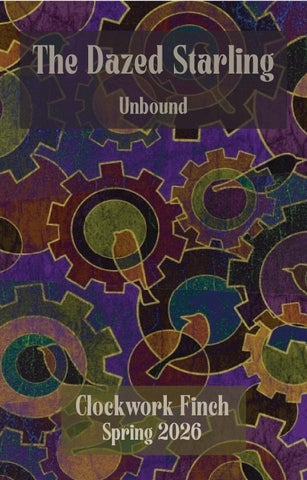
The Dazed Starling Unbound Clockwork Finch | Spring 2026

Page 1


The Dazed Starling Unbound

Spring 2026 Clockwork Finch

Founded in 2021, The Dazed Starling: Unbound is the online literary journal of the Department of Modern Languages & Literature at California Baptist University.

Address correspondence to:

Dr. Erika J. Travis, Managing Editor

The Dazed Starling

CBU Modern Languages & Literature 8432 Magnolia Avenue Riverside, CA 92504 (etravis@calbaptist.edu)

The Department of Modern Languages & Literature offers a Master of Arts degree in English, Bachelor of Arts degrees and minors in English and Spanish, and a Bachelor of Fine Arts degree and minor in creative writing. To learn more about the programs and professors in the Department of Modern Languages & Literature, explore www.calbaptist.edu.

The Managing Editor would like to thank Dr. Chuck Sands, Provost of CBU; Dr. Lisa Hernandez, Dean of the College of Arts and Sciences; and all of those who offered their encouragement, guidance, and friendship during this publication process.

The Dazed Starling is currently published with funds generously provided by CBU’s Department of Modern Languages & Literature

©April 2026 Respective Authors

The Dazed Starling

Unbound

Hello, dear reader,

Welcome to the 2026 edition of The Dazed Starling: Unbound. This year’s Clockwork Finch is a collection of poems, prose, and nonfiction that reflect the creativity and dedication of our student body. Think of this journey as a map of collective imagination, representing the mechanics of life and the passing of time. We, the editors, are grateful to share these authors’pieces. Enjoy.

Poetry

Ballerina

Port de bra her arms extend Her mind and body dance. The music runs through her funneled notes They make her sway and prance. Lifting her chin, proper and poised Her frame, the air delicately holds. Graceful in every breathless step, careful to avoid her teacher’s scolds. Across the floor her figure moves, Jeté invisible wings extend. As she flies above the tepid tune, feet arched in broken bend. Her mind lost in the enchanting sound of tunes the piano sent into the sky her peace is found within this freeing movement.

The tulle swirls around her waist, a pink cloud that gives her flight. Each step is made with haste; every motion neat and tight.

Mirrored in that endless glass, she spots her pirouettes. Head whipping around one, two, three her teacher claps but she lets not show, her satisfaction nor glee. Alas, the piano begins to die and her legs lose their weight. Her chest falls to the ground, knees bend bowing low in a curtsy.

Interim

Kennedy Reynoso

Foreign pieces of my soul

Take control from a past life

Experience wears thin

Patience drawn taut

A bow piercing flesh

Never taking hold but leaving scars

Losing direction in the sway of a fitful heart

Never in harmony

Screeching notes

A haunting nocturne

The Sky, Divided

Cedar Shahbaz

Double Down

I see the rope that connects our necks. Choking as silence sits heavy, like crows on powerlines–a tightrope walker in the middle of their act.

We’ll ignore it until one of us can’t breathe. A game of chicken. Awareness that we’re not willing to tease.

One Minute

Caitlin Austin

If I bent down to Pull from the earth A stem with petals, Could I smell them?

If only there was A moment where Antsy feet didn’t Carry me away, I’d stop.

I only have A minute to spare. Is it enough

To smell a flower?

I guess not.

Rhymeless Walk

I see with eyes as clear as glass for once And find that it’s my heart left trapped behind. Preoccupied with things of mind, I find, Life dull with ache, not much to rhyme. I sigh. There’s so much color in the air, beauty everywhere, But to my despair, I couldn’t care; there is nothing left to rhyme.

My heart and soul misplaced somewhere I can no longer find. For if I did this at a better time, I wouldn’t be in despair.

I trod in circles, looking at petals I have seen a thousand times, They’re red like cherries, a Crayola crayon dying with every stroke.

All left will be the stem above. All the petals fall, And I will join them in the dirt and sink below the earth. For nothing is sublime if you simply can’t find the Right words to make the poem sound nice.

My Mother’s Silencio

Mi Mamma nunca usó su voz.

Expressions barred

Teeth clamped Silencio stamped upon her being Barren, Desolación

Thoughts caged in deserto of duty.

Remained woman meek, docile, complimentary.

Suporte de su marido

Self-dissipated, Confidence drained

Only placards of silencio.

To speak is to be known.

Perhaps that is why I have never known her.

Mi Mamma nunca usó su voz.

If she could only free her tongue and allow rivers of speech to pour from her lips

Laughing, Lively, and Loud

Languishing, Listlessly, and Livid

Not to live in fear that she, like Icarus, might touch the scorching sun

But that she could love me

And teach me

That I might use mine.

Mi Mamma nunca usó su voz.

Pero desearía que lo hiciera

In Between Amber Boetger

Existence in a world combined

Water and Oil blend and contend, making

A childhood in between

Dueling cultural expectations, tensioned language

apprehension, fractured representation

Neither Mexican Nor American

Adrift

Convolution, Delusion, Reclusion

Foreigner in land and tongue, stranger in family and school, Reducer of self

A childhood in between

Alienation and expectation merge, conflicting reality

Stranded

A ti mismo sé sincero

Impossible

For a child in between

Kairosclerosis

There is this moment, When joy rises like the tide, Pressing against the edges of the inside of my chest.

But here is where I falter. Not in the feeling of it, But in the knowing of it.

The clock stops and sits. I see myself suspended, Hovering over a portrait of a moment too vivid to be real.

Happiness feels dangerous. Too uncertain.

As if calling its name might extinguish its fragile flame.

I tighten my grasp.

Fingers curling around the now, Desperately trying to freeze the warmth of sunlight,  Before it disappears into my skin.

But the act of holding is also the act of breaking.  A wave crashes only to collapse into foam on the shore.

I want to live here in peace. But instead, I dissect it.

And in that pause, I lose the thing itself.

This is the curse of feeling too deeply, The curse of caring too deeply, To clutch at fleeting joy, Only for it to become another shadow on the wall of life, Brushing by into the past.

Kairosclerosis a word that describes the moment when you realize you are happy and try to savor the feeling, only to have it slowly diminish

Bouquet of Flowers

Madison Ritarita

You are the prettiest bouquet of dying flowers I've ever seen.

The kind someone keeps long after they should, Because letting go would mean admitting it’s over.

Your colors have faded, But somehow that makes them brighter.

There’s beauty in your breaking.

It’s in the way your petals still hold shape even after time has taken what it could.

I’ve watched you wilt, and I still try to give you sunlight.

As if I could trick decay into leaving.

The Cuckoo Bird

I look in the mirror and hate what I see.

The cogs and the gears that wind up to be me.

And I wonder how long it would take to undo

Every last crooked, rusty and bent screw.

The ones they spent years drilling into my head.

Making sure I had not one thought to be spent

On how much better I could turn out to be

If they were not the ones constructing me.

They’ve made me from metal and gears that don’t move

So, I sit up here trapped and cuckoo at noon

Tell me what else is there for me to do

Tell me what would you do?

Would you imagine yourself with broad working wings

Imagine yourself up there, in the sky flying free

Up so high you couldn’t find the air to breathe

Would you end up back here next to me?

Then, what would you do who would you be

With these brand new adventurous wings?

Would you do what you wanted to make your dreams come true

Would you travel the world ride a hot air balloon

Would you build a family a home to settle

Would you make little birds out of scrap metal?

All I have here is my voice and my mouth

My perfectly timed moments to scream and shout

To beg you, throw away your doubt

I ask you to consider what is this life really about?

Time Without Impact

Our earth’s dirt has lived many lives. Stars burn out, fold inward, warmth deprived black holes have devoured full blue skies. Falling fast drifting slow what is time without impact? How long then, does time last? Will the world be more when you’re fated to leave? Will it become Inferior?

Isn’t that–what we dream?

A Faded memory

Chasing Dreams Charity

Steadfast is the light. She sways with ease when dawn breaks. Graceful like a white swan, hopeful like a white dove.

Peace is in its rays, glistening like diamonds, pure and full of beauty.

In this daylight, the hope of dreams cluster like a bouquet. The light carries a promise, and every day fills the heart with expectation. But the night carries the dreams into a dance, not a lullaby that cradles a child.

The night is the muse, stroked against a canvas, unveiling deep secrets.

A nightingale singing the deepest parts of the soul, where the dreams dwell.

What truly is the dream?

A jest? A folly?

Or is it a desire? A calling?

Hidden in the heart in the daylight, but alive in your nightly visions.

A secret: whether it be day or night, the heart hungers for its dream. The morning will not bury it, nor will the night deny it.

The sun reflects it, and the shadows follow it.

Dreams fly higher than the sun and the moon. But one day, we will catch them.

The Night Train

I am counting stars, little fire sparks that light up the night sky.

They promise to beam and sparkle, but will never align.

From the outside looking in, I sit alone in my seat, reflecting.

In the night, there is a mystery. The stars and city lights pass me by quickly.

Am I lost in these nightly lights, with only my memory to recall?

And recall them, I must.

Memories of a childhood. Memories of cold nights spent by a warm fireplace.

Memories lost as time goes on, but suddenly remembered when the solitude in the night falls deep.

I can’t sleep during my travels, the clock in my head ticking, ticking, and ticking.

My memories are like a clock, ticking. Tick-tock in my mind, then tick-tock in my heart.

I have only the night, who may be a friend, may be a foe. But a passenger that keeps me company always.

I’ll sleep another night; the midnight conductor reminds me that the next stop is soon.

I’ll sleep another night, when the stars don’t ask me to stay awake.

When my travels end, it will be daybreak and the old memories will slip into the night.

Until, again, when the night gathers me to the next train, the old and new memories will merge, imperfect but aligned.

Wordsmith

Welcome to the forge, dear apprentice. Take your hammer in hand, and on the anvil of experience pound the language of war, those words of us and them, into the ploughshares of peace. Remember we are each covered head to toe in God’s fingerprints.

Silver words are malleable and maneuverable, ductile and decorative. Draw out their sumptuousness. Iron words can be cast or wrought into intricate arabesques that are robust enough to endure the weight of centuries.

One day, you will set up your own forge, so mark the fundamentals. Do not undersize your firepot. Feed your passion, and let the fire in your belly burn bright. Do not forget the vents.

The Spirit bellowing through the fire is what gives it its strength and breathes life into each word.

You smelt the mythopoeic in the blast furnace and find hope. From belligerence you bring forth the beatific. Hammer in hand, you are a wordsmith.

The Plaza

Corban Rosspencer

Someone rolled up the sky, filled a bucket with stars and put them in our hands. This blue light glows even after sunset on the plaza. People wait in line, the infinite crawling under their fingers. We unravel the world as a scroll. What did it cost to rid ourselves of wonder? Blank eyes look into blue, reflecting stories we refuse to write ourselves. By no means should we be lost to each other, but this “connection” –It’s only a mirror of conversation. The freeway moans, floats over the austere glow. I can’t hear any voices. How strange to sleep, to take the narcotic of our anointed invention, to silence and sedate ourselves for entertainment. In that light, in that minute: I sit in the corner, watching a hundred faces pass me. But my ears perk up. In the midst

of digital apocalypse, the sound of ping pong reminds me some things are eternal.

Heliocentric Universe

Under the nightlight, you traversed this same hall

Knowing through the peril of it all

Warm arms would open after the bend. A voice from the beginning tells you the end.

The end in that darkness was always the same. Yet, it’s getting hard to recall how they said your name.

Tears warn your mind of that sin. This is the new world you’re meant to wake in.

Old hunger aches anew

Years past due, but it blows past you.

You walk through darkness alone that’s always been true. You make it to the living room; it’s bathed in blue.

Moonlight licking through the blinds.

You can guess the time, but not unwind

Why your eyes opened young

And went looking for what used to be your sun.

Dusk Anonymous

Don’t let the rain pour

As the last grain of sand falls

Even the sun sets

1 Kings 18:44b

in the early hours of the dark morning my roommate rises, washes her hands, crosses the creaking floor, and quietly closes the door.

later, I will spend cash on coffee, write a few words, lie in my bed to watch the sun strike the wall, call a friend, drive to the drug store.

tonight, we’ll eat at the table out of plastic bowls, watch a film, close the screen door when it starts to rain.

somewhere out there, a cloud as small as a man’s hand rises from the sea.

May the Angels Run Out of Ink

When revival floods the nation

May the angels run out of ink when they dip that feathered quill and place it into the Father’s hand

May they run out of ink when He writes a thousand more names in brilliant gold

May the angels cry out holy, holy, holy, when God works miracles with what was meant for evil, When stories unfold and eternities change

May the Son smile with joy when He sees brothers and sisters unite

May the angels run out of ink when the trumpets blow, and people say Hosanna in the streets

May they run out of ink when thousands of eyes are opened, and the roar of heaven is heard

If one sinner coming home can cause such a wonderful, beautiful ruckus

How many would an empty inkwell receive?

May revival grow as the countdown continues Let us make the angels run out of ink

Midas’ Parting Gift

Golden bubbles burst on black ore rocks

As trumpet chords to proclaim Midas’ Last breath. His bloated feet pave a royal Pathway on the river bottom leading

To a coral cave. There, he is buried By the current. His crypt-bound touch converts The cave into a golden tomb, a hidden Inheritance worth its weight in gold.

Pygmalion’s Plight

Michael Vass |

Pygmalion shivered one winter night, When the world wore her gown of white Till warmed by an idea so bright.

He would craft the women of his dreams From white marble without seams, So he chiseled and chipped under moonbeams.

And yet, the more he carved, the more she cracked, Losing limbs, he couldn’t sew back, Because of how much in skill he lacked.

Every crisscrossing vein, Of mismatched marble and eye strain, Showed how far he fell from fain.

He cried to Venus on bended knee. Surely you fashion finer forms than me. The goddess smiled and said, I agree.

Fiction

A Married Couple in New York

There is morning sunlight on the fire escapes. The Landlord stands in the doorway, barely in the shade. Cool air seems to rise from the city. August is becoming September, the wind brushes against the buildings, and couples begin walking closer together in Central Park. New York lives, even the things that do not breathe.

The Landlord looks at the street. Cars go by now and again, carrying people to and from places. He thinks about the couple on the fourth floor, who will be coming down the stairs soon. They will need a taxi, but the Landlord did not call for one. The husband wants to do it himself.

They are coming now, loudly. She is clumsy and laughing as she bangs down the staircase, and he is laughing too, but more strained. He is carrying her bags. The corner of the Landlord’s mouth twitches as they fall down the last flight and come into view. Her dress has caught on one of the suitcases, and he tries to free it. They stumble past the Landlord, out the door, onto the edge of the street. Her laugh echoes off the buildings, spilling out of her into open windows.

The Landlord checks his watch and looks up. The husband has managed to release the fabric from the suitcase, and she twirls in the sun, her dress floating just above her knees. Her beloved tucks her hair behind her ear. She looks like she wants to say something, but all the words have gone. He understands this, reaches for her, and she rests her forehead on his shoulder. The Landlord looks at the ground.

There is no silence, but the young man seems to break it by calling, “Taxi!” And there is a yellow one making its way down the street, pulling over, stopping. For a second, it looks as though the couple is going somewhere together, in need of transport for a shared journey. Today, though, it will be just her who is going.

The Landlord knows it must be ripping the husband apart. They have only been married for two months, and now she must go abroad for a whole semester. That is only three months, but it might as well be a decade. The Landlord thinks to the sky, what can you do?

He watches the young couple put the bags in the trunk of the car, and the husband closes it, trying to cover his sadness. For a moment, he has trouble seeing.

“Write often,” she whispers. It costs too much to call across the ocean.

And then she is gone, the taxi is driving away, and with it goes her beautiful hurricane of Heaven.

The husband watches the car go. He feels, right now, about as much as could possibly fit in a young man’s heart. The Landlord steps inside, behind the beaten front desk, and shuffles through papers in a useless manner until the husband comes in and makes his way up the stairs.

It will be a quiet and lonely few months for him.

It has been one week. The husband keeps busy on the construction site, and after the workday is over, he comes home and improves his little apartment. The Landlord knows, because the young fellow keeps asking him for permission to move this, fix that, push down this wall, and put up that one. It makes the Landlord smile.

It has been two weeks. The husband has almost sent a letter several times but has instead decided to wait for her to write him first. He is clearly lacking company and sometimes comes down to the ground floor to sit in the wooden chairs and look at the street, perhaps looking at where he and his wife were last. The Landlord makes a small effort to engage him in conversation now and again. The young man’s head is not here, however. Most days, it might as well be on another continent.

It is during the third week that news comes. There have still been no letters for the young man from his wife. The Landlord is absentmindedly turning the pages of a newspaper from last week, skimming the latest atrocities. In a smaller column, however, he finds a more local tragedy, an accident involving a dairy truck and a taxi. The crash was not too far from his building, he realizes, just a few blocks away. Perhaps, that is why that corner has smelled funny lately. All the milk must have gone everywhere and spoiled.

His eyes follow the words down, down, down, like stories of a building, until he comes to several names. The taxi driver was injured, the truck driver was injured, and the young woman in the back of the taxi is dead. The name is familiar. And then the Landlord’s heart sinks, right through his stomach and below the floor.

But he’s not sure. He takes a key to the drawer behind him, and there is the big book with all the names of all the people staying in his building. A few flipped pages, more, further in, and then he finds the names of the couple on the fourth floor. Then he looks at his calendar on the wall and goes back three weeks or so. Yes, he thinks, I remember. That was the Thursday she went. The date matches in the paper. There is no photo in the paper, but the Landlord doesn’t need one to know.

He closes his eyes, standing above his desk, above the ledger, begging God to change the name in the paper so that it doesn't match the one in his book.

The young man has a good friend over, and they are talking loudly and laughing louder in the apartment. They are reminiscing about the wedding and times before it. The Landlord overhears on his way down from the sixth floor.

The friend, perhaps the best man or a groomsman, is recalling their younger years and the mischief the two of them were involved in. The young man laughs, defending his romantic endeavors. The words “come back” reach the Landlord’s ears, mingling with warm light under the door.

It is likely a bad time to tell him right now. The Landlord continues down the staircase with a heavy footfall.

It has been four weeks. The young man is still unaware, sending the Landlord into a violent war with himself. He has come to understand she had no family nearby, no one caring for her other than her husband. There is nobody to tell the young man she is dead. He does not read the papers, much less old ones.

The young man passes The Landlord’s desk, leaving for work. Who am I to tell him? the Landlord wonders. He is so happy right now, living in his little world. It pains the Landlord to think that the world no longer exists.

The Landlord’s heart is warring with his mind again. His hand rests on the door, poised to knock, but his knuckles only brush the wood, unable to bring his fist to bear. But there is no noise, other than the occasional rubbing of wood on wood. The young man is alone. There is no one to interrupt, and so the Landlord is knocking, knocking, and the sound dies in the

walls. The young man sighs and stands, makes his way to the door, and opens it tiredly. The Landlord can see a pen and several papers on a table. The window is open, and he can hear cars going by, taking people from place to place. It sounds almost like the ocean.

There are a few seconds of small talk. The Landlord almost calls a ceasefire until the young man mentions his wife hasn’t written yet. He is more sad than worried. He is drafting a letter now, one that the Landlord already knows the wife will never read.

And so, the Landlord tells him, and hands the young man the crumpled newspaper from four weeks ago. The young man finds her name and seems to hold onto it with his eyes.

There were many tragedies in that newspaper, and they all felt very far away from the Landlord. But this one small one has found its way home, and, for the first time, he watches a world collapse in front of him.

The Landlord is especially gentle with the young man. The rest of the world treats him as though he is not broken.

It has been six weeks. The young man has moved almost everything out of the apartment, taken it somewhere, maybe nowhere. The Landlord offered to help him carry the things out, but he refused. A week later, the young man terminates his lease. The Landlord hears that he quit his job as well, is leaving New York, and going somewhere else.

The Landlord stands in the doorway, just outside enough to feel the sun. The mornings, while still bright, are less so, and there are fewer birds singing in their choir. The nights are much longer. Now, evening sunlight glides across the fire escapes. It is colder.

The Landlord’s eyes go to the fourth floor. The young man is standing where he used to sit with his wife, his hands white on the rails, feeling as though he is still a husband.

It has been seven weeks. The Landlord has not seen the young man for several days. He surveys the couple’s apartment. It is much nicer than he remembers it being. He sighs. Rainy noises make their way through the open window, the one that leads out to the fire escape. It is not just raining outside. It is raining in the Landlord’s mind as well. Several drops find their way to the floor, and he wipes his eyes.

Some way or another, he thinks, the young man has gone.

The Grandmother Clock

Every night, the house would take a deep breath in a single second before the grandmother clock would strike midnight and hold it in. The pendulum would stop on an upward swing. The glass door that kept it safe would click and open gently. A sparkling, dusty wind would pour out, pooling on the floor and slowly swirled up to create a woman. She imitated in every sense of the word a grandmother. She was short and stout, her hair laced with salt and pepper, was swirled up into a bun at the top of her head. When she came to life every night, she did the same thing. She would stretch her arms out, then up and over her head, brush the dust from the front of her blue-and-whitepinned dress, and put on a solid white lace-trimmed apron. Her tongue would click in disappointment as she began to work. She always started in the bathroom, picking up the children’s dirty clothes and towels off the floor. She would move into the living room, pick up the toys, snack wrappers, cups, and dishes. She would fluff the couch cushions and fold the blankets, draping them diagonally over the edge of the couch. She always ended up in the kitchen. She would clear off the counters, wash the dishes, slowly dry and put each one away in its proper place. She would wipe the counters, sweep and mop the floors, and only when the house smelled of pine needles and fresh cotton would she settle herself into a chair in the corner of the living room with a blanket and a Reader’s Digest. When she had rested for long enough, she would move her way back to the entrance hall. She would walk to the clock and run her softened fingers along the walls and glance at the family photos that covered them. She whispered, “I’m missing so much.”

When she reached the clock at the bottom of the stairs, she would turn and sigh, think to herself, this would have to be enough. She took her apron off and hung it back up. She allowed her tears to fall as she placed her hand on the side of the clock. Slowly, the woman dissolved into sparkling dust she flowed freely back into the grandmother clock’s pendulum. The glass door clicked shut as the last of her dissipated. The pendulum swung back down as she chimed for a new day.

In the morning, Violet and James would come flying down the banister, shouting, “Thanks, Grandma,” one right after the other on their way to the kitchen. However, their mother, Rosemary, would slowly come down the stairs, place her hand on the grandmother clock, and whisper gently, “I miss you.” She would pause as her nose burned. “Thanks Mom, I love you.” Her fingers would slip from the wood as she headed to the kitchen. The ticking jumped like a heartbeat skips and then time would settle back into place.

A New Old Friend

Alayna Winans

“Come in,” I say to the knock at the door.

The door gently opens, and in walks a lady about my age. Her graying hair is cut close to her head, and her eyes, clouded with cataracts, are veiled with thick glasses. Her cane steadies her as she walks toward my bedside.

“Who are you?” I say, propping myself upright on the bed.

“My name is Kathleen. I’m staying a few doors down to the right.”

“Well, isn’t that nice? I’m Sandy.”

“Hello, Sandy.” Kathleen pulls up a chair to the foot of the bed and lowers herself down. She reaches into her bag and lifts a package wrapped in parchment, gesturing for me to take it.

“What’s this?” I ask.

“Think of it as a gift from your new neighbor.”

I take the package from her and open it. I loosen the twine, and it slips off the rectangular shape hidden under the parchment. I peel away at the tape, careful not to tear the paper. The smiles of four young women stare back at me. One blonde, the others brunette. They are all unnaturally tan, as though they had lain out on the beach for weeks on end. The frame is adorned with elegant cursive above the image, which I need my glasses to read. Friends by Name, Family at Heart. I trace my finger along the glass.

“They look happy. Who are they?”

“Some of my friends. That one in the middle with the freckles. Do you recognize her?”

“No. I don’t think so.”

The woman looks sad for a moment before returning to the

picture. It is faded, but I can see they are soaking wet, arms around each other, standing in front of the ocean.

“The one on the end is me. They used to call me Chatty Kathy,” she chuckles.

“I think I had a friend once whose name was Kathy.” I sit analyzing the photo. It certainly is an odd gift. Even so, I feel connected to these women. “Who are the others?”

“The short one is Kristen. And the one on the far left is Debbie.”

“Yes, I’ve heard their names before. Do they live here too?”

“No. They passed away a few years back,” the woman says. Her voice is somber, weighed down by their absence.

“I’m sorry.”

Kathleen takes the photo and smiles. She sets the frame on my bedside table and leans her cane to stand up.

“Well, I must go. It was nice to meet you, Sandy.”

She turns to leave, but before she steps out the door, I stop her. “Kathleen.”

“Yes.”

“This isn’t our first meeting, is it?”

“No, Sandy.”

“You were a lawyer. Your husband’s name was Frank.”

“That’s right,” she says, her eyes opening wider as she walks back to my bedside.

“How do I know that?” I ask, searching my brain for the answer. “Oh, of course.”

“Hello, Sandy,” she says, her smile forming wrinkles around her eyes.

“I remember. I remember, I do. You’re my friend,” I say, grasping at the memory, a sense of fear now growing in my stomach. I don’t want to forget again. I don’t know how long this memory will last. Or how many times I’ve forgotten it.

“That’s right. Since we were five.”

“It must be so hard for you to see me leave,” I say, my eyes welling up.

She pauses for a few moments before answering. “Some days. But not all.”

I sit in silence, waiting for a reason.

“Because every day, I get to become your best friend all over again.”

Eerie Mackabrey

No Shelter in Haven

I was too young to remember the Great Desolation. My teachers and parents spoke of it often. How the great states of the world warred until the world had been reduced to ash. How they fled when I was only two years old into the Haven. I spoke of it often with my friends, wondering if the outside world had recovered or was still uninhabitable. But no matter how often I talked and heard about the lands beyond the Haven, I continued wondering what the world was like, in the past, and in the present.

“Veria!”

Hearing my name woke me from my daze. I jolted and saw Canter running my way, his long brown hair flying in the breeze as he dashed down the grassy lane.

I smiled as Canter came to an uncomfortable looking halt. He panted heavily, and his pale cheeks gave off a ruddy glow. “Trying to outrun the wind again?”

He glared at me, though I knew him well enough to know that he was not upset with me. “Trying to live in the past again?”

I sighed, stroking my dirty blond hair as I glanced downward. What had been intended as a joke was more serious than Canter could have imagined. “If I could live in the past, then maybe I could stop the present from being so hopeless.”

“Hopeless? Veria, we’re finally starting to build a society of our own! With Searlus and the Gathering of Wisdom in place, we’re finally beginning to make a new start.”

I scowled. “Searlus? Do you believe his lies?”

Canter’s face became redder. “Lies? Searlus has led us into a

a time of peace and stability. We never had that before.”

I could stand such talk no longer. Fortunately, the street was empty, save for Canter and me, so I did not make a spectacle of myself. “Because before Searlus there was the Great Desolation! How old were you during the Desolation? One? Two? Of course there were troubles when we first came to the Haven. But just as we began to form our own peace, Searlus took charge. He implemented the first taxes, built the first dungeons, and forced teachers from their positions who dared to speak against him. I remember hearing about the tyrants of the old world dictators, I think they were called. They all began like Searlus, and they all ended by bringing about another Desolation!”

Canter leaned in, his hands cupped around his mouth, and whispered straight into my ear. “Do you know what will happen to you if you’re heard saying such things?”

“That settles it. The Haven is no longer free.”

Shaking his head, Canter trudged away. “Be careful, Veria, I don’t want to lose you.”

I said nothing, because I could say nothing truthful that could be comforting. We had been careful for fourteen years, ever since we first came here. Careful to stay within the protection of the Haven, careful never to venture far from the town, and, most of all, careful never to wonder what had befallen the outside world. But if the Haven was becoming as corrupt as the world had once been, I saw no cause to stay. Better to risk the ruins of the world rather than live to see another tyrant rise.

My time in the Haven was over.

Before the Gathering of Wisdom had met for the first time, and before Searlus had begun rising in power, there were common laws. Each family gathered and discussed problems to

form solutions. This had been how the Haven had been run ever since we fled the Desolation, how we thrived. We had made laws and many of them were good and just. Thieves were forced to work for those they had wronged until their debt was paid. Murder was punishable by exile from the Haven. A man or woman could not marry without the consent of at least one parent, but the parents did not have the authority to arrange a marriage without their child’s full consent. Families were not to litter the streets, or they would pay a small tax. These and many other laws had kept the Haven safe and secure.

But there was one law, an old law, which I despised with all my heart. It proclaimed that no one, save those in exile or escorting an exiled man, could even gaze upon the edge of the Haven and into the outside world. There were some—I was among them, though I rarely voiced my thoughts who believed that we should leave the Haven and restore the world when it had recovered from the Desolation. But we were few, and our opposition was many. After arguing against this rule once when I was younger, I was scolded severely by my parents. Since that day, I have kept my beliefs to the one soul I can trust: my own.

Now the day had come when the edicts were no longer to be followed. I had not broken any of the laws before, even when I disagreed with them, because I honored the system which they helped preserve. But there was no honor to be found in a tyrant like Searlus. If my family and friends were willing to become his slaves, so be it. But I was born in freedom, and I was going to die in freedom. If the Haven was no longer a refuge, then I could no longer stay. The time had come for me to break my first rule. The time had come for me to leave the Haven. There could be no time to waste. If anyone found out that I

was leaving, loyal supporters of Searlus would surely come to bind me. I still trusted Canter, at least enough not to betray me, and my sister, Marigold, but this was a journey I had to make alone. There was too much risk involved for me to involve someone else. Even if I made it safely to the edge of the Haven, there was no knowing if I could survive in the outer world. I had always had strong endurance and good navigational skills, but now, standing between the edge of the town and the wilderness, I doubted if I could survive. There were rumors and whisperings that tribes of men, turned savage by the Great Desolation, had found their way into the Haven, and dwelt along its edges. I didn’t know how to fight. I didn’t know how to hunt. I didn’t know what the outside world was like. But I knew one thing. If I remained, I would live to see my home fall into decay and die like a slave.

I closed my eyes, took a deep breath, and ran off without a second thought. Whatever may come, it is my own choice.

Without looking back, I sprinted up the grassy hillside. I nearly lost my balance on hidden rocks and holes in the ground. But where my feet lost their balance, my eyes never waved. I stared at the top of the hill. It was my goal, my finish line. Setting my heart and mind on reaching its summit, I fixed all my energy on reaching that desired point.

As I stumbled atop the hill and beheld the expanse before me, I realized my folly. For I had come a mile from the town, yet countless miles still lay before me. Untamed wilderness, grassy fields, and forested hills were fixed between me and my unseen destination. The Haven was massive; I had known it. But only then did I realize its true extent. Even if no one pursued me, and there were no threats on the outskirts of the Haven, there was no way I could survive long enough in the wilderness.

I took one step back and began to turn around. Then I stiffened. I forced myself to look onward. “I will not be a slave to Searlus,” I muttered through clenched teeth.

Continuing on my travels, nature seemed to scorn me, sending torrents of wind and rain to persecute my hopeless heart. The lightning was like the bombs in the stories I had heard, falling on my willpower, while the thunder was the laughter of my enemies, overjoyed at their triumph over me. And the wind, the wind was the worst of them all. I could muster courage against scorn and assault, but the wind was the forceful allure of temptation, shifting my thoughts in what lay behind. My dress and hair were pushed backward; it hurled dust into my eyes, overcoming my senses.

I wiped the dust from my eyes, but it was not dust. It was the tears that poured from my eyes against my bidding. I was defeated, sorely defeated. There was no place to run to, only places to run from. There could be no comfort, no saving from the tempests of nature and man. My legs gave way. I collapsed in the cold, quivering grass. Slowly, the one solace left to my shivering form crept over me as I escaped my present trials through the reprieve of slumber.

Waking up to see the vast sky, lighted by a crimson sunrise, I began to panic. Where was I? Where was my home? My family? What had happened to me?

After rising with a start, I breathed a sigh of relief. I was in the fields far outside my town, because I had fled home. The elements had not broken me. Searlus and his followers had not found me. I was the victor of the trial.

For two days, I pushed onward. Sudden torrents of wind and rain came, yet my will was stronger than the powers of nature. I saw no sign of enemies from the village, but a new enemy came among me.

Hunger and his companion, Thirst, mocked me every step of my journey. Whenever I passed a stream, Thirst mocked me by turning the waters sour or bitter. Hunger ridiculed me, giving me some acorns and blueberries. Enough to keep me alive, yet never enough to satisfy the growing anguish in my stomach. With each step, their contempt and mockery grew louder in my ears. My only way of combatting them was the constant reminder of why I braved the wilderness. I am going to freedom.

On the fourth miserable day after running away, the sun was hot and the sky was empty. My throat was dry, my lips cracked, my hair completely disheveled, and my light blue dress, which had once been my favorite, was torn and brown. No might was left in my body, but sheer willpower propelled me onward. I would not be defeated yet, not before I knew if my mission had met with failure or success.

I stumbled my way up a bald hill, sometimes staggering backwards or to the side, but never fully veering from my quest. My legs quaked, and every inch of my skin was soaked in burning sweat. My mouth hung open, panting, as my vision occasionally blackened.

Still, I managed to crest the hill. There, I saw a smooth boulder and sat atop it. From my perch, I looked onward. And there I saw it.

Beyond the hill was nestled a small valley, where scattered trees grew among the springtime flowers. This tranquil scene ended abruptly, and beyond that lay a blackened wasteland. Coals smoldered in black pits and mounds of ruin rotted away under the blazing sun. There was no color, no life, no hope in that land. There were not even crows, nor filthy mice that dared venture into that vile place, the same vile place that had once been known as the world.

There was something odd about the air between me and the wasteland. The longer I gazed out at the decayed world and the line between it and the lush Haven, I realized what caused the contrast. There was a transparent red substance in the air, like an invisible wall. On one side lay the world, which had suffered under the Desolation and become a desolation itself. Inside the wall was the Haven, protected by the wall.

But we inside the Haven were not the flourishing royals inside a fortress, but the lowly prisoners trapped inside a cell. For we had been spared from the Desolation only to meet with a ruin of our own. Our growing prosperity gave way to greed and complacency, allowing the same evils that destroyed the world to find root in the place that had once been sheltered from the trials of the world.

The freedom I had sought existed, but it was like the fading morning mist. It could not be grasped. So, I turned my back on the ashen lands before me and set out to return to the only home I had known. I would face consequences, tears, and ridicule. The old ways of forgiveness were no longer as valued as they had once been. But at least I would live Searlus’ power was not so great that he could condemn a sixteen-yearold girl to death with the people’s approval. And where there is life, there is hope, however fleeting.

Nonfiction

The Moments Behind the Camera

When I look back at our family photo albums, at the years and memories etched into faded photos and stickers carefully preserved in meticulously placed plastic, I don’t see you in them.

Lines of scrapbooks that collect dust on the television stand, untouched save for the one or two times we revisit them every year. The crinkled spines are neatly labeled by year, outlined in colorful numbering, each one a different personality for the months of moments spanned between covers.

I always jump to the late 2000s. That’s where there are more photos of me, after all, but this time when I look through it, it’s more what I don’t see that catches my eye.

I flip through moments I remember. There are moments I only remember because of the times I’ve flipped through this before, and plenty of other moments I can’t recall whatsoever. But in every memory, regardless of the photograph intended to capture it, there is one constant I remember that goes beyond the pictures.

Which is why it’s so strange to me that your face so scarcely appears across the fingerprint-marked plastic. You were there. Where are you?

It’s then that I realize. In the candles that spark on a fouryear-old’s homemade cake, there you are. In the giddy smile on Christmas morning of exactly the right gift, there you are. In the posed photo of wrangled adventurers at the zoo, in the flurry of bubbles in our little backyard, which may as well have

contained the whole world. In the movie nights we swore we’d stay awake for, in the attire of the most regarded princess in all the land, in the wrinkled arms of grandparents holding us close. In everybody but you.

In photographs and handwritten memories and colorful stickers upon decade-old bindings. You were never in front of the camera, but you were always behind the memory.

The Red Mini Cooper

People always asked me why I didn't have my driver's license even though I was already a senior in high school, and my answer was always the same.

"No need," I'd respond with a shameless smile. I'd tell them about my siblings, of course, but you were always second.

"Besides, my best friend lives seven minutes that way."

I wish I remembered the first time you picked me up. I know you came to the door. I know you instantly disliked my dog, and the feeling was mutual. I know you parked in front of the "Children Crossing" sign in front of my house, and I know you made some joke about how this was your turf now.

You stopped knocking on the door. I started waiting for the telltale buzz of my phone, the signature bark from my dog, and the quiet hum of your car pulling into your parking spot.

I never noticed cars like yours before. You drove a little red Mini Cooper, the backseat full of empty water bottles and miscellaneous papers and bags on the passenger seat that you always apologized for with a laugh. You called it Levi, after your sister's childhood crush, Levi Cooper. Before I knew it, I was seeing red Mini Coopers in every road and intersection, every grocery store parking lot, and I would always check the back window for your array of stickers that bedecked the old car.

Levi was small, but not demure. We used to joke about how loud he roared when the speedometer hit above forty-five miles per hour, as we would cheer the little car to push up the hill or through the three-lane road you hated driving on.

I stopped waiting for your arrival text to go outside. I started hearing your car even before my dog, and would hurriedly grab my bag and race to the door. I stopped thanking you for picking me up, and started taking your phone without asking and changing your playlist to mine. You would snatch it back and tell me I had poor taste, but smile when I sang a song we both liked. I made fun of all the water bottles in your trunk, and you made fun of me for always being late. You always picked me up, and I don't know when it stopped being a favor and started being a habit.

We sat in the library parking lot in the trunk of your Mini Cooper, the sun setting behind the sheriff’s department a block south, while we set up the pillows and blankets and your old laptop to watch stupid movies we loved. You mourned the lack of snacks in your household, and I said how I loved being there anyway.

I still remember the next August when you drove away in your Mini Cooper, Phoenix-bound. I didn't know that's where you'd stay, where you'd fall in love and move into your first apartment. I didn't know then, tears staining my cheeks as I trekked back up my driveway, that your Mini Cooper would never pick me up again.

I didn't expect you to tell me on the phone a few months later that Levi the little red Mini Cooper had been fatally damaged in a car accident, that your parents were alright and no one was injured, and I hadn't expected to grieve for a car and all the memories it had given us. And in a weird way, I grieved us, not even eighteen but on top of the world, seven minutes down the road from each other.

I guess I didn't realize that when I mourned your little red car that I had spent so much time in, what I was actually mourning was the life we had so close to each other, and I had

to mourn that we would never have that life again. I just didn't know that would take the form of your little red Mini Cooper.

The Five Stages of Grief: What They Forgot to Mention

Sophia Tarampi

I’ve often heard grief described as love with nowhere to go, but in my experience, the opposite has been true. Love doesn’t just sit idly. It lingers, collects dust, and rearranges itself into rituals and habits I can’t shake. Grief, then, is the act of caretaking without a recipient. People say grief comes in stages as if there’s a beginning and an end you move through once, then never again. But I didn’t move through the five stages. I lived inside them. They didn’t carry me forward; they just changed shape.

Stage One: Denial

I didn’t think he would die. Not really. I knew he was sick brain cancer, Glioblastoma, Stage 4, diagnosed when I was eleven. But I guess I believed, with the logic only children possess, that medicine would save him. That being good would win me enough points with God to cure him. I thought if I followed all the unspoken rules helped out, kept quiet, did what was asked everything would go back to normal. In the early stages of a cancer diagnosis, you don’t call it denial. You call it hope.

So, I helped. That’s what I remember most. Sorting his medications, lining up the pill bottles, blue and white, morning and night. I learned their names and what each of them did. It was a routine that became so familiar I could distinguish the pills just by the way they felt in my hand. I wasn’t supposed to understand or even be able to pronounce things like dexamethasone or temozolomide as a preteen, but I did. I

carried water to his bedside. Steadied him when he was too weak to stand. The first time he leaned on me, like, really leaned, I realized how much he was fading. But even then, I didn’t think he would die. When you’re young, and someone is dying slowly, you start to believe that stalling is a kind of saving.

Stage Two: Anger

My anger didn’t show up in the way people said it would. It came quietly, a slow, drawn-out build-up that settled beneath the weight of my responsibilities. I think I was angrier after the fact. At least more overtly. In the three years my dad had cancer, I didn’t have the luxury to fall apart. So, instead, I channeled my anger into perfecting the art of caretaking, of keeping everything together. I anticipated needs before anyone voiced them. I became the reliable and efficient one: I didn’t cry, didn’t ask for help, didn’t make things harder. While my friends stressed over math tests and petty middle school drama, I was worried about what my brother and I would eat for dinner. When my dad was sick, that was how my anger came out: not in a fit of rage, but through control.

Then he died.

I wasn’t angry that he died. I was angry that the world around me kept spinning. Angry that teachers kept handing out tests. That my friends still laughed at things I no longer found funny. Angry that I had already been grieving for three years before he died, and somehow, I was supposed to start the grieving process only after he was gone. Nobody talks about how exhausting anticipatory grief is, how it turns every day into a waiting game, how you hold your breath each morning, hoping today won’t become a death anniversary. But then, other days, you hope it will be, not because you want them gone, but because you can’t stand to watch them suffer any longer. You

hate yourself for thinking that. You feel selfish. And then all the anger turns inward.

Anger was pretending to be composed at the funeral because everyone kept saying how strong I was. As if silence were strength. Anger was being fourteen and tired of being needed. Anger didn’t leave. Instead, it went underground, embedding itself in the quiet moments where I smiled when I wanted nothing more than to scream. It fossilized beneath every “I’m fine” I said when no one really wanted the truth anyway.

Stage Three: Bargaining

I think I started bargaining before he was even gone, not with God, but with myself. I started preparing for his death by pretending not to care so much. I became colder, more withdrawn. I told myself that if I acted indifferently, it would somehow soften the blow. I thought if I practiced losing him in increments, detaching a little bit more each day, it wouldn’t hurt as much in the end. I focused on tasks instead of feelings, pouring all my energy into being the “perfect” daughter to avoid having to watch his body’s slow decay. The distractions spared me from hearing his words come out in a stutter and seeing how his hands trembled just reaching for water.

But when he died, it didn't matter. The day his chest rose and fell for the last time, I felt my breath catch in my throat. There was no release, no relieving exhale. I was caught midbreath, suspended between the before and after. I thought avoidance would protect me. It didn’t. You can’t outsmart grief. I can still remember the way his hand felt in mine, cold, limp, already unfamiliar. Immediately, I wished I could take it all back: the conversations I cut short, every question I didn’t ask, every affection I withheld, the distance I’d carefully built. In that moment, I wanted to reverse every time I numbed myself against feeling too deeply. I still do.

After he was gone, I bartered with memory. I kept his hoodie tucked away in a drawer, unwashed, hoping to preserve his scent. I’d take it out from time to time and smell it, hoping it would make me feel close to him again. It did, sort of. The birthday cards he wrote me every year rest in a box in my closet. I read them every so often before they collect too much dust. The bracelet he gave me when I was 10 is frayed and unwearable, but I still hold onto it. I thought if I hurt the right way, in the right amount, for the right duration, maybe I could keep loving him properly. But you can’t make deals with grief, and rituals don’t always rescue you. Sometimes, they just give you something to do with your hands.

Stage Four: Depression

It’s been five years. Half a decade. Long enough, apparently, for the grief to have run its course and for me to have moved on. Of course, people don’t say it outright they’re too polite for that but I’ve learned how to read between the lines. The encouragement to “live your life” and the reassurance that he’d want me to be happy. What they really mean is, “We’re done hearing about it.” Grief is palatable only when it’s brief. It’s acceptable so long as it resolves. Otherwise, it makes people uncomfortable. But I don’t think grief has an ending, not in the way people expect.

There were days after he died when the weight of his absence felt heavier than when he was alive and dying. At least then, there had been something to do. Hands to hold, meals to cook, ways to make myself useful. After he died, I didn’t know what to do with myself. I’d lived in the shadow of loss long before death arrived, but the finality of it? Nothing could’ve prepared me for that.

Sometimes, I wonder if each time I let myself feel okay, I’m

I’m letting him fade. As if my sadness is the only thing tying us together. For years, I refused to participate in life. I isolated. I avoided joy. I didn’t want happiness if he couldn’t have it too. I stopped going to the beach, stopped surfing. I thought my pain was proof of my love, that letting go meant forgetting. But grief is not a measuring stick for love and love doesn’t demand suffering as proof of its existence. Caretaking doesn’t end; it simply changes form. And love, I’ve found, always finds somewhere to go.

Stage Five: Acceptance

This is supposed to be the end of the story. The final stage people wait for, hoping they will have found peace, moved forward, and let go. As if loss has a finish line. But acceptance isn’t peace. It’s permission. It’s learning how to carry the absence without constantly negotiating with it. It’s allowing yourself to stop performing grief as proof of your love. It’s returning to the ocean and not drowning in it.

I started surfing again, not because I was healed, but because I missed him. I missed the way he used to steady the board behind me, the way the ocean felt like ours. So, I stopped waiting for it to feel okay. I just went. I didn’t hear his voice in the waves, but I remembered it. That was enough.

I still read the cards. I still keep the hoodie. But I’ve stopped using them to measure how much I miss him. I understand now that caretaking didn’t end when his body gave out. It just shifted. I care for his memory the way I once cared for him, tending to it in small ways: on quiet mornings, on hard anniversaries, in conversations that start with “he used to…” and trail off. There is a cruel paradox in healing: with each day that I rebuild, I widen the distance between who I was with him and who I am without him. And yet, to stay still would mean refusing to live.

What They Forgot to Mention

The five stages of grief imply an end. An order. A solution. But there are no stages, only seasons. They’re not neat, not linear. They don’t happen once, sequentially, and then release you. Grief doesn’t move forward. It moves inward, reshaping, lingering in the spaces that once felt safe. It loops back at random in the moments when you least expect it. At the grocery store during the holidays, when their favorite Christmas jingle plays cheerfully through the speakers, you suddenly feel it again. It’s supposed to be the most wonderful time of year, yet a wave of sadness washes over you, cold and hollow. Seasons of celebration feel emptier without them. What they forgot to mention is that grief isn’t a singular event. It’s a relationship. Ongoing, evolving. And like all relationships, it requires daily, deliberate care. Acceptance isn’t closure. It’s surrender. It’s learning to live alongside what I cannot change. To stop searching for the moment it will hurt less. Because the work of grief isn’t letting go. It’s learning how to stay differently.

Author Biographies

Caitlin Austin is an English and creative writing double major, and after she graduates, she strives to be a copy editor and author. Beyond writing, she enjoys reading a good book, hip-hop dancing, crocheting stuffed animals, and anything crafty.

Melissa Beasley is a creative writing major, who aspires to write fiction and be a lifelong student of literature. In her spare time, she enjoys tea, drawing, and spending time with her people.

Emma Blake is completing a dual-degree in liberal arts and Christian studies, and after graduation, she hopes to follow her dream of opening a Christian dance studio. She loves being outdoors (camping & paddle boarding), running, and making sourdough bread for her small business.

Grace Crandall is an English major pursuing her Master’s in English. After she graduates, she is looking forward to becoming a professor of English and creative writing. She spends most of her free time reading books, journaling, and adventuring with her friends.

Skylar Fernandez is a criminal justice major with a minor in Christian studies. She's published four books with more in the works. She hopes that the Lord will bring His message through her writing and her life as she heads into the law enforcement field. In her free time, she loves to spend time with her twin sister, Rylan.

Charity Latchman studied and graduated with her B.A. and M.A. in English at CBU. She works as an adjunct English professor at CBU and will be entering a PhD program in 2027. She enjoys painting, writing poetry, art history, and reading 19th and 20th-century world literature.

Gretchen Bartels-Ray is a professor of English at California Baptist University. Her poetry has appeared in journals such as First Things, Sojourners, KAIROS Literary Magazine, The Ekphrastic Review, and Inlandia, and her artwork has appeared in Ghost City Review and Inlandia. Her current project on Matthew 6 works to combine painting and poetry.

Kennedy Reynoso is an English major with a concentration in creative writing in her senior year, after graduation, she hopes to continue her education with a Master’s Degree in Lit Theory and Criticism. She loves reading, crocheting, and spending time with loved ones.

Madison Ritarita is a senior mechanical engineering major. After she graduates, she hopes to pursue a career in the aerospace industry and be part of projects where she can combine problem-solving and creativity. In her free time she enjoys playing various instruments, and spending time with her dog Ralphie.

Corban Rosspencer is a studio production major with a minor in creative writing. He enjoys black coffee, walks in orange groves and plays the harmonica.

Harley Schechter is an English major, wife, mother, and creative writer. After she graduates in the fall, she plans to teach, continue writing and submitting her work for publication. She loves to read, garden, and craft.

Michael Vass is an accounting and creative writing major. He focuses on poetry and is learning Biblical and Classical literature. In his free time, he enjoys baking, studying church history, and spending time with friends.

Turn static files into dynamic content formats.
Create a flipbook
The Dazed Starling Unbound Clockwork Finch | Spring 2026 by Lancer Media Group - Issuu