
This issue, we ' re covering:


This issue, we ' re covering:
Dear Subscribers,
Welcome to the JasonInvesting com Weekly Investment Overview! This week features the BEA release of the PCE index, the Federal Reserve's preferred measure of inflation With markets closed for Good Friday, we ' re looking at a shortened trading week Since the PCE data will be released during a market holiday, reactions to the report will only be seen on Monday.
Our portfolio once gain surpassed SPY performance over the week. For details, refer to our Portfolio Review section!
We'll begin our exploration by diving into options Greeks, starting with Delta
This week, we will delve into one of the most essential option Greeks: Delta.

Delta quantifies how sensitive an option's price is to a $1 fluctuation in the price of its underlying asset. In simpler terms, it predicts the amount by which an option's price could change for every $1 movement in the underlying stock or index, with SPY serving as our underlying index in this instance
To begin, it's important to understand how to interpret an option chain, which displays various strike prices for each expiration date. Each of these strike prices is associated with a distinct delta value.
The option chain shown below reflects the market as of the close of trading on Friday, March 22nd, for options expiring on May 17th, where SPY closed at 523.
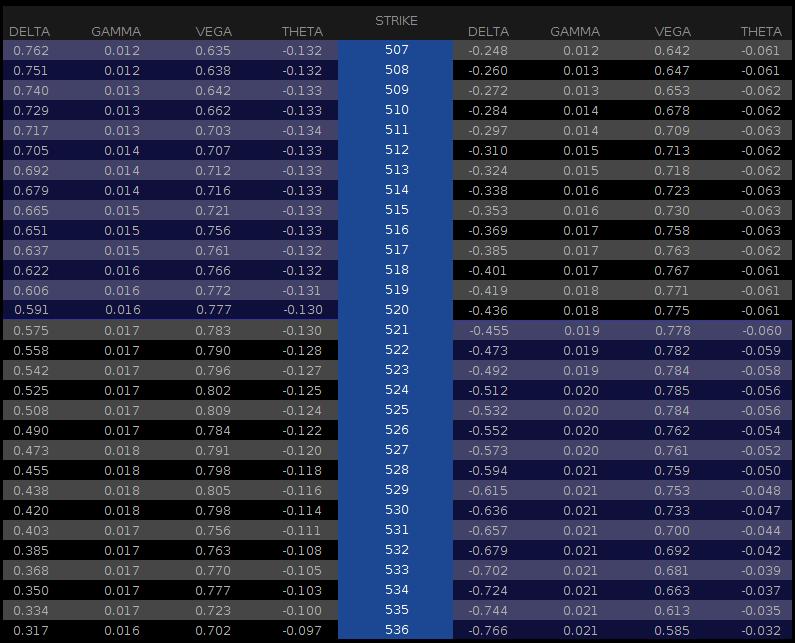
Remember, delta represents how much an option's price is expected to change with a $1 movement in the price of the underlying asset. For a delta of 0 5, this means the option's value would shift by $0 50 for every $1 movement in SPY The 0 5 delta is considered special because it signifies the option is At-The-Money (ATM) and the strike price is close to the underlying price at that particular point in time
Essentially, the 0.5 delta should align exactly with the underlying price. However, we observed that with the SPY closing price of 523, the call with a strike price of 523 had a 0 542 delta and the put with the same strike had a -0 492 delta The primary discrepancy arises from the influence of interest rates
In environments of high interest rates, call options are pricier than puts because one could opt to buy calls rather than the underlying asset and then invest the remaining cash at interest. Consequently, call premiums increase to offset this
Conversely, purchasing the underlying for puts requires cash, potentially accruing interest costs, leading to a decrease in put premiums to compensate the buyer of puts
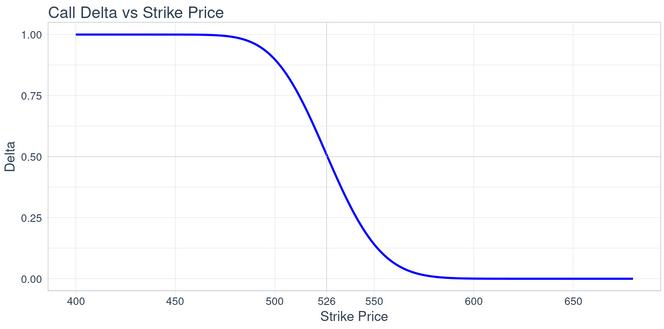
Now let us graph the relationship between delta and strike price for call options:
Even though 523 is the closing price, the 0 50 delta falls on 526 as we explained earlier Notice that the delta converges to 1 on the left and converges to 0 on the right
Strike prices:
Below 526 are known as In-The-Money (ITM)
On the right are known as Out-of-The-Money (OTM)
At 536 is known as AtThe-Money (ATM)
Let's explore the concept of delta through the lens of underlying SPY prices, distinct from strike price
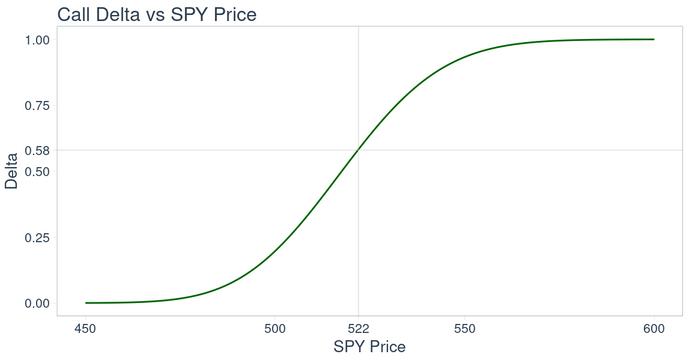
We can see that the graph seems to be flipped. We can verify below that this is indeed the case
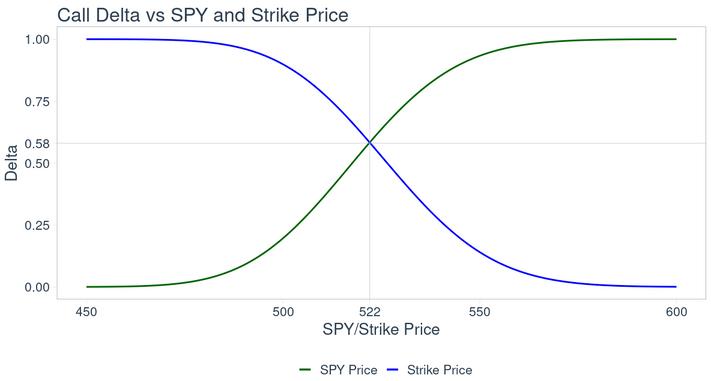
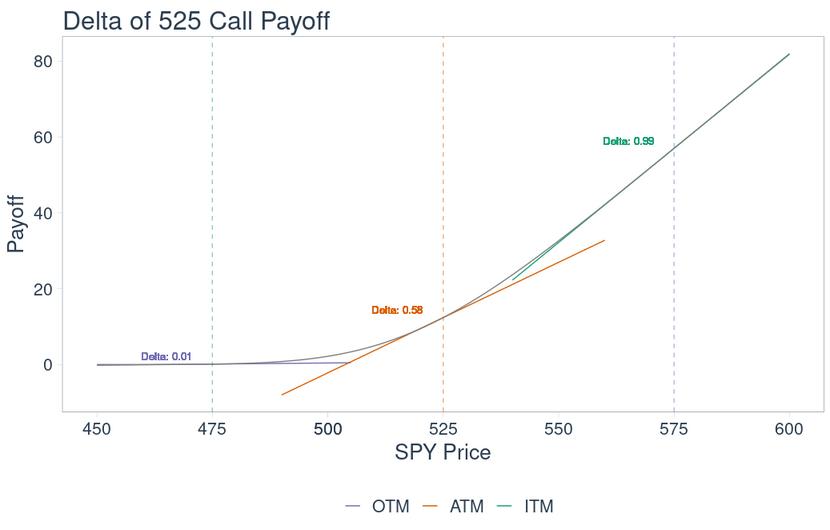
Delta actually represents the tangent slope, or the first derivative of the Taylor series, of the payoff graph at a specific underlying price Given the nonlinear nature of an option's payoff, the slope varies across different underlying prices
We will illustrate this by plotting the tangent slopes at three separate underlying prices for a particular long call option with a strike price of 525:
500 (OTM)
525 (ATM)
550 (ITM)
Let's now calculate our portfolio delta at the market close on March 22nd To do this, refer to our portfolio's trade statement for that specific date:
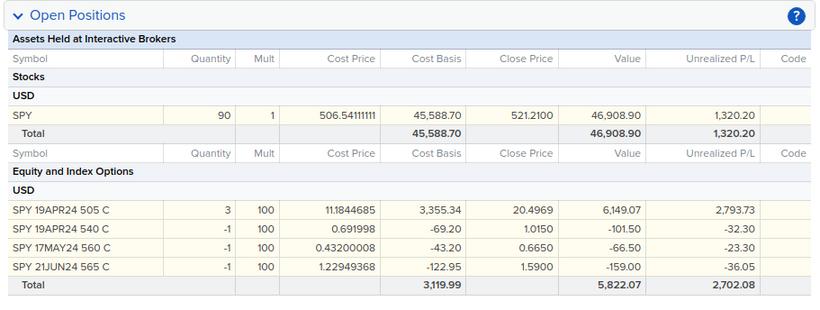
We can retroactively calculate the delta using the Black-Scholes model, based on the closing market price
The deltas we derived are:
SPY: 1.00
SPY 19APR24 505C: 0.85
SPY 19APR24 540C: 0.14
SPY 19APR24 560C: 0 07
SPY 19APR24 565C: 0 12
To compute the portfolio delta, we compute:
This indicates that our portfolio behaves similarly to owning 312 shares of SPY (3 12 x 100 = 312), mirroring the movements of these shares in the immediate price range.
Therefore, if SPY increases by $1: our gain would be $312, and conversely, a $1 decrease in SPY would result in a $312 loss.

Beginning this week, we will distribute the trade notification every Sunday, allowing for actions to be taken on Monday This change aims to streamline the process for both the notification and the subsequent actions required by subscribers.
Purchase SPY shares valued at $2,000 USD at the opening market price on Monday, March 1st as part of a monthly dollar-cost averaging strategy

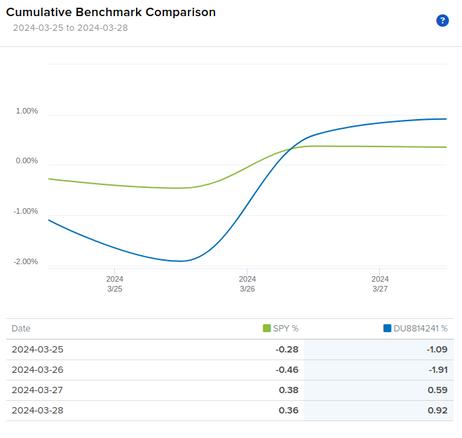
This week marked another period of growth for our portfolio, despite initial declines in the first few days, with a strong recovery observed in the last two days. The "Current Week" returns chart illustrates that our portfolio's performance mirrors a leveraged versions of the SPY returns, highlighting more pronounced downsides compared to upsides
This trend is attributed to our portfolio becoming more leveraged following significant profits, as evidenced in the "Since Inception" chart. Such profitability has driven the delta of our options closer to 1, indicating that any market downturns would primarily affect the gains previously made from the options and not new losses. Moreover, the potential for loss is limited due to our strategy of utilizing spreads, thereby maintaining controlled risk levels
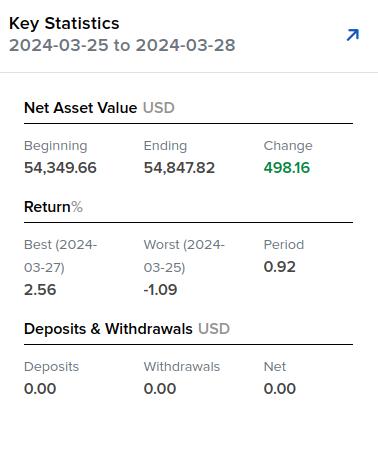
As the week concluded, our portfolio achieved a return of 0.92%, modestly outperforming the SPY, which posted a return of 0.36% for the same period.
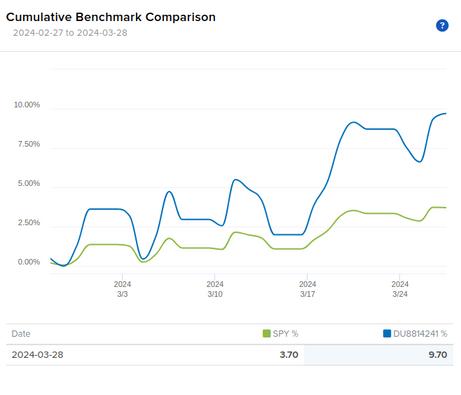
Looking at the performance since inception, our portfolio boasts a substantial advantage with a 9.70% return, compared to the SPY's return of 3 70%
Since Inception:

Current Week:

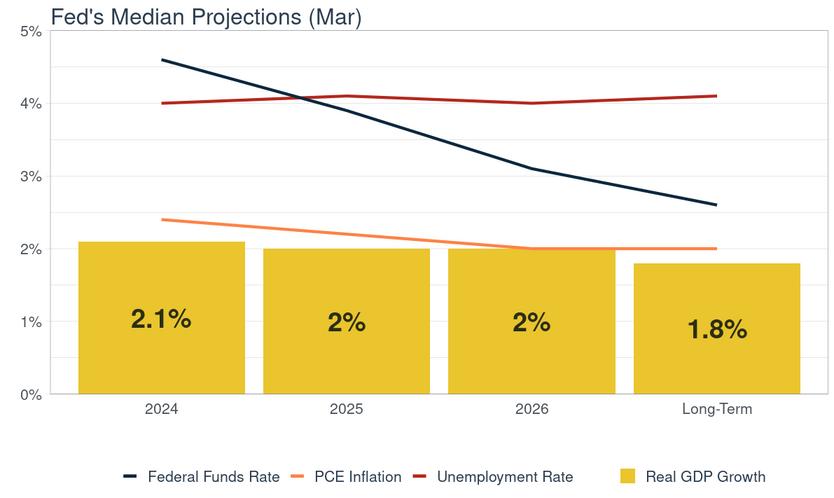
Last week, the Federal Reserve convened for its March FOMC meeting and press conference, during which it updated its economic projections.
The Federal Reserve decided to maintain the federal funds rate at the 5.25% - 5.5% range.
The Fed's dot plot suggested a notable decrease in rates over the coming three years, continuing to signal three rate reductions in 2024
The decision was closely contested among the 19 voting members, with 10 supporting three (or more) rate cuts in 2024 and nine advocating for fewer reductions within the year.
The FOMC presented a trajectory for the federal funds rate, proposing a decrease from the current 5 25% - 5 5% to 3 1% by 2026 This projection is marginally higher than the December forecast, which anticipated the federal funds rate dropping to 2 9% by 2026

Stocks ended slightly down on Monday, after witnessing the year ' s highest weekly surge, driven by the Federal Reserve's dovish remarks at its recent policy discussion The yield on the 10-year Treasury note climbed to over 4 2% on Monday, reaching up from a high of 4 35% prior to the Fed meeting last week, which diminished fears of a prolonged tight monetary policy. Over the weekend, Congress approved a $1.2 trillion spending bill to keep the government operational and prevent a shutdown, securing funding through September and setting the stage for a potential fiscal standoff before the presidential election Meanwhile, high interest rates have led to the U S government's interest expenses surpassing $1 trillion for the first time.
The stock market saw a downturn on Tuesday, with the S&P 500 experiencing a drop of approximately 0 3% Following two months of decline, new orders for manufactured durable goods saw a rise of 1 4% in February The consumer confidence index for March came in slightly below expectations, attributed to a decrease in optimism regarding future business and labor market conditions, as well as income prospects. Treasury yields slightly decreased today, with the 2year yield closing at about 4 59% and the 10-year yield at 4 23% Over the past month, the market has witnessed a diversification in sector performance, with energy, utilities, and materials emerging as the leading sectors.
On Wednesday, the equity markets ended the day on a positive note, with the S&P 500 climbing by approximately 0 9% Concurrently, Treasury yields saw a decrease, with the 2-year yield closing at about 4 57% and the 10-year yield dropping to 4 19%
By Thursday, the stock market edged higher, propelling the S&P 500 to a new all-time high and marking the best first-quarter performance in five years. The 10-year Treasury yield slightly increased to 4 2%, maintaining the range it has recently occupied as the financial markets have been This week's unemployment data revealed that initial jobless claims fell to 210,000, marking one of the lowest figures since the start of January. While continuing jobless claims showed a slight increase, the overall trend over the past year suggests a robust employment sector The low rate of initial jobless claims indicates the absence of a significant uptick in layoffs that could notably raise the unemployment rate shortly However, the slight rise in continuing claims suggests a marginal increase in the difficulty for unemployed individuals to secure new employment.
On Friday, the release of core personal consumption expenditures (PCE) data showed a year-over-year increase of 2 8%, with a month-over-month rise of 0 3%, consistent with January's figures The headline PCE decelerated to a 0.3% increase on a monthly basis, down from 0.4% in January, while the annual growth rate edged up to 2.5% from 2.4%, aligning with consensus expectations
In the upcoming week, we are scheduled to receive several key economic indicators that will provide further insight into the health of the U.S. economy.
The agenda kicks off on Monday with the release of the ISM Manufacturing Purchasing Managers' Index (PMI), an important gauge of the manufacturing sector's health and overall economic activity

Following this, on Tuesday, attention will turn to the Job Openings and Labor Turnover Survey (JOLTS) report, which offers valuable information on job vacancies, hires, and separations, providing a comprehensive snapshot of labor market dynamics The week will culminate on Friday with the highly anticipated Jobs report, a critical measure of employment trends and the unemployment rate, which investors and policymakers closely watch.
These reports together will offer a rounded perspective on the state of manufacturing, job market fluidity, and employment health in the U S , influencing economic forecasts and potentially guiding monetary policy decisions
Market Reaction to Fed's Dovish Stance: Stocks experienced a slight decline on Monday, following a week of significant gains - the highest of the yearstimulated by the Federal Reserve's dovish comments during its latest policy meeting. This indicates the market's sensitivity to monetary policy signals.
Treasuries and Interest Rates: The yield on the 10-year Treasury note saw an increase to over 4.2%, illustrating ongoing fluctuations in bond markets in response to policy expectations and economic forecasts.
Government Funding Legislation: Congress passed a $1.2 trillion spending bill to avert a government shutdown, funding operations through September This move temporarily relieves fiscal uncertainty but sets the stage for potential future standoffs, especially with the upcoming presidential election
Rising Interest Expenses: The U S government's interest payments have exceeded $1 trillion for the first time due to elevated interest rates, highlighting concerns about the sustainability of fiscal spending amid rising costs of debt servicing
Sector Performance and Consumer Confidence: Tuesday's market downturn was accompanied by a modest rise in durable goods orders and a dip in consumer confidence, underscoring mixed economic signals. Notably, energy, utilities, and materials sectors have led market performance, indicating a shift in investor sentiment towards these areas.
Weekly Market Dynamics: The equity markets showcased resilience with an uptick on Wednesday and further gains on Thursday, driving the S&P 500 to a record high. This reflects optimism in the market's underlying strength despite varying economic indicators.
Employment Insights: Recent jobless claims data presents a nuanced view of the labor market, with low initial claims suggesting minimal layoffs but a slight increase in continuing claims indicating some challenges in job-seeking activities
Upcoming Economic Indicators: The forthcoming week promises critical economic data releases, including the ISM Manufacturing PMI, JOLTS report, and the Jobs report These will offer comprehensive insights into the manufacturing sector's health, labor market dynamics, and overall employment trends, potentially guiding future economic and policy outlooks.
Core Personal Consumption Expenditures (PCE): The release of the core PCE data showed a year-over-year increase of 2 8% and a month-over-month rise of 0 3%, consistent with previous readings. The headline PCE indicated a slight deceleration in monthly growth but a year-over-year increase, aligning with consensus expectations This data reflects ongoing inflation dynamics, which remain a critical focus for both the Federal Reserve and market participants.
Next week,
we ' re set to further
explore the
nuanced world of option Greeks, with a spotlight on Gamma and Theta.
Our focus will be on comprehensively understanding these critical risk indicators, deciphering their significance, and examining their behavior as market conditions change. We'll delve into how these Greeks influence our trading decisions and impact our portfolio. Join us as we continue to demystify these essential elements of options trading, enhancing our strategy and risk management skills!
Happy Easter!

JasonInvesting.com Team
