
This issue, we ' re covering:


This issue, we ' re covering:
Dear Subscribers,
Welcome to the second issue of the JasonInvesting com Weekly Investment Overview Many friends have mentioned they read books or heard that investing early can lead them to $1,000,000++ investment when they retire, but most of them are blindlessly doing it or just don’t know how to begin. In this week issue, I am going to show you how to do it with a savings of 50k and a monthly contribution.
Every week I will show you a summary of my trades for the week. I will post trade notification at the end of the trading day to be executed on the start of the next trading day Because our strategy is built around risk aversion, it is designed in such a way that you can act on the notification and trade the following trading day
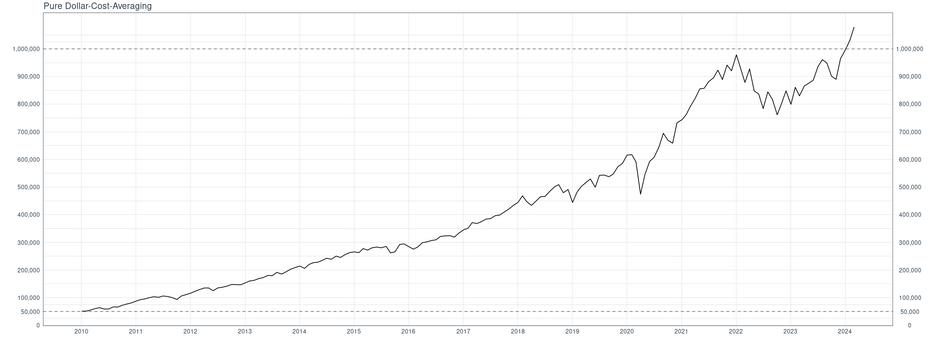
We've conducted a backtest focusing purely on a dollar-cost-averaging approach
Echoing our strategy, this involves starting with $50,000 and purchasing $2,000 worth of SPY shares at the opening price on the first trading day each month Historical data shows that following this strategy from January 4th, 2010, would result in a total of $1,078,787 by March 1st, 2024, spanning roughly 14 years.
Given the complexities of options trading including the nonlinear payoff, multiple variables, path dependency, and its dynamic nature it's challenging to backtest our strategy with complete accuracy without making numerous unrealistic assumptions However, the goal is to potentially shorten the 14-year period to achieve a million-dollar portfolio by accepting a higher but reasonable level of risk
This is achieved by avoiding naked options to limit potential losses to the options premium. The principle suggests that doubling your leverage could halve the time required to reach your financial goal (to around 7 years) Yet, leverage is a double-edged sword, amplifying losses during market downturns
Our strategy dynamically adjusts leverage (via delta) in response to market movements, ideally increasing leverage during uptrends and decreasing it during downtrends

Many subscribers asked how to interpret the trades statement from last week. This week we shall go in detail how to interpret the statement
We bought 90 shares of SPY at the transacted price of $506 53 This result in a cash outflow of $45,587 70 with a commission of $1
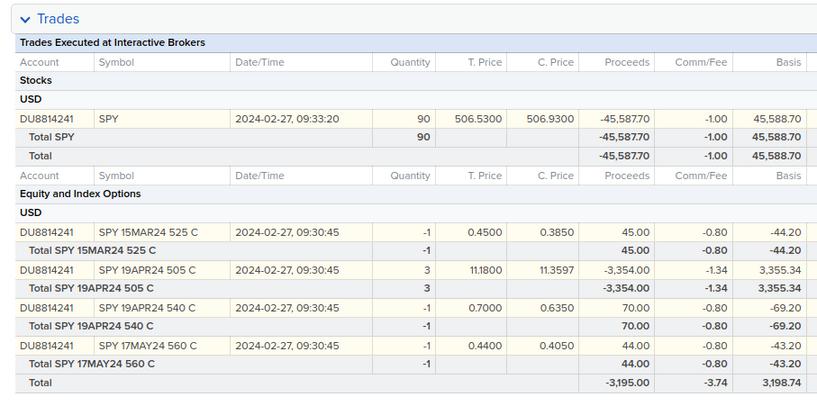
Next, we traded 4 different options expiries For illustration, we will discuss the short position in "SPY 15MAR24 525 C" and the long position in "SPY 19APR24 505 C" We sold one contract of "SPY 15MAR24 525 C" at a price of $0.45. Given that SPY options carry a 100 multiplier, this transaction generated proceeds of $45, after accounting for a commission fee of $0.80. In a similar manner, we acquired 3 contracts of "SPY 19APR24 505 C" at a price of $11.18 each, resulting in a total cash outlay of $3,354

As for the cash report, IBKR started with $1,000,000 in cash but we withdrew $1,050,000 and deposited $100,000 to give us a initial capital of $50,000 The total purchases include the SPY ETF and long call options If you add up the total proceeds from the trade statement you will get $48,941 70 The total sales include the short option positions and if add all the proceeds, you will get $159 00

No trade notifications this week.

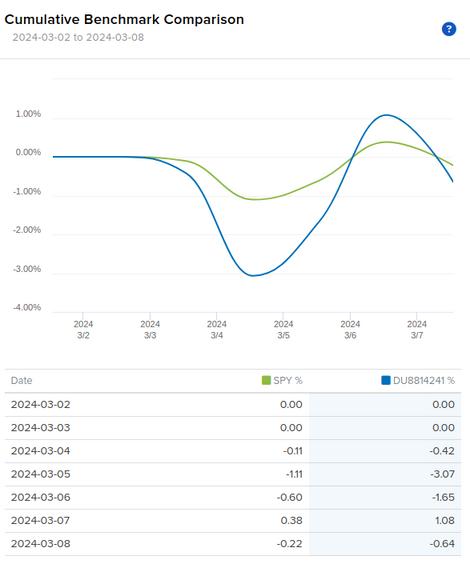
The week began with a decline in the first two trading days, reflecting broader market trends However, due to our portfolio's slightly increased leverage through options, we saw a more significant drop in value compared to the general market
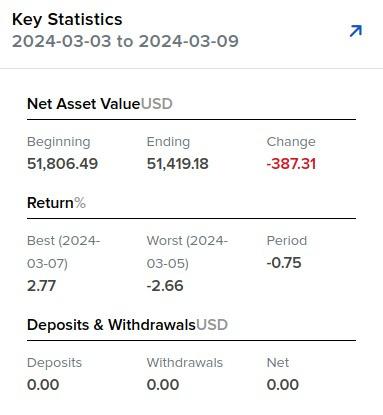
Despite a recovery in the market on the following two days, a downturn on Friday led to a weekly loss for SPY. Our portfolio ended the week with a net loss of -$387.31, amounting to a -0.64% return, compared to SPY's -0.22%.
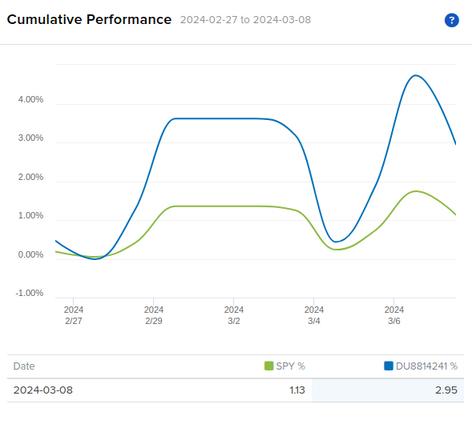
Since the inception of our portfolio, we ' ve realized a nearly 3% return, surpassing the market's 1 13% gain This performance has yielded a financial increase of $1,474 05, elevating our portfolio's total value to $51,474 by the market's close
It's important to note that these returns, observed over a span of just two weeks, may not accurately reflect potential longterm outcomes.
Since Inception:
Current Week:

Stocks dip early in the week due to tech sector weakness. Fed Chair hints at potential rate cuts this year.
This week in the stock market saw a shaky start, with stocks dipping over 1% on Monday and Tuesday due to weaknesses in the technology sector However, the markets recovered in the subsequent days A significant highlight was the semiannual monetary policy testimony to Congress by Fed Chair Jay Powell. He indicated that it might be appropriate to commence rate cuts "at some point this year, " although he emphasized the need for greater confidence in inflation trends before doing so
This stance aligned with market expectations, leading to a decline in the U S dollar, while bonds and oil prices saw an uptick. In particular, shares of New York Community Bancorp (NYCB), a commercial real estate lender facing challenges, rose after the company successfully raised over $1 billion in equity, boosting investor confidence The anticipation of six rate cuts at the year ' s start has now been adjusted to three, in line with the Federal Reserve's projections
On the macroeconomic front, on Tuesday the ISM services PMI for February recorded a slight dip to 52 6 from January's 53 4 These ISM data, derived from surveys of supply-management professionals, are widely regarded as predictive indicators for both the manufacturing and service sectors of the economy In the manufacturing domain, the ISM Employment Index shrank for the fifth consecutive month February saw 10 industries report a reduction in employment, while four experienced employment growth. On the other hand, the services sector's ISM Employment Index contracted for only the second time in three months, after a sixmonth period of expansion This sector had nine industries noting a decline in employment, although six industries reported growth and some anticipate increasing their hiring later in the year
The January JOLTS report on Wednesday further evidenced the ongoing cooling trend in the job market The total number of job openings decreased to 8 9 million, a notable drop from the peak of 12.2 million observed in March 2022 Additionally, the quits rate, representing the percentage of workers voluntarily leaving their jobs, also decreased, reaching a near-term low of 2 1% Both job openings and the quits rate are typically viewed as precursors of employment demand and wage growth, suggesting that these may keep moderating
With the earnings season mostly behind us, attention is shifting back to central bank policies, especially with the market looking forward to potential rate cuts. The release of the ADP private payrolls data revealed that U S companies added 140,000 jobs last month, marking a moderate increase and a slight acceleration from January Job gains were distributed across various industries, predominantly in the service sectors such as leisure and hospitality.
Globally, markets have shown general improvement, led by gains in European stocks This comes after the European Central Bank's meeting, where policy rates were maintained, and positive remarks regarding inflation prospects hinted at possible ECB rate reductions in the near future Initial jobless claims in the U.S. remained stable at 217,000 for the week, closely aligning with previous figures and staying low by historical standards This steadiness suggests that, despite news of recent layoffs, a significant increase in unemployment claims has not materialized
Thursday brought promising news on the productivity front Labor-force productivity saw a 3 2% rise in the fourth quarter, marking the third consecutive quarter of growth exceeding 3% a sequence not seen since the post-Great Recession recovery in 2009 This growth is vital not only for its direct contribution to GDP but also because it fosters an environment where unemployment can stay low while easing wage growth and inflationary pressures This scenario represents the ideal outcome the Fed aims for: a resilient economy with declining inflation, paving the way for rate cuts within the year
The jobs report for February presents a nuanced picture but generally aligns with the scenario of a gentle economic deceleration in which the economy continues to expand robustly while inflationary pressures ease The economy saw the addition of 275,000 jobs, surpassing the anticipated 200,000, although adjustments were made downwards for the job counts of the previous two months, and the unemployment rate increased to 3.9% from 3.7%, marking the highest level in two years The surge in employment was predominantly in the service sectors, notably in health care, leisure and hospitality, and public sector jobs. Importantly, the increase in wages was less than expected, with the yearly growth rate declining slightly to 4 3% Furthermore, there were significant downward revisions to the previous month's data, further suggesting a potential hidden underlying weaknesses in the labor market
The Federal Reserve likely views the slight weakening of the labor market and the deceleration in wage increases positively, as both trends could reduce inflationary pressures. According to the Fed's economic forecasts from December, the unemployment rate is expected to rise to 4 1% by 2024 Considering the current trend of easing inflation and additional indicators of a slowing labor market, we believe the Fed is poised to initiate a cycle of interest rate cuts later this year, potentially commencing around the June meeting

February jobs report leads to focus on upcoming inflation data, suggesting Fed's move towards interest rate reduction amidst cautious optimism.
Following the release of the February jobs report, attention shifts to the upcoming inflation data on Tuesday next week, which is anticipated to confirm expectations of a Federal Reserve shift towards reducing interest rates
This week, Fed Chair Powell emphasized the need for caution but also indicated that the Fed is nearing a point of confidence sufficient to start easing its policy stance, contingent on ongoing progress in inflation reduction
Projections suggest that the headline Consumer Price Index (CPI) will remain steady at 3 1% year-over-year, while the core CPI, excluding volatile food and energy prices, is expected to decrease to 3.7% from the previous 3 9% The Producer Price Index (PPI) is set to be released on Thursday, with market forecasts anticipating the PPI to hold constant at 0 3% on a month-to-month basis, while the core PPI, which excludes food and energy, is expected to decline from 0 5% to 0 2% month-overmonth.
Start Early, Invest Regularly: Beginning with a modest amount and consistently contributing over time can lead to substantial wealth accumulation, offering a practical approach for anyone to pursue financial goals.
Adapt to Market Conditions: Understanding how to adjust investment strategies based on market trends and risk tolerance empowers individuals to navigate uncertain financial landscapes with confidence.
Demystifying Trade Statements: Learning to interpret trade statements provides transparency and clarity, enabling investors to track progress and make informed decisions about their portfolios
Monitor Portfolio Performance: Regularly reviewing portfolio performance allows investors to assess progress, make necessary adjustments, and stay on track towards achieving their financial objectives
Stay Informed, Stay Engaged: Keeping abreast of market developments and upcoming economic data empowers individuals to make timely decisions and capitalize on investment opportunities.
Continuous Learning: Embracing opportunities to learn about new investment strategies, such as call spreads, enhances financial literacy and equips investors with valuable knowledge to optimize their portfolios.
Next week, we will discuss how a call spreads work, focusing on the initial trades we have done. Stay tuned!
Best regards,
JasonInvesting.com Team