This issue, we ' re covering:

This issue, we ' re covering:
Dear Subscribers,
We're delighted to bring you the first edition of the JasonInvesting.com Weekly Investment Overview. This newsletter is your guide to understanding recent market movements and making informed decisions in your investment journey Designed for cautious investors who prefer a steady approach to wealth building, we aim to provide insights that help you navigate market volatility with confidence.
We have created a paper trading account with IBKR on the 27th February 2024 with an initial capital of $1,000,000 USD To mimic a typical subscriber, we withdraw $950,000 and kept $50,000 as our initial capital and done the following trades below
Our Audience: Our assumed target subscriber is a riskaverse investor with a monthly salary and would like to dollar-cost average into the stock market Note that the stock market is risky and we assumed that the target prudent audience will only invest money in the stock market for the long term and able to withstand losses of up to 50% during market downturn like COVID
Investment Focus: We concentrate on the SPY ETF, which tracks large-cap U S equities The U S market offers liquidity and is home to leading innovative global companies such as Apple, Alphabet, Nvidia and Tesla These companies have diverse international revenue streams, making the SPY ETF an attractive option for achieving solid risk-adjusted returns that spans internationally
Strategy Overview: Our approach is based on dollar-cost averaging Starting with an initial investment of $50,000, we plan to invest an additional $2,000 at the beginning of each month into the SPY ETF, thereby mimicking saving $2,000 of your salary and dollar-cost average into the portfolio. We also explore options trading as a way to potentially enhance returns during favorable market conditions and protect against losses when the market declines Our options strategies are carefully hedged, with explicit maximum loss limits, to avoid the risks associated with speculative trading The specifics of our options trades (strike prices and maturities) are derived from our proprietary dynamic time series statistical model, taking into account market volatility, trends and other market factors

Based on 27th February 2024 (Wednesday):
Withdraw $1,050,000 and deposit $100,000 to give an initial $50,000 capital
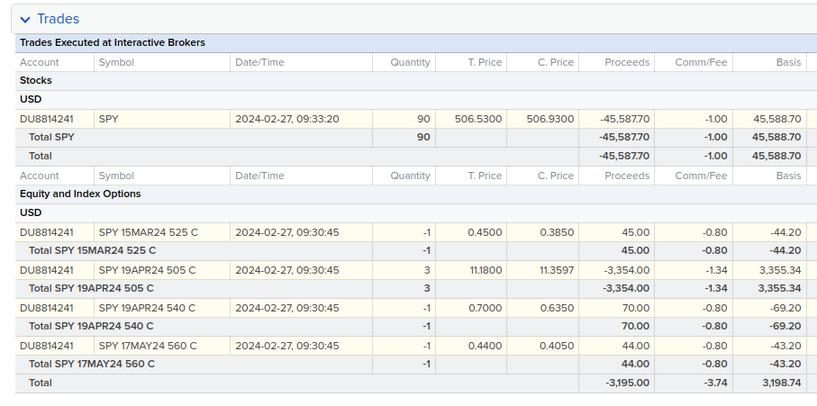
Long 90 SPY ETF
Long 3 19APR24 505C
Short 1 15MAR24 525C
Short 1 19APR24 540C
Short 1 17MAY25 560C
On the 27th of February 2024, we established a paper trading account with Interactive Brokers (IBKR), initially funding it with $1,000,000 USD In an effort to replicate the starting capital typical of our subscribers, we opted to adjust this figure down to $50,000 This was accomplished by withdrawing $950,000, thereby setting our initial capital at $50,000.
Guided by the forecasts generated by our statistical time series model, which anticipates an upward market trend in the forthcoming months, we have decided to implement a bullish investment approach This includes initiating two diagonal time call spreads alongside one standard call spread. The selection of specific strike prices for these positions has been carefully determined based on our model's projections of the SPY's volatility over the next three months
The following IBKR statement show the details of the transactions on 27th February 2024:
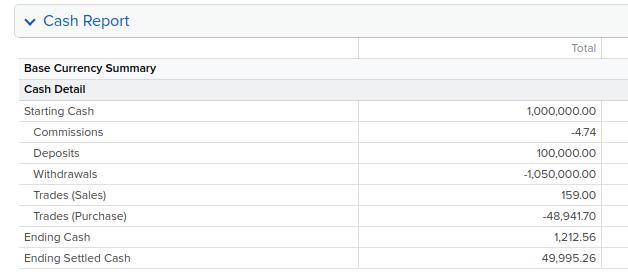
The long call position debited $48,941.70 and short call position credited $159 leaving behind $1,212.56 remaining cash as detailed in the cash report:

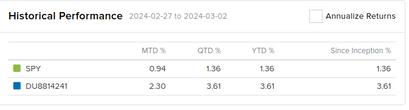
As of the closing of the market on 1st March 2024 (Friday), our approach has resulted in a 3 61% return, outperforming the SPY's own growth of 1 36% return This early success is encouraging, though we remain focused on long-term outcomes.
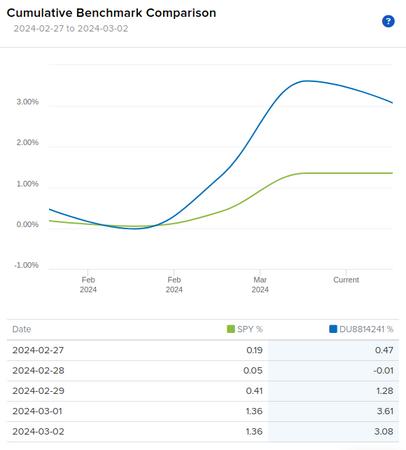

It's important to remember that the Federal Reserve closely monitors core PCE inflation to guide its monetary policy decisions, aiming for a target rate of 2% annually.
The principal insight from this week centered around the release of the Personal Consumption Expenditure (PCE) inflation report on the 29th February 2024 (Thursday) Market sentiment was cautious in anticipation of the report, following the higher-than-expected Consumer Price Index (CPI) and Producer Price Index (PPI) figures reported on 13th February (Tuesday) and 16th February 2024 (Friday), respectively, which were influenced by the January effect
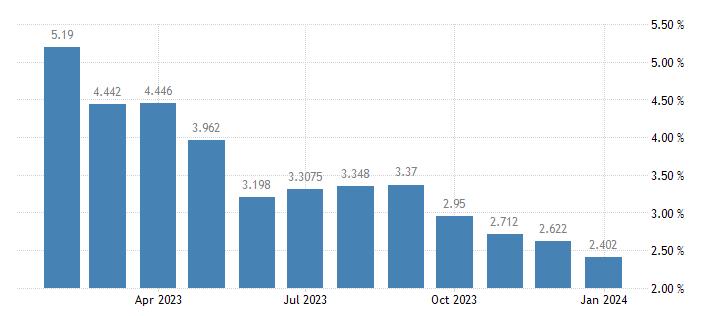
The headline PCE data met market expectations, indicating a month-over-month increase of 0 3% and an annual escalation of 2.4%, maintaining consistency with previous months yet marking a slight decline from the preceding month's year-over-year figure of 2 6%
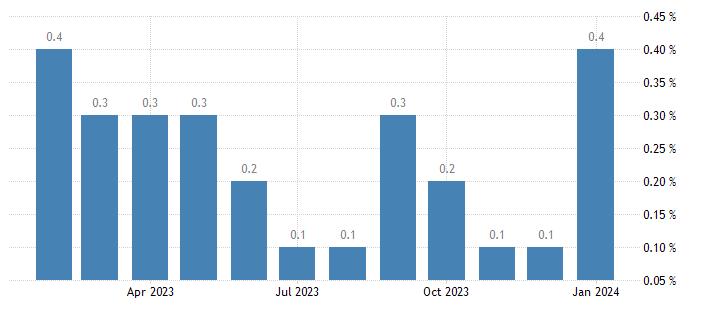
Meanwhile, the core PCE, which omits food and energy prices due to their inherent volatility, exhibited a monthly uptick of 0 4%, a notable increase from the prior 0 1%, and reached an annual pace of 2.8%.
The MoM core PCE of 0 4% might have a little room of concern but we would have to see the next few months to see if the trend continues:
We can see the consistent downtrend when looking at the YoY Chart:
Jobs report: 190,000 expected, down from 353,000
Unemployment steady at 3.7%, wages may slow to 4.3%.
March 20th FOMC meet, rates likely steady
Inflation above 2%, Fed may delay cuts
Market rides on inflation.
Strategy: hold tight, ride momentum.
All eyes is now set to 7th March 2024 (next Friday) nonfarm jobs report The expectation is for total jobs added to be 190,000, well below the prior month's stronger-thanexpected 353,000 nonfarm jobs added The unemployment rate is expected to remain steady at 3.7%, and, importantly, the wage growth figure is projected to ease to 4.3% yearover-year, versus last month's 4.5%.
The all important FOMC meeting will be held on 20th March 2024 (Wednesday) and the market expectation is for the Fed to stay the course and not cut rates However, the release of the Summary of Economic Projections during the meeting will be pivotal, providing insights into the Fed's outlook on potential rate adjustments throughout the year, with market speculation pointing towards a possible rate cut in June
Our expectation is for last mile inflation to continue to be sticky and hover above 2%, and the Fed to delay cutting rates as long as possible without the economy falling into a recession. Despite this, we expect the market to sustain its upward movement, barring a significant and continuous rise in inflation rates Recent indicators, such as a decline in retail sales and signs of slowing in the job market, present a complex scenario On one hand, these trends could prompt the Federal Reserve to reduce interest rates, potentially buoying the market. On the other, they might signal a looming recession. Given these considerations, our strategy is to maintain our current trading positions and capitalize on the market's positive momentum
Thank you for joining us on this journey Our goal is to help you build a resilient and growing investment portfolio We look forward to sharing our insights and helping you achieve your financial goals.
Best regards,
JasonInvesting.com TeamInvestment Newsletter Disclaimer
This newsletter provides trade recommendations based on our analysis and is intended for informational purposes only It is important to understand that investing in financial markets involves risks, and there is always the possibility of losing money The content of this newsletter does not constitute financial advice, and it should not be taken as such We do not guarantee the accuracy, completeness, or timeliness of the information provided, nor do we guarantee any results from using this information
Subscribers are responsible for their own investment decisions We strongly recommend conducting your own research and due diligence before making any investment based on our recommendations Consider seeking advice from a qualified financial advisor who understands your financial situation and investment objectives
The publisher of this newsletter, including its writers and staff, will not be liable for any losses or damages arising from the use of the information contained herein By subscribing to and using this newsletter, you acknowledge and agree that you bear responsibility for your own investment research and decisions and that you will not hold the newsletter liable for any decisions or outcomes resulting from the use of information provided
Investing in financial markets is speculative and not suitable for all investors Please be aware of the risks and be prepared to accept them in order to trade or invest in these markets