Umbrella Winter 2025

Page 1


Janet Jarrell, Executive Director janet@quinteartscouncil.org

Andrew Gray, Program Director drew@quinteartscouncil.org

Kim Lidstone, Bookkeeper qac@quinteartscouncil.org

Graphic Design: Drew Gray

The Quinte Arts Council is a notfor-profit, charitable organization, registration number 107869448 RR 0001. Published by: The Quinte Arts Council, P.O. Box 22113 Belleville, Ont. K8N 2Z5.

Material may be reprinted only with permission. Umbrella is available in digital format through Issuu. The information contained within is believed to be reliable, but accuracy cannot be guaranteed. We do not assume responsibility for any errors and/or omissions related to submitted content.

Reflecting on Umbrella 2025, I am filled with gratitude for the creativity, collaboration, and care that make this publication — and our arts community — so vibrant. This year’s edition is a celebration in every sense: of ideas, of voices, and of the extraordinary artists who shape the cultural life of our region.

Since 2019, Andrew Gray has brought vision, excellence, and imagination to Umbrella as the Quinte Arts Council’s graphic designer. In 2025, we are delighted to celebrate his transition into the role of Program Director. Andrew’s deep understanding of our community and his creative leadership continue to strengthen the work we do, and we are grateful for the many ways he helps bring our programs and stories to life.

This print edition highlights the work of our talented local writers and celebrates over 135 artists — no small feat. With so many stories to share, we had to get a little creative. While not every article could fit within these pages, each one remains accessible. Simply scan the QR codes on the table of contents to read (or reread) the full articles online.

Thank you for joining us on this journey. We look forward to continuing our work together - supporting, championing, and

celebrating local arts and culture in all its forms.

We are deeply grateful to our Board of Directors for their leadership and commitment. After two years at the helm, Brit Johnston is stepping into the role of Past Chair, making way for Rick Moulton as Chair. We thank Brit for her thoughtful leadership and look forward to Rick’s guidance in the year ahead. We are pleased to welcome Christina Akrong to the Board and extend our sincere thanks to Rachael Lidstone, Maribeth deSnoo, Sean Sroka, and Donna Davies for their continued support. We have also been so fortunate to add Lauren Little and Arlo Newman to our team in 2025, strengthening our capacity and deepening our connection to the community.

John M. & Bernice
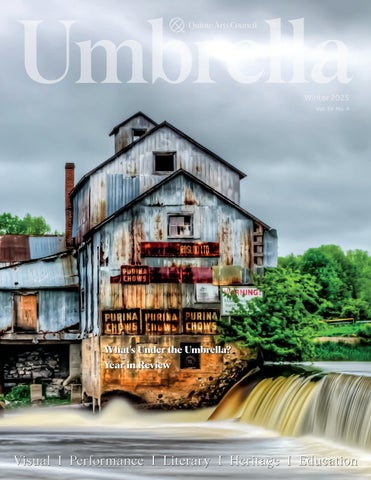
Cover/Back: Chisolm Mill, Danny Sheppard
Andrew Gray
Janet Jarrell, Executive Director, Quinte Arts Council Featured Artwork: Graham Gillmore, Photo: Ash Murrell

Quinte Arts Council

Contributors

Board of Directors

Arts Recognition Awards

Belleville Arts Festival

Photography

Christopher Gentile

Logan Somers

Arts Education

Student Bursaries

Eastside Secondary School

Artists in Classrooms

Music

Hannah Georgas

Arm's Length

Ten Kills the Pack

Greg Schatzmann

The Quiet Room

Fine Arts

Kory Parkin

Herb Deary

Art on 62

Susan Moshynski

Heritage

Edith Cavell

Richard Hughes

Tweed Firehydrants

Theatre

Marble Arts Centre

Brighton Barn Theatre

Performing Arts

Erin Ball

Catherine Taylor

Parkinson’s Dance

Marc Beurteaux

Terry Culbert

David Rendall

Tricia Black

Belleville Theatre Guild

Shatterbox Theatre

Literary Writers Circle

Sarah Malo

Craft

Birdhouse City

Music

Matt Smith

Jonah McLean

Beautiful View Music Festival

Podcast

Beth Milligan

Sean Scally

Heritage

Deaf Culture

Tsi Tyónnheht Onkwawén:na

National Indigenous Peoples Day

Quinte Arts

Spring 2025
Summer 2025
Lauren Little
Arlo Newman
Andrew Gray
Greg Teal
Greg Ceci
Peter Paylor
Scott Williams
Allison Nichol Longtin
Janet Jarrell
Richard Hughes Ardith Racey
Jennifer Shea

Board of Directors

Umbrella is a vital platform for sharing the richness of arts and culture in our community.
Rick Moulton QACChair
Christina Akrong Director
Brit Johnston Past Chair
Donna Davies Director and Arts Education
Rachael Lidstone Treasurer
Sean Sroka Director and Community Engagement
Rick Moulton Chair
Maribeth deSnoo Director and Fund Development

QAC Arts Recognition Awards

TheQAC proudly celbrated the 31st annual Arts Recognition Awards Luncheon honouring six outstanding members of the Quinte arts community. Emceed by Sean Sroka with live music by Tony Silvestri, the luncheon gathered community leaders, elected officials, artists, and supporters to recognize the profound impact of arts and culture in the Quinte region.

“A dancer, a thespian, a visionary artist, a brilliant songwriter, a world-travelling photographer, and a master of community projects all here to be celebrated for their remarkable contributions. This year’s honourees have made a profound impact on arts and culture in our community,” said Janet Jarrell, QAC Executive Director. “This annual recognition is about more than any one individual or organization—it’s a celebration of the Quinte community itself, uplifted by these extraordinary people who are trailblazing a path toward an even more vibrant future.”

The celebration highlighted six remarkable recipients: Luisé Cisneros, Emebet Belete, Phil Bowerman, Lola Reid-Allin, Kristina McIntosh, and Jennifer E. Brant. Each was recognized for their contributions to the arts, cultural leadership, and their lasting impact on the creative vibrancy of the Quinte region.

Rick Moulton, Chair of the QAC Board of Directors, opened the ceremony by

emphasizing the council’s long-standing commitment to fostering creativity and inclusion. “Arts and culture are more than performances and exhibitions,” Moulton said. “They are the core of our communities, fostering belonging, resilience, and pride. Today, we celebrate not just six exceptional individuals, but the collective power of the arts to transform lives.”

Local leaders echoed this sentiment. Neil Ellis, Mayor of Belleville, and Tyler

Hon. Stan Cho, Minister of Tourism, Culture and Gaming Tony Silvestri
Chris Malette, MP Bay of Quinte, Janet Jarrell, QAC, Jennifer E Brant, Award Recipient, Tyler Allsopp, MPP Bay of Quinte, Neil Ellis, Mayor of Belleville

Allsopp, MPP for Bay of Quinte, reflected on the economic and cultural benefits of a thriving arts sector. “The arts community in Bay of Quinte contributes much to our region through expressive, thought-provoking work that can entertain, challenge and inspire audiences, fostering community and driving economic activity,” said Allsopp. “Congratulations to the six Arts Recognition Awards winners on today’s recognition of their leadership, their vision, and their action.”

National and provincial voices also weighed in. Hon. Stan Cho, Minister of Tourism, Culture and Gaming, and Chris Malette, MP for Bay of Quinte, praised the resilience and innovation of artists in the region. Missy Knott, Board Director with the Ontario Arts Council (OAC), spoke passionately about the OAC’s Arts Across Ontario report, underscoring how the arts not only enrich lives but also strengthen local economies.

The six honourees represented a powerful cross-section of Quinte’s artistic

talent and leadership: Cisneros’ installations interrogating identity and queerness, Belete’s community-bridging crochet public art, Bowerman’s five decades of devotion to theatre, Reid-Allin’s global photography and storytelling, McIntosh’s life-changing dance program for people with Parkinson’s, and Brant’s cultural advocacy and Mohawk language revitalization.

As Jarrell noted, the event was not only about recognizing individual achievement but also about sustaining the future of the arts. The luncheon served as the QAC’s annual fundraiser, supporting programs that empower artists, cultivate creativity, and build an inclusive cultural community across the Quinte region.

Fall 2025

Photography by Titus Tolentino
Quinte Arts Council
Board Director Missy Knott with Isaac Akrong
Aaron Doupe accepting for Luisé Cisneros, Kristina McIntosh, Lola Reid Allin, Jennifer Brant, Emebet Belete, Phil Bowerman

This November, several downtown venues, including the Pinnacle Playhouse, Theatre in the Wings, The John M. Parrott Gallery, Gallery 121, the Belleville Art Association Gallery and the QAC Cultural Hub will host events exploring the fascinating history of Belleville and how it has shaped contemporary perspectives.

Christopher Gentile Belleville

Gentile led a collaborative session during the Belleville Arts Festival, incorporating historical artifacts from Glanmore National Historic Site. The project bridged contemporary artistic practice with local heritage, creating a dynamic dialogue between past and present through photography.

Logan Somers

One of the most exciting young talents in local live-events photography, Logan Somers, made a name for himself while studying Journalism at Loyalist College. Taking the initiative, he produced a short documentary on Picton’s Regent Theatre, impressing the venue’s GM so much that he landed a job at the venue as soon as the dust settled on his graduation mortarboard.

When he is not out galavanting on the concert circuit, Logan is stationed full time as the Regent’s Digital Media Producer and Programming Assistant. Among the many hats he wears, one of the most exciting is that of in-house concert photographer—a role he stepped into unexpectedly when last-minute coverage was needed for a show. Thrilled, Logan jumped at the chance, had a blast doing it, and quickly became one of the most sought-after photographers in the scene.

Spring 2025

09 Brielle LeBlanc from Luscious Band, Photo by Logan Somers

Quinte Arts Council 2025 Arts Education

The Quinte Arts Council was delighted to announce the recipients of the 2025 Graduating Student Bursaries. Each year, QAC awards bursaries to students graduating from secondary schools in Hastings and Prince Edward counties who are pursuing post-secondary education in an arts-related field. These bursaries are designed to support young creatives as they take the next steps in their artistic journey. In 2025, we were proud to award seven bursaries, expanding our commitment to nurturing emerging artists across the region.

Summer 2025
Arlo Newman
Rafi Ramji
Charlotte Plante
Finn Dutton
Cassandra Morgan
Cameron Weaver
Leah Hagan

Eastside Secondary School

When it comes to

school art programs in the Quinte area, the offerings at Eastside Secondary School (ESS) are top-notch. From choir to concert band, musical theatre to improv, ceramics to pottery, ESS has it all.

“There are so many options for students,” says David Reed, ESS music teacher and art director. “Art classes start in grade nine and run all the way through to grade twelve. We offer challenging and unique opportunities for our students, and it’s their energy and our talented staff that really make this program shine.”

The Eastside Arts Council is a group of dedicated students from all artistic disciplines who organize events such as coffee houses and art shows throughout the year to promote creativity and collaboration. In addition, ESS has an Art Club, where students identify creative needs within the school—like murals, posters, and décor—and work together to design and produce art to fill those spaces. Open to students of all grades and abilities, no experience is required.

Belleville

QAC’s Artists in the Classrooms

The Quinte Arts Cou-

ncil (QAC) Arts Education program continues to enrich local classrooms, connecting students with professional artists through hands-on learning experiences. Since 2002, the QAC Arts Education program has invested nearly $300,000 into the community, supporting the careers of local artists, fostering artistic growth and enriching learning experiences for students across the region.

Recently, students at Eastside Secondary School (ESS) and Kente Public School had the opportunity to work with guest artists through QAC’s initiative. Kyle and Chrissy from Spark Box Studio introduced students to professional silk screen printing. The students designed their own images and learned to print on both paper and fabric, gaining insight into the technical aspects of the process. Beyond the creative experience, they engaged in conversations with the artists about pursuing careers in the visual arts, offering inspiration for those interested in professional art practices.

Meanwhile, at Kente Public School, artist Emebet Belete led a mixed media and painting workshop focusing on the climate

emergency. Students explored environmental themes by researching local and global impacts before creating artwork using paper, paint, and personal objects. Through guided discussions on composition, colour, and space, they developed layered, meaningful pieces expressing their ideas on ecological sustainability. The next step for these young artists will be exhibiting their work within their school commu-

nities, celebrating creativity, expression, and the invaluable role of art in education.

These are just a couple of examples of how the QAC’s arts education program supports emerging young artists by connecting them with professionals who can inspire and mentor them.

Spring 2025

Belleville

Hannah Georgas

Canadian indie-pop songwriter

Georgas began her musical journey early, inspired by her father and shaped through classical piano training. Writing songs from a young age, she released her first EP in 2009 and quickly gained national recognition, including CBC’s Bucky Award and multiple Juno nominations. Her music has been featured in television, film, and major advertising campaigns, and her albums have earned critical acclaim and industry awards. An avid collaborator, Georgas is deeply involved in both songwriting and production. Now a full-time touring artist, she continues to evolve creatively while offering thoughtful advice to emerging musicians.

Summer 2025

Parri Thomas

Arm's Length

Quinte West

From the quiet streets of Quinte West to international stages, Arm’s Length has emerged as a powerful voice in Canada’s indie emo-punk scene. Formed in 2018, the quartet blends emotionally raw lyrics with high-energy performances inspired by early 2000s emo and pop-punk. After building momentum with early EPs and their acclaimed 2022

debut album Never Before Seen, Never Again Found, the band signed with Pure Noise Records in 2025 and released There’s A Whole World Out There. Touring across Canada, abroad, and iconic venues like Toronto’s Mod Club, Arm’s Length continues to grow a devoted global following rooted in honesty, resilience, and heart.

Summer 2025

Ten Kills the Pack

Sean Sroka is the producer and creative force behind Ten Kills The Pack, blending punk’s raw energy with the emotional depth of folk storytelling. Raised in Mississauga and shaped by Toronto’s creative community, Sroka developed a songwriting style rooted in vulnerability, reflection, and everyday human moments.

His thoughtful, genre-blurring work earned national recognition, including a 2024 Juno Award for songwriting, notably through collaborations such as with Aysanabee. Balancing independent and major-label experience, and collaborating closely with partner Hannah Georgas, Sroka continues to create music that is intimate, honest, and deeply resonant.

Summer 2025

Danelle Jane Tran

Greg Schatzmann

Belleville

Oncepowerful radio tastemakers launched careers like Rush, championed early by Donna Halper. Today, broadcaster Greg Schatzmann carries that legacy forward. Through Sunday Coffee House on CJLX 91.3 FM, he has spent 32 years spotlighting contemporary folk artists, proving local, curator-driven radio still matters.

Spring 2025

Born and raised in Belleville with a shared love of music, Andy Forgie and Kris Tischbein have unique musical journeys that, when combined, create a powerful and deeply moving live musical experience they call The Quiet Room. Like the confluence of two powerful rivers, their distinct paths have come together to form a single, calm, and rich flow of sound.

Forgie's journey dates back to shortly after four young lads from Liverpool appeared on the Ed Sullivan Show. In the 1970's, he was living the dream composing and recording for a record company but also later toured with The Monks, opened for Canadian icons April Wine, Goddo and Blue Rodeo and worked with Canadian studio legend Daniel Lanois. In the 80's, his band Photograph signed with Capitol Records and enjoyed national recognition breaking into the top ten.

Spring 2025

The Quiet Room

Tammy Tischbein Photography

At41, Kanyen’keha

artist Kory Parkin is a man whose time has truly arrived. His interest in art began at an early age and survived the turmoil of adolescence and high school. After a hiatus, his girlfriend (now his wife) encouraged him to return to painting, sparking a series of community-driven opportunities. He began creating logos

Kory Parkin

and imagery for local businesses, community groups, sports teams, and health initiatives. A pivotal moment came when BC-based Indigenous Proud asked Parkin to design a t-shirt for National Indigenous Peoples Day in 2022. To his surprise, the shirts were sold in Walmart stores nationwide. “The social media algorithms did their thing,” Parkin says, and from that moment on, his career took off.

In recent years Parkin has created artwork for superstar athletes like Toronto Argonaut Pinball Clemons and Blue Jay pitcher Alek Manoah, as well as teams from the OHL and even the NBA. Partnering with larger organizations has provided Parkin with a platform and an audience that he otherwise might not easily reach. “On Instagram the most likes I’ll get on a post is a couple of hundred,” he says, whereas when TSN posted some of his work, the number was 15,000 the last time he checked.

These collaborations have brought with them inevitable controversy—what Parkin refers to as the “keyboard warriors”— but he appreciates that the organizations he works with are genuinely trying to “get it right.” He knows his art can help raise their awareness as well. “Toronto Rock is one of the best,” he says. “I’ve worked with them for multiple years, and I’ve seen the growth. Every year, we ask: ‘How do we do even better?’” Raising awareness can also mean raising money: in one 2024 example, the combination of Parkin’s art and the Toronto Rock platform raised over $25,000 for charity.

One of the most significant platforms he’s had was provided by the International Ice Hockey Federation – the IIHF

Tyendinaga Mohawk Territory

– when they selected Parkin to design a jersey for the 2025 World Junior Hockey tournament held in Ottawa. He deeply connected with his Mohawk heritage and consulted with First Nations whose ancestral lands the tournament would take place on, taking the time to “listen, respect, and learn what’s important.”

The result is a thoughtful and powerful work that is reflective of multiple traditions. “Rather than just putting something together that’s eye-catching, this is my way of telling a story. When people ask, what’s the purpose of this or that image, rather than just saying ‘itlooks cool’, I

can say: ‘this is part of my creation story’. It allows me to start a conversation.”

Throughout his artistic career, Parkin has made his own luck, finding creative ways of creating opportunity. In his teen years Parkin’s friends formed a rock band, but since he didn’t play an instrument he created their designs and t-shirts instead. When he realized a professional sports career wasn’t in his future, he pivoted and partnered with some of the biggest names in the industry. When he heard the IIHF was looking for indigenous artists, instead of simply applying, he submitted a full mockup of a logo and jersey.

Despite the challenges of balancing a full-time job and fatherhood, he somehow always finds time to create. “My main focus is always family, so art comes between naps or at 2 or 3 in the morning while everybody else sleeps.

Beginning conversations, honouring and celebrating his culture, being a father and husband, creating opportunities for himself and others, raising awareness and raising money – Kory Parkin is indeed an artist whose time has come.

Spring 2025

Fine

Opening Doors Through the Lens

Scene: “A stark area. A bit of ice on the ground. And there’s a shopping cart.”

Manipulation: “Took away some of the colouring. Made it feel colder.”

Subject: Homelessness.

Herb Deary, the creative force behind Belleville’s Bonehedz Studios, isn’t afraid of difficult subjects—in fact, he embraces them. “Conversations that people are uncomfortable with.”

Herb Deary

Why? “Because real life includes a lot of things. Life isn’t just trees and sailboats.”

And homelessness in particular? “Because for a lot of people it’s one of those conversations that’s ‘out of sight, out of mind’. Sometimes you’ve got to be reminded.”

And the point of the manipulation? “Because every picture is part of a bigger story. There’s so much more than just the picture.”

Deary learned the basics of photography as a kid during the analog days of 35mm film and began his photographic career in a conventional way. “That’s what photography really was,” he says. “You’re at the weddings taking pictures, or birthday parties, or taking headshots.” Though he picked up valuable lessons, he found the work a bit mundane. Then came the shift: “When digital came along it was a whole new age.”

Today, Deary describes himself as a visual opportunist. “I can envision something and I’ll take the opportunity to create it and present it. I’ve always seen things through a different eye than most people: I’ll catch something that people see, but maybe don’t see in its full form.”

His purpose is clear: to spark conversations and make us think. He leans into challenging topics—homelessness, mental health, and sexuality. “That’s a big thing in our modern age. Sexuality has become political. To a point where some people, if they’re in a minority, they can be in a situation that’s detrimental to them. There’s a lot of bigotry, a lot of hatred in the world right now. A lot.”

Deary’s work around gender and sexuality, while sometimes exploring the fringes, also shines light on what we might consider more mainstream—and

Belleville

in doing so, raises provocative questions. “You know the usual wedding picture? That husband and wife… what if, when they go home, they’re wearing panda suits?”

It’s an image that makes us wonder: in that scenario, what are the real costumes—the panda suits, or the fancy clothes worn for the wedding? In a cultural moment where expressing one’s “authentic self” has become a mantra, Deary pushes further, challenging us to ask what our authentic self really is. Will the real you please stand up?

He knows these conversations aren’t easy. In one photograph, Can you hear me now?, a model screams into a phone in anger and frustration, trying to be heard above the static. The piece is an apt metaphor for Deary’s artistic vision. As he insists, “art shouldn’t be comfortable.” Yet many of us would prefer the safety of our comfort zones. His work must be edgy, even unsettling—must scream at us metaphorically—to force us to confront difficult truths.

We are accustomed, even in art, to being guided—to see the world through the artist’s lens in a particular light. Deary flips that script. He is not interested in imposing his view. Instead, he wants to open doors. “I don’t try to put my view into their head. I just open up the door.”

And that may be the greatest challenge—and gift—of Deary’s work. We are not asked to agree or even to see the world his way. We are invited to ask the essential questions he raises, to face the realities he highlights, and to wrestle with them ourselves—without guideposts, only provocations.

Fine Arts

Acool morning in

early May found three well-known Belleville artists – Jeannine Berscheid, Jan Coombs and Margaret Ruttan – in a small gallery in Madoc: Art on 62 (the name deriving from the gallery’s location on Highway 62). This is a “drop off” morning, one of many such mornings during which owner/curator Cid Palacio works with artists to select items for the gallery’s 2025 catalog. It’s a delicate process: “It might be a good piece, but that doesn’t necessarily mean it’s meant for the gallery,” Palacio says. “Some art fits better with the market.”

Art on 62

Three weeks later, the enthusiasm and excitement at the gallery’s gala opening for the season would indicate that the collaborative but arduous process had all been worth it.

This is year three for Art on 62, and Palacio is justifiably pleased at how the gallery has evolved. From a roster of only 10 artists in 2023 – most of whom were from Toronto – the roster grew to 17 artists in 2024 and now 22 artists in 2025, 40% of whom are from Madoc, and 80% from the region, which Palacio defines as Sharbot Lake to Quinte

West. “There are so many hidden gems in Madoc,” says Palacio. “I’m here to give local artists a voice, and new artists an opportunity to be part of a gallery.”

Palacio is an accomplished artist herself, with an enviable professional profile and an expansive body of work that has found its way into collections across North America and Europe. She describes herself as a “recovering banker”, having spent 33 years with one of Canada’s largest banks, the last seven at the executive level, before taking early retirement to focus on her art full time.

Summer 2025

Madoc
John Vlachos
John Presseault, PineintheWind

The creativity of Su-

san Moshynski has taken many forms: artist, designer, illustrator, and even an ongoing, if occasional, gig as a political cartoonist—long before “side hustle” became part of everyday vocabulary. But it is in her role as a fine artist, a painter, that she has found her passion and her greatest success.

Moshynski says she “came by it all honestly,” learning to paint from her father, a full-time sign painter and part-time artist. After beginning his career with Bata Shoes, he realized he could work

Susan Moshynski

independently and support his family solely with his artistic skill. “He was a master of drawing,” she recalls, “an absolute master.

Her own abilities developed further through a Fine Arts degree at York University, followed by a career in design and illustration in the ad industry. While that work satisfied her creative urges to a degree, she always felt something was missing. “I wanted to paint,” she says. “I wanted to get my hands right in it—you know, be messy!” In 1991, she returned to Rednersville Rd. and began painting in earnest.

Moshynski describes her creative journey as providing “solid bones” for her work—from the fundamentals of drawing and painting learned from her father to the sense of form and balance shaped by her design work. Onto that foundation, she has built a vibrant and varied body of work that dances between realism and abstraction. A gallery curator once described her style as “realism with a twist,” and Moshynski immediately recognized its accuracy. “That phrase said almost exactly what I’m doing.”

Fall 2025

Prince Edward County

Edith Cavell

As the 19th century

gave way to the 20th, the tightly circumscribed roles of women—so long dictated by Victorian ideas of morality and conduct—began to expand. Women entered fields previously closed to them, often with extraordinary results. Marie Curie’s groundbreaking research into radioactivity earned her two Nobel Prizes; Emmeline Pankhurst endured imprisonment as she fought for women’s voting rights; Amelia Earhart flew solo across both the Atlantic and Pacific; Florence Nightingale transformed nursing into a true profession.

Among these remarkable women, though perhaps less well known today, stands Edith Cavell—no less a figure of strength, courage, and compassion.

Born in Norfolk, England, in 1865, Cavell was the daughter of an Anglican minister. Skilled in French, she worked as a nanny in Brussels before returning to England in 1895 to care for her ailing father. That experience revealed her true vocation. After training at London Hospital, she worked in hospitals serving the poor and destitute, then returned to Brussels in 1907 to work with a doctor who pioneered the training of professional nurses, to replace the well-intentioned and compassionate nuns who had no specific medical training. There she flourished, training nurses for hospitals and schools while lecturing to both doctors and nurses.

Fall 2025

Belleville

During Heritage Week,

the Quinte Arts Council (QAC) proudly celebrated Richard Hughes as the recipient of the 2025 Outstanding Achievement in Heritage Revitalization Award for his contributions to the Preservation of Historical Significance.

“Richard was the President of the Hastings County Historical Society (HCHS) from 2012 to 2023, and throughout that decade—and beyond—he has been a dedicated champion of local history,” said Amanda Hill. “His passion for sharing our community’s heritage is evident through his regular appearances on YourTV Quinte, where he discusses historical topics, as well as his frequent contributions to Outlook, the Historical Society’s newsletter.”

Richard Hughes

Hughes' deep understanding of the role history plays in shaping a community has been instrumental in preserving significant landmarks. “He has worked tirelessly to document and share the history of buildings such as the Memorial Arena and City Hall,” Amanda continued. “His leadership, alongside fellow HCHS Past President Orland French, was pivotal in the successful creation of the Community Archives.”

His impact extends far beyond archival efforts. “Richard was actively involved in establishing the Community Archives of Belleville and Hastings County and played a key role in the preservation and relocation of the United Empire Loyalist monument on Dundas Avenue East,” said Gary Nicoll, current President of the Hastings County Historical Society. “He has led the

creation and installation of numerous historical plaques throughout Belleville, particularly in the Downtown Business District along Front, Pinnacle, and Church Streets. His expertise has also been invaluable to downtown revitalization projects, including the redevelopment of the Memorial Arena.”

Hughes is a regular contributor to the Heritage section of Umbrella Arts magazine, published by the QAC. His passion and dedication to preserving our region’s history has left a profound and lasting impact.

“Richard’s work ensures that our heritage is not only remembered but continues to inspire and educate future generations,” said Janet Jarrell, Executive Director of the Quinte Arts Council. Spring 2025

Tweed Firehydrants

For more than 40 years, Tweed’s hand-painted fire hydrants have transformed everyday infrastructure into beloved public art. What began as a small community initiative now showcases artists such as Hali Letwin, Tom MacGregor, Lisa Fenn, and Jordan Willis, drawing visitors from afar and reflecting the village’s creativity, pride, and enduring spirit—one whimsical hydrant at a time.

Spring 2025

The Marble Arts Centre

The Marble Arts Cen-

tre (MAC), located in Actinolite just north of Tweed, is now proud to be not only 100% accessible but also an upscale venue for every genre of arts and culture! Its stunning new atrium adds space, warmth, and light to the existing white marble walls of the former church, creating a vibrant lobby, meeting space, and art gallery. “From a show perspective, functionality has improved 1000%,” says Tim Porter, Co-Executive and Artistic Director of Tweed & Company Theatre. “It’s always been a pillar of the company that productions are affordable and accessible. And the atrium changes how the venue can be used.”

The venue’s transformation took three years of hard work, but now, as Porter says, “It looks like it did in my brain.” The new atrium, the heart of the venue, features a semi-vaulted ceiling, expansive windows, and white oak flooring (from Gaylord Hardwood Flooring). It also includes upgraded dressing rooms, redesigned rehearsal and set spaces, updated auditorium features, and accessible entrances—stylish yet practical additions. The auditorium itself has also been improved, with a larger stage, better sight lines, upgraded lighting and sound, and wheelchair seating at both the front and back.

The original marble church, built in 1864, has a history of resilience. It was destroyed by a fire in 1889 and rebuilt from stones that were hewn and quarried nearby. The Tweed and Area Arts Council purchased the building in 2008, and by 2010, it hosted its first season with a retrofitted kitchen, stage, and 120 cushioned seats. The venue faced challenges during COVID and was further damaged by a tornado in 2022, which affected the roof and exterior walls.

Since then, it has been re-retrofitted with a new roof and rafters, repaired plaster, new insulation, new flooring, and a state-of the-art heating system. The stained glass windows are original, as are the refinished finials along the top edge of the atrium, which connect past with present. Incorporating and balancing the original marble stones and stained glass of the church with modern lines and materials has resulted in a truly striking space that is inviting and accessible for all.

Once a local arts venue supported by community donations and volunteers, the church has now become an award-winning space. In 2010, the

Tweed

MAC hosted just one major show, but this year, they are planning four largescale, professional musicals (several of which will also be staged at the Village Playhouse in Bancroft) alongside many other one-night concerts, comedy shows, kids’ camps, and private events. The atrium will also serve as a public art gallery with rotating exhibits, and the theatre group’s offices are now on site.

Construction for the recent additions and renovations started in 2023 with “90% of labour and materials coming from Hastings County.” The upgrades were made possible through generous donations from local individuals and businesses, as well as funding from the Canada Cultural Spaces Fund, the Rural Economic Development program, and the Parrott Foundation. Special thanks also go to the Board of Directors, over 100 volunteers, and seasonal artists and staff. The MAC has now become a cultural hub for the community, a welcoming venue that will increase tourism and economic development—a new heart space for the area’s arts, which is vital for community and culture.

Emily Mewett, Co-Executive and Managing Director, says that “the final product is even more beautiful than I imagined, but it took intense dreaming, a lot of work, and a ton of determination.” Porter agrees: “We knew that the only way our productions could survive and thrive was with significant investment in this space. It really is a dream come true.”

Mayor Don DeGenova calls the newly renovated space “breathtaking.” “Hastings County and the Municipality of Tweed deeply appreciate Tweed & Company’s significant investments, which have helped cultivate a thriving and vibrant theatrical arts community.”

Porter is excited about the upcoming season and next steps, which include landscaping, an outdoor licensed patio, new signage, and improved accessibility and inclusivity. Future considerations include described audio for musical productions, as well as a hearing loop that allows hearing aids to be patched into the sound board, and an ASL interpreter for single events, all of which will serve to draw people from all over the province.

It’s no surprise that the MAC was recently recognized as one of Ontario’s ‘Top 100 Festivals and Events’ for the fourth consecutive year, and that Tim Porter was presented with King Charles III’s Coronation Medal for his continued work with Tweed & Company Theatre.

The Marble Arts Centre is ‘all ramped up’ for an exciting production year. Expect a few more marble milestones!

Spring 2025

Brighton Barn Theatre

Since 2002, Brighton

area residents and visitors have been treated to high quality community theatre in a refurbished historical barn in Proctor Park (home of the Proctor House Museum). Brighton Barn Theatre offers award-winning acting and directing in an informal setting, with all the amenities needed to make the experience comfortable and memorable.

The 1880s-era barn was moved from the farm of Rene and Jerry Simpson at the west end of the original Town of

Brighton to its present site in 1999. With community fundraising and volunteer support, reconstruction began in 2000 and the building was ready for use in July, 2001. Further additions and modifications were completed in 2003.

The theatre has a maximum seating of 125 and all patrons enjoy a close, unobstructed view of the stage. The post-and-beam construction, soaring ceiling and warm wooden interior provide a cozy setting to enjoy the productions. The barn is heated, air-conditioned, and it is wheelchair accessible.

Anna Rittwage is President of the Proctor House Museum and Brighton Barn Theatre, and she has been involved with the Theatre project since Day 1. She recalls participating in ghost walks on the streets of Brighton as a fundraiser for the museum. “We had 30-some people come out every Tuesday night and play parts in that ghost walk. Once we saw the crowds that came out for the walks and the actors that came out, you could see that we needed live theatre in Brighton. These people had all of these talents and no outlet.”

High quality acting talent has been consistently available for the Brighton Barn Theatre productions from the get-go. The actors are among the many volunteers who also perform various support roles including set production, lighting, sound, building repairs, and more. “I’m most proud of the people who take ownership of the theatre,” says Rittwage. “They will do anything that’s within their means to keep it going and to encourage other volunteers to come out. The work they do is just astounding.”

Brighton

Brighton Barn Theatre typically offers two productions per year, one in the spring and another in the late summer/ fall. Frequently, the selected play is a comedy and has been written by a Canadian playwright. “We have found out that people like to laugh; they like to leave laughing,” says Rittwage. “We do a lot of Canadian plays (Norm Foster, Pe ter Colley, etc.). Sometimes, we’ll take on an American comedy. People really enjoy the comedy.”

These productions draw large crowds from beyond the Brighton region. The first 2025 production (Norm Foster’s Jenny’s House of Joy) had 1,000 tickets available for the three weekends it ran and 967 tickets of those tickets were sold. Show proceeds go to the Save Our Heritage Organization (SOHO), a charitable organization dedicated to re storing and maintaining Proctor House Museum. SOHO funds also support the continuing operation of the theatre.

The Brighton Barn Theatre community lost one of its long-time volunteer lead ers in May after a lengthy illness. Art Middleton had been President of the

Theatre for many years. He also produced plays and provided his expertise as technical director, lighting designer and operator, and set designer.

Despite his illness, Middleton last designed the set and lighting for Brighton Barn Theatre’s first 2025 production that ran from April to May of this year.

As a testament to the quality of productions offered by Brighton Barn Theatre, the organization occasionally participates in the Eastern Ontario Drama League One-Act Play Festival and has garnered numerous “best of” nominations. The Theatre was awarded best individual female performance for Kathy Lacasse as Mrs. Peters in Trifles.

Theatre

Erin Ball

Discovering circus art

in 2008 at a buskers festival, Erin Ball was captivated by partner acrobatics. Ze signed up at the Toronto School of Circus Arts and later explored aerial arts. Ze spent the next few years dedicated to training, following a discipline meant for non-Disabled bodies, not knowing about zir own neurodivergence.

In 2014, Ball became a double below-knee amputee. Defying expectations, Ball kept pursuing zir passion. The transition was tough, both physically and because there were hardly any visibly disabled performers in circus arts. “I was both unlearning internalized ableism and discovering how deeply ableism is ingrained in circus arts,” Ball shared.

With support from the disability activism community, Ball faced zir internalized biases and learned to embrace zir body. Over time, Ball teamed up with disabled artists whose experiences didn’t fit the usual circus norms, creating inclusive training methods. Ze realized that marginalized communities have always been part of circus arts but are often excluded, so ze made it a mission to create opportunities for them. As a double amputee, Ball had to rethink circus training, moving from rigid skill-based instruction to a strengthbased, individualized approach - ways “that are unique to each body.”

Understanding the power of visibility, Ball proudly showcases zir body on stage while making sure audiences have access. Ball doesn’t believe ze has to "adapt" the performances. Instead, sees the work as exploring zir body’s unique

strengths. Ze uses mobility devices and prosthetics in zir acts, like specialized legs that make zir 7.5 feet tall. “Being suspended over an unsuspecting audience that had no idea what was coming. 40 feet in the air, I removed legs that appeared to be my (former) flesh legs…there were loud gasps from below.”

Now an internationally recognized performer and instructor, Ball works with zir partner, Maxime Beauregard, another disabled circus artist. Together, they started InterComplementary Journeys, focusing on slow touring instead of the usual industry hustle.

The main challenge Ball faces isn’t zir body but systemic barriers. Accessibility is often an afterthought, stereotypes linger, and ableist assumptions create obstacles. Instead of seeing these as individual problems, ze works with people who have lived experience to find collective solutions. Ball references the term ‘Nothing About Us Without Us’ - “I think working with people with lived experience is the only way to do this work.

The Latin term emerita

is used to describe a woman who has retired or stepped away from a role, but retains her title as an honour—an enduring recognition of a lifetime of dedication and excellence. Or, as Catherine Taylor puts it, “a love affair that hasn’t ended.”

Catherine

For the past 13 years, Taylor has been the Artistic Director of the Quinte Ballet School of Canada (QBSC) in Belleville. Stepping back from that role was no easy decision—it has been the focus and love of her life since she was five years old. While she says she’s still figuring out what her new title means, one thing is certain: “I plan to stay connected with the school. I hope to be able to continue to do a little bit of teaching, helping with rehearsals, private coaching – I want to be able to find that balance with some work, and not all work, because that’s what I’ve always done.”

That continued connection is a gift for the school. Watching Taylor teach is to witness a virtuoso at work—sharing not only her deep knowledge and sharp eye for form and movement, but also her joy. She can be thoughtful, methodical, and spontaneous, all within a moment.

In ballet, it's often said that the art chooses the dancer—but not for Taylor. Her love affair with ballet began when she saw a performance of Coppélia at age five. She told her parents that she “wanted to be a dancer and marry the guy on stage.” Ever supportive, they

enrolled her in the National Ballet School of Canada, where she trained throughout her elementary and secondary school years. She later joined the Royal Winnipeg Ballet in the late 1970s, performing in classics like Swan Lake, Giselle, Romeo and Juliet, and The Nutcracker.

Taylor began teaching in the 1980s— partly due to injury, but also because she discovered a deep love for it. “After a few months in, I realized how much I loved teaching. It seemed to fit my personality,” she says. Over the next two decades, she worked with international choreographers and staged company performances across Canada, the U.S., and abroad. “Join the ballet and see the world,” she laughs.

“I have worked with some of the greatest choreographers in the world and that’s how you learn – you see what their eye is looking for. And as you age, you learn to teach differently – it’s like muscle memory. I can’t show it, but I can give some sort of direction,” says Taylor.

Belleville
Taylor
Bob House Photography

Parkinson’s Dance

The idea of a dance

program for individuals with Parkinson’s Disease originated at the Mark Morris Dance Center in New York in 2001 with the first class attended by six members of the Brooklyn Parkinson Group. The original idea took off and now, 24 years later, Parkinson’s Dance programs can be found in more than 300 communities in 28 countries around the world. One of those communities is Belleville, where Parkinson’s Dance is offered for one hour weekly from September to June at the Quinte Ballet School of Canada (QBSC).

Parkinson's Disease is a movement disorder of the nervous system that worsens over time. Symptoms can include tremor, slowed movement, rigid muscles, poor posture and balance, loss of automatic movements like blinking, speech changes, writing changes, and non-motor symptoms like depression, anxiety, and sleep problems. Symptoms vary from person to person and are often slow to progress. Unfortunately, there is no cure.

Parkinson’s Dance is led by teaching artists who integrate movement from a diverse variety of dance and movement

styles. The classes are dance-focused, not exercise or fitness-focused. The emphasis is on aesthetics and imagination, encouraging dancers to move with grace, invoke creativity and emotion, and develop their mind-body connection. During class, dancers stretch and strengthen their muscles while creating flexibility and range of motion. As range of motion increases, so does balance and gait.

Program coordinator and instructor with the QBSC Kristina McIntosh says, “It’s the closest thing to magic you can

experience. You can watch dancers come in maybe a little bit down. An hour later, you see the cloud lift and you watch a different individual leave the space.”

“Dancers have told me they feel different, or they just believe and know they can do it - whatever "it" is. Some say they feel steadier, more balanced. Others comment that they stand prouder with more confidence.”

Fall 2025

Belleville

As an artist who lives, works, and creates in Hastings County, Marc Beurteaux's current online presence features his work in animation and film, but he’s starting to become known for his sculptures, in addition to his earlier work.

Marc and his partner traded the hustle and bustle of city life in Toronto 15 years ago for the quiet of the country. They moved to an 80-acre farm North of Marmora, which had woodland and several outbuildings to explore. The landscape he calls home informs his work

Marc Beurteaux

as an artist, “It’s a huge supermarket of stuff…I wanted to live in nature, just to see what it was like. It definitely watered down my ego…this is what the world really is: nature. It broadened my horizons and my outlook.” It also provided the source material for his sculptures.

“The farm had a lot of junk…when I see anything, I see the potential for it to be art,” says Marc of how his new home provided inspiration for his more recent foray into sculpture. “It’s like it was meant to be - I just started making stuff.” Many of the materials Marc uses in his sculptures are found objects that

he sources from around his property, including old and rusted bits of scrap metal, as well as salvaged cleaning, cooking, and farming tools. Through his sculpting of discarded materials, Marc gives objects new life, “I see anything, I look at anything and I think, that could be useful.”

There is a tipping point, though, when the amount of materials salvaged can become more overwhelming than inspiring. Marc recently did a purge of his studio because he’d been adding to the pile of materials over several years and found that he’d stopped working

Marmora

for a while; he felt bogged down. He remembers his earlier days working in film when he didn’t have many materials, “It felt like I was more imaginative. It’s almost like the less you have, the more [room] you have to think. When I have too much stuff…it gets to be too much. I’ve done a great purge, and I feel like a new man.”

Marc’s raw, unvarnished, industrial aesthetic translates across mediums. There’s a common language that extends from his work in film and animation toward his sculptures. There’s a clear signature at play, with film and animation informing and inspiring sculptures and vice versa. When he sculpts something new and he likes it, he thinks, ‘wow, that would be so cool animated.’ “That’s why I like making my own short films - you also get to build the props, characters, backgrounds… that’s what led me to doing more sculpture, because I loved doing the set decoration so much, that it was natural for me to start sculpting.”

Marc’s creative roots are in film and animation. Last year he made a short film for the Small Town Shorts Film Festival. The film was screened in Campbellford. Marmora & Lake Public Library and Trent Hills Public Library created a collaborative event for their communities

to highlight the deep well of creative talent in small towns. “There are way more filmmakers in this area than you think,” says Marc.

In a post on Canadian Animation Blog, Marc spoke about his inspiration to create animated films, “It was the realization that you could create worlds within your own animated films. It's incredibly addictive to see what comes out of your imagination.” For Marc, it’s much the same with his sculptures, “With sculpture, it’s almost more fun in a way, because it’s a bit more instantaneous. You just get a couple pieces and then suddenly they fit together and there it is. There’s the face. There’s the sculpture. Just the joy of watching pieces come together and form something. It’s just totally addictive. I’ll never get sick of that.”

Of art-making and creative work, it’s said that you should find and do the thing that makes you lose all sense of time. Many of us can relate to this singular experience, “When you’re animating, time means nothing…same with sculpture…I could be working for hours and hear the dog bark and then [think], ‘oh yeah, I should have fed them an hour ago’…time bends and stretches and just becomes a new reality. Mostly time flies.”

And if making animated films and sculptures isn’t enough, Marc is trying his hand at writing, with the ultimate goal of writing a book. “Writing’s hard, though. It’s harder than sculpting. I’d like to delve into that a bit more…I’m always doing stuff…Hopefully I always will [be].”

While his sculptures don’t have an online presence yet, you can learn more about Marc’s work as a filmmaker and an animator, as well as see his films here. Keep an eye out for a website coming soon.

Fall 2025

Terry Culbert

Prince Edward County

When the BealART

Secondary Art School in London accepted a passionate young Terry Culbert many years ago the art life of an extraordinary renaissance man began to take form.

From this four-year program, Culbert cut his own path through numerous careers ranging from photography, cinematography, radio broadcasting, and painting. He has authored and illustrated two fine books, and continues his journey through unknown realms of creativity.

Culbert’s ancestral line immigrated from Ballymackey, Tipperary, Ireland and purchased land in Biddulph Township in 1840 a few years before the infamous Catholic family known as “The Black Donnellys” arrived (also from Tipperary).

“From what I was told, our family got along well with the Donnelly family.” While acknowledging that the notoriously maligned family were surely no angels, Culbert feels that they incurred more blame than they likely deserved.

“Without doubt, there was quite a lot of discrimination against the Donnellys. I find it quite disturbing that the vigilante group that murdered six members of the Donnelly family was led by the local Catholic priest.” Culbert’s ties to Lucan and Donnelly family lore are chronicled in the second book, Lucan, Home of the Donnellys (2005).

Spring 2025

APicton-based interdisciplinary artist, David Rendall's current project, TodayisaGift, is a hybrid documentary blending film techniques, blurring the lines between fact and fiction. His award-winning film Triage, a short realist drama, shot in Prince Edward County, has been presented internationally at 19 film festivals and counting, including the Ottawa Canadian Film Festival (OCAN) and Toronto Shorts International Film Festival.

Rendall works across artistic mediums, wielding the tools that best serve each project. “My creative process is an exten

David Rendall

sion of my way of thinking…of dialoguing with images.” His work exists in the space between an imagined reality and what’s actually happening in the world. He seeks to “tell stories of truth through a prism of something that’s fantastical.”

Set against the backdrop of the COVID -19 pandemic, Triage is an allegory that explores grief, loss, and the fragility of life. The film’s mounting sense of urgency is gripping, relentless, and parallels the intense uncertainty that many of us experienced in the pandemic. The film gives the audience permission to feel their grief, collectively.

Filmed almost entirely within the confined space of a vehicle, Triage calls to mind the confined spaces many of us were relegated to during lockdowns. The contrast between the close quarters of the van and the expansive, rolling fields and open County roads just beyond its windows, creates a heightened sense of claustrophobia.

Triagewas “developed and written in the pandemic and made as the [pandemic] restrictions were being lifted, so there was a kind of dilating into a feeling of more open space,” reflects Rendall.

Spring 2025

Film
Prince Edward County
Shooting Triage
Hannah Forest Briand in Triage David Rendall, photo by Tess Gerard

Tricia Black

If you feel like you've been seeing Tricia Black everywhere lately—you’re not wrong. Whether it’s popping up in TD or Walmart commercials, stealing a scene on TV, or making magic onstage, Black has become one of those instantly recognizable Canadian talents you can’t help but cheer for.

One of our favourite moments? Their cameo on the hit show Ghosts. As Channelle, Black brought just the right mix of charm and quirk that made us grin long

after the episode ended. But that’s just one stop on a growing list of appearances: you may have also spotted them in Pretty Hard Cases, Kim’s Convenience, Baroness von Sketch Show, What We Do in the Shadows, or even the film The Broken Hearts Gallery.

What makes Black’s success even sweeter is their strong connection to our region. As part of Tweed & Company Theatre, Black has helped create and perform in original Canadian musicals that celebrate local voices and stories.

Tweed

That community spirit and dedication to live performance is still at the heart of their work, even as their star continues to rise on screen. “Growing up in and around small towns, I felt right at home in Tweed and it has taught me so much about community and about how important telling local and Canadian stories are. They can resonate far beyond a small town because they are stories of human connection, struggle and joy.” Fall 2025

Amanda Searles

Prince Edward County

Based in Shannonville, Amanda Searles

is a local nature and wildlife photographer whose passion for the outdoors began at a young age. Moving across Canada with her family exposed her to the country’s diverse wildlife and landscapes, sparking a lifelong fascination with the natural world. Fourteen years later, she received her first camera—a Canon Rebel T3i—and hasn’t looked back since (except, of course, to capture something through the lens).

Fall 2025

Ron Erwin

Prince Edward County

Aftercompletely losing his sense of humour, Ron Erwin left his high tech career to pursue nature photography. His work ranges from traditional landscapes and wildlife to more experimental work including digital composites. For over 35 years Erwin’s photos have been published in magazines, calendars, books and used in corporate interiors. After many years of editorial and commercial photography, Erwin became a full time professor at Seneca's School of Creative Arts and Animation. He retired from Seneca in 2019 to return to photography full time.

Summer 2025

Photography

Angela Wiggins

Two themes define the work of Angela Wiggins: the artist’s journey and a fearless use of colour. From early encouragement by her grandmother to a decade as a tattoo artist shaping her confident line work, Wiggins’ path led her to bold, spiritually driven Indigenous art. Wiggins sees her art as a vehicle for personal healing and community support. Spring 2025

Quinte West

Allison Lynn Tyendinaga

Artist Allison Lynn draws inspiration from family life, teaching, nature, and her Mohawk and Loyalist ancestry. Lynn’s work bridges art, education, and cultural learning, while her evolving practice embraces experimentation, community engagement, and continued exploration of Indigenous culture and language.

Spring 2025

Kids Inclusion Art Show

Quinte West

Asuccessful community project arguably needs at least two things: a visionary who will drive the project’s success, and an engaged and fully supportive community. Luckily, the Kids Inclusion Art Show has had both.

The event is the brainchild of Brandy Ringelman, owner and curator of These 4 Walls gallery in Trenton (profiled in this magazine in Spring 2022). A few years

ago, Ringelman partnered with Community Living to create a small art show for children on the topic of inclusion, and a year later ran a show for High School students. In both shows, she says, “The talent was amazing, but they struggle with budget at the schools, so sometimes the materials weren't the best. On opening night I could see that some of the kids were feeling a little insecure, and that bothered me. So I took two years and made that right.” The result is

a show in which young artists in Kindergarten through Grade 12 create “square-foot” pieces of art – acrylic paintings on professional-grade 12x12 canvases. “There's no grading, there's no best in show, nothing is for sale,” Ringelman says. Instead, “let’s all get together to celebrate each other regardless of any unique abilities or any insecurities anyone might have.”

Summer 2025

Presqu’ile Waddling Art Centre

Alot has happened in

in a short time for the Brighton Arts and Cultural Council (BACC). In 2022 Brighton Mayor Brian Ostrander and Deputy Mayor Ron Anderson approached local artist Des Rodrigues about starting a new Arts and Cultural Centre. A previous version – the well-regarded Brighton Arts Council, brainchild of multi-talented artist, actor and author Ron Waddling – had closed its doors several years earlier. Rodrigues took inspiration from Ostrander’s statement that without the arts in your community, you’re just bricks and mortar, and ran with it. Initial meetings were held, a notfor-profit corporation was created, and in December 2024 the new Presqu’ile Waddling Art Centre officially opened its doors.

The name of the Centre was deliberately chosen: Presqu’ile because the focus is broader than just Brighton; Waddling to recognize the historical connection; and Art Centre because they see themselves as different from a traditional gallery. The collection isn’t curated in any conventional sense. “On a monthly basis, artists themselves decide what they want to display and when,” vice-president Surina Hart explains. “We’re open to all our members. Pieces don’t have to be gallery wrapped, don’t have to be framed – it’s all open to their expression.” The business model is similarly unique: rather than a commission on sales, artists pay a vendor fee for any month in which they display their work, and artists even set their own prices. Apart from the vendor fee, 100% of the sale price goes to the artist.

The variety of art on sale is remarkable. “There are many artists here who would never have shown their work”, says Hart. “But now they've become members, now they’re starting to display, now they're selling their work”. Adds Rodrigues: “That’s really about building confidence” – a theme he returns to repeatedly. The programs offered at the Centre show similar breadth: drum circles, sound baths, yoga classes, music jams, workshops on every topic imaginable: watercolour, wood carving, pen and ink, pet portraits, air dry clay… the list goes on.

Diversity also extends to the ages of participants, and young people are especially well represented. A three-day youth camp on March break covered multiple art genres (sculpting, line art,

painting, photography), the BACC’s inaugural fundraising gala featured a juried show for high school students, and student volunteers in search of community hours often staff the Centre. At the other end of the age range, the “Artful Journeys” program for seniors shows how the BACC extends its reach out into the community. “We know our seniors can’t come to us, so we’re going to them,” says Hart, explaining how workshops are conducted onsite at the area’s four seniors’ residences. “No matter what level they are at with their art, or with their aging, we’re creating unique workshops just for them, and we do it every month.”

The BACC’s signature event is Art in the Park, held on the August long weekend in partnership with the Downtown Business Improvement Area. This August will be its third iteration, and the event grows in stature and in offering each year, featuring 30 artists and attracting about 5,000 visitors in 2024.

Future plans for the BACC include an innovative Art Healing Therapy Program for military and first responders living with work-related trauma. “First responders see so much,” says Hart. “Art has been proven to be an effective outlet – a way they can come together in a safe way to express themselves and heal.”

With so many different things going on, it can be hard to remember how young the organization really is. After summarizing all their programs and events, even Rodrigues sounds surprised: “Things have happened by leaps and

bounds. To think of what we’ve accomplished in a year and a half… it’s pretty astounding.”

Summer 2025

Trust is a word that keeps coming up when the Improvmonauts sit down to talk about what they do. And, yes, the five frenetic members of Belleville 's homegrown improv comedy troupe do on occasion sit down.

“The five of us are also friends, and that helps,” says Matthew Sheahan, who along with Mihal Zada, Darren Moore, Alexandra Bell, and Nathan Mahaffy, make up the Improvmonauts. “You don’t have to be friends with the people you do comedy with, but you have to trust each other. If you don’t trust each other then you can’t do it. I feel that all of us trust each other enough that we can voice opinions or try something different…we’re going to try stuff together and figure that out together. I’ve always felt at home with these people.”

Improvmonauts

“Especially early on,” says Bell. “You have those doubts. Is it going to work? Are people going to enjoy what you’re putting out there? Because you’re offering a piece of yourself when you’re doing improv to an audience. There’s that piece of yourself that you’re letting go to be received and there’s always that fear that it’s not going to be taken well, but then one thing I think we would all agree is that improv works best when you have that trust in the team that’s around you. It helps to alleviate those doubts and allows you to reach those places where you let yourself go and just enjoy the moment that you’re in. It’s so freeing to be able to just kind of go to those weird places in your mind, explore some things that you might not in another format under the guise of comedy.”

The five, who have been doing improv together since 2018, all share a background in traditional scripted theatre. “The more improv I do, the more I realize I’m acting,” says Moore. “When I first started doing this, I tried to be me on stage, and it didn’t work. And so, I’ve created an improv character so when I get on stage, I’m that open, goofy…I’m the Golden Retriever Darren. That’s me on stage. That character can do things that I can’t.”

“All of our experience in traditional stage theatre,” says Bell, “things like knowing your voice, the direction to face out when you’re speaking, blocking, staging, things like that…we’re all very conscious of our space with each other and our presence and how that’s being delivered out to the audience, and I do think that comes from all of us having experience in the traditional theatre.”

Belleville

While what they do is unscripted, writing is still at the heart of it. “All of us are writers in our own right,” says Sheahan. “Writing for a living, writing songs, writing poetry, writing plays, writing whatever—we’ve all written. All that structuring you do when you’re writing something, it’s in your brain, so when you’re doing improv, you’re just doing it on the fly.”

“Theatre is very much a collaborative art form,” says Zada. “One of the things I love most about improv, especially with these guys, is that I can see stories coming to life in a way that when I’m sitting down and trying to write them out, it doesn’t work. It doesn’t process the same way.”

Music plays an integral part in what makes the Improvmonauts unique. Bell and Mahaffy are both experienced professional musicians. As the troupe’s musical director, Mahaffy earns high praise from his colleagues. “I love musical improv,” says Sheahan. “If it’s done well, it’s magical for the audience. I feel we’ve gotten to the point where, when we do musical comedy, it’s magical.” Their audiences seem to agree.

Another integral part of their comedy is the City of Belleville. “Belleville’s a character,” says Moore. “Right? And it’s a pretty funny character. There’s a lot of character and spirit in this town, one way or the other and it’s just a well to draw on.”

“We get it, and our audience gets it, and we have something special that

connects us right from the start,” says Bell. “When we’re making jokes about Hawkins Cheezies or the Moira River or the Wally Deaver…as much as it might be framed as a joke, it’s coming from a place of love for the place that we all get to live and create in.”

“There’s more happening here creatively than it deserves in a sense— for where we are and what it is—and it’s like I want to be in that,” says

Moore. “I want to be in that thing. I want to be in that group that is doing that thing that is better than expected. And I think we do that.”

The Improvmonauts appear regularly in venues throughout the Quinte region. Catch them if you can. You’ll have a good time. Tell them I sent you.

Fall 2025

Belleville Theatre Guild

Belleville

Short plays are making a comeback…again. In the early twentieth century, the triple bill was still a popular part of the theatre season – three short plays in place of one long one. Actors loved them, because they gave lesser-known members of the company an opportunity to show what they could do. But attendance began to wane. Producers found that they needed to stick with the big-name stars if they wanted to fill big houses, and bigname stars only wanted big roles. They wanted no part of short plays.

Lamenting the decline of the short play, Noël Coward took on the challenge of reviving the form in 1936 with Tonight at 8:30, a series of nine one-act plays that would run three at a time on successive evenings.

“A short play,” he wrote, “having a great advantage over a long one in that it can sustain a mood without technical creaking or over-padding,

deserves a far better fate, and if, by careful writing and producing I can do a little towards reinstating it in its rightful place, I shall have achieved one of my more sentimental ambitions.” The shows ran for 157 performances in

London’s West End and another 118 on Broadway before Coward grew tired and decided to move on. The one-act play was soon relegated to amateur community theatres, and even then, mostly to regional festivals until the festivals themselves started disappearing one by one.

The Belleville Theatre Guild (BTG) revived the one-act format in 2014 with their First Annual Evening of OneAct Plays, a series that ran for several years. After a brief hiatus, they return this year with Theatre August—a showcase of six one-act plays, most written by local playwrights.

Summer 2025

Shatterbox

"I n a time before

Facebook , World of Warcraft, and Massive Multiplayer Online RPGs, there once existed simply a game. Forged by the hands of nerds, crafted in the minds of geeks, and so advanced in its advanciness it would take a whole second edition to contain its mighty geekery.” — Narrator, Qui Nyguen

Since its Off Off Broadway world premiere in 2017, She Kills Monsters by Qui Nyguen has been delighting audiences with an insider’s glimpse into the world of nerd culture. This heartfelt, high-energy play is an exploration of grief, identity, and the healing power of fantasy. On the surface, it’s a geeky, action-packed adventure through a Dungeons & Dragons campaign. But beneath the dragons and sword fights lies a poignant story about connection, acceptance, and loss. The latest production, presented by The Shatterbox Theatre Company of Prince Edward County, continues this proud tradition.

Summer 2025

Prince Edward County
By Greg Teal
Theatre
Theatre
Sean Ferguson
Sean Ferguson

Writing is often a solitary activity—but eventually, every writer craves community. The Belleville Public Library offers the perfect answer for writers of all ages and experience levels: the BPL Writers’ Collective. This member-led group meets every other Thursday from 5:30 to 7:30 p.m. at the library, where writers share their work, receive encouraging feedback, and explore new prompts and challenges designed to spark creativity.

Anne McSommers, a Belleville-based writer, joined the collective in 2022 and stepped into a leadership role in 2024. After actively participating in Montreal’s vibrant literary scene, Anne relocated to Belleville in 2021. Looking to reconnect with a writing community, she found the BPL Writers’ Collective thanks to her mother, who heard about it on local radio.

Open to all—whether you're a hobbyist, a professional writer, or just getting started—the collective welcomes

Writers Circle

anyone with a passion for storytelling. Meetings are structured yet supportive: members take turns reading their work aloud, with each writer given four minutes to share. Feedback is positive and constructive, focusing on what works and why. The goal is to help writers grow in confidence, especially when it comes

to the often-daunting task of sharing their work.

Summer 2025
Belleville
Allison Nichol Longtin
John M. & Bernice PARROTT FOUNDATION

Sarah Malo

Belleville

"I was moved by the anguish and honesty in Sarah’s story. So many people experience what she has gone through and continues to navigate. Her ability to include the humorous side succeeds in making it real. It’s like talking it out with an old friend. She created an atmosphere of comfort and support. I hope she is compelled to write more.”

This is just one of the five-star reviews that Belleville-based Sarah Taylor-Malo has received for her debut book, Growing Pains—an impressive achievement for a first-time writer.

“I’ve been very introspective, always trying to put the pieces together for myself, so writing just came naturally to me as a tool for that,” says Taylor-Malo. “I’ve always read those kinds of books as well – memoirs, non-fiction. I love reading people’s stories. I think there’s a lot of relatability in that.”

Spring 2025

Venture uphill from

Picton’s downtown toward Macaulay Mountain Conservation Area and you’ll find yourself in a whimsical world of colourful birdhouses perched high atop platforms. You’ve arrived at Birdhouse City, a favourite spot for birders, hikers, and locals alike, nestled in the heart of Prince Edward County.

Entirely volunteer-run, Birdhouse City has been a labour of local love since the first birdhouses went up in 1980. The late Doug Harns, former superintendent with Quinte Conservation and a gifted woodworker, conceived of the idea for Birdhouse City. It began with a giant birdhouse replica of the historic Massasauga Park Hotel.

Today, Birdhouse City is cared for by a small but mighty team. Volunteer administrator Alan Hurst works alongside nine core volunteers and about 30 builders to maintain the collection of roughly 100 birdhouses, with much of the

Birdhouse City

focus on refurbishments. Hurst and his partner moved to Picton full-time in 2020. When they and their neighbours noticed Birdhouse City falling into disrepair, they rolled up their sleeves, forming an ad-hoc committee and rallying volunteers. With support from a local councillor, the County, and Quinte Conservation (which owns the land), the revitalization effort took flight.

The handcrafted miniatures—many of them remarkably accurate replicas of historic buildings and landmarks from Prince Edward and Hastings counties—serve both flora and fauna. They provide refuge for birds, delight visitors, and contribute to a thriving ecosystem. Quinte Conservation carefully balances the needs of people, plants, and wildlife, clearing paths for

Picton
"Massassauga Park Hotel", originally built by BHC founder Doug Harnes

visitors to admire the birdhouses while leaving grasses and plant life to sustain the environment. “I can’t say enough about how supportive Quinte Conservation has been—they’re very, very interested in what we’re doing…They love it,” says Hurst.

Over the past 40 years, Birdhouse City has become a community treasure, in-

spiring residents and visitors while also attracting media attention. In 2020, Canada’s Amazing Race filmed a challenge at the site. “It really validated the work we put into it,” says Hurst. Local artist Carl Wiens has also celebrated the landmark through a series of graphic illustrations featuring several of the birdhouses.

With so many incredible birdhouses to choose from, he is spoiled for choice when it comes to selecting his favourite, but the Point Petre Lighthouse, made by Hurst’s partner and his Dad, is nearest and dearest to his heart.

If you’re interested in lending your social media skills to the initiative, Hurst and his fellow volunteers would love to hear from you.

Illustrations by Carl Weins Fall 2025

Crafts
Builder Builder Colin Milroy

Matt Smith

Belleville

One of the hardest working musicians around, Matt Smith has certainly got his fingers on a lot of frets. A world-class mandolinist and slide guitarist, his passion for music is something he’s always been thankful for. Smith has been playing since the age of nine and performing professionally for thirty-six years.

“I’m grateful to live in such a vibrant artistic centre,” says Smith. “I have always loved the opportunities to entertain and engage, musically, with all the folks I’ve grown up with and everyone that comes to enjoy our beautiful part of the country.”

One of Matt’s latest projects is The Matt Smith Trio, featuring Phil Woodard on bass, Gary Buffet on drums, and Matt on vocals and guitar. The trio performs unique interpretations of classic standards—from jazz to country to rock—all “deeply informed by the blues,” says Smith.

Fall 2025

Jonah McLean

He was born in Warkworth, Ontario, and Jonah McLean still calls it home today—but that hasn’t always been the case. Like many young boys, he threw himself into sports, eventually moving to Texas at fifteen to pursue a golfing career. He finished high school in Florida, then earned a golf scholarship at the University of North Carolina. But disenchanted with the game, he left university early, drawn back to his roots. It turns out, home is where the music is—and always was.

His journey began on a drum kit at around seven years old. His Dad's taste in classic rock fuelled his new passion as he jammed along with Bad Company, Led Zeppelin, CCR, Fleetwood Mac, The Band and The Beatles. By ten, music took a back seat to sports. “I didn’t pick up a guitar until I was seventeen and got a quick lesson from a dear friend of mine, Jeremy Early. I was pretty busy with golf at this point so I used to just pick up the guitar for ten to fifteen minutes a day.”

Fall 2025

John Hailey

Beautiful View Music Festival

B

elleville's down -

town came alive this September with the debut of the Beautiful View Music Festival, a new celebration of indie artistry and community spirit. Produced by acclaimed artists Hannah Georgas and Sean Sroka (Ten Kills the Pack), the festival drew music lovers into cafés, bars, and gathering spaces throughout the afternoon, filling the city with sound, creativity, and connection.

The lineup was as dynamic as the venues themselves. Artists Cedric Noel, Justin Rutledge, Burs, Boyhood, Fraser, May Shukla, and Julia Finnegan each brought their own style and energy, creating a patchwork of raw talent and heartfelt performances. The result was a day that felt both intimate and electric—an invitation to discover new voices and celebrate a shared love of music.

“There’s a lot of artists travelling the 401 run—Toronto, Kingston, Ottawa, Montreal—and the towns in between often get missed,” says Sroka. “Part of this festival is being able to introduce Belleville as a market to agents, to their managers, and make sure there is a temple event that allows [them] to see

Hayden

there are creative people here, and festivals can be a success.”

The community’s support was unmistakable. The festival was presented, sponsored and supported by many community organizations. Local businesses leaned in, including Reid’s Dairy, whose team handed out free ice cream, chocolate milk, and swag to festival-goers — refreshing fuel for an afternoon of music-hopping.

The energy built toward the festival’s sold-out evening showcase at Capers, where fans packed the space for moving performances by Bells Larsen, Julie Doiron, and the legendary Hayden. The room pulsed with tender melodies and rising choruses, proving Belleville is more than ready for a festival of this caliber.

For Georgas and Sroka, the vision was simple: create a space where indie artists could shine and where Belleville

could carve out a place on the touring map. For the community, it became something even bigger—a celebration of identity, belonging, and the power of music to bring people together.

With its promising debut, Beautiful View Music Festival looks poised to be-

come a staple of Belleville’s cultural calendar. As the name suggests, it offers not just a beautiful view of the city, but a glimpse of its bright creative future.

Fall 2025
Photography by Christine Reid
Music
Cedric Noel

Beth Milligan

B

elleville Playwrite

Beth Milligan has a knack for storytelling—and for breathing new life into a classic theatrical form: the radio play.

Her serial podcast, The Jackson Nash Mysteries, is set in the fictional town of Ashville. It revolves around the adventures of a rookie mail carrier, Jackson Nash, who unwittingly finds himself entangled in one mystery after another. Starting with a murder on his first day on the job, Jackson finds himself wrapped up in everything from a kidnapping to art thieves and stalkers. Along the way, he assists his cousin, Inspector Wesley—better known as Bug—in solving crimes, Jackson fosters a budding romance with his co-worker Liz, a feisty red-head with a keen interest in him. What starts as lighthearted flirtation between Jackson and Liz soon blossoms into something deeper as they spend more time together.

Milligan, inspired by 1990s CBC radio dramas like Midnight Cab, entreats her listeners to a quirky and fun podcast. “I just loved Midnight Cab and I wanted to create something with a similar feel but with a small town vibe,” says Milligan.

Each episode unfolds through letters that Jackson writes to an old school pal, Kevin. Through these letters Jackson relays the various cases he finds himself involved in, his budding romance with Liz and reflects on past trauma that plays no small part in his involvement in these small town crises.

The podcast is a full-cast production, enacted by the River and Main Theatre company at Theatre in the Wings, as well as other actors and artists from the Quinte arts community. Original music for the podcast is provided by Aidan Coutts. The majority of the sound effects are made in-house. From a spaghetti dinner being

prepared to conversations in a shower stall, Milligan and show’s producer Peter Paylor work to create immersive and convincing soundscapes for the series.

“There is a lot involved in recording these podcasts. A twenty minute episode can involve over 50 hours of production work,” says Paylor.

Currently, The Jackson Nash Mysteries has five episodes available, with the sixth installment, The Mystery of the Silver Gun, set for release soon. Listeners can tune in on Spotify, Apple Podcasts, and other major streaming platforms.

Spring 2025

Belleville
Greg Teal

Sean Scally

Over

the past five

years, Sean Scally has quietly built a legacy in podcasting, producing three very different series that continue to find listeners online. Each project reflects his deep curiosity, his love of research, and his instinct for personal storytelling.

Scally began with StrangeStoriesofthe Bay of Quinte, a series of 11 episodes that unearth the folklore, oddities, and hidden tales of our own region. “While researching many of the local history documentaries I have made, I kept coming across short anecdotal stories and folktales that were too short or too difficult to film for a video, but were nonetheless really interesting. So the podcast seemed like a good option,” he explains. The result was a selection of eerie tales and overlooked histories, offering listeners a glimpse into our historical past.

One particularly memorable episode explored the famous Fox Sisters, whose séances in the mid-19th century sparked the global Spiritualist movement. Scally recalls, “I came across the story of the Fox Sisters during my research on a film about the Murray Canal and Carrying Place. It is fascinating when you dig around in this region’s past—you

come to realize that over the course of history many people have come from here and gone on to make and participate in some of the greatest stories of North American lore. Susanna Moodie, Belleville’s own literary figure, once attended a séance and later hosted a few at the Moodie cottage. For Scally, the story resonates far beyond Quinte: “The Spiritualist movement was huge in its time and still resonates today … all derived from the mind of mischievous bored young girls from Consecon.”

His second project, Dead Wax 78’s, reveals another side of his passions: early music and the charm of gramophones. “This all came about through my love of old-time music and the preservation of old 78 records and my hobby of repairing and tuning old wind-up gramophones and phonographs, mostly saving them from the landfill and bringing them back to life,” he says.

Celebrating Deaf culture

Hands in Commem-

oration is a landmark festival recognizing our local Deaf culture and the deep significance of the Sir James Whitney School for the Deaf (SJW) in Belleville.

Founded in 1870 as the Ontario Institution for the Education of the Deaf and Dumb, Sir James Whitney School is Canada’s oldest and largest school for the Deaf. For more than 150 years, it has been a cultural and educational cornerstone, nurturing generations of

Deaf students and shaping the city’s fabric. Today, the school continues to stand as a proud symbol of identity, heritage, and community.

At the heart of this celebration is an exhibition of De’VIA (Deaf View/Image Art). These works affirm Deaf identity, share lived stories, and celebrate American Sign Language (ASL) as both a language and a vibrant cultural expression. Visitors encounter powerful artworks such as Bi-Languages in Our Life by Vika Rudenko, with each piece

accompanied by a QR code linking to the artist’s statement in ASL with voiceover and captions—ensuring accessibility and deeper connection for all audiences.

This initiative also honours the leadership of Janice Drake, Chair of the OSD/ SJW Alumni Association, and Deaf artist and accessibility advocate Leah Riddell who designed a concept spelling out “Belleville” in ASL handshapes. A temporary version has already been shared with the community, while

Leah Riddell, Handshapes
Marwa Farishta Normohamad, LostIdentitytofindIdentity
Jada Etheridge
Belleville

plans continue for a permanent metal and plexiglass installation at Zwick’s Island Park.

Riddell says, “For generations, Deaf people in Belleville have carried stories of resilience, identity, and culture that often went unseen. Hands in Commemoration is our way of making that visible; through art, through language, and soon, through a permanent ASL sign in the heart of the city. It’s a celebration of who we are, and an invitation for the community to celebrate with us.”

A powerful dimension of this celebration is the storytelling of filmmaker Alvin Witcher, founder of PAH Media. Witcher, who is Deaf, is dedicated to sharing authentic stories from within the Deaf community. As he explains: “Something was missing in the Deaf community –there was a lack of sharing information, specifically about Deaf people, our stories and experiences. It was time I rolled up my sleeves and returned to my original passion: making documentaries to share Deaf stories.”

Hands in Commemoration is more than an exhibition—it is a celebration of resilience, identity, and the cultural legacy of our Deaf community. It shines a light on the stories, language, and contributions that make Belleville’s Deaf heritage so vital. This is not just a recognition of the past, but an ongoing invitation for everyone to learn, connect, and join in celebrating an extraordinary chapter of our community’s story.

Fall 2025

Moira Malik, Dontneedhearingaids
Donna Fano, GlimpsesintoaDeafPerson'sWorld
Vika Rudenko,
Judith Greaves,

Tsi Tyónnheht Onkwawén:na Language and Cultural Centre

The Tsi Tyónnheht

Onkwawén:na Language and Cultural Centre (TTO) in Tyendinaga Mohawk Territory is celebrating a major milestone—its 25th anniversary—this year. The celebration will be part of the Territory’s annual community events on National Indigenous Peoples Day.

Founded by a group of parents concerned about preserving the Kanyen’kéha (Mohawk) language and culture for future generations, the Centre has grown from a grassroots initiative into a cornerstone of cultural revitalization.

“We simply wanted to establish an immersion school for our kids,” says Bonnie Jane Maracle, a Director on the TTO

Board since its establishment. “Because we didn’t have any (native language) speakers in our community, we had to back up and set up some programming to create some. We started with adult immersion; we got some adults speaking, then they were able to become the teachers of a kids’ program.”

That children’s program continues today as an immersion school serving students from Kindergarten to Grade 5. The school is currently at full capacity with 25 students, and over the years, the Centre has expanded its programming to further support Mohawk language and cultural learning.

Reflecting on the Centre’s evolution, Executive Director Callie Hill says their

focus has expanded. “Twenty-five years ago, in terms of Indigenous language revitalization, many communities and nations were thinking that the way to do that was through children, and through children’s immersion programs.”

Tyendinaga

“Coming into 2025, we have realized that, in order for our language to thrive as a living language, we really do need to have adult speakers. So, a lot of research and programming now has started to focus on developing adults as speakers of the language.”

Board Director Karen Lewis emphasizes the broader significance of the Centre’s work. “The Centre functions as a beacon of hope that what was lost can be reclaimed,” she says. “Like any language, ours contains knowledge of our ways, our traditions, ideals and cultural practices. In terms of identity, it helps us remember ours and know it is worthwhile.”

One of the Centre’s most exciting developments in this anniversary year is the construction of its first purpose-built facility, located on the former Shannonville World’s Fair site on Salmon River Road. The new building will house three classrooms—expanding the Centre’s capacity to serve up to 60 students—as well as a large kitchen, a multipurpose room for additional programs, an art studio, and a recording studio for language documentation.

“We will have a big kitchen and another classroom off the kitchen for additional programming, an art studio, and a recording studio to do documentation of language,” says Callie. “We also have plans to rehabilitate the lands around

the building because we’ve disturbed it and we want to live very lightly on the land with this building. We want to replace everything that we’ve displaced outside.” The new building should be completed this fall, with an official opening toward year-end.

Bonnie Jane laughs when she says the TTO’s original five-year plan of building its own school has taken five times longer, but she emphasizes that the Board’s focus over the years has been quality versus quantity. She adds that it has taken time for the community to become aware of, and embrace, the Centre. Many local residents have been involved through the years, each contributing something toward the growth and development of the Centre.

The new TTO building will showcase everything the Centre has to offer, and it symbolizes the community coming together with pride.

Callie notes, “Our Centre will have our own home now, purpose-built for what we do, the type of education we provide. Previously, we’ve lived in leased places throughout our community. This new building is going to increase the prestige and importance of language and culture to everybody in the community. They’re going to see we’re not going anywhere.”

Summer 2025

National Indigenous Peoples Day

Observed across

Canada on June 21, National Indigenous Peoples Day is a time to recognize and celebrate the richness and diversity of First Nations, Inuit, and Métis cultures, stories, and traditions. For many Indigenous people, this day brings forth a complex mix of emotions. To honour these perspectives, we invited Indigenous artists who have been featured in past issues of Umbrella magazine to provide their perspectives.

“Growing up, being a part of my community, you were taught the importance of unity, and peace for those around you but also to have respect for the environment, and future generations. The 21st of June should not only be a day to celebrate the beauty of our art, culture and traditions but also be a day to listen and learn about what makes us so resilient.”

Kory Parkin - koryparkin.com

Kanyen'kehà:ka Artist & Digital Creator

“For my family and I, this is a day where we share space with our community members and kin. Together, we bear witness to each other, celebrate our successes, and acknowledge that we are still here, we have done some good work, and we still face immense challenges in our communities. Together, we reflect, take stock, and step forward.

We are standing on the shoulders of those who have come before us, who

have worked hard and fought to ensure our words and ways were not lost, so that we can carry forward our languages, traditions and teachings.

This year, I'm reflecting on the legacy of my former teacher, Kariwénhawe Dorothy Lazore, who started her journey to Spirit World in early spring. Kariwénhawe had a tremendous impact on revitalizing and promoting the Kanyen'kéha language across our communities. I am privileged to have learned from her; and she reminds me that continuing to learn Kanyen'kéha is an important part of my journey.”

Allison Lynn - allisonlynn.ca

Kanyen'kehà:ka Visual Artist

“This day serves as an opportunity for all individuals, especially those newcomers to our lands, to learn about and acknowledge the original peoples/stewards of this land—who hold deep knowledge, traditions, inherent rights and historical connections to our country.

Tyendinaga
David R. Maracle
Allison Lynn
Kory Parkin
Allison Lynn, Tick

Indigenous communities follow longstanding protocols that guide expressions of gratitude and respect for the elements that sustain our life. Through prayer, ceremonies, and teachings, we pass down invaluable knowledge to our younger generations, instilling an understanding of the importance of caring for the land, respecting Mother Earth, and preserving our traditional medicines.

Every day is Indigenous Peoples Day for me, my children and my grandchildren; as a Kanien’kehake person from the Peacemaker’s Territory, knowing the struggles our ancestors have had to endure and overcome, it is important that everyone joins us in celebrating and continuing to celebrate the resilience of our Indigenous Nations of Turtle Island and beyond.”

David R. Maracle - davidrmaracle.com

Kanyen'kehà:ka Stone Sculptor, MultiInstrumentalist, and Entrepreneur

“I celebrate my culture and my connection to the land and spirit through visual art. I celebrate a history that was lost not only to me, but to thousands of survivors and their families.

I am safe to express my loss to the world, to express my need to learn our teachings, and our rich history, a privilege that was taken from me. My family members lost their heritage, their roots, their connection to where the soul is bound to their ancestry.

This day of recognition for the Nation gives me a moment to pause and realize I am not alone in how I feel. I am not alone in my loss. I am not alone as I stumble to seek the knowledge held from me. Our nation mourns a past that has cast a shadow on our beautiful land, a nation that now recognizes the need for truth and the need for reconciliation.

I am grateful that I am free to ask, learn and go forward proudly proclaiming my blood ancestry and want those around me to feel the same pride and stand tall as we hold hands and celebrate each other and embrace our past to promote healing in our communities.”

Angela Wiggins - angelawigginsart.com Anishinaabe (Ojibwe) Visual Artist

“For Indigenous people, most of us celebrate being Indigenous every day in our actions and efforts put forth into the world. We must continuously

work hard to try to revive and restore our culture and knowledge. Certainly, it is a day to celebrate our continued existence, our various cultures and our efforts to grow stronger.

To be truly meaningful, Indigenous Peoples Day requires Canadians to do some deep introspection and arrive at a heartfelt recognition that the general wealth and abundance enjoyed by the average Canadian is a direct result of Indigenous Peoples being willing to share our lands, and then being taken advantage of by unfair treaties and laws that were designed to destroy Indigenous Peoples and our connection to our lands.

While we can’t change the past, we can change the present, and the future of our relationship.”

Robin Tinney - robintinney.ca Algonquin Indigenous Artist

Summer 2025

Robin Tinney
Angela Wiggins

RISE For ALL Women and Girls: Rights. Equality. Empowerment.

The Quinte Arts Cou-

ncil Cultural Hub and Gallery was full of creativity and inspiration this March as it hosted the 7th annual RISE exhibition. This event showcases the talents of local artists under the national theme "For ALL Women and Girls: Rights. Equality. Empowerment." The exhibition was a vibrant celebration of the unique perspectives and creative journeys of women and girls, reflecting their struggles, triumphs, and aspirations.

Each work in the display told a story, capturing the essence of the theme through various mediums such as painting, photography, and mixed media. Visitors to the gallery were treated to a diverse array of artworks that highlight the multifaceted experiences of women and girls.

Adding to the excitement, the Quinte area hosted numerous gatherings on March 8th in honour of International Women's Day. These events brought the community together to celebrate and support the rights, equality, and empowerment of women and girls.

Spring 2025

Angela Wiggins, Embraced
Quinte
Sarah Winn, Jackie
Tina Osborne, Rebirth:HopeinChaos

Rainbow 2025: StrongerTogether

The Quinte Arts Cou-

ncil was full of pride this June as it hosted its 7th annual Everyone Under the Rainbow exhibition. This staple QAC event celebrates and lifts up the talents and expressions of local 2SLGBTQIA+ and allied artists throughout Pride Season.

Patrons were treated to a colourful expression of the unique lives, feelings, and experiences of 2SLGBTQIA+ individuals and their art. Each piece displayed is the artist’s distinctive take on this year’s

Rainbow theme, ‘Stronger Together,’ which emphasizes the importance of community and inner strength, especially when faced with challenging times. It calls to action all of those within the community, but also for allies to stand alongside us. Stronger Together represents the necessity of a united front from people of all walks of life, and value everyone as equals. Artists worked in several mediums, including paint, mixed media, digital, poetry and crochet.

Now is an especially important moment to promote and not only listen, but to hear 2SLGBTQIA+ voices. It has been beautiful to see visitors of all gender, sexual, and romantic alignments, including allies coming to the Cultural Hub and appreciate the effort put forth this year. Everyone is always welcome and encouraged to help support community members displaying their art.

The Quinte Arts Council welcomed the community for the opening reception for Rainbow: Stronger Together and enjoyed hearing from the artists! Those present were privileged to view work from Arlo Newman, Ashley Ridder, Cat Currie, Daniel Fobert, Joanne Kells, Lisa Leskien, Lorraine Mackie, Phoenix Kimmerly, Ron Waddling, Sabian Ackles, Sam Smith, William Richards, Zak Rittwage, and a collaborative piece from the 2SLGBTQIA+ Community.

The QAC is a welcoming and safe space for individuals of all gender identities, gender expressions, sexual, and romantic orientations. Quinte Arts Council’s Executive Director, Janet Jarrell says "The 7th annual Rainbow exhibition at the QAC Cultural Hub celebrates the vibrant creativity and resilience of our community. With this year’s theme,

Ron Waddling, WaltzingWithPride
Belleville
Arlo Newman, Rainbow 2025: Stronger Together Welcome Book

#StrongerTogether, we are proud to showcase the largest number of submissions yet, a testament to the power of collaboration, equity and inclusion. At the Quinte Arts Council, we believe that art has the ability to unite, uplift, and inspire. This exhibition embodies our mandate to foster community engagement, amplify diverse voices, and strengthen the cultural fabric of the Quinte region. We are honoured to support and showcase the incredible talents of local artists as we continue to grow and thrive together.”

Summer 2025

Quinte Arts Council
Zak Rittwage, FairySprings
William Richards, LoveisLove
Arlo Newman, Obtrusive
Joanne Kells, Love

Student Photography Contest

The Quinte Arts Council in partnership with the Bay of Quinte Regional Marketing Board were proud to host the 2025 Student Photography Contest — a vibrant and inspiring showcase of the people, places, and natural beauty that define the Bay of Quinte region.

Open to students aged 7 to 18, the contest invited young photographers to share what makes the region special through their eyes. Submissions ranged from vivid downtown scenes and quiet lakeside sunsets to motion photography and colourful spring blooms. Entries were accepted in four age categories: 7–9, 10–12, 13–15, and 16–18. Winners have been awarded exciting prizes, including a brand new digital camera, cash awards, and the opportunity to have their work featured in a month-long exhibition at the QAC Cultural Hub throughout August 2025. The exhibition highlights the remarkable creativity and skill of youth from across the region.

Steven M First Place (Ages 7-9)
Brooke G
Vihanga W Best

Turn static files into dynamic content formats.

Create a flipbook