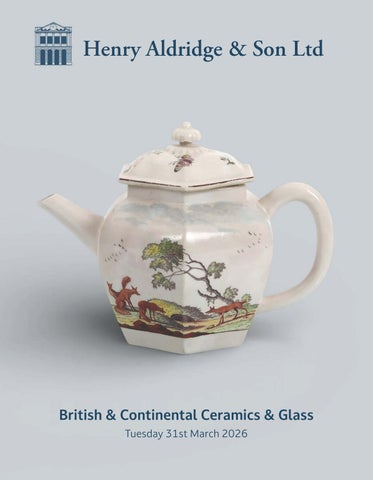
British & Continental Ceramics & Glass
Tuesday 31st March 2026

![]()


British & Continental Ceramics & Glass
Tuesday 31st March 2026

Tuesday 31st March 2026
VIEWING
Friday 27th March 10am - 4pm
Saturday 28th March By appointment only
Monday 30th March 10am - 4pm
Tuesday 31st March 9am - 10am
BIDDING

Clare Durham, Ceramics & Glass Specialist +44 (0)1380 729199 | clare@henryaldridge.com
CONDITION REPORTS
Please note that descriptions do not necessarily list all faults. You are advised to obtain a full condition report prior to bidding.
ABSENTEE BIDS
For bids and enquiries prior: +44 (0)1380 729199 | office@henryaldridge.com
LIVE ONLINE BIDDING & WEBSITE ENQUIRIES
Christine Aldridge FRSA +44 (0)1380 729199 | chrissie@henryaldridge.com
Mandy Palk | mandy@henryaldridge.com
SHIPPING QUOTES & DISPATCH
Mailboxes Chippenham +44 (0)1249 446141 | info@mbechippenham.co.uk
Dariuse Paterson +44 (0) 7803 081531 | dariuse@bar-berry.com
Please note, all collections are strictly by appointment only.
FULLY ILLUSTRATED CATALOGUE
£15 + postage

Henry Aldridge & Son Ltd., Auctioneers & Valuers, The Old Emporium, 6/7 St John’s Street, Devizes, Wiltshire SN10 1BD www.henryaldridge.com

2 Three single-handled jelly or syllabub glasses, c.1770, all moulded with vertical flutes, applied with a scroll handle, and raised on a low domed foot, 11.5cm max. (3) £80-120
Provenance: the George Hurran Collection.
1 A small commemorative drinking glass of horse-racing interest, 19th century, the round funnel bowl engraved ‘Success to Silver, Dale’ beneath a narrow foliate band, two moulded jelly glasses, and a small stirrup glass in the shape of a boot, 10.5cm max. (4) £80-120
Provenance: the George Hurran Collection.


3 Three glass rummers, c.1800, each with a generous ogee bowl raised on a collar knop over a short plain stem, 12.2cm. (3) £80-120
Provenance: the George Hurran Collection.
4 A pair of Georgian glass rummers, c.1800, the flared bowl engraved with the initials ‘JP’ and raised on square lemon squeezer feet, a glass with a bucket bowl engraved with the initials ‘GEW’ between hops and barley, a rummer over a square foot, and another engraved with ‘RASC’ over cut lappets, 14cm max. (5) £150-200
Provenance: the George Hurran Collection.


Provenance: the George
Provenance:
Provenance:
12 An unusual balustroid wine or firing glass, c.1740, the generous ogee bowl raised on a thick knopped plain stem over a firing foot, 13.7cm.
£150-200
Provenance: the George Hurran Collection.
13 A rare deceptive baluster dram glass, c.1740-50, the thick funnel bowl raised on a bulbous knopped stem enclosing a single tear over a folded conical foot, 10.7cm. £400-600
Provenance: the George Hurran Collection.


14 A small wine glass, c.1750, with a round funnel bowl raised on a dense airtwist stem with shoulder and basal knops, over a folded conical foot, 14.8cm.
£150-200
Provenance: the George Hurran Collection.
15 A baluster wine glass, c.1740, the bell bowl with a solid base, raised on a plain baluster stem enclosing a single tear, over a domed foot, 17.5cm.
£250-300
Provenance: the George Hurran Collection.


16 A small baluster gin glass, c.1725-30, the round funnel bowl raised on an inverted baluster stem over a folded conical foot, 11.5cm.
£150-200
Provenance: the George Hurran Collection.
17 A wine glass, c.1770-80, the round funnel bowl cut with a five -petalled flower around the base, raised on a faceted stem over an octafoil lobed foot, 16.5cm.
£80-120
Provenance: the George Hurran Collection.


18 A wine glass, c.1760, with a pan-topped bowl raised on a double series opaque twist stem and conical foot, 15.5cm. £100-150
Provenance: the George Hurran Collection.
19 A baluster wine glass, c.1740-50, the round funnel bowl with a solid base enclosing a small bead, raised on a stem with a beaded knop over an inverted baluster section and small basal knop over a conical foot, 15.4cm. £250-300
Provenance: the George Hurran Collection.
20 A large wine glass, c.1750, the ogee bowl moulded with vertical flutes around the base, raised on an airtwist stem over a folded conical foot, 16.5cm. £180-220
Provenance: the George Hurran Collection.
21 A wine glass, c.1760, the bell bowl raised over a double series opaque twist stem with shoulder and central knops, above a conical foot, 16.5cm. £100-150
Provenance: the George Hurran Collection.
22 A large mixed twist wine glass, c.1760, with a squat bell bowl raised on a mixed stem with a double series opaque twist spiral enclosing an air gauze core, over a conical foot, 19cm. £200-300
Provenance: the George Hurran Collection.
23 A large wine glass, c.1760, with generous bucket bowl raised on a cable airtwist stem and conical foot, 17.5cm. £150-200
Provenance: the George Hurran Collection.
24 A large wine glass of possible Jacobite significance, c.1760, the drawn trumpet bowl engraved with a large carnation and bud spray, raised on a cable airtwist stem over a conical foot, 17.7cm. £350-400
Provenance: the George Hurran Collection.
The carnation or ‘coronation’ flower is one of several significant to the Jacobite cause.


25 A Scottish Jacobite wine glass, c.1750, the bell bowl with a solid base enclosing a small bead, engraved with a thistle and a rose and bud spray, over a plain stem and domed foot, 16.5cm. £500-700
Provenance: the George Hurran Collection.
26 An unusual wine glass of probable Jacobite significance, c.1760, the bucket bowl engraved with a rose bud spray, raised on a dense airtwist stem above a conical foot, 12.5cm. £250-300
Provenance: the George Hurran Collection.


27 A rare Jacobite ale glass, c.1765, the drawn trumpet bowl engraved with a six-petalled rose flanked by two buds, the reverse with an oak leaf and star, raised on a plain stem enclosing a small tear, over a conical foot, 20.2cm. £500-700
Provenance: the George Hurran Collection.


28 A sweetmeat glass and cover, c.1790-1810, the deep round funnel bowl decorated with small star motifs, raised on an octagonal stepped foot, the cover with a ladle aperture, 24.3cm. (2) £80-120
Provenance: the George Hurran Collection.
29 A large glass wine funnel, c.1770-80, with spiral moulded flutes, 19cm. £80-120
Provenance: the George Hurran Collection.
30 A matched set of six glass rummers, c.1800-10, with ogee bowls raised on short plain stems, 11.8cm max. (6) £100-200
Provenance: the George Hurran Collection.
31 A set of four cut glass salts, 19th century, with navette shaped bowls raised on thick oval bases, 8cm high. (4) £60-80
Provenance: the George Hurran Collection.
32 A balustroid wine glass of Kit Kat type, c.1740, the drawn trumpet bowl engraved with a continuous band of fruiting grapevine, raised on a balustroid stem with a drop knop over a short baluster section over a domed foot, 17cm.
Provenance: the George Hurran Collection.
£300-400


33 An unusual wine glass, c.1760, the bucket bowl engraved with a continuous band of flowers including aster and sunflower, raised on a double-knopped airtwist stem, 15.5cm. £180-220
Provenance: the George Hurran Collection.
34 An unusual engraved wine glass, c.1760, the bell bowl engraved with a single bird perched on a leafy branch, raised on a multiseries opaque twist stem, 16.3cm. £200-300
Provenance: the George Hurran Collection.


35 A Newcastle wine glass or goblet, c.1740, the generous bell bowl engraved with a continuous formal foliate scroll band raised on a plain stem and helmet foot, 19cm. £250-350
Provenance: the George Hurran Collection.


36 A delicate wine flute or toasting glass, c.1765-70, the drawn trumpet bowl rising from a slender opaque corkscrew twist stem over a conical foot, 18cm. £100-150
Provenance: the George Hurran Collection.
37 A baluster wine glass, c.1740, the bell bowl raised on a plain stem with a central knop enclosing two rows of beads, over a domed foot, 17cm. £250-300
Provenance: the George Hurran Collection.
38 A cordial glass, c.1760, the small round funnel bowl with a solid base, raised on a thick double series airtwist stem and conical foot, 16.5cm.
Provenance: the George Hurran Collection.
39 A balustroid wine glass, c.1735, with bell bowl over annulated collars, raised on a hollow baluster stem over a folded conical foot, 14.2cm. £200-300
Paper label for the Cranch Collection.

40 A large wine glass or goblet, c.1760, the generous ogee bowl with dimpled moulding, raised on a double series opaque twist stem, 19.5cm.
Provenance: the George Hurran Collection.
£300-400

A
Provenance: the George
£300-400

41 A large wine glass or goblet, c.1760, with generous bucket bowl raised on a dense opaque twist stem with a central swollen knop, over a tall conical foot, 18cm. £200-300
Provenance: the George Hurran Collection.

43 A
Provenance:

45 A large glass toasting goblet, c.1760-70, the deep round funnel bowl raised on a double series opaque twist stem over a conical foot, 24cm. £120-150
Provenance: the George Hurran Collection.

44 A pedestal stem ale glass, c.1740, the tall round funnel bowl raised on an eight-sided pedestal stem over a folded conical foot, 16cm. £120-150
Provenance: the George Hurran Collection.

46 A large wine glass or goblet, c.1760, with a generous pan-topped bowl raised on a dense airtwist stem with swollen central knop, 19cm. £200-300
Provenance: the George Hurran Collection. Old black collector’s number to the pontil.
47 A rare double-handled jelly or syllabub glass, c.1770, with flared bell bowl applied with two handles and raised on a low domed foot, 11cm. £80-120
Provenance: the George Hurran Collection.

48 A pair of small wine glasses, c.1780, the round funnel bowls cut around the base, raised on faceted stems with shoulder knops, 13.5cm. (2) £80-120
Provenance: the George Hurran Collection.


49 A Masonic glass jug, late 18th century, the baluster body engraved with Masonic symbols in cartouches with tied ribbon mounts, beneath the spout with the initials PGJ, raised on a circular foot, 19cm. £150-200
Provenance: the George Hurran Collection.
50 A pair of large wine glasses or goblets, 19th century, the deep round funnel bowls engraved with foliate scrolls and other motifs over hollow knopped stems and conical folded feet, and a third similar wine glass over an incised twist stem, 18.5cm max. (3) £80-120
Provenance: the George Hurran Collection.


£300-500
51 A Spanish (Catalan) façon de Venise glass jug or ewer, late 17th/early 18th century, the squat body trailed in white on a pale green metal, the narrow neck applied with a frilled rim linking two angular scroll handles, 18cm.
Provenance: Lady ‘Lili’ Maria Elisabeth Augusta Cartwright (née von Sandizell). Thence by descent to her son, William Cornwallis Cartwright, Aynhoe Park, Oxfordshire. Thence by family descent to the former owner. Sold at Bonhams. The George Hurran Collection.


52 Two wine glasses of Jacobite significance, mid 18th century, one with a round funnel bowl engraved with a rose and bud spray and a star, raised on a plain stem, the other with a slight ogee bowl engraved with a sunflower and a bee, over a plain stem and folded foot, a small chip to the foot of the first, 15.3cm max. (2)
£250-350

54 A wine glass of Jacobite type, c.1760, the bucket bowl engraved with a rose and bud spray and with an oak leaf, raised on a double-knopped airtwist stem, and a later glass with faceted ogee bowl, engraved with roses, an oak leaf, a star and ‘FIAT’, 14.5cm max. (2)
Provenance: the Patricia Mcleod Collection.
£200-300
53 Two drinking glasses of Jacobite relevance, c.1770-90, one a wine glass with a bell bowl over a double-knopped opaque twist stem, the other an ale glass with a tall funnel bowl over a facet cut stem, the first engraved with a rose and large moth, the other with a polished and engraved rose spray, 16.8cm max. (2)
£150-250

55 Three wine glasses, c.1750-60, two with waisted bell bowls and teared bases, raised on airtwist stems with swollen knops, over folded and conical feet, the other with a moulded tound funnel bowl engraved with an ovolo band on a double series opaque twist stem, 18.1cm max. (3)
£150-250

57 A small wine glass and two ale glasses, c.1760, the wine with an ogee bowl, one ale with a slender funnel bowl on a double series opaque twist stem, the other with a flared bowl set in a cup knop above a bladed stem, 19cm max. (3) £120-180

56 A large goblet or wine glass, c.1735-40, with a round funnel bowl raised on a Silesian pedestal stem over a folded foot, an ale glass with slender round funnel bowl on a double-series opaque twist stem, and an ale or toasting flute raised on a short plain stem with bladed knop, 17cm max. (3) £100-200

58 Three English drinking glasses, c.1760-70, a wine glass with drawn trumpet bowl over a dense airtwist stem, a wine with a bell bowl over a double series opaque twist stem, and an ale glass with slender funnel bowl engraved with hops and barley over an airtwist stem, 19.6cm max. £100-200
Provenance: the Patricia Macleod Collection.
59 A large toasting
or


60 A wine glass, c.1760, the ogee bowl well engraved with a chinoiserie scene of two figures beneath a parasol between pagodas and ornate fences, raised on multiseries opaque twist stem and conical foot, 14.2cm.
Provenance: the Patricia Mcleod Collection.
£100-150


61 A wine glass, c.1760, the bell bowl with a solid base enclosing two rows of tears, raised on an airtwist stem with swollen shoulder

of

64 Two wine glasses, c.1760, with round funnel bowls, one raised on a double-knopped airtwist stem, the other on a multiseries opaque twist stem, a cut glass sweetmeat raised on a moulded pedestal stem, and a cut glass celery vase with diamond motifs and horizontal banding over a square starcut foot, 17.2cm max. (4) £150-200
65 Four wine glasses, c.1745-60, one with a pan-topped bowl raised on a cable airtwist stem, one with a bell bowl with solid base raised on a plain stem and folded foot, an ogee bowl raised on a thick plain stem, and a drawn trumpet bowl over a dense airtwist stem and folded foot, 15.4cm max. (4) £120-180


66 Three small decanters and stoppers, late 18th/early 19th century, two tapering and cut with vertical lappets around the base, one with three star motifs, the last of mallet shape and decorated with a polished ovolo garland design, each with a faceted flattened stopper, 24.3cm max. (6) £100-200
67 Two cut glass decanters and stoppers, 19th century, of mallet form, cut with diamond bands beneath neck rings, with mushroom stoppers, and an oval cut glass dish with similar diamond banding over a starcut foot, the taller decanter 25.5cm high. (5) £100-150 Provenance: the George Hurran Collection.


69 A pair of commemorative presentation glass goblets relating to Margaret Thatcher, 1979, the flared bucket bowls engraved with the arms of the Royal Borough of Kensington and Chelsea, the reverses inscribed ‘To Mark the Presentation to Margaret Thatcher P.C. M.P. of the Freedom of The Royal Borough of Kensington and Chelsea 15th October 1979’, signed beneath the foot ‘FG 79 Dent’, in original presentation boxes, with a programme of the admission evening and two copies of a photograph of Margaret Thatcher receiving one of the glasses, 15.8cm high. (2)
£800-1,200

£100-200
68 A large cut glass bowl or centrepiece, 19th century, with graduated diamond cutting beneath a vertical fluted band, raised on a square starcut foot, the metal of a pinkish hue, 20cm high, 23.6cm dia.


70 A rare Dutch-engraved light baluster glass, c.1750, the bell-shaped bowl with a solid teared base, engraved and gilded with an unusual scene of two three-masted ships at sail, flanked by flower sprays, the rim inscribed ‘T. WELVAREN VAN ONSE SCHIB’ (Prosperity to our ship), raised on a teared baluster stem over a conical folded foot, 18.5cm. £1,000-2,000


71 A green glass wine bottle, c.1720-40, of onion shape, the squat body rising to a tapering neck with string rim, with kick-in base, 18.3cm. £80-120 Provenance: the Patricia Macleod Collection. Formerly the Joy Hallam Collection.
72 A set of three blue glass decanters and stoppers, c.1800-10, of mallet form with flattened stoppers, each with a gilded inscription for ‘Hollands’, ‘Brandy’ and ‘Rum’, contained within a brass-mounted ebonised frame, the decanters 15.7cm. (7)
£200-300
73 An amethyst glass sugar bowl and a matching cream jug, late 18th century, with spiral moulding and folded rims, a blue glass cream jug raised on a circular foot, a small amethyst glass mug and a small solifleur vase, 15.2cm high max. (5) £200-300
74 An early Persian glass saddle flask, 18th century, the rounded flattened form of a dark green hue, the tapering neck applied with a trailed band below an everted rim, 24cm. £100-200


75 A pair of Regency gilt brass and amber glass two-branch candelabra, early 19th century, cut with an allover diamond design, each sconce formed as a small vase raised on a dished drip tray, each suspending two ball lustres, 25cm. (2) £300-500

A

77 A large Bohemian glass vase for the Islamic market, late 19th century, the clear
within
78 A Lalique ‘Coq Nain’ car mascot or paperweight, modelled in frosted glass as a standing bantam cockerel with tail feathers erect and head lowered, raised on a low circular base, signed ‘Lalique, France’, 21cm. £100-200


£100-200
81 A delft ware plate, c.1720, probably London, painted in a limited polychrome palette of red, blue and green with a parrot perched on a ring, the rim with a wide panelled border of stylised flowerheads reserved on a trellis ground, 22.5cm.
82 A Lambeth delft ware commemorative ‘ballooning’ plate, c.1785, painted in blue, green and manganese with a hot air balloon in flight above a building, fence and trees, the rim with a stylised garland border and feathered blue rim, some glaze chipping to the rim, 23.2cm. £300-500
The plate depicts the balloon ascent of the Italian aeronaut Vincenzo Lunardi, whose first British flight took place in 1784. Lunardi executed several flights between 1784 and 1785, including at least one that took off from Southwark, near the delft ware potteries.


84 A small delft ware plate, c.1720, probably London, painted in blue with a figure blowing a hunting horn, and a dog running away among sponged trees, 16.1cm. £150-250
£250-350
83 A rare and early London delft ware saucer dish, late 17th century, of small size, painted in the Chinese Transitional style with a figure seated in a garden setting, repeated to the rim, raised on a low circular foot, a section broken out and restuck, 15.7cm dia.

85 A massive delftware punchbowl, c.1720-30, the sides painted in blue, red and green with bird roundels reserved on a blue band with red flowerheads, edged with leaf designs, the interior painted in blue with a large swan, 34cm dia. £500-700

86 A large delft ware charger, c.1760, brightly painted with a peacock between flowering plants, the rim with a panelled design of trellis and stylised flower stems, some restoration to the rim, 34.5cm. £200-300

87 A large Delft charger, c.1735, the well painted in red, yellow, green and blue with a Chinese censer of flowers, the rim with a blue and white sgraffito scroll band, 35.4cm. £150-250

89 Two Liverpool delft ware tiles, c.1760-70, printed in red by Sadler & Green, one after T Gevoel’s series ‘The Feeling’ with a barber extracting a tooth, the other with two gallants beside an older woman in a garden setting, 12.7cm. (2)
£150-200
The first tile with paper labels for Sampson & Horne Antiques and for Jonathan Horne.
88 An English delftware paving tile, c.1640, Pickleherring or Rotherhithe, painted in polychrome enamels with a bird, possibly a turkey, within a tilted square panel, the corners with blue scroll motifs, some chipping, 13.7cm. £200-300


90 Two Delft tiles, c.1700, one painted with a soldier, the other with a bird, a small faïence dish painted with a polychrome flower spray, and a delft ware leaf-shaped pickle dish, painted in blue with an island landscape, the latter with a small section lacking, 19.5cm max. (4) £80-120
91 A pair of large Continental faïence floor tiles, probably late 18th/19th century Spain, painted in a traditional palette of blue, green and yellow with foliate scrolls, quarter flowerheads and fleur de lys designs, some surface wear, 18.7cm. (2) £100-200


92 A Delft vase, c.1720, painted in blue with figures working in a field before a hill with a church and sponged trees, blue 15 mark to the underside, some rim chipping, the cover lacking, 23.3cm.

£100-200
93 A rare Continental faïence figural jug, late 18th/19th century, modelled as an owl or mythical bird, its beak agape to form the spout, its feathers picked out in blue, one foot broken and restuck, 25cm high.
£1,000-1,500


94A A rare delftware pounce pot, 18th century, of lobed cylindrical form, the recessed top pierced with small holes, the whole decorated with manganese striations, some chipping, 6.5cm high. £150-250
£300-500
94 A pair of Liverpool delft ware wall pockets, c.1760, each formed as a spiral-moulded cornucopia painted in blue with flower sprays, the rims moulded with a flowering rose spray, some retouching to one tip, 19.5cm. (2)

95 A pair of small delft ware flower bricks, c.1770, the rectangular forms painted in blue with European figures in rural and harbour settings beside boats, buildings and sponged trees, the recessed tops set with six small holes each side of a square aperture, two restored rim sections to one, 11.8cm across. (2) £1,000-1,500

96 Two Delft or faïence drug jars, c.1750, the taller painted in blue with a cartouche inscribed ‘P Mercuria’ beneath a basket flanked by peacocks, the other inscribed ‘Ex Cathol’ in a panel flanked by carnations, 17.7cm max. (2) £150-250
Mercury pills (sometimes known as Blue Mass) were used in the treatment of syphilis, but was also recommended for other complaints including constipation, tuberculosis and childbirth.

97 A delft ware ointment pot, 2nd quarter 19th century, for Singleton’s Eye Ointment, the narrow sides inscribed in blue with ‘S Green, 2 Union Place, Lambeth’, some chipping, 5.5cm across. £200-300 Singleton’s Eye Ointment came into existence around 1750, prepared by Thomas Singleton. The recipe and business passed to his son William, then to William’s daughter, Selina, and to her son William Singleton Folgham. On his death it passed to his sister, another Selina, who married the potter, Stephen Green whose name appears on this pot. This version is one of the earliest produced bearing this inscription. Cf. R J Houghton and M R Priestley, Historical Guide to Delft ware and Victorian Ointment Pots, pp.3235 and p.126 for more information.
£300-500
98 A large Italian maiolica armorial jar (bombola), 18th century, decorated in a muted palette with a crowned shield flanked by Orthros, the shoulders with a trellis and scroll border in yellow, manganese, blue and green, 28cm.
99 A Faenza maiolica albarello, c.1530, painted in blue in the famiglia gotica manner with a ribbon cartouche inscribed ‘pe. da. diaci mino’, reserved on a continuous ground of flower sprays and small scrolls, 19.5cm.
£300-500
Cf. Rudolf Drey, Apothecary Jars, p.44 and p.48.
99A A Savona maiolica drug jar, c.1680, of dumbbell form, inscribed in manganese with ‘Benedetta Laxativa’, between swags of flowers and leaves painted in blue and manganese, a restored rim section, 28.2cm. £100-200 Benedetta laxativa is a laxative electuary made from turpeth root and other ingredients.
100 A small Savona maiolica drug or lozenge jar, c.1680, of dumbbell form, inscribed in manganese with ‘Troc. di Riobarbaro’, between flower and leaf swags in blue and manganese, a rim crack, 13.2cm. £100-150 Rhubarb continues to be used to this day as a treatment for both diarrhoea and constipation and was historically used as a purgative. Despite its relative accessibility today, in 1500 Europe it was four times more expensive than saffron and ten times more expensive than cinnamon. A Russian monopoly during the early 18th century meant that illegal trading was punishable by death. This didn’t stop Dr James Mounsey from smuggling several pounds of rhubarb seed into Scotland from Russia and received a gold medal for his efforts.


101 A Delft wall plaque, c.1900, painted in blue with figures in and beside a fishing boat on a river, with a windmill beyond, within a blue integral frame, 39.5cm. £80-120

102 An early French lead-glazed earthenware dish, late 16th/early 17th century, Bernard Palissy or follower of, moulded with a religious sacrificial scene before Classical buildings, the deep rim with shell and foliate motifs, decorated in a muted palette of blue, green, ochre and manganese, raised on a low circular foot, 24.3cm. £300-400
103 A good Samson faïence wall plaque in imitation of Moustiers, late 19th century, flanked by winged putti with a further putto seated on top, painted with figures seated on steps beneath God and a sunburst issuing from clouds above with winged angel heads, 41.5cm. £100-200

104 A rare Delft basket and cover, dated 1739, the flared form painted with panels of a woman with a cat peering over her shoulder, she holding a bird, alternating with panels of ships at sail, reserved on a ground of scrolling flowers and leaves, with traces of gilding, the basket pierced with semi-circle designs and applied with three ropetwist handles, the cover surmounted with a cat finial, traces of gilding, inscribed in blue with 1739 / 5, a restored rim section, 21cm high. (2) £1,500-2,000
Cf. Rijksmuseum, No.BK-NM-12400-103-1 for a similar example.
The depiction of a woman with a cat and a bird may be a comment on her expected fidelity while her partner is away at sea. Birds were often seen as symbols of vulnerability and desire. Cats were yet to be the socially acceptable pets they would become and were associated with ‘outsiders’. Where dogs symbolised fidelity and faith, cats suggested a more wayward personality trait.

105 An octagonal salt-glazed stoneware plate, c.1755-60, unusually decorated in the Kakiemon palette with a butterfly beneath a curved flowering branch, the rim with four flower sprigs, a good rim repair, 22cm. £200-300

107 A rare salt-glazed stoneware plate, c.1760, of silver shape, brightly painted with a parrot on a branch reaching down to an arrangement of fruit including grapes, apples and a pear, the shaped rim moulded with a textured design and decorated in turquoise, broken in half and cleanly repaired, 24cm. £200-300

106 A Staffordshire salt-glazed stoneware milk jug, c.1750-60, of silver shape, brightly enamelled with flowering Oriental plants issuing from blue rockwork, the interior rim with a green trellis design, 7.5cm. £100-150

108 A rare salt-glazed stoneware basket stand or dish, c.1755-60, decorated in famille rose enamels with two Chinese figures bet ween flowering trees and plants beside vases and baskets of flowers, the rim with pierced panels between puce foliate scrolls on a basketweave ground, cleanly broken in half and restored, 26cm. £200-300
Paper label for Jonathan Horne Antiques.


109 A rare Enoch Wood Jasperware plaque of Minerva, c.1784-89, decorated in white relief with a full length portrait of the goddess on a dark blue ground, mounted within a contemporary pearlware frame with a textured green ground edged in gilt, the plaque impressed ‘Enoch Wood Sculpsit’, 15.5cm overall.
£400-600
Although unmarked, it seems likely that the frame was also made by Enoch Wood specifically for his Jasperware plaques.

110 A silver-mounted Wedgwood black basalt mug, c.1807, densely moulded with continuous bands of oak flanked by overlapping leaves, impressed Wedgwood and 3 marks, the silver mount hallmarked for London 1807, 12.3cm high.
£200-300

111 A rare Yorkshire creamware double-walled cup and saucer, c.177580, the external wall pierced with roundels picked out in green enamel on a ground of hexagons picked out in purple, the cup’s handle formed as a long fish or dolphin, 13.8cm. (2)
£200-300
Cf. Tom Walford, Ling Long in Yorkshire, Transactions of the ECC, Vol.20, Pt.1, pp.161-166 for a discussion of a teapot sold at Bonhams, 18th December 2012, lot 105. Two beakers and saucers are in the Museum of Fine Arts in Richmond Va. and at Temple Newsam House in Leeds. Two double walled bowls, also matching, are in York Museum.
112 A creamware tea or punch kettle and cover, c.1770, the squat globular form painted to one side with a Chinese figure holding a parasol beside a playing boy, the other with three figures in a garden, one seated a table with a scroll, flanked by flowering plants, with ropetwist overhead handle and moulded spout, some good restoration to the spout, 20.5cm high. (2)
£250-350

113 Two silver lustre pearlware jugs, 1st half 19th century, each decorated with a band of fruiting grapevine, the necks with foliate or husk borders, some wear, two short rim cracks to one, 13.3cm max. (2) £100-150
114 Two pearlware lustre mugs, 1st half 19th century, one printed in black with ‘The Husbandman’s Diligence Provides Bread’ between silver lustre bands, the other moulded with figures and flowers reserved on a drab ground between purple lustre beaded borders, two footrim chips to the latter, 10.3cm max. (2) £150-200


115 Two silver lustre pearlware jugs, 1st half 19th century, one decorated with vertical leaf fronds, the other with leaf sprays against a zigzag border, all on a silver lustre ground, a little wear, 11.4cm max. (2) £100-150
116 A Staffordshire pearlware stirrup cup, 1st half 19th century, modelled as the head of a hound, naturalistically decorated with russet markings and a black line collar, some good restoration, 12.8cm. £100-150

117 A documentary Staffordshire creamware punchpot or large teapot and cover, dated 1777, inscribed to one side for ‘Martha Graffton Whitchurch 1777’ within a border of purple roses and iron red scrolls, the reverse and cover with a small building behind a fence and beneath tall trees, a good repair to the spout, 27cm across. (2) £600-800

A family history document accompanying the pot records that it was given to Martha Grafton as a wedding present from her husband, Brereton Grafton, a gentleman of Shropshire. The teapot passed to Martha’s sister, Anne, and via her into the Ruscoe family, where it became used at family christenings. The spout was broken off at a christening in 1828 and the pot was not used again. It has remained in the Ruscoe family until recently.


118 Two Sunderland lustre wall plaques, 19th century, one printed and coloured with a family playing the harp beneath tall trees, the other with a gondola in a canal scene, the integral frames decorated in pink and purple lustre, the first marked for Samuel Moore & Co., 23.5cm max. (2) £100-150
119 A Copeland Late Spode blue and white transferware part dinner service, 1st half 19th century, printed with pastoral scenes of an arched bridge over a river, the rim with a continuous floral border, impressed and printed marks. Comprising: 23 dinner plates and four soup plates. (27) £150-250


120 A Staffordshire pottery spill vase, early 19th century, formed as a tree trunk flanked by two yellow birds perched on leafy branches, some retouching to the enamel, 11.7cm.
£100-150
121 A rare pair of Staffordshire models of a cockerel and hen, mid 19th century, probably Thomas Parr, standing on circular bases with plumage naturally detailed, the bases moulded and decorated in blue and red with a continuous diamond design, the cockerel repaired through the tail and legs, 19cm. (2)
£200-300
Cf. Myrna Schkolne, People, Pastimes and Pleasures, Staffordshire Figures 18101835, p.290 for a similar pair.
122 A Staffordshire figure group of a bull and dog, 1st half 19th century, the bull lowering his horns towards the dog, his coat patched in russet, raised on a rocky base applied with moss, some restoration to his horns and ears, 13.5cm high. £100-150
123 A small Portobello figure group of The Dandies, 1st half 19th century, also known as Dandy and Dandizette, modelled as a promenading couple, decorated in a typical palette of green, blue, black and red, 11.5cm.
£80-120

£100-200
124 A Staffordshire pearlware bust of a Roman, c.1800, modelled as the head and bare shoulders of a bearded gentleman, raised on a waisted faux marble base, restored, 12.2cm.


125 A pearlware bust of William Pitt the Younger, late 18th/early 19th century, modelled with head slightly turned and a pink robe draped around his shoulders, raised on a waisted socle base edged in brown, minor faults, 22cm high.
Paper label for Jonathan Horne.
£200-300
William Pitt (1759-1806) was the last prime minister of Great Britain and the first of the United Kingdom (from 1801). He remains the youngest serving prime minister and the second longest-serving.
126 A commemorative Pratt ware plaque of General George Augustus Eliott, 1st Baron Heathfield, c.1785-90, modelled in high relief with a profile head and shoulders portrait of the British Army officer, decorated in blue, brown and yellow, within a deep integral green-glazed frame, 19cm.
£150-250
General George Augustus Eliott (1717-1790) rose to prominence during the Seven Years War and commanded the Gibraltar garrison during the Great Siege of Gibraltar as part of the American Wars of Independence, during which time he was promoted to General. He was a teetotaller and vegetarian who is reported to have never slept for more than four hours at a time.

127 A rare pair of Wedgwood portrait plaques, c.1775-85, one with a raised profile portrait of George II, the other of William III, each dressed as a Roman emperor, reserved on a brown ground, the George II plaque impressed ‘M: Gosset fec’, each contained within a wooden frame, the plaques 11.5cm. (2)
£300-500
The plaque of George II is after a wax relief portrait by Isaac Gosset. The plaque of William III by Edward Burch.
128 A Pratt ware commemorative plaque, c.1790-95, moulded with the profile portrait of Edward Burke facing right, within an integral moulded frame, and an oval Pratt ware plaque of Napoleon Bonaparte, each decorated in typical palette, 15.8cm max. (2)
£200-300
The Burke plaque with a paper label for Jonathan Horne Antiques. Edward Burke (1729-97) was an Anglo-Irish writer and politician, widely opposed to the French Revolution and American Independence. He served as an MP to Malton (1780-94), Bristol (1774-80) and Wendover (1765-74). He was part of a group of intellectuals including Samuel Johnson, Joshua Reynolds and David Garrick, and was described by Edward Gibbon as ‘The most eloquent and rational madman I have ever known’.


130 A Liverpool creamware jug commemorating the Golden Jubilee of George III, c.1809, printed in black to one side with a view of the statue of George III on horseback in Pembroke Place, Liverpool above a banner inscribed ‘Let the prisoners go free; Give God praise, Jubilee 25th Oct 1809’, beneath Britannia in the clouds holding a scroll inscribed ‘Happy would England be could George but live to see another Jubilee’, the reverse with the Royal Coat of Arms, signed in the print ‘J Dixon & Co 1803’, beneath the spout with a tied spray of grapevine, some good restoration to the spout, 20.8cm.
£200-300
Cf. David Drakard, Printed Pottery, p.221, nos.621 and 622 for the two main prints. Although George did live to see his Diamond Jubilee, the year after his Golden Jubilee celebrations his mental health deteriorated to such an extent that a second period of Regency was entered, which was to remain until his death in January 1820.

129 A small Delft Royal commemorative dish, c.1690-1700, the lobed form painted with a portrait of Queen Mary, inscribed ‘K IN’ within a continuous border of stylised tulips, raised on a low foot, marked 20 to the underside, small filled chips, 16.2cm.
£300-500
Provenance: formerly the collection of HRH Princess Christina of the Netherlands. Sold Sotheby’s, Amsterdam, 19th November 1996, lot 43. Sold with a copy of the catalogue.

131 A rare slip-glazed pottery plaque of the Royal Coat of Arms, c.1780, moulded in high relief with the lion and the unicorn flanking a crowned shield within an integral foliate frame, decorated in agateware type glazes with striations of treacle, cream and blue, minor chipping, 21.7cm across.
Paper label for Jonathan Horne Antiques.
£300-400

132 A good and rare commemorative creamware mug, c.1821, the squat cylindrical body printed in black with a portrait inscribed ‘Crowned July 19th 1821 George the fourth Born Aug’t 12 1762, Succeeded to the Throne Jan’y 29th 1819’ and ‘God Save the King’, 7.7cm. £500-800
The date recorded for George IV’s succession on these mugs in incorrectly stated as 1819. Cf. John & Jennifer May, Commemorative Pottery 17801900, pl.67.

134 A creamware commemorative mug, c.1809, the cylindrical body printed in black and decorated in colours with a satirical cartoon depicting Mary Anne Clarke and the Duke of York and Albany centred by an inverted Bishop’s mitre, above the inscription ‘He’s wrong who Terms the Duke a lawless spark, For every Bishop is allowed his Clark’, 12cm. £180-220
Provenance: a private collection in London.
The Duke of York, thanks to the influence of his father George III also the Elector of Hanover, had within a year of his birth been elected to the valuable Bishopric of Osnaburg. Clarke was his mistress from 1803 but a scandal erupted in 1809 when Clarke testified under oath to having sold army commissions with the knowledge of the Duke of York. Clarke was the great-great-grandmother of the novelist, Daphne du Maurier. Cf. David Drakard, Printed English Pottery, pls. 619a, b and c.

133 A large and rare commemorative Ralph Wedgwood (Ferrybridge) creamware jug, c.1796-1801, printed in black with a half-length portrait of Prince William Henry (later William IV) inscribed ‘THE ROYAL BRITISH TAR’ with a loyal toast beneath, the reverse with two ships engaged in battle, impressed Wedgwood & Co mark, restoration to the spout and base, 21.1cm. £500-800
Having served in the Navy in the Americas since 1780, William returned to Britain in April 1789 as a consequence of his father’s madness. He was created Duke of Clarence and St. Albans by George III on 16th May so that he could not stand as the member of Parliament for Totnes - his political views being at odds with those of his father. Although he left the Navy in 1790, Prince William was appointed an admiral (purely a nominal role) in 1798 and it is possible that this jug was made to commemorate that event.
Provenance: Ex Herbert Ward Collection, sold Bonhams, 8th September 1990, lot 809; Richardson Collection, Bonhams, 9th February 2000, lot 96; Robin Simpson Collection, sold 2021.

135 A Sunderland creamware political commemorative mug, c.1810, the cylindrical body printed in black with a portrait oval, inscribed ‘Sir Francis Burdett, the Independent Champion of British Freedom’, 11.3cm. £150-250
Sir Francis Burdett (1770-1844) was an MP for Boroughbridge and a vocal opponent of William Pitt the Younger. He was a champion of universal male suffrage and a reform agitator. He was arrested in 1810 for libelling the House of Commons in a speech published by William Corbett. He was released but found himself in similar trouble in 1820 after criticising parliament for their handling of the Peterloo Massacre the previous year. He is buried in Ramsbury Church, Wiltshire.

136 A creamware commemorative jug, c.1797, printed in black with a profile portrait of ‘Admiral Lord Viscount Duncan’ in an oval panel, inscribed ‘Printed & engraved by Thos Baddeley Chapel-Field Hanley’ above six lines of loyal verse, the reverse with a picture of ‘The Spinning Machine’, inscribed for the success of the cotton trade and commerce above four lines of verse, restoration to the spout, some wear, 14cm. £250-350
Cf. David Drakard, Printed English Pottery, p.177 for a description of the Duncan print.

138 A large commemorative creamware jug relating to Lord Nelson and the Battle of the Nile, c.1798, printed in black with a portrait of Admiral Lord Nelson flanked by putti and above the plan of attack, the reverse with Nelson’s coat of arms, beneath the spout inscribed ‘JNo Harris Esqr’ with swags of barley and grapevine, some restoration to the spout, 25.5cm. £300-500
Cf. John & Jennifer May, Commemorative Pottery 1780-1900, pl.154.
Provenance: Ex Robin Simpson Collection: Ex Pugh collection, sold Christie’s, South Kensington, 26th April 2001, lot 60.

137 A tall creamware commemorative jug, c.1794, printed in black with a circular panel of a naval engagement representing the defeat of the French Fleet at Brest on the Glorious First of June, the reverse with a three quarter length portrait of Earl Howe before his ship, some restoration to the spout, 20.5cm.
£200-300
The Glorious First of June in 1794 was the first and largest fleet battle of the French Revolutionary Wars in which Admiral Lord Howe took on Captain Villaret’s French fleet, creating a blockade which was to last for the rest of the conflict.

139 A large creamware commemorative jug relating to General Wolfe, c.1792-5, printed in black by John Sadler to one side with ‘The Death of General Wolfe’, the reverse with a view of Greenwich Hospital from the Isle of Dogs, a small repair to the spout, 23cm. £150-250
An engraving by W W Wollett, published on 1st January 1776 and taken from the 1770 painting by Benjamin West, was the basis of John Sadler’s print of ‘The Death of Wolfe’. The print of Greenwich Hospital is based on an engraving by W. & J. Walker after F. Nicholson published by Harrison & Co., 1 August 1792.

140 A rare Sunderland lustre jug relating to the Peterloo massacre, c.1819, printed to one side with a map of central Manchester, the reverse inscribed ‘No Corn Bill, Universal Suffrage’ among scrolls, victory motifs and other mottoes, the rim with a painted floral lustre border, 12cm.
£150-250
The Peterloo Massacre took place on 16th August 1819 when the cavalry of the Yeoman charged a crowd of 60,000, killing 18 and injuring over 400. The rally had been organised by the radical orator, Henry Hunt, to call for parliamentary reform in the wake of the economic slump caused by the recent Napoleonic Wars, a poor harvest and the unpopular Corn Laws.

141 A political commemorative creamware jug, c.1807, printed and coloured to one side with Thomas Tyrwhitt-Jones, MP for Shrewsbury from 1807 to 1811, titled 'Independence and Old England for Ever and That for all the rest of the World', after the print by James Gillray, the reverse with Tyrwhitt's speech within an oval panel, beneath the spout inscribed 'The Town & Trade of Shrewsbury For Ever!', 18.7cm.
£150-200
During his previous stint as MP for Denbigh in 1797, Tyrwhitt-Jones developed a reputation as an eccentric independent, voluble in the House of Commons and a favourite of the caricaturist, James Gillray.

142 A garniture of three pearlware commemorative vases, c.1814, to commemorate the Treaty of Paris, each printed with a figure in a chariot holding a cornucopia and a banner titled ‘Louis XVIII’, being pulled by two putti, flanked by pink lustre foliate fronds, each with ring handles and raised on a circular foot, the taller vase 16.5cm. (3) £200-300
The Treaty of Paris (1814) followed Napoleon’s abdication as Emperor and recognised the Bourbon monarchy in France in the form of the exiled King Louis XVIII.

143 A rare Napoleonic pearlware commemorative jug, c.1803, relating to the Great Invasion Scare, printed to one side with a satirical print of Napoleon Bonaparte as the Corsican Monkey, titled ‘Pidcock’s Grand Menagerie, Exeter ‘Change’, the reverse with ‘John Bull guarding the Toy Shop’, beneath the spout with gilt monogrammed initials, restoration to the spout, a restored crack, 17cm. £300-500
Exhibited: Pots with Attitude – British Satire on Ceramics 1760-1830, The Fan Museum, Greenwich, March 2018.
After James Lee’s print, published on 27th August 1803, by James Asperne. The second print was published by S W Fores. The Exeter Exchange, located on the north side of the Strand, was an arcade, three floors of which were occupied by Gilbert Pidcock’s menagerie of incredible and rare animals. Cf. David Drakard, Printed English Pottery, pls. 569 a, b and c.
144 A commemorative creamware jug, c.1803, printed in red to one side with John Badcock’s ‘The Apotheosis of Bonaparte’ with John Bull kneeling before the hanged emperor, the reverse with ‘The Governor of Europe stopped in his Career’ with Napoleon dancing on a map of Europe, 17.5cm. £150-250
Cf. David Drakard, Printed English Pottery, no.559 and no.501 respectively.


145 A rare creamware commemorative mug, c.1803, printed in black with a scene of John Bull riding a lion, cowering over Napoleon seated on the back of a frog, titled ‘The Lion and the Frog’, the rim with a band of orange red, some surface chipping and restoration, 12.2cm. £300-500
A satire published by William Holland on 30th July 1803 served as the inspiration for this print. Cf. British Museum exhibition, ‘Pots with attitude: British satire on ceramics’, 12th January to 11th March 2018. It relates to the Great Invasion Scare of 1803 following the collapse of the Treaty of Amiens.
146 A Staffordshire commemorative lustre jug, dated 1813, printed and coloured with satirical prints of John Bull challenging Bonaparte, the reverse with ‘One of the 71st taking a French office prisoner in Portugal’, beneath the spout with a drinking stanza and inscribed ‘John & Elizabeth Reeves 1813’, reserved on a yellow ground with silver lustre bands, some restoration, 20.5cm.
£300-500
Provenance: a private collection from London. Bonaparte’s speech bubble in the first cartoon makes reference to having ‘obtained the Crown’, which occurred on 18th May 1804. The 71st (Glasgow Highland) Regiment of Foot saw action in the British victory over the French at the Battle of Vimiera in Portugal on 21st August 1808. They returned to the Peninsula in 1810 before finally driving the French out of Portugal the following year.


147 Two small lustre jugs relating to Napoleon Bonaparte, 1812-15, commemorating the Russian campaign, one printed and coloured with Napoleon on a horse titled ‘Boney’s return from Russia to Paris’, the reverse with ‘Anticipation for Boney’, the other with a Cossack on a horse and ‘Boney Tir’d of Wars Alarms Flies for the Safety of His Darlings Arms’, the rim banded in silver lustre, 11.8cm. (2) £250-350 On abandoning his army on 5th December, Napoleon entrusted its command to Murat, his brother-in-law. The cartoons here are after two satires, each by Cruikshank and published by Walker & Knight in January 1813. Cf. David Drakard, Printed English Pottery, pls. 680 to 684.
148 A commemorative creamware jug, c.1813, printed in black with a portrait of Count Mathieu Platoff after G S Facinus, titled above 'Hourrah your Serene Highness', the reverse printed and coloured with 'The Cosack Mode of Attack', the neck inscribed 'Europe Preserved September 14th 1812', some wear, 16.3cm.
£150-250
Cf. David Drakard, Printed English Pottery, pp.228-230 for the prints.
Count Matvei Platov was a Russian general who commanded the Don Cossacks during the Napoleonic Wars. He was awarded the title of Count after hounding French troops during their retreat from Moscow, and was hailed as a hero in Britain.


150 A pair of mocha ware mugs, early 19th century, decorated with vertical fronds of seaweed on a grey ground, flanked by concentric bands in brown, white and orange, a footrim chip to one, 12.8cm. (2) £80-120
Provenance: a private collection.
149 A pair of Spode mocha ware spill vases, early 19th century, the flared forms decorated with black seaweed tendrils on a café au lait ground, beneath an embossed band of white flowers on brown, impressed marks, 12.5cm. (2) £100-200
Provenance: from a private collection.


151 Two mocha ware pub quart mugs, 19th century, decorated with black fronds of seaweed on a drab ground flanked by concentric bands of blue and black, one inscribed ‘Prince Regent, Tiverton’, the other ‘Crown Hotel’, rim cracks, 15cm. (2) £150-200
Provenance: a private collection.
The Prince Regent (now The Inn on the Green) was a coaching inn at Lowman Green just outside Tiverton, Devon, during the 19th century. Pigott’s Directory of 1822 lists a Joseph Berridge as landlord.
152 A mocha ware half-gallon jug and a quart mug, 19th century, the jug decorated with black seaweed fronds on a blue ground, the mug with similar on a beige ground, the latter applied with a crown and a banner titled ‘Imperial’, a rim crack to the mug, 19.5cm max. (2) £120-180
Provenance: a private collection.

153 A documentary mocha ware quart mug, mid 19th century, inscribed in blue on a white panel with ‘S. Baker, Knigs Head [sic], Boughton Malherbe’, flanked by black fronds of seaweed on a mushroom ground between blue and brown concentric bands, the handle with foliate terminals, 15cm high. £100-150
Provenance: a private collection.
The King’s Head is a 16th century coaching inn, still in existence today, on the outskirts of Boughton Malherbe in Kent. Sampson Baker is listed as landlord on both the 1841 and the 1851 census. Before Baker’s time, the inn was frequented by the infamous smuggler ‘Dover Bill’, who was once surprised there by the customs men. All of his gang apart from Bill were captured and hanged at Penenden Heath, leaving Bill as an outcast among his friends and neighbours.


155 A mocha ware chamber pot, decorated with a band of raised blue seaweed tendrils on white against a buff body, with everted rim, a chip to the footrim, 13.5cm high. £150-200
Provenance: a private collection.
154 A large Creil mocha ware câchepot, c.1820, decorated with vertical strands of seaweed reserved on a café au lait ground, with a pierced hole to the base, impressed mark, a chip to the footrim, 15cm high. £100-150
Provenance: a private collection.


157 A graduated harlequin set of four mocha ware jugs, c.1820, each decorated with a band of seaweed in greenish-blue on white, on a buff clay body between concentric brown bands, minor faults, 14cm max. (4) £150-200
Provenance: a private collection.
156 A mocha ware salt and a sugar caster, 1st half 19th century, with a small mug or coffee can, all decorated with blue seaweed fronds, together with a second small mug decorated with brown seaweed on an unusual pink ground between black concentric bands, some faults, 11cm max. (4) £100-200
Provenance: a private collection.


158 Three mocha ware jugs and a large mug, c.1820, two jugs and the mug decorated with a band of greenish-blue seaweed on white against a buff clay body, the other jug with dark seaweed on a blue ground, all with concentric brown stripes, some faults, 12.5cm max. (4) £100-200
Provenance: a private collection.
159 A graduated set of three mocha ware jugs, c.1820, painted with bands of seaweed fronds in greenish-blue on white, reserved on a buff clay body between concentric brown bands, 14cm max. (3) £120-150
Provenance: a private collection.

160 A large pair of Brownfield wall plaques, c.1860, the circular forms painted with pastoral scenes of figures and animals before thatched cottages, possibly Summer and Winter, the rims with a raised gilt formal leaf design, impressed marks, 37cm. (2) £100-150


161 A Fremington (Devon) slipware dish, 19th century, with deep sloping sides, decorated with sgraffito swirls picked out in manganese against a cream slip ground, the exterior unglazed, some rim cracks, 25cm across. £120-150
162 A large Majolica jardinière and stand, 19th century, modelled in the Aesthetic manner with dragons curled around stems of bamboo, the rim pierced with an interlocking band, the whole decorated in a striated brown and green glaze, 98cm. £150-250

163 A selection of pottery trompe l’oeil models of fruit and nuts, 19th century and later, variously modelled as groups of cob nuts, single walnuts, an orange slice, apples, strawberries, a fig, apples and half a lemon, together with green-glazed leaves. (27) £100-200


164 Four Morris & Co tiles designed by William Morris, c.1868-73, on Delft blanks, painted in blue with the Peterhouse Clump floral design, 15.5cm. (4) £600-800
Cf. Richard and Hilary Myers, William Morris Tiles, p.42, no.10c. Morris was commissioned to provide the tiles at Peterhouse College, Cambridge during the 1860s as part of George Gilbert Scott Jr’s refurbishment of the Combination Room and Hall.
165 A William De Morgan Chelsea Period tile, c.1880, decorated with three Long Stemmed Flowers in blue and green, impressed W. De Morgan mark, 15.4cm.
£300-400
This design was one of De Morgan’s earliest, inspired by William Morris and intended to complement interiors designed by Morris.


166 Deborah Sears at Isis Pottery, a Delft style tazza or comport, the lobed top painted in blue with two swans before a folly on an island, echoed to the flared stem and foot, painted mark, 15.8cm high. £100-200
167 Nick Rees (b.1949), a Muchelney Pottery stoneware bottle vase, the incised spiral decorated form covered in a waxresist bluish glaze, impressed marks, 26.5cm, and a large Robert Tinnyunt (b.1940) jar, decorated with repeated stylised iron flower and leaf sprays on a pale buff ground, impressed monogram, 27cm. (2)
£100-150


168 Michael Cardew (1901-1983), a Wenford Bridge Pottery stoneware bowl, incised and decorated in wax resist with an abstract design, the exterior with dashes, impressed marks, together with a copy of Michael Cardew’s autobiography A Pioneer Potter, 32.5cm dia. (2) £80-120

170 David Leach (1911-2005), c.1970, a large Lowerdown Pottery stoneware jar, the shouldered form with Horse’s Eye resist decoration in hot wax and tenmoku over a celadon glaze, impressed DL mark, 24cm. £250-300
Provenance: formerly the Peter Taylor Collection. Sold Bonham’s, 10th May 2005, lot 46.

169 David Leach (1911-2005), a Lowerdown Pottery stoneware jar, decorated with a wax relief Foxglove design in dark tenmoku glaze, repeated three times around the globular body, impressed DL seal mark, 18.5cm. £150-200

171 David Leach (1911-2005), a Lowerdown Pottery stoneware Willow design vase, of shouldered form, with a wax-resist design in grey over tenmoku, impressed DL seal mark, 23cm. £150-250


£150-250
172 Jennie Hale (British, b.1956), a raku-fired sculpture of a British Saddleback pig, standing four square with head slightly lowered, signed the underside, 49cm across.

174
a
fi
£150-250
173 Jennie Hale (British, b.1956), a large raku-fired pottery sculpture of a raccoon, standing four square with head and tail erect, signed to the underside, 49cm high. £150-250

175 A pair of pottery sculptures of hares, modern, attributed to Sue Whimster, in appealing positions, impressed S mark to each paw, 39cm.


176 A Staffordshire porcelain stirrup cup, 1st half 19th century, formed as the head of a fox with ears pricked, wearing a gold collar inscribed ‘Tallyho’, 12cm long.
£120-150
177 A small Royal Worcester pot pourri vase with inner and outer covers, date code for 1909, of shape 1314, painted by Ernest Barker with a goldfinch perched and singing, its mate in flight above, signed ‘E Barker’, printed marks, 13cm. (3)
£220-280

178 A large Royal Worcester circular wall plaque, date code for 1901, painted by J E Sadler with a variety of chrysanthemum flowers against a sky blue ground, signed ‘J E Sadler’, printed mark, 38.5cm.
£150-200
179 A harlequin cased set of six Royal Worcester coffee cups and saucers by James Stinton, date codes for 1925 (saucers) and 1929 (cups), each piece painted with a pair of pheasants, signed ‘Jas Stinton’, with six silver coffee spoons, Birmingham 1935, hallmarked for Turner & Simpson, some crazing, later fitted into an original case with new lining, saucer diameter 9.1cm, total weight of spoons 48g.
£300-500


180 A small Royal Worcester vase, date code for 1911, of shape G405, painted by Harry Davis with two black-faced sheep on a moorland path, the reverse with small rocks, signed ‘H Davis’, with a delicately reticulated neck, printed mark, 11.8cm. £800-1,200

181 A pair of Royal Worcester tea cups and saucers by Harry Stinton, date codes for 1922, each piece painted with Highland cattle in a moorland landscape, the cups with gilt exteriors, signed ‘H Stinton’, and a second pair by James Stinton, 1922, painted with pheasants beside trees, signed ‘Jas Stinton’, printed marks, one James Stinton saucer cracked, 9.6cm. (8) £200-300

182 A Royal Worcester campana vase, date code for 1911, painted by Ernest Phillips with a panel of flowers reserved within a gilt scroll border on a dark blue ground, signed ‘E Phillips’, the handles formed of grapevine stems, printed mark, 16.5cm high. £400-500

183 A Royal Worcester campana vase, date code for 1905, painted with a panel of pink and yellow roses, indistinct signature possibly for Harry Chair, reserved within a raised gilt border on a deep blue ground, the gilt handles formed as mythical birds, printed marks, 12.6cm high. £250-350
184 A pair of Royal Worcester teacups and saucers by Ernest Barker, date codes for 1922, each piece painted with two sheep beside a flowering tree, the cups exteriors gilded, signed ‘E Barker,’ printed marks, 9.7cm. (4) £150-250


186 A Minton jug and basin, date code for 1874, painted in puce monochrome with scenes of putti in the manner of Boullemier, with monogrammed initials in the cloisonné manner suspended in a medallion from a turquoise border decorated with gilt ribbon swags, printed and impressed marks, retailer’s mark for Daniels, the basin 24.3cm dia. (2) £140-180
185 A Royal Crown Derby commemorative footed oval tray, c.1953, decorated with the arms of the Worshipful Company of Grocers beneath the cipher for Elizabeth II, within a foliate border in blue and gilt, raised on four foliate feet, pink printed mark and gilded 1953, 22.7cm across. £200-300 The factory produced a number of pieces for several of the London livery companies to celebrate the coronation of Queen Elizabeth II. A total of 230 of these oval trays were produced at the time and given to company members.


187 A Minton inkstand ensuite to the previous lot, date code for 1874, the shaped oval form set with two covered inkwells, one with a removable liner, decorated with monogrammed initials within a gilt border, the rim with a gilt ribbon swag reserved on a turquoise ground, impressed and printed marks, some restoration, 27cm across. (4) £160-200
188 A Minton Cloisonné porcelain vase designed by Dr Christopher Dresser, c.1875, the low squat body decorated with a band of peacock eyes on a turquoise ground, the tall flared neck with st ylised baubles, rising to a pinched opening, faint impressed mark, some crazing to the upper neck, 21.3cm. £200-300


189 A rare Ridgway pot pourri vase with cover and stand, c.1820, after Sèvres’ vase hollandais shape, painted with sprays of English flowers within shaped panels, reserved on a duck-egg blue ground, the funnel-shaped cover with an opening inside the finial, printed marks, 27cm. (3) £150-200

190 A pair of Derby vases and stands, c.1815-25, the flared forms painted with landscape views, one with boats and a windmill, titled ‘New Hall, Yorkshire’, the other with a figure on a bridge, titled ‘Halesowen, Shropshire’, reserved on a mazarine blue ground with an elaborate gilt foliate and grapevine design, iron red factory marks, two replacement handles, 19cm high. (4) £380-420

£600-1,000
191 A rare Barr, Flight and Barr two-handled vase and cover, c.1810, well painted with a panel of seashells, coral and seaweed on an ornate table, reserved on a pale salmon ground gilded with bull and cat heads among scrolling flowers, the handles formed as mythical bird heads, some restoration to the rim and one handle, the cover possibly associated, 20.5cm. (2)

193 A Swansea cabinet plate, c.1815-17, the well painted with a bold arrangement of flowers including auricula, rose and carnation, the cavetto with a gilt and green trellis design, the moulded rim with similar stylised foliate sprays, printed red mark, 21.5cm.
£200-300 Paper label for The Welbeck Galleries Ltd, Cardiff

192 A Barr Worcester two-handled chocolate cup, c.1805, finely painted with a panel of feathers within a gilt border, reserved on a grey faux marble ground, the flared form applied with two angular handles and raised on a flared foot, the cover lacking, 9cm high. £300-500

194 A Nantgarw ‘chocolate-edged’ plate, c.1818-20, painted by Thomas Pardoe with flower sprays including tulip, rose and convolvulus, impressed NANT-GARW CW mark, 23.8cm. Together with a copy of 'Thomas Pardoe 1770-1823', published by Nantgarw China Works in 2023, in which the plate is illustrated on page 116, no.N8. (2) £150-200

195 A Minton porcelain inkstand or desk set, c.1830-40, finely painted probably by Joseph Bancroft with detailed feathers reserved on a turquoise ground, inset with two covered inkwells and a pounce pot, raised on three paw feet, restoration to the two covers, 18.5cm across. (6) £300-500

196 A Chamberlain’s Worcester inkstand, c.1810, the shaped form painted with a view of Worcester from distant parkland, reserved on a pink ground, set with three covered inkwells, script mark, some restoration, two liners lacking, 22cm across. (5) £100-200


A
197 A large Barr, Flight and Barr pen tray or desk stand, c.1810, the well painted with a colourful bird perched on a low tree, the sides with continuous fruiting branches, printed mark, and a small rectangular inkstand painted with pink roses on a pale green ground, the top set with two removable inkwells flanking a taperstick, the covers lacking, 25.4cm max. (4) £100-200

199 A rare Derby custard cup and cover from an Egyptian service, c.1815, painted in dark blue and gilt with stylised masks, figures and other motifs reserved on a yellow ground, with an angular handle, iron red crowned crossed batons and D mark, 7.5cm high. (2) £300-500
200 A rare pair of Derby plates from an Egyptian service, c.1815, painted in dark blue and gilt with stylised back-to-back masks, the rims with bulls’ heads and other motifs, reserved on a yellow ground, iron red crowned crossed batons and D marks, 23.5cm. (2) £400-600


202 Four Coalport botanical plates, c.1820, finely painted with floral specimens from Curtis's Botanical Magazine, including Blue Aster, New Purple Shrubby Nightshade, Lime-Tree-Leaved Hibiscus, and StripeTubed Amaryllis, within moulded apple green borders, each titled in blue to the reverse with an accompanying number, 23.5cm. (4) £300-500

201 A pair of Minton ornithological plates, 19th century, each painted with a single bird, one ‘The Common Crossbill’, the other ‘The Pine Grosbeak’, titled in red to the reverse, the rims pierced with two bands of flowerheads picked out in gilt, faint impressed marks, 23cm. (2) £100-200

203 Nine Chamberlain’s Worcester botanical plates, c.1830-40, each painted with a floral specimen titled to the underside, including ‘Persian Cyclamen’, ‘Ivy Leaved Geranium’, ‘Phlox’, ‘Narrow Leaved Turmeric’, ‘Convolvulus’, ‘Purple Virginsbower’, ‘Oval Leaved Phlox’ and ‘Gum Cistus’, within blue borders with shell moulded rims, 21.8cm. (9) £300-500


204 An English enamel topographical patch box, c.1785-95, printed and coloured with a view of Bath Abbey, titled ‘A Trifle from Bath’, raised on a pale blue base and set with an internal mirror, a small restored chip, 4.7cm. £400-600
Paper label for the H. Leonard Fuller Collection.
205 A Bilston enamel egg bonbonnière, c.1770-80, allover decorated in a rich dark blue, the top gilded ‘Love the Giver’ within a row of raised white enamel beads, together with a small egg pill or patch box and cover, decorated with a striped design, some good restoration, 4.6cm max. (2) £150-200

206 Two topographical enamel patch boxes, c.1785-95, of oval form, one printed with a view of Milsom Street in Bath, the other inscribed ‘A Present from Bath’, within a blue and puce border, both raised on pale blue bases and set with internal mirrors, a little cracking, 4.5cm. (2) £600-800
Paper labels for the H. Leonard Fuller Collection.

208 Two English enamel patch boxes, c.1780, of navette shape, the larger decorated in white raised enamel with two doves among foliage above the gilt inscription ‘Esteem the Giver’, reserved on a pink ground, the smaller with three birds above a nest with eggs, reserved on a dark blue ground, each with an internal mirror, some cracking, 5.6cm max. (2) £300-400

207 An English enamel patch box, c.1780-90, of navette shape, painted with a caged bird flanked by doves holding olive branches, inscribed 'Peace & Love United' raised on a dark blue base, internal mirror, some restoration, 6cm. £300-400

209 Two Bilston enamel egg bonbonnières, c.1770-80, the larger decorated with fine seaweed tendrils on a pale yellow ground, the smaller with panels of flowers within raised gilt borders on a pink ground, 4.7cm max. (2) £200-250

210 A Birmingham or South Staffordshire circular snuff box, c.1770-80, painted with a courting couple before a columned folly, the waisted sides and base with flower sprays on a white ground, some restoration, 6.8cm. £400-600

211 A London enamel snuff box, c.1770, finely decorated with a tied posy of flowers to the cover, the sides with butterflies between further flower sprays, the interior with a large butterfly and a single flower, with gilt metal mounts, some damages, 5.8cm. £100-200
Provenance: formerly the Watney Collection.

212 A rare South Staffordshire enamel snuff box, c.1780, formed as a scallop shell, the moulded surface decorated with alternating stripes of blue and tiny flower swags, the elaborate gilt metal mount with flower, leaf and shell motifs, some good restoration, 6.8cm. £800-1,200

213 A South Staffordshire enamel rectangular snuff box, c.1780, painted with scenes of putti at play in a garden setting, the interior with a portrait of a lady draped in colourful garlands and playing a lute, with chased gilt metal mounts, 8.7cm across. £200-300


214 A Birmingham or South Staffordshire enamel snuff box or bonbonniere, c.1760-70, modelled as a lady’s heeled shoe and painted with sprays of English flowers, a small buckle painted above the toe, 8.7cm. £300-400
215 A South Staffordshire or Bilston enamel patch box or bonbonnière c,1760-70, of circular form, the lid moulded with a recumbent spaniel, curled up on a pink base, the sides painted with flowers, the cover set with an old mirror, some good restoration, 5cm dia. £400-600
216 An unusual Bilston or South Staffordshire enamel scent bottle holder, c.1780-90, the rectangular form painted with the portrait of a woman in an elaborate plumed hat, the reverse with doves billing on a marble plinth, the upper section with raised floral and geometric decoration on a yellow ground, enclosing a glass bottle and stopper, 7.1cm. £400-600
217 A South Staffordshire enamel scent bottle holder, c.1775, the flattened rectangular form painted with small flower sprays reserved within raised gilt foliate scroll borders on a pink ground, enclosing a glass bottle and stopper, some restoration to the top of the cover, 6.5cm. £300-400
218 A Staffordshire enamel rectangular snuff box, late 18th century, painted with a courting couple, the sides with further figures and flowers, a snuff box base painted with an Italianate landscape, and four enamel patch boxes, one printed with ‘A Present from Sturtford’, another with ‘The Absent not Forgotten’, one painted with a geometric design, the last with figures and insects, damages, 8.8cm across. (6) £120-180
219 An English enamel patch box, c.1780-90, of navette shape, painted with a bird above pink roses, within a trellis panel, raised on a deep blue base and set with an internal mirror, 4.5cm. £200-300

220 A Bilston or South Staffordshire rectangular snuff box, c.1780, painted with a figure riding a cow beside his companion riding a donkey, beneath a castle turret, within a raised gilt border on a pale yellow ground, the sides with small vignettes, some cracking, 7cm across.
£650-750
221 A rare South Staffordshire or Bilston enamel bonbonnière, c.1770-80, modelled with a lion or lioness curled up on a pink cushion base, the metal-mounted cover painted with a pink rose spray and other flowers, 4.5cm across.
£800-1,200

222 A double-ended enamel snuff box, late 18th century, the rectangular form painted in puce monochrome with putti at various pursuits within raised enamel foliate scrolls, with gilt metal mounts, some restoration to one cover, 7.5cm.
£150-250
223 A South Staffordshire or Bilston enamel bonbonnière, c.1780, modelled as a recumbent black and white spaniel curled up on a puce cushion, the hinged cover painted with a tall sculptural urn beside water, some restoration to the cushion, 5.3cm across.

£500-700
224 Three English enamel oval plaques, c.1760-80, two decorated with the portraits of young society ladies in elaborate plumed hats, the last with a piper seated beside a stream, all set in metal mounts for drawer handles, a circular plaque or box lid decorated with Admiral Lord Nelson and an ormolu-mounted enamel miniature clock, 8.7cm max. (5)
£80-120

225 A South Staffordshire pot à jus and cover, c.1780, the rounded footed form painted with panels of figures beneath tall Classical statuary and columns in parkland, reserved within raised gilt panels on a green ground, the cover with a ship at sail, some good restoration to the finial and the handle, 8.5cm. (2)
£400-600


226 A German porcelain scent bottle, c.177080, possibly Kloster-Veilsdorf, modelled as a young boy and a goat beside a tree stump garlanded with fruiting vine, left in the white, with gilt metal mounts, 7.2cm high. £100-150
227 A pair of miniature Italian porcelain vases, c.1750-70, probably Capodimonte or Buen Retiro, after a Meissen model, the moulded forms applied with dolphin handles and painted with single floral stems, 7cm. (2) £180-220
228 A pair of miniature Vienna vases, mid 18th century, of rococo baluster form, moulded with foliate scrolls and raised on square bases, blue shield marks, a footrim chip, covers possibly lacking, 7.2cm. (2) £220-280
229 A Chantilly egg cup, c.1760, the six lobed form painted with small blue sprigs above a gadrooned band, raised on a quatrefoil foot below a leaf-moulded stem with blue detailing, blue horn mark, impressed ‘MO’ beneath the foot, 8.2cm. £200-300

Paper label for the Diana Edwards Collection.
230 A Paris porcelain circular plaque of Neptune, 1st half 19th century, finely painted with the head of the bearded God wearing a downcast expression, flanked by a dolphin and a trident within a hexagonal olive panel, with a metal mount to the rim, broken in half and restuck, 12cm overall. £100-200
231 A French porcelain furniture plaque, late 18th/early 19th century, possibly Sèvres, the rhomboid form painted with a mother seated beside a table in a stone cottage and feeding two small children with a spoon, within a bleu celeste border, incised ‘16 cent’ to the reverse, in a modern frame, the plaque 15.5cm. £100-200


232 A German porcelain oval plaque, late 19th century, possibly KPM but unmarked, painted with L’Oubli des Douleurs after Louis Gallait, a young boy playing the violin to a maiden recumbent at his feet, within a gilded frame, the plaque 18.3cm, 30cm overall. £100-200


233 A pair of Vienna-style vases and covers, 19th century, well painted with scenes of Classical figures at various pursuits, reserved on a gilt ground with raised dots, bordered by gilt foliate scroll motifs on a mazarine blue ground, signed, titled in black beneath the base, blue shield marks, 29cm. (4)
£250-350
234 A large and impressive pair of Herend ‘Imperial Phoenix’ vases and covers, 20th century, decorated by Jozsef Gluck with large phoenix birds perched on holey rockwork beside flowering peony and other branches, the green borders decorated with flowerhead mons, blue factory marks, limited edition 16 of 50, 58.5cm high. (4)
£1,000-2,000


235 A rare Meissen hausmaler teabowl and saucer, c.1725, possibly Bayreuth, the exteriors painted in polychrome enamels with Oriental figures at various pursuits, the interiors with a gold ground curiously edged in schwarzlot with a band of Egyptian style hieroglyphs, some wear to the gilding, 12.5cm. (2)
£400-600

237 A Meissen teabowl and saucer, c.1730-35, the saucer painted with figures beside a riverside palace, the teabowl with a continuous scene of figures beside a harbour, a church and other buildings, blue crossed swords marks, Z gilder’s mark, 12.4cm. (2)
£300-400
236 A Meissen teabowl and saucer, c.1730-35, the teabowl’s exterior painted with a continuous scene of figures on a lake and before buildings, the interior with a spray of Indianische Blumen, the saucer with figures beside a lake or river with birds in flight above, the rim with further Kakiemon flowers, blue crossed swords marks, gilder’s mark B, some gilt wear, 13cm. (2)
£200-300

238 A Meissen hausmaler two-handled cup and saucer, c.1725-30, decorated in Augsburg with gilt scenes of winter landscapes, one side with a peasant carrying a bundle of faggots to a cottage, the reverse with figures skating on a frozen lake, with landscape vignettes to the underside of the saucer, a repair to the saucer, small footrim chips to the cup, 12.8cm. (2)
£200-300


£250-350
239 A Meissen Imari-style plate, c.1730-40, painted in underglaze blue with a panelled design highlighted in overglaze enamels with sprays of Indianische Blumen and single stylised flowers, blue crossed swords mark, impressed 56, 22.1cm.
Examples in this design are more commonly found with additional gilding to the underglaze blue border. It is unclear why this plate was left in a simpler form.
241 A pair of Meissen leaf dishes, c.1740, each painted with sprays of Deutsche Blumen and other scattered flowers on a white ground, with crabstock handles, blue crossed swords marks, 19cm across. (2) £150-200
242 A pair of Vienna shell-moulded dessert dishes, c.1770, of shaped oval form, painted with polychrome flower sprays and small scattered sprigs, blue shield marks, 27.3cm. (2) £150-250
240 A Fürstenberg coffee pot and cover, c.1790, the oval form painted in sepia, to one side with a titled view of ‘Buckingham House in St James’ Park’, the reverse with ‘Gunnersbury House near Brandford in the County of Middlesex’, the shoulders and cover with gilt flower sprigs, blue F mark, 21cm high. (2)
£200-300
Gunnersbury House was the home of Princess Amelia, the second daughter of George III, but had been built by John Webb for Sir John Maynard in the 1660s. It was demolished in 1800 and a new house erected and subsequently bought by the Rothschild family in 1836.


243 A rare St Cloud jug or cream boat, mid 18th century, of lobed form with a feather moulded rim, painted in Kakiemon enamels with a squirrel scampering among grapevine over banded hedges, the handle formed as a knobbly branch, a small rim bruise, 10.7cm across. £600-800

244 A Sèvres coffee can (gobelet litron), c.1770-80, painted with sprays of European flowers on a white ground, gilt dentil rim, blue interlaced Ls mark above painter’s mark D.T., 6.9cm.

£150-200
245 A pair of Mennecy coffee cups and trembleuse saucers, c.1760, painted with sprays of European flowers including rose and harebell, the cups’ handles issuing from berried stalks, purple line rims, incised DV marks, 14.2cm. (4)
£300-500

£240-280
246 Two French porcelain two-handled sauceboats, 2nd half 18th century, the larger Chantilly and painted with stylised flower sprigs, blue horn mark, the smaller painted with dark blue flower sprays and a trellis border, incised script mark, blue AP mark, 23.6cm across max. (2)

247 A rare Sèvres oval tray or stand (plateau ‘du Roi’), c.1756-57, finely painted with sprays of flowers issuing from spiralling green ribbons (rubans fond vert) edged in gilt husks, with a gilt dentil rim, 25cm. £1,000-1,500

Cf. Geoffrey de Bellaigue, French Porcelain in the Collection of Her Majesty Queen Elizabeth II, Volume III, no.249 for a sucrier and cover in the same design. See also David Peters, Sèvres Plates and Services of the 18th Century, Volume II, no.58-1 for a service made for M. de Laborde, Louis XV and Madame de Pompadour which appears to relate to this style of decoration.
248 A rare early Sèvres sucrier and cover (pot à sucre Bouret), c.175657, painted with delicate sprays of polychrome flowers between spiral ribbons of a green ground (rubans fond vert) edged in gilt husks, the cover with a floral finial, 8cm high. (2) £800-1,200
Cf. Geoffrey de Bellaigue, French Porcelain in the Collection of Her Majesty Queen Elizabeth II, Volume III, no.249 for a sucrier and cover in the same design. See also David Peters, Sèvres Plates and Services of the 18th Century, Volume II, no.58-1 for a service made for M. de Laborde, Louis XV and Madame de Pompadour which appears to relate to this style of decoration.

249 A Sèvres sucrier and cover (pot à sucre Hebert), date code for 175859, painted with a figure standing on the riverbank before a thatched cottage and trees, the cover with landscape vignettes and a floral finial , blue interlaced Ls mark enclosing date letter F, painter’s mark of a house, 9cm high. (2) £400-600

250 A Sèvres coffee can and saucer (gobelet litron et soucoupe), c.1798, painted by Méreaud jeune, the can with the initial S in blue flowers on a pink and gilt pontille panel reserved against stems of pink roses on a yellow ground, the saucer with a bunch of forget-me-nots to the well, blue Sèvres RF and 5 marks (possibly for the 5th year of the French Republic), painter’s numeral 9, 12.2cm. (2) £300-400


251 A Sèvres coffee can and saucer (gobelet litron et soucoupe), c.1793-96, decorated by Louis Antoine Le Grand or Etienne-Henri Le Guay, the can with three figures beneath a parasol and palm trees beside buildings, a bridge and a fountain, the saucer with a lady and attendant flanked by trees, reserved on a bleu nouveau ground, the can marked in blue with ‘Sevres RF’ above gilder’s mark ‘LG’, the can with a filled hole to the base, the handle broken and restuck, 13.4cm. (2) £500-800
Cf. The Royal Collection, No. RCIN 39843 for a similar can.

253 A small Sèvres coffee can and saucer (gobelet litron et soucoupe), c.1775-80, painted by Jacques-François-Louis de Laroche with scattered cornflowers in blue, yellow and pink around a central rose spray within a berried leaf ring, puce interlaced Ls mark and painter’s mark, 12cm. (2)
£400-600
252 A Sèvres cup and saucer (gobelet Bouillard et soucoupe), date code for 1760, painted by Etienne Evans with colourful birds beneath small trees, reserved within a wide border of flower sprays and a ground of triangular chequers in blue, white and gilt, blue interlaced Ls mark enclosing date letter H, painter’s mark f, 13.4cm. (2)
The blue and white chequers copy those of the house of Wittelsbach, and the Mannheim Hofservice of 1760 featured these panels around bird decoration. The service was presented to Carl Theodor of Sulzbach, Elector Palinate on behalf of Louis XV, probably to promote good relations during the Seven Years War. Later additions were made by the Frankenthal factory.
£250-350

254 A good pair of Vincennes plates (assiettes à gauderons), c.1753-55, the wells painted in puce camaieu with scenes of upended baskets of fruit and vegetables beside other vessels, rocks and plants, the rims with flower sprays and scattered sprigs within feather moulding, blue interlaced Ls marks, painter’s mark inside the footrim, 25.5cm. (2) £600-800
This early shape was designed by the silversmith Duplessis around 1752 and was used for the first plates in the Louis XV ‘bleu celeste’ service.

255 A Sèvres glass cooler (seau à verre échancré), c.1780, the lobed shape painted with sprays of polychrome flowers, the rim and foot with gilt and blue lines, blue interlaced Ls mark, gilder’s mark for François Baudouin, other letter marks, 10.5cm. £800-1,200
This rounded lobed shape is recorded at Sèvres in the 1750s and is found in the service produced for Madame du Barry in 1771.
256 A pair of ormolu-mounted Sèvres pomade pots (pots à pommade) and covers, date codes for 1773, painted with sprays of flowers on a white ground, the covers with floral finials, raised on four ormolu feet, the rims with a pierced foliate ormolu band, interlaced Ls marks enclosing date letter u, painter’s marks for Etienne Evans and Pouillot, the mounts probably later, 13cm. (4) £500-800


257 A Sèvres coffee can (gobelet litron), c.1760-70, painted with a vase of flowers resting on a marble shelf, within a panel edged by gilt flower swags and reserved on a bleu celeste ground, blue interlaced Ls mark, 7.5cm. £260-300

258 A French porcelain teabowl and saucer, 18th century, probably later decorated in the Vincennes manner, the saucer with a turkey, the teabowl with pheasants, in gilt within floral trellis panels reserved on a bleu lapis ground, 13cm. (2) £100-200

259 A Nyon custard cup and cover, 2nd half 18th century, the rounded form painted with a continuous band of blue flowers on a gilt pontille ground above gilt swags and further flower sprays, blue fish mark, 8cm. (2) £250-300

£240-300
260 A Paris porcelain (Rue Thiroux) custard cup (pot à jus) and cover, 1st half 19th century, the round-bodied form painted with delicate swags of purple flowers in a band above a gilt star ground, the cover’s finial formed as a fruit, red crowned A mark, 7.8cm. (2)

261 A pair of Paris porcelain coffee cans and saucers, 1st half 19th century, painted with continuous sepia scenes of sheep, goats and cattle beside trees and broken fences, all reserved on a yellow ground, the saucer wells with a gilt flowerhead roundel, 12.9cm.

262 A Continental porcelain teacup and saucer, late 18th/early 19th century, possibly Dagoty of Paris, the cup well painted with figures at the water’s edge in a continuous landscape, the saucer with trees beside a lake, the rims with a gilt band of harebells, 13.3cm. £150-200

263 A Frankenthal milk jug, c.1770-90, painted with a shepherd and his charges beside a long fence, above a moulded and gilded floral swag, raised on three feet, blue crowned CT monogram mark, 10cm high. £100-150

A Schlaggenwald porcelain jug with matching sucrier and cover, 19th century, gilded with a continuous band of oak and grapevine, reserved on a cream ground, blue S marks, and an Angoulême (Paris porcelain) milk jug painted with cornflower sprigs, crowned red A mark, 16.3cm max. (4)


266 A Continental porcelain figure group, c.1760-70, possibly Tournai or Orleans, emblematic of The Arts, the upper figure a sculptor and chiselling a bust resting in his lap, the other holding something now lacking, raised on a pierced rocky base, some faults, 17.5cm.
£180-220
267 A Continental porcelain white-glazed figure group of harvesters, c.1760-70, possibly Tournai or Orleans and emblematic of Summer, a woman seated with sheaf of corn, her companion above with a flask of wine and a bunch of grapes, raised on a pierced rocky base, restoration to one foot, 16cm.
£120-180
268 A Samson pagoda figure after Chantilly, late 19th century, modelled as Buddhai Ho Shang seated before a large bowl on a rocky base, the bowl edged with cloud scrolls in the Kakiemon palette, his robe painted with flowering branches, the fingers of his left hand chipped, 21.5cm high. £100-200
269 A Tournai biscuit porcelain figure of a young man, c.1760, modelled in a dandified pose with one hand on his hip, a sash tied around his waist, the contents of his left hand largely lacking, 13cm. £150-250
270 A rare pair of Mennecy miniature figures of flower vendors, c.1760, each holding single blooms, the lady with a tray of further flowers around her waist, decorated in a delicate palette of puce, blue, green and yellow with manganese highlights, painter’s mark to one, 9.8cm. (2) £150-250
Provenance: formerly the Darblay Collection. Sold at Stockspring in November 2011. 267

271 A French porcelain white-glazed figure group of the Four Seasons, c.1750-60, probably Orleans, modelled with four children seated on and around a rocky stump with various attributes including flowers, corn, grapes and a brazier, small losses and repairs, 20cm.
£220-280


272 A pair of Sèvres biscuit porcelain figure groups, c.1770, of ‘Bacchus Porte par les Bacchantes’ and ‘Les Trois Graces Portant L’Amour’, modelled by Bachelier after François Boucher, each with three young maidens holding a putto, draped with grapevine or flowers, incised B marks, 23.5cm. (2) £600-800
273 A pair of Sèvres biscuit porcelain figures of ‘Le Batteur en Granges’ and ‘La Batteuse de Beurre’, mid 18th century, modelled by Falconet after François Boucher and Christophe Allegrain, he resting on a staff with a flagon at his feet, she beside a tall churn, each raised on a square base, incised F mark, a small repair to the top of his staff, 21.5cm. (2)
£600-800


274 A Goldscheider Pottery figure of a young woman modelled by Josef Lorenzl, model no. 6493, wearing a long patterned dress and tying a bonnet with a peaked rim, raised on a domed circular base, impressed signature to the reverse, printed and impressed marks, 30.5cm high. £250-350
275 A large Vienna figure of a bearded monkey, date code for 1854, perched on a plinth picked out with gilt scrollwork, its head turned, scratching its ear with its left forepaw, impressed shield and date marks, 29cm high. £200-300
276 A Limbach figure of a vintner, c.1770-80, standing beside a basket of grapes on a stump, holding a further bunch in his left hand, 13.5cm. £200-250
277 A small German porcelain pagoda figure, 19th century, after Meissen, depicting a bare-chested monk loosely draped in robes and formed as a censer with a hole in the top of his head and a small spout between his teeth, 8.8cm. £100-150
Cf. Sammlung Margarete und Franz Oppenheimer, Ludwig Schnorr von Carolsfeld for a collection of similar Meissen pagoda figures.
278 A Meissen figural incense burner, 19th century, modelled with three putti raised on a scrolled base detailed in pink, turquoise and gilt, flanking a removable vase with mask handles, moulded with Classical profile portraits between laurel swags, blue crossed swords mark, incised B21, the lower burner lacking, 21cm. (2) £250-350
279 A Meissen arbour figure group of musicians, 19th century, the modelling attributed to Peter Reinicke and Johann Kändler, with a lady seated and playing the xylophone, a gentleman beside her playing the flageolet, and a young bagpiper standing beneath a ruined stone archway, a further boy seated behind and playing with a small dog, raised on a scrolled base with gilt detailing, blue crossed swords mark, incised 2952, minor restorations, 21.2cm.

£800-1,200

280 A Meissen white-glazed figure of a boy, c.1750-60, holding a posy of flowers in his right hand and leaning on a cane with his left, wearing a broad-brimmed hat, blue crossed swords mark, impressed 14, good restoration to his hat and to the hem of his coat, 12.5cm.
£300-500
281 Two Meissen white-glazed Cris de Paris figures, c.1755, modelled by Peter Reinicke as a pastry seller and a cafe waiter, each carrying a tray with wares, raised on a low scrolled base applied with flowers and leaves, blue crossed swords marks, some good restoration, 13.5cm. (2)
£1,000-2,000
The pastry seller is based on a 1753 drawing by Christopher Huet.


282 A rare Meissen figure of the Cooper’s Companion, mid 18th century, modelled by Johann Kändler, standing with one foot resting on loose barrel boards, holding a handled barrel end in her right hand, wearing a fur-lined hat over a cloth cap, blue crossed swords mark to the reverse, a repair to her right thumb and barrel end, 21cm. £800-1,200
283 A Meissen figure of the Map Seller, mid 18th century, from the Cris de Paris series, modelled by J J Kändler, holding an unfurled map of France in his right hand, a further scrolled map in his left, a chest and other bundles strapped to his back, some good restoration, 17cm. £500-800 Cf. Len and Yvonne Adams, Meissen Portrait Figures, p.76, pl.XXX, and p.93 for the original drawing by Edmé Bouchardon.


284 A rare Meissen pagoda figure, c.1720-25, seated in typical pose with his right hand resting on his raised right knee, his left foot tucked beneath him, wearing a gilt mask and robe, decorated with two necklaces included a six-pointed star on a chain, some gilt wear, 9cm.
£2,000-3,000
285 A rare Furstenberg commedia dell’arte figure group, c.1755-60, modelled by Simon Feilner, depicting two lovers in an amorous pose, the girl seated on her companion’s knee, with Harlequin at their feet, saucily raising the hem of her skirt, raised on a low rocky base, faint blue F mark, 16.5cm. Together with a later custom-made wooden base. (2)
£2,000-3,000


286 A Meissen free-standing figure of a spaniel, mid 18th century, modelled by J J Kändler, seated with an appealing expression, his rough coat decorated with black patches, minor restoration to one ear and one paw, 10.2cm high.
£500-800
In his workshop notes, Kändler lists the production of a number of figures of dogs, produced for the ladies of court. These are known to have included pugs, Bolognese terriers, spaniels and other various breeds. Many were modelled seated on a cushion but others were produced free-standing.
287 A rare Meissen figure of a cat, c.1740, crouching with ears erect and its tail curled up over its back, its coat decorated with tabby patches, traces of a blue crossed swords mark beneath one paw, restoration to the tail, 14.5cm across.
£1,000-1,500
Cf. National Trust Collections, No. NT.870950.1 for the same model in the collection at Saltram House in Plymouth, Devon.

288 A rare pair of Meissen figures of a stag and a doe, mid 18th century, modelled by J J Kändler, the stag standing four square with neck erect and head slightly turned, the doe with head bent to graze, each mounted on an oval base applied with flowers and leaves, blue crossed swords marks, some good restoration to ears and antlers, 18cm high. (2)
£1,000-2,000
Cf. Sotheby’s, The Sir Gawaine and Lady Baillie Collection, 1st May 2013, lot 153 for a similar pair. Count von Brühl’s inventory of 1753 lists ‘6 stehende Hirsche und 6 fressende Hirsche’ [6 standing deer and six grazing deer].

289 A rare pair of Meissen figures of pheasants, c.1750, modelled by J J Kändler with tails erect and heads slightly turned, the cock pheasant raised on a rocky base applied with ears of corn, the hen sitting on a corn nest with three chicks, blue crossed swords marks, some restoration to both figures, 17.5cm high. (2) £2,500-3,500
Cf. U. Pietsch and K. Jakobsen, Frühes Meissener Porzellan, no. 235 for a pair from the Rosa Alba Collection.


290 A rare pair of Meissen butter boxes and covers, mid 18th century, each modelled as a duck or goose, standing on a low grassy base, their plumage picked out in patches of brown and grey, their backs and wings forming the covers, blue crossed swords mark to one, restoration to both covers, 10cm high. (4)
£1,200-1,500
Cf. A L Blaauen, Meissen Porcelain in the Rijksmuseum, no.301, p.413 for a related pair of ormolu-mounted boxes in the form of ducks. These models are also known with a duckling or gosling finial seated on the back of each bird.

292 A pair of Meissen figures of swans, 20th century, after models by J J Kändler, with wings folded over erect tails, heads slightly turned, blue crossed swords marks, 8cm. (2)
£150-250
291 A rare Meissen quail butter box and cover, mid 18th century, modelled by J J Kändler, the bird in a crouched position with head slightly turned and plumage naturalistically decorated in shades of brown, black and peach, raised on a low grassy base, blue crossed swords mark, the cover possibly associated, 7.5cm high. (2)
£1,000-2,000
Quail boxes of this type are listed in Kändler’s Taxa of overtime work for 1739-46 as ‘2 Wachteln nach dem Leben gegen einander sehend, oben mit einer Oeffnung, Butter und dergl. hinein zu thun ’ Translating to ‘2 quail after life looking at each other, with an opening at the top, for putting in butter and similar’.

293 A rare Meissen box and cover, mid 18th century, probably modelled by J J Kändler, as a chicken with her head turned back over her right shoulder, her plumage naturalistically detailed and with a red comb, traces of a blue crossed swords mark, 7cm high. (2)
£800-1,200
Patricia Macleod will be known to many as a stalwart of both the English Ceramic Circle and of the London Ceramic Circle at Morley College. For over a decade she was Secretary of the ECC, also serving for a time as Treasurer. When she retired from the society in 2023 she was awarded an honorary vice presidency in recognition of her time on the committee.
Her interest in the world of ceramics was first piqued by her friend, Joy Hallam, during the 1980s. It inspired a lifetime of passion and love for the subject.
A keen collector, Patricia’s interests were broad but largely focused on the diverse worlds of English 18th century porcelain and 20th century studio pottery. Her warm and engaging personality meant she forged many friendships among fellow collectors, many of which endure today. For some 20 years, she ran a seminar featuring the renowned Geoffrey Godden as chief speaker, some of whose reference pieces feature among the lots being sold here.
Not afraid to buy ‘study’ pieces, Patricia enjoyed learning about the different English factories but also had a magpie’s eye for the beautiful, often acquiring pieces for the love of them.
The objects offered here reflect her knowledge and love of English ceramics and it is hoped they will go on to inspire other collectors in the way they did her.


294 A Sèvres coffee can (gobelet litron) and a Sèvres saucer (soucoupe), date codes for 1787 and 1789, the can painted with honeysuckle, convolvulus and other flowering plants on a yellow ground, the saucer with a still life of glasses on a tazza before fruit on a shelf, reserved on a dark blue ground, blue interlaced Ls marks enclosing date letters, painters’ marks, the saucer with a gilder’s mark for Sioux ainé, a restored chip to the can, 12.8cm max. (2) £150-250
Provenance: the Patricia Macleod Collection.

295 Two Mennecy custard cups, c.1760, one with a cover, of spiral fluted form, painted with roses and other flowers, incised DV marks, together with a faïence custard cup and cover painted with scattered blue sprigs, 8.5cm max. (5) £120-180
Provenance: the Patricia Macleod Collection.

297 A Doccia tureen or ecuelle and associated cover, c.1770, the lobed circular form painted with scattered fruit and flowers, with a tulip finial, a Doccia coffee can painted with roses, a Doccia saucer moulded with flower garlands, with a later Naples saucer in the same pattern, and a Naples twohandled cup moulded with Classical figures, some restoration to the ecuelle, 18cm max. (6) £120-180
Provenance: the Patricia Macleod Collection.
296 A Meissen hot water jug and cover, c.175060, painted in purpumalerei with sprays of Deutsche blumen, the angular handle with a shell thumbrest, blue crossed swords mark, a Sèvres milk jug painted with a river landscape, gilt interlaced Ls mark, and a square Mennecy figure stand, painted with flower sprays, incised DV mark, damages, 13.5cm max. (4) £150-200
Provenance: the Patricia Macleod Collection.


299 A salt-glazed stoneware teapot, c.1755, the squat body painted in famille rose enamels with flowering plants, raised on three paw feet, a saltglazed stoneware teabowl with floral decoration, a creamware saucer printed in red with the arms of the Anti-Gallican Society, a faïence fluted coffee cup, and a Kutahya pottery beaker painted with Islamic emblems, some damages, 12.7cm max. (5) £120-180
Provenance: the Patricia Macleod Collection. The teapot with paper collection labels for Mary and Peter White, and the Crane Collection.
298 A study group of delft ware, faïence and maiolica sherds and tiles, 18th century and earlier, variously painted with birds, figures, flowers and ships, one plate well with a rabbit, most fragmentary. (19) £80-120
Provenance: the Patricia Macleod Collection.


300 A Wedgwood creamware hedgehog or porcupine, 1st half 19th century, pierced with a number of holes to form a bulb or crocus pot, decorated in a green glaze, impressed mark, 22.5cm across. £80-120
Provenance: the Patricia Macleod Collection.
Exhibited: Morley College Ceramic Circle, October 2012.

301 A pair of Minton vases, date codes for 1878, of shape 497, the ovoid forms applied with ring handles issuing from a foliate motif, decorated in a rich yellow glaze, impressed marks, 27.6cm. (2) £100-200
Provenance: the Patricia Macleod Collection.
302 A London delft ware plate, c.176070, printed with a shepherdess on rockwork before a ruined archway, a Liverpool delft ware tile printed in black by Sadler and Green with a courting couple, and a small delft vase painted with willow and peony, some restorations, 23.3cm max. (3) £100-200
Provenance: the Patricia Macleod Collection.

303 A Barr, Flight and Barr coffee can, c.1805-10, finely painted with a shell on a bed of coral and seaweed, reserved on a white and gilt vermicelli ground, a rectangular Derby stand moulded with leaf scrolls and decorated in blue and gilt, a Derby plate painted with roses, and a Coalport plate painted with cornflower sprigs, 20.5cm max. (4) £100-200
Provenance: the Patricia Macleod Collection.


305 A study group of Chinese porcelain teawares with European or European subject decoration, 18th century, including a coffee cup with London-decorated flowers, a bowl with black floral decoration, a coffee cup with European ships at sail, another in the Valentine pattern, together with two Worcester coffee cups painted in puce with Chinese figures, and a teabowl in the Boy and Buffalo pattern, some damages especially to the Worcester, 11.8cm dia max. (10) £100-150
Provenance: the Patricia Macleod Collection.
304 A group of English and Continental porcelain whiteglazed wares, most c.1735-55, including a St Cloud trembleuse saucer, a Meissen teabowl and saucer, three Bow cups and a beaker, and a pair of Mennecy-style toilet pots, variously applied with prunus, magnolia, grapevine and other flowers, some damages, 12.5cm max. (11) £100-150
Provenance: the Patricia Macleod Collection.


307 Two Bow white-glazed coffee cups and saucers, c.1752-55, and a teabowl and saucer, variously applied with sprigs of flowering prunus and magnolia, together with a similarly-decorated coffee cup, 11.7cm max. (7)
£150-200
Provenance: the Patricia Macleod Collection.
306 Six English porcelain teabowls and four coffee cups, c.1753-65, including an early Worcester coffee can painted with a bird standing beside a fence, three Worcester coffee cups and a teabowl printed in black with scenes by Robert Hancock, three Chelsea teabowls painted with flowers, a fluted Worcester teabowl, and a fluted Derby teabowl with flowering prunus, some damages, 6cm high max. (10)
Provenance: the Patricia Macleod Collection.
£80-120


308 A Worcester Warmstry fluted coffee cup and saucer, c.1770, and two other coffee cups, all decorated in a Japan pattern with panels of Kakiemon foliage and blue bands, with a Worcester tea canister painted with shaped panels of Kakiemon plants, a milk jug with English flowers on a blue scale ground, and a two-handled cup painted with flowers on a blue ground, some damages, covers lacking, 13.3cm max. (7)
Provenance: the Patricia Macleod Collection.
£100-150


309 Five English porcelain milk jugs, c.1760-75, including Bow, Worcester and Liverpool, variously decorated with flower sprays, one with a bird, together with a pearlware sparrow beak jug painted with flowers, some damages, 9.8cm max. (6)
Provenance: the Patricia Macleod Collection.
£150-200

311 A group of Richard Champion (Bristol) porcelain teawares, c.177275, including an ogee milk jug with flower garlands, an ogee teabowl and saucer with green monochrome swags, a teabowl and saucer with polychrome flowers, another saucer, two teabowls, four cups and a toilet pot with similar floral decoration, various X and numeral marks, some damages, 13.3cm max. (13)
Provenance: the Patricia Macleod Collection.
£200-300
312 A Worcester cos leaf sauceboat, c.1757, finely painted with flowers, together with five English porcelain creamboats, variously decorated with flowers and formal borders, damages, 18.5cm max. (6)
Provenance: the Patricia Macleod Collection.
£80-120
313 A study collection of eleven saucers, mostly 18th century, including a large rare Liverpool saucer moulded with ribs and foliate scrolls and left in the white, a Chelsea scolopendrium saucer, an octagonal Chelsea saucer and a trembleuse saucer, two Worcester saucers, a Meissen saucer, and a hard-paste copy of a small Bow saucer, some damages, 16cm max. (11)
Provenance: the Patricia Macleod Collection.
£120-180
310 Nine English porcelain coffee cups, 2nd half 18th century, one Worcester and painted in the London atelier of James Giles with arrangements of fruit and flowers, the others variously painted with flowers and plants, including Bow, Longton Hall, Liverpool, and Chelsea-Derby, some damages, 7.3cm max. (9)
Provenance: the Patricia Macleod Collection. 312
£100-200


314 A Bow teabowl and saucer, c.1760-65, painted with a fan-panelled design with panels of standing Chinese figures flanked by flowering plants in polychrome enamels, between smaller circular panels of birds, reserved on a powdered blue ground, 11.7cm. (2) £80-120
Provenance: the Patricia Macleod Collection.

315 A Baddeley-Littler coffee cup and saucer, c.1775-85, printed in purple with a scene of courting couples in a garden setting, the rims with a painted scroll border, cracked, 12.6cm. (2) £100-200
Provenance: the Patricia Macleod Collection. Formerly the Norman Stretton Collection. Paper label for the Stoke-on-Trent Museum, entry 6233.15.


317 A Baddeley-Littler teapot and cover, c.1772-80, the baluster shape painted with flowers, the cover with a large floral finial, a Baddeley-Littler sauce or pap boat and a tall cylindrical mug, all with floral decoration, some cracking, 13.5cm high max. (4) £150-200
Provenance: the Patricia Macleod Collection. All pieces formerly in the Godden Reference Collection, the pap boat previously attributed to West Pans.
316 A study collection of eight English and three Continental porcelain covers or lids, 2nd half 18th century, two Chelsea and painted with flowers, one Worcester and painted in the Gazebo pattern, another Worcester and printed in black with landscapes, with a rare strawberry knop, another printed with birds, one painted with flowers, another with a Scarlet Japan pattern, a Lowestoft blue and white cover, two French porcelain covers with flowers and a pierced Italian cover, together with a Chinese famille rose cover and a tin-glazed domed cover, some faults, 13.2cm max. (14) £80-120
Provenance: the Patricia Macleod Collection. One Worcester cover with a paper label for the Godden Reference Collection.

318 A small Worcester circular basket, c.1770, painted in the London atelier of James Giles with an apple and two plums or damsons, with puce and blue flowerheads to the pierced sides, a Chelsea basket painted with a spray of flowers, red anchor mark, and a late Chelsea circular inkwell painted with flowers, gold anchor mark, damages and repairs, 16.2cm max. (3) £150-200
Provenance: the Patricia Macleod Collection.


319 A Worcester ‘Earl Manvers’ dessert dish, c.1775, the fluted form decorated with a Hop Trellis type design with trailing berried leaves and puce scrolls within a pink trellis border, 23.5cm.
Provenance: the Patricia Macleod Collection.
£100-200
A service of this type was owned by Charles Pierrepont né Meadows (1737-1816), Duke of Kingston, who became the 1st Earl Manvers in 1806.
320 A Richard Champion (Bristol) teapot and cover, c.1772-75, the ogee form painted with scattered flower sprays in red and green beneath a formal border, together with a Longton Hall rococo vase with asymmetric scrolls detailed in puce, the rim applied with flowerheads, some restoration, 15.2cm max. (3)
Provenance: the Patricia Macleod Collection.
£150-200

321 A rare pair of Bristol porcelain two-handled pots or vases, c.1772-75, the squat Etruscan forms painted with en grisaille panels of figures flanking garden statuary and hearts, within monochrome husk garlands and formal gilt borders, blue X marks, cracked, 9.5cm across. (2)
Provenance: the Patricia Macleod Collection.
£200-300
322 Six English porcelain plates, 2nd half 18th century, including a Longton Hall strawberry plate, a Chelsea red anchor lobed dish with a Japanese design, a Chelsea gold anchor plate with panels of birds on a blue ground, a Derby saucer dish and two Worcester plates with flowers, some damages, 22.5cm max. (6)
Provenance: the Patricia Macleod Collection.
£150-250


323 A pair of Derby figures of sheep, c.1760, recumbent on low bases applied with flowers and leaves, another of a recumbent lamb, and another of a sheep standing before flowering bocage, a Walton pearlware figure of a sheep and a lamb, and a later porcelain figure of a ewe suckling a lamb before bocage, some losses, 15cm max. (6)
Provenance: the Patricia Macleod Collection.
£120-180

325 Five English porcelain figures, c.1756-70, including a Longton Hall figure of a nun, a white-glazed Bow figure of Winter, a Derby candlestick figure of a girl with a lamb, a Derby figure of a boy with a dog, and another of a boy seated with a basket of flowers, some losses, 25cm max. (5)
Provenance: the Patricia Macleod Collection.
£120-180

327 Seven English porcelain figures of putti or children, c.1760-70, two Chelsea of Cupid in Disguise, a miniature Bow figure of a putto seated among flowering bocage, two Derby candlestick figures of a seated putto, a Derby figure of a flower seller, and a miniature figure of a girl dressed in Turkish costume, some losses, 18.3cm max. (7) £100-180
Provenance: the Patricia Macleod Collection.

324 Two Bow figures of Flora, c.1755-58, one emblematic of Smell from a series of the Senses, standing beside a plinth with a vase painted with a windmill, the other standing beside a tall rococo vase applied with flowers, some damages, 25cm max. (2)
Provenance: the Patricia Macleod Collection.

£100-200
326 Four porcelain toy seal figures, 18th/early 19th century, probably Derby, one modelled as Pierrot with his hands in his pockets, another as a Chinese figure playing the cello, one as a girl, the last as Cupid at the forge, the head of the last rebuilt, 2.7cm max. (4)
Provenance: the Patricia Macleod Collection.
£80-100

328 Seven English porcelain figures of putti, c.1760-80, Bow and Derby, variously standing and holding baskets of flowers or fruit, two holding posies and one Bow putto holding a dog, most raised on mound or pad bases applied with flowers and leaves, some damages, 13.5cm max. (7) £150-200
Provenance: the Patricia Macleod Collection.
329 A small Lowestoft blue and white bottle vase, c.1765-70, painted with birds flanking flowering peony, a Bristol pounce pot of waisted form, decorated with flower sprays and pierced with holes to the recessed top, and a pair of Bow miniature flower pots, applied with ring handles and painted with polychrome flowers, damages and repairs, 10cm max. (4) £150-250
Provenance: the Patricia Macleod Collection.

331 Two Worcester blue and white teapots and covers, c.1760, the larger painted with the Mansfield pattern, the smaller printed with the Man in the Pavilion pattern, a Caughley barrel-shaped jug in the Island pattern, a Derby creamer, a Lowestoft sauceboat in the Boatman pattern, and a later transfer-printed milk jug, some damages and repairs, 17.5cm max. (8) £100-200
Provenance: the Patricia Macleod Collection.

330 Six blue and white English porcelain coffee cups, c.1758-70, one Bow and painted with the Koto Player, another with the cross-legged Chinaman pattern, one Lowestoft and painted with a turreted building, another with the Mansfield pattern, one Worcester and painted with the Fisherman and Willow pattern, and a Liverpool cup painted with flower sprigs, some damages, 6.8cm max. (6) £100-200
Provenance: the Patricia Macleod Collection.


333 Three English porcelain blue and white sauceboats, c.1760-70, one Lowestoft, one Bow, one Worcester, all variously moulded and decorated with flower sprays, with cell diaper and formal borders, a crack to the Worcester, 19.5cm max across. (3) £100-150
Provenance: the Patricia Macleod Collection.
332 Three English blue and white slop bowls and a sugar bowl, 2nd half 18th century, the sugar bowl Lowestoft and painted with pagodas flanking flowering plants, the slop bowls Liverpool and variously decorated with Chinese landscapes and a bird on a branch, some chipping, one bowl cracked, 16cm dia max. (4) £120-180
Provenance: the Patricia Macleod Collection.


334 A group of English porcelain blue and white miniature or toy teawares, c.1770-90, including a Caughley teapot with associated pearlware cover, two teabowls, a coffee cup and a saucer in the Island pattern, a teabowl in the Fisherman pattern, a Pennington cup and saucer with an Oriental landscape, a Worcester Prunus Root pattern saucer, a Bow cup with grapevine, a Lowestoft cup with a pagoda landscape, and a printed saucer with a hut on an island, some damages, 8cm max. (13) £200-300
Provenance: the Patricia Macleod Collection.


335 A miniature or toy-sized blue and white Lowestoft teapot and cover, c.1765-70, painted with rockwork beneath willow and flowering peony, within a trellis border, the cover broken and restuck, 10.7cm across. (2)
Provenance: the Patricia Macleod Collection. £150-200

337 A miniature Lowestoft blue and white jug, c.1765-70, and two saucers, painted with sailing boats in a pagoda island landscape, within a berry or husk border, 7.6cm max. (3) £200-300
Provenance: the Patricia Macleod Collection.
£150-200
336 An early English porcelain blue and white teabowl and saucer, c.1755-58, attributed to Derby, the lobed forms painted with flower sprays and formal borders, a Bow pineapple moulded coffee cup and saucer with a cell diaper border, and an English porcelain octagonal plate printed in a bright blue with a river harbour landscape, within a floral border, a repair to the teabowl, some chipping, 23.8cm max. (5)
Provenance: the Patricia Macleod Collection. Cf. Bonhams, The Susi and Ian Sutherland Collection, 3rd October 2007, lot 286 for the teabowl and saucer.

338 Three English porcelain blue and white pickle dishes, c.1745-75, one Limehouse, of leaf-shape and painted with a vase and scroll design, one Bristol and printed with flower sprigs, the last Lowestoft and painted with fruiting grapevine, together with a Derby wine taster and two leaf-shaped butterboats, some damages, a section of the Limehouse lacking, 10.7cm max. (6) £120-180
Provenance: the Patricia Macleod Collection.

339 Five English porcelain blue and white pickle leaf dishes, c.1760-65, one pair Bow and painted with fruiting grapevine, another pair Worcester and painted with flower and leaf sprays, the last Lowestoft and painted with vine tendrils, with a Worcester scallop shell pickle dish painted with the Two Peony Rock Bird pattern, and a Derby asparagus server with stylised sprigs, some damages, 10.5cm max. (7) £150-200
Provenance: the Patricia Macleod Collection.


340 Two miniature Worcester blue and white teabowls, c.1760-65, each painted with the Prunus Root pattern, with short branches trailing over the rim, open crescent mark, workman’s mark, 5.2cm dia max. (2) £100-150 One with a label for the John Pinnick Collection.
341 Two miniature or toy-sized blue and white teapots, c.1770-75, one John Pennington (Liverpool) and decorated with a willow tree above a low hut, the other painted with small flower sprigs, with an associated Chinese porcelain cover, the other cover lacking, some chipping, 11.5cm across max. (3) £150-200

342 A pair of Lowestoft miniature or toy blue and white teabowls and saucers, c.1765-70, each painted with boats in a pagoda landscape, the rims with a typical husk or berry border, painter’s numeral to the footrim of one saucer, together with a Chinese porcelain miniature teabowl and saucer, Kangxi (16621722), painted with flowers and rockwork, 8cm max. (6) £300-500

343 An English porcelain blue and white sifter spoon, c.1760, possibly Derby, the deep well pierced with small holes, the scroll-moulded handle picked out in blue with a leaf sprig to the terminal, 18.3cm. £120-180

344 A Lowestoft blue and white butterboat, c.1775, of deep leaf shape, painted with a small flowering plant to the interior, the exterior with flying insects around trailing flowering branches, the handle with a small flower terminal, a faint rim crack, 7cm across. £80-100

345 A small and unusual Bow blue and white bowl, c.1752-55, painted in a bright blue with a large plantain issuing from rockwork, the long leaves creeping over the rim to extend to the interior, workman’s mark to the inside footrim, single incised line, some damages, 11.1cm. £200-300
Cf. The Watney Collection Part I, lot 21 for a bell-shaped mug in the same design.

347 A small and rare Bow blue and white dish or pudding bowl, c.175558, the well painted with two figures standing before pagodas and rockwork in a Chinese island landscape, the cavetto with a scroll border, the rim with three flowering branches, painter’s numeral 17, 16.5cm. £200-300

346 A small Vauxhall blue and white bowl, c.1755-60, painted with a Chinese fisherman beside plants, the reverse with low huts beneath willow, rim cracks, two footrim chips, 11.1cm. £200-300
Exhibited: English Ceramic Circle Exhibition, 2007, no.74.

348 A Caughley blue and white plate, c.1780, painted in a bright blue with the Bridge and Windmill pattern, blue S mark, broken and restuck, 23.2cm. £50-100

349 A Pennington (Liverpool) blue and white bowl, c.1780, the interior printed with a two-masted ship or brigantine at sail above rococo scrollwork, the interior rim with a cell diaper border, the exterior printed with moths and butterflies in flight above flower sprays, a repaired rim section, 22.8cm dia. £150-250

350 A Derby blue and white plate, c.1760, painted with stylized floral sprays around a chrysanthemum head, brown line rim, 21.8cm. £150-200

351 A Worcester blue and white coffee pot and cover, c.1770, of finely reeded form, painted with the Immortelle pattern of French-style foliate sprays, the cover with a floral knop, open crescent mark, 22.5cm.
£350-450
Paper collection labels. Formerly with Billy Buck at Steppes Hill Farm Antiques, 1988.

353 A Worcester blue and white wall pocket, c.1755-58, of spiralmoulded cornucopia form, painted with the Cornucopia Floral pattern of flowering prunus branches, the rim moulded with a continuous flower garland, workmen’s mark, 22.1cm. £150-200

352 A large Derby blue and white pickle or condiment stand, c.1760, formed with three scallop shells painted with varying flowering Oriental plants within a cell diaper border, rising to a single shell with small sprigs containing a moulded gherkin or cornichon, the stem and base applied with small shells and seaweed, a small restored chip to one shell, 21.5cm high. £800-1,200

354 A large Worcester blue and white vase, c.1770, of gu beaker form, painted with the Telephone Box pattern with single Chinese figures between formal scroll and diaper designs, open crescent mark, some restoration, 24cm. £400-600

356 A rare John Pennington (Liverpool) blue and white tureen and cover, c.1775-85, of canted rectangular form, painted with flowering peony and bamboo beside rockwork within a scroll border, the base with two shell handles, the cover with a scroll finial, blue 5 mark, a crack to the cover, 24cm across. (2) v£400-600
Paper label for the Dr C M Signy Collection.

355 A rare Chelsea blue and white plate, c.1754-55, of cinquefoil form, painted after a Kakiemon design with two long-tailed birds perched on a low branch beneath leafy bamboo and dense cloud scrolls, the shaped rim with five small floral panels reserved on a diaper ground, broken and cleanly restored, 23cm. £1,000-1,500 Cf. British Museum, Accession No. 1887,0307,11.56.

357 A rare Seth Pennington (Liverpool) blue and white glass-bottomed mug, c.1775-85, painted with a European couple seated beneath a tree beside water, a ship at sail behind them, with a distinctive scroll handle, 9.7cm. £800-1,200
Provenance: Formerly the Davies Collection and the Watney Collection. Exhibited: Phillips, Liverpool Exhibition, 1997, no. 3/33.
Illustrated: Maurice Hillis, Liverpool Porcelain, p.391, figs. 9.36 and 9.37.
358 A large Lund’s Bristol blue and white pickle dish, c.1750, formed as a scallop shell and painted with a low hut in an island landscape, the rim with a repeated motif of a long feather wrapped in ribbon, moulded to the underside and lightly decorated with leaf tendrils, 10.9cm. £2,000-3,000


359 An early Worcester blue and white mug or coffee can, c.1751-53, the slightly waisted form painted with the Willow Root pattern, one side with a sampan beside plantain, the other with a gnarled willow beside an ornamental fence, a small rim chip and a body crack, 6.5cm. £200-300 Cf. Ray Jones, The Origins of Worcester Porcelain, pp.446-447 for similar examples.
360 A rare Lund’s Bristol blue and white pickle dish, c.1749-52, of leaf shape, painted with a single flower spray, the rim with four panels of trellis, the underside delicately moulded with veining, a small rim chip and a short crack, 10.1cm.
£1,000-1,500
Provenance: formerly in the collection of the Earls of Howth, Howth Castle, Dublin. Acquired prior to 1860 and listed in an inventory of 1951 as ‘three Chinese pickle dishes’.


362 A Longton Hall cos leaf sauceboat, c.1755-60, moulded with overlapping leaves, painted in underglaze blue with a blurred landscape scene, a section broken and restuck, 17cm across. £100-200
Exhibited: English Ceramics Circle, 2006, no.93.
£250-300
361 Two William Reid (Liverpool) blue and white pickle leaf dishes, c.1758-60, one moulded as a pointed leaf with a smaller overlapping leaf and flower sprig, the other of differing leaf form and moulded to the underside with further leaf sprigs, painted to the interior with a flower spray and continuous border, workman’s mark, a restuck section to the latter, 10.8cm max. (2)

363 A rare William Reid (Liverpool) blue and white coffee or chocolate cup, c.1756-58, the waisted and fluted form painted with Oriental flower sprays, with scalloped rim and angular handle, a rim crack, some rim chipping, 6cm.

£150-200
Exhibited: Northern Ceramic Society, Liverpool, 1993, no.79; and Roderick Jellicoe, William Reid Exhibition 2001, New York Ceramics Fair.
364 Two William Reid (Liverpool) blue and white saucers, c.1758-60, one painted with a small boat sailing in an island landscape with huts and rocks, the other with flowering prunus and holey rootwork, a small restuck section to one, 12.5cm max. (2) £150-200

365 Two Vauxhall blue and white saucers, c.1755-58, one painted with a tall willow tree overhanging a three-storeyed pagoda, the other with a pine tree over flowering peony and a fence, each with a trellis border, a crack to one, a footrim chip to the other, 12cm max. (2) £250-350

366 A John Pennington (Liverpool) blue and white milk jug, c.1780, after a silver shape, crisply moulded to two sides with a flowering rose spray, printed beneath the spout with further roses and other flowers, the handle formed as a snake biting the rim, the handle broken and cleanly restuck, 11cm. £200-300

367 A Liverpool blue and white bowl, c.1765-75, painted with a large fringed tree behind holey rockwork, beside a small hut beneath towering rocks, the interior with two figures in a sailboat within a trellis border, cracked, 19.8cm dia. £120-180

368 A rare Derby blue and white chamberstick, c.1760, of leaf shape, painted with Oriental flower sprays, the serrated rim with a narrow stiff leaf border, with a fluted sconce and scroll handle, 14.5cm across. £300-500

369 A Lowestoft blue and white basket, c.1770-80, printed with the Pinecone pattern, the internal pierced sides painted with a formal border and small flower sprigs, the exterior applied with flowerheads, the ropetwist handles issuing from further flowers and leaves, crescent mark, 22.5cm across. £150-200

370 A rare Vauxhall blue and white saucer dish, c.1755, painted with a Chinese figure standing beneath a tall pine tree on a promontory, a figure fishing from a sampan beside, broken and restuck, 19.6cm. £200-300 Provenance: formerly the Liane Richards Collection.

371 A Worcester blue and white moulded cornucopia wall pocket, c.1758, the traditional spiral horn shape additionally moulded with a detailed landscape of cattle grazing before a chapel, a figure seated beneath a tree beside, above and beneath the moulding painted with flowers and a hatched diaper design, workman’s mark, some restoration, 21cm. £200-300

372 A Pennington (Liverpool) blue and white mug, c.1780, printed to one side with a fisherman standing at the water’s edge before sailing boats and a dovecote on the opposite bank, the reverse with a bridge over a river, 9.8cm. £180-220
Cf. Maurice Hillis, Liverpool Porcelain, p.431, 10.32, and p.436 no.10.57 for the prints.

373 A good Caughley trio, c.1780, painted in underglaze blue with a ‘Bright Landscape’ depicting a church and other buildings beside a river and trees, within a gilt starburst panel and gilded berried leaf swags, 14cm. (3) £300-500


374 A Bow blue and white chamberstick, c.1765, of leaf shape, painted with varying flower sprays and small scattered sprigs, the sconce formed as a five-petalled tulip, an old metal repair to the handle, a chip to the footrim, 15.5cm across. £80-120
375 A number of folders containing articles and research papers on Isleworth and other London porcelain factories, belonging to the late Dr Trevor Darling (1936-2018), including his own annotated notes, a book titled ' Railshead Isleworth, The History of Gordon, Lacy and St Margaret's Houses', and a CD copy of Dr Darling's Isleworth Presentation. £20-40


£600-800
376 A rare and important New Hall plate painted by Fidelle Duvivier, c.1785-90, the well painted with two figures seated on a river bank with an arched bridge and tall building beyond, the lobed rim with a formal panelled border in gilt and turquoise, some enamel wear, 21cm.
This plate is believed to be part of a New Hall service made for John Daniel and sold to a Mr Gray (believed Thomas Cartlidge Gray of Hanley) in 1830 as part of a sale of Daniel’s effects. Cf. Geoffrey Godden, New Hall Porcelains, pp.166-173 for a detailed discussion of this service.

378 A Flight & Barr Worcester mug, c.1795, painted by John Pennington with a sepia landscape panel depicting Whitefield in Oxfordshire, within a gilt-edged panel on a white ground, titled to the underside ‘WHITEFIELD, in Oxfordshire, the seat of Lord Charles Spencer’, painted mark, a glued crack, 8cm.
£220-280
Whitefield (known as Wheatfield) was built in the late 16th century and came into the possession of the Spencer family in 1770. The house caught fire on New Year’s Day, 1814. Nearby French prisoners of war assisted in the fighting of the fire, but when a French officer suggested blowing up half of the house in order to save the other half, Lord Spencer refused, fearing for the safety of the crowds that had gathered. The manor itself was destroyed but outbuildings remain as listed buildings today.
377 Fidelle Duvivier (1740-96), Profile portrait of a young man, gouache on paper, signed ‘F Duvivier f’ in white to the sleeve cap, within an oval gilt frame, the painting 11.2cm high, 20cm overall.
£600-800

379 A Chelsea two-handled vase, c.1765, painted with a shaped panel containing a lady reading from a book, flanked by winged angels and other figures playing musical instruments, the reverse with a panel of flowers, reserved on a dark blue ground within elaborate formal gilt borders, 23cm.
£700-900

381 A London-decorated Chinese porcelain teapot stand and a spoon tray, the hexagonal stand painted in the atelier of James Giles in green camaieu with figures on a bank beneath Classical ruins, the spoon tray possibly in the same atelier with polychrome long-tailed birds perched beside leafy branches, 13cm across max. (2)
£150-250
380 A London-decorated Chinese porcelain double-walled bowl with cover and stand, mid 18th century, painted in the atelier of James Giles with sprays of English flowers beside colourful moths, the bowl with a ladybird, flanking pierced panels, the saucer repaired, a small chip to the bowl, 13.9cm. (3) £150-250
The stand formerly in the Stephen Hanscombe Collection, the bowl and cover with paper labels for R & G McPherson Antiques, London.


383 A London-decorated Chinese porcelain teabowl and saucer, 2nd half 18th century, painted in the atelier of James Giles in green camaieu with figures at the water’s edge, the saucer with a windmill , another teabowl with figures beside statuary, with a Worcester coffee cup also Gilesdecorated with small figures before distant buildings, repairs to the teabowls and saucer, 12cm max. (4) £200-300
Exhibited: Early James Giles, Stockspring Antiques, no. 139 (the teabowl and saucer) and illustrated in the catalogue of the same.
382 A London-decorated Chinese porcelain teapot and a coffee cup, c.1760-70, probably painted in the atelier of James Giles with en grisaille decoration of courting couples promenading beneath tall trees, over the original white enamel floral decoration, the teapot’s cover lacking, some rim nibbles, 18cm across max. (2)
£150-200

384 Three Worcester ‘Blind Earl’ dishes, c.1765-75, painted in the London atelier of James Giles by the ‘wind-blown painter’, with bold flower sprays over the moulded rose and bud decoration, 15.3cm. (3) £150-250


385 Three Worcester dessert dishes, c.1765-70, of lozenge shape, painted in the London atelier of James Giles by the ‘wind blown painter’, with bold flower sprays in a bright palette, 26.3cm. (3) £150-250
Cf. Stephen Hanscombe, James Giles, China and Glass Painter, no. 5 for a dish with the same style of painting. See also the Rissik Marshall Collection, no.699 at the Ashmolean Museum.
386 A pair of Worcester leaf-shaped dishes and a tureen stand, c.1765-75, all decorated in the London atelier of James Giles by the ‘wind-blown painter’, with loose and colourful flower sprays among small scattered sprigs, one handle of the stand lacking, 22.2cm max. (3) £150-250


387 A Worcester double leaf dish, c.1770, formed of two overlapping leaves and painted in the manner of James Giles with exotic birds amidst colourful moths and other flying insects, red crescent mark, 25.5cm. £180-220

388 A Worcester chestnut basket with cover and stand, c.1770-75, the basket moulded with hexagonal floral panels, with crabstock handles issuing from applied flowers and leaves, the stand painted with a flower arrangement, the cover reticulated and applied with further flowers and leaves, the cover’s interior unusually decorated in puce with flowers, fruit and insects, 26cm across. (3) £600-700

390 A large Worcester double leaf dish, c.1760-65, formed of two overlapping leaves, painted possibly by James Rogers with a floral spray and scattered single blooms, with puce detailing, 35cm. £260-300

392 A Worcester coffee pot and cover, c.1770, the baluster form painted with panels of Compagnie des Indes flowers, the rim with Kakiemon flower sprays issuing from a shaped turquoise border, the domed cover with a floral finial, 23cm. (2) £320-380

389 A Worcester yellow-ground basket, c.1770, the interior boldly painted with polychrome flower sprays, the exterior applied with pink flowerheads reserved on a yellow ground, the twig handles issuing from applied flowers, 21.7cm across. £320-400
Provenance: Christie’s, Pomfret House and Tetworth Hall, 5th November 2008, lot 331.

391 A Worcester salt or sweetmeat stand, c.1756-60, formed of three scallop shells, each painted with a wealth of flowers in polychrome enamels, around a central stump of coral applied with shells and seaweed, all echoed to the rocky base, a repair to one shell, 16cm across £250-300

393 A Worcester coffee pot and cover, c.1770-80, the baluster form painted with naive flower sprays beneath a red crowsfoot border, the cover with a floral finial, 20.5cm. (2) £220-280
394 A pair of Chelsea dessert plates, c.1760, painted with a central fruit spray, the rims with panels of fancy birds reserved on a blue ground picked out with gilt moths, gold anchor marks, 21.7cm. (2) £150-250
Old paper collection labels dating to 1957.


396 A large Chelsea dessert dish or charger, c.1762, the well painted with flowers including convolvulus and chrysanthemum, the moulded rim with further flower sprays issuing from gilt foliate detailing, gold anchor mark, a small filled rim chip, 33cm.
£300-400

395 A large Chelsea dessert dish, c.1756, painted with scattered flowers including narcissus, convolvulus and heartsease, the rim moulded with foliate scrolls and diaper panels, red anchor mark, an area of restoration to the rim, 33.2cm.
£200-300

397 A Chelsea yellow ground basket dish, c.1755, the well painted with a butterfly beside a flower spray and small scattered sprigs reserved on a canary yellow ground, the rim moulded with four white glazed panels of basketweave, brown line rim, 26.5cm across.
£100-200

398 A Bow leaf dish, c.1765, modelled as a large lettuce leaf, painted with a spray of polychrome flowers over puce veining, edged in green, red anchor and dagger mark, a crack to the well, 19.8cm. £320-380


399 A Derby leaf dish, c.1763-65, modelled with a large leaf resting on a basket weave dish, painted with an exotic bird, with flying insects around, 21.2cm. £320-380
Cf. Dennis G. Rice, Derby Porcelain, p 146, fig 110 for the shape.

400 A rare Bow Blind Earl dish, c.1760, the small form moulded with rose leaves and a bud spray forming the handle, painted with a ladybird and further insects, with a puce scroll rim, restored, 13.8cm. £80-100
401 A Bow leaf dish, c.1765, formed as a large lettuce leaf, painted with a spray of roses and other flowers against puce veining, the moulded surface edged in green, red anchor and dagger mark, 26.4cm. £350-400 Paper label for the Norman Lippitt Collection, No. 40, Calgary.
402 A small and rare Chelsea sunflower dish, c.1753-55, moulded with three layers of yellow petals and edged with further flowers and leaves issuing from a stalk handle bound in pink ribbon, red anchor mark, a crack extending across the dish, 15.5cm across. £250-350

403 A Longton Hall leaf jug or sauceboat, c.1756, the interior decorated by the Castle Painter with a tower flying a flag, beside an obelisk and tall tree, the exterior moulded with overlapping lettuce leaves edged in green and veined in puce, 16cm across.

£300-500
404 A Longton Hall leaf-edged dish, c.1755-57, painted by the Castle Painter with a windmill and other buildings beside a river, the rim moulded with six large leaves veined in puce and edged in green and yellow, a 2.5cm rim chip, 21.7cm.
£300-500

405 A pair of Chelsea strawberry leaf sauceboats, c.1752-55, the deep forms painted to the exterior with naturalistic flower sprays, caterpillars and moths, moulded with sprays of alpine strawberry extending to form the feet and over the crabstock handle, brown line rims, some faults, 18.5cm across. (2)
£400-600
406 A large Derby basket, c.1765, painted to the interior with colourful moths and flying insects around a fruiting spray of red cherries, the shallow openwork sides applied with flowerheads, a small restored rim section, 28.5cm across.
£150-250


407 A Derby frill vase, c.1765, painted with birds standing beside and perched on low branches, within applied rococo scrolls and pink flowering branches, the neck pierced with small holes beneath yellow trumpet flowers, the cover lacking, 21.3cm. £180-220

408 A Chelsea-Derby frill vase, c.1765-70, painted by or in the manner of Richard Askew with putti at play, in puce monochrome, applied with pierced turquoise frills, the shoulder applied with a mass of white flowers, echoed to the pierced cover, 30cm. (2) £300-400
409 Two Derby vases, one painted by or in the manner of Richard Askew with scenes of putti in puce monochrome, reserved on a blue ground, blue crowned D mark, the other moulded with fabric swags beneath a spiral moulded neck in turquoise and white, after Sèvres, with a domed cover, some restoration, 24cm max. (3) £100-200
410 A large Chelsea or Chelsea-Derby dish, c.1760-65, the oval form painted with sprays of flowers and small scattered sprigs, the rim with a gilt ermine design, gold anchor mark, incised N1, 45.8cm. £200-250


412 A large Chelsea octagonal teabowl, c.1749-52, painted in Kakiemon enamels with alternating sprigs of chrysanthemum and poppy, the interior with a continuous floral border in red and gilt, raised anchor mark, a small filled rim chip, 5.5cm high. £180-220
411 A rare and early Chelsea hexagonal teapot and cover, c.1750-52, painted to one side with the Flaming Tortoise pattern, the eponymous creature beneath gnarled pine branches, a stork in flight above the spout, the reverse with a large stork beside flowering branches, the cover broken and restuck, a repair to the handle, 17cm across. (2) £800-1,200
Provenance: formerly from the collection of Lady Kate Davson, née Kate Foster (1938-2020).
Bernard Watney, Puttick and Simpson, 11th December 1962.
The 1755 sale catalogue for Chelsea records this pattern as ‘Flaming Tortoise’, although the creature is actually a Japanese minogame - a mythical water creature. Cf. Ayres, Impey and Mallet, Porcelain for Palaces, p.281.
413 A rare Chelsea decagonal dish, c.1752-55, painted in the Kakiemon palette with long-tailed Ho-Ho birds in flight above and perched on flowering branches beside bamboo, the rim with a continuous formal border, 25cm. £300-500


414 A large and rare Bow vase and cover, c.1750, painted with a duck standing atop holey rockwork before bamboo, flanked by branches of flowering peony and chrysanthemum, a further duck standing below, the shoulder with flowerhead panels on a trellis ground, some good restoration, 29cm. (2) £800-1,200

A Chelsea hexagonal
and cover, c.1752-55, painted by
O’Neale with a depiction of the Fox Who Had Lost His Tail, the solo fox encouraging three others to cut off their brushes, in a continuous landscape with birds in flight above blown trees, the cover decorated with a moth and flowers, a red anchor mark to the underside of the handle, some good restoration, 19.5cm across. (2) £3,000-5,000

416 A documentary Lowestoft mug, dated 1793, relating to the Redgrave family, the small cylindrical form painted with en grisaille initials ‘ER’ above the date 1793 within a puce husk border, reserved on a ground of scattered cornflowers, filled rim nibbles, 8cm. £2,000-2,500
Paper labels for the Eileen Pull Collection and the Peter Scully Collection. Formerly with Simon Spero.
Cf. Geoffrey Godden, Lowestoft Porcelain, p.234, No.D.170 and sale record 224, which records the mug (erroneously listed as EB) appearing in the sale of G W Middleton Esq at Sotheby’s on 23rd October 1973. on pages 177-180 Godden discusses a style of decoration related to items decorated for the Redgrave family and believed to be by a family hand. While he draws no firm conclusions as to the artist, it is likely that this mug was made for Edmund Redgrave (1770-1850) born to John and Mary Redgrave. Edmund married Susanna Welton on 13th June 1793 and the mug may well have been a wedding gift
417 A good Lowestoft bottle vase, c.1770-75, painted in polychrome enamels with a Chinese figure holding a furled parasol, another seated at a table before a window with a small boy beside, 12cm. £800-1,200
Provenance: formerly Robert Woodthorpe-Browne Collection. Billie Pain Collection and sold Bonhams, 26th November 2003, lot 241. Nina Weil collection, no. 31.
Exhibited: Albert Amor, 18th Century English Chinoiserie Porcelain Exhibition, 1990.


418 A rare Chelsea figure group of the fish seller and his wife, c.175657, modelled by Joseph Willems, she holding their wares aloft while he sits at a low table covered in fish, a basket with further fish beside, raised on a scrolled base applied with flowers and leaves, some restoration, 16cm.
£450-550
Cf. Arthur Lane, English Porcelain Figures of the Eighteenth Century, pl.24 for the fish seller on his own, currently in the collection of the Museum of Fine Arts, Boston.

420 A Chelsea vase figure of a flower seller, c.1760, modelled as a woman seated and holding the sides of her apron which supports an oval pierced with small holes to receive flower stems, gold anchor mark, 21cm.
£400-600
419 A Chelsea chinoiserie flower holder figure, c.1762, modelled as a Chinaman wearing Eastern dress and seated beside a large white vase pierced with an arrangement of holes, holding a sphere in his right hand, raised on a scrolling rococo base applied with flowers and leaves, his head and right hand restuck, 18cm high.
£400-600
Cf. Frank Stoner, Chelsea, Bow and Derby Porcelain Figures, pl.33.

421 A Chelsea vase figure of a harvester, c.1758, seated with a tall basket between his legs, the top pierced with holes to receive flower stems, he wearing a lilac jacket and raised on a rocky base, 23cm. £400-600

422 A rare set of Chelsea figures of the Four Elements, c.1760, each modelled as a Classical figure with varying attributes, Earth with a fruiting cornucopia and a lion, Air with an eagle, Fire with a flaming brazier and a phoenix, Water with a large dolphin and an upturned urn, gold anchor marks, some losses and repairs, 21cm. (4) £2,000-3,000

423 A rare Chelsea candlestick figure group, c.1755, emblematic of Autumn, modelled with two vintners, the gentleman carousing and raising a glass in his left hand, his companion seated on a wicker bound flask with an apron full of grapes, flanking a foliate scrolled stem supporting a floral sconce and drip pan, red anchor mark, restorations, 27.6cm. £200-300

424 A rare Bow figure of Charity, c.1758-62, modelled as a woman seated and nursing a baby at her breast, wearing a patterned yellow skirt, two further putti beside her, a repair to her left wrist, 13cm. £380-420

425 A Bow figure group of putti and a goat, c.1760, one seated astride its back, two others flanking it on a tall scrolled base applied with flowers and leaves, a goat kid tucked in behind, small losses, one putto’s head broken and restuck, 21cm. £250-350

427 A Bow figure of Ceres, c.1760-65, emblematic of Earth from the Four Elements, standing before a recumbent lion, holding a cornucopia of grapes, raised on a tall scrolled base picked out in puce and gilt, small chips, 24cm. £280-320

426 A Bow figure of Flora, c.1760-65, emblematic of Smell from a set of the Five Senses, holding a small posy up to her nose, standing beside a pierced urn resting atop a square pillar garlanded with flowers, raised on a scrolled base picked out in puce and gilt, a clean repair to her right wrist, 28.5cm. £250-350
This figure derives from a similar one modelled for the Meissen factory by J F Eberlein.

428 A large Bow figure of a piping shepherd, c.1760-65, after Meissen, holding his bagpipes and standing on a tall scrolled base with a sheep and his dog at his side, wearing a yellow jacket over flowered breeches, a small amount of restoration, 26.5cm. £300-350


429 A large Derby figure of Diana, c.1765, the hunting goddess poised to pull an arrow from a quiver slung on her back, her hound recumbent at her feet, wearing an elaborately patterned robe, raised on a scrolled base beside flowering bocage, 30.5cm. £320-380
430 A pair of large Derby figures of William Shakespeare and John Milton, c.1780, after Peter Scheemakers, each leaning against a pile of books atop a pillar, Shakespeare with a scroll inscribed with verses from The Tempest, Milton with a verse from Paradise Lost, raised on scrolled bases highlighted in turquoise and gilt, 31.5cm. (2) £280-320
431 A Derby figure group of a dancing couple, late 18th century, after Meissen, a young gallant catching his companion’s right hand in his left, raised on a scrolled base applied with flowers, incised No17 to the base, some restoration, 18.5cm. £150-200
432 A Derby figure of Neptune with matching stand, c.1765, standing beside a large stylised dolphin with a windwhipped patterned robe around, holding a metal trident and raised on a tall base modelled of seashells and seaweed, the separate reticulated base with similar shells and weed, 37cm overall. (2) £150-200
433 A Derby figure group of a shepherd and his companion, c.178090, she seated on a rocky outcrop with a lamb on her lap, he leaning over her, his satchel and flask hanging from the tree behind, incised N13, some restoration to him, 12.6cm high. £200-300
434 Two Derby figures of pug dogs, c.1780-90, each seated with its head slightly turned to the left, raised on a scrolled base, together with a Staffordshire porcelain figure group of a spaniel and puppies, in a basket lined with a green rug, 9cm high max. (3) £150-250
435 A ‘problem’ English porcelain white-glazed figure of a musician, 2nd half 18th century, previously attributed to Lowestoft, standing and playing the pipe or flageolet, a recumbent dog at his side, raised on an unusual tall six-footed base, his instrument partially lacking, 17.4cm.
£400-600
Cf. Geoffrey Godden, Lowestoft Porcelain, p.135 pl.170 for a polychrome example of this figure. Godden discusses links to some Lowestoft models but mentions the difference in body and glaze. No corresponding sherds, moulds or examples in the true Lowestoft paste have been discovered. Longton Hall has been suggested as another tentative attribution, but the question of origin remains open.


436 A Vauxhall figure of a boy, c.1756-60, possibly emblematic of Spring, seated on a scrolled rocky base beside a large basket of flowers and fruit, holding a single bloom aloft in his extended left hand, wearing a feathered cap and decorated in bright enamels, 12.5cm high. £300-500
Cf. Victoria and Albert Museum, Accession No. 414:680-1885 for a similar figure emblematic of Autumn, previously in the collection of Lady Charlotte Schreiber.
437 A Plymouth white-glazed figure of a female toper, c.1768-70, reclining amidst flowering bocage and leaning her left elbow on a barrel, holding a glass in her right hand, raised on a tall scrolled base, restoration to her right arm and glass, 14.5cm.
£250-350
Cf. F. Severne Mackenna, Cookworthy’s Plymouth & Bristol Porcelain (1946), p.81, pl.50, fig. 87.


438 A rare pair of Derby dry-edge figures of sheep and goats, c.1750-52, modelled by Andrew Planché, one group of a lamb resting between the legs of a ewe, the other of a nanny goat suckling a kid, each group left in the white and raised on a rocky base, some good restoration, 10.5cm high. (2) £800-1,200
Provenance: Sotheby’s, London, 13 October 1970, lot 213. With Winifred Williams, Antiques, London, 1970. Cf. Fitzwilliam Museum, No. C.34-1992, for a ewe and lamb group from the Stratham Collection.
439 A good Bow figure of a Dismal Hound, c.1758, seated on an oval base and wearing a downcast expression, its coat decorated with manganese patches, the base with flower sprays in a Kakiemon palette, 8.5cm high. £800-1,200
Cf. Elizabeth Adams and David Redstone, Bow Porcelain, p.200, fig.129 for a pair.


RMS Titanic: The Francatelli Lifejacket worn by
when she survived the sinking of the Titanic, April 15th 1912
Est £250,000-£350,000 Titanic, White Star, Transport and Icons of the 20th Century 18th April 2026

These Conditions of Sale and Business constitute the contract between Henry Aldridge & Son Ltd (the "Auctioneer") and the seller, on the one hand, and the buyer on the other. By bidding at the auction, you agree to be bound by these terms.
1. Introduction: The following informative notes are intended to assist Buyers, particularly those inexperienced or new to our salerooms. All sales are conducted on our printed Conditions of Sale which are readily available for inspection and normally accompany catalogues. Our staff will be happy to help you if there is anything you do not fully understand.
2. Agency: As auctioneers we usually contract as agents for the seller whose identity, for reasons of confidentialit y, is not normally disclosed. Accordingly if you buy your primary contract is with the seller.
3. Estimates: Estimates are designed to help buyers gauge what sort of sum might be involved for the purchase of a particular lot. The lower estimate may represent the reserve price and certainly will not be below it. Estimates do not include the Buyer's Premium or VAT (where chargeable). Estimates are prepared some time before the sale and may be altered by announcement before the sale. They are in no sense definitive
4. Buyer's Premium: The buyer agrees to pay a buyer's premium on the hammer price of each lot purchased. The buyer's premium is 22.5% of the hammer price up to and including £500,000, 20% of the hammer price from £500,001 up to and including £1,000,000, and 15% of the hammer price in excess of £1,000,001. VAT at the prevailing rate of 20% is added to buyer's premium and additional charges as defined below.
5. VAT: (*) indicates that VAT is payable by the purchaser at the standard rate (presently 20%) on the hammer price as well as being an element in the buyer's premium. This imposition of VAT is likely to be because the seller is registered for VAT within the European Union and is not operating the Dealers Margin Scheme or because VAT is due at 20% on importation into the UK. The double symbol (**) indicates that the lot has been imported from outside the European Union and the present position is that these lots are liable to a reduced rate of VAT (5%) on the lot price. Lots which appear without either of the above symbols indicate that no VAT is payable on the hammer price. This is because such lots are sold using the Auctioneers' Margin Scheme it should be noted that the VAT included within the Premium is not recoverable as input tax. HMRC have decreed that VAT on buyer's premium is always payable whether the buyer is domiciled in the UK, the EU or outside the EU or wherever the goods are to be sent. So auctioneers cannot refund VAT on buyer's premium if the goods are sold under normal VAT rules.
6. Descriptions and Conditions: Condition reports are provided on our website or upon request. The absence of a report does not imply that a lot is without imperfections. The detail in a report will reflect the estimated value of the lot, and large numbers of such requests received shortly before the sale may not receive a response to all lots. Members of staff are not trained restorers or conservators and, particularly for higher value lots, you should obtain an opinion from such a professional. We recommend that you always view a lot in person. We are, primarily, agents for the seller. We are dependent on information provided by the seller and whilst we may inspect lots and act reasonably in taking a general view about them we are normally unable to carry out a detailed or any examination of lots in order to ascertain their condition in the way in which it would be wise for a buyer to do. Intending buyers have ample opportunity for inspection of goods, therefore, accept responsibility for inspecting and investigating lots in which they may be interested. Please note carefully the exclusion of liability for the condition of lots contained in the Conditions of Sale. Neither the seller nor we, as the auctioneers, accept any responsibility for their condition.
In particular, mechanical objects of any age are not guaranteed to be in working order. Additionally, in specified circumstances lots misdescribed because they are 'deliberate forgeries' may be returned and repayment made. There is a 3 week time limit. (The expression 'deliberate forgery' is defined in our Conditions of Sale).
7. Electrical Goods: These are sold as 'antiques' only and if bought for use must be checked over for compliance with safety regulations by a qualified electrician first.
8. Export of Goods: Buyers intending to export goods should ascertain (a) whether an export licence is required and (b) whether there is any specific prohibition on importing goods of that character because, e.g. they may contain prohibited materials such as ivory. Ask us if you need assistance.
9. Bidding: Bidders are required to register before the sale commences and lots will be invoiced to the name and address on the registration form. Some form of identification may be required if you are unknown to us. Please enquire in advance about our arrangements for telephone bidding.
10. Commission Bidding: Commission bids may be left with the auctioneers indicating the maximum amount to be bid excluding buyers' premium. They will be executed as cheaply as possible having regard to the reserve (if any) and competing bids. If two buyers submit identical commission bids the auctioneers may prefer the first bid received. Please enquire in advance about our arrangements for the leaving of commission bids by telephone or fax.
11. Methods of Payment: The following methods of payment are acceptable. Debit Card drawn on a UK bank and registered to a UK billing address. There is no additional charge for purchases made with these cards.
Bank transfer direct into our bank account, all transfers must state the relevant sale number, lot number and your bid / paddle number. If transferring from a foreign currency, the amount we receive must be the total due in pounds sterling (after currency conversion and the deduction of any bank charges). Our bank details can be found on the front or your invoice.
Sterling cash payments of up to £8,000 (subject to money laundering regulations). All major UK issued credit cards registered to a UK billing address with the exception of American Express and Diners Club. A surcharge of 3% is payable on all payments made by Non-EU debit and credit cards.
12. Collection and Storage: Please note what the Conditions of Sale state about collection and storage. It is important that goods are paid for and collected promptly. Any delay may involve the buyer in paying storage charges.
13 • Droit de suite royalty charges (Artist’s Resale Rights): From 1st January 2012 all UK art market professionals (which includes but is not limited to; auctioneers, dealers, galleries, agents and other intermediaries) are required to collect a royalty payment for all works of art that have been produced by qualifying artists each time a work is re-sold during the artist's lifetime and for a period up to 70 years following the artists death. This payment is only calculated on qualifying works of art which are sold for a hammer price more than the UK sterling equivalent of EURO 1,000 - the UK sterling equivalent will fluctuate in line with prevailing exchange rates.
It is entirely the responsibility of the buyer to acquaint himself with the precise EURO to UK Sterling exchange rate on the day of the sale in this regard, and the auctioneer accepts no responsibility whatsoever if the qualifying rate is different to the rate indicated. All items in this catalogue that are marked with ? are potentially qualifying items, and the royalty charge will be applied if the hammer price achieved is more than the UK sterling equivalent of EURO 1,000.The royalty charge will be added to all relevant buyers' invoices, and must be paid before items can be cleared. All royalty charges are passed on to the Design and Artists Copyright Society ('DACS'), no handling costs or additional fees with respect to these charges will be retained by the auctioneers. The royalty charge that will be applied to qualifying items which achieve a hammer price of more than the UK sterling equivalent of EURO 1,000, but less than the UK sterling equivalent of EURO 50,000 is 4%. For qualifying items that sell for more than the UK sterling equivalent of EURO 50,000 a sliding scale of royalty charges will apply - for a complete list of the royalty charges and threshold levels, please see www.dacs.org.uk. There is no VAT payable on this royalty charge.
14. ASA Guidelines. As per ASA guidelines we would remind all buyers that estimates do not include our buyer’s premium at 27% (including VAT and any other fees) and this should be taken into account when bidding.
Henry Aldridge and Son Ltd offers an online bidding service via the-saleroom.com, EasyLive Auctions and our own White Label service for bidders who cannot attend the sale.
In completing the bidder registration on www.the-saleroom.com, EasyLive.com our own White Label service and providing your credit card details and unless alternative arrangements are agreed with Henry Aldridge and Son Ltd. You authorise Henry Aldridge and Son Ltd, if they so wish, to charge the credit card given in part or full payment, including all fees, for items successfully purchased in the auction via the-saleroom.com, and confirm that you are authorised to provide these credit card details to Henry Aldridge and Son Ltd through www.the-saleroom.com, EasyLive Auctions and our own White Label service and agree that Henry Aldridge and Son Ltd are entitled to ship the goods to the card holder name and card holder address provided in fulfilment of the sale.
Please note that any lots purchased via the-saleroom.com live auction service will be subject to an additional 5% commission charge + VAT at the rate imposed on the hammer price. Lots purchased via EasyLiveAuctions.com will be subject to a £3 set fee or 3% plus VAT at the rate imposed on the hammer price, based on which of their services you have registered for. Our own White Label service will be subject to a 3% commission charge plus VAT at the rate imposed on the hammer price.

Name Address Postcode
SIGNATURE Date
1. Commission bids are accepted by Henry Aldridge & Son Limited are carried out without charge. A firm maximum bid must be left for each lot and the auctioneer will bid on your behalf. Bids should be consistent with the normal increment at the relevant bid level.
2. Henry Aldridge & Son Limited are requested, without legal obligation, to bid on the following Lots up to the price stated. I understand that if my bid should be successful the purchase price payable shall be the sum of the final bid plus the buyer’s premium at 22.5% of the hammer price up to and including £500,000, 20% of the hammer price from £500,001 up to and including £1,000,000, and 15% of the hammer price in excess of £1,000,0001. VAT at the prevailing rate of 20% is added to the buyer’s premium and additional charges as defined below. By making a bid the buyer acknowledges that he assents to the auctioneers receiving and retaining the said premium. All bid shall be treated as offers made on the Notice and Conditions of Sale printed in the catalogue and acceptance of all terms including storage charges.
3. Please note that we accept no responsibility for notifying you of the result of your bid and request that you contact us after the sale for your result.
4. ALL purchases must be cleared on the day of the sale, unless alternative arrangements are shown in the catalogue, after which time storage and haulage charges will accrue in accordance with the Conditions of Sale, unless otherwise agreed with the auctioneers. All accounts must be settled in full as per our terms and conditions of sale.
5. Please ensure that all bids are received at least 12 hours before the sale begins.
6. In certain circumstances it may not be possible to execute bids received after the start of the sale or earlier.
7. To ensure that bids will be accepted and the delivery of lots not delayed, intending buyers spending larger sums should supply bank references to Henry Aldridge & Son Limited. These should be provided in good time to be taken up before the sale.
8. Henry Aldridge & Son Limited are happy to accept Visa/Visa Debit/Mastercard/Maestro. An administrative charge of 3% + VAT is levied for both credit and debit cards issued outside the European Union.
9. In the event that there are two or more identical commission bids for the lot, the bid that was received first will prevail. Henry Aldridge & Son Limited shall not be liable to either the Buyer or the Seller for any neglect or failure to execute the commission bid.
10. EXPORT LICENCES: Overseas buyers, please ensure that you are aware of any restriction or licence requirements for your intended purchase. If you are unsure, please contact your local customs authority or an international shipper.
11. Please tick this box if you wish to receive notifications regarding forthcoming auctions from us
12. As per ASA guidelines we would remind all buyers that estimates do not include our buyer’s premium, and this should be taken into account when bidding.